


Goldberg Variations
Susan Isaacs, 2012
Scribner
336 pp.
ISBN-13: 9781451605914
Summary
Imagine King Lear as a comedy...
Elegant, amusing, and profoundly nasty tycoon Gloria Garrison, nee Goldberg, has a kingdom to bequeath to one of the grandchildren she barely knows. They’re all twentysomethings who foolishly believe money isn’t everything. Just shy of eighty, Gloria doesn’t wish to watch the minutes tick by while the three dither over the issues of their generation—love, meaning, identity. She has summoned them all from New York for a weekend at her palatial home in Santa Fe. She has a single question to ask them: “Which one of you most deserves to inherit my business?” Gloria never anticipates the answer will be “not interested” times three. She created a brilliant, booming beauty business, Glory, Inc., that not only does well, but does good. And they say “no”? What’s so grand about their lives that they would reject such a kingdom?
Daisy Goldberg is not only mad for movies, she’s part of the film industry: East Coast story editor for one of the biggest studios. Her brother, Matt, the uber–sports buff, has a great job in public relations with Major League Baseball. And their cousin Raquel Goldberg, half-Latina, all Catholic, is a Legal Aid lawyer. They may like their work, but do they really like their lives? Would they be so foolish as to hold against their grandmother the pain she inflicted on every member of the family? As far as Gloria is concerned, this isn’t about tender feelings. It’s about millions of dollars; it’s about living a life the ninety-nine percent dream of and the one percent know.
The weekend is full of surprises, not only for Daisy, Matt, and Raquel but also for Gloria. Memories have a way of intruding at the most inopportune times. And is Gloria’s tough hide as impenetrable as she has always believed? Susan Isaacs is at her formidable best in Goldberg Variations, a novel that is both wickedly witty and a deeply moving tale of family and reconciliation. (From the publisher.)
Author Bio
• Birth—December 7, 1943
• Where—Brooklyn, New York, USA
• Education—B.A., Queens College
• Currently—lives on Long Island, New York
Susan Isaacs is an American novelist and screenwriter. She was born in Brooklyn, New York, educated at Queens College, and worked as a senior editor at Seventeen magazine. She married Elkan Abramowitz, a lawyer, in 1968 and in 1970 left work to stay at home with her newborn son, Andrew. Three years later, in 1973, she gave birth to her daughter Elizabeth. She freelanced during this time, writing political speeches and magazine articles. She now lives on Long Island with her husband.
Her first novel, Compromising Positions, was published in 1978. It was chosen as a main selection of the Book of the Month Club and was, like all of her subsequent novels, a New York Times bestseller. Her fiction has been translated into thirty different languages all over the world. In 1985, she adapted her own novel for the screenplay of the film Compromising Positions, which starred Susan Sarandon and Raul Julia. She wrote and co-produced Touchstone Pictures’ Hello Again, a 1987 comedy starring Shelley Long and Judith Ivey. In addition to writing books, essays, and screenplays, Isaacs has reviewed books for The New York Times, the Los Angeles Times, The Washington Post, and Newsday. Isaacs has also written about politics and First Amendment issues.
Isaacs serves as a chairman on the board of Poets & Writers and is a past president of the Mystery Writers of America. She is a member of The Creative Coalition, National Book Critics Circle, PEN, the International Association of Crime Writers, the American Society of Journalists and Authors, and the Adams Round Table. She sits on the boards of the Walt Whitman Birthplace Association, the Queens College Foundation, the North Shore Child and Family Guidance Association, and the Nassau County Coalition Against Domestic Violence. (Adapted from Wikipedia.)
Book Reviews
Imperious Gloria Garrison, spurned by her best friend and heir to a multimillion-dollar beauty makeover business, summons the three grandchildren she barely knows to the Santa Fe, N.Mex., headquarters of Glory Inc. to pick her successor among them. But neither feisty Legal Aid lawyer Raquel—daughter of Gloria’s favorite son and his Puerto Rican social worker wife, nor Raquel’s cousins—irresistible PR man Matt and big sister Daisy, a Paramount Studios mogul—want anything to do with their mean grandma’s enterprise. The King Lear implications are not lost on the crusty 79-year-old CEO, who broods that Lear’s “two bad daughters, at least, want the kingdom,” calling her own unruly progeny “my thankless flesh and blood.” Prolific veteran Isaacs (Any Place I Hang My Hat) creates a deliciously wicked tale of family dysfunction—as interpreted in alternating chapters by the salty Gloria and her angry grandkids as they endure a long weekend of bitter recriminations that turns abruptly civil after a tour of Glory Inc. and a good makeover. Despite the sluggish pace and improbable reconciliation, time spent with this cheeky and unruly crew is anything but wasted.
Publishers Weekly
Gloria Garrison, 79, has a plan for the future of her booming Santa Fe-based beauty business, Glory, Inc. Having alienated her former partner and successor, she decides to invite her twentysomething grandchildren to tour the business and learn the ropes. Since Gloria wrote them all out of her will, Daisy, Matthew, and Raquel Goldberg are shocked when they realize the motives behind Gloria's invitation: one of them will inherit Glory, while the rest will receive nothing. What Gloria does not anticipate is a collective answer of "not interested." Verdict: Told from the varying viewpoints of every member of the family, Isaacs's latest is full of sharp observations on its relationships. Fans of her previous novels (e.g., Close Relations; As Husbands Go) and of comparable authors such as Nancy Thayer will enjoy the comic wit of Isaacs's latest.—Mara Dabrishus, Ursuline Coll., Pepper Pike, OH
Library Journal
An aging entrepreneur invites her three grandchildren, whom she barely knows, for a weekend visit so she can choose which one will take over her company.... Gloria is not only unlikable, but unbearably boring. Her endless conversation is pretentious without one twinkle of wit. The grandkids are more likable, but equally dull. Few readers will follow them to the contrived, anticlimactic resolution. A painfully long yawn.
Kirkus Reviews
Discussion Questions
1. Gloria says that her tragic flaw is “losing control and saying what I truly think.” Talk about tragic flaws—Gloria’s, your own, other novels whose plots are driven by such character flaws.
2. What do you think of Glory, Inc. offering makeovers in the back of eighteen-wheelers? Is it a good idea for a business? Could it work in real life?
3. Do you see yourself in Matt, Daisy, or Raquel? In Gloria? Does Matt, Daisy, Raquel, or Gloria remind you of anyone in your own family?
4. Do any of the grandchildren’s jobs appeal to you: PR for a professional sports team; legal aide; book scout for Paramount Pictures?
5. Why is Gloria the way she is? What do you think are the major forces or events that have shaped her personality? Can you admire her or sympathize with her?
6. What do you think of Gloria’s relationship with her ex-husband, Joe? Do you understand or sympathize with her for leaving him?
7. Gloria is critical and judgmental of her family, but she can be relaxed and generous with her employees like Emily Anderson and Lizzy. Why do you think this is?
8. Have you ever had a makeover? How did it go? Is there anyone you know who you’d love to see have a makeover?
9. What did you think of the way the story was told from different points of view, alternating between chapters? Was this an effective way to tell this story?
10. Imagine yourself in Daisy, Raquel, or Matt’s position when they got the offer from Gloria. What would you have done? Do you think they made the right choices ultimately?
11. Have you ever fantasized about opening your own business? What kind would it be?
12. Gloria seems utterly heartless and manipulative at the opening of the novel. Yet, by the end, she’s gained wisdom and even earned everyone’s forgiveness. Talk about the idea that it’s never too late—even at eighty—to change.
13. Do you know anyone who has had a realization and reconciliation in the way Gloria does at the end of the novel?
14. What did you think of the ending? Did you foresee this resolution or was it surprising?
(Questions issued by publisher.)


Golden Age (Last Hundred Years Trilogy, 3)
Jane Smiley, 2015
Knopf Doubleday
464 pp.
ISBN-13: 9780307700346
Summary
The final volume of the acclaimed American trilogy—a richly absorbing new novel that brings the remarkable Langdon family into our present times and beyond.
A lot can happen in one hundred years, as Jane Smiley shows to dazzling effect in her Last Hundred Years trilogy. But as Golden Age, its final installment, opens in 1987, the next generation of Langdons face economic, social, political—and personal—challenges unlike anything their ancestors have encountered before.
Michael and Richie, the rivalrous twin sons of World War II hero Frank, work in the high-stakes world of government and finance in Washington and New York, but they soon realize that one’s fiercest enemies can be closest to home; Charlie, the charming, recently found scion, struggles with whether he wishes to make a mark on the world; and Guthrie, once poised to take over the Langdons’ Iowa farm, is instead deployed to Iraq, leaving the land—ever the heart of this compelling saga—in the capable hands of his younger sister.
Determined to evade disaster, for the planet and her family, Felicity worries that the farm’s once-bountiful soil may be permanently imperiled, by more than the extremes of climate change. And as they enter deeper into the twenty-first century, all the Langdon women—wives, mothers, daughters—find themselves charged with carrying their storied past into an uncertain future.
Combining intimate drama, emotional suspense, and a full command of history, Golden Age brings to a magnificent conclusion the century-spanning portrait of this unforgettable family—and the dynamic times in which they’ve loved, lived, and died: a crowning literary achievement from a beloved master of American storytelling. (From the publisher.)
This is the final volume of the Last Hundred Years Trilogy. The first is Some Luck, published in 2014, and the second is Early Warning, published in early 2015.
Author Bio
• Birth—September 26, 1949
• Where—Los Angeles, California, USA
• Rasied—Webster Groves, Missouri
• Education—B.A., Vassar College; M.A., M.F.A, and Ph.D., Iowa University
• Awards—Pulitzer Prize, 1992; National Book Critics Circle Award, 1991
• Currently—lives in Northern California
Jane Smiley is the author of numerous works of fiction, including The Age of Grief, The Greenlanders, Ordinary Love & Good Will, A Thousand Acres (for which she was awarded the Pulitzer Prize), and Moo. She lives in northern California. (From the publisher.)
More
Jane Smiley is a Pulitzer Prize-winning American novelist.
Born in Los Angeles, California, Smiley grew up in Webster Groves, Missouri, a suburb of St. Louis, and graduated from John Burroughs School. She obtained a B.A. at Vassar College, then earned an M.F.A. and Ph.D. from the University of Iowa. While working towards her doctorate, she also spent a year studying in Iceland as a Fulbright Scholar.
Smiley published her first novel, Barn Blind, in 1980, and won a 1985 O. Henry Award for her short story "Lily", which was published in the Atlantic Monthly. Her best-selling A Thousand Acres, a story based on William Shakespeare's King Lear, received the Pulitzer Prize for Fiction in 1992. It was adapted into a film of the same title in 1997. In 1995 she wrote her sole television script produced, for an episode of Homicide: Life on the Street. Her novella The Age of Grief was made into the 2002 film The Secret Lives of Dentists.
Thirteen Ways of Looking at the Novel (2005), is a non-fiction meditation on the history and the nature of the novel, somewhat in the tradition of E. M. Forster's seminal Aspects of the Novel, that roams from eleventh century Japan's Murasaki Shikibu's The Tale of Genji to twenty-first century Americans chick lit.
From 1981 to 1996, she taught undergrad and graduate creative writing workshops at Iowa State University. She continued teaching at ISU even after moving her primary residence to California.
In 2001, Smiley was elected a member of The American Academy of Arts and Letters. (From Wikipedia.)
Book Reviews
As the book opens in 1987, family members are back at the Iowa farmstead.... The title, readers come to suspect, is an ironic reference to the Gilded Age, another era of boom, bust, and shady dealings.... What lingers...aren’t the encounters with marquee historical events...but Smiley’s detailed depiction of the kaleidoscopic geometries of family.
Publishers Weekly
Centering on...the children of family pillar Frank Langdon.... Smiley is most successful in relaying historical fiction; chapters set in the future often seem extraneous. Yet the boon of Smiley's writing is her unforgettable characters and unexpected relationships.... A fitting conclusion to the trilogy —Stephanie Sendaula
Library Journal
(Starred review.) Smiley sustains an enthralling narrative velocity and buoyancy, punctuated with ricocheting dialogue...[with] precisely calibrated prose, abiding connection to the terrain she maps, fascination with her characters, and command of the nuances of the predicaments.... Readers will be reading, and rereading, Smiley’s Last Hundred Years far into the next. —Donna Seaman
Booklist
The title is decidedly sardonic, given the number of deaths and disasters Smiley inflicts on the Langdon family and kin in the final volume of her Last Hundred Years trilogy.... Despite all the dire events, the narrative energy of masterfully interwoven plotlines always conveys a sense of life as an adventure worth pursuing.
Kirkus Reviews
Discussion Questions
Use our LitLovers Book Club Resources; they can help with discussions for any book:
• How to Discuss a Book (helpful discussion tips)
• Generic Discussion Questions—Fiction and Nonfiction
• Read-Think-Talk (a guided reading chart)
(We'll add specific questions if and when they're made available by the publisher.)


The Golden Cage
Camilla Lackberg, 2020
Knopf Doubleday
352 pp.
ISBN-13: 9780525657972
Summary
An exhilarating new novel from a global superstar—a sexy, over-the-top psychological thriller that tells the story of the scorned wife of a billionaire and her delicious plot to get her revenge and bring him to his knees.
Faye has loved Jack since they were students at business school. Jack, the perpetual golden boy, grew up wealthy, unlike Faye, who has worked hard to bury a dark past.
When Jack needs help launching a new company, Faye leaves school to support him, waitressing by day and working as his strategist by night.
With the business soaring, Faye and Jack have a baby, and Faye finds herself at home, caring for their daughter, wealthier than she ever imagined, but more and more removed from the excitement of the business world.
And none of the perks of wealth make up for the fact that Jack has begun to treat her coldly, undermining her intelligence and forgetting all she sacrificed for his success.
When Faye discovers that he's having an affair, the polished façade of their life cracks wide open. Faye is alone, emotionally shattered, and financially devastated—but hell hath no fury like a woman with a violent past bent on vengeance.
Jack is about to get exactly what he deserves—and so much more. In this splashy, electrifying story of sex, betrayal, and secrets, a woman's revenge is a brutal but beautiful thing. (From the publisher.)
Author Bio
• Birth—August 30, 1974
• Where—Fjallbacka, Sweden
• Education—B.A., Gothenburg University
• Awards—People's Literature Award; SKTF Prize for Author of the Year
• Currently—lives in Enskede, Sweden
Camilla Lackberg Eriksson is a Swedish crime writer best know for her 10-volume detective series featuring Patrik Hedstrom and Erica Falck (2003-2017). A TV series based on the two detectives aired beginning in the early 2010s. Overall, Lackberg's works have been translated into more than 40 languages and published in 60 countries.
Background
Lackberg was born in Fjallbacka, Bohuslän, Sweden. After graduating from Gothenburg University with a degree in Economics, she moved to Stockholm, where she worked as an economist before beginning writing fiction seriously. She is a business partner in a jewellery company called Sahara Silver Jewelry AB.
Lackberg first married Micke Eriksson; they divorced in 2007. Under Swedish law, as Lackberg's ex-husband, Eriksson was entitled to half the revenue from the contracts signed during their marriage. Eventually it was agreed that she would pay him a lump sum.
In 2010, Lackberg married Martin Melin, winner of Expedition Robinson. The couple met at a 2005 release party for one of her books and began a working relationship. Melin proposed to Lackberg in August 2009.
In 2015, she became engaged to Simon Sköld, MMA fighter and author.
Lackberg has four children: Wille and Meja from her first marriage, Charlie from her second, and Polly from her relationship with Skold. Charlie is also the subject of Lackbergs first children's book, Super-Charlie. (Adapted from Wikipedia. Retrieved 7/15/2020.)
Book Reviews
Smart, unflinching…. [A] novel of female empowerment and triumph over the patriarchy.
Mary Kubica - New York Times Book Review
Läckberg has made a career out of writing ingenious psychological suspense stories about vile people doing vile things…. The Golden Cage tells a nasty tale about entrenched male domination in a supposedly enlightened society; great wealth and the soul rot it can breed; and the payback—oh, the sweet, sick payback of a woman used and spurned, rising up from the discard pile.
Maureen Corrigan - Washington Post
A sexy, deliciously dark journey.
Los Angeles Times
The doyenne of Swedish crime fiction serves up a propulsive tale of a scorned woman who seeks to crush the husband who betrayed her and gets back at him by surreptitiously stealing his multimillion-dollar company out from under him. There’s enough haute couture, Cava, and hot sex to sate a devotee of romance fiction, but the real satisfaction comes in watching our heroine reclaim her fierceness.
Oprah Magazine
One stunningly sexy and over-the-top psychological thriller about the wife of a billionaire entrepreneur whose intelligence and sacrifice is constantly undermined. Faye has some well-hidden secrets too, but she is about to take vengeance of epic proportions on her cheating husband, and, what’s the phrase? Hell Hath No Fury Like a Woman Scorned.
Parade
Sexy, scandalous, and terrifying, this is the kind of suspense story you gobble up in one sitting.
Real Simple
Written by European superstar Lackberg, this is a twisty tale set squarely inside the world of the very rich and very fabulous.
Glamour
Läckberg outdoes herself with this delectable tale of revenge…. The poignant insights into women’s capacity for self-sacrifice, multidimensional characterizations, and celebration of female ingenuity will resonate with many. Lackberg… the thriller queen of Scandinavia.
Publishers Weekly
Comparisons to… Lisbeth Salander will undoubtedly be drawn, and the cunning revenge plot does justify those parallels, but there are satisfying themes of redemption, loyalty, and power here that push the story beyond vengeance. A darkly glamorous and utterly absorbing departure.
Booklist
Faye Adelheim has it all…. She also has rage…. Lackberg deftly teases the reader by dropping clues to Faye’s dark past. We can’t help but wonder if she’s done this before. A deliciously inventive thriller brimming with sex, secrets, and scandal.La
Kirkus Reviews
Discussion Questions
We'll add publisher questions if and when they're available; in the meantime, use our LitLovers talking points to help start a discussion for THE GOLDEN CAGE … then take off on your own:
1. Describe the "absolutely no expense had been spared" life we find Faye living when the novel opens. Enviable, yes? No?
2. (Follow-up to Question 2) On closer look at Faye's outwardly perfect life, even before she learns of her husband's affair, what can be discerned that all is not quite so perfect?
3. Talk about Faye and Jack when they first met in college. What were Faye and Jack like then? What was Faye'a role in helping Jack become the immense success he has become?
4. How does Jack, "the carefree golden boy," change as the marriage progresses?
5. We learn of Faye's past; as she tells us, "My new identity as Faye gave me strength." How does her former-self affect her present-self, especially when it comes to men?
6. Talk about the role that women friendships play in The Golden Cage. Is this book grounded in a war of the sexes: women pitted against men? Are all men in the novel portrayed as controlling or dishonest?
7. Ultimately, what do you think of Faye's revenge… or Revenge? Do you find her revenge satisfying?
(Questions by LitLovers. Please feel free to use them, online and off, with attribution. Thanks.)
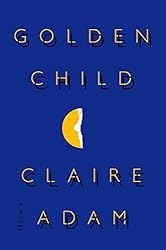
Golden Child
Claire Adam, 2019
Crown/Archetype
288 pp.
ISBN-13: 9780525572992
Summary
A new novel from Sarah Jessica Parker’s imprint, SJP for Hogarth: a deeply affecting debut novel set in Trinidad, following the lives of a family as they navigate impossible choices about scarcity, loyalty, and love
Rural Trinidad: a brick house on stilts surrounded by bush; a family, quietly surviving, just trying to live a decent life.
Clyde, the father, works long, exhausting shifts at the petroleum plant in southern Trinidad; Joy, his wife, looks after the home. Their two sons, thirteen years old, wake early every morning to travel to the capital, Port of Spain, for school. They are twins but nothing alike: Paul has always been considered odd, while Peter is widely believed to be a genius, destined for greatness.
When Paul goes walking in the bush one afternoon and doesn't come home, Clyde is forced to go looking for him, this child who has caused him endless trouble already, and who he has never really understood.
And as the hours turn to days, and Clyde begins to understand Paul’s fate, his world shatters—leaving him faced with a decision no parent should ever have to make.
Like the Trinidadian landscape itself, Golden Child is both beautiful and unsettling; a resoundingly human story of aspiration, betrayal, and love. (From the publisher.)
Author Bio
• Birth—N/A
• Where—Trinidad
• Education—B.S., Brown University; M.A., London University
• Currently—lives in London
Claire Adam was born and raised on the island of Trinidad to two doctors. Her mother, from Ireland, and her father, from Trinidad, met while working in a hospital in Nottingham in England. Adam is the youngest of four siblings (a brother and two sisters).
Adam left Trinidad to study physics at Brown University in the U.S. Later she earned her MA from the University of London, where she still lives. Golden Child is her first novel. (From various online sources.)
Book Reviews
In fluid and uncluttered prose, Golden Child weaves an enveloping portrait of an insular social order in which the claustrophobic support of family and neighbors coexists with an omnipresent threat from the same corners.
Jan Stuart - New York Times Book Review
[An] emotionally potent debut novel… with a spare, evocative style, Adam (a Trinidad native) evokes the island’s complexity during the mid-'80s, when the novel is mostly set: the tenuous relationship between Hindus like Clyde’s family and the twins’ Catholic schoolmaster, assassinations and abductions hyped by lurid media headlines, resources that attract carpetbagging oil companies but leave the country largely impoverished.
USA Today
Golden Child is a beautiful and haunting tale, one that leaves readers thinking long after the last page has been turned.
Associated Press
This book manages to combine two things rarely bound together in the same spine: a sensitive depiction of family life and the page-flicking urgency of a thriller.
Guardian (UK)
This is a tough, original novel of remarkable poise and confidence.
Economist (UK)
[A] powerful debut… a devastating family portrait—and a fascinating window into Trinidadian society.
People
★ Adam’s excellent debut explores a dark and haunting Sophie’s Choice-like dilemma…. Throughout this stunning portrait of Trinidad… and one family’s sacrifices, soaring hopes and ultimate despair, Adam weaves a poetic lightness and beauty that will transfix readers.
Publishers Weekly
The novel starts off slowly but gains momentum… with the family dynamics getting more complicated as… family divisions, conflicts, and betrayals are revealed. The last third of the book reads like a thriller but never loses its emotional depth. —Pamela Mann, St. Mary's Coll. Lib., MD
Library Journal
★ Adam's writing is luxuriant, evoking the atmospheric island setting and the complicated, worried lives lived under a near-constant sense of impending violence…. Heartbreaking and lovely, this is an important work by a promising new voice.
Booklist
[T]he novel telegraphs its biggest plot twist. [As] a result Clyde's decision isn't harrowing; by the time its necessary consequences unfold, a reader might be less moved than Adam hopes.… [Still] Adam has… written an incisive and loving portrait of contemporary Trinidad.
Kirkus Reviews
Discussion Questions
1. Why is Clyde hesitant to accept help from people, even family? Do you think Uncle Vishnu is genuine in his desire to help? Do you trust him?
2. Why does Joy insist that the twins attend the same school?
3. Should Peter be responsible for looking after Paul, even if it impedes his progress?
4. While living, Uncle Vishnu helped keep the Deyalsinghs afloat, improving Peter’s prospects and securing his future. How does his death affect them in the immediate and distant future? How does his death affect the family, as a whole, in the immediate and distant future?
5. Is Romesh right in feeling that he, as well as the rest of the family, is entitled to a portion of the money that Uncle Vishnu left for Peter? How do you foresee this affecting relationships within the family moving forward?
6. Does putting Paul in St. Saviour’s—a school he’s not qualified to attend—for the sake of keeping the twins together, help or hurt him?
7. What do you make of Father Kavanagh assuring Paul that he’s normal, contrary to what others have said his whole life? Is he right? Is too much made of Paul’s deficiencies? Do you think Father Kavanagh oversteps his boundaries in expressing this belief to Clyde?
8. What effect does Father Kavanagh’s assurance have on Paul? How does it affect their relationship, as well as Father Kavanagh’s relationship with Clyde?
9. Paul initially stands up to the bandits during their attempted robbery. When they later approach him outside of the house, Paul all but surrenders. Why does he submit the second time around?
10. Why does Clyde opt not to use Vishnu’s money for Paul’s ransom despite the mounting pressure from the kidnappers, Joy, and, then, Peter?
11. Does Clyde make enough of an effort to bring Paul home safely? Because of his actions, or lack thereof, is he ultimately responsible for what happens to Paul?
12. Is it right to sacrifice the future (or life) of one child to ensure the future of another if the latter’s is assuredly brighter? Would you make the same decision as Clyde?
13. In the airport, Peter thinks to himself, Paul has played his part. Daddy has played his part. What do you make of each person’s role in Peter’s eventual success? How should Clyde feel about his role, especially after Paul’s death? How do you think Paul would feel about his role? Do you think he sacrificed himself in order to protect his family?
14. Should Peter feel guilty about attending Harvard after Paul’s death?
15. What does Clyde’s reaction at the end of the book reveal about his guilt? Does he think what he did (or didn’t do) was worth it? In your opinion, was it worth it?
16. What do you think are a parent’s obligations to his or her children?
(Questions issued by the publisher.)


The Golden Door
Tom Milton, 2012
Nepperhan Press
228 pp.
ISBN-13: 9780983941217
Summary
Maya Mendez, who has lived with her family in Alabama for fifteen years as an illegal immigrant, suddenly faces an uncertain future when the state passes a new immigration law. The law will make it a crime for her parents to work and will prohibit her from attending a public university.
Maya has recently graduated from high school, and in two months she plans to start at the University of Alabama, which recruited her for the women’s soccer team before the law was passed. Since the law doesn’t become effective until after the fall semester begins, and since it might be stopped by challenges, Maya goes to Tuscaloosa in early August to join the soccer team for practice. Meanwhile, she finds herself in the middle of a conflict between her parents—her father still wants to pursue his dream of living in America, and her mother wants to go back to Mexico.
As the months pass and the law moves through the court system, Maya becomes a key player on a soccer team that has its most successful season in years. But the spirit of the law eventually catches up with her family, and out of its tragic consequences she struggles to find a mission in life. (From the author.)
Author Bio
• Birth—April 3, 1949
• Where—St. Paul, Minnesota, USA
• Education—B.A. Princeton University; M.A., University
of Iowa (Writers Workshop); Ph.D., Walden University
• Currently—lives in Hastings-on-Hudson, NY
Tom Milton was born and raised in St. Paul, Minnesota. After completing his undergraduate
degree at Princeton he worked for the Wall Street Journal, and then he was invited to the Writers Workshop in Iowa City, where he completed a novel and a master’s degree. He then served in the U.S. Army, and upon his discharge he joined a major international bank in New York. For the next twenty years he worked overseas, initially as an economic/political analyst and finally as a senior executive. He later became involved in economic development projects.
After retiring from his business career he joined the faculty of Mercy College, where he is a professor of international business. Five years ago he found a publisher for his novels, some of which are set in foreign cities where he lived (Buenos Aires, London, Madrid, and Santo Domingo). His novels are popular with reading groups because they deal with major issues, they have engaging characters, and they are good stories.
His first published novel, No Way to Peace, set in Argentina in the mid-1970s, is about the courage of five women during that country’s war of terror. His second novel, The Admiral’s Daughter, is about the conflict between a young woman and her father during the civil rights war in Mississippi in the early 1960s. His third novel, All the Flowers, set in New York in the late 1960s, is about a gifted young singer who gets involved in the antiwar movement because her twin brother joins the army to prove his manhood to his father. His fourth novel, Infamy, set in Madrid in 2007, is about the attempt of security agents to stop a terrorist attack on New York City that would use weapons of mass destruction. His next novel, A Shower of Roses, set in London in the early 1980s, is about a young nurse who is drawn by love into an intrigue of the Cold War. His next novel, Sara’s Laughter, set in Yonkers, NY in 1993, is about a woman in her mid-thirties who wants a child but is unable to get pregnant. And his latest novel, The Golden Door, is about a young Latina woman in Alabama whose future is threatened by a harsh anti-immigrant law that the state passed in 2011.
Extras
From a conversation with Tom Milton appearing at the end of The Golden Door:
Q: All your heroines get into trouble. All have their values tested by events. And all have something in common—they define themselves by what they believe in, not by their relationships with men. Does that make you a feminist?
A: I belong to a generation that fought for civil rights, for peace, for women’s liberation, and for the environment. We’re still a long way from achieving our goals in these areas, including social and economic justice for women, so I’m an advocate for those goals. (From the author.)
Book Reviews
What does it feel like to be an illegal immigrant? Tom Milton addresses this question directly in The Golden Door, a book written in the voice of Maya Mendez, a young Mexican woman who has spent fifteen years living in the US. She’s an achiever with high grades at school, excellent soccer skills, and a brown belt in karate, and she’s just won a scholarship to the University of Alabama when an immigration law is passed that makes it impossible for her parents to work and for her to attend university. Written largely in the first person, the novel discusses her identity struggles as she moves between the differing opinions of her parents: her father, who wants to fulfill his dream of living in America, and her mother who believes they are unwanted in the US and should simply return to Mexico, where they belong. Through her relationships with her mentor, Judson, her rich, white boyfriend, Shelby, and her friend, Erin, Maya tries to understand what it means to be an illegal alien. She tries to determine whether a life in America is something she should continue to pursue, despite the challenges implicit in a law that makes her an instant outsider. Initially, she feels exempt from its grasp. But then her father is deported and the university rescinds her scholarship after Shelby’s father, an influential alumnus, tries to end Maya’s relationship with his son by having her extradited. The Golden Door tackles some relevant issues in a direct manner, using first-person dialogue between the characters to explain the various conflicts. At times this dialogue feels a little stilted and forced, but on the whole it succeeds in holding a reader’s attention. Milton also succeeds in breaking some of the stereotypes associated with Latinos by giving us a protagonist who has everything in her favor. Not only is she attractive, but she’s intelligent, ambitious, and the best soccer player on her university team. Clearly, she is an asset to the country. Her parents, too, struggle to understand how they are considered to be “taking jobs away from Americans,” when there is a dearth of American labor to get those jobs done. The Golden Door is a good read for young, thinking adults aged fifteen and older, and its address of immigration issues is easily applicable to American controversy on the same subject, as well as stereotypes that persist to this day.
Lauren Kramer - Forward Reviews
Discussion Questions
1. Discuss this novel’s treatment of racism, violence, and gender identity.
2. Discuss the statement by Trevor that the people who support anti-immigrant laws like the one in Alabama want to turn America into a gated community.
3. Maya’s father believes that the words engraved at the base of the Statue of Liberty are still true, whereas her mother insists they are no longer true. What do you think?
4. Explain how Maya is affected by the conflict between her father and her mother.
5. How does Maya’s relationship with Shelby help her or hinder her in finding her identity?
6. What role does Judson play in Maya’s development?
7. What roles do Father Philip and Trevor play in Maya’s development?
8. What new perspectives does Maya gain from Erin?
9. What role does the coach play in Maya’s development?
10. How are Maya’s values tested by her relationship with Diego?
11. Explain how the plot is driven by the hopes, dreams, beliefs, or values of the characters. Which character has the most effect on what happens?
12. Describe the three situations where Maya uses her karate skills. Was she justified in using those skills?
13. Does Maya resolve the conflict between her parents? Explain.
14. Given the events of the story, is the ending inevitable? Explain.
15. How would you project Maya’s future?
(Questions courtesy of author.)

Golden Hill: A Novel of Old New York
Francis Spufford, 2017
Scribner
320 pp.
ISBN-13: 9781501163890
Summary
2017 Costa Award - First Novel
The spectacular first novel from acclaimed nonfiction author Francis Spufford follows the adventures of a mysterious young man in mid-eighteenth century Manhattan, thirty years before the American Revolution.
New York, a small town on the tip of Manhattan island, 1746.
One rainy evening in November, a handsome young stranger fresh off the boat arrives at a countinghouse door on Golden Hill Street: this is Mr. Smith, amiable, charming, yet strangely determined to keep suspicion shimmering.
For in his pocket, he has what seems to be an order for a thousand pounds, a huge sum, and he won’t explain why, or where he comes from, or what he is planning to do in the colonies that requires so much money. Should the New York merchants trust him? Should they risk their credit and refuse to pay? Should they befriend him, seduce him, arrest him; maybe even kill him?
Rich in language and historical perception, yet compulsively readable, Golden Hill is a story "taut with twists and turns" that "keeps you gripped until its tour-de-force conclusion" (The Times, London).
Spufford paints an irresistible picture of a New York provokingly different from its later metropolitan self but already entirely a place where a young man with a fast tongue can invent himself afresh, fall in love — and find a world of trouble. (From the publisher.)
Author Bio
• Birth—1964
• Where—Cambridge, England, U
• Education—B.A., Cambridge University
• Awards—Costa First Novel Award; Ondaatje Prize; Somerset Maugham Award
• Currently—lives near Cambridge, England
Francis Spufford is the British author of five highly praised books of nonfiction and one work of fiction. He was raised in Cambridge, England, by two Cambridge academics: his father was an economic historian, and mother a social historian.
Spufford, himself, attended Cambridge, but earned his degree in English literature. For three years (1987-90) he was Chief Reader at Chatto and Windus, a noted English publisher, which had taken over Hogarth Press, once operated by Leonard and Virginia Woolf.
His first book, I May Be Some Time, won the Writers’ Guild Award for Best Nonfiction Book of 1996, the Banff Mountain Book Prize, and a Somerset Maugham Award. It was followed by The Child That Books Built, Backroom Boys, Red Plenty (which was translated into nine languages), and most recently, Unapologetic. He published his first novel, Golden Hill, in 2017.
In 2007 he was elected a Fellow of the Royal Society of Literature and currently teaches in the creative writing program at Goldsmiths College in London. He lives near Cambridge with his wife and daughter. (Adapted from Wikipedia. Retrieved 7/14/2017.)
Book Reviews
[E]bullient, freewheeling historical fiction.… Its action is so vivid that you seem to be consuming (imagine Wolf Blitzer’s voice here) breaking news. Delirious storytelling backfilled with this much intelligence is a rare and happy sight.… [A] a high-level entertainment, filled with so much brio that it’s as if each sentence had been dusted with Bolivian marching powder and cornstarch and gently fried. Some of this swashbuckling action goes over the top, but you will probably be turning the pages too quickly to register a complaint.
Dwight Garner - New York Times
Admirably eccentric.… The boisterous plot is perfectly in keeping with its mid-18th century setting.… This wonderful novel concludes with one further revelation, one that will make you reflect once again what a gloriously tricky fellow this Francis Spufford is.
Boston Globe
Francis Spufford’s fiction début is a fast-paced romp, but it keeps its eyes on the moral conundrums of America.… [He is] an author capable of making any topic, however unlikely, at once fascinating and amusing. Golden Hill is both.
The New Yorker
The intoxicating effect of Golden Hill is much more than an experiment in form. [Spufford] has created a complete world, employing his archivist skills to the great advantage of his novel.… This is a book born of patience, of knowledge accrued and distilled over decades, a style honed by practice. There are single scenes here more illuminating, more lovingly wrought, than entire books.
Financial Times (UK)
Like a newly discovered novel by Henry Fielding with extra material by Martin Scorsese. Why it works so well is largely down to Spufford's superb re-creation of New York.… His writing crackles with energy and glee, and when Smith's secret is finally revealed it is hugely satisfying on every level. For its payoff alone Golden Hill deserves a big shiny star.
Times (UK)
Splendidly entertaining and ingenious.… Throughout Golden Hill, Spufford creates vivid, painterly scenes of street and salon life, yet one never feels as though a historical detail has been inserted just because he knew about it. Here is deep research worn refreshingly lightly.… [A] first-class period entertainment.
Guardian (UK)
Paying tribute to writers such as Fielding, Francis Spufford's creation exudes a zesty, pin-sharp contemporaneity.…[C]olonial New York takes palpable shape in his dazzlingly visual, pacy and cleverly plotted novel.
Daily Mail (UK)
Golden Hill shows a level of showmanship and skill which seems more like a crowning achievement than a debut . [Spufford] brings his people and situations to life with glancing ease.… They all live and breathe with conviction.… His descriptive powers are amazing.… Spufford's extraordinary visual imagination and brilliant pacing seems to owe more to the movies than anything else.
Evening Standard (UK)
Spufford’s…New York bursts with energy, danger, and potential. His ironic, sometimes bawdy sense of humor and coy storytelling may frustrate those who do not "cotton" to the "cant," but patient readers are rewarded with a feast of language, character, local color, and historical detail.
Publishers Weekly
(Starred reivew) In 1746, a man named Smith arrives in New York City, population 7,000, in his hand, a bill for 1,000 pounds payable in New York. No one can vouch for him, and he won't explain why he needs so much money.… [A] successful homage to the great master of the picaresque novel, Henry Fielding.—David Keymer, Modesto, CA
Library Journal
(Starred reivew) A virtuoso literary performance.
Booklist
(Starred reivew) [S]parkling.… Spufford suggests in an afterword that he was aiming for "a colonial counterpart to Joseph Andrews."… A first-rate entertainment with a rich historical feel and some delightful twists.
Kirkus Reviews
Discussion Questions
1. "What a difference a frame makes!" thinks Mr. Smith while first looking in on the room occupied by Tabitha, Flora, and Zephyr, less than an hour after arriving in New York (p. 10). What difference does the frame of Golden Hill, revealed in Tabitha’s postscript on pages 295-299, make in your understanding of the novel? What difference does it make in your enjoyment of the novel?
2. Saracen conjurer, agent of the French, actor, rogue, mountebank: Mr. Smith is called each of these things at some point during his time in New York. Which label is most fitting and why?
3. Mr. Lovell offers a definition of "commerce" in the following: "Commerce is trust, sir. Commerce is need and need together, sir. Commerce is putting a hand in answer into a hand out-stretched" (p.5). How does this definition apply to Mr. Smith’s mission as revealed later on? Would you call his purpose in New York "commerce" or something else?
4. Though he is never identified, who do you think the long-haired thief who stole Mr. Smith’s pocket book is? For whom was he working?
5. Golden Hill is set in 1746, eighty-two years after Manhattan passed from Dutch to British sovereignty, and thirty-seven years before it became American. Describe the various attitudes of the Manhattanites toward Britain and Holland. Where do you see fault lines that portend the coming revolution?
6. Examine Mr. Smith’s dreams during his nights of fitful sleep, first on Septimus’s too-small sofa (p. 89-90), and later on the night after his thumb is branded (p. 266-267). From the chessboard to the "wine-coloured snowman," what do the symbols in these dreams reveal to us about Mr. Smith and his feelings toward his mission?
7. Why was Tabitha pretending to be crippled? Why do you think Mr. Smith refrained from asking her to explain her behavior (p. 97)?
8. Cato, the play put on by Septimus, is the account of the final hours of Marcus Porcius Cato, a Stoic whose deeds, rhetoric, and resistance to the tyranny of Caesar made him an icon of virtue and liberty. As Septimus says, it "tickles all the themes that New-York loves best." Considering the political atmosphere of New York in 1746, do you agree? Considering the New York City of today, do you agree?
9. "A villain is hard to do without," says Mr. Smith to Septimus, about the role of Sempronius in their production of Cato (p. 205). Who, if anyone, is the villain of Golden Hill?
10. Mr. Smith says a phrase to Zephyr in the Ghanaian language Twi that is not translated: "Aane, me ara ni nnipa a wo twen no" (p. 288). What do you think he is saying to her?
11. Mr. Smith tells Tabitha that she is "a bird and a cage" (p. 281). What does he mean? Is this true of other female characters in the novel? Is this true of Mr. Smith himself? What other literary figures or film characters fit this description?
12. Golden Hill presents a society in which novels are shown to inspire addiction (Flora consumes them "like laudanum") as well as aversion (Tabitha calls them "Slush for small minds," "pabulum for the easily pleased"). Find other examples of meta-textual references throughout Golden Hill, including places where the narrator overtly intrudes upon the story. How do these moments force us to reevaluate the novel’s universe and purpose? What shortcomings of the novel as a form do these moments expose?
(Questions issued by the publisher.)

The Golden House
Salman Rushdie, 2017
Random House
400 pp.
ISBN-13: 9780399592805
Summary
A modern American epic set against the panorama of contemporary politics and culture—a hurtling, page-turning mystery that is equal parts The Great Gatsby and The Bonfire of the Vanities
On the day of Barack Obama’s inauguration, an enigmatic billionaire from foreign shores takes up residence in the architectural jewel of “the Gardens,” a cloistered community in New York’s Greenwich Village.
The neighborhood is a bubble within a bubble, and the residents are immediately intrigued by the eccentric newcomer and his family. Along with his improbable name, untraceable accent, and unmistakable whiff of danger, Nero Golden has brought along his three adult sons:
… Petya, agoraphobic, alcoholic, and a brilliant recluse with a tortured mind;
… Apu, the flamboyant artist, sexually and spiritually omnivorous, famous on twenty blocks;
… D, at twenty-two the baby of the family, harboring an explosive secret even from himself.
There is no mother, no wife; at least not until Vasilisa, a sleek Russian expat, snags the septuagenarian Nero, becoming the queen to his king—a queen in want of an heir.
Our guide to the Goldens’ world is their neighbor Rene, an ambitious young filmmaker. Researching a movie about the Goldens, he ingratiates himself into their household. Seduced by their mystique, he is inevitably implicated in their quarrels, their infidelities, and, indeed, their crimes.
Meanwhile, like a bad joke, a certain comic-book villain embarks upon a crass presidential run that turns New York upside-down.
Set against the strange and exuberant backdrop of current American culture and politics, The Golden House also marks Salman Rushdie’s triumphant and exciting return to realism. The result is a modern epic of love and terrorism, loss and reinvention—a powerful, timely story told with the daring and panache that make Salman Rushdie a force of light in our dark new age. (From the publisher.)
Author Bio
• Birth—June 19, 1947
• Where—Bombay, Maharashtra, India
• Education—M.A., King's College, Cambridge, UK
• Awards—Booker Prize, 1981; Best of the Bookers, 1993 (the best novel to win the Booker
Prize in its first twenty-five years); Whitbread Prize, 1988 and 1995
• Currently—lives in New York, New York
Sir Ahmed Salman Rushdie is a British Indian novelist and essayist. His second novel, Midnight's Children (1981), won the Booker Prize in 1981. Much of his fiction is set on the Indian subcontinent. He is said to combine magical realism with historical fiction; his work is concerned with the many connections, disruptions and migrations between East and West.
His fourth novel, The Satanic Verses (1988), was the centre of a major controversy, provoking protests from Muslims in several countries, some violent. Death threats were made against him, including a fatwa issued by Ayatollah Ruhollah Khomeini, the Supreme Leader of Iran, on February 14, 1989.
Rushdie was appointed Commandeur de l'Ordre des Arts et des Lettres of France in January 1999. In June 2007, Queen Elizabeth II knighted him for his services to literature. In 2008, The Times ranked him thirteenth on its list of the fifty greatest British writers since 1945.
Since 2000, Rushdie has lived in the United States, where he has worked at the Emory University and was elected to the American Academy of Arts and Letters. His most recent book is Joseph Anton: A Memoir, an account of his life in the wake of the Satanic Verses controversy.
Career
Rushdie's first career was as a copywriter, working for the advertising agency Ogilvy & Mather, where he came up with "irresistibubble" for Aero and "Naughty but Nice" for cream cakes, and for the agency Ayer Barker, for whom he wrote the memorable line "That'll do nicely" for American Express. It was while he was at Ogilvy that he wrote Midnight's Children, before becoming a full-time writer. John Hegarty of Bartle Bogle Hegarty has criticised Rushdie for not referring to his copywriting past frequently enough, although conceding: "He did write crap ads...admittedly."
His first novel, Grimus, a part-science fiction tale, was generally ignored by the public and literary critics. His next novel, Midnight's Children, catapulted him to literary notability. This work won the 1981 Booker Prize and, in 1993 and 2008, was awarded the Best of the Bookers as the best novel to have received the prize during its first 25 and 40 years. Midnight's Children follows the life of a child, born at the stroke of midnight as India gained its independence, who is endowed with special powers and a connection to other children born at the dawn of a new and tumultuous age in the history of the Indian sub-continent and the birth of the modern nation of India. The character of Saleem Sinai has been compared to Rushdie. However, the author has refuted the idea of having written any of his characters as autobiographical, stating...
People assume that because certain things in the character are drawn from your own experience, it just becomes you. In that sense, I’ve never felt that I’ve written an autobiographical character.
After Midnight's Children, Rushdie wrote Shame, in which he depicts the political turmoil in Pakistan, basing his characters on Zulfikar Ali Bhutto and General Muhammad Zia-ul-Haq. Shame won France's Prix du Meilleur Livre Étranger (Best Foreign Book) and was a close runner-up for the Booker Prize. Both these works of postcolonial literature are characterised by a style of magic realism and the immigrant outlook that Rushdie is very conscious of as a member of the Indian diaspora.
Rushdie wrote a non-fiction book about Nicaragua in 1987 called The Jaguar Smile. This book has a political focus and is based on his first-hand experiences and research at the scene of Sandinista political experiments.
His most controversial work, The Satanic Verses, was published in 1988 (see below). Rushdie has published many short stories, including those collected in East, West (1994). The Moor's Last Sigh, a family epic ranging over some 100 years of India's history was published in 1995. The Ground Beneath Her Feet presents an alternative history of modern rock music. The song of the same name by U2 is one of many song lyrics included in the book, hence Rushdie is credited as the lyricist. He also wrote Haroun and the Sea of Stories in 1990.
Rushdie has had a string of commercially successful and critically acclaimed novels. His 2005 novel Shalimar the Clown received, in India, the prestigious Hutch Crossword Book Award, and was, in Britain, a finalist for the Whitbread Book Awards. It was shortlisted for the 2007 International IMPAC Dublin Literary Award.
In his 2002 non-fiction collection Step Across This Line, he professes his admiration for the Italian writer Italo Calvino and the American writer Thomas Pynchon, among others. His early influences included James Joyce, Günter Grass, Jorge Luis Borges, Mikhail Bulgakov, and Lewis Carroll. Rushdie was a personal friend of Angela Carter and praised her highly in the foreword for her collection Burning your Boats.
Other Activities
Rushdie has quietly mentored younger Indian (and ethnic-Indian) writers, influenced an entire generation of Indo-Anglian writers, and is an influential writer in postcolonial literature in general. He has received many plaudits for his writings, including the European Union's Aristeion Prize for Literature, the Premio Grinzane Cavour (Italy), and the Writer of the Year Award in Germany and many of literature's highest honours. Rushdie was the President of PEN American Center from 2004 to 2006 and founder of the PEN World Voices Festival.
He opposed the British government's introduction of the Racial and Religious Hatred Act, something he writes about in his contribution to Free Expression Is No Offence, a collection of essays by several writers.
In 2007 he began a five-year term as Distinguished Writer in Residence at Emory University in Atlanta, Georgia, where he has also deposited his archives.
In May 2008 he was elected a Foreign Honorary Member of the American Academy of Arts and Letters.
Though he enjoys writing, Salman Rushdie says that he would have become an actor if his writing career had not been successful. Even from early childhood, he dreamed of appearing in Hollywood movies (which he later realised in his frequent cameo appearances).
Rushdie includes fictional television and movie characters in some of his writings. He had a cameo appearance in the film Bridget Jones's Diary based on the book of the same name, which is itself full of literary in-jokes.
On May 12, 2006, Rushdie was a guest host on The Charlie Rose Show, where he interviewed Indo-Canadian filmmaker Deepa Mehta, whose 2005 film, Water, faced violent protests. He appears in the role of Helen Hunt's obstetrician-gynecologist in the film adaptation of Elinor Lipman's novel Then She Found Me. In September 2008, and again in March 2009, he appeared as a panellist on the HBO program Real Time with Bill Maher.
Rushdie is currently collaborating on the screenplay for the cinematic adaptation of his novel Midnight's Children with director Deepa Mehta. The film will be released in October, 2012.
Rushdie is a member of the advisory board of The Lunchbox Fund, a non-profit organisation which provides daily meals to students of township schools in Soweto of South Africa. He is also a member of the advisory board of the Secular Coalition for America, an advocacy group representing the interests of atheistic and humanistic Americans in Washington, D.C. In November 2010 he became a founding patron of Ralston College, a new liberal arts college that has adopted as its motto a Latin translation of a phrase ("free speech is life itself") from an address he gave at Columbia University in 1991 to mark the two-hundredth anniversary of the first amendment to the U.S. Constitution.
The Satanic Verses and the fatwa
The publication of The Satanic Verses in September 1988 caused immediate controversy in the Islamic world because of what was perceived as an irreverent depiction of the prophet Muhammad. The title refers to a disputed Muslim tradition that is related in the book. According to this tradition, Muhammad (Mahound in the book) added verses (sura) to the Qur'an accepting three goddesses who used to be worshipped in Mecca as divine beings. According to the legend, Muhammad later revoked the verses, saying the devil tempted him to utter these lines to appease the Meccans (hence the "Satanic" verses). However, the narrator reveals to the reader that these disputed verses were actually from the mouth of the Archangel Gibreel. The book was banned in many countries with large Muslim communities.
On February 14, 1989, a fatwa requiring Rushdie's execution was proclaimed on Radio Tehran by Ayatollah Ruhollah Khomeini, the spiritual leader of Iran at the time, calling the book "blasphemous against Islam." A bounty was offered for Rushdie's death, and he was thus forced to live under police protection for several years. On March 7, 1989, the United Kingdom and Iran broke diplomatic relations over the Rushdie controversy.
The publication of the book and the fatwa sparked violence around the world, with bookstores firebombed. Muslim communities in several nations in the West held public rallies, burning copies of the book. Several people associated with translating or publishing the book were attacked and even killed.
On September 24, 1998, as a precondition to the restoration of diplomatic relations with Britain, the Iranian government gave a public commitment that it would "neither support nor hinder assassination operations on Rushdie."
Hardliners in Iran have continued to reaffirm the death sentence. In early 2005, Khomeini's fatwa was reaffirmed by Iran's current spiritual leader, Ayatollah Ali Khamenei, in a message to Muslim pilgrims making the annual pilgrimage to Mecca. Additionally, the Revolutionary Guards have declared that the death sentence on him is still valid. Iran has rejected requests to withdraw the fatwa on the basis that only the person who issued it may withdraw it, and the person who issued it – Ayatollah Khomeini – has been dead since 1989.
Rushdie has reported that he still receives a "sort of Valentine's card" from Iran each year on February 14 letting him know the country has not forgotten the vow to kill him. He said, "It's reached the point where it's a piece of rhetoric rather than a real threat."
A memoir of his years of hiding, Joseph Anton, was published in 2012. Joseph Anton was Rushdie's secret alias.
In 2012, following uprisings over an anonymously posted YouTube video denigrating Muslims, a semi-official religious foundation in Iran increased the reward it had offered for the killing of Rushdie from $2.8 million to $3.3 million dollars. Their stated reason: "If the [1989] fatwa had been carried out, later insults in the form of caricature, articles and films that have continued would have not happened."
Knighthood
Rushdie was knighted for services to literature in the Queen's Birthday Honours on June 16, 2007. He remarked, "I am thrilled and humbled to receive this great honour, and am very grateful that my work has been recognised in this way." In response to his knighthood, many nations with Muslim majorities protested. Several called publicly for his death. Some non-Muslims expressed disappointment at Rushdie's knighthood, claiming that the writer did not merit such an honour and there were several other writers who deserved the knighthood more than Rushdie.
Al-Qaeda has condemned the Rushdie honour. The Al-Qaeda leader Ayman al-Zawahiri is quoted as saying in an audio recording that Britain's award for Indian-born Rushdie was "an insult to Islam", and it was planning "a very precise response."
Religious Beliefs
Rushdie came from a Muslim family though he is an atheist now. In 1990, in the "hope that it would reduce the threat of Muslims acting on the fatwa to kill him," he issued a statement claiming he had renewed his Muslim faith, had repudiated the attacks on Islam in his novel and was committed to working for better understanding of the religion across the world. However, Rushdie later said that he was only "pretending".
Personal Life
Rushdie has been married four times. He was married to his first wife Clarissa Luard from 1976 to 1987 and fathered a son, Zafar (born 1980). His second wife was the American novelist Marianne Wiggins; they were married in 1988 and divorced in 1993. His third wife, from 1997 to 2004, was Elizabeth West; they have a son, Milan (born 1999). In 2004, he married the Indian American actress and model Padma Lakshmi, the host of the American reality-television show Top Chef. The marriage ended on July 2, 2007, with Lakshmi indicating that it was her desire to end the marriage.
In 1999 Rushdie had an operation to correct ptosis, a tendon condition that causes drooping eyelids and that, according to him, was making it increasingly difficult for him to open his eyes. "If I hadn't had an operation, in a couple of years from now I wouldn't have been able to open my eyes at all," he said.
Since 2000, Rushdie has "lived mostly near Union Square" in New York City. (Adapted from Wikipedia. Retrieved 2012.)
Book Reviews
(Starred review.) Ambitious and rewarding.… [A] distinctively rich epic of the immigrant experience in modern America, where no amount of money or self-abnegation can truly free a family from the sins of the past.
Publishers Weekly
This latest from "Booker of Bookers" prize winner Rushdie chronicles a young American filmmaker's involvement with a real estate tycoon while plumbing American culture and politics since the inauguration of Barack Obama.… One can almost hear Rushdie sharpening his knives.
Library Journal
(Starred review.) A ravishingly well-told, deeply knowledgeable, magnificently insightful, and righteously outraged epic which poses timeless questions about the human condition. Can a person be both good and evil? Is family destiny? Does the past always catch up to us?
Booklist
(Starred review.) Where Tom Wolfe’s Bonfire of the Vanities sent up the go-go, me-me Reagan/Bush era, Rushdie’s latest novel captures the existential uncertainties of the anxious Obama years.… A sort of Great Gatsby for our time: everyone is implicated, no one is innocent, and no one comes out unscathed.
Kirkus Reviews
Discussion Questions
We'll add publisher questions if and when they're available; in the meantime, use our LitLovers talking points to help start a discussion for The Golden House … then take off on your own:
1. Talk about Rene, the narrator of The Golden House, and compare him to Nick Carraway, narrator of The Great Gatsby. How are they similar in their observations of both the family "next door" and America as a country?
2. What prompts Rene to say, "I've come to believe in the total mutability of the self"? What is he referring to…or what does he mean? Do you agree?
3. How does The Golden House reflect the current socio-political environment in America? How accurate, or overblown, is Rushdie's portrait of the country?
4. In what way does the Golden family serve as symbols for the country's current identity crisis?
5. What is the tragedy in India that drove Nero and his sons to America and that continues to haunt them?
6. How would you describe Nero Golden?
7. Discuss the characters of each of the three sons, the place each occupies in New York society, and the secrets each harbors. In what way are all, including their father, pretending to be something they're not?
8. What do you think of Vasilisa? Does Nero "acquire" her (as a wife) or does she "acquire" him?
9. The joker. Any comments?
10. Consider this condemnation of America: a country "torn in half, its defining myth of city-on-a-hill exceptionalism lying trampled in the gutters of bigotry and racial and male supremacism, Americans’ masks ripped off to reveal the Joker faces beneath." Do you accept or reject that vision?
11. Rushdie poses big questions in The Golden Hill: can good and evil coexist in the same person; are people truly capable of change; and, as Rene contemplates, is there such thing as as the "supposed innate ability of the human mind to realize the basic principles of ethics and morals”? Where does the novel fall on those issues … and where do you?
12. Consider the final image of the swirling camera circling survivors. What does it suggest metaphorically? Why might the author have chosen that last image?
(Questions by LitLovers. Please feel free to use them, online or off, with attribution. Thanks.)
Summary | Author | Book Reviews | Discussion Questions
The Golden Mean
Annabel Lyon, 2009
Knopf Doubleday
304 pp.
ISBN-13: 9780307593993
In Brief
A startlingly original first novel by “this generation’s answer to Alice Munro” (Vancouver Sun)—a bold reimagining of one of history’s most intriguing relationships: between legendary philosopher Aristotle and his most famous pupil, the young Alexander the Great.
342 B.C.: Aristotle is reluctant to set aside his own ambitions in order to tutor Alexander, the rebellious son of his boyhood friend Philip of Macedon. But the philosopher soon comes to realize that teaching this charming, surprising, sometimes horrifying teenager—heir to the Macedonian throne, forced onto the battlefield before his time—is a desperate necessity amid the ever more sinister intrigues of Philip’s court.
Told in the brilliantly rendered voice of Aristotle—keenly intelligent, often darkly funny—The Golden Mean brings ancient Greece to vivid life via the story of this remarkable friendship between two towering figures, innovator and conqueror, whose views of the world still resonate today. (From the publisher.)
top of page
About the Author
• Birth—1971
• Where—Canada
• Education—B.A., Simon Fraser University; M.F.A., University
of British Columbia
• Awards—The Rogers Writers' Trust Fiction Prize (Canada)
• Currently—lives in New Westminster, British Columbia, Canada
Annabel Lyon is a Canadian novelist and short story writer. She completed her Bachelor of Arts in Philosophy at Simon Fraser University and an MFA in Creative Writing at the University of British Columbia.
Her first book, the short-story collection Oxygen, was nominated for the Danuta Gleed and ReLit awards. Her second collection of three novellas, The Best Thing for You, was nominated for the Ethel Wilson Prize for Fiction. (From the publisher.)
The Golden Mean (2009) holds the distinction of being the only book nominated that year for all three of Canada's major fiction prizes: the Scotiabank Giller Prize, the Governor General's Award for English language fiction and the Rogers Writers' Trust Fiction Prize. Of the three, she won the Rogers Prize. Lyon lives in New Westminster, B.C., Canada, with her husband and two children. (Adapted from Wikipedia.)
top of page
Critics Say . . .
(The book was first released in Canada; the reveiws below are from Canadanian sources.)
Historical fiction at its best.... Lyon authoritatively evokes a fabled time and place in the urbane voice of the man judged the smartest of his age.
Montreal Gazette
Lyon [has] established herself as this generation's answer to Alice Munro. A master of wordplay and storytelling, Lyon takes readers deep into the hearts and secret desires of her characters.
Vancouver Sun (1)
A taut, polished novel that will hold your attention from start to finish. It is at times funny, thought-provoking, sensual and suspenseful.
Vancouver Sun (2)
It must be said that while this Aristotle (history has and will record others) is an unpleasant man, he is also extremely believable. The Golden Mean is a crisply written, painstakingly researched book, and Lyon ably inhabits “the greatest mind of all time” — hardly a mean feat. This, then, is a virtuous work, though fibrous, fat-free and rarely what you'd call fun. But that is probably exactly as Aristotle would have wanted it.
Globe and Mail
Annabel Lyon’s Aristotle is the most fully realized historical character in contemporary fiction. The Golden Mean engenders in the reader the same helpless sensitivity to the ferocious beauty of the world that is Aristotle’s disease. In this alarmingly confident and transporting debut novel, Lyon offers us that rarest of treats: a book about philosophy, about the power of ideas, that chortles and sings like an earthy romance.
Jury - Rogers Writers’ Trust Fiction Prize, 2009
Book Club Discussion Questions
1. What do you believe is the significance of Pythias’ note to Aristotle their first night in Pella, “warm, dry” (p. 12)? What does it reveal about Pythias’ nature and her relationship with Aristotle?
2. At their first meeting, Alexander accuses Aristotle of using Arrhidaeus as another “laurel leaf,” as proof that Aristotle is a great teacher. Is there truth in Alexander’s words? What do you believe are the motives behind Aristotle’s interest in Alexander’s brother?
3. How do Aristotle’s relationships with the two brothers and their father, Philip, influence one another? How do they rank in Aristotle’s affections?
4. Although they enjoy a relationship of love and respect, Alexander and Aristotle maintain their roles of ruler and subject. In one instance, however, Alexander breaks the rules that govern that relationship to visit Aristotle and Pythias at their home, even staying the night. What accounts for his visit? What might motivate his keen interest in Pythias?
5. Aristotle describes Alexander’s relationship with Olympias, his mother, as having a “grotesque intimacy.” Why do you believe Aristotle would characterize their relationship in this way? How might he describe Alexander’s relationship with his father? How do Alexander’s relationships with his parents influence him?
6. Contrast Aristotle’s relationships with Pythias and Herpyllis and the ways in which he recounts those relationships. In what ways, if any, do these relationships contribute to Aristotle’s life as a teacher, philosopher, husband and father?
7. What is the “golden mean”? In what ways does Aristotle embody that idea? In what ways is he a contradiction?
8. Aristotle’s cool, rational, and almost unfeeling character contrasts sharply with Alexander’s passionate one. To temper his student, and to lead Alexander to the happiness that seems to elude him, Aristotle works to convince Alexander of the idea of the “golden mean.” Alexander rejects the idea and accuses Aristotle of prizing mediocrity. In the end, who do you believe wins the argument, student or teacher?
9. Describe the effects of the battlefield on a young Alexander, what is referred to as “soldier’s heart.” What do you believe accounts for Alexander’s propensity to suffer from it?
10. What are your impressions of Lyon’s choice for her characters to use the vernacular, specifically contemporary profanity? Discuss what might have motivated that decision and why.
11. A review of The Golden Mean enthused that, “in Lyon’s clever hands, more than two thousand years of difference are made to disappear and Aristotle feels as real and accessible as the man next door.” Do you agree? Why or why not.
(Questions issued by the publisher.)


The Golden Son
Shilpi Somaya Gowada, 2016
HarperCollins
408 pp.
ISBN-13: 9780062391452
Summary
An unforgettable story of love, honor, tradition, and identity.
The first of his family to go to college, Anil Patel, the golden son, leaves his tiny Indian village to begin a medical residency at one of the best hospitals in America.
When his father dies, Anil becomes the head of the Patel household and inherits the mantle of arbiter for all of the village’s disputes. But he is uncertain that he has the wisdom and courage required to take on the role.
Back home in India, Anil’s childhood friend, Leena, struggles to adapt to her demanding new husband. Arranged by her parents, the marriage shatters Leena’s romantic hopes, and forces her to make choices that will hold drastic repercussions for her family.
Tender and bittersweet, The Golden Son illuminates the decisions we must make to find our true selves. (From the publisher.)
Author Bio
• Birth—December 9, 1970
• Where—Toronto, Ontario, Canada
• Education—B.A., University of North Carolina; M.B.A, Stanford University
• Currently—lives in San Francisco, California, USA
Shilpi Somaya Gowada is a Canadian novelist and author of two novels—The Secret Daughter, published in 2010, and The Golden Son, in 2016. Gowada was raised in Toronto by parents who had emigrated from Mumbai, India. She received her BA from the University of North Carolina at Chapel Hill and received an MBA from Stanford University.
She has worked as a business strategist, at one point as a vice president for an internet company, and now operates her own consulting firm. Gowada lives in San Francisco, California, with her husband and children.
Her First novel,
(Adapted from Canadian Encyclopedia.)
Book Reviews
The Golden Son triumphs because of its many pleasures and complications: romantic intrigues, family vendettas, unexpected tragedies and criminal secrets harbored by characters in both India and America. This satisfying immersion in two complicated cultures offers no easy resolutions.
Washington Post
Gowda can write up moments that break your heart... The Golden Son combines the immigrant novel with a fascination for the insecure and dependent lives of rural women in India. The book does not finish with the most predictable ending, but a version of happily ever after does take place. And yes, it evoked a few tears, too.
Toronto Globe and Mail
Gowda has the writerly chops when it comes to pace and plot.... The novel’s denouement manages to subvert expectations, while still fulfilling the fable’s responsibility to convey a useful, resonant truth.
Toronto Star
Gowda is a gifted storyteller, bringing together various related story strands into a fully integrated whole.
Vancouver Sun
The Golden Son successfully achieves the virtually impossible: it is every bit as good and strong as...Secret Daughter.... Both tell compelling stories that make each book a page-turner and a fast read. Both are extremely well-written with riveting plots.... Gowda's characters are beautifully and subtly drawn.... It was five years in the making and well worth the wait.
Winnipeg Free Press
The large and small struggles that make up everyday life are woven into an international family saga in Gowada’s latest novel.... [The Golden Son] offers readers a vivid cultural immersion. Even if the outcome is somewhat predictable, and tied up a bit too neatly, the journey to get there is deeply pleasurable.
Publishers Weekly
Discussion Questions
1. The Golden Son deals with a myriad of issues, such as family, responsibility and acceptance. What do you think is the overall theme of this novel? What is the significance of the title?
2. Why didn’t one of Anil’s brothers take over as village arbiter when their father died?
3. After a very difficult first year of residency, Anil starts to make a connection with what he’s learning and the patients he’s treating:
Anil had not looked closely into his patients' eyes before, but now he found it impossible to look away.... [H]e saw bewilderment...and felt their silent trust like two ominous weights on his shoulders. Above all, he saw fear distilled to its purest form...he could never forget his patients were the fortunate ones—in a world-class hospital filled with doctors and equipment, not an isolated village hundreds of kilometers away from the nearest medical facility.... This is why he’d come to America.
How does this change Anil as a doctor?
4. Leena feels responsible for the strife she causes her family after fleeing her abusive marriage. How would you have behaved if you were the parent in that situation? How would your own parents have dealt with it? Can you go against your own culture for the sake of your children?
5. Were you surprised by people’s reactions to Leena after she flees Girish? What does this say about the place women hold in her society? Were you shocked when young Ritu revealed the truth about Girish’s first wife?
6. Leena finds a new vocation in her pottery. How does this endeavor bring her back to life, so to speak? How is the clay a metaphor for life?
7. What do you think was the turning point for Anil, when he finally stopped resisting his role within his family?
8. Do you think Anil’s decision to give the long-time farmhand a parcel of land was a wise one? Why or why not? What about his brother’s reaction?
9. Anil realizes that "Not only was it impossible to truly belong in America, but he didn’t fit in here (India) anymore either. He was a dweller of two lands, accepted by none." How did the attack on Baldev in Dallas contribute to Anil’s feeling like a man without a country? What led to his alienation in India?
10. What did Anil learn from his relationship with his American girlfriend, Amber? What role did Dr. Sonia Mehta play in his life?
11. Anil observes fellow resident Trey Crandall taking unauthorized meds from the drug trolley at the hospital and struggles with how to handle this information. What would you have done in his situation? Why do you think he’s reluctant to report Trey? Is it similar to the reason Baldev didn’t press charges against his attackers?
12. How is Anil different from his two roommates, Baldev and Mahesh? What do they share in common?
13. Leena tells Anil: "People may never respect me. I don’t expect it. I’ve survived this long. Damaged, but not broken." How have her "damage" and flaws given her strength?
14. What did you think of Anil’s suggestion of an arbitration council made up of his brothers? How does this set-up utilize their skills?
15. Why do you think Leena turned down Anil’s proposal of marriage and offer to bring her, her mother, Ritu and Dev to America?
16. Anil goes from being a foreigner in two lands to fully inhabiting his life in both India and America. What finally made this possible for him?
(Questions issued by the publisher.)
The Golden State
Lydia Kiesling, 2018
Farrar, Straus and Giroux
304 pp.
ISBN-13: 9780374164836
Summary
A gorgeous, raw debut novel about a young woman braving the ups and downs of motherhood in a fractured America
In Lydia Kiesling’s razor-sharp debut novel, The Golden State, we accompany Daphne, a young mother on the edge of a breakdown, as she flees her sensible but strained life in San Francisco for the high desert of Altavista with her toddler, Honey.
Bucking under the weight of being a single parent—her Turkish husband is unable to return to the United States because of a “processing error”—Daphne takes refuge in a mobile home left to her by her grandparents in hopes that the quiet will bring clarity.
But clarity proves elusive.
Over the next ten days Daphne is anxious, she behaves a little erratically, she drinks too much. She wanders the town looking for anyone and anything to punctuate the long hours alone with the baby.
Among others, she meets Cindy, a neighbor who is active in a secessionist movement, and befriends the elderly Alice, who has traveled to Altavista as she approaches the end of her life. When her relationships with these women culminate in a dangerous standoff, Daphne must reconcile her inner narrative with the reality of a deeply divided world.
Keenly observed, bristling with humor, and set against the beauty of a little-known part of California, The Golden State is about class and cultural breakdowns, and desperate attempts to bridge old and new worlds.
But more than anything, it is about motherhood: its voracious worry, frequent tedium, and enthralling, wondrous love. (From the publisher.)
Author Bio
Lydia Kiesling is the editor of The Millions. Her debut novel, The Golden State, was longlisted for the Center for Fiction's First Novel Prize. Her essays and criticism have appeared in The New York Times Magazine, The Guardian, Slate, and The New Yorker online, and have been recognized in The Best American Essays 2016. Kiesling lives in San Francisco with her family. (From the publisher.)
Book Reviews
The Golden State anchors Daphne’s journey in the visceral and material realities of motherhood…. As Daphne, Alice, and Honey venture across eastern California, a revelation steals upon the reader: cutting ties, packing light, and setting out on one’s own is perhaps a masculine fantasy that we’ve been asked to idealize for too long…. The novel beautifully depicts the golden light of California, the smell of the fescue grasses, the thinness of the air, and the way that Daphne and Honey often feel overwhelmed by the scale of the spaces they find themselves in. The result is less an untroubled analogy between the landscapes of motherhood and the American West than an invitation to think more deeply about how limited our canonical literary imaginings of each have been.
Sarah Blackwood - The New Yorker
Kiesling vividly renders the high desert town, its beauty and its starkness, its juniper-scented air and its neglect, the way it both centers and saps Daphne. Kiesling is also an astute cultural commentator, shedding light on our current political divide and university politics and Orientalism and the barbarism of America past and present while shedding light on parts of California often ignored by news and literature. She reminds us that the Golden State is more complexly storied than we often give it credit for; she also reminds us that for all its stretches of tedium and potential for heartbreak, the state of raising a young child can be pretty golden, too.
Gayle Brandeis - San Francisco Chronicle
Remarkable…. What Kiesling syntactically accomplishes is an exquisite look at the gulf between the narrow repetitive toil of motherhood and the sprawling intelligence of the mother that makes baby care so maddening.… We don’t get to enter a golden state without conflict or boredom. But love can persist despite crappy Skype connections, and wonder can flourish in the interstices between tasks. Mothers of babies, who have forever navigated the interplay between burden and desire, could have shown us this a long time ago if they were invited into literature. At least Daphne’s here now, buckling Honey into her stroller and leading the way.
Heather Abel - Slate
(Starred review) [I]ntimate, culturally perceptive.… Kiesling depicts parenting …with humor and brutal honesty.… But perhaps best of all is her thought-provoking portrait of a pioneer community in decline as anger and obsession fray bonds between neighbors, family, and fellow citizens.
Publishers Weekly
(Starred review) There's so much to love about this novel, it's possible to forgive the frequent use of long, run-on lists, a stylistic choice that becomes a bad habit. Ignore this quirk and focus instead on Daphne's honesty, insight, and efforts to sort out the best path forward. —Christine Perkins, Whatcom Cty. Lib. Syst., Bellingham, WA
Library Journal
[E]ncapsulates the intense and often conflicting feelings of early parenthood: frustration, tenderness, isolation. By playing with punctuation and sentence structure, Kiesling immerses the reader in the fragile headspace of the anxious new mother.… The Golden State sparks the lovely, lonely feelings inside us all.
Booklist
A debut novel about new motherhood and political unrest…. Kiesling is a talented author …with a unique voice. She's very smart, very funny, and wonderfully empathetic. A technically uneven novel from a skilled and promising writer.
Kirkus Reviews
Discussion Questions
1. What makes Engin and Daphne a good match? What attracted them to each other, and to each other’s worlds? How does their love evolve over the course of The Golden State?
2. Daphne describes pumping milk at work, in a basement closet that houses computer servers. What does this image say about modern American motherhood?
3. As Daphne counts the dollars in her bank account and the minutes of her commute, what is she really measuring? When she returns to her grandparents’ house, how is she affected by the new daily rhythm of sleeping and feeding and playing?
4. How would you have reacted in Daphne’s situation after Engin was illegally pressured to relinquish his green card? If you could rewrite America’s immigration laws, what would you decree?
5. What viewpoints do Daphne and Cindy share? What lies at the heart of Cindy’s paranoia? Why is it difficult for her and the State of Jefferson followers to stay rooted in reality?
6. As Alice’s friendship with Daphne unfolds, what forms of caretaking do they provide to each other? If you had the chance to reconnect with a chapter from your past, what special place would you want to return to?
7. The author delivers a highly realistic depiction of workplace bureaucracy. How do Daphne’s co-workers compare to yours? How long could you be gone from the office before anyone would know you were missing?
8. Daphne recalls the tidy world that her grandparents inhabited, down to her grandmother’s immaculate golfing outfit, and the thriving small-town community where they were well-known. What caused the decline of Paiute County?
9. None of the staff at the Institute for the Study of Islamic Societies and Civilizations is a Muslim. What commentary does the novel offer on the limitations of institutions—and the power of individuals—to heal society’s fractures?
10. As Daphne comes to terms with the accident that took the life of a student (Ellery Simpson) and injured another (Maryam Khoury), what does she discover about the risks and rewards of her own cross-cultural journeys?
11. What does the novel tell us about the ability of language to connect us, even when language appears to be a barrier?
(Questions issued by the publishers.)
Goldengrove
Francine Prose, 2009
HarperCollins
288 pp.
ISBN-13: 9780060560027
Summary
At the center of Francine Prose's profoundly moving new novel is a young girl facing the consequences of sudden loss after the death of her sister. As her parents drift toward their own risky consolations, thirteen-year-old Nico is left alone to grope toward understanding and clarity, falling into a seductive, dangerous relationship with her sister's enigmatic boyfriend.
Over one haunted summer, Nico must face that life-changing moment when children realize their parents can no longer help them. She learns about the power of art, of time and place, the mystery of loss and recovery. But for all the darkness at the novel's heart, the narrative itself is radiant with the lightness of summer and charged by the restless sexual tension of teenage life.
Goldengrove takes its place among the great novels of adolescence, beside Henry James's The Awkward Age and L. P. Hartley's The Go-Between. (From the publisher.)
Author Bio
• Birth—1947
• Where—Brooklyn, New York, USA
• Education—B.A., Radcliffe College
• Awards—Pushcart Prize; PEN-America prize for translation; Guggenheim Fellowship
• Currently—lives in Brooklyn, New York
When it comes to an author as eclectic as Francine Prose, it's difficult to find the unifying thread in her work. But, if one were to examine her entire oeuvre—from novels and short stories to essays and criticism—a love of reading would seem to be the animating force.
That may not seem extraordinary, especially for a writer, but Prose is uncommonly passionate about the link between reading and writing. "I've always read," she confessed in a 1998 interview with Atlantic Unbound. "I started when I was four years old and just didn't stop.... The only reason I wanted to be a writer was because I was such an avid reader." (In 2006, she produced an entire book on the subject—a nuts-and-bolts primer entitled Reading Like a Writer, in which she uses excerpts from classic and contemporary literature to illustrate her personal notions of literary excellence.)
If Prose is specific about the kind of writing she, herself, likes to read, she's equally voluble about what puts her off. She is particularly vexed by "obvious, tired cliches; lazy, ungrammatical writing; implausible plot turns." Unsurprisingly, all of these are notably absent in her own work. Even when she explores tried-and-true literary conventions—such as the illicit romantic relationship at the heart of her best known novel, Blue Angel—she livens them with wit and irony. She even borrowed her title from the famous Josef von Sternberg film dealing with a similar subject.
As biting and clever as she is, Prose cringes whenever her work is referred to as satire. She explained to Barnes & Noble editors, "Satirical to me means one-dimensional characters...whereas, I think of myself as a novelist who happens to be funny—who's writing characters that are as rounded and artfully developed as the writers of tragic novels."
Prose's assessment of her own work is pretty accurate. Although her subject matter is often ripe for satire (religious fanaticism in Household Saints, tabloid journalism in Bigfoot Dreams, upper-class pretensions in Primitive People), etc.), she takes care to invest her characters with humanity and approaches them with respect. "I really do love my characters," she says, "but I feel that I want to take a very hard look at them. I don't find them guilty of anything I'm not guilty of myself."
Best known for her fiction, Prose has also written literary criticism for the New York Times, art criticism for the Wall Street Journal, and children's books based on Jewish folklore, all of it infused with her alchemic blend of humor, insight,and intelligence.
Extras
• Prose rarely wastes an idea. In Blue Angel, the novel that the character Angela is writing is actually a discarded novel that Prose started before stopping because, in her own words, "it seemed so juvenile to me."
• While she once had no problem slamming a book in one of her literary critiques, these days Prose has resolved to only review books that she actually likes. The ones that don't adhere to her high standards are simply returned to the senders.
• Prose's novel Household Saints was adapted into an excellent film starring Tracey Ullman, Vincent D'Onofrio, and Lili Taylor in 1993.
• Another novel, The Glorious Ones, was adapted into a musical.
• In 2002 Prose published The Lives of the Muses, an intriguing hybrid of biography, philosophy, and gender studies that examines nine women who inspired famous artists and thinkers—from John Lennon's wife Yoko Ono to Alice Liddell, the child who inspired Alice in Wonderland. (From Barnes & Noble.)
Book Reviews
Prose's modest-sounding book turns out to be beautifully wrought. And it blossoms into a smart, gimlet-eyed account of what 13-year-old Nico sees happening around her after the loss of the more alluring, glamorous and manipulative Margaret. Nico's experience goes well beyond the realms of adolescence and family dynamics and yields an unexpectedly rich, tart, eye-opening sense of Nico's world…Goldengrove is one of Ms. Prose's gentler books—far more so than the bitingly satirical A Changed Man. But it's not a sentimental one. It draws the reader into and then out of "that hushed and watery border zone where we live alongside the dead," and it does this with mostly effortless narrative verve. And it scorns the bathos of its genre, so it does not become an invitation to wallow in suffering. It prefers the comforts of strength, growth and forward motion.
Janet Maslin - New York Times
Nico is such a dynamic, unsettled character that she compels us through a story that could have been grim and static.... What's surprising about Goldengrove is how exciting it becomes. Margaret's hunky boyfriend never paid Nico much attention before, but in the throes of his sorrow, he seeks her out. Despite the age difference, the two of them discover that their shared loss provides the basis for a comforting friendship. It's also charged with an unsettling element of eroticism, and here Prose is at her very best, ratcheting up the creepy elements of this relationship. Again and again, she tempts us to suspect that Nico is in real danger only to reassure us a moment later that she's safe and sound. It's a perfect blend of the 13-year-old's persistent innocence and erratic shrewdness, all wildly confused by grief and sexual attraction. The result is a gripping crisis with strong allusions to Hitchcock's Vertigo.
Ron Charles - Washington Post
In Prose's deeply touching and absorbing 15th novel, narrator Nico, 13, comes upon Gerard Manley Hopkins's "Spring and Fall" (which opens "Margaret, are you grieving/ Over Goldengrove unleaving?") in her father's upstate New York bookstore, also named Goldengrove. It's the summer after her adored older sister, Margaret—possessed of beauty, a lovely singing voice and a poetic nature—casually dove from a rowboat in a nearby lake and drowned. In emotive detail, Nico relates the subsequent events of that summer. Nico was a willing confidant and decoy in Margaret's clandestine romance with a high school classmate, Aaron, and Nico now finds that she and Aaron are drawn to each other in their mutual bereavement. Unhinged by grief, Nico's parents are distracted and careless in their oversight of Nico, and Nico is deep in perilous waters before she realizes that she is out of her depth. Prose eschews her familiar satiric mode. She fluidly maintains Nico's tender insights into the human condition as Nico comes to discover her own way of growing up and moving on.
Publishers Weekly
(Adult/High School) An evocative, emotionally rich story of female adolescence and grief. Nico, the 13-year-old protagonist, lives a life of ease in her family's lake house. Her parents are well-intentioned and progressive. Her older sister is in many ways the center of Nico's universe—Nico is fascinated by Margaret's beauty, her cigarette habit, and her femininity. There is obvious love between the two of them, and a shared intelligence and wit that manifests itself in their conversation. Because Nico's awe of her sister is evident from the start, the situation is all the more painful when Margaret drowns. The narrative then focuses on Nico's grief, her attempt to reconcile her sadness with her growing feelings for Margaret's brooding boyfriend, and the family's attempt to redefine itself. As usual, Prose's writing is spot-on: she conveys the psychological turmoil of the situation with stark, simple language and tempers the sadness with moments of dry humor. Nico has a decidedly adult voice, but teen readers will nevertheless appreciate her wisdom and her confusion, her selfishness and her budding sexuality. The author taps into the deepest corners of her characters' minds and spins a hook-filled plot around a complex protagonist. Fans of Sarah Dessen, Sara Zarr, and Deb Caletti will enjoy Goldengrove immensely. —Caitlin Fralick, Ottawa Public Library, ON
School Library Journal
The emotional challenges of adolescence are exacerbated by the ordeal of bereavement in Prose's plaintive novel. The stage is set in a first chapter that details the relationship between 13-year-old narrator Nico and her beautiful older sister Margaret, a headstrong charmer who channels the auras of romantic movies and popular songs into a vibrant personality that Nico simultaneously adores and despairs of ever equaling. Then the unthinkable happens. Margaret perishes in a boating accident (on a lake in upstate New York), and Nico is thrust into the maelstrom of grief that afflicts her sister's artistically gifted boyfriend Aaron, her angry and self-pitying mother and her stoical father (owner of the bookstore in which Nico, while browsing, discovers the limpid Gerard Manley Hopkins poem that gave Margaret her name and—Nico surmises—may have influenced her fate). Though less fully plotted than it might be, this moving novel succeeds by sticking closely to Nico's stormy emotions, as she explores the newly aroused fears that redefine her relationship with her parents, while learning on the fly to deal with Aaron's borderline-creepy appropriation of her attention (drawing her into "our hopeless love triangle with the dead"). And Prose gives it a persuasive further dimension in the leitmotif of the historical incident that obsesses Nico's father: the story of a doomsday cult that anticipated the end of the world and awaited the occurrence on a remote promontory thereafter known as Disappointment Hill. As a lucid and moving chronicle of growing up baffled and challenged, this novel is energized by a thoughtful quality of impertinent wit that sometimes recalls J.D.Salinger in his heyday (though many readers will be reminded even more strongly of L.P. Hartley's novel The Go-Between and Ian McEwan's contemporary classic Atonement). Arguably a tad too wistfully meditative, Prose's latest novel nevertheless charms and persuades.
Kirkus Reviews
Book Club Discussion Questions
Use our LitLovers Book Club Resources; they can help with discussions for any book:
• How to Discuss a Book (helpful discussion tips)
• Generic Discussion Questions—Fiction and Nonfiction
• Read-Think-Talk (a guided reading chart)
Also consider these LitLovers talking points to help get a discussion started for Goldengrove:
1. Nico's love for her sister Margaret borders on worship. What was so special about Margaret that drew Nico to her so intensely? Were you, as well, drawn to her?
2. Discuss the significance of the novel's title—and how Margaret came by her name. What implications might that have had for Margaret's fate?
3. Talk about Nico's parents and the way in which they handle their grief. How does the family reconfigure itself after Margaret's death? Is it possible to judge how anyone handles the loss of a loved one, especially a child?
4. What is the progression of Nico's grief—how does she cope...or not cope? In what way does her relationship with her parents change during the novel? How does she come to view herself?
5. Were you comfortable or uncomfortable with Nico and Aaron's growing relationship? What do you think of Aaron?
6. How do references to Alfred Hitchcock's film Vertigo and to the Millerite cult relate to the story? Do those allusions enrich the story for you...or not?
7. This is seen as a "coming of age" story in which a young person is initiated into the adult world, usually by crossing over a traumatic threshold. The child-become-adult leaves behind childish things and learns a valuable "adult" lesson. In this novel, what does Nico come to understand about herself and the way the world works? Whether you're already an adult or a young person, what, if anything, did you learn in reading Goldengrove?
(Questions by LitLovers. Please feel free to use them, online or off, with attribution. Thanks.)

The Goldfinch
Donna Tartt, 2013
Little, Brown & Co.
771 pp.
ISBN-13: 9780316055444
Summary
Winner, 2014 Pulitzer Prize
Composed with the skills of a master, The Goldfinch is a haunted odyssey through present day America and a drama of enthralling force and acuity.
It begins with a boy. Theo Decker, a thirteen-year-old New Yorker, miraculously survives an accident that kills his mother. Abandoned by his father, Theo is taken in by the family of a wealthy friend. Bewildered by his strange new home on Park Avenue, disturbed by schoolmates who don't know how to talk to him, and tormented above all by his unbearable longing for his mother, he clings to one thing that reminds him of her: a small, mysteriously captivating painting that ultimately draws Theo into the underworld of art.
As an adult, Theo moves silkily between the drawing rooms of the rich and the dusty labyrinth of an antiques store where he works. He is alienated and in love—and at the center of a narrowing, ever more dangerous circle.
The Goldfinch is a novel of shocking narrative energy and power. It combines unforgettably vivid characters, mesmerizing language, and breathtaking suspense, while plumbing with a philosopher's calm the deepest mysteries of love, identity, and art. It's a beautiful, stay-up-all-night and tell-all-your-friends triumph, an old-fashioned story of loss and obsession, survival and self-invention, and the ruthless machinations of fate. (From the publisher.)
Author Bio
• Birth—December 23, 1963
• Where—Greenwood, Mississippi, USA
• Education—B.A., Bennington College
• Awards—WH Smith Literary Award
• Currently—lives in New York, New York
Donna Tartt is an American writer and author of the novels The Secret History (1992), The Little Friend (2002), and The Goldfinch (2013). She won the WH Smith Literary Award for The Little Friend in 2003.
Early life
Tartt was born in Greenwood, Mississippi, in the Mississippi Delta, and raised in the nearby town of Grenada.
Enrolling in the University of Mississippi in 1981, her writing caught the attention of Willie Morris while she was a freshman. Following a recommendation from Morris, Barry Hannah, then an Ole Miss Writer-in-Residence, admitted eighteen-year-old Tartt into his graduate short story course. "She was deeply literary," says Hannah. "Just a rare genius, really. A literary star."
Following the suggestion of Morris and others, she transferred to Bennington College in 1982, where she was friends with fellow students Bret Easton Ellis, Jill Eisenstadt, and Jonathan Lethem, and studying classics with Claude Fredericks. She dated Ellis for a while after sharing works in progress, her own The Secret History and Ellis's Less Than Zero.
Novels
• Secret History
Tartt began writing her first novel, originally titled "The God of Illusions" and later published as The Secret History, during her second year at Bennington. She graduated from Bennington in 1986. After Ellis recommended her work to literary agent Amanda Urban, The Secret History was published in 1992, and sold out its original print-run of 75,000 copies, becoming a bestseller. It has been translated into 24 languages.
The Secret History is set at a fictional college and concerns a close-knit group of six students and their professor of classics. The students embark upon a secretive plan to stage a bacchanal. The narrator reflects on a variety of circumstances that lead ultimately to murder within the group.
The murder, the location and the perpetrators are revealed in the opening pages, upending the familiar framework and accepted conventions of the murder mystery genre. Critic A.O. Scott labelled it "a murder mystery in reverse." The book was wrapped in a transparent acetate book jacket, a retro design by Barbara De Wilde and Chip Kidd. According to Kidd, "The following season acetate jackets sprang up in bookstores like mushrooms on a murdered tree."
• The Little Friend
Tartt's second novel, The Little Friend, was published in October 2002. It is a mystery centered on a young girl living in the American South in the late 20th century. Her implicit anxieties about the long-unexplained death of her brother and the dynamics of her extended family are a strong focus, as are the contrasting lifestyles and customs of small-town Southerners.
• The Goldfinch
Tartt's long-awaited third novel, The Goldfinch, was published in 2013. The plot centers on a a young boy in New York City whose mother is killed in an accident. Alone and determined to avoid being taken in by the city as an orphan, Theo scrambles between nights in friends’ apartments and on the city streets. He becomes enthralled by a small, mysteriously captivating painting of a goldfinch, which reminds him of his mother...and which soon draws him into the art underworld. (From Wikipedia. Retrieved 9/14/13.)
Book Reviews
[D]azzling.... Ms. Tartt has made Fabritius’s [goldfinch] the MacGuffin at the center of her glorious, Dickensian novel, a novel that pulls together all her remarkable storytelling talents into a rapturous, symphonic whole and reminds the reader of the immersive, stay-up-all-night pleasures of reading.... It’s a work that shows us how many emotional octaves Ms. Tartt can now reach, how seamlessly she can combine the immediate and tactile with more wide-angled concerns—how she can tackle the sort of big, philosophical questions addressed by the Russian masters even as she’s giving us a palpable sense, say, of what it’s like to be perilously high on medical-grade painkillers, or a lesson in distinguishing real antiques from fakes.
Michiko Kakutani - New York Times
[A] rarity that comes along perhaps half a dozen times per decade, a smartly written literary novel that connects with the heart as well as the mind.... The Goldfinch is a triumph with a brave theme running through it: art may addict, but art also saves us from “the ungainly sadness of creatures pushing and struggling to live.” Donna Tartt has delivered an extraordinary work of fiction.
Stephen King - New York Times Book Review
[A]n explosion at the Metropolitan Museum...kills narrator Theo Decker’s beloved mother and results in his unlikely possession of a Dutch masterwork called The Goldfinch. Shootouts...play parts in the ensuing life of the painting in Theo’s care.... Some sentences are clunky ...metaphors are repetitive..., and plot points are overly coincidental (as if inspired by TV), but there’s a bewitching urgency to the narration.... Theo is magnetic, perhaps because of his well-meaning criminality. The Goldfinch is a pleasure to read; with more economy to the brushstrokes, it might have been great.
Publishers Weekly
In Tartt's much-anticipated latest, following 1992's The Secret History and 2002's The Little Friend, young Theo survives an accident that kills his mother. Abandoned by his father, he lives with a friend's family in New York, where his obsession with a small painting that reminds him of his mother leads him to the art underworld.
Library Journal
(Starred review.) Drenched in sensory detail, infused with Theo's churning thoughts and feelings, sparked by nimble dialogue, and propelled by escalating cosmic angst and thriller action, Tartt's trenchant, defiant, engrossing, and rocketing novel conducts a grand inquiry into the mystery and sorrow of survival, beauty and obsession, and the promise of art.
Booklist
(Starred review.) A long-awaited, elegant meditation on love, memory and the haunting power of art.... Theodore Decker who is forced to grapple with the world alone after his mother...[is killed]. Tartt's narrative is in essence an extended footnote to that horror, with his mother becoming ever more alive in memory even as the time recedes.... The symbolic echoes Tartt employs are occasionally heavy-handed, and [plot points] a little too neat... Yet it all works.... The novel is slow to build but eloquent and assured, with memorable characters.... A standout--and well worth the wait.
Kirkus Reviews
Discussion Questions
Questions by LitLovers
1. Donna Tartt has said that the Goldfinch painting was the "guiding spirit" of the book. How so—what do you think she meant? What—or what all—does the painting represent in the novel?
2. David Copperfield famously says in the first line of Dickens's book,
Whether I shall turn out to be the hero of my own life, or whether that station will beheld by anybody else, these pages must show.
Because of the many comparisons made between Dickens's work and The Goldfinch, that same question could rightfully be asked by Theo Decker. What do you think—is Theo the "hero" of his own life? What, in fact, does it mean to be the "hero" of a novel?
3. Tartt has said that "reading's no good unless it's fun."
The one quality I look for in books (and it's very hard to find), but I love that childhood quality of gleeful, greedy reading, can't-get-enough-of-it, what's-happening-to-these-people, the breathless kind of turning of the pages. That's what I want in a book.
In other words, a good book should propel readers from page to page, in part because they care about the characters. Has Tartt accomplished that in The Goldfinch? Did you find yourself rapidly turning the pages to find find out what happens to the characters? Does the story engage you? And do you care about the characters? If so, which ones?
4. How convincingly does Tartt write about Theo's grief and his survival guilt? Talk about the ways Theo manifests the depth of his loss and his sense of desolation?
5. What do you think of Andy's family: especially Andy himself and Mrs. Barbour? Are we meant to like the family? Is Mrs. Barbour pleased or resentful about having to take Theo in. What about the family as it appears later in the book when Theo re-enters its life? Were you surprised at Mrs. Barbour's reaction to seeing Theo again?
6. Talk about the ways in which the numerous adults at his school try—to no avail, as it turns out—to help Theo work through his grief. If you were one of the grown-ups in Theo's life, what would you do or say differently to him. Is there anything that can be said?
7. Many reviewers have remarked on Boris as the most inventive and vividly portrayed character in the book. How do you feel? Are you as taken with him as both Theo and book reviewers are? Talk about his influence over Theo—was it for better for worse?
8. Readers are obviously meant to find Theo's father negligent and irresponsible, a reprobate. Are you able to identify any redeeming quality in him? What about his girlfriend?
9. Talk about Hobie and how Tartt uses his wood working and restoration as a symbol of his relationship to Theo. How does Theo disappoint him...and why? Theo fears he will, or already has, become like his father. Has he?
10. Tartt asks us to consider whether or not our world is orderly, whether events follow a pattern (which could indicate an underlying meaning), or whether everything that happens is simply random—like the explosion that killed Theo's mother. What does Theo's father believe...and what does Theo believe? Do Theo's views change by the end of the story?
11. The book also ponders beauty and art. Why is art so important to the human soul? What are its consolations...and what are its dangers? In what ways can we allow ourselves to be trapped by art or beauty? And HOW does this relate to the Goldfinch, the painting at the heart of this story— a painting of a bird chained to its perch and a painting that Theo clings to for 14 years.
12. What do you think the future holds for Theo? Why do you think Tartt left the book's conclusion open as to whether he will end up with Pippa or Kitsy?
13. If you were to cut portions of the book, where would you make those cuts? *
14. If Tartt were to write a sequel of 700+ pages, would you read it? *
(* Thanks to Sally of Houston, Texas, who sent in the last two questions. All other questions by LitLovers. Please feel free to use them, online of off, with attribution. Thanks.)


The Golem and the Jinni
Helene Wecker, 2013
HarperCollins
512 pp.
ISBN-13: 9780062110848
Summary
Helene Wecker's dazzling debut novel tells the story of two supernatural creatures who appear mysteriously in 1899 New York.
Chava is a golem, a creature made of clay, brought to life by a strange man who dabbles in dark Kabbalistic magic. When her master dies at sea on the voyage from Poland, she is unmoored and adrift as the ship arrives in New York Harbor.
Ahmad is a jinni, a being of fire, born in the ancient Syrian Desert. Trapped in an old copper flask by a Bedouin wizard centuries ago, he is released accidentally by a tinsmith in a Lower Manhattan shop.
Struggling to make their way in this strange new place, the Golem and the Jinni try to fit in with their neighbors while masking their true natures. Surrounding them is a community of immigrants: the coffeehouse owner Maryam Faddoul, a pillar of wisdom and support for her Syrian neighbors; the solitary ice cream maker Saleh, a damaged man cursed by tragedy; the kind and caring Rabbi Meyer and his beleaguered nephew, Michael, whose Sheltering House receives newly arrived Jewish men; the adventurous young socialite Sophia Winston; and the enigmatic Joseph Schall, a dangerous man driven by ferocious ambition and esoteric wisdom.
Meeting by chance, the two creatures become unlikely friends whose tenuous attachment challenges their opposing natures, until the night a terrifying incident drives them back into their separate worlds. But a powerful menace will soon bring the Golem and the Jinni together again, threatening their existence and forcing them to make a fateful choice.
Marvelous and compulsively readable, The Golem and the Jinni weaves strands of folk mythology, historical fiction, and magical fable into a wondrously inventive and unforgettable tale. (From the publisher.)
Read an interview with Helene Wecker.
See the video.
Author Bio
• Birth—N/A
• Raised—near Chicago, Illinois, USA
• Education—B.A., Carleton College; M.F.A.,
Columbia University
• Currently—lives near San Francisco, California
Helene Wecker grew up in Libertyville, Illinois, a small town north of Chicago, and received her Bachelor’s in English from Carleton College in Minnesota. After graduating, she worked a number of marketing and communications jobs in Minneapolis and Seattle before deciding to return to her first love, fiction writing. Accordingly, she moved to New York to pursue a Master’s in fiction at Columbia University. She now lives near San Francisco with her husband and daughter. The Golem and the Jinni is her first novel. (From the author's website.)
Book Reviews
Wecker's first novel is a magical tale of two mythical creatures—a golem from a Polish shtetl and a jinni from the Syrian Desert—struggling to fit in among New York's turn-of-the-19th-century immigrants.... Wecker deftly layers their story over those of the people they encounter, including a Jewish baker and his wife, a Maronite coffee shop owner and his wife, a doctor turned ice cream vendor, and an apostate social worker. The ending dips into melodrama, but the human touches more than compensate in Wecker's spellbinding blend of fantasy and historical fiction
Publishers Weekly
In 1899 two very different creatures find themselves in New York City. Chava is a golem, a woman made of clay and brought to life by a Polish magician to be the perfect wife. Ahmed is a jinni, a being made of fire, who has been released from a flask he's been bound in for centuries. [The two] must learn how to survive undetected while preparing to battle a dangerous adversary.... Verdict: Full of quirky characters and philosophical and religious musings... [A] fascinating blend of historical fiction and Jewish and Arab folklore. —Katie Lawrence, Chicago
Library Journal
The premise is so fresh...A mystical and highly original stroll through the sidewalks of New York.
Booklist
Wecker begins with a juicy premise…and great adventures ensue…She writes skillfully, nicely evoking the layers of alienness that fall upon strangers in a strange land.
Kirkus Reviews
Discussion Questions
1. Compare the Golem and the Jinni’s origins. How are their personalities reflected in their origins? How are the creatures similar, and how do those similarities draw them together? How are they different? What are their individual strengths—and what makes them weak? How do these influence their choices as events unfold? How do the Golem and the Jinni make each other better beings?
2. What are Chava and Ahmad like when we first meet them? What about at the end of the story? How do events impact who they are and what they believe about themselves and each other?
3. Why do you think Helene Wecker chose to set the story in turn-of-the-century New York? How do the experiences of the Golem and the Jinni mirror those of their fellow immigrants? Are their magical powers all that set them apart from their human neighbors? How might the story unfold if it were set today? What would Ahmad and Chava think about modern America? Would it be easier or more difficult for them to adapt and blend in to contemporary urban society?
4. What do we learn about life—about what it means to be human—from Ahmad and Chava? How does each reflect particular aspects of the human character, both our noble inclinations and our flaws?
5. What is your opinion of the characters, the Golem and the Jinni? What do you like best about each of them? If you could have a magical power, what would it be?
6. Describe the Jinni’s relationship with the tinsmith who released him, Arbeely. Why does he keep the Jinni’s secret? What about the relationship between the Golem and Rabbi Meyer? Why doesn’t he destroy her?
7. Numerous secondary characters are central to the Golem and the Jinni’s story: Saleh, Maryam, Anna, Matthew, Sophia, Michael. Choose one or two of them, and show their role in the story and in the lives of Chava and Ahmad. For instance, think about Sophia’s love affair with Ahmad and Michael’s relationship to Chava. How are these humans transformed by their involvement with these supernatural beings? How is Saleh connected to Ahmad? What do we learn about Ahmad from his interactions with young Matthew?
8. Early in the novel Rabbi Meyer and his nephew, Michael, are having a philosophical discussion about faith, tradition, and modernity. Michael tells him, “As long as we keep to our old beliefs, we’ll never find our place in the modern world.” His uncle replies, “Of course, this wonderful modern world that has rid us of all ills, of poverty and corruption! What fools we are, not to cast our shackles aside!” Do you agree with Michael? How can we keep our traditions and faith while still embracing change? How is this struggle reflected in both Chava and Ahmad’s characters?
9. What is Yehuda Schaalman’s role in the story? What drives him? What lessons can we learn from his experiences? What does he want from Chava and Ahmad? Towards the end of the novel, Chava and Ahmad discuss Schaalman’s character and the choices he has made. Are we slaves to our natures? Can we change them?
10. What parallels do you see in this story set a century ago and our own lives today? What elements make the story historical and what makes it modern? What do you think will happen to Chava and Ahmad?
(Questions issued by publisher.)


The Golems of Gotham
Thane Rosenbaum, 2002
HarperCollins
384 pp.
ISBN-13: 9780060959456
Summary
Part ghost story, part haunting fable inspired by Jewish mysticism and folklore, The Golems of Gotham tells the story of Oliver Levin, a bestselling gothic mystery writer and his teenage daughter, Ariel, who suddenly emerges as a precocious klezmer violinist and amateur kabbalist. Ariel tries to bring her father out of writer's block by summoning the spirit of his dead parents, both Holocaust survivors and suicide victims.
On the surface it is a story about a daughter's longing to rescue her father. But on another level, The Golems of Gotham is a wildly imaginative exploration of how the Holocaust became part of our shared consciousness, and what will happen once it retreats from the center of our collective memory.
By invoking the ancient legend of the Golem, the novel pays tribute to the way imagination is used in the spirit of repair. It also contemplates the price that artists pay when they look too deeply into the heart of atrocity, illuminating how the mind conjures both its own prison, and liberation. (From the publisher.)
Author Bio
• Birth—1960
• Where—New York, New York, USA
• Education—B.A. University of Florida; M.P.A. Columbia
University; J.D. University of Miami
• Awards—Edward Lewis Wallant Award
• Currently—teaches at Fordham University in New York, NY
Rosenbaum is a novelist, essayist, law professor, and author of three novels—The Golems of Gotham (2002, a San Francisco Chronicle Top 100 Book), Second Hand Smoke (1999, a finalist for the National Jewish Book Award), and Elijah Visible (1996, which received the Edward Lewis Wallant Award for the best book of Jewish-American fiction).
His articles, reviews, and essays appear frequently in the New York Times, Los Angeles Times, Wall Street Journal, Washington Post, and Huffington Post, among other national publications. He appears frequently at the 92nd Street Y where he moderates an annual series of discussions on Jewish culture and politics.
He is the John Whelan Distinguished Lecturer in Law at Fordham Law School, where he teaches human rights, legal humanities, and law and literature, and where he directs the Forum on Law, Culture & Society. He is the author of The Myth of Moral Justice: Why Our Legal System Fails to Do What’s Right (2004), which was selected by the San Francisco Chronicle as one of the Best Books of 2004. His most recent book is an anthology entitled, Law Lit, From Atticus Finch to "The Practice": A Collection of Great Writing About the Law (2007). (From Wikipedia.)
Book Reviews
Appealing.... The Golems of Gotham is also a complex novel. Rosenbaum has a fluent style that can pivot and change direction on a single word, and the novel is rich in detail and vignette.
New York Times Book Review
A vivid sense of how the Holocaust, far from being a discrete and completed event, is an open wound in the Jewish psyche.... Rosenbaum writes something strong and true.
Washington Post
A book at once magical and natural.... Rosenbaum’s novel is at once chilling and warm, rigorous and fanciful, savagely witty and profoundly reasoned. The Golems of Gotham charms as it frightens and moves us, and shows a novelist moving into the fullness of his imaginative capacity.
San Francisco Chronicle
Hilarious...more touching than tragic, more absurd than abject, ... very funny and a joy to read.... Comparisons to Michael Chabon’s brilliant The Amazing Adventures of Kavalier and Clay are unavoidable.... Written in an offhand, approachable prose that’s full of lyrical pyrotechnics.... With compelling characters, both dead and alive, prose that captures your attention but keeps you rooted in the story, serious issues addressed amid humor and fantasy, The Golems of Gotham is eminently readable, deeply personal and surprisingly satisfying
Denver Post
Mr. Rosenbaum’s novel is filled with wonderful comic invention ...but there is a much more serious point hiding behind Mr. Rosenbaum’s high jinks.... If the novel is filled with the fantastical, it is also just as full of the prophetic, and it is the latter that resonates long after the leaps of a very playful imagination have receded. No review can do justice to the richness packed into the 367 pages of The Golems of Gotham. I found myself rereading whole sections for the shape and ring of their paragraphs as well as the sheer emotional power packed into every catalogue, every observation of the world.
Florida Sun-Sentinel
A half-dozen ghosts of famous literary figures return to New York to help unblock a Jewish writer in Rosenbaum's intriguing but undisciplined second novel (after Second Hand Smoke), which begins with the suicide of a pair of elderly Holocaust survivors, Lothar and Rose Levin. Their deaths prove devastating to their son, Oliver, a successful author who was already struggling with a serious case of writer's block when his wife, Samantha, left him. Oliver's 14-year-old daughter, Ariel, responds to her father's struggles by conjuring up an illustrious group of literary golems who committed suicide in the wake of the Holocaust a group that includes the likes of Primo Levi and Jerzy Kosinski, as well as Oliver's deceased parents. They quickly provide Oliver with the inspiration to write a serious Holocaust novel as they commit various acts of mayhem around the city, and their rehabilitation project coincides with the rise of Ariel, a prodigal klezmer violinist whose talent lands her a gig at a major New York venue. Rosenbaum's far-fetched modern fairy tale is entertaining, despite some sappy moments, but his focus wanders frequently, particularly when he goes off on tangents about the golems as they work their strange magic. Moreover, he never comes close to capturing the essence of the writers, and by the end of the book they are little more than literary clowns. The author's passion for his subject permeates these pages, but it will be tough for this book to earn an audience beyond readers who share Rosenbaum's devotion to keeping the lessons of the Holocaust alive.
Publishers Weekly
When mystery writer Oliver Levin suffers writer's block, his 14-year-old daughter, Ariel, uses the kabbalah and forms a golem to summon help from her grandparents, Holocaust survivors who committed suicide when their only son was in college.... With this very accessible novel full of appealing characters, Rosenbaum...should help ensure that we never forget. —Michele Leber
Booklist
Rosenbaum's latest (Second Hand Smoke, 1999, etc.) promises an engagement with the relations between art, suffering, and memory, but delivers Mel Brooks without the rim shots in the tale of a blocked Jewish mystery writer whose daughter resurrects ghosts to release his creativity.
Kirkus Reviews
Book Club Discussion Questions
1. In the novel's riveting first scene, Lothar Levin shoots himself in the head while standing at the bima of his Miami synagogue. His wife, Rose, dies simultaneously in the sanctuary after taking cyanide. Why did the couple choose to commit suicide during a temple service? How are the details of their deaths— the location, the methods, etc.—significant to the story?
2. In the same scene, Rosenbaum reflects on what may have been in Rose's and Lothar's minds before they killed themselves: God, he suggests, "had become irrelevant, a lame-duck divinity, a sham for a savior, a mere caricature of a god who cared." (p. 3) How, if at all, might their sentiments have changed after their return to earth as golems? What "proof" does Rosenbaum give for God's concern or indifference to us?
3. A lighthouse on the Hudson River figures largely in the book —as the place where Ariel finds the clay to create the Golems, as the setting for Oliver's wedding, and later, his attempted suicide. How does the story of the lighthouse, which Oliver used to read to Ariel when she was very young, tie into its role in the novel? What does Ariel mean when she thinks, "I'm a lot like the lighthouse. All kids are really tiny lighthouses trying to rescue their parents"?
4. Ariel comments that "Some family histories are so big, the future can't overshadow the past. The climax and crescendo has already happened, and nothing will ever rate as large again. The Holocaust is that way with us." (p. 42) Can you think of any major events that have impacted future generations of your own family? How has the Holocaust affected your life? What about the events of September 11?
5. Oliver, an orphan, never knew the reasons for his parents' suicide. Likewise, Ariel doesn't know why her mother left her and Oliver. What are some of the long-term effects on children whose parents have willingly disappeared from their lives? How does such abandonment affect the relationships they form as adults?
6. The ghosts of Primo Levi and Jean Amery represent two opposing views of humanity. In the story, Levi is a "life-affirming optimist," while Amery asserts that faith in humanity could never again be recaptured. How does Rosenbaum use his novel as a forum to examine these divergent views? Where do you fall in the spectrum?
7. What do you think of the fantasy element of Rosenbaum's book? What is the effect of the author's juxtaposing ghosts, images of the Holocaust Jewish mysticism and renewal, and medieval Jewish history onto the bustling streets of a modern city?
8. How does Rosenbaum use comedy in the novel? Does the Golems' squabbling, their comic actions, and the slapstick detract from the book's more somber themes—or enhance them?
9. Was Ariel's experiment with the Golems successful? Did they go too far in their efforts to remind the world about the Holocaust and how had the world failed them yet again? What made them decide that they had accomplished their task?
10. What role does Tanya Green play in the novel? She herself admits that she can't instruct Ariel on the violin. What can she teach her? What does she offer Oliver?
11. On page 149 Rosenbaum writes, "In the modern world the family cannot be sheltered, cannot save itself from itself, from dissolution and divorce and, in the extreme cases, annihilation. The family is a highly vulnerable entity, always in a perpetual state of code blue, too listless to fight back, and too fragile to resuscitate." Do you agree with this assessment of modern life? What steps does this book suggest we take to strengthen all families, not just Jewish ones?
12. How does this novel comment on the lives and works of writers, musicians, and other artists? Is it an artist's duty to confront horrible truths, even if those truths lead him or her to suicide? As a writer, how do you think Oliver will compare to Levi, Kosinski, Celan and others mentioned in the novel?
13. Early in the novel, Jean Amery spurns the phrase, "Never again," which he calls the "best slogan ever written," but also as trivial and ineffective. At the end of the novel, he reminds Oliver, "Never forget...which isn't the same thing as shouting Never Again!" What does he mean by this? Can words change history? Can you give examples of ways that slogans have been used to encourage or discourage certain kinds of behavior? Are they effective?
14. Various characters in the novel decry modern society for trivializing, diluting, and forgetting about the Holocaust. Do you agree with this assessment? If so, what can we do to assure that the Holocaust is not forgotten—and not repeated?
(Questions issued by publisher.)


Gone Girl
Gillian Flynn, 2012
Crown Publishing
432 pp.
ISBN-13: 9780307588364
Summary
Marriage can be a real killer.
One of the most critically acclaimed suspense writers of our time, New York Times bestseller Gillian Flynn takes that statement to its darkest place in this unputdownable masterpiece about a marriage gone terribly, terribly wrong.
The Chicago Tribune proclaimed that her work “draws you in and keeps you reading with the force of a pure but nasty addiction.” Gone Girl’s toxic mix of sharp-edged wit and deliciously chilling prose creates a nerve-fraying thriller that confounds you at every turn.
On a warm summer morning in North Carthage, Missouri, it is Nick and Amy Dunne’s fifth wedding anniversary. Presents are being wrapped and reservations are being made when Nick’s clever and beautiful wife disappears from their rented McMansion on the Mississippi River. Husband-of-the-Year Nick isn’t doing himself any favors with cringe-worthy daydreams about the slope and shape of his wife’s head, but passages from Amy's diary reveal the alpha-girl perfectionist could have put anyone dangerously on edge. Under mounting pressure from the police and the media—as well as Amy’s fiercely doting parents—the town golden boy parades an endless series of lies, deceits, and inappropriate behavior. Nick is oddly evasive, and he’s definitely bitter—but is he really a killer?
As the cops close in, every couple in town is soon wondering how well they know the one that they love. With his twin sister, Margo, at his side, Nick stands by his innocence. Trouble is, if Nick didn’t do it, where is that beautiful wife? And what was in that silvery gift box hidden in the back of her bedroom closet?
With her razor-sharp writing and trademark psychological insight, Gillian Flynn delivers a fast-paced, devilishly dark, and ingeniously plotted thriller that confirms her status as one of the hottest writers around. (From the publisher.)
See the 2014 movie with Ben Affleck and Rosamund Pike.
Listen to our Movies Meet Book Club Podcast as Hollister and O'Toole discuss book and movie.
Author Bio
• Birth—February 24, 1971
• Where—Kansas City, Missouri, USA
• Education—B.A., University of Kansas; M.A., Northwest University
• Awards—Ian Fleming Steel Daggers
• Currently—lives in Chicago, Illinois
Gillian Flynn is an American author, screenwriter, comic book writer, and former television critic for Entertainment Weekly. Her three published novels are the thrillers: Sharp Objects, Dark Places, and Gone Girl.
Early life
Flynn was born in Kansas City, Missouri. Both of her parents were professors at Metropolitan Community College–Penn Valley: her mother, Judith Ann (nee Schieber), a reading-comprehension professor; her father, Edwin Matthew Flynn, a film professor. "Painfully shy," Flynn found escape in reading and writing and watching horror movies.
Flynn attended the University of Kansas, where she received her undergraduate degrees in English and journalism. She spent two years in California writing for a trade magazine for human resources professionals before moving to Chicago where, in 1997, she earned a Master's in journalism at Northwestern University.
Career
Initially, Flynn wanted to work as a police reporter but soon discovered she had no aptitude for police reporting. She worked briefly at U.S. News & World Report before being hired as a feature writer in 1998 for Entertainment Weekly. She was promoted to television critic, writing about both tv and film.
Flynn attributes her craft to her 15-some years in journalism:
I could not have written a novel if I hadn't been a journalist first, because it taught me that there's no muse that's going to come down and bestow upon you the mood to write. You just have to do it. I'm definitely not precious.
Although Flynn considers herself a feminist, some critics accuse her of misogyny because of the unflattering depiction of female characters in her books. Yet feminism, she feels, allows for women to be bad characters in literature:
The one thing that really frustrates me is this idea that women are innately good, innately nurturing.
Flynn also said people will dismiss...
trampy, vampy, bitchy types—there's still a big pushback against the idea that women can be just pragmatically evil, bad, and selfish.
Books
Flynn began writing novels during her free time while working for Entertainment Weekly. Her three books are—
♦ Sharp Objects (2006) revolves around a serial killer in Missouri and the reporter who returns to her Missouri hometown from Chicago to cover the event. Partly inspired by Dennis Lehane's 2001 Mystic River, the book deals with dysfunctional families, violence, and self-harm. It was shortlisted for the Mystery Writers of America Edgar in 2007 for Best First Novel by an American Writer. It won the Crime Writers' Association "New Blood" and "Ian Fleming Steel Daggers" awards.
♦ Dark Places (2009) centers on a woman investigating her brother who was convicted in the 1980s, when she was only a child, of murdering their parents.The book explores the era's satanic rituals and was adapted into a 2015 film. Flynn makes a cameo appearance in the film.
♦ Gone Girl (2012) concerns a couple, the wife of which disappears on their fifth wedding anniversary, and her husband who comes under police scrutiny as the prime suspect.
The novel hit No. 1 on the New York Times Hardcover Fiction Bestseller list for eight weeks. Times culture writer Dave Itzkoff wrote that the novel was, except for the Fifty Shades of Grey series, the biggest literary phenomenon of 2012. By the end of that year, Gone Girl had sold over two million copies (print and digital).
After selling the film rights for $1.5 million, Flynn wrote the Gone Girl screenplay. The 2014 film, starring Ben Affleck and Rosamund Pike, was released to popular and critical acclaim.
Other writing
Flynn was an avid reader of comic and graphic novels when she was a child. She collaborated with illustrator Dave Gibbons and wrote a comic book story called "Masks," as part of the Dark Horse Presents series. It came out in 2015.
Flynn agreed to write the scripts for Utopia, an forthcoming HBO drama series adapted from the acclaimed British series Utopia. The HBO series is to be directed and executive produced by David Fincher, who also directed Gone Girl.
Personal life
She married lawyer Brett Nolan in 2007. They met through Flynn's grad school classmate at Northwestern but did not start dating until Flynn, then in her mid-30s, moved back to Chicago from New York City. The couple still resides in Chicago with their two children. (Adapted from Wikipedia. Retrieved 10/13/2015.)
Book Reviews
Ms. Flynn's dazzling breakthrough. It is wily, mercurial, subtly layered and populated by characters so well imagined that they're hard to part with—even if, as in Amy's case, they are already departed. And if you have any doubts about whether Ms. Flynn measures up to Patricia Highsmith’s level of discreet malice, go back and look at the small details. Whatever you raced past on a first reading will look completely different the second time around.
Janet Maslin - New York Times
Ice-pick-sharp… Spectacularly sneaky… Impressively cagey… Gone Girl is Ms. Flynn’s dazzling breakthrough. It is wily, mercurial, subtly layered and populated by characters so well imagined that they’re hard to part with—even if, as in Amy’s case, they are already departed. What makes Flynn so fearless a writer is the way she strips her characters of their pretenses and shows no mercy while they squirm…Flynn dares the reader to figure out which instances of marital discord might flare into a homicidal rage.
Marilyn Stasio - New York Times Book Review
Gillian Flynn's new novel, Gone Girl, is that rare thing: a book that thrills and delights while holding up a mirror to how we live… Through her two ultimately unreliable narrators, Flynn masterfully weaves the slow trickle of critical details with 90-degree plot turns… Timely, poignant and emotionally rich, Gone Girl will peel away your comfort levels even as you root for its protagonists—despite your best intuition.
San Francisco Chronicle
I picked up Gone Girl because the novel is set along the Mississippi River in Missouri and the plot sounded intriguing. I put it down two days later, bleary-eyed and oh-so-satisfied after reading a story that left me surprised, disgusted, and riveted by its twists and turns… A good story presents a reader with a problem that has to be resolved and a few surprises along the way. A great story gives a reader a problem and leads you along a path, then dumps you off a cliff and into a jungle of plot twists, character revelations and back stories that you could not have imagined. Gone Girl does just that.
St. Louis Post-Dispatch
Gillian Flynn's barbed and brilliant Gone Girl has two deceitful, disturbing, irresistible narrators and a plot that twists so many times you'll be dizzy. This "catastrophically romantic" story about Nick and Amy is a "fairy tale reverse transformation" that reminded me of Patricia Highsmith in its psychological suspense and Kate Atkinson in its insanely clever plotting.
Minneapolis Star-Tribune
For a creepy, suspenseful mystery, Ms. Pearl suggested Gone Girl by Gillian Flynn, a novel due out this week. "You will not be able to figure out the end at all. I could not sleep the night after I read it. It's really good," Ms. [Nancy] Pearl said. "It's about the way we deceive ourselves and deceive others.
Pittsburgh Post-Gazette
Flynn’s third noir thriller recently launched to even more acclaim than the first two novels, polishing her reputation for pushing crime fiction to a new literary level and as a craftsman of deliciously twisting and twisted plots.
Kansas City Star
To call Gillian Flynn's new novel almost review-proof isn't a put-down, it's a fact. That's because to give away the turn-of-the-screw in this chilling portrait of a marriage gone wrong would be a crime. I can say that Gone Girl is an ingenious whodunit for both the Facebook generation and old-school mystery buffs. Whoever you are, it will linger, like fingerprints on a gun… Flynn's characters bloom and grow, like beautiful, poisonous plants. She is a Gothic storyteller for the Internet age.
Cleveland Plain Dealer
That adage of no one knows what goes on behind closed doors moves the plot of Gone Girl, Gillian Flynn's suspenseful psychological thriller… Flynn's unpredictable plot of Gone Girl careens down an emotional highway where this couple dissects their marriage with sharp acumen… Flynn has shown her skills at gripping tales and enhanced character studies since her debut Sharp Objects, which garnered an Edgar nod, among other nominations. Her second novel Dark Places made numerous best of lists. Gone Girl reaffirms her talent.
Oline Cogdill - South Florida Sun-Sentinel
An ingenious and viperish thriller… It’s going to make Gillian Flynn a star… The first half of Gone Girl is a nimble, caustic riff on our Nancy Grace culture and the way in which ''The butler did it'' has morphed into ''The husband did it.'' The second half is the real stunner, though. Now I really am going to shut up before I spoil what instantly shifts into a great, breathless read. Even as Gone Girl grows truly twisted and wild, it says smart things about how tenuous power relations are between men and women, and how often couples are at the mercy of forces beyond their control. As if that weren’t enough, Flynn has created a genuinely creepy villain you don't see coming. People love to talk about the banality of evil. You’re about to meet a maniac you could fall in love with.
Jeff Giles - Entertainment Weekly
A great crime novel, however, is an unstable thing, entertainment and literature suspended in some undetermined solution. Take Gillian Flynn’s Gone Girl, the third novel by one of a trio of contemporary women writers (the others are Kate Atkinson and Tana French) who are kicking the genre into a higher gear… You couldn’t say that this is a crime novel that’s ultimately about a marriage, which would make it a literary novel in disguise. The crime and the marriage are inseparable. As Gone Girl works itself up into an aria of ingenious, pitch-black comedy (or comedic horror — it’s a bit of both), its very outlandishness teases out a truth about all magnificent partnerships: Sometimes it’s your enemy who brings out the best in you, and in such cases, you want to keep him close.
Salon
A portrait of a marriage so hilariously terrifying, it will make you have a good hard think about who the person on the other side of the bed really is. This novel is so bogglingly twisty, we can only give you the initial premise: on their fifth anniversary, Nick Dunne’s beloved wife Amy disappears, and all signs point to very foul play indeed. Nick has to clear his name before the police finger him for Amy’s murder.
Time
Amy disappears on her fifth wedding anniversary, and while Nick has not been a model husband, could he really have killed her? It's soon evident that if Amy is dead, that's the least of the reader's worries. Flynn's last novel, Dark Objects, was a New York Times best seller, but this one is expected to break her out.
Library Journal
Discussion Questions
A bonanza! We have two sets of Discussion Questions for Gone Girl: LitLovers own talking points...and the publisher-issued questions. Have at it!
1. Consider Amy and Nick Dunne as characters. Do you find them sympathetic...at first? Talk about the ways each reveals him/herself over the course of the novel. At what point do your sympathies begin to change (if they do)?
2. Nick insists from the beginning he had nothing to do with Amy's disappearance. Did you believe him, initially? When did you begin to suspect that he might have something to do with it? At what point did you begin to think he might not?
3. How would you describe the couple's marriage? What does it look like from the outside...and what does it look like from the inside? Where do the stress lines fall in their relationship?
4. On their fifth anniversary, Nick wonders, "What have we done to each other? What will we do?" Is that the kind of question that might present itself in any marriage? Yours? In other words, does this novel make you wonder about your own relationship? And can you ever truly know the other person?
5. Amy and Nick lie. When did you begin to suspect that the two were lying to one another...and to you, the reader? Why do they lie...what do they gain by it?
6. Do you find the Gillian Flynn's technique of alternating first-person narrations compelling...or irritating. Would you have preferred a single, straightforward narrator? What does the author gain by using two different voices?
7. A skillful mystery writer knows which details to reveal and when to reveal them. How much do you know...and when do you know it? In other words, how good is Flynn at burying her clues in plain sight? Now that you know how the story plays out, go back and pick out the clues she left behind for you.
8. Flynn divides her narrative into two parts. Why? What are the difference between the two sections?
9. In what way does Amy's background—her parents' books about her perfection—affect her as an adult?
10. The Dunnes move to North Carthage, near Hannibal, the home of Mark Twain. How has Tom Sawyer been worked into Gone Girl...and why? What does that extra-textual detail add to the story?
11. Did you suspect Nick's big secret? Were you surprised—shocked—by it? Or did you have an inkling?
12. Does Amy try hard enough to like North Carthage? Or is she truly a duck out of water, too urbane to ever fit into a small, Midwestern town?
13. What are Amy's treasure hunts all about? Why does she initiate them for Nick?
14. Critics, to a one, talk about the book's dark humor and author's wit. What passages of the book do you find particularly funny?
15. Movie time: who would you like to see play what part?
(Above questions by LitLovers. Please feel free to use them, online or off, with attribution. Thanks.)
Below are Penguin Random House Questions:
1. Do you like Nick or Amy? Did you find yourself picking a side? Do you think the author intends for us to like them? Why or why not?
2. Does the author intend for us to think of Nick or Amy as the stronger writer? Do you perceive one or the other as a stronger writer, based on their narration/journal entries? Why?
3. Do you think Amy and Nick both believe in their marriage at the outset?
4. Nick, ever conscious of the way he is being perceived, reflects on the images that people choose to portray in the world—constructed, sometimes plagiarized roles that we present as our personalities. Discuss the ways in which the characters—and their opinions of each other—are influenced by our culture’s avid consumption of TV shows, movies, and websites, and our need to fit each other into these roles.
5. Discuss Amy’s false diary, both as a narrative strategy by the author and as a device used by the character. How does the author use it to best effect? How does Amy use it?
6. What do you make of Nick’s seeming paranoia on the day of his fifth anniversary, when he wakes with a start and reports feeling, You have been seen?
7. As experienced consumers of true crime and tragedy, modern “audiences” tend to expect each crime to fit a specific mold: a story, a villain, a heroine. How does this phenomenon influence the way we judge news stories? Does it have an impact on the criminal justice system? Consider the example of the North Carthage police, and also Tanner Bolt’s ongoing advice to Nick.
8. What is Go’s role in the book? Why do you think the author wrote her as Nick’s twin? Is she a likable character?
9. Discuss Amy’s description of the enduring myth of the "cool girl"—and her conviction that a male counterpart (seemingly flawless to women) does not exist. Do you agree? Why does she assume the role if she seems to despise it? What benefit do you think she derives from the act?
10. Is there some truth to Amy’s description of the "dancing monkeys"—her friends' hapless partners who are forced to make sacrifices and perform “sweet” gestures to prove their love? How is this a counterpoint to the “cool girl”?
11. What do you think of Marybeth and Rand Elliott? Is the image they present sincere? What do you think they believe about Amy?
12. How does the book deal with the divide between perception and reality, or between public image and private lives? Which characters are most skillful at navigating this divide, and how?
13. How does the book capture the feel of the recession—the ending of jobs and contraction of whole industries; economic and geographical shifts; real estate losses and abandoned communities. Are some of Nick and Amy’s struggles emblematic of the time period? Are there any parts of the story that feel unique to this time period?
14. While in hiding, Amy begins to explore what the "real" Amy likes and dislikes. Do you think this is a true exploration of her feelings, or is she acting out yet another role? In these passages, what does she mean when she refers to herself as “I” in quotes?
15. What do you think of Amy’s quizzes—and "correct" answers—that appear throughout the book? As a consistent thread between her Amazing Amy childhood and her adult career, what does her quiz-writing style reveal about Amy’s true personality and her understanding of the world?
16. Do Nick and Amy have friends? Consider Nick’s assurance that Noelle was deluded in her claims of friendship with Amy, and also the friends described in Amy’s journal. How "rea" are these friendships? What do you think friendship means to each of them?
17. What was the relationship between Amy and Nick’s father? Do you think the reader is meant to imagine conversations between the two of them? Why does Nick’s father come to Nick and Amy’s home?
18. Amy publicly denounces the local police and criticizes their investigation. Do you think they did a good job of investigating her disappearance? Were there real missteps, or was their failing due to Amy’s machinations?
19. Do you believe Amy truly would have committed suicide? Why does she return?
20. Were you satisfied with the book’s ending? What do you think the future holds for Nick, Amy, and their baby boy?
(Questions issued by the publisher.)
Gone So Long
Andre Dubus III, 2018
W.W. Norton & Co.
480 pp.
ISBN-13: 9780393244106
Summary
Andre Dubus III’s first novel in a decade is a masterpiece of thrilling tension and heartrending empathy.Few writers can enter their characters so completely or evoke their lives as viscerally as Andre Dubus III.
In this deeply compelling new novel, a father, estranged for the worst of reasons, is driven to seek out the daughter he has not seen in decades.
Daniel Ahearn lives a quiet, solitary existence in a seaside New England town. Forty years ago, following a shocking act of impulsive violence on his part, his daughter, Susan, was ripped from his arms by police.
Now in her forties, Susan still suffers from the trauma of a night she doesn’t remember, as she struggles to feel settled, to love a man and create something that lasts.
Lois, her maternal grandmother who raised her, tries to find peace in her antique shop in a quaint Florida town but cannot escape her own anger, bitterness, and fear.
Cathartic, affirming, and steeped in the empathy and precise observations of character for which Dubus is celebrated, Gone So Long explores how the wounds of the past afflict the people we become, and probes the limits of recovery and absolution. (From the publisher.)
Author Bio
• Birth—1959
• Where—Oceanside, California, USA
• Education—B.S., Univ. of Texas; Univ. of Wisconsin
• Awards—Pushcart Prize; National Magazine Award-Fiction, 1985
• Currently—lives in Newberry, Massachusetts
Andre Dubus III is an American writer best known as the author of the novel House of Sand and Fog, which was a National Book Award finalist in 1999 and was made into a movie in 2003. His other books include Bluesman, a 1993 novel, and The Cage Keeper and Other Stories from 1989.
Dubus's work has been awarded a Pushcart Prize and the 1985 National Magazine Award for Fiction. It has also been included in "The One Hundred Most Distinguished Stories of 1993" and The Best American Short Stories of 1994. He was one of three finalists for the 1994 Prix de Rome given by the American Academy of Arts and Letters.
He started his college career at Bradford College (Massachusetts), where his father taught, before moving on to study sociology at the University of Texas. He eventually dropped out of a Ph.D. program in the theory of social change at the University of Wisconsin-Madison and then roamed the country working at a variety of jobs, including carpenter, construction worker, bounty hunter, bartender, counselor at a treatment center, and actor, before settling upon being a fiction writer.
He lives in Newbury, Massachusetts, with his wife, dancer and choreographer Fontaine Dollas, and their three children. He currently is on the adjunct faculty at the University of Massachusetts Lowell, where he teaches general writing, fiction, and directed study courses.
His father, Andre Dubus (1936-1999), was a well known writer of short stories and novellas, and his cousin is the mystery writer James Lee Burke. (From Wikipedia.)
Book Reviews
(Starred review) Dubus renders this story of love, jealousy, guilt, and atonement in a voice that rings with authenticity and evokes the texture of working-class lives.… This is a compassionate and wonderful novel.
Publishers Weekly
(Starred review) A dark and exquisitely crafted novel that views parental relationships as both a form of inherited violence and redemptive empathy. —Joshua Finnell, Colgate Univ., Hamilton, NY
Library Journal
Dubus evokes a dazzling palette of emotions…. Susan, Daniel, and Lois are fully realized and authentic characters… [in] this powerful testament to the human spirit asks what it means to atone for the unforgivable and to empathize with the broken.
Booklist
An ex-convict in his 60s pays a visit to the daughter he hasn't seen since the night he murdered her mother in 1973.… Ahearn is a uniquely sympathetic murderer, and the window we are given into Susan's memories and emotions …brings us very close to her as well.
Kirkus Reviews
Discussion Questions
We'll add publisher questions if and when they're available; in the meantime, use our LitLovers talking points to help start a discussion for GONE SO LONG … then take off on your own:
1. Did you find the number of Susan's flashbacks in the beginning of the novel confusing—perhaps trying to determine whether they were part of her novel or actual flashbacks? If so, did you finally settle in? Why might the author have used the technique—juxtaposing the two kinds of memories (some part of the novel and others in real-time)?
2. Have you ever experienced the types of flashbacks that Susan has, both in terms of the emotional content as well as the serial nature of them (one flashback leading to another)?
3. What do you think of Danny Ahearn? He's a murderer who killed his wife and the mother of his child. Does he deserve our sympathy? Does he deserve his daughter's and mother's-in-law sympathies?
4. It's forty years after Danny murdered Susan's mother. Talk about the lasting impact that trauma has had on Susan's life, both as a child and as an adult.
5. Follow-up to Question 4: Talk similarly about Lois, Susan's maternal grandmother and the mother of Linda. How has she dealt with her daughter's death over the years?
6. One of the primary questions this novel asks is whether redemption and forgiveness (is there a difference?) can ever come out of an act as horrific as Danny's?
7. Talk about the ending? What, if anything, is resolved? What is your opinion of how the novel ends?
(Questions by LitLovers. Please feel free to use them, online and off, with attribution. Thanks.)
Gone With the Wind
Margaret Mitchell, 1936
Simon & Schuster
1472 pp.
ISBN-13: 9781416548942
Summary
Margaret Mitchell's epic novel of love and war won the Pulitzer Prize and went on to give rise to two authorized sequels and one of the most popular and celebrated movies of all time.
Many novels have been written about the Civil War and its aftermath. None take us into the burning fields and cities of the American South as Gone With the Wind does, creating haunting scenes and thrilling portraits of characters so vivid that we remember their words and feel their fear and hunger for the rest of our lives.
In the two main characters, the white-shouldered, irresistible Scarlett and the flashy, contemptuous Rhett, Margaret Mitchell not only conveyed a timeless story of survival under the harshest of circumstances, she also created two of the most famous lovers in the English-speaking world since Romeo and Juliet. (From the publisher.)
Author Bio
• Birth—July 8, 1900
• Where—Atlanta, Georgia, USA
• Death—August 16, 1949
• Where—Atlanta, Georgia
• Education—Smith College (Massachusetts)
• Awards—Pulitizer Prize
"If the novel has a theme it is that of survival. What makes some people able to come through catastrophes and others, apparently just as able, strong and brave, go under? It happens in every upheaval. Some people survive; others don't. What qualities are in those who fight their way through triumphantly that are lacking in those who go under...? I only know that the survivors used to call that quality 'gumption.' So I wrote about the people who had gumption and the people who didn't."
—Margaret Mitchell, 1936
Author of the bestselling novel of all time, Margaret Mitchell was born Nov. 8, 1900 in Atlanta to a family with ancestry not unlike the O'Hara's in Gone With the Wind. Her mother, Mary Isabelle "Maybelle" Stephens, was of Irish-Catholic ancestry. Her father, Eugene Muse Mitchell, an Atlanta attorney, descended from Scotch-Irish and French Huguenots. The family included many soldiers — members of the family had fought in the American Revolution, Irish uprisings and rebellions and the Civil War.
The imaginative child was fascinated with stories of the Civil War that she heard first from her parents and great aunts, who lived at the family's Jonesboro rural home, and later, from grizzled (and sometimes profane) Confederate veterans who regaled the girl with battlefield stories as Margaret, astride her pony, rode through the countryside around Atlanta with the men.
"She was a great friend of my cousin," recalled Atlanta resident Mrs. Colquitt Carter. "My cousin always said that when Peggy would spend the night, she would get up in the middle of the night and write things. She was always obsessed with expressing herself."
The family lived in a series of homes, including a stately home on Peachtree Street beginning in 1912. Young Margaret attended private school, but was not an exceptional student. When, on one memorable day, she announced to her mother that she could not understand mathematics and would not return to school, Maybelle dragged her daughter to a rural road where plantation houses had fallen into ruin.
"It's happened before and it will happen again," Maybelle sternly lectured the girl. "And when it does happen, everyone loses everything and everyone is equal. They all start again with nothing at all except the cunning of their brain and the strength of their hands."
Chastened, Margaret Mitchell returned to school, eventually entering Smith College in the fall of 1918, not long after the United States entered World War I. Her fiancé, Clifford Henry, was killed in action in France. In January 1919, Maybelle Mitchell died during a flu epidemic and Margaret Mitchell left college to take charge of the Atlanta household of her father and her older brother, Stephens.
Although she made her society debut in 1920, Margaret was far too free-spirited and intellectual to be content with the life of a debutante. She quarreled with her fellow debs over the proper distribution of the money they had raised for charity, and she scandalized Atlanta society with a provocative dance that she performed at the debutante ball with a male student from Georgia Tech.
By 1922, Margaret Mitchell was a headstrong "flapper" pursued by two men, an ex-football player and bootlegger, Berrien "Red" Upshaw, and a lanky newspaperman, John R. Marsh. She chose Upshaw, and the two were married in September. Upshaw's irregular income led her to seek a job, at a salary of $25 per week, as a writer for the Atlanta Journal Sunday Magazine where Marsh was an editor and her mentor.
"There was an excitement in newspapering in the 1920's, famed editor Ralph McGill recalled. Margaret Mitchell, he said, "was a vibrant, vital person — excited, always, and seeking excitement. And this excitement, I think, was a sort of a hallmark of the 20's."
The Upshaw marriage was stormy and short lived. They divorced in October 1924, and less than a year later, she married Marsh. The two held their wedding reception at their new ground-floor apartment at 979 Crescent Avenue — a house which Margaret affectionately nicknamed "The Dump."
Only months after their marriage, Margaret left her job at the Journal to convalesce from a series of injuries. It was during this period that she began writing the book that would make her world famous.
Gone With the Wind was published in June 1936. Margaret Mitchell was awarded the Pulitzer Prize for her sweeping novel in May 1937. The novel was made into an equally famous motion picture starring Vivien Leigh and Clark Gable. The movie had its world premiere at the Loew's Grand Theater in Atlanta Dec. 15, 1939 with Margaret Mitchell and all of the stars in attendance.
On Aug. 11, 1949, while crossing the intersection of Peachtree and 13th — only three blocks from "The Dump", Margaret Mitchell was struck by a speeding taxi. She died five days later and is buried in Atlanta's Oakland Cemetery with other members of her family. (From Barnes & Noble, courtesy of the Margaret Mitchell and Museum.)
Book Reviews
This is beyond a doubt one of the most remarkable first novels produced by an American writer. It is also one of the best. — Books of the Century
New York Times (1936)
The best novel to have ever come out of the South...it is unsurpassed in the whole of American writing.
Washington Post
Fascinating and unforgettable! A remarkable book, a spectacular book, a book that will not be forgotten.
Chicago Tribune
Gone With the Wind is one of those rare books that we never forget. We read it when we're young and fall in love with the characters, then we watch the film and read the book again and watch the film again and never get tired of revisiting an era that is the most important in our history. Rhett and Scarlet and Melanie and Ashley and Big Sam and Mammy and Archie the convict are characters who always remain with us, in the same way that Twain's characters do. No one ever forgets the scene when Scarlet wanders among the wounded in the Atlanta train yard; no one ever forgets the moment Melanie and Scarlet drag the body of the dead Federal soldier down the staircase, a step at a time. Gone With the Wind is an epic story. Anyone who has not read it has missed one of the greatest literary experiences a reader can have.
James Lee Burke
Discussion Questions
1. Gerald O'Hara is described as "vital and earthy and coarse" (pg. 50). Why do you think society still considers him a gentleman? Is it simply because he married Ellen? Does his daughter Scarlett possess these same traits? What about her sisters, Suellen and Careen?
2. Discuss the general attitude towards education in Gone With the Wind. Gerald, Scarlett, and others refer to Ashley Wilkes's studies as "foolishness." Does this surprise you? If art and literature are unimportant to so many, what qualities are admired?
3. "To Mammy's indignation, [Scarlett's] preferred playmates were not her demure sisters or the well-brought-up Wilkes girls but the negro children on the plantation and the boys of the neighborhood..." (pg. 75). Why doesn't Scarlett befriend other girls? As a young woman, whom does she show general affection and why?
4. "Sacrilegious though it maybe, Scarlett always saw through her closed eyes, the upturned face of Ellen and not the Blessed Virgin, as the ancient phrases were repeated" (pg. 87). Does Scarlett have these emotions because Ellen is her mother or because she admires her as a person? Why is Ellen so special to Scarlett? Is there anyone else Scarlett admires to the same degree?
5. While preparing for the party at Twelve Oaks, Scarlett asks Mammy "Why is it a girl has to be so silly to catch a husband?" (pg. 95). Considering the times, do you think this statement is accurate? Does Scarlett follow these rules herself? Are there any women in the novel who don't act "silly" in the presence of men?
6. Several of the families frequently refer to the Slatterys and others as "white trash." Is this simply a matter of them having less money? During the time period, which traits must one possess to be considered a member of genteel society? Are exceptions ever made?
7. After overhearing her declaration of love to Ashley, Rhett Butler tells Scarlett "you, Miss, are no lady" (pg. 131). Is this the very reason he's drawn to her? What is it about Scarlett that instantly attracts Rhett's eye? Conversely, Aunt Pitty believes Rhett could be a gentleman if only he respected women. Do you agree? Are there any women he does respect? Why them as opposed to others?
8. There is very little discussion of Scarlett's first husband, Charles Hamilton: "Within two weeks Scarlett had become a wife, and within two months more she was a widow" (pg. 139). Why is there a jump in time from Charles's introduction to his death? Were you at all surprised at Scarlett's reaction to widowhood?
9. Discuss the many complicated issues of race in this novel. Mammy and Pork consider themselves a higher status than those who work in the field. Why do they believe this? Do they also consider themselves better than "po whites" like the Slatterys? How would you describe Scarlett's different relationships with Mammy, Pork, Dilcey, and Prissy?
10. When Scarlett first arrives in Atlanta, she notes the city as being "as headstrong and impetuous as herself" (pg. 149). Both during wartime and afterwards, what other similarities exist between Scarlett and her adopted home?
11. Most of her fellow Southerners will do anything for "The Cause," and yet Scarlett admits to herself it means "nothing at all to her" (pg. 177). Is she being selfish or merely honest? Why do you think she feels this way? Does her opinion change throughout the novel? And if she doesn't care about The Cause, why does she still hate "Yankees" so much?
12. Rhett warns Scarlett that he "always gets paid" (pg 242). Discuss the times when this is true. Why does he have this attitude? Is Rhett ever purely generous?
13. Considering he knows of her love, why does Ashley ask Scarlett to look after his wife, Melanie, while he's at war? Is this a fair favor to ask? Does Scarlett agree only because she's in love with him, or has she learned to love Melanie, as well?
14. "Oh, what fun! If he would just say he loved her, how she would torment him and get even..." (pg. 327). Why do Scarlett and Rhett feel the need to trick one another? Are there ever moments when they allow themselves to be vulnerable with each other? Why is honesty such a problem for them?
15. When the Yankees arrive in Atlanta, Rhett leaves Scarlett in the wagon to take care of Melanie and the others. Why does he leave them behind, as well as a life of comfort, to join the army he claims to dislike so much?
16. On her deathbed, Ellen calls out for her lost love, Philippe. Why does Margaret Mitchell include this seemingly insignificant back-story? Does this relationship parallel any others in the novel?
17. When she returns to Tara to find the Yankees have destroyed all their food and cotton, Scarlett utters one of the most well-known lines from Gone With the Wind: "as God as my witness, I'm never going to be hungry again" (pg. 408). Does this moment change Scarlett? From where does she find her strength?
18. Scarlett is often annoyed that her son, Wade Hampton, appears to prefer Aunt Melly. How would you describe her relationship with Wade? Much like his father Charles, why is he mentioned so infrequently? Do you judge Scarlett when she yells at him?
19. After Scarlett kills the Yankee soldier, Melanie immediately helps her dispose of the body, causing Scarlett to begrudgingly admire her "thin flashing blade of unbreakable steel" (pg. 420). How would you describe Melanie — as weak or strong? Does she know about Scarlett's feelings for Ashley? If so, why does she remain so loyal to her?
20. Describe Atlanta once the war is over. Besides the physical damages, what are the biggest changes? Why do you think some of the newly free men remain loyal to their white families, while others try to start new lives? Do any of the former slaves now seem "successful"?
21. When Ashley returns to Tara, he confides in Scarlett that despite his wartime heroics, he considers himself a coward. What does he mean by this statement? Do you agree with him? Does Scarlett agree?
22. After finally finding a moment alone with each other, Scarlett and Ashley declare their love, but she admits "they were like two people talking to each other in different languages" (pg. 499). Were they ever really in love, or do they just admire each other greatly? And if he does love her, why doesn't he stop her from offering herself to Rhett in exchange for the money to pay off the taxes?
23. When the war leaves them all poor, Scarlett cannot believe so many respectable families "still think, in spite of everything, that nothing really dreadful can happen to any of them because they are who they are..." (pg. 517). Do you agree that the former aristocrats remain the same, or as Ashley describes it, are in a "state of suspended animation" (pg. 677)? If so, why do you think this is? What makes Scarlett different? Does she still care what they think of her?
24. After Tara is safe, why does Scarlett remain so involved with the mill? Does she enjoy working even though it's deemed unladylike? Where did she learn her business skills? Why is she successful when so many of the men are not? And why does she decide to do business with the Yankees, whom she continues to hate?
25. Why do so many of the white Southern men join the Klan? Is it a matter of race, or politics, or dislike of the Yankees? Do they want some sense of control after losing the war and having "Carpetbaggers" run their local government? Why is Scarlett one of the few to speak against the Klan? And why does Rhett try to rescue Ashley and Frank from the meeting when he learns of the Yankee soldiers' trap?
26. Discuss the importance of religion in the novel. How important is God to Scarlett? During tough times, she often claims not to care what He thinks. Do you believe this is true? What about following the death of her second husband, Frank Kennedy? Does she feel guilt? When she tells Rhett she's afraid of going to Hell and has many regrets, do you believe her (pg. 768)?
27. "No, my dear, I'm not in love with you, no more than you are with me, and if I were, you would be the last person I'd ever tell" (pg. 778). If what Rhett says is true, why does he propose to Scarlett, especially after repeatedly claiming he isn't a marrying man? And why does he choose to propose so shortly after Frank's death? Does he make a good husband?
28. Scarlett has one child with each of her husbands. Does she treat them differently? Does fatherhood change Rhett? If so, do you think his behavior would be different if he had a son instead of a daughter? How are Scarlett and Rhett affected by Bonnie's death, both individually and as a couple?
29. The novel ends with Rhett rejecting Scarlett's love, and her thinking "tomorrow is another day" (pg. 959). Is this another example of Scarlett refusing to quit, or does she really believe she'll win him back? Do you think he's truly fallen out of love, or will Rhett return to Scarlett "another day"?
30. In the beginning of the novel, Gerald tells Scarlett that land is "the only thing in the world that lasts..." (pg. 55). Is this true in Scarlett's world? Ultimately, does she love Ashley, or Rhett, or her own children as much as she loves Tara?
(Questions issued by publisher.)
top of page (summary)


Gone, Baby, Gone
Dennis Lehane, 1998
HarperCollins
448 pp.
ISBN-13: 9780061336218
Summary
The neighborhood is no place for the innocent, the young, the defenseless or the pure. This is a territory of broken families, bitter cops, whacked out ex-cons, and a mother who watches herself on the nightly news as her missing child floats further and further into the unkown.
Boston private investigators, Patrick Kenzie and Angela Gennaro, don't want this case. But after pleas from the child's aunt, they embark upon an investigation and ultimately risk losing everything- their relationship, their sanity, and even their lives-to find this little-girl-lost.
Capturing the voices that echo within blue collar Boston, Dennis Lehane is a master storyteller, who weaves together embittered people, tattered emotions, and brutal crime to create relentless, heart-pounding novels of suspense. Gritty and evocative, the novels of Dennis Lehane are ones you will never forget. (From the publisher.)
The novel was adapted to film in 2007 by Ben Affleck and stars Morgan Freeman, Casey Affleck, Michelle Monaghan, and Ed Harris.
Moonlight Mile (2010) is the sequel to this novel, even though it comes 2 books later.
Author Bio
• Birth—August 4, 1965
• Where—Dorchester, Massachusetts, USA
• Education—B.A., Eckerd College; M.F.A., Florida International University
• Awards—Shamus Award, Best First Novel; Anthony Award; Dilys Award
• Currently—lives in Boston, Massachusetts
Dennis Lehane is an American author. He has written several award-winning novels, including A Drink Before the War and the New York Times bestseller Mystic River, which was later made into an Academy Award-winning film.
Another novel, Gone, Baby, Gone, was also adapted into an Academy Award-nominated film. His novel Shutter Island was adapted into a film by Martin Scorsese in 2010. Lehane is a graduate of Florida International University in Miami, Florida.
Personal Life
Lehane was born and reared in the Dorchester neighborhood of Boston, Massachusetts, and continues to live in the Boston area, which provides the setting for most of his books. He spent summers on Fieldston Beach in Marshfield. Lehane is the youngest of five children. His father was a foreman for Sears & Roebuck, and his mother worked in a Boston public school cafeteria. Both of his parents emigrated from Ireland. His brother, Gerry Lehane, who is two and a half years older than Dennis, is a veteran actor who trained at the Trinity Repertory Company in Providence before heading to New York in 1990. Gerry is currently a member of the Invisible City Theatre Company.
He was previously married to Sheila Lawn, formerly an advocate for the elderly for the city of Boston but now working with the Suffolk County District Attorney's Office as an Assistant District Attorney. Currently, he is married to Dr. Angela Bernardo, with whom he has one daughter.
He is a graduate of Boston College High School (a Boston Jesuit prep school), Eckerd College (where he found his passion for writing), and the graduate program in creative writing at Florida International University in Miami, Florida. He occasionally makes guest appearances as himself in the ABC comedy/drama TV series Castle.
Literary Career
His first book, A Drink Before the War, which introduced the recurring characters Patrick Kenzie and Angela Gennaro, won the 1995 Shamus Award for Best First P.I. Novel. The fourth book in the series, Gone, Baby, Gone, was adapted to a film of the same title in 2007; it was directed by Ben Affleck and starred Casey Affleck and Michelle Monaghan as Kenzie and Gennaro. Reportedly, Lehane "has never wanted to write the screenplays for the films [based on his own books], because he says he has 'no desire to operate on my own child.'"
Lehane's Mystic River was made into a film in 2003; directed by Clint Eastwood, it starred Sean Penn, Tim Robbins, and Kevin Bacon. The novel itself was a finalist for the PEN/Winship Award and won the Anthony Award and the Barry Award for Best Novel, the Massachusetts Book Award in Fiction, and France's Prix Mystère de la Critique.
Lehane's first play, Coronado, debuted in New York in December 2005. Coronado is based on his acclaimed short story "Until Gwen," which was originally published in The Atlantic Monthly and was selected for both The Best American Short Stories and The Best Mystery Short Stories of 2005.
Lehane described working on his historical novel, The Given Day, as "a five- or six-year project" with the novel beginning in 1918 and encompassing the 1919 Boston Police Strike and its aftermath. The novel was published in October, 2008.
On October 22, 2007 Paramount Pictures announced that they had optioned Shutter Island with Martin Scorsese attached as director. The Laeta Kalogridis-scripted adaptation has Leonardo DiCaprio playing U.S. Marshal Teddy Daniels, "who is investigating the disappearance of a murderess who escaped from a hospital for the criminally insane and is presumed to be hiding on the remote Shutter Island." Mark Ruffalo played opposite DiCaprio as U.S. Marshal Chuck Aule. Shutter Island was released on February 19, 2010.
Teaching Career
Since becoming a literary success after the broad appeal of his Kenzie and Gennaro novels, as well as the success of Mystic River, Lehane has taught at several colleges. He taught fiction writing and serves as a member of the board of directors for a low-residency MFA program sponsored by Pine Manor College in Chestnut Hill, Massachusetts. He has also been involved with the Solstice Summer Writers' Conference at Boston's Pine Manor College and taught advanced fiction writing at Harvard University, where his classes quickly filled up.
In May 2005, Lehane was presented with an honorary Doctor of Humane Letters degree from Eckerd College and was appointed to Eckerd's Board of Trustees later that year. In Spring 2009, Lehane became a Joseph E. Connor Award recipient and honorary brother of Phi Alpha Tau professional fraternity at Emerson College in Boston, MA. Other brothers and Connor Award recipients include Robert Frost, Elia Kazan, Jack Lemmon, Red Skelton, Edward R. Murrow, Yul Brynner, and Walter Cronkite. Also in Spring 2009, Lehane presented the commencement speech at Emmanuel College in Boston, Massachusetts, and was awarded an honorary degree.
Film Career
Lehane wrote and directed an independent film called Neighborhoods in the mid 1990s. He joined the writing staff of the HBO drama series The Wire in 2004. Lehane returned as a writer for the fourth season in 2006 Lehane and the writing staff won the Writers Guild of America (WGA) Award for Best Dramatic Series at the February 2008 ceremony and the 2007 Edgar Award for Best Television Feature/Mini-Series Teleplay for their work on the fourth season. Lehane remained a writer for the fifth and final season in 2008. Lehane and the writing staff were nominated for the WGA Award award for Best Dramatic Series again at the February 2009 ceremony.He served as an executive producer for Shutter Island. (Adapted from Wikipedia.)
Bibliography
The Kenzie-Gennaro Novels
1994 - A Drink Before the War
1996 - Darkness, Take My Hand
1997 - Sacred
1998 - Gone, Baby, Gone
1999 - Prayers for Rain
2010 - Moonlight Mile
Joe Coughlin Novels
2008 - The Given Day
2012 - Live by Night
2015 - World Gone By
Stand-alones
2001 - Mystic River
2003 - Shutter Island
2006 - Coronado
Book Reviews
Vanished, in this complex and unsettling fourth case for PIs Patrick Kenzie and Angie Gennaro (after Sacred, 1997) is four-year-old Amanda McCready, taken one night from her apartment in Dorchester, a working-class section of Boston, where her mother had left her alone. Kenzie and Gennaro, hired by the child's aunt and uncle, join in an unlikely alliance with Remy Broussard and Nick Raftopoulos, known as Poole, the two cops with the department's Crimes Against Children squad who are assigned to the case. In tracing the history of Amanda's neglectful mother, whose past involved her with a drug lord and his minions, the foursome quickly find themselves tangling with Boston's crime underworld and involved in what appears to be a coup among criminals. Lehane develops plenty of tension between various pairs of parties: the good guys looking for Amanda and the bad guys who may know where she is; the two PIs and the two cops; various police and federal agencies; opposing camps in the underworld; and Patrick and Angie, who are lovers as well as business partners. All is delivered with abundant violence—e.g., bloated and mutilated corpses; gangland executions; shoot-outs with weapons of prodigious firepower; descriptions of sexual abuse of small children; threats of rape and murder—that serves to make Amanda's likely fate all the more chilling. Lehane tackles corruption in many forms as he brings his complicated plot to its satisfying resolution, at the same time leaving readers to ponder moral questions about social and individual responsibility long after the last page is turned.
Publishers Weekly
Four-year-old Amanda McCready has disappeared without a trace, and after several days, the police have no leads. Boston PIs Patrick Kenzie and Angela Gennaro reluctantly take the case, knowing that the odds are that Amanda is already dead. Their investigation is complicated by Amanda's mother, Helene, who seems more interested in drinking at the local bar than in finding her daughter. After a second child disappears, Kenzie and Gennaro are drawn into a dark nexus of pedophiles, drug dealers, and a shady police unit with a hidden agenda. Ultimately, the detectives must make a decision that could destroy both their personal and professional relationship. Lehane, a Shamus Award winner for A Drink Before the War, has written a tense, edge-of-your-seat story about a world that is astoundingly cruel and unbearably violent to its most innocent members. This fourth Kenzie-Gennaro pairing will appeal to readers who like their mysteries coated with a heavy dose of realism and their endings left untidied. Recommended for all public libraries. —Karen Anderson, Arizona State Univ. West Lib., Phoenix
Library Journal
Lehane combines the intensity of Andrew Vachss, who also writes unflinchingly about child-abuse and abandonment cases, with the charismatic appeal of his protagonists, a working-class Nick and Nora who walk the meanest of streets. The wrenching portrait of a bent cop whose instincts are admirable but whose actions are appalling only adds to the emotional impact of this grim, utterly unsentimental blue-collar tragedy. —Bill Ott
Booklist
Book Club Discussion Questions
Use our LitLovers Book Club Resources; they can help with discussions for any book:
• How to Discuss a Book (helpful discussion tips)
• Generic Discussion Questions—Fiction and Nonfiction
• Read-Think-Talk (a guided reading chart)
Also consider these LitLovers talking points to help get a discussion started for Gone, Baby, Gone:
1. Why are Kenzie and Gennaro initially reluctant to take the case? Why do they finally agree?
2.. Talk about Helene McCready, Amanda's mother. No need to ask "what kind of mother is she"; nonetheless...what makes her the way she is—is there any explanation? Why does the investigation team suspect she has something to do with her daughter's disappearance?
3. What clues begin to lead everyone to believe Amanda has been killed? Did you also believe she was dead?
4. Why is Cheese Olamon willing to cooperate with Kenzie and Gennaro?
5. What complications arise because of the fact that the investigation takes place in Dorchester? Given a similar starting point, what is it that determines the starkly different paths two people choose?
6. Why does Lionel decide to take matters into his own hands? Is he correct in his assessment? Is his decision morally just? Is there a difference between legality and morality?
7. Broussard remarks, "If society doesn’t work, how do we, as allegedly honorable men, live? On the fringes." He believes, in other words, that because society fails in its duty, that he and others are forced to take action, even if illegal. Do you agree with him?
8. Does Angie condone Broussard and Lionel's actions? Is she, ultimately, like Broussard?
9. In the stand-off between Angie and Patrick at the end...whom do you side with? What would your decision have been had it been up to you? What would you have done?
10. Were you surprised by the twists and turns of the plot? What about the conclusion—satisfying...or not?
(Questions by LitLovers. Please feel free to use them, online or off, with attribution. Thanks.)
top of page
Gonzalez & Daughter Trucking Co.
Maria Amparo Escandon, 2005
Crown Publishing
304 pp.
ISBN-13: 9781400097357
Summary
Serving a sentence in a prison in Mexico, Libertad Gonzalez finds a clever way to pass the time with the weekly Library Club, reading to her fellow inmates from whatever books she can find in the prison’s meager supply.
The story that emerges, though, has nothing to do with the words printed on the pages. She tells of a former literature professor and fugitive of the Mexican government who reinvents himself as a trucker in the United States. There he falls in love with a wild woman with whom he shares his truck and his life—that is until Joaquin Gonzalez unexpectedly finds himself alone on the road with a baby girl and Gonzalez & Daughter Trucking Co. is born.
Joaquin and his daughter make the cab of an 18-wheeler their home, sharing everything—adventures, books, truck-stop chow, and memories of the girl’s mother—until one day the girl grows into a woman, and a chance encounter with one man causes her to rebel against another.
With her stories, Libertad enthralls a group of female prisoners every bit as eccentric as the tales she tells. In Gonzalez and Daughter Trucking Co., bestselling author Maria Amparo Escandon seamlessly blends together these elements into one compelling and unexpected conclusion that will have you cheering for Libertad and filled with joy. (From the publisher.)
Author Bio
• Birth—June 19, 1957
• Where—Mexico City, Mexico
• Education—N/A
• Awards—Film awards for Santitos (see below)
• Currently—lives in Los Angeles, California, USA
Maria Amparo Escandon is a Mexican born, US resident, best-selling bilingual novelist, short story writer, screenwriter, and film producer. Her award-winning work is known for addressing bicultural themes that deal with the immigration experience of Mexicans crossing over to the United States.
Her stories concentrate on family relationships, loss, forgiveness, faith, and self-discovery. A linguist with a sharp ear for dialogue, she explores the dynamics of language in border sub-cultures and the evolution of Spanglish. Her innovative style of multiple voice narrations and her cleverly humorous, quirky, and compassionate stories with a feminine angle capture the magical reality of everyday life and place her among the top Latin American female writers. Her work has been translated into over 21 languages and is currently read in more than 85 countries.
Short Stories
Maria Amparo Escandon developed her career in the early 1970s during the Latin American Boom. Her first published short story appeared in the Mexican literary journal Plural in 1973 when she was sixteen. The works of masters Julio Cortazar, Octavio Paz, Carlos Fuentes, Juan Rulfo, Pablo Neruda, Mario Benedetti, Gabriel Garcia Marquez, Alejo Carpentier, and others influenced her work. Convinced that men had better opportunities to succeed as writers than women, she wrote her first short stories from the male perspective. It was until she moved to Los Angeles in 1983 when she discovered women writers like Toni Morrison and Sandra Cisneros that she shifted her perspective and focused on women's issues and the Mexican American experience in the US.
Novels
Living in California, Escandon began to view her culture of origin from an expatriate distance that provided her a deeper analysis of ingrained traditions, like the Mexicans' unique practice of Catholicism influenced by Pre-Columbian beliefs, women's position in society, female identity, illegal immigration, US-Mexico relations, and government corruption, all topics that she later drew on to write her novels and non-fiction work.
Her first novel published in 1999, Esperanza's Box of Saints (Santitos—Spanish version), deals with the universal fear of losing a child, with a woman's search for identity and a journey—both geographical and spiritual—that take Esperanza, the lead character, through sordid brothels throughout Mexico and into Los Angeles. Escandon's novel achieved the number one spot on the Los Angeles Times best sellers list. Both Newsweek (1999) and Los Angeles Times (2000) named her the writer to watch.
Gonzalez & Daughter Trucking Co., (Transportes Gonzalez e Hija—Spanish version) her second novel, was published in 2005. It is set in a Mexican prison and the roads of America. It deals with women's relationships, guilt, crime, passion, corruption and forgiveness in a context of a hybrid border culture. In this novel Escandon approaches her personal relationship with her own father who died of a heart attack three days after she finished writing her manuscript. She addresses paternal possessiveness and gender double standards in the Mexican society. The novel also reflects a linguistic reality in bicultural California exploring the vernacular merge of Spanish and English (Spanglish), as well as different sub-culture lingoes.
Aside from teaching Creative Writing at UCLA Extension, Escandon has been an advisor at the Sundance Screenwriters Labs in Mexico and Brazil, as well as at the Fundacion Contenidos de Creacion Fiction Workshops in Barcelona, and participates as a mentor for young upcoming minority writers at the PEN Center's Emerging Voices Program. Additionally, she is one of the original members of Frijolywood, the official Mexican Filmmakers' association in Hollywood.
Film career
Escandon wrote the screenplay Santitos, based on her novel Esperanza’s Box of Saints at the Sundance Screenwriters Lab. The film was produced by John Sayles and directed in Mexico by Alejandro Springall. The film was the third largest grossing Mexican film in Mexico in 1999 and was successfully released in Spain and Latin America in January 2000.
To date, the film has received awards in 14 film festivals around the world, such as the Latin Cinema Award at the Sundance Film Festival, Best Film at the Guadalajara Film Festival, Best Actress at the Latin American Film Festival in Lima, Peru, Best Film at the Los Angeles Latino Film Festival, Best Actress at the Festival International du Film d'Amiens, Best Film at the Santa Fe International Film Festival, Grand Jury Award at the Cartagena International Film Festival, Best Opera Prima at the Heraldos Awards in Mexico, Special Jury Award at the Rencontres Cinemas de Toulouse, and Best Opera Prima by the Critique Francaise (Decouverte de la Critique Francaise).
Escandon has recently completed the screenplay based on her novel Gonzalez & Daughter Trucking Co. and the film is currently in active development at her own production company, The Other Truth Productions.
Wings for the Soul
In addition to her writing career, Escandon launched the first-ever prison book club and author series in 2005, Wings for the Soul, at the California Institution for Women in Corona, CA, made possible by the Women and Criminal Justice Network. Wings for the Soul gave inmates the opportunity to meet four times a year to read and discuss a particular book with the author. The books were primarily written by and about women. (From Wikipedia.)
Book Reviews
(This work has few mainstream press reviews online. See Amazon or Barnes & Noble for helpful customer reviews.)
[A] semi-surreal tale of Libertad Gonzalez, imprisoned in the Mexicali Penal Institute for Women...[who] decides to start a book club.... This highly readable novel is a paean both to storytelling and to freedom. —Joanne Wilkinson
Booklist
Discussion Questions
1. Warden Guzmán takes advantage of her position for her own gain and is sometimes motivated by her desire for money rather than her strict responsibilities as a warden,but she also displays an understanding of her prisoners that leads her to recognize Chapopota’s rehabilitation and at times, also kindness. How much do you think the warden cares about the women under her watch? Is her system, such as it is, effective in promoting the inmates’ welfare?
2. When Libertad is greeted at the prison gates by her father and Martin, the inmates remark that Martin is not handsome enough to be the man in the story—revealing that Libertad’s account of her past in Library Club is perhaps not the strictest truth. Are there any other parts of her story you would doubt? Is there anything you suspect she’s left out?
3. What portion of the Library Club do you think believes that Libertad’s story is a work of fiction? Are those that believe she is truly reading from books written by others gullible to believe this, or is this a willful delusion?
4. The book begins with Libertad’s wish that she could bring back all the people she killed. What was your initial impression of her crime? How did our suspicions evolve over the course of the book?
5. Was Libertad’s arranging to have her father beaten an act of kindness, or was there some malice involved? Do you think she forgave him for his mistakes?
6. Many of the women in the prison seem to have invented names to use in prison. What does this say about the culture in the prison? What do the inmates’ names—Matriarca, Maciza, Diva, Libertad—say about the women themselves?
7. How do you envision Libertad’s life after her release? Will her relationship with Martin be happy? Will she continue on the road? How do you think her relationship with her father will change?
8. Do you think Maciza will be a good mother to her son, Pollito? Why or why not?
9. When the Vietnamese prisoners ask to stay in prison rather than go free, the warden is unsurprised. In fact, this is not the first time in the course of the book that a woman has made such a request. Why would they want to remain incarcerated? What do they—and what do you—find appealing about the prison?
10. When Libertad saw high heels in Martin’s tidied-up house, what do you think the real story was? Was there another woman? Is that, as Libertad explains it, only natural given her own long absence and silence, or is there a more innocuous explanation?
(Questions issued by publisher.)


A Good American
Alex George, 2012
Penguin Group USA
400 pp.
ISBN-13: 9780425253175
Summary
An uplifting novel about the families we create and the places we call home.
It is 1904. When Frederick and Jette must flee her disapproving mother, where better to go than America, the land of the new? Originally set to board a boat to New York, at the last minute, they take one destined for New Orleans instead ("What's the difference? They're both new"), and later find themselves, more by chance than by design, in the small town of Beatrice, Missouri. Not speaking a word of English, they embark on their new life together.
Beatrice is populated with unforgettable characters: a jazz trumpeter from the Big Easy who cooks a mean gumbo, a teenage boy trapped in the body of a giant, a pretty schoolteacher who helps the young men in town learn about a lot more than just music, a minister who believes he has witnessed the Second Coming of Christ, and a malevolent, bicycle-riding dwarf.
A Good American is narrated by Frederick and Jette's grandson, James, who, in telling his ancestors' story, comes to realize he doesn't know his own story at all. From bare-knuckle prizefighting and Prohibition to sweet barbershop harmonies, the Kennedy assassination, and beyond, James's family is caught up in the sweep of history. Each new generation discovers afresh what it means to be an American. And, in the process, Frederick and Jette's progeny sometimes discover more about themselves than they had bargained for.
Poignant, funny, and heartbreaking, A Good American is a novel about being an outsider—in your country, in your hometown, and sometimes even in your own family. It is a universal story about our search for home. (From the publisher.)
Author Bio
• Birth—February 27, 1970
• Where—England, UK
• Education—J.D., Oxford University
• Currently—lives in Columbia, Missouri, USA
Alex George is a writer and a lawyer. He was born in England, but presently lives in Columbia, Missouri.
His novel, A Good American, was published in 2012. He is now hard at work on his new novel, provisionally entitled A History of Flight.
Alex has been named as one of Britain’s top ten “thirtysomething” novelists by the Times of London, and was also named as the Independent on Sunday’s “face to watch” for fiction in its Fresh Talent feature.
Alex read law at Oxford University and worked for eight years as a corporate lawyer in London and Paris. He moved to the United States in 2003, and re-qualified as a US attorney. He now runs his own law firm in Columbia, Missouri.
Alex has two children, Hallam and Catherine. His hobbies include listening to obscure jazz albums, playing his saxophone, and cooking (and eating) complicated meals. He is proud to be President of the board of the Voluntary Action Center, a leading nonprofit organization in mid-Missouri. (From the author's website.)
Book Reviews
Music is a hallmark of this novel, too — through the songs coming out of the radio, to the ballads and blues sung in the family restaurant, to the arias Frederick's son Joseph sings to woo his wife. Do you hear me, Broadway? This story would make a delightful musical. Readers also will be moved by this novelist's personal story. George was born in Great Britain but now lives in Missouri. Sometime soon, he'll be sworn in as a citizen of the United States of America.
USA Today
George’s debut novel is a sentimental, lively, and sad family saga spanning four generations, from a couple’s flight out of Germany in 1904 to the hope that their great-grandchildren hold for the future. The story is told by James Martin Meisenheimer, the grandson of the original immigrant couple, the unusually tall Jette and the unabashedly rotund and red-bearded Frederick. This unlikely pair falls in love in Hanover and flees (a mother, not a war) to the U.S. with Jette pregnant. She gives birth to James’s father, Joseph, in Beatrice, Mo., a small town whose residents are capable of both kindness and hatred. Frederick opens a bar, then volunteers for the army and is killed in WWI. Jette turns the bar into a restaurant during Prohibition, a place that feeds the townspeople—with food, yes, but also music—for decades. When James calls his grandmother’s life “one long opera,” full of “love, great big waves of it, crashing ceaselessly against the rocks of life,” he is very much a mouthpiece for author George (and not unlike Styron’s Stingo), whose debut chronicles much of the 20th century through the eyes of one family. George, a British lawyer who has practiced law in London, Paris, and Columbia, Mo., where he now lives, evokes smalltown life lovingly, sometimes disturbingly, and examines the ties of family, the complications of home, and the moments of love and happiness that arrive no matter what.
Publishers Weekly
Despite some dark moments, the book's overall tone is warm and nostalgic as the couple's grandson tells his family's story. George's narrator is bland when compared with his more colorful relatives, and this causes the novel to lose steam once the focus is on his own experiences rather than those of his parents and grandparents. Nonetheless, this memorable and well-written exploration of one family's search for acceptance in America should strongly appeal to readers who enjoy family sagas and historical fiction. —Mara Bandy, Champaign P.L., IL
Library Journal
An attorney originally from England, first-time novelist George offers a love song to his adopted state of Missouri in this multigenerational saga of the Meisenheimers from their arrival as German immigrants in 1904 up to the present....The melodramas of James and his brothers' lives—sexual escapades, religious crises, even the big secret ultimately revealed—are more complicated but less compelling than his parents' and grandparents'. At times the novel feels like a fictionalized historical catalogue, but there are lovely moments of humor and pathos that show real promise.
Kirkus Reviews
Discussion Questions
1. Frederick is an uncritical lover of America, but Jette is not. What is it that Frederick loves most about America? What is it that Jette has reservations about? In what ways do you agree or disagree with each of them? Why does Frederick go off to war? Do you think it is selfish of him? Is he deserting his family?
2. One of the central paradoxes of the immigrant experience that the novel dramatizes is the desire to remain connected to the old country and yet become fully American. Do you think assimilation happens more quickly and fully in the United States than elsewhere? Do you think it is happening as rapidly with today’s immigrants as it did generations ago?
3. What does being a good American mean to you? Do you think Frederick ultimately is one?
4. Why does Jette make her protest when the war ends? Is it simply a way of mourning Frederick’s death?
5. Some of the citizens of Beatrice are offended by Jette’s antiwar protest. Are there limits to the principle of freedom of speech, and if so, where do those limits lie? Does Jette’s protest cross those limits?
6. Is Joseph’s quarrel with the Reverend Kellerman justified? Why do some people turn toward religion after times of crises, while others turn away?
7. William Henry Harris and Lomax are the only two African-American characters in the book, and both are treated fairly horribly by everyone other than the Meisenheimer family. Would you describe Beatrice as a racist town? Is it simply a product of its time?
8. The evolution of Beatrice in a way mirrors the nation’s transformation during the twentieth century. What did American towns and people gain, and lose, with modernization?
9. Are there parallels between the gradual metamorphosis of the restaurant and the family’s integration into American society?
10. Why does James stay in Beatrice? Do you think he really has a choice?
11. Some secrets are revealed at the end of the novel. Did you see these twists in the story coming? Does every family have secrets?
12. Why does Rosa never reveal to James their relationship?
13. The author is an Englishman who now lives in the United States. How might the book be different if it were written by an American?
14. There are many different kinds of music in the novel. Which was your favorite, and why?
(Questions issued by publisher.)

Good as Gone
Amy Gentry, 2016
Houghton Mifflin Harcourt
288 pp.
ISBN-13: 9780544920958
Summary
Thirteen-year-old Julie Whitaker was kidnapped from her bedroom in the middle of the night, witnessed only by her younger sister.
Her family was shattered, but managed to stick together, hoping against hope that Julie is still alive.
And then one night: the doorbell rings. A young woman who appears to be Julie is finally, miraculously, home safe. The family is ecstatic—but Anna, Julie’s mother, has whispers of doubts.
She hates to face them. She cannot avoid them. When she is contacted by a former detective turned private eye, she begins a torturous search for the truth about the woman she desperately hopes is her daughter.
Propulsive and suspenseful, Good as Gone will appeal to fans of
Author Bio
• Birth—ca. 1977-78
• Raised—West Houston, Texas, USA
• Education—B.A., University of Texas-Austin; Ph.D., University of Chicago
• Currently—lives in Austin, Texas
Amy Gentry lives in Austin, Texas, with her husband and two cats.
After graduating in 2011 with a PhD in English from the University of Chicago, she began a freelance writing career, writing book reviews, cultural criticism, and, for one strange and wonderful year, a fashion column.
She frequently reviews fiction for the Chicago Tribune Printer’s Row Journal, and her writing has appeared in Salon.com, xoJane, The Rumpus, the Austin Chronicle, the Texas Observer, LA Review of Books, Gastronomica, and the Best Food Writing of 2014. Good as Gone, her first thriller, is set in her hometown of Houston, Texas (From the publisher.)
Read the interview with Austin Statesman.
Book Reviews
If the central question of the novel is inescapably simple—Is this person Julie Whitaker or isn't she?—there are only two possible answers. But the attendant riddle of identity is correspondingly complex. In the end, Gentry's novel isn't primarily about the version of the self that comes from a name and a family of origin; instead, it draws our attention to the self that's forged from sheer survival, and from the clarifying call to vengeance.
Jean Hanff Korelitz - New York Times Book Review
A mother, a daughter, a zealot, an investigator, a family, a stripper, and more than a few survivors lay the riveting groundwork, but it's Amy Gentry's realistic portrayals of victims and their families that set Good As Gone apart from other page-turning crime dramas.... The end result is a true "novel of suspense": a book that's hard to put down not only because of our investment in the plot, but also because of our investment in the lives of the complicated characters.
Austin Chronicle
Compelling and emotionally nuanced.
Seattle Times
Both a mother-daughter and a family-under-fire story, Good As Gone is laden with confused identities and a thrumming plot. Amy Gentry's debut also holds a mirror up to the myriad ways rape culture is perpetuated.
Bustle
[S]uspenseful if flawed first novel.... Gentry does a good job of making the characters, especially Anna, psychologically plausible, but the final revelation is a letdown.
Publishers Weekly
Clever perspective changes give Gentry's debut building suspense.... Fans of Paula Hawkin's The Girl on the Train will enjoy the shifting points of view and the complex female characters, and those who liked Samantha Hunt's Mr. Splitfoot will appreciate the seedy characters and haunting theme of childhood vulnerability.... Gentry's depiction of a family working through immense suffering will connect with many readers.
Booklist
A kidnapped girl, missing for eight years, shows up on her parents' doorstep…but is it really her?... [B]ack-and-forth points of view which eventually dovetail in the big reveal (and the big reversal) are a popular tactic for the emotional thriller.... Debut novelist Gentry delivers on genre expectations with crisp, unobtrusive writing and well-executed plot twists.
Kirkus Reviews
Discussion Questions
(We'll add specific questions if and when they're made available by the publisher. In the meantime, use our generic mystery questions.)
GENERIC DISCUSSION QUESTIONS
Mystery / Crime / Suspense Thrillers
1. Talk about the characters, both good and bad. Describe their personalities and motivations. Are they fully developed and emotionally complex? Or are they flat, one-dimensional heroes and villains?
2. What do you know...and when do you know it? At what point in the book do you begin to piece together what happened?
3. Good crime writers embed hidden clues in plain sight, slipping them in casually, almost in passing. Did you pick them out, or were you...clueless? Once you've finished the book, go back to locate the clues hidden in plain sight. How skillful was the author in burying them?
4. Good crime writers also tease us with red-herrings—false clues—to purposely lead readers astray? Does your author try to throw you off track? If so, were you tripped up?
5. Talk about the twists & turns—those surprising plot developments that throw everything you think you've figured out into disarray.
- Do they enhance the story, add complexity, and build suspense?
- Are they plausible or implausible?
- Do they feel forced and gratuitous—inserted merely to extend the story?
6. Does the author ratchet up the suspense? Did you find yourself anxious—quickly turning pages to learn what happened? A what point does the suspense start to build? Where does it climax...then perhaps start rising again?
7. A good ending is essential in any mystery or crime thriller: it should ease up on tension, answer questions, and tidy up loose ends. Does the ending accomplish those goals?
- Is the conclusion probable or believable?
- Is it organic, growing out of clues previously laid out by the author (see Question 3)?
- Or does the ending come out of the blue, feeling forced or tacked-on?
- Perhaps it's too predictable.
- Can you envision a different or better ending?
8. Are there certain passages in the book—ideas, descriptions, or dialogue—that you found interesting or revealing...or that somehow struck you? What lines, if any, made you stop and think?
9. Overall, does the book satisfy? Does it live up to the standards of a good crime story or suspense thriller? Why or why not?
(Generic Mystery Questions by LitLovers. Please feel free to use them, online or off, with attribution. Thanks.)
top of page (summary)

The Good Daughter
Karin Slaughter, 2017
HarperCollins
528 pp.
ISBN-13: 978062430243
Summary
The stunning new novel from the international #1 bestselling author — a searing, spellbinding blend of cold-case thriller and psychological suspense.
Two girls are forced into the woods at gunpoint. One runs for her life. One is left behind…
Twenty-eight years ago, Charlotte and Samantha Quinn's happy small-town family life was torn apart by a terrifying attack on their family home. It left their mother dead. It left their father — Pikeville's notorious defense attorney — devastated. And it left the family fractured beyond repair, consumed by secrets from that terrible night.
Twenty-eight years later, and Charlie has followed in her father's footsteps to become a lawyer herself — the ideal good daughter. But when violence comes to Pikeville again — and a shocking tragedy leaves the whole town traumatized — Charlie is plunged into a nightmare.
Not only is she the first witness on the scene, but it's a case that unleashes the terrible memories she's spent so long trying to suppress. Because the shocking truth about the crime that destroyed her family nearly thirty years ago won't stay buried forever…
Packed with twists and turns, brimming with emotion and heart, The Good Daughter is fiction at its most thrilling. (From the publisher.)
Author Bio
• Birth—January 6, 1971
• Raised—Jonesboro, Georgia
• Education—Georgia State University
• Currently—lives in Atlanta, Georgia
Karin Slaughter, an American crime writer, was born in a small southern Georgia community in 1971. She now lives in Atlanta where, in addition to writing, she has been active in the "Save the Libraries" campaign on behalf of the DeKalb County Library. Slaughter is widely credited with coining the term "investigoogling" in 2006.
Publishing history
Slaughter's first novel Blindsighted, published in 2001, became an international success. It was published in almost 30 languages and made the Crime Writers' Association's Dagger Award shortlist for Best Thriller Debut of 2001. Since then, Slaughter has written some 20 books, which have sold more than 30 million copies in 32 languages.
Fractured (2008), the second novel in the Will Trent series, debuted at number one in both the UK and the Netherlands, and it was the number one adult fiction title in Australia. At the same time, Faithless (2005) became the number one bestseller in Germany.
Two of Slaughter's stories, "Rootbound" and "The Blessing of Brokenness," are included in Like a Charm, an anthology of mysteries, each of which features a charm bracelet which brings bad luck to its owner. The stories' settings vary greatly, ranging from 19th-century Georgia to wartime Leeds, England. The anthology's contributors include Lee Child, John Connolly, Emma Donoghue, Lynda La Plante, and Laura Lippman, among others.
Series
Slaughter was first known for her Grant County series set in Heartsdale, Georgia, of Grant County (both fictional locales). The stories are told through the perspectives of three primary characters: Sara Linton, the town's pediatrician and part-time coroner; Jeffrey Tolliver, the chief of police and Linton's husband; and Detective Lena Adams.
The Will Trent series, debuting in 2006, takes place in Atlanta. The series features special Agent Will Trent with the Georgia Bureau of Investigation and his partner Faith Mitchell.
Next came the Georgia Series, beginning in 2009 with Undone. This series brings together characters from the Grant County and Will Trent/Atlanta novels.
Stand-alone works
Martin Misunderstood is an original audio novella narrated by Wayne Knight. Both story and narration were nominated for an Audie Award in 2009. The book was translated into Dutch and given away to over one million readers. Thorn in My Side (2011) is an ebook novella.
Other stand-alones include Cop Town (2014), Pretty Girls (2015), and The Good Daughter (2017) — all of which received strong reviews. (Adapted from Wikipedia. Retrieved 10/8/2015.)
Book Reviews
[N]ot for the squeamish.… The plot twists here are satisfyingly surprising and plausible, but it’s Slaughter’s prodigious gifts of characterization that make her stand out among thriller writers.… Some readers may find that at 500 pages The Good Daughter is a little longer than it needs to be … but in Slaughter’s big tome neither does there seem to be a word wasted, which is quite a feat.
Richard Lipez - Washington Post
Slaughter’s work is like a professional athlete coming to the playground to show the kids how it’s done. With her themes, tensions and metaphors, she has a talent for classic literature that is often missing in recent fiction.
Romance Times Reviews
[G]ripping.… Slaughter keeps the twists coming, but some plot developments come at the expense of psychological depth.
Publishers Weekly
Though this is a crime novel, suspenseful and thrilling in every way, at its heart it is an exploration of family and the ties that persist through the most difficult moments.… Slaughter delves into our darkest selves to reveal what is truly human.
Library Journal
Slaughter is a master of her craft. Her characters … are deep and multifaceted, and here, the tightly packed story unfolds at a perfect pace that leaves readers frantically turning pages even as the harrowing violence within makes them cringe. — Rebecca Vnuk
Booklist
It’s hard to think of any writer since Flannery O’Connor, referenced at several key moments here, who’s succeeded as consistently as Slaughter at using horrific violence to evoke pity and terror. Whether she’s extending her franchise or creating stand-alones like this, she really does make your hair stand on end.
Kirkus Reviews
Discussion Questions
We'll add publisher questions if and when they're available; in the meantime, use our LitLovers talking points to help start a discussion for The Good Daughter … and then take off on your own:
1. What do you think of Rusty Quinn? Why is he so roundly disliked in Pikeville? Why does he defend seemingly "indefensible" people? Does he have any justification?
2. Follow-up to Question 1: How does the book portray the town of Pikeville? Consider, especially, the justice system.
3. If you can handle its grisly nature, discuss the night of the murder and rapes at the beginning of the novel. Why do you think the author wrote the scene in such a graphic manner?
4. How would you describe Charlie's character? How have the violent events of 30 years past affected her life? Talk about her husband and their relationship. Is Ben a sympathetic character in your eyes?
5. Talk about Sam? For one so determined never to turn back, why does she decide to return home and take the case?
6. What is the relationship between the two sisters? (Consider the coffin lid scene in the funeral parlor.)
7. Who is the good daughter?
__________
GENERIC DISCUSSION QUESTIONS
Mystery / Crime / Suspense Thrillers
1. Talk about the characters, both good and bad. Describe their personalities and motivations. Are they fully developed and emotionally complex? Or are they flat, one-dimensional heroes and villains?
2. What do you know...and when do you know it? At what point in the book do you begin to piece together what happened?
3. Good crime writers embed hidden clues in plain sight, slipping them in casually, almost in passing. Did you pick them out, or were you...clueless? Once you've finished the book, go back to locate the clues hidden in plain sight. How skillful was the author in burying them?
4. Good crime writers also tease us with red-herrings—false clues—to purposely lead readers astray? Does your author try to throw you off track? If so, were you tripped up?
5. Talk about the twists & turns—those surprising plot developments that throw everything you think you've figured out into disarray.
- Do they enhance the story, add complexity, and build suspense?
- Are they plausible or implausible?
- Do they feel forced and gratuitous—inserted merely to extend the story?
6. Does the author ratchet up the suspense? Did you find yourself anxious—quickly turning pages to learn what happened? A what point does the suspense start to build? Where does it climax...then perhaps start rising again?
7. A good ending is essential in any mystery or crime thriller: it should ease up on tension, answer questions, and tidy up loose ends. Does the ending accomplish those goals?
- Is the conclusion probable or believable?
- Is it organic, growing out of clues previously laid out by the author (see Question 3)?
- Or does the ending come out of the blue, feeling forced or tacked-on?
- Perhaps it's too predictable.
- Can you envision a different or better ending?
8. Are there certain passages in the book—ideas, descriptions, or dialogue—that you found interesting or revealing...or that somehow struck you? What lines, if any, made you stop and think?
9. Overall, does the book satisfy? Does it live up to the standards of a good crime story or suspense thriller? Why or why not?
(Questions by LitLovers. Please feel free to use them, online or off, with attribution. Thanks.)
The Good Daughters
Joyce Maynard, 2010
HarperCollins
278 pp.
ISBN-13: 9780061994319
Summary
They were born on the same day, in the same small New Hampshire hospital, into families that could hardly have been less alike.
Ruth Plank is an artist and a romantic with a rich, passionate, imaginative life. The last of five girls born to a gentle, caring farmer and his stolid wife, she yearns to soar beyond the confines of the land that has been her family's birthright for generations.
Dana Dickerson is a scientist and realist whose faith is firmly planted in the natural world. Raised by a pair of capricious drifters who waste their lives on failed dreams, she longs for stability and rootedness.
Different in nearly every way, Ruth and Dana share a need to make sense of who they are and to find their places in a world in which neither has ever truly felt she belonged. They also share a love for Dana's wild and beautiful older brother, Ray, who will leave an indelible mark on both their hearts.
Told in the alternating voices of Ruth and Dana, The Good Daughters follows these "birthday sisters" as they make their way from the 1950s to the present. Master storyteller Joyce Maynard chronicles the unlikely ways the two women's lives parallel and intersect—from childhood and adolescence to first loves, first sex, marriage, and parenthood; from the deaths of parents to divorce, the loss of home, and the loss of a beloved partner—until past secrets and forgotten memories unexpectedly come to light, forcing them to reevaluate themselves and each other.
Moving from rural New Hampshire to a remote island in British Columbia to the 1970s Boston art-school scene, The Good Daughters is an unforgettable story about the ties of home and family, the devastating force of love, the healing power of forgiveness, and the desire to know who we are. (From the publisher.)
Author Bio
• Birth—November 5, 1953
• Raised—Durham, New Hampshire, USA
• Education—Yale University (no degree)
• Currently—lives in Mill Valley, California
Daphne Joyce Maynard is an American author known for writing with candor about her life, as well as for her works of fiction and hundreds of essays and newspaper columns, often about parenting and family. The 1998 publication of her memoir, At Home in the World, made her the object of intense criticism among some members of the literary world for having revealed the story of the relationship she had with author J. D. Salinger when he was 53 and she was 18.
Early life
Maynard grew up in Durham, New Hampshire, daughter of the Canadian painter Max Maynard and writer Fredelle Maynard. Her mother was Jewish (daughter of Russian-born immigrants) and her father was Christian. She attended the Oyster River School District and Phillips Exeter Academy. She won early recognition for her writing from The Scholastic Art and Writing Awards, winning student writing prizes in 1966, 1967, 1968, 1970, and 1971.
While in her teens, she wrote regularly for Seventeen magazine. She entered Yale University in 1971 and sent a collection of her writings to the editors of the New York Times Magazine. They asked her to write an article for them, which was published as "An Eighteen Year Old Looks Back on Life" in the magazine's April 23, 1972 issue.
J.D. Salinger
The Times Magazine article prompted a letter from J. D. Salinger, then 53 years old, who complimented her writing and warned her of the dangers of publicity.They exchanged 25 letters, and Maynard dropped out of Yale the summer after her freshman year to live with Salinger in Cornish, New Hampshire.
Maynard spent ten months living in Salinger's Cornish home, during which time she completed work on her first book, Looking Back, a memoir that was published in 1973, in which she adhered to Salinger's request that she not mention his role in her life. Her relationship with Salinger ended abruptly just prior to the book's publication. According to Maynard's memoir, he cut off the relationship suddenly while on a family vacation with her and with his two children; she was devastated and begged him to take her back.
For many years, Maynard chose not to discuss her affair with Salinger in any of her writings, but she broke her silence in At Home In the World, a 1999 memoir. The same year, Maynard put up for auction the letters Salinger had written to her. In the ensuing controversy over her decision, Maynard claimed that she was forced to auction the letters for financial reasons, including the need to pay her children's college fees; she would have preferred to donate them to Beinecke Library. Software developer Peter Norton bought the letters for $156,500 and announced his intention to return them to Salinger.
In September, 2013, Maynard wrote a New York Times opinion piece following the release of a documentary film on Salinger. She criticizes the film's hands-off attitude toward Salinger's numerous relationships with teenage girls.
Now comes the word...[that] Salinger was also carrying on relationships with young women 15, and in my case, 35 years younger than he. "Salinger" touches—though politely—on the story of just five of these young women (most under 20 when he sought them out), but the pattern was wider: letters I’ve received...revealed to me that there were more than a dozen.
Mid-career
Maynard never returned to college. In 1973, she used the proceeds from her first book to purchase a house on a large piece of land in Hillsborough, New Hampshire, where she lived alone for over two years. From 1973 until 1975, she contributed commentaries to a series called “Spectrum,” broadcast on CBS radio and television, frequently debating the conservative voices of Phyllis Schlafly and James J. Kilpatrick.
In 1975, Maynard joined the staff of the New York Times, where she worked as a general assignment reporter also contributing feature stories. She left the Times in 1977 when she married Steve Bethel and returned to New Hampshire, where the couple had three children.
From 1984 to 1990, Maynard wrote the weekly syndicated column “Domestic Affairs,” in which she wrote candidly about marriage, parenthood and family life. She also served as a book reviewer and a columnist for Mademoiselle and Harrowsmith magazines. She published her first novel, Baby Love, and two children’s books illustrated by her son Bethel. In 1986 she co-led the opposition to the construction of the nation’s first high-level nuclear waste dump in her home state of New Hampshire, a campaign she described in a New York Times cover story in April ,1986.
When Maynard’s own marriage ended in 1989—an event she explored in print—many newspapers dropped the “Domestic Affairs” column, though it was reinstated in a number of markets in response to reader protest. After her divorce, Maynard and her children moved to the city of Keene, New Hampshire.
Mature works
Maynard gained widespread commercial acceptance in 1992 with the publication of her novel To Die For which drew several elements from the real-life Pamela Smart murder case. It was adapted into a 1995 film of the same name starring Nicole Kidman, Matt Dillon, Joaquin Phoenix and Casey Affleck and directed by Gus Van Sant. In the late 1990s, Maynard became one of the first authors to communicate daily with her readership by making use of the Internet and an online discussion forum, The Domestic Affairs Message Board (DAMB).
Maynard has subsequently published in several genres. Both The Usual Rules (2003) and The Cloud Chamber (2005) are young adult titles. Internal Combustion (2006), was her first in the true crime genre. Although nonfiction, it had thematic similarities to the fictionalized crime in To Die For, dealing with the case of Michigan resident Nancy Seaman, convicted of killing her husband in 2004. Labor Day, an adult literary novel, was published in 2009 and is presently being adapted for a film to be directed by Jason Reitman. Maynard's most recent novels are The Good Daughters, published in 2010, and After Her, in 2013.
Maynard and her sister Rona (also a writer and the retired editor of Chatelaine) collaborated in 2007 on an examination of their sisterhood. Rona Maynard's memoir My Mother's Daughter was published in the fall of 2007.
Recent years
Maynard has lived in Mill Valley, California, since 1996. She was an adjunct professor at the University of Southern Maine and now runs writing workshops at Lake Atitlan, Guatemala.
In February 2010, Maynard adopted two Ethiopian girls, Almaz (10) and Birtukan, but in the spring of 2011, she announced to friends and family that she no longer felt she could care for the girls. She sent the girls to live with a family in Wyoming and, citing their privacy, removed all references to them from her website. On July 6, 2013, she married a lawyer, Jim Barringer. (Adapted fom Wikipedia. Retrieved 9/15/13.)
Book Reviews
Maynard's genius is not in the telling but in the details. "When" is revealed. "Why" is a given. Just as you think you have deduced the "what," you will be required to endeavor to understand the "how." But beware. The plot is a slippery slope with many turns that Maynard forces you to navigate. As is true in her 2009 best-selling novel, Labor Day, Maynard's supporting characters are extraordinarily developed. You know them. They might be a part of your family.
Jackson Times Union
Two families, the Planks and the Dickersons, are mysteriously entwined in this exquisite novel that centers on decades of life at a New Hampshire farm. Youngest daughters Ruth Plank and Dana Dickerson, born on the same day in the same hospital, take turns narrating the struggles they face as children. Ruth feels a coldness from her mother; Dana is unsettled by her kooky parents constantly uprooting her and her brother Ray. Regardless, the Planks pay a yearly visit to the Dickersons no matter where they've ended up living. As the girls come of age, Ruth takes an interest in art, sex, and Dana's brother, Ray, with whom she later reunites, at Woodstock, in a swirl of drugs and mud. Meanwhile, Dana realizes that her desires are directed toward women and sets off to pursue agricultural studies at a university, where she meets Clarice, an assistant professor. As time goes by, the floundering Plank Farm is in danger of being seized by Ruth's former boyfriend, a man who has had his eye on the land for years. As Ruth and Dana pursue love, contemplate children, and search for home, the truth of what unites their families is finally—at long last—revealed, in this beautifully written book
Publishers Weekly
Maynard tells an evocative story of two babies born on the same day in the same hospital to two starkly different families.... Although Maynard relies on a central plot contrivance that strains credulity, she consistently brings emotional authenticity to the long arc of her characters’ lives and to the joy and loss they experience. A profoundly moving chronicle of the primacy of family connection. —Joanne Wilkinson
Booklist
Maynard’s excellent storytelling keeps readers eagerly turning the pages, and she raises some interesting questions along the way: How much of who we are is shaped by our family background? How do our families limit who we may become? Ultimately, Maynard suggests...it is the responsibility of the good daughter to create her own identity in spite of [the family].
BookPage
Discussion Questions
1. The novel opens with a terrible storm. How does this beginning portend the events of the ensuing story?
2. Discuss the "birthday sisters" Dana and Ruth. What is each like? What kind of households are they raised in? Each represents an opposing side of nature: one is scientific and practical, the other an artist and dreamer. How do their opposite personalities affect who they are and how they make their way in the world?
3. What are your impressions of Edwin Plank, Connie Plank, and Valerie Dickerson? If this story were set today, would the outcome be the same? Why?
4. Both girls share a special relationship with Edwin Plank. In what ways are they similar in the eyes of this kind man one girl calls father and the other calls friend? What life lessons did they learn from him?
5. Think about Valerie Dickerson and Connie Plank. How did their personalities affect their views on family and childrearing? Analyze their relationships with their daughters. What did each girl share with these very different women?
6. Why didn’t the adults correct the mistake that changed everyone’s lives? Why didn’t they tell the girls? How might events have been different if the girls had known what had happened? How did the girls’ unawareness of the truth affect how they saw each other through childhood and beyond? Were the girls cheated in any way?
7. What made Dana’s brother, Ray, so attractive to Ruth? Was not telling Ruth the truth sooner cruel?
8. What role did the Planks’ farm play in the story? How are Dana and Ruth tied to the land when they are children? Does this change once they become adults?
9. When Ruth is living in Boston, Edwin comes to visit and they talk about her art and the nude models she draws. He says, "Back in my day, they made such a big deal about all of that, it made you a little crazy. If people could have talked about it and not acted like the whole thing was so sinful, maybe we wouldn’t have gotten into so much trouble." What is Edwin referring to? Do you think he’s correct?
10. After her breakup with Ray, Ruth forgave her father but not her mother. Why? What made her eventually forgive Connie?
11. Why didn’t Ruth call Dana immediately when she discovered the truth about the past? Why didn’t Dana tell Ruth after she’d figured it out? How did the truth set them free to be themselves?
12. What is the significance of the title The Good Daughters? How does this gardening term perfectly capture the story and its characters?
(Questions issued by publisher.)
The Good Earth
Pearl S. Buck, 1931
Simon & Schuster
368 pp.
ISBN-13: 9781416500186
Summary
Winner, 1932 Pulitzer Prize
Wang Lung, rising from humble Chinese farmer to wealthy landowner, gloried in the soil he worked. He held it above his family, even above his gods. But soon, between Wang Lung and the kindly soil that sustained him, came flood and drought, pestilence and revolution.
This great modern classic depicts life in China at a time before the vast political and social upheavals transformed an essentially agrarian country into a world power. Through this one Chinese peasant and his children, Nobel Prize-winner Pearl S. Buck traces the whole cycle of life, its terrors, its passion, its persistent ambitions and its rewards. Her brilliant novel—beloved by millions of readers throughout the world—is a universal tale of the destiny of men. (From the publisher.)
Author Bio
• Birth—June 26, 1892
• Where—Hillsboro, West Virginia, USA
• Death—March 6, 1973
• Where—Danby, Vermont
• Education—schooled in China; B.A., Randolph-Macon
Woman's College (Virginia); M.A. Cornell University
• Awards—Nobel Prize; Pulitzer Prize
Pearl S. Buck spent most of her life in China. She was the first American woman to be awarded the Nobel Prize in Literature, "for her rich and truly epic descriptions of peasant life in China and for her biographical masterpieces. The Good Earth won her the Pulitizer Prize, as well. (From the publisher.)
More
Pearl Sydenstricker Buck, also known by her Chinese name Sai Zhenzhu, was an award-winning American writer who spent the majority of her life in China. Her novel The Good Earth was the best-selling fiction book in the U.S. in 1931 and 1932, and won the Pulitzer Prize in 1932. In 1938, she became the first American woman to be awarded the Nobel Prize in Literature, "for her rich and truly epic descriptions of peasant life in China and for her biographical masterpieces."
Pearl was born in Hillsboro, West Virginia to Caroline Stulting (1857–1921) and Absalom Sydenstricker. Her parents, Southern Presbyterian missionaries, traveled to China soon after their marriage on July 8, 1880, but returned to the United States for Pearl's birth. When Pearl was three months old, the family returned to China, to be stationed first in Zhenjiang (then often known as Jingjiang or, in the Postal Romanization, Tsingkiang). Pearl grew up bilingual, tutored in English by her mother and in classical Chinese by Mr. Kung.
The Boxer Uprising greatly affected Pearl and her family. Pearl's Chinese friends deserted her and her family, and there were not as many Western visitors as there once were.
In 1911, Pearl left China to attend Randolph-Macon Woman's College, graduating (Phi Beta Kappa) in 1914. From 1914 to 1933, she served as a Presbyterian missionary, but her views later became highly controversial in the Fundamentalist–Modernist Controversy, leading to her resignation.
In 1914, Pearl returned to China. She married an agricultural economist missionary, John Lossing Buck, on May 13, 1917, and they moved to Suzhou, Anhui Province, a small town on the Huai River (not be confused with the better-known Suzhou in Jiangsu Province). It is this region she described later in The Good Earth and Sons.
From 1920 to 1933, Pearl and John made their home in Nanking, on the campus of Nanjing University, where both had teaching positions. Pearl taught English literature at the University of Nanjing and the Chinese National University. In 1920, the Bucks had a daughter, Carol, afflicted with phenylketonuria. In 1921, Pearl's mother died and shortly afterward her father moved in. In 1924, they left China for John's year of sabbatical and returned to the United States for a short time, during which Pearl earned her Masters degree from Cornell University. In 1925, the Bucks adopted Janice (later surnamed Walsh). That fall, they returned to China.
The tragedies and dislocations that Pearl suffered in the 1920s reached a climax in March 1927, during "Nanking Incident." In a confused battle involving elements of Chiang Kai-shek's Nationalist troops, Communist forces, and assorted warlords, several Westerners were murdered. Since Absalom was a missionary, the family decided to stay in Nanjing until the battle reached the city. When violence broke out, a poor Chinese family allowed them to hide in their hut while the family house was looted. The family spent a day terrified and in hiding, after which they were rescued by American gunboats. They traveled to Shanghai and then sailed to Japan, where they stayed for a year. They later moved back to Nanjing, though conditions remained dangerously unsettled.
In 1935, the Bucks were divorced. Richard Walsh, president of the John Day Company and her publisher, became Pearl Buck's second husband. In 1935, she bought a sixty-acre homestead she called Green Hills Farm and moved into the one hundred year-old farmhouse on the property with her second husband and their family of six children. There she spent the next thirty-eight years of her life, raising her family of six children, writing, pursuing humanitarian interests, and gardening.
She completed many works while living in Pennsylvania: This Proud Heart (1938), The Patriot (1939), Today and Forever (1941), Pavilion of Women (1946), and The Child Who Never Grew (1950).
During the Cultural Revolution Buck, as a preeminent American writer of Chinese peasant life, was denounced as an "American cultural imperialist." Buck was "heartbroken" when Madame Mao and high-level Chinise officials prevented her from visiting China with Richard Nixon in 1972.
Pearl S. Buck died of lung cancer on March 6, 1973 in Danby, Vermont and was interred in Green Hills Farm in Perkasie, Pennsylvania. She designed her own tombstone. The grave marker is inscribed with Chinese characters representing the name Pearl Sydenstricker.
Activism
During her life Buck combined the multiple careers of wife, mother, author, editor and political activist.
Buck was highly committed and passionate about a range of issues that were mostly ignored in her generation; many of her life experiences and political views are described in her novels, short stories, fiction, children's stories, and the biographies of her parents entitled Fighting Angel and The Exile. She wrote on a diverse variety of topics including woman's rights, Asian cultures, immigration, adoption, missionary work, and war.
In 1949, outraged that existing adoption services considered Asian and mixed-race children unadoptable, Pearl established Welcome House, Inc., the first international, interracial adoption agency. In nearly five decades of work, Welcome House has placed over five thousand children. In 1964, to support children who were not eligible for adoption, Buck established the Pearl S. Buck Foundation to "address poverty and discrimination faced by children in Asian countries."
In 1965, she opened the Opportunity Center and Orphanage in South Korea, and later offices were opened in Thailand, the Philippines, and Vietnam. When establishing Opportunity House, Buck said, "The purpose...is to publicize and eliminate injustices and prejudices suffered by children, who, because of their birth, are not permitted to enjoy the educational, social, economic and civil privileges normally accorded to children."
In the late 1960s, Pearl toured West Virginia to raise money to preserve her family farm in Hillsboro, WV. Today The Pearl S. Buck Birthplace is a historic house museum and cultural center. She hoped the house would "belong to everyone who cares to go there," and serve as a "gateway to new thoughts and dreams and ways of life."
Long before it was considered fashionable or politically safe to do so, Buck had challenged the American public to on topics such as racism, sexual discrimination and the plight of the thousands of babies born to Asian women left behind and unwanted wherever American soldiers were based in Asia. Anchee Min, author of a fictionalized life of Buck, broke down upon reading Buck, because she had portrayed the Chinese peasants "with such love, affection and humanity"
Legacy
Peter Conn, in his biography of Buck, argues that despite the accolades awarded her, Buck's contribution to literature has been mostly forgotten or deliberately ignored by America's cultural gatekeepers.
Pearl's former residence at Nanjing University is now the Nanjing University Science and Technology Industry Group Building along the West Wall of the university's north campus.
U.S. President George H.W. Bush toured the Pearl S. Buck House in October 1998. He expressed that he, like millions of other Americans, had gained an appreciation for the Chinese through Pearl's writing. (Author bio adapted from Wikipedia.)
Book Reviews
The Good Earth has fulfilled [the promise of Pearl S. Buck's first book] with a brilliance which passes one's most optimistic expectations.... It is an excellent novel [with] style, power, coherence and a pervasive sense of dramatic reality. In its deeper implications it is less a comment upon life in China than upon the meaning and tragedy of live as it is lived in any age in any quarter of the globe.
New York Times (3/15/1931)
To read this story of Wang Lung is to be slowly and deeply purified; and when the last page is finished it is as if some significant part of one's own days were over.
Bookman
Discussion Questions
1. The novel begins with Wang Lung's expectation of rain, the daily boiling of water for his father, and his bathing for his wedding. What might this water imagery foreshadow?
2. Why does Wang Lung feel compelled to purchase the rice field from the House of Hwang? Why does he at first regret it?
3. "And so this parcel of land became to Wang Lung a sign and a symbol." What does the author mean by this?
4. Wang Lung considers the birth of his daughter to be a bad omen. How does he come to regard this girl, who grows up to become a fool?
5. As the family works and begs in the city, what do they think of the foreigners they encounter? What purpose does the author serve in including these descriptions?
6. The abundance of food in the city contrasts with the characters impoverished lives. Discuss the emotionally complex relationship Wang Lung develops with the city.
7. The poor laborers in the city lack knowledge even of what they look like, a fact illustrated by the man who mocks himself in a mirror. How does a new self-awareness come to manifest itself?
8. When Wang Lung becomes swept up with the mob and enters the rich man's house, is the gold he receives there a curse or a blessing? Do you feel any pity for the rich man? What do you think the author intended you to feel?
9. After O-lan steals the jewels, do they function as a bad omen or good luck? Why does O-lan want to keep the two pearls? Why is Wang Lung so astonished by this? What do the pearls signify?
10. As O-lan dies, she bemoans her lack of beauty and says she is too ugly to be loved. Wang Lung feels guilty, but still cannot love her as he did Lotus. Neither woman can control destiny. Lotus was anorphan who had been sold into prostitution because she was beautiful, and O-lan had been sold as a kitchen slave because she was plain. For whom do you feel sympathy? Why?
11. Toward the end of the novel we encounter the belief that things will change "when the poor become too poor and the rich are too rich." Discuss the ambivalence of this statement — a mixture of both hope and despair — and how it reflects upon the whole of The Good Earth.
(Questions issued by publisher.)
top of page (summary)


The Good Girl
Mary Kubica, 2014
Harlequin MIRA
3352 pp.
ISBN-13: 9780778316558
Summary
I've been following her for the past few days. I know where she buys her groceries, where she has her dry cleaning done, where she works. I don't know the color of her eyes or what they look like when she's scared. But I will.
Born to a prominent Chicago judge and his stifled socialite wife, Mia Dennett moves against the grain as a young inner-city art teacher. One night, Mia enters a bar to meet her on-again, off-again boyfriend.
But when he doesn't show, she unwisely leaves with an enigmatic stranger. With his smooth moves and modest wit, at first Colin Thatcher seems like a safe one-night stand. But following Colin home will turn out to be the worst mistake of Mia's life.
Colin's job was to abduct Mia as part of a wild extortion plot and deliver her to his employers. But the plan takes an unexpected turn when Colin suddenly decides to hide Mia in a secluded cabin in rural Minnesota, evading the police and his deadly superiors. Mia's mother, Eve, and detective Gabe Hoffman will stop at nothing to find them, but no one could have predicted the emotional entanglements that eventually cause this family's world to shatter.
An addictively suspenseful and tautly written thriller, The Good Girl is a propulsive debut that reveals how even in the perfect family, nothing is as it seems
. (From the publisher.)
Author Bio
Mary Kubica holds a Bachelor of Arts degree from Miami University in Oxford, Ohio, in History and American Literature. She lives outside of Chicago with her husband and two children and enjoys photography, gardening and caring for the animals at a local shelter. The Good Girl is her first novel. (From the publisher.)
Book Reviews
(Starred review.) Almost nothing turns out as expected, which, along with the novel's structure and deep Midwestern roots, will encourage comparisons to Gone Girl. [T]his Girl has heart—which makes it all the more devastating when the author breaks it.
Publishers Weekly
[C]compulsively readable and highly recommended for anyone who loves a mystery, a suspense tale, or a psychological puzzle. This could also be recommended for those who enjoy suspense, but don't care for graphic depictions of violence or sexual intimacy: these elements are mentioned, but not detailed. —Elizabeth Masterson, Mecklenburg Cty. Jail Lib., Charlotte, NC
Library Journal
A high-intensity thriller, a psychological puzzle that will keep readers on their toes.
BookPage
[A] kidnapping gone wrong.... The narrative unfolds in four different perspectives....The organization can prove puzzling, but Kubica’s debut thriller builds suspense steadily and will have readers guessing what’s really going on until the final pages. —Rebecca Vnuk
Booklist
Kubica’s psychological thriller centers on the abduction of a young teacher.... If the novel lacks credibility in any one area, it’s that the Chicago PD...would have the luxury of assigning one detective to a single case for months on end....The proliferation of older characters like Eve will be a pleasant and unexpected find for the many readers who understand that life over 55 can still be interesting.
Kirkus Reviews
Discussion Questions
1. Initially Detective Hoffman wishes that he had not been assigned the case of the missing Mia Dennett, and yet later, finds himself completely preoccupied by it. Are his motives fueled more by professional or personal desire? Do you feel that his character evolved during the course of the novel, or did he remain true to himself throughout?
2. In the early pages of the novel, Colin Thatcher comes across as a hardened criminal carrying out a kidnapping plot for his own financial benefit. What would make a man like Colin decide to save Mia from her assumed fate?
3. Do you think it was admirable for Colin to forsake his own and his mother’s wellbeing for a stranger, or should he have carried out the kidnapping plot as planned? Were his actions entirely selfless, or did his decision to save Mia also serve a selfish purpose?
4. Imagine for a moment that Mia went through with the abortion at her father’s request. How would this have affected her once she learned of Colin’s death? Do you think it would have been easier or harder for her to accept his death if she was not carrying his child?
5. Mia Dennett is portrayed in many different lights: the devoted teacher, the neglected daughter, a kidnapping victim, an underhanded conspirator and more. Which of these do you feel accurately portray the character, or is Mia truly a conglomeration of all personas? Are any of these portrayals merely an act on Mia’s part to fill some self-seeking need and, if so, how does this behavior differ from that of her father?
6. Eve Dennett exhibits a strong emotional attachment towards Detective Gabe Hoffman throughout The Good Girl, and yet, at the end of the novel, she chooses to forsake that relationship for the benefit of her daughter. Do you feel that Eve’s feelings for the detective were genuine, or rather an instance of being caught up in the moment? In your opinion, was Eve appropriate in ending the relationship, or should she have continued on with Detective Hoffman regardless of Mia’s mental state and emotional needs?
7. Dr. Avery Rhodes suggests that Mia’s feelings for Colin Thatcher were an example of Stockholm syndrome: a psychological situation in which a kidnapping victim forms a bond with his or her captor. Do you feel that Mia was suffering from Stockholm syndrome, or that the relationship she developed with Colin was authentic?
8. Mia suffers from amnesia throughout the pages of The Good Girl. It’s only in the last few chapters that her memory comes back and she is able to recall her days inside the Minnesota cabin. Knowing, however, that Mia staged her own kidnapping, is it also possible to imagine that she faked the amnesia throughout the novel? Was Mia truly suffering from Acute Stress Disorder, or was this another act from a capable and conniving performer?
9. At the end of the novel we learn that Mia arranged her own kidnapping to seek vengeance against her father for a neglectful upbringing. Do you feel that Mia was justified in this behavior? What other actions could she have taken to get even with her father? Was his conduct as awful as Mia perceived in her mind for it to be?
10. After reading The Good Girl, who do you feel was the true victim, or victims, and the true conspirator? Have your opinions changed since beginning the novel, and if so, how?
(Questions from the author's website.)


The Good Goodbye
Carla Buckley, 2016
Random House
368 pp.
ISBN-13: 9780553390582
Summary
Two families come to terms with a devastating tragedy.
Arden and Rory Falcone have always considered themselves more like sisters than cousins, even opting to room together when they leave for the same college.
A few weeks into their first semester, Arden’s mother, Natalie, receives a devastating phone call: a fire has destroyed the girls’ dorm room, killing Rory’s boyfriend, Hunter, and leaving both girls in critical condition.
As Rory and Arden fight for survival, their stories unfold, and secrets emerge about the cousins’ relationships with their families, their peers, Hunter, and, of course, each other. But the secret of how the fire started is the one weighing most heavily on Natalie, and with the police and media asking relentless questions, she begins to doubt everything she knew about her own daughter and niece.
Told variously from the first-person viewpoints of Natalie, Arden, and Rory, each chapter reveals a tantalizing new detail that further complicates the cousins’ bond. The three narrative voices are nearly identical, and the climactic twist feels a bit forced, but Buckley’s characters are well-developed and interesting. (From .)
Author Bio
• Birth—N/A
• Where—Washinton, D.C., USA
• Education—B.A., Oberlin College; M.B.A., University of Pennsylvania
• Currently—lives in Chapel Hill, North Carolina
Carla Buckley is the author of The Good Goodbye (2016), The Deepest Secret (2014), Invisible (2012), and The Things That Keep Us Here (2010), which was nominated for a Thriller Award as a best first novel and the Ohioana Book Award for fiction.
She is a graduate of Oberlin College and the Wharton School of Business. Before turning to fiction, Buckley worked as an assistant press secretary for a U.S. senator, an analyst with the Smithsonian Institution, and a technical writer for a defense contractor.
She now lives in Chapel Hill, North Carolina, with her husband and three children. She is almost always at work on her next novel. (Adapted from the publisher.)
Book Reviews
(Mainstream online reviews are not yet available for this book. Instead, we've included author blurbs. Head to Amazon to read helpful customer reviews.)
Twisty and beguiling, Carla Buckley’s The Good Goodbye shudders with revelations from its first pages. As suspense, it ensnares you, and as an emotionally rich novel about the formidable and fraught bonds of family, it will have you holding your breath until its final, moving paragraphs.
Megan Abbott, author of The Fever
Carla Buckley has a way of writing about a family in crisis that touches on our worst fears, and an uncanny ability to create characters who are so real it’s as though they are pulling you into their living room. Evocative and poignant, this story will curl around you like a glowing flame and suck the air out of your lungs with its power.
Chevy Stevens, author of Those Girls
Cousins as close as sisters, a mysterious fire, a tangled web of lies: It all adds up to a fluid, suspenseful story that keeps you turning the pages to find out what happened—and what will happen next. I devoured this novel.
Christina Baker Kline, author of Orphan Train
A tender portrait of an ordinary family torn by rivalry and disaster.... By turns touching and sinister, The Good Goodbye calls to mind Robert Frost’s definition of tragedy: something terrible happens and nobody’s to blame—though in Carla Buckley’s sure hands, nobody’s entirely innocent, either. A rich and satisfying family drama.
William Landay, author of Defending Jacob
Discussion Questions
Use our LitLovers Book Club Resources; they can help with discussions for any book:
• How to Discuss a Book (helpful discussion tips)
• Generic Discussion Questions—Fiction and Nonfiction
• Read-Think-Talk (a guided reading chart)
(We'll add specific questions if and when they're made available by the publisher. In the meantime, use our generic mystery questions.)
GENERIC DISCUSSION QUESTIONS
Mystery / Crime / Suspense Thrillers
1. Talk about the characters, both good and bad. Describe their personalities and motivations. Are they fully developed and emotionally complex? Or are they more one-dimensional heroes and villains?
2. What do you know...and when do you know it? At what point in the book do you, the reader, begin to piece together what happened?
3. Good suspense writers are skillful at hiding clues in plain sight. How well does the author hide the clues in this work?
4. Does the author use red-herrings—false clues—to purposely lead readers astray?
5. Talk about plot's twists & turns—those surprising developments that throw everything you think you've figured out into disarray. Do they enhance the story, add complexity, and build suspense? Are they plausible? Or do the twists & turns feel forced and preposterous—inserted only to extend the story.
6. Does the author ratchet up the story's suspense? Did you find yourself anxious—quickly turning pages to learn what happened? How does the author build suspense?
7. What about the ending—is it satisfying? Is it probable or believable? Does it grow out of clues previously laid out by the author (see Question 2). Or does the ending come out of the blue? Does it feel forced...tacked-on...or a cop-out? Or perhaps it's too predictable. Can you envision a better, or different, ending?
8. Are there certain passages in the book—ideas, descriptions, or dialogue—that you found interesting or revealing...or that somehow struck you? What lines, if any, made you stop and think?
9. Overall, does the book satisfy? Does it live up to the standards of a good crime story or suspense thriller? Why or why not?
(Generic Mystery Questions by LitLovers. Please feel free to use them, online or off, with attribution. Thanks.)
top of page (summary)
Good Grief
Lolly Winston, 2004
Grand Central Publishing
464 pp.
ISBN-13: 9780446694841
Summary
The brilliantly funny and heartwarming New York Times bestseller about a young woman who stumbles, then fights to build a new life after the death of her husband. 36-year-old Sophie Stanton loses her young husband to cancer.
In an age where women are expected to be high-achievers, Sophie desperately wants to be a good widow—a graceful, composed Jackie Kennedy kind of widow. Alas, Sophie is more of a Jack Daniels kind. Downing cartons of ice-cream for breakfast, breaking down in the produce section of supermarkets, showing up to work in her bathrobe and bunny slippers'soon she's not only lost her husband, but her job and her waistline as well.
In a desperate attempt to reinvent her life, Sophie moves to Ashland, Oregon. But instead of the way it's depicted in the movies, with a rugged Sam Shepherd kind of guy finding her, Sophie finds herself in the middle of Lucy-and-Ethel madcap adventures with a darkly comic edge. Still, Sophie proves that with enough humor and chutzpah, it is possible to have life after loss. (From the publisher.)
Summary
• Birth—November 15, 1961
• Where—Hartford, Connecticut, USA
• Education—B.A., Bard College; M.F.A., Sarah Lawrence
College
• Currently—lives in Northern California
With stints in journalism and public relations, plus an M.F.A. in fiction writing from Sarah Lawrence College, Lolly Winston was an experienced writer before she penned her first novel. Still, her initial goal wasn't to write a bestseller — it was just to finish the manuscript. "Really, I just had the personal goal of finishing a novel before I turned forty," said Winston in an interview on her publisher's Web site. "Even if it was collecting dust in a drawer somewhere when I was on my death bed, I just wanted it to be finished."
The year before she turned forty, Winston took a hiatus from her other writing to complete Good Grief, the wry and touching story of a young woman coping with the death of her husband. Far from collecting dust in a drawer, Winston's novel flew off the shelves. It was chosen as a No. 1 Booksense pick and received a starred review in Publishers Weekly, where the reviewer wrote: "Throughout this heartbreaking, gorgeous look at loss, Winston imbues her heroine and her narrative with the kind of grace, bitter humor and rapier-sharp realness that will dig deep into a reader's heart and refuse to let go."
Good Grief renders the mourning process with such intimacy and accuracy that readers may wonder whether Winston herself is a widow. She isn't, but she did lose both her parents while she was still a young woman. "My father died when I was 29 and four years later my mother died," she explained on her publisher's Web site. "The day that my dad died I went out and bought a bathmat and a new lamp. Grief didn't hit me for a while. I even found myself resenting the mourners at our house. How could they accept his death so readily? I found grief like charging something on a credit card — you pay later, with interest. Months after my father's death I started breaking down. I remember sitting at my desk at work one day, unable to pick up my pencil."
After her depression began to subside, Winston realized she wanted to write about what grief was really like—including "the messy, quirky aspects of grief." Accordingly, the heroine of Good Grief sleeps in her late husband's shirts, eats Oreos by the package and drives her car through the closed garage door. She also struggles to keep living and moving forward, even though she can't at first imagine what her future will be like.
The result is a blend of pathos and humor that rings true for many readers. "Refreshingly, Winston has removed the sap factor that often makes these tales of lost love as gooey as Vermont maple syrup or as saccharine as an artificially sweetened Nicholas Sparks novel," noted a reviewer for USA Today.
In an essay on her publisher's Web site, Winston writes about "finding the comedy in tragedy":
I've always loved novels that are funny and sad at the same time. The Bell Jar, Lolita. If you go back and re-read those books, you rediscover their humor with surprise. Suicidal depression, funny? Pedophilia, funny? Somehow, yes. This seems to be where poignancy comes from—in finding the irony and humor in the worst things that happen to us in life.
Extras
From a 2005 Barnes & Noble interview:
• My first job out of college, with a major in English, was as a breakfast cook at a Sheraton in Durham, North Carolina. You don't ever want to get burned with hot grits.
• I was the world's worst waitress—I spilled entrees, broke corks, mixed up orders. I was demoted, and that's how I wound up working in the kitchen and working various cooking jobs throughout college and grad school. This is an autobiographical part of Good Grief.
• When I was in my early 20s, I went to Hawaii for eight days and stayed for eight years. I learned to boogie board and dance the hula and barbecue in the wind without using any lighter fluid. My 20s were basically one long summer. Then I had to come home from camp and grow up and face the real world.
• My three cats are my writing companions. I cut and file my cats' nails, brush their teeth, and write songs for them. "Life's not too shi#*^, when you're a kitty!" I'm embarrassed to admit that I've become a crazy cat lady.
• When asked what book most influenced her career as a writer, here's her response:
Flannery O'Connor. I began reading her short stories when I was 15—around the time I started writing fiction. My first short story attempts were poor Flannery O'Connor imitations. (You can't write southern gothic fiction if you're from Hartford, Connecticut.) I think O'Connor is one of the best descriptive writers. I also like how she puts characters in extreme situations that serve to reveal their true natures. The way she blends horrifying and humorous details in the same story is brilliant. (Author bio from Barnes & Noble .)
Book Reviews
Good Grief...is capably rendered and extremely reader-friendly, but Ms. Winston's vision is too busy being ingratiating to make much of a mark.... Where Good Grief does have an authentic ring is in its intermittent descriptions of illness and loss. At such moments — as when Sophie looks at pictures of her husband and realizes "that photo paper, cardboard, leather and gold trim outlast most people" — a hint of bitter honesty does emerge. Her anger, however muffled, also flashes on occasion. "Fortunately he was a cautious driver," she writes about Ethan. "Still, as he looked both ways and stuck to the speed limit, malignant cells crept into his lymph nodes."
Janet Maslin - New York Times
Sophie's funny, lopsided view of the world gives emotional depth to the story, and it is what makes Good Grief stand out from other novels that tackle this enormous subject. Winston does not shy away from the pain of mourning, but she reminds us that we can still be funny, sarcastic, aware and smart, even when we are brokenhearted.
Ann Hood - Washington Post
A bright and terrifically funny writer.... With generous and welcome doses of wit, compassion, and originality, Winston deftly balances the inherent sorrow of life with effervescent humor.... Good job. Great book.
Miami Herald
"The grief is up already. It is an early riser, waiting with its gummy arms wrapped around my neck, its hot, sour breath in my ear." Sophie Stanton feels far too young to be a widow, but after just three years of marriage, her wonderful husband, Ethan, succumbs to cancer. With the world rolling on, unaware of her pain, Sophie does the only sensible thing: she locks herself in her house and lives on what she can buy at the convenience store in furtive midnight shopping sprees. Everything hurts—the telemarketers asking to speak to Ethan, mail with his name on it, his shirts, which still smell like him. At first Sophie is a "good" widow, gracious and melancholy, but after she drives her car through the garage door, something snaps; she starts showing up at work in her bathrobe and hiding under displays in stores. Her boss suggests she take a break, so she sells her house and moves to Ashland, Ore., to live with her best friend, Ruth, and start over. Grief comes along, too—but with a troubled, pyromaniac teen assigned to her by a volunteer agency, a charming actor dogging her and a new job prepping desserts at a local restaurant, Sophie is forced to explore the misery that has consumed her. Throughout this heartbreaking, gorgeous look at loss, Winston imbues her heroine and her narrative with the kind of grace, bitter humor and rapier-sharp realness that will dig deep into a reader's heart and refuse to let go. Sophie is wounded terribly, but she's also funny, fresh and utterly believable. There's nary a moment of triteness in this outstanding debut.
Publishers Weekly
After three years of a happy marriage, Sophie's husband dies from cancer, leaving her, in her thirties, with a big house in San Jose, no children, and the terrible grief that seems at first to destroy her. She leaves her Silicon Valley marketing job after a meltdown whereby she arrived at work wearing her robe and slippers and moves to Oregon, where a friend lives. In the course of the first year, amid the bouts of misery and loneliness, she meets new people, including a very disturbed 13-year-old girl, a handsome actor, and a homeless man she finds wearing one of her late husband's sweaters. The protagonist here is grief: all-controlling, all-pervasive, crushing grief that sometimes cycles through all its stages in 15 minutes, sometimes over months. Sophie's grief is unpredictable and impervious to counseling, medication, and the suggestions of friends and family. Recommended for public libraries. —Barbara Valle, El Paso P.L., TX
Library Journal
A Silicon Valley widow finds the healing power of befriending people worse off than she is. At 36, Sophie Stanton, recent widow of cancer-victim Ethan, finds her situation unbearable: she is lonely, depressed, prone to overeating, obsessed with wearing Ethan's ski sweater, and unable to function as PR manager for a California firm that manufactures a "scrotum patch." When Sophie arrives at work in her robe and slippers, she's granted a leave and moves near her separated friend Ruth, in Ashland, Oregon, which has an alternative Shakespeare Festival and available men. Like Bridget Jones, Sophie is made endearing by her many faults: her "hurricane hair," her weight-gaining tendency, her compassion for losers—like the men who try to pick her up—and her unconquerable hopefulness. In her new digs, demoted from waitress to "salad girl" at her bistro job, she finds a touching redemption in mentoring sassy-mouthed Crystal, a 13-year-old who's failing algebra, periodically cuts herself to relieve frustration, and is dismissed by her own mother as a freak. Yet a much-needed friendship sparks between the two, as well as between Sophie and a handsome local actor, Drew, as she comes into her own—invariably over the theme of food!—by opening a cheesecake shop and gaining a heroic autonomy. If all this sounds perfectly familiar, it is, as "women's fiction" assumes an increasingly hackneyed formula, led by the self-deprecating fat girl and packed with ebullient cheerleading and nary a truly dark or original moment. The characters are frothy, the dialogue chipper, the introspection restricted. Death becomes just another hurdle on the way to self-betterment—along with weight-management and resume-padding. Are women this desperate? Effervescent, silly debut: so eager to please that it reads like the speech of the candidate who won't open his mouth before the polls are consulted.
Kirkus Reviews
Book Club Discussion Questions
1. Clearly everyone doesn't go through the grieving process in the same way and at the same speed. What does Sophie's experience tell us about grief? How do Sophie and Marion differ when it comes to grieving? What aspects of Sophie's grief can you relate to? Are we sometimes too quick to tell people to "get over it," and move on with their grief? How might we be more comforting to those who are struggling with grief?
2. The theme of illness or decay extends beyond Ethan's death. At one point, Sophie says, "I look at the house and all I see is cancer." Her house then becomes literally much emptier than when Ethan was alive. Do you think that the death of a loved one casts a shadow on a living space? What other clues does the author give that Sophie must leave the house she shared with Ethan?
3. As a young widow, Sophie feels alienated at times from other widows and widowers in her therapy sessions, and among her friends. Does her youth make it more difficult for others to sympathize with her? Along these lines, does her youth make it harder for her to cope with Ethan's death?<
4. Crystal is one of the most intriguing characters in the novel in that she both provides comfort to Sophie and gets under her skin. Do you think Crystal helps restore a sense of control in Sophie's life, or does she take it away because she is so trying of Sophie's patience?
5. Low self-esteem is a huge problem for both Sophie and Crystal, but they cope with it differently. How does each character deal with their self-esteem and confidence issues? How does Sophie's experience with low self-esteem help Crystal overcome her cycle of self-destruction?
6. Sophie's mother dies when she is a young girl. Yet for someone who grew up without a mother, she demonstrates an incredible maternal instinct. Towards the end of Ethan's illness, Sophie was a caregiver. And at the end of the novel Sophie becomes a surrogate mother for Crystal and Marion (and even Drew in the last scene) — once again she is in the position of being a maternal caregiver. Is being a motherly-type figure therapeutic to Sophie? Does being a parental figure help Sophie overcome Ethan's death? Aside from her father's visit, do we ever see Sophie allowing herself to be taken care of?
7. At one point in the novel Sophie says, "Here's what happens in the movies: A single woman moves to a small town in the country to start over, and a rugged Sam Shepard kind of guy—lean and muscular, a cleft chin, and a thirty-three-inch waist in faded Levis's—finds her." Yet at the end of the novel she's involved with Drew, a handsome actor. Did you find that unbelievable or disappointing? Or did you think that was okay since clearly her knight on a white horse has already revealed that he has some commitment issues?
8. The concept of the non-traditional family manifests itself several times in the novel. After Ethan's death, Sophie finds herself with her father living 3,000 miles away and no other immediate relatives to turn to. By the end of the novel, how has Sophie's notion of a "family" changed? Who constitutes this new family? Can this new family fill the void that Ethan left?
9. Sophie clings to Ethan's possessions and becomes very attached to his ski sweater over the course of the story, almost personifying it. Finally, she decides to part with most of Ethan's belongings, even the sweater. Why is it so difficult to part with the physical things left behind when someone dies? Does wearing and holding onto this sweater help Sophie overcome Ethan's death, or does it impede her progress of moving on with her life? Is Jasper a good home for Ethan's sweater, or should Sophie have kept it?
10. Do you think the expression "good grief" is apt? Is a grieving period necessary in order to recover and move on? And do you think someone ever moves on from a loss such as one that Sophie experienced?
11. The notion of loyalty and commitment comes up throughout the book: Sophie's loyalty towards Ethan and her guilt about starting a new relationship with Drew, Ruth's commitment to her failed marriage and reluctance to let it go, even Marion, with her Alzheimer's, maintains a committed belief that Ethan is alive. When is it okay to acknowledge that something—a relationship, a person—has died and that the person left behind can start anew?
(Questions issued by publisher.)
top of page (summary)


The Good House
Ann Leary, 2013
St. Martin's Press
320 pp.
ISBN-13: 9781250043030
Summary
How can you prove you're not an alcoholic? You can’t. It's like trying to prove you're not a witch.
Hildy Good is a townie. A lifelong resident of an historic community on the rocky coast of Boston’s North Shore, she knows pretty much everything about everyone. Hildy is a descendant of one of the witches hung in nearby Salem, and is believed, by some, to have inherited psychic gifts.
Not true, of course; she’s just good at reading people. Hildy is good at lots of things. A successful real-estate broker, mother and grandmother, her days are full.
But her nights have become lonely ever since her daughters, convinced their mother was drinking too much, staged an intervention and sent her off to rehab. Now she’s in recovery—more or less.
Alone and feeling unjustly persecuted, Hildy needs a friend. She finds one in Rebecca McCallister, a beautiful young mother and one of the town’s wealthy newcomers. Rebecca feels out-of-step in her new surroundings and is grateful for the friendship. And Hildy feels like a person of the world again, as she and Rebecca escape their worries with some harmless gossip, and a bottle of wine by the fire—just one of their secrets.
But not everyone takes to Rebecca, who is herself the subject of town gossip. When Frank Getchell, an eccentric local who shares a complicated history with Hildy, tries to warn her away from Rebecca, Hildy attempts to protect her friend from a potential scandal.
Soon, however, Hildy is busy trying to cover her own tracks and protect her reputation. When a cluster of secrets become dangerously entwined, the reckless behavior of one threatens to expose the other, and this darkly comic novel takes a chilling turn.
The Good House, by Ann Leary is funny, poignant, and terrifying. A classic New England tale that lays bare the secrets of one little town, this spirited novel will stay with you long after the story has ended. (From the publisher.)
Author Bio
• Birth—1962
• Where—Syracuse, New York, USA
• Education—B.A., Emerson College
• Currently—lives in Connecticut
Ann Leary is the author of the memoir An Innocent, A Broad (2004) and three novels, Outtakes From a Marriage (2008) and The Good House (2013), and The Children (2016).
She has written fiction and nonfiction for various publications and media outlets, including New York Times, Ploughshares, National Public Radio, Redbook, and Real Simple, among other publications
Leary was born in Syracuse, N.Y., but moved around with her family, living in various parts of Pennsylvania, Maryland, Michigan, Wisconsin. She finally landed in Marblehead, Massachusetts, where she graduated from high school.
With short-lived friendships in so many places, Anne turned to books early on. She especially loved stories about animals—A Jungle Book, Black Beauty, Lassie come Home, My Friend Flicka, and all the Black Stallion books (her love for all things equestrian continues to this day).
She believes that the first non-animal book she ever read was while babysitting at age thirteen, when she picked up Anais Nin's Delta of Venus. From that point she switched her allegiance from books about four-legged creatures to books about two-legged ones, in particular inspiring stories about beautiful, opium-addicted nymphomaniacs!
Leary attended Bennington College in Vermont for two years then switched to Emerson College in Boston. It was there that she met her to-be husband, actor-comedian Dennis Leary, who was teaching a comedy-writing course. The two married in 1989 and have two now grown children.
Leary competes in equestrian sports and has been a volunteer EMT. She and her husband live with dogs, cats, and horses on their farm in northwestern Connecticut. (Author bio adapted from the publisher and Freshfiction.com.)
Book Reviews
The Good House has a plot packed with small-town intrigues: extramarital affairs, feuding mothers, a missing child and psychic powers that trace back to the Salem witch trials, to name a few. But the book’s real strength lies in its evocation of Hildy’s inner world.... Leary writes with humor and insight, revealing both the pure pleasure of drinking and the lies and justifications of alcoholism, the warmth Hildy feels toward others when she drinks and the desperation that makes her put alcohol before the people she loves. The result is a layered and complex portrait of a woman struggling with addiction, in a town where no secret stays secret for long.
J. Courtney Sullivan - New York Times Book Review
Leary... gleefully peels back the pretensions that so often accompany portraits of ye olde Americana.
USA Today
A sophisticated turn on guilty-pleasure reading that is so well-written it won't make you feel guilty after all, except maybe about reaching for that third glass of pinot noir.
The Huffington Post
Fresh, sharp and masterfully told. Hildy’s tale is as intoxicating as it is sobering.
People
Superstition, drama, and intrigue unspool at a perfect pace in Ann Leary’s irresistible new novel, The Good House, a tale steeped in New England character and small-town social tumult.
Redbook
One of the best works of Massachusetts fiction in recent memory.
Boston Magazine
Hildy Good is a realtor in Wendover, the little Massachusetts town where she's lived her entire life.... Leary creates a long-winded and melodramatic Peyton Place, but convincingly displays the corrosive and sometimes dire consequences of denial and overconfidence
Publishers Weekly
Leary’s powerfully perceptive and smartly nuanced portrait of the perils of alcoholism is enhanced by her spot-on depiction of staid New England village life and the redemption to be found in traditions and community.
Booklist
Hildy is an original, irresistibly likable and thoroughly untrustworthy...a genuinely funny novel about alcoholism.
Kirkus Reviews
Discussion Questions
1. Hildy Good is a complex and layered character—some might say an “unreliable narrator.” Is there a point at which you questions Hildy’s dependability? Is there a point at which she redeemed herself?
2. Hildy likes to entertain others with her “psychic powers” and yet she also informs people that she really doesn’t have any special intuition, that she “just knows a few tricks.” Does this duality show up in other parts of her personality?
3. The New England setting is very much part of The Good House. And yet the author doesn’t spend a lot of time on the description of the area. What makes this book so quintessentially New England?
4. What do you think of Hildy’s assertion that she can tell everything about a person just by walking through his or her house?
5. Wendover, Massachusetts, is being taken over by hedge-fund managers who “want it old, but want it new.” Do you think there will ever be a point at which they are accepted by the “townies?”
6. Why do you think Hildy and newcomer Rebecca McAllister become such fast friends?
7. What do you think of the author’s portrayal of alcoholism and its effects on the drinker and those around them?
8. What happens to Hildy’s attitudes about others when she drinks?
9. Frank Getchell seems an unlikely romantic figure. Why do you think he has carried a torch for Hildy all these years?
10. Hildy claims to be unsentimental about relationships and things. Do you believe this is true about her personality?
(Questions issued by the publisher.)
top of page (summary)


Good Hunting: An American Spymaster's Story
Jack Devine, 2014
Farrar, Straus and Giroux
336 pp.
ISBN-13: 9780374130329
Summary
Jack Devine ran Charlie Wilson’s War in Afghanistan. It was the largest covert action of the Cold War, and it was Devine who put the brand-new Stinger missile into the hands of the mujahideen during their war with the Soviets, paving the way to a decisive victory against the Russians.
He also pushed the CIA’s effort to run down the narcotics trafficker Pablo Escobar in Colombia. He tried to warn the director of central intelligence, George Tenet, that there was a bullet coming from Iraq with his name on it.
He was in Chile when Allende fell, and he had too much to do with Iran-Contra for his own taste, though he tried to stop it. And he tangled with Rick Ames, the KGB spy inside the CIA, and hunted Robert Hanssen, the mole in the FBI.
Good Hunting: An American Spymaster’s Story is the spellbinding memoir of Devine’s time in the Central Intelligence Agency, where he served for more than thirty years, rising to become the acting deputy director of operations, responsible for all of the CIA’s spying operations.
This is a story of intrigue and high-stakes maneuvering, all the more gripping when the fate of our geopolitical order hangs in the balance. But this book also sounds a warning to our nation’s decision makers: covert operations, not costly and devastating full-scale interventions, are the best safeguard of America’s interests worldwide.
Part memoir, part historical redress, Good Hunting debunks outright some of the myths surrounding the Agency and cautions against its misuses. Beneath the exotic allure—living abroad with his wife and six children, running operations in seven countries, and serving successive presidents from Nixon to Clinton—this is a realist, gimlet-eyed account of the Agency.
Now, as Devine sees it, the CIA is trapped within a larger bureaucracy, losing swaths of turf to the military, and, most ominous of all, is becoming overly weighted toward paramilitary operations after a decade of war. Its capacity to do what it does best—spying and covert action—has been seriously degraded. (From the publisher.)
Author Bio
• Birth—November 14, 1940
• Where—Pennsylvania, USA
• Education—B.A., West Chester State College; M.A., Villanova University
• Currently—lives in New York City, New York
Jack Devine is a veteran of the Central Intelligence Agency (CIA) and a founding partner and President of The Arkin Group LLC.
Jack Devine’s career at the CIA spanned from the late 1960s to the early 1990s, including the fall of President Salvador Allende in Chile in 1973, the Iran-Contra scandal in the mid-1980s, and the fight to push the Soviets out of Afghanistan in the late 1980s. Devine retired after serving as both the Acting Director and Associate Director of the CIA’s operations outside the United States, a capacity in which he had supervisory authority over thousands of CIA employees involved in sensitive missions throughout the world.
Devine joined the CIA in 1967, after his wife gave him a book about the CIA and its role in U.S. national security. Devine completed his training at “the Farm” and various other espionage and paramilitary courses. In his first Headquarters assignment he spent time as a “documents analyst” where he shared close quarters with Aldrich “Rick” Ames, who later became a spy for the Soviet Union. Ames would later reemerge as an employee and suspect in the hunt for a mole within the Agency.
His first overseas assignment was to Santiago, Chile in August, 1971. Devine learned the ins and outs of recruiting sources and running covert action operations in the tense atmosphere leading up to the military coup against Allende two years later. Despite theories to the contrary, Devine and his CIA colleagues did not orchestrate the coup, but instead provided covert support to the opposition while keeping close tabs on them and the Allende government. Devine was at the CIA station as events unraveled and as Chilean troops stormed the Presidential palace. Meanwhile, his wife Pat stayed at their home while a military raid took place next door. Eventually a colleague was able to escort her and their children to a safer location.
Devine subsequently spent much of the ‘80s in various posts around Latin America during which time he was unhappily brought into events surrounding Iran-Contra. Devine repeatedly warned the CIA leadership that their interlocutors on the Iranian side were untrustworthy; unfortunately, while he had managed to limit his own involvement, others continued to work with the Iranians—and the Contras—leading to the very public unraveling of the program in late 1986. Devine had already been transferred to the Afghan Task Force by the time the scandal was exposed, but he nevertheless was called in by the Justice Department and FBI to give his take on the events.
His service on the Afghan Task Force was perhaps the pinnacle of his varied career, and put him at the head of the largest covert action campaign of the Cold War. Devine replaced Gust Avrakotos, the chief of the South Asia Operations Group portrayed by actor Philip Seymour Hoffman in the 2007 film, Charlie Wilson's War, and inherited a program funneling hundreds of millions of dollars to the Afghan mujahideen. It was under Devine that the CIA ramped up threefold support to the mujahideen and made the critical decision to provide them with U.S.-made Stinger anti-aircraft missiles, a move that would ultimately shift the course of the war and force a Soviet retreat. By the time Devine left the Task Force for an assignment as Chief of Station in Rome, the war was winding down.
Devine would go on to run the Counter Narcotics Center and Latin America Division at CIA in the 1990s, and helped oversee the operation that captured Pablo Escobar in 1993. He also served as the head of the division during the military intervention in Haiti in the early 1990s, and was later promoted to Associate Director and Acting Director of Operations. Devine retired from CIA in 1999, after 32 years, and joined the private sector where he joined forces with prominent New York litigation attorney Stanley Arkin. Together they have provided high-end consulting services along with sophisticated international intelligence and investigative services for the last 15 years.
Devine is the recipient of the Agency’s Distinguished Intelligence Medal and several meritorious awards. He is a recognized expert in intelligence matters and has written op-eds and articles for The Washington Post, The Financial Times, The Miami Herald and The World Policy Journal. He has also made guest appearances on CBS, NBC, MSNBC, Fox News, as well as the History and Discovery channels, PBS and ABC Radio.
Devine resides in New York City and is a member of the Council on Foreign Relations. He speaks Spanish and Italian. (Adapted from Wikipedia. Retrieved 6/19/2014.)
Jack Devine’s Good Hunting gives readers an inside look at CIA—the good and the bad— from someone who rose from the bottom of the Agency to the top, during some of its most turbulent times. There are new insights into covert operations from Chile to Afghanistan to Iran-Contra and the lessons that should be drawn from them by government leaders and the public at large. Beyond that, it’s just a good read.
Walter Pincus - Washington Post
In addition to relating a rich catalog of espionage history and tradecraft, Mr. Devine tells the story of the relentless—and often painful—hunt for Soviet moles at the CIA and FBI during his career. He offers particular insights into Aldrich Ames, who remains one of the most damaging turncoats the CIA has ever seen.... [A] sense of complacency sometimes overshadows Mr. Devine's observations on the bureaucratic machinations among other Washington agencies, where he too often portrays the CIA as the good guys. These flaws, though, do not obscure this memoir of what life was like in the CIA's clandestine shadows before 9/11 changed the intelligence business and put the agency on the front pages, for both its triumphs and its deficiencies. Good Hunting is also a cautionary tale
Philip Mudd - Wall Street Journal
Well-written and engaging, studded with insights and opinions that are thoughtful. . . The most fascinating revelations in this close-to-the-chest memoir give the reader a glance inside the compartmentalized mind of a man who led this twin life with surefooted adeptness.
Boston Globe
Whether one agrees with Devine’s particulars, the insights derived from a long and varied career make this a top-line addition to the proliferating body of “insider” memoirs from the years when the Cold War gave way to the “war on terrorism,” and the rules began to change.
Publishers Weekly
Lorem ipsum dolor sit amet, nascetur neque iaculis vestibulum, sed nam arcu et, eros lacus nulla aliquet condimentum, mauris ut proin maecenas, dignissim et pede ultrices ligula elementum. Sed sed donec rutrum, id et nulla orci. Convallis curabitur mauris lacus, mattis purus rutrum porttitor arcu quis
Library Journal
Veteran CIA covert operative....Devine explores his stints of glory, namely funneling guns with Charlie Wilson to Afghanistan's mujahedeen in order to defeat the Soviets and sustaining important relationships with changing directors.Devine's attention to detail translates into a finely delineated memoir of his selective undercover tradecraft.
Kirkus Reviews
Discussion Questions
Use our LitLovers Book Club Resources; they can help with discussions for any book:
• How to Discuss a Book (helpful discussion tips)
• Generic Discussion Questions—Fiction and Nonfiction
• Read-Think-Talk (a guided reading chart)
(We'll add specific questions if and when they're made available by the publisher.)
top of page (summary)
Summary | Author | Book Reviews | Discussion Questions
The Good Husband of Zebra Drive (No. 1 Ladies Detective Agency series #8)
Alexander McCall Smith, 2007
Knopf Doubleday
240 pp.
ISBN-13: 9781400075720
In Brief
In the life of Mma Ramotswe—a woman duly proud of her fine traditional build—there is rarely a dull moment, and in her newest round of adventures, challenges and intrigues, the same certainly holds true.
But one thing above all else is keeping her occupied—her estimable husband, Mr. J.L.B. Matekoni. He has been hinting for some time now that he intends to do something special for their adopted daughter, Motholeli, and it seems that the time for this good deed has come.
Of course, good deed or not, his plan is bound to hit some snags. And that’s when he will undoubtedly consider himself doubly—perhaps even triply—lucky to be married to the ever-resourceful, ever-understanding Precious Ramotswe. (From the publisher.)
top of page
About the Author
• Birth—August 24, 1948
• Where—Bulawayo, Rhodesia (now Zimbabwe)
• Education—Christian Brothers College; Ph.D., University
Edinburgh
• Honors—Commandre of the Order of the British Empire
(CBE); Fellow of the Royal Society of Edinburgh (FRSE)
• Currently—lives in Edinburgh, Scotland, UK
Alexander (R.A.A.) "Sandy" McCall Smith, CBE, FRSE, is a Rhodesian-born Scottish writer and Emeritus Professor of Medical Law at the University of Edinburgh. In the late 20th century, McCall Smith became a respected expert on medical law and bioethics and served on British and international committees concerned with these issues. He has since become internationally known as a writer of fiction. He is most widely known as the creator of the The No. 1 Ladies' Detective Agency series.
Alexander McCall Smith was born in Bulawayo, in what was then Southern Rhodesia and is now Zimbabwe. His father worked as a public prosecutor in what was then a British colony. He was educated at the Christian Brothers College before moving to Scotland to study law at the University of Edinburgh, where he received his Ph.D. in law.
He soon taught at Queen's University Belfast, and while teaching there he entered a literary competition: one a children's book and the other a novel for adults. He won in the children's category, and published thirty books in the 1980s and 1990s.
He returned to southern Africa in 1981 to help co-found and teach law at the University of Botswana. While there, he cowrote what remains the only book on the country's legal system, The Criminal Law of Botswana (1992).
He returned in 1984 to Edinburgh, Scotland, where he lives today with his wife, Elizabeth, a physician, and their two daughters Lucy and Emily. He was Professor of Medical Law at the University of Edinburgh at one time and is now Emeritus Professor at its School of Law. He retains a further involvement with the University in relation to the James Tait Black Memorial Prize.
He is the former chairman of the British Medical Journal Ethics Committee (until 2002), the former vice-chairman of the Human Genetics Commission of the United Kingdom, and a former member of the International Bioethics Commission of UNESCO. After achieving success as a writer, he gave up these commitments.
He was appointed a CBE in the December 2006 New Year's Honours List for services to literature. In June 2007, he was awarded the Honorary Degree of Doctor of Laws at a ceremony celebrating the tercentenary of the University of Edinburgh School of Law.
He is an amateur bassoonist, and co-founder of The Really Terrible Orchestra. He has helped to found Botswana's first centre for opera training, the Number 1 Ladies' Opera House, for whom he wrote the libretto of their first production, a version of Macbeth set among a troop of baboons in the Okavango Delta.
In 2009, he donated the short story "Still Life" to Oxfam's 'Ox-Tales' project—four collections of UK stories written by 38 authors. McCall Smith's story was published in the Air collection. (From Wikipedia.)
top of page
Critics Say . . .
(Audio version.) Lisette Lecat doesn't simply portray the characters in McCall Smith's series about Botswana's No 1 Ladies' Detective Agency and the Speedy Motors car repair service that improbably share a building in the nation's capitol city: she isMma Ramotswe, that robust, throaty and ever-so-kind detective. Lecat is also Ramotswe's husband, Mr. J.L.B. Matekoni, whose rumbling pronouncements sound as if they originate in one of the beaten-down Mercedes he tenderly mends. Ramotswe's assistant, Mma Makutsi, makes her caustic comments in a pencil-sharp voice. Even Makutsi's shoes, which offer advice to their wearer from time to time, have a down-to-earth tone to them. Each volume of this series offers Lecat a few new characters to inhabit. She does especially well with a rude, shrill client who thinks her husband is cheating on her. Even though the series is becoming a bit repetitious, Lecat brings so much love and skill to her rendition of the characters that this will charm both old fans and newcomers aliketory.
Publishers Weekly
The "something special" that Mama Ramotswe's husband planned for their adopted daughter hits a snag in the eighth of the popular series
Library Journal
(Starred review.) "Traditionally built" Botswana sleuth Precious Ramotswe continue[s] to resonate with poignancy, wisdom, and wit. Fans of the series will appreciate the deeper characterizations in this eighth entry, particularly that of Mma Ramotswe.... The No. 1 Ladies' Detective Agency series is [a]love letter to a country whose salubrious climate is matched by the warmth and humanity of its people. —Allison Block
Booklist
Everyone's a detective in this eighth peek into the files of Botswana's No. 1 Ladies' Detective Agency (Blue Shoes and Happiness, 2006, etc.). Mma Precious Ramotswe's distant cousin Tati Monyena, who's almost (but not quite) an administrator at the Dutch Reformed Mission Hospital in Mochudi, wants her to look into the thorny question of why three patients should suddenly die on the same black Friday. Although Mma Ramotswe tells him that the Agency doesn't usually get involved in such cases-"we may be detectives, but not that sort"-she agrees to question the hospital staff, only to find a disconcerting lack of evidence that there's been any foul play. Meanwhile, Mma Ramotswe's husband, Mr. J.L.B. Matekoni, the proprietor of Tlokweng Road Speedy Motors, has inadvertently intercepted a case-the suspected adultery of bossy Faith Botumile's accountant husband-he promptly claims as his own, brandishing some deductions worthy of Sherlock Holmes in support of his status. And Mma Grace Makutsi, the assistant who's shaken Mma Ramotswe by quitting the Agency for an entire afternoon, is rewarded on her return by her own investigation: chronic pilferage from Mma Teenie Magama's Good Impression Printing Company. Only Mma Ramotswe's case ends up amounting to anything. But the outpouring of mercy it provokes casts a welcome new light on Smith's beloved Botswana, where everyone is honest and polite, except for the ones who aren't.
Kirkus Reviews
Book Club Discussion Questions
1. In what ways does the early morning scene at the beginning of the novel, with Mma Ramotswe surveying the Botswana landscape from her garden, set the tone for what is to come [pp. 4-7]? Why is the landscape an important element in Mma Ramotswe's consciousness?
2. Both Grace Makutsi and Mr J.L.B. Matekoni are restless in their current work. Why does it worry Mma Ramotswe that when she argues that all work is repetitive, her husband replies that he would like to “try something different,” and handle the case of the woman client he interviewed that morning [pp. 41-42]? Later we learn that J.L.B. Matekoni is worried about a rival for his wife, and asks himself, “How does a husband become more exciting?” [p. 81]. What elements of his character are revealed in the course of the story?
3. When Mr Polopetsi asks Mma Ramotswe to be his son's godmother, she doesn't hesitate to say yes. Yet she realizes that it will put her under various obligations to the boy. She thinks, “But we cannot always choose whose lives will become entangled with our own; these things happen to us, come to us uninvited” [p. 55]. What is the etiquette called for at a moment like this, and why?
4. When her husband first reports on interviewing Mma Botumile, Mma Ramotswe is impressed with his powers of observation [pp. 14-15]. What goes wrong with his investigation? How does the confusion about identity follow through in his mistake about Mma Ramotswe's other man [p. 176]?
5. Mr J.L.B. Matekoni is amazed at the rudeness of Mma Botumile, and doesn't understand why she behaves as she does. “In his experience bad behaviour came from those who were unsure ofthemselves, those who had some obscure point to make” [p. 83]. Is there any obvious reason why this woman is so rude, particularly since she lives in Botswana, “a polite country” [p. 83]?
6. Grace is humiliated by her former classmate, Violet Sephotho, when she goes to an employment agency to seek a new job [p. 102]. How is this encounter similar to Mr J.L.B. Matekoni's meetings with Mma Botumile? What is the effect, on Grace, of being treated so rudely? How does this meeting change her feelings about Mma Ramotswe and the job she has left?
7. What is the nature of the conflict between Grace Makutsi and Charlie, the apprentice [pp. 59-64]? What change does Grace have to undergo in order to behave more kindly toward Charlie? Is there any particular reason she has been able to make this change in herself?
8. Mma Makutsi sometimes has trouble controlling herself when it comes to saying what is on her mind. How does this characteristic create trouble for her, and how does it create comedy in the novel?
9. Thinking about the small-time thievery going on at Teenie Magama's printing business, Mma Makutsi realizes that some people “were governed by some impulse within them that stopped them from feeling and understanding” how their actions affected others [pp. 113-14]. How does Mma Makutsi suggest the thief be dealt with, and how does this experiment in human behavior work out?
10. “Disputes, even between nations, between peoples, can be set to rest with simple acts of contrition and corresponding forgiveness, can so often be shown to be based on nothing much other than pride and misunderstanding, and the forgetting of the humanity of the other-and land, of course” [p. 127]. To whom do you attribute this speech? Is there a recognizable narrative voice in the novel, and is this speech the product of the narrator's consciousness?
11. Is it likely that Charlie's accident with the Mercedes will have an effect on his habitual irresponsibility [p. 154]? How does Mr J.L.B. Matekoni behave when Charlie returns, humiliated, to resume his apprenticeship [p. 191]?
12. The title of the novel focuses on “the good husband” Mr J.L.B. Matekoni, who, we learn, suffers from depression and has been treated with medication [p. 177]. Depressives, he has been told by Dr Moffat, sometimes suffer from delusional thinking, and he finds himself wondering if Mma Ramotswe would betray him with another man. Does this story develop the character of Mr J.L.B. Matekoni in ways we haven't seen before? If so, how?
13. How does Mma Ramotswe deal with the discovery of who is responsible for the mysterious deaths of three patients in the intensive care ward? Why, when she breaks the news to Tati Monyena, does she offer to say grace [p. 207]? How would you describe the quality of Mma Ramotswe's spirituality, and how does it inform her treatment of others?
14. Detective stories usually have complex plots and eventually provide a solution to a mystery. McCall Smith's books, however, are not so much based on plot as on human interaction and on the fact that misunderstandings and errors are the stuff of daily life. How does Mma Ramotswe's approach to the detective's profession differ from that in other detective novels?
15. Book reviewers and fans all agree that the novels in the No. 1 Ladies' Detective Agency series give a great deal of reading pleasure. Does this pleasure mask their moral seriousness, or is their moral seriousness part of what makes them pleasurable?
16. A typographic design, repeating the word Africa, follows the novel's final sentence. How does this affect your reading of the ending, and what emotions does it express?
17. No less than those of Jane Austen, the novels of Alexander McCall Smith are studies in the comedy of manners—stories based on a close observation of the foibles of human behavior and interaction. Think about how Emma's behavior is cruel and mocking toward Miss Bates, and Mr. Darcy's is condescending and rude toward Eliza Bennet at the dance. What might Mma Ramotswe have said about these situations?
(Questions issued by publisher.)
top of page
Good in Bed
Jennifer Weiner, 2001
Simon & Schuster
400 pp.
ISBN-13: 9780743418171
Summary
For twenty-eight years, things have been tripping along nicely for Cannie Shapiro.
Sure, her mother has come charging out of the closet, and her father has long since dropped out of her world. But she loves her friends, her rat terrier, Nifkin, and her job as pop culture reporter for the Philadelphia Examiner. She's even made a tenuous peace with her plus-size body.
But the day she opens up a national women's magazine and sees the words "Loving a Larger Woman" above her ex-boyfriend's byline, Cannie is plunged into misery...and the most amazing year of her life. From Philadelphia to Hollywood and back home again, she charts a new course for herself: mourning her losses, facing her past, and figuring out who she is and who she can become. (From the publisher.)
In 2008 Weiner published Certain Girls, her sequel to Good in Bed
Author Bio
• Birth—March 28, 1970
• Where—De Ridder, Louisiana, USA
• Raised—Simsbury, Connecticut
• Education—B.A., Princeton University
• Currently—lives in Philadelphia, Pennsylvania
Jennifer Weiner is an American writer, television producer, and former journalist. She is based in Philadelphia, Pennsylvania.
Background
Weiner was born in DeRidder, Louisiana, where her father was stationed as an army physician. The next year, her family (including a younger sister and two brothers) moved to Simsbury, Connecticut, where Weiner spent her childhood.
Weiner's parents divorced when she was 16, and her mother came out as a lesbian at age 55. Weiner has said that she was "one of only nine Jewish kids in her high school class of 400" at Simsbury High School. She entered Princeton University at the age of 17 and received her bachelor of arts summa cum laude in English in 1991, having studied with J. D. McClatchy, Ann Lauterbach, John McPhee, Toni Morrison, and Joyce Carol Oates. Her first published story, "Tour of Duty," appeared in Seventeen magazine in 1992.
After graduating from college, Weiner joined the Centre Daily Times in State College, Pennsylvania, where she managed the education beat and wrote a regular column called "Generation XIII" (referring to the 13th generation following the American Revolution), aka "Generation X." From there, she moved on to Kentucky's Lexington Herald-Leader, still penning her "Generation XIII" column, before finding a job with the Philadelphia Inquirer as a features reporter.
Novels and TV
Weiner continued to write for the Inquirer, freelancing on the side for Mademoiselle, Seventeen, and other publications, until after her first novel, Good in Bed, was published in 2001.
In 2005, her second novel, In Her Shoes (2002), was made into a feature film starring Cameron Diaz, Toni Collette and Shirley MacLaine by 20th Century Fox. Her sixth novel, Best Friends Forever, was a No. 1 New York Times bestseller and made Publishers Weekly's list of the longest-running bestsellers of the year. To date, she is the author of 10 bestselling books, including nine novels and a collection of short stories, with a reported 11 million copies in print in 36 countries.
In addition to writing fiction, Weiner is a co-creator and executive producer of the (now-cancelled) ABC Family sitcom State of Georgia, and she is known for "live-tweeting" episodes of the reality dating shows The Bachelor and The Bachelorette. In 2011, Time magazine named her to its list of the Top 140 Twitter Feeds "shaping the conversation." She is a self-described feminist.
Personal
Weiner married attorney Adam Bonin in October of 2001. They have two children and separated amicably in 2010. As of 2014 she lives in Philadelphia, Pennsylvania, with her partner Bill Syken.
Gender bias in the media
Weiner has been a vocal critic of what she sees as the male bias in the publishing industry and the media, alleging that books by male authors are better received than those written by women, that is, reviewed more often and more highly praised by critics. In 2010, she told Huffington Post,
I think it's a very old and deep-seated double standard that holds that when a man writes about family and feelings, it's literature with a capital L, but when a woman considers the same topics, it's romance, or a beach book—in short, it's something unworthy of a serious critic's attention.... I think it's irrefutable that when it comes to picking favorites—those lucky few writers who get the double reviews AND the fawning magazine profile AND the back-page essay space AND the op-ed...the Times tends to pick white guys.
In a 2011 interview with the Wall Street Journal blog Speakeasy, she said, "There are gatekeepers who say chick lit doesn’t deserve attention but then they review Stephen King." When Jonathan Franzen's novel Freedom was published in 2010 to critical acclaim and extensive media coverage (including a cover story in Time), Weiner criticized what she saw as the ensuing "overcoverage," igniting a debate over whether the media's adulation of Franzen was an example of entrenched sexism within the literary establishment.
Though Weiner received some backlash from other female writers for her criticisms, a 2011 study by the organization VIDA bore out many of her claims, and Franzen himself, in an interview with the Daily Telegraph, agreed with her:
To a considerable extent, I agree. When a male writer simply writes adequately about family, his book gets reviewed seriously, because: "Wow, a man has actually taken some interest in the emotional texture of daily life," whereas with a woman it’s liable to be labelled chick-lit. There is a long-standing gender imbalance in what goes into the canon, however you want to define the canon.
As for the label "chick lit", Weiner has expressed ambivalence towards it, embracing the genre it stands for while criticizing its use as a pejorative term for commercial women's fiction.
I’m not crazy about the label because I think it comes with a built-in assumption that you’ve written nothing more meaningful or substantial than a mouthful of cotton candy. As a result, critics react a certain way without ever reading the books.
In 2008, Weiner published a critique on her blog of a review by Curtis Sittenfeld of a Melissa Bank novel. Weiner deconstructs Sittenfeld's review, writing,
The more I think about the review, the more I think about the increasingly angry divide between ladies who write literature and chicks who write chick lit, the more it seems like a grown-up version of the smart versus pretty games of years ago; like so much jockeying for position in the cafeteria and mocking the girls who are nerdier/sluttier/stupider than you to make yourself feel more secure about your own place in the pecking order.
(Author bio adapted from Wikipedia. Retrieved 5/21/2014.)
Book Reviews
It is temping at first but unwise to assume Candace Shapiro is yet another Bridget Jones. Feisty, funny and less self-hating than her predecessor, Cannie is a 28-year-old Philadelphia Examiner reporter preoccupied with her weight and men, but able to see the humor in even the most unpleasant of life's broadsides. Even she is floored, however, when she reads "Good in Bed," a new women's magazine column penned by her ex-boyfriend, pothead grad student Bruce Guberman. Three months earlier, Cannie suggested they take a break apparently, Bruce thought they were through and set about making such proclamations as, "Loving a larger woman is an act of courage in our world." Devastated by this public humiliation, Cannie takes comfort in tequila and her beloved dog, Nifkin. Bruce has let her down like another man in her life: Cannie's sadistic, plastic surgeon father emotionally abused her as a young girl, and eventually abandoned his wife and family, leaving no forwarding address. Cannie's siblings suffer, especially the youngest, Lucy, who has tried everything from phone sex to striptease. Their tough-as-nails mother managed to find love again with a woman, Tanya, the gravel-voiced owner of a two-ton loom. Somehow, Cannie stays strong for family and friends, joining a weight-loss group, selling her screenplay and gaining the maturity to ask for help when she faces something bigger than her fears. Weiner's witty, original, fast-moving debut features a lovable heroine, a solid cast, snappy dialogue and a poignant take on life's priorities. This is a must-read for any woman who struggles with body image, or for anyone who cares about someone who does.
Publishers Weekly
Weiner's first novel should satisfy readers from older teens and above. Cannie Shapiro is in her late twenties, funny, independent, and a talented reporter for the Philadelphia Inquirer. After a "temporary" break-up with her boyfriend of three years, she reads his debut column, "Good in Bed," in the women's magazine Moxie. Titled "Loving a Larger Woman," this very personal piece triggers events that completely transform her and those around her. Cannie's adventures will strike a chord with all young women struggling to find their place in the world, especially those larger than a size eight. Despite some events that stretch credulity and a few unresolved issues at the end, this novel follows the classic format of chasing the wrong man when the right one is there all along. Veteran storyteller Maeve Binchy gave us Bennie in Circle of Friends; now Jennifer Weiner gives us Cannie. Look for more books from Weiner. —Rebecca Sturm Kelm, Northern Kentucky Univ. Lib., Highland Heights.
Library Journal
When Cannie Shapiro, a witty but overweight reporter for the Philadelphia Examiner, opens the latest issue of Moxie, a trendy woman's magazine, she's shocked and horrified to find an opinion piece by her ex-boyfriend, Bruce, that not only talks about their sex life but also about her insecurities about her weight.... From there, it's a rollercoaster ride of ups and downs, wild success and bitter lows, during which Cannie finds success, peace, and even love. A warm, refreshing story. —Kristine Huntley
Booklist
A Philadelphia Examiner columnist takes a fresh look at the miseries visited on women by their lovers, fathers, and themselves as they try to conquer the world by waging war on their own bodies. Cannie Shapiro has a lot to be thankful for: a diploma from Princeton, an affordable apartment, and a job covering the pop culture scene for the Philadelphia Examiner that not only pays the rent but offers perks like lunch with the latest Oscar contenders. Still, more is sometimes less, as she discovers when Bruce Guberman, her slacker ex, lands a job at Moxie writing a column called "Good in Bed." His sign-on effort, "Loving a Larger Woman," is the opening salvo in a series of journalistic invasions of privacy that send this rock-solid reporter reeling. She blows off steam first to her sympathetic best friend Samantha, then to her preoccupied mother (who recently swore off men altogether and set up housekeeping with a swimming instructor named Tanya), and finally to the perpetrator himself, flinging a barrage of invective and a half-used box of tampons at his unworthy head. But afterward Cannie reconsiders-after all, the point of his column is that, despite her dimensions, Bruce loved her-only to find her former partner vague and evasive. There's one brief encounter the night of his father's funeral before Bruce gives Cannie a no-frills brushoff, ignoring her tentatively conciliatory calls. Cannie seeks refuge in the University of Pennsylvania's Weight and Eating Disorders Clinic until its kindly director, Dr. Krushelevansky, informs her that she's been washed out of their newest clinical trial because of her pregnancy. Now Cannie has truly weighty matters on her mind as she confronts her losses, past and present, in order to secure the future for herself and her child. Weiner's voice rings true as she flouts conventional wisdom about what women want. An unpredictable and impressive debut.
Kirkus Reviews
Book Club Discussion Questions
1. With Good in Bed, Jennifer Weiner has garnered a lot of early praise for her alternately hilarious and poignant dialogue, and also for her pitch-perfect ear in rendering the conversational rhythms of Cannie's first-person narrative voice. Looking back through the novel, what is it about the dialogue that works so well? In what ways does it serve to subtly develop each character's motivations and idiosyncrasies?
2. Discuss, in connection with the previous question, the specific tone and quality of Cannie Shapiro's voice. What techniques does Weiner employ to make Cannie's musings and descriptions come across so intimately? What sets the author's style apart from that of other contemporary authors? To which novelists would you say Weiner bears the closest comparison?
3. Cannie Shapiro is, among other things, a woman struggling to emerge from the shadow cast by her father's emotional abuse and aggressive abandonment. How successful is she, finally, in doing so?
4. In what ways do we see the painful legacy of Cannie's early relationship with her father (whom she dubs "the Original Abandoner") at work in the action of this novel, affecting the tenor of Cannie's relationships, choices, and/or motivations? To what degree can we view Bruce as a stand-in for her father?
5. "Maybe," Bruce writes in his notorious Moxie debut, "it was the way I'd absorbed society's expectations, its dictates of what men are supposed to want and how women are supposed to appear. More likely, it was the way she had. C. was a dedicated foot soldier in the body wars....C. couldn't make herself invisible. But I know that if it were possible — if all the slouching and slumping and shapeless black jumpers could have erased her from the physical world, she would have gone in an instant." With these lines, from the novel's opening chapter, Weiner begins to lay the framework for the larger themes that temper, texture, and lend weight to the comedy and romance propelling Cannie's story. What are these themes and issues, and how are they developed throughout the rest of the novel?
6. The real-life specter of the Lewinsky-Clinton debacle looms in the background of this novel's fictional landscape. How does the Monica Lewinsky scandal — and, more to the point, the witheringly cruel and petty reception that accompanied Lewinsky's emergence in media stories — speak to the novel's portraits of male-female relationships in a body-obsessed culture?
7. How accurate is it to say that body fat has become, as Bruce writes in his column, "the only safe target in our politically correct world," the last "acceptable" object of societal prejudice? Where do we see this sort of prejudice at work? And in our advertising-drenched, consumer-driven society, where beauty and youth seem to be the chief signifiers of power and happiness, what are the implications and consequences of this prejudice?
8. How do Cannie's understandings of and feelings about her mother's relationship with Tanya evolve over the course of this story?
9. Are Tanya's cloying penchants for therapy-speak, rainbow flags, and "tofurkey" enough to justify the hostile attitude and relentlessly barbed humor Cannie directs toward her? Why or why not? In what way might the absence of Cannie's father be contributing to her animosity? What else?
10. Recalling a lecture from Psych 101 on the behavioral effects of random reinforcement, Cannie realizes that she's "become [her] father's rat." What is going on here? Unpack the meanings of Cannie's metaphor, and discuss how it relates to her subsequent relationships with men.
11. Look at Good in Bed in the context of other contemporary novels, movies, and plays about young, professional, single women looking for love and happiness in the big city. To what degree does this novel echo and reinforce certain narrative traditions you've come to expect from the genre, and in what ways does it depart from or redefine these traditions? [You might, for example, discuss Weiner's novel alongside recent works by Melissa Bank, Helen Fielding, and Candace Bushnell.]
12. "What I wanted, I thought, pressing my pillow hard against my face, was to be a girl again. To be on my bed in the house I'd grown up in...to be little, and loved. And thin. I wanted that." If we were to describe Good in Bed as the story of one woman's search for a true home, what elements would make up Cannie's ideal home? And how does this ideal change during the novel?
13. If you had to distill the themes, politics, and essential storyline of Good in Bed into three sentences for a write-up in the "And Bear in Mind" section of the New York Times Book Review, what would you say?
14. In the hospital after her fall at the airport, Cannie admits only to herself that the real source of all her anger was the fact that she "had failed Joy." What does she mean?
15. Where do you see Cannie, Joy, Peter, Maxi, Samantha, and Bruce five years after the close of the book? Outline the story arc of a Good in Bed sequel. [The sequel, Certain Girls, was actually published in 2009 —LitLovers.]
16. How well do you relate personally to Cannie's perceptions of life in a culture dominated by the zillion-dollar diet, beauty, and cosmetic surgery industries? How much of yourself and/or your friends do you see in the character of Cannie Shapiro? Do you agree with all of her choices? Relate to all of her motivations? Explain.
(Questions issued by publisher.)
top of page (summary))
The Good Liar
Catherine McKenzie, 2018
Lake Union Publishing
380 pp.
ISBN-13: 9781542047098
Summary
Can you hide a secret with the whole world watching?
When an explosion rips apart a Chicago building, the lives of three women are forever altered.
A year later, Cecily is in mourning. She was supposed to be in the building that day. Instead, she stood on the street and witnessed it going down, with her husband and best friend inside.
Kate, now living thousands of miles away, fled the disaster and is hoping that her past won’t catch up with her.
And Franny, a young woman in search of her birth mother, watched the horror unfold on the morning news, knowing that the woman she was so desperate to reconnect with was in the building.
Now, despite the marks left by the tragedy, they all seem safe.
But as its anniversary dominates the media, the memories of that terrifying morning become dangerous triggers. All these women are guarding important secrets. Just how far will they go to keep them? (From the publisher.)
Author Bio
• Birth—ca. 1973-74
• Where—Montreal, Quebec, Canada
• Education—J.D., McGill University
• Currently—lives in Montreal
Catherine McKenzie, a graduate of McGill University, practices law in Montreal, where she was born and raised. She is one of three children of college professors at Dawson College. Growing up, McKenzie was fascinated by the law, perhaps hooked by the TV's LA Law. She eventually headed to McGill University where she attained a law degree and now practices litigation.
In addition to practicing law, McKenzie has also written some eight novels, several of them Amazon Best Sellers. As she told the Montreal Gazette, a lot of lawyers are writers. "To be a good lawyer, you have to be a good storyteller."
You’re not making up facts, but you are telling a story. To convince someone of something, you have to lay out the facts in a compelling way. The skills you develop writing effective pleadings and delivering them are very applicable to writing. Also, lawyers are driven, they’re focused, they know how to get things done.
An avid skier and runner, Catherine’s novels Spin, Arranged, Forgotten, and Hidden are all international bestsellers and have been translated into numerous languages. Hidden was an Amazon #1 bestseller and a Digital Book World bestseller. Her fifth novel, Smoke, was an Amazon bestseller, a Goodreads Best Book for October 2015, and an Amazon Top 100 Book of 2015. (Adapted from the publisher and the Montreal Gazette.)
Book Reviews
Readers will stay up too late working to understand what really happened and how a future can be built atop such an unsteady foundations. I read this in one sitting. Perfect for a summer read or book club discussion. READ MORE…
Abby Fabiaschi, author - LitLovers
The questions raised by The Good Liar accumulate with every plot twist. What is the hierarchy of victimhood? Are you a bad person if you feel a touch of schadenfreude on hearing that someone you’ve known and disliked has died? Can we shield our children from the harsh realities of the world, and from our own flaws, without cheating them? What is the line, for a documentary filmmaker, between recording and exploiting? The Good Liar goes to those difficult places and many more.
Montreal Gazette
A riveting thriller
Entertainment Weekly
(Starred review.) [T]hought-provoking.… Who the good liar may be, and what that phrase might actually mean, are questions that will resonate long after the book is finished. Many will devour this book in one sitting.
Publishers Weekly
[Catherine McKenzie] builds suspense in steady, page-turning steps all while drawing the reader into the lives of her characters.… Each woman has secrets and each is a bit of an unreliable narrator of her own life to nice effect.
Library Journal
Give this to fans of seemingly benign characters with dark inner lives like those in Liane Moriarty’s Big Little Lies.
Booklist
Perhaps liar should instead be plural—the lies are abundant, making it a satisfying page-turner that leads us toward a twisty surprise ending.
Bookreporter
Secrets and lies swirl on these pages, intermingling with guilt and doubt. For readers who love experiencing one event from multiple perspectives, this is a gripping novel to pick up this spring (A Spring 2018 Must-Read Book),
Bookish
Discussion Questions
1. Few people knew about the impending divorce between Cecily and Tom. What do you think about Cecily’s motives for keeping it a secret?
2. Do you think Cecily’s anger toward Tom even after his death is a way for her to avoid dealing with her grief and feelings of guilt, or is what he did so awful?
3. What would Cecily have to gain or lose by forgiving Tom?
4. Do you think Cecily is right to eventually tell Cassie and Henry about the difficulties in her marriage?
5.Cecily was supposed to be in the building at the time of the explosion but wasn’t. What role do you think fate played in that situation? How might Cecily and other characters have acted at various times if their beliefs about fate or coincidence were different?
6. Cecily feels too guilty about hiding the trouble in her marriage to see that she’s been a hero to many after the tragedy, while Kaitlyn believes herself to be a “bad mother,” even though she’s a good nanny. Why do you think some people have trouble seeing the good parts of themselves and focus only on their faults?
7. What do you think of Kate/Kaitlyn’s choice to run away from her family?
8. How much regret do you think Kaitlyn has about her actions in life? Do you believe she does love her children? How differently do you think you’d feel about it if the character were a man?
9.Kaitlyn risked exposure by returning to Chicago to save her family from Franny, but then she chose to leave again. Why? Do you think she made the right choice the second time?
10. Why do you think that Franny acts the way she does? What does that reveal about her? What is she hoping to accomplish?
11.Why are people so suspicious of Franny and her motives? What might she have done differently to alleviate those fears?
12.Why do you think Kaitlyn refuses to acknowledge Franny? How much of a role does that play in Franny’s actions, and in Kaitlyn’s own?
13.Has there ever been a time in your life when you were tempted to run away from everything?
(Questions found on the author's website.)
top of page (summary)


The Good Liar
Nicholas Searle, 2016
HarperCollins
352 pp.
ISBN-13: 9780062407498
Summary
Spinning a page-turning story of literary suspense that begins in the present and unwinds back more than half a century, this unforgettable debut channels the haunting allure of Atonement as its masterfully woven web of lies, secrets, and betrayals unravels to a shocking conclusion.
Veteran con artist Roy spots an obvious easy mark when he meets Betty, a wealthy widow, online.
In no time at all, he’s moved into Betty’s lovely cottage and is preparing to accompany her on a romantic trip to Europe. Betty’s grandson disapproves of their blossoming relationship, but Roy is sure this scheme will be a success. He knows what he’s doing.
As this remarkable feat of storytelling weaves together Roy’s and Betty’s futures, it also unwinds their pasts. Dancing across almost a century, decades that encompass unthinkable cruelty, extraordinary resilience, and remarkable kindness, The Good Liar is an epic narrative of sin, salvation, and survival—and for Roy and Betty, there is a reckoning to be made when the endgame of Roy’s crooked plot plays out. (From the publisher.)
Author Bio
• Birth—N/A
• Raised—Cornwall, England, UK
• Education—University of Bath; University of Göttingen
• Currently—lives in Yorkshire
Nicholas lives in the north of England. Nicholas Searle grew up in Cornwall and studied languages at the universities of Bath and Göttingen. After teaching for four years he moved to London to join the Civil Service. He had a hugely enjoyable twenty-three years in a variety of public service jobs before going to work for the New Zealand government in Wellington. In 2011 he returned to the UK, left the Civil Service and began writing in earnest. He and his wife now live in Yorkshire. (From Curtis Brown.)
Book Reviews
[A] fantastically assured debut…. The Good Liar makes you want to experience Nicholas Searle’s next trick.
Guardian (UK)
As the tension mounts, the reader is kept guessing…. The final denouement is a real cracker…. Added to the fiendishly clever plot, Searle’s writing is both drily amusing and elegantly crafted.
Daily Mail (UK)
However first-time author Nicholas Searle has written an incredibly dark, taut thriller and it deserves to be a bestseller. Think of Ruth Rendell morphing into John Le Carré (or should that be David Cornwell?). We are left wondering who and what constitutes a “good liar” when those two words seem a contradiction
Charlotte Heathcote - Daily Express (UK)
Engaging and poised.... The Good Liar is no straightforward thriller. Instead it's something of a hybrid of genres—character study meets mystery meets historical fiction—a wily tale of a much larger, more traumatic and multifaceted deception than initially anticipated.... Searle paces the twists and turns of the plot admirably well for a first-timer.
Lucy Scholes - Independent (UK)
Equal parts crime novel and character study, the tale is itself an elegantly structured long con. The pace is almost maddeningly deliberate..., but patient readers will be rewarded with devastating third-act twists and a satisfying denouement.
Publishers Weekly
A gut-clenching cat-and-mouse game…. This debut novel is a wellcrafted, complex tale that will appeal to fans of psychological thrillers.
Booklist
Despite the efforts to comment on a time in history when people made unimaginable choices that led to devastating tragedy, the novel mostly fails to resonate. Even with layers, the characters fail to inspire much deep interest or sympathy. The truth is interesting and unexpected, but it takes too long to unravel.
Kirkus Reviews
Discussion Questions
Use our LitLovers Book Club Resources; they can help with discussions for any book:
• How to Discuss a Book (helpful discussion tips)
• Generic Discussion Questions—Fiction and Nonfiction
• Read-Think-Talk (a guided reading chart)
(We'll add specific questions if and when they're made available by the publisher. In the meantime, use our generic mystery questions.)
GENERIC DISCUSSION QUESTIONS
Mystery / Crime / Suspense Thrillers
1. Talk about the characters, both good and bad. Describe their personalities and motivations. Are they fully developed and emotionally complex? Or are they more one-dimensional heroes and villains?
2. What do you know...and when do you know it? At what point in the book do you, the reader, begin to piece together what happened?
3. Good crime writers are skillful at hiding clues in plain sight. How well does the author hide the clues in this work?
4. Does the author use red-herrings—false clues—to purposely lead readers astray?
5. Talk about plot's twists & turns—those surprising developments that throw everything you think you've figured out into disarray. Do they enhance the story, add complexity, and build suspense? Are they plausible? Or do the twists & turns feel forced and preposterous—inserted only to extend the story.
6. Does the author ratchet up the story's suspense? Did you find yourself anxious—quickly turning pages to learn what happened? How does the author build suspense?
7. What about the ending—is it satisfying? Is it probable or believable? Does it grow out of clues previously laid out by the author (see Question 2). Or does the ending come out of the blue? Does it feel forced...tacked-on...or a cop-out? Or perhaps it's too predictable. Can you envision a better, or different, ending?
8. Are there certain passages in the book—ideas, descriptions, or dialogue—that you found interesting or revealing...or that somehow struck you? What lines, if any, made you stop and think?
9. Overall, does the book satisfy? Does it live up to the standards of a good crime story or suspense thriller? Why or why not?
(Generic Mystery Questions by LitLovers. Please feel free to use them, online or off, with attribution. Thanks.)
top of page (summary)


The Good Lord Bird
James McBride, 2013
Penguin Group USa
432 pp.
ISBN-13: 9781594486340
Summary
From the bestselling author of The Color of Water and Song Yet Sung comes the story of a young boy born a slave who joins John Brown’s antislavery crusade—and who must pass as a girl to survive.
Henry Shackleford is a young slave living in the Kansas Territory in 1857, when the region is a battleground between anti- and pro-slavery forces. When John Brown, the legendary abolitionist, arrives in the area, an argument between Brown and Henry’s master quickly turns violent. Henry is forced to leave town—with Brown, who believes he’s a girl.
Over the ensuing months, Henry—whom Brown nicknames Little Onion—conceals his true identity as he struggles to stay alive. Eventually Little Onion finds himself with Brown at the historic raid on Harpers Ferry in 1859—one of the great catalysts for the Civil War.
An absorbing mixture of history and imagination, and told with McBride’s meticulous eye for detail and character, The Good Lord Bird is both a rousing adventure and a moving exploration of identity and survival. (From the publisher.)
Author Bio
• Birth—September 11, 1957
• Where—New York, New York, USA
• Education—B.A., Oberlin College; M.A., Columbia University
• Awards—National Book Award
• Currently—lives in New York City and Lambertville, New Jersey.
James McBride, an American writer and musician, was raised in Brooklyn's Red Hook housing projects. His father, the Rev. Andrew D. McBride (1911–1957), was African-American and his mother, Ruchel Dwajra Zylska (1921–2010), was a Jewish immigrant from Poland. McBride was the last child Ruth had from her first marriage, and the eighth of 12 children in all.
I'm proud of my Jewish history,...Technically I guess you could say I'm Jewish since my mother was Jewish...but she converted (to Christianity). So the question is for theologians to answer.... I just get up in the morning happy to be living.
Two of his older brothers, Dennis and Billy, graduated with doctorates in medicine, but medicine had no appeal for James. Instead, he attended Oberlin College and received an undergraduate degree in music composition, followed by a Master's in journalism from Columbia University.
Journalism
As a journalist, he was on the staffs of many well-known publications, including Boston Globe, Washington Post, Wilmington (Delaware) News Journal, and People. He has also written for Rolling Stone, Us, Chicago Tribune, Philadelphia Inquirer, Essence, New York Times, and others. Mr. McBride is a charter member of the Clint Harding Network, a group of well-known journalists, writers and musicians who periodically have appeared live on a Missouri radio program for the last two decades.
Author
McBride is best known for his 1996 memoir, the bestselling The Color of Water, which describes his life growing up in a large, poor African American family led by a white, religious, and strict Jewish mother, whose father was an Orthodox rabbi, but converted and became devoutly Christian during her first marriage to Andrew McBride.
The memoir spent over two years on the New York Times bestseller list, and has become an American classic. It is read in high schools and universities across America, has been translated into 16 languages, and sold more than 2.5 million copies.
In 2002, he published a novel, Miracle at St. Anna, drawing on the history of the overwhelmingly African American 92nd Infantry Division in the Italian campaign from mid-1944 to April 1945. The book was adapted into the movie Miracle at St. Anna, directed by Spike Lee, released in 2008.
McBride's 2008 novel, Song Yet Sung, is about an enslaved woman who has dreams about the future, and a wide array of freed black people, enslaved people, and whites whose lives come together in the odyssey that surrounds the last weeks of this woman's life. Harriet Tubman served as an inspiration for the book, and it provides a fictional depiction of a code of communication that enslaved people used to help runaways attain freedom. The book, based on real-life events that occurred on Maryland's Eastern Shore, also featured the notorious criminal Patty Cannon as a villain.
In 2012 McBride co-wrote and co-produced the film Red Hook Summer with Spike Lee, and in 2014 he published The Good Lord Bird, a comic novel recounting the life of notorious abolitionist John Brown. It won the National Book Award.
Musician
McBride is the tenor saxophonist for the Rock Bottom Remainders, a group of best selling authors—Mitch Albom Dave Barry, Amy Tam, Scott Turow, to name a few—who are lousy musicians. "Hopefully," according to McBride, "the group has retired for good." However in 2013, along with the with the rest of the group, he co-authored Hard Listening: The Greatest Rock Bank Ever (of Authors) Tells All.
He has also toured as a saxophonist with jazz legend Little Jimmy Scott and has his own band that plays an eclectic blend of music. He has written songs for Anita Baker, Grover Washington Jr., Pura Fé, and Gary Burton.
In 2005, he published the first volume of The Process, a CD-based documentary about life as lived by low-profile jazz musicians.
McBride composed the theme music for the Clint Harding Network, Jonathan Demme's New Orlean's Documentary, Right to Return, and Ed Shockley's Off-Broadway musical Bobos.
McBride was awarded the 1997 American Music Festival’s Stephen Sondheim Award, the 1996 American Arts and Letters Richard Rodgers Award, and the 1996 ASCAP Richard Rodgers Horizons Award.
Personal
McBride is currently a Distinguished Writer-in-Residence at New York University. He has three children and lives between New York City and Lambertville, New Jersey. (Adapted from Wikipedia. Retrieved 4/7/2014.)
Book Reviews
[A] magnificent…brilliant romp of a novel about [John] Brown…McBride—with the same flair for historical mining, musicality of voice and outsize characterization that made his memoir, The Color of Water, an instant classic—pulls off his portrait masterfully, like a modern-day Mark Twain: evoking sheer glee with every page…McBride sanctifies by humanizing; a larger-than-life warrior lands—warts, foibles, absurdities and all—right here on earth, where he's a far more accessible friend…In [McBride's] hands, John Brown is a wild and crazy old man—and more a hero than ever before.
Baz Dreisinger - New York Times Book Review
A superbly written novel.... Through crackling prose and smart, wryly humorous dialogue, McBride tells his story through the eyes of the slave Henry Shackleford, who as a young boy is kidnapped by Brown during one of his Kansas raids. Wrapping the ugliness of slavery in a pitch-perfect adventure story is more than just a reimagining of an historic event. McBride, as he did in Song Yet Sung and Miracle at St. Anna, transcends history and makes it come alive.
Chicago Tribune
Absorbing and darkly funny.... [A]t heart, the novel is an homage to a complex and fascinating American hero and a superbly inventive retelling of an American tale.
San Francisco Chronicle
James McBride made a gutsy decision when he chose to retell the rather tragic story of John Brown's failed slave rebellion at Harpers Ferry, Va., in 1859 as a historical romp with a gender-bending male slave as the great abolitionist's sidekick. The resulting new novel, The Good Lord Bird, is not only an irrepressibly fun read, but an iconoclastic exploration of a period in American history, the antebellum slave era, that we tend to handle with kid gloves.
Seattle Times
It takes a daring writer to tackle a decidedly unflattering pre-Civil War story. Yet, in McBride's capable hands, the indelicate matter of a befuddled tween from the mid-19th century provides a new perspective on one of the most decisive periods in the history of this country.
NPR
[A] fresh perspective on abolitionist firebrand John Brown in this novel disguised as the memoir of a slave boy who pretends to be a girl in order to escape pre–Civil War turmoil, only to find himself riding with John Brown’s retinue of rabble-rousers from Bloody Kansas to Harpers Ferry.... [Henry] eventually meets Frederick Douglass...Harriet Tubman...[and] the slave girl Sibonia, who courageously dies for freedom.... Outrageously funny, sad, and consistently unflattering, McBride puts a human face on a nation at its most divided.
Publishers Weekly
McBride continues exploring the long history of America's color line, begun in his landmark memoir, The Color of Water. A young slave in the Kansas Territory, Henry Shackleford must flee with abolitionist John Brown after Brown clashes with Henry's master. Complicating matters: Brown thinks Henry is a girl, a disguise Henry maintains up to the bold raid on Harpers Ferry.
Library Journal
The unlikely narrator of the events leading up to Brown's quixotic raid at Harper's Ferry is Henry Shackleford, aka Little Onion, [who]...Brown whisks the 12-year-old away thinking he's a girl, and Onion keeps up the disguise for the next few years.... At the end, Onion reasserts his identity as a male and escapes just before Brown's execution. McBride presents an interesting experiment in point of view here, as all of Brown's activities are filtered through the eyes of a young adolescent who wavers between innocence and cynicism.
Kirkus Reviews
Discussion Questions
1. The novel opens with a newspaper article about the discovery of an old document-”a wild slave narrative.” Did having this context from the outset adjust your expectations of what would come? Would you have read the novel differently if this article hadn’t been included?
2. When they first meet, the Old Man misidentifies Henry as a girl, forcing “Little Onion” to disguise himself as a girl for much of the story. How does Little Onion’s attitude toward this disguised identity change throughout the novel? How does he use it to his advantage? When does it become a hindrance?
3. Discuss the significance of the title. Fred tells Little Onion that a Good Lord Bird is “so pretty that when man sees it, he says, ‘Good Lord,’” and that a feather from this bird will “bring you understanding that’ll last your whole life.” What role do the Good Lord Bird and its feathers play in John Brown’s story? In Little Onion’s? Why is the title appropriate for the novel?
4. In what ways is this a narrative about Onion? In what ways it is a narrative about larger issues? How do these two aspects of the novel interact?
5. How familiar were you with John Brown and the events at Harpers Ferry before reading the book? Has the fictional retelling changed your perceptions of John Brown as he relates to American history?
6. The novel includes several historical figures-John Brown, Frederick Douglass, Harriet Tubman. Does the blending of actual, historical events and figures with the author’s fictional reimagining of them make you rethink history? Explain why or why not.
7. Consider the use of dialect in the novel. The narrator, Little Onion, speaks with a very particular dialect; the Old Man, who constantly refers to the Bible, speaks with a different cadence and rhythm entirely. Little Onion says of the Old Man: “He sprinkled most of his conversation with Bible talk, ‘thees’ and ‘thous’ and ‘takest’ and so forth. He mangled the Bible more than any man I ever knowed . . . but with a bigger purpose, ’cause he knowed more words.” What roles do speech, dialect, and elocution play in this story?
8. The Old Man attaches significance to several unlikely objects; among his collection of “good-luck baubles” are the feather of the Good Lord Bird and the dried-up old onion that Henry eats, earning him his nickname. Why does a man like John Brown accumulate such objects? Why does he call them both “good-luck charms” and “the devil’s work”? Do you own any objects to which you attribute good or bad luck or attach other superstitious beliefs?
9. In the abstract, a funny story about slavery might not seem possible. How does the author bring humor to a subject not typically written about in this tone? Is he successful? What does humor allow us to contemplate about history that we might not have thought otherwise?
10. Since the publication of this book, repeated comparisons have been made to Mark Twain. Do you see this similarity? If so, where? Does James McBride’s writing style remind you of any other authors or books? In what ways is this a “classic” American story, and it what ways does it feel more contemporary or otherwise different?
11. Loyalty is a major theme in the book. Political beliefs are a matter of life and death. Even Little Onion feels conflicted about whether to stick by John Brown’s side or flee from him. Where do the major characters’ loyalties lie, with regard to each other and with regard to the cause of abolition? Are the allegiance lines as cut-and-dried as you might expect?
12. The measures that John Brown and his posse take in The Good Lord Bird could be seen today as those of revolutionaries, even terrorists. What would your response to Brown and his actions have been if you had lived during that tumultuous era of American history?
(Questions issued by the publisher.)
top of page (summary)


The Good Luck of Right Now
Matthew Quick, 2014
HarperCollins
304 pp.
ISBN-13: 9780062285539
Summary
Call it fate
Call it synchronicity
Call it an act of God
Call it . . .
The Good Luck of Right Now
For thirty-eight years, Bartholomew Neil has lived with his mother. When she gets sick and dies, he has no idea how to be on his own. He thinks he's found a clue when he discovers a "Free Tibet" letter from Richard Gere hidden in his mother's underwear drawer. In her final days, Mom called him Richard—there must be a cosmic connection.
Believing that the actor is meant to help him, Bartholomew awkwardly starts his new life, writing Richard Gere a series of letters. Jung and the Dalai Lama, philosophy and faith, alien abduction and cat telepathy are all explored in his soul-baring epistles. But mostly the letters reveal one man's heartbreakingly earnest attempt to assemble a family of his own.
A struggling priest, a "Girlbrarian," her feline-loving, foulmouthed brother, and the spirit of Richard Gere all join the quest to help Bartholomew. In a rented Ford Focus, they travel to Canada to see the Cat Parliament and find his biological father...and discover so much more. (From the publisher.)
Author Bio
• Birth—October 23, 1972
• Raised—Oaklyn, New Jersey, USA
• Education—B.A., LaSalle University; M.F.A, Goddard College
• Currently—lives in Holden, Massachusetts
Matthew Quick is an American author of young adult and fiction novels. His debut novel, The Silver Linings Playbook, was adapted into a movie, starring Bradley Cooper and Jennifer Lawrence, with Robert De Niro, Jackie Weaver, and Chris Tucker.
His other novels include Sorta Like a Rockstar (2010), Boy21 (2012), Forgive Me, Leonard Peacock (2013) and The Good Luck for Right Now (2014). Quick was finalist for a 2009 PEN/Hemingway Award, and his work has been translated into several languages.
Quick grew up in Oaklyn, New Jersey. He has a degree in English literature from La Salle University and an MFA from Goddard College. He left his job as a tenured English teacher in Haddonfield, New Jersey, to write his first novel while living in Collingswood, New Jersey. He now lives in Holden, Massachusetts with his wife, novelist Alicia Bessette. (From Wikipedia. Retrieved 02/17/2014.)
Book Reviews
[A] quirky coming-of-age story about an earnest, guileless 38-year-old man with a dyspeptic stomach...[whose] motley flock slowly takes form, including the bipolar priest he's known his whole life, a foulmouthed paranoid grieving for his dead cat, and the paranoid's depressed sister.... Quick writes with an engaging intimacy, capturing his narrator's innocence and off-kilter philosophy, and the damaged souls in orbit around him
Publishers Weekly
Quick, the author of The Silver Linings Playbook, provides another offbeat gem populated with eccentric, fallible, intensely human characters…. Humor, pathos, and quirky bends in the road define they odyssey, making it increasingly clear that it is all about the journey, not the destination.
Booklist
(Starred review.) Quirky, feel-good.... [Neil] Bartholomew...is something of a holy innocent. He becomes enamored with the "Girlbrarian," a woman he falls platonically in love with at the library he haunts. Through synchronicity (a key concept in the novel), it turns out the Girlbrarian, Elizabeth, has a brother, Max...and the novel switches to a road trip to Canada.... A whimsical, clever narrative.
Kirkus Reviews
Discussion Questions
1. Bartholomew becomes somewhat obsessed with Jung and synchronicity. Two events linked not by causes but by meaning to a certain individual—we often call this coincidence. What is the most memorable coincidence you have personally experienced? Did it challenge or reinforce your personal beliefs? How so?
2. The little man in Bartholomew’s stomach often calls him a "retard." Others have called him similar names in the past. In your opinion, is Bartholomew mentally challenged? What are his strengths and weaknesses?
3. At the end of chapter seven, Bartholomew’s mother says, "most people don’t measure intelligence the right way." Do you agree or disagree? Why?
4. How do Bartholomew’s inherited religious views (Catholicism and his mother’s ‘Good Luck’ theory) help him? How do these worldviews limit him? Compare these views to Max’s belief in aliens.
5. Is Father McNamee a good priest? Is he a good person? Defend your point of view.
6. Compare Wendy and Elizabeth. What do they have in common? How are they different? Who is better suited to help Bartholomew? Why?
7. At the end of Chapter 10 Bartholomew quotes the Dalai Lama. "Tragedy should be utilized as a source of strength." Which characters do this? How does it affect their lives?
8. Why does Max say "fuck" so much? Did his repetitive use of the word make you laugh, did it frustrate you, or did it have no effect on you whatsoever? What does your answer to that last question say about you?
9. How does Bartholomew save Elizabeth? What exactly does he do? Why does his involvement make a difference? Is he a hero? Why or why not?
10. Discuss Richard Gere’s role in the story. Serendipity links Gere to our protagonist, but the Pretty Woman lead (or Bartholomew’s fictional version of him) turns out to be—in so many ways—the perfect mentor for our protagonist. If you had to research a celebrity and write him/her intimate letters, who would it be? Why? What would you hope to learn?
11. In the last chapter, Max gives an impassioned speech about Cat Parliament. Bartholomew and Elizabeth allow Max to watch the cats for a long time afterward, even though he looks odd amongst the children. When was the last time you gave yourself permission to fully enjoy an experience that others might label foolish or odd? Have you ever risked your reputation to allow a loved one access to beauty or joy? Was it worth it?
12. What can we learn from Bartholomew Neil?
(Questions issued by publisher.)
Good Luck with That
Kristan Higgins, 2018
Penguin Publishing
480 pp.
ISBN-13: 9780451489395
Summary
Kristan Higgins is beloved for her heartfelt novels filled with humor and wisdom. Now, she tackles an issue every woman deals with: body image and self-acceptance.
Emerson, Georgia, and Marley have been best friends ever since they met at a weight-loss camp as teens. When Emerson tragically passes away, she leaves one final wish for her best friends: to conquer the fears they still carry as adults.
For each of them, that means something different. For Marley, it's coming to terms with the survivor's guilt she's carried around since her twin sister's death, which has left her blind to the real chance for romance in her life.
For Georgia, it's about learning to stop trying to live up to her mother's and brother's ridiculous standards, and learning to accept the love her ex-husband has tried to give her.
But as Marley and Georgia grow stronger, the real meaning of Emerson's dying wish becomes truly clear: more than anything, she wanted her friends to love themselves.
A novel of compassion and insight, Good Luck With That tells the story of two women who learn to embrace themselves just the way they are. (From the publisher.)
Author Bio
• Birth—ca. 1965
• Raised—Whiteyville, Connecticut, USA
• Education—B.A., College of the Holy Cross
• Awards—2 RITA Awards
• Currently—lives in Durham, Connecticut
Kristan Higgins is the New York Times, Publishers Weekly and USA Today bestselling author or nearly 20 books. Her works books have been translated into more than 20 languages. She has received dozens of awards and accolades, including starred reviews from Publishers Weekly, Library Journal, The New York Journal of Books and Kirkus.
Kristan lives in Connecticut with her heroic firefighter husband, two atypically affectionate children, a neurotic rescue mutt and an occasionally friendly cat. (From the publisher.)
Book Reviews
A friend gave me this book to take along on a long flight home from our annual girlfriend reunion, and at first glance, I wasn’t sure it would be a novel I would enjoy.… Anyway, I full-out fell for this novel. It brought up so many issues women have with their bodies. Also brimming with themes related to family, romance, work, and friendship, it quickly became a compulsive read.… The Readers Guide is readymade for book clubs and weight loss groups. I can imagine some really lively and empathetic discussions taking place around this (ultimately) heartwarming book. (READ MORE…)
Keddy Outlaw - LitLovers
Good Luck With That is a powerful testament to the hard work of self-love… a paean to how it’s never too early (or too late) to be a little kinder to yourself, an inspiring meditation on how to embrace the supportive individuals in your life and stand up to the toxic ones, and a love story.… [Good Luck With That is] the story of learning to love oneself, and living a life that leads with that love, in all its joy, sorrow, failure, and triumph.
Entertainment Weekly
(Starred review) Higgins writes with uncommon grace and empathy about a fraught topic for many people: weight.… This novel is a winner.
Publishers Weekly
(Starred review) Higgins writes with her trademark heart, humor, and emotion, addressing the serious and somber subject of body image.… Highly recommended.
Library Journal
[A] heartbreakingly gorgeous story of female friendship and what it takes to feel comfortable in one’s own skin.
Booklist
Higgins’ astute, perceptive eye to the best and worst of human nature enhances the poignancy of a sensitive topic, which she navigates with humor and grace.
Kirkus Reviews
Discussion Questions
1. The author chose not to reveal the exact weights and sizes of Georgia and Marley, leaving you to draw your own conclusions? How did you picture Marley and Georgia? How do you think body image affects women who aren’t overweight? Does someone’s weight influence how you judge them?
2. Marley is a twin without a twin and feels the need to fill that void through friendships and relationships. How do you think the ghost of Frankie has helped and hurt her through the years? What about her family’s treatment of Frankie? How much do you think the loss of Frankie affected Marley’s physical self?
3. Marley is someone who embraces the idea of “healthy at any weight.” She eats well most of the time, loves to exercise and has a pretty positive self-image. In one scene, she takes a hard look at her body and decides she will not only accept it in its current size, but appreciate it. Do you think it’s possible to overcome negative stereotypes you hold about yourself?
4. Georgia’s brother, Hunter, is negative, intolerant and often cruel. Have you ever met someone like him? How do you think his treatment of Georgia as a child sabotaged her in her adult life? Do you think it’s possible for someone like Hunter to be a good parent? Do you know anyone like Georgia and Hutner’s mother, who treats her children in a vastly different manner?
5. Emerson’s weight and eating issues are not romanticized—the difficulty of her day-to-day life, her isolation, the lies she tells others and herself, the constant obsession with food. Do you know anyone like her, and if so, do you ever discuss food issues with them? How has that been?
6. Emerson, Georgia and Marley are not the only female characters with weight issues in this book. Who are some of the other characters who have weight problems, and what are the issues they represent in the story?
7. Marley, Georgia and Emerson have a very deep bond. Georgia and Marley see each other more often, but both women still feel very connected to Emerson over the years. How can friends stay close without spending time together? Do you have any long-distance friends who are especially close to you? Why do you think Marley and Georgia remained so close?
8. Do you think our culture has impossible beauty standards?Are these changing at all?
(Questions issued by the publisher.)

Good Me Bad Me
Ali Land, 2017
Flatiron Books
304 pp.
ISBN-13: 9781250087645
Summary
How far does the apple really fall from the tree?
Milly’s mother is a serial killer.
Though Milly loves her mother, the only way to make her stop is to turn her in to the police. Milly is given a fresh start: a new identity, a home with an affluent foster family, and a spot at an exclusive private school.
But Milly has secrets, and life at her new home becomes complicated. As her mother’s trial looms, with Milly as the star witness, Milly starts to wonder how much of her is nature, how much of her is nurture, and whether she is doomed to turn out like her mother after all.
When tensions rise and Milly feels trapped by her shiny new life, she has to decide: Will she be good? Or is she bad? She is, after all, her mother's daughter. (From the publisher.)
Author Bio
After graduating from university with a degree in Mental Health, Ali Land spent a decade working as a Child and Adolescent Mental Health Nurse in hospitals and schools in the UK and Australia. Ali is now a full-time writer and lives in a creative warehouse community in North London. Good Me Bad Me has been translated into over 20 languages. (From the publisher.)
Book Reviews
The new Girl on The Train, which was the new Gone Girl. You get the picture. This psycho-thriller by Ali Land is set to be massive.”
Cosmopolitan (UK ed.)
A gripping tale about a teenage girl waiting to give evidence at her serial-killer mother's trial. Unsettling and unforgettable.
Heat
Uncomfortable, shocking, and totally compelling, put this to the top of your to-read pile.
Sun (UK)
Unsettling. Holds our attention from the opening page. There is so much to praise here.
Guardian (UK)
(Starred review.) A deliberate pace and a skillfully woven plot conspire to create a visceral read that’s at once a gripping psychological thriller and a devastating exploration of the damage wrought by childhood trauma.
Publishers Weekly
[H]er mother is a serial killer and a child abuser, too… [so] 15-year-old Milly is given a new identity and placed with a posh foster family. Then her foster sister starts bullying her,…and Milly's intentions to be good—unlike her mother—start to buckle. Lots of buzz for this debut novelist.
Library Journal
A sense of creeping dread drives the narrative.… Readers will be more than happy to go along for the ride and may be surprised how they feel about the conclusion, proving the unmistakable spell that Land has cast. Sly, unsettling, and impossible to put down
Kirkus Reviews
Discussion Questions
1. Good Me Bad Me is narrated by fifteen-year-old Milly. Discuss her voice. Why do you think the author chose to write the book in this style?
2. Milly is placed in a foster family that, on paper, looks ideal but behind closed doors is anything but. Is there such a thing as a normal family? Are the Newmonts "normal"? Do you think a different foster family would have changed who Milly became? Was it was the right decision to place Milly in foster care or should she have remained in a secure, psychiatric unit—and for how long? Forever?
3. Why do you think the author chose a female serial killer who is also a mother? Are bad women somehow worse than bad men?
4.Milly strikes up a friendship with a younger, vulnerable girl named Morgan. Discuss their relationship. There’s a scene in Milly’s bedroom where she’s tempted to harm Morgan but doesn’t. What does that tell you about Milly, and why was Morgan an important relationship for her to experience?
5. Lord of the Flies is referenced a number of times in Good Me Bad Me and particularly in the school scenes. Do you think the prevalence of mobile phones and social media has made school a more savage place? Had it been a mixed school, both boys and girls, do you think Milly would still have been subjected to such brutal bullying?
6. Phoebe is painted as the bad cop in the book. To what extent could you say she is also the product of her mother? Was she justified in her feelings toward Milly? Are there similarities between the two girls, and what do you think would have happened if they’d teamed up instead of going head to head?
7. Milly testified in court against her mother but she didn’t have to; she could have given evidence by a video link. Should she have been allowed to take the stand? Should any minor be allowed to? Why did she want to, need to, do this?
8. Following the court case, Milly makes a devastating confession to the reader about Daniel. Were you shocked by her confession? Did it make you feel differently about her?
9. Mike is a skilled psychologist and spent the most time with Milly, yet he missed what was going on between Phoebe and her. Or did he? How much did he choose to ignore the tension in his household so he could fulfill his own goals and have access to Milly’s mind? Do you hold him at all responsible for what happened at the end of the book?
10. What scared you the most in Good Me Bad Me?
11. The nature/nurture debate rages on. Are there particular points you think the author is trying to make about this debate? Has reading this book changed your opinion on nature versus nurture?
12. Compare how you felt about Milly at the beginning of the book with how you feel about her at the end. Both the opening and closing lines of the book are "Forgive me." Does she need forgiveness? Do you forgive her? The ending was deliberately ambiguous; what do you see for her future?
(Questions issued by the publisher.)
top of page (summary)

Good Morning, Midnight
Lily Brooks-Dalton, 2016
Random House
272 pp.
ISBN-13: 9780812998894
Summary
For readers of Station Eleven and The Snow Child, Lily Brooks-Dalton’s haunting debut is the unforgettable story of two outsiders—a lonely scientist in the Arctic and an astronaut trying to return to Earth—as they grapple with love, regret, and survival in a world transformed.
Augustine, a brilliant, aging astronomer, is consumed by the stars. For years he has lived in remote outposts, studying the sky for evidence of how the universe began.
At his latest posting, in a research center in the Arctic, news of a catastrophic event arrives. The scientists are forced to evacuate, but Augustine stubbornly refuses to abandon his work. Shortly after the others have gone, Augustine discovers a mysterious child, Iris, and realizes that the airwaves have gone silent.
They are alone.
At the same time, Mission Specialist Sullivan is aboard the Aether on its return flight from Jupiter. The astronauts are the first human beings to delve this deep into space, and Sully has made peace with the sacrifices required of her: a daughter left behind, a marriage ended.
So far the journey has been a success. But when Mission Control falls inexplicably silent, Sully and her crewmates are forced to wonder if they will ever get home.
As Augustine and Sully each face an uncertain future against forbidding yet beautiful landscapes, their stories gradually intertwine in a profound and unexpected conclusion. In crystalline prose, Good Morning, Midnight poses the most important questions: What endures at the end of the world? How do we make sense of our lives?
Lily Brooks-Dalton’s captivating debut is a meditation on the power of love and the bravery of the human heart. (From the publisher.)
Author Bio
• Birth—ca. 1987-88
• Where—Halifax, Vermont, USA
• Education—A.D., Greenfield Community College
• Currently—lives in Portland, Oregon
Lily Brooks-Dalton is the author of Motorcycles I've Loved: A Memoir (2015), and a novel, Good Morning, Midnight (2016), a sci-fi, survival-adventure story...sort of (2016). Growing up in Halifax, Vermont, Brooks-Dalton attended a boarding school but dropped out at 17. She got her Associates Degree from a local community college, saved some money, then took off to see the world.
After more than three years of traveling—from Ireland to India to Thailand and Australia—she returned home. By then she was 21 and at a loss for how to proceed with her life. A friend encouraged her to look into motorcycles, and soon enough, after buying a Rebel 250, Brooks-Dalton immersed herself in the world of gearheads, helmets, speed, and power. In the meantime, she discovered her own inner momentum: six years later out came her memoir. One year after that, she released Good Morning, Midnight. Lily currently lives in Portland, Oregon. (Based on Amy Poehler's Smart Girls.)
Book Reviews
[A] beautifully written, sparse post-apocalyptic novel that explores memory, loss and identity. The narrative moves seamlessly between Augustine (Augie), a 78-year-old scientist at an observatory at the top of the Arctic archipelago, and Sullivan (Sully), a mission specialist on a deep space flight to Jupiter.
Nancy Hightower - Washington Post
Brooks-Dalton’s prose lights up the page in great swathes, her dialogue sharp and insightful, and the high-concept plot drives a story of place, elusive love, and the inexorable yearning for human contact.... [M]emorable characters explore complex questions that resonate with the urgency of a glimpse into the void.
Publishers Weekly
Two scientists in remote locations must navigate the sudden loss of human life on Earth.... Brooks-Dalton is...at her best when writing about the epic settings that anchor the book.... However, both the plot and the writing itself frequently fall into...an apocalyptic soap opera set in vividly imagined environments.
Kirkus Reviews
Discussion Questions
Use our LitLovers Book Club Resources; they can help with discussions for any book:
• How to Discuss a Book (helpful discussion tips)
• Generic Discussion Questions—Fiction and Nonfiction
• Read-Think-Talk (a guided reading chart)
(We'll add specific questions if and when they're made available by the publisher.)
The Good Mother
Sue Miller, 1986
HarperCollins
320 pp.
ISBN-13: 9780060505936
Summary
Recently divorced, Anna Dunlap has two passionate attachments: her daughter, four-year-old Molly, and her lover, Leo, the man who makes her feel beautiful — and sexual — for the first time. Swept away by happiness and passion, Anna feels she has everything she's ever wanted. Then come the shocking charges that would threaten her new love, her new "family"...that force her to prove she is a good mother.
The book was adapted to film in 1988, starring Diane Keaton and Liam Neeson. (From the publisher.)
Author Bio
• Birth—November 29, 1943
• Where—Chicago, Illinois, USA
• Education—B.A., Radcliffe College
• Currently—lives in Cambridge, Massachusetts
Since her iconic first novel, The Good Mother in 1986, Sue Miller has distinguished herself as one of our most elegant and widely celebrated chroniclers of family life, with a singular gift for laying bare the interior lives of her characters.
While not strictly speaking autobiographical, Miller's fiction is, nonetheless, shaped by her experiences. Born into an academic and ecclesiastical family, she grew up in Chicago's Hyde Park and went to college at Harvard. She was married at 20 and held down a series of odd jobs until her son Ben was born in 1968. She separated from her first husband in 1971, subsequently divorced, and for 13 years was a single parent in Cambridge, Massachusetts, working in day care, taking in roomers, and writing whenever she could.
In these early years, Miller's productivity was directly proportional to her ability to win grants and fellowships. An endowment in 1979 allowed her to enroll in the Creative Writing Program at Boston University. A few of her stories were accepted for publication, and she began teaching in the Boston area. Two additional grants in the 1980s enabled her to concentrate on writing fulltime. Published in 1986, her first novel became an international bestseller.
Since then, success has followed success. Two of Miller's books (The Good Mother and Inventing the Abbots) have been made into feature films; her 1990 novel Family Pictures was nominated for a National Book Critics Circle Award; Oprah Winfrey selected While I Was Gone for her popular Book Club; and in 2004, a first foray into nonfiction—the poignant, intensely personal memoir The Story of My Father—was widely praised for its narrative eloquence and character dramatization. The Senator's Wife was published in 2008, followed by The Lake Shore Limited in 2010 and The Arsonist in 2014.
Miller is a distinguished practitioner of "domestic fiction," a time-honored genre stretching back to Jane Austen, Henry James, and Leo Tolstoy and honed to perfection by such modern literary luminaries as John Updike, Flannery O'Connor, and Richard Ford.
A careful observer of quotidian detail, she stretches her novels across the canvas of home and hearth, creating extraordinary stories out of the quiet intimacies of marriage, family, and friendship. In an article written for the New York Times "Writers on Writing" series, she explains:
For me everyday life in the hands of a fine writer seems...charged with meaning. When I write, I want to bring a sense of that charge, that meaning, to what may fairly be called the domestic.
Extras
From a 2008 Barnes & Noble interview:
• I come from a long line of clergy. My father was an ordained minister in the Presbyterian church, though as I grew up, he was primarily an academic at several seminaries — the University of Chicago, and then Princeton. Both my grandfathers were also ministers, and their fathers too. It goes back farther than that in a more sporadic way.
• I spent a year working as a cocktail waitress in a seedy bar just outside New Haven, Connecticut. Think high heels, mesh tights, and the concentrated smell of nicotine. Think of the possible connections of this fact to the first fact, above.
• I like northern California, where we've had a second home we're selling—it's just too far away from Boston. I've had a garden there that has been a delight to create, as the plants are so different from those in New England, which is where I've done most of my gardening. I had to read up on them. I studied Italian gardens too—the weather is very Mediterranean. I like weeding—it's almost a form of meditation.
• I like little children. I loved working in daycare and talking to kids, learning how they form their ideas about the world's workings—always intriguing, often funny. I try to have little children in my life, always.
• I want to make time to take piano lessons again. I did it for a while as an adult and enjoyed it.
• I like to cook and to have people over. I love talking with people over good food and wine. Conversation — it's one of life's deepest pleasures.
• When asked what book most influenced her life, here is her response:
In terms of prose style or a particular way of telling a story or a story itself, there is no one book that I can select. At various times I've admired and been inspired by various books. But there is a book that made the notion of making a life in writing seem possible to me when I was about 22. It was called The Origin of the Brunists.
I opened the newspaper on a Sunday to the Book Review, and there it was, a rave, for this first novel, written by a man named Robert Coover—a man still writing, though he's more famous for later, more experimental works. The important thing about this to me, aside from the fact that the book turned out to be extraordinary and compelling (it's about a cult that springs up around the lone survivor of a coal mining disaster, Giovanni Bruno), was that I knew Robert Coover. He had rented a room in my family's house when I was growing up and while he was a graduate student at the University of Chicago, where my father taught.
Bob Coover, whose conversations with friends drifted up through the heating ducts from his basement room to mine. Bob Coover, a seemingly normal person, a person whose life I'd observed from my peculiar adolescent vantage for perhaps three years or so as he came and went. It was thrilling to me to understand that such a person, a person not unlike myself, a person not somehow marked as "special" as far as I could tell, could become a writer. If he could, well then, maybe I could. (Author bio from Barnes & Noble.)
Book Reviews
(This book was published before the prevalence of the Internet, so there are few online reviews available from mainstream press.)
What makes the book truly remarkable is its authenticity...one of the great pleasures of The Good Mother comes...from the author's skillfull rendition of...the common questions of motherhood. I think virtually no one has done it better.
Linda Wolf - New York Times Book Review
This powerful proves as subtle as it is dramatic, as durable — in its emotional afterlife — as it is instantly readable.
Michiko Kakutani - New York Times
Book Club Discussion Questions
Use our LitLovers Book Club Resources; they can help with discussions for any book:
• How to Discuss a Book (helpful discussion tips)
• Generic Discussion Questions—Fiction and Nonfiction
• Read-Think-Talk (a guided reading chart)
(We'll add specific questions if and when they're made available by the publisher.)
top of page (summary)


The Good Neighbor
A.J. Banner, 2015
Amazon Publishing
196 pp.
ISBN-13: 9781503944435
Summary
Named by Harper’s Bazaar (UK) as a book that could be the next Gone Girl.... A new voice in suspense fiction and a new book that will forever change the way you look at the people closest to you.
Shadow Cove, Washington, is the kind of town everyone dreams about—quaint streets, lush forests, good neighbors. hat’s what Sarah thinks as she settles into life with her new husband, Dr. Johnny McDonald.
But all too soon she discovers an undercurrent of deception. And one October evening when Johnny is away, sudden tragedy destroys Sarah’s happiness.
Dazed and stricken with grief, she and Johnny begin to rebuild their shattered lives. As she picks up the pieces of her broken home, Sarah discovers a shocking secret that forces her to doubt everything she thought was true—about her neighbors, her friends, and even her marriage.
With each stunning revelation, Sarah must ask herself, Can we ever really know the ones we love? (From the back cover.)
Author Bio
• Birth—N/A
• Where—India
• Raised—Canada and California
• Currently—lives on the Olympic Peninsula, Washington
A. J. Banner (Anjali Banerjee) is the debut author of The Good Neighbor, published in 2015 by Amazon. Born in India and raised in both Canada and the U.S., Banner attended high school in southern California and eventually earned degrees from the University of California at Berkeley.
Even as a child, A.J. was drawn to mysteries, especially the great masters of the genre: Agatha Christie, Daphne du Maurier and the films of Alfred Hitchcock. She wrote her first book—Mystery at Crane Corner—at the age of 11, drawing her own cover and binding the pages with staples. It remains to be seen, however, whether the book is as psychologically astute as her later effort in The Good Neighbor.
After college A.J.'s desire to continue writing took a backseat to earning a living. She tried a bit of law school, a management position in an office and was even a veterinarian's assistant before finally turning to her first (published) book.
She lives with her husband on the Olympic Peninsula in Washington State. (Adapted from the author's website.)
Book Reviews
There are no mainstream press reviews online as yet. Head to Amazon for helpful customer reviews (more than 4,000 of them).;
Discussion Questions
(We'll add specific questions if and when they're made available by the publisher. In the meantime, use our generic mystery questions.)
GENERIC DISCUSSION QUESTIONS
Mystery / Crime / Suspense Thrillers
1. Talk about the characters, both good and bad. Describe their personalities and motivations. Are they fully developed and emotionally complex? Or are they more one-dimensional heroes and villains?
2. What do you know...and when do you know it? At what point in the book do you, the reader, begin to piece together what happened?
3. Good crime writers are skillful at hiding clues in plain sight. How well does the author hide the clues in this work?
4. Does the author use red-herrings—false clues—to purposely lead readers astray?
5. Talk about plot's twists & turns—those surprising developments that throw everything you think you've figured out into disarray. Do they enhance the story, add complexity, and build suspense? Are they plausible? Or do the twists & turns feel forced and preposterous—inserted only to extend the story.
6. Does the author ratchet up the story's suspense? Did you find yourself anxious—quickly turning pages to learn what happened? How does the author build suspense?
7. What about the ending—is it satisfying? Is it probable or believable? Does it grow out of clues previously laid out by the author (see Question 2). Or does the ending come out of the blue? Does it feel forced...tacked-on...or a cop-out? Or perhaps it's too predictable. Can you envision a better, or different, ending?
8. Are there certain passages in the book—ideas, descriptions, or dialogue—that you found interesting or revealing...or that somehow struck you? What lines, if any, made you stop and think?
9. Overall, does the book satisfy? Does it live up to the standards of a good crime story or suspense thriller? Why or why not?
(Generic Mystery Questions by LitLovers. Please feel free to use them, online or off, with attribution. Thanks.)
top of page (summary)
A Good Neighborhood
Therese Anne Fowler, 2020
St. Martin's Press
320 pp.
ISBN-13: 9781250237279
Summary
In Oak Knoll, a verdant, tight-knit North Carolina neighborhood, professor of forestry and ecology Valerie Alston-Holt is raising her bright and talented biracial son, Xavier, who’s headed to college in the fall.
All is well until the Whitmans—a family with new money and a secretly troubled teenage daughter—raze the house and trees next door to build themselves a showplace.
With little in common except a property line, these two families quickly find themselves at odds: first, over an historic oak tree in Valerie's yard, and soon after, the blossoming romance between their two teenagers.
A Good Neighborhood asks big questions about life in America today—what does it mean to be a good neighbor? How do we live alongside each other when we don't see eye to eye?—as it explores the effects of class, race, and heartrending love in a story that’s as provocative as it is powerful. (From the publisher.)
Author Bio
• Birth—April 22, 1967
• Raised—Milan, Illinois, USA
• Education—B.A., M.F.A., North Carolina State University
• Currently—lives in Wake Forest, North Carolina
Therese Anne Fowler (pronounced ta-reece) is the author of severl books, including: A Good Neighborhood (2020), A Well Behaved Woman: A Novel of the Vanderbilts 2018),and Z: A Novel of Zelda Fitzgerald (2013).
Fowler is the third child and only daughter of a couple who raised their children in Milan, Illinois. An avowed tomboy, Therese thwarted her grandmother’s determined attempts to dress her in frills—and, to further her point, insisted on playing baseball despite her town having a perfectly good girls’ softball league.
A
Thanks to the implementation of Title IX legislation and her father’s willingness to fight on her behalf, Therese became one of the first girls in the U.S. to play Little League baseball.
Her passion for baseball was exceeded only by her love of books. A reader since age four, she often abused her library privileges by keeping favorite books out just a little too long. When domestic troubles led to unpleasant upheaval during her adolescence, the Rock Island Public Library became her refuge. With no grounding in Literature per se, she made no distinction between the classics and modern fiction. Little Women was as valued as The Dead Zone. A story’s ability to transport her, affect her, was the only relevant matter.
Therese married at eighteen, becoming soon afterward a military spouse (officially referred to at the time as a "dependent spouse"). With customary spirit, she followed her then-husband to Texas, then to Clark Air Base in the Philippines—where, because of politics, very few military spouses could find employment. Again, books came to her rescue as the base library became her home-away-from-home and writers such as Jean Auel, Sidney Sheldon, and Margaret Atwood brought respite from boredom and heat.
Her own foray into writing came years later, after a divorce, single parenthood, enrollment in college, and remarriage. A chance opportunity during the final semester of her undergrad program led to her writing her first short story, and she was hooked.
Having won an essay contest in third grade and seen her writing praised by teachers ever since, she knew she could put words on paper reasonably well. This story, however, was her first real attempt at fiction. Her professor told her she had a knack for it, thus giving her the permission to try she hadn’t known she was waiting for.
After an intensive five-year stint that included one iffy-but-completed novel followed by graduate school, some short-fiction awards, an MFA in creative writing, teaching undergraduates creative writing, and a second completed novel that led to literary representation, Therese was on the path to a writing career. It would take more writing (some of which is published) and a great deal more reading, though, before she began to grasp Literature properly–experience proving to be the best teacher.
Therese has two grown sons and two nearly grown stepsons. She currently lives in North Carolina with her husband. (Adapted from the author's website. Retrieved 2/28/2020.)
Book Reviews
[A]nimosity…between two families…leads to a tragedy in the suburban North Carolina neighborhood of Oak Knoll.… This page-turner delivers a thoughtful exploration of prejudice, preconceived notions, and what it means to be innocent in the age of an opportunistic media.
Publishers Weekly
(Starred review) [A] searing story of a neighborhood in present-day America, shining a spotlight on…class and race as two families collide in a small, gentrifying community.… Fowler skillfully renders her characters and their experiences into an unforgettable, heartbreaking story. —Melissa DeWild, Comstock Park, MI
Library Journal
(Starred review) A riveting, potentially redemptive story of modern American suburbia…. Fowler… conjures nuanced characters we won't soon forget…. Traversing topics of love, race, and class, this emotionally complex novel speaks to…our troubled times
Kirkus Reviews
Discussion Questions
We'll add publisher questions if and when they're available; in the meantime, use our LitLovers Book Club Resources. They can help with discussions for any book:
• How to Discuss a Book (helpful discussion tips)
• Generic Discussion Questions—Fiction and Nonfiction
• Read-Think-Talk (a guided reading chart)
(Resources by LitLovers. Please feel free to use them, online and off, with attribution. Thanks.)


Good on Paper
Rachel Cantor, 2016
Melville House
320 pp.
ISBN-13: 9781612194707
Summary
Is a new life possible? Because Shira Greene’s life hasn’t quite turned out as planne
She’s a single mom living with her daughter and her gay friend, Ahmad. Her PhD on Dante’s Vita Nuova hasn’t gotten her a job, and her career as a translator hasn’t exactly taken off either.
But then she gets a call from a Nobel Prize-winning Italian poet who insists she’s the only one who can translate his newest book.
Stunned, Shira realizes that—just like that— her life can change. She sees a new beginning beckoning: academic glory, demand for her translations, and even love (her good luck has made her feel more open to the entreaties of a neighborhood indie bookstore owner).
There’s only one problem: It all hinges on the translation, and as Shira starts working on the exquisitely intricate passages of the poet’s book, she realizes that it may in fact be, well ... impossible to translate.
A deft, funny, and big-hearted novel about second chances, Good on Paper is a grand novel of family, friendship, and possibility. (From the publisher.)
Author Bio
• Birth—ca. 1955-56
• Where—Hartford, Connecticut, USA
• Education—B.A., Yale University; M.A., Johns Hopkins University
• Currently—lives in Brooklyn, New York City
Rachel Cantor considers herself a native New Englander, but she spent her adolescence in Rome, Italy, and lived in various states along the Northeast coast. She has spent time in Africa, Asia and Eurasia, and now finds herself living in New York City, specifically the borough of Brooklyn where so many other authors have settled.
Cantor is the author of two novels—A Highly Unlikely Scenario (2013) and Good on Paper (2016)—as well as numerous short stories. In addition to writing fiction, she has spent years as a freelance writer for nonprofits that work in developing countries around the globe.
Her stories have appeared in magazines such as the Paris Review, One Story, Ninth Letter, Kenyon Review, New England Review, Fence, and Volume 1 Brooklyn. They have been anthologized, nominated for three Pushcart Prizes, short-listed by both the O. Henry Awards and Best American Short Stories, and awarded runner-up Bridport and Graywolf/SLS Prizes.
Along the way Cantor has been awarded numerous fellowships and scholarships, attending the Bread Loaf and Sewanee Writing Conferences, among others. (Adapted from the author's website.)
Book Reviews
Ms. Cantor is unafraid of asking big questions explicitly, like whether fidelity—to texts or to people—is possible. The complicated details of Romei's schemes and Shira's past start to pile up and will satisfy lovers of plot, but the novel is at its strongest when Shira's voice is loosely playful and ruminative.
John Williams - New York Times Book Review
Ms. Cantor ingeniously matches the dilemmas of poetics to personal matters..... In the novel’s final third, [her] deft juggling act collapses....and the book flattens into a soap opera. Good on Paper tantalizingly tinkers with storytelling novelties, but it ends up in old and familiar territory.
Sam Sacks - Wall Street Journal
It is not often that a novel comes along that is laugh-out-loud hilarious and thought-provokingly philosophical. Good on Paper is both.
Boston Globe
The comedy helps prevent the seriousness from shading into sentimentality. But what remains most powerful about this book is not the zaniness or the punning. Rather, it is how sincerely Cantor depicts what another poet, Wallace Stevens, called "This vif, this dizzle-dazzle of being new/ And of becoming."
San Francisco Chronicle
Rachel Cantor's debut...introduced her as an imaginative tour de force able to juggle the absurd with the poignant, the unbelievable with the necessary. With Good on Paper, Cantor does the same, and with just as much dexterity.
Toronto Star
An engrossing read and an invigorating subject of study.... Ultimately, this is a story about stories, about the power of art to redeem both creator and viewer.
Dallas Morning News
In this madcap novel...nothing is quite as it seems.... Good on Paper is well-suited to our global world: set in New York, with plot threads in Rome. Though at times a bit too tied to textual analysis of Dante's work, and a little too taken with wordplay, there is an absorbing story here, and affectionate character development.
Minneapolis Star Tribuneac
In Good on Paper, Cantor creates a compelling vision of what love is. It's not a feeling but —like translation—an act: a willful opening of one self to another.
NPR
As Cantor's playful and smart novel unfolds, it's hard not to fall in love with her characters. Above all, it's a book for language-lovers, so heads-up word fiends.
Elle
A dazzling book...With one-of-a-kind characters and brilliant insights on translation, this book will hit you in all your literary sweet spots.
Bustle
(Starred review.) Translation is a metaphor through which Cantor uses her considerable powers with language to refract larger questions about family bonds, storytelling, and letting go of fantasies of new life and waking up to the life that is yours. (Jan.)
Publishers Weekly
[N]othing is straightforward—neither the work Shira is translating, nor her private affairs.... Yet as the tragedies and comedies of her experiences begin to blend in with Romei's book, the possibility of a vita nuova (new life) for herself and her daughter...seems real. —Andrea Kempf, formerly with Johnson Cty. Community Coll. Lib., Overland Park, KS
Library Journal
(Starred review.) Cantor clearly loves her characters, and she shows true mastery of their inner lives. Between endearingly wonky riffs about translation, she offers full access to Shira's roller coaster of emotions.... You'll want to reread the final chapters more than once, delighted anew each time by how well Cantor speaks our language.
Kirkus Reviews
Discussion Questions
We'll add questions by the publisher if and when they're made available. In the meantime, use these LitLovers talking points to start a discussion for Good on Paper...and then take off on your own...
1. Translation as a motif undergirds this novel. What does it mean to translate—is it simply a matter of exchanging a word in one language for a word in another? Or is it something else? How does the act of translating function as a metaphor for living one's life; in particular, how should Shira translate the events and people in her own life?
2. How has Shira's past, especially her mother's abandonment, shaped her life?
3. Follow-up to Question 2: What kind of mother is Shira: what is her relationship with Andi and how does it change during the course of the novel? Is Ahmed justified in his criticism of Shira's mothering when her life begins to spiral out of control?
4. Wordplay is a prominent element in Good on Paper. Find some examples—Andi's Topeka/Eureka or, say, change is afoot/footwear prefrences (p. 59). Other than sheer fun, what might the author be suggesting about the ways we communicate and comprehend one another?
5. Romei asks Shira whether she believes in the possibility of new life. Do you agree with Shira or Dante in the passage below?
Dante believes we choose new life: if we're ready to walk the straight and narrow, we can leave our old life behind and achieve salvation. I don't think so. People get sick, they win the lottery. But they don't change.
What do you think: is new life possible—do we get second chances in life; are we capable of change?
6. Benny says to Shira at one point:
Exile is our [the Jews'] defining metaphor.... We do small acts of repair, we try to fix the brokeness, but our exile never ends, not until we are collectively redeemed at the End of Days.... [But] for all Christians, I suppose, individual pilgrimage is the defining metaphor explaining our life's journey...the straight-line narrative to salvation.
Would you agree that the metaphors of exile and pilgrimage explain some of the differences between Judaism and Christianity? Does either metaphor—or any others—define your life journey?
7. Talk about Ahmed. Talk about Benny.
8. Why doesn't Shira believe in forgiveness? Who does she need to forgive? Does that change during the course of the novel? Do you believe in forgiveness? Or do you think that what Shira says below makes sense?
[W]hat can forgiveness possibly mean? You pretend a thing didn't happen? You acknowledged that it happened but pretend it doesn't matter? If it matters, then forgiveness by definition isn't possible. If it doesn't matter, what's to forgive?
9. What is the vision of love that comes out of Good on Paper? What does Shira come to learn about the people in her life, how to love them, and how to feel loved in return?
10. SPOILER ALERT: At what point did you "figure it out"? Or were you taken by suprise?
(Questions by LitLoves. Feel free to use them, online and off, with attribution. Thanks.)
Good Riddance
Elinor Lipman, 2019
Houghton Mifflin Harcourt
304 pp.
ISBN-13: 9780544808256
Summary
In a delightful new romantic comedy from Elinor Lipman, one woman’s trash becomes another woman’s treasure, with deliriously entertaining results.
Daphne Maritch doesn't quite know what to make of the heavily annotated high school yearbook she inherits from her mother, who held this relic dear—too dear.
The late June Winter Maritch was the teacher to whom the class of '68 had dedicated its yearbook, and in turn she went on to attend every reunion, scribbling notes and observations after each one—not always charitably—and noting who overstepped boundaries of many kinds.
In a fit of decluttering (the yearbook did not, Daphne concluded, "spark joy"), she discards it when she moves to a small New York City apartment.
But when it's found in the recycling bin by a busybody neighbor/documentary filmmaker, the yearbook's mysteries—not to mention her own family's—take on a whole new urgency, and Daphne finds herself entangled in a series of events both poignant and absurd. (From the publisher.)
Author Bio
• Birth—October 16, 1950
• Where—Lowell, Massachusetts, USA
• Education—A.B. Simmons College
• Awards—New England Books Award For Fiction
• Currently—lives in North Hampton, Massachusetts, and New York, New York
Elinor Lipman is an American novelist, short story writer, and essayist, known for her humor and societal observations. In his review of her 2019 novel, Good Riddance, Sam Sacks of the Wall Street Journal wrote that Lipman "has long been one of our wittiest chroniclers of modern-day romance."
The author was born and raised in Lowell, Massachusetts. She graduated from Simmons College in Boston where she studied journalism. While at Simon, Lipman began her writing career, working as a college intern with the Lowell Sun. Throughout the rest of the 1970s, she wrote press releases for WGBH, Boston's public radio station.
Writing
Lipman turned to fiction writing in 1979; her first short story, "Catering," was published in Yankee Magazine. In 1987 she published a volume of stories, Into Love and Out Again, and in 1990 she came out with her first novel, Then She Found Me. Her second novel, The Inn at Lake Devine, appeared in 1998, earning Lipman the 2001 New England Book Award three years later.
Lipman's first novel, Then She Found Me, was adapted into a 2008 feature film—directed by and starring Helen Hunt, along with Bette Midler, Colin Firth, and Matthew Broderick.
In addition to her fiction, Lipman released a 2012 book of rhyming political tweets, Tweet Land of Liberty: Irreverent Rhymes from the Political Circus. Two other books—a 10th novel, The View from Penthouse B, and a collection of essays, I Can't Complain: (all too) Personal Essays—were both published in 2013. The latter deals in part with the death of her husband at age 60. A knitting devotee, Lipman's poem, "I Bought This Pattern Book Last Spring," was included in the 2013 anthology Knitting Yarns: Writers on Knitting.
Lipman was the Elizabeth Drew Professor of Creative Writing at Smith College from 2011-12, and she continues to write the column, "I Might Complain," for Parade.com. Smith spends her time between North Hampton, Massachusetts, and New York City.
Works
1988 - Into Love and Out Again: Stories
1990 - Then She Found Me
1992 - The Way Men Act
1995 - Isabel's Bed
1998 - The Inn at Lake Devine
1999 - The Ladies' Man
2001 - The Dearly Departed
2003 - The Pursuit of Alice Thrift
2006 - My Latest Grievance
2009 - The Family Man
2012 - Tweet Land of Liberty: Irreverent Rhymes from the Political Circus
2013 - I Can't Complain: (All Too) Personal Essays
2013 - The View From Penthouse B
2017 - On Turpentine Lane
2019 - Good Riddance
(Author bio adapted from Wikipedia. Retrieved 2/27/2019.)
Book Reviews
The premise, which delves into questions of Daphne’s parentage as well as her romantic past and future, is old-fashioned, sometimes to a point requiring some generosity from the reader.… Daphne comes across as a bit primly Victorian, prickly and unyielding. But Lipman dresses the plot up with contemporary cultural touches.… Good Riddance is a caper novel, light as a feather and effortlessly charming. It will not save lives or enrich them in an enduring way.… But the book inspires a very specific kind of modern joy. I read it fast, in a weekend, during which I did not find my social media accounts or tidying my house nearly as diverting as what was on these pages. Being more attractive than Twitter may sound like a low bar, but in these distractible times, it feels like a genuine achievement.
Mary Pols - New York Times Book Review
True to form, Ms. Lipman blends a pair of highly appealing love stories into this farrago. The author has long been one of our wittiest chroniclers of modern-day romance.… [T]he most touching subplot in Good Riddance follows Daphne’s widowed father’s intrepid attempts to rejoin the dating scene.… Ms. Lipman’s writing is brisk and intelligent, and if the plot of this novel is zanier than her usual fare, that too may show just how plugged-in she is to our farfetched times.S
Sam Sacks - Wall Street Journal
[Lipman is] pulling off a clever trick, though it may not be evident until the last page.… The characters in Good Riddance don’t necessarily develop.… It would be easy, and not messy at all, to say this isn’t Lipman’s best novel.… However, when you come to the end of Good Riddance, you might disagree, and you’ll definitely be delighted. Can an entire book function as a shaggy-dog story? My answer is yes, although for me that twist ending wasn’t necessarily worth the trip. What was: Lipman’s portrait of Daphne.… Despite her complaining, Daphne is an intriguing heroine, and if you love Lipman’s work, you may love her, too.
Bethane Patrick - Washington Post
Lipman’s satisfying latest is a worthy addition to her long lineup of smart, witty novels.… [A] charming romantic comedy… with a stellar cast of supporting characters… and intelligent and lyrical prose… [This is] a delightful treat readers will want to savor.
Publishers Weekly
Fans of Lipman will cheer for a new novel in her signature style: funny, warm, sharp, smart, and full of love for family, no matter how flawed. —Julie Kane, Washington & Lee Lib., Lexington, VA
Library Journal
[A[ smart, sassy, and satisfying rom-com.… [Lipman] once again delivers a tightly woven, lightly rendered, but insightfully important novel of the pitfalls to be avoided and embraced on one’s path to self-discovery. —Carol Haggas
Booklist
[P]retty silly, and very contrived, but this author has a black belt in silly contrivance and a faithful horde of fans who are looking for just that. Au courant elements like… online courses for becoming a chocolatier add a fresh twist…. Lipman's narrative brio keeps things moving at a good clip.
Kirkus Reviews
Discussion Questions
1. Why do you think Daphne chooses to get rid of the annotated yearbook that belonged to her mother? Were you surprised by her decision to get rid of it? Why or why not?
2. What is Daphne ashamed to admit about her marriage to Holden? Why does she believe that Holden married her? Does Daphne believe that she is a victim or does she accept any responsibility for her wrong turn? What does Daphne think can sometimes "take on the aura of romance" (14) and how did this affect her relationship with Holden? What does Daphne say that she had been waiting for ever since she learned of his true motive in marrying her?
3. What surprises Daphne about her father’s decision to move to New York? When Daphne confesses that she has gotten rid of the yearbook as they are painting his new apartment, how does her father react? How did he truly feel about his wife’s involvement with the Class of 1968 and her attendance at their reunions? Were you surprised by his response? Why or why not?
4. What does Daphne mean when she says that she is debating "whether or not [she] could riff on this possible paradox: her mother’s prudishness in light of the infidelity factor" (102)? Does the story brought to light by the yearbook influence or alter Daphne’s sense of her mother’s character? If so, how? What does she say that she now realizes about her mother? Does she ever come to terms with this?
5. What does Daphne find upsetting about Geneva’s podcast? Who is featured in the podcast and what story does Geneva seem intent on presenting? What does Geneva say that "every story needs" (139)? Is the story that Geneva wants to tell a true or accurate one?
6. What insights does Good Riddance provide on the topic of modern romance? How would you characterize Daphne’s relationship with Jeremy? What is dating like for her and for her father, who has recently become a bachelor? What does the book ultimately reveal about love and relationships?
7. What does the book suggest about the topic of ownership? How is ownership determined? How does ownership apply to art and to storytelling? Do you think that Geneva had a right to the yearbook and the stories that it contained? Why or why not?
8. How does Daphne come to repossess the yearbook? Do you agree with her choice to reclaim it? How does Daphne justify her decision to take it back? What does she do with the yearbook once it is back in her possession?
9. Explore the motif of truth. Why does Holly accuse Daphne of not wanting to go near the truth? Do you think that her assessment is correct? Where in the book do readers find evidence either refuting or supporting this? What other characters are caught between truth and lies? What motivates the characters to say things that are not true? Does truth ultimately prevail?
10. What does Jeremy decide to write about for the stage? Who does he believe should be the star of his show? How does Daphne respond to the work that Jeremy has created? Do you think that her response to the work is hypocritical? Why or why not?
11. How did you feel about the novel’s closing lines?
12. What were some of your favorite lines or moments from the book? Which were the funniest? Elinor Lipman has been called" a diva of dialogue" (People). Do you agree?
13. Elinor Lipman’s work is often compared to that of Jane Austen for its satirical look at contemporary society. What does Good Riddance reveal about our own society and how does the author’s use of elements of comedy and the absurd help to reveal these points or observations?
14. What are some of the questions that were raised by the annotated yearbook? Are any of these questions answered at the story’s conclusion? What ultimately becomes of the yearbook?
(Questions issued by the publishers.)
The Good Soldier
Ford Maddox Ford, 1915
120-150 pp. (varies by publisher)
Summary
At the fashionable German spa town Bad Nauheim, two wealthy, fin de siecle couples—one British, the other American —meet for their yearly assignation. As their story moves back and forth in time between 1902 and 1914, the fragile surface propriety of the pre—World War I society in which these four characters live is ruptured—revealing deceit, hatred, infidelity, and betrayal. The Good Soldier is Edward Ashburnham, who, as an adherent to the moral code of the English upper class, is nonetheless consumed by a passion for women younger than his wife—a stoic but fallible figure in what his American friend, John Dowell, calls "the saddest story I ever heard." (From the Random House edition.)
More
Handsome, wealthy, and a veteran of service in India, Captain Edward Ashburnham appears to be the ideal “good soldier” and the embodiment of English upper-class virtues. But for his creator, Ford Madox Ford, he also represents the corruption at society’s core.
Beneath Ashburnham’s charming, polished exterior lurks a soul well-versed in the arts of deception, hypocrisy, and betrayal. Throughout the nine years of his friendship with an equally privileged American, John Dowell, Ashburnham has been having an affair with Dowell’s wife, Florence. Unlike Dowell, Ashburnham’s own wife, Leonora, is well aware of it.
When The Good Soldier was first published in 1915, its pitiless portrait of an amoral society dedicated to its own pleasure and convinced of its own superiority outraged many readers. Stylistically daring, The Good Soldier is narrated, unreliably, by the naïve Dowell, through whom Ford provides a level of bitter irony.
Dowell’s disjointed, stumbling storytelling not only subverts linear temporality to satisfying effect, it also reflects his struggle to accept a world without honor, order, or permanence. Called the best French novel in the English language, The Good Soldier is both tragic and darkly comic, and it established Ford as an important contributor to the development of literary modernism. (From the Barnes & Noble edition.)
Author Bio
• Aka—Ford Hermann Hueffer, Ford Madox Hueffer
• Birth—December 17, 1873
• Where—Merton, Surrey, England, UK
• Death—June 26, 1939
• Where—Deauville, France
• Education—N/A
Ford Madox Ford was an English novelist, poet, critic and editor whose journals, The English Review and The Transatlantic Review, were instrumental in the development of early 20th-century English literature.
He is best remembered for The Good Soldier (1915) and the Parade's End tetralogy.* The Good Soldier is frequently included among the great literature of the past century, including the Modern Library 100 Best Novels, The Observer's "100 Greatest Novels of All Time" and The Guardian's "1000 novels everyone must read."
Born Ford Hermann Hueffer, the son of Francis Hueffer, he was Ford Madox Hueffer before he finally—in 1919, at a time when German connotations proved unpopular—settled on the name Ford Madox Ford in honour of his grandfather, the Pre-Raphaelite painter Ford Madox Brown, whose biography he had written.
The Good Soldier (1915), a novel set just before World War I which chronicles the tragic lives of two "perfect couples" using intricate flashbacks. In a "Dedicatory Letter to Stella Ford” that prefaces the novel, Ford reports that a friend pronounced The Good Soldier “the finest French novel in the English language!”
Ford was involved in the British war propaganda after the outbreak of World War I. He worked for the War Propaganda Bureau managed by C. F. G. Masterman with other writers and scholars who were popular in those years, such as Arnold Bennett, G. K. Chesterton, John Galsworthy, Hilaire Belloc and Gilbert Murray. Ford wrote two propaganda books for Masterman, namely When Blood is Their Argument: An Analysis of Prussian Culture (1915), with the help of Richard Aldington, and Between St. Dennis and St. George: A Sketch of Three Civilizations (1915).
After writing the two propaganda books, Ford enlisted in the Welsh Regiment on 30 July 1915, and was sent to France, thus ending his cooperation with the War Propaganda Bureau. His combat experiences and his previous propaganda activities inspired his tetralogy Parade's End (1924–1928), set in England and on the Western Front before, during and after World War I.
Ford also wrote dozens of novels as well as essays, poetry, memoir and literary criticism, and collaborated with Joseph Conrad on two novels, The Inheritors (1901) and Romance (1903).
His novel Ladies Whose Bright Eyes (1911, extensively revised in 1935) is, in a sense, the reverse of Mark Twain's A Connecticut Yankee in King Arthur's Court.
In 1908, Ford founded The English Review, in which he published Thomas Hardy, H. G. Wells, Joseph Conrad, Henry James, John Galsworthy and William Butler Yeats, and gave debuts to Wyndham Lewis, D. H. Lawrence and Norman Douglas.
In 1924, he founded The Transatlantic Review, a journal with great influence on modern literature. Staying with the artistic community in the Latin Quarter of Paris, France, he made friends with James Joyce, Ernest Hemingway, Gertrude Stein, Ezra Pound and Jean Rhys, all of whom he would publish.
In a later sojourn in the United States, he was involved with Allen Tate, Caroline Gordon, Katherine Anne Porter and Robert Lowell (who was then a student).
Ford spent the last years of his life teaching at Olivet College in Michigan, and died in Deauville, France, at the age of 65.
Extras
• Despite his deep Victorian roots, Ford was always a champion of new literature and literary experimentation.
• Ford is the model for the character Braddocks in Hemingway's The Sun Also Rises. Known in his role as critic for the statement, "Open the book to page ninety-nine and read, and the quality of the whole will be revealed to you."
• He had an affair with Jean Rhys (author of The Wide Sargasso Sea — a "prequel" to Jane Eyre), which ended bitterly.
• Ford went through several name changes. He was baptized Ford Hermann Hueffer, but later adopted his mother's name of Madox. Later he claimed he was Baron Hueffer von Aschendorf, but, after World War I, wanting to disavow his German background, he finally settled on Ford Madox Ford. (From Wikipedia.)
* Parade's End consists of four novels, now bound together: Some Do Not... (1924); No More Parades (1925); A Man Could Stand Up (1926); and The Last Post (1928).
Book Reviews
(Older works have few, if any, online mainstream press reviews. See Amazon and Barnes & Noble for helpful customer reviews.)
100 Best Novels—Modern Library
100 Greatest Novels of All Time —The Observer (UK)
While readers continue to ignore Ford Madox Ford, one of this century's greatest English novelists, the Ecco Press continues to reissue his books in handsome paperback editions. When Knopf republished his two best novels — The Good Soldier and Parade's End — in 1950 and 1951, their dust jackets were festooned with critics' praises and exhortations in an attempt to bully or seduce the public. Since Ford is not so difficult as to be inaccessible, the source of readers' resistance to him must lie elsewhere. In Seeing Through Everything, the critic William Pritchard suggests that Ford's characters are storybook people, larger than life. But it might be argued that this is often true of characters in very good books. They are larger than life because life is too small. If they're too good to be true, it's partly because the truth isn't good enough.
Anatole Broyard - New York Times (4/14/1985)
Discussion Questions
Use our LitLovers Book Club Resources; they can help with discussions for any book:
• How to Discuss a Book (helpful discussion tips)
• Generic Discussion Questions—Fiction and Nonfiction
• Read-Think-Talk (a guided reading chart)
Also consider these LitLovers talking points to help get a discussion started for The Good Soldier:
1. What do you think of John Dowell? Dowell is famous (or infamous) as one of literature's most unreliable narrators. In what way can he be considered "unreliable"? (Think, for instance, of Thomas Hardy or George Elliot, earlier 19th-century novelists. They used third-person narrators to present fairly objective versions of reality—see LitCourse 1. A more recent "unreliable" narrator is the butler from Remains of the Day.)
2. Why does Dowell consider the Ashburnhams good people? What is his standard of goodness based on?
3. Dowell says that the couples' friendship is like "an extraordinarily safe castle." What does he mean? He also compares the friendship to a minuet...but then changes his mind about the minuet. What are the two meanings the minuet comes to have for Dowell?
4. What is the symbolic significance of Edward's and Florence's "heart" problems?
5. Ford Maddox Ford's innovations in The Good Soldier foreshadowed the modernist era of the novel. Primarily, the storyline is disjointed—events are non-chronological. As a group, or individually, try tracing Ford's timeline—detailing where it jumps back and forth in time. Place plot events in the order they ocurred vs. the order in which Dowell reveals them. (It's devilishly clever; one wonders how Ford managed to keep it straight.)
Also, See a brief definition of modernism in LitPicks-Oct '06 for Mrs. Dalloway...then take a look at LitCourse 6 [slide 8] for an example of a disjointed timeline in William Faulkner's short story, A Rose for Emily.)
6. Compare John Dowell and Edward Ashburnham as characters. How are they different? At the end, Dowell says that he and Edward were just alike. What does he mean? Is Dowell correct—are they alike?
7. Talk about Florence. Why did she marry Dowell—a husband with whom, over the course of 13 years, she was never intimate? What does she want of Dowell?
8. What do you think of Leonora? Is she excessively controlling...or controlling with good reason? Why does she condone her husband's affair with Maisie Maiden? (By the way...pay attention to character names, first & last.)
9. What makes Leonora believe that Florence and Edward will eventually become intimate? What is Dowell's response to her prophecy?
10. Has Edward ever loved Leonora? Despite his many affairs, Leonora hopes that he will come to love only her. But what happens to her feelings for Edward when she realizes he is intimate with Florence?
11. What is the significance of the couples' trip to the home of Martin Luther's Protest?
12. Dowell uses the term "normal" to describe people. What does he mean when he uses the term "normal" or "perfectly normal" for Leonora and Rodney Bayham?
13. Edward is the "good soldier" of the title. Is Edward good, despite his incessant affairs...or is the title ironic? Do you sympathize with Edward at all?
14. Why does Leonora reveal the intimate details of her marital woes to Nancy? What affect does it have on Nancy? What are Nancy's feelings for Edward?
15. How and/or why do both Leonora and Nancy psychologically torture Edward?
16. Talk about Nancy's fate, why Dowell stays to care for her...and what the significance is of the word "shuttlecock."
17. More generally... Do you like any of these people? Is this simply a sensational story of sex and betrayal, or something more? Are you satisfied with the way the novel ends?
(Questions by LitLovers. Please feel free to use them, online or off, with attribution. Thanks.)
top of page (summary)
Summary | Author | Book Reviews | Discussion Questions
Good Things I Wish You
A. Manette Ansay, 2009
HarperCollins
256 pp.
ISBN-13: 9780061239953
In Brief
Battling feelings of loss and apathy in the wake of a painful divorce, novelist Jeanette struggles to complete a book about the long-term relationship between Clara Schumann, a celebrated pianist and the wife of the composer Robert Schumann, and her husband's protege, the handsome young composer Johannes Brahms.
Although this legendary love triangle has been studied exhaustively, Jeanette—herself a gifted pianist—wonders about the enduring nature of Clara and Johannes's lifelong attachment. Were they just "best friends," as both steadfastly claimed? Or was the relationship complicated by desires that may or may not have been consummated?
Through a chance encounter, Jeanette meets Hart, a mysterious, worldly entrepreneur who is a native of Clara's birthplace, Leipzig, Germany. Hart's casual help with translations quickly blossoms into something more. There are things about men and women, he insists, that do not change. The two embark on a whirlwind emotional journey that leads Jeanette across Germany and Switzerland to a crossroads similar to that faced by Clara Schumann—also a mother, also an artist—more than a century earlier.
Accompanied by photographs, sketches, and notes from past and present, A. Manette Ansay's original blend of fiction and history captures the timeless nature of love and friendship between women and men. (From the publisher.)
top of page
About the Author
• Birth—1964
• Where—Lapeer, Michigan, USA
• Education—M.F.A., Cornell University
• Awards—Nelson Algren Prize, 1992; Pushcart Prize, 1994;
Friends of American Writers Prize, 1995
• Currently—Port Washington, Wisconsin; New York City
A. Manette Ansay’s first novel, Vinegar Hill, established the writer as a novelist who could tell a difficult story with great grace. Born in Michigan in 1964 and raised in Port Washington, Wisconsin among a huge Roman Catholic extended family, Ansay infuses her fiction with the reality of Midwestern farm life, the constraints of Roman Catholicism, and the toll the combination can take on women and men alike.
Philosophical and cerebral, with a gift for identifying the telling domestic detail and conveying it in a fresh way, Ansay incorporates the rhythm of rural Midwestern life—the polka dance at a wedding reception, the bowling alley, community suppers, gossip, passion, and betrayal—into novels that illuminate the most difficult aspects of maintaining any close relationship, whether it be familial or not. In Vinegar Hill, Ansay examines the forces that hold a Catholic woman in the 1970s hostage to her emotionally abusive marriage. In Midnight Champagne, set at a wedding, she focuses her lens on the institution of marriage itself; the story is told through the shifting points of view of the couples who attend the event.
Readers and critics alike have testified to her talents: The New Yorker said of Vinegar Hill, “This world is lit by the measured beauty of her prose, and the final line is worth the pain it takes to get there.” The novel was selected for Oprah’s Book Club in 1999; Ansay’s following book, Midnight Champagne, was a finalist for a National Book Critics Circle Award.
Like Flannery O’Connor, whom Ansay cites as an influence, Ansay is concerned with moments of grace in which the truth suddenly manifests itself with life-changing intensity. In the wrong hands, her material could be the stuff of soap operas. But Ansay strives for emotional complexity rather than mere bathos, and addresses both suffering and joy with intelligence and sensitivity.
Ansay’s life has been as complex and fascinating as the dramas that unfold in her novels. A gifted pianist as a child, she studied at the University of Wisconsin while still a high school student. Later, while a student at the Peabody Conservatory of Music, she was afflicted by a disease that devastated her neurological system, cutting short her dreams of becoming a concert pianist, and leaving her confined for years to a wheelchair. She had never written fiction before, but turned her disciplined ear and mind to writing, promising herself to write two hours a day, three days a week, the same sort of disciplined schedule she had imposed on herself as a student musician.
Limbo, Ansay’s story of her struggle with illness, is as evocatively written as her novels. Ansay never descends into sentimentality, but instead confronts her medical problems – and the limitations they impose—unflinchingly, describing both the indignities that disabled people face daily, as well as how her own illness has become a personal test of faith.
Extras
From a 2001 Barnes & Noble interview:
• Ansay was still looking for the appropriate title for her first novel when, on the way to a meeting with her MFA advisor near Cornell University, Ansay spotted a street sign with the answer. "I happened to glance up and see a street sign that said "Vinegar Hill." It was perfect," Ansay writes on her web site. "I had never turned onto that street before, and I made a point never to do so afterwards. I wanted it to belong solely to my characters. And it does."
• One scene in Midnight Champagne, the air-hockey table encounter, was written for a friend of Ansay's. She writes, "A friend of mine had been musing about sex and literature, and she said, 'Why is it that we so seldom read about the kind of sex we want to be having?' I said, 'What kind of sex is that?' She said, 'Fun sex.' I said, 'I'm writing a scene just for you."'
Her own words:
In my early 20s, my health rapidly deteriorated for reasons that are still unclear. At 19, I was a piano performance major at a nationally renowned conservatory; by 21, I was so weak I couldn't stand up long enough to take a shower. After spending a year under my parents' care, visiting specialist after specialist, my health improved to the point where I could return to my life—though a different one—with the help of a power wheelchair. Limbo is the story of learning to live within the physical and emotional limbo of an undiagnosed illness, an uncertain prognosis, an uncertain future. It is also the story of how the unraveling of one life can plant the seeds for another, and the ways in which illness has challenged—in ways not necessarily bad—my most fundamental assumptions about life and faith.
Growing up in rural Wisconsin, I was formed by a place where the roads met at right angles, a landscape in which cause and effect were visible for miles. I was raised to believe that every question had its single, uniform answer, and that that answer was inevitably God's will. But the human body, like the life it leads, is ultimately a mystery, and to live my life without restraint, to keep moving forward instead of looking back, I have had to let go of the need to understand why what has happened has happened. It is not that I believe the things that happen to us happen for a reason. I certainly don't believe that "things have a way of working out for the best," something I've been told countless times by well-meaning doctors, family members, and friends. But I do believe that we each have the ability to decide how we'll react to the random circumstances of our lives, and that our reactions can shape future circumstances, affect opportunities, open doors.
The writer Ann Patchett talks about awakening in the hospital after a terrible car wreck at the age of eight, and thinking, with absolute clarity: Now I can be anything, and I want to be a writer. I started writing on January 1, 1988, shortly after I began to realize that this new, altered body was mine to keep. Thirteen years and five books later, I continue to write as a way of making sense of a world that doesn't. I write to create the kind of closure that rarely exists in life. The best advice on writing I've ever heard is this: Try to write the kind of story you yourself most want to read. Limbo is that story." (Author bio and interview from Barnes & Noble.)
top of page
Critics Say . . .
A poignant and arresting duet of the historic and the contemporary.... Ansay sprinkles bits of letters, photographs and drawings throughout the novel, a deft touch that adds to the book’s evocative moods of past and present.
Miami Herald
Ansay’s novel addresses the important question of what role art plays in life.... The photos convey a more intimate account of history, as if the reader were flipping through a personal scrapbook belonging to Clara’s or Robert’s descendants.
Minneapolis Star Tribune
In this pleasure of a book, two love stories are entwined.... Photos, scraps from letters and diaries, make this book a fascination. The questions posed by Hart and Jeannette are timeless, as Ansay has them debate the true nature of the Clara-Johannes relationship.
Providence Journal-Bulletin
In Ansay's slight new novel, Jeanette Hochmann is a recently divorced mother writing a novel based on the 40-year relationship between 19th-century German pianist Clara Schumann and her husband's protege, composer Johannes Brahms. Through a dating service, Jeanette meets a German entrepreneur, Hart, and while they appear to have little in common, Hart's 16-year-old daughter—like Jeannette in her youth—is a budding musical prodigy, who lives in Leipzig near the former residence of the subject of Jeanette's book. Although Jeanette and Hart attempt to have a platonic friendship, it quickly (and predictably) evolves into more, and their lives begin to overlap with the characters of Jeanette's novel. The story is most compelling when examining the fascinating bond between the 19th-century musicians. Less compelling are the pages devoted to navigating the more mundane contemporary world of dating and Starbucks coffee runs. While the photographs, sketches and letters interspersed throughout the book provide interest and help to elevate the material, in the end, Ansay's novel feels piddling and ordinary. We know exactly where Hart and Jeanette's relationship is going, and as a result, it's a strain to get there.
Publishers Weekly
Critics were intrigued by Ansay's premise—a comparison of two superficially connected women and their relationships—but most found Clara's story to be far more interesting than that of her contemporary counterpart.
Bookmarks Magazine
Intriguingly accompanied by reproductions of Schumann-Brahms ephemera, Ansay’s inventive exploration of this eternal romantic conundrum is equally paradoxical in its execution. Spare yet sumptuous, precise yet lavish, Ansay nimbly sifts historical fact through an admittedly autobiographical filter to deliver a richly textured study.
Booklist
From novelist and former concert pianist Ansay (Blue Water, 2006, etc.), metafiction about a novelist writing about pianist Clara Schumann. Clara is a fascinating subject. The greatest pianist of her day-think Britney Spears and Meryl Streep combined-she defies her father to marry composer Robert Schumann and largely gives up her career to be a mother and wife, devoted to Robert even when he goes mad. Along comes young Johannes Brahms. Clearly in love with Clara, he cares devotedly for Robert and the kids. Meanwhile Clara begins jumping at every chance to leave her family to go on tour. While Robert is in a sanitarium, Clara and Johannes travel together, apparently platonically, and exchange passionate letters, but once Robert conveniently dies, so does their passion. What remains is a mysterious, if abiding friendship. Unfortunately, fictional character Jeanette Hochmann, who is writing a novelized account of the musician's life, is less riveting. A divorced college professor and successful novelist devoted to her small daughter, Jeanette yearns for a man in her life as well as more free time to finish her book. Through a dating service she meets Hart, a divorced German doctor/entrepreneur. Coincidentally, they have planned trips to Leipzig at the same time, Jeanette to research Clara, Hart to visit his adolescent daughter, a musical prodigy he rarely gets to see since a nasty custody battle with his ex-wife. Jeanette writes her affair with Hart into her novel without telling him as their irritatingly ambiguous relationship evolves. Even when he proposes marriage to Jeanette, Hart cannot pretend to have the passionate kind of love he felt for his ex. That's what Jeanette claims she wants, but although she identifies with Clara's conflicting creative and emotional needs, what she really wants remains murky. An ambitious attempt to combine intellectual concepts with the emotional energy of fiction, but in this case thought overpowers feeling.
Kirkus Reviews
top of page
Book Club Discussion Questions
1. What meaning does the title Good Things I Wish You hold for the two main couples in the book?
2. Throughout the novel there is much speculation about the relationship between Clara Schumann and Johannes Brahms. Do you think they consummated their relationship? Why or why not? Could they have just been good friends? What do you think accounted for their break?
3. At the beginning of the story, Jeannette reveals that she has had two rushes of déjà vu in her life. What were they? She describes it as the "steep inevitability one feels at the start of a steep accidental fall." Is this an apt description for the events she describes? Have you ever felt déjà vu? What was your experience like?
4. Clara Schumann was an extraordinarily accomplished artist. "My Clara wasn't raised to waste her life on domestic bliss," her father, Friedrich Wieck, proclaimed. Yet her life—and her father's ambition for her—was overshadowed when she met Robert Schumann. Why do you think she chose love over her artistry?
5. Describe Clara's relationship with Schumann and Brahms. How did each man view her? What was her significance to each and to their music?
6. Over the course of the novel, we learn of three men in Jeannette's life: her piano teacher when she was a teenager, her husband Cal, and the elusive doctor, Hart. Compare and contrast the men and the relationship they shared with Jeannette. How do they compare to Clara's relationships with her husband and her friend, Brahms?
7. Why do you think Jeannette's piano teacher told her about Clara Schumann? For her sixteenth birthday he gave her a portrait of Clara at 35, telling her, "it would help her understand things about men and women most people don't figure out until after it's too late." What advice was the piano teacher trying to convey to Jeannette?
8. Neither Jeannette nor Hart believe in coincidences. Do you? Why or why not?
9. Hart tells Jeannette that there are things about men and women that do not change and that men and women can never be friends. Why does Hart tell her this? Yet another man who loves Jeannette—L___— agrees with her that true friendship is not only possible, but necessary. Examine the issue from both sides. How is each man's position supported and belied by his bond with Jeannette? What elements can forge a platonic relationship? Which character do you sympathize with more in terms of the question, Hart or L___.
10. In a diary written for her children, Clara admonished them not to "heed those small and envious souls who make light of my love and friendship, trying to bring up for question our beautiful relationship which they do not understand nor ever could." Why do you think she felt that so few could understand her "beautiful relationship"? Why do so many people have difficulty with the subtleties that infuse a relationship such as that which she shared with Brahms?
11. Passion versus rationality and freedom versus the bonds of commitment are two of the novel's themes. Discuss how each is manifested in the story. Speaking of passion, how important is it to romantic love? Does one sex have a monopoly on passion—feel deeper or more sincerely—than the other? What about romanticism? Would you call Brahms and Hart romantics in the classical sense? What about Clara and Jeannette? HOw would you describe them?
12. Ansay also touches on the themes of art and desire. How does desire fuel creativity throughout the book? Does contentedness stifle creativity? What did Clara desire? Brahms? Hart? Jeannette?
13. In the novel, the author imagines that Clara and Brahms consummate their love, an action that leads to their separation. Why do some people, like the character portrayed by Brahms, seem to prefer the chase to the prize? Have you known anyone like this?
14. Jeannette's young daughter draws a picture of her mother. "Why is your mother frowning? The teacher asked her. "Because she is lonely. My mommy likes to be lonely." Does this capture Jeannette's personality? Heidi also uses the word "lonely" to mean "different." Are the two words interchangeable? How so?
15. Why do you think the author chose to include photos and excerpts from Clara and Brahms's letters? Did the photos and excerpts add to your reading experience? How might the novel have been different without them?
16. What role does Jeannette's friend Ellen play in the story? When they discuss prospective love interests they are quick to dismiss for a variety of reasons. Do you think they are too picky? Are people too demanding when it comes to love?
17. Ellen pushes Jeannette to define her relationship with Hart. Should relationships always be defined? Can't they just be enjoyed for the moment's sake? How does the act of defining impact a relationship?
18. Talk about Hart and Jeannette. What kind of couple do they make? Were you surprised at the turns their relationship takes? What attracts them to each other? Are they good together? Could marriage ever work between them?
19. Where you satisfied by the novel's ending? Can work and art sustain us through our loneliness? Does it offer and solace and hope—fill a void? How so—and for how long?
20. While writing her book, Jeannette asks herself, "What could I take from the life of Clara Schumann as a working artist, living in the world today? As a mother? As somebody's former wife? As somebody standing on the edge of what must be a whole new life?" How would you answer these questions? What lessons did you take from Clara's life? What about Jeannette's?
(Questions issued by publisher.)
Summary | Author | Book Reviews | Discussion Questions
Good-bye and Amen
Beth Gutcheon, 2008
HarperCollins
256 pp.
ISBN-13: 9780060539085
In Brief
In a summer cottage on the coast of Maine, an unlikely love was nurtured, a marriage endured, and a family survived. Now it is time for the children of that marriage to make peace with the wounds and the treasures left to them. And to sort out which is which.
Beth Gutcheon's critically acclaimed family saga, Leeway Cottage, was a major achievement: a vivid and moving tale of war and marriage and their consequences that enchanted readers. Good-bye and Amen is the next chapter for the family of Leeway Cottage, the story of what happens when those most powerful people in any family drama, the parents, have left the stage.
The complicated marriage of the gifted Danish pianist Laurus Moss to the provincial American child of privilege Sydney Brant was a mystery to many who knew them, including their three children. Now, Eleanor, Monica, and Jimmy Moss have to decide how to divide or share what Laurus and Sydney have left them without losing one another.
Secure and cheerful Eleanor, the oldest, wants little for herself but much for her children. Monica, the least-loved middle child, brings her youthful scars to the table, as well as the baggage of a difficult marriage to the charismatic Norman, who left a brilliant legal career, though not his ambition, to become an Episcopal priest. Youngest and best-loved Jimmy, who made a train wreck of his young adulthood, has returned after a long period of alienation from the family surprisingly intact, but extremely hard for his sisters to read.
Having lived through childhoods both materially blessed and emotionally difficult, with a father who could seem uninvolved and a mother who loved a good family game of "let's you and him fight," the Mosses have formed strong adult bonds that none of them wants to damage. But it's difficult to divide a beloved summer house three ways and keep it too. They all know what's at stake—in a world of atomized families, a house like Leeway Cottage can be the glue that keeps generations of cousins and grandchildren deeply connected to one another. But knowing it's important doesn't make it easy. (From the publisher.)
top of page
About the Author
• Birth—March 18, 1945
• Where—Sewickley, Pennsylvania, USA
• Education—B.A., Harvard University
• Currently—New York, NY
Beth Gutcheon grew up in western Pennsylvania. She attended the Sewickley Academy, Miss Porter's School in Farmington, Connecticut, and Harvard College, where she took an honors B.A. in English literature. She has spent most of her adult life in New York City, except for sojourns in San Francisco and on the coast of Maine.
In 1978, she wrote the narration for a feature-length documentary on the Kirov ballet school, The Children of Theatre Street, which was nominated for an Academy Award, and she has made her living as a full-time storyteller (novels and occasional screenplays) since then. Gutcheon's novels have been translated into 14 languages (if you count the pirated Chinese edition of Still Missing), plus large-print and audio formats. Still Missing was made into a feature film called Without a Trace and was also published in a Reader's Digest Condensed version, which particularly pleased the author's mother. (From the author's website.)
More
From a 2005 Barnes and Noble interview:
"When my second novel was in manuscript, a subsidiary rights guy at my publisher secretly sent a copy of it to a friend who was working in Hollywood with the producer Stanley Jaffe, who had made Goodbye Columbus, The Bad News Bears, and Kramer v. Kramer, run Paramount Pictures before he was 30, and met the queen of England. My agent had an auction set up for the film rights of Still Missing for the following Friday, with some very heavy-hitter producers and such, which was exciting enough. Two days before the auction, Stanley Jaffe walked into my agent's office in New York and said,
"I want to make a pre-emptive bid for Beth Gutcheon's novel."
"But you haven't read it," says Wendy.
"Nevertheless," says Stanley.
"There's an auction set up. It'll cost a lot to call it off," says Wendy.
"I understand that," says Stanley.
Wendy named a number.
Stanley said, "Done," or words to that effect.
To this day, remembering Wendy's next phone call to me causes me something resembling a heart attack. When, several weeks later, Stanley called and asked me if I had an interest in writing the screenplay of the movie that became Without a Trace, I said, ‘No.' He quite rightly hung up on me.
I then spent twenty minutes in a quiet room wondering what I had done. A man with a shelf full of Oscars, on cozy terms with Lizzie Windsor, had just offered me film school for one, all expenses paid by Twentieth Century Fox. He knew I didn't know how to write screenplays. He wasn't offering to hire me because he wanted to see me fail. Who cares that all I ever wanted to see on my tombstone was ‘She Wrote a Good Book?' The chance to learn something new that was both hard and really interesting was not resistible. I spent the rest of the weekend tracking him from airport to airport until I could get him back on the phone. (This was before we all had cell phones.)
I was sitting in my bleak office on a wet gray day, on which my newly teenaged son had shaved his head and I had just realized I'd lost my American Express card, when the phone rang. "Is this Beth Gutcheon?" asked a voice that made my hair stand on end. I said it was. ‘This is Paul Newman,' said the voice.
It was, too. The fine Italian hand of Stanley Jaffe again, he'd recommended me to work on a script Paul was developing. Paul invited me to dinner to talk about it. My son said, "For heaven's sake, Mother, don't be early and don't be tall." I was both. We did end up writing a script together; it was eventually made for television with Christine Lahti, and fabulous Terry O'Quinn in the Paul Newman part, called The Good Fight."
Extras
• I read all the time. My husband claims I take baths instead of showers because I can't figure out how to read in the shower, and he's right.
• I started buying poetry for the first time since college after 9/11, but wasn't reading it until a friend mentioned that she and her husband read poetry in the morning before they have breakfast. She is right — a pot of tea and a quiet table in morning sunlight is exactly the right time for poetry. I read the New York Times Book Review in the bath and on subways because it is light and foldable. I listen to audiobooks through earphones while I take my constitutionals or do housework. I read physical books for a couple of hours every night after everyone else is in bed—usually two books alternately, one novel and one biography or book of letters.
• I have a dog named Daisy Buchanan. She ran for president last fall; her slogan was ‘No Wavering, No Flip-flopping, No pants.' She doesn't know yet that she didn't win, so if you meet her, please don't tell her.
• When I was in high school I invented, by knitting one, a double-wide sweater with two turtlenecks for my brother and his girlfriend. It was called a Tweter and was even manufactured in college colors for a year or two. There was a double-paged color spread in Life magazine of models wearing Tweters and posing with the Jets football team. My proudest moment was the Charles Addams cartoon that ran in The New Yorker that year. It showed a Tweter in a store window, while outside, gazing at it in wonder, was a man with two heads.
• When asked what book most influenced her life as a writer, here is her answer:
Great Expectations by Charles Dickens. Dickens often manages to be both dramatic and funny, while telling a thundering great story, but in Great Expectations, in spite of the unforgettable gargoyles like Miss Havisham and charming Wemmick with his Aged P, it's a very human story about the difference between how things look and how they really are. When Pip recognizes how he has fooled himself, and what he must accept about reality, you see that while Dickens has been amusing you with any number of major and minor melody lines that all seemed to be tripping along by themselves, he has in fact been in perfect control, building up to a major chord, every note right and every instrument contributing at just the right moment. I understood that to make a novel pay off like that, you have to know from the get-go what story you are telling, how it ends, what it means, and exactly what you want the reader to feel and know when it's over. It was the book that made me start thinking like a writer, not just as a passionate reader, about how stories are made. (From Barnes and Noble.)
Critics Say . . .
Gutcheon’s gift is for pure storytelling.... Her characters and settngs are alive, sparkling with deft touches of period detail; her narrative voice is knowing and wry, exasperated and affectionate.
New York Newsday
Gutcheon concludes the Moss family saga that began with Leeway Cottage in a disappointing fashion. Laurus and Sydney Brant Moss have died, and it's up to their three children, Eleanor, Monica and Jimmy, to divide up the estate. Naturally, the process exposes old frictions and creates new ones while sparking reminiscences of their lives, notably concerning their difficult relationships with their prickly mother, who hid venom beneath a veneer of social graciousness. The narration is many-voiced; the siblings, their spouses and children, their friends and neighbors, and even the dead contribute to the storytelling. While the points-of-view of the living are maddeningly self-involved, the dead really seem to understand what's going on. The effect is both tragic and mildly amusing, but gradually, it becomes difficult to feel for the characters. Though the novel is beautifully written, the narrative becomes frustrating and claustrophobic repetitive as it wears on.
Publishers Weekly
Sydney and Laurus Moss, whose lives were the subject of Gutcheon's Leeway Cottage, have passed away. When their three adult children gather at their summer home in Dundee, ME, to divide up their parents' possessions, they feel determined not to fight over tea cozies. That they are not actually able to avoid old resentments is no surprise. Fortunately, laughter and new realizations are also afoot. Readers get many viewpoints on the family and its history because more than 50 characters (given their own index in an afterword) offer their first-person input. Spouses, children, stepchildren, and friends of the family are given the chance to speak. This unique, collagelike technique takes some getting used to, but the result is an undeniably rich, no-holds-barred portrait of an American family.
Keddy Ann Outlaw - Library Journal
In her eighth novel Gutcheon returns to the Moss family, protagonists of Leeway Cottage (2005), to explore angst and gentility within a fading New England clan. Once again, she begins with the three Moss siblings sorting through their parents' belongings after Laurus and Sydney Moss have died together in their Maine summer home. Eldest daughter Eleanor lives in Boston with her husband, easygoing investment banker Bobby, and does a lot of volunteer work. Middle sibling Monica is married to Norman, a self-important minister from a questionable Midwestern background who's disliked by the rest of the family. Their younger brother Jimmy, for years a drugged-out party animal, has found success as a computer-game creator and is happily married to California girl Janice. Short segments of narration telling the family's story are delivered by a host of characters, so many that readers will frequently find themselves referring to the biographical notes section in the back. The one narrator missing from those notes is Sydney Moss's long-deceased stepfather, who appears in italics and ruminates, unnecessarily, on the afterlife. The plot evolves fitfully. The division of property and the siblings' subsequent attempt to spend a last summer in Maine together bring to the surface old misunderstandings and disappointments. Who gets to use the boat when? Who gets the front bedroom? Every small issue carries enormous weight, representing lingering resentments unspoken by the siblings and their extended families. Gradually the novel focuses on Monica and Norman's troubled marriage. Since he quit his law practice for the ministry and throughout his rocky career, Monica has loyally stood by him. Unsurprisingly, he turns out to be a cad, or at least deeply troubled. In the end, Jimmy's brotherly act of generosity is Monica's salvation. Unfortunately, she comes across as an easy victim and a snob, while selfish Norman's moral and spiritual confusion is compellingly drawn. A true New England novel, charming but a bit chilly.
Kirkus Reviews
top of page
Book Club Discussion Questions
1. Every family goes through a passage, one way or another, in which the younger generation becomes the older. What do you think of the way the Moss family handled the division of the spoils? What's the worst story of family inheritance politics you ever heard? What's the best?
2. Eleanor seems to have survived being the child of her parents with the least damage. Do you think that's true, or not? Either way, why? Does birth order have anything to do with it?
3. Why do you think Monica married a man with whom she had such a rocky start? Do you see her role in her marriage as admirable, or something else? Do you think there is a happy marriage in her future?
4. The issue of charisma is important in this novel. Clearly Laurus had it as a performer, so Eleanor, Monica and Jimmy grew up with it. What do you think of the way charisma in themselves and others affects their lives?
5. We all know entirely too many stories of people in positions of moral leadership whose private behavior doesn't match their public claims and roles. What do you think of the way Norman exemplifies this? Do you think these stories all have much in common, or all they all different? Do you think that people like Norman sleep fine at night as long as they don't get caught, or are they privately tortured?
6. Jimmy was a musical prodigy in childhood, and turned his back on his gift. Have you ever known a child prodigy? If yes, how did the prodigy's life work out? Norman too was a child prodigy—what do you think about the way this played out in his life as compared to Jimmy's?
7. The parable of the Prodigal Son is a difficult one for many. Do you think the way people read it has to do with faith? Birth order? Something else? What do you think of Jimmy as a prodigal (and does it have anything to do with his being a prodigy?) Were his parents right or wrong to indulge him as they did?
8. The story is told in the form of an oral history or biography, which is usually a non-fiction form. How do you feel about that form for this novel, and why do you think the author chose it?
9. An interplay of thoughts about spirit, spirits, and ghosts are important in this novel. What do you think of the voice that opens the story ? Who and where is it coming from? Do you believe in ghosts? If so, what are they?
10. Do you think Jimmy did the right thing about Leeway Cottage? Why or why not?
(Questions issued by publisher.)
top of page

Goodbye Days
Jeff Zentner, 2017
Random House
416 pp.
ISBN-13: 9780553524062
Summary
Goodbye Days asks what you would do if you could spend one last day with someone you lost.
Where are you guys? Text me back. That's the last message Carver Briggs will ever send his three best friends, Mars, Eli, and Blake. He never thought that it would lead to their death.
Now Carver can’t stop blaming himself for the accident and even worse, a powerful judge is pressuring the district attorney to open up a criminal investigation.
Luckily, Carver has some unexpected allies: Eli’s girlfriend, the only person to stand by him at school; Dr. Mendez, his new therapist; and Blake’s grandmother, who asks Carver to spend a “goodbye day” together to share their memories and say a proper farewell.
Soon the other families are asking for their own goodbye day with Carver—but he’s unsure of their motives. Will they all be able to make peace with their losses, or will these goodbye days bring Carver one step closer to a complete breakdown or—even worse—prison? (From the publisher.)
Author Bio
• Birth—N/A
• Where—Asheville, North Carolina, USA
• Education—J.D., Vanderbilt University
• Awards—William C. Morris from the American Library Assn.
• Currently—lives in Nashville, Tennessee
Before Jeff Zentner became an author, he was a guitarist-singer-songwriter. Before that he was a lawyer, in fact, an Assistant Attorney General for the state of Tennessee. He earned his JD degree from Vanderbilt in 2006 and tried cases for the state for a number of years. He also put in time as an adjunct professor at the University of North Carolina-Asheville.
Although he didn't pick up the guitar until he was 21, it was music and songwriting that became his passions. In the early 2000s he joined a band called Creech Holler, and although it received good reviews, the group eventually broke up. At that point, Zentner cut his own solo albums, releasing five CDs on his own. He also appeared on recordings with Iggy Pop, Nick Cave, Warren Ellis, Thurston Moore, Debbie Harry, Mark Lanegan, and Lydia Lunch, among others.
Then, while volunteering as a guitar teacher for the Tennessee Teen Rock Camp and the Southern Girls Rock Camp, he was inspired by the young people he worked with to try something different. As he explained it to BookPage:
Working with these amazing teens…showed me how young people cling to the art they love and are willing to wear their hearts on their sleeves and be vulnerable for it. The art you love as a young person is so formative. I wanted to create art for that audience.… I would say that volunteering at Rock Camp made me want to write about kids who are creators—musicians, specifically.
Realizing, as he told the Washington Post that he "was never that technically skilled as a musician" to be successful, he decided to try writing novels instead of songs.
His foray into fiction came in 2016 with his novel, The Serpent King, which received rave reviews and won the William C. Morris Award from the American Library Association. The book land on the "Best of 2016" list of seemly every book review media outlet. He followed his debut with a second book, Goodbye Days, in 2017.
Zentner lives in Nashville, Tennessee, with his wife and son. (Adapted from various online sources. Retrieved 5/3/2017.)
Book Reviews
(Starred review.) From the opening line, Zentner expertly channels Carver’s distinctive voice as a 17-year-old.… Flashbacks and daydreams capture the jovial spirit of…shenanigans interspersed with poignant admissions only best friends would share. Racial tensions, spoiled reputations, and broken homes all play roles in an often raw meditation on grief (Ages 14–up).
Publishers Weekly
Although sprinkled with lighter stories of the friends in happier times, this is a weighty, well-crafted novel…explor[ing] the somber and complex realities of life, especially responsibility, fractured relationships, and the butterfly effect of consequences (Grades 9-up). —Emily Moore, Camden County Library System, NJ
School Library Journal
(Starred review.) Zentner does an excellent job in creating empathetic characters, especially his protagonist Carver, a budding writer whose first-person account of his plight is artful evidence of his talent.
Booklist
Zentner's novel peels back the many layers of feeling that Carver experiences as he deals with his family, the families of his friends, and school, the present-tense narration putting readers directly in Carver's head. However,…his voice is at times too adult…. Still, it is a novel full of wisdom…. A fine cautionary tale and journey toward wisdom, poignant and realistic (Ages 14-18).
Kirkus Reviews
Discussion Questions
We'll add publisher questions if and when they're available; in the meantime, use our LitLovers talking points to help start a discussion for Goodbye Days…then take off on your own:
1. What was your experience reading Goodbye Days? Does the humor in the story help leaven the book for you? Or is it simply too sad, even grim, to read?
1. How culpable, legally, is Carver for the death of his three friends?
3. When Blake's grandmother explains the concept of goodbye to Carver she says: "Funny how people move through this world leaving little pieces of their story with the people they meet… Makes you wonder what'd happen if all those people put their puzzle pieces together." Explain what she means by that observation. Do you feel that you have left pieces of yourself with others—friends and family? Does that mean you're a different person to different people? Does it imply there is no true you? Or what?
4. What do you think of Carver? What are the ways he must try to adjust to life after the accident, to cope not just with his sense of guilt but also with his loneliness and grief? He describes himself as "a beach in November." What would that feel like?
5. Carver talks about waking up after a dream, crying "because your shot at redemption is another thing you’ve lost. And you’re tired of losing things." Why is redemption so difficult? Is redemption real or is it an emotional-psychological state? Does someone confer redemption?
6. What role do Jesmyn, Georgia, and the rest of his family play in Carver's recovery process?
7. What does Carver come to know and understand by the end of the book—about himself and his friends? How has he grown?
(Questions by LitLovers. Please feel free to use them, online or off, with attribution. Thanks.)
top of page (summary)

Goodbye, Vitamin
Rachel Khong, 2017
Henry Holt & Co.
208 pp.
ISBN-13: 9781250109163
Summary
Her life at a crossroads, a young woman goes home again in this funny and inescapably moving debut from a wonderfully original new literary voice.
Freshly disengaged from her fiance and feeling that life has not turned out quite the way she planned, thirty-year-old Ruth quits her job, leaves town and arrives at her parents’ home to find that situation more complicated than she'd realized.
Her father, a prominent history professor, is losing his memory and is only erratically lucid. Ruth’s mother, meanwhile, is lucidly erratic. But as Ruth's father’s condition intensifies, the comedy in her situation takes hold, gently transforming her all her grief.
Told in captivating glimpses and drawn from a deep well of insight, humor, and unexpected tenderness, Goodbye, Vitamin pilots through the loss, love, and absurdity of finding one’s footing in this life. (From the publisher.)
Author Bio
• Birth—ca. 1985-86
• Raised—southern California, USA
• Education—B.A., Yale University; M.F.A., University of Florida
• Currently—lives in San Francisco, California
Rachel Khong is Chinese-American food writer and author. Her 2017 debut novel, Goodbye, Vitamin, is about a young woman who returns home to find her father afflicted with Alzheimer's. She is also one of the writers of the 2017 nonfiction book, All About Eggs: Everything We Know About the World's Most Important Food, a compilation of essays, recipes, anecdotes by the Lucky Peach editorial staff.
Khong's parents immigrated from China to the States when she was two. She grew up in southern California, earned her Bachelor's from Yale and her Master's from the University of Florida. Returning to California, this time to San Francisco, Khong worked in restaurants and then, in 2011, landed a job as the managing editor for the food journal Lucky Peach. Five years later, she became the magazine's executive editor. She left Lucky Peach in 2016, shortly before it folded, in order to devote herself to full-time writing.
Khong's fiction and non-fiction has appeared in American Short Fiction, The Believer, Pitchfork and Village Voice. In 2013, she was named one of Refinery29's 30 under 30. (Adapted from varioius online souces.)
Read the author's interview with Vogue magazine.
Book Reviews
A heartwarming book about Alzheimer's disease? Seriously? Rachel Khong's first novel comes adorned with rows of hot pink, orange, and yellow lemons, but a pitcher of lemonade would have been apt too, for this is a writer who clearly knows how to squeeze the sweetness out of the tart fruit life throws at you.
Heller McAlpin - NPR
Wry, warmhearted, and wise, Khong’s writing can turn mid-sentence from really funny to really sad, and often back again. Her subject is disease, but she (and her characters) resist any impulse to pathologize.… Khong’s novel will stay with you long after you turn the last page. What more can be said for a book about remembering?
Julia Felsenthal - Vogue
Goodbye, Vitamin is one of those rare books that is both devastating and light-hearted, heartfelt and joyful, making it a perfect and unique summer read. Don't miss it.
Isaac Fitzgerald - BuzzFeed
Tender yet funny in turns, Goodbye, Vitamin offers poignant insight into family, memory, marriage, parenthood, love, and loss.
Jarry Lee - BuzzFeed
A darkly funny debut novel about love, loss, and heartbreak.
PopSugar
A good mix of humor and love.
Elle
Tragic and funny.
Entertainment Weekly
(Starred review.) In her tender, well-paced debut novel … Khong writes heartbreaking family drama with charm, perfect prose, and deadpan humor.
Booklist
[A] heartfelt family dramedy in a debut novel that ruminates on love, loss, and memory.… Ruth and Howard are a hilarious father-daughter duo, at turns destructive and endearing, and … Khong's pithy observations and cynical humor round out a moving story that sparks empathy where you'd least expect it.
Kirkus Reviews
Discussion Questions
We'll add publisher questions if and when they're available; in the meantime, use our LitLovers talking points to start a discussion for Goodbye, Vitamin … then take off on your own:
1. What do you think of Ruth Young?
2. How does Ruth respond to the breakup with her finance Joel? What do you think of the line, "You know what else is unfair, about Joel? That I loosened the jar lid, so somebody else could open him"? What does she mean?
3. Talk about Ruth's relationships with her parents, especially with her father. Consider the journal her father kept when she was a little girl. How has her relationship with Howard changed now that he is ill?
4. What happened to the family after Ruth left home, and why did she stay away for so long?
5. Talk about Ruth's mother. How does she react to (or cope with) Howard's increasing illness?
6. What do you think of the graduate students' ruse: to pretend that Howard has been reinstated to his academic position? Helpful? Cruel? Funny? Does it help him, "keep his mind off, well, losing it"?
7. How does the book treat the function of memory— the way it identifies us, fails us, haunts us, pains us … and, of course, enables us to function? Ruth once describes her memory, for example of Joel, "like an ancient candlestick from some wrecked ship." What does she mean by that? Talk about your experiences with your own memory. Are we our memories?
8. Has anyone in your life been a victim of Alzheimer's? If so, is the author's account of it in Goodbye, Vitamin realistic?
9. Talk about the book's title: how does it relate to the story? Consider, too, the book's cover (hardback edition) with its pink, orange, and yellow lemons. What do the lemons suggest about the story inside?
10. Many reviewers comment on the book's humor. How does Khong manage to take a desperately grim subject and turn it into something less grim? What is Khong's technique as a writer?
(Questions by LitLovers. Please feel free to use them, online or off, with attribution. Thanks.)


Goodnight June
Sarah Jio, 2014
Penguin Group (USA)
320 pp.
ISBN-13: 9780142180211
Summary
The New York Times bestselling author of Blackberry Winter imagines the inspiration for Goodnight Moon.
Goodnight Moon by Margaret Wise Brown is an adored childhood classic, but its real origins are lost to history. In Goodnight June, Sarah Jio offers a suspenseful and heartfelt take on how the “great green room” might have come to be.
June Andersen is professionally successful, but her personal life is marred by unhappiness. Unexpectedly, she is called to settle her great-aunt Ruby’s estate and determine the fate of Bluebird Books, the children’s bookstore Ruby founded in the 1940s.
Amidst the store’s papers, June stumbles upon letters between her great-aunt and the late Margaret Wise Brown—and steps into the pages of American literature. (From the publisher.)
Author Bio
• Birth—1978
• Where—Washington State, USA
• Education—B.A., Western Washington University
• Currently—lives in Seattle, Washington
Sarah Jio is a veteran magazine writer and the health and fitness blogger for Glamour magazine. She has written hundreds of articles for national magazines and top newspapers including Redbook, O, The Oprah Magazine, Cooking Light, Glamour, SELF, Real Simple, Fitness, Marie Claire, Hallmark magazine, Seventeen, The Nest, Health, Bon Appetit, Gourmet, The Seattle Times, Parents, Woman’s Day, American Baby, Parenting, and Kiwi. She has also appeared as a commentator on NPR’s Morning Edition.
Sarah has a degree in journalism and writes about topics that include food, nutrition, health, entertaining, travel, diet/weight loss, beauty, fitness, shopping, psychology, parenting and beyond. She frequently tests and develops recipes for major magazines.
Her first novel The Violets of March, published in April, 2011, was chosen as a Best Book of 2011 by Library Journal. Her second novel, The Bungalow, was published in December of the same year. Blackberry Winter came out in 2012. The Last Camellia and Morning Glory were both issued in 2013.
Sarah lives in Seattle with her husband, Jason, and three young sons. (From the author's website.)
Book Reviews
June vow to fight to keep [her aunt's] financially fragile bookstore. In unwinding a feel-good plot with a certain amount of predictability, Jio also provides some final twists as she reveals family discord in June’s life and long-held secrets in Ruby’s. This eminently readable novel with particular appeal for fans of children’s literature is a tribute to family and forgiveness. --Michele Leber
Booklist
A woman struggling with her past discovers a family connection to a classic children's book.... Readers unfamiliar with Brown's works may not relate to Jio's many references to book titles, bunnies and the "great green room," but the novel provides an adequate diversion for those who enjoy light romance and mystery. Jio sprinkles her book with sunny messages about being the author of your own life.
Kirkus Reviews
Discussion Questions
1. In the opening lines of the novel, June is imagining her “happy place” — Bluebird Books. Despite the fact that the mere memory of the bookstore comforts June, when she learns she has inherited the store, she plans to sell. Why does it take her so long to change her mind?
2. Why is June so good at her job at Chase and Hanson? Her professional mindset hinders her personal life, but does that bother her initially?
3. Ruby asks in her letter to June, “What is childhood without stories?” What do you think? Why is imagination such an important part of childhood?
4. In her letters to “Brownie,” Ruby says of Anthony that “even in our brief encounters at the store, I feel as if I know him, really know him.” Have you ever experienced anything similar, either with a friend or a significant other?
5. Discuss Ruby and Brownie’s friendship. They bond over their difficult relationships with their sisters, but are they not like sisters to one another? Does their friendship in some way fill the space left behind by their sisters? Or are sisters irreplaceable? How so?
6. Gavin and June hit it off right away. How does Gavin help June become the person she wants to be? Do you think the people we love always bring out the best in us?
7. June, Ruby, and Brownie falter and doubt themselves from time to time, but more often than not, a friend is waiting in the wings to help them get back on their feet. Do any characters manage to succeed without help from others? What do you think the author means to say about the importance of this kind of collaboration and support?
8. What was your first impression of May Magnuson? Victoria tells June that May is looking for something she believes is in the bookstore. What does June make of this?
9. How is June’s personal development juxtaposed against her efforts to track down her cousin, J. P. Crain? By the time she discovers the truth about him, has she let go of her past and fully embraced who she really is?
10. This quote from Margaret Wise Brown illustrates one of the central themes of the novel: “Everything that anyone would ever look for is usually where they find it.” Do you agree?
11. Why is June finally able to forgive Amy? At the beginning of the story, June tells her mother that people don’t change. But is that true? How has June changed?
12. What is June’s relationship with her mother like? Does she forgive her mother for the way she was treated as a young child? Does learning the truth about her own birth change her perspective on how she was raised?
13. Were you surprised to learn that Arthur was ultimately the one who saved Bluebird Books? He tells June that she reminded him that he was once a little boy who liked to read. How has the power of the written word shaped the lives of some of the other characters? Does the book make a compelling case for the importance of bookstores in our lives?
(Questions issued by the publisher.)
top of page (summary)

The Grammarians
Cathleen Schine, 2019
Farrar, Straus & Giroux
272 pp.
ISBN-13: 9780374280116
Summary
An enchanting, comic love letter to sibling rivalry and the English language.
From the author compared to Nora Ephron and Nancy Mitford, not to mention Jane Austen, comes a new novel celebrating the beauty, mischief, and occasional treachery of language.
The Grammarians are Laurel and Daphne Wolfe, identical, inseparable redheaded twins who share an obsession with words.
They speak a secret “twin” tongue of their own as toddlers; as adults making their way in 1980s Manhattan, their verbal infatuation continues, but this love, which has always bound them together, begins instead to push them apart.
Daphne, copy editor and grammar columnist, devotes herself to preserving the dignity and elegance of Standard English. Laurel, who gives up teaching kindergarten to write poetry, is drawn, instead, to the polymorphous, chameleon nature of the written and spoken word.
Their fraying twinship finally shreds completely when the sisters go to war, absurdly but passionately, over custody of their most prized family heirloom: Merriam Webster’s New International Dictionary, Second Edition.
Cathleen Schine has written a playful and joyful celebration of the interplay of language and life. A dazzling comedy of sisterly and linguistic manners, a revelation of the delights and stresses of intimacy, The Grammarians is the work of one of our great comic novelists at her very best. (From the publisher.)
Author Bio
• Birth—1953
• Where—Bridgeport, Connecticut, USA
• Education—B.A., Barnard College
• Currently—lives in New York City and Venice, California
In her own words:
I tried to be a medieval historian, but I have no memory for facts, dates, or abstract ideas, so that was a bust. When I came back to New York, I tried to be a buyer at Bloomingdale's because I loved shopping. I had an interview, but they never called me back. I really had no choice. I had to be a writer. I could not get a job.
After doing some bits of freelance journalism at the Village Voice, I did finally get a job as a copy editor at Newsweek. My grammar was good, but I can't spell, so it was a challenge. My boss was very nice and indulgent, though, and I wrote Alice in Bed on scraps of paper during slow hours. I didn't have a regular job again until I wrote The Love Letter.
The Love Letter was about a bookseller, so I worked in a bookstore in an attempt to understand the art of bookselling. I discovered that selling books is an interdisciplinary activity, the disciplines being: literary critic, psychologist, and stevedore. I was fired immediately for total incompetence and chaos and told to sit in the back and observe, no talking, no touching.
I dislike humidity and vomit, I guess. My interests and hobbies are too expensive or too physically taxing to actually pursue. I like to take naps. I go shopping to unwind. I love to shop. Even if it's for Q-Tips or Post-Its.
When asked what book most influenced her career as a writer, here is her response:
When I left graduate school after a gruesome attempt to become a medieval historian, I crawled into bed and read Our Mutual Friend. It was, unbelievably, the first Dickens I had ever read, the first novel I'd read in years, and one of the first books not in or translated from Latin I'd read in years. It was a startling, liberating, exhilarating moment that reminded me what English can be, what characters can be, what humor can be. I of course read all of Dickens after that and then started on Trollope, who taught me the invaluable lesson that character is fate, and that fate is not always a neat narrative arc.
But I always hesitate to claim the influence of any author: It seems presumptuous. I want to be influenced by Dickens and Trollope. I long to be influenced by Jane Austen, too, and Barbara Pym and Alice Munro. I aspire to be influenced by Randall Jarrell's brilliant novel, Pictures from an Institution. And I read Muriel Spark when I feel myself becoming soft and sentimental, as a kind of tonic. (From a 2003 Barnes & Noble interview.)
Book Reviews
[D]elightful…. Schine's novels… are often as witty as they are erudite…. Schine takes her readers on deep philosophical dives but resurfaces with craft and humor; her tone is amused and amusing…. What holds The Grammarians aloft, ultimately, is its riveting love story—not the tale of the twins or their respective marriages but of their deep bond with language.
New York Times Book Review
Captivating…. [W]ritten with the tender precision and clarity of a painting by Vermeer…. [A] wry and elegant novel.
Associated Press
This tale of twins who "elbow each other out of the way in the giant womb of the world" is smart, buoyant and bookish—in the best sense of the word.
Heller McAlpin - NPR
Cathleen Schine’s new novel, The Grammarians, is a rich study of the factions that attempt to define how language should be used.
The New Yorker
Schine’s sparkling latest has a prickly underside that keeps it anchored to the daily stresses of family life.… [T]he affectionate tension between the twins provides enough conflict for a lifetime. This coolly observant novel should please those who share the twins’ obsession with slippery language.
Publishers Weekly
Laurel and Daphne, identical-twin wordsmiths with fiery red hair, are this novel’s protagonists, but language is its heart ... central as words may be to this witty tale of sibling rivalry, Schine also suggests that there are some things they just can’t quite capture.
Booklist
(Starred review) Schine's warmth and wisdom about how families work and don't work are as reliable as her wry humor, and we often get both together…. This impossibly endearing and clever novel sets off a depth charge of emotion and meaning.
Kirkus Reviews
Discussion Questions
We'll add publisher questions if and when they're available; in the meantime, use our LitLovers talking points to help start a discussion for THE GRAMMARIANS … then take off on your own:
1. At the heart of this novel is the question of the self —how does each twin determine where her sister's identity ends and her own begins? Are they their own person or merely part of the other? What are their parents thoughts? What do you think: how would you answer those questions if the twins were to ask you?
2. Consider that the girls' names come from an anciet Greek myth in which Daphne, chased by Apollo, is transformed into the laurel tree. What is the symbolic significance that Cathleen Schine seems to be playing with by giving the twins those names?
3. Talk about the twins' earlier years, as youngsters: in what ways are they are alike, and in what ways are they different? When do their differences begin to appear?
4. The word twin is a Janus word, a single word that has opposite meanings. What are those meanings and how do those opposing definitions of "twin" apply to Daphne and Laurel?
5. The two are word lovers, but as adults they find themselves on opposing sides language. Talk about how each sees the use, rules, and boundaries of language. Is one approach more legitimate than the other? Whose side do you take in this argument?
6. Aside from language, describe the divisiveness between the two sisters as adults. Talk about the different paths their lives has taken. Do you admire one, or relate to one, more than the other?
7. (Follow-up to Question 5) Talk about your own relationship to language--how you use it and your appreciation of it. Do you treasure words in general...or particular words specifically? Think about the ways language can both unite us and separate us.
8. The present time of the novel takes place during the 1980s. If you lived through that era, does it feel familiar? Does Schine portray the time as you remember it? Why might the author have chosen the '80s as her setting?
9. Schine is clearly having her own fun with language. She heads each chapter with an unusual, even obsolete, word. In what way so the words relate to their chapters?
10. Do you know any identical twins or paternal twins who look nearly identical? If so, have they shared stories with you of what it's like to be a twin? Or, perhaps, you are a twin. Are you willing to share your experiences with your discussion group?
(Questions by LitLovers. Please feel free to use them, online and off, with attribution. Thanks.)