


Extremely Loud and Incredibly Close
Jonathan Safran Foer, 2005
Houghton Mifflin Harcourt
368pp.
ISBN-13: 9780618711659
Summary
Nine-year-old Oskar Schell has embarked on an urgent, secret mission that will take him through the five boroughs of New York. His goal is to find the lock that matches a mysterious key that belonged to his father, who died in the World Trade Center on the morning of September 11.
This seemingly impossible task will bring Oskar into contact with survivors of all sorts on an exhilarating, affecting, often hilarious, and ultimately healing journey.
Jonathan Safran Foer emerged as one of the most original writers of his generation with his best-selling debut novel, Everything Is Illuminated. Now, with humor, tenderness, and awe, he confronts the traumas of our recent history. (From the publisher.)
The novel was adapted to film in 2011; it stars Tom Hanks, Thomas Horn, and Sandra Bullock.
Author Bio
• Birth—1977
• Where—Washington, D.C., USA
• Education—B.A., Princeton University
• Currently—lives in New York City
Jonathan Safran Foer was born in 1977 in Washington, D.C. He is the editor of the anthology A Convergence of Birds: Original Fiction and Poetry Inspired by the Work of Joseph Cornell, a Boston Globe bestseller. His stories have been published in the Paris Review, The New Yorker and Conjunctions. He lives in Queens, New York.
Recent literary history is rife with auspicious debuts, and Jonathan Safran Foer's arrival was one of 2002's brightest and most media-friendly. After all, the backstory was publicist-ready: Everything Is Illuminated began as a thesis at Princeton under advisers Joyce Carol Oates and Jeffrey Eugenides, and Houghton Mifflin reportedly paid somewhere around half a million dollars for the rights.
Foer achieved a fresh, creative approach to the English language by viewing it through the eyes of his foreign narrator, a young Ukranian man named Alex who works in a family tour operating business targeted toward American Jews seeking their family roots. Alex's comical, dictionary-aided writing consists of not-quite-right sentences such as "He is always promenading into things. It was only four days previous that he made his eye blue from a mismanagement with a brick wall." Alex's client, an American Jew named Jonathan Safran Foer, wants to find a woman who hid his grandfather from the Nazis. The two set out—with an old picture, and the name Augustine—to find the woman, bringing Alex's grandfather and an odiferous seeing-eye dog.
The story unfolds both through Alex's eyes and in a later correspondence with Jonathan, who reveals chapters of a fictionalized version of Augustine's story. Despite the novel's decidedly earnest and serious themes, what's most striking about it is its strange, resonant humor. Publishers Weekly saw "demented genius" in it; and Francine Prose, who also used the adjective "demented" for Foer's writing, noted in the New York Times Book Review, "The problem [with the book] is, you keep laughing out loud, losing your place, starting again, then stopping because you're tempted to call your friends and read them long sections of Jonathan Safran Foer's assured, hilarious prose."
Since Foer admitted to doing little research (although he did take a trip similar to the fictional Foer's, inspiring the book), and the historical fiction sections earned some critical gripes for being uneven (Salon called them "dime-store García Márquez"), the chief strength of Everything Is Illuminated lies in a scope and wit that are stunning from an author who was still finishing up college at the time he began it. The paperback rights for Everything Is Illuminated later went for reportedly close to $1 million. The book was adapted to film in 2005 with Elijah Wood in the lead role. (From Barnes and Noble.)
More
In his second novel, Extremely Loud and Incredibly Close, published in 2005, Foer uses 9/11 as a backdrop for the story of 9-year-old Oskar Schell learning to deal with the death of his father in the World Trade Center. Extremely Loud and Incredibly Close utilizes many nontraditional writing techniques. It follows multiple but interconnected storylines, is peppered with photographs of doorknobs and other such oddities, and ends with a 12-page flipbook.
Foer's utilization of these techniques resulted in both glowing praise and harsh censure from critics. Despite diverse criticism, the novel sold briskly and was translated into several languages.
Extras
• A vegetarian since the age of 10, Foer recorded the narration for "If This Is Kosher..." (2006), a harsh exposé of the kosher certification process that advocates vegetarianism and also includes Rabbi David Wolpe and Rabbi Irving Greenberg.
• Foer is the middle child of three sons. His older brother, Franklin, is the editor of The New Republic. His younger brother, Joshua, is a freelance journalist specializing in science writing. Foer married Nicole Krauss in June 2004. Their first child, Sasha, was born in February 2006.
• In the spring of 2008 he taught writing for the first time, as a visiting professor of intermediate fiction at Yale University. ("More" and "Extras" from Wikipedia.)
Book Reviews
[Foer's] depiction of Oskar's reaction to phone messages left by his father as he awaited rescue in the burning World Trade Center, his description of Oskar's grandfather's love affair with Anna and his experiences during the bombing of Dresden—these passages underscore Mr. Foer's ability to evoke, with enormous compassion and psychological acuity, his characters' emotional experiences, and to show how these private moments intersect with the great public events of history.
Michiko Kakutani - New York Times
Oskar's unconscious comedy and his poignant search for information about the man who spun bedtime stories out of fantasy and science. All he wants is some way to go back to that moment of sweet security before zealots murdered his father. The tragedy of September 11 has made Oskar older than his years, but in Foer's tender portrayal the grief that weighs him down makes children of us all.
Ron Charles - Washington Post
Oskar Schell...is a nine-year-old...[who] turns his naïvely precocious vocabulary to the understanding of historical tragedy.... Foer demonstrates once again that he is one of the few contemporary writers willing to risk sentimentalism in order to address great questions of truth, love and beauty.
Publishers Weekly
An emotionally devastating climax. No spoilers here, but we will say that the book—which includes a number of photographs and some eccentric typography—ends with what is undoubtedly the most beautiful and heartbreaking flip book in all of literature.
Booklist
The humor works as a deceptive, glitzy cover for a fairly serious tale about loss and recovery.... [A] powerful conclusion that will make even the most jaded hearts fall. —Matthew L. Moffett, Northern Virginia Community College, Annandale, VA.
School Library Journal
[B]eautifully designed second novel from the gifted young author.... Oskar discovers...the meaning of his life (all our lives, actually).... Much more is revealed as this brilliant fiction works thrilling variations on, and consolations for, its plangent message: that "in the end, everyone loses everyone." Yes, but look what Foer has found.
Kirkus Reviews
Discussion Questions
Use our LitLovers Book Club Resources; they can help with discussions for any book:
• How to Discuss a Book (helpful discussion tips)
• Generic Discussion Questions—Fiction and Nonfiction
• Read-Think-Talk (a guided reading chart)
Also consider these LitLovers talking points to help get a discussion started for Extremely Loud and Incredibly Close:
1. Talk about Oskar—an unusually precious child. Do you find him sympathetic or annoying? Or both?
2. For Shakespeare buffs: Oskar "plays Yorick" (the long dead jester whose skull Hamlet holds in his hand!) in a school production. What is the significance of that role? (See Hamlet: Act V, Scene I, Line 188).
3. Jonathan Safran Foer has said that he writes about characters and their miscommunications: some characters think they're saying a lot but say nothing; others say nothing but end up saying a lot. Which characters fall into which category in Extremely Loud? What might Foer be saying about our ability to communicate deep-seated emotions?
4. Some critics have wondered where Oskar's mother is and how the child is left alone to wander the streets of New York alone at night. Is that a relevant comment? Do you see this book as a work of realism (in which case the mother's role would matter) ... or as more of a fable, on the order, say, of Life of Pi? If the latter, what is Extremely Loud a fable of? (Like Pi, Oskar seems to be a quester—but of what?)
5. Do you find the illustratrions, sribblings, over-written texts, etc. a meaningful, integral part of the work? Or do you find them distracting and gimmicky? Why are they there?
6. How do both main plot and subplot (Oskar's grandfather and the bombing of Dresden) interweave with one another?
(Questions by LitLovers. Please feel free to use them, online or off, with attribution. Thanks.)
top of page (summary)


The Eye of Adoption: The True Story of My Turbulent Wait for a Baby
Jody Cantrell Dyer, 2013
Little River
288 pp.
ISBN-13: 9781481040136
Summary
No one just adopts.
From the very first steps of acknowledging adoption as a choice to the final document that seals the deal, Jody Cantrell Dyer paints a raw, warm, heartbreaking and eventually triumphant portrayal that narrates the entire adoption process through compassionate and humorous prose.
Dyer’s candor and soul color each page of The Eye of Adoption. She directly addresses the sorrows of infertility and the demands of adoption while consistently word-weaving a life rope of assurance, humor, and optimism for her readers. A middle-aged wife, mother, and teacher, Dyer “tells it like it is” in hopes that waiting adoptive parents, birthparents, adoptees, and those close to them will find kinship through her story.
Author Bio
• Birth—February 14, 1974
• Where—Columbus, Georgia, USA
• Raised—Gatlinburg, Tennessee
• Education—B.S., University of Tennessee
• Currently—currently lives in Knoxville, Tennessee
In her words:
Women, I wrote this book for you!
When I was a child, I often shopped at the Sevierville, Tennessee, Kmart department store with my mother. During each visit, I listened intently for an East Tennessee twang to broadcast over the loud speaker and say "Attention Kmart shoppers, the blue light special is...." When I heard those messages, I rushed to the pulsing blue light to see what helpful piece of merchandise was marked down and up for grabs.
I am a teacher and a writer. More importantly, I am a middle-aged married mother of two children—one biological and one adopted. Folks, that is not as simple as it sounds. I went through the gauntlet to add a second child to my family, and I know many of you can relate. I wrote this book for you.
So, I would like to broadcast in my own East Tennessee twang, "Attention Amazon.com shoppers! If you are in any way associated with the heartbreak of infertility or the 'beautiful burdensome blessing' of adoption, my book, The Eye of Adoption, may help you."
I know that most author pages are written in third person, but that does not match my down-to-earth personality, nor does it match the tone of my book. I want to talk directly to readers because I want your to clearly understand my serious goals for the book as the following:
- To inspire and encourage infertile or waiting adoptive families.
- To enlighten birthparents with a story from an adoptive parent's point of view.
- To educate the extended families and friends of adoptive parents and birthparents.
- To serve adoption agencies, social workers, churches, and ob/gyns as they care for and minister to those affected by unplanned pregnancies, infertility, and/or adoption.
- To hopefully entertain readers with anecdotal commentary, commiseration, and comic relief.
Please visit my website (see below) for information on my blog Theories: Size 12 and my other work (guest posts, magazine articles, speaking opportunities, and more).
Also, I love to hear directly from readers. Please email me with comments or questions about any of the above at
Again, thank you for learning about The Eye of Adoption. Happy reading! —Jody Cantrell Dyer
"If God can work through me, He can work through anyone." —Francis of Assisi. (From the author.)
Visit the author's webste.
Follow the author on Facebook.
Book Reviews
This book has been reviewed extensively by Amazon customers. Click on the cover image above to see their comments.
Discussion Questions
1. What are universal experiences and emotions lived and felt by women struggling to build their families?
2. How do you relate to Jody and Jeff?
3. How does Dyer’s writing style promote the message of her book?
4. What did you learn from The Eye of Adoption about yourself?
5. What did you learn from The Eye of Adoption about infertility?
6. What did you learn from The Eye of Adoption about domestic adoption?
7. Have your views of infertility changed? If so, how?
8. Have your views of modern adoption changed? If so, how?
9. What did you enjoy most about your experience reading The Eye of Adoption?
10. What did you enjoy least?
11. How will you demonstrate support to a friend or family member going through infertility?
12. How will you demonstrate support to a friend or family member going through adoption?
13. How do you think Jody can best use her book to spread her message of hope and humor?
14. How do you feel and think, now that you’ve met Jody and her child’s birthmother, about birth parents’ rights and processes of termination of rights?
15. What do you think adopting his son did for Jeff, emotionally speaking?
16. Do you think Jeff should try to find his birthparents? Why/why not?
17. What issues do you think could be problematic for Jody’s family as their adopted child grows older?
18. How are some of the issues (open adoption, domestic infant adoption, and anti-abortion statements, financing adoption) mentioned in the book controversial?
19. What were your favorite “scenes” in the book? Why were those scenes or moments memorable to you?
20. What, if any, relationship do you have with infertility or adoption? Has your attitude toward either changed? If so, in what ways?
(Questions courtesy of the author.)


Fabulous in Flats: Putting My Best Foot Forward!
Mary T. Wagner, 2011
CreateSpace
184 pp.
ISBN-13: 9781482328035
Summary
Book of the Year, Royal Palm Literary Awards
My son looked at me and my accoutrements with skepticism through narrowed eyes. This would be the son with the tattoo between his shoulder blades, the hand-rolled cigarette, the assortment of earrings.... He's a hard one to impress when it comes to unorthodoxy. “Mom, you look like you're ready to break into a chemical plant.” From out of the mouths of babes...
As though adjusting to courtrooms, spike heels and a chainsaw after forty weren’t enough… Following in the high-heeled footsteps of Mary T. Wagner's two earlier inspiring and award-winning essay collections, Fabulous in Flats starts with the author's hair-raising introduction to running a chop saw, an endeavor lending itself more to flat shoes and safety goggles than stilettos.
Whether decked out in a rhinestone tiara and a recycled mink at a Viennese Ball, embracing her inner "mother tiger" at her son's hospital bed, or reflecting on how nice it could be to channel Nancy Drew's fictional life for just a day, Wagner once again shares her wry and insightful style in essays sure to resonate. (From the publisher.)
Author Bio
• Birth—won't say; will admit to "north of fifty"
• Where—Chicago, Illinois, USA
• Education—B.A., J.D., Marquette University
• Currently—lives in southeastern Wisconsin
Mary T. Wagner is a former newspaper and magazine journalist who changed careers at forty by going to law school and becoming a criminal prosecutor. Her legal experience has ranged from handling speeding tickets to arguing and winning several cases before the Wisconsin Supreme Court.
A mother of four and a recent grandmother, she lives in rural Wisconsin, where she draws much inspiration for writing from daily walks in the countryside with her dog, Lucky, and the cat who thinks he's a dog...The Meatball. While she was still a full-time "soccer mom," Wagner balanced diapers, dinners and driving duty with freelance writing about public broadcasting programming. Her PBS interviews ran the gamut from Fred Rogers and Captain Kangaroo to legendary conservative icon William F. Buckley, Jr.
Wagner's slice-of-life essays have appeared on her signature website, "Running with Stilettos," as well as at Flashionista, More.com, Shortbread Stories, RedRoom, Open Salon, The Front Porch Review, Growing Bolder, and The Write City.
Her third essay collection, Fabulous in Flats, was named "Published Book of the Year" in 2011 by the Florida Writers Association.
Life experience includes motherhood, and stints as a girl scout troop leader, truck stop waitress, office temp, judicial clerk, and radio talk show host. She counts both wearing spike heels and learning to use a cordless drill and chainsaw among her "late blooming" discoveries, and would be hard pressed to surrender either her favorite stilettos or her power tools." (From the author.)
Visit Mary on Facebook.
Book Reviews
Bright, trendy and practical. The wonderful essays in this book line up in perfect order like shoes in one's closet: bright, trendy, and practical. I can't remember the last time I've laughed as hard as I laughed while reading Mary T. Wagner's wonderful memoir Fabulous in Flats....
"The Sisterhood of the Chop Saw," the first essay, captures the essence of the whole book. One Saturday Mary gathers all those important men in her life, including her sons and her new man, and sets out to build a paved patio behind her house. In this delightful narrative, we find the truth of well-planned days. The chop saw is rented and work begins at 1:00 p.m. rather than early in the morning as planned. And to her surprise, she has been delegated the job of running the chop saw. Now for those, like me, who have never had the pleasure of using this power tool, it is a saw that cuts through bricks, among other things. It's very loud and aggressive, and Mary pulls it off with the flair of a seasoned handy—do I dare say—man.
"Garage Archaeology" is a humorous piece about cleaning out one's garage and dispersing the variety of items accumulated in our lives. Each thing unearthed in the clutter tells a story and give us insight into the collector's dreams and efforts.
As I finished the last essay, "Full Circle," I understood the author had taken me on a journey with her as we explored her life tales. Fabulous in Flats is a perfect example of how self-publishing is changing. It is a creative, well-written, and success-driven. Ah, but just as you think you've relaxed into a light, comfortable, easygoing story, you come upon a passage like this:
One thing you can always count on in life is that if you're actually living it instead of just watching, there will always be more channel markers and more stumbling blocks and more growth rings along the way.
I highly recommend it as a beach read.
Ann Hite, author of Ghost on Black Mountain and The Storycatcher
Mary’s right, there’s nothing like the sound of heels clicking down a polished floor; not even flip-flops across campus , but I honestly fell in love with Mary’s take on life…I wanted to be Mary, or at least go to the Renaissance faire with her and join the sisterhood of selective memory after reading this book. But probably not use power tools with her, though.
Fabulous in Flats, I believe, is Mary’s third collection of essays that began as web site posts. May’s been through a lot of living that includes myriads of work experiences from journalism to waitress to wife and mom to a legal practice to divorce and re-entry to the relationship game and writing.
The essays in Fabulous in Flats flutter around the clean-up after divorce and are liberally themed on cleaning out her garage. "(This was) a good time to sit in the shade, sip a glass of lemonade over ice, and watch the goldfinches alight at the thistle feeders. Instead, I was dismantling pieces of my past on a beastly hot day in an effort to make more sense and order of my present. In other words, I was cleaning out the garage."
Memories surface as she rediscovers pieces of her life and reinvents herself as an accomplished saw artist, tiger mother, pet owner, gardener, and dessert maker after my own heart. Going through Mary’s garage with her was like ripping off bandages that had lost the ability to hurt. Reading this book was a delightful evening relaxing in somebody else’s angst for a change. I knew she was a sister at heart when I got to "I’ve quit trying to plan anything out in life anymore, opting for the 'carpe diem' school of thought on a day-to-day basis."
After I’d long passed the point of being able to review, I continued to read this entire collection and highly recommend Fabulous in Flats to every empty-nest mom. All women of a certain age will get a kick out of the YouTube dancing queen who poignantly observes that, “at this age, maybe we don’t have to do everything the hard way.”
Wisconsin Author Review
As a therapist, I spend many hours listening to the stories of others. I'm passionate about the stories we tell, as it gives me information about how one of my clients make sense of their life and what clinical struggles to work with.
When the request came to review Fabulous in Flats by Mary T. Wagner, I was delighted. An opportunity to walk with someone in their story without analyzing it.Another passion. I was eager to read this collection of personal essays, Wagner's third, following on the heels of Heck on Heels and Running with Stilettos.
Wagner captures ordinary events and creates the experience of what it's like to walk in her shoes, flats mostly, in this collection. With keen observation, wit and a space to be vulnerable, Mary relates ordinary experience that provide information about her strength, courage and human experience. She explores the diverse experiences of divorce, raising children, trying new things and rediscovering yourself at any age....with various kinds of shoes.
Serena Wadhwa - Windy City Reviews
Discussion Questions
1. In the “forward” to this book, Mary comes to the realization that she has managed to leap from one set of stereotypes or pigeonholes to another. Have you ever felt restless or taken for granted either in work or family or friendships and how? Have you done anything to change it? Is there a value or a comfort to keeping things predictable? Is that a double-edged sword?
2. Mary has gotten a lot of mileage in earlier books from learning how to use power tools, but running a chop saw is a big leap by any measure. Would you have done it when the situation arose, or would you have insisted on your earlier expectation of only serving the potato salad? Do you think that having “hands on” this project makes it more meaningful to Mary in the long run? Given the option (and the money), would you rather something like this be a family project or just hire it out? Why?
3. Mary has written about several “before and after” moments in her life. One was clearly the divorce, another was her horseback riding accident in which she suffered a broken back. How did the accident change her? Have you had any similar turning points or dividing lines?
4. Which essay in “Fabulous in Flats” resonated the most with you? Why? Do you think you would enjoy having a cup of coffee with Mary?
5. In “Tiger Beat,” Mary describes a harrowing emergency room visit with her college-aged son, and a testy head-to-head bedside exchange with a hospital doctor. One school of parenting holds that once children reach 18, they’re on their own in the world and should handle their own problems. The other extreme, the “helicopter parent,” can’t seem to stay away. Where do you think that Mary falls in this? Where do YOU think lines should be drawn about helping adult children no longer living at home? Do you think that too much parental “help” leads to adults who can’t cut the apron strings? Where is the middle ground?
6. In “Tool Time,” Mary pivots between celebrating her growing independence in handling household problems after her divorce, and mourning the fact that independence can sometimes feel a lot like loneliness. What would you have told her as she sat and wept at the kitchen table that day? Have you ever had to balance a wish or a need to change as a person with caution as to how it would affect the relationship that you are or were in? What did you ultimately do? Were you surprised at the result?
7. In “Angels in the Snow,” Mary describes the accident on the interstate at night that landed her and her daughter in the home of total strangers in the middle of a blizzard. She describes the married couple that took them in as “angels.” Have you felt the presence of angels in your life? When and how?
8. When cleaning out her garage, Mary discovers a couple of old “Nancy Drew” girl detective stories and finally sits down to read them and revisit her childhood literary companions. She eventually goes on a detective quest of her own, and learns that the Nancy Drew character has undergone several transformations from generation to generation. What do you think about the “modernization” of the character? Were there traits that have been lost or gained that you would have decided differently if you were guiding the series? Is the Nancy Drew of today someone you would want your daughter to model herself on? Why or why not?
9. In “Shore Lines,” Mary describes her visceral longing for the sandy shore of Lake Michigan, and describes the spontaneous creative process that it often sparks. Where do you go or what do you do to get your emotional batteries refilled? How often? Do you schedule your sanity breaks? If not, what tips the balance for you to finally say, “that’s it, I’m outta here!!”
10. Mary describes adopting her late godmother’s mink stole, and using it to play “dress up” for a Viennese Ball in a bargain-priced prom dress. Would you enjoy an evening like that? Is there a piece of clothing you cherish that’s been handed down to you from someone who has passed on? What is it, and why is it important to you? Do you usually think of that person when you wear it?
11. In “Prisms, Perspectives and Paperbacks,” Mary describes how her appreciation of both “small press” books and cords of firewood have changed over the years. Have you had the same sort of epiphany in your own life where you have come to look at something familiar or inconsequential in an entirely new light? What was it? What caused the change?
12. Mary has clearly bought into the old “Poppin’ Fresh” slogan that “Nothin’ spells lovin’ like something from the oven…” In “Home is Where the Chocolate Is,” what does baking sweet treats for her children mean for Mary? What do you think it symbolizes for her kids? Do you think the children even give it a second’s conscious thought before inhaling the cookies? Is there a particular food in your family history that symbolizes love or comfort? What is it?
13. In “A Lioness Passes,” Mary eulogizes her godmother, who never married but influenced many children’s lives in her role as a history teacher with a love of travel. Did you have a teacher or mentor while you were growing up who made a particular difference in your life? How so? How do you think your life would be different without that person’s influence or encouragement?
14. In “Two Hens and a Harley,” a mild autumn ride in the country turns into a comical food fight with two hungry and brazen ducks. Share how in your own life, some of the best and most memorable times have been the ones you never expected. And by the way, have you ever held a duck in your hands? Tell what it felt like!
15. In “Full Circle,” Mary reflects on the unexpected arc of her life from soccer mom and lawyer’s wife to being a respected attorney in her own right. Have you ever had to “reinvent” yourself? When and why? Did you have a partner or friend who encouraged you? How did your friends and family react to the new course you charted? Were there any costs or losses involved that you had not anticipated? Would you do anything differently if you had to do it over?
16. Is there a lesson to be taken away from this author’s life? What do you think it is, and why do you think it’s important?
(Questions provided courtesay of the author.)


Fahrenheit 451
Ray Bradbury, 1953
Random House
256 pp.
ISBN-13: 9781451673319
Summary
First published in 1953, Fahrenheit 451 is a classic novel set in the future when books forbidden by a totalitarian regime are burned. The hero, a book burner, suddenly discovers that books are flesh and blood ideas that cry out silently when put to the torch.
Guy Montag was a fireman whose job it was to start fires.... The system was simple. Everyone understood it. Books were for burning...along with the houses in which they were hidden.
Guy Montag enjoyed his job. He had been a fireman for ten years, and he had never questioned the pleasure of the midnight runs nor the joy of watching pages consumed by flames...never questioned anything until he met a seventeen-year-old girl who told him of a past when people were not afraid.
Then he met a professor who told him of a future in which people could think...and Guy Montag suddenly realized what he had to do! (From the publisher.)
Author Bio
• Aka—Leonard Douglas, William Elliott, Douglas Spaulding, Leonard Spaulding
• Birth—August 22, 1920
• Where—Waukegan, Illinois USA
• Death—June 5, 2012
• Where—Los Angeles, California
• Education—schools in Waukega and Los Angeles
• Awards—(see below)
Ray Bradbury was one of those rare individuals whose writing changed the way people think. His more than 500 published works—short stories, novels, plays, screenplays, television scripts, and verse—exemplify the American imagination at its most creative.
Once read, his words are never forgotten. His best-known and most beloved books—The Martian Chronicles, The Illustrated Man, Fahrenheit 451, and Something Wicked This Way Comes—are masterworks that readers carry with them over a lifetime. His timeless, constant appeal to audiences young and old has proven him to be one of the truly classic authors of the 20th Century—and the 21st.
Ray Bradbury's work has been included in several Best American Short Story collections. He won countless awards and honors for his work (see below).
On the occasion of his 80th birthday in August 2000, Bradbury said, "The great fun in my life has been getting up every morning and rushing to the typewriter because some new idea has hit me. The feeling I have every day is very much the same as it was when I was twelve. In any event, here I am, eighty years old, feeling no different, full of a great sense of joy, and glad for the long life that has been allowed me. I have good plans for the next ten or twenty years, and I hope you'll come along.
Awards
1947 & 1948 - O. Henry Memorial Awards
1954 - Benjamin Franklin Award
1977 - World Fantasy Lifetime Achievement Award
1980 - World Science Fiction Convention Gandalf Grand Master of Fantasy
1988 - National Book Foundation Medal
1989 - Science Fiction Writers of America Grand Master
1989 - Horror Writers Association Lifetime Achievement Award
1999 - Science Fiction and Fantasy Hall of Fame induction
2000 - National Book Foundation Medal
2002 - Hollywood Walk of Fame star
2004 - National Medal of Arts
2007 - Sir Arthur Clarke Special Award
2007 - French Commandeur Ordre des Arts et des Lettres Medal
Extras
From a 2003 Barnes and Noble interview:
• I spent three years standing on a street corner, selling newspapers, making ten dollars a week. I did that job every day for three hours and the rest of the time I wrote because I was in love with writing. The answer to all writing, to any career for that matter, is love.
• I have been inspired by libraries and the magic they contain and the people that they represent.
• I hate all politics. I don't like either political party. One should not belong to them—one should be an individual, standing in the middle. Anyone that belongs to a party stops thinking.
• When asked what books most influenced his life or career as a writer—this is what he said:
The John Carter, Warlord of Mars series by Edgar Rice Burroughs, which entered my life when I was ten and caused me to go out on the lawns of summer, put up my hands, and ask for Mars to take me home. Within a short time I began to write and have continued that process ever since, all because of Mr. Burroughs.
Book Reviews
Both these novels [the review includes David Karp's mostly forgotten work One] are political-psychological fantasies about the future. Both are quite frightening in their implications. Both are declarations of faith in the ability of a few men to resist the pressure of an unimaginable powerful state and keep alive a tradition of human worth and individual dignity. Both are brilliantly effective protests against the degraded ideal of mindless happiness and slavish social conformity that their authors consider the most sinister threat to modern men. Both novels contain some amusing science-fiction gadgetry. Both are tense, dramatic, thoughtful and disturbing.
Orville Prescott - New York Times (10/23/53)
Fahrenheit 451 is set in a grim alternate-future setting ruled by a tyrannical government in which firemen as we understand them no longer exist: Here, firemen don't douse fires, they ignite them. And they do this specifically in homes that house the most evil of evils: books.
Books are illegal in Bradbury's world, but books are not what his fictional—yet extremely plausible—government fears: They fear the knowledge one pulls from books. Through the government's incessant preaching, the inhabitants of this place have come to loathe books and fear those who keep and attempt to read them. They see such people as eccentric, dangerous, and threatening to the tranquility of their state.
But one day a fireman named Montag meets a young girl who demonstrates to him the beauty of books, of knowledge, of conceiving and sharing ideas; she wakes him up, changing his life forever. When Montag's previously held ideology comes crashing down around him, he is forced to reconsider the meaning of his existence and the part he plays. After Montag discovers that "all isn't well with the world," he sets out to make things right.
A brilliant and frightening novel, Fahrenheit 451 is the classic narrative about censorship; utterly chilling in its implications, Ray Bradbury's masterwork captivates thousands of new readers each year.
Andrew LeCount - Barnes and Noble
Discussion Questions
1. Why would society make "being a pedestrian" a crime? (Clarisse tells Montag that her uncle was once arrested for this.)
2. One suicide and one near-suicide occur in this book. One woman, who shuns books but loves TV and driving fast in her car, anesthetizes herself,; "We get these cases nine or ten a night," says the medical technician. Another woman, who cherishes her books, sets herself on fire with them; "These fanatics always try suicide," says the fire captain. Why would two people who seem to be so different from each other try to take their own lives? Why does suicide happen so frequently in Montag's society?"
3. Captain Beatty quotes history, scripture, poetry, philosophy. He is obviously a well-read man. Why hasn't he been punished? And why does he view the books he's read with such contempt?
4. Beatty tells Montag that firemen are "custodians of peace of mind" and that they stand against "those who want to make everyone unhappy with conflicting theory and thought." How well are the firemen accomplishing these objectives? Are conflicting ideas the only source of unhappiness in their society? What other sources might there be? Can conflicting ideas exist even without books that have been destroyed and outlawed?
5. Why do you think the firemen's rulebook credited Benjamin Franklin—writer, publisher, political leader, inventor, ambassador—as being the first fireman?
6. Why does Beatty program the Hound to track Montag even before Montag stole the book? Do you believe Beatty had seen him steal books before? Or is it that Beatty had detected a change in Montag's attitude or behavior? Cite incidents in the book that support your answer.
7. Montag turns to books to rescue him; instead they help demolish his life- -he loses his wife, job and home; he kills a man and is forced to be a nomad. Does he gain any benefits from books? If so, what are they?
8. Do you believe, as Montag did, that Beatty wanted to die? If so, why do you think so?
9. Since the government is so opposed to readers, thinkers, walkers, and slow drivers, why does it allow the procession of men along the railroad tracks to exist?
10. Once Montag becomes a violent revolutionary, why does the government purposely capture an innocent man in his place instead of tracking down the real Montag? Might the government believe that Montag is no longer a threat?
11. Granger, spokesperson for the group on the railroad tracks, tells Montag, "Right now we have a horrible job; we're waiting for the war to begin and, as quickly, end...When the war's over, perhaps we can be of some use in the world." Based on what you've read of the world these men live in, do you believe that the books they carry inside themselves will make a difference? Might this difference be positive or negative? Point out episodes in Fahrenheit to support your response.
12. What does Granger mean when he says, "We're going to go build a mirror factory first and put out nothing but mirrors for the next year and take a long time to look at them?" Why would "mirrors" be important in this new society? (Note: In Part 1, Clarisse is said to be "like a mirror.")
13. Although Ray Bradbury's work is often referred to as science fiction, Fahrenheit has plenty to say about the world as it is, and not as it could be. As you review the book, list examples of the themes mentioned below, as well as others you notice. Discuss how you feel about the stands the author or characters take in Fahrenheit.
(Questions issued by publisher.)
top of page (summary)
Faith
Jennifer Haigh, 2011
HarperCollins
336 pp.
ISBN-13: 9780060755805
Summary
In the spring of 2002, a perfect storm hits Boston: Trusted priests are accused of the worst possible betrayal. Faith explores the fallout for one devout family.
Estranged from her family, Sheila McGann returns home when her older brother, Art—a popular pastor—finds himself at the center of the maelstrom. Her strict mother is in a state of angry denial. Sheila’s younger brother, Mike, has convicted his brother in his heart. But most disturbing of all is Art himself, who dodges Sheila’s questions and refuses to defend himself.
As secrets begin to surface, Faith explores the corrosive consequences of one family’s history of silence—and the resilience it finds through forgiveness. A suspenseful tale of one woman’s quest for the truth, Faith is a haunting meditation on loyalty and family, doubt and belief. Elegantly crafted, sharply observed, this is Jennifer Haigh’s most ambitious novel to date. (From the publisher.)
Author Bio• Birth—October 16, 1968
• Where—Barnesboro, Pennsylvania, USA
• Education—B.A., Dickenson College; M.F.A., Iowa Writers'
Workshop
• Awards—2002 James A. Michener Fellowship; 2003;
PEN/Hemingway Award for Outstanding First Fiction, Mrs.
Kimble; 2006 PEN/L.L. Winship Award for outstanding book
by a New England author, Baker Towers
• Currently—lives in Boston, Massachusetts
The daughter of a librarian and a high school English teacher, Jennifer Haigh was raised with her older brother in the coal-mining town of Barnesboro, Pennsylvania. Although she began writing as a student at Dickinson College, her undergraduate degree was in French. After college, she moved to France on a Fulbright Scholarship, returning to the U.S. in 1991.
Haigh spent most of the decade working in publishing, first for Rodale Press in Pennsylvania, then for Self magazine in New York City. It was not until her 30th birthday that she was bitten by the writing bug. She moved to Baltimore (where it was cheaper to live), supported herself as a yoga instructor, and began to publish short stories in various literary magazines. She was accepted into the prestigious Iowa Writers' Workshop and enrolled in their two-year M.F.A. program. While she was at Iowa, she completed the manuscript for her first novel, Mrs. Kimble. She also caught the attention of a literary agent scouting the grad school for new talent and was signed to a two-book contract. Haigh was astonished at how quickly everything came together.
Mrs. Kimble became a surprise bestseller when it was published in 2003. Readers and critics alike were bowled over by this accomplished portrait of a "serial marrier" and the three wives whose lives he ruins. The Washington Post raved, "It's a clever premise, backed up by three remarkably well-limned Mrs. Kimbles, each of whom comes tantalizingly alive thanks to the author's considerable gift for conjuring up a character with the tiniest of details." The novel went on to win the PEN/Hemingway Award for Outstanding First Fiction.
Skeptics who wondered if Haigh's success had been mere beginner's luck were set straight when Baker Towers appeared in 2005. A multigenerational saga set in a Pennsylvania coal-mining community in the years following WWII, the novel netted Haigh the PEN/L.L. Winship Award for outstanding book by a New England author. (Haigh lives in Massachusetts.) The New York Times called it "captivating," and Kirkus Reviews described it as "[a]lmost mythic in its ambition, somewhere between Oates and Updike country, and thoroughly satisfying." High praise indeed for a sophomore effort.
In fact, Haigh continues to produce dazzling literary fiction in both its short and long forms, much of it centered on the interwoven lives of families. When asked why she returns so often to this theme, she answers, " In fact, every story is a family story: we all come from somewhere, and it's impossible to write well-developed characters without giving a great deal of thought to their childhood environments, their early experiences, and whose genetic material they're carrying around."
Extras
From a 2003 Barnes & Noble interview:
• All my life I've fantasized about being invisible. I love the idea of watching people when they don't know they're being observed. Novelists get to do that all the time!
• When I was a child, I told my mother I wanted to grow up to be a genie, a gas station attendant, or a writer. I hope I made the right choice.
• When asked what book most influenced her life as a writer, here is her response:
Light Years by James Salter. Probably the most honest book ever written about men and women—sad, gorgeous, unflinching. (Author bio and interview from Barnes & Noble.)
Book Reviews
Haigh brings a refreshing degree of humanity to a story you think you know well, and in chapters both riveting and profound, she catches the avalanche of guilt this tragedy unleashes in one devout family…As a narrator, [Sheila's] fantastic: compassionate, psychologically astute and candid about her own biases and blind spots…Faith certainly isn't a thriller in any conventional sense, but it's an incredibly suspenseful novel.
Ron Charles - Washington Post
Faith is so emotionally rich, and its story so deftly delivered, that we’re absorbed.
Wall Street Journal
Luminous.... The novel has the magnetic, page-turning quality of a detective thriller, but the clues here lead not to objective proof but to insight into a family both vividly specific and astonishingly universal.... Wise.
O Magazine
With an exquisite sense of drama and mystery, Haigh delivers a taut, well-crafted tale.... Indelibly rendered characters, suspenseful pacing, and fearless but sensitive handling of a controversial subject will make this a must-read for book discussion groups.
Booklist
Haigh's The Condition was an especially clear-eyed and sensitive portrait of the alienation wrought by a serious medical issue. So I have high hopes for her handling of the controversy surrounding child abuse by Catholic priests. Estranged from her Irish American family, Sheila McGann nevertheless returns home to Boston when her brother Art, a popular priest, is caught up in the scandal. She wants to defend him, but her oblivious mother, accusatory brother, and Art himself, who remains silent, all conspire against her. A real thought-provoker for book clubs.
Library Journal
A non-sensationalized novel about an inherently sensational event—the abuse of an 8-year-old boy by a priest.... Haigh deals with complex moral issues in subtle ways, and her narrative is beautifully, sometimes achingly poignant.
Kirkus Reviews
Discussion Questions
1. For the epigraph, Jennifer Haigh uses two quotes, one involving sin, the other about living by the Rule. Explain what each quote refers to. How do these quotes reflect the novel's themes?
2. What role does religion play in each of the family members' lives? How do their religious beliefs—or lack of them—define who they are? Is religion a solace for the family or a burden? Are there sins or transgressions that are unforgivable?
3. How do you define faith? What does faith mean to each of the characters, especially the siblings, Art, Sheila, and Mike ? Is this a good title for the novel?
4. Describe the relationships between Sheila and her brothers. How do these siblings compare to each other? What defines their reaction to the scandal and to Art? What were their roles in Art's story, and how did each of their outlooks and actions affect the other? How are each of the family members ultimately transformed by events?
5. Shelia remembers that as a child she saw her priest as "other than human, made of different stuff than the rest of us." Explain what she means. Do you think that view still holds? How have societal views of priests—and other religious leaders—been affected by the abuse scandals? What role does the media play in shaping our views? What do the news stories leave out?
6. Many see doubt in negative terms. But can doubt strengthen our beliefs, our "faith"?
7. How would you describe Art? What did you think of him? Why did he become a priest? 8. Was he a good shepherd? Was he a good man? Did Art fail his faith or did faith fail him?
9. "Love to marriage to home and family: connect those dots, and you get the approximate shape of most people's lives. Take them away, and you lose any hope for connection. You give up your place in the world." Explain the meaning of Art's words to Sheila. How does this reflect his own life? How does it reflect hers?
10. In sharing her brother's past, Sheila reflects, "Art's story is, to me, the story of my family, with all its darts and dodges and mysterious omissions." What do the events of Art's life reveal about the McGanns? What do they reveal about our own lives and modern society? What about the Catholic Church?
11. Shelia recalls that at the entrance of each building at the seminary where Art studied for the priesthood was carved the motto: Vigor in Arduis. "Strength Amid Difficulties." Does this describe Art? What about Sheila and Mike? Would you consider those three words to be a good definition of faith?
12. Talk about Art's relationship with Aidan Conlon and his mother, Kath. Why did Aidan affect Art so deeply? What about Kath? What were her feelings toward Art?
13. Talk about Mike's relationship with Kath. How does it affect his impression of his brother? What is your opinion of Mike's wife, Abby? As a non-Catholic what does she think of the McGanns, of their religious faith, and of Art?
14. Faith explores the dark and light of human nature: deception, belief, doubt, love, loyalty, compassion, anger, forgiveness., loneliness, the need for community, the desire for goodness. Choose one theme and trace it through the experiences of a character or two.
15. Do you think that faith—the adherence to conviction—is misunderstood in modern society? If the Church is a community of faith, what happens to the other when one begins to break down?
16. What did you take away from reading Faith?
top of page (summary)

Faithful
Alice Hoffman, 2016
Simon & Schuster
272 pp.
ISBN-13: 9781476799209
Summary
A soul-searching story about a young woman struggling to redefine herself and the power of love, family, and fate.
Growing up on Long Island, Shelby Richmond is an ordinary girl until one night an extraordinary tragedy changes her fate. Her best friend’s future is destroyed in an accident, while Shelby walks away with the burden of guilt.
What happens when a life is turned inside out? When love is something so distant it may as well be a star in the sky?
Faithful is the story of a survivor, filled with emotion—from dark suffering to true happiness—a moving portrait of a young woman finding her way in the modern world.
A fan of Chinese food, dogs, bookstores, and men she should stay away from, Shelby has to fight her way back to her own future. In New York City she finds a circle of lost and found souls—including an angel who’s been watching over her ever since that fateful icy night.
Here is a character you will fall in love with, so believable and real and endearing, that she captures both the ache of loneliness and the joy of finding yourself at last. For anyone who’s ever been a hurt teenager, for every mother of a daughter who has lost her way, Faithful is a roadmap.
Alice Hoffman’s "trademark alchemy" (USA TODAY) and her ability to write about the “delicate balance between the everyday world and the extraordinary” (WBUR) make this an unforgettable story. With beautifully crafted prose, Alice Hoffman spins hope from heartbreak in this profoundly moving novel. (From the publisher.)
Author Bio
• Birth—March 16, 1952
• Where—New York, New York, USA
• Education—B.A., Adelphi University; M.A., Stanford University
• Currently—lives in Boston, Massachusetts
Alice Hoffman was born in New York City and grew up on Long Island. After graduating from high school in 1969, she attended Adelphi University, from which she received a BA, and then received a Mirrellees Fellowship to the Stanford University Creative Writing Center, which she attended in 1973 and 74, receiving an MA in creative writing. She currently lives in Boston ,Massachusetts.
Beginnings
Hoffman’s first novel, Property Of, was written at the age of twenty-one, while she was studying at Stanford, and published shortly thereafter by Farrar Straus and Giroux. She credits her mentor, professor and writer Albert J. Guerard, and his wife, the writer Maclin Bocock Guerard, for helping her to publish her first short story in the magazine Fiction. Editor Ted Solotaroff then contacted her to ask if she had a novel, at which point she quickly began to write what was to become Property Of, a section of which was published in Mr. Solotaroff’s magazine, American Review.
Since that remarkable beginning, Alice Hoffman has become one of our most distinguished novelists. She has published a total of twenty-three novels, three books of short fiction, and eight books for children and young adults.
Highlights
♦ Her novel, Here on Earth, an Oprah Book Club choice, was a modern reworking of some of the themes of Emily Bronte’s masterpiece Wuthering Heights.
♦ Practical Magic was made into a Warner film starring Sandra Bullock and Nicole Kidman.
♦ Her novel, At Risk, which concerns a family dealing with AIDS, can be found on the reading lists of many universities, colleges and secondary schools.
♦ Hoffman’s advance from Local Girls, a collection of inter-related fictions about love and loss on Long Island, was donated to help create the Hoffman Breast Center at Mt. Auburn Hospital in Cambridge, MA.
♦ Blackbird House is a book of stories centering around an old farm on Cape Cod.
♦ Hoffman’s recent books include Aquamarine and Indigo, novels for pre-teens, and the New York Times bestsellers The River King, Blue Diary, The Probable Future, and The Ice Queen.
♦ Green Angel, a post-apocalyptic fairy tale about loss and love, was published by Scholastic and The Foretelling, a book about an Amazon girl in the Bronze Age, was published by Little Brown. In 2007 Little Brown published the teen novel Incantation, a story about hidden Jews during the Spanish Inquisition, which Publishers Weekly has chosen as one of the best books of the year.
♦ More recent novels include The Third Angel, The Story Sisters, the teen novel, Green Witch, a sequel to her popular post-apocalyptic fairy tale, Green Angel.
♦ The Red Garden, published in 2011, is a collection of linked fictions about a small town in Massachusetts where a garden holds the secrets of many lives.
Recognition
Hoffman’s work has been published in more than twenty translations and more than one hundred foreign editions. Her novels have received mention as notable books of the year by the New York Times, Entertainment Weekly, Los Angeles Times, Library Journal, and People magazine. Her short fiction and non-fiction have appeared in the New York Times, Boston Globe Magazine, Kenyon Review, Los Angeles Times, Architectural Digest, Harvard Review, Ploughshares and other magazines.
She has also worked as a screenwriter and is the author of the original screenplay "Independence Day," a film starring Kathleen Quinlan and Diane Wiest. Her teen novel Aquamarine was made into a film starring Emma Roberts.
In 2011 Alice published The Dovekeepers, which Toni Morrison calls "... a major contribution to twenty-first century literature" for the past five years. The story of the survivors of Masada is considered by many to be Hoffman’s masterpiece. The New York Times bestselling novel is slated for 2015 miniseries, produced by Roma Downey and Mark Burnett, starring Cote de Pablo of NCIS fame.
Most recent
The Museum of Extraordinary Things was released in 2014 and was an immediate bestseller, the New York Times Book Review noting, "A lavish tale about strange yet sympathetic people, haunted by the past and living in bizarre circumstances… Imaginative…"
Nightbird, a Middle Reader, was released in March of 2015. In August of 2015, The Marriage Opposites, Alice’s latest novel, was an immediate New York Times bestseller. "Hoffman is the prolific Boston-based magical realist, whose stories fittingly play to the notion that love—both romantic and platonic—represents a mystical meeting of perfectly paired souls," said Vogue magazine. (Adapted from the author's website.)
Book Reviews
The sweet-natured latest novel from Hoffman ambles along pleasantly enough.... The novel, with its hopeful message and well-intentioned characters, will appeal for the relatability of Shelby’s slow coming-of-age, romantic difficulties....
Publishers Weekly
Shelby Richmond loves Chinese food, bookstores, and cocky, bad-boy types, so maybe her move from Long Island to New York City makes sense. But she's still a lost soul.... Hoffman being heartbreaking and magical.
Library Journal
[A] young Long Island woman afflicted by survivor guilt.... With Hoffman, it’s a safe bet deus ex machina or mild enchantment is going to enter the plot.... A novel full of people—flawed, scarred, scared—discovering how to punish themselves less and connect with others more.
Kirkus Reviews
Discussion Questions
1. As a group, listen to Leonard Cohen’s “Anthem.” After you’ve completed the song, discuss why Alice Hoffman opened Faithful with the following lyrics: “Ring the bells that still can ring / Forget your perfect offering / There is a crack in everything / That’s how the light gets in.” How do you think this connects to the novel? To Shelby?
2. Love manifests in a few strong ways: the love between a mother and daughter (Shelby and Sue, Maravelle and Jasmine); the love between partners (Ben and Shelby; Sue and Dan); friendship (Shelby and Maravelle). Which love brings the characters the most faith or hope? Is there a sort of love in the novel that you find destructive to the characters?
3. Discuss the title, Faithful. In which ways do the characters show their faith? How does this faith differentiate from religious faith? At what point do you think Shelby finally begins to have faith and hope again? Is there another title you and your group members would have selected for the novel?
4. Over the course of the novel, Shelby rescues three dogs, a cat, and steals a poodle for her mother. Discuss the different caretakers that appear in the novel. What compels Shelby to save these animals? What compels Ben to care for Shelby? Shelby for Maravelle?
5. Discuss Shelby’s relationship with Ben. In what ways is this relationship a healthy next step for Shelby? Do you think he has a positive or negative affect on her life? Why or why not?
6. While browsing books in the Strand Book Store, a young boy says to Shelby, “That’s why the best heroes used to be villains and vice versa” (page 222). Consider this quote in relation to Shelby’s survivor’s guilt and redemption by the end of the novel. Does she forgive herself for Helene’s death? Why or why not?
7. In the first chapter, Shelby says, “I believe in tragedy . . . not miracles” (page 11). Does her opinion change by the novel’s end? What miracles does she experience?
8. The theme of trust is prevalent in Faithful. Discuss the characters who struggle most with trust. Consider the level of trust Maravelle puts in Shelby to watch her kids, Shelby’s father’s infidelity, Shelby’s lack of self-trust, and others who appear in the novel. Where does the lack of trust or ability to trust stem from for the various characters in the novel?
9. On page 201, James says to Shelby, “What they say about saving a life is true . . . You’re responsible for that person forever.” Discuss what James means here and the different ways Shelby’s, or another character’s, life is saved in Faithful. Do you agree with James? Why or why not?
10. To further the question above, discuss Shelby’s visit with Helene toward the novel’s end. What “miracle” do you think she experiences during the visit? What kept her away for so long?
11. As a group, compare the various sayings on all the postcards James left for Shelby throughout the years, as well as when they appear in Shelby’s life. What would your reaction be to these notes? Do you think James knew where Shelby was, both physically and mentally, at the time he was writing them?
(Questions issued by the publisher.)
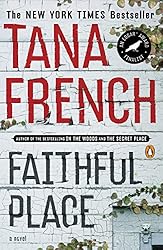
Faithful Place (Dublin Murder Squad 3)
Tana French, 2010
Penguin Group USA
436 pp.
ISBN-13: 9780143119494
Summary
Back in 1985, Frank Mackey was nineteen, growing up poor in Dublin's inner city, and living crammed into a small flat with his family on Faithful Place.
But he had his sights set on a lot more. He and Rosie Daly were all ready to run away to London together, get married, get good jobs, break away from factory work and poverty and their old lives.
But on the winter night when they were supposed to leave, Rosie didn't show. Frank took it for granted that she'd dumped him—probably because of his alcoholic father, nutcase mother, and generally dysfunctional family. He never went home again.
Neither did Rosie. Everyone thought she had gone to England on her own and was over there living a shiny new life. Then, twenty-two years later, Rosie's suitcase shows up behind a fireplace in a derelict house on Faithful Place, and Frank is going home whether he likes it or not.
Getting sucked in is a lot easier than getting out again. Frank finds himself straight back in the dark tangle of relationships he left behind. The cops working the case want him out of the way, in case loyalty to his family and community makes him a liability.
Faithful Place wants him out because he's a detective now, and the Place has never liked cops. Frank just wants to find out what happened to Rosie Daly—and he's willing to do whatever it takes, to himself or anyone else, to get the job done. (From the publisher.)
This is the third novel of the Dublin murder squad series. The other two are In the Woods (2007) and The Likeness (2008).
Author Bio
• Birth—1973
• Where—Vermont, USA
• Education—B.A., Trinity College (Dublin)
• Awards—Edgar Award, Macavity Award, Barry Award
• Currently—lives in Dublin, Ireland
Tana French is an Irish novelist and theatrical actress. Her debut novel In the Woods (2007), a psychological mystery, won the Edgar, Anthony, Macavity, and Barry awards for best first novel. She is a liaison of the Purple Heart Theatre Company and also works in film and voiceover.
French was born in the U.S. to Elena Hvostoff-Lombardi and David French. Her father was an economist working in resource management for the developing world, and the family lived in numerous countries around the globe, including Ireland, Italy, the US, and Malawi.
French attended Trinity College, Dublin, where she was trained in acting. She ultimately settled in Ireland. Since 1990 she has lived in Dublin, which she considers home, although she also retains citizenship in the U.S. and Italy. French is married and has a daughter with her husband.
Dublin Murder Squad series
In the Woods - 2007
The Likeness - 2008
Faithful Place - 2010
Broken Harbor - 2012
The Secret Places - 2014
The Trespasser - 2016
Stand-alone mystery
The Witch Elm - 2018
(Bio adapted from Wikipedia. Retrieved 9/2/2014.)
Book Reviews
[E]xpertly rendered, gripping....The first thing that Ms. French does so well in Faithful Place is to inhabit fully a scrappy, shrewd, privately heartbroken middle-aged man. The second is to capture the Mackey family's long-brewing resentments in a way that's utterly realistic on many levels. Sibling rivalries, class conflicts, old grudges, adolescent flirtations and memories of childhood violence are all deftly embedded in this novel, as is the richly idiomatic Dublinese.
Janet Maslin - New York Times
The voice is what grabs you first. It belongs to our narrator, Frank Mackey, a police detective in Dublin…Frank's voice is so wry, bitter and just plain alive that when I finished Faithful Place and began writing this review, I had to think for a long blank minute about the name of the author. To do that, I first had to remember that Frank was created, not real. My naive lapse was a tribute to Tana French's extraordinary gifts, and her name should be writ large on every mystery lover's must-read list.
Maureen Corrigan - Washington Post
For the third novel in her Dublin Murder Squad mystery series, French focuses on Squad detective Frank Mackey (a secondary character in The Likeness) as its protagonist, a man faced with new evidence that his first love may have been murdered years ago instead of, as he's believed, deserting him for life in London. He's forced to revisit his old inner-city neighborhood and a dysfunctional family, from whom he's been estranged for 22 years. Tim Gerard Reynolds's task is to be true to the novel's Irish working-class roots, but also to capture Mackey's voice as he shifts between tough cop to confused son and bitter sibling struggling against the past. Not only does Reynolds meet that demand, he adds his own admirable touches to the wonderfully drawn denizens of Faithful Place. For Mackey's aging, abusive father, Reynolds uses a deep hoarse growl, for his ever-disapproving Ma a shrill harangue. Older brother Sean speaks with an arrogant edge, older sister Carmel with lofty uninterest, while younger siblings Kevin and Jackie have the upbeat voices of naïfs.
Publishers Weekly
In 1985, Frank Mackey and Rosie Daly were 19, in love, and planning to run away together from Ireland to start a new life in England. When Rosie failed to meet him, Frank stayed in his hometown of Dublin, estranged from his dysfunctional family. But 22 years later, Frank, now on the Dublin Police Undercover Squad and boss of Det. Cassie Maddox (from The Likeness), finds his history in upheaval when his colleagues unearth Rosie's remains in a dilapidated house in his old neighborhood, and he's pulled back into his family of four siblings and their alcoholic, wife-beating father. When his younger brother dies days later—accident, suicide, or murder?—in the yard of the same old house, Frank connives to stay in the loop of the investigation as he tries to put the pieces together and his nine-year-old daughter becomes a key player in the case. Verdict: With French's masterly portrayal of family dynamics and responsibility and her adept depiction of young love and parental devotion, fans are unlikely to miss Maddox, the protagonist of her first two New York Times best sellers (Into the Woods; The Likeness). Psychological suspense at its best. —Michele Leber, Arlington, VA
Library Journal
An Irish undercover cop delves into his working-class past. When Frank Mackey left Faithful Place more than 20 years ago, he never imagined returning. Of course, he thought he'd be leaving with his childhood sweetheart Rosie Daly. When Rosie failed to show up at their meeting spot that fateful night, Frank was broken-hearted but decided to go it alone. He's moved on and hasn't looked back-until he receives an urgent call from his sister Jackie, demanding that he return to his childhood home. She's got the one thing in the world that could make him come back: information about Rosie, whose suitcase has been found in a vacant house. This new intelligence throws mysterious shadows on Frank's theories about Rosie's fate. Suddenly, what was once buried history starts coming to light, and Frank isn't quite prepared for the twists his life begins to take. Not only does everything seem to tie into his family of origin, but menacing fingers seem to be reaching out for his young daughter Holly. If only Frank's position as an undercover cop would give him some insight into the case. Instead, Scorcher, the lead investigator, has an eye out for Frank's interference and keeps him at an increasing distance as the investigation heats up. Though French (The Likeness, 2009, etc.) plies readers with dark and stormy cliches, the charming narrative will leave readers begging for a sequel.
Kirkus Reviews
Discussion Questions
1. How does religion appear to have influenced the families who live in Faithful Place? Why do you think Frank Mackey has rejected religion?
2. Why do you think that teenagers like Frank and Rosie-the ones who try to get away-appear to be the exception rather than the rule in the Mackeys' neighborhood?
3, Are Olivia and Jackie right or wrong to have taken Holly to visit Frank's family without his knowledge or consent? Why?
4, What meanings, ironic or otherwise, can be derived from the title Faithful Place? How do those meanings resonate through the novel?
5. Frank tells us early in the novel that he would die for his kid (p. 3). Yet there are lesser things he chooses not to do, such as being civil to her mother and shielding her from having to testify in a murder trial. How well does Frank understand his feelings toward Holly? What are his blind spots where their relationship is concerned?
6. Why does Frank become so upset over Holly's infatuation with pseudo-celebrity Celia Bailey (pp. 151-154)? Is his reaction pure, over-the-top exaggeration, or does he have a point?
7. Tana French makes extensive use of flashbacks to develop Rosie as a character and to flesh out Frank's motivations. How would the novel be different if it were narrated in a strictly chronological fashion?
8. Shay insists that he and Frank are morally no different, and Frank is outraged by the suggestion. Is Shay right?
9. Frank would appear to have every right to blame his family for much of the chaos in his life. To what extent, however, do you think his finger pointing is an evasion of responsibilities that he would be wiser to accept?
10. What feelings do the characters in the novel have regarding the decade of the eighties? How does growing up in the eighties seem to have affected Frank, his siblings, and his friends?
11. Does the Irish setting of Faithful Place contribute significantly to the telling of the story, or do you find that French's novel to be about humanity on a more universal level?
12. How does Frank's emotional involvement in the cases of Rosie's and Kevin's deaths affect his ability to function as a detective? Is it always a hindrance to him, or are there ways in which it improves and deepens his insights?
13. Imagine that you are trying to persuade Holly to testify against Shay. What arguments or other tactics would you use? Do you think they would succeed?
14. Does Frank Mackey change over the course of the novel? What, if anything, does he learn?
15. Near the end of Faithful Place, Frank and Olivia seem to have begun to move tentatively toward a reconciliation. What do you think is the likelihood of their succeeding, and why?
(Questions issued by publisher.)
top of page (summary)
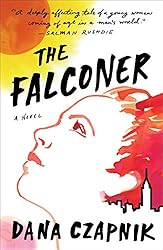
The Falconer
Dana Czapnik, 2019
Atria Books
288 pp.
ISBN-13: 9781501193224
Summary
New York, 1993
Seventeen-year-old Lucy Adler, a street-smart, trash-talking baller, is often the only girl on the public courts.
At turns quixotic and cynical, insecure and self-possessed, Lucy is in unrequited love with her best friend and pick-up teammate Percy, scion to a prominent New York family who insists he wishes to resist upper crust fate.
As she navigates this complex relationship with all its youthful heartache, Lucy is seduced by a different kind of life—one less consumed by conventional success and the approval of men.
A pair of provocative female artists living in what remains of New York’s bohemia invite her into their world, but soon even their paradise begins to show cracks.
Told in vibrant, quicksilver prose, The Falconer is a "wholly original coming-of-age story" (Chloe Benjamin, New York Times bestselling author of The Immortalists), providing a snapshot of the city and America through the eyes of the children of the baby boomers grappling with privilege and the fading of radical hopes. (From the publisher.)
Author Bio
• Birth—ca. 1978-79 (?)
• Where—New York City, New York, USA
• Education—M.F.A., Hunter College
• Currently—lives in New York City
Dana Czapnik is the debut author of the 2019 novel, The Falconer. She was born and raised in New York City and, when younger, was obsessed with basket ball like her heroine Lucy Adler—though not as good she claims. "I was just so-so," Czapnik told an interviewer at The Rumpus.
To begin building her writer's chops, Czapnik spent her early adult years as a freelance fact-checker, researcher and journalist in sports—she wrote about girls' field hockey, Nascar, and Woman's college basketball. Later she worked in public relations and marketing for a number of professional sports organizations, finally ending up at the U.S. Tennis Association. She wrote athlete profiles, as well as game reports and match summaries. Her challenge in sports writing was always to keep the same-old-same-old fresh, descriptive, and engaging—a challenge she believes helped with writing her novel.
In addition to receiving a Hertog Fellowship from Hunter College, where she earned her M.F.A., Czapnik has been the recipient of two others: an Emerging Writers Fellowship from the Center for Fiction in 2017, and an NYSCA/NYFA Artist Fellowship in Fiction from The New York Foundation for the Arts in 2018.
Czapnik lives with her husband and son in New York. (Adapted from online sources.)
Book Reviews
[An] electric debut.… Lucy's fierce first-person point of view is as confident and fearless as she is on the court; she narrates her story with the immediacy and sharpness of a sports commentator, mixed with the pathos and wisdom of a perceptive adolescent charting the perils of her senior year of high school.… But it's arguably the nonhuman characters that give true shape to Lucy's evolution: basketball and New York…Her self-descriptions on the court are as visceral and vivid as any sex scene.… Czapnik, who herself grew up in Manhattan around the same time as Lucy, captures nostalgia—for both a vanishing New York and Lucy's evaporating childhood—with the lucidity of a V.R. headset.… Reader, beware: Spending time with Lucy is unapologetic fun, and heartbreak, and awe as well.
Chloe Malle - New York Times Book Review
The book is filled with highly caffeinated badass riffs on Manhattan's scenery and soul, on feminism and art, on Lucy's generation, and on basketball itself.… Lucy's simmering sexuality, her reaction to the male bodies around her, is never off the page for long. After all the books we've read about horny, frustrated adolescent boys, it's nice to get a different perspective.… Lucy may come from 1993, but her voice and her energy are just what we need right now.
Newsday
Here's a sentence of critical praise I never expected to utter: The descriptions of basketball games in this novel are riveting.… Lucy's sweaty, all-in passion for basketball, which Czapnik captures so vividly in The Falconer, gives me a sharp sense of what I missed out on.… In The Falconer, Dana Czapnik displays this same gift: In bringing Lucy to life, she sees the whole game.
Maureen Corrigan - NPR
[E]lectrifying.… [A] frank, bittersweet coming-of-age story that crackles with raw adolescent energy, fresh-cut prose, and a kinetic sense of place.… And Czapnik, a seasoned sportswriter, has written exactly the book that every smart, strange, wonderful teenage weirdo like Lucy deserves.
Entertainment Weekly
[F]lawed first novel…. Despite a lived-in sense of place, this coming-of-age novel seems to be about jaded young characters who have already come of age, leaving them—and the reader—with little room for emotional development.
Publishers Weekly
You can try, but you’re unlikely to find descriptions of basketball as elegant as those in Dana Czapnik’s debut novel.… The Falconer offers astute observations on the difficulties women confront when trying to succeed in male-dominated fields. In Lucy, Czapnik has created a great character who refuses to conform to expectations.
BookPage
(Starred review) A 17-year-old basketball player faces the complications of growing up smart, talented, and female in New York City circa 1993..… Coming-of-age in Manhattan may not have been done this brilliantly since Catcher in the Rye. That comparison has been made before, but this time, it's true. Get ready to fall in love.
Kirkus Reviews
Discussion Questions
1. In the first few pages, we are introduced to the protagonist as she plays basketball. Describe how the author uses this physical scene to bring us into Lucy’s inner world. What does the description illuminate about the experience of playing sports as a woman? What does basketball mean to Lucy in particular?
2. The third chapter begins with snapshots of the Lower East Side of the 1990s as Lucy perceives it. Does her description of the city remind you of the New York you know today? Why or why not? And how does this break in the narrative serve the larger story?
3. In that same chapter, Lucy tells Violet the story of how she got the white scar on her lip, a self-inflicted attempt to imitate the pretty scar that her classmate Lauren Moon got from a split lip. What does this revelation say about Lucy’s self-perception versus how she believes her peers see her? What do you make of Violet’s comment that even self-inflicted scars are earned?
4. Privilege plays an important role in the story and means something different for each character. Discuss what it means for Lucy, Percy, Alexis, and Violet; how it influences their choices and ways of being; and how being the children of Baby Boomers figures into all of this.
5. Why does Lucy admire the Falconer statue? What is its significance?
6. After her makeover at Percy’s house, Lucy asks Brent’s girlfriend, Kim: "Do you ever think makeup is a signifier of our inferiority?" (p. 99). Examine their conversation. With whom do you agree, and why?
7. After being hit in the face at a basketball game, Lucy takes a moment to herself in the bathroom before leaving the gym (pp. 126–28). Why does she decide to leave?
8. Lucy and Percy’s dynamic changes over the course of one transformative night (pp. 140–51). Describe how the author presents the scene to us. What’s running through Lucy’s mind in this moment? How does Lucy’s perception of love and of Percy change?
9. Lucy spends New Year’s Eve with Alexis at a diner where they share their favorite moments of the past year. Alexis observes that "we’re both chasing a feeling of weightlessness" (p. 173). What do you think she means? What else does Lucy learn about her friend that night?
10. Examine Lucy and her mother’s frank conversation about motherhood (pp. 201–6). How does it pertain to today’s discussions about feminism, and how do generational differences play into their exchange?
11. Compare Lucy and Percy’s relationship at the beginning of the book to their relationship as it stands at the end. What has been lost, and what gained?
12. Trace Lucy’s character development throughout the book. What does she learn about herself and what she wants? How do you feel about the ending? What do you think Lucy’s future will be like?
(Questions issued by the publisher.)

Fall of Giants (Century Trilogy, 1)
Ken Follett, 2010
Penguin Group (USA)
960 pp.
ISBN-13: 9780451232854
Summary
Ken Follett's World Without End was a global phenomenon, a work of grand historical sweep, beloved by millions of readers and acclaimed by critics as "well-researched, beautifully detailed [with] a terrifically compelling plot" (The Washington Post) and "wonderful history wrapped around a gripping story" (St. Louis Post-Dispatch).
Fall of Giants is his magnificent new historical epic. The first novel in The Century Trilogy, it follows the fates of five interrelated families-American, German, Russian, English, and Welsh-as they move through the world-shaking dramas of the First World War, the Russian Revolution, and the struggle for women's suffrage.
Thirteen-year-old Billy Williams enters a man's world in the Welsh mining pits...Gus Dewar, an American law student rejected in love, finds a surprising new career in Woodrow Wilson's White House...two orphaned Russian brothers, Grigori and Lev Peshkov, embark on radically different paths half a world apart when their plan to emigrate to America falls afoul of war, conscription, and revolution...Billy's sister, Ethel, a housekeeper for the aristocratic Fitzherberts, takes a fateful step above her station, while Lady Maud Fitzherbert herself crosses deep into forbidden territory when she falls in love with Walter von Ulrich, a spy at the German embassy in London...
These characters and many others find their lives inextricably entangled as, in a saga of unfolding drama and intriguing complexity, Fall of Giants moves seamlessly from Washington to St. Petersburg, from the dirt and danger of a coal mine to the glittering chandeliers of a palace, from the corridors of power to the bedrooms of the mighty. As always with Ken Follett, the historical background is brilliantly researched and rendered, the action fast-moving, the characters rich in nuance and emotion. It is destined to be a new classic.
In future volumes of The Century Trilogy, subsequent generations of the same families will travel through the great events of the rest of the twentieth century, changing themselves-and the century itself. With passion and the hand of a master, Follett brings us into a world we thought we knew, but now will never seem the same again. (From the publisher.)
This is the first book of Follett's Century Trilogy. The second book (2012) is Winter of the World.
Author Bio
• Birth—June 5, 1949
• Where—Cardiff, Wales, UK
• Education—B.A., University College, London
• Awards—(see below)
• Currently—lives in Hertfordshire, England
Kenneth Martin Follett is a Welsh author of thrillers and historical novels who has sold more than 150 million copies of his works. Many of his books have reached number 1 on the New York Times Best Seller list, including Edge of Eternity, Fall of Giants, A Dangerous Fortune, The Key to Rebecca, Lie Down with Lions, Triple, Winter of the World, and World Without End.
Early years
Follett was born in Cardiff, Wales, the first child of four children, to Martin Follett, a tax inspector, and Lavinia (Veenie) Follett. Barred from watching films and television by his Plymouth Brethren parents, he developed an early interest in reading but remained an indifferent student until he entered his teens. His family moved to London when he was ten years old, and he began applying himself to his studies at Harrow Weald Grammar School and Poole Technical College.
He won admission in 1967 to University College London, where he studied philosophy and became involved in center-left politics. He married his wife Mary in 1968, and their son was born in the same year. After graduating in the autumn of 1970, Follett took a three-month post-graduate course in journalism, working as a trainee reporter in Cardiff on the South Wales Echo. A daughter was born in 1973.
Career
After three years in Cardiff, Follett returned to London as a general-assignment reporter for the Evening News. He eventually left journalism for publishing, having found it unchallenging, and by the late 1970s became deputy managing director of the small London publisher Everest Books.
During that time, Follett began writing fiction as a hobby during evenings and weekends. Later, he said he began writing books when he needed extra money to fix his car, and the publisher's advance a fellow journalist had been paid for a thriller was the sum required for the repairs. Success came gradually at first, but the 1978 publication of Eye of the Needle, became an international bestseller and sold over 10 million copies, earning Follett wealth and international fame.
Each of Follett's subsequent novels, some 30, has become a best-seller, ranking high on the New York Times Best Seller list. The first five best sellers were fictional spy thrillers. Another bestseller, On Wings of Eagles (1983), is a true story based on the rescue of two of Ross Perot's employees from Iran during the 1979 revolution.
Kingsbridge series
For the most part, Follett continued writing spy thrillers, interspersed with historical novels. But he usually returned to espionage. Then in 1989, Follett surprised his readers with his first non-spy thriller, The Pillars of the Earth (1989), a novel about building a cathedral in a small English village during the Anarchy in the 12th century.
Pillars was wildly successful, received positive reviews, and stayed on the New York Times Best Seller list for 18 weeks. All told, (internationally and domestically), it has sold 26 million copies and even inspired a 2017 computer game by Daedalic Entertainment of Germany.
Two sequels followed a number of years later — in 2007 and 2017. World Without End (2007) returns to Kingsbridge 200 years after Pillars and focuses on lives devastated by the Black Death. A Column of Fire (2017), a romance and novel of political intrigue, is set in the mid-16th century — a time when Queen Elizabeth finds herself beset by plots to dethrone her.
Century trilogy
Follett initiated his Century trilogy in 2010. The series traces five interrelated families — American, German, Russian, English and Welsh — as they move through world-shaking events, beginning with World War I and the Russian Revolution, up through the rise of the Third Reich and World War II, and into the Cold War era and civil-rights movements.
Adaptations
A number of Follett's novels have been made into movies and TV mini series. Eye of the Needle was made into an acclaimed film, starring Donald Sutherland. Seven novels have been adapted as mini-series: The Key to Rebecca, Lie Down with Lions, On Wings of Eagles, The Third Twin (rights were sold for a then-record price of $1,400,000), The Pillars of the Earth, World Without End, and A Dangerous Fortune.
Follett also had a cameo role as the valet in The Third Twin and later as a merchant in The Pillars of the Earth.
Awards
2013 - Grand Master at the Edgar Awards (New York)
2012 - Que Leer Prize-Best Translation (Spain) - Winter of the World
2010 - Libri Golden Book Award-Best Fiction (Hungary) - Fall of Giants
2010 - Grand Master, Thrillerfest (New York)
2008 - Honorary Doctor of Literature - University of Exeter
2007 - Honorary Doctor of Literature - University of Glamorgan
2007 - Honorary Doctor of Literature - Saginaw Valley State University
2003 - Corine Literature Prize (Bavaria) - Jackdaws
1999 - Premio Bancarella Literary Prize (Italy) - Hammer of Eden
1979 - Edgar Award-Best Novel - Eye of the Needle
Personal life
During the late 1970s, Follett became involved in the activities of Britain's Labour Party when he met the former Barbara Broer, a Labour Party official. Broer became his second wife in 1984.
Follett, an amateur musician, plays bass guitar for Damn Right I Got the Blues. He occasionally plays a bass balalaika with the folk group Clog Iron. (Adapted from Wikipedia. Retrieved 10/4/2017.)
Book Reviews
Follett is masterly in conveying so much drama and historical information so vividly. He puts to good use the professional skills he has honed over the years—giving his characters a conversational style neither pseudo-quaint nor jarringly contemporary. That works well. And for all his belief in the redemptive quality of liberal humanism, he makes sure not to endow his characters with excessively modern sensibilities. As for the occasional cliche—well, unless you're Tolstoy, you're not going to have the time or the ability to be original throughout your 1,000-page blockbuster. Ken Follett is no Tolstoy, but he is a tireless storyteller, and although his tale has flaws, it's grippingly told, and readable to the end.
Roger Boylan - New York Times
[I]n every way, a Big Book.... Just as Herman Wouk did in The Winds of War and War and Remembrance, Follett creates a large cast of fictional characters and deploys them across the globe, using their private experiences to illuminate the catastrophic events that marked the early years of the century.... [Follett] knows how to tell a compelling, well-constructed story. Once its basic elements are in place, the narrative acquires a cumulative, deceptively effortless momentum.... Perhaps the major reasons for the novel's ultimate success are Follett's comprehensive grasp of the historical record and his ability to integrate research into a colorful, engaging narrative.
William Sheehan - Washington Post
A dark novel, motivated by an unsparing view of human nature and a clear-eyed scrutiny of an ideal peace. It is not the least of Follett's feats that the reader finishes this near 1000-page book intrigued and wanting more.
Chicago Times
Follett's greatest virtue as a novelist that he has been able to bring forward a writing style he perfected in his earlier thrillers.... Essentially, he's writing several interrelated books at once, without ever losing the inevitable forward impulse. And while it sounds bizarre to consider a book this huge a 'page-turner,' that's exactly what Fall of Giants is.
The Seattle Times
Fall of Giants stands with Ken Follett's best... Fall of Giants is classic Follett. It's long—almost 1,000 pages; it's populated with hundreds of characters whose lives are intertwined; it's set on a tumultuous world stage; it's a good read.... Everything in this novel is oversized, from the scope of history it covers to the characters he creates. It's a book that will suck you in, consume you for days or weeks, depending upon how quick a reader you are, then let you out the other side both entertained and educated. That's quite the feat.
USA Today
A big Book, Follett's hugely ambitious saga is a sweeping success. Ken Follett has hit another one out of the park with the initial installment of the hugely ambitious Century Trilogy. His fans will rejoice at the richness, complexity, historical sweep and simmering lust in a saga spanning the years 1911 to 1923.
Newark Star Ledger
This first in a century-spanning trilogy from bestseller Follett (Eye of the Needle) makes effective and economical use of its lead characters, despite its scope and bulk. From a huge cast, eight figures emerge to play multiple roles that illustrate and often illuminate the major events, trends, and issues of the years leading up to and immediately beyond WWI: American diplomat Gus Dewar; Earl Fitzherbert, a wealthy Englishman; Fitz's sister, Lady Maud; German military attaché Walter von Ulrich; Russian brothers Grigori and Lev Peshkov; Welsh collier Billy Williams and his sister, Ethel, whom Fitz hires as a housemaid. Ingenious plotting allows Follett to explore such salient developments of the era as coal mine safety in Wales, women's suffrage, the diplomatic blundering that led to war, the horrors of trench warfare, and the triumph of the Bolsheviks. While this tome doesn't achieve the emotional depth of the best historicals, it is a remarkable and wonderfully readable synthesis of fact and fiction.
Publishers Weekly
Discussion Questions
1. Before reading Fall of Giants, what did you know about World War I? Did you learn anything new upon finishing the novel?
2. Is there a custom or practice from the book's early twentieth-century time period that you wish existed in our modern day? What would it be, and why do you think it should have a place in today's world?
3. Is it significant that Fall of Giants begins with the stories of Billy and Ethel Williams? Would the novel have been different if other characters' stories opened the book, such as those of Grigori and Lev Peshkov, or Gus Dewar?
4. Talk about the historical figures that appear throughout Fall of Giants, such as Woodrow Wilson, King George V, Vladimir Lenin, and others. What did you think of Ken Follett's depiction of them? Do you like seeing notable people such as these come alive in fiction, or do you prefer reading about them in a strictly historical context?
5. When you first read about Billy Williams in chapter one, did you anticipate how his life would unfurl—for example, that he would end up in running for Parliament? What about other characters: Could you guess what some of them would end up doing or being at the book's end?
6. Do you enjoy reading epic novels such as this one? What makes them so appealing to readers, in your opinion?
7. In continuation of the above question, if you had to identify one of the main characters' stories as one that would make a good "stand-alone" novel, which would it be? Why do you think his/her story would make an enjoyable book on its own?
8. Think about the main characters and what place faith held in their lives. Did religion help or hinder their respective circumstances? What is the overall role of religion in Fall of Giants?
9. Along these lines, discuss the characters who abandoned their respective faiths. What caused them to walk away from their beliefs? To what end?
10. Follett depicts life in the early twentieth century through a series of detailed and imagery-rich scenes: the pitch-darkness of a Welsh coal mine, the opulence of an English country manor, the austerity of pre-industrial Russia, the horrors of a French battlefield. Which scenes stood out for you? Why did they make such an impression?
11. Follett writes from the vantage points of people whose home countries come to the brink of—and finally enter into—a world war. What was it like to read the perspectives of enemies as they embark on battle with one another? Did you find yourself taking sides in any way? Did reading about World War I through fiction cause you to think differently about the conflict?
12. Follett populates this novel with several strong female characters. Compare/contrast some of them; who was your favorite? Which one did you like least? Apply the same question to the book's male figures. When considering those of different backgrounds and social classes, were any of the male figures similar to one another?
13. Discuss Maud and Ethel's relationship. Did you expect them to form such a lasting bond, considering they met as mistress and servant? What did you think of the circumstances surrounding how their friendship ultimately dissolved?
14. Also contemplate Ethel and Maud's work as women's rights advocates. Were there aspects of each woman's personal life that seemed at odds with her commitment to advancing the cause of women?
15. Go back to the Aberowen mine explosion in chapter two. Do you think it's a metaphor for any of the novel's themes? How do things change in Aberowen, and elsewhere, after this disaster?
16. Discuss examples of the disparity between how women and men were treated during this era. Were women regarded better, or worse, than you imagined they'd be? How far have women come since the early 1900s? What inequalities between the sexes still persist today?
17. Think about the ways the main characters' lives intersected throughout the book. Were there any characters that didn't meet over the entirety of the novel that you wished did? Who, and why?
18. What did you think of Earl Fitzherbert at the beginning of Fall of Giants? How did he evolve as a man throughout the course of the narrative? Did your opinion of Fitz change from your initial impression of him?
19. Consider the book's title. Who or what are the "giants" of the story? How did they fall?
20. What did you think of the book's ending? Did the author succeed in wrapping up the many threads and strands in Fall of Giants? Which of the characters in Fall of Giants do you expect to be reading about in books two and three of The Century Trilogy.
(Questions issued by publisher.)
top of page (summary)

The Fall of Lisa Bellow
Susan Perabo, 2017
Simon & Schuster
352 pp.
ISBN-13: 9781476761466
Summary
When a middle school girl is abducted in broad daylight, a fellow student and witness to the crime copes with the tragedy in an unforgettable way.
What happens to the girl left behind?
A masked man with a gun enters a sandwich shop in broad daylight, and Meredith Oliver suddenly finds herself ordered to the filthy floor, where she cowers face to face with her nemesis, Lisa Bellow, the most popular girl in her eighth grade class.
The minutes tick inexorably by, and Meredith lurches between comforting the sobbing Lisa and imagining her own impending death. Then the man orders Lisa Bellow to stand and come with him, leaving Meredith the girl left behind.
After Lisa’s abduction, Meredith spends most days in her room. As the community stages vigils and searches, Claire, Meredith’s mother, is torn between relief that her daughter is alive, and helplessness over her inability to protect or even comfort her child. Her daughter is here, but not.
Like Everything I Never Told You and Room, The Fall of Lisa Bellow is edgy and original, a hair-raising exploration of the ripple effects of an unthinkable crime. It is a dark, beautifully rendered, and gripping novel about coping, about coming-of-age, and about forgiveness. It is also a beautiful illustration of how one family, broken by tragedy, finds healing. (From the publisher.)
Author Bio
• Birth—January 6, 1969
• Where—St. Louis, Missouri, USA
• Education—M.F.A., University of Arkansas
• Currently—lives in Carlisle, Pennsylvania
Susan Perabo is an American author of novels and short stories. Her novels include The Fall of Lisa Bellow (2017) and The Broken Places (2001). She has published two collections of short stories, Why They Run the Way They Do (2016), and Who I Was Supposed to Be (1999).
Her fiction has been anthologized in Best American Short Stories, Pushcart Prize Stories, and New Stories from the South, and has appeared in numerous magazines, including One Story, Glimmer Train, Iowa Review, Missouri Review, and The Sun.
Perabo holds an MFA from the University of Arkansas, Fayetteville, and is Writer in Residence and Professor of English at Dickinson College in Carlisle, Pennsylvania. She is also on the faculty of the low-residency MFA Program at Queens University. (Adapted from the publisher.)
Book Reviews
Despite the central crime element, Lisa Bellow is more character study than suspense novel. Unfortunately, the prose isn’t quite strong enough to make up for a languid plot. Nonetheless, Perabo makes some interesting observations about character and family life, and her book should have some emotional resonance with anyone who’s felt out of place or left behind.
Steph Cha - USA Today
Dark and suspenseful (Best Books To Read in 2017).
Glamour.com
Told through the incredibly honest eyes of an eighth grade girl and her despairing mother, this moving story touches on tragedy, loss, and what happens to those affected.
RealSimple.com
Absolutely masterful…this should be the book to launch Susan Perabo into the realm of Known Writers, those folks whose each new work marks the landscape in overt ways. All her powerful skills are on display here—the vivid, telling details, the strangely askance story actually being told, the murky irresolution that’s somehow gratifying despite not delivering on what most readers will likely expect…this is a dynamite, stunning book that’ll hang in you long after you finish it.
Brooklyn Rail
The novel’s tension arises as much from Perabo’s insight into a complex and changing family dynamic as from the horror of an unusual but believable situation. Perabo’s female characters are particularly strong…as the novel plays with the reader’s understanding of what is actually going on in Meredith’s world.
Publishers Weekly
The second novel from writer Susan Perabo is wrenching, a dark yet beautifully told story of family, fear and grief.
BookPage
Gripping…Perabo captures both the unease and bravado of adolescence alongside the worries of parenthood and is unafraid to explore the family members’ flaws as they attempt to emerge from chaos.
Booklist
(Starred review.) Claire Oliver…is as fine a fictional character as we have encountered in some time, dark, moody, passionate about her children, keenly self-aware, and very, very funny.… You will hate to leave the inside of this woman’s head when you finish the book.
Kirkus Reviews
Discussion Questions
We'll add publisher questions if and when they're available; in the meantime, please use our LitLovers talking points to help start a discussion for The Fall of Lisa Below…then take off on your own:
1. Discuss the residual trauma of Lisa Bellow's kidnapping on Meredith Oliver, especially as retreats into an imaginary world, plagued by nightmares she believes that Lisa might be having. How, ultimately, does Meredith's understanding of, or at least her view of, Lisa change by the end of the book?
2. What about the anxiety Lisa has been facing in school while attempting to navigate the teenage social hierarchy? Does the mean-girl atmosphere ring true? Does any of it bring back memories of your own middle or high school experience? Might Lisa be excused (or not) for banking on her new-found notoriety in order to chuck her older friends and move up in the world?
3. What do you think of Claire Oliver? In what way is she ambivalent about motherhood? Claire is quite funny; in what way, or for what purposes, does she use her humor?
4. How would you describe the Olivers' marriage? Talk about the changes in family dynamics after the kidnapping and the array of stresses the family faces. In what way does each member manage to cope?
5. How does this novel frame survivor guilt? How do the characters, if they ever do, achieve resolution and acceptance?
(Questions by LitLovers. Please feel free to use them, online or off, with attribution. Thanks.)
top of page (summary)


A Fall of Marigolds
Susan Meissner, 2014
Penguin Books
400 pp.
ISBN-13: 9780451419910
Summary
A beautiful scarf, passed down through the generations, connects two women who learn that the weight of the world is made bearable by the love we give away....
September 1911. On Ellis Island in New York Harbor, nurse Clara Wood cannot face returning to Manhattan, where the man she loved fell to his death in the Triangle Shirtwaist Fire.
Then, while caring for a fevered immigrant whose own loss mirrors hers, she becomes intrigued by a name embroidered onto the scarf he carries…and finds herself caught in a dilemma that compels her to confront the truth about the assumptions she’s made. Will what she learns devastate her or free her?
September 2011. On Manhattan’s Upper West Side, widow Taryn Michaels has convinced herself that she is living fully, working in a charming specialty fabric store and raising her daughter alone. Then a long-lost photograph appears in a national magazine, and she is forced to relive the terrible day her husband died in the collapse of the World Trade Towers…the same day a stranger reached out and saved her.
Will a chance reconnection and a century-old scarf open Taryn’s eyes to the larger forces at work in her life?. (From the publisher.)
Author Bio
• Birth—January 9, 1961
• Where—San Diego, California, USA
• Education—Point Loma Nazarene University
• Currently—lives in San Diego, California
Susan Meissner is an American writer born and raised in San Diego, California. She began her literary career at the age of eight and since then has published more than a dozen novels (though that part came a bit later in her life).
Early years and career
Susan attended Point Loma Nazarene University, married a U.S. Air Force man, raised four children, and spent five years overseas and several more in Minnesota. Those were the years she put her novel-writing itch on hold. In 1995, however, she took a part-time reporting job at her county newspaper, became a columnist three years later, and eventually editor of a local weekly paper. One of the things she is most proud of that her paper was named the Best Weekly Paper in Minnesota in 2002.
That was the same year Susan's latent novel-writing itch resurfaced, and she began working on her first novel, Why the Sky is Blue. In a little more than a year, the book was written, published, and in the bookstores. She's been noveling ever since—with a string of 12 books under her name. Historical Fiction is one of her favorite genres.
Booklist placed A Fall of Marigolds on its "Top Ten" list of women's fiction for 2014. In 2008, Publishers Weekly named The Shape of Mercy as one of the year's 100 Best Novels.
Personal
Susan lives with her husband and four children in San Diego where her husband is a pastor and Air Force Reserves chaplain. She teaches in writing workshops. In addition to writing books, she enjoys spending time with her family, making and listening to music, reading, and traveling. (Based on the author's website.)
Books
2016 - Stars Over Sunset Boulevard
2015 - Secrets of a Charmed Life
2014 - A Fall of Marigolds
2013 - The Girl in the Glass
2011 - A Sound Among the Trees
2010 - Lady in Waiting
2009 - White Picket Fences
2008 - The Shape of Mercy
2008 - Blue Heart Blessed
2006 - A Seahorse in the Thames
2006 - In All Deep Places
2005 - The Remedy for Regret
2003 - Why the Sky is Blue
Book Reviews
(Starred Review.) Meissner’s...[novel] hits all of the right emotional notes without overdoing the two tragedies; instead, she seamlessly weaves a connection between two women whose broken hearts have left them in an in-between place. A good choice for Christian-fiction readers, for book groups, or for readers looking for a book of hope without schmaltz. —Susan Maguire
Library Journal
Meissner is a practiced writer whose two main characters cope with universal themes that many people deal with: loss, survivor's guilt, and permitting oneself to move on and achieve happiness again. Although their stories are unbalanced--Clara's account dominates the narrative--the author creates two sympathetic, relatable characters that readers will applaud. Touching and inspirational.
Kirkus Reviews
Discussion Questions
Spoiler Alert: The questions that follow tell more about what happens in the book than you might want
to know until you read it.
1. What did you most enjoy about A Fall of Marigolds? What do you think you’ll remember about it six months from now?
2. Discuss the ways in which the contemporary and historical sections of the novel relate to each other. What story elements do they share? How do they echo and amplify each other? Did you enjoy going back and forth between the two narratives, or did you much prefer one over the other?
3. When Clara Wood finds Lily’s letter to Andrew and the certificate of annulment, she faces an ethical dilemma—should she tell Andrew the truth about the woman he loved and break his heart, or leave him in ignorance? What would be the most ethical choice? What would you have done?
4. Have you ever gone to, or wanted to go to, an “in-between place”? Would you share that experience?
5. Despite the little interaction they had, Clara is convinced that Edward would have become her lover and eventually her husband. Have you ever experienced a similar certainty about someone after just meeting them? Do you believe in “love at first sight?”
6. Ten years after her husband’s death, Taryn seems to be living a full life, but once her photo is published, she begins to realize that she has also been in an “in-between place.” How has she been held back? How are her circumstances similar to and different from Clara’s?
7. Discuss the role of the marigold scarf in the story. Trace its path from Lily to Taryn. How does the scarf enrich the experience of the characters? Would you react to the scarf in the same way that the characters do?
8. Andrew plays a key role in Clara’s life. Is it okay with you that she doesn’t end up in a romantic relationship with him? Does Ethan seem a better or worse choice to you? The book ends with Taryn and Mick heading toward a romantic relationship. Do you find that believable and satisfying?
9. Taryn and Clara each experience a horrific tragic event in which someone they love dies. Have you ever been personally touched by tragedy? Would you be willing to share how your experience compares to what Taryn and Clara go through?
10. Do you believe in destiny? That God has a purpose for each of our lives? Discuss how these ideas play out in A Fall of Marigolds.
(Questions courtesy of the author.)


The Fallen Angel
Daniel Silva, 2012
HarperCollins
405 pp.
ISBN-13: 9780062073129
Summary
After narrowly surviving his last operation, Gabriel Allon, the wayward son of Israeli intelligence, has taken refuge behind the walls of the Vatican, where he is restoring one of Caravaggio's greatest masterpieces.
But early one morning he is summoned to St. Peter's Basilica by Monsignor Luigi Donati, the all-powerful private secretary to his Holiness Pope Paul VII; the body of a beautiful woman lies broken beneath Michelangelo's magnificent dome. The Vatican police suspect suicide, though Gabriel believes otherwise.
So, it seems, does Donati. But the monsignor is fearful that a public inquiry might inflict another scandal on the Church, and so he calls upon Gabriel to quietly pursue the truth—with one caveat. "Rule number one at the Vatican," Donati said. "Don't ask too many questions."
Gabriel learns that the dead woman had uncovered a dangerous secret—a secret that threatens a global criminal enterprise that is looting timeless treasures of antiquity and selling them to the highest bidder. But there is more to this network than just greed. A mysterious operative is plotting an act of sabotage that will plunge the world into a conflict of apocalyptic proportions. (From the publisher.)
Author Bio
• Birth—November 30, 1959
• Where—Michigan, USA
• Raised—California
• Currently—lives in Washington, D.C.
Daniel Silva was attending graduate school in San Francisco when United Press International offered him a temporary job covering the 1984 Democratic National Convention. Later that year, the wire service offered him full-time employment; he quit grad school and went to work for UPI—first in San Francisco, then in Washington, D.C., and finally as a Middle East Correspondent posted in Cairo. While covering the Iran-Iraq War in 1987, he met NBC correspondent Jamie Gangel. They married, and Silva returned to Washington to take a job with CNN.
Silva was still at CNN when, with the encouragement of his wife, he began work on his first novel, a WWII espionage thriller. Published in 1997, The Unlikely Spy became a surprise bestseller and garnered critical acclaim. ("Evocative.... Memorable..." said the Washington Post; "Briskly suspenseful," raved the New York Times). On the heels of this somewhat unexpected success, Silva quit his job to concentrate on writing.
Other books followed, all earning respectable reviews; but it was Silva's fourth novel that proved to be his big breakthrough. Featuring a world-famous art restorer and sometime Israeli agent named Gabriel Allon, The Kill Artist (2000) fired public imagination and soared to the top of the bestseller charts. Gabriel Allon has gone on to star in several sequels, and his creator has become one of our foremost novelists of espionage intrigue, earning comparisons to such genre superstars as John le Carre, Frederick Forsythe, and Robert Ludlum. Silva's books have been translated into more than 25 languages and have been published around the world. (From Barnes & Noble.)
Book Reviews
Daniel Silva’s The Fallen Angel soars with authenticity….The Fallen Angel delivers the goods….Riveting espionage adventures that have timely, real-world relevance.
Dallas-Fort Worth Star-Telegram
The Fallen Angel is a first-class spy mystery painted on a grand scale, appropriate because its protagonist, Gabriel Allon, is an expert art restorer; sometime friend of the Vatican; on-again, off-again intelligence agent for the Israeli government — and occasional assassin. If the novel has flaws, they lie in Silva’s intensive, relentless attention to detail. He made himself an expert on religion (Roman Catholic and Jewish), international espionage, European and Middle Eastern history and geography as well as other subjects. The details sometimes add excess baggage to the storytelling.Meticulously researched....The Fallen Angel is a first-class spy mystery painted on a grand scale.
Columbus Dispatch
The Fallen Angel is no conventional murder mystery; the plot's ramifications stretch back to Europe and the Middle East in shocking and violent ways. Silva is no purveyor of minimalism; his books have active plots and bold, dramatic themes. They cover a staggeringly wide range of subjects. In addition to murder and art restoration, "The Fallen Angel" dabbles in the antiquities trafficking trade, Vatican politics, organized crime, religious mythologies and histories, political realities and, of course, the growing threat of radical Islamic fundamentalism and its desire for the destruction of Israel.
Tulsa World
His past 12 books, all featuring enigmatic spy/art restorer Gabriel Allon, have kept Silva’s name high in the ranks; the latest, the Vatican-set The Fallen Angel, seems unlikely to reverse the trend.
Arizona Republic
It’s become almost obligatory for lovers of high level thrillers to read each new Daniel Silva novel as soon as it appears. With his by now trademark character, Gabriel Allon...Silva just about guarantees a couple of days of terrific entertainment.
NPR, All Things Considered
Another heart-pounding escapade of art restorer and Israeli intelligence legend Gabriel Allon gets masterful treatment.
AudioFile Magazine
Fast-paced action thriller from old hand Silva (Portrait of a Spy, 2001, etc.), whose hero Gabriel Allon returns in fine form. As Silva's legion of fans—including, it seems, every policy wonk inside the Beltway and Acela Corridor—knows, Gabriel is not just your ordinary spy. He's a capable assassin, for one thing, and a noted art restorer for another, which means that his adventures often find him in the presence of immortal works of art and bad guys who would put them to bad use. This newest whodunit is no exception: Gabriel's in the Vatican, working away at a Caravaggio, when he gets caught up in an anomalous scene—as a friendly Jesuit puts it with considerable understatement, "We have a problem." The problem is that another Vatican insider has gone splat on the mosaic floor, having fallen some distance from the dome. Did she jump, or was she pushed? Either way, as the victim's next of kin puts it, again with considerable understatement, "I'm afraid my sister left quite a mess." She did indeed, and straightening it up requires Gabriel to grapple with baddies in far-flung places around Europe and the Middle East. It would be spoiling things to go too deep into what he finds, but suffice it to say that things have been going missing from the Vatican's collections to fund a variety of nefarious activities directly and indirectly, including some ugly terrorism out Jerusalem way. But set Gabriel to scaling flights of Herodian stairs, and the mysteries fall into place—not least of them the location of a certain structure built for a certain deity by a certain biblical fellow. The plot's a hoot, but a believable one; think a confection by Umberto Eco as starring Jonathan Hemlock, or a Dan Brown yarn intelligently plotted and written, and you'll have a sense of what Silva is up to here. It's a grand entertainment to watch Silva putting Gabriel Allon's skills to work, whether shedding blood or daubing varnish—a top-notch thriller.
Kirkus Reviews
Discussion Questions
1. Of what interest and significance is it that the story begins in St. Peter's "mighty Basilica," with the caretaker Niccolo Moretti?
2. Consider the detailed description of the painting Gabriel Allon is restoring, Caravaggio's The Deposition of Christ. (12) What does that choice add to the novel?
3. Caravaggisto Giacomo Benedetti suggests that part of The Deposition of Christ perhaps shouldn't be restored, (13) an opinion that foreshadows the larger issue of the handling of art and antiquities. What are the pros and cons of restoring aged art?
4. Not unlike the many artifacts and antiquities mentioned throughout the novel, Gabriel Allon is at times referred to as a "damaged" object himself, (13) and with "a damaged canvas of his own" (302). In what ways does this seem true and how is it important to his character?
5. Monsignor Luigi Donati is described as following the Machiavellian idea that "it is far better for a prince to be feared than loved" (19). In what ways is this appropriate or not to his responsibilities? Machiavelli is also named to describe the deal Gabriel Allon strikes with General Ferrari. (87) How is this similar or different?
6. On a number of occasions it is suggested that Monsignor Luigi Donati and Gabriel Allon, despite their obvious differences, are quite alike. (19) In what ways is this true and why do you think they have established such a close relationship?
7. At the Villa Giulia, Gabriel Allon realizes the Euphronios krater, "one of the greatest single pieces of art ever created," is kept where few people ever see it (89). Dr. Veronica Marchese later talks of getting many works from her husband's collection into museums. (118) What is the proper place for antiquities? Should they be privately held? Do countries of origin have a rightful claim to them?
8. The Euphronios krater depicts "Sarpedon, son of Zeus, being carried off for burial by the personifications of Sleep and Death" (91). What do the similarities of this scene to Caravaggio's The Deposition of Christ add to the novel?
9. At one point, Veronica makes the claim that Gabriel Allon "would have made an excellent priest" (94). What qualities might she be referring to?
10. Consider Monsignor Donati's early involvement with "liberation theology" as he describes it to Gabriel Allon. (105) What does this add to your understanding of his personality and actions throughout the novel?
11. What does it add to your understanding of Monsignor Donati to learn of his crisis of faith during which he left the priesthood and fell in love? (106)
12. Consider Rivka, the often-mentioned woman whose skeleton Eli Lavon discovered in temple ruins. (141, 355, 379) What does she represent? What does Eli's emotional attachment add to the narrative?
13. Consider the similarities between the tragic deaths of Rivka and Claudia Andreatti.
14. Archeologist Eli Lavon is said to be "waging war in those excavation trenches beneath the Western Wall" (224). How does archeology play a role in history and modern politics?
15. Gabriel Allon admits "a grudging respect" for Massoud, a terrorist leader, and even says, "in a parallel universe [he] might have been a renowned jurist or a statesman from a decent country" (250). What qualities might he be referring to?
16. Momentarily "paralyzed by memories" outside a restaurant where he once dined with his former wife Leah and their son, Gabriel Allon admits to being lost to a woman who looks to help him. Given that he knows where he is at that moment, in what other ways might he be lost?
17. Although Gabriel Allon admits to loving Israel "dearly," and his wife Chiara claims that it feels like home, Gabriel is reluctant to return there to live. What are some of the reasons? Do you think he should return?
18. Many famous paintings are mentioned and described throughout the novel. (12, 13, 14, 18, 76, 77, 120, 164, 170, 389) What does the subject matter of each, and art in general, add to the particular scene or the novel as a whole?
19. Where should Gabriel Allon go next?
(Questions issued by publisher.)


Fallen Land
Taylor Brown, 2015
St. Martin's Press
288 pp.
ISBN-13: 9781250077974
Summary
Fallen Land—Taylor Brown's debut novel—is set in the final year of the Civil War, as a young couple on horseback flees a dangerous band of marauders who seek a bounty reward.
Callum, a seasoned horse thief at fifteen years old, came to America from his native Ireland as an orphan. Ava, her father and brother lost to the war, hides in her crumbling home until Callum determines to rescue her from the bands of hungry soldiers pillaging the land, leaving destruction in their wake.
Ava and Callum have only each other in the world and their remarkable horse, Reiver, who carries them through the destruction that is the South.
Pursued relentlessly by a murderous slave hunter, tracking dogs, and ruthless ex-partisan rangers, the couple race through a beautiful but ruined land, surviving on food they glean from abandoned farms and the occasional kindness of strangers.
In the end, as they intersect with the scorching destruction of Sherman's March, the couple seek a safe haven where they can make a home and begin to rebuild their lives. Dramatic and thrillingly written with an uncanny eye for glimpses of beauty in a ravaged landscape, Fallen Land is a love story at its core, and an unusually assured first novel by award-winning young author Taylor Brown. (From the publisher.)
Author Bio
• Birth—October 18, 1982
• Where—state of Georgia, USA
• Education—B.A., University of Georgia
• Currently—lives in Wilmington, North Carolina
Taylor Brown grew up on the Georgia coast. He has lived in Buenos Aires, San Francisco, and the mountains of Western North Carolina.
His fiction has appeared in more than twenty publications, including the Baltimore Review, North Carolina Literary Review, and storySouth. He is the recipient of the Montana Prize in Fiction, and was a finalist in both the Machigonne Fiction Contest and the Doris Betts Fiction Prize.
An Eagle Scout, he lives in Wilmington, North Carolina. Fallen Land is his first novel. (From the publisher.)
Book Reviews
[A] Civil War odyssey in the tradition of Charles Frazier’s Cold Mountain... written in a vernacular that resurrects the era and fully brings alive Callum and Ava’s adventures on the road. At the center of the story is the couple’s growing love for each other, which powers the story to a suspenseful ending and a satisfying epilogue.
Publishers Weekly
(Starred review.) [T]he lawless days at the close of the Civil War. Young Callum...finds a lone girl named Ava and tries to save her from the brutish Colonel.... [Their] frantic journey toward a new life is full of danger.... A nail-biting journey from first page to last. —Donna Bettencourt, Mesa Cty. P.L., Palisade, CO
Library Journal
(Starred review.) Drawing from the shadows of America's epic tragedy, the Civil War, Brown's debut novel offers a tale of endurance and love in the face of adversity.... Like McCarthy's Border Trilogy or Frazier's Cold Mountain, this is American literature at its best, full of art and beauty and the exploration of all that is good and bad in the human spirit.
Kirkus Reviews
Discussion Questions
Use our LitLovers Book Club Resources; they can help with discussions for any book:
• How to Discuss a Book (helpful discussion tips)
• Generic Discussion Questions—Fiction and Nonfiction
• Read-Think-Talk (a guided reading chart)
Also, consider these LitLovers talking points to start a discussion for Fallen Land:
1. What is the significance of the book's title, "Fallen Land"? Consider that the setting is immediately after America's brutal Civil War. How is that struggle reflected in the action of the book and, metaphorically, in the title?
2. Who seemed to commit the greater atrocities: Sherman's organized troops in his orchestrated "March to the Sea"? Or the disorganized bands of looters, who simply took advantage of the mayhem in the nearly defeated South, pillaging and plundering at will?
3. Talk about the two young characters, Callum and Ava. How would you describe them? What prompts Callum to risk all and return to Ava?
4. Reiver, the horse—he's almost mythical, as is the beauty of the land itself. What might Taylor Brown be getting at by pitting a magical steed and an almost "unearthly" natural setting against the brutality of humankind?
5. The young couple depends on the kindnesses of strangers. Talk about some of the characters who aided Callum and Ava along their journey.
6. Callum wonders, at one point, if something evil has implanted itself in him...
if something mean had slipped into him. Something vicious. For the first time, he touched the pale worm of scar growing along the side of his head, still tender above his dead ear.
Has he been corrupted by his association with the Colonel and his marauders? And why might the author have him touch his "still tender" scar? What's the symbolic meaning there?
7. Comparisons are being made between this book and both Cormac McCarthy's Border Trilogy and, especially, Charles Frazier's Cold Mountain. Have you read any of those books? If so, what parallels exist between them and Taylor Brown's Fallen Land?
(We'll add specific questions if and when they're made available by the publisher. In the meantime, feel free to use these LitLovers questions...online of off...with attribution. Thanks.)


The Fallen Snow
John J. Kelley, 2012
Stone Cabin Press
320 pp.
ISBN-13: 9780988414808
Summary
In the fall of 1918 infantry sniper Joshua Hunter saves an ambushed patrol in the Bois le Prêtre forest of Lorraine...and then vanishes. Pulled from the rubble of an enemy bunker days later, he receives an award for valor and passage home to Hadley, a remote hamlet in Virginia's western highlands. Reeling from war and influenza, Hadley could surely use a hero. Family and friends embrace him; an engagement is announced; a job is offered.
Yet all is not what it seems. Joshua experiences panics and can't recall the incident that crippled him. He guards a secret too, one that grips tight like the icy air above his father's quarry. Over the course of a Virginia winter and an echoed season in war-torn France, The Fallen Snow reveals his wide-eyed journey to the front and his ragged path back. Along the way he finds companions—a youth mourning a lost brother, a nurse seeking a new life and Aiden, a bold sergeant escaping a vengeful father. While all of them touch Joshua, it is the strong yet nurturing Aiden who will awaken his heart, leaving him forever changed.
Set within a besieged Appalachian forest during a time of tragedy, The Fallen Snow charts an extraordinary coming of age, exploring how damaged souls learn to heal, and dare to grow. (From the book.)
Author Bio
• Birth—October 9, 1965
• Where—Niceville, Florida, USA
• Education—B.S., Virginia Polytechnic Institute and
State University (now Virginia Tech)
• Currently—Washington, D.C.
John J Kelley is a writer crafting tales about healing, growth and community. Born and raised in the Florida panhandle, he graduated from Virginia Tech and served as a military officer. After pursuing traditional careers for several years, he has devoted the last three to completing his first novel.
A member of The Writer's Center, John lives with his partner in Washington, DC, where he can often be found wandering Rock Creek Park when not hovering over his laptop at a nearby coffee shop.
John's debut novel recounts the struggle of a young WWI sniper returning to a Virginia community reeling from war, influenza, and economic collapse. The novel received a Publishers Weekly starred review and was named a ForeWord Reviews Book-of-the-Year Award Winner. (From the author.)
Book Reviews
(Starred review.) In a gripping tale of self-exploration and atonement, Kelley's debut skillfully evokes the unpredictability of life in 1918 through mesmerizing descriptions and fully realized characters. Joshua Hunter volunteers to fight in the Great War to escape his rural Virginia home, becoming a respected sniper in wartime France. Unfettered from his close-knit Appalachian community's expectations, he develops a growing quietness and strength despite the ugliness of war. Returning home a crippled war hero, Joshua feels the old familiar expectations becoming more onerous. And even an engagement and job offer cannot erase the past, the echoes of war, and a well-guarded secret. Kelley's novel is emotionally complex and brimming with grit. Told in a plainspoken manner through parallel story lines—the present in Appalachia and the past in France—this story will appeal to readers of coming-of-age stories with a historical bent.
Publishers Weekly
Kelley's characters are introspective, and when they speak it is from the heart, honestly and without frills…. The real story here is about a soldier trying to come back to a place where he no longer fits in, and about the family and friends who only slowly come to realize that he is no longer "the old Joshua." Although The Fallen Snow is in part a tale of romantic love between two men, it is also in many ways a timeless tale of men changed by war. (5-stars)
Clarion Reviews
A timeless and timely novel of the physical and emotional cost of war. (5-stars)
San Francisco Book Review
A universal story that delivers its message that love can never take root inside the head, but in the heart.
Jill Wisoff, Unabridged
Neither a war novel nor a coming-of-age novel nor a romance novel—it is simply a novel worth reading.
Lisa Jones - 300 Word Book Reviews
A 2012 Book-of-the-Year Award Winner
ForeWord Magazine
Discussion Questions
1. The Fallen Snow is told in parallel timelines: the present of Joshua’s return to Virginia, and a second of his wartime experiences in France. Why do you think the author chose to tell the story in this fashion? Did you find the format helpful or a hindrance to your enjoyment of the tale?
2. A subtle interplay of opposing seasons exists between the two timelines. Events in Virginia unfold from autumn to late winter / cusp of spring while scenes in France take place from spring to late summer / cusp of autumn. Were you aware of this juxtaposition while reading the tale? Did the seasons—or the dichotomy of seasons—color the mood of certain scenes or the overall story?
3. The natural setting plays an essential role in the novel, often used to emphasize character attributes and situations. What is the significance of placing the drama within a wilderness threatened by relentless logging? How do Joshua, Elisabeth and Katie respond to their surroundings, and what do their responses reveal about them?
4. Speaking of natural elements, what is the metaphor of the fallen snow, both as explained by Joshua’s grandmother and as it emerges within the story? Does the nature of snow, ethereally and physically, contribute to themes of the tale? If so, in what way?
5. Of course, the novel extends beyond the rural Virginia setting, with a number of scenes in and near the western front as well as in wartime Paris. Did you find the war-zone scenes convincing? Was Paris, long associated with romance, a fitting setting for Aiden and Joshua to explore and ultimately consummate their relationship?
6. A number of symbols appear in The Fallen Snow. How do the following play a role and what do you feel each represents? Moon / Moonlight, the Saint Christopher medal, Music & Art, the Stone Cabin.
7. The human, flawed characters of The Fallen Snow at times bruise each other emotionally. What are examples of characters ignoring the feelings of others? How do intention and instinct play into their hurtful actions?
8. Joshua struggles with the role of instinct throughout the novel, from his feelings for Aiden and Katie to his actions as a sniper, even in his attempts to recover from his trauma. How does instinct help him? When do his instincts harm or lead him astray? In what ways do other characters act on instinct?
9. Though Joshua clearly suffers from Post-Traumatic Stress Disorder (PTSD), known then as “shell-shock,” he ignores the single, fleeting acknowledgment of his trauma in the opening pages. His reaction is unsurprising, as the condition was in that era considered a mental defect, a weakness. Have attitudes truly changed today? Would a modern-day Joshua face any less of a challenge?
10. Joshua also struggles with expectations before, during and after the war. What were some of those expectations? Were they realistically depicted? Does Joshua handle them maturely? Does he ultimately resolve them?
11. Elisabeth faces many challenges as well. Some are physical concerns, while others involve expressing herself and asserting her will. As the story unfolded, did you feel she was a victim of the actions of others, namely Wayne, or did she constrain herself? In what ways does she seek to find her voice? Does she succeed? On a related matter, do you feel her faith in Wayne was justified?
12. In response to both real and perceived expectations, the characters of The Fallen Snow sometimes repress their emotions. Can you cite examples? Could you relate to the characters’ motivations and feelings?
13. Kelley has shared that one inspiration for writing The Fallen Snow is his fascination with the ways individuals learn life lessons from others, even when the individuals are not aware of the sharing. An example he cites is Claire’s account of her mourning of David, which echoes and informs Joshua’s experience after the war. What are other examples of a character sharing a life lesson with another character?
14. It has also been suggested the book explores the many ways people experience love. What relationships are explored in the novel (husband and wife, for example)? Did a particular relationship intrigue you? If so, why? Did you reflect upon your own relationships as a result?
15. How do you see Katie and Joshua’s relationship? Does Joshua love Katie? What does Katie see in Joshua? Given the expectations of the era, they might well have married. From what you learn of them, how do you envision that relationship might have evolved? Could they have been happy together?
16. Regret and atonement are prominent themes of the novel. What regrets do the following characters carry, as expressed or suggested—Joshua, Wayne, Elisabeth, Aiden, Grandmother? Did particular regrets strike a chord with you? If so, which ones and why?
17. Did you have a favorite character? If so, who? Did a particular character capture your interest? What did you think of Harrison, the African American veteran, and his brief but revealing encounter with Joshua? How did each major and minor character evolve during the course of the novel?
18. Of all the characters, Claire is most cognizant of her longing for home. But she is not the only lost soul. In what ways do Joshua and other characters reveal their need for home, their quest for a place where they belong?
19. Kelley has said that, while it was clear from the start the novel was a coming-of-age tale, he found defining the genre a challenge. In your opinion, what genre best defines The Fallen Snow?
(Questions provided courtesy of the author.)

Falling
Jane Green, 2016
Penguin Publishing
384 pp.
ISBN-13: 9780399583285
Summary
A novel about the pleasure and meaning of finding a home—and family—where you least expect them...
When Emma Montague left the strict confines of upper-crust British life for New York, she felt sure it would make her happy. Away from her parents and expectations, she felt liberated, throwing herself into Manhattan life replete with a high-paying job, a gorgeous apartment, and a string of successful boyfriends.
But the cutthroat world of finance and relentless pursuit of more began to take its toll. This wasn’t the life she wanted either.
On the move again, Emma settles in the picturesque waterfront town of Westport, Connecticut, a world apart from both England and Manhattan. It is here that she begins to confront what it is she really wants from her life. With no job, and knowing only one person in town, she channels her passion for creating beautiful spaces into remaking the dilapidated cottage she rents from Dominic, a local handyman who lives next door with his six-year-old son.
Unlike any man Emma has ever known, Dominic is confident, grounded, and committed to being present for his son whose mother fled shortly after he was born. They become friends, and slowly much more, as Emma finds herself feeling at home in a way she never has before.
But just as they start to imagine a life together as a family, fate intervenes in the most shocking of ways. For the first time, Emma has to stay and fight for what she loves, for the truth she has discovered about herself, or risk losing it all.
In a novel of changing seasons, shifting lives, and selfless love, a story unfolds—of one woman’s far-reaching journey to discover who she is truly meant to be. (From the publisher.)
Author Bio
• Birth—May 31, 1968
• Where—London, England, UK
• Education—University of Wales
• Currently—lives in Westport, Connecticut, USA
Jane Green is the pen name of Jane Green Warburg, an English author of women's novels. Together with Helen Fielding she is considered a founder of the genre known as chick lit.
Green was born in London, England. She attended the University of Wales, Aberystwyth and worked as a journalist throughout her twenties, writing women's features for the Daily Express, Daily Mail, Cosmopolitan and others. At 27 she published her first book, Straight Talking, which went straight on to the Bestseller lists, and launched her career as "the queen of chick lit".
Frequent themes in her most recent books, include cooking, class wars, children, infidelity, and female friendships. She says she does not write about her life, but is inspired by the themes of her life.
She is the author of more than 15 novels, several (The Beach House, Second Chance, and Dune Road) having been listed on the New York Times bestseller list. Her other novels Another Piece of My Heart (2012), Family Pictures (2013), and Tempting Fate (2014) received wide acclaim.
In addition to novels, she has taught at writers conferences, and writes for various publications including the Sunday Times, Parade magazine, Wowowow.com, and Huffington Post.
Green now lives in Connecticut with her second husband, Ian Warburg, six children, two dogs and three cats. Actively philanthropic, her foremost charities are The Hole in the Wall Gang Camp (Paul Newman's camp for children with life-threatening illnesses), Bethel Recovery Center, and various breast cancer charities. She is also a supporter of the Westport Public Library, and the Westport Country Playhouse. (Adapted from Wikipedia. Retrieved 4/20/2014.)
Book Reviews
[A]lthough Emma could certainly be a more compelling heroine (most of the main events of the plot happen to her without requiring much action or decision on her part), her community is full of nuanced characters that elevate the story above its cookie-cutter beats and add extra impact to the tearjerker ending.
Publishers Weekly
Emma Montague, an English expat, has just moved from her high-powered, stressful banking job in Manhattan to the small suburb of Westport, CT.... [T]those who enjoy a love story with heart will adore this tale of homecoming and transformation from Green .—Kristen Stewart, Pearland Lib., Brazoria Cty. Lib. Syst., TX
Library Journal
When Emma Montague left England behind, she embarked on a fast-paced and stressful financial career in Manhattan..... Though Emma's life changes drastically, the reliance on cliches and all-too-familiar tropes makes it difficult to reach an emotional payoff.
Kirkus Reviews
Discussion Questions
We'll add specific questions if and when they're made available by the publisher. In the meantime, use our LitLovers talking points to help start a discussion...then take off on your own:
1. Why did Emma leave England for the U.S.? What did she want to escape from, and what did she hope to find across the pond?
2. Emma achieves success in the financial world. What, however, is lacking in her life? Why does she want a change?
3. Once she begins to build her new business in Westport, Emma comes to know her clients quite well, perhaps better than they know themselves. How might a designer come to learn about a person's inner life? What do our homes reflect about any of us? About you, for instance?
4. Is the relationship between Emma and Dominic realistic? Do you feel the chemistry between the two? Talk about the numerous obstacles the couple has to overcome.
5. What about Jesse? Does Jane Gre.en do a good job of portraying a six-year-old boy? Talk about his complicated feelings regarding Emma...and hers regarding him.
6. How do the two sets of parents differ from one another, especially in their responses to Emma and Dominic?
7. Talk about the different kinds of love found in Falling. What exactly is the meaning of the "love is kindness" mantra (it comes up three times in the course of the book)? What about family—what makes a family?
8. Does this book engage you? Which characters do you find more compelling than others? If you've read other books by Green, does this live up to, fall short of, or surpass her other novels?
9. How does socioeconomic class come into play in this novel?
10. Were you expecting the final twist? How did you feel by the ending?
(Questions by LitLovers. Please feel free to use them, online or off, with attribution. Thanks.)


Falling to Earth
Kate Southwood, 2013
Europa Editions
272 pp.
ISBN-13: 9781609450915
Summary
March 18, 1925. The day begins as any other rainy, spring day in the small town of Marah, Illinois. But the town lies directly in the path of the worst tornado in US history, which will descend without warning at midday, and leave the community in ruins. By nightfall, hundreds will be homeless and hundreds more will lie in the streets, dead or grievously injured. Only one man, Paul Graves, will still have everything he started the day with--his family, his home, and his business, all miraculously intact.
Based on the historic Tri-State tornado, Falling to Earth follows Paul Graves and his young family in the year after the storm as they struggle to comprehend their own fate and that of their devastated town, as they watch Marah try to resurrect itself from the ruins, and as they miscalculate the growing resentment and hostility around them with tragic results.
Beginning with its electrifying opening pages, Falling to Earth is at once a revealing portrayal of survivor's guilt and the frenzy of bereavement following a disaster, a meditation on family, and a striking depiction of Midwestern life in the 1920's.
Falling to Earth marks the debut of a splendid new writing talent. (From the publisher.)
Author Bio
• Birth—N/A
• Where—Chicago, Illinois, USA
• Education—M.A.,University of Illinois; M.F.A., University
of Massachusetts
• Currently—lives in Oslo, Norway
Kate Southwood received an M.A. in French Medieval Art from the University of Illinois, and an M.F.A. in Fiction from the University of Massachusetts Program for Poets and Writers. Kate has published articles and essays in the Christian Science Monitor and Huffington Post, among others. She has also written in Norwegian for the online news service ABCnyheter.no.
Born and raised in Chicago, she now lives in Oslo, Norway with her husband and their two daughters. Falling to Earth is her first novel. (From the publisher.)
Book Reviews
Kate Southwood has written an absolutely gorgeous—and completely modern—first novel about the great tornado of 1925. She has plainly modeled her fictional town, Marah, on the devastated Murphysboro, Ill., where 234 people died, and she has drawn freely on period newspapers and survivors' accounts. But in an act of wonderfully independent imagination, she has concentrated the narrative of Falling to Earth on Paul and Mae Graves, the only couple in Marah whose house is untouched, whose children are safe, who lose nothing while everyone else loses everything.... Southwood's beautifully constructed novel, so psychologically acute, is a meditation on loss in every sense.
Margaux Fragoso - New York Times
What's most exciting about Southwood's debut is her prose, which is reminiscent of Willa Cather's in its ability to condense the large, ineffable melancholy of the plains into razor-sharp images.
Daily Beast
Natural disasters are capricious and cruel, leaving some to sort through rubble while others sit comfortably by. In Southwood’s fine debut, a 1925 tornado devastates the small town of Marah, Ill., touching everyone—except for one family. On the day of the storm, the Graves children are at home, sick, their house untouched as the school collapses. Their father, Paul, holds tightly to a pole at his lumber yard, the only other building to escape unscathed.... [T]he community’s feelings of awe toward the lucky family gradually turns to envy as Paul sells lumber to those rebuilding, benefiting from their misfortune. Southwood grounds abstract notions of faith, community, luck, and heritage in the conflicted thoughts of her distinct and finely realized characters.
Publishers Weekly
Her vivid descriptions of the Tri-State Tornado and the carnage left in its wake are so gripping that they will leave readers breathless...Readers looking for an emotionally true work of historical fiction will enjoy the complexity of the characters and their relationships.
BookPage
A tornado destroys a Midwestern town, and one family is left unscathed, only to find their troubles just beginning.... Despite the fact that the Graves family is humble, unassuming and the opposite of smug, it gradually becomes apparent that everyone else in town resents their good fortune.... By the time Paul finally realizes that he can't reverse the senseless scapegoating, it is too late: His family's sheer politeness and unwillingness to confront their detractors or one another will be their undoing. Unfortunately, all the conflict avoidance saps the novel of forward momentum, not to mention that essential ingredient of drama: the struggle against fate. A relentlessly bleak exposé of human failings with no redemptive glimmer in sight.
Kirkus Reviews
Discussion Questions
1. Discuss the ways in which the tornado itself might be considered a character in the novel.
2. Despite suffering from mental illness, Mae can sometimes be a forceful woman. Compare her behavior and reactions over the course of the novel. When is she strongest? When is she most debilitated? How might her life have turned out if the tornado had never happened?
3. In Greek tragedy, the hero suffers a reversal of fortune and downfall, which is caused by a tragic flaw. Although the Graves family initially experience miraculously good fortune, they then suffer an obvious and quite serious reversal of fortune in the aftermath of the storm. What are the individual flaws in Paul, Mae, and Lavinia that contribute to their reversal of fortune?
4. The chapters alternate between the town and the Graves family, particularly in the first half of the novel. What is the effect of these alternating views—the more general views of the townspeople as opposed to the tighter focus on the Graves family? What is the effect in the second half of the novel as the focus shifts entirely towards the family?
5. At the end of the novel, Mae makes a decision that changes everything for her family. Are her decision and actions necessary? Are they self-serving in some way, or are they selfless?
6. One of the major themes of the novel is loyalty. Characters are variously loyal to their families, themselves, the town, or even to ideas. What are the three main ccaracters most and least loyal to?
7. A clear moral code is at work among the townspeople in the immediate aftermath of the storm—food, shelter, and clothing being given to those who need it. When does the moral shift occur that allows the townspeople to begin punishing the Graves family? In what ways might people feel morally justified in turning on them? Why do those few who do not turn on them essentially do nothing to help?
8. The novel ends almost 80 years later with Little Homer, now an old man, visiting Marah. Why is it important for him to see his childhood home again? Why is it important for the reader to see him standing on the street corner, looking at the house?
(Questions issued by publisher.)


Falling Together
Marisa de los Santos, 2011
HarperCollins
384 pp.
ISBN-13: 9780061670886
Summary
What if saying hello to an old friend meant saying good-bye to life as you know it?
It’s been six years since Pen Calloway watched her best friends walk out of her life. And through the birth of her daughter, the death of her father, and the vicissitudes of single motherhood, she has never stopped missing them.
Pen, Cat, and Will met on their first day of college and formed what seemed like a lifelong bond, only to break apart amid the realities of adulthood. When, after six years of silence, Cat—the bewitching center of their group—emails Pen and Will asking to meet at their college reunion, they can’t refuse. But instead of a happy reconciliation, what awaits is a collision of past and present that sends Pen and Will on a journey across the world.
With her trademark wit, vivid prose, and gift for creating captivating characters, Marisa de los Santos returns with an emotionally resonant novel about our deepest human con-nections. (From the publisher.)
Author Bio
• Birth—August 12, 1966
• Where—Baltimore, Maryland, USA
• Education—B.A., University of Virginia; M.F.A., Sarah Lawrence College; Ph.D., University
of Houston
• Currently—lives in Wilmington, Delaware
Marisa de los Santos achieved her earliest success as an award-winning poet, and her work has been published in several literary journals. In 2000, her debut collection, From the Bones Out, appeared as part of the James Dickey Contemporary Poetry Series.
De los Santos made her first foray into fiction in 2005 with the surprise bestseller Love Walked In. Optioned almost immediately for the movies, this elegant "literary romance" introduced Cornelia Brown, a diminutive, 30-something Philadelphian with a passion for classic film and an unshakable belief in the triumph of true love.
In her 2008 sequel, Belong to Me, de los Santos revisited Cornelia, now a married woman, newly relocated to the suburbs, and struggling to forge friendships with the women in her new hometown.
Her third novel, Falling Together, released in 2011, recounts the reunion of three college friends, whose friendships dissolve as everything they believed about themselves and each other is brought into question.
The Precious One, published in 2015, follows the two half-sisters who meet for the first time as they struggle to please their narcissistic, domineering father.
Extras
From a 2008 Barnes & Noble interview:
• De los Santos' love affair with books began at a young age. She claims to have risked life and limb as a child by insisting on combining reading with such incompatible activities as skating, turning cartwheels, and descending stairs.
• I'm addicted to ballet, completely head-over-heels for it. I did it as a little kid, but took about a thirty year hiatus before starting adult classes. I do it as many times a week as I can, but if I could, I'd do it every day! In my next life, I'm definitely going to be a ballerina.
• I'm terrible with plants, outdoor plants, indoor plants, annuals, perennials. I kill them off in record time. I adore fresh flowers and keep them all over my house all year round because they're beautiful and already dead, but you won't find a single potted plant in my house. So many nice people in the world and in books are growers and gardeners, but the sad truth is that I'll never be one of them.
• I'm an awful sleeper, and the thing that helps me fall asleep or fall back to sleep is reading books from my childhood. Elizabeth Enright's Melendy series and her two Gone Away Lake books, all of the Anne of Green Gables books, Little Women, The Secret Garden, the Narnia books, and a bunch of others. I have probably read some of these books twenty, maybe thirty times. I read them to pieces, literally, and then have to buy new ones.
• I am crazy-scared of sharks and almost never swim in the ocean. Yes, I know it's silly, I know my chances of getting bitten by a shark are about the same as my chances of becoming president of the United States, but I can't help it.
• My favorite way to spend an evening is eating a meal with good friends. The cheese plate, the red wine, the clink of forks, a passel of kids dancing to The Jonas Brothers and laughing their heads off in the next room, food that either I or someone else has cooked with care and love, and warm, lively conversation-give me all this and I'm happy as a clam.
• I adore black and white movies, particularly romantic comedies from the thirties and forties. I love them for the dialogue and for the whip smart, fascinating, fast-talking, funny women.
• When asked what book that most influenced her career as a writer, here is her response:
I read To Kill a Mockingbird when I was ten, I can't count how many times I've read it since, and every single time, I am utterly pulled in. I don't read it; I live it. I'm with Scout on Boo Radley's porch and in the colored courtroom balcony, and my heart breaks with hers at Tom Robinson's fate. Over and over, the book lifts me up and sets me down into her shoes. I remember the wonder I felt the first time it happened, the sudden, jarring illumination: every person is the center of his or her life the way I am the center of mine. It changed everything. I know that sounds dramatic, but it's true. That empathy is the greatest gift fiction gives us, and it's the biggest reason I write. (Author bio and interview adapted from Barnes & Noble.)
Book Reviews
A stimulating if baggy story of friendship, de los Santos's latest (after Belong to Me) tracks what happens to a trio of former friends brought together under unusual circumstances at their college reunion. Cat Ocampo's decision to marry Jason, her longtime boyfriend that her friends Will and Pen can't stand, drives a wedge into the friendship, and soon, with Cat out of the picture, Will and Pen drift apart. Six years later, Pen is a single mom and smarting from the loss of her father when, as the college reunion approaches, Cat e-mails her and Will, telling them she needs to see them at the reunion, but when Will and Pen show up, there's a big, unwelcome surprise waiting for them. De los Santos's fluid prose powers what turns into a nifty mystery, and though the plot flags later on, as if being drawn out for the sake of being drawn out, the mix of perfectly realized personalities and genuine emotion make this a winner.
Publishers Weekly
Pen, Will, and Cat become friends in college but have that inevitable falling out. Not so long after graduation, single-mom Pen gets a frantic email plea from Will, begging her to come to a class reunion. There, the three friends meet, greet, and go on a life-changing journey. Okay, you've heard the plot before, but books by de los Santos are big best sellers, and Belong to Mewon the American Library Association Reading List Award for Women's Fiction.
Library Journal
Falling Together explores the ways our familial relationships and friendships affect who we are and who we’re becoming…the appeal of de los Santos’ books remains the intimacy with which the reader gets to know each character.
BookPage
Brimming with the author’s trademark wit, vivid prose and captivating characterizations, Falling Together brilliantly explores our deepest human connections and confirms Marisa de los Santos as one of America’s most exciting contemporary novelists.
Bookreporter.com
[A] good, solid read that succeeds in being both funny and heartbreaking. De los Santos has a knack for best-friend banter and stays true to the emotions involved in letting go of treasured relationships..
Booklist
Discussion Questions
1. Describe Pen, Will, and Cat. What were they like as students and how has time changed who they are? All three of them have serious issues involving their fathers. Talk about how their relationships shaped their lives and their outlooks. How did each cope with their emotional wounds? Did you like any one character more than another? Why?
2. What drew Pen, Will, and Calt together, and what was it about each of them that created their magical bond? Why did they lose touch? Would they have come together eventually? What is it like when they are finally united? Would you go across the world to find an old friend?
3. What makes friendships work between people? Why is it often difficult to sustain friendships as we get older? How can we sustain them? Is it sometimes better to let a friendship die? Why? Have you ever enjoyed a friendship as special as that of the trio in the book? How did it begin? How did it impact your life? Can a person live without close friends?
4. Why do Pen and Will decide to go to the reunion after they receive Cat’s email? What are they hoping for in attending? Can we turn back time and reunite in a fulfilling way or are the people we are today just too far removed from our past selves? How do they react to each other when they finally meet up?
5. When they meet at the reunion, Pen suggests they sum up the missing years in four sentences. Think about an old friend you haven’t been in contact with for a while. What would you say in four sentences to describe your life in the time that has passed? Try it with members of your reading group. Think about what has happened since your last meeting and express it in a few sentences.
6. Talk about Jason. What are your impressions of him? What about Pen? Will? Cat? Why did Cat marry him? Did your feelings about him change as you learned more about who he was and what happened to him? What do Pen and Will learn from being with him? What does he learn from them?
7. Pen tells Will about her mother’s homecoming after her father’s death, and her surprise at how happy her mother seems. “’She was in India and Tibet, right?’ he said. ‘Maybe she had some kind of spiritual awakening. Or maybe she’s just glad to be home.’ Will could see how a spiritual awakening and coming home to Pen and Augusta could amount to the same thing.” What do you think this means?
8. Pen has some interesting notions about love. She sees it as an “imperative.” How does this view color how she sees love in her own life and in the lives of those around her—Will, Cat, Jason, Patrick, her mom? Would you say she’s afraid of love?
9. Marisa de los Santos uses the image of falling in several ways throughout the novel. “There were people who could live on their own and be happy, and then there were people like Pen and Margaret who needed the falling together, the daily work of giving and taking and talk and touch.” Discuss this example of falling. Identify others in the novel and explore how they relate to the characters.
10. Love, friendship, family, commitment, parenthood, loss, grief are many of the themes the novel touches upon. Choose one or two and trace how they are explored and resolved through the course of the story in an individual character’s life.
11. When Pen, Will, and Jason meet Cat’s extended family in the Philippines, Pen is enchanted. “You like it here,” Will tells her. “It’s a Pen kind of place.” Why was Pen so taken by Cat’s family?
12. While looking for Cat, Pen has her “jack-fish epiphany.” Explain what insights she gleans, or as her colleague, Amelie describes it, “All is One and All is Different.” Have you ever had a similar kind of “knowing moment” and when did it happen?
13. What finally gives Pen and Will the courage to share their feelings? Why does it take so long? Do you think they will stay in touch with Jason? Will Pen and Will last?
(Questions issued by publisher.)
top of page (summary)
The Falls
Joyce Carol Oates, 2004
HarperCollins
512 pp.
ISBN-13: 9780641995507
Summary
It is 1950 and, after a disastrous honeymoon night, Ariah Erskine's young husband throws himself into the roaring waters of Niagara Falls. Ariah, "the Widow Bride of the Falls," begins a relentless seven-day vigil in the mist, waiting for his body to be found.
At her side is confirmed bachelor and pillar of the community Dirk Burnaby, who is unexpectedly drawn to this plain, strange woman. What follows is a passionate love affair, marriage, and family—a seemingly perfect existence. But the tragedy by which they were thrown together begins to shadow them, damaging their idyll with distrust, greed, and even murder.
Set against the mythic-historic backdrop of Niagara Falls in the mid-twentieth century, this haunting exploration of the American family in crisis is, a stunning achievement from an author who, as The Nation says, is "one of the great artistic forces of our time." (From the publisher.)
Author Bio
• Birth—June 16, 1938
• Where—Lockport, New York, USA
• Education—B.A., Syracuse Univ.; M.A., Univ. of Wisconsin
• Awards—National Book Award for Them, 1970; 14 O. Henry
Awards; six Pushcart Prizes
• Currently—lives in Princeton, New Jersey
Joyce Carol Oates is one of the most influential and important storytellers in the literary world. She has often used her supreme narrative skills to examine the dark side of middle-class Americana, and her oeuvre includes some of the finest examples of modern essays, plays, criticism, and fiction from a vast array of genres. She is still publishing with a speed and consistency of quality nearly unheard of in contemporary literature.
A born storyteller, Oates has been spinning yarns since she was a little girl too young to even write. Instead, she would communicate her stories through drawings and paintings. When she received her very first typewriter at the age of 14, her creative floodgates opened with a torrent. She says she wrote "novel after novel" throughout high school and college— a prolificacy that has continued unabated throughout a professional career that began in 1963 with her first short story collection, By the North Gate.
Oates's breakthrough occurred in 1969 with the publication of Them, a National Book Award winner that established her as a force to be reckoned with. Since that auspicious beginning, she has been nominated for nearly every major literary honor —from the PEN/Faulkner Award to the Pulitzer Prize—and her fiction turns up with regularity on the New York Times annual list of Notable Books.
On average Oates publishes at least one novel, essay anthology, or story collection a year (during the 1970s, she produced at the astonishing rate of two or three books a year!). And although her fiction often exposes the darker side of America's brightest facades—familial unrest, sexual violence, the death of innocence—she has also made successful forays into Gothic novels, suspense, fantasy, and children's literature. As novelist John Barth once remarked, "Joyce Carol Oates writes all over the aesthetical map."
Where she finds the time for it no one knows, but Oates manages to combine her ambitious, prolific writing career with teaching: first at the University of Windsor in Canada, then (from 1978 on), at Princeton University in New Jersey. For all her success and fame, her daily routine of teaching and writing has changed very little, and her commitment to literature as a transcendent human activity remains steadfast.
Extras
• When not writing, Oates likes to take in a fight. "Boxing is a celebration of the lost religion of masculinity all the more trenchant for its being lost," she says in highbrow fashion of the lowbrow sport.
• Oates's Black Water, which is a thinly veiled account of Ted Kennedy's car crash in Chappaquiddick, was produced as an opera in the 1990s. (Author bio from Barnes & Noble.)
Praise for Oates from the UK
• One of the female frontrunners for the title of Great American Novelist.— Maggie Gee, Sunday Times
• A writer of extraordinary strengths...she has dealt consistently with what is probably the great American theme— the quest for the creation of self...Her great subject, naturally, is love.—Ian Sansom, Guardian
• Her prose is peerless and her ability to make you think as she re-invents genres is unique. Few writers move so effortlessly from the gothic tale to the psychological thriller to the epic family saga to the lyrical novella. Even fewer authors can so compellingly and entertainingly tell a story.—Jackie McGlone, Scotland on Sunday
• Novelists such as John Updike, Philip Roth, Tom Wolfe and Norman Mailer slug it out for the title of the Great American Novelist. But maybe they're wrong. Maybe, just maybe, the Great American Novelist is a woman. —The Herald
Book Reviews
At her best, as in the middle section of The Falls, she's like a contemporary Dreiser, both in her slovenliness and in her power. After 40 years and millions of words, Joyce Carol Oates remains implacable, unstoppable, and if she isn't truly a force of nature that's only because, as in any long relationship between a writer and her audience, there's not much mystery left.
Terrance Rafferty - New York Times
At her best, as in the middle section of The Falls, she's like a contemporary Dreiser, both in her slovenliness and in her power. After 40 years and millions of words, Joyce Carol Oates remains implacable, unstoppable, and if she isn't truly a force of nature that's only because, as in any long relationship between a writer and her audience, there's not much mystery left.
Jane Ciabattari - Washington Post
Oates is not only on her authentically rendered home ground in this sprawling novel set in the city of Niagara Falls during the 1950s, she is also writing at the top of her form. Her febrile prose is especially appropriate to a story as turbulent as the tumultuous waters that have claimed many lives over the years. Widowed on her wedding night when her new husband, a young minister and latent homosexual, throws himself into the falls, Ariah Littrell, the plain, awkward daughter of a minister, henceforth considers herself damned. Her bleak future becomes miraculously bright when Dirk Burnaby, a handsome, wealthy bon vivant with an altruistic heart, falls in love with the media-dubbed Widow-Bride. Their rapturous happiness is shadowed only by Ariah's illogical conviction over the years that Dirk will leave her and their three children someday. Her unreasonable fear becomes self-fulfilling when her increasingly unstable behavior, combined with Dirk's obsessed but chaste involvement with Nina Olshaker, a young mother who enlists his help in alerting the city fathers to the pestilential conditions in the area later to be known as Love Canal, opens a chasm in their marriage. His gentle heart inspired by a need for justice, Dirk takes on the powerful, corrupt politicians, his former peers and pals, in a disastrous lawsuit that ruins him socially and financially and results in his death. Oates adroitly addresses the material of this "first" class action lawsuit and makes the story fresh and immediate. "In the end, all drama is about family," a character muses, and while the narrative occasionally lapses into melodrama in elucidating this theme, Oates spins a haunting story in which nature and humans are equally rapacious and self-destructive.
Publishers Weekly
The author of more than 30 books, Oates returns to her We Were the Mulvaneys theme of a family torn apart by external events. When Ariah's new husband, Erskine, throws himself into Niagara Falls on the first day of their honeymoon, she endures a seven-day vigil as she awaits the recovery of his body and soon becomes known as the Widow Bride of the Falls. Enter Dirk Burnaby, a local playboy lawyer, who falls in love with Ariah and marries her a month later. Their life goes well, with the birth of two sons and a daughter, but when Dirk takes on what would later be known as the Love Canal lawsuit, his long hours, the rumor of an affair, and the animosity of the community lead to estrangement from his family and then his death. Sixteen years later, we meet Ariah's children, who know nothing of Ariah's past as the Widow Bride; they have known only that the community has ridiculed them inexplicably. Through the discovery of their complicated history, all three children find direction. Oates uses the falls metaphor to powerful effect, dramatizing how our lives can get swept up by forces beyond our control. Highly recommended. —Joshua Cohen, Mid-Hudson Lib. Syst., Poughkeepsie, NY
Library Journal
From Oates' fevered imagination comes a sprawling, ambitious novel with enough material to fill several books.... This passionate, compulsively readable novel displays the full range of Oates' singular obsessions—the destructiveness of secrets; eccentric female characters given to rapacious appetites and volatile emotions; and the mysterious way that human emotion is mirrored in the natural world. Vivid and memorable reading from the madly prolific Oates. —Joanne Wilkinson
Booklist
The Falls reads like a 19th-century epic, with echoes of the gothic. Some critics saw this approach as melodramatic; others called it sublime.... While the plot may grip some readers, the book will likely appeal to those who enjoy depth of character development, interesting (if, at times, overdone) prose, and a brave, brave ending.
Bookmarks Magazine
Oates painstakingly examines the impulse toward self-destruction-and the ways we find to heal ourselves. The story spans nearly 30 years, beginning in 1950 when newlywed Gilbert Erskine leaps into Niagara Falls to his death, forever traumatizing his bride Ariah, a "spinster" music teacher who had awkwardly stumbled into a marriage neither spouse wanted. The hallucinatory opening section traces Ariah's growing embitterment while introducing young attorney Dirk Burnaby, who impulsively comforts "the Widow-Bride of The Falls," just as impulsively proposes a year after Gilbert's demise-and is accepted. The Burnabys settle in Niagara Falls, produce three children, and keep their often volatile marriage together (despite Ariah's emotional instability and paranoia) until Dirk, moved by the passionate activism of a woman whose family is victimized by environmental poisoning, undertakes the first (1962) lawsuit against the chemical company that had dumped pollutants into Love Canal. The suit is dismissed, Dirk's high standing in the community is destroyed, and his suspicious death pushes Ariah deeper into withdrawal and resentment. The narrative then focuses in turns on her children. Scholarly, introverted Chandler, who has long known he is his mother's firstborn but not her favorite, becomes a science teacher, and eventually the dogged pursuer of the buried facts about his father's obsession and fate. "Golden Boy" Royall struggles to escape the burdens of being loved too easily and achieving too little. And their sister Juliet, who inherits Ariah's musical gifts, must resist a deathward momentum given stunning metaphoric form in the Burnaby family story of a daredevil tightrope walker, and the beckoning "voices" that seem to speak from within the roaring waters of the Falls. This big, enthralling novel recaptures the gift for Dreiserian realism that distinguishes such Oates triumphs as Them, What I Lived For, and We Were the Mulvaneys. It's her best ever—and a masterpiece.
Kirkus Reviews UK
Discussion Questions
1. Compare Ariah's respective relationships with Gilbert and Dirk, and her reasons for marrying each man.
2. Ariah is deeply impacted by her brief marriage to Gilbert -- their lack of love for one another, their disastrous wedding night, his suicide. How do the physical and psychological circumstances of her first marriage echo throughout her marriage to Dirk?
3. What attracts Dirk to Ariah when he meets her during her seven-day vigil at The Falls? If they had met under different circumstances would Dirk have fallen in love with her?
4. In the days before Gilbert's body is recovered, Ariah "refused to behave as others wished her to behave." In what others ways throughout the story does she defy society's conventions and her family's expectations?
5. Chart the unraveling of Dirk and Ariah's relationship. Is there a specific moment when they begin to grow apart, or is it a gradual process? Is one more at fault than the other?
6. After months of avoiding Nina Olshaker, what motivates Dirk to take her case? Why does he continue the case even when it begins to jeopardize his marriage, his professional standing, his livelihood, and his friendships?
7. What is your opinion of Ariah as a mother, both before and after Dirk's death? Describe her relationship with each child and how it relates to the family as a whole. In what ways is each of Ariah's children similar to -- and different from -- her?
8. Why do you suppose Ariah chose to remain in Niagara Falls after Dirk's death, a place that had claimed the lives of her two husbands?
9. Chandler, Royall, and Juliet each feel compelled to find out the circumstances surrounding their father's death. What drives each one to go on such a quest, and what is gained by it?
10. Discuss the many references to suicide -- including Gilbert's death, Juliet's attempt, and the story of the dairy maid -- and their significance in the story.
11. Why does the family decide to hold a memorial service for Dirk nearly two decades after this death? Why does Ariah at first refuse to attend and then change her mind?
12. What is Joyce Carol Oates saying about the nature of families in The Falls? Are the Burnabys a typical family?
(Questions issued by publishers.)
top of page (summary)
The False Friend
Myla Goldberg, 2010
Knopf Doubleday
272 pp.
ISBN-13: 9780385527217
Summary
From the bestselling author of Bee Season comes an astonishingly complex psychological drama with a simple setup: two eleven-year-old girls, best friends and fierce rivals, go into the woods. Only one comes out...
Leaders of a mercurial clique of girls, Celia and Djuna reigned mercilessly over their three followers. One afternoon, they decided to walk home along a forbidden road. Djuna disappeared, and for twenty years Celia blocked out how it happened.
The lie Celia told to conceal her misdeed became the accepted truth: everyone assumed Djuna had been abducted, though neither she nor her abductor was ever found. Celia’s unconscious avoidance of this has meant that while she and her longtime boyfriend, Huck, are professionally successful, they’ve been unable to move forward, their relationship falling into a rut that threatens to bury them both.
Celia returns to her hometown to confess the truth, but her family and childhood friends don’t believe her. Huck wants to be supportive, but his love can’t blind him to all that contradicts Celia’s version of the past.
Celia’s desperate search to understand what happened to Djuna has powerful consequences. A deeply resonant and emotionally charged story, The False Friend explores the adults that children become—leading us to question the truths that we accept or reject, as well as the lies to which we succumb. (From the publisher.)
Author Bio
• Birth—November 19, 1972
• Raised—Laurel, Maryland, USA
• Education—B.A., Oberlin College, 1993
• Currently—lives in Brooklyn, New York
Myla Goldberg, an American novelist and musician, was raised in Laurel, Maryland. She majored in English at Oberlin College, graduating in 1993. She spent a year teaching and writing in Prague (providing the germ of her book of essays Time's Magpie, which explores her favorite places within the city), then moved to Brooklyn, New York, where she still lives with her husband (Jason Little) and two daughters.
While in Prague Goldberg completed her first novel, Kirkus, a story of an Eastern European circus troupe engulfed by the onset of World War II. She gave it to an agent who shopped it for 18 months, but it was not published by the time she had begun working on Bee Season, so it was shelved.
After returning to Brooklyn Goldberg took several jobs, including working on a production of a Stephen King horror movie. She was let go from that job, which brought an unforeseen benefit—the six months of unemployment benefits checks gave her sufficient time to finish Bee Season ("It was a grant, as far as I was concerned", she told an Oberlin student interviewer in 2005).
Bee Season (2000) portrays the breakdown of a family and the spiritual explorations of its two children amid a series of spelling bees. It was a popular and critical success, and was adapted into a film in 2005. Goldberg's second novel, Wickett's Remedy (2005), is set during the 1918 influenza epidemic.
False Friend (2010), her third novel, describes a woman whose memory is jogged, causing her to revisit a tragic event in her youth. "It's about memory, hometowns and the adults children turn into," Goldberg told an interviewer.
She has also published short stories in Virgin Fiction, Eclectic Literary Forum, New American Writing, McSweeney's and Harpers. She reviews books for The New York Times and Bookforum.
Goldberg is also an accomplished amateur musician. She plays the banjo and accordion in a Brooklyn-based indie rock quartet, The Walking Hellos. She has performed with The Galerkin Method and the Bindlestiff Family Cirkus. She collaborates with the New York art collective Flux Factory. She has contributed song lyrics to the musical group One Ring Zero. "Song for Myla Goldberg" is track six on The Decemberists' album Her Majesty The Decemberists. It makes a handful of allusions to Bee Season. (Adapted from Wikipedia.)
Book Reviews
Goldberg's unremarkable latest, a neatly constructed if hollow story of memory and deception, begins in the woods surrounding a small upstate New York town, as 11-year-old Celia watches her best friend, Djuna, get into a stranger's car, never to be seen again. At least that's the story Celia gives to the police. Twenty-one years later, Celia returns to her hometown to tell her family and old friends what really happened that fateful day, but her new version of the disappearance is met with disbelief by family and old friends. Meanwhile, Celia's image of her childhood identity is shattered as she listens to descriptions of herself as a child: she was sweet to some, cruel and bullying to others. Goldberg successfully evokes the shades of gray that constitute truth and memory, but her tendency toward self-conscious writerliness and grand pronouncements ("The unadult mind is immune to logic or foresight, unschooled by consequence, and endowed with a biblical sense of justice") prevents the narrative from breaking through its muted tones. Goldberg misplays the setup, trading psychological suspense for a routine story of self-discovery.
Publishers Weekly
The term mean girls is elevated to a new level in Goldberg's moody novel. Is there anything uglier or more damaging than the well-honed bullying techniques of middle-school girls? There's always a natural leader, and newcomer Djuna Pearson wields the power. Choosing Celia as her acolyte, Djuna designates second-tier friends, and outsider Leanne gets the brunt of their cruel teasing. For 21 years Celia manages to lock away the memories of that time, fashioning an enviable life for herself in Chicago. One day she's overwhelmed with the need to confess the lie she once told about Djuna, a falsehood that shook the solid foundation of her small town. With a deep sense of unease, readers accompany Celia on her return to Jensenville, NY, where she hopes to make amends for a transgression only she seems to be aware of. Verdict: The authenticity of the author's voice is evident when she describes the uncomfortable emotions and forgotten details that assault the adult Celia as she goes back to her childhood home. Different in theme from Goldberg's Bee Season and Wickett's Remedy, this is a layered, understated novel about the complex, ambiguous nature of memory and its effect on the dynamics of relationships. Great fodder for reading groups. —Sally Bissell, Lee Cty. Lib. Syst., Ft. Myers, FL
Library Journal
Readers are kept guessing until the final pages and, as in Bee Season, Goldberg uses beautiful, emotionally descriptive language to keep us with one ear to the ground, listening for the slow, quiet footsteps of creeping tragedy. —Annie Bostrom
Booklist
Discussion Questions
1. The False Friend is set into motion when Celia remembers her friend Djuna after having managed to block out those memories for twenty years. What is it about where Celia is in her life or her relationships that may have brought this memory to the surface? Does this sort of sudden recollection make sense to you, or was it difficult for you to accept the book’s opening premise?
2. Why are Celia’s parents so reluctant to talk to Celia about Djuna? Does this seem representative of their larger relationship with their daughter? Representative of their relationship with each other?
3. How common is the sort of friendship Celia and Djuna had as girls? In what ways did their friendship and their clique seem strange or familiar to you?
4. In what ways does Celia’s relationship with her mother differ from her relationship to her father? Is one relationship healthier than another, or are they just differently functional/dysfunctional?
5. To Celia, Jensenville is a place that she can only bear to visit briefly and seldom. To Celia’s parents and to people like the town librarian, Jensenville is a fine place to live What do you think of Jensenville? What makes some people want to flee their hometown and others want to stay?
6. Do you agree with how Noreen and Warren dealt with Celia as a girl in the aftermath of Djuna’s disappearance? Do you think they could or should be blamed for Celia’s subsequent repressed memories?
7. Though Jeremy’s drug addiction and recovery is only addressed indirectly in the novel, in what ways is it an important aspect of the larger story of this family?
8. Huck liked to tease Celia that “they could have been spared years of heartache had they met earlier, but Celia disagreed Her prior love life had been too binary, the replication or repudiation of her parents consuming its earliest daisy petals.” In what ways does Celia’s relationship with Huck resemble the relationships within her family? In what ways is it different?
9. When Celia spontaneously arrives at Leanne’s house to apologize, she is told that her appearance there is only “more harm done.” Was Celia right to attempt to apologize to Leanne in person? Both Jewish tradition and the 12-step program (just to name two) assert that true forgiveness can only be achieved when we apologize to the person we have wronged. Do both parties always benefit equally?
10. What does the future hold for Huck and Celia? How do you think Celia’s trip to Jensenville will affect their relationship?
11. When Celia visits Djuna’s mother as an adult, it is very different from the experiences she remembers as a girl. Who do you think has changed more, Celia or Djuna’s mother?
12. No one agrees with Celia’s version of what happened to Djuna on the wooded road twenty years ago Who is right? Can that question be answered?
(Questions issued by publisher.)

The Family Fang
Kevin Wilson, 2011
HarperCollins
320 pp.
ISBN-13: 9780061579059
Summary
Mr. and Mrs. Fang called it art. Their children called it mischief.
Performance artists Caleb and Camille Fang dedicated themselves to making great art. But when an artist’s work lies in subverting normality, it can be difficult to raise well-adjusted children. Just ask Buster and Annie Fang. For as long as they can remember, they starred (unwillingly) in their parents’ madcap pieces.
But now that they are grown up, the chaos of their childhood has made it difficult to cope with life outside the fishbowl of their parents’ strange world.
When the lives they’ve built come crashing down, brother and sister have nowhere to go but home, where they discover that Caleb and Camille are planning one last performancetheir magnum opuswhether the kids agree to participate or not. Soon, ambition breeds conflict, bringing the Fangs to face the difficult decision about what’s ultimately more important: their family or their art.
Filled with Kevin Wilson’s endless creativity, vibrant prose, sharp humor, and keen sense of the complex performances that unfold in the relationships of people who love one another, The Family Fang is a masterfully executed tale that is as bizarre as it is touching. (From the publisher.)
Author Bio
• Birth—1978
• Where—Winchester, Tennessee, USA
• Education—B.A., Vanderbilt University; M.F.A., University of Florida
• Awards—Shirley Jackson Award
• Currently—lives in Swanee, Tennessee
Kevin Wilson is the author of the novels Family Fang (2011) and Perfect Little World (2017). His short story collection, Tunneling to the Center of the Earth (2009), received an Alex Award from the American Library Association and the Shirley Jackson Award.
Wilson's fiction has appeared in Ploughshares, Tin House, One Story, A Public Space, and elsewhere, and has appeared in four volumes of the New Stories from the South: The Year’s Best anthology as well as The PEN/O. Henry Prize Stories 2012. He has received fellowships from the MacDowell Colony, Yaddo, Rivendell, and the KHN Center for the Arts.
Born and raised in Winchester, Tennessee, Wilson attended Vanderbilt University and received his M.F.A. at the University of Florida. He returned to Tennessee, where he now lives in Sewanee with his wife, the poet Leigh Anne Couch, and his sons, Griff and Patch. He is an Associate Professor in the English Department at Sewanee: The University of the South. (Adapted from the author's website.)
Book Reviews
The Family Fang...in less adroit hands might have been a string of twee, deadpan moments and not much more. But Mr. Wilson, though he writes wittily about various outre Fang performance pieces, resists putting too much emphasis on the family gimmick. These events have names...and dates and artistic goals. But they also have consequences. That's what makes this novel so much more than a joke...Mr. Wilson…has created a memorable shorthand for describing parent-child deceptions and for ways in which creative art and destructive behavior intersect.
Janet Maslin - New York Times
a delightfully odd story about the adult children of a pair of avant-garde performance artists…Wilson has an infectious fondness for the ridiculous and a good ear for muffled exasperation.
Ron Charles - Washington Post
Irresistible.... This strange novel deserves to be very successful.... Wilson’s trim and intriguing narrative [captures] the selling out of one’s life and children for the sake of notoriety.... I’d love to be able to see Annie’s movies and read Buster’s books, but I’ll settle for being Wilson’s fan instead.
Time
Kevin Wilson asks big questions with subtle humor and deep tenderness.
National Public Radio
Wilson's bizarre, mirthful debut novel (after his collection, Tunneling to the Center of the Earth) traces the genesis of the Fang family, art world darlings who make "strange and memorable things." That is, they instigate and record public chaos. In one piece, "The Portrait of a Lady, 1988," fragile nine-year-old Buster Fang dons a wig and sequined gown to undermine the Little Miss Crimson Clover beauty pageant, though he secretly desires the crown himself. In "A Modest Proposal, July 1988," Buster and his older sister, Annie, watch their father, Caleb, propose to mother, Camille, over an airliner's intercom and get turned down ("plane crash would have been welcomed to avoid the embarrassment of what had happened"). Over the years, more projects consume Child A and Child B—what art lovers (and their parents) call the children—but it is not until the parents disappear from an interstate rest stop that the lines separating art and life dissolve. Though leavened with humor, the closing chapters still face hard truths about family relationships, which often leave us, like the grown-up Buster and Annie, wondering if we are constructing our own lives, or merely taking part in others.
Publishers Weekly
Caleb and Camille Fang are performance artists who set up unsettling situations in public places. Their two children, Annie and Buster, have been trained from birth to participate in these events. As they mature the children realize that their lives are not exactly normal. Their attempts to break away from their parents are unsuccessful until their parents disappear. Is it a stunt or a tragic accident? Even Annie and Buster can't say for sure. Verdict: Wilson, who won the 2009 Shirley Jackson Award for his story collection, Tunneling to the Center of the Earth, tells his madcap story with straight-faced aplomb, highlighting the tricky intersection of family life and artistic endeavor. All fiction readers will enjoy this comic/tragic look at domesticity. Recommended.—Joanna M. Burkhardt, Univ. of Rhode Island Libs., Kingston
Library Journal
The grown children of a couple infamous for their ostentatious performance art are forced to examine their own creativity and flaws in the shadow of their unusual upbringing.... A fantastic first novel that asks if the kids are alright, finding answers in the most unexpected places.
Kirkus Reviews
Discussion Questions
Use our LitLovers Book Club Resources; they can help with discussions for any book:
• How to Discuss a Book (helpful discussion tips)
• Generic Discussion Questions—Fiction and Nonfiction
• Read-Think-Talk (a guided reading chart)
Also consider these LitLovers talking points to help get a discussion started for The Family Fang:
1. Are these parents cruel...or clueless...or what? How would you describe them and their style of parenting? Do you find the two amusing?
2. What is "performance art"? Is it art? What, in general, do its creators attempt to reveal through their art form? Have you ever witnessed performance art?
3. Follow-up to Question # 2: Metaphrically speaking, what is the significance of Caleb and Camille as "performance artists" in terms of Wilson's overall theme? What does it suggest about parenting...or being a child...or being part of family...or about life in general? What are the broader strokes Wilson is painting here?
4. Talk about the consequences of Caleb and Camille's artistry—the ways in which their work affects Buster and Annie, both in the short-term, as children, and in the longer-term as young adults?
5. How might you have survived in the Fang Family?
6. What, to your mind, was the most bizarre—or perhaps the funniest—stunt the parents pulled off?
7. What is the significance of the family's name? Why would Wilson have chosen it—and why would he have inverted the family for his title (i.e., from the Fang Family to the Family Fang)?
8. When Buster and Annie return home, the parents congratulate the wo on their ability to subvert conventional ideas of violence and exploitation. Are the children to be congratulated? What do Buster or Annie think?
9. Follow-up to Question # 8: What do Buster and Annie come to understand about their parents and their upbringing? What makes them begin to question the things their parents once told them?
10. At some point in all of our lives, we come to see our parents, not as demi-gods, but as human beings. When did that occur to you...and what precipitated the insight? Does the new understanding of one's parents lead to (or come from) maturity or disillusionment...or both?
11. Is this book funny?
(Questions issued by LitLovers. Please feel free to use them, online of off, with attribution. Thanks)
top of page (summary)


Family Life
Akhil Sharma, 2014
W.W. Norton
224 pp.
ISBN-13: 9780393060058
Summary
Hailed as a "supreme storyteller" (Philadelphia Inquirer) for his "cunning, dismaying and beautifully conceived" fiction (New York Times), Akhil Sharma is possessed of a narrative voice "as hypnotic as those found in the pages of Dostoyevsky" (The Nation).
In his highly anticipated second novel, Family Life, he delivers a story of astonishing intensity and emotional precision.
We meet the Mishra family in Delhi in 1978, where eight-year-old Ajay and his older brother Birju play cricket in the streets, waiting for the day when their plane tickets will arrive and they and their mother can fly across the world and join their father in America.
America to the Mishras is, indeed, everything they could have imagined and more: when automatic glass doors open before them, they feel that surely they must have been mistaken for somebody important. Pressing an elevator button and the elevator closing its doors and rising, they have a feeling of power at the fact that the elevator is obeying them.
Life is extraordinary until tragedy strikes, leaving one brother severely brain-damaged and the other lost and virtually orphaned in a strange land. Ajay, the family’s younger son, prays to a God he envisions as Superman, longing to find his place amid the ruins of his family’s new life.
Heart-wrenching and darkly funny, Family Life is a universal story of a boy torn between duty and his own survival. (From the publisher.)
Author Bio
• Birth—July 22, 1971
• Where—Delhi, India
• Raised—Edison, New Jersey, USA
• Education—B.A., Princeton University; Harvard Law School
• Awards—O. Henry Prizes ("several"); PEN/Hemingway Award;
Whiting Writers' Award
• Currently—lives in New York City, New York
Akhil Sharma, an Indian-American author, was born in Delhi, India. He immigrated to the United States when he was eight, growing up in Edison, New Jersey.
Sharma studied at Princeton University, where he earned his B.A. in public policy at the Woodrow Wilson School. While there, he also studied under a succession of notable writers, including Russell Banks, Toni Morrison, Joyce Carol Oates, Paul Auster, John McPhee, and Tony Kushner. He then won a Stegner Fellowship to the writing program at Stanford, where he won several O. Henry Prizes. He then attempted to become a screenwriter, but, disappointed with his fortunes, left to attend Harvard Law School.
Sharma is the author of the 2000 novel, An Obedient Father, for which he won the 2001 PEN/Hemingway Award and the 2001 Whiting Writers' Award. His second novel, Family Life, was published in 2014.
He has also published stories in The New Yorker, Atlantic Monthly, Quarterly, Fiction, Best American Short Stories (anthology), and O. Henry Award Winners (anthology). His short story "Cosmopolitan," anthologized in The Best American Short Stories 1998, was also made into an acclaimed 2003 film of the same name, which has appeared on the PBS series Independent Lens. (From Wikipedia. Retrieved 4/24/2014.)
Book Reviews
deeply unnerving and gorgeously tender at its core…Family Life is devastating as it reveals how love becomes warped and jagged and even seemingly vanishes in the midst of huge grief. But it also gives us beautiful, heart-stopping scenes where love in the Mishra family finds air and ease…I found Family Life riveting in its portrayal of an immigrant community's response to loss…But where Family Life really blazes is in its handling of Mrs. Mishra's grief. Sharma is compassionate but unflinching as he tells of this mother's persistent and desperate efforts to cope over the years
Sonali Deraniyagala - New York Times Book Review
Surface simplicity and detachment are the hallmarks of this novel, but hidden within its small, unembellished container are great torrents of pity and grief. Sedulously scaled and crafted, it transforms the chaos of trauma into a glowing work of art.
Wall Street Journal
I cannot think of a more honest or unsparing novelist in our generation.
Lorin Stein - Paris Review
Bracingly vivid… Has the ring of all devastatingly good writing: truth.
Molly Langmuir - Elle
[F]ine and memorable.
Meg Wolitzer - NPR
A heartbreaking novel-from-life… [Sharma] takes after Hemingway, as each word of his brilliant novel feels deliberate, and each line is quietly moving.
Maddie Crum - Huffington Post
Sharma spent 13 years writing this slim novel, and the effort shows in each lucid sentence and heartbreaking detail.
Stephen Lee - Entertainment Weekly
(Starred review,) The immigrant experience has been documented in American literature since those first hardy souls landed at Plymouth, and as the immigrants keep coming, so too do their stories. Sharma (An Obedient Father), who acknowledges the autobiographical elements in his new novel, tells a simple but layered tale of assimilation and adaptation. The Mishras come to America in the late-1970s, the father first, in the wake of new U.S. immigration laws and the Indian Emergency, when the narrator, Ajay, is eight, and his brother Birju is 12. There are lovely scenes of their life in Delhi before they leave, the mother making wicks from the cotton in pill bottles, the parade of neighbors when their plane tickets to America arrive. Sharma captures the experience for Ajay of being transported to a different country: the thrill of limitless hot water flowing from a tap; the trauma of bullies at school; the magic of snow falling; watching Birju, the favored son, studying hours each day and spending entire weekends preparing for the entrance exam at the prestigious Bronx High School of Science. Then a terrible tragedy irreparably alters the family and their fortunes. Sharma skillfully uses this as another window into the Indian way of accepting and dealing with life. A loving portrait, both painful and honest. (Apr.)
Publishers Weekly
The Mishra family has a harder time than most adjusting to a new life in America in the 1970s.... The one drawback is that the last few brief chapters feel rushed after the more deliberate pace of the rest of the novel, which leaves readers wanting to know more. Verdict: This brave and honest work offers an unsentimental look at growing up and overcoming adversity when family life is very difficult indeed. —Leslie Patterson, Rehoboth, MA
Library Journal
In Sharma's world, as in Leo Tolstoy's, unhappy families continue to be unhappy in different ways. In 1978, narrator Ajay's father emigrates from Delhi to New York to take a job as a clerk in a government agency, and a year later, his family joins him..... A moving story of displacement and of the inevitable adjustments one must make when life circumstances change.
Kirkus Reviews
Discussion Questions
1. The novel opens in the present, when Ajay is forty and his parents are elderly. How does this opening affect your experience of the rest of the novel, which takes place during Ajay’s childhood?
2. America is marvelous to the Mishra family at first. If tragedy hadn’t struck, do you think that America would have met the Mishras’ expectations for it? Or do you think that at least certain elements of their disillusionment were inevitable?
3. How does the Mishras’ status as immigrants affect their experience of Birju’s accident? How might their lives following the accident have played out differently if they weren’t strangers in a strange land?
4. What do you make of Ajay’s conversations with God following his brother’s accident? Describe the God that Ajay invents for himself. How does his God help him, and how doesn’t he? Can you pinpoint the moment in the novel when Ajay stops talking to God?
5. Describe the process by which Ajay becomes a writer. How does writing change the way he experiences his childhood?
6. In the aftermath of Birju’s accident, Ajay’s mother turns to religion and his father to alcohol. How are these two coping mechanisms different? Do you think they have anything in common? Do you think that Ajay’s own way of coping—academic success—has anything in common with his parents?
7. Did you find moments in Family Life funny, despite its darkness? What kind of humor does the novel possess?
8. Describe the prose style in Family Life. What do you think the author achieves through the candor and lack of sentimentality in his storytelling?
9. On the second anniversary of his brother’s accident, Ajay thinks, "I couldn’t believe that everything had changed because of three minutes" (page 129). What do you make of this? How does the brevity of the accident itself affect your experience of the passage of time in the novel, which takes place over many years? Has your own life ever changed so drastically, so quickly?
10. Compare and contrast the scenes when the family is awaiting news of Ajay’s college acceptances to the scenes when they are awaiting news of Birju’s high school acceptance.
11. Describe Ajay’s love life in high school and beyond. What is he seeking from his girlfriends? In what ways is he being honest with them, and in what ways, dishonest? How are his relationships with women affected by his experience with his brother? His experience as an immigrant? Describe some of your own high school relationships.
12. Family Life ends in a moment of ambiguity. "I got happier and happier," Ajay says. "In the distance was the beach and the breaking waves and the red seaplane bobbing in the water. The happiness was almost heavy. And that was when I knew I had a problem" (page 218). What is it about this moment and about Ajay’s happiness that tells him he has a problem? How would you describe his problem? Do you think he’ll ever escape or solve it?
(Questions issued by the publisher.)
The Family Next Door
Sally Hepworth, 2018
St. Martin's Press
352 pp.
ISBN-13: 9781250120892
Summary
Small, perfect towns often hold the deepest secrets.
From the outside, Essie’s life looks idyllic: a loving husband, a beautiful house in a good neighborhood, and a nearby mother who dotes on her grandchildren.
But few of Essie’s friends know her secret shame: that in a moment of maternal despair, she once walked away from her newborn, asleep in her carriage in a park. Disaster was avoided and Essie got better, but she still fears what lurks inside her, even as her daughter gets older and she has a second baby.
When a new woman named Isabelle moves in next door to Essie, she is an immediate object of curiosity in the neighborhood.
Why single, when everyone else is married with children? Why renting, when everyone else owns? What mysterious job does she have? And why is she so fascinated with Essie?
As the two women grow closer and Essie’s friends voice their disapproval, it starts to become clear that Isabelle’s choice of neighborhood was no accident. And that her presence threatens to bring shocking secrets to light.
The Family Next Door is Sally Hepworth at her very best: at once a deeply moving portrait of family drama and a compelling suburban mystery that will keep you hooked until the very last page. (From the publisher.)
Author Bio
• Birth—June 10, 1980
• Where—Australia
• Education—Monash University
• Currently—lives in Melbourne, Australia
Sally Hepworth is a former Event Planner and HR professional. A graduate of Monash University in Melbourne, Australia, she started writing novels after the birth of her first child.
She is the author of Love Like The French (2014, published in Germany). The Secret of Midwives (2015), The Things We Keep (2016), and The Family Next Door (2018).
Sally has lived around the world, spending extended periods in Singapore, the U.K., and Canada, and she now writes full-time from her home in Melbourne, Australia, where she lives with her husband and two children. (From the publisher.)
Book Reviews
(Starred review.) [S]earing secrets and riveting realizations. Readers will be sucked in from the first page, as fast-paced …chapters make it hard to put down. With jaw-dropping discoveries, and realistic consequences …not to be missed. —Erin Holt, Williamson Cty. P.L., Franklin, TN
Library Journal
Hepworth deftly keeps the reader turning pages and looking for clues, all the while building multilayered characters and carefully doling out bits of their motivations.
Booklist
Discussion Questions
1. The novel opens with quite a dramatic scene: Essie, a new mother, forgets her baby in the park and panics as soon as she realizes what she’s done. How do you think this chapter sets the tone for the rest of the novel?
2. What was your initial impression of Isabelle and, more specifically, the interactions between Isabelle and Essie? Were you as suspicious of her motives as Ange and some of the other residents of the neighborhood? Why or why not?
3. Throughout the novel, Essie struggles to balance taking care of her children, taking care of herself, and maintaining a healthy marriage. How do you see this balancing act playing out in your own life, or the life of someone close to you? How do you think this struggle shapes the experiences of women in particular?
4. The story moves between the present time and the story of an unnamed narrator in the past. How do you think this structure affected your reading experience? When the unnamed narrator was revealed, were you completely surprised?
5. Fran and Ange use running and social media, respectively, as a way to cope with the stressful situations in their lives. Do you think that Isabelle became Essie’s coping mechanism? Or did she have something else? Are the coping mechanisms the women use healthy or unhealthy, in your opinion?
6. At the core of The Family Next Door are questions about the bonds of the family you are born into vs. the family you choose for yourself. Do you have strong familial bonds in your own life, whether biological or not, and how do they affect the choices you make? Can you see any of your own relationships reflected in the novel?
7. On page 193, Leonie says to Ange, "If you tell yourself enough that life is perfect… somehow, it is." Ange disagrees, thinking, Or maybe you end up living a perfect-looking lie. Which of them do you agree with, and why? Do you believe in the power of positive thinking to create change in your life?
8. Do you think that the events of the novel led to a lasting change in Essie’s neighborhood, or only a temporary one? Do you think the women will be closer now, after their respective familial dramas, or will they still feel distant from each other?
(Questions issued by the publisher.)


Family Pictures
Jane Green, 2013
St. Martin's Press
352 pp.
ISBN-13: 9780312591830
Summary
Jane Green delivers a riveting novel about two women whose lives intersect when a shocking secret is revealed.
From the author of Another Piece of My Heart comes Family Pictures, the gripping story of two women who live on opposite coasts but whose lives are connected in ways they never could have imagined.
Both women are wives and mothers to children who are about to leave the nest for school. They're both in their forties and have husbands who travel more than either of them would like. They are both feeling an emptiness neither had expected. But when a shocking secret is exposed, their lives are blown apart.
As dark truths from the past reveal themselves, will these two women be able to learn to forgive, for the sake of their children, if not for themselves? (From the publisher.)
Author Bio
• Birth—May 31, 1968
• Where—London, England, UK
• Education—University of Wales
• Currently—lives in Westport, Connecticut, USA
Jane Green is the pen name of Jane Green Warburg, an English author of women's novels. Together with Helen Fielding she is considered a founder of the genre known as chick lit.
Green was born in London, England. She attended the University of Wales, Aberystwyth and worked as a journalist throughout her twenties, writing women's features for the Daily Express, Daily Mail, Cosmopolitan and others. At 27 she published her first book, Straight Talking, which went straight on to the Bestseller lists, and launched her career as "the queen of chick lit".
Frequent themes in her most recent books, include cooking, class wars, children, infidelity, and female friendships. She says she does not write about her life, but is inspired by the themes of her life.
She is the author of more than 15 novels, several (The Beach House, Second Chance, and Dune Road) having been listed on the New York Times bestseller list. Her other novels Another Piece of My Heart (2012), Family Pictures (2013), and Tempting Fate (2014) received wide acclaim.
In addition to novels, she has taught at writers conferences, and writes for various publications including the Sunday Times, Parade magazine, Wowowow.com, and Huffington Post.
Green now lives in Connecticut with her second husband, Ian Warburg, six children, two dogs and three cats. Actively philanthropic, her foremost charities are The Hole in the Wall Gang Camp (Paul Newman's camp for children with life-threatening illnesses), Bethel Recovery Center, and various breast cancer charities. She is also a supporter of the Westport Public Library, and the Westport Country Playhouse. (Adapted from Wikipedia. Retrieved 4/20/2014.)
Book Reviews
Told in alternating points of view...[t]he first section introduces Sylvie's, as she deals with her ill, demanding mother, her daughter Eve's developing anorexia, and her husband's prolonged work trips.... The next section shifts to Maggie who lives on the other side of the country,...a society wife...[who] sedulously hides her humble origins. When Eve meets Grace through a mutual friend in New York, a life-changing secret is revealed.... Verdict: This gripping story is ultimately one of redemption. Green's many fans won't be disappointed. —Kristen Stewart, Pearland Lib., Brazoria Cty. Lib. System, TX
Library Journal
...Sylvie has a good life. Her daughter Eve will head off to college soon, and her second husband, Mark, may be ready to settle down into a sales manager position.... Yet all is not well, not well at all.... One fateful weekend, Eve goes to an all-girls party in New York City, where she meets a kindred spirit, Grace, and the two girls swiftly abandon the others to their partying. Grace takes Eve home, where...Eve sees a photograph that will ruin two families. Riddled with coincidences and unlikely secrets, Green's (Another Piece of My Heart, 2012, etc.) latest still manages to explore complex family dynamics with warmth. An inverted fairy tale in which the happily-ever-after occurs without the prince.
Kirkus Reviews
Discussion Questions
1. First, a show of hands: Who among you knows someone who appeared to have picture-perfect life—only to see it all come crashing down? Take a moment to talk about perception versus reality in marriage and in family life. Did reading Family Pictures force you to take a closer look at the lives of your friends, your neighbors, yourselves? And if so, what did you see?
2. When we first meet Sylvie, she is contemplating what her life will be like once Eve goes away to college and she is on her own. Do you think it’s common for mothers to feel this way? Discuss the ways in which the female characters in Family Pictures struggle to find and define themselves in the domestic realm and beyond. You may wish to share your own personal experiences as well.
3. In an early scene with Sylvie and their friends, Mark tells a story about how his identity was stolen years ago. “That’s why I’m paranoid,” he said. “I know that people aren’t necessarily who they say they are.” This is a recurring theme throughout the book; it’s also an example of how the author uses foreshadowing to set the stage for the eventual, shocking truth about Mark. What other examples can you recall? Could you predict any of the plot points? What were the most powerful “aha!” moments in Family Pictures for you?
4. Sylvie performs exhaustive online searches to locate photographs of Mark and his other family. Maggie’s landlords learn everything about her scandalous past via Google. Eve chats on Facebook to make new friends and Grace and Buck do the same to stay in touch. Talk a bit about the characters’ “virtual reality” in Family Pictures. What issues of privacy and/or oversharing do we all face in the Internet era? Are we closer to each other than ever before? Or does living in the second dimension allow us to carefully curate our identities…and lead double lives?
5. In the marital realm “we’re flawed,” says Sylvie. “None of us is infallible.” Do you agree? Do you view the laws of marriage in black and white? Or do you tend to see them in shades of gray? (E. L. James pun not intended!)
6. After Mark’s deception tears their lives apart, Sylvie is shielded by her friend Angie’s fierce love and loyalty; Maggie finds comfort in the company of Patty, Barb, and Mrs. W; and, in the end, Sylvie and Maggie are healed by one another. Talk about the power of female friendships in Family Pictures. (You may choose to bring Eve and Claudia/ Grace, into the discussion as well.)
7. “I have lost everything,” Maggie says. “But in doing so, I can’t help but start to wonder what ‘everything’ meant.” How would you define Maggie’s everything? What is your own definition of “having it all?”
8. Eve’s eating disorder is one of the darker elements of the novel. Why do you think she starved herself? What was she trying to show or hide, control or let go of? Moreover, how did Eve’s illness function—for better or for worse—as a narrative device to bring all the characters closer together?
9. Another show of hands: Even though they’re obviously not related by blood—and did not know one another at all until they were young adults—do you find the love affair between Eve and Chris acceptable? Or too close for comfort? Discuss your reasons.
10. The real definition of a “modern family” is as good as anyone’s guess. What is your impression of the final snapshot we are left with in the novel? Is everybody in this family happier, as Sylvie suggests, than when Mark was in it? How do the losses measure against the gains? Do the ends justify the means?
(Questions issued by publisher.)
The Family Tabor
Cherise Wolas, 2018
Flatiron Books
400 pp.
ISBN-13: 9781250081452
Summary
Harry Tabor is about to be named Man of the Decade, a distinction that feels like the culmination of a life well lived.
Gathering together in Palm Springs for the celebration are his wife, Roma, a distinguished child psychologist, and their children:
♦ Phoebe, a high-powered attorney;
♦ Camille, a brilliant social anthropologist;
♦ Simon, a big-firm lawyer, who brings his glamorous wife and two young daughters.
But immediately, cracks begin to appear in this smooth facade: Simon hasn’t been sleeping through the night, Camille can’t decide what to do with her life, and Phoebe is a little too cagey about her new boyfriend.
Roma knows her children are hiding things.
What she doesn’t know, what none of them know, is that Harry is suddenly haunted by the long-buried secret that drove him, decades ago, to relocate his young family to the California desert. As the ceremony nears, the family members are forced to confront the falhoods upon which their lives are built.
Set over the course of a single weekend, and deftly alternating between the five Tabors, this provocative, gorgeously rendered novel, reckons with the nature of the stories we tell ourselves and our family and the price we pay for second chances. (From the publisher.)
Author Bio
• Birth—N/A
• Raised—Los Angeles, California, USA
• Education—B.F.A., New York University; J.D., Loyola University
• Currently—lives in New York, New York
Cherise Wolas is a writer, lawyer, and film producer. She received a BFA from New York University’s Tisch was School of the Arts, and a JD from Loyola Law School. The Resurrection of Joan Ashby, her debut novel, was published in 2017, and The Family Tabor in 2018.
A native of Los Angeles, she lives in New York City with her husband. (From the publisher.)
Book Reviews
Brace yourself for prose that is confident and prickly, and characters that are complex and problematic.
Toronto Star
The Family Tabor is a hypnotic generational saga.
Chicago Review of Books
A fascinating story about family, faith, and loyalty, The Family Tabor is not to be missed.
Bustle
In this compelling story, luck, like love, can be elusive, ever-present and lost. Wolas, who was longlisted for the PEN/Robert W. Bingham Prize for Debut Fiction for her first novel, explores Jewish identity and the connection to the past, with a nod to Leonard Cohen.
Jewish Week
The Family Tabor, Wolas's follow-up to her acclaimed The Resurrection of Joan Ashby, is a piercing and multilayered portrayal of an accomplished yet deeply troubled family.
Publishers Weekly
(Starred review) [P]recisely meshed poetic and cinematic scenes to realize a life of such quiet majesty and original consideration of family interplay that she does the impossible. Readers not only will mourn coming to the end, they will feel compelled to start over…. Breathtaking.
Library Journal
Wolas takes on weighty themes such as atonement and faith, but the paper-thin characters teeter under that heavy burden. Gorgeous writing notwithstanding …too much polish and too little substance. — Poornima Apte
Booklist
Strangely, all the buildup in the first four-fifths of the novel simply fizzles out in the last section. The ponderous writing is the last nail in the coffin.…. The premises are not believable and the exposition, tedious and overblown. A disappointment..
Kirkus Reviews
Discussion Questions
1. When Harry Tabor is being interviewed by the Palm Times reporter, he says: "The past no longer exists, there is only the future, whatever it may hold." How has that sentiment shaped the course of his life? Do you agree with that point of view?
2. Why does Roma dream so frequently of her grandmother, Tatiana? What does she represent for Roma?
3. Why is Roma so affected by Noelani’s case? What does the little girl’s story reveal about Roma herself? Why do you think Noelani runs?
4. Discuss Phoebe’s views of herself. Her friends disbelieve her when she says, "Professional success isn’t the sum total of me, it’s not all that I want..." and her thoughts make it clear that she wants love and a child. Do you think Phoebe is being honest with herself?
5. Why does Phoebe invent Aaron Green? What does her invention reveal about her desires? About the pressures she feels?
6. Why does Camille have such a deep interest in researching tribes in exotic locales? How does she compare and contrast her time in the Trobriand Islands with "real life"?
7. Why does Camille hide her depression? Why does she feel she might have to end her relationship with Valentine Osin?
8. Why has Simon been suffering from insomnia, and what does it reveal about him? About his relationship with Elena? About what he might be seeking in his life?
9. Discuss the dynamics between Camille, Phoebe, and Simon. What draws them together and holds them apart? How do their bonds shift over the course of the novel?
10. Discuss the dynamics between Simon and Elena. What drew them together in the beginning and what might be drawing them apart now? Does it only have to do with Simon’s potential interest in exploring his faith?
11. Roma defines family as…
[A] shambling creature made from accidental love, a meshing of beliefs occasionally disarrayed by inevitable bafflement, and the creation of others adorned with names signaling hope for their natures, prospects for their futures. Whether there is love, happiness, contentment, success, health, and satisfaction, or sadness, trauma, and tragedy in any family, so much is dependent on ephemeral luck.
Do you agree with her formulation? How would you define family?
12. Harry thinks he’s been a very lucky man. When Roma wakes, she first thinks about luck. Phoebe thinks her luck in love has run out. Camille thinks her luck is broken. Simon thought he was the luckiest boy when his father knew everything about San Jacinto. What role does luck play in each of the Tabors' lives? What role does the concept of luck play in the novel? What role does luck play in your own life?
13. Harry begins to hear a "voice" while he’s playing tennis with Levitt. Who do you think the voice belongs to?
14. The "voice" tells Harry: "When you began life anew in the desert, the future became everything, the only thing, and since then you have believed you have always lived an endless sequence of perfect days." Neurology has proven that a person can completely eliminate memories, and such elimination alters the brain. Why has Harry eliminated the dark memories from his past in New York? Have you ever been shocked by the reappearance of a memory you’d long forgotten?
15. The Tabors are extremely close; yet each of them keeps secrets from the others. How well do you think we can ever know the people in our lives, even our family members?
16. Roma asks Simon,
Who among us is ever as good as they can be, as they want to be? And isn’t the effort what’s most important, the pursuit in that direction, that the good we discover in ourselves we claim, or reclaim, and use wisely and well, and spread it around, and pass it on?
What do you think? How do each of the Tabors make an effort to be as good as they can be, and what holds them back? Do you think subsequent good acts can ameliorate or wipe out earlier bad acts?
17. When Simon realizes his marriage to Elena is over, he reflects: "love, no matter how real, no matter the passion that birthed it, is not always enough." What exactly does he mean? Do you agree?
18. What does Harry mean that he is a "historical Jew"? Discuss the role of Judaism in the novel. How are the different characters shaped by it? The Tabors are a modern Jewish family. Does the fact that they are Jewish make them different from other families of different religious faiths? What do you see as similarities and differences?
19.The novel ends with Simon visiting Max Stern’s house in Jerusalem. What is the significance of that meeting? What do you think the future holds for Simon?
20.Which member of the Tabor family did you most relate to? Why?
(Questions issued by the publisher.)
top of page (summary)
Family Tree
Barbara Delinsky, 2007
Knopf Doubleday
368 pp.
ISBN-13: 9780307476098
Summary
Dana Clarke has always longed for the stability of home and family—her own childhood was not an easy one. Now she has married a man she adores who is from a prominent New England family, and she is about to give birth to their first child. But what should be the happiest day of her life becomes the day her world falls apart. Her daughter is born beautiful and healthy, but no one can help noticing the African American traits in her appearance. Dana’s husband, to her great shock and dismay, begins to worry that people will think Dana has had an affair.
The only way to repair the damage done is for Dana to track down the father she never knew and to explore the possibility of African American lineage in his family history. Dana’s determination to discover the truth becomes a poignant journey back through her past and her husband’s heritage that unearths secrets rooted in prejudice and fear.
Barbara Delinsky’s Family Tree is an utterly unforgettable novel that asks penetrating questions about race, family, and the choices people make in times of crisis—choices that have profound consequences that can last for generations. (From the publisher.)
Author Bio
• AKA—Ruth Greenberg, Billie Douglass, Bonnie Drake
• Birth—August 9, 1945
• Where—Boston, Massachusetts, USA
• Education—B.A., Tufts University; M.A., Boston College
• Awards—Romantic Times Magazine: Special Achievement
(twice), Reviewer's Choice, and Best Contemporary
Romance Awards; from Romance Writers of America:
Golden Medallion and Golden Leaf Awards.
• Currently—lives in Newton, Massachusetts
Barbara Delinsky (born as Barbara Ruth Greenberg) is an American writer of twenty New York Times bestsellers. She has also been published under the pen names Bonnie Drake and Billie Douglass.
Delinsky was born near Boston, Massachusetts. Her mother died when she was only eight, which she describes on her website as the "defining event in a childhood that was otherwise ordinary."
In 1963, she graduated from Newton High School, in Newton, Massachusetts. She then went on to earn a B.A. in Psychology from Tufts University and an M.A. in Sociology at Boston College.
Delinsky married Steve Delinsky, a law student, when she was very young. During the first years of her marriage, she worked for the Massachusetts Society for the Prevention of Cruelty to Children. After the birth of her first child, she took a job as a photographer and reporter for the Belmont Herald newspaper. She also filled her time doing volunteer work at hospitals, and serving on the Board of Directors of the Friends of the Massachusetts General Hospital Cancer Center and their Women's Cancer Advisory Board.
In 1980, after having twins, Delinsky read an article about three female writers, and decided to try putting her imagination on paper. After three months of researching, plotting, and writing, she sold her first book. She began publishing for Dell Publishing Company as Billie Douglass, for Silhouette Books as Billie Douglass, and for Harlequin Enterprises as Barbara Delinsky. Now, she only uses her married name Barbara Delinsky, and some of her novels published under the other pseudonyms, are being published under this name. Since then, over 30 million copies of her books are in print, and they have been published in 25 languages. One of her novels, A Woman's Place, was made into a Lifetime movie starring Lorraine Bracco. Her latest work, Sweet Salt Air, is published by St. Martin's Press.
In 2001, Delinsky branched out into nonfiction with the book Uplift: Secrets from the Sisterhood of Breast Cancer Survivors. A breast cancer survivor herself, Barbara donates the proceeds of that book and her second nonfiction work to charity. With those funds she has been able to fund an oncology fellowship at the Massachusetts General Hospital that trains breast surgeons.
The Delinsky family resides in Newton, Massachusetts. Steve Delinsky has become a reputed lawyer of the city, while she writes daily in her office above the garage at her home. (From Wikipedia. Retrieved 5/21/2013.)
Visit Barbara Delinsky's website.
Book Reviews
When Dana and Hugh Clarke's baby is born into their wealthy, white New England seaside community, the baby's unmistakably African-American features puzzle her thoroughly Anglo-looking parents. Hugh's family pedigree extends back to the Mayflower, and his historian father has made a career of tracing the esteemed Clarke family genealogy, which does not include African-Americans. Dana's mother died when Dana was a child, and Dana never knew her father: she matter-of-factly figures that baby Lizzie's features must hark back to her little-known past. Hugh, a lawyer who has always passionately defended his minority clients, finds his liberal beliefs don't run very deep and demands a paternity test to rule out the possibility of infidelity. By the time the Clarkes have uncovered the tangled roots of their family trees, more than one skeleton has been unearthed, and the couple's relationship-not to mention their family loyalty-has been severely tested. Delinsky (Looking for Peyton Place) smoothly challenges characters and readers alike to confront their hidden hypocrisies. Although the dialogue about race at times seems staged and rarely delves beyond a surface level, and although near-perfect Dana and her knitting circle are too idealized to be believable, Delinsky gets the political and personal dynamics right.
Publishers Weekly
A white New England couple, interior designer Dana and lawyer husband Hugh, are excited about becoming first-time parents. But when the baby girl is born with brown skin, questions and suspicions abound. Dana never knew who her father was, so perhaps there is black ancestry on her side of the family. However, Hugh's snooty family suspects infidelity-after all, there is an attractive black man living next door, and Hugh was out of town nine months ago. Dana vehemently denies cheating and is wounded when Hugh insists on DNA testing. Although Hugh's mistrust of Dana is disappointing, the real villain is his father, Eaton, who is less concerned with his granddaughter than with how this development could harm reception of his forthcoming book. When it is confirmed that Hugh is indeed the father, he and Dana seek to solve the mystery, uncovering family secrets and confronting prejudice along the way. Best-selling author Delinsky has written a compelling and thought-provoking novel that will have readers and book clubs exploring tough racial and family issues. Recommended for all public libraries. —Samantha J. Gust, Niagara Univ. Lib., NY.
Library Journal
Delinsky often writes with insight about complex family matters and here adds thought-provoking concerns about race in America to the mix in a novel that will stir debate and inspire self-examination. —Patty Engelmann
Booklist
Loyal readers who have followed Barbara Delinsky’s writing for many years will not be surprised at the depth of characterization in Family Tree.... Full of complex and fascinating family dynamics as its characters are forced to come to terms with issues such as faith, race and loyalty, Family Tree is thought-provoking and memorable.
BookPage
Delinsky's family saga explores how a white, upper-middle-class New England couple would react if the wife gave birth to an African-American baby. Hugh Clarke, a good-hearted Boston lawyer in his mid-30s, hails from impeccable Mayflower lineage. His beloved wife Dana never knew her father and was raised after her mother's untimely death by grandmother Ellie Jo, proprietor of a successful yarn shop. The Clarkes are overjoyed at the birth of their healthy daughter, Elizabeth, though startled by the baby's dark, curly hair and coppery skin. Hugh's parents insinuate that perhaps he's not the father. Confounded and hurt (as well as suspicious that Lizzie may have been sired by their attractive black neighbor), Hugh convinces his increasingly resentful wife to have a DNA test. It confirms that Hugh is the father and indicates that the baby carries the sickle-cell gene-inherited, subsequent tests reveal, not from Dana, but from Hugh. Was the reader ever in doubt? Hugh stands up to his superior father, a historian who seems more concerned about the impact of Lizzie's color on the reception of his new book than about the truth. Dana finds and confronts her father, while everybody at Ellie Jo's yarn shop gets to swoon over the newborn. Delinsky vigorously takes on some thorny racial assumptions here (i.e., that the dark-skinned child will not comfortably attend white-dominated schools) and admirably allows her characters to acknowledge and correct their biases. Fail-safe delivery of an issues-packed story perfect for reading groups.
Kirkus Reviews
Discussion Questions
1. What were your initial theories about Lizzie's ancestors? Did you ever doubt Dana's fidelity?
2. How would you have reacted if you had experienced Dana and Hugh's situation? How would your circle of friends and coworkers have reacted?
3. Discuss the parallel stories woven throughout the novel, including Dana's painful reunion with her father, Ellie Jo's secret regarding her husband's other marriage, and Crystal's paternity case against the senator. What are the common threads within these family secrets? What ultimately brings healing to some of the parties involved?
4. Crystal's dilemma raises timely questions about the obligations of men who father children out of wedlock. Are Senator Hutchinson's obligations to Jay the same as Jack Kettyle's obligations to Dana? Should men always be financially obligated to their children, regardless of the circumstances? If so, what should those financial obligations be?
5. Why is it so difficult for Dana to feel anything but anger toward her father? In your opinion, did he do anything wrong? How does she cope with the shifting image of her mother?
6. What is the root of Hugh's reaction in the novel's initial chapters? Is he a racist? Is he torn between loyalties? Does he trust his wife?
7. Is your own ancestry homogenous? If not, what interesting or ironic histories are present in your ancestry? Do you believe it's important to maintain homogeneity in a family tree? If you were to adopt a child, what would be your main criterion in selecting him or her?
8. Discuss the many differences between Dana's and Hugh's families. What drew Dana and Hugh to each other? To what extent is financial power a factor inshaping their attitudes toward the world? What common ground existed despite their tremendous differences in background?
9. What accounts for the universal fascination with genealogy? Should a person be lauded for the accomplishments of an ancestor, or snubbed for the misdeeds of one? Is genealogy a predictor?
10. In chapter 23, Eaton voices his frustration by shouting questions at the portraits of his parents. How might they have responded to his questions had they lived to see the arrival of Lizzie?
11. What should Dana and Hugh learn from the experience of Ali's parents? What would the ideal school for Lizzie be like? What does Ali's story indicate about integration?
12. Recent developments in DNA mapping have made it possible to discover not only lineage (as was the case for the biracial descendents of Thomas Jefferson) but also many general geographic details about one's ancestry. If you were to undergo such testing, what revelations would please you? What revelations would disappoint you?
13. Discuss Eaton's “reunion” with Saundra Belisle. Were their youths marked by any similarities, despite the fact that they lived in distinctly different worlds?
14. What role does location play in Family Tree? Would the story have unfolded differently within the aristocracy of the South, or in a West Coast city?
15. What does Corinne's story reveal about the false selves we sometimes construct? Who are the most authentic people you know? Who in your life would stand by you after a revelation like Corinne's?
16. Does Eaton's history demonstrate the ways in which racism has waned in recent generations, or the ways in which very little has changed?
17. Consider whether the issues at the center of Family Tree manifest themselves in your life. Is your neighborhood racially integrated? How many people of color hold executive positions at the top companies in your community? Is there a gulf between the ideal and the reality of a color-blind society in twenty-first century America?
(Questions issued by publisher.)
top of page (summary)

Family Tree
Susan Wiggs, 2016
William Morrow
368 pp.
ISBN-13: 9780062425430
Summary
A powerful, emotionally complex story of love, loss, the pain of the past—and the promise of the future.
Sometimes the greatest dream starts with the smallest element. A single cell, joining with another. And then dividing. And just like that, the world changes.
Annie Harlow knows how lucky she is. The producer of a popular television cooking show, she loves her handsome husband and the beautiful Los Angeles home they share. And now, she’s pregnant with their first child.
But in an instant, her life is shattered. And when Annie awakes from a yearlong coma, she discovers that time isn’t the only thing she’s lost.
Grieving and wounded, Annie retreats to her old family home in Switchback, Vermont, a maple farm generations old. There, surrounded by her free-spirited brother, their divorced mother, and four young nieces and nephews, Annie slowly emerges into a world she left behind years ago: the town where she grew up, the people she knew before, the high-school boyfriend turned judge.
And with the discovery of a cookbook her grandmother wrote in the distant past, Annie unearths an age-old mystery that might prove the salvation of the family farm.
Family Tree is the story of one woman’s triumph over betrayal, and how she eventually comes to terms with her past. It is the story of joys unrealized and opportunities regained. Complex, clear-eyed and big-hearted, funny, sad, and wise, it is a novel to cherish and to remember. (From the publisher.)
Author Bio
• Birth—May 17, 1958
• Where—N/A
• Education—B.A., Harvard University
• Awards—4 RITA Awards from Romance Writers of America: for Best Romance, Favorite Book of the Year, and twice for Best Short Historical; Holt Medallion; Career Achievement Award from Romance Times (twice)
• Currently—lives on Bainbridge Island, Washington, USA
Susan Wiggs is an American author of historical and contemporary romance novels. She began writing as a child, finishing her first novel, A Book About Some Bad Kids, when she was eight. She temporarily abandoned her dream of being a novelist after graduating from Harvard University, becoming a math teacher instead . She continued to read, especially reveling in romance novels.
Writing
After running out of reading material one evening in 1983, Wiggs began writing again, using the working title A Book About Some Bad Adults. For three years Wiggs continued to write, and in 1987 Zebra Books published her first novel, a Western historical romance named Texas Wildflower. Her subsequent historical and contemporary romances have been set in a wide range of settings and time periods. Many of her novels are set in areas where she's lived or visited. She gave up teaching in 1992 to write full-time, and has since completed an average of two books per year.
In 2000, Wiggs began writing single-title women's fiction stories in addition to historical romance novels. The first, The You I Never Knew, was published in 2001. After writing mass-market original novels for several years, Wiggs made her hardcover debut in 2003 with Home Before Dark.
Many of her novels are connected, allowing Wiggs to revisit established characters. Her books have been published in many languages, including French, German, Dutch, Latvian, Japanese, Hungarian and Russian.
Recognition
Wiggs's books are frequently named finalists for the RITA Award, the highest honor given in the romance genre. She received the Romance Writers of America RITA Award for Best Romance of the year in 1993 for Lord of the Night. She won a second RITA in 2000 when The Charm School was named "Favorite Book of the Year."
She has also won the RITA in 2001 for Best Short Historical for The Mistress and, again, in 2006 for Lakeside Cottage. She has also been the recipient of the Holt Medallion, the Colorado Award of Excellnce, and the Peninsula Romance Writer's of America Blue Boa Award. Romantic Times has twice named her a Career Achievement Award winner.[4]
Personal
Wiggs lives on Bainbridge Island, Washington with her family. (From Wikipedia. Retrieved 5/9/2012.)
Book Reviews
Emotionally honest, poignant and including a delightful thread of humor…. Family Tree is a story of one woman’s journey through betrayal and pain to emerge triumph as she learns to embrace the new challenges life has in store for her.
Romance Times Reviews
(Starred review.) Soul-satisfying.... Wiggs writes with effortless grace about what breaks families apart and what brings them back together. Add this to her gift for crafting exquisitely nuanced characters and flair for perfectly capturing the rhythm of life in a small town.
Booklist
This sweet yet dramatic and winding love story demonstrates the realities and complexities of love. Recommended for fans of realistic, heartwarming romances full of second chances.
Library Journal
Wiggs… [tackles] a complicated dual storyline with her typical blend of authenticity and sensitivity. A compelling exploration of self, family, love, and the power of new beginnings.
Kirkus Reviews
Discussion Questions
1. Family Tree takes place in picturesque small-town Vermont. How does the setting shape the characters and add depth to the story?
2. Describe Annie Rush. Compare the Annie we get to know before the accident, and the woman who emerges in its aftermath. How does the accident shape her future?
3. Think about Annie’s relationship with her family, beginning with her grandmother, Sugar. How do the lessons Annie learns from Gran about cooking and life shape the woman becomes? Does any of Gran’s advice especially touch you?
4. Do you think Annie is more similar to her mother or to her father? How does her parents’ marriage affect her own outlook about love and relationships?
5. Talk about Annie and Fletcher. What draws her to him? What does she see in him that her family initially does not? How would you describe Fletcher?
6. If the incident in the repair shop had not befallen Fletcher’s father, what do you think Fletcher would have pursued as a career? Do you think the path he chose suits him?
7. Like many teenagers, adolescent Annie dreams of embracing life to its fullest. “Poised to leave home and make her own way in the world, she wanted her life to be amazing, spectacular, singular, exciting...everything it was not on Rush Mountain in Switchback, Vermont.” How do Annie’s ambitions shape her choices about love and career? What does she believe the world outside offers that small-town Vermont does not?
8. While Annie eventually achieves everything her younger self wants, is she truly happy prior to her accident? Could she ever be fulfilled without Fletcher? What does he offer her that no one else can?
9. What, ultimately, is the most important thing to Annie? What about to Fletcher? What are the key moments in each of their lives, and how do they affect their relationship and transform each of them?
10. Do you think that Annie has to leave home to truly find where she ultimately belongs?
(Questions issued by the publisher.)
FamilyTrust
Kathy Wang, 2018
HarperCollins
400 pp.
ISBN-13: 9780062855251
Summary
Meet Stanley Huang: father, husband, ex-husband, man of unpredictable tastes and temper, aficionado of all-inclusive vacations and bargain luxury goods, newly diagnosed with pancreatic cancer.
Meet Stanley's family: son Fred, who feels that he should be making a lot more money; daughter Kate, managing a capricious boss, a distracted husband, and two small children; ex-wife Linda, familiar with and suspicious of Stanley's grandiose ways; and second wife Mary, giver of foot rubs and ego massages.
For years, Stanley has insistently claimed that he's worth a small fortune. Now, as the Huangs come to terms with Stanley's approaching death, they are also starting to fear that Stanley's "small fortune" may be more "small" than "fortune."
A compelling tale of cultural expectations, career ambitions and our relationships with the people who know us best, Family Trust draws a sharply loving portrait of modern American family life. (From the publisher.)
Author Bio
• Birth—ca. 1984
• Raised—Los Altos, California, USA
• Education—B.A., University of California-Berkeley; M.B.A., Harvard University
• Currently—lives in Los Altos, California
Kathy Wang is an author, whose debut novel Family Trust was published in 2018. She was raised in Los Altos, the northern part of Silicon Valley, to an engineer mother and government-worker father. She received a B.A. from the University of California-Berkeley and an M.B.A. from Harvard.
After grad school, Wang returned to California to work for Intel Corp., moving on to Seagate Technology where she became a product manager. Then she put her business career on hold following the birth of her son, and in early 2017 turned to writing. She was determined to finish a novel before giving birth to her second child—a deadline she acheved six months later when she received a call back the day from a literary agent on the very day she returned home from the hospital with her newborn daughter.
Wang and her young family live in Los Altos, California. (Adapted from various online sources. Retrieved 11/13/2018.)
Book Reviews
An old plot device gets a fresh life in this debut novel about a family gathering around the impending death of its patriarch in Silicon Valley.
Washington Post
Dryly cynical.… [T]he hook, however, lies in Wang’s relatable portraits of the various members of the Huang family.
Toronto Globe and Mail
It’s a story of trust in both senses of the word, and Wang guides us effortlessly through that intertwining mess of love and resentment that only family can create. She does so against the backdrop of Silicon Valley wealth and pretensions, perfectly skewering its (and our) culture of excess.
Buzzfeed
Set in a Silicon Valley that is as monstrous and absurd as it is true to life, Family Trust examines the nature of family loyalty and obligation as well as the choices that set lives on seemingly irreversible courses.
San Francisco Book Review
American literature knows family about as well as anything else.… By now the cliches write themselves. Yet debut author Kathy Wang confidently leans into them, spicing up old stories—the tense reunions and fatal betrayals and dying fathers—with fresh faces.
Entertainment Weekly
Addictive.… [A] story about families and what connects everyone to one another, about the ties that bind and what the comfort that financial security can bring to people inside the hamster wheel of American consumerism.
NPR.org
A Taiwanese-American family faces the realities and indignities of living in Silicon Valley in Wang’s astute debut.… The author brings levity and candor to the tricky terrain of family dynamics, aging, and excess. Wang’s debut expertly considers the values of high-tech high society.
Publishers Weekly
(Starred review) While many are comparing this novel to Kevin Kwan's Crazy Rich Asians, it's much more about family relationships.… Verdict: Readers who enjoy complicated novels about family issues will find this engrossing work impossible to put down. —Andrea Kempf, formerly with Johnson Cty. Community Coll. Lib., Overland Park, KS
Library Journal
[Wang] explores Silicon Valley subculture with wit and ultimately reveals a deep understanding of her feckless strivers.
Booklist
Wang speaks with authority, insight, and irony about the ethnic and socio-economic realities at business school, in Silicon Valley, in mixed-race relationships and marriages. A strong debut.
Kirkus Reviews
Discussion Questions
1. To what degree do you think the Huangs are affected by Silicon Valley’s specific culture? How does the environment shape their ambition and expectations?
2. How are the trajectories of Fred and Kate’s careers shaped by gender expectations and stereotypes?
3. In what ways do each of the men in Family Trust act on their sense of entitlement and ingratiate their egos? How do the women in the book react to this?
4. In some ways Linda is the wife Stanley needs while Mary is the wife Stanley wants. How do they counteract each other and compliment each other? How well did each know the "real" Stanley?
5. The original title for this book was "A Man of Means." How does this title reflect the events of the book? In what ways does the book’s tagline, "Some of us are more equal than others" ring true?
6. How does the theme of excess versus restraint play out in the book? What does it reveal about the Huang family dynamics?
7. What are the similarities and differences in the way Fred and Kate relate to being Chinese American? How does that come into play in their romantic relationships?
8. Linda is arguably the best at reading people and situations but can also be judgmental. Do you consider her to be a reliable narrator? How reliable are the other points of view in the book?
9. Would you say Mary is a sympathetic character? Were you surprised when she disappeared?
10. Right before he dies, Stanley thinks that he is "lucky to have always been lucky." Does this seem accurate to you? How much did luck factor into the situation each of the characters find themselves in nine months after Stanley’s death?
11. What does Kate’s friendship with Camilla reveal about her marriage with Denny? What gaps does Camilla fill in Kate’s life?
12. Mary says she feels closest to Fred, Kate, and Linda when she allows herself to feel angry about Stanley’s betrayal and false promises. What role does anger play in the story? How does Stanley unite and divide those closest to him?
(Questions issued by the publisher.)
top of page (summary)

The Family Upstairs
Lisa Jewell, 2019
Atria Books
352 pp.
ISBN-13: 9781501190100
Summary
From author of Then She Was Gone comes another page-turning look inside one family’s past as buried secrets threaten to come to light.
Be careful who you let in.
Soon after her twenty-fifth birthday, Libby Jones returns home from work to find the letter she’s been waiting for her entire life. She rips it open with one driving thought: I am finally going to know who I am.
She soon learns not only the identity of her birth parents, but also that she is the sole inheritor of their abandoned mansion on the banks of the Thames in London’s fashionable Chelsea neighborhood, worth millions.
Everything in Libby’s life is about to change. But what she can’t possibly know is that others have been waiting for this day as well—and she is on a collision course to meet them.
Twenty-five years ago, police were called to 16 Cheyne Walk with reports of a baby crying. When they arrived, they found a healthy ten-month-old happily cooing in her crib in the bedroom.
Downstairs in the kitchen lay three dead bodies, all dressed in black, next to a hastily scrawled note. And the four other children reported to live at Cheyne Walk were gone.
In The Family Upstairs, the master of "bone-chilling suspense" (People) brings us the can’t-look-away story of three entangled families living in a house with the darkest of secrets. (From the publisher.)
Author Bio
• Birth—July 19, 1968
• Where—London, England, UK
• Education—Epsom School of Art & Design
• Awards—Melissa Nathan Award For Comedy Romance
• Currently—lives in London, England
Lisa Jewell is a British author of popular fiction. Her books number some 15, including most recently The House We Grew Up In (2013), The Third Wife (2014), The Girls in the Garden (U.S. title of 2016), I found You (2016), and Watching You (2018).
She was educated at St. Michael's Catholic Grammar School in Finchley, north London, leaving school after one day in the sixth form to do an art foundation course at Barnet College followed by a diploma in fashion illustration at Epsom School of Art & Design.
She worked in fashion retail for several years, namely Warehouse and Thomas Pink.
After being made redundant, Jewell accepted a challenge from her friend to write three chapters of a novel in exchange for dinner at her favourite restaurant. Those three chapters were eventually developed into Jewell's debut novel Ralph's Party, which then became the UK's bestselling debut novel in 1999.
Jewell is one of the most popular authors writing in the UK today, and in 2008 was awarded the Melissa Nathan Award For Comedy Romance for her novel 31 Dream Street.
She currently lives in Swiss Cottage, London with her husband Jascha and two daughters. (From Wikipedia. Retrieved 6/22/2016.)
Book Reviews
[A] un-put-downable psychological thriller…. Distinct, well-developed characters, shifting points of view, and a disturbing narrative that pulses with life create an enthralling tale full of surprises.
Publishers Weekly
(Starred review) This thriller will stay with the listener long after the last line is spoken. —Ann Weber, Bellarmine Coll. Prep., San Jose, CA
Library Journal
Stellar domestic drama…. Expert misdirection keeps the reader guessing, and the rug-pulled-out-from-beneath-your-feet conclusion—coupled with one final, bonechilling revelation—is stunning. Best not to bet on anyone. A compulsive read.
Booklist
As Jewell moves back and forth from the past to the present, the narratives move swiftly toward convergence… [yet] little suspense is built up, and the twists can't quite make up for the lack of deep characters…. This thriller is taut and fast-paced but lacks compelling protagonists.
Kirkus Reviews
Discussion Questions
1. The Family Upstairs is told from three perspectives: Henry, Lucy, and Libby’s. Was there one character in particular whose point of view you especially enjoyed? What is the effect of having Henry’s sections told in first person narration and Lucy and Libby’s told in third person narration? Why do you think Lisa Jewell structured her novel this way?
2. Henry, rightfully, hates David. Yet, Henry and David share many similar tendencies and qualities. Compare and contrast the two men.
3. There are many intriguing characters who do not directly narrate the novel. Is there a character whose point of view you’d have liked to had included? What do you think Martina, for example, thought about David and Birdie’s choices?
4. What is the effect of characters calling Libby "the baby" throughout the novel? How does this inform your opinion of Libby and her role in the story?
5. Which of adult Henry, Lucy, and Clemency’s behaviors can you directly trace back to their harrowing experiences as children? How do you see the influence of their abuse in their grown up lives?
6. The relationship between Henry and Phin is pivotal to the plot, but we aren’t told as much about the friendship between Lucy and Clemency. What details do we glean about their relationship from Henry and Lucy’s memories and Clemency’s account toward the end of the novel?
7. What types of power are wielded in this novel? Who has power, who loses it, and who wants it? Is there a character without any agency?
8. Do you think Henry’s lies and violent acts were born out of his need to survive an unimaginable situation, or do you think there is, as Clemency states, "a streak of pure evil" (page 280) in him?
9. Lucy and Clemency experienced unspeakable abuse as children, but, miraculously, they managed to break the cycle and become good mothers to their children. What are their relationships like with their children? What makes them good moms?
10. After Clemency tells Henry that her father tried to con his own family once, Henry decides he must act against David. As he remembers his conversation with Clemency, he thinks,
It was a fork in the road, really. Looking back on it there were so many other ways to have got through the trauma of it all, but with all the people I loved most in the world facing away from me I chose the worst possible option" (page 274).
While Henry claims he would have resorted to less violent ways of escaping the Lamb house, do you really believe him? Or do you think part of him wanted revenge?
11. Libby finds many disconcerting traces of the house’s previous inhabitants when she tours it. Which artifacts did you find the eeriest? Which intrigued you and made you want to find out what had happened inside the house?
12. In your opinion, who is the most tragic figure in this novel? Do they experience healing or redemption?
(Questions issued by the pubisher.)
The Famished Road
Ben Okri, 1991
Knopf Doubleday
512 pp.
ISBN-13: 9780385425131
Summary
Winner, 1991 Booker Prize
Ben Okri's The Famished Road has become a classic. Like Salman Rushdie's Midnight's Children or Gabriel Garcia Marquez's One Hundred Years of Solitude, it combines brilliant narrative technique with a fresh vision to create an essential work of world literature.
This phantasmagorical novel is set in the ghetto of an African city during British colonial rule, and follows the story of Azaro — a "spirit-child" who has reneged on a pact with the spirit world—and the travails of his impoverished, beleaguered family
The narrator, Azaro, is an abiku, a spirit child, who in the Yoruba tradition of Nigeria exists between life and death. The life he foresees for himself and the tale he tells is full of sadness and tragedy, but inexplicably he is born with a smile on his face. Nearly called back to the land of the dead, he is resurrected. But in their efforts to save their child, Azaro's loving parents are made destitute.
The tension between the land of the living, with its violence and political struggles, and the temptations of the carefree kingdom of the spirits propels this latter-day Lazarus's story. (From the publisher.)
Author Bio
• Birth—March 15, 1959
• Where—Lagos, Nigeria
• Reared—London, England and Nigeria
• Education—University of Essex
• Awards—Man Booker Prize, Commonwealth Writers Prize
(African Region), Aga Khan Prize, Crystal Award, fellow of
the Royal Society of Literature, Premio Palmi (from Italy),
International Literary Award Novi Sad (Serbia)
• Currently—lives in London
Ben Okri, OBE (Order of the British Empire), is a Nigerian poet and novelist. Having spent his early childhood in London, he and his family returned to Nigeria in 1968. He later came back to England, embarking on studies at the University of Essex. He has received honorary doctorates from the University of Westminster (1997) and the University of Essex (2002), and was awarded an OBE in 2001.
Since he published his first novel, Flowers and Shadows (1980), Okri has risen to an international acclaim, and he is often described as one of Africa's greatest writers. His best known work, The Famished Road, was awarded the 1991 Booker Prize. He has also won the Commonwealth Writers Prize for Africa, the Aga Khan Prize for Fiction, and was given a Crystal Award by the World Economic Forum. He is also a Fellow of the Royal Society of Literature.
He has also been described as a magic realist, although he has shrugged off that tag. His first-hand experiences of civil war in Nigeria are said to have inspired many of his works. He writes about both the mundane and the metaphysical, the individual and the collective, drawing the reader into a world with vivid descriptions.
Okri is a Vice-President of the English Centre for the International PEN, an association of writers with 130 branches in over 100 countries. He is also a member of the United Kingdom's Royal National Theatre. He lives in London.
After taking a 5 year break, Ben's eleventh book, Starbook was published by Rider. Tales of Freedom, a novella and collection of short stories was published in 2009. (From Wikipedia.)
Book Reviews
Teeming with fevered, apocalyptic visions as well as harrowing scenes of violence and wretched poverty, this mythic novel by Nigerian short-story writer and poet Okri won the 1991 Booker Prize. The narrator, Azaro, is a spirit child who maintains his ties to the supernatural world. Possessed by "boiling hallucinations," he can see the invisible, grotesque demons and witches who prey on his family and neighbors in an African ghetto community. For him (and for the reader), the passage from the real to the fantastic world is seamless and constant; many of the characters—the political thugs, grasping landlords and brutal bosses—are as bizarre as the evil spirits who empower them. In a series of vignettes, Azaro chronicles the daily life of his small community: appalling hunger and squalor relieved by bloody riots and rowdy, drunken parties; inhuman working conditions and rat-infested homes. The cyclical nature of history dooms human beings to walk the road of their lives fighting corruption and evil in each generation, fated to repeat the errors of the past without making the ultimate progress that will redeem the world. Okri's magical realism is distinctive; his prose is charged with passion and energy, electrifying in its imagery. The sheer bulk of episodes, many of which are repetitious in their evocation of supernatural phenomena, tends to slow narrative momentum, but they build to a powerful, compassionate vision of modern Africa and the magical heritage of its myths.
Publishers Weekly
Azaro, or Lazarus, is among a group of spirit-children reluctant to be born, tired of the constant cycle of birth and death, and the banality of the lives in between. Eventually, Azaro decides to once more allow himself to be born, reneging on his pact with his fellow spirits, but then lives his life straddling the physical and spiritual worlds, outwitting spirits who wish to reclaim him and dodging the pitfalls of his teeming Nigerian village compound on the eve of independence. Ben Okri's startlingly inventive writing is richly lyrical and filled with hallucinatory images of both the magical spirit world and the equally bizarre, and often grotesque, physical world.
Azaro is born into a village stricken with poverty, disease, and disaster and filled with political intrigue. The Famished Road is a series of tales that captures Azaro's enchanted world: the corrupt politicians, his besieged family, encircling malevolent and benevolent spirits, and the daily goings-on of his neighbor, all of which he recounts in florid language. This celebration, held at the local bar, is viewed through the eyes of the young Azaro: "The men danced tightly with the women. Everyone sweated profusely. The women twisted and thrust their hips at the men.... One of the women was practically cross-eyed with drunkenness. A man grabbed her around the waist and squeezed her buttocks. She wriggled excitedly. The man proceeded to grind his hips against hers as if he didn't want the slightest space between them. The woman's breasts were wet against her blouse." What follows is a hilarious and masterful use of denouement, as pandemonium ensues, dampening both the evening and libidos.
About halfway through, readers may be startled, finding themselves no longer reading The Famished Road but listening to it...even watching it. And Azaro's father, the Black Tyger, is an event unto himself. Ben Okri, recipient of Great Britain's prestigious Booker Prize for his work in The Famished Road, creates an allegory of life whereby a river becomes a road that swallows its travelers, as life, voracious and unsated in its hunger, overwhelms and swallows those who travel its road. Life, proposes Okri, is a famished road.
Sacred Fire
Like one of those populous medieval paintings of the Last Judgment, the African ghetto of the Nigerian-born Okri (Stars of the New Curfew, 1989), winner of the 1991 Booker Prize, not only teems with lives and spirits both sacred and profane, but contains profound truths—all described in rich, often lyrical prose. The narrator of this tale of life in a ghetto on the eve of independence is Azaro, a "spirit-child" who belonged to a group of spirit children who did not look forward to being born: they "disliked the rigors of existence, the unfulfilled longings of the world, and the amazing indifference of the Living in the midst of the simple beauties of the universe." Tired of being born and dying so many times, Azaro chooses to live, perhaps "because I wanted to make happy the bruised face of the woman who would become my mother." And live he does, but his name Azaro/Lazarus is not coincidental: he is constantly battling disease, disaster, and the spirits who try to recapture him. The ghetto itself is a harsh world of endemic poverty, crime, and political chicanery as local bullies vie to establish their political factions. Hovering in the background is the mysterious but helpful photographer; the enigmatic and powerful Madame Koto; and the malevolent blind singer, as well as a slew of good and bad spirits. Meanwhile, Azaro's parents' lives are a constant struggle; but as the election nears, Azaro's father enjoys a brief success, and in a subsequent vision proclaims that life is a road we're building that does lead to death but also to "wonderful things" for "so long as we are alive, so long as we feel, so long as we love, everything in us is an energy we can use." There is at last a moment of serenity, and Azaro savors the sweetness that has dissolved his fears: "I was not afraid of time." Long in the telling, like a great epic poem, Okri's tale is a beautifully rendered allegory, enriched by its African setting, of love powerful enough to defy even death and his minions.
Kirkus Reviews
Discussion Questions
1. The Famished Road is a novel that sets out, not to tell a conventional narrative, but to map and explain an entire way of life and an entire world view—that of an Africa where myths are real, the dead are ever-present and the line between dream and reality is blurred. How important for Okri's purposes is the particular artistic style he has chosen for the book, a style that might be characterised as magical realism? What would you say are the main characteristics of this style?
2. The spirit-child is a central myth in Nigerian folklore, one who dislikes "the amazing indifference of the Living in the midst of the simple beauties of the universe" (p.3). Why does Okri choose to have a spirit-child as the narrator of his novel? Why a child? What does this spirit-child tell us about "the heartlessness of human beings, all of whom are born blind, few of whom ever learn to see" (p.3)? What does it say about Okri's own attitude towards spirituality and its relation to everyday life?
3. The Famished Road does not deal in conventional narrative sequence, and yet Okri is able to give the book a structure that allows the story to develop dynamically and purposefully. How does he do this? How does he create a balance between Azaro's visions and the naturalistic description of the settlement, between action set-pieces and scenes of more quiet contemplation? Does this balance help the flow of the novel?
4. Despite being 500 pages long, the novel has only four main characters—Azaro, his mother and father, and Madam Koto the bar owner. Does this emphasis on only four characters prove a help or a hindrance in the development of the book's story? How does Okri develop his individual characters? How important to the book's success is Azaro's relationship with his father?
5. Madame Koto undergoes a dramatic change in the course of the novel. Can you plot the development of that change? How far are the shifts in fortune that affect her and her bar, a metaphor for the wider changes affecting the country as a whole?
6. There are many instances in the book where Azaro's description of his father blur the line between myth and reality. On page 199, for instance, "a gentle wind" becomes "a dark figure, towering but bowed", before solidifying into Azaro's father. How does this affect our understanding of the character of Azaro's father? What does Okri wish us to see in him?
7. It becomes apparent in the course of the book that Azaro and his parents live in a country that has just freed itself from colonisation. What does Okri make clear are the legacies of this new-found independence? How far does he agree with the woman in the crowd who says: "This Independence has brought only trouble" (p.169)?
8. "Our old people are very powerful in spirit. They have all kinds of powers ... We are forgetting these powers. Now, all the power that people have is selfishness, money and politics" (p.70). How well does Azaro's father's description of the clash of old customers and the new politics of modernity fit with Okri's own opinion of the changes taking place? Can you chart those changes? How important to Okri is ritual and tradition?
9. "The world is full of riddles that only the dead can answer" (p.75). What does Okri mean by this phrase? Is he endorsing the importance of tradition? What does the sentence imply about the role and meaning of the spirits trying to lure Azaro back to paradise?
10. The Famished Road, or "the road of our lives" (p.180), is an ever-present image in the novel. What do you understand the famished road to mean? Is there any similarity between Okri's understanding of the famished road and, say, Ancient Greek ideas of fate?
11. Animals are ever-present in Azaro's narrative, particularly in his visions. Which are the animals that most commonly appear in these dreams? What purpose do they fulfil? If they are acting simply as metaphors, can you guess what they signify?
12. In one vision, Azaro sees the trees "running away from human habitation" (p.243). How does Okri characterise the growing urbanisation that takes place in the book? What is his attitude to it?
13. White men hardly make an appearance in the book, and yet their legacy seems pervasive. "They are greedy," says Azaro's mother. "They want to own the whole world and conquer the sun" (p.282). What references to white men can you find in the book? How is their legacy assessed by Okri?
14. Some critics have argued that the central strengths of The Famished Road lie less in Azaro's fevered visions than in the book's sympathetic portrayal of family ties and its naturalistic portrayal of ordinary African life. Do you judge Okri's use of Azaro's vision as successful or not?
15. "We are precious, and one day our suffering will turn into wonders of the earth" (p.338). "Our country is an abiku country. Like the spirit-child, it keeps coming and going. One day it will decide to remain" (p.478). Despite the suffering and corruption he depicts in the book, does Okri share the father's final optimistic vision?
(Questions issued by publisher.)
top of page (summary)


Famous Writers I Have Known
James Magnuson, 2014
W.W. Norton & Co.
320 pp.
ISBN-13: 9780393240887
Summary
In this brilliant mix of literary satire and crime caper, Frankie Abandonato, a small-time con man on the run, finds refuge by posing as V. S. Mohle—a famously reclusive writer—and teaching in a prestigious writing program somewhere in Texas. Streetwise and semiliterate, Frankie finds that being treated as a genius agrees with him.
The program has been funded by Rex Schoeninger, the world’s richest novelist, who is dying. Buzzards are circling, angling for the remains of Rex’s fortune, and Frankie quickly realizes that he has been presented with the opportunity of a lifetime.
Complicating matters is the fact that Rex is haunted by a twenty-five-year feud with the shadowy Mohle. What rankles Rex is that, while he has written fifty bestsellers and never gotten an ounce of literary respect, Mohle wrote one slender novel, disappeared into the woods, and become an icon. Determined to come to terms with his past, Rex has arranged to bring his rival to Texas, only to find himself facing off against an imposter.
Famous Writers I Have Known is not just an unforgettable literary romp but also a surprisingly tender take on two men—one a scam artist frantic to be believed, the other an old lion desperate to be remembered. (From the publisher.)
Author Bio
James Magnuson is the author of eight previous novels in addition to his new 2014 Famous Writers I Have Known. He is a former Hodder Fellow at Princeton University, the recipient of a National Endowment for the Arts fellowship for his fiction, and the winner of the Jesse Jones Award from the Texas Institute of Letters.
Magnuson currently directs the James A. Michener Center for Writers at the University of Texas at Austin. (From the publisher.)
In his words:
Some thirty-plus years ago, I was a totally broke playwright in New York. One June weekend I went to a wedding in the far reaches of the Catskills and caught a ride back to Manhattan with a young Princeton professor of African Religion. Somewhere along the Taconic Parkway, he asked me what I did, and I spent a half hour telling him about the one-acts I'd been putting on in various churches and street theaters in East Harlem.
Two weeks later he called and asked if he could nominate me for an award. What award is that, I wanted to know. It's an award for promising young writers and scholars, he said. I certainly was unknown and whether or not I was promising was open to debate, but I spent a weekend filling out the application form he sent me. . . . (Read more on the author's website.)
Book Reviews
The novel’s screwball premise suggests a mash-up of an academic comedy by David Lodge and a wisecracking Elmore Leonard caper. Its title and its author’s day job...promise a knowing satire of academia and the literary world.... The novel is breezy and diverting enough, but as satire goes, it’s pretty mild-mannered. Magnuson’s lampoon of writing programs lacks the venom and specificity that, say, Francine Prose brought to similar material in Blue Angel. And his characterization of Schoeninger, “best-selling author of all time, philanthropist, champion of education,” resembles a tamer version of the hero from The Neal Pollack Anthology of American Literature.
Adam Langer - New York Times Book Review
Conman and writer—not two career choices [one] would likely put together—but James Magnuson's new novel, Famous Writers I Have Known, does just that. Director of the University of Texas's writing program, Magnuson knows a thing or two about teaching his craft.... The story he tells of his unusual and comic and sweetly told caper will be addictive in itself for all passionate writers and readers.
NPR
New York City hustler Frankie Abandonato finds himself....mistaken for a famous author, the reclusive, J.D. Salinger-like V.S. Mohle.... [Y]oung fans whisk Frankie away to an elite writing program where the great man is slated to teach.... Part satire of the creative writing industry (MFAs, awards, egos), part snappy grifter tale, this novel is a fast, fun read. Magnuson’s writing is strong, though his characters’ relationships sometimes lack believability.
Publishers Weekly
[A] poorly designed caper....will disappoint readers looking for more hard-edged action, while those expecting literary scuttlebutt will find a campus scene that's altogether too mellow. Only toward the end does the action resume, with Frankie, self-described poor schlub that he is, making mistake after mistake. A novel that aims to appeal to two different readerships but is unlikely to satisfy either one.
Kirkus Reviews
Discussion Questions
Use our LitLovers Book Club Resources; they can help with discussions for any book:
• How to Discuss a Book (helpful discussion tips)
• Generic Discussion Questions—Fiction and Nonfiction
• Read-Think-Talk (a guided reading chart)
(We'll add specific questions if and when they're made available by the publisher.)

Fantasyland: How America Went Haywire: A 500 Year History
Kurt Andersen, 2017
Random House
480 pp.
ISBN-13: 9781400067213
Summary
The single most important explanation, and the fullest explanation, of how Donald Trump became president of the United States … nothing less than the most important book that I have read this year. —Lawrence O’Donnell
How did we get here?
In this sweeping, eloquent history of America, Kurt Andersen shows that what’s happening in our country today—this post-factual, "fake news" moment we’re all living through—is not something new, but rather the ultimate expression of our national character. America was founded by wishful dreamers, magical thinkers, and true believers, by hucksters and their suckers. Fantasy is deeply embedded in our DNA.
Over the course of five centuries—from the Salem witch trials to Scientology to the Satanic Panic of the 1980s, from P. T. Barnum to Hollywood and the anything-goes, wild-and-crazy sixties, from conspiracy theories to our fetish for guns and obsession with extraterrestrials—our love of the fantastic has made America exceptional in a way that we've never fully acknowledged.
From the start, our ultra-individualism was attached to epic dreams and epic fantasies — every citizen was free to believe absolutely anything, or to pretend to be absolutely anybody. With the gleeful erudition and tell-it-like-it-is ferocity of a Christopher Hitchens, Andersen explores whether the great American experiment in liberty has gone off the rails.
Fantasyland could not appear at a more perfect moment. If you want to understand Donald Trump and the culture of twenty-first-century America, if you want to know how the lines between reality and illusion have become dangerously blurred, you must read this book. (From the publisher.)
Author Bio
• Birth—August 22, 1954
• Where—Omaha, Nebraska, USA
• Education—B.A., Harvard University
• Awards—Langum Prize-Historical Fiction
• Currently—lives in Brooklyn, New York, New York
Kurt Andersen is an American novelist who is also host of the Peabody-winning public radio program Studio 360, a co-production between Public Radio International and WNYC. Andersen was born in Omaha, Nebraska where he attended high school. Later, he graduated, magna cum laude, from Harvard where he edited the Harvard Lampoon.
Journalism
In 1986 he co-founded Spy magazine with E. Graydon Carter, which was sold in 1991; it continued publishing until 1998. He has been a writer and columnist for New York ("The Imperial City"), The New Yorker ("The Culture Industry"), and Time ("Spectator"). He was also the architecture and design critic for Time for nine years.
Andersen was fired in 1996 from New York magazine, where he was an editor-in-chief, a position he occupied for two-and-a-half years. The ostensible reason was the publication's financial results, but Andersen attributed the firing to his refusal to kill a story regarding the rivalry between investment bankers Felix Rohatyn and Steven Rattner. The story had upset Henry Kravis, one of the magazine's owners.
In 1999 Anderson co-founded an online media news web site and biweekly magazine called Inside, which he and his co-founders sold to Primedia; Primedia closed the site in October 2001. From 2001 to 2004 he served as a senior creative consultant to Barry Diller's Universal Television, and from 2003 to 2005 as editorial director of Colors magazine. More recently, he co-founded the email cultural curation service Very Short List, was a guest op-ed columnist for The New York Times and editor-at-large for Random House.
Books
Andersen is the author of three novels, including Turn of the Century (1999), which was a national bestseller and New York Times Notable Book of the year, and the bestseller Heyday (2007), which won the Langum Prize for the best American historical fiction of 2007. He published his third novel, True Believers (2012). His short fiction was published in the anthology, Stories: All-New Tales (2010).
Andersen has also published a book of humorous essays, The Real Thing (1980, 1982, and 2008), about "quintessentialism." He co-authored two humor books — Tools of Power (1980), a parody of self-help books on becoming successful, and Loose Lips (1995), an anthology of edited transcripts of real-life conversations involving celebrated people. Along with Graydon Carter and George Kalogerakis he assembled a history and greatest-hits anthology of Spy called Spy: The Funny Years (2006).
He also wrote Reset (2009), about the causes and aftermath of the Great Recession, and he has contributed to a number of other books. His bestselling cultural history, Fantasyland: How America Went Haywire: A 500-Year History (2017), attempts to explain American society's peculiar susceptibility to illusions.
Personal life
Andersen lives in Brooklyn, New York, with his wife, the author Anne Kreamer, and their two daughters. (Adapted from Wikipedia. Retrieved 10/3/2017.)
Book Reviews
Kurt Andersen's latest opus [tells of] a people who have committed themselves … to florid, collective delusion.… If there's a flaw in this book, it's repetitiveness. Andersen…goes for wide rather than deep So he doesn't examine, for example, how we would separate the junk from the gems.… "You're entitled to your own opinions and our own fantasies, but not your own facts — especially if your fantastical facts hurt people," he says.… But the attempt is brief and feels halfhearted … [and] leaves a reader worried that a short manifesto on facts won't save us.
Hanna Rosin - New York Times Book Review
Americans believe what they want. That’s the heart of… the new book by Kurt Andersen.… He begins with Old World colonists seeking to forge a New World based on self-determination and freedom of thought, and ends with Donald Trump.… He offers not so much a diagnosis of a country alienated from its values but a second opinion.
Christopher Borrelli - Chicago Tribune
Calling it the "fantasy-industrial complex," Andersen documents the myriad entities — business, religion, politics, entertainment — that have produced a populace that eschews reality for fantasy, facts for fiction, real life for make-believe.… In this absorbing, must-read polemic, Andersen exhaustively chronicles a development eating away at the very foundation of Americanism.… "The good news …is that America may now be at peak Fantasyland. We can hope."
Paul Alexander - Newsday
With this rousing book, [Kurt] Andersen proves to be the kind of clear-eyed critic an anxious country needs in the midst of a national crisis.
San Francisco Chronicle
Andersen interprets American history, beginning with the Puritans, in part as a myth-driven, religiously fundamental mental, antiscientific engine that ultimately paved the way for the presidency of Donald Trump.… Verdict: [E]ngaging… for general readers and scholars alike. —Karl Helicher, formerly with Upper Merion Twp. Lib., King of Prussia, PA
Library Journal
[A]n entertaining tour of American irreality."… Do your own thing, find your own reality, it's all relative." … A spirited, often entertaining rant against things as they are.
Kirkus Reviews
Discussion Questions
We'll add publisher questions if and when they're available; in the meantime, use our LitLovers talking points to help start a discussion for Fantasyland … then take off on your own:
1. Kurt Andersen refers to the "fantasy-industrial complex," a nod to President Eisenhower's "military-industrial complex." What does Andersen mean by the term, and do you think he is accurate in his assessment ... or that he overreaches?
2. The overarching thesis of Fantasyland is that Americans have come to believe that "opinions and feelings are the same as facts." Does the author make a convincing argument? What evidence does he marshal to support his premise?
3. Andersen presents a historical perspective, starting with the landing at Plymouth Rock. How does his portrayal of the Puritans converge with, or — diverge from — your understanding of colonial history? What did you learn in your history courses in school?
4. Follow-up to Question 3: Andersen writes about 17th-century colonist Anne Hutchinson, saying that she was uniquely American "because she was so confident in herself, in her intuitions and idiosyncratic, subjective understanding of reality." She lacked self-doubt. Don't many of us have those very traits — which we often refer to as "self-confidence"? Don't we, in fact, see those traits as positive? So … how can we know whether what we believe in is opinion or fact? How do we separate out fact from alternative facts … truth from fake news … reality from fantasy? How can we self-check our own subjectivity?
5. Andersen points to the 1960s era in which the culture of fantasyland "becomes a permanent feature of the American mental landscape." What does he hold up as examples?
6. As Andersen writes toward the end of the book, "You're entitled to your own opinions and your own fantasies, but not to your own facts — especially if your fantastical facts hurt people." Can you give specifics of some of those fantasies that cause damage to others?
7. Talk about the ways in which Hollywood (radio, film, and TV), fantasy games and reenactments, the internet, Oprah Winfrey, and even hair dye have contributed to the prevalence of fantasy in everyday life.
8. According to Andersen, our propensity for delusions/illusions has led to the presidency of Donald Trump. Do you agree … or disagree with his analysis?
9. Andersen skewers many public figures, both liberal and conservative. Does he take aim at particular individuals or institutions that you hold dear? If so, which ones?
10. Despite some attempt at even-handedness, modern Republicans come in for a lot of the blame in Fantasyland. Why does Andersen point the finger at the Right? Do you agree … or disagree?
11. Follow-up to Question 4: What does Andersen propose as a solution to the American fantasyland?
(Questions issued by LitLovers. Please feel free to use them, online or off, with attribution. Thanks.)
The Far Field
Madhuri Vijay, 2019
Grove/Atlantic
448 pp.
ISBN-13: 9780802128409
Summary
Gorgeously tactile and sweeping in historical and socio-political scope, Pushcart Prize-winner Madhuri Vijay’s The Far Field follows a complicated flaneuse across the Indian subcontinent as she reckons with her past, her desires, and the tumultuous present.
In the wake of her mother’s death, Shalini, a privileged and restless young woman from Bangalore, sets out for a remote Himalayan village in the troubled northern region of Kashmir.
Certain that the loss of her mother is somehow connected to the decade-old disappearance of Bashir Ahmed, a charming Kashmiri salesman who frequented her childhood home, she is determined to confront him.
But upon her arrival, Shalini is brought face to face with Kashmir’s politics, as well as the tangled history of the local family that takes her in.
And when life in the village turns volatile and old hatreds threaten to erupt into violence, Shalini finds herself forced to make a series of choices that could hold dangerous repercussions for the very people she has come to love.
With rare acumen and evocative prose, in The Far Field Madhuri Vijay masterfully examines Indian politics, class prejudice, and sexuality through the lens of an outsider, offering a profound meditation on grief, guilt, and the limits of compassion. (From the publisher.)
Author Bio
• Birth—ca 1987 ?
• Where—Bangalore, India
• Education—B.A., Lawrence University; M.F.A., Iowa Writer's Workshop
• Awards—Pushcart Prize
• Currently—N/A
Madhuri Vijay was born and raised in Bangalore, India. She is a graduate of Lawrence University in Appleton, Wisconsin, where she majored in English and psychology. Nearly ready to accept her admission to a psych graduate program at the Northwestern University, she changed her mind and attended the Iowa Writers’ Workshop, where she was an Iowa Arts Fellow and a recipient of the Henfield Prize.
Vijay’s writing has received a Pushcart Prize (for her short story "Lorry Raja,") as well as a 30-Below Prize from Narrative Magazine, and has appeared in Best American Non-Required Reading, Narrative, and Salon, among other publications. (Bio adapted from various onsite sources.)
Book Reviews
In Madhuri Vijay’s exquisite debut novel, grief propels a young woman to northern India, where she seeks answers about her mother’s past. She meets people and communities constantly on the brink of political violence, upending her assumptions about herself and her country.
Elle
Vijay provides that alchemical mix of political examination with personal journey that deepens all great novels. The Far Field plays out along the Indian/Kashmir border and follows a young woman's awakening into the dark realities of her family and her country. As an added bonus, her mother is one of the most memorable characters in contemporary literature. At times brutal, but always tuned to the desperately sweet longing for human connection, Vijay has created a necessary and lovely work that transcends 2018!
Brian Lampkin - Southern Living
A ghastly secret lies at the heart of Madhuri Vijay’s stunning debut, The Far Field, and every chapter beckons us closer to discovering it.… The Far Field chafes against the useless pity of outsiders and instead encourages a much more difficult solution: cross-cultural empathy.
Madeline Day - Paris Review
(Starred Review) Vijay’s remarkable debut novel is an engrossing narrative of individual angst played out against political turmoil in India’s Jammu and Kashmir state in the late 2000s.… [This] stunning debut novel expertly intertwines the personal and political.
Publishers Weekly
[A] young woman in search of herself.… Narrating Shalini's journey in chapters that alternate between past and present and utilizing strong characterizations throughout, Vijay has crafted an engaging, suspenseful, and impressive debut. —Shirley Quan, Orange Cty. P.L., Santa Ana, CA
Library Journal
(Starred Review) Vijay intertwines her story's threads with dazzling skill. Dense, layered, impossible to pin—or put—down, her first novel is an engrossing tale of love and grief, politics and morality.… [A] triumphant, transporting debut.
Booklist
[The] epic length sets up expectations of equally immersive political history, and here the storytelling is cloudier, staffed with cliched characters.… [Still,] the author's elegant, calm prose and intense evocations of people and places come into their own. A striking debut.
Kirkus Reviews
Discussion Questions
We'll add publisher questions if and when they're available; in the meantime, use our LitLovers talking points to help start a discussion for THE FAR FIELD ... then take off on your own:
1. How would you describe Shalini? She is often oblivious to the injustices around her: is she uncaring or naive… or what?
2. What role does Shalini's privileged position play in how she behaves and reacts to life's events?
3. Shalini's mother seems to suffer from mental illness: any thoughts as to a diagnosis? Talk about the way that she shaped Shalini's life? At what point does Shalini come to realize the impact her mother has had on her? How does that realization affect her?
4. Although never explained, why do you think Shalini is so intent on finding Bashir Ahmed? What does he represent to Shalini? What was Ahmed's relationship with her mother… and, perhaps, with Shalini herself?
5. During her time in Kishtwar, Shalini savors her life with the Muslim couple who takes her in. She feels at east with the family and "amongst the objects of their life," even pretending "they were mine." Why is she so smitten with the family? How is she so blind to the devastating consequences of her actions?
6. Amina is a vital character in this novel. How would you describe her. What do you make of her treatment at the hands of those around her?
7. (Follow-up to Question 6) Amina offers genuine friendship to Shalini; how does Shalini respond to Amina's offer?
8. Talk about the novel's portrait of the ongoing political/ethnic conflict? Is one faction more responsible for the violence, or are both sides equally culpable? What hope, if any, exists for a solution: what would a solution require?
(Questions by LitLovers. Please feel free to use them, online and off, with attribution. Thanks.)
Far from the Madding Crowd
Thomas Hardy, 1874
300-400 pp. (varies by publisher)
Summary
Far from the Madding Crowd, Hardy's first masterpiece, received wide acclaim upon publication and remains among the author's best-loved works. The tale of a passionate, independent woman and her three suitors, it explores Hardy's trademark themes: thwarted love, the inevitability of fate, and the encroachment of industrial society on rural life. (From AudioFile, Portland, Maine.)
More
Gabriel Oak is only one of three suitors for the hand of the beautiful and spirited Bathsheba Everdene. He must compete with the dashing young soldier Sergeant Troy and the respectable, middle-aged Farmer Boldwood. And while their fates depend upon the choice Bathsheba makes, she discovers the terrible consequences of an inconstant heart.
Far from the Madding Crowd was the first of Hardy's novels to give the name Wessex to the landscape of south-west England, and the first to gain him widespread popularity as a novelist. Set against the backdrop of the unchanging natural cycle of the year, the story both upholds and questions rural values with a startlingly modern sensibility. This new edition retains the critical text that restores previously deleted and revised passages. (From Oxford University Press edition.)
Author Bio
• Birth—June 2, 1840
• Where—Higher Brockhampon, Dorset, England
• Death—January 11, 1928
• Where—Max Gate, Dorchester, England
• Education—Served as apprentice to architect James Hicks
Thomas Hardy was born on June 2, 1840, in the village of Higher Bockhampton, near Dorchester, a market town in the county of Dorset. Hardy would spend much of his life in his native region, transforming its rural landscapes into his fictional Wesses.
Hardy's mother, Jemima, inspired him with a taste for literature, while his stonemason father, Thomas, shared with him a love of architecture and music (the two would later play the fiddle at local dances). As a boy Hardy read widely in the popular fiction of the day, including the novels of Scott, Dumas, Dickens, W. Harrison Ainsworth, and G.P.R. James, and in the poetry of Scott, Wordsworth, Byron, Shelley, Keats, and others. Strongly influenced in his youth by the Bible and the liturgy of the Anglican Church, Hardy later contemplated a career in the ministry; but his assimilation of the new theories of Darwinian evolutionism eventually made him an agnostic and a severe critic of the limitations of traditional religion.
Although Hardy was a gifted student at the local schools he attended as a boy for eight years, his lower-class social origins limited his further educational opportunities. At sixteen, he was apprenticed to architect James Hicks in Dorchester and began an architectural career primarily focused on the restoration of churches. In Dorchester Hardy was also befriended by Horace Moule, eight years Hardy's senior, who acted as an intellectual mentor and literary adviser throughout his youth and early adulthood. From 1862 to 1867 hardy worked in London for the distinguished architect Arthur Blomfeld, but he continued to study—literature, art, philosophy, science, history, the classics—and to write, first poetry and then fiction.
In the early 1870s Hardy's first two published novels, Desperate Remedies and Under the Greenwood Tree, appeared to little acclaim or sales. With his third novel, A Pair of Blue Eyes, he began the practice of serializing his fiction in magazines prior to book publication, a method that he would utilize throughout his career as a novelist.
In 1874, the year of his marriage to Emma Gifford of St. Juliot, Cornwall, Hardy enjoyed his first significant commercial and critical success with the book publication of Far from the Madding Crowd after its serialization in the Cornhill magazine. Hardy and his wife lived in several locations in London, Dorset, and Somerset before settling in South London for three years in 1878. During the late 1870s and early 1880s, Hardy published The Return of the Native, The Trumpet-Major, A Laodicean, and Two on a Tower while consolidating his pace as a leading contemporary English novelist. He would also eventually produce four volumes of short stories: Wessex Tales, A Group of Noble Dames, Life's Little Ironies, and A Changed Man.
In 1883, Hardy and his wife moved back to Dorchester, where Hardy wrote The Mayor of Casterbridge, set in a fictionalized version of Dorchester, and went on to design and construct a permanent home for himself, named Max Gate, completed in 1885. In the later 1880s and early 1890s Hardy wrote three of his greatest novels, The Woodlanders, Tess of the d'Urbevilles, and Jude the Obscure, all of them notable for their remarkable tragic power. The latter two were initially published as magazine serials in which Hardy removed potentially objectionable moral and religious content, only to restore it when the novels were published in book form; both novels nevertheless aroused public controversy for their criticisms of Victorian sexual and religious mores. In particular, the appearance of Jude the Obscure in 1895 precipitated harsh attacks on Hardy's alleged pessimism and immorality; the attacks contributed to his decision to abandon the writing of fiction after the appearance of his last-published novel, The Well-Beloved.
In the later 1890s Hardy returned to the writing of poetry that he had abandoned for fiction thirty years earlier. Wessex Poems appeared in 1898, followed by several volumes of poetry at regular intervals over the next three decades. Between 1904 and 1908 Hardy published a three-part epic verse drama, The Dynasts, based on the Napoleonic Wars of the early nineteenth century.
Following the death of his first wife in 1912, Hardy married his literary secretary Florence Dugdale in 1914. Hardy received a variety of public honors in the last two decades of his life and continued to publish poems until his death at Max Gate on January 11, 1928. His ashes were interred in the Poets' Corner of Westminster Abbey in London and his heart in Stinsford outside Dorchester. Regarded as one of England's greatest authors of both fiction and poetry, Hardy has inspired such notable twentieth-century writers as Marcel Proust, John Cowper Powys, D. H. Lawrence, Theodore Dreiser, and John Fowles. (From the Barnes & Noble Classics edition.)
Book Reviews
Hardy's rep as a writer is one who plumbs the depths—and what he finds beneath the surface is often pretty grim. Not so with Madding Crowd, an earlier novel and joyful celebration of England's pastoral life....Hardy celebrates the rustic simplicity of country life, its innocence and natural beauty. Though somewhat over-idealized, that innocence provides much of the comic relief in Madding Crowd. But, as in Hardy's other works, innocence can prove fatal....
A LitLovers LitPick (Jan '08)
Hardy's genius was unceratin in development, uneven in accomplishment, but, when the moment came, magnificent in achievement. The moment came, completely and fully, in Far From the Maddening Crowd. The subject was right; the poet and the countryman, the sensual man, the somber reflective man, the man of learning, all inlisted to produce a book which, however fashions may chop and change, must hold its place among the great English novels.
Virginia Woolf
Discussion Questions
1. According to the scholar Howard Babb, Hardy’s depiction of Wessex “impinges upon the consciousness of the reader in many ways . . . as mere setting, or a symbol, or as a being in its own right.” How does environment serve as an integral part of this novel?
2. The title of Far from the Madding Crowd, borrowed from Thomas Gray’s “Elegy Written in a Country Churchyard, ” celebrates the “cool, sequestered” lives of rural folks. Is the title ironic or appropriate?
3. The rustics who work the land, tend the sheep, and gather at Warren’s malt house have been likened to a Greek chorus. Can you support this analogy? What function do the rustics serve in the novel?
4. Time is a theme that weaves throughout the story. One example may be found in Chapter XVI, when Frank Troy stands rigidly in All Saints Church awaiting Fanny’s delayed arrival while a “grotesque clockwork” agonizingly marks each passing moment. Where else does Hardy employ the theme of time, and what purpose does it serve?
5. In Chapter IV, Bathsheba tells Gabriel, “I want somebody to tame me; I am too independent: and you would never be able to, I know.” How is Bathsheba “tamed” over the course of the novel, and who is responsible for her transformation?
6. How does the subordinate plot concerning Fanny Robin and Sergeant Troy serve as a contract to the main storyline?
7. What do Bathsheba Everdene and Fanny Robin have in common, and how do they differ? And what does Hardy’s portrayal of these two women reveal about Victorian moral standards?
8. In Gabriel Oak, Sergeant Troy, andFarmer Boldwood, Hardy has depicted three very different suitors in pursuit of Bathsheba Everdene. What distinguishes each of these characters, and what values does each of them represent?
9. Two particular episodes in Far from the Madding Crowd are often cited for their profound sensuality: Sergeant Troy’s seduction of Bathsheba through swordplay (Chapter XXVIII), and Gabriel’s sheep-shearing scene (Chapter XXII). What elements does Hardy employ to make these scenes so powerful?
10. At the end of the novel, Hardy describes the remarkable bond between Gabriel and Bathsheba: “Theirs was that substantial affection which arises . . . when the two who are thrown together begin first by knowing the rougher sides of each other’s character, and not the best till further on, the romance growing up in the interstices of a mass of hard, prosaic reality.” How does this relationship serve as a contrast to other examples of love and courtship throughout the novel? Consider Bathsheba and her three suitors, as well as Fanny Robin and Sergeant Troy.
(Questions from the Random House-Modern Classics edition.)
A Farewell to Arms
Ernest Hemingway, 1929
Simon & Schuster
336 pp.
ISBN-13: 9780684801469
Summary
Lieutenant Frederic Henry, an American assigned to a Red Cross ambulance unit in Italy, is severely wounded on the Austrian front and sent to a hospital in Milan, where he falls in love with his English nurse, Catherine Barkley.
When he returns to the front, the war goes badly, and Frederic joins a retreat from Caporetto in which he barely escapes execution at the hands of Italian battle police. He deserts the army, returns to Milan, goes on to Stresa, joins now-pregnant Catherine Barkley, and avoids capture by rowing across the lake to Switzerland, where they live an idyllic life until Catherine delivers a still-born child and dies, and Frederic walks back to his hotel in the rain, alone. (From Simon & Schuster edition—cover image, right.)
Author Bio
• Birth—July 21, 1899
• Where—Oak Park, Illinois
• Death—July 02, 1961
• Where—Ketchum, Idaho
• Education—Oak Park & River Forest High School
• Awards—Pulitzer Prize, 1952; Nobel Prize, 1954
Ernest Hemingway did more to change the style of English prose than any other writer in the twentieth century, and for his efforts he was awarded the Nobel Prize for literature in 1954. Hemingway wrote in short, declarative sentences and was known for his tough, terse prose. His main protagonists were always men and women of courage and conviction, who suffered unseen scars, both physical and emotional.
Hemingway was born July 21, 1899, in Oak Park, Illinois. After graduation from high school, he moved to Kansas City, Missouri, where he worked briefly for the Kansas City Star. Failing to qualify for the United States Army because of poor eyesight, he enlisted with the American Red Cross to drive ambulances in Italy. He was severely wounded on the Austrian front on July 9, 1918. Following recuperation in a Milan hospital, he returned home and became a freelance writer for the Toronto Star.
In December of 1921, he sailed to France and joined an expatriate community of writers and artists in Paris while continuing to write for the Toronto Star. He began his fiction career with "little magazines" and small presses, which led to a volume of short stories, In Our Time (1925).
Then, as a novelist, he gained international fame: The Sun Also Rises (1926) and A Farewell to Arms (1929) established Hemingway as the most important and influential fiction writer of his generation. He covered the Spanish Civil War, portraying it in fiction in his brilliant novel For Whom the Bell Tolls, (1940), which continued to affirm his extraordinary career. He subsequently covered World War II.
Hemingway's highly publicized life gave him unrivaled celebrity as a literary figure. He became an authority on the subjects of his art: trout fishing, bullfighting, big-game hunting, and deep-sea fishing, and the cultures of the regions in which he set his work—France, Italy, Spain, Cuba, and Africa.
The Old Man and the Sea (1952) earned him the Pulitzer Prize and was instrumental in his being awarded the Nobel Prize in 1954. Hemingway died in Ketchum, Idaho, on July 2, 1961. (Adapted from the publisher.)
Book Reviews
(Few if any mainstream press reviews can be found online for older works.)
A beautiful and moving tale of the Italian front.... [Athough] Ernest did not invent the narrative method, which is chiefly to be characterized by the staccato nature of sentences (an effort at reproducing universal conversational habit), and its rigid exclusion of all but the most necessary description....[he] has, in his several books, made it so strikingly his own that it may bear his name.... The story of the love between the English nurse and the American ambulance officer, as hapless as that of Romer and Juliet, is a high achievement in what might be termed the new romanticism.
Percy Hutchinson - New York Times (9/29/1929)
Discussion Questions
1. How does the first chapter of A Farewell to Arms set a tone and mood which anticipate subsequent events? Why does the narrator move the reader through a change of seasons from late summer to autumn and on to winter? What are the major images in the chapter, and what is the effect of the understatement in the final sentence (p. 4)?
2. During Lt. Frederic Henry's early visits with Catherine Barkley, Catherine says as they touch each other and speak of love, "This is a rotten game we play, isn't it"? (p. 31). How should one characterize Frederic's early "love" for Catherine? What does the initial stage of their relationship reveal about the effect of the war upon their lives?
3. What perspective regarding love does the priest from Abruzzi provide, and why do officers bait him during meals? Frederic says the priest "had always known what I did not know and what, when I learned it, I was always able to forget. But I did not know that then, although I learned it later" (p. 14). Is Frederic's observation borne out in the novel?
4. Why are the Italian soldiers disillusioned with the war? How is Frederic's leap into the river to escape the battle police a symbolic demarcation in the novel? What extended meaning do we find in his statement, "It was not my show any more..."(p. 232)? Does Catherine represent for Frederic refuge, peace, and "home" in its fullest sense? How?
5. Is A Farewell to Arms "a study in doom," as it has sometimes been called? How is Frederic's recollection of the ants on the burning log relevant to questions about God and faith raised in the novel? What do you believe Frederic has learned, or perhaps become resigned to, in this novel of love and war? (From Scribner.)
After Reading the Novel
The critic Allen Tate read A Farewell to Arms in Paris in 1929 and called it a masterpiece. Fewer than three months after its publication it had sold 45,000 copies and headed many bestseller lists. Many consider it Hemingway's best novel. You may wish to look at early sketches which inspired portions of A Farewell to Arms, especially the "Miniatures" which introduce Chapters 6 and 7 of In Our Time, or at short stories which evolved from Hemingway's World War I experiences such as "In Another Country" (1927), "Now I Lay Me" (1927), and "A Way You'll Never Be" (1933), all available in The Short Stories of Ernest Hemingway.
Since the rise of feminist criticism, much has been written about Hemingway's female characters, especially Catherine Barkley, whom some reject as unflatteringly submissive. There is considerable division over this issue, and the subject is worthy of exploration. A 1957 Hollywood movie version of A Farewell to Arms stars Rock Hudson and Jennifer Jones. A more recent film, loosely based upon Hemingway's war experiences in Italy, starring Chris O'Donnell and Sandra Bullock, is also available.
(Questions issued publisher.)
top of page (summary)


The Farm
Tim Rob Smith, 2014
Grand Central Publishing
368 pp.
ISBN-13: 9780446572767
Summary
If you refuse to believe me, I will no longer consider you my son.
Daniel believed that his parents were enjoying a peaceful retirement on a remote farm in Sweden. But with a single phone call, everything changes.
Your mother...she's not well, his father tells him. She's been imagining things—terrible, terrible things. She's had a psychotic breakdown, and been committed to a mental hospital.
Before Daniel can board a plane to Sweden, his mother calls: Everything that man has told you is a lie. I'm not mad... I need the police... Meet me at Heathrow.
Caught between his parents, and unsure of who to believe or trust, Daniel becomes his mother's unwilling judge and jury as she tells him an urgent tale of secrets, of lies, of a crime and a conspiracy that implicates his own father. (From the publisher.)
Author Bio
• Birth—February 19, 1979
• Where—London, England
• Education—B.A., Cambridge University
• Awards—ITW Thriller Award, Best First Novel; CWA Steel Dagger Award
• Currently—lives in London, England
After graduating from Cambridge University in 2001 and spending a year in Italy on a creative writing scholarship, Tom Rob Smith went to work writing scripts and storylines for British television. He lived for a while in Phnom Penh, working on Cambodia's first-ever soap opera and doing freelance screenwriting in his spare time.
While researching material for a film adaptation of a short story by British sci-fi writer Jeff Noon, Smith stumbled across the real-life case of "Rostov Ripper" Andrei Chikkatilo, a Russian serial killer who murdered more than 60 women and children in the 1980s. Chikkatilo's killing spree went unchecked for nearly 13 years, largely because Soviet officials refused to admit that crime existed in their perfect state. Intrigued, Smith recognized the potential of this concept as a work of fiction and worked up a script "treatment." His agent, however, suggested the material would be better showcased in a novel.
The result was Child 44, a gripping crime thriller about a Soviet policeman determined to stop a child serial killer his superiors won't even admit exists. Smith upped the action ante by setting the story in the Stalinist era of the 1950s, a period when opposing the state could cost you your life. And, in MGB officer Leo Stepanovich Demidov, he created the most fascinating Russian detective since Martin Cruz Smith's Arkady Renko.
Child 44 became the object of an intense bidding war at the 2007 London Book Fair. (The buzz only increased when director Ridley Scott bought the film rights.) But the book proved worthy of its hype, garnering glowing reviews on its publication in the spring of 2008. Scott Turow (no slouch in the thriller department himself) proclaimed, "Child 44 is a remarkable debut novel—inventive, edgy and relentlessly gripping from the first page to the last."
Extras
From a 2008 Barnes and Noble interview:
• One of my first jobs was working in a sports complex, and I had to fill up all the vending machines. It was boring work and lonely, carrying boxes of Mars Bars down very long, fluorescent-lit corridors. But a moment sticks out. I was restocking a machine when a young boy, maybe five years old, approached me and asked if he could have a chocolate bar. I told him they were for sale: he needed to buy one. He thought about this very seriously for a while, ran off, and came back five minutes later with a conker [horse chestnut]. He honestly believed this was a fair exchange. I guess it must have had some value to him. Anyway, I gave him the chocolate bar for free. It wasn't mine, I suppose, to give away, but it made a dull day a little brighter."
• My Swedish grandparents used to be beekeepers. They made the best honey I've ever tasted. I spent my summer holidays living on their farm. It was a wonderful place to spend a summer. My parents, now retired, live on a small farm—a different farm—near the sea in the South of Sweden. So now I have another place to retreat from the world. They're not beekeepers though.
• I like running, although I suffer from a problem with my knees. They slide out of position, which has caused me some problems recently. If anyone out there can help, I'd be more than happy to hear suggestions. Hours of physiotherapy haven't really worked."
• When asked what book that most influenced his life or career as a writer, here is what Smith said:
In terms of my career as a writer, I'm going to pick Robert Conquest's The Harvest of Sorrow. It played a crucial part in my decision to write Child 44.
Back in August 2005, all I had was a story outline. It was set in a period I didn't, in all honesty, know that much about. I remember walking into a book shop in Piccadilly and browsing the Russian History section. The prologue was set in the famines of the 1930s, so Conquest's book seemed an obvious purchase. Had the book been oblique or impenetrable, had the book not engaged me emotionally, I'm not sure I would've taken the plunge. As it happened, Conquest's book provided me with a jolt of energy. It's a remarkable read—brilliantly lucid, yet never clinical or detached. There's a cool-headed outrage at the events it describes.
It's one thing to have the broad brushstrokes of a story, but it was when tiny moments started to occur to me, that's when I knew I could write Child 44. It was while reading Conquest's descriptions of villages where all the dogs and cats had been eaten that I began to wonder if there had been someone who loved their cat so much that they couldn't bear to eat it—even when they were starving to death. That was how the character of Maria (from the opening paragraph) was born. (Author bio and interview from Barnes and Noble.)
Book Reviews
Is there anything more innerving than the realization that you can't trust your own mother? Maybe the realization that you can't trust your father either. That's the killer premise of The Farm.
New York Times Book Review
The Farm sustains its high dramatic pitch from London to Sweden and back through an immersive and tough-to-predict series of revelations about falsehoods and fantasies.
Philadelphia Inquirer
A cast-iron premise and a breathtaking opening... Smith has constructed a canny and enthralling story, one that veers off in unexpected ways to complicate and deepen his carefully timed plot. Throughout, he keeps us off-kilter at every turn.
Seattle Times
Tom Rob Smith breathes new life into the landscape, transcending the traditional crime fiction genre with an intricately-knitted thriller steeped in mythology...[Smith] demonstrates the same craftsmanship that saw his highly-acclaimed novel Child 44 claim the Galaxy Book Award for Best New Writer and [be] long-listed for the Manbooker Prize, among its many plaudits. Meticulously weaving together literary themes of revenge and madness...this latest offering is a tapestry of fairytales old and new; so unsettling and oppressive that it blurs the distinctions between sanity and madness, reality and fantasy, leaving the reader guessing until the bitter end.
Independent (UK)
This is a neatly plotted book full of stories within stories, which gradually unravel to confound our expectations...Smith's twisting, turning novel shows that Scandi crime also retains the ability to surprise and thrill.
Guardian (UK)
Tom Rob Smith's The Farm is an absorbing, unsettling, multilayered novel...The Farm is beautifully crafted, its effect enhanced by the author's admission that his own family faced a similar experience."
Times (UK)
"Impossible to put down" has become as overused a thing to say about books as the one saying that the people writing them should stick with what they know. In the case of The Farm, it is close to true (I read it in about three sittings and real life felt like an impertinent interruption whenever I had to put it down). Child 44 was one of those rare books that managed to thrill both the Booker judges and the Richard and Judy brigade. The Farm is, perhaps, even better. It is so good, in fact, that you will finish it quickly and then be jealous of anyone who hasn't read it yet.
Independent (UK)
Gripping, atmospheric...This absorbing novel thrives on gradually revealing the intimate details of lives, showing how they become hidden not only from strangers, but from those closest to them. The relationship between parents and children is excellently explored as the author traces the toxic effect of lies and reveals some shocking home truths.
Observer (UK)
(Starred review.) A...superior psychological thriller.... [H]is father...tells Daniel that his mother is in the hospital.... [His mother insists]...that she has been plotted against, leaving Daniel uncertain as to whom and what to believe. Smith keeps the reader guessing up to the powerfully effective resolution that’s refreshingly devoid of contrivances.
Publishers Weekly
The unreliability of Tilde's narration—is she telling the truth about this sinister scheme or is she crazy?—provides the novel with a constant tension, but her deliberate and frustrating withholding of information also keeps it from truly taking off. Still, this is a worthy addition to the growing canon of Scandinavian crime thrillers that also includes Stieg Larsson and Jo Nesbo. —Michael Pucci, South Orange P.L., NJ
Library Journal
From the very first page, The Farm has all the trappings of a thriller with a deep, dark conspiracy at its heart, but Smith isn't content to stick to formulas.... [A] thriller that weaves a satisfyingly juicy web of deception and is also an unpredictable page-turner. It's a rare thing to see an author so completely embody the trappings of his genre and also surprise the reader.
BookPage
Smith does creepy very well, setting scenes that slowly build in intensity, and he keeps readers guessing about who can and cannot be trusted. He also has a knack for finding the ominous in the picturesque.... A satisfying mystery on ground that, though familiar, manages to yield surprises in Smith's skillful telling.
Kirkus Reviews
Discussion Questions
Use our LitLovers Book Club Resources; they can help with discussions for any book:
• How to Discuss a Book (helpful discussion tips)
• Generic Discussion Questions—Fiction and Nonfiction
• Read-Think-Talk (a guided reading chart)
(We'll add specific questions if and when they're made available by the publisher.)
top of page (summary)
The Farming of Bones
Edwidge Danticat, 1998
Penguin Group USA
320 pp.
ISBN-13: 9780140280494
Summary
It is 1937, the Dominican side of the Haitian border. Amabelle, orphaned at the age of eight when her parents drowned, is a maid to the young wife of an army colonel. She has grown up in this household, a faithful servant. Sebastien is a field hand, an itinerant sugarcane cutter.
They are Haitians, useful to the Dominicans but not really welcome. There are rumors that in other towns Haitians are being persecuted, even killed. But there are always rumors. Amabelle loves Sebastien. He is handsome despite the sugarcane scars on his face, his calloused hands. She longs to become his wife and walk into their future. Instead, terror enfolds them. But the story does not end here: it begins.
The Farming of Bones is about love, fragility, barbarity, dignity, remembrance, and the only triumph possible for the persecuted: to endure. (From the publisher.)
Author Bio
• Birth—1969
• Where—Port-au-Prince, Haiti
• Education—B.A., Barnard College; M.F.A., Brown University
• Awards—(see below)
• Currently—lives in New York City
Edwidge Danticat is a Haitian-American novelist and short-story writer. Born in Port-au-Prince, Haiti, she was two years old when her father Andre immigrated to New York, to be followed two years later by her mother Rose. This left Danticat and her younger brother, also named Andre, to be raised by her aunt and uncle. Although her formal education in Haiti was in French, she spoke Kreyol at home.
Early years
While still in Haiti, Danticat began writing at 9 years old. At the age of 12, she moved to Brooklyn, New York, to join her parents in a heavily Haitian American neighborhood. As an immigrant teenager, Edwidge's disorientation in her new surroundings was a source of discomfort for her, and she turned to literature for solace.
Two years later she published her first writing in English, "A Haitian-American Christmas: Cremace and Creole Theatre," in New Youth Connections, a citywide magazine written by teenagers. She later wrote another story about her immigration experience for the same magazine, "A New World Full of Strangers". In the introduction to Starting With I, an anthology of stories from the magazine, Danticat wrote, “When I was done with the [immigration] piece, I felt that my story was unfinished, so I wrote a short story, which later became a book, my first novel: Breath, Eyes, Memory…Writing for New Youth Connections had given me a voice. My silence was destroyed completely, indefinitely.”
After graduating from Clara Barton High School in Brooklyn, New York, Danticat entered Barnard College in New York City. Initially she had intended on studying to become a nurse, but her love of writing won out and she received a BA in French literature in translation. In 1993, she earned a Master of Fine Arts in creative writing from Brown University—her thesis, entitled "My turn in the fire—an abridged novel," was the basis for her novel Breath, Eyes, Memory, which was published by Soho Press in 1994. Four years later it became an Oprah's Book Club selection.
Career
Since completing her MFA, Danticat has taught creative writing at the New York University and the University of Miami. She has also worked with filmmakers Patricia Benoit and Jonathan Demme, on projects on Haitian art and documentaries about Haïti. Her short stories have appeared in over 25 periodicals and have been anthologized several times. Her work has been translated into numerous other languages, including French, Korean, German, Italian, Spanish, and Swedish.
Danticat is a strong advocate for issues affecting Haitians abroad and at home. In 2009, she lent her voice and words to Poto Mitan: Haitian Women Pillars of the Global Economy, a documentary about the impact of globalization on five women from different generations.
Edwidge Danticat is married to Fedo Boyer. She has two daughters, Mira and Leila.
Books and Awards
- 1994 - Breath, Eyes, Memory (novel)—Granta's Best Young American Novelists; Super Flaiano Prize
- 1996 - Krik? Krak! (stories)
- 1998 - The Farming of Bones (novel)—American Book Award
- 2002 - Behind the Mountains (young adult novel)
- 2002 - After the Dance: A Walk Through Carnival in Jacmel, Haiti (travel book)
- 2004 - The Dew Breaker (novel-in-stories) The Story Prize
- 2005 - Anacaona: Golden Flower, Haiti, 1490 (young adult novel)
- 2007 - Brother, I'm Dying (memoir/social criticis ) National Book Critics Circle Award; Dayton Literary Peace Prize
- 2010 - Create Dangerously: The Immigrant Artist at Work (essay collection,) OCM Bocas Prize for Caribbean Literature
- 2011 - Tent Life: Haiti (essay contributor)
- 2011 - Haiti Noir (anthology editor)
- 2011 - Best American Essays, 2011 (anthology editor)
- 2013 - Claire of the Sea Light (novel)
(From Wikipedia. Retrieved 9/15/13.)
Book Reviews
[H]allucinatory vigor and a sense of mission.... Danticat...capably evokes the shock with which a small personal world is disrupted by military mayhem...a spare, searing poetry infuses many of the book's best passages.... The Farming of Bones offers ample confirmation of Edwidge Danticat's considerable talents.
Michael Upchurch - New York Times Book Review
Danticat writes in wonderful, evocative prose, and she is especially adept at treading the path between oppression and grace. At times, it's a particularly painful path, but, always, a compelling one.
Boston Sunday Globe
Both poetic and graphically realistic, this novel sets the love affair of an orphaned house servant against the backdrop of the 1937 revolution in the Dominican Republic.
People
This is by far Danticat's longest book, and the stretch shows. Her strategy of keeping the horrors at a distance (or in Amabelle's memories of childhood) slackens the pace and makes a reader uncertain about what's really going on. (Unlike the Holocaust, these are not such familiar historical events that avoiding direct description can actually heighten the tension.) Given the life-or-death excitements looming in the background, the book's longueurs are inexcusable. Oddly enough, by slowing things down for a loving—and uncritical —evocation of culture and community, Danticat has robbed her book of vitality. Only 29, Danticat has plenty of time to achieve her considerable potential. But overpraising her work won't help her get there.
Dan Cryer - Salon
Passionate and heartrending, Bones lingers in the consciousness like an unforgettable nightmare.
Entertainment Weekly
Edwidge Danticat's The Farming of Bones, traverses a landscapes that is simultaneously lush and untamed, dark and predatory...it seeks simply, in the quiet retelling of a story, to humanize a tragedy that has been looked at only from a far and then only in relation to other tragedies..... Ms. Danticat has once again crafted a novel of significance, a novel that holds no stereotypes and is bound only by a history too soon forgotten. It is a story uncommonly placed in its advocacy of political and social justice because the retelling and the remembering of this holocaust story is its own reward, its own justice
Quarterly Black Review
(Young Adult) At one time the people of Haiti and the Dominican Republic accepted and nurtured their interdependency. Trujillo's racist regime marked the end of this peaceful coexistence with the deplorable Massacre of 1937. This tragic and horrific ethnic cleansing is remembered by Amabelle, an aging Haitian woman who lived through this period as a young girl. Orphaned when her parents are swept away by a swollen river, she is cared for by the Haitian community across the river in the Dominican Republic. Eventually she falls in love with Sebastien Onius, a worker in the cane fields; their lives are forever entangled as the events of 1937 gather them in. She flees, becoming companion and nursemaid for the wife of Senor Pico Duarte, a member of Trujillo's inner circle. For the rest of her life, Amabelle searches for Sebastien, never completely able to accept his death. Danticat's lyrical writing propels readers forward. This is an emotionally charged story and a powerful historical account that helps readers understand the radical division that exists between two countries on a single island. —Dottie Kraft, formerly at Fairfax County Public Schools, VA.
School Library Journal
Discussion Questions
1. What is the significance of the passage from Judges that opens the novel?
2. After Amabelle births the two babies for Señora Valencia, Dr. Javier says to her, "Many of us start out as twins in the belly and do away with the other." Does this foreshadow what will come later in the novel? How? Did Dr. Javier know that what he was saying had a deeper meaning? What about Amabelle?
3. As Pico races in his car to see his newborn twins, he hits and kills Joël, a friend of Sebastien's. While Pico and his father-in-law Papi insist that it was an accident, Sebastien and Yves are convinced that it is the beginning of the slaughter of the Haitians. What do you think? What does Amabelle think?
4. Is the death of Señora Valencia's baby boy just a coincidence, or is it an example of "an eye for an eye, a tooth for a tooth"?
5. Amabelle's parents drown during a hurricane, as did Sebastien's father, and in the 1937 slaughter, many Haitians were murdered on the bed of the river dividing the Dominican Republic and Haiti. Discuss the many functions of water in the novel, healing as well as destructive.
6. Do you think that Amabelle knew that the massacre was coming, or was she truly naive about the impending tide of events?
7. In many ways, The Farming of Bones is a meditation on survival. Each character in the novel—Amabelle, Sebastien, Father Romain, Man Denise, Man Rapadou, just to name a few—have different methods of survival. Can you discuss these? Are there any characters in particular that have survived with a better quality of life than others? What does it mean to survive?
8. Were Amabelle's dream sequences an effective narrative technique? Why or why not? Did they give you more insight into her character? Which ones did you find to be the most powerful?
9. How did you feel about Amabelle's relationship with Señora Valencia? Was it believable? Do you think that Señora Valencia would have been strong enough to protect Amabelle if she had stayed during the massacre? Were you surprised when Amabelle returned to visit her at the end of the novel?
10. Throughout The Farming of Bones—starting with the title—words are given many shades of meaning. What are some examples of this? Discuss the significance of "parsley" in the novel.
11. "Famous men never die, it is only those nameless and faceless that vanish like smoke into the early morning air." Why is this sentence so central to the theme of the novel?
12. "Unclothed, I slipped into the current. . . I looked to my dreams for softness, for a gentler embrace, for relief of the mudslides and blood bubbling out of the riverbed, where it is said the dead add their tears to the river flow." This is from the last page of the book. What is happening here? What lies ahead for Amabelle?
(Questions issued by publisher.)
top of page (summary)


FATA! The Act of the Avengeance (The de'Conte Series, 4)
Nicholas Borelli, 2012
CreateSpace
360 pp.
ISBN-13: 9781463654115
Summary
The virtually continuous abuse of females in our society compels some to debate and impels others to act. Every father must protect his daughter—and all of our daughters need protection.
Niccolo Cervantes de’Conti began his career as a New York City Prosecutor and rose to become the United States Attorney in New York. He then entered private practice at a prominent, New York law firm, The Union and Metropolitan.
Years before, Nick de’Conti’s college-age daughter, Elspeth, was kidnapped, raped, tortured and murdered. The system he trusted failed him. He reverted to the base instincts of his youth in inner-city East Harlem and murdered his daughter’s killers.
As a result, de’Conti is recruited into FATA!, a secret society of wealthy, middle-age men (The Protectors) and admiring young women (The Communicators), that avenges the deaths of females lost to violence (The Lost Ones). FATA! stands for Fathers Against the Abuse; de’Conti becomes prominent in this cult of grieving fathers and the sisters of young women murdered by predatory men.
De’Conti and his cult accomplish in the darkness of the night what law enforcement cannot achieve in the bright light of day.
Author Bio
• Birth—1951
• Where—New York City, New York, USA
• Education—B.M.E., Pratt Institute; M.B.A., Fordham University
• Currently—lives in Wilton, Connecticut
When Emma Montague left the strict confines of upper-crust British life for New York, she felt sure it would make her happy. Away from her parents and expectations, she felt liberated, throwing herself into Manhattan life replete with a high-paying job, a gorgeous apartment, and a string of successful boyfriends. But the cutthroat world of finance and relentless pursuit of more began to take its toll. This wasn’t the life she wanted either.
On the move again, Emma settles in the picturesque waterfront town of Westport, Connecticut, a world apart from both England and Manhattan. It is here that she begins to confront what it is she really wants from her life. With no job, and knowing only one person in town, she channels her passion for creating beautiful spaces into remaking the dilapidated cottage she rents from Dominic, a local handyman who lives next door with his six-year-old son.
Unlike any man Emma has ever known, Dominic is confident, grounded, and committed to being present for his son whose mother fled shortly after he was born. They become friends, and slowly much more, as Emma finds herself feeling at home in a way she never has before.
But just as they start to imagine a life together as a family, fate intervenes in the most shocking of ways. For the first time, Emma has to stay and fight for what she loves, for the truth she has discovered about herself, or risk losing it all.
In a novel of changing seasons, shifting lives, and selfless love, a story unfolds—of one woman’s far-reaching journey to discover who she is truly meant to beM.B.A., Fordham University
• Currently—Wilton, Connecticut
Nicholas Borelli, a New England based author, has and continues to write the de'Conti series.
The novels currently include Let No Man Be My Albatross, A Convoluted Defense, The Machiavelli Imperative, FATA! The Act of the Vengeance, At Last Reconciled and IRAN. Mr. Borelli is writing two more novels: Dahij and A Special Prosecution.
These works feature the protagonist Niccolo Cervantes de'Conti. Mr. Borelli has conceived and developed a central character based on his knowledge of and first-hand experience with the gritty New York inner city of his youth. Nick de'Conti is an ethnic mixture of Basque and Southern Italian. He has a penchant for independent thought and action, and a passion with which he approaches everything in his life. He is a prominent lawyer, an aristocrat. The arc of his life is developed from the depths of his childhood poverty in East Harlem in the cruel, inner city streets of New York City to his unimagined success—albeit troubled, conflicted and, at times, ethically bereft.
These novels are edgy, raw, graphic and thought-provoking.
Although de'Conti is a former New York City prosecutor and United States Attorney, his hard life as a child in the inner city of East Harlem sometimes causes him to mete out as much street justice as he does the legal kind. He abhors the abuse of women, his own college-age daughter having been murdered at the hands of male predators. He will revert to instincts he developed as an inner city kid, even though he lives in a Fifth-Avenue penthouse on a high floor across from New York's Central Park. (From the author.)
Visit borellibooks.com.
Follow Nicholas on Instagram.
Book Reviews
Mr. Borelli does not hesitate to satisfy in remarkably imaginative ways....This story has a dollop of everything.... I can't wait to read more of Nick Borelli.
Stephanie Rogers, Amazon Customer Review
This novel combines emotion, rage and suspense with a...balance of sensual words and descriptions. I just love it.
Vicky3, Amazon Customer Review
[T]ruly a great read.... I loved all 4 books, can not wait to read the other ones.
Joy, Amazon Customer Review
[A] fast-moving, exciting and unorthodox read.... [E]xtremely relevant to the current problems women are facing and the author does an excellent job offering a male perspective.
Zeynep Doga Arican, Amazon Customer Review
Discussion Questions
1. Would you consider de’Conti a serial killer?
2. Is he cruel and, if so, is he justified in being so?
3. What do you think of his technique? Are his assumptions about the technique and its effect obtaining the desired result?
4. What is your psychological assessment of Nick de’Conti?
5. Discuss his myriad romantic entanglements.
6. What do you think of Henrietta, his transgender guardian at Rikers Island? What do you think of his evolving reaction toward her?
7. Were you shocked by the ending twist?
8. Do you think, if you’re a woman, that de'Conti is at once, simultaneously, alluring and revolting?
9. What do you think of The Pig and Gabriella Desjardins?
10. What do you think of the book’s cover? Does the mask evoke a cult and would this novel make for a good feature film?
(Questions courtesy of the author.)

Fatal Fraternity (Dean Warren Mystery, 1)
Linda Owen, 2017
Bookbaby
232 pp.
ISBN: 9781543908183
Summary
Someone is killing alumni of a fraternity — and homicide detective Dean Warren has no idea why. As he unravels the mystery of two murders, and more that follow, his search for a serial killer leads to a long list of suspects and several dead ends. Dean has always captured the killer quickly, so what is different this time?
In the process of solving the mystery, he forges a friendship with Lydia James, the ex-wife of the first victim. It doesn’t take long for him to be distracted from his quest. She is all he can think about.
Dean knows he will capture the murderer eventually, but he wonders how to capture Lydia’s heart. It will be no little feat. Her ex-husband’s chronic infidelity has left mincemeat of her heart. She has to forgive before she can love again.
Will Dean’s love for her continue to hinder his progress? Can he catch the killer before all the Frat Pack die?
***
The main character has had a near death experience that left him committed to catching “the bad guys” so the world will be a better place. He considers it a calling.
The Dean Warren mysteries will be a series of three or more novels. Linda is presently writing the second one. (From the publisher.)
Author Bio
• Birth—N/A
• Where—San Marcos, Texas, USA
• Education—B.S., Southwest Texas University; M.Div., Perkins School of Theology
• Currently—lives in San Antonio, Texas
Linda Owen has had thousands of articles published. She is a regular writer on faith, retirement, travel, and general interest subjects for a variety of newspapers and magazines, both secular and Christian. She taught high school English for 25 years before going to seminary. She received a Master of Divinity Degree from Perkins School of Theology (SMU) and served briefly as the pastor and a chaplain. Linda has written Bible Study Curriculum for the United Methodist Publishing House. For five years she edited www.saworship.com, a Christian magazine. She is also the author of the suspense novels Lady President and Emergency Care. (From the author .)
Visit the author's website.
See article on Linda.
Discussion Questions
1. How did you feel about Lydia? Is this story a believable portrait of the human struggle between forgiveness and hatred? What makes you say that?
2. Do you think Dean and Lydia make the perfect couple? Why or why not? Do you think their marriage will last?
3. Describe the main characters—personality traits, motivations, inner qualities. Why do the characters do what they do? (Dean, Lydia, Ethan, Mercy, Elda, Chief Douglas).
4. Several characters change or evolve throughout the course of the story. Which one was your favorite? What events trigger the changes?
5. Do you agree with Ethan’s counselor that a trip to the graveyard can be therapeutic? (Chapter 20) Why do you feel that way?
6. Did certain parts of the book make you uncomfortable? If so, why did you feel that way?
7. Discuss the book’s structure. Does the author use any narrative devices like flashbacks or multiple voices in telling the story?
8. Did the author lead you to a new understanding or awareness of God’s role in your life?
9. Do you believe it is possible to live a life without pain? Do you think the pain makes people closer to God or causes them, like Lydia, to distance themselves from him? What has been the pattern in your life? Do you agree with Dean’s statement that God is a source of strength during our trials (Chapter 4)?
10. Like Lydia, have you ever felt that God didn’t care about you? Why? Have you been mad at God? Has that changed (Chapter 32)?
11. How did you feel about Dean’s near-death experience? Do you know of a similar case when the person came back focused on serving God? What makes you say that?
12. Do you believe in the forgiving love of God? Do you see your own act of forgiveness as a healing act for your spirit? Where have you seen God at work during your spiritual walk?
13. Were you satisfied with the pastor’s explanation that we all have a hard time forgiving those who hurt us (See Chapter 33.)? What else could he have said? Have you seen God working through human beings to accomplish healing? When?
14. Were you satisfied with Toby’s discussion with Ethan about hating his father (Chapter 16)? What else would you have told the boy?
15. What are the Christian themes that thread the plot?
16. What does the storyline reveal about love?
17. Do you think that someone can forgive and forget — or forgive but still never forget?
18. What do you see as the major message of the novel? Would you recommend this book to a friend?
(Questions courtesy of the author.)


A Fatal Grace: (Inspector Gamache series, 2)
Louise Penny, 2007
St. Martin's Press
320 pp.
ISBN-13: 9780312541163
Summary
CC de Poitiers managed to alienate everyone in the hamlet of Three Pines, right up to the moment she died.
When Chief Inspector Armand Gamache begins his investigation, it seems like an impossible murder: CC was electrocuted on a frozen lake, in front of the entire town, during the annual curling tournament. With compassion and courage, Gamache digs beneath the idyllic surface of village life to find long buried secrets, while his own enemies threaten to bring something even more chilling than the bitter winter winds to Three Pines. (From the publisher.)
See all our Reading Guides for Chief Inspector Gamache novels by Louise Penny.
Author Bio
• Birth—1958
• Where—Toronto, Canada
• Education—B.A, Ryerson University
• Awards—Agatha Award (4 times) "New Blood" Dagger Award;
Arthur Ellis Award; Barry Award, Anthony Award; Dilys Award.
• Currently—lives in Knowlton, Canada (outside of Montreal)
In her words
I live outside a small village south of Montreal, quite close to the American border. I'd like to tell you a little bit about myself. I was born in Toronto in 1958 and became a journalist and radio host with the Canadian Broadcasting Corporation, specializing in hard news and current affairs. My first job was in Toronto and then moved to Thunder Bay at the far tip of Lake Superior, in Ontario. It was a great place to learn the art and craft of radio and interviewing, and listening. That was the key. A good interviewer rarely speaks, she listens. Closely and carefully. I think the same is true of writers.
From Thunder Bay I moved to Winnipeg to produce documentaries and host the CBC afternoon show. It was a hugely creative time with amazingly creative people. But I decided I needed to host a morning show, and so accepted a job in Quebec City. The advantage of a morning show is that it has the largest audience, the disadvantage is having to rise at 4am.
But Quebec City offered other advantages that far outweighed the ungodly hour. It's staggeringly beautiful and almost totally French and I wanted to learn. Within weeks I'd called Quebecers "good pumpkins", ordered flaming mice in a restaurant, for dessert naturally, and asked a taxi driver to "take me to the war, please." He turned around and asked "Which war exactly, Madame?" Fortunately elegant and venerable Quebec City has a very tolerant and gentle nature and simply smiled at me.
From there the job took me to Montreal, where I ended my career on CBC Radio's noon programme.
In my mid-thirties the most remarkable thing happened. I fell in love with Michael, the head of hematology at the Montreal Children's Hospital. He'd go on to hold the first named chair in pediatric hematology in Canada, something I take full credit for, out of his hearing.
It's an amazing and blessed thing to find love later in life. It was my first marriage and his second. He'd lost his first wife to cancer a few years earlier and that had just about killed him. Sad and grieving we met and began a gentle and tentative courtship, both of us slightly fearful, but overcome with the rightness of it. And overcome with gratitude that this should happen to us and deeply grateful to the family and friends who supported us.
Fifteen years later we live in an old United Empire Loyalist brick home in the country, surrounded by maple woods and mountains and smelly dogs.
Since I was a child I've dreamed of writing and now I am. Beyond my wildest dreams (and I can dream pretty wild) the Chief Inspector Gamache books have found a world-wide audience, won awards and ended up on bestseller lists including the New York Times. Even more satisfying, I have found a group of friends in the writing community. Other authors, booksellers, readers—who have become important parts of our lives. I thought writing might provide me with an income—I had no idea the real riches were more precious but less substantial. Friendships.
There are times when I'm in tears writing. Not because I'm so moved by my own writing, but out of gratitude that I get to do this. In my life as a journalist I covered deaths and accidents and horrible events, as well as the quieter disasters of despair and poverty. Now, every morning I go to my office, put the coffee on, fire up the computer and visit my imaginary friends, Gamache and Beauvoir and Clara and Peter. What a privilege it is to write. I hope you enjoy reading the books as much as I enjoy writing them.
Chief Inspector Gamache was inspired by a number of people, and one main inspiration was this man holding a copy of En plein coeur. Jean Gamache, a tailor in Granby. He looks slightly as I picture Gamache, but mostly it was his courtesy and dignity and kind eyes that really caught my imagination. What a pleasure to be able to give him a copy of En plein coeur! (From the author's website with permission.)
Book Reviews
Louise Penny applies her magic...giving the village mystery an elegance and depth.
Marilyn Stasio - New York Times
[Penny] continues to deepen and modernize the traditional village mystery.
People
When sadistic socialite CC de Poitiers is fatally electrocuted at a Christmas curling competition in the tiny Quebecois village of Three Pines, only the arcane method of the murder is a surprise in Penny's artful but overwritten sophomore effort (after her highly praised 2006 debut, Still Life)....Though Penny gorgeously evokes the smalltown Christmas mood, the novel is oddly steeped in holiday atmosphere for a May release, and the plot's dependence on lengthy backstory slows the momentum.
Publishers Weekly
(Starred review.) Penny is a careful writer, taking time to establish character and scene, playing around with a large cast, distracting us so we won't see the final twists coming until they're upon us. This is a fine mystery in the classic Agatha Christie style, and it is sure to leave mainstream fans wanting more. —David Pitt
Booklist
Discussion Questions
1. In the golden age of classic murder mysteries, the Detection Club, whose founders included Dorothy L. Sayers and Agatha Christie, drew up a list of rules for crime fiction that included the following: “No clue that is important to the solution of the puzzle may be concealed from the reader.” What are the clues to the murders in A Fatal Grace, and how does Louise Penny hide them in plain sight?
2. Consider the lines (from “A Sad Child,” by Margaret Atwood”): “Well, all children are sad/but some get over it.” A number of the people in the novel have had damaging childhoods. What helps or hinders them in moving beyond those childhoods?
3. Discuss the different meanings in the book of “Be Calm” (and B KLM).
4. Beauvoir regards Gamache as having saved him. Is Gamache trying to do the same for Nichol, and what do you think his chances are for success? What do you think it takes to get on what Beauvoir calls Gamache’s legendary, albeit well hidden, “bad side”?
5. Why does Gamache laugh with joy when Ruth Zardo says that CC de Poitiers “wasn’t very good, but she wasn’t so bad either. I mean really...who isn’t cruel and selfish?” Do you think Gamache agrees with this idea? Do you agree?
6. Three Pines is described as enchanted and magical, a fairy-tale world—but it’s also a world where Dr. Frankenstein creates a monster. How do you view the village and the people who live there?
7. Clara says, “At two in the afternoon my art is brilliant, at two in the morning it’s crap.” Peter doesn’t understand her art, but Gamache calls it marvelous. What do you think this says about her art and about her marriage? Why does Gamache tell Clara that she has “an instinct for crime”?
8. What impression do you get of Reine-Marie from her relatively brief appearances in the story? What do you think of her marriage to Gamache?
9. Both Clara and Gamache believe they see God in the course of this story. How do you view their experiences (and why lemon meringue pie)?
(Questions issued by publisher.)

The Fate of the Tearling (Tearling Triogy, 3)
Erika Johansen, 2016
HarperCollins
496 pp.
ISBN-13: 9780062290427
Summary
The thrilling conclusion to the New York Times bestselling Tearling trilogy.
In less than a year, Kelsea Glynn has transformed from a gawky teenager into a powerful monarch. As she has come into her own as the Queen of the Tearling, the headstrong, visionary leader has also transformed her realm.
In her quest to end corruption and restore justice, she has made many enemies—including the evil Red Queen, her fiercest rival, who has set her armies against the Tear.
To protect her people from a devastating invasion, Kelsea did the unthinkable—she gave herself and her magical sapphires to her enemy—and named the Mace, the trusted head of her personal guards, regent in her place. But the Mace will not rest until he and his men rescue their sovereign, imprisoned in Mortmesne.
Now, as the suspenseful endgame begins, the fate of Queen Kelsea—and the Tearling itself—will finally be revealed. (From the publisher.)
The Queen of the Tearling (2014) is the first book in the series. The Invasion of the Tearling (2015) is the second, and this is the third.
Author Bio
Erika Johansen grew up in the San Francisco Bay area. She went to Swarthmore College, earned an MFA from the Iowa Writers’ Workshop, and eventually became an attorney, but she never stopped writing. (From the publishers.)
Read Erika's Buzzfeed article: Why We Need "Ugly" Heroines
Book Reviews
Kelsea flourishes alongside the other female characters at the center of the novel: These are powerful, determined women who work hard to accomplish their goals even as their mistakes haunt them. Johansen doesn’t punish them for these mistakes; she allows them to grow, leading to a well-earned ending.
Washington Post
The final Queen of the Tearling installment continues to follows the fate of Queen Kelsea and the Tearling in a heart-pounding, epic conclusion of this series. It’s one that’s been eagerly anticipated, so if you haven’t read the prior two books, you’ll definitely want to get on top of that.
Buzzfeed
[T]he conflict is fleshed out through myriad character arcs, some more compelling than others. However, the bittersweet resolution, which wraps up the story quite nicely, undermines much of what transpires here....a solid, if not entirely satisfying, end to the series.
Publishers Weekly
(Starred review.) Johansen has consistently taken huge narrative risks with this series, which started as a traditional fantasy and then began incorporating glimpses of a dystopian alternate world. Verdict: [T]he finale of this outstanding series will be talked about by readers.
Library Journal
(Starred review.) This is a thrilling conclusion to a fantastic trilogy.... Johansen’s fans will be pleased.
Booklist
[T]he end gets all liony, witchy, and wardroby...requiring more than a little disbelief-suspension. Still, the writing is smart and...a touch above a lot of sword-and-sorcery stuff—but still very much bound up in the conventions of that genre. Overall, a satisfying close to a long but worthy yarn.
Kirkus Reviews
Discussion Questions
Use our LitLovers Book Club Resources; they can help with discussions for any book:
• How to Discuss a Book (helpful discussion tips)
• Generic Discussion Questions—Fiction and Nonfiction
• Read-Think-Talk (a guided reading chart)
(We'll add specific questions if and when they're made available by the publisher.)

Fates and Furies
Lauren Groff, 2015
Penguin Publishing
400 pp.
ISBN-13: 9781594634482
Summary
A literary masterpiece that defies expectation and a dazzling examination of a marriage. It is also a portrait of creative partnership written by one of the best writers of her generation.
Every story has two sides. Every relationship has two perspectives. And sometimes, it turns out, the key to a great marriage is not its truths but its secrets.
At the core of this rich, expansive, layered novel, Lauren Groff presents the story of one such marriage over the course of twenty-four years.
At age twenty-two, Lotto and Mathilde are tall, glamorous, madly in love, and destined for greatness. A decade later, their marriage is still the envy of their friends, but with an electric thrill we understand that things are even more complicated and remarkable than they have seemed.
With stunning revelations and multiple threads, and in prose that is vibrantly alive and original, Groff delivers a deeply satisfying novel about love, art, creativity, and power that is unlike anything that has come before it. Profound, surprising, propulsive, and emotionally riveting, it stirs both the mind and the heart. (From the publisher.)
Author Bio
• Birth—July 23, 1978
• Where—Cooperstown, New York, USA
• Education—B.A., Amherst College; M.F.A., University of Wisconsin-Madison
• Awards—Pushcart Prize
• Currently—lives in Gainesville, Florida
Lauren Groff is an American novelist and short story writer, who was as born and raised in Cooperstown, New York. She graduated from Amherst College and from the University of Wisconsin–Madison with an MFA in fiction.
Novels
Groff is the author of three novels. Her first novel, The Monsters of Templeton (2008), is a contemporary tale about coming home to Templeton, a stand-in for Cooperstown, New York. Interspersed in the book are voices from characters drawn from the town's history, as well as from James from Fenimore Cooper's 1823 The Pioneers, the first book in the Leatherstocking Tales. Fenimore Cooper set his book in a fictionalized Cooperstown which he, too, called Templeton. Groff's debut landed on the New York Times Bestseller list and was shortlisted for the Orange Prize for New Writers.
Groff's second novel, Arcadia (2012), recounts the story of the first child born in a fictional 1960s commune in upstate New York. It, too, became a New York Times Bestseller, received solid reviews, and was named as one of the Best Books of 2012 by the New York Times, Washington Post, Kirkus Reviews, NPR, Vogue, Toronto Globe and Mail, and Christian Science Monitor.
Fates and Furies (2015), Groff's third novel, examines a complicated marriage over the course of 24 years aas told by first the husband, then his wife. Like her previous novels, it, too, was published to wide acclaim, some calling it "brilliant," with Ron Charles of the Washington Post saying that "Lauren Groff just keeps getting better and better."
Stories
Groff has had short stories published in the New Yorker, Atlantic Monthly, Five Points, and Ploughshares, as well as the anthologies Best New American Voices 2008, Pushcart Prize XXXII, and Best American Short Stories—the 2007, 2010 and 2014 editions. Many of her stories appear in her collection Delicate Edible Birds (2009).
Personal
Groff is married with two children and currently lives in Gainesville, Florida. Groff's sister is the Olympic Triathlete Sarah True. (Adapted from Wikipedia. Retrieved 9/22/2015.)
Book Reviews
[T]he elaborate, sensual and sometimes deliberately misleading story of a marriage…One of the pleasures of reading Ms. Groff is her sheer unpredictability: She can inject her narrator's voice at any time, turn a sentence into a small hurricane, even milk a greeting for far more than it's worth…Ms. Groff's prose can be gorgeous, especially with the erotic heat she brings to it here…[her] books…are too exotic and unusual to be missed.
Janet Maslin - New York Times
The deepest satisfaction gained by reading "Furies" after "Fates" lies less in admiring how tidily the puzzle pieces snap together—though they do—than in experiencing one's own kaleidoscopic shift of emotions and concerns. The disclosure of multiple secrets can have the effect of thinning a story, an abundance of answers overpowering all mystery, but Groff somehow manages to transform revelation into an agent of intricacy. As we know more, we know less—a rare and impressive result…Groff has created a novel of extraordinary and genuine complexity…The word "ambitious" is often used as code for "overly ambitious," a signal that an author's execution has fallen short. No such hidden message here. Lauren Groff is a writer of rare gifts, and Fates and Furies is an unabashedly ambitious novel that delivers—with comedy, tragedy, well-deployed erudition and unmistakable glimmers of brilliance throughout.
Robin Black - New York Times Book Review
The Florida author’s third novel is billed as her most ambitious yet, filled with sex, rage and revenge.
Wall Street Journal
Even from her impossibly high starting point, Lauren Groff just keeps getting better and better. Fates and Furies is a clear-the-ground triumph.
Ron Charles - Washington Post
Groff breaks the novel form open at the seams… What's different and remarkable about Groff's third novel can be summarized in two little words: the writing. Groff is a prose virtuoso, and in Fates and Furies she offers up her writerly gifts in all their glory
Chicago Tribune
Audacious and gorgeous …. The result is not only deliciously voyeuristic but also wise on the simultaneous comforts and indignities of romantic partnership.
Los Angeles Times
[Fates and Furies] is a stunning 360-degree view of a complex relationship… There’s almost nothing that [Groff is] not interested in and her skill set is breathtaking…It’s an incredibly ambitious work, she writes like her hands are on fire.
Richard Russo - NPR
Lauren Groff rips at the seams of an outwardly perfect marriage in her enchanting novel Fates and Furies.
Vanity Fair
We can’t help but be fascinated by the possibility of what goes on behind closed doors—especially if there’s a glam, madly-in-love couple on the other side. Meet Mathilde and Lotto. Groff’s novel unfolds in a he said/she said gutting drama that you won’t be able to resist.
Marie Claire
[This] story is a storm you hope won’t blow over: surprising, wild, with pockets of calm that build anticipation for the next squall… Groff scours her characters, laying them bare so questions of likability are moot. If, in the end, everyone is flawed, everyone also attains a kind of nobility.
Oprah Magazine
(Starred review.) In a swirling miasma of language, plot, and Greek mythology, Groff weaves a fierce and gripping tale of true love gone asunder.... There are moments when the writing feels self-indulgent, but, for the most part, it's an intoxicating elixir.
Publishers Weekly
(Starred review.) In this surprising and complex love story, Groff explores the obsessive nature of love....Like a classic tragedy, Groff's novel offers high drama, hubris, and epic love, complete with Greek chorus-like asides. A singular and compelling literary read, populated with extraordinary characters —Joy Humphrey, Pepperdine Univ. Law Lib., Malibu, CA
Library Journal
(Starred review.) Dark and dazzling.... [Groff’s prose] seduces the reader as much as the golden couple at the center of the compelling story....Taking a page from Gillian Flynn’s Gone Girl–like view of marriage, Groff fashions a searing, multilayered portrait of a union that seems to thrive on its darkest secrets.
Booklist
(Starred review.) An absorbing story of a modern marriage framed in Greek mythology.... The author gives this novel a harder edge and darker glow than previous work.... An intricate plot, perfect title, and a harrowing look at the tie that binds.
Kirkus Reviews
Discussion Questions
Use our LitLovers Book Club Resources; they can help with discussions for any book:
• How to Discuss a Book (helpful discussion tips)
• Generic Discussion Questions—Fiction and Nonfiction
• Read-Think-Talk (a guided reading chart)
Also, consider these LitLovers talking points to help start a discussion of Fates and Furies:
1. Why is Lancelot connected with the "Fate" chapter? How would you describe his personality—do you consider him passive, optimistic (unreasonably so?), fair-minded and accepting? Is he humble or, maybe, egotistical?
2. Follow-up to Question 1: We're told that his parents and aunt, early on, believed Lotto was destined for greatness: "It was taken for granted by this trio of adults that Lotto was special. Golden.” What effect does this expectation have on his life? What effect does any such expectation have on anyone's life?
3. What about Mathilde? How would you describe her as a character? In what way is she different from, perhaps even the opposite of, Lotto?
4. Follow-up to Question 3: How do Mathilde's early years—in particular, its tragedy—shape the path of her life? Is fate to blame for her ruthlessness? If so, why is she associated with the "Furies" chapter rather than the "Fates" chapter?
5. In what way does the early tragedy in Lotto's life draw him to Mathilde? And vice versa—what attracts Mathilde to Lotto? How would you describe the early stages of their love and marriage? Are cracks visible at the beginning...or is all smoothness and perfection?
6. Why does Lauren Groff structure her book the way she does: two separate chapters told by two different characters? Why might she have started off with Lotto's account before Mathilde's? What difference would it have made if she had placed Lotto's after Mathilde's? What exactly gets revealed in Mathilde's telling, and were you surprised?
7. Clearly, this book is about a marriage. But the author tackles far broader issues—one of which was addressed in earlier questions (#2 and 4): to what extent do early experiences shape character and life events? Another question Groff examines is what really constitutes such things as "good fortune"? A third question has to do with the extent to which we can truly understand our own life or the life of someone close to us. Tangentially, is it possible to truly know another being? Do you want to weigh in on any of those issues? For starters, how does the novel pose those questions?
8. Talk about the author's use of wordplay, starting with, say, the name Lotto...and even Lancelot. Where else do you find words with double meanings?
9. How much do you know about classical mythology, especially the Fates and the Furies? Who are they in Greek mythology? Where else in the novel does Groff rely on mythology? Notice, for instance, the narrative interruptions, the unnamed voice who interjects and comments. How do those interjections resemble a Greek chorus—and why use such a narrative technique?
10. Are you able to pinpoint other literary allusions—say, to Shakespeare?
11. In what way are readers deliberately misled in this story—and why? Did you feel somewhat manipulated? Or is that the point of Groff's writing?
12. Any similarities here to Gillian Flynn's Gone Girl?
(Questions by LitLovers. Please feel free to use them online or off, with attribution. Thanks.)
The Fates Will Find Their Way
Hannah Pittard, 2011
HarperCollins
243 pp.
ISBN-13: 9780061996054
Summary
Sixteen-year-old Nora Lindell is missing. And the neighborhood boys she's left behind are caught forever in the heady current of her absence.
As the days and years pile up, the mystery of her disappearance grows kaleidoscopically. A collection of rumors, divergent suspicions, and tantalizing what-ifs, Nora Lindell's story is a shadowy projection of teenage lust, friendship, reverence, and regret, captured magically in the disembodied plural voice of the boys who still long for her.
Told in haunting, percussive prose, Hannah Pittard's beautifully crafted novel tracks the emotional progress of the sister Nora left behind, the other families in their leafy suburban enclave, and the individual fates of the boys in her thrall. Far more eager to imagine Nora's fate than to scrutinize their own, the boys sleepwalk into an adulthood of jobs, marriages, families, homes, and daughters of their own, all the while pining for a girl–and a life–that no longer exists, except in the imagination.
A masterful literary debut that shines a light into the dream-filled space between childhood and all that follows, The Fates Will Find Their Way is a story about the stories we tell ourselves–of who we once were and may someday become. (From the publisher.)
Author Bio
Hannah Pittard's fiction has appeared in McSweeney's, Oxford American, Mississippi Review, BOMB, Nimrod, and StoryQuarterly, and was included in 2008 Best American Short Stories' 100 Distinguished Stories. She is the recipient of the 2006 Amanda Davis Highwire Fiction Award and a graduate of the University of Virginia's MFA program. She divides her time between Charlottesville and Chicago, where she currently teaches fiction at DePaul University. (From the publisher.)
Book Reviews
Though on the surface this seems to be a novel about a girl's disappearance, at its core it's about how children become adults. "We cannot help but shudder at the things adults are capable of," Pittard writes, as the now-grown narrators watch their own daughters. That shift, from what teen agers can do to one another to what adults can do to children, is crucial. But what this novel is really examining is the moment when such a reckoning occurs.
Jennifer Gilmore - New York Times Book Review
The Fates Will Find Their Way is chilling and touching. Pittard can be harrowingly wise about the melancholy process of growing up, of moving from the horny days of high school to the burden of protecting our own children. We realize what's been lost, what's been done to us and what we've done to each other before we're mature enough to calculate the true cost. In Pittard's absorbing treatment, the tragedy of Nora's disappearance is eventually subsumed into the tragedies we all endure.
Ron Charles - Washington Post
The Fates Will Find Their Way is concerned with searching questions rather than the relief of resolution. What might have been a frustrating approach in a lesser novel proves compelling in this one.
Boston Globe
The narrator is a collective “we”... gathering the received anti-wisdom of a group of neighborhood boys in a suburban town. But the way the story plays out, covering conjecture with the sheen of fact and writing myth into stone, Pittard ropes the reader in as well.
Time Out Chicago
A stunning novel about making up stories as we go along…[a] mesmerizing debut…with every carefully chosen word—and in this short, intense novel, each one counts—Pittard brilliantly draws us into the maturing consciousness of a group of neighborhood boys.
O, the Oprah Magazine
Pittard leads the reader into a slew of possibilities spinning out from a 16-year-old girl's disappearance, in her intriguing, beguiling debut. After Nora Lindell goes missing on Halloween, stories about her disappearance multiply: she got into a car with an unknown man, she was seen at the airport, she simply walked away, she was abducted. Pittard dips into the points-of-view of various classmates to explore these possibilities and more. Perhaps Nora was murdered. One theory sends her to Arizona, where she raises twin daughters with a lover named Mundo, and another path leads her to a near-death experience in a cafe bombing in India. The story also outlines effects of the disappearance on Nora's family and classmates, who, even as they graduate, marry, and have children, never quite let go of Nora—possibly to avoid their own lives. Though the truth about Nora remains tantalizingly elusive—the reader is never quite sure what happened—the many possibilities are so captivating, and Pittard's prose so eloquent, that there's a far richer experience to be had in the chain of maybes and what-ifs than in nailing down the truth.
Publishers Weekly
Nora Lindell, a 16-year-old private schoolgirl in a suburban town, disappears one Halloween night. The boys in the town collectively narrate this haunted tale of Nora's imagined fate and their own lives, from their teens until they are adults with families. Nora lives on in their imagination—there are sightings and multiple theories about where she ended up, the boys fantasize about and date her younger sister, and they continue to think of her when they are with their own wives and children. Much of what they describe is mundane, yet Nora is always there in the background. The tension builds throughout the book, keeping the reader eager to find out what happened to Nora and to the boys and, later, to the men who were so profoundly affected by her disappearance. Verdict: This debut from McSweeney's award winner Pittard is smart, eerie, and suspenseful and will appeal to fans of novels combining those elements. —Sarah Conrad Weisman, Corning Community Coll., NY
Library Journal
Lauded short story author Pittard’s carefully plotted first novel, centered on the aftermath of a 16-year-old girl’s disappearance, is interestingly told from the first-person plural point of view of the boys she left behind.... [H]er disappearance continues to reverberate in the hearts and minds of those teenage boys she left behind, and that losing her and everything she represented placed a sad coda on every thought they’ve had since. —Annie Bostrom
Booklist
The sudden disappearance of a teenage girl has far-reaching implications for the psyches of the boys from her suburban town. That 16-year-old Nora Lindell goes missing on Halloween is beyond dispute, but what happens to her afterward is anyone's guess, and in fact becomes something of an obsession for her male schoolmates. Did she, clad in her school uniform, get into a strange man's car to face a grisly fate? Or maybe she was pregnant with twins and ran away to Arizona, where she married a sweet-natured Mexican cook decades her senior. Or, least plausible of all, did she end up in India, take a female lover and barely survive the 2006 Mumbai hotel bombings? Circumstantial evidence exists for all these scenarios, but what emerges from Pittard's debut novel, told in the collective first person plural, is how the boys as a group experience the loss of Nora. For almost 30 years, she becomes a symbol of possibility, while their lives become increasingly smaller and limited. There are dramas, of course. Trey Stephens, the only boy who claimed to have slept with Nora, goes to prison in his 30s for having sex with the 13-year-old daughter of a friend. Another one's wife leaves him after a series of miscarriages, while a third guy has an extramarital affair that is exposed at a funeral. And the most awkward of the bunch, sensitive Danny Hatchet, carries a longtime torch for Nora's younger sister Sissy, who is subject to almost as many rumors as Nora. Gracefully written by the winner of the 2008 Amanda Davis Highwire Fiction Award, this elegiac portrait of an upscale community offers an interesting take on modern manhood. And while the hive mentality comes across as a bit claustrophobic, that just might be the whole point. A melancholy coming-of-age debut novel in the spirit of The Virgin Suicides.
Kirkus Reviews
Discussion Questions
1. Why do you think the author chose to have a group of boys narrate the story rather than one boy or an omniscient narrator?
2. Why won't (or can't) the boys give up their fantasies about Nora Lindell?
3. At what point do you think that the boys' fantasies about Nora go from plausible to impossible? Were they ever plausible? Are they all possible?
4. Are Nora and Sissy Lindell truly separate characters? Or do they blur together sometimes? Why?
6. Do the narrators of the novel ever become adults? Or do they remain, in some way, boys—if so, how? Why?
7. What is the boys' reaction to the journalist, Gail Cummings?
8. Why do you think it is Danny Hatchet who ends up with Sissy? What about Danny's character makes their union possible? What is the significance of the coming together of these two characters?
9. What do you think the title means? How does it represent or apply to each of the main characters?
10. What do you think happened to Nora Lindell?
(Questions issued by publisher.)


Fathermucker
Greg Olear, 2011
HarperCollins
320pp.
ISBN-13: 9780062059710
Summary
A day in the life of a dad on the brink: Josh Lansky—second-rate screenwriter, fledgling freelancer, and stay-at-home dad of two preschoolers—has held everything together while his wife is away on business . . . until this morning’s playdate, when he finds out through the mommy grapevine that she might be having an affair.
What Josh needs is a break. He’s not going to get one. (From the publisher.)
Author Bio
• Birth—November 13, 1972
• Where—Madison, New Jersey, USA
• Education—B.A., Georgetown University
• Currently—lives in New Paltz, New York
Greg Olear is an American writer best known for his novels Fathermucker and Totally Killer. His work is noted for its dark humor and frequent references to pop culture.
He is the senior editor of, and frequent contributor to, Brad Listi's online literary magazine The Nervous Breakdown. His work has also appeared at Babble.com, The Rumpus, The Millions, Chronogram, and Hudson Valley Magazine.
The French-language edition of Totally Killer was published in 2011 and has received favorable notices in L'Express and Rolling Stone.
Born in Madison, New Jersey, he attended Georgetown University, where he studied with theatre professor Donn B. Murphy. He teaches creative writing at Manhattanville College, along with Jonathan Tropper. A longtime resident of New York City, he now lives in New Paltz, New York with his family. (From Wikipedia.)
Book Reviews
Slipstreaming behind Tom Perotta's Little Children, Olear's familiar take on suburbia is energetically narrated by freelance writer Josh Lansky, a New Paltz, N.Y., Mr. Mom. With his wife, Stacy, a former actress, away on business, Josh must care for their preschoolers, Maude and Roland. But when a female friend suggests that Stacy is having an affair, Josh's orderly world spins off its axis. A single Friday, morning to midnight (with a touch of Saturday thrown in) unfolds in a stream of activities and recollections, sometimes in screenplay form: Roland's Asperger diagnosis; Stacy having sex with another woman before they were married; Josh trying to arrange an interview with an alt-rock sensation; Josh battling recurring imagined scenes of his wife's possible infidelity. Rather than confronting her, Josh confronts the loose-lipped friend, precipitating his own slip and a series of melodramatic questions. Will Josh do the right thing? Will he confront Stacy about the accusation? Will Maude and Roland go to bed without a fuss? Olear's follow-up to Totally Killer is packed with contemporary references (Facebook; Bob the Builder), suburban discontents, and marital dissonances, but also rife with cliche and finished with a pat resolution..
Publishers Weekly
Fathermucker is witty, realistic, and charming, replete with a father’s genuine love for his family. An entertaining choice for book clubs members of both genders, particularly those with young children.
Library Journal
This brilliantly insightful novel explores the trials of modern fatherhood through one hectic day.... Littered with hilariously genuine anecdotes, parental pathos, and a hearty dose of pop culture, this clever, comic, and compassionate novel will appeal to fans of Jim Lindberg and Jonathan Evison.
Booklist
Discussion Questions
1. The book is set in New Paltz, a town in upstate New York. What do you make of New Paltz? Why do you think the author chose to set the book there?
2. Josh frequently applies war metaphors to parenting; he compares raising young children to being in the Flanders trenches, co-sleeping to the war in Iraq, and the distinction of before having kids and after having kids to pre- and post-9/11. He also is fond of equating himself with President Obama. What does this say about Josh? About parenting? Are the metaphors apt?
3. Discuss your feelings about Josh and Stacy’s relationship in the early pages of the book. Does Josh’s initial reaction to Stacy’s supposed infidelity set the reader up to immediately dislike his wife? How does the author weave empathy for Stacy’s situation as the breadwinner versus Josh’s role as a SAHD? How do your feelings about their relationship change by the end of the book?
4. The author manages to convey a wistfulness for the time before Josh became a father by using popular music and contemporary celebrity almost as secondary characters. In many ways, Josh’s fantasy life is richer than the tediousness of his reality. Is Josh really unhappy? Or is it natural to have a certain longing for the past?
5. The author seems to set up a deliberate comparison between Josh and Stacy Lansky and the celebrity couple of Josh Duhamel and Stacy “Fergie” Ferguson. Why does he do this? What is represented by the significance of Us Weekly in Josh’s life?
6. Josh creates playlists for each of his children, managing their moods (and often his own) with music, especially within the confines of the family minivan. The music Josh chooses sets the mood, sort of his own version of behavior modification. How do you think this choice reflects Josh’s parenting style?
7. Masculinity is one of the book’s major themes. Josh spends a lot of time thinking about the shift in traditional gender roles vis-a-vis parenting, and reflecting on how his status as financial dependent impacts his manhood. Do you think he’s successful? What do you make of the sea change in gender roles?
8. We discover through the course of Josh’s day that Roland’s behavioral issues are more than what they seem. In the pivotal scene that takes place during the trip to the pumpkin patch, Josh’s anger and frustration with Roland’s diagnosis become too much to bear. Josh’s reaction to the scene unfolding expresses the universal helplessness experienced by any parent on a daily basis, but in this case, it is magnified by a child who has real needs. Discuss the author’s treatment of Asperger’s.
9. Fathermucker is totally Josh Lansky’s story, yet the cast of characters is expansive; there are even two characters whom we never get to meet. How does this work to flesh out the day in the life? How does this infuse the narrative?
10. One of the pivotal events of Josh’s day occurs when he gets pulled over. What does the police officer represent to Josh? Why do you think the author included this scene?
11. The title is realized at the very end of the novel; it is the last word in the book. What does the title mean?
12. Josh is unprepared for the turn of events when Sharon comes calling. Did Josh cheat on Stacy? What constitutes cheating and what doesn’t? Were you disappointed in Josh?
(Questions issued by publisher.)
top of page (summary)
The Feast of Love
Charles Baxter, 2000
Random House
320 pp.
ISBN-13: 9780307387271
Summary
Late one night, a man wakes from a bad dream and decides to take a walk through his neighborhood. After catching sight of two lovers entangled on the football field, he comes upon Bradley Smith, friend and fellow insomniac, and Bradley begins to tell a series of tales—a luminous narrative of love in all it’s complexity.
We meet Kathryn, Bradleys’ first wife, who leaves him for another woman, and Diana, Bradley’s second wife, more suitable as a mistress than a spouse. We meet Chloe and Oscar, who dream of a life together far different from the sadness they have known. We meet Esther and Harry, whose love for their lost son persists despite his contempt for them. And we follow Bradley on his nearly magical journey to conjugal happiness. (From the publisher.)
Author Bio
• Birth—May 13, 1947
• Where—Minneapolis, Minnesota, USA
• Education—B. A., Macalester College; Ph.D., State University
of New York, Buffalo
• Awards—Award in Literature, American Academy of Arts and
Letters; Prix St. Valentine for The Feast of Love
• Currently—lives in Minneapolis, Minnesota
Charles Baxter lives in Minneapolis and teaches at the University of Minnesota. He is the author of eight other works of fiction, including most recently Believers, Harmony of the World, and Through the Safety Net. The Feast of Love was a finalist for the National Book Award. (From the publisher.)
More
Although his body of work includes poetry and essays, award-winning writer Charles Baxter is best known for his fiction — brilliantly crafted, non-linear stories that twist and turn in unexpected directions before reaching surprising yet nearly always satisfying conclusions. He specializes in portraits of solid Midwesterners, regular Joes and Janes whose ordinary lives are disrupted by accidents, chance encounters, and the arrival of strangers; and his books have garnered a fierce and loyal following among readers and critics alike.
Born in Minneapolis in 1947, Baxter was barely a toddler when his father died. His mother remarried a wealthy attorney who moved the family onto a sprawling estate in suburban Excelsior. From prep school, Baxter was expected to attend Williams, but instead he chose Macalester, a small, liberal arts college in St. Paul. Intending to pursue a career in teaching and writing, he enrolled in the Ph.D. program at the State University of New York at Buffalo, attracted by a faculty that included such literary luminaries of the day as John Barth and Donald Barthelme.
After grad school, Baxter moved to Michigan to teach at Wayne State University in Detroit. He spent more than a decade concentrating on writing poetry, but after a particularly discouraging dry spell, he decided to try his hand at fiction. He labored long and hard over three novels, none of which was accepted for publication. Then, just as he was about to give up altogether, he attempted one last trick. He whittled the three novels down to short stories, replacing epic themes, extraordinary characters, and ambitious story arcs with the small, quiet stuff of ordinary life. It was a good decision, In 1984, his first collection of short fiction, Harmony of the World, was published. Another anthology followed, then a debut novel. Published in 1987, First Light charmed readers with its unusual structure (the story unfolds backwards in time) and a cast of richly, draw, fully human characters.
Baxter continued to publish throughout the 1990s, alternating between short and full-length fiction, and with each book he garnered larger, more appreciative audiences and better reviews. His breakthrough occurred in 2000 with The Feast of Love, a novel composed of many small stories that form a single, cohesive narrative. Described by the New York Times as "rich, juicy, laugh-out-loud funny and completely engrossing," The Feast of Love was nominated for a National Book Award.
"Every time I've finished a book, it feels to me as if the washrag has been rung out," Baxter confessed in a 2003 interview. Yet he keeps on crafting absorbing stories infused with quiet (sometimes absurdist) wit and a compassionate understanding of the human condition. A longtime director of the creative writing program at the University of Michigan, he is known as a generous mentor, and several of his students have gone on to forge successful literary careers of their own.
Extras
From a 2003 interview with Barnes & Noble:
• My novels are sometimes criticized for being episodic, or structurally weird. And they are! I like them that way. It's fairly late in the day — 2003 as I write — in the history of the novel, and I think it's fair for writers to mess around with that form, and to stop thinking that they have to write books that move smoothly from the first act to the second act, and then to the climax and the denouement. I like digressions, asides, intrusions, advice, anything that gets in the way of a smooth narcotic flow. New novels should not look like old novels, except when they want to.
• My father died when I was eighteen months old, and I expect the unexpected to happen in life and in art, and my fiction is full, or loaded down, with unexpected fatalities of one kind or another. For me, that's realism."
• I had an unhappy childhood that I thought was happy, and I dove into books as inspiration and relief and comfort and security and information about what people did and how they thought. I can still get happy and sentimental just over the thought of libraries — the image of a woman sitting quietly and reading is a terrifically sexy image for me.
• Like many writers, I'm private and quiet and observant and bookish. For a physical outlet, I lift weights at the gym two or three times a week, and I don't quit unless and until I've worked up a fairly good sweat. Many writers need an outlet like that to counter the sedentary nature of what they do. I don't have any wild delusions about the greatness of my work: I am happy to work humbly in this field where so many writers have created so many immortal manifestations of the mind and spirit. As Henry James said, you work in the dark; you do what you can; the rest is the madness of art.
• When asked what book most influenced his life as a writer, he answered:
For many writers, the experience of falling in love with a book has to happen in high school, or it won't happen at all. Love at that age is mad love. The book that did it for me at that period in my life was Thomas Hardy's The Return of the Native, with its voluptuous melancholy; I don't think I had ever imagined that the word "sorrow" could be deployed in so many densely lyrical ways. The book's dramatic idea of the outsider struck a chord in me, since in those days I felt as if I was outside everything of any importance. The other book that did it for me was Melville's Moby-Dick, whose language struck me as wonderfully over-the-top. I found myself pleasurably lost in it and never wanted it to end. (Bio and interview from Barnes & Noble.)
Book Reviews
[Baxter] ratchets up a sense of the odd shadowy night world in much the same way that a dream pun resonates far deeper than your average play on words. What's more, every magical promise implicit in this night is kept: The Feast of Love is as precise, as empathetic, as luminous as any of Baxter's past work. It is also rich, juicy, laugh-out-loud funny and completely engrossing. Extraordinary.... What's amazing—but never distracting—is how distinctive Baxter makes the different voices of all these characters.
Jacqueline Carey - New York Times Book Review
A near perfect book, as deep as it is broad in its humaneness, comedy and wisdom.
Washington Post Book World
Feast of Love is a radiant work of art that evokes the romance that the characters describe. To find out how things play out for this extraordinary bunch of ostensibly ordinary Midwesterners, pick up this funny, sad, gorgeous novel.
Gabriella Stern - Wall Street Journal
Baxter (First Light, Harmony of the World, Believers) has for too long been a writer's writer whose books have enjoyed more admirers than sales. Pantheon appears confident that his new novel can be his breakout work. It certainly deserves to be. In a buoyant, eloquent and touching narrative, Baxter breaks rules blithely as he goes along, and the reader's only possible response is to realize how absurd rules can be. Baxter begins, for example, as himself, the author, waking in the middle of the night and going out onto the predawn streets of Ann Arbor (where Baxter in fact lives). Meeting a neighbor, Bradley Smith, with his dog, also called Bradley, he is told the first of the spellbinding stories of love—erotic, wistful, anxious, settled, ecstatic and perverse—that make up the book, woven seamlessly together so they form a virtuosic ensemble performance. The small cast includes Bradley, who runs the local coffee shop called Jitters; Diana, a tough-minded lawyer and customer he unwisely marries after the breakup of his first marriage to dog-phobic Kathryn; Diana's dangerous lover, David; Chloe and Oscar, two much-pierced punksters who are also Jitters people and who enjoy the kind of sensual passion older people warn will never last, but that for them lasts beyond the grave; Oscar's evil and lustful dad; philosophy professor Ginsberg, who pines for his missing and beloved son, Aaron; and Margaret, the black emergency room doctor with whom Bradley eventually finds a kind of peace. The action takes place over an extended period, but such is the magic of Baxter's telling that it seems to be occurring in the author's mind on that one heady midsummer night. His special gift is to catch the exact pitch of a dozen voices in an astutely observed group of contemporary men and women, yet retain an authorial presence capable of the most exquisite shadings of emotion and passion, longing and regret. Some magical things seem to happen, even in Ann Arbor, but the true magic in this luminous book is the seemingly effortless ebb and flow of the author's clear-sighted yet deeply poetic vision.
Publishers Weekly
The different longings people subsume within the actions of loving others are explored with wry affection: an extremely likable third novel from the celebrated author (Believers, 1997; Shadow Play, 1993, etc.) It consists of stories told to author Charles Baxter by several of his mutually involved neighbors, beginning when Charlie, strolling his hometown's nearly deserted streets on an insomniac midsummer night, sneaks into Michigan Stadium and observes a young couple making love on the football field's 50-yard line, then meets his neighbor Bradley Smith, who (not entirely credibly) pours out the tale of losing his wife Kathryn to another woman. The scope steadily expands, as we become acquainted with Kathryn's version of her marriage's failure, Bradley's dog (also named Bradley—a rather Anne Taylor-touch); then, in roughly this order, teenaged Chloé (who waitresses at the coffee shop Bradley runs) and her "reformed boy outlaw" sweetheart Oscar; Bradley's next-door neighbor Harry Ginsberg, a doggedly idealistic philosophy professor whose familial happiness is threatened by the anger of his estranged son; Bradley's new wife Diana (who continues her affair with her married lover David); and, yes, others. The Feast of Love achieves an eccentric, fascinating rhythm about halfway through, when its characters' now-established individual stories begin bouncing off one another intriguingly. The novel is quite skillfully (if unconventionally) plotted, and grips the reader's emotions surely as Baxter connects its distinctive dots during some absorbing climactic actions, when the genuine love between Chloe and Oscar (two wonderfully realized characters) takes on an unexpected maturity and gravity. Just a shade too warm and fuzzy to be fully successful, but awfully entertaining nevertheless. And the Joycean monologue (spoken by Chloe) and graceful acknowledgement of Shakespeare's A Midsummer Night's Dream, with which Baxter ends this rueful tale of romantic folly, are the perfect touches.
Kirkus Reviews
Discussion Questions
1. As the book opens, the character Charles Baxter leaves his house for a walk in the middle of the night. As he passes an antique mirror at the foot of the stairs, he describes the mirror as "glimmerless," a word he has used to describe himself [p. 4]. What does he mean by this? At the end of the novel, as dawn arrives, he tells us that "all the voices have died out in my head. I've been emptied out.... My glimmerlessness has abated, it seems, at least for the moment" [p. 307]. What is the real Charles Baxter suggesting about the role of the author in The Feast of Love?
2. Does Baxter's decision to give the job of narration over to the characters themselves create a stronger sense of realism in the novel? Does it offer a greater possibility for revelation from the characters? What is the effect of this narrative technique on the reading experience?
3. Does Bradley become more interesting as the novel unfolds? Kathryn says of him, "He turned himself into the greatest abstraction" [p. 34]. His neighbor Harry Ginsberg says, "He seemed to be living far down inside himself, perhaps in a secret passageway connected to his heart" [p. 75], while Diana says, "What a midwesterner he was, a thoroughly unhip guy with his heart in the usual place, on the sleeve, in plain sight. He was uninteresting and genuine, sweet-tempered and dependable, the sort of man who will stabilize your pulse rather than make it race" [p. 140]. Which, if any, of these insights is closest to the truth?
4. The novel takes its title from a beautiful, light-filled painting that Bradley has made and hidden in his basement. When Esther Ginsberg asks him why there are no people in the painting, Bradley answers, "Because...no one's ever allowed to go there. You can see it but you can't reach it" [p. 81]. Does the fact that Bradley has been able to paint such a powerful image suggest that he is closer to attaining it than he thinks?
5. Why does Chlo? go to see Mrs. Maggaroulian, the psychic? Is the fortune-teller's presence in the novel related to Harry Ginsberg's belief that "the unexpected is always upon us" [pp. 290, 302]? How might this belief change the way one chooses to live?
6. What are Diana's motivations for marrying Bradley? Does her reasoning process [p. 138] seem plausible, or is it the result of desperation and self-deception? Is Diana, at the outset, the least likable character in the novel? How does she manage to work her way into the reader's affections?
7. Bradley is a person who baffles himself. He says, "I need a detective who could snoop around in my life and then tell me the solution to the mystery that I have yet to define, and the crime that created it" [p. 106]. Why, if his first wife Kathryn has a profound fear of dogs, does he take her to visit a dog pound? Why, if his second wife Diana is afraid of open spaces, does he take her to the wide skies and watery horizons of Michigan's Upper Peninsula? Why does he often act in ways that will compromise his happiness? Is Bradley like most people in this unfortunate tendency?
8. The characters often define themselves in strikingly economical statements. For instance, Diana says, "I lack usable tenderness and I don't have a shred of kindness, but I'm not a villain and never have been" [p. 258]; and Bradley says, "My inner life lacks dignity" [p. 58]. Do the characters in this novel display an unusual degree of insight and self-knowledge? Are some more perceptive about themselves than others?
9. In his description of the shopping mall in which Jitters is located, Bradley remarks, "The ion content in the oxygen has been tampered with by people trying to save money by giving you less oxygen to breathe. You get light-headed and desperate to shop.... Don't get me wrong: I believe in business and profit" [p. 110]. In what ways is Bradley not a typical businessman? How does Jitters differ from a caf? such as Starbucks? What observations does the novel make about America's consumer-driven culture?
10. Throughout literature (for example, in Shakespeare's Romeo and Juliet), the traditional boy-meets-girl plot is complicated by the presence of a father or parents who refuse to sanction the union of the lovers. Can Oscar's father be seen in this traditional role—as a potential threat to the happiness of Chlo? and Oscar? Or does he represent something far more threatening and evil? What is his effect on the latter part of the novel?
11. Harry Ginsberg tells Bradley about a poem his mother used to recite, about a dragon with a rubber nose. "This dragon would erase all the signs in town at night. During the day, no one would know where to go or what to buy. No signs anywhere. Posters gone, information gone.... A world without signs of any kind.... Very curious. I often think about that poem" [p. 88]. Bradley takes up the idea, and begins to draw pictures of the dragon. How does the parable of the dragon resonate with some of the larger questions and ideas in the novel?
12. Speaking of Oscar, Chlo? says, "Words violate him. And me, Chlo?, I'm even more that way. There's almost no point in me saying anything about myself because the words will all be inhuman and brutally inaccurate. So no matter what I say, there's no profit in it" [p. 63]. Does Chlo? underestimate her own talent for self-expression? Do her sections of the narrative belie her opinion about the uselessness of words?
13. How would you characterize Chlo?'s unique brand of intelligence? What are her strengths as a person? Is it likely that she will survive the loss of Oscar, and the challenge of single parenting, without any diminishment of her spirit?
14. Chlo? believes that she once saw Jesus at a party; she also believes in karma and similar forms of spiritual justice. Harry Ginsberg, a scholar of the Danish philosopher Kierkegaard, remarks, "The problem with love and God... is how to say anything about them that doesn't annihilate them instantly with wrong words, with untruth.... We feel both, but because we cannot speak clearly about them, we end up—wordless, inarticulate—by denying their existence altogether, and pfffffft, they die" [p. 77]. Why do questions of spirituality and the meaning of human existence play such a major role in The Feast of Love?
15. In The Feast of Love, is sex an accurate gauge of the state of two people's emotional relationship to each other? If sex is an expression of Chlo? and Oscar's joy in each other, does it make sense that they attempt to use it to make some sorely needed money? Is it puritanical to assume that they are making a mistake? Why are they ill suited for the pornography business?
16. Based on what happens in The Feast of Love, would you assume that the author believes that love is necessary for happiness? Although they begin the novel mismatched, Bradley, Kathryn, and Diana eventually all find themselves with the partners they truly desire. Is it surprising that the novel offers so many happy endings? How does the tragedy of Oscar's death fit in with the better fortunes of the other characters? Why has Baxter chosen to quote Prokofiev [p. 237] to open the section called "Ends"?
(Questions issued by publisher.)
top of page (summary)
The Feast of the Goat
Mario Vargas Llosa, 2000
Picador : Macmillan
416 pp.
ISBN-13: 9780312420277
Summary
Haunted all her life by feelings of terror and emptiness, forty-nine-year-old Urania Cabral returns to her native Dominican Republic—and finds herself reliving the events of l961, when the capital was still called Trujillo City and one old man terrorized a nation of three million.
Rafael Trujillo, the depraved ailing dictator whom Dominicans call the Goat, controls his inner circle with a combination of violence and blackmail. In Trujillo's gaudy palace, treachery and cowardice have become a way of life. But Trujillo's grasp is slipping. There is a conspiracy against him, and a Machiavellian revolution already underway that will have bloody consequences of its own.
In this "masterpiece of Latin American and world literature, and one of the finest political novels ever written" (Bookforum), Mario Vargas Llosa recounts the end of a regime and the birth of a terrible democracy, giving voice to the historical Trujillo and the victims, both innocent and complicit, drawn into his deadly orbit. (From the publisher.)
Author Bio
• Birth—March 28, 1936
• Where—Arequipa, Arequip, Peru
• Education—National University of San Marcos
• Awards—Nobel Prize; too many more to list
• Currently—lives in London, UK
Jorge Mario Pedro Vargas Llosa, 1st Marquis of Vargas Llosa (last name Llosa is pronounced: yoh-sa) is a Peruvian-Spanish writer, politician, journalist, essayist, and Nobel Prize laureate.
Vargas Llosa is one of Latin America's most significant novelists and essayists, and one of the leading authors of his generation. Some critics consider him to have had a larger international impact and worldwide audience than any other writer of the Latin American Boom. He was awarded the 2010 Nobel Prize in Literature "for his cartography of structures of power and his trenchant images of the individual's resistance, revolt, and defeat".
Vargas Llosa rose to fame in the 1960s with novels such as The Time of the Hero (La ciudad y los perros, literally The City and the Dogs, 1963/1966), The Green House (La casa verde, 1965/1968), and the monumental Conversation in the Cathedral (Conversación en la catedral, 1969/1975). He writes prolifically across an array of literary genres, including literary criticism and journalism. His novels include comedies, murder mysteries, historical novels, and political thrillers. Several, such as Captain Pantoja and the Special Service (1973/1978) and Aunt Julia and the Scriptwriter (1977/1982), have been adapted as feature films.
Many of Vargas Llosa's works are influenced by the writer's perception of Peruvian society and his own experiences as a native Peruvian. Increasingly, however, he has expanded his range, and tackled themes that arise from other parts of the world. Another change over the course of his career has been a shift from a style and approach associated with literary modernism, to a sometimes playful postmodernism.
Like many Latin American authors, Vargas Llosa has been politically active throughout his career; over the course of his life, he has gradually moved from the political left towards the right. While he initially supported the Cuban revolutionary government of Fidel Castro, Vargas Llosa later became disenchanted. He ran for the Peruvian presidency in 1990 with the center-right Frente Democratico (FREDEMO) coalition, advocating neoliberal reforms. He has subsequently supported moderate conservative candidates. (From Wikipedia.)
Book Reviews
A fierce, edgy and enthralling book...Mr. Vargas Llosa has pushed the boundaries of the traditional historical novel, and in doing so has written a book of harrowing power and lasting resonance.
New York Times
The book brings readers to the precipice of terror and lets us look into the abyss of cruelty as it poses and answers the question: Why do people not oppose dictators?... He has by his body of work already secured a place as one of the monumental writers of our time.
Boston Globe
[Vargas Llosa] is one of our greatest and most influential novelists. His new novel confirms his importance. In the world of fiction his continued exploration of the often-perilous intersection of politics and life has enriched 20th century literature... In The Feast of the Goat, Vargas Llosa paints a portrait that is darkly comic, poignant, admirable and horrifying all at once.
Madison Smartt Bell - Los Angeles Times
This fictional biography crosscuts between Trujillo's ascension and his final days in power, aspiring to—and often achieving—a kind of Shakespearean mix of high tragedy and low comedy, as Trujillo's excesses become ever more grotesque and fantastical. Only the addition of Urania Cabral, an attorney in New York who finally returns home to make peace with her father, a former member of Trujillo's inner circle, remains unconvincing.
The New Yorker
"This wasn't an enemy he could defeat like the hundreds, the thousands he had confronted and conquered over the years, buying them, intimidating them, killing them." So thinks Rafael Trujillo, "the Goat," dictator of the Dominican Republic, on the morning of May 30, 1961 a day that will end in his assassination. The "enemy" is old age at 70, Trujillo, who has always prided himself on his grooming and discipline, is shaken by bouts of incontinence and impotence. Vargas Llosa divides his narrative between three different story lines. The first concerns Urania Cabral, the daughter of one of Trujillo's closest associates, Agustin Cabral. She is 14 at the time of the Trujillo assassination and, as we gradually discover, was betrayed by her father to Trujillo. Since then, she has lived in the U.S. At 49, she impulsively returns on a visit and slowly reveals the root of her alienation. Urania's character is a little too pat, however. Vargas Llosa's triumph is Trujillo's story. We follow the sly, vile despot, with his petty rages, his lust, his dealings with his avaricious family, through his last day, with mingled feelings of repulsion and awe. Like Stalin, Trujillo ruled by turning his rage without warning against his subordinates. Finally, Vargas Llosa crosscuts Urania's story and Trujillo's with that of Trujillo's assassins; first, as they wait to ambush him, and then as they are tracked down, captured and tortured to death, with almost medieval ferocity, by Trujillo's son, Ramfis. Gathering power as it rolls along, this massive, swift-moving fictional take on a grim period in Dominican history shows that Vargas Llosa is still one of the world's premier political novelists. Vargas Llosa is on solid ground with The Day of the Goat, mining a rich vein.
Publishers Weekly
Vargas Llosa's fictional portrait of ruthless Dominican Republic dictator Rafael Trujillo focuses on the end of the old "goat's" life. Trujillo, who well understood that his power depended upon the United States, is said to have sought his protection and promotion by paying Congressmen and other U.S. "leeches" the equivalent of the annual military aid his nation received from Washington. Although the United States eventually got fed up with his excesses, its fear of a second Communist regime in the Caribbean kept him in power. So entirely ruthless was Trujillo that he even dispatched his physician off the docks of Santo Domingo, at the time named Ciudad Trujillo, when he was told that his prostate was cancerous. Vargas Llosa relates Trujillo's story from the perspective of Urania Cabral, a successful New York lawyer who has spent a lifetime in exile but returns to her homeland when the tyrant is finally murdered. Urania hopes to rid herself of the demons that have possessed her since 1961, when as a teenager she was battered and humiliated by the impotent and vindictive old dictator. Vargas Llosa, one of Latin America's master storytellers, has retold this nightmare with evenhanded eloquence and exuberant detail. Recommended for all but squeamish readers. —Jack Shreve, Allegany Coll. of Maryland, Cumberland
Library Journal
(Starred review.) True to the maxim that Latin American fiction reflects Latin Americans' preoccupation with history and politics, the latest novel by the Peruvian master is, like Shakespeare's Julius Caesar, a powerfully drawn anatomy of tyranny and tyrannicide.... [A]n irresistible masterpiece. —Brad Hooper
Booklist
The Peruvian master (The Notebooks of Don Rigoberto, 1998, etc.) now turns to the bloody reign (1930-61) of the Dominican Republic's dictatorial president Rafael Trujillo-and its aftermath. The story consists of three parallel narratives. The first employs the viewpoint, and especially the memory, of Urania Cabral, a 49-year-old Manhattan attorney whose return to the homeland from which she had been exiled is juxtaposed against the story of her father, a callow politician who had curried favor by "giving" his then-adolescent daughter to the notoriously libidinous Trujillo. A second plot details the machinations of several conspirators, whose genuine love for their beleaguered country contrasts strongly with the personal enmity they bear toward their enemy-and eventual victim. Through a dexterous manipulation of rhetorical devices (notably, direct addresses to its characters by both an omniscient narrator and themselves) and shifting viewpoints (even within lengthy flashbacks), Vargas Llosa evokes a multiplicity of responses to the aforementioned characters-and especially to "the goat" (Trujillo), whose own thoughts and memories comprise the third-and strongest-strand. This is a Nixon-like egotist who puts the best possible face on his worst excesses: the priapic appropriation of dozens of virgins (a necessary exercise of his manly vigor, even though he has become incontinent); the ruthlessness with which political enemies are tortured and murdered (viewed as a moral cleansing vital to the health of the state); even the genocidal slaughter of Haitian immigrants working in the Republic's canefields (justified as a defense of his nation's racial and ethnic purity). Oddly enough, this monster of various appetites takes on a flawed, pathetic humanity. Vargas Llosa's exhaustively detailed portrayals of both the carnage he wreaks and his own sins, self-delusions, fears, and fantasies rival, perhaps even surpass, that of the unnamed dictator in Garcia Marquez's great novel The Autumn of the Patriarch. A landmark in Latin American fiction.
Kirkus Reviews
Discussion Questions
Use our LitLovers Book Club Resources; they can help with discussions for any book:
• How to Discuss a Book (helpful discussion tips)
• Generic Discussion Questions—Fiction and Nonfiction
• Read-Think-Talk (a guided reading chart)
Also consider these LitLovers talking points to help get a discussion started for The Feast of the Goat:
1. By the end of the book, we learn why Urania Cabral left the Dominican Republic at the age of 14 (did you guess early on?). Yet the question remains: why does she return?
2. Talk about Trujillo's methods of maintaining loyalty from his subordinates. Why have so many remained loyal? Why would they agree to subject their wives and daughters to his carnality?
3. Eventually seven of Trujillo's supporters are driven to oppose him. What is it that motivates the assassins to turn against their leader?
4. Antonio de la Maza, one member of the inner circle who turns assassin, believes that the dictator had in effect already killed him. What does he mean by that—and what has Trujillo taken from him.
5. Follow-up to Question 4: Varga Llosa exposes the fallout that the corruption of power has on the lives of ordinary people. Talk about the regime's many crimes—and the toll those crimes took on familial relationships, business hopes and private dreams.
6. Vargas Lloso presents an intimate portrait of Trujillo. How is the dictator depicted—what kind of man does the author show him to be? What does he value, or crave, most? What do you consider his most hideous offense?
7. Which of the three story lines contained in the book—Urania Cabral's, the assassins', or Trujillo's—do you find most engaging?
8. Talk about some of the other members of the regime, primarily Trujillo's son Ramfis, and the president Joaquin Balaguer.
9. What miscalculations were made after the assassination that enabled Balaguer to take control of the government? Talk about the aftermath of the assassination.
10. After the assassination, one character laments Trujillo's death, believing that he gave the country prosperity and security. Is there validity to that observation? Can dictatorships, even brutal ones, be preferable to chaos, anarchy, and poverty?
11. What role did the Catholic Church play in the Dominican Republic under the Trujillo regime?
12. Is this book's depiction of torture overly graphic? Why might Vargas Llosa have incorporated such intimate details of brutality?
13. Machismo is on display in this novel. What role does it play in public and private life? How does it perpetuate the power structure?
14. Vargas Llosa hopes that his novel will serve as a spur to the memory so that the atrocities of Trujillo's rule will never be forgotten. The act of remembering plays a pivotal role in the book's plot. How are various characters driven by their memories...or in Augustin Cabral's case by his lack of memory? How, for instance, is Urania affected by her memory?
15. What do you see as the outcome for Urania? Will she find inner peace and move on, or will her memory keep her psychic wounds from ever healing?
(Questions by LitLovers. Please feel free to use them, online or off, with attribution. Thanks.)
The Female Persuasion
Meg Wolitzer, 2018
Penguin Publishing
464 pp.
ISBN-13: 9781594488405
Summary
An electric, multilayered novel about ambition, power, friendship, and mentorship, and the romantic ideals we all follow deep into adulthood, not just about who we want to be with, but who we want to be.
To be admired by someone we admire—we all yearn for this: the private, electrifying pleasure of being singled out by someone of esteem.
But sometimes it can also mean entry to a new kind of life, a bigger world.
Greer Kadetsky is a shy college freshman when she meets the woman she hopes will change her life. Faith Frank, dazzlingly persuasive and elegant at sixty-three, has been a central pillar of the women's movement for decades, a figure who inspires others to influence the world.
Upon hearing Faith speak for the first time, Greer—madly in love with her boyfriend, Cory, but still full of longing for an ambition that she can't quite place—feels her inner world light up.
And then, astonishingly, Faith invites Greer to make something out of that sense of purpose, leading Greer down the most exciting path of her life as it winds toward and away from her meant-to-be love story with Cory and the future she'd always imagined.
Charming and wise, knowing and witty, Meg Wolitzer delivers a novel about power and influence, ego and loyalty, womanhood and ambition. At its heart, The Female Persuasion is about the flame we all believe is flickering inside of us, waiting to be seen and fanned by the right person at the right time.
It's a story about the people who guide and the people who follow (and how those roles evolve over time), and the desire within all of us to be pulled into the light. (From the publisher.)
Author Bio
• Birth—May 28, 1959
• Where—Brooklyn, New York, USA
• Education—B.A., Brown University
• Awards—National Endowment for the Arts grant, 1994; Best
American Short Stories, 1999; Pushcart Prize; 1998
• Currently—New York, New York
Meg Wolitzer grew up around books. Her mother, Hilma Wolitzer, published two novels while Meg was still in school, and weekly trips to the library were a ritual the entire family looked forward to. Not surprisingly, Meg served as editor for her junior high and high school literary magazines.
She graduated from Brown University in 1981. One year later, she published her debut novel, Sleepwalking, the story of three college girls bonded by an unhealthy fascination with suicidal women poets. It marked the beginning of a successful writing career that shows no sign of slacking.
Over the years, Wolitzer has proven herself a deft chronicler of intense, unconventional relationships, especially among women. She has explored with wit and sensitivity the dynamics of fractured families (This Is Your Life, The Position); the devastating effects of death (Surrender, Dorothy), the challenges of friendship (Friends for Life), and the prospective minefield of gender, identity, and dashed expectations (Hidden Pictures, The Wife, The Ten-Year Nap, The Interestings).
In addition to her bestselling novels, Wolitzer has written a number of screenplays. Her short fiction has appeared in The Best American Short Stories and The Pushcart Prize, and she has also taught writing at the University of Iowa Writers' Workshop and at Skidmore College.
Extras
From a Barnes & Noble interview:
• First of all, I am obsessed with playing Scrabble. It relaxes me between fits of writing, and I play online, in a bizarro world of anonymous, competitive players. It's my version of smoking or drinking—a guilty pleasure. The thing is, I love words, anagrams, wordplay, cryptic crossword puzzles, and anything to do with the language.
• I also love children's books, and feel a great deal of nostalgia for some of them from my own childhood (Harriet the Spy and The Phantom Tollbooth among others) as well as from my children's current lives. I have an idea for a kids' book that I might do someday, though right now my writing schedule is full up.
• Humor is very important to me in life and work. I take pleasure from laughing at movies, and crying at books, and sometimes vice versa. I also have recently learned that I like performing. I think that writers shouldn't get up at a reading and give a dull, chant-like reading from their book. They should perform; they should do what they need to do to keep readers really listening. I've lately had the opportunity to do some performing on public radio, as well as singing with a singer I admire, Suzzy Roche, formerly of the Roches, a great group that started in 1979. Being onstage provides a dose of gratification that most writers never get to experience.
• But mostly, writing a powerful novel—whether funny or serious, or of course both—is my primary goal. When I hear that readers have been affected by something I've written, it's a relief. I finally have come to no longer fear that I'm going to have to go to law school someday....
• When asked what book most influenced her career as a writer, here is her response:
Mrs. Bridge by Evan S. Connell—this is the perfect modern novel. Short, concise, moving, and about a character you come to care about, despite her limitations. It reminds me of life. It takes place over a span of time, and it's hilarious, tragic, and always stirring.
Book Reviews
Of Greer's interest in language, Wolitzer…writes, "All written words danced in a chain for her." And the same could be said of the author herself, who writes in warm, specific prose that neither calls attention to itself nor ignores the mandate of the best books: to tell us things we know in ways we never thought to know them.… [The Female Persuasion] is an ambitious 456 pages, tight but inclusive, and deserves to be placed on shelves alongside such ornate modern novels beginning in college as A Little Life, The Secret History and The Marriage Plot.… When all is said and done, Wolitzer is an infinitely capable creator of human identities that are as real as the type on this page, and her love of her characters shines more brightly than any agenda.
Lena Denham - New York Times Book Review
[Wolitzer is] old-fashioned in the best sense, a spiritual descendant of writers like Elizabeth Gaskell and Charlotte Brontë. Her novels blend philosophical matters with acute social commentary, grappling with ideas as robust as the characters she brings to life.
Wall Street Journal Magazine
Wolitzer understands—seemingly on a cellular level—the puzzled, needy heart that beats within any teenager.… [T]he book is full of Wolitzer’s trademark wit and insight.
Washington Post
A big, fat, delicious book about feminism and the power of female mentorship.
Los Angeles Times
Wolitzer is at her best when dropping wry but casual observations. The pages are peppered with little bonbons of accuracy.
Chicago Tribune
Wit and description are a few of Wolitzer's many strengths. … The work masterfully captures the highs, lows and unexpected twists of the idealistic life.
Minneapolis Star Tribune
Wolitzer’s social commentary can be as funny as it is queasily on target.
USA Today
Wolitzer's talent as a writer shines in lines that say more in a sentence than most writers do in paragraphs.… One can only hope that her readers—of the male and female persuasion—will keep the conversation going after the last page.
Associated Press
Wolitzer’s ultra-readable latest illuminates the oceanic complexity of growing up female and ambitious—and reveals the author’s substantial insight into the tangles of gender and power.
Vogue
It takes readers to that sweet spot where fiction mirrors reality.… Filled with lighthearted moments and romantic detours, it’s equal parts cotton candy and red meat, in the best way.
People
[Wolitzer is] a keen humanist with a singular gift for social observation.
Entertainment Weekly
Wolitzer’s engrossing new novel, The Female Persuasion, is something of a rebel yell, slapping gender right in the title and confronting the question, What does a feminist look like?…So when you’re done binge-reading your copy, hand it off to a fellow literature lover. He’ll thank you for it.
Elle
(Starred review) Wolitzer writes with an easy, engrossing style and… seamlessly connects all the dots in the… four major story lines. This insightful and resonant novel explores what it is to both embrace womanhood and suffer because of it.
Publishers Weekly
The three true-to-life protagonists face struggles that will interest young adult readers because of the book's weighty and relevant themes. Here, they will also find a powerful character-driven coming-of-age story told in a stark, wry voice. —Suzanne Gordon, Lanier High School, Sugar Hill, GA
School Library Journal
(Starred review) Sweeping yet intimate.… In a complex web of friends, lovers, mentors, and rivals, Wolitzer compassionately and artfully discerns the subtle strengths at the core of these essential connections.
Booklist
(Starred review) A decade in the life of a smart, earnest young woman trying to make her way in the world.… This symphonic book feels both completely up-to-the-minute …with a can't-put-it-down plot that illuminates both its characters and larger social issues. The perfect feminist blockbuster for our times.
Kirkus Reviews
Discussion Questions
1. The Female Persuasion is about the relationship between a young woman and her mentor. What does Greer learn from Faith, and vice versa? In what ways do Greer and Faith surprise or disappoint each other? Have you ever had someone come into your life and change it forever?
2. Greer and Cory are high school sweethearts, but their romance is much deeper than their age might suggest. How do the social settings of their hometown and their families turn them into the couple that they are? Discuss the class differences between Greer’s family and Cory’s. How do family origins affect the characters’ ambitions?
3. Cory is entirely consumed by grief after a family tragedy. Talk about the ways in which grief can change a person’s goals. How does it alter Cory’s life path? What do you think about Greer’s reaction to Cory’s grief-induced changes? Is she right to give him space? Is he right to push her away? Could this moment in their relationship have gone any other way?
4. Compare Zee’s childhood with Greer’s. Have their backgrounds influenced the people they have grown up to be, or the decisions they make, or the ambitions they follow?
5. What do you think about Greer’s treatment of Zee and its effect on their friendship and their lives? Do you recognize Greer’s emotional response to the idea of sharing her job with Zee? Were you surprised by Zee’s reaction when she found out what really happened?
6. How has feminism changed between Faith’s youth and Greer’s youth? What do their generational differences show about the nature of progress? Discuss the portrayal of women’s advocacy as it evolves over the course of the book.
7. Faith Frank and Emmett Shrader have a long and complicated history. Do you empathize with Emmett’s character at any point? Do you judge Faith for accepting his funding?
8. At the end of the novel, Greer is forced to make a difficult decision about the Ecuador project. Do you think she makes the right choice? Would Faith have made the same choice if their roles were reversed?
9. Think about the way Faith and Greer’s relationship comes to an end. Do you think it’s for the best? Was it inevitable? By the end of the book, did you still love Faith Frank the way Greer did, despite her flaws, or had your opinion changed? Do you think it’s possible for Greer to move past her love for Faith, or will she always be haunted by it?
10. Wolitzer suggests that there are certain key people, events, and relationships that change the course of our lives. Obviously, Faith does this for Greer. Which other relationships might illustrate this kind of power? Think about Greer’s influence on Cory, and his on her; think about Zee’s life; think about Faith and Emmett. You might even think about Alby’s influence, long-term, on all of them.
(Questions issued by the publishers.)
top of page (summary)


The Fever
Meg Abbott, 2014
Little, Brown
320 pp.
ISBN-13: 9780316231053
Summary
The panic unleashed by a mysterious contagion threatens the bonds of family and community in a seemingly idyllic suburban community.
The Nash family is close-knit. Tom is a popular teacher, father of two teens: Eli, a hockey star and girl magnet, and his sister Deenie, a diligent student. Their seeming stability, however, is thrown into chaos when Deenie's best friend is struck by a terrifying, unexplained seizure in class. Rumors of a hazardous outbreak spread through the family, school and community.
As hysteria and contagion swell, a series of tightly held secrets emerges, threatening to unravel friendships, families and the town's fragile idea of security. (From the publisher.)
The Fever is loosely inspired by a recent outbreak in upstate New York. See Megan's Huffington Post article about the true-life LeRoy, NY case. (From the author's website.)
Author Bio
• Birth—1971
• Where—near Detroit, Michigan, USA
• Education—B.A., University of Michigan; Ph.D., New York University
• Awards—Edgar Award for Outstanding Fiction
• Currently—lives in New York City, New York
Megan Abbott is an American author of crime fiction and a non-fiction analyst of hardboiled crime fiction. Her novels and short stories have drawn from and re-worked classic subgenres of crime writing, with a female twist.
Abbott grew up in suburban Detroit and graduated from the University of Michigan. She is married to Joshua Gaylord, a New School professor who writes fiction under his own name and the pseudonym "Alden Bell."
Abbott was influenced by film noir, classic noir fiction, and Jeffrey Eugenides's novel The Virgin Suicides. Two of her novels reference notorious crimes. The Song is You (2007) is based around the disappearance of Jean Spangler in 1949, and Bury Me Deep (2009) is based on the 1931 case of Winnie Ruth Judd, who was dubbed the "Trunk Murderess."
Abbott has won the Mystery Writers of America's Edgar Award for outstanding fiction. Time named her one of the "23 Authors That We Admire" in 2011.
Works
2005 - Die a Little
2007 - The Song Is You
2007 - Queenpin (2008 Edgar Award; 2008 Barry Award)
2009 - Bury Me Deep
2011 - The End of Everything
2012 - Dare Me
2014 - The Fever
2016 - You Will Know Me
(Author bio from Wikipedia. Retrieved 8/9/2016.)
Book Reviews
Megan Abbott is a seasoned, Edgar Award-winning author with exceptional gifts for making nerves jangle and skin crawl. She is also skilled at turning teenage sexuality into cause for squirming…The Fever is about a clique of high school girls who are harassed by strange, terrifying symptoms. This is not a book about rationally getting to the root of the problem; but about the eroticism and hysteria that run wild in a small town that has no idea what is consuming its young women…Few readers are going to be seriously drawn in by the drama of which high school kid has a crush on which other. It's the book's constant throb of horror that keeps it gripping.
Janet Maslin - New York Times Book Review
Megan Abbott has been called the Queen of Noir...Her new novel, Dare Me, is something of a switch for Abbott in that it's about a cheerleading squad, though - trust us - it's still quite hard-boiled...A contemporary novel about a cheerleading squad that somehow manages to be as dark and sinister as any of Abbott's fiction.
Sherryl Connely - New York Daily News
Like her stunning 2012 book, , Abbott's new novel focuses on teenage girls and the damage they can do.... In sparDare Mee, ferocious language, Abbott captures their energy. . . The beauty of Abbott's writing, and the skilled way she weaves the men's lesser narratives into Deenie's story, make this a standout in contemporary crime fiction. Megan Abbott knows what girls are made of.
Boston Globe
A terrific psychological thriller....A reminder of the great P.D. James adage that the most dangerous emotion is love.
Toronto Globe and Mail
Megan Abbott is] a unique talent with a signature style that gets stronger with every book. With its confident plotting and lyrical prose, The Fever may be her best novel yet.
Los Angeles Times
The Fever sends chills. Megan Abbott's 'high school noir' is sensual and sinister...atmospheric and compelling...What sets Abbott apart from other mystery scribes is her evocative language. There is drama and a fast-moving narrative, but she skillfully weaves a mounting dread into the novel, as well as a claustrophobic sensuality. You feel as if you're in the heads of each of the teenagers in the fictional town of Dryden, but also privy to the inner life of the adults, as well.
Detroit News
The plot's myriad twists and turns, like the precarious pyramids the cheerleaders perfect, are intriguing and unexpected."
USA Today
Make no mistake, this is no pulpy teenage tale: It's a very grown-up look at youth culture and how bad behavior can sometimes be redeemed by a couple of good decisions."
Sara Nelson - Oprah Magazine
[A] thrilling...peek into the strange, inscrutable minds of teenage girls.... Abbott’s adolescents are close to pitch-perfect with their sudden switches between childlike vulnerability and calculating maturity. What the narrative lacks in depth it makes up for in momentum and dark mystery. This is a gripping story.
Publishers Weekly
(Starred review.) Once again, Abbott makes an unforgettable inquiry into the emotional lives of young people, this time balanced with parents' own fears and failings. It's also a powerful portrait of community, with interesting echoes of The Crucible: it's the twenty-first century, and, in many ways, we're still frightened villagers, terrified of the unknown. Abbott may be on her way to becoming a major writer.
Booklist
(Starred review.) The lives of teenage girls are dangerous, beautiful things in Abbott's stunning seventh novel.... [S]omething in the town is causing the fits, and it's only a matter of time before [Deenie is] next. Nothing should be taken at face value in this jealousy- and hormone-soaked world except that Abbott is certainly our very best guide.
Kirkus Reviews
Discussion Questions
Use our LitLovers Book Club Resources; they can help with discussions for any book:
• How to Discuss a Book (helpful discussion tips)
• Generic Discussion Questions—Fiction and Nonfiction
• Read-Think-Talk (a guided reading chart)
(We'll add specific questions if and when they're made available by the publisher.)

Fever Dream
Samanta Schweblin, 2014 (Engl. trans., Megan McDowell, 2017)
Penguin Publishing
192 pp.
ISBN-13: 9780399184598
Summary
A young woman named Amanda lies dying in a rural hospital clinic.
A boy named David sits beside her. She’s not his mother. He's not her child. Together, they tell a haunting story of broken souls, toxins, and the power and desperation of family.
Fever Dream is a nightmare come to life, a ghost story for the real world, a love story and a cautionary tale.
One of the freshest new voices to come out of the Spanish language and translated into English for the first time, Samanta Schweblin creates an aura of strange psychological menace and otherworldly reality in this absorbing, unsettling, taut novel. (From the publisher.)
Author Bio
• Birth—1978
• Where—Buenos Aires, Argentina
• Education—University of Buenos Aires
• Awards—Fondo Nacional de las Artes; Concurso Nacional Haroldo Conti; Casa de las Americas
• Currently—lives in Berlin, Germany
Samanta Schweblin was born in Buenos Aires in 1978 but now lives in Berlin, Germany. Her work has been translated into 20 different languages, and Granta named her one of the 22 best writers in Spanish under the age of 35.
Work and awards
In 2001 Schweblin was granted her first award by the Fondo Nacional de las Artes (National Fund of the Arts). In that same year, her first book "El nucleo del Disturbio" (2002) garnered her the first prize of the Concurso Nacional Haroldo Conti.(National Contest Haroldo Conti). In 2008 she obtained the prize "Casa de las Americas" for her storybook "La Furia de las pestes."
She was included in the anthologies "Quand elles se glissent dans la peau d'un homme" (2007), "Una terraza propia" 2006), "La joven guardia" (2005), and "Cuentos Argentinos" (2004), among others.
Some of her stories have been translated into English, French, Serbian, Swedish, and Dutch, and published in magazines and other cultural forums. An English translation of her story "Killing a Dog" was published in the Summer 2009 issue of the London-based quarterly newspaper The Drawbridge. (From Wikipedia. Retrieved 1/20/2017.)
Book Reviews
I picked up Fever Dream in the wee hours, and a low, sick thrill took hold of me as I read it. I was checking the locks in my apartment by page thirty. By the time I finished the book, I couldn’t bring myself to look out the windows…. [T]he genius of Fever Dream is less in what it says than in how Schweblin says it, with a design at once so enigmatic and so disciplined that the book feels as if it belongs to a new literary genre altogether.
Jia Tolentino - The New Yorker
Schweblin writes with such restraint that I never questioned a sentence or a statement. This is the power of the short novel: Stripped down to its essentials, her story all but glows. Which makes sense, after all. It's toxic.
Lily Meyer - NPR.org
A remarkable accomplishment in literary suspense.
New York Journal of Books
An absorbing and inventive tale.... Schweblin is a fine mythmaker, singular in her own fantastical artistry.
Houston Chronicle
Samanta Schweblin’s electric story reads like a Fever Dream.
Vanity Fair
Never have I ever been so afraid to read a book right before bed.
Marie Claire
[A] pulsating debut, Schweblin tells the story of Amanda, a young mother dying in a hospital, who talks to a neighborhood boy, David.... Powered by an unreliable narrator—is Amanda imagining David by her side?—Schweblin guides her reader through a nightmare scenario with amazing skill.
Publishers Weekly
(Starred review.) [A] breath of fresh air.... The hallucinatory flow of the dialog moves the story along quickly, and readers may have to turn back to find a missing puzzle piece. Those who are willing to stay with this book will find the experience like no other and well worth the effort. —Kate Gray, Boston P.L., MA
Library Journal
(Starred review.) A taut, exquisite page-turner vibrating with existential distress and cumulative dread.... In a literary thriller of the highest order, Schweblin teases out the underlying anxieties of being vulnerable and loving vulnerable creatures and of being an inhabitant of a planet with an increasingly uncertain future.
Kirkus Reviews
Discussion Questions
We'll add publisher questions if and when they're available; in the meantime, use our LitLovers talking points to start a discussion for Fever Dream...then take off on your own:
1. What was your experience reading Fever Dream? What has happened—or is happening—in this book?
2. At one point, Amanda says to David, "There’s only darkness, and you’re talking into my ear. I don’t even know if this is really happening," Is the conversation really happening?
3. Why is David pushing Amanda to tell him the story? How reliable is she as a storyteller / narrator? Is she at all grounded in reality?
4. Why does David continue to mention the worms? What are the worms? What do they signify?
5. What do we learn about the state of Argentine agriculture and its impact on the surrounding citizens?
6. The novel's Spanish (and original) title is "Rescue Distance," a phrase that recurs in the novel. What does it mean? What is a safe rescue distance?
7. Can you unravel the structure of this novel—a story nestled within a story, wrapped in yet another story?
8. It has been suggested that the novel's unstable form, as well as its mood of dread and uncertainty, is a perfect reflection of the Argentinians' insecurities, particularly those who live in the countryside. Discuss the way the novel marries form to subject.
(Questions by LitLovers. Please feel free to use them, online or off, with attribution. Thanks.)


The Fever Tree
Jennifer McVeigh, 2013
Amy Einhorn Books/Putnam
432 pp.
ISBN-13: 9780399158247
Summary
Frances Irvine, left destitute in the wake of her father’s sudden death, has been forced to abandon her life of wealth and privilege in London and emigrate to the Southern Cape of Africa.
1880 South Africa is a country torn apart by greed. In this remote and inhospitable land she becomes entangled with two very different men—one driven by ambition, the other by his ideals. Only when the rumor of a smallpox epidemic takes her into the dark heart of the diamond mines does she see her path to happiness. But this is a ruthless world of avarice and exploitation, where the spoils of the rich come at a terrible human cost and powerful men will go to any lengths to keep the mines in operation. Removed from civilization and disillusioned by her isolation, Frances must choose between passion and integrity, a decision that has devastating consequences.
The Fever Tree is a compelling portrait of colonial South Africa, its raw beauty and deprivation alive in equal measure. But above all it is a love story about how—just when we need it most—fear can blind us to the truth. (From the publisher.)
Author Bio
Jennifer graduated from Oxford University in 2002 with a First in English Literature. She went on to work in film, television, radio and publishing, before leaving her day job to do an MA in Creative Writing at Bath Spa University. She graduated in 2011 with a Distinction. She has travelled in wilderness areas of East Africa and Southern Africa, often in off-road vehicles, driving and camping along the way. The Fever Tree is her first novel. (From the publisher.)
Book Reviews
[A] bewitching tale of loss, betrayal and love.
Vogue (UK)
McVeigh’s distinctive first novel is a lush, sweeping tale of willful self-deception set against a political attempt to hush up a smallpox epidemic...in late 19th-century South Africa. Frances Irvine is left destitute by her father’s death.... Frances chooses [to marry] Edwin, though...once in South Africa, Frances refuses to help run the house, is disgusted by her husband’s quest for justice for the Boers, and is easily swayed by pro-colonial arguments. It’s difficult to retain sympathy for Frances, who refuses to face her mistakes for much of the book.... However, the sensory detail and sweep of the novel are exquisite, particularly for a debut.
Publishers Weekly
In Victorian London, only-child Frances Irvine is...marginally accepted into society. However, when her father dies suddenly...Frances is forced to choose between becoming a live-in nurse for her aunt's children or moving halfway around the world to marry her cousin, Edwin Matthews, a man she hardly knows and does not particularly like.... Verdict: McVeigh's debut paints vivid portrait of a part of the world we rarely experience in Victorian-era romance. Although it is crafted around a protagonist who is naive to the point of frustration and, while the story line is slow to get off the ground and requires much patience on the part of the reader, the writing is solid and delivers in the end. Fans of historical fiction with romantic elements will enjoy this one. —Natasha Grant, New York
Library Journal
South Africa's corrupt and disease-riddled diamond industry in the 1880s serves as a gritty setting for newcomer McVeigh's historical novel about a young English woman's journey toward self-enlightenment. When Frances Irvine's father dies and leaves her penniless, she reluctantly accepts a distant cousin's marriage proposal...in South Africa.... Frances sets sail for her new home, but during the voyage, she falls in love with William Westbrook....[who] fails to follow through on their plans to be together after the voyage.... [Frances] slowly realizes there's more to her husband than she first assumed, and she discovers that many people respect him, not only for his work as a medical doctor, but as a human rights advocate.... Forceful and direct, yet surprisingly lyrical, McVeigh's narrative weaves top-notch research and true passion for the material with a well-conceived plot.... Overall, this story's a gem.
Kirkus Reviews
Discussion Questions
1. Early in the novel, Frances looks into the Wardian case in her uncle’s house and sees the ferns pressed against the glass “as though appealing for escape.” She realizes that “the glass case offered protection—the ferns wouldn’t last a minute exposed to the pollution of London air—but it would also, eventually, suffocate them.” What is the significance of this image?
2. In the first chapter, Edwin Matthews admits that he has never liked domesticated plants. He describes Mr. Irvine’s roses as “monstrosities—deviations from their true form in nature.” Frances reminds him of this conversation in a climactic scene toward the end of the novel when she compares herself to her father’s domesticated roses, unable to survive in the wild. Discuss the motif of “monstrous” domestication in the novel, and its importance to the book as a whole.
3. Frances is an outsider, rejected by her uncle’s family and dismissed by society. To what extent is her desire to belong responsible for the decisions she makes? Can you forgive her for her mistakes?
4. Frances describes the women traveling with the Female Middle Class Emigration Society as “cargo being shipped for export. Women without choices.” How do you feel about the limited choices presented to women in the novel? In what ways has society changed in the last 130 years?
5. Racial prejudice is a constant theme in the novel. The Irish, the Jews, the Boers, and the Africans are all discriminated against. What motivates the various forms of discrimination? What did the novel teach you about racial politics in the nineteenth century? How do these attitudes make you feel about Victorian culture?
6. William Westbrook justifies the presence of English speculators in Africa as “the nature of history, of progress.” How convincing is he when he wants to be, and why? What—if any—moral code does he live by?
7. The novel hinges on a misunderstanding: Frances’s belief that Edwin was desperate to marry her. When Edwin tells her the truth, she is stunned. Were you surprised as a reader? What impact did the revelation have on how you felt about both Edwin and Frances? And how does it bring about a shift in power between the two characters?
8. When Frances discovers the truth about William and her own responsibility for Mariella’s death, McVeigh writes, “it was as if she had woken from a fairy tale and found herself in a world that was starker and more brutal than she could ever have imagined; a world in which she would be held to account.” Discuss the significance of the fairy-tale simile here. For what will Frances be held to account?
9. What is the importance of the landscape of the Karoo in the novel? How does it test Frances? What is the nature and significance of its beauty?
10. Frances tells Edwin about a dream she has, in which a cutting from a tree at Rietfontein has shriveled up into a spiny knot of thorns. “I was upset,” she says, “because it was no longer alive and somehow it was my fault.” What it is the meaning of the dream, and why is she so devastated?
11. In his article for The Diamond Field, Edwin writes: “There is a cancer at the heart of the Europeans’ relationship with Africa, and its nature is self-interest.” What did you find most shocking about the history of diamond mining in South Africa, as it is set out in the book? How relevant is Edwin’s statement today?
12. At first glance, the diamond mines of South Africa and the polite society of upper-class London couldn’t be more different. Yet are there similarities? Are both institutions built on exploitation? In what ways are they similar? In what ways are they different?
13. Discuss the symbolic importance of the fever tree in the novel.
(Questions issued by publisher.)


Field of Vision
Michael Jarivs, 2012
Field of Vision Books
373 pp.
ISBN-13: 9780988538924
Summary
Photographer Jake Mayfield, undertaking a personal quest for artistic integrity, finds beauty, passion, and racial discord on the lush and feral Caribbean island of Soufriere.
On his first day there he has a run-in with Rollo Joseph, a dangerous pseudo-rasta whose presence haunts him both physically and psychologically as their conflict escalates by surprising yet almost inevitable degrees. Mayfield takes refuge in the company of Sheila Faber, the German proprietor of the Red Ginger Restaurant, and in the arms of her employee Rita Blanford, a reticent native girl.
In a panorama of island life the story moves back and forth from the streets of Granville, the capital town and Rollo’s turf, to the verdant surroundings of the Red Ginger and the tropical forests of the island’s highest peak, to the ramshackle seaside village of Pagan Bay, as Mayfield’s journey spirals downward into paranoia and criminal tourism.
Part existential adventure, part love story, this earthy and idiosyncratic novel is a descriptive and sometimes humorous account of man’s essential dilemmas, a microcosm of sex, war and survival.
Author Bio
• Birth—N/A
• Where—Montgomery, Alabama, USA
• Raised—Alabama, Texas, Ohio, Guam, Georgia, England
• Education—B.F.A., B.A., Florida International University
• Currently—lives in Miami, Florida
Michael Jarvis was born on a U.S. air force base and traveled regularly, living as a child in Guam, Georgia, and England. He graduated from Florida International Univesity and lives in Miami, scouting locations for various film projects and writing fiction.
His short story "American Kestrel" was published in The Secret of Salt: An Indigenous Journal (Key West) in 2008. (From the author.)
Visit the author's website.
Follow Michael on Facebook.
Book Reviews
This gritty novel is both an adventure and a love story, but ultimately it’s a tale of survival in a paradise-like setting turned dark and threatening.... This is a skillfully written tale, with fully rendered characters, a keen ear for dialogue and dialect, and an eye for description. There is a fine balance between the beauty of an island escape and the threat that seems always to linger just beyond.The author is adept at continually raising the stakes, and fulfills the reader’s expectation that he will see the story line through to a realistic end.
BlueInk Review
Field of Vision is the lyrical, simmering story of a jaded photographer occasionally named Jake who, at age 27, is unafraid to take pictures of a man who threatens to kill him....
As he slowly surveys the physical and human landscape of tropical Soufriere....[he] is as absorbed in the chaotic beauty of his surroundings as much as in the gradual awakening of his own soul....
Author Michael Jarvis writes masterfully. There are very few wasted sentences here; even casual descriptions, such as that of a meal in a restaurant, are seeded with life... Each character comes fully formed, and with an engrossing story of their own.... Much like a diamond cutter paring away at a gem, Field of Vision is excellence in its rawest form, awaiting the seasoned eye of a talented editor. Readers of literary fiction will rejoice in the majestic sweep of the text, and the sultry atmosphere that pours out of every page.
Julia Lai - IndieReader
Discussion Questions
1. Does the book grab your attention at the outset and hold it throughout? Why? Do you feel the story is plot-driven, like a thriller, or are there other elements that keep you reading? Does the story seem slow, or is the pace to your liking? Is anything in the story predictable?
2. How do you feel about the main character? Are you sympathetic to his situation? Do his actions disturb you in any way? Are his actions justified? Does he surprise you?
3. How do the book’s descriptive passages affect your reading experience? Do you get involved in detailed renderings of nature and island life? How does the present tense contribute to your reading experience?
4. The main character is a photographer and the story is told through his eyes. Does this make the story feel cinematic in its unfolding? Does it seem like you’re there?
5. The narrative point of view shifts from first-person to second-person in the fourth part, then back to first-person for the final section. How does this shift affect your involvement with the story? What was the author’s purpose in making this change?
6. Did the various characters engage you? What about the animals? Who was your favorite character? Why?
7. Is the ending satisfying? Did you wish something else had happened? Were you shocked by anything?
8. What themes does the author explore? How do the title and the epigraphs affect your understanding of the novel? What did you learn by reading this book? Would you read more fiction by this author?
(Questions courtesy of the author.)