


Crazy Rich Asians (Crazy Rich Asians Trilogy 1)
Kevin Kwan, 2013
Knopf Doubleday
416 pp.
ISBN-13: 9780345803788
Summary
Crazy Rich Asians is the outrageously funny debut novel about three super-rich, pedigreed Chinese families and the gossip, backbiting, and scheming that occurs when the heir to one of the most massive fortunes in Asia brings home his ABC (American-born Chinese) girlfriend to the wedding of the season.
When Rachel Chu agrees to spend the summer in Singapore with her boyfriend, Nicholas Young, she envisions a humble family home, long drives to explore the island, and quality time with the man she might one day marry.
What she doesn't know is that Nick's family home happens to look like a palace, that she'll ride in more private planes than cars, and that with one of Asia's most eligible bachelors on her arm, Rachel might as well have a target on her back.
Initiated into a world of dynastic splendor beyond imagination, Rachel meets Astrid, the It Girl of Singapore society; Eddie, whose family practically lives in the pages of the Hong Kong socialite magazines; and Eleanor, Nick's formidable mother, a woman who has very strong feelings about who her son should—and should not—marry.
Uproarious, addictive, and filled with jaw-dropping opulence, Crazy Rich Asians is an insider's look at the Asian JetSet; a perfect depiction of the clash between old money and new money; between Overseas Chinese and Mainland Chinese; and a fabulous novel about what it means to be young, in love, and gloriously, crazily rich. (From the publisher.)
Author Bio
• Birth—ca. 1973-74
• Where—Singapore
• Raised—Clear Lake, Texas, USA
• Education—B.A., University of Houston-Clear Lake; B.F.A., Parsons School of Design
• Currently—lives in New York, New York
Kevin Kwan is a Singaporean-American novelist best known for his satirical Crazy Rich Asians Trilogy (2013-17). He was born in Singapore, the youngest of three boys, into an established, old-wealth Chinese family.
Background and early years
His great-grandfather, Oh Sian Guan, was a founding director of Singapore's oldest bank, the Overseas-Chinese Banking Corporation. His paternal grandfather, Dr. Arthur Kwan Pah Chien, was an ophthalmologist who became Singapore's first Western-trained specialist and was knighted by Queen Elizabeth II for his philanthropic efforts. His maternal grandfather, Rev. Paul Hang Sing Hon, founded the Hinghwa Methodist Church. Kwan is also related to Hong Kong-born American actress Nancy Kwan.
As a young boy, Kwan lived in Singapore with his paternal grandparents and attended the Anglo-Chinese School. When he was 11, his father, an engineer, and mother, a pianist, moved the family to the U.S., eventually landing in Clear Lake, Texas, where Kwan graduated from high school at the age of 16. Kwan earned a B.A. in Media Studies from the University of Houston-Clear Lake, after which he moved to Manhattan to attend Parsons School of Design to pursue a B.F.A. in Photography.
Career
Staying in New York, Kwan worked for Andy Warhol's Interview Magazine, Martha Stewart Living, and Tibor Kalman's design firm M & Co. In 2000, Kwan established his own creative studio; his clients have included Ted.com, Museum of Modern Art, and the New York Times.
In 2007, Kwan edited I Was Cuba, a photographic "memoir" of Cuba; in 2008 he co-authored with Deborah Aaronson an advice book, Luck: The Essential Guide.
Then, in 2009, while caring for his dying father, Kwan began to conceive of Crazy Rich Asians. He and his father reminisced about their life in Singapore while driving to and from medical appointments. Hoping to capture those memories, Kwan began writing them down in story form.
Living in the U.S. since 1985, Kwan's view of Asia had become westernized—he has said he feels like "an outsider looking in." His goal was to change the stereotypical perception of wealthy Asians' conspicuous consumption, refocusing instead on old-wealth families more like his own, families that exude "style and taste [and] have been quietly going about their lives for generations."
Four years later, in 2013, Kwan published Crazy Rich Asians, the first volume of what would become his trilogy. Two years later, in 2015, he released China Rich Girlfriend and, in 2017, Rich People's Problems. In 2018 the first book of the trilogy was released as a film and became an immediate box office hit.
In August 2018, Amazon Studios ordered a new drama series from Kwan and STX Entertainment. The as yet unnamed series is to be set in Hong Kong and will follow the "most influential and powerful family" along with their business empire.
Recognition
In 2014, Kwan was named as one of the "Five Writers to Watch" on the list of Hollywood's Most Powerful Authors published by The Hollywood Reporter. In 2018, he made Time magazine's list of 100 most influential people; that same year he was also inducted into The Asian Hall of Fame. (Adapted from Wikipedia. Retrieved 10/18/2018.)
Book Reviews
When Kevin Kwan’s Crazy Rich Asians has a mother in Singapore telling her girls to finish everything on their plates because "there are children starving in America," it’s O.K. to get the joke. There’s no need to dwell on what it really means. Crazy Rich Asians is this summer’s "Bergdorf Blondes," over-the-top funny and a novelty to boot. Mr. Kwan delivers nonstop hoots about a whole new breed of rich, vulgar, brand-name-dropping conspicuous consumers, with its own delicacies, curses, vices, stereotypes ("I hope she’s not one of those Taiwanese tornadoes!") and acronyms. According to Mr. Kwan, this crowd uses U.B.C., as the University of British Columbia, in Vancouver, is known, to mean "University of a Billion Chinese." How rich and vulgar are the Anglophile Asians of this debut novel? Rich enough to throw a diamond of more than 30 carats into a snowdrift and not look for it. So vulgar that a Cirque du Soleil troupe has to show up to convey that things have gotten crass. So steeped in wretched excess that one man boasts about the precise temperature his climate-controlled shoe closet should be.
Janet Maslin - New York Times
Crazy Rich Asians is both a deliciously satiric read and a Fodor’s of sorts to the world of Singapore’s fabulously monied, both new and old.
Sherryl Connelly - New York Daily News
An entertaining and well-written book about the life of the Chinese super-rich, a new class who are keeping alive five-star hotels, restaurants and luxury shops around the world.... The wealth of the book is in the detail—of the personalities, the places, the clothes and the colours of Singapore, Kwan's native place.
Louise Rosario - South China Morning Post
Deliciously decadent.... Rachel, an American-born Chinese (ABC), has no idea what to expect when she visits Singapore to meet her boyfriend Nick’s multibillionaire family. There, she discovers mind-blowing opulence—next season’s couture, palatial properties, million-dollar shopping sprees—and the over-the-top bad behavior that comes with it.... This 48-karat beach read is crazy fun.
Stephan Lee - Entertainment Weekly
There’s rich, there’s filthy rich, and then there’s crazy rich.... A Pride and Prejudice-like send-up about an heir bringing his Chinese-American girlfriend home to meet his ancestor-obsessed family, the book hilariously skewers imperial splendor and the conniving antics of the Asians jet set.
People
Crazy Rich Asians is like Dynasty on steroids with more private jets, bigger houses, and a lot more money. It is the very definition of a beach read. I finished it over a weekend and by the end was longing to see the ridiculously extravagant and over-the-top world that Mr. Kwan had created.... I predict this will be the 50 Shades of Grey of this summer."
Michael Carl - VanityFair.com
It’s impossible not to get sucked into this satirical novel about the jet-setting lives of an enormous busybody family and its infinite Louboutin collection.
Glamour
Read Kevin Kwan’s debut, Crazy Rich Asians, on an exotic beach in super-expensive sunglasses.... [Rachel] encounters outre fashion, private jets, and a set of aristocratic values so antiquated they’d make the Dowager Countess proud.
Entertainment Weekly
With his debut novel, [Kwan] delivers an uproarious, comical satire about a jet-set life that most of us can only imagine. It’s a page-turner that will leave you wanting more."
Claudia McNeilly - Hello! Magazine (Canada)
Mordantly funny.… In Kevin Kwan’s winning summer satire, Crazy Rich Asians, a young woman discovers her boyfriend belongs to a milieu of unimaginable splendor—and snobbery.
Vogue
[A] fun, over-the-top romp through the… Asian jet set, where anything from this season is already passe and one’s pedigree is everything.… A witty tongue-in-cheek frolic about what it means to be from really old money and what it’s like to be crazy rich.
Publishers Weekly
Juicy stuffy that's culturally interesting for clarifying the difference between mainland and overseas Chinese; billed as Jackie Collins meets Amy Tan.
Library Journal
(Starred review.) Jane Austen, or maybe Edith Wharton, goes to Singapore, turning in this lively, entertaining novel of manners.… An elegant comedy and an auspicious debut.
Kirkus Reviews
Discussion Questions
1. Compare how Nick’s mother (p. 21–28, p. 56) and Rachel’s mother (p. 31–34, p. 68) react to hearing about their trip to Singapore. What do their reactions reveal about each of them as mothers? What qualities, if any, do they share? What is the significance of the "Chinese Way" (p. 68) in the mothers’ approach to courtship and marriage? Compare this with Rachel and Sophie’s conversation about marriage later in the book (pp. 278–79).
2. Does Nick’s description—"It’s like any big family. I have loudmouthed uncles, eccentric aunts, obnoxious cousins, the whole nine yards" (p. 67)—match the way most of us view our own families? Why doesn’t he tell Rachel more about the background and status of his family before their trip?
3. What does Rachel’s view of Asian men reveal about the complications of growing up Asian in America (p. 90)? How does Kwan use humor to make a serious point here and in other parts of the novel?
4. Discuss the role of gossip in the novel. What kinds of rumors do Nick’s friends and family spread about Rachel, and why How do misunderstandings and misinformation (intentional or not) propel the plot and help define the characters? Consider, for example, the conversations at the Bible study class Eleanor attends (p. 108–109) and the chatter of the guests at Araminta’s bachelorette party (pp. 262–70).
5. Do you see the events surround Colin’s wedding and the ceremony itself as brazen, even crude displays of wealth or are there aspects of the celebrations that are appealing (pp. 393–416)? How do they compare to society or celebrity weddings you have read about?
6. What sort of future do you imagine for Nick and Rachel? Is it possible for Rachel to fit into a world "so different from anything [she’s] used to" (p. 431)? Does Nick fully understand the reasons for her doubts and unhappiness? What supports your point of view?
7. Why does the author devote different sections of the novel to specific characters? What effect does this have on your impressions of and sympathies for the problems and prejudices that motivate each of them?
8. What do the marriages of Eleanor and Philip, Astrid and Michael, and Eddie and Fiona show about what makes a marriage work and what can undermine even the best-intentioned husbands and wives?
9. F. Scott Fitzgerald famously said, "The rich are different from you and me." In what ways are the characters in Crazy Rich Asians different from you and the people you know? Do they reflect the values of the particular communities Kwan explores or do they represent the ways of rich people everywhere? How do the divisions between economic and social status manifest themselves in American society?
10. The novel makes a clear distinction between old money (the Youngs and their extended family) and new money (Peik Lin’s family, for example), as well as between Mainland and Overseas Chinese. What differences do you see between these groups and the way they deal with their wealth? How does this shape their perceptions of themselves and one another?
11. Crazy Rich Asians is a story of the extremes of conspicuous wealth and consumption. Which scenes and settings in the novel best capture this excess? What do the many references to well-known luxury brands and exotic, expensive settings contribute to your sense of the time, place, and worldview of the characters?
12. Nick’s family has enjoyed wealth and privilege over several generations. Discuss the impact of their position on each generation, from the imperious Eleanor to the status-consumed Eddie to Astrid, the It girl of Asian society, to Nick. Despite their very different approaches to life, what rules or traditions influence their behavior and interactions? What elements from his past does Nick retain, despite his new life in America?
13. What role does the legacy of European imperialism play in the older generation’s tastes and style? How is the younger generation affected by their travels abroad and exposure to modern-day Western society? What insights does Rachel and Nick’s conversation with Su Yi give into the melding and clashing of European and Chinese cultures over the course of time (pp. 335–38)?
14. In addition to straightforward explanations of Chinese words, what function do the footnotes serve? In what ways do they help the author to fill out the narrative or comment on the context and content of his story? Look, for instance, at the notes on pages 141, 180, 219, and 263.
15. Behind its satirical tone and intent, what does the novel suggest about the ethical and emotional implications of the behavior that the characters indulge in? Does it make you think about some of your own actions or decisions?
16. What did you know about the financial boom in contemporary Asia before you read the novel? Were you surprised by manifestations of wealth depicted in the book? Peik Lin’s father says, "[T]his so-called ‘prosperity’ is going to be the downfall of Asia. Each new generation becomes lazier than the next.… Nothing lasts forever, and when this boom ends, these youngsters won’t know what hit them" (p. 303). To what extent are his insights accurate, not only in regard to the situation in Asia today but also to economic patterns across history?
17. Kevin Kwan has said that his novel follows an age-old literary tradition (Wall Street Journal, July 11, 2013). He points to Jane Austen writing about the "manor-house set," Edith Wharton’s tales of America’s gilded age at the turn of the century, and F. Scott Fitzgerald’s chronicles of New York in the roaring ’20s. If you have read these books—or other novels about the manners and mores of the past—discuss the echoes and parallels you find in Crazy Rich Asians.
(Questions issued by the publisher.)
top of page (summary)


The Creation of Eve
Lynn Cullen, 2010
Penguin Group USA
392 pp.
ISBN-13: 9780425238707
Summary
It's 1559. A young woman painter is given the honor of traveling to Michelangelo's Roman workshop to learn from the Maestro himself. Only men are allowed to draw the naked figure, so she can merely observe from afar the lush works of art that Michelangelo sculpts and paints from life.
Sheltered and yet gifted with extraordinary talent, she yearns to capture all that life and beauty in her own art. But after a scandal involving one of Michelangelo's students, she flees Rome and fears she has doomed herself and her family.
The Creation of Eve is a riveting novel based on the true but little-known story of Sofonisba Anguissola, the first renowned female artist of the Renaissance. After Sofi's flight from Rome, her family eagerly accepts an invitation from fearsome King Felipe II of Spain for her to become lady-in-waiting and painting instructor to his young bride.
The Spanish court is a nest of intrigue and gossip, where a whiff of impropriety can bring ruin. Hopelessly bound by the rules and restrictions of her position, Sofi yearns only to paint. And yet the young Queen needs Sofi's help in other matters—inexperiences as she is, the Queen not only fails to catch the King's eye, but she fails to give him an heir, both of which are crimes that could result in her banishment.
Sofi guides her in how best to win the heart of the King, but the Queen is too young, and too romantic, to be satisfied. Soon, Sofi becomes embroiled in a love triangle involving the Queen, the King, and the King's illegitimate half brother, Don Juan. And if the crime of displeasing the King is banishment, the crime of cuckolding him must surely be death.
Combining art, drama, and history from the Golden Age of Spain, The Creation of Eve is an expansive, original, and addictively entertaining novel that asks the question: Can you ever truly know another person's heart? (From the publisher.)
Author Bio
• Birth—July 11, 1955
• Where—Fort Wayne, Indiana, USA
• Education—B.A., Indiana University
• Currently—lives in Atlanta, Georgia
Lynn Cullen grew up in Fort Wayne, Indiana, the fifth girl in a family of seven children. She learned to love history combined with traveling while visiting historic sites across the U.S. on annual family camping trips.
Lynn attended Indiana University in Bloomington and Fort Wayne, and took writing classes with Tom McHaney at Georgia State. She wrote children’s books as her three daughters were growing up, while working in a pediatric office and, later, at Emory University on the editorial staff of a psychoanalytic journal.
While her camping expeditions across the States have become fact-finding missions across Europe, she still loves digging into the past. She does not miss, however, sleeping in musty sleeping bags. Or eating canned fruit cocktail. She now lives in Atlanta with her husband, their dog, and two unscrupulous cats.
Books
Lynn is the author of the 2010 novel, The Creation of Eve, which was named among the best fiction books of the year by the Atlanta Journal-Constitution and was an April 2010 Indie Next selection.
Her 2011 novel, Reign of Madness, about Juana the Mad, daughter of the Spanish Monarchs Isabella and Ferdinand, was chosen as a Best of the South selection by the Atlanta Journal Constitution and was a 2012 Townsend Prize finalist.
Her 2013 novel, Mrs. Poe, examines the fall of Edgar Allan Poe through the eyes of poet Francis Osgood.
Twain's End, published in 2015, explores the tangled relationship among Mark Twain, his secretary Isabel V. Lyon, and his business manager Ralph Ashcroft.
Lynn is also the author of numerous award-winning books for children, including the 2007 young adult novel I Am Rembrandt’s Daughter, which was a Barnes & Noble "Discover Great New Writers" selection, and an ALA Best Book of 2008. (From the author's website.)
Be sure to check out Lynn Cullen's essay on how she and a group of women formed their book club some 25 years ago. She was a guest on the Booking Mama blog.
Book Reviews
An intoxicating tale of love, betrayal and redemption…Cullen tackles the contradictions of the Renaissance and captures the dangerous spirit of the Inquisition while handling these vivid characters with prodigious control. The Creation of Eve is a historical romance that teaches as it touches.
Eugenia Zuckerman - Washington Post
Cullen's previous books include I Am Rembrandt's Daughter and Moi and Marie Antoinette. With this suspenseful, evocative tapestry of Renaissance life, art and royal skullduggery, the author has made a skillful—and, with any luck, permanent—jump into adult fiction.
Atlanta Journal-Constitution
Cullen richly draws her principal characters and their milieu, effectively transporting the reader back to 16th-century Italy and Spain.... Believable storytelling and wonderfully descriptive writing make The Creation of Eve a must-read for those who love historical fiction, especially if they also love art.
Newark Star-Ledger
The largely unknown story of female Renaissance painter Sofonisba Anguissola (c. 1532–1625) is beautifully imagined here in YA novelist Cullen's sparkling adult debut.... [A] page-turning tale.... Ongoing references to the Spanish Inquisition and the life of the controversial Michelangelo add depth to this rich story.
Publishers Weekly
Cullen captivates her readers with the thrill and drama of 16th-century Spain. Hewing closely to historical record, the author fills in enough spaces to make a satisfying story but strategically leaves certain details to the imagination, a trick that has the reader deliciously wishing for just a little bit more.... Highly recommended. —Leigh Wright, Bridgewater, NJ
Library Journal
[F]ew are familiar with Renaissance painter Sofonisba Anguissola. Cullen, best-selling author of the YA hit I Am Rembrandt’s Daughter (2007), corrects this oversight with this finely textured fictional biography.... Cullen does a magnificent job reinvigorating a still-life portrait of an all-but-forgotten maestra. —Margaret Flanagan
Booklist
Discussion Questions
1. Were you surprised to learn that Sofonisba Anguissola, a Renaissance woman in a male-dominated culture, was a renowned portrait painter? How much of her fame do you think was attributable to her talent, and how much to other factors?
2. In the novel, we see (to varying degrees) the private lives of a servant, a lady, and a queen. How do their lives differ, and in what ways are their lives defined by their gender or their rank?
3. How might Sofonisba’s life story have changed if she had married Tiberio Calcagni?
4. As stated in the Author’s Note, Michelangelo was attracted to men at a time when homosexuality was a crime against the Church, punishable by death. In what ways does Sofonisba’s attitude toward him change over the course of the novel, in part because of what she learns about his personal life, and in part because of the twists and turns of her own fate?5.
5. One of the themes in The Creation of Eve is how people make judgments of others and how fallible these judgments can be. The author has stated that she purposely gave her characters both good and bad sides. Did your opinion of any of the characters change over the course of the novel?
6. In her Author’s Note, Lynn Cullen points out how effectively the Dutch and the English manipulated the historical legacy of Felipe II (as well as their own historical reputations). As a result, slander from the 1500s is still accepted as historical fact. Have you seen examples in your own life in which events as reported on the news differed from a scene you actually witnessed?
7. When Elisabeth of Valois was growing up in the French court, titillating questions such as “Which is the greater in love, fulfillment or desire?” were debated. Which of those would you champion?
8. Court intrigue, capable of dooming a queen to death, is a potent force in The Creation of Eve. Certainly, public opinion can affect the lives and careers of public figures today. Are women still more vulnerable than men?
9. The novel poses the question: How well do we really know those closest to us? Is it sometimes better not to know them too well?
10. At the end of the book, Sofonisba asks: “Will I ever know why we so often love those whom we cannot possess?” Is what she questions here universal to the human condition?
(Questions issued by publisher.)
top of page (summary)
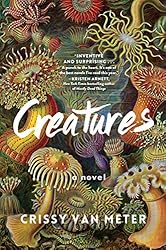
Creatures: A Novel
Crissy Van Meter, 2020
Algonquin of Chapel Hill
256 pp.
ISBN-13: 9781616208592
Summary
On the eve of Evangeline’s wedding, on the shore of Winter Island, a dead whale is trapped in the harbor, the groom may be lost at sea, and Evie’s mostly absent mother has shown up out of the blue.
From there, in this mesmerizing, provocative debut, the narrative flows back and forth through time as Evie reckons with her complicated upbringing in this lush, wild land off the coast of Southern California.
Evie grew up with her well-meaning but negligent father, surviving on the money he made dealing the island’s world-famous strain of weed, Winter Wonderland. Although her father raised her with a deep respect for the elements, the sea, and the creatures living within it, he also left her to parent herself.
With wit, love, and bracing flashes of anger, Creatures probes the complexities of love and abandonment, guilt and forgiveness, betrayal and grief—and the ways in which our childhoods can threaten our ability to love if we are not brave enough to conquer the past.
Lyrical, darkly funny, and ultimately cathartic, Creatures exerts a pull as strong as the tides. (From the publisher.)
Author Bio
Crissy Van Meter grew up in Southern California. Her writing has appeared in Vice, Bustle, Guernica, and Catapult. She holds an MFA in creative writing from the New School. She lives in Los Angeles (From the publisher.)
Book Reviews
Crissy Van Meter’s vivid and moving debut, is a novel powered by atmosphere.… The characters are as complex and explosive as the setting.… As Creatures unfolds, Van Meter subverts narrative expectations by making long and frequent digressions away from the compelling present, pre-wedding story line, to reveal either the past or future… eventually this structure begins to sway under its own weight.… At times, inevitability begins to outstrip surprise, and feeling is more reported than animated.… In its rendering of Winter Island, though—of sea-soaked splendor and terror and rage—Van Meter’s debut is an unwavering triumph. Equally dazzling is the novel’s emotional ballast.… For all the novel’s visual description, then, it’s Van Meter’s perceptive eye for this—the unseen—that makes for a coming-of-age that’s as human as it is wild.
Laura van den Berg - New York Times Book Review
Creatures evokes a family’s fragile bond as deep as the sea…. The sensibility of this short, gemlike novel puts Van Meter… in league with contemporary novelists for whom humans and their environment are tightly bound together—Lydia Millet, Joy Williams and T.C. Boyle come to mind. And Creatures is studded with lovely, melancholy sentences that shimmer like dark sea glass…. Van Meter tells that story with empathy and clarity but also evokes the wildness that her setting deserves. Creatures delivers a powerful feeling that we, like Evie, are destined to always feel at least a little adrift.
Los Angeles Times
In fluid and nutrient-rich prose, Van Meter creates a sense of island life that will have even the most dedicated landlubbers tasting salt on their lips.
Minneapolis Star Tribune
[E]xcellent… a beautiful look at how we navigate the pain and heartbreak that comes with being human.… Creatures jumps back and forth in time…. [The] narrative technique… seems to highlight that lives don't happen in a straight line; we're all a collection of past and present, and we never really escape what's happened to us years ago.… Van Meter also displays a real talent for crafting characters that feel real, with impulses both good and bad, and the capacity to love and to hurt.… Van Meter is a wonderful writer, and her novel is so beautifully written… a gift of a book
Michael Schaub - NPR
An alluring, atmospheric debut.
People
[T]ender and atmospheric…. Despite some unnecessary structural flourishes in the form of essay-prompts and themed-chapter sections, this promising debut sneaks up on the reader, packing a devastating emotional punch.
Publishers Weekly
This promising debut is set on Winter Island on the eve of Evie's wedding, with a dead whale trapped in the harbor, the groom possibly lost at sea, and the mother of the bride suddenly reappearing after having walked out long ago.
Library Journal
Van Meter's wonderfully un-ordinary debut is rather like the ocean itself: layered, deep, and happening all at once…. This is a moving, graceful novel of how people change and are changed by natures within and without.
Booklist
Some of the most heartbreaking moments in this novel are the most simply told, and there are scenes of beauty and magic and dry humor amid the chaos. And Evie is self-aware enough to acknowledge her own complexities and shortcomings. A quietly captivating debut.
Kirkus Reviews
Discussion Questions
We'll add publisher questions if and when they're available; in the meantime, use our LitLovers Book Club Resources. They can help with discussions for any book:
• How to Discuss a Book (helpful discussion tips)
• Generic Discussion Questions—Fiction and Nonfiction
• Read-Think-Talk (a guided reading chart)
(Resources by LitLovers. Please feel free to use them, online and off, with attribution. Thanks.)


Crooked Heart
Lissa Evans, 2014 (U.S.,2015)
HarperCollins
288 pp.
ISBN-13: 9780062364838
Summary
Paper Moon meets the Blitz in this original black comedy, set in World War II England, chronicling an unlikely alliance between a small time con artist and a young orphan evacuee.
When Noel Bostock—aged ten, no family—is evacuated from London to escape the Nazi bombardment, he lands in a suburb northwest of the city with Vera Sedge—a thirty-six-year old widow drowning in debts and dependents. Always desperate for money, she’s unscrupulous about how she gets it.
Noel’s mourning his godmother Mattie, a former suffragette. Wise beyond his years, raised with a disdain for authority and an eclectic attitude toward education, he has little in common with other children and even less with the impulsive Vee, who hurtles from one self-made crisis to the next.
The war’s provided unprecedented opportunities for making money, but what Vee needs—and what she’s never had—is a cool head and the ability to make a plan.
On her own, she’s a disaster. With Noel, she’s a team.
Together, they cook up a scheme. Crisscrossing the bombed suburbs of London, Vee starts to make a profit and Noel begins to regain his interest in life. But there are plenty of other people making money out of the war—and some of them are dangerous. Noel may have been moved to safety, but he isn’t actually safe at all. (From the publisher.)
Author Bio
• Birth—N/A
• Where—the West Midlands, England, UK
• Education—M.D., New Castle Uiniversity
• Awards—Baileys Women's Prize (formerly, Orange Prize)
• Currently—lives in London, Englandb
Lissa Evans (Felicity Kenvyn) is a British television director, producer and author.
After qualifying as a doctor in 1983, Lissa worked in medicine in Newcastle for four years before a brief period in stand-up comedy. She started with an ensemble review called "Wire Less Wireless" which played in some of the pubs in Newcastle.
Lissa joined BBC Radio where she was a producer of comedy programmes before migrating to television. She has produced and/or directed such shows as Father Ted (for which she won a BAFTA for best comedy), Room 101, The Kumars at No. 42, TV Heaven, Telly Hell, Crossing the Floor (for which she won an Emmy for best drama) and Have I Got News For You.
In addition to her television work, Lissa has written four novels for adults: Spencer's List (2002), Odd One Out (2004), Their Finest Hour and a Half (2009) (long-listed for the Orange Prize for Fiction) and Crooked Heart (2014, 2015 in the US).
She also wrote two novels for children. The first, Small Change For Stuart, came out in 2011 and was shortlisted for the 2011 Costa Award for Children's fiction, the 2012 Carnegie Medal, and the 2012 Branford Boase Award. (It was published in the US as "Horten's Miraculous Mechanisms").
Her second child's novel, is the Stuart sequel, Big Change for Stuart ("Horten's Incredible Illusions" in the US). It was published in 2012. (Adapted from Wikipedia. Retrieved 8/2/2015.)
Book Reviews
In Crooked Heart, Lissa Evans’s absorbing and atmospheric comic novel, another quietly heroic orphan joins the canon….This is a wonderfully old-fashioned Dickensian novel, with satisfying plot twists….Both darkly funny and deeply touching….It’s a crooked journey, straight to the heart.
New York Times Book Review
Evans tidily unfolds a satisfying plot…. But it’s the over-arching development of the lost little boy and the harried woman’s affection and admiration for one another that really tugs the reader’s own heart crooked.... There’s great galloping joy in it.
Independent (UK)
Entertaining.... The story starts in the London blitz, in a dazzling, tragicomic prologue…. Crooked Heart is a dark comedy, moving between drollery, pathos, farce and harrowing moments of tragic insight.
Guardian (UK)
Deceptively complex and utterly charming.
Sunday Mirror (UK)
This autumn’s feel-good novel teams up two unlikely characters at the outbreak of World War II…. Evans has written an old-fashioned comedy of manners, which is heartwarming, without being mawkish, and extremely funny.
Daily Mail (UK)
I try not to say, "If there’s one novel you should read this summer..." but Crooked Heart tempts me to say it.
Scott Simon - NPR
Evans’ exceptionally engaging Crooked Heart brings effervescent wit and oddball whimsy to a venerable formula.... The entire novel is a joy from start to finish: briskly paced, taut and snappy with humor and, ultimately, sweet.
Minneapolis Star Tribune
Noel’s precociousness, combined with the distrust of authority...makes him a difficult child...and though Vera has enough of her own troubles, somehow the two of them—awkwardly but endearingly—find a connection.... [An] appealing blend of sophisticated bravado and naive fragility—all without lapsing into sentimentality.
Publishers Weekly
(Starred review.) Evans explores the Blitz during World War II from two utterly inventive perspectives—that of a sharp-minded ten-year-old orphan evacuee and the unscrupulous and desperate 36-year-old suburban widow.... A charming, slanted counterpoint to Anthony Doerr's All the Light We Cannot See. —Christine Perkins, Whatcom Cty. Lib. Syst., Bellingham, WA
Library Journal
A clever orphan and his scam-artist guardian—an odd couple in wartime London—explore the space between legally wrong and morally right. Engaging and comic.... A dark, cherishable, very English comedy about not-so-funny times and events.
Kirkus Reviews
Discussion Questions
Use our LitLovers Book Club Resources; they can help with discussions for any book:
• How to Discuss a Book (helpful discussion tips)
• Generic Discussion Questions—Fiction and Nonfiction
• Read-Think-Talk (a guided reading chart)
Also, consider these LitLovers talking points to help start a discussion for Crooked Heart:
1. Probably the best place to start with this book is this: what did you think about the characters? Were your attitudes toward them different at the beginning of the book then they were by the end? If so, how do the characters change from start to finish? Or if the characters don't change, what does?
2. Most novels about World War II and the London Blitz focus on characters' heroism and bravery. What do you think about Evans's approach—honing in on characters who are hardly heroic, who take advantage of the generosity of others in times of crisis? Do desparate circumstances excuse Noel and Vee? Which type of person—the scoundrel or hero—is more prevalent in humanity...or in ourselves?
3. Reviewers are like Polonious in Hamlet, referring to Crooked Heart as comical-tragical, tragical-comical.... What do you think? Is it one...or the other...or both? If both, where does the line between comedy and tragedy fall (or blur)? Point to some areas where the writing is particularly humorous...or to other areas where it's not.
4. Lots of twists and turns in this novel: did you "see it coming"...or where you taken by surprise at the turn of events. Reviewers frequently mention Dickens. Do you see parallels?
5. Satisfying ending...or not?
(Questions by LitLovers. Please feel free to use, online or off, with attribution. Thanks.)

The Crooked Heart of Mercy
Billie Livingston, 2016
HarperCollins
272 pp.
ISBN-13: 9780062413772
Summary
Ben wakes up in a hospital with a hole in his head he can’t explain.
What he can remember he’d rather forget. Like how he’d spent nights as a limo driver for the wealthy and debauched . . . how he and his wife, Maggie, drifted apart in the wake of an unspeakable tragedy . . . how his little brother, Cola, got in over his head with loan sharks circling.
Maggie is alone. Again. With bills to pay and Ben in a psych ward, she must return to work. But who would hire her in the state she’s in?
And just as Maggie turns to her brother, Francis, the Internet explodes with a video of his latest escapade. The headline? Drunk Priest Propositions Cops.
Francis is an unlikely priest with a drinking problem and little interest in celibacy. A third DUI, a looming court date. . . . When Maggie takes him in, he knows he may be down to his last chance. And his best shot at healing might lay in helping Maggie and Ben reconnect—against all odds. (From the publisher.)
Author Bio
• Birth—November 23, 1965
• Where—Hamilton, Ontario, Canada
• Education—N/A
• AWards—Danuta Gleed Literary Award; CBC Bookie Award
• Currently—lives in Vancourer, British Columbia
Billie Livingston is a Canadian novelist, short story writer, essayist, and poet. Born in Hamilton, Ontario, Livingston grew up in Toronto and Vancouver, British Columbia. She lives in Vancouver and is married to American actor Tim Kelleher.
Her critically acclaimed first novel, Going Down Swinging (2000), was followed by The Chick at the Back of the Church (2001), a poetry book that was shortlisted for the Pat Lowther Award.
Her second novel, Cease to Blush (2006), was chosen as one of the year's best books by The Globe and Mail, January Magazine, and The Tyee. Her novel, One Good Hustle (2012), was long-listed for the 2012 Giller Prize and selected by the Globe and Mail, January Magazine, and Toronto's Now Magazine as one of the year's best books.
Livingston's short story collection, Greedy Little Eyes (2010), was cited by the Globe and Mail as one of 2010's best books and by the Georgia Straight as one of the fifteen most outstanding books of the year. In 2011 Greedy Little Eyes won the Danuta Gleed Literary Award for Best Short Story Collection as well as the CBC's Bookie Award.
In 2013, her story, "The Trouble with Marlene," was made into the 2014 feature film, Sitting on the Edge of Marlene, directed by Ana Valine, and starring Suzanne Clement, Paloma Kwiatkowski, and Callum Keith Rennie.
In addition to publications in journals and magazines around the world, Livingston's poetry has appeared in textbooks and on public transit through the TransLink "Poetry in Transit" program. She has received fellowships from The Banff Centre, MacDowell Colony, Escape to Create (Seaside, Florida), Ucross Foundation and Omi International Arts Center. (From Wikipedia. Retrieved 5/12/2016 .)
Book Reviews
Livingston avoids cliché and caricature, and is able to investigate the necessity of belief in all its forms without descending into the didactic. She has a real knack for voice, bouncing back and forth... gracefully and believably. Further her light-handed investigation of religion and its place in our lives – especially in crisis – is wholly refreshing and open-hearted.
Toronto Globe and Mail
In , her stellar fourth novel... Livingston immediately sets up a pressing question: can these lostThe Crooked Heart of Mercy souls overcome their tragedy and, if so, how? Tender, quirky, and sporadically quite comic, her answer is fruitful as well as a delight to follow. Emotional but not sentimental and sharp without being cynical, the story maintains an impressive balance.
Vancouver Sun
Jarring, poignant and laced with a brand of dark humour, the book turns the accidental death of a child into a meditation on grief and recovery. In Livingston’s searing story, recovery, tenuous as it often is, is hard-earned, a glimpse, with no guarantees, of the price to be paid for renewal…. full of surprises; its well-drawn characters, their close-to-the-edge dilemmas, the ways in which they seek an elusive recuperation, are sharply depicted.
London Free Press
Although you will be deeply discomfited, you will also be amply rewarded....Most importantly, by taking often overused and amorphous terms such as ‘forgiveness’ and ‘spirituality’ and bringing them down to earth, Livingston allows Ben and Maggie to come to a stumbling understanding of what it means to survive day to day, transcend terrible trauma, and to eventually regain the capacity to give and receive love.
Toronto Star
The Crooked Heart of Mercy is brave stuff featuring a trio of characters rarely seen or described so well as Ben, his wife Maggie and her drinkin’ brother, a priest named Francis... How each comes to deal (and heal) is the stuff of this indelible novel, one that lingers in the mind long after the last page is turned.
Sun Times
Courageously renegade (and hilarious) ....The Crooked Heart of Mercy is a gem. Much like a big sis who prepares a young’n for the harsh world, Livingston swiftly kicks the legs out from under you, then catches you in her arms.
Washington Independent Review
Forgiveness—and the attendant notions of grace and mercy—are central to the novel, and to the author’s own attitude, which is steeped in empathy for fallen and fallible characters...This, beyond the laughter and the tears, is what seems to be motivating Livingston, both as an author and a human being: the sense of compassion that needs to endure if we are to survive the world’s depredations.
Quill and Quire
Billie Livingston may be Canada's best-kept literary secret. Her books are consistently fascinating, witty, gut-wrenching reads and The Crooked Heart of Mercy just might be her best yet. It brings to life an unforgettable cast of characters... Don't miss it if: You've ever found comfort in the last person you expected.
W Dish
An intricate meditation on grief and forgiveness.... How individuals fail and succeed in their efforts to be caring remains Livingston’s enduring theme.
Georgia Straight
The key to Billie Livingston's fiction is its potent emotional core. She always makes sure you can empathize with her characters, who are often troubled souls searching for personal connection or, in the case of her newest book, reconnection.... Livingston brings these emotional crises to life, never resorting to cliches.... [D]iving into the author’s emotional vortex is a powerful experience.
NOW (Toronto)
From award-winning Canadian novelist Livingston, this is a beautiful and insightful paean to the human spirit and how it can heal.
Booklist
[A]n achingly fragile portrait of two battered and bruised people....[but] Livingston beautifully teases out the bitter humor needed to endure the long shadows of grief. These hearts heal with scar tissue.
Kirkus Reviews
Discussion Questions
1. "How do you fill a hole? If you take from the whole to fill a hole, is anything made whole?" How do Ben’s words reflect the themes of trauma and recovery in the novel?
2. Both Ben and Maggie feel extremely guilty over Frankie’s death. How do they deal with this guilt in their everyday lives?
3. Given that Maggie shows disdain for religion many times during the novel, why do you think she turns to the church in her times of need? (For instance, when it concerns her son.)
4. Why did the author choose to have the narrative jump back and forth between different time lines and events? How does this serve the novel and how would it be different if it read chronologically?
5. Why does Lucy find such solace in the United Church of Spiritualism? Why does this bother Maggie?
6. According to psychologists, dissociation from reality is a coping mechanism for dealing with extreme stress or grief and can manifest in different ways. In what ways do Ben and Maggie each dissociate?
7. Do you think that Ben’s dissociation existed before his self-injury and hospital stay? When and why do you think it started?
8. Does Francis feel guilt regarding his sexual orientation or is he comfortable with who he is? Where do you think his tendency toward substance abuse originated?
9. In what ways does the author use the narrative voice to connect the reader to Ben’s experience? Do you think that Ben is a more or a less reliable narrator when he is outside of his own body?
10. How are the themes of religion and spirituality explored in the novel? Discuss the differences between the characters who are more religious and those who are more spiritual.
11. The chapters of the novel alternate between the narratives of Maggie and Ben. The time lines of their respective narratives do not coincide until one of the very last chapters. How do you think this relates to the development of the characters and their relationship?
12. Ben and Cola each have very complicated relationships with their father. Do you think they love him or do they simply feel obligated toward him? Why?
13. How do Ben and Maggie each figure out that they need each other to heal from their emotional trauma? Did Dr. Lambert play any part in Ben’s recovery?
14. How does Ben’s view of the physical world change when he comes out of his dissociative state? How does his attitude change? Why do you think this is?
15. At the end of the novel, are Ben and Maggie finally "made whole"?
(Questions issued by the publisher.)


Crooked Letter, Crooked Letter
Tom Franklin, 2010
HarperCollins
274 pp.
ISBN-13: 9780060594664
Summary
In the late 1970s, Larry Ott and Silas "32" Jones were boyhood pals, Larry the child of white, lower middle-class parents and Silas the son of a poor, single black mother. Their worlds were as different as night and day, yet, for a few months, the boys stepped outside of their circumstance and shared a special bond.
But then tragedy struck: on a date, Larry took a girl to a drive-in movie, and she was never heard from again. She was never found and there was no confession, but all eyes rested on Larry. The incident shook the county—and perhaps Silas most of all. He and Larry's friendship was broken, and then Silas left.
Over twenty years have passed. Larry, a mechanic, lives a solitary existence, never able to rise above the whispers of suspicion. Silas has returned to town as a constable. He and Larry have no reason to cross paths until another girl disappears and Larry is blamed, again. And now, two men who once called each other friend are forced to confront the past they've buried and ignored for decades.
Tom Franklin's extraordinary talent has been hailed by the leading lights of contemporary literature—Phillip Roth, Richard Ford, Lee Smith, and Dennis Lehane. Reviewers have called his fiction "ingenious" (USA Today) and "compulsively readable" (Memphis Commercial Appeal). His narrative power and flair for characterization have been compared to the likes of Harper Lee, Flannery O'Connor, Elmore Leonard, and Cormac McCarthy. (From the publisher.)
Author Bio
• Birth—1963
• Where—Dickinson, Alabama, USA
• Education—B.A., University of South Alabama; M.F.A.
University of Arkansas
• Awards—Edgar Award; Guggeheim Fellowship; Writers at
Work Literary Nonfiction Contest
• Currently—lives in Oxford, Mississippi
Thomas G. Franklin was born in the small southern town of Dickinson, Alabama, in 1963. In 1981 he moved with his family to Mobile, Alabama, where he later attended the University of South Alabama in Mobile, earning his BA.
Working nights to put himself through school, Franklin took a variety a of jobs—as a heavy equipment operator at a sand-blasting grit factory, a construction inspector in a chemical plant, a clerk at a hospital morgue, and worker at hazardous waste clean-up sites. He earned his MFA at the University of Arkansas in 1998.
In 1999 Franklin returned to the University of South Alabama to teach; in the fall of that year, he was appointed the Phillip Roth Resident in Creative Writing at Bucknell University in Lewisburg, Pennsylvania. He then moved to Knox College, where he held the position of visiting Writer-in-Residence.
In 2000, Franklin became the John and Renee Grisham Writer-in-Residence at University of Mississippi in Oxford, instructing both undergraduate and graduate students.
In 1999 Franklin published Poachers, a collection of short stories set in Alabama. The title story won him the Edgar Allan Poe Award as Best Mystery Story. His first novel, Hell at the Breech, was published in 2003. Based in Clark County, Alabama (Franklin's childhood home), it focuses on a local feud in 1899, which Franklin heard about growing up. Smonk, Franklin's second novel (in 2006), recounts a trial of a rapist/murderer in 1911 who terrorized the small town of Old Texas, Alabama. In 2010 Franklin published Crooked Letter, Crooked Letter—about the disappearance of two girls and the estrangement of boyhood friends, one black, one white.
Franklin's short stories and essays have been published in numerous magazines including the Chattahoochee Review, Brightleaf, Nebraska Review, Texas Review, Quarterly West, and Smoke magazine. His writings have also been included in anthologies, such as New Stories from the South; The Year's Best, 1999; Best American Mystery Stories, 1999 and 2000; and Best Mystery Stories of the Century.
In addition to the Edgar award, Franklin has been honored several times for his literary achievements. In 1998 he won the Writers at Work Literary Nonfiction Contest. He received the Arkansas Arts Council grant for the short story in August of 1998. He was also presented with a 2001 Guggenheim Fellowship, and the John and Renee Grisham Writer-in-Residence for the 2001- 2002 academic year.
Franklin and his wife Beth Ann Fennelly, a poet and associate professor at the University of Mississippi, have a daughter and son. (Adapted from Missisppi Writers & Musicians.)
Book Reviews
As he submerges us in the sweat of the South, Franklin's people...come alive, some of them with a vengeance. In a lesser writer's hands, the relationship between Larry and 32 —the heart of the novel—could have been black and white. Pardon the pun. But Franklin plays the literary equivalent of the blues, digging beneath the surface to reveal tangled emotion and intricate motivation.
Steve Bennett - San Antonio Express
Keeping the story's tension pulled tight, ...the writer's incredible talent emerges as he delves into the issue of race through exploring events that have formed each man. Descriptions of the town's other characters, including the families of the two missing girls, add to the flavor of the rural locale and help guide the plot.
Mary Popham - Louisville Courier- Journal
Franklin's third novel (after Smonk) is a meandering tale of an unlikely friendship marred by crime and racial strain in smalltown Mississippi. Silas Jones and Larry Ott have known each other since their late 1970s childhood when Silas lived with his mother in a cabin on land owned by Larry's father. At school they could barely acknowledge one another, Silas being black and Larry white, but they secretly formed a bond hunting, fishing, and just being boys in the woods. When a girl goes missing after going on a date with Larry, he is permanently marked as dangerous despite the lack of evidence linking him to her disappearance, and the two boys go their separate ways. Twenty-five years later, Silas is the local constable, and when another girl disappears, Larry, an auto mechanic with few customers and fewer friends, is once again a person of interest. The Southern atmosphere is rich, but while this novel has the makings of an engaging crime drama, the languid shifting from present to past, the tedious tangential yarns, and the heavy-handed reveal at the end generate far more fizz than pop.
Publishers Weekly
(Starred review.) A ripping good mystery, this novel also has depth and a subtle literary side, as the local area comes to life through the writer’s cinematic descriptive phrases and a large and colorful cast of supporting characters. Highly recommended.
Library Journal
(Starred review.) Skin color didn’t matter to boyhood companions Silas Jones and Larry Ott...until the night a pretty local girl went on a date with Larry to the drive-in movies and was never heard from again.... [M]ore than 20 years later...the disappearance of another girl brings the two former friends back together, forcing them to come to terms with buried secrets and dark truths.... Luminous prose and a cast of compelling characters in this moody, masterful entry. —Allison Block
Booklist
Discussion Questions
1. The epigraph reveals the origins of the novel's title. Why do you think Tom Franklin chose to use "Crooked Letter, Crooked Letter"? What significance does it hold for the story?
2. Describe the boys Larry and Silas were, and the men they became. What drew Larry and Silas together as children? What separated them? How did you feel about both characters?
3. What elements of Larry's life set him apart from others? Could he have done anything to change people's opinion of him? Would you call Larry a "loser'? What about Silas?
4. When Larry is shot at the beginning of the novel, he is sympathetic to his attacker. "Larry felt forgiveness for him because all monsters were misunderstood." Does Larry consider himself to be a monster? Why? Why isn't he bitter? Could you be as charitable if you were in his place? Why does he say all monsters are misunderstood? Do you think he feels the same way at the end of the novel?
5. During the attack, the shooter is wearing an old monster mask that Larry recognized. What did that mask symbolize for both the victim and his attacker?
6. Tom Franklin goes back and forth between past and present to tell his story. How are Larry and Silas prisoners of their childhoods? How can we break the past's hold on us?
7. Describe Larry's relationship with his father, Carl. How might things have been different if Larry knew the truth about his family sooner? Why did Carl force Larry and Silas to fight as boys? What impact did that fight have on their friendship? Do you think the outcome was Carl's intent? How did Silas feel about Carl?
8. Talk about both boys' relationships to their mothers. How did their mothers shape them? Were they good sons? What kind of people were their mothers? Why does Silas go to see Larry's mother in the nursing home?
9. When Silas visits Mrs. Ott, he's reminded of the past when he first arrived in the town with his mother, both of them coatless in the cold. "Sometimes he thought how Larry's mother had given them coats but not a ride in her car. How what seemed liked kindness could be the opposite." How was this behavior cruel? Can you think of other examples from the book where kindness and cruelty were combined?
10. Was Larry treated fairly by the community or the law? We're supposed to be a nation of laws in which people are innocent until proven guilty.
11. Why did Silas remain silent when he could have helped Larry when they were teenagers? Why does he finally come forward with the truth? How might both their lives have been different if the truth were known?
12. When he was a little boy, Larry's mother used to pray for God to send him a special friend, "one just for him." Were her prayers answered?
13. After Silas, Larry considered Wallace Stringfellow to be his friend. What was the bond between Larry and Wallace? What attracted one to the other? Were they really friends? What is a friend?
14. As an adult, Larry also prayed to God. "Please forgive my sins, and send me some business. Give Momma a good day tomorrow or take her if it's time. And help Wallace, God. Please." What were Larry's sins? Why did he pray for Wallace? What did Larry see in Wallace?
15. When Larry is in the hospital after the shooting, Silas goes to visit. "He wondered how broken Larry was by the events of his life, how damaged." How would you answer Silas?
16. Was Larry broken? Was he damaged? What kept him from becoming the monster everyone believed he was? Silas, too, wonders about himself. "What's missing out of you Silas?" Does he discover his missing self? How? Is Silas a better man for the knowledge? How does that insight affect Larry's life?
17. Larry felt he was to blame for Wallace's tragic choices. Do you think he was responsible at all? What about Silas? How much responsibility do we carry for others? For family? Friends? Strangers? How much responsibility does the community bear for the Wallace's actions?
18. How does Larry react when Silas tells him the truth about their childhood? Can true friends overcome betrayal? How? Do you think they will be part of each other's lives going forward?
19. Silas left Southern Mississippi then returned. Larry never left. Why did they make the decisions they did? What was it about their small town that drew and kept them there? How does place shape the novel? Could this have happened in any small town?
20. How is racism a part of the story? Use Larry and Silas's experiences to support you response.
21. Crooked Letter, Crooked Letter is also a coming of age story. How did the characters come into themselves as the story progressed? What possibilities might the future hold for Larry and Silas?
22. At the novel's end, Tom Franklin writes, "the land had a way of covering the wrongs of people." What does he mean by this?
23. What did you take away from reading Crooked Letter, Crooked Letter?
(Questions issued by publisher.)


Crooked River
Valerie Geary, 2014
HarperCollins
352 pp.
ISBN-13: 9780062326607
Summary
Still grieving the sudden death of their mother, Sam McAlister and her younger sister, Ollie, move from the comforts of Eugene to rural Oregon to live in a meadow in a teepee under the stars with Bear, their beekeeper father.
But soon after they arrive, a young woman is found dead floating in Crooked River, and the police arrest their eccentric father for the murder.
Fifteen-year-old Sam knows that Bear is not a killer, even though the evidence points to his guilt. Sam embarks on a desperate hunt to save him and keep her damaged family together.
Ollie, too, knows that Bear is innocent. The Shimmering have told her so. One followed her home from her mom's funeral and refuses to leave. Now, another is following Sam. Both spirits warn Ollie: the real killer is out there, closer and more dangerous than either girl can imagine. (From the publisher.)
Author Bio
• Birth—ca. 1983 (?)
• Raised—Albany, Oregon, USA
• Education—B.A., Vanguard University of Southern California
• Currently—lives in Portland, Oregon
Valerie Geary is a full-time writer who lives in Portland, Oregon. Her first novel, Crooked River, was released in 2014 and selected for the November 2014 Indie Next List. Crooked River has been internationally published in France, Germany and Belgium. Her short stories have appeared in Weekly Rumpus, Day One, Menda City Review, Boston Literary Magazine, Foundling Review, the UK publication Litro, and others. (From the publisher.)
Visit the author's website.
Book Reviews
[Valerie Geary] captures her readers at once and doesn’t let them go.
Oklahoma City Oklahoman
[A] swift and beguiling read… [Sam] is finely drawn, an update on Harper Lee’s Scout
BookPage
The narrative skill displayed is impressive… readers will have a hard time putting this one down.
Booklist
Crooked River is as much a coming-of-age novel as it is a well-paced mystery…Geary takes teenage Sam through a looking-glass and then pulls her back with an adult’s sense of loyalty and compassion--a journey equally worthwhile for all of us.
Shelf Awareness
Unfortunately, much of the paranormal subplot is tepid; Geary is a solid writer, though...[the] book's core mystery is also disappointing—the identification of the dead woman's killer doesn't feel revelatory or surprising. A slightly jumbled debut that, while well-written, could have gone places it didn't quite manage to reach.
Kirkus Reviews
Discussion Questions
1. From the beginning of the novel, we are presented with two different narrators: Sam and Ollie. What were your first impressions of these sisters based on the initial chapters of the book? How would you describe their personalities? What impact do you think the use of dual, first-person narration had on the story?
2. Talk about the character of Frank “Bear” McAlister. How does your impression of him change from the beginning to the end of the book, if it does at all?
3. Sam makes numerous references to Bear’s bee farm and bee-keeping practices in Crooked River. Why do you think bees feature so prominently in the novel? What is significant about their behaviors? Can you draw any parallels between the actions of the characters in the book and how bee colonies operate?
4. Consider the examples of parent-child relationships in the novel. How do you think Sam and Ollie’s relationship with their mother and Bear is similar to their relationship with Franny and Zeb? How is it different? What do you think the author could be suggesting about what makes a good parent? Furthermore, do you think Bear can be considered a good parent? Explain why or why not.
5. Think about Travis’ relationship with his parents. Compare and contrast it to Sam and Ollie’s relationship with the adults in their lives. How would you describe the Roths’ love for their children? Do you feel empathy for the Roth family? Or to any member of the Roth family in particular? Why or why not?
6. What do you think is significant about Ollie’s attachment to Alice’s Adventures in Wonderland? Why do you think she allows this specific book to speak for her?
7. Ollie refuses to use her voice after her mother dies, Taylor Bellweather is denied the opportunity to speak once she is murdered, and at the end of the novel Sam and Ollie’s mother stresses the importance of telling people you love them—the role of “voice” is very important. Why do you think the novel places an emphasis on a person’s capability to use his or her voice?
8. Describe your feelings toward Deputy Santos throughout the investigation of Taylor Bellweather’s death. Could you understand her reasoning behind wanting Sam to accept that Bear was guilty? Why or why not?
9. What effect does the landscape and setting of rural Oregon have on the overall mood of the story?
10. Although the novel centers around a mystery, how does it exhibit the elements of a ghost story and a coming-of-age story as well? Are there elements of other literary genres present in the novel? If so, what are they?
(We'll add specific questions if and when they're made available by the publisher.)
The Crossing (The Border Trilogy #2)
Cormac McCarthy
Knopf Doubleday
432 pp.
ISBN-13: 9780679760849
Summary
In The Crossing, Cormac McCarthy fulfills the promise of All the Pretty Horses and at the same time give us a work that is darker and more visionary, a novel with the unstoppable momentum of a classic western and the elegaic power of a lost American myth.
In the late 1930s, sixteen-year-old Billy Parham captures a she-wolf that has been marauding his family's ranch. But instead of killing it, he decides to take it back to the mountains of Mexico. With that crossing, he begins an arduous and often dreamlike journey into a country where men meet ghosts and violence strikes as suddenly as heat-lightning—a world where there is no order "save that which death has put there."
An essential novel by any measure, The Crossing is luminous and appalling, a book that touches, stops, and starts the heart and mind at once. (From the publisher.)
About the Author
• Birth—July 20, 1933
• Where—Providence, Rhode Island, USA
• Education—University of Tennessee, US Air Force
• Awards— Ingram-Merrill Aware, 1959 and 1960; Faulkner
Prize, 1965; Traveling Fellowship from American Academy
of Arts and Letters, 1965; Guggenheim Fellowship, 1969;
MacArthur Fellowship, 1981; National Book Award, 1992;
National Book Critics Circle Award, 1992; James Tait Black
Memorial Prize UK, 2006; Pulitzer Prize, 2007 for The Road.
• Currently—lives in Tesuque, New Mexico (Santa Fe area)
Cormac McCarthy (born Charles McCarthy) is an American novelist and playwright. He has written ten novels, ranging from the Southern Gothic, western, and post-apocalyptic genres. He has also written plays and screenplays.
He received the Pulitzer Prize in 2007 for The Road, and his 2005 novel No Country for Old Men was adapted as a 2007 film of the same name, which won four Academy Awards, including Best Picture. He received a National Book Award and National Book Critics Circle Award for his 1992 novel, All the Pretty Horses.
His previous novel, Blood Meridian, (1985) was among Time Magazine's poll of the best English-language books published between 1923 and 2005 and he placed joint runner-up in a poll taken in 2006 by the New York Times of the best American fiction published in the last 25 years.
Literary critic Harold Bloom named him as one of the four major American novelists of his time, along with Don DeLillo, Thomas Pynchon and Philip Roth. In 2010 the London Times ranked The Road no.1 on its list of the 100 best fiction and non-fiction books of the past 10 years. He is frequently compared by modern reviewers to William Faulkner.
Early years
McCarthy was born in Providence, Rhode Island on July 20, 1933, and moved with his family to Knoxville, Tennessee, in 1937. He is the third of six children, with three sisters and two brothers. In Knoxville, he attended Knoxville Catholic High School. His father was a successful lawyer for the Tennessee Valley Authority from 1934 to 1967.
McCarthy entered the University of Tennessee in 1951-1952 and was a liberal arts major. In 1953, he joined the United States Air Force for four years, two of which he spent in Alaska, where he hosted a radio show. In 1957, he returned to the University of Tennessee. During this time in college, he published two stories in a student paper and won awards from the Ingram Merrill Foundation in 1959 and 1960. In 1961, he and fellow university student Lee Holleman were married and had their son Cullen. He left school without earning a degree and moved with his family to Chicago where he wrote his first novel. He returned to Sevier County, Tennessee, and his marriage to Lee Holleman ended.
Writing
McCarthy's first novel, The Orchard Keeper, was published by Random House in 1965. He decided to send the manuscript to Random House because "it was the only publisher [he] had heard of." At Random House, the manuscript found its way to Albert Erskine, who was William Faulkner's editor until Faulkner's death in 1962. Erskine continued to edit McCarthy for the next twenty years.
In the summer of 1965, using a Traveling Fellowship award from The American Academy of Arts and Letters, McCarthy shipped out aboard the liner Sylvania, hoping to visit Ireland. While on the ship, he met Anne DeLisle, who was working on the ship as a singer. In 1966, they were married in England. Also in 1966, McCarthy received a Rockefeller Foundation Grant, which he used to travel around Southern Europe before landing in Ibiza, where he wrote his second novel, Outer Dark. Afterward he returned to America with his wife, and Outer Dark was published in 1968 to generally favorable reviews.
In 1969, McCarthy and his wife moved to Louisville, Tennessee, and purchased a barn, which McCarthy renovated, even doing the stonework himself. Here he wrote his next book, Child of God, based on actual events. Child of God was published in 1973. Like Outer Dark before it, Child of God was set in southern Appalachia. In 1976, McCarthy separated from Anne DeLisle and moved to El Paso, Texas. In 1979, his novel Suttree, which he had been writing on and off for twenty years, was finally published.
Supporting himself with the money from his 1981 MacArthur Fellowship, he wrote his next novel, Blood Meridian, which was published in 1985. The book has grown appreciably in stature in literary circles. In a 2006 poll of authors and publishers conducted by The New York Times Magazine to list the greatest American novels of the previous quarter-century, Blood Meridian placed third, behind only Toni Morrison's Beloved and Don DeLillo's Underworld.
McCarthy finally received widespread recognition in 1992 with the publication of All the Pretty Horses, which won the National Book Award and the National Book Critics Circle Award. It was followed by The Crossing and Cities of the Plain, completing a Western trilogy. In the midst of this trilogy came The Stonemason, McCarthy's second dramatic work. He had previously written a film for PBS in the 1970s, The Gardener's Son.
McCarthy's next book, 2005's No Country for Old Men, stayed with the western setting and themes, yet moved to a more contemporary period. It was adapted into a film of the same name by the Coen Brothers, winning four Academy Awards and more than 75 film awards globally. McCarthy's latest book, The Road, was published in 2006 and won international acclaim and the Pulitzer Prize for literature. A film adaptation starring Viggo Mortensen and Kodi Smit-McPhee was released on November 25, 2009. Also in 2006, McCarthy published a play entitled The Sunset Limited.
Extras
• According to Wired magazine in December, 2009, McCarthy's Olivetti Lettera 32 typewriter was put up for auction at Christie's. The Olivetti Lettera 32 has been in his care for 46 years, since 1963. He picked up the used machine for $50 from a pawn shop in Knoxville, Tennessee. McCarthy reckons he has typed around five million words on the machine, and maintenance consisted of “blowing out the dust with a service station hose”. The typewriter was auctioned on Friday, December 4 and the auction house, Christie’s, estimated it would fetch between $15,000 and $20,000; it sold for $254,500. The Olivetti’s replacement for McCarthy to use is another Olivetti, bought by McCarthy’s friend John Miller for $11. The proceeds of the auction are to be donated to the Santa Fe Institute, a nonprofit interdisciplinary scientific research organization.
• McCarthy now lives in the Tesuque, New Mexico, area, north of Santa Fe, with his wife, Jennifer Winkley, and their son, John. He guards his privacy. In one of his few interviews (with The New York Times), McCarthy reveals that he is not a fan of authors who do not "deal with issues of life and death," citing Henry James and Marcel Proust as examples. "I don't understand them," he said. "To me, that's not literature. A lot of writers who are considered good I consider strange." McCarthy remains active in the academic community of Santa Fe and spends much of his time at the Santa Fe Institute, which was founded by his friend, physicist Murray Gell-Mann.
• Talk show host Oprah Winfrey chose McCarthy's 2006 novel The Road as the April 2007 selection for her Book Club. As a result, McCarthy agreed to his first television interview, which aired on The Oprah Winfrey Show on June 5, 2007. The interview took place in the library of the Santa Fe Institute; McCarthy told Winfrey that he does not know any writers and much prefers the company of scientists.
• During the interview he related several stories illustrating the degree of outright poverty he has endured at times during his career as a writer. He also spoke about the experience of fathering a child at an advanced age, and how his now-eight-year-old son was the inspiration for The Road. Cormac noted to Oprah that he prefers "simple declarative sentences" and that he uses capital letters, periods, an occasional comma, a colon for setting off a list, but "never a semicolon." He does not use quotation marks for dialogue and believes there is no reason to "block the page up with weird little marks." (From Wikipedia.)
Book Reviews
Young Billy Parham, in a horse stall, dreams of his father's eyes, "those eyes that seemed to contemplate with a terrible equanimity the cold and the dark and the silence that moved upon him." Billy could as well be dreaming of McCarthy's prose and the unsparing tone of this, the second volume in the Border Trilogy. The Crossing , following the award-winning and bestselling All the Pretty Horses , is set in the American Southwest and in Mexico, and features, like its predecessor, teenage boys, their horses, a girl and the recurring spectacles of desert days and nights, awful wonders and appalling deprivations, and no small amount of roadside philosophizing. The story of Billy, his younger brother Boyd, the fates of their horses, a wolf, their parents and their dog, set against a vague and distant backdrop of the coming Second World War, throws little light upon a universe without much meaning, though it is in the nature of McCarthy characters to try to anyway. In the end, when the last dog is hanged, so to speak, what survives is the rhythm of McCarthy's open, ropey sentences circling a logic as inscrutable as an animal's or a god's. Although no mysteries are solved, and no comfort gained for these lonely characters, there is that language wrestling to earth all that it cannot know and all that it can. Readers again will be in awe of McCarthy's extraordinary prose attentions—the biblical cadences, the freshened vocabulary, the taut, vivid renderings of the struggle to live.
Publishers Weekly
Sixteen-year-old Billy Parham is obsessed with trapping a renegade wolf that has crossed the border from Mexico to raid his father's cattle ranch. By the time he finally succeeds, Billy has formed such a close bond with his prey that he decides to return the wolf to its home, and the two head off into the mountains. Billy returns months later to find that his parents have been murdered by horse thieves. He abducts his kid brother from a foster home, and they ride into Mexico to retrieve their property, encountering gypsies, desperadoes, and itinerant philosophers along the way. Essentially a boy's adventure story written for adults, The Crossing is thematically related to the award-winning bestseller All The Pretty Horses, but it is not a sequel. McCarthy's luminous prose style, spare as the desert landscapes it describes, is almost Beckett-like in its blend of deadpan humor and existential despair. An exceptionally vivid and rewarding novel. —Edward B. St. John, Loyola Law Sch. Lib., Los Angeles
Library Journal
Volume two of McCarthy's Border Trilogy—following the much- acclaimed National Book Award-winning All the Pretty Horses (1992)—treads familiar territory but probes deeper into the darkness of the human animal. Like its predecessor, The Crossing concerns a young American rancher living near the Mexican border in the 1930s, a time when the old West is grudgingly entering the modern world while Mexico is being torn apart by revolution. And like volume one's memorable hero, John Cole Grady, 16-year-old Billy Pawson is drawn south in a nearly mythical journey to find himself. Billy initially crosses into Mexico to take a wolf he had trapped on his New Mexico ranch back to the animal's native mountains. When he returns, he finds that his home has been plundered, and he and his 14-year-old brother set off for Mexico to find their family's stolen horses. Traveling through the lawless ruins of the post-revolutionary Mexican countryside, they encounter Gypsy wanderers, carnival actors, horse-traders, horse thieves, revolutionary soldiers, and men of various religions. All offer sage advice about the journey, and Billy's failure to heed their wisdom sometimes has horrifying results. Relentless, frequently brutal, and morbidly fatalistic, the novel expresses once again McCarthy's essentially bleak vision. Because he is one of America's foremost literary craftsmen, it is also passionate and compelling. The author convincingly elevates seemingly ordinary events into near-religious moments: "They smoked the way poor people eat which is a form of prayer." Written in McCarthy's trademark prose—clear, blunt, and often startlingly beautiful—The Crossing "tells the tale of that solitary man who is all men." Like the tales of Homer and Melville, his timeless work will resonate for ages.
Kirkus Reviews
Discussion Questions
(A different set of questions—for the complete Border Trilogy—can be found at the end of the third novel, Cities of the Plain.)
1. What is the significance of the book's title?
2. Discuss the meaning of the observation: "The world was new each day for God so made it daily. Yet it contained within it all the evils as before" [p. 278]. How are these words applicable to the novel's action?
3. Early in the book Boyd Parham is struck by the sight of his reflection in the eyes of an Indian who asks them for food. What he sees is not so much himself as a "cognate child... windowed away in another world where the red sun sank eternally" [p. 6]. What themes do this moment of mirroring and self-estrangement suggest?
4. How would you characterize Billy's relationship with Boyd? Why does he return to Mexico to find out what happened to his brother? What else is he looking for?
5. Who do you think murdered the Parhams? Why didn't Boyd try to escape when he had the chance?
6. The people in The Crossing are characterized by a kind of psychological opaqueness. Since we rarely know their direct thoughts, we must infer their motives from their words and actions, which often seem cryptic or irrational. How do we come to know these characters? What vision of human nature does their opaqueness suggest?
7. What role do animals play in this book? Why, for example, does Billy endure such great danger and hardship for the sake of a wolf? Do any of the characters he meets in Mexico share his feelings about animals?
8.The Crossing is a book of dreams and auguries. Early in the novel Boyd has a dream of people burning on a dry lake [p. 35]; Billy dreams he sees his father wandering lost in the desert and being swallowed by darkness [p. 112]. Later in his journey, Billy istaken in by Indians whose elder calls him "huerfano"--orphan [p. 134]—thus predicting the murder of his parents. What is the role of portents—both accurate and inaccurate—in this book?
9.The Crossing is an account of three journeys. The book is also divided into four sections. Why do you think McCarthy has divided The Crossing in this asymmetrical fashion? Does he employ a similar structure elsewhere in this book? Is its overall structure similar to that of All the Pretty Horses?
10. What role does hospitality play in this book? Is there any relation between the novel's scenes of hospitality and its moments of violence?
11. Is The Crossing a violent book? Why do you think the author has chosen to recount some of the worst instances of bloodshed (the slaughter of the opera company's mule, the blinding of the rebel soldier) secondhand? At a time when graphic and gratuitous descriptions of mayhem are standard in much popular fiction for purposes of mere shock and titillation, has McCarthy succeeded in restoring to violence its ancient qualities of pity and terror? How has he managed this?
12. What things does Billy lose in the course of this novel? Which of these losses is voluntary?
13. The Crossing is a book about human beings and their relationship with God and, in particular, about their attempt to decipher divine justice. McCarthy explores this theme with Dostoyevskian eloquence in Billy's conversations with the sexton of a ruined church [pp. 140-59] and a blind veteran of the Revolution [pp. 274-93]. What kind of God have these men come to understand? Is that God the same one that Billy and Boyd encounter?
14. In what ways does The Crossing resemble classic myths and fairy tales? How do Billy and Boyd Parham compare to the figures that Joseph Campbell describes in The Hero with a Thousand Faces?
(Questions issued by publisher.)


Crossing to Safety
Wallace Stegner, 1987
Random House
368 pp.
ISBN-13: 9780375759314
Summary
Called a “magnificently crafted story...brimming with wisdom” by Howard Frank Mosher in the Washington Post Book World, Crossing to Safety has, since its publication in 1987, established itself as one of the greatest and most cherished American novels of the twentieth century.
Tracing the lives, loves, and aspirations of two couples who move between Vermont and Wisconsin, it is a work of quiet majesty, deep compassion, and powerful insight into the alchemy of friendship and marriage. (From the publisher.)
Author Bio
• Birth—February 18, 1909
• Where—Lake Mills, Iowa
• Death—April 13, 1993
• Where—Santa Fe, New Mexico
• Education—B.A., University of Utah; Ph. D., State University
of Iowa
• Awards—Pulitzer Prize, 1972; National Book Award for, 1977
Some call Wallace Stegner "The Dean of Western Writers." He was born in Lake Mills, Iowa and grew up in Great Falls, Montana, Salt Lake City, Utah and southern Saskatchewan, which he wrote about in his autobiography Wolf Willow. Stegner says he "lived in twenty places in eight states and Canada." While living in Utah, he joined a Boy Scout troop at a Mormon church (though he was not Mormon but Presbyterian himself) and earned the Eagle Scout award.
He received his B.A. at the University of Utah in 1930. He taught at the University of Wisconsin and Harvard University, and then he settled in at Stanford University, where he founded the creative writing program. His students included Sandra Day O'Connor, Edward Abbey, Wendell Berry, Thomas McGuane, Ken Kesey, Gordon Lish, Ernest Gaines, and Larry McMurtry.
He served as a special assistant to Secretary of the Interior Stewart Udall. He was elected to the Sierra Club board of directors for a term that lasted 1964—1966. He also moved into a house in nearby Los Altos Hills and became one of the town's most prominent residents.
Stegner's novel Angle of Repose won the Pulitzer Prize for Fiction in 1972, and was directly based on the letters of Mary Hallock Foote (later published as the memoir A Victorian Gentlewoman in the Far West). Stegner's use of uncredited passages taken directly from Foote's letters caused a minor controversy. Stegner also won the National Book Award for The Spectator Bird in 1977. In the late 1980s, he refused a National Medal from the National Endowment for the Arts in 1992 because he believed the NEA had become too politicized. Crossing to Safety was published in 1987.
He died in Santa Fe, New Mexico, while visiting the city to give a lecture. His death was the result of injuries suffered in an automobile accident on March 28, 1993. He is the father of nature writer Page Stegner. (From Wikipedia.)
Book Reviews
Stegner isn't a household name, though he should be. He had a long and prolific career, writing more than 30 books: novels, story collections, and non-fiction. His characters burrow into your heart, and Stegner's prose, as one critic put it, is "prismatic, lush and painterly." Don't miss this one.
A LitLovers LitPick (March '06)
Adding to a distinguished body of work that already has earned him a Pulitzer Prize and the National Book Awardand on the 50th anniversary of the publication of his first novel, Stegner's new book is an eloquent, wise and immensely moving narrative. It is a meditation on the idealism and spirit of youth, when the world is full of promise, and on the blows and compromises life inevitably inflicts. Two couples meet during the Depression years in Madison, Wis., and become devoted friends despite vast differences in upbringing and social status. Hard work, hope and the will to succeed as a writer motivate the penurious narrator Larry Morgan and his wife Sally as he begins a term teaching at the university. Equally excited by their opportunities are Sid Lang, another junior man in the English department, and his wife Charity. They are fortune's children, favored with intelligence, breeding and money. Taken into the Langs' nourishing and generous embrace, the Morgans have many reasons for gratitude over the years, especially when Sally is afflicted with polio and the Langs provide financial as well as moral support. During visits at the Langs' summer home on Battell Pond in Vermont and later sharing a year in Florence, the couples feel that they are "four in Eden." Yet the Morgans observe the stresses in their friends' marriage as headstrong, insufferably well-organized Charity tries to bully the passive Sid into a more aggressive mold. Charity is one of the most vivid characters in fiction; if she is arrogant, she is also kindhearted, enthusiastic, stalwart and brave—an ardent liver of life. Her incandescent personality is both the dominant force and the source of strain in the enduring friendship Stegner conveys with brilliant artistry. He is also superb at expressing a sense of place, and his intelligent voice makes cogent observations on American society in the decades of his setting. But most importantly, he speaks to us of universal questions, reflecting on "the miserable failure of the law of nature to conform to the dream of man." In doing so, he has created a believable human drama the dimensions of which reach out beyond the story's end and resonate in the reader's heart.
Publishers Weekly
tStegner published his first novel 50 years ago. Since then he has won both a Pulitzer Prize (for Angle of Repose, 1971) and the National Book Award (for The Spectator Bird, 1976). His latest effort, an exploration into the mysteries of friendship, deserves similar accolades. With a quiet but strong hand, he traces the bond that develops between Charity and Sid Lang and Sally and Larry Morgan from their first meeting in 1937 through their eventual separation to their final get-together in 1972 when Charity is dying of cancer and is determined ``to do it right,'' no matter what anyone else thinks. It seems only appropriate that Charity bring them together since she has been the driving force behind the relationship. As we discover now, her bull-headedness has had its price. This is a wonderfully rich, warm, and affecting book. Highly recommended. —David W. Henderson, Eckerd Coll. Lib., St. Petersburg, Fla.
Library Journal
Discussion Questions
Use our LitLovers Book Club Resources; they can help with discussions for any book:
• How to Discuss a Book (helpful discussion tips)
• Generic Discussion Questions—Fiction and Nonfiction
• Read-Think-Talk (a guided reading chart)
Also consider these LitLovers talking points to help get a discussion started for Crossing to Safety:
1. Given the difference between their upbringings (social class), what is the basis of friendship between these two couples? What does each couple gain from the friendship? Is it an equal or unequal relationship?
2. Talk about the nature of the two marriages, how they differ. The Langs' marriage seems to be the one most under the microscope here, the most complicated of the two marriages.
3. Then there's Charity—clearly the most complex character of the four. Do you like her, despise her? What drives her?
4. What are Charity's expectations of Sid? Does she desire academic status? Does she want him to realize his full potential or live up to his best self? What does she want from him?
5. Why does Sid stay with Charity? What do you think will happen to him after she dies? Will he choose to go on without her?
6. Stegner is very much a nature writer, using the natural beauty of Vermont as a sort of back drop to his human drama. In what way might he be making a comparison between the immutable natural world and mutable human world?
(Questions by LitLovers. Please feel free to use them, online or off, with attribution. Thanks.)
top of page (summary)

Crossings: A Novel
Alex Landragin, 2020
St. Martin's Press
384 pp.
ISBN-13: 9781250259042
Summary
An unforgettable and explosive genre-bending debut—a novel in three parts, designed to be read in two different directions, spanning a hundred and fifty years and seven lifetimes.
On the brink of the Nazi occupation of Paris, a German-Jewish bookbinder stumbles across a manuscript called Crossings. It has three narratives, each as unlikely as the next. And the narratives can be read one of two ways: either straight through or according to an alternate chapter sequence.
—The first story in Crossings is a never-before-seen ghost story by the poet Charles Baudelaire, penned for an illiterate girl.
—Next is a noir romance about an exiled man, modeled on Walter Benjamin, whose recurring nightmares are cured when he falls in love with a storyteller who draws him into a dangerous intrigue of rare manuscripts, police corruption, and literary societies.
—Finally, there are the fantastical memoirs of a woman-turned-monarch whose singular life has spanned seven generations.
With each new chapter, the stunning connections between these seemingly disparate people grow clearer and more extraordinary. Crossings is an unforgettable adventure full of love, longing and empathy. (From the publisher.)
Author Bio
Alex Landragin is a French-Armenian-Australian writer. Currently based in Melbourne, Australia, he has also resided in Paris, Marseille, Los Angeles, New Orleans and Charlottesville.
Landragin has previously worked as a librarian, an indigenous community worker and an author of Lonely Planet travel guides in Australia, Europe and Africa. Alex holds an MA in Creative Writing from the University of Melbourne and occasionally performs early jazz piano under the moniker Tenderloin Stomp. Crossings is his debut novel. (From the publisher.)
Book Reviews
The novel’s formal gambits and transgressive literary figures lend a bit of highbrow window dressing to an otherwise anodyne romance. Imagine a slightly elevated Dan Brown thriller, or a sequel to The Time Traveler’s Wife, and you’re mostly there. Netflix would do well to option it immediately.
New York Times Book Review
A high-concept speculative adventure novel executed with intelligence and grace.… [A]n invigorating puzzle of a book that reads like a complete, intricate work of genre-defying fiction.
Vulture
[An] ambitious, sparkling debut.… While tacking back and forth through the three narratives is going to require more effort than some readers will be willing to give,… Landragin’s seductive literary romp shines as a celebration of the act of storytelling.
Publishers Weekly
(Starred Review) [O]utstanding for its sheer inventiveness. The alternative ordering of chapters creates a tension that heightens the awareness of the interlocking aspects of time and space, while deft writing seduces the reader. Highly recommended. —Henry Bankhead, San Rafael P.L., CA
Library Journal
[A] remarkable tale across centuries, landscapes and human lives.… Each story is rich with characters, ideas and keenly imagined moments…. There’s a tension between wanting to read quickly… or slowing down to allow each story to breathe.
BookPage
(Starred Review) [A]n impressive debut novel.… Landragin carries off the whole handsomely written enterprise with panache. This novel intrigues and delights with an assured orchestration of historical research and imaginative flights.
Kirkus Reviews
Discussion Questions
1. Right from the opening line, appropriation is a major theme in Crossings. How does the novel explore this theme? And to what end?
2. The conceit of the crossing allows the reader to inhabit the bodies of characters of a variety of cultures, sexualities, genders, classes, and races. What does the novel have to say about identity?
3. Discuss how Crossings challenges the reader’s ability to distinguish the real from the fake, and why this might be important.
4. Crossings traverses 150 years and seven lifetimes in under four hundred pages. Discuss how language, form, and genre are used to drive the narrative forward across this timeframe.
5. "I am Alula. I am the one who remembers. You are Koahu. You are the one who forgets. "Memory and forgetting are major themes. Discuss how past and present relate in the novel. Crossings is preoccupied with history. What kind of history is the book interested in, and why?
6. Alula believes Koahu forgets his previous lives when he crosses, except in his dreams. And yet if he cannot remember his previous selves, what claim does he have to being the person she says he is? How does the novel suggest identity might be possible without memory?
7. If Alula decides on the spur of the moment to cross with Joubert as a desperate act of love, what does she learn about love as a result of her decision?
8. What role do morality and ethics play in Crossings? Is there a moral to the novel?
9. What is the nature of the relationship between Balthazar and Artopoulos? And is Artopoulos’s final judgment of Balthazar—"You are evil!"—justified?
10. The narrator of "City of Ghosts" claims to fall in love with Madeleine even though he disbelieves everything she believes. Is it truly possible to fall in love with someone whose belief system is so different to one’s own that one questions their capacity to reason?
11. Crossings is, in fact, two books, with two beginnings, middles, and ends. They’re quite different from each other, but they consist of exactly the same words. What is the effect of this structure? Which is the better book? Could a third sequence be envisaged?
12. Crossings may be a fantasy concept, but what corollaries does it have in our real lives? What religion or other belief system does crossing most resemble?
(Questions issued by the publisher.)
Crow Lake
Mary Lawson, 2002
Random House
304 pp.
ISBN-13: 9780385337632
Summary
Crow Lake is that rare find, a first novel so quietly assured, so emotionally pitch perfect, you know from the opening page that this is the real thing–a literary experience in which to lose yourself, by an author of immense talent.
Here is a gorgeous, slow-burning story set in the rural “badlands” of northern Ontario, where heartbreak and hardship are mirrored in the landscape. For the farming Pye family, life is a Greek tragedy where the sins of the fathers are visited on the sons, and terrible events occur–offstage.
Centerstage are the Morrisons, whose tragedy looks more immediate if less brutal, but is, in reality, insidious and divisive. Orphaned young, Kate Morrison was her older brother Matt’s protegee, her fascination for pond life fed by his passionate interest in the natural world. Now a zoologist, she can identify organisms under a microscope but seems blind to the state of her own emotional life. And she thinks she’s outgrown her siblings–Luke, Matt, and Bo–who were once her entire world.
In this universal drama of family love and misunderstandings, of resentments harbored and driven underground, Lawson ratchets up the tension with heartbreaking humor and consummate control, continually overturning one’s expectations right to the very end.
Tragic, funny, unforgettable, Crow Lake is a quiet tour de force that will catapult Mary Lawson to the forefront of fiction writers today. (From the publisher.)
Author Bio
• Birth—1946
• Where—Ontario, Canada
• Education—B.A., McGill University
• Awards—Books in Canada First Novel; McKitterick Prize (both for Crow Lake);
• Currently—lives in Kingston-upon-Thames, England, UK
Mary Lawson was born and brought up in a farming community in central Ontario. She is a distant relative of the author of Anne of Green Gables. She moved to England in 1968, is married with two sons, and lives in Kingston-upon-Thames. Crow Lake is her first novel. Her second is The Other Side of the Bridge. (Adapted from the publisher.)
Book Reviews
Crow Lake is—in its structure, its major characters and its affect—a quite traditional novel; and in its earnest resolution, it is perhaps a young one. The foreshadowing can be heavy-handed. The necessary solemnity of the heroine-narrator is a somewhat stifling influence. (''God but you take it seriously!'' Daniel complains for us.) But the assurance with which Mary Lawson handles both reflection and violence makes her a writer to read and to watch. Peripheral portraits are skillfully drawn.... Most impressive are the nuanced and un-self-conscious zoological metaphors that thread through the text: the snapping turtles whose shells are small ''so a lot of their skin is exposed. It makes them nervous''—has a resonance at once witty and poignant.
Janet Burroway - New York Times Book Review
Crow Lake is the kind of book that keeps you reading well past midnight; you grieve when it's over. Then you start pressing it on friends.
Washington Post Book Review
Lawson's tight focus on the emotional and moral effects of a drastic turn of events on a small human group has its closest contemporary analogue in the novels of Ian McEwan.
Toronto Star
A touching meditation on the power of loyalty and loss, on the ways in which we pay our debts and settle old scores, and on what it means to love, to accept, to succeed and to negotiate fate's obstacle courses.
People
Four children living in northern Ontario struggle to stay together after their parents die in an auto accident in Lawson's fascinating debut, a compelling and lovely study of sibling rivalry and family dynamics in which the land literally becomes a character. Kate Morrison narrates the tale in flashback mode, starting with the fatal car accident that leaves seven-year-old Kate; her toddler sister, Bo; 19-year-old Luke; and 17-year-old Matt to fend for themselves. At first they are divided up among relatives, but the plan changes when Luke gives up his teaching college scholarship to get a job and try to keep them together. The fractured family struggles mightily against the grinding rural poverty of Crow Lake, and the brothers conduct a fierce battle of wills to control their fate, until they both finally land jobs and the family gets some assistance from a neighbor. Unfortunately, that assistance can't overcome the deranged rage of a neighboring farmer, Cyrus Pye, and when Matt becomes involved with Pye's daughter, Maria, a tragic incident robs the brilliant young man of a chance to pursue a career as a naturalist. Kate goes on to become a zoologist at a Toronto college and marry a fellow academic, but her frustration with her brother's fate renders her unable to return to Crow Lake to visit him until the pivotal climax. Lawson delivers a potent combination of powerful character writing and gorgeous description of the land. Her sense of pace and timing is impeccable throughout, and she uses dangerous winter weather brilliantly to increase the tension as the family battles to survive. This is a vibrant, resonant novel by a talented writer whose lyrical, evocative writing invites comparisons to Rick Bass and Richard Ford. The combination of orphan protagonists and effortless prose makes this an irresistible first effort.
Publishers Weekly
(Adult/High School) Lawson sets her novel in a small farming community in northern Ontario. A mile or so away are the ponds-old gravel pits-where the Morrison children spend hours lying on their stomachs watching the life underwater. Seventeen-year-old Matt explains the wonders to his seven-year-old sister. The story begins with Kate thinking back on those days that shaped her adult life; when both parents were killed in a car accident, Luke, 19, took on the responsibility of caring for the family. Even with help from the community, bringing up a one-year-old and young Kate are frightening for him, and life is hard for all of the grief-stricken siblings. Eventually Matt drops out of school and settles in as a farmer, working for a neighbor who is an abusive husband and father. The adult Kate is a successful zoologist, but her past gets in the way of her relationship with Daniel. She can't discuss her early life and her feelings of disconnection from her family, especially beloved Matt, who, she feels, threw away his life. Kate reluctantly invites Daniel to Crow Lake with her for her nephew's birthday, where she finally comes to terms with the past. In this beautifully written first novel, the descriptions of the difficulties that the Morrisons face are real, painful, humorous, and agonizing, and the characters and the setting are well defined and easily visualized. This is not a fast-paced story, but it is hard to put down.—Sydney Hausrath, Kings Park Library, Burke, VA
School Library Journal
Lawson achieves a breathless anticipatory quality in her surprisingly adept first novel, in which a child tells the story, but tells it very well indeed. —Danise Hoover
Booklist
A finely crafted debut ... conveys an astonishing intensity of emotion, almost Proustian in its sense of loss and regret.
Kirkus Reviews
Discussion Questions
1. Kate says that “understatement was the rule in our house. Emotions, even positive ones, were kept firmly under control.” How would you say that this “rule” affected each member of the Morrison family? How did it influence their relationships with each other and with people outside their family? What are some examples?
2. For the first few weeks following the death of her parents, Kate believes that she was “protected from the reality by disbelief.” How did she carry this defense mechanism with her throughout her childhood and into adulthood? What are some examples?
3. How do you imagine things would have turned out if the children had been separated, as Aunt Annie had arranged? How do you think it would have benefited and/or impeded their growth as individuals and as a family?
4. Guilt is an ongoing theme throughout the book. How did this feeling affect the children’s relationships and the choices they made immediately following the death of their parents? How did it affect their adult lives? Who would you say was most stricken with this feeling?
5. Why do you suppose Kate and Matt were bonded together so strongly? What about Bo and Luke?
6. When you think of a conventional family, stereotypical images come to mind. How does each of the four Morrison children fit in that image? Which child took on which traditional family role? What are some examples?
7. Given the chance to attend university, what choices do you think Matt would have made? Do you think he would have returned to Crow Lake? Why or why not?
8. Matt sees problems clearly and is realistic about solving them, whereas Luke is content to wait for things to work themselves out. Given the situation they were in, what were the advantages and disadvantages of each frame of thinking?
9. Great-grandmother Morrison’s love of learning set the standard against which Kate judged everyone around her. Do you think Great-grandmother Morrison would have approved of Kate’s disappointment in Matt? Why?
10. The Crow Lake community opened its arms wide to the Morrison children after their parents were killed. How does this generosity conflict with the community’s collective reaction to Laurie Pye’s disappearance? Why is this?
11. Miss Vernon’s stories about the history of Crow Lake suggest that some patterns can never be broken. How is this true and/or false for the Pyes and Morrisons?
12. What do the ponds symbolize in this book? What do they represent to Kate and Matt especially?
13. Was Matt doomed to let Kate down in some way? Do you think it’s possible for any young man to live up to such heroic expectations? Why?
14. What do you imagine happens between Kate and Daniel after the book ends?
15. Do you think Kate’s resentment and distaste toward Marie will lessen as she rebuilds her relationship with Matt?
16. What could Kate learn from Matt to make herself a better teacher? Do you think she will enjoy teaching more when she returns from Simon’s birthday party?
17. We are meant to assume that Luke and Miss Carrington develop a romantic relationship at the end of the book. Do you think they are compatible? Why or why not? What are some examples?
18. Kate and Mrs. Stanovich are complete opposites when it comes to dealing with tragedy and hardship. What do you think each woman could learn from the other?
19. Daniel believes that Kate is incapable of empathy. Do you agree or disagree? Why?
20. What do you think would have become of Luke had his parents not been killed?
21. As a consequence of the events of her childhood, Kate is a rather judgmental, withdrawn young woman. Nevertheless, Daniel falls in love with her. What do you think he sees in her, under her protective shell?
(Questions issued by publisher.)
top of page (summary)


The Crown
Nancy Bilyeau, 2012
Touchstone
448 pp.
ISBN-13: 9781451626865
Summary
Joanna Stafford, a Dominican nun, learns that her favorite cousin has been condemned by Henry VIII to be burned at the stake. Defying the rule of enclosure, Joanna leaves the priory to stand at her cousin’s side. Arrested for interfering with the king’s justice, Joanna, along with her father, is sent to the Tower of London.
While Joanna is in the Tower, the ruthless Bishop of Winchester forces her to spy for him: to save her father’s life she must find an ancient relic—a crown so powerful, it may possess the ability to end the Reformation.
With Cromwell’s troops threatening to shutter her priory, bright and bold Joanna must decide who she can trust so that she may save herself, her family, and her sacred way of life. This provocative story melds heart-stopping suspense with historical detail and brings to life the poignant dramas of women and men at a fascinating and critical moment in England’s past. (From the publisher.)
Author Bio
• Born—N/A
• Raised—Livonia, Michigan, USA
• Education—B.A., University of Michigan
• Currently—lives in New York City, New York
Nancy Bilyeau, author of The Crown (2012) and The Chalice (2013), is a writer and magazine editor who has worked on the staffs of InStyle, Rolling Stone, Entertainment Weekly, and Good Housekeeping. Her latest position is features editor of Du Jour magazine. A native of the Midwest, she graduated from the University of Michigan. She lives in New York City with her husband and two children. (From the publisher.)
Book Reviews
Bilyeau weaves her breathtaking story though a string of events to a pleasing conclusion while giving the reader a more thorough understanding of a complicated bit of history. Historical fiction as it should be.
Florida Times-Union
When her cousin is condemned to death by King Henry VIII, daring young nun Joanna risks everything to be by her side.
People
[An] inventive thriller.... A captivating heroine, Stafford will have you eagerly following every step of her quest.
Parade
An engrossing thriller.... The extensive historical research shines.
Entertainment Weekly
Bilyeau deftly weaves extensive historical research throughout, but the real draw of this suspenseful novel is its juicy blend of lust, murder, conspiracy, and betrayal.
O, The Oprah Magazine
Part The Da Vinci Code, part The Other Boleyn Girl, it will keep you guessing until the very end!
Woman’s Day
Bilyeau’s debut tackles the fracas that ensued when King Henry VIII began persecuting Catholics and other groups he saw as a threat to his reign. Joanna Stafford, a novice nun from a fallen noble family, defies the rules of her convent and travels to London to bear witness to the burning at the stake of her favorite cousin, Margaret, who has been convicted of treason. At the execution, Joanna encounters her father, who hastens Margaret’s death with gunpowder. Father and daughter are taken to the infamous Tower of London, where Joanna is held for months until an ambitious bishop, Stephen Gardiner, threatens her father with torture and death unless Joanna returns to her priory on a covert mission to retrieve a possibly apocryphal royal crown purported to be hidden on priory grounds. Despite Bilyeau’s intriguing main story line, the narrative becomes sidetracked by a subplot involving Lord Chester, the boorish father of the priory’s Sister Christina. Unfortunately, stock crazy characters and some glaring plot holes derail a promising story about one woman’s love for God and family.
Publishers Weekly
Strong character development, realistic historical detail, and an atmosphere of pervasive tension coupled to a fast-paced plot make it compulsively readable.
Booklist
Discussion Questions
1. What does Joanna Stafford’s decision to flee the Datford priory to attend Margaret’s execution reveal about her character? Why is she willing to compromise her position to bear witness to her relative’s last moments? Why do you think Nancy Bilyeau chose to begin her novel with Joanna’s journey to Smithfield?
2. “[Margaret Bulmer] sought to harm no one. She and the others wanted to preserve something, a way of life that has been honored for centuries. Which gives comfort to the poor and the sick. They rebelled because they felt so passionately about their cause.” Why do the Catholics in England face political persecution at the hands of Henry VIII and his government in the aftermath of his annulment of his marriage to Katherine of Aragon? Why does Joanna risk exposing her own religious beliefs in her spirited defense of Catholic rebels like her cousin Margaret Bulmer?
3. Were you surprised when Geoffrey Scovill came to Joanna’s aid in Smithfield? To what extent does his decision to protect her seem selfless? Do you agree with Geoffrey that Joanna’s decision to attend the execution as an unescorted gentlewoman was ill-advised? If you were in a situation in which a relative in the last moments of her life depended on you for spiritual sustenance, would you take the same risks? Why or why not?
4. “I said nothing. There was no amount of abuse, no device of torture, that would ever make me disclose what had happened on the single day that I spent in royal service ten years ago.” Why does Joanna choose to conceal this? How does that episode affect her ability to trust men? How does this moment of foreshadowing by the author affect your feelings when the facts of Joanna’s having been sexually abused by George Boleyn are revealed much later in the novel?
5. How would you describe Joanna’s experience in the Tower? Why does Lady Kingston’s servant, Bess, agree to help Joanna try to make contact with her father, Sir Richard Stafford, in the White Tower? What do you think of Joanna’s experiences in the Tower tunnels and chambers? What aspects of those scenes were especially evocative for you?
6. Why does Bishop Gardiner seek out Joanna in the Tower? Why does he use Joanna’s father to blackmail her into doing what he asks? What does her decision to go along with his requests and deceive the prioress at Dartford, among others, reveal about her sense of filial obligation?
7. How does Joanna’s intimacy with the disgraced and dying Katherine of Aragon make her vulnerable to Gardiner’s quest for King Athelstan’s missing crown? What complicated motives might be behind Gardiner’s quest for the crown?
8. On her deathbed why does Katherine of Aragon urge Joanna to “protect the secret of the [Athelstan] crown” for the sake of her daughter, Mary? Why does Katherine choose to reveal the possible existence of the Athelstan crown to Joanna?
9. How does Joanna Stafford get along with Brother Richard and Brother Edmund, when they all return to Dartford Priory on Gardiner’s orders? How does their friendship change when Joanna discovers that Edmund sends her letters to Bishop Gardiner and Richard oversees their exchanges and facilitates their work? Why does Gardiner choose not to tell the three of them that they are all working for him, searching for the Athelstan crown at Dartford?
10. How does Lord Chester’s murder affect the mood at the priory? How does Joanna’s and Edmund’s interpretations of the Dartford tapestries yield to uncovering both the murderer and motivation?
11. How does the revelation of the Athelstan crown’s existence—and that it contains thorns from the crown Jesus wore—make Joanna’s quest more urgent? When Bishop Gardiner discovers Joanna and Edmund disguised at the Howard home, why doesn’t he punish or attempt to detain them? What role does Mary, daughter of Katherine of Aragon, play?
12. Did you like the ending of The Crown? What do you think will become of Joanna? What could her return to Dartford suggest about her aspirations—spiritual, romantic, and otherwise?
(Questions issued by publisher.)
The Crowning Glory of Calla Lily Ponder
Rebecca Wells, 2009
HarperCollins
395 pp.
ISBN-13: 9780060930622
Summary
Known for her beloved Ya-Ya books (Divine Secrets of the Ya-Ya Sisterhood, Little Altars Everywhere, and Ya-Yas in Bloom), Rebecca Wells has helped women name, claim, and celebrate their shared sisterhood for over a decade. Divine Secrets of the Ya-Ya Sisterhood held the top of the New York Times bestseller list for sixty-eight weeks, became a knockout feature film, sold more than 5 million copies, and inspired the creation of Ya-Ya clubs worldwide.
Now Wells debuts an entirely new cast of characters in this shining stand-alone novel about the pull of first love, the power of life, and the human heart's vast capacity for healing.
The Crowning Glory of Calla Lily Ponder is the sweet, sexy, funny journey of Calla Lily's life set in Wells's expanding fictional Louisiana landscape. In the small river town of La Luna, Calla bursts into being, a force of nature as luminous as the flower she is named for. Under the loving light of the Moon Lady, the feminine force that will guide and protect her throughout her life, Calla enjoys a blissful childhood—until it is cut short. Her mother, M'Dear, a woman of rapture and love, teaches Calla compassion, and passes on to her the art of healing through the humble womanly art of "fixing hair." At her mother's side, Calla further learns that this same touch of hands on the human body can quiet her own soul. It is also on the banks of the La Luna River that Calla encounters sweet, succulent first love, with a boy named Tuck.
But when Tuck leaves Calla with a broken heart, she transforms hurt into inspiration and heads for the wild and colorful city of New Orleans to study at L'Academie de Beaute de Crescent. In that extravagant big river city, she finds her destiny—and comes to understand fully the power of her "healing hands" to change lives and soothe pain, including her own.
When Tuck reappears years later, he presents her with an offer that is colored by the memories of lost love. But who knows how Cally Lily, a "daughter of the Moon Lady," will respond?
A tale of family and friendship, tragedy and triumph, loss and love, The Crowning Glory of Calla Lily Ponder features the warmth, humor, soul, and wonder that have made Wells one of today's most cherished writers, and gives us an unforgettable new heroine to treasure. (From the publisher.)
Author Bio
• Birth—N/A
• Where—Alexandria, Louisiana, USA
• Education—B.A., Louisiana State University; Graduate work,
Louisiana State and Naropa Institute
• Awards—Western States Book Award; ABBY Award
• Currently—lives near Seattle, Washington, USA
In 1992, a Louisiana-born playwright and actress introduced the world to a clan of quirky Southerners that instantly made an indelible imprint on readers all over the country. Little Altars Everywhere was the warm and witty story of the Walker family of Thornton, Louisiana, and it established Rebecca Wells as one of the most beloved writers in contemporary literature. She solidified that position further with Divine Secrets of the Ya-Ya Sisterhood in 1996. Now, nearly ten years later, Wells is giving her avid fans yet another reason to celebrate.
Wells originally made waves as an acclaimed playwright. After a childhood spent indulging in the Southern tradition of verbal story-telling, Wells decided to develop her innate skill for yarn-spinning by penning plays after moving to New York City to pursue a career as a stage actor.
It was not until the early '90s that Wells decided to try her hand at a novel. While telling the larger story of the dysfunctional Walkers, Little Altars Everywhere chiefly focused on a young girl named Siddalee, a character which author Andrew Ward once described as "one of the sharpest little chatterboxes since Huckleberry Finn." Little Altars became both a critical favorite and a bestseller, and paved the way for the smashingly successful Divine Secrets of the Ya-Ya Sisterhood, which continued Siddalee's story and revealed her mother Vivi's affiliation with an exuberant society of Southern women. The Ya-Ya Sisterhood not only wowed critics across the country, but it hit #1 on the New York Times bestseller list and inspired a cult-like following of readers to rival Wells's fictional sisterhood.
Unfortunately, during the years following the release of Wells's most beloved novel, she was diagnosed with Lyme disease, an illness that no doubt slowed her productivity. "Before I started treatment, on my weakest days, I was unable to lift my hands to type," she says on her web site. "My husband would hold a tape recorder for me so I could talk scenes that were in my imagination. On some days, I could not walk. My husband would lift me out of my wheelchair and into my writing chair. I could only write about 20 minutes, always at night. I learned to humble myself to limitations of energy, and I learned to be grateful that even though my body was so sick, my imagination was still very much alive. I consider Ya-Yas in Bloom to be my 'miracle baby.'"
Indeed, her legion of fans will agree that her latest release is nothing short of miraculous. After nearly a decade since the release of Divine Secrets of the Ya-Ya Sisterhood, Rebecca Wells has finally produced the third installment of her popular series. Ya-Yas in Bloom reaches further back than either of her previous novels, examining the origins of the Ya-Ya sisterhood in the 1930s through various narrators and a family album-like format. Wells's devoted followers will surely find much to enjoy in what the author describes as a "more tender book" than her last two works. "Illness—and the love and forgiveness I have been given have taught me about the need for Tenderness," she says. "Now I know more deeply that we all need more compassion and kindness than this fast, consumer-driven world encourages. Life is not easy. It is filled with pain. It is also filled with joy and moments of ...[a]nd all of a sudden, you realize how beautiful this raggedy life really is."
Wells's positive outlook should only glow more brightly as her health continues to improve. As for the Ya-Yas, Wells is happy to report, "Good Lord willing and the creek don't rise, I definitely hope to write more Ya-Ya books. The universe of the Ya-Yas has a million tales, and somebody has to tell them!"
Extras
From a 2006 Barnes & Noble interview:
• While attending the Naropa Institute in Boulder, Colorado, Wells studied language and consciousness with legendary beat poet Allen Ginsberg.
• Writing is not the only thing that this author takes seriously. In 1982, she formed a chapter of the Performing Artists for Nuclear Disarmament in Seattle, Washington.
Her own words
• Flowers heal me. Tulips make me happy. I keep myself surrounded by them as soon as they start coming to the island from Canada, and after that when they come from the fields in La Connor, not far from where I live. When their season is over, I surround myself with dahlias from my friend Tami's garden.
• I believe that we are given strength and help from a power much larger than ourselves. I believe if I humble myself that this power will come through me, and help me create work that is bigger than I would have ever been able to have done alone. I believe that illness has led me to a life of gratitude, so I consider Lyme disease at this point in my life to be a blessing in disguise.
• I value humor, kindness, and the ability to tell a good story far more than money, status, or the kind of car someone drives.
• love being with my husband and family, walking outside, standing in La Luz de La Luna in her ever-changing stages, playing with my dog, singing, dancing, having dinner with friends, playing word games in the parlor, thrilling at our sheep eating alfalfa out of my hand, going to the island farmer's market on Saturdays. I love being told by my doctors that there is every reason to believe that I will get ‘better and better' from Lyme disease. I love that I am privileged enough to have been diagnosed and treated for the fastest growing vector-born bacterial disease in this country."
• When asked what book most influenced her career as a writer, here is what she said:
The Gift by Lewis Hyde. For me, this book is solid gold for those involved in making any kind of art. Hyde divides the book into two parts: first, a wide-reaching exploration of indigenous people's gift-giving societies; secondly, a study of what happens to a piece of art when it is put forth into a commodity society. Hyde gave me a way to look at not only my work, but also my life—and all life—as a gift. Pure gift.
This book, tattered from years of carrying it in suitcases, duffel bags, and carry-ons has been my talisman as I continue to try and understand how to keep the spirit of gift-giving while I work for profit. This book gave me a vocabulary for talking about any art form. After readings and re-readings, after success came to me, it helped me establish my personal aesthetic: Does a work of art constrict the heart or does it open it wider to more love and generosity? (From Barnes & Noble.)
Book Reviews
There's something down-to-earth and comforting about [The Crowning Glory of Calla Lily Ponder].... I think the audience for this good-hearted, wishful-thinking book is probably young mothers, staying home with their kids, beginning to feel the existential loneliness sink in and striving to make the best of the hands life has dealt. For them, being told to turn up the boombox and dance in the moonlight, trusting that life is basically good, may be sound advice indeed.
Carolyn See - Washington Post
Wells writes genuinely about her native Louisiana.... It's hard not to fall in love with the people in this magical place, where love is as plentiful as the dancing, gumbo and ice-cold Cokes.... A perfect beach read about mothers and friends and sisters.
Pittsburgh-Post Gazette
The latest novel by Rebecca Wells, the belle of Southern fiction...is a satisfying coming-of-age tale in a place where the moon glows and the lemonade flows.
Columbus Dispatch
Rebecca Wells has done it again.... A new book full of Southern charm and unique characters..... A heartwarming, easy-to-read tale.... Impossible to put down.... Wells delivers characters that are distinct and realistic.
Houston Chronicle
Wells (Divine Secrets of the Ya-Ya Sisterhood) weaves more of the magic that made her a bestseller. At first, Calla Lily Ponder appears to be just like any other young woman growing up in the small town of La Luna, La., where life is simple and Calla Lily is supported by a loving, tightly knit family and a colorful cast of locals. But after a series of hometown heartbreaks, Calla Lily sets out for New Orleans to attend a prestigious beauty academy with dreams of one day opening her own salon. Calla Lily soon learns that while the Big Easy offers a fresh start, adventures and exhilarating new friends, it also presents its own set of tragedies and setbacks. The novel is chock-full of Southern charm and sassy wisdom, and despite its sugary sweetness, it benefits from a hearty dose of Wells's trademark charisma. Calla Lily's story may not be as involved or satisfying as that of the Ya-Yas, but she's sure to be a crowd-pleaser thanks to her humble aspirations, ever hopeful heart and perseverance no matter what fate throws at her.
Publishers Weekly
After Ya-Yas in Bloom, Wells keeps her beloved Louisiana locale but wisely moves on to new characters. Set in tiny La Luna, this novel follows Calla Lily from girlhood through the next 25 years (to 1986). Her papa teaches music, her mama, M'Dear, is a hairdresser; together they run a dance studio. Calla Lily inherits M'Dear's gifts for creating beauty and solace through her hands. Seeking comfort after some painful events, Calla Lily makes a new life as a young adult in New Orleans. Verdict: Wells's latest novel lacks the spunk and spark of her early books, but this more mellow work may reflect the author's personal struggles with serious health issues over the last few years. While Wells's fan base will seek another nostalgic visit to the Deep South of the past, complete with its prejudices, younger women may be attracted to Calla Lilly and her friends. And all readers will embrace the themes of second chances, "take the best and leave the rest," and M'Dear's "Rules of Life."—Rebecca Kelm, Northern Kentucky Univ. Lib., Highland Heights
Library Journal
Wells leaves her Ya-Yas behind to chronicle the life of a Louisiana beautician with healing powers. Calla Ponder, born in 1953, is raised in the small Cajun town of La Luna, where Calla's beloved mother M'Dear teaches Calla to trust in the power of the Moon Lady. M'Dear and Calla's Papa run a dance studio based on M'Dear's belief in "dancing from the bottom of your heart." M'Dear also has a salon on her front porch where Calla realizes she loves to help people by fixing their hair problems. Tragedy mars Calla's idyllic childhood/adolescence when breast cancer strikes M'Dear, who dies with noble grace in 1970. Grief-stricken Calla remains plucky, buoyed by her long-term romance with Tuck, who lives with his grandparents in La Luna to escape his alcoholic mother and sadistic father. As she graduates from high school, her relationship with Tuck falters. Despite high SATs, Calla decides to attend beauty school to follow M'Dear's example, while studious Tuck leaves for Stanford. He promises to write, but Calla never hears from him again. Heartbroken, she moves to New Orleans to attend L'Academie de Beaute de Crescent—Wells has no use for subtlety. Soon Calla is the prize protege of Ricky Chalon, who recognizes her potential to raise hair care to "a healing art." Calla fantasizes about marrying Ricky until she learns that he is gay and happily committed to lawyer Steve. Instead, she falls in love with Ricky's hunky boat-captain cousin, Sweet, with whom she lives in marital bliss until he dies in a boat explosion caused by greedy oilmen. With the settlement Steve wins Calla, she moves back to La Luna to establish her hair practice. When Tuck, recently divorced, comes home for his grandfather's funeral, she learns that his well-meaning but wrong-headed grandfather misdirected their letters to keep them apart. Naturally, love wins out. Wells wallops every button in this sugary addition to the growing genre of Southern beauty parlor uplift fiction.
Kirkus Reviews
Discussion Questions
1. Wells lives in Seattle now, but Louisiana is clearly still vivid in her life and work. Talk about Wells' fictional Louisiana, and how the setting of La Luna expands that growing landscape.
2. The natural world plays a major role in this story: the La Luna River and the Moon Lady are as fully realized and important as any of the human characters. Talk about how Wells is able to weave together the mystical and the ordinary. Why do you think this works?
3. The Crowning Glory of Calla Lily Ponder is a standalone novel, in which Rebecca Wells introduces a brand new character, Calla Lily Ponder. Wells has referred to this new book as a "spiritual cousin" to her Ya-Ya books. How do you think it relates to Wells' previous works?
4. Wells has long been praised for her ability to write honestly and movingly about family, friendship, and love--all important themes in this new book. How did she approach them differently (or similarly) to tell Calla's story—starting with the fact that there is one very central character here?
5. Wells' previous books have dealt extensively with the idea of sisterhood. This new novel depicts female friendships across racial, generational, and socio-economic lines. Talk about Calla's "sisters," and how each one provides different kinds of support for her emotional journey.
6. Wells has observed that in mythology, legend, and even in present time, hair symbolizes the soul. Hair plays a large role in Calla's life. What does "crowning glory" mean in this story? Why is it such a touchstone for Calla throughout her life, especially when paired with her memories of her childhood? What does the book's title signify to you?
7. From her mother, Calla inherits "healing hands," the power to not only beautify a woman's exterior but also to connect with and mend the emotional turmoil underneath. Why isn't it until her adult life in New Orleans that Calla is fully able to appreciate her gift?
8. Think about some of the unbreakable bonds Calla has in her life: with M'Dear, with Sukie. Talk about the Moon Lady's influence as a guiding force throughout Calla's life. Is it just as strong or even stronger than Calla's human relationships?
9. Over the course of the book, Calla experiences first love and then, later, a more mature love. How do the men in her life reflect both her essential nature and her growth? Talk about Wells' ability to depict male characters in this story.
10. Calla goes through heartbreak and loss throughout this story, but she manages to find inspiration through tragedy. How is she able to do this? Is this a strength she was born with?
11. What do you imagine might happen between Calla Lily and Tuck the day/week/month after they drink that cup of coffee together?
(Questions issued by publisher.)
top of page (summary)


The Cruelest Month (Inspector Gamache series, 3)
Louise Penny, 2008
St. Martin's Press
416 pp.
ISBN-13: 9780312944506
Summary
When a group of villagers decide to celebrate Easter with a seance at the Old Hadley House, they are hoping to rid the town of its evil—until one of their party dies of fright. Was this a natural death? Or was the victim somehow helped along?
Enter Chief Inspector Armand Gamache. He knows evil when he sees it. But this time, he’s investigating a case that will force him to face his very own ghosts...as well as those residing in this seemingly idyllic town. Are the residents of Three Pines hiding something great and sinister about their past? Or is April about to deliver on its fateful threat? (From the publisher.)
See all our Reading Guides for Chief Inspector Gamache novels by Louise Penny.
Author Bio
• Birth—1958
• Where—Toronto, Canada
• Education—B.A, Ryerson University
• Awards—Agatha Award (4 times) "New Blood" Dagger Award;
Arthur Ellis Award; Barry Award, Anthony Award; Dilys Award.
• Currently—lives in Knowlton, Canada (outside of Montreal)
In her words
I live outside a small village south of Montreal, quite close to the American border. I'd like to tell you a little bit about myself. I was born in Toronto in 1958 and became a journalist and radio host with the Canadian Broadcasting Corporation, specializing in hard news and current affairs. My first job was in Toronto and then moved to Thunder Bay at the far tip of Lake Superior, in Ontario. It was a great place to learn the art and craft of radio and interviewing, and listening. That was the key. A good interviewer rarely speaks, she listens. Closely and carefully. I think the same is true of writers.
From Thunder Bay I moved to Winnipeg to produce documentaries and host the CBC afternoon show. It was a hugely creative time with amazingly creative people. But I decided I needed to host a morning show, and so accepted a job in Quebec City. The advantage of a morning show is that it has the largest audience, the disadvantage is having to rise at 4am.
But Quebec City offered other advantages that far outweighed the ungodly hour. It's staggeringly beautiful and almost totally French and I wanted to learn. Within weeks I'd called Quebecers "good pumpkins", ordered flaming mice in a restaurant, for dessert naturally, and asked a taxi driver to "take me to the war, please." He turned around and asked "Which war exactly, Madame?" Fortunately elegant and venerable Quebec City has a very tolerant and gentle nature and simply smiled at me.
From there the job took me to Montreal, where I ended my career on CBC Radio's noon programme.
In my mid-thirties the most remarkable thing happened. I fell in love with Michael, the head of hematology at the Montreal Children's Hospital. He'd go on to hold the first named chair in pediatric hematology in Canada, something I take full credit for, out of his hearing.
It's an amazing and blessed thing to find love later in life. It was my first marriage and his second. He'd lost his first wife to cancer a few years earlier and that had just about killed him. Sad and grieving we met and began a gentle and tentative courtship, both of us slightly fearful, but overcome with the rightness of it. And overcome with gratitude that this should happen to us and deeply grateful to the family and friends who supported us.
Fifteen years later we live in an old United Empire Loyalist brick home in the country, surrounded by maple woods and mountains and smelly dogs.
Since I was a child I've dreamed of writing and now I am. Beyond my wildest dreams (and I can dream pretty wild) the Chief Inspector Gamache books have found a world-wide audience, won awards and ended up on bestseller lists including the New York Times. Even more satisfying, I have found a group of friends in the writing community. Other authors, booksellers, readers—who have become important parts of our lives. I thought writing might provide me with an income—I had no idea the real riches were more precious but less substantial. Friendships.
There are times when I'm in tears writing. Not because I'm so moved by my own writing, but out of gratitude that I get to do this. In my life as a journalist I covered deaths and accidents and horrible events, as well as the quieter disasters of despair and poverty. Now, every morning I go to my office, put the coffee on, fire up the computer and visit my imaginary friends, Gamache and Beauvoir and Clara and Peter. What a privilege it is to write. I hope you enjoy reading the books as much as I enjoy writing them.
Chief Inspector Gamache was inspired by a number of people, and one main inspiration was this man holding a copy of En plein coeur. Jean Gamache, a tailor in Granby. He looks slightly as I picture Gamache, but mostly it was his courtesy and dignity and kind eyes that really caught my imagination. What a pleasure to be able to give him a copy of En plein coeur! (From the author's website with permission.)
Book Reviews
Certain books come to mind whenever that little voice whispers in your ear ‘Oh, lighten up!’… Louise Penny’s series about the eccentric residents of a postcard-perfect town in Canada can…be pretty funny.
Marilyn Stasio - New York Times
How much do I love [this] series? So much that I don’t merely crave the next installment—I want to live in Three Pines… Let Penny takes exquisite care to create, flesh out, and nurture the relationships in the village and on the police force. I will just have to sulk in the suburbs until she writes the next one.
Cleveland Plain Dealer
Rich characterizations, a credible plotline, and an increasingly likable protagonist in Gamache. Add [Penny’s] compassion, grace, and wisdom, and readers will rejoice in the latest entry in this stylish and sensitive series.
Richmond Times Dispatch
Who wouldn’t be charmed by the dramas of [the Three Pines] community…? Yet it is Penny’s fastidious, cultured, and smart Inspector Gamache who makes The Cruelest Month impossible to put down.
People
Chief Insp. Armand Gamache and his team investigate another bizarre crime in the tiny Quebec village of Three Pines in Penny's expertly plotted third cozy (after 2007's A Fatal Grace). As the townspeople gather in the abandoned and perhaps haunted Hadley house for a séance with a visiting psychic, Madeleine Favreau collapses, apparently dead of fright. No one has a harsh word to say about Madeleine, but Gamache knows there's more to the case than meets the eye. Complicating his inquiry are the repercussions of Gamache having accused his popular superior at the Surete du Quebec of heinous crimes in a previous case. Fearing there might be a mole on his team, Gamache works not only to solve the murder but to clear his name. Arthur Ellis Award-winner Penny paints a vivid picture of the French-Canadian village, its inhabitants and a determined detective who will strike many Agatha Christie fans as a 21st-century version of Hercule Poirot.
Publishers Weekly
The Quebecois village of Three Pines (first introduced in Still Life and Fatal Grace) is once again the scene of a perplexing murder, and Chief Inspector Armand Gamache and his team have caught the case. Madeleine Favreau, a cheerful and well-liked village resident, collapsed and died at an impromptu seance at a local house thought to be haunted. The cause of death is pronounced a high dose of ephedrine and fright. But Madeleine wasn't dieting, so who slipped her the ephedrine? Gamache is an engaging, modern-day Poirot who gently teases out information from his suspects while enjoying marvelous bistro meals and cozy walks on the village common. His team is an unlikely troupe of departmental misfits who blossom under his deft tutelage, turning up just the right clues. Penny is an award-winning writer whose cozies go beyond traditional boundaries, providing entertaining characters, a picturesque locale, and thought-provoking plots. Highly recommended. —Susan Clifford Braun
Library Journal
(Starred review.) Perhaps the deftest talent to arrive since Minette Walters, Penny produces what many have tried but few have mastered: a psychologically acute cozy. If you don’t give your heart to Gamache, you may have no heart to give.
Kirkus Reviews
Discussion Questions
1. We’re told that Three Pines is “only ever found by people lost.” In what way are Peter and Clara, Ruth, Myrna, Gabri and Olivier, and even Gamache and his team of investigators, lost people?
2. Early in the story, when Peter is looking at Clara’s unfinished painting: “He suddenly felt something grab him. From behind. It reached forward and right into him....Tears came to his eyes as he was overcome by this wraith that had threatened all his life. That he’d hidden from as a child, that he’d run from and buried and denied. It had stalked him and finally found him. Here, in his beloved wife’s studio. Standing in front of this creation of hers the terrible monster had found him. And devoured him.” What do you think Peter’s “monster” is? How does it manifest itself throughout the story? What becomes of the monster in the end?
3. Peter, Ruth and Olivier stay behind when the group heads to the Hadley house for the seance. Discuss these characters and their various reasons for avoiding the house and/or the ritual.
4. What do you think is the difference between magic and miracles?
5. How does the novel's epigraph, from T. S. Eliot's poem "The Waste Land," resonate with the story? What do you think of Peter’s interpretation of April’s cruelty: “All those spring flowers slaughtered. Happens almost every year. They’re tricked into blooming, into coming out. Opening up. And not just the spring bulbs, but the bulbs on the trees.... All out and happy. And then boom, a freak snowstorm kills them all.”
6. As the plot proceeds, is it possible to guess or deduce the killer? If so, at what point, and on what grounds?
7. Louise Penny is unusually sensitive to the difficulties of finding love and the struggle to champion it in a harsh world. In The Cruelest Month, the relationships between Odile and Gilles, Hazel and Madeleine, and Clara and Peter, are very different. What does each relationship say about love? Are there any common elements shared by all?
8. How does Gamache’s trusting nature, seen by many as his greatest failing, ultimately serve him?
9. “How bitter a thing it is to look into happiness through another man’s eyes,” wrote Shakespeare in As You Like It. Discuss the various manifestations of jealousy in The Cruelest Month. What makes Gamache so much happier than his seemingly more fortunate best friend, Brebeuf?
(Questions issued by publisher.)
Cry, the Beloved Country
Alan Paton, 1948
Simon & Schuster
320 pp.
ISBN-13: 9780743262170
Summary
Cry, the beloved country, for the unborn child that is the inheritor of our fear. Let him not love the earth too deeply. Let him not laugh too gladly when the water runs through his fingers, nor stand too silent when the setting sun makes red the veld with fire. Let him not be too moved when the birds of his land are singing, nor give too much of his heart to a mountain or valley. For fear will rob him of all if he gives too much.
The most famous and important novel in South Africa's history, and an immediate worldwide bestseller when it was published in 1948, Alan Paton's impassioned novel about a black man's country under white man's law is a work of searing beauty. The eminent literary critic Lewis Gannett wrote, "We have had many novels from statesmen and reformers, almost all bad; many novels from poets, almost all thin. In Alan Paton's Cry, the Beloved Country the statesman, the poet and the novelist meet in a unique harmony.
Cry, the Beloved Country is the deeply moving story of the Zulu pastor Stephen Kumalo and his son, Absalom, set against the background of a land and a people riven by racial injustice. Remarkable for its lyricism, unforgettable for character and incident, Cry, the Beloved Country is a classic work of love and hope, courage and endurance, born of the dignity of man. (From the publisher.)
Author Bio
• Birth—January 11. 1903
• Where—Pietermaritzburg, Natal, South Africa
• Death—April 12, 1992
• Where—Durban, Natal, South Africa
• Education—Maritzburg College; B.S., Natal University
College
Alan Paton, a native son of South Africa, was born in Pietermaritzburg, in the province of Natal, in 1903. While his mother was a third-generation South African, his father was a Scots Presbyterian who arrived in South Africa just before the Boer War.
Paton attended college in Pietermaritzburg, where he studied science and wrote poetry in his off-hours. After graduating, he wrote two novels and then promptly destroyed them. He devoted himself to writing poetry once again, and later, in his middle years, he wrote serious essays for liberal South African magazines, much the same way his character, Arthur Jarvis, does in Cry, the Beloved Country.
Paton's initial career was spent teaching in schools for the sons of rich white South Africans, But at 30, when he was teaching in Pietermaritzburg, he suffered a severe attack of enteric fever, and in the time he had to reflect upon his life, he decided that he did not want to spend his life teaching the sons of the rich.
Paton was a great admirer of Hofmeyr, a man who dared to tell his fellow Afrikaners that they must give up "thinking with the blood," and "maintain the essential value of human personality as something independent of race or color." Paton wrote to Hofmeyr and asked him for a job. To his surprise, he was offered a job as principal of Diepkloof Reformatory, a huge prison school for delinquent black boys, on the edge of Johannesburg. It was a penitentiary, with barbed wire and barred cells, and under Hofmeyr's inspiring leadership, Paton transformed it. Geraniums replaced the barbed wire, the bars were torn down, and soon the feeling in the place changed.
He worked at Diepkloof for ten years, and though it was certainly a fertile period, at the end of it Paton felt so strongly that he needed a change, that he sold his life insurance policies to finance a prison-study trip that took him to Scandinavia, England, and the United States. It was during this time that he unexpectedly wrote his first published novel, Cry, the Beloved Country. It was in Norway that he began it, after a friendly stranger had taken him to see the rose window in the cathedral of Trondheim by torchlight. Paton, no doubt inspired, sat down in his hotel room and wrote the whole first chapter. He had no idea what the rest of the story would be, but it formed itself while he traveled. Parts were written in Stockholm, Trondheim, Oslo, London, and the United States. It was finished in San Francisco. Cry, the Beloved Country was first published in 1948 by Charles Scribner's Sons. It stands as the single most important novel in South African literature
Alan Paton died in 1988 in South Africa.
Extras
• After studies at the University of Natal, Paton taught at the Ixopo High School for White Students and then at a high school in Pietermaritzburg.
• Cry, the Beloved Country was adapted into a play in 1949, entitled Lost in the Stars, featuring songs by composer Kurt Weill. In 1995, a feature film version was released, starring James Earl Jones as Kumalo. (From the publisher.)
Book Reviews
The finest novel I have ever read about the tragic plight of black-skinned people in a white man's world is Cry, the Beloved Country by Alan Paton. [Paton writes] without any of the blind rage which leads so many writers on similar themes into bitterness and dogmatism, without any of the customary over-simplification and exaggerated melodrama....
Orville Prescott - New York Times (2/2/1948)
The greatest novel to emerge out of the tragedy of South Africa, and one of the best novels of our time.
The New Republic
Cry, The Beloved Country...was the great raiser of popular awareness of South Africa...the most influential South African novel ever written.
Nadine Gordimer - The Observer
In search of missing family members, Zulu priest Stephen Kumalo leaves his South African village to traverse the deep and perplexing city of Johannesburg in the 1940s. With his sister turned prostitute, his brother turned labor protestor and his son, Absalom, arrested for the murder of a white man, Kumalo must grapple with how to bring his family back from the brink of destruction as the racial tension throughout Johannesburg hampers his attempts to protect his family. With a deep yet gentle voice rounded out by his English accent, Michael York captures the tone and energy of this novel. His rhythmic narration proves hypnotizing. From the fierce love of Kumalo to the persuasive rhetoric of Kumalo's brother and the solemn regret of Absalom, York injects soul into characters tempered by their socioeconomic status as black South Africans.
Publishers Weekly
Discussion Questions
1. How is Cry, the Beloved Country part story, part prophecy, and part psalm? How does the story resemble the biblical parable of the prodigal son? How does it mirror another biblical parable, Absalom? What is the significance of Kumalo's son being named Absalom? Where else does the Bible inform the story?
2. There are many paradoxes in this novel: a priest's son commits murder; a white man who fights for the dignity of South African blacks is senselessly murdered; the father of the murdered son helps the father of the son who murdered to keep a disintegrating native tribe together. How do you reconcile these paradoxes? How do they contribute to the richness of the story? Why might Paton have made this choice?
3. Msimangu says, "I see only one hope for our country, and that is when white men and black men, desiring neither power or money, but desiring only the good of their country, come together to work for it." The book was written in 1948. Some forty-odd years later, has Msimangu's prophecy come to pass? If so, in what ways? If not, why?
4. How does apartheid manifest itself in Cry, the Beloved Country? Describe or characterize the separate worlds inhabited by blacks and whites. Where do black and white lives touch?
5. Jarvis is unable to physically comfort Kumalo. Paton writes, "And because he spoke with compassion, the old man wept, and Jarvis sat embarrassed on his horse. Indeed he might have come down from it, but such a thing is not lightly done." But yet, when the people of Ndotsheni are in grave trouble, Jarvis provides milk and irrigation vital to their survival, and later a new church. Why is hecapable of one and not the other? Exactly what is it that is not lightly done? How and why does such duality exist? What do you feel about such codes of behavior?
6. Cry, the Beloved Country is, in part, a story about those who stayed and those who left. What happens to the people who stayed in the tribal villages? What happens to those who left and went to Johannesburg? What is Paton's point of view of this mass migration? Does he feel it was necessary? Inevitable? What is your opinion?
7. Arthur Jarvis says "It was permissible to allow the destruction of a tribal system that impeded the growth of the country. It was permissible to believe that its destruction was inevitable. But it is not permissible to watch its destruction, and to replace it with nothing, or by so little, that a whole people deteriorates, physically and morally." What events in the novel illustrate the breakup of the tribal system? How is the tribal system destroyed? What is done to replace it?
8. An unidentified white person in the novel offers, "Which do we suffer, a law-abiding, industrious and purposeful native people, or a lawless, idle and purposeless people? The truth is, that we do not know, for we fear them both." What is it that the white man fears in both instances? Which does the white man suffer in this novel? What might be Paton's point of view? What is your opinion and why?
9. Throughout the story, Kumalo experiences the absence of God and momentary losses of faith. He suffers through periods where it feels as if God has deserted him. What other characters experience the absence of God? Does Kumalo ever experience the presence of God? If so, when? Is God basically absent or present in Paton's novel? If so, in what way does God manifest Himself?
10. Describe the role of faith in the novel. How does it serve Kumalo and Msimangu, the people of Ndotsheni? Was it faith that inspired Arthur Jarvis, and hence his father? What about Absalom? Is there any indication that faith impedes or injures any of the characters?
11. There is much mention of secrets in this novel, secrets with no answers. Father Vincent tells Kumalo, "Yes, I said pray and rest. Even if it is only words that you pray, and even if your resting is only a lying on the bed. And do not pray for yourself, and do not pray to understand the ways of God. For they are a secret. Who knows what life is, for life is a secret." How does this notion of secret permeate the novel? What does it give the novel? What effect do Father Vincent's words have on Kumalo? How do they affect you?
12. Although Kumalo is a priest and often has the highest intentions, he sometimes does things which are contrary. For example, when he visits his son's wife-to-be, in his efforts to hurt her, he asks if she would take him if he desired her. Where else do we see Kumalo falter? How do you reconcile these two sides of Kumalo? How do you relate to him? Do any of the other characters falter? If so, who? What is it that makes Paton's characters so realistic?
13. Kumalo and the demonstrator have very different opinions about the white man. Kumalo says, "Where would we be without the white man's milk? Where would we be without all that this white man has done for us? Where would you be also? Would you be working for him here?" And the demonstrator answers, "It was the white man who gave us so little land, it was the white man who took us away from the land to go to work. And we were ignorant also. It is all these things together that have made this valley desolate. Therefore, what this good white man does is only repayment." How do Kumalo and the demonstrator reconcile their different points of view? How might the other characters in the book feel? What is your point of view?
14. The last few sentences Arthur Jarvis wrote before his death are: "The truth is that our civilization is not Christian; it is a tragic compound of great ideal and fearful practice, of high assurance and desperate anxiety, of loving charity and fearful clutching of possessions." Where in this novel do we see a split between high ideals and narrow self-interest? Do the characters embody one or the other, or are they morally mixed? Do you think what Jarvis feels applies to present-day South Africa? If so, how? If not, how have things changed?
15. What is Paton's vision of the world? Does he express the view that human beings are immutable or capable of transformation? Are we left with any kind of message, any vision for mankind? If so, what is it?
(Questions issued by publisher.)
top of page (summary)
The Crying Tree
Naseem Rakha, 2009
Crown Publishing
368 pp.
ISBN-13: 9780767931748
Summary
Irene and Nate Stanley are living a quiet and contented life with their two children, Bliss and Shep, on their family farm in southern Illinois when Nate suddenly announces he’s been offered a job as a deputy sheriff in Oregon. Irene fights her husband. She does not want to uproot her family and has deep misgivings about the move. Nevertheless, the family leaves, and they are just settling into their life in Oregon’s high desert when the unthinkable happens. Fifteen-year-old Shep is shot and killed during an apparent robbery in their home. The murderer, a young mechanic with a history of assault, robbery, and drug-related offenses, is caught and sentenced to death.
Shep’s murder sends the Stanley family into a tailspin, with each member attempting to cope with the tragedy in his or her own way. Irene’s approach is to live, week after week, waiting for Daniel Robbin’s execution and the justice she feels she and her family deserve. Those weeks turn into months and then years. Ultimately, faced with a growing sense that Robbin’s death will not stop her pain, Irene takes the extraordinary and clandestine step of reaching out to her son’s killer. The two forge an unlikely connection that remains a secret from her family and friends.
Years later, Irene receives the notice that she had craved for so long—Daniel Robbin has stopped his appeals and will be executed within a month. This announcement shakes the very core of the Stanley family. Irene, it turns out, isn’t the only one with a shocking secret to hide. As the execution date nears, the Stanleys must face difficult truths and find a way to come toterms with the past.
Dramatic, wrenching, and ultimately uplifting, The Crying Tree is an unforgettable story of love and redemption, the unbreakable bonds of family, and the transformative power of forgiveness. (From the publisher.)
Author Bio
Rakha Naseem is an award-winning author and journalist whose stories have been heard on NPR’s All Things Considered, Morning Edition, Marketplace Radio, Christian Science Monitor, and Living on Earth.
She lives in Oregon with her husband, son, and many animals. When Naseem isn’t writing, she’s reading, knitting, hiking, gardening, or just watching the seasons roll in and out.
Naseem is the winner of the 2010 PNBA Book Award. (From the author's website.)
Book Reviews
Rakha writes of one of her central subjects, 'and it wasn't anything she knew how to handle.' Not so for the author, who has crafted not only a compelling read, but one whose message lingers: At what point does that to which we cling for our survival become the very thing that robs us of our life?
The Oregonian
The Crying Tree is a powerful novel full of moral questions as well as surprises. Like real life, there are no easy roads for these characters, but they make their way, one step at a time.
Las Vegas Review-Journal
Absorbing and deeply melancholy….Delving into the controversial subjects of capital punishment, forbidden relationships and forgiveness for horrific
acts, [Rakha's] debut novel seems designed to inspire heated debate in book clubs.
BookPage
The Crying Tree is a fabulous family drama that focuses on what happens to surviving loved ones when a violent unexpected tragedy occurs.
Midwest Book Review
This complex, layered story of a family's journey toward justice and forgiveness comes together through spellbinding storytelling. Deputy sheriff Nate Stanley calls home one day and announces he's accepted a deputy post in Oregon. His wife, Irene, resents having to uproot herself and their children, Shep and Bliss, from their small Illinois town, but Nate insists it's for the best. Once they've moved into their new home, Shep sets off to explore Oregon's outdoors, and things seem to be settling in nicely until one afternoon when Nate returns home to find his 15-year-old son beaten and shot in their kitchen. After Shep dies in Nate's arms, the family seeks vengeance against the young man, Daniel Joseph Robbin, accused of Shep's murder. In the 19 years between Shep's death and Daniel's legal execution, Bliss becomes all but a caretaker for her damaged parents, and a crisis pushes Irene toward the truth about what happened to Shep. Most of the big secret is fairly apparent early on, so it's a testament to Rakha's ability to create wonderfully realized characters that the narrative retains its tension to the end.
Publishers Weekly
A more common name for the "crying tree" is the willow, and one grows near Steven (Shep) Stanley's grave in Blaine, OR. This 15-year-old was killed in his home, and his best friend, Daniel, has been found guilty of the crime and waits a lethal injection on death row. Gifted musician Shep was definitely the center of the world for his mother, Irene, and the intensity of her grief is exquisitely portrayed in this moving, unsentimental tale of loss. After years of severe depression, withdrawal from her family, and alcoholism, Irene comes to realize that if she does not forgive her son's killer she will be destroyed. She secretly writes to Daniel in prison, and they begin corresponding. Then Irene receives written notice of the execution date and knows she must act. Verdict: Gifted storyteller Rakha has crafted a beautiful and passionate novel that never becomes maudlin or unbelievable. All of the characters are genuinely human, and the author even manages to save a few surprising plot details to the end. Highly recommended, especially for readers interested in the subject of loss and coping. —Lisa Rohrbaugh, New Middletown, Ohio
Library Journal
Discussion Questions
1. Why did Irene believe that she could not tell anyone about having forgiven Robbin? What did she think would happen? What was she afraid of? Have you ever forgiven someone but been afraid to admit it?
2. Do you think that, like Irene, you could forgive someone who harmed your family?
3. Irene tells her sister that forgiving Robbin was not a choice. What do you think she meant?
4. Do you think it is necessary to have a belief in a God or a higher power to have made the choices Irene made? Do you think the ability to forgive can be learned?
5. In the first chapter, Tab Mason describes his reaction to seeing his first execution. Have you ever given much thought to how executions affect those who must carry them out?
6. Secrets–Nate’s, Shep’s, Irene’s–are the driving force behind the tragedy in this story. Do you think it is common for families to operate in such isolation from one another?
7. Nate says he moved his family west to help Shep. How did he think this would help?
8. How would you describe the novel’s central message or theme? And how does the ending of the book affect your understanding of the novel’s central message or theme?
9. Tab Mason has an unusual skin disorder. Why do you think I chose to mark him in such a way? What difference would it make, if any, if he were simply a black man? Or a white man?
10. Tab Mason is a man who offers “no surprises.” He is painstakingly in control of his words, his thoughts, and his emotions. And this has paid off, giving him the job, power, and resources to live a very comfortable life. Why then do you think he was willing to risk it all to help Irene Stanley?
11. Bliss recounts a time she found her father having an emotional breakdown while in the barn. The event was heart-wrenching for her. Bliss loved and cared for her father more than anyone, yet she does nothing to try to help. Does it make sense to you that Bliss did not try to step in and help her father?
12. Irene and Bliss had a difficult relationship. How was this transformed by Irene’s act of forgiveness?
13. Bliss feels compelled to forgo her dream of college so that she can stay in Carlton and help her parents. Have you had times in your life when you have given up your dreams to help others?
14. Why do you think Daniel Robbin refuses the offer to introduce new evidence that might overturn his murder conviction?
15. In the end, Nate is in a bus going to Shep’s grave. Why do you think he is doing this? Do you think Nate’s character changed over the course of the book? If so, how? If not, why not?
16. Irene’s relationship with her church and faith were challenged in this story. In the end do you think her belief in God was stronger or weaker?
17. Why, of all the people Irene had in her life, did she open up to Doris, the woman who owned the Hitching Post in Wyoming?
18. After Nate’s confession, Irene leaves her husband. As she drives across the country, how do her feelings about her son’s death, Nate , and herself change?
19. Irene had strong feelings about staying around her family (“You don’t leave family,” in chapter 2). Yet emotionally, Irene did leave her family. She was not there for her daughter through high school, she never turned to her sister for help, and she and Nate’s relationship was estranged. In the end, what did this belief in family mean? What conclusions about Nate and Irene’s future can you draw from this sentiment?
20. In the end, what do you think Irene, Bliss, and Tab Mason’s actions meant to Daniel Robbin?
(Questions issued by publisher.)
top of page (summary)

The Cuban Affair
Nelson DeMille, 2017
Simon & Schuster
448 pp.
ISBN-13: 9781501101724
Summary
Nelson DeMille’s blistering new novel features an exciting new character—US Army combat veteran Daniel “Mac” MacCormick, now a charter boat captain, who is about to set sail on his most dangerous cruise.
Daniel Graham MacCormick—Mac for short—seems to have a pretty good life.
At age thirty-five he’s living in Key West, owner of a forty-two-foot charter fishing boat, The Maine. Mac served five years in the Army as an infantry officer with two tours in Afghanistan.
He returned with the Silver Star, two Purple Hearts, scars that don’t tan, and a boat with a big bank loan. Truth be told, Mac’s finances are more than a little shaky.
One day, Mac is sitting in the famous Green Parrot Bar in Key West, contemplating his life, and waiting for Carlos, a hotshot Miami lawyer heavily involved with anti-Castro groups. Carlos wants to hire Mac and The Maine for a ten-day fishing tournament to Cuba at the standard rate, but Mac suspects there is more to this and turns it down.
The price then goes up to two million dollars, and Mac agrees to hear the deal, and meet Carlos’s clients—a beautiful Cuban-American woman named Sara Ortega, and a mysterious older Cuban exile, Eduardo Valazquez.
What Mac learns is that there is sixty million American dollars hidden in Cuba by Sara’s grandfather when he fled Castro’s revolution. With the “Cuban Thaw” underway between Havana and Washington, Carlos, Eduardo, and Sara know it’s only a matter of time before someone finds the stash—by accident or on purpose.
And Mac knows if he accepts this job, he’ll walk away rich … or not at all.
Brilliantly written, with his signature humor, fascinating authenticity from his research trip to Cuba, and heart-pounding pace, Nelson DeMille is a true master of the genre. (From the publisher.)
Author Bio
• Aka—Jack Cannon, Kurt Ladner, Brad Matthews, Michael
Weaver, Ellen Kay
• Birth—August 22, 1943
• Where—New York, New York, USA
• Education—B.A., Hofstra University
• Awards—Estabrook Award
• Currently—lives on Long Island, New York
Nelson DeMille has a over a dozen bestselling novels to his name and over 30 million books in print worldwide, but his beginnings were not so illustrious. Writing police detective novels in the mid-1970s, DeMille created the pseudonym Jack Cannon: "I used the pen name because I knew I wanted to write better novels under my own name someday," DeMille told fans in a 2000 chat.
Between 1966 and 1969, Nelson DeMille served in the U.S. Army in Vietnam. When he came home, he finished his undergraduate studies (in history and political science), then set out to become a novelist. "I wanted to write the great American war novel at the time," DeMille said in an interview with January magazine. "I never really wrote the book, but it got me into the writing process." A friend in the publishing industry suggested he write a series of police detective novels, which he did under a pen name for several years.
Finally DeMille decided to give up his day job as an insurance fraud investigator and commit himself to writing full time—and under his own name. The result was By the Rivers of Babylon (1978), a thriller about terrorism in the Middle East. It was chosen as a Book of the Month Club main selection and helped launch his career. "It was like being knighted," said DeMille, who now serves as a Book of the Month Club judge. "It was a huge break."
DeMille followed it with a stream of bestsellers, including the post-Vietnam courtroom drama Word of Honor (1985) and the Cold War spy-thriller The Charm School (1988) Critics praised DeMille for his sophisticated plotting, meticulous research and compulsively readable style. For many readers, what made DeMille stand out was his sardonic sense of humor, which would eventually produce the wisecracking ex-NYPD officer John Corey, hero of Plum Island (1997) and The Lion's Game (2000).
In 1990 DeMille published The Gold Coast, a Tom Wolfe-style comic satire that was his attempt to write "a book that would be taken seriously." The attempt succeeded, in terms of the critics' response: "In his way, Mr. DeMille is as keen a social satirist as Edith Wharton," wrote The New York Times book reviewer. But he returned to more familiar thrills-and-chills territory in The General's Daughter, which hit no. 1 on The New York Times' Bestseller list and was made into a movie starring John Travolta. Its hero, army investigator Paul Brenner, returned in Up Country (2002), a book inspired in part by DeMille's journey to his old battlegrounds in Vietnam.
DeMille's position in the literary hierarchy may be ambiguous, but his talent is first-rate; there's no questioning his mastery of his chosen form. As a reviewer for the Denver Post put it, "In the rarefied world of the intelligent thriller, authors just don't get any better than Nelson DeMille."
Extras
From a Barnes & Noble interview:
• DeMille composes his books in longhand, using soft-lead pencils on legal pads. He says he does this because he can't type, but adds, "I like the process of pencil and paper as opposed to a machine. I think the writing is better when it's done in handwriting."
• In addition to his novels, DeMille has written a play for children based on the classic fairy tale "Rumpelstiltskin."
• DeMille says on his web site that he reads mostly dead authors—"so if I like their books, I don't feel tempted or obligated to write to them." He mentions writing to a living author, Tom Wolfe, when The Bonfire of the Vanities came out; but Wolfe never responded. "I wouldn't expect Hemingway or Steinbeck to write back—they're dead. But Tom Wolfe owes me a letter," DeMille writes.
• When ashed what book most influenced his career as a writer, here is what he said:
Atlas Shrugged by Ayn Rand. I read this book in college, as many of my generation did, and I was surprised to discover that it said things about our world and our society that I thought only I had been thinking about, i.e., the ascendancy of mediocrity. It was a relief to discover that there was an existing philosophy that spoke to my half-formed beliefs and observations.
(Bio and interview from Barnes & Noble.)
Book Reviews
The Cuban Affair is a good-time read—a heart-pounding adventure story with twists and turns, people who aren't who they say they are, and plans that don't go as they're supposed to go.… Nelson DeMille is a top thriller writer but maybe not at the top of his game here. Every author has a best book (for me it's DeMille's 1990 The Gold Coast), and while this is a terrific page-turner, it's not his best. But if you do read it, I promise you'll have good time. Mac and his first mate, Jack Colby, a Vietnam vet, make a winning duo—and would make terrific stars of a new adventure series. One can hope. MORE…
P.J. Adler - LitLovers
The Cuban Affair feels authentic and real, and it provides knuckle-white tension mixed in with levity.
Associated Press
The opening of The Cuban Affair is dynamite—crisp, funny and dramatic—and the climactic conclusion is masterful action writing, fast, precise and genuinely gripping.
Long Island Newsday
This book has that incredible wit that Nelson DeMille has, and nobody writes characters like Nelson does.
Tampa Bay Times
Nelson DeMille has outdone himself. I thought that Plum Island was one of my favorite thrillers of all time, but I was wrong—DeMille is always going up a gear and The Cuban Affair is going to be one of the top ten thrillers of the year.
Strand Magazine
DeMille’s known for penning hot thrillers (Plum Island, Night Fall), and this one—his 20th—doesn’t disappoint … DeMille keeps it fast-paced, with fascinating details about contemporary Cuba.
AARP
(Starred review.) [An] action-packed, relentlessly paced thriller…. A line from the novel perfectly describes this page-turner: "Sex, money, and adventure. Does it get any better than that?"
Publishers Weekly
(Starred review.) [A] timely stay-up-all-night, nail-biting page-turner featuring his iconic tongue-in-cheek, articulate, rhythmic narrative. His affably irreverent protagonist, fantastic believable supporting characters … make this a must-read for his many fans.
Library Journal
This is powerful, mythic stuff.… As the true nature of the charter-boat owner’s job becomes clear … DeMille mounts a long, magnificent sequence with boat chases, helicopter rescues, and tracer fire … in that visceral style the author has mastered.
Booklist
Old bones and old grudges in contemporary Havana.… In spots the narrative seems to slog through discursive observations, but they are mostly informative and worthwhile, and then the plot picks up energy again.… A good day's work from an old pro.
Kirkus Reviews
Discussion Questions
We'll add publisher questions if and when they're available; in the meantime, use our LitLovers talking points to help start a discussion for The Cuban Affair … then take off on your own:
1. What do you think of Mac? Is he living the good life and enjoying all that Key West has to offer? Or would you say he's a bit of a lost soul? Or perhaps he's taking a well deserved breather? Where does Mac himself think he falls along that spectrum—how does he feel about the direction his life has taken? What is it that convinces Mac to take the job Carlos offers him? Is it the money, the ethics involved, the chance for adventure, or Sara Ortega?
2. What do you think about Mac's relationship with Jack Colby? Why are the two such good friends? Both men were in U.S.-fought wars: how was each affected by his wartime experiences?
3. The purpose of the mission is to return to the rightful owners property deeds and millions of dollars left behind in Cuba. How do you sort out the morality involved in this mission? Mac, who says he's not concerned with moral issues (p. 45), nonetheless, wonders about so-called rightful owners: his understanding is that the Batista government was like (even connected to) the American Mafia … and that "behind every great fortune is a crime." Yet he also acknowledges that "some of this money was probably honestly earned." Certainly Sara's grandfather believes so—and that Castro has no right to any of it. Which point of view is most convincing to you?
4. How much do you know of President Batista and what life was like under his rule? How familiar are you with Fidel Castro's overthrow of Batista? In other words, what do you know about 20th-century Cuban history?
5. How many pairs of Capri pants do you think Sara packed? Why does she always look so good in them … well, in shorts too?
6. What is your reaction to Antonio? Is he who he is because of his own character? Or is he a creation of the "system"?
7. Talk about the so-called thaw in U.S.-Cuban relations. Who would benefit … and who would lose out? Why are Cuban-Americans so opposed to better relations between the two countries?
8. How would you describe the Cuba that Nelson DeMille writes about—its scenic beauty, housing, poverty, bifurcated economy (luxury accommodations for tourists and the elites)? Consider, for example, the shortage of farm laborers because workers prefer less strenuous city jobs to the backbreaking work of farming.
9. What would it be like to live in a politically repressive regime such as Cuba? What do you find most troubling about life under Castro?
10. What do you think the future holds for Cuba and the Cubans—and what do you hope for?
11. SPOILER ALERT: What role does the CIA play in the rescue; in fact, what was their role in the overall mission?
(Questions by LitLovers. Please feel free to use them, online and off, with attribution. Thanks.)


A Cuban Summer
Tony Mendoza, 2013
Capra Press
232 pp.
ISBN-13: 9781592661022
Summary
From confessional to brothel; from The Havana Country Club to Varadero Beach, we follow Tony de la Torre as he comes of age in Cuba during the Summer of 1954.
His family is wealthy and he is raised by servants. Gonzalo, the chauffeur, has the tacit responsibility of teaching 13 year old Tony the facts of life. This is a lively, riotous and sexy novel that gives us glimpses into Cuba before Castro. A great read! (From the publisher.)
Author Bio
• Birth—1941
• Where—Havana, Cuba
• Education—Yale University; Harvard University
• Currently—teaches at Ohio State University, Columbus, Ohio, USA
Tony Mendoza was born in Havana, Cuba. He was trained as an engineer (Yale University) and as an architect (Harvard Graduate School of Design.) In the early Seventies he quit architecture, moved into an urban commune in the Boston area, and turned full time to photography as art. His photographs have been exhibited extensively, nationally and internationally.
He was the first photographer exhibited in the New Photography Series at the Museum of Modern Art. His photographs are included in the collections of many museums, including the Museum of Modern Art, and The Metropolitan Museum of Art, in New York, and the Museum of Fine Arts, Boston.
He has received three National Endowment for the Arts Photography Fellowships, a Guggenheim Photography Fellowship, and five Ohio Arts Council Fellowships in photography, creative writing, and video. (From the publisher .)
Visit the author's website.
Book Reviews
Forget Ricky Ricardo. Forget Godfather II. Forget Hemingway. If you want to know what it was like to live in Havana during the 1950’s, Tony Mendoza’s absorbing novel is your best guide. Lively, sexy and beautifully written, A Cuban Summer is not only a sensitive (and often hilarious) coming of age tale but a splendid portrait of a culture and a way of life that would soon disappear, perhaps forever. Once I began the novel, I couldn’t put it down.
Gustavo Perez Firmat - author, Life on the Hyphen
Discussion Questions
1. How has Cuban changed from the pre-Castro area?
2. What was the church's role in pre-Castro Cuba?
3. Who taught young men about sex in the wealthy Cuban family in 1956?
4. How did Tony acclimate to life in America?
5. How does this coming of age tale from 1956 compare to today's equivalent in America?
(Questions provided by the author and publisher.)

The Cuckoo's Calling (Cormoran Strike Series, 1)
Robert Galbraith / J.K. Rowling, 2013
Little, Brown & Co.
464 pp.
ISBN-13: 970316206853
Summary
After losing his leg to a land mine in Afghanistan, Cormoran Strike is barely scraping by as a private investigator. Strike is down to one client, and creditors are calling. He has also just broken up with his longtime girlfriend and is living in his office.
Then John Bristow walks through his door with an amazing story: His sister, the legendary supermodel Lula Landry, known to her friends as the Cuckoo, famously fell to her death a few months earlier.
The police ruled it a suicide, but John refuses to believe that. The case plunges Strike into the world of multimillionaire beauties, rock-star boyfriends, and desperate designers, and it introduces him to every variety of pleasure, enticement, seduction, and delusion known to man.
You may think you know detectives, but you've never met one quite like Strike. You may think you know about the wealthy and famous, but you've never seen them under an investigation like this.
Introducing Cormoran Strike, this is the acclaimed first crime novel by J.K. Rowling, writing under the pseudonym Robert Galbraith. (From the publisher.)
Author Bio
• Aka—Robert Galbraith
• Birth—July 31, 1965
• Where—Chipping Sodbury near Bristol, England, UK
• Education—Exeter University
• Awards—3 Nestle Smarties Awards; British Book Award-Children's Book of the Year; British Book Awards- Author of the Year; British Book Awards- Book of the Year.
• Currently—lives in Perthshire, Scotland and London, England.
Joanne "Jo" Rowling, better known under the pen name J. K. Rowling, is a British author known as the creator of the Harry Potter fantasy series, the idea for which was conceived while on a train trip from Manchester to London in 1990. The Potter books have gained worldwide attention, won multiple awards, sold more than 400 million copies, and been the basis for a popular series of films.
Rowling is perhaps equally famous for her "rags to riches" life story, in which she progressed from living on welfare to multi-millionaire status within five years. As of March 2010, when its latest world billionaires list was published, Forbes estimated Rowling's net worth to be $1 billion. The 2008 Sunday Times Rich List estimated Rowling's fortune at £560 million ($798 million), ranking her as the twelfth richest woman in Great Britain. Forbes ranked Rowling as the forty-eighth most powerful celebrity of 2007, and Time magazine named her as a runner-up for its 2007 Person of the Year, noting the social, moral, and political inspiration she has given her fandom.
She has become a notable philanthropist, supporting such charities as Comic Relief, One Parent Families, Multiple Sclerosis Society of Great Britain, and the Children's High Level Group.
Early years
Rowling was born to Peter James Rowling and Anne Rowling (nee Volant), on 31 July 1965 in Yate, Gloucestershire, England, 10 miles (16.1 km) northeast of Bristol. The family moved to the nearby village Winterbourne when Rowling was four. She attended St Michael's Primary School, a school founded by abolitionist William Wilberforce. (The school's headmaster has been suggested as the inspiration for Harry Potter's Albus Dumbledore).
As a child, Rowling often wrote fantasy stories, which she would read to her sister. "I can still remember me telling her a story in which she fell down a rabbit hole and was fed strawberries by the rabbit family inside it. Certainly the first story I ever wrote down (when I was five or six) was about a rabbit called "Rabbit." He got the measles and was visited by his friends, including a giant bee called Miss Bee." When she was a young teenager, her great aunt gave her a very old copy of Jessica Mitford's autobiography, Hons and Rebels. Mitford became Rowling's heroine, and Rowling subsequently read all of her books.
She attended secondary school at Wyedean School and College, where her mother, Anne, had worked as a technician in the Science Department. Rowling has said of her adolescence, "Hermione [A bookish, know-it-all Harry Potter character] is loosely based on me. She's a caricature of me when I was eleven, which I'm not particularly proud of." Sean Harris, her best friend in the Upper Sixth owned a turquoise Ford Anglia, which she says inspired the one in her books. "Ron Weasley [Harry Potter's best friend] isn't a living portrait of Sean, but he really is very Sean-ish."
Rowling read for a BA in French and Classics at the University of Exeter. After a year of study in Paris, Rowling moved to London to work as a researcher and bilingual secretary for Amnesty International.
In 1990, while she was on a four-hour-delayed train trip from Manchester to London, the idea for a story of a young boy attending a school of wizardry "came fully formed" into her mind. When she had reached her Clapham Junction flat, she began to write immediately. In December of that same year, Rowling’s mother died, after a ten-year battle with multiple sclerosis, a death that heavily affected her writing: she introduced much more detail about Harry's loss in the first book, because she knew about how it felt.
Rowling then moved to Porto, Portugal to teach English as a foreign language. While there she married Portuguese television journalist Jorge Arantes in 1992. Their child, Jessica Isabel Rowling Arantes (named after Jessica Mitford), was born in 1993 in Portugal. The couple separated in November 1993. In December 1993, Rowling and her daughter moved to be near her sister in Edinburgh, Scotland. During this period Rowling was diagnosed with clinical depression, which brought her the idea of Dementors, soul-sucking creatures introduced in the third book.
After Jessica's birth and the separation from her husband, Rowling had left her teaching job in Portugal. In order to teach in Scotland she would need a postgraduate certificate of education (PGCE), requiring a full-time, year-long course of study. She began this course in August 1995, after completing her first novel while having survived on state welfare support.
She wrote in many cafes, especially Nicolson's Cafe, whenever she could get Jessica to fall asleep. As she stated on the American TV program A&E Biography, one of the reasons she wrote in cafes was not because her flat had no heat, but because taking her baby out for a walk was the best way to make her fall asleep.
Harry Potter books
In 1995, Rowling finished her manuscript for Harry Potter and the Philosopher's Stone on an old manual typewriter. The book was submitted to twelve publishing houses, all of which rejected the manuscript. A year later she was finally given the green light (and a £1500 advance) by Bloomsbury, a small British publishing house in London, England. The decision to publish Rowling's book apparently owes much to Alice Newton, the eight-year-old daughter of Bloomsbury’s chairman, who was given the first chapter to review by her father and immediately demanded the next.
Although Bloomsbury agreed to publish the book, her editor Barry Cunningham says that he advised Rowling to get a day job, since she had little chance of making money in children’s books. Soon after, in 1997, Rowling received an £8000 grant from the Scottish Arts Council to enable her to continue writing. The following spring, an auction was held in the United States for the rights to publish the novel, and was won by Scholastic Inc., for $105,000. Rowling has said she “nearly died” when she heard the news.
In June 1997, Bloomsbury published Philosopher’s Stone with an initial print-run of 1000 copies, five hundred of which were distributed to libraries. Today, such copies are valued between £16,000 and £25,000. Five months later, the book won its first award, a Nestle Smarties Book Prize. In February, the novel won the prestigious British Book Award for Children’s Book of the Year, and later, the Children’s Book Award. Its sequel, Harry Potter and the Chamber of Secrets, was published in July, 1998.
In December 1999, the third novel, Harry Potter and the Prisoner of Azkaban, won the Smarties Prize, making Rowling the first person to win the award three times running. She later withdrew the fourth Harry Potter novel from contention to allow other books a fair chance. In January 2000, Prisoner of Azkaban won the inaugural Whitbread Children’s Book of the Year award, though it lost the Book of the Year prize to Seamus Heaney’s translation of Beowulf.
The fourth book, Harry Potter and the Goblet of Fire, was released simultaneously in the UK and the US on 8 July 2000, and broke sales records in both countries. Some 372,775 copies of the book were sold in its first day in the UK, almost equalling the number Prisoner of Azkaban sold during its first year. In the US, the book sold three million copies in its first 48 hours, smashing all literary sales records. Rowling admitted that she had had a moment of crisis while writing the novel; "Halfway through writing Four, I realised there was a serious fault with the plot....I've had some of my blackest moments with this book..... One chapter I rewrote 13 times, though no-one who has read it can spot which one or know the pain it caused me." Rowling was named author of the year in the 2000 British Book Awards.
A wait of three years occurred between the release of Goblet of Fire and the fifth Harry Potter novel, Harry Potter and the Order of the Phoenix. This gap led to press speculation that Rowling had developed writer's block, speculations she fervently denied. Rowling later admitted that writing the book was a chore. "I think Phoenix could have been shorter", she told Lev Grossman, "I knew that, and I ran out of time and energy toward the end."
The sixth book, Harry Potter and the Half-Blood Prince, was released on 16 July 2005. It too broke all sales records, selling nine million copies in its first 24 hours of release. While writing, she told a fan online, "Book six has been planned for years, but before I started writing seriously I spend two months re-visiting the plan and making absolutely sure I knew what I was doing." She noted on her website that the opening chapter of book six, which features a conversation between the Minister of Magic and the British Prime Minister, had been intended as the first chapter first for Philosopher's Stone, then Chamber of Secrets then Prisoner of Azkaban. In 2006, Half-Blood Prince received the Book of the Year prize at the British Book Awards.
Harry Potter and the Deathly Hallows was released in July, 2007, (0:00 BST) and broke its predecessor's record as the fastest-selling book of all time. It sold 11 million copies in the first day of release in the United Kingdom and United States. She has said that the last chapter of the book was written "in something like 1990", as part of her earliest work on the entire series. During a year period when Rowling was completing the last book, she allowed herself to be filmed for a documentary which aired in Britain on ITV on 30 December 2007. It was entitled J K Rowling... A Year In The Life and showed her returning to her old Edinburgh tenement flat where she lived, and completed the first Harry Potter book. Re-visiting the flat for the first time reduced her to tears, saying it was "really where I turned my life around completely."
Harry Potter is now a global brand worth an estimated £7 billion ($15 billion), and the last four Harry Potter books have consecutively set records as the fastest-selling books in history. The series, totalling 4,195 pages, has been translated, in whole or in part, into 65 languages.
The Harry Potter books have also gained recognition for sparking an interest in reading among the young at a time when children were thought to be abandoning books for computers and television, although the series' overall impact on children's reading habits has been questioned.
Life after Harry Potter
Forbes has named Rowling as the first person to become a U.S.-dollar billionaire by writing books, the second-richest female entertainer and the 1,062nd richest person in the world. When first listed as a billionaire by Forbes in 2004, Rowling disputed the calculations and said she had plenty of money, but was not a billionaire. In addition, the 2008 Sunday Times Rich List named Rowling the 144th richest person in Britain. In 2001, Rowling purchased a luxurious nineteenth-century estate house, Killiechassie House, on the banks of the River Tay, near Aberfeldy, in Perth and Kinross, Scotland. Rowling also owns a home in Merchiston, Edinburgh, and a £4.5 million ($9 million) Georgian house in Kensington, West London, (on a street with 24-hour security).
On 26 December 2001, Rowling married Neil Michael Murray (born 30 June 1971), an anaesthetist, in a private ceremony at her Aberfeldy home. Their son was born in 2003 and a daughter in 2005.
In the UK, Rowling has received honorary degrees from St Andrews University, the University of Edinburgh, Napier University, the University of Exeter and the University of Aberdeen; and in the US, from Harvard. She has been awarded the Légion d'honneur by French President Nicolas Sarkozy. (During the Elysée Palace ceremony, she revealed that her maternal French grandfather had also received the Légion d'honneur for his bravery during World War I.) According to Matt Latimer, a former White House administrator for President George W. Bush, Rowling was turned down for the Presidential Medal of Freedom because administration officials believed that the Harry Potter series promoted witchcraft.
Subsequent writing
Rowling has stated that she plans to continue writing, preferably under a pseudonym. In 2012, however, under her own name, she published her first novels for adults, The Casual Vacancy. Although she "thinks it's unlikely" that she will write another Harry Potter, an "encyclopedia" of wizarding along with unpublished notes may be published sometime in the future.
Using the pen name "Robert Galbraith," Rowling published The Cuckoo's Calling in 2013. It reached the top of the New York Times Best Sellers list within weeks. (Adapted from Wikipedia.)
Book Reviews
Robert Galbraith has written a highly entertaining book... Even better, he has introduced an appealing protagonist in Strike, who's sure to be the star of many sequels to come.... its narrative moves forward with propulsive suspense. More important, Strike and his now-permanent assistant, Robin (playing Nora to his Nick, Salander to his Blomkvist), have become a team - a team whose further adventures the reader cannot help eagerly awaiting.
Michiko Kakutani - New York Times
[Rowling's] literary gift is on display in this work. She crafts an entertaining story [and] comes up with an ending that I'll admit I was surprised by. . . . A fun read, with a main character you can care about and one you'll want to see again in other adventures.
Washington Post
It's really, really good - beautifully written with a terrific plot ... It's a terrific read, gripping, original and funny ... Please, please give us more of Robert Galbraith and Cormoran Strike. I can't wait for the next.
Richard & Judy - Daily Express (UK)
In a rare feat, the pseudonymous Galbraith combines a complex and compelling sleuth and an equally well-formed and unlikely assistant with a baffling crime in his stellar debut.... [John Bristow] asks Strike to look into the putative suicide of his adopted, mixed-race sister, supermodel Lula Landry.... The methodical Strike and the curious Ellacott work their way through a host of vividly drawn suspects and witnesses toward an elegant solution.
Publishers Weekly
Lula Landry, a celebrity model rumored to have a drug problem, falls to her death one snowy night.... Lula's brother asks struggling London PI Cormoran Strike to investigate. Cormoran knows what he's up against: the rich are famously good at blockading information sharing.... Laden with plenty of twists and distractions, this debut ensures that readers will be puzzled and totally engrossed for quite a spell.
Library Journal
London PI Cormoran Strike’s....childhood acquaintance asks him to investigate his supermodel sister’s apparent suicide.... Galbraith nimbly sidesteps celebrity superficiality, instead exploring the ugly truths in Lula’s six degrees of separation.... Kate Atkinson’s fans will appreciate [Stirke's] reliance on deduction and observation along with Galbraith’s skilled storytelling. —Christine Tran
Booklist
Murderous muggles are up to no good, and it's up to a seemingly unlikely hero to set things right. The big news surrounding this pleasing procedural is that Galbraith, reputed former military policeman and security expert, is none other than J. K. Rowling.... The trope of rumpled detective and resourceful Girl Friday is an old one, of course, but Rowling dusts it off and makes it new.... A quick, fun read. Rowling delivers a set of characters every bit as durable as her Potter people, and a story that, though no more complex than an Inspector Lewis episode, works well on every level.
Kirkus Reviews
Discussion Questions
Use our LitLovers Book Club Resources; they can help with discussions for any book:
• How to Discuss a Book (helpful discussion tips)
• Generic Discussion Questions—Fiction and Nonfiction
• Read-Think-Talk (a guided reading chart)
Also, consider these LitLovers talking points to start a discussion for The Cuckoo's Calling:
1. What do you think of Cormoran Strike What are his secrets...and what drives him in the dogged pursuit of the Truth?
2. What makes Lulu Landry's apparent suicide suspicious? Lulu's character is gradually revealed and the story progresses. What kind of person was she?
3. How does the author portray the culture—and the characters—of worlds of fashion world and the very rich?
4. Using a hard-bitten investigator assisted by an young, ambitious "Girl Friday" is a classic detective-story trope. What do you think of Robin Ellacott? What does her character bring to the story?
5. Good mystery writing leads readers astray with red-herrings. Who were you first suspicious of?
6. Does the fact that the book was penned by J.K. Rowling affect you view of it? "In speculating as to why J.K. Rowling might have written The Cuckoo's Calling under a pseudonym, the New York Times wrote, "Ms. Rowling may well have felt that the reaction, both critical and commercial [to Casual Vacancy, her first effort after Harry Potter], was distorted by her fame." Why do you think she felt compelled to use a pseudonym? If you've read her Harry Potter books, do you detect any similarities, either in style or structure?
7. Were you surprised by the ending? Or did you see it coming? Why...or why not?
8. It appears that Strike may be part of an ongoing series. Will you be reading more of his escapades?
(Questions by LitLovers. Please feel free to use them, online or off, with attribution. Thanks.)
The Cupboard Full of Life (No. 1 Ladies Detective Agency series #5)
Alexander McCall Smith, 2003
Knopf Doubleday
224 pp.
ISBN-13: 9781400031818
Summary
In the fifth book in the prodigiously successful series, traditionally built, eminently sensible Mma Precious Ramotswe continues her enterprise at the No. 1 Ladies’ Detective Agency in Gaborone, Botswana, a country that is indeed fortunate.
Still engaged to the estimable Mr J.L.B. Matekoni, Mma Ramotswe understands that she should not put too much pressure on him, as he has other concerns, especially a hair-raising request from the ever persuasive Mma Potokwane, matron of the orphan farm. Besides Mma Ramotswe herself has weighty matters on her mind.
She has been approached by a wealthy lady to check up on several suitors. Are these men interested in the lady or just her money? This may be a difficult case, but it's just the kind of problem Mma Ramotswe likes and she is, as we know, a very intuitive lady. (From the publisher.)
Author Bio
• Birth—August 24, 1948
• Where—Bulawayo, Rhodesia (now Zimbabwe)
• Education—Christian Brothers College; Ph.D., University
Edinburgh
• Honors—Commandre of the Order of the British Empire
(CBE); Fellow of the Royal Society of Edinburgh (FRSE)
• Currently—lives in Edinburgh, Scotland, UK
Alexander (R.A.A.) "Sandy" McCall Smith, CBE, FRSE, is a Rhodesian-born Scottish writer and Emeritus Professor of Medical Law at the University of Edinburgh. In the late 20th century, McCall Smith became a respected expert on medical law and bioethics and served on British and international committees concerned with these issues. He has since become internationally known as a writer of fiction. He is most widely known as the creator of the The No. 1 Ladies' Detective Agency series.
Alexander McCall Smith was born in Bulawayo, in what was then Southern Rhodesia and is now Zimbabwe. His father worked as a public prosecutor in what was then a British colony. He was educated at the Christian Brothers College before moving to Scotland to study law at the University of Edinburgh, where he received his Ph.D. in law.
He soon taught at Queen's University Belfast, and while teaching there he entered a literary competition: one a children's book and the other a novel for adults. He won in the children's category, and published thirty books in the 1980s and 1990s.
He returned to southern Africa in 1981 to help co-found and teach law at the University of Botswana. While there, he cowrote what remains the only book on the country's legal system, The Criminal Law of Botswana (1992).
He returned in 1984 to Edinburgh, Scotland, where he lives today with his wife, Elizabeth, a physician, and their two daughters Lucy and Emily. He was Professor of Medical Law at the University of Edinburgh at one time and is now Emeritus Professor at its School of Law. He retains a further involvement with the University in relation to the James Tait Black Memorial Prize.
He is the former chairman of the British Medical Journal Ethics Committee (until 2002), the former vice-chairman of the Human Genetics Commission of the United Kingdom, and a former member of the International Bioethics Commission of UNESCO. After achieving success as a writer, he gave up these commitments.
He was appointed a CBE in the December 2006 New Year's Honours List for services to literature. In June 2007, he was awarded the Honorary Degree of Doctor of Laws at a ceremony celebrating the tercentenary of the University of Edinburgh School of Law.
He is an amateur bassoonist, and co-founder of The Really Terrible Orchestra. He has helped to found Botswana's first centre for opera training, the Number 1 Ladies' Opera House, for whom he wrote the libretto of their first production, a version of Macbeth set among a troop of baboons in the Okavango Delta.
In 2009, he donated the short story "Still Life" to Oxfam's 'Ox-Tales' project—four collections of UK stories written by 38 authors. McCall Smith's story was published in the Air collection. (From Wikipedia.)
Book Reviews
The Full Cupboard of Life is by no means oppressively sweet, but it is committed to looking on life's sunny side. And its characters, like the one who watches a special mango ripen on a tree, have a primitivism that is as reductive as it is warm. At one point, someone suggests that "How to Get 97 Percent" would be an appealing title for a book. It's one that could easily be applied to Mr. Smith's big-hearted Botswanan stories.
Janet Maslin - New York Times
Precious Ramotswe is on the case again in this delightful fifth installment in the bestselling No. 1 Ladies' Detective Agency series, this time assisting the self-made founder of a chain of hairdressing salons who wants to unearth the real intentions of her four suitors, each possibly more interested in her money than her heart. As fans know, though, sleuthing takes second place to folksy storytelling in McCall Smith's wry novels. This time around, Mma Ramotswe is distracted by her long-prolonged engagement to Mr. J.L.B. Matekoni, Gaborone's best mechanic; it seems she will never be married, despite her fianc 's honorable intentions. He installs an extra large seatbelt in her car to keep her safe (she is quite comfortable with her "traditional build," despite the new, slender fashion of modern woman), but an altercation with another mechanic and the prospect of a charity parachute jump keep his mind off matrimony. A drive for decency motivates Mma Ramotswe and her friends-among them Mma Potokwani, the imperious matron of the local orphan farm, and Mma Makutsi, assistant at the Ladies' Detective Agency and founder of the Kalahari Typing School for Men-and Smith's talent is in portraying this moral code in a manner that is always engaging. As readers will appreciate, Mma Ramotswe solves her cases-more questions of character, really, than of criminal behavior-in good time. Traditionally built ladies living in the African heat don't tend to hurry, and, at the No. 1 Ladies Detective Agency, there's always time for another cup of tea.
Publishers Weekly
Thankfully, Mma Precious Ramotswe is back in another delightful adventure. The fifth book in Smith's popular "No. 1 Ladies' Detective Agency" series finds Precious humorously and intuitively pondering her status as the longtime fianc e of Mr. J.L.B. Matekoni, as the primary guardian of two children from the orphan farm, and, of course, as the proprietress of Botswana's No. 1 Ladies' Detective Agency. In addition to her personal life, Mma Precious has taken on the professional tasks of screening suitors for a wealthy salon owner and getting Mr. Matekoni out of a precarious situation. Returning with Mma Ramotswe are the usual cast of memorable supporting characters, and Smith introduces several new and well-drawn personalities. With the charm and visual detail so characteristic of this series, readers are treated to another enchanting slice of Mma Ramotswe's world. Sure to please both enduring fans and new readers, this is highly recommended for all fiction and mystery collections. —Nicole A. Cooke, Montclair State Univ. Lib., Upper Montclair, NJ
Library Journal
The tremendous appeal of this delightful series comes from the unique manner in which Smith mixes the charm of both traditional and contemporary village cozies (from Miss Marple to the Maggody novels) with a comical Runyonesque formality of language and a grasp of human relations that is very like Jane Austen (Mma Ramotswe, in fact, has a lot of Emma in her). You can bet that one day soon this series will turn up on public television. —Bill Ott
Booklist
Another charmingly gossamer mystery for Botswana's premier detective. Mma Precious Ramotswe, of the No. 1 Ladies' Detective Agency, often takes on clients whose problems are reflections of her own (The Kalahari Typing School for Men, 2003, etc.). The problems this time involve marriage. Mma Holonga, founder of a chain of hairdressing salons and inventor of the wondrous Special Girl Hair Braiding Preparation, having narrowed the field of men applying for the position of husband to a wealthy woman to four, wants Mma Ramotswe to investigate the finalists and report whether they are more interested in Mma Holonga or in her money. The "traditionally built" Mma Ramotswe takes an especially keen interest in the case because her own engagement to Mr J.L.B. Matekoni, the gentlemanly mechanic who shares her Gaborone office building, seems becalmed in an endlessly premarital state; although she can't imagine marrying anyone else, it's becoming difficult to imagine actually marrying Mr J.L.B. Matekoni either. As for her fiance, he's distracted by troubles of his own, from his need to confront his ignoble competitors at First Class Motors to his having been pressured into aiding Mma Silvia Potokwani's orphan farm by signing up subscribers to sponsor a parachute jump she wants him to make. As usual in this enchanting series, Mma Ramotswe provides less detection than advice, and wise advice it turns out to be, even when her clients decline to take it.
Kirkus Reviews
Discussion Questions
1. There are many references in The Full Cupboard of Life to “the old Botswana morality.” Outline these virtues. In what ways is Mma Ramotswe a traditional, old-fashioned Botswanan woman? In what ways is she modern? According to Mma Ramotswe, what is “the right sort of woman?” How does she and Mr. J.T.B. Matekoni embody the “old Botswana morality?”
2. What is Mma Ramotswe’s general opinion of men? Is it a stereotypical view? Do you agree with her assessment? Is her fiancé, Mr. J.L.B. Matekoni, a “typical” male? What does she think are the characteristic differences between the sexes? And how does she interact and deal with males and females differently?
3. For Mma Ramotswe’s clients, how is visiting with her like talking with a therapist? What psychological tactics does she employ with her clients and in solving their cases? What is Mma Ramotswe’s approach to being a detective?
4. Describe the importance of tea in The Full Cupboard of Life. Note that there’s even a chapter called “Tea is always the solution.”
5. What do you learn about Mr. J.L.B. Matekoni in The Full Cupboard of Life that adds to your picture of him portrayed in the first four No. 1 Ladies’ Detective Agency books? How about Mma Ramotswe? Is she fairly consistent throughout the series? How about the other principal characters in the books—Mma Makutsi, Mma Potokwani, the apprentices? Have they grown fuller as characters, and matured over the course of the series?
6. More so than in the first four novels, Mma Ramotswe comments on love in The Full Cupboard of Life. What are her views on love and romantic relationships and marriage? Do you agree with her? How is forgiveness connected to love in Mma Ramotwe’s view? How is timing tied to love in her opinion? What determines her love for Mr. J.T.B. Matekoni? What threatens to undermine their relationship and their engagement?
7. What is the significance of the title? What are some other suitable titles for this book? Discuss the importance of the chapter headings to the novel as a whole. Why does Alexander McCall Smith give the chapters title-like headings?
8. Mma Potokwani and Mma Makutsi both think of titles for books they may someday write—How to Run an Orphan Farm; How to Get 97%. What are some titles for books you or other members of your book group could write?
9. Discuss the abundant imagery of the Botswanan landscape in this novel. Compare Mochudi village life with the busier world of Gaborone. Compare both with your hometown. Could these books have taken place anywhere other than in southern Africa? How has the landscape influenced Mma Ramotswe? Do you think the landscape has influenced the author as well? Through his descriptions, has it influenced you?
10. Describe the advice of Clovis Andersen’s The Principles of Private Detection. What sort of advice is it? Why does Mma Ramotswe admire Andersen so much?
11. Does Mma Ramotswe actually solve any mysteries in The Full Cupboard of Life? What does she do in this book? Compare and contrast the No. 1 Ladies’ Detective Agency books to other mystery series you’ve read and enjoyed. Are these books mysteries in the traditional sense? Do you think they are mysteries at all? How would you classify them?
12. How does the author refer to Mma Ramotswe’s history and past from the other novels? Why does he do this? Do you think you can read The Full Cupboard of Life without having read the first four books?
13. Describe the author’s writing style. What is so compelling about the voice and description in the novel? How do you think Alexander McCall Smith’s background as a Scottish medical law professor who grew up in southern Africa has affected these books?
(Questions issued by publisher.)
top of page (summary)
The Cure for Modern Life
Lisa Tucker, 2008
Simon & Schuster
368 pp.
ISBN-13: 9780743492805
Summary
Matthew and Amelia were once in love and planning to raise a family together, but a decade later, they have become professional enemies. To Amelia, who has dedicated her life to medical ethics, Matthew's job as a high-powered pharmaceutical executive has turned him into a heartless person who doesn't care about anything but money. Now they're kept in balance only by Matthew's best and oldest friend, Ben, a rising science superstar — and Amelia's new boyfriend.
That balance begins to crumble one night when, coming home to his upscale Philadelphia loft, Matthew finds himself on a desolate bridge face-to-face with a boy screaming for help. Homeless for most of his life, ten-year-old Danny is as streetwise as he is world-weary, and his desperation to save his three-year-old sister means he will do whatever it takes to get Matthew's help. What follows is an escalating game of one-upmanship between Matthew, Amelia, and Danny, as all three players struggle to defend what is most important to them — and are ultimately forced to reconsider what they truly want.
Dazzlingly written with a riveting story that will resonate with readers everywhere, Lisa Tucker's The Cure for Modern Life is a smart, humorous, big-hearted novel about what it means in the twenty-first century to be responsible, to care about other people, and to do the right thing. (From the publisher.)
Author Bio
• Birth—N/A
• Where—near Kansas City, Missouri, USA
• Education—B.A., University of Pennsylvania; M.A.'s, U of
Penn and Villanova University
• Currently—lives in both Philadelphia, Pennsylvania and
Sante Fe, New Mexico
Lisa Tucker grew up in a small town in Missouri and held a string of odd jobs before becoming a writer. In her novels, Tucker's dedication to storytelling is evident; her tender, engrossing plotlines infused with wit keep readers turning the pages.
In 2003, Tucker burst upon the scene with The Song Reader, a moving coming-of-age drama that resonated as much with adolescents as with adult readers. The novel's narrator, a vulnerable preteen named Leeann Norris, recounts the story of her adored older sister Mary Beth, a hardworking young woman who supports them both after their mother's death by waiting tables and reading songs—that is, interpreting the events in people's lives by analyzing the songs they can't get out of their heads. When this extraordinary gift turns inward and a devastating family secret is revealed, Leeann must reach inside herself to save the sister she loves. Selected by Book Sense for its 2004-2005 reading group, The Song Reader received glowing reviews, and Tucker was hailed as "a brilliant new literary talent" (The Albuquerque Tribune).
Since her bestselling debut, Tucker has gone on to craft more compelling, emotionally nuanced novels that have garnered praise from sundry quarters. Her work has appeared in Seventeen magazine, Pages, and The Oxford American; and her short story "Why Go" (inspired by the classic Pearl Jam tune) was included in Lit Riffs: Writers "Cover" Songs They Love, an anthology of music-related fiction by Jonathan Lethem, Tom Perotta, and other contemporary writers.
Her novel, The Cure for Modern Life, was published in 2008.
Tucker is also a talented teacher who has taught creative writing at the Taos Conference, at UCLA, and at the University of Pennsylvania.
Extras
From 2004 Barnes & Noble interview:
• I started writing fiction in 1995 for no other reason than that I loved reading it. I'd never had a creative writing course or attended a workshop; I didn't know any writers. I still feel there's something so magical about just plunging in and learning the craft as you go.
• I've had a lot of jobs. Probably the most unusual things I've done are touring the Midwest and South with a jazz band and teaching math at an urban community college.
• Of all the nice things that have been said about my novels in reviews, I think Frank Wilson's description of my characters (in The Philadelphia Inquirer) had the most meaning to me:
These aren't the human orchids populating so much of what gets called literary fiction. These are working stiffs, the store clerks and waitresses who inhabit Heartland America [and] Tucker has drawn them without condescension.
No one else had mentioned this, but I do write about ordinary people, the kind I grew up with and still identify with. I used to get rejections that said no one would care about these people's lives. I'm so glad that hasn't proved true!
• I love teaching almost as much as I love writing and hope to have a chance to do it again. I also desperately want to live closer to water. Anyone know of a teaching gig near the ocean? (From Barnes & Noble.)
Book Reviews
Tucker's book works because she knows how to limn characters, tell a story economically, and propel it at just the right allegro-vivace tempo.
Philadelphia Inquirer
Lisa Tucker, once again, brings a fresh view to the intricacies of relationships in The Cure for Modern Life...Tucker continues to grow as a writer, and The Cure gives readers some ethical questions to ponder. It's an approach that has long been Jodi Picoult territory, but Tucker comes at it from a different direction. The questions aren't the source of the plot, but they drive the relationships among central characters. It's a structure that should make the novel attractive to book groups who've enjoyed Picoult's work
Denver Post
The Cure for Modern Life is so inviting because it's about people we all know, or at least think we know—Tucker deftly forces us to ponder what we'd do in this exploration of the complexity of human nature and our relationships with one another.
Salt Lake City Tribune
The conflict of right and wrong runs strong throughout this story, as the lives of a business executive and his ex-girlfriend intersect with that of a homeless boy. Lisa Tucker gets at the heart of human emotion while also bringing to light the ethical and moral decisions faced in business. Her characters will stay with you long after you finish the novel
Seattle Post-Intelligencer
(Starred review.) Tucker offers a cure for modern readers seeking an enjoyable literary page-turner that also explores serious social issues such as addiction, ethics and genetics. Tucker's fourth and most ambitious novel is her first to have a male protagonist. Sardonic and emotionally aloof, Matthew Connelly directs his energies away from romantic entanglements and toward his work as an executive at pharmaceutical giant Astor-Denning. His bitter ex-girlfriend, Amelia, works as a medical ethics watchdog and is poised to take Matthew and his company down. But the appearance of homeless 10-year-old Danny and his toddler sister shakes up the lives of the combustible pair. In crisp, lively prose, Tucker cleverly executes a series of surprising twists that, coupled with the Big Pharma backdrop and cinematic feel, make the novel as fast-paced as a thriller, but with astute and often humorous observations about the shifting morality of 21st-century America. The relationship dilemmas at the center of this story make it an excellent choice for book clubs, but the novel should also increase Tucker's male readership and solidify her position as a gifted writer with a wide range and a profound sense of compassion for the mysteries of the human heart.
Publishers Weekly
Tucker’s fourth book...shows [her] to be a natural-born storyteller who is developing an increasingly sophisticated technique. Here she seamlessly weaves together a touching and very modern relationship story with some compelling social issues, including medical ethics, homelessness, and corporate greed. Underlying the whole is a multifaceted analysis of what it means to be a good person in the twenty-first century... This fast-paced, funny, and smart novel is a sure bet for book clubs
Booklist
Discussion Questions
1. Though Danny is only ten years old, he's clearly wise beyond his years. His mother, Kim, says he's "closer to forty in his harsh judgments of other people." He holds himself to a standard of "knighthood," his personal code of honor and dignity. What other admirable qualities do you see in Danny? What are his flaws? What kind of person do you imagine he will grow up to be?
2. In his experience begging on the streets of Philadelphia, Danny discovers that people are more willing to give money to a child who needs train fare home than to a child who is hungry or homeless. Do you think this is most likely the case? Why do you think some people may avoid the situations that are obviously the most desperate?
3. Amelia comes from a very socially conscious background. Her whole life, she has grappled with the question, "Why do such bad things happen to innocent people?" What do you think of the logic that is offered by her philosophy class: "Bad things happen to all people. All people includes innocent people. Therefore, bad things happen to innocent people" (p.44)? How does Amelia's preoccupation with this idea color her view of the world?
4. Amelia considers herself a champion of the underdog, the ultimate truth-teller and moralist. Which instances in the book show Amelia living up to this role? When does she stray from these ideals? Would you consider her a hypocrite, and why?
5. In order to make the difficult decision to send his mother away to a drug rehabilitation program, Danny says he "had to learn to harden his heart." Are there any other instances of hearts becoming hardened in this book? When do you see hearts softened?
6. Though he's confronted with caring for a seriously drug-addicted person, Matthew also takes various drugs throughout the book — for anxiety, sleep, headaches, and, in the opening scene, just for kicks. Are you comfortable with Matthew's claim that he simply endorses the safety of the products he promotes, or is there a deeper irony at play here? What does the book say about drug usage, both prescribed and illicit, in this country today?
7. Though Amelia and Ben seem perfectly paired in their values and global ambitions, Amelia has her frustrations and admits that "living with a hero turned out to be a lot harder than she'd ever imagined." Do you think Ben is heroic? Is he ever a failure or a coward? Why is it so hard to live with a hero?
8. What does Matthew mean when he says to Amelia on page 247, "I can't give you a cure for modern life?" Why do you think the author chose this as her title? In our modern lives, what, if anything, do we need to be cured of?
9. Amelia and Ben each have very difficult choices to make when complications arise in Amelia's pregnancy. How do you think each of them handled the situation?
10. The book begins, "Was Matthew Connolly a bad man?" How did your assessment of Matthew change from the beginning to the end of this book? How is he judged at different points by each of the other characters — Danny, Isabelle, Ben, Amelia, Kim?
(Questions issued by publisher.)
top of page (summary)
The Curious Case of Benjamin Button
F. Scott Fitzgerald, 1922
Simon & Schuster
64 pp.
ISBN-13: 9781416556053
Summary
In 1860 Benjamin Button is born an old man and mysteriously begins aging backward. At the beginning of his life he is withered and worn, but as he continues to grow younger he embraces life—he goes to war, runs a business, falls in love, has children, goes to college and prep school, and, as his mind begins to devolve, he attends kindergarten and eventually returns to the care of his nurse.
This strange and haunting story embodies the sharp social insight that has made Fitzgerald one of the great voices in the history of American literature. (From the publisher.)
In 2008 Benjamin Button was adapted into a film starring Cate Blanchett and Brad Pitt.
Author Bio
• Birth—September 24, 1896
• Where—St. Paul, Minnesota, USA
• Death—December 21, 1940
• Where—Hollywood, California
• Education—Princeton University
F. Scott Fitzgerald was named for his famous relative, Francis Scott Key, though he was always referred to as "Scott." Minnesota born and Princeton educated, Fitzgerald published his first novel, This Side of Paradise, in 1920 to critical and popular acclaim.
That same year, He married Zelda Sayre, the queen of Montgomery, Alabama youth society, and the two lived a boisterous, decadent life in New York City. (See LitCourse 5 with Fitzgerald's story "Babylon Revisited" for an idea of their life.) To better afford their extravagant lifestyle, the couple moved to France, where Fitzgerald befriended Hemingway and Gertrude Stein, becoming part of the legendary group of expatriate writers and artists, which Stein labeled the "Lost Generation." In Paris he wrote his finest novel, The Great Gatsby (1925).
Zelda was eventually hospitalized in 1930 for the first of many breakdowns, and Fitzgerald moved to Hollywood (William Faulkner was there, too), where his heavy drinking ended his screen writing career. In 1934 he published Tender Is the Night. He died there of a heart attack six years later at the age of 44.
More
The 1920s proved the most influential decade of Fitzgerald's development. The Great Gatsby, Scott's masterpiece, was published in 1925. Hemingway greatly admired The Great Gatsby and wrote in his A Moveable Feast "If he could write a book as fine as The Great Gatsby I was sure that he could write an even better one" (153). Hemingway expressed his deep admiration for Fitzgerald, and Fitzgerald's flawed, doomed character, when he prefaced his chapters concerning Fitzgerald in A Moveable Feast with:
His talent was as natural as the pattern that was made by the dust on a butterfly's wings. At one time he understood it no more than the butterfly did and he did not know when it was brushed or marred. Later he became conscious of his damaged wings and their construction and he learned to think and could not fly any more because the love of flight was gone and he could only remember when it had been effortless. (129)
Much of what Hemingway wrote in A Moveable Feast helped to create the myth of Fitzgerald's eventual demise and Zelda's hand in that demise. Though much of Hemingway's text is factually correct, it is always tinged with his disappointment with Fitzgerald.
Fitzgerald began working on his fourth novel during the late 1920s but was sidetracked by financial difficulties that necessitated his writing commercial short stories, and by the schizophrenia that struck Zelda in 1930. Her emotional health remained fragile for the rest of her life. In 1932, she was hospitalized in Baltimore, Maryland.
Scott rented an estate in the Baltimore suburb of Towson and began work on Tender Is the Night, the story of the rise and fall of Dick Diver, a promising young psychiatrist who falls in love with and marries one of his patients. Some critics have seen the book as a thinly-veiled autobiographical novel recounting Fitzgerald's problems with his wife, the corrosive effects of wealth and a decadent lifestyle, his own egoism and self-confidence, and his continuing alcoholism. Indeed, Fitzgerald was extremely protective of his material (their life together). When Zelda published her own version of their lives in Europe, Save Me the Waltz, Fitzgerald was angry and succeeded in getting her doctors to keep her from writing any more.
Tender was finally published in 1934, and critics who had waited nine years for the follow up to The Great Gatsby had mixed opinions about it. The novel did not sell well upon publication, but the book's reputation has since risen significantly.
Although he reportedly found movie work degrading, Fitzgerald was once again in dire financial straits and spent the second half of the 1930s in Hollywood, working on commercial short stories, scripts for Metro-Goldwyn-Mayer (including some unfilmed work on Gone with the Wind), and his fifth and final novel, posthumously published as The Last Tycoon (based on the life of film executive Irving Thalberg). Scott and Zelda became estranged; she continued living in mental institutions on the east coast, while he lived with his lover Sheilah Graham, a well-known gossip columnist, in Hollywood.
Fitzgerald had been an alcoholic since his college days, and became notorious during the 1920s for his extraordinarily heavy drinking, leaving him in poor health by the late 1930s. According to Zelda's biographer, Nancy Milford, Scott claimed that he had contracted tuberculosis. Fitzgerald suffered two heart attacks in late 1940, and on December 21, while awaiting a visit from his doctor, Fitzgerald collapsed in Sheilah Graham's apartment and died. He was 44. (Adapted from Wikipedia.)
Book Reviews
(Older works have few, if any, mainstream press reviews online. See Amazon and Barnes & Noble for helpful customer reviews.)
My whole theory of writing I can sum up in one sentence. An author ought to write for the youth of his own generation, the critics of the next, and the schoolmasters of ever afterward.
So proclaimed the young Scott Fitzgerald in the first flush of success at the appearance of This Side of Paradise in 1920. How magnificently — if, sad to say, posthumously — he fulfilled that ideal....
There is something magical about F. Scott Fitzgerald. Much has been written — and dramatized — about the Jazz Age personas and syncopated lives of Scott and Zelda. But the real magic lies embedded in his prose and it is perhaps nowhere more pervasive than in the amazing range and versatility of his short stories.... Each tale partakes of its creator's poetic imagination, his dramatic vision, his painstaking (if virtuosic and seemingly effortless) craftsmanship. Each bears Fitzgerald's distinctive hallmark, the indelible stamp of grace.... Fitzgerald's stories transform their external geography as thoroughly as the realm within. The ultimate effect, once the initial reverberations of imagery and language have subsided, transcends the bounds of fiction.
Charles Scribner III - (Grandson of Fitzgerald's first editor.)
Discussion Questions
F. Scott Fitzgerald is best known for classic jazz age novels such as The Great Gatsby and Tender Is the Night, but the acclaimed writer's impressive canon also boasts some 160 published short stories. "The Curious Case of Benjamin Button" first appeared in Collier's in 1922 and was one of several fantasy stories for which Fitzgerald garnered widespread praise in his lifetime. "The Curious Case of Benjamin Button"is the heartbreaking and often humorous tale of a man who ages in reverse through the course of his long and highly unconventional life.
1. How does Fitzgerald use tone and style to create a world that is fantastical and dreamlike, yet realistic?
2. How does Fitzgerald employ humor in the story? In what ways is the idea of someone aging in reverse inherently humorous?
3. By the time Benjamin takes over his father's company, his relationship with his father is dramatically different. Fitzgerald writes, "And if old Roger Button, now sixty-five years old, had failed at first to give a proper welcome to his son he atoned at last by bestowing on him what amounted to adulation." Benjamin's reverse aging is responsible for many of the highs and lows of his relationships with his father and his son. Do you think these relationships in some ways parallel those of all fathers and sons?
4. How does this story, though written almost a century ago, reflect our society's current attitude toward age and aging?
5. What is ironic about Benjamin marrying a "younger" woman? What does the story reveal about our perceptions of age and beauty?
6. The happier Benjamin becomes in his career, the more strained his marriage grows. Fitzgerald writes, "And here we come to an unpleasant subject which it will be well to pass over as quickly as possible. There was only one thing that worried Benjamin Button: his wife had ceased to attract him." Why does he fall out of love with Hildegarde?
7. How does Fitzgerald use Benjamin's condition to ridicule social norms?
8. How does Benjamin's reverse aging ironically mirror the modern midlife crisis?
9. When Benjamin returns from the war, Hildegarde, annoyed with his increasingly youthful appearance, says, "You're simply stubborn. You think you don't want to be like any one else....But just think how it would be if every one else looked at things as you do—what would the world be like?" Later Fitzgerald writes of Roscoe, "It seemed to him that his father, in refusing to look sixty, had not behaved like a 'red-blooded he-man'...but in a curious and perverse manner." What is significant about their attitudes? How is it ironic that Hildegarde and Roscoe seem to believe that Benjamin should control his aging?
10. Why do you think that fantasy and stories that manipulate time are so popular in our culture at the moment? What are some of the films, TV shows, and books that reflect these trends? Are you a fan of fantasy and stories that play with time, or do you prefer more traditional forms of storytelling?
(Questions issued by publisher.)
top of page (summary)

The Curious Charms of Arthur Pepper
Phaedra Patrick,2016
Mira
336 pp.
ISBN-13: 9780778319337
Summary
In this poignant and curiously charming debut, a lovable widower embarks on a life-changing adventure.
Sixty-nine-year-old Arthur Pepper lives a simple life. He gets out of bed at precisely 7:30 a.m., just as he did when his wife, Miriam, was alive. He dresses in the same gray slacks and mustard sweater vest, waters his fern, Frederica, and heads out to his garden.
But on the one-year anniversary of Miriam's death, something changes
Sorting through Miriam's possessions, Arthur finds an exquisite gold charm bracelet he's never seen before. What follows is a surprising and unforgettable odyssey that takes Arthur from London to Paris and as far as India in an epic quest to find out the truth about his wife's secret life before they met—a journey that leads him to find hope, healing and self-discovery in the most unexpected places.
Featuring an unforgettable cast of characters with big hearts and irresistible flaws, The Curious Charms of Arthur Pepper is a joyous celebration of life's infinite possibilities. (From the publisher.)
Author Bio
Phaedra Patrick studied art and marketing and has worked as a stained glass artist, film festival organizer and communications manager. She has won numerous prizes for her short stories and now writes full time. She lives in the UK with her husband and son. (From the publisher.)
Book Reviews
[E]vokes whimsy and poignancy.... [An] outward journey is also a journey within.... This is a sweet story with an almost magical, but never saccharine denouement, as a newly whole Arthur Pepper emerges.
Publishers Weekly
(Starred review.) Tender, insightful, and surprising.... [Arthur Pepper] will instantly capture the hearts of readers who loved The Unlikely Pilgrimage of Harold Fry, The Little Paris Bookshop, and The Red Notebook.
Library Journal
How well can you know a person, even a person you've loved and lived with for decades? This is the question posed by Phaedra Patrick's gentle, funny and wistful first novel... You have to read the book.
BookPage
Patrick's debut novel tells a sweet and poignant story about marriage, grief, and memory. Readers will find bumbling, earnest Arthur utterly endearing.
Booklist
Nothing otherworldly happens in this feel-good debut novel, yet the story...has the quality of a fable.... [E]ach bad turn in the book comes wrapped in a teachable moment; each cloud has an unmistakable silver lining.... [R]elentlessly upbeat...[and] as cozy and fortifying as a hot cup of tea on a cold afternoon.
Kirkus Reviews
Discussion Questions
Use our LitLovers Book Club Resources; they can help with discussions for any book:
• How to Discuss a Book (helpful discussion tips)
• Generic Discussion Questions—Fiction and Nonfiction
• Read-Think-Talk (a guided reading chart)
(We'll add specific questions if and when they're made available by the publisher.)
The Curious Incident of the Dog in the Night-Time
Mark Haddon, 2003
Random House
240 pp.
ISBN-13: 9781400032716
Summary
Winner, 2003 Whitbread Prize and Commonwealth Writer's Prize
Christopher John Francis Boone knows all the countries of the world and their capitals and every prime number up to 7,057. He relates well to animals but has no understanding of human emotions. He cannot stand to be touched. Although gifted with a superbly logical brain, Christopher is autistic.
Everyday interactions and admonishments have little meaning for him. Routine, order and predictability shelter him from the messy, wider world. Then, at fifteen, Christopher’s carefully constructed world falls apart when he finds his neighbor’s dog, Wellington, impaled on a garden fork, and he is initially blamed for the killing.
Christopher decides that he will track down the real killer and turns to his favorite fictional character, the impeccably logical Sherlock Holmes, for inspiration. But the investigation leads him down some unexpected paths and ultimately brings him face to face with the dissolution of his parents’ marriage. As he tries to deal with the crisis within his own family, we are drawn into the workings of Christopher’s mind.
And herein lies the key to the brilliance of Mark Haddon’s choice of narrator: The most wrenching of emotional moments are chronicled by a boy who cannot fathom emotion. The effect is dazzling, making for a novel that is deeply funny, poignant, and fascinating in its portrayal of a person whose curse and blessing is a mind that perceives the world literally.
The Curious Incident of the Dog in the Night-Time is one of the freshest debuts in years: a comedy, a heartbreaker, a mystery story, a novel of exceptional literary merit that is great fun to read. (From the publisher.)
Author Bio
• Birth—September 26, 1962
• Where—Northampton, UK
• Education—Oxford University
• Currently—lives in Oxford, UK
Mark Haddon was born in Northampton and educated at Uppingham School and Merton College, Oxford, where he studied English.
In 2003, Haddon won the Whitbread Book of the Year Award and in 2004, the Commonwealth Writers' Prize Overall Best First Book for his novel The Curious Incident of the Dog in the Night-time, a book which is written from the perspective of a boy with Asperger syndrome. Haddon's knowledge of Asperger syndrome, a condition on the autism spectrum, comes from his work with autistic people as a young man. In an interview at Powells.com, Haddon claimed that this was the first book that he wrote intentionally for an adult audience; he was surprised when his publisher suggested marketing it to both adult and child audiences.
His second adult novel, A Spot of Bother, was published in September 2006, and The Red House in 2012.
Mark Haddon is also known for his series of Agent Z books, one of which, Agent Z and the Penguin from Mars, was made into a 1996 Children's BBC sitcom. He also wrote the screenplay for the BBC television adaptation of Raymond Briggs's story Fungus the Bogeyman, screened on BBC1 in 2004. In 2007 he wrote the BBC television drama Coming Down the Mountain.
Haddon is a vegetarian, and enjoys vegetarian cookery. He describes himself as a 'hard-line atheist'. In an interview with The Observer, Haddon said "I am atheist in a very religious mould". His atheism might be inferred from The Curious Incident of the Dog in the Night-time in which the main character declares that those who believe in God are stupid.
In 2009, he donated the short story "The Island" to Oxfam's 'Ox-Tales' project, four collections of UK stories written by 38 authors. Haddon's story was published in the Fire collection. (From Wikipedia.)
Book Reviews
On page 1 Christopher Boone (15) finds his neighbor’s dog stabbed with a garden fork. Over the next 119 pages, he attempts to solve the mystery of its murder. On page 120, he finds the answer; 101 pages later, the book ends. There are 45 drawings, 17 charts and graphs, 12 equations, 16 lists, and 1 photo. And that’s not counting the 3-3/4 page appendix. —And It took me 2:57:45 hours to finish the book. That's pretty much the way our young narrator negotiates his world.
A LitLovers LitPick (April '07)
In choosing to make Christopher his narrator, Mr. Haddon has deliberately created a story defined and limited by his hero's very logical, literal-minded point of view. The result is a minimalistic narrative—not unlike a Raymond Carver story in its refusal to speculate, impute motive or perform emotional embroidery.
Michiko Kakutani - The New York Times
The essence of good writing is a sort of cataloguing, if you will, with the author supplying the details of the world he wants to evoke and the reader supplying the nuances of interpretation. Thanks to the brilliance of Haddon's prose, this back-and-forth works extremely well in The Curious Incident.... In this striking first novel, Mark Haddon is both clever and observant, and the effect is vastly affecting.
Nani Power - The Washington Post
Haddon's book is a bit like watching a DVD with a commentary track. There is the story that Christopher relates as he understands it alongside the story that he doesn't fully grasp. His favorite book is The Hound of the Baskervilles—that's where the title comes from—and he's aware of the demands of the mystery genre. One ongoing device is his comically self-conscious deployment of hard-boiled police procedural phrases, as when he notes of a suspect, "I might have more evidence against him, or be able to Exclude Him From My Investigation."
Tom Peyser - The Los Angeles Times
Curious Incident meticulously imagines the frustrations of an autistic's world, where sensory intake is heightened but the capacity to process information diminished. The hero's brain chemistry is the book's best safeguard against cuteness. He keeps his distance because he has no other option, an unwitting hardass to the end.
The Village Voice
The fifteen-year-old narrator of this ostensible murder mystery is even more emotionally remote than the typical crime-fiction shamus: he is autistic, prone to fall silent for weeks at a time and unable to imagine the interior lives of others. This might seem a serious handicap for a detective, but when Christopher stumbles on the dead body of his neighbor's poodle, impaled by a pitchfork, he decides to investigate. Christopher understands dogs, whose moods are as circumscribed as his own ("happy, sad, cross and concentrating"), but he's deaf to the nuances of people, and doesn't realize until too late that the clues point toward his own house and a more devastating mystery. This original and affecting novel is a triumph of empathy; whether describing Christopher's favorite dream (of a virus depopulating the planet) or his vision of the universe collapsing in a thunder of stars, the author makes his hero's severely limited world a thrilling place to be.
The New Yorker
Christopher Boone, the autistic 15-year-old narrator of this revelatory novel, relaxes by groaning and doing math problems in his head, eats red-but not yellow or brown-foods and screams when he is touched. Strange as he may seem, other people are far more of a conundrum to him, for he lacks the intuitive "theory of mind" by which most of us sense what's going on in other people's heads. When his neighbor's poodle is killed and Christopher is falsely accused of the crime, he decides that he will take a page from Sherlock Holmes (one of his favorite characters) and track down the killer. As the mystery leads him to the secrets of his parents' broken marriage and then into an odyssey to find his place in the world, he must fall back on deductive logic to navigate the emotional complexities of a social world that remains a closed book to him. In the hands of first-time novelist Haddon, Christopher is a fascinating case study and, above all, a sympathetic boy: not closed off, as the stereotype would have it, but too open-overwhelmed by sensations, bereft of the filters through which normal people screen their surroundings. Christopher can only make sense of the chaos of stimuli by imposing arbitrary patterns ("4 yellow cars in a row made it a Black Day, which is a day when I don't speak to anyone and sit on my own reading books and don't eat my lunch and Take No Risks"). His literal-minded observations make for a kind of poetic sensibility and a poignant evocation of character. Though Christopher insists, "This will not be a funny book. I cannot tell jokes because I do not understand them," the novel brims with touching, ironic humor. The result is an eye-opening work in a unique and compelling literary voice.
Publishers Weekly
Sometimes profound characters come in unassuming packages. In this instance, it is Christopher Boone, a 15-year-old autistic savant with a passion for primary numbers and a paralyzing fear of anything that happens outside of his daily routine. When a neighbor's dog is mysteriously killed, Christopher decides to solve the crime in the calculating spirit of his hero, Sherlock Holmes. Little does he know the real mysteries he is about to uncover. The author does a revelatory job of infusing Christopher with a legitimate and singularly human voice. Christopher lives in a world that is devoid of the emotional responses most of us expect, but that does not mean he lacks feelings or insights. Rather than being just a victim, he is allowed to become a complex character who is not always likable and sometimes demonstrates menacing qualities that give this well-trod narrative path much-needed freshness. The novel is being marketed to a YA audience, but strong language and adult situations make this a good title for sophisticated readers of all ages. Highly recommended for all fiction collections. —David Hellman, San Francisco State Univ. Lib.
Library Journal
Britisher Haddon debuts in the adult novel with the bittersweet tale of a 15-year-old autistic who's also a math genius. Christopher Boone has had some bad knocks: his mother has died (well, she went to the hospital and never came back), and soon after he found a neighbor's dog on the front lawn, slain by a garden fork stuck through it. A teacher said that he should write something that he "would like to read himself"-and so he embarks on this book, a murder mystery that will reveal who killed Mrs. Shears's dog. First off, though, is a night in jail for hitting the policeman who questions him about the dog (the cop made the mistake of grabbing the boy by the arm when he can't stand to be touched-any more than he can stand the colors yellow or brown, or not knowing what's going to happen next). Christopher's father bails him out but forbids his doing any more "detecting" about the dog-murder. When Christopher disobeys (and writes about it in his book), a fight ensues and his father confiscates the book. In time, detective-Christopher finds it, along with certain other clues that reveal a very great deal indeed about his mother's "death," his father's own part in it-and the murder of the dog. Calming himself by doing roots, cubes, prime numbers, and math problems in his head, Christopher runs away, braves a train-ride to London, and finds-his mother. How can this be? Read and see. Neither parent, if truth be told, is the least bit prepossessing or more than a cutout. Christopher, though, with pet rat Toby in his pocket and advanced "maths" in his head, is another matter indeed, and readers will cheer when, way precociously, he takes his A-level maths and does brilliantly. A kind of Holden Caulfield who speaks bravely and winningly from inside the sorrows of autism: wonderful, simple, easy, moving, and likely to be a smash.
Kirkus Reviews
Discussion Questions
1. How do you think this novel bridges the gap between literature for adults and children?
2. What do you think Haddon's illustrations add to the story and to our understanding of Christopher's character?
3. Although seemingly ill equipped as the narrator of a book, Christopher's character succeeds in eliciting a wide range of emotions in the reader. How do you think Haddon uses his protagonists voice to touch his audience in such a way?
4. Discuss the relationship between father and son in the novel. How well do you think Christopher's father copes with his son's condition?
5. The author has used his extensive knowledge of Asperger's syndrome to allow us to see the world through Christopher's eyes, how do you think the story further enhances our attachment to the character and our enjoyment of the book in general?
6. How far do you think the author has used Christopher's alienating condition to expose intricate truths about our modern lives? Do you think this was his intention in Christopher's exposure of his parent's secret?
(Questions issued by publisher.)
top of page (summary)


The Current
Yannick Thoraval, 2014
Furber
252 pp.
ISBN-13: 9780992591601
Summary
The island is sinking. No doubt.
When the president of a sinking tropical island calls on the world’s most ingenious entrepreneurs to help save his people, Peter Van Dooren answers the call.
Van Dooren’s wealth and prestige mean that his family wants for nothing – except a husband and a father.
As an engineer, Van Dooren believes his idea can not only save the island and its people’s way of life. It could also transform ideas about culture and nations. After all, changing the world is what Peter Van Dooren really wants. But playing God may cost Van Dooren his fortune and his own family.
While Van Dooren plots a world away, his wife, son and daughter sink deeper into their own personal abyss of retail therapy, amateur pornography and religious extremism. Everyone is adrift on the same tide of greed, lust and fear. This is the current that shapes the world. It always has; it always will. Is anyone strong enough to resist it?
Commended by judges of the prestigious Victorian Premier's Literary Award for an Unpublished Manuscript, The Current is the story of a man's obsession with overcoming the forces of nature. At all costs. It is a story about culture and nations and how to find one’s place in the world.
Ironic and slyly, bleakly humorous, The Current shows us how our modern affluence buys us material comfort at the expense of a sense of purpose in our lives. It is a hopeful story about finding meaning in our relationships and strength through our community. It asks us to rekindle our relationship with nature. The novel is reminiscent of the film Network, re-imagined for the 21st century.
The style of writing is literary (thoughtful but humorous), and will appeal to readers of Jonathan Franzen (particularly Freedom) and Michel Houellebecq (particularly Platform). Stylistically, The Current offers readers a back and forth split storyline and portent of danger comparable to Paul Thomas Anderson's film, Magnolia (1999).
Author Bio
• Birth— September 21, 1976
• Where—Holland, raised in Cyprus, Canada, and Australia
• Education—B.A., University of British Columbia; M.A., University of Melbourne
• Currently—lives in Melbourne, Australia
Yannick Thoraval is an author and university lecturer.
Best known as an essayist, Thoraval has published widely for both academic and general audiences.
He formally studied film, philosophy and American political history, attaining a Master’s degree from the University of Melbourne before leaving academia to pursue commercial writing interests. He worked as a copywriter in marketing and communications and as a speechwriter for the Victorian State Government.
Thoraval’s fiction has received critical acclaim. His first screenplay, Kleftiko, was a finalist in the International Showcase Screenwriting Awards. Judges of the prestigious Victorian Premier’s Literary Awards, Australia, highly commended his first novel, The Current.
The novel draws from Thoraval’s personal and professional experiences of working in government, particularly his work in international development, including with the nation of Timor-Leste.
He is a career migrant and has lived in the Netherlands, France, Cyprus, Canada, and Australia. Moving internationally from a young age has left him feeling culturally stateless, despite holding three passports.
Thoraval is a quiet advocate for refugees and asylum seekers. He is a founding member of the World Writings Group, which helps refugees write about their experiences of forced migration.
He has pledged to donate 10% of the proceeds of his book to assist the settlement of asylum seekers and refugees.
He currently lives in Melbourne, Australia, where he teaches professional writing and editing at RMIT University. He is working on his second novel. (From the author.)
Visit the author's website.
Follow Yannick on Facebook.
Book Reviews
A contemporary novel that captures the moral complexity of climate change.
Time Out Magazine (Australia)
Discussion Questions
1. The Current is set against a backdrop of rising sea levels. To what extent is this a novel about global climate change? What, if anything, does the author have to say about climate change?
2. What is "The Current," and how does this central metaphor influence the novel’s themes and characters?
3. How do the themes of nature versus nurture, science versus religion play out in novel?
4. Religion plays an important part of the novel’s narrative structure. Christian themes, in particular, reverberate throughout the novel. To what extent is this a religious or Christian story?
5. L’Eden Sur Mer is French for Eden on the Sea. Is the island an Eden?
6. Why does the international community turn its back on the Republic of L’Eden Sur Mer?
7. What is the perspective of world leaders (for example within United Nations) on L’Eden Sur Mer? To what extent is their view comparable to the perspective of the Van Dooren family?
8. What is the role of nature in The Current?
9. How does the novel treat the relationship between parents and their children?
10. What is the role of fathers in the novel?
11. What role does technology play in The Current?
12. How is Gaia Enterprises implicated in L’Eden Sur Mer’s dilemma? To what extent is Stephen complicit in the company’s wrong-doing? Is Stephen a victim only? What were his motivations for working at Gaia?
13. How do Alma’s shopping habits reflect her personal issues and how does her shopping relate to the broader themes explored in the book?
14. What is the significance of Alma’s workplace?
15. The characters are flawed. What are their flaws and how did their character affect your experience of the novel?
16. Is there a hero in this story?
17. Alma is deeply affected by her experiences of migration. To what extent is The Current a novel about the migrant experience?
18. What is the significance of the novel’s dedication? What does this dedication add to your reading and understanding of the story?
19. How does the novel distinguish between the idea of a home versus a homeland? How is this distinction important to Alma? To President Koyl?
20. What is a community according to the author?
21. How and why are the islanders divided on how to approach their predicament?
22. How is the Van Dooren family connected to the island of L’Eden Sur Mer?
23. What are some of the similarities and differences between the personalities of the Van Dooren family? How do the characters’ personal experiences inform their worldview?
24. What motivates the members of the Van Dooren family to behave as they do?
25. How would you describe Peter’s relationship with nature? Why has he adopted this position?
26. What does Peter really want to achieve? Why?
27. How does Tal respond to the Van Dooren family’s wealth? Is affluence itself problematic in The Current.
28. Gracie claims to be a Christian. Is she?
29. To what extent is Gracie responsible for the difficulties she experiences?
30. How does Stephen’s addiction to internet pornography inform his relationship with women? How does this relationship change over the course of the novel?
31. How does Peter change over the course of the novel? What factors contribute to this change?
(Questions courtesy of the author.)

Curva Peligrosa
Lily Iona MacKenzie, 2017
Regal House Publishing
312 pp.
ISBN-13: 9780998839806
Summary
According to Steven Bauer, author of The Strange and Wonderful Tale of Robert McDoodle and A Cat of a Different Color, "Curva Peligrosa is a wildly inventive, consistently engaging, and amusing comic novel, but under its bright exterior lurk darker undertones and truths; it’s a book which attempts to say serious and important things about language, story-telling, mortality, indigenous cultures, love, and sex."
At its center is a big woman—Curva Peligrosa. Over six feet tall, she is possessed of magical powers, adventurous, amorous, sexual, and fecund. She’s got the greenest of thumbs, creating a tropical habitat in an arctic clime, and she has a wicked trigger finger.
When she rides into the town of Weed, Alberta, she’s like a vision out of a surrealistic western, with her exotic entourage—two dogs, Dios and Diosa, and two parrots, Manuel and Pedro—and her glittering gold tooth, her turquoise rings, her serape and flat-brimmed hat, her rifle and six-shooters. After a long—twenty-year-long—trek up the Old North Trail from Mexico, she’s ready to settle down a bit. Her larger-than-life presence more or less overturns the town of Weed, whose inhabitants have never seen anything like her. She’s a curiosity and a marvel, a source of light and heat, a magnet.
In fact, she’s the physical embodiment of the tornado that will hit Weed two years after her arrival, a storm that turns the place upside down and unearths a trove of bones of those who had lived on the land before the Weedites: Native Americans and prehistoric animals.
While the tornado damages Weed and disrupts the lives of its white inhabitants, it provides an opportunity for the relatively feckless (at that point) Billie One-Eye, the putative chief of the local Blackfoot tribe. As he protects the bones and dreams of preserving them, he turns into a true chief when he creates a museum that will honor them.
Curva and Billie share the book with a raft of colorful characters, borrowing from the literary tradition of South American magic realism. Curva Peligrosa attempts to bridge North and South America, Natives and whites, Americans and Canadians, urban and country, nature and technology. It pushes the limits of reality, showing how novel reality is and how real a novel can be in how both depict the everyday.
A love story, Curva Peligrosa reminds us that life is a mystery, inscrutable, as is art, one reflected in the other, an attempt to articulate what is eternally present and true. (From the publisher.)
Author Bio
• Birth—N/A
• Where—Edmonton, Alberta, Canada
• Education—Two M.A's., San Francisco State
• Currently—lives in Richmond, California
A Canadian by birth, a high school dropout, and a mother at 17, in her early years, Lily Iona MacKenzie supported herself as a stock girl for the Hudson’s Bay Company, as a long distance operator, and as a secretary (Bechtel Corp sponsored her into the States).
She also was a cocktail waitress at San Francisco’s Fairmont Hotel, was the first woman to work on the SF docks and almost got her legs broken, founded and managed a homeless shelter in Marin County, co-created The Story Shoppe, a weekly radio program for children, and eventually earned two Master’s degrees, one in Creative Writing and the other in the Humanities.
Her reviews, interviews, short fiction, poetry, travel pieces, essays, and memoir have appeared in over 155 American and Canadian venues. Fling! was published in 2015. Curva Peligrosa, another novel, launches in 2017. Freefall: A Divine Comedy will be released in 2018. Her poetry collection All This was published in 2011.
Lily taught at the University of San Francisco for over 30 years and currently teaches creative writing in USF’s Fromm Institute for Lifelong Learning. (From the author.)
Visit the author's website.
Follow Lily on Facebook
Book Reviews
For those who love adult fables and supernatural tales, Curva and her mysterious powers will keep you enthralled and entertained.
K.L. Romo - Amazon Customer Review
Curva Peligrosa had me hooked from the opening paragraph. It's so easy to enter Curva's world full of memorable characters, the dead as well as the living. It was really hard to put this book down, and I felt a bit bereft when I reached the end.
Mary E. Corbett - Amazon Customer Review
Why must you read Curva Peligrosa? It's a story of the living — and dead. It is an inspiration to live life fully, and well. It's an education into history, travel, and indigenous people. it's a story of people, and change, and written with a very strong sense of place. It's full of characters you will love. And, it's a book you won't be able to put down. I loved Curva Peligrosa, and tell everyone I know about it. Highly recommended.
Jessica Voights - Amazon Customer Review
Discussion Questions
1. Curva’s letters from the trail have a unique function in the novel. How does your understanding of Curva evolve based on these letters? What role do Curva’s letters have in the narrative? How does the Old North Trail educate Curva? What difference is there in the first and third person perspectives?
2. Poems (”Bone Songs”) appear between major sections of the narrative. What is their purpose? What dimension do they add to the work?
3. Sabina appears mysteriously as Curva’s daughter. How does their relationship shift over time? How would you describe their relationship? How are mother and daughter similar and different? Who is Sabina’s father?
4. The Weedites collectively play an important role in Curva Peligrosa. How would you describe what they contribute? Who are your favorite Weedites and why?
5. Billie One Eye figures significantly in the novel. In what ways is he an important character and why? How does he complement Curva?
6. When Billie goes on his vision quest, he hopes to have the sight restored to his one eye. It isn’t, so he believes the quest was a failure. Is he correct? Why or why not?
7. Not only is Curva Peligrosa a fiction, but there also are additional fictional worlds within this novel, such as Berumba, created by the imagined novelist Luis Cardona. How do Berumba and its characters interact with Curva Peligrosa’s narrative? How is the novel about storytelling and the ways people get succor and enlightenment from it?
8. Bones of various kinds turn up in Curva. In what ways do they complicate the story?
9. The novel starts out with a tornado, and Curva’s arrival in Weed two years earlier was almost a tornado in itself. What did she introduce to the town? Is she a positive or negative influence there?
10. Sabina has important relationships with Billie and Ian. What does each contribute to the girl’s development?
11. Curva’s twin brother Xavier is more than a ghostly figure in the narrative. How do you understand his part in the book and his relationship with Curva?
12. What are the parallels between Curva and Don Quixote? Is Curva mad? Is Cervantes’ Don Quixote mad? Do Curva and the knight share the same goals? Does Curva have her own Sancho Panza?
13. Curva makes it clear from her first meeting with Shirley that he’s a danger to her and what she believes in. How do you understand his presence in the narrative and the nature of Curva’s attraction to him?
14. Does the natural world function as a character in Curva? If so, how would you describe its part in the narrative? How do you understand the greenhouse?
15. From the beginning, Curva makes known her desire to discover the elixir of life. Is she successful? Has she fulfilled her quest for immortality?
16. Curva Peligrosa fits into the magical realism genre, though realism also plays its part. Describe the magical elements in the narrative and how they interact with the more realistic ones? What qualities give Curva Peligrosa a mythic/fairy tale tone?
17. Several different worlds intersect in Curva Peligrosa: Berumba, the Blackfoot reservation, Weed before and after Curva’s arrival, the American oil scene, etc. How do you understand the ways in which they relate to each other?
18. Curva, who grew up in Mexico, resists living out the kind of traditional female role prevalent then, in Mexico and elsewhere. Is she successful?
(Questions provided courtesy of the author.)


The Curvy Girls Club
Michele Gorman, 2014
Notting Hill Press (UK)
Avon-HarperCollins (US)
384 pp.
ISBN-13: 9781499179330
Summary
Where Confidence is the New Black
Fed up with always struggling to lose weight, best friends Katie, Ellie, Pixie and Jane start a social club where size doesn’t matter. It soon grows into London’s most popular club—a place to have fun instead of counting carbs—and the women find their lives changing in ways they never imagined.
But outside the club, life isn’t as rosy. (From the publisher.)
Author Bio
• Birth—It's not polite to ask a lady that! :-)
• Where—Pittsfield, Massachuesetts, USA
• Education—B.S. University of Massachusetts-Amherst; M.A. University
of Illinois-Chicago
• Currently—London, England, UK
Michele Gorman is the #1 best-selling author of Bella Summer Takes a Chance and The Expat Diaries (Single in the City) series. She also writes upmarket commercial fiction under the pen name Jamie Scott. Born and raised in the US, Michele has lived in London for 16 years.
If it weren't for Twitter and Facebook, Michele would be a much more prolific writer, but wouldn't have nearly as much fun, so do chat to her online. (From the author.)
Visit the author's website...and her blog.
Follow Michele on Facebook.
Book Reviews
This is a delightful book of friendship, acceptance, and belonging for anyone who has ever wondered: "What if?"
Publishers Weekly
Michele's writing is so engaging and witty, yet insightful and empathetic.
Sophie Kinsella, #1 New York Times Bestselling Author
A fun, sassy writer who always makes me smile (a Times Top 10 Bestseller).
Carole Matthews - Sunday Times (UK)
An undeniable sense of fun on every page.
Nick Spalding, author of Love... From Both Sides
Gorman's writing is warm, witty, and wonderful.
Matt Dunn, author of A Day At The Office
Michele Gorman is one of my favorite chick lit writers.
Chick Lit Plus
Discussion Questions
1. The message of the book is about being happy in your own skin – no matter what that skin may look like. It’s something that Katie talks about near the beginning of the book, yet when the TV presenter makes fun of a skinny intern, Katie laughs. Is teasing a woman for being too thin the same as teasing a woman for being too fat? Do you feel more empathy for one group than the other?
2. Which character did you most identify with? Why?
3. Once you understand Pixie’s motives, is she justified in her actions involving the club and Katie? Do her arguments stand up from a business point of view (as opposed to an emotional one)?
4. Thinking about Jane’s obsession with weight loss, how far is too far when it comes to losing weight? Where do you draw the line?
5. Who do you think was the stronger character, Katie or Pixie?
6. Ellie snoops on her boyfriend’s phone and finds something she doesn’t like. Have you ever snooped where you shouldn’t have? Do the ends justify the means?
7. Katie experiences prejudice from her employers. Are there any situations in which an employer is justified in wanting a person to look a certain way (let’s exclude modelling)?
8. Katie, Pixie, Jane and Ellie all struggle with self-esteem in different ways. What’s the biggest thing that gives a woman her self-esteem? How can someone improve her own self-esteem?
9. What were your first impressions of the main characters? Did those change by the end of the book?
10. Would you go on How to Look Good Naked?
(Questions provided courtesy of the author.)
top of page (summary)


The Custodian of Paradise
Wayne Johnston, 2006
Knopf Canada / W.W. Norton & Co.
582 pp.
ISBN-13: 9780385495431
Summary
The Colony of Unrequited Dreams, Wayne Johnston’s breakthrough novel based on the life of Newfoundland’s first premier, Joe Smallwood, was published internationally and earned him nominations for the highest fiction prizes in Canada. One of the most highly praised elements of the novel is the character Sheilagh Fielding, with whom Smallwood shares a lifelong love-hate relationship.
The Custodian of Paradise is a riveting narrative with Fielding at its heart. Fielding—advancing on middle age, hobbled by disfigurement and personal demons—is headed for Loreburn, a deserted island off the south coast of Newfoundland. She has borne a lifetime of estrangement and heartbreak by setting herself apart from the rest of St. John’s society. By cultivating her isolation, she’s been able to write, both in her journals and for the Telegram. By skirting Prohibition laws, she’s also been able to dull the pain of her early years. Alone she remains—except for the mysterious stranger she calls her Provider.
As Fielding revisits her articles, letters and journals, we are swept up in her tumultuous life’s journey and the mystery of this Provider’s identity. From the downtrodden streets of New York’s immigrant neighbourhoods to the sanatorium where she fights TB, from the remote workers’ shacks of the Bonavista rail line to the underbelly of wartime St. John’s, the Provider seems to have devoted himself to charting Fielding’s every move and to sending her maddeningly cryptic letters about his role in her life. Yet he has also protected her at times. While she fears that he may have followed her to Loreburn, she fears even more that he may not be able to find her there.
With The Custodian of Paradise, Wayne Johnston continues his masterful exploration of life in pre-Confederation Newfoundland, and of the powerful forces that give rise to great character—individualism, circumstance, and secrecy; memory, loss, and regret. (From the publisher.)
Author Bio
• Birth—May 22, 1958
• Where—Goulds, Newfoundland, Canada
• Education—B.A., memorial University of
Newfoundland; M.A. University of New
Brunswick
• Awards—Charles Taylor Prize for Nonfiction
• Currently—lives in Toronto, Ontario
Wayne Johnston was born and raised in Goulds, Newfoundland. After a brief stint in pre-Med, Wayne obtained a BA in English from Memorial University. He worked as a reporter for the St. John's Daily News before deciding to devote himself full-time to writing.
En route to being published, Wayne earned an MA (Creative Writing) from the University of New Brunswick. Then he got off to a quick start. His first book, The Story of Bobby O'Malley, published when he was just 27 years old, won the WH Smith/Books in Canada First Novel award for the best first novel published in the English language in Canada in that year.
Subsequent books consistently received critical praise and increasing public attention. The Divine Ryans was adapted to the silver screen in a production starring Academy Award winner Pete Postlethwaite—Wayne wrote the screenplay. Baltimore's Mansion, a memoir dealing with his grandfather, his father and Wayne himself was tremendously well received and won the most prestigious prize for creative non-fiction awarded in Canada—the Charles Taylor Prize.
Both The Colony of Unrequited Dreams and The Navigator of New York spent extended periods of time on bestseller lists in Canada and have also been published in the US, Britain, Germany, Holland, China and Spain. Colony was identified by the Globe and Mail newspaper as one of the 100 most important Canadian books ever produced (for both fiction and non-fiction).
Wayne has always been something of a natural athlete—for example, he was once part of a championship ball-hockey team. Luckily (in retrospect) when he was still in the formative stages of considering future career paths, his ice hockey equipment, which was carefully stowed in a garbage bag in the basement was accidentally put out with the trash. The world of literature benefited; is is possible that the National Hockey League lost a star in the process? (From the author's website & Wikipedia.)
Book Reviews
Biting wit and brilliant puns.... Worth the attention of anyone who delights in Johnston's imagination and the riches of the English language.
Ottawa Citizen
Marks perhaps his greatest achievement in conveying the emotional state and psychology of tackling one's past and culture.
Telegraph-Journal (Canada)
Written with Johnston's accustomed verve and humour.
National Post (Canada)
Meet Fielding. The heroine of Wayne Johnston's sensitive, beautifully written new novel is far too self-aware for her own good and, for that matter, far too tall for it.... [T]his is a far more somber novel than The Colony of Unrequited Dreams, and a less satisfying one, too. The earlier book had the sweep, ambition and narrative drive of Robertson Davies, the great Canadian master who clearly influenced its plot; The Custodian of Paradise is lyrical to the point of languor, and the revelations take their good time in unfolding. Those who have long adored Fielding, of course, will be unable to resist this stately, flawed book; those who have not yet met her should rush to pick up The Colony of Unrequited Dreams and let its riches warm them in ways no hooch ever could.
Washington Post
Sheilagh Fielding—a striking, unconventional, six-foot-three Newfoundland woman with a limp—returns from prolific Johnston's The Colony of Unrequited Dreams for this highly atmospheric sequel. Near the end of WWII, Fielding (as she is known), a notorious St. John's columnist, holes up on the nearby deserted island of Loreburn after her mother dies and leaves her a small inheritance. There, Fielding senses the presence of her mysterious "Provider," who has shadowed her all her life and whom she has never met face-to-face. As Fielding tells her story—abandoned by her mother at six; raised by a father who insinuates she's not his—Fielding's Provider draws closer to her solitary retreat. But Fielding has long kept another secret: she gave birth to twins at the age of 15, who were raised as her half-siblings by her mother in New York City. Johnston's descriptive prose can be exhilarating, from the windswept island to a dingy Manhattan, and he has a sure hand with historical nuggets. There's little tension over the 500-plus pages, and the denouement (her father's identity; her children's fate) is overblown. But Fielding is a fascinating character: she courts her own estrangement as much as she is tormented by it.
Publishers Weekly
Award-winning Canadian author Johnston's seventh novel, which builds on the story he began in The Colony of Unrequited Dreams, opens against the backdrop of World War II, when a gifted woman of great wit and inner strength seeks refuge on a deserted island off the coast of Newfoundland. An only child haunted since age six by her mother's abandonment, Sheilagh Fielding was raised in the city of St. John's by her physician father, a man still devastated by his wife's departure and tormented by the suspicion that Sheilagh is not his offspring. Further anguish occurs when, at age 16, Sheilagh becomes pregnant and is sent to stay with her estranged mother, now remarried and living in New York City. Eventually, Sheilagh returns to St. John's and lives an eccentric life that includes writing a satiric newspaper column and drinking heavily. When a mysterious man calling himself her "Provider" claims to know both her and her mother's secrets, Sheilagh slowly learns the truth. With humor and pathos, Johnston unravels the story in fascinating layers and a compelling tone, revealing how mistakes, betrayal, and revenge can plague people's entire lives. Recommended for all library fiction collections.
—Maureen Neville
Library Journal
Suspend your disbelief and sit back for a gripping read in the vein of a nineteenth-century romantic novel but featuring a twentieth-century woman. Feisty, iconoclastic, and extremely ironic, Sheilagh Fielding was originally introduced in Johnston's award-winning historical novel, The Colony of Unrequited Dreams (1999). There she was featured as the fictitious companion of Joey Smallwood, first premier of Newfoundland. Now, however, she is the star, and her story is a riveting one.... [The book] would make for a rousing discussion in a book club. —Maureen O'Connor
Booklist
One of contemporary fiction’s most memorable characters...Sheilagh Fielding....retreat[s], during the waning days of WWII, to the uninhabited island of Loreburn, off Newfoundland’s western coast...where she...is forced into a confrontation with the ghosts of her past that even this consummate pessimist could not have foreseen. Johnston may be the best of all the 21st century’s neo-Victorian novelists, and this riveting three-decker is not to be missed.
Kirkus Reviews
Discussion Questions
1. Though she’s from a “quality” family, not “scruff,” Sheilagh lives in rundown places like the boarding house on New York’s Lower East Side, the shack on the Bonavista line, and the Cochrane Street Hotel Why do you think she does this? Talk as well about the class differences that rule St. John’s and how they affect Johnston’s main characters.
2. Why is Sheilagh so abrasive to others, even to the extent of hurting and pushing away those she loves? Does Sheilagh take pride in the persona she has created for herself, and in her local infamy? Or is it truly just a regrettable consequence of being herself?
3. Sheilagh’s Provider writes to her of making a game of devising synonyms for “God,” including “custodian of paradise.” He said to his delegate, “We are all three of us, you and I and Miss Fielding, custodians...withdrawn from the world to preserve, to keep inviolate, something that would otherwise be lost.” What are these characters preserving, and are they right or misguided in doing so? In what ways is the Provider playing God?
4. How does the backdrop of the Second World War permeate The Custodian of Paradise? Even at Loreburn, it’s often at the forefront of Sheilagh’s mind. How is Newfoundland affected by the war (e.g. considering its strategic location, and the great losses of its young men)? Is there a comparison to be made between going off to war and going out on the seal hunts?
5. Throughout the novel are references to Sheilagh’s need to be indoors, to her late-night walks, to her need for “sanctuary.” Discuss the importance of sanctuary and isolation in this novel, both physical and mental.
6. Why does the Provider keep his identity and his relationship with Sheilagh’s mother a secret, yet write such cryptic letters, for two decades?
7. From the missives the Provider sends to Sheilagh, to the Forgeries she publishes, to the scrap of paper reading only “Their names are David and Sarah,” correspondence serves as the backbone of communication in this novel. Discuss the ways in which letters and notes guide the main characters. How does writing relate to truth (or fiction) in the novel? To memory?
8. At the time this novel is set, Newfoundland has yet to join Confederation, and has a remoteness from the rest of Canada that is both geographical and psychological. Talk about how Newfoundland is portrayed, and how Fielding and Smallwood feel about their home.
9. Is there any significance to names such as the S.S. Newfoundland (the sealing boat Smallwood travels on) or the Newfoundland Hotel (where Smallwood and Fielding stay in New York)?
10. Johnston has said that one of the main themes explored in this story is “the attempt to overcome the temptation of vengeance.” How do Sheilagh, the Provider, and even Dr. Fielding fare in their efforts?
11. An entirely fictional character, Sheilagh Fielding made her first appearance in Johnston’s The Colony of Unrequited Dreams, his renowned novel based on real-life political figure Joe Smallwood. If you’ve read the earlier novel, discuss the differing views of and narrative roles of Smallwood and Fielding. How has this novel enriched your memory of Colony?
12. As Sheilagh leaves New York for the first time, she writes, “It is as if, when my children were born, my soul followed theirs into the world and now is lost. It seems there is nothing left of me but matter, mortal matter.” How is this attitude reflected in her life afterwards? Does anything change when she meets David?
13. In the final chapter, on her journey back to wartime St. John’s and to society, Sheilagh thinks, “I am returning to a war that I have never really left,” and even calls her Provider’s apartment in New York a “book-lined trench.” In what ways do Sheilagh and others view life as a battle to be fought, or as a war to be survived?
(Questions issued by publisher.)


Cutting for Stone
Abraham Verghese, 2009
Knopf Doubleday
541 pp.
ISBN-13: 9780375714368
Summary
A sweeping, emotionally riveting first novel—an enthralling family saga of Africa and America, doctors and patients, exile and home.
Marion and Shiva Stone are twin brothers born of a secret union between a beautiful Indian nun and a brash British surgeon at a mission hospital in Addis Ababa. Orphaned by their mother’s death in childbirth and their father’s disappearance, bound together by a preternatural connection and a shared fascination with medicine, the twins come of age as Ethiopia hovers on the brink of revolution.
Yet it will be love, not politics—their passion for the same woman—that will tear them apart and force Marion, fresh out of medical school, to flee his homeland. He makes his way to America, finding refuge in his work as an intern at an underfunded, overcrowded New York City hospital. When the past catches up to him—nearly destroying him—Marion must entrust his life to the two men he thought he trusted least in the world: the surgeon father who abandoned him and the brother who betrayed him.
An unforgettable journey into one man’s remarkable life, and an epic story about the power, intimacy, and curious beauty of the work of healing others. (From the publisher.)
Author Bio
• Birth—1955
• Where—Ethiopia, Africa
• Education—M.D., Madras Medical College (India); M.F.A.,
Iowa Workshop (USA)
• Currently—lives in Palo Alto, California, USA
Abraham Verghese is Professor and Senior Associate Chair for the Theory and Practice of Medicine at the Stanford University School of Medicine. He was the founding director of the Center for Medical Humanities & Ethics at the University of Texas Health Science Center, San Antonio, where he is now an adjunct professor.
He is the author of My Own Country, a 1994 NBCC Finalist and a Time Best Book of the Year, and The Tennis Partner, a New York Times Notable Book. A graduate of the Iowa Writers' Workshop, he has published essays and short stories that have appeared in The New Yorker, New York Times, Atlantic Monthly, and Granta. He lives in Palo Alto, California. (From the publisher.)
More
Abraham Verghese is the Professor for the Theory and Practice of Medicine at the Stanford University School of Medicine and Senior Associate Chair of the Department of Internal Medicine. He was born in Ethiopia to parents from Kerala in south India who, along with hundreds of Keralites, worked as teachers.
Dr. Verghese began his medical training in Ethiopia, but his education was interrupted during the civil unrest there when the Emperor Haile Selassie was deposed and a military government took over. He came to America with his parents and two brothers (his elder brother George Verghese is now an engineering professor at MIT) and worked as an orderly for a year before going to India where he completed his medical studies at Madras Medical College in Madras, now Chennai.
In his written work, he refers to his time working as an orderly in a hospital in America as an experience that confirmed his desire to finish his medical training; the experience had given him a first-hand view of patients' experience in the hospital with its varying levels of treatment and care. He has said the insights he gained from this work helped him "imagine the suffering of patients," which became a motto for some of his later work.
After finishing his medical degree from Madras University in 1979, he came to the U.S. as one of hundreds of foreign medical graduates, or FMGs, from India seeking open residency positions here. As he described it in a New Yorker article, "The Cowpath to America," many FMGs often had to work in the less popular hospitals and communities, and frequently in inner cities. He opted for a residency in a brand-new program in Johnson City, Tennessee affiliated with East Tennessee State University. He was a resident there from 1980 to 1983, and then secured a coveted fellowship at Boston University School of Medicine in 1983, where he worked for two years at Boston City Hospital and where he saw the early signs of the urban epidemic of HIV in that city.
Returning to Johnson City in 1985 as assistant professor of medicine (he later became a tenured associate professor there), he encountered the first signs of a second epidemic, that of rural AIDS. His work with the patients he cared for and his insights into his personal transformation from being "homoignorant," as he describes it, to having a understanding of his patients resulted a few years later in his first book.
Exhausted from the strain of his work with his patients, with his first marriage under strain and having by then begun to write seriously, he decided to take a break and applied to and was accepted to the prestigious Iowa Writers Workshop at the University of Iowa, where he earned a Master of Fine Arts degree in 1991. He had cashed in his retirement plan and his tenured position to go to Iowa City with his young family.
After Iowa, he accepted a position as Professor of Medicine and Chief of the Division of Infectious Diseases at Texas Tech Health Sciences Center in El Paso, Texas, where he lived for the next 11 years. Despite his title, he was the sole infectious disease physician for a busy county hospital—Thomason Hospital—for many years. His skills and commitment to patient care resulted in his being awarded the Grover E. Murray Distinguished Professorship of Medicine at the Texas Tech School of Medicine.
During these years in El Paso, he also wrote and published his first bestselling book, My Own Country: A Doctor's Story, about his experiences in East Tennessee, but also pondering themes of displacement, Diaspora, responses to foreignness and the many individuals and families affected by the AIDS epidemic. This book was one of five chosen as Best Book of the Year by Time magazine and it was later made into a movie by Mira Nair with TV Lost series star Naveen Andrews playing his role.
His second book, The Tennis Partner: A Story of Friendship and Loss, also written during his time in El Paso, is another eloquently written personal story, this time about his friend and tennis partner, a medical resident in recovery from drug addiction. The story deals with the ultimate death of his friend and explores the issue and prevalence of physician drug abuse. It also concludes the account of the breakdown of his first marriage, an integral part of the narrative in both My Own Country and The Tennis Partner. This book will be reissued shortly.
In 2002, Dr. Verghese went to San Antonio, Texas as founding Director of the Center for Medical Humanities & Ethics at the University of Texas Health Science Center at San Antonio, where he focused on medical humanities as a way to preserve the innate empathy and sensitivity that brings students to medical school but which is frequently repressed through the rigors of their training. In San Antonio, besides developing a formal humanities and ethics curriculum that was integrated into in all four years of study, he invited medical students to accompany him on bedside rounds as a way of demonstrating his conviction about the value of the physical examination in diagnosing patients and in developing a caring, two-way patient-doctor relationship that provides benefits not only to patients and their families but to the physician, as well. At San Antonio, he held the Joaquin Cigarroa Chair and the Marvin Forland Distinguished Professorship.
His deep interest in bedside medicine and his reputation as a clinician, teacher and writer led to his being recruited to Stanford University in 2007 as a tenured professor.
In 2009 Verghese published Cutting for Stone, bringing him both critical and popular acclaim.
His writing and work continue to explore the importance of bedside medicine, the ritual of the physical examination in the era of advanced technology, where as he notes frequently in his writing, the patient in the bed is often ignored in favor of the patient data in the computer. He is renowned at Stanford for his weekly bedside rounds, where he insists on examining patients without knowledge of their diagnosis to demonstrate the wealth of information available from the physical exam.
Dr. Verghese has three children, two grown sons by his first marriage and a third by his second marriage. (From Wikipedia.)
Book Reviews
Even with its many stories and layers, Cutting for Stone remains clear and concise. Verghese paints a vivid picture of these settings, the practice of medicine (he is also a physician) and the characters' inner conflicts. I felt as though I were with these people, eating dinner with them even, feeling the hot spongy injera on my fingers as they dipped it into a spicy wot. In The Interior Castle, Saint Teresa's work on mystical theology, she wrote, "I began to think of the soul as if it were a castle made of a single diamond or of very clear crystal, in which there are many rooms, just as in Heaven there are many mansions." Cutting for Stone shines like that place.
W. Ralph Eubanks - Washington Post
Engrossing.... Endearing.... A passionate, vivid, and informative novel.... [Verghese] paints a colorful, fact-filled, and loving portrait.... Verghese is at his best describing the landscape, the genial wisdom of the man who raises [twin brothers Marion and Shiva], the political upheavals that rupture the land he loves, and.... the medical and surgical challenges that confront this family of doctors.... Cutting for Stone is worth reading. Verghese is clearly a compassionate man in love with words and the subject matter to which he applies them.
Julie Wittes Schlack - Boston Globe
A novel set in Africa bears a heavy burden. The author must bring the continent home to help the reader sit in a chair and imagine vast, ancient, sorrowful, beautiful Africa. In the last decade I’ve read books narrated by characters homesick for Africa; books by or about child soldiers; books about politics; books full of splintering history. Cutting for Stone is the first straightforward novel set in and largely about Africa that I’ve read in a good long time–the kind Richard Russo or Cormac McCarthy might write, the kind that shows how history and landscape and accidents of birth and death conspire to create the story of a single life. Perhaps it is because the narrator is a doctor that you know there will be pain, healing, distance, perspective and a phoenix rising from the ashes of human error. Marion Stone reconstructs his half-century with a child’s wonder.... Verghese knows that beauty is the best way to draw us in.... The landscape and the characters who live and work [at Missing Hospital] create something greater than a community, more like an organism. The intimacy of the twins...the ghostly purity of their mother and the daily rhythms of the hospital create an inhabitable, safe place, on and off the page. In lesser hands, melodrama would be irresistible...but Verghese has created characters with integrity that will not be shattered by any event.... Verghese makes the point in his gentle way that violence begets violence; that fanaticism is born from pain.... Cutting for Stone owes its goodness to something greater than plot. It would not be possible to give away the story by simply telling you what happens. Verghese creates this story so lovingly that it is actually possible to live within it for the brief time one spends with this book. You may never leave the chair.... Lush and exotic...richly written.
Susan Salter Reynolds - Los Angeles Times
Abraham Verghese is a doctor, an accomplished memoirist and, as he proves in Cutting for Stone, something of a magician as a novelist. This sprawling, 50-year epic begins with a touch of alchemy: the birth of conjoined twins to an Indian nun in an Ethiopian hospital in 1954. The likely father, a British surgeon, flees upon the mother’s death, and the (now separated) baby boys are adopted by a loving Indian couple who run the hospital. Filled with mystical scenes and deeply felt characters–and opening a fascinating window onto the Third World—Cutting for Stone is an underdog and a winner. Shades of Slumdog Millionaire.
USA Today
Blood is thicker than water, and more copious, in this expansive novel about identical twin boys born in Addis Ababa in 1954 and instantly orphaned–their mother dies, their father flees. Raised by doctors at the hospital, Shiva and Marion soon begin practicing medicine themselves, but their lives unhappily diverge. The twins have a telepathic connection, and Marion, the narrator, believes he can recall their relationship in the womb. Verghese, a doctor, has an affinity for unstinting detail and unscientific intuition. The exhaustive gore of the medical procedures is matched by a poetic perception of the outside world–arriving in New York, Marion misses the cacophony of Addis Ababa’s roads, observing that in America ‘the cars were near silent, like a school of fish.’ Verghese bends history and coincidence to his narrative needs–characters cross paths when they should and find the information they seek–creating a story much like the human bodies Marion painstakingly describes: beautiful [and] amazing.
The New Yorker
Lauded for his sensitive memoir (My Own Country) about his time as a doctor in eastern Tennessee at the onset of the AIDS epidemic in the '80s, Verghese turns his formidable talents to fiction, mining his own life and experiences in a magnificent, sweeping novel that moves from India to Ethiopia to an inner-city hospital in New York City over decades and generations. Sister Mary Joseph Praise, a devout young nun, leaves the south Indian state of Kerala in 1947 for a missionary post in Yemen. During the arduous sea voyage, she saves the life of an English doctor bound for Ethiopia, Thomas Stone, who becomes a key player in her destiny when they meet up again at Missing Hospital in Addis Ababa. Seven years later, Sister Praise dies birthing twin boys: Shiva and Marion, the latter narrating his own and his brother's long, dramatic, biblical story set against the backdrop of political turmoil in Ethiopia, the life of the hospital compound in which they grow up and the love story of their adopted parents, both doctors at Missing. The boys become doctors as well and Verghese's weaving of the practice of medicine into the narrative is fascinating even as the story bobs and weaves with the power and coincidences of the best 19th-century novel.
Publishers Weekly
Focusing on the world of medicine, this epic first novel by well-known doctor/author Verghese (My Own Country) follows a man on a mythic quest to find his father. It begins with the dramatic birth of twins slightly joined at the skull, their father serving as surgeon and their mother dying on the table. The horrorstruck father vanishes, and the now separated boys are raised by two Indian doctors living on the grounds of a mission hospital in early 1950s Ethiopia. The boys both gravitate toward medical practice, with Marion the more studious one and Shiva a moody genius and loner. Also living on the hospital grounds is Genet, daughter of one of the maids, who grows up to be a beautiful and mysterious young woman and a source of ruinous competition between the brothers. After Marion is forced to flee the country for political reasons, he begins his medical residency at a poor hospital in New York City, and the past catches up with him. The medical background is fascinating as the author delves into fairly technical areas of human anatomy and surgical procedure. This novel succeeds on many levels and is recommended for all collections.
Jim Coan - Library Journal
There's a mystery, a coming-of-age, abundant melodrama and even more abundant medical lore in this idiosyncratic first novel from a doctor best known for the memoir My Own Country (1994). The nun is struggling to give birth in the hospital. The surgeon (is he also the father?) dithers. The late-arriving OB-GYN takes charge, losing the mother but saving her babies, identical twins. We are in Addis Ababa, Ethiopia, in 1954. The Indian nun, Sister Mary Joseph Praise, was a trained nurse who had met the British surgeon Thomas Stone on a sea voyage ministering to passengers dying of typhus. She then served as his assistant for seven years. The emotionally repressed Stone never declared his love for her; had they really done the deed? After the delivery, Stone rejects the babies and leaves Ethiopia. This is good news for Hema (Dr. Hemalatha, the Indian gynecologist), who becomes their surrogate mother and names them Shiva and Marion. When Shiva stops breathing, Dr. Ghosh (another Indian) diagnoses his apnea; again, a medical emergency throws two characters together. Ghosh and Hema marry and make a happy family of four. Marion eventually emerges as narrator. "Where but in medicine," he asks, "might our conjoined, matricidal, patrifugal, twisted fate be explained?" The question is key, revealing Verghese's intent: a family saga in the context of medicine. The ambition is laudable, but too often accounts of operations—a bowel obstruction here, a vasectomy there—overwhelm the narrative. Characterization suffers. The boys' Ethiopian identity goes unexplored. Shiva is an enigma, though it's no surprise he'll have a medical career, like his brother, though far less orthodox. They become estranged over a girl, and eventually Marion leaves for America and an internship in the Bronx (the final, most suspenseful section). Once again a medical emergency defines the characters, though they are not large enough to fill the positively operatic roles Verghese has ordained for them. A bold but flawed debut novel.
Kirkus Reviews
Discussion Questions
1. Abraham Verghese has said that his ambition in writing Cutting for Stone was to "tell a great story, an old-fashioned, truth-telling story." In what ways is Cutting for Stone an old-fashioned story-and what does it share with the great novels of the nineteenth century? What essential human truths does it convey?
2. What does Cutting for Stone reveal about the emotional lives of doctors? Contrast the attitudes of Hema, Ghosh, Marion, Shiva, and Thomas Stone toward their work. What draws each of them to the practice of medicine? How are they affected, emotionally and otherwise, by the work they do?
3. Marion observes that in Ethiopia, patients assume that all illnesses are fatal and that death is expected, but in America, news of having a fatal illness "always seemed to come as a surprise, as if we took it for granted that we were immortal" (p. 396). What other important differences does Cutting for Stone reveal about the way illness is viewed and treated in Ethiopia and in the United States? To what extent are these differences reflected in the split between poor hospitals, like the one in the Bronx where Marion works, and rich hospitals like the one in Boston where his father works?
4. In the novel, Thomas Stone asks, "What treatment in an emergency is administered by ear?" The correct answer is "Words of comfort." How does this moment encapsulate the book's surprising take on medicine? Have your experiences with doctors and hospitals held this to be true? Why or why not? What does Cutting for Stone tell us about the roles of compassion, faith, and hope in medicine?
5. There are a number of dramatic scenes on operating tables in Cutting for Stone: the twins' births, Thomas Stone amputating his own finger, Ghosh untwisting Colonel Mebratu's volvulus, the liver transplant, etc. How does Verghese use medical detail to create tension and surprise? What do his depictions of dramatic surgeries share with film and television hospital dramas—and yet how are they different?
6. Marion suffers a series of painful betrayals—by his father, by Shiva, and by Genet. To what degree is he able, by the end of the novel, to forgive them?
7. To what extent does the story of Thomas Stone's childhood soften Marion's judgment of him? How does Thomas's suffering as a child, the illness of his parents, and his own illness help to explain why he abandons Shiva and Marion at their birth? How should Thomas finally be judged?
8. In what important ways does Marion come to resemble his father, although he grows up without him? How does Marion grow and change over the course of the novel?
9. A passionate, unique love affair sets Cutting for Stone in motion, and yet this romance remains a mystery—even to the key players—until the very conclusion of the novel. How does the relationship between Sister Mary Joseph Praise and Thomas Stone affect the lives of Shiva and Marion, Hema and Ghosh, Matron and everyone else at Missing? What do you think Verghese is trying to say about the nature of love and loss?
10. What do Hema, Matron, Rosina, Sister Mary Joseph Praise, Genet, and Tsige—as well as the many women who come to Missing seeking medical treatment—reveal about what life is like for women in Ethiopia?
11. Addis Ababa is at once a cosmopolitan city thrumming with life and the center of a dictatorship rife with conflict. How do the influences of Ethiopia's various rulers—including Italyand Emperor Selassie—reveal themselves in day-to-day life? How does growing up there affect Marion's and Shiva's worldviews?
12. As Ghosh nears death, Marion comments that the man who raised him had no worries or regrets, that "there was no restitution he needed to make, no moment he failed to seize" (p. 346). What is the key to Ghosh's contentment? What makes him such a good father, doctor, and teacher? What wisdom does he impart to Marion?
13. Although it's also a play on the surname of the characters, the title Cutting for Stone comes from a line in the Hippocratic Oath: "I will not cut for stone, even for patients in whom the disease is manifest; I will leave this operation to be performed by practitioners, specialists in this art." Verghese has said that this line comes from ancient times, when bladder stones were epidemic and painful: "There were itinerant stone cutters—lithologists—who could cut into either the bladder or the perineum and get the stone out, but because they cleaned the knife by wiping their blood-stiffened surgical aprons, patients usually died of infection the next day." How does this line resonate for the doctors in the novel?
14. Almost all of the characters in Cutting for Stone are living in some sort of exile, self-imposed or forced, from their home country—Hema and Ghosh from India, Marion from Ethiopia, Thomas from India and then Ethiopia. Verghese is of Indian descent but was born and raised in Ethiopia, went to medical school in India, and has lived and worked in the United States for many years. What do you think this novel says about exile and the immigrant experience? How does exile change these characters, and what do they find themselves missing the most about home?
(Questions issued by publisher.)
top of page (summary)


Cutting Teeth
Julia Fierro, 2014
St. Martin's Press
336 pp.
ISBN-13: 9781250042026
Summary
Cutting Teeth takes place one late-summer weekend as a group of thirty-something couples gather at a shabby beach house on Long Island, their young children in tow.
Nicole, the hostess, struggles to keep her OCD behaviors unnoticed. Stay-at-home dad Rip grapples with the reality that his careerist wife will likely deny him a second child, forcing him to disrupt the life he loves. Allie, one half of a two-mom family, can't stop imagining ditching her wife and kids in favor of her art. Tiffany, comfortable with her amazing body but not so comfortable in the upper-middle class world the other characters were born into, flirts dangerously, and spars with her best friend Leigh, a blue blood secretly facing financial ruin and dependent on the magical Tibetan nanny everyone else covets.
Throughout the weekend, conflicts intensify and painful truths surface. Friendships and alliances crack, forcing the house party to confront a new order.
Cutting Teeth is about the complex dilemmas of early midlife—the vicissitudes of friendship, of romantic and familial love, and of sex. It’s about class tension, status hunger, and the unease of being in possession of life's greatest bounty while still wondering, is this as good as it gets?
And, perhaps most of all, Julia Fierro’s warm and unpretentious debut explores the all-consuming love we feel for those we need most, and the sacrifice and compromise that underpins that love. (From the publisher.)
Author Bio
• Birth—ca. 1977
• Where—Turin, Italy
• Raised—on Long Island, New York, USA
• Education—B.A., American University; M.F.A., Iowa
Writers' Workshop
• Currently—lives in Brooklyn, New York City, New York
Julia Fierro's debut novel, Cutting Teeth by HuffPost Books, The Millions, Flavorwire, Brooklyn Magazine, and Marie Claire. Her work has been published, or is forthcoming, in Guernica, Ploughshares, Poets & Writers, Glamour, and other publications, and she has been profiled in the L Magazine, The Observer, and The Economist.
In 2002, she founded the Sackett Street Writers' Workshop, and what started as eight writers meeting in her Brooklyn kitchen has grown into a creative home for over 2,500 writers.
Julia is a graduate of the Iowa Writers' Workshop, where she was a Teaching-Writing Fellow, and currently teaches the Post-MFA workshops at Sackett Street. She lives in Brooklyn with her husband and two children. (From Amazon.com and the author's website.)
Book Reviews
[O]bsessive, competitive, and neurotic behavior of parents in their 30s.... As the melting pot of personality churns...jealously, betrayal, and regret slowly overpower any possibility for relaxation. Even though this story is framed to be a cozy and comical slice of life, Fierro’s attempts to relate to the current age of parenting ultimately fall short.
Publishers Weekly
Cutting Teeth captures the complexity of forging new friendships and redefining lives as contemporary parents. Julia Fierro's characters are meticulously drawn, the situations emotionally charged. Readers, especially young parents, won't be able to look away.
Booklist
Discussion Questions
1. Many of the characters in the novel keep substantial secrets from one another for a variety of reasons. Whose do you think is the most damaging, and why?
2. Which of the characters’ storylines were you most interested in reading, and resonated with you most?
3. Which character’s central dilemma evoked the most sympathy from you? Why?
4. Nicole conceals her anxiety because she is afraid it will make her seem "crazy" and because she feels ashamed. Do you think, in spite of widespread knowledge today about depression and anxiety, particularly postpartum depression, there is still a stigma?
5. The epigraph to the novel is: Parents are the bones on which children cut their teeth. How does this relate to Cutting Teeth, and do you think it applies to more than one character?
6. Who is more of an outsider from among the group: Tiffany or Samten or Rip? Why?
7. Do you think the difference between being a stay‐at‐home mom or a mother with a career outside the home still creates barriers between women? Have you witnessed mothers judging others mothers (and themselves) for these choices?
8. What was your interpretation of Leigh’s feelings for Tiffany? Of Tiffany’s feelings for Leigh?
9. Do you think Leigh and Tiffany’s friendship might have evolved differently in a pre‐cell phone era?
10. Do you think the dynamics of the romantic partnerships in the book are unique to contemporary times? How might they have manifested in an earlier generation?
11. What character were you "rooting" for the most?
12. Who is the "best" parent among the group and why? Who is the worst? Why?
13. If Hank was your child, would allow him his princess dress?
14. Should Susanna and Allie stay together?
15. Agree or disagree: Parenthood, the way adults now generally relate to their children, insofar as it is depicted in Cutting Teeth, has evolved in a positive way.
16. Who committed the worst "crime" in the book? Why? Whose "bad behavior" is most justifiable and why?
17. Cutting Teeth compares the characters’ expectations for their mid-‐life experience with the reality of their day‐to‐day lives? Do you feel your life is well balanced right now, and does it match the expectations your younger self had ten years ago? Why or why not? Do you think those closest to you would be surprised at the way you’d answer that question?
(Questions issued by the publisher.)
The Da Vinci Code
Dan Brown, 2003
Random House
489 pp.
ISBN-13: 9780307474278
Summary
While in Paris on business, Harvard symbologist Robert Langdon receives an urgent late-night phone call: the elderly curator of the Louvre has been murdered inside the museum. Near the body, police have found a baffling cipher. While working to solve the enigmatic riddle, Langdon is stunned to discover it leads to a trail of clues hidden in the works of Da Vinci—clues visible for all to see—yet ingeniously disguised by the painter.
Langdon joins forces with a gifted French cryptologist, Sophie Neveu, and learns the late curator was involved in the Priory of Sion—an actual secret society whose members included Sir Isaac Newton, Botticelli, Victor Hugo, and Da Vinci, among others.
In a breathless race through Paris, London, and beyond, Langdon and Neveu match wits with a faceless powerbroker who seems to anticipate their every move. Unless Langdon and Neveu can deipher the labyrinthine puzzle in time, the Priory's ancient secret—and an explosive historical truth—will be lost forever. (From the publisher.)
Author Bio
• Birth—June 22, 1964
• Where—Exeter, New Hampshire
• Education—B.A., Amherst College; University
of Seville, Spain
• Currently—lives in New England
Novelist Dan Brown may not have invented the literary thriller, but his groundbreaking tour de force The Da Vinci Code—with its irresistible mix of religion, history, art, and science—is the gold standard for a flourishing genre.
Born in Exeter, New Hampshire in 1964, Brown attended Phillips Exeter Academy (where his father taught), and graduated from Amherst with a double major in Spanish and English. After college he supported himself through teaching and enjoyed moderate success as a musician and songwriter.
Brown credits Sidney Sheldon with jump-starting his literary career. Up until 1994, his reading tastes were focused sharply on the classics. Then, on vacation in Tahiti, he stumbled on a paperback copy of Sheldon's novel The Doomsday Conspiracy. By the time he finished the book, he had decided he could do as well. There and then, he determined to try his hand at writing. His first attempt was a pseudonymously written self-help book for women co-written with his future wife Blythe Newlon. Then, in 1998, he published his first novel, Digital Fortress—followed in swift succession by Angels and Demons, Deception Point, The Lost Symbol, and most recently Inferno.
Then, in 2003, Brown hit the jackpot with his fourth novel, a compulsively readable thriller about a Harvard symbiologist who stumbles on an ancient conspiracy in the wake of a shocking murder in the Louvre. Combining elements from the fields of art, science, and religion, The Da Vinci Code became the biggest bestseller in publishing history, inspiring a big-budget movie adaptation and fueling interest in Brown's back list.
In addition, The Da Vinci Code became the subject of raging controversy, inspiring a spate of books by scholars and theologians who disputed several of the book's claims and accused Brown of distorting and misrepresenting religious history. The author, whose views on the subject are stated clearly on his website, remains unperturbed by the debate, proclaiming that all dialogue, even the most contentious, is powerful, positive, and healthy.
More
Brown revealed the inspiration for his labyrinthine thriller during a writer's address in Concord, New Hampshire. "I was studying art history at the University of Seville (in Spain), and one morning our professor started class in a most unusual way. He showed us a slide of Da Vinci's famous painting "The Last Supper"... I had seen the painting many times, yet somehow I had never seen the strange anomalies that the professor began pointing out: a hand clutching a dagger, a disciple making a threatening gesture across the neck of another... and much to my surprise, a very obvious omission, the apparent absence on the table of the cup of Christ... The one physical object that in many ways defines that moment in history, Leonardo Da Vinci chose to omit." According to Brown, this reintroduction to an ancient masterpiece was merely "the tip of the ice burg." What followed was an in-depth explanation of clues apparent in Da Vinci's painting and his association with the Priory of Sion that set Brown on a path toward bringing The Da Vinci Code into existence.
If only all writers could enjoy this kind of success: in early 2004, all four of Brown's novels were on the New York Times Bestseller List in a single week!
Extras
From a 2003 Barnes & Noble interview:
• If I'm not at my desk by 4:00 a.m., I feel like I'm missing my most productive hours. In addition to starting early, I keep an antique hourglass on my desk and every hour break briefly to do push-ups, sit-ups, and some quick stretches. I find this helps keep the blood—and ideas—flowing.
• I'm also a big fan of gravity boots. Hanging upside down seems to help me solve plot challenges by shifting my entire perspective.
• When asked what book most influenced his career as a writer, here is his response:
Until I graduated from college, I had read almost no modern commercial fiction at all (having focused primarily on the "classics" in school). In 1994, while vacationing in Tahiti, I found an old copy of Sydney Sheldon's Doomsday Conspiracy on the beach. I read the first page...and then the next...and then the next. Several hours later, I finished the book and thought, Hey, I can do that. Upon my return, I began work on my first novel—Digital Fortress—which was published in 1996. (Author bio and interview from Barnes & Noble.)
Book Reviews
A riddle-filled, code-breaking, exhilaratingly brainy.... In this gleefully erudite suspense novel, Mr. Brown takes the format he has been developing through three earlier novels and fine-tunes it to blockbuster perfection. Not since the advent of Harry Potter has an author so flagrantly delighted in leading readers on a breathless chase and coaxing them through hoops.
Janet Maslin - The New York Times
Brown keeps the pace fast, the puzzles that lead to the Grail are exceedingly clever, and there is a flurry of surprises and betrayals before the mystery is finally solved. Whatever the reader makes of the religious theories put forth, Brown has a great deal of interest to say about the early days of Christianity, the influence of pagan religions on it and the legend of the Grail. He says the revelations about Jesus — not to be revealed here — have been whispered about for centuries, but have never overcome the opposition of organized Christianity. How much of this is fact and how much is fiction? Read the book and make up your own mind.
Patrick Anderson - The Washington Post
The Da Vinci Code is a dazzling performance by Brown, a delightful display of erudition. Though his mini-lectures sometimes hijack the narrative, they're necessary to keep us informed and occasionally permit us to try to unravel puzzles with Langdon and Neveu. Brown delivers a crackling, intricate mystery, complete with breathtaking escapes and several stunning surprises. It's challenging, exciting, and a whole lot more.
Jim Fusilli - The Boston Globe
What if Jesus Christ had a tryst with Mary Magdalene, and the interlude produced a child? Such a possibility-yielding a so-called royal bloodline-provides the framework for Brown's latest thriller (after Angels and Demons), an exhaustively researched page-turner about secret religious societies, ancient coverups and savage vengeance. The action kicks off in modern-day Paris with the murder of the Louvre's chief curator, whose body is found laid out in symbolic repose at the foot of the Mona Lisa. Seizing control of the case are Sophie Neveu, a lovely French police cryptologist, and Harvard symbol expert Robert Langdon, reprising his role from Brown's last book. The two find several puzzling codes at the murder scene, all of which form a treasure map to the fabled Holy Grail, where proof of the Jesus bloodline supposedly can be found. As their search moves from France to England, Neveu and Langdon are confounded by two mysterious groups-the legendary Priory of Sion, a nearly 1,000-year-old secret society whose members have included Botticelli and Isaac Newton, and the conservative Catholic organization Opus Dei. Both have their own reasons for wanting to ensure that the Grail isn't found. Brown sometimes ladles out too much religious history at the expense of pacing, and Langdon is a hero in desperate need of more chutzpah. Still, Brown has assembled a whopper of a plot that will please both conspiracy buffs and thriller addicts.
Publishers Weekly
Robert Langdon, the Harvard symbologist from Brown's Angels and Demons, is back in this amazing sequel. In Paris for a lecture, Langdon is summoned in the middle of the night to meet the head of the French police at the Louvre. The museum's curator has been found dead in a secure section of the gallery, with a message by his body leading to a baffling series of clues hidden in the works of Leonardo da Vinci. In addition, the curator left a specific message to find Langdon. While the police think Langdon is their culprit, he teams up with a French cryptologist to uncover the truth about the hidden messages. The answers lead to discovery of a shocking historical fact, and certain people will do anything to keep it a secret. Brown solidifies his reputation as one of the most skilled thriller writers on the planet with his best book yet, a compelling blend of history and page-turning suspense. This masterpiece should be mandatory reading.
Library Journal
When French police discover Harvard professor of symbology Robert Langdon's name hidden in a strange cipher found next to the body of a Louvre museum curator, he becomes their prime suspect for the brutal murder. The only person who believes that Robert is innocent is French cryptologist Sophie Neveu, who helps him escape from the police. While trying to elude capture, the two struggle to unravel the curator's mysterious message, only to find themselves caught between a centuries-old, secret European society and an extremely conservative, controversial branch of the Catholic Church, each of which is determined to possess the curator's secret, even if it means killing Robert and Sophie to get what they want. Brown's best-selling book, which features the hero from his earlier novel, Angels and Demons (Pocket Books, 2000), is an absolutely addictive thriller that blends fact and fiction with wonderfully creative results. The fascinating references in the plot to Da Vinci, the Knights Templar, the early history of the Catholic Church, and the Holy Grail might push some teens into researching these topics just to see what, if any, possible real historical basis there might be to Brown's story. Suspense-loving older teens, especially those with an interest in history or art, will definitely find this fast and furiously plotted thriller to be superior reading entertainment. (Better than most, marred only by occasional lapses; Every YA (who reads) was dying to read it yesterday. —John Charles
VOYA
Discussion Questions
1. As a symbologist, Robert Langdon has a wealth of academic knowledge that helps him view the world in a unique way. Now that you've read The Da Vinci Code, are there any aspects of life/history/faith that you are seeing in a different light?
2. Langdon and Teabing disagree as to whether the Sangreal documents should be released to the world. If you were the Grand Master of the Priory of Sion, would you release the documents? If so, what do you think their effect would be?
3. What observations does this novel make about our past? How do these ideas relate to our future?
4. Other than his fear of being framed for murder, what motivates Langdon to follow this perilous quest? Do his motivations change?
5. The novel's "quest" involves numerous puzzles and codes. Did you enjoy trying to solve these puzzles along with the characters? Did you solve any of the puzzles before the characters did?
6. If you could spend a day in any of the places described in this novel, where would it be, and why? The Louvre? Westminster Abbey? Rosslyn Chapel? The Temple Church? Somewhere else?
7. Historian Leigh Teabing claims the founding fathers of Christianity hijacked the good name of Jesus for political reasons. Do you agree? Does the historical evidence support Teabing's claim?
8. Has this book changed your ideas about faith, religion, or history in any way?
9. Would you rather live in a world without religion…or a world without science?
10. Saunière placed a lot of confidence in Langdon. Was thisconfidence well-placed? What other options might Saunière have had? Did Saunière make the right decision separating Sophie from the rest of her family?
11. Do you imagine Langdon should forgive Teabing for his misguided actions? On the other hand, do you think Teabing should forgive Langdon for refusing to release the Sangreal documents?
12. Does the world have a right to know all aspects of its history, or can an argument be made for keeping certain information secret?
13. What is interesting about the way this story is told? How are the episodes of the novel arranged and linked? In your discussion, you might want to identify where the turning points in the action are where those moments are after which everything is different. Did you anticipate them?
14. What is the novel's theme? What central message or idea links all the other components of the novel together?
15. For most people, the word "God" feels holy, while the word "Goddess" feels mythical. What are your thoughts on this? Do you imagine those perceptions will ever change?
16. Will you look at the artwork of Da Vinci any differently now that you know more about his "secret life?"
(Questions issued by publisher.)
top of page (summary)
Daisy Jones & The Six
Taylor Jenkins Reid, 2019
Random House
368 pp.
ISBN-13: 9781524798628
Summary
Everyone knows Daisy Jones and The Six, but nobody knows the reason behind their split at the absolute height of their popularity … until now.
Daisy is a girl coming of age in L.A. in the late sixties, sneaking into clubs on the Sunset Strip, sleeping with rock stars, and dreaming of singing at the Whisky a Go Go.
The sex and drugs are thrilling, but it’s the rock ’n’ roll she loves most. By the time she’s twenty, her voice is getting noticed, and she has the kind of heedless beauty that makes people do crazy things.
Also getting noticed is The Six, a band led by the brooding Billy Dunne. On the eve of their first tour, his girlfriend Camila finds out she’s pregnant, and with the pressure of impending fatherhood and fame, Billy goes a little wild on the road.
Daisy and Billy cross paths when a producer realizes that the key to supercharged success is to put the two together. What happens next will become the stuff of legend.
The making of that legend is chronicled in this riveting and unforgettable novel, written as an oral history of one of the biggest bands of the seventies. Taylor Jenkins Reid is a talented writer who takes her work to a new level with Daisy Jones & The Six, brilliantly capturing a place and time in an utterly distinctive voice. (From the publisher.)
Author Bio
• Birth—ca. 1984-85
• Where—Acton, Massachusettes, USA
• Education—Emerson College
• Currently—lives in Los Angeles, California
Taylor Jenkins Reid is an author, essayist, and TV writer from Acton, Massachusetts. Her debut novel, Forever, Interrupted (2013) has been optioned with Dakota Johnson attached to star. Her second book, After I Do (2014), was called a "must read" by Kirkus. Other novels include, Maybe In Another Life (2015), The Seven Husbands of Evelyn Hugo (2017), and Daisy Jones & The Six (2019).
In addition to her novels, Taylor's essays have appeared in the Los Angeles Times, Huffington Post, xoJane, and a number of other blogs.
She lives in Los Angeles with her husband, Alex, and their dog, Rabbit. (From the publisher.)
Book Reviews
I devoured Daisy Jones & The Six in a day, falling head over heels for it. Taylor Jenkins Reid transported me into the magic of the ’70s music scene in a way I’ll never forget. The characters are beautifully layered and complex. Daisy and the band captured my heart, and they’re sure to capture yours, too.
Reese Witherspoon
★ [A] stunning story… expertly wrought… [with] both story line and character gold. The book’s prose is propulsive, original, and often raw.… Reid's gift for creating imperfect characters and taut plots courses throughout this addictive novel.
Publishers Weekly
The [narration] and…emotional, raw way characters recall their glory days will make readers question if the band is really fictional.… [F]or music lovers, romance fans, and anyone who wants to feel invincible with youth, intoxicated by music. —Heidi Uphoff, Albuquerque, NM
Library Journal
★ [C]onjures such true-to-life images of the seventies music scene that readers will think they’re listening to Fleetwood Mac or Led Zeppelin. Reid is unsurpassed in crea[ting[ complex characters working through emotions that will make your toes curl.
Booklist
There is great buildup around answering the big question of what happened… though the revelation is a letdown. Further, the documentary-style writing…often feels gimmicky.… [Yet] despite some drawbacks, an insightful story that will appeal to readers nostalgic for the 1970s.
Kirkus Reviews
Discussion Questions
1. This book is written in an oral history format. Why do you think the author chose to structure the book this way? How does this approach affect your reading experience?
2. At one point Daisy says, "I was just supposed to be the inspiration for some man’s great idea.… I had absolutely no interest in being somebody else’s muse." How does her experience of being used by others contribute to the decisions she makes when she joins The Six?
3. Why do you think Billy has such a strong need to control the group, both early on when they are simply the Dunne Brothers and later when they become Daisy Jones & The Six?
4. There are two sets of brothers in The Six: Eddie and Pete Loving, and Billy and Graham Dunne. How do these sibling relationships affect the band?
5. Daisy, Camila, Simone, and Karen are each very different embodiments of female strength and creativity. Who are you most drawn to and why?
6. Billy and Daisy become polarizing figures for the band. Who in the book gravitates more toward Billy’s leadership, and who is more inclined to follow Daisy’s way of doing things? How do these alliances change over time, and how does this dynamic upset the group’s balance?
7. Why do you think Billy and Daisy clash so strongly? What misunderstandings between them are revealed through the "author’s" investigation?
8. What do you think of Camila’s decision to stand by Billy, despite the ways that he has hurt her through his trouble with addiction and wavering faithfulness? How would you describe their relationship? How does it differ from Billy and Daisy’s relationship?
9. Camila says about Daisy and Billy, "The two of you think you’re lost souls, but you’re what everybody is looking for." What does she mean by this?
10. As you read the lyrics to Aurora, are there any songs or passages that lead you to believe Daisy or Billy was intimating things within their work that they wouldn’t admit to each other or themselves?
11. What do you think of Karen’s decision about her pregnancy and Graham’s reaction to the news? What part do gender roles play in their situation?
12. Were you surprised to discover who the "author" was? How did you react to learning the "author’s" reason for writing this book?
13. What role does the reliability of memory play in the novel? Were there instances in which you believed one person’s account of an event more than another? What does the "author" mean when she states at the beginning, "The truth often lies, unclaimed, in the middle"?
14. What did you think of the songs written by Daisy Jones & The Six? How did you imagine they would sound?
15. If you are old enough to have your own memories of the 1970s, do you feel the author captured that time period well? If you didn’t experience the seventies yourself, what did this fictional depiction of the time evoke for you?
(Questions issued by the publisher.)
Daisy Miller
Henry James, 1878
80 pp. (varies by publisher)
Summary
Here is Henry James classic masterpiece, Daisy Miller. Daisy is a youthful, exuberant American girl vacationing in Europe. She typifies the brashness of America—a brashness that clashes with the European society to which she finds herself drawn. This poignant tragedy plays out as these cultures collide. (From the Dover edition.)
More
Originally published in Cornhill Magazine in 1878 and in book form in 1879, Daisy Miller brought Henry James his first widespread commercial and critical success.
The young Daisy Miller, an American on holiday with her mother on the shores of Switzerland’s Lac Leman, is one of James’s most vivid and tragic characters. Daisy’s friendship with an American gentleman, Mr. Winterbourne, and her subsequent infatuation with a passionate but impoverished Italian bring to life the great Jamesian themes of Americans abroad, innocence versus experience, and the grip of fate.
As Elizabeth Hardwick writes in her Introduction, Daisy Miller “lives on, a figure out of literature who has entered history as a name, a vision.” (From the Modern Library edition.)
Author Bio
• Birth—April 15, 1843
• Where—New York, New York, USA
• Death—February 28, 1916
• Where—London, England, UK
• Education—Attended schools in France and Switzerland;
Harvard Law School
• Awards—British Order of Merit from King George V
Henry James was an American-born writer, regarded as one of the key figures of 19th-century literary realism. He was the son of Henry James, Sr. and the brother of philosopher and psychologist William James and diarist Alice James.
James alternated between America and Europe for the first 20 years of his life, after which he settled in England, becoming a British subject in 1915, one year before his death. He is primarily known for the series of novels in which he portrays the encounter of Americans with Europe and Europeans.
James contributed significantly to literary criticism, particularly in his insistence that writers be allowed the greatest possible freedom in presenting their view of the world. James claimed that a text must first and foremost be realistic and contain a representation of life that is recognisable to its readers. His theatrical work is thought to have profoundly influenced his later novels and tales.
Life
James was born in New York City into a wealthy family. His father, Henry James Sr., was one of the best-known intellectuals in mid-19th-century America. In his youth James traveled back and forth between Europe and America. At the age of 19 he briefly attended Harvard Law School, but preferred reading literature to studying law. James published his first short story, A Tragedy of Error, at age 21, and devoted himself to literature. In 1866–69 and 1871–72 he was a contributor to The Nation and Atlantic Monthly.
Among James's masterpieces are Daisy Miller (1879) and The Portrait of a Lady (1881). The Bostonians (1886) is set in the era of the rising feminist movement. What Maisie Knew (1897) depicts a preadolescent girl who must choose between her parents and a motherly old governess. In The Wings of the Dove (1902) an inheritance destroys the love of a young couple. James considered The Ambassadors (1903) his most "perfect" work of art. James's most famous novella is The Turn of the Screw, a ghost story in which the question of childhood corruption obsesses a governess. Although James is best known for his novels, his essays are now attracting a more general audience.
James regularly rejected suggestions that he marry, and after settling in London proclaimed himself "a bachelor." F. W. Dupee, in several well-regarded volumes on the James family, originated the theory that he had been in love with his cousin Mary ("Minnie") Temple, but that a neurotic fear of sex kept him from admitting such affections.
James's letters to expatriate American sculptor Hendrik Christian Andersen have attracted particular attention. James met the 27-year-old Andersen in Rome in 1899, when James was 56, and wrote letters to Andersen that are intensely emotional: "I hold you, dearest boy, in my innermost love, & count on your feeling me—in every throb of your soul". In a letter from May 6, 1904, to his brother William, James referred to himself as "always your hopelessly celibate even though sexagenarian Henry". How accurate that description might have been is the subject of contention among James's biographers, but the letters to Andersen were occasionally quasi-erotic: "I put, my dear boy, my arm around you, & feel the pulsation, thereby, as it were, of our excellent future & your admirable endowment." To his homosexual friend Howard Sturgis, James could write: "I repeat, almost to indiscretion, that I could live with you. Meanwhile I can only try to live without you."
He corresponded in almost equally extravagant language with his many female friends, writing, for example, to fellow-novelist Lucy Clifford: "Dearest Lucy! What shall I say? when I love you so very, very much, and see you nine times for once that I see Others! Therefore I think that—if you want it made clear to the meanest intelligence—I love you more than I love Others."
Work
James is one of the major figures of trans-Atlantic literature. His works frequently juxtapose characters from the Old World (Europe), embodying a feudal civilization that is beautiful, often corrupt, and alluring, and from the New World (United States), where people are often brash, open, and assertive and embody the virtues—freedom and a more highly evolved moral character—of the new American society. James explores this clash of personalities and cultures, in stories of personal relationships in which power is exercised well or badly.
Critics have jokingly described three phases in the development of James's prose: "James the First, James the Second, and The Old Pretender" and observers do often group his works of fiction into three periods. In his apprentice years, culminating with the masterwork The Portrait of a Lady, his style was simple and direct (by the standards of Victorian magazine writing) and he experimented widely with forms and methods, generally narrating from a conventionally omniscient point of view. Plots generally concern romance, except for the three big novels of social commentary that conclude this period. In the second period, as noted above, he abandoned the serialised novel and from 1890 to about 1897[citation needed], he wrote short stories and plays. Finally, in his third and last period he returned to the long, serialised novel.
More important for his work overall may have been his position as an expatriate, and in other ways an outsider, living in Europe. While he came from middle-class and provincial belongings (seen from the perspective of European polite society) he worked very hard to gain access to all levels of society, and the settings of his fiction range from working class to aristocratic, and often describe the efforts of middle-class Americans to make their way in European capitals. He confessed he got some of his best story ideas from gossip at the dinner table or at country house weekends. He worked for a living, however, and lacked the experiences of select schools, university, and army service, the common bonds of masculine society. He was furthermore a man whose tastes and interests were, according to the prevailing standards of Victorian era Anglo-American culture, rather feminine, and who was shadowed by the cloud of prejudice that then and later accompanied suspicions of his homosexuality.
Major Novels
Although any selection of James's novels as "major" must inevitably depend to some extent on personal preference, the following books have achieved prominence among his works in the views of many critics. James believed a novel must be organic. Parts of the novel need to go together and the relationship must fit the form. If a reader enjoys a work of art or piece of writing, then they must be able to explain why. The very fact that every reader has different tastes, lends to the belief that artists should have artistic freedom to write in any way they choose to talk about subject matter that could possibly interest everyone.
The first period of James's fiction, usually considered to have culminated in The Portrait of a Lady, concentrated on the contrast between Europe and America. The style of these novels is generally straightforward and, though personally characteristic, well within the norms of 19th century fiction. Although the book shows some signs of immaturity—this was James's first serious attempt at a full-length novel—it has attracted favourable comment due to the vivid realisation of the three major characters.
Although Roderick Hudson featured mostly American characters in a European setting, James made the Europe–America contrast even more explicit in his next novel. In fact, the contrast could be considered the leading theme of The American (1877). This book is a combination of social comedy and melodrama concerning the adventures and misadventures of Christopher Newman, an essentially good-hearted but rather gauche American businessman on his first tour of Europe.
Washington Square (1880) is a deceptively simple tragicomedy that recounts the conflict between a dull but sweet daughter and her brilliant, domineering father. The book is often compared to Jane Austen's work for the clarity and grace of its prose and its intense focus on family relationships. James was not particularly enthusiastic about Jane Austen, so he might not have regarded the comparison as flattering. In fact, James was not enthusiastic about Washington Square itself. He tried to read it over for inclusion in the New York Edition of his fiction but found that he could not. So he excluded the novel from the edition.
In The Portrait of a Lady (1881) James concluded the first phase of his career with a novel that remains his most popular piece of long fiction. The narrative is set mainly in Europe, especially in England and Italy. Generally regarded as the masterpiece of his early phase, The Portrait of a Lady is described as a psychological novel, exploring the minds of his characters, and almost a work of social science, exploring the differences between Europeans and Americans, the old and the new worlds.
The Bostonians (1886) is a bittersweet tragicomedy that centres on Basil Ransom, an unbending political conservative from Mississippi. The storyline concerns the contest between Ransom and Olive for Verena's allegiance and affection, though the novel also includes a wide panorama of political activists, newspaper people, and quirky eccentrics.
James followed with The Princess Casamassima (1886), the story of an intelligent but confused young London bookbinder, Hyacinth Robinson, who becomes involved in far left politics and a terrorist assassination plot. The book is something of a lone sport in the Jamesian canon for dealing with such a violent political subject. But it is often paired with The Bostonians, which is also concerned with political issues.
Just as James was beginning his ultimately disastrous attempt to conquer the stage, he wrote The Tragic Muse (1890). This novel offers a wide, cheerful panorama of English life and follows the fortunes of two would-be artist. The book reflects James's consuming interest in the theatre and is often considered to mark the close of the second or middle phase of his career.
Criticism, Biographies and Fictional Treatments
James's work has remained steadily popular with the limited audience of educated readers to whom he spoke during his lifetime, and remained firmly in the British canon, but after his death American critics, such as Van Wyck Brooks, expressed hostility towards James's long expatriation and eventual naturalisation as a British citizen. Oscar Wilde once criticised him for writing "fiction as if it were a painful duty".
Despite these criticisms, James is now valued for his psychological and moral realism, his masterful creation of character, his low-key but playful humour, and his assured command of the language.
Early biographies of James echoed the unflattering picture of him drawn in early criticism. F.W. Dupee, as noted above, characterised James as neurotically withdrawn and fearful, and although Dupee lacked access to primary materials his view has remained persuasive in academic circles, partly because Leon Edel's massive five-volume work, published from 1953 to 1972, seemed to buttress it with extensive documentation.
The published criticism of James's work has reached enormous proportions. The volume of criticism of The Turn of the Screw alone has become extremely large for such a brief work. The Henry James Review, published three times a year, offers criticism of James's entire range of writings, and many other articles and book-length studies appear regularly.
Legacy
Perhaps the most prominent examples of James's legacy in recent years have been the film versions of several of his novels and stories. Three of James's novels were filmed: The Europeans (1978), The Bostonians (1984) and The Golden Bowl (2000). The Iain Softley-directed version of The Wings of the Dove (1997) was successful with both critics and audiences. Agnieszka Holland's Washington Square (1997) was well received by critics, and Jane Campion tried her hand with The Portrait of a Lady (1996) but with much less success.
Most of James's work has remained continuously in print since its first publication, and he continues to be a major figure in realist fiction, influencing generations of novelists. James has allowed the genre of the novel to become worthy of a literary critic's attention. James has formulated a theory of fiction that many today still discuss and debate.
In 1954, when the shades of depression were thickening fast, Ernest Hemingway wrote an emotional letter in which he tried to steady himself as he thought James would: "Pretty soon I will have to throw this away so I better try to be calm like Henry James. Did you ever read Henry James? He was a great writer who came to Venice and looked out the window and smoked his cigar and thought." The odd, perhaps subconscious or accidental allusion to "The Aspern Papers" is striking. More recently, James' writing was even used to promote Rolls-Royce automobiles: the tagline "Live all you can, it's a mistake not to", originally spoken by The Ambassadors' Lambert Strether, was used in one advertisement. This is somewhat ironic, considering the novel's sardonic treatment of the "great new force" of mass marketing. (Adapted from Wikipedia.)
Book Reviews
For the great works, there are few if any mainstream reviews online to draw from. So we've included one of our own:
A novella and possibly the most accessible of James's works, Daisy Miller brought the author fame...along with a bit of controversy. There was the charge that its heroine was "an outrage on American girlhood"!
Daisy epitomizes the James heroine—a young, fresh American woman on European soil, who defies strict social conventions, sadly to her own detriment. We witness a class of wealthy Americans who have lived so long in Europe as to become Europeanized; in other words, they eschew the ideals of an open, egalitarian society in favor of a rigidly hierarchical one. Know your place—and behave accordingly.
The very proper Mr. Winterbourne first meets Daisy (yes, pay attention to the symbolic nature of the names!) in Switzerland where he is smitten by her beauty and intrigued by her frankness. She's a charming flirt, alarmingly so—but does she knowingly flaunt the rules of proper society or is she simply oblivious to them? It's unclear. Winterbourne meets up with Daisy again in Rome, but by now she is a pariah to society.
It's uncertain what Winterbourne wants with Daisy; he himself is unsure. And her behavior remains a mystery. I think book clubs will have wonderful discussions parsing Winterbourne's desires and psychology—as well as the impetus behind Daisy's actions. Ultimately, we wonder, is it Daisy's story...or Winterbourne's?
LitLovers LitPicks (Sept. 09)
Discussion Questions
1. Henry James is as much an international writer as an American. Shortly before his death he became a British citizen in protest of America's unwillingness to come to the defense of Britain and France in the early years of World War I. He spent much of his adult life abroad, observing Europeans, Americans in Europe, and what he called "Europeanized Americans," those who had lived for so long in Europe that they had taken on many—although not all—European traits and values. Many of Henry James's novels and stories depict these three types of characters in interplay. How does James explore the American-versus-European theme in Daisy Miller? What are some of the ways that the Millers differ from Winterbourne, his aunt, and Mrs. Walker?
2. Henry James was always interested in children and young adults, and Daisy Miller is one of his most successful creations. She is more vibrant than sophisticated, "a child of nature and of freedom," as James describes her. Some have argued that her plain name (the unpretentious flower, the common profession) symbolizes her simplicity. Do you agree with this? Why does Daisy Miller make a full-blooded protagonist? Is Daisy Miller an innocent, unaffected young woman? Are there hints of her self-awareness? Does she demonstrate a desire to manipulate others?
3. In discussing the origins of the novella in his Preface to the New York Edition, Henry James tells of hearing the story of an innocent but eager American girl who has recently visited Italy and "picked up" a Roman of vague identity. What in this secondhand anecdote do you think appealed to James, inspiring him to, as he put it, "dramatise, dramatise!" Does James do more than dramatize? Does he moralize?
4. James describes Winterbourne, an American who resides in Geneva, as having "an old attachment for the little capital of Calvinism." When James introduces him, Winterbourne is in a hotel lobby in Vevey while he waits for his aunt, who is upstairs. Essentially, however, he is waiting for something else. How would you describe Winterbourne and why do you think he is susceptible to Daisy's charms? Is he an honest man? How does his surname fit into James's scheme of identifying characters?
5. Does James present Giovanelli as a complicated, fully imagined character, or is Giovanelli merely the proverbial mysterious stranger? Does James explore Giovanelli's subtleties with as much insight as he applies to Daisy and Winterbourne? What attracts Daisy to Giovanelli? Is this attraction plausible? Why at the end of the novel does he say, "If she had lived I should have got nothing. She never would have married me."
6. What do you make of Daisy's fate? Why do you think James set the novel's tragic event in the Colosseum?
(Questions issued by Modern Library.)
top of page (summary)


The Dance of the Spirits
Catherine Aerie, 2013
Aurora Press
335 pp.
ISBN-13: 9780989690928 (print)
9780989690911 (ebook)
Summary
A youthful US army lieutenant and a female Chinese surgeon from opposing fronts of the Korean War are forced to endure the hardship and the suffering around them as their fates intertwine. Through a chronicle of merciless battles, freezing winters, and the brutality and hypocrisy of human nature, the two find themselves weaving through the twists and turns of fate and destiny while in the pursuit of love and liberty.
Author Bio
• Birth—N/A
• Raised—Shanghai, China
• Education—M.A., University of California, Irvine
• Currently—lives in southern California, USA
Catherine Aerie, a graduate from the University of California, Irvine with a master degree in finance, grew up in China as the daughter of a Shanghai architect. She was inspired to write The Dance of the Spirits while researching a family member’s role in the Korean War, deciding to revive an often neglected and overlooked setting in fiction and heighten the universality of resilient pursuit of love and liberty. Her debut novel was finished after about two years of research. She currently resides in southern California. (From the author.)
Book Reviews
During the Korean War, a young American officer is overwhelmed and captured, while a young female Chinese doctor struggles to heal the wounded in the Chinese Communist army. These two have several brief encounters with each other and eventually develop a love that is stronger than all the horrors that war can throw at them... believable and compelling...poignant, and her love with Wesley sensitive and beautiful... The story came to a satisfying (although emotional) conclusion and left me feeling thoughtful and more compassionate about those who endure the devastation of war.
San Francisco Book Reviews
Adversaries in the Korean War find love in Aerie's debut novel. The story starts in the middle of a firefight... Out of the rubble, two characters emerge: an American officer, Wesley Palm, and a Chinese military doctor, Jasmine Young. Their paths cross again and again.... Aerie keeps readers on their toes with the twists and balances her relatively weak portrayal of Communist hacks with fleeting but intense moments of camaraderie between grunts.... An often engaging tale of a flickering moment of love during a forgotten war.
Kirkus Reviews
A Dance to the Music of Time: Movements I-IV
Anthony Powell, 1951-1975
University of Chicago Press
pages (see below.)
Summary
Anthony Powell's universally acclaimed epic encompasses a four-volume panorama of twentieth century London. Considered a masterpiece of modern fiction, Powell's epic creates a rich panorama of life in England between the wars. Hailed by Time as "brilliant literary comedy as well as a brilliant sketch of the times."
• 1st Movement (214 pp.; ISBN-13: 9780226677149)
Opens just after World War I. Four very different young men on the threshold of manhood dominate this opening volume of A Dance to the Music of Time. The narrator, Jenkins—a budding writer—shares a room with Templer, already a passionate womanizer, and Stringham, aristocratic and reckless. Widermerpool, as hopelessly awkward as he is intensely ambitious, lurks on the periphery of their world. Amid the fever of the 1920s and the first chill of the 1930s, these four gain their initiations into sex, society, business, and art.
Includes these novels (written, 1951-55):
—A Question of Upbringing
—A Buyer's Market
—The Acceptance
• 2nd Movement (724 pp.; ISBN-13: 9780226677163)
Set in London, where in the background the rumble of distant events in Germany and Spain presages the storm of World War II. Even as the whirl of marriages and adulteries, fashions and frivolities, personal triumphs and failures gathers speed, men and women find themselves on the brink of fateful choices. These books "provide an unsurpassed picture, at once gay and melancholy, of social and artistic life in Britain between the wars" (Arthur Schlesinger, Jr.).
Includes these novels (written, 1957-62):
—At Lady Molly's
—Casanova's Chinese Restaurant
—The Kindly Ones
• 3rd Movement (736 pp.; ISBN-13: 9780226677170)
Follows Nick into army life and evokes London during the blitz. We again meet Widmerpool, doggedly rising in rank; Jenkins, shifted from one dismal army post to another; Stringham, heroically emerging from alcoholism; Templer, still on his eternal sexual quest. Here, too, we are introduced to Pamela Flitton, one of the most beautiful and dangerous women in modern fiction. Wickedly barbed in its wit, uncanny in its seismographic recording of human emotions and social currents, this saga stands as an unsurpassed rendering of England's finest yet most costly hour.
Includes these novels (written, 1964-68):
—The Valley of Bones
—The Soldier's Art
—The Military Philosophers
• 4th Movement (804 pp.; ISBN-13: 9780226677187)
The climactic volume of A Dance to the Music of Time, in which England has won the war and must now count the losses—physical and moral. Nick Jenkins describes a world of ambition, intrigue, and dissolution. Pamela Widmerpool sets a snare for the young writer Trapnel, while her husband suffers private agony and public humiliation. Set against a background of politics, business, high society, and the counterculture in England and Europe, this magnificent work of art sounds an unforgettable requiem for an age.
Includes these novels (written, 1971-75):
—Books Do Furnish a Room
—Temporary Kings
—Hearing Secret Harmonies
(Adapted from publisher
Author Bio
• Birth—December 21, 1905
• Where—Westminster, England, UK
• Death—March 28, 2000
• Where—Somerset, England
• Education—Oxford University
• Awards—James Tait Memorial Prize.
Powell was born in Westminster, England, to Philip Powell and Maud Wells-Dymoke. His father was an officer in the Welch Regiment, although by happenstance rather than from pride in his rather distant Welsh lineage. His mother came from a land-owning family in Lincolnshire with pretensions, though no incontrovertible claim, to aristocratic descent.
After World War I, Powell attended Eaton, a career marked by what he recalled as "well-deserved obscurity" in "the worst house in the school." He felt no enthusiasm for the games that brought popularity and prestige. In 1923, he went up to Balliol College, Oxford, to read history. He later said that he experienced a loss of intellectual vitality rather than stimulation from his new environmement. Shortly after his arrival he was introduced to the Hypocrites Club, a lively and bibulous gathering that did not attract the aesthetes or the conspicuously well-behaved.
In 1926, Powell went to work in London in a form of apprenticeship at Duckworth publishing house and lived in a small, rather seedy enclave tucked away among the grand houses of Mayfair. His social life developed around attendance at formal debutante dances in white tie and tails at houses in Mayfair or Belgravia. Without telling his friends he joined a Territorial Army regiment in a South London suburb and for two or three evenings a week dined in mess, then spent a couple of hours under instruction in the riding school. He renewed acquaintance with Evelyn Waugh, whom he had known at Oxford and who introduced him to the Gargoyle Club, in Soho, which gave Powell a foothold in London's Bohemia. Between 1931 and 1940, Powell published four novels, married Lady Violet Pakenham, moved to a flat in Bloomsbury (where E.M. Forster made a quick surreptitious inspection of the new arrival), and tried his hand as a film studio script writer, and became a father.
When war arrived, was called to duty as a Second Lieutenant at the end of 1939. The war, he recalled, "led not only into a new life, but entirely out of an old one, to which there was no return. Nothing was ever the same again." At first, serving as a trainer in a regiment posted in Northern Ireland, he eventually was attached to a division in military itellengence, carrying out various posts. When the war ended he was 39.
After several fits and starts, Powell recieved a small legacy, purchased a house, called The Chantry in Somerset (not far from Bath), and returned to writing. He began to ponder a long novel sequence. At an early stage, he found himself in a museum in London standing before Nicholas Poussin's painting "A Dance to the Music of Time," which struck him as conveying graphically the rhythms and complexities of relationships and events as he wished to describe them.
In parallel with his creative writing, he served as the primary fiction reviewer for the (London) Times Literary Supplement, and in 1953 was appointed Literary Editor of Punch, in which capacity he served until 1959. From 1958 to 1990, he was a regular reviewer for the Daily Telegraph, resigning after a vitriolic personal attack on him by Auberon Waugh was published in the newspaper. He also reviewed occasionally for the Spectator. He served as a trustee of the National Portrait Gallery from 1962 to 1976. With Lady Violet, he travelled to the United States, India, Guatemala, Italy, and Greece.
Through his writings, Anthony Powell would go on to international fame. He was appointed Commander of the Order of the British Empire (CBE) in 1956, and in 1973 he declined an offer of knighthood. He was appointed Companion of Honour (CH) in 1988. He published two more freestanding novels, O, How The Wheel Becomes It! (1983) and The Fisher King (1986). Two volumes of critical essays, Miscellaneous Verdicts (1990) and Under Review (1992), reprint many of his book reviews. Powell's Journals, covering the years 1982 to 1992, were published between 1995 and 1997. His Writer's Notebook was published posthumously in 2001, and a third volume of critical essays, Some Poets, Artists, and a Reference for Mellors, appeared in 2005.
He died peacefully at his home, The Chantry, aged 94 on 28 March 2000. (Author bio adapted from Wikipedia.)
Book Reviews
An often overlooked treasure. It's hard to understand why Anthony Powell's magnificent opus isn't on the tip of everyone's tongue. Critics and readers agree that Powell, who died in 2000, was one of the finest, and most readable, writers of the English novel....In Dance fictional events intertwine with the 20th-century's great historical events. The overarching question the book ponders is .... Read more
A LitLovers LitPick (Feb. '07)
A book which creates a world and explores it in depth, which ponders changing relationships and values, which creates brilliantly living and diverse characters and then watches them grow and change in their milieu.... Powell's world is as large and as complex as Proust's.
Elizabeth Janeway - New York Times
One of the most important works of fiction since the Second World War.... The novel looked, as it began, something like a comedy of manners; then, for a while, like a tragedy of manners; now like a vastly entertaining, deeply melancholy, yet somehow courageous statement about human experience.
Naomi Bliven - New Yorker Magazine
Anthony Powell is the best living English novelist by far. His admirers are addicts, let us face it, held in thrall by a magician.
Chicago Tribune
Discussion Questions
Use our LitLovers Book Club Resources; they can help with discussions for any book:
• How to Discuss a Book (helpful discussion tips)
• Generic Discussion Questions—Fiction and Nonfiction
• Read-Think-Talk (a guided reading chart)
Also, consider these LitLovers talking points to help you get a discussion started for A Dance to the Music of Time:
1. Talk about how the four young men we meet in the first volume suggest "types" in society, i.e., artist, romantic, cynic, and man of will. What characteristics do each of the four possess that follow "type"? Are those types still relevant today? Are there other "types" you might add?
2. Widmerpool is one of the work's most interesting, if unpleasant, characters. What do the incidents of the banana smashed in his face and, in France, his scolding of Jenkins about his poor manners reveal about Widmerpool and his future career in business and politics?
3. Take any one or number of the individual book titles and talk about its (symbolic) meaning or relevance to the events of the story. For instance, what is the "buyer's market" in the second novel? What are the "commodities" being offered at all the social gatherings Jenkins attends? Or at the work's end... who are the"military philosophers" and what philosophy gets espoused?
4. Discuss the title, A Dance to The Music of Time, and its artistic provenance from Nicholas Poussaint's painting. What does it suggest about the quality of life—does it hint at life as a series of random events or the unfolding of an orderly plan? Refer to Jenkin's thoughts about the painting and how it reflects his version of life.
5. During the first two Movements, how do the events of two world wars, one past and one on the horizon, shape the lives of the main characters? From our vantage of historical hindsight, it is hard for readers not to see characters' destinies as already charted (or fated) by the historical events that hang over them. Do you feel that way, or not?
6. Jenkins rejects a life or career based on an exertion of will (as we see in Widmerpool or Sir Magnus), preferring instead a more "romantic" inaction or passiveness. But once he meets Conyers, he recognizes a different type of willfulness—an "introverted will," which he approves. What does he mean by introverted will and how does it differ from Widmerpool's type of willfulness?
7. Talk about the role of women in A Dance—how do they reflect the men who become involved with them. Consider, for instance, Mildred and Conyer's remark that the man who marries her must be "a man with a will of his own." Or what about Jenkins' affair with with Gypsy Jones and his later marriage to Isobel. Do women have any real concrete role in this work at all...or are they merely reflections of the men who surround them?
8. Over the course of this opus, how does Nick Jenkins change? The war, in particular, changes his life, destroying many of his connections with the past. If we define ourselves by our previous experiences, the past, how does Nick learn to compensate, how does he come to redefine his identity?
(Questions by LitLovers. Please feel free to use them, online or off, with attribution. Thanks.)
Dancing at the Rascal Fair
Ivan Doig, 1987
Simon & Schuster
352 pp.
ISBN-13: 9780684831053
Summary
Doig wrote this novel after English Creek as part of his McCaskill trilogy—which also includes Ride with Me, Mariah Montana—but read Dancing at the Rascal Fair first).
From its opening on the quays of a Scottish port in 1889 to its close on a windswept Montana homestead three decades later, this novel is a passionate and authentic chronicle of the American experience.
When we meet Angus McCaskill and Rob Barclay—emigrants, "both of us nineteen and green as the cheese of the moon and trying our double-damnedest not to show it"—they are setting off for a new life in a new land, in America, in Montana, "those words with their ends open." We follow their fortunes in the Two Medicine country at the base of the Rocky Mountains: the building of homes and the raising of families, making a living and making a life.
Here is the tale of the uncertainties of friendship and love; here are sheep-shearing contests and raucous dances in one-room schoolhouses; here are brutal winters and unrelenting battles of the will; here is a love of delightful and heartbreaking intensity, and another love, born of heartbreak, of an equally moving and stoical devotion. (From the author's website.)
Author Bio
• Birth—June 27, 1939
• Where—White Sulphur Springs, Montana, USA
• Death—April 9, 2015
• Where—Seattle, Washington
• Education—B.A., M.A., Northwestern University; Ph.D., University of Washington
Ivan Doig was born in Montana to a family of home-steaders and ranch hands. After the death of his mother Berneta, on his sixth birthday, he was raised by his father Charles "Charlie" Doig and his grandmother Elizabeth "Bessie" Ringer. After several stints on ranches, they moved to Dupuyer, Pondera County, Montana in the north to herd sheep close to the Rocky Mountain front.
After his graduation from Valier high school, Doig attended Northwestern University, where he received a bachelor's degree and a master's degree in journalism. He later earned a Ph.D. in American history at the University of Washington, writing his dissertation about John J. McGilvra (1827-1903). He now lives with his wife Carol Doig, nee Muller, a university professor of English, in Seattle, Washington.
Before he became a novelist, Doig wrote for newspapers and magazines as a free-lancer and worked for the United States Forest Service. He has also published two memoirs—This House of Sky (1979) and Heart Earth (1993).
Much of his fiction (more than 10 novels) is set in the Montana country of his youth. His major theme is family life in the past, mixing personal memory and regional history. As the western landscape and people play an important role in his fiction, he has been hailed as the new dean of western literature, a worthy successor to Wallace Stegner. (From Wikipedia.)
Extras
His own words:
• Taking apart a career in such summary sentences always seems to me like dissecting a frog—some of the life inevitably goes out of it—and so I think the more pertinent Ivan Doig for you, Reader, is the red-headed only child, son of ranch hand Charlie Doig and ranch cook Berneta Ringer Doig (who died of her lifelong asthma on my sixth birthday), who in his junior year of high school (Valier, Montana; my class of 1957 had 21 members) made up his mind to be a writer of some kind.
• No one is likely to confuse my writing style with that of Charlotte Bronte, but when that impassioned parson’s daughter lifted her pen from Jane Eyre and bequeathed us the most intriguing of plot summaries—"Reader, I married him"—she also was subliminally saying what any novelist ... must croon to those of you with your eyes on our pages: "Reader, my story is flirting with you; please love it back."
• One last word about the setting of my work, the American West. I don’t think of myself as a "Western" writer. To me, language—the substance on the page, that poetry under the prose—is the ultimate "region," the true home, for a writer. Specific geographies, but galaxies of imaginative expression —we’ve seen them both exist in William Faulkner’s postage stamp-size Yoknapatawpha County, and in Gabriel Garcia Marquez’s nowhere village of Macondo, dreaming in its hundred years of solitude. If I have any creed that I wish you as readers, necessary accomplices in this flirtatious ceremony of writing and reading, will take with you from my pages, it’d be this belief of mine that writers of caliber can ground their work in specific land and lingo and yet be writing of that larger country: life. (From the author's website.)
Book Reviews
Against this masterfully evoked backdrop. Mr. Doig addresses his real subject: love between friends, between the sexes, between the generations....His is a prose as tight as a new thread and as special as handmade candy....Dancing at the Rascal Fair races with real vigor and wit and passion.
Lee K. Abbott - New York Times Book Review
Doig's prose is so muscular and sculpted, so simple and purposeful that I can think only of Edward Hoagland and Wallace Stegner as Doig's equals.
Henry Kaisor - Chicago Sun Times
Dazzling...I find myself filled With such high praise for this book that instead of relating paltry bits of it, I want to quote the whole glorious thing....Doig plunges right in and, while giving us a gorgeous story, simultaneously peels that tale back to expose, the nubbins of human despair—injustice, failure, and that incalculable restlessness exemplifled by the immigrant.
Pamela Guillard - San Francisco Chronicle
Magnificent....Dancing at the Rascal Fair further establishes its author in the front ranks of contemporary American writers.
Michael Dorris - Seattle Times
Montana's rugged Two Medicine country, memorably evoked in the author's nonfiction memoir This House of Sky and the novel English Creek, once again shapes personalities and destinies in his new work. In 1889, two young Scotsmen, Rob Barclay and Angus McCaskill (grandfather of the narrator of English Creek, arrive in Montana, where for 30 years they struggle to find personal happiness and wrest a living from this demanding land. After losing the woman he loves, Angus marries Rob's sister Adair; their difficult relationship creates conflict, and then a bitter breach, between the two men. But if the thorny individualism of Rob and Angus results in lives that are never easy, they are rich in incident and growth, beautifully described in Doig's strong, savory prose. America's frontier history comes vividly to life in this absorbing saga filled with memorable characters.
Publishers Weekly
The settlement of Montana between 1890 and 1919 is recounted through the quiet but compelling life of Angus McCaskill, a young Scotsman who travels with his friend Rob Barclay to Montana's Two Medicine Country to homestead. Doig writes fervently of the voyage from Scotland and the lean first years, as the two share the work and hardship of establishing claims and building up flocks of sheep. He tells of their separate marriages, the severing of their friendship, and the final resolution of their conflict through death. Doig successfully recaptures the violence of the Montana elements and the staunch heritage of the Scottish settlers which served so well in his earlier novel English Creek and faithfully represents the struggle for survival on the frontier as he continues the McCaskills' story. Highly recommended—Thomas L. Kilpatrick, Southern Illinois Univ. Lib., Carbondale
Library Journal
Discussion Questions
1. At the start of the book, Angus thinks back on his and Rob's decision to emigrate from Scotland and wonders what Rob's "deep reasons" were. What do you think? And how does Lucas serve as a symbol of the West's promise and perils?
2. The novel takes place over 30 years and spans several generations. How does Doig convincingly allow so much time to pass and yet focus on specific events, moments and exchanges between characters with precision and effect? What narrative methods does he use to create a sweeping saga that is also a nuanced portrait of people and place?
3. The numerous historical events woven into this fictional tale include the influenza epidemic, the establishment of America's national forests, and the First World War. Can fiction bring a milieu alive more vividly than "straight" history?
4. Ivan Doig has described the way his characters speak on the page as "a poetry of the vernacular" and has said that he strives to craft the "poetry under the prose." Find examples of how Doig creates dialogue to show how Angus and Rob become more Americanized over the years.
5. What does Angus's love of verse, and his habit of quoting it, say about his personality? What does he seem to seek by turning to poetry and song? What effect does Doig achieve by peppering the book with Scottish verse? What special significance lies in the lyrics of "Dancing at the Rascal Fair," which the author composed to serve as the book's title?
6. Doig believes that "writers of caliber can ground their work in specific land and lingo and yet be writing of that larger country: life." Yet setting is anything but a passive backdrop in Doig's fiction. Does the grandeur of Montana dwarf the lives of the characters or make them seem more expansive and dramatic? How does the unpredictable Montana climate parallel the stormy relationships depicted in the book?
7. Angus remarks that "the Atlantic was a child's teacup compared to the ocean that life could be." Discuss the water imagery throughout the book, from Rob and Angus's transatlantic voyage, to the droughts the homesteaders suffer, to Rob's eventual fate.
8. Throughout the book, Rob and Angus worry over the "perils that sheep invite on themselves." Can a parallel be drawn between the sheep, with all their promise and vulnerability, and the homesteaders who tend them?
9. Do you believe that Anna truly loved both Isaac and Angus, or was she simply sparing Angus's feelings when she told him she would know where to turn if her marriage went awry? Had Anna lived through the influenza epidemic, do you think it likely that she and Angus would have re-ignited their relationship?
10. Angus calls his marriage to Adair a "truce." Discuss the ways in which Doig explores the interplay of obligation, compromise, loyalty and affection in their marriage. For which of these two victims of unrequited love do you feel the most sympathy? Considering Adair's knowledge that she is not Angus's true love and her admission that she is ill-suited for homesteading life, why does she stay so long in Montana? In the end, do you find Angus and Adair's relationship practical and companionable or tragic and sad?
11. How does Doig develop Rob and Angus's lifelong friendship? Trace its arc over the decades. How realistically does Doig depict the eventual rift between them? What do you think caused the drastic change in Rob's personality toward the end of his life?
12. In the final chapter, Angus reflects: "Hard ever to know, whether time is truly letting us see from the pattern of ourselves into those next to us." What does this novel say, finally, about the mysteries of human relationships and the human heart?
(Questions courtesy of the author's website.)


Dancing Fish and Ammonites: A Memoir
Penelope Lively, 2014
Viking Adult
224 pp.
ISBN-13: 9780670016556
Summary
The beloved and bestselling author takes an intimate look back at a life of reading and writing.
“The memory that we live with...is the moth-eaten version of our own past that each of us carries around, depends on. It is our ID; this is how we know who we are and where we have been.”
Memory and history have been Penelope Lively’s terrain in fiction over a career that has spanned five decades. But she has only rarely given readers a glimpse into her influences and formative years.
Dancing Fish and Ammonites traces the arc of Lively’s life, stretching from her early childhood in Cairo to boarding school in England to the sweeping social changes of Britain’s twentieth century. She reflects on her early love of archeology, the fragments of the ancients that have accompanied her journey—including a sherd of Egyptian ceramic depicting dancing fish and ammonites found years ago on a Dorset beach. She also writes insightfully about aging and what life looks like from where she now stands. (From the publisher.)
Author Bio
• Birth—March 17, 1933
• Where—Cairo, Egypt
• Education—Oxford University
• Awards—Awards—Man Booker Prize; Carnegie Medal;
Whitbread Children's Book of the Year.
• Currently—lives London, England, UK
Penelope Lively was born in Cairo, Egypt but settled in England after the war and took a degree in history at St Anne's College, Oxford. She is a Fellow of the Royal Society of Literature, and a member of PEN and the Society of Authors. She was married to the late Professor Jack Lively, has a daughter, a son and four grandchildren, and lives in Oxfordshire and London.
Lively is the author of many prize-winning novels and short story collections for both adults and children. She has twice been shortlisted for the Booker Prize; once in 1977 for her first novel, The Road to Lichfield, and again in 1984 for According to Mark. She later won the 1987 Booker Prize for her highly acclaimed novel Moon Tiger. Her novels include Passing On, City of the Mind, Cleopatra's Sister, and Heat Wave.
Penelope Lively has also written radio and television scripts and has acted as presenter for a BBC Radio 4 program on children's literature. She is a popular writer for children and has won both the Carnegie Medal and the Whitbread Award. (From the publisher.)
Book Reviews
Buoyant and propulsive.... Dancing Fish and Ammonites is about growing old, about memory and history, about reading and writing.... Lively communicates ideas and experiences with flashes of narrative color: the tins of water in which the feet of her crib stood in childhood, to spare her from Cairo’s ants; the layout of a beloved garden; the sight of women in felt hats and gloves as they walked past the bombed-out rubble of wartime Britain.”
New York Times Book Review
Lively describes how literature shaped her from the time she was a small girl growing up in Cairo, and gives a deeply thoughtful account of the formative powers of consistent literary engagement.... She moves with agility between a wide range of observations on the personal and social consequences of being old, providing her readers with a perspective from "an unexpected dimension."
The New Yorker
Funny, smart, and poignant.... Admirers of Penelope Lively's many fine novels will find the same lucid intelligence at work in her elegantly written "view from old age." ... Memory, history, archaeology, paleontology—for Penelope Lively, they are all part of our individual and collective effort to retrieve lost time. She chronicles her personal engagement in that quest with wit and rue.
Los Angeles Times
Witty, gentle-humored, sharp... Throughout Lively is a keen observer and an engaging narrator.... Subjects that may, at first glance, seem random and somewhat scattershot take on the elegant coherence of a deeply satisfying conversation.
NPR—All Things Considered
Lively looks out at the world and then back at herself in it, examining everything through the scrim of a prodigious intelligence and a memory that is ‘the mind's triumph over time.’ . . . Dancing Fish and Ammonites is chock full of anecdote, opinion, insight, lore and the sheer delight of a life lived fully.
Shelf Awareness
Lively’s memoir about age and the pleasures and pains of seniority is informative, instructive, unexpected, and beautifully observed.
Vogue (UK)
Lively remains alive to the world, as any novelist should be (and, for the record, she still writes very fine novels)... Dancing Fish and Ammonites is powerfully consoling. Lively is certainly sagacious, her words careful and freighted. But there is girlishness here, too. Things still catch her eye, her attention. New books. Old stories. Another day for the taking.
Observer (UK)
As tightly coiled as one of the ammonites of the title...Lively’s briskness, expressing valuable insight and masking deep feeling, will delight all those who love her novels.... What she offers is a series of meditations on memory itself and on what still gives her life purpose: reading and history. Her attitude is rueful but accepting—as it must be.... Of course, for most of us, memory starts to fail as we get older, but Dancing Fish and Ammonites is itself a wonderfully optimistic testament to intellectual activity as one way towards, if not eternal youth, then a brightness that defies the encroaching gloom.
Daily Mail (UK)
A reader’s pure delight.... It works as a whistle-stop history of the past 80 years from the perspective of one delightful and bookish woman’s life.... Reading it is like listening to a favorite older relative reminisce, if only older relatives were all well-traveled Oxford graduates with keen humor and a sharp knack for observing human behavior.”
Independent on Sunday (UK)
At 80, Lively, celebrated British novelist and author examines in five essays the many appealing and noteworthy facets of old age with her expert observer’s eye and eloquent touch.... [A] digressive, erudite, witty narrative,...these reflective essays offer a wealth of riches for further study.
Publishers Weekly
(Starred review.) An insightful book of self-reflection from the acclaimed novelis.... The faithful will recognize the author’s love of archaeology, and many will keep a pen handy to record titles and authors, since reading is one activity age has not diminished... [An] unsentimental, occasionally poignant meditation on a long life.
Kirkus Reviews
Discussion Questions
Use our LitLovers Book Club Resources; they can help with discussions for any book:
• How to Discuss a Book (helpful discussion tips)
• Generic Discussion Questions—Fiction and Nonfiction
• Read-Think-Talk (a guided reading chart)
(We'll add specific questions if and when they're made available by the publisher.)


Dandelion Wine
Ray Bradbury, 1957
Random House
239 pp.
ISBN-13: 9780553277531
Summary
The summer of '28 was a vintage season for a growing boy. A summer of green apple trees, mowed lawns, and new sneakers. Of half-burnt firecrackers, of gathering dandelions, of Grandma's belly-busting dinner.
It was a summer of sorrows and marvels and gold-fuzzed bees. A magical, timeless summer in the life of a twelve-year-old boy named Douglas Spaulding—remembered forever by the incomparable Ray Bradbury. (From the publisher.)
Author Bio
• Aka—Leonard Douglas, William Elliott, Douglas Spaulding, Leonard Spaulding
• Birth—August 22, 1920
• Where—Waukegan, Illinois USA
• Death—June 5, 2012
• Where—Los Angeles, California
• Education—schools in Waukega and Los Angeles
• Awards—(see below)
Ray Bradbury was one of those rare individuals whose writing changed the way people think. His more than 500 published works—short stories, novels, plays, screenplays, television scripts, and verse—exemplify the American imagination at its most creative.
Once read, his words are never forgotten. His best-known and most beloved books—The Martian Chronicles, The Illustrated Man, Fahrenheit 451, and Something Wicked This Way Comes—are masterworks that readers carry with them over a lifetime. His timeless, constant appeal to audiences young and old has proven him to be one of the truly classic authors of the 20th Century—and the 21st.
Ray Bradbury's work has been included in several Best American Short Story collections. He won countless awards and honors for his work (see below).
On the occasion of his 80th birthday in August 2000, Bradbury said, "The great fun in my life has been getting up every morning and rushing to the typewriter because some new idea has hit me. The feeling I have every day is very much the same as it was when I was twelve. In any event, here I am, eighty years old, feeling no different, full of a great sense of joy, and glad for the long life that has been allowed me. I have good plans for the next ten or twenty years, and I hope you'll come along.
Awards
1947 & 1948 - O. Henry Memorial Awards
1954 - Benjamin Franklin Award
1977 - World Fantasy Lifetime Achievement Award
1980 - World Science Fiction Convention Gandalf Grand Master of Fantasy
1988 - National Book Foundation Medal
1989 - Science Fiction Writers of America Grand Master
1989 - Horror Writers Association Lifetime Achievement Award
1999 - Science Fiction and Fantasy Hall of Fame induction
2000 - National Book Foundation Medal
2002 - Hollywood Walk of Fame star
2004 - National Medal of Arts
2007 - Sir Arthur Clarke Special Award
2007 - French Commandeur Ordre des Arts et des Lettres Medal
Extras
From a 2003 Barnes and Noble interview:
• I spent three years standing on a street corner, selling newspapers, making ten dollars a week. I did that job every day for three hours and the rest of the time I wrote because I was in love with writing. The answer to all writing, to any career for that matter, is love.
• I have been inspired by libraries and the magic they contain and the people that they represent.
• I hate all politics. I don't like either political party. One should not belong to them—one should be an individual, standing in the middle. Anyone that belongs to a party stops thinking.
• When asked what books most influenced his life or career as a writer—this is what he said:
The John Carter, Warlord of Mars series by Edgar Rice Burroughs, which entered my life when I was ten and caused me to go out on the lawns of summer, put up my hands, and ask for Mars to take me home. Within a short time I began to write and have continued that process ever since, all because of Mr. Burroughs.
Book Reviews
[A] rich, lyrical portrait of a small town.... The summer is seen through the 12-year-old Douglas Spaulding...[who] awakes to the possibilities of life and to the inevitability of death—and lives through it with his innocence, if not all his illusions, intact. It is a summer of "rites and ceremonies," of "discoveries and revelations." ... Sound sentimental? Of course it is—but joyously so, and dappled with the skepticism of children.... "The sun didn't rise," writes the author. "It overflowed." And so does this warm embracing play. (Based on the 1975 stage play.)
Mel Gussow - New York Times (2/8/1975)
Bradbury's 1957 semi-autobiographical novel, after which a crater on the moon is named, captures the very heart and soul of childhood, from terror of the dark to the delight of running in new sneakers. —Theresa Connors, Arkansas Tech Univ. Lib., Russellville
Library Journal
Discussion Questions
Use our LitLovers Book Club Resources; they can help with discussions for any book:
• How to Discuss a Book (helpful discussion tips)
• Generic Discussion Questions—Fiction and Nonfiction
• Read-Think-Talk (a guided reading chart)
1. What does it mean to be alive? What does it mean to Douglas? To you, personally? Do you remember when you first became aware, or conscious, that you were alive?
2. Dandelion Wine is peopled with characters of various pages, from boyhood through old age. How does life, and all of its meanings and imperatives, differ from age to age in the book? How about in your own experiences: how has your understanding of life changed from the time you were a young child up to whatever age you are now?
3. If one feels life intensely, does one also fear death intensely as Douglas does? How about you: if you fall in love with life, is it possible to come an acceptance of your own death? How does Colonel Freeleigh approach his death? Great-grandma Spaulding tells Douglas that "no person ever died that had a family." What does she mean?
4. By the book's end, how does Douglas gain acceptance of both life and death? What lessons does he learn? What lessons might you have taken away from this book?
5. Talk about the title of Bradbury's book. What is the significance of dandelion wine...and of dandelions themselves? Consider that the dandelion is a lowly weed, that it dies but returns to life each spring, and that it disperses its seeds over wide distances.
6. What role does magic play in this work? What about in real life: Do you believe that the ordinary, mundane part of life holds a kind of magic? What comprises "magic" in life for Douglas, the people of Greenville...and for you?
7. Talk about the machines in the story. How do they function symbolically? Consider the Green Machine, the Happiness Machine, the trolley, and the lawn mower. Do machines enhance life by adding to its magic? Or do machines detract from life?
8. Why is memory so prominent in this work? Can the past exist without access to memory?
9. The ravine is an important setting in the book. What does it mean to the boys? What does it mean to the community? Think about the ravine as wonder, wildness, freedom, the unknown, danger...or all of those things. Was there such a place when you were growing up?
10. What parts of the book do you find humorous? Which parts do you find akin to your own childhood?
11. Does Dandelion Wine portray an idealized childhood? Or a realistic one?
(Questions by LitLovers. Please feel free to use them, online or off, with attribution. Thanks.)
Dangerous Liaisons
Choderlos de Laclos, 1782
Penguin Group USA
448 pp.
ISBN-13: 9780140449570
Summary
Published just years before the French Revolution, Laclos's great novel of moral and emotional depravity is a disturbing and ultimately damning portrayal of a decadent society. Aristocrats and ex-lovers Marquise de Merteuil and Vicomte de Valmont embark on a sophisticated game of seduction and manipulation to bring amusement to their jaded lives.
While Merteuil challenges Valmont to seduce an innocent convent girl, he is also occupied with the conquest of a virtuous married woman. Eventually their human pawns respond, and the consequences prove to be more serious—and deadly—than the players could have ever predicted. (From the publisher.)
Author Bio
• Birth—October 19, 1741
• Where—Amiens, France
• Death—September 5, 1803
• Where—Taranto, Sicily, Italy
Pierre Ambroise François Choderlos de Laclos was a French novelist, official and army general, best known for writing the epistolary novel Les Liaisons Dangereuses.
A unique case in French literature, he was for a long time considered to be as scandalous a writer as the Marquis de Sade. He was a military officer with no illusions about human relations, and an amateur writer; however, his initial plan was to...write a work which departed from the ordinary, which made a noise, and which would remain on earth after his death.
From this point of view he mostly attained his goals, with the fame of his masterwork Les Liaisons Dangereuses. It is one of the masterpieces of novelistic literature of the 18th century, which explores the amorous intrigues of the aristocracy. It has inspired a large number of critical and analytic commentaries, plays, and films.
Laclos was born in Amiens into a bourgeois family, and in 1760 was sent to the École royale d'artillerie de La Fere, ancestor of the Ecole Polytechnique. As a young lieutenant, he briefly served in a garrison at La Rochelle until the end of the Seven Years War (1763). Later he was assigned to Strasbourg (1765-1769), Grenoble (1769-1775) and Besancon (1775-1776).
Despite being promoted to captain (1771), Laclos grew increasingly bored with his artillery garrison duties and the company of the soldiers, and began to devote his free time to writing. His first works, several light poems, were published in the Almanach des Muses. Later he wrote an Opera-comique, Ernestine, inspired by a novel by Marie-Jeanne Riccoboni. Its premiere on 19 July 1777, in presence of Queen Marie-Antoinette, was a failure. In the same year he created a new artillery school in Valence, which was to include Napoleon among its students. At his return at Besançon in 1778, Laclos was promoted second captain of the Engineers. In this period he wrote several works, which showed his great admiration of Jean-Jacques Rousseau.
In 1779 he was sent to Ile-d'Aix to assist Marc-Rene de Montalembert in the construction of fortifications there against the British. He however spent most of his time writing his new epistolary novel, Les Liaisons Dangereuses, as well as a Letter to Madame de Montalembert. When he asked for and was granted six months of vacation, he spent the time in Paris writing.
Les Liaisons Dangereuses was published by Durand Neveu in four volumes on 23 March 1782, turning into a widespread success (1,000 copies sold in a month, an exceptional result for the times). Laclos was immediately ordered to return to his garrison in Brittany; in 1783 he was sent to La Rochelle to collaborate in the construction of the new arsenal. Here he met Marie-Soulange Duperre, 18 years his junior, whom he would marry in 1786. The following year he began a project of numbering Paris streets.
In 1788 Laclos left the army, entering the service of Louis Philippe, Duke of Orleans, for whom, after the outbreak of the French Revolution, he carried forward with intense diplomatic activity. Captured by the Republic ideals, he left the Duke to obtain a place as commissar in the Ministry of War. His reorganization has been credited as having a role in the Revolutionary Army victory in the Battle of Valmy. Later, after the desertion of general Charles François Dumouriez, he was however arrested as "Orleaniste," being freed after the Thermidorian Reaction.
He thenceforth spent some time in ballistic studies, which led him to the invention of the modern artillery shell. In 1795 he requested of the Committee of Public Safety reintegration in the army, which was ignored. His attempts to obtain a diplomatic position and to found a bank were also unsuccessful. Eventually, Laclos met the young general and recent First Consul, Napoleon Bonaparte, and joined his party. On 16 January 1800 he was reinstated in the Army as Brigadier General in the Armee du Rhin, taking part in the Battle of Biberach.
Made commander-in-chief of Reserve Artillery in Italy (1803), Laclos died shortly afterward in the former convent of St. Francis of Assisi at Taranto, probably of dysentery and malaria. He was buried in the fort still bearing his name (Forte de Laclos) in the Isola di San Paolo near the city, built under his direction. Following the restoration of the House of Bourbon in southern Italy, his burial tomb was destroyed; it is believed that his bones were tossed into the sea. (From Wikipedia.)
Book Reviews
(Classic works have few, if any, mainstream press reviews online. See Amazon and Barnes & Noble for helpful customer reviews.)
If this book burns, it burns as only ice can burn.
Baudelaire
Discussion Questions
Use our LitLovers Book Club Resources; they can help with discussions for any book:
• How to Discuss a Book (helpful discussion tips)
• Generic Discussion Questions—Fiction and Nonfiction
• Read-Think-Talk (a guided reading chart)
Also consider these LitLovers talking points to help get a discussion started for Dangerous Liaisons:
1. How would you describe the characters of the Vicomte de Valmont and the Marquise de Merteuil (in fact, how does she define herself)? What inspires their games of sexual predation?
2. Describe Cecile Volange and Presidente de Tourvel. Why are they each selected as the objects of Valmont's conquests?
3. How does the Marquise view romantic love? Does she see it as a genuine, selfless emotion...a weakness, a competition... or what?
4. Talk about Valmont's view of love? Is he as immune to sincere feelings as he believes himself to be?
5. How does Valmont manipulate language in his letters to Presidente de Tourvel? In what ways does he play upon, even pervert, her religious beliefs?
6. Madame de Rosemonde claims a difference exists between the ways in which men and women experience happiness. How does she explain the difference...and do you agree with her assessment?
7. Discuss the role of older women in this work, particularly in helping to educate younger women into the ways of society. In fact, how is the term "education" used in this work? Does education refer to scholarly knowledge, tests or trials, loss of innocence...or what?
8. Discuss the distinctions among the classes—the servant class, aristocracy, and the bourgeoisie (the upcoming middle class). How, for instance does Merteuil treat her servant, Victoire.
9. Talk about the ways in which desire and battle are intermingled thematically in this work.
10. What is the role of opera in society and, thematically, in this work itself? For instance, how is the staging of an opera like life? What might de Laclos be saying about artifice or sincerity in the social interactions of his characters?
11. What are Valmont's feelings for Presidente? Why does he decide to abandon her? And why does he agree to sacrifice himself...both through the duel and giving the letters to Danceny?
12. What do you feel about Danceny's abandonment of Cecile at the end? Is he justified or did he betray his own profession of being true and faithful?
13. In this work, how do physical maladies reflect characters' spiritual state?
14. What is with these people? Really.
(Questions by LitLovers. Please feel free to use them, online or off, with attribution. Thanks.)
top of page (summary)


Danny's Mom
Elaine Wolf, 2012
Arcade Publishing
223 pp.
ISBN-13: 9781628725131
Summary
Friday Night Lights meets Ordinary People when Beth Maller returns to her job in Meadow Brook High School shortly after an unspeakable tragedy.
Railing against the everyday injustices she had overlooked until her world cracked open, Beth stirs up the moral battles being waged in the school, where administrators cling to don't-rock-the-boat policies and mean girls practice bullying as if it were a sport.
As Beth struggles to find her "new normal," she learns to speak out, risking her career and her marriage—the very life she’s embraced.
Danny’s Mom is a story about reinventing ourselves and about finding strength and courage when our illusion of safety fractures. Mostly, though, Danny’s Mom is a novel about relationships—marriage and friendship, parents and children.
Author Bio
• Birth—1948
• Where—Great Neck, New York, USA
• Education—B.A., M.A., New York University
• Currently—lives in Los Angeles, California
Known as "the anti-bullying novelist," Elaine Wolf writes about what really goes on behind the closed gates and doors of our camps and schools. The issues she explores in her novels are those she is passionate about and knows well.
She was a camper and camp counselor for many summers. When she entered "the real world," she taught in public schools in California and New York. In her most recent teaching position, she served as a high school reading specialist, and then she became the district language arts chairperson. In that position, Wolf designed and supervised reading and writing programs for students at all grade levels, facilitated reading groups and writers’ workshops, and selected books for classroom libraries as well as for ancillary and summer reading lists.
One of the author’s greatest joys was getting wonderful books into the hands of students, teachers, and parents. In the time before Kindles and iPads, she spent countless hours stocking shelves with "good reads." And she dreamed of seeing her books on those shelves. Now she is thrilled that Camp and Danny’s Mom are there.
Although critics call her novels "mesmerizing" and "must-reads," what pleases Wolf more than great reviews is the fact that Camp and Danny’s Mom have given her a literal bully pulpit—a platform from which to carry on the anti-bullying conversation so that, in concert with professionals, we will make our camps and schools kinder, more embracing communities for everyone. Wolf is committed to keeping this conversation going until the bullying epidemic ends.
The author and her husband raised their children in Roslyn, New York, where she was a co-facilitator of an adult writers’ workshop. Then they moved to Northampton, Massachusetts, a community brimming with readers, writers, artists, and musicians. Shortly after settling there, Wolf won a prize for short fiction (the perfect welcome for her). Currently, she and her husband live in Los Angeles, California. (From the author.)
Visit the author's website.
Follow Elaine on Facebook.
Book Reviews
Brutally honest, no-holds-barred narrative….Wolf writes with insight and authority about an issue that society cannot afford to ignore.
Kirkus Reviews
Readers may recognize their past selves in the fragile students outside the high school’s guidance office…hoping for a nod from a reassuring face.
Booklist
With its themes of grief, rage, school bullying, sexual orientation, hate crimes, and how much educators can and should do to protect students and themselves, this novel seems ideal for reading groups.
Jefferson County Public Library, Alabama
An excellent and essential read for mothers, adults who work in schools, and the LGBTQ community.
Advocate.com
Once you start, it’s hard to put down.
Instinct Magazine
Danny’s Mom is an eye-opening novel about what really goes on in schools and with the people in charge. This is an excellent read.
Coming Out Journal
Wonderful book…very inspiring. Danny’s Mom made me sit up and take notice…I truly enjoyed this book and believe it will give many something to think about.
MoonShine Art Spot
We can all learn a thing or two from Danny’s Mom.
GRAB Magazine
From the beginning pages, Elaine Wolf had me weeping into the pages, my heart feeling the exact pain that [the protagonist] felt. Wolf has captured that pain with utmost precision.
Uniquely Moi Books
Wow! Danny’s Mom is a beautiful and heartbreaking story of loss, justice, and redemption. This novel should be read by all.
Mrs. Mommy Booknerd Blog
Hard to put down….A perfect reading choice for parents and students alike.
Spa Week Daily
Discussion Questions
1. Blame and guilt are significant issues in Danny’s Mom. Why does Beth feel the need to blame Joe for Danny’s death? Does blaming Joe serve a purpose for Beth? Why do you think she initially absolves herself of guilt? And what causes Beth to realize that she shares responsibility for the accident?
2. Beth seems to think of Danny as her son only, not as Joe’s son. Why does she feel that way? How, in general, do you think the mother-child relationship differs from the father-child relationship?
3. The characters in Danny’s Mom face many conflicts. Discuss the conflict between Beth and Joe. What causes the tension in their relationship? And what causes the conflict between Joe and Al, Beth’s father? Why does Joe seem at odds with him?
4. Throughout the novel, the tension between Beth and Peter is palpable. In fact, Beth says, "Peter and I were allergic to each other." Discuss the tension in their relationship. Is Peter solely to blame for their antagonism? And is Peter alone to blame for what happens at Meadow Brook High School?
5. When characters are well drawn, readers gain insight into what motivates them. Discuss what motivates Joe. What motivates Beth? What motivates Peter?
6. Discuss the relationship between Beth and her father. Talk about the relationship between Beth and Callie. Contrast Beth and Joe’s relationship with the relationship between Callie and her husband, Tom.
7. In thinking about Joe, Beth recognizes that "Danny had glued [them] together…and now they were peeling apart." Do you think Beth’s realization applies to most marriages that have to incorporate tragedy or hard times? Discuss the difference in how Beth and Joe each respond to grief.
8. Who are the bullies in this novel? How does each one grab power and hold on to it?
9. Although we don’t experience the relationship between Beth and Danny firsthand, we know a lot about it. Do you think Beth was a good mother? Discuss Beth’s thought that "maybe [she] didn’t have enough love for a husband and a child. Or maybe [she] didn’t know how to divide it." Compare Beth as a mother to Liz’s mother, Mary Grant.
10. Many of the characters in the book make poor decisions. Talk about the decisions and/or choices made by Beth, Liz, Bob and Peter, Joe, and Ann Richardson. What, if anything, do you think Beth should have done differently at school and at home? What do you think Liz should have done?
11. Why doesn’t Liz speak out? Why doesn’t Beth speak out sooner?
12. Although Beth makes poor choices as she fights to help Liz, Beth is passionate about trying to do what she feels is best for Liz. Beth’s motivation extends beyond simply being a counselor. Why does Beth feel compelled to rescue Liz?
13. Discuss Kate Stanish. What is her motivation? Talk about the relationship between Beth and Kate. Beth trusted Kate immediately; Beth "embraced Kate’s words like a kind of religion." Why? And why does Beth obsess about Kate? What does that obsession offer Beth?
14. Discuss the symbolism in Beth’s reading To Kill a Mockingbird. Similarly, discuss the black and white clown that Zach Stanish drew.
15. Beth lies a lot. Why? What benefit does lying give her? And what harm does it do?
16. Discuss Beth’s crazy consequence game—the way she lists or counts things and invents consequences. Why does she do that?
17. Beth realizes that, maybe, parents can never fully know their children. And she wonders if parents and children are afraid of each other. What do you think? Can parents fully know their children? And do you agree with Beth that parents and children are afraid of each other?
18. Danny’s Mom has been called a coming-of-age story for adults. How does Beth grow and change and find her voice? What lessons does she learn? What have you learned as a reader, or what thoughts do you have after reading the book?
19. Discuss the cover: the image of a sinking school. Why do you think that picture was chosen?
20. There are two epigraphs at the beginning of the novel. One is attributed to Kiran Desai: "The present changes the past. Looking back you do not find what you left behind." The other is from Anne Morrow Lindbergh: "Woman must come of age by herself. She must find her true center alone." Discuss these quotes as they relate to Danny’s Mom.
(Questions courtesy of the author.)
The Dante Club
Matthew Pearl, 2003
Random House
464 pp.
ISBN-13: 9780345490384
Summary
In 1865 Boston, the members of the Dante Club — poets and Harvard professors Henry Wadsworth Longfellow, Dr. Oliver Wendell Holmes, and James Russell Lowell, along with publisher J.T. Fields — are finishing America's first translation of The Divine Comedy and preparing to unveil Dante's remarkable visions to the New World. The powerful Boston Brahmins at Harvard are fighting to keep Dante in obscurity, believing that the infiltration of foreign superstitions onto American bookshelves will prove as corrupting as the immigrants living in Boston Harbor.
As they struggle to keep their sacred literary cause alive, the plans of the Dante Club are put in further jeopardy when a serial killer unleashes his terror on the city. Only the scholars realize that the gruesome murders are modeled on the descriptions from Dante's Inferno and its account of Hell's torturous punishments. With the lives of the Boston elite and Dante's literary future in America at stake, the Dante Club must find the killer before the authorities discover their secret.
Dr. Oliver Wendell Holmes and outcast police officer Nicolas Rey, the first black member of the Boston police department, place their careers on the line in their efforts to end the killing spree. Together, they discover that the source of the murders lies closer than they ever could have imagined.
The Dante Club is a magnificent blend of fact and fiction, a brilliantly realized paean to Dante, his mythic genius, and his continued grip on the imagination. (From the publisher.)
Author Bio
• Birth—October 2, 1976
• Where—New York, New York, USA
• Education—B.A. Harvard University; Yale Law School
• Currently—lives in Cambridge, Massachusetts
Matthew Pearl is the New York Times bestselling author of The Last Dickens, The Dante Club, and The Poe Shadow, and is the editor of the Modern Library editions of Dante’s Inferno (translated by Henry Wadsworth Longfellow) and Edgar Allan Poe’s The Murders in the Rue Morgue: The Dupin Tales. The Dante Club has been published in more than thirty languages and forty countries around the world.
Pearl is a graduate of Harvard University and Yale Law School and has taught literature at Harvard and at Emerson College. He lives in Cambridge, Massachusetts. (From the publisher.)
More
Matthew Pearl's novels achieve the seemingly unachievable. They manage to be both informative and entertaining, utilizing historically accurate details about some very famous literary figures to fashion fictional thrillers that rival the works of Pearl's idols. While Pearl's work is indeed ambitious, he has the credentials to tackle such challenging projects that place immortals like Dante Alighieri, Henry Wadsworth Longfellow, and Edgar Alan Poe in the middle of mysteries of his own creation.
In 1997, Pearl graduated from Harvard University summa cum laude in English and American literature. He went on to teach literature and creative writing at both Harvard and Emerson College. Pearl's impressive background in literature and research provided him with the necessary tools for making history come alive in a most unique way. He is also bolstered by a genuine fascination with the theme of literary stardom. "I am very interested by literary celebrity, and both Dante and Poe experienced it in some degree," Pearl explained to litkicks.com. "Or, in Poe's case, he aimed for literary celebrity and never quite achieved it... Longfellow was more genuinely a celebrity. People would stop him in the streets, particularly in his later years. Imagine that today, a poet stopped in the streets! It was also common for writers like Longfellow to have their autographs cut out of letters and sold, or even their signatures forged and sold."
Writing
Pearl published The Dante Club, his debut novel in 2003. The novel concerns a small group of Harvard professors and poets (including Longfellow and Oliver Wendell Holmes) who must track down a killer before he derails their efforts to complete the first American translation of The Divine Comedy. The novel became an international sensation. Pearl's attention to historical facts, his imagination, his vivid descriptions and fine characterizations awed critics and delighted readers. Esquire magazine chose The Dante Club as its "Big Important Book of the Month." Since its 2003 publication, it has become an international bestseller, translated into 30 languages.
Pearl followed The Dante Club with another cagey combination of historical fact and mysterious fiction. The Poe Shadow takes place during the aftermath of the death of Edgar Alan Poe. In a labyrinthine plot that would surely have made the master of the macabre proud, an attorney named Quentin Hobson Clark seeks to uncover the exact details that lead up to the peculiar death of his favorite writer. The Poe Shadow was another major feat from Matthew Pearl. If anything, it is even richer and more intriguing than its predecessor. Poe's status as a great purveyor of mystery and the mystery which Pearl conjures within his plot makes for a most provocative mixture. Critics from all corners of the globe agreed. From Entertainment Weekly to The Spectator to The Independent, The Globe and Mail, Booklist, Bookpage, and countless others, The Poe Shadow is being hailed as another major achievement for Matthew Pearl. The novel has also become yet another international bestseller.
So, is Matthew Pearl heading for the kind of literary celebrity that so fascinates him? Well, Details magazine named the writer as one of its "Next Big Things," and Dan "The Da Vinci Code" Brown called him "the new shining star of literary fiction." Who knows? Maybe one day an aspiring young writer may see fit to place Matthew Pearl in the center of some fictional puzzler.
Extras
• Pearl was placed on the 2003 edition of Boston Magazine's annual "Hot List."
• His fascination with Edgar Alan Poe does not end with Poe's presence in The Poe Shadow. Pearl also edited a 2006 collection of Poe's C. Auguste Dupin mysteries titled Murders in the Rue Morgue: The Dupin Tales. (Author bio from Barnes & Noble.)
Book Reviews
In the ingenious new literary mystery The Dante Club, someone with intimate knowledge of The Divine Comedy appears to be staging murders that mirror the punishments of Dante's "Inferno." Considering that the prodigiously clever first-time author, Matthew Pearl, is a Harvard- and Yale-educated Dante scholar who won a 1998 prize from the Dante Society of America, it is fortunate that he was content with simply writing a book... Working on a vast canvas, Mr. Pearl keeps this mystery sparkling with erudition. Among its many sidelights are the attack by Dr. Louis Agassiz of Harvard upon Darwin's theory of evolution; a discussion of the Fugitive Slave Act and its consequences; the resistance faced by Italian immigrants, who number only about 300 in the Boston area in 1865; and the killing of Dr. George Parkman by John W. Webster, a crime that still haunts Holmes. Most vivid is the battle between the Harvard Corporation and the principals' artistic freedom. "I do not understand how you can put your good name, everything you've worked for your whole life, on the line for something like this,"says Manning, who has threatened to shut down Lowell's Dante class. And Lowell replies: "Don't you wish to heaven you could?" Mr. Pearl, with this captivating brain teaser as his debut novel, seems also to have put his life's work on the line in melding scholarship with mystery. He does justice to both.
Janet Maslin - New York Times
Many American devotees may not know that they owe their first translation of The Divine Comedy to another great poet: Henry Wadsworth Longfellow. The bard gave the New World not only its first taste of the Italian poet but, with Oliver Wendell Holmes and James Russell Lowell, its first Dante Society. This is the setting for Matthew Pearl's ambitious novel, The Dante Club.... Mr. Pearl's book will delight the Dante novice and expert alike.
Wall Street Journal
Pearl, while still in his 20s, has written an erudite and entertaining account of Dante's violent entrance into the American canon. His novel describes how the distinguished founders of a Dante Club at Cambridge in 1865 become embroiled in a gruesome set of murders inspired by the punishments of The Inferno. Pearl's heroes are charmingly eccentric. James Russell Lowell smokes cigars while bathing and reaches for his rifle at slight provocation. The compulsive but kindhearted narcissist Oliver Wendell Holmes Sr. writes as much for profit as for inspiration. The club leader, stoic Henry Wadsworth Longfellow, does not sleep at night. In addition to the Pickwick-like central cast, cultural celebrities Louis Agassiz, Ralph Waldo Emerson and Oliver Wendell Holmes Jr. figure in the highbrow misadventures. — Joseph Luzzi
Joseph Luzzi - Los Angeles Times
The serial murderer who draws gory inspiration from the torments of Dante's Inferno has cropped up in thrillers before—Michael Dibdin's A Rich Full Death and Thomas Harris's Hannibal—but Pearl's ingenious notion is to set his début novel in Boston in 1865, when Henry Wadsworth Longfellow, James Russell Lowell, and Oliver Wendell Holmes were translating Dante into English. As they work through the cantos, the Dante-inspired corpses arrive on cue, and the versifiers must turn detective. Pearl, a Harvard graduate and Dante enthusiast, is at his best when discussing "The Divine Comedy" but is less suited to the generic demands of the thriller, which leads to obvious, and gruesome, B-movie plotting. He also has a fine sense of the period, but he overdoes things; the characters cannot walk down the street without tripping over some famous historical personage.
The New Yorker
Though [the] characters are shaped by rich detail, they remain a bit wooden, and their involvement with the police investigation seems contrived. Still, the book provides an imaginative look into the private lives of some of our country's most famous poets and the Boston publishing industry that shaped their careers.
Book Magazine
A serial killer is loose in this historical novel set in 1865 Boston. Strangely, the murderer kills his victims using the tortures described in Dante's Inferno. The Dante Club, whose members include Henry Wadsworth Longfellow, Oliver Wendell Holmes, and James Russell Lowell, meet weekly to edit the first English translation of Dante's poem. These literary men soon realize that the murderer is using their translation as a model for his crimes and decide to search for the killer. John Seidman's narration of Pearl's debut novel is clear and easy to understand; recommended for public and academic libraries. —Ilka Gordon, Medical Lib., Fairview General Hosp.
Library Journal
(Starred Review) Ingenious use of details and motifs from the Divine Comedy, and a lively picture of the literary culture of post-bellum New England, distinguish this juicy debut historical mystery. The year is 1865. The eponymous Club, whose members include Oliver Wendell Holmes, James Russell Lowell, and Henry Wadsworth Longfellow, meet regularly to plan promoting American interest in Dante's masterpiece (by now Longfellow's translation is well underway). But Harvard's tenacious devotion to its classical curriculum discourages such eclecticism ("Italy is a world of the worst passions and loosest morals"). Moreover, several violent murders clearly inspired by punishments meted out to sinners in Dante's Inferno claim highly visible victims (a Massachusetts Chief Justice, a prominent clergyman, a wealthy art patron). The scholars therefore turn detectives, bumping heads with, among others, Boston's harried police chief, "mulatto" patrolman Nicholas Rey, and "minor Pinkerton detective" Simon Camp. Crucial clues to the killer's identity lurk in information possessed by a "disgraced" professor, entomological research performed by botanist Louis Agassiz, a series of sermons attended by wounded Civil War veterans, and standing evidence (so to speak) of the notorious Fugitive Slave Law. Author Pearl, a 26-year-old Yale Law School graduate and Dante scholar, offers a wealth of entertaining detail, but his fictional skills need sharpening: there are a few confusing shifts in viewpoint; in at least one scene a character speaks up before we've been told that he's present; and the eventual capture of the villain is inexplicably interrupted by a lengthy omniscient account of his personal history and developing motivations. Most readers will forgive such lapses, however—thanks to an intricate and clever plot, and the author's distinctive characterizations of the gentle, courtly Longfellow, quick-tempered Lowell, and mercurial, ironical Holmes. Great fun figuring out whodunit and why: a devil of a time.
Kirkus Reviews
Discussion Questions
1. Discuss how the various characters benefit intellectually and professionally from their association with the “Dante Club” reading and translation group. How is the group similar to book clubs now popular throughout the United States? How does it differ?
2. (follow-up) What’s the secret of the power of collective reading? Compare the dynamic of the Dante Club to your own book club or reading group.
3. The death of Fanny Longfellow leads Henry Wadsworth Longfellow to take “refuge” in his translation of Dante. Discuss why Dante in particular seems to help him through his dark period. How is his sanctuary affected by the outbreak of violence from that same work of literature?
4. (follow-up) Are there ways in which literature has provided a refuge in your own lives at difficult or confusing times?
5. In Dante’s Divine Comedy, Dante’s poetic idol Virgil leads him through the dangerous passages of the afterlife. In what ways do the characters of The Dante Club guide one another? Who would you say is the real leader?
6. How does the backdrop of the American Civil War influence the events of the novel?
7. Did you guess who the murderer was before it was revealed?
8. (follow-up) Come on, did you really?
9. (follow-up 2) What are the ways in which the author “misdirected” the reader from the murderer? Or, if you had correct suspicions, what tipped you off?
10. In what ways were the murderer’s motives surprising? What do they reveal about the exploration of different types of “reading” that runs throughout the novel?
11. Discuss some of the instances in modern culture in which an artistic work – music, film or literature – seemed to have some impact on inspiring a crime. Some examples: Mark David Chapman carrying “The Catcher in the Rye” when he shot John Lennon; the Columbine killers supposedly drawing inspiration from Marilyn Manson songs and the video game “Doom”; several instances of people imitating “Natural Born Killers” in robberies and shootings. In that last instance, John Grisham led a campaign to prove Oliver Stone held responsibility after a friend of Grisham’s was killed. Is the work of art ever to blame? Do the murders in The Dante Club stem from the brutality of The Inferno?
12. (follow-up) Should the Dante Club members have revealed the source of violence to the public? What was at stake besides their reputations?
13. Patrolman Nicholas Rey's role in the challenges facing the Dante Club, with consideration for Rey's status as a type of "exile" in Boston, and how this fits into the larger story.
Discuss the character of Dr. Oliver Wendell Holmes. Why does he emerge as the character in the novel with the heaviest burden? What elements of his personal background make the events of the story so disruptive and frightening to Holmes?
14. (follow-up) Discuss Dr. Holmes’s relationship with his son, Wendell Junior. How does it compare or differ from James Russell Lowell’s relationship with his daughter, Mabel Lowell?
15. Take a look at the pictures of the characters in the “gallery” of The Dante Club website. Do their appearances differ from how you imagined them?
16. (follow-up) Also look at the link from the “gallery” to the gallery of book covers, showing cover art of The Dante Club from around the world. Which is your favorite, and how does it best represent or encapsulate the themes or story of the novel?
(Questions issued by publisher.)
top of page (summary)
Darcy and Fitzwilliam: A Tale of a Gentleman and an Officer
Karen Wasylowski, 2011
Sourcebooks
481 pp.
ISBN-13: 9781402245947
Summary
Darcy and Fitzwilliam is the continuing story of Fitzwilliam Darcy and Colonel Richard Fitzwilliam from Jane Austen’s wonderful novel Pride and Prejudice.
The two men are cousins, best friends and fierce competitors although their personalities are polar opposites. Where Darcy is a powerful landowner, wealthy, handsome, reserved, haughty, and meticulous, his older cousin Richard Fitzwilliam is an Army Colonel, a second son with no personal funds, affable, vivacious and a bit careless in his appearance.
Both men find their ultimate paths in life overlapping as they become entangled with the women they love, elopements, a small child, and the indomitable Lady Catherine de Bourgh. (From the publisher.)
Author Bio
Karen V. Wasylowski is a retired accountant living in Bradenton, Florida, (USA) with her husband, Richard, and several pets. They spend their free time in volunteer work with the St. Vincent DePaul Society which provides assistance to the poor and Project Light of Manatee, an organization that provides free literacy instruction to immigrants and anyone below the poverty level. Darcy and Fitzwilliam is Karen Wasylowski’s first novel. (From the publisher.)
Book Reviews
Married life is bliss. At least that is what Colonel Richard Fitzwilliam’s cousin Fitzwilliam Darcy would have him believe. But Richard has no intention of stepping into the parson’s mousetrap until he encounters America widow Amanda Penrod at one of London’s innumerous balls. Instantly smitten, Richard suddenly finds himself behaving as foolishly as Mr. Darcy did when he was courting Elizabeth Bennet. While Richard is busy struggling to navigate the unfamiliar seas of romance with Amanda, an unexpected storm in the person of Caroline Bingley threatens to stir up the formerly placid matrimonial waters of the Darcy household. While staying true to the spirit of the immortal Jane, Wasylowski does bring some subtle changes of her own into Pride and Prejudice (including giving one of literature’s great harridans, Lady Catherine de Bourgh, a kinder, gentler personality), and her deftly written tale of family, friendship, and marriage should please most Regency readers.
Booklist
Pride and Prejudice has given contemporary writers of historical fiction an endless source of ideas. Many of these novels of possibilities are very good and honor the original classic, while others are wastebasket material. Karen V. Wasylowski has turned out one of the former, a charming and believable rendering that offers the reader a look at the men in Pride and Prejudice. Fitzwilliam Darcy, true to the Austen image, is prideful and arrogant, yet exceedingly charming, a handsome gentleman. His cousin Colonel Richard Fitzwilliam, two years older, is described in the novel as barrel-chested, slightly rougher looking in an unkempt uniform, a decorated officer....
More than not you will chuckle and giggle reading the tete-a-tete that takes place among the characters. Elizabeth has a contemporary tongue for a 19th-century wife and during many tempestuous tiffs, boldly stands up to Darcy. Fitzwilliam and Darcy are a comic pair as well, always trying to outmaneuver the other. The cagey Aunt Catherine is embraceable as she shows clever wisdom in her astute handling of all situations. Austen would no doubt welcome Darcy and Fitzwilliam, an amusing and witty interpretation.
Historical Novel Reviews
This story is amazing. It’s not just a glimpse into the idle lives of the extremely rich and entitled, and certainly not a flippant narrative of a life unbridled by the constraints of the middle class.... This is a visceral tale that positively drips with social commentary, tackling problems that few Austenesque writers would attempt to undertake....
There is little else anyone can say to you, clever reader, except this: Read this book. A cutesy romance of love and lace it is not. Darcy and Fitzwilliam is a gripping interpretation of life in Regency England, bravely attempting to bring issues of tension to the table. Domestic violence, alcoholism, harsh words, sex, royalism, and loathsome small-mindedness abound, and all through the vision of Jane Austen’s characters.
Jessica Hastings - A Historical Romance Book Review
Discussion Questions
1. What is a "bromance”?
2. Were the Jane Austen characters from Pride and Prejudice appearing in Darcy and Fitzwilliam—Fitzwilliam Darcy, Elizabeth Bennet, Jane Bennet, Charles Bingley, Caroline Bingley, Mr. Bennet, Colonel Fitzwilliam, Anne de Bourgh and Lady Catherine de Bourgh—true to their original interpretations? Describe the characters. Which character was most similar? Which character was most changed from the original?
3. Colonel Fitzwilliam appears in only a few pages of Pride of Prejudice, yet he was very important to the plot He was the independent verification Jane Austen needed to convince the reader that Darcy was a good man, a good friend, and that his actions toward Wickham were noble; that, in truth, Wickham was a scoundrel with dishonorable intentions toward Lizzy. What were the Colonel’s feelings for Elizabeth in Pride and Prejudice, and her feelings toward him? How did they change in Darcy and Fitzwilliam?
4. What of the new characters introduced? Amanda Penrod, Harry Penrod, Dr. Anthony Milagros? Describe the characters. Were they true to Jane Austen’s type of characterization?
5. What were some of the social issues involving women of Regency England discussed in Darcy and Fitzwilliam? Women’s rights? Medical care? The attitude of the aristocracy toward marriage? The morals of the Regent’s court?
6. Colonel Fitzwilliam was haunted by the war, and the atrocities that he had seen. Is that similar to what soldiers experience now? What are the common symptoms of Post Traumatic Stress Disease?
7. What other major themes did the author explore?
8. Were you gripped immediately by the book or did it grow gradually on you?
9. Were the dialogues between the men, Darcy and his cousin Colonel Fitzwilliam, believable? Were they enjoyable?
10. Were you offended by the sometimes coarse language between the men, or did you find that to be expected when two friends sit in private to discuss?
11. Were you offended by the sexual references and scenes? There were some very angry Janeites over the sexual aspect of Darcy and Elizabeth, as well as the introduction of a gay character into a Jane Austen sequel. Were you offended by the gay character?
12. Were you offended that Darcy and his Elizabeth had disagreements, fights, and an outright brawl, during her pregnancy?
13. Did you empathize with Amanda’s fear of losing her child, with Richard’s anger over her desire to return to her mother-in-law’s home?
14. Was the ending satisfying? Believable?
15. Most importantly—did you laugh?
(Questions kindly provided by the author.)


Dare Me
Megan Abbott, 2012
Little Brown & Co.
304 pp.
ISBN-13: 9780316097772
Summary
Addy Hanlon has always been Beth Cassidy's best friend and trusted lieutenant. Beth calls the shots and Addy carries them out, a long-established order of things that has brought them to the pinnacle of their high-school careers. Now they're seniors who rule the intensely competitive cheer squad, feared and followed by the other girls—until the young new coach arrives.
Cool and commanding, an emissary from the adult world just beyond their reach, Coach Colette French draws Addy and the other cheerleaders into her life. Only Beth, unsettled by the new regime, remains outside Coach's golden circle, waging a subtle but vicious campaign to regain her position as "top girl"—both with the team and with Addy herself.
Then a suicide focuses a police investigation on Coach and her squad. After the first wave of shock and grief, Addy tries to uncover the truth behind the death — and learns that the boundary between loyalty and love can be dangerous terrain.
The raw passions of girlhood are brought to life in this taut, unflinching exploration of friendship, ambition, and power. Award-winning novelist Megan Abbott, writing with what Tom Perrotta has hailed as "total authority and an almost desperate intensity," provides a harrowing glimpse into the dark heart of the all-American girl. (From the publisher.)
Author Bio
• Birth—1971
• Where—near Detroit, Michigan, USA
• Education—B.A., University of Michigan; Ph.D., New York University
• Awards—Edgar Award for Outstanding Fiction
• Currently—lives in New York City, New York
Megan Abbott is an American author of crime fiction and a non-fiction analyst of hardboiled crime fiction. Her novels and short stories have drawn from and re-worked classic subgenres of crime writing, with a female twist.
Abbott grew up in suburban Detroit and graduated from the University of Michigan. She is married to Joshua Gaylord, a New School professor who writes fiction under his own name and the pseudonym "Alden Bell."
Abbott was influenced by film noir, classic noir fiction, and Jeffrey Eugenides's novel The Virgin Suicides. Two of her novels reference notorious crimes. The Song is You (2007) is based around the disappearance of Jean Spangler in 1949, and Bury Me Deep (2009) is based on the 1931 case of Winnie Ruth Judd, who was dubbed the "Trunk Murderess."
Abbott has won the Mystery Writers of America's Edgar Award for outstanding fiction. Time named her one of the "23 Authors That We Admire" in 2011.
Works
2005 - Die a Little
2007 - The Song Is You
2007 - Queenpin (2008 Edgar Award; 2008 Barry Award)
2009 - Bury Me Deep
2011 - The End of Everything
2012 - Dare Me
2014 - The Fever
2016 - You Will Know Me
(Author bio from Wikipedia. Retrieved 8/9/2016.)
Book Reviews
Fiction has not been kind to cheerleaders. Maybe this has something to do with the fact that future writers are more likely to be found scowling on the bleachers than doing back handsprings across the gymnasium floor. But now Megan Abbott has put her spirit fingers to the task of writing the Great American Cheerleader Novel, and—stop scowling—it's spectacular…Dare Me…is subversive stuff. It's Heathers meets Fight Club good. Abbott pulls it all off with a fresh, nervy voice, and a plot brimming with the jealousy and betrayal you'd expect from a bunch of teenage girls.
Chelsea Cain - New York Times Book Review
Megan Abbott's chilling new novel...turns the frothy world of high-school cheerleading into something truly menacing.
Wall Street Journal
Three cheers for Megan Abbbott's Dare Me... Its take on the culture of young women is chilling and knowing.... If you think all this is working up, "Glee"-like, to a final cheerleading contest, or to a sports-novel-type ending, you are very wrong.
Newsweek
Make no mistake, this is no pulpy teenage tale: It's a very grown-up look at youth culture and how bad behavior can sometimes be redeemed by a couple of good decisions.
O Magazine
Haunting...If cheerleaders scared you in highschool, you'll finish...Dare Me convinced you were right.”
People
What's exciting about Dare Me is how it makes that traditionally masculine genre [noir] feel distinctly female. It feels groundbreaking when Abbott takes noir conventions — loss of innocence, paranoia, the manipulative sexuality of newly independent women — and suggests that they're rooted in high school, deep in the hearts of all-American girls.
Entertainment Weekly
Mesmerizing...one of the most deftly plotted noir crime novels I've read in a long time. The requisite twists and turns subtly embedded within Abbott's characters' motivations...are the sign of a truly accomplished plotter.”
Independent (UK)
Edgar Award-winner Abbott dives into a gut-churning tale of revenge, power, desire, and friendship in the insular world of high school cheerleading.... [W]hen a new coach flippantly removes Beth from power and takes Abby as her confidante, Beth turns vengeful.... Abbott’s writing in her sixth novel is deliciously slick and dark, matching her characters’ threatening circumstances, and the plot is tight and intense, building a world in which even the perky flip of a cheerleader’s skirt holds menace. “There’s something dangerous about the boredom of teenage girls,” one character says. Indeed.
Publishers Weekly
Abbott has a keen sense for the beauty, danger, and vulnerability of teenage girls; her spare, elegant prose cuts straight to the heart of the high school pecking order and brings the girls' world to life. Recommended for readers who enjoy dramatic stories about female relationships; it may also appeal to mature young adult readers. —Amy Hoseth, Colorado State Univ. Lib., Fort Collins
Library Journal
(Starred review.) This terrific novel, Abbott takes a plot that seems torn from the headlines and transforms it into Shakespearean tragedy... This is cheerleading as blood sport, Bring It On meets Fight Club—just try putting it down.
Booklist
Edgar winner Abbott again delivers an unsettling look at the inner life of adolescent girls in the guise of a crime story. The setting is an unnamed, frighteningly familiar town that could be found anywhere in contemporary America. Narrator Addy has been lifelong best friend to Beth, now the powerful captain of Sutton Grove High School's cheerleading squad. The cheerleaders are popular mean girls, and Beth is the meanest and most popular. Then a new coach, young and pretty Colette French, arrives. She immediately asserts her authority.... A battle of wills ensues between Coach and Beth.... [T]he question of who is emotional victim versus who is predator becomes murkier and more disturbing than any detective puzzle. Compelling, claustrophobic and slightly creepy in a can't-put-it-down way.
Kirkus Reviews
Discussion Questions
Use our LitLovers Book Club Resources; they can help with discussions for any book:
• How to Discuss a Book (helpful discussion tips)
• Generic Discussion Questions—Fiction and Nonfiction
• Read-Think-Talk (a guided reading chart)
Also, consider these LitLovers talking points to get a discussion started for Dare Me:
1. Talk about Addy, the narrator. How would you describe her? Is she merely a "tool" of Beth or Coach—pliable and submissive? Or is she someone with a will of her own who simply wants to avoid confrontation?
2. Talk about Beth. What kind of character is she? What happened at summer camp with Addy, Beth and Jaycee? What was going on?
3. Describe the relationship between Addy and Beth. What connects them—what draws the two together and holds them together despite set backs and fights. Who is the needy one in the relationship? Did the dynamics (or how you understood the dynamics) between the two change over the course of the story? Comment on the sexual element between them. Does it shock you...or do you understand it?
4. What was your experience during high school with cheerleaders? Were you a cheerleader? What was the status of cheerleaders in your school? Did you envy them...dismiss them, resent them...like them...or were they not even on your radar?
5. A follow-up to Question 4: The girls in Dare Me are exclusive, mean, and arrogant. At the same time, they're extremely committed, highly disciplined and willing to subject themselves to pain. Do you find them admirable...despicable...or something in between?
6. A follow-up to Questions 4 and 5: Has your attitude toward cheerleading changed after reading Dare Me? Do you consider cheerleading a sport...or performance art? Should it be an Olympic sport?
7. How does author Megan Abbott use cheerleading and their formations, especially the pyramid, as a symbol for adolescent relationships?
8. What do you think of Coach? How did your understanding of her change throughout the novel...or did it? What do you think of her relationship with Addy? Is their friendship appropriate? What draws Addy to Coach? Does Coach use Addy?
9. What is the nature of Coach's personal life? What about her marriage to Matt French? What kind of a mother is she? Is she unhappy, astonishingly selfish...or what? What do we know of her background?
10. Talk about the whole culture of cheerleading. Is it healthy...unhealty...a combination of the two? What do you find disturbing—as well as admirable—about cheerleading? Does the cheerleading culture refelct teen culture in general?
11. Why does Beth do what she does at the end?
12. What do you think of the ending of the novel? Addy now stands before the young, future cheerleaders. What do you think of her message to the younger girls? Has she become Beth? Or is she the New and Improved Beth?
13. How do you view cheerleading performance? Is it too dangerous? Or is it no different than the dangers boys face who play football?

Dark Matter
Blake Crouch, 2016
Crown/Archetype
352 pp.
ISBN-13: 9781101904220
Summary
A brilliantly plotted, relentlessly surprising science-fiction thriller from the author of the bestselling Wayward Pines trilogy.
“Are you happy with your life?”
Those are the last words Jason Dessen hears before the masked abductor knocks him unconscious.
Before he awakens to find himself strapped to a gurney, surrounded by strangers in hazmat suits.
Before a man Jason’s never met smiles down at him and says, “Welcome back, my friend.”
In this world he’s woken up to, Jason’s life is not the one he knows. His wife is not his wife. His son was never born. And Jason is not an ordinary college physics professor, but a celebrated genius who has achieved something remarkable. Something impossible.
Is it this world or the other that’s the dream? And even if the home he remembers is real, how can Jason possibly make it back to the family he loves? The answers lie in a journey more wondrous and horrifying than anything he could’ve imagined—one that will force him to confront the darkest parts of himself even as he battles a terrifying, seemingly unbeatable foe.
Dark Matter is a brilliantly plotted tale that is at once sweeping and intimate, mind-bendingly strange and profoundly human—a relentlessly surprising science-fiction thriller about choices, paths not taken, and how far we’ll go to claim the lives we dream of. (From the publisher.)
Author Bio
• Birth—1978
• Where—Statesville, North Carolina, USA
• Education—B.A., Univerfsity of North Carolina-Chapel Hill
• Currently—lives in Durango, Colorado
Blake Crouch is an American author, known for his 2012-14 Wayward Pines Trilogy, which was adapted into the 2015 television series Wayward Pines. In 2016, he published Dark Matter and in 2019, Recursion, both science fiction thrillers, both achieving wide acclaim.
Early life and career
Crouch was born near the piedmont town of Statesville, North Carolina in 1978. He attended the University of North Carolina at Chapel Hill and graduated in 2000 with degrees in English and Creative Writing. He published his first two novels, Desert Places and Locked Doors, in 2004 and 2005.
In addition to his novels, his short stories have appeared in Ellery Queen's Mystery Magazine, Alfred Hitchcock's Mystery Magazine, Thriller 2 and other anthologies.
Crouch lives in Durango, Colorado. (From Wikipedia. Retrieved 7/29/2016.)
Book Reviews
What is "identity?" In the words of physics professor Jason Dessen, "If you strip away all the trappings of personality and lifestyle, what are the core components that make me me?" Conventional wisdom asserts that the choices we make shape our destiny and, perhaps, our identity. The surreal, "multi-verse" context of Blake Crouch’s Dark Matter presents a far more complex concept of identity: one not just comprised of multiple destinies but multiple selves across quantum states, each living in "alternate realities at the same point in space and time." READ MORE.
John Michael De Marco, author, Book Club Widower - LitLovers
In the technical sense of the term, Blake Crouch's Dark Matter is definitely a book…But rather like the mysterious cubelike chamber invented by the physicist Jason Dessen in Crouch's novel—well, let's say by at least one version of Jason and perhaps by several; indeed, perhaps by an infinite or incalculable number of Jasons—Dark Matter is a portal into other dimensions of reality…as you read it on paper it inhabits a state of quantum transubstantiation, or "superposition," to use Jason Dessen's lingo. It's a novel right now, one that barely qualifies as beach reading because you'll gulp it down in one afternoon, or more likely one night. But the next time you look, it will have metamorphosed into some other form.
Andrew O'Hehir - New York Times Book Review
A dazzling book for summer [with] a mind-bending premise, a head-spinning plot that’s dialogue-driven and adrenaline-fueled, and a gut-wrenching climax that gave me goose bumps.
Minneapolis Star-Tribune
A mind-blowing sci-fi/suspense/love-story mash-up.
Entertainment Weekly
Excellent characterization and well-crafted tension do much to redeem the outlandish plot of this SF thriller from Crouch.... Crouch makes little attempt to justify the underlying science fiction MacGuffin, but a rousing and heartfelt ending will leave readers cheering.
Publishers Weekly
[A]n irresistible read. Despite a few small missteps...it is not hard to see why this title was preempted by Sony in a big bid for the movie rights. Verdict: While stories of the multiverse are not new, Crouch brings a welcome intensity to the trope. —MM
Library Journal
Crouch keeps the pace swift and the twists exciting. Readers who liked his Wayward Pines trilogy will probably devour this speculative thriller in one sitting [as will] those who enjoy roller-coaster reads in the vein of Harlan Coben.
Booklist
[E]ncounters sometimes strain credibility.... Suspenseful, frightening, and sometimes poignant—provided the reader has a generously willing suspension of disbelief.
Kirkus Reviews
Discussion Questions
(We'll add the publisher's questions if and when they're made available; in the meantime, use these LitLovers talking points to help start a discussion for Dark Matter...than take off on your own:
1. In what way is Jason like the Box, the mysterious cube-ish chamber?
2. What does "superposition" mean? Can you explain it?
3. Talk about the various universes Jason inhabits. Which do you find most disturbing or frightening? Consider this question, which has been posed by ethical philosophers regarding multiple universes: if a murder takes place in one universe, would we find it as horrifying if there were other universes in which the murder doesn't take place? What about the Holocaust in World War II or, say, slavery before the U.S. Civil War?
4. This book explores the nature of identity. Who is the real Jason? Is there a real Jason—could a case be made that he is not the Jason with a wife and son who narrates the story? Out of all the versions of Jason, what makes him...him?
5. What would your alternate universes look like? What dreams, in your own life, did you choose not to pursue which, if events in Dark Matter happened to you, would return as alternate universes? Ever wish that were possible? How different a person might you be had you chosen one of those different paths?
6. During his search for "home" what does Jason come to learn about himself, flaws and all? What does he come to value?
7. Have you read or watched other works of speculative fiction about the nature of identity? Consider Ursula K. Le Guin, Neil Gaiman, or Peter F. Hamilton. What about the movie Sliding Doors or The Man in the High Castle, either the 2015 film series or the book by Philip K. Dick? How does Blake Crouch's Dark Matter compare with any of them—how does it stack up?
8. What about the science? For those with little scientific knowledge: were the book's scientific passages a detraction, something you had to plow your way through, or maybe just skim over? For those strong in the sciences: was the writing too boiled down, merely "popscience"? Or was it a fairly legitimate description of today's scientific theories?
9. What is the theoretical underpinning of multiple universes? Do you believe they exist?
(Questions by LitLovers. Please feel free to use them, online or off, with attribution. Thanks.)
The Darkest Child
Dolores Phillips, 2004
SoHo Press, Inc.
462pp.
ISBN-13: 9781569473788
Summary
Rozelle Quinn is so fair-skinned that she can pass for white. Yet everyone in her small Georgia town knows. Rozelle's ten children (by ten different daddies) are mostly light, too. They sleep on the floor in her drafty, rickety three-room shack and live in fear of her moods and temper. But they are all vital to her. They occupy the only world she rules and controls. They multiply her power in an otherwise cruel and uncaring universe.
Rozelle favors her light-skinned kids, but insists that they all love and obey her unquestioningly. Tangy Mae, thirteen, is her brightest but darkest-complected child. Tangy wants desperately to continue with her education. Shockingly, the highest court in the land has just ruled that Negroes may go to school with whites. Her mother, however, has other plans.
Rozelle wants her daughter to work, cleaning houses for whites, like she does, and accompany her to the "Farmhouse," where Rozelle earns extra money bedding men. Tangy Mae, she's decided, is of age.
This is the story from an era when life's possibilities for an African-American were unimaginably different. (From the publisher.)
Author Bio
Delores Phillips was born in Georgia. She is a graduate of Cleveland State University and works as a nurse in a psychiatric hospital in Cleveland. The Darkest Child is her first novel. (From the publisher.)
Book Reviews
For readers who like their novels king-sized, filled with grand plot events and clearly identifiable villains and victims, Delores Phillips's debut novel, The Darkest Child, will not disappoint. This story of an African-American mother and her large family is loaded with killings, maimings and other sensational turns.... For all the strengths of the story itself, Tangy [the narrator] remains...capable of more insight than she ultimately displays. At critical junctures, she fails to see her world and its circumstances with enough sophistication and clarity to convince us that all is true and valid.... Tangy's naiveté is problematic in a novel that is otherwise lush with detail and captivating with its story of racial tension and family violence, a story that requires a clearer and more probing eye in order to portray its many complexities.
Lee Martin - Washington Post
Evil's regenerative powers and one girl's fierce resistance. . . . A book that deserves a wide audience.
Cleveland Plain Dealer
Phillips's searing debut reveals the poverty, injustices and cruelties that one black family suffers—some of this at the hands of its matriarch—in a 1958 backwater Georgia town. Thirteen-year-old Tangy Mae Quinn loves her mother, Rozelle, but knows there's "something wrong" with her—which, as it soon becomes clear, is an extreme understatement. As the novel opens, Rozelle is getting ready to give birth to her 10th child (by a 10th father) and thinking about forcing the obedient Tangy Mae, who longs to stay in school, to take over her housecleaning job. Using a large cast of powerfully drawn characters, Phillips captures life in a town that serves as a microcosm of a world on the brink of change. There's Junior, the perpetual optimist, who wants to teach people to read and write so they can understand the injustices of Jim Crow laws and the Ku Klux Klan; Hambone, a here today/gone tomorrow rabble-rouser whose anger against white men and their laws inflames those around him; and Miss Pearl, the only true friend to the Quinn family. At the dark heart of the story is Rozelle, the beautiful mixed-race head of the Quinn family whose erratic mood swings, heart-wrenching cruelty and deep emotional distress leave an indelible mark on all her children. Through all the violence and hardship breathes the remarkable spirit of Tangy Mae, who is wise beyond her years; forced to do unspeakable things by her mother and discriminated against by the town's whites, she manages to survive and to rescue a younger sister from the same fate.
Publishers Weekly
Phillips writes with a no-nonsense elegance.... As a vision of African-American life, The Darkest Child is one of the harshest novels to arrive in many years.... [Phillips] buttresses those harsh episodes with a depth of characterization worthy of Chekhov, pitch-perfect dialogue, and a profound knowledge of the segregated South in the ’50s.
New Leader
Delores Phillips' assured debut offers a unique vision of a black family in the Deep South. Fans of Beloved or The Color Purple will find resonance in this finely constructed novel, which pulls no punches in its portrayal of racism, a dysfunctional family and a child desperate to survive.
Quality Paperback Direct (QPD) Review
A grim tale, set in the dying days of segregation, about one young woman's struggle to escape her past, her mother, and her duties. Phillips writes vividly and certainly creates memorable characters—most of them, however, remembered for their nastiness, there being an absence of redeeming features. The blacks who live in Pakersfield, Georgia, are almost as nasty as the whites, who are all racist, vicious hypocrites. Both races father illegitimate children, and while the older blacks fear confrontation, the younger want to act immediately. The story, told by Tangy Mae, begins as her mother Rozelle gives birth to her tenth child, Judy. All the children have different fathers, Tangy Mae the darkest, while Rozelle herself is the product of a white man who raped her mother. Rozelle, who takes center stage, is a monster whose treatment of her children reads like a charge sheet. Which is the novel's fundamental weakness: Rozelle is beyond awful, disowned even by her mother, but the author offers no explanation for her cruelty. And as Tangy Mae, a bright student, struggles to stay in school, keep Rozelle happy, and care for her siblings, she records the horrors her mother inflicts on her children. She insists that all the money they earn, including that of her two grown up sons Sam and Harvey, be given to her; she forces daughters Tara and Mushy to work at a local whorehouse, and she beats them, burns them with cigarettes, insists they shoplift, and denies them proper education. While Rozelle becomes even more out of control, a young black activist is hanged, and Sam and his angry cohorts burn down white stores, with inevitable repercussions. The most lethal damage, though, is still to come at the hands of Rozelle. Good intentions, but overwrought.
Kirkus Reviews
Discussion Questions
Use our LitLovers Book Club Resources; they can help with discussions for any book:
• How to Discuss a Book (helpful discussion tips)
• Generic Discussion Questions—Fiction and Nonfiction
• Read-Think-Talk (a guided reading chart)
Also consider these LitLovers talking points to help get a discussion started for The Darkest Child:
1. The place to start a discussion is with the obvious—Rozelle. What is wrong with her? Is she too horrible to be believable?
2. Why does Tangy Mae continue to love her mother after all the cruelty she and her siblings endure at her hand?
3. How would you describe Tangy Mae? What are her dreams...and to what degree does she have to compromise them to appease her mother? Would you describe Tangy Mae as wise beyond her years...or naive?
4. What effect does Tangy Mae's darker skin have on her standing in both black and white worlds? Is that prejudice different or the same today—again, within both white and black circles?
5. Describe the racial tensions and injustices as they existed in Parkersfield at the time of the story. How are the lives of the book's characters misshapen by years of oppression?
6. What are the generational differences regarding the hopes and grievances of Parkersfield's black community? How do the two generations want to confront the injustices?
7. Talk about the roles of Junior, Hambone and Miss Pearl.
8. Were you expecting the outcome of the book's final pages?
(Questions by LitLovers. Please feel free to use them, online or off, with attribution. Thanks.)
top of page (summry)

Darling Rose Gold
Stephanie Wrobel, 2019
Penguin Publishing
320 pp.
ISBN-13: 9780593100066
Summary
Mothers never forget. Daughters never forgive.
For the first eighteen years of her life, Rose Gold Watts believed she was seriously ill. She was allergic to everything, used a wheelchair and practically lived at the hospital.
Neighbors did all they could, holding fundraisers and offering shoulders to cry on, but no matter how many doctors, tests, or surgeries, no one could figure out what was wrong with Rose Gold.
Turns out her mom, Patty Watts, was just a really good liar.
After serving five years in prison, Patty gets out with nowhere to go and begs her daughter to take her in. The entire community is shocked when Rose Gold says yes.
Patty insists all she wants is to reconcile their differences. She says she's forgiven Rose Gold for turning her in and testifying against her. But Rose Gold knows her mother. Patty Watts always settles a score.
Unfortunately for Patty, Rose Gold is no longer her weak little darling…
And she's waited such a long time for her mother to come home. (From the publisher.)
Author Bio
Stephanie Wrobel grew up in Chicago but has been living in the UK for the last three years with her husband and dog, Moose Barkwinkle. She has an MFA from Emerson College and has had short fiction published in Bellevue Literary Review. Before turning to fiction, she worked as a creative copywriter at various advertising agencies. (From the publisher.)
Book Reviews
Sure to be one of the most unique books of the new year.
Newsweek
Ingenious… a maelstrom of a suspense story.
Maureen Corrigan - Washington Post
[An] excellent debut… briskly moves with surprising twists [and] assured character studies.
Associated Press
Propulsive pacing, a claustrophobic setting, and vividly sketched characters who are equal parts victim and villain conspire to create an anxious, unsettling narrative. Psychological suspense fans will be well satisfied.
Publishers Weekly
It's chilling enough to read about Rose Gold's suffering, but it's just as chilling—and at times uncomfortably satisfying…. Definitely for the thriller crowd, but readers interested in fraught family relationships will want to investigate as well.
Library Journal
Wrobel builds tension by tearing down and knocking away everything the audience believes they know…. This thriller speeds toward its conclusion in true page-turner fashion, without feeling rushed. A taut tale that will keep you guessing until the very end.
Kirkus Reviews
Discussion Questions
1. Who is the victim? Who is the perpetrator? What does it mean to be a victim in the context of this story?
2. Who did you most empathize with throughout the book? Did your sympathies change chapter to chapter? If so, how?
3. Patty’s actions are attributed to Munchausen syndrome by proxy, a mental health disorder. Should she have gone to prison if her behavior was caused by an illness beyond her control?
4. Do Patty and Rose Gold love each other? How did your view of their relationship change throughout the book?
5. Toward the end of the book, Rose Gold says, "Nobody wants to hear the truth from a liar." Did you trust either of the narrators? At what points, if any, was that trust shaken?
6. What did you think of Rose Gold’s final decision not to fix her teeth? To shave her head? How do societal beauty standards affect Rose Gold throughout the book?
7. How much of our personalities are shaped by nature vs. nurture? Do you think Rose Gold and Patty would have committed their crimes had their childhoods been different?
8. "Some of us cannot forget and will never forgive." Do you think Rose Gold will ever be free of her mother’s influence? Were Rose Gold’s actions justifiable? What do you imagine her future will hold?
9. What role did the residents of Deadwick play in the story? What characters had the biggest impact on Patty and/or Rose Gold? Why do you think Patty was able to keep her actions hidden for so long?
10. Does Patty know she’s lying or has she convinced herself she’s telling the truth? What makes you think so?
(Questions issued by the publishers.)


The Darlings
Cristina Alger, 2012
Penguin Group USA
352 pp.
ISBN-13: 9780143122753
Summary
Since he married Merrill Darling, daughter of billionaire financier Carter Darling, attorney Paul Ross has grown accustomed to all the luxuries of Park Avenue. But a tragic event is about to catapult the Darling family into the middle of a massive financial investigation and a red-hot scandal. Suddenly, Paul must decide where his loyalties really lie.
Debut novelist Cristina Alger is a former analyst at Goldman Sachs, an attorney, and the daughter of a Wall Street financier. Drawing on her unique insider's perspective, Alger gives us an irresistible glimpse into the highest echelons of New York society—and a fast-paced thriller of epic proportions that powerfully echoes Claire Messud's The Emperor's Children and reads like a fictional Too Big to Fail. (From the publisher.)
Author Bio
• Birth—ca. 1980
• Where—New York City, New York, USA
• Education—B.A., Harvard University; J.S., New York University
• Currently—lives in New York City, New York
Cristina Alger witnessed the 2008 financial collapse up close and personal. Although she had left a job at Goldman Sachs to become a lawyer, she watched as many of her friends, still on Wall Street, lost their jobs.
There was a period of time right after Lehman Brothers collapsed. There was a string of bankruptcies and the market was crashing. New York City was changing very rapidly.... I remember thinking that someone should write about this in a fictional way and how it was affecting people in New York City.
That germ of an idea gave way to Alger's debut novel, The Darlings (2012), about a well-off New York family caught up in a financial scandal. The novel was set in a social milieu the author knows well.
Alger was born and raised in New York City, summering in the Hamptons and attending a private girl's school on Manhattan's posh Upper East Side. From there she went on to Harvard, landing a job after graduation as an investment analyst at Goldman Sachs. She spent two at Sachs before leaving for New York University to study law. Alger remained in New York after law school, working for a corporate law firm in mergers and acquisitions, a sought after area of law. But like many lawyers, after the crash she ended up in the then-hot legal field—bankruptcy.
It was while she worked as an attorney that Alger turned to writing fiction.
I started writing for fun in 2008. My work was really intense at that point so it was a fun side project. Now I write full time. There was a period where I was working and writing, which is very hard to do. My hat is off to those who can do both.
Like her first novel, her second, This Was Not the Plan, is also a setting familiar to Alger. The book follows the travails of an ambitious lawyer at a prestigious law firm who ends up unemployed and spending time with his young son for the first time. (Adapted from ibtimes.com.)
Book Reviews
Alger, who has worked at Goldman Sachs as well as at a white-shoe law firm, knows her way around 21st-century wealth and power, and she tells a suspenseful, twisty story.
Wall Street Journal
What happens to the Darling family in the course of a weekend is what carries this tale along, but it’s Alger’s description of quintessential New Yorkers, and how they survive, that adds the extra layer.... Alger has what it takes, in the best sense of the phrase.
USA Today
Penned by a former banker, this is a dishy yet thoughtful portrait of greed gone too far.... A page-turner.
Good Housekeeping
Forget Gossip Girl: If you really want a peek into the scandalous lives of New York City's elite upper class, Alger's debut novel—set during the financial downturn of 2008—gets you pretty close. The hedge funds, designer clothes, and lush Hamptons homes are all on display. But Alger also deftly juggles a complicated and myriad cast of characters who orbit around an It Family, the Darlings, who are at the center of a Madoff-like Ponzi scheme. The Darlings moves so fast that it feels more like a thriller than a social drama.
Entertainment Weekly
[S]ophisticated central characterizations make this novel well worth the time; Alger expertly evokes both sympathy and contempt for her characters and writes with a polished ease, telling the story of our time (or a particular glittery, corrupt corner of our time) with a mix of ruthlessness and sensitivity.
Publishers Weekly
Alger introduces us to flawed but sympathetically drawn characters and depicts socialite parties, luscious dinners, exquisite clothes, and holidays in the Hamptons.... [A] financial thriller with a tone that fits somewhere between the novels of Dominick Dunne (though not as flippant) and Tom Wolfe's The Bonfire of the Vanities (though not as serious). —Sheila Riley, Smithsonian Inst. Lib., Washington, DC
Library Journal
Probably the most compulsively readable fiction to come out of the Wall Steet financial scandal so far.... Alger knows the ins and outs of both Wall Street and an upscale NYC lifestyle, nailing all the details, from the plush, hushed atmosphere of high-end law firms to the right tennis togs for a "casual" weekend in the Hamptons. Delicious reading.
Booklist
Discussion Questions
1. Explain what the author means by, “The Darlings were people of privilege, and people of privilege was what they would remain, no matter what the cost.” (p. 127) What do you think are the must–haves or must–dos for people like the Darlings? Which aspects of their privileged life sound alluring? Which don't?
2. Paul feels somewhat trapped in the life that he thought he wanted so badly when he married Merrill. In what ways has marrying into the Darling family been a blessing and a curse?
3. Describe the relationship—professional and socially—between Duncan and Marina. How is it mutually beneficial? How does their relationship change over the course of the novel?
4. Ines laments what her life will be like after the scandal: “She would make a lifetime of avoiding the people she had once worked so hard to befriend. Even getting coffee at the deli around the corner would be a gauntlet run. She would have to wear a hat and slip in and out, unnoticed.” (p. 217) Are Ines's fears of being ostracized well founded? Do you believe she had any inkling what her husband was up to? What are ways that she could have stopped things from getting out of hand?
5. Who is the hero in this novel? Why?
6. Lily has “accepted her mother's determination that Merrill was smart and Lily was pretty.” (p. 40) How has Ines's determination affected each of her daughters' lives? Compare their reactions to their family's tragedy.
7. Schadenfreude is the enjoyment we obtain from the troubles of others. The Darlings know their story will be a media sensation. Why do we love watching famous, wealthy, or powerful people fall from grace? What are some recent examples? How is the media helpful in scandals such as the one described here? How is it harmful?
8. Yvonne says, “They were willing to sell out family, to save themselves. That's a line that I just don't ever want to cross.” (p. 294) What do you think of her sentiment? How would your opinion of her change if Paul hadn't been implicated and she allowed someone else to take the fall? What were her true motives for giving information against her employer? Were her motives noble?
9. Denial is a theme that runs through The Darlings. Paul hoped that “with time and a little distance, the complications of the past might slip away.” (p. 78) At Thanksgiving dinner, they move Morty's empty chair “all the way down to the basement, completely out of sight” (p. 187). What are other instances in the novel where characters deny or avoid a problem? What are times when characters address problems head–on? How are the outcomes different?
10. How do you think Carter's and Ines's descriptions of their marriage might differ? According to Ines, she stayed married to Carter so their daughters would grow up having everything she didn't. What are some other reasons she might have stayed in a failed marriage?
11. When she actually gets a chance to be a journalist, Marina finds new purpose and new energy. Who are some other characters who might have benefited from meaningful work? Who among the characters are the hardest workers?
(Questions issued by publisher.)
|
The Daughter Novels What are all these daughter titles about? No idea, but that didn't stop us from finding 360 of them, if for no other reason than it seemed like a neat way to pass the time. |
 |
| Daughter Novels Aaes's Daughter Abel's Daughter - (Hutchinson) Abel's Daughter - (Maddux, series) Abortionist's Daughter Abram's Daughters Abuser's Daughter Activitist's Daughter Addiction's Daughter Admiral's Daughter Agitator's Daughter Alchemist's Daughter Ambassador's Daughter Angel's Daughter Aphrodite's Daughter Aphrodite's Daughters Artist's Daughter Astrologer's Daughter Baker's Daughter Cabalist's Daughter Daughter of Ancients Daughters of a Coral Dawn Dairyman's Daughter Eagle's Daughter Failure's Daughter Galileo's Daughter Hades' Daughter Inmate's Daughter Jacob's Daughter Keeper's Daughter |
Daughter Novels Liberty's Daughters Light-Bearer's Daughter Lincoln's Daughter Lord Lyttelton's Daughters Lord-Protector's Daughter Lot's Daughter Lucifer's Daughter Lydia's Daughter Magda's Daughter Mage's Daughter Mamba's Daughters Mapmaker's Daughter Martian General's Daughter Mayor's Daughter Memory Keeper's Daughter Methuselah's Daughter Midnight's Daughter Miller's Daughter Miner's Daughter Minister's Daughter - (Dixelius, 1926) Minister's Daughter - (Egbuna) Minister's Daughter - (Geelan, trilogy) Minister's Daughter - (Hearn) Minister's Daughter - (Ruheni) Minstrel's Daughter Mirel's Daughter Misfortune's Daughters Mistress's Daughter Moneylender's Daughter Montezuma's Daughter - (Haggard, 1896) Mortician's Daughter Mr. Darcy's Daughters Mufaro's Beautiful Daughters Murderer's Daughters Muscian's Daughter Narcissist's Daughter Packinghouse Daughter Quilter's Daughter Rabbi's Daughter Salvatore's Daughter Templar's Daughter Undertaker's Daugher, Isaac and the Vermeer's Daughter Warrior's Daughter - (Easley) |
Daughter of a Daughter of a Queen
Sarah Bird, 2018
St. Matin's Press
416 pp.
ISBN-13: 9781250193162
Summary
The compelling, hidden story of Cathy Williams, a former slave and the only woman to ever serve with the legendary Buffalo Soldiers.
"Here’s the first thing you need to know about Miss Cathy Williams: I am the daughter of a daughter of a queen and my mama never let me forget it."
Though born into bondage on a "miserable tobacco farm" in Little Dixie, Missouri, Cathy Williams was never allowed to consider herself a slave. According to her mother, she was a captive, destined by her noble warrior blood to escape the enemy.
Her chance at freedom presents itself with the arrival of Union general Phillip Henry "Smash ‘em Up" Sheridan, the outcast of West Point who takes the rawboned, prideful young woman into service.
At war’s end, having tasted freedom, Cathy refuses to return to servitude and makes the monumental decision to disguise herself as a man and join the Army’s legendary Buffalo Soldiers.
Alone now in the ultimate man’s world, Cathy must fight not only for her survival and freedom, but she also vows to never give up on finding her mother, her little sister, and the love of the only man strong enough to win her heart.
Inspired by the stunning, true story of Private Williams, this American heroine comes to vivid life in a sweeping and magnificent tale about one woman’s fight for freedom, respect and independence. (From the publisher.)
Author Bio
• Aka—Tory Cates
• Birth—1949
• Where—Ann Arbor, Michigan, USA
• Education—B.A., University of New Mexico; M.A., University of Texas-Austin
• Awards—Texas Literary Hall of Fame; Texas Writer of the Year
• Currently—lives in Austin, Texas
Sarah Bird is a screenwriter and the author of some 10 books, most recently, the 2018 historical novel, Daughter of a Daughter of a Queen. Her previous novel, Above the East China Sea (2014) was long-listed for the Dublin International Literary Award.
Although born in Ann Arbor, Michigan, Bird's was an air force family, so she and her five siblings moved frequently around the U.S. and overseas to countries including Japan, France, Spain, and the Yucatan Peninsula. A number of her works draw on that part of her life, specifically The Yakoto Officer's Club (2001) and The East China Sea (2014).
Bird attended the University of New Mexico, earning a B.A., and then headed to the University of Texas for her M.A.
In the mid-1980s, Bird co-founded Austin's Third Coast magazine, where she was a contributing editor and feature/humor writer. It was also at this time that Bird she turned to writing fiction: from 1983-1991 she released four novels. An eight-year hiatus followed until 1999, when she began releasing novels every two to four years up to the present. (Bird has also written several Western romances under the pen name Tory Cates.)
Part of Bird's novel writing hiatus was due to the 10 years she spent as a screenwriter for Paramount, CBS, Warner Bros, National Geographic, ABC, TNT, and independent producers. She wrote the screenplay for the 1990 film Don't Tell Her It's Me (starring Shelley Long and Steve Guttenberg), a film based on her own 1989 novel, The Boyfriend School.
In all, Bird turned out a dozen or so film and television scripts—some making it into projects, some not. A real coup, however, came in 2015 when she was selected for the Meryl Streep/Oprah Winfrey Screenwriters’ Lab.
Bird was also chosen for the B&N Discover Great Writers program, NPR's Moth Radio series, the Texas Literary Hall of Fame, and New York Libraries Books to Remember list.
Bird is married. She lives with her husband and their son in Austin, Texas. (Adapted from various online sources. Retrieved 10/16/2018.)
Book Reviews
(Starred review) [A] rich historical novel…. Bird’s fast-paced, action-packed story is a bittersweet one—grand love and legacy ultimately eluded Williams—but this fearless, often heartbreaking account sheds a welcome light on an extraordinary American warrior.
Publishers Weekly
[T]his novel wraps a fictional narrative around the real-life Cathy Williams, the only woman, disguised as a man, to serve with the Buffalo Soldiers following the Civil War.… [A] not-to-be-missed read for fans of historical military fiction and strong female protagonists. —Wendy W. Paige, Shelby Cty. P.L., Morristown, IN
Library Journal
Bird’s meaty epic provides abundant, intimate details about Cathy’s life as a Buffalo Soldier…. "If you don’t push, you never move ahead," she notes, determining never to be unfree again. An admiring novel about a groundbreaking, mentally tough woman.
Booklist
Bird conveys with epic sweep how Williams’s origins as the granddaughter of an African queen buttressed her strength and verve, whether on the frontlines fighting for westward expansion or, more personally, in the joys and heartbreak of life as an iconoclastic, irrepressible American hero.
National Book Review
[T]he travails of this woman-pretending-to-be-a-man echo across the centuries. Rapturously imagined and shamelessly entertaining.
Kirkus Reviews
Discussion Questions
1. "Royal blood runs purple through my veins. And I am talking real Africa blood. Not that tea-water queens over in England have to make due with. My royal blood comes from my grandmother, my Iyaiya, as we call her in For, our secret Africa language" (3).
Discuss Cathy Williams lineage and how she sees herself through the lens of her family’s history and culture. Do you or could you imagine carrying such a sense of self possession or having such a destiny to chase?
2. "Burn every grain of Rebel wheat and every kernel of Rebel corn! Burn it to the ground! I want the crows flying head to have to carry their own rations!" (5)
This is one visceral, violent snap shot of the Civil War and the "total war" style of fighting brought to the battlefield. Did you feel that the more raw, honest writing brought you to the front lines, and into the historical period? Was it an easy leap for you to make?
3. Were you surprised by any realities of a soldier’s life in this era? The sheer inexperience of the young recruits ("strawfoot, hayfoot")? Did you get a strong sense of how an army shapes up together?
4. How do Cathy’s fellow cooks help her integrate into their camp? Are they sympathetic or mostly apathetic to her plight? How does she bond with Solomon?
5. "But I was Mama’s Africa child and if I let the water fall from my eye those tears would of washed away the strength and magic and power Mama had cut into me. Then I’d be like everybody else: A slave not a captive" (21).
What is the distinction Cathy makes between being a slave and being a captive? How does this difference shape the way she resists and persists?
6. "How I wished I could of told those stories in our secret queen language that we spoke when there were no whites about. Iyaiya and Mama and me could paint curlicues, do backward flips, and run across rainbows in that limber tongue" (22).
What is Cathy’s native tongue? What ideas or thoughts might only be expressed in her innermost language? If you are multilingual, are there words or ideas that you find are best kept in your native language? What are they?
7. Why are Clemmie and Cathy both motivated to go West, even if they are following vastly different paths and troops to get there? Is one mode riskier than the other? In what ways?
8. "The woman’s body I was hiding was like an old friend I missed more than I could say.… I whispered to my hidden self and told her she was my twin, my sister, my secret strength"(170).
When does Cathy decide she is going to pose as a male soldier? How does she keep up the act and disguise her female characteristics and hygiene needs? What is at stake if her cover is blown? Do you think you could have had the same level of endurance?
9. "When I spoke, my own words startled me for they came out of a place deeper inside of me than I even knew was there" (129).
How does Iyaiya color the story, even though she never appears physically in the book? What mark has she left on her ancestors, especially on Cathy?
10. "Oh, I was still plenty afraid, but I’d demoted fear to just another condition you have to work around" (87).
What dangers—societal, environmental, physical, emotional—does Cathy face along her journey? Yet how does Cathy embody fearlessness? Where does her battle acumen and ferocious instincts come from?
11. Did you find any of the villains or more unsavory characters of the novel, like Dupree or Vickers, somewhat sympathetic? Who and what actions could you understand the motivations for in a time of war? How does Cathy get her revenge on Vickers for his cruelty?
12. "He tended to me gentle as a mama to her babe" (202).
How does Lem and Cathy’s relationship grow and what do they come to mean for each other? How is Lem’s compassion expressed?
13. What power lies in names? What does "CathyWilliams" come to mean? Or "William Cathy," "Wager Swayne," or "Sergeant Allbright"? Do you believe Wager was afraid to answer Cathy’s first cries of his name?
14. Is it hard to imagine this juncture in history where the West is perceived as a pure and free place to chase one’s destiny? What does Cathy find waiting for her out West? Does it fulfill its promises to her?
15. How might we honor women lost to history with stories like Cathy’s, for their service and sacrifice? In what ways was she a (literal) trailblazer?
16. How did you react when Wager and Cathy at last reunited? How does this union create danger and uncertainty for Cathy? Is the risk worth everything they have both suffered for?
17. "John Horse had the same iron in his soul that was never going to be bent nor beaten into another shape" (223).
Discuss the significance of the meeting with the Black Seminole tribe, John Horse, and key cavalry members. Are their plights not so dissimilar? How are the tribes and the calvary unit both mistreated by the white military leaders, government officials, and settlers? Also, discuss the perception of Native Americans at this juncture in history. How do field reports and graphic storytelling effect policy or the treatment of the tribes?
18. Did you think Cathy’s great mentor General Sheridan betrayed her at the medal ceremony? What did you expect to come from the up-close interaction? Does he redeem himself ultimately? Why do you think Cathy still regards him with tenderness and respect?
19. What did you take away from this book? What surprised you? What were the toughest scenes for you to read, or the most emotionally gratifying?
(Questions issued by the publisher.)
top of page (summary)
Daughter of Fortune
Isabel Allende, 2000
HarperCollins
399 pp.
ISBN-13: 9780061120251
Summary
From the acclaimed international bestselling author of The House of the Spirits and Paula comes this dazzling new historical novel, her most ambitious work of fiction yet—a sweeping portrait of an unconventional woman carving her own destiny in an era marked by violence, passion, and adventure.
An orphan raised in Valparaiso, Chile, by a Victorian spinster and her rigid brother, young, vivacious Eliza Sommers follows her lover to California during the Gold Rush of 1849—a danger-filled quest that will become a momentous journey of transformation from innocence to independence. (From the publisher.)
Author Bio
• Birth—August 2, 1942
• Where—Lima, Peru
• Education—private schools in Bolivia and Lebanon
• Awards—Dorothy and Lillian Gish Prize, 1998; Sara Lee
Foundation Award, 1998; WILLA Literary Award, 2000
• Currently—lives in San Rafael, California, USA
Isabel Allende is a Chilean writer whose works sometimes contain aspects of the "magic realist" tradition. Author of more than 20 books—essay collections, memoirs, and novels, she is perhaps best known for her novels The House of the Spirits (1982), Daughter of Fortune (1999), and Ines of My Soul (2006). She has been called "the world's most widely read Spanish-language author." All told her novels have been translated from Spanish into over 30 languages and have sold more than 55 million copies.
Her novels are often based upon her personal experience and pay homage to the lives of women, while weaving together elements of myth and realism. She has lectured and toured many American colleges to teach literature. Fluent in English as a second language, Allende was granted American citizenship in 2003, having lived in California with her American husband since 1989.
Early background
Allende was born Isabel Allende Llona in Lima, Peru, the daughter of Francisca Llona Barros and Tomas Allende, who was at the time the Chilean ambassador to Peru. Her father was a first cousin of Salvador Allende, President of Chile from 1970 to 1973, making Salvador her first cousin once removed (not her uncle as he is sometimes referred to).
In 1945, after her father had disappeared, Isabel's mother relocated with her three children to Santiago, Chile, where they lived until 1953. Allende's mother married diplomat Ramon Huidobro, and from 1953-1958 the family moved often, including to Bolivia and Beirut. In Bolivia, Allende attended a North American private school; in Beirut, she attended an English private school. The family returned to Chile in 1958, where Allende was briefly home-schooled. In her youth, she read widely, particularly the works of William Shakespeare.
From 1959 to 1965, while living in Chile, Allende finished her secondary studies. She married Miguel Frias in 1962; the couple's daughter Paula was born in 1963 and their son Nicholas in 1966. During that time Allende worked with the United Nations Food and Agriculture Organization in Santiago, Chile, then in Brussels, Belgium, and elsewhere in Europe.
Returning to Chile in 1996, Allende translated romance novels (including those of Barbara Cartland) from English to Spanish but was fired for making unauthorized changes to the dialogue in order to make the heriones sound more intelligent. She also altered the Cinderella endings, letting the heroines find more independence.
In 1967 Allende joined the editorial staff for Paula magazine and in 1969 the children's magazine Mampato, where she later became editor. She published two children's stories, Grandmother Panchita and Lauchas y Lauchones, as well as a collection of articles, Civilice a Su Troglodita.
She also worked in Chilean television from 1970-1974. As a journalist, she interviewed famed Chilean poet Pablo Neruda. Neruda told Allende that she had too much imagination to be a journalist and that she should become a novelist. He also advised her to compile her satirical columns in book form—which she did and which became her first published book. In 1973, Allende's play El Embajador played in Santiago, a few months before she was forced to flee the country due to the coup.
The military coup in September 1973 brought Augusto Pinochet to power and changed everything for Allende. Her mother and diplotmat stepfather narrowly escaped assassination, and she herself began receiving death threats. In 1973 Allende fled to Venezuela.
Life after Chile
Allende remained in exile in Venezuela for 13 years, working as a columnist for El Nacional, a major newspaper. On a 1988 visit to California, she met her second husband, attorney Willie Gordon, with whom she now lives in San Rafael, California. Her son Nicolas and his children live nearby.
In 1992 Allende's daughter Paula died at the age of 28, the result of an error in medication while hospitalized for porphyria (a rarely fatal metabolic disease). To honor her daughter, Allenda started the Isabel Allende Foundation in 1996. The foundation is "dedicated to supporting programs that promote and preserve the fundamental rights of women and children to be empowered and protected."
In 1994, Allende was awarded the Gabriela Mistral Order of Merit—the first woman to receive this honor.
She was granted U.S. citizenship in 2003 and inducted into the American Academy of Arts and Letters in 2004. She was one of the eight flag bearers at the Opening Ceremony of the 2006 Winter Olympics in Turin, Italy.
In 2008 Allende received an honorary Doctor of Humane Letters from San Francisco State University for her "distinguished contributions as a literary artist and humanitarian." In 2010 she received Chile's National Literature Prize.
Writing
In 1981, during her exile, Allende received a phone call that her 99-year-old grandfather was near death. She sat down to write him a letter wishing to "keep him alive, at least in spirit." Her letter evolved into The House of the Spirits—the intent of which was to exorcise the ghosts of the Pinochet dictatorship. Although rejected by numerous Latin American publishers, the novel was finally published in Spain, running more than two dozen editions in Spanish and a score of translations. It was an immense success.
Allende has since become known for her vivid storytelling. As a writer, she holds to a methodical literary routine, working Monday through Saturday, 9:00 A.M. to 7:00 P.M. "I always start on 8 January,"Allende once said, a tradition that began with the letter to her dying grandfather.
Her 1995 book Paula recalls Allende's own childhood in Santiago, Chile, and the following years she spent in exile. It is written as an anguished letter to her daughter. The memoir is as much a celebration of Allende's turbulent life as it is the chronicle of Paula's death.
Her 2008 memoir The Sum of Our Days centers on her recent life with her immediate family—her son, second husband, and grandchildren. The Island Beneath the Sea, set in New Orleans, was published in 2010. Maya's Notebook, a novel alternating between Berkeley, California, and Chiloe, an island in Chile, was published in 2011 (2013 in the U.S.). Three movies have been based on her novels—Aphrodite, Eva Luna, and Gift for a Sweetheart. (Adapted from Wikipedia. Retrieved 5/23/2013.)
Book Reviews
A "rich cast of characters... a pleasurable story.... In Daughter of Fortune, Allende has continued her obsession with passion and violence. A fast-pased adventure story.
The New York Times Book Review
Allende is a unique and staggering storyteller with an enviable talent for intricate narratives.... Once the reader submits to her wizardry, a florid, detailed universe of hopes and lust, of class struggle and quarreling individual identities, unfolds.
The Boston Sunday Globe
Allende expands her geographical boundaries in this sprawling, engrossing historical novel flavored by four cultures—English, Chilean, Chinese and American—and set during the 1849 California Gold Rush. The alluring tale begins in Valparaiso, Chile, with young Eliza Sommers, who was left as a baby on the doorstep of wealthy British importers Miss Rose Sommers and her prim brother, Jeremy. Now a 16-year-old, and newly pregnant, Eliza decides to follow her lover, fiery clerk Joaquin Andieta, when he leaves for California to make his fortune in the gold rush. Enlisting the unlikely aid of Tao Chi'en, a Chinese shipboard cook, she stows away on a ship bound for San Francisco. Tao Chi'en's own story—richly textured and expansively told—begins when he is born into a peasant family and sold into slavery, where it is his good fortune to be trained as a master of acupuncture. Years later, while tending to a sailor in colonial Hong Kong, he is shanghaied and forced into service at sea. During the voyage with Eliza, Tao nurses her through a miscarriage. When they disembark, Eliza is disguised as a boy, and she spends the next four years in male attire so she may travel freely and safely. Eliza's search for Joaquín (rumored to have become an outlaw) is disappointing, but through an eye-opening stint as a pianist in a traveling brothel and through her charged friendship with Tao, now a sought-after healer and champion of enslaved Chinese prostitutes, Eliza finds freedom, fulfillment and maturity. Effortlessly weaving in historical background, Allende (House of the Spirits; Paula) evokes in pungent prose the great melting pot of early California and the colorful societies of Valparaíso and Canton. A gallery of secondary characters, developed early on, prove pivotal to the plot. In a book of this scope, the narrative is inevitably top-heavy in spots, and the plot wears thin toward the end, but this is storytelling at its most seductive, a brash historical adventure.
Publishers Weekly
Allende delivers her gentle, often plush style at extravagant length to tell the life of Eliza Sommers, a Chilean woman who immigrates to San Francisco in the 1840s. Abandoned as a baby in the British colony of Valparaiso, Eliza is raised by Jeremy and Rose Sommers, a prosperous pair of siblings who consider the girl a gift. For unmarried Rose, Eliza is compensation for the child she's always lacked; brother Jeremy is pleased that the infant legitimizes their odd cohabitation. A thriving seaport, Valparaiso welcomes sailors and hucksters in abundance: Jeremy is a ship's captain, and one Jacob Todd a Bible salesman without official sanction. Todd quickly falls for Rose, though she misunderstands him and thinks he's fallen in love with young Eliza. Some 200 pages later, Eliza falls in love with Joaquín Andieta, who her pregnant and then sails for the promise of gold in California. Eliza follows, miscarries during her passage north, and is befriended by Tao Chi'en, a Chinese physician. (His early struggles and departure from Asia are treated in detail.) Meanwhile, Eliza wanders through California with undiminished hope. This takes years, and along the way Tao Chi'en is transformed from his traditional ways, while Eliza adopts the role of a man and encounters dozens of curious people. Back in Valparaiso, the Sommers pair regret their loss but are given hope of tracking Eliza down when Todd—now a newspaper reporter—tells them he's seen her. Finally, after Eliza discovers that Joaquín, having become a bandit, has been murdered, she and Tao Chi'en are free to explore their (so-far unexpressed) love for each other. Allende has clearly enjoyed providing rich elaborations that don't particularly advance the story here but affirm her theme of personal discovery. Each of her characters finds "something different from what we were looking for." With this novel, the same may not be said of readers who enjoy Allende's fiction.
Kirkus Reviews
Discussion Questions
Introduction
Can we control our own destinies? What does it take to change the course of our lives so that we may pursue our dreams? And how do we know that our decisions are the right ones, especially if we hurt others or ourselves in the process? These are the questions posed by Isabel Allende's fascinating story of bravery and passion, of a young woman's incredible journey from one world to another, from innocence to wisdom..... Spirited and sensual, willful and determined, Eliza is a modern woman living in a world that is just learning to be modern. Her courageous story compels us to look beyond the boundaries imposed on us by others and by ourselves. And it teaches us that by opening our minds—and our hearts—we are opening ourselves up to golden opportunities for love, happiness and good fortune.
1. Eliza thinks that the facts of her birth don't matter: "It is what you do in this world that matters, not how you come into it," she claims. Ta Ch'ien, on the other hand, cannot imagine "his own life apart from the long chain of his ancestors, who not only had given him his physical and mental characteristics but bequeathed him his karma. His fate, he believed, had been determined by the acts of his family before him." How do these different beliefs determine the way Tao Chi'en and Eliza make decisions about their lives? What are your own feelings about ancestry and self-determination?
2. Eliza grows up under the influence of a number of strong individuals—Mama Fresia, Rose, Jeremy Sommers and his brother, John. What does she learn from each of people? How do their differing philosophies contribute to Eliza's experience of the world? How do they shape her personality?
3. In 19th century Chile, a married woman could not travel, sign legal documents, go to court, sell or buy anything without her husband's permission. No wonder Rose doesn't want to get married! How would the lives of the women you know be different under those conditions? What are the consequences in a society that limits the freedoms of a segments of its citizens?
4. What do you think Allende means by referring to Eliza as a "daughter of fortune?" How are the different definitions of the word "fortune" significant in Eliza's story and the novel as a whole?
5. How is Tao Chi'en a "son" of fortune? What are the crucial turning points in his life, and where do they lead him? To what extent is he responsible for his own good and bad fortunes?
6. "At first the Chinese looked on the foreigners with scorn and disgust, with the great superiority of those who feel they are the only truly civilized beings in the universe, but in the space of a few years they learned to respect and fear them," writes Allende about the arrival of Western peoples into Hong Kong. How is this pattern of suspicion, fear, and resigned acceptance repeated throughout the novel? How does Allende illustrate the confusion of clashing cultures in Valparaiso, on board Eliza's ship, and in California? Do you think people of today are more tolerant of other cultures than they were 150 years ago?
7. While Eliza is vulnerable in California because of her sex, Tao Chi'en's prospects are limited because of his race. How do both characters overcome their "handicaps?" What qualities help them make their way in a culture that is foreign and often unwelcoming?
8. What do details such as Mama Fresia's home remedies and her attempts to "cure" Eliza of her love for Joaqu’n, or Tao Chi'en's medical education and his habit of contacting his dead wife say about the role of the spiritual in the everyday life? Must the spiritual and the secular remain separate? What about the spiritual and scientific worlds?
9. How have the novel's characters—Rose or Jacob Todd, for instance—managed to create opportunities out of the obstacles they've faced? What do you think Allende is saying about the role that fate plays in our lives, and about our capacity to take control over our own destinies? How are we all sons or daughters of fortune?
(Questions issued by publisher.)
top of page (summary)