


By Proxy
Katy Regnery, 2013
Boroughs Pubishing Group
224 pp.
ISBN-13: 9781938876714
Summary
When a favor brings a city boy and a country girl together at Christmas, you can be sure that sparks will fly!
A HOLIDAY WEDDING…
Stubbornly small-town Jenny Lindstrom has misgivings when she promises to stand proxy in her best friend’s wedding—misgivings that are fulfilled when tall, handsome Sam Kelley walks into the courthouse an hour late. In order to keep her promise, an afternoon favor turns into a weekend of startling but undeniable attraction, threatening the well-ordered world that keeps her heart at arm’s length from any more pain.
…TURNS INTO A HOLIDAY WEEKEND
Sam’s plan is to fly to Livingston, Montana, take vows for his favorite cousin, and return to Chicago as quickly as possible. But his plan is turned upside-down when he must spend a weekend with Jenny in Gardiner to keep his word. He doesn’t want to fall for the prim, proper schoolteacher whose small-town life seems to him like selling out, but the more time he spends with her, the harder it is to say good-bye.
When city and country come together for Christmas, the unexpected gift is true love. (From the publisher.)
Author Bio
• Birth—September 3, 1972
• Where—Darien, Connecticut, USA
• Education—B.A., Kenyon College
• Currently—lives in Ridgefield, Connecticut
Katy is a 2013 Maine RWA and 2013 SOLA RWA contest winner who has always loved telling a good story and credits her mother with making funny, heartwarming tales come alive throughout her childhood.
A lifelong devotee of all Romance writing, from Edwardian to present-day, it was just a matter of time before Katy tried her hand at writing a love story of her own.
Katy lives in the relative-wilds of northern Fairfield County, Connecticut where her writing room looks out at the woods; and her husband, two young children and two dogs create just enough cheerful chaos to remind her that the very best love stories of all can often be the messy or unexpected ones. (From the author.)
Book Reviews
[E]nticing....The story is complex, as are the refreshingly normal characters, all of whom have great integrity, and the setting is unique!... Montana is the only state in the union that allows double-proxy marriages.... [T]he bride and groom are both in the military...so on a wintry day in late November, Jenny Lindstrom, best friend of the bride and Sam Kelley (cousin of the groom) come to Livingston to do this favor.... During the following two days, in spite of [their] differences, they very quickly fall in love.... The author has created a terrific sense of place in this novel—...everyone should enjoy meeting Jenny and Sam. In fact, any of the Lindstrom boys would be excellent candidates for a sequel!
City Book Review
A wholesome contemporary romance set in small-town Montana. Debut novelist Regnery presents a sweet tale of young schoolteacher Jenny Lindstrom; her world is turned upside down the day Sam Kelley walks into her life. Jenny and Sam meet in connection with [an] unusual wedding.... The swift pacing of the narrative...and quick wit of the characters provide an undeniable appeal. For those focused on lasting emotional connections reached through good conversation, this book is a winner
Kirkus Reviews
Discussion Questions
1. How did you experience the book? Were you engaged immediately or did it take you a while to settle into the story? Why or why not?
2. Would you feel comfortable exchanging marriage vows with a total stranger? Even if it was on behalf of someone else?
3. Sense of place seems to be an important theme in By Proxy. Did you get a good sense for the world of Gardiner? What did you like (or not like) about Jenny’s hometown? Is this somewhere you’d like to visit? What about Sam's Chicago?
4. Compare and contrast the relationships between the two main characters and their families. Are there similarities? Differences? How will these similarities and differences affect their married life together?
5. Principal Paul is a rival for Jenny’s affections. Do you think she would have been better off marrying Paul instead?
6. What kind of girl would you like to see Paul end up with?
7. Was it fair for Sam to ask Jenny to visit him in Chicago? Was her refusal unreasonable?
8. Jenny is deeply affected by the loss of her mother at a young age. Do you think it’s realistic that she would back away from the world and cling more tightly to her family? Did anything happen to you at an early age that altered the course of your life?
9. Both Jenny and Sam are counseled by their parents when they are apart from one another. Did one parent—or the other—give better advice? Handle their child’s situation more poignantly?
10. Jenny and Sam both compromise by moving to Great Falls. Which of them will have a tougher adjustment? The city boy moving to a much smaller city or the country girl moving to any city at all?
11. What is the most important thing Jenny learns about herself through meeting Sam? What’s the most important thing Sam learns about himself through meeting Jenny?
12. What main ideas—or themes—does the author explore?
13. By Proxy is not technically considered an inspirational romance, but it has some strong traditional values. Did these values detract from the story or enhance it?
14. If you could ask the author any question, what would you ask?
15. Do you think that By Proxy would work well as a Hallmark Hall of Fame Christmas movie? Why or why not? Who would you cast as the main characters?
(Questions provided courtesy of the author.)
By the Lake
That They May Face the Rising Sun (UK title)
John McGahern, 2002
Knopf Doubleday
352 pp.
ISBN-13: 9780679744023
Summary
With this magnificently assured new novel, John McGahern reminds us why he has been called the Irish Chekhov, as he guides readers into a village in rural Ireland and deftly, compassionately traces its natural rhythms and the inner lives of its people.
Here are the Ruttledges, who have forsaken the glitter of London to raise sheep and cattle, gentle Jamesie Murphy, whose appetite for gossip both charms and intimidates his neighbors, handsome John Quinn, perennially on the look-out for a new wife, and the town’s richest man, a gruff, self-made magnate known as “the Shah.”
Following his characters through the course of a year, through lambing and haying seasons, market days and family visits, McGahern lays bare their passions and regrets, their uneasy relationship with the modern world, their ancient intimacy with death. (From the publisher.)
Author Bio
• Birth—November 12, 1934
• Where—Dublin, Ireland
• Death—March 30, 2006
• Where—Dublin, Ireland
• Education—St. Patrick's College of Education, Drumcondra
• Awards—member of the Irish Arts honorary organization
Aosdána; Irish-American Foundation Award; Chevalier des
Arts et des Lettres; and the Prix Etranger Ecureuil
John McGahern was the author of five highly acclaimed novels and four collections of short stories. His novel Amongst Women won the GPA Book Award and the Irish Times Award, was short-listed for the Booker Prize, and was made into a four-part BBC television series.
He had been a visiting professor at Colgate University and at the University of Victoria, British Columbia, and was the recipient of the Society of Authors’ Award, the American-Irish Award, and the Prix Étrangère Ecureuil, among other awards and honors. His work appeared in anthologies and was translated into many languages. He died in 2006. (From the publisher.)
More
Born in Dublin, McGahern spent his childhood in the parish of Aughawillan near Ballinamore, County Leitrim until his mother, who was the local primary school teacher, died. The family then moved to Cootehall, County Roscommon to live with their father who was a Garda sergeant in the village. John travelled form Cootehall to Carrick-on-Shannon every day where he was educated by the Presentation Brothers.
After secondary school, he was offered a place in teacher-training at St. Patrick's College of Education (Drumcondra). Upon graduation he began his career as a primary schoolteacher at Scoil Eoin Baiste (Belgrove) primary school in Clontarf where, for a period, he taught the eminent academic Declan Kiberd before turning to writing full-time.
McGahern's novel The Dark was banned in Ireland for its alleged pornographic content and implied sexual abuse by the protagonist's father. In the controversy over this he was dismissed from his teaching post. He subsequently moved to England where he worked in a variety of jobs before returning to Ireland to live and work on a small farm near Fenagh in County Leitrim, located halfway between Ballinamore and Mohill.
He died from cancer in the Mater Hospital in Dublin on 30 March 2006, aged 71. He is buried in St Patrick's Church Aughawillan alongside his mother.
McGahern's six novels follow his own life experiences to a certain extent.
• His first published novel, The Barracks covers life in a rural Garda barracks especially from the point of view of the sergeant's wife, Elizabeth Reegan.
• His second book, The Dark covers the teenage experiences of a young scholarship student in rural Ireland.
• The next novel, The Leavetaking introduces us to Patrick Moran, a young schoolteacher in Dublin.
• In 1979, The Pornographer was published. The protagonist who writes pornography for a living is now living in Dublin.
• His fifth and best known novel is Amongst Women, the story of Michael Moran, an IRA veteran of the Irish War of Independence and the Irish Civil War, who now dominates his family in the unforgiving farmlands of Co. Leitrim, near Mohill.
• His final novel That They May Face the Rising Sun (By the Lake in the US) is an elegiac portrait of a year in the life of a rural lakeside community. McGahern himself lived on a lakeshore and drew on his own experiences whilst writing the book. Lyrically written, it explores the meaning in prosaic lives.
McGahern is also considered a master of the Irish tradition of the short story.
McGahern was a member of the Irish Arts honorary organization Aosdána and won many other awards (including the Irish-American Foundation Award, the Chevalier des Arts et des Lettres, and the Prix Etranger Ecureuil).
He taught at universities in Ireland, England, the United States and Canada. In 1991, he received an honorary doctorate of Trinity College, Dublin. His work has influenced a younger generation of writers, such as Colm Toibin. Some of his works have been translated into Japanese and other languages.
McGahern is generally thought to have exhausted the tradition of rural Irish modernism, although many younger writers continue to copy his detached and knowing style. (From Wikipedia.)
Book Reviews
This stately novel by one of Ireland's foremost writers is, as its title suggests, primarily about the rhythms and cadences of place. The story is an old one: in search of a quieter way of life, Joe and Kate Ruttledge have traded their careers in London for a farm near a small Irish village, where they learn how to raise sheep and are steadily drawn into the lives of their neighbors. There's the Shah, a rich bachelor in search of an heir for his business; John Quinn, a weaselly sexual predator, and a danger to women throughout the county; and Jimmy Joe McKiernan, an I.R.A. leader whose exploits periodically stir up high feeling. McGahern is never sentimental, and the novel's greatest pleasures come from the unflinching probity of his observations: he writes as crisply about the parsimony of a neighbor or sending lambs to be slaughtered as he does about the notion that happiness "should be allowed its own slow pace so that it passes unnoticed, if it ever comes at all."
The New Yorker
McGahern expertly captures the rhythms of smalltown Irish life in a graceful but underplotted novel that takes a diverse and gregarious cast of local characters through a transitional period in a lakeside village. Much of the narrative revolves around the daily life of the Ruttledges, a farming couple who become the focal point of the village's social interaction after they leave the London rat race for a more peaceful life. The most engaging and colorful characters in the book are John Quinn, a local womanizer whose life becomes a source of gossip and controversy when his bride leaves him right after the wedding, and a figurehead known as "the Shah," the richest man in the village, whose decision to sell his business represents a turning point in the town's way of life. Lurking in the background is a shadier political figure, Jimmy Joe McKiernan, whose involvement with the IRA poses a different kind of threat to the rhythms of daily life whenever a bout of upheaval and violence erupts. McGahern gets plenty of mileage from the poignant scenes describing the rituals and chores of farming along with the common social affairs that form the backbone of daily life, but the absence of a strong story line reduces this book to an extended character study. The author's warm, flowing prose makes that study an enjoyable read, but readers who pick this up based on McGahern's track record for well-reviewed and award-winning novels may find themselves disappointed.
Publishers Weekly
Just as one of the characters in this novel walks into his neighbor's house and joins in an ongoing conversation, so the reader enters the lives of these people, who live near a lake in northwestern Ireland. McGahern presents Joe Ruttledge and his wife, Kate, who have moved from London to this rural area and interact on a daily basis with neighbors Jamesie Murphy and his wife, Mary. Also in the picture are Bill Evans, an oddball old-timer; John Quinn, who has marital and sexual problems; and Patrick Ryan, a neighborhood fix-it man who is supposed to be building a new shed on the Ruttledge's property. During the course of a year, a wedding and a funeral take place, along with events such as the cutting and tedding of hay and the livestock auction on Monaghan Day. Though the book is timeless and remote in setting, the political and social forces of Ireland's turbulent history do intrude occasionally. This is not a plot-driven page-turner, as McGahern, a highly regarded Irish author of novels and stories (e.g., Amongst Women), chooses to accentuate the small talk and daily routines of his characters. The novel gathers force as the personalities and customs of rural life ring true and move according to their own rhythms. Recommended for academic and larger public library fiction collections. —Jim Coan, SUNY at Oneonta Lib.
Library Journal
An episodic and subtly elegiac group portrait of life in a contemporary Irish village: the sixth, and best, novel—and first in 12 years—from veteran author McGahern. Originally published in Great Britain as That They May Face the Rising Sun, it focuses on Joe and Kate Ruttledge, a former London couple who live modestly by working their small lakeside farm—and, with gradually increasing clarity and intensity, on the friends and neighbors whose intermittently shared lives become all but inseparable. McGahern introduces his characters in the most natural way imaginable—as casual visitors who drop in for a drink and a chat, and as subjects of stories they all tell about one another. Joe's uncle, the wealthy businessman nicknamed "the Shah," who conceals his lonely vulnerability beneath a veneer of brisk efficiency; neighbor Jamesie, a compulsive taleteller and gossip and his quiet wife Mary; aging pensioner Bill Evans, still traumatized by physical abuse he suffered in boyhood at the hands of wrathful priests; contractor Patrick Ryan, who never finishes anything he starts—professionally or personally; a genial Don Juan, John Quinn, who keeps finding propertied widows to marry: all become part of the comforting (and smothering) fabric that sustains the Ruttledges "by the lake," impervious to the siren call of more lucrative employment in London. Very little happens, apart from Quinn's incessant amours. Jamesie's rootless brother Johnny, an annual visitor, may come "home" to stay; but the threat passes. The Shah retires, and his longtime employee manages (with Joe's aid) to buy his business. Hints of more earthshaking occurrences follow the arrival of an otherwise typical spring, as local IRA leader Jimmy Joe McKiernan leads an "Easter March" through the hamlet that had thought itself immune to such "troubles." McGahern's luminous threnody to the particulars and permutations of aging and change is captured in prose of the utmost simplicity and precision, keenly alert to the rhythms of lives lived close to the bone and in quiet harmony with the natural world.
Kirkus Reviews
Discussion Questions
1. Why does McGahern open the novel with the image of stillness on the lake? Why are the swans, the lake, the heron, the farm animals, and the changing seasons constantly juxtaposed against the human action related in these pages? Which descriptive passages are most striking? What is Joe Ruttledge’s relationship to nature, his farm, and his animals?
2. McGahern introduces a number of characters in the Ruttledges’ circle: Jamesie and Mary, Johnny, Patrick Ryan, John Quinn, and the Shah, among others. How does McGahern make these people seem real? What are their defining qualities? Which characters are most likeable and why?
3. When asked what’s wrong with his life in London, Joe Ruttledge replies, “Nothing but it’s not my country and I never feel it’s quite real or that my life there is real. That has its pleasant side as well. You never feel responsible or fully involved in anything that happens” [p. 23]. How is Joe’s reply to Jimmy Joe McKiernan understood in the context of the rest of the novel?
4. How does McGahern use the character of Johnny to depict the emigrant’s life and the painful uprooting of so many of the Irish who left home? When Jamesie says, “He’d have been better if he’d shot himself instead of the dogs” [p. 9], what does he mean? How welcome is Johnny when he comes home?
5. The brutality of Bill Evans’s life as an orphan [pp. 10–16] casts a shadow on the kindly behavior that seems to pervade the novel. How has Bill Evans, now an old man, been scarred by his experiences? Why is Joe Ruttledge willing to be unfailingly generous and patient with Bill Evans?
6. By the Lake is a novel of manners that, like the work of Jane Austen, scrutinizes the ways in which human beings interact in a small community. What is most noticeable about how Joe, Kate, Jamesie, and Mary behave toward one another? How important are the qualities of generosity, humor, and patience? Why is so much careful attention paid to certain ceremonial aspects of life, such as when the Ruttledges host a dinner party for Jamesie’s extended family
[pp. 288–92]?
7. There is much talk in By the Lake; the rhythms of talk and the sound of human voices are central to the novel. Why is Jamesie so thirsty for gossip? Why is the need for stories so important in a small rural community? Why do some people reveal a lot about themselves, while some reveal almost nothing? For instance, why do we learn so little of Joe Ruttledge’s private life while we learn so much of John Quinn’s?
8. The novel is marked by a distinct lack of action. At one point, Joe realizes, “The days were quiet. They did not feel particularly quiet or happy but through them ran the sense, like an underground river, that there would come a time when these days would be looked back on as happiness, all that life could give of contentment and peace” [p. 234]. Why is contentment difficult to describe within the conventional expectations of plot in fiction?
9. Writing in the New York Times Book Review, John Sutherland pointed out that “One cannot appreciate McGahern’s prose unless one understands the strenuous purging that produces his final text. For every published page, he writes about six that are discarded. By the Lake we have is the redaction of a novel of more than a thousand pages. Pruning is the essence of McGahern’s art.” What light does this shed on the novel’s prose style, its structure, and the arc of time it covers?
10. Given that Jamesie and Joe are very good friends, is it surprising that Joe refuses to speak about the reason he and Kate have no children? Does the episode of the black lamb shed any light on this issue? How does McGahern comment on the curious relationship between what is shared and what is kept private in such a tiny community?
11. Does Joe Ruttledge, given his education and his time spent in London, fit in socially when he comes to live by the lake? Are Joe and Kate unusual in their willingness to give up a cosmopolitan life for a rural backwater? Does McGahern imply that it takes a very alert, observant sensibility to enjoy life in such a quiet place?
12. Why are details of historical time, as well as the characters’ ages, deliberately withheld? How relevant is the fact that this community is close to the border with Northern Ireland, or that we hear of an atrocity that took place at nearby Enniskillen? What is the significance of Jamesie’s story about the ambush by the Black and Tans, which is commemorated every year [pp. 271–278]?
13. Discuss the crisis caused by Johnny’s decision to return home to live with Jamesie and Mary. The narrator tells us: “The timid, gentle manners, based on a fragile interdependence, dealt in avoidances and obfuscations. Edges were softened, ways found round harsh realities. What was unspoken was often far more important than the words that were said.... It was a language that hadn’t any simple way of saying no” [p. 210]. What is valuable, and what is less so, about such manners? Is Joe right to offer to intervene in this family matter?
14. What narrative effect is achieved by the description of the laying out of Johnny’s body? Why does Joe volunteer to do this? How important is the fact that the novel includes a death, a wake, and a funeral? Why does the story end as it does, with the shed unfinished, and Ruttledge thinking that he’ll decide whether to take Patrick Ryan up on the offer to finish it?
15. Some of the most important questions addressed by this novel were asked by reviewer Hermione Lee, who wrote in the London Observer: “This great and moving novel, which looks so quiet and provincial, opens out through its small frame to our most troubling and essential questions. How well do we remember? How do we make our choices in life? Why do we need repetition? What is to remain of us? Above all, what can happiness consist in?” How does McGahern’s novel address these issues?
(Questions issued by publisher.)
top of page (summary)


Cache a Predator
M. Weidenbenner, 2013
Random Publishing, LLC
264 pp.
ISBN-13: 9781490936390
Summary
Geocaching mystery about a father's love, justice, and the unhinged game of hide-the-cache.
Officer Brett Reed will do anything to gain custody of his five-year-old daughter, Quinn. But when a judge grants Brett's drug-addicted ex-wife custody and slaps him with a protective order for losing his temper, he fears for Quinn's safety. Who will protect her now?
When Quinn is found abandoned on the streets the child is placed in a temporary foster home until Child Protective Services can complete an assessment. It should only take a few days.
But a lot can happen in a few days.
Especially when there's a deranged psychopath on the loose, someone who's attacking pedophiles, someone who wants to protect children like Quinn, and someone who's planting body parts in geocaching sites. (From the author.)
Watch the video.
Author Bio
• Birth—July 1, 1957
• Where—Detroit, Michigan, USA
• Education—B.S., Taylor University
• Currently—lives in Warsaw, Indiana
Michelle is a fulltime employee of God's kingdom, writing and encouraging writers every day. She's often a sucker for emotional stories, her sensitive side fueling the passion for her character's plights, often giving her the ability to show readers the "other" side of the story. Her sensitive side hears the emotional, pain-filled stories that plague people in the world, their shouts and secrets wake her from sleep, cause her to miss turns in the road, and interrupt unrelated conversations.
She grew up in the burbs of Detroit with five brothers. No sisters. Each time her mom brought the boy bundle home Michelle cried, certain her mom liked boys better than girls. But when her brothers pitched in with the cooking, cleaning, and babysitting--without drama, Michelle discovered having brothers wasn't so bad. They even taught her how to take direct criticism without flinching, which comes in handy with book reviews.
Michelle is living her dream—writing every day and thanking God for the stories He puts in her path. When Michelle isn't writing she's winning ugly on the tennis court. She's known as "Queen of the Rim Shots." No joke. It's ugly. (From author's website.)
Visit the author's website.
Follow Michelle on Facebook.
Book Reviews
Cache a Predator grabbed me from the very first chapter and into the unhinged predatory mind of a vigilante on the rampage for justice. I am a fan of SVU, Bones, and Dexter, thus this novel is right up my alley. I love the unpredictable plot and the pacing is faultless. The characterization is the best I have read so far. Mind-blowing from start to end, I finished my reading in just one sitting. I highly recommend Cache a Predator to any readers who are looking for a new, excellent crime novel that is heartrending and thought-provoking.
Lit Amri - Readers' Favorite
When a couple taking part in a geo-caching game find the box they have been lead to by following the coordinates on their GPS, they are horrified to find a body part. Thinking the find is a one off occurrence the police are not prepared for another call with the same find. Putting the pieces together the police realize the predator is targeting pedophiles.
Jodi Hanson - Chapters and Chats
From the very first chapter, I was riveted. M.Weidenbenner writes in such a way that I can't imagine how and when something more predatory than what is already happening could possibly come into this storyline, and then, all of a sudden, it's there. I'm in the middle of something way more scary and I'm terrified for more than one character. I am IN the story. Once you start reading Cache a Predator you won't stop until the end. You'll talk to the characters, telling them to do something different, or something this way or that way. You'll root for the victims, the underdogs, the perpetrator, the hero. You find yourself telling your hero or heroine to "watch out for that one." Whatever you do, you will finish it, close it, and sit still for a few minutes. Then you will be looking for more from this author!
Ebeth
Cache a Predator was intense and had real life scenarios that was truly tough to see but they where real. Abuse is real and it was very difficult to read and the author wrote with such great insight. The book was a page turner, I was truly hoping that Brett would find Quinn and that she was okay. This book is like watching Criminal Minds or Law and Order. I had a guess on who was the perpetrator but I was slightly wrong. I loved the characters especially how much of a good father Brett was. One thing that I truly appreciated was that Clay and even Brett's father were open in offering their prayers, Clay even prayed for Brett which to me was awesome because I rarely see that in the books I've been reading.
Pia Bernardino
I've never read any other book like this one, and you haven't either. Weidenbenner spins a uniquely compelling tale that is a paradoxical mix of experiences—it manages to be raw and gritty, edgy and suspenseful, warm and inspirational, and thoroughly involving from beginning to end. The characters are made of flesh and blood, and totally believable. The author writes about dark and disturbing issues with a deft and assured hand. Though parts of the book are so intense as to make a grown man squirm, Weidenbenner carries it off tastefully and without prurience.
Jim Denney
Discussion Questions
1. The vigilante in this novel was a victim of sex abuse. Do you know of someone who was abused as a child? How has the abuse affected them and those around them? Often times the victim is treated, but what about the others who are affected by the victim's experience? How does society help victims? Is it enough?
2. The vigilante likes to play games and plants the body parts in geocaching sites. Have you ever been geocaching? If so, what was the most unique item that you found? If you've never geocached before would you consider trying it with your family? Why/why not? How many cache sites do you have in your community? There are over 450 sites in Hursey Lake, Indiana. Did that seem far-fetched? How would the police in your area handle this type of situation?
3. Do you know how many sex offenders live in your city? Did you know you can look online to find a map that shows where they live, their names, and when they were convicted? Would you let this sway you from moving into your dream home if the house was near an offender?
4. We often hear of men who suffer from substance abuse, but not as many women. In your experience, does it seem like there are more mothers who are unable to cope with trying to do it all—have a career and be a great mom? Do you think there are more men who are addicts or is it that we don't hear of the women as often?
(Questions courtesy of the author.)


Caleb's Crossing
Geraldine Brooks, 2011
Penguin Group USA
318 pp.
ISBN-13: 9780143121077
Summary
Once again, Geraldine Brooks takes a remarkable shard of history and brings it to vivid life.
In 1665, a young man from Martha's Vineyard became the first Native American to graduate from Harvard College. Upon this slender factual scaffold, Brooks has created a luminous tale of love and faith, magic and adventure.
The narrator of Caleb's Crossing is Bethia Mayfield, growing up in the tiny settlement of Great Harbor amid a small band of pioneers and Puritans. Restless and curious, she yearns after an education that is closed to her by her sex. As often as she can, she slips away to explore the island's glistening beaches and observe its native Wampanoag inhabitants.
At twelve, she encounters Caleb, the young son of a chieftain, and the two forge a tentative secret friendship that draws each into the alien world of the other. Bethia's minister father tries to convert the Wampanoag, awakening the wrath of the tribe's shaman, against whose magic he must test his own beliefs. One of his projects becomes the education of Caleb, and a year later, Caleb is in Cambridge, studying Latin and Greek among the colonial elite. There, Bethia finds herself reluctantly indentured as a housekeeper and can closely observe Caleb's crossing of cultures.
Like Brooks's beloved narrator Anna in Year of Wonders, Bethia proves an emotionally irresistible guide to the wilds of Martha's Vineyard and the intimate spaces of the human heart. Evocative and utterly absorbing, Caleb's Crossing further establishes Brooks's place as one of our most acclaimed novelists. (From the publisher.)
Author Bio
• Birth—September 14, 1955
• Raised—Ashfield, New South Wales, Australia
• Education—B.A., Sydney University; M.A. Columbia University (USA)
• Awards—Pulitzer Prize
• Currently—lives in Virginia, USA
Geraldine Brooks s an Australian American journalist and author whose 2005 novel, March, won the Pulitzer Prize for Fiction. While retaining her Australian passport, she became an United States citizen in 2002.
Early life
A native of Sydney, Geraldine Brooks grew up in its inner-west suburb of Ashfield, where she attended Bethlehem College, a secondary school for girls, and the University of Sydney.
Following graduation, she became a rookie reporter for the Sydney Morning Herald and, after winning a Greg Shackleton Memorial Scholarship, moved to New York City in the United States, completing a Master's at Columbia University Graduate School of Journalism in 1983. The following year, she married American journalist Tony Horwitz in the Southern France village of Tourrettes-sur-Loup and converted to his religion, Judaism.
Career
As a foreign correspondent for the Wall Street Journal, she covered crises in Africa, the Balkans, and the Middle East, with the stories from the Persian Gulf which she and her husband reported in 1990, receiving the Overseas Press Club's Hal Boyle Award for "Best Newspaper or Wire Service Reporting from Abroad." In 2006, she was awarded a fellowship at Harvard University's Radcliffe Institute for Advanced Study.
Brooks's first book, Nine Parts of Desire (1994), based on her experiences among Muslim women in the Middle East, was an international bestseller, translated into 17 languages. Foreign Correspondence: A Pen Pal's Journey from Down Under to All Over (1997), which won the Nita Kibble Literary Award for women's writing, was a memoir and travel adventure about a childhood enriched by penpals from around the world, and her adult quest to find them.
Her first novel, Year of Wonders, published in 2001, became an international bestseller. Set in 1666, the story depicts a young woman's battle to save fellow villagers as well as her own soul when the bubonic plague suddenly strikes her small Derbyshire village of Eyam.
Her next novel, March (2005), was inspired by her fondness for Louisa May Alcott's Little Women, which her mother had given her. To connect that memorable reading experience to her new status in 2002 as an American citizen, she researched the Civil War historical setting of Little Women and decided to create a chronicle of wartime service for the "absent father" of the March girls.
Some aspects of this chronicle were informed by the life and philosophical writings of the Alcott family patriarch, Amos Bronson Alcott, whom she profiled under the title "Orpheus at the Plow", in the 10 January 2005 issue of The New Yorker, a month before March was published. The parallel novel was generally well received by the critics. It was selected in December 2005 selection by the Washington Post as one of the five best fiction works published that year. In April 2006, it won the Pulitzer Prize for Fiction.
In her next novel, People of the Book (2008), Brooks explored a fictionalized history of the Sarajevo Haggadah. This novel was inspired by her reporting (for The New Yorker) of human interest stories emerging in the aftermath of the 1991–95 breakup of Yugoslavia. The novel won both the Australian Book of the Year Award and the Australian Literary Fiction Award in 2008.
Her 2011 novel Caleb's Crossing is inspired by the life of Caleb Cheeshahteaumauk, a Wampanoag convert to Christianity who was the first Native American to graduate from Harvard College, an achievement of the seventeenth century.
Her next work, The Secret Chord (2015) is a historical novel based on the life of the biblical King David in the period of the Second Iron Age.
Awards
2006 - Pulitzer Prize for March
2008 - Australian Publishers Association's Fiction Book of the Year for People of the Book
2009 - Peggy V. Helmerich Distinguished Author Award
2010 - Dayton Literary Peace Prize Lifetime Achievement Award
(From Wikipedia. Retrieved 10/14/2015.)
Book Reviews
Geraldine Brooks, once a foreign correspondent for the Wall Street Journal and more recently a Pulitzer Prize-winning novelist…writes about early America the same way she wrote about Sarajevo and the Middle East, which is to say very well…[Bethia's] a fabulously engaging narrator.
Washington Post
Pulitzer Prize winner Brooks (for March) delivers a splendid historical inspired by Caleb Cheeshahteaumauck, the first Native American to graduate from Harvard. Brooks brings the 1660s to life with evocative period detail, intriguing characters, and a compelling story narrated.
Publishers Weekly
[L]uscious fiction in the capable hands of Pulitzer Prize winner Brooks (March).... Brooks offers a lyric and elevated narrative that effectively replicates the language of the era; she takes on the obvious issues of white arrogance, cultural difference, and the debased role of women without settling into jeremiad. The result is sweet and aching. —Barbara Hoffert.
Library Journal
Discussion Questions
1. In discussing the purchase of the island from the Wampanoag, Bethia's father says, "some now say that [the sonquem] did not fully understand that we meant to keep the land from them forever. Be that as it may, what's done is done and it was done lawfully" (p. 9). Do you agree with his opinion?
2. With that in mind, examine Caleb's view of the settlers on p. 143 – 144. Why does he say that the sound of their "boots, boots, and more boots" (p. 143) moved him to cross cultures and adopt Christianity? Contrast this with Tequamuck's reaction to the settlers' arrival (p. 295). Placed in their situation, what would you have felt?
3. Look at Bethia's discussion of the question "Who are we?" at the top of p. 57. Of the options that she offers, which seems most true to you? Are there other options you would add to her list?
4. On p. 285, Joseph Dudley discusses the philosophical question of the Golden Mean, which suggests that the ideal behavior is the middle point between extremes. But he then goes on to argue against this belief, stating that, in fact, there is no middle point between extremes such as "good and evil, truth and falsehood." Which perspective do you agree with?
5. Compared with those in her community, Bethia is remarkably unprejudiced in her view of the Wampanoag. Did you grow up surrounded by prejudices you disagreed with? How did this affect you? Conversely, did you have prejudices in your youth that you've since overcome?
6. Bethia sees her mother's silence as a great strength and tool in dealing with society, particularly as a woman in a male-dominated culture. However, while Bethia repeatedly tries to emulate this behavior, she's often overcome by her own passionate opinions. Find an example where Bethia's boldness in stating her mind is a good thing, and an example where it brings her trouble. Have you ever wished you had spoken when instead you stayed quiet—or wished you had stayed quiet instead of having spoken your mind?
7. The Wampanoag and the Puritans have very different views on raising children. Describe the differences you see between the two and which method you believe is healthier. Are Caleb and Bethia the typical product of their respective societies?
8. Bethia acknowledges that her own religion could seem as crazy to Caleb as his does to her: "Of course, I thought it all outlandish. But… it came to me that our story of a burning bush and a parted sea might also seem fabulous, to one not raised up knowing it was true" (p. 35). In the end, Caleb does come to accept Bethia's religion, and she develops a kinder attitude toward him. Have you or anyone you know ever converted religions? Have you grown interested in or accepting of religions or practices that initially struck you as strange or foreign?
9. When visiting Italy, Bethia writes of feeling overwhelmed by how different it was from her own home. Have you ever had a similar experience when traveling somewhere new? Did your travels make you see your own home in a new light? Does Bethia's visit to Italy change her beliefs or behavior?
10. Unlike Bethia, her son has no interest in traveling to older countries like Italy, saying that "everything there is done and built and finished. I like it here, where we can make and do for ourselves" (p. 274). Is this sense of independence and potential still true of the United States today?
11. Both Bethia and Caleb struggle against the limits and expectations placed on them by society. How are their experiences similar? How are they different? Who faces the greater challenge?
(Questions issued by publisher.)


Calico Joe
John Grisham, 2012
Random House
272 pp.
ISBN-13: 9780345541338
Summary
A surprising and moving novel of fathers and sons, forgiveness and redemption, set in the world of Major League Baseball . . .
Whatever happened to Calico Joe?
It began quietly enough with a pulled hamstring. The first baseman for the Cubs AAA affiliate in Wichita went down as he rounded third and headed for home. The next day, Jim Hickman, the first baseman for the Cubs, injured his back. The team suddenly needed someone to play first, so they reached down to their AA club in Midland, Texas, and called up a twenty-one-year-old named Joe Castle. He was the hottest player in AA and creating a buzz.
In the summer of 1973 Joe Castle was the boy wonder of baseball, the greatest rookie anyone had ever seen. The kid from Calico Rock, Arkansas dazzled Cub fans as he hit home run after home run, politely tipping his hat to the crowd as he shattered all rookie records.
Calico Joe quickly became the idol of every baseball fan in America, including Paul Tracey, the young son of a hard-partying and hard-throwing Mets pitcher. On the day that Warren Tracey finally faced Calico Joe, Paul was in the stands, rooting for his idol but also for his Dad. Then Warren threw a fastball that would change their lives forever…
In John Grisham’s new novel the baseball is thrilling, but it’s what happens off the field that makes Calico Joe a classic. (From the publisher.)
Author Bio
• Birth—February 8, 1955
• Where—Jonesboro, Arkansas, USA
• Education—B.S., Mississippi State; J.D., University of Mississippi
• Currently—lives in Oxford, Mississippi and Albermarle, Virginia
John Ray Grisham, Jr. is an American lawyer, politician, and author, best known for his popular legal thrillers. He has written more than 25 novels, a short story collection (Ford County), two works of nonfiction, and a children's series.
Grisham's first bestseller was The Firm. Released in 1991, it sold more than seven million copies. The book was later adapted into a feature film, of the same name starring Tom Cruise in 1993, and a TV series in 2012 which "continues the story of attorney Mitchell McDeere and his family 10 years after the events of the film and novel." Eight of his other novels have also been adapted into films: The Chamber, The Client, A Painted House, The Pelican Brief, Skipping Christmas, The Rainmaker, The Runaway Jury, and his first novel, A Time to Kill. His books have been translated into 29 languages and published worldwide.
As of 2008, his books had sold over 250 million copies worldwide. Grisham is one of only three authors to sell two million copies on a first printing; the others are Tom Clancy and J.K. Rowling.
Early life and education
Grisham, the second oldest of five siblings, was born in Jonesboro, Arkansas, to Wanda Skidmore Grisham and John Grisham. His father was a construction worker and cotton farmer; his mother a homemaker. When Grisham was four years old, his family started traveling around the South, until they finally settled in Southaven in DeSoto County, Mississippi. As a child, Grisham wanted to be a baseball player. neither of his parents had advanced education, he was encouraged to read and prepare for college.
As a teenager, Grisham worked for a nursery watering bushes for $1.00 an hour. He was soon promoted to a fence crew for $1.50 an hour. At 16, Grisham took a job with a plumbing contractor. Through a contact of his father, he managed to find work on a highway asphalt crew in Mississippi at the age of 17.
It was during this time that an unfortunate incident made him think more seriously about college. A fight broke out among the crew with gunfire, and Grisham ran to the restroom for safety. He did not come out until after the police had "hauled away rednecks." He hitchhiked home and started thinking about college.
His next work was in retail, as a salesclerk in a department store men's underwear section, which he described as "humiliating." He decided to quit but stayed when he was offered a raise. He was given another raise after asking to be transferred to toys and then to appliances. A confrontation with a company spy posing as a customer convinced him to leave the store. By this time, Grisham was halfway through college.
He went to the Northwest Mississippi Community College in Senatobia, Mississippi and later attended Delta State University in Cleveland. Grisham drifted so much during his time at the college that he changed colleges three times before completing a degree. He graduated from Mississippi State University in 1977, receiving a BS degree in accounting.
He later enrolled in the University of Mississippi School of Law planning to become a tax lawyer. But he was soon overcome by "the complexity and lunacy" of it. He decided to return to his hometown as a trial lawyer, but his interest shifted to general civil litigation. He graduated in 1983 with a JD degree.
Law and politics
Grisham practiced law for about a decade and also won election as a Democrat in the Mississippi House of Representatives from 1983 to 1990 at an annual salary of $8,000. By his second term at the Mississippi state legislature, he was the vice-chairman of the Apportionment and Elections Committee and a member of several other committees.
With the success of his second book The Firm, published in 1991, Grisham gave up practicing law. He returned briefly in 1996 to fight for the family of a railroad worker who had been killed on the job. It was a commitment made to the family before leaving law to become a full-time writer. Grisham successfully argued his clients' case, earning them a jury award of $683,500—the biggest verdict of his career.
Writing
Grisham said that, sometime in the mid-1980s, he had been hanging around the court one day when he overheard a 12-year-old girl telling the jury how she been beaten and raped. Her story intrigued Grisham, so he began to watch the trial, noting how members of the jury wept during her testimony. It was then, Grisham later wrote in the New York Times, that a story was born. Musing over "what would have happened if the girl's father had murdered her assailants," Grisham took three years to complete his first book, A Time to Kill.
Finding a publisher was not easy. The book was rejected by 28 publishers before Wynwood Press, an unknown publisher, agreed to give it a modest 5,000-copy printing. It was published in June 1989. The day after Grisham completed A Time to Kill, he began work on his second novel, the story of an ambitious young attorney "lured to an apparently perfect law firm that was not what it appeared." The Firm remained on the the New York Times' bestseller list for 47 weeks and became the bestselling novel of 1991.
Beginning with A Painted House in 2001, the author broadened his focus from law to the more general rural South, but continued to write legal thrillers. He has also written sports fiction and comedy fiction.
In 2005, Grisham received the Peggy V. Helmerich Distinguished Author Award. The award is presented annually by the Tulsa Library Trust.
In 2010, Grisham started writing legal thrillers for children 9-12 years old. The books featured Theodore Boone, a 13-year-old boy, who gives his classmates legal advice—everything from rescuing impounded dogs to helping their parents prevent their house from being repossessed. His daughter, Shea, inspired him to write the Boone series.
Marriage and family
Grisham married Renee Jones in 1981, and the couple have two grown children together, Shea and Ty. The family spends their time in their Victorian home on a farm outside Oxford, Mississippi, and their other home near Charlottesville, Virginia.
The Innocence Project
Grisham is a member of the Board of Directors of The Innocence Project, which campaigns to free unjustly convicted people on the basis of DNA evidence. The Innocence Project argues that wrongful convictions are not isolated or rare events but instead arise from systemic defects. Grisham has testified before Congress on behalf of the Project and appeared on Dateline on NBC, Bill Moyers Journal on PBS, and other programs. He also wrote for the New York Times in 2013 about an unjustly held prisoner at Guantanamo.
Libel suit
In 2007, former legal officials from Oklahoma filed a civil suit for libel against Grisham and two other authors. They claimed that Grisham and the others critical of Peterson and his prosecution of murder cases conspired to commit libel and generate publicity for themselves by portraying the plaintiffs in a false light and intentionally inflicting emotional distress. Grisham was named due to his publication of the non-fiction book, The Innocent Man. He examined the faults in the investigation and trial of defendants in the murder of a cocktail waitress in Ada, Oklahoma, and the exoneration by DNA evidence more than 12 years later of wrongfully convicted defendants Ron Williamson and Dennis Fritz. The judge dismissed the libel case after a year, saying, "The wrongful convictions of Ron Williamson and Dennis Fritz must be discussed openly and with great vigor."
Misc.
The Mississippi State University Libraries maintains the John Grisham Room, an archive containing materials related to his writings and to his tenure as Mississippi State Representative.
Grisham has a lifelong passion for baseball demonstrated partly by his support of Little League activities in both Oxford, Mississippi, and Charlottesville, Virginia. He wrote the original screenplay for and produced the 2004 baseball movie Mickey, starring Harry Connick, Jr. He remains a fan of Mississippi State University's baseball team and wrote about his ties to the university and the Left Field Lounge in the introduction for the book Dudy Noble Field: A Celebration of MSU Baseball.
In an October 2006 interview on the Charlie Rose Show, Grisham stated that he usually takes only six months to write a book and that his favorite author is John le Carre. (Adapted from Wikipedia. Retrieved 10/6/2013.)
Book Reviews
John Grisham's legal thrillers are dense and hefty, full of twists and turns and tension. His latest novel, Calico Joe, is not like that at all. It's a sweet, simple story, a fable really. And like all fables, it has a moral: Good can come out of evil; it's never too late to confess your sins and seek forgiveness…if you believe in redemption—and who doesn't—you won't be disappointed. Grisham knows baseball as well as he knows crime.
Steven V. Roberts- Washington Post
An enjoyable, heartwarming read that’s not just for baseball fans.
USA Today
Only one player in Major League Baseball history has been hit and killed by a pitch, but bean balls—balls thrown near the head—have ended careers. Grisham's novel imagines the act and its consequences.... Interestingly, the novel's most fully formed character is Warren, and while the narrative and settings are solid, the story drifts toward a somewhat unsatisfying, perhaps too easy, conclusion. A reconciliation story, Hallmark style.
Kirkus Reviews
Discussion Questions
Use our LitLovers Book Club Resources; they can help with discussions for any book:
• How to Discuss a Book (helpful discussion tips)
• Generic Discussion Questions—Fiction and Nonfiction
• Read-Think-Talk (a guided reading chart)
Also, consider these talking points to help start a discussion for Calico Joe:
1. Calico Joe has been referred to as a fable. Why? What is a fable and how does it differ from a realistic novel?
2. Talk about the book's theme of reconciliation. What prompts the final act of reconciliation in this book? What, in fact, spurs any act of reconciliation? How does the novel reflect real life, perhaps your own, in which finding common ground, putting aside anger, and offering forgiveness seem at times insurmountable?
3. Some readers feel the story's characters lack depth; others feel they're beautifully developed. What do you think? How would you describe the three main characters, especially Warren, who, despite the book's title and narrator, is perhaps the story's central figure? (Then, again, perhaps, it's Paul.)
4. If you're a baseball fan, how well does John Grisham describe the game as it's played on the field? Does he make the game come alive for you? If you're not a baseball enthusiast, does your lack of passion for the game make Calico Joe less engaging?
5. Why do you think Grisham chose Paul, the son, as narrator? What difference does it make in how the story gets told?
6. What do you think of the book's ending? Is it satisfying? Is it predictable or surprising?
(Questions by LitLovers. Please feel free to use them, online or off, with attribution. Thanks.)


California
Edan Lepucki, 2014
Little, Brown & Co.
400 pp.
ISBN-13: 9780316250818
Summary
The world Cal and Frida have always known is gone, and they've left the crumbling city of Los Angeles far behind them.
They now live in a shack in the wilderness, working side-by-side to make their days tolerable in the face of hardship and isolation. Mourning a past they can't reclaim, they seek solace in each other.
But the tentative existence they've built for themselves is thrown into doubt when Frida finds out she's pregnant.
Terrified of the unknown and unsure of their ability to raise a child alone, Cal and Frida set out for the nearest settlement, a guarded and paranoid community with dark secrets. These people can offer them security, but Cal and Frida soon realize this community poses dangers of its own. In this unfamiliar world, where everything and everyone can be perceived as a threat, the couple must quickly decide whom to trust.
A gripping and provocative debut novel by a stunning new talent, California imagines a frighteningly realistic near future, in which clashes between mankind's dark nature and deep-seated resilience force us to question how far we will go to protect the ones we love. (From the publisher.)
Author Bio
• Birth—ca. 1980-81
• Where—Los Angeles, California, USA
• Education—B.A., Oberlin College; M.F.A., Iowa Writers' Workshop
• Currently—lives in Los Angeles, California
Edan Lepucki is a graduate of the Iowa Writers' Workshop and a staff writer for The Millions. Her short fiction has been published in McSweeney's and Narrative magazine, among other publications, and she is the founder and director of Writing Workshops Los Angeles. This is her first novel. (From the publisher.)
Book Reviews
[A] propulsive, subtly sinister, post-apocalyptic tale by debut novelist Edan Lepucki.... A careful narrator, Lepucki does a wonderful job maintaining a feeling of suspense throughout her book without ever drawing a full picture of what Cal and Frida are looking at.... [Cal] is kind of a lunkhead: He is that action-movie character whose dumb choices can only be explained as a way to further the plot. The conversations he takes part in are some of the least rewarding parts of this story, clunky and melodramatic.... But those are minor quibbles with a book that, once begun, there's little reason to put down.
Sam Worley - Chicago Tribune
[A] suspenseful debut.... Lepucki focuses on Cal and Frida’s evolving relationship and their divergent approaches to their predicament. As seen in chapters told from their alternating perspectives, the less they trust each other, the more tension mounts, building to an explosive climax that few readers will see coming.
Publishers Weekly
While this debut novel has some potential as a disturbing postapocalyptic thriller, it stumbles in its execution. The characters don't evoke a lot of sympathy and the ambiguous ending leaves readers hanging. [Stephen Colbert promoted the book as a response to the Amazon-Hachette dispute.—Ed.] —Karin Thogersen, Huntley Area P.L., IL
Library Journal
Lepucki’s characters...must weigh every word, expression, and gesture. This results in too much disquisition through conversations, and the plot falters, but the settings are haunting and Lepucki’s inquiry into the psychology of trust, both intimate and communal, is keen and compelling. —Donna Seaman
Booklist
[Lepucki] isn’t above bending the rules, which makes it more difficult to feel real concern for Cal and Frida. They will never be in too much trouble; Lepucki won’t allow it. The chapters...are heavy on flashbacks that bog down an otherwise tense narrative of survival. This has the bones of an excellent book, but, sadly, an untenable amount of flab is covering them.
Kirkus Reviews
Discussion Questions
1. What meaning do Frida’s artifacts hold for her? How do they serve as a connection to her former life? If you had to abandon your life, what sentimental items might you keep?
2. Do you think Frida and Cal’s interactions with August and the Millers helped to keep them sane in the wilderness? How do you think their experience would have been different had they been totally alone,without other human contact?
3. Have you ever had a relationship, romantic or otherwise, that could have withstood the pressures of isolation that Frida and Cal’s marriage is subject to?
4. Do you think Cal and Frida were unprepared for what they found when they left LA? Why or why not? Do you think there was anything they could have done to prepare themselves better?
5. After four months of being in the wilderness, Frida thinks her husband sees her as “a problem to solve” (14). How do you think Cal would have described this same scene? Do you think he actually felt this way about his wife? Why or why not?
6. What motivates Micah to do what he does? Is he a monster, or is he simply deranged by his radical beliefs? Why does violence attract him so?
7. How realistic does the author’s vision of the future seem? Do you imagine the world devolving in this way? Or do you imagine it will turn out differently?
8. What is so seductive about communities, be it superficial ones, like The Land, or natural ones, like family? What does community mean for each of the characters in California?
9. What role does loss—or the fear of loss—play in the novel?
10. Why do you think the characters are willing to give up so much for safety? Do you think the sacrifices are worth it? Why or why not?
11. What are the characters’ differing views on parenthood, and how do they propel the events in the novel?
12. How does the book’s shifting perspective help you to understand these characters and their relationships?
13. How does the author depict gender roles in the novel? Do you think these roles make sense given the nature of the society? Why or why not?
14. What do you make of Frida and Cal’s marriage at the end of the novel? How do you think it’s changed over the course of the book?
15. Do you think Frida and Cal’s child will live a happy life?
(Questions issued by the publisher.)
top of page (summary)
LitClub: Call of the Wild
(near) Sacramento, California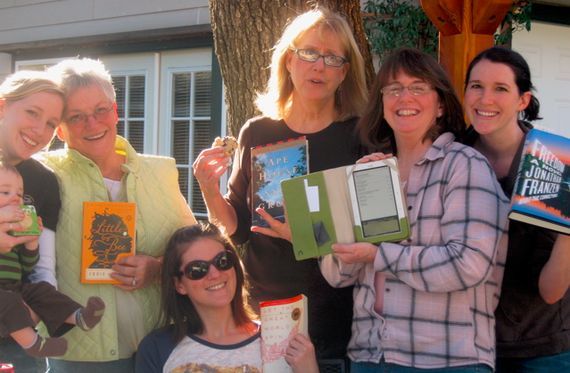
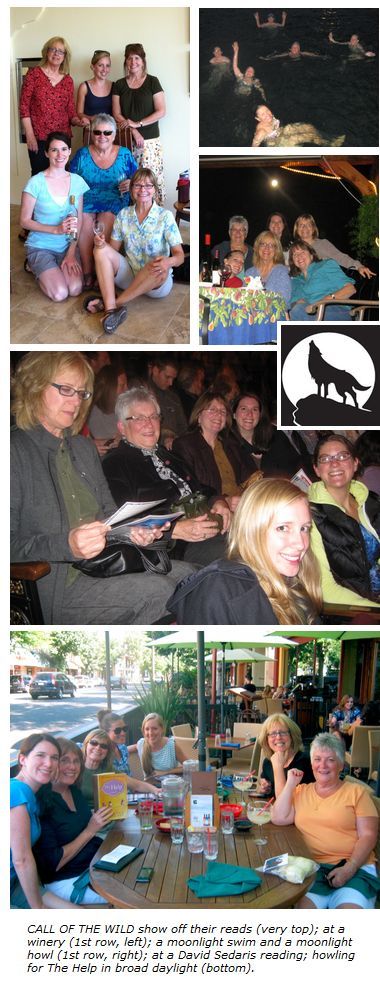
A FULL MOON, the howl of a wolf, and a deep thirst for books (and wine) inspired the name of this group from Sacramento, California.
Tell us how you got your name.
Our first gathering found us dining outside on a deck with a full autumn moon overhead. We had just reached an impasse in christening our book club with a grand moniker.
Suddenly, from out of nowhere, we heard heavy panting and the footfall of paws. There upon the horizon were two rogue, wolf-like canines seeking a pack (or maybe just two lost dogs).
Then, with a lusty howl ... aw-ooooooo ... an epiphany descended among us.
I feel a Jack London moment coming on...
Yes! And so...with a shiver of recognition for our northern California native Jack London a pack was born—Call Of The Wild (COTW)—a pack of 7, now 6.
Great story! You'd make Jack proud.
Maybe not. We're female-centric—mother, daughters, aunt, nieces, ex-in-law, outlaw and a world traveler. We wouldn't allow Jack London in as a member. We don't even allow our own husbands...though they tried to crash our meetings when they saw how much fun we have.
You won't let the poor guys in?
No, but they started their own "man club" just to get even!
Okay. So what have you been reading?
Here's what we've read over the past year:
Member Of The Wedding
Tender Is The Night
Language Of Flowers
Cutting For Stone
The Sisters Brothers
Gone Girl
Light Between Oceans
Then Again (Diane Keaton)
How It All Began
Father Of The Rain
Fall On Your Knees
Life Of Pi
How about some all-time favorites?
Day the Falls Stood Still—great characters and our first book club book.
Book Thief—sparked a lot of emotion
To Kill a Mockingbird—a classic.
The Sisters Brothers—different from anything we've read; a western theme and adventure.
The Help—great characters and story.
A Tree Grows In Brooklyn—we have a soft spot for the classics.
Immortal Life of Henrietta Lacks—we all found the book well written and interesting. One member who works in the medical field learned something new and asked the physicians she worked with and none of them knew the significance of Hela Cells. They were impressed with the story.
Any disappointments?
We've had a few books disappoint us.
Freedom—great reviews but hard to care about the characters and what happened to them.
Tender Is the Night—the writing didn't really stand the test of time.
Cutting for Stone—a long slow read. Some members didn't finish
Hitchhiker’s Guide to the Galaxy—too drawn out for most of us.
You pull your books out of a hat, so to speak.
Yes. Every several months, we all toss our recommendation into a hat. Then, at every meeting, we pull out our selection for the following meeting. Once we choose the last title, we come to the next meeting with more recommendations.
Any rules?
Like any good pack, we have an Alpha Reader. She makes executive decisions when we're too indecisive. And, being a pack, we don't care for "sad dog stories."
How about special activities?
Occasionally we invite our young “cubs” to the meetings. We've had a moonlight cruise and swim, visited a winery, and attended a David Sedaris reading and an edgy fashion show. We like to watch movies of the books we read...as well as plan our meals around book themes.
Overall, how would you describe Call of the Wild?
Fun, easy going, culture current, eclectic, beautiful, smart and wine lovin'... aw-ooooooooo!!!!
|
Calling Me Home |
|
 
* * *
|
|


Calling Me Home
Julie Kibler, 2013
St. Martin's Press
336 pp.
ISBN-13: 9781250014528
Summary
Calling Me Homeby Julie Kibler is a soaring debut interweaving the story of a heartbreaking, forbidden love in 1930s Kentucky with an unlikely modern-day friendship
Eighty-nine-year-old Isabelle McAllister has a favor to ask her hairdresser Dorrie Curtis. It's a big one. Isabelle wants Dorrie, a black single mom in her thirties, to drop everything to drive her from her home in Arlington, Texas, to a funeral in Cincinnati. With no clear explanation why. Tomorrow.
Dorrie, fleeing problems of her own and curious whether she can unlock the secrets of Isabelle's guarded past, scarcely hesitates before agreeing, not knowing it will be a journey that changes both their lives.
Over the years, Dorrie and Isabelle have developed more than just a business relationship. They are friends. But Dorrie, fretting over the new man in her life and her teenage son’s irresponsible choices, still wonders why Isabelle chose her.
Isabelle confesses that, as a willful teen in 1930s Kentucky, she fell deeply in love with Robert Prewitt, a would-be doctor and the black son of her family's housekeeper—in a town where blacks weren’t allowed after dark. The tale of their forbidden relationship and its tragic consequences makes it clear Dorrie and Isabelle are headed for a gathering of the utmost importance and that the history of Isabelle's first and greatest love just might help Dorrie find her own way. (From the publisher.)
Read an excerpt.
Author Bio
Julie Kibler began writing Calling Me Home after learning a bit of family lore—as a teen, her paternal grandmother fell in love with a young black man, but their families tore them apart. Then, while digging into the past, she discovered her father’s hometown had signs at the city limits warning blacks to be gone by sundown.
Julie grew up in various towns in Kentucky, New Mexico, and Colorado, then moved to Texas to attend college and stayed because even the strangers were friendly. Aside from writing, she is a freelance editor and tries to keep up with her teenagers and a couple of shelter dogs who don't always appreciate their rescue. She enjoys reading, indie films, folk music, photography and splitting chocolatey desserts with her husband, an engineer who doesn't understand writers, but understands chocolate.
She is currently writing her next novel and blogs regularly with five other women writers, all transplants to North Texas, at What Women Write. Her short memoir, "Final Sale on tires," a true story about her relationship with her other grandmother, appeared in Perigee (Issue 21, July 2008). (From the author's website.)
Book Reviews
Kibler, in alternating first-person narrations, delivers a rousing debut about forbidden love and unexpected friendships over the span of six decades.... [Isabelle,] a woman in her 80s... reveals her former childhood of white privilege in a prejudiced Southern town and her love affair with her maid’s brother, Robert, a black man.... In this compelling tale, Kibler handles decades of race relations with sensitivity and finds a nice balance between the characters.... Drawing from her own family history in Texas, Kibler relays a familiar story in a fresh way.
Publishers Weekly
This is deeply affecting coming-of-age story with radiant characters who will remain with the reader long after the last page is turned.
Romantic Times
In Calling Me Home, Kibler has crafted a wholly original debut.... There’s no denying the pull of Kibler’s story.
Booklist
From East Texas to Cincinnati, from present-day racism to 1930s segregation, Isabelle and Dorrie,...Isabelle's hairdresser for a decade,...have become friends. Yet, when Isabelle asks Dorrie to drive her cross-country... Isabelle's most secret story comes out. Growing up in a town that persecuted blacks...Isabelle was the last young woman the people of Shalerville, Ky., might have expected to fall in love with a black man. The repercussions of their love shattered their lives, their families, their futures.... Kibler's unsentimental eye makes the problems faced unflinchingly by these women ring true. Love and family defy the expected in this engaging tale.
Kirkus Reviews
Discussion Questions
1. When Isabelle first grows close to Robert, is her interest in him genuine, or does it have more to do with disobeying her parents and her society’s constraints? How does their relationship change as it grows?
2. What attracts Isabelle to Robert? What attracts Robert to Isabelle? In what ways do they compliment each other?
3. Were there moments during their courtship that you, as a reader, felt that they should not continue their relationship because of the risks?
4. What is the most important thing that Isabelle’s story teaches Dorrie? How does she apply Isabelle’s lessons to her relationship with Teague?
5. How do you feel about Dorrie’s choices in dealing with her son’s troubles?
6. What makes Dorrie and Isabelle’s friendship unique? How did you feel about the way they each reacted to others’ assumptions about them?
7. Do you feel that Calling Me Home accurately portrayed today’s lingering racial injustices and resentments?
8. Do you have any sympathy for Isabelle’s mother? What about for Isabelle’s father?
9. How did you feel when you discovered Robert’s fate? Were you surprised to learn whose funeral Isabelle and Dorrie were attending?
(Questions courtesy of the author.)
The Camel Bookmobile
Masha Hamilton, 2007
HarperCollins
336 pp.
ISBN-13: 9780061173493
Summary
Fiona Sweeney wants to do something that matters, and she chooses to make her mark in the arid bush of northeastern Kenya. By helping to start a traveling library, she hopes to bring the words of Homer, Hemingway, and Dr. Seuss to far-flung tiny communities where people live daily with drought, hunger, and disease.
Her intentions are honorable, and her rules are firm: due to the limited number of donated books, if any one of them is not returned, the bookmobile will not return. But, encumbered by her Western values, Fi does not understand the people she seeks to help.
And in the impoverished small community of Mididima, she finds herself caught in the middle of a volatile local struggle when the bookmobile's presence sparks a dangerous feud between the proponents of modernization and those who fear the loss of traditional ways. (From the publisher.)
Author Bio
• Birth—1957
• Where—N/A
• Education—B.A., Brown University
• Currently—lives in Brooklyn, New York, USA
Masha Hamilton is a journalist who has worked for NBC Mutual Radio, the Los Angeles Times, the Associated Press, and other well-known news organizations, Masha Hamilton is the author of The Distance Between Us and Staircase of a Thousand Steps and The Camel Bookmobile. She lives with her family in New York City in (From the publisher.)
More
Hamilton worked as a foreign correspondent for The Associated Press for five years in the Middle East, where she covered the intefadeh, the peace process and the partial Israeli withdrawal from Lebanon. Then she spent five years in Moscow, where she was a correspondent for the Los Angeles Times, wrote a newspaper column, "Postcard from Moscow," and reported for NBC/Mutual Radio. She wrote about Kremlin politics as well as life for average Russians under Gorbachev and Yeltsin during the coup and collapse of the Soviet Union. She reported from Afghanistan in 2004, and in 2006 she traveled in Kenya to research The Camel Bookmobile and to interview street kids in Nairobi and drought and famine victims in the isolated northeast.
A Brown University graduate, she has been awarded fiction fellowships from Yaddo, Blue Mountain Center, Squaw Valley Community of Writers and the Arizona Commission on the Arts. She teaches for Gotham Writers' Workshop and has also taught at the 92nd Street Y in New York City and at a number of writers' workshops around the country.
She is a licensed shiatsu practitioner and is currently studying nuad phaen boran, Thai traditional massage. She lives with her husband and three children in Brooklyn. (From the author's website.)
Book Reviews
Hamilton's narrative instinct prevails, and a welcome complexity develops as Fi begins to realize that the delivery of books isn't an entirely benign enterprise. When the disfigured boy simply refuses to return his books, his rebellion gives rise to a serious rift that affects not only his family and the tribal elders but Fi herself. An unreturned library book hardly seems like the stuff of massive conflict, but Hamilton makes us see how much is really at stake in a poverty-stricken place where every possession carries the weight of significance. A larger conflict wouldn't do justice to the notion of honor as lived by these people: it extends all the way down to the smallest stack of books.
Clair Dederer - New York Times Book Review
Hamilton's captivating third novel (after 2004's The Distance Between Us) follows Fiona Sweeney, a 36-year-old librarian, from New York to Garissa, Kenya, on her sincere but naïve quest to make a difference in the world. Fi enlists to run the titular mobile library overseen by Mr. Abasi, and in her travels through the bush, the small village of Mididima becomes her favorite stop. There, Matani, the village teacher; Kanika, an independent, vivacious young woman; and Kanika's grandmother Neema are the most avid proponents of the library and the knowledge it brings to the community. Not everyone shares such esteem for the project, however. Taban, known as Scar Boy; Jwahir, Matani's wife; and most of the town elders think these books threaten the tradition and security of Mididima. When two books go missing, tensions arise between those who welcome all that the books represent and those who prefer the time-honored oral traditions of the tribe. Kanika, Taban and Matani become more vibrant than Fi, who never outgrows the cookie-cutter mold of a woman needing excitement and fulfillment, but Hamilton weaves memorable characters and elemental emotions in artful prose with the lofty theme of Western-imposed "education" versus a village's perceived perils of exposure to the developed world.
Publishers Weekly
New York City librarian Fiona Sweeney has taken an unusual assignment in Kenya, running a bookmobile service powered by camel and serving isolated, seminomadic villages like Mididima, where teenaged library customer Kanika lives with her grandmother, Neema. Taban, a young man severely scarred as a toddler by a hyena, is shunned by most of the community, but he and Kanika share a friendship and a sweet anticipation of Sweeney's every visit. Matani, Mididima's schoolmaster, is a champion of the service, but even he can't do anything when several missing books threaten the village's reputation and set off a chain of events that expose misguided motives, hidden agendas, illicit romance, and tragedy. This third novel from international journalist Hamilton (The Distance Between Us) presents a rare and balanced perspective on issues surrounding cultural intrusion and the very meaning and necessity of literacy, using rich and evocative prose that skillfully exposes the stark realities of poverty and charity in today's Africa. Highly recommended for any fiction collection.
Jenn B. Stidham - Library Journal
(Starred review.) With a heartfelt appreciation for the potential of literature to transcend cultural divides, Hamilton has created a poignant, ennobling, and buoyant tale of risks and rewards, surrender and sacrifice.
Booklist
Discussion Questions
Use our LitLovers Book Club Resources; they can help with discussions for any book:
• How to Discuss a Book (helpful discussion tips)
• Generic Discussion Questions—Fiction and Nonfiction
• Read-Think-Talk (a guided reading chart)
Also consider these LitLovers talking points to help get a discussion started for The Camel Bookmobile:
1. Talk about the resentment toward the bookmobile on the part of some of the villagers. What prompted it and are those fears/resentments justified.
2. What about Scar Boy, perhaps the story's most complex character? In an interview with the American Library Association, Hamilton says Scar Boy almost wrote himself. What motivates him?
3. Can literacy and literature truly be destructive to a tribal culture? How might both traditional ways and modernity be blended to the benefit of all? Is that possible?
4. For those interested in donating books to the bookmobile in Kenya, go to the Camel Book Drive website.
(Questions by LitLovers. Please feel free to use them, online or off, with attribution. Thanks.)
top of page (summary)


Camino Island
John Grisham, 2017
Knopf Doubleday
304 pp.
ISBN-13: 9780385543026
Summary
A gang of thieves stage a daring heist from a secure vault deep below Princeton University’s Firestone Library. Their loot is priceless, but Princeton has insured it for twenty-five million dollars.
Bruce Cable owns a popular bookstore in the sleepy resort town of Santa Rosa on Camino Island in Florida. He makes his real money, though, as a prominent dealer in rare books. Very few people know that he occasionally dabbles in the black market of stolen books and manuscripts.
Mercer Mann is a young novelist with a severe case of writer’s block who has recently been laid off from her teaching position. She is approached by an elegant, mysterious woman working for an even more mysterious company. A generous offer of money convinces Mercer to go undercover and infiltrate Bruce Cable’s circle of literary friends, ideally getting close enough to him to learn his secrets.
But eventually Mercer learns far too much, and there’s trouble in paradise as only John Grisham can deliver it. (From the publisher.)
Author Bio
• Birth—February 8, 1955
• Where—Jonesboro, Arkansas, USA
• Education—B.S., Mississippi State; J.D., University of Mississippi
• Currently—lives in Oxford, Mississippi and Albermarle, Virginia
John Ray Grisham, Jr. is an American lawyer, politician, and author, best known for his popular legal thrillers. He has written more than 25 novels, a short story collection (Ford County), two works of nonfiction, and a children's series.
Grisham's first bestseller was The Firm. Released in 1991, it sold more than seven million copies. The book was later adapted into a feature film, of the same name starring Tom Cruise in 1993, and a TV series in 2012 which "continues the story of attorney Mitchell McDeere and his family 10 years after the events of the film and novel." Eight of his other novels have also been adapted into films: The Chamber, The Client, A Painted House, The Pelican Brief, Skipping Christmas, The Rainmaker, The Runaway Jury, and his first novel, A Time to Kill. His books have been translated into 29 languages and published worldwide.
As of 2008, his books had sold over 250 million copies worldwide. Grisham is one of only three authors to sell two million copies on a first printing; the others are Tom Clancy and J.K. Rowling.
Early life and education
Grisham, the second oldest of five siblings, was born in Jonesboro, Arkansas, to Wanda Skidmore Grisham and John Grisham. His father was a construction worker and cotton farmer; his mother a homemaker. When Grisham was four years old, his family started traveling around the South, until they finally settled in Southaven in DeSoto County, Mississippi. As a child, Grisham wanted to be a baseball player. neither of his parents had advanced education, he was encouraged to read and prepare for college.
As a teenager, Grisham worked for a nursery watering bushes for $1.00 an hour. He was soon promoted to a fence crew for $1.50 an hour. At 16, Grisham took a job with a plumbing contractor. Through a contact of his father, he managed to find work on a highway asphalt crew in Mississippi at the age of 17.
It was during this time that an unfortunate incident made him think more seriously about college. A fight broke out among the crew with gunfire, and Grisham ran to the restroom for safety. He did not come out until after the police had "hauled away rednecks." He hitchhiked home and started thinking about college.
His next work was in retail, as a salesclerk in a department store men's underwear section, which he described as "humiliating." He decided to quit but stayed when he was offered a raise. He was given another raise after asking to be transferred to toys and then to appliances. A confrontation with a company spy posing as a customer convinced him to leave the store. By this time, Grisham was halfway through college.
He went to the Northwest Mississippi Community College in Senatobia, Mississippi and later attended Delta State University in Cleveland. Grisham drifted so much during his time at the college that he changed colleges three times before completing a degree. He graduated from Mississippi State University in 1977, receiving a BS degree in accounting.
He later enrolled in the University of Mississippi School of Law planning to become a tax lawyer. But he was soon overcome by "the complexity and lunacy" of it. He decided to return to his hometown as a trial lawyer, but his interest shifted to general civil litigation. He graduated in 1983 with a JD degree.
Law and politics
Grisham practiced law for about a decade and also won election as a Democrat in the Mississippi House of Representatives from 1983 to 1990 at an annual salary of $8,000. By his second term at the Mississippi state legislature, he was the vice-chairman of the Apportionment and Elections Committee and a member of several other committees.
With the success of his second book The Firm, published in 1991, Grisham gave up practicing law. He returned briefly in 1996 to fight for the family of a railroad worker who had been killed on the job. It was a commitment made to the family before leaving law to become a full-time writer. Grisham successfully argued his clients' case, earning them a jury award of $683,500—the biggest verdict of his career.
Writing
Grisham said that, sometime in the mid-1980s, he had been hanging around the court one day when he overheard a 12-year-old girl telling the jury how she been beaten and raped. Her story intrigued Grisham, so he began to watch the trial, noting how members of the jury wept during her testimony. It was then, Grisham later wrote in the New York Times, that a story was born. Musing over "what would have happened if the girl's father had murdered her assailants," Grisham took three years to complete his first book, A Time to Kill.
Finding a publisher was not easy. The book was rejected by 28 publishers before Wynwood Press, an unknown publisher, agreed to give it a modest 5,000-copy printing. It was published in June 1989. The day after Grisham completed A Time to Kill, he began work on his second novel, the story of an ambitious young attorney "lured to an apparently perfect law firm that was not what it appeared." The Firm remained on the the New York Times' bestseller list for 47 weeks and became the bestselling novel of 1991.
Beginning with A Painted House in 2001, the author broadened his focus from law to the more general rural South, but continued to write legal thrillers. He has also written sports fiction and comedy fiction.
In 2005, Grisham received the Peggy V. Helmerich Distinguished Author Award. The award is presented annually by the Tulsa Library Trust.
In 2010, Grisham started writing legal thrillers for children 9-12 years old. The books featured Theodore Boone, a 13-year-old boy, who gives his classmates legal advice—everything from rescuing impounded dogs to helping their parents prevent their house from being repossessed. His daughter, Shea, inspired him to write the Boone series.
Marriage and family
Grisham married Renee Jones in 1981, and the couple have two grown children together, Shea and Ty. The family spends their time in their Victorian home on a farm outside Oxford, Mississippi, and their other home near Charlottesville, Virginia.
The Innocence Project
Grisham is a member of the Board of Directors of The Innocence Project, which campaigns to free unjustly convicted people on the basis of DNA evidence. The Innocence Project argues that wrongful convictions are not isolated or rare events but instead arise from systemic defects. Grisham has testified before Congress on behalf of the Project and appeared on Dateline on NBC, Bill Moyers Journal on PBS, and other programs. He also wrote for the New York Times in 2013 about an unjustly held prisoner at Guantanamo.
Libel suit
In 2007, former legal officials from Oklahoma filed a civil suit for libel against Grisham and two other authors. They claimed that Grisham and the others critical of Peterson and his prosecution of murder cases conspired to commit libel and generate publicity for themselves by portraying the plaintiffs in a false light and intentionally inflicting emotional distress. Grisham was named due to his publication of the non-fiction book, The Innocent Man. He examined the faults in the investigation and trial of defendants in the murder of a cocktail waitress in Ada, Oklahoma, and the exoneration by DNA evidence more than 12 years later of wrongfully convicted defendants Ron Williamson and Dennis Fritz. The judge dismissed the libel case after a year, saying, "The wrongful convictions of Ron Williamson and Dennis Fritz must be discussed openly and with great vigor."
Misc.
The Mississippi State University Libraries maintains the John Grisham Room, an archive containing materials related to his writings and to his tenure as Mississippi State Representative.
Grisham has a lifelong passion for baseball demonstrated partly by his support of Little League activities in both Oxford, Mississippi, and Charlottesville, Virginia. He wrote the original screenplay for and produced the 2004 baseball movie Mickey, starring Harry Connick, Jr. He remains a fan of Mississippi State University's baseball team and wrote about his ties to the university and the Left Field Lounge in the introduction for the book Dudy Noble Field: A Celebration of MSU Baseball.
In an October 2006 interview on the Charlie Rose Show, Grisham stated that he usually takes only six months to write a book and that his favorite author is John le Carre. (Adapted from Wikipedia. Retrieved 10/6/2013.)
Book Reviews
If parts of Camino Island feel like Grisham phoned it in, the bulk of it makes you think the author had a rip-snorting time writing it. I certainly did reading it. The story kicks off in high gear with a heist of priceless manuscripts from Princeton…. The stunt is so ingenious it’s impossible not to find yourself on the side of the crooks, rooting for them to pull it off. READ MORE …
Philip J. Adler - LitLovers
Sometimes, though, Grisham gets a bit too relaxed, letting his dialogue become both simplistic and florid.… Yet these flaws don’t impede the jolly appeal of the novel’s storytelling. Grisham has said that he and his wife dreamed up Camino Island during a long car ride to Florida, and the book provides the pleasure of a leisurely jaunt periodically jolted into high gear, just for the fun and speed of it.
Ken Tucker - New York Times Book Review
[A] fresh, fun departure from his normal fare. Oh, don’t worry, Grisham-ites. Smart plotting, clever criminals and law-enforcement types are all here, but this one stays out of the courtroom. Instead, we go into the inner sanctums of … bookstores. Say what? Sheer catnip for book critics like me, and I think readers who don’t usually gravitate to Grisham will get a kick out of Camino Island.
USA Today
A theft of priceless books from a library, a book dealer who dabbles in the black market of stolen manuscripts, and a novelist who is recruited for a daring mission all add up to what sounds like the ideal beach read.
Library Journal
A light caper turns into a multilayered game of cat and mouse in a story that, as with most of Grisham's crime yarns, never gets too complex or deep but is entertaining all the same.…How all these little threads join up is a pleasure for Grisham fans to behold: there's nothing particularly surprising about it, but he's a skillful spinner of mayhem and payback.
Kirkus Reviews
Discussion Questions
(We'll add specific questions if and when they're made available by the publisher. In the meantime, use our Generic Mystery Questions.)
GENERIC DISCUSSION QUESTIONS
Mystery / Crime / Suspense Thrillers
1. Talk about the characters, both good and bad. Describe their personalities and motivations. Are they fully developed and emotionally complex? Or are they flat, one-dimensional heroes and villains?
2. What do you know...and when do you know it? At what point in the book do you begin to piece together what happened?
3. Good crime writers embed hidden clues in plain sight, slipping them in casually, almost in passing. Did you pick them out, or were you...clueless? Once you've finished the book, go back to locate the clues hidden in plain sight. How skillful was the author in burying them?
4. Good crime writers also tease us with red-herrings—false clues—to purposely lead readers astray? Does your author try to throw you off track? If so, were you tripped up?
5. Talk about the twists & turns—those surprising plot developments that throw everything you think you've figured out into disarray.
- Do they enhance the story, add complexity, and build suspense?
- Are they plausible or implausible?
- Do they feel forced and gratuitous—inserted merely to extend the story?
6. Does the author ratchet up the suspense? Did you find yourself anxious—quickly turning pages to learn what happened? A what point does the suspense start to build? Where does it climax...then perhaps start rising again?
7. A good ending is essential in any mystery or crime thriller: it should ease up on tension, answer questions, and tidy up loose ends. Does the ending accomplish those goals?
- Is the conclusion probable or believable?
- Is it organic, growing out of clues previously laid out by the author (see Question 3)?
- Or does the ending come out of the blue, feeling forced or tacked-on?
- Perhaps it's too predictable.
- Can you envision a different or better ending?
8. Are there certain passages in the book—ideas, descriptions, or dialogue—that you found interesting or revealing...or that somehow struck you? What lines, if any, made you stop and think?
9. Overall, does the book satisfy? Does it live up to the standards of a good crime story or suspense thriller? Why or why not?
(Generic Mystery Questions by LitLovers. Please feel free to use them, online or off, with attribution. Thanks.)
top of page (summary)

Camino Winds
John Grisham, 2020
Knopf Doubleday
304 pp.
ISBN-13: 978038554593
Summary
Welcome back to Camino Island, where anything can happen—even a murder in the midst of a hurricane, which might prove to be the perfect crime.
Just as Bruce Cable’s Bay Books is preparing for the return of bestselling author Mercer Mann, Hurricane Leo veers from its predicted course and heads straight for the island.
Florida’s governor orders a mandatory evacuation, and most residents board up their houses and flee to the mainland, but Bruce decides to stay and ride out the storm.
The hurricane is devastating: homes and condos are leveled, hotels and storefronts ruined, streets flooded, and a dozen people lose their lives. One of the apparent victims is Nelson Kerr, a friend of Bruce’s and an author of thrillers.
But the nature of Nelson’s injuries suggests that the storm wasn’t the cause of his death: He has suffered several suspicious blows to the head.
Who would want Nelson dead?
The local police are overwhelmed in the aftermath of the storm and ill equipped to handle the case. Bruce begins to wonder if the shady characters in Nelson’s novels might be more real than fictional. And somewhere on Nelson’s computer is the manuscript of his new novel.
Could the key to the case be right there—in black and white? As Bruce starts to investigate, what he discovers between the lines is more shocking than any of Nelson’s plot twists—and far more dangerous.
Camino Winds is an irresistible romp and a perfectly thrilling beach read—# 1 bestselling author John Grisham at his beguiling best. (From the publisher.)
Author Bio
• Birth—February 8, 1955
• Where—Jonesboro, Arkansas, USA
• Education—B.S., Mississippi State; J.D., University of Mississippi
• Currently—lives in Oxford, Mississippi and Albermarle, Virginia
John Ray Grisham, Jr. is an American lawyer, politician, and author, best known for his popular legal thrillers. He has written more than 25 novels, a short story collection (Ford County), two works of nonfiction, and a children's series.
Grisham's first bestseller was The Firm. Released in 1991, it sold more than seven million copies. The book was later adapted into a feature film, of the same name starring Tom Cruise in 1993, and a TV series in 2012 which "continues the story of attorney Mitchell McDeere and his family 10 years after the events of the film and novel." Eight of his other novels have also been adapted into films: The Chamber, The Client, A Painted House, The Pelican Brief, Skipping Christmas, The Rainmaker, The Runaway Jury, and his first novel, A Time to Kill. His books have been translated into 29 languages and published worldwide.
As of 2008, his books had sold over 250 million copies worldwide. Grisham is one of only three authors to sell two million copies on a first printing; the others are Tom Clancy and J.K. Rowling.
Early life and education
Grisham, the second oldest of five siblings, was born in Jonesboro, Arkansas, to Wanda Skidmore Grisham and John Grisham. His father was a construction worker and cotton farmer; his mother a homemaker. When Grisham was four years old, his family started traveling around the South, until they finally settled in Southaven in DeSoto County, Mississippi. As a child, Grisham wanted to be a baseball player. neither of his parents had advanced education, he was encouraged to read and prepare for college.
As a teenager, Grisham worked for a nursery watering bushes for $1.00 an hour. He was soon promoted to a fence crew for $1.50 an hour. At 16, Grisham took a job with a plumbing contractor. Through a contact of his father, he managed to find work on a highway asphalt crew in Mississippi at the age of 17.
It was during this time that an unfortunate incident made him think more seriously about college. A fight broke out among the crew with gunfire, and Grisham ran to the restroom for safety. He did not come out until after the police had "hauled away rednecks." He hitchhiked home and started thinking about college.
His next work was in retail, as a salesclerk in a department store men's underwear section, which he described as "humiliating." He decided to quit but stayed when he was offered a raise. He was given another raise after asking to be transferred to toys and then to appliances. A confrontation with a company spy posing as a customer convinced him to leave the store. By this time, Grisham was halfway through college.
He went to the Northwest Mississippi Community College in Senatobia, Mississippi and later attended Delta State University in Cleveland. Grisham drifted so much during his time at the college that he changed colleges three times before completing a degree. He graduated from Mississippi State University in 1977, receiving a BS degree in accounting.
He later enrolled in the University of Mississippi School of Law planning to become a tax lawyer. But he was soon overcome by "the complexity and lunacy" of it. He decided to return to his hometown as a trial lawyer, but his interest shifted to general civil litigation. He graduated in 1983 with a JD degree.
Law and politics
Grisham practiced law for about a decade and also won election as a Democrat in the Mississippi House of Representatives from 1983 to 1990 at an annual salary of $8,000. By his second term at the Mississippi state legislature, he was the vice-chairman of the Apportionment and Elections Committee and a member of several other committees.
With the success of his second book The Firm, published in 1991, Grisham gave up practicing law. He returned briefly in 1996 to fight for the family of a railroad worker who had been killed on the job. It was a commitment made to the family before leaving law to become a full-time writer. Grisham successfully argued his clients' case, earning them a jury award of $683,500—the biggest verdict of his career.
Writing
Grisham said that, sometime in the mid-1980s, he had been hanging around the court one day when he overheard a 12-year-old girl telling the jury how she been beaten and raped. Her story intrigued Grisham, so he began to watch the trial, noting how members of the jury wept during her testimony. It was then, Grisham later wrote in the New York Times, that a story was born. Musing over "what would have happened if the girl's father had murdered her assailants," Grisham took three years to complete his first book, A Time to Kill.
Finding a publisher was not easy. The book was rejected by 28 publishers before Wynwood Press, an unknown publisher, agreed to give it a modest 5,000-copy printing. It was published in June 1989. The day after Grisham completed A Time to Kill, he began work on his second novel, the story of an ambitious young attorney "lured to an apparently perfect law firm that was not what it appeared." The Firm remained on the the New York Times' bestseller list for 47 weeks and became the bestselling novel of 1991.
Beginning with A Painted House in 2001, the author broadened his focus from law to the more general rural South, but continued to write legal thrillers. He has also written sports fiction and comedy fiction.
In 2005, Grisham received the Peggy V. Helmerich Distinguished Author Award. The award is presented annually by the Tulsa Library Trust.
In 2010, Grisham started writing legal thrillers for children 9-12 years old. The books featured Theodore Boone, a 13-year-old boy, who gives his classmates legal advice—everything from rescuing impounded dogs to helping their parents prevent their house from being repossessed. His daughter, Shea, inspired him to write the Boone series.
Marriage and family
Grisham married Renee Jones in 1981, and the couple have two grown children together, Shea and Ty. The family spends their time in their Victorian home on a farm outside Oxford, Mississippi, and their other home near Charlottesville, Virginia.
The Innocence Project
Grisham is a member of the Board of Directors of The Innocence Project, which campaigns to free unjustly convicted people on the basis of DNA evidence. The Innocence Project argues that wrongful convictions are not isolated or rare events but instead arise from systemic defects. Grisham has testified before Congress on behalf of the Project and appeared on Dateline on NBC, Bill Moyers Journal on PBS, and other programs. He also wrote for the New York Times in 2013 about an unjustly held prisoner at Guantanamo.
Libel suit
In 2007, former legal officials from Oklahoma filed a civil suit for libel against Grisham and two other authors. They claimed that Grisham and the others critical of Peterson and his prosecution of murder cases conspired to commit libel and generate publicity for themselves by portraying the plaintiffs in a false light and intentionally inflicting emotional distress. Grisham was named due to his publication of the non-fiction book, The Innocent Man. He examined the faults in the investigation and trial of defendants in the murder of a cocktail waitress in Ada, Oklahoma, and the exoneration by DNA evidence more than 12 years later of wrongfully convicted defendants Ron Williamson and Dennis Fritz. The judge dismissed the libel case after a year, saying, "The wrongful convictions of Ron Williamson and Dennis Fritz must be discussed openly and with great vigor."
Misc.
The Mississippi State University Libraries maintains the John Grisham Room, an archive containing materials related to his writings and to his tenure as Mississippi State Representative.
Grisham has a lifelong passion for baseball demonstrated partly by his support of Little League activities in both Oxford, Mississippi, and Charlottesville, Virginia. He wrote the original screenplay for and produced the 2004 baseball movie Mickey, starring Harry Connick, Jr. He remains a fan of Mississippi State University's baseball team and wrote about his ties to the university and the Left Field Lounge in the introduction for the book Dudy Noble Field: A Celebration of MSU Baseball.
In an October 2006 interview on the Charlie Rose Show, Grisham stated that he usually takes only six months to write a book and that his favorite author is John le Carre. (Adapted from Wikipedia. Retrieved 10/6/2013.)
Book Reviews
If Camino Winds is breezy, that’s mostly because its plot involves a ferocious hurricane. This is a Camino book with elements of a more traditional Grisham thriller thrown in…. Camino Winds turns out to have a more serious, issue-oriented [plot].… [T]the island, the bookstore and the heroine [of Camino Island]… are missed…. [Camino Winds] was intended as escapist entertainment, but its timing unavoidably gives it a different resonance.
Janet Maslin - New York Times Book Review
The plot is light, and thin, and often obvious, despite some unexpected twists, but Mr. Grisham is an irresistible writer. His prose is fluent and gorgeous, and he has an ability to end each segment with a terse sentence than makes it all but impossible not to turn the page.
Pittsburgh Post Gazette
The murder of popular thriller writer Nelson Kerr during a hurricane drives bestseller Grisham’s exciting follow-up to 2017’s Camino Island.…Grisham peoples the intriguing, elaborate plot with a winsome ensemble of distinguished authors and booklovers.
Publishers Weekly
Grisham’s tale unfolds at a leisurely pace, never breaking into a sweat, and if the bad guys seem a touch too familiar, the rest of the cast make a varied and believable lot…. A pleasure for Grisham fans and an undemanding addition to the beach bag.
Kirkus Reviews
Discussion Questions
We'll add publisher questions if and when they're available; in the meantime, please use our GENERIC MYSTERY QUESTIONS to start a discussion for CAMINO WINDS … then take off on your own:
GENERIC DISCUSSION QUESTIONS
Mystery / Crime / Suspense Thrillers
1. Talk about the characters, both good and bad. Describe their personalities and motivations. Are they fully developed and emotionally complex? Or are they flat, one-dimensional heroes and villains?
2. What do you know...and when do you know it? At what point in the book do you begin to piece together what happened?
3. Good crime writers embed hidden clues in plain sight, slipping them in casually, almost in passing. Did you pick them out, or were you...clueless? Once you've finished the book, go back to locate the clues hidden in plain sight. How skillful was the author in burying them?
4. Good crime writers also tease us with red-herrings—false clues—to purposely lead readers astray? Does your author try to throw you off track? If so, were you tripped up?
5. Talk about the twists & turns—those surprising plot developments that throw everything you think you've figured out into disarray.
- Do they enhance the story, add complexity, and build suspense?
- Are they plausible or implausible?
- Do they feel forced and gratuitous—inserted merely to extend the story?
6. Does the author ratchet up the suspense? Did you find yourself anxious—quickly turning pages to learn what happened? A what point does the suspense start to build? Where does it climax...then perhaps start rising again?
7. A good ending is essential in any mystery or crime thriller: it should ease up on tension, answer questions, and tidy up loose ends. Does the ending accomplish those goals?
- Is the conclusion probable or believable?
- Is it organic, growing out of clues previously laid out by the author (see Question 3)?
- Or does the ending come out of the blue, feeling forced or tacked-on?
- Perhaps it's too predictable.
- Can you envision a different or better ending?
8. Are there certain passages in the book—ideas, descriptions, or dialogue—that you found interesting or revealing...or that somehow struck you? What lines, if any, made you stop and think?
9. Overall, does the book satisfy? Does it live up to the standards of a good crime story or suspense thriller? Why or why not?
(Generic Mystery Questions by LitLovers. Please feel free to use them, online or off, with attribution. Thanks.)


Camp
Elaine Wolf, 2012
Sky Pony Express
259 pp.
9781632204226
Summary
Amy Becker’s mother holds a dark secret. In fact, her whole past is a secret.
All Amy knows is that her mother came from Germany—and that her mother doesn’t love her. That icy voice. Those rigid rules of how to eat, dress, walk, talk, and think. No matter what Amy does, no matter how much she follows the rules, she just can’t earn her mother’s love.
But everything changes that summer of 1963, when fourteen-year-old Amy is sent to Camp Takawanda for Girls. Takawanda, where all the rules get broken. Takawanda, where mean girls practice bullying as if it were a sport. Takawanda, where Amy’s cousin unveils the truth about Amy’s mother, setting in motion a tragic event that changes Amy and her family forever.
Author Bio
• Birth—1948
• Raised—Great Neck, New York, USA
• Education—B.A., M.A., New York University
• Currently—lives in Los Angeles, California
Known as “the anti-bullying novelist,” Elaine Wolf writes about what really goes on behind the closed gates and doors of our camps and schools. The issues she explores in her novels are those she is passionate about and knows well.
She was a camper and camp counselor for many summers. When she entered “the real world,” she taught in public schools in California and New York. In her most recent teaching position, she served as a high school reading specialist, and then she became the district language arts chairperson. In that position, Wolf designed and supervised reading and writing programs for students at all grade levels, facilitated reading groups and writers’ workshops, and selected books for classroom libraries as well as for ancillary and summer reading lists.
One of the author’s greatest joys was getting wonderful books into the hands of students, teachers, and parents. In the time before Kindles and iPads, she spent countless hours stocking shelves with “good reads.” And she dreamed of seeing her books on those shelves. Now she is thrilled that Camp and Danny’s Mom are there.
Although critics call her novels “mesmerizing” and "must-reads," what pleases Wolf more than great reviews is the fact that Camp and Danny’s Mom have given her a literal bully pulpit—a platform from which to carry on the anti-bullying conversation so that, in concert with professionals, we will make our camps and schools kinder, more embracing communities for everyone. Wolf is committed to keeping this conversation going until the bullying epidemic ends.
The author and her husband raised their children in Roslyn, New York, where she was a co-facilitator of an adult writers’ workshop. Then they moved to Northampton, Massachusetts, a community brimming with readers, writers, artists, and musicians. Shortly after settling there, Wolf won a prize for short fiction (the perfect welcome for her). Currently, she and her husband live in Los Angeles, California. (From the author.)
Visit the author's website.
Follow Elaine on Facebook.
Book Reviews
Tough to stop reading…rings sadly true.
Booklist
A must-read for teenage girls struggling to enter the adult world.
Children’s Literature
A perfect ten!
VOYA
A beautifully written and important story about bullying and the complexities of the mother-daughter relationship that is a must read!
mompopculture.com
A fascinating, emotional tale. A perfect addition to any reading list.
examiner.com
This book grabs you and shakes you down to your core. It’s rare, unique, and to be treasured. Elaine Wolf deserves tremendous praise for her amazing talent.
UniquelyMoiBooks.com
I refused to stop reading until I had finished Camp.
Nerdy Book Club
There’s something in Camp that will resonate with every reader. This is a story about the horrors of bullying, the bonds of family, the power of memory, and the strength that one can find in the most unlikely places. Get it now.
TheWriteTeachers
An excellent book for mothers and daughters to read together. I would definitely read Elaine Wolf again!
I’dSoRatherBeReading.com
Impossible to put down until you reach the final word.
ratherbereadingblog.com
I loved this book and think it’s suitable for all ages. It should be required reading in schools.
I’d Rather Be Reading At The Beach
Camp is definitely a book that should be read and discussed. It’s intense, surprising, and chock full of emotion.
YAloveblog.com
Discussion Questions
1. The most realistic characters in novels evoke our sympathy at times and our lack of sympathy at other times. When and why do you have sympathy for Amy? And when, if ever, don’t you have sympathy for her? Using this framework, discuss Amy’s mother, her father, and Rory as characters for whom you feel sympathy at some times and a lack of sympathy at others.
2. There are many interesting relationships in Camp. Discuss the relationship between Amy and her mother; the relationship between Amy and her brother, Charlie; Amy and her cousin, Robin; Amy’s father and his brother, Uncle Ed; and Amy’s mother and Uncle Ed.
3. Another interesting relationship is the one between Amy’s mother and father. Why do you think Amy’s father doesn’t stand up to her mother? Is Amy’s father a good father? Why or why not?
4. Why does Amy say she hates her mother? Why does her mother’s accent bother Amy so much? Do you think children of immigrants often feel embarrassed by their parents? If so, why?
5. Even though Amy says she hates her mother, she still seeks her mother’s approval. She wants her mother to think she’s popular, smart, and pretty. Why?
6. Early in the novel, Amy wonders why her mother needs everything to be done in a particular way. “But why this requirement of perfection,” Amy asks herself, “those stupid rules that governed our lives?” Why do you think Amy’s mother imposes this requirement of perfection? What function do her rules serve for her? And why is Amy’s mother obsessed with appearances?
7. The characters in Camp make many choices. What motivates the choices that Amy, her mother, her father, Rory, Erin, Uncle Ed, and Patsy make? While reading, how did you feel about their choices? After reading, do you have new insights about the choices they make?
8. Why does Amy lie in her letters? Why doesn’t she tell anyone what’s really happening at Camp Takawanda? What do you think could have or would have happened had Amy told the truth?
9. At the beginning of the camp season, when Rory threatens Amy with “a special introduction” to the kitchen boys, Amy can’t find her voice. Why can’t she talk back to Rory? What do you think you might have done if you were Amy? What might you have done if you were one of the other campers?
10. Critics call Camp a multi-layered story with many themes. Some say it’s a novel about trying to fit in; others say it’s about secrets; still others write that it’s mainly about bullying. What do you think are the main themes of Camp?
11. Camp has been described as “a story about the collateral damage of secrets.” Which characters hold secrets? What purposes do secrets serve for these characters? What harm is caused by the secrets in this novel?
12. Who are the bullies in Camp? How do they elicit fear and compliance? How do they maintain their power?
13. Why does Rory choose a new target after visiting day? What does that tell us about bullies? Why do you think Amy’s cousin, Robin, sides with Rory?
14. Could Nancy, the head counselor, have stopped the bullying? Should Clarence, who is in charge of the kitchen, have intervened? Is Uncle Ed also to blame? Why doesn’t he take action?
15. Do you think Erin is a good friend to Amy? Why or why not? What are the characteristics of a good friend?
16. There are several recurring sayings or expressions in this story—“everything in its place, and a place for every think,” for example. What are some other repeated sayings? How do they add to your reading of Camp?
17. Discuss the symbolism of Amy’s mother’s metal box, of her perfectly fluffed pillows, and of Amy’s Russian nesting dolls.
18. Camp is often called a coming-of-age novel. By the time Amy leaves camp, she is quite different from how she is when she arrives. What lessons does Amy learn at camp? What does Amy want at the beginning of the summer? What does she want at the end? Does she get what she wants? If so, what price does she pay to attain it?
19. At the end of Camp, we learn about Amy’s mother’s history. Does her background justify the way in which she treats her children? Do you feel differently about Amy’s mother after you know her story? Toward the beginning of Camp, Amy wonders: “Why couldn’t my mother just love us?” What is the answer to that question? And how does Amy come to forgive her mother?
20. There are two epigraphs at the beginning of the novel. One is attributed to William Faulkner: “The past is never dead. It’s not even past.” The other is from Anne Michaels: “My parents' past is mine molecularly.” Discuss these quotes as they relate to Camp.
(Questions courtesy of the author.)
Can You Hear the Nightbird Call?
Anita Rau Badami, 2006
Random House Canada
432 pp.
ISBN-13: 9780676976052
Summary
Set against the tumultuous backdrop of a fragmenting Punjab and moving between Canada and India, Can you Hear the Nightbird Call? charts the interweaving stories of three Indian women – Bibi-ji, Leela and Nimmo – each in search of a resting place amid rapidly changing personal and political landscapes.
The ambitious, defiant Sikh Bibi-ji, born Sharanjeet Kaur in a Punjabi village, steals her sister Kanwar’s destiny, thereby gaining passage to Canada.
Leela Bhat, born to a German mother and a Hindu father, is doomed to walk the earth as a "half-and-half." Leela’s childhood in Bangalore is scarred by her in-between identity and by the great unhappiness of her mother, Rosa, an outcast in their conservative Hindu home. Years after Rosa’s shadowy death, Leela has learned to deal with her in-between status, and she marries Balu Bhat, a man from a family of purebred Hindu Brahmins, thus acquiring status and a tenuous stability. However, when Balu insists on emigrating to Canada, Leela must trade her newfound comfort for yet another beginning. Once in Vancouver with her husband and two children, Leela’s initial reluctance to leave home gradually evolves.
While Bibi-ji gains access to a life of luxury in Canada, her sister Kanwar, left behind to weather the brutal violence of the Partition of India and Pakistan in 1947, is not so fortunate. She disappears, leaving Bibi-ji bereft and guilt-ridden.
Meanwhile, a little girl, who just might be Kanwar’s six-year-old daughter Nimmo, makes her way to Delhi, where she is adopted, marries and goes on to build a life with her loving husband, Satpal. Although this existence is constantly threatened by poverty, Nimmo cherishes it, filled as it is with love and laughter, and she guards it fiercely.
Across the world, Bibi-ji is plagued by unhappiness: she is unable to have a child. She believes that it is her punishment for having stolen her sister’s future, but tries to drown her sorrows by investing all her energies into her increasingly successful restaurant called the Delhi Junction. This restaurant becomes the place where members of the growing Vancouver Indo-Canadian community come to dispute and discuss their pasts, presents and futures.
Over the years, Bibi-ji tries to uncover her sister Kanwar’s fate but is unsuccessful until Leela Bhat – carrying a message from Satpal, Nimmo’s husband – helps Bibi-ji reconnect with the woman she comes to believe is her niece – Nimmo. Used to getting whatever she has wanted from life, Bibi-ji subtly pressures Nimmo into giving up Jasbeer, her oldest child, into her care.
Eight-year old Jasbeer does not settle well in Vancouver. Resentful of his parents’ decision to send him away, he finds a sense of identity only in the stories, of Sikh ancestry, real and imagined, told to him by Bibi-ji’s husband, Pa-ji. Over the years, his childish resentments harden, and when a radical preacher named Dr. Randhawa arrives in Vancouver, preaching the need for a separate Sikh homeland, Jasbeer is easily seduced by his violent rhetoric.
Can You Hear the Nightbird Call? elegantly moves back and forth between the growing desi community in Vancouver and the increasingly conflicted worlds of Punjab and Delhi, where rifts between Sikhs and Hindus are growing. In June 1984, just as political tensions within India begin to spiral out of control, Bibi-ji and Pa-ji decide to make their annual pilgrimage to the Golden Temple in Amritsar, the holiest of Sikh shrines. While they are there, the temple is stormed by Indian government troops attempting to contain Sikh extremists hiding inside the temple compound. The results are devastating.
Then, in October of the same year, Indira Gandhi is murdered by her two Sikh bodyguards, an act of vengeance for the assault on the temple. The assassination sets off a wave of violence against innocent Sikhs.
The tide of anger and violence spills across borders and floods into distant Canada, and into the lives of neighbours Bibi-ji and Leela. Can You Hear the Nightbird Call? weaves together the personal and the political – and beautifully brings the reader into the reality of terrorism and religious intolerance. (From the publisher.)
Author Bio
• Birth—September 24, 1961
• Where—Rourkela, Orissi, India
• Education—B.A., University of Madras; Sophia College
(Bombay); M.A., University of Calgary (Canada)
• Awards—Regional Commonwealth Writers Prize; Premio
Berto (Italy); Marian Engel Award
• Currently—Canada
Anita Rau Badami was born in India in 1961. Although her family’s roots are in southern India, Badami spent most of her life in the north and eastern parts of the country, moving every two to three years because of her father’s job as an officer in the Indian Railway.
She earned a degree in English from the University of Madras, studied journalism at Sophia College in Bombay and then spent many years as a copy-writer, journalist and children’s writer before emigrating to Canada in 1991, following her husband to Calgary, where he had gone to pursue his master’s degree in Environmental Science.
Raising a young son and grappling with Canadian winters, Badami took creative writing courses, which eventually led to her own master’s degree in English Literature. Her thesis at the University of Calgary went on to become her hugely successful first novel, Tamarind Mem, published in 1996. The novel landed her firmly on the map as a talented new Canadian writer to watch.
In 2000, Badami published her second novel, The Hero’s Walk. By then she was living in Vancouver, where the family had moved so that her husband could complete a PhD in Planning. The Hero’s Walk was met with great critical acclaim; it won the Regional Commonwealth Writers Prize, Italy’s Premio Berto and was named a Washington Post Best Book of 2001. It was also longlisted for the International IMPAC Dublin Literary Prize and the Orange Prize for Fiction, and was shortlisted for the Kiriyama Prize. Both Tamarind Mem and The Hero’s Walk have been published in many countries throughout the world. Can You Hear the Nightbird Call was published in 2004.
Shortly after the publication of her second novel, Anita Rau Badami won the Marian Engel Award. She is the youngest woman ever to receive this award, which is given to a Canadian woman author in mid-career for outstanding prose writing. (From the publisher.)
Book Reviews
A big-hearted and compulsively readable novel...[Badami is] a gifted observer of the human comedy.
Toronto Star
Pulsates with humanity.... If you do manage to put this novel down, it’s probably only to compose yourself to keep on reading
Globe and Mail (Canada)
As Can You Hear the Nightbird Call? shows, the enduring state of ‘in-between’ that is part of both immigrant life in Canada and Sikh life in post-partition India is equally rich in the complex joy of struggle and the possibility for tension, misunderstanding, and, sometimes, violence
Calgary Herald (Canada)
Nightbird brilliantly tells the timeless story of immigrants who face hardship as they try to build new lives, straddling two worlds and never really fitting into either
Vancouver Sun
A powerful, heady mix of brilliant characters, poignant reality, and a rare depth of emotional integrity and commitment.... This is a book you will want to explore and savour.
Telegram (St. John's, Canada)
Discussion Questions
1. Reread the three epigraphs at the beginning of the novel and discuss how these three quotations provide the thematic "skeleton" for the novel. In particular, look at the first epigraph: "My memory keeps getting in the way of your history." What are some of the ways that memory and history intertwine in the lives of Badami's characters?
2. In an interview with Quill & Quire in September 2006, Badami explores the origins of Can You Hear the Nightbird Call? In the late 1990s, after she and her family had moved to Vancouver, Badami was preoccupied with certain themes. She explains that she "began wondering what you would do if you discovered that someone you loved—son, father, lover, husband—was involved in something terrible. Would I live with the knowledge, keep quiet about it, or would I feel morally obligated to inform the authorities? And then how would I deal with the consequences of losing that love?" Explore the many and various ways that Badami chooses to unravel these preoccupations in the novel.
3. When Leela's grandmother tells her the story of Trishanku, the king condemned to hang upside down between two worlds, Leela initially sees her own fate as similarly unfortunate. However, Venku, the cook, offers her another interpretation of the story, explaining that it is perhaps fortunate to have access to two worlds. Discuss how the various characters in the novel are caught between worlds and whether this in-between state is a boon or a curse?
4. "Forgetfulness was good, said Bibi-ji. A bad memory was necessary for a person wishing to settle in, to become one of the crowd, to become an invisible minority." (p. 136-7) Later in the novel we read this: "In the blank slate of a foreign country, Pa-ji came to understand, you could scribble the truth any way you wanted" (p. 203). In the novel, what are some of the repercussions of forgetfulness or of denying truth? Does a person have to dull their memory and forget their past in order to assimilate into a new culture or country? Do any of the characters in the novel do this successfully?
5. We learn of the nightbird of the novel's title though Nimmo: "Above all this noise a bird sang deliriously, as if determined to drown it out. Perhaps it was the fabled nightbird, so sweet and unearthly was its singing. Nimmo had a vague memory of her mother telling her stories about this bird, whose song was a portent of ill luck. Or was it death?" (p. 144). Who is the question in the title of the novel directed at? Why do you think the author chose to phrase the title as a question? What are some of the many ways in which signs and portents shape the novel?
6. Bibi-ji is selfish and impulsive, yet overall she remains a likeable character. How does the author manage to render the character likeable despite some of her less- than-desirable traits?
7. Where do you think the novel turns from one filled with humour and hope to one of great tragedy? Discuss the many ways that Anita Rau Badami foreshadows the harrowing incidents that happen in the last quarter of the novel.
8. What are some of the techniques that Anita Rau Badami uses to make Chapter 24 such a powerful one? What is the shift in perspective that is dramatically different from the other chapters? Who are the "they" of the chapter title?
9. Look closely at the character of Jasbeer and how he evolves throughout the novel. What are the seeds of his extremism? Why does displacement cause contempt and violence in some and hope and possibility in others? What are we to make of Jasbeer by the end of the novel?
10. Of the three main female characters—Bibi-ji, Leela and Nimmo—do you think we are meant to take one perspective as the author's?
11. Do you find the final scene of the novel offers any hope or redemption after the extreme violence and disintegration that precedes it?
(Questions issued by publisher.)
top of page (summary)
Can You Keep a Secret?
Sophie Kinsella, 2004
Random House
400 pp.
ISBN-13: 9780440241904
Summary
With the same wicked humor, buoyant charm, and optimism that have made her Shopaholic novels beloved international bestsellers, Sophie Kinsella delivers a hilarious new novel and an unforgettable new character. Meet Emma Corrigan, a young woman with a huge heart, an irrepressible spirit, and a few little secrets:
Secrets from her mother:
I lost my virginity in the spare bedroom with Danny Nussbaum while Mum and Dad were downstairs watching Ben-Hur.
Sammy the goldfish in my parents’ kitchen is not the same goldfish that Mum gave me to look after when she and Dad were in Egypt.
Secrets from her boyfriend:
I weigh one hundred and twenty-eight pounds. Not one eighteen, like Connor thinks. I’ve always thought Connor looks a bit like Ken. As in Barbie and Ken.
Secrets from her colleagues:
When Artemis really annoys me, I feed her plant orange juice. (Which is pretty much every day.) It was me who jammed the copier that time. In fact, all the times.
Secrets she wouldn’t share with anyone in the world:
My G-string is hurting me. I have no idea what NATO stands for. Or even what it is.
Until she spills them all to a handsome stranger on a plane. At least, she thought he was a stranger.
But come Monday morning, Emma’s office is abuzz about the arrival of Jack Harper, the company’s elusive CEO. Suddenly Emma is face-to-face with the stranger from the plane, a man who knows every single humiliating detail about her. Things couldn’t possibly get worse—until they do. (From the publisher.)
Author Bio
• Aka—Madeleine Wickham
• Birth—December 12, 1969
• Where—London, England, UK
• Education—B.A., Oxford University, M.Mus., King's College,
London
• Currently—lives in London, England
Madeleine Sophie Wickham (born Madeleine Sophie Townley) is an English author of chick lit who is most known for her work under the pen name Sophie Kinsella.
Madeleine Wickham was born in London. She did her schooling in Putney High School and Sherborne School for Girls. She studied music at New College, Oxford, but after a year switched to Politics, Philosophy and Economics. She then worked as a financial journalist (including for Pensions World) before turning to fiction.
While working as a financial journalist, at the age of 24, she wrote her first novel. The Tennis Party (1995) was immediately hailed as a success by critics and the public alike and became a top ten bestseller. She went on to publish six more novels as Madeleine Wickham: A Desirable Residence (1996), Swimming Pool Sunday (1997), The Gatecrasher (1998), The Wedding Girl (1999), Cocktails for Three (2000), and Sleeping Arrangements (2001).
Her first novel under the pseudonym Sophie Kinsella (taken from her middle name and her mother's maiden name) was submitted to her existing publishers anonymously and was enthusiastically received. She revealed her real identity for the first time when Can You Keep a Secret? was published in 2005.
Sophie Kinsella is best known for writing the Shopaholic novels series, which focus on the misadventures of Becky Bloomwood, a financial journalist who cannot manage her own finances. The series focuses on her obsession with shopping and its resulting complications for her life. The first two Shopaholic books—Confessions of a Shopaholic (2000) and Shopaholic Takes Manhattan (2001) were adapted into a film in February 2009, with Isla Fisher playing an American Becky and Hugh Dancy as Luke Brandon. The latest addition to the Shopaholic series, Mini shopaholic came out in 2010.
Can you Keep a Secret (2004), was also published under the name Sophie Kinsella, as were The Undomestic Goddess (2006), Remember Me (2008), Twenties Girl (2009), I've Got Your Number (2012), and Wedding Night (2013). All are stand-alone novels (not part of the Shopaholic series).
A new musical adaptation by Chris Burgess of her 2001 novel Sleeping Arrangements premiered in 2013 in London at The Landor Theatre.
Personal life
Wickham lives in London with her husband, Henry Wickham (whom she met in Oxford), the headmaster of a boys' preparatory school. They have been married for 17 years and have five children. She is the sister of fellow writer, Gemma Townley. (From Wikipedia.)
Extras
Excerpts from a 2004 Barnes & Noble interview:
• "I am a serial house mover: I have moved house five times in the last eight years! But I'm hoping I might stay put in this latest one for a while.
• "I've never written a children's book, but when people meet me for the first time and I say I write books, they invariably reply, 'Children's books?' Maybe it's something about my face. Or maybe they think I'm J. K. Rowling!
• "If my writing comes to a halt, I head to the shops: I find them very inspirational. And if I get into real trouble with my plot, I go out for a pizza with my husband. We order a pitcher of Long Island Iced Tea and start talking—and basically keep drinking and talking till we've figured the glitch out. Never fails!"
• Favorite leisure pursuits: a nice hot bath, watching The Simpsons, playing table tennis after dinner, shopping, playing the piano, sitting on the floor with my two small boys, and playing building blocks and Legos.
• Least favorite leisure pursuit: tidying away the building blocks and Legos.
• When asked what book most influenced her career as a writer, here is her answer:
My earliest, most impactful encounter with a book was when I was seven and awoke early on Christmas morning to find Roald Dahl's Charlie and the Chocolate Factory in my stocking. I had never been so excited by the sight of a book—and have possibly never been since! I switched on the light and read the whole thing before the rest of my family even woke up. I think that's when my love affair with books began. (Interview from Barnes & Noble.)
Book Reviews
Kinsella succeeds on her own terms: Her dialogue is sharp, even her minor characters are well drawn, and her parody of the marketing world is very funny
Susan Coll - Washington Post
Things are suddenly starting to look up for the hapless but optimistic Emma Corrigan. She has kept her job at Panther Cola for nearly a year, has the perfect boyfriend and hopes for a promotion to marketing executive should her first opportunity to strut her stuff and land a business deal be successful. Unfortunately, things don't go quite as planned, and on her unusually turbulent return flight from a disappointing client meeting, in a terrified state, she confesses her innermost secrets to the good-looking stranger sitting beside her. When she shows up at work the next morning, she is horrified to discover that her mystery man is none other than the revered and brilliant Jack Harper, American CEO of Panther Cola, on a weeklong visit to the company's U.K. branch. Thus begins a series of chaotic, emotionally exhausting and funny episodes that thrust Emma, with her workaholic best friend, Lissy, and their awful flatmate Jemima, into a world of fairy tales, secrets and deceit. Venturing beyond Saks and Barney's, the bestselling author of Confessions of a Shopaholic and Shopaholic Ties the Knot entertains readers with backstabbing office shenanigans, competition, scandal, love and sex. The plot is gossamer thin (Jack is keeping secrets of his own) and the lopsided romance not entirely believable, but Kinsella's down-to-earth protagonist is sure to have readers sympathizing and doubled over in laughter.
Publishers Weekly
The author of the Shopaholic trilogy offers up a delightful new novel, filled with her trademark wit and humor.
Booklist
The author of the Shopaholic trilogy runs out of ideas. Emma Corrigan, a heroine who seems about 11 years old, has a few giggly little secrets. Just between us superannuated schoolgirls, she hasn't the faintest idea what NATO is, and she has never, ever told her boyfriend Connor that she actually weighs 128 pounds, not 118. Oh, and her Kate Spade bag is a fake. And she loves sweet sherry. Yes, the list of endearing fibs is long and equally trivial, but she confesses most of it to a business-suited American on a plane. He's not really listening, is he? Oh, dear, what a dreadful pickle Emma gets herself into! As luck would have it, the handsome stranger, Jack Harper, turns out to be her new boss! "Look at him! He's got limos and flunkies, and a great, big important company that makes millions every year!" Whatever will Emma do? Blush, simper, and have a little vodka—though she doesn't seem old enough to drink without a sippy cup and a pink-kitten-printed bib. Good thing she has the sort of job where fib-telling is what she does, really— marketing things like sports drinks and energy bars and petroleum products requires the truth to be bent just a teeny-weeny bit, doesn't it? And when she realizes, thanks to an elderly relative, that the energy bars don't stick to dentures, she comes up with a simply brilliant idea that just might land her that big promotion! Maybe she'll buy that smart new suit after all. But her personal life is in a dreadful muddle and Emma is ready to cry real tears—when Jack steps in to make things all better. Just plain dopey. But Kinsella's name plus a bubblegum-pink cover will attract the fans.
Kirkus Reviews
Discussion Questions
Use our LitLovers Book Club Resources; they can help with discussions for any book:
• How to Discuss a Book (helpful discussion tips)
• Generic Discussion Questions—Fiction and Nonfiction
• Read-Think-Talk (a guided reading chart)
Also consider these LitLovers talking points to help get a discussion started for Can You Keep a Secret?:
1. Confession of a Foodaholic: Okay, I tried to come up with a few talking points, just to help get a discussion off the ground. But...honestly? I couldn't get past Emma's 128 pounds. Come on...1-2-8 !!! Why keep that a secret? Well...that's one question.
2. Perhaps another would have to do with Emma's other secrets...why are they so horrific? In fact, is it possible to truly know someone who is secretive, who withholds information?
3. Or Artemis—how annoying is she? Annoying enough to put orange juice in her plant?
4. Do you know what NATO is?
5. Friends, this is just a good old entertaining read...and if the publisher couldn't come up with any interesting questions, I can't think of any either. Except this one: did you laugh out loud?
(Usually, LitLovers claims credit for its questions, asking only for attribution if used. But not these—there's no pride of authorship here.)
top of page (summary)
Can't Wait to Get to Heaven
Fannie Flagg, 2006
Random House
375 pp.
ISBN-13: 9780345494887
Summary
Combining southern warmth with unabashed emotion and side-splitting hilarity, Fannie Flagg takes readers back to Elmwood Springs, Missouri, where the most unlikely and surprising experiences of a high-spirited octogenarian inspire a town to ponder the age-old question: Why are we here?
Life is the strangest thing. One minute, Mrs. Elner Shimfissle is up in her tree, picking figs, and the next thing she knows, she is off on an adventure she never dreamed of, running into people she never in a million years expected to meet. Meanwhile, back home, Elner’s nervous, high-strung niece Norma faints and winds up in bed with a cold rag on her head; Elner’s neighbor Verbena rushes immediately to the Bible; her truck driver friend, Luther Griggs, runs his eighteen-wheeler into a ditch–and the entire town is thrown for a loop and left wondering, “What is life all about, anyway?” Except for Tot Whooten, who owns Tot’s Tell It Like It Is Beauty Shop. Her main concern is that the end of the world might come before she can collect her social security.
In this comedy-mystery, those near and dear to Elner discover something wonderful: Heaven is actually right here, right now, with people you love, neighbors you help, friendships you keep. Can’t Wait to Get to Heaven is proof once more that Fannie Flagg “was put on this earth to write” (Southern Living), spinning tales as sweet and refreshing as iced tea on a summer day, with a little extra kick thrown in. (From the publisher.)
Author Bio
• Real Name—Patricia Neal
• Birth—September 21, 1944
• Where—Birmingham, Alabama, USA
• Education—University of Alabama
• Currently—lives in Montecito, California
Fannie Flagg began writing and producing television specials at age nineteen and went on to distinguish herself as an actress and writer in television, films, and the theater. She is the author of the New York Times bestsellers Daisy Fay and the Miracle Man, Fried Green Tomatoes at the Whistle Stop Cafe (which was produced by Universal Pictures as Fried Green Tomatoes), Welcome to the World, Baby Girl!, Standing in the Rainbow, and A Redbird Christmas. Flagg’s script for Fried Green Tomatoes was nominated for both the Academy and Writers Guild of America awards and won the highly regarded Scripters Award. Flagg lives in California and in Alabama.
Before her career as a novelist, Flagg was known principally for her on-screen television and film work. She was second banana to Allen Funt on the long-running Candid Camera, perhaps the trailblazer for the current crop of so-called reality television. (Her favorite segment, she told Entertainment Weekly in 1992, was driving a car through the wall of a drive-thru bank.) She appeared as the school nurse in the 1978 film version of Grease, and on Broadway in The Best Little Whorehouse in Texas. And she was a staple of the Match Game television game shows in the '70s.
Quite early on in her writing career, Fannie Flagg stumbled onto the holy grail of secrets in the publishing world: what editors are actually good for.
Attending the Santa Barbara Writer's Conference in 1978 to see her idol, Eudora Welty, Flagg won first prize in the writing contest for a short story told from the perspective of a 11-year-old girl, spelling mistakes and all—a literary device that she figured was ingenious because it disguised her own pitiful spelling, later determined to be an outgrowth of dyslexia. But when a Harper & Row editor approached her about expanding the story into a full-length novel, she realized the jig was up. In 1994 she told the New York Times:
I just burst into tears and said, 'I can't write a novel. I can't spell. I can't diagram a sentence.' He took my hand and said the most wonderful thing I've ever heard. He said, 'Oh, honey, what do you think editors are for?'
Writing
And so Fannie Flagg—television personality, Broadway star, film actress and six-time Miss Alabama contestant—became a novelist, delving into the Southern-fried, small-town fiction of the sort populated by colorful characters with homespun, no-nonsense observations. Characters that are known to say things like, "That catfish was so big the photograph alone weighed 40 pounds."
Her first novel, an expanded take on that prize-winning short story, was Coming Attractions: A Wonderful Novel, the story of a spunky yet hapless girl growing up in the South, helping her alcoholic father run the local bijou. But it was with her second novel where it all came together. Fried Green Tomatoes at the Whistle Stop Cafe—a novel, for all its light humor, that infuses its story with serious threads on racism, feminism, spousal abuse and hints at Sapphic love -- follows two pairs of women: a couple running a hometown café in the Depression-era South and an elderly nursing home resident in the late 1980s who strikes up an impromptu friendship with a middle-aged housewife unhappy with her life.
The result was not only a smash novel, but a hit movie as well, one that garnered Flagg an Academy Award nomination for adapting the screenplay. She won praise from the likes of Erma Bombeck, Harper Lee and idol Eudora Welty, and the Los Angeles Times critic compared it to The Last Picture Show. The New York Times called it, simply, "a real novel and a good one."
As a writer, though, this Birmingham, Alabama native found her voice as a chronicler of Southern Americana and life in its self-contained hamlets. "Fannie Flagg is the most shamelessly sentimental writer in America," The Christian Science Monitor wrote in a 1998 review of her third novel. "She's also the most entertaining. You'd have to be a stone to read Welcome to the World, Baby Girl! without laughing and crying. The cliches in this novel are deep-fat fried: not particularly nutritious, but entirely delicious."
The New York Times, also reviewing Baby Girl, took note of the spinning-yarns-on-the-front-porch quality to her work: "Even when she prattles—and she prattles a great deal during this book—you are always aware that a star is at work. She has that gift that certain people from the theater have, of never boring the audience. She keeps it simple, she keeps it bright, she keeps it moving right along—and, most of all, she keeps it beloved."
But, lest she be pegged as simply a champion of the good ol’ days, it's worth noting that her writing can be something of a clarion call for social change. In Fried Green Tomatoes, Flagg comments not only on the racial divisions of the South but also on the minimization of women in both the 1930s and contemporary life. Just as Idgie Threadgoode and Ruth Jamison commit to a life together—without menfolk—in the Depression-era days of Whistle Stop, Alabama, middle-aged Evelyn Couch in modern-day Birmingham discovers the joys of working outside the home and defining her life outside meeting the every whim of her husband.
On top of her writing, Flagg has also stumped for the Equal Rights Amendment.
I think it's time that women have to stand up and say we do not want to be seen in a demeaning manner," Flagg told a Premiere magazine reporter in an interview about the film adaptation of Fried Green Tomatoes.
Extras
• Flagg approximated the length of her first novel by weight. Her editor told her a novel should be around 400 pages. "So I weighed 400 pages and it came to two pounds and something," she told the Los Angeles Times in 1987. " I wrote until I had two pounds and something, and, as it happened, the novel was just about done."
• She landed the Candid Camera gig while a writer at a New York comedy club. When one of the performers couldn't go on, Flagg acted as understudy, and the show's host, Allen Funt, was in the audience.
• Flagg went undiagnosed for years as a dyslexic until a viewer casually mentioned it to her in a fan letter. (Author bio from Barnes & Noble.)
Book Reviews
You can't help but love this book. It's warm, funny, and at times a real belly-guffaw.....Eighty-something Elner Shimfissle falls off a ladder and lands in an emergency room, vascillating between this world and the next. Her death, or near death (which is it?), leads to a meditation for the living, what constitutes a good life?
A LitLovers LitPick (Oct '07)
What saves this book from being more sugary than Neighbor Dorothy's Heavenly Caramel Cake is Flagg's unerring eye for human foibles.
Charlotte Hays - The Washington Post
(Audio version.) The only thing more enjoyable than reading a Fannie Flagg novel is having Flagg read it aloud herself. A born storyteller, Flagg is a marvelous reader with a warm, welcoming Alabama accent. She immediately puts listeners at ease, priming them for an engrossing yarn that will mix laugh-out-loud hilarity with unabashed sentiment in a novel as thoughtful as it is delightful. Returning to Elmwood Springs, Miss. (the setting of two previous novels), Flagg focuses on a handful of days following octogenarian Elner Shimfissle's fatal fall from a tree. As listeners check in on various residents in town to see how they're reacting to the news and remembering how their lives were touched by the old woman, Flagg alternates bite-size chapters detailing Elner's journey to the afterlife. Flagg completely embodies her delightful characters, adapting a slight vocal scratch for eternally optimistic Elner, a flatter drawl for the ever-complaining hairdresser Tot and a sweet innocence as Elner's hilariously nervous niece, Norma. An uplifting delight.
Publishers Weekly
Discussion Questions
1. When Aunt Elner falls out of her fig tree, she embarks upon a journey she never could have anticipated. Describe Elner's surprising view of heaven. How does it compare with your own idea of the afterlife, or theconceptions held by various world cultures and religions? On a personal note, what do you hope is waiting for you on the other side of the pearly gates?
2. Elmwood Springs is a tightly knit community in which everyone seems to know his neighbor's business. For the Warrens, what are some of the benefits of living in a small town? On the other hand, what are some of the drawbacks? How does your own hometown compare with Elmood Springs? Would you ever wish to move into Elner's quirky neighborhood? Why or why not?
3. Describe Norma and Macky's relationship, and how their marriage grows throughout the course of the novel. What bumps in the road have the Warrens endured? What keeps their marriage strong?
4. On her ascent to heaven, Elner climbs a crystal staircase; meanwhile, Ernest Koontz drives up to destiny in a brand new Cadillac convertible with heated seats. Consider your own wildest fantasy about heaven; how would you choose to arrive in style?
5. Norma and Tot's long-standing friendship is challenged by Tot's persistent negativity. Do you, like Aunt Elner, naturally embrace a positive outlook on life? Or, like Norma, do you strive, day by day, to "replace a negative thought with a positive"? Or, like Tot, do you prefer to "tell it like it is"? How does Norma choose to handle her differences with Tot? And how do the two friends manage to reconcile in the end?
6. For Elner, meeting her hero, Thomas Edison, is a dream come true. Which figures from history would top your own list of people you'd like to meet in heaven?
7. What message does Raymond impart to Elner about the meaning of life, and how does this view compare with your own beliefs?
8. If heaven allowed you to re-experience an episode, a place, or a time from your past, like Aunt Elner's trip fifty years back in time to Neighbor Dorothy's on First Avenue North, what scene or event would you choose to revisit, and why?
9. Can't Wait to Get to Heaven is as much a mystery as a comedy. Do you think Elner truly died and went to heaven? What do members of Elner's family believe? Next, just what is the truth behind the strange golf shoe? And what about Ida's hidden family Bible? Finally, discuss the mystery of Elner's loaded gun; were you surprised at the truth behind the mystery?
10. Reading Can't Wait to Get to Heaven is like taking an antidote to the almost constant stream of bad news that surrounds us in our modern world. Tot voices something we all feel: "I always try to put on a happy face, but it's getting harder and harder to keep up a good attitude.....Nostradamus, CNN, all the papers, according to them, we are on the brink of total annihilation at any second." How did this novel make you feel about the state of the world today?
11. Elner touched the lives of many people in her community, from the ambitious journalist Cathy Calvert, to the troubled, misunderstood Luther Griggs, to the reformed lawyer Winston Sprague. How does Elner relate to so many different personalities? Describe Elner's character and attitude toward people, problems, and life. Do you know anyone who shares Elner's sensibility and talents for reaching out to others?
(Questions issued by publisher.)
top of page (summary)


Canada
Richard Ford, 2012
HarperCollins
420 pp.
ISBN-13: 9780061692031
Summary
First, I'll tell about the robbery our parents committed. Then about the murders, which happened later.
Then fifteen-year-old Dell Parsons' parents rob a bank, his sense of normal life is forever altered. In an instant, this private cataclysm drives his life into before and after, a threshold that can never be uncrossed.
His parents' arrest and imprisonment mean a threatening and uncertain future for Dell and his twin sister, Berner. Willful and burning with resentment, Berner flees their home in Montana, abandoning her brother and her life. But Dell is not completely alone.
A family friend intervenes, spiriting him across the Canadian border, in hopes of delivering him to a better life. There, afloat on the prairie of Saskatchewan, Dell is taken in by Arthur Remlinger, an enigmatic and charismatic American whose cool reserve masks a dark and violent nature.
Undone by the calamity of his parents' robbery and arrest, Dell struggles under the vast prairie sky to remake himself and define the adults he thought he knew. But his search for grace and peace only moves him nearer to a harrowing and murderous collision with Remlinger, an elemental force of darkness.
A true masterwork of haunting and spectacular vision from one of our greatest writers, Canada is a profound novel of boundaries traversed, innocence lost and reconciled, and the mysterious and consoling bonds of family. Told in spare, elegant prose, both resonant and luminous, it is destined to become a classic. (From the publisher.)
Author Bio
• Birth—February 16, 1944
• Where—Jackson, Mississippi, USA
• Education— B.A., Michigan State University; M.F.A.,
University of California, Irvine
• Awards—Pulitzer Prize; PEN/Faulkner Award (more below)
• Currently—llives in Boothbay, Maine
Richard Ford is an American novelist and short story writer. His best-known works are the novel The Sportswriter and its sequels, Independence Day and The Lay of the Land, and the short story collection Rock Springs, which contains several widely anthologized stories.
Early years
Ford was born in Jackson, Mississippi, the only son of Parker Carrol Ford, a traveling salesman for Faultless Starch, a Kansas City company. When Ford was eight years old, his father had a major heart attack, and thereafter Ford spent as much time with his grandfather, a former prizefighter and hotel owner in Little Rock, Arkansas, as he did with his parents. Ford's father died of a second heart attack in 1960.
Ford received a B.A. from Michigan State University. Having enrolled to study hotel management, he switched to English. After graduating he taught junior high school in Flint, Michigan, and enlisted in the US Marines but was discharged after contracting hepatitis. At the university he met Kristina Hensley, his future wife; the two married in 1968.
Despite mild dyslexia, Ford developed a serious interest in literature. He has said in interviews that his dyslexia may, in fact, have helped him as a reader, as it forced him to approach books at a slow and thoughtful pace.
Ford briefly attended law school but dropped out and entered the creative writing program at the University of California, Irvine, to pursue a Master of Fine Arts degree, which he received in 1970. Ford chose this course simply because, he confesses...
they admitted me. I remember getting the application for Iowa, and thinking they'd never have let me in. I'm sure I was right about that, too. But, typical of me, I didn't know who was teaching at Irvine. I didn't know it was important to know such things. I wasn't the most curious of young men, even though I give myself credit for not letting that deter me.
As it turned out, Oakley Hall and E. L. Doctorow were teaching there, and Ford has been explicit about his debt to them. In 1971, he was selected for a three-year appointment in the University of Michigan Society of Fellows.
Later life and works
Ford published his first novel, A Piece of My Heart, the story of two unlikely drifters whose paths cross on an island in the Mississippi River, in 1976, and followed it with The Ultimate Good Luck in 1981. In the interim he briefly taught at Williams College and Princeton.
Despite good notices the books sold little, and Ford retired from fiction writing to become a writer for the magazine Inside Sports. Ford has said...
I realized there was probably a wide gulf between what I could do and what would succeed with readers. I felt that I'd had a chance to write two novels, and neither of them had really created much stir, so maybe I should find real employment, and earn my keep.
In 1982, the magazine folded, and when Sports Illustrated did not hire Ford, he returned to fiction writing with The Sportswriter, a novel about a failed novelist turned sportswriter who undergoes an emotional crisis following the death of his son. The novel became Ford's "breakout book", named one of Time magazine's five best books of 1986 and a finalist for the PEN/Faulkner Award for Fiction.
Ford followed the success immediately with Rock Springs (1987), a story collection mostly set in Montana that includes some of his most popular stories, adding to his reputation as one of the finest writers of his generation.
Although his 1990 novel Wildlife, a story of a Montana golf pro turned firefighter, met with mixed reviews and middling sales, by the end of the 1980s Ford's reputation was solid. He was increasingly sought after as an editor and contributor to various projects. Ford edited the 1990 Best American Short Stories, the 1992 Granta Book of the American Short Story, and the 1998 Granta Book of the American Long Story, a designation he claimed in the introduction to prefer to the novella. More recently he has edited the 2007 New Granta Book of the American Short Story, and the Library of America's two-volume edition of the selected works of fellow Mississippi writer Eudora Welty.
In 1995, Ford's career reached a high point with the release of Independence Day, a sequel to The Sportswriter, featuring the continued story of its protagonist, Frank Bascombe. Reviews were positive, and the novel became the first to win both the PEN/Faulkner Award and the Pulitzer Prize for Fiction. In the same year, Ford was chosen as winner of the Rea Award for the Short Story, for outstanding achievement in that genre. Ford's recent works include the story collections Women with Men (1997) and A Multitude of Sins (2002). The Lay of the Land (2006) ends the Frank Bascombe series. Ford's latest novel, Canada, was published in 2012.
Ford lived for many years in New Orleans, Louisiana, where his wife Kristina was the executive director of the city planning commission. He now lives in East Boothbay, Maine. He took up a teaching appointment at Bowdoin College in 2005, but remained in the post for only one semester. Since 2008 Ford has been Adjunct Professor at the Oscar Wilde Centre with the School of English at Trinity College, Dublin, Ireland, and teaches on the Masters programme in creative writing.
As of December 29, 2010, Ford will be assuming the post of senior fiction professor at the University of Mississippi in the Fall of 2011, replacing Barry Hannah, who died in March 2010.
In the fall of 2012, he will become the Emmanuel Roman and Barrie Sardoff Professor of the Humanities and Professor of Writing at the Columbia University School of the Arts.
Critical opinion
Richard Ford's writings demonstrate "a meticulous concern for the nuances of language ... [and] the rhythms of phrases and sentences." Ford has described his sense of language as "a source of pleasure in itself—all of its corporeal qualities, its syncopations, moods, sounds, the way things look on the page." This "devotion to language" is closely linked to what he calls "the fabric of affection that holds people close enough together to survive."
Comparisons have been drawn between Ford's work and the writings of John Updike, William Faulkner, Ernest Hemingway and Walker Percy. Ford himself resists such comparisons, commenting, "You can't write ... on the strength of influence. You can only write a good story or a good novel by yourself."
Ford's works of fiction "dramatize the breakdown of such cultural institutions as marriage, family, and community," and his...
marginalized protagonists often typify the rootlessness and nameless longing ... pervasive in a highly mobile, present-oriented society in which individuals, having lost a sense of the past, relentlessly pursue their own elusive identities in the here and now.
Ford "looks to art, rather than religion, to provide consolation and redemption in a chaotic time."
Awards and honors
2013 Andrew Carnegie Medal for Excellence in fiction for Canada
2001 PEN/Malamud Award for excellence in short fiction
1995 PEN/Faulkner Award[8] for Independence Day
1995 Pulitzer Prize for Fiction.[9] for Independence Day
1995 Rea Award for the Short Story for outstanding achievement in that genre. (Author bio from Wikipedia. Retrieved 10/07/2013.)
Book Reviews
Canada is blessed with two essential strengths in equal measure—a mesmerizing story driven by authentic and fully realized characters, and a prose style so accomplished it is tempting to read each sentence two or three times before being pulled to the next…Dell's voice here—nonjudgmental, insightful, laconic and slightly melancholy but at ease with the language he's using to plumb his memory—is the central strength of this remarkable novel. Its finely wrought sentences alone are worth the price of admission, but they are also in constant service to the story of the Parsons family…Canada is a tale of what happens when we cross certain lines and can never go back. It is an examination of the redemptive power of articulated memory, and it is a masterwork by one of our finest writers working at the top of his form.
New York Times Book Review—Andre Dubus III
Mr. Ford has fashioned an engaging, ruminative voice for Dell. It's less self-conscious than that of the author's best-known hero, Frank Bascombe…but almost as elastic, capable of capturing the vernacular of the everyday, while addressing the big philosophical questions of choice and fate. It's a voice capable of conjuring both the soporific routines of daily life in 1960 in Great Falls, before Dell's parents turn to crime, and the harrowing, Dickensian experiences he is subjected to after their arrest.
New York Times—Michiko Kakutani
Robust and powerful… Ford is able to tap into something momentous and elemental about the profound moral chaos behind the actions of seemingly responsible people… Ford has dramatized the frightening discovery of the world’s anarchic heart.
Wall Sreet Journal
[A] magnificent work of Montana gothic that confirms [Ford's] position as one of the finest stylists and most humane storytellers in America…his most elegiac and profound book…Always a careful craftsman, Ford has polished the plainspoken lines of Canada to an arresting sheen. He's working somewhere between Marilynne Robinson (without the theology) and Cormac McCarthy (without the gore). The wisdom he offers throughout these pages can be heard in the hushed silence that follows this harrowing tale.
Washington Post—Ron Charles
Richard Ford returns with one of his most powerful novels yet…Ford has never written better…Canada is Richard Ford’s best book since Independence Day, and despite its robbery and killings it too depends on its voice, a voice oddly calm and marked by the spare grandeur of its landscape.
Daily Beast
Told in Ford’s exquisitely detailed, unhurried prose…Ford is interested here in the ways snap decisions can bend life in unexpected directions... Canada’s characters grapple with this... and the answers they come up with define the rest of their lives, along with this quietly thoughtful book.
Entertainment Weekly
Masterly… in Ford’s American tragedy, filled with lost innocence and inevitable violence—a rusting carnival, a rabbit caught in a coyote’s jaws—geography feels a lot like fate.
Vogue
Tragic rural farrago composed of two awkwardly joined halves. In the late 1950s, in Great Falls, Mont., teenage twins Dell and Berner Parson have different concerns: Berner’s is whether to run away with her boyfriend; Dell’s is chess and beekeeping. Their comically mismatched parents...in desperation...[rob] a bank... A book from Ford is always an event and his prose is assured and textured, but the whole is not heavily significant.
Publishers Weekly
Since winning the Pulitzer Prize for his 1995 novel, Independence Day, Ford has cultivated a reputation for writing lucid and compelling prose. Here, he lives up to that reputation....[with] 15-year-old Dell Parsons, whose world collapses when his parents are jailed for a bank robbery.... Segmented into three parts, the narrative slowly builds into a gripping commentary on life's biggest question: Why are we here? Ford's latest work successfully expands our understanding of and sympathy for humankind. —Joshua Finnell, Denison Univ. Lib., Granville, OH
Library Journal
Typically for Ford, the focus is as much on the perspective (and limitations) of its protagonist as it is on the issues that the narrative addresses. The first-person narrator is Dell Parsons, a 15-year-old living in Montana with his twin sister when their parents...bank robbery.... Dell is taken across the border to Canada, where he will establish a new life for himself after crossing another border, from innocent bystander to reluctant complicity.... Dell's perspective may well be singular and skewed, but it's articulate without being particularly perceptive or reflective.
Kirkus Reviews
Discussion Questions
Use our LitLovers Book Club Resources; they can help with discussions for any book:
• How to Discuss a Book (helpful discussion tips)
• Generic Discussion Questions—Fiction and Nonfiction
• Read-Think-Talk (a guided reading chart)
We'll add specific questions if and when they're made available by the publisher.

Cancel the Wedding
Carolyn T. Dingman, 2014
HarperCollins
416 pp.
ISBN-13: 9780062276728
Summary
A heartfelt fiction debut that will appeal to fans of Emily Giffin’s Southern charm and Jennifer Weiner’s compelling, emotionally resonant novels about the frustrations of blood ties, Cancel the Wedding follows one woman’s journey to discover the secrets of her mother’s hidden past—and confront her own uncertain future.
On the surface, Olivia has it all: a high-powered career, a loving family, and a handsome fiance. She even seems to be coming to terms with her mother Jane’s premature death from cancer.
But when Jane’s final wish is revealed, Olivia and her elder sister Georgia are mystified. Their mother rarely spoke of her rural Southern hometown, and never went back to visit—so why does she want them to return to Huntley, Georgia, to scatter her ashes?
Jane’s request offers Olivia a temporary escape from the reality she’s long been denying: she hates her “dream” job, and she’s not really sure she wants to marry her groom-to-be. With her 14-year-old niece, Logan, riding shotgun, she heads South on a summer road trip looking for answers about her mother.
As Olivia gets to know the town’s inhabitants, she begins to peel back the secrets of her mother’s early life—truths that force her to finally question her own future.
But when Olivia is confronted with a tragedy and finds an opportunity to right a terrible wrong, will it give her the courage to accept her mother’s past—and say yes to her own desire to start over? (From the publisher.)
Author Bio
• Birth—N/A
• Raised—on various U.S. military bases
• Education—Clemson University
• Currently—lives in Atlanta, Georgia
In her own words, Carolyn Dingman was a military brat, moving from base to base as a child. She used to tell lies back then, according to adults (though she still thinks of them as "stories), and now she only tells lies when she writes fiction, which…well, is the stuff of lies (at least on the surface).
Dingman graduated from Clemson University where she studied architecture. On receiving her degree, she moved to Atlanta, Georgia, where she spent 14 years in the field. She quit when her first daughter was born.
After a second child, and while the girls were still little, Dingman started an online blog—a daily discipline she claims was instrumental in teaching her to write. After a few years, however, she was forced to quit the blog due to privacy issues—her youngest daughter, who came home from school one day and asked her mother not to write about her anymore. After signing a privacy agreement in crayon, Carolyn she turned to fiction.
Dingman still lives in Atlanta with her husband and two girls. (Adapted from the author's website and Imaginary Reads.)
Book Reviews
Though the book gets off to a slow start, Dingman's love of architecture, dry wit, and storytelling shines through as the novel progresses. She will be an author to watch as her writing matures. —Jane Blue, Prince William Cty. Lib. Syst., VA
Library Journal
Discussion Questions
1. The book begins with Olivia’s impulsive announcement about her trip to Georgia to find out more about her mother. It is a spontaneous decision meant as a small and insignificant trip, but this seemingly small choice ends up changing the course of her life. Have you ever made an insignificant choice that ended up shifting the path of your life? What happened?
2. One major theme of the book is the challenges of understanding one’s parents. Olivia is trying to discover who her mother was in her previous life. Can we ever really know who our parents were as children or young adults, or are we only ever able to see them through the very defining lens of being our parent?
3. Olivia’s emotional turmoil manifests itself physically in many ways. She is drinking more than her sister, Georgia, is comfortable with, and develops a klutziness that causes her to constantly injure herself. Has a trauma you’ve experienced manifested itself in similar ways? How do you find yourself acting when you’re under emotional stress?
4. Who is Olivia ultimately learning about on this journey? Do you think finding out more about her mother’s past was a positive thing for Olivia? How you think it affected the way Olivia decided to handle her own future?
5. Leo is intentionally unavailable to Olivia throughout the novel. Do you believe he is unaware of how tenuous their relationship is? Why might Leo be reluctant to acknowledge what’s happened to them as a couple?
6. Olivia convinces herself that compartmentalizing her growing feelings for Elliott and her failing relationship with Leo is defensible because it will cause the least amount of harm for the moment. Why do you, or do you not, empathize with her? How did you feel when Elliott and Leo came face to face?
7. The story of Janie and George unfolds slowly through the book. Many of the significant discoveries come from the stories that Florence shares and the photographs that Buddy shares. Why do you think Florence and Buddy might want to keep Janie and George’s life together private, even after their deaths? How did you feel when they began to reveal things?
8. Logan is an interesting travelling companion for Olivia because she is neither a child nor an adult. She has a childlike honesty, especially with Olivia, but she also possesses the keen insight of a much more mature person. Logan acts as Olivia’s companion, a touchstone, and as Olivia’s conscious in the story. How do you think Logan’s presence contributed to Olivia’s decision to stay so long in Tillman without Logan?
9. Emory takes an interest in Olivia from the moment he meets her. He is curious about Olivia because she is Janie’s child, but he is also wary of what it could mean for him personally to dredge up the past. Why do you think Emory feels he has something to hide?
10. When we first meet Buddy in the woods we see him through Olivia’s perception of him. Her understanding of him is very limited and prejudiced. As Buddy slowly reveals more of himself we begin to understand him more and view him with more depth. It is not Buddy that changes, but Olivia’s perception of Buddy that evolves. Have you ever made a snap judgment about a person that turned out to be shallow or wrong? What occurred to change your mind?
11. Olivia feels that it is necessary at the end of her “fact-finding mission” that they move the body of Oliver themselves to reunite the small family. Why do you think she wanted to do this?
12. Do you believe that Olivia was afraid of marriage or simply afraid of the idea of marrying Leo? At the end of the story Olivia and Elliott literally say, “I do,” to each other by the lake, in essence making the same promise that one makes in a marriage ceremony. Why could Elliott be the right person for Olivia?
(Questions issued by the publisher.)
top of page (summary)
Cane River
Lalita Tademy, 2001
Grand Central Publishing
584 pp.
ISBN-13: 9780446615884
Summary
Mingling historical fact with fiction, Lalita Tademy's epic novel is based on the lives of four generations of African American women and is the result of years of exhaustive research and an obsessive odyssey to uncover her family's past. (From the publisher.)
Author Bio
Her own words:
Writing fiction is a deeply personal undertaking—creating complex characters, getting them in and out of fixes, spinning tales inevitably based on one's own interpretations of life. In order to create a compelling story the writer must transport him- or herself into the work. But writing about family members, even when most of them have been dead and buried for nearly a century, as I did in my first novel, Cane River, a fictionalized saga about four generations of colored Creole slave women, carried additional challenges.
All writers face the risk of revealing more about themselves and their worldviews than they might intend. In cases like my own they must also worry about disclosing more than their family might be comfortable with and interpreting this personal history differently from other relatives. The writer might be accused of employing a thinly disguised description of one or all family members, and they may not be happy about it. It makes for interesting family gatherings.
I came to fiction writing late, after a long corporate management career. Cane River was the first word-related project I had undertaken in years that didn't have a business plan attached. (To be fair, in retrospect, some of those business plans did have fictional elements associated with them.) I had to adjust quickly to the harsh reality that if a writer doesn't do it (whatever it is), it doesn't get done. There are no backup teams ready in the wings, no motivational speeches to deliver, no need for "all-hands" meetings where you gather everyone who works for you to outline expectations. All I really needed was a spiral notebook (narrow ruled), a plentiful supply of pens (Uniball blue ink, Sanford fine point), and a minimum of three dedicated hours a day. Every day.
On the one hand, as a first-time novelist it was helpful to tell a story shaped by real places, real people, and real events. On the other, trying to recount the circumstances surrounding a fiery 1907 newspaper editorial about my ancestors, entitled "The Sin of Miscegenation," left me so emotionally spent that for weeks I was afraid I wouldn't be able to communicate anything at all.
I wrote the entire manuscript for Cane River in longhand first. I found it impossible to tackle the virgin page on a computer, as if my brain couldn't override the numbing power of that blinking cursor without handwritten crib notes. I had to spend extra hours in the afternoon or evening after the day's creative purge typing work into the desktop for subsequent editing. The old, efficient me (corporate) was appalled by the wasted time and effort, but the newly emerging right-brained me (writer) reluctantly accepted the limitations and went with the flow.
I will admit to having been surprised by the things that I found the craft of writing was not. It wasn't channeling, divine inspiration, predictable, or fun. It was wonderfully exciting when a character took the narrative in directions I hadn't anticipated, but that character always refused to hand me the descriptive words I secretly hoped for.
When I finished writing Cane River, I was enormously satisfied that it captured the story of four such remarkable women from my past. Writing is personal, sometimes wrenching, often drudgery, but I have to admit, when I held the first finished copy of the book in my hand, the agony vanished, replaced by an overwhelming feeling of satisfaction. (Courtesy of Barnes & Noble.)
Book Reviews
A long-overdue response to Alex Haley's Roots...it is about the way the past haunts the emotions and politics of the everyday and about the quiet unmapped stories that make up history.
San Francisco Chronicle
Will haunt you long after you've shared their stories if suffering, abuse, joy...rich with fascinating detail...powerful in its story-telling...a journey well worth taking.
San Jose Mercury
(Audio version.) Like the river of its title, Tademy's saga of strong-willed black women flows from one generation to the next, from slavery to freedom. Elisabeth is a slave on a Creole plantation, as is her daughter, Suzette. The family, based on Tademy's own ancestors, wins freedom after the Civil War, but Suzette's daughter, Philomene, must struggle to keep her family together and to achieve financial independence. The melodious, expressive voices of narrators Belafonte and Payton are a pleasure to listen to, while Moore's tougher, grittier tone conveys the hardships faced by the family. However, Belafonte and Payton sometimes ignore vocal directions provided by the novel. For example, Payton reads one passage in a whisper even though the text says "in her excitement, Philomene's voice rose... louder and louder." The complex, multigenerational tale suffers somewhat in abridgment: at times the narrative too abruptly jumps ahead by decades and some emotional situations are given short shrift, as when Philomene discovers that her daughter Bette, whom she was told died as a baby nearly 20 years earlier, is actually alive and living nearby. Still, the audio succeeds in evoking the struggles of black women to provide better lives for their children despite all odds.
Publishers Weekly
Tademy halted a career as a high-powered technology executive to research her family's history. Her findings--four generations of strong-willed black women who survived slavery and racial injustices, maintained strong family ties, and left a legacy of faith and accomplishment—are transformed here into a powerful historical novel.... [A] fascinating account of American slavery and race-mixing should enthrall readers who love historical fiction. Vanessa Bush
Booklist
A selection of Oprah's Book Club, this fictionalized family history, telling of four generations of slave women living on Cane River in Louisiana from 1834 until the early 20th century, tells a larger story of how the lives of white people and black people were enmeshed during those times. The author created this novel after immersing herself in her own family's history. She includes actual photographs of her family members who became characters in the novel, pictures of documents, gravestones, and news articles—every scrap of which adds enormously to the power of this work. Tademy sticks closely to actual facts but because she creates dialogue and has to flesh out the characters, she is careful to call the work fiction. White and black people lived together, worked together, had children together —but not as equals. The slaves had little choice. In this family, Elizabeth had come to Louisiana, sold from a plantation in Virginia, where she had two babies as a result of her white master's sexual advances. She had no choice, of course, but to leave those babies behind in Virginia. Her grief and that experience are repeated again and again as she helps her daughters and granddaughters face their own life circumstances. Her daughter Suzette barely reaches puberty when she is impregnated by a visiting Frenchman. Suzette's daughter Philomene (half white) has a fulfilling "marriage" with another slave, but he is sold away so that Philomene can become the mistress of the owner. Philomene's daughter Emily (white except for one black grandmother) is pampered by her white father. After the Civil War, she is educated, and once grown, has what essentially is a long marriage to a white Frenchlandowner. The marriage isn't legal, because miscegenation is a crime, but a home and many children are part of Emily's experience. Oddly enough, those relationships that were taken as a matter of course during slavery, in the Jim Crow South became a moral outrage to the white citizens. Eventually Emily's happiness is destroyed because of this threat—literally, her children and home are endangered if she continues to live openly with a white man. This novel will interest all those who enjoy family histories. The women are tough and loving—they face impossible situations with courage and intelligence. Their priorities are to keep their families as intact as possible, and to manipulate white people as much as they can for this purpose. The very fact that the author is part of this long history adds to its great appeal. And the actual family photographs and documented history add a great deal to the narrative. Exceptional book, recommended for senior high school students, advanced students, and adults.
KLIATT
Discussion Questions
1. Philomene says that to be a slave was "to have nothing but still have something left to lose." Discuss the profound, but different, losses suffered by each generation of women.
2. The relationships between Suzette, Philomene and Emily and the white fathers of their children range from flat-out rape, to calculated financial arrangements cemented by childbearing, to real, if forbidden and dangerous love. What did you find most surprising about these often complex relationships?
3. Do you think Doralise was in a position to help Suzette and Philomene more than she did?
4. Cane River dramatizes the roots of turmoil within America's black community on issues of skin color. Emily, for example, is described by the author as being "color-struck." In what ways does color-consciousness continue to afflict black and mixed-race societies today? How, in Cane River, was the color-struck attitude a help or hindrance in successive generations' rising fortunes?
5. During the course of researching Cane River, as she kept unearthing tender relationships in unexpected situations, Tademy found herself frequently being forced to rethink some long-held beliefs about slavery. What, if anything, surprised you most about the relationships described in the book? In which ways did you find Tademy's depictions believable? Upsetting? Eye-opening?
6. Cane River was a community made up of French planters, slaves and gens de couleur libre, or free people of color who "had accumulated a great deal of land and wealth and were just as likely to be slave owners as their white neighbors." How do you think the free people of color justified playing a willful role in their kinsmen's oppression?
7. The free people of color considered themselves neither black nor white. Can you think of any parallels in today's society?
8. Each of the four women in the book approached life differently and handled the relationships to the men and children in their lives very differently. Discuss the differences.
9. Do you think that each of the women was a good mother? Was there more that any one of them could have done for their children than they did?
10. How-or did-each of the women fight against the oppression of their lives? Do you think there was more that Elisabeth or Suzette in particular could have done?
11. Philomene seems to be the strongest of the women. If you agree with this statement, what do you think accounts for her unusual strength? If you disagree, why-and who do you think was actually the strongest? The weakest?
12. Philomene coldly made a choice to stay with Narcisse Fredieu after he returned to Cane River following the Civil War. At this point, she was now free. Why, then, would she make this decision?
13. Suzette changed her last name three times. Why was this so significant to her?
14. Did Joseph Billes do everything he could to protect Emily and their children? Did Emily do everything possible to protect her children?
15. Elisabeth called all of her descendants to her bedside when she knew she was dying? What were the long-term repercussions of this act for her family?
16. Sunday dinners were a major event in Cane River. What made them so important? Family dinners, in which generations come together on a regular basis, seem to be a dying tradition in this country. What effect do you think this has on families today?
17. Cane River was a community with both rigid hierarchies and notable exceptions to these hierarchies. Do you think that Cane River's historical divisions of class, race and gender have contemporary parallels?
18. What are the similarities and differences between Cane River of the l800s and the United States today?
19. In many ways, Cane River, a rural farming community established by French Catholics, was unlike other southern communities of the time. What did you find most surprising about the community and its leading citizens?
20. Each of the four major women characters in Cane River was born a slave, but even so, each made distinct choices regarding how she was going to live her life. What were their choices? What were the other options they might have chosen?
21. When Madame slaps Suzette in the cookhouse, Elisabeth doesn't interfere, nor does she have a heart-to-heart conversation afterward with her daughter about what happened? Why not? Was this realistic?
22. What do you think would have happened to each of the main characters if they has not been so deeply rooted in family?
23. Which living situation do you think was easier: big house or quarter?
24. Emily, in the very last scene in the book, takes a seat in the front row of the bus to return home from her trip to town. Is this something you believe she would do? Why or why not?
25. Elisabeth, Suzette and Philomene don't talk about slavery with Emily, who was too young to remember slave life. In fact, they don't talk much about those times with one another. How does this avoidance shape them and affect the younger generation?
26. When Joseph moves Emily out of the house where they raised their children in order to marry a white woman, Emily asks to take only those things she considers to be her possessions. Was this foolish pride that possibly deprived her children of a larger inheritance?
27. Joseph stays close to Emily in his later years. Why do you think Emily continued to allow Joseph into her life after he kicked her out of their home and married another woman?
28. Emily's daughters Mary and Josephine never marry, and her son T.O. married a woman radically different than his mother. What do you think this says about the long-reaching effects of Emily's choices and behavior as a mother?
29. Elisabeth says that everyone along Cane River was 'waiting for the spider to come home." What did she mean?
30. The author of Cane River made the decision to turn her family's story into a work of fiction rather than nonfiction? What do you think motivated her to do so, and do you think it was the right decision?
(Questions issued by publisher.)
top of page (summary)
A Canticle for Leibowitz
Walter M. Miller, Jr. 1959
Random House
368 pp.
ISBN-13: 9780553273816
Summary
In the depths of the Utah desert, long after the Flame Deluge has scoured the earth clean, a monk of the Order of Saint Leibowitz has made a miraculous discovery: holy relics from the life of the great saint himself, including the blessed blueprint, the sacred shopping list, and the hallowed shrine of the Fallout Shelter.
In a terrifying age of darkness and decay, these artifacts could be the keys to mankind's salvation. But as the mystery at the core of this groundbreaking novel unfolds, it is the search itself—for meaning, for truth, for love—that offers hope for humanity's rebirth from the ashes. (From the publisher.)
Author Bio
• Birth—January 23, 1923
• Where—Smyma Beach, Florida, USA
• Death—January, 1996
• Education—University of Tennessee; University of Texas
• Awards—Hugo Award, 1959 (short story) and 1961 (for
Canticle)
Walter M. Miller, Jr. grew up in the American South and enlisted in the Army Air Corps a month after Pearl Harbor. He spent most of World War II as a radio operator and tail gunner, participating in more than fifty-five combat sorties, among them the controversial destruction of the Benedictine abbey at Monte Cassino, the oldest monastery in the Western world. Fifteen years later he wrote A Canticle for Leibowitz. The sequel, Saint Leibowitz and the Wild Horse Woman, followed after nearly forty years. (From the publisher.)
More
Walter Michael Miller, Jr. was an American science fiction author. Today he is primarily known for A Canticle for Leibowitz, the only novel he published in his lifetime. Prior to its publication he was a prolific writer of short stories.
Miller was born in New Smyrna Beach, Florida. Educated at the University of Tennessee and the University of Texas, he worked as an engineer. During World War II, he served in the Army Air Corps as a radioman and tail gunner, flying 53 bombing missions over Italy. He took part in the bombing of the Benedictine Abbey at Monte Cassino, which proved a traumatic experience for him.
After the war, Miller converted to Catholicism, but did not practice the religion consistently. Miller married Anna Louise Becker in 1945, and they had four children. He lived with science-fiction writer Judith Merril in 1953, and her Jewish cultural heritage informed A Canticle for Leibowitz.
Between 1951 and 1957, Miller published over three dozen science fiction short stories, winning a Hugo Award in 1955 for the story "The Darfsteller." Late in the 1950s, Miller assembled a novel from three closely related novellas he had published in the Magazine of Fantasy and Science Fiction in 1955, 1956 and 1957. His novel, entitled A Canticle for Leibowitz, was published in 1959.
A Canticle for Leibowitz is a post-apocalyptic (post-holocaust) novel revolving around the canonisation of Saint Leibowitz and is considered a masterpiece of the genre. It won the 1961 Hugo Award for Best Novel. The novel is also a powerful meditation on the cycles of world history and Roman Catholicism as a force of stability during history's dark times.
After the success of A Canticle For Leibowitz, Miller never published another new novel or story in his lifetime, although several compilations of Miller's earlier stories were issued in the 1960s and 70s. As well, a radio adaptation of A Canticle for Leibowitz was produced by WHA Radio and NPR in 1981 and is available on CD.
In Miller's later years, he became a recluse, avoiding contact with nearly everyone, including family members. According to science fiction writer Terry Bisson, Miller struggled with depression during his later years, but had managed to write a 600-page manuscript for the sequel to Canticle before taking his own life with a gun in January 1996.[1] The sequel, titled Saint Leibowitz and the Wild Horse Woman, was completed by Bisson and published in 1997. (From Wikipedia.)
Book Reviews
This is an eloquent, an angry and a sad book...But Mr. Miller is so capable a novelist that he has never allowed his message to overwhelm the terrific story he has to tell. For imaginative power, for savage irony, for originality of conception, A Canticle for Leibowitz is altogether exceptional.
Orville Prescott - New York Times (2/22/1960)
In this ingenious fantasy, Walter M. Miller Jr. diagrams mankind's future in terms of its past.... Mr. Miller is a fine story teller at his best—which is in the opening section of the novel, depicting the medieval reprise. But when his machine shifts gears in neo-Renaissance, it stalls.... A graver misemeanor is the author's heavy-handed approach to allegory: this far too explicit moralizing dulls the luster of his imaginative format.
Martin Levin - New York Times (3/27/1960)
An extraordinary novel.... Prodigiously imaginative, richly comic, terrifyingly grim, profound both intellectually and morally, and, above all ... simply such a memorable story as to stay with the reader for years.
Chicago Tribune
Extraordinary.... Chillingly effective.
Time
Walter M. Miller's acclaimed SF classic A Canticle for Leibowitz opens with the accidental excavation of a holy artifact: a creased, brittle memo scrawled by the hand of the blessed Saint Leibowitz, that reads: "Pound pastrami, can kraut, six bagels--bring home for Emma." To the Brothers of Saint Leibowitz, this sacred shopping list penned by an obscure, 20th-century engineer is a symbol of hope from the distant past, from before the Simplification, the fiery atomic holocaust that plunged the earth into darkness and ignorance. As 1984 cautioned against Stalinism, so 1959's A Canticle for Leibowitz warns of the threat and implications of nuclear annihilation. Following a cloister of monks in their Utah abbey over some six or seven hundred years, the funny but bleak Canticle tackles the sociological and religious implications of the cyclical rise and fall of civilization, questioning whether humanity can hope for more than repeating its own history. Divided into three sections--Fiat Homo (Let There Be Man), Fiat Lux (Let There Be Light), and Fiat Voluntas Tua (Thy Will Be Done) —Canticle is steeped in Catholicism and Latin, exploring the fascinating, seemingly capricious process of how and why a person is canonized. —Paul Hughes
Amazon
An exciting and imaginative story.... Unconditionally recommended.
Library Journal
Discussion Questions
Use our LitLovers Book Club Resources; they can help with discussions for any book:
• How to Discuss a Book (helpful discussion tips)
• Generic Discussion Questions—Fiction and Nonfiction
• Read-Think-Talk (a guided reading chart)
Also, consider these LitLovers talking points to help get a conversation started for A Canticle for Leibowitz:
1. Who was Leibowitz and why was he made a saint?
2. Who is the mysterious old man who appears in all three sections of Canticle? In what way does his story mirror the legend of the Wandering Jew? Why is he chosen to reappear; in other words, what is the old man's role in this novel?
3. In what ways does this book parallel the real history of the "dark ages," the Renaissance era, and the development of modern technology? How closely do Miller's fiction and real history track? Do you need knowledge of history to appreciate his book?
4. Spend some time discussing one of the central themes in Canticle—the clash between religious faith and scientific rationalism? How does that conflict play out in this work? What is Miller's stance on the issue? In what way is that theme still alive today?
5. What does the phrase "Lucifer is fallen" signifiy in this novel?
6. Discuss this passage: "The closer men came to perfecting for themselves a paradise, the more impatient they seemed to become with it and with themselves as well." Is that observation true in real life?
7. Philosopher George Santayana wrote in 1905, "Those who cannot remember the past are condemned to repeat it." Miller probes that issue in Canticle. What conclusion does he reach? Is it inevitable that we will repeat our mistakes, or can we learn from the past? What are your views?
8. As a pilot during World War II, Miller bombed the Benedictine Monastery at Monte Cassino. How might that fact color both his writing of this work...and your reading of it?
9. In the final section of the book, Miller examines the role of faith in the face of suffering and destruction. He wrestles specifically with euthanasia and suicide. What are the opposing views that emerge from this discussion?
10. Given the fact that Miller himself committed suicide years later, how does this affect your reading?
11. Did you enjoy the religious and philosophical musings of Canticle...or did you find them distracting?
12. This book is 40+ years old. What relevance does it hold for today? How did you come away from this book—feeling hopeless...or hopeful?
(Questions by LitLovers. Please feel free to use them, online or off, with attribution. Thanks.)
top of page (summary)
Cape May: A Novel
Chip Cheek, 2019
Celadon Books
256 pp.
ISBN-13: 9781250297150
Summary
A mesmerizing debut novel by Chip Cheek, Cape May explores the social and sexual mores of 1950s America through the eyes of a newly married couple from the genteel south corrupted by sophisticated New England urbanites.
Late September 1957.
Henry and Effie, very young newlyweds from Georgia, arrive in Cape May, New Jersey, for their honeymoon only to find the town is deserted. Feeling shy of each other and isolated, they decide to cut the trip short.
But before they leave, they meet a glamorous set of people who sweep them up into their drama. Clara, a beautiful socialite who feels her youth slipping away; Max, a wealthy playboy and Clara’s lover; and Alma, Max’s aloof and mysterious half-sister, to whom Henry is irresistibly drawn.
The empty beach town becomes their playground, and as they sneak into abandoned summer homes, go sailing, walk naked under the stars, make love, and drink a great deal of gin, Henry and Effie slip from innocence into betrayal, with irrevocable consequences.
Erotic and moving, this is a novel about marriage, love and sexuality, and the lifelong repercussions that meeting a group of debauched cosmopolitans has on a new marriage. (From the publisher.)
Author Bio
Chip Cheek is an American author whose debut novel, Cape May, was published in 2019. His stories have appeared in The Southern Review, Harvard Review, Washington Square, and other journals and anthologies.
He has been awarded scholarships to the Bread Loaf Writers’ Conference, the Tin House Summer Writers’ Workshop, and the Vermont Studio Center, as well as an Emerging Artist Award from the St. Botolph Club Foundation.
He lives in El Segundo, California, with his wife and baby daughter (Adapted from the publisher.)
Book Reviews
If you can’t get enough of women’s fiction novels with a twist, Cape May will be your perfect book club read.
Parade
Cheek’s glamorous and nostalgic first novel is an atmospheric tale of sexual longing and loss in 1950s America that nods to classics like The Great Gatsby and Revolutionary Road.
Independent (UK)
Cheek’s smoldering debut novel focuses on naïve newlyweds from rural Georgia on their honeymoon in the chilly off-season of historic Cape May, New Jersey, in the 1950s, at a moment of fading postwar innocence. When a trio of hedonistic socialites appear on the scene, the gin-infused dynamic of this ensemble drama subverts the couple’s romance and fidelity. In propulsive prose, Cheek provides an eerie, suspenseful thrill, and the callow narrator reflects the world on the brink of change.
The National Book Review
Cheek’s strong debut is a psychodrama that shows just how easily people can be manipulated.… Cheek does a good job with his cast…. The novel’s ending is particularly startling—a memorable final note in this cogent examination of marital infidelity and betrayal.
Publishers Weekly
This erotic debut novel will draw in readers and stay with them. The author’s perceptive exploration of innocence and experience, corruption and betrayal, makes for compelling reading.
Library Journal
(Starred review) This remarkable debut novel offers a sobering reminder of how the possibilities of life, when first encountered, often carry their own riptide.
Booklist
(Starred review) Deceptively relaxed and simple at first…. It soon reveals itself as a swirling vortex of psychological suspense…. The 1950s setting, the pellucid prose, and the propulsive plot make this very steamy debut novel about morality and desire feel like a classic.
Kirkus Reviews
In Cape May, Cheek shows that every couple encounters such a moment of their own—whether physical, emotional or some combination of both—and it holds the power to change a relationship forever.
Shelf Awareness
Discussion Questions
1. How does the anonymity provided by a mostly-empty seaside town contribute to the story?
2. How does the time period inform the characters’ interactions and decisions throughout the book?
3. Henry is only 20 years old, and Effie just 18. Do their ages change how you feel about them? Why or why not?
4. What role do wealth and status play in the characters’ perspectives on life and on each other?
5. Discuss how you feel about Alma.
6. Marriage involves both give and take. What does Henry give? Take? How about Effie? What can this tell us about their relationship from beginning to end?
7. Is it possible to define a “breaking point” for a marriage? What factors have to be considered? Do you think it is possible to truly forgive?
8. Would Henry and Effie’s marriage have been different if they hadn’t gone to Cape May for their honeymoon?
9. Discuss how you feel about the epilogue.
(Questions issued by the publisher.)

The Captain's Daughter
Meg Mitchell Moore, 2017
Knopf Doubleday
320 pp.
ISBN-13: 9780385541251
Summary
An emotionally gripping novel about a woman who returns to her hometown in coastal Maine and finds herself pondering the age-old question of what could have been
Growing up in Little Harbor, Maine, the daughter of a widowed lobsterman, Eliza Barnes could haul a trap and row a skiff with the best of them. But she always knew she'd leave that life behind.
Now that she's married, with two kids and a cushy front-row seat to suburban country club gossip in an affluent Massachusetts town, she feels adrift.
When her father injures himself in a boating accident, Eliza pushes the pause button on her own life to come to his aid. But when she arrives in Maine, she discovers her father's situation is more dire than he let on. Eliza's homecoming is further complicated by the reemergence of her first love—and memories of their shared secret.
Then Eliza meets Mary Brown, a seventeen-year-old local who is at her own crossroad, and Eliza can't help but wonder what her life would have been like if she'd stayed.
Filled with humor, insight, summer cocktails, and gorgeous sunsets, The Captain's Daughter is a compassionate novel about the life-changing choices we make and the consequences we face in their aftermath. (From the publisher.)
Author Bio
• Birth—ca. 1971-72
• Raised—on military bases around the US
• Education—B.A., Providence College; M.A., New York University
• Currently—Newburyport, Massachusetts
Meg Mitchell Moore is an American author of several novels, including her most widely known, Admissions (2015). With a father in the U.S. Navy, she grew up on military bases around the country, eventually spending her senior year in Winter Harbor, Maine, where she graduated from high school.
From there Mitchell went to Providence College to earn her B.A. and spend a junior year abroad at Oxford University. Then it was on to New York University for her M.A. in English literature.
Following her school years, Mitchell moved to Boston, becoming a writer for technology magazines and, later, for a number of business and consumer magazines.
When her husband took a new job, the family—with an infant daughter and another on the way—moved to Vermont. It was a turning point for Mitchell, who eventually applied and was accepted into the storied Bread Loaf Writers' Conference at Middlebury College.
As Mitchell says on her website, she took up writing at a very young age: the moment she "figured out how the cursive T and F were different. So while she always wanted to write, Bread Loaf convinced her that she needed to.
Mitchell's debut The Arrivals came out in 2011, followed the next year by So Far Away. Her third book, Admissions, was published in 2015. Regarding the length parents will go to get their children into top colleges, the novel was inspired by living in California for a single year. There Mitchell witnessed parents who would do what it took, no matter the toll on the family, to ensure their children got the best (and most expensive) shot in life. Admissions was well received: Publishers Weekly called it "a page turner as well as an insightful character study."
A fourth novel, The Captain's Daughter (2017), takes place in Maine, a setting loosely based on Winter Harbor where Mitchell spent her last year in high school. (Adapted from various online sources and the author's webpage.)
Book Reviews
Eliza and Rob face romantic temptation during their time apart, which is the least interesting part of a story that otherwise deftly mines issues of loyalty, class, and what it means to be a parent.… [A] moving novel.
Publishers Weekly
Moore focuses on relationships, loss, and change though the eyes of warm and likable everywoman Eliza. Verdict: A summer read with boats, the ocean, and sunscreen but focused on the life-changing events and the power of love and family to deal with life's problems. —Jan Marry, Williamsburg Regional Lib., VA
Library Journal
[A] mildly thoughtful, mainly comforting slice of domestic pie.… Moore raises some interesting issues about class and the importance of money to happiness, but by solving her characters' problems too neatly and painlessly she undercuts the novel's seriousness.
Kirkus Reviews
Discussion Questions
Use our LitLovers Book Club Resources; they can help with discussions for any book:
• How to Discuss a Book (helpful discussion tips)
• Generic Discussion Questions—Fiction and Nonfiction
• Read-Think-Talk (a guided reading chart)
(We'll add publisher questions if and when they're available.)
Captains and the Kings
Taylor Caldwell, 1973
Random House
816 pp.
ISBN-13: 9780449205624
Summary
Captains and the Kings is the saga of young Joseph Armagh, recently of Ireland, who promised his dying mother to care for his younger siblings. Landing in Boston, Joseph's determination carries him through years shady-deal making and his gradual accumulation of wealth and power.
In this work, Caldwell takes on the global power brokers. Running through the story line is a description of the way the international financiers and industrialists (all private consortiums owned by an elite of the world's richest families and persons) hijack governments around the globe; instigating wars and gaining control over the warring countries through manipulation of the enormous debts incurred during a war.
While a disclaimer states that all persons portrayed in the book are fictional, many see the story as loosely based on the life of Joseph Kennedy, scion of President John F. Kennedy, Robert, Senators Robert F. and Teddy Kennedy. (From Wikipedia.)
Captains and the Kings was made into a 1976 TV mini-series.
Author Bio
• Birth—September 7, 1900
• Where—Manchester, England, UK
• Raised—in the US
• Death—August 30, 1985
• Where—Greenwich, Connecticut
• Education—University of Buffalo (New York)
• Awards—1948, National League of American Pen Women
Gold Medal; 1950, Grand Prix Chatvain
Janet Miriam Holland Taylor Caldwell was an Anglo-American novelist and prolific author of popular fiction, also known by the pen names Marcus Holland and Max Reiner, and by her married name of J. Miriam Reback.
In her fiction, she often used real historical events or persons. Taylor Caldwell's best-known works include Dynasty of Death (1938), an epic story about intrigues and alliances of two Western Pennsylvania families involved in the manufacture of armaments, Dear and Glorious Physician (about St.Luke), and Captains and the Kings. Her last major novel, Answer as a Man, appeared in 1980.
Taylor Caldwell was born in Manchester, England, into a family of Scottish background. Her family descended from the Scottish clan of MacGregor of which the Taylors are a subsidiary clan. In 1907 she emigrated to the United States with her parents and younger brother. Her father died shortly after the move, and the family struggled. At the age of eight she started to write stories, and in fact wrote her first novel, The Romance of Atlantis, at the age of twelve (although it was to remain unpublished until 1975). In 1919 she married William F. Combs, had Peggy and divorced in 1931. Between the years 1918 and 1919 she served in the United States Navy Reserve. From 1923 to 1924 she was a court reporter in New York State Department of Labor in Buffalo, New York and from 1924 to 1931 a member of the Board of Special Inquiry at the Department of Justice in Buffalo.
In 1931 she graduated from the University at Buffalo, and in 1934 began a collaboration with her second husband, Marcus Reback, to write several bestsellers, the first of which was Dynasty of Death. During her career as a writer Caldwell's books sold over 30 million copies. She received several awards, among them the National League of American Pen Women Gold Medal (1948), Buffalo Evening News Award (1949), and Grand Prix Chatvain (1950).
Caldwell was married four times altogether—the third time to William Everett Stancell, and the fourth time to William Robert Prestie (who died in 2002). She had two daughters, Judith and Mary (Judith died in 1979).
Caldwell was an outspoken conservative and for a time wrote for the John Birch Society's monthly journal American Opinion and even associated with the anti-Semitic Liberty Lobby. Her memoir, On Growing Up Tough, appeared in 1971, consisting of many edited-down articles from American Opinion. Caldwell continued writing until 1980, when a stroke left her deaf and unable to speak. She died of pulmonary failure in Greenwich, Connecticut on September 2, 1985. (From Wikipedia.)
Book Reviews
(Older books have few, if any, mainstream press reviews online. See Amazon and Barnes & Noble and Amazon for helpful customer reviews.)
Discussion Questions
Use our LitLovers Book Club Resources; they can help with discussions for any book:
• How to Discuss a Book (helpful discussion tips)
• Generic Discussion Questions—Fiction and Nonfiction
• Read-Think-Talk (a guided reading chart)
Also consider these LitLovers talking points to help get your discussion started for Captains and the Kings:
1. What drives Joseph Armagh—his promise to care for his siblings, his bitter experiences as an Irish immigrant, his own personal ambitions—or all three? Do you see him as an admirable character...or not?
2. Talk about life at the orphanage and how it affects Sean and Mary Regina.
3. What were the hardships faced by the newly arrived immigrants in America? How did their experiences mirror those of other newly arrived immigrants, perhaps your own ancestors?
4. Discuss the roles that the titans of industry play in this work. Do you feel Caldwell's writing is biased or objective? Are or were political systems dominated by major corporations; in other words, have governments, even democracies, had a history of doing the bidding of private consortiums, made up of powerful financiers and industrialists?
5. Can you see the historical parallels in this work to Joseph Kennedy and his sons, Jack, Bobby, and Teddy?
(Questions by LitLovers. Please feel free to use them, online or off, with attribution. Thanks.)
top of page (summary)
The Care and Feeding of Ravenously Hungry Girls
Anissa Gray, 2019
Penguin Publishing
304 pp.
ISBN-13: 9781984802439
Summary
The Butler family has had their share of trials—as sisters Althea, Viola, and Lillian can attest—but nothing prepared them for the literal trial that will upend their lives.
Althea, the eldest sister and substitute matriarch, is a force to be reckoned with and her younger sisters have alternately appreciated and chafed at her strong will.
They are as stunned as the rest of the small community when she and her husband, Proctor, are arrested, and in a heartbeat the family goes from one of the most respected in town to utter disgrace.
The worst part is, not even her sisters are sure exactly what happened.
As Althea awaits her fate, Lillian and Viola must come together in the house they grew up in to care for their sister’s teenage daughters. What unfolds is a stunning portrait of the heart and core of an American family in a story that is as page-turning as it is important. (From the publisher.)
Author Bio
• Birth—N/A
• Where—St. Joseph, Michigan, USA
• Education—B.A., Western Michigan University; M.A., New York University
• Currently—Atlanta, Georgia
Anissa Gray is a journalist of some 20 years, as well as a novelist. Born in St. Joseph, Michigan, she received her B.A. from Western Michigan University and went on to earn an M.A. in English and American literature from New York University.
Following her graduate work, Gray remained in New York, taking a job as a print reporter for Reuters, for whom she covered business news and international finance. Then she headed for Atlanta to work in broadcast journalism for CNN. She has served as a writer, producer and editor, eventually becoming Senior Editor at CNN Worldwide. Gray has been a contributor to award winning stories that have won both an Emmy and a DuPont-Columbia Award.
The Care and Feeing of Ravenously Hungry Girls, Gray's debut novel, was published in 2019. She lives in Atlanta, Georgia, with her wife. (Adapted from the publisher and the author's website.)
Book Reviews
If you enjoyed An American Marriage, read The Care and Feeding of Ravenously Hungry Girls… an absorbing commentary on love, family and forgiveness.
Washington Post
The inequities of the justice system, the fortitude of women of color, and the bittersweet struggle to connect are rendered ravishly in this bighearted novel.
Oprah Magazine
[An] intimate family saga sure to appeal to fans of Tayari Jones and Celeste Ng.
Entertainment Weekly
As in Tayari Jones’s best-selling An American Marriage, Gray uses imprisonment as the backdrop for a disarmingly compelling story that skirts easy answers and sentimentality. Conversational in tone and difficult in subject, Care and Feeding tells not just an American story but several important ones.
Vogue
Gray’s absorbing novel is about family and the things we hunger for.
Real Simple
[A] moving debut.… Gray uses alternate chapters narrated by the three sisters to fill in details of their upbringing… and their current struggles.… [R]eaders will be deeply affected by this story of a family wrestling to support itself.
Publishers Weekly
Sisters…are knot-tight, with eldest Althea the de facto matriarch of a family seen as top of the heap in their town. So when Althea and husband Proctor are arrested for mysterious reasons… townsfolk turn their heads in disgust.
Library Journal
Gray’s engrossing and moving debut novel considers secrets and lies and their effect on the families of three sisters.
Booklist
Gray manages a large cast of characters with ease, sharply differentiating between the voices.… [Some] scenes… tend to drag… [with] more pressing family dramas at hand. A deep dive into the shifting alliances and betrayals among siblings.
Kirkus Reviews
Discussion Questions
1. Early in the novel, Althea says, "I used to think I was like a river. A mighty force of nature." What does she mean by this, and how does her view of herself change by the end of the novel?
2. Why do you think Baby Viola is Althea’s favored child? How does this affect Baby Vi, and what does it mean for Kim, who is so at odds with her mother?
3. Even in death, the presence of the Butler parents can be felt throughout the story. How do parental relationships affect each of the sisters and Joe?
4. How do you think Baby Vi and Kim will be affected by the long-term incarceration of their parents?
5. The relationships between Althea, Viola, Lillian, and Joe range from being warm to being incredibly fraught. How do the siblings understand or misunderstand one another in crucial ways?
6. Discuss Althea’s relationship with her mother and the significance of the Bible Althea later sends to Lillian.
7. The sisters all undergo transformations over the course of the novel. Discuss the critical changes each sister experiences and what led up to those moments.
8. When Lillian, who has been the caregiver for her nieces, urges Viola to take the girls, Viola is resistant. Compare the ways in which the sisters view and approach their family commitments and how that changes over time.
9. While family relationships are at the heart of the novel, friendships are crucially important as well. Which friendship pairings—Lillian and Nai Nai; Viola and David; Althea and Mercedes—were most resonant?
10. Late in the novel, Viola says, "I’m thinking of how limits become limber. Pliable, when pressed with the thing in you that cries out, endlessly, More, please." Discuss how this applies to each of the characters and the title of the book.
(Questions issued by the publisher.)

Career of Evil (Cormoran Strike Series, 3)
Robert Galbraith / J.K. Rowling, 2018
Little, Brown and Company
512 pp.
ISBN-13: 9780316349895
Summary
The third in the highly acclaimed series featuring private detective Cormoran Strike and his assistant Robin Ellacott.
When a mysterious package is delivered to Robin Ellacott, she is horrified to discover that it contains a woman's severed leg.
Her boss, private detective Cormoran Strike, is less surprised but no less alarmed. There are four people from his past who he thinks could be responsible—and Strike knows that any one of them is capable of sustained and unspeakable brutality.
With the police focusing on one of the suspects, Strike and Robin delve into the dark and twisted worlds of the other three men. But as more horrendous acts occur, time is running out for the two of them. (From the publisher.)
Author Bio
• Aka—Robert Galbraith
• Birth—July 31, 1965
• Where—Chipping Sodbury near Bristol, England, UK
• Education—Exeter University
• Awards—3 Nestle Smarties Awards; British Book Award- Children's Book of the Year; British Book Awards- Author of the Year; British Book Awards- Book of the Year.
• Currently—lives in Perthshire, Scotland and London, England.
Joanne "Jo" Rowling, better known under the pen name J. K. Rowling, as well as the mystery writer Robert Galbraith, is a British author known as the creator of the Harry Potter fantasy series, the idea for which was conceived while on a train trip from Manchester to London in 1990. The Potter books have gained worldwide attention, won multiple awards, sold more than 400 million copies, and been the basis for a popular series of films.
Rowling is perhaps equally famous for her "rags to riches" life story, in which she progressed from living on welfare to multi-millionaire status within five years. As of March 2010, when its latest world billionaires list was published, Forbes estimated Rowling's net worth to be $1 billion. The 2008 Sunday Times Rich List estimated Rowling's fortune at £560 million ($798 million), ranking her as the twelfth richest woman in Great Britain. Forbes ranked Rowling as the forty-eighth most powerful celebrity of 2007, and Time magazine named her as a runner-up for its 2007 Person of the Year, noting the social, moral, and political inspiration she has given her fandom.
She has become a notable philanthropist, supporting such charities as Comic Relief, One Parent Families, Multiple Sclerosis Society of Great Britain, and the Children's High Level Group.
Early years
Rowling was born to Peter James Rowling and Anne Rowling (nee Volant), on 31 July 1965 in Yate, Gloucestershire, England, 10 miles (16.1 km) northeast of Bristol. The family moved to the nearby village Winterbourne when Rowling was four. She attended St Michael's Primary School, a school founded by abolitionist William Wilberforce. (The school's headmaster has been suggested as the inspiration for Harry Potter's Albus Dumbledore).
As a child, Rowling often wrote fantasy stories, which she would read to her sister. "I can still remember me telling her a story in which she fell down a rabbit hole and was fed strawberries by the rabbit family inside it. Certainly the first story I ever wrote down (when I was five or six) was about a rabbit called "Rabbit." He got the measles and was visited by his friends, including a giant bee called Miss Bee." When she was a young teenager, her great aunt gave her a very old copy of Jessica Mitford's autobiography, Hons and Rebels. Mitford became Rowling's heroine, and Rowling subsequently read all of her books.
She attended secondary school at Wyedean School and College, where her mother, Anne, had worked as a technician in the Science Department. Rowling has said of her adolescence, "Hermione [A bookish, know-it-all Harry Potter character] is loosely based on me. She's a caricature of me when I was eleven, which I'm not particularly proud of." Sean Harris, her best friend in the Upper Sixth owned a turquoise Ford Anglia, which she says inspired the one in her books. "Ron Weasley [Harry Potter's best friend] isn't a living portrait of Sean, but he really is very Sean-ish."
Rowling read for a BA in French and Classics at the University of Exeter. After a year of study in Paris, Rowling moved to London to work as a researcher and bilingual secretary for Amnesty International.
In 1990, while she was on a four-hour-delayed train trip from Manchester to London, the idea for a story of a young boy attending a school of wizardry "came fully formed" into her mind. When she had reached her Clapham Junction flat, she began to write immediately. In December of that same year, Rowling’s mother died, after a ten-year battle with multiple sclerosis, a death that heavily affected her writing: she introduced much more detail about Harry's loss in the first book, because she knew about how it felt.
Rowling then moved to Porto, Portugal to teach English as a foreign language. While there she married Portuguese television journalist Jorge Arantes in 1992. Their child, Jessica Isabel Rowling Arantes (named after Jessica Mitford), was born in 1993 in Portugal. The couple separated in November 1993. In December 1993, Rowling and her daughter moved to be near her sister in Edinburgh, Scotland. During this period Rowling was diagnosed with clinical depression, which brought her the idea of Dementors, soul-sucking creatures introduced in the third book.
After Jessica's birth and the separation from her husband, Rowling had left her teaching job in Portugal. In order to teach in Scotland she would need a postgraduate certificate of education (PGCE), requiring a full-time, year-long course of study. She began this course in August 1995, after completing her first novel while having survived on state welfare support.
She wrote in many cafes, especially Nicolson's Cafe, whenever she could get Jessica to fall asleep. As she stated on the American TV program A&E Biography, one of the reasons she wrote in cafes was not because her flat had no heat, but because taking her baby out for a walk was the best way to make her fall asleep.
Harry Potter books
In 1995, Rowling finished her manuscript for Harry Potter and the Philosopher's Stone on an old manual typewriter. The book was submitted to twelve publishing houses, all of which rejected the manuscript. A year later she was finally given the green light (and a £1500 advance) by Bloomsbury, a small British publishing house in London, England. The decision to publish Rowling's book apparently owes much to Alice Newton, the eight-year-old daughter of Bloomsbury’s chairman, who was given the first chapter to review by her father and immediately demanded the next.
Although Bloomsbury agreed to publish the book, her editor Barry Cunningham says that he advised Rowling to get a day job, since she had little chance of making money in children’s books. Soon after, in 1997, Rowling received an £8000 grant from the Scottish Arts Council to enable her to continue writing. The following spring, an auction was held in the United States for the rights to publish the novel, and was won by Scholastic Inc., for $105,000. Rowling has said she “nearly died” when she heard the news.
In June 1997, Bloomsbury published Philosopher’s Stone with an initial print-run of 1000 copies, five hundred of which were distributed to libraries. Today, such copies are valued between £16,000 and £25,000. Five months later, the book won its first award, a Nestle Smarties Book Prize. In February, the novel won the prestigious British Book Award for Children’s Book of the Year, and later, the Children’s Book Award. Its sequel, Harry Potter and the Chamber of Secrets, was published in July, 1998.
In December 1999, the third novel, Harry Potter and the Prisoner of Azkaban, won the Smarties Prize, making Rowling the first person to win the award three times running. She later withdrew the fourth Harry Potter novel from contention to allow other books a fair chance. In January 2000, Prisoner of Azkaban won the inaugural Whitbread Children’s Book of the Year award, though it lost the Book of the Year prize to Seamus Heaney’s translation of Beowulf.
The fourth book, Harry Potter and the Goblet of Fire, was released simultaneously in the UK and the US on 8 July 2000, and broke sales records in both countries. Some 372,775 copies of the book were sold in its first day in the UK, almost equalling the number Prisoner of Azkaban sold during its first year. In the US, the book sold three million copies in its first 48 hours, smashing all literary sales records. Rowling admitted that she had had a moment of crisis while writing the novel; "Halfway through writing Four, I realised there was a serious fault with the plot....I've had some of my blackest moments with this book..... One chapter I rewrote 13 times, though no-one who has read it can spot which one or know the pain it caused me." Rowling was named author of the year in the 2000 British Book Awards.
A wait of three years occurred between the release of Goblet of Fire and the fifth Harry Potter novel, Harry Potter and the Order of the Phoenix. This gap led to press speculation that Rowling had developed writer's block, speculations she fervently denied. Rowling later admitted that writing the book was a chore. "I think Phoenix could have been shorter", she told Lev Grossman, "I knew that, and I ran out of time and energy toward the end."
The sixth book, Harry Potter and the Half-Blood Prince, was released on 16 July 2005. It too broke all sales records, selling nine million copies in its first 24 hours of release. While writing, she told a fan online, "Book six has been planned for years, but before I started writing seriously I spend two months re-visiting the plan and making absolutely sure I knew what I was doing." She noted on her website that the opening chapter of book six, which features a conversation between the Minister of Magic and the British Prime Minister, had been intended as the first chapter first for Philosopher's Stone, then Chamber of Secrets then Prisoner of Azkaban. In 2006, Half-Blood Prince received the Book of the Year prize at the British Book Awards.
Harry Potter and the Deathly Hallows was released in July, 2007, (0:00 BST) and broke its predecessor's record as the fastest-selling book of all time. It sold 11 million copies in the first day of release in the United Kingdom and United States. She has said that the last chapter of the book was written "in something like 1990", as part of her earliest work on the entire series. During a year period when Rowling was completing the last book, she allowed herself to be filmed for a documentary which aired in Britain on ITV on 30 December 2007. It was entitled J K Rowling... A Year In The Life and showed her returning to her old Edinburgh tenement flat where she lived, and completed the first Harry Potter book. Re-visiting the flat for the first time reduced her to tears, saying it was "really where I turned my life around completely."
Harry Potter is now a global brand worth an estimated £7 billion ($15 billion), and the last four Harry Potter books have consecutively set records as the fastest-selling books in history. The series, totalling 4,195 pages, has been translated, in whole or in part, into 65 languages.
The Harry Potter books have also gained recognition for sparking an interest in reading among the young at a time when children were thought to be abandoning books for computers and television, although the series' overall impact on children's reading habits has been questioned.
Life after Harry Potter
Forbes has named Rowling as the first person to become a U.S.-dollar billionaire by writing books, the second-richest female entertainer and the 1,062nd richest person in the world. When first listed as a billionaire by Forbes in 2004, Rowling disputed the calculations and said she had plenty of money, but was not a billionaire. In addition, the 2008 Sunday Times Rich List named Rowling the 144th richest person in Britain. In 2001, Rowling purchased a luxurious nineteenth-century estate house, Killiechassie House, on the banks of the River Tay, near Aberfeldy, in Perth and Kinross, Scotland. Rowling also owns a home in Merchiston, Edinburgh, and a £4.5 million ($9 million) Georgian house in Kensington, West London, (on a street with 24-hour security).
On 26 December 2001, Rowling married Neil Michael Murray (born 30 June 1971), an anaesthetist, in a private ceremony at her Aberfeldy home. Their son was born in 2003 and a daughter in 2005.
In the UK, Rowling has received honorary degrees from St Andrews University, the University of Edinburgh, Napier University, the University of Exeter and the University of Aberdeen; and in the US, from Harvard. She has been awarded the Légion d'honneur by French President Nicolas Sarkozy. (During the Elysée Palace ceremony, she revealed that her maternal French grandfather had also received the Légion d'honneur for his bravery during World War I.) According to Matt Latimer, a former White House administrator for President George W. Bush, Rowling was turned down for the Presidential Medal of Freedom because administration officials believed that the Harry Potter series promoted witchcraft.
Subsequent writing
Rowling has stated that she plans to continue writing, preferably under a pseudonym. In 2012, however, under her own name, she published her first novels for adults, The Casual Vacancy. Although she "thinks it's unlikely" that she will write another Harry Potter, an "encyclopedia" of wizarding along with unpublished notes may be published sometime in the future.
Using the pen name "Robert Galbraith," Rowling published The Cuckoo's Calling in 2013. It reached the top of the New York Times Best Sellers list within weeks. (Adapted from Wikipedia.)
Book Reviews
If your taste in detective fiction runs to the minimalist, then this is not for you. If Georges Simenon is a simple, perfect kitchen stool and Agatha Christie a sensible wingbacked chair, then Robert Galbraith is a vast, overstuffed sofa, complete with dog hair and something unmentionable behind the cushions. No one could complain, though, that Galbraith doesn’t deliver value for money. Racing up and down the country, …the narrative is dizzying in its proliferation of character, location and detail, and tirelessly, relentlessly specific.… [T]he narrative regularly seems heroically daft, but the whole is delivered with such sheer gusto—and, crucially, such a confident hold on a deliriously clever plot—that most sensible readers will simply cave in and enjoy it.
Christobel Kent - Guardian (UK)
Strike and Robin are just as magnetic as ever …but Ms. Rowling, alas, has plopped them into a story line that feels like a halfhearted recycling of episodes from Law & Order: Special Victims Unit and CSI: Crime Scene Investigation. The result is a lurid and predictable novel—not as disappointing as Ms. Rowling’s first post-Harry Potter venture, The Casual Vacancy, but only because of Robin and Strike.
Michiko Kakutani - New York Times
[Rowling's] [G]ripping…. THe seamless way Rowling integrates [the] personal and professional story lines makes Career of Evil an absorbing book, pulpy, fast and satisfying.… Career of Evil feels special—a step forward for a series that has been more concerned with entertainment than complexity at times.… Rowling finds a larger theme, too—the terrible ongoingness and untidiness of life, the ways in which catching a criminal doesn't necessarily finish a crime, only a book. This fresh scope makes for the best novel she has written as Robert Galbraith. It's not Harry Potter; that universe is an irreplicable astonishment. The good news is that its creator evidently has some magic left.
Charles Finch - New York Times Book Review
[Galbraith has] invented a serial killer for the ages, one who chills us from the book's grim but riveting opening.… This perfectly paced mystery is packed with surprises, all of which play out with flawless crime-fiction logic.
Jocelyn McClurg - USA Today
Pure pleasure.… That's what makes these novels so good: They are clever, tightly plotted mysteries with all of the most pleasurable elements of the genre (good guy, bad guy, clues, twists, murder!), but with stunning emotional and moral shading.
Annalisa Quinn - NPR
Hugely entertaining.… This gifted storyteller has taken full command of the new turf.… Career of Evil succeeds powerfully on its own terms
Lloyd Sachs - Chicago Tribune
Another triumph.… Its darkness is mitigated by its sparkling protagonists.
Kim Hubbard - People
[A] captivating third novel written under [the] Galbraith pseudonym…. Maintaining a high level of suspense throughout, Rowling transforms Robin into a professional equal of Strike's and sets the stage for further complexities in their relationship.
Publishers Weekly
Rowling is, as always, an unflinching chronicler of evil…. The story has its longueurs, and if Galbraith weren't actually Rowling, an editor might have told him to trim a bit…. The book ends on a cliffhanger …and Rowling's readers will eagerly await the next installment.
Kirkus Reviews
Discussion Questions
We'll add publisher questions if and when they're available; in the meantime, please use our GENERIC MYSTERY QUESTIONS to start a discussion for CAREER OF EVIL … then take off on your own:
GENERIC DISCUSSION QUESTIONS
Mystery / Crime / Suspense Thrillers
1. Talk about the characters, both good and bad. Describe their personalities and motivations. Are they fully developed and emotionally complex? Or are they flat, one-dimensional heroes and villains?
2. What do you know...and when do you know it? At what point in the book do you begin to piece together what happened?
3. Good crime writers embed hidden clues in plain sight, slipping them in casually, almost in passing. Did you pick them out, or were you...clueless? Once you've finished the book, go back to locate the clues hidden in plain sight. How skillful was the author in burying them?
4. Good crime writers also tease us with red-herrings—false clues—to purposely lead readers astray? Does your author try to throw you off track? If so, were you tripped up?
5. Talk about the twists & turns—those surprising plot developments that throw everything you think you've figured out into disarray.
- Do they enhance the story, add complexity, and build suspense?
- Are they plausible or implausible?
- Do they feel forced and gratuitous—inserted merely to extend the story?
6. Does the author ratchet up the suspense? Did you find yourself anxious—quickly turning pages to learn what happened? A what point does the suspense start to build? Where does it climax...then perhaps start rising again?
7. A good ending is essential in any mystery or crime thriller: it should ease up on tension, answer questions, and tidy up loose ends. Does the ending accomplish those goals?
- Is the conclusion probable or believable?
- Is it organic, growing out of clues previously laid out by the author (see Question 3)?
- Or does the ending come out of the blue, feeling forced or tacked-on?
- Perhaps it's too predictable.
- Can you envision a different or better ending?
8. Are there certain passages in the book—ideas, descriptions, or dialogue—that you found interesting or revealing...or that somehow struck you? What lines, if any, made you stop and think?
9. Overall, does the book satisfy? Does it live up to the standards of a good crime story or suspense thriller? Why or why not?
(Generic Mystery Questions by LitLovers. Please feel free to use them, online or off, with attribution. Thanks.)


Carlota's Legacy (Jewel Trilogy, 2)
Claude Brickell, 2014
Bricbooks
143 pp.
ISBN-13: 9780557123100 (Kindle)
Summary
This modern-day adventure, rooted in a rich, historical past, has young, accomplished art historian Michael Bennington approached at a New York jewelry auction by a pleasant enough couple from Belgium, nobility actually, who wish to engage him in a curious assignment. He must track down the whereabouts of a priceless diamond and ruby necklace the couple thought they owned, but after having theirs appraised, discovered it was only a cut-glass fake.
Michael accepts the assignment with a heightened passion—his specialty is 19th century jewels—and he’s off to Mexico City where the real necklace originated. From there he traces its path to St. Petersburg, Paris, Los Angeles and New York and ends up in Brussels for a harrowing life-and-death finale. The quirky former owners of the artifact are all beyond belief but historically accurate nonetheless and their exotic and lurid pasts both astound and captivate.
Carlota’s Legacy continues the entertaining exploits of the likable Bennington character in the second installment.
This is the second installment in the Jewel Trilogy: it is preceded by The Napoleon Connection (2014) and followed The Brotherhood Wars (2014).
Author Bio
Claude Brickell is a New York-based writer of art history adventure mysteries. His Jewel Trilogy introduces readers to young, likable and accomplished art historian Michael Bennington as he searches the world for rare and missing artifacts in three thrilling installments: The Napoleon Connection, Carlota's Legacy and The Brotherhood Wars.
Claude's formal education was with the American University and the Sorbonne in Paris, Oxford University in England and graduate of New York University. He is a world-traveler, a certified fine arts appraiser, a filmmaker, a former ice hockey league player and an equestrian enthusiast. He is currently an instructor at New York University. (From the author.)
Visit the author's book website — and his art blog.
Visit Claude on Facebook.
Discussion Questions
1. What is Michael Bennington all about? What drives this artifact enthusiast to the ends of the world to discover their whereabouts?
2. How does Bennington compare with other artifact hunters such as Robert Langdon? Does his age-difference add to or hinder his success?
3. How does Bennington add up in the area of love and intimate relationships? Is he struggling or hopeless? (most discernible after reading all three installments).
4. How convincing are the author's depictions and descriptions of the various locales Bennington visits?
5. How would you define exactly the genre of The Jewel Trilogy?
6. What age range and reader group do you feel The Jewel Trilogy is best suited for?
(Questions courtesy of the author.)

Carnegie's Maid
Marie Benedict, 2018
Sourcebooks
288 pp.
ISBN-13: 9781492646617
Summary
From the author of The Other Einstein, the mesmerizing tale of what kind of woman could have inspired an American dynasty.
Clara Kelley is not who they think she is.
She's not the experienced Irish maid who was hired to work in one of Pittsburgh's grandest households. She's a poor farmer's daughter with nowhere to go and nothing in her pockets. But the other woman with the same name has vanished, and pretending to be her just might get Clara some money to send back home.
If she can keep up the ruse, that is. Serving as a lady's maid in the household of Andrew Carnegie requires skills she doesn't have, answering to an icy mistress who rules her sons and her domain with an iron fist.
What Clara does have is a resolve as strong as the steel Pittsburgh is becoming famous for, coupled with an uncanny understanding of business, and Andrew begins to rely on her. But Clara can't let her guard down, not even when Andrew becomes something more than an employer. Revealing her past might ruin her future -- and her family's.
With captivating insight and heart, Carnegie's Maid tells the story of one brilliant woman who may have spurred Andrew Carnegie's transformation from ruthless industrialist into the world's first true philanthropist. (From the publisher.)
Author Bio
Marie Benedict, AKA Heather Terrell, writes both adult and young adult fiction. She is perhaps best known as Marie Benedict for her works of historical fiction: The Only Woman in the Room (2019), Carnegie's Maid (2018), and The Other Einstein (2016).
As Heather Terrell, she has written Brigid of Kildare (2010, based on the medieval life of Ireland's St. Brigid) and two suspense novels, The Map Thief (2008) and The Chrysalis (2007).
Her young adult books are also under Heather Terrell: the Books of Eva series (Relic, Boundary, and Chronicle), as well as the Fallen Angel series (Fallen Angel and Eternity).
Benedict/Terrill has been drawn to stories of strong women, especially unsung heroines, both real and fictional. A book lover from childhood, it was a gift from her aunt that sparked her imagination—Marion Zimmerman Bradley's tale about the women of the Arthurian legend, The Mists of Avalon. As she told Book Reporter:
This book opened my eyes to the hidden voices and truths lurking in history and legend—particularly the buried histories of women—and set me on an admittedly circuitous path toward a life of uncovering those unknown stories and memorializing them through fiction.
Before becoming an author Benedict/Terrill practiced law in New York City. She received her B.A. from Boston College and her J.D. from Boston University. She met her husband in 2002 while standing in the customs line after landing in Hong Kong. The two were married in 2002 and have since moved to Pittsburgh, Pennsylvania, where they live with their children. (Adapted from various online sources.)
Book Reviews
[An] excellent historical novel.… While there are elements of Cinderella, Benedict doesn’t let herself or her characters stray from historical realities. The true reason for Carnegie’s transformation from industrialist to builder of libraries for all remains a mystery, but Benedict’s imagination supplies a delightful possibility.
Publishers Weekly
With its well-drawn characters, good pacing, and excellent sense of time and place, this volume should charm lovers of historicals, romance, and the Civil War period. Neither saccharine nor overly dramatized, it's a very satisfying read. —Pamela O'Sullivan, Coll. at Brockport Lib., SUNY
Library Journal
[E]ngaging. The chaste romance will draw readers of inspirational fiction, while the novel is constructed to appeal to those seeking a tale with an upstairs-downstairs dynamic and all-but-invisible female characters who are either the impetus for or the actual originators of great men's great ideas.
Booklist
[I]maginative…. Benedict evokes the time period through her graceful writing style, which can seem stiff at first but soon immerses readers in "Downton Abbey"-esque drama. With meticulous historical detail, the luxury of the Carnegies' world is juxtaposed with the destitution of the poor,
Book Page
Discussion Questions
1. Carnegie’s Maid opens with Clara Kelly’s experience emigrating to America from Ireland in the 1860s. Do any aspects of Clara’s immigration surprise you, such as the ship voyage or the arrival inspection? If you were in Clara’s shoes, how would you feel going through the immigration process? Does Clara’s experience mirror that of you or someone in your own family?
2. How does Clara’s identity as an Irish Catholic immigrant affect her in America? If immigrating today, what similar or different challenges would Clara face?
3. Andrew Carnegie’s history has been described as the greatest rags to riches American story, and in some ways, Clara’s story mirrors his. Did you find her rise—though not as meteoric as Andrews’s due to gender constrictions—believable? If not, would you find it more believable if she’d been a man? If the story was set in today’s world, how would Andrew and Clara’s stories change? Would Clara still face the same challenges?
4. Compare and contrast Andrew and Clara. How are they similar? How are they different? Who do you relate to more?
5. While Clara inhabits and works in a traditional nineteenth century women’s realm, she aspires to achievements that would have been perceived as exclusively male. Discuss the spheres available to women at that time and the ways both Clara and Margaret Carnegie operated outside those spheres. Did anything about their allotted domains surprise you? What do you think about the capacity for change in the women’s realm? Do you think there is still an opportunity and need for change today?
6. The novel takes place in a unique moment in American history—just as the Civil War ends and the Gilded Age begins, showcasing a world on the cusp of tremendous change industrially, politically, economically and socially. How does this historical setting affect the characters? What role, if any, does it play in shaping their lives? Does it provide them with opportunities they would not otherwise have?
7. What is something you learned about this time period or Andrew Carnegie that fascinated you? If you could live during the Gilded Age, would you? What would your life be like?
8. Commitment and duty to her family in Ireland influence Clara tremendously. How does this sense of duty motivate her decisions and actions? How does it affect her ability to stay on the path she’s carved for herself? Is Andrew prompted by the same responsibilities, or does he have different drives? If you were in Clara’s shoes, what would drive you forward?
9. Andrew and Clara’s master and servant relationship changes during the course of the book. How does this evolution happen? What do you think it was that drew them together? Do you think their relationship could have lasted longer under different circumstances? How did you feel about the outcome of their relationship?
10. The title of the novel is subject to several interpretations. What meanings can you glean from the title, and how did your understanding of the meaning of Carnegie’s Maid change from the beginning to the end of the novel, if at all?
11. Andrew Carnegie is a well-known industrialist, who was the richest man in the world in his day and the founder of modern philanthropy. What was your understanding of him before you read this novel, and how did your understanding change, if it all? Did you know about his philanthropy and role in the formation of the modern library system? If you had the fortune of Carnegie, what cause would you devote yourself to?
12. While the world of Carnegie’s Maid is grounded in facts, Clara Kelly herself is a fictional character, although her immigrant experience and her lady’s maid role are founded upon historical research. Would the story be different for you if Clara was entirely non-fiction?
(Questions issued by the publisher.)

Caroline: Little House, Revisited
Sarah Miller, 2017
HarperCollins
384 pp.
ISBN-13: 9780062685346
Summary
In this novel authorized by the Little House Heritage Trust, Sarah Miller vividly recreates the beauty, hardship, and joys of the frontier in a dazzling work of historical fiction, a captivating story that illuminates one courageous, resilient, and loving pioneer woman as never before — Caroline Ingalls, "Ma" in Laura Ingalls Wilder’s beloved Little House books.
In the frigid days of February, 1870, Caroline Ingalls and her family leave the familiar comforts of the Big Woods of Wisconsin and the warm bosom of her family, for a new life in Kansas Indian Territory.
Packing what they can carry in their wagon, Caroline, her husband Charles, and their little girls, Mary and Laura, head west to settle in a beautiful, unpredictable land full of promise and peril.
The pioneer life is a hard one, especially for a pregnant woman with no friends or kin to turn to for comfort or help. The burden of work must be shouldered alone, sickness tended without the aid of doctors, and babies birthed without the accustomed hands of mothers or sisters.
But Caroline’s new world is also full of tender joys. In adapting to this strange new place and transforming a rough log house built by Charles’ hands into a home, Caroline must draw on untapped wells of strength she does not know she possesses.
For more than eighty years, generations of readers have been enchanted by the adventures of the American frontier’s most famous child, Laura Ingalls Wilder, in the Little House books. Now, that familiar story is retold in this captivating tale of family, fidelity, hardship, love, and survival that vividly reimagines our past. (From the publisher.)
Author Bio
Sarah Miller began writing her first novel at 10 years old, and has spent half her life working in libraries and bookstores. She is the author of Miss Spitfire: Reaching Helen Keller, which was named an ALA Best Book for Young Adults and nominated for numerous state award lists. Sarah lives in Michigan with her family. (From the publisher.)
Book Reviews
Through assured prose, Miller puts us in those conversations, showing us the fear and uncertainty behind Wilder’s implacable, unflappable "Ma," but also her strength and devotion to her husband and children.… [T]his is a stunning novel. Miller’s research is impeccable and her writing exquisite.
Historical Novels Review
Now, Miller draws [Caroline Ingalls] onto center stage, gifting readers with a beautiful portrait of a remarkable, true pioneer. This is a beautiful tribute to a mother and a family who followed their dreams and a tale that is as uplifting and real as the original Little House books.
RT Book Reviews
A stunning and sentimental novel brimming with historical detail, Caroline grants readers a chance at a new experience with an old familiar story.
Bustle
This character-driven narrative balances a submissive and dutiful wife with a passionate young woman who openly and tenderly admires her husband and relishes their lovemaking. Verdict: Not to be missed by Wilder's grown-up fans. —Wendy W. Paige, Shelby Cty. P.L. Morristown.
Library Journal
Readers who grew up cherishing the stories of Laura Ingalls Wilder will find much to savor in Caroline.… Full of lyrical descriptions of the wild beauty of the Kansas countryside, Caroline is a well-researched and thoughtful look at the inner life of one of America’s most famous frontier women.
BookPage
Caroline is compellingly mindful, particularly when she studies the effects of a tightly knit family life on her daughters and of relentless, brutal work on her husband, herself, and her far-flung neighbors in Indian territory. Beguiling, pulse-pounding historical fiction.
Kirkus Reviews
Discussion Questions
We'll add publisher questions if and when they're available; in the meantime, use our LitLovers talking points to help start a discussion for Caroline: Little House, Revisited … then take off on your own:
1. If you have been a fan of Laura Ingalls Wilder's Little House on the Prairie series, how well does Sarah Miller adhere to the basic story, especially her characterization of "Ma"?
2. Follow-up to Question 1: How would you describe Caroline? Talk about the ways in which Miller explores the emotional as well as the geographical terrain of a life lived on the edge of civilization, especially as it applies to Ma.
3. Follow-up to Question 2: What does Caroline observe about the effects of prairie life — and a tight-knit family — on her husband and daughters.
4. Does Miller's book include any surprises — new details or altered events — that are not found in Wilder's original telling? (Consider, for instance, Carrie's birth.)
5. How does this new book handle the treatment of the Osage Indians? Does Miller's treatment differ from Wilder's? In what way are Caroline's attitudes at variance with her husband's. Would you say either of their views reflect those of the era's culture?
6. Discuss the pioneer life, its hardships and perils. Talk especially about the difficulties for women and the myriad responsibilities that normally fall under their purview: tending to illness, giving birth, keeping house. How might you have fared, making your way across the frontier in a wagon or living in a rough-hewn log cabin? What inner strengths would you have had to tap into?
7. Do visit the author's webpage where she lays out all the sources she has based her novel on. Does undertanding the degree of Miller's research make a difference in how you view her novel?
(Questions by LitLovers. Please feel free to use them, online or off, with attribution. Thanks.)


Carry the One
Carol Anshaw, 2012
Simon & Schuster
272 pp.
ISBN-13: 9781451636888
Summary
Carry the One begins in the hours following Carmen’s wedding reception, when a car filled with stoned, drunk, and sleepy guests accidentally hits and kills a girl on a dark country road.
For the next twenty-five years, those involved, including Carmen and her brother and sister, craft their lives in response to this single tragic moment. As one character says, “When you add us up, you always have to carry the one.” Through friendships and love affairs; marriage and divorce; parenthood, holidays, and the modest calamities and triumphs of ordinary days, Carry the One shows how one life affects another and how those who thrive and those who self-destruct are closer to each other than we’d expect.
As they seek redemption through addiction, social justice, and art, Anshaw’s characters reflect our deepest pain and longings, our joys, and our transcendent moments of understanding. This wise, wry, and erotically charged novel derives its power and appeal from the author’s exquisite use of language; her sympathy for her recognizable, very flawed characters; and her persuasive belief in the transforming forces of time and love. (From the publisher.)
Author Bio
• Birth—March, 1946
• Where—Grosse Pointe, Michigan, USA
• Education—M.F.A., Vermont College of Fine Arts
• Awards—(see below)
• Currently—lives in Chicago, Illinois, and Amsterdam,
The Netherlands
Carol Anshaw is an American novelist and short story writer. Her books include Lucky in the Corner, Seven Moves, Aquamarine, and Carry the One. Her stories have been anthologized in The Best American Short Stories in 1994 and 1998.
Anshaw was born in Michigan and grew up with her family, which happily divided its time between Michigan, where her father was a contractor, and Ft Lauderdale, Florida. In 1968 she moved to Chicago, marrying Charles J. White III in 1969, whom she divorced in 1985.
In 1992 she acquired her MFA at Vermont College of Fine Arts. She has won a National Book Critics Circle Citation for Excellence in Reviewing, an NEA Grant, an Illinois Arts Council Fellowship, a Carl Sandburg Award and Society of Midland Authors Award.
Anshaw teaches in the MFA in Writing Program at the School of the Art Institute of Chicago. She is also a painter, currently working on a sequence of paintings of the novelist and poet, Vita Sackville-West.
Since 1996, Anshaw has been in a relationship with Jessie Ewing. The two divide their time between Chicago and Amsterdam. (From Wikipedia.)
Book Reviews
Splendid...seductive...vivid.... In sketches, landscapes, and erotic etchings, [Anshaw] carries not just one but all her characters through a quarter century of adulthood. And she makes the task look graceful.
Entertainment Weekly
(Starred review.) The one that must be carried when the Kenney siblings add themselves up is the girl who was hit and killed when Nick and Alice were driving home, stoned and stupid, from their sister Carmen’s wedding. That’s the first chapter: the rest of the novel and the rest of their lives—sex and drugs and prison visits, family parties and divorce, raising teenagers, painting, politics, and addiction—play out with that guilt and loss forever in the background. Anshaw has a deft touch with the events of ordinary life, giving them heft and meaning without being ponderous. As the siblings’ lives skip across time, Carmen’s marriage, shadowed by the accident, falls apart; painter Alice’s career moves forward unlike her life, as she remains stuck on the same woman, her former sister-in-law; and astronomer Nick fights, with decreasing success, his craving for drugs. Funny, touching, knowing—about painting and parents from hell, about small letdowns and second marriages, the parking lots where people go to score, and most of all, about the ways siblings shape and share our lives—Anshaw (Seven Moves) makes it look effortless. Don’t be fooled: this book is a quiet, lovely, genuine accomplishment.
Publishers Weekly
(Starred review.) In her fourth novel (after Lucky in the Corner), award-winning writer Anshaw presents memorable characters whose lives have been affected by a single tragedy, which results in heartbreak and missed second chances. Twenty years earlier, siblings Alice and Nick leave their sister Carmen's wedding at 3 a.m., stoned, tipsy, and unfamiliar with the dark country roads; Olivia, Nick's girlfriend, is driving. A few miles on, Olivia hits and kills a girl walking on the side of the road. Over the years, the accident is always in the background for all the characters. Alice, a successful artist, goes in and out of lesbian relationships and obsessively paints more than a dozen portraits of the girl who was killed. Carmen's marriage does not last, and she buries herself in worthy causes. Olivia serves a brief prison sentence and then leaves Nick because of his drug habit. Nick, now a promising astronomer, is the one who broods the most deeply over the past. Verdict: Anshaw deftly depicts family ties broken and reconnected, portraying the best and the worst of this group of eccentrics. Recommended for readers of well-crafted literary fiction. —Donna Bettencourt, Mesa Cty. P.L., Grand Junction, CO
Library Journal
From a 1983 wedding through Election Day 2008, Anshaw (Lucky in the Corner, 2002, etc.) tracks a Chicago family unsettled by a fatal accident. [Characters] haunted by memories of the dead girl...yet Anshaw doesn't suggest the accident fundamentally changed the arcs of their lives; her understanding of human fallibility and existential contingency is too subtle for that kind of artistic determinism. Instead, she quietly follows her characters through the usual stuff of growing up and growing older: marriages, breakups, material success and spiritual uncertainty.... Sharply observed and warmly understanding—another fine piece of work from this talented author.
Kirkus Reviews
Discussion Questions
1. At her wedding reception, Carmen, in a moment of doubt about marriage, thinks: “Still, there was nothing to be done about it now. Forward was the only available direction.” How much of life is lived on this principle—taking the step that seems to come next? How often does this turn out to be following one bad decision with another based on the first? How does this apply to the characters in this book?
2. How do Carmen, Alice, and Nick change over the course of the novel? Which of them changes the most, which the least?
3. Even before the accident, the lives of everyone involved were entwined (by marriage, sex, family, friendship). Discuss how the nature of these relationships is affected by the accident. Does the accident strengthen any bonds? Does it weaken others? How does each character’s perceptions of the others change throughout the course of the novel?
4. As the driver of the car, Olivia is the only one who serves prison time for Casey’s death, and as Nick enviously reflects, “prison was forcing her to atone.” Do you think the others try to atone in their own ways? Do you think Nick’s envy of Olivia’s punishment is justified? Do you agree that, in a way, Olivia is the one who suffers the easiest punishment, because even though prison is brutal, it’s a physical, finite sentence for what they collectively did?
5. Nick’s is the only life that eventually falls completely apart. Do you think his drug use is related to his guilt, knowing he could’ve prevented Casey’s death? Why or why not?
6. Mourning and loss are themes of the book. How do the characters grieve differently? How does this grief affect their choices? In what ways can mourning be a selfish experience? What do the characters mourn besides the loss of Casey’s life?
7. Discuss the way parenthood and parent/child relationships are portrayed in the novel. Think about Gabe and Carmen; Rob and Heather; Nick, Carmen, and Alice’s relationships with Horace and Loretta; and even Terry and Shanna Redman.
8. Romantic relationships seem to be tough for all of the characters. Alice spends her time yearning for Maude (who cannot seem to decide what she wants) and sleeping with other women to fill the void, but once they are finally together, they fall out of love. Carmen’s first marriage fails, and she looks at her second as a “small mistake.” After Olivia leaves, Nick turns to prostitutes and never has a meaningful relationship again. Even Tom finds that his affair with Jean was the thing keeping his marriage together. Discuss these relationships and the dynamics within the couples.
9. Alice is deeply affected by her visit to the Anne Frank house, but when she tries to talk about it with Anneke, the curator politely changes the subject. “Anne Frank is complicated,” she says. What is it about the house that you feel touches Alice so deeply? Is this exchange applicable to Alice’s feelings about the accident?
10. When Kees Verwey sees Alice’s paintings of Casey, he says to her: “…You are honoring her with these, giving her a kind of life. What if these are the best paintings you will ever make?” Alice replies, “Then maybe not showing them is the terms of my atonement.” Do you agree with Verwey or with Alice? Do you think she should have shown them? Or do you think it would have been wrong to profit from Casey’s death, the way Tom profited from the song he writes about the accident?
11. When Nick visits Shanna Redmond, she says to him about Casey: “She was such a careless kid…Never looked both ways like I told her. You can tell them that. The others. Not that it was her fault. But it wasn’t all theirs either.” Do you think Nick ever passes this message along? Do you think it would have helped the others to hear it? Or at that point, was it meaningless, given all they had been through?
12. Alice feels Casey is dictating the paintings of her unlived life. Do you think she is? As with the ending of the book, do you feel information sometimes passes between the world of the living and that of the dead?
13. How much of our present is shadowed by our past? How long do we carry regrets forward?
(Questions issued by publisher.)


Carthage
Joyce Carol Oates, 2014
HarperCollins
768 pp.
ISBN-13: 9780062298829
Summary
Zeno Mayfield's daughter has disappeared into the night, gone missing in the wilds of the Adirondacks. But when the community of Carthage joins his frantic search for the girl, they discover the unlikeliest of suspects—a decorated Iraq War veteran with close ties to the Mayfield family. As grisly evidence mounts against the troubled war hero, the family must wrestle with the possibility of having lost a daughter forever.
Carthage plunges us deep into the psyche of a wounded young corporal haunted by unspeakable acts of wartime aggression, while unraveling the story of a girl whose exile from her family may have come long before her disappearance.
Dark and riveting, Carthage is a powerful novel that explores the human capacity for violence, love, and forgiveness, and asks if it's ever truly possible to come home again.. (From the publisher.)
Author Bio
• Birth—June 16, 1938
• Where—Lockport, New York, USA
• Education—B.A., Syracuse Univ.; M.A., Univ. of Wisconsin
• Awards—National Book Award for Them, 1970; 14 O. Henry
Awards; six Pushcart Prizes
• Currently—lives in Princeton, New Jersey
Joyce Carol Oates is one of the most influential and important storytellers in the literary world. She has often used her supreme narrative skills to examine the dark side of middle-class Americana, and her oeuvre includes some of the finest examples of modern essays, plays, criticism, and fiction from a vast array of genres. She is still publishing with a speed and consistency of quality nearly unheard of in contemporary literature.
A born storyteller, Oates has been spinning yarns since she was a little girl too young to even write. Instead, she would communicate her stories through drawings and paintings. When she received her very first typewriter at the age of 14, her creative floodgates opened with a torrent. She says she wrote "novel after novel" throughout high school and college— a prolificacy that has continued unabated throughout a professional career that began in 1963 with her first short story collection, By the North Gate.
Oates's breakthrough occurred in 1969 with the publication of Them, a National Book Award winner that established her as a force to be reckoned with. Since that auspicious beginning, she has been nominated for nearly every major literary honor—from the PEN/Faulkner Award to the Pulitzer Prize—and her fiction turns up with regularity on the New York Times annual list of Notable Books.
On average Oates publishes at least one novel, essay anthology, or story collection a year (during the 1970s, she produced at the astonishing rate of two or three books a year!). And although her fiction often exposes the darker side of America's brightest facades—familial unrest, sexual violence, the death of innocence—she has also made successful forays into Gothic novels, suspense, fantasy, and children's literature. As novelist John Barth once remarked, "Joyce Carol Oates writes all over the aesthetical map."
Where she finds the time for it no one knows, but Oates manages to combine her ambitious, prolific writing career with teaching: first at the University of Windsor in Canada, then (from 1978 on), at Princeton University in New Jersey. For all her success and fame, her daily routine of teaching and writing has changed very little, and her commitment to literature as a transcendent human activity remains steadfast.
Extras
• When not writing, Oates likes to take in a fight. "Boxing is a celebration of the lost religion of masculinity all the more trenchant for its being lost," she says in highbrow fashion of the lowbrow sport.
• Oates's Black Water, which is a thinly veiled account of Ted Kennedy's car crash in Chappaquiddick, was produced as an opera in the 1990s. (Author bio from Barnes & Noble.)
Praise for Oates from the UK
• One of the female frontrunners for the title of Great American Novelist.— Maggie Gee, Sunday Times
• A writer of extraordinary strengths...she has dealt consistently with what is probably the great American theme— the quest for the creation of self...Her great subject, naturally, is love.—Ian Sansom, Guardian
• Her prose is peerless and her ability to make you think as she re-invents genres is unique. Few writers move so effortlessly from the gothic tale to the psychological thriller to the epic family saga to the lyrical novella. Even fewer authors can so compellingly and entertainingly tell a story.—Jackie McGlone, Scotland on Sunday
• Novelists such as John Updike, Philip Roth, Tom Wolfe and Norman Mailer slug it out for the title of the Great American Novelist. But maybe they're wrong. Maybe, just maybe, the Great American Novelist is a woman. —The Herald
(From Barnes & Noble.)
Book Reviews
Oates returns with another novel that ratchets up the unsettling to her signature feverish pitch. Beginning with an attention-grabbing opener that begets addictive reading—Zeno Mayfield and a search party are on the hunt for Mayfield’s missing 19-year-old daughter.... When the truth and its fallout finally becomes clear at the end, the mood is not surprisingly claustrophobic and grim. Once again, Oates’s gift for exposing the frailty—and selfishness—of humans is on display.
Publishers Weekly
(Starred review.) Dark events in Carthage, a town in upstate New York—a war hero returning from Iraq, a broken engagement, a mysterious murder—but not everything is as it seems. Carthage seems to embody the values of small-town America, for its citizens are independent and patriotic, but in early July 2005, things start to go dreadfully wrong..... Knotted, tense, digressive and brilliant.
Kirkus Reviews
Discussion Questions
Use our LitLovers Book Club Resources; they can help with discussions for any book:
• How to Discuss a Book (helpful discussion tips)
• Generic Discussion Questions—Fiction and Nonfiction
• Read-Think-Talk (a guided reading chart)
We'll add specific questions if and when they're made available by the publisher.


Cartwheel
Jennifer duBois, 2013
Random House
384 pp.
ISBN-13: 9780812985825
Summary
Cartwheel is a suspenseful and haunting novel of an American foreign exchange student arrested for murder, and a father trying to hold his family together.
When Lily Hayes arrives in Buenos Aires for her semester abroad, she is enchanted by everything she encounters: the colorful buildings, the street food, the handsome, elusive man next door. Her studious roommate Katy is a bit of a bore, but Lily didn’t come to Argentina to hang out with other Americans.
Five weeks later, Katy is found brutally murdered in their shared home, and Lily is the prime suspect. But who is Lily Hayes? It depends on who’s asking. As the case takes shape—revealing deceptions, secrets, and suspicious DNA—Lily appears alternately sinister and guileless through the eyes of those around her: the media, her family, the man who loves her and the man who seeks her conviction. With mordant wit and keen emotional insight, Cartwheel offers a prismatic investigation of the ways we decide what to see—and to believe—in one another and ourselves.
In Cartwheel, duBois delivers a novel of propulsive psychological suspense and rare moral nuance. No two readers will agree who Lily is and what happened to her roommate. Cartwheel will keep you guessing until the final page, and its questions about how well we really know ourselves will linger well beyond. (From the publisher.)
Author Bio
• Birth—1983
• Where—Northampton, Massachusetts, USA
• Education—B.A., Tufts Univeristy;
M.F.A., Iowa Writers' Workshop
• Currently—lives in Texas
Jennifer duBois' writing has appeared in Playboy, The Wall Street Journal, The Missouri Review, The Kenyon Review, The Florida Review, The Northwest Review, ZYZZYVA, FiveChapters and elsewhere. Her short story “Wolf” was listed as a Notable Story in Best American Short Stories 2012, and her short story “A Partial History of Lost Causes,” excerpted from her novel, was one of Narrative’s Top Five Stories of 2011-2012. She completed a Stegner Fellowship at Stanford University. She currently teaches in the MFA program at Texas State University-San Marcos. (From the author's website.)
Dubois' first book, A Partial History of Lost Causes, was published in 2012; in 2013, she published Cartwheel.
Book Reviews
[T]he interests of Cartwheel are overwhelmingly literary. Events in the novel are not recounted as newsworthy in themselves, best delivered untouched; rather, DuBois wrings them for that which is universally (or at least culturally) meaningful. She uses the given story, in other words, as a thematic test case: How could a well-intentioned girl—a girl like your daughter or mine—end up looking so guilty of murder, leading millions to believe the charges? How does our American blitheness, the growing sexual confidence of (some of) our young women, the openness of speech and behavior, operate out of context? When is naïveté a kind of crime? And how is a parent implicated by a child who commits such a crime?…The writing in Cartwheel is a pleasure—electric, fine-tuned, intelligent, conflicted. The novel is engrossing, and its portraiture hits delightfully and necessarily close to home.
Amity Gaige - New York Times Book Review
A convincing, compelling tale.... The story plays out in all its well-told complexity.
New York Daily News
Something more provocative, meaningful and suspenseful than the tabloids and social media could provide.... [DuBois] tells a great story.... The power of Cartwheel resides in duBois’ talent for understanding how the foreign world can illuminate the most deeply held secrets we keep from others, and ourselves.
Chicago Tribune
A smart, literary thriller [for] fans of Gillian Flynn’s Gone Girl.
Huffington Post
[You’ll] break your own record of pages read per minute as you tear through this book.
Marie Claire
[A] gripping, gorgeously written novel.... The emotional intelligence in Cartwheel is so sharp it’s almost ruthless—a tabloid tragedy elevated to high art.
Entertainment Weekly
Taking themes that were “loosely inspired by the story of Amanda Knox,” Cartwheel follows American exchange student Lily Hayes, who has been accused of murdering her roommate.... While muddying the waters of right and wrong is almost always a valiant cause in literature, this novel reads more like an intellectual exercise in examining all the different angles rather than an emotional engagement with human beings.
Publishers Weekly
(Starred review.) [DuBois] does an excellent job of creating and maintaining a pervasive feeling of foreboding and suspense.... An acute psychological study of character that rises to the level of the philosophica.... Cartwheel is very much its own individual work of the author’s creative imagination.
Booklist
Attempts to cannibalize Amanda [Knox's] story....Lily herself is a not very interesting addition to those thousands of young Americans looking to spread their wings in an exotic locale. Readers are meant to presume her innocence while retaining a tiny sliver of doubt.... A tangled tale that leaves protagonist Lily, and the crime, unilluminated.
Kirkus Reviews
Discussion Questions
1. The first paragraph of Cartwheel ends with a chilling statement: “The things that go wrong are rarely the things you’ve thought to worry about.” Why do you think the author makes such a pronouncement at the beginning of the novel? What does she mean? Is this true in your life?
2. The story in Cartwheel is very much of our time. Lily’s case becomes an international sensation because of Facebook, blogs, and the way shocking news and information can travel around the world within minutes. Social media plays a big role in Cartwheel. Does this change your view of social media? How do you use social media to share details of your life? What about your family members?
3. Why do you think Jennifer duBois chose to tell the story from four points of view? How does that affect the experience of reading it?
4. At one point, Lily’s sister Anna says “everyone wants to love Lily,” and that she’s always played by different rules. Why does Anna think this?
5. Lily’s father, Andrew, believes “everything vile about your children was to some degree vile about yourself.” Is this a fair statement? Do Lily’s parents fail her, or is this parental guilt?
6. What impact does her sister’s ordeal have on Anna?
7. The title of the book comes from the cartwheel Lily turned between interrogation sessions. Why did the author choose this image as significant?
8. In what ways are Lily and Katy different? Why does Lily feel Katy’s life was “easy”? Is she being fair?
9. Have you, or someone you know, studied abroad? Do you think it benefits college students to visit other countries? Why do you think Lily wanted to study abroad? What was she looking for?
10. Eduardo, attorney for the prosecution, believes Lily is guilty but that she doesn’t understand why what she did was wrong. Do you agree?
11. Sebastien is an enigmatic character. What do you think Lily is attracted to about him? Where do you think his addiction for obscuring half-irony comes from? What consequences does it have for the unfolding of events?
12. The author uses ambiguity to tell this story. How does that affect your understanding of what happened? Which character do you trust the most?
13. Lily calls her family “repressed,” saying they never learned how to mourn their first child, the sister who died before Lily and Anna were born. Why does she say she and Anna were treated like “replacement children”?
14. Do you believe the whole story comes out at Lily’s trial?
(Questions issued by the publisher.)
Case Histories
Kate Atkinson, 2004
Little, Brown & Co.
400 pp.
ISBN-13: 9780316033480
Summary
A triumphant new novel from award-winner Kate Atkinson: a breathtaking story of families divided, love lost and found, and the mysteries of fate.
Case One: Olivia Land, youngest and most beloved of the Land girls, goes missing in the night and is never seen again. Thirty years later, two of her surviving sisters unearth a shocking clue to Olivia's disappearance among the clutter of their childhood home...
Case Two: Theo delights in his daughter Laura's wit, effortless beauty, and selfless love. But her first day as an associate in his law firm is also the day when Theo's world turns upside down...
Case Three: Michelle looks around one day and finds herself trapped in a hell of her own making. A very needy baby and a very demanding husband make her every waking moment a reminder that somewhere, somehow, she'd made a grave mistake and would spend the rest of her life paying for it—until a fit of rage creates a grisly, bloody escape.
As Private Detective Jackson Brodie investigates all three cases, startling connections and discoveries emerge. Inextricably caught up in his clients grief, joy, and desire, Jackson finds their unshakable need for resolution very much like his own.
Kate Atkinson's celebrated talent makes for a novel that positively sparkles with surprise, comedy, tragedy, and constant, page-turning delight. (From the publisher.)
This is the first in the Jackson Brodie series, followed by One Good Turn and When Will There be Good News.
Author Bio
• Birth—1951
• Where—York, England, UK
• Education—M.A., Dundee University
• Awards—Whitbread Award; Woman's Own Short Story Award; Ian St. James Award;
Saltire Book of the Year Award; Prix Westminster
• Currently—lives in Edinburgh, Scotland, UK
Kate Atkinson was born in York, and studied English Literature at the University of Dundee, gaining her Masters Degree in 1974. She subsequently studied for a doctorate in American Literature which she failed at the viva stage. During her final year of this course, she was married for the first time, although the marriage lasted only two years.
After leaving the university, she took on a variety of miscellaneous jobs from home help to legal secretary and teacher. She lived in Whitby, Yorkshire for a time, before moving to Edinburgh, where she taught at Dundee University and began writing short stories. She now lives in Edinburgh.
Writing
She initially wrote for women's magazines after winning the 1986 Woman's Own Short Story Competition. She was runner-up for the Bridport Short Story Prize in 1990 and won an Ian St James Award in 1993 for her short-story "Karmic Mothers," which she later adapted for BBC2 television as part of its Tartan Shorts series.
Atkinson's breakthrough was with her first novel, Behind the Scenes at the Museum, which won the 1995 Whitbread Book of the Year award, ahead of Salman Rushdie's The Moor's Last Sigh and Roy Jenkins biography of William Ewart Gladstone. The book has been adapted for radio, theatre and television. She has since written several more novels, short stories and a play. Case Histories (2004) was described by Stephen King as "the best mystery of the decade." The book won the Saltire Book of the Year Award and the Prix Westminster.
Her work is often celebrated for its wit, wisdom and subtle characterisation, and the surprising twists and plot turns. Four of her novels have featured the popular former detective Jackson Brodie—Case Histories (2004), One Good Turn (2006), When Will There Be Good News (2008), and Started Early, Took My Dog (2010). She has shown that, stylistically, she is also a comic novelist who often juxtaposes mundane everyday life with fantastic magical events, a technique that contributes to her work's pervasive magic realism.
Life After Life (2013) revolves around Ursula Todd's continual birth and rebirth. Janet Maslin of the New York Times called it "a big book that defies logic, chronology and even history in ways that underscore its author's fully untethered imagination."
A God in Ruins (2015), the companion book to Life After Life, follows Ursula's brother Todd who survived the war, only to succumb to disillusionment and guilt at having survived.
Atkinson was appointed Member of the Order of the British Empire (MBE) in the 2011 Birthday Honours for services to literature. (Adapted from Wikipedia.)
Book Reviews
The lifelike characters in Case Histories are what make it such a compelling hybrid: part complex family drama, part mystery. It winds up having more depth and vividness than ordinary thrillers and more thrills than ordinary fiction, with a constant awareness of perils swirling beneath its surface.
Janet Maslin - New York Times
Certain characters are the stock in trade of detective novels: innocent female murder victims, embittered spinsters, wives with secrets, teenage runaways, sexy old actresses and men who feel driven to try, over and over, to protect or avenge the downtrodden. Kate Atkinson's latest novel contains all these characters, which might suggest it's just another variation on a host of well-worn themes—but, amazingly enough, this cast, as familiar as it is, still has the power to ensnare us. In fact, Case Histories is so exuberant, so empathetic, that it makes most murder-mystery page-turners feel as lifeless as the corpses they're strewn with.
Jacqueline Carey - New York Times Book Review
Breaking detective-thriller form, Case Histories is told from multiple points of view, reducing the burden on Jackson to "solve" the crimes for us and letting each character bloom in the light of the author's sharp, observant prose. That's something that the genre's hard-boiled forefathers would never have done; for them, the ratiocinative novel was a one-man job, and sympathetic characters just gummed up the works. Kate Atkinson, though, seems to have intuited that the most compelling mystery of all isn't necessarily whodunit, but rather howtodealwithit.
Jeff Turrentine - Washington Post
In this ambitious fourth novel from Whitbread winner Atkinson, private detective Jackson Brodie-ex-cop, ex-husband and weekend dad-takes on three cases involving past crimes that occurred in and around London. The first case introduces two middle-aged sisters who, after the death of their vile, distant father, look again into the disappearance of their beloved sister Olivia, last seen at three years old, while they were camping under the stars during an oppressive heat wave. A retired lawyer who lives only on the fumes of possible justice next enlists Jackson's aid in solving the brutal killing of his grown daughter 10 years earlier. In the third dog-eared case file, the sibling of an infamous ax-bludgeoner seeks a reunion with her niece, who as a baby was a witness to murder. Jackson's reluctant persistence heats up these cold cases and by happenstance leads him to reassess his own painful history. The humility of the extraordinary, unabashed characters is skillfully revealed with humor and surprise. Atkinson contrasts the inevitable results of family dysfunction with random fate, gracefully weaving the three stories into a denouement that taps into collective wishful thinking and suggests that warmth and safety may be found in the aftermath of blood and abandonment. Atkinson's meaty, satisfying prose will attract many eager readers. Atkinson crosses genres, attracting readers of literary fiction as well as thrillers.
Publishers Weekly
Edinburgh resident Atkinson has been touted for her clever subversion of the standard family saga (the Whitbread Prize-winning Behind the Scenes at the Museum), as well as her playful parody and magic realism (Not the End of the World). Now she turns her deft hand to the hard-boiled detective genre and wreaks a similarly wonderful havoc. Cambridge P.I. and Francophile Jackson Brodie serves as the link among three interwoven tales. Red herrings abound as Jackson plows through the sad cases of a missing toddler, a young woman brutally killed while temping at her father's law firm, and an overwrought mother driven to ax murder. The relatives of the victims, Jackson's motley clientele, prove to be alternatively pitiable and hilarious but always painfully human. Superfluous plot elements involving attempts on Brodie's life and the running commentary on Brodie's musical tastes may lead to comparisons with Ian Rankin's Inspector John Rebus series, but only briefly, for this is a very new world of old crimes. Recommended for larger fiction collections. —Jenn B. Stidham, Harris Cty. P.L., Houston
Library Journal
After two self-indulgent detours, Atkinson proves that her Whitbread Award-winning debut, Behind the Scenes at the Museum (1996), was no fluke with a novel about three interconnected mysteries. They seem totally unrelated at first to private detective Jackson Brodie, hired by separate individuals in Cambridge, England, to investigate long-dormant cases. Three-year-old Olivia Land disappeared from a tent in her family's backyard in 1970; 34 years later, her sisters Amelia and Julia discover Olivia's stuffed toy in their recently deceased father's study and want Jackson to find out what he had to do with the disappearance. Theo Wyre's beloved 18-year-old daughter Laura was murdered by a knife-wielding lunatic in 1994, and he too hires Jackson to crack this unsolved murder. Michelle was also 18 when she went to jail in 1979 for killing her husband with an ax while their infant daughter wailed in the playpen; she vanished after serving her time, but Shirley Morrison asks Jackson to find, not her sister Michelle, but the niece she promised to raise, then was forced to hand over to grandparents. The detective, whose bitter ex-wife uses Jackson's profound love for their eight-year-old daughter to torture him, finds all these stories of dead and/or missing girls extremely unsettling; we learn toward the end why the subject of young women in peril is particularly painful for him. Atkinson has always been a gripping storyteller, and her complicated narrative crackles with the earthy humor, vibrant characterizations, and shrewd social observations that enlivened her first novel but were largely swamped by postmodern game-playing in Human Croquet (1997) and Emotionally Weird (2000). Here, she craftsa compulsive page-turner that looks deep into the heart of sadness, cruelty, and loss, yet ultimately grants her charming p.i. (and most of the other appealingly offbeat characters, including one killer) a chance at happiness and some measure of reconciliation with the past. Wonderful fun and very moving: it's a pleasure to see this talented writer back on form.
Kirkus Reviews
Discussion Questions
1. The three cases that open Case Histories are at first quite separate, and leave you wondering how Atkinson is going to pull it all together into one story. You might discuss whether she is successful at doing that—and how.
2. Case Histories has three unsolved crimes and has a private eye as hero. Kate Atkinson is known as a 'literary writer' and won the Whitbread Prize for her first novel, Behind the Scenes at the Museum. How is Case Histories different from a traditional detectvie novel—or is it?
3. Jackson believes "that his job was to help people be good rather than punish them for being bad." Another discussion point would be whether you think he is a moral character, and how you feel the revelation of the tragedy in his own past illuminates his actions in the novel.
4. To Jackson, it seems as if everyone he encounters has lost someone or something. One of Kate Atkinson's recurrent themes is that of lost children. In spite of her wicked sense of humour, she creates an overwhelming sense of tension in this novel. Is it that this theme speaks directly to the lost child deep inside every one of us?
5. "Novels gave you a completely false idea about life, they told lies and the implied there were endings when in reality there were no endings, everything just went on and on and on." Is Kate Atkinson being mischievous here, or is this statement true of this novel?
(Questions issued by Transworld Publishers.)
top of page (summary)


Casebook
Mona Simpson, 2014
Knopf Doubleday
336 pp.
ISBN-13: 9780385351416
Summary
A powerful new novel about a young boy’s quest to uncover the mysteries of his unraveling family. What he discovers turns out to be what he least wants to know: the inner workings of his parents’ lives. And even then he can’t stop searching.
Miles Adler-Hart starts eavesdropping to find out what his mother is planning for his life. When he learns instead that his parents are separating, his investigation deepens, and he enlists his best friend, Hector, to help. Both boys are in thrall to Miles’s unsuspecting mother, Irene, who is “pretty for a mathematician.” They rifle through her dresser drawers, bug her telephone lines, and strip-mine her computer, only to find that all clues lead them to her bedroom, and put them on the trail of a mysterious stranger from Washington, D.C.
Their amateur detective work starts innocently but quickly takes them to the far reaches of adult privacy as they acquire knowledge that will affect the family’s well-being, prosperity, and sanity. Burdened with this powerful information, the boys struggle to deal with the existence of evil and concoct modes of revenge on their villains that are both hilarious and naïve. Eventually, haltingly, they learn to offer animal comfort to those harmed and to create an imaginative path to their own salvation.
Casebook brilliantly reveals an American family both both coming apart at the seams and, simultaneously, miraculously reconstituting itself to sustain its members through their ultimate trial. Mona Simpson, once again, demonstrates her stunning mastery, giving us a boy hero for our times whose story remains with us long after the novel is over and we’ve read the novel’s final page. (From the publisher.)
Author Bio
• Birth—June 14, 1957
• Where—Green Bay, Wisconsin, USA
• Education—B.A., University of California, Berkeley; M.F.A.,
Columbia University
• Awards— Whiting Award (more below)
• Currently—lives in Santa Monica, California
Mona E. Simpson (born Mona Jandali) is an American author. She is a professor of English at the University of California, Los Angeles (UCLA) and the Sadie Samuelson Levy Professor in Languages and Literature at Bard College. She won the Whiting Prize for her first novel, Anywhere but Here (1986). It was a popular success and adapted as a film by the same name, released in 1999. She then wrote a sequel for it, The Lost Father in 1992. Her novel Off Keck Road (2000) won the Chicago Tribune Heartland Prize and was a finalist for the PEN/Faulkner Award.
She is also the biological younger sister of the late Apple Inc. co-founder Steve Jobs, whom she did not meet until she was 25 years old.
Early life
Mona Jandali was born in Green Bay, Wisconsin. Her father Abdulfattah "John" Jandali, originally from Homs, Syria, was a cousin of composer and pianist Malek Jandali. Abdulfattah taught at the University of Wisconsin and later made a career in the food and beverage industry. Her mother, Joanne Carole Schieble, was his student; however, they were the same age because Jandali had received his PhD at a young age. Schieble became a speech language pathologist. They divorced in 1962 and Joanne lost touch with Jandali. Joanne remarried and Mona was given the last name of her stepfather, Simpson.
Career
Simpson received her B.A. from the University of California, Berkeley, and her M.F.A. from Columbia University. After graduating from Columbia, she worked as an editor for Paris Review. In 1994, she returned to Los Angeles with her husband. In 2001, she started teaching creative writing at UCLA, and also has an appointment at Bard College in New York.
Simpson's novels are a mixture of events from her life and pure fiction.[1][7][8] Her first novel, Anywhere But Here (1986), was a critical and popular success, winning the Whiting Prize. In describing her intentions for the novel, Simpson stated:
I wanted to write about American mythologies, American yearnings that might be responses, delayed or exaggerated but in some way typical, to the political and social truths of our part of the world in our century. But I wrote very personally about one family. I think it takes a long time before a crisis—like AIDS—enters the culture to a point where responses exist in a character, where personal gestures are both individual and resonant in a larger way.
It was adapted as the 1999 film Anywhere But Here, starring Susan Sarandon and Natalie Portman. A Regular Guy (1996) explores the strained relationship of a Silicon Valley tycoon with a daughter born out of wedlock, whom he did not acknowledge. Off Keck Road (2000), portraying decades in the lives of three women in the Midwest, was a finalist for the PEN/Faulkner Award and won the Chicago Tribune Heartland Prize. Stacey D'Erasmo states that "Off Keck Road marks the place where origin leaves off and improvisation begins."
Simpson's most recent novel, My Hollywood, was published in 2011. It explores the complex relationships, issues of class, and perspectives of two women, a European-American composer and mother in her 30s, and her immigrant nanny from the Philippines, who cares for her son and has five of her own in the Philippines whom she is supporting. The novel alternates between the voices of the two women, contrasting their worlds. Liesl Schillinger suggests that the novel is a "compassionate fictional exploration of this complicated global relationship, Simpson assesses the human cost that the child-care bargain exacts on the amah, on her employer and on the children of both." Ron Charles further argues that:
What really invigorates this novel, though, is the way it alternates between Claire's chapters and chapters narrated by Lola, her 50-year-old Filipino nanny. I was worried early on that Lola would be a Southeast Asian version of the Magical Negro, who exists merely to help some self-absorbed white person reach enlightenment. But she's entirely her own wonderful, troubled character, and her relationship with Claire remains complex and unresolved.
Finding family
Abdulfattah "John" Jandali and Joanne Carole Schieble had a baby boy in 1955 prior to both their marriage and Mona's birth, but gave him up for adoption. The boy, computer pioneer Steve Jobs, was adopted by Paul and Clara Jobs. In the 1980s, Jobs found his birth mother, by then Joanne Simpson, who told him that Mona was his biological sister. The siblings met for the first time in 1985 and developed a close friendship. They kept their relationship secret until 1986, when Simpson introduced Jobs as her brother at her book party for her first novel, Anywhere But Here. The two forged a relationship and he regularly visited her in Manhattan. Simpson said, "My brother and I are very close; I admire him enormously." Jobs said, "We're family. She's one of my best friends in the world. I call her and talk to her every couple of days."
Simpson had already been looking for their father and found him, then managing a coffee shop. When she reached Jandali, he said, "I wish you could have seen me when I was running a bigger restaurant." Jandali told Simpson that he had once managed a popular Mediterranean restaurant in Silicon Valley. "Everybody used to come there," the Jobs biographer, Walter Isaacson, says Jandali told Simpson. "Even Steve Jobs used to eat there. Yeah, he was a great tipper."
In a taped interview aired on 60 Minutes, Jobs said: "When I was looking for my biological mother, obviously, you know, I was looking for my biological father at the same time, and I learned a little bit about him and I didn't like what I learned. I asked her (Mona) to not tell him that we ever met...not tell him anything about me."
In her eulogy to Jobs (New York Times, October 30, 2011), Simpson wrote:
I grew up as an only child, with a single mother. Because we were poor and because I knew my father had emigrated from Syria, I imagined he looked like Omar Sharif. I hoped he would be rich and kind and would come into our lives (and our not yet furnished apartment) and help us. Later, after I’d met my father, I tried to believe he’d changed his number and left no forwarding address because he was an idealistic revolutionary, plotting a new world for the Arab people. Even as a feminist, my whole life I’d been waiting for a man to love, who could love me. For decades, I’d thought that man would be my father. When I was 25, I met that man and he was my brother.
Marriage and family
In 1993, Simpson married the television writer and producer Richard Appel, and they had two children together, Gabriel and Grace. Appel, a writer for The Simpsons, used his wife's name for Homer Simpson's mother, beginning with the episode "Mother Simpson." They later divorced and Simpson currently lives in Santa Monica with her two children.
Awards
• 1986, Whiting Prize
• 1987, Hodder Fellowship (Princeton University)
• 1988, Guggenheim Fellowship
• 1995, Lila Wallace Readers Digest Fellowship
• 2001, Chicago Tribune Heartland Prize
• 2001, Finalist: PEN/Faulkner award
• 2008, Literature Award from the American Academy of Arts and Letters
(Author bio from Wikipedia. Retrieved 4/03/2014.)
See New York Times article on Mona Simpson.
Book Reviews
(Starred review.) From an early age, Miles senses the vulnerability of his mother, a recently divorced mathematician, and throughout his childhood and adolescence feels the need to look out for her. When Irene falls in love with Eli Lee, Miles is highly suspicious.... Ultimately, this is a story about a son’s love for his mother, and Simpson’s portrayal of utter loyalty is infectious.
Publishers Weekly
Having won honors ranging from a Whiting Writer's Award to an Academy Award from the American Academy of Arts, the beloved Simpson shows up with a young protagonist named Miles Adler-Rich, who's compelled by the recent separation of his parents to spy on them with the help of friend Hector.... The scary secrets they learn give the boys their first real lesson in good and evil.
Library Journal
(Starred review.) Ensnaring, witty, and perceptive.... This exceptionally incisive, fine–tuned and charming novel unfolds gracefully as [Simpson] brings fresh understanding and keen humor to the complexities intrinsic to each stage of life and love. —Donna Seaman
Booklist
A child of divorce turns private eye in the latest well-observed study of domestic dysfunction.... Simpson's sixth novel...features a teenage narrator struggling to comprehend a parental split. But the new book is...framed as a detective story about discovering the deceptions that can swirl around relationships.... [Simpson's] command of the story is rock-solid. A clever twist on a shopworn theme by a top-shelf novelist.
Kirkus Reviews
Discussion Questions
1. In the opening note from Hershel Geschwind of Neverland Comics, Hershel writes that Hector and Miles will continue to go back and forth with this manuscript “until they get their story straight or until they grow up, whichever comes last, or never.” How different do you think the boys’ accounts are of what happened, and what role do Hector’s footnotes play throughout the manuscript? What exactly do you think Herschel means by “grow up”?
2. This book is in many ways a coming-of age -story, but Miles learns many of his life lessons by spying on his mother, not through his own actual experience. Why do you think the author has chosen to focus so extensively on the effects of adult lives—the secret lives of parents—on their children?
3. How the motto of Miles’s and Hector’s school—motto, "is it true, is it kind, is it necessary? Will it improve on the silence?”shape their view of the world? What impact does Eli have on this view?
4. Did Miles’s extensive involvement with his mother’s personal life have a negative impact on his ability to focus on his own experiences, or did he gain greater insight into what it means to love than he might have otherwise?
5. What do we learn about Irene and about her relationships with Carey and Eli—and about adult lives in general—that we might not find out about were the novel not told through Miles’s perspective? What do we gain? Do you think most teenagers are as fascinated by the lives of their parents as Miles and Hector are?
6. Miles mentions that when Eli promises to put up Christmas lights, it was the “first feeling I had for Eli. We could be men who did that shit. I liked the idea of putting up lights ourselves” (page 28). What do the Christmas lights represent to Miles?
7. Why is Hector just as invested in uncovering the truth about Eli as Miles is? Or is he even more invested?
8. What is the significance of the notes on the kitchen blackboard? How do the quotes act as a reflection of what is going on in the story, whether or not Irene is aware of it at the time? For example, on page 41, what is the significance of the quote “benighted: in a state of pitiful or contemptible intellectual or moral ignorance.” Do you think Eli ever found Irene’s lack of awareness of his own deceit contemptible?
9. Several times throughout the novel Eli mentions his love for animals. The only stories he tells that Miles never doubts involve this deep love. Miles says at one point that he saw Eli holding the dead kittens, and he knew how to do it. Do you think the story about the sick cat, Coco, was true? Eli seems to be able to care for animals and not people. What does this say about who he is?
10. Does Eli ever really love Irene, Miles, and the Boops? What were his motives for stringing them along, and, do you think he ever believed the outcome would be different than it was?
11. On page 104 Miles describes romance as seeming like “friendship, but with a fleck of sparkle.” How do Miles’s feelings about romantic and platonic love change over the course of the novel? What does he learn from his parents’ relationship, from Eli and the Mims’ relationship, and from his friendship with Hector? Do you think Miles ever really questions his own sexuality?
12. On page 108, Miles says that when he “thinks of [his] life as a boy, it ended there that night, while the Mims stared out at the Pacific Ocean with its barreling waves, the world indifferent to our losses.” What causes this turning point?
13. What role does Ben Orion play? Why does he help Miles and Hector without asking for payment?
14. How does hearing directly from an older Hector through his comments in footnotes to the text alter or inform your impression of him as a character? What, if anything, does it bring to light about his relationship with Miles? Did it surprise you that he got into drugs when he went off to school? Do you think one of them needed the other more, and if so, why?
15. Why do you think Irene puts up with all of Eli’s broken promises? What is it about him that keeps drawing her back, despite never seeing where he lives, never meeting his child or his brother, and the fact that he never follows through on any of the futures he proposes, even with things as small as the buying of silverware?
16. On page 181, at Irene’s forty-fifth birthday party, Eli makes this speech: “All of you love Reen for many reasons.... But I, I love her, I love her because I, I can’t help loving her. No matter what ever happens, I am and I will always be in love with Irene Adler.” What does he mean, and what is it about Irene that makes Eli love her, or at least claim to love her, so much?
17. Who is “C” in Jean’s book dedication? Why do you think she tolerates Eli’s transgressions, and how much do you think she actually knows about them? Do you think she discovered Irene on her own? Do you think that Eli would eventually have told her?
18. What leads Miles to say that “hope for happiness is happiness” (page 229)? Do you think this statement is true?
19. Why do you think Miles lies to Eli about his mother dying in the arms of a man she loved when he runs into him years later?
20. Mona Simpson is known as an author of voice. How do you think the voice of Miles stacks up? Does he feel real?
21. What do you think Irene got out of her relationship with Eli? Does she, and do we, learn anything about her through her sexual experiences with him that give insight into who she is, or into what may have gone wrong with her marriage? Do you think she ultimately found happiness?
22. Bonus question 1: Did you notice parallels to Sherlock Holmes? Which boy is Holmes and which is Watson? Did their identities keep shifting, as they disguise their real details, change their appearances and hair colors?
23. Bonus question 2: Why do you think the heroine is called Irene Adler?
24. Bonus recipe: OLIVE OIL BUNDT CAKE (This is adapted from the pastry chef at Maialino—imagine Marge barging into Danny Meyer’s Gramercy Park Hotel restaurant and getting the men in aprons to scribble this on a napkin)
CAKE
• 3 cups all-purpose flour
• 1 3/4 cups sugar
• 1 1/2 teaspoons kosher salt
• 1/2 teaspoon baking soda
• 1 teaspoon baking powder
• 1 cup extra-virgin olive oil
• 1 cup whole milk
• 3 large eggs
• 2 tablespoons grated orange zest
• 1/4 cup Grand Marnier
1. Preheat the oven to 350°. Spray a 10-inch cake pan with cooking spray and line the bottom with parchment paper. In a bowl, whisk the flour, sugar, salt, baking soda and powder. In another bowl, whisk the olive oil, milk, eggs, orange zest and Grand Marnier. Add the dry ingredients; whisk until just combined.
2. Pour the batter into the prepared pan and bake for 1 hour, until the top is golden and a cake tester comes out clean. Transfer the cake to a rack and let cool for 30 minutes. Run a knife around the edge of the pan, invert the cake onto the rack and let cool completely, 2 hours.
(Questions issued by the publisher.)


The Casual Vacancy
J.K. Rowling, 2012
Little, Brown & Company
512 pp.
ISBN-13: 9780316228534
Summary
When Barry Fairweather dies unexpectedly in his early forties, the little town of Pagford is left in shock.
Pagford is, seemingly, an English idyll, with a cobbled market square and an ancient abbey, but what lies behind the pretty façade is a town at war.
Rich at war with poor, teenagers at war with their parents, wives at war with their husbands, teachers at war with their pupils.... Pagford is not what it first seems.
And the empty seat left by Barry on the town's council soon becomes the catalyst for the biggest war the town has yet seen. Who will triumph in an election fraught with passion, duplicity and unexpected revelations?
Blackly comic, thought-provoking and constantly surprising, The Casual Vacancy is J.K. Rowling's first novel for adults. (From the publisher.)
Author Bio
• Birth—July 31, 1965
• Where—Chipping Sodbury near Bristol, England, UK
• Education—Exeter University
• Awards—3 Nestle Smarties Awards; British Book Award-
Children's Book of the Year; British Book Awards- Author of the Year;
British Book Awards- Book of the Year.
• Currently—lives in Perthshire, Scotland and London, England.
Joanne "Jo" Rowling, better known under the pen name J. K. Rowling, is a British author known as the creator of the Harry Potter fantasy series, the idea for which was conceived while on a train trip from Manchester to London in 1990. The Potter books have gained worldwide attention, won multiple awards, sold more than 400 million copies, and been the basis for a popular series of films. Rowling is perhaps equally famous for her "rags to riches" life story, in which she progressed from living on welfare to multi-millionaire status within five years. As of March 2010, when its latest world billionaires list was published, Forbes estimated Rowling's net worth to be $1 billion. The 2008 Sunday Times Rich List estimated Rowling's fortune at £560 million ($798 million), ranking her as the twelfth richest woman in Great Britain. Forbes ranked Rowling as the forty-eighth most powerful celebrity of 2007, and Time magazine named her as a runner-up for its 2007 Person of the Year, noting the social, moral, and political inspiration she has given her fandom. She has become a notable philanthropist, supporting such charities as Comic Relief, One Parent Families, Multiple Sclerosis Society of Great Britain, and the Children's High Level Group.
Early years
Rowling was born to Peter James Rowling and Anne Rowling (nee Volant), on 31 July 1965 in Yate, Gloucestershire, England, 10 miles (16.1 km) northeast of Bristol. The family moved to the nearby village Winterbourne when Rowling was four. She attended St Michael's Primary School, a school founded by abolitionist William Wilberforce. (The school's headmaster has been suggested as the inspiration for Harry Potter's Albus Dumbledore).
As a child, Rowling often wrote fantasy stories, which she would read to her sister. "I can still remember me telling her a story in which she fell down a rabbit hole and was fed strawberries by the rabbit family inside it. Certainly the first story I ever wrote down (when I was five or six) was about a rabbit called "Rabbit." He got the measles and was visited by his friends, including a giant bee called Miss Bee." When she was a young teenager, her great aunt gave her a very old copy of Jessica Mitford's autobiography, Hons and Rebels. Mitford became Rowling's heroine, and Rowling subsequently read all of her books.
She attended secondary school at Wyedean School and College, where her mother, Anne, had worked as a technician in the Science Department. Rowling has said of her adolescence, "Hermione [A bookish, know-it-all Harry Potter character] is loosely based on me. She's a caricature of me when I was eleven, which I'm not particularly proud of." Sean Harris, her best friend in the Upper Sixth owned a turquoise Ford Anglia, which she says inspired the one in her books. "Ron Weasley [Harry Potter's best friend] isn't a living portrait of Sean, but he really is very Sean-ish."
Rowling read for a BA in French and Classics at the University of Exeter. After a year of study in Paris, Rowling moved to London to work as a researcher and bilingual secretary for Amnesty International.
In 1990, while she was on a four-hour-delayed train trip from Manchester to London, the idea for a story of a young boy attending a school of wizardry "came fully formed" into her mind. When she had reached her Clapham Junction flat, she began to write immediately. In December of that same year, Rowling’s mother died, after a ten-year battle with multiple sclerosis, a death that heavily affected her writing: she introduced much more detail about Harry's loss in the first book, because she knew about how it felt.
Rowling then moved to Porto, Portugal to teach English as a foreign language. While there she married Portuguese television journalist Jorge Arantes in 1992. Their child, Jessica Isabel Rowling Arantes (named after Jessica Mitford), was born in 1993 in Portugal. The couple separated in November 1993. In December 1993, Rowling and her daughter moved to be near her sister in Edinburgh, Scotland. During this period Rowling was diagnosed with clinical depression, which brought her the idea of Dementors, soul-sucking creatures introduced in the third book.
After Jessica's birth and the separation from her husband, Rowling had left her teaching job in Portugal. In order to teach in Scotland she would need a postgraduate certificate of education (PGCE), requiring a full-time, year-long course of study. She began this course in August 1995, after completing her first novel while having survived on state welfare support.
She wrote in many cafes, especially Nicolson's Cafe, whenever she could get Jessica to fall asleep. As she stated on the American TV program A&E Biography, one of the reasons she wrote in cafes was not because her flat had no heat, but because taking her baby out for a walk was the best way to make her fall asleep.
Harry Potter books
In 1995, Rowling finished her manuscript for Harry Potter and the Philosopher's Stone on an old manual typewriter. The book was submitted to twelve publishing houses, all of which rejected the manuscript. A year later she was finally given the green light (and a £1500 advance) by Bloomsbury, a small British publishing house in London, England. The decision to publish Rowling's book apparently owes much to Alice Newton, the eight-year-old daughter of Bloomsbury’s chairman, who was given the first chapter to review by her father and immediately demanded the next.
Although Bloomsbury agreed to publish the book, her editor Barry Cunningham says that he advised Rowling to get a day job, since she had little chance of making money in children’s books. Soon after, in 1997, Rowling received an £8000 grant from the Scottish Arts Council to enable her to continue writing. The following spring, an auction was held in the United States for the rights to publish the novel, and was won by Scholastic Inc., for $105,000. Rowling has said she “nearly died” when she heard the news.
In June 1997, Bloomsbury published Philosopher’s Stone with an initial print-run of 1000 copies, five hundred of which were distributed to libraries. Today, such copies are valued between £16,000 and £25,000. Five months later, the book won its first award, a Nestle Smarties Book Prize. In February, the novel won the prestigious British Book Award for Children’s Book of the Year, and later, the Children’s Book Award. Its sequel, Harry Potter and the Chamber of Secrets, was published in July, 1998.
In December 1999, the third novel, Harry Potter and the Prisoner of Azkaban, won the Smarties Prize, making Rowling the first person to win the award three times running. She later withdrew the fourth Harry Potter novel from contention to allow other books a fair chance. In January 2000, Prisoner of Azkaban won the inaugural Whitbread Children’s Book of the Year award, though it lost the Book of the Year prize to Seamus Heaney’s translation of Beowulf.
The fourth book, Harry Potter and the Goblet of Fire, was released simultaneously in the UK and the US on 8 July 2000, and broke sales records in both countries. Some 372,775 copies of the book were sold in its first day in the UK, almost equalling the number Prisoner of Azkaban sold during its first year. In the US, the book sold three million copies in its first 48 hours, smashing all literary sales records. Rowling admitted that she had had a moment of crisis while writing the novel; "Halfway through writing Four, I realised there was a serious fault with the plot....I've had some of my blackest moments with this book..... One chapter I rewrote 13 times, though no-one who has read it can spot which one or know the pain it caused me." Rowling was named author of the year in the 2000 British Book Awards.
A wait of three years occurred between the release of Goblet of Fire and the fifth Harry Potter novel, Harry Potter and the Order of the Phoenix. This gap led to press speculation that Rowling had developed writer's block, speculations she fervently denied. Rowling later admitted that writing the book was a chore. "I think Phoenix could have been shorter", she told Lev Grossman, "I knew that, and I ran out of time and energy toward the end."
The sixth book, Harry Potter and the Half-Blood Prince, was released on 16 July 2005. It too broke all sales records, selling nine million copies in its first 24 hours of release. While writing, she told a fan online, "Book six has been planned for years, but before I started writing seriously I spend two months re-visiting the plan and making absolutely sure I knew what I was doing." She noted on her website that the opening chapter of book six, which features a conversation between the Minister of Magic and the British Prime Minister, had been intended as the first chapter first for Philosopher's Stone, then Chamber of Secrets then Prisoner of Azkaban. In 2006, Half-Blood Prince received the Book of the Year prize at the British Book Awards.
Harry Potter and the Deathly Hallows was released in July, 2007, (0:00 BST) and broke its predecessor's record as the fastest-selling book of all time. It sold 11 million copies in the first day of release in the United Kingdom and United States. She has said that the last chapter of the book was written "in something like 1990", as part of her earliest work on the entire series. During a year period when Rowling was completing the last book, she allowed herself to be filmed for a documentary which aired in Britain on ITV on 30 December 2007. It was entitled J K Rowling... A Year In The Life and showed her returning to her old Edinburgh tenement flat where she lived, and completed the first Harry Potter book. Re-visiting the flat for the first time reduced her to tears, saying it was "really where I turned my life around completely."
Harry Potter is now a global brand worth an estimated £7 billion ($15 billion), and the last four Harry Potter books have consecutively set records as the fastest-selling books in history. The series, totalling 4,195 pages, has been translated, in whole or in part, into 65 languages.
The Harry Potter books have also gained recognition for sparking an interest in reading among the young at a time when children were thought to be abandoning books for computers and television, although the series' overall impact on children's reading habits has been questioned.
Life after Harry Potter
Forbes has named Rowling as the first person to become a U.S.-dollar billionaire by writing books, the second-richest female entertainer and the 1,062nd richest person in the world. When first listed as a billionaire by Forbes in 2004, Rowling disputed the calculations and said she had plenty of money, but was not a billionaire. In addition, the 2008 Sunday Times Rich List named Rowling the 144th richest person in Britain. In 2001, Rowling purchased a luxurious nineteenth-century estate house, Killiechassie House, on the banks of the River Tay, near Aberfeldy, in Perth and Kinross, Scotland. Rowling also owns a home in Merchiston, Edinburgh, and a £4.5 million ($9 million) Georgian house in Kensington, West London, (on a street with 24-hour security).
On 26 December 2001, Rowling married Neil Michael Murray (born 30 June 1971), an anaesthetist, in a private ceremony at her Aberfeldy home. Their son was born in 2003 and a daughter in 2005.
In the UK, Rowling has received honorary degrees from St Andrews University, the University of Edinburgh, Napier University, the University of Exeter and the University of Aberdeen; and in the US, from Harvard. She has been awarded the Légion d'honneur by French President Nicolas Sarkozy. (During the Elysée Palace ceremony, she revealed that her maternal French grandfather had also received the Légion d'honneur for his bravery during World War I.) According to Matt Latimer, a former White House administrator for President George W. Bush, Rowling was turned down for the Presidential Medal of Freedom because administration officials believed that the Harry Potter series promoted witchcraft.
Subsequent writing
Rowling has stated that she plans to continue writing, preferably under a pseudonym. In 2012, however, under her own name, she published her first novels for adults, The Casual Vacancy. Although she "thinks it's unlikely" that she will write another Harry Potter, an "encyclopedia" of wizarding along with unpublished notes may be published sometime in the future.
Using the pen name "Robert Galbraith," Rowling published The Cuckoo's Calling in 2013. It reached the top of the New York Times Best Sellers list within weeks. (Adapted from Wikipedia.)
Book Reviews
The Casual Vacancy, Rowling’s much-anticipated departure from the genre of children’s fantasy, is a sprawling homage to the Victorian protest novel.... Rowling has clearly thought long and felt deeply about the ills of modern society. Her success has given her a platform, and she intends to use it.... At times, though, it feels as if everything Rowling ever wanted to say about anything has been thrown together here, without taking care to determine whether all these ideas detract from or complement one another. Editing occasionally involves saving a novelist from him- or herself.... A thoughtful edit might have removed many of the stylistic slippages. Rowling is at the height of her creative powers: there might have been a good, possibly even great, 300-page social novel inside the 500-page tear-jerker we have instead.
New York Times Book Review
A positively propulsive read.
Wall Street Journal
This book represents a truckload of shrewdness.... There were sentences I underlined for the sheer purpose of figuring out how English words could be combined so delightfully.... Genuinely moving.
Washington Post
An insanely compelling page-turner.... The Casual Vacancy is a comedy, but a comedy of the blackest sort, etched with acid and drawn with pitch.... Rowling proves ever dexterous at launching multiple plot lines that roar along simultaneously, never entangling them except when she means to. She did not become the world's bestselling author by accident. She knows down in her bones how to make you keep turning the pages.
The Daily Beast
Rowling knows how to write a twisty, involving plot.... She is clearly a skilled writer.
Huffington Post
The Casual Vacancy is a complete joy to read.... A stunning, brilliant, outrageously gripping and entertaining evocation of British society today.
The Mirror (UK)
A study of provincial life, with a large cast and multiple, interlocking plots, drawing inspiration from Elizabeth Gaskell and George Eliot.... The Casual Vacancy immerses the reader in a richly peopled, densely imagined world.... Intelligent, workmanlike, and often funny.
The Guardian (UK)
A vivid read with great, memorable characters and a truly emotional payoff.... Rowling captures the humanity in everyone, even if that humanity is not always a pretty sight.
People
On the face of it, Rowling’s first adult book is very different from the Harry Potter books that made her rich and famous. It’s resolutely unmagical: the closest thing to wizardry is the ability to hack into the amateurish Pagford Parish Council Web site. Instead of a battle for worldwide domination, there’s a fight over a suddenly empty seat on that Council, the vacancy of the title. Yet despite the lack of invisibility cloaks and pensieves, Pagford isn’t so different from Harry’s world. There’s a massive divide between the haves and the have-nots—the residents of the Fields, the council flats that some want to push off onto a neighboring county council. When Councilor Barry Fairbrother—born in Fields but now a middle-class Pagforder—dies suddenly, the fight gets uglier. In tiny Pagford, and at its school, which caters to rich and poor alike, everyone is connected: obstreperous teenager Krystal Weedon, the sole functioning member of her working-class family, hooks up with the middle-class son of her guidance counselor; the social worker watching over Krystal’s drug-addled mother dates the law partner of the son of the dead man’s fiercest Council rival; Krystal’s great-grandmother’s doctor was Fairbrother’s closest ally; the daughters of the doctor and the social worker work together, along with the best friend of Krystal’s hookup; and so on. Rowling is relentlessly competent: all these people and their hatreds and hopes are established and mixed together. Secrets are revealed, relationships twist and break, and the book rolls toward its awful, logical climax with aplomb. As in the Harry Potter books, children make mistakes and join together with a common cause, accompanied here by adults, some malicious, some trying yet failing. Minus the magic, though, good and evil are depressingly human, and while the characters are all well drawn and believable, they aren’t much fun.
Publishers Weekly
Discussion Questions
Use our LitLovers Book Club Resources; they can help with discussions for any book:
• How to Discuss a Book (helpful discussion tips)
• Generic Discussion Questions—Fiction and Nonfiction
• Read-Think-Talk (a guided reading chart)
Also consider these LitLovers talking points to help get a discussion started for The Casual Vacancy:
1. Before reading, did you have certain expectations for this book based on the Harry Potter series? If so, does The Casual Vacancy meet these expectations?
2. The book has more than 30 main characters. Did you have trouble keeping them and storylines in order?
3. Do you think the profanity, violence and sex is excessive and sensational? Is Rowling trying to prove that she can write for adults or does it enhance the plot?
4. Which storyline with which characters is your favorite and why? Least favorite?
5. Rowling describes the book as a "comic tragedy". What does that mean? Some have talked about the wit, others described the lack of it. Do you find her wit on display in the book?
6. Many reviewers and readers complain that the plot takes is slow to get off the ground and drags in some parts. What do you think? Is The Casual Vacancy too long at 500+ pages?
7. Before the success of Harry Potter, Rowling had experiences with poverty. Does knowing this increase the creditability of the Krystal character?
8. In many interviews, Rowling states that she felt she "had to write" this book and that it's very personal to her. Several characters and experiences can be paralled to her life. For example, Howard Mollinson and Simon Price are her estranged real-life father; Gavin is her first husband; Kay Bawden is a young, single J.K. Do you see any of your own relationships in the book? Does the story cause you to examine any of your relationships?
9. Is the ending satisfying? Does Rowling tie up loose ends or does she leave some things unanswered?
(Questions by Katherine O'Connor of LitLovers. Please feel free to use them, online or off, with attribution. Thanks.)


The Cat's Table
Michael Ondaatje, 2011
Knopf Doubleday
288 pp.
ISBN-13: 9780307744418
Summary
In the early 1950s, an eleven-year-old boy in Colombo boards a ship bound for England. At mealtimes he is seated at the “cat’s table”—as far from the Captain’s Table as can be—with a ragtag group of “insignificant” adults and two other boys, Cassius and Ramadhin.
As the ship makes its way across the Indian Ocean, through the Suez Canal, into the Mediterranean, the boys tumble from one adventure to another, bursting all over the place like freed mercury. But there are other diversions as well: one man talks with them about jazz and women, another opens the door to the world of literature.
The narrator’s elusive, beautiful cousin Emily becomes his confidante, allowing him to see himself “with a distant eye” for the first time, and to feel the first stirring of desire. Another Cat’s Table denizen, the shadowy Miss Lasqueti, is perhaps more than what she seems. And very late every night, the boys spy on a shackled prisoner, his crime and his fate a galvanizing mystery that will haunt them forever.
As the narrative moves between the decks and holds of the ship and the boy’s adult years, it tells a spellbinding story—by turns poignant and electrifying—about the magical, often forbidden, discoveries of childhood and a lifelong journey that begins unexpectedly with a spectacular sea voyage. (From the publisher.)
Author Bio
• Birth—September 12, 1943
• Where—Colombo, Sri Lanka
• Education—B.A. University of Toronto (Canada);
M.A., Queens University (Canada)
• Awards—Booker Prize, Books in Canada First
Novel Award, Governor General's Award (twice),
Kraszna-Krausz Book Award, Giller Prize, Prix
Medicis, Kiriyama Pacific Rim Book Prize, Irish
Times International Fiction Prize.
• Currently—lives in Toronto.
Philip Michael Ondaatj, OC, is a Sri Lankan-born Canadian novelist and poet of Burgher origin (a Eurasian ethnic group historically from Sri Lanka). He is perhaps best known for his Booker Prize-winning novel, The English Patient, which was adapted into an Academy-Award-winning film.
Life and work
Michael Ondaatje was born in Colombo, (then Ceylon) in 1943 and moved to England in 1954. He attended Dulwich College (Alma Mater of literary luminaries such as P. G. Wodehouse and Raymond Chandler).
After relocating to Canada in 1962, Ondaatje became a Canadian citizen. He studied for a time at Bishop's College School and Bishop's University in Lennoxville, Quebec, but moved to Toronto, where he received his BA from the University of Toronto and his MA from Queen's University, Kingston, Ontario. He then began teaching at the University of Western Ontario in London, Ontario. In 1970, he settled in Toronto and, from 1971 to 1990, taught English Literature there at York University and Glendon College.
Ondaatje's work includes fiction, autobiography, poetry and film. He has published thirteen books of poetry, and won the Governor General's Award for The Collected Works of Billy the Kid (1970) and There's a Trick With a Knife I'm Learning to Do: Poems 1973-1978 (1979). Anil's Ghost was winner of the 2000 Giller Prize, the Prix Médicis, the Kiriyama Pacific Rim Book Prize, the 2001 Irish Times International Fiction Prize and Canada's Governor General's Award. The English Patient won of the Booker Prize, the Canada Australia Prize, and the Governor General's Award and later made into a motion picture, winning the Academy Award for Best Picture. The English Patient could be considered a sequel to In the Skin of a Lion (1987). In the Skin of a Lion, a fictional story about early immigrant settlers in Toronto, won the 1988 City of Toronto Book Award, finalist for the 1987 Ritz Paris Hemingway Award for best novel of the year in English, and winner of the first Canada Reads competition in 2002. Coming Through Slaughter, is a fictional story of New Orleans, Louisiana circa 1900 loosely based on the lives of jazz pioneer Buddy Bolden and photographer E. J. Bellocq. It was the winner of the 1976 Books in Canada First Novel Award. Divisadero won the 2007 Governor General's Award. Running in the Family (1982) is a semi-fictional memoir of his Sri Lankan childhood.
The Collected Works of Billy the Kid, Coming Through Slaughter and Divisadero have been adapted for the stage and produced in numerous theatrical productions across North America and Europe. Ondaatje's three films include a documentary on fellow poet B.P. Nichol, Sons of Captain Poetry, and The Clinton Special: A Film About The Farm Show, which chronicles a collaborative theatre experience led in 1971 by Paul Thompson of Theatre Passe Muraille. In 2002, Ondaatje published a non-fiction book, The Conversations: Walter Murch and the Art of Editing Film, which won special recognition at the 2003 American Cinema Editors Awards, as well as a Kraszna-Krausz Book Award for best book of the year on the moving image.
Since the 1960s, Ondaatje has been involved with Toronto's Coach House Books, supporting the independent small press by working as a poetry editor. Ondaatje and his wife, novelist and academic Linda Spalding, co-edit Brick, A Literary Journal, with Michael Redhill, Michael Helm, and Esta Spalding. In 1988, Ondaatje was made an Officer of the Order of Canada (OC) and two years later a Foreign Honorary Member of the American Academy of Arts and Letters.
Ondaatje has two children and is the brother of philanthropist, businessman and author Christopher Ondaatje. Ondaatje's nephew David is a film director and screenwriter who made the 2009 film The Lodger. (From Wikipedia.)
Book Reviews
[T]his lovely, shimmering book…is a tender meditation on how a child can be "smuggled away accidentally, with no knowledge of the act, into the future"…Mr. Ondaatje succeeds so well in capturing the anticipation and inquisitiveness of boyhood.
Janet Maslin - New York Times
In Ondaatje’s best novel since his Booker Prize winning The English Patient, an 11-year-old boy sets off on a voyage from Ceylon to London, where his mother awaits. Though Ondaatje tells us firmly in the “Author’s Note” that the story is “pure invention,” the young boy is also called Michael, was also born in Ceylon, and also grows up to become a writer. This air of the meta adds a gorgeous, modern twist to the timeless story of boys having an awfully big adventure: young Michael meets two children of a similar age on the Oronsay, Cassius and Ramadhin, and together the threesome gets up to all kinds of mischief on the ship, with, and at the expense of, an eccentric set of passengers. But it is Michael’s older, beguiling cousin, Emily, also onboard, who allows him glimpses of the man he is to become. As always, Ondaatje’s prose is lyrical, but here it is tempered; the result is clean and full of grace, such as in this description of the children having lashed themselves to the deck to experience a particularly violent storm: "our heads were stretched back to try to see how deep the bow would go on its next descent. Our screams unheard, even to each other, even to ourselves, even if the next day our throats were raw from yelling into that hallway of the sea."
Publishers Weekly
"The journey was to be an innocent story within the small parameter of my youth," says the narrator of his voyage aboard the Oronsay, which carried him through the Indian Ocean to England and his divorced mother. But for 11-year-old Michael, things shift from the moment he is seated at "the cat's table," the least propitious spot in the dining room. Michael enjoys wild escapades with the two other boys at the table, quiet Ramadhin and hell-raiser Cassius, while befriending the mismatched adults at his table as well as his card-playing roommate, who tends the ship's kennels. Others on board include Michael's older cousin Emily, who takes up with the magnetic head of a performing troupe while protecting a deaf and frail-looking girl named Asuntha, and a heavily chained prisoner. The relationship among these four characters precipitates crisis, but we're not led to it systematically; instead, Booker Prize winner Ondaatje (Anil's Ghost) flashes forward to Michael as an adult, showing us how unwittingly we lose our childhood innocence and how that loss comes to affect us much, much later. Verdict: Writing in a less lyrically wrought style than usual, Ondaatje turns in a quietly enthralling work. Highly recommended. —Barbara Hoffert
Library Journal
This being a novel by the eminently accomplished Ondaatje, you may be certain that the tale will involve some tragedy, some heartache, and some miscommunication—and, yes, death. It is also beautifully detailed, without a false note: It is easy to imagine, in Ondaatje’s hands, being a passenger in the golden age of transoceanic voyaging, amid a sea of cocktail glasses and overflowing ashtrays, if in this case a setting more worthy of John le Carré than Noël Coward. Ondaatje writes with considerable tenderness of children who are all but abandoned, and at his best he lands squarely in Conrad territory, a place that smells of frankincense and in which "clotted clouds speckled the sky" and sandstorms blow out to sea from distant deserts—just the sort of place, in other words, that a reader wants to inhabit. Elegiac, mature and nostalgic—a fine evocation of childhood, and of days irretrievably past.
Kirkus Reviews
Discussion Questions
1. The epigraph below is taken from the short story “Youth” by Joseph Conrad. How does this set up the major themes of The Cat’s Table?
And this is how I see the East.... I see it always from a small boat—not a light, not a stir, not a sound. We conversed in low whispers, as if afraid to wake up the land.... It is all in that moment when I opened my young eyes on it. I came upon it from a tussle with the sea.
2. How is the voyage itself a metaphor for childhood?
3. Why do you think the opening passages of the book are told in third person?
4. We are 133 pages into the novel before Ondaatje gives us an idea of what year it is. How does he use time—or the sense of timelessness—to propel the story?
5. The anonymity of ocean travel and the sense that board ship we know only what others want us to know about them come into play at several points in the novel. What is Ondaatje saying about identity?
6. For several characters—the three boys and Emily among them—the journey represents a loss of innocence. For whom does it have the greatest impact?
7. Discuss the importance of some of the seemingly minor characters at the table: Mr. Mazappa, Mr. Fonseka, Mr. Nevil. What do they contribute to the story?
8. “What is interesting and important happens mostly in secret, in places where there is no power,” the narrator realizes (page 75). “Nothing much of lasting value ever happens at the head table, held together by a familiar rhetoric. Those who already have power continue to glide along the familiar rut they have made for themselves.” How does this prove true over the course of the novel?
9. How do the narrator’s experiences breaking and entering with the Baron change his way of looking at the world?
10. Discuss the three boys’ experience during the typhoon. How does it affect their friendship and their attitude toward authority figures?
11. How does the death of Sir Hector factor into the larger story?
12. On page 155, the narrator refers to Ramadhin as “the saint of our clandestine family.” What does he mean?
13. When describing the collapse of his marriage, the narrator says,
Massi said that sometimes, when things overwhelmed me, there was a trick or a habit I had: I turned myself into something that did not belong anywhere. I trusted nothing I was told, not even what I witnessed (page 203).
What made him behave this way? How did it affect his marriage?
14. On page 208, the narrator tells us about a master class given by the filmmaker Luc Dardenne in which...
he spoke of how viewers of his films should not assume they understood everything about the characters. As members of an audience we should never feel ourselves wiser than they; we do not have more knowledge than the characters have about themselves.
Why did Ondaatje give us this warning, so far into the novel? What is he telling us?
15. What was your reaction to the revelations about Miss Lasqueti?
16. How do you think her letter to Emily might have changed the events on board the Oronsay? Why didn’t she send it?
17. Miss Laqueti signs off her letter, “‘Despair young and never look back,’ an Irishman said. And this is what I did” (page 231). What does she mean?
18. Discuss Emily’s relationship with Asuntha. Did she, as the narrator suggests on page 251, see herself in the deaf girl?
19. When Emily says to the narrator, “I don’t think you can love me into safety,” (page 250), to what is she referring? What is the danger, decades after the voyage?
20. The narrator wishes to protect Emily, Cassius has Asuntha, and Ramadhin has Heather Cave. “What happened that the three of us had a desire to protect others seemingly less secure than ourselves?” he asks on page 262. How would you answer that question?
(Questions issued by publisher.)
top of page (summary)
Cataloochee
Wayne Caldwell, 2007
Random House
368 pp.
ISBN-13: 9780812973730
Summary
Against the breathtaking backdrop of Appalachia comes a rich, multilayered post-Civil War saga of three generations of families—their dreams, their downfalls, and their faith. Cataloochee is a slice of southern Americana told in the classic tradition of Flannery O’Connor and William Faulkner.
Nestled in the mountains of North Carolina sits Cataloochee. In a time when “where you was born was where God wanted you,” the Wrights and the Carters, both farming families, travel to the valley to escape the rapid growth of neighboring towns and to have a few hundred acres all to themselves. But progress eventually winds its way to Cataloochee, too, and year after year the population swells as more people come to the valley to stake their fortune.
Never one to pass on opportunity, Ezra Banks, an ambitious young man seeking some land of his own, arrives in Cataloochee in the 1880s. His first order of business is to marry a Carter girl, Hannah, the daughter of the valley’s largest landowner. From there Ezra’s brood grows, as do those of the Carters and the Wrights. With hard work and determination, the burgeouning community transforms wilderness into home, to be passed on through generations.
But the idyll is not to last, nor to be inherited: The government takes steps to relocate folks to make room for the Great Smoky Mountain National Park, and tragedy will touch one of the clans in a single, unimaginable act. (From the publisher.)
Author Bio
• Birth—1948
• Where—Asheville, North Carolina, USA
• Education—B.A., University of North Carolina; M.A.,
Appalachian State; University; Ph.D., Duke University
• Currently—lives near Asheville, North Carolina
Wayne Caldwell was born in Asheville, North Carolina, and was educated at the University of North Carolina at Chapel Hill, Appalachian State University, and Duke University. He has taught at North Carolina Central University and at Union College in Schenectady, New York.
Caldwell began writing fiction in the late 1990s. He has published four short stories and a poem, and won two short story prizes. Cataloochee, his first novel, brings to life a community’s historic struggles and close kinships over a span of six decades. Full of humor, darkness, beauty, and wisdom, Cataloochee is a classic novel of place and family
Caldwell lives near Asheville with his wife, Mary. They have two sons. (Adapted from the publisher and from the University of North Carolina at Asheville, Ramsey Library Special Collections.)
Book Reviews
In these days of strip malls and clogged highways, you can appreciate the government’s decision [to form the Great Smoky Mountains National Park]. But thanks to Caldwell’s skillful evocation, you’ll also be touched by the sense of loss that the people of this valley feel.
Atlanta Journal-Constitution
Caldwell fully captures the sense of the people, the time and the place as he writes of a vanished community and way of life.
The Denver Post
A vast, old-fashioned Southern tale...Caldwell writes with lyricism, precision, a hint of the Gothic, and a sweet underlying humor that together make his long story crackle and move. He captures the physical look and the rich language of this breathtaking mountainous country, and puts before us vivid new versions of an American type—hard, stoic, at home in isolation, courageous, pious, and strong—that is still an essential component of how we see ourselves. Every moment of the story feels both generous and true.
Oprah Magazine
The first time Ezra Banks sees the promised land called Cataloochee is when he runs away at age 14 and joins the Confederate army. So begins first-time novelist Caldwell's rambling account of life in the western mountains of North Carolina from 1864 to 1928. Land-poor Ezra returns to Cataloochee in 1880, marries Hannah Carter of the land-rich Carter family, takes over some of her father's property and goes on to raise a family and acquire more land, making him one of the wealthiest men in Cataloochee. But cantankerous Ezra is mean as a snake when he's drunk (and only slightly less when sober), earning him the community's enmity. The diffuse narrative moseys from one folksy yarn to the next about the fates of various members of the Carter/Banks clan. Late in the novel, conflict arrives in the form of the government's appropriation of Cataloochee to make way for the Great Smoky Mountains National Park. Then, Ezra, 78 and as irascible as ever, is shot to death, and his eldest son, Zeb, is charged with his murder. The ensuing trial is as singular as Cataloochee itself. A meandering and diverting collection of tangential yarns, Caldwell's debut will find a spot on many readers' shelves near Charles Frazier's Thirteen Moons.
Publishers Weekly
(Starred review) Set in the reclusive mountains of North Carolina, Caldwell's rootsy first novel follows the small triumphs and tragedies of three families from the Civil War to 1928, when the area was absorbed into the new Smoky Mountains National Park. Keeping track of four generations of Carters, Banks, and Wrights, with their bountiful legions of offspring, would be a chore if not for Caldwell's deft touch, indelibly detailing characters even if their particular branch of the family tree only rustles free to offer a momentary glimpse into the loves, lives, and deaths of these hardscrabble folk. That the central conflict of the novel—a patricide—does not arise until well near the end speaks to the strength of the rest of this sprawling saga, wherein moments of inspired tenderness abut moments of unspeakable vileness, where friend and foe alike are worked deep into the folds of kith and kin. Throughout, Caldwell's prose weathers the bountiful yet perilous land with the measured resolve of an old folk balladeer, without resorting to sentiment or stereotype. Greil Marcus coined the term "old, weird America" in reference to the sometimes eerie, always peculiar Appalachian songs recorded by Harry Smith; this, then, is a novel about the folk who lived out their songs in that older, weirder America.—Ian Chipman
Booklist
Though Wayne Caldwell didn’t start writing until he turned 50, the debut novelist is now working on the sequel to his historical novel Cataloochee, which enters on fearsome patriarch Ezra Banks and portrays 60 years of a real-life community that once existed in rural North Carolina. The book features incredibly true-to-life, well-drawn characters, the “kind of people,” that “the reader misses when the last page is turned." "I hope people get a sense that we have lost this place and enjoy my re-creation,” says the author. “I became interested in Cataloochee the first time I went there. It was one of the most beautiful places I’d ever seen. I wrote a short story about my grandfather, which won a prize, and that started me forward.” To boost the book’s authenticity, the author revisited the setting with a Cataloochee native. “My cousin Raymond Caldwell was born there and had vivid memories of living there,” he says. “We would go hiking, and he could point out the cedar tree that used to be in someone’s front yard.” Caldwell also collected family stories and country lore to spin into his narrative. “I spent a lot of time with older folks like my wife’s great-uncle and those informed the book greatly,” he says. The sequel will follow the diaspora of Cataloochee’s denizens as the Great Smoky Mountains National Park comes into being in the 1930s.
Kirkus Reviews
Discussion Questions
Use our LitLovers Book Club Resources; they can help with discussions for any book:
• How to Discuss a Book (helpful discussion tips)
• Generic Discussion Questions—Fiction and Nonfiction
• Read-Think-Talk (a guided reading chart)
Also, consider these LitLovers talking points to help get you started.
1. Wayne Caldwell has said that he admires William Faulkner and Mark Twain, two authors whose works are "deadly serious" yet still contain a "bunch of belly laughs. Caldwell goes on to say, "I see no reason for a novel to be grim for 300 pages." What episodes strike you as particularly funny. What does the inclusion of humor add to Cataloochee?
2. One of the central concerns of the work is the loss of Eden: how civilization intrudes into an idyllic, close-knit, isolated community. In what way does Cataloochee call into question the idea of progress? Are we to feel sadness for the loss of a uniquely American way of life? This story took place in the two previous centuries. Is there a corollary "loss of eden" taking place in the 21st century?
3. Talk about how the different generations in Cataloochee viewed the government's relocation project and creation of a national park? Is the benefit we might feel today for the park worth the sense of loss felt by residents 80 years ago?
3. In the very first chapter, Ezra hears a Baptist preacher read from the Gospel of Luke, Chapter 12, wherein God says to the rich man who wishs to store up his wealth,
Thou fool, this night thy soul shall be required of thee: then whose shall these things be, which thou has provided? So is he that layeth up treasure for himself, and is not rich toward God.
How does this message echo throughout the book, especially, as regards Ezra?
4. The characters in this book often invite others to "pull up a chair and set awhile." Some readers have suggested that the invitation is for us, as well—that Caldwell has the ability to pull readers into the lives of all the characters. Do you feel that way, and if so, how does Caldwell, as a writer, accomplish that? If you don't feel invited in, why not?
5. The book begins, in the prologue, with the sound of six shots, heralding the death of Ezra. What else do those shots herald, metaphoriclly speaking? Also, of course, discuss Jeb's trial and outcome.
(Questions by LitLovers. Please feel free to use them, online or off, with attribution. Thanks.)
top of page (summary)


Catch-22
Peter Heller, 1961
Simon & Schuster
540 pp.
ISBN-13: 9781451626650
Summary
Fifty years after its original publication, Catch-22 remains a cornerstone of American literature and one of the funniest—and most celebrated—books of all time. In recent years it has been named to “best novels” lists by Time, Newsweek, the Modern Library, and the London Observer.
Set in Italy during World War II, this is the story of the incomparable, malingering bombardier, Yossarian, a hero who is furious because thousands of people he has never met are trying to kill him.
But his real problem is not the enemy—it is his own army, which keeps increasing the number of missions the men must fly to complete their service. Yet if Yossarian makes any attempt to excuse himself from the perilous missions he’s assigned, he’ll be in violation of Catch-22, a hilariously sinister bureaucratic rule: a man is considered insane if he willingly continues to fly dangerous combat missions, but if he makes a formal request to be removed from duty, he is proven sane and therefore ineligible to be relieved.
As revealing today as when it was first published, this brilliant novel expresses the concerns of an entire generation in its black comedy. World War II flier John Yossarian decides that his only mission each time he goes up is to return—alive! (From the publisher.)
More
Yossarian is a paranoid American bombardier stationed off the Italian coast during World War II who believes that everyone is out to kill him. Fearing he will be killed during a bombing run, Yossarian takes desperate measures to avoid flying, such as checking himself into a hospital with a fake liver condition and moving the bomb line on the map of Italy, which postpones the bombing mission to Bologna.
Yossarian and his comrades are in a Catch-22: They can be grounded on the basis of insanity; however, if they ask to be grounded because of insanity, their concern for their safety proves their sanity.
While Yossarian’s desire to get out of the war is the story’s focal point, Heller’s satirical narrative also relays the antics of Yossarian’s comrades—the men of the 256th Squadron—and positions those antics amid such themes as war, hypocrisy, justice, death, government bureaucracy, and greed. Teeming with Catch-22 situations, the ultimate "catch" for Yossarian is a test of his own integrity. Should he stand by truth and face court-martial or should he turn his back on his comrades and become a hero? (From the publisher.)
Author Bio
• Birth—May 1, 1923
• Where—Brooklyn, New York City, New York, USA
• Died—December 12, 1999
• Where—East Hamton, New York
• Education—University of Southern California, New York University;
M.A., Columbia University
Joseph Heller was an American satirical novelist, short story writer, and playwright. The title of one of his works, Catch-22, entered the English language to refer to a vicious circle wherein an absurd, no-win choice, particularly in situations in which the desired outcome of the choice is an impossibility, and regardless of choice, a same negative outcome is a certainty.
Although he is remembered primarily for Catch-22, his other works center on the lives of various members of the middle class and remain examples of modern satire.
Early years
Joseph Heller was born in Coney Island in Brooklyn, New York, the son of poor Jewish parents, Lena and Isaac Donald Heller, from Russia. Even as a child, he loved to write; as a teenager, he wrote a story about the Russian invasion of Finland and sent it to the New York Daily News, which rejected it. At least one scholar suggests that Heller knew that he wanted to become a writer, after recalling that he received a children's version of the Iliad when he was ten.
After graduating from Abraham Lincoln High School in 1941, Heller spent the next year working as a blacksmith's apprentice, a messenger boy, and a filing clerk. In 1942, at age 19, he joined the U.S. Army Air Corps. Two years later he was sent to the Italian Front, where he flew 60 combat missions as a B-25 bombardier. His unit was the 488th Bombardment Squadron, 340th Bomb Group, 12th Air Force. Heller later remembered the war as "fun in the beginning.... You got the feeling that there was something glorious about it."
On his return home he "felt like a hero.... People think it quite remarkable that I was in combat in an airplane and I flew sixty missions even though I tell them that the missions were largely milk runs." ("Milk runs" were combat missions, but mostly uneventful due to a lack of intense opposition from enemy anti-aircraft artillery or fighters).
After the war, Heller studied English at the University of Southern California and NYU on the G.I. Bill. In 1949, he received his M.A. in English from Columbia University. Following his graduation, he spent a year as a Fulbright scholar at St Catherine's College, Oxford (1949–50) and, after returning home, he taught composition at Pennsylvania State University for two years (1950–52). He also taught fiction and dramatic writing at Yale.
He then briefly worked for Time Inc., before taking a job as a copywriter at a small advertising agency where he worked alongside future novelist Mary Higgins Clark. He was first published in 1948, when The Atlantic ran one of his short stories. The story nearly won the "Atlantic First."
He was married to Shirley Held from 1945 to 1981. They had two children.
Catch-22
While sitting at home one morning in 1953, Heller thought of the lines
It was love at first sight. The first time he saw the chaplain, [Yossarian] fell madly in love with him.
Within the next day, he began to envision the story that could result from this beginning, and invented the characters, the plot, and the tone that the story would eventually take. Within a week, he had finished the first chapter and sent it to his agent. He did not do any more writing for the next year, as he planned the rest of the story. The initial chapter was published in 1955 as "Catch-18" in Issue 7 of New World Writing.
Although he originally did not intend the story to be longer than a novelette, Heller was able to add enough substance to the plot that he felt it could become his first novel. When he was one-third done with the work, his agent whose assistant, Candida Donadio, liked it and sent it to publishers. Heller was not particularly attached to the work, and decided that he would not finish it if publishers were not interested. The work was soon purchased by Simon and Schuster, who gave him US $750 and promised him an additional $750 when the full manuscript was delivered. Heller missed his deadline by four to five years but, after eight years of thought, delivered the novel to his publisher.
The finished novel describes the wartime experiences of Army Air Corps Captain John Yossarian. Yossarian devises multiple strategies to avoid combat missions, but the military bureaucracy is always able to find a way to make him stay. As Heller observed,
Everyone in my book accuses everyone else of being crazy. Frankly, I think the whole society is nuts—and the question is: What does a sane man do in an insane society?
Heller has also commented that "peace on earth would mean the end of civilization as we know it."
Just before publication, the novel's title was changed to Catch-22 to avoid confusion with Leon Uris' new novel, Mila 18. The novel was published in hardback in 1961 to mixed reviews, with the Chicago Sun-Times calling it "the best American novel in years" while other critics derided it as "disorganized, unreadable, and crass." It sold only 30,000 copies in the US hardback in its first year of publication. Reaction was very different in the UK, where, within one week of its publication, the novel was number one on the bestseller lists.
Once it was released in paperback in October 1962, however, Catch-22 caught the imaginations of many baby boomers, who identified with the novel's anti-war sentiments. The book went on to sell 10 million copies in the United States. The novel's title became a buzzword for a dilemma with no easy way out. Now considered a classic, the book was listed at number 7 on Modern Library's list of the top 100 novels of the century.
The movie rights to the novel were purchased in 1962, and, combined with his royalties, made Heller a millionaire. The film, directed by Mike Nichols and starring Alan Arkin, Jon Voight, Bob Newhart, Paula Prentiss, and Orson Welles, was released in 1970.
Other works
Shortly after Catch-22 was published, Heller thought of an idea for his next novel, which would become Something Happened, but did not act on it for two years. In the meantime he focused on scripts, completing the final screenplay for the movie adaptation of Helen Gurley Brown's Sex and the Single Girl, as well as a television comedy script that eventually aired as part of McHale's Navy.
In 1969, Heller wrote a play called We Bombed in New Haven. It delivered an anti-war message while discussing the Vietnam War. It was originally produced by the Repertory Company of the Yale Drama School, with Stacy Keach in the starring role. After a slight revision, it was published by Alfred A. Knopf and then debuted on Broadway, starring Jason Robards.
Something Happened, was finally published in 1974. Critics were enthusiastic about the book, and both its hardcover and paperback editions reached number one on the New York Times bestseller list.
Heller wrote another five novels, each of which took him several years to complete. One of them, Closing Time, revisited many of the characters from Catch-22 as they adjusted to post-war New York. All of the novels sold respectably well, but could not duplicate the success of his debut. Told by an interviewer that he had never produced anything else as good as Catch-22, Heller famously responded, "Who has?"
Heller maintained that he did not "have a philosophy of life, or a need to organize its progression. My books are not constructed to "say anything." Only when he was almost one-third finished with the novel would he gain a clear vision of what it should be about. At that point, with the idea solidified, he would rewrite all that he had finished and then continue to the end of the story. The finished version of the novel would often not begin or end with the sentences he had originally envisioned, although he usually tried to include the original opening sentence somewhere in the text.
Teaching
In the 1970s Heller taught creative writing at the City College of New York. After the publication of Catch-22, Heller resumed a part-time academic career as a teacher of creative writing at Yale University and at the University of Pennsylvania.
Illness
In December, 1981, Heller was diagnosed with Guillain–Barré syndrome, a debilitating syndrome that was to leave him temporarily paralyzed. He was admitted to the Intensive Care Unit of Mount Sinai Medical Hospital for a month and was transferred in January (1982 to the Rusk Institute of Rehabilitation Medicine. His illness and recovery are recounted at great length in the autobiographical No Laughing Matter, which contains alternating chapters by Heller and his good friend Speed Vogel. The book reveals the assistance and companionship Heller received from a number of his good friends—Mel Brooks, Mario Puzo, Dustin Hoffman and George Mandel among them.
Heller eventually made a substantial recovery. He later married Valerie Humphries, one of the nurses who helped him become well again.
Later years
In 1991 Heller returned to St. Catherine's at Oxford as a visiting Fellow for a term and was appointed an Honorary Fellow of the college. In 1998, he released a memoir, Now and Then: From Coney Island to Here, in which he relived his childhood as the son of a deliveryman and offered some details about the inspirations for Catch-22.
He died of a heart attack at his home in East Hampton, on Long Island, in December, 1999, shortly after the completion of his final novel, Portrait of an Artist, as an Old Man. On hearing of Heller's death, his friend Kurt Vonnegut said, "Oh, God, how terrible. This is a calamity for American literature."
Catch-22 controversy
In April 1998, Lewis Pollock wrote to The Sunday Times regarding "the amazing similarity of characters, personality traits, eccentricities, physical descriptions, personnel injuries and incidents" in Catch-22 and The Sky is a Lonely Place (Face of a Hero in the U.S.), published in 1951 by Louis Falstein. Falstein's novel was available two years before Heller wrote the first chapter of Catch-22 (1953) while he was a student at Oxford. The Times stated:
Both have central characters who are using their wits to escape the aerial carnage; both are haunted by an omnipresent injured airman, invisible inside a white body cast.
Stating he had never read Falstein's novel, or heard of him, Heller said: "My book came out in 1961.... I find it funny that nobody else has noticed any similarities, including Falstein himself, who died just last year." (Adapted from Wikipedia. Retrieved 1/4/2014.)
Book Reviews
Catch-22 is the only war novel I've ever read that makes any sense.
Harper Lee
One of the most bitterly funny works in the language.... Explosive, bitter, subversive, brilliant.
New Republic
To my mind, there have been two great American novels in the past fifty years. Catch-22 is one.
Stephen King - Entertainment Weekly
Below its hilarity, so wild that it hurts, Catch-22 is the strongest repudiation of our civilization, in fiction, to come out of World War II.... [T]his novel is not merely the best American novel to come out of World War II; it is the best American novel that has come out of anywhere in years.
Nelson Algren - Nation
It’s the rock and roll of novels.... There’s no book like it.... Surprisingly powerful
Norman Mailer - Esquire
One of the greatest anti-war books ever written.
Vanity Fair
Discussion Questions
1. A complex, chaotic structure makes the novel difficult to follow. How might this structure parallel, represent, and/or elevate themes in the story? How does Heller piece together the chronology of events?
3. Chapters tend to be named for individuals in the story; however, titles are deceptive because they tend to be about other characters. Why might Heller have named chapters after one character but have written them about another?
4. Yossarian shares a tent with a “dead man.” What role does this mysterious character play?
5. Chief White Halfoat is illiterate, yet he is assigned to military intelligence. Identify and discuss other examples of Heller’s cynicism toward the government and/or other institutions.
6. Choose a poignant passage/scene. How does Heller make this passage/scene work (e.g., how does he evoke emotion in the reader)?
7. Of the multiple characters in the story, which are you drawn to the most? Why? Are there any completely moral characters in the story? Explain.
8. Major Major is described as “the most mediocre of men.” What do the events in his past and present life tell us about humanity and destiny?
9. Both Captain Wren and Captain Piltchard are described as “mild” and “soft-spoken” officers, and they love the war. Why might their personalities be fitting for someone who loves the war?
10. Yossarian returns to the hospital several times. What role do the hospital settings play in the story? In what way might the hospital settings foil the bombing/war scenes? In what way might they be reflective times for Yossarian? For other characters?
11. Compare and contrast Colonel Cathcart and Colonel Korn. Are they both hypocrites? Why or why not?
12. Circumstances surrounding Snowden’s death are revealed slowly. What does his death mean to Yossarian? To others?
13. Discuss the significance of déjà vu in the story and how it relates to religious faith.
14. While much of the novel is military satire, the story does delve into the private sector. How might Mrs. Daneeka be a satirical character?
15. One of the ironies of the story occurs at the end in which Yossarian has an opportunity to go home a hero. In essence, he has the system in a Catch-22. Explain.
16. Discuss whether the ending of Catch-22 is uplifting or downbeat. Is it a victory or a defeat?
17. Most of the characters in Catch-22 are over-the-top in the sense that, in many ways, they are caricatures of themselves. What must Heller have known about humanity to make them all so recognizable?
18. What do you believe is Heller’s view of a capitalistic society?
19. Is Catch-22 a comic novel or a story of morality? Explain.
20. What does Catch-22 say about war?
21. Discuss the literary significance of Catch-22 and its relevance in the twenty-first century.
22. How does Catch-22 compare to other war stories you have read? How does it compare to other satires
23. How might Catch-22 be described as an allegory?
24. Discuss how the novel can be described as a struggle between the individual and an institution.
25. Discuss the meaning of sanity as it applies to the story.
top of page (summary)
The Catcher in the Rye
J.D. Salinger, 1951
Little, Brown & Co.
224 pp.
ISBN-13: 9780316769488
Summary
The Catcher in the Rye covers 48 hours in the life of 16-year-old Holden Caulfield, who has just flunked out of his expensive boarding school in eastern Pennsylvania. This makes the fourth school from which he's been expelled from. Holden heads to New York City, his home, and puts himself up in the Edmont Hotel. Over the next two days, through a series of encounters, Holden experiences the cynicism and phoniness of adult life— his narrative voice capturing the essence of teenage angst and alienation. The novel begins:
If you really want to hear about it, the first thing you'll probably want to know is where I was born and what my lousy childhood was like, and how my parents were occupied and all before they had me, and all that David Copperfield kind of crap, but I don't feel like going into it, if you want to know the truth. In the first place, that stuff bores me, and in the second place, my parents would have about two hemorrhages apiece if I told anything pretty personal about them.
(From the publisher.)
Author Bio
• Birth—January 01, 1919
• Where—New York, New York, USA
• Died—January 27, 2010
• Where—Cornish, New Hampshire
• Education—Valley Forge Military Academy; attended New
York University, Ursinus College, Columbia University
Jerome David Salinger established his reputation on the basis of a single novel, The Catcher in the Rye (1951), whose principal character, Holden Caulfield, epitomized the growing pains of a generation of high school and college students. The public attention that followed the success of the book led Salinger to move from New York to the remote hills of Cornish, New Hampshire, where he lived until his death in 2010.
Before that he had published only a few short stories; one of them, "A Perfect Day for Bananafish," which appeared in The New Yorker in 1949, introduced readers to Seymour Glass, a character who subsequently figured in Franny and Zooey (1961) and Raise High the Roof Beam, Carpenter and Seymour: An Introduction (1963), Salinger's only other published books. Of his 35 published short stories, those which Salinger wishes to preserve are collected in Nine Stories (1953). (From Wikipedia.)
Book Reviews
Mr. Salinger's rendering of teen-age speech is wonderful: the unconscious humor, the repetitions, the slang and profanity, the emphasis, all are just right. Holden's mercurial changes of mood, his stubborn refusal to admit his own sensitiveness and emotions, his cheerful disregard of what is sometimes known as reality are typically and heart breakingly adolescent.
In New York Holden's nightmarish efforts to escape from himself by liquor, sex, night clubs, movies, sociability—anything and everything--are fruitless. Misadventure piles on misadventure, but he bears it all with a grim cheerfulness and stubborn courage. He is finally saved as a result of his meeting with his little sister Phoebe, like Holden a wonderful creation. She is the single person who supplies and just in time—the affection that Holden needs.
Certainly you'll look a long time before you'll meet another youngster like Holden Caulfield, as likable and, in spite of his failings, as sound. And though he's still not out of the woods entirely, there at the end, still we think he's going to turn out all right.
Nash K. Burger - New York Times
Discussion Questions
Use our LitLovers Book Club Resources; they can help with discussions for any book:
• How to Discuss a Book (helpful discussion tips)
• Generic Discussion Questions—Fiction and Nonfiction
• Read-Think-Talk (a guided reading chart)
Also, consider these LitLovers talking points to get your discussion started for The Catcher in the Rye:
1. Discuss Holden's observations about the carousel's gold ring at the end of the novel. What is the significance of the ring? What do his observations reveal about his state of maturity? In what way has his character changed—or developed—by the end of the story? (See LitCourse 5 on characterization.)
2. Do Holden's encounters with adult hypocrisy ring true to you? Or are they more a reflection of his own deteriorating mental stability? Or both?
3. Holden seems to be reaching out for genuine intimacy in his encounters. Is he himself capable of intimacy? Are any of the other characters capable of providing it? In fact, what is intimacy—sexual and/or non-sexual?
4. What role does Phoebe play in the novel?
5. What is the significance of the title—especially the fact that Holden gets Robert Burns's poem wrong?
(Questions by LitLovers. Please feel free to use them, online or off, with attribution.)
top of page (summary)


Catching Air
Sarah Pekkanen, 2014
Simon & Schuster
352 pp.
ISBN-13: 9781451673531
Summary
Two married couples pursue a dream to open a bed-and-breakfast in small-town Vermont.
A chance to run a B&B in snowy, remote Vermont—it’s an offer Kira Danner can’t resist after six soul-crushing years of working as a lawyer in Florida. As Kira and her husband, Peter, step into a brand new life, she quells her fears about living with the B&B’s co-owners: Peter’s sexy, irresponsible brother Rand, and Rand’s wife, Alyssa...who is essentially a stranger.
For her part, Alyssa sees taking over the B&B as the latest in a string of adventures. Plus, a quiet place might help her recover from the news that she can’t bear children. But the idyllic town proves to be anything but serene: Within weeks, the sisters-in-law are scrambling to prepare for their first big booking—a winter wedding—and soon a shy, mysterious woman comes to work for them.
Dawn Zukoski is hiding something; that much is clear. But what the sisters-in-law don't realize is that Dawn is also hiding from someone…
Relatable and dynamic, Catching Air delves deeply into the vital relationships that give shape to women’s lives. (From the publisher.)
Author Bio
• Birth—1967
• Where—New York, New York, USA
• Raised—Bethesda, Maryland
• Education—University of Wisconsin; University of Maryland
• Currently—lives in Chevy Chase, Maryland
Sarah Pekkanen was born in New York City, arriving so quickly that doctors had no time to give her mother painkillers. This was the last time Sarah ever arrived for anything earlier than expected. Her mother still harbors a slight grudge.
Sarah’s family moved to Bethesda, Maryland, where Sarah, along with a co-author, wrote a book entitled “Miscellaneous Tales and Poems.” Shockingly, publishers did not leap upon this literary masterpiece. Sarah sent a sternly-worded letter to publishers asking them to respond to her manuscript. Sarah no longer favors Raggedy Ann stationery, although she is sure it impressed top New York publishers.
Sarah’s parents were hauled into her elementary school to see first-hand the shocking condition of her desk. Sarah’s parents stared, open-mouthed, at the crumpled pieces of paper, broken pencils, and old notebooks crowding Sarah’s desk. Sarah’s organization skills have since improved. Slightly.
After college, Sarah began work as a journalist, covering Capitol Hill. Unfortunately, Sarah could not understand the thick drawls of the U.S. Senators from Alabama, resulting in many unintentional misquotes. Sarah was groped by one octogenarian politician, sumo-bumped off a subway car by Ted Kennedy, and unsuccessfully sued by the chief of staff to a corrupt U.S. Congresswoman. Sarah also worked briefly as an on-air correspondent for e! Entertainment Network, until the e! producers realized that Capitol Hill wasn’t, by any stretch of the imagination, what one might call sexy.
Sarah married Glenn Reynolds, completing her rebellion against her father, who told her never to become a writer or marry a lawyer.
Sarah took a job at Gannett New Service/USAToday, covering Capitol Hill. Sarah was assigned to cover the White House Correspondents Dinner and rode in the Presidential motorcade to the dinner. Sarah convinced a White House aide to let her stick her head out of the limousine moon-roof during the ride and wave to onlookers. Later, her triumph was tempered by the fact that bouncers would not allow her into the Vanity Fair after-party. Sarah attempted entry three times in case the bouncers were just kidding.
Sarah took a job writing features for the Baltimore Sun, and interviewed the actor who played Greg Brady. She refrained from asking if he really made out with Marcia, but just barely.
Sarah and Glenn’s son Jackson was born. He arrived too quickly for Sarah to receive painkillers, and Sarah was pretty sure she saw her mother smirking. When Glenn put a loving hand on Sarah’s shoulder during the throes of labor, Sarah decided the most expedient way to get Glenn to remove his hand was to bite it, hard. She was proved right.
Twenty months later, Sarah and Glenn’s son Will was born. Three weeks later, Sarah and Glenn moved into a new home and renovated the kitchen. Two weeks later, Glenn caught pneumonia and simultaneously started a new job. Ten days after the kitchen renovation was complete, the kitchen caught on fire, and Sarah, Glenn and family moved to a hotel while renovation began anew. Sarah and Glenn decided to work on their "timing" issues.
Having left her journalism job to chase around the ever-active Jack and Will, Sarah started writing a column for Bethesda Magazine and began work on a novel. She did not write it on Raggedy Ann stationery.
Her first book, The Opposite of Me, came out in 2010 and her second, Skiping, a Beat in 2011. Those were followed by These Girls in 2012, The Best of Me in 2013, and Catching Air in 2014.
Sarah gave birth to a bouncing baby boy, Dylan, and gets a little weepy every time she contemplates her good luck. (Adapted from the author's website.)
Book Reviews
Ultimately, Pekkanen shows that relationships of any kind take work, expression of love, and the willingness to take risks in order to save them.
New York Journal of Books
Pekkanen weaves a satisfying tale of the nuances of marriage and duty and how small kindnesses can reestablish the bonds of family after an estrangement.
People
Smart and soulful, Pekkanen explores the place where self and sisterhood intersect.
Redbook
When Kira and her husband, Peter, decide to join his brother, Rand, and his wife, Alyssa, in Vermont to help run their new bed-and-breakfast, it’s a big departure from their previously planned-out lives.... Pekkanen writes novels that offer thoughtful examinations of how the past shapes adult relationships and of the differences between men and women. Many of the interwoven story lines are finely wrought, and the book as a whole is compelling. —Aleksandra Walker
Booklist
The author explores issues that couples and friends face today—nothing and nobody is perfect, and life has hardships that must be endured. Verdict: Once again, Pekkanen delivers relatable characters and story lines, showcasing the strength and perseverance required to make relationships work. [A]n entertaining and emotional read. —Erin Holt, Williamson Cty. P.L., Franklin, TN
Library Journal
Pekkanen...returns to comfortable terrain by focusing on two couples running a Vermont bed-and-breakfast.... Although this novel shares some of the same qualities as Pekkanen's other successes, Dawn's subplot feels like a strained jolt of danger into an otherwise cohesive, if thinly plotted, family drama. A likable, if lesser, effort from Pekkanen.
Kirkus Reviews
Discussion Questions
1. In what ways do Alyssa and Kira discover that they are more alike than they believed they were?
2. How are Rand and Peter contrasted throughout the novel? What are their different approaches to running the bed-and- breakfast?
3. For Dawn, following her heart rather than her head leads her into a disastrous outcome. Have you ever found yourself in a difficult situation because you were blinded by love?
4. Alyssa recalls a friend who went from weighing 350 pounds to running several marathons a year: "She hadn’t changed her habits; her habits had changed her." What’s the meaning behind this distinction? What are some of the new habits that these characters develop because they are running the B-and-B?
5. Even though Kira, Dawn, and Alyssa are all grown women, how are their childhood experiences—particularly, the degree to which they felt safe and cared for—impacting them throughout the novel? Particularly for Kira and Alyssa, how are these experiences shaping how they think about becoming mothers themselves?
6. In thinking about her marriage to Rand, Alyssa notes, "Their relationship had never been truly tested." Given that they regularly moved and traveled—and likely faced financial uncertainty as a result—did this analysis surprise you? What kinds of life events do you think really test a romantic relationship?
7. How do each woman’s memories of her mother drive her forward, or inspire her?
8. Kira becomes frustrated when she feels she’s bearing the weight of planning the wedding and the daily management of the inn without Peter equally contributing; Alyssa starts to panic when she realizes that perhaps she never really ensured that Rand also wanted a child as much as she did. To what degree is each woman responsible for the situations they find themselves in, and to what extent should they expect their husbands to behave differently?
9. Alyssa says that she was worried she’d "feel confined by bed rest" but that surprisingly, "all her traveling was what had prepared her for it." What are some other seemingly polar opposite experiences that end up being mutually beneficial?
10. Consider where we leave Rand at the novel’s conclusion. What do you think will happen to his and Alyssa’s marriage? Do you think men are less likely than women to change their patterns of behavior?
11. Kira disappears from the B-and-B and confronts two men when she arrives in Florida. What kind of power has each man held over her sense of self since she and Peter moved to Vermont, and why is it essential for her to find closure with each of them?
12. Consider the different types of relationships that are depicted in the novel—romantic bonds, blood relations, in-laws, and friends—and discuss the expectations and "norms" associated with each.
(Questions issued by the publisher.)
top of page (summary)


Catching Rain
Sharon Duerst, 2014
White Spring
320 pp.
ISBN-13: 9780985537821
Summary
Mia Casinelli is captivated by Mexico - a life long-lost and a mysterious woman in her dreams. She sees a future in the smile of a stranger there, but what to do about Gerald back in Oregon?
How can she build a new life with only words and inklings to lead the way?
This book is the sequel to Mending Stones (2012).
Author Bio
• Birth—1955
• Where—the state of Idaho, USA
• Raised—the state of Oregon
• Education—B.S., University of Oregon
• Currently—lives in Bend, Oregon
When not writing or walking or tackling creative challenges, Sharon Duerst enjoys family and friends and many opportunities to appreciate the beauty of nature. After growing up in Idaho and the Columbia River Gorge, Sharon finished college in the Willamette Valley, and started her career in education and long-term care on the Oregon Coast. Now living on the high desert of Central Oregon, with wide spaces of time and landscape to explore, she finds great inspiration in natural environments. (From the author.)
Visit the author's website.
Book Reviews
The following reviews were posted on Goodreads.
I had my coffee and started reading, ate lunch while reading and didn’t stop until reaching the beautiful ending! I laughed…I cried…I rejoiced in how Mia changed her life! I loved this story! It reminded me how important it is to take risks in life and move toward what is wanted— even if not knowing at all where it will lead. Following intuition can be life altering! I feel the characters are friends, and I wonder what is next in their lives! I don’t want to let them go! — Jet McCann
I loved the depth of the story, and the characters! I couldn’t put it down until I finished reading! It was so good! Nothing left out! I loved the ending!! I’m amazed at the places the story went. I want to look up the attractions at the back of the book and plan a Catching Rain Itinerary! — Karen Martell
I could not put this book down! So easy to read…Really flowed. Great story line…Loved reading about the different locations. — Katrena Meyer
“A great book! The poetry is fascinating. I love the travel, and especially being able to relate to all the places in the Pacific Northwest. I also love a great love story, and I needed tissue at the end! — Connie Van Sickle
Catching Rain picks up where Mending Stone left off, tied up loose ends with enough tragedy and heartache, but ends beautifully—exactly where you would want it to! — Debbie Wiemeyer
Love the story—the mystery unfolding about who Mia is…Love the focus on intuition, and attention to dreams and images…Love the relationships…Love the locations…many of my favorite places…the Northwest…San Francisco…Mexico…What a lovely story! I loved reading this book! — Maria Carlos
Discussion Questions
1. What part does intuition play in the plot?
2. Do you see growth in Mia?
3. How does the environment in Mexico influence Mia?
4. What do you find surprising or shocking?
5. Do you think Mia will continue writing? Or was it only part of her processing—a necessary step in her evolving thoughts and healing?
6. Did you enjoy the travel features?
7. What is your favorite part of the story?
8. Who do you think is the wisest character?
9. Who is your favorite character? Why?
10. Do you believe in fate? Divine intervention? Prayer?
(Questions courtesy of the author.)
Catering to Nobody (Goldy Culinary Mystery series #1)
Diane Mott Davidson, 1992
Random House
320 pp.
ISBN-13: 9780553584707
Summary
Catering a wake is not Goldy Schulz’s idea of fun. Yet the Colorado caterer throws herself into preparing a savory feast including Poached Salmon and Strawberry Shortcake Buffet designed to soothe forty mourners. And her culinary efforts seem to be exactly what the doctor ordered...until her ex-father-in-law gynecologist Fritz Korman is struck down and Goldy is accused of adding poison to the menu.
Now, with the Department of Health impounding her leftovers, her ex-husband proclaiming her guilt, and her business about to be shut down, Goldy knows she can’t wait for the police to serve up the answers. She’ll soon uncover more than one family skeleton and a veritable stew of unpalatable secrets—the kind that could make Goldy the main course in an unsavory killer’s next murder! (From the publisher.)
Author Bio
• Birth—March 22, 1949
• Where—Honolulu, Hawaii, USA
• Education—B.A., Stanford University; M.A. Johns Hopkins
• Awards—Anthony Award from Bouchercon (World Mystery
Convention)
• Currently—Evergreen, Colorado
Diane Mott Davidson is an American author of mystery novels that use the theme of food. Several recipes are included in each book, and each novel title is a play on a food or drink word.
Mott Davidson studied political science at Wellesley College and lived across the hall from Hillary Clinton. In a few of her novels (particularly, The Cereal Murders), she references a prestigious eastern women's college that her sleuth, Goldy Schulz, attended before transferring to a Colorado state university. In real life, Mott Davidson transferred from Wellesley and eventually graduated from Stanford University.
The main character in Mott Davidson's novels is Goldy Schulz, a small town caterer who also solves murder mysteries in her spare time. At the start of the series, Goldy is a recently divorced mother with a young son trying to make a living as a caterer in the fictional town of Aspen Meadows, CO. As the series progresses, new characters are introduced that change Goldy's professional and personal life. It has been noted that Aspen Meadows closely resembles a real Colorado town, Evergreen. Evergreen is where Mott Davidson currently resides with her family.
The series has now reached 15 books, with Fataly Flakey (2009) as the most recent. The first 12 books interwove recipes with the novel's text. When a dish is first described in the novel, the relevant recipe followed within the next few pages. Double Shot, the 12th novel, marked a change in the publishing of these recipes. In that book all recipes are compiled and printed at the end of the novel.
She was the guest of honor at the 2007 Great Manhattan Mystery Conclave in Manhattan, Kansas. (From Wikipedia.)
Book Reviews
Chef Goldy Schulz's life is a medley of murder, mayhem, and melted chocolate.
New York Post
Diane Mott Davidson's culinary mysteries can be hazardous to your waistline.
People
Davidson's debut is as embarrassing as a fallen souffle would be to her narrator, divorced culinary artist Goldy Korman of Goldilocks' Catering in Aspen Meadows, Colo. Goldy, in business to support herself and her 11-year-old son, Arch, caters the gathering after the funeral of Arch's teacher, at which her former father-in-law, gynecologist Fritz Korman, drinks from a poisoned cup. While the police make sure that Goldy is now "catering to nobody," she begins her own investigation to clear herself. As amorous detective Tom Schulz courts her, Goldy courts danger, seeking connections among the recovered Fritz, the teacher and nearly everyone else in the rustic town, including her teenage lodger, Patty Sue. The only rewards of the mystery are recipes for tasty dishes and the endearing Arch, who outwits the killer and is the sole credible character in the overstuffed cast.
Publishers Weekly
Discussion Questions
Use our LitLovers Book Club Resources; they can help with discussions for any book:
• How to Discuss a Book (helpful discussion tips)
• Generic Discussion Questions—Fiction and Nonfiction
• Read-Think-Talk (a guided reading chart)
Also consider these LitLovers talking points to help get a discussion started for Catering to Nobody:
1. Talk about Goldy as a character. How would you describe her? Some readers find her strong or spunky, others see her as whiny and unlikable? What do you think of her as the book's heroine?
2. What do you make of the other characters? There's John Richard, "The Jerk"—Goldy's ex-husband. Is his abusive behavior and his string of affairs handled realistically? And what about Marla—what does she bring to the party?
3. What is the reason that Goldy initiates her own investigation into the attempted poisoning of her ex-father-in-law, Fritz Korman?
4. What does Goldy learn about Fritz...why do people seem to have grudges against him?
5. How does Goldy's son Arch cope with the death of his favorite teacher, Laura Smiley? Are his coping mechanisms typical of young people who experience the death of someone close? Did you find it odd that Goldy doesn't demand more from the school regarding Arch's black eyes?
6. Laura supposedly committed suicide, but when Goldy begins to examine Laura's life...she suspects something else was at play? What, in particular, prompts Goldy to doubt the official cause of death?
7. Talk about the red herrings—the techniques the author uses to lead readers astray, causing us to wrongly suspect various neighbors in Aspen Meadows? Were you taken in by the false clues?
8. What about the real clues? Does Davidson disguise them well enough? In other words, were you surprised—or were you able to figure out who the culprit was early on?
9. Does this book deliver...as a mystery? Did it hold your interest, did you find yourself quickly turning pages to learn what happened next? Were you satisfied, or surprised, by the ending? Was the writing fresh? Or did you find the writing cliched...and the ending predictable?
10. If you've read others in the Goldy series, how does this one stack up to the others? If this is the first Goldy book you've read, are you inspired to read more?
11. Talk about the recipes—have you tried them? Are you serving them at your book club meeting? Why does Davidson include them as part of her novel? What part do they play in the plot? Is there a symbolic significance to the use of recipes, the fact that an entire series is based around a catering business? Or are they just for fun?!
(Questions by LitLovers. Please feel free to use them, online or off, with attribution. Thanks.)
top of page (summary)

Catherine House
Elisabeth Thomas, 2020
HarperCollins
320 pp.
ISBN-13: 9780062905659
Summary
A gothic-infused debut of literary suspense, set within a secluded, elite university and following a dangerously curious, rebellious undergraduate who uncovers a shocking secret about an exclusive circle of students … and the dark truth beneath her school’s promise of prestige.
Trust us, you belong here.
Catherine House is a school of higher learning like no other. Hidden deep in the woods of rural Pennsylvania, this crucible of reformist liberal arts study with its experimental curriculum, wildly selective admissions policy, and formidable endowment, has produced some of the world’s best minds: prize-winning authors, artists, inventors, Supreme Court justices, presidents.
For those lucky few selected, tuition, room, and board are free. But acceptance comes with a price.
Students are required to give the House three years—summers included—completely removed from the outside world. Family, friends, television, music, even their clothing must be left behind. In return, the school promises a future of sublime power and prestige, and that its graduates can become anything or anyone they desire.
Among this year’s incoming class is Ines Murillo, who expects to trade blurry nights of parties, cruel friends, and dangerous men for rigorous intellectual discipline—only to discover an environment of sanctioned revelry. Even the school’s enigmatic director, Viktoria, encourages the students to explore, to expand their minds, to find themselves within the formidable iron gates of Catherine.
For Ines, it is the closest thing to a home she’s ever had. But the House’s strange protocols soon make this refuge, with its worn velvet and weathered leather, feel increasingly like a gilded prison.
And when tragedy strikes, Ines begins to suspect that the school—in all its shabby splendor, hallowed history, advanced theories, and controlled decadence—might be hiding a dangerous agenda within the secretive, tightly knit group of students selected to study its most promising and mysterious curriculum.
Combining the haunting sophistication and dusky, atmospheric style of Sarah Waters with the unsettling isolation of Kazuo Ishiguro’s Never Let Me Go, Catherine House is a devious, deliciously steamy, and suspenseful page-turner with shocking twists and sharp edges that is sure to leave readers breathless. (From the publisher.)
Author Bio
Elisabeth Thomas grew up in the borough of Brooklyn, New York, where she still lives and now writes. She graduated from Yale University and currently works as an archivist for a modern art museum. Catherine House is her first novel. (From the publisher.)
Book Reviews
[A] delicious literary Gothic debut, Ines Murillo, a self-described ghost, is accepted into the mysterious, exclusive Catherine House, …so exclusive, and so romantic, that Ines just might be able to stop running from her dark past. When Ines discovers the truth about Catherine House, she must grapple with what she has long avoided: who she is and who she might become.
New York Times Book Review
At times, the narrative stretches a bit thin, repeating certain motifs as the characters roam the halls, entering one mysterious room after another. But the novel compensates for redundancy with some wonderfully horrific and truly shocking discoveries within these locked antechambers. There are shades of Edgar Allan Poe and Alfred Hitchcock as suspense builds in the winding corridors of the house and the twisting turns of the psyche. Moody and evocative as a fever dream, Catherine House is the sort of book that wraps itself around your brain, drawing you closer with each hypnotic step.
Washington Post
The strength of this debut novel relies on its refusal to adhere to any sort of genre conventions . . . The book’s setting provides just as much fodder for thought and discussion as do its characters or plot. . . . While the book is easy to read—Thomas’s smart prose ensures that—the echoes of discomfort linger long after the last pages are turned.
Boston Globe
Thomas’s debut novel is a dark, delicious gothic read that hits all the right spots in the best way. If you want a book you can’t put down for even a second, this is it (10 Most Anticipated Books Of 2020).
Forbes
Elisabeth Thomas’s debut novel weaves a thrilling, compact story that builds dread slowly. . . . Thomas incorporates elements of science fiction as she begins to reveal the darkness at work on campus, but not before readers are eased in with some classic hallmarks of prep-school fiction.
Atlantic
Calling all The Secret History fans! This debut novel is set within the walls of an exclusive private college, but with a twist: Students seclude themselves for three years, completely removed from their previous lives.
Entertainment Weekly
[S]pellbinding…. Surreal imagery, spare characterization, and artful, hypnotic prose lend Thomas’s tale a delirious air, but at the book’s core lies a profound portrait of depression and adolescent turmoil. Fans of Donna Tartt’s The Secret History will devour this philosophical fever dream.
Publishers Weekly
[T]the tone of the story is dark and discomforting.… Readers looking for a strong atmospheric setting in the gothic style will be drawn in by this psychological thriller. Less satisfying are the interesting if underdeveloped characters. —Stacey Hayman, Rocky River P.L., OH
Library Journal
(Starred review) For fans of Donna Tartt's The Secret History and Kazuo Ishiguro's Never Let Me Go, Catherine House is a haunting, atmospheric reflection on the discovery of self and others. At times terrifying, always gorgeously captivating, Thomas’ debut is one not to be missed, and perhaps to be revisited frequently.
Booklist
[T]he reader only learns as much as Ines herself can see and process. In the end, we're shut out of the mysteries of Catherine House, too. A promising but uneven debut that walks the line between speculative fiction and ghost story.
Kirkus Reviews
Discussion Questions
We'll add publisher questions if and when they're available; in the meantime, use our LitLovers talking points to help start a discussion for CATHERINE HOUSE … then take off on your own:
1. What do you think of Ines Murillo when we first meet her, primarily during the first third of the book? Ines views Catherine House with a certain disdain. Why? And why is she there?
2. (Follow-up to Question 1) What is the past Ines is running from? How has that past shaped her? Does Ines change by the novel's end?
3. Institutions are not always what they seem. What were your first impressions of Catherine House—meant to be an exclusive school that has graduated some of the best and the brightest minds in the arts, sciences, and politics? When does your perspective begin to shift: at what point did you begin to suspect that the school is something other than what it claims to be?
4. How does Ines view the school—along with its demand that students are to give it their all. What does she observe about Catherine House that makes her skeptical?
5 Describe the strange rituals and traditions at Catherine House? Are they cult-like, benign, or something else? Why does the school choose the particular students it does? What do they want out of their students?
6. In the latter half of the book, we learn that the school is engaged in research into a substance called "plasma." What is plasma? The novel is rather vague about plasma, but discuss its nature and its effects as best you can? How would you describe Ines's first encounter with plasma?
(Questions by LitLovers. Please feel free to use them, online and off, with attribution. Thanks.)
Caught
Harlan Coben, 2010
Penguin Group USA
464 pp.
ISBN-13: 9780451232700
Summary
From the #1 New York Times bestselling master of suspense comes a fast-paced, emotion-packed novel about guilt, grief, and our capacity to forgive.
Seventeen-year-old Haley McWaid is a good girl, the pride of her suburban New Jersey family, captain of the lacrosse team, headed off to college next year with all the hopes and dreams her doting parents can pin on her. Which is why, when her mother wakes one morning to find that Haley never came home the night before, and three months quickly pass without word from the girl, the community assumes the worst.
Wendy Tynes is a reporter on a mission, to identify and bring down sexual predators via elaborate-and nationally televised-sting operations. Working with local police on her news program Caught in the Act, Wendy and her team have publicly shamed dozens of men by the time she encounters her latest target.
Dan Mercer is a social worker known as a friend to troubled teens, but his story soon becomes more complicated than Wendy could have imagined.
In a novel that challenges as much as it thrills, filled with the astonishing tension and unseen suburban machinations that have become Coben's trademark, Caught tells the story of a missing girl, the community stunned by her loss, the predator who may have taken her, and the reporter who suddenly realizes she can't trust her own instincts about this story—or the motives of the people around her. (From the publisher.)
Author Bio
• Birth—January 4, 1962
• Raised—Livingston, New Jersey, USA
• Education—Amherst College
• Awards—Edgar, Shamus, and Anthony Awards
• Currently—lives in Ridgewood, New Jersey
Harlan Coben is an American author of mystery novels and thrillers. The plots of his novels often involve the resurfacing of unresolved or misinterpreted events in the past (such as murders, fatal accidents, etc.) and often have multiple plot twists. Both series of Coben's books are set in and around New York and New Jersey, and some of the supporting characters in the two series have appeared in both.
Coben was born to a Jewish family in Newark, New Jersey, but was raised and schooled in Livingston, New Jersey with childhood friend and future politician Chris Christie at Livingston High School. While studying political science at Amherst College, he was a member of Psi Upsilon fraternity with author Dan Brown. After Amherst, Coben worked in the travel industry, in a company owned by his grandfather. He now lives in Ridgewood, New Jersey with his wife, Anne Armstrong-Coben MD, a pediatrician, and their four children.
Career
Coben was in his senior year at college when he realized he wanted to write. His first book was accepted when he was twenty-six but after publishing two stand-alone thrillers in his twenties (Play Dead in 1990 and Miracle Cure in 1991) he decided on a change of direction and began a series of thrillers featuring his character Myron Bolitar. The novels of the popular series follow the tales of a former basketball player turned sports agent (Bolitar), who often finds himself investigating murders involving his clients.
Coben has won an Edgar Award, a Shamus Award a Smelly Award (for writing about New Jersey) and an Anthony Award, and is the first writer to have received all three. He is also the first writer in more than a decade to be invited to write fiction for the New York Times op-ed page. He wrote a short story entitled "The Key to my Father," which appeared June 15, 2003.
In 2001 he released his first stand-alone thriller since the creation of the Myron Bolitar series in 1995, Tell No One, which went on to be his best selling novel to date. Film director Guillaume Canet made the book into a French thriller, Ne le dis à personne in 2006. Coben followed Tell No One with six more stand-alone novels. His 2008 novel Hold Tight became his first book to debut at No. 1 on the New York Times Best Seller list. Although this is another stand-alone novel, Coben commented on his official website that certain key characters from The Woods will make brief appearances. His 2009 novel, Long Lost, featured a return of Myron Bolitar and also debuted at No. 1 on the New York Times Bestseller List. Caught, also a stand-alone thriller was published in 2010. (From Wikipedia.)
Book Reviews
Early in Caught, Harlan Coben’s crazily hyperactive new thriller, a wholesome teenage girl named Haley McWaid disappears from her happy New Jersey home.... Mr. Coben has the edge when it comes to popcorn pacing. His once-enveloping stories now move at a breakneck clip not unlike James Patterson’s, though at least Mr. Coben still writes chapters longer than three pages. Since anything and everything can happen in the berserk world of Caught, none of the suspense carries much weight, and no character has time to become particularly sympathetic.
Janet Maslin - New York Times
It may already be too late for this review to be written. I finished "Caught," the new thriller by that galloping bestseller-machine Harlan Coben, only 24 hours before sitting down at my computer, but already some details of its intricate plot are eluding my grasp. No doubt that's mostly my fault, but it may also have something to do with the brain-taxing plethora of secrets held and coverups performed by inhabitants of the New Jersey town where the action takes place.
Dennis Drabelle - Washington Post
It is possible for a life to go so badly wrong that it can never be right again?... The opening chapter of this excellent thriller is a salutary warning of how fragile civilised life can seem.... Coben resolves all this with twists and turns of plot that he has carefully prepared, but in the end what we take away from this book is less his ingenuity than his wisdom.
Roz Kaveney - Independent (UK)
Bestseller Coben (Hold Tight) has a knack for taking everyday nightmares and playing with life’s endless “what ifs,” as shown in this stand-alone thriller, a tightly choreographed dance of guilt and innocence, forgiveness and retribution. Frank Tremont, a world-weary, near-retirement investigator for New Jersey’s Essex County, has to face his failure to solve his last case—the disappearance of a teenage girl. Meanwhile, Dan Mercer stands accused of being a sexual predator thanks to the ambush journalism of Wendy Tynes, a tabloid TV reporter, who must cope with her husband’s death caused by a drunken driver as well as reckon with the possibility of Mercer’s innocence. When Tynes finds a link between a father of one of Mercer’s alleged victims and others felled by scandal, she could become a killer’s next victim. If the wealth of characters dilutes the suspense, Coben gives readers lots to think about when judging rights and wrongs.
Publishers Weekly
Teenager Haley McWaid doesn't come home one night, and when months go by without a word her parents assume the worst. Reporter Wendy Tynes conducts a sexual predator sting, working with the local police to capture men on camera and later televising the footage. Her latest suspect is community social worker Dan Mercer, and those who know him can't believe he's guilty. Tynes begins to question her instincts, but she carries on with her investigation, which reveals a shocking link between Mercer and the missing Haley, with aftershocks that will destroy a community. Verdict: Coben is in top form exposing the dark underside of modern suburbia. The story will chill readers, especially parents of teenagers. Complex and intricate, this is his best book since Promise Me. Don't escape, get Caught.
Library Journal
Along with his Myron Bolitar series, Coben's stand-alone novels have cemented his reputation as a solid writer and a relentless plotter of high-octane entertainment.... With his latest effort—though, admittedly, a generally slower-paced effort with weaker characterization than in other novels—Coben delivers solid entertainment. Again.
Booklist
Discussion Questions
Use our LitLovers Book Club Resources; they can help with discussions for any book:
• How to Discuss a Book (helpful discussion tips)
• Generic Discussion Questions—Fiction and Nonfiction
• Read-Think-Talk (a guided reading chart)
Also consider these LitLovers talking points to help get a discussion started for Caught:
1. Is Harlan Coben able to juggle all the balls he's thrown into the air in this novel? Some critics have suggested there are there simply too many characters and mysteries to keep track of...or to cohere into a taut thriller. Do you agree or disagree? Were you able to follow all the twists and turns and stay on top of the storyline?
2. Talk about the way in which Coben juxtaposes ordinary, cozy domestic details with forces of evil in the larger society. Why? What might be his purpose as an author in using this narrative technique (which he does in many of his thrillers)?
3. Of the main characters, whom do you find most sympathetic—and why? Is it Wendy Tynes, Dan Mercer, Marcia McWaid...or others?
4. What do you think about Wendy's tactics of entrapment? Is she complicit in what happens to Dan—even if what happens is for a good cause?
5. What kind of pressures does Wendy, as a female, face at the TV station? How did you feel when she was fired from her job?
6. Talk about Wendy's coming to terms with the woman driver who killed her husband? What does she come to understand?
7. The book examines the role of TV, the Internet, and social media in creating public perception. What does the book suggest is the impact of all this high-speed communication on our lives, our identities, or the truth?
8. Of all the various plot strands and mysteries—a pedophile, an embezzling scheme, a college boys’ conspiracy, a missing girl, and a dead hooker—which was most intriguing or compelling? Were you ahead of the curve in figuring out how they all came together?
9. What about Jenna and her husband? What other course of action could they/should they have taken? What would have been the consequences?
10. Does this novel deliver? Does it offer a suspenseful plot and engaging characters? Was the ending a surprise...or predictable? Were all the loose ends tied up satisfactorily? Have you read other Coben books...if so, how does this one compare?
(Questions by LitLovers. Please feel free to use them, online or off, with attribution. Thanks.)

Celestial Bodies
Jokha Alharthi (Trans., Marilyn Booth), 2019 (U.S.)
Catapult Books
256 pp.
ISBN-13: 9781948226943
Summary
Winner, 2019 Man Booker International Prize
In the village of al-Awafi in Oman, we encounter three sisters: Mayya, who marries after a heartbreak; Asma, who marries from a sense of duty; and Khawla, who chooses to refuse all offers and await a reunion with the man she loves, who has emigrated to Canada.
These three women and their families, their losses and loves, unspool beautifully against a backdrop of a rapidly changing Oman, a country evolving from a traditional, slave-owning society into its complex present.
Through the sisters, we glimpse a society in all its degrees, from the very poorest of the local slave families to those making money through the advent of new wealth.
The first novel originally written in Arabic to ever win the Man Booker International Prize, and the first book by a female Omani author to be translated into English, Celestial Bodies marks the arrival in the United States of a major international writer. (From the publisher.)
Author Bio
• Birth—July 1978
• Where—Oman
• Education—Ph.D., University of Edinburgh
• Awards—Man Booker Prize
• Currently—lives in Al Khoudh, Oman
Jokha Alharthi, an Omani writer and academic, is the 2019 recipient of the Man Booker International Prize for her novel, Celestial Bodies.
Alharthi was born and educated primarily in Oman. She traveled to the U.K. where she earned her doctorate in classical Arabic literature from Edinburgh University. Currently, she is an associate professor in the Arabic department at Sultan Qaboos University in Oman.
Alharthi has published three collections of short stories, three children's books, and three novels: Manamat, Sayyidat el-Qamar (Celestial Bodies), and Narinjah (Bitter Orange). She has also authored academic works.
The novel, Sayyidat el-Qamar, translated into English by Marilyn Booth and retitled Celestial Bodies, was published in the UK in 2018 and the US in 2019. The novel was the first work by an Arabic-language writer to be awarded the Man Booker International Prize (2019), and the first novel by an Omani woman to appear in English translation.
In addition to English, Sayyidat el-Qamar (Celestial Bodies) has been translated into the following 20 languages: Azerbaijani, Bulgarian, Catalan, Chinese, Croatian, English, French, Greek, Hungarian, Italian, Malayalam, Norwegian, Persian, Portuguese (also, Brazilian Portuguese), Romanian, Russian, Sinhalese, Slovenian, Swedish, Turkish. (Adapted from Wikipedia. Retrieved 4/10/20.)
Book Reviews
[A]n innovative reimagining of the family saga. Alharthi avoids the languid ease of chronology in favor of dozens of taut character studies, often no more than a page or two…. These vignettes are sharp-eyed, sharp-edged and carefully deployed in a multigenerational jigsaw that’s as evasive as it is evocative…. [T]his is a contemporary novel, insistent and alive… a treasure house.
Beejay Silcox - New York Times Book Review
The glimpses into a culture relatively little known in the West are fascinating.
Jane Housham - Guardian (UK)
A book to win over the head and the heart in equal measure . . . Its delicate artistry draws us into a richly imagined community — opening out to tackle profound questions of time and mortality and disturbing aspects of our shared history.… Celestial Bodies evokes the forces that constrain us and those that set us free.
Bettany Hughes, chair - 2019 Man Booker International Prize
The form’s remarkable adaptability is on brilliant display…. Celestial Bodies tells the subtle and quietly anguished story of several unhappy marriages.… Yet one of the book’s signal triumphs is that Alharthi has constructed her own novelistic form…. The novel moves back and forth between the generations very flexibly, often in the course of a single page or even paragraph, owing to Alharthi’s deft management of time shifts.… The leaps and swerves seem closer to poetry or fable or song than to the novel… at once intimate and historical.
James Wood - New Yorker
[B]reathtaking… Celestial Bodies… follows the lives of three sisters from a small village at a time of rapid social and economic change in Oman. The tale is replete with history, poetry, and philosophy, but also slavery, broken marriages, passion, and not-so-secret lovers.
Kim Gattas - Atlantic
(Starred review) Alharthi throws the reader into the midst of a tangled family drama…. The novel rewards readers willing to assemble the pieces of Alharthi’s puzzle into a whole, and is all the more satisfying for the complexity of its tale.
Publishers Weekly
(Starred review) Readers will come to this novel… and will leave with a sense of original storytelling, rich characterization, and transparently bright language, expertly translated. Highly recommended.
Library Journal
(Starred review) Althari’s unique structure demands vigilant participation as it is more jigsaw puzzle than linear narrative…. Pieced together, a robust village emerges, of alliances and betrayals, survival and murder, surrender and escape. Patient readers will be seductively, magnificently rewarded.
Booklist
(Starred review) [A] sweeping story of generational and societal change…. A richly layered, ambitious work that teems with human struggles and contradictions, providing fascinating insight into Omani history and society.
Kirkus Reviews
Discussion Questions
We'll add publisher questions if and when they're available; in the meantime, use our LitLovers talking points to help start a discussion for CELESTIAL BODIES … then take off on your own:
1. Celestial Bodies, set in a village outside of Muscat, Oman, depicts a culture unknown to most of us in the West. What have you learned, what surprised you, what angered, even shocked, you?
2. Outwardly, women have little, in any, power in Mideast society. But things are not always what they seem. Talk about the kind of subtle, invisible power that the women in Celestial Bodies wield outside the traditional norms.
3. Most of the chapters are told in the third person point-of-view, except for Abdallah, Mayya's husband, who speaks to us in his own voice. Why might Alharthi have made the decision to let Abdallah tell his own story?
4. Speaking of Abdallah and Mayya, when Abdallah asks his wife if she loves him, she responds, "It's the Egyptian films, have they eaten your brain?" What do you make of her response? What does she mean? How does Abdallah react?
5. How are the characters in this novel trapped by the past? Who is trying to escape the past? Who is trying to ignore, or paper over, the past?
6. In what way does the novel hint at currents of change coming to this very traditional society?
6. Much has been made of the book's structure with multiple points of view and shifting time frames. It's even been referred to as a puzzle with each chapter providing a single piece of the picture. Did you find the narrative choice difficult to follow? Why might Alharthi have chosen to write her novel using this fragmented technique?
7. The book's title, literally, means "ladies of the moon." How does this title (perhaps more so than Celestial Bodies) reflect the novel?
(Questions by LitLovers. Please feel free to use them, online and off, with attribution. Thanks.)

Celine
Peter Heller, 2017
Knopf Doubleday
352 pp.
ISBN-13: 9780451493897
Summary
From the best-selling author of The Dog Stars and The Painter, a luminous, masterful novel of suspense--the story of Celine, an elegant, aristocratic private eye who specializes in reuniting families, trying to make amends for a loss in her own past.
Working out of her jewel box of an apartment at the base of the Brooklyn Bridge, Celine has made a career of tracking down missing persons, and she has a better record at it than the FBI.
But when a young woman, Gabriela, asks for her help, a world of mystery and sorrow opens up. Gabriela's father was a photographer who went missing on the border of Montana and Wyoming. He was assumed to have died from a grizzly mauling, but his body was never found.
Now, as Celine and her partner head to Yellowstone National Park, investigating a trail gone cold, it becomes clear that they are being followed—that this is a case someone desperately wants to keep closed.
Inspired by the life of Heller’s own remarkable mother, a chic and iconoclastic private eye, Celine is a deeply personal novel, a wildly engrossing story of family, privilege, and childhood loss. Combining the exquisite plotting and gorgeous evocation of nature that have become his hallmarks, Peter Heller gives us his finest work to date. (From the publisher.)
Author Bio
• Birth—February 13, 1959
• Raised—New York, New York, USA
• Education—B.A., Dartmouth College; M.F.A, Iowa Writers' Workshop
• Awards—Iowa Writers' Workshop's Michener Fellowship; National Outdoor's Book Award
• Currently—lives in Denver, Colorado
Peter Heller is a longtime contributor to NPR, and a contributing editor at Outside Magazine, Men’s Journal, and National Geographic Adventure. He is an award winning adventure writer and the author of four books of literary nonfiction. The Dog Stars, his first novel, was published in 2012.
Heller was born and raised in New York. He attended high school in Vermont and Dartmouth College in New Hampshire where he became an outdoorsman and whitewater kayaker. He traveled the world as an expedition kayaker, writing about challenging descents in the Pamirs, the Tien Shan mountains, the Caucuses, Central America and Peru.
At the Iowa Writers’ Workshop, where he received an MFA in fiction and poetry, he won a Michener fellowship for his epic poem "The Psalms of Malvine." He has worked as a dishwasher, construction worker, logger, offshore fisherman, kayak instructor, river guide, and world class pizza deliverer. Some of these stories can be found in Set Free in China, Sojourns on the Edge. In the winter of 2002 he joined, on the ground team, the most ambitious whitewater expedition in history as it made its way through the treacherous Tsangpo Gorge in Eastern Tibet. He chronicled what has been called "The Last Great Adventure Prize" for Outside, and in his book Hell or High Water: Surviving Tibet’s Tsangpo River.
The gorge—three times deeper than the Grand Canyon—is sacred to Buddhists, and is the inspiration for James Hilton’s Shangri La. It is so deep there are tigers and leopards in the bottom and raging 25,000 foot peaks at the top, and so remote and difficult to traverse that a mythical waterfall, sought by explorers since Victorian times, was documented for the first time in 1998 by a team from National Geographic. The book won a starred review from Publisher’s Weekly, was number three on Entertainment Weekly’s "Must List" of all pop culture, and a Denver Post review ranked it "up there with any adventure writing ever written."
In December, 2005, on assignment for National Geographic Adventure, he joined the crew of an eco-pirate ship belonging to the radical environmental group the Sea Shepherd Conservation Society as it sailed to Antarctica to hunt down and disrupt the Japanese whaling fleet.
The ship is all black, sails under a jolly Roger, and two days south of Tasmania the engineers came on deck and welded a big blade called the Can Opener to the bow—a weapon designed to gut the hulls of ships. In The Whale Warriors: The Battle at the Bottom of the World to Save the Planet’s Largest Mammals, Heller recounts fierce gales, forty foot seas, rammings, near-sinkings, and a committed crew’s clear-eyed willingness to die to save a whale. The book was published in 2007.
In the fall of 2007 Heller was invited by the team who made the acclaimed film The Cove to accompany them in a clandestine filming mission into the guarded dolphin-killing cove in Taiji, Japan. Heller paddled into the inlet with four other surfers while a pod of pilot whales was being slaughtered. He was outfitted with a helmet cam, and the terrible footage can be seen in the movie. The Cove went on to win an Academy Award. Heller wrote about the experience for Men’s Journal.
Heller’s most recent memoir, about surfing from California down the coast of Mexico, Kook: What Surfing Taught Me about Love, Life, and Catching the Perfect Wave, was published in 2010. Can a man drop everything in the middle of his life, pick up a surfboard and, apprenticing himself to local masters, learn to ride a big, fast wave in six months? Can he learn to finally love and commit to someone else? Can he care for the oceans, which are in crisis? The answers are in. The book won a starred review from Publisher’s Weekly, which called it a "powerful memoir…about love: of a woman, of living, of the sea." It also won the National Outdoor Book Award for Literature. (From the author's website.)
In 2012, Heller published his first novel, The Dog Stars, to wide acclaim. It received starred reviews from Publishers Weekly, Library Journal and Booklist and was chosen as a "Best Book of the Month" by both Amazon and Barnes & Noble.
Heller currently lives in Denver, Colorado.
Book Reviews
This is a mystery that needs to be savored; be prepared to treat yourself to prose that is lush but never overblown and to be transported to the various landscapes in America featured in the book. Heller betrays his painter’s roots in where his eye strays and where his focus is in his writing. Some readers may find his attention to setting detracts from the story being told; he draws the reader into realistic places as well as fully realized characters. READ MORE
Cara Kless - LitLovers
A terrific piece of fiction.… A pulpy, twisty plot.… Celine is tough, tired, and very funny—exactly the sort of person you want to spend 300 pages with. This may be hardboiled fiction, but it’s made with a free-range egg and served with a side of Jacques Pepin’s mustard sauce.
Craig Fehrman - Outside Magazine
Despite its intriguing premise, Heller’s third novel is a missing persons mystery that never quite finds its mark.… Heller, a gifted nature writer as well as novelist, handles certain set pieces well. But too often the novel seems lost in the wilderness.
Publishers Weekly
(Starred review.) Celine is a paradox, a Sarah Lawrence blue blood who is also a licensed PI…a quick draw and a crack shot.… Heller blends suspense with beautiful descriptive writing of both nature and civilization to create a winner. —Robert E. Brown, Oswego, NY
Library Journal
(Starred review.) This captivating, tender, brainy, and funny tale of the mysterious powers of beauty and grief, nature and family will leave readers hoping that Heller is planning a National Park series featuring this stealthy, irrepressible duo.
Booklist
[T]he book's best moments come in its evocative descriptions of the American West in early autumn. Celine herself is a delight.… An imperfect but largely satisfying detective novel anchored by a charming and unforgettable heroine.
Kirkus Reviews
Discussion Questions
1. What tone does the opening scene of the book set for the rest of the story, in both establishing the atmosphere and its main themes and characters?
2. How did the interweaving of Celine’s backstory with that of Paul’s and his family’s create tension and momentum as you read?
3. Discuss the different, and even opposite, sides of Celine’s and Pete’s personalities—their hard-edged, more masculine sides and their softer, artistic, and sensitive sides. How do their careers allow both of those sides to prosper, and what does their unique relationship suggest about what they love about each other?
4. How does the couple balance out each other’s strengths and weaknesses to make for an effective partnership at home and in work? Does either of them seem more dominant in either space?
5. How does Celine’s complicated experience with motherhood motivate her work as a private investigator? Did you feel that that blurring of professional and personal lines enhanced or hindered her relationship with her clients—especially with Gabriela?
6. Celine imagines that for Gabriela home is a "space within the relative safety of her own skin." Celine may share this sensibility to some degree. Which of her actions, tendencies, and memories in the book are most reflective of this very private and self-protective mindset?
7. How does an urban versus a rural setting bring out different sides of different characters, especially Celine’s? Can you track a progression of what kinds of places they settle in depending on their moods and mindsets, or is their mood more affected by where they are at any given time?
8. What service does Celine offer her clients on a more psychological level, beyond her unearthing of the facts of certain mysteries in their lives? Do you think she absorbs their secrets and suffering, and, if so, how does that motivate her to continue to the next case, even at the age of sixty-eight?
9. How does Hank take up the work of emotional excavation and investigation on his mother, perhaps work she’s unable to do herself? What does this suggest about our abilities to confront our own pasts with clear eyes?
10. What do all of the characters’ secrets, revealed to us gradually throughout the book, have in common? How do the characters differ in the steps they have to take to discover their own truths?
11. Although Celine’s role as a mother is a paramount focus of the book, what did you also take away from reading about the complicated role of fathers in their children’s lives? Do you think that Celine or Hank has more in common with Gabriela in this sense?
12. When Celine considers Paul’s circumstances for disappearing and leaving Gabriela, she displays a great deal of compassion—something that’s key to why she’s a good investigator. How do you think she’s been able to channel that in spite of all that she experienced as a child?
13. The book makes the case that the world feels different after the 9/11 attacks, and also uses the grandeur of nature to indicate the smallness of humanity. Did you feel at the end of the book that ultimately humanity’s preservation was worth the effort despite these perspectives? What do those scales of comparison illustrate about how we understand our own power in the universe? Which characters are most accepting of that balance in the novel?
14. What sacrifices does Celine make for her clients, especially for Paul in regard to his involvement in the Chilean coup? Do you think they’re grateful for what she does?
15. Think about your own family and how you have dealt, individually and collectively, with secrets and difficult times. How would things have been different for your family if the losses Paul and Gabriela faced transpired for you? Could you empathize with either or both of them?
(Questions issued by the publisher.)
top of page (summary)


The Cellist of Sarajevo
Steven Galloway, 2008
Penguin Group USA
256 pp.
ISBN-13: 9781594483653
Summary
This brilliant novel with universal resonance tells the story of three people trying to survive in a city rife with the extreme fear of desperate times, and of the sorrowing cellist who plays undaunted in their midst.
One day a shell lands in a bread line and kills twenty-two people as the cellist watches from a window in his flat. He vows to sit in the hollow where the mortar fell and play Albinoni’s Adagio once a day for each of the twenty-two victims. The Adagio had been re-created from a fragment after the only extant score was firebombed in the Dresden Music Library, but the fact that it had been rebuilt by a different composer into something new and worthwhile gives the cellist hope.
Meanwhile, Kenan steels himself for his weekly walk through the dangerous streets to collect water for his family on the other side of town, and Dragan, a man Kenan doesn’t know, tries to make his way towards the source of the free meal he knows is waiting. Both men are almost paralyzed with fear, uncertain when the next shot will land on the bridges or streets they must cross, unwilling to talk to their old friends of what life was once like before divisions were unleashed on their city. Then there is “Arrow,” the pseudonymous name of a gifted female sniper, who is asked to protect the cellist from a hidden shooter who is out to kill him as he plays his memorial to the victims.
In this beautiful and unforgettable novel, Steven Galloway has taken an extraordinary, imaginative leap to create a story that speaks powerfully to the dignity and generosity of the human spirit under extraordinary duress. (From the publisher.)
Author Bio
• Birth—July, 1975
• Where—Vancouver, British Columbia, Canada
• Education—University of College of the Cariboo; University
of British Columbia
• Currently—New Westminster, Btitish Columbia
Steven Galloway, a Canadian author, was born in Vancouver and raised in Kamloops, both in British Columbia. He attended the University College of the Cariboo and the University of British Columbia. His debut novel, Finnie Walsh (2000), was nominated for the Amazon.ca/Books in Canada First Novel Award. His second novel, Ascension (2003), was nominated for the BC Book Prizes' Ethel Wilson Fiction Prize, and has been translated into numerous languages.
His third novel, The Cellist of Sarajevo (2008), was heralded as "the work of an expert" by the Guardian, and has become an international bestseller and sold in 20 countries. Galloway has taught creative writing at the University of British Columbia and taught and mentored creative writing in The Writer's Studio, at the writing and publishing program at Simon Fraser University. (From Wikipedia.)
Book Reviews
In this elegiac novel inspired by an actual event during the siege of Sarajevo in 1992, Steven Galloway explores the brutality of war and the redemptive power of music. Crafted with unforgettable imagery and heartbreaking simplicity, his small book speaks forcefully to the triumph of the spirit in the face of overwhelming despair.
Washington Post
Canadian Galloway delivers a tense and haunting novel following four people trying to survive war-torn Sarajevo. After a mortar attack kills 22 people waiting in line to buy bread, an unnamed cellist vows to play at the point of impact for 22 days. Meanwhile, Arrow, a young woman sniper, picks off soldiers; Kenan makes a dangerous trek to get water for his family; and Dragan, who sent his wife and son out of the city at the start of the war, works at a bakery and trades bread in exchange for shelter. Arrow's assigned to protect the cellist, but when she's eventually ordered to commit a different kind of killing, she must decide who she is and why she kills. Dragan believes he can protect himself through isolation, but that changes when he runs into a friend of his wife's attempting to cross a street targeted by snipers. Kenan is repeatedly challenged by his fear and a cantankerous neighbor. All the while, the cellist continues to play. With wonderfully drawn characters and a stripped-down narrative, Galloway brings to life a distant conflict.
Publishers Weekly
A bread line in besieged Sarajevo. A mortar lobbed by Serb soldiers on the hill. Death for 22 people. A cellist sees it all and determines to honor the dead-and perhaps assuage his own pain-by playing Albinoni's Adagio on the spot for 22 days. And so Galloway opens his first novel, inspired by true events, weaving together four lives to tell the awful story of Sarajevo's devastation. Aside from the cellist, there's Kenan, who risks his life every few days to carry plastic canisters to the brewery and retrieve water for his family. Dragan, who got his family out before the bombs started falling, works at the bakery for, literally, his daily bread. Both must cower on street corners and watch those who risk crossing get shot or killed. Arrow, who uses an alias, is a sniper desperate to defend her city and just as desperate not to compromise her humanity by hating the men who rain death down on the city. In the end, each takes a stand, small or large, to assure that the "Sarajevo that [they want] to live is alive again." Galloway writes simply and affectingly, occasionally resorting to cliché and just as often hitting a sweet, clear note that makes the siege of Sarajevo very real.
Library Journal
Inspired by Vedran Smailovic, the cellist who, in 1992, played in a bombed-out Sarajevo square for 22 days in memory of the 22 people who were killed by a mortar attack, this is a novel about four people trying to maintain a semblance of their humanity in the besieged city.... [Galloway] effectively creates a fifth character in the city itself, capturing the details among the rubble and destruction that give added weight to his memorable novel. —Elliot Mandel
Booklist
Four people struggle to stay alive in war-torn Sarajevo, remembering the simple pleasures of their old routines as they settle into horrifying, desperate new ones. On a day during the brutal siege of Sarajevo—an occupation that ultimately lasted years and claimed tens of thousands of lives-a mortar attack kills 22 people waiting for bread as a once famous cellist watches from his window. In tribute, he decides to play his cello in the street for 22 days, which will likely get him killed, given the hordes of snipers waiting in the hills above the city. But Arrow, an angry young female sniper, is cryptically assigned to protect him. As she stalks his potential killers, she begins to confront her own rationale for murder. Meanwhile, two ordinary citizens try to survive another day in the hell that Sarajevo has become. Kenan, a young father, traverses the ravaged city in search of water for his family and, as a favor, for a neighbor. The only safe haven for clean drinking water is a brewery across town, and the trek is both difficult and dangerous. On the journey, Kenan passes the tragic remains of his old life, including the office building, now burnt down, where he used to work and the park, now unsafe, where he used to spend time with a friend. Meanwhile, Dragan, a middle-aged baker, runs into an old acquaintance as he goes searching for bread. The two literally dodge bullets as they make their way through the streets. As violence rages in a city whose vibrance now lives only in the memories of its dying residents, the cellist continues his beautiful act of defiance, playing on through the bullets. Indelible imagery and heartbreaking characters give authority to this chilling story and make human a crisis typically overlooked in literature.
Kirkus Reviews
Discussion Questions
1. What effect does the constant confrontation of war and occupation have on each narrator? Does suffering, violence and loss ever become normalized for them? What is it like to live in this kind of anarchy—especially when symbols of peace and power have been extinguished (the eternal flame from WWII, the Kosovo Olympic stadium now used as a burial ground)? And what does it mean to have the color, beauty, and vibrancy of music and flowers (left behind for the cellist) introduced?
2. How has life changed in the city since the arrival of the men on the hills? What resources, both physical and mental, are the four characters in the book using to help them survive? What is involved in day-to-day living? How would you fare under these same conditions—and what would be your greatest challenges?
3. Each chapter in the novel is told through the lens of one of the four main characters (including the cellist) in the story. How does this strategy color our reading? How might our experience be different if told in first person? If it were told in a more journalistic way?
4. How do each of the narrators (Arrow, Dragan, Kenan) view their fellow citizens? How do they each look upon their struggles, choices, and their attitudes? What makes them not give up on each other? Does Kenan’s classification of the “three types of people” (144) ring true to you?
5. Do you think the author intends for the reader to be sympathetic to Arrow’s life and career trajectory? What prevents (or encourages) us from fully engaging, trusting, relating to her? Do you think war forces everyone to compromise something in themselves—their attitude, their moral compass?
6. What are the goals of “the men on the hill”? What exactly is it they are trying to destroy? What do they come to represent for the main characters—and what separates them from Arrow?
7. In the beginning of the novel, Dragan is said to avoid his friends and coworkers because “the destruction of the living is too much for him,” Arrow assumes a new name to distance herself from her role as a sniper, and Kenan takes refuge in his new ritual of obtaining water for his family. How have the three used rituals as ways to cope with their fear of what is happening in the city? At the end of the book, do you feel that their experiences of the cellist’s performances have changed how they deal with the danger around them? In what way?
8. What force does music have upon the war torn state—and what powers does it have over the lives of the characters? (For Kenan, Arrow, and Dragan? For the cellist himself?) Do you find yourself relating to the power of the cellist’s performances? Are there parallel moments in your life where you also experienced such sudden awakening, or realization?
9. “Sarajevo was a great city for walking.” How does the mapping of the landscape—the physical and psychic layout of the city—affect the narrative? How does our intimacy with this map affect our experience of the story?
10. In one of his early chapters, Kenan is particularly disturbed by the interruption and shelled state of the tram’s service (“The war will not be over until the trams run again”) and the destruction of the National Library (“the most visible manifestation of a society he was proud of”)—representing for him basic civilization. What signs, services, and signals do you consider pillars of civilization?
11. Why do you think the sniper avoids taking his shot at the cellist—especially when he has such ample opportunity?
12. Why does Dragan take such drastic measures to prevent the dead man’s body from being filmed by the journalist? What does the author suggest through this as a lesson for the living? What are we to do to prevent the horror of war from becoming commonplace, something to tune our televisions out from?
13. Were you surprised by Arrow’s final act of protest? Do you think she was ultimately able to reclaim herself, her identity? Do you think she succeeded?
(Questions issued by publisher.)
top of page (summary)
The Centaur
John Updike, 1963
Random House
320 pp.
ISBN-13: 9780449912164
Summary
Winner, National Book Award
In a small Pennsylvania town in the late 1940s, schoolteacher George Caldwell yearns to find some meaning in his life. Alone with his teenage son for three days in a blizzard, Caldwell sees his son grow and change as he himself begins to lose touch with his life.
Interwoven with the myth of Chiron, the noblest centaur, and his own relationship to Prometheus, The Centaur is one of John Updike's most brilliant and unusual novels. (From the publisher.)
Author Bio
• Birth—March 18, 1932
• Where—Reading, Pennsylvania, USA
• Death—January 27, 2009
• Where—Danvers, Massachusetts
• Education—A.B., Harvard University; also studied at the
Ruskin School of Drawing and Fine Art in Oxford, England
• Awards—National Book Award for The Centaur, 1964;
Pulitzer Prizer, National Book Critics Circle Award, and
National Book Award for Rabbit Is Rich, 1982; Pulitzer Prize
and National Book Critics Circle Award for Rabbit at Rest,
1990
With an uncommonly varied oeuvre that includes poetry, criticism, essays, short stories, and novels, two-time Pulitzer Prize winner John Updike has helped to change the face of late-20th-century American literature.
Born in Reading, Pennsylvania, Updike graduated summa cum laude from Harvard in 1954. Following a year of study in England, he joined the staff of The New Yorker, establishing a relationship with the magazine that continues to this day. Since 1957, he has lived in two small towns in Massachusetts that have inspired the settings for several of his stories.
In 1958, Updike's first collection of poetry was published. A year later, he made his fiction debut with The Poorhouse Fair. But it was his second novel, 1960's Rabbit, Run, that forged his reputation and introduced one of the most memorable characters in American fiction. Former small-town basketball star Harry "Rabbit" Angstrom struck a responsive chord with readers and critics alike and catapulted Updike into the literary stratosphere.
Updike would revisit Angstrom in 1971, 1981, and 1990, chronicling his hapless protagonist's jittery journey into undistinguished middle age in three melancholy bestsellers: Rabbit Redux, Rabbit Is Rich, and Rabbit at Rest. A concluding novella, "Rabbit Remembered," appears in the 2001 story collection Licks of Love.
Although autobiographical elements appear in the Rabbit books, Updike's true literary alter ego is not Harry Angstrom but Harry Bech, a famously unproductive Jewish-American writer who stars in his own story cycle. In between—indeed, far beyond—his successful series, Updike has gone on to produce an astonishingly diverse string of novels. In addition, his criticism and short fiction remain popular staples of distinguished literary publications.
Extras
• Updike first became entranced by reading when he was a young boy growing up on an isolated farm in Pennsylvania. Afflicted with psoriasis and a stammer, he escaped from his into mystery novels.
• He decided to attend Harvard University because he was a big fan of the school's humor magazine, The Harvard Lampoon.
• Updike has basically won every major literary prize in America, including the Guggenheim Fellow, the Rosenthal Award, the National Book Award in Fiction, the O. Henry Prize, the American Book Award, the National Book Critics Circle Award, the Union League Club Abraham Lincoln Award, the National Arts Club Medal of Honor, and the National Medal of the Arts. (Author bio from Barnes & Noble.)
Book Reviews
A brilliant achievement...No one should need to be told that Updike has a mastery of the language matched in our time only by the finest poets.
Saturday Review
Unsurpassed...Natural, pertinent, fresh, subtle, and superbly written
Newsweek
Updike is one of the most exquisite masters of prose style produced by 20th century America. Yet, his novels have been faulted for lacking any sense of action or character development. It appears at times that his ability to spin lovely phrases of delicate beauty and nuance overwhelm his desire to tell a simple, important story in the lives of his characters. Updike's novels raise the question of whether beauty of expression, the lyrical telling of a captured moment of human time is, itself, enough to justify a great work of art.In contrast, his short stories are seen by many as masterful in every respect, both for their prose style that approaches poetic expression and for the stories they convey. Some critics believe that had Updike produced only short stories and poems, his role in American letters would be even more celebrated. But it is Updike's novels that have brought him the greatest fame and attention and which resulted in his appearance on the covers of TIME magazine two times during his career.
Wikipedia
Discussion Questions
Use our LitLovers Book Club Resources; they can help with discussions for any book:
• How to Discuss a Book (helpful discussion tips)
• Generic Discussion Questions—Fiction and Nonfiction
• Read-Think-Talk (a guided reading chart)
But also consider these LitLover talkiing points for The Centaur:
1. What contributes to George Caldwell's poor opinion of himself? Why does he feel he is about to die? Does George exasperate you or inspire sympathy?
2. What is Peter's view of his father? How does that view change during the course of the novel? How does their relationship develop? How are both father and son changed—or what do both come to learn—by the novel's end?
3. What role does the blizzard play in this work?
4. In what way is this story a retelling of the myth of Chiron? According to Greek mythology, a centaur was one of a race of creatures with the head, arms and trunk of a man and the body and legs of a horse. Chiron was considered the noblest of the centaurs. (if you don't have it in your library, dear reader, do pick up a copy of Edith Hamilton's Mythology. It's a must!)
(Questions by LitLovers. Please feel free to use them, online or off, with attribution. Thanks.)
top of page (summary)
The Center of Everything
Laura Moriarty, 2003
Hyperion Books
352 pp.
ISBN-13: 9780786888450
Summary
In Laura Moriarty's extraordinary first novel, a young girl tries to make sense of an unruly world spinning around her. Growing up with a single mother who is chronically out of work and dating a married man, 10-year old Evelyn Bucknow learns early how to fend for herself.
Offering an affecting portrayal of a troubled mother/daughter relationship, one in which the daughter is very often expected to play the role of the adult, the novel also gives readers a searing rendering of the claustrophobia of small town mid-western life, as seen through the eyes of a teenage girl.
Evelyn must come to terms with the heartbreaking lesson of first love—that not all loves are meant to be—and determine who she is and who she wants to be. Stuck in the middle of Kansas, between best friends, and in the midst of her mother's love, Evelyn finds herself...in The Center of Everything. (From the publisher.)
Author Bio
• Birth—December 24, 1970
• Where—Honolulu, Hawaii, USA
• Education—B.S.W. and M.A., University of Kansas
• Currently—Lives in Lawrence, Kansas
Laura Moriarty received her master’s degree from the University of Kansas, and was awarded the George Bennett Fellowship for Creative Writing at Phillips Exeter Academy. The Center of Everything is Moriarty's first novel. Her second, The Rest of her Life, was published in 2007, While I'm Falling in 2009, and The Chaperone in 2012. (From the publisher.)
Extras
From a 2003 Barnes & Noble interview:
• There are other Laura Moriartys I shouldn't be confused with: Laura Moriarty the poet, and Laura Moriarty the crime writer. If it helps, I'm Laura Eugenia Moriarty, though I've never used my middle name professionally.
• I got my first job when I was sixteen, cooking burgers at McDonald's. I've been a vegetarian since I was ten, so it was a little hard on me. I'm also technically inept and kind of dreamy, so I frustrated the guy who worked the toaster to the point where he threatened to strangle me on a daily basis. I kept that job for two years. I gave Evelyn a job at McDonald's too, and I made her similarly unsuccessful.
• Another job I was really bad at was tending bar. I was an exchange student at the University of Malta about ten years ago. I thought I wanted to go to medical school, so I signed up to take all these organic chemistry and physiology classes. In Malta. It was terrible. The Maltese students were into chemistry. I had a lab partner named Ester Carbone. There was a rumor my instructor had his house built in the shape of a benzene molecule. I couldn't keep up. I dropped out in February, and I needed money. Malta has pretty strict employment laws, and the only job I could get was an illegal one, working at a bar. I don't know anything about mixed drinks, and I don't speak Maltese. I think I was supposed to stand behind the bar be American and female and smile, but I ended up squinting at people a lot, so eventually, I was in the back, doing dishes. That was the year I started writing.
• The Center of Everything has a few autobiographical moments, but not many. I grew up with three sisters in Montana. When you say you're from Montana, people get this wistful look in their eyes. I think they've seen too many Brad Pitt movies. I saw A River Runs Through It, which is set in my hometown, Bozeman. That movie drove me nuts: I don't think anyone is even wearing coat in the whole movie. They can't keep filming up there in August and tricking everyone. Of course, now I live in Maine.
• I have tender hands, and the worst thing in the world, for me, is going to an event that requires a lot of hand shaking. Some people shake nicely, but some people have a death grip, and it's really painful. The thing is, you can't tell who's going to be a death gripper and who isn't. Big, strapping men have shaken my hand gently, but an elderly woman I met last month almost brought me to my knees. She was smiling the whole time. I went to a hand shaking event a month ago, and I went along with the shaking, because I didn't want to look rude or standoffish or freaky about germs. But hand shaking just kills me. I'm not sure what to do about it. I went back to Phillips Exeter a month ago, and a very polite student reintroduced himself to me and extended his hand to shake. I actually tried to high five him. He looked at me like I was a crazy person. My sister told me I should take a cue from Bob Dole and carry a pen in my right hand all the time, so I might try that.
• When asked what book most influenced her career as a writer, here is her response:
It's difficult to pick just one, of course. But I will say that while I was writing The Center of Everything, I read Carl Sagan's The Demon Haunted World, and it made a strong impression on me. I only knew about Sagan from watching the Nova Channel when I was a kid, but I happened upon an essay he'd written before he died. I was so impressed I went to the library and checked out some of his books. In The Demon Haunted World, Sagan stresses the importance of skepticism and rational reasoning when considering the mysteries of the universe.
It's easy for us today to see the insanity of the witchcraft trials, but Sagan gives a sympathetic account of how frightening the world must have seemed in those times, and how quickly our ability to reason can be dismissed in the face of fear and superstition. Today, Sagan points out, we have crop circles, alien abductions, and religious fundamentalism; the book has a great chapter called "The Baloney Detection Kit," an important tool for any open-minded skeptic. What I like most about Sagan is that he seems skeptical without coming across as cynical. He looks at the vastness of the universe and the intricacy of the natural world with so much wonder and awe, and he's able to translate it to a reader who isn't a scientist, such as myself. I also noticed how he refrains from making fun or putting down his opponents; there's such a generosity of spirit in his writing. I tried to put a bit of Sagan in Evelyn, the narrator of The Center of Everything. (Author interview from Barnes & Noble.)
Book Reviews
Laura Moriarty's debut novel has the makings of something wearily familiar: the Midwestern mother-daughter coming-of-age story, featuring at least one episode in which Mom leaves home looking like a movie star but winds up collapsing in tears. Happily, Ms. Moriarty's artful, enveloping book is a lot more interesting than its genre initially suggests. It traces not only stormy adolescence, but also the essential stages of Evelyn's moral and intellectual evolution.
Janet Maslin - New York Times
It's not easy to build a novel around a personality, but Moriarty does it well.
Anne Stephenson - USA Today
Lively and endearing… complete tour of…conflicts between mother and daughter, as well as between the narrator's hopes and dreams.
Denver Post & Rocky Mountian News
Teriffic…. Moriarty has steady confidence…expertly wringing poignancy from…young lives…. A deeply satisfying novel
San Diego Union Tribune
For 10-year-old Evelyn Bucknow, there really is no place like home. On all the world maps she's ever seen, the United States has been smack dab in the middle, with Kansas in the middle of that. "I feel so lucky to live here, right in the center," she proclaims, in Moriarty's wonderfully down-to-earth debut. Dazzled by visions of Ronald Reagan on the television, the twinkle in his eye and his contention that "God put America between two oceans on purpose," Evelyn's youthful optimism is shaken by her young single mother Tina's inability to take control of her life. As Tina falls for her married boss, who gives her a car (his contribution to the trickle-down theory) but leaves her pregnant and shattered, Evelyn grows closer to her neighbor, a curly-haired scamp named Travis (who has eyes only for Evelyn's stunning friend, Deena) and her Bible-thumping grandmother, a regular listener to Jerry Falwell's radio show. As a teenager, she is influenced by a couple of liberal-minded teachers, one an emigre from New York and the other an introverted biology instructor intent on teaching evolution, but she never cuts her family ties. With renewed faith in her scatterbrained but endearing mother and with college on the horizon, she begins to find her place in the social and political spectrum and to appreciate the vastness of a world that just might extend beyond the Sunflower State. Moriarty deftly treads the line between adolescence and adulthood, and insecurity and self-assurance, offering a moving portrait of life in blue-collar middle America.
Publishers Weekly
Evelyn Bucknow's world has been quite small up till now. She and her mother live in Treeline Colonies, a collection of cramped apartments teetering on the edge of a highway in the middle of Kansas. Her grandmother visits every week, smelling of cigarettes and bearing gifts, including stories about God and Wichita, where she lives with her husband, the grandfather Evelyn has never met and the father her mother no longer speaks to. But she is getting older, and luckily she takes the reader along as she enters a widening world of new friends, cruel enemies, fresh pain, and Travis Rowley, "thief, breaker of locks, my own dark avenger and first true love." This world is a place of hard knocks and little self-pity, especially for the charming and prescient Evelyn. Moriarty builds an addictive and moving portrait of this poor, Midwestern girl in the Eighties, reminiscent of Dolores in Wally Lamb's She's Come Undone, so well realized that one forgets it is fiction and so infectious that one never wants to put it down, even after turning to the last page. Essential for fiction collections. —Rachel Collins
Library Journal
(Adult/High School) Evelyn Bucknow, 10 years old at the start of this novel, lives with her single mother. Struggling to make ends meet, Tina is a loving, if sometimes absentminded, parent. Won over by the seemingly kind attention of her married boss, she has an affair that leaves her pregnant and in dire financial straits when she is fired from her job. Evelyn narrates the story, and readers witness her growing maturity in the face of circumstances that are beyond her control. With dawning awareness and increasing resentment, she sees that her mother's poor choices are creating havoc in their lives. Evelyn is determined to avoid the same mistakes and use her intelligence to get out of the cycle of poverty that is so much a part of her youth. YAs will enjoy this engrossing novel and connect to the authentic and changing voice Moriarity gives Evelyn as she grows into adulthood. Her thoughts and feelings ring true to the angst and insecurity that are often associated with adolescence. Readers, along with the protagonist, feel sympathy and understanding for human failings. —Julie Dasso, Fairfax County Public Library, VA
School Library Journal
A pleasantly wry, spunky debut, set in the Reagan era, about a fatherless girl who uses her brains as the way out of her mother's hopeless welfare state. Ten-year-old Evelyn Bucknow, plain but brainy, has learned something about the inequities of the world from her less-than-privileged, conservative vantage point in Kerrville, Kansas. Her Vietnam vet grandfather has disowned Evelyn's mother, Tina, for her early sins and still considers her a "whore." Evelyn's grandmother, Eileen, is an Evangelical Reaganite who doesn't believe Tina will make it to heaven. And Evelyn's own fourth-grade classmates rub in her state of impecunious fatherlessness. Yet Evelyn is at the top of her class, winning the science prize over the town's rich girl because our heroine plays by the rules. And even when her first love and neighbor, handsome kleptomaniac Travis Rowley, falls ungratefully for Evelyn's beautiful new friend Deena, Evelyn resists the entrapments of failure that the welfare state seems to expect of her. Much as in another recent storyteller clashing with a dim-bulbed mom (Stephanie Rosenfeld's Massachusetts, California, Timbuktu, p. 638), Evelyn finds her wits sharpened by adversity and by her mother's ill planning-in this case, her getting pregnant by a kind but married boss, who skips town. Still, when it seems the new baby's retardation is the demonstration of God's just deserts, Evelyn finds strength—and Moriarty pumps literary vigor into her narrative—by reversing a reader's expectations. Evelyn's voice is a lone, steely cry against the chorus of small-town righteousness for which President Reagan's TV speeches form the background noise. And while Moriarty is no fancy prose stylist, shelistens carefully to the speech of her characters, and Evelyn and Tina's voices, especially, ring true without sounding dopey or sentimental. Among the plethora of first novels tracking preteen daughters of sorry single mothers, Moriarty's gutsy opener is hard not to like.
Kirkus Reviews
Discussion Questions
1. Who is narrating? What historic or other signposts are available to the reader so that the story can be located in time and place? To whom or what does the title refer?
2. What do you think of Evelyn, Tina, and Eileen? What about Tina's father? What kind of people are they? What do they look like? What is Sam's role in the family and in the story? Share your impressions of other characters that stand out, and why.
3. When do you learn the narrator's name? What is going on in the story when this occurs? What, if any, is the significance of the scene where the narrator's name is revealed? When do you learn the narrator's name? What is going on in the story when this occurs? What, if any, is the significance of the scene where the narrator's name is revealed?
4. How does Moriarty use language to reflect the experiences and thoughts of the characters? Examine and discuss whether or not Evelyn's thoughts and spoken words are reflective of a child's point of view, and why. Share some examples that you find effective and/or moving.
5. How do Evelyn's feelings about her mother affect your feelings about Tina? Explore whether or not you are sympathetic or disgusted by Tina, and why. At the end of Chapter 11, why does Evelyn not wipe her mother's kiss off of her forehead? Share some examples of how Moriarty brings out the mother/daughter relationship and whether or not you can relate to it, and why.
6. Why do you believe Tina doesn't speak to her father? How do you respond when you learn that he told the family that a "little horse" is coming to dinner? Discuss this scene, and its implications. Consider how such a small phrase can reveal so much.
7. The car that doesn't shift is one of the many symbols Moriarty uses. What is its symbolism? Share some of the other symbols used throughout the story and how they are utilized.
8. Discuss the whole school milieu that Moriarty evokes in The Center of Everything. What are the roles of friendship pins and particular pieces of clothing in the lives of grade-school kids? What are your memories and experiences of these years? Share whether or not you think Moriarty successfully conveys these school experiences, and why.
9. Discuss the use of religion as a recurring theme throughout the book. As a storytelling device, what purpose does it serve? Why would a man as "religious" as Tina's father shun his daughter and be so unforgiving? How does Eileen live her beliefs? How does religion affect Evelyn? What happens at the church meeting with the healer? Why do people believe in healers? Share whether or not Tina comes to believe in some sort of religion, and why.
10. Why does Moriarty use the struggle between evolution and creationism in the story? What makes it particularly useful here? Why do people have this debate? Examine whether or not the characters' positions ring true, and why. What would you say to those who have different beliefs than yours?
11. Do you believe Deena's pregnancy is motivated by Travis' change of plans? Should Evelyn have shared this Deena? What position does Evelyn put herself in by doing this?
12. How does the car accident that kills Traci affect Evelyn? What motivates Evelyn to initially keep Traci's belongings hidden? Examine the significance and possible symbolism of Evelyn hanging onto Traci's clothes and locket into high school, and what they represent to Evelyn after Traci's death.
13. Discuss the underlining theme throughout the novel of being chosen or not being chosen.
14. Discuss Moriarty's use of foreshadowing throughout The Center of Everything. How does it influence your reading?
(Questions issued by publisher.)
top of page (summary)


The Center of the World
Jacqueline Sheehan, 2015
Kensington Books
288 pp.
ISBN-13: 9781617738968
Summary
In this evocative and emotionally compelling novel, a mother and her adopted daughter each embark on a journey of self-discovery in the wake of a stunning revelation.
How do you keep a secret so huge that it could devastate everyone you care about?
For Kate Malloy, the answer is simple: one lie at a time. That’s how she has protected her daughter for more than a dozen years, shielding her from a terrible truth. Sofia, a fifteen-year-old soccer star living in New England, believes she was born in Mexico and legally adopted by Kate.
But a posthumous letter from her stepfather tells Sofia a different story—one of civil unrest and bloodshed, death-defying heroism and child-smuggling, harrowing sacrifice and desperate decisions.
Sofia’s trust in her mother is shattered. At last Kate must do what she knows is right—accompany Sofia back to Guatemala, the place where Kate found horror and heartache but also the greatest joy of her life.
As mother and daughter confront the damage done by years of dangerous yet necessary deceptions, they discover how much love, hope, and happiness may still remain—if they have the courage to face their past. (From the publisher.)
Author Bio
Jacqueline Sheehan, Ph.D., is a fiction writer and essayist. She is a New Englander through and through, but spent twenty years living in the western states of Oregon, California, and New Mexico doing a variety of things, including house painting, freelance photography, newspaper writing, clerking in a health food store, and directing a traveling troupe of high school puppeteers.
Currently on the faculty of Writers in Progress and Grub Street in Massachusetts, she also offers international workshops on the combination of yoga and writing. She writes travel articles about lesser-known destinations and lives in Massachusetts.
Novels
Sheehan's books include Truth (2003), reissued as The Comet's Tale: A Novel About Sojurner Truth (2011); Now & Then (2009); two Peaks Island novels, Lost & Found (2007) and Picture This (2012); and, most recently, The Center of the World (2015). (Adapted from the publisher.)
Book Reviews
[A]n emotionally charged tale that explores the mother-daughter bond, set against the backdrop of the Guatemalan Civil War and complete with beautiful prose despite the atrocities.... Sheehan...expertly carries her narrative through war and peace, fear and security, and love and redemption.
Publishers Weekly
[A] breathtaking tale.... Sheehan's enthralling novel, through tales of grief and happiness, offers readers a strong sense of catharsis. The author smoothly captures the intricacies of cultural exchange with grace and intersection.... [A] captivating read. —Marian Mays, Butte-Silver Bow P.L., MT
Library Journal
Discussion Questions
1. After the massacre takes place, Kate Malloy reacts instantly to protect Sofia. What might have been an influence from her past that made her react so dramatically? The death of Kate’s mother is driving her decisions in other areas of her life. How does it resonate with Sophia?
2. Kate is a scientist and a graduate student who has little experience with children. Discuss her evolution of responding to Sofia as a mother while they are in Antigua.
3. There are complicated issues surrounding Kate’s decision to take Sofia out of Guatemala? Did she make the right choice? Was it right to pull the child out of her Mayan community? Was there any other choice that she could have made?
4. Times of war, disaster, and the constant state of heightened senses can throw people together in the illusion of love. Is this what happened to Kate and Will? Or did they fall in love so deeply, regardless of time? What other parallels pull the two of them together?
5. Discuss how Will’s initial excitement about his job opportunity as a Language Specialist blinds him to the military forces at work in Guatemala?
6. What is Jenkins final revenge with Will? Discuss how a lifetime of war can create cruelty, as with Jenkins, or kindness and bravery, as in the case of Fernando.
7. Kate makes a choice to protect Sophia and Will. What price does she pay for lying about Sofia’s heritage and the circumstances of her adoption? How does it affect Sophia, Sam, and Kate?
8. How is it possible for Kate to remain in love with Will, and yet find another man to love and marry?
9. Kate is haunted by dreams about and visitations from Manuela, Sophia’s mother. Sophia has a deep inner knowledge that she a twin brother. How does the Mayan belief of ancestors relate to this story? Who are the ancestors who influence this story? Does your understanding of Martin’s motivations change over the course of the book?
10. Sam, Kate’s father, is a steady anchor for her, but he has also been scarred by war. How does he change from the experience of traveling to Guatemala?
11. Sophia is a soccer star at her Massachusetts high school. How do the threads of soccer bind Sophia to her homeland?
(Questions issued by the publisher.)

A Certain Age
Beatriz Williams, 2016
HarperCollins
336 pp.
ISBN-13: 9780062404954
Summary
The bestselling author of A Hundred Summers brings the Roaring Twenties brilliantly to life in this enchanting and compulsively readable tale of intrigue, romance, and scandal in New York Society, brimming with lush atmosphere, striking characters, and irresistible charm.
As the freedom of the Jazz Age transforms New York City, the iridescent Mrs. Theresa Marshall of Fifth Avenue and Southampton, Long Island, has done the unthinkable: she’s fallen in love with her young paramour, Captain Octavian Rofrano, a handsome aviator and hero of the Great War.
An intense and deeply honorable man, Octavian is devoted to the beautiful socialite of a certain age and wants to marry her. While times are changing and she does adore the Boy, divorce for a woman of Theresa’s wealth and social standing is out of the question, and there is no need; she has an understanding with Sylvo, her generous and well-respected philanderer husband.
But their relationship subtly shifts when her bachelor brother, Ox, decides to tie the knot with the sweet younger daughter of a newly wealthy inventor. Engaging a longstanding family tradition, Theresa enlists the Boy to act as her brother’s cavalier, presenting the family’s diamond rose ring to Ox’s intended, Miss Sophie Fortescue—and to check into the background of the little-known Fortescue family.
When Octavian meets Sophie, he falls under the spell of the pretty ingenue, even as he uncovers a shocking family secret. As the love triangle of Theresa, Octavian, and Sophie progresses, it transforms into a saga of divided loyalties, dangerous revelations, and surprising twists that will lead to a shocking transgression . . . and eventually force Theresa to make a bittersweet choice.
Full of the glamour, wit and delicious twists that are the hallmarks of Beatriz Williams’ fiction and alternating between Sophie’s spirited voice and Theresa’s vibrant timbre, A Certain Age is a beguiling reinterpretation of Richard Strauss’s comic opera Der Rosenkavalier, set against the sweeping decadence of Gatsby’s New York. (From the publisher.)
Author Bio
• Birth—ca. 1971-72
• Where—Seattle, Washington, USA
• Education—B.A., Stanford University; M.B.A., Columbia University
• Currently—lives in Greenwich, Connecticut
A graduate of Stanford University with an MBA from Columbia, Beatriz spent several years in New York and London hiding her early attempts at fiction, first on company laptops as a corporate and communications strategy consultant, and then as an at-home producer of small persons.
She now lives with her husband and four children near the Connecticut shore, where she divides her time between writing and laundry. (From the author's website.)
Book Reviews
[A]ll the makings of a juicy soap opera ripe with scandalous affairs, family loyalties and the secrets of the rich and fabulous. Set in the Roaring Twenties in the high-society circles of New York City, Williams’ story is a rousing, enjoyable read.
Diana Andro - Fort Worth Star-Telegram
[A]ll it took was a few pages and I was hooked. A Certain Age is about the twenties, an era that has never really attracted my interest. In Williams’ hands however this time becomes as fresh and entertaining as possible. Because of her skills, readers are welcomed into the world of clubs and clandestine relationships.... Williams knows exactly how to capture the excitement of these people and this time.
Jackie K. Cooper - Huffington Post
A tale of Manhattan society in the Jazz Age, spiced liberally with secrets and scandal.... Chapters oscillate in time, ending on cliffhangers that can be jarring, but this novel is mainly propelled by its period-perfect prose style. A certain age, acutely observed.
Kirkus Reviews
Discussion Questions
We'll add the publisher's questions if and when they're available; in the meantime, use these LitLovers talking points to help start a discussion for A Certain Age...then take off on your own:
1. What do you think of Theresa Marshall? Is it possible to feel sympathy for her? In what way might you say she is product of her times, reflecting the era in which she lives?
2. Consider Sophie Fortescue. Yes, she is innocent, but how else would you describe her? How does Sophie represent the rise of a new kind of woman in the early 20th century?
3. How did World War I impact Octavian--although he survived virtually unscathed on the outside, what internal scars does he carry?
4. What do Theresa and Octavian see in one another? She is twice his age, calls him Boyo, never by his name, and manipulates and controls him. What do both gain (aside from the obvious) from the relationship?
5. Describe the era itself in which Beatriz Williams sets her story. Williams herself has said A Certain Age reflects the conflict between "old money and new, young and old, past and present"? How so? Consider, too, the changes wrought by new technologies. Do you see any parallels between then and now?
6. Talk about the attraction between Sophie and Octavian and, especially, the connection they share from the past.
7. Why does Williams lead with the scandal and the "trial of the century"? In other words, why do readers get the "reveal" so early in the story? How does the knowledge affect your reading of the book?
(We'll add specific questions if and when they're made available by the publisher.)