


Bound to the Ground
Lauren Hogue, 2014
Dream Big Publishing
283 pp.
ISBN-13: 9781503160132
Summary
Being born with the ability to foretell the future is an amazing skill but to live as prey, hunted for that power, sucks. One girl knows this life all too well. Her name is Leah and this is her story.
Leah Hawthorne has kept her talent hidden for years, fearing capture and life imprisonment in an insane asylum just like they did to her grandfather. After all isn't that where they put raving lunatics who declare their supernatural abilities? It isn't until a group of earthbound angel Protectors show her a glimpse of a new life, one where her gift can be used openly, that she dares to throw off the strict regulations that have bound her to a limited existence. But angels aren't the only ones who have been watching over Leah.
Donovan, high commander of the demon army—the Leviathan Order—has been lurking in the shadows, pining after Leah's ability, awaiting the perfect moment to snatch her away from the Protectors. Thankfully Leah's strong instinct and discernment for all things evil has her running in the opposite direction, right into the arms of her angel Protectors. What she doesn't know is that her decision to join the Protectors sets off a cataclysmic war between the spiritual entities, making her the Leviathan Order's newest target.
Enraged as losing Leah, his most precious prize, to his mortal enemies, Donovan seeks to destroy Leah in the most devious way he can, by kidnapping the only family member she has left.. (From the publisher.)
Author Bio
• Birth—May 1988
• Raised—Dayton, Ohio, USA
• Education—A.A., Southwest Missouri College of Theology
• Currently—lives in Youngstown, Ohio
Follow Lauren on Facebook
Visit Lauren's Tumbler page.
Book Reviews
B2TG is THRILLING! B2TG (The Protectors Trilogy) ranks up there with The Hunger Games, Divergent, Under the Never Sky, etc. If you like fantasy fiction then this book is for you! There is action, romance *melt*, and thrill! Leah's character is so sassy and you cannot help but to fall in love with Garret. There's even parts of the book that will make you gasp out loud. No, really... it was quite embarrassing while I was reading in public. I loved this book and cannot wait for the 2nd book to come out! (5 out of 5 stars)
Kaitlyn Palmquist - Amazon customer
Awesome book! It is a must read! (5 out of 5 stars)
Shelly Nitzsky - Amazon customer
Awesome! (5 out of 5 stars)
Illa Vitto - Amazon customer
Discussion Questions
1. Is Leah's strong, sassy character one that you can relate to? Would you or would you not stand up to your parent/ legal guardian if you felt passionately about a subject or would you trust their judgment based on their knowledge and experiences?
2. How would you rate John's role as a guardian? Do you think it is right or fair of him to continue to play the "parent" role even though Leah is eighteen, a legal adult?
3. What do you think of Leah's openness and readiness to trust Garret and Dean, especially after John's experience with mysterious strangers? Is that choice wise or safe, or naive and stupid? Or do you admire her bravery?
4. At what point in the story did you, the reader, become absorbed into the storyline and have that "impossible to put this book down" moment?
5. Did you find that the first person writing technique distanced you from the main character? Or could you fully grasp, scene by scene, what was happening in Leah's life?
6. At what point in time did you decide whether or not you liked the book? What helped you make this decision?
7. What major emotion did Bound to the Ground evoke in you, the reader?
8. In Bound to the Ground there are a few interesting plot twists, were you able to predict them before they happened or were you shocked and surprised by the turn of events?
9. Is there a scene, conversation, or character that you would change and why?
10. Will you be actively looking for the sequel to Bound to the Ground?
11. Would you like to see Bound to the Ground as a movie? If so, who would you like to see play Leah, Garret, and John's roles?
(Questions courtesy of the author.)
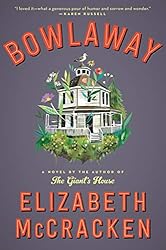

Bowlaway
Elizabeth McCracken, 2019
HarperCollins
384 pp.
ISBN-13: 9780062862853
Summary
A sweeping and enchanting new novel from the widely beloved, award-winning author Elizabeth McCracken about three generations of an unconventional New England family who own and operate a candlepin bowling alley
From the day she is discovered unconscious in a New England cemetery at the turn of the twentieth century—nothing but a bowling ball, a candlepin, and fifteen pounds of gold on her person—Bertha Truitt is an enigma to everyone in Salford, Massachusetts.
She has no past to speak of, or at least none she is willing to reveal, and her mysterious origin scandalizes and intrigues the townspeople, as does her choice to marry and start a family with Leviticus Sprague, the doctor who revived her.
But Bertha is plucky, tenacious, and entrepreneurial, and the bowling alley she opens quickly becomes Salford’s most defining landmark—with Bertha its most notable resident.
When Bertha dies in a freak accident, her past resurfaces in the form of a heretofore-unheard-of son, who arrives in Salford claiming he is heir apparent to Truitt Alleys.
Soon it becomes clear that, even in her death, Bertha’s defining spirit and the implications of her obfuscations live on, infecting and affecting future generations through inheritance battles, murky paternities, and hidden wills.
In a voice laced with insight and her signature sharp humor, Elizabeth McCracken has written an epic family saga set against the backdrop of twentieth-century America.
Bowlaway is both a stunning feat of language and a brilliant unraveling of a family’s myths and secrets, its passions and betrayals, and the ties that bind and the rifts that divide. (From the publisher.)
Author Bio
• Birth—1966
• Raised—Newton, Massachusetts, USA
• Education—B.A., M.A., Boston University; M.F.A., Iowa Writers' Workshop; M.S.L., Drexel University
• Awards—L.L. Winship/PEN-New England Award; finalist, National Book Award
• Currently—lives in Austin, Texas
Elizabeth McCracken, an author and academic, was born in Boston and raised in Newton, Massachusetts. She earned her B.A. and M.A. from Boston University, an M.F.A. from the Writers' Workshop of Iowa, and an M.S. in Library Science from Drexel University. McCracken's brother is Harry McCracken, former PC World magazine editor-in-chief and founder of Technologizer.com.
McCracken's first novel, The Giant's House, was released in 1996 and was a finalist for The National Book Awards. She has several other novels and short story collections to her name. Most recently she published the novel Bowlaway (2019) to wide acclaim.
In 2014, McCracken published her second collection of stories: Thunderstruck & Other Stories. "Hungry", one among the nine stories, won the 2015 Sunday Times (U.K.) EFG Private Bank Short Story Award—the richest prize in the world for a single short story—$20,000. The complete volume of Thunderstruck also won the U.S. Story Prize and was longlisted for the U.S. National Book Award.
Currently, McCracken holds the James Michener Chair of Fiction at the University of Texas-Austin. She and her husband, novelist Edward Carey, have two daughters and live in Austin.
Fun fact
Ann Patchett mentions in an interview for Blackbird at Virginia Commonwealth University, that Elizabeth McCracken is her "editor" and the only person to read her manuscripts as she is writing. (Adapted from the publisher and Wikipedia. Retrieved 2/6/2019.)
Book Reviews
[The novel] sometimes seems to want to drift off, like a hot-air balloon, into an ionospheric layer of pure twinkle and whimsy.… McCracken in Bowlaway comes close to writing caricatures instead of characters. That this ambitious novel nearly works is a testament to her considerable gifts as a novelist, her instinctive access to the most intricate threads of human thought and feeling.
Dwight Garner - New York Times
Death and life, frosted with macabre comedy.… [McCracken] lures us in with her witty voice and oddball characters but then kicks the wind out of us. She never misses the infamous 7-10 split, managing to hit Annie Proulx and Anne Tyler with the same ball.… Endlessly surprising.
Ron Charles - Washington Post
Reading Elizabeth McCracken—the gorgeously-put-together sentences parading the pages like models on a Paris runway; the crazy, original insights; the definitive, wholly fictional pronouncements—is like going on an automotive safari.… I could not stop reading.
Newsday
Loss and love revolve around a bowling alley established at the turn of the 20th century in a Massachusetts village by a woman who seems to have fallen from the sky in this quirky epic about family and fate.
Boston Globe
Elizabeth McCracken is just a delicious writer. This is a book that’s quirky, it’s a book that’s heartfelt.… She’s able to come up with these outlandishly wonderful situations and make it seem not only real, but that you’re going through these experiences with them.
NPR
At the turn of the 20th century a woman is discovered unconscious and nearly frozen in a New England cemetery with only a bowling ball, a candlepin, and 15 pounds of gold on her. The National Book Award finalist’s exuberantly weird and wonderful book unravels the mystery.
Oprah Magazine
The brilliantly witty writer returns with her first novel in 18 years, an incisive and generous portrait of a New England clan who operate a candlepin bowling alley.
Entertainment Weekly
In an enthralling, magical story that spans generations, award-winning writer McCracken imbues a candlepin alley with the ability to bowl over sexism.
Ms. Magazine
(Starred review) [S]tellar…. McCracken writes with a natural lyricism that sports vivid imagery and delightful turns of phrase. Her distinct humor enlivens the many plot twists that propel the narrative, making for a novel readers will sink into and savor.
Publishers Weekly
(Starred review) McCracken has one of the more distinctive literary sensibilities readers will likely encounter; playful, inventive, and fearless, she's drawn to oddball characters and the eccentric fringes of American family life. —Patrick Sullivan, Manchester Community Coll., CT
Library Journal
(Starred review) McCracken writes with exuberant precision, ingenious lyricism, satirical humor, and warmhearted mischief and delight.… [A]compassionate and rambunctious saga about love, grief, prejudice, and the courage to be one’s self.
Booklist
(Starred review) Parents and children, lovers, brothers and sisters, estranged spouses, work friends and teammates all slam themselves together and fling themselves apart across the decades in the glorious clatter of McCracken's unconventional storytelling.
Kirkus Reviews
(Starred review) To tell a good tale, you need drama—and in this area, Bowlaway spares no expense.… McCracken’s prose is well-tooled, hilarious and tender, thoughtful and jocular. Her characters inhabit their world so completely, so bodily, that they could’ve truly existed.
BookPage
Discussion Questions
We'll add publisher questions if and when they're available; in the meantime, use our LitLovers Book Club Resources. They can help with discussions for any book:
1. Bowlaway's narrator describes Bertha as "the oddest combination of the future and the past anyone had ever met." What does it mean to be both future and past? What is your reaction to Bertha—how would you describe her?
2. An undercurrent of sadness exists in midst of the novel's humor and wackiness. More than one woman has lost a child, an echo from Elizabeth McCracken's own life, about which she has written in her 2008 memoir, An Exact Replica of a Figment of My Imagination.
In this novel, LuEtta Mood, a Truitt's Alleys' patron, mourns a child: in the presence of another's baby, she is "a combustible gas, [and] the baby is a match… best to keep them apart." LuEtta fears she appears "dangerous and might never be allowed to hold anyone's baby again." Does McCracken's writing have resonance when it comes to someone you know (or yourself) who has experienced a tragedy of this magnitude?
3. LuEtta's own tragedy allows her to view Bertha's gaiety as "trained on a trellis of sorrow." What does she mean? Does her observation suggest that Bertha's exuberance is forced or inauthentic? Or does it mean that Bertha is truly able to live with joy, by somehow learning to put aside her sorrow?
4. Bertha bowls "because the earth was an ocean and you had to learn to roll upon it." Consider that winsome observation as, perhaps, an overriding theme of the novel. How, then, does that concept play out in the novel through various of its multitude of characters and events?
5. In what way does Bowlaway suggest that there is a great deal of mystery in peoples' lives? Ultimately, what do the many characters in the novel seek… and what does Truitt's Alleys provide them?
6. Talk about Joe Wear and his surprising life trajectory. What do you think of the description of Joe as "an elbow"?
7. Of all the characters, do you have a few select favorites, or one in particular?
8. In what ways do Bertha's views on issues of race, class, and gender seem more in tune with the 21st century than the early 20th. Does that anomaly trouble you: in some way detract from your reading? Or does Bertha's progressiveness enhance your reading experience? What were the prevailing attitudes toward African Americans and women 100 years ago?
9. Talk about the way the author foreshadows characters' fates long before they play out in the novel. In what way does this foreshadowing suggest the role of destiny in our lives… or exude a mysterious presence in life, or lend the novel an epic-like quality?
10. What insights did you come across, or what struck you most about this novel? What about children and love, yoga as laundry, dark thoughts (everybody needs them), and spiral staircases?
(Questions by LitLovers. Please feel free to use them, online and off, with attribution. Thanks.)


The Boy in the Striped Pajamas
John Boyne, 2006
Random House Children's
215 pp.
ISBN-13: 9780385751537
Summary
Berlin, 1942:
When Bruno returns home from school one day, he discovers that his belongings are being packed in crates. His father has received a promotion and the family must move from their home to a new house far far away, where there is no one to play with and nothing to do.
A tall fence running alongside stretches as far as the eye can see and cuts him off from the strange people he can see in the distance.
But Bruno longs to be an explorer and decides that there must be more to this desolate new place than meets the eye. While exploring his new environment, he meets another boy whose life and circumstances are very different to his own, and their meeting results in a friendship that has devastating consequences. (From the publisher.)
Author Bio
• Birth—April 30, 1971
• Where—Dublin, Ireland
• Education—Trinity College
• Awards—Curtis Brown Award; Irish Book Awards: People's
Choice of the Year
• Currently—Dublin, Ireland
John Boyne is a full-time writer living in Dublin, Ireland. He was writer-in-residence at the University of East Anglia in Creative Writing and spent many years working as a bookseller. This is his first book for young readers. The author lives in Dublin, Ireland (From the publisher.)
More
His own words:
I stated writing at a very young age, not long after I first started reading and discovered the joys of getting lost in someone else’s world. When I was a child, I wrote hundreds of stories and bound them up together like books, writing my name on the spine and putting them on the bookshelves in my bedroom. I don’t have any of those stories any more. but I wish I did. Maybe I could still get some ideas from them.
At the age of 10, I was in hospital for a week for an operation and my mother gave me a copy of The Magician’s Nephew by C. S. Lewis to read. By the time I was recovered I’d read all seven of the Narnia books and fell in love with the idea of adventure stories, particularly ones that included children like me who were in peril and had to use their wits and ingenuity to get out of trouble.
The next book I remember that had a big effect on me was The Silver Sword by Ian Serailler. This tale of four children fleeing Poland during World War II was perhaps the most important book of my childhood, combining my love of heroic adventure stories with my growing interest in history. It forced me to think about what children my own age had gone through during the war and question whether I would have been as brave and strong as they were. Twenty years later it influenced my writing of The Boy in the Striped Pajamas as I tried to tell a story about this terrible time in human history with as much integrity and compassion as Serailler had.
When I was a young teenager, I discovered Charles Dickens and his novels have had the greatest effect on me as both a reader and writer. I particularly loved the orphan novels–David Copperfield, Oliver Twist, Nicholas Nickleby—books that began with a young boy left alone in the world, with no one or nothing to rely on other than his own resourcefulness. Because so many of Dickens’ novels were originally serialised in magazines, Dickens had a tremendous talent for finishing each chapter with a cliff-hanger, forcing me to leave the light on just a little longer to find out what happened next...and next...and next.
My life has always been filled with books and I never wanted to be anything but a writer. One of the great thrills over the last year of my life since publishing The Boy in the Striped Pajamas in the U.K. has been visiting schools and classrooms, talking to young children about the issues raised in the novel, but also discussing reading and writing in general. To my delight there’s a lot of young writers out there with great imaginations and stories to tell. I’ll be looking forward to their own books 20 years from now. (From the publisher.)
Book Reviews
(Audio version.) Through the eyes of an innocent nine-year-old boy named Bruno, listeners become complicit bystanders, observing some of the horrors of the Holocaust. Maloney's soft-toned narration and chipper, believably childlike characterization of Bruno dramatically bring home the fable-like qualities of Boyne's moving text. Bruno's limited comprehension of all going on around him begs listeners, presumably with more knowledge than the protagonist, to glean the fuller story between the lines. When his father, an officer for "the Fury," as Bruno refers to him, is transferred from Berlin to a new post in Poland called "Out-With," Bruno and his family try to adjust. From his new bedroom window Bruno can see a fenced-in camp where all the inhabitants wear striped pajamas. He learns more about this intriguing place when he befriends a boy inside the camp named Shmuel (who happens to share Bruno's birthday). Their friendship progresses dangerously and brings Boyne's tale to a shocking end that is sure to be a discussion starter. (Ages 12 and up).
Publishers Weekly
Bruno's life changes drastically in 1942. After the "fury" comes to dinner, Bruno and his family move from their Berlin home to "Out with," where Bruno's father becomes the Commandant. Sheltered from the world through his family's wealth and privilege, Bruno has no understanding of the view from his new bedroom window, which looks at a huge fence topped with barbed wire, confining boys and men of all ages dressed in grey striped pajamas. One day on a walking exploration, Bruno meets Shmuel, who is sitting on the other side of the fence, and these two lonely boys start a friendship. Everyday for a year, they meet at the same spot along the fence, and somehow, Bruno still does not understand. Bruno's inability to comprehend the situation is the inadequacy of this book. Even though Bruno is very intelligent and inquisitive, he does not see that Shmuel is not having fun on the other side of the fence. If the reader can somehow excuse the boy's void of empathy, it is nearly impossible to believe that the Commandant father never tries to explain the people in the striped pajamas, never tells his truth. Would such a high Nazi official not start his son's indoctrination early? The other characters are finely drawn and add to the fullness of the book, but Bruno's voice, whispering and hesitant, keeps one reading and wondering about the German children in 1942 and their many stories. That speculation on the part of the reader alone makes the book very worthwhile.
VOYA
The publisher doesn't want reviewers to reveal too much of the plot so readers can bring a fresh eye to the reading experience and its unfolding horrors. (However, the title should be a big clue.) That leaves little else to say except perhaps that this is the story of a sheltered, privileged nine-year-old boy gradually becoming aware of an overwhelming evil. It begins somewhat like a fairy tale, a dark one, with an otherworldly feel, a dystopia. Bruno comes home one day to find his large, beautiful home in an uproar. Mother is unhappy. Father is locked in his office. Servants scurry about. The mansion is to be abandoned for life in the hinterlands. The world is suddenly bleak but rules of good behavior must still be followed. Once relocated, Bruno is forbidden to explore, but does so anyway, as boys will, to his cost. Told entirely from the point of view of a nine-year-old (although the book jacket copy insists this is not a book for nine-year-olds), the author maintains the atmosphere of incomprehension turning to some kind of knowledge, even though Bruno holds on to a portion of innocence until the end. In spite of the book jacket's claim, the novel certainly is not for readers much beyond the age of fourteen. Discussions of the evil inherent in the story are far from graphic and readers would need a surrounding context to understand what Bruno never fully does. The novel is quite moving and is a good introduction to the subject for any young reader, told from a different point of view from that usually chosen. —Exceptional book, recommended for junior high school students.
Myrna Marler - KLIATT
(Gr 9 & up.) John Boyne's novel is a harrowing Holocaust story with an excruciating ending. It is told through the eyes of nine-year-old Bruno, whose family moves from Berlin after his father gets a promotion to Commandant. When the family arrives at their new home, Bruno is disheartened. The new place, which the boy calls "Out-With," is desolate, with a large "camp" on the other side of a big fence, behind which all of the people, except the soldiers, wear gray-striped pajamas. After starting classes with a tutor, who advocates history over art, Bruno explores his new surroundings and meets Shmuel who is living in the fenced-in area. Bruno never quite grasps why his new friend is behind the fence, but he knows that he should keep quiet about their visits. Only mature listeners with knowledge of World War II and Hitler's "final solution" will be able to interpret what the author unveils slowly (there is no mention of a war going on or the ability to get news from the radio or newspapers). Still, the novel will certainly augment the study of this period in history. There is the added bonus of an interview with the author and his editor at the end of the recording. With the eager urgency and excitement of the young protagonist, Michael Maloney reads with a British accent, using various voices for the many characters. Sometimes he drops the ends of words, which can be distracting. Haunting music between chapters adds to the suspense. A unique addition to Holocaust literature. —Jo-Ann Carhart, East Islip Public Library, NY
Library Journal
After Hitler appoints Bruno's father commandant of Auschwitz, Bruno (nine) is unhappy with his new surroundings compared to the luxury of his home in Berlin. The literal-minded Bruno, with amazingly little political and social awareness, never gains comprehension of the prisoners (all in "striped pajamas") or the malignant nature of the death camp. He overcomes loneliness and isolation only when he discovers another boy, Shmuel, on the other side of the camp's fence. For months, the two meet, becoming secret best friends even though they can never play together. Although Bruno's family corrects him, he childishly calls the camp "Out-With" and the Fuhrer "Fury." As a literary device, it could be said to be credibly rooted in Bruno's consistent, guileless characterization, though it's difficult to believe in reality. The tragic story's point of view is unique: the corrosive effect of brutality on Nazi family life as seen through the eyes of a naif. Some will believe that the fable form, in which the illogical may serve the objective of moral instruction, succeeds in Boyle's narrative; others will believe it was the wrong choice. Certain to provoke controversy and difficult to see as a book for children, who could easily miss the painful point. (Fiction. 12-14.)
Kirkus Reviews
Discussion Questions
1. Discuss the relationship between Bruno and Gretel. Why does Bruno seem younger than nine? In a traditional fable, characters are usually one-sided. How might Bruno and Gretel be considered one-dimensional?
2. At age 12, Gretel is the proper age for membership in the League of Young Girls, a branch of Hitler's Youth Organization. Why do you think she is not a member, especially since her father is a high-ranking officer in Hitler's army?
3. What is it about the house at Out-With that makes Bruno feel "cold and unsafe"? How is this feeling perpetuated as he encounters people like Pavel, Maria, Lt. Kotler, and Shmuel?
4. Describe his reaction when he first sees the people in the striped pajamas. What does Gretel mean when she says, "Something about the way [Bruno] was watching made her feel suddenly nervous"? (p. 28) How does this statement foreshadow Bruno's ultimate demise?
5. Bruno asks his father about the people outside their house at Auschwitz.His father answers, "They're not people at all Bruno." (p. 53) Discuss the horror of this attitude. How does his father's statement make Bruno more curious about Out-With?
6. Explain what Bruno's mother means when she says, "We don't have the luxury of thinking." (p. 13) Identify scenes from the novel that Bruno's mother isn't happy about their life at Out-With. Debate whether she is unhappy being away from Berlin, or whether she is angry about her husband's position. How does Bruno's grandmother react to her son's military role?
7. When Bruno and his family board the train for Auschwitz, he notices an over-crowded train headed in the same direction. How does he later make the connection between Shmuel and that train? How are both trains symbolic of each boy's final journey?
8. Bruno issues a protest about leaving Berlin. His father responds, "Do you think that I would have made such a success of my life if I hadn't learned when to argue and when to keep my mouth shut and follow orders?" (p. 49) What question might Bruno's father ask at the end of the novel?
9. A pun is most often seen as humorous. But, in this novel the narrator uses dark or solemn puns like Out-With and Fury to convey certain meanings. Bruno is simply mispronouncing the real words, but the author is clearly asking the reader to consider a double meaning to these words. Discuss the use of this wordplay as a literary device. What is the narrator trying to convey to the reader? How do these words further communicate the horror of the situation?
10. When Bruno dresses in the filthy striped pajamas, he remembers something his grandmother once said. "You wear the right outfit and you feel like the person you're pretending to be." (p, 205) How is this true for Bruno? What about his father? What does this statement contribute to the overall meaning of the story?
11. Discuss the moral or message of the novel. What new insights and understandings does John Boyne want the reader to gain from reading this story?
12. Discuss the differences in a fable, an allegory, and a proverb. How might this story fit into each genre?
(Questions issued by publisher.)
top of page (summary)
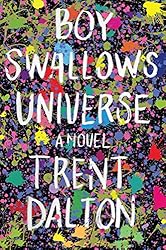
Boy Swallows Universe
Trent Dalton, 2019
HarperCollins
464 pp.
ISBN-13: 9780062898104
Summary
An utterly wonderful debut novel of love, crime, magic, fate and a boy’s coming of age, set in 1980s Australia and infused with the originality, charm, pathos, and heart of Extremely Loud and Incredibly Close and The Curious Incident of the Dog in the Night-Time.
Eli Bell’s life is complicated. His father is lost, his mother is in jail, and his stepdad is a heroin dealer.
The most steadfast adult in Eli’s life is Slim—a notorious felon and national record-holder for successful prison escapes—who watches over Eli and August, his silent genius of an older brother.
Exiled far from the rest of the world in Darra, a neglected suburb populated by Polish and Vietnamese refugees, this twelve-year-old boy with an old soul and an adult mind is just trying to follow his heart, learn what it takes to be a good man, and train for a glamorous career in journalism.
Life, however, insists on throwing obstacles in Eli’s path—most notably Tytus Broz, Brisbane’s legendary drug dealer.
But the real trouble lies ahead. Eli is about to fall in love, face off against truly bad guys, and fight to save his mother from a certain doom—all before starting high school.
A story of brotherhood, true love, family, and the most unlikely of friendships, Boy Swallows Universe is the tale of an adolescent boy on the cusp of discovering the man he will be. Powerful and kinetic, Trent Dalton’s debut is sure to be one of the most heartbreaking, joyous and exhilarating novels you will experience. (From the publisher.)
Author Bio
• Birth—ca. 1978-79
• Raised—outside Brisbane, Queensland, Australia
• Education—N/A
• Awards—(see below)
• Currently—lives in Brisbane
Trent Dalton is an award-winning journalist at The Weekend Australian Magazine. His writing includes several short and feature-length film screenplays. In 2019 he published, Boy Swallows Universe, his debut novel, closely based on his own childhood.
He was nominated for a 2010 AFI Best Short Fiction screenplay award for his latest film, Glenn Owen Dodds, which also won the prestigious International Prix Canal award at the world's largest short film festival, the Clermont-Ferrand International Short Film Festival.
Dalton's debut feature film screenplay, In the Silence, is currently in production. (From the publisher.)
Book Reviews
Boy Swallows Universe hypnotizes you with wonder, and then hammers you with heartbreak.… Eli’s remarkably poetic voice and his astonishingly open heart take the day. They enable him to carve out the best of what’s possible from the worst of what is, which is the miracle that makes this novel marvelous.
Washington Post
A splashy, profane, and witty debut.
USA Today
Welcome to the weird and wonderful universe of Trent Dalton, whose first work of fiction is, without exaggeration, the best Australian novel I have read in more than a decade.… The last 100 pages of Boy Swallows Universe propel you like an express train to a conclusion that is profound and complex and unashamedly commercial.… The book is jam-packed with such witty and profound insights into what’s wrong and what’s right with Australia and the world.… I read it in two sittings and immediately want to read it again. In its deft integration of the sacred and the profane, of high ideals and low villainy, it somehow reminded me of a favorite French movie, Diva. A rollicking ride, rich in philosophy, wit, truth and pathos.
Sydney Morning Herald
It is such a pleasant shock to encounter a new Australian novel in which joy is shamelessly deployed.… It is a story in thrall to the potential the world holds for lightness, laughter, beauty, forgiveness, redemption, and love.… [Dalton] invests this unlikely cast and milieu with considerable energy, wit and charm. He delights in the play of language and imagination that a child can summon: the sense in which the clear moral eye of youth can critique and adore simultaneously without judgment or adult moral finessing.
The Australian
A wonderful surprise: sharp as a drawer full of knives in terms of subject matter; unrepentantly joyous in its child’s-eye view of the world; the best literary debut in a month of Sundays.
Weekend Australian
(Starred review) [A] splashy, stellar debut makes the typical coming-of-age novel look bland by comparison.… Dalton’s… observant eye [and] ability to temper pathos with humor… prevent the novel from breaking into sparkling pieces.… [O]utstanding.
Publishers Weekly
(Starred review) A marvelously plot-rich novel, which…is filled with beautifully lyric prose…. Exceptional
Booklist
[M]agical elements promised in the novel’s early pages,… either get abandoned or turn out to be relatively pedantic matters of interpretation. A likable debut that trades its early high-flown ambitions for dramatic but familiar coming-of-age fare.
Kirkus Reviews
Discussion Questions
1. Slim’s view of the world is that: "We all got a bit o' good and a bit o' bad in us…." Discuss the ways in which characters in the novel are both good and bad at the same time.
2. What do you think is the meaning of the red telephone and the mysterious voice that speaks to Eli?
3. Do good life lessons remain valid if delivered by evil men?
4. What sort of man do you hope (or fear) Eli Bell will grow into?
5. What do you think, ultimately, Eli Bell is searching for in life and in that secret room?
6. Why do you think August chooses to be mute?
7. Does the knowledge that much of this novel is based on Trent Dalton’s own life change your reading of the book? Enhance it? Or does it not make a difference?
8. Do you think the trauma that Mrs Birbeck talks about (p. 224) is a factor in Eli’s journey?
9. Do you think the novel is optimistic or pessimistic about the world?
10. Were there similarities or differences in the book to your own memories of 1980s suburban Australia?
11. Discuss the idea that August may have knowledge of future events and how this is suggested and also at times debunked.
12. "Do your time before it does you," says Slim. What does Eli take this to mean and how does he act on it?
13. The novel presents an interesting view of adults from a child’s perspective. What does it say about adults and particularly adult men? And what does Eli learn from this?
(Questions issued by the publisher in Australia.)


Boy, Snow, Bird
Helen Oyeyemi, 2014
Penguin Group (USA)
336 pp.
ISBN-13: 9781594633409
Summary
From the prizewinning author of Mr. Fox, the Snow White fairy tale brilliantly recast as a story of family secrets, race, beauty, and vanity.
In the winter of 1953, Boy Novak arrives by chance in a small town in Massachusetts, looking, she believes, for beauty—the opposite of the life she’s left behind in New York. She marries a local widower and becomes stepmother to his winsome daughter, Snow Whitman.
A wicked stepmother is a creature Boy never imagined she’d become, but elements of the familiar tale of aesthetic obsession begin to play themselves out when the birth of Boy’s daughter, Bird, who is dark-skinned, exposes the Whitmans as light-skinned African Americans passing for white. Among them, Boy, Snow, and Bird confront the tyranny of the mirror to ask how much power surfaces really hold.
Dazzlingly inventive and powerfully moving, Boy, Snow, Bird is an astonishing and enchanting novel. With breathtaking feats of imagination, Helen Oyeyemi confirms her place as one of the most original and dynamic literary voices of our time. (From the publisher.)
Author Bio
• Birth—December 10, 1984
• Where—Nigeria
• Raised—London, England, UK
• Education—Cambridge University
• Awards—Somerset Maughm Award
• Currently—lives in London, England
Helen Oyeyemi (oh YAY a mee) is a British author with five novels to her name. She was born in Nigeria and raised in London, England.
Oyeyemi studied Social and Political Sciences at Corpus Christi College, Cambridge, graduating in 2006. While at Cambridge, two of her plays, Juniper's Whitening and Victimese, were performed by fellow students to critical acclaim and subsequently published by Methuen.
Novels
She wrote her first novel, The Icarus Girl, while still at school studying for her A levels at Cardinal Vaughan Memorial School.
In 2007 Bloomsbury published her second novel, The Opposite House which is inspired by Cuban mythology.
Her third novel, White is for Witching, described as having "roots in Henry James and Edgar Allan Poe" was published in 2009. It was a 2009 Shirley Jackson Award finalist and won a 2010 Somerset Maugham Award.
Mr Fox, Oyeyemi's fourth novel was published in 2011. Aimee Bender said in a New York Times review: "Charm is a quality that overflows in this novel." Kirkus Reviews, however thought that while readers might consider Mr. Fox "an intellectual tour de force," they might also find it "emotionally chilly."
Oyeyemi's fith novel, Boy, Snow, Bird, published in 2014, is a retelling of Snow White, set in Massachusetts in the 1950s.
What Is Not Yours Is Not Yours, released in 2016, is a collection of intertwined stories, all involving locks and keys.
Extras
• Oyeyemi is a lifelong Catholic who has done voluntary work for CAFOD in Kenya.
• In 2009 Oyeyemi was recognised as one of the women on Venus Zine’s “25 under 25” list.
(Adapted from Wikipedia. Retrieved 2/18/2014.)
Book Reviews
(Starred review.) [A] retelling of the Snow White tale that plays on the concept of "fairest of them all," complete with mirrors as a recurring motif.... Oyeyemi wields her words with economy and grace, and she rounds out her story with an inventive plot and memorable characters.
Publishers Weekly
Somerset Maugham Award winner Oyeyemi reimagines Snow White in 1950s Massachusetts, where a woman must grapple with the revelation that her husband and stepdaughter are black Americans who can and do pass as white.
Library Journal
(Starred review.) Dense with fully realized characters, startling images, original observations and revelatory truths, this masterpiece engages the reader's heart and mind as it captures both the complexities of racial and gender identity in the 20th century and the more intimate complexities of love in all its guises.
Kirkus Reviews
Discussion Questions
Use our LitLovers Book Club Resources; they can help with discussions for any book:
• How to Discuss a Book (helpful discussion tips)
• Generic Discussion Questions—Fiction and Nonfiction
• Read-Think-Talk (a guided reading chart)
(We'll add specific questions if and when they're made available by the publisher.)

Brass
Xhenet Aliu, 2018
Random House
304 pp.
ISBN-13: 9780399590245
Summary
A waitress at the Betsy Ross Diner, Elsie hopes her nickel-and-dime tips will add up to a new life.
Then she meets Bashkim, who is at once both worldly and naïve, a married man who left Albania to chase his dreams—and wound up working as a line cook in Waterbury, Connecticut.
Back when the brass mills were still open, this bustling factory town drew one wave of immigrants after another. Now it’s the place they can’t seem to leave.
Elsie, herself the granddaughter of Lithuanian immigrants, falls in love quickly, but when she learns that she’s pregnant, Elsie can’t help wondering where Bashkim’s heart really lies, and what he’ll do about the wife he left behind.
Seventeen years later, headstrong and independent Luljeta receives a rejection letter from NYU and her first-ever suspension from school on the same day. Instead of striking out on her own in Manhattan, she’s stuck in Connecticut with her mother, Elsie—a fate she refuses to accept.
Wondering if the key to her future is unlocking the secrets of the past, Lulu decides to find out what exactly her mother has been hiding about the father she never knew. As she soon discovers, the truth is closer than she ever imagined.
Told in equally gripping parallel narratives with biting wit and grace, Brass announces a fearless new voice with a timely, tender, and quintessentially American story. (From the publisher.)
Author Bio
• Birth—ca. 1978-79
• Where—Waterbury, Connecticut, USA
• Education—M.F.A., University of North Carolina; M.L.I.S., University of Alabama
• Awards—Prairie Schooner Book Prize-Fiction
• Currently—lives in Athens, Georgia
Xhenet Aliu’s debut novel, Brass, was published in 2018. Her short fiction collection, Domesticated Wild Things, and Other Stories, published in 2013, won the Prairie Schooner Book Prize in Fiction. Aliu's stories and essays have appeared in Glimmer Train, Barcelona Review, American Short Fiction, and elsewhere.
A native of Waterbury, Connecticut, Aliu was born to an Albanian father and a Lithuanian American mother. She holds an MFA from the University of North Carolina Wilmington and an MLIS from The University of Alabama and now lives in Athens, Georgia, where she works as an academic librarian. (Adapted from the author's website.)
Book Reviews
For Elsie and Lulu, the mother and daughter at the center of the book, the most valuable thing in Waterbury is a ticket out.…The plot advances through each woman's story; as the symmetries between them pile up, along with misunderstandings, the novel accumulates momentum and emotional power…They'll never see each other, or themselves, as clearly as the reader gets to see them both—that's the magic trick here. In granting the reader access to both women's interiority, Aliu brings to life the simple, heartbreaking fact that though our stories can intersect, we're ourselves alone…From its opening page, Brass simmers with anger—the all too real byproduct of working hard for not enough, of being a woman in a place where women have little value, of getting knocked down one too many times. But when the simmer breaks into a boil, Aliu alchemizes that anger into love, and in doing so creates one of the most potent dramatizations of the bond between mother and daughter that I've ever read.
Julie Buntin - New York Times Book Review
An exceptional debut novel, one that plumbs the notion of the American Dream while escaping the clichés that pursuit almost always brings with it.… [Xhenet] Aliu delivers a living, breathing portrait of places left behind.
Eugenia Williamson - Boston Globe
The writing blazes on the page.… The narrative is also incredibly funny, sly, and always popping with personality.… So much about the book is also extraordinarily timely, especially when it focuses on class and culture, and what they really mean.… Yes, we might be lost from who and what we really are. But, as this audacious novel shows, we can—and we must—keep struggling to make our own place in the world.
Carolyn Leavitt - San Francisco Chronicle
A] lyrically insightful debut novel by Xhenet Aliu, telling in sharp, pithy parallel narratives the story of a waitress in small-town Connecticut who falls in love with a charismatic Albanian immigrant and the story of her grown daughter, likewise feeling trapped in that same small town and seeking answers about her past. Aliu makes both these stories immediately touching and weaves them together in ways that are surprising without being sappy.
Christian Science Monitor
Aliu is witty and unsparing in her depiction of the town and its inhabitants, illustrating the granular realities of the struggle for class mobility.
The New Yorker
Lustrous… a tale alive with humor and gumption, of the knotty, needy bond between a mother and daughter.… [Brass] marks the arrival of a writer whose work will stand the test of time.
Oprah Magazine
Aliu juxtaposes a mother and daughter’s late teenage desperation 17 years apart in her striking first novel.… This is a captivating, moving story of drastic measures, failed schemes, and the loss of innocence.
Publishers Weekly
(Starred review) Deftly written in a style that is evocative of time and place, this universal story of the search for home is well translated into the blue-collar world of Elsie and Lulu.
Library Journal
(Starred review) A boldly witty and astute inquiry into the nature-versus-nurture debate, the inheritance of pain, and the dream of transcendence.
Booklist
(Starred review) [G]limmering.… Aliu's riveting, sensitive work shines with warmth, clarity, and a generosity of spirit. Her… writing is polished and precise, bringing her characters glowingly to life.
Kirkus Reviews
Discussion Questions
The following questions were generously offered to us by Elaine Steele, Librarian, Gales Ferry Library in Connecticut. Many thanks, Elaine:
1. Why do you think the author chose the title "Brass"?
2. Does anyone have a connection with brass factories?
3. Why do you think Luljeta’s sections are written in second person?
4. How does culture play into this story? Does anyone have any experience with Albanian or Lithuanian culture?
5. How did you feel about Bashkim’s behavior with his money? What about with his wife and Elsie?
7. Why do you think Luljeta admired her aunt Greta so much?
8. How are Elsie and Luljeta’s stories the same? Different?
0. Did you feel as if Elsie or Luljeta changed throughout the course of the novel?
10. Did the ending surprise you?
(Questions created by Elaine Steele and submitted to LitLovers. Please feel free to use them, online and off, with attribution to both. Thanks.)


Brava, Valentine (Valentine Trilogy, 2)
Adriana Trigiani, 2010
HarperCollins
352 pp.
ISBN-13: 9780061257087
Summary
Adriana Trigiani's bestselling novels are beloved by millions of readers around the world. From the Big Stone Gap series to Lucia, Lucia, each is a sumptuous treat as Trigiani tells hilarious and romantic stories that we want to return to again and again. Very Valentine, an instant New York Times bestseller, introduced the contemporary family saga of the Roncalli and Angelini families, artisans of handcrafted wedding shoes in Greenwich Village since 1903.
As Brava, Valentine begins, snow falls like glitter over Tuscany at the wedding of her grandmother, Teodora, and longtime love, Dominic. Valentine's dreams are dashed when Gram announces that Alfred, "the prince," Valentine's only brother and nemesis, has been named her partner at Angelini Shoes. Devastated, Valentine falls into the arms of Gianluca, a sexy Tuscan tanner who made his romantic intentions known on the Isle of Capri. Despite their passion for one another and Gianluca's heartfelt letters, a long-distance relationship seems impossible.
As Valentine turns away from romance and devotes herself to her work, mentor and pattern cutter June Lawton guides her through her power struggle with Alfred, while best friend and confidante Gabriel Biondi moves into 166 Perry Street, transforming her home and point of view. Savvy financier Bret Fitzpatrick, Valentine's first love and former fiancée who still carries a torch for her, encourages Valentine to exploit her full potential as a designer and a business woman with a plan that will bring her singular creations to the world.
A once-in-a-lifetime business opportunity takes Valentine from the winding streets of Greenwich Village to the sun-kissed cobblestones of Buenos Aires, where she finds a long-buried secret hidden deep within a family scandal. Once unearthed, the truth rocks the Roncallis and Valentine is determined to hold her family together. More so, she longs to create one of her own, but is torn between a past love that nurtured her, and a new one that promises to sustain her. Brava, Valentine, Trigiani's best novel yet, delivers a hilarious and poignant mix of colorful worlds and unforgettable characters as only she can create them. (From the publisher.)
This is the second book in the Valentine Trilogy. Very Valentine is the first book; The Supreme Macaroni Company is the third.
Author Bio
• Birth—1960
• Where—Big Stone Gap, Virginia, USA
• Education—B.A., St. Mary’s College, Indiana, USA
• Currently—lives in New York, New York
As her squadrons of fans already know, Adriana Trigiani grew up in Big Stone Gap, a coal-mining town in southwest Virginia that became the setting for her first three novels. The "Big Stone Gap" books feature Southern storytelling with a twist: a heroine of Italian descent, like Trigiani, who attended St. Mary's College of Notre Dame, like Trigiani. But the series isn't autobiographical—the narrator, Ave Maria Mulligan, is a generation older than Trigiani and, as the first book opens, has settled into small-town spinsterhood as the local pharmacist.
The author, by contrast, has lived most of her adult life in New York City. After graduating from college with a theater degree, she moved to the city and began writing and directing plays (her day jobs included cook, nanny, house cleaner and office temp). In 1988, she was tapped to write for the Cosby Show spinoff A Different World, and spent the following decade working in television and film. When she presented her friend and agent Suzanne Gluck with a screenplay about Big Stone Gap, Gluck suggested she turn it into a novel.
The result was an instant bestseller that won praise from fellow writers along with kudos from celebrities (Whoopi Goldberg is a fan). It was followed by Big Cherry Holler and Milk Glass Moon, which chronicle the further adventures of Ave Maria through marriage and motherhood. People magazine called them "Delightfully quirky... chock full of engaging, oddball characters and unexpected plot twists."
Critics sometimes reach for food imagery to describe Trigiani's books, which have been called "mouthwatering as fried chicken and biscuits" (USA Today) and "comforting as a mug of tea on a rainy Sunday" (New York Times Book Review). Food and cooking play a big role in the lives of Trigiani's heroines and their families: Lucia, Lucia, about a seamstress in Greenwich Village in the 1950s, and The Queen of the Big Time, set in an Italian-American community in Pennsylvania, both feature recipes from Trigiani's grandmothers. She and her sisters have even co-written a cookbook called, appropriately enough, Cooking With My Sisters: One Hundred Years of Family Recipes, from Bari to Big Stone Gap. It's peppered with anecdotes, photos and family history. What it doesn't have: low-carb recipes. "An Italian girl can only go so long without pasta," Trigiani quipped in an interview on GoTriCities.com.
Her heroines are also ardent readers, so it comes as no surprise that book groups love Adriana Trigiani. And she loves them right back. She's chatted with scores of them on the phone, and her Web site includes photos of women gathered together in living rooms and restaurants across the country, waving Italian flags and copies of Lucia, Lucia.
Trigiani, a disciplined writer whose schedule for writing her first novel included stints from 3 a.m. to 8 a.m. each morning, is determined not to disappoint her fans. So far, she's produced a new novel each year since the publication of Big Stone Gap. I don't take any of it for granted, not for one second, because I know how hard this is to catch with your public," she said in an interview with The Independent. "I don't look at my public as a group; I look at them like individuals, so if a reader writes and says, 'I don't like this,' or, 'This bit stinks,' I take it to heart.
Extras
From a 2004 Barnes & Noble interview:
• I appeared on the game show Kiddie Kollege on WCYB-TV in Bristol, Virginia, when I was in the third grade. I missed every question. It was humiliating.
• I have held the following jobs: office temp, ticket seller in movie theatre, cook in restaurant, nanny, and phone installer at the Super Bowl in New Orleans. In the writing world, I have been a playwright, television writer/producer, documentary writer/director, and now novelist.
• I love rhinestones, faux jewelry. I bought a pair of pearl studded clip on earrings from a blanket on the street when I first moved to New York for a dollar. They turned out to be a pair designed by Elsa Schiaparelli. Now, they are costume, but they are still Schiaps! Always shop in the street—treasures aplenty.
• When asked what book most influenced her life as a writer, here is what she said:
Jane Eyre by Charlotte Bronte. When I was a girl growing up in Big Stone Gap, Virginia, I was in the middle of a large Italian family, but I related to the lonely orphan girl Jane, who with calm and focus, put one foot in front of the other to make a life for herself after the death of her parents and her terrible tenure with her mean relatives. She survived the horrors of the orphanage Lowood, losing her best friend to consumption, became a teacher and then a nanny. The love story with the complicated Rochester was interesting to me, but what moved me the most was Jane's character, in particular her sterling moral code. Here was a girl who had no reason to do the right thing, she was born poor and had no connections and yet, somehow she was instinctively good and decent. It's a story of personal triumph and the beauty of human strength. I also find the book a total page turner- and it's one of those stories that you become engrossed in, unable to put it down. Imagine the beauty of the line: "I loved and was loved." It doesn't get any better than that! (Bio and interview from Barnes & Noble.)
Book Reviews
[A] sweet second act for shoemaker and designer Valentine Roncalli. Val takes over the New York family-run shoe business with feet-of-clay older brother, Alfred.... [A] startling twist of family history finally challenges an old-fashioned, insular clan to join the modern world. But it's always the endearing, unnerving and rowdy Roncallis who steal the show.
Publishers Weekly
With her grandmother remarried and living in Italy, Valentine and her brother are now in charge of the Angelina Shoe Company. She's a strong businesswoman, but family and romantic relationships knock her off stride.... Brimming over with life, [Trigiani's] latest will be essential reading for fans of humorous, touching family fiction. —Lesa Holstine, Glendale P.L., AZ
Library Journal
Valentine is one of Adriana Trigiani’s most winsome characters (yes, she even rivals the Big Stone Gap gang).... Brava, Valentine is laugh-out-loud funny...but it’s also an unexpectedly poignant examination of the power and pull of family, faith and love.
BookPage
Lukewarm follow-up to Very Valentine (2009).... A talented designer, Valentine has big plans to expand the [family] business from couture wedding shoes to mass-produced daywear.... But Valentine is...filled with the usual angst and uncertainty about how to manage love and career.... [T]his middle installment of a planned trilogy delivers a very thin plot via an endless interior monologue by Valentine. A likable heroine doesn't compensate for a lackluster narrative.
Kirkus Reviews
Discussion Questions
1. How would you describe Valentine? What’s your favorite thing about her?
2. If you read the first novel, how have lost loves, family dramas, and professional opportunities impacted Valentine? How do they affect her over the course of this chapter in her life?
3. Do you think Valentine is like most contemporary American women?
4. What role does Valentine play in the Roncalli family? How do the Roncallis define family? How is their notion of family challenged when they learn about their relatives in Argentina?
5. What does Valentine think about Gianluca, and how does she feel about him? How does she react when she receives his handwritten letters? Over the course of the story, do her feelings for him change—or her understanding of those feelings? What does Valentine want from love?
6. Speaking of love, June tells Valentine, “The only urgent thing in life is the pursuit of love. You get that one right, and you’ve solved the mystery.” Do you agree with this? Is love the most important thing in life?
7. Compare and contrast the men in Valentine’s life, including her father, her brother Alfred, Brett, Gabriel, and Gianluca. What does each man offer her?
8. Though Valentine misses living and working with her grandmother, she has her beloved employee (and honorary Roncalli) June. How does June influence Valentine? What is your opinion of June?
9. What is the importance of scent in the book? What are Valentine’s favorite smells and the associations she has with them? Do you have a favorite smell?
10. One of the novel’s themes is trust. Why is trust difficult for Valentine? How do we learn to trust someone? What happens when that trust is shaken? Can it be rebuilt? How are these lessons demonstrated in the various marriages and relationships, from Valentine’s parents to Brett’s marriage to Mackenzie, Alfred and Pam to Valentine and Gianluca, and even Gram and Dominic?
11. Bret tells Valentine that marriage is a lot of work, but she thinks it should be the easy part. Can it be both? What is your view of marriage? Would you recommend it?
12. Valentine’s mother, Mike, built her life upon the philosophy, “One god, one man, one life.” What would Valentine’s philosophy be? Do you have a personal philosophy?
13. What happens when Val goes to Buenos Aires? How does that trip affect her professionally and personally?
14. Valentine is the “sole custodian of our family history, and not because anyone asked me to be. The truth is, no one else is interested in the contents of these dusty old boxes, nor do they want to store them. I’m the only Angelini who treasures these old documents and is inspired by them.” Why is the past important to her? Do you have a family custodian? Why don’t Americans seem to care about the past?
15. Gram’s move to Italy means Valentine must sort through the furniture, boxes, and documents she left behind. “Our history can only be told through the things she saved, and now that Gram is gone, it’s left to me to decide worth saving.” How does she learn to decide what’s worth saving? What would your things say about your life story? Do you have any special objects you want your children to have and pass down to their children?
16. Forgiveness is a central theme of Brava, Valentine. What does forgiveness mean to the person receiving it—and to the person offering it? Why do some people struggle with forgiveness? Is there any transgression too big to be forgiven?
17. What are Valentina’s inspirations for her work? How does she keep her creativity fresh?
18. Gram advises her that the key to creativity is for an artist to leave her comfort zone. How can trying something new be stimulating?
19. Tradition is also very important to Valentine. “Gianluca taught me that tradition isn’t something we do, it’s the way we are.” Explain.
20. What challenges do you think lie ahead for Valentine?
(Questions issued by publisher.)
The Brave
Nicholas Evans, 2010
Little, Brown & Co.
353 pp.
ISBN-13: 9780316033787
Summary
Tom Bedford is living alone in the isolated wilds of Montana. Having distanced himself from his own troubled past, he rarely sees his ex-wife, and his son, Danny, is away in Iraq and hasn't spoken to him for years.
Tom hasn't always been so removed from society. As a boy, his mother was a meteoric rising star in the glitzy, enchanted world of 1960s Hollywood. There, she fell in love with the suave Ray Montane, who played young Tom's courageous onscreen hero, Red McGraw, the fastest draw around.
Tommy and his mother lived in a glamorous, Hollywood version of the Wild West. Everything was perfect, until the gold flaking on their magical life began to chip away, revealing an uglier truth beneath. Ray was not who he seemed. Tommy and his mother fell into a deadly confrontation with him, and they fled Hollywood forever, into the wilderness of the real West.
As a man, Tom has put all of that behind him—or so he thinks. Unexpectedly, his ex-wife calls, frantic: Danny has been charged with murder. In the chaos of war, his son has been caught in a violent skirmish gone bloodily awry. The Army needs someone to pay for the mistake. Tom, forced into action, is now suddenly alive again and fighting to save the son he'd let slip away.
To succeed, he must confront the violence in his own past, and he finds that these two selves—the past and the present—which he'd fought so long to keep separate, are inextricably connected. As father and son struggle to understand one another, both are compelled to learn the true meaning of bravery.
Beautifully interlacing the past and present, the author of The Horse Whisperer reminds us that we are tied to the glories and mistakes of our own history. The Brave lives up to its name, as one the most courageous and full-hearted novels of our time. (From the publisher.)
Author Bio
• Birth—July 26, 1950
• Where—Bromsgrove, Worcestershire, England, UK
• Education—Oxford University
• Currently—lives in Devon, England
Nicholas Evans is an English journalist, screenwriter, television and film producer, and novelist.
He was born at in Bromsgrove, Worcestershire, and educated at Bromsgrove School, but before studying at Oxford University, he served in Africa with the charity Voluntary Service Overseas (VSO). He then studied journalism and worked as a newspaper reporter and television screenwriter.
His 1995 novel, The Horse Whisperer was No.10 on the list of bestselling novels in the United States according to the New York Times and, with 15 million copies sold, one of the best-selling books of all time.
In the UK, The Horse Whisperer was listed on the BBC's Big Read, a 2003 survey with the goal of finding the "nation's best-loved book." Made into a motion picture in 1998, Robert Redford directed and starred in the film version opposite Kristin Scott Thomas, along with Scarlett Johansson and Sam Neill.
Evans lives in Devon. His son, Max Evans, is head of geography at Preston Manor High School. He has a daughter, Lauren and another son Harry, from a relationship he had with Jane Hewland, the TV producer famous for Network 7 and Gamesmaster. Evans is married to singer/songwriter Charlotte Gordon Cumming.
Evans, Cumming, and several of their relatives were poisoned in September 2008 after consuming Deadly webcap mushrooms that they gathered on holiday. The poisoning was non-fatal, though Evans and the others had to undergo kidney dialysis. (From Wikipedia.)
Book Reviews
As a student at the Ashlawn Preparatory School in 1959 England, eight-year-old, cowboy-crazy Tommy Bedford, the hero of Evans's latest outdoor soap opera, is teased for being a bed wetter and gets the shock of his young life when he learns that his sister, glamorous "Next Big Thing" actress Diane Reed, is really his mother. Soon afterwards, she and Tommy move to L.A., where Diane falls for TV cowboy Ray Montane, and their tortured relationship leads to a horrifying act of violence that has lifelong repercussions for Tommy. In a parallel, present-day plot, 50-ish Tom, now a writer and documentary filmmaker who specializes in the American West, lives in Montana, is divorced and estranged from his adult son, Danny, who has been accused of committing an atrocity while serving in Iraq, for which he will be tried in a military court. Alternating past and present, Evans expertly juggles his twin narratives until they come shatteringly together as father and son yield to the combined weight of the secrets they hide. Combining elements of the prep school drama, the Hollywood novel, the western, and the war story, Evans (The Horse Whisperer) skillfully mixes genres to create a real crowd-pleaser.
Publishers Weekly
In his first novel in five years Evans displays a sure hand at drawing characters and their motivations and settings as diverse as a gloomy boarding school, glamorous Hollywood, and the wide-open spaces of the West. This should appeal to all lovers of good storytelling. —Dan Forrest
Library Journal
Ever the master of intense and complex relationships, Evans has crafted a time-traveling plot that admirably juggles issues of identity and fidelity to one's self and one's principles. —Carol Haggas
Booklist
Discussion Questions
1. The Brave opens with the last time that Tommy sees his mother, after she’s been sentenced to death. What do you think of their interaction here? Is Tommy right to be so upset? How might Tom reflect on it now, as an adult?
2. What do you make of young Tommy’s childhood obsession with cowboys? Do you think that his experience of them as an English boy would have varied from that of an American youth?
3. Tommy is devoted to his older sister, Diane, who he later learns is his mother. What did you think of this revelation? Was Diane right not to have told Tommy for so long—or to have told him at all? What might you have done in Diane’s shoes?
4. Conversely, what did you think of the role that Diane’s parents played in this decision—and in Tommy’s life in general
5. Moving from boarding school in England to Hollywood is a major change in landscape for Tommy. How might Diane and Tommy’s lives have gone differently had they stayed home?
6. Decades later, Tom leads a solitary life in Montana. Is his solitude incidental or chosen?
7. How would you connect Tom’s early obsession with cowboys and Indians with his later interest in the Blackfeet tribe? How do his ideas about Native Americans change? Why do you think that Nicholas Evans chose to make this a theme of the book?
8. Tommy’s childhood hero, the actor Ray Montane, turns out to be a violent man. How do themes of violence in the novel relate to the Hollywood setting? Is there something about both that is particularly “American”?
9. Later in the book, we learn that Diane made a sacrifice for her son in the aftermath of Ray’s death. How did this decision affect the direction that Tom’s life took?
10. Tom and his son, Danny, disagree about the Iraq war, and they hardly speak to each other. What do you make of this disagreement between father and son? Which one of them is more likely to change the other’s mind?
11. After Danny is accused of a war crime, Tom reinserts himself into his son’s life to try and help him. Was Tom right to suddenly reappear like this? How would you feel about it if you were Danny?
12. How are the ideas of the “Wild West” and heroism related in the novel?
13. Where do you think Tom and Danny will be in their relationship five years down the road?
14. What do you make of the book’s title?
(Questions issued by publisher.)
Bread Alone
Judith Hendricks, 2001
HarperCollins
368 pp.
ISBN-13: 9781616889449
Summary
The painstaking process of mixing, kneading, and baking bread may not seem an apt pastime for a woman as acerbic and impulsive as Wynter Morrison. Since graduation from college she has bounced from job to job and man to man, finally ending up as a trophy wife in a posh Los Angeles suburb.
She drives a nice car, eats at elegant restaurants, dresses in beautiful clothes, and rubs elbows with high society. But it soon becomes clear that she's been floating through this life. She's happier in jeans than in Chanel, likes walking in the rain more than sitting in traffic, and would rather tear into a hot loaf of sourdough than pick at a fancy salad.
It takes a hurtful wakeup call from her husband to make Wynter aware that their life together is not working. It also takes more than a few self-destructive drinking binges, tantrums, and harsh words for Wyn to realize that the people who truly love her aren't always going to tell her what she wants to hear.
Finally, it takes the pain, and then comfort, of solitude to show Wyn that she can be beautiful even in a flour-covered apron; that she can turn an empty shack into a home; that settling into an easy relationship can feel like a "mink padded cell"; that her father wasn't the prince she thought he was; that she and her mother are two different people; and that she can find peace and satisfaction in a job where she is needed and appreciated.
Bread Alone is a novel every woman can savor and learn from. It's filled with recipes for happiness, as well as for delicious foods, and it's made even more irresistible by a secret ingredient: a headstrong, sharp-witted heroine who's as rewarding and real as a loaf of truly good bread. (From the publisher.)
Author Bio
• Birth—N/A
• Where—Santa Clara Valley, California, USA
• Currently—lives in Sante Fe, New Mexico
A former journalist, copywriter, computer instructor, travel agent, waitress, and baker, Judith Ryan Hendricks is the author of several novels, including the bestseller Bread Alone, which first introduced readers to Wynter Morrison. (Adapted from the publisher.)
More
Her own words:
• I was born in Silicon Valley when it was known as the Santa Clara Valley, or, more poetically, the Valley of Heart’s Delight, because it was a lovely, bucolic place known for its orchards and sleepy small towns. Which means if you have any mathematical ability at all, you can figure out that I’m older than I act.
• I had a boringly happy childhood in a middle-class suburban family with my parents, who recently celebrated their 65th wedding anniversary, and my younger brother. My mother instilled in me a love of reading, and I branched out from there into writing, although it took me a while to get serious about it.
• The first thing I remember writing, when I was about 7 years old, was a story about a family whose Christmas tree went missing. That was followed by a few plays coauthored with my best friend, Lynn Davis, and performed in her garage to a captive audience of intimidated younger kids. The plays were mostly outer space/cowboy stories—don’t ask. In junior high it was gothic romance thrillers, and high school was given over to bad poetry about the varsity basketball team. (From the author's website.)
Book Reviews
The First Wives Club acquires a junior member in this pleasant if unremarkable first novel. When 31-year-old Wynter Morrison finds herself locked out of her house by her handsome, spoiled husband, David, who has taken up with a beautiful blonde, she is devastated. With only three years' experience teaching high school, one year in real estate sales and seven years experience as the "Executive Wife" and "Charming Hostess," Wyn has little success fending for herself at first, but a growing self-awareness emerges slowly once she leaves her old lifestyle in Los Angeles. After visiting a friend in Seattle, Wyn moves there to take a job at a local bakery. No longer dependent on David, Wyn finds solace in living a spartan existence and working hard in the early morning hours baking bread, though she is frustrated by the unimaginative veteran baker. Her memories of a year abroad in Toulouse during her sophomore year at UCLA where she learned to bake bread in a family bakery are sprinkled throughout the story, as are her favorite bread recipes. Over the course of this long, convoluted tale, Wyn transforms from a "willfully ignorant," betrayed wife living in sunny L.A. whose greatest worry is what to wear to the next symphony ball, to a flannel shirt-wearing bakery owner living in the rainy Northwest who finds love with a bartender-turned-writer. In this engaging novel, Hendricks creates a compelling narrator whose wry, bemused and ultimately wise voice hooks the reader. Even though Wyn's story is predictable at times, this is a well-written, imaginative debut.
Publishers Weekly
When in doubt, bake bread at least that is what Wyn Morrison does. She was once known as Wyn Franklin, but one day her husband informed her that they were growing apart and that he needed some time to himself. Having been a career wife who managed her busy ad executive husband's successful social life, Wyn is lost. To top it all off, her mother has found happiness with another man after being a widow for 15 years. Wyn still desperately misses her father and can't quite become accustomed to the idea that her mother is going to remarry. Breadmaking is her solace, and it leads quickly to a job in a bakery and a chance at a new life. In addition, Wyn meets Mac, a handsome bartender who could prove to be the man able to make her truly happy. Dotted with bread recipes, Hendricks's engaging first novel will appeal to fans of a good story and intriguing characters. Highly recommended for all public libraries. —Robin Nesbitt, Columbus Metropolitan Lib., OH
Library Journal
The various points of view provided by the wide cast of characters looking into the modern quest for contentment imbue the novel with lightning-fast revelations of how life gets crafted day by day. The result is a novel that is fun to read and meaningful to remember—no small feat at all. —Neal Wyatt
Booklist
A dumped wife ponders where it all went wrong—and bakes a lot of bread in the process. Thirty-one-year-old Wynter Morrison had it all, including David, her tall, blond, handsome hubby who didn't even want her to work (not worthwhile tax-wise, says he). Well, Wynter is ready to give up teaching and play the rich-wife role to the hilt. After all, David's a marketing whiz and a slave to his high-powered job. But when he suddenly decides to leave the rat race—and her—Wynter just doesn't believe it. He means business, though, and it's not long before Wynter is on her way to Seattle to cry on the shoulder of her childhood friend, CM, a cynical beauty and man magnet. CM tells Wynter that she couldn't possibly have been happy "tooling around L.A. in your sports car and sitting through boring committee meetings and eating artistic little arrangements of sushi for lunch and giving dinners for people you loathe and spending shitloads of money on clothes that don't even look like you." Wynter is nonplussed, obviously never having thought much about it. Her biggest problem now is finding gainful employment. Perhaps the bread-baking skills she learned at her student job in France will come in handy? She's soon up to her elbows in organic flour from the Pike Place Market and mulling things over when the unpleasant reality of divorce begins: Her lawyer wants to know if Wynter's relationship with CM is, um, entirely platonic and hints that her soon-to-be-ex is likely to cause all sorts of trouble. Her mother insists that Wynter is suffering from clinical depression. But Wynter copes bravely, makes new friends, and finds true love: hunky Mac MacCleod, a vision in plaid flannel and denim. She comes up with loads of swell recipes, too, tucked in here and there for carbohydrate-craving readers who won't find much meat in this all-too-familiar tale. An okay addition to the food-as-metaphor-for-life genre—if not an inspired debut.
Kirkus Reviews
Discussion Questions
1. Why do you think Wynter let her marriage to David devolve into a state in which the two were barely communicating with each other? Why didn't she try to improve the relationship earlier?
2. Why does David's request that Wynter move out come as such a shock? Why does she try so hard to keep their relationship together?
3. How did Wynter's revelation about her parents' marriage change her views toward her father and her mother? What effect might the knowledge of her father's affair have had on her decisions regarding her divorce settlement and on her relationships with Gary and Mac?
4. Wynter bakes bread as a panacea for heartache and depression. Why do you think she finds this process so therapeutic? Do you have any rituals or hobbies you turn to when you are feeling blue? Why and how do they help you?
5. During Wynter's apprenticeship in France she receives some advice from Jean-Marc, the bakery's owner: "You do not tell the bread what to do. It tells you. You know from the way it looks, the way it feels, the smell, the taste. How warm, how cold. How wet, how dry." How might Wynter apply this knowledge to her life?
6. Wynter holds back from telling CM that her marriage to Neil is a mistake. Why do you think she doesn't say anything to CM? Do you think she would have been as perceptive about that relationship while she was still with David?
7. Hendricks ends her novel with the promise of romance for Wynter. If the novel hadn't ended this way—if, for instance, Wynter had found Mac in the cabin with another woman—how do you think Wynter would cope? How would it change your feelings about the novel?
8. How would you describe the process of baking bread as a metaphor for life?
(Questions issued by publisher.)
top of page (summary)
Break No Bones: (Temperance Brennan series #9)
Kathy Reichs, 2006
Simon & Schuster
445 pp.
ISBN-13: 9780743453035
Summary
The inspiration for the hit Fox series Bones, Kathy Reichs explores another high-stakes crime from today's headlines-in a case that lands forensic anthropologist Tempe Brennan in the middle of a gruesome international scheme.
Summoned to South Carolina to fill in for a negligent colleague, Tempe is stuck teaching at a lackluster archeology field school in the ruins of a Native American burial ground on the Charleston shore. But when Tempe stumbles upon a fresh skeleton among the ancient bones, her old friend Emma Rousseau, the local coroner, persuades Tempe to stay on and help with the investigation. When Emma reveals a disturbing secret, it becomes more important than ever for Tempe to help her friend close the case.
The body count begins to climb. Tempe follows the trail to a free street clinic with a belligerent staff, a suspicious doctor, and a donor who is a charismatic televangelist. Clues abound in the most unlikely places as Tempe uses her unique knowledge and skills to build her case, even as the local sheriff remains dubious and her own life is threatened. (From the publisher.)
Author Bio
• Birth—1950
• Where—Chicago, Illinois, USA
• Education—B.S, American University; M.A., Ph.D., North-
western University
• Awards—Arthur Ellis Award, Best Novel (1997)
• Currently—lives in Charlotte, North Carolina, and Montreal, Quebec, Canada
Kathy Reichs burst onto the fiction scene in the late 1990s with her first novel, Deja Dead, a thriller rooted in an expert knowledge of science and medicine and powered by a strong female protagonist, Temperance Brennan. Since then, Reichs has been a regular feature on bestseller lists and is often mentioned in the same breath as the chief of the autopsy whodunit, Patricia Cornwell. (From the publisher.)
More
Both a forensics expert who has seen—firsthand— the aftermath of murderers and a novelist whose heroine tracks villains like the "Blade Cowboy," Kathy Reichs has some ideas about what the face of evil looks like: ordinary. "I see the perpetrator across the courtroom when I'm testifying. Generally, I'm underwhelmed," she said in a 2000 interview published on her web site." I'm always shocked by how totally normal they look. They look like my Uncle Frank, usually."
Reichs mulled over those experiences for about seven years before deciding to apply her ideas to fiction. Out came Deja Dead in 1997, introducing mystery fans to a new but, more likely than not, recognizable heroine: forensics expert Temperance Brennan, a fortyish, recovering alcoholic on the run from a wobbling marriage. Brennan—a sort of mix between Nancy Drew and Quincy—is also something of a hothead, prone to marching off on her own when she runs afoul of a sexist male cop. This is the kind of woman who would sit down to brunch with Vic Warshawski, Kay Scarpetta, or Jane Tennison, if any of them did brunch.
As a forensic anthropologist for the state of North Carolina, as well as the province of Quebec, Reichs draws heavily from her own experiences standing over the autopsy table. Her novels —Death du Jour, Deadly Decisions, Grave Secrets and the like—are packed with the kind of well informed clinical details that make critics take notice. "The doctor clearly knows a hawk from a handsaw," wrote the New York Times about one of her books.
She also built some parallels to her own biography when creating Tempe Brennan. Both women are forensic anthropologists with the unlikely dual addresses of North Carolina and Canada. But Reichs rolls her eyes when asked about the comparisons. "Personally, she's completely her own person," Reichs told USA Today in 1997. "She gets physically involved. She takes risks I've never been tempted to take."
Reichs was editing forensics textbooks when she began toying with writing a novel. The initial result, she said, was a dud: slow, boring, and in the third person. But it picked up steam when she came up with the Brennan character. Inspired by friend and medical examiner Bill Maples, author of Dead Men Do Tell Tales, she sat down to write, meticulously drafting an outline of her story and getting up early to write before teaching classes at the University of North Carolina. It took her two years.
The effort paid off when her manuscript made the rounds of the Frankfurt Book Fair. A heated auction won Reichs a million-dollar, two-book deal.
Critics and readers alike loved Tempe. Wrote Library Journal, "Despite her ability to work among fetid, putrefying smells that 'leap out and grab' and her 'go-to-hell attitude' with seasoned cops, Tempe is as vulnerable as a soft Carolina morning." And People magazine said, "Reichs not only serves up a delicious plot, she also brings a new recipe to hard-boiled cop talk."
Over chicken salad lunches with newspaper reporters, Reichs will casually talk about dismembered bodies, maggots, and concerns for her children's security in light of some of the unsavory characters she'd testified against. But then she'll confess her true idea of a waking nightmare. "[My] idea of horror would be to sit in a little gray office all day and add up columns of numbers," she told USA Today. "I say to people, 'How do you do that?"'
Extras
• When she was a child, Reichs loved both the Nancy Drew and Hardy Boys mysteries, as well as books about such far-flung places as Easter Island.
• One of the reasons she is Québec's forensics anthropologist is because she is one of the few in the profession who is fluent in French.
• Among her favorite books are the science fiction series the Hitchhiker's Guide by Douglas Adams. "It's one of the few things I re-read because it's just nothing to do with anything I do," she has said.
• She avoided college literature courses to concentrate on science.
• In 2005, Fox TV launched Bones, a forensics/police procedural inspired by Reichs's life and writing. In a neat twist, the main character, Temperance Brennan, is a forensic anthropologist who, as a sideline, writes thrillers about a fictional anthropologist named Kathy Reichs!
• Kathy's daughter, Kerry Reichs, made her literary debut in 2008 with the romantic comedy The Best Day of Someone Else's Life. ("More" and "Extras" sections from Barnes & Noble.)
Book Reviews
Reichs's series featuring forensic anthropologist Temperance Brennan, bodes well for this latest installment, in which Brennan once again stumbles on a modern-day mystery inadvertently. While supervising a dig of Native American burial grounds in Charleston, S.C., Brennan finds more recent remains. Soon, her ex-husband, who's a lawyer, appears in town, pursuing leads in a missing persons case connected with a local church. Bodies start piling up at an alarming rate, and Brennan begins to suspect that the deaths are linked to each other and her ex-husband's inquiry. Reichs's down-to-earth heroine is an appealing creation, who deftly juggles personal problems with professional challenges. Despite the somewhat obvious solution, this novel confirms the series' place in the front rank of the ever-expanding forensic thriller subgenre.
Publishers Weekly
While supervising an archaeological field-school dig in Charleston, SC, forensic anthropologist Temperance Brennan unearths a much-too-recent set of bones fresh enough to bring out her coroner friend, Emma. Struggling with major health issues, Emma begs Tempe to lead the investigation, and soon there's a reunion of sorts for all the series' regulars. Then Pete, Tempe's estranged husband, comes to town to investigate the case of a missing young woman with ties to a Charleston free clinic. The moment the clinic's sleazy personnel are introduced, readers can guess that Pete's and Tempe's cases are totally interlinked. Andrew Ryan, Tempe's Montreal-based detective boyfriend, shows up next, ready to test Tempe's loyalties and help her fend off the bad guys. "Seemingly unconnected" dead bodies surface in all sorts of places, their bones revealing startling parallels. Forensic anthropologist Reichs's change of venue is intriguing in this series' ninth entry, but the case itself is lackluster and the plot exceedingly predictable. Forensic thriller readers, however, will drive demand, which will be high owing to the growing following of the Fox television series Bones, based on Reichs's protagonist. —Teresa L. Jacobsen, Solano Cty. Lib., CA
Library Journal
In this ninth in the popular series, forensic anthropologist Tempe Brennan is spending two weeks in May on Dewees, a barrier island north of Charleston, South Carolina, where she is leading a student excavation of a prehistoric site when one of the bodies they find isn't so ancient. After reporting her find to her friend Emma Rousseau, coroner at the Charleston County Coroner's Office, Tempe learns that Emma is ill and unable to investigate; so Tempe fills in for her as a consultant. When another body is found in a different location, the forensic examination of the bones shows a similarity in the manner of death. As Tempe investigates further, another body turns up, leading her to a horrifying conclusion about the motive for these deaths. Complicating matters, Tempe's estranged husband moves into the house she has borrowed, and her boyfriend arrives unexpectedly from Montreal. Tempe must work through her ambivalence about divorcing her unfaithful husband, for whom she still has feelings, but she also cares for her boyfriend. Readers who enjoy Patricia Cornwell's mysteries will appreciate the forensic detail here, and more character-oriented readers will respond to Reichs' likable and well-developed cast, from the local sheriff to Tempe herself, a dedicated woman who feels compelled to provide justice for those who can no longer speak for themselves. An engrossing entry in a widely read series. —Sue O'Brien
Booklist
Discussion Questions
Use our LitLovers Book Club Resources; they can help with discussions for any book:
• How to Discuss a Book (helpful discussion tips)
• Generic Discussion Questions—Fiction and Nonfiction
• Read-Think-Talk (a guided reading chart)
Also, consider these LitLovers talking points to help get a discussion started for Break No Bones:
1. What does Temperance find with regards to the numerous skeletons unearthed at the beginning of the story...and what do the findings begin to suggest? How does each new discovery add to the mystery?
2. In what way does it seem as if the deaths Tempe is concerned with are connected with her husband's case?
3. Early on, did your suspicions tend toward the clinic or the televangelist...one or the other, both, or neither? At what point does Tempe begin to unravel the truth?
4. What is the reason Tempe gives for pursuing a career in forensics? At one point she says, "death in anonymity is the ultimate insult to human dignity." Do you agree?
5. In what way do the demands of her career and travel affect Temperance's personal life? Is it a good trade-off? What does Tempe think...what do you think?
6. Do you like Temperance Brennan as a character? What about her rapid-fire one-liners—do you find them funny and witty? Or do you find Tempe's humor tiresome or overworked?
7. Temperance finds herself in a rather unusual situation—an ex-husband and current lover both in town. In what way does Ryan act as a sort of foil for Pete? And then...hmmmm... let's see...Ryan...Pete...Ryan...Pete...? Which would you go for?
8. Were you engaged by this novel? Did you find it fresh and, surprising...or obvious and formulaic? How about the ending— is it satisfying?
9. Have you read other Temperance Brennan mysteries...or have you watched Bones, the TV series based on the books? How do you compare this book to either the show or other books in the series?
(Questions by LitLovers. Please feel free to use them, online or off, with attribution. Thanks.)
top of page (summary)

The Breakdown
B.A. Paris, 2017
St. Martin's Press
336 pp.
ISBN-13: 9781250122469
Summary
If you can’t trust yourself, who can you trust?
Cass is having a hard time since the night she saw the car in the woods, on the winding rural road, in the middle of a downpour, with the woman sitting inside — the woman who was killed.
She’s been trying to put the crime out of her mind; what could she have done, really? It’s a dangerous road to be on in the middle of a storm. Her husband would be furious if he knew she’d broken her promise not to take that shortcut home.
And she probably would only have been hurt herself if she’d stopped.
But since then, she’s been forgetting every little thing: where she left the car, if she took her pills, the alarm code, why she ordered a pram when she doesn’t have a baby.
The only thing she can’t forget is that woman, the woman she might have saved, and the terrible nagging guilt. Or the silent calls she’s receiving, or the feeling that someone’s watching her… (From the publisher.)
Author Bio
B. A. Paris grew up in England but has spent most of her adult life in France. She has worked both in finance and as a teacher and has five daughters. Behind Closed Doors is her first novel. Like her first, her second, The Breakdown, is also a thriller and came out in 2017.
In an online interview, Paris said her life-long love of books began when she was bedridden as a child with chicken pox. She was given The Mountain of Adventure by Enid Blyton and, after finishing it, "got [her] hands on every book that [Blyton] had written and then went on to C.S. Lewis, Agatha Christie, Jane Austen...and Leon Uris."
When asked about how she developed her characters from Behind Closed Doors, Paris admitted that she was "proud of having created Grace and Millie" but was "a little appalled" that she could create "someone as horrible as Jack." She didn't set out to make him such a villain, but "he just seemed to take over." (Adapted from the publisher and from Books, Chocolate and Wine.)
Book Reviews
[A] first-rate psychological thriller.… Tension quickly builds to a crescendo as Cass’s fears about her mental state—and those mysterious phone calls that may be from the killer — become palpable.
Publishers Weekly
(Starred review) Would you stop to help the driver of a stalled vehicle on an isolated wooded road during a major storm?… This riveting psychological thriller pulls readers into an engrossing narrative in which every character is suspect. With its well-formed protagonists, snappy, authentic dialog, and clever and twisty plot, this is one not to miss. —Marianne Fitzgerald, Severna Park H.S., MD
Library Journal
A murder committed on a rainy night on a spooky backwoods road opens Paris' second thriller.… The childish antics of a couple of bumbling, utterly cold villains are more exasperating than compelling. Paranoid and claustrophobic but tries too many tricks for its own good.
Kirkus Reviews
Discussion Questions
(We'll add specific questions if and when they're made available by the publisher. In the meantime, use our generic mystery questions.)
GENERIC DISCUSSION QUESTIONS
Mystery / Crime / Suspense Thrillers
1. Talk about the characters, both good and bad. Describe their personalities and motivations. Are they fully developed and emotionally complex? Or are they flat, one-dimensional heroes and villains?
2. What do you know...and when do you know it? At what point in the book do you begin to piece together what happened?
3. Good crime writers embed hidden clues in plain sight, slipping them in casually, almost in passing. Did you pick them out, or were you...clueless? Once you've finished the book, go back to locate the clues hidden in plain sight. How skillful was the author in burying them?
4. Good crime writers also tease us with red-herrings—false clues—to purposely lead readers astray? Does your author try to throw you off track? If so, were you tripped up?
5. Talk about the twists & turns—those surprising plot developments that throw everything you think you've figured out into disarray.
- Do they enhance the story, add complexity, and build suspense?
- Are they plausible or implausible?
- Do they feel forced and gratuitous—inserted merely to extend the story?
6. Does the author ratchet up the suspense? Did you find yourself anxious—quickly turning pages to learn what happened? A what point does the suspense start to build? Where does it climax...then perhaps start rising again?
7. A good ending is essential in any mystery or crime thriller: it should ease up on tension, answer questions, and tidy up loose ends. Does the ending accomplish those goals?
- Is the conclusion probable or believable?
- Is it organic, growing out of clues previously laid out by the author (see Question 3)?
- Or does the ending come out of the blue, feeling forced or tacked-on?
- Perhaps it's too predictable.
- Can you envision a different or better ending?
8. Are there certain passages in the book—ideas, descriptions, or dialogue—that you found interesting or revealing...or that somehow struck you? What lines, if any, made you stop and think?
9. Overall, does the book satisfy? Does it live up to the standards of a good crime story or suspense thriller? Why or why not?
(Generic Mystery Questions by LitLovers. Please feel free to use them, online or off, with attribution. Thanks.)
top of page (summary)
Breakfast at Tiffany's
Truman Capote, 1950
Knopf Doubleday
178 pp.
ISBN-13: 9780679745655
Summary
The novella tells the story of a one-year (autumn 1943 to autumn 1944) friendship between Holiday Golightly and an unnamed narrator. Both tenants in a brownstone apartment in Manhattan's Upper East Side. Holly Golightly, a country girl turned New York cafe society girl, makes her living coaxing dollars off of rich, older gentlemen. The narrator, who lives in the flat above her, is an aspiring writer.
Golightly enjoys stunning people with carefully selected tidbits from her personal life and outspoken views on various topics. She slowly reveals herself to the narrator becomes fascinated by her curious lifestyle.
In the end, however, Golightly fears that she will never know what is really hers until after she has thrown it away; she subsequently abandons her friend and comfortable lifestyle to seek her ever elusive goal of finding both riches and a place to call home. (From Wikipedia.)
Author Bio
• AKA—Truman Streckfus Persons
• Birth—September 30, 1924
• Where—New Orleans, Louisiana, USA
• Death—August 25, 1984
• Where—Los Angeles, California
• Education—Trinity School and St. John's Academy in New
York City and Greenwich High School in Connecticut
• Awards—O.Henry Memorial Short Story Prize, twice;
member, National Institute of Arts and Letters
When Truman Capote debuted on the New York literary scene in 1948, no one had seen anything quite like him. Capote soon became famous for his intensely readable and nuanced short stories, novels, and novellas, but he was equally famous as a personality, gadfly, and bon vivant —not to mention as a crime writer. Capote’s much-imitated 1965 book, In Cold Blood, all but invented the narrative true-crime genre. (From Barnes and Noble.)
Capote is also credited with the development of what is now referred to as "literary non-fiction."
More (than you need to know)
Truman Capote was born in New Orleans, Louisiana, USA, the son of 17-year-old Lillie Mae (nee Faulk) and Archelaus Persons, who was a salesman.When he was four, his parents divorced, and he was sent to Monroeville, Alabama, where he was raised by his mother's relatives. He formed a fast bond with his mother's distant relative, Nanny Rumbley Faulk, whom Truman called 'Sook'. "Her face is remarkable—not unlike Lincoln's, craggy like that, and tinted by sun and wind," is how Capote described Sook in "A Christmas Memory." In Monroeville, he was a neighbor and friend of Harper Lee, who grew up to write To Kill a Mockingbird.
As a lonely child, Capote taught himself to read and write before he entered the first grade in school. Capote was often seen at age five carrying his dictionary and notepad, and he began writing when he was ten. At this time, he was given the nickname Bulldog, possibly a pun reference of "Bulldog Truman" to the fictional detective Bulldog Drummond popular in films of the mid-1930s.
On Saturdays, he made trips from Monroeville to Mobile, and when he was ten, he submitted his short story, "Old Mr. Busybody," to a children's writing contest sponsored by the Mobile Press Register.
In 1933, he moved to New York City to live with his mother and her second husband, Joseph Capote, a Cuban-born textile broker, who adopted his stepson and renamed him Truman García Capote. When he was 11, he began writing seriously in daily three-hour sessions. Of his early days Capote related, "I began writing really sort of seriously when I was about eleven. I say seriously in the sense that like other kids go home and practice the violin or the piano or whatever, I used to go home from school every day and I would write for about three hours. I was obsessed by it."
When he was 17, Capote ended his formal education and began a two-year job at The New Yorker. Years later, he wrote...
Not a very grand job, for all it really involved was sorting cartoons and clipping newspapers. Still, I was fortunate to have it, especially since I was determined never to set a studious foot inside a college classroom. I felt that either one was or wasn't a writer, and no combination of professors could influence the outcome. I still think I was correct, at least in my own case.
Between 1943 and 1946, Capote wrote a continual flow of short fiction, for which he won the O. Henry Award. His stories were published in both literary quarterlies and well-known magazines, including Atlantic Monthly, Harper's Bazaar, Harper's Magazine, Mademoiselle, The New Yorker, Prairie Schooner and Story. Interviewed in 1957 for the the Paris Review, Capote was asked about his short story technique, answering:
Since each story presents its own technical problems, obviously one can't generalize about them on a two-times-two-equals-four basis. Finding the right form for your story is simply to realize the most natural way of telling the story. The test of whether or not a writer has defined the natural shape of his story is just this: After reading it, can you imagine it differently, or does it silence your imagination and seem to you absolute and final? As an orange is final. As an orange is something nature has made just right.
In 1943 Capote wrote his first novel, Summer Crossing about the summer romance of Fifth Avenue socialite Grady O'Neil with a parking lot attendant. Capote later claimed to have destroyed it, and it was regarded as a lost work. However, it was stolen in 1966 by a housesitter Capote hired to watch his Brooklyn apartment, resurfaced in 2004 and was published by Random House in 2005.
In June 1946, one of his short stories, "Miriam" (which won an O. Henry Award) attracted the attention of publisher Bennett Cerf, resulting in a contract with Random House to write a novel. With an advance of $1,500, Capote described the symbolic tale as "a poetic explosion in highly suppressed emotion." The novel is a semi-autobiographical refraction of Capote's Alabama childhood.
Fame
When Other Voices, Other Rooms was published in 1948, it stayed on the New York Times bestseller list for nine weeks, selling more than 26,000 copies, catapulting Capote to fame.
Random House followed the success of Other Voices, Other Rooms with A Tree of Night and Other Stories in 1949. In addition to "Miriam," this collection also includes "Shut a Final Door." First published in Atlantic Monthly (August, 1947), "Shut a Final Door" won a second O. Henry Award in 1948.
Capote remained a lifelong friend of his Monroeville neighbor Harper Lee, and he based the character of Idabel in Other Voices, Other Rooms on her. He in turn was the inspiration for the character Dill, in Lee's 1960 bestselling, Pulitzer prize-winning To Kill a Mockingbird. Like Capote, Dill is creative, bold and had an unsatisfactory family history. In an interview with Lawrence Grobel, Capote recalled his childhood, "Mr. and Mrs. Lee, Harper Lee's mother and father, lived very near. Harper Lee was my best friend. Did you ever read her book, To Kill a Mockingbird? I'm a character in that book, which takes place in the same small town in Alabama where we both lived."
Breakfast at Tiffany's: A Short Novel and Three Stories brought together the title novella and three shorter tales: "House of Flowers," "A Diamond Guitar" and "A Christmas Memory." The heroine of Breakfast at Tiffany's, Holly Golightly, became one of Capote's best-known creations, and the book's prose style prompted Norman Mailer to call Capote "the most perfect writer of my generation." A first edition of this book might sell for from $500 to more than $3000, depending upon condition.
In Cold Blood
In Cold Blood: A True Account of a Multiple Murder and Its Consequences, was inspired by a 300-word article that ran on page 39 of New York Times on Monday, November 16, 1959. The story described the unexplained murder of the Clutter family in rural Holcomb, Kansas. In Cold Blood was serialized in The New Yorker in 1965 and published in hardcover by Random House in 1966. The "non-fiction novel," as Capote labeled it, brought him literary acclaim and became an international bestseller.
A feud between Capote and British arts critic Kenneth Tynan erupted in the pages of The Observer after Tynan's review of In Cold Blood implied that Capote wanted an execution so the book would have an effective ending. (An issue suggested by the 2005 movie, Capote, starring Philip Seymour Hoffman.)
In Cold Blood brought Capote much praise from the literary community, but there were some who questioned certain events as reported in the book. Writing in Esquire in 1966, Phillip K. Tompkins noted factual discrepancies after he traveled to Kansas and talked to some of the same people interviewed by Capote. In his article, Tompkins concluded:
Capote has, in short, achieved a work of art. He has told exceedingly well a tale of high terror in his own way. But, despite the brilliance of his self-publicizing efforts, he has made both a tactical and a moral error that will hurt him in the short run. By insisting that “every word” of his book is true he has made himself vulnerable to those readers who are prepared to examine seriously such a sweeping claim.
True Crime writer Jack Olsen also commented on the fabrications: "I recognized it as a work of art, but I know fakery when I see it," Olsen says. "Capote completely fabricated quotes and whole scenes."
The book made something like $6 million in 1960s money, and nobody wanted to discuss anything wrong with a money-maker like that in the publishing business."
Later Years
After the success of In Cold Blood, Capote's publisher re-released his earlier works. Now more sought-after than ever, Capote wrote occasional brief articles for magazines, and also entrenched himself more deeply in the world of the jet set.
By the late 1970s, Capote was in and out of rehab clinics, and news of his various breakdowns frequently reached the public. In 1978, talk show host Stanley Siegal did a live on-air interview with Capote, who, in an extraordinarily intoxicated state, confessed that he might kill himself.
Capote died in Los Angeles, California, on August 25, 1984, aged 59. According to the coroner's report the cause of death was "liver disease complicated by phlebitis and multiple drug intoxication." He died at the home of his old friend Joanne Carson, ex-wife of late-night TV host Johnny Carson, on whose program Capote had been a frequent guest. He was interred in the Westwood Village Memorial Park Cemetery in Los Angeles, leaving behind his longtime companion, author Jack Dunphy. Dunphy died in 1992, and in 1994 both his and Capote's ashes were scattered at Crooked Pond, between Bridgehampton, New York and Sag Harbor, New York on Long Island, close to where the two had maintained a property with individual houses for many years. (Bio excerpted from Wikipedia.)
Book Reviews
(Older works have few, if any, mainstream press reveiws online. See Amazon and Barnes & Noble for helpful customer reviews.)
Below is an interesting dicussion of the differences beween the novella and film versions:
In 1961, Blake Edwards directed the film version of Breakfast at Tiffany's, with Audrey Hepburn playing Holly Golightly. The movie is set in the late 1950's-early 60's times (when the film was made) rather than in the 1040's (the novella's time period). Other significant changes were introduced in the film, and so that each, novella and film, may be said to include themes, nuances and even characters unique to itself.
The novella and the movie, both parts of popular American culture, are best handled as separate entities: fans of the film who read the novella encounter a different Holly Golightly from the one famously portrayed by Audrey Hepburn. Capote did not approve of the changes, which he said were largely made to remove controversial elements and appeal to a broader audience. Capote also didn't like whom the studio cast as Holly Golightly: he said he preferred Marilyn Monroe to Audrey Hepburn.
The film differs from the novella in other ways—primarily in the treatment of Holly's sexual liberation and in the ending of the story. Ratings restrictions were such that in 1961 the movie studio was unable to reveal Holly's sexual history (in the novella, she has slept and lived with several men). They could, however, acknowledge that Paul, or "Fred" as Holly calls him is "kept" by a married woman (a character created entirely for the movie). The book discreetly mentions Holly being pregnant as a result of her relationship with Jose, a Brazilian diplomat, but the movie leaves this out altogether — preferring not to allude to any kind of sexual relationship having taken place.
At the movie's conclusion, after Holly learns in the taxi that her Brazilian fiance has jilted her, she forces her cat out of the cab and says that she is still going to Brazil. Paul leaves her in the taxi. She ultimately runs out into the rain and finds her cat with Paul and they kiss. In the novella, although the unnamed narrator (i.e., the film's Paul) claims to be in love with Holly, it appears to be a largely platonic and unrequited love, and he has no choice but to let her go to Brazil. Holly lets the cat go, goes to Brazil, and is never seen again. Years later, however, a common friend comes back from Africa, where he says he had seen a native sculptor who had a sculpture of Holly. The sculptor had told the common friend that some whites visited his village a few months ago, and that he had a casual affair with a beautiful woman, whose head bust he later sculpted. The friend attempted to purchase the statuette; however, the sculptor refused, even after a very generous offer. In a bittersweet ending, Paul muses that he hopes that Holly will find her happiness, even if it means sharing a hut in the savannah.
Wikipedia (Article, "Breakfast at Tiffany's.")
Discussion Questions
Use our LitLovers Book Club Resources; they can help with discussions for any book:
• How to Discuss a Book (helpful discussion tips)
• Generic Discussion Questions—Fiction and Nonfiction
• Read-Think-Talk (a guided reading chart)


Breakfast with Buddha
Roland Merullo, 2007
Algonquin Books of Chapel Hill
356 pp.
ISBN-13: 9781565126169
Summary
When his sister tricks him into taking her guru on a trip to their childhood home, Otto Ringling, a confirmed skeptic, is not amused. Six days on the road with an enigmatic holy man who answers every question with a riddle is not what he'd planned. But in an effort to westernize his passenger—and amuse himself—he decides to show the monk some "American fun" along the way.
From a chocolate factory in Hershey to a bowling alley in South Bend, from a Cubs game at Wrigley field to his family farm near Bismarck, Otto is given the remarkable opportunity to see his world—and more important, his life—through someone else's eyes. Gradually, skepticism yields to amazement as he realizes that his companion might just be the real thing.
In Roland Merullo's masterful hands, Otto tells his story with all the wonder, bemusement, and wry humor of a man who unwittingly finds what he's missing in the most unexpected place. (From the publisher.)
Author Bio
• Born—September 19, 1953
• Raised—Revere, Massachusetts, USA
• Education—B.A., M.A., Brown University
• Awards—Massachusetts Book Award for Nonfction; Maria
Thomas Fiction Prize; Alex Award
• Currently—lives in western Massachusetts
Roland Merullo is an American author who writes novels, essays and memoir. His best-known works are the novels Lunch with Buddha (2012), Breakfast with Buddha (2007), In Revere, In Those Days (2002), A Little Love Story (2005), Golfing with God (2005), Revere Beach Boulevard (1998) and the memoir Revere Beach Elegy (2002). His books have been translated into Spanish, Portuguese, Korean, German and Croatian
Early years
Merullo was born in Boston and raised in Revere, Massachusetts. His father, Roland (Orlando) was a civil engineer who worked for state government and was named personnel secretary by Christian Herter, governor of Massachusetts. In his 50s, Orlando attended Suffolk Law School, passed the Bar at 60, and became an attorney. Roland's mother Eileen was a physical therapist who worked at Walter Reed Army Hospital with amputees injured in the Pacific Theatre of World War II. Later, she became a science teacher and taught at the middle school level for 25 years. He has two brothers, Steve and Ken.
Merullo earned his high school degree from Phillips Exeter Academy. After receiving a B.A. and M.A. (in Russian Language and Literature) from Brown University, Merullo spent time in Micronesia during a stint with the Peace Corps. He worked in the former Soviet Union for the United States Information Agency and was employed as a cab driver and carpenter. He taught creative writing at Bennington College and Amherst College, and was a writer in residence at Miami Dade Colleges and North Shore Community College.
In 1979 Merullo married Amanda Stearns, a photographer he met in college. The couple lives in western Massachusetts and has two daughters.
His first published essays appeared in the early 1980s. They include a piece on solitude featured in The Rosicrucian Digest and a humorous "My Turn" column for Newsweek.
Writing
Leaving Losapas, Merullo's first novel, was published by Houghton Mifflin in 1991 and named a B. Dalton Discovery Series Choice. Publishers Weekly called his second book, A Russian Requiem (1993), "smoothly written and multifaceted, solidly depicting the isolation and poverty of a city far removed from Moscow and insightfully exploring the psyches of individuals caught in the conflicts between their ideals and their careers."
The works Revere Beach Boulevard, In Revere in Those Days, and Revere Beach Elegy are often referred to as the Revere Beach trilogy. Of In Revere, in Those Days David Shribman of the Boston Globe wrote,
The details are just right, and the result is a portrait of a time and a place and a state of mind that has few equals.This is a story that is true to life because it is about life itself, the tragedies and trials and travails, and even the triumphs, momentary and meaningless as they sometimes seem. This is a Boston story for the ages.
PBS correspondent Ray Suarez said,
I've never met Roland Merullo, or even read anything he's written before now. Yet today I feel as if I've known him my whole life.... At the close of Elegy, the reader is comfortably walking alongside a man who has grown into himself, accepted and embraced his past.
A Little Love Story, published in 2005, centers on a woman with Cystic Fibrosis. According to Bloomsbury Review (2005), the novel...
tinkers with traditional formula; the lovers are neither innocent nor naive, nor completely helpless in the face of their impossible barrier to produce a love story for the 21st century.... [The story] circumscribes a dramatic arc that takes in 9/11, media saturation, lecherous men in politics, ethnic family stereotypes, adult-onset dementia, and terminal illness in the relatively young. This is an utterly charming, beautifully told, completely affecting story that is one part love story, one part medical thriller.
Merullo’s early works have been termed thoughtful and reflective. "I think I am a person who cares about the emotional life of people...and so I spend a lot of time on the emotional experiences of my characters," he has said.
But Golfing with God, Breakfast with Buddha, American Savior and, most recently, Lunch with Buddha exhibit a more overtly spiritual theme—albeit humorous in tone. The seeds of this thematic shift can perhaps be traced to A Little Love Story. However, in the fall of 2008, Merullo surprised many with the release of Fidel’s Last Days, his first thriller. At the time, Merullo said,
I've had editors counsel me to write the same book over and over, and some readers who complained that I haven’t kept writing books set in greater Boston. But it would be like trying to keep a migratory bird in your backyard. I just want to go places, to see things, to observe the human predicament in different forms.... Like most novelists, I have a peculiar fascination with the way people behave and the psychological roots of, or reasons for, their behavior.
Merullo has won the Massachusetts Book Award for non fiction and the Maria Thomas Fiction Prize. He has been a Booklist Editor's Choice recipient and was among the finalists for a PEN New England / Winship Prize. In 2009, Breakfast with Buddha was nominated for the International IMPAC Dublin Literary Award and American Savior was chosen as an Honor Book in Fiction at the Massachusetts Book Awards. Revere Beach Boulevard was recently named one of New England's top 100 essential books by the Boston Globe. The Talk-Funny Girl was a 2012 Alex Award Winner. (From the publisher.)
Book Reviews
Please don't be put off when I describe this pleasant, engaging novel as a sermon. I admit I was put off during the first 50 pages or so, when I realized what I was in for, but I got to liking Breakfast with Buddha more and more as I went along and was very sorry when it ended.
Carolyn See - Washington Post
A laugh-out loud novel that’s both comical and wise…balancing irreverence with insight.
Louisville Courier-Journal
Insightful, amusing, loving…There are lovely moments of enlightenment that are not accompanied by angels with flaming swords; rather, there is that peaceful blue sphere that is available to all of us.
Seattle Times
Merullo, author of the Revere Beach series and Golfing with God, delivers a comic but winningly spiritual road-trip novel. Otto Ringling is a food-book editor and a happily married father of two living in a tony New York suburb. After Otto's North Dakota parents are killed in a car crash, he plans to drive his ebulliently New Age sister, Cecilia, back home to sell the family farm. But when Otto arrives to pick up Cecilia in Paterson, N.J. (where she does tarot readings and past-life regressions), she declares her intention to give her half of the farm to her guru, Volvo Rinpoche, who will set up a retreat there. Cecilia asks Otto to take Rinpoche to North Dakota instead; after a fit of skeptical rage in which he rails internally against his sister's gullibility, he accepts, and the novel is off and running. Merullo takes the reader through the small towns and byways of Midwestern America, which look unexpectedly alluring through Rinpoche's eyes. Well-fed Western secularist Otto is only half-aware that his life might need fixing, and his slow discovery of Rinpoche's nature, and his own, make for a satisfying read. A set piece of Otto's chaotic first meditation session is notably hilarious, and the whole book is breezy and affecting.
Publishers Weekly
With Breakfast with Buddha, Roland Merullo takes on one of the oldest and most popular literary genres—the road novel.... Despite the presence of a few mechanical scenes and characters, reviewers appreciated Merullo’s engaging writing style and his light and joyous treatment of what could have been very heavy-handed spiritual material.
Bookmarks Magazine
Veteran novelist Merullo continues the spiritual odyssey he began in Golfing with God (2005).... [and] using the lightest of touches, slowly turns this low-key comedy into a moving story of spiritual awakening.—Joanne Wilkinson
Booklist
Discussion Questions
Use our LitLovers Book Club Resources; they can help with discussions for any book:
• How to Discuss a Book (helpful discussion tips)
• Generic Discussion Questions—Fiction and Nonfiction
• Read-Think-Talk (a guided reading chart)
Also consider these LitLovers discussion pointers to get you started with Breakfast with Buddha:
1. The big question, of course, is what does Otto Ringling come to learn—what are the spiritual insights he gains—and when does he begin to learn things? What's the turning point? How is his life changed by this spiritual journey?
2. Talk about the book's humor.
3. Pick out several passages which you found profound...which made you sit up and take notice...and discuss them.
4. Do you see yourself in Otto?
(Questions by LitLovers. Please feel free to use them, online or off, with attribution. Thanks.)
top of page (summary)
Breath
Tim Winton, 2008
Macmillan Picador
218 pp.
ISBN-13: 9780312428396
Summary
Tim Winton is Australia's best-loved novelist. His new work, Breath, is an extraordinary evocation of an adolescence spent resisting complacency, testing one's limits against nature, finding like-minded souls, and discovering just how far one breath will take you. It's a story of extremes—extreme sports and extreme emotions.
On the wild, lonely coast of Western Australia, two thrillseeking and barely adolescent boys fall into the enigmatic thrall of veteran big-wave surfer Sando. Together they form an odd but elite trio. The grown man initiates the boys into a kind of Spartan ethos, a regimen of risk and challenge, where they test themselves in storm swells on remote and shark-infested reefs, pushing each other to the edges of endurance, courage, and sanity.
But where is all this heading? Why is their mentor's past such forbidden territory? And what can explain his American wife's peculiar behavior? Venturing beyond all limits—in relationships, in physical challenge, and in sexual behavior—there is a point where oblivion is the only outcome.
Full of Winton's lyrical genius for conveying physical sensation, Breath is a rich and atmospheric coming-of-age tale from one of world literature's finest storytellers. (From the publisher.)
Author Bio
• Birth—August 4, 1960
• Raised—Albany, Western Australia
• Education—Curtin University of Technology
• Awards—Booker Prizer (1995); named "Living Treasure" by
National Trust; Centenary Medal; Miles Franklin Award (3
times); Commonwealth Writers Prize; many, many regional awards.
• Currently—lives in Western Australia
Tim Winton is the preeminent Australian novelist of his generation. He has written twenty books, including the bestselling novels Cloudstreet, The Riders, and Dirt Music. (From the publishers.)
More
Winton has been named a Living Treasure by the National Trust and awarded the Centenary Medal for service to literature and the community.[4] He is patron of the Tim Winton Award for Young Writers sponsored by the City of Subiaco, Western Australia
He has lived in Italy, France, Ireland and Greece and currently lives in Western Australia with his wife and three children.
While attending Curtin University of Technology, Winton wrote his first novel, An Open Swimmer. It went on to win The Australian/Vogel Literary Award in 1981, and launched his writing career. In fact, he wrote "the best part of three books while at university." His second book, Shallows, won the Miles Franklin Award in 1984. However, it wasn't until Cloudstreet was published in 1991 that his career, and economic future, was firmly established.
In 1995 Winton’s novel, The Riders, was shortlisted for the Booker Prize, as was his 2002 book, Dirt Music. Both are currently being adapted for film. He has won many other prizes, including the Miles Franklin Award three times: for Shallows (1984), Cloudstreet (1992) and Dirt Music (2002). Cloudstreet is arguably his best-known work, regularly appearing in lists of Australia’s best-loved novels. Breath was released in 2008.
He writes for both for adults and children, and all his books are still in print. His work is published in eighteen different languages and has been successfully adapted for stage, screen and radio. On the publication of Dirt Music, he collaborated with broadcaster, Lucky Oceans, to produce a compilation CD, Dirt Music—Music for a Novel.
Winton draws his prime inspiration from landscape and place, mostly coastal Western Australia. He has said "The place comes first. If the place isn't interesting to me then I can't feel it. I can't feel any people in it. I can't feel what the people are on about or likely to get up to." His themes often centre on an issue that is well described by the character Gail in The Turning. She says that "every vivid experience comes from your adolescence."
Winton re-uses place and, occasionally, characters from one book to another. Queenie Cookson, for example, is a character in Breath who also appears in Shallows and in one of the Lockie Leonard books.
Winton is actively involved in the Australian environmental movement. He is the patron of the Australian Marine Conservation Society (AMCS) and is passionately involved in many of their campaigns, notably their work in raising awareness about sustainable seafood consumption. He is also patron of the Stop the Toad Foundation (Inc). Winton has recently contributed to the whaling debate with an article on the Last Whale website, and he is a prominent supporter of the Save Moreton Bay organization, the Environment Defender’s Officeand Australian Wildlife Conservancy.
In 2003, he was awarded the inaugural Australian Society of Authors (ASA) Medal in recognition for his work in the campaign to save the Ningaloo Reef.
Winton keeps away from the public eye, except when a book comes out, unless it is to support an environmental issue. He told reviewer Jason Steger that "Occasionally they wheel me out for green advocacy stuff but that's the only kind of stuff I put my head up for." (From Wikipedia.)
Book Reviews
Most coming-of-age novels end on a note of triumph. But Breath is about moving out of your depth, getting in over your head, having your soul damaged beyond repair…But against all this pointless sorrow, there remains the evanescent beauty of the world, and Winton matches that with limitlessly beautiful prose.
Carolyn See - Washington Post
Darkly exhilarating…Winton, one of Australia's most acclaimed novelists, excels at conveying the shadowy side of his country's beauty, the way even the most ordinary landscape can exert a paralyzing hold.... Winton's novel succeeds as a tautly gorgeous meditation on the inescapable human addiction to "the monotony of drawing breath," whether you want to or not.
Jennifer Schuessler - New York Times Book Review
This slender book packs an emotional wallop. Two thrill-seeking boys, Bruce and Loonie, are young teenagers in smalltown Australia, circa the early 1970s. Their attraction is focused on the water-ponds, rivers, the sea-but they do little more than play around until they fall in with a mysterious, older man named Sando. He recognizes their daredevil wildness and takes it upon himself to teach them to surf. As the boys become more skilled, their exploits become more reckless; narrator Bruce (nicknamed "Pikelet") has doubts about where all this is heading, while the aptly named Loonie wants only bigger and bolder thrills. This mix of doubt and desire intensifies when the boys make a discovery about their mentor's past.
Surfing isn't the only dangerous game in town. As Sando's attentions and favor flip-flop from one boy to the other, the rivalry between the two, present from the beginning, grows stronger and more sinister. Sando's American wife, Eva, becomes more of a presence, too. She walks with a limp, has plenty of secrets of her own and becomes increasingly involved in Pikelet's life, in ways that even a 15-year-old might recognize as not entirely appropriate.
Winton's language, often terse, never showy, hovers convincingly between a teenager's inarticulateness and the staccato delivery of a grown man: "So there we were, this unlikely trio. A select and peculiar club, a tiny circle of friends, a cult, no less. Sando and his maniacal apprentices." The language manages to summon up both the uncertain teenager and the jaded adult: "It transpired that I was not, after all, immune to a dare," Pikelet tells us at one point, with both the breathtaking unawareness of the boy and the irony of the man.
Told from the perspective of the narrator's present life as a paramedic, Breath aims to recapture a long-passed episode in a boy's life and show how this shaped the man he grew into. The story contemplates what it means to be less ordinary in an era when "extreme" sports hadn't even been recognized. (The fear of being ordinary is one of the terrors that drives these daredevils to push themselves ever further.) The author of 13 previous books, Winton is well-known in Australia and should be here. He touches upon important themes, of death, life, breathing and its absence, while looking dispassionately upon the relentless pursuit of thrills, pleasure, sex, status: the mundane obsessions of the ordinary and extraordinary alike.
David Maine - Publishers Weekly
Two boys, two boards, and a roiling surf. It might sound like heaven, but it doesn't work out that way in this engrossing new book from noteworthy Australian author Winton. The narrator, Bruce Pike ("Pikelet"), is an awkward young teenager in the isolated coastal town of Sawyer when he befriends a troublemaker named Loonie. Riding the waves together (often at the expense of school), the two strike up a friendship with a freewheeling older man named Sando who, they eventually discover, was a surfing champion now living off the beaten path with an embittered American wife—herself a leading snowboarder waylaid by serious injury. The gurulike Sando leads the boys on to ever-riskier surfing venues, and when Bruce finally chickens out, he's left behind to launch a damaging affair with Sando's wife. The ending seems a bit rushed, as Bruce looks back over his derailed life, and why it got so badly derailed is not entirely convincing. But Winton is pitch perfect in capturing (but not exploiting) adolescent angst, and he describes surfing and the sea so thrillingly that even nonswimmers will want to plunge right in. For most collections.
Barbara Hoffert - Library Journal
This novel transforms the dangers of surfing and thrill-seeking into a powerful metaphor for the transition from childhood to adulthood. Bruce "Pikelet" Pike and his friend Loonie, both 12, are looking for a way of life different from what home and school offer them. Living in a small, working-class town on the west coast of Australia in the 1970s, they turn to surfing as their escape. At first, they manage little beyond paddling offshore on flimsy boards. But everything changes when they meet Sando, an aging hippie-guru with a love of sports and danger. He takes the boys under his wing, first by letting them store their boards at his home and later by encouraging them to chase after increasingly dangerous waves. Ordinary life becomes boring and colorless to the boys when compared to the magic they feel when blasting through the churning water. The surfing sequences are beautifully and excitingly described, giving an easy hook to an otherwise emotionally complicated novel. Jealousy enters the relationship when Sando takes Loonie on a surfing tour through the Pacific Islands, leaving Pikelet behind with Sando's bitter wife. The two bond through their pain at being left behind and question the place of thrill-seeking in their lives. Their friendship takes a sexual turn, making this novel best for more mature teens. Told as a retrospective tale, Winton's story mixes the frenetic excitement and confusion of adolescence with the perspective and wisdom of adulthood, making this book a unique reading experience. —Matthew L. Moffett, Pohick Regional Library, Burke, VA
School Library Journal
Sun, surf and the '70s Down Under provide the backdrop for the story of a boy's awakening through rough sex. Paramedic Bruce Pike and his partner answer a medical emergency call at a suburban home. In a bedroom crowded with rock-star and hot-chick posters, Bruce finds the body of a 17-year-old boy who appears to have committed suicide. But Bruce, a middle-aged dad, knows better, and the narrative turns back to his adolescence to explain how he knows. Australian author Winton (The Turning: Stories, 2005, etc.) offers a tight narrative notable for its empathetic characters and effectively spare use of shock. Growing up in the tiny outback town of Sawyer, Bruce is besotted with swimming. His quiet, orderly parents don't dig his friendship with surf-and-diving whiz Loonie, a daredevil one year older than Bruce. Even less do they cotton to Sando, the hippie surf-stallion who becomes the boys' guru and guide to All Things Wild. Discovering that Sando had been a star of sorts at the sport of hanging ten, they worship him even more as he takes them farther out to higher and higher waves. Equally compelling, in a more fearsome way, is Sando's squeeze, blonde, scornful, tight-bodied Eva. She was once famous, too, the boys find out, a Snow Goddess skiing champ. As Loonie and Sando dangerously bond, Bruce falls for aloof Eva. Her tour of the mysteries of love includes introducing him to her dangerous fixation on auto-asphyxiation for maximum erotic kicks. So when paramedic Bruce examines the body of the 17-year-old suspected of killing himself, he blames thrill-gone-wrong sex. Bruce has been there, done that and emerged wiser, world-weary and chastened. Period details like Eva's Captain Beefheart and Ravi Shankar records add verisimilitude, and Winton handles youthful angst like a hipper John Knowles. Lyricism empowers this stoner rite-of-passage saga, which also conveys a timeless pathos.
Kirkus Reviews
Discussion Questions
1. The story of Pikelet’s experiences with Sando and Loonie are framed by scenes from his life as an older man. How would you describe his attitude towards the young man he was back then, and toward the choices he made?
2. Is Sando a good influence on the boys? Does help them in any way? Do you think he has their best interests at heart?
3. Pikelet and Loonie come together as friends over their shared fascination with risk. How do they ultimately experience surfing differently? What is it about them that leads their paths to diverge over the course of the story
4. What is Eva’s attitude toward Sando’s relationship with the boys? What feelings does it bring up about her own situation and her own history?
5. What do you think draws Pikelet and Eva together? What does each of them get from their relationship? Do you think Pikelet bears some responsibility for what happens between them?
6. Look the scene where Sando, Loonie and Pikelet go to surf the Nautilus (p. 144-147). Why do you think Pikelet chooses not to surf that day? How does his refusal affect the course of his relationship with Sando and Loonie?
7. Several times in the story characters mention a resistance to being an “ordinary person,” and many of the risks they take are motivated by a desire to stand outside ordinary life. Is this a healthy impulse? Have you experienced it, or known people who have? How do people you know handle it?
8. Later in the book we learn that Pikelet spent some time in an institution. What do you think happened in his mind to get him there? How did the surfing and the relationship with Eva affect him later in life?
9. Near the end of the story Pikelet sees footage of an aerial skier falling, howling in agony, and it reminds him of himself, a “slow-motion replay of how my mind had worked for too long”(p. 214). What do you think he recognizes in the skier and himself?
10. Do you think Pikelet and Loonie learn something of value from the risks they take? Are they better off for having endured the fear and surfed with Sando? Is it necessary to take these kinds of risks in order to feel alive?
11. Why do you think it’s so important for the narrator to show his daughters that he surfs, that he “also does something completely pointless and beautiful”? What kind of relationship do you think he has with them?
12. How do the two boys’ relationships with their parents contribute to their behavior as teenagers? Is surfing and their bond with Sando somehow a reaction against the place they came from?
(Questions issued by publisher.)
Breath, Eyes, Memory
Edwidge Danticat, 1994
Random House
234 pp.
ISBN-13: 9780375705045
Summary
An Oprah Selection, 1998
At an astonishingly young age, Edwidge Danticat has become one of our most celebrated new novelists, a writer who evokes the wonder, terror, and heartache of her native Haiti—and the enduring strength of Haiti's women—with a vibrant imagery and narrative grace that bear witness to her people's suffering and courage.
At the age of twelve, Sophie Caco is sent from her impoverished village of Croix-des-Rosets to New York, to be reunited with a mother she barely remembers. There she discovers secrets that no child should ever know, and a legacy of shame that can be healed only when she returns to Haiti—to the women who first reared her.
What ensues is a passionate journey through a landscape charged with the supernatural and scarred by political violence, in a novel that bears witness to the traditions, suffering, and wisdom of an entire people. (From the publisher.)
Author Bio
• Birth—1969
• Where—Port-au-Prince, Haiti
• Education—B.A., Barnard College; M.F.A., Brown University
• Awards—(see below)
• Currently—lives in New York City
Edwidge Danticat is a Haitian-American novelist and short-story writer. Born in Port-au-Prince, Haiti, she was two years old when her father Andre immigrated to New York, to be followed two years later by her mother Rose. This left Danticat and her younger brother, also named Andre, to be raised by her aunt and uncle. Although her formal education in Haiti was in French, she spoke Kreyol at home.
Early years
While still in Haiti, Danticat began writing at 9 years old. At the age of 12, she moved to Brooklyn, New York, to join her parents in a heavily Haitian American neighborhood. As an immigrant teenager, Edwidge's disorientation in her new surroundings was a source of discomfort for her, and she turned to literature for solace.
Two years later she published her first writing in English, "A Haitian-American Christmas: Cremace and Creole Theatre," in New Youth Connections, a citywide magazine written by teenagers. She later wrote another story about her immigration experience for the same magazine, "A New World Full of Strangers". In the introduction to Starting With I, an anthology of stories from the magazine, Danticat wrote, “When I was done with the [immigration] piece, I felt that my story was unfinished, so I wrote a short story, which later became a book, my first novel: Breath, Eyes, Memory…Writing for New Youth Connections had given me a voice. My silence was destroyed completely, indefinitely.”
After graduating from Clara Barton High School in Brooklyn, New York, Danticat entered Barnard College in New York City. Initially she had intended on studying to become a nurse, but her love of writing won out and she received a BA in French literature in translation. In 1993, she earned a Master of Fine Arts in creative writing from Brown University—her thesis, entitled "My turn in the fire—an abridged novel," was the basis for her novel Breath, Eyes, Memory, which was published by Soho Press in 1994. Four years later it became an Oprah's Book Club selection.
Career
Since completing her MFA, Danticat has taught creative writing at the New York University and the University of Miami. She has also worked with filmmakers Patricia Benoit and Jonathan Demme, on projects on Haitian art and documentaries about Haïti. Her short stories have appeared in over 25 periodicals and have been anthologized several times. Her work has been translated into numerous other languages, including French, Korean, German, Italian, Spanish, and Swedish.
Danticat is a strong advocate for issues affecting Haitians abroad and at home. In 2009, she lent her voice and words to Poto Mitan: Haitian Women Pillars of the Global Economy, a documentary about the impact of globalization on five women from different generations.
Edwidge Danticat is married to Fedo Boyer. She has two daughters, Mira and Leila.
Books and Awards
- 1994 - Breath, Eyes, Memory (novel)—Granta's Best Young American Novelists; Super Flaiano Prize
- 1996 - Krik? Krak! (stories)
- 1998 - The Farming of Bones (novel)—American Book Award
- 2002 - Behind the Mountains (young adult novel)
- 2002 - After the Dance: A Walk Through Carnival in Jacmel, Haiti (travel book)
- 2004 - The Dew Breaker (novel-in-stories) The Story Prize
- 2005 - Anacaona: Golden Flower, Haiti, 1490 (young adult novel)
- 2007 - Brother, I'm Dying (memoir/social criticis ) National Book Critics Circle Award; Dayton Literary Peace Prize
- 2010 - Create Dangerously: The Immigrant Artist at Work (essay collection,) OCM Bocas Prize for Caribbean Literature
- 2011 - Tent Life: Haiti (essay contributor)
- 2011 - Haiti Noir (anthology editor)
- 2011 - Best American Essays, 2011 (anthology editor)
- 2013 - Claire of the Sea Light (novel)
(From Wikipedia. Retrieved 9/15/13.)
Book Reviews
Edwidge Danticat's slim yet densely packed first novel chronicles three generations of Haitian and Haitian-American women. Occasionally the matter-of-fact tone of the swift, simple prose in Breath, Eyes, Memory seems inappropriate for its subject matter—which includes rape and sexual abuse as well as third world political strife—but Ms. Danticat's calm clarity of vision takes on the resonance of folk art. In the end, her book achieves an emotional complexity that lifts it out of the realm of the potboiler and into that of poetry. Set in both Haiti and New York, where the narrator is sent to join her immigrant mother, the tale is lovingly dominated by powerful female characters who struggle to make better lives for themselves and their families.
New York Times Book Review
A novel that rewards the reader again and again with small but exquisite and unforgettable epiphanies.
Washington Post
Magic...Illuminates the beauty and family life of Haiti in a way no news report has done.
Boston Globe
A distinctive new voice with a sensitive insight into Haitian culture distinguishes this graceful debut novel about a young girl's coming of age under difficult circumstances. "I come from a place where breath, eyes and memory are one, a place where you carry your past like the hair on your head," says narrator Sophie Caco, ruminating on the chains of duty and love that bind the courageous women in her family. The burden of being a woman in Haiti, where purity and chastity are a matter of family honor, and where "nightmares are passed on through generations like heirlooms," is Danticat's theme. Born after her mother Martine was raped, Sophie is raised by her Tante Atie in a small town in Haiti. At 12 she joins Martine in New York, while Atie returns to her native village to care for indomitable Grandmother Ife. Neither Sophie nor Martine can escape the weight of the past, resulting in a pattern of insomnia, bulimia, sexual trauma and mental anguish that afflicts both of them and leads inexorably to tragedy. Though her tale is permeated with a haunting sadness, Danticat also imbues it with color and magic, beautifully evoking the pace and character of Creole life, the feel of both village and farm communities, where the omnipresent Tontons Macoute mean daily terror, where voudon rituals and superstitions still dominate even as illiterate inhabitants utilize such 20th-century conveniences as cassettes to correspond with emigres in America. In simple, lyrical prose enriched by an elegiac tone and piquant observations, she makes Sophie's confusion and guilt, her difficult assimilation into American culture and her eventual emotional liberation palpably clear
Publishers Weekly
Told from the viewpoint of a young Haitian American, this novel concentrates on relationships between generations of women, both in Haiti and in the United States. Sophie's mother leaves Haiti to find work in the States, and Sopie soon follows, growing up troubled in New York until she exorcises her demons in a Santeria ceremony. The book's strength lies in the rarity of its Haitian viewpoint, a voice seldom heard in American literature. However, the writing itself falls a bit flat. The characters and plot are interesting, but the narrative style doesn't evoke the emotional response that would seem appropriate to the action. Danticat is herself a 24-year-old Haitian American who, like the novel's narrator, came to the United States in her early teens to join her family. Her first novel shows promise of better works in the future. Recommended for larger fiction collections. —Marie F. Jones, Muskingum Coll. Lib., New Concord, Ohio
Library Journal
Discussion Questions
1. Edwidge Danticat has said that in Haiti, "Everything is a story. Everything is a metaphor or a proverb." How does the character of grandmother personify this tendency? How do some of the proverbs and tales she tells Sophie relate to the events and themes of the novel?
2. As a young girl, Martine's favorite color was daffodil yellow; in middle age she is obsessed with the color red. What significance and associations do these colors have for her? In what way does the change from yellow to red symbolize the change in Martine's own character? Does Danticat use color symbolically elsewhere in the story?
3. Martine once hoped to be a doctor; later, she transfers her ambitions to Sophie. "If you make something of yourself in life, " she says to her daughter, "we will all succeed. You can raise our heads" (p. 44). Why does Sophie consciously reject her mother's ideal of high achievement? Why does she choose to become a secretary rather than, for instance, a doctor?
4. The character of Atie is perhaps the most complex and mysterious in the novel. Why is Atie so changed when Sophie returns to Haiti? Why does she so resolutely stick to her idea of staying with her mother and doing her "duty, " even though Ifé; says, "Atie, she should go. She cannot stay out of duty. The things one does, one should do out of love" (p. 119)? What does "chagrin" mean to Atie? What significance does the act of writing in her notebook take on in her life?
5. Atie says to Sophie, "Your mother and I, when we were children we had no control over anything. Not even this body" (p. 20). How does this knowledge help Sophie shape her life? In what ways does Sophie takecontrol of her own life as her mother and aunt never were able to?
6. In the graveyard, Atie reminds Sophie to walk straight, since she is in the presence of family. Grandmother Ifé; plans carefully for her death, which she thinks of as a "journey" (p. 195). How does Sophie's grandmother's attitude toward death and the dead, as illustrated in this novel, compare with American ones? How does each culture attempt to foster a sense of wholeness, of continuity, between the generations?
7. Sophie feels that Haitians in America have a bad image as "boat people." Are her efforts to assimilate, to become "American, " in any way related to her physical self-loathing ("I hate my body. I am ashamed to show it to anybody, including my husband" [p. 123])? How does her bulimia express such self-loathing?
8. Breath, Eyes, Memory is primarily a story of the relationships between women: mothers, daughters, grandmothers, sisters. But there are two significant male characters in the novel, Joseph and Marc. Does Danticat depict Joseph and Marc as full, rounded-out characters, or do we see them only through Sophie's slanted point of view? How does Sophie express her ambivalent feelings about both of them? Why is she so angry with Marc after her mother's death? Do you feel that her anger is justified? Is it possible that Sophie's aloofness from both these men stems from her upbringing in an almost exclusively female world, where "men were as mysterious to me as white people" (p. 67)?
9. The Haitian goddess Erzulie is both a goddess of love and the Virgin Mary. What does this tell you about the Haitian culture and its ideas of love and religion? How does this differ from American and European culture?
10. Martine's rape by an unknown man, possibly a Macoute, is the defining event in her life, bringing with it overpowering feelings of fear and self-loathing which she passes on to her daughter. Sophie's therapist even suggests that Martine undergo an exorcism. How does Sophie in her own way succeed in "exorcising" the evil events of the past? "It was up to me to avoid my turn in the fire" (p. 203), she says; how does she achieve this?
11. When Sophie breaks her maidenhead with the pestle, she likens it to "breaking manacles, an act of freedom" (p. 130). What exactly does "freedom" mean to Sophie? Which of her other actions represent bids for freedom and autonomy? What does she accomplish when, at the end of the novel, she beats the stalks of sugar cane? What does the final cry of "Ou libéré;" (p. 233) mean to Sophie? To Atie? Do you feel that Martine in some manner "liberated" herself by committing suicide? Or was her act one of submission?
12. Do you believe that the three women in the sexual phobia group have comparable problems? Is the word "abuse" equally appropriate in each of their cases? How effective is their joint attempt to free themselves from their past? Is Buki's wrecked balloon a pessimistic symbol? Do you believe that the therapist's psychological tools are adequate to deal with the complex, culturally rooted problems of Sophie and Buki?
13. What is the significance of Martine's "Marassas" story in the context of the relationship between Martine and Sophie? Why does Martine tell the story to Sophie as if she is "testing" her? Why is the theme of likeness, of identification between mother and daughter, so important to Martine? Why does Sophie resist it? When she comes to terms with her mother at the end of the novel, is it because she identifies with her mother or because she comes to feel independent of her? Or both? Do you sense that she has fully forgiven Martine for the hurt she has caused her?
(Questions issued by publisher.)
top of page (summary)


Breathing Lessons
Anne Tyler, 1988
Penguin Group USA
338 pp.
ISBN-13: 9780425117743
Summary
Winner, 1989 Pulitzer Prize
Maggie and Ira Moran have been married for twenty-eight years, and it shows: in their quarrels, in their routines, in their ability to tolerate with affection each other's eccentricities. Maggie, a kooky, lovable meddler and an irrepressible optimist, wants nothing more than to fix her son's broken marriage. Ira is infuriatingly practical, a man "who should have married Ann Landers."
And what begins as a day trip to a funeral becomes an adventure in the unexpected. As Maggie and Ira navigate the riotous twists and turns, they intersect with an assorted cast of eccentrics—and rediscover the magic of the road called life and the joy of having somebody next to you to share the ride...bumps and all. (From the publisher.)
Author Bio
• Birth—October 25, 1941
• Where—Minneapolis, Minnesota, USA
• Education—B.A., Duke University
• Awards—Pulitzer Prize (see below)
• Currently—lives in Baltimore, Maryland
Anne Tyler is a Pulitzer Prize-winning American novelist, short story writer, and literary critic. She has published 20 novels, the best known of which are Dinner at the Homesick Restaurant (1983), The Accidental Tourist (1985), and Breathing Lessons (1988). All three were nominated for the Pulitzer Prize for Fiction and the third won it.
She has also won the Janet Heidinger Kafka Prize, the Ambassador Book Award, and the National Book Critics Circle Award. In 2012 she was awarded The Sunday Times Award for Literary Excellence. She is recognized for her fully developed characters, her "brilliantly imagined and absolutely accurate detail" (New York Times), and her "rigorous and artful style" and "astute and open language" (also, New York Times). While many of her characters have been described as quirky or eccentric, she has managed to make them seem real through skillfully fleshing out their inner lives in great depth.
Her subject in all her novels has been the American family and marriage: the boredom and exasperating irritants endured by partners, children, siblings, parents; the desire for freedom pulling against the tethers of attachments and conflicted love; the evolution over time of familial love and sense of duty. Tyler celebrates unremarkable Americans and the ordinary details of their everyday lives. Because of her style and subject matter, she has been compared to John Updike, Jane Austen, and Eudora Welty, among others.
Childhood
The eldest of four children, she was born in Minneapolis, Minnesota. Her father, Lloyd Parry Tyler, was an industrial chemist and her mother, Phyllis Mahon Tyler, a social worker. Both her parents were Quakers who were very active with social causes in the Midwest and the South. Her family lived in a succession of Quaker communities in the South until they settled in 1948 in a Quaker commune in Celo, in the mountains of North Carolina near Burnsville.
The Celo Community settlement was founded by conscientious objectors and members of the liberal Hicksite branch of the Society of Friends, with community labor needs shared by the residents. Tyler lived there from age 7 through 11 and helped her parents and others with caring for livestock and organic farming. While she did not attend formal public school in Celo, lessons were taught in art, carpentry, and cooking in homes and in other subjects in a tiny school house. Her early informal training was supplemented by correspondence school.
Her first memory of her own creative story-telling was of crawling under the bed covers at age 3 and "telling myself stories in order to get to sleep at night." Her first book at age 7 was a collection of drawings and stories about "lucky girls...who got to go west in covered wagons." Her favorite book as a child was The Little House by Virginia Lee Burton. Tyler acknowledges that this book, which she read many times during this period of limited access to books, had a profound influence on her, showing how the years flowed by, people altered, and nothing could ever stay the same."
This early perception of changes over time is a theme that reappears in many of her novels decades later, just as The Little House itself appears in her novel Dinner at the Homesick Restaurant. Tyler also describes reading Little Women 22 times as a child. When the Tyler family left Celo after four years to move to Raleigh, NC, 11-year-old Anne had never attended public school and never used a telephone. This unorthodox upbringing enabled her to view "the normal world with a certain amount of distance and surprise."
Raleigh, North Carolina
It also meant that Tyler felt herself to be an outsider in the public schools she attended in Raleigh, a feeling that has followed her most of her life. She believes that this sense of being an outsider has contributed to her becoming a writer:
I believe that any kind of setting-apart situation will do [to become a writer]. In my case, it was emerging from the commune…and trying to fit into the outside world.
Despite her lack of public schooling prior to age 11, Anne entered school academically well ahead of most of her classmates in Raleigh. With access now to libraries, she discovered Eudora Welty, Gabriel García Márquez, F. Scott Fitzgerald, and many others. Welty remains one of her favorite writers, and she credits Welty with showing her that books could be about the everyday details of life, not just about major events.
During her years at N. B. Broughton High School in Raleigh, she was inspired and encouraged by a remarkable English teacher, Phyllis Peacock. Peacock had previously taught the writer Reynolds Price, under whom Tyler would later study at Duke University. She would also later teach the writer Armistead Maupin. Seven years after high school, Tyler would dedicate her first published novel to "Mrs. Peacock, for everything you’ve done."
Education
Tyler won a full scholarship to Duke University, which her parents urged her to go accept it because they also needed money for the education of her three younger brothers. At Duke, Tyler enrolled in Reynolds Price's first creative writing class, which also included a future poet, Fred Chappell. Price was most impressed with the sixteen-year-old Tyler, describing her as "frighteningly mature for 16," "wide-eyed," and "an outsider." Years later Price would describe Tyler as "one of the best novelists alive in the world,… who was almost as good a writer at 16 as she is now."
While an undergraduate, Tyler published her short story "Laura" in the Duke literary journal Archive, for which she won the newly created Anne Flexner award for creative writing. She wrote many short stories, one of which impressed Reynolds Price so that he later stated that it was the "most finished, most accomplished short story I have ever received from an undergraduate in my thirty years of teaching." "The Saints in Caesar’s Household" was published in Archive also and won her a second Anne Flexner award. This short story led to her meeting Diarmuid Russell, to whom Price had sent it with kudos. Russell, who was an agent for both Reynolds Price and for Tyler’s "crowning influence" Eudora Welty, later became Tyler’s agent.
Tyler majored in Russian Literature at Duke—not English—and graduated in 1961, at age 19, having been inducted into Phi Beta Kappa. With her Russian Literature background she received a fellowship to graduate school in Slavic Studies at Columbia University although she left after a year without her master's degree. She returned to Duke where she got a job in the library as a Russian bibliographer. It was there that she met Taghi Modarressi, a resident in child psychiatry in Duke Medical School and a writer himself, and they were married a year later (1963).
Early writing
While working at the Duke library—before and after marrying Modarressi—Tyler continued to write short stories, which appeared in The New Yoker, Saturday Evening Post, and Harpers. She also started work on her first novel, If Morning Ever Comes, eventually published 1964, followed by The Tin Can Tree in 1965. Years later she disowned both of these novels, as well as many of the short stories she wrote during this period, going so far as to say she "would like to burn them." She feels that most of this early work suffers from the lack of thorough character development and her failure to rework material repeatedly.
After the birth of two children (1965 and 1967), followed by a move from Montreal, Canada, to Baltimore in the U.S., Tyler had little time or energy for writing. She published nothing from 1965 to 1970. By 1970, however, she began writing again and published three more novels by 1974—A Slipping-Down Life, The Clock Winder, and Celestial Navigation. In her own opinion, her writing improved considerably during this period; with her children entering school, she was able to devote more time—and focus more intensely—than at any time since her undergraduate days.
National recognition
With Celestial Navigation, Tyler began to get wider recognition. Morgan's Passing (1980) won her the Janet Heidinger Kafka Prize for Fiction and was nominated for both the American Book Awards and the National Book Critics Circle Award.
With her next novel (her ninth), Dinner at the Homesick Restaurant, Tyler truly arrived as a recognized artist in the literary world. (She considers Homesick her best work.) Her tenth novel, The Accidental Tourist, was awarded the National Book Critics Circle Award for Fiction in 1985. It was also made into a 1988 movie starring William Hurt and Geena Davis. The popularity of this well-received film further increased the growing public awareness of her work. Her 11th novel, Breathing Lessons, received the Pulitzer Prize for Fiction in 1989 and was Time magazine’s "Book of the Year." It was adapted into a 1994 TV movie, as eventually were four other of her novels.
Since her Pulitzer Prize with Breathing Lessons, Tyler has written 9 more novels, all of favorably reviewed, many Book of the Month Club Main Selections and New York Times Bestsellers.
Analysis
In Tyler’s own words, the characters are the driving forces behind the stories and the starting point for her writing:
I do make a point of writing down every imaginable facet of my characters before I begin a book, trying to get to know them so I can figure out how they’ll react in any situation…..My reason for writing now is to live lives other than my own, and I do that by burrowing deeper and deeper….till I reach the center of those lives.
The magic of her novels starts with her ability to create those characters in the reader’s mind through the use of remarkably realistic details. The late Canadian author Carol Shields, writing about Tyler's characters, observes:
Tyler has always put her characters to work. Their often humble or eccentric occupations, carefully observed and threaded with humor, are tightly sewn to the other parts of their lives, offering them the mixed benefit of tedium and consolation, as well as a lighted stage for the unfolding of their dramatic selves. She also allows her men and women an opportunity for redemption.
Tyler has clearly spelled out the importance of her characters to her stories: "As far as I’m concerned, character is everything. I never did see why I have to throw in a plot, too."
Stylistically, Tyler's writing is difficult to categorize or label. Novelist Cathleen Schine describes how her "style without a style" manages to pull the reader into the story:
So rigorous and artful is the style without a style, so measured and delicate is each observation, so complex is the structure and so astute and open the language, that the reader can relax, feel secure in the narrative and experience the work as something real and natural.
The San Francisco Chronicle made a similar point: "One does not so much read a Tyler novel as visit it.
While Tyler herself does not like to think of her novels in terms of themes, numerous reviewers and scholars have noted the importance of family and marriage relationships to her characters and stories. Reviewing Noah's Compass, New York Times' Mitchiko Kakutani noted that
The central concern of most of this author’s characters has always been their need to define themselves in terms of family—the degree to which they see themselves as creatures shaped by genetics, childhood memories and parental and spousal expectations, and the degree to which they are driven to embrace independent identities of their own.
Tyler is not without her critics. The most common criticism is that her works are "sentimental," "sweet," and "charming and cosy." Even Kakutani has also occasionally bemoaned a "cloying cuteness," noting that "her novels—with their eccentric heroes, their homespun details, their improbable, often heartwarming plots—have often flirted with cuteness." In her own defense, Tyler has said,
For one thing I think it is sort of true. I would say piss and vinegar for [Philip] Roth and for me milk and cookies. I can’t deny it…. [However] there’s more edge under some of my soft language than people realize.
Also, because almost all of Tyler’s work covers the same territory—family and marriage relationships—and are located in the same setting, she has come under criticism for being repetitive and formulaic.
Tyler’s advice to beginning writers:
They should run out and buy the works of Erving Goffman, the sociologist who studied the meaning of gesture in personal interactions. I have cause to think about Erving Goffman nearly every day of my life, every time I see people do something unconscious that reveals more than they’ll ever know about their interiors. Aren’t human beings intriguing? I could go on writing about them forever."
(Author bio adapted from Wikipedia. Retrieved 2/10/2015.)
Book Reviews
[M]s.Tyler's spare, stripped writing style resembles that of the so-called minimalists...[but] she is unlike them because of the depth of her affections and the utter absence from her work of a fashionable contempt for life.... Ms. Tyler is at the top of her powers.
New York Times -Books of the Century (9/11/98)
In perhaps her most mainstream, accessible novel so far, Tyler spins a tale of marriage and middle-class lives, in an age when social standards and life expectations have gone askew. While she remains a brilliant observer of human nature, there is a subtle change here in Tyler's focus. Where before her protagonists were eccentric, sometimes slightly fantastical characters who came at the end to a sense of peace, if not happiness, Maggie Moran and her husband Ira are average, unexceptional, even somewhat drab; and outside of some small epiphanies, little is changed between them at the story's close. It's this very realism that makes the story so effective and moving. Taking place on one summer day, when Maggie and Ira drive from Baltimore to Pennsylvania to a funeral, with an accidental detour involving an old black man they pass on the road and a side trip to see their former daughter-in-law and their seven-year-old grandchild, the novel reveals the basic incompatibility of their 28-year marriage and the love that binds them together nonetheless. This is another typical Tyler union of opposites: Maggie is impetuous, scatterbrained, klutzy, accident prone and garrulous; Ira is self-contained, precise, dignified, aloof with, however, an irritating (or endearing ) habit of whistling tunes that betray his inner thoughts. Both feel that their children are strangers, that the generations are "sliding downhill,'' and that somehow they have gone wrong in a society whose values they no longer recognize. With irresistibly funny passages you want to read out loud and poignant insights that illuminate the serious business of sharing lives in an unsettling world, this is Tyler's best novel yet.
Publishers Weekly
Every reader knows a couple like the Morans. Maggie is a compassionate flibbertigibbet whose best intentions always backfire. Dour and sensible Ira, "born competent,'' Maggie thinks, "should have married Ann Landers.'' As they drive inexorably (with a few detours) toward the most comical funeral in recent fiction, Ira ponders his wasted life and the traffic. Maggie, meanwhile, is hatching a plot she thinks could reunite their son with his long-estranged wife and child, based on the evidence she has fabricated. Tyler's most entertaining novel yet, a love story in praise of marriage; essential for all fiction collections.
Library Journal
Discussion Questions
1. This novel takes place in one day. What effect does this time frame have on the story? Why do you think the author constructed the book this way? What day is it—what makes it significant? Why are emotions running high?
2. Maggie's friend Serena is definitely a secondary character, but over the course of the novel, she comes up again and again. What kind of childhood did Serena have? What kind of marriage? What is her relationship to Maggie, and to Ira? Why is her character integral to this book?
3. Did Ira do the right thing to take over his dad's business and assume the care of his sisters? Did he let himself be trapped? Should he have gone to med school?
4. Ira's sisters are both, to a greater and lesser degree, mentally ill. How has their illness affected the family? How has it affected Ira and Maggie and their family life?
5. Ira doesn't talk much--he plays solitaire, whistles, and when he does talk, he "tells the truth." Is his truth-telling appropriate or harmful? Is it more true or "right" than Maggie's little white lies and exaggerations
6. Breathing Lessons in some ways is a typical journey story, in which people set forth, have adventures, and end up with a new perspective. Maggie and Ira's journey is both physical and emotional. Where do they go? Whom do they encounter? What happens? Where do they end up?
7. Did you find Maggie irritating or amusing? Do you think she is a nice person? Why did she never go to college? Do you think, as her daughter, Daisy, thinks, that Maggie is ordinary? Do you think, as her husband, Ira, does, that she behaves as if this is a practice life?
8. This book is written in three parts. Why? How do the different parts function? Why does the second part exist?
9. Mr. Otis tells a story about his dog Bessie, who couldn't fetch her ball when it landed on a chair--she would put her nose between the spindles and whine, never thinking to walk around to the front of the chair. "Blind in spots," says Mr. Otis. How and when does the image of spindles occur elsewhere in the novel?
10. Although there are all sorts of instruction in life for driving and cooking and even breathing, there are few lessons on how to live life. People muddle along. What are the lessons you wish some of these characters had learned?
11. The book opens with a funeral—a funeral that's also like a high school reunion, where Maggie and Ira see old friends and the toll age and death have taken on them. This is just the first loss we encounter in the book. What are other losses?
12. Maggie intercepts Fiona at an abortion clinic to talk her into having the baby. How does Maggie's opinion differ from those of the protesters outside the clinic? Is Maggie pro-choice or antiabortion, or can you tell? Why is her argument persuasive? Do you think Fiona would have gone through with the abortion if Maggie hadn't talked to her?
13. Maggie has a habit of making things up—lying, you might say, or putting a "hopeful" spin on things. With her well-intended "exaggerations" or lies, she makes people do things that they otherwise might not have done. When are these little lies benign in the book? When do they have a more profound, even destructive result?
14. Jesse and Fiona are very young when they marry. What are their expectations? What disappoints them? What breaks up the marriage? Could the marriage have been saved? Do you agree with Maggie that they still love each other?
15. Maggie assumes that most people look at her marriage with envy and is surprised to hear otherwise. What does her marriage look like from the inside, from her point of view? How do you think Ira regards it? Jesse? Daisy? What does the marriage look like to you?
16. By bedtime, Maggie and Ira have drawn close to each other and are more ready to embark together on a life without having children at home. Do you think that the day's events also served Leroy well? And the others—Serena, Mr. Otis, Fiona, Leroy—do you think they are better off for their encounters with Ira and Maggie?
(Questions issued by publisher.)
top of page (summary)


Brewster
Mark Slouka, 2013
W.W. Norton
288 pp.
ISBN-13: 9780393348835
Summary
A powerful story about an unforgettable friendship between two teenage boys and their hopes for escape from a dead-end town.
The year is 1968. The world is changing, and sixteen-year-old Jon Mosher is determined to change with it. Racked by guilt over his older brother’s childhood death and stuck in the dead-end town of Brewster, New York, he turns his rage into victories running track. Meanwhile, Ray Cappicciano, a rebel as gifted with his fists as Jon is with his feet, is trying to take care of his baby brother while staying out of the way of his abusive, ex-cop father.
When Jon and Ray form a tight friendship, they find in each other everything they lack at home, but it’s not until Ray falls in love with beautiful, headstrong Karen Dorsey that the three friends begin to dream of breaking away from Brewster for good. Freedom, however, has its price. As forces beyond their control begin to bear down on them, Jon sets off on the race of his life—a race to redeem his past and save them all.
Mark Slouka's work has been called "relentlessly observant, miraculously expressive" (New York Times Book Review). Reverberating with compassion, heartache, and grace, Brewster is an unforgettable coming-of-age story from one of our most compelling novelists. (From the publisher.)
Author Bio
• Birth—ca. 1958
• Where—Queens, New York, New York USA
• Raised—Brewster, New York
• Education—Columbia University
• Awards—PEN/Diamonstein-Spielvogel Award (Essay)
• Currently—lives in Brewster, New York
Mark Slouka is an American novelist and critic. The son of Czech immigrants, he is Associate Professor of Creative Writing at Columbia University and was awarded a Guggenheim Fellowship in 2005. He is a frequent contributor to Harper's Magazine, where he is also a contributing editor.
The subject matter of his 1996 book War of the Worlds: Cyberspace and the Assault on Reality encompasses the extent to which virtual reality and blurring of real life with corporate fantasy has become a "genuine cultural phenomenon."
In 2003, his first novel God's Fool fictionalised the life of Siamese twins, Chang and Eng. and his 2006 short story "Dominion", originally published in TriQuarterly, was included within the anthology Best American Short Stories 2006. His short story "The Hare's Mask," originally published in Harper's, was included in the anthology The Best American Short Stories 2011.
In his 1020 book Essays from the Nick of Time, Slouka argues that "The humanities are a superb delivery mechanism for what we might call democratic values." In one of the essays, "Quitting the Paint Factory," he writes, "Idleness is ... requisite to the construction of a complete human being;... allowing us time to figure out who we are, and what we believe; by allowing us time to consider what is unjust, and what we might do about it." The essay collection won the 2011 PEN/Diamonstein-Spielvogel Award for the Art of the Essay.
His second novel, The Visible World, tells the story of a son uncovering his flawed parents earlier life in the Czech resistance. It gained notability in the UK following its inclusion in the 2008 Richard & Judy Book Club list.
In his third novel Brewster, published in 2013, two teenaged boys hope to escape their dead-end town, Brewster. Slouka's prose was referred to in the New York Times as "devastatingly agile." The Washington Post called the book "a masterpiece of winter sorrow." (Adapted from Wikipedia. Retrieved 9/21/2013.)
Book Reviews
[A] powerfully nostalgic novel steeped in innocence and idleness…Slouka's storytelling is sure and patient, deceptively steady and devastatingly agile. Like Ray, the profoundly lovable hero, Brewster is full of secrets, and they are tragic ones: there is no sadder fate than being hated by someone who should love you. Yet the story manages to transcend its hopeless circumstances. All the tender feelings these kids' parents should feel for them are transferred to us. We love them. They are our children, and in loving them, they are saved, and so are we.
Eleanor Henderson - New York Times
A masterpiece of winter sorrow… Slouka’s real triumph here is capturing the amber of grief, the way love and time have crystallized these memories into something just as gorgeous as it is devastating.
Ron Charles - Washington Post
Terrific…. [W]here Slouka distinguishes himself as an author of particular sensitivity and significance is in how accurately and memorably he is able to conjure up a particular mood that has no doubt been felt in every era, not just the late '60s and early '70s. There is a timeless sense of yearning here.
Adam Langer - Boston Globe
Evocative… gorgeously written… both spare and highly dramatic. Slouka has an exceptional ear for the way kids talk, an eye for the detail of a not-so-recent past …. In Brewster, Slouka creates a messy miniature. It's a tight, little world where …the subjects—human frailty, friendship, yearning, heart and love—don't make for easy poses. And you can't take your eyes from it.
John Barron - Chicago Tribune
[A] novel of stark and brutal truths…[Brewster] culminates in a scene of such visceral power and narrative force that this reader was left breathless. But perhaps Slouka's greatest accomplishment is his ability to blend his own authorial voice with the dialogue of his characters. It's as if the conversations that pass between Jon and Ray and Karen - about music, their plans for the future, their love and devotion to each other—are the lyrics to Slouka's melody. And what a beautiful and redemptive song it is.
Peter Geye - Minneapolis Star Tribune
(Starred review.) A simmering rage coupled with world-weary angst grip the four teenagers growing up as friends in Slouka’s hardscrabble novel.... Jon Mosher—once a scholarship-winning high school track star, now a wistful, glum adult—narrates the group’s tragic experiences during the winter of 1968.... [A] masterful coming-of-age novel.
Publishers Weekly
The setup is familiar: bright Jewish track star Jon is befriended by long-coat, wrong-side-of-the-tracks loner Ray as they both fall for smart, empathetic beauty Karen, but she loves only one of them (guess which?). What separates Slouka's coming-of-age story from most others are dead-on characters, the small-town setting in downstate New York, and the 1968–71 time frame.... The consequences for each character are both surprising and inevitable. —Robert E. Brown, Oswego, NY
Library Journal
(Starred review.) [P]oignant coming-of-age story.... What Slouka captures so well here is the burning desire of the four teens to leave their hardscrabble town behind and the restricted circumstances that seem to make tragedy an inevitable outcome.... Slouka gives them a voice here, one filled with equal parts humor and pain. —Joanne Wilkinson
Booklist
The book moves at a rapid and accelerating pace, and with ruthless precision, toward a surprising conclusion. But it takes shortcuts, indulging in a kind of sepia hokeyness at times and at others in a darkness that is too schematic and easy, that relies on a villainy that's not quite believable. Flawed, but unmistakably the work of an accomplished writer.
Kirkus Reviews
Discussion Questions
1. The novel is named for the town it is set in, and it has a tremendously vivid sense of place. Describe the town of Brewster. In what ways is the setting important to this novel?
2. The author portrays a close friendship between two teenage boys in Brewster, a relationship less often portrayed than one between girls. Did you think that Jon and Ray’s friendship was an unlikely one? What made the two boys close? Did their relationship seem the same as ones you know between teen girls?
3. The narrator of Brewster is an adult Jon Mosher telling the story of his past. Why do you think the author made this choice? How would the novel be different if it were narrated by sixteen-year-old Jon Mosher in the present?
4.Jon’s affair with Tina feels like a hiatus, a brief escape from his real life and troubles, and she never reappears in the story. What might Jon have learned from his relationship with Tina that he brings to the rest of his experiences in the novel?
5. Brewster is set in 1968, a year after the summer of love and at the peak of the Vietnam War, but in small-town Brewster those events feel very far away. Describe the ways in which the novel evokes the late 1960s and brings that period to life. How has American culture changed in the fifty years since then in terms of racism, notions of acceptable behavior, and how teens get around and communicate?
6. Discuss the character of Karen Dorsey. What draws Ray and Jon to her, and she to them? What do you think made Karen choose Ray over Jon? If you were Karen, whom would you prefer?
7. Who’s your favorite adult character in Brewster? Falvo? Jimmy? Mr. Mosher? Someone else? Why?
8. Brewster can be characterized as a coming-of-age story. Describe the ways in which Jon, Ray, and Karen grow over the course of the novel. What do they each learn about themselves, the nature of love, and the wider world?
9. Describe how the novel treats first love. Did it feel real to you or remind you of the first time you fell in love?
10. Jon’s parents and Ray’s father all have dark pasts, and both families are abusive, though the abuse takes different forms. Are there parallels to be drawn between Jon and Ray’s families? Jon and Ray each find some acceptance with the other’s family. Discuss how this happened and why it makes sense.
11. What does running come to mean to Jon? Does it mean something different at the beginning of the novel than it does at the end?
12. In the final chapter, Jon says,
I thought about him over the years. Wondered, sometimes, if it could have all played differently. If we’d lost, maybe, before we started (279).
Discuss the ending of the novel. Do you think that Jon, Ray, and Karen were doomed from the start? In what ways will the characters escape Brewster, and in what ways will it never truly leave them? Do you feel that your own hometown has left an imprint on you?
(Questions issued by the publisher. )
top of page (summary)
Brick Lane
Monica Ali, 2003
Simon & Schuster
432 pp.
ISBN-13: 9781616811303
Summary
What could not be changed must be borne. And since nothing could be changed, everything had to be borne. This principle ruled her life. It was mantra, fettle, and challenge.
Nazneen's inauspicious entry into the world, an apparent stillbirth on the hard mud floor of a village hut, imbues in her a sense of fatalism that she carries across continents when she is married off to Chanu, a man old enough to be her father. Nazneen moves to London and, for years, keeps house, cares for her husband, and bears children, just as a girl from the village is supposed to do. But gradually she is transformed by her experience, and begins to question whether fate controls her or whether she has a hand in her own destiny.
Motherhood is a catalyst—Nazneen's daughters chafe against their father's traditions and pride—and to her own amazement, Nazneen falls in love with a young man in the community. She discovers both the complexity that comes with free choice and the depth of her attachment to her husband, her daughters, and her new world.
While Nazneen journeys along her path of self-realization, her sister, Hasina, rushes headlong at her life, first making a "love marriage," then fleeing her violent husband. Woven through the novel, Hasina's letters from Dhaka recount a world of overwhelming adversity. Shaped, yet not bound, by their landscapes and memories, both sisters struggle to dream—and live—beyond the rules prescribed for them. (From the publisher.)
Author Bio
• Birth—October 20, 1967
• Where—Dhaka, Bangladesh
• Education—B.A., Oxford University, England
• Currently—lives in London, England
Monica Ali was born in Dhaka, Bangladesh, and grew up in England. She lives in London with her husband and two young children, and has been named by Granta as one of the twenty best young British novelists.
Before her first book was even released, Monica Ali was the talk of the town. On the basis of a few chapters, she was offered a generous two-book publishing deal. The exclusive Granta names the best young British authors once a decade, and they included Ali on their list after only reading her manuscript. The book that caused such a fuss? Brick Lane, Ali's debut novel.
Ali worked in publishing and design before having children. At home with her first toddler, she began writing short stories and submitting them to online critique groups, not so much for the critiques but for the pressure to write. When her second child arrived, writing became a retreat from the hectic day of motherhood, even if it was just an hour or two alone with her computer. She began writing Brick Lane after the death of her grandfather. Looking for some constructive criticism, she showed the first few chapters to a friend in publishing. Within a week, she was offered a publishing deal.
With all the buzz coming from the industry, readers and reviewers wondered if the book was worth it. In a word, it was.
Ali captures a birds-eye view of all the awkwardness and humor to be found in the overlap. Born in Bangladesh and raised in Bolton, England, Ali didn't intend to write her life's story in this novel—and she hasn't—but the theme of the in-between, peripheral life of the immigrant experience still resonates in the core of her novel.
Ali's rich characters and their search for balance make Brick Lane an inviting read. It is at times comic, then tragic, and this is one of those books that you'll take your time finishing, just so you can keep reading it.
Extras
From a 2006 Barnes & Nobel interview:
• I started writing short stories when my eldest child was about a year old. I'd go onto the Internet late at night and swap ‘crits' with other aspiring writers."
• I started writing Brick Lane when my children were two years and five months old. We were on holiday in the north of England when I was overtaken by a compulsion to start writing. My husband was kind enough to take the children outside while I drew the curtains against the sun and sat there in my pajamas with a pen and paper.
Book Reviews
Admittedly, a first novel lets the writer learn her trade, and a reader shouldn't use it to hazard much in the way of prediction. Writers are prone to false starts and slumps, and some of them always run the same race, incapable of changing stride. It usually takes two or three books to establish their form—and yet Monica Ali already has a sense of technical assurance and an inborn generosity that cannot be learned. Brick Lane inspires confidence about the career that is to come.
Michael Gorra - The New York Times
Ali’s sharp-witted tale explores the immigrant’s dilemma of belonging. Nazneen, a young Bangladeshi woman, moves to London’s Bangla Town (around the street of the title) in the mid-nineteen-eighties after an arranged marriage with an older man. Seen through Nazneen’s eyes, England is at first utterly baffling, but over the seventeen years of the narrative (which takes us into the post-September 11th era), she gradually finds her way, bringing up two daughters and eventually starting an all-female tailoring business. Meanwhile, the more outwardly assertive characters—her comically pompous husband, her rebellious sister back in Bangladesh, and a young Muslim activist with whom Nazneen has an affair—lose their bearings in their various attempts to embrace or reject their heritage. In Ali’s subtle narration, Nazneen’s mixture of traditionalism and adaptability, of acceptance and restlessness, emerges as a quiet strength.
The New Yorker
Brick Lane effortlessly dissolves the gendered false barrier between the social-political and domestic novel, often without ranging far from Nazneen's cluttered flat and the pangs of her increasingly adventurous mind.
The Village Voice
The immigrant world Ali chronicles in this penetrating, unsentimental debut has much in common with Zadie Smith's scrappy, multicultural London, though its sheltered protagonist rarely leaves her rundown East End apartment block where she is surrounded by fellow Bangladeshis. After a brief opening section set in East Pakistan-Nazneen's younger sister, the beautiful Hasina, elopes in a love marriage, and the quiet, plain Nazneen is married off to an older man-Ali begins a meticulous exploration of Nazneen's life in London, where her husband has taken her to live. Chanu fancies himself a frustrated intellectual and continually expounds upon the "tragedy of immigration" to his young wife (and anyone else who will listen), while letters from downtrodden Hasina provide a contrast to his idealized memories of Bangladesh. Nazneen, for her part, leads a relatively circumscribed life as a housewife and mother, and her experience of London in the 1980s and '90s is mostly indirect, through her children (rebellious Shahana and meek Bibi) and her variously assimilated neighbors. The realistic complexity of the characters is quietly stunning: Nazneen shrugs off her passivity at just the right moment, and the supporting cast-Chanu, the ineffectual patriarch; Nazneen's defiant and struggling neighbor, Razia (proud wearer of a Union Jack sweatshirt); and Karim, the foolish young Muslim radical with whom Nazneen eventually has an affair-are all richly drawn. By keeping the focus on their perceptions, Ali comments on larger issues of identity and assimilation without drawing undue attention to the fact, even gracefully working in September 11. Carefully observed and assured, the novel is free of pyrotechnics, its power residing in Ali's unsparing scrutiny of its hapless, hopeful protagonists.
Publishers Weekly
Most coming-of-age novels focus on an adolescent learning about life and love for the first time. Ali's debut shows that a 34-year-old mother of two can discover the joys and pains of growing up as well as any youngster. From the moment of her birth in Bangladesh, Nazneen has let fate determine her life-fate presented her with an arranged marriage to a ne'er-do-well, two battling daughters, and a run-down apartment in a London public housing project. Slowly, she wakes up to the world beyond her flat, first acquiring a job, then a lover, and finally her own voice. The reader, too, wakes up to a world where women are still at the mercy of men through culture, economics, religion, and complicity. Ali has the distinction of being selected as one of Britain's best young novelists by Granta magazine before her novel was even published; the judges chose well. Hers is a refreshing glimpse into the everyday lives of families seeking balance between tradition and the demands of the wider world. Highly recommended for all libraries. —Ellen Flexman, Indianapolis-Marion Cty. P.L.
Library Journal
Everyday life requires courage. That simple truth is the foundation of this fine debut about a young Bangladeshi woman in London, struggling to make sense of home, family, Islam, and even adultery. You’re only 18 when an arranged marriage whisks you off to a faraway land whose language you can’t understand. Your husband is middle-aged and ugly as sin. What for Westerners would be a fate worse than death is for Ali’s heroine Nazneen fate, period. A devout Moslem, she has inherited her mother’s stoic acceptance of God’s will, even heeding her husband Chanu’s advice not to leave their apartment in the grim projects on her own; people would talk. Chanu is happy to have acquired "an unspoilt girl. From the village." He’s a gentle but insufferably verbose man, a low-level bureaucrat. He’s also a born loser, and Ali’s masterly portrayal mixes mordant humor with a full measure of pathos. The excitement here comes in watching Nazneen’s new identity flower on this stony soil. Motherhood is the first agent of change. Her firstborn dies in infancy, but her daughters Shahana and Bibi thrive. A power shift occurs when Shahana rebels against her father, an ineffectual martinet; Nazneen the peacemaker holds the family together. When Chanu falls into the clutches of the moneylender Mrs. Islam (a sinister figure straight out of Dickens), Nazneen becomes a breadwinner, doing piecework at home and thus meeting the middleman Kazim, who is also an activist fighting racism. They become lovers; and again Nazneen sees herself as submitting to fate. But when Chanu, increasingly beleaguered, announces their imminent return to Bangladesh, Nazneen asserts herself. On one day of wrenching suspense, she deals forcefully with Mrs. Islam, Kazim, and Chanu, and emerges as a strong, decisive, modern woman. The transformation is thrilling. Newcomer Ali was born in Bangladesh and raised in England, where Brick Lane has been acclaimed, and rightly so: she is one of those dangerous writers who sees everything.
Kirkus Reviews
Discussion Questions
1. In the beginning of Monica Ali's novel, Brick Lane, we follow the protagonist Nazneen from her rural Bangladeshi village to London where she has gone from teenager to married woman. How does Nazneen cope with the transition? In what small ways does she rebel against her fate?
2. Chapter 2 presents Dr. Azad, the enigmatic doctor who becomes Chanu's unlikely friend. Nazneen is often bewildered by their friendship; what is the tie that binds this odd couple?
3. When Nazneen sees the ice skaters on television, she is immediately captivated. This image is recalled several times throughout the novel, at the end of the book Nazneen is at an ice-skating rink, about to skim the ice for the first time. What does the ice skating symbolize?
4. Nazneen's friend, Razia, thinks marrying for love is romantic but when it comes to her own daughter she says, "Shefali will make a love marriage over my dead body." Why do you think arranged marriages are valued above love marriages? Discuss the advantages of both using examples from the book?
5. Fate is a significant theme in the novel. What role does Fate play in Nazneen's life? Discuss the ideological struggle between Fate and self-determination.
6. In Chapter Three, Mrs. Islam tells a story about female empowerment. She says, "If you think you are powerless, then you are." How has Mrs. Islam's choosen to live her life? Is she powerful? Empowered? Describe Nazneen's process of self-empowerment? How does faith relate to female empowerment?
7. Shahana wears jeans and has a certain independence that Nazneen cannot help but admire. In Chapter 6 Nazneen tries on a pair of Chanu's pants, and asks herself, "where's the harm?" Discuss Nazneen's relationship with Shahana? Do you think Nazneen lives vicariously through her outspoken daughter? Why does Nazneen allow Shahana to kick her?
8. As a Muslim woman, relatively confined to her household quarters, Nazneen has limited contact with men. What is the nature of her relationship with her husband Chanu? With Karim?
9. Considering Nazneen and Karim's faith, how do you account for their relationship? How do you explain their attraction to each other? What compels them to continue their dangerous liaisons? Why do you think Nazneen decides to end it?
10. Discuss the culture clash between the Bangladeshi's and the English, Muslims and Christians, men and women and between the generations.
11. Chanu is a curious character of high-hopes and endless projects that inevitably fizzle. In spite of his education and ambition, why is Chanu unable to rise above his struggling status? Is the racist system of England set against him? Or is he merely more a man of talk rather than action?
12. Razia, a queen of gossip, knows all the intimate details of the community dwellers. Why is she unable to see the signs of drug usage with her son Tariq? Why doesn't Nazneen tell her friend what she suspects?
13. How do you think life would have been for the family had Nazneen decided to return to Bangladesh with Chanu? Do you think Chanu will eventually return to London?
(Questions issued by publisher.)
top of page (summary)
Brida
Paulo Coelho, 1990 (Eng. trans., 2008)
HarperCollins
224 pp.
ISBN-13: 9780061578953
Summary
Would you be willing to sacrifice everything for the man or woman of your life?
Brida, a young Irish girl, has long been interested in various aspects of magic but is searching for something more. Her search leads her to people of great wisdom. She meets a wise man who dwells in a forest, who teaches her to trust in the goodness of the world, and a woman who teaches her how to dance to the music of the world. As Brida seeks her destiny, she struggles to find a balance between her relationships and her desire to become a witch.
This enthralling novel incorporates themes that fans of Paulo Coelho will recognize and treasure. It is a tale of love, passion, mystery, and spirituality from the master storyteller. (From the publisher.)
Author Bio
• Birth—August 24, 1947
• Where—Rio de Janeiro, Brazil
• Education—Left law school in second year
• Awards—Crystal Award (Switzerland), 1999; Rio Branco
Order (Brazil), 2000; Legion d’Honneur (France), 2001;
Brazilian Academy of Letters (Brazil), 2002
• Currently—lives in Rio de Janeiro, Brazil
Paulo Coelho's books have been translated into 56 languages, topped bestseller lists throughout the world, and scored him such celebrity fans as Julia Roberts, Bill Clinton, and Madonna; yet for Brazilian publishing phenom Paulo Colho, the road to success has been strewn with a number of obstacles, many of them rooted in his troubled past.
Personal life
As a youth, Coelho was expected to follow in the footsteps of his father, a professional engineer. When he rebelled, expressing his intentions to become a writer, his parents had him committed to a psychiatric hospital where he was subjected to electro-shock therapy. He left home to join the 1970s countercultural revolution, experimenting with drugs, dabbling in black magic, and getting involved in Brazil's bohemian art and music scene. He teamed with rock musician Raul Seixas for an extremely successful songwriting partnership that changed the face of Brazilian pop—and put a lot of money in Coelho's pockets. He also joined an anti-capitalist organization called the Alternative Society which attracted the attention of Brazil's military dictatorship. Marked down as a subversive, he was imprisoned and tortured.
Amazingly, Coelho survived these horrific experiences. He left the hippie lifestyle behind, went to work in the record industry, and began to write, but without much success. Then, in the mid-1980s, during a trip to Europe, he met a man, an unnamed mentor he refers to only as "J," who inducted him into Regnum Agnus Mundi, a secret society that blends Catholicism with a sort of New Age mysticism. At J's urging, Coelho journeyed across el Camino de Santiago, the legendary Spanish road traversed by pilgrims since the Middle Ages. He chronicled this life-changing, 500-mile journey—the culmination of decades of soul-searching—in The Pilgrimage, published in 1987.
Writings
The following year, Coelho wrote The Alchemist, the inspirational fable for which he is best known. The first edition sold so poorly the publisher decided not to reprint it. Undaunted, Coelho moved to a larger publishing house that seemed more interested in his work. When his third novel, 1990's Brida, proved successful, the resulting media buzz carried The Alchemist all the way to the top of the charts. Released in the U.S. by HarperCollins in 1993, The Alchemist became a word-of-mouth sensation, turning Coelho into a cult hero.
Since then, he has gone on to create his own distinct literary brand—an amalgam of allegory and self-help filled with spiritual themes and symbols. In his novels, memoirs, and aphoristic nonfiction, he returns time and again to the concepts of quest and transformation and has often said that writing has helped connect him to his soul.
While his books have not always been reviewed favorably and have often become the subject of strong cultural and philosophical debate, there is no doubt that this self-described "pilgrim writer" has struck a chord in readers everywhere. In the 2009 edition of the Guiness Book of World Records, Coelho was named the most translated living author—with William Shakespeare the most translated of all time!
Extras
From a 2003 Barnes & Noble interview:
• Few writers are able to accomplish what Coelho can in just two to four weeks—which is how long it takes for him to write an entire novel.
• Before become a bestselling novelist, Coelho was a writer of a different sort. He co-wrote more than 60 songs with Brazilian musician Raul Seixas.
• Coelho is the founder of the Paulo Coelho Institute, a non-profit organization funded by his royalties that raises money for underprivileged children and the elderly in his homeland of Brazil.
• Coelho has practiced archery for a long time; a bow and arrow helps him to unwind.
• In writing, Coelho says "I apply my feminine side and respect the mystery involved in creation."
• Coelho loves almost everything about his work, except conferences. "I am too shy in front of an audience. But I love signings and having eye contact with a reader who already knows my soul."
• When asked what book most influenced his life, he answered:
The Bible, which contains all the stories and all the guidance humankind needs.
(Bio and interview from Barnes & Noble.)
Book Reviews
An inspiring reading experience insured ... together with Brida you can learn to dance and if not at least fill-up with inspiration for the rest of your inner-search Quest.
Cosmopolitan (Israel)
Coelho's brilliant tale of young Brida, an Irish girl who wishes to become a witch, is a compelling and vivid fantasy epic. Sadly, narrator Linda Emond's uninspired and monotonous reading is a disservice to this fantastic tale. Though the story is set in Ireland during the mid-'80s, Emond makes no attempt at a regional dialect or even the slightest shift in tone for any of the characters. Her narrative voice is dull and uninspired, read with a soft whisper that will surely put most listeners to sleep before it ignites their imaginations. The story would be much better served with a narrator more willing to put their performance skills to the test and dive into the story.
Publishers Weekly
Masterful spiritual storyteller Coelho published Brida in 1990, two years following the publication of one of his most popular works, The Alchemist. Here translated into English, Brida follows the mystical experiences of a young Irishwoman named Brida O'Fern as she enters the world of witchcraft. Traveling from Dublin to the wild woods, Brida searches for her first teacher, the Magus, a man who recognizes her as his soul mate. The Magus starts her on her spiritual path through a test of faith before passing her to another teacher, Wicca, who helps further develop her mystical skills. As Brida grapples with lessons challenging her to remember her past lives and find her true path, she must also deal with her current lover and her growing attraction for the Magus from the woods. Blending the beliefs of pagan and Christian religions, Coehlo pulls through the common threads of love, faith, and the journey of the soul. Devotees of his works will spark demand for this interesting novel. Recommended for popular fiction collections.
Library Journal
[A]nother mystical pilgrimage from the master of the genre. Readers familiar with The Alchemist (1993), The Zahir (2005), and The Witch of Portobello (2007) will recognize the common themes—mysticism, discipleship, and a quest for fulfillment—that are incandescently woven into the fabric of most of his fiction.... Slighter than some of Coelho’s philosophically meatier novels, Brida is still a journey well worth taking.... —Margaret Flanagan
Booklist
New Age savant Coelho whitewashes witchcraft. This true-to-life tale of Brida, a young Irish sorcerer's apprentice whom Coelho met during a pilgrimage, was originally published in the author's native Brazil shortly after his breakout work, The Alchemist (1988). Twenty-one-year-old Brida seeks out the Magus, a wizard exiled to a forest, to learn magic. The Magus immediately recognizes Brida as his Soul Mate, but since Brida is unschooled in the Tradition of the Moon, the feeling isn't mutual. After an initial trial (an overnight stay, alone, in the Magus' woods) proves her worthy, Brida's path toward witchy enlightenment leads her to another teacher, Wicca, who guides Brida through the tarot and a series of trances, immersing her in the eclectic ragout of bromides that is spirituality according to Coelho. This benign rubric incorporates ancient Celtic pantheism (this is the only apparent reason for the setting, Ireland, because for all the local color the story could happen anywhere) but also the teachings of Saint Paul, Saint Augustine and Saint John of the Cross. The closest Wicca's queens of the night get to wickedness is hand wringing over their misunderstood sisters who were burnt at the stake. These witches call upon the Virgin Mary to stand by whenever they invoke the power of the Serpent, and they eschew the ultimate sin of attempting to control humans. In fact, that very sin consigned the Magus to his sentence of loneliness: He used Black Magic to drive away his rival for a woman—not even his Soul Mate, just a brief fling. An intriguing episode featuring one of Brida's past lives, during the persecution of the Cathar heretics, is all too brief. This patchy melange of vaguely Gnostic sounding aphorisms and not much action—climaxing with a BYOB witch-initiation party—will mostly appeal to Coelho's diehard devotees.
Kirkus Reviews
Discussion Questions
1. What sets Brida on her quest for knowledge? Is she willed by something in particular, or is she merely inquisitive?
2. What importance does the Irish setting of the novel have? How does Brida's status as an "Irish girl" define her?
3. Paulo Coelho uses capitalization frequently in this novel, with names, with places, with feelings. What significance(s) does this stylistic choice serve?
4. The Magus is a very important and electrifying figure in this novel. What purpose does he serve? How would you describe him? What about his physical appearance?
5. Compare and contrast the figures of The Magus and Wicca. How do their roles in Brida's life echo each other and differ from one another?
6. Paulo Coelho often blends the Christian and the pagan in his work and does so especially in this novel. How do Christianity and paganism complement one another in this novel? Is Brida's quest to follow one of them specifically or to fuse them together?
7. There are a number of rituals mentioned in this book, and the cloak scene is particularly memorable. What do you think Wicca is trying to teach Brida during these ceremonies? During the initiation ritual, in particular?
8. There is a very strong female presence in the book, as well as a sense of female community and communion. What solace does Brida find in the company of women? How does The Magus's presence differ from theirs?
9. Part of the novel deals with a past life experience of Brida's. What occurs during this period of time? Why is it relevant to Brida's current existence?
10. Is the story of Brida an allegory? If so, who are the allegorical figures, and what do they collectively represent?
(Questions issued by the publisher.)
top of page (summary)
The Bride Test
Helen Hoang, 2019
Penguin Publishing
320 pp.
ISBN-13: 9780451490827
Summary
From the critically acclaimed author of The Kiss Quotient comes a romantic novel about love that crosses international borders and all boundaries of the heart.
Khai Diep has no feelings. Well, he feels irritation when people move his things or contentment when ledgers balance down to the penny, but not big, important emotions—like grief.
And love.
He thinks he's defective. His family knows better—that his autism means he just processes emotions differently. When he steadfastly avoids relationships, his mother takes matters into her own hands and returns to Vietnam to find him the perfect bride.
As a mixed-race girl living in the slums of Ho Chi Minh City, Esme Tran has always felt out of place. When the opportunity arises to come to America and meet a potential husband, she can't turn it down, thinking this could be the break her family needs.
Seducing Khai, however, doesn't go as planned. Esme's lessons in love seem to be working...but only on herself. She's hopelessly smitten with a man who's convinced he can never return her affection.
With Esme's time in the United States dwindling, Khai is forced to understand he's been wrong all along. And there's more than one way to love. (From the publisher.)
Author Bio
Helen Hoang is that shy person who never talks. Until she does. And the worst things fly out of her mouth. She read her first romance novel in eighth grade and has been addicted ever since.
In 2016, she was diagnosed with Autism Spectrum Disorder in line with what was previously known as Asperger's Syndrome. Her journey inspired her 2018 novel, The Kiss Quotient. In 2019 she published The Bride Test.
She currently lives in San Diego, California, with her husband, two kids, and pet fish. (From the publisher.)
Book Reviews
Prepare to fall in love all over again.… The Bride Test is a charming love story that is equal parts sexy and sweet.
PopSugar
Refreshingly real.
Marie Claire
From the author that rocked the lit world with her 2018 novel The Kiss Quotient, comes an equally addicting read.
Women's Health
This new quirky, heartwarming romance will make you believe in love again.
Woman's Day
(Starred review) [A] touching… contemporary romance…. With serious moments offset by spot-on humor, this romance has broad appeal, and it will find a special place in the hearts of autistic people and those who love them.
Publishers Weekly
(Starred review) [E]xcellent detail and exceptionally well-developed protagonists keep the pages turning. While a few plot points are tied up a bit too neatly, the conclusion is truly satisfying.… [O]riginal, engaging, and… hard-hitting. Gorgeously done.
Library Journal
(Starred review) A young Vietnamese woman… travel[s] to America in hopes of finding a husband and a better life.… [Hoang's] characters… are just as pleasing and powerful as their evolution as a couple. A stunning, superior romance.
Kirkus Reviews
Discussion Questions
1. Khai grew up in America, while My was born and raised in a small village in Vietnam. What cultural differences can you see and how do you think this affects who they are now?
2. In the beginning of the book, Khai’s mother is in Vietnam to search for a wife for Khai. Do you think it’s wrong of his mother to meddle and interfere in his personal life, or is this justified as an act of love?
3. Prior to reading this book, how would you have imagined an autistic man? How does Khai compare to this vision?
4. Throughout the book, Khai is adamant about not having feelings, thus creating a chasm between him and everyone else. When do you see a breakthrough in this way of thinking? How does My help with this?
5. Khai memorizes a set of rules that his sister made him that lists what he should do when he’s with a girl (page 37). Do you agree with this list?
6. Though My originally goes to America with the purpose of seducing Khai, a lot of her time is spent going to night school and working at Co Nga’s restaurant. This reflects the hard work that immigrants go through to build a life in the U.S. Can you or anyone you know relate to this?
7. My lies to Khai about her occupation and tells him that she’s an accountant. She does this because she’s embarrassed by her sta-tion in life but also to feel some sort of connection to him. Should she have just told him the truth from the beginning or do you think her lie helps bring them together at least a little?
8. As adamant as Khai is about not loving My, he does things for her that show how much he does care about her, such as carrying her and helping to find her father. What other ways does he show he loves her?
9. At the end of the book, Khai tells My he loves her in Vietnamese. What is the significance of this?
(Questions issued by the publisher.)
Brideshead Revisited: The Sacred and Profane Memories of Captain Charles Ryder
Evelyn Waugh, 1945
Little, Brown, & Co.
368 pp.
ISBN-13: 9780316042994
Summary
Evelyn Waugh’s most celebrated novel is a memory drama of extraordinary richness and depth. The novel Waugh thought of as his magnum opus, it is the story of the intense entanglement of a young, middle-class Englishman, Charles Ryder, with a wealthy, eccentric Anglo-Catholic family, the Marchmains: in particular, with Sebastian, the flamboyant young man Charles meets at Oxford in the 1920s; and Sebastian’s sister Julia, who will become the great and unrequited love of Charles’s life.
Written during World War II, the novel mourns the passing of the world of Waugh’s own youth, but it is also a story about religious and secular love, about the notions of sin and judgment, guilt and punishment and how, almost unaccountably, they can give shape to one’s life.
By turns romantic, sensuous, comic, and somber, Brideshead Revisited transcends Waugh’s familiar satiric exploration of English society and mores, revealing an elegiac, lyrical writer of the most lucid and profound feeling. (From the publisher.)
Author Bio
• Birth—October 28,1903
• Where—Hampstead (London), England
• Death—April 10, 1966
• Where—Taunton, Somerset, England
• Education—Oxford University
Evelyn Waugh (pronounced Woh) was born in London, the second son of noted editor and publisher Arthur Waugh, He was brought up in upper middle class circumstances in the wealthy London suburb of Hampstead, where he attended Heath Mount School. His only sibling was his older brother Alec, who also became a writer. Both Arthur and Alec had been educated at Sherborne, an English public school, but Alec had been asked to leave early during his final year after publishing a controversial novel, The Loom of Youth, based on the homosexual relationships in his school life. Sherborne therefore refused to take Evelyn and his father sent him to Lancing College, a school of lesser social prestige with a strong High Church Anglican character. This circumstance would rankle with the status-conscious Evelyn for the rest of his life but may have contributed to his interest in religion, even though at Lancing he lost his childhood faith and became an agnostic.
After Lancing, he attended Hertford College, Oxford as a history scholar. There, Waugh neglected academic work and was known as much for his artwork as for his writing. His social life at Oxford influenced Waugh's personal conversion to a more conservative social and cultural viewpoint, and provided the background for some of his most characteristic later writing.
He left Oxford in 1924 without taking his degree. He was briefly apprenticed to a cabinet-maker and afterwards maintained an interest in marquetry, to which his novels have been compared in their intricate inlaid subplots. He also worked as a journalist, before he published his first novel in 1928, Decline and Fall. Other novels about England's "bright young things" followed, and all were well received by both critics and the general public.
Waugh entered into a brief, unhappy marriage in 1928 to the Hon. Evelyn Florence Margaret Winifred Gardner, youngest daughter of Lord Burghclere and Lady Winifred Herbert, and granddaughter of Henry Herbert, 4th Earl of Carnarvon. Their friends called them "He-Evelyn" and "She-Evelyn." Gardner's infidelity would provide the background for Waugh's novel A Handful of Dust. The marriage ended in divorce in 1930.
Waugh converted to Catholicism and, after his marriage was annulled by the Church, he married Laura Herbert, a Catholic, daughter of Aubrey Herbert, and, like Waugh's first wife, a granddaughter of the 4th Earl of Carnarvon. This marriage was successful, lasting the rest of his life, producing seven children, one of whom, Mary, died in infancy. His son Auberon Waugh followed in his footsteps as a notable writer and journalist.
Waugh's fame continued to grow between the wars, based on his satires of contemporary upper class English society, written in prose that was seductively simple and elegant. His style was often inventive (a chapter, for example, would be written entirely in the form of a dialogue of telephone calls). His conversion to Roman Catholicism in 1930 was a watershed in his life and his writing. It elevated Catholic themes in his work, and aspects of his deep and sincere faith, both implicit and explicit, can be found in all of his later work.
The essential issue, he believed, was making a choice between Christianity or chaos. Waugh saw in Europe's increasing materialization a major decline in what he felt created Western Civilization in the first place. His faith and his conviction persisted throughout all the chapters of his life.
At the same time (and perhaps because it integrated both his beliefs and his natural "dark humor"), Black Mischief and A Handful of Dust contain episodes of the most savage farce. In some of his fiction Waugh derives comedy from the cruelty of mischance; ingenuous characters are subject to bizarre calamities in a universe that seems to lack a shaping and protecting God, or any other source of order and comfort. The period between the wars also saw extensive travels around the Mediterranean and Red Sea, Spitsbergen, Africa (most famously Ethiopia) and South America. Sections of the numerous travel books which resulted are often cited as among the best writing in this genre. A compendium of Waugh's favourite travel writing has been issued under the title When The Going Was Good.
With the advent of the Second World War, Waugh was commissioned in the Royal Marines in 1940. Few can have been less suited to command troops. There was some concern that the men under his command might shoot him instead of the enemy. Later, Waugh was reassigned to the Royal Horse Guards. During this period he wrote Brideshead Revisited.
Brideshead Revisited (1945), is an evocation of a vanished pre-war England. It is an extraordinary work which in many ways has come to define Waugh and his view of his world. It not only painted a rich picture of life in England and at Oxford University at a time (before World War II), which Waugh himself loved and embellished in the novel, but it allowed him to share his feelings about his Catholic faith, principally through the actions of his characters. Amazingly, he was granted leave from the war to write it. The book was applauded by his friends, not just for an evocation of a time now — and then — long gone, but also for its examination of the manifold pressures within a traditional Catholic family.
It was a huge success in Britain and in the United States. Decades later a television adaptation (1981) achieved popularity and acclaim in both countries, and around the world. Another a film adaptation was made in 2008. Waugh revised the novel in the late 1950s because he found parts of it "distasteful on a full stomach" by which he meant that he wrote the novel during the gray privations of the latter war years.
Much of Waugh's war experience is reflected in the Sword of Honour trilogy. It consists of three novels, Men at Arms (1952), Officers and Gentlemen (1955) and Unconditional Surrender (1961), which loosely parallel his wartime experiences. His trilogy, along with his other work after the 1930s, became some of the best books written about the Second World War.
The period after the war saw Waugh living with his family at Combe Florey, Somerset, where he enjoyed the life of a country gentleman and continued to write. During this period he wrote Helena, (1953), a fictional account of the Empress Helena and the finding of the True Cross, which he regarded as his best work. He also wrote The Ordeal of Gilbert Pinfold (1957), which depicts its hero's steady descent into madness.
Waugh's health and literary output declined in later life. On April 10, 1966, at age 62, he died of a heart attack in his home after attending a Latin Mass on Easter Sunday. (From Wikipedia.)
Book Reviews
Mr. Waugh is very definitely an artist, with something like a genius for precision and clarity not surpassed by any novelist writing in English in his time. [Brideshead Revisited] has an almost romantic sense of wonder, together with the provocative, personal point of view of a writer who sees life realistically.... The emotional tone and content of Brideshead Revisited are accordingly heightened beyond any Mr. Waugh has acheived before.... Brideshead Revisited is Mr. Waugh's finest achievement.
John K. Hutchens - New York Times (12/30/1945)
A many-faceted book.... Beautifully [written] by one of the most exhilarating stylists of our time.
Newsweek
First and last an enchanting story...Brideshead Revisited has a magic that is rare in current literature. It is a world in itself, and the reader lives in it and is loath to leave it when the last page is turned.
Saturday Review
(Audio version.) In this classic tale of British life between the World Wars, Waugh parts company with the satire of his earlier works to examine affairs of the heart. Charles Ryder finds himself stationed at Brideshead, the family seat of Lord and Lady Marchmain. Exhausted by the war, he takes refuge in recalling his time spent with the heirs to the estate before the war—years spent enthralled by the beautiful but dissolute Sebastian and later in a more conventional relationship with Sebastian's sister Julia. Ryder portrays a family divided by an uncertain investment in Roman Catholicism and by their confusion over where the elite fit in the modern world. Although Waugh was considered by many to be more successful as a comic than as a wistful commentator on human relationships and faith, this novel was made famous by a 1981 BBC TV dramatization. Jeremey Irons's portrayal of Ryder catapulted Irons to stardom, and in this superb reading his subtle, complete characterizations highlight Waugh's ear for the aristocratic mores of the time. Fervent Anglophiles will be thrilled by this excellent rendition of a favorite; Irons's reading saves this dinosaur from being suffocated by its own weight.
Publishers Weekly
Discussion Questions
Use our LitLovers Book Club Resources; they can help with discussions for any book:
• How to Discuss a Book (helpful discussion tips)
• Generic Discussion Questions—Fiction and Nonfiction
• Read-Think-Talk (a guided reading chart)
Also, consider some of these LitLovers talking points to help get a discussion started for Brideshead Revisited:
1. Charles Ryder is enamored of the wealth, beauty and privileged life he finds at Brideshead, a paradise, "very near heaven." Yet beneath the surface glamor lie discontent, anxiety, resentment —chinks in the perfect armor of the Flyte family—that presage later problems. Can you identify some of those chinks?
2. What is the reason for Sebastian's decline? Trace its beginnings and the role that Lady Marchmain plays.
3. Why does Julia marry Rex Mottram?
4. The overriding theme of the novel is Catholicism and the opening of one's life to grace. At one point the inevitability of grace is described as the "twitch upon the thread," referring to how a fisherman gently wiggles the line to bring in the catch. You might explore the role that religion (or its rejection) plays in the life (or ultimate fate) of the characters—Sebastian (with his teddy bear), Charles, Julia, Lady Marchmain and her husband.
5. Is Lord Marchmain's deathbed conversion genuine?
6. Critics have found Brideshead Revisited elitist, saying that the work champions the life of the artistocracy over the life of the middle class? Do you find evidence of that in the work? Or is that an unfair assertion.
7. Does Charles's conversion at the end feel convincing to you? Were you suprised?
8. For indepth commentary, read Frank Kermode's Introduction, found on the Alfred A. Knopf site (scroll to bottom of page).
(Questions by LitLovers. Please feel free to use, online or off, with attribution. Thanks.)
top of page (summary)


The Bridge
Karen Kingsbury, 2012
Howard Books
272 pp.
ISBN-13: 9781451647013
Summary
Molly Allen lives alone in Portland, but she left her heart back in Tennessee with a man she walked away from five years ago. They had a rare sort of love she hasn’t found since.
Ryan Kelly lives in Nashville after a broken engagement and several years on the road touring with a country music duo. He can still hear Molly’s voice encouraging him to follow his dreams; Molly, whose memory stays with him. At least he can visit The Bridge—the oldest bookstore in historic downtown Franklin—and remember the hours he and Molly once spent there.
For thirty years, Charlie and Donna Barton have run The Bridge, providing the people of middle Tennessee with coffee, conversation, and shelves of good books—even through dismal book sales and the rise of digital books. Then in May, the hundred-year flood swept through Franklin and destroyed nearly every book in the store.
Now the bank is pulling the lease on The Bridge. Despondent and without answers, Charlie considers the unthinkable. Then tragedy strikes, and suddenly, everything changes. In the face of desperate brokenness and lost opportunities, could the miracle of a second chance actually unfold?
The Bridge is a love story set against the struggle of the American bookstore, a love story you will never forget. (From the publisher.)
Author Bio
#1 New York Times bestselling author Karen Kingsbury is America’s favorite inspirational novelist, with more than 20 million copies of her award-winning books in print. Karen has written more than fifty novels, ten of which have hit #1 on national lists. She lives in Tennessee with her husband Don and their five sons, three of whom are adopted from Haiti. Their daughter Kelsey is married to Christian artist Kyle Kupecky. (From the publisher.)
Book Reviews
Popular inspirational novelist Kingsbury goes mainstream in her newest, which mixes a love story with a seasonal one that borrows from the Christmas favorite It's A Wonderful Life. Molly Allen and Ryan Kelly were college friends heading toward something more when a misunderstanding drives them apart. Five years later, Molly pines for Ryan, a country music guitarist, and vice versa, even though each assumes the other has married an earlier sweetheart. Meanwhile, Charlie Barton, owner of the Bridge, the Franklin, Tenn., bookstore where Molly and Ryan hung out, faces ruin in the aftermath of a devastating flood and the changes in publishing that have devastated many a book retailer. Shortly before Christmas, Charlie comes desperately to think he's worth more dead than alive, but before he can change his mind, a car accident leaves him in a coma. When Ryan hears about the accident, he begins a book drive for Charlie, and those who know the Jimmy Stewart holiday film don't have to guess how things turn out. Kingsbury fans may acquire a new holiday favorite read in this sugary tale of second chances.
Publishers Weekly
Facebook, Twitter and assorted other modern gadgetry provide a central link in Kingsbury's latest Christian romance, one in which a dash of old-world paternalism sparks the action.... Charlie Barton owns The Bridge, an independent bookstore in Franklin, Tenn. The store and Charlie both work to bridge gaps between people and their dreams. As the story begins, Barton is attempting to cope with damage from the devastating 2010 floods that struck the Nashville area.... The second narrative thread follows the fractured romance between Molly Allen and Ryan Kelly.... With the characters addressing God personally, praying much, and receiving the right answers, a happy ending is ordained. A sentimental romance with a religious foundation, albeit with no confrontation of difficult metaphysical questions, this is sure to bring believers joy.
Kirkus Reviews
Discussion Questions
1. The Bridge is told from multiple points of view in alternating chapters, allowing readers to hear from Molly, Ryan, Charlie, and Donna. How might the story be different if The Bridge was only told from by Molly’s perspective? Or from Charlie’s? Were you drawn to any one, particular character’s story?
2. Molly spends every Black Friday watching Ryan’s video, but she refuses to check his profile on Facebook or ask mutual friends about what he is doing. What does this tell you about her character? Why do you think she avoids learning more about Ryan, even though she still thinks of him?
3. In Chapter One, Molly regrets not telling Ryan that she loved him—acknowledging, “Like Rhett Butler in Gone with the Wind, she should’ve said something.” (pg. 25) Yet Ryan also failed to tell Molly how he felt about her. What do you think holds each character back from revealing their true feelings? Do you have any similar regrets in your own life?
4. Charlie occasionally shares scripture with his customers, in particular Deuteronomy 20:1, which reads: “When you go to war against your enemies and see horses and chariots and an army greater than yours, do not be afraid of them, because the Lord your God who brought you out of Egypt, will be with you.” (pg. 33) Why do you think this passage in particular resonates with Charlie? How does this passage relate to the narrative as a whole?
5. What does The Bridge represent to each character? Do you think it is fair of Donna to urge Charlie to get another job?
6. Discuss Molly’s favorite book—Jane Eyre by Charlotte Bronte. Why is she so drawn to this particular novel? Does Ryan have the same connection with the novel as Molly does? What role does this classic piece of literature play in their relationship’s history? Have you ever read Jane Eyre?
7. When Charlie’s loan application is rejected a second time, he thinks Donna might be better off without him. Were you surprised by Charlie’s suicidal thoughts?
8. Although they are largely absent, father figures play an important role in the novel. How might Charlie and Molly’s lives have been different if their parents were supportive?
9. When Charlie is in a coma, Donna reads him messages from hundreds of customers about how much The Bridge meant to them. She believes Charlie can hear her and finds her faith restored. Do you believe Charlie understands? Does it matter if he hears, given the power the messages have for Donna?
10. Both Molly and Ryan are guilty of hiding the truth, with Molly’s fake wedding ring and Ryan hiding her father’s call. What do you think would have happened differently if they had both been more honest with each other? Do you think they would be the same people had they started a relationship in college? Would Molly have her foundation, and Ryan his music?
11. Why doesn’t Molly want Charlie and Donna to know she bought The Bridge? Why does she make sure Ryan knows the truth?
12. Ultimately Molly and Ryan “thank the God of second chances.” (pg. 182) Yet, they are hardly the only characters offered another chance in the novel. How does this theme play a larger role in the narrative? Who else gets a second chance? Reflect on your own experience. When have you encountered a second chance?
(Questions issued by publisher.)
Bridge of Clay
Markus Zusak, 2018
Random House Children's
544 pp.
ISBN-13: 9780375845598
Summary
An unforgettable and sweeping family saga from the storyteller who gave us the extraordinary bestseller The Book Thief.
The breathtaking story of five brothers who bring each other up in a world run by their own rules. As the Dunbar boys love and fight and learn to reckon with the adult world, they discover the moving secret behind their father’s disappearance.
At the center of the Dunbar family is Clay, a boy who will build a bridge—for his family, for his past, for greatness, for his sins, for a miracle.
The question is, how far is Clay willing to go? And how much can he overcome?
Written in powerfully inventive language and bursting with heart, Bridge of Clay is signature Zusak. (From the publisher.)
Author Bio
• Birth—1975
• Where—Sydney, Australia
• Awards—Michael L. Printz Honor, 2006 and 2007; Kathleen Mitchell Award, 2006; Children's Book Council of Australia Book of the Year Award, 2003
• Currently—lives in Sydney, Australia
Australian author Markus Zusak grew up hearing stories about Nazi Germany, about the bombing of Munich and about Jews being marched through his mother’s small, German town. He always knew it was a story he wanted to tell.
"We have these images of the straight-marching lines of boys and the ‘Heil Hitlers’ and this idea that everyone in Germany was in it together. But there still were rebellious children and people who didn’t follow the rules and people who hid Jews and other people in their houses. So there’s another side to Nazi Germany,” said Zusak in an interview with The Sydney Morning Herald.
By the age of 30, Zusak had already asserted himself as one of the most innovative and poetic novelists around. After publication of The Book Thief, he was dubbed a"literary phenomenon" by Australian and U.S. critics. In 2018 he published Bridge of Clay, also to wide acclaim.
Zusak is the award-winning author of four previous books for young adults: The Underdog, Fighting Ruben Wolfe, Getting the Girl, and I Am the Messenger, recipient of a 2006 Printz Honor for excellence in young adult literature. He lives in Sydney. (From the publisher.)
Book Reviews
There’s much to love about this capacious novel, but there’s also so much… an extravagantly overengineered story.
Washington Post
This book is a stunner. Devastating, demanding and deeply moving, Bridge of Clay unspools like a kind of magic act in reverse, with feats of narrative legerdemain concealed by misdirection that all make sense only when the elements of the trick are finally laid out.
Wall Street Journal
In a complex narrative that leaps through time and place and across oceans, Zusak paints a vivid portrait of the brothers trying to regain their balance by keeping their family’s story alive.
Time
If The Book Thief was a novel that allowed Death to steal the show… [its] brilliantly illuminated follow-up is affirmatively full of life.
Guardian (UK)
Warm and heartfelt.… This is a tale of love, art and redemption; rowdy and joyous, with flashes of wit and insight, and ultimately moving.
London Times
(Starred review) [E]exquisitely written…. With heft and historical scope, Zusak creates a sensitively rendered tale of loss, grief, and guilt’s manifestations (Ages 14–up).
Publishers Weekly
(Starred review) The tone is sometimes somber and always ominous, leaving readers anxious about the fates of these characters whom they have grown to love…. A lovely boy and an unforgettably lovely book to match.
Booklist
Years after the death of their mother, the fourth son in an Australian family of five boys reconnects with his estranged father.… Much like building a bridge stone by stone, this read requires painstaking effort and patience (Age 16-adult).
Kirkus Review
Discussion Questions
1. The book starts with a striking scenario: "In the beginning there was one murderer, one mule and one boy.…" What expectations did this give you for the novel? Do you think this is representative of the story as a whole?
2. Penny’s and Michael’s upbringings are very different. Do you see ref lections of their childhoods in the way they choose to bring up the boys? What do you think was the purpose of focusing on their family history?
3. Each of the Dunbar brothers seems to be connected to one of the pets. Can you draw connections between these relationships and the animals’ literary names?
4. Why are Michael, and later Clay, determined to build the bridge? Do you believe that they are doing it for different reasons?
5. Clay and Carey’s relationship is a cornerstone of his story—why do you think he was able to tell her things that he couldn’t tell his brothers? How do you think her death affected the remainder of his story?
6. Readers go over the story of Penny’s death a few times throughout the later sections of the narrative. What more do we learn about her character and about how her passing transformed all the boys? How do each of the boys react?
7. On pg. 9, Matthew says: "Let me tell you about our brother. The fourth Dunbar boy named Clay. Everything happened to him. We were all of us changed through him." Discuss the changes this is referring to. How are each of the boys different by the end of the story?
8. The action that makes up the bulk of the novel has already happened when Matthew tells us the story. Were you still surprised by the conclusion and where all the boys ended up?
9. At first it is not clear why Matthew is narrator, but later on (pg. 490) he says:
For starters, this story wasn’t over yet.
And even then, it wouldn’t be him.
The story was his, but not the writing.
It was hard enough living and being it.
Why do you think it was important to tell this story? What can you assume about Matthew’s relationship with Clay following the events in the book?
10. Bridge of Clay is about the complexity of the relationships within the Dunbar family. As you read their story, did you find anything relatable? Was there anything you found hard to empathize with?
11. Markus Zusak has said:
Bridge of Clay is about Clay Dunbar, who builds a bridge to honor his parents.… He builds a bridge for his brothers, but he’s also building the bridge for himself. That’s his one attempt at greatness. And I think he really wants to produce a miracle as a kind of cure for the tragedies he’s endured, and he wants to make one great thing to transcend humanness. I think at the end of the day, even if he falls short, he just wants it to be a great attempt, and that to me is what the book is really about.
How do you assess Clay’s "great attempt"?
(Questions issued by the publisher. See the complete Discussion Guide.)
top of page (summary)


Bridge of Sighs
Richard Russo, 2007
Knopf Doubleday
480 pp.
ISBN-13: 9781400030903
Summary
Six years after the bestselling, Pulitzer Prize—winning Empire Falls, Richard Russo returns with a novel that expands even further his widely heralded achievement.
Louis Charles (“Lucy”) Lynch has spent all his sixty years in upstate Thomaston, New York, married to the same woman, Sarah, for forty of them, their son now a grown man. Like his late, beloved father, Lucy is an optimist, though he’s had plenty of reasons not to be—chief among them his mother, still indomitably alive. Yet it was her shrewdness, combined with that Lynch optimism, that had propelled them years ago to the right side of the tracks and created an “empire” of convenience stores about to be passed on to the next generation.
Lucy and Sarah are also preparing for a once-in-a-lifetime trip to Italy, where his oldest friend, a renowned painter, has exiled himself far from anything they’d known in childhood. In fact, the exact nature of their friendship is one of the many mysteries Lucy hopes to untangle in the “history” he’s writing of his hometown and family. And with his story interspersed with that of Noonan, the native son who’d fled so long ago, the destinies building up around both of them (and Sarah, too) are relentless, constantly surprising, and utterly revealing. (From the publisher.
Author Bio
• Birth—July 15, 1949
• Where—Johnstown, New York, USA
• Education—B.A., M.F. A., Ph.D., University of Arizona
• Awards—Pulitzer Prize
• Currently—lives in Camden, Maine
Prizewinning author Richard Russo is regarded by many critics as the best writer about small-town America since Sherwood Anderson and Sinclair Lewis. "He doesn't over-sentimentalize [small towns]," said Maureen Corrigan, the book critic for NPR's "Fresh Air." Nor does he belittle the dreams and hardships of his working-class characters. "I come from a blue-collar family myself and I think he gets the class interactions; he just really nails class in his novels," said Corrigan.
When Russo left his own native small town in upstate New York, it was with hopes of becoming a college professor. But during his graduate studies, he began to have second thoughts about the academic life. While finishing up his doctorate, he took a creative writing class; and a new career path opened in front of him.
Russo's first novel set the tone for much of his later work. The story of an ailing industrial town and the interwoven lives of its inhabitants, Mohawk won critical praise for its witty, engaging style. In subsequent books, he has brought us a dazzling cast of characters, mostly working-class men and women who are struggling with the problems of everyday life (poor health, unemployment, mounting bills, failed marriages) in dilapidated, claustrophobic burghs that have—like their denizens—seen better days. In 2001, Russo received the Pulitzer Prize for Empire Falls, a brilliant, tragicomic set-piece that explores past and present relationships in a once-thriving Maine town whose textile mill and shirt factory have gone bust.
Russo's vision of America would be bleak, except for the wit and optimism he infuses into his stories. Even when his characters are less than lovable, they are funny, rueful, and unfailingly human. "There's a version of myself that I still see in a kind of alternative universe and it's some small town in upstate New York or someplace like that," Russo said in an interview. That ability to envision himself in the bars and diners of small-town America has served him well. "After the last sentence is read, the reader continues to see Russo's tender, messed-up people coming out of doorways, lurching through life," said the fiction writer Annie Proulx. "And keeps on seeing them because they are as real as we are."
Extras
From a 2005 Barnes & Noble interview:
• In 1994, Russo's book Nobody's Fool was made into a movie starring Paul Newman and Bruce Willis. Newman also starred in the 1998 movie Twilight, for which Russo wrote the screenplay. Russo now divides his time between writing fiction and writing for the movies.
• When he wrote his first books, Russo was employed full-time as a college teacher and would stop at the local diner between classes to work on his novels. After the success of Nobody's Food (the book and movie), he was able to quit teaching—but he still likes to write in tight spots, such as the Camden Deli. It's "a less lonely way to write," he told USA Today. "I'm less self-conscious when it's not so quiet."
• When asked what his favorite books are, he offered this list:
Great Expectations by Charles Dickens—All of Dickens, really. The breadth of his canvas, the importance he places on vivid minor characters, his understanding that comedy is serious business. And in the character of Pip, I learned, even before I understood I'd learned it, that we recognize ourselves in a character's weakness as much than his strength. When Pip is ashamed of Joe, the best man he knows, we see ourselves, and it's terrible, hard-won knowledge.
The Adventures of Huckleberry Finn by Mark Twain—Twain's great novel demonstrates that you can go to the very darkest places if you're armed with a sense of humor. His study of American bigotry, ignorance, arrogance, and violence remains so fresh today, alas, because human nature remains pretty constant. I understand the contemporary controversy, of course. Huck's discovery that Jim is a man is hardly a blinding revelation to black readers, but the idea that much of what we've been taught by people in authority is a crock should resonate with everybody. Especially these days.
The Great Gatsby by F. Scott Fitzgerald—Mostly, I suppose, because his concerns -- class, money, the invention of self -- are so central to the American experience. Fitzgerald understood that our most vivid dreams are often rooted in self-doubt and weakness. Many people imagine that we identify with strength and virtue. Fitzgerald knew better.
Cannery Row by John Steinbeck—For the beauty of the book's omniscience. It's fine for writers to be humble. Most of us have a lot to be humble about. But it does you no good to be timid. Pretend to be God? Why not? (Bio and interview from Barnes & Noble.)
Book Reviews
It is not possible to describe what Mr. Russo does without letting the word "quirky" creep in. That's because so much of Bridge of Sighs concerns itself with oddball details.... But in the midst of these small matters, the big contours of Bridge of Sighs emerge. They are richly evocative and beautifully wrought, delivered with deceptive ease. Another of Mr. Russo's hallmarks is that wonderfully unfashionable gift for effortless storytelling on a sweeping, multigenerational scale.... Some of this book's most memorable moments take the form of sharp, funny storytelling. Some emerge more amorphously through intuitive visions. And each of the main characters has a Bridge of Sighs lodged somewhere in his or her consciousness.
Janet Maslin - New York Times
Richard Russo was already the patron saint of small-town fiction, but with his new novel, Bridge of Sighs—his first since the Pulitzer Prize-winning Empire Falls—he's produced his most American story. Once again he places us in a finely drawn community that's unable to adjust to economic changes, and with insight and sensitivity he describes ordinary people struggling to get by. But more than ever before, Russo ties this novel to the oldest preoccupations of our national consciousness by focusing on the nature of optimism and the limits of self-invention...in the course of this enormous and enormously moving novel, I was continually seduced by Russo's insight and gentle humor, his ability to discern the ways we love and frustrate each other. Toward the end, before a trip to Boston, Lucy writes, "We will leave this small, good world behind us with the comfort of knowing it'll be here when we return." One sets down Russo's work with the same comforting reassurance.
Ron Charles - Washington Post
(Audio version.) The challenge facing those who perform Russo's novels is the self-effacing, low-key nature of his protagonists. The line between a faithful rendition of the character and a snoozer may be as narrow as the street that divides the rich from the poor in Russo's upstate New York town of Thomaston. Unfortunately, Morey's performance finds itself the poor side of the tracks. Lou C. ("Lucy") Lynch's narration of events is read in an even, objective tone as if Morey were reading the evening news on an amateur radio show. He does emphasize words and ideas, but the overall effect is monotonous and doesn't do justice to Russo's rich material. Morey's narrative voice for Bobby, Lucy's childhood friend and nemesis, is deeper but more of the same. Morey gives a bit more energy to the third narrator, Sarah, Lou's wife. The result is more soporific than a Thanksgiving turkey, and getting through Russo's sharp account of the factory towns he knows so well becomes more a chore than a pleasure.
Publishers Weekly
With the same humor and pathos that turned Empire Falls and Straight Man into best sellers, Russo's latest tale unravels the tangled skein of love, regret, hope, and longing that wraps itself around friends and family in a small upstate New York town. Russo's multigenerational tale follows the fortunes of two families, especially the careers of the respective sons. Although Louis Charles Lynch and Bobby Marconi come from very different backgrounds, they bond over Bobby's defense of Lou in elementary school. As they grow older, they drift apart, with Bobby changing his name to Robert Noonan and moving to Venice, where he becomes a world-famous artist. Louis stays in Thomaston, marries high school sweetheart Sarah (also an artist), and helps out his family in their grocery store. Although Louis reluctantly agrees to visit Venice with Sarah, several events converge to alter their plans (including Sarah and Bobby's possible love for each other), and their lives change in ways that neither could have anticipated. While Russo's tale gets off to a slow start and the attempt to tell the parallel stories of Louis and Bobby is not always successful, Russo's novel is nevertheless a winning story of the strange ways that parents and children, lovers and friends connect and thrive.
Henry L. Carrigan, Jr. - Library Journal
A dying town symbolizes arcs separately traced by people who abandon it and others who stubbornly stay home, believing change must be for the best, in Russo's crowded sixth novel. Its setting (fictional Thomaston in upstate New York) resembles that of both his early books set thereabouts (Mohawk, The Risk Pool) and his New England-based Pulitzer-winner Empire Falls. Thomaston is the site of the now-defunct tannery that had provided jobs and is now suspected of causing cancer. It's the hometown of Lou C. Lynch (tormented, inevitably, by the lasting nickname "Lucy") and his wife Sarah, now 60-ish and hoping to pass on their family's "empire" of convenience stores to the next generation. A narrative composed by Lou (about his hometown and himself) is juxtaposed with memories of his childhood and youth, and with a parallel narrative set in Venice, where the Lynches' childhood friend Bobby Marconi now lives as a gifted, renegade artist-and a cancer victim. Nobody now writing rivals Russo at untangling the knots of family connection, love and sexuality, ambition and compromise, fidelity and betrayal that link and afflict a formidable gallery of vividly observed, generously portrayed characters. Prominent among them: Lou's eternal-optimist father and namesake; his stoical mother Tessa; the lower-class boys who taunt and threaten him and the girls he turned to (and sometimes loved); and the luckless Marconis, victimized by a viciously abusive father. Every page bristles with life. True, many of the details and motifs (e.g., an embattled family business; prosperity transformed by inevitable change; a black-sheep sibling) closely echo the matter of Empire Falls. Nevertheless, this is a wise, uplifting book: a big-hearted, often comic, yet sturdily realistic testament to the resiliency of ordinary people who surprise us, and themselves, by coping, rebuilding and moving on. Rich, confounding and absorbing—utterly irresistible.
Kirkus Reviews
Discussion Questions
1. Bridge of Sighs alternates two narratives: Lucy’s first-person memoir and the story of Robert Noonan. What are the advantages of this structure? How does it affect the way plot unfolds? Does it influence your impressions of the main characters?
2. How does Lucy’s description of Thomaston [pp.9–11] create an immediate sense of time and place? What details did you find particularly evocative? What does Lucy’s tone, as well as the way he presents various facts about Thomaston and its history, reveal about his perceptiveness and his intelligence?
3. Lucy says, “I’ve always known that there’s more going on inside me than finds its way into the world, but this is probably true of everyone. Who doesn’t regret that he isn’t more fully understood?” [p. 12]. To what extent does this feeling lie at the heart of his decision to write his book? Does it play a central role in memoir-writing in general? What else does Lucy hope to accomplish by recalling his past? At the beginning, does he see the dangers, as well as the benefits, of examining his life and the people and events that shaped him?
4. The horrific prank the neighborhood boys play on Lucy [pp. 21–30] triggers the first of many “spells” he will have throughout his life. What is the significance of his spells? What do they reveal about the emotional attachments, anxieties, and doubts that define him both as a child and as an adult?
5. Lucy makes many references to the pursuit of the American Dream and its implications within his own family and in society in general [pp. 52–55, 78, 92–93, for example]. In what ways did American attitudes in the postwar years embody both the best parts of our national character and its darker undercurrents? What incidents in the novel illuminate the uneasiness and enmity that results from the class, racial, and economic divisions in Thomaston? Do Lucy’s beliefs, judgments, and achievements (as a businessman and as a happily married husband and father) color his reconstruction of these events?
6. Unlike Lucy’s story, Noonan’s story is told in the third person. Is the change of voice a literary device, a way of adding variety to the novel, or does it serve another purpose? In what ways does it help to convey the basic difference between Lucy and Noonan and the way they see themselves and their place in the world? Compare the tone and language Russo uses in creating Lucy’s voice with the style he uses in his portraits of Noonan. What aspects of Noonan’s character and personality come to life in his conversations with his art dealer and his mistress [pp. 35–51]; his reactions to Lucy’s missives [pp. 131–134] and to Mr. Berg’s class in high school [pp. 310–314]; and, ultimately, his thoughts and behavior on arriving in New York [pp. 500—508].
7. Lucy and Bobby [p. 130 and p. 141–142 respectively] attempt to explain why their lives—and Sarah’s—have turned out they way they have. Do you agree with Lucy that “To see a life back to front, as everyone begins to do in middle age, is to strip it of its mystery and wrap it in inevitability, drama’s enemy”? To what extent does Bobby share this view? Why does Bobby see himself as being in control of his life in a way that neither Sarah nor Lucy is? Is this a result of his background and the circumstances that forced him to prepare himself for a second act? From the evidence in the book, is it accurate to describe Lucy as a passive participant in life, and Bobby as a man who actively responds to events, rather than becoming a pawn—or a victim—of things beyond his control?
8. Tessa is the practical, steady member of the Lynch family. In what ways does her behavior reflect her own choices, needs, and desires, and in what ways are these determined by the time and place in which she lives? What qualities make her stand out, not only in Lucy’s eyes, but also within the community as a whole?
9. Does Lucy’s identification with his father distort his image of his mother and his understanding of her strengths and her weaknesses? Beyond her immediate anger, what drives her to tell Lucy, “I never wanted you to not to love your father. . . . I wanted you to love me. . . . Did it ever occur to you, even once during all those years, that you might have taken my side? That I might have needed a friend?” [p. 217]? Is this a valid criticism, or is Tessa herself responsible, either inadvertently or intentionally, for the differences between Lucy’s relationships with each parent?
10. Sarah comes from an unconventional family, especially in the context of Thomaston. Is her ability to deal with the eccentricities of her parents and the summer/winter living arrangements they established unusual? In what ways does she not only adapt to but also benefit from the very things that set her apart? Is her attraction to the Lynches in part a reaction to her dysfunctional family?
11. Are Mr. Berg’s obsessions—with perpetuating his image as a rebel, with the “great” book he is writing, and with his failed marriage—sympathetically drawn? What is the significance of the fact that he is Jewish? What biases, both good and bad, do the people of Thomaston (including Lucy) have about Jews and what impact does this have on Berg and his reputation within the community?
12. What role does her mother play in Sarah’s sense of self? What are the implications of her views on marriage [p.326]? Do they influence Sarah’s feelings about her own marriage and that of her in-laws? Why is Sarah drawn back to the home she shared with her mother when she faces a crisis in her relationship with Lucy [pp. 464–499]? What does she learn by revisiting the past?
13. What traits do Tessa and Sarah share? In what ways do their marriages mirror one another? Do you think either—or both—foolishly gave up their own dreams and desires, sacrificing a life of adventure and sexual passion for the love and security of a “good” man? Behind their apparent contentment, are there indications that they regret the choices they made?
14. The Bridge of Sighs in Venice connects the Doge Palace to an adjacent prison, and, as Lucy relates, “Crossing this bridge, the convicts—at least the ones without money or influence—came to understand that all hope was lost” [p. 320]. How does the historical function of the bridge, as well as the myths surrounding it, relate to characters’ lives? Why has Russo chosen it as the title of the novel?
15. Does the ending bring the various threads of the novel to a satisfactory conclusion? What would have happened if Lucy, Sarah, and Noonan had met again after so many years? In what ways are their memories and imaginings a more powerful—and truer—version of reality?
16. In an interview Russo said, “The future and the past are repeatedly getting mixed up in people’s minds. They think that which is gone is going to come back” (Powells.com). Which characters in Bridge of Sighs are particularly prone to getting the past and the future mixed up? Do any of the characters fully escape this way of thinking?
17. Richard Russo has written about small towns throughout his career. What are some similarities between Bridge of Sighs and previous novels like Empire Falls and Nobody’s Fool? In what ways does Bridge of Sighs enhance and expand the portrait of America that is so central to Russo’s writing?
(Questions issued by publisher.)
Bridget Jones's Diary
Helen Fielding, 1996
Penguin Group USA
271pp.
ISBN-13: 9780140280098
Summary
Bridget Jones's Diary follows the fortunes of a single girl on an optimistic but doomed quest for self-improvement.
Cheered by feminist ranting with her friends Jude, Shazzer and 'hag-fag' Tom, humiliated at Smug Marrieds' dinner parties, crazed by parental attempts to fix her up with a rich divorcee in a diamond-patterned sweater, Bridget lurches from torrid affair to pregnancy-scare convinced that if she could just get down to 8st 7, stop smoking and develop Inner Poise, all would be resolved.
Bridget Jones fiirst came to public attention in Helen Fielding's hugely popular fictional diary in the Independent newspaper. In this novel based on her creation, Fielding offers us a brilliantly funny picaresque tale: a year in the life of a girl determined to "have it all"—the second she's finished this cigarette and phoned Shazzer. (From the publisher.)
Author Bio
• Birth—February 19, 1958
• Where—Morely, West Yorkshire, England
• Education—B.A., St. Annes College, Oxford University
• Awards—British Book of the Year, 1998
• Currently—lives in London
Helen Fielding is an English novelist and screenwriter, best known as the creator of the fictional character Bridget Jones, a franchise that chronicles the life of a thirtysomething single woman in London as she tries to make sense of life and love.
Her novels Bridget Jones's Diary and Bridget Jones: The Edge of Reason have been published in forty countries and sold over 15 million copies. The two movies of the same name have achieved worldwide success. Bridget Jones’s Diary was named as one of the ten novels that best defined the 20th century, in a survey conducted by The Guardian newspaper.
Fielding grew up in Morley, West Yorkshire, a textile town on the outskirts of Leeds in the north of England and attended Wakefield Girls High School. She lived next to a Factory that made the fabric for miners’ donkey jackets, where her father was Managing Director. Her father died in 1982. Her mother, Nellie, still lives in Yorkshire, and Helen has three siblings—Jane, David and Richard. Fielding studied English at St. Anne's College, Oxford and was part of the Oxford revue at the 1978 Edinburgh Festival, where she formed a continuing friendship with a group of comic performers and writers including Richard Curtis and Rowan Atkinson.
Fielding began work at the BBC in 1979 as a regional researcher on the BBC news magazine Nationwide and then worked as a Production Manager on various children’s and light entertainment shows. In 1985 Fielding produced a live satellite broadcast from a refugee camp in Eastern Sudan for the launch of Comic Relief. She wrote and produced documentaries in Africa for the first two Comic Relief fundraising broadcasts. In 1989 she was a researcher on the Thames TV documentary “Where Hunger is a Weapon” about the Southern Sudan rebel war. These experiences formed the basis for her first novel Cause Celeb, published in 1994 to great reviews but limited sales.
From 1990-1999 she worked as a journalist and columnist on several London newspapers including the Sunday Times, The Independent and The Telegraph. Her next work Bridget Jones's Diary began its life as an anonymous column in The Independent in 1995.
She was struggling to make ends meet while working on her second novel, a satire about cultural divides in the Caribbean when she was approached by The Independent newspaper of London to write a column, as herself, about single life in London. Fielding rejected this idea and offered instead to create an imaginary, exaggerated, comic character.
Writing anonymously, she felt freed up to be honest about the preoccupations of single girls in their thirties. It quickly acquired a following, her identity was revealed and her publishers asked her to replace her novel about the Caribbean by a novel on "Bridget Jones’s Diary." The hardback of that name was published in 1996 to good reviews but modest sales. Word of mouth spread, however and the paperback, published in 1997, went straight to the top of the bestseller chart and went on to become a worldwide bestseller.
The diary—starting each day with its signature list of calories, alcohol and cigarette intake—has been variously credited with spawning a new confessional literary genre in the form of "Chick Lit." Fielding continued her columns in The Independent, and then The Daily Telegraph until 1997, publishing a second Bridget novel, Bridget Jones: The Edge of Reason in 1999.
The movie of Bridget Jones’s Diary was released in 2000 and the movie of the sequel in 2004. In 2005 Fielding began the further adventures of Bridget Jones in The Independent.
Fielding credits Bridget’s success to the fact that it is about more than just single life, but “the gap between how we feel we are expected to be and how we actually are” which she has described as an alarming symptom of the media age. (From Wikipedia.)
Book Reviews
Aside from Bridget's self-deprecating voice, her fruitless attempts at self-improvement, her friends, her mother, her job, her boss...the great fun of this book is to find its parallel points with Jane Austen's Pride and Prejudice. Here, for example, is Bridget's first impression of Mark Darcy — "It struck me as pretty ridiculous to be called Mr. Darcy and to stand on your own looking snooty at a party. It's like being called Heathcliff and...banging your head against a tree.
A LitLovers LitPick (Aug. ' 07)
Bridget Jones's diary has made her the best friend of hundreds of thousands of women who recognize her closet drawers crammed with a fury of black opaque pantyhose twisted into ropelike tangles as their own. An unforgettably droll character.
The New York Times
[The book is] the sort of cultural artifact that is recognizably larger than itself.... [It] sits so lightly on the reader that it is easy to overlook the skill with which it has been assembled.
Daphne Merkin - The New Yorker
Bridget's voice is dead-on...[and] will cause readers to drop the book, grope frantically for the phone and read it out loud to their best girlfriends.
Philadelphia Inquirer
[W]ith satirical glee...and sharp, laugh-out-loud observations of contemporary life...Bridget Jones's Diary charts a year in the life of an unattached woman in her 30s.
San Francisco Chronicle
A huge success in England, this marvelously funny debut novel had its genesis in a column Fielding writes for a London newspaper. It's the purported diary, complete with daily entries of calories consumed, cigarettes smoked, "alcohol units" imbibed and other unsuitable obsessions, of a year in the life of a bright London 30-something who deplores male "fuckwittage" while pining for a steady boyfriend. As dogged at making resolutions for self-improvement as she is irrepressibly irreverent, Bridget also would like to have someone to show the folks back home and their friends, who make "tick-tock" noises at her to evoke the motion of the biological clock. Bridget is knowing, obviously attractive but never too convinced of the fact, and prone ever to fear the worst. In the case of her mother, who becomes involved with a shady Portugese real estate operator and is about to be arrested for fraud, she's probably quite right. In the case of her boss, Daniel, who sends sexy e-mail messages but really plans to marry someone else, she's a tad blind. And in the case of glamorous lawyer Mark Darcy, whom her parents want her to marry, she turns out to be way off the mark. ("It struck me as pretty ridiculous to be called Mr. Darcy and to stand on your own looking snooty at a party. It's like being called Heathcliff and insisting on spending the entire evening in the garden, shouting `Cathy!' and banging your head against a tree.") It's hard to say how the English frame of reference will travel. But, since Bridget reads Susan Faludi and thinks of Goldie Hawn and Susan Sarandon as role models, it just might. In any case, it's hard to imagine a funnier book appearing anywhere this year.
Publishers Weekly
In the course of one year, Bridget Jones will consume 11,090,265 calories, smoke 5,277 cigarettes, and write a series of delightfully funny diary entries. This will be no ordinary year in the life of this single, on-the-cusp-of-30 Londoner. She's going to keep at least one New Year's resolution, have dates with two boyfriends, create legendary cooking disasters, and be seen on national TV going up a firehouse pole instead of the planned dramatic slide down. If that isn't enough, her mom is getting a new career as the host of the TV program 'Suddenly Single' and will disappear with a Portugese gigolo. Supported by friends and confused by family, Bridget emerges, if not triumphant, at least hopeful about life and love. Already a best seller in Britain and winner of the "Publishing News" Book of the Year Award, this book should be equally popular in the United States. —Jan Blodgett, Davidson Coll., NC
This juicy diary tells the truth with a verve as appealing to men on Mars as it is to Venusian women.
Library Journal
Newspaper columnist Fielding's first effort, a bestseller in Britain, lives up to the hype. This year in the life of a single woman is closely observed and laugh-out-loud funny. Bridget, a thirtysomething with a mid-level publishing job, tempers her self-loathing with a giddy (if sporadic) urge toward self-improvement: Every day she tallies cigarettes smoked, alcohol units consumed, and pounds gained or lost. At Una Alconbury's New Year's Day Turkey Curry Buffet, her parents and their friends hover as she's introduced to an eligible man, Mark Darcy. Mark is wearing a diamond-patterned sweater that rules him out as a potential lust object, but Bridget's reflexive rudeness causes her to ruminate on her own undesirability and thus to binge on chocolate Christmas-tree decorations. But in the subsequent days, she cheers herself up with fantasies of Daniel, her boss's boss, a handsome rogue with an enticingly dissolute air. After a breathless exchange of e-mail messages about the length of her skirt, Daniel asks for her phone number, causing Bridget to crown herself sex goddess. until she spends a miserable weekend staring at her silent phone. By chanting "aloof, unavailable ice-queen" to herself, she manages to play it cool long enough to engage Daniel's interest, but once he's her boyfriend, he spends Sundays with the shades pulled watching cricket on TV and is quickly unfaithful. Meanwhile, after decades of marriage, her mother acquires a bright orange suntan, moves out of the house, and takes up with a purse-carrying smoothie named Julio. And so on. Bridget navigates culinary disasters, mood swings, and scary publishing parties; she cares for her parents, talks endlessly with her cronies, and maybe, just maybe, hooks up with a nice boyfriend. Fielding's diarist raises prickly insecurities to an art form, turns bad men into good anecdotes, and shows that it is possible to have both a keen eye for irony and a generous heart.
Kirkus Reviews
Discussion Questions
1. At one point Bridget realizes that she's been on a diet for so many years that "the idea that you might actually need calories to survive has been completely wiped out of my consciousness." Yet one of her greatest assets is that she recognizes that this eternal quest for self-improvement is doomed and silly. How does the media influence women's self-images? Why do women collaborate so energetically in the process? When Bridget decides she's simply not up to the struggle and is going to stay home in an egg-spotted sweater, it is a victory or a defeat?
2. Was the book as satisfying to read as a conventionally structured novel? How did the diary form affect your impression of Bridget Jones's Diary? Does it make you want to keep one, and if so, why?
3. What do you think Bridget looks like? Why does Fielding never describe her? Given the frequent references to shagging, why are there no steamy sex scenes either?
4. "We women are only vulnerable because we are a pioneer generation daring to refuse to compromise in love and relying on our own economic power. In twenty years' time men won't even dare start with fuckwittage because we will just laugh in their faces," bellows Sharon early in the story. What purpose does Sharon's character serve? Do you think she's got a point? How do you think Bridget's daughter's story might differ from her mother's?
5. At one point Bridget describes her mother as having been infected with "Having It All Syndrome." Does Bridget herself have a closet case of the same affliction? (She does, after all, have an affair with a her glamorous boss in publishing and a knack for TV production.) How important is professional achievement to the Bridgets of the world?
6. On the one hand, Bridget's mother gets her daughter the job in television and is a constant in her daughter's life; on the other hand, she's impossibly self-centered, endlessly critical, and an object of some competition. "Bloody Mum," Bridget groans at one point, "how come she gets to be the irresistible sex goddess?" Is Bridget's mother a negative or positive influence on Bridget? How has she shaped her daughter?
7. "We're not lonely. We have extended families in the form of networks of friends," says Tom, joining Sharon in deploring others' "arrogant hand-wringing about single life." Are these "urban families" an acceptable alternative to traditional family units? Are they helping to move society towards Fielding's objective, an unbiased acceptance of different ways of life?
8. Bridget's world is unrelentingly self-centered. Is this problematic? If not, is Bridget rescued by her wit and lack of self-pity, by the fact that she does take responsibility for herself, or by something else entirely?
9. Is the attraction between Mark Darcy and Bridget credible? Why isn't he too "safe" for her? Why isn't she too scatterbrained for him? Is it satisfying or clichéd when he literally carries her off to bed?
10. How much of Bridget's identity lies in the quest for a decent relationship? Do you think marriage would change her?
(Questions issued by publisher.)
top of page (summary)
Brief Gaudy Hour: A Novel of Anne Boleyn
Margaret Campbell Barnes, 1949
Sourcebooks
382 pp.
ISBN-13: 9781402211751
Summary
The enigmatic Anne Boleyn comes to life in this charming, brilliant portrayal by acclaimed British novelist Margaret Campbell Barnes.
The infamous love of King Henry VIII and the mother of Queen Elizabeth I, Anne Boleyn undertook a rocky journey from innocent courtier to powerful Queen of England. A meticulous researcher, Margaret Campbell Barnes immerses readers in this intrigue and in the lush, glittery world of the Tudor Court.
The beauty and charms of Anne Boleyn bewitched the most powerful man in the world, King Henry VIII, but her resourcefulness and cleverness were not enough to stop the malice of her enemies. Her swift rise to power quickly became her own undoing.
The author brings to light Boleyn's humanity and courage, giving an intimate look at a young woman struggling to find her own way in a world dominated by men and adversaries. (From the publisher.)
Author Bio
• Birth—1892
• Where—Sussex, England, UK
• Death—April 1, 1962
• Where—Isle of Wight, UK
• Education—small private schools
Margaret Campbell Barnes lived from 1891 to 1962. She was the youngest of ten children born into a happy, loving family in Victorian England. She grew up in the Sussex countryside, and was educated at small private schools in London and Paris.
Margaret was already a published writer when she married Peter, a furniture salesman, in 1917. Over the next twenty years a steady stream of short stories and verse appeared over her name (and several noms de plume) in leading English periodicals of the time, Windsor, London, Quiver, and others. Later, Margaret's agents, Curtis Brown Ltd, encouraged her to try her hand at historical novels. Between 1944 and 1962 Margaret wrote ten historical novels. Many of these were bestsellers, book club selections, and translated into foreign editions.
Between World Wars I and II Margaret and Peter brought up two sons, Michael and John. In August 1944, Michael, a lieutenant in the Royal Armoured Corps, was killed in his tank, in the Allied advance from Caen to Falaise in Normandy. Margaret and Peter grieved terribly the rest of their lives. Glimpses of Michael shine through in each of Margaret's later novels.
In 1945 Margaret bought a small thatched cottage on the Isle of Wight, off England's south coast. It had at one time been a smuggler's cottage. But to Margaret it was a special place in which to recover the spirit and carry on writing. And write she did. All together, over two million copies of Margaret Campbell Barnes's historical novels have been sold worldwide. (From Barnes & Noble.)
Book Reviews
(Older works have few, if any, mainstream press reviews online. See Amazon and Barnes & Noble for helpful customer reviews.)
Barnes gives us a sympathetic version of Anne—an alluring beauty who dazzles two European courts, French and English, with her lively wit, keen intelligence and remarkable grace. Imperious and a schemer, to be sure, but not the grasping monster of Philippa Gregory's book. (Read more...)
A LitLovers LitPick (Sept. '10)
The current Tudormania makes Barnes' historical fiction (My Lady of Cleves, etc.) as welcome today as in 1949, when this novel first appeared. Barnes lucidly envisions the well-documented events of Henry VIII's second wife's brilliant short-lived career: her education in manners, dress and dance at the French court; her tutoring in political scheming by powerful relatives who wish to be more powerful still; her determination not to end up a discarded royal mistress like her older sister. She offers credible interpretations of undocumented aspects of the Boleyn legend (such as Anne's sixth finger) and convincingly depicts Anne as she manipulates Henry to divorce Katherine, break with his chief advisor Cardinal Wolsley and abandon the Catholic Church. She's less good on Anne's relationship with poet-ambassador Thomas Wyatt, and on her loss of Henry's affection: in Barnes's old-school retelling of the journey from courtship to queenship to execution, sexual innuendo stops at innuendo. But she vividly depicts Anne's hopes and fears in an age where royal marriages were brokered like a cattle fair, and beheading could befall even a Queen.
Publishers Weekly
Discussion Questions
Use our LitLovers Book Club Resources; they can help with discussions for any book:
• How to Discuss a Book (helpful discussion tips)
• Generic Discussion Questions—Fiction and Nonfiction
• Read-Think-Talk (a guided reading chart)
Also consider these LitLovers talking points to help get a discussion started for Brief Gaudy Hour:
1. Talk about the way in which women in this era, including the two Boleyn daughters, were used as tokens to advance the status and fortunes of families.
2. Aside from her beauty (which was not considered as great as her sister Mary's), what makes Anne Boleyn so appealing to men? What attracts the King?
3. What drives Anne's desire to bring down Cardinal Wolsey? How does she manipulate his downfall?
4. How—and why—does Anne manage to keep the King at bay and out of her bed? What logic does she use upon Henry that makes him agree with her? What do you think might have happened had she agreed to sexual relations before marriage?
5. What are Anne's feelings toward Henry? Does she love him? Why is she so determined to marry him...and attain the title of Queen?
6. Follow-up on Question #5: Perhaps the more significant question is what drives Anne? Is she merely grasping and ambitious, or frightened? In what way is her security/safety bound up with her advancement?
7 What does Anne discover during her visit with Harry Percy six years after they are parted?
8. Talk about Anne's treatment of Catherine of Aragon and her daughter Princess Mary? What possesses Anne to dispense with mourning and celebrate Catherine's death? Why is Henry so angry with her when he interrupts the masque?
9. What affect does the incident of Princess Mary's curtsey on the balcony have on Anne as she and Henry are leaving after visiting to their daughter Elizabeth? Why doesn't Henry pay a visit to Mary?
10. What does Anne finally come to realize about herself...what self-awareness does she gain?
11. Was Anne victim...or a "tragic" figure, who succumbed as a result of an inner flaw?
12. How does this Anne compare with more recent treatments of her in historical fiction, especially in Philippa Gregory's account in The Other Boleyn Girl ... or in Hilary Mantel's Wolf Hall?
(Questions by LitLovers. Please feel free to use them, online or off, with attribution. Thanks.)
top of page (summary)


A Brief History of Seven Killings: A Novel
Marlon James, 2014
Penguin Group (USA)
704 pp.
ISBN-13: 9781594486005
Summary
Winner, 2015 Man Booker Prize
On December 3, 1976, just before the Jamaican general election and two days before Bob Marley was to play the Smile Jamaica Concert, gunmen stormed his house, machine guns blazing.
The attack nearly killed the Reggae superstar, his wife, and his manager, and injured several others. Marley would go on to perform at the free concert on December 5, but he left the country the next day, not to return for two years.
Deftly spanning decades and continents and peopled with a wide range of characters—assassins, journalists, drug dealers, and even ghosts—A Brief History of Seven Killings is the fictional exploration of that dangerous and unstable time and its bloody aftermath, from the streets and slums of Kingston in the '70s, to the crack wars in ‘80s New York, to a radically altered Jamaica in the '90s.
Brilliantly inventive and stunningly ambitious, this novel is a revealing modern epic that will secure Marlon James' place among the great literary talents of his generation. (From the publisher.)
Author Bio
• Birth—1970
• Where—Kingston, Jamaica
• Education—B.A., University of the West Indies; M.A., Wilkes University
• Awards—Man Booker Prize, Dayton Literary Peace Prize
• Currently—lives in Brooklyn New York City, New York
Marlon James is a Jamaican novelist, who taught English and creative writing at Macalester College in St. Paul, Minnesota, and currently is teaching at St. Francis College in Brooklyn, New York.
James's most recent novel, the 2019 epic fantasy, Black Leopard, Red Wolf, has been compared to an African Game of Thrones. His 2014 novel, A Brief History of Seven Killings, won the 2015 Man Booker Prize. Seven Killings re-imagines the attempted murder of Bob Marley and a narrative of Jamaican history.
The Book of Night Women, his 2010 novel about a slave woman's revolt in a Jamaican plantation in the early 19th century, won the Dayton Literary Peace Prize and the Minnesota Book Award. It was also a finalist for the National Book Critics Circle Award. His earlier novel, John Crow’s Devil, written in 2005, was a finalist for the Los Angeles Times Book Prize.
James is a graduate of the University of the West Indies where he earned a degree in Literature (1991). Subsequently, he earned his Master's in Creative Writing from Wilkes University. (Adapted from Wikipedia. Retrieved 11/20/2014.)
Book Reviews
How to describe Marlon James's monumental new novel A Brief History of Seven Killings? It's like a Tarantino remake of The Harder They Come but with a soundtrack by Bob Marley and a script by Oliver Stone and William Faulkner, with maybe a little creative boost from some primo ganja. It's epic in every sense of that word: sweeping, mythic, over-the-top, colossal and dizzyingly complex. It's also raw, dense, violent, scalding, darkly comic, exhilarating and exhausting—a testament to Mr. James's vaulting ambition and prodigious talent.
Michiko Kakutani - New York Times
There is always too much history to keep track of…and so a certain kind of novel has evolved to shape narratives out of such chaos, not to find answers, but to capture the way history feels, how it maims, bewilders, enmeshes us…[A Brief History of Seven Killings is] an epic of postcolonial fallout, in Jamaica and elsewhere, and America's participation in that history. In the end, the book is not only persuasive but tragic, though in its polyphony and scope it's more than that…Spoof, nightmare, blood bath, poem, A Brief History of Seven Killings eventually takes on a mesmerizing power. It makes its own kind of music, not like Marley's, but like the tumult he couldn't stop.
Zachary Lazar - New York Times Book Review
[A] tour de force… [an] audacious, demanding, inventive literary work.
Wall Street Journal
Exploding with violence and seething with arousal, the third novel by Marlon James cuts a swath across recent Jamaican history…This compelling, not-so-brief history brings off a social portrait worthy of Diego Rivera, antic and engagé, a fascinating tangle of the naked and the dead.
Washington Post
James has written a dangerous book, one full of lore and whispers and history… [a] great book... James nibbles at theories of who did what and why, and scripts Marley’s quest for revenge with the pace of a thriller. His achievement, however, goes far beyond opening up this terrible moment in the life of a great musician. He gives us the streets, the people, especially the desperate, the Jamaicans whom Marley exhorted to: "Open your eyes and look within:/ Are you satisfied with the life your living?"
Boston Globe
An impressive feat of storytelling: raw, uncompromising, panoramic yet meticulously detailed. The Jamaica portrayed here is one many people have heard songs about but have never seen rendered in such arresting specificity—and if they have, only briefly.
Chicago Tribune
Technically astounding… a wildly ambitious and brilliant book...this stunning counterfactual fiction evokes both the pungency of Faulkner’s Southern gothic Yoknapatawpha novels and the wild tabloid noir of James Ellroy’s White Jazz…[Marlon] James raises fiction's ante throughout this bravura novel.
Pittsburgh Post-Gazette
Brilliantly executed… The novel makes no compromises, but is cruelly and consummately a work of art.
Minneapolis Star Tribune
Thrilling, ambitious…Both intense and epic.
Los Angeles Times
A prismatic story of gang violence and Cold War politics in a turbulent post-independence Jamaica.
The New Yorker
Nothing short of awe-inspiring.
Entertainment Weekly
An excellent new work of historical fiction … part crime thriller, part oral history, part stream-of-consciousness monologue.
Rolling Stone
A strange and wonderful novel…Mr. James’s chronicle of late 20th-century Jamaican politics and gang wars manages consistently to shock and mesmerise at the same time.
Economist
The way James uses language is amazing….Vigorous, intricate and captivating, A Brief History of Seven Killings is hard to put down.
Ebony
(Starred review.) Through more than a dozen voices.... [Bob Marley's attempted murder] is portrayed as the inevitable climax of a country shaken by gangs, poverty, and corruption.... [A]sweeping narrative....enables James to build an....indispensable and essential history of Jamaica’s troubled years. This novel should be required reading.
Publishers Weekly
James follows the violent 1976 invasion of Bob Marley's home and its aftermath: spanning countries, decades, and characters.
Library Journal
[T]he book is undeniably overstuffed, with...low-level thugs, CIA-agent banter and...ramblings about Jamaican culture.... [A] remarkable portrait of Jamaica in the 19th and 20th centuries, but the novel’s sprawl can be demanding. An ambitious and multivalent, if occasionally patience-testing, book.
Kirkus Reviews
Discussion Questions
Use our LitLovers Book Club Resources; they can help with discussions for any book:
• How to Discuss a Book (helpful discussion tips)
• Generic Discussion Questions—Fiction and Nonfiction
• Read-Think-Talk (a guided reading chart)
(We'll add specific questions if and when they're made available by the publisher.)
The Brief History of the Dead
Kevin Brockmeier, 2006
Knopf Doubleday
272 pp.
ISBN-13: 9781400095957
Summary
From Kevin Brockmeier, one of this generation's most inventive young writers, comes a striking new novel about death, life, and the mysterious place in between.
The City is inhabited by those who have departed Earth but are still remembered by the living. They will reside in this afterlife until they are completely forgotten. But the City is shrinking, and the residents clearing out. Some of the holdouts, like Luka Sims, who produces the City’s only newspaper, are wondering what exactly is going on.
Others, like Coleman Kinzler, believe it is the beginning of the end. Meanwhile, Laura Byrd is trapped in an Antarctic research station, her supplies are running low, her radio finds only static, and the power is failing. With little choice, Laura sets out across the ice to look for help, but time is running out. Kevin Brockmeier alternates these two storylines to create a lyrical and haunting story about love, loss and the power of memory. (From the publisher.)
Author Bio
• Birth—December 6, 1972
• Where—Little Rock, Arkansas, USA
• Education—B.A., Southwest Missouri State University; M.F.A,
Iowa Writers' Workshop
• Awards—3 O'Henry Awards, Nelson Algren Award, Italo
Calvino Short Fiction Award, James Michener-Paul Engle
Fellowship; National Endowment for the Arts grant
• Currently—lives in Little Rock, Arkansas
Kevin Brockmeier is the author of Things That Fall from the Sky (2002), The Truth About Celia (2003), The Brief History of the Dead (2006), and The Illumination (2011) He has also written two children's novels, City of Names and Grooves: A Kind of Mystery. His stories have appeared in many publications, including The New Yorker, McSweeney's, Georgia Review, The Best American Short Stories, The Year's Best Fantasy and Horror, and multiple editions of the O. Henry Prize Stories anthology.
He is the recipient of a Nelson Algren Award, an Italo Calvino Short Fiction Award, a James Michener–Paul Engle Fellowship, three O. Henry Awards—one of which was a first prize—and a National Endowment for the Arts fellowship. He has taught at the Iowa Writers' Workshop and lives in Little Rock, Arkansas. (From the publisher and Wikipedia.)
Book Reviews
It's a striking premise and, for much of the novel, deftly told through hints and rumors. But as Brockmeier alternates between Laura's story of survival in Antarctica and the daily lives in the afterlife, he uses Laura's memories as a transition between the two worlds. As Tolstoy said, art is in the transitions, and here Brockmeier's seams are showing. Just after Laura survives a harrowing accident, we hear that "for reasons that were inexplicable to her, she began thinking about the small neighborhood park that was located just down the street from her apartment."
Andrew Sean Greer - Washington Post
Deliciously disquieting.... The Brief History of the Dead will stay alive in the memories of readers for years to come.
Atlanta Journal-Constitution
A gracefully written story that blends fantasy, philosophical speculation, adventure and crystalline moments of compassion.
Milwaukee Journal Sentinel
A deadly virus has spread rapidly across Earth, effectively cutting off wildlife specialist Laura Byrd at her crippled Antarctica research station from the rest of the world. Meanwhile, the planet's dead populate "the city," located on a surreal Earth-like alternate plane, but their afterlives depend on the memories of the living, such as Laura, back on home turf. Forced to cross the frozen tundra, Laura free-associates to keep herself alert; her random memories work to sustain a plethora of people in the city, including her best friend from childhood, a blind man she'd met in the street, her former journalism professor and her parents. Brockmeier follows all of them with sympathy, from their initial, bewildered arrival in the city to their attempts to construct new lives. He meditates throughout on memory's power and resilience, and gives vivid shape to the city, a place where a giraffe's spots might detach and hover about a street conversation among denizens. He simultaneously keeps the stakes of Laura's struggle high: as she fights for survival, her parents find a second chance for —but only if Laura can keep them afloat. Other subplots are equally convincing and reflect on relationships in a beautiful, delicate manner; the book seems to say that, in a way, the virus has already arrived.
Publishers Weekly
Inhabitants of the City eat at Jim's sandwich shop and read Luka Sims's mimeographed News & Speculation Sheet—never mind that they are all deceased. They've made the crossing—each person's is uniquely beautiful—and they don't know what happens next. People do disappear, and it is surmised that you remain in the City as long as you remain in the memory of someone left behind. Hence the concern when people start vanishing in droves; evidently, a horrendous virus called the blinks has hit Earth (perhaps with some help from the Coca-Cola Corporation). Marion and Philip Byrd remain in the City, however, as do others who recall their daughter, Laura; she's stuck alone at a research station in the Antarctic and eventually launches on an arduous trek back to a civilization she does not yet realize is virtually wiped out. Even more painful than watching her struggle is realizing that she's going back to nothing: what's the point if there is no one with whom to share? Beautifully written and brilliantly realized, this imaginative work from the author of The Truth About Celia delivers a startling sense of what it really means to be alive. Highly recommended. —Barbara Hoffert
Library Journal
Three-time O. Henry Prize winner Brockmeier cleverly reveals the relationships between his characters, but he spends too much time on earthbound Laura...and not enough on the eerie and infinitely more interesting afterworld. Although it never quite lives up to its promising premise, the novel's Borges-like spirit will appeal to select readers. —Allison Block
Booklist
What if those enjoying the afterlife require for their continuing existence being remembered by Earthlings? And then a pandemic virus called "The Blinks" kills off everyone but an isolated researcher in Antarctica who is forced by an accident to make two heroic treks to save herself—and her dear departed, though she doesn't know that. In alternating chapters, Brockmeier describes life after death as a retro city where people don't change and tells the harrowing tale of plucky, 30-something Laura Byrd. Since the afterlife, as depicted here, is never believable (the denizens show little stress about their temporary status), the stakes of Laura's sledding aren't what Brockmeier hopes. Set in a future riven by planetary wars, global heating and the extinction of other mammals, the book wants to be an allegory of saving interdependence, what Emerson called "each and all," but not even the story's halves mesh. The highly detailed polar chapters seem composed for their own cinematic sake. And the newly united dead—Laura's parents, an old lover, an executive she worked for, a religious fanatic, people casually known—are too briefly sketched and allowed too little freedom to elicit much engagement. In this speculative fiction, perhaps the most interesting element to wonder about is how Brockmeier will get away with blaming Coca-Cola for causing the pandemic. After a charming first chapter that imagines highly individual "crossings" to the other side, a novelistic virus called "The Flicks" debilitates the rest.
Kirkus Reviews
Discussion Questions
1. What makes the premise of The Brief History of the Dead—that the recently dead inhabit a necropolis very much like an earthly city but only as long as they are remembered by the living—so engaging? What basic human feelings does this idea draw upon?
2. What is the significance of the heartbeat that everyone hears during the passage into death? What happens when it can no longer be heard?
3. In what ways is the city of the dead reassuringly like our own cities? How do people feel about being there?
4. How likely is the future that Brockmeier paints in the novel—melting polar icecaps, the mass extinction of animals, a plague deliberately spread by terrorists? What aspects of our current situation point to such a possibility?
5. During Lindell Trimble’s Employee of the Year award acceptance speech, he insists that Coca-Cola must not rest on its laurels but keep its momentum going. “A body is more likely to die at sunset than at any other hour of the day—that’s a fact,” he says. “The trick, then, is to keep the sun from setting. That’s what we’re looking for at Coca-Cola, and what we in the PR division have been fighting so hard to achieve: a sun that never sets. A perpetual noon” [p. 125]. What is wrong with this kind of thinking? What are the consequences of such a philosophy of unbounded hubris and the refusal to accept natural limitation?
6. The dead are surprised by their memories. “They might go weeks and months without thinking of the houses and neighborhoods they had grown up in, their triumphs of shame and glory, the jobs, routines, and hobbies that had slowlyeaten away their lives, yet the smallest, most inconsequential episode would leap into their thoughts a hundred times a day, like a fish smacking its tail on the surface of a lake” [p. 11]. Does this seem an accurate description of how memory often works? Why would the dead forget the important things and remember the trivial ones?
7. What does The Brief History of the Dead reveal about the subtle ways a single, ordinary human life is interconnected with thousands of others? Does Puckett’s claim that he can remember between fifty and seventy thousand people seem exaggerated or plausible?
8. Explore the connections between the novel’s main plotlines—Laura’s struggle to stay alive in the Antarctic and the existential predicament of the recently dead. In what ways, obvious and subtle, do these stories connect?
9. Why has Kevin Brockmeier chosen Coca-Cola as the medium that carries the deadly virus? What larger cultural, social, political point is he making through this choice? In what ways do current instances of corporate disregard for public health prefigure such an event?
10. What is the next stage of death, “that distant world where broken souls are wrenched out of their histories”? [p. 252]. Is Brockmeier pointing toward heaven or some other kind of afterlife? What will happen to these souls?
11. What are the ironies of Luka Sims running a daily newspaper for the dead and Coleman Kinzler warning the dead about the Second Coming of Christ? What other appealing peculiarities does The Brief History of the Dead provide?
12. In what ways is The Brief History of the Dead both realistic and fantastic? How does Brockmeier balance naturalistic elements from the world as we know it with an imagined future of the human race and a visionary depiction of the first stage of the afterlife?
(Questions issued by publisher.)
top of page (summary)
The Brief Wondrous Life of Oscar Wao
Junot Diaz, 2007
Penguin Group USA
352 pp.
ISBN-13: 9781594483295
Summary
Winner, 2008 National Book Critics Circle Award
Winner, 2008 Pulitizer Prize
This is the long-awaited first novel from one of the most original and memorable writers working today.
Things have never been easy for Oscar, a sweet but disastrously overweight, lovesick Dominican ghetto nerd. From his home in New Jersey, where he lives with his old-world mother and rebellious sister, Oscar dreams of becoming the Dominican J. R. R. Tolkien and, most of all, of finding love. But he may never get what he wants, thanks to the fukú – the curse that has haunted the Oscar's family for generations, dooming them to prison, torture, tragic accidents, and, above all, ill-starred love. Oscar, still waiting for his first kiss, is just its most recent victim.
Diaz immerses us in the tumultuous life of Oscar and the history of the family at large, rendering with genuine warmth and dazzling energy, humor, and insight the Dominican–American experience, and, ultimately, the endless human capacity to persevere in the face of heartbreak and loss. A true literary triumph, The Brief Wondrous Life of Oscar Wao confirms Junot Diaz as one of the best and most exciting voices of our time. (From the publisher.)
Author Bio
• Birth—December 31, 1968
• Where—Santo Domingo, Dominican Republic
• Reared—Parlin, New Jersey, USA
• Education—B.A., Rugters; M.F.A., Cornell
• Awards—Eugene McDermott Award, Guggenheim Fellowship,
National Endowment of the Arts Fellowship, PEN/Malamud
Award, , Rome Prize from American Academy of Arts and
Sciences, National Book Critics Circle Award
• Currently—New York, New York and Boston, Massachusetts
Junot Díaz was born in Villa Juana, a barrio in Santo Domingo, Dominican Republic. He was the third child in a family of five. Throughout most of his early childhood he lived with his mother and grandparents while his father worked in the United States. In December, 1974, at the age of six, Díaz immigrated to Parlin, New Jersey, where he was re-united with his father.
He attended Kean College in Union, New Jersey for one year before transferring and ultimately completing his BA at Rutgers College in 1992, majoring in English; there he was involved in a creative-writing living-learning residence hall and in various student organizations and was exposed to the authors who would motivate him into becoming a writer: Toni Morrison and Sandra Cisneros. He worked his way through college: delivering pool tables, washing dishes, pumping gas and working at Raritan River Steel.
After graduating from Rutgers he was employed at Rutgers University Press as an editorial assistant. He earned his MFA from Cornell University in Ithaca, New York in 1995, where he wrote most of his first collection. Diaz has said he was stunned when he received an acceptance letter from Cornell because he had not applied there. Apparently his then-girlfriend applied on his behalf.
Díaz is active in Dominican community and teaches creative writing at the Massachusetts Institute of Technology, and is also the fiction editor for the Boston Review. He is a founding member of the Voices of Writing Workshop, a writing workshop focused on writers of color.
His fiction has appeared in The New Yorker magazine which listed him as one of the 20 top writers for the 21st century. He has also been published in Story, Paris Review, and in the anthologies Best American Short Stories four times (1996, 1997, 1999, 2000), and African Voices. He is best known for his two major works: the short story collection Drown (1996) and the novel The Brief Wondrous Life of Oscar Wao (2007). Both were published to critical acclaim.
He has received a Eugene McDermott Award, a fellowship from the John Simon Guggenheim Memorial Foundation, a Lila Acheson Wallace Readers Digest Award, the 2002 Pen/Malamud Award, the 2003 US-Japan Creative Artist Fellowship from the National Endowment for the Arts, a fellowship at the Radcliffe Institute for Advanced Study at Harvard University and the Rome Prize from the American Academy of Arts and Letters. He won the 2007 Sargant First Novel Prize and was selected as one of the 39 most important Latin American writers under the age of 39 by the Bogotá Book Capital of World and the Hay Festival. In September of 2007, Miramax acquired the rights for a film adaptation of The Brief and Wondrous Life of Oscar Wao.
The stories in Drown focus on the teenage narrator's impoverished, fatherless youth in the Dominican Republic and his struggle adapting to his new life in New Jersey. Reviews were generally strong but not without numerous complaints.
The arrival of his novel (The Brief Wondrous Life of Oscar Wao) in 2007 prompted a minor re-appraisal of Diaz's earlier work. His first book "Drown" was now being widely recognized as an important landmark in contemporary literature—ten years after publication—even by critics who had either entirely ignored the book or had given it poor reviews.
Díaz's first novel, The Brief Wondrous Life of Oscar Wao was released in September 2007. (An excerpt from the novel had appeared previously in The New Yorker's 2007 Summer Fiction issue.) Writing in Time magazine critic Lev Grossman said that Díaz's novel was...
so astoundingly great that in a fall crowded with heavyweights—Richard Russo, Philip Roth—Díaz is a good bet to run away with the field. You could call The Brief Wondrous Life of Oscar Wao the saga of an immigrant family, but that wouldn't really be fair. It's an immigrant-family saga for people who don't read immigrant-family sagas. The family in question emigrated from the Dominican Republic and consists of a mother, a son and a daughter—the father having done a runner some years earlier.
The Brief Wondrous life of Oscar Wao was awarded the Sargent First Novel Prize and the National Book Critics Circle Award for Best Novel of 2007. The novel was selected by Time and New York Magazine as the best novel of 2007. St. Louis Post-Dispatch, Los Angeles Times, Village Voice, Christian Science Monitor, New Statesman, Washington Post and Publishers Weekly also placed the novel on their Best of 2007 lists. A poll by National Book Critics Circle ranked The Brief Wondrous Life of Oscar Wao as the most recommended novel by their members.
His 2012 This Is How You Lose Her is a collection of nine short stories unified by a central character, Yunior, the narrator of several stories in Drown. The stories follow hardheaded Yunior, falling in out of relationships as he yearns for love. The book has earned Junot high praise.
About his own work and artistic outlook Diaz offered these insights...
Place was never something I took for granted, not when I had two geographies in my heart. I take special pleasure in naming things as well as I can, since all I was taught as a kid was to give things false names. Or to give them no name at all. I find these public/private discussions repressive whether they're being generated from within our community or without. How in the world can anyone form an authentic self when there are so many damn rules about how one should act in the world? Us writers, we're just throwing words up into the wind, hoping that they will carry, and someone, somewhere, sometime, will have a use for them. (Biography from Wikipedia.)
Book Reviews
Junot Diaz's The Brief Wondrous Life of Oscar Wao is a wondrous, not-so-brief first novel that is so original it can only be described as Mario Vargas Llosa meets "Star Trek" meets David Foster Wallace meets Kanye West. It is funny, street-smart and keenly observed, and it unfolds from a comic portrait of a second-generation Dominican geek into a harrowing meditation on public and private history and the burdens of familial history. An extraordinarily vibrant book that's fueled by adrenaline-powered prose, it's confidently steered through several decades of history by a madcap, magpie voice that's equally at home talking about Tolkien and Trujillo, anime movies and ancient Dominican curses, sexual shenanigans at Rutgers University and secret police raids in Santo Domingo…It is Mr. Diaz's achievement in this galvanic novel that he's fashioned both a big picture window that opens out on the sorrows of Dominican history, and a small, intimate window that reveals one family's life and loves. In doing so, he's written a book that decisively establishes him as one of contemporary fiction's most distinctive and irresistible new voices.
Michiko Kakutani - New York Times
In The Brief Wondrous Life of Oscar Wao, Diaz, the author of a book of sexy, diamond-sharp stories called Drown, shows impressive high-low dexterity, flashing his geek credentials, his street wisdom and his literary learning with equal panache.... Diaz's novel also has a wild, capacious spirit, making it feel much larger than it is. Within its relatively compact span, [it] contains an unruly multitude of styles and genres. The tale of Oscar's coming-of-age is in some ways the book's thinnest layer, a young-adult melodrama draped over a multigenerational immigrant family chronicle that dabbles in tropical magic realism, punk-rock feminism, hip-hop machismo, post-postmodern pyrotechnics and enough polymorphous multiculturalism to fill up an Introduction to Cultural Studies syllabus. Holding all this together—just barely, but in the end effectively—is a voice that is profane, lyrical, learned and tireless, a riot of accents and idioms coexisting within a single personality.
A.O. Scott - New York Times Book Review
Weirdly wonderful …Oscar clearly is not intended to function as a hero in the classical sense. Is he meant primarily to symbolize the tangled significance of desire, exile and homecoming? Or is he a 307-lb. warning that only slim guys get the girls? Are we to wring from his ample flesh more of that anguished diaspora stuff? Could be, but I find sufficient meaning in the sheer joy of absorbing Diaz's sentences, each rolled out with all the nerdy, wordy flair of an audacious imagination and a vocabulary to match…Diaz pulls it off with...eggheaded urban eloquence.... Geek swagger, baby. Get used to it.
Jabari Asim - Washington Post
Díaz's remarkable debut novel tells the story of a lonely outsider with zest rather than pathos. Oscar grows up in a Dominican neighborhood in Paterson, NJ, as an overweight, homely lover of sf and fantasy. Reading such books and trying to emulate them in his own writing provide Oscar's only pleasure. What he really wants is love, but his romantic overtures are constantly rejected. The author balances Oscar's story with glances at the history of the Dominican Republic, focusing on the Rafael Trujillo dictatorship and its effect on Oscar's family. Díaz masterfully shifts between Oscar and his sister, mother, and grandfather to give this intimate character study an epic scale, showing that an individual life is the product of family history. Jonathan Davis's sensitive reading captures the romantic quest of the hero and the tragedy of life under Trujillo, and Staci Snell ably reads the alternating chapters dealing with Oscar's sister and mother. Also included is Drown, a collection of stories by Díaz. Highly recommended for all collections.
Michael Adams - Library Journal
A rich, impassioned vision of the Dominican Republic and its diaspora, filtered through the destiny of a single family. After a noted debut volume of short stories (Drown, 1996), Diaz pens a first novel that bursts alive in an ironic, confiding, exuberant voice. Its wider focus is an indictment of the terrible Trujillo regime and its aftermath, but the approach is oblique, traced backwards via the children (Oscar and Lola) of a larger-than-life but ruined Dominican matriarch, Beli. In earthy, streetwise, Spanish-interlaced prose, Diaz links overweight, nerdy fantasist Oscar, his combative, majestic sister and their once Amazonian mother to the island of their ancestry. There, an aunt, La Inca, with strange, possibly supernatural powers, heals and saves Beli after her involvement with one of Trujillo's minor henchman, who was married to the dictator's sister. Beli, at age14, had naively hoped this affair would lead to marriage and family, but instead her pregnancy incurred a near-fatal beating, after which she fled to New Jersey to a life of drudgery, single parenting and illness. By placing sad, lovelorn, virginal Oscar at the book's heart, Diaz softens the horrors visited on his antecedents, which began when Trujillo cast his predatory eye on wealthy Abelard Cabral's beautiful daughter. Was the heap of catastrophes that ensued fuku (accursed fate), Diaz asks repeatedly, and can there be counter-balancing zafa (blessing)? The story comes full circle with Oscar's death in Santo Domingo's fateful cornfields, himself the victim of a post-Trujillo petty tyrant, but it's redeemed by the power of love. Despite a less sure-footed conclusion, Diaz's reverse family saga, crossed with withering political satire, makes for a compelling, sex-fueled, 21st-century tragi-comedy with a magical twist.
Kirkus Reviews
Discussion Questions
1. Throughout the novel, Spanish words and phrases appear unaccompanied by their English translations. What is the effect of this seamless blending of Spanish and English? How would the novel have been different if Díaz had stopped to provide English translations at every turn? Why does Díaz not italicize the Spanish words (the way foreign words are usually italicized in English-language text)?
2. The book centers on the story of Oscar and his family—and yet the majority of the book is narrated by Yunior, who is not part of the family, and only plays a relatively minor role in the events of the story. Yunior even calls himself “The Watcher,” underscoring his outsider status in the story. What is the effect of having a relative outsider tell the story of Oscar and his family, rather than having someone in the family tell it? And why do you think Díaz waits for so long at the beginning of the book to reveal who the narrator is?
3. Díaz, in the voice of the narrator, often employs footnotes to explain the history or context of a certain passage or sentence in the main text. Why do you think he chose to convey historical facts and anecdotes in footnote form? How would the novel have read differently if the content of the footnotes had been integrated into the main text? What if the footnotes (and the information in them) had been eliminated altogether?
4. In many ways, Yunior and Oscar are polar opposites. While Yunior can get as many women as he wants, he seems to have little capacity for fidelity or true love. Oscar, by contrast, holds love above all else—and yet cannot find a girlfriend no matter how hard he tries. Is it fair to say that Yunior is Oscar’s foil—underscoring everything Oscar is not—and vice versa? Or are they actually more alike than they seem on the surface?
5. The narrator says “Dominicans are Caribbean and therefore have an extraordinary tolerance for extreme phenomena. How else could we have survived what we survived?” (p. 149). What does he mean by that? Could Oscar’s obsession with science fiction and the “speculative genres” be seen as a kind of extension of his ancestors’ belief in “extreme phenomena”? Was that his method of coping?
6. Yunior characterizes himself as a super macho, womanizing jock-type—and yet in narrating the book, his writing is riddled with reference to nerdy topics like the Fantastic Four and Lord of the Rings. In other words, there seems to be a schism between Yunior the character and Yunior the writer. Why do you think that is? What could Díaz be trying to say by making Yunior’s character so seemingly contradictory?
7. For Oscar, his obsession with fantasy and science fiction becomes isolating, separating him from his peers so much so that he almost cannot communicate with them—as if he speaks a different language (and at one point he actually speaks in Elvish). How are other characters in the book—for instance, Belicia growing up in the Dominican Republic, or Abelard under the dictatorship of Trujillo, similarly isolated? And how are their forms of isolation different?
8. We know from the start that Oscar is destined to die in the course of the book—the title suggests as much, and there are references to his death throughout the book (“Mister. Later [Lola would] want to put that on his gravestone but no one would let her, not even me.” (p. 36)). Why do you think Díaz chose to reveal this from the start? How does Díaz manage to create suspense and hold the reader’s attention even though we already know the final outcome for Oscar? Did it actually make the book more suspenseful, knowing that Oscar was going to die?
10. In one of the footnotes the narrator posits that writers and dictators are not simply natural antagonists, as Salman Rushdie has said, but are actually in competition with one another because they are essentially in the same business (p. 97). What does he mean by that? How can a writer be a kind of dictator? Is the telling of a story somehow inherently tyrannical? Do you think Díaz actually believes that he is in some way comparable to Trujillo? If so, does Díaz try to avoid or subvert that in any way?
11. The author, the primary narrator, and the protagonist of the book are all male, but some of the strongest characters and voices in the book (La Inca, Belicia, Lola) are female. Who do you think makes the strongest, boldest decisions in the book? Given the machismo and swagger of the narrative voice, how does the author express the strength of the female characters? Do you think there is an intentional comment in the contrast between that masculine voice and the strong female characters?
12. There are a few chapters in the book in which Lola takes over the narration and tells her story in her own words. Why do you think it is important to the novel to let Lola have a chance to speak for herself? Do you think Díaz is as successful in creating a female narrative voice as he is the male one?
13. How much of her own story do you think Belicia shared with her children? How much do you think Belicia knew about her father Abelard’s story?
14. The image of a mongoose with golden eyes and the a man without a face appear at critical moments and to various characters throughout the book. What do these images represent? Why do you think Díaz chose these images in particular? When they do appear, do you think you are supposed to take them literally? For instance, did you believe that a mongoose appeared to Belicia and spoke to her? Did she believe it?
15. While Oscar’s story is central to the novel, the book is not told in his voice, and there are many chapters in which Oscar does not figure at all, and others in which he only plays a fairly minor role. Who do you consider the true protagonist of the novel? Oscar? Yunior? Belicia? The entire de Leon and Cabral family? The fukú?
16. Oscar is very far from the traditional model of a “hero.” Other characters in the book are more traditionally heroic, making bold decisions on behalf of others to protect them—for instance, La Inca rescuing young Belicia, or Abelard trying to protect his daughters. In the end, do you think Oscar is heroic or foolish? And are those other characters—La Inca, Abelard—more or less heroic than Oscar?
17. During the course of the book, many of the characters try to teach Oscar many things—especially Yunior, who tries to teach him how to lose weight, how to attract women, how to behave in social situations. Do any characters not try to teach Oscar anything, and just accept him as who he is? How much does Oscar actually learn from anyone? And in the end, what does Oscar teach Yunior, and the other characters if anything?
(Questions issued by publisher.)
Also read the interview with Diaz, in which he talks about Brief Wondrous Life, on the Penguin Publishing Group website.
top of page (summary)

Bright, Precious Days
Jay McInerney, 2016
Knopf Doubleday
416 pp.
ISBN-13: 9781101948002
Summary
A sexy, vibrant, cross-generational New York story—a literary and commercial read of the highest order.
Russell and Corrine Calloway seem to be living the New York dream: book parties one night and high-society charity events the next; jobs they care about (and actually enjoy); twin children, a boy and a girl whose birth was truly miraculous; a loft in TriBeCa and summers in the Hamptons.
But all of this comes at a high cost. Russell, an independent publisher, has cultural clout but minimal cash; as he navigates an industry that requires, beyond astute literary taste, constant financial improvisation, he encounters an audacious, expensive and potentially ruinous opportunity.
Meanwhile, instead of seeking personal profit in this incredibly wealthy city, Corrine is devoted to feeding its hungry poor, and they soon discover they're being priced out of their now fashionable neighborhood.
Then Corrine's world is turned upside down when the man with whom she'd had an ill-fated affair in the wake of 9/11 suddenly reappears. As the novel unfolds across a period of stupendous change—including Obama's historic election and the global economic collapse he inherited—the Calloways will find themselves and their marriage tested more severely than they ever could have anticipated. (From the publisher.)
Author Bio
• Birth—January 13, 1955
• Where—Hartford, Connecticut, USA
• Education—B.A., Williams College; M.A. Syracuse University
• Currently—lives in New York City, New York
John Barrett "Jay" McInerney, Jr., is an American novelist, whose 1984 debut novel Bright Lights, Big City, placed him in the literary spotlight as a young author to watch. Since then, McInerney has published numerous other novels, two short story collections, and three collections of essays on wine.
McInerney was born in 1955 in Hartford, Connecticut, the son of Marilyn Jean (Murphy) and John Barrett McInerney, Sr., a corporate executive. He graduated from Williams College in 1976 and earned an M.A. in English Writing from Syracuse University, where he studied with Raymond Carver.
After working as a fact-checker at The New Yorker, McInerney achieved fame in 1984 with his first published novel, Bright Lights, Big City, a depiction of New York City's cocaine culture. The novel, whose title is from a 1961 Jimmy Reed blues song, was thought unique for its second-person narrative. After its release, McInerney was heralded, along with Bret Easton Ellis and Tama Janowitz, as one of the new faces of literature: young, iconoclastic and fresh. A 1987 Village Voice article dubbed the trio—McInerney, Easton, and Janowitz—the Literary Brat Pack (the group was sometimes expanded to include Donna Tartt and Susan Minot.)
Fiction
1984 - Bright Lights, Big City
1985 - Ransom
1988 - Story of My Life
1992 - Brightness Falls
1997 - The Last of the Savages
1998 - Model Behavior
2006 - The Good Life
2009 - How It Ended (short story collection)
2009 - The Last Bachelor (short story collection)
2016 - Bright, Precious Days
McInerney also wrote the screenplay for the 1988 film version of Bright Lights, Big City and co-wrote the screenplay for the television film Gia, which starred Angelina Jolie. He has been a wine columnist for both House & Garden and The Wall Street Journal, and his essays on wine have been collected in Bacchus & Me (2000), A Hedonist in the Cellar (2006), and Juice (2012).
Trading places
Bret Easton Ellis used McInerney's character Alison Poole, from Story of My Life, in two of his novels—American Psycho and Glamorama. Poole's character, which McInerney has described as "cocaine addled" and "sexually voracious," was based upon a former girlfriend, Rielle Hunter, then known as Lisa Druck. Story of My Life offers a prescient glimpse into the notorious horse murders scandal, which became known only in 1992, when Sports Illustrated published a confession from the man who had murdered Lisa Druck's horse at the request of her father, who wanted to claim the insurance.
McInerney also has a cameo role in Ellis's Lunar Park, attending the Halloween party Bret hosts at his house. Apparently, however, McInerney was displeased with how he was portrayed in the novel.
Personal
Ellis has been married four times. His first wife was fashion model Linda Rossiter. His second wife was writer Merry Reymond. For four years he lived with fashion model Marla Hanson. His third marriage to Helen Bransford, with whom he had fraternal twin children, John Barrett McInerney III and Maisie Bransford McInerney, lasted nine years. In 2006, he married Anne Hearst. (Adapted from Wikipedia. Retrieved 8/17/2016.)
Book Reviews
McInerney's multivolume, not-so-distant historical fiction can't help recalling John Updike's Rabbit Angstrom books or Philip Roth's second Zuckerman trilogy...the Calloway books share strengths with all those works, as well as an underlying generosity of spirit that is McInerney's own. The moral arc of his universe bends toward forgiveness.... But compassion and empathy don't dull a wicked sense of humor.... What [McInerney] has given us, after three books and across nearly 1,000 pages, is a portrait of a marriage in full, its strengths and weaknesses, its betrayals and compromises as vivid as you'll find in any medium. If a few of the plot threads tie up a bit too neatly, Russell and Corrine crawl their way to the final pages believably chastened, credibly wiser, still conflicted, like all of us. Endurance, in the end, is McInerney's theme, for both marriage and city. Battered, bruised, we're still here, catching our breaths, holding on.
Bruce Handy - New York Times Book Review
McInerney has long been a distinctly New York novelist, but Bright, Precious Days looks downright myopic in its focus on the rarefied concerns of a certain class of New Yorkers, their aspirations, their prep schools, their struggles to attend $1,000-a-plate charity banquets.... In one of the story’s most tragic—and apparently unironic—moments, Russell laments that he can’t even buy a $6 million house. (This humiliation adds "to his sense that the world as he knew it was crumbling around him.").... Still, as a social satirist, McInerney can be so spot-on that you want to call your housekeeper upstairs and read her some of the funny bits.... But despite the dazzlingly smart style of McInerney’s prose, there’s a wavering tone in this novel, a sense that the author is still lusting after the very things he’s mocking.
Ron Charles - Washington Post
Replete with the trappings that privileged New Yorkers, in particular, would expect and receive with self-satisfied smirks, it’s all book parties, gallery openings, tasting menus, prime real estate and summers in the Hamptons with a heavy pour of oenology.... It’s familiar territory for McInerney (in real and imagined life), a high priest of Brat Pack lit, whose Bright Lights, Big City debut in 1984 secured his place as a voice of his generation. And McInerney certainly hasn’t lost his impressive ability to tell a story, though the novel does get a little doughy around the middle. But despite his talent, the nagging feeling persists throughout that...deep down most of these characters are narcissistic, empty vessels. And, cultural sightseeing aside, that means we have no real reason to care.
James Endrst - USA Today
[The] brittle and evanescent lives of New York’s elite.... A highfalutin beach read, Mr. McInerney’s first novel in 10 years tracks Russell and Corrine Calloway as they struggle with the demands of family and business. He’s an independent publisher; she’s a screenwriter manque. They have two young children. They have affairs.... There’s rich material, but too often, Mr. McInerney defaults to style. Yet he does write fluidly and rhythmically, piquing our curiosity with his inside dope.
Carolo Wolff - Pittsburgh Post-Gazette
[A] portrait of middle-aged malaise.... hat an author famous for slick, stylish evocation of drug-addled youth has evolved into a restrained, almost sombre chronicler of professional-class ennui may seem surprising. "Bright, Precious Days" is a far cry from "Bright Lights, Big City," the novel that made McInerney an instant celebrity in 1984, at the age of twenty-nine. But, underneath the glamour and flash of his subject matter, he has always been a more committed psychological novelist than his reputation suggests.
The New Yorker
McInerney’s tale is an astute examination of the ebbs and flows of a marriage in tumultuous times—coming to terms with unfinished relationships, the struggle to stay sane during chaotic events, and the strength to rebuild in a city ravaged by drugs, terrorism, and economic depression.
Publishers Weekly
In this powerful portrait of a marriage and a city in the shadow of the looming subprime mortgage crisis, McInerney observes the passage of life’s seasons with aching and indelible clarity.
Booklist
After a long, draggy midsection, the end of this novel kicks into high gear, with a torrent of personal crises, the financial crash, and the Obama election....Whether you love him or hate him, this novel is just what you're expecting from McInerney. So he must be doing it on purpose.
Kirkus Reviews
Discussion Questions
1. Describe the early courtship of Russell and Corrine Calloway. How would you characterize their relationship? How do their personalities shift or change over the course of the novel? What aspect of their marriage is strongest?
2. Marital fidelity, or lack thereof, is central to the plotting in Bright, Precious Days. As the number of affairs mounted throughout the book, how did they shape or complicate your understanding of each character? Which liaison surprised you the most? Consider the letter that Jeff wrote to Corrine, in which courtly love is explored. What does McInerney seem to suggest about the functionality of monogamy?
3. Jeff is introduced to the reader, strikingly, in the present tense. How is his presence felt throughout the book? How would you describe him, based on Russell’s account? Corrine’s? What did his personal letters reveal?
4. Describe the editorial relationship that Russell has with his authors. What is his main objective as an editor? Discuss the idea of ownership in relation to literature that has been touched by an editor’s pen. What does Jack’s letter to Russell imply about Russell’s editorial style?
5. Discuss how New York City functions as a character in Bright, Precious Days. What assertions can be made about New York pre- and post-9/11? What is "authentic" New York? How do Russell’s ideas about what it means to be a New Yorker frustrate Corrine?
6. The scene in which Hilary reveals that she is the biological mother of Russell and Corrine’s children sends shock waves that emanate throughout the novel. What scares Corrine most about her children knowing this information? How would you describe her as a parent?
7. Discuss the role of food and consumption in Bright, Precious Days. How is Russell’s interest in food and culinary culture described over the course of the novel? Why does their daughter’s interest in cooking alarm Corrine? How does class factor into body image concerns in their social circle?
8. Compare the dinner party in chapter 31 with the dinner party where Jack first becomes acquainted with the Calloways. How has his perspective about the Calloway family changed during this time? How has his understanding of New York and its literary scene shifted?
9. Discuss Corrine and Russell’s TriBeCa living situation. Why is Russell so adamant about buying property? What appeals to Corrine about Harlem? How does their struggle to find an affordable neighborhood reflect the tides of gentrification inherent in the rise of urban populaces?
10. Issues of class consciousness run throughout Bright, Precious Days. How do anxieties about money and status plague Corrine and Russell’s relationship? With whom is Corrine most comfortable discussing money? How does the crash of 2008 affect the couple’s social circle?
11. Describe Corrine’s relationship with Luke. What attracted her to Luke initially? How does his personality differ from her husband’s? Were you surprised by her decision to remain with Russell?
12. How does the discovery of Corrine’s affair affect their children? When is Corrine’s guilt about it most apparent? How does her apology following the affair differ from Russell’s behavior after his dalliances?
13. Compare the lives of Jeff and Jack. What parallels can you draw about their ascensions to literary stardom? Their tragic deaths? How did Russell’s editorial input shape their success?
14. As Bright, Precious Days unfolds, instances of deception are untangled and revealed. Who is the most honest character? Which character’s secret was most surprising to you?
15. How do Russell’s ideas about Art and Love versus Power and Money echo throughout Bright, Precious Days? What do they assert about the relationship between art and commerce? How do they reflect the changing nature of New York City? Of Russell’s own ambitions?
(Questions issued by the publisher.)

Bring Up the Bodies (Wolf Hall Trilogy, 2)
Hilary Mantel, 2012
Henry Holt
432 pp.
ISBN-13: 9780805090031
Summary
The sequel to Hilary Mantel's 2009 Man Booker Prize winner and New York Times bestseller, Wolf Hall delves into the heart of Tudor history with the downfall of Anne Boleyn
Though he battled for seven years to marry her, Henry is disenchanted with Anne Boleyn. She has failed to give him a son and her sharp intelligence and audacious will alienate his old friends and the noble families of England. When the discarded Katherine dies in exile from the court, Anne stands starkly exposed, the focus of gossip and malice.
At a word from Henry, Thomas Cromwell is ready to bring her down. Over three terrifying weeks, Anne is ensnared in a web of conspiracy, while the demure Jane Seymour stands waiting her turn for the poisoned wedding ring. But Anne and her powerful family will not yield without a ferocious struggle.
Hilary Mantel's Bring Up the Bodies follows the dramatic trial of the queen and her suitors for adultery and treason. To defeat the Boleyns, Cromwell must ally with his natural enemies, the papist aristocracy. What price will he pay for Anne's head?. (From the publisher.)
Wolf Hall, the first book of the planned trilogy, was published in 2009; Bring Up the Bodies is the second volume, and The Mirror and the Light, the third, was published in 2020.
Author Bio
• Birth—July 6, 1952
• Where—Glossop, Derbyshire, England, UK
• Education—University of Sheffield
• Awards—(See below)
• Currently—lives in England
Hilary Mary Mantel CBE* is an English novelist, short story writer and critic. Her work, ranging in subject from personal memoir to historical fiction, has been short-listed for major literary awards.
Mantel's best known work is her Wolf Hall Trilogy, 2009-2020. She won the 2009 Man Booker Prize for Wolf Hall, the series' first volume, and won the prize a second time in 2012 for the sequel, Bring Up the Bodies. (Mantel thus became the first British writer and the first woman to win the Man Booker Prize more than once.) The Mirror and the Light, the trilogy's final installment, came out in 2020.
Mantel was born in Glossop, Derbyshire, the eldest of three children, and was brought up in the Derbyshire mill village of Hadfield, attending the local Roman Catholic primary school. Her family is of Irish origin but her parents, Margaret and Henry Thompson, were born in England. After losing touch with her father at the age of eleven, she took the name of her stepfather, Jack Mantel. Her family background, the mainspring of much of her fiction, is explained in her memoir, Giving Up the Ghost.
Mantel attended Harrytown Convent in Romiley, Cheshire, and in 1970 went to the London School of Economics to read law. She transferred to the University of Sheffield and graduated as Bachelor of Jurisprudence in 1973. After graduating she worked in the social work department of a geriatric hospital, and then as a saleswoman. In 1974 she began writing a novel about the French Revolution, which was later published as A Place of Greater Safety.
In 1977 she went to live in Botswana with her husband, Gerald McEwen, a geologist, whom she had married in 1972. Later they spent four years in Jeddah in Saudi Arabia—a memoir of this time, Someone to Disturb, has been published in the London Review of Books. During her twenties she suffered from a debilitating and painful illness. This was initially diagnosed as a psychiatric illness for which she was hospitalised and treated with anti-psychotic drugs. These produced a paradoxical reaction of psychotic symptoms and for some years she refrained from seeking help from doctors. Finally, in Africa, and desperate, she consulted a medical text-book and realised she was probably suffering from a severe form of endometriosis, a diagnosis confirmed back in London. The condition and necessary surgery left her unable to have children and continued to disrupt her life, with continued treatment by steroids radically changing her appearance. She is now patron of the Endometriosis SHE Trust.
Novels
Her first novel, Every Day is Mother's Day, was published in 1985, and its sequel, Vacant Possession, a year later. After returning to England, she became the film critic of The Spectator and a reviewer for a number of papers and magazines in Britain and the United States.
Her novel Eight Months on Ghazzah Street (1988), which drew on her first-hand experience in Saudi Arabia, uses a threatening clash of values between the neighbours in a city apartment block to explore the tensions between Muslim culture and the liberal West.
Her Winifred Holtby Memorial Prize-winning novel Fludd is set in 1956 in a fictitious northern village called Fetherhoughton, centring on a Roman Catholic church and a convent. A mysterious stranger brings about transformations in the lives of those around him.
A Place of Greater Safety (1992) won the Sunday Express Book of the Year award, for which her two previous books had been shortlisted. A long and historically accurate novel, it traces the career of three French revolutionaries, Danton, Robespierre and Camille Desmoulins, from childhood to their early deaths during the Reign of Terror of 1794.
A Change of Climate (1994), set in rural Norfolk, explores the lives of Ralph and Anna Eldred, as they raise their four children and devote their lives to charity. It includes chapters about their early married life as missionaries in South Africa, when they were imprisoned and deported to Bechuanaland, and the tragedy that occurred there.
An Experiment in Love (1996), which won the Hawthornden Prize, takes place over two university terms in 1970. It follows the progress of three girls—two friends and one enemy—as they leave home and attend university in London. Margaret Thatcher makes a cameo appearance in this novel, which explores women’s appetites and ambitions, and suggests how they are often thwarted. Though Mantel has used material from her own life, it is not an autobiographical novel.
Her next book, The Giant, O'Brien (1998), is set in the 1780s, and is based on the true story of Charles O'Brien or Byrne. He came to London to earn money by displaying himself as a freak. His bones hang today in the Museum of the Royal College of Surgeons. The novel treats O'Brien and his antagonist, the Scots surgeon John Hunter, less as characters in history than as mythic protagonists in a dark and violent fairytale, necessary casualties of the Age of Enlightenment. She adapted the book for BBC Radio 4, in a play starring Alex Norton (as Hunter) and Frances Tomelty.
In 2003, Mantel published her memoir, Giving Up the Ghost, which won the MIND Book of the Year award. That same year she brought out a collection of short stories, Learning To Talk. All the stories deal with childhood and, taken together, the books show how the events of a life are mediated as fiction. Her 2005 novel, Beyond Black, was shortlisted for the Orange Prize. Set in the years around the second millennium, it features a professional medium, Alison Hart, whose calm and jolly exterior conceals grotesque psychic damage. She trails around with her a troupe of 'fiends', who are invisible but always on the verge of becoming flesh.
The long novel Wolf Hall, about Henry VIII's minister Thomas Cromwell, was published in 2009 to critical acclaim. The book won that year's Man Booker Prize and, upon winning the award, Mantel said, "I can tell you at this moment I am happily flying through the air." Judges voted three to two in favour of Wolf Hall for the prize. Mantel was presented with a trophy and a £50,000 cash prize during an evening ceremony at the London Guildhall. The accounted for 45% of the sales of all the nominated books. On receiving the prize, Mantel said that she would spend the prize money on "sex and drugs and rock' n' roll".
The sequel to Wolf Hall—Bring Up the Bodies—was published in 2012, also to wide acclaim. It won the 2012 Costa Book of the Year and the 2012 Man Booker Prize. Mantel is working on the third novel of the Thomas Cromwell trilogy, called The Mirror and the Light.
She is also working on a short non-fiction book called The Woman Who Died of Robespierre, about the Polish playwright Stanisława Przybyszewska. Mantel also writes reviews and essays, mainly for the Guardian, London Review of Books and New York Review of Books. The Culture Show programme on BBC 2 broadcast a profile of Mantel on 17 September 2011.
In September 2014, in an interview published in the Guardian, Mantel confessed to fantasizing about the murdering of Margaret Thatcher in 1983, and fictionalized the event in a short story called "The Assassination of Margaret Thatcher: 6 August 1983." That story became the title story in her 2014 collection.
Awards
1987 Shiva Naipaul Memorial Prize
1990 Southern Arts Literature Prize for Fludd
1990 Cheltenham Prize for Fludd
1990 Winifred Holtby Memorial Prize for Fludd
1992 Sunday Express Book of the Year for A Place of Greater Safety
1996 Hawthornden Prize for An Experiment in Love
2003 MIND Book of the Year for Giving Up the Ghost (A Memoir)
2009 Man Booker Prize for Wolf Hall
2009 National Book Critics Circle Award for Wolf Hall
2010 Walter Scott Prize for Wolf Hall
2012 Man Booker Prize for Bring Up the Bodies
2012 Costa Book Awards (Novel) for Bring Up the Bodies
2012 Costa Book Awards (Book of the Year) for Bring Up the Bodies
2013 David Cohen Prize
She was appointed Commander of the Order of the British Empire (CBE) in the 2006 Birthday Honours and Dame Commander of the Order of the British Empire (DBE) in the 2014 Birthday Honours for services to literature.(Adapted from Wikipedia. Retrieved 10/13/2014.)
*Commander of the British Empire
Book Reviews
Two years ago something astonishingly fair happened in the world of prestigious prizes: the Man Booker Prize and the National Book Critics Circle Award for fiction for 2009 both went to the right winner…Hilary Mantel's Wolf Hall…It was a hard act to follow. But the follow-up is equally sublime.…Bring Up the Bodies is beautifully constructed…it proves delightful to watch and anticipate how Ms. Mantel steers [all the characters] into and out of Cromwell's view, follows his canny assessments of how to play them off against one another and lays out the affronts for which they will later pay dearly…The wonder of Ms. Mantel's retelling is that she makes these events fresh and terrifying all over again.
Janet Maslin - New York Times
Bring Up the Bodies takes up exactly where Wolf Hall leaves off: its great magic is in making the worn-out story of Henry and his many wives seem fascinating and suspenseful again.... Bring Up the Bodies (the title refers to the four men executed for supposedly sleeping with Anne) isn’t nostalgic, exactly, but it’s astringent and purifying, stripping away the cobwebs and varnish of history...so that the English past comes to seem like something vivid, strange and brand new.
Charles McGrath - New York Times Book Review
[D]arkly magnificent…The pleasures of Bring Up the Bodies—and they are abundant, albeit severe—reside in Mantel's artistic mastery. She animates history with a political and psychological acuity equal to Tolstoy's in War and Peace (and she might have the edge on Count Leo in politics). Sardonic humor, particularly in scenes with not-nearly-as-dumb-as-she-seems Jane Seymour, leavens the ominous mood. Gruffly compassionate toward villains and victims alike, Mantel reveals their weaknesses and cruelties bundled up in a flawed humanity we share.
Wendy Smith - Washington Post
Discussion Questions
1. The novel starts off with a description of hawks soaring in the sky and swooping in to slaughter their prey. In the same manner, the novel closes off with an image of a fox attacking a hen coop. What is the significance of these animals and what do they symbolize?
2. How has Cromwell’s upbringing influenced him to become the shrewd and ambitious man that he is? What is the significance of Cromwell refusing to adopt the coat of arms belonging to a noble Cromwell family even as he widens the chasm between his father and himself? How does Cromwell view family and how is it different from his own experience growing up?
3. How is King Henry VIII described in the novel? Is he self-serving, or does he truly believe in the validity of his actions? Does he come over as a sympathetic character?
4. Katherine is accused by Cromwell of causing the split within the church, and of endangering her daughter Mary, by her stubborn resistance to the King’s wishes. Do you view Katherine as a relentless and self-indulgent queen or is she noble for staying true to her beliefs?
5. Cromwell believes that England “will keep spiraling backwards into the dirty past” unless blunders are forgotten and old quarrels ended. How does this belief influence his actions in trying to build a new England? Does the king help or hinder him in this urge for renewal? How far are Cromwell’s actions unselfish, and how far are they self-serving?
6. King Henry had fawned over all three women (Katherine, Anne, Jane) at one point in time. His past actions indicate that he loved his former wives, yet each affair proves temporary. How does Henry view love? Why do the women in the novel endeavor to wear the “poisoned ring?”
7. There is enormous power in a woman’s gaze. How do the women in this novel utilize their feminine wiles to their advantage? What effect do they have on men subject to their lure, and what does this tell you about women’s power over their male counterparts?
8. Birth and is a major conceit throughout the novel. As “nails give birth to nails,” are children the product of their parents? Consider the parent-child relationships in the novel. What influence do parents have on their progeny?
9. When the King is thought to be dead after a jousting accident, there is a sudden rush to claim the crown. Are the players idealists, attempting to realize their political and religious ideals for England, or are they simply interested in getting power for themselves?’
10. Anne Boleyn is accused of committing adultery and even incest. Could there be any truth in these accusations, or are they complete fabrications by her enemies? How does she change once she realizes she is in danger?’
11. Cromwell seems very protective of Wyatt and saves him from death, even though he is widely suspected of being one of Anne’s lovers. Why does Cromwell feel such a strong need to defend him when he vehemently accuses others of being the Queen’s bedfellows? What sets Wyatt apart from the other men portrayed in the novel? What have Wyatt and Cromwell in common?’
12. Does the novel make you reconsider your view of the Tudors?
13. The story concludes with Cromwell’s claim that there are no endings, only beginnings. The country now has a new queen and a new leading family. What does this mean for England’s future? What do you think Cromwell’s role will be in the new order?
14. The execution of Anne Boleyn is one of the most frightening moments in English history. Anne’s last words are scripted to appease the King. What do you think would have been Anne’s last words had there not been any consequences?
(Questions issued by publishers.)

Britt Marie Was Here
Fredrik Backman, year
Simon & Schuster
336 pp.
ISBN-13: 9781501142543
Summary
Britt-Marie can’t stand mess. A disorganized cutlery drawer ranks high on her list of unforgivable sins.
She is not one to judge others—no matter how ill-mannered, unkempt, or morally suspect they might be. It’s just that sometimes people interpret her helpful suggestions as criticisms, which is certainly not her intention.
But hidden inside the socially awkward, fussy busybody is a woman who has more imagination, bigger dreams, and a warmer heart that anyone around her realizes.
When Britt-Marie walks out on her cheating husband and has to fend for herself in the miserable backwater town of Borg—of which the kindest thing one can say is that it has a road going through it—she finds work as the caretaker of a soon-to-be demolished recreation center.
The fastidious Britt-Marie soon finds herself being drawn into the daily doings of her fellow citizens, an odd assortment of miscreants, drunkards, layabouts. Most alarming of all, she’s given the impossible task of leading the supremely untalented children’s soccer team to victory. In this small town of misfits, can Britt-Marie find a place where she truly belongs?
Funny and moving, sweet and inspiring, Britt-Marie Was Here celebrates the importance of community and connection in a world that can feel isolating. (From the publisher.)
Author Bio
• Birth—June 2, 1981
• Raised—Helsingborg, Sweden
• Education—no degree
• Currently—Stockholm
Fredrik Backman, Swedish author, journalist, and blogger, was voted Sweden's most successful author in 2013.
Backman grew up in Helsingborg, studied comparative religion but dropped out and became a truck driver instead. When the free newspaper Xtra was launched in 2006, the owner reached out to Backman, then still a truck driver, to write for the paper. After a test article, he continued to write columns for Xtra
In spring 2007, he began writing for Moore Magazine in Stockholm, a year-and-a-half later he began freelancing, and in 2012 he became a writer for the Metro. About his move to writing, Backman said...
I write things. Before I did that I had a real job, but then I happened to come across some information saying there were people out there willing to pay people just to write things about other people, and I thought "surely this must be better than working." And it was, it really was. Not to mention the fact that I can sit down for a living now, which has been great for my major interest in cheese-eating. (From his literary agent's website.)
Backman married in 2009 and became a father the following year. He blogged about preparations for his wedding in "The Wedding Blog" and about becoming a father on "Someone's Dad" blog. During the 2010 Winter Olympics, he wrote the Olympic blog for the Magazine Cafe website and has continued as a permanent blogger for the site.
In 2012, Backman debuted as an author, publishing two books on the same day: a novel, A Man Called Ove (U.S. release in 2014), and a work of nonfiction, Things My Son Needs to Know About the World. His second novel, My Grandmother Sent Me to Tell You She's Sorry, came out in 2013 (U.S. release in 2015). (Adapted from Wikipedia and the publisher. Retrieved 7/23/2014.)
Book Reviews
Britt-Marie is the invisible woman. She’s been that way for most of her life, and her greatest fear is that she will die alone with her body undiscovered for days. Organizing, cleaning, and tending to others is the way Britt-Marie makes herself matter to those she cares about—and, hopefully, make herself visible to them.…The quirky characters are intriguing and engaging although some of their verbal eccentricities threaten to become annoying, and the author resists the temptation to make any of them two dimensional. READ MORE …
Cara Kless - LitLovers
[A] heartwarming story about a woman rediscovering herself after a personal crisis.… [D]etails of Britt-Marie’s character…endear her to the reader. Insightful and touching, this is a sweet and inspiring story about truth and transformation.
Publishers Weekly
(Starred review.) Universal.… Backman hits a nice note between overly sweet and hard-boiled fiction; excellent for book clubs.
Library Journal
[I]n Backman’s scattershot community of losers and loners, Britt-Marie’s metamorphosis from cocoon to butterfly seems all the more remarkable for the utterly discouraging environment in which it takes place. — Carol Haggas
Booklist
[T]he novel feels clunky and contrived. …[W]ithout the smart pacing displayed in his previous books, the problem is more glaring here. Fans of Backman’s style…will enjoy what this novel has to offer, but it needed to simmer longer.
Kirkus Reviews
Discussion Questions
1. How is Britt-Marie’s character revealed by her interactions with the people in Borg? In what ways do Borg’s citizens change Britt-Marie? Use specific examples to demonstrate your point.
2. Think about the children on Borg’s soccer team: to what extent are they responsible for Britt-Marie’s growth, and how? Does one particular child have greater influence on Britt-Marie than the others? If so, who, and why?
3. Describe the book’s narrative style. How would you characterize it? How does it play into your perception of Britt-Marie, or influence your understanding of events?
4. "She has difficulties remembering the last time she said anything at all, until one day she left him without a word. Because of this it always feels like the whole thing was her fault" (page 151). Communication plays an important role in any relationship, and Britt-Marie’s reflection on her own silence raises a curious point; to what extent do you think Britt-Marie contributed to the unraveling of her and Kent’s relationship with her silence? How much blame, if any, can fall on the shoulders of only one person in these cases?
5. Britt-Marie is a curious combination of strength and assertiveness mixed with anxiety and shyness. How are these seemingly opposing qualities related to each other in Britt-Marie, like two sides of the same coin?
6. How have Britt-Marie’s experiences as a girl and a young woman made her into the woman she is at the start of the novel? Did learning about her childhood change the way you felt about her as a character? Is there a larger message here about forming judgments of people we encounter without knowing their full story?
7. When we first meet her, Britt-Marie seems to be a fairly traditional, conservative person, yet in the course of the novel she is exposed to many issues and situations that previously didn’t enter her life as Kent’s wife. Consider her reaction to Ben’s date with another boy, or her visit to a prison, or her encounter with a masked gunman. How do these moments affect Britt-Marie? What can they tell us about who she is and about the community she’s joined in Borg?
8. Despite its often humorous tone, this book touches on complicated real-world situations and issues like the economic downturn, social class, the state of the modern family, and children’s rights. What impact has the economic downturn had on Borg? Did the novel cause you to think differently about the power of individuals to have a positive impact on their communities?
9. Consider the role of soccer in this story. What does soccer represent to the citizens of Borg, particularly to the children? In a world marked by instability and uncertainty, why is this sport so important to them?
10. Throughout the book, the team that an individual supports plays a role in the way that person is perceived by others and often tells a lot about him or her. Can you think of analogous scenarios in your own life where you have made certain assumptions about a person because of something he or she is passionate about?
11. Why do you think Britt-Marie decides to call the girl from the unemployment office to tell her that one of the children on the soccer team hit what he was aiming for? What does this moment signify for Britt-Marie?
12. "What is love if it’s not loving our lovers even when they don’t deserve it" (page 283). Do you agree with this statement, or does love without limits tend to lead to a relationship like Britt-Marie and Kent’s at the start of the novel?
13. Why do you think that Kent decides to fight for Britt-Marie’s soccer pitch? Do you believe he’s really a changed man?
14. Why do you think Britt-Marie ultimately makes the choice she does at the end of the story? What was the deciding moment, the impetus for her choice?
15. Do you think Britt-Marie will ever come back to Borg?
(Questions issued by the publisher.)
The Broken Girls
Simone St. James, 2018
Penguin Publishing
336 pp.
ISBN-13: 9780451476203
Summary
Vermont, 1950.
There's a place for the girls whom no one wants—the troublemakers, the illegitimate, the too smart for their own good. It's called Idlewild Hall. And in the small town where it's located, there are rumors that the boarding school is haunted.
Four roommates bond over their whispered fears, their budding friendship blossoming—until one of them mysteriously disappears...
Vermont, 2014.
As much as she's tried, journalist Fiona Sheridan cannot stop revisiting the events surrounding her older sister's death. Twenty years ago, her body was found lying in the overgrown fields near the ruins of Idlewild Hall.
And though her sister's boyfriend was tried and convicted of murder, Fiona can't shake the suspicion that something was never right about the case.
When Fiona discovers that Idlewild Hall is being restored by an anonymous benefactor, she decides to write a story about it. But a shocking discovery during the renovations will link the loss of her sister to secrets that were meant to stay hidden in the past—and a voice that won't be silenced. (From the publisher.)
Author Bio
Simone St. James is the award-winning author of The Haunting of Maddy Clare, which won two prestigious RITA awards from Romance Writers of America and an Arthur Ellis Award from Crime Writers of Canada. She writes gothic historical ghost stories set in 1920s England, books that are known for their mystery, gripping suspense, and romance.
Simone wrote her first ghost story, about a haunted library, when she was in high school. She worked behind the scenes in the television business for twenty years before leaving to write full-time. She lives just outside Toronto, Canada with her husband and a spoiled cat. (From the publisher.)
Book Reviews
[M]ixes a creepy supernatural tale with a gripping mystery. It also works well as a story about unshakeable friendship, parenting issues, obsession and sexism folded into a satisfying plot that straddles two eras of time.
Associated Press
[A] creepy supernatural thriller…. All the characters must also cope with human-produced horrors such as torture and neglect. The two story lines converge on a satisfyingly settled if unhappy ending.
Publishers Weekly
(Starred review) 1950s and today.… This horror-tinged mystery is frighteningly believable, peopled with feisty characters, and features top-notch dialogue. St. James… might have another prizewinner on her hands.
Booklist
An intense, genuinely creepy novel that links the ghostly, gothic strands of a 60-year-old murder with secrets about to be unearthed in the present day.… With a ghostly setting and an addictive plot, St. James’ story is as haunting as it gets—poignant, evocative and difficult to forget.
BookPage
Discussion Questions
1. Discuss the relationship between Sonia, Katie, Roberta, and CeCe. How would you characterize their friendships? Why do you think the author chose to write about four girls with such different backgrounds?
2. Why do you think the author chose to write from multiple perspectives? Did you enjoy one character’s voice more than the others? How did the alternating points of view affect your reading of the book?
3. Discuss the character of Mary Hand. Do you think she is a malevolent ghost? What do you make of her past? Why do you think the author chose to include a supernatural element, and how effective is it?
4. Mary shows different things to each girl. What do you think they mean? Is she trying to scare the girls or is there a deeper purpose? What does she show to the other characters and why?
5. From the beginning, Fiona is determined to identify the girl in the well and uncover the truth of what happened to her. Why is this case so important to Fiona?
6. Why do you think the author chose the title The Broken Girls? Do you think Fiona is “broken”? If so, do you think this is true for the whole novel or do you believe she changes? What about the four girls in the 1950s?
7. How would you characterize Fiona and Jamie’s relationship? Do you think it’s healthy? How does it change throughout the course of the novel? Use specific examples from the book to illustrate your points.
8. Journalism plays an important role in the book. Why do you think the author chose to make Fiona a journalist? Her journalistic investigation often intersects with the police investigation. Do you think the media plays a positive or negative role in police work of this kind?
9. How are the themes of voice and silence explored in the novel? What do they mean for each of the women? Use specific examples from the book to illustrate your points.
10. Why do you think the author chose to set the novel at a boarding school? How does the remote location add to the atmosphere and plot? How would the story be different with a different setting?
(Questions issued by the publisher.)

Broken Harbor (Dublin Murder Squad Series 4)
Tana French, 2012
Penguin Grouip USA
464 pp.
ISBN-13: 9780143123309
Summary
The mesmerizing fourth novel of the Dublin murder squad by New York Times bestselling author Tana French
Mick "Scorcher" Kennedy, the brash cop from Tana French’s bestselling Faithful Place, plays by the book and plays hard. That’s what’s made him the Murder squad’s top detective—and that’s what puts the biggest case of the year into his hands.
On one of the half-built, half-abandoned "luxury" developments that litter Ireland, Patrick Spain and his two young children are dead. His wife, Jenny, is in intensive care.
At first, Scorcher and his rookie partner, Richie, think it’s going to be an easy solve. But too many small things can’t be explained. The half dozen baby monitors, their cameras pointing at holes smashed in the Spains’ walls. The files erased from the Spains’ computer. The story Jenny told her sister about a shadowy intruder who was slipping past all the locks.
And Broken Harbor holds memories for Scorcher. Seeing the case on the news sends his sister Dina off the rails again, and she’s resurrecting something that Scorcher thought he had tightly under control: what happened to their family one summer at Broken Harbor, back when they were children.
With her signature blend of police procedural and psychological thriller, French’s new novel goes full throttle with a heinous crime, creating her most complicated detective character and her best book yet. (From the publisher.)
Author Bio
• Birth—1973
• Where—Vermont, USA
• Education—B.A., Trinity College (Dublin)
• Awards—Edgar Award, Macavity Award, Barry Award
• Currently—lives in Dublin, Ireland
Tana French is an Irish novelist and theatrical actress. Her debut novel In the Woods (2007), a psychological mystery, won the Edgar, Anthony, Macavity, and Barry awards for best first novel. She is a liaison of the Purple Heart Theatre Company and also works in film and voiceover.
French was born in the U.S. to Elena Hvostoff-Lombardi and David French. Her father was an economist working in resource management for the developing world, and the family lived in numerous countries around the globe, including Ireland, Italy, the US, and Malawi.
French attended Trinity College, Dublin, where she was trained in acting. She ultimately settled in Ireland. Since 1990 she has lived in Dublin, which she considers home, although she also retains citizenship in the U.S. and Italy. French is married and has a daughter with her husband.
Dublin Murder Squad series
In the Woods - 2007
The Likeness - 2008
Faithful Place - 2010
Broken Harbor - 2012
The Secret Places - 2014
The Trespasser - 2016
Stand-alone mystery
The Witch Elm - 2018
(Bio adapted from Wikipedia. Retrieved 9/2/2014.)
Book Reviews
Tana French's devious, deeply felt psychological chiller…may sound like a routine police procedural. But like Gillian Flynn's Gone Girl…Broken Harbor is something more. It's true that Ms. French takes readers to all the familiar way stations of a murder investigation: the forensics, the autopsies, the serial interrogations and so on. But she has urgent points to make about the social and economic underpinnings of the Spain family murders. And she has irresistibly sly ways of toying with readers' expectations.
Janet Maslin - New York Times
Edgar-winner French’s eloquently slow-burning fourth Dublin murder squad novel shows her at the top of her game. In a half-built luxury development near Dublin, a family of four is attacked and left for dead, with only the mother clinging to life. For Det. Mick “Scorcher” Kennedy, introduced in 2010’s Faithful Place, this is a case that makes—or breaks—a career. With his new rookie partner, Det. Richie Curran, Mick arrives soon after Patrick Spain and his two children, six-year-old Emma and three-year-old Jack, are discovered stabbed to death in their home, while mother Jennifer is taken to the hospital. The house, one of the few completed in the Brianstown development, is a bloody mess, and suspicion immediately falls on Patrick, who recently lost his job. The recession figures prominently, as Brianstown—once known as Broken Harbor—was abandoned by contractors when money dried up. Mick’s own childhood memories of Broken Harbor are marred by tragedy and intertwined with watching over his mentally unstable sister, Dina. As usual, French excels at drawing out complex character dynamics.
Publishers Weekly
French's fourth novel about the Dublin Murder Squad (In the Woods; The Likeness; Faithful Place) opens with a gruesome triple homicide in a seaside town outside of Dublin. Patrick Spain and his two children are dead, while Spain's wife, Jennie, lands in intensive care. A by-the-book officer with a hard-nosed reputation who is saddled with a rookie partner, Mick "Scorcher" Kennedy discovers further complications when he finds suspicious surveillance equipment near the Spains' apartment. But that's not all: Mick and his troubled sister, Dina, have a disturbing history with the town of Broken Harbor—dating back to a horrific childhood experience with their mentally unstable mother. Following a pattern established with French's first and second novels, this is another "chain-linked" novel, featuring a secondary character from the previous book (in this case, Faithful Place) as the protagonist. Furthermore, French uses Ireland's current economic recession as an effective backdrop for the escalating tension and calamity within the Spain family. Verdict: French's deft psychological thriller, focusing on parallel stories of mentally ill mothers and the tragedy of depression, offers a nuanced take on family relationships that will satisfy her fans and readers of psychological thrillers and police procedurals. —Rebecca M. Marrall, Western Washington Univ. Libs., Bellingham
Library Journal
A mystery that is perfectly in tune with the times, as the ravages of the recession and the reach of the Internet complicate a murder that defies easy explanation within a seemingly loving household. The Irish author continues to distinguish herself with this fourth novel, marked by psychological acuteness and thematic depth.... The novel rewards the reader's patience: There are complications, deliberations and a riveting resolution.
Kirkus Reviews
Discussion Questions
1. French’s protagonist, Mick “Scorcher” Kennedy, prides himself on his self–control. Is Scorcher’s self–control as strong as he imagines? In what other ways might Scorcher’s self–image be somewhat incorrect?
2. French writes with considerable affection for Ireland. However, her books often contain more than a hint of lament for the country’s recent decline. What aspects of Ireland in the present day seem to sadden her most?
3. Scorcher believes that post–modern society has begun to turn “feral” and that “everything that stops us being animals is eroding, washing away like sand” (p. 85). Do you agree with Scorcher’s assessment? Explain why or why not. How does Scorcher’s view of society dovetail with his self–image?
4. How do Scorcher’s class prejudices affect his perceptions of the Spain case? Is class bias the only reason he is so desperate to believe in the integrity of Patrick Spain?
5. The relationship between Scorcher and Richie evolves rapidly, beginning as one between an all–wise mentor and his trainee but transforming into a much more contentious one. Discuss this evolution and the ways French uses it to develop the two men’s characters.
6. Why do you think Scorcher doesn’t want to have children? Try to come up with as many plausible explanations as you can.
7. Tana French is a master of creating characters with virtues that are turned into vices by unlucky circumstances. What are some examples of this kind of characterization in Broken Harbor, and how do they act as a commentary on human nature?
8. Explaining her madness, Dina says, “There is no why.” Why is this statement especially disturbing to her brother, Scorcher?
9. How has Scorcher’s childhood shaped the person he is now?
10. How have the more youthful experiences of Conor, Pat, and Jenny shaped their characters and destinies?
11. Tana French manages the emotions of her interrogation scenes with great expertise, creating tremendous tensions and moving toward great crescendos of feeling. Read over one of these scenes and discuss how the emotional force builds, breaks, and subsides.
(Questions issued by publisher.)

Brooklyn
Colm Toibin, 2009
Simon & Schuster
272 pp.
ISBN-13: 9781501106477
Summary
Winner, Costa Novel of the Year Award, 2009
Hauntingly beautiful and heartbreaking, Colm Toibin's sixth novel, Brooklyn, is set in Brooklyn and Ireland in the early 1950s, when one young woman crosses the ocean to make a new life for herself.
Eilis Lacey has come of age in small-town Ireland in the years following World War Two. Though skilled at bookkeeping, she cannot find a job in the miserable Irish economy. When an Irish priest from Brooklyn offers to sponsor Eilis in America — to live and work in a Brooklyn neighborhood "just like Ireland" — she decides she must go, leaving her fragile mother and her charismatic sister behind.
Eilis finds work in a department store on Fulton Street, and when she least expects it, finds love. Tony, a blond Italian from a big family, slowly wins her over with patient charm. He takes Eilis to Coney Island and Ebbets Field, and home to dinner in the two-room apartment he shares with his brothers and parents. He talks of having children who are Dodgers fans. But just as Eilis begins to fall in love with Tony, devastating news from Ireland threatens the promise of her future.
By far Toibin's most instantly engaging and emotionally resonant novel, Brooklyn will make readers fall in love with his gorgeous writing and spellbinding characters. (From the publisher.)
Toibin is also the author of The Master (2004) and Mothers and Son, a collection of stories (2008).
See the 2015 film version with Saoirse Ronan, Oscar Best Actress.
Listen to our Movies Meet Book Club Podcast as Hollister and O'Toole discuss the movie and book.
Author Bio
• Birth—May 30, 1955
• Where—Enniscorthy, County Wexford, Ireland, UK
• Education—B.A., University College, Dublin
• Awards—Costa Award
• Currently—Dublin, Ireland
Colm Toibin is an Irish novelist, short story writer, essayist, playwright, journalist, critic, and, most recently, poet.
Toibin is currently Irene and Sidney B. Silverman Professor of the Humanities at Columbia University and succeeded Martin Amis as professor of creative writing at the University of Manchester. He was hailed as a champion of minorities as he collected the 2011 Irish PEN Award. In 2011, he was named one of Britain's Top 300 Intellectuals by The Observer, despite being Irish.
Early Life
Toibin's parents were Bríd and Michael Toibin. He was born in 1955 in Enniscorthy, County Wexford, in the southeast of Ireland. He is the second youngest of five children. His grandfather, Patrick Tobin, was a member of the IRA, as was his grand-uncle Michael Tobin. Patrick Tobin took part in the 1916 Rebellion in Enniscorthy and was subsequently interned in Frongoch in Wales. Colm's father was a teacher who was involved in the Fianna Fail party in Enniscorthy. He received his secondary education at St Peter's College, Wexford, where he was a boarder between 1970 and 1972. He later spoke of finding some of the priests attractive.
In July 1972, aged 17, he had a summer job as a barman in the Grand Hotel in Tramore, County Waterford, working from six in the evening to two in the morning. He spent his days on the beach, reading The Essential Hemingway, the copy of which he still professes to have, "pages stained with seawater." It developed in him a fascination with Spain, led to a wish to visit that country, gave him "an idea of prose as something glamorous, smart and shaped, and the idea of character in fiction as something oddly mysterious, worthy of sympathy and admiration, but also elusive. And more than anything, the sheer pleasure of the sentences and their rhythms, and the amount of emotion living in what was not said, what was between the words and the sentences."
He progressed to University College Dublin, graduating in 1975. Immediately after graduation, he left for Barcelona. His first novel, 1990's The South, was partly inspired by his time in Barcelona; as was, more directly, his non-fiction Homage to Barcelona (1990). Having returned to Ireland in 1978, he began to study for a masters degree. However, he did not submit his thesis and left academia, at least partly, for a career in journalism.
The early 1980s were an especially bright period in Irish journalism, and the heyday for the monthly news magazine Magill. He became the magazine's editor in 1982, and remained in the position until 1985. He left due to a dispute with Vincent Browne, Magill's managing director.
Toibin is a member of Aosdana and has been visiting professor at Stanford University, The University of Texas at Austin and Princeton University. He has also lectured at several other universities, including Boston College, New York University, Loyola University Maryland, and The College of the Holy Cross. He is professor of creative writing at The University of Manchester succeeding Martin Amis and currently teaches at Columbia University.
Work
The Heather Blazing (1992), his second novel, was followed by The Story of the Night (1996) and The Blackwater Lightship (1999). His fifth novel, The Master (2004), is a fictional account of portions in the life of author Henry James. He is the author of other non-fiction books: Bad Blood: A Walk Along the Irish Border (1994), (reprinted from the 1987 original edition) and The Sign of the Cross: Travels in Catholic Europe (1994).
Toibin has written two short story collections. His first Mothers and Sons which, as the name suggests, explores the relationship between mothers and their sons, was published in 2006 and was reviewed favourably (including by Pico Iyer in The New York Times). His second, broader collection The Empty Family was published in 2010.
Toibin wrote a play, titled Beauty in a Broken Place: this was staged in Dublin in August 2004. He has continued to work as a journalist, both in Ireland and abroad, writing for the London Review of Books among others. He has also achieved a reputation as a literary critic: he has edited a book on Paul Durcan, The Kilfenora Teaboy (1997); The Penguin Book of Irish Fiction (1999); and has written The Modern Library: The 200 Best Novels in English since 1950 (1999), with Carmen Callil; a collection of essays, Love in a Dark Time: Gay Lives from Wilde to Almodovar (2002); and a study on Lady Gregory, Lady Gregory's Toothbrush (2002).
He sent a photograph of Borges to Don DeLillo who described it as "the face of Borges against a dark background—Borges fierce, blind, his nostrils gaping, his skin stretched taut, his mouth amazingly vivid; his mouth looks painted; he’s like a shaman painted for visions, and the whole face has a kind of steely rapture." DeLillo often seeks inspiration from it.
During Desmond Hogan's sexual assault case he defended him in court as "a writer of immense power and importance who dealt with human isolation."
In 2011, The Times Literary Supplement published his poem "Cush Gap, 2007".
Toibín works in the most extreme, severe, austere conditions. He sits on a hard, uncomfortable chair which causes him pain. When working on a first draft he covers the right-hand side only of the page; later he carries out some rewriting on the left-hand side of the page. He keeps a word processor in another room on which to transfer writing at a later time.
Themes
Toibin's work explores several main lines: the depiction of Irish society, living abroad, the process of creativity and the preservation of a personal identity, focusing especially on homosexual identities — Toibín is openly gay — but also on identity when confronted with loss. The "Wexford" novels, The Heather Blazing and The Blackwater Lightship, use Enniscorthy, the town of Toibín's birth, as narrative material, together with the history of Ireland and the death of his father. An autobiographical account and reflection on this episode can be found in the non-fiction book, The Sign of the Cross. In 2009, he published Brooklyn, a tale of a woman emigrating to Brooklyn from Enniscorthy.
Two other novels, The Story of the Night and The Master revolve around characters who have to deal with a homosexual identity and take place outside Ireland for the most part, with a character having to cope with living abroad. His first novel, The South, seems to have ingredients of both lines of work. It can be read together with The Heather Blazing as a diptych of Protestant and Catholic heritages in County Wexford, or it can be grouped with the "living abroad" novels. A third topic that links The South and The Heather Blazing is that of creation. Of painting in the first case and of the careful wording of a judge's verdict in the second. This third thematic line culminated in The Master, a study on identity, preceded by a non-fiction book in the same subject, Love in a Dark Time. The book of short stories "Mothers and Sons" deal with family themes, both in Ireland and Catalonia, and homosexuality.
Toibín has written about gay sex in several novels, though Brooklyn contains a heterosexual sex scene in which the heroine loses her virginity. In his 2012 essay collection New Ways to Kill Your Mother: Writers and Their Families he studies the biographies of James Baldwin, J. M. Synge and W. B. Yeats, among others.
His personal notes and work books reside at the National Library of Ireland. (Adapted from Wikipedia.)
Book Reviews
Colm Toibin…is an expert, patient fisherman of submerged emotions…In tracking the experience, at the remove of half a century, of a girl as unsophisticated and simple as Eilis—a girl who permits herself no extremes of temperament, who accords herself no right to self-assertion—Toibin exercises sustained subtlety and touching respect. He shows no condescension for Eilis's passivity but records her cautious adventures matter-of-factly, as if she were writing them herself in her journal…In Brooklyn, Colm Toibin quietly, modestly shows how place can assert itself, enfolding the visitor, staking its claim.
Liesl Schillinger - New York Times
Brooklyn is a modest novel, but it has heft. The portrait Toibin paints of Brooklyn in the early '50s is affectionate but scarcely dewy-eyed; Eilis encounters discrimination in various forms— against Italians, against blacks, against Jews, against lower-class Irish—and finds Manhattan more intimidating than alluring. Toibin's prose is graceful but never showy, and his characters are uniformly interesting and believable. As a study of the quest for home and the difficulty of figuring out where it really is, Brooklyn has a universality that goes far beyond the specific details of Eilis's struggle.
Jonathan Yardley - Washington Post
Toibin's brief novel, following his bravura rendering of the life of Henry James in The Master, seems modest at first. A diligent young woman with few opportunities in nineteen-fifties Ireland is packed off by her family to Brooklyn, where she works in a department store, goes to church and night school, and acquires a boyfriend, before a family crisis presents her with a stark choice between her new life and her old one. Within these confines, Toibin creates a narrative of remarkable power, writing with a spareness and intensity that give the minutest shades of feeling immense emotional impact. Seen through his protagonist’s cautious eyes, even hackneyed tropes of Brooklyn life, such as trips to Ebbets Field and Coney Island, take on a subtle strangeness. Purging the immigrant novel of all swagger and sentimentality, Toibin leaves us with a renewed understanding that to emigrate is to become a foreigner in two places at once.
The New Yorker
[E]ngaging.... Toibin has revived the Brooklyn of an Irish-Catholic parish in the '50s, a setting appropriate to the narrow life of Eilis Lacey.... I give away nothing in telling that the possibility of Eilis reclaiming an authentic and spirited life in Ireland turns Brooklyn into a stirring and satisfying moral tale.
Maureen Howard - Signatures, Publishers Weekly
Eilis gradually embraces new freedoms [in Brooklyn].... Toibin conveys Eilis's transformative struggles with an aching lyricism reminiscent of the mature Henry James and ultimately confers upon his readers a sort of grace that illuminates the opportunities for tenderness in our lives.... Highly recommended.
J. Greg Matthews - Library Journal
Toibin fashions a compelling characterization of a woman caught between two worlds, unsure almost until the novel's final page where her obligations and affections truly reside.... The story] of a girl who knows she must fully become a woman in order to shoulder the burdens descending on her.... A fine and touching novel, persuasive proof of Toibin's ever-increasing skills and range.
Kirkus Reviews
Discussion Questions
1. Before she goes to America, Eilis believes that, “While people from the town who lived in England missed Enniscorthy, no one who went to America missed home. Instead, they were happy there and proud” (pg 26). Why do you think the Irish had such a rosy view of America? How are Eilis’s expectations met upon her arrival?
2. As Eilis begins night classes in accounting, she notes the divisions between Italian and Jewish students, and the lack of English or other Irish students. At work, she must confront racial integration when Bartocci’s opens its doors for the first time to black customers. How does Eilis react to the divisions among Europeans immigrants from different countries, as well as those between white and black Americans? How are the traditional ethnic lines of Brooklyn beginning to break down in the 1950s?
3. When Eilis and Tony first meet, she seems more interested in him as an escape from her troublesome housemates than as a genuine romantic interest. Tony, however, is clear about his love for Eilis from the start. Why do you think Eilis is hesitant in her feelings? Is a relationship with such uneven attachment doomed from the start, or do you believe that one person can “learn” to love another over time?
4. Some characters in the novel are referred to as Miss or Mrs., while others are identified by their first name. Does this reflect their relationship with Eilis? Why would Colm Toibin make this stylistic choice? How would your perception of the characters in Brooklyn be different if Tobin had written the novel from the “first-person” perspective of Eilis?
5. Imagine Eilis in today’s world. Do you see her primarily as a career-motivated woman, or as a wife and mother? How does Toibin present the conflict between job and family in the 1950s? How is it different today?
6. When the clerk of the law bookstore in Manhattan engages her in conversation, Eilis displays an ignorance of the Holocaust that would startle us today. How do you explain her confusion? What does it tell us about the Ireland—and New York—of the 1950s?
7. Something happens to Rose that, in retrospect, makes you reexamine the reasons she might have urged Eilis to move to America. Discuss this.
10. Eilis decides to keep her marriage to Tony a secret from her mother and friends in Enniscorthy because she believes they won’t understand. Do you believe that this is Eilis’s true reason, or might her silence indicate other motives?
11. Does Eilis’s notion of her duty to family evolve from the beginning of the novel—when she leaves Enniscorthy—to the end, when she returns to Tony in America?
12. If Eilis had been able to choose freely, between Brooklyn and Tony, and Enniscorthy and Jim, what do you think she would have chosen? Or is Eilis really a young woman who does not choose, who allows others to determine her fate?
13. Toibin ends Brooklyn before Eilis even boards the ship back to America, leaving her future unwritten. Why do you think Toibin chose to end the book there? What do you imagine Eilis’s future holds?
(Questions issued by publisher.)
top of page (summary)


The Brotherhood Wars (Jewel Trilogy, 3)
Claude Brickell, 2014
Bricbooks
181 pp.
ISBN-13: 9780557160617 (Kindle)
Summary
This modern-day adventure, the final in The Jewel Trilogy, has young, accomplished art historian Michael Bennington off this time to Florence. Here, he views the famed recently-rediscovered Florentine Diamond and soon finds him in yet another thrilling pursuit of a legendary ceremonial sword purported to have belonged to the Emperor Charlemagne himself.
This curious assignment leads Bennington to Germany, and along with a vivacious young co-accomplice named Sabina, he tracks the artifact’s whereabouts first to Munich and Berlin then to Amsterdam on behalf of a 600-year-old secret organization with its roots in the Holy Roman Empire.
The two at last arrive at the Louvre in Paris for a life-and-death finale sure to thrill mystery buffs and satisfy the thirsts of art enthusiasts, as well, as only Bennington’s escapades can do
This is the final installment in the Jewel Trilogy: the first book is The Napoleon Connection (2014), and Carlota's Legacy (2014) is the second.
Author Bio
Claude Brickell is a New York-based writer of art history adventure mysteries. His Jewel Trilogy introduces readers to young, likable and accomplished art historian Michael Bennington as he searches the world for rare and missing artifacts in three thrilling installments: The Napoleon Connection, Carlota's Legacy and The Brotherhood Wars.
Claude's formal education was with the American University and the Sorbonne in Paris, Oxford University in England and graduate of New York University. He is a world-traveler, a certified fine arts appraiser, a filmmaker, a former ice hockey league player and an equestrian enthusiast. He is currently an instructor at New York University. (From the author.)
Visit the author's book website — and his art blog.
Visit Claude on Facebook.
Discussion Questions
1. What is Michael Bennington all about? What drives this artifact enthusiast to the ends of the world to discover their whereabouts?
2. How does Bennington compare with other artifact hunters such as Robert Langdon? Does his age-difference add to or hinder his success?
3. How does Bennington add up in the area of love and intimate relationships? Is he struggling or hopeless? (most discernible after reading all three installments).
4. How convincing are the author's depictions and descriptions of the various locales Bennington visits?
5. How would you define exactly the genre of The Jewel Trilogy?
6. What age range and reader group do you feel The Jewel Trilogy is best suited for?
(Questions courtesy of the author.)


The Brutal Telling (Inspector Gamache series, 5)
Louise Penny, 2009
St. Martin's Press
384 pp.
ISBN-13: 9780312661687
Summary
Chaos is coming, old son. With those words the peace of Three Pines is shattered.
Everybody goes to Olivier’s Bistro—including a stranger whose murdered body is found on the floor. When Chief Inspector Gamache is called to investigate, he is dismayed to discover that Olivier’s story is full of holes. Why are his fingerprints all over the cabin that’s uncovered deep in the wilderness, with priceless antiques and the dead man’s blood? And what other secrets and layers of lies are buried in the seemingly idyllic village?
Gamache follows a trail of clues and treasures—from first editions of Charlotte’s Web and Jane Eyre to a spiderweb with a word mysteriously woven in it—into the woods and across the continent, before returning to Three Pines to confront the truth and the final, brutal telling. (From the publisher.)
See all our Reading Guides for Chief Inspector Gamache novels by Louise Penny.
Author Bio
• Birth—1958
• Where—Toronto, Canada
• Education—B.A, Ryerson University
• Awards—Agatha Award (4 times) "New Blood" Dagger Award;
Arthur Ellis Award; Barry Award, Anthony Award; Dilys Award.
• Currently—lives in Knowlton, Canada (outside of Montreal)
In her words
I live outside a small village south of Montreal, quite close to the American border. I'd like to tell you a little bit about myself. I was born in Toronto in 1958 and became a journalist and radio host with the Canadian Broadcasting Corporation, specializing in hard news and current affairs. My first job was in Toronto and then moved to Thunder Bay at the far tip of Lake Superior, in Ontario. It was a great place to learn the art and craft of radio and interviewing, and listening. That was the key. A good interviewer rarely speaks, she listens. Closely and carefully. I think the same is true of writers.
From Thunder Bay I moved to Winnipeg to produce documentaries and host the CBC afternoon show. It was a hugely creative time with amazingly creative people. But I decided I needed to host a morning show, and so accepted a job in Quebec City. The advantage of a morning show is that it has the largest audience, the disadvantage is having to rise at 4am.
But Quebec City offered other advantages that far outweighed the ungodly hour. It's staggeringly beautiful and almost totally French and I wanted to learn. Within weeks I'd called Quebecers "good pumpkins", ordered flaming mice in a restaurant, for dessert naturally, and asked a taxi driver to "take me to the war, please." He turned around and asked "Which war exactly, Madame?" Fortunately elegant and venerable Quebec City has a very tolerant and gentle nature and simply smiled at me.
From there the job took me to Montreal, where I ended my career on CBC Radio's noon programme.
In my mid-thirties the most remarkable thing happened. I fell in love with Michael, the head of hematology at the Montreal Children's Hospital. He'd go on to hold the first named chair in pediatric hematology in Canada, something I take full credit for, out of his hearing.
It's an amazing and blessed thing to find love later in life. It was my first marriage and his second. He'd lost his first wife to cancer a few years earlier and that had just about killed him. Sad and grieving we met and began a gentle and tentative courtship, both of us slightly fearful, but overcome with the rightness of it. And overcome with gratitude that this should happen to us and deeply grateful to the family and friends who supported us.
Fifteen years later we live in an old United Empire Loyalist brick home in the country, surrounded by maple woods and mountains and smelly dogs.
Since I was a child I've dreamed of writing and now I am. Beyond my wildest dreams (and I can dream pretty wild) the Chief Inspector Gamache books have found a world-wide audience, won awards and ended up on bestseller lists including the New York Times. Even more satisfying, I have found a group of friends in the writing community. Other authors, booksellers, readers—who have become important parts of our lives. I thought writing might provide me with an income—I had no idea the real riches were more precious but less substantial. Friendships.
There are times when I'm in tears writing. Not because I'm so moved by my own writing, but out of gratitude that I get to do this. In my life as a journalist I covered deaths and accidents and horrible events, as well as the quieter disasters of despair and poverty. Now, every morning I go to my office, put the coffee on, fire up the computer and visit my imaginary friends, Gamache and Beauvoir and Clara and Peter. What a privilege it is to write. I hope you enjoy reading the books as much as I enjoy writing them.
Chief Inspector Gamache was inspired by a number of people, and one main inspiration was this man holding a copy of En plein coeur. Jean Gamache, a tailor in Granby. He looks slightly as I picture Gamache, but mostly it was his courtesy and dignity and kind eyes that really caught my imagination. What a pleasure to be able to give him a copy of En plein coeur! (From the author's website with permission.)
Book Reviews
There's always a log fire burning and it's always story time in the charming mysteries Louise Penny sets in sleepy Three Pines…While constant readers may think they know all there is to know about its eccentric villagers, Penny is a great one for springing surprises.
Marilyn Stasio - New York Times
(Starred review.) When the body of an unknown old man turns up in a bistro in Agatha-winner Penny's excellent fifth mystery set in the Quebec village of Three Pines (after Jan. 2009's A Rule Against Murder), Chief Insp. Armand Gamache investigates. At a cabin in the woods apparently belonging to the dead man, Gamache and his team are shocked to discover the remote building is full of priceless antiquities, from first edition books to European treasures thought to have disappeared during WWII. When suspicion falls on one of Three Pines' most prominent citizens, it's up to Gamache to sift through the lies and uncover the truth. Though Gamache is undeniably the focus, Penny continues to develop her growing cast of supporting characters, including newcomers Marc and Dominique Gilbert, who are converting an old house—the site of two murders—into a spa. Readers keen for another glimpse into the life of Three Pines will be well rewarded.
Publishers Weekly
Discussion Questions
1. A theme in this book, and many of Louise's books, is the difference between “truth” and “opinion.” Is it always important to tell the truth, no matter how brutal it may be?
2. Was Olivier really wrong to give Madame Poirier less money for her furniture than he knew it was worth? Isn't that what we all hope we'll find at antique shops or flea markets? A treasure? Would you do differently?
3. When Superintendent Therese Brunel asks Clara what she fears, she says, “I’m afraid of not recognizing Paradise.” Therese responds, “So am I.” Why do you think they are both worrying about this, and can you connect such concerns to your own life?
4. How do you view the various assertions that Vincent Gilbert is a saint, especially when Gamache points out that “most saints were martyrs, and they took a lot of people down with them”? How would you feel about living with a saint?
5. For a moment Gamache himself feels the tug of greed and would love to slip one of the first editions into his pocket. What do you think of Gamache at that moment? Does it remind you of any temptations you yourself have faced?”
6. In the book Brunel and Gamache discuss where the finest example of a Haida totem pole is standing. Where is that, and what is the irony?
7. What was the final monster? The thing even the Mountain ran from, and that kept the Hermit hiding in his cabin? How do you think this applies to the various characters in the book?
8. Ruth puts Rosa into clothing. Why?
9. Was the Hermit happy, finally? Had he found peace? Could you live in the Hermit's cabin?
10. In the book Gamache quotes Thoreau’s Walden: “I had three chairs in my house. One for solitude, two for friendship, three for society.” How many chairs would you have in your house?
11. What is the role of storytelling throughout the novel? What about poetry and other forms of art, from painting to sculpture and totem poles?
12. If Three Pines existed, would you move there? How do you think the community will weather the events of this story?
(Questions issued by publisher.)


The Buddha in the Attic
Julie Otsuka, 2011
Knopf Doubleday
144 pp.
ISBN-13: 9780307700001
Summary
Julie Otsuka’s long awaited follow-up to When the Emperor Was Divine (“To watch Emperor catching on with teachers and students in vast numbers is to grasp what must have happened at the outset for novels like Lord of the Flies and To Kill a Mockingbird” —The New York Times) is a tour de force of economy and precision, a novel that tells the story of a group of young women brought over from Japan to San Francisco as ‘picture brides’ nearly a century ago.
In eight incantatory sections, The Buddha in the Attic traces their extraordinary lives, from their arduous journey by boat, where they exchange photographs of their husbands, imagining uncertain futures in an unknown land; to their arrival in San Francisco and their tremulous first nights as new wives; to their backbreaking work picking fruit in the fields and scrubbing the floors of white women; to their struggles to master a new language and a new culture; to their experiences in childbirth, and then as mothers, raising children who will ultimately reject their heritage and their history; to the deracinating arrival of war.
In language that has the force and the fury of poetry, Julie Otsuka has written a singularly spellbinding novel about the American dream. (From the publisher.)
Author Bio
• Birth—May 15, 1962
• Where—Palo Alto, California, USA
• Education—B.A., Yale University; M.F.A., Columbia University
• Awards—Guggenheim Fellowship; Asian| American Literary Award
• Currently—lives in New York, New York
Julie Otsuka was born and raised in California. After studying art as an undergraduate at Yale University she pursued a career as a painter for several years before turning to fiction writing at age 30. She received her MFA from Columbia.
Her first novel, When the Emperor Was Divine (2002), is about the internment of a Japanese-American family during World War II. It was a New York Times Notable Book, a San Francisco Chronicle Best Book of the Year, and a Barnes & Noble Discover Great New Writers finalist. The book is based on Otsuka's own family history: her grandfather was arrested by the FBI as a suspected spy for Japan the day after Pearl Harbor was bombed, and her mother, uncle and grandmother spent three years in an internment camp in Topaz, Utah. When the Emperor Was Divine has been translated into six languages and sold more than 250,000 copies. The New York Times called it "a resonant and beautifully nuanced achievement" and USA Today described it as "A gem of a book and one of the most vivid history lessons you'll ever learn."
Her second novel, The Buddha in the Attic (2011), is about a group of young Japanese 'picture brides' who sailed to America in the early 1900s to become the wives of men they had never met and knew only by their photographs.
Otsuka's fiction has been published in Granta and Harper's and read aloud on PRI's "Selected Shorts" and BBC Radio 4's "Book at Bedtime." She lives in New York City, where she writes every afternoon in her neighborhood cafe.
Extras
When asked what book most influenced her life or career, here is what she said:
When I first started writing I read all of Hemingway's short stories, beginning with the Nick Adams stories in In Our Time. I remember thinking, 'oh, so that's how you do it.' Now I'm much less convinced, however, that there's a right way to do it. Still, he was the writer I first imprinted myself on, and I go back to his stories often, if only for the pleasure of listening to the sound of his sentences, his cadences. (Author bio from Barnes & Noble.)
Book Reviews
n the Japanese art of sumi-e, strokes of ink are brushed across sheets of rice paper, the play of light and dark capturing not just images but sensations, not just surfaces but the essence of what lies within. Simplicity of line is prized, extraneous detail discouraged. Although Julie Otsuka was born and raised in California...she seems perfectly attuned to the spirit of sumi-e.... Proof arrived almost a decade ago...with the publication of her first novel, When the Emperor Was Divine, a spare but resonant portrait of one Japanese-American family's daily life, at home and in the internment camps, during World War II. Now she returns with a second novel, also employing a minimalist technique, that manages to be equally intimate yet much more expansive.
Alida Becker - New York Times
Poetic.... Otsuka combines the tragic power of a Greek chorus with the intimacy of a confession. She conjures up the lost voices of a generation of Japanese American women without losing sight of the distinct experience of each.... An understated masterpiece . . . The distillation of a national tragedy that unfolds with great emotional power.... The Buddha in the Attic seems destined to endure.
Jane Ciabattari - San Francisco Chronicle
Spare and stunning.... Otsuka has created a tableau as intricate as the pen stokes her humble immigrant girls learned to use in letters to loved ones they’d never see again.” Celia McGee - Oprah Magazine
(Starred review.) In the early 1900s, numerous Japanese mail order brides came to America seeking better lives. Otsuka's (When the Emperor was Divine) latest novel paints a delicate, heartbreaking portrait of these women. Using a collective first-person narrator ("On the boat we were mostly virgins."), Otsuka looks at the experiences of these "picture brides," organizing their stories into themes which include: their arrival in America; their first nights with their husbands; their interactions with white people; their children; and finally, the experience of World War II. Each section is beautifully rendered, a delicate amalgam of contrasting and complementary experiences. Readers will instantly empathize with these unnamed women as they adjust to American culture, a remarkable achievement considering Otsuka's use of the collective voice. Otsuka's prose is precise and rich with imagery. Readers will be inspired to draw their own parallels between the experiences of these women and the modern experience of immigration. By the time readers realize that the story is headed toward the internment of the Japanese, they are hopelessly engaged and will finish this exceptional book profoundly moved.
Publishers Weekly
In her acclaimed When the Emperor Was Divine, Otsuka wrought third-person narratives of a northern California Japanese family facing internment and alienation during World War II. Now she gives us a luminous second novel, setting off from the early 20th century on a ship of "picture brides" headed from Japan to San Francisco to meet Japanese workers who have arranged to marry them. Otsuka works an enchantment upon her readers—no Sturm und Drang here—and leaves us haunted and astonished at the powers of her subtlety and charms. This time she employs a choral-like narrative expressed in the third-person plural, with a gentle use of repetitive phrasing ("One of us..."; "Some of us...") punctuated by small, italicized utterances representing individual voices. The results are cumulatively overwhelming, as we become embedded in the hope, disenchantment, courage, labor, and resignation of these nameless women and their families across four decades. Did they think all their compromises, their search for community, meant that they had found a place here in America? Or, just as they had been upon their arrival in California, were they mistaken about what this land had to offer them? Verdict: Unforgettable and essential both for readers and writers. —Margaret Heilbrun
Library Journal
(Starred review.) An incantatory and haunting group portrait.... Drawing on extensive research and profoundly identifying with her characters, Otsuka crafts an intricately detailed folding screen depicting nearly five decades of change as the women painstakingly build meaningful lives, only to lose everything after Pearl Harbor. This lyrically distilled and caustically ironic story of exile, effort, and hate is entrancing, appalling, and heartbreakingly beautiful. —Donna Seaman
Booklist
Otsuka, whose first novel (When the Emperor Was Divine, 2003) focused on one specific Japanese-American family's plight during and after internment, takes the broad view in this novella-length consideration of Japanese mail-order brides making a life for themselves in America in the decades before World War II. A lovely prose poem that gives a bitter history lesson.
Kirkus Reviews
Discussion Questions
1. The Buddha in the Attic is narrated in the first person plural, i.e., told from the point of view of a group of women rather than an individual. Discuss the impact of this narrative decision on your reading experience. Why do you think the author made the choice to tell the story from this perspective?
2. Why is the novel called The Buddha in the Attic? To what does the title refer?
3. The novel opens with the women on the boat traveling from Japan to San Francisco. What does Otsuka tell us is “the first thing [they] did,” and what does this suggest about the trajectories of their lives?
4. What are the women’s expectations about America? What are their fears? Why are they convinced that “it was better to marry a stranger in America than grow old with a farmer from the village”?
5. Discuss Otsuka’s use of italics in the novel. What are these shifts in typography meant to connote? How do they add to our knowledge of the women as individuals?
6. Otsuka tells us that the last words spoken by the women’s mothers still ring in their ears: “You will see: women are weak, but mothers are strong.” What does this mean, and how does the novel bear this out?
7. In the final sentence of “First Night,” Otsuka writes, “They took us swiftly, repeatedly, all throughout the night, and in the morning when we woke we were theirs.” Discuss the women’s first nights with their new husbands. Are there particular images you found especially powerful? How did you feel reading this short chapter?
8. Why was the first word of English the women were taught “water” ?
9. In the section entitled “Whites,” Otsuka describes several acts of kindness and compassion on the part of the women’s husbands. In what ways were the husbands useful to them or unexpectedly gentle with them in these early days? How does this reflect the complexity of their relationships?
10. What are the women’s lives like in these early months in America? How do their experiences and challenges differ from what they had been led to expect? How are they perceived by their husbands? By their employers? Discuss the disparity between the women’s understanding of their role in the American economy and what Otsuka suggests is the American perception of the Japanese women’s power.
11. Later in this section, the women ask themselves, “Is there any tribe more savage than the Americans?” What occasions this question? What does the author think? What do you think?
12. Discuss the passage on p. 37 that begins, “We forgot about Buddha. We forgot about God.... I fear my soul has died.... And often our husbands did not even notice we’d disappeared.” What does Otsuka mean by “disappeared”? What is she suggesting about their spiritual lives, their inner selves? Do the women reappear in this sense in the course of the novel? When?
13. Throughout the novel, Otsuka uses the phrase “One of us....” Why? What is the effect of this shift in point of view? What does Otsuka achieve through this subtle adjustment?
14. Otsuka writes, “They gave us new names. They called us Helen and Lily. They called us Margaret. They called us Pearl.” Discuss how this mirrors the names taken by the women’s children later in the novel.
15. Discuss the complexities and nuances of the relationship between the Japanese women and the white women. Was it strictly an employer/employee relationship, or something more?
16. What is J-town? Why do the women choose J-town over any attempt to return home?
17. The section called “Babies” is just six pages long but strikes with unique force. What was your reaction to the experiences of the women in childbirth? Take a close look at the last six sentences of the chapter, with a particular emphasis on the very last sentence. On what note does Otsuka end the chapter, and why? What does that last sentence reveal about Otsuka’s ideas about the future and about the past?
18. “One by one all the old words we had taught them began to disappear from their heads,” Otsuka writes of the women’s children. Discuss the significance of names and naming in The Buddha in the Attic. What does it mean for these children to reject their mother’s language? What point is Otsuka making about cultural inheritance?
19. How do the the dreams of the children differ from the dreams of their mothers?
20. Why do the women feel closer to their husbands than ever before in the section entitled “Traitors”?
21. How is the structure of the penultimate section, called “Last Day,” different from the structure of all the sections that precede it? Why do you think Otsuka chose to set it apart?
22. Who narrates the novel’s final section, “A Disappearance”? Why? What is the impact of this dramatic shift?
23. Discuss themes of guilt, shame, and forgiveness in The Buddha in the Attic.
(Questions issued by publisher.)
top of page (summary)


Bull Mountain
Brian Panowich, 2015
Penguin Group
320 pp.
ISBN-13: 9780425282281
Summary
Clayton Burroughs comes from a long line of outlaws.
For generations, the Burroughs clan has made its home on Bull Mountain in North Georgia, running shine, pot, and meth over six state lines, virtually untouched by the rule of law. To distance himself from his family’s criminal empire, Clayton took the job of sheriff in a neighboring community to keep what peace he can.
But when a federal agent with the Bureau of Alcohol, Tobacco, and Firearms shows up at Clayton’s office with a plan to shut down the mountain, his hidden agenda will pit brother against brother, test loyalties, and could lead Clayton down a path to self-destruction.
In a sweeping narrative spanning decades and told from alternating points of view, the novel brilliantly evokes the atmosphere of the mountain and its inhabitants: forbidding, loyal, gritty, and ruthless. A story of family—the lengths men will go to protect it, honor it, or in some cases destroy it—Bull Mountain is an incredibly assured debut that heralds a major new talent in fiction. (From the publisher.)
Author Bio
• Birth—ca. 1971-72
• Where—Fort Dix, New Jersey
• Raised—in Europe; East Georgia, USA
• Education— Georgia Southern University (no degree)
• Currently—lives in East Georgia
Brian is the author of Bull Mountain, a southern crime saga published in 2015. He has several stories available in print and online collections. Two of his stories, "If I Ever Get Off This Mountain" and "Coming Down The Mountain", were nominated for a Spinetingler award in 2013. He is currently a firefighter in East Georgia, living with his wife and four children. Bull Mountain is his first novel. (From the publisher.)
Book Reviews
[Brian Panowich] pulls off [a] daunting undertaking with astounding success.... The storytelling is mesmerizing, with virtually every chapter set in a different timeline and focused on a single character, but the sense of immediacy carries over into each era. And while the violence is shocking in its coldhearted brutality, it’s as aesthetically choreographed as any ballet.
Marilyn Stasio - New York Times Book Review
Panowich has crafted a satisfying and smartly constructed book whose time-shifting sequences build suspense even as they parcel out telling revelations. Once events are in full play, there’s no turning back.
Wall Street Journal
[Panowich storms] onto the scene with an epic southern tale that establishes him as a new voice for southern writers.... An unabashed literary page-turner, Bull Mountain, takes readers along for a ride full of well timed twists and turns, and the shocking family secret that causes the inevitable climax....one of the best multi-generational family sagas in years.
Huffington Post
You’d be hard pressed to believe Bull Mountain is the work of a debut author. What Panowich puts together is more than a history of family, but a chronology of the violence perpetrated for nearly a century in maintaining an empire built on bootleg hooch and drugs—not in the name of power, women, or money, but of home.... Panowich’s Southern grit is stubborn and gets into every crevice..... [H]e tears apart the hardened, Southern man so popular in rural noir. Even more, he does so while maintaining that those characters have a moral, human center.
Los Angeles Review of Books
A brilliant debut novel....extraordinary.
Atlanta Magazine
Prose as punchy as rapid-aged whiskey.
Esquire
Part Dashiell Hammett, part Hamlet.... The story of a familial criminal empire embedded in the mountains of North Georgia, [Bull Mountain] is a book that never lets a complicated plot and structure get in the way of what, I believe, is Panowich’s greatest gift—the ability to build layered, authentic characters and the world in which they live.... Graceful prose, compelling characters, and a true sense of place [make this] gripping reading.
Augusta Chronicle
The author delivers characters with depth, a lushly described setting, and an intergenerational battle between good and evil. After many twists and turns, the story ends with a welcome surprise.... His book...brings the landscape and culture of rural Appalachia to life.
Library Journal
(Starred review.) Dazzling.... Panowich tells his story in lengthy, nicely worked chapters reminiscent of John Steinbeck.... Both write in a flowing, textured, understated style that is such a pleasure to read we don’t realize we’re being set up for a series of uppercuts. They come in revelations accompanied by gunfire.
Booklist
Hillbilly noir goes literary in Panowich's debut, which is part crime fiction and part family saga.... Panowich deftly delves into "something deeper than bone" between fathers and sons, between the land and its people.
Kirkus Reviews
Discussion Questions
1. The novel begins with the word "family," and the powerful scenes that follow signal the importance of familial bonds—and rifts—in this novel. Discuss the role of family in the story. To which characters is it most important? Is family defined by blood or by something else?
2. There are two key female protagonists in the novel: Kate and Marion. What did you think of these two women? What were their most distinctive characteristics? How does each disrupt the balance of the Burroughs family?
3. Consider the narrative structure of Bull Mountain, which is told in chapters that alternate between characters and time periods. Why do you think the author chose to tell the story in this way? Did the structure enhance any particular part of the story for you (e.g., the suspense, characterization)?
4. Clayton Burroughs and Simon Holly have more in common than initially meets the eye, but they’re also very different men who choose divergent paths. What drove each man? Why did each make the choices he made, for good or for ill?
5. Brian Panowich brings to the novel a strong sense of place, and Bull Mountain becomes a character in itself, a dynamic setting that means different things to different people. What role does it play? What does the mountain mean to Clayton? What about to Kate, Simon, or Halford?
6. Clayton and Kate have the most functional romantic relationship in the novel, and yet even they have big ups and downs. How would you describe their marriage? How has being with Kate changed Clayton, and vice versa? To what extent does Clayton’s family influence their relationship?
7. In addition to the main characters, the novel is peppered with a rich and colorful cast of people, such as Bracken, Val, Scabby Mike, Choctaw, Cricket, and others. Which secondary character was your favorite, and why? Did any stand out to you for the humor or depth they brought to the narrative?
8. Through the course of the novel, several characters pursue a course of vengeance. How is revenge depicted in the novel? Is it worth it? Is it ever just? How is it different for each character?
9. Bull Mountain contains elements of crime fiction, family saga, and Southern gothic. How would you categorize the novel? What fiction might it be compared to?
10. What did you think of the ending? Were you surprised?
(Questions issued by the publisher.)


The Bungalow
Sarah Jio, 2011
Penguin Group USA
320 pp.
ISBN-13: 9780452297678
Summary
A sweeping saga of long-lost love, a mysterious painting, an unspeakable tragedy and the beach bungalow at the center of it all.
In the summer of 1942, newly engaged Anne Calloway sets off to serve in the Army Nurse Corps on the Pacific island of Bora-Bora. More exhilarated by the adventure of a lifetime than she ever was by her predictable fiance, she is drawn to a mysterious soldier named Westry, and their friendship soon blossoms into hues as deep as the hibiscus flowers native to the island. Under the thatched roof of an abandoned beach bungalow, the two share a private world-until they witness a gruesome crime, Westry is suddenly redeployed, and the idyll vanishes into the winds of war.
A timeless story of enduring passion, The Bungalow chronicles Anne's determination to discover the truth about the twin losses—of life, and of love—that have haunted her for seventy years. (From the publisher.)
Author Bio
• Birth—1978
• Where—Washington state, USA
• Education—B.A., Western Washington University
• Currently—lives in Seattle, Washington
Sarah Jio is a veteran magazine writer and the health and fitness blogger for Glamour magazine. She has written hundreds of articles for national magazines and top newspapers including Redbook, O, The Oprah Magazine, Cooking Light, Glamour, SELF, Real Simple, Fitness, Marie Claire, Hallmark magazine, Seventeen, The Nest, Health, Bon Appetit, Gourmet, The Seattle Times, Parents, Woman’s Day, American Baby, Parenting, and Kiwi. She has also appeared as a commentator on NPR’s Morning Edition.
Sarah has a degree in journalism and writes about topics that include food, nutrition, health, entertaining, travel, diet/weight loss, beauty, fitness, shopping, psychology, parenting and beyond. She frequently tests and develops recipes for major magazines.
Her first novel The Violets of March, published in April, 2011, was chosen as a Best Book of 2011 by Library Journal. Her second novel, The Bungalow, was published in December of the same year. Blackberry Winter came out in 2012. The Last Camellia and Morning Glory were both issued in 2013.
Sarah lives in Seattle with her husband, Jason, and three young sons. (From the author's website.)
Book Reviews
[The Bungalow is] extraordinarily real ... a true page-turner.
Womans Day
In this rare piece of historical chick lit, a sweeping love story unfolds between a young nurse and a mysterious soldier.
Marie Claire
Feed the kids before you settle in with journalist Sarah Jio's engrossing first novel, The Violets of March. This mystery-slash-love story will have you racing to the end—cries of 'Mom, I'm hungry!' be damned!
Redbook
This book had the perfect mix of adventure, mystery, romance and sorrow.
First for Women
Jio’s second novel (after The Violets of March) is a saccharine romance framed around WWII and the Tahitian island of Bora-Bora. A letter found by her grandchild in the trash spurs Anne Calloway Godfrey of Seattle to recount a wartime romance and the dissolution of a childhood friendship. Conflicted about her impending nuptials to Gerard Godfrey, the young Anne and her best friend Kitty enlist as nurses for the war effort. But once Anne reaches the beautiful island of Bora-Bora, she finds the other nurses, including Kitty, disappointingly man hungry. While Kitty becomes entangled in a dangerous romance with one soldier, Anne is drawn to another, Westry Green, an officer, due to a shared interest in a nearby deserted bungalow, considered cursed by the native Tahitians. Though the bungalow becomes the site of Anne and Westry’s romantic rendezvous, Anne’s cloying, self-righteous attitude, obnoxious behavior, and naïve mistakes in dealing with Westry make it hard for readers to buy their relationship. Meanwhile Kitty’s romantic entanglements harden her and ruin her relationship with Anne. Jio attempts to deepen her story with the addition of a murder mystery but an overwhelming profusion of deadening wartime cliches makes for a dull, frustrating read.
Publishers Weekly
It's 1942, and best friends Kitty and Anne, questioning their staid suburban lives, decide to join the Army Nurse Corps for a nine-month tour in the South Pacific. Anne leaves behind a mystified fiancé, she but feels a strong need to taste adventure before settling down. Free spirit Kitty finds that flirting with soldiers is much more fun than nursing the wounded, while Anne falls in love with Westry, a serious-minded soldier. Anne and Westry happily meet in secret in an abandoned beach bungalow, until the night they witness a murder. Before they can decide whether to report the crime, Westry is deployed, and Anne fears she'll never see him again. When she receives a letter more than 50 years later postmarked from Tahiti, Anne and her young niece decide it's time to find out what really happened all those years ago. Verdict: This unabashedly romantic novel just narrowly avoids being sappy, thanks to Jio's (The Violets of March) deft handling of her plot and characters. Fans of Nicholas Sparks will enjoy this gentle historical love story. —Rebecca Vnuk, Forest Park, IL
Library Journal
Discussion Questions
1. What are Anne’s initial feelings about marrying Gerard Godfrey? What do you think of her assessment early in the novel that “passion is for fools?” Did you expect her to eventually come to a different conclusion? How did she change as a person throughout the course of the novel?
2. When Kitty tells Anne that she has signed up to go to the South Pacific, Anne decides suddenly to go with her. She says, “I needed to go to the South Pacific with Kitty. Why, exactly? The answer was still hazy.” Why do you think Anne felt so compelled to accompany Kitty? Out of friendship? Or reluctance to go ahead with her own wedding? Or do you believe fate had some hand in drawing her to the island?
3. What do you make of Kitty’s fainting episode at the beginning of the novel? Do you think it was staged, like Stella suggested? What were your first impressions of Kitty?
4. When Westry and Anne first meet, he says to her that “the tropics bring out the savage in all of us...this place has a way of revealing the truth about people, uncovering the layers we carry and exposing our real selves.” Did you find that to be true? In what ways?
5. At the beginning of the novel, Anne is jealous of Kitty’s ability to live in the moment—she initially finds herself unable to do so. How does that change after she falls in love with Westry? What do you think the ability to live in the moment implies about the character of a person? How does it influence Kitty’s actions? Anne’s?
6. What techniques does the author use to evoke the time period of the novel? The story takes place mainly in the past, but the very beginning and end are set in the present day. What does this framing lend to the novel? How does it color your reading of the part of the story set in the 1940s?
7. Does Anne believe what Tita tells her about the bungalow—that those who set foot there are destined to face a lifetime of heartache? Do you? Does Anne live a life of heartache? Does Westry? Or is there more to it than that?
8. How does Kitty change after she gives up Adella? Why do you think it is that she doesn’t seem to want to be friends with Anne anymore? When she explains the reasons behind her actions at the very end of the novel, did you sympathize with her?
9. Consider the female friendships in the novel. How do Stella, Anne, Liz, Mary and Kitty all support one another? In what ways do they fail one another? Were you surprised by Mary’s death? Do you think anything could have been done to prevent it?
10. Were you surprised by Westry’s behavior after Atea’s murder? Why did you initially think he acted the way he did? Were you surprised when the truth was finally revealed?
11. When Anne visits her mother in New York, her mother tells her, “When you marry, make sure he loves you, really loves you.” Anne is sure that Gerard loves her when she marries him—but does Anne love Gerard then? Why do you think she marries him? Because she loves him, or because of what she assumes was going on between Kitty and Westry? Imagine yourself in a similar position—what would you do?
12. Art plays a powerful role in this book. Why do you think Westry, Anne, and Jennifer are all so drawn to specific works of art? Have you ever experienced anything like this in your own life?
13. What were your impressions of the end of the novel? Was it the fact that justice had finally been carried out that allowed Westry and Anne to reunite? Or was it simply fate? Ultimately, did you believe in the curse?
(Questions issued by publisher.)

The Burgess Boyus
Elizabeth Strout, 2013
Random House
336 pp.
ISBN-13: 9780812979510
Summary
Haunted by the freak accident that killed their father when they were children, Jim and Bob Burgess escaped from their Maine hometown of Shirley Falls for New York City as soon as they possibly could.
Jim, a sleek, successful corporate lawyer, has belittled his bighearted brother their whole lives, and Bob, a Legal Aid attorney who idolizes Jim, has always taken it in stride. But their long-standing dynamic is upended when their sister, Susan—the Burgess sibling who stayed behind—urgently calls them home. Her lonely teenage son, Zach, has gotten himself into a world of trouble, and Susan desperately needs their help. And so the Burgess brothers return to the landscape of their childhood, where the long-buried tensions that have shaped and shadowed their relationship begin to surface in unexpected ways that will change them forever.
With a rare combination of brilliant storytelling, exquisite prose, and remarkable insight into character, Elizabeth Strout has brought to life two deeply human protagonists whose struggles and triumphs will resonate with readers long after they turn the final page. Tender, tough-minded, loving, and deeply illuminating about the ties that bind us to family and home, The Burgess Boys is Elizabeth Strout’s newest and perhaps most astonishing work of literary art. (From the publisher.)
Author Bio
• Birth—January 6, 1956
• Where—Portland, Maine, USA
• Education—B.A., Bates College; J.D. and Certificate of Gerontology, Syracuse University
• Awards—Pulitzer Prize
• Currently—lives in Brooklyn, New York, and in Maine.
Elizabeth Strout is an American writer of fiction. She was born in Portland, Maine, and raised in small towns in Maine and New Hampshire. Her father was a science professor, and her mother taught high school.
After graduating from Bates College, she spent a year in Oxford, England, followed by studies at law school for another year. In 1982 she graduated with honors, and received both a law degree from the Syracuse University College of Law and a Certificate of Gerontology from the Syracuse School of Social Work. That year her first story was published in New Letters magazine.
Strout moved to New York City, and continued to write stories that were published in literary magazines, as well as in Redbook and Seventeen. It took her six or seven years to write Amy and Isabelle, which when published was shortlisted for the 2000 Orange Prize and nominated for the 2000 PEN/Faulkner Award for fiction. The novel was made into a television movie starring Elisabeth Shue and produced by Oprah Winfrey's studio, Harpo Films.
She was a NEH (National Endowment for the Humanities) professor at Colgate University during the Fall Semester of 2007, where she taught creative writing at both the introductory and advanced level. She was also on the faculty of the MFA program at Queens University of Charlotte in Charlotte, North Carolina.
In 2009 Strout was honored with a Pulitzer Prize for Fiction for Olive Kitteridge (2008), a collection of connected short stories about a woman and her immediate family and friends on the coast of Maine. In 2010, Italian booksellers voted Olive Kitteridge and Strout as the winner of the Premio Bancarella award in the medieval Piazza della Repubblica in Pontremoli, Italy. Her new book, The Burgess Boys, was published in 2013.
Strout is married to former Maine Attorney General James Tierney, who currently serves as the Director of the National State Attorney General Program at Columbia Law School. She divides her time between New York and Maine. (From Wikipedia.)
Extras
From a 2006 Barnes & Noble interview:
• My first job was when I was about 12, cleaning houses in the afternoons for different elderly women in town. I hated it. I would be so bored scrubbing at some kitchen tile, that my mind would finally float all over the place, to the beach, to a friend's house...all this happened in my mind as I scrubbed those tiles, so it was certainly good for my imagination. But I did hate it."
• Without a doubt my mother was an inspiration for my writing. This is true in many ways, but mostly because she is a wonderful storyteller, without even knowing it. I would listen, as a child, when some friend of hers came to visit, and they would gossip about the different people they knew. My mother had the most fascinating stories about people's families, murderers, mental illnesses, babies abandoned, and she delivered it all in a matter-of-fact way that was terribly compelling. It made me believe that there was nothing more interesting than the lives of people, their real hidden lives, and this of course can lead one down the path of becoming a fiction writer.
• Later, in college, one of my favorite things was to go into town and sit at the counter at Woolworth's (so tragic to have them gone!) and listen to people talking; the waitresses and the customers — I loved it. I still love to eavesdrop, but mostly I like the idea of being around people who are right in the middle of their lives, revealing certain details to each other — leaving the rest for me to make up.
• I love theater. I love sitting in an audience and having the actors right there, playing out what it means to be a human being. There is something about the actual relationship that is going on between the audience and the actors that I just love. I love seeing the sets and costumes, the decisions that have been made about the staging...it's a place for the eye and the ear to be fully involved. I have always loved theater."
• I also like cell phones. What I mean by that is I hear many people complain about cell phones; they can't go anywhere without hearing someone on a cell phone, etc. But I love that chance to hear half a conversation, even if the person is just saying, ‘Hi honey, I'll be home in ten minutes, do you want me to bring some milk?' And I'm also grateful to have a cell phone, just to know it's there if I need it when I'm out and about. So I'm a cell phone fan.
• I don't especially like to travel, not the way many people do. I know many people that love to go to far-off and different places, and I've never been like that. I seem to get homesick as quickly as a child. I may like being in some new place for a few days, but then I want to go home and return to my routine and my familiar corner stores. I am a real creature of habit, without a doubt.
• When asked what book most influenced her life as a writer, she answered:
Perhaps the book that had the greatest influence on my career as a writer was The Journals of John Cheever. Of course many, many books had influenced me before I read that, but there was something about the honesty found in Cheever's journals that gave me courage as a writer. And his ability to turn a phrase, to describe in a breath the beauty of a rainstorm or the fog rising off the river... all this arrived in my life as a writer at a time when I seemed ready to absorb his examples of what a sentence can do when written with the integrity of emotion and felicity of language.
Book Reviews
No one should be surprised by the poignancy and emotional vigor of Elizabeth Strout's new novel. But the broad social and political range of The Burgess Boys shows just how impressively this extraordinary writer continues to develop.... As she showed in Olive Kitteridge, Strout is something of a connoisseur of emotional cruelty. But does anyone capture middle age quite as tenderly? Those latent fears—of change, of not changing, of being alone, of being stuck forever with the same person. There seems no limit to her sympathy, her ability to express, without the acrid tone of irony, our selfish, needy anxieties that only family can aggravate—and quell.
Ron Charles - Washington Post
Strout’s follow-up to her 2009 Pulitzer Prize winner Olive Kitteridge links a trio of middle-aged siblings with a group of Somali immigrants in a familiar story about isolation within families and communities.... Strout excels in constructing an intricate web of circuitous family drama, which makes for a powerful story, but the familiarity of the novel’s questions and a miraculously disentangled denouement drain the story of depth
Publishers Weekly
As in her Pulitzer Prize-winning Olive Kitteredge, Strout promises to make everyday small-town life luminous and absorbing. Brothers who have fled upstate Shirley Falls for New York City return when their sister needs help with her troubled teenage son.
Library Journal
The scenario gives Strout an opportunity to explore the culture of the Somalis who have immigrated to the state in recent years.... But this is mainly a carefully manicured study of domestic (American and household) dysfunction.... A skilled but lackluster novel that dutifully ticks off the boxes of family strife, infidelity and ripped-from-the-headlines issues.
Kirkus Reviews
Discussion Questions
Use our LitLovers Book Club Resources; they can help with discussions for any book:
• How to Discuss a Book (helpful discussion tips)
• Generic Discussion Questions—Fiction and Nonfiction
• Read-Think-Talk (a guided reading chart)
Also, consider these LitLovers talking points to begin a discussion for The Burgess Boys:
1. Talk about how Bob, who at the age of four was held accountable for his father's death. To what degree has that childhood trauma shaped his subsequent life? The family never mentions the fatal accident. Why?
2. What about the personalities and life trajectories of the three siblings—and the differences between them? Start with Jim and Bob; then Bob and his twin sister, Susan. How do they feel about one another—and how do they treat each other? How do those relationships change by the end of the story?
3. What do you think of Helen? Are you sympathetic to her?
4. This novel is very much about place and sense of home. How do the physical manifestations of the sibling's homes, their houses or apartments, reflect their inner lives? How do the brothers view their Maine hometown...and how does Susan view New York City? How do the Somalis view Maine and their new (perhaps temporary) home in Shirley Falls.
5. How has Shirley Falls changed over the years since the three siblings grew up and the two brothers moved away? Is Shirley Falls typical of small-town America?
6. What prompts Zach to throw the pig's head into the mosque? He later explains his action as a "dumb joke." What do you think of Zach? Does a 19-year-old boy deserve to be arrested and charged with a Federal hate crime?
7. Discuss the relations between the locals and the Somali Muslim population living in Shirley Falls. How do the two populations view one another? What humiliations do the Muslims undergo at the hands of the native Mainers?
8. Zach finds an unlikely ally in Abdikarim. What is it about Zach that encourages the older man to feel sympathy for him? What are Abdikarim's own demons? Talk about the differences in the two worlds of Abkikarim: the colorful market of the Al Barakaat in Somalia and the drab greyness of the small town in Maine.
10. Talk about the way in which the prevailing political pressures shape legal strategy.
11. Why is Bob so hesitant to accept Jim's view of the accident?
(Questions by LitLovers. Please feel free to use them, online or off, with attribution. Thanks.)


Burial Rites
Hannah Kent, 2013
Little, Brown & Co.
336 pp.
ISBN-13: 9780316243919
Summary
A brilliant literary debut, inspired by a true story: the final days of a young woman accused of murder in Iceland in 1829.
Set against Iceland's stark landscape, Hannah Kent brings to vivid life the story of Agnes, who, charged with the brutal murder of her former master, is sent to an isolated farm to await execution.
Horrified at the prospect of housing a convicted murderer, the family at first avoids Agnes. Only Toti, a priest Agnes has mysteriously chosen to be her spiritual guardian, seeks to understand her. But as Agnes's death looms, the farmer's wife and their daughters learn there is another side to the sensational story they've heard.
Riveting and rich with lyricism, Burial Rites evokes a dramatic existence in a distant time and place, and asks the question, how can one woman hope to endure when her life depends upon the stories told by others? (From the publisher.)
Author Bio
• Birth—1985
• Where—Adelaide, Australia
• Education—Ph.D., Flinders University (in progress)
• Awards—Writing Australia Unpublished Manuscript Award
• Currently—lives in Adelaide, Australia
Hannah Kent is a contemporary Australian writer, as well as the co-founder and deputy editor of Australian literary journal Kill Your Darlings. She is completing her PhD at Flinders University. In 2011 she won the inaugural Writing Australia Unpublished Manuscript Award
Kent was included in the 2013 Waterstones 11 for her debut novel Burial Rites (2013), which revisits the true story of Agnes Magnúsdottir, the last person to be executed in Iceland. (From Wikipedia. Retrieved 9/16/2013.)
Book Reviews
[A] debut of rare sophistication and beauty—a simple but moving story, meticulously researched and hauntingly told.
Lucy Scholes - Guardian (UK)
If you read nothing else this fall, read Burial Rites: The pages turn themselves
Steph Opitz - Marie Claire
Kent’s debut delves deep into Scandinavian history, not to mention matters of storytelling, guilt, and silence. Based on the true story of Agnes Magnusdottir, the novel is set in rural Iceland in 1829. Agnes is awaiting execution for the murder of her former employer and his friend.... The multilayered story paints sympathetic and complex portraits of Agnes, the Jonssons, and the young priest, whose motives for helping the convict are complicated.
Publishers Weekly
(Starred review.) [A] retelling of real-life events from 1828, Iceland, when Agnes Magnusdottir and two others are convicted and sentenced to death in a brutal double murder thought to have been motivated by greed and jealousy.... [T]his compulsively readable novel entertains while illuminating a significant but little-known true story. Highly recommended. —Barbara Love, Kingston Frontenac P.L., Ont.
Library Journal
(Starred review.) Rarely has a country's starkness and extreme weather been rendered so exquisitely. The harshness of the landscape and the lifestyle of nineteenth-century Iceland, with its dank turf houses and meager food supply, is as finely detailed as the heartbreak and tragedy of Agnes' life.... [A]haunting reading from a bright new talent. —Joanne Wilkinson
Booklist
(Starred review.) Kent deftly reveals the mysterious relationship between Agnes...and now-dead Natan Ketilsson, a healer, some say a sorcerer, for whom she worked as a housekeeper. Kent writes movingly of Natan's seduction of the emotionally stunted Agnes.... The narrative is revealed in third person, interspersed with Agnes' compelling first-person accounts...before the novel reaches an inevitable, realistic and demanding culmination. A magical exercise in artful literary fiction.
Kirkus Reviews
Discussion Questions
What do you make of the historical documents (both real and fictionalized) that begin each chapter? How did these change or aid your understanding of Agnes’s story? 2
2. Agnes often comments on the ways in which she has been silenced, or had her story altered by the authorities. Why do you think she has such an anguished relationship to language?
3. Fate and destiny are major themes in this novel, for Agnes seems fated to have come to the end she does. Could she have escaped this destiny? Was there a turning point in her life that she might have avoided?
4. Are Steina, Lauga and Margret changed by Agnes’s time with them? Has her fate changed theirs in any way?
5. Death is a major theme in this novel, but it is also about life and living. When Agnes faces the day of her execution all she wants to do is live, despite the harrowing nature of the life she has endured. Discuss.
6. Blondal is the real villain of this piece. His dispassionate communications with those whom he controls are filled with venom and spite. What did you make of his decision to lodge Agnes with District Officer Jon and his family? What do you believe happened at Stora—Borg that caused Blondal to move Agnes to Kornsa?
7. Toti’s interest in Agnes’s case begins as a young cleric wanting to prove himself to his elders, to a sincere desire to defend a condemned woman. His growth in compassion and his readiness to stand up to his seniors is one of the most significant themes in this novel. Discuss.
8. Agnes goes to her death holding Toti’s hand, for they have discovered a deep need for each other. Is this story ultimately about the loneliness of our end in life? Or does it celebrate the comfort that a person can bring to the dying? Discuss.
9. Hannah Kent calls her novel a "dark love letter to Iceland" in her Acknowledgements. What does she mean by this? Did you read the novel in this way?
(Questions issued by the publisher. )


The Buried Giant
Kazuo Ishiguro, 2015
Knopf Doubleday
336 pp.
ISBN-13: 9780307271037
Summary
Winner, 2017 Nobel Prize
The Romans have long since departed and Britain is steadily declining into ruin. But, at least, the wars that once ravaged the country have ceased.
Axl and Beatrice, a couple of elderly Britons, decide that now is the time, finally, for them to set off across this troubled land of mist and rain to find the son they have not seen for years, the son they can scarcely remember. They know they will face many hazards—some strange and otherworldly—but they cannot foresee how their journey will reveal to them the dark and forgotten corners of their love for each other.
Nor can they foresee that they will be joined on their journey by a Saxon warrior, his orphan charge, and a knight—each of them, like Axl and Beatrice, lost in some way to his own past, but drawn inexorably toward the comfort, and the burden, of the fullness of a life’s memories.
Sometimes savage, sometimes mysterious, always intensely moving, Kazuo Ishiguro’s first novel in a decade tells a luminous story about the act of forgetting and the power of memory, a resonant tale of love, vengeance, and war. (From the publisher.)
Author Bio
• Birth—November 8, 1954
• Where—Nagasaki, Japan
• Raised—England, UK
• Education—B.A., University of Kent (UK); M.A., University of East Anglia
• Awards—Nobel Prize (see more below)
• Currently—lives in London, England
Kazuo Ishiguro is a British novelist. Born in Nagasaki, Japan, his family moved to England in 1960 when he was five. Ishiguro obtained his Bachelor's degree from the University of Kent in 1978 and his Master's from the University of East Anglia's creative-writing course in 1980.
Ishiguro is one of the most celebrated contemporary fiction authors in the English-speaking world, having received four Man Booker Prize nominations, and winning the 1989 award for his novel The Remains of the Day. In 2008, The Times ranked Ishiguro 32nd on their list of "The 50 greatest British writers since 1945."
Early life and career
Ishiguro was born in Nagasaki on 8 November 1954, the son of Shizuo Ishiguro, a physical oceanographer, and his wife Shizuko. In 1960 his family, including his two sisters, moved to Guildford, Surrey so that his father could begin research at the National Institute of Oceanography. He attended Stoughton Primary School and then Woking County Grammar School in Surrey. After finishing school he took a gap year and traveled through the United States and Canada, while writing a journal and sending demo tapes to record companies.
In 1974 he began at the University of Kent, Canterbury, and he graduated in 1978 with a Bachelor of Arts (honours) in English and Philosophy. After spending a year writing fiction, he resumed his studies at the University of East Anglia where he studied with Malcolm Bradbury and Angela Carter, and gained a Master of Arts in Creative Writing in 1980. He became a British citizen in 1982.
He co-wrote four of the songs on jazz singer Stacey Kent's 2009 Breakfast on the Morning Tram. He also wrote the liner notes to Kent's 2003 album, In Love Again.
Literary characteristics
A number of his novels are set in the past. His 2005 novel, Never Let Me Go, has science fiction qualities and a futuristic tone; however, it is set in the 1980s and 1990s, and thus takes place in a very similar yet alternate world. His fourth novel, The Unconsoled (1995), takes place in an unnamed Central European city. The Remains of the Day (1989)is set in the large country house of an English lord in the period surrounding World War II.
An Artist of the Floating World (1986) is set in an unnamed Japanese city during the period of reconstruction following Japan's surrender in 1945. The narrator is forced to come to terms with his part in World War II. He finds himself blamed by the new generation who accuse him of being part of Japan's misguided foreign policy and is forced to confront the ideals of the modern times as represented by his grandson. Ishiguro said of his choice of time period, "I tend to be attracted to pre-war and postwar settings because I’m interested in this business of values and ideals being tested, and people having to face up to the notion that their ideals weren’t quite what they thought they were before the test came."
HIs novels are usually written in the first-person narrative style and the narrators often exhibit human failings. Ishiguro's technique is to allow these characters to reveal their flaws implicitly during the narrative. The author thus creates a sense of pathos by allowing the reader to see the narrator's flaws while being drawn to sympathize with the narrator as well. This pathos is often derived from the narrator's actions, or, more often, inaction. In The Remains of the Day, the butler Stevens fails to act on his romantic feelings toward housekeeper Miss Kenton because he cannot reconcile his sense of service with his personal life.
Ishiguro's novels often end without any sense of resolution. The issues his characters confront are buried in the past and remain unresolved. Thus Ishiguro ends many of his novels on a note of melancholic resignation. His characters accept their past and who they have become, typically discovering that this realization brings comfort and an ending to mental anguish. This can be seen as a literary reflection on the Japanese idea of mono no aware.
Japan
Ishiguro was born in Japan and has a Japanese name (the characters in the surname Ishiguro mean 'stone' and 'black' respectively). He set his first two novels in Japan; however, in several interviews he has had to clarify to the reading audience that he has little familiarity with Japanese writing and that his works bear little resemblance to Japanese fiction. In a 1990 interview he said, "If I wrote under a pseudonym and got somebody else to pose for my jacket photographs, I'm sure nobody would think of saying, 'This guy reminds me of that Japanese writer.'"
Although some Japanese writers have had a distant influence on his writing— un'ichirō Tanizaki is the one he most frequently cites—Ishiguro has said that Japanese films, especially those of Yasujirō Ozu and Mikio Naruse, have been a more significant influence.
Ishiguro left Japan in 1960 at the age of 5 and did not return to visit until 1989, nearly 30 years later, as a participant in the Japan Foundation Short-Term Visitors Program. In an interview with Kenzaburo Oe, Ishiguro acknowledged that the Japanese settings of his first two novels were imaginary:
I grew up with a very strong image in my head of this other country, a very important other country to which I had a strong emotional tie[...]. In England I was all the time building up this picture in my head, an imaginary Japan.
When discussing his Japanese heritage and its influence on his upbringing, the author has stated
I’m not entirely like English people because I’ve been brought up by Japanese parents in a Japanese-speaking home. My parents didn’t realize that we were going to stay in this country for so long, they felt responsible for keeping me in touch with Japanese values. I do have a distinct background. I think differently, my perspectives are slightly different.
When asked to what extent he identifies as either Japanese or English the author insists
People are not two-thirds one thing and the remainder something else. Temperament, personality, or outlook don’t divide quite like that. The bits don’t separate clearly. You end up a funny homogeneous mixture. This is something that will become more common in the latter part of the century—people with mixed cultural backgrounds, and mixed racial backgrounds. That’s the way the world is going.
Personal
Ishiguro has been married to Lorna MacDougall, a social worker, since 1986. They met at the West London Cyrenians homelessness charity in Notting Hill, where Ishiguro was working as a residential resettlement worker. They have a daughter and live in London.
Awards and recognition
1982: Winifred Holtby Memorial Prize (A Pale View of Hills)
1983: Named a Granta Best Young British Novelist
1986: Whitbread Prize (An Artist of the Floating World)
1989: Booker Priz (The Remains of the Day)
1993: Named a Granta Best Young British Novelist
1995: Order of the British Empire (OBE)
1998: Chevalier de l'Ordre des Arts et des Lettres
2005: Never Let Me Go: listed in "100 greatest English language novels since 1923 the magazine formed in 1923"—Time magazine.
2008: Listed in "The 50 greatest British writers since 1945"—The Times (London)
2017: Nobel Prize for Literature
Except for A Pale View of Hills, all of Ishiguro's novels and his short story collection have been shortlisted for major awards. Most significantly, An Artist of the Floating World, When We Were Orphans, and Never Let Me Go, were all short-listed for the Booker Prize. A leaked account of a judging committee's meeting revealed that the committee found itself deciding between Never Let Me Go and John Banville's The Sea before awarding the prize to Banville.
Books
1982 - A Pale View of Hills
1986 - An Artist of the Floating World
1989 - The Remains of the Day
1995 - The Unconsoled
2000 - When We Were Orphans
2005 - Never Let Me Go
2009 - Nocturnes: Five Stories of Music and Nightfall
2015 - The Buried Giant
(Author bio adapted from Wikipedia. Retrieved 2/17/2015.)
Book Reviews
(Starred review.) [S]et in Arthurian England—not the mythic land of...castles, and pageants...[but] a gray and superstitious place...haunted by magic.... Into this countryside our protagonists—an elderly, ailing British couple named Axl and Beatrice—embark on a pilgrimage to the village of their half-forgotten son.... [A] slow, patient novel, decidedly unshowy but deliberate and precise—easy to read but difficult to forget. —Lydia Millet
Publishers Weekly
Imagine an existence without memory. Lacking context, would war become obsolete? Or family strife? This is the concept introduced in Ishiguro's latest... [T]his quasifantasy falls short as the medium to deliver the author's lofty message. —Sally Bissell, Lee Cty. Lib. Syst., Fort Myers, FL
Library Journal
(Starred review.) A lyrical, allusive (and elusive) voyage into the mists of British folklore....There be giants buried beneath the earth—and also the ancient kings of Britain, Arthur among them.... Lovely: a fairy tale for grown-ups, both partaking in and departing from a rich literary tradition.
Kirkus Reviews
Discussion Questions
Use our LitLovers Book Club Resources; they can help with discussions for any book:
• How to Discuss a Book (helpful discussion tips)
• Generic Discussion Questions—Fiction and Nonfiction
• Read-Think-Talk (a guided reading chart)
(We'll add specific questions if and when they're made available by the publisher.)


Burning Down the House
Jane Mendelsohn, 2016
KnopfDoubleday
304 pp.
ISBN-13: 9781101875452
Summary
It begins with a child . . .
So opens Jane Mendelsohn’s powerful, riveting new novel. A classic family tale colliding with the twenty-first century, Burning Down the House tells the story of two girls.
Neva, from the mountains of Russia, was sold into the sex trade at the age of ten; Poppy is the adopted daughter of Steve, the patriarch of a successful New York real estate clan, the Zanes.
She is his sister’s orphaned child. One of these young women will unwittingly help bring down this grand household with the inexorability of Greek tragedy, and the other will summon everything she’s learned and all her strength to try to save its members from themselves.
In cinematic, dazzlingly described scenes, we enter the lavish universe of the Zane family, from a wedding in an English manor house to the trans-global world of luxury hotels and restaurants—from New York to Rome, Istanbul to Laos.
As we meet them all—Steve’s second wife, his children from his first marriage, the twins from the second, their friends and household staff—we enter with visceral immediacy an emotional world filled with a dynamic family’s loves, jealousies, and yearnings.
In lush, exact prose, Mendelsohn transforms their private stories into a panoramic drama about a family’s struggles to face the challenges of internal rivalry, a tragic love, and a shifting empire. Set against the backdrop of financial crisis, globalization, and human trafficking, the novel finds inextricable connections between the personal and the political.
Dramatic, compassionate, and psychologically complex, Burning Down the House is both wrenching and unputdownable, an unforgettable portrayal of a single family caught up in the earthquake that is our contemporary world. (From the publisher.)
Author Bio
• Birth—1965
• Where—New York City, New York, USA
• Education—B.A., Yale University
• Currently—lives in New York City, New York
Jane Mendelsohn is an American author. Her novels are known for their mythic themes, poetic imagery, and allegorical content. Her novel I Was Amelia Earhart (1996) was an international bestseller and short-listed for the Orange Prize.
Background
Mendelsohn was born in New York City, the daughter of a psychiatrist and an art historian. She graduated from Horace Mann School in New York and went on to Yale University where she graduated summa cum laude, Phi Beta Kappa, in 1987. She attended Yale Law School for one year before beginning a career as a writer/journalist.
She has worked as an assistant to the literary editor at The Village Voice and as a tutor at Yale University. Mendelsohn is married and lives in New York with her husband, producer Nick Davis, and two daughters.
Novels
1996 - I Was Amelia Earhart
2000 - Innocence
2010 - American Music
2016 - Burning Down the House
(Author bio adapted from Wikipedia. Retrieved 3/16/2016.)
Book Reviews
[T]he bitter horror of a Russian girl sold as a sex slave...can’t offset the flat main characters of the novel.... As the Zanes' world crumbles, the details are well-wrought in Mendelsohn's articulate voice, but the whole package never departs from the melodramatic.
Publishers Weekly
Mendelsohn had a New York Times best seller with I Was Amelia Earhart, and this work promises to be an eye-opener.
Library Journal
(Starred review.) [D]ramatic...incendiary.... With gorgeous, feverishly imaginative descriptions of her tormented character’s psyches...Mendelsohn, oracular, dazzling, and shocking, creates a maelstrom of tragic failings and crimes, exposing the global reach of the violent sex-trafficking underworld, and excoriating those among the "planetary elite" who allow it to metastasize. —Donna Seaman
Booklist
Mendelsohn tracks the slow and gruesome fall of an elite New York family caught up in the darker side of capitalism.... [T]he book gets its emotional heft from its supporting cast:... [Alix] may not be the heart of the novel, but she is its soul. A family saga about the grotesque underbelly of wealth.
Kirkus Reviews
Discussion Questions
1. Where does the title of the book come from? What major themes of the novel does it expose or support? In addition to any literal references to fire or burning, what symbolic significance might the title have?
2. The author opens the novel with the sentence "It begins with a child." She also repeats this sentence elsewhere in the book. Why do you think that the author chose to begin the novel with this sentence and to repeat it as a motif? How, for instance, does the book address the themes of childhood and innocence?
3. Evaluate the theme of interconnectedness in the novel. How are the characters impacted by one another’s actions and decisions? Consider examples of cause and effect. Does the book ultimately support the notion of interconnectedness or does it suggest rather that interconnectedness is an illusion?
4. What view—or views—of love does the novel present? What kinds of love and relationships are depicted in the novel? Does one kind of love seem to triumph over all of the other kinds? Explain. How does love ultimately seem to be defined by the book’s end?
5. Poppy "always tells people that her family is like the House of Agamemnon or something out of Faulkner" (45). What does she mean by this? How would you categorize her family? How does the Zane family compare with other families in world literature? Alternatively, what makes them unique?
6. Who narrates the novel? Does any single point of view seem to stand out from all of the rest? If so, why do you think this is so? How do you think that your interpretation of or reaction to the story would differ if the story had been presented from a single point of view?
7. Evaluate the structure of the novel. How does it help to expose or support major themes of the book or assist in revealing or otherwise echoing the state of the characters and the Zane family as a whole?
8. How has Neva been affected by her experiences as a sex slave? Why does she find solace in comparing herself with a river? What has allowed her to go on and find strength in her new life? Has she found healing? If so, how? Why do you think that she chooses to share her story with Steve in particular, and how does he react to this?
9. Would you categorize Burning Down the House as a tragedy? What elements of classical Greek tragedy does the book contain? How does the book otherwise challenge, defy, resist, or transcend this genre?
10. Poppy says that Ian 1. Where does the title of the book come from? What major themes of the novel does it expose or support? In addition to any literal references to fire or burning, what symbolic significance might the title have?
11. In Chapter 21, Patrizia acknowledges that she believes she is having "not a crisis but an awakening" (139). What is awakening within her and what seems to be causing this awakening? How does she believe she has changed? Is her awakening ultimately a positive or beneficial one? Explain.
12. Jonathan muses in Chapter 24 that "nothing was pure" and that "we are all complicit" (164). What does he believe that everyone is complicit in? Do you agree? Why or why not? What examples are found in the novel? What seems to cause these characters to choose complicity? Do any of the characters in the novel resist? If so, what are the consequences of their actions?
13. What does Steve believe is the antithesis of democracy? What does he say democracy demands above emotion? How does he believe freedom is defined? How have these values been corrupted according to the novel? Does the book provide any indication of how this might be remedied?
14. Evaluate the motif of secretkeeping. Why does Ian choose not to tell Poppy the truth? Do you agree with his decision? Why or why not? What are the consequences of his decision? Why does Steve keep the secret of Poppy’s paternity from all involved for so long? Likewise, how does Poppy’s inability to be truthful with her family affect her own trajectory? What other secrets are kept and revealed in the novel and what are the effects of these actions? What does this ultimately suggest about truth?
15. In Chapter 27, Ian wonders if what has befallen him is "[a]n accident of nature or an intentional, ironic twist of fate" (202). Which notion does the novel ultimately seem to support—a vision of nature and the accidental or the power of destiny and fate? How much control do the characters ultimately have over their lives? Could the tragedies in the novel have been avoided? Explain.
16. In conversation with Alix, Ian says: "People are not just who they are. They are histories, feelings, mistakes, what we imagine them to be" (257). What does he mean by this? Do you agree with him? Why or why not? Do the characters in the novel seem to know one another well? Does what they imagine one another to be match closely with reality? If not, what prevents them from really knowing one another?
17. What unites or draws the various characters of the novel together? Why does Neva confess that she feels close to the Zane family even though she did not relate to those families she worked for previously? Consider the other close relationships featured in the book. How does intimacy seem to be defined within the novel?
18. What does the book seem to suggest about the arts? Who are some of the artists in the novel and why do they choose to engage in the arts? Is their participation in the arts beneficial to them in any way? What do the arts offer to them that they need? Likewise, what does their own artistic output offer to others?
19. At the end of the book, when Poppy asks Neva for some words that will help her, how does Neva respond? Is her response surprising? Why or why not? What does Neva say "conquers all" (278)? Do you agree with her? Explain.
20. Evaluate the conclusion of the story, including the Epilogue. What happens to the surviving members of the Zane family and to Ian and Neva after Steve’s death? Is there any evidence of forgiveness, healing, or redemption by the book’s end? If so, can we tell what helps the characters attain catharsis?is not one kind of person; like all of us, he has many aspects" (62). Later, Neva wonders, is Steve "the personification of evil or a wise man? Could anyone be all one or the other?" (181) Does the book ultimately support a fixed notion of good and evil or does it seem to support a more nuanced and complicated view of humanity and ethics? For example, do the characters in the novel seem to be defined more by nature or by their ethical choices?
(Questions issued by the publisher.)

The Burning Girl
Claire Messud, 2017
W.W. Norton
256 pp.
ISBN-13: 9780393635027
Summary
A bracing, hypnotic coming-of-age story about the bond of best friends, from the New York Times best-selling author of The Emperor’s Children.
Julia and Cassie have been friends since nursery school. They have shared everything, including their desire to escape the stifling limitations of their birthplace, the quiet town of Royston, Massachusetts.
But as the two girls enter adolescence, their paths diverge and Cassie sets out on a journey that will put her life in danger and shatter her oldest friendship.
The Burning Girl is a complex examination of the stories we tell ourselves about youth and friendship, and straddles, expertly, childhood’s imaginary worlds and painful adult reality—crafting a true, immediate portrait of female adolescence.
Claire Messud, one of our finest novelists, is as accomplished at weaving a compelling fictional world as she is at asking the big questions: To what extent can we know ourselves and others? What are the stories we create to comprehend our lives and relationships?
Brilliantly mixing fable and coming-of-age tale, The Burning Girl gets to the heart of these matters in an absolutely irresistible way. (From the publisher.)
Author Bio
• Birth—1966
• Where—Greenwich, Connecticut, USA
• Education—BA, Yale University; M.A. Cambridge University
• Awards—Addison Metcalf Award and Strauss Living Award,
both from the American Academy of Arts & Letters
• Currently—lives in Cambridge, Massachusetts
Claire Messud is an American novelist and literature and creative writing professor. She is best known as the author of the 2006 novel The Emperor's Children. She lives with her husband and family in Cambridge, Massachuesetts.
Born in Greenwich, Connecticut, Messud grew up in the United States, Australia, and Canada, returning to the US as a teenager. Messud's mother is Canadian, and her father is French from French Algeria (Algeria was a French colony until 1962). She was educated at Milton Academy, Yale University, and Cambridge University, where she met her spouse, the British literary critic James Wood. Messud also briefly attended the MFA program at Syracuse University.
Writing
Messud's debut novel, When The World Was Steady (1995), was nominated for the PEN/Faulkner Award. In 1999, she published her second book, The Last Life, about three generations of a French-Algerian family. Her 2001 work, The Hunters, consists of two novellas.
Her 2006 novel, The Emperor’s Children, was longlisted for the 2006 Man Booker Prize. Messud wrote the novel while a fellow at the Radcliffe Institute for Advanced Study in 2004–2005. The Woman Upstairs came out in 2014 and her most recent, The Burning Girl, in 2017.
Teaching
Messud has taught creative writing at Kenyon College, University of Maryland, Amherst College, in the Warren Wilson College MFA Program for Writers in North Carolina, and in the Graduate Writing program at The Johns Hopkins University. Messud also taught at the Sewanee: The University of the South in Sewanee, Tennessee. Each spring semester, beginning 2009, Messud teaches a literary traditions course as a part of CUNY Hunter College's MFA Program in Creative Writing.
She is on the editorial board of the literary magazine The Common, based at Amherst College. She has contributed articles to publications such as The New York Review of Books.
Honors
The American Academy of Arts and Letters has recognized Messud's talent with both an Addison Metcalf Award and a Strauss Living Award. She was considered for the 2003 Granta Best of Young British Novelists list, although none of the three passports she holds is British. As of 2010–2011, she is a fellow at the Wissenschaftskolleg zu Berlin / Institute of Advanced Study. (From Wikipedia.)
Book Reviews
Messud writes with insight about how female friendships dissolve, and about things like how terrifying certain stray fThe Burning Girl is an oddly distant novel. Its tone is formal and ultimtel unconvincing.… This is the first of Messud's novels that didn't, on a regular basis, flood my veins with leawsure. Its the first Messud novel I might have, if I could have, put down before the end.
Dwight Garner - New York Times
Julia voices the novel’s leitmotif: that everyone’s life is essentially a mysterious story, distorted by myths. Although it reverberates with astute insights, in some ways this simple tale is less ambitious but more heartfelt than Messud’s previous work.… [H]aunting and emotionally gripping.
Publishers Weekly
In giving the sole narration to Julia, Messud somewhat paints herself into a corner, as the accounts of Cassie's experiences told to Julia through Peter include a level of observational detail that defies plausibility.… [B]road appeal for teens and adults alike. —Christine DeZelar-Tiedman, Univ. of Minnesota Libs., Minneapolis
Library Journal
(Starred review.) Messud’s entrancing, gorgeously incisive coming-of-age drama astutely tracks the sharpening perceptions of an exceptionally eloquent young woman navigating heartbreak and regret and realizing that one can never fathom "the wild, unknowable interior lives" of others, not even someone you love.
Booklist
(Starred review.) Messud…suggests that we never truly know another, not even those we love best. That stark worldview…seems more overwrought than events call for…but by the novel's closing pages it packs an emotional wallop. Emotionally intense and quietly haunting.
Kirkus Reviews
Discussion Questions
We'll add publisher questions if and when they're available; in the meantime, consider using our LitLovers talking points to help start a discussion for The Burning Girl … then take off on your own:
1. Start a discussion by parsing the personalities and characters of the two girls in this story, Julia and Cassie. How are the two similar and how are they dissimilar?
2. Follow-up to Question 1: Consider also the status cues between the two households which delineate socio/economic class.
3. Trace the steps which begin to undo the girls' friendship, starting with Cassie's mother's move-in boyfriend. How does it unravel? Does the split seem inevitable to you?
4. Julia's mother tries to console her daughter by telling her that "Everyone loses a best friend at some point." Is that true? Is it true in your life?
5. What does the statement mean that "being a girl is learning to be afraid? Do you agree?
6. Ultimately, the novel poses the perennial question: can we ever truly know someone, even those who are close to us? Is there a satisfactory answer to that question?
7. How does Elizabeth Bishop's epigraph on the opening pages relate to the novel? You might consider, for starters, the burning deck as the friendship between Julia and Cassie … also, that the boy seems powerless: he stammers.
(We'll add publisher questions if and when they're available.)


Burning Secret
Stefan Zweig, 1913
Create Space Independent Publishers
132 pp.
ISBN-13: 9781499767308
Summary
While being treated for asthma at a country spa, an American diplomat's lonely 12-year-old son is befriended and infatuated by a suave, mysterious baron.
But soon his adored friend heartlessly brushes him aside and turns his seductive attentions to his mother. The boy's jealousy and feelings of betrayal become uncontrollable. The story is set in Austria in the 1920s.
The book was adapted for a movie in 1988, starring Faye Dunaway, Klaus Maria Brandauer and Ian Richardson. (From the publisher.)
Author Bio
• Birth—November 28, 1881
• Where—Vienna, Austria
• Death—February 22, 1942
• Where—Rio de Janeiro, Brazil
• Education—Ph.D., University of Vienna
Stefan Zweig was an Austrian novelist, playwright, journalist and biographer. At the height of his literary career, in the 1920s and 1930s, he was one of the most popular writers in the world.
Personal
Zweig was born in Vienna, the son of Moritz Zweig (1845–1926), a wealthy Jewish textile manufacturer, and Ida Brettauer (1854–1938), from a Jewish banking family. He studied philosophy at the University of Vienna and in 1904 earned a doctoral degree with a thesis on "The Philosophy of Hippolyte Taine."
In 1920, he married Friderike Maria von Winternitz; however, they divorced in 1938. As Friderike Zweig she published a book on her former husband after his death and, later, a picture book on Zweig. In 1939 Zweig married his secretary Lotte Altmann.
Religion
His faith did not play a central role in his education. "My mother and father were Jewish only through accident of birth", Zweig said later in an interview. Yet he did not renounce his Jewish faith and wrote repeatedly on Jews and Jewish themes, as in his story Buchmendel. Zweig had a warm relationship with Theodor Herzl, the founder of Zionism, whom he met when Herzl was still literary editor of the Neue Freie Presse, then Vienna's main newspaper; Herzl accepted for publication some of Zweig's early essays.
Pacifism
At the beginning of World War I, patriotic sentiment was widespread, and extended to many German and Austrian Jews: Zweig, as well as Martin Buber and Hermann Cohen, all showed support. Zweig, although patriotic, refused to pick up a rifle; instead, he served in the Archives of the Ministry of War, and soon acquired a pacifist stand like his friend Romain Rolland (recipient of the 1915 Nobel Prize in Literature). Zweig remained a pacifist all his life and advocated the unification of Europe.
Nazism and despair
In 1934, following Hitler's rise to power in Germany, Zweig left Austria. He lived in England (in London first, then Bath). Because of the swift advance of Hitler's troops westwards, Zweig and his second wife crossed the Atlantic Ocean, settling in New York City in 1940. In August of 1940, they moved again to Petropolis, a town in the greater Rio de Janeiro area. Feeling more and more depressed by the growth of intolerance, authoritarianism, and Nazism, and feeling hopeless for the future for humanity, Zweig wrote a note about his feelings of desperation.
Then, in February 23, 1942, the Zweigs were found dead of a barbiturate overdose in their house in the city of Petropolis, holding hands. He had despaired at the future of Europe and its culture, writing...
I think it better to conclude in good time and in erect bearing a life in which intellectual labour meant the purest joy and personal freedom the highest good on Earth.
The Zweigs' house in Brazil was later turned into a museum and is now known as Casa Stefan Zweig.
Work and their reception
Zweig was a prominent writer in the 1920s and 1930s. He was extremely popular in the United States, South America and Europe, and remains so in continental Europe, although he was largely ignored by the British public, and his fame in America has since dwindled. Since the 1990s, there has been an effort on the part of several publishers (notably Pushkin Press Hesperus Press and The New York Review of Books) to get Zweig back into print in English. Plunkett Lake Press Ebooks has begun to publish electronic versions of his non-fiction as well.
Critical opinion of his oeuvre is strongly divided between those who despise his literary style as poor, lightweight and superficial and those who praise his humanism, simplicity and effective style. Michael Hofmann is scathingly dismissive of Zweig's work, which he dubbed a "vermicular dither," adding that "Zweig just tastes fake. He's the Pepsi of Austrian writing." Even the author's suicide note left Hofmann gripped by "the irritable rise of boredom halfway through it, and the sense that he doesn't mean it, his heart isn't in it (not even in his suicide)". See London Review of Books.
A.O. Scott of the New York Times, however, lauded Zweig, calling his work...
Touching and delightful. Those adjectives are not meant as faint praise. Zweig may be especially appealing now because rather than being a progenitor of big ideas, he was a serious entertainer, and an ardent and careful observer of habits, foibles, passions and mistakes.
Zweig is best known for his novellas (notably The Royal Game, Amok, and Letter from an Unknown Woman—which was filmed in 1948 by Max Ophüls), novels (Beware of Pity, Confusion of Feelings, and the posthumously published The Post Office Girl), and biographies (notably Erasmus of Rotterdam, Conqueror of the Seas: The Story of Magellan, and Mary, Queen of Scotland and the Isles and his also posthumously published, Balzac).
At one time his works were published without his consent in English under the pseudonym "Stephen Branch" (a translation of his real name) when anti-German sentiment was running high. His biography of Queen Marie-Antoinette was later adapted as a Hollywood movie, starring the actress Norma Shearer in the title role.
Zweig's autobiography, The World of Yesterday, was completed in 1942 on the day before he committed suicide. It has been widely discussed as a record of "what it meant to be alive between 1881 and 1942" in central Europe; the book has attracted both critical praise and hostile dismissal.
Zweig enjoyed a close association with Richard Strauss, and provided the libretto for The Silent Woman. Strauss famously defied the Nazi regime by refusing to sanction the removal of Zweig's name from the programme for the work's première on June 24, 1935 in Dresden. As a result, Goebbels refused to attend as planned, and the opera was banned after three performances. Zweig later collaborated with Joseph Gregor, to provide Strauss with the libretto for one other opera, Daphne, in 1937. At least one other work by Zweig received a musical setting: the pianist and composer Henry Jolles, who like Zweig had fled to Brazil to escape the Nazis, composed a song, "Último poema de Stefan Zweig," based on "Letztes Gedicht", which Zweig wrote on the occasion of his 60th birthday in November 1941. During his stay in Brazil, Zweig wrote Brazil, Land of the Future, which was an accurate analysis of his newly adopted country, and in his book he managed to demonstrate a fair understanding of the Brazilian culture that surrounded him.
Zweig was a passionate collector of manuscripts. There are important Zweig collections at the British Library and at the State University of New York at Fredonia. The British Library's Stefan Zweig Collection was donated to the library by his heirs in May 1986. It specialises in autograph music manuscripts, including works by Bach, Haydn, Wagner, and Mahler. It has been described as "one of the world's greatest collections of autograph manuscripts". One particularly precious item is Mozart's "Verzeichnüß aller meiner Werke"—that is, the composer's own handwritten thematic catalogue of his works.
The 1993–1994 academic year at the College of Europe was named in his honour. (Adapted from Wikipedia. Retrieved 8/27/2014.)
Book Reviews
Touching and delightful. Those adjectives are not meant as faint praise. Zweig may be especially appealing now because rather than being a progenitor of big ideas, he was a serious entertainer, and an ardent and careful observer of habits, foibles, passions and mistakes.
A.O. Scott - New York Times
Breathtaking... the final sentence is unlike anything I have ever read before; and transforms not only the book, but, in a way, the reader as well.
Nicholas Lezard - Guardian (UK)
Zweig is the most adult of writers; civilised, urbane, but never jaded or cynical; a realist who none the less believed in the possibility—the necessity—of empathy.
Independent (UK)
Discussion Questions
Use our LitLovers Book Club Resources; they can help with discussions for any book:
• How to Discuss a Book (helpful discussion tips)
• Generic Discussion Questions—Fiction and Nonfiction
• Read-Think-Talk (a guided reading chart)
(Sorry, no questions exist for this book. If any reader would like to contribute them, we'd be delighted to include them...and give you credit.)
Burr
Gore Vidal, 1973
Knopf Doubleday
448 pp.
ISBN-13: 9780375708732
Summary
Gore Vidal's Narratives of Empire series spans the history of the United States from the Revolution to the post-World War II years. With their broad canvas and large cast of fictional and historical characters, the novels in this series present a panorama of the American political and imperial experience as interpreted by one of its most worldly, knowing, and ironic observers.
Burr is a portrait of perhaps the most complex and misunderstood of the Founding Fathers. In 1804, while serving as vice president, Aaron Burr fought a duel with his political nemesis, Alexander Hamilton, and killed him. In 1807, he was arrested, tried, and acquitted of treason. In 1833, Burr is newly married, an aging statesman considered a monster by many. But he retains much of his political influence if not the respect of all.
And he is determined to tell his own story. As his amanuensis, he chooses Charles Schermerhorn Schuyler, a young New York City journalist, and together they explore both Burr's past and the continuing political intrigues of the still young United States. (From the publisher.)
Author Bio
• Also named—Edgar Box (mystery writer)
• Birth—October 03, 1925
• Where—West Point, New York, USA
• Education—Phillips Exeter Academy (Prep school)
• Awards—National Book Critics Circle Award, 1982; National
Book Award, 1993
• Currently—lives in Ravello, Italy; Los Angeles, California
As a prominent post-WWII novelist, socialite and public figure, Gore Vidal has lived a life of incredible variety. Throughout his career, he has rubbed shoulders and crossed swords with many of the foremost cultural and political figures of our century: from Jack Kennedy to Jack Kerouac, Truman Capote to William F. Buckley.
From his early arrival on the literary scene, Vidal's fascinations with politics, power and public figures have informed his writing. He takes his first name from his maternal grandfather, Thomas Pryor Gore, a populist Senator from Oklahoma for whom neither blindness nor feuds with FDR could prevent a long, distinguished career (Incidentally, T.P. Gore belonged to the same political dynasty into which Al Gore was born).
Vidal's best-received historical fictions, like Julian, Burr, and Lincoln, re-imagine the personal and political lives of powerful figures in history. In his essays, he frequently chooses political subjects, as he did with his damaging assessment of Robert Kennedy-for-President in an Esquire article in 1963.
At the same time, Vidal's assets as a writer have made him a dangerous public figure in his own right. His sharp wit has discomposed the unrufflable (William F. Buckley) and the frequently ruffled (Norman Mailer) alike, and did so terrify his congressional campaign opponent J. Ernest Wharton that the latter refused to engage Vidal in debate. Even since he's left his aspirations as a politician behind, Vidal's attraction to controversial political issues continues in his provocative essays and public appearances. (From Barnes & Noble.)
Book Reviews
[W]hat a tour de force...! How close Mr. Vidal has managed to stick to the actual historical record.... [y]et for all this documentary authenticity, how alive and immediate everything seems! What a clever piece of machinery is Mr. Vidal's complicated plot! By setting the present- tense of his story in the 1830's and having Aaron Burr recall in his lively old age his memories of the Revolutionary War, the early history of the Republic, and his famous contests with Alexander Hamilton and Thomas Jefferson (as if these mythic events had happened only yesterday)—what a telescoping of the legendary past Mr. Vidal achieves, and what leverage it gives him to tear that past to tatters.
Christopher Lehmann-Haupt - New York Times
A tragedy, a comedy, a vibrant, leg-kicking life. . . . All of this and much, much more is told in a highly engaging book that teems with bon mots, aphorisms and ironic comments on the political process. . . . Enlightening, fresh and fun.
Boston Globe
A novel of Stendhalian proportions.... It is probably impossible to be an American and not be fascinated and impressed by Vidal's telescoping of our early history.... Always absorbing.
The New Yorker
The novel is masterfully constructed, right down to a shocking but logical surprise on the last page. ... The familiar figures and stock scenes when we encounter them here are fresh, new, and utterly absorbing. Vidal has made a century and a half seem but a heartbeat from today.
Library Journal
Discussion Questions
Use our LitLovers Book Club Resources; they can help with discussions for any book:
• How to Discuss a Book (helpful discussion tips)
• Generic Discussion Questions—Fiction and Nonfiction
• Read-Think-Talk (a guided reading chart)
Also consider these LitLovers talking points to help get a discussion started for Burr:
1. His infamous duel with Hamilton—and rumors of dubious political activities in later years—sullied Burr's reputation among Americans for 200 years. Has reading Vidal's book changed your views of Burr? How does Vidal portray Burr— what character traits does Burr exhibit? Vidal uses Burr as his point of view—and a narrator usually gains readers' sympathy. Do you find Burr sympathetic? Why or why not? Do you think Vidal wants us to find him sympathetic?
2. What do you think of Burr's descriptions of America's most exalted heroes: Washington, Jefferson, and of course Hamilton. Are his snipes, quips, observations trustworthy, to be believed, taken at face value? Or not.
3. Some of the book's characters are fictional, in particular Charles Schuyler. Do you find him a fully-developed, three-dimensional character? Is he more fleshed-out than Washington and some of the other historical figures? What purpose might Vidal had in doing so?
4. Does Vidal make the era's history come alive for you, especially the political intrigue and players? Did you learn something about the young republic's beginnings—a clearer understanding, perhaps, of the Federalists and their role in the early republic? Was there anything that surprised you about America's early development?
5. Some have compared the shenanigans going on in Burr to the vitriol and deception in Washington during the Watergate scandal—which was precisely when Burr was published. For those familiar with the era (i.e., OLD enough to remember), do you see any parallels? Are there parallels in Burr with the present national political climate?
(Questions by LitLovers. Please feel free to use them, online or off, with attribution. Thanks.)
top of page (summary)


Bury Your Dead (Inspector Gamache series, 6)
Louise Penny, 2010
St. Martin's Press
400 pp.
ISBN-13: 9780312626907
Summary
It is Winter Carnival in Quebec City, bitterly cold and surpassingly beautiful. Chief Inspector Armand Gamache has come not to join the revels but to recover from an investigation gone hauntingly wrong.
But violent death is inescapable, even in the apparent sanctuary of the Literary and Historical Society—where an obsessive historian's quest for the remains of the founder of Quebec, Samuel de Champlain, ends in murder. Could a secret buried with Champlain for nearly four hundred years be so dreadful that someone would kill to protect it?
Meanwhile, Gamache is receiving disquieting letters from the village of Three Pines, where beloved Bistro owner Olivier was recently convicted of murder. "It doesn't make sense," Olivier's partner writes every day. "He didn't do it, you know."
As past and present collide in this astonishing novel, Gamache must relive a terrible event from his own past before he can begin to bury his dead. (From the publisher.)
See all our Reading Guides for Chief Inspector Gamache novels by Louise Penny.
Author Bio
• Birth—1958
• Where—Toronto, Canada
• Education—B.A, Ryerson University
• Awards—Agatha Award (4 times) "New Blood" Dagger Award;
Arthur Ellis Award; Barry Award, Anthony Award; Dilys Award.
• Currently—lives in Knowlton, Canada (outside of Montreal)
In her words
I live outside a small village south of Montreal, quite close to the American border. I'd like to tell you a little bit about myself. I was born in Toronto in 1958 and became a journalist and radio host with the Canadian Broadcasting Corporation, specializing in hard news and current affairs. My first job was in Toronto and then moved to Thunder Bay at the far tip of Lake Superior, in Ontario. It was a great place to learn the art and craft of radio and interviewing, and listening. That was the key. A good interviewer rarely speaks, she listens. Closely and carefully. I think the same is true of writers.
From Thunder Bay I moved to Winnipeg to produce documentaries and host the CBC afternoon show. It was a hugely creative time with amazingly creative people. But I decided I needed to host a morning show, and so accepted a job in Quebec City. The advantage of a morning show is that it has the largest audience, the disadvantage is having to rise at 4am.
But Quebec City offered other advantages that far outweighed the ungodly hour. It's staggeringly beautiful and almost totally French and I wanted to learn. Within weeks I'd called Quebecers "good pumpkins", ordered flaming mice in a restaurant, for dessert naturally, and asked a taxi driver to "take me to the war, please." He turned around and asked "Which war exactly, Madame?" Fortunately elegant and venerable Quebec City has a very tolerant and gentle nature and simply smiled at me.
From there the job took me to Montreal, where I ended my career on CBC Radio's noon programme.
In my mid-thirties the most remarkable thing happened. I fell in love with Michael, the head of hematology at the Montreal Children's Hospital. He'd go on to hold the first named chair in pediatric hematology in Canada, something I take full credit for, out of his hearing.
It's an amazing and blessed thing to find love later in life. It was my first marriage and his second. He'd lost his first wife to cancer a few years earlier and that had just about killed him. Sad and grieving we met and began a gentle and tentative courtship, both of us slightly fearful, but overcome with the rightness of it. And overcome with gratitude that this should happen to us and deeply grateful to the family and friends who supported us.
Fifteen years later we live in an old United Empire Loyalist brick home in the country, surrounded by maple woods and mountains and smelly dogs.
Since I was a child I've dreamed of writing and now I am. Beyond my wildest dreams (and I can dream pretty wild) the Chief Inspector Gamache books have found a world-wide audience, won awards and ended up on bestseller lists including the New York Times. Even more satisfying, I have found a group of friends in the writing community. Other authors, booksellers, readers—who have become important parts of our lives. I thought writing might provide me with an income—I had no idea the real riches were more precious but less substantial. Friendships.
There are times when I'm in tears writing. Not because I'm so moved by my own writing, but out of gratitude that I get to do this. In my life as a journalist I covered deaths and accidents and horrible events, as well as the quieter disasters of despair and poverty. Now, every morning I go to my office, put the coffee on, fire up the computer and visit my imaginary friends, Gamache and Beauvoir and Clara and Peter. What a privilege it is to write. I hope you enjoy reading the books as much as I enjoy writing them.
Chief Inspector Gamache was inspired by a number of people, and one main inspiration was this man holding a copy of En plein coeur. Jean Gamache, a tailor in Granby. He looks slightly as I picture Gamache, but mostly it was his courtesy and dignity and kind eyes that really caught my imagination. What a pleasure to be able to give him a copy of En plein coeur! (From the author's website with permission.)
Book Reviews
(Starred review.) At the start of Agatha-winner Penny's moving and powerful sixth Chief Insp. Armand Gamache mystery (after 2009's The Brutal Telling), Gamache is recovering from a physical and emotional trauma, the exact nature of which isn't immediately disclosed, in Quebec City. When the body of Augustin Renaud, an eccentric who'd spent his life searching for the burial site of Samuel de Champlain, Quebec's founder, turns up in the basement of the Literary and Historical Society, Gamache reluctantly gets involved in the murder inquiry. Meanwhile, Gamache dispatches his longtime colleague, Insp. Jean Guy Beauvoir, to the quiet town of Three Pines to revisit the case supposedly resolved at the end of the previous book. Few writers in any genre can match Penny's ability to combine heartbreak and hope in the same scene. Increasingly ambitious in her plotting, she continues to create characters readers would want to meet in real life.
Publishers Weekly
(Starred review.) Penny’s first five crime novels in her Armand Gamache series have all been outstanding, but her latest is the best yet, a true tour de force of storytelling. When crime writers attempt to combine two fully fleshed plots into one book, the hull tends to get a bit leaky; Penny, on the other hand, constructs an absolutely airtight ship in which she manages to float not two but three freestanding but subtly intertwined stories.... Penny hits every note perfectly in what is one of the most elaborately constructed mysteries in years. —Bill Ott
Booklist
Discussion Questions
1. What are the three story lines, and how do they feed into each other? What are the connections?
2. What do you think of the structure of the story, with the shifting time frames and points of view? How did the gradual unfolding of what really happened to Agent Morin and Chief Inspector Gamache affect your view of those events?
3. How do you feel about the resolution of the crime in Three Pines?
4. Why does the Battle of the Plains of Abraham have such an impact on Gamache?
5. Both Gamache and Agent Morin greatly valued their relationships with their mentors, Emile Comeau and Gamache himself. Do you think they were right to do so?
6. Does the relationship between the French and the English in Quebec have any parallels in your community? How do you feel about such relationships—both in the book and in your own experience?
7. Rene Dallaire calls Quebec “a rowboat society.... We move forward, but we’re always looking back.” Does your community have a strong sense of the past? How dangerous is it to remember history, and how dangerous is it not to?
8. Throughout the book, Gamache is haunted by his own mistakes. How do you view those mistakes, and the way he deals with the aftermath?
9. Gamache is also haunted by the line from an old song, avec le temps: “with the passage of time.” What do you think about the healing powers of time?
10. If you have read some or all of Louise Penny’s earlier books, how do you see both the books and the characters evolving?
(Questions issued by publisher.)


Butterfly Stitching
Shermin Nahid Kruse, 2014
Water Bird Press
367 pp.
ISBN-13: 9780996050203
Summary
Through a stunning tapestry of the horrors of political oppression, terrifying secret police, an inspiring forbidden love, and the realities of war, Butterfly Stitching weaves the tale of a daughter and mother who reveal a side of Iran that has been forbidden to the rest of the world.
Inspired by true stories of Iranian women, Butterfly Stitching is a gripping tale of oppression and redemption, telling the struggles of Sahar, a nine-year-old girl growing up in the chaos and confusion of post-revolution Iran, and Samira, a beautiful woman trying to navigate marriage while being forced to grow up so quickly.
Through the strength, beauty and imagination of these remarkable women, Iran reveals itself. (From the publisher.)
Author Bio
Shermin Nahid Kruse spent her early childhood in Iran prior to growing up in Canada. Now an American citizen, Kruse became the youngest female minority to partner at her downtown Chicago firm, Barack Ferrazzano upon obtaining her law degree, cum laude, from the University of Michigan.
Her strong passion for global issues and the arts is reflected in many aspects of her life, including regular contributions to scholarly legal articles and a regular advice column for Chicago Lawyer, to the co-founding of Pasfarda Arts and Cultural Organization, and her wide range of hobbies, including modeling, dancing, painting and photography. (From the author.)
Visit the author's website.
Follow Shermin on Facebook.
Book Reviews
With all there is to laud in Butterfly Stitching, Kruse should be most applauded for her two female main characters, mother Samira and daughter Sahar.... [Her] women are strong. Not the faultless sort of strong. Not the flat sort of strong. The grief-torn, sorrow-weakened, hit-hard-across-the-head-with-reality and yet still just as stubborn sort of strong that is the actual veracity of a female population that is wise and foolish and oppressed and rebellious.... Butterfly Stitching is an ambitious project, capturing the soul and voice of an entire people—and Shermin Kruse succeeds, astoundingly well.
Miceala Shocklee - Los Angeles Examiner.com
Kruse...recreates the Iran of her childhood...incorporating the stories she heard from her mother and grandmother.... [R]eaders should be moved by the raw and painful emotions on display here and the relationship at the heart of the story.... In the world created in these pages, there is hope and even kindness among the despair. —June Sawyers
Booklist
Shermin Kruse's Butterfly Stitching is the gorgeous, intricately woven narrative of two heart-strong women who show us the beauty of ritual and custom as they clash with crisis and oppression in an old-world order. It is a rich, true-love tapestry.
Theresa Schwegel - Edgar award winning author of The Good Boy
Butterfly Stitching is a simply stunning novel and a beautifully written, in depth account of what it means to be a woman growing up and maturing in Iran. Touching, profound and at times shocking, you cannot fail to be moved by Butterfly Stitching and I cannot recommend it highly enough— the stories of Sahar and Samira will stay with me for a long time to come.
Karen Perkins - Bestselling author of Thores-Cross & The Valkyrie Series
Startling and innovative, Butterfly Stitching could be called Love in the Time of Morality Police. In an Iran few in the West have seen, Kruse's deft narrative is two women's stories of love and lost innocence. The reader, too loses innocence as we better understand the conflicting pulls of love and obligation, faith and individuality. Terrifying from the first. Compelling to the last.
Robert Chazz Chute - Author of This Plague of Days
Discussion Questions
1. What was your first initial response to the book? What could you relate to? Can you make connections to other texts you have read? Think of the plot, setting, conflicts, characters, and themes.
2. How did you experience the book and its various perspectives and formats? Did you find the shifts in character perspective, timeline, and format effective? Why do you think the author does this? Consider the following: Part I is written from Sahar’s perspective and Part II from Samira’s perspective, but both parts are written in the third-person close, not the first person. Part III, the author switches to a screenplay format.
3. Is the plot engaging—does the story interest you? Were you surprised by the plot's complications?
4. Describe the main characters—personality traits, motivations, inner qualities. Are their actions justified? How and why do the characters change? Which features reveal complexity within characters?
5. What are the main and minor conflicts? What causes them? Consider both external and internal conflicts. How are these conflicts resolved?
6. What main ideas—themes—does the author explore? In what way is this theme developed? E.g. human nature, the nature of society, human freedom, moral conflicts, etc.
7. Examine the symbols within the story. Most importantly, what does the headscarf and butterfly stitching represent? Are there archetypal characters (characters who represent a type or group who hold similar characteristics)? Are places or settings used symbolically?
8. Consider style and figurative language. What passages strike you as insightful, even profound? What dialogue do you think is poignant or that encapsulates a character? Is there a particular comment that states the book's thematic concerns?
9. Is the ending satisfying? If so, why? If not, why not...and how would you change it? If you could ask the author a question, what would it be?
10. Has this novel changed you—broadened your perspective? Have you learned something new or been exposed to different ideas about Iran, Iranian people and culture? Have you learned something new about Islam?
(Questions courtesy of the author.)
By Nightfall
Michael Cunningham, 2010
Farrar, Straus & Giroux
256 pp.
ISBN-13: 9780374299088
Summary
Peter and Rebecca Harris: mid-forties denizens of Manhattan’s SoHo, nearing the apogee of committed careers in the arts—he a dealer, she an editor. With a spacious loft, a college-age daughter in Boston, and lively friends, they are admirable, enviable contemporary urbanites with every reason, it seems, to be happy.
Then Rebecca’s much younger look-alike brother, Ethan (known in the family as Mizzy, “the mistake”), shows up for a visit. A beautiful, beguiling twenty-three-year-old with a history of drug problems, Mizzy is wayward, at loose ends, looking for direction. And in his presence, Peter finds himself questioning his artists, their work, his career—the entire world he has so carefully constructed.
Like his legendary, Pulitzer Prize–winning novel, The Hours, Michael Cunningham’s masterly new novel is a heartbreaking look at the way we live now. Full of shocks and aftershocks, it makes us think and feel deeply about the uses and meaning of beauty and the place of love in our lives. (From the publisher.)
Author Bio
• Birth—November 06, 1952
• Where—Cincinnati, Ohio, USA
• Education—B.A., Stanford; M.F.A., University of Iowa
• Awards—Pulitzer Prize and PEN/Faulkner Award; Whiting
Writers Award
• Currently—New York City
Michael Cunningham's novel A Home at the End of the World was published to acclaim in 1990; an excerpt, entitled "White Angel " and published in The New Yorker, was chosen for Best American Short Stories 1989. His novel Flesh and Blood was published in 1995, and that year he won a Whiting Writer's Award. The Hours, Cunningham's third novel, received the 1999 Pulitzer Prize for Fiction and the PEN/Faulkner Award.
More
By the time he finished Virginia Woolf's classic Mrs. Dalloway at the age of fifteen to impress a crush who tauntingly suggested he "try and be less stupid" and do so, Michael Cunningham knew that he was destined to become a writer. While his debut novel wouldn't come until decades later, he would win the Pulitzer for Fiction with his third—fittingly, an homage to the very book that launched both his love of literature and his life's work.
After growing up Cincinnati, Ohio, Cunningham fled to the west coast to study literature at Stanford University, but later returned to the heartland, where he received his M.F.A. from the University of Iowa in 1980. A writer recognized early on for his promising talent, Cunningham was awarded several grants toward his work, including a Michener Fellowship from the University of Iowa in 1982, and a National Endowment for the Arts Fellowship in 1988.
In 1984, Cunningham's debut novel, Golden States, was published. While generally well-received by the critics, the book—a narrative chronicling a few weeks in the life of a 12-year-old-boy—is often dismissed by Cunningham. In an interview with Other Voices, he explains: "I'm so much more interested in some kind of grand ambitious failure than I am in someone's modest little success that achieves its modest little aims. I felt that I had written a book like that, and I wasn't happy about it. My publisher very generously allowed me to turn down a paperback offer and it has really gone away."
With a new decade came Cunningham's stirring novel, A Home at the End of the World, in 1990. The story of a heartbreakingly lopsided love triangle between two gay men and their mutual female friend, the novel was a groundbreaking take on the ‘90s phenomenon of the nontraditional family. While not exactly released with fanfare, the work drew impressive reviews that instantly recognized Cunningham's gift for using language to define his characters' voices and outline their motives. David Kaufman of The Nation noted Cunningham's "exquisite way with words and...his uncanny felicity in conveying both his characters and their story," and remarked that "this is quite simply one of those rare novel imbued with graceful insights on every page."
The critical acclaim of A Home at the End of the World no doubt helped Cunningham win the Guggenheim Fellowship in 1993—and two years later, his domestic epic Flesh and Blood was released. Chronicling the dysfunctional Stassos family from their suburban present back through to the parents' roots and looking toward the children's uncertain futures, the sprawling saga was praised for its complexity and heart. The New York Times Book Review noted that "Mr. Cunningham gets all the little things right.... Mr. Cunningham gets the big stuff right, too. For the heart of the story lies not in the nostalgic references but in the complex relationships between parents and children, between siblings, friends and lovers."
While the new decade ushered in his impressive debut, the close of the decade brought with it Cunningham's inarguable opus, The Hours (1998). A tribute to that seminal work that was the author's first inspiration—Woolf's Mrs. Dalloway—the book reworks the events and ideas of the classic and sets them alternately in 1980s Greenwich Village, 1940s Los Angeles, and Woolf's London. Of Cunningham's ambitious project, USA Today raved, "The Hours is that rare combination: a smashing literary tour-de-force and an utterly invigorating reading experience. If this book does not make you jump up from the sofa, looking at life and literature in new ways, check to see if you have a pulse." The Hours won both the Pulitzer Prize and the PEN/Faulkner Award for Fiction, and was adapted into a major motion picture starring the powerhouse trio of Meryl Streep, Julianne Moore, and Nicole Kidman in December 2002.
To come down from the frenetic success of The Hours, Cunningham took on a quieter project, 2002's tribute/travelogue Land's End: A Walk Through Provincetown. The first installment in Crown's new "Crown Journeys" series, the book is a loving tour through the eccentric little town at the tip of Cape Cod beloved by so many artists and authors, Cunningham included. A haven for literary legends from Eugene O'Neill to Norman Mailer, Cunningham is—rightfully— at home there.
Extras
Cunningham's short story "White Angel" was chosen for Best American Short Stories 1989—the year before his acclaimed novel A Home at the End of the World was published.
When asked about any other names he goes by, Cunningham's list included the monikers Bree Daniels, Mickey Fingers, Jethro, Old Yeller, Gaucho, Cowboy Ed, Tim-Bob, Mister Lies, Erin The Red, Miss Kitty, and Squeegee. (From Barnes & Noble.)
Book Reviews
Cunningham has taken on the classic plot of the uninvited or unexpected stranger or guest whose arrival brings chaos, self-knowledge, tragedy, the ruin of one kind of life that may or may not lead to something better.... Cunningham is drawn to simple, potent plots...saving his energy for the hearts and minds, the groins and guts, of his characters. Yet he makes you turn the pages. He tells a story here, but not too much of a story. You aren't deadened by detail; you're eager to know what happens next. Cunningham writes so well, and with such an economy of language, that he can call up the poet's exact match. His dialogue is deft and fast. The pace of the writing is skilled—stretched or contracted at just the right time.
Jeannette Winterson - New York Times
There are flashier, more pyrotechnic stylists, but for pure, elegant, efficient beauty, Cunningham is astounding. He's developed this captivating narrative voice that mingles his own sharp commentary with Peter's mock-heroic despair. Half Henry James, half James Joyce, but all Cunningham, it's an irresistible performance, cerebral and campy, marked by stabbing moments of self-doubt immediately undercut by theatrical asides and humorous quips.
Ron Charles - Washington Post
So many of Cunningham's physical descriptions read like confident prose poems, where you imagine what's left between the lines.... As a testament to the richness of the literary imagination, By Nightfall' is a success. You can't read this novel without the sense of how worlds can be found in a drop of water, or in an offhand comment, or in the curve of a vase.... By Nightfall is a meditation on beauty, and it has its own indelible qualities of beauty.
Matthew Gilbert - Boston Globe
Contemplating an affair that never was, SoHo art dealer Peter Harris laments that he "could see it all too clearly." The same holds true for Cunningham's emotionally static and drearily conventional latest (after Specimen Days). Peter and his wife, Rebecca—who edits a mid-level art magazine—have settled into a comfortable life in Manhattan's art world, but their staid existence is disrupted by the arrival of Rebecca's much younger brother, Ethan—known as Mizzy, short for "The Mistake." Family golden child Mizzy is a recovering drug addict whose current whim has landed him in New York where he wants to pursue a career in "the arts." Watching Mizzy—whose resemblance to a younger Rebecca unnerves Peter—coast through life without responsibilities makes Peter question his own choices and wonder if it's more than Mizzy's freedom that he covets. Cunningham's sentences are, individually, something to behold, but they're unfortunately pressed into the service of a dud story about a well-off New Yorker's existential crisis.
Publishers Weekly
"What do you do when you're no longer the hero of your own story?" That jolt, that upending realization that your life is just a stream of small dreams and small mistakes, is a defining theme in Cunningham's coruscatingly excellent fiction (remember The Hours?), expressed here in a way that makes you ache. Peter has had some success as a gallery owner in New York; his wife, Rebecca, is accomplished and seemingly confident if not the sparkler she once was. She's also from a not quite pleasantly nutty family, with one much younger brother, Mizzy (short for the Mistake; he wasn't planned), who's a brilliant, beautiful screwup now heading toward Peter and Rebecca. Rebecca's committed to saving Mizzy, so in he sweeps—"heartless, cynical, despairing youth"—and shows Peter how ordinary his life is: he's an indifferent parent, he sells art but hasn't achieved beauty or grandeur, he's been "banging on a tub to make a bear dance when we would move the stars to pity"—one of a hundred breath-catching, thought-shaking lines gilding the perfect narrative. Verdict: Mizzy nearly drives Peter and Rebecca to rash acts of their own, but in the end he's no answer, and they find that small might be enough. —Barbara Hoffert
Library Journal
(Starred review.) [H]is most concentrated novel, a bittersweet paean to human creativity and its particularly showy flourishing in hothouse Manhattan.... The result is an exquisite, slyly witty, warmly philosophical, and urbanely eviscerating tale of the mysteries of beauty and desire, art and delusion, age and love. —Donna Seaman
Booklist
Discussion Questions
1. What were your first impressions of Peter and Rebecca? What aspects of their marriage were presented in the opening scenes as they observed a traffic accident, attended a party, and went to bed?
2. Ethan's nickname originated as a reference to his parents unplanned parenthood so late in life. Did the label shape his impressions of himself, or were his problems inevitable? Did his parents and his sisters (from eldest to youngest: Rosemary, Julianne, Rebecca) expect too little of him?
3. How did Peter and Rebecca's families influence them well into adulthood? What did Peter and Rebecca offer each other when they were first dating? How did the basis for their attraction change over the years?
4. What is Peter's role in the lives of the artists he represents, beyond securing a high price for their work? What intangible benefits does he sell to his buyers? What makes him good at his job?
5. How does the concept of leverage play out in By Nightfall? Who are the novel's most vulnerable and most powerful characters?
6. How does Uta's philosophy of life different from Peter's? How does she balance the reality of her role as a businesswoman with the intuitive and emotional aspects of her profession? For her, is there any distinction between her profession and her passions?
7. What does By Nightfall say about making art, and marketing it? How does Peter's work compare to Rebecca's in shaping the futures of creative individuals? What new freedoms and challenges does twenty-first-century American culture bring to creative fields, and to our personal lives?
8. Ultimately, what is Bea blaming her father for? Is she right to blame him? What does he teach her to expect from men? When Rebecca worries about her daughter, what fears is she also expressing about her own future?
9. What purposes does sex serve for the novel s primary characters? How did sexuality shape Rebecca's self-esteem before and after she was married? What longings is Peter responding to at the moment of the kiss? For Mizzy, does sex present anything more than an opportunity to be manipulative?
10. How does the purpose of marriage evolve throughout Peter and Rebecca's life together? What reasons do they have for remaining married after Bea has left for college? What identity did marriage create for them in their careers?
11. Michael Cunningham provides us with Peter's thoughts throughout By Nightfall. How would the novel have unfolded if it had been told from Rebecca's point of view instead?
12. Is Mizzy a victim or a victimizer, or both? If he were your little brother, would you respond to him the way Rebecca does?
13. The novel concludes with the beginning of an honest dialogue. How much of Peter and Rebecca's previous talks had been truthful? Had they been honest with themselves? What predictions do you have for the closing line s conversation and its aftermath?
14. Discuss the novel's title: What symbolic nightfall exists in the characters lives? How does it apply to the concept of aging and other transitions that may seem difficult to navigate in the dark?
15. Through his fiction, what has Cunningham shown us about the nature of love and longing? What new facets are revealed in By Nightfall? What role do artists (literary, visual, and otherwise) play in his storylines?
(Questions issued by publisher.)