
Rose has entered another realm and written what is bound to be one of this year's best books.
Seattle Post-Intelligencer
Bloodroot
Amy Greene, 2010
Knopf Doubleday
384 pp.
ISBN-13: 9780307390578
Summary
Named for a flower whose blood-red sap possesses the power both to heal and poison, Bloodroot is a stunning fiction debut about the legacies—of magic and madness, faith and secrets, passion and loss—that haunt one family across the generations, from the Great Depression to today.
The novel is told in a kaleidoscope of seamlessly woven voices and centers around an incendiary romance that consumes everyone in its path: Myra Lamb, a wild young girl with mysterious, haint blue eyes who grows up on remote Bloodroot Mountain; her grandmother Byrdie Lamb, who protects Myra fiercely and passes down “the touch” that bewitches people and animals alike; the neighbor boy who longs for Myra yet is destined never to have her; the twin children Myra is forced to abandon but who never forget their mother’s deep love; and John Odom, the man who tries to tame Myra and meets with shocking, violent disaster. Against the backdrop of a beautiful but often unforgiving country, these lives come together—only to be torn apart—as a dark, riveting mystery unfolds.
With grace and unflinching verisimilitude, Amy Greene brings her native Appalachia—and the faith and fury of its people—to rich and vivid life. Here is a spellbinding tour de force that announces a dazzlingly fresh, natural-born storyteller in our midst. (From the publisher.)
Author Bio
Amy Greene was born and raised in the foothills of the Smoky Mountains, where she lives with her husband and two children. Her debut novel Bloodroot was published in 2010. Her second novel,Long Man, is in the works. (From the publisher.)
Book Reviews
Bloodroot takes place in Appalachia and, yes, Greene lovingly describes its mountains and hollows, its waters filled with bluegills.... But this story is really about the fraught, sometimes dangerous, bonds between children and their mothers, and the appalling spillover of violence from one generation to the next.... In unadorned but assured prose, Greene...takes her readers to the hard-scrabble world of foster homes and juvenile detention centers, of life in a blue-collar Appalachian town.
Lisa Fugard - New York Times
Masterful.... A fascinating and authentic look at a rural world full of love and life, dreams and disappointment.
Boston Globe
If Wuthering Heights had been set in southern Appalachia, it might have taken place on Bloodroot Mountain.... Brooding, dark and beautifully imagined.
Atlanta Journal-Constitution
Reminiscent of McCarthy’s early Appalachian fiction.... Hard to put down.... What consistently remains is Greene’s spot-on account of a land and its people—with its old-fashioned Scots-Irish dialect and its close-knit communities, its homespun Christianity and its folk remedies.
Milwauke Journal Sentinel
Stirring.... The wild beauty of Appalachia is...entrancing.... The novel’s charm comes from its hints of magical realism. Women with ‘gifts’—to heal, make love potions and put curses on their enemies.
USA Today
In this saga of an Appalachian family haunted by trauma, great gifts, and greater tragedies, the story unfolds in first-person segments by rotating members of the clan, each revealing a different perspective to the same tragic events that span four generations, the principal being a beautiful, free-spirited woman whose choices drastically shape the lives of those who love her. The superb performances by the multiple cast reading the story are a saving grace to a promising but meandering novel. Each reader creates for his or her character a well-suited, textured voice rich with accent and sincerity. From Lorna Raver's sweet, artless, and determined Byrdie to Richard McGonagle's gruff John, the narrators breathe life into the young and old characters of Bloodroot Mountain.
Publishers Weekly
A family saga grounded in Appalachia, Greene's debut follows the story of the Lamb women—Byrdie, Clio, Myra, and Laura—from the Depression to the present day. Poverty, folk culture, and the often harsh conditions of Appalachian life color the loves, hatreds, and losses of the Lamb family; for these women, circumstances beyond their control—and some poor decisions of their own—lead to one unhappy ending after another. Though Greene has a flair for physical description, indistinct characters and frequent shifts in point of view throughout the novel lead to confusion, lessening the impact of the story's dramatic potential. Predictable plotlines detract from the enjoyment as well. VERDICT Fans of Appalachian culture and/or family chronicles may find something to take pleasure in here; casual popular fiction readers should likely pass. —Leigh Wright, Bridgewater, NJ
Library Journal
Greene's debut shows three generations of an eastern Tennessee family struggling against abusive men and narrow middle-class values that try to destroy their unusually active spirits. In the 1960s, Byrdie raises her granddaughter Myra on Bloodroot Mountain. She can tell early on that Myra has "the touch," an extra sensitivity passed down by the women of their family, though it skipped Byrdie. Myra's grandmother is especially devoted to her because all of Birdie's children died young, including Myra's mother Clio, whose car was hit by a train while she was out hell-raising with Myra's dad. The narration of Part One alternates between Birdie and Myra's boyhood friend Doug, who loves the wild girl but knows she'll never be his. Then puberty hits. Poor Doug, the novel's most endearing, least tortured character, disappears from the book after Myra is swept up in a passionate romance with John Odom, whose father owns a local hardware store in the valley. John's family is as "touched" in its way as Myra's. Desire turns into violent possessiveness. Greene manipulates her narrative at this point so that Myra's return to the mountain to raise twins Laura and Johnny without her husband goes unexplained. The twins' accounts alternate in Part Two; Myra and then John narrate the novel's final 100 pages. This fractured chronology builds suspense, allowing for red herrings and portentous foreshadowing like Myra's box holding a ring with a man's finger still attached. When their mother is placed in an insane asylum, the twins are sent to foster care. Laura marries, but her husband drowns, and his mother takes away their baby. Brilliant but troubled Johnny burns down the Odoms' hardware store and seemsheaded for a bad end until he meets the mysterious Ford Hendrix, a reclusive Pulitzer Prize winner who once knew Myra and is missing a finger or two. Pitch-perfect voices tell a story loaded with lyric suffering and redemption-bound to be a huge hit.
Kirkus Reviews
Discussion Questions
1. Rather than relying on a single narrator to tell this moving, complex story that takes us from the Great Depression to today, Amy Greene uses the voices of six characters in different time periods to share their memories, their family histories, their connections to one another, and the circumstances that have enriched their lives or led to unintended sorrow. Why do you think she chose to tell the story this way? How do the characters’ voices differ from one another—their language, dialect, and colloquialisms—both between and within the generations?
2. Byrdie, for all the losses and heartbreak she’s experienced, remains resilient, selfless, and loving. Why do you think Greene chose to begin Myra’s story by going back into Byrdie’s sometimes painful history? How does Byrdie foreshadow what’s to come for Myra, both in her dreams and premonitions about John Odom, and also through her own experiences—namely her romance with Macon and the loss of her own children? What does Myra learn from Byrdie, and what lessons does she forget too easily?
3. Magic plays an important role in this story, just as it has in the real lives of generations of Appalachian families. Byrdie is the niece of “granny women” who believe that a curse on her family will be lifted when a baby with “haint blue” eyes is born, yet Myra’s birth seems to lead to even more trouble for the Lambs. Why doesn’t Myra’s birth break the curse? Do you think the curse even existed in the first place? Why do tradition and superstition exert such a strong hold on the family, even on an educated character like Ford Hendrix?
4. Appalachia is depicted as an often bleak place in this novel, where poverty, abuse, and violence are endemic. Yet it is also described as a place of great beauty. All of the female characters marry and have babies at a young age, which at times makes their lives more difficult—their husbands can be unreliable, even cruel—but some of their relationships are shown to be warm and loving. How do these contrasts create tension in the story? What social, political, and economic questions do you think the novel raises?
5. In Doug’s narrative, he speaks of the allure of Bloodroot Mountain and the important role the natural world plays in his boyhood relationship with Myra. What does the mountain represent to Doug and Myra, and to the other families who live there? How does their isolation from the rest of the world cause problems, and how does it occasionally benefit them? Why do you think Myra has “itchy feet,” and how does she pass that restlessness on to her children?
6. Wild Rose is an untamable horse with whom Myra seems to have a special, even primal, connection. What does Wild Rose represent for Myra? For Doug?
7. Byrdie passes the blood red ring she stole on to Myra, who in turn gives it to Johnny and Laura. Beyond its material value, why is the ring so important to each of them? What else does Myra pass on to her children—what less tangible legacies does she leave with each of them?
8. Why do you think Myra loves Wordsworth’s “Tintern Abbey”? How does poetry provide both her and Johnny with a means of escaping reality in some of their worst moments? How does Johnny’s own writing help him get past all the hardship he’s experienced?
9. What life-changing insights does Johnny gain while serving time in jail? What does he mean about becoming empowered and learning to use his anger in more productive ways?
10. How do you view Johnny’s chance meeting with Ford Hendrix? Is it coincidence, or is something more powerful at work? What do Johnny and Myra find appealing in Ford? Do you think Ford’s visions are real, or are they, along with his tales of how he lost his finger, part of his storytelling gifts?
11. What draws Johnny and Ford to Carolina? In addition to her healing gifts, how is she different from other women? How does the experience of living with Ford and Carolina in the idyll they’ve created in the woods—and the way this experience ends—change Johnny?
12. Why is Laura attracted to Clint? What do they have in common? Does Clint share any of Macon’s qualities, and does Laura share any of Byrdie’s? Why does Clint begin to withdraw after their marriage? Why can’t Clint tell Laura what’s troubling him? Do you think he drowns on purpose—is it a suicide or an accident? Why would he want to kill himself?
13. What does the patronizing attitude of Laura’s doctor say about the attitude of the outside world toward the people of rural Appalachia? How does the representative of Children’s Services confirm that attitude? Knowing Laura as you do, do you think it’s possible that she would kill her baby rather than give him up?
14. At the end of Laura’s and Johnny’s narratives, what changes have they undergone that enable them to stop believing in curses and to visit their mother for the first time? How has their relationship—and the fact that they are twins—evolved to come full circle in some ways?
15. At the beginning of the section Myra narrates, we can tell that something is not right with her, and we learn later that she is living in a mental hospital. Do you think Myra is mad, or haunted? Is her institutionalization is unjust? How does her encounter with Hollis affect her? Why do you think she doesn’t want to leave the hospital? Is she really content there?
16. Myra believes she has succeeded in bewitching John Odom into falling in love with her by swallowing a chicken heart; she also comes to believe she too is culpable in the disintegration of their marriage. Do you think Myra shares in the blame, or is John entirely at fault for the brutality that ends their relationship? Or is it in their bloodlines—could they have inherited legacies of violence from their parents? What role does fate play in what happens between them?
17. How does the magic that brings Myra to Ford—if it is magic—differ from that which brings Myra and John together? Compare Myra’s first meeting with Ford to the first time she sees John: do her feelings for Ford provide a counterbalance for her other relationships with men? Does Myra’s time with Ford help her find the courage to leave John, or is it John’s brutality that gives her the power to break down what has kept her prisoner?
18. Why does Myra not seem to care whether Ford or John is the father of her children? Who do you imagine is the father, and does it matter to you either way? Would knowing change the meaning of the novel for you?
19. Is it surprising that John is alive and living up north or that he has long since forgiven Myra, even though his body bears the evidence of her revenge? Do you believe him when he says he still loves Myra? Do you think that, as the product of an abusive father and an alcoholic mother, John has the capacity to be redeemed?
20. Were you surprised, along with John, to see Doug reappear in the story? Do you agree with Doug’s idea that loving Myra has cursed both men?
21. Why did John visit Myra back in 1996? What did he realize about her resilience in spite of her long years in an institution? Is the ending of the book an unexpected coincidence? Or is it perhaps one last magical act, giving John the capacity to change his life? And does he?
22. Thinking about Johnny, Laura, and Sunny at the novel’s conclusion, John Odom says, “I used to think I was born worthless, considering the people I come from. But when I saw that blue-eyed baby years ago, it made me wonder” (pages 364–65). How do Myra and Johnny wrestle with similar questions of their own? What do you think the novel is trying to say about inheritance and destiny?
23. The bloodroot flower has the power to poison and to heal, and while the lives of the characters in Bloodroot often seem bleak, the novel seems to end on a hopeful note. Amy Greene told one interviewer that “the discovery in the novel is that it is possible to take what’s good from the life you’ve lived and move forward, and leave the rest behind.” Do you agree? If so, which characters in the novel do you think illustrate this statement best?
(Questions issued by publisher.)


Blue Angel
Francine Prose, 2000
HarperCollins
344 pp.
ISBN-13: 9780060882037
It has been years since Swenson, a professor in a New England creative writing program, has published a novel. It's been even longer since any of his students have shown promise. Enter Angela Argo, a pierced, tattooed student with a rare talent for writing. Angela is just the thing Swenson needs. And, better yet, she wants his help. But, as we all know, the road to hell is paved with good intentions. . . .
Deliciously risqué, Blue Angel is a withering take on today's academic mores and a scathing tale that vividly shows what can happen when academic politics collides with political correctness. (From the publisher.)
Author Bio
• Birth—1947
• Where—Brooklyn, New York, USA
• Education—B.A., Radcliffe College
• Awards—Pushcart Prize; PEN-America prize for translation; Guggenheim Fellowship
• Currently—lives in Brooklyn, New York
When it comes to an author as eclectic as Francine Prose, it's difficult to find the unifying thread in her work. But, if one were to examine her entire oeuvre—from novels and short stories to essays and criticism—a love of reading would seem to be the animating force.
That may not seem extraordinary, especially for a writer, but Prose is uncommonly passionate about the link between reading and writing. "I've always read," she confessed in a 1998 interview with Atlantic Unbound. "I started when I was four years old and just didn't stop.... The only reason I wanted to be a writer was because I was such an avid reader." (In 2006, she produced an entire book on the subject—a nuts-and-bolts primer entitled Reading Like a Writer, in which she uses excerpts from classic and contemporary literature to illustrate her personal notions of literary excellence.)
If Prose is specific about the kind of writing she, herself, likes to read, she's equally voluble about what puts her off. She is particularly vexed by "obvious, tired clichés; lazy, ungrammatical writing; implausible plot turns." Unsurprisingly, all of these are notably absent in her own work. Even when she explores tried-and-true literary conventions—such as the illicit romantic relationship at the heart of her best known novel, Blue Angel—she livens them with wit and irony. She even borrowed her title from the famous Josef von Sternberg film dealing with a similar subject.
As biting and clever as she is, Prose cringes whenever her work is referred to as satire. She explained to Barnes & Noble editors, "Satirical to me means one-dimensional characters...whereas, I think of myself as a novelist who happens to be funny—who's writing characters that are as rounded and artfully developed as the writers of tragic novels."
Prose's assessment of her own work is pretty accurate. Although her subject matter is often ripe for satire (religious fanaticism in Household Saints, tabloid journalism in Bigfoot Dreams, upper-class pretensions in Primitive People), etc.), she takes care to invest her characters with humanity and approaches them with respect. "I really do love my characters," she says, "but I feel that I want to take a very hard look at them. I don't find them guilty of anything I'm not guilty of myself."
Best known for her fiction, Prose has also written literary criticism for the New York Times, art criticism for the Wall Street Journal, and children's books based on Jewish folklore, all of it infused with her alchemic blend of humor, insight,and intelligence.
Extras
• Prose rarely wastes an idea. In Blue Angel, the novel that the character Angela is writing is actually a discarded novel that Prose started before stopping because, in her own words, "it seemed so juvenile to me."
• While she once had no problem slamming a book in one of her literary critiques, these days Prose has resolved to only review books that she actually likes. The ones that don't adhere to her high standards are simply returned to the senders.
• Prose's novel Household Saints was adapted into an excellent film starring Tracey Ullman, Vincent D'Onofrio, and Lili Taylor in 1993.
• Another novel, The Glorious Ones, was adapted into a musical.
• In 2002 Prose published The Lives of the Muses, an intriguing hybrid of biography, philosophy, and gender studies that examines nine women who inspired famous artists and thinkers—from John Lennon's wife Yoko Ono to Alice Liddell, the child who inspired Alice in Wonderland. (From Barnes & Noble.)
Book Reviews
There is a way of getting inside your characters that renders them intimately known and comprehensively exposed—at once privileged and gutted—and Francine Prose is very good at it. Her people convict themselves out of their own mouths.... Once you start reading [Blue Angel], you'll be hooked. It's not that Prose has simply reversed the politically correct line for mischief's sake. Rather, she has upped the stakes by making Angela as unknowable as Nabokov's Lolita.
Lorna Sage - New York Times Book Review
A literary arsonist with blistering wit, sends up both smug academics and politically correct undergrads in the satrical bonfire Blue Angel.
Entertainment Weekly
Her trenchant satire of sexual harassment gives political correctness a much deserved poke in the eye.
Vanity Fair
Screamingly funny.
USA Today
A mesmerizing and hilarious tour de force.
Us Weekly
Prose is a pro, and this funny yet devastating novel will rock literary and academic worlds alike.
Mademoiselle
Trust the iconoclastic Prose to turn conventional received wisdom on such subjects as predatory professors, innocent female students...on their silly heads. In this astutely observed, often laugh-aloud funny and sometimes touching academic comedy, she proves more skeptic than cynic, with an affection for her central character that is surprisingly warm.... [T]inglingly contemporary and timelessly funny.
Publishers Weekly
Prose's latest novel charts the downward spiral of a creative writing professor caught up in a sexual harrassment scandal.... Like the professor's debasement in the Marlene Dietrich film of the same name, Swenson's impending entanglement is compelling and fascinating to behold. Recommended for all fiction collections. —Reba Leiding, James Madison Univ. Lib., Harrisburg, VA
Library Journal
Discussion Questions
1. "[T]he writer need not paint a picture of an ideal world, but only describe the actual world, without sermons, without judgement" (pg. 3). How does this quote from the first chapter resonate throughout the novel? Do you think it reflects what Francine Prose is aiming to accomplish in Blue Angel? Is she successful? Why or why not?
2. Angela's favorite novel is Jane Eyre, which is about a governess who falls in love with the scarred, angry father of her charge. One of Swenson's favorite novels is The Red and Black, which is about a young man who also happens to be social climber. How is this ironic?
3. Much is made of the fact that Angela is a compulsive liar. That said, what do we really know about Angela? Working backwards from the end of the novel, reconstruct her history. Who is her father? Was she molested?
4. "What if someone rose to say what so many of them are thinking, that there's something erotic about the act of teaching, all that information streaming back and forth like some...bodily fluid" (pg. 22). Discuss this quote from Chapter 2. Is it true?
5. One theme central to the novel is that of truth, which is crystallized during the dinner party given by Dean Francis Bentham. Swenson witnesses Magda commit what he calls professional suicide by elaborating on an attempt to teach her students a Philip Larkin poem in which the word "fuck" is used. Was Swenson projecting his own fear of the truth, or did you get the sense that Magda was walking a fine line? In a situation such as that, is there such a thing as too much truth?
6. How would you characterize Swenson's relationships with the women in Blue Angel: Sherrie, Magda, Ruby and Angela. Is there something that he wants from them that they can't give him? If so, what is it and does it affect Swenson's final fall from grace?
7. How do you feel about Swenson? Did you empathize with him? Were you angry with him? Regardless of Angela's predatory nature, did you hold him more responsible for the eventual outcome of the situation than she? Why or why not?
8. Discuss the current climate of political correctness. What are pros and cons of political correctness? Is too much political correctness better than no political correctness?
(Questions issued by the publisher.)


Blue Asylum
Kathy Hepinstall, 2012
Houghton Mifflin Harcourt
288 pp.
ISBN-13: 9780547712079
Summary
Amid the mayhem of the Civil War, Virginia plantation wife Iris Dunleavy is put on trial and convicted of madness. It is the only reasonable explanation the court can see for her willful behavior, so she is sent away to Sanibel Asylum to be restored to a good, compliant woman.
Iris knows, though, that her husband is the true criminal; she is no lunatic, only guilty of disagreeing with him on notions of justice, cruelty, and property. On this remote Florida island, cut off by swamps and seas and military blockades, Iris meets a wonderful collection of residents—some seemingly sane, some wrongly convinced they are crazy, some charmingly odd, some dangerously unstable. Which of these is Ambrose Weller, the war-haunted Confederate soldier whose memories terrorize him into wild fits that can only be calmed by the color blue, but whose gentleness and dark eyes beckon to Iris.
The institution calls itself modern, but Iris is skeptical of its methods, particularly the dreaded "water treatment." She must escape, but she has found new hope and love with Ambrose. Can she take him with her? If they make it out, will the war have left anything for them to make a life from, back home?
Blue Asylum is a vibrant, beautifully-imagined, absorbing story of the lines we all cross between sanity and madness. It is also the tale of a spirited woman, a wounded soldier, their impossible love, and the undeniable call of freedom. (From the publisher.)
Author Bio
• Birth—N/A
• Where—state of Texas, US
• Education—M.A., University of Houston
• Currently—lives in California
As a baby, Kathy Hepinstall was once thrown out with the bath water. This experience shaped her life and art. She grew up in Texas but eventually escaped after earning a Master's at the University of Houston. Later, she worked for in various advertising agencies located in Los Angeles, California, then freelanced for a number of years, during which she wrote her first two novels, The House of Gentle Men (2000) and The Absense of Nectar (2001).
The House of Gentle Men was a finalist in the Penn Faulkner Awards West. A perfect storm of serendipity and good timing made it #1 on the LA Times Bestseller list.
Kathy was also a partner/creative director at Martin Agency/San Francisco from 2000—2001 and creative director at Chiat Day in Los Angeles from 2001 – 2002.
Her third novel, Prince of Lost Places, was published in 2003 and has been optioned as a movie, along with The House of Gentle Men. Her fourth novel, Blue Asylum, came out in 2012.
Kathy’s ad work has appeared in One Show, CLIOS, Cannes, Calif, NYAD, Kelly Awards, Time Magazine's "Ten Best Campaigns of the Year," and also in Archive magazine. Her short film, "Pee Shy" (directed by Deb Hagan) won first place in the national No Spot Advertising Awards and was sold to HBO Latin America.
She was a writer-at-large at Team One from 2003-2005. She has freelanced from 2005 to the present. (From the author's website.)
Book Reviews
Hepinstall exquisitely illustrates the fate of societal outsiders in this richly compelling Civil War–era tale of the former mistress of a Virginia plantation, now confined to a beautiful island asylum, and her burgeoning love for a traumatized Confederate soldier... Deftly interweaving past and present, Hepinstall sets the struggles of her characters against the rigidity of a traditional Southern society and the brutality of war in an absorbing story that explores both the rewards and perils of love, pride, and sanity itself.
Publishers Weekly
(Starred review.) Iris Dunleavy must be mad. Why else would she have accompanied slaves trying to escape from her husband's Virginia plantation? When she arrives at the asylum on Florida's Sanibel Island in 1864 after being declared insane by a doctor and a judge, she tries to convince her captors of her sanity. Although the patients generally receive humane treatment, Dr. Cowell, the superintendent, applies the "water treatment" to those like Iris who remain defiant. As Iris's friendship with Ambrose Weller, a Confederate soldier who cannot cope with battlefield memories, deepens, Dr. Cowell's own attraction to the rebellious Iris grows. Determined to escape with Ambrose, Iris enlists the help of Dr. Cowell's 12-year-old son. Memories and revelations of events that led to the incarcerations of Iris and Ambrose slowly emerge and call into question what constitutes madness. Verdict: Hepinstall's (The House of Gentle Men) fourth novel features excellent pacing and strong character development that animate not only the inmates at the Sanibel Asylum but the characters from the preasylum lives of Iris and Ambrose. A first-rate choice for fans of intelligent historical romances. —Kathy Piehl, Minnesota State Univ. Lib., Mankato
Library Journal
A deep sense of the natural world, often-lyrical prose, and some touches of southern Gothic help carry along this tale of obsession and redemption.
Booklist
Discussion Questions
1. When you first meet Iris, Wendell, and Ambrose in chapter 1, do they seem mad to you? How do they see one another, and how true do you think their first impressions turn out to be? Use examples from the novel to support your opinion.
2. Throughout Blue Asylum, attempted rescue is a recurring theme: Wendell and the lamb, Iris and the baby, Iris and Ambrose, Dr. Cowell and Iris. Do you think Iris had any influence over whether Ambrose lived or died? What lessons do you think she learned by the end of the story?
3. Describe Dr. Cowell’s criteria for a “sane” wife. Then, compare Dr. Cowell’s relationship with his wife, Mary, to what the doctor tells his women patients they should be to their husbands. How well does his own marriage hold up to his proposed ideal? How do these expectations, fairly representative of Americans in the late nineteenth century, influence the behavior of the women in this novel? How did it make you feel to learn some of the circumstances under which women were committed to asylums during this time period?
4. The United States found itself grappling with major shifts in the way people were measured toward the end of the nineteenth century: the abolition movement considered whether African slaves were as equally human as their white masters and what role they should play in society; the women’s suffrage movement challenged men to see their wives, sisters, and daughters as intellectual equals who deserved a voice in government; the Civil War raised questions of states’ rights versus the need for national identity via federal oversight, and pit American against fellow American based on little more than geography. In what ways does Blue Asylum address these issues? Identify the opinions expressed by various characters throughout, and imagine yourself in their shoes. Do you sympathize more strongly with one “side” than another? Why or why not?
5. When Iris undergoes the water treatment, she tells Dr. Cowell, “This is not treatment. This is torture” (p. 83). He believes she is insane, and yet he can’t let go of her accusations. He tells his wife, “She called it torture! As though I were some kind of monster!” Why do you think he is so disturbed by Iris’s words, even as his wife reminds him that his patients have taken leave of their senses (and by extension, their opinions of his treatment aren’t worth his regard)?
6. On page 115, Dr. Cowell finds himself feeling that he “somehow returned to his youth, as though if he had turned to a mirror in mid-rant he’d see a man with a smooth, young face and a black beard with no hint of grey.” Contrast this moment with his feeling expressed on page 47 that the island was taking his youth: “Were he not trapped here, with the lunatics and his moody, attention-demanding wife and son, he’d have been able to remain a younger man.” Do you feel any sympathy for Dr. Cowell? Why or why not?
7. Wendell is obsessed with the memory of his first childhood love, Penelope, a teenage inmate of the island who commits suicide before the opening of Blue Asylum. How does his unrequited love of Penelope affect Wendell’s feelings for Iris? What first draws him to her? If his parents had been more involved in his life, do you think Wendell would have felt the same about the two women? Why or why not?
8. In what ways does Wendell identify with the inmates at Sanibel? How does he set himself apart from them?
9. The relationships in this novel are beautifully and authentically rendered—they are complicated and complex and rarely what they first appear to be. Discuss Dr. Cowell’s relationship with his wife and child, and also with the inmates collectively. Do you think the Cowells love each other? Do you think Dr. Cowell loves his work more or less than his family, and why? Use examples from the novel to justify your opinion.
10. Lydia tells Iris that the latter’s love for Ambrose means “God still sees you not as a lunatic but as His child” (p. 123). Identify the role that religion plays in the novel, including the characters’ expressions of faith and religious feeling.
11. When Iris first asks Wendell to help her escape from the island, he hesitates. With what is he struggling? Why does he first refuse to help Iris and Ambrose? Do you think he’s right, or is it like Iris says, that he’s just like his father? What ultimately changes his mind?
12. It’s fairly clear early in the novel that Iris was unfairly committed to the asylum, and the social issue of people (women in particular) being sent off to asylums for simply being “different” shines through the narrative. But what about other inmates, like the man whose feet are too heavy, or the woman who intensely feels for every living creature? Who does and doesn’t belong in the asylum? Where do you think one properly draws the line of madness?
13. Dr. Cowell changes his mind about Iris several times throughout the novel. What prompts him to consider for the first time that Iris might be telling the truth—that she is the victim of her husband’s lies and base character? What changes his mind again?
14. When he finally catches up with her, Dr. Cowell kindly tells Iris that she has made Ambrose “as happy as he could have been” (p.262). Do you agree or disagree? Was Iris wrong to take Ambrose with her? What elements factored into Ambrose’s eventual breakdown during the war? Why do you think his discovery of Seth's true identity sent him over the edge? Do you think he
ever could have recovered from his trauma?
15. The color blue plays a significant role in the novel. Identify the ways in which the author uses the color to evoke certain moods or meanings. What various meanings does the color have for each character?
16. This novel takes a look at the effects of betrayal on multiple levels. Iris and Lydia betray their husbands’ and society’s expectations of proper, married women. Dr. Cowell betrays his sacred oath to heal and never harm his patients. Wendell betrays his father’s trust. And all of these are set against the backdrop of perhaps America’s first and worst betrayal—the war in which she turned on herself, where brother fought against brother. Identify each instance of betrayal in the >novel and discuss each character’s motivations. Do you feel anyone is 100% justified in their actions? Why or why not?
17. Though the main action of the story takes place in a setting so far removed it may as well be another country, the effects of the Civil War still cast a shadow on almost every aspect of the novel. From the restriction of goods to the posttraumatic stress haunting Ambrose, identify and discuss how the war influences the characters and events of Blue Asylum. Consider how this influence differs or is similar to the effects of war on Americans today.
18. Discuss the ending of the novel. Why do you think the author chose to end with Dr. Cowell back at the asylum, waiting for the mad old woman to come in for her appointment, and with the image of the woman dancing on the beach with her imagined husband? What is the significance of the birds’ perspective of the scene?
(Questions issued by publisher.)
top of page (summary)
Blue Heaven
C.J. Box, 2007
St. Martin's Press
384 pp.
ISBN-13: 9781615593774
Summary
A twelve-year-old girl and her younger brother go on the run in the woods of northern Idaho, pursued by four men they have just watched commit murder—four men who know exactly who the children are, and where their desperate mother is waiting patiently by the phone for news of her children’s fate.
In a ranching community increasingly populated by L.A. transplants living in gaudy McMansions, the kids soon find they don’t know whom they can trust among the hundreds of retired Southern California cops who’ve given the area its nickname: “Blue Heaven.” (From the publisher.)
Author Bio
C.J. Box is the author of 11 novels including the award-winning Joe Pickett series. He’s the winner of the Anthony Award, Prix Calibre 38 (France), the Macavity Award, the Gumshoe Award, the Barry Award, and an Edgar Award and L.A. Times Book Prize finalist. Open Season was a 2001 New York Times Notable Book. (From the publisher.)
Box is a Wyoming native and has worked as a ranch hand, surveyor, fishing guide, a small town newspaper reporter and editor, and he co-owns an international tourism marketing firm with his wife, Laurie. An avid outdoorsman, Box has hunted, fished, hiked, ridden, and skied throughout Wyoming and the Mountain West. He served on the Board of Directors for the Cheyenne Frontier Days Rodeo. Box lives with his family outside of Cheyenne, Wyoming. (From the author's website.)
Book Reviews
Retired policemen from Los Angeles, the killers easily persuade the local sheriff to let them lead the search for the missing children. Now there’s nowhere left for William and Annie to hide…and no one they can trust. Until they meet Jess Rawlins.... Grade ‘A’...don’t miss it.
Rocky Mountain News
At the start of this overly complicated thriller from bestseller Box, his first stand-alone, siblings Annie and William Taylor, ages 12 and 10, witness a gruesome murder in the woods outside the small Idaho town of Kootenai Bay, nicknamed Blue Heaven for its abundance of retired LAPD officers. Annie and William make a run for it after they're spotted by the killers, a group of crooked LAPD cops who retired to Idaho eight years earlier after pulling a complicated heist in California that left a man dead. Rancher Jess Rawlins becomes the children's only hope of survival after they take refuge in his barn. Jess must stay one step ahead of the killers, who have volunteered to help the local authorities investigate the children's disappearance. Annie and William's mother is frantic, as the scheming officers try to persuade her the children are gone for good. A subplot involving a retired California detective pursuing the original robbery case adds too many extra characters and undercuts the suspense. Readers expecting the same brisk story lines as the author's Joe Pickett crime novels will be disappointed.
Publishers Weekly
Two young kids witness a backwoods execution-style murder in their rural Idaho hamlet. Worse yet, the killers-four retired cops from Los Angeles-see the children and begin a dogged pursuit. Struggling rancher Jess Rawlins is surprised to find Annie and William hiding in his barn, but he's wise enough to believe their lurid tale. He also astutely recognizes the goodness of a stranger in town: Eduardo Villatoro, a retired detective, is determined to put one last unsolved case-a big one-to rest. Villatoro's case is the final nail in the coffin for these bad cops, and it's up to Jess and him to save the children. Readers will be anticipating the final shootout long before the bad guys catch on. Popular series author Box's first venture into stand-alone territory is a quick, satisfying, and straightforward—if fairly transparent—read. It should appeal to readers looking for a contemporary Western with an infusion of thriller; Michael McGarrity's books come to mind. Recommended for larger popular collections.
Teresa L. Jacobsen - Library Journal
[Blue Heaven] features likably flawed good guys...and springs the noble western archetypes at just the right moment to have us cheering.... And Box builds suspense so brilliantly that Blue Heaven could serve as a textbook of how to do it. —Keir Graff
Booklist
All hell breaks loose in Kootenai Bay, Idaho, after two children on a fishing trip witness an execution in this stand-alone from the chronicler of Game Warden Joe Pickett (Free Fire, 2007, etc.). "Blue Heaven" is what members of the LAPD call North Idaho when they retire here. The place has spectacular natural beauty and a tight community full of concerned neighbors who come running when Monica Taylor's son and daughter disappear. As ex-detective Eduardo Villatoro realizes, the place also has in circulation a suspicious number of $100 bills from a robbery at the Santa Anita Racetrack that left an armored car driver dead eight years ago. Even though he's retired, Villatoro can't let go of the case. But his arrival coincides with the massive hunt that's been staged for Annie and William Taylor, and he can't get anywhere with ineffectual Sheriff Ed Carey, who's farmed out the search to four retired L.A. cops. Even worse, these cops, the last people in the world who should be guarding the henhouse, have framed an innocent man for kidnapping the children and all but imprisoned Monica in her own home. The family's only hope is an aging rancher who can barely hold onto his spread and the banker who refuses to foreclose on him. Dropping the whodunit element that's always been the weakest part of Pickett's cases, Box alternates violence with surprising tenderness in a suspenseful tour de force.
Kirkus Reviews
Discussion Questions
Use our LitLovers Book Club Resources; they can help with discussions for any book:
• How to Discuss a Book (helpful discussion tips)
• Generic Discussion Questions—Fiction and Nonfiction
• Read-Think-Talk (a guided reading chart)
Also, consider these LitLovers talking points to help get a discussion started for Blue Heaven:
1. What kind of people live in Kootenai Bay—what kind of community is it? How has the area been changing over the past several years? How has it earned its epithet, "Blue Heaven," and what about that nickname is ironic in the course of the novel?
2. What prompts Annie and William to set off on their own to go fishing? In what way do they feel let down by the adult world?
3. What kind of child is Annie? What character traits do we see from the onset that will help her survive the events that follow?
4. Annie and William find protection with Jess Rawlins. But Rawlins doesn't believe the children's story at first. What eventually convinces him?
5. In what way is Rawlins an unlikely hero? Some see him as a throwback to the iconic heroes of the old-West myth. Do you agree? If you're a Western novel buff, what other fictional heroes is he similar to?
6. The criminals keep Monica Taylor away from the media and the phone. Is she overly passive, too easily manipulated? Or are retired cops simply too cunning to resist?
6. Why is Eduardo Villatoro's obsessed with the Santa Anna Racetrack robbery, and what brings him to northern Idaho?
7. What motivates the banker to join forces with Rawlins and the children?
8. Are you satisfied with how the novel ends? Do the retired policement get what they deserve ... or not?
(Questions by LitLovers. Please feel free to use them, online of off, with attribution. Thanks.)
top of page (summary)
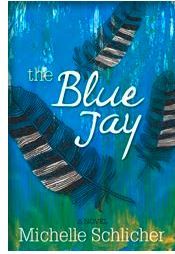 The Blue Jay
Michelle Schilcher, 2015
Self published
207 pp.
ISBN-13: 9780996575003
Summary
A debut novel about a young woman and a young boy scarred by abandonment who find they share an unlikely bond.
Josie McCray was eight years old when her mother left. Now a young teacher, she guards her heart carefully but finds herself pulled to mentor a child in need.
Payton Runnells was 12 when his mother left. Now in foster care, he’s slow to trust anyone but senses that Josie might somehow understand the grief that grips him.
As Josie and Payton lower their walls and forge a frienship, they begin to open themselves up to all life has to offer.
Author Bio
• Birth—April 15, 1984
• Raised—Ankeny, Iowa, USA
• Education—B.A., Iowa State University
• Currently—lives in Ankeny, Iowa
Michelle Schlicher is an American fiction writer and the author of The Blue Jay.
A graduate of Iowa State University, she subsequently worked for six years in communications and marketing. During that time she became involved with a local mentoring organization, which had a huge impact on her life and became the foundation on which The Blue Jay is based.
Michelle grew up in Iowa and still resides there with her husband and two children.
Visit the author's website.
Follow the author on Facebook.
Book Reviews
A lovely debut novel!
Amazon Reviewer
I fell in love with Josie and Payton and I loved watching their relationship grow.
Susan - The Book Bag
I fell in love with so many of the characters. They were so real they became like friends.
Amazon Reviewer
I wouldn’t be surprised if one day Hallmark were to turn The Blue Jay into a film, really I wouldn’t.
Raluca - The Found Girl
I was actually quite surprised that The Blue Jay is a debut novel. To me, the book read like a seasoned author had written it.
Amazon Reviewer
This book will make your soul smile.
Goodreads Reviewer
Discussion Questions
1. Why do you think Josie decides to become a mentor?
2. How are Josie and Payton similar? How are they different? How do these similarities and differences mold their friendship?
3. What are your thoughts on Josie's dad, John? How has he helped shaped who Josie is?
4. Why did Payton lash out at Josie when she voiced her concerns about Ira? Was his outrage warranted?
5. Mia is described as a surrogate mother to Josie. What is your impression of their friendship?
6. How did Louis help Josie? Why do you think he left such an impression on her?
7. Should Payton have forgiven his mother? Why or why not?
8. If Josie's mother were to return, in your opinion, what should she do?
(Questions courtesy of the author.)


Blue Nights
Joan Didion, 2012
Knopf Doubleday
208 pp.
ISBN-13: 9780307387387
Summary
From one of our most powerful writers, a work of stunning frankness about losing a daughter.
Richly textured with memories from her own childhood and married life with her husband, John Gregory Dunne, and daughter, Quintana Roo, this new book by Joan Didion is an intensely personal and moving account of her thoughts, fears, and doubts regarding having children, illness and growing old.
As she reflects on her daughter’s life and on her role as a parent, Didion grapples with the candid questions that all parents face, and contemplates her age, something she finds hard to acknowledge, much less accept. Blue Nights—the long, light evening hours that signal the summer solstice, “the opposite of the dying of the brightness, but also its warning”—like The Year of Magical Thinking before it, is an iconic book of incisive and electric honesty, haunting and profound. (From the publisher.)
Author Bio
• Birth—December 5, 1934
• Where—Sacramento, California, USA
• Education—B.A., University of California at Berkeley
• Awards—National Book Award, 2005
• Currently—New York, New York
For over forty years, Joan Didion has been widely renowned as one of the strongest, wittiest, and most-acerbic voices in journalism, literature, and film. With such fierce works as Slouching Towards Bethlehem, Salvador, and The White Album, she exposed shifting cultural and political climates with humor and unflinching clarity. In classic novels such as A Book of Common Prayer, Democracy, and The Last Thing He Wanted, Didion further explored American culture and politics through the veil of fiction.
Together with her husband John Gregory Dunne, she co-wrote films like The Panic in Needle Park and Play It As It Lays. Firmly established as a heavy hitter in the field of sober political criticism, contemporary literature, and cutting humor, no one could have been more unnerved by Didion's psychological unraveling in the wake of a pair of tragedies than Didion herself — a fact she conveys in her brilliant, shattering latest work.
The Year of Magical Thinking chronicles an exceptionally unforgiving period in Didion's life. Her recently married daughter Quintana had been stricken with pneumonia and fell into a coma. Only a week later, her husband and partner of 40-years died of a heart attack. Battered by these events, Didion felt her grip on reality suddenly slipping, expecting her husband to return home at any moment. "Nothing I read about grief seemed to exactly express the craziness of it," Didion later told New York magazine, "which was the interesting aspect of it to me — how really tenuous our sanity is."
As a means of dealing with her intense grief, Didion found herself unconsciously composing the book that would help her work through the pain of losing a husband while watching a daughter slowly fade away. As she told Barnes & Noble.com...
When I began doing it, I was just writing down notes on what the doctors had said, and their telephone numbers, and their recommendations for other specialists, and then I realized that I was writing other stuff down too — and then I thought, well, I'll just write it all down, and then I realized I was thinking about how to structure it, which was kind of a clue that I was writing something.
What she was writing was The Year of Magical Thinking. She explained to New York magazine that she structured her book so that it served as a parallel to the grieving process, "the way in which you obsessively go over the same scenes again and again and again trying to make them end differently." The book ultimately fuses her finely crafted, sardonic prose with a story more personal than any she had ever told before. As Robert Pinsky of the New York Times Book Review wrote, "As in Didion's previous writing, her sense of timing, sentence by sentence and in the arrangement of scenes, draws the reader forward. Her manner is deadpan funny, slicing away banality with an air that is ruthless yet meticulous." Pinsky is not alone in his praise of Didion's latest; The Year of Magical Thinking has also received well-deserved raves from publications such as the Washington Post and Library Journal.
Most important of all is the role the book has played in Didion's own recovery from her disastrous year. "It became very useful to me," she says, "useful in terms of processing and trying to figure out what had happened."
Blue Nights about the death of her daughter...and her own impending demise was published in 2012. Kirkus Reviews called it "a slim, somber classic."
Extras
From a 2006 Barnes & Noble interview:
• "My first (and only, ever) job was at Vogue. I learned a great deal there—I learned how to use words economically (because I was writing to space), I learned how to very quickly take in enough information about an entirely foreign subject to produce a few paragraphs that at least sounded authoritative.
• "I would like my readers to know that writing never gets any easier. You don't gain confidence. You are always flying blind."
• Didion and her husband, John Gregory Dunne, co-wrote seven screenplays, including: The Panic in Needle Park (1971), Play It As It Lays (1973), A Star Is Born (1977), True Confessions (1982), Hills Like White Elephants (1990), Broken Trust (1995) and Up Close and Personal (1995).
• She is the sister-in-law of author Dominick Dunne and the aunt of actor/director Griffin Dunne.
• When asked about which book influenced her most as a writer, here is her response:
It's hard to limit this to one book, but the book from which I learned the most as a writer was Ernest Hemingway's A Farewell to Arms. I taught myself to type by tying out passages from a lot of Hemingway, but that book especially—it taught me the importance of absolute precision, of how every word and every comma and every absence of a word or comma can change the meaning, make the rhythm, make the difference.
(Author bio and interview from Barnes & Noble.)
Book Review
Exemplary...provocative.... [Didion] comes fully to realize, and to face squarely, the dismaying fact that against life’s worst onslaughts nothing avails, not even art; especially not art.
John Banville - New York Times Book Review
Profoundly moving.... This is first and last a meditation on mortality.
San Francisco Chronicle
Ms. Didion has created something luminous amid her self-recrimination and sorrow. It’s her final gift to her daughter—one that only she could give.
Wall Street Journal
A beautiful, soaring, polyphonic eulogy.... What appears on the surface to be an elegantly, intelligently, deeply felt, precisely written story of the loss of a beloved child is actually an elegantly, intelligently, deeply felt, precisely written glimpse into the abyss, a book that forces us to understand, to admit, that there can be no preparation for tragedy, no protection from it, and so, finally, no consolation.
New York Review of Books
Ms. Didion has translated the sad hum of her thoughts into a profound meditation on mortality. The result aches with a wisdom that feels dreadfully earned.
Economist
For the great many of us who cherish Joan Didion, who can never get enough of her voice and her brilliant, fragile, endearing, pitiless persona, [Blue Nights] is a gift.
Newsday
Exquisite.... She applies the same rigorous standards of research and meticulous observation to her own life that she expects from herself in journalism. And to get down to the art of what she does, her sense of form is as sharp as a glass-cutter’s, and her sentences fold back on themselves and come out singing in a way that other writers can only wonder at and envy.
Washington Independent Review of Books
Yes, this is a book about aging and about loss. Mostly, though, it is about what one parent and child shared—and what all parents and children share, the intimacy of what bring you closer and what splits you apart.
Oprah.com
Breathtaking.... With harrowing honesty and mesmerizing style, Didion chronicles the tragic death of her daughter, Quintana, interwoven with memories of their happier days together and Didion’s own meditations on aging.
Newsweek
Darkly riveting.... The cumulative effect of watching her finger her recollections like beads on a rosary is unexpectedly instructive. None of us can escape death, but Blue Nights shows how Didion has, with the devastating force of her penetrating mind, learned to simply abide.
Elle
In this supremely tender work of memory, Didion is paradoxically insistent that as long as one person is condemned to remember, there can still be pain and loss and anguish.
Christopher Hitchens - Vanity Fair
Loss has pursued author Didion relentlessly, and in this subtly crushing memoir about the untimely death of her daughter, Quintana Roo (1966–2005), coming on the heels of The Year of Magical Thinking, which chronicled the sudden death of her husband, John Gregory Dunne, Didion again turns face forward to the harsh truth. “When we talk about mortality we are talking about our children,” she writes, groping her way backward through painful memories of Quintana Roo’s life, from her recent marriage in 2003 to adorable moments of childhood moving about California in the 1970s with her worldly parents and learning early on cues about how to grow up fast. While her parents were writing books, working on location for movies, and staying in fancy hotels, Quintana Roo developed “depths and shallows,” as her mother depicts in her elliptically dark fashion, later diagnosed as “borderline personality disorder”; while Didion does not specify what exactly caused Quintana’s repeated hospitalizations and coma at the end of her life, the author seems to suggest it was a kind of death wish, about which Didion feels guilt, not having heeded the signs early enough. Her own health—she writes at age 75—is increasingly frail, and she is obsessed with falling down and being an invalid. Yet Didion continually demonstrates her keen survival instincts, and her writing is, as ever, truculent and mesmerizing, scrutinizing herself as mercilessly as she stares down death.
Publishers Weekly
In The Year of Magical Thinking, Didion wrote about her reaction to the death of her husband, John Gregory Dunne. Here she addresses the death shortly thereafter of her 39-year-old daughter, Quintana, who died of complications from pneumonia. Adopted at birth and apprised of this at a young age, Quintana had feelings of abandonment her entire life. Didion wonders here whether her handling of her daughter's early years contributed to those feelings and generally questions her suitability as a parent. At the same time, she discusses her own attempts to cope with aging and the onset of frailty. Didion's spare style of writing gets right to the point. She ponders Quintana's utterances and writings to try to better understand her and how she herself might have responded differently, but ultimately, there are no answers. Verdict: This worthwhile meditation on parenting and aging by a succinct writer, while at times difficult to read and a bit self-centered, is well worth the emotional toll. —Gina Kaiser, Univ. of the Sciences Lib., Philadelphia
Library Journal
Didion’s bravest work. It is a bittersweet look back at what she’s lost, and an unflinching assessment of what she has left.
BookPage
Didion delivers a second masterpiece on grief, considering both her daughter's death and her inevitable own.... Like Magical Thinking, this book is constructed out of close studies of particular memories and bits of medical lingo. Didion tests Quintana's childhood poems and scribblings for hints of her own failings as a mother, and she voices her helplessness at the hands of doctors.... Didion's clipped, recursive sentences initially make the book feel arid and emotionally distant. But she's profoundly aware of tone and style...and the chapters become increasingly freighted with sorrow without displaying sentimentality.... A slim, somber classic.
Kirkus Reviews
Discussion Questions
1. Blue Nights is a deeply elegiac, heartrending book. What are some of its most emotionally powerful moments? What makes these moments so moving?
2. Didion’s style in Blue Nights is clipped, austere, emotionally restrained. What is the effect of the short sentences, short chapters, and paragraphs that often consist of a single sentence? In what ways is Didion’s tone and style appropriate to her subject?
3. A number of italicized statements recur throughout Blue Nights, consisting most often of things that Quintana said—“Let me just be in the ground”; “Like when someone dies, don’t dwell on it”; “After I became five, I never ever dreamed about him.” What is the emotional effect of these repetitions? Why would Didion keep repeating these lines?
4. Didion writes: “My cognitive confidence seems to have vanished altogether. Even the correct stance for telling you this, the ways to describe what is happening to me, the attitude, the tone, the very words, now elude my grasp. The tone needs to be direct. I need to talk to you directly, I need to address the subject as it were, but something stops me.... Am I no longer able to talk directly?” [p. 116]. Is the tone of Blue Nights direct or indirect? Why might Didion find it difficult to be as direct as she wants to be about her subject?
5. Didion quotes Euripides: “What greater grief can there be for mortals than to see their children dead” [p. 13]. In what ways does Blue Nights bear out this truth? Of all the griefs that humans might be forced to endure why is this the most painful?
6. What kind of child was Quintana? What was most remarkable about her and most painful about her loss?
7. Thinking back to Quintana’s wedding, Didion writes: “I still see from that wedding day at St. John the Divine: the bright red soles on her shoes. She was wearing Christian Louboutin shoes, pale satin with bright red soles. You saw the red soles when she kneeled at the altar” [p. 69]. What is the effect, on Didion and on the reader, of these minute but vividly remembered details? What other details seem especially poignant?
8. Didion says she knows very few people who think of themselves as having succeeded as parents, that most parents instead “recite rosaries of failures, our neglects, our derelictions and delinquencies” [p. 93]. What does Didion most regret about her relationship with Quintana? What does she see as her failures?
9. Why might Quintana have seen her mother as “frail,” as needing her care, rather than the reverse? [p. 101].
10. Didion says that she had initially wanted to write a book about children but that after she started it became clear her true subject was “the failure to confront the certainties of aging, illness, death” [p. 54]. What does the book say about these essential human themes? Does Didion fail to confront them?
11. Blue Nights is filled with digressions—about movie shoots, changes in parenting styles over the past fifty years, her own work in the theatre, Sophia Loren, etc.—but keeps circling back to the death of her daughter and to her own illness and aging. Why might Didion have chosen this kind of structure, rather than a more straightforward chronological approach?
12. Didion describes her own illnesses and medical emergencies in a remarkably matter-of-fact way. Why is this understated approach more powerful than a more dramatic rendering might be?
13. What is so powerful about Didion’s quandary over who to list as an emergency contact on a medical form? What reveries does this question lead to?
14. Why does Didion end the book with a series of single, short sentences? Does she achieve here the kind of emotional directness she earlier felt was beyond her?
(Questions issued by publisher.)
Blue Shoes and Happiness (No. 1 Ladies Detective Agency series #7)
Alexander McCall Smith, 2006
Knopf Doubleday
256 pp.
ISBN-13: 9781400075713
Summary
Life is good for Mma Ramotswe as she sets out with her usual resolve to solve people’s problems, heal their misfortunes, and untangle the mysteries that make life interesting. And life is never dull on Tlokweng Road.
A new and rather too brusque advice columnist is appearing in the local paper. Then, a cobra is found in the offices of the No. 1 Ladies’ Detective Agency. Recently, the Mokolodi Game Preserve manager feels an infectious fear spreading among his workers, and a local doctor may be falsifying blood pressure readings. To further complicate matters, Grace Makutsi may have scared off her own fiancé.
Mma Ramotswe, however, is always up to the challenge. And Blue Shoes and Happiness will not fail to entertain Alexander McCall Smith’s oldest fans and newest converts with its great wit, charm, and great good will. (From the publisher.)
Author Bio
• Birth—August 24, 1948
• Where—Bulawayo, Rhodesia (now Zimbabwe)
• Education—Christian Brothers College; Ph.D., University
Edinburgh
• Honors—Commandre of the Order of the British Empire
(CBE); Fellow of the Royal Society of Edinburgh (FRSE)
• Currently—lives in Edinburgh, Scotland, UK
Alexander (R.A.A.) "Sandy" McCall Smith, CBE, FRSE, is a Rhodesian-born Scottish writer and Emeritus Professor of Medical Law at the University of Edinburgh. In the late 20th century, McCall Smith became a respected expert on medical law and bioethics and served on British and international committees concerned with these issues. He has since become internationally known as a writer of fiction. He is most widely known as the creator of the The No. 1 Ladies' Detective Agency series.
Alexander McCall Smith was born in Bulawayo, in what was then Southern Rhodesia and is now Zimbabwe. His father worked as a public prosecutor in what was then a British colony. He was educated at the Christian Brothers College before moving to Scotland to study law at the University of Edinburgh, where he received his Ph.D. in law.
He soon taught at Queen's University Belfast, and while teaching there he entered a literary competition: one a children's book and the other a novel for adults. He won in the children's category, and published thirty books in the 1980s and 1990s.
He returned to southern Africa in 1981 to help co-found and teach law at the University of Botswana. While there, he cowrote what remains the only book on the country's legal system, The Criminal Law of Botswana (1992).
He returned in 1984 to Edinburgh, Scotland, where he lives today with his wife, Elizabeth, a physician, and their two daughters Lucy and Emily. He was Professor of Medical Law at the University of Edinburgh at one time and is now Emeritus Professor at its School of Law. He retains a further involvement with the University in relation to the James Tait Black Memorial Prize.
He is the former chairman of the British Medical Journal Ethics Committee (until 2002), the former vice-chairman of the Human Genetics Commission of the United Kingdom, and a former member of the International Bioethics Commission of UNESCO. After achieving success as a writer, he gave up these commitments.
He was appointed a CBE in the December 2006 New Year's Honours List for services to literature. In June 2007, he was awarded the Honorary Degree of Doctor of Laws at a ceremony celebrating the tercentenary of the University of Edinburgh School of Law.
He is an amateur bassoonist, and co-founder of The Really Terrible Orchestra. He has helped to found Botswana's first centre for opera training, the Number 1 Ladies' Opera House, for whom he wrote the libretto of their first production, a version of Macbeth set among a troop of baboons in the Okavango Delta.
In 2009, he donated the short story "Still Life" to Oxfam's 'Ox-Tales' project—four collections of UK stories written by 38 authors. McCall Smith's story was published in the Air collection. (From Wikipedia.)
Book Reviews
(Audio version.) It was a shrewd idea to get the veteran actress and audiobook prize winner Lecat to perform this version of Smith's latest mystery starring the unforgettable Botswana detective Precious Ramotswe. Lecat is a native South African who grew up hearing the authentic accents of women just like Ramotswe, and she gives the character the perfect notes of a real person rather than slipping into caricature. Indeed, Lecat has as good an ear for the ethnic turf covered as the author does. She is also adept at making other female characters, such as assistant detective Grace Makutsi, different but immediately believable. It's Grace who has the title's passion for fancy footwear-in spite of her being a secret feminist afraid of letting her boyfriend know about her politics. Smith does mix in small measures of danger and mystery, but the overall feeling is one of a pleasant dream, of gentle wonder that such people can exist in a conflicted world. And Lecat is the perfect choice to read the story.
Publishers Weekly
Fans of Botswana's No. 1 lady detectives Precious Ramotswe and Grace Makutsi (In the Company of Cheerful Ladies) will be pleased to learn that the seventh novel in this series is just as entertaining as the previous six. Smith relates the ladies' latest adventures with his usual warmth, affection, and gentle humor. The ladies' problems this time range from the dramatic (a cobra in the office) to the romantic (a misunderstanding between Mma Makutsi and her fiance). The author digresses frequently on the charms of Botswana, as much a character as Mma Ramotswe herself. "If only more people knew, thought Mma Ramotswe. If only more people knew that there was more to Africa than all the problems they saw. They could love us too, as we love them." Highly recommended for all public libraries. —Leslie Patterson, Blanding P.L., Rehoboth, MA
Library Journal
(Starred review.) In this seventh installment in McCall Smith's delightful No. 1 Ladies' Detective Agency series, "traditionally built" Botswana detective Precious Ramotswe faces one of her toughest challenges: losing weight. Luckily, there are plenty of dilemmas to keep her mind off her girth.... Scotsman McCall Smith renders brisk, seamless tales that are both wry and profound. Amidst the mayhem...are eloquent descriptions of the serene African country that holds a special place in his heart.
Booklist
A seventh bulging file of cases for Mma Precious Ramotswe and the No. 1 Ladies' Detective Agency, most of them offering no hope of profit except to lucky readers. Where to begin? Poppy Maope is certain that the senior cook at her college is stealing food for her husband, but when she confronts the thief, she's threatened with losing her job. Neil Whitson, manager of the Mokolodi Game Preserve, senses widespread fear among workers who refuse to name its cause. Boitelo Mampodi, a qualified nurse, is worried because Dr. Eustace Lubega doesn't want her to take his patients' blood pressure. Mma Ramotswe's assistant, Mma Grace Makutsi, may have scared off her fiance, Mr. Phuti Radiphuti, by identifying herself as a feminist. And Mr. Polopetsi, the newest employee in the garage owned by Mma Ramotswe's husband, Mr. J.L.B. Matekoni (In the Company of Cheerful Ladies, 2005), is exhausted by bicycling everywhere but has been denied an auto loan by his rich uncle. In Smith's quietly penetrating manner, each of these problems leads to still further problems. Perhaps Mma Ramotswe should throw in the towel and consult the advice columnist Aunty Emang, who seems to be seriously poaching on her turf. The denouement, which brings Mma Ramotswe face to face with evil, is the perfect climax to a tale as refreshing as a month in the country—the country of Botswana.
Kirkus Reviews
Discussion Questions
1. “We are all human beings, and human beings can’t really help themselves. Have you noticed that, Mma? We can’t really help ourselves from doing things that land us in all sorts of trouble” (p. 4). From this observation, spoken by Mma Ramotswe to Mma Makutsi, proceeds the plot of Blue Shoes and Happiness. How are the characters in this story responsible for creating their own problems?
2. Why does Mma Ramotswe rely so loyally upon the advice of Clovis Andersen’s The Principles of Private Detection? Consider this example: “Keep your mouth shut at all times, but at the same time encourage others to do precisely the opposite” (p. 12). What does Mma Ramotswe admire about such advice? How does she judge the quality of the advice given by Aunty Emang, the newspaper columnist? What do you think of Aunty Emang’s advice? What about Clovis Andersen’s?
3. Much of the satisfaction of the No. 1 Ladies’ Detective Agency novels lies in their precise observations of daily life as experienced by women: “That was part of being a woman, [Mma Ramotswe] thought; one never reached the end. Even if one could sit down and drink a cup of bush tea, or even two cups, one always knew that at the end of the tea somebody was waiting for something” (pp. 12-13). Is it at all surprising that the writer of these observations is a man? Why do you suppose that Alexander McCall Smith has so much empathy for his female characters?
4. Although the HIV/AIDS crisis is a major health problem facing Africa today Alexander McCall Smith addresses it in subtle and delicate ways in his series such as in the following exchange: “Ever since women allowed men to think that they did not need to get married, everything has gone wrong,” Mma Ramotswe tells a client. The client replies, “Look at the mess. Look at what all this unfaithfulness has done. People are dying because of that, aren’t they?” (pp. 35-36). How does the author address the crisis in this book, and if you’ve read the others, in the series? Why do you think he handles it in this fashion? How do you feel about his treatment of the crisis?
5. Charlie and the younger apprentice fail to trap a cobra that has invaded the office. Why might the chapter’s title, “Correct and Incorrect Ways of Dealing With a Snake,” also be “Correct and Incorrect Ways of Being a Man”? Why does Mma Ramotswe conclude about the incident, “Snakes were one of the tests which life sent for us, and there was no telling how we might respond until the moment arrived. Snakes and men. These were the things sent to try women, and the outcome was not always what we might want it to be” (p. 26)?
6. Grace Makutsi has several mental conversations with her shoes; see for instance pages 64-65 and 108. How do they convey a part of Mma Makutsi’s character? What do the blue shoes represent for her? How difficult is it for her to come to terms with the fact that they were not a practical purchase?
7. What is the mistake that Mma Makutsi makes when telling Phuti Radiphuti that she is feminist (pp. 54-55), and why doesn’t she see this problem in advance? What feelings does she evoke when she says to herself, “I am a girl from Bobonong, with glasses.” (p. 88)?
8. In Mokolodi a tourist asks Mma Ramotswe to take a photograph of her and a friend who, she says, is terminally ill (pp. 126-27). Discuss this incident, with regard to Mma Ramotswe’s actions and her feelings about the dying woman. Discuss also the passage on page 114, which describes Mma Ramotswe’s feelings about her father and about her baby who died. What do these scenes tell us about Mma Ramotswe’s spiritual qualities?
9. Mma Tsau, who has threatened Poppy with dismissal, turns out to be a woman who loves her philandering husband too much. How does Mma Ramotswe deal with the villains of the novel—Mma Tsau, Aunty Emang, and Dr. Lubega? What skills does she use in solving these cases? How does her attitude differ toward each of the women and why?
10. Mr. J. L. B. Maketoni’s two apprentices are representative, for Mma Ramotswe, of a larger problem with the future of Botswana: the young people are abandoning the culture’s traditional values. Regarding the promiscuity of girls and boys alike, she thinks, “One should just not do it, because that was not how the old Botswana morality worked. There was such a thing as shame…although there were many people who seemed to forget it” (p. 59). Does it seem that, according to Mma Ramotswe, relations between men and women are crucial to the structures upon which society rests?
11. The old Botswana morality is exemplified in the following passage: “So it was in Botswana, almost everywhere; ties of kinship, no matter how attenuated by distance or time, linked one person to another, weaving across the country a human blanket of love and community. And in the fibres of that blanket there were threads of obligation that meant that one could not ignore the claims of others. Nobody should starve; nobody should feel that they were outsiders; nobody should be alone in their sadness” (p. 68). Do these ethical principles of responsibility and caring still exist as a basic element of American culture? How are they reflected in this book? Do they seem as pervasive in Botswana as Mma Ramotswe believes?
12. Alexander McCall Smith has said that his novels “represent the range of things I would like to say about the world.” What are the most important ideas among the “range of things” represented by this book and others in the series?
13. Book reviewers and fans agree that the novels in the No. 1 Ladies’ Detective Agency series give a great deal of reading pleasure. Does this pleasure mask their moral seriousness, or is their moral seriousness part of what makes them pleasurable?
14. A typographic design, repeating the word Africa, follows the novel’s final sentence. How does this affect your reading of the ending, and what emotion does it express?
(Questions issued by publisher.)
top of page (summary)
Blue Water
A. Manette Ansay, 2006
HarperCollins
280 pp.
ISBN-13: 9780380732883
Summary
On an ordinary morning in Fox Harbor, Wisconsin, Meg and Rex Van Dorn's lives are irrevocably changed when a drunk driver slams into Meg's car, killing the couple's six-year-old son, Evan. In a town in which everyone knows everybody else, it's no surprise that Meg and the driver, Cindy Ann Kreisler, were once the best of friends. Now, as Meg recovers from her own injuries, she and Rex find themselves unable to cope with their anger and despair, especially after Cindy Ann returns—with a mere slap on the wrist—to the life she lived before the accident: living in a beautiful house, enjoying her own three daughters, all of whom walked away from the accident unharmed.
Mornings, we woke with an ache in our throats, a sourness in our stomachs, that had nothing to do with Evan. The truth was that, with each passing month, he was harder to remember, harder to see. I felt as if I were grasping at the color of water, the color of the wind or the sky. And this only made me angrier. My mind returned, again and again, to Cindy Ann, to what she'd done. When I passed Evan's room, the closed door like a fist, I thought about how Cindy Ann had destroyed us. When I saw other people's children, I promised myself that someday, Cindy Ann would pay.
In their rage and grief, Meg and Rex buy a boat to sail around the world, hoping to put as much distance between themselves and Cindy Ann Kreisler as possible. Adrift in the company of otherlive-board cruisers, Meg tries to believe that she and Rex have left their bitterness behind. But when she returns to Fox Harbor for her older brother's wedding, she is forced to face the complex ties that bind her to the woman who has wounded her so badly. For, as Meg knows better than anyone, Cindy Ann has secrets and sorrows of her own, dating back to the summer of their friendship.
Impassioned, insightful, and beautifully written, Blue Water is the story of people learning to face the unthinkable—a compelling affirmation of the human potential for forgiveness, redemption, and grace. (From the publisher.)
Author Bio
• Birth—1964
• Where—Lapeer, Michigan, USA
• Education—M.F.A., Cornell University
• Awards—Nelson Algren Prize, 1992; Pushcart Prize, 1994;
Friends of American Writers Prize, 1995
• Currently—Port Washington, Wisconsin; New York City
A. Manette Ansay’s first novel, Vinegar Hill, established the writer as a novelist who could tell a difficult story with great grace. Born in Michigan in 1964 and raised in Port Washington, Wisconsin among a huge Roman Catholic extended family, Ansay infuses her fiction with the reality of Midwestern farm life, the constraints of Roman Catholicism, and the toll the combination can take on women and men alike.
Philosophical and cerebral, with a gift for identifying the telling domestic detail and conveying it in a fresh way, Ansay incorporates the rhythm of rural Midwestern life—the polka dance at a wedding reception, the bowling alley, community suppers, gossip, passion, and betrayal—into novels that illuminate the most difficult aspects of maintaining any close relationship, whether it be familial or not. In Vinegar Hill, Ansay examines the forces that hold a Catholic woman in the 1970s hostage to her emotionally abusive marriage. In Midnight Champagne, set at a wedding, she focuses her lens on the institution of marriage itself; the story is told through the shifting points of view of the couples who attend the event.
Readers and critics alike have testified to her talents: The New Yorker said of Vinegar Hill, “This world is lit by the measured beauty of her prose, and the final line is worth the pain it takes to get there.” The novel was selected for Oprah’s Book Club in 1999; Ansay’s following book, Midnight Champagne, was a finalist for a National Book Critics Circle Award.
Like Flannery O’Connor, whom Ansay cites as an influence, Ansay is concerned with moments of grace in which the truth suddenly manifests itself with life-changing intensity. In the wrong hands, her material could be the stuff of soap operas. But Ansay strives for emotional complexity rather than mere bathos, and addresses both suffering and joy with intelligence and sensitivity.
Ansay’s life has been as complex and fascinating as the dramas that unfold in her novels. A gifted pianist as a child, she studied at the University of Wisconsin while still a high school student. Later, while a student at the Peabody Conservatory of Music, she was afflicted by a disease that devastated her neurological system, cutting short her dreams of becoming a concert pianist, and leaving her confined for years to a wheelchair. She had never written fiction before, but turned her disciplined ear and mind to writing, promising herself to write two hours a day, three days a week, the same sort of disciplined schedule she had imposed on herself as a student musician.
Limbo, Ansay’s story of her struggle with illness, is as evocatively written as her novels. Ansay never descends into sentimentality, but instead confronts her medical problems – and the limitations they impose—unflinchingly, describing both the indignities that disabled people face daily, as well as how her own illness has become a personal test of faith.
Extras
From a 2001 Barnes & Noble interview:
• Ansay was still looking for the appropriate title for her first novel when, on the way to a meeting with her MFA advisor near Cornell University, Ansay spotted a street sign with the answer. "I happened to glance up and see a street sign that said "Vinegar Hill." It was perfect," Ansay writes on her web site. "I had never turned onto that street before, and I made a point never to do so afterwards. I wanted it to belong solely to my characters. And it does."
• One scene in Midnight Champagne, the air-hockey table encounter, was written for a friend of Ansay's. She writes, "A friend of mine had been musing about sex and literature, and she said, 'Why is it that we so seldom read about the kind of sex we want to be having?' I said, 'What kind of sex is that?' She said, 'Fun sex.' I said, 'I'm writing a scene just for you."'
Her own words:
In my early 20s, my health rapidly deteriorated for reasons that are still unclear. At 19, I was a piano performance major at a nationally renowned conservatory; by 21, I was so weak I couldn't stand up long enough to take a shower. After spending a year under my parents' care, visiting specialist after specialist, my health improved to the point where I could return to my life—though a different one—with the help of a power wheelchair. Limbo is the story of learning to live within the physical and emotional limbo of an undiagnosed illness, an uncertain prognosis, an uncertain future. It is also the story of how the unraveling of one life can plant the seeds for another, and the ways in which illness has challenged—in ways not necessarily bad—my most fundamental assumptions about life and faith.
Growing up in rural Wisconsin, I was formed by a place where the roads met at right angles, a landscape in which cause and effect were visible for miles. I was raised to believe that every question had its single, uniform answer, and that that answer was inevitably God's will. But the human body, like the life it leads, is ultimately a mystery, and to live my life without restraint, to keep moving forward instead of looking back, I have had to let go of the need to understand why what has happened has happened. It is not that I believe the things that happen to us happen for a reason. I certainly don't believe that "things have a way of working out for the best," something I've been told countless times by well-meaning doctors, family members, and friends. But I do believe that we each have the ability to decide how we'll react to the random circumstances of our lives, and that our reactions can shape future circumstances, affect opportunities, open doors.
The writer Ann Patchett talks about awakening in the hospital after a terrible car wreck at the age of eight, and thinking, with absolute clarity: Now I can be anything, and I want to be a writer. I started writing on January 1, 1988, shortly after I began to realize that this new, altered body was mine to keep. Thirteen years and five books later, I continue to write as a way of making sense of a world that doesn't. I write to create the kind of closure that rarely exists in life. The best advice on writing I've ever heard is this: Try to write the kind of story you yourself most want to read. Limbo is that story." (Author bio and interview from Barnes & Noble.)
Book Reviews
In Ansay's latest, a probing character study, Meg Van Dorn and her husband, Rex, struggle with the loss of six-year-old son, Evan, in a crash with Cindy Ann Kreisler-Meg's best friend from high school and an alcoholic, who was drunk at the wheel. The two file a civil suit that would financially ruin the well-off Cindy Ann, but Meg has a change of heart, given the impending marriage of Meg's older brother to Cindy Ann's sister; it's more a contrived plot device than a genuine narrative event, but it does force Meg to constantly shift her perspective on the tragedy, especially as Ansay offers a sympathetic sketch of Cindy Ann and her troubled past. Most of Meg's emotional cycling takes place on the Atlantic coast, where she and Rex have gone sailing as a coping strategy and have fallen in with various strands of lower-end sailing culture: the book's best energy is spent in places like the Island Girls bar, to which Meg eventfully repairs one night without Rex. The resolution of Meg and Rex's marital issues seems glaringly underwritten in the final chapters, but on the whole, this is a solid and revelatory novel on themes of grief and loss.
Publishers Weekly
Ansay takes us on the dark, emotional journey of a mother's losing a child and brings us out on the other side into forgiveness and redemption. Meg and Rex Van Dorn's comfortable life in Meg's home town on the Wisconsin shore of Lake Michigan ends when their young son is killed in a car accident as Meg is driving him to school. Cindy Ann, the driver who caused the accident, was Meg's best friend in high school. Meg and Rex file a civil suit against Cindy but drop it when they find that bitterness is dominating their lives. Trying to start over, they buy a sailboat and move to the Caribbean. Their seafaring life, which Ansay depicts authentically in all its drudgery and danger, seems exotic but offers them little comfort. In time, Meg's feelings about Cindy evolve into something like a supernatural connection. When she learns that Rex is secretly pursuing the civil suit, the differences in how they cope with grief begin to pull their marriage apart. For all popular fiction collections; buy to please the many fans of Ansay's Oprah selection, Vinegar Hill. —Reba Leiding, James Madison Univ. Libs., Harrisonburg, VA
Library Journal
A soft-spoken, unenergetic narrative of grief, anger and forgiveness. Megan Van Dorn, nearing her 50s, has found fulfillment in late motherhood; life in her Midwestern suburb is good, and she even seems to enjoy spending hours in an ergonomic chair in an accounting office. Then tragedy strikes: Her bright, pleasant son is killed in an automobile accident. The offending driver is Megan's childhood friend Cindy Ann Kreisler, who, it seems, has a drinking problem but who manages to avoid a Breathalyzer test until a couple of hours after the crash, and even then "her blood alcohol level...was barely within Wisconsin's legal limit." In depicting all this, novelist and memoirist Ansay (Limbo, 2001, etc.) is matter-of-fact, at a seeming remove from her characters. When Cindy Ann is acquitted with a slap-on-the-wrist punishment, Megan finds herself "terrible in my anger: strong, and fierce, and righteous. I could have led an army"; yet the reader doesn't ever feel much of this anger, for Megan's narration is flat and without affect, and her discovery of "the sheer cathartic power of...rage" is evidenced mostly by the fact that she sets a lawyer loose on Cindy Ann while she and her near-perfect husband, Rex, fulfill his dream of setting sail to the Caribbean. A year passes, and Megan, who returns home from time to time to attend to household matters, finds her rage slowly dissipating at the sight of poor Cindy Ann, who has hit rock-bottom and seems not to know how to climb up again. What to do? Well, Rex has taken to hitting the bottle himself, and to his irritation, Megan acts on that sense of pity, all of which has-well, consequences. Effective at moments. But, for the most part, thetelling is long and the showing short; not much happens, and when it does, it seldom moves.
Kirkus Reviews
Discussion Questions
1. Based on her demeanor at the scene of the accident and her behavior throughout Blue Water, how would you describe Cindy Ann Kreisler, the woman responsible for Evan Van Dorn’s death?
2. What role does the small-town atmosphere of Fox Harbor play in Rex and Meg Van Dorn’s decision to seek time at sea on their sailboat, the Chelone?
3. What aspects of life on the Chelone draw Rex and Meg closer together, and what aspects push them further apart?
4. How does Toby’s relationship with Mallory Donaldson, Cindy Ann Kreisler’s sister, complicate the Van Dorns’ decision to seek legal damages from Cindy Ann?
5. How does Cindy Ann’s sexual abuse by her stepfather, Dan Kolb, impact Meg’s feelings about her son’s killer?
6. In what ways does Meg’s budding friendship with Bernadette Hale and her invalid son, Leon, transform her feelings about seeking revenge and granting forgiveness?
7. To what extent is Evan’s accidental death the cause of the deterioration of Rex and Meg’s marriage?
8. What explains Meg’s decision to befriend Cindy Ann Kreisler on her return to Fox Harbor, and how does this decision impact her relationship with Rex?
9. How would you describe Meg and Rex’s methods of grieving over the course of Blue Water?
10. At the end of the novel, what does the birth of Toby and Mallory’s daughter, Sadie, represent to Meg?
(Questions from author's website.)
top of page (summary)


Bluebird, Bluebird
Attica Locke, 2017
Little, Brown & Company
320 pp.
ISBN-13: 9780316363297
Summary
When it comes to law and order, East Texas plays by its own rules—a fact that Darren Mathews, a black Texas Ranger, knows all too well.
Deeply ambivalent about growing up black in the lone star state, he was the first in his family to get as far away from Texas as he could. Until duty called him home.
When his allegiance to his roots puts his job in jeopardy, he travels up Highway 59 to the small town of Lark, where two murders — a black lawyer from Chicago and a local white woman — have stirred up a hornet's nest of resentment. Darren must solve the crimes — and save himself in the process — before Lark's long-simmering racial fault lines erupt.
From a writer and producer of the Emmy winning Fox TV show Empire, Attica Locke's Bluebird, Bluebird is a rural noir suffused with the unique music, color, and nuance of East Texas. (From the publisher.)
Author Bio
• Birth—1971
• Born—Houston, Texas, USA
• Education—Northwestern University
• Currently—lives in Los Angeles, California
Attica Locke is an American author of several works of fiction and a screenwriter, perhaps best known for the television series Empire. A native of Houston, Texas, she graduated from Northwestern University and now lives in Los Angeles, California, with her husband and daughter.
Locke’s first novel, Black Water Rising (2009), was nominated for a 2010 Edgar Award, an NAACP Image Award, and a Los Angeles Times Book Prize. It was shortlisted for the prestigious Orange Prize in the UK (now the Baileys Women’s Prize for Fiction). She followed that novel with three other works: The Cutting Season (2012), Pleasantville (2015), and Bluebird, Bluebird (2017).
In addition to her novels, Locke has worked in film and television. She was a fellow at the Sundance Institute's Feature Filmmakers Lab, has written scripts for Paramount, Warner Bros., Disney, 20th Century Fox, Jerry Bruckheimer Films, HBO, and DreamWorks.
Locke is a member of the academy for the Folio Prize in the UK and is also on the board of directors for the Library Foundation of Los Angeles. (Adapted from Wikipedia. Retrieved 10/26/2017.)
Book Reviews
Attica Lock is a highly gifted author whose prose — steeped at times in idiom and lyricism yet sparse and lucid at others — is a joy to read. Laced with flashbacks and bedeviled with twists and turns, the plot propels readers to the end. The good news is that Bluebird, Bluebird is the first in a planned series with Darren Matthews in the lead, and that’s something to look forward to. Highly recommended. READ MORE …
P.J. Adler - LitLovers
Locke writes in a blues-infused idiom that lends a strain of melancholy and a sense of loss to her lyrical style.
Marilyn Stasio - New York Times Book Review
Racial tensions are at the core of this elegant thriller, set in Shelby County, Texas. There is injustice here — institutional racism that has its roots in Texas’s history as a confederate state and continues today.… In slow yet gripping chapters, Locke studies the impact of racism on a small town and its people.
Claire Khoda Hazelton - Guardian (UK)
Locke is a brisk writer with a sharp eye for the subtleties of how rural white Southerners tend to act as if their little towns belong to them — and react harshly to black independence. Still, those truths are not necessarily the evidence one finds in a murder investigation in a small town in Texas. Those places are complicated.
Neely Tucker - Washington Post
An emotionally dense and intricately detailed thriller, roiling with conflicting emotions steeped in this nation's troubled past and present.… A rich sense of place and relentless feeling of dread permeate Attica Locke's heartbreakingly resonant new novel about race and justice in America.… Bluebird, Bluebird is no simple morality tale. Far from it. It rises above "left and right" and "black and white" and follows the threads that inevitably bind us together, even as we rip them apart.
James Endrst - USA Today
Attica Locke's stupendous fourth novel is suffused with the blues. Pushing her classic noir plot deep into history and culture, the Houston native sings her own unshakable, timeless lament. Streaked with wit and hard-earned wisdom, Bluebird, Bluebird soars.
Chicago Tribune
Attica Locke's terrific Bluebird, Bluebird simmers with racial tension.… [A] story told with Locke's crystal-clear vision and pleasurably elemental prose.
Seattle Times
Locke pens a poignant love letter to the lazy red-dirt roads and Piney Woods that serve as a backdrop to a noir thriller as murky as the bayous and bloodlines that thread through the region.… Locke shows off her chops as a superb storyteller.… She is adept at crafting characters who don't easily fit the archetypes of good and evil, but exist in the thick grayness of humanness, the knotty demands of loyalties and the baseness of survival. Locke holds up the mirror of the racial debate in America and shows us how the light bends and fractures what is right, wrong and what simply is the way it is — but perhaps not as it should be.
Jaundrea Clay - Houston Chronicle
Powerful.… Locke is a master of plot who's honed her craft.… The deepest pleasures to be found in Bluebird, Bluebird, though, are in her renderings of those who've loved and lost but still want to believe in the world's benevolence.
Leigh Haber - Oprah Magazine
I've never bought the notion of the Great American Novel. I think when literary historians look back, they'll realize this time had many, but if Attica Locke's Bluebird Bluebird isn't on the list, I'm coming back to haunt them.
Carole E. Barrowman - Milwaukee Journal Sentinel
[Locke's] mystery novels are top notch.… [T]he book's hero, a black Texas Ranger, and his fight for justice make this a page-turner that brings Texas into sharp focus.
Bustle
Absorbing.… Darren must deal with his conflicting loyalties to his family and to Texas, as well as his identity as a black man, as he struggles for justice in this tale of racism, hatred, and, surprisingly, love.
Publishers Weekly
(Starred review.) [A]n atmospheric, convoluted mystery seasoned with racial tension and family loyalty. Verdict: Locke is a gifted author, and her intriguing and compelling crime novel will keep readers engrossed. —Sandra Knowles, South Carolina State Lib., Columbia
Library Journal
(Starred review.) Locke, having stockpiled an acclaimed array of crime novels, deserves a career breakthrough for this deftly plotted whodunit whose writing pulses throughout with a raw, blues-inflected lyricism.
Kirkus Reviews
Discussion Questions
We'll add publisher questions if and when they're available; in the meantime, please use our LitLovers talking point to help start a discussion for Bluebird, Bluebird … then take off on your own:
1. Which character is your favorite and why? Whom do you find most engaging?
2. In Chapter 1, we meet Darren Matthews on the witness stand giving testimony in a court case. What do we learn about him — his family, his past, his marriage, his quirks and personality traits — all in that brief chapter? (It's a skillful piece of writing, by they way.)
3. Was Darren right to have driven out to help his friend Rutherford McMillan? Was he right to have filed a report afterward? In other words, where should Darren's loyalty lie: with the Rangers or with an old family friend? What would you have done?
4. Describe the relationship between Geneva Sweet and Darren? Why does Darren seem to want Geneva's approval, or at least her good will? Why does Geneva withhold her friendship from Darren?
5. How would you describe the racial environment in Lark, Texas?
6. Why does Sheriff Van Horn concentrate on solving the death of Missy Dale while ignoring Michael Wright's?
7. When Randi Winston wonders why her husband came to Texas, saying "this was not his home," Darren disagrees (118). What is it about Texas, especially places like Lark and Shelby County, that gives Darren such a keen sense of home despite the both subtle and far-from-subtle racism? Why does he refuse to leave Texas?
8. As Wendy looks around Geneva's cafe, she observes that "Forty-some-odd years after the death of Jim Crow, not much had changed" (8). Although she is initially thinking of the cafe itself, what else in the county-at-large is unchanged?
9. Follow-up to Question 8: Daren's uncles advise Darren to follow the "ancient rules of southern living" (16). What are those rules, and why are they so important to black men?
10. Darren asks Sheriff Van Horn for a copy of the autopsy report for Michael Wright. But Darren already has access to it through his FBI friend Gregg. Why does he pretend he needs a copy?
11. So…are you straight about who killed whom? Who killed (and why) Michael Wright? Who killed (and why) Missy Dale? And who killed (and why) Joe Sweet, Geneva's husband … and Joe Sweet, Jr., Geneva's son? What about Isaac? How did he come to have a role in all of this?
12. Finally, are you clear on who is related to whom?
13. SPOILER ALERT: What about Darren's mother? What does her discovery of Mac's gun indicate? And what power will the fact that she possesses it give her ... and over whom?
14. What are your predictions for Darren and Lisa's marriage? Do you have sympathy for Lisa's position: that she married a young lawyer who would be a steady partner with her but now his job takes him away from her? Or do you think she should accept Darren's desire to be a Ranger?
(Questions by LitLovers. Please feel free to use them, online or off, with attribution. Thanks.)
The Bluest Eye
Toni Morrison, 1970
Knopf Doubleday
207 pp.
ISBN-13: 9780307278449
Summary
An Oprah Selection
The Bluest Eye is the first novel written by Toni Morrison, winner of the 1993 Nobel Prize in Literature.
Pecola Breedlove, a young black girl, prays every day for beauty. Mocked by other children for the dark skin, curly hair, and brown eyes that set her apart, she yearns for normalcy, for the blond hair and blue eyes that she believes will allow her to finally fit in.
Yet as her dream grows more fervent, her life slowly starts to disintegrate in the face of adversity and strife. A powerful examination of our obsession with beauty and conformity, Toni Morrison’s virtuosic first novel asks powerful questions about race, class, and gender with the subtlety and grace that have always characterized her writing. (From the publisher.)
Author Bio
• Aka—Chloe Anthony Wofford
• Birth—February 18, 1931
• Where—Lorain, Ohio, USA
• Education—B.A., Howard University; M.A., Cornell,
• Awards—Nobel Prize, 1993, National Book Critics' Circle
Award, 1977; Pulitzer Prize, 1988.
• Currently—lives in Princeton, NJ and New York, NY
With her incredible string of lyrical, imaginative, and adventurous modern classics Toni Morrison lays claim to being one of America's best novelists. Race issues are at the heart of many of Morrison's most enduring novels, from the ways that white concepts of beauty affect a girl's self image in The Bluest Eye to themes of segregation in Sulu and slavery in her signature work Beloved. Through it all, Morrison relates her tales with lyrical eloquence and spellbinding mystery.
Born Chloe Anthony Wofford, Morrison's unique approach to writing stems from a childhood spent steeped in folklore and mythology. Her family reveled in sharing these often tales, and their commingling of the fantastic and the natural would become a key element in her work when she began penning original tales of her own.
The other majorly influential factor in her writing was the racism she experienced firsthand in, as Jet magazine described it, the "mixed and sometimes hostile neighborhood" of Lorain, Ohio. When Morrison was only a toddler, her home was set afire by racists while her family was still inside of it. During times such as these, she found strength in her father, who instilled in her a great sense of dignity. This pride in her cultural background would heavily influence her debut novel.
In The Bluest Eye, an eleven-year old black girl named Pecola prays every night for blue eyes, seeing them as the epitome of feminine beauty. She believes these eyes, symbolizing commonly held white concepts of attractiveness, would put an end to her familial woes, an end to her father's excessive drinking and her brother's meandering. They would give her self-esteem and purpose. The Bluest Eye is the first of Toni Morrison's cries for racial pride and it is an auspicious debut told with an eerie poeticism.
Morrison next tackled segregation in Sulu, which chronicles the friendship between two women who, much like the author, grew up in a small, segregated village in Ohio. Song of Solomon followed. Arguably her first bona fide classic and certainly her most lyrical work, Song of Solomon breathed with the mythology of Morrison's youth, a veritable modern folktale pivoting on an eccentric whimsically named Milkman Dead who spends his life trying to fly. This is one of Morrison's most breathtaking, most accomplished and fully dimensional novels, a story of powerful convictions told in an unmistakably original manner.
In Song of Solomon, Morrison created a distinct world where the supernatural commingles comfortably with the mundane, a setting that would reappear in her masterpiece, Beloved. Beloved is a ghost story quite unlike any other, a tale of guilt and love and the horrendous legacy of slavery. Taking place not long after the end of the Civil War, Beloved finds Sethe, a former slave, being haunted by the daughter she murdered to save the child from being sold into slavery. It is a gut wrenching story that is buoyed by its fantastical plot device and the sheer beauty of Morrison's prose.
Beloved so moved Morrison's literary peers that forty-eight of them signed an open letter published in the New York Times demanding she be recognizing for this major effort. Subsequently, the book won her a Pulitzer Prize. A year after publishing her next novel Jazz in 1992, she would become the very first African American to win the Nobel Prize for Literature.
Towards the end of the century, Morrison's work became increasingly eclectic. She not only published another finely crafted, incendiary novel in Paradise, which systematically tracks the genesis of an act of mob violence, but she also published her first children's book The Big Box. In 2003, she published Love her first novel in five years, a complex meditation on family and the way one man fuels the obsessions of several women. The following year she assembled a collection of photographs of school children taken during the era of segregation. What makes Remember: The Journey to School Integration so particularly haunting is that Morrison chose to compose dialogue imagining what the subjects of each photo may have been thinking. In 2008, Morrison published A Mercy.
That imagination, that willingness to take chances, to examine history through a fresh perspective, is such an integral part of Morrison's craft. She is as vital as any contemporary artist, and her stories may focus on the black American experience, but the eloquence, imaginativeness, and meaningfulness of her writing leaps high over any racial boundaries.
Extras
• Chloe Anthony Wofford chose to publish her first novel under the name Toni Morrison because she believed that Toni was easier to pronounce than Chloe. Morrison later regretted assuming the nom de plume.
• In 1986, the first production of Morrison's sole play Dreaming Emmett was staged. The play was based on the story of Emmett Till, a black teen murdered by racists in 1955.
• Morrison's prestigious status is not limited to her revered novels or her multitude of awards. She also holds a chair at Princeton University. (Author bio from Barnes & Noble.)
Book Reviews
Toni Morrison's The Bluest Eye is an inquiry into the reasons why beauty gets wasted in this country. The beauty in this case is black. [Ms. Morrison's prose is] so precise, so faithful to speech, and so charged with pain and wonder that the novel becomes poetry…I have said 'Poetry,' but The Bluest Eye is also history, sociology, folklore, nightmare, and music.
John Leonard - New York Times
This story commands attention, for it contains one black girl’s universe.
Newsweek
A profoundly successful work of fiction.... Taut and understated, harsh in its detachment, sympathetic in its truth...it is an experience.
Detroit Free Press
Discussion Questions
Use our LitLovers Book Club Resources; they can help with discussions for any book:
• How to Discuss a Book (helpful discussion tips)
• Generic Discussion Questions—Fiction and Nonfiction
• Read-Think-Talk (a guided reading chart)
Also, consider these LitLovers talking points to help get a discussion started for The Bluest Eye:
1. Morrison has written about a young black girl's obsession with a concept of beauty established by a white culture.
- How is the concept of "beauty" is created—and how subjective is it?
- What are the parameters of beauty—for men and women, black and white. Do those parameters change across cultures or through history?
- How pervasive is the "culture of beauty" in modern society—and to what extent are all of us prisoners of "beauty"?
2. Pecola's connects the idea of beauty with being loved. To what extent are we all guilty of making that connection?
3. What is Claudia's role? You might also talk about the power of storytelling to create a distinct reality.
4. Discuss the role of racism in this work.
5. Talk about how Pecola and other African-American characters have internalized the white world—even starting with the Dick and Jane primer.
(Questions by LitLovers. Please feel free to use them, online or off, with attribution. Thanks.)
top of page (summary)
The Boat
Nam Le, 2008
Knopf Doubleday
240 pp.
ISBN-13: 9780307388193
Summary
The seven stories in Nam Le's masterful collection The Boat take us across the globe, from the slums of Colombia to Iowa City; from the streets of Tehran to a foundering vessel in the South China Sea. They guide us to the heart of what it means to be human—and herald the arrival of a remarkable new writer. (From the publisher.)
Author Bio
• Birth—1978
• Where—Vietnam
• Raised—Australia
• Education—B.A. and L.L.B., Melbourne University; Iowa
Writers' Workshop
• Awards—Anisfield-Wolf Book Award; Dylan Thomas Prize;
NSW Premier's Literary Award; UTS Glenda Adams Award,
Pushcart prize; Michener-Copernicus Society of America
Award; U.S. Naitonal Book Foundation "5 Under 35" Award
• Currently—lives in the USA and Australia
Nam Le was born in Vietnam, and raised in Australia. His work has appeared in Zoetrope, A Public Space, One Story, Conjunctions, and the Pushcart Prize and Best American Nonrequired Reading anthologies. Currently the fiction editor of the Harvard Review, he divides his time between Australia and the United States. (From the publisher.)
More
Nam Le came to Australia from Vietnam with his parents, when he was less than a year old, as a boat refugee. He went to Melbourne Grammar School and Melbourne University from where he graduated with a BA (Hons)/ LLB (Hons). His Arts thesis supervisor was the Australian poet Chris Wallace-Crabbe. He worked as a corporate lawyer and was admitted to the Supreme Court of Victoria in 2003/2004.
However, he decided to turn to writing, and in 2004 attended the Iowa Writers' Workshop in the United States of America where he completed a Masters in Creative Writing. He became fiction editor at the Harvard Review. His first short story was published in Zoetrope in 2006. Nam Le also held fellowships at the Fine Arts Work Center in Provincetown, Massachusetts, in 2006, and at the Phillips Exeter Academy, in 2007.
In an interview on Australian ABC radio, he said he turned from law to writing due to his love of reading: "I loved reading, and if you asked me why I decided to become a writer, that's the answer right there, because I was a reader and I was just so enthralled and thrilled by the stuff that I'd read that I just thought; what could be better? How could you possibly better spend your time than trying to recreate that feeling for other people". In the same interview he said that his first writing was poetry.
He returned to Australia in 2008, but is moving to Great Britain to take up a writing fellowship at the University of East Anglia.
When asked about his source of inspiration, Nam Le said in 2008 that "I’d say I’m most inspired by my parents for the choices and sacrifices they’ve made. It still boggles me."
Regarding his style, Nam Le said in an interview that "one of the demarcations is writers that deal primarily with language, the more lyrical minded writers, and writers that are more structurally oriented. I always used to...I started out writing poetry and reading poetry, and so I always knew that that was the side that I was most predisposed to, and so I actually had to be quite careful in these stories to not overdo that impulse, to not throw too many images or indulge too many lyrical flights of fancy."
His debut story collection, The Boat, published in 2008, comprises seven short stories which take the reader to such places as Colombia, New York City, Iowa, Tehran, Hiroshima, and small-town Australia. In the opening story, "Love and Honor and Pity and Pride and Compassion and Sacrifice," he writes about a Vietnamese-born character called Nam Le who is attending a writing workshop in Iowa. In a conversation with Michael Williams he said about the practice of using a narrator close to "self" in a story:
A lot of people presume if I'm writing a narrator who has clear parallels to me, that's just sheer inertia; that there's a natural adaptation from so-called life to so-called text. But any careful reader or writer would understand how much artifice and contrivance go into making this self-standing and self-contained. Actually it's tougher: if I stick in something that has more resonance for me than is communicated on the page, then that's a failure of my charge as a writer.... I'm not creating a good enough space for the reader to come in and fully partake in that scene or that language or that line.
Each story provides "a snapshot of a pivotal point in the characters' lives." Nam Le has said of his Vietnamese heritage and writing that:
My relationship with Vietnam is complex. For a long time I vowed I wouldn’t fall into writing ethnic stories, immigrant stories, etc. Then I realized that not only was I working against these expectations (market, self, literary, cultural), I was working against my kneejerk resistance to such expectations. How I see it now is no matter what or where I write about, I feel a responsibility to the subject matter. Not so much to get it right as to do it justice. Having personal history with a subject only complicates this — but not always, nor necessarily, in bad ways. I don’t completely understand my relationship to Vietnam as a writer. This book is a testament to the fact that I’m becoming more and more okay with that.
Australian short story writer, Cate Kennedy, interviewing Nam Le said that The Boat has put the short story back in the "the literary centre stage." (From Wikipedia.)
Book Reviews
[A] remarkable collection...Mr. Le not only writes with an authority and poise rare even among longtime authors, but he also demonstrates an intuitive, gut-level ability to convey the psychological conflicts people experience when they find their own hopes and ambitions slamming up against familial expectations or the brute facts of history…his sympathy for his characters and his ability to write with both lyricism and emotional urgency lend his portraits enormous visceral power.
Michiko Kakutani - New York Times
Ambitious and confident, these seven stories rise from diverse cultures and are filtered through characters of radically different sensibilities. Nam Le combines research and dreaming in a wonderfully wide range of imagined worlds.
Jonathan Penner - Washington Post
A collection that takes the reader across the globe. From Iowa to Colombia to Australia and Iran, the characters in Le’s stories each shape the world around them. In each story, the protagonists create a new atmosphere.... While Le is a writer who seems to be interested in the issues of the world, he is also a writer interested in the young.... Le does not downplay the lives of his children as fiction often does when portraying younger characters but presents them with a seriousness and intelligence that is refreshing.... The Boat is an impressive debut from a writer with a lot more to give. A writer to be remembered.
Marion Frisby - Denver Post
Powerful... Lyrical... Devastating... A harsh and masterful effort, each tale a clean shot through the heart, the aim true. In seven stories covering six continents and an ocean, Le delivers a powerful and assured vision that offers a clear look at his impressive talents.... Le is the sort of writer who taps directly into the vein of desperation and offers no shelter. He’s not for the faint of heart, but the reward for soldiering.
Amy Driscoll - Miami Herald
Twenty-nine-year-old Nam Le demonstrates the aesthetic ambition and sentence-making chops of a much more experienced writer.... Each moment of technical brio [in the opening story] deepens the dramatization of the all-but-unspeakable power of love between parent and child. By the end, any perceptive reader will agree that the "world could be shattered by a small stone dropped like a single syllable".... The plot unfolds with remorseless logic, harsh beauty, and an almost unbearable tenderness that reminded me of The Dubliners. [The story’s] scenes [are] exact in their details and gorgeous in their musicality... I've been telling friends about The Boat for weeks now, saying "This guy’s got it." Now I’m telling you. Pass it on.
John Repp - Cleveland Plain Dealer
From a Colombian slum to the streets of Tehran, seven characters in seven stories struggle with very particular Swords of Damocles in Pushcart Prize winner Le's accomplished debut. In "Halflead Bay," an Australian mother begins an inevitable submission to multiple sclerosis as her teenage son prepares for the biggest soccer game of his life. The narrator of "Meeting Elise," a successful but ailing artist in Manhattan, mourns his dead lover as he anticipates meeting his daughter for the first time since she was an infant. The opening "Love and Honor and Pity and Pride and Compassion and Sacrifice" features a Vietnamese character named Nam who is struggling to complete his Iowa Writer's Workshop master's as his father comes for a tense visit, the first since an earlier estrangement shattered the family. The story's ironies-"You could totally exploit the Vietnamese thing," says a fellow student to Nam-are masterfully controlled by Le, and reverberate through the rest of this peripatetic collection. Taken together, the stories cover a vast geographic territory (Le was born in Vietnam and immigrated to Australia) and are filled with exquisitely painful and raw moments of revelation, captured in an economical style as deft as it is sure
Publishers Weekly
Born in Vietnam, Le was raised in Australia, where he trained as a lawyer, and came to the United States to attend the Iowa Writers' Workshop. So it might panic a few readers that the protagonist of the first story in this stellar debut collection is the Vietnam-born Nam, a former lawyer from Australia trying to meet a deadline at the Iowa Writers' Workshop when his estranged father blows into town. Will this be a bunch of autobiographical stories exemplifying "ethnic fiction" (which the story actually manages, rather slyly, to dismiss)? Absolutely not-unless Le is also a 14-year-old assassin in Colombia, asked to kill a friend; a crotchety if successful painter coming to terms with a cancer diagnosis just as the daughter he's never met prepares for her Carnegie Hall debut; a high school boy in Australia who's achieved a modest sports victory and must face down a bully as his mother faces death; and an American woman visiting a friend in Tehran who risks her life battling the regime. Le writes rawly rigorous stories that capture entire worlds; each character is distinctive and fully fleshed out, each plot eventful as a full-length novel but artfully compressed. Highly recommended.
Barbara Hoffert - Library Journal
A polished and intense debut story collection of astonishing range. Some of the stories border on novellas, and this allows the author, who was born in Vietnam in 1979, more latitude to develop the complexity of his characters as well as his twisted narrative strands. The opening story, "Love and Honor and Pity and Pride and Compassion and Sacrifice," is a brilliantly conceived narrative about a writer called Nam who is trying to meet some deadlines at the Iowa Writers' Workshop. When his father, a Vietnamese immigrant who "was drawn to weakness, even as he tolerated none in me," interrupts both Nam's schedule and his personal life, Nam begins to fret, for he's worried about being able to produce a story on the tight deadline he faces. He's not interested in falling back on the "typical" survival story about Vietnamese boat people, and he remembers that at an earlier time his father confessed to having witnessed the My Lai massacre as a boy of 14. This revelation leads Nam to a stunning realization about the nature of father-son relationships, and his epiphany becomes the true subject of his story. "Halflead Bay," the longest story in the collection, finds Jamie, a recent rugby hero at his school, being seduced by the popular Alison-and then beset by Alison's erstwhile boyfriend, the egregiously Neanderthal Dory. (A complicating subplot involves Jamie's mother slowly dying from MS.) Among the other entries is "Hiroshima," which considers a girl whose life is to be radically altered by the incipient dropping of the atomic bomb, and "Tehran Calling," which examines the relationship between two friends, an American and an Iranian, and the gulf that divides them during the Muslim holy week of Ashura. The book is very good, even if sometimes the stories lack satisfying resolutions. Ironically, and slyly, with a nod to the opening story, the final piece, which gives the book its name, is an imaginative reconstruction of what it felt like to be a boat person, to launch into a 12-day journey with no foreseeable end. Consummately self-assured.
Kirkus Reviews
Discussion Questions
"Love and Honor and Pity and Pride and Compassion and Sacrifice”
1. When his father arrives, the narrator is dreaming about a poem he is writing. His father “had a habit of speaking in Vietnamese proverbs” [p. 3]. Why is the juxtaposition of the father's use of proverbs and the son's efforts to create new words significant in the story? How would you describe the relationship between the father and son?
2. A friend at the Iowa Writers' Workshop tells the narrator (whose name is Nam) to exploit his “background and life experience” and write a story about Vietnam [p. 9]. What happens when Nam decides to do so? Why does his father burn the manuscript at the end of the story?
“Cartagena”
3. After his friends seek out and attack “the target” at the opening of the story, Ron realizes that “this business was personal” [p. 36]. He later learns why his friends were taking their revenge on this man. Discuss the plotting of the story, and why its careful unfolding of surprises is effective.
4. Ron is summoned to the home of his agent, El Padre. Why is El Padre's history relevant to the tale? What does it suggest about how he will treat Ron for refusing to kill Hernando? What is Ron planning to do with the grenade?
5. What details—of setting, speech, or character—contribute to the impact of the story?
“Meeting Elise”
6. As a painter, Henry has a weakness for beauty. His estranged daughter, he realizes, has “a severe beauty all the way through her. . . . She has everything she needs. She has wrung all of my weaknesses out of her strong, straight body” [p. 93]. What is the effect of the story's juxtaposition of the daughter's beauty and the father's ravaged physical condition?
7. What does Henry hope to gain by seeing his daughter, and why does Elise refuse to see her father, finally? What is the connection, for Henry, between his lover Olivia (who died young) and Elise [p. 89, 93]? How do you interpret the final two paragraphs of the story?
“Halflead Bay”
8. “Halflead Bay” is the longest story in the collection. As such, it is able to convey quite a broad array of information, including the way of life of a family in a coastal town, the subjectivity of a teenage boy, the confusion of sexual attraction, the power dynamics among teenagers. Given the story's richness, what seems to be its central focus in terms of its plot?
9. What is significant about the scene in which he hooks a seagull while fishing, and his mother has to kill the bird for him [p. 135-37]? How does this scene relate to the fight with Dory, when his father and brother come to help him out [p. 158-62]? Why is the family juxtaposed to the drama involving Alison and Dory?
10. What is left unresolved or is unclear in this story?
“Hiroshima”
11. During a war game played by the evacuated children staying at the temple, Mayako imagines herself as a soldier who has died in the service of the Emperor: “I lie dead on the ground, looking into the deep blue sky, overwhelmed with a glorious feeling of happiness” [p. 167]. How does this moment work with the scene we can presume will exist just after the final sentence?
12. How much time passes in the story? How is time slowed down as the bomb makes its way to Mayako? How do her memories work to enlarge the picture of her life, which is about to be lost? How effective is Nam Le's choice to have the story's final moment recall the flash of a photograph taken by Mayako's father earlier [p. 166, 177]?
“Tehran Calling”
13. Sarah feels that Paul was “the aberration of her life: the relief from her lifelong suspicion that she was, at heart, a hollow person, who clung to hollow things” [p. 182]. Is there evidence for this in the story? Why do she and Paul split up?
14. What does the story seem to say about the nature of the friendship between Sarah and Parvin? What brought the two women together? How do you interpret the ending of the story, and the paragraph beginning with the words, “You could never know” [p. 229]?
“The Boat”
15. Why have Mai's parents sent her away from home [p. 245]? What do you understand about the political situation, and about what Mai's father has experienced?
16. What is the nature of the bond that develops between Mai and the little boy, Truong? How is it connected to the story of Mai and her father, which is told in flashbacks [p. 254]?
General questions on The Boat
17. Given that Nam Le says that he has never been to many of the places depicted in these stories, discuss the imaginative work involved in creating this particular array of settings and characters. What does Nam Le do to create a convincing sense of the subjectivity of his characters?
18. What is notable about Nam Le's prose style in these stories? It is apparent that his writing vocation began with the desire to be a poet? What kinds of details are striking, what word choices are unusual, what senses does he appeal to?
19. Nam Le has said of The Boat, “I find it hard to figure out whether this book as a whole is an exercise in hope or in despair. I think all of us are more alone than we would like to think of ourselves as being” (Interview the New York Times, May 14, 2008). Discuss the effect of the collection as a whole; what conclusions do you reach about the vision of life in these stories?
(Questions issued by publisher.)
top of page (summary)


Body and Bread
Nan Cuba, 2013
Engine Books
240 pp.
ISBN-13: 9781938126062
Summary
Body and Bread is a story of grief and redemption.
Years after her brother Sam’s suicide, Sarah Pelton remains unable to fully occupy her world without him. Now, while her surviving brothers prepare to sell the family’s tenant farm and a young woman’s life hangs in the balance, Sarah is forced to confront the life Sam lived and the secrets he left behind. As she assembles the artifacts of her family’s history in East Texas in the hope of discovering her own future, images from her work as an anthropologist—images of sacrifice, ritual, and rebirth—haunt her waking dreams.
In this moving debut novel, Nan Cuba unearths the power of family legacies and the indelible imprint of loss on all our lives.
Author Bio
• Birth—N/A
• Where—the state of Texas, USA
• Education—M.F.A., Warren Wilson College
• Awards—PEN Southwest Fiction Award
• Currently—San Antonio, Texas
Nan Cuba is the author of Body and Bread (Engine Books, 2013), winner of the PEN Southwest Award in Fiction, one of “Ten Titles to Pick Up Now” in O, Oprah’s Magazine, and a “Summer Books” choice from Huffington Post. She also co-edited Art at our Doorstep: San Antonio Writers and Artists (Trinity University Press, 2008), and published other work in such journals as Quarterly West, Columbia, Antioch Review, Harvard Review, storySouth, and Connotation Press.
As an investigative journalist, she reported on the causes of extraordinary violence in LIFE, Third Coast, and D Magazine. She was a runner-up for the Humanities Texas Individual Award and twice for the Dobie Paisano Fellowship. She received an artist residency at Fundación Valparaiso in Spain and the Imagineer Award from the Mind Science Foundation.
Cuba serves on the Board of Directors of Friends of Writers, Inc., which is a fundraising arm of the MFA Program at Warren Wilson College, is the founder and executive director emeritus of Gemini Ink, a nonprofit literary center, and writer-in-residence at Our Lady of the Lake University in San Antonio. (From the author.)
Visit the author's website.
Follow Nan on Facebook.
Book Reviews
Years after her brother Sam’s suicide, as her family prepares to sell their farm, anthropologist Sarah Pelton digs into the secrets Sam left behind while attempting to live fully without him.
Abbe Wright - O, Oprah's Magazine
|
Body and Bread is a beautiful examination of family dynamics in the wake of suffering, and the ways that grief continues to shape our lives far beyond the death of a loved one.
Pam Johnston - San Antonio Express-News
Sam was her polestar, the big brother Sarah always looked up to, the one who could be a little wild, a little defiant, a little mysterious.... For Sam, however, the quest would not end until he had physically destroyed the source of his self-inflicted pain... Despite its erratic narrative arc...Cuba’s piercing coming-of-age saga vibrates with youthful yearnings. —Carol Haggas
Booklist
Like every person, every family contains contradictions, oppositions. Think of the generally quiet, sober couple who produce a jokester or chatterbox. Or the child who in church looks past her brothers’ and sisters’ bowed heads, searching for fellow doubters. Such contradictions may develop into deep conflicts or become a source of wonder, even pride. Either way, they can be a powerful force; that's just one truth examined in Nan Cuba's sweeping, carefully observed debut novel, Body and Bread.
Beth Castrodale - Small Press Picks
The plot’s literal events center on young Sarah’s gradual estrangement from her family and adult Sarah’s efforts to help her late brother’s widow and child. But as with Salinger, Cuba’s plot is almost incidental. Her writerly strengths lie in morsels of feeling perfectly put, and experiences rendered with unsettling aptness.
Emily dePrang - Texas Observer
Beautifully written, hauntingly true, expertly spanning multiple cultures, time periods and philosophies, Body and Bread is nothing short of a tour-de-force. You will be transported. You will be transformed.
David Bowles - Monitor (McAllen, Texas)
Like Munro, Cuba knows how to immerse us in the eloquent, intelligent, and unpretentious consciousness of a woman whose fidelity is to the unraveling of the many layers of truth that lay hidden, like ancient civilizations, beneath the surface of time. This truth scavenging makes Body and Bread an emotionally, ethically, and aesthetically riveting experience.
K.L. Cook, Flyway: Journal of Writing and Environment
Nan Cuba’s Body and Bread could be the quintessential Texas novel for the twenty-first century. Body and Bread focuses on several generations of the Pelton family, their relationship to Texas, and those issues of family, tragedy, illness, and kinship. Like Faulkner’s Yoknapatawpha County, Cuba’s Texas is rich with history and tainted with deceptions revolving around slavery and race relations in the South.
Catherine Kasper - Texas Books in Review
Discussion Questions
1. Sarah says that her university colleagues close their office doors when she walks past, her brothers haven't spoken to her in years, and she lives by herself in a sparsely furnished house. She has no friends, and she hasn't been involved in a romantic relationship for quite a while. She dislikes freshmen and is rude when Terezie first comes to ask for help. Do these facts make Sarah an unsympathetic character?
2. At end of the first chapter, Sarah raises her hand to block out everyone in her family except Sam. Why does she do that, and why does she feel close to this brother?
3. When Sam guts the fish, his actions seem grotesque, even cruel. He says that sometimes you have to do ugly things. What does he mean, and what does this imply about him?
4. Sarah’s mother, Norine, seems strong willed and independent in chapter one when she throws the horse’s reins at the grandfather. But when she tells the story about Otis dying, she seems racist and wants Sarah to submit to gender expectations. How do you explain this change?
5. When Sarah recalls Otis telling his Master Sam stories, she says she hopes he didn't skew them according to what he thought she wanted to hear. Later, when she sits in the USO with her girlfriends and the two soldiers, she admits she’s confused about how to act with Tyrone, who is black. Is Sarah racist?
6. References to a steam engine and a fish act as motifs throughout the novel. What do these images symbolize?
7. Why is Sarah having hallucinations? What triggers them, and why do they always include a Mexicha god? How do they operate as a structuring device in the novel?
8. Sarah’s research focuses on rituals that include an iziptla. What is an iziptla, and how does it relate to Sarah and Sam?
9. What does Sarah’s life-long interest in the Mesoamerican culture, various theologies, and metaphysics reveal about her? Is it an admirable pursuit or an obsession?
10. Sarah’s father is a moralist, biblical scholar, traditionalist, and dedicated physician. How could someone with his convictions become romantically involved with Ruby? How would you describe his feelings about Sam?
11. When Sarah’s father leaned over the midden at the farm and said that if Sam hadn't reported his findings, he'd stolen from his heritage, how was that literally true?
12. Describe cultural differences between the Peltons and the Cervenkas. Why is this significant to the story?
13. Settings such as the farm creek, the Cervenkas’ house, the cotton field, the hospital anatomy lab, the coastal house, and the water therapy pool are vividly described. Why is so much attention given to the settings? How do they function as more than simple backdrops?
14. Some of the scenes between Sarah and Cornelia incorporate humor. Can you find any other places that are humorous?
15. What is the source of Sam’s ambiguity, rebelliousness, and unpredictability? Is his behavior an emotional reaction to his parentage, could he be suffering from a mood disorder, or do you detect something else?
16. When Sam’s taxi drove off the ramp, was that an accident or did he do it on purpose?
17. Why does Sarah press against Sam in the pool during water therapy? Is she sexually aroused, or are her actions a manifestation of her longing for an emotional connection? Would you describe her actions as immoral?
18. Grief and guilt are always effects of a family member’s suicide. Do Sarah’s parents and brothers each seem to feel responsible for Sam’s death? If so, how do you know?
19. What does Terezie’s lack of health insurance suggest about our country’s rising costs of medical care?
20. Do you agree with Kurt and Hugh that since Terezie has started a new family and the Peltons haven't seen her in thirty years, she does not have a claim on the grandparents’ coastal house?
21. Do you agree with Kurt that he has a moral obligation to be a steward of his inheritance, even if his commitment jeopardizes Cornelia’s health?
(Questions courtesy of the author.)
Body of Evidence
Patricia Cornwell, 1991
Simon & Schuster
416 pp.
ISBN-13: 9780743493918
Summary
After months of menacing phone calls and feeling that her every move is being watched, successful writer Beryl Madison flees Key West when a terrifying message is scratched on her car. But the very night she returns to Richmond, she deactivates her burglar alarm and opens her door to someone who nearly decapitates her. Why did she let him in, wonders Chief Medical Examiner Dr. Kay Scarpetta?
And, why is Beryl's latest manuscript missing? Persuing the answers involves Scarpetta in the murder of another writer—Beryl's jealous mentor. While she copes with a variety of personal and professional problems, Scarpetta's high-tech forensic skills enable her to collect a body of evidence—clues that would mean little without her intelligence, compassion, and imagination—that leads her directly into a nightmare all her own. (From the publisher.)
Author Bio
• Birth—June 9, 1956
• Where—Miami, Florida, USA
• Education—B.A., Davidson College; King College
• Awards—Edgar Award; Gold Dagger
• Currently—lives in Boston, Massachusetts, & New York City
Patricia Cornwell writes crime fiction from an unusually informed point of view. While many writers are, as she says, conjuring up "fantasy" assumptions regarding what really goes into tracking criminals and examining crime scenes, Cornwell really does walk the walk, which is why her novels ring so true.
Before becoming one of the most widely recognized, respected, and read writers in contemporary crime fiction, she worked as a police reporter for the Charlotte Observer and as a computer analyst in the chief medical examiner's office in Virginia. During this period of her life, Cornwell observed literally hundreds of autopsies. While the vast majority of people would surely regard such work unsavory beyond belief, Cornwell was acquiring valuable information that would not only help her write the groundbreaking 2002 study Portrait of a Killer: Jack the Ripper—Case Closed but would also enrich her fiction with uncommon authenticity.
Most of these crime scene shows... are what I call ‘Harry Potter' policing," she said in a candid, heated interview. "They're absolutely fantasy. And the problem is the general public watches these, 60 million people a week or whatever, and they think what they're seeing is true." If Cornwell comes off as a bit vehement in her criticism of television shows meant to simply entertain, that's just because she takes her work so seriously.
Not that Cornwell's novels are ever anything short of entertaining, even if their grisly details may require extra-strong stomachs of her readers. She has created a tremendously well-defined and complex character in her favorite fictional crime solver Dr. Kay Scarpetta. Cornwell introduced medical examiner Scarpetta in her first novel, Postmortem in 1990. Today, Scarpetta is still cracking cases and cracking open cadavers. (She has even inspired a cook book called Food to Die For: Secrets from Kay Scarpetta's Kitchen.) In addition, Cornwell writes more lighthearted cop capers in her Andy Brazil & Judy Hammer series.
Extras
• Cornwell knows what its like to shatter records. Her debut, Postmortem, was the only novel by a first-time author to ever win five major mystery awards in a single year.
• Cornwell may be a former crime solver, but she shudders to think that her books could actually contribute to crime. In fact, she says she has received "thank you" notes from prisoners who claim they have gleaned information from her books that might help them cover their tracks while committing future crimes.
• If parody is indeed the sincerest form of flattery, then Cornwell has a fan in Chris Elliott. The professional wisenheimer published a hilarious takeoff on her true crime book Portrait of a Killer called The Shroud of the Thwacker. (From Barnes & Noble.)
Book Reviews
Nerve-jangling...verve and brilliance...high drama...Cornwell fabricates intricate plots and paces the action at an ankle-turning clip.
New York Times Book Review
Takes the reader into the fascinating world of the forensic crime lab...a complex, multi-layered novel with enough twists and turns for two books.
Washington Post Book World
Cornwell has the milieu and the facts down cold...a complex mystery that wends a devious path through dark spaces where corpses are discovered at practically every turn.
Los Angeles Daily News
Dr. Kay Scarpetta, the spunky and thoughtful chief medical examiner introduced in Cornwell's first novel, Postmortem, makes her second commanding appearance here. Beryl Madison, a writer of historical romances, is grotesquely slashed to death in her Richmond, Va., home after returning from Key West, where she had fled, terrified by threats to her life. Why Madison let the killer into her home is Scarpetta's first question; pursuing its answer involves her in the murder of another writer, reclusive Cary Harper, who was Madison's jealous mentor; the suicide of Harper's sister; the FBI investigation of Madison's crooked lawyer; and, along with bewildering threats to her own life, plenty of complex, satisfying forensic sleuthing. Finding clues under a microscope, in the records of a psychiatric hospital, at a Key West restaurant and in a terrorist skyjacking, Scarpetta follows a trail of evidence--clues that would lead nowhere without her intelligence, compassion and imagination--to a powerful conclusion. Cornwell handles her heroine's interactions with the local police and a former lover with authority to equal her technological expertise.
Publishers Weekly
Kay Scarpetta, chief medical examiner of Virginia and heroine of Postmortem, gets involved in the case of a brutal stabbing death in Richmond of romance writer Beryl Madison. Now Madison's greedy lawyer accuses Scarpetta of losing his client's latest manuscript, an autobiographical expose of Beryl's early life as protege of a legendary novelist. As more deaths occur and the killer closes in on her, Kay suffers palpitations over the sudden and devious reappearance of long-lost lover Mark but still finds time to provide forensic details. Despite its foregone conclusion, a swift-moving, thrilling, and provocative second novel
Library Journal
Discussion Questions
Use our LitLovers Book Club Resources; they can help with discussions for any book:
• How to Discuss a Book (helpful discussion tips)
• Generic Discussion Questions—Fiction and Nonfiction
• Read-Think-Talk (a guided reading chart)
Also, consider these LitLovers talking points to help get a discussion started for Body of Evidence:
1. Why does the Richmond police department respond in such a cavalier manner to Beryl Madison's call for help? Might they have responded differently had the caller been a male...say, with a heart attack?
2. Did you sniff out the red herrings, or did you fall for them? Red herrings are clues that look promising but turn out to be dead-ends or, even worse, throw you off track. How cleverly were the clues—both real clues and trick ones—laid out in the story line? At what point did you begin to catch on—or did you?
3. What about the actual murderer, who doesn't enter the story until later. Some readers feel that was cheating, a sort of deus ex machina solution. Or do you feel that's an unfair criticism—despite a late entrance, Cornwell integrates the murderer seamlessly into the plot line ?
4. How does Kay's personal life cause turmoil in her career? Do you feel there are times when she compromises her professional life? If so, is that evidence of a major flaw, a peculiarly female weakness, or is it simply being human?
5. Are the passages on forensics interesting or too highly detailed? What about the trip to the FBI Academy's behavioral science unit? Why does Kay go and what does Kay she learn there? Was the trip of interest to you as a reader?
6. Did you enjoy the fast-paced action...or feel Cornwell was pushing too hard. Too many twists and turns to be believable or just enough to be truly suspenseful?
7. What's the title's double meaning refer to?
8. You might also check out the questions for Cornwell's Postmortem—some of them can apply to his mystery as well.
(Questions by LitLovers. Please feel free to use them, online or off, with attribution. Thanks.)
top of page (summary)
Body Surfing
Anita Shreve, 2007
Little, Brown & Co.
289 pp.
ISBN-13: 9780316067331
Summary
At the age of 29, Sydney has already been once divorced and once widowed. Trying to regain her footing once again, she has answered an ad to tutor the teenage daughter of a well-to-do couple as they spend a sultry summer in their oceanfront New Hampshire cottage.
But when the Edwards' two grown sons, Ben and Jeff, arrive at the beach house, Sydney finds herself caught up in a destructive web of old tensions and bitter divisions. As the brothers vie for her affections, the fragile existence Sydney has rebuilt for herself is threatened.
With the subtle wit, lyrical language, and brilliant insight into the human heart that has led her to be called "an author at one with her metier" (Miami Herald), Shreve weaves a novel about marriage, family, and the supreme courage that it takes to love. (From the publisher.)
Author Bio
• Birth—1946
• Raised—Dedham, Massachusetts, USA
• Education—B.A. Tufts University
• Awards—PEN/L.L. Winship Award; O. Henry Prize
• Currently—lives in Longmeadow, Massachusetts
Anita Shreve is the acclaimed author of nearly 20 books—including two works of nonfiction and 17 of fiction. Her novels include, most recently, Stella Bain (2013), as well as The Weight of Water (1997), a finalist for England's Orange prize; The Pilot's Wife (1998), a selection of Oprah's Book Club; All He Even Wanted (2003), Body Surfing (2007); Testimony (2008); A Change in Altitude (2010). She lives in Massachusetts. (From the publisher.)
More
For many readers, the appeal of Anita Shreve’s novels is their ability to combine all of the escapist elements of a good beach read with the kind of thoughtful complexity not generally associated with romantic fiction. Shreve’s books are loaded with enough adultery, eroticism, and passion to make anyone keep flipping the pages, but the writer whom People magazine once dubbed a “master storyteller” is also concerned with the complexities of her characters’ motivations, relationships, and lives.
Shreve’s novels draw on her diverse experiences as a teacher and journalist: she began writing fiction while teaching high school, and was awarded an O. Henry Prize in 1975 for her story, "Past the Island, Drifting." She then spent several years working as a journalist in Africa, and later returned to the States to raise her children. In the 1980s, she wrote about women’s issues, which resulted in two nonfiction books—Remaking Motherhood and Women Together, Women Alone—before breaking into mainstream fiction with Eden Close in 1989.
This interest in women’s lives—their struggles and success, families and friendships—informs all of Shreve’s fiction. The combination of her journalist’s eye for detail and her literary ear for the telling turn of phrase mean that Shreve can spin a story that is dense, atmospheric, and believable. Shreve incorporates the pull of the sea—the inexorable tides, the unpredictable surf—into her characters’ lives the way Willa Cather worked the beauty and wildness of the Midwestern plains into her fiction. In Fortune’s Rocks and The Weight of Water, the sea becomes a character itself, evocative and ultimately consuming. In Sea Glass, Shreve takes the metaphor as far as she can, where characters are tested again and again, only to emerge stronger by surviving the ravages of life.
A domestic sensualist, Shreve makes use of the emblems of household life to a high degree, letting a home tell its stories just as much as its inhabitants do, and even recycling the same house through different books and periods of time, giving it a sort of palimpsest effect, in which old stories burn through the newer ones, creating a historical montage. "A house with any kind of age will have dozens of stories to tell," she says. "I suppose if a novelist could live long enough, one could base an entire oeuvre on the lives that weave in and out of an antique house."
Shreve’s work is sometimes categorized as "women’s fiction," because of her focus on women’s sensibilties and plights. But her evocative and precise language and imagery take her beyond category fiction, and moderate the vein of sentimen-tality which threads through her books. Moreover, her kaleidoscopic view of history, her iron grip on the details and detritus of 19th-century life (which she sometimes inter-sperses with a 20th-century story), and her uncanny ability to replicate 19th-century dialogue without sounding fusty or fussy, make for novels that that are always absorbing and often riveting. If she has a flaw, it is that her imagery is sometimes too cinematic, but one can hardly fault her for that: after all, the call of Hollywood is surely as strong as the call of the sea for a writer as talented as Shreve. (Adapted from Barnes & Noble.)
Book Reviews
Deceptive love and stark betrayal form the icy core of this dark 12th novel from Oprah-anointed (The Pilot's Wife), Orange Prize finalist (The Weight of Water) Shreve. Set adrift at 29 by the sudden death of her second husband (her first divorced her), smart, underemployed Sydney (no last name) signs on for a quiet New England oceanfront summer of tutoring 18-year-old Julie, the intellectually slow but artistically talented and strikingly beautiful daughter of the fractious Edwards clan. The family includes Julie's brothers—35-year-old Boston corporate real estate man Ben and 31-year-old M.I.T. poli-sci professor Jeff—and the three children's parents. Sydney is half-Jewish, and Mrs. Edwards is anti-Semitic. Family tensions escalate when Julie disappears, then resurfaces in Montreal as the lesbian lover of 25-year-old Helene (a body surfer who frequented the beach near the Edwardses' home). Jeff and Sydney bond during their search for Julie, nights of passion leading to plans for a joyous wedding, which get very complicated when the couple returns to Edwards central. Shreve's devastating depiction of the family's dissolution—the culmination of sublimated jealousies suddenly exploding into the open—is wrenching. Shreve's omniscience is asserted with such ease that it often feels like she's toying with her characters, but her control is masterful, particularly in the sure-handed and compassionate aftermath.
Publishers Weekly
Already once divorced and now recently widowed, 29-year-old Sydney Sklar looks at a tutoring job at a New Hampshire beach house as the perfect escape from pain and grief. But the Edwardses offer more—and less—than she would have hoped for, in this latest from Shreve. Helping 18-year-old Julie Edwards prepare for the SATs becomes a complex undertaking as Sydney realizes that Julie is slow and, as hard as she tries, will never be accepted at the prestigious colleges Mrs. Edwards prefers. Mr. Edwards loves his garden and his daughter, and he makes Sydney yearn to be part of a family. With the arrival of Julie's much older brothers, Ben and Jeff, the path for Sydney becomes as precarious as the shoreline where she revels in body surfing. An activity Sydney finds both distracting and exhilarating, body surfing requires precision timing that means the difference between a perfect ride and getting slammed. When both brothers show an interest in her, Sydney finds herself caught up in a giant—and unpredictable—wave that has devastating consequences. Shreve's beautifully drawn tale of family and connection will leave readers feeling a bit slammed themselves: against the vagaries of life and the rocky shoals of love. A winner; highly recommended.
Bette-Lee Fox - Library Journal
The cottage on the New Hampshire coast that housed the protagonists of The Pilot's Wife (1998) and Sea Glass (2002) makes a poignant setting for Shreve's tale of a young widow thrown into a fraught family drama. At 29, Sydney Sklar has already been married twice. She's well aware of the irony that she divorced a pilot because of his dangerous profession, only to have her second husband, a brand-new doctor, drop dead of a brain aneurysm after eight months of marriage. Bad twists of fate lurk in Shreve's dark narrative, full of glancing references to car accidents and old tragedies the cottage has seen. Sydney is there for the summer to tutor Julie, the sweet but "slow" late-life child of Mr. and Mrs. Edwards (rarely referred to by their first names). Sydney is fond of the girl and her father; she and Mrs. Edwards share a mutual dislike. The tension ratchets up with the arrival of Julie's much older brothers: 35-year-old Ben, a corporate-real-estate agent, and 31-year-old MIT professor Jeff. Sydney doesn't care for Ben, whom she thinks groped her when the brothers took her body surfing at night, and she's disturbingly attracted to Jeff, who has a gorgeous girlfriend. The two make an emotional connection looking for Julie one night when she's late coming home; they make love for the first time (Jeff's dumped the girlfriend) on the evening Julie runs off to Montreal to live with a lesbian lover no one knew she had. Ben reacts to Sydney and Jeff's engagement with outrage that seems excessive until the novel's shocking denouement, which leaves Sydney to remake her life for the third time. Seen exclusively through her eyes, the other characters are vivid but ultimately opaque, so the novel seems somewhat solipsistic. As a portrait of a woman belatedly coming of age after being buffeted by fate, however, it's well drawn and will satisfy Shreve's fans. Not one of this crowd-pleasing author's best, but a solid, workmanlike B-plus effort.
Kirkus Reviews
Discussion Questions
1. How does the act of body surfing serve as a metaphor for the events that occur in Sydney's life?
2. Jeff tells Sydney, "We were always encouraged to believe that Julie was not an accident.... It's part of the family mythology" (page 41). What other stories are part of the Edwards family mythology? What kind of family does Mrs. Edwards, in particular, wish to believe she has? How does this compare to the way Sydney sees the Edwardses?
3. Discuss the relationship between Sydney and Mr. Edwards. Why does she feel such a strong connection to him? How is he different from Sydney's own father?
4. Body Surfing explores marriage and all that can surround it: engagement, divorce, widowhood, even a longlasting marriage that may or may not be a happy one. Does the novel, ultimately, present a positive or negative take on the institution of marriage? What are your own feelings
about marriage?
5. Despite the rivalry between Ben and Jeff, the brothers also share moments of closeness and collusion. Do you think there is hope for eventual reconciliation between them? How is the bond between siblings different from that between parents and children, or between spouses?
6. As a tutor in the Edwards household, Sydney set certain limits for herself, refusing to do "the dishes more than once a day. It is a private rule she never breaks, even under dire circumstances" (page 51). Why is it important to Sydney that she assert herself in this way? In what other ways does the issue of class come up in the novel? Discuss how different members of the Edwards family respond to and treat Sydney.
7. Sydney wonders, on page 246, whether any moment she had with Jeff was genuine, or whether instead he knowingly deceived her throughout their relationship. What is your opinion?
8. How did you interpret the novel's ending? Do you think Sydney will repair her connection to the Edwards family and should she do so? Or should she seek to make a clean break from her involvement with them?
(Questions issued by publisher.)
top of page (summary)


The Bone Clocks
David Mitchell, 2014
Random House
640 pp.
ISBN-13: 9781400065677
Summary
Following a terrible fight with her mother over her boyfriend, fifteen-year-old Holly Sykes slams the door on her family and her old life. But Holly is no typical teenage runaway: A sensitive child once contacted by voices she knew only as "the radio people," Holly is a lightning rod for psychic phenomena.
Now, as she wanders deeper into the English countryside, visions and coincidences reorder her reality until they assume the aura of a nightmare brought to life.
For Holly has caught the attention of a cabal of dangerous mystics—and their enemies. But her lost weekend is merely the prelude to a shocking disappearance that leaves her family irrevocably scarred. This unsolved mystery will echo through every decade of Holly’s life, affecting all the people Holly loves—even the ones who are not yet born.
A Cambridge scholarship boy grooming himself for wealth and influence, a conflicted father who feels alive only while reporting on the war in Iraq, a middle-aged writer mourning his exile from the bestseller list—all have a part to play in this surreal, invisible war on the margins of our world. From the medieval Swiss Alps to the nineteenth-century Australian bush, from a hotel in Shanghai to a Manhattan townhouse in the near future, their stories come together in moments of everyday grace and extraordinary wonder.
Rich with character and realms of possibility, The Bone Clocks is a kaleidoscopic novel that begs to be taken apart and put back together by a writer the Washington Post calls "the novelist who’s been showing us the future of fiction."
An elegant conjurer of interconnected tales, a genre-bending daredevil, and a master prose stylist, David Mitchell has become one of the leading literary voices of his generation. His hypnotic new novel, The Bone Clocks, crackles with invention and wit and sheer storytelling pleasure—it is fiction at its most spellbinding. (From the publisher.)
Author Bio
• Birth—January 12, 1969
• Where—Southport, Lancashire, UK
• Education—B.A., M.A., University of Kent
• Awards—John Llewellyn Rhys Prize
• Currently—lives in County Cork, Ireland
David Mitchell is an English novelist, the author of several novels, two of which, number9dream (2001) and Cloud Atlas (2004), were shortlisted for the Booker Prize. He has lived in Italy, Japan and Ireland. Mitchell currently lives with his wife Keiko Yoshida and their two children in Ardfield, Clonakilty in County Cork, Ireland.
Early life
Mitchell was born in Southport in Merseyside, England, and raised in Malvern, Worcestershire. He was educated at Hanley Castle High School and at the University of Kent, where he obtained a degree in English and American Literature followed by an M.A. in Comparative Literature. He lived in Sicily for a year, then moved to Hiroshima, Japan, where he taught English to technical students for eight years, before returning to England, where he could live on his earnings as a writer and support his pregnant wife.
Work
Mitchell's first novel, Ghostwritten (1999), moves around the globe, from Okinawa to Mongolia to pre-Millennial New York City, as nine narrators tell stories that interlock and intersect. The novel won the John Llewellyn Rhys Prize (for best work of British literature written by an author under 35) and was shortlisted for the Guardian First Book Award. His two subsequent novels, number9dream (2001) and Cloud Atlas (2004), were both shortlisted for the Man Booker Prize. In 2003, he was selected as one of Granta's Best of Young British Novelists. In 2007, Mitchell was listed among Time magazine's 100 Most Influential People in The World.
In 2012 his novel Cloud Atlas was made into a film. In recent years he has also written opera libretti. Wake, based on the 2000 Enschede fireworks disaster and with music by Klaas de Vries, was performed by the Dutch Nationale Reisopera in 2010. For his other opera, Sunken Garden, he collaborated with the Dutch composer Michel van der Aa. It premiered in 2013 with the English National Opera.
Mitchell's sixth novel, The Bone Clocks, was released on September 2nd, 2014. In an interview in The Spectator, Mitchell said that the novel has "dollops of the fantastic in it", and is about "stuff between life and death." The book was longlisted for the 2014 Man Booker Prize.
Personal
In a Random House essay, Mitchell wrote:
Mitchell has the speech disorder of stammering and considers the film The King's Speech (2010) to be one of the most accurate portrayals of what it's like to be a stammerer: "I'd probably still be avoiding the subject today had I not outed myself by writing a semi-autobiographical novel, Black Swan Green, narrated by a stammering 13 year old.
One of Mitchell's children is autistic, and in 2013 he and wife Keiko translated into English a book written by a 13-year-old Japanese boy with autism, The Reason I Jump: One Boy's Voice from the Silence of Autism.
List of works
Novels
Ghostwritten (1999)
number9dream (2001)
Cloud Atlas (2004)
Black Swan Green (2006)
The Thousand Autumns of Jacob de Zoet (2010)
The Bone Clocks (2014)
Slade House (2015)
Utopia Avenue (2020)
(Bio adapted from Wikipedia. Retrieved 9/4/2014.)
Book Reviews
Holly Sykes…attests to this highly cerebral author's ability to create a thoroughly captivating character. Holly's poignant charm and Mr. Mitchell's sheer fluency as a writer help the reader speed through this 600-plus-page novel with pleasure…Mitchell is able to scamper nimbly across decades of Holly's life, using his prodigious gifts as a writer to illuminate the very different chapters of her story. Like a wizard tapping his wand here and there, he turns on the lights in a succession of revealing little dioramas…Mitchell's heavy arsenal of talents is showcased in these pages: his symphonic imagination; his ventriloquist's ability to channel the voices of myriad characters from different time zones and cultures; his intuitive understanding of children and knack for capturing their solemnity and humor; and his ear for language…Holly's emergence from The Bone Clocks as the most memorable and affecting character Mr. Mitchell has yet created is a testament to his skills as an old-fashioned realist, which lurk beneath the razzle-dazzle postmodern surface of his fiction
Michiko Kakutani - New York Times
Astonishing.... No one, clearly, has ever told Mitchell that the novel is dead. He writes with a furious intensity and slapped-awake vitality, with a delight in language and all the rabbit holes of experience.... In his sixth novel, he’s brought together the time-capsule density of his eyes-wide-open adventure in traditional realism with the death-defying ambitions of Cloud Atlas until all borders between pubby England and the machinations of the undead begin to blur. . . . He clearly believes not just in words, alternate realities, burps of synchronicity, but in the excitement of thinking about belief and extending its borders without losing the clank of the real.... Not many novelists could take on plausible Aboriginal speech, imagine a world after climate change has ravaged it and wonder whether whales suffer from unrequited love.... Very few [writers] excite the reader about both the visceral world and the visionary one as Mitchell does.
Pico Iyer - New York Times Book Review
A hell of a great read...wild, funny, terrifying...a slipstream masterpiece all its own.... David Mitchell is a genre-bending, time-leaping, world-traveling, puzzle-making, literary magician, and The Bone Clocks is one of his best books.
Esquire
A fantastic, perilous journey over continents and decades. Fans of Mitchell’s Cloud Atlas will find this equally ambitious and mind-bending.
Marie Claire
Mitchell is back to try to shoot the moon again in a sweeping epic, The Bone Clocks, that, like Cloud Atlas, spans the ages and tinkers with the hidden gears of human history. It reads as if it were dreamed up whole and plotted out in a huge unlined notebook packed with drawings, charts, explosions of scribbles.
GQ
(Starred review.) A globe-trotting, time-bending epic that touches down in, among other places, England, Switzerland, Iraq, and Australia.... Is The Bone Clocks the most ambitious novel ever written, or just the most Mitchell-esque? . . . From gritty realism to far-out fantasy, each section has its own charm and surprises. With its wayward thoughts, chance meetings, and attention to detail, [David] Mitchell’s novel is a thing of beauty.... The less said about the plot the better, but fans of Mitchell’s books will be thrilled.
Publishers Weekly
Curiouser and curiouser...mind-bending, interlocking tales that are reminiscent of a (very) adult version of Alice in Wonderland.... [The Bone Clocks] won’t disappoint (Editor's Pick).
Library Journal
(Starred review.) Another exacting, challenging and deeply rewarding novel from logophile and time-travel master Mitchell. As this long (but not too long) tale opens, we’re in the familiar territory of Mitchell’s Black Swan Green (2006)—Thatcher’s England, that is. A few dozen pages in, and Mitchell has subverted all that.... The next 600 pages...[move] back and forth among places..., times and states of reality.... Speculative, lyrical and unrelentingly dark—trademark Mitchell, in other words.
Kirkus Reviews
Discussion Questions
Use our LitLovers Book Club Resources; they can help with discussions for any book:
• How to Discuss a Book (helpful discussion tips)
• Generic Discussion Questions—Fiction and Nonfiction
• Read-Think-Talk (a guided reading chart)
(We'll add specific questions if and when they're made available by the publisher.)
The Bone Garden
Tess Gerritsen, 2007
Random House
480 pp.
ISBN-13: 9780345497611
Summary
Unknown bones, untold secrets, and unsolved crimes from the distant past cast ominous shadows on the present in the dazzling new thriller from New York Times bestselling author Tess Gerritsen.
Present day: Julia Hamill has made a horrifying discovery on the grounds of her new home in rural Massachusetts: a skull buried in the rocky soil–human, female, and, according to the trained eye of Boston medical examiner Maura Isles, scarred with the unmistakable marks of murder. But whoever this nameless woman was, and whatever befell her, is knowledge lost to another time.
Boston, 1830: In order to pay for his education, Norris Marshall, a talented but penniless student at Boston Medical College, has joined the ranks of local “resurrectionists”–those who plunder graveyards and harvest the dead for sale on the black market. Yet even this ghoulish commerce pales beside the shocking murder of a nurse found mutilated on the university hospital grounds. And when a distinguished doctor meets the same grisly fate, Norris finds that trafficking in the illicit cadaver trade has made him a prime suspect.
To prove his innocence, Norris must track down the only witness to have glimpsed the killer: Rose Connolly, a beautiful seamstress from the Boston slums who fears she may be the next victim. Joined by a sardonic, keenly intelligent young man named Oliver Wendell Holmes, Norris and Rose comb the city–from its grim cemeteries and autopsy suites to its glittering mansions and centers of Brahmin power–on the trail of a maniacal fiend who lurks where least expected...and who waits for his next lethal opportunity.
With unflagging suspense and pitch-perfect period detail, The Bone Garden deftly interweaves the thrilling narratives of its nineteenth- and twenty-first century protagonists, tracing the dark mystery at its heart across time and place to a finale as ingeniously conceived as it is shocking. Bold, bloody, and brilliant, this is Tess Gerritsen’s finest achievement to date. (From the publisher.)
Author Bio
Tess Gerritsen is a physician and an internationally bestselling author. She gained nationwide acclaim for her first novel of medical suspense, the New York Times bestseller Harvest. She is also the author of the bestsellers The Mephisto Club, Vanish, Body Double, The Sinner, The Apprentice, The Surgeon, Life Support, Bloodstream, and Gravity.
Gerritsen lives in Maine. (From the publisher.)
Book Reviews
Equally fascinating and horrifying.... The pages seem to turn themselves.
Boston Globe
At the start of this disappointing stand-alone thriller from bestseller Gerritsen, 38-year-old divorcée Julia Hamill discovers a skeleton buried in the garden of the Boston house she's just moved into; the ring found with the remains was in fashion in the 1830s, the fractured bones suggest murder. Flashback to 1830: medical student Norris Marshall, an outcast among his wealthier classmates, meets Rose Connolly in a Boston maternity ward, where Rose's sister recently died of childbirth fever. When several gutted bodies turn up in deserted alleyways, Rose and Norris are the only ones to catch a glimpse of the killer, dubbed the West End Reaper. Norris, Rose and Norris's fellow student, Oliver Wendell Holmes, race to uncover the truth behind the slayings, which will remind many of Jack the Ripper's crimes. In the present, Julia is able to trace their progress with the help of a relative of the house's former owner. Unfortunately, neither the present nor the historical story line maintains the suspense necessary for a whodunit spanning several generations.
Publishers Weekly
An old mystery is crossed with a modern story in the latest from Gerritsen (The Mephisto Club, 2006, etc.). Julia Hamill, newly divorced and still smarting, purchases an old house outside Boston. Determined to dig a garden, she instead finds the bones of a long-dead woman—the apparent victim of murder–which starts her on a journey to ferret out the story behind her death. Julia connects with Henry, a no-nonsense 89-year-old with boxes of documents that once belonged to the now-deceased previous owner of Julia’s home. The two discover a mystery dating back to the 1830s. At the heart of it is a baby named Meggie, born to the beautiful but doomed Irish chambermaid, Aurnia. Married to a man who cares nothing for her, Aurnia lays dying in a maternity ward with her sister, Rose, at her side. Rose, a spirited 17-year-old, takes Meggie to protect her from Aurnia’s husband, but soon finds herself the target of a bizarre manhunt. Someone is after the child–and Rose, as well, because she witnessed a horrifying murder. The body count piles up as Rose struggles to remain free of those who would take Meggie from her. Meanwhile, a young medical student becomes the chief suspect of the West End Reaper killings when he stumbles onto another terrible homicide. Although he fights the prospect, eventually he and Rose join forces to solve the murders and protect the baby at the heart of the mysterious deaths. Readers with delicate stomachs may find Gerritsen’s graphic descriptions of corpse dissection hard to take, but the story, which digs up a dark Boston of times long past, entices readers to keep turning pages long after their bedtimes.
Kirkus Reviews
Discussion Questions
Use our LitLovers Book Club Resources; they can help with discussions for any book:
• How to Discuss a Book (helpful discussion tips)
• Generic Discussion Questions—Fiction and Nonfiction
• Read-Think-Talk (a guided reading chart)
Also consider these LitLovers talking points to help get a discussion started for The Bone Garden:
1. Talk about the characters in this book. Do you feel the major ones are fully developed? How would you describe Rose Connolly and Noriss Marshall, for instance? What about the inclusion of the real-life character, Oliver Wendell Holmes?
2. The Bone Garden's historical story is framed by a modern story. Do you find the frame—Julia Hamill's story—as interesting, or less so, than the historical mystery? Did you enjoy the way the book moves back and forth between two time frames—or was it distracting for you?
3. Some readers feel the book's sections on autopsies are overly graphic. They are certainly not for the faint-of-heart. How do you view those passages, especially the one with the maggots leaping from the cadaver to the living person? Or the episode of the students-gone-wild when the professor leaves the room? Are those sections gratuitous (included for sensationalism) or do you find them necessary to the plot?
4. Has this book exposed you to the state of early modern medicine—its shortcomings...and the progress we've since made? What surprised you most about medical practices in the early 19th-century?
5. Talk about the class divisions in Boston in 1830. How does Gerritsen portray the differences between the Irish immigrant slums and the high society mansions—and, of course, the people who lived there? Are we as divided a nation today as we were nearly 200 years ago? Or have the class distinctions disappeared?
6. If you have time, do some research on the real Burke and Hare murders in Edinburgh, Scotland, on which this mystery is based. How much does the author borrow from the real-life history...and how skillfully does she interweave the historical elements into her fiction?
7. Ultimately, does this book deliver? Did you find you find yourself reading compulsively, unable to put the book down? Were you surprised by the twists and turns of the plot? Or did you find it all rather predictable and/or manipulative? In other words, how did you experience the book?
8. Have you read other books by Tess Gerritsen? If so, how does this book compare to her others. If not, does this book make you want to read her other works?
(Questions by LitLovers. Please feel free to use them, online or off, with attribution. Thanks.)
top of page (summary
The Bone People
Keri Hulme, 1984
Penguin Group USA
464 pp.
ISBN-13: 9780140089226
Summary
Winner, 1985 Man Booker Prize
Pegasus Award
Integrating both Maori myth and New Zealand reality, The Bone People became the most successful novel in New Zealand publishing history when it appeared in 1984. Set on the South Island beaches of New Zealand, a harsh environment, the novel chronicles the complicated relationships between three emotional outcasts of mixed European and Maori heritage.
Kerewin Holmes is a painter and a loner, convinced that "to care for anything is to invite disaster." Her isolation is disrupted one day when a six-year-old mute boy, Simon, breaks into her house. The sole survivor of a mysterious shipwreck, Simon has been adopted by a widower Maori factory worker, Joe Gillayley, who is both tender and horribly brutal toward the boy.
Through shifting points of view, the novel reveals each character's thoughts and feelings as they struggle with the desire to connect and the fear of attachment. Compared to the works of James Joyce in its use of indigenous language and portrayal of consciousness, The Bone People captures the soul of New Zealand as it continues to astonish and enrich readers around the world. (From the publisher.)
Author Bio
• Birth—March 9, 1947
• Where—Christchurch, New Zealand
• Education—studied law at the University of Canterbury
• Awards—Man Booker Prize, 1985
• Currently—lives in Okarito, Westland, New Zealand
Hulme was born in Christchurch, in New Zealand's South Island. The daughter of a carpenter and a credit manager, she was the eldest of six children. Her parents were of English, Scottish, and Maori (Ngai Tahu) descent. "Our family comes from diverse people: Kai Tahu, Kati Mamoe (South Island Maori iwi); Orkney islanders; Lancashire folk; Faroese and/or Norwegian migrants," Hulme told Contemporary Women Poets. Her early education was at North New Brighton Primary School and Aranui High School. Her father died when she was 11 years old.
Hulme worked as a tobacco picker in Motueka after leaving school. She began studying for an honours law degree at the University of Canterbury in 1967, but left after four terms and returned to tobacco picking.
By 1972, she decided to begin writing full-time, but, despite family support, was forced to go back to work nine months later. She continued writing, some of her work appearing under the pseudonym Kai Tainui. During this time, she continued working on her novel, The Bone People, ultimately published in February 1984. The novel was returned by several publishers before being accepted by the Spiral Collective. It won the 1984 New Zealand Book Award for Fiction and the Booker Prize in 1985.
Hulme was a writer-in-residence at the University of Otago in 1978, and at the University of Canterbury in 1985. She lives in Okarito, in Westland, New Zealand. Hulme has been the Patron of the Republican Movement of Aotearoa New Zealand since 1996. (From Wikipedia.)
Book Reviews
This a powerful, gripping book, with sharply drawn characters who tug at every heartstring. But I need to insert a disclaimer here: it’s not an easy book, and it's not for everyone. Hulme’s long-windedness, her strange flights of prose or poetry, can feel excessive at times. There is also a violent episode that is particularly disturbing, although it's critical to the plot. Thankfully, the characters achieve.... Read more.
A LitLovers LitPick (Jun. 07)
Winner of the 1985 Booker Prize, this novel by a New Zealander of Maori, Scottish and English ancestry focuses on three people—one Maori, one European and one of mixed blood—who are locked together in animosity and love. Although Hulme sometimes is sidetracked into self-indulgent verbiage, she has abundant, enticing stories to tell of culturally split lives.
Publishers Weekly
This is quite a first novel. The ending is revealed at its mysterious beginning; exotic line breaks and poetic punctuation put off at first but gradually become the best way to tell the tale; the Maori vocabulary is interwoven with contemporary British, Australian, and American idioms; and the New Zealand sea and landscape vibrate under fresh perception. Hulme shifts narrative points of view to build a gripping account of violence, love, death, magic, and redemption. A silverhaired, mute, abused orphan, a laborer heavy with sustained loss, and a brilliant intro spective recluse discover, after enormous struggle through injury and illness, what it means to lose and then regain a family. No wonder The Bone People won the Pegasus Prize. Highly recommended. —Rhoda Yerburgh, Adult Degree Program, Vermont Coll., Montpelier.
Library Journal
Discussion Questions
Use our LitLovers Book Club Resources; they can help with discussions for any book:
• How to Discuss a Book (helpful discussion tips)
• Generic Discussion Questions—Fiction and Nonfiction
• Read-Think-Talk (a guided reading chart)
Also, consider these LitLovers talking points to help get a discussion started for The Bone People:
1. Isolation is a the major motif in this work. Consider the way in which each of the three main characters—Keri, Simon, and Joe—are isolated from the outside world. What is the cause of each character's isolation?
2. Consider Keri:
- What is the symbolic significance of her tower?
- Why does she distrust people?
- What are her vampire dreams about?
- Why can she can no longer paint?
3. Consider Simon:
- What is the source of his muteness?
- In what way does is he socially withdrawn and alienated?
- Is he a sympathetic character? Why or why not?
4. Consider Joe:
- Why does he beat Simon? How are we to feel about his abuse? Are you sympathetic toward him?
- What is the significance of his Maori background—how does it affect his self-identity?
5. How would you describe the relationships of the three main characters...
- between Keri and Simon
- between Simon and Joe
- between Joe and Keri
Why are these people drawn to one another? What do they want from each other?
6. Art plays an important role in this work.
What is the significance of Keri's art?
- What does it suggest about her state of mind?
- What is Joe's response to Keri's claim that she has no "sexual urge or appetite"? What does he mean by when he says its "sublimation"—a "Maori thing in a way"?
- What does Joe learn about himself in the chapter with the old man?
7. Discuss the horrific scene in which Joe pummels Simon and Simon wounds Joe with the piece of glass. Who bears responsibility for that abuse? What role, for instance, does Keri play? Was it right to remove Simon from Joe's wardship?
8. The antidote to isolation (see question #1) is community and family. In what ways do Keri, Simon, and Joe each find acceptance in community at the end of the novel? How are each healed in the end?
9. What role does Maori mythology play in this story and how does it lead to healing and return to community of the three?
10. What is the significance of the book's title—as it relates to Maori art and culture, as well as to the three main characters, who are, figuratively, stripped to the bone?
11. What does this novel suggest about the New Zealand-based European culture and the indigenous Maori/Pakeha cultures? In what way do they conflict with one another...and in what way might those cultures be united? Is the book hopeful or pessimistic that there could be a potential for common ground?
12. Did you find the poetry and digressions into myth difficult to follow and excessive...or did you see them as an artistic and integral part of the plot? (Critics fall on either side of the question—so this is subjective, in other words, it's based on your opinion.)
13. Is the ending satisfying? What do you see as the future for the three characters—Keri, Simon, and Joe?
(Questions by LitLovers. Please feel free to use them, online or off, with attribution. Thanks.)
top of page (summary)


The Bone Tree (Natchez Burning Series, 2)
Greg Iles, 2015
HarperCollins
816 pp.
ISBN-13: 9780062311115
Summary
Greg Iles continues the electrifying story begun in his smash New York Times bestseller Natchez Burning in this highly anticipated second installment of an epic trilogy of blood and race, family and justice, featuring Southern lawyer Penn Cage.
Former prosecutor Penn Cage and his fiancee, reporter and publisher Caitlin Masters, have barely escaped with their lives after being attacked by wealthy businessman Brody Royal and his Double Eagles, a KKK sect with ties to some of Mississippi’s most powerful men.
But the real danger has only begun as FBI Special Agent John Kaiser warns Penn that Brody wasn’t the true leader of the Double Eagles. The puppeteer who actually controls the terrorist group is a man far more fearsome: the chief of the state police’s Criminal Investigations Bureau, Forrest Knox.
The only way Penn can save his father, Dr. Tom Cage—who is fleeing a murder charge as well as corrupt cops bent on killing him—is either to make a devil’s bargain with Knox or destroy him. While Penn desperately pursues both options, Caitlin uncovers the real story behind a series of unsolved civil rights murders that may hold the key to the Double Eagles’ downfall.
The trail leads her deep into the past, into the black backwaters of the Mississippi River, to a secret killing ground used by slave owners and the Klan for over two hundred years...a place of terrifying evil known only as “the bone tree.”
The Bone Tree is an explosive, action-packed thriller full of twisting intrigue and deadly secrets, a tale that explores the conflicts and casualties that result when the darkest truths of American history come to light. It puts us inside the skin of a noble man who has always fought for justice—now finally pushed beyond his limits.
Just how far will Penn Cage, the hero we thought we knew, go to protect those he loves? (From the publisher.)
Although this is the fifth Penn Cage novel, it is the second in a planned trilogy. Natchez Burning (2014) is the first volume.
Author Bio
• Birth—1960
• Where—Stuttgart, Germany
• Raised—Natchez, Mississippi, USA
• Education—B.A., University of Mississippi
• Currently—lives in in Natchez, Mississippi
Greg Ilesis an American novelist who was born in Stuttgart, Germany, where his physician father ran the U.S. Embassy Medical Clinic. He was raised in Natchez, Mississippi, in the US, the setting of many of his novels. After attending Trinity Episcopal Day School, he graduated from the University of Mississippi in 1983. Iles spent several years as a guitarist, singer, and songwriter in the band Frankly Scarlet.
He quit the band after he was married and began working on his first novel, Spandau Phoenix, a thriller about Nazi war criminal Rudolf Hess. The book was published in 1993 and became the first of twelve New York Times best sellers. In 2010, The Devil's Punchbowl reached #1 on the Times list.
Iles has published fourteen novels in a variety of genres. His books have been translated into more than twenty-five languages and published in more than thirty-five countries worldwide.
In 2002, he wrote the script 24 Hours from his novel of the same name. It was rewritten by director Don Roos and renamed Trapped (to avoid confusion with the then-current television series, 24), which Iles then rewrote during the shoot, at the request of the producers and actors. Iles has mixed feelings about the film, but he enjoyed working with the actors, including Charlize Theron, Kevin Bacon, Courtney Love, and Dakota Fanning.
In 2011, Iles sustained life-threatening injuries in a traffic accident and ultimately lost part of his right leg. He has since recovered and is now working on a trilogy of novels featuring Penn Cage, which is set in Natchez, Mississippi, Iles's hometown. The first volume, Natchez Burning, was published in 2014. His second, The Burning Tree, picks up immediately where the first leaves off and was released in 2015. The third volume, Mississippi Blood, published in 2017, brings the trilogy (supposedly) to its conclusion.
Iles is a member of the literary musical group The Rock Bottom Remainders, which includes authors Dave Barry, Ridley Pearson, Stephen King, Scott Turow, Amy Tan, Mitch Albom, Roy Blount, Jr., Matt Groening, and James McBride.
In July 2013, Greg co-authored Hard Listening (2013) with the rest of the Rock Bottom Remainders. The ebook combines essays, fiction, musings, candid email exchanges and conversations, compromising photographs, audio and video clips, and interactive quizzes to give readers a view into the private lives of the authors/musicians. (Adapted from Wikipedia. Retrieved 4/15/2014.)
Book Reviews
[R]ichly plotted.... Some readers may feel that [a certain plot] link...is just too much, and that the tale of Penn’s efforts bringing justice to those who committed horrendous crimes against African-Americans would have been enough.
Publishers Weekly
(Starred review.) Penn Cage and fiancee Caitlin Masters doggedly continue their search for the truth behind a series of murders from the 1960s.... Iles superbly blends past and present in his swift and riveting story line. —Joy Gunn, Paseo Verde Lib., Henderson, NV
Library Journal
(Starred review.) Absolutely compelling… A beautifully constructed story, some extremely fine writing, and some hard-to-bear tragedy.… Everything is big about this one: its epic scale [and] its built-in readership based on the success of its predecessor.
Booklist
[H]ard-boiled.... Iles allows Cage and Masters plenty of room to operate—and so they do, with all the missteps of ordinary people, unlike the supercops and superagents of so many other procedurals. Fans will find that the pace has picked up a touch from the first volume—and that's a good thing.
Kirkus Reviews
Discussion Questions
1. What real history does Iles use to set the stage for events in The Bone Tree?
2. Iles’s Natchez Burning trilogy has been compared to Stieg Larsson’s Millennium Trilogy, which also features a journalist. What role does journalism play in Greg Iles’s work, and how does it affect the behavior of the various characters?
3. Mayor Penn Cage and his father, Dr. Tom Cage, appear to be on separate paths in this story, though we know they probably agree on many things. Discuss their individual journeys and the moral choices they have to make.
4. Are the residents of Natchez, Mississippi, still living in the past? And are past sins taking their toll on those living in the present?
5. Describe the relationships among the Double Eagles, the Mafia, and the assassinations of JFK, RFK and MLK.
6. One antagonist in this novel is Lieutenant Colonel Forrest Knox, and he spent part of his career working in New Orleans. Is there a difference between the law and sense of justice in New Orleans and in Natchez?
7. Both The Bone Tree and Natchez Burning begin with a quote from Robert Penn Warren’s All the King’s Men. How do Iles’s novels compare with that classic of Southern politics and justice?
8. We see more of FBI Special Agent John Kaiser in The Bone Tree. How do his goals differ from Penn’s and Tom’s?
9. How does Tom’s history converge with the events leading up to the as sassination of JFK? Does Tom know what’s happening around him during this time?
10. Sins of the past that have enshrouded Natchez for decades appear to be impenetrable. What does Penn really think can be done to save those he loves? And is justice even possible in such a place?
11. Where does the Double Eagles history of crime and hate play into the many assassinations that took place in the 1960s?
12. Much of the novel is centered around what Tom has done—or is suspected of doing—in the past. There is an old saying to the effect that the sins of the father will be put upon the son. If that’s true in this story, what sin is Penn guilty of and how does that affect his family?
13. Describe Caitlin Masters' role at The Bone Tree. Is she driven by journalistic pursuit or some higher form of justice? Ultimately, why does she choose to take this journey alone and not with her fiancee, Penn?
14. The Bone Tree is an epic novel that fills over 800 pages. What do you think the final novel in the trilogy, Unwritten Laws, will uncover? Do you think Penn Cage will come out unscathed?
(Questions issued by the publisher.)
Bones to Ashes (Temperance Brennan Series #10)
Kathy Reichs, 2007
Simon & Schuster
416 pp.
ISBN-13: 9781416525653
Summary
Temperance Brennan, like her creator Kathy Reichs, is a brilliant, sexy forensic anthropologist called on to solve the toughest cases. But for Tempe, the discovery of a young girl's skeleton in Acadia, Canada, is more than just another assignment. Evangeline, Tempe's childhood best friend, was also from Acadia. Named for the character in the Longfellow poem, Evangeline was the most exotic person in Tempe's eight-year-old world. When Evangeline disappeared, Tempe was warned not to search for her, that the girl was "dangerous."
Thirty years later, flooded with memories, Tempe cannot help wondering if this skeleton could be the friend she lost so many years ago. And what is the meaning of the strange skeletal lesions found on the bones of the young girl?
Meanwhile, Tempe's beau, Ryan, investigates a series of cold cases. Three girls dead. Four missing. Could the New Brunswick skeleton be part of the pattern? As Tempe draws on the latest advances in forensic anthropology to penetrate the past, Ryan hunts down a serial predator. (From the publisher.)
Author Bio
• Birth—1950
• Where—Chicago, Illinois, USA
• Education—B.S, American University; M.A., Ph.D., North-
western University
• Awards—Arthur Ellis Award, Best Novel (1997)
• Currently—lives in Charlotte, North Carolina, and Montreal, Quebec, Canada
Kathy Reichs burst onto the fiction scene in the late 1990s with her first novel, Deja Dead, a thriller rooted in an expert knowledge of science and medicine and powered by a strong female protagonist, Temperance Brennan. Since then, Reichs has been a regular feature on bestseller lists and is often mentioned in the same breath as the chief of the autopsy whodunit, Patricia Cornwell. (From the publisher.)
More
Both a forensics expert who has seen—firsthand— the aftermath of murderers and a novelist whose heroine tracks villains like the "Blade Cowboy," Kathy Reichs has some ideas about what the face of evil looks like: ordinary. "I see the perpetrator across the courtroom when I'm testifying. Generally, I'm underwhelmed," she said in a 2000 interview published on her web site." I'm always shocked by how totally normal they look. They look like my Uncle Frank, usually."
Reichs mulled over those experiences for about seven years before deciding to apply her ideas to fiction. Out came Deja Dead in 1997, introducing mystery fans to a new but, more likely than not, recognizable heroine: forensics expert Temperance Brennan, a fortyish, recovering alcoholic on the run from a wobbling marriage. Brennan—a sort of mix between Nancy Drew and Quincy—is also something of a hothead, prone to marching off on her own when she runs afoul of a sexist male cop. This is the kind of woman who would sit down to brunch with Vic Warshawski, Kay Scarpetta, or Jane Tennison, if any of them did brunch.
As a forensic anthropologist for the state of North Carolina, as well as the province of Quebec, Reichs draws heavily from her own experiences standing over the autopsy table. Her novels —Death du Jour, Deadly Decisions, Grave Secrets and the like—are packed with the kind of well informed clinical details that make critics take notice. "The doctor clearly knows a hawk from a handsaw," wrote the New York Times about one of her books.
She also built some parallels to her own biography when creating Tempe Brennan. Both women are forensic anthropologists with the unlikely dual addresses of North Carolina and Canada. But Reichs rolls her eyes when asked about the comparisons. "Personally, she's completely her own person," Reichs told USA Today in 1997. "She gets physically involved. She takes risks I've never been tempted to take."
Reichs was editing forensics textbooks when she began toying with writing a novel. The initial result, she said, was a dud: slow, boring, and in the third person. But it picked up steam when she came up with the Brennan character. Inspired by friend and medical examiner Bill Maples, author of Dead Men Do Tell Tales, she sat down to write, meticulously drafting an outline of her story and getting up early to write before teaching classes at the University of North Carolina. It took her two years.
The effort paid off when her manuscript made the rounds of the Frankfurt Book Fair. A heated auction won Reichs a million-dollar, two-book deal.
Critics and readers alike loved Tempe. Wrote Library Journal, "Despite her ability to work among fetid, putrefying smells that 'leap out and grab' and her 'go-to-hell attitude' with seasoned cops, Tempe is as vulnerable as a soft Carolina morning." And People magazine said, "Reichs not only serves up a delicious plot, she also brings a new recipe to hard-boiled cop talk."
Over chicken salad lunches with newspaper reporters, Reichs will casually talk about dismembered bodies, maggots, and concerns for her children's security in light of some of the unsavory characters she'd testified against. But then she'll confess her true idea of a waking nightmare. "[My] idea of horror would be to sit in a little gray office all day and add up columns of numbers," she told USA Today. "I say to people, 'How do you do that?"'
Extras
• When she was a child, Reichs loved both the Nancy Drew and Hardy Boys mysteries, as well as books about such far-flung places as Easter Island.
• One of the reasons she is Québec's forensics anthropologist is because she is one of the few in the profession who is fluent in French.
• Among her favorite books are the science fiction series the Hitchhiker's Guide by Douglas Adams. "It's one of the few things I re-read because it's just nothing to do with anything I do," she has said.
• She avoided college literature courses to concentrate on science.
• In 2005, Fox TV launched Bones, a forensics/police procedural inspired by Reichs's life and writing. In a neat twist, the main character, Temperance Brennan, is a forensic anthropologist who, as a sideline, writes thrillers about a fictional anthropologist named Kathy Reichs!
• Kathy's daughter, Kerry Reichs, made her literary debut in 2008 with the romantic comedy The Best Day of Someone Else's Life. ("More" and "Extras" sections from Barnes & Noble.)
Book Reviews
A deft hand at balancing the emotional light with the dark, Reichs links the enchanting Evangeline and her Acadian heritage to the unsolved cases of dead and missing girls that have stumped the police for years. And even now, 10 books into the series, Tempe's strung-out affair with Detective-Lieutenant Andrew Ryan still hangs on the tensions that confound lovers in an atmosphere of violent death.
Marilyn Stasio - New York Times
(Audio version.) Linda Emons brings the same high level of expertise to Reichs's 10th Temperance Brennan forensic thriller as its author does to the series. Both women understand instinctively that simply rattling off details of DNA matches and other scientific data isn't enough: it's making [readers] believe in the people collecting that data. The cold case of a missing Quebec girl becomes a very personal quest for Brennan when she discovers that the bones in question probably belong to a childhood friend—a figure of fascination and sophistication who suddenly disappeared from Brennan's life at the age of 15. Emons brings both Tempe and her friend Évangéline Landry to vivid life. She's equally good in briefer scenes with Brennan's lover, Ryan, who investigates the dead girl's link to a predator who might still be active. Reichs, who might be the legitimate heiress to Patricia Cornwell's throne, has a winning partnership with Emons.
Publishers Weekly
With crisp prose, well-drawn characters, unflagging attention to detail, and a resonant emotional angle, Reichs' tenth Temperance Brennan mystery featuring the forensic anthropologist finds the forensic anthropologist in top form. This time it's personal, when the skeleton of a young girl evokes memories of a deep, decades-old friendship with10-year-old Evangeline Landry, who sustained 8-year-old Tempe at a time of great personal loss only to disappear several years later. As Tempe works to identify the skeletal remains and cause of death, Detective Andrew Ryan seeks her help with several cases involving missing girls and unidentified bodies, raising the possibility of a serial killer. With her workload overwhelming, Tempe's life starts falling apart: her visiting sister's impulsiveness puts both of them at risk; her long-estranged husband, Pete, announces unsettling plans; and Ryan—the man in her life—makes a difficult personal decision. Reichs deftly provides enough background to make this a successful stand-alone, at the same time advancing relationships between characters for her increasing legion of fans, who won't want to miss this one. —Michele Leber
Library Journal
In her Montreal office, forensic anthropologist Dr. Temperance Brennan stares down at the old bones on her desk. Are they the bones of an old friend? Temperance Brennan was eight when she met ten-year-old Evangeline Landry, who for the next four years was her closest friend. Both had been lonely girls, strangers in a strange land. Tempe had been transplanted from Chicago to Charlotte, Evangeline from Acadia, Canada. Abruptly, without a trace, Evangeline vanished, but Tempe has never been able to forget her. Thirty years later, a female skeleton is plaguing her with painful questions. How old is old? Was the death violent? Is it absurd to think what she's thinking just because the bones were found in Acadia? Answers are hard to come by, in part because Tempe's plate is piled even higher than usual. Detective Lieutenant Andy Ryan is handling the scary new case of five girls in their late teens to early 20s, three missing, two dead. Have they fallen victim to a serial killer? And of course there's Ryan himself, a lover acting uncomfortably cool. Tempe, beset and brilliant as always, buckles down to find answers, only some of which will be rooted in the death sciences. A bit of a jumble at the end—Reichs is a committed over-plotter—but Tempe is both deeper and funnier than she's ever been, making this her best outing to date.
Kirkus Reviews
Discussion Questions
Use our LitLovers Book Club Resources; they can help with discussions for any book:
• How to Discuss a Book (helpful discussion tips)
• Generic Discussion Questions—Fiction and Nonfiction
• Read-Think-Talk (a guided reading chart)
Also consider these LitLovers talking points to help get a discussion started for Bones to Ashes:
1. What makes Temperance believe that the bones on her desk are those of her long-lost friend, Evangeline Landry? What clues indicate Evangeline may be a victim of a serial killer?
2. What was the relationship between Temperance and Evangeline? What was Evangeline like, and why did Tempe never attempt to search for her? What do you make of Obeline? What role do the poems found by Obeline's bed play?
3. Compare the two forensics experts, Temperance and Linda Emons. In what way are their styles similar or dissimilar?
4. In your opinion, is the world of forensic pathology that Reichs paints in her books overly scientific and detailed? Or do you find it enlightening and fascinating? In other words, how do you experience the technical aspects of the book? Does Reichs do a good job of incorporating her profession into her fiction?
5. What clues lead Temperance to uncover the child pornography ring? Discuss the ring and the people who run it. How does the ring operate? How real is this sort activity in actual life?
6. Talk about Tempe and Detective Ryan and the stresses on their relationship—those that are ordinary stresses found in any relationship, as well as those that come with being surrounded by violent death.
7. Are you satisfied with how Reichs's book ends? Or would you have preferred another ending?
8. Have you read other Temperance Brennan mysteries...or have you watched Bones, the TV series based on the books? How do you compare this book to either the show or other books in the series?
(Questions by LitLovers. Please feel free to use them, online or off, with attribution. Thanks.)
top of page (summary)

The Bonesetter's Daughter
Amy Tan, 2001
Random House
400 pp.
ISBN-13: 9780345457370
Summary
In memories that rise like wisps of ghosts, LuLing Young searches for the name of her mother, the daughter of the Famous Bonesetter from the Mouth of the Mountain. Trying to hold on to the evaporating past, she begins to write all that she can remember of her life as a girl in China.
Meanwhile, her daughter Ruth, a ghostwriter for authors of self-help books, is losing the ability to speak up for herself in front of the man she lives with and his two teenage daughters. None of her professional sound bites and pat homilies works for her personal life: she knows only how to translate what others want to say.
Ruth starts suspecting that something is terribly wrong with her mother. As a child, Ruth had been constantly subjected to her mother's disturbing notions about curses and ghosts, and to her repeated threats that she would kill herself, and was even forced by her to try to communicate with ghosts. But now LuLing seems less argumentative, even happy, far from her usual disagreeable and dissatisfied self.
While tending to her ailing mother, Ruth discovers the pages LuLing wrote in Chinese, the story of her tumultuous and star-crossed life, and is transported to a backwoods village known as Immortal Heart. There she learns of secrets passed along by a mute nursemaid, Precious Auntie; of a cave where "dragon bones" are mined, some of which may prove to be the teeth of Peking Man; of the crumbling ravine known as the End of the World, where Precious Auntie's scattered bones lie, and of the curse that LuLing believes she released through betrayal.
Like layers of sediment being removed, each page reveals secrets of a larger mystery: What became of Peking Man? What was the name of the Bonesetter's Daughter? And who was Precious Auntie, whose suicide changed the path of LuLing's life? Within LuLing's calligraphed pages awaits the truth about a mother's heart, what she cannot tell her daughter yet hopes she will never forget. (From the publisher.)
Author Bio
• Also named—En-Mai Tan
• Birth—February 15, 1952
• Where—Oakland, California, USA
• Education—B.A., M.A., San Jose State University
• Currently—San Francisco, California and New York, NY
Amy Tan is a Chinese-American writer, many of whose works explore mother-daughter relationships. Her first novel, The Joy Luck Club (1989) brought her fame and has remained one of her most popular works. It was adapted to film in 1993.
Tan has written several other books, including The Kitchen God's Wife, The Hundred Secret Senses, and The Bonesetter's Daughter, and a collection of non-fiction essays entitled The Opposite of Fate: A Book of Musings. Her most recent book, Saving Fish From Drowning, explores the tribulations experienced by a group of people who disappear while on an art expedition in the jungles of Burma.
In addition, Tan has written two children's books: The Moon Lady (1992) and Sagwa, the Chinese Siamese Cat (1994), which was turned into an animated series airing on PBS. She has also appeared on PBS in a short spot encouraging children to write.
Tan's work has been translated into more than twenty-five languages. She has a master's degree in linguistics from San Jose University and has also worked as a language specialist to programs serving children with developmental disabilities.
She resides in Sausalito, California with her husband, Louis DeMattei, a lawyer who she met on a blind date and married in 1974.
Tan is a member of the Rock Bottom Remainders, a rock band consisting of published writers, including Barbara Kingsolve• Also named—En-Mai Tan
• Birth—February 15, 1952
• Where—Oakland, California, USA
• Education—B.A., M.A., San Jose State University
• Currently—San Francisco, California
Amy Tan is a Chinese-American writer, many of whose works explore mother-daughter relationships. Her first novel, The Joy Luck Club (1989) brought her fame and has remained one of her most popular works. It was adapted to film in 1993.
Early yeaars
Tan is the second of three children born to Chinese immigrants John and Daisy Tan. Her father was an electrical engineer and Baptist minister who traveled to the US to escape the Chinese Revolution. Although she was born in Oakland, California, her family moved a number of times throughout her childhood.
When she was fifteen, her father and older brother Peter both died of brain tumors within six months of each other. Tan subsequently moved with her mother and younger brother, John Jr., to Switzerland, where she finished high school at the Institut Monte Rosa in Montreux.
It was during this period that Tan learned about her mother's previous marriage in China, where she had four children (a son who died in toddlerhood and three daughters). Her mother had left her husband and children behind in Shanghai — an incident that became the basis for Tan's first novel, The Joy Luck Club. In 1987, she and her mother traveled to China to meet her three half-sisters for the first time.
Tan enrolled at Linfield College in Oregon, a Baptist college of her mother's choosing. After she dropped out to follow her boyfriend to San Jose City College in California, she and her mother stopped speaking for six months. Tan ended up marrying the young man in 1974 and subsequently earned both her B.A. and M.A. in English and linguistics from San Jose State University. She began her doctoral studies in linguistics at University of California-Santa Cruz and Berkeley, but abandoned them in 1976.
Career
While in school, Tan worked odd jobs — serving as a switchboard operator, carhop, bartender, and pizza maker. Eventually, she started writing freelance for businesses, working on projects for AT&T, IBM, Bank of America, and Pacific Bell, writing under non-Chinese-sounding pseudonyms.
In 1985, she turned to fiction, publishing her first story in 1986 in a small literary journal. It was later reprinted in Seventeen magazine and Grazia. On her return from the China trip with her mmother, where she had met her half-sisters, Tan learned her agent had signed a contract for a book of short stories, only three of which were written. That book eventually became The Joy Luck Club and launchd Tan's literary career.
Extras
In addition to her novels (see below), Tan has written two children's books: The Moon Lady (1992) and Sagwa, the Chinese Siamese Cat (1994), which was turned into an animated series airing on PBS. She has also appeared on PBS in a short spot encouraging children to write.
Tan is a member of the Rock Bottom Remainders, a rock band consisting of published writers, including Barbara Kingsolver, Matt Groening, Dave Barry and Stephen King, among others. In 1994 she co-wrote, with the other band members, Mid-Life Confidential: The Rock Bottom Remainders Tour America With Three Chords and an Attitude.
In 1998, Tan contracted Lyme disease, which went undiagnosed for a few years. As a result, she suffers from epileptic seizures due to brain lesions. Tan co-founded LymeAid 4 Kids, which helps uninsured children pay for treatment, and wrote about her life with Lyme disease in a 2013 op-ed piece in the New York Times.
Tan is still married to the guy she ran off with from Linfield College and married in 1974. He is Louis DeMattei, a lawyer, and the two live in San Francisco.
Books
1989 - The Joy Luck Club
1991 - The Kitchen God's Wife
1995 - The Hundred Secret Senses
2001 - The Bonesetter's Daughter
2003 - The Opposite of Fate: A Book of Musings (Essays)
2005 - Saving Fish from Drowning
2013 - The Valley of Amazement
2017 - Where the Past Begins: A Writer's Memoir
(Author bio adapted from Wikipedia and the author's website.)
r, Matt Groening, Dave Barry and Stephen King, among others. (Adapted from Wikipedia and the publisher.)
Book Reviews
Tan's splendid new novels abounds not only with tellers and listeners, but with people who truly understands stories....
New York Times Book Review
Splendid.... [W]hat marvelous characters she gives us.... Tan's decision to tie up all the loose ends...does not mar the real ending, for which Tan's superb storytelling has amply prepared us.
Nancy Wilard - The New York Times Book Review
In the end, it's the novel's depth of feeling that resonates and lingers. Tan writes with real soul.
The Washington Post Book World
Finding emotional healing in the face of disease has launched a thousand Movies of the Week, but in the hands of a writer as generous as Tan, it's a subject that still resonates as an antidote to grief.
Yvonne Zipp - Christian Science Monitor
(Audio version.) Tan's empathetic insight into the complex relationship of Chinese mothers and their American-born daughters is again displayed in her latest extraordinary, multi-layered tale.… Tan deftly handles narrative duties as Ruth, the exasperated but loving daughter.
Publishers Weekly
The novel builds slowly…. But the elaborate preparation pays generous dividends in the stunning final 50 or so pages: abeautifully modulated amalgam of grief, pride, resentment, and resignation…. Tan strikes gold once again.
Kirkus Reviews
Discussion Questions
1. Bones constitute an important motif in The Bonesetter's Daughter. What is the significance of the book's title? How does breaking a bone change Ruth's life and her relationship with her mother? What importance do bones hold for LuLing and Precious Auntie?
2. Each year, Ruth makes a conscious decision not to speak for one week. Why does she elect to go silent? In which ways does this self-imposed muteness mirror the challenges faced by both her mother and by Precious Auntie? How does Ruth find her voice as the novel goes on?
3. From childhood onward, Ruth is locked in a constant struggle with her mother. In which ways does her behavior echo LuLing's rebellion against her own mother? How do these conflicts have violent consequences, both physical and emotional?
4. To frame the novel, Tan uses the device of a story within a story. How is this effective in bringing past and present together?
5. How does LuLing come to life in her own words, and how is that vantage point different from Ruth's point of view? How is the LuLing that springs to life in her manuscript different from the figure Ruth grapples with on a regular basis?
6. LuLing begins her story, "These are the things I must not forget." Why is she so adamant about remembering—and honoring—what has come before? In contrast, what is Precious Auntie's attitude toward the past? In which ways does she recast prior events, thus concealing the truth from LuLing? How does Ruth grapple with what she uncovers about the history of her family, and what it means for her future?
7. Ruth is shocked to learn that her aunt, GaoLing, is not her mother's real sister. How does the relationship between the two women defy theadage that blood is thicker than water?
8. How does the dynamic between LuLing and GaoLing evolve as the book unfolds? What emotions does LuLing feel most strongly toward GaoLing, and vice versa? Why?
9. Although GaoLing speaks English fluently, by contrast, LuLing never learns to communicate effectively in the language, instead relying on Ruth to be her mouthpiece. How is the spoken word depicted in this novel? Is it more or less important than the written word? How does LuLing communicate in other ways—for example, artistically?
10. How does the concept of destiny shape the lives of both Precious Auntie and LuLing? How does each woman fight against the strictures of fate? In the modern world, does destiny hold as much weight? Why or why not?
11. Both Precious Auntie and LuLing lose love in tragic ways. How is romantic love depicted in The Bonesetter's Daughter? How does Ruth's concept of love differ from that of her grandmother's and mother's? Does LuLing's conception of love evolve over time?
12. LuLing is introduced to Western ideas and religion while living and working in an American-run orphanage. How does she reconcile these different ideologies with the beliefs she holds? Does her belief in her family's curse fade or blossom within the confines of a different societal framework?
13. How does LuLing forge a new life for herself in America? In which ways does she remain constrained by the past, and in which ways does she triumph over it?
14. Which of GaoLing's characteristics enable her to adjust to America with more ease than her sister? Which make it more difficult?
15. "Orchids look delicate but thrive on neglect." In which way does this idle musing by Ruth apply to the other relationships in the novel, including her own with Art and his children?
16. Ruth has lived with the specter of Precious Auntie her entire life. How does her mother's obsession with Precious Auntie affect Ruth? Do you view Precious Auntie's presence next to Ruth in the last scene of the book as a figurative or a literal one? Why?
17. Based on her manuscript alone, the translator of LuLing's story becomes fascinated with her. What about her story, in your opinion, is so alluring and transcendent? How does her fading mind open her to new experiences?
18. As LuLing loses her memory, how does her story become more clear to Ruth? How does Tan explore the transience of memory in The Bonesetter's Daughter?
19. Ruth works as a successful ghostwriter. How is this profession significant, both literally and figuratively, in her communication with her mother and with the world around her? How has her professional life opened Ruth to the world around her, and how has it shut her off?
20. What significance do names and their nuances have in The Bonesetter's Daughter? Why is it so important that Ruth discover her family's true name? When Ruth discovers what her own name means, how does that realization change her relationship with LuLing?
(Questions issued by publisher.)
top of page (summary)

Bonfire
Krysten Ritter, 2017
Crown/Archetype
288 pp.
ISBN-13: 9781524759841
Summary
A gripping, tightly wound suspense novel about a woman forced to confront her past in the wake of small-town corruption.
It has been ten years since Abby Williams left home and scrubbed away all visible evidence of her small-town roots. Now working as an environmental lawyer in Chicago, she has a thriving career, a modern apartment, and her pick of meaningless one-night stands.
But when a new case takes her back home to Barrens, Indiana, the life Abby painstakingly created begins to crack. Tasked with investigating Optimal Plastics, the town’s most high-profile company and economic heart, Abby begins to find strange connections to Barrens’s biggest scandal from more than a decade ago, involving the popular Kaycee Mitchell and her closest friends—just before Kaycee disappeared for good.
Abby knows the key to solving any case lies in the weak spots, the unanswered questions. But as she tries desperately to find out what really happened to Kaycee, troubling memories begin to resurface and she begins to doubt her own observations.
And when she unearths an even more disturbing secret—a ritual called “The Game”—it will threaten reputations, and lives, in the community and risk exposing a darkness that may consume her.
With tantalizing twists, slow-burning suspense, and a remote rural town of just five claustrophobic square miles, Bonfire is a dark exploration of what happens when your past and present collide. (From the publisher.)
Author Bio
• Birth—December 16, 1981
• Where—Bloomsburg, Pennsylvania, USA
• Education—Northwest Area High School
• Currently—lives in New York, NY and Los Angeles, California
Krysten Alyce Ritter is an American actress, former model, and author. Ritter is known for her roles as lead superheroine Jessica Jones on the Marvel Cinematic Universe series Jessica Jones and The Defenders, Jane Margolis on the AMC drama series Breaking Bad, and Chloe on the ABC comedy series Don't Trust the B---- in Apartment 23. She has appeared in films such as What Happens in Vegas (2008), 27 Dresses (2008), Confessions of a Shopaholic (2009), She's Out of My League (2010), Veronica Mars (2014), and Big Eyes (2014). She has also had roles in the television shows Gravity, 'Til Death, Veronica Mars, Gossip Girl, and The Blacklist.
She published her debut novel, Bonfire, a thriller, to solid reviews in 2017.
Early life
Ritter was born in Bloomsburg, Pennsylvania, the daughter of Garry Ritter and Kathi Taylor. She was raised on a farm outside Shickshinny, Pennsylvania, where her mother, stepfather and sister live; her father lives in nearby Benton. Ritter graduated in 2000 from Northwest Area High School.
Modeling
When she was only 15, Ritter was scouted by an agent at a modeling event at the local shopping mall, the Wyoming Valley Mall. Ritter described herself at the time as "tall, gawky, awkward, and really, really skinny" to Philadelphia Style magazine. During the remainder of her high school years, she traveled on her days off to modeling gigs in New York and Philadelphia. She signed with the Elite Model Management agency and then with Wilhelmina Models. By the age of 18, she was living in New York full-time and beginning to establish an international modeling career in print and on TV. She did magazine, catalog, and runway work in Milan, New York, Paris, and Tokyo.
Acting
Ritter's acting career began when Wilhelmina sent her to audition for a Dr Pepper TV commercial. Ritter told Philadelphia Style that she believed her "outgoing and bubbly and funny" personality entertained the casting people and eased her transition into acting. The ad job opened up doors, allowing her to play several bit film roles starting in 2001, eventually playing the role of a history student in Julia Roberts' Mona Lisa Smile (2003). In 2006, she appeared in two off-Broadway plays.
During those early years, Ritter had a number of guest starring roles on television, and appeared on the second season of Veronica Mars, playing Gia Goodman, the daughter of mayor Woody Goodman (Steve Guttenberg). She also guest-starred on Gilmore Girls for eight episodes from 2006 to 2007 as Rory Gilmore's friend, Lucy.
In 2007, Ritter moved from Brooklyn (New York City) to Los Angeles, where she continued to further her budding film and TV career. She lives in L.A. still, but splits her time between there and New York City. (Adapted from Wikipedia. Retrieved 11/15/2017. The full-length version is available at Wikipedia.)
Book Reviews
The Jessica Jones star makes an auspicious literary debut with Bonfire, spinning a suspenseful, psychologically gripping story.
Entertainment Weekly
In this adroit debut the star of Marvel's Jessica Jones proves her talents aren't limited to acting.… [Bonfire is] a thriller that delivers suspense, surprise and satisfaction.
People
(Starred review.) [A] triumphant…pulse-pounding thriller featuring a sympathetic, broken lead character.… Abby’s noirish worldview … is pitch-perfect, and Ritter effectively uses [her] present-tense narration to create immediacy.
Publishers Weekly
Ritter, lead actress on television’s Jessica Jones, is likely to attract readers with her name, but this strong, gritty debut is good enough to create its own fan following.
Booklist
[Abby] digs deeper … all while wrestling with her own, somewhat predictable, demons that Ritter … tries admirably to spice up. A fast-paced thriller that doesn’t reinvent the wheel but introduces a tough female lead who’s easy to root for.
Kirkus Reviews
Discussion Questions
1. Would you call Abby an unreliable narrator? Do you trust her?
2. Do you relate to Abby? What are Abby’s greatest vulnerabilities? Do you think she has strengths or vulnerabilities that she is unaware of?
3. After working so hard to leave Barrens and her small-town roots behind, why did Abby return home? Did she find what she was looking for?
4. Why did Abby turn her environmental investigation into a search for Kaycee? Why did Abby keep pushing, even when she was threatened?
5. Describe Abby’s relationship with her father. How did her parents and upbringing shape who she became as an adult?
6. What do you think of Misha? Does the author intend for her to be a sympathetic character? Why or why not?
7. What pressures led Brent to get involved with Optimal’s exploitation of local high school girls? Is Brent to blame?
8. Describe the scenes in which the town comes together to celebrate – their bonfires and football games. In what ways are the characters trying to relive their high school days? Do they succeed?
9. What does the novel say about reconciling with your past? Do you think Abby was happy that she returned to Barrens?
10. Could this story have happened in a bigger town or a city? What about Barrens made it easy for Optimal to take advantage of its citizens? Is there an underlying takeaway about the relationship between big companies and small towns? Explain.
11. Were you surprised by the revelations at the end of the book? Did you suspect Brent or Misha all along?
12. Are Abby and Condor a good match? Did you want to see them together in the end?
13. What do you think the future holds for Abby? Were you satisfied with the ending?)
(Questions issued by the publisher.)

The Book Club Widowers
John Michael De Marco, 2016
CreateSpace Publishing
360 pp.
ISBN-13: 9781532789601
Summary
A weekend beach trip sounds perfect for a group of women who enjoy discussing literature and sipping wine in the back of a fledgling bookstore.
But as the departure date arrives, most have to back out due to family demands, work needs, and illnesses. Thirty-something mothers Emma, Jackie, and Kari still get to go, and are viewed as "the lucky ones."
Until they vanish.
The three drive off on Thursday, their luggage stocked with stylish outfits, swim wear, and sunscreen. When they don't return on Sunday or respond to calls and texts the affected husbands, ex-husband, and friends know it's out of character. They call the police, but no clues emerge for months.
This is the story of "The Book Club Widowers," their children, and friends, as well as the perplexed police detectives and several mysterious characters who loom in the shadows with potential answers. (From the publisher.)
Author Bio
• Birth—N/A
• Where—Cleveland, Ohio, USA
• Education—Florida State University, 1990; Asbury Theological Seminary
• Currently—lives in Franklin, Tennessee
John Michael De Marco is an American author of who lives in Nashville, Tennessee. His books focus on modern suburbanites—both their flaws and strengths—as they search for meaning, fulfillment, and passion in a constantly changing world.
His three novels include Book Club Widowers (2016), The Wine Steward's Lover (2012), and Narcissus Blinked (2011).
In addition to to his novels, De Marco has written two works of nonfiction, including The 4 Spheres of Intentional Living (2014) and a memoir, Chased by the Wind: A Youth's Literary Search for God (2013, rev. ed.). He has also written scripts, as well as thousands of articles for newspapers, magazines, websites, and blogs.
De Marco is a certified executive coach. Through his teaching, he offers insights and anecdotes "to help individuals reach more of their physical, intellectual, emotion, and spiritual potential." He is also an ordained minister. (Adapted from the author's website.)
Book Reviews
Rich in character development, The Book Club Widowers takes readers on an intense, intellectual and emotional ride through the mysterious disappearance of three women in Florida.... This is an intellectual mystery, where the author engages readers with an intense, slow burn. There is not a wasted word. And those words captivate readers.... The Book Club Widowers is a "modern classic"...a winning touchdown!
Kelly Nutty - Amazon Customer Review
Discussion Questions
1. What would you do if your spouse vanished without a trace?
2. What would you tell your kids?
3. How would you go to work?
4. How would you embrace the future?
(Questions from the author's website.)
The Book of Daniel
E.L. Doctorow, 1971
Random House
320 pp.
ISBN-13: 9780812978179
Summary
The central figure of this novel is a young man whose parents were executed for conspiring to steal atomic secrets for Russia.
His name is Daniel Isaacson, and as the story opens, his parents have been dead for many years. He has had a long time to adjust to their deaths. He has not adjusted.
Out of the shambles of his childhood, he has constructed a new life—marriage to an adoring girl who gives him a son of his own, and a career in scholarship. It is a life that enrages him.
In the silence of the library at Columbia University, where he is supposedly writing a Ph.D. dissertation, Daniel composes something quite different.
It is a confession of his most intimate relationships—with his wife, his foster parents, and his kid sister Susan, whose own radicalism so reproaches him.
It is a book of memories: riding a bus with his parents to the ill-fated Paul Robeson concert in Peekskill; watching the FBI take his father away; appearing with Susan at rallies protesting their parents’ innocence; visiting his mother and father in the Death House.
It is a book of investigation: transcribing Daniel’s interviews with people who knew his parents, or who knew about them; and logging his strange researches and discoveries in the library stacks.
It is a book of judgments of everyone involved in the case—lawyers, police, informers, friends, and the Isaacson family itself.
It is a book rich in characters, from elderly grandmothers of immigrant culture, to covert radicals of the McCarthy era, to hippie marchers on the Pentagon. It is a book that spans the quarter-century of American life since World WarII. It is a book about the nature of Left politics in this country—its sacrificial rites, its peculiar cruelties, its humility, its bitterness. It is a book about some of the beautiful and terrible feelings of childhood. It is about the nature of guilt and innocence, and about the relations of people to nations.
It is The Book of Daniel. (From the publisher.)
Author Bio
• Birth—January 6, 1931
• Where—New York, New York, USA
• Education—A.B., Kenyon College; Columbia University
• Awards—3 National book Critics Circle Awards; National
Book Aware; PEN/Faulkner Award
• Currently—lives in the New York City area
E. L. Doctorow, one of America's preeminent authors, has received the National Book Critics Circle Award (three times), the National Book Award, the PEN/Faulkner Award, the Edith Wharton Citation For Fiction, and the William Dean Howells medal of the American Academy of Arts and Letters. He has also published a volume of selected essays Jack London, Hemingway, and the Constitution, and a play, Drinks Before Dinner, which was produced by the New York Shakespeare Festival. (From the publisher.)
More
Edgar Lawrence Doctorow is an American author whose critically acclaimed and award-winning fiction ranges through his country’s social history from the Civil War to the present. Doctorow was born in the Bronx, New York City, the son of second-generation Americans of Russian Jewish descent. He attended city public grade schools and the Bronx High School of Science where, surrounded by mathematically gifted children, he fled to the office of the school literary magazine, Dynamo, where he published his first literary effort, The Beetle, which he describes as ”a tale of etymological self-defamation inspired by my reading of Kafka.”
Doctorow attended Kenyon College in Ohio, where he studied with the poet and New Critic, John Crowe Ransom, acted in college theater productions and majored in Philosophy. After graduating with Honors in 1952 he did a year of graduate work in English Drama at Columbia University before being drafted into the army. He served with the Army of Occupation in Germany in 1954-55 as a corporal in the signal corps.
He returned to New York after his military service and took a job as a reader for a motion picture company where he said he had to read so many Westerns that he was inspired to write what became his first novel, Welcome to Hard Times. He began the work as a parody of the Western genre, but the piece evolved into a novel that asserted itself as a serious reclamation of the genre before he was through. It was published to positive reviews in 1960.
Doctorow had married a fellow Columbia drama student, Helen Setzer, while in Germany and by the time he had moved on from his reader’s job in 1960 to become an editor at the New American Library, (NAL) a mass market paperback publisher, he was the father of three children. To support his family he would spend nine years as a book editor, first at NAL working with such authors as Ian Fleming and Ayn Rand, and then, in 1964 as Editor-in-chief at The Dial Press, publishing work by James Baldwin, Norman Mailer, Ernest J. Gaines and William Kennedy, among others.
In 1969 Doctorow left publishing in order to write, and accepted a position as Visiting Writer at the University of California, Irvine, where he completed The Book of Daniel, a freely fictionalized consideration of the trial and execution of Julius and Ethel Rosenberg for allegedly giving nuclear secrets to the Soviet Union during the Cold War. Published in 1971 it was widely acclaimed, called a “masterpiece” by The Guardian, and it launched Doctorow into "the first rank of American writers" according to the New York Times.
Doctorow’s next book, written in his home in New Rochelle, New York, was Ragtime (1975), since accounted one of the hundred best novels of the 20th century by the Modern Library Editorial Board.
Doctorow’s subsequent work includes the award winning novels World's Fair (1985), Billy Bathgate (1989), The March (2005) and Homer and Langley (2010); two volumes of short fiction, Lives of the Poets I (1984) and Sweetland Stories (2004); and two volumes of selected essays, Jack London, Hemingway, and the Constitution (1993) and Creationists (2006). He is published in over thirty languages. (From Wikipedia.)
Book Reviews
The Book of Daniel is an ambitious, felt reconstruction of the little agonies, paranois, obscenities...of post-World War II America.... The writing is most poignant, most alive, when E.L. Doctorow sticks closest to the Isaacsons. [He] is less successful with the people, paraphernalia and scraps out of Daniel's current life.... [However,] the book does take hold of us and force us to squint at ourselves because of its ability to energize the wreckage of our past.
Jerome Charyn - New York Times Book Review
A ferocious feat of the imagination.... Every scene is perfectly realized and feeds into the whole–the themes and symbols echoing and reverberating.
Newsweek
This is an extraordinary contemporary novel, a stunning work.
San Francisco Chronicle
Remarkable.... One of the finest works of fiction.
Minneapolis Star Tribune
Discussion Questions
Use our LitLovers Book Club Resources; they can help with discussions for any book:
• How to Discuss a Book (helpful discussion tips)
• Generic Discussion Questions—Fiction and Nonfiction
• Read-Think-Talk (a guided reading chart)

The Book of Dust: La Belle Sauvage
Philip Pullman, 2017
Random Children's
464 pp.
ISBN-13: 9780375815300
Summary
Malcolm Polstead is the kind of boy who notices everything but is not much noticed himself. And so perhaps it was inevitable that he would become a spy.…
Malcolm's parents run an inn called the Trout, on the banks of the river Thames, and all of Oxford passes through its doors.
Malcolm and his daemon, Asta, routinely overhear news and gossip, and the occasional scandal, but during a winter of unceasing rain, Malcolm catches wind of something new: intrigue.
He finds a secret message inquiring about a dangerous substance called Dust — and the spy it was intended for finds him.
When she asks Malcolm to keep his eyes open, he sees suspicious characters everywhere: the explorer Lord Asriel, clearly on the run; enforcement agents from the Magisterium; a gyptian named Coram with warnings just for Malcolm; and a beautiful woman with an evil monkey for a daemon.
All are asking about the same thing: a girl — just a baby — named Lyra.
Lyra is the kind of person who draws people in like magnets. And Malcolm will brave any danger, and make shocking sacrifices, to bring her safely through the storm. (From the publisher.)
Author Bio
• Birth—October, 19 1946
• Where—Norwich, Norfolk, England, UK
• Education—Oxford University
• Awards—(below)
• Currently—lives in Oxford, England
Philip Pullman is one of the most acclaimed writers working today. He is best known for the His Dark Materials trilogy (The Golden Compass, The Subtle Knife, and The Amber Spyglass), which has been named one of the top 100 novels of all time by Newsweek and one of the all-time greatest novels by Entertainment Weekly.
He has also won many distinguished prizes, including the Carnegie Medal for The Golden Compass (and the reader-voted “Carnegie of Carnegies” for the best children’s book of the past seventy years); the Whitbread (now Costa) Award for The Amber Spyglass; a Booker Prize long-list nomination (The Amber Spyglass); Parents’ Choice Gold Awards (The Subtle Knife and The Amber Spyglass); and the Astrid Lindgren Memorial Award, in honor of his body of work. In 2004, he was appointed a Commander of the Order of the British Empire.
Philip Pullman is the author of many other much-lauded novels. Three volumes related to His Dark Materials: Lyra’s Oxford, Once Upon a Time in the North, and The Collectors. For younger readers: I Was a Rat!; Count Karlstein; Two Crafty Criminals; Spring-Heeled Jack; and The Scarecrow and His Servant. For older readers: the Sally Lockhart quartet (The Ruby in the Smoke, The Shadow in the North, The Tiger in the Well, and The Tin Princess); The White Mercedes; and The Broken Bridge.
Philip Pullman lives in Oxford, England. (From the publisher.)
Book Reviews
La Belle Sauvage sometime lags. Curiously for such a gifted storyteller, Pullman includes long stretches of flat dialogue in which Malcolm essentially repeats information he has already heard.… [But] even with its longueurs, the book is full of wonder. By the end, when Malcolm and … Alice embark with Lyra on a perilous watery odyssey replete with strange undersea creatures and various other things not dreamed of in our philosophy, it becomes truly thrilling.… It's a stunning achievement, the universe Pullman has created and continues to build on.
Sarah Lyall - New York Times
"High-octane adventure accompanies ingenious plotting.
Times (UK)
A phantasmagoric waterborne odyssey. Mr. Pullman is a supple and formidable writer.
Wall Street Journal
Enthralling, enchanting. The first half reads like a thriller. The story becomes darker, deeper and even more engrossing when a cataclysmic flood overtakes Southern England. Too few things in our world are worth a seventeen year wait: The Book of Dust is one of them.
Washington Post
Once again, Pullman’s fantasy arrives precisely when it can teach us the most about ourselves, as if it were guided by Dust itself.
Entertainment Weekly
(Starred review.) [A] thrilling alternate landscape of animal daemons, truth-revealing alethiometers, and the mysterious particle known as Dust.… [T]his tense, adventure-packed book will satisfy and delight Pullman's fans and leave them eager to see what's yet to come (Ages 14–up).
Publishers Weekly
(Starred review.) Luminous prose, heady philosophical questions, and a lovable protagonist combine with a gripping plot sure to enchant fans and newcomers alike.
School Library Journal
(Starred review.) Pullman demonstrates that his talent for world building hasn’t diminished, nor has his ability to draw young characters — here, Malcolm, who is layered enough to carry an adventure through multiple dimensionsal.
Booklist
(Starred review.) Magisterial storytelling will sweep readers along; the cast is as vividly drawn as ever; and big themes running beneath the surface invite profound responses and reflection (Age 13–adult).
Kirkus Reviews
Discussion Questions
We'll add publisher questions if and when they're available; in the meantime, please use our LitLovers talking points to help start a discussion for The Book of Dust - La Belle Sauvage … then take off on your own:
1. Malcolm Polstead "came to think of himself as lucky, which did him no harm in later life. If he'd been the sort of boy who acquired a nickname, he would no doubt have been known as Professor, but he wasn't that sort of boy." What does this observation tell us about Malcolm?
2. Consider that La Belle Sauvage is a quest story in which, during a perilous journey, a young hero acquires both strength and wisdom. In what way is Malcolm transformed by the novel's end?
3. Why are the Magisterium AND Gerard Bonneville hunting Lyra?
4. Describe the cultural/political environment — i.e., the theorcracy — of Pullman's world. How would you describe the author's views of religion? Do you see resemblences in La Belle Sauvage to Margaret Atwood's The Handmaid's Tale? Where do the nuns at Godstow fit into this picture of an authoritarian religion?
5. What do you think of Alice? How does she change during the course of the novel?
6. How do daemons function in Pullman's novels? What do they represent? What is your daemon … if you have one? Talk about how Bonneville abuses his own daemon. What does such an action say about him?
7. What are the implications, thematic or symbolic, of the name La Belle Sauvage — which is the title of the book, the name of Malcolm's canoe, and an old inn with a sign of a beautiful (and once courageous) woman. What does the appellation hearken back to in history? Why does the novel take its name from the canoe?
8. What is the Dust which infuses both His Dark Materials as well as this book? Characters discover it, study it, or attempt to destroy it. Some readers consider Dust the dark matter of the universe; some see it as representing the change during puberty when the daemons take their settled form; some think of it as "original sin." How do you see it? Any ideas?
9. How does this first volume of Pullman's new series compare to the those of His Dark Materials trilogy?
(Questions by LitLovers. Please feel free to use them, online and off, with attribution. Thanks.)

The Book of Joan
by Lidia Yuknavitch, 2017
HarperCollins
288 pp.
ISBN-13: 9780062383273
Summary
A vision of our near-extinction and a heroine—a reimagined Joan of Arc—poised to save a world ravaged by war, violence, and greed, and forever change history, in this provocative new novel.
In the near future, world wars have transformed the earth into a battleground. Fleeing the unending violence and the planet’s now-radioactive surface, humans have regrouped to a mysterious platform known as CIEL, hovering over their erstwhile home.
The changed world has turned evolution on its head: the surviving humans have become sexless, hairless, pale-white creatures floating in isolation, inscribing stories upon their skin.
Out of the ranks of the endless wars rises Jean de Men, a charismatic and bloodthirsty cult leader who turns CIEL into a quasi-corporate police state. A group of rebels unite to dismantle his iron rule—galvanized by the heroic song of Joan, a child-warrior who possesses a mysterious force that lives within her and communes with the earth.
When de Men and his armies turn Joan into a martyr, the consequences are astonishing. And no one—not the rebels, Jean de Men, or even Joan herself—can foresee the way her story and unique gift will forge the destiny of an entire world for generations.
A riveting tale of destruction and love found in the direst of places—even at the extreme end of post-human experience—Lidia Yuknavitch’s The Book of Joan raises questions about what it means to be human, the fluidity of sex and gender, and the role of art as a means for survival (From the publisher.)
Author Bio
• Birth— June 18, 1963
• Where—in the state of Oregon, USA
• Education—Ph.D., University of Oregon
• Awards—(see below)
• Currently—lives in Portland, Oregon
Lidia Yuknavitch is an American writer, teacher, and editor based in Oregon. She is the author of the The Book of Joan (2017), The Small Backs of Children (2015), Dora: A Headcase (2012), and a memoir, The Chronology of Water (2011).
Yuknavitch grew up in a family beset with alcoholism (her mother) and physical and sexual abuse (her father). As a teen, she was noticed by a coach, who helped her move towards her dream of becoming a competitive swimmer. The family moved from Oregon to Florida for additional training, and Yuknavitch began abusing alcohol.
She attended a university in Texas on a swimming scholarship and had hopes of qualifying for the United States Olympic swimming team. However, the U.S. boycott of the 1980 Olympic Games in Moscow—and her own struggle with drugs and alcohol —put an end to her competitive swimming career. She lost her scholarship and moved back to Oregon where she attended the University of Oregon in Eugene, eventually receiving her Ph.D.
In addition to authoring books, Yuknavitch teaches writing, literature, film, and women's studies and is on the MFA faculty at Eastern Oregon University. She lives in Portland, Oregon, with the filmmaker Andy Mingo, and the two are the editors of Chiasmus Press, a "micro indie press." They have a son. In 1986, Yuknavitch gave birth to a baby girl, who died that same day. On her website, she says, "From her I became a writer."
Writing and awards
♦ I think the space of making art is freedom of being.
♦ I think things that happen to us are true. Writing is a whole other body.
♦ I believe in art the way other people believe in god. (Excerpts from Yuknavitch's website.)
Awards for her memoir, Chronology of Water:
2012 - Readers' Choice, Oregon Book Award
2012 - Finalist, PEN Center USA Creative Nonfiction Award
2012 - Pacific Northwest Booksellers Association Award
2011 - Best Books of the Year, The Oregonian
1997 - Writers Exchange Award, Poets & Writers
(Author bio adapted from Wikipedia and the author's website. Retrieved 5/27/2017.)
Book Reviews
Post-apocalyptic fiction too often pays lip service to serious problems like climate change while allowing the reader to walk away unscathed, cocooned in an ironic escapism and convinced that the impending disaster is remote. Not so with Lidia Yuknavitch's brilliant and incendiary new novel, which speaks to the reader in raw, boldly honest terms.… Yet it's also radically new, full of maniacal invention and page-turning momentum…Yuknavitch's prose is passionate and lyrical…Fusing grand themes and the visceral details of daily life…using both realism and fabulism…to break through the white noise of a consumerist culture that tries to commodify post-apocalyptic fiction, to render it safe. But in Yuknavitch's work there's no quick cauterizing of the wound, nothing to allow us to engage in escapism. The result is a rich, heady concoction, rippling with provocative ideas. There is nothing in The Book of Joan that is not a great gift to Yuknavitch's readers, if only they are ready to receive it.
Jeff VanderMeer - New York Times Book Review
Joan [of Arc] offers herself as the perfect figure for Yuknavitch’s new novel. Translated into a dystopian future, this New Joan of Dirt serves as emblem for all the stalwart commoners in whose crushing defeat lies a kind of inviolate spiritual victory.… [The Book of Joan] offers a wealth of pathos, with plenty of resonant excruciations and some disturbing meditations on humanity’s place in creation.… [It] concludes in a bold and satisfying apotheosis like some legend out of The Golden Bough and reaffirms that even amid utter devastation and ruin, hope can still blossom.
Washington Post
The future of life on a barren, ravaged Earth is in the hands of a new Joan of Arc in Yuknavitch’s muddled novel.… Yuknavitch attempts to draw on nature writing, gender studies, and the theater, but these strains are poorly synthesized and result in a sloppy and confusing text..
Publishers Weekly
(Starred review.) [T]he quintessential postapocalyptic dystopian nightmare.… [A] captivating commentary on the hubris of humanity. An interesting blend of posthuman literary body politics and paranormal ecological transmutation; highly recommended. —Henry Bankhead, San Rafael P.L., CA
Library Journal
The heart-stopping climax will surprise readers of this dystopian tale that ponders the meanings of gender, sex, love, and life.
Booklist
A retelling of the Joan of Arc story set in a terrifying near future of environmental and political chaos..… [T]he world Yuknatitch creates astounds even in the face of the novel's ambitiously messy sprawl.… [H]arrowing and timely.
Kirkus Reviews
Discussion Questions
We'll add publisher questions if and when they're available; in the meantime, use our LitLovers questions for The Book of Joan … then take off on your own:
1. How does Lidia Yuknavitch portray life in her dystopian world? What activities brought the earth to its current crisis? What do you find most frightening in the author's futurist vision?
2.Talk about CIEL, which is filled what is left of humankind. What is the physical state of humans?
3. Discuss Jean de Men: his rise to power and his abuse of it. What are his ultimate goals, what does he hope to achieve? In what way, as the book progresses, does Jean de Men reveal himself even more heinous than he initially seems.
4. Why is Trinculo Forsythe scheduled to be executed? As the founder of CIEL, what has he been charged with?
5. Trinculo's partner, and the book's narrator, is Christine Pizan. Why does she insist on keeping the story of Joan alive? What does she hope to accomplish?
6. Christine burns the story into her skin: "Once she had a voice. Now her voice is in my body." Notice the interesting conjunction in Christine's use of the word "body" and the author's quotation (in the Reading Guide's Author Biography above): "I think things that happen to us are true. Writing is a whole other body." What might she mean by that insight...and what is the symbolic significance of Christine locating the book of Joan onto her body?
7. As Joan's story unfolds, we learn of her "otherworldly combat techniques." Talk about those. How does Joan use science's perspective in service to her aims?
8. Describe the animal world that Joan lives along side of. How do the animals impact Joan's rebellion and even her sense of her own self. Oilbirds, for instant, use echolocation to navigate, which Joan considers an "act of perfect imagination" and which reminds her "of her own warrior child self." What does she mean?
9. Does Lidia Yuknavitch offer any corrective to this dire world? Is their any hope on the horizon, so to speak? What lesson might the author want readers to learn?
(Questions by LitLovers. Please feel free to use them, online of off, with attribution. Thanks.)
The Book of Joe
Jonathan Tropper, 2004
Dell Publishing
338 pp.
ISBN-13: 9780385338103
Summary
Right after high school, Joe Goffman left sleepy Bush Falls, Conneticut and never looked back. Then he wrote a novel savaging everything in town, a novel that became a national bestseller and a huge hit movie.
Fifteen years later, Joe is struggling to avoid the sophomore slump with his next novel when he gets a call: his father's had a stroke, so it's back to Bush Falls for the town's most famous pariah. His brother avoids him, his former classmates beat him up, and the members of the book club just hurl their copies of Bush Falls at his house. But with the help of some old friends, Joe discovers that coming home isn't all bad—and that maybe the best things in life are second chances.
Fans of Nick Hornby and Jennifer Weiner will love this book, by turns howlingly funny, fiercely intelligent, and achingly poignant. As evidenced by The Book of Joe's success in both the foreign and movie markets, Jonathan Tropper has created a compelling, incredibly resonant story. (From the publisher.)
Author Bio
• Birth—1970
• Where—Riverdale, New York, USA
• Education—N/A
• Currently—lives in Westchester, New York
Jonathan Tropper is also the author of This is Where I Leave You, How to Talk to a Widower, Everything Changes, and Plan B. He lives with his wife, Elizabeth, and their children in Westchester, New York, where he teaches writing at Manhattanville College.
How To Talk To A Widower, was the 2007 selection for the Richard and Judy Show in the United Kingdom. Everything Changes was a Booksense selection. Three of Tropper's books are currently being adapted into movies. Tropper is also currently working on a television series How to Talk to a Widower which was optioned by Paramount Pictures, and Everything Changes and The Book of Joe are also in development as feature films. (Adapted from the publisher and Wikipedia.)
Book Reviews
After Joe Goffman's Bush Falls becomes a runaway bestseller, he never expects to go back to his small Connecticut hometown and face the outrage generated by the dark secrets his autobiographical novel reveals. But when his father suffers a life-threatening stroke, return the unhappy and unfulfilled Joe does, to meet head-on the antipathy waiting for him. Among the Bush Falls locals hellbent on revenge in this breezy sophomore effort by Tropper (Plan B) are deputy sheriff Mouse and ex-con Sean Tallon, both former members of the high school basketball team, as well as the wife of the basketball coach, who dumps a milk shake on Joe the first day he is back in town. Joe also crosses paths with his resentful older brother, Brad; Lucy, the sexy mother of a high school friend; and Carly, the only woman he ever truly loved. At its best, the novel skillfully illustrates the tenderness and difficulties of first love and friendship, exploring the aftermath of Joe's high school relationships with Carly and pals Sammy and Wayne. Fans of Tom Perrotta's sarcastic humor will appreciate Tropper's evocation of both the allure and hypocrisy of smalltown American life, particularly in drug- and alcohol-fueled episodes involving Joe's 19-year-old nephew, Jared, and a grown-up, AIDS-infected Wayne. Frequent pop culture references, particularly to Bruce Springsteen, help move things along briskly and by novel's end, Joe has learned to appreciate the virtues of Bush Falls and realize he's not perfect himself. Despite its charms, however, this boy-who-won't-grow-up novel relies too heavily on canned lines ("she's taking measurements of my soul through her eyes") and easy melodrama.
Publishers Weekly
The residents of Bush Falls, CT, cannot forgive native son Joe Goffman, 34, for writing a best-selling, autobiographical, tell-all novel about their hometown; they recognize themselves in its unflattering and incisive pages. When he receives a call telling him that his father is in a coma, Joe returns home after years in Manhattan to face his demons. Joe grew up smart but not particularly athletic in a family where both his father and his older brother enjoyed stellar careers with the town's revered high school basketball team. This and the sting of his mother's suicide left young Joe isolated until his senior year, when he made two close friends, Sammy and Wayne, and fell in love with Carly. In the marvelously funny and self-deprecating voice of Joe, Tropper fully realizes his characters and tells their stories with poignancy, wit, and charm. This coming-of-age story is a keeper; fans of Tom Perotta and Nick Hornby will enjoy. Highly recommended for most fiction collections. —Sheila Riley, Smithsonian Inst. Libs., Washington, DC
Library Journal
Tropper keeps Joe's narration self-deprecatingly funny throughout. The plot is sometimes annoyingly predictable and, sure, it gets a bit sappy, but most readers will be too amused by Tropper's fantastically funny dialogue to care. And as Joe struggles to reconcile himself to his past, the novel proves surprisingly poignant, even tender. A first-rate tale of a thirtysomething's belated coming-of-age. —John Green
Booklist
Tropper follows his lightweight Plan B (2000) with a light but solid first-person story of a novelist who hits big money with a Peyton Place-esque outing but feels as beset as Job. Seventeen years after leaving his hometown, Joe Goffman has trashed it in his moneymaker Bush Falls, moved to a fancy apartment on Central Park West in Manhattan, has had endless chicks, and now for six months has taken up a celibacy that leaves him lonely, self-pitying, and sex-starved. His agent lives like a Roman Emperor off Joe's book and film sales but thinks Joe's "postmodern" new novel is beneath him. Joe's sister-in-law Cindy calls to say his father has had a stroke and Joe should come back to Bush Falls, where townsfolk once tried to sue him. He returns as Joe Schmuck, disliked by all: Deputy Sheriff Mouse, ex-con Sean Tallon, and basketball star older brother Brad, among others, while finding himself tearfully still in love with high-school sweetheart Carly, who has a Harvard degree in journalism and edits the local paper. And then there are his old buddies, frenetic Sammy and easygoing Wayne (dying of AIDS). His schizo mother leapt into Bush Falls when Joe was 12, so she's not around to hate him. Will Joe—in his silver Mercedes and having learned nothing from You Can't Go Home Again—reform, grow up, and become a lovable human being? The tone for his homecoming is established through a scene in the local diner: Francine Dugan, the wife of high-school Coach Dugan, whom Joe has maliciously and untruthfully described in his novel as a masturbator in love with the bodies of young boys, dumps a milkshake on his head. It will take death and ashes, not to mention the immolation of his Mercedes, for Joe and virtue to bind and for Joe to find hope in his pursuit of Carly. Some sprinkles of excellence provide pep without lifting the whole.
Kirkus Reviews
Discussion Questions
1. Homecoming lies at the heart of the novel. How has this theme played out in your own experience? How prominently does your past shape your current life?
2. The opening sentence of The Book of Joe combines references to sex and death. In what way do these powerful experiences recur together throughout the novel? How does Joe develop an understanding of mortality and sexuality during his adolescence?
3. The 1980s form a colorful backdrop to the novel, especially in terms of pop culture and lyrics. Can time period be considered a character in The Book of Joe? In what other books? If so, how would you define and describe it?
4. The novel's title echoes the biblical Book of Job. Though Joe himself would probably reject that comparison, does he have much in common with Job?
5. What does The Book of Joe indicate about how communities label and treat outsiders? Why were the Cougars the most highly regarded male figures in Bush Falls for so many generations?
6. Joe readily admits that he embellished actual events in writing Bush Falls—after all, that's a fiction writer's prerogative. But his experience parallels the real-life quandaries of many novelists who are criticized when drawing on their own memories to inspire fiction. Was it unethical for Joe to use Bush Falls in the way he did? Why does he have such a hard time replicating the success of Bush Falls with his second novel?
7. What techniques does Jonathan Tropper employ to balance his comedic and somber tones?
8. Discuss the spectrum of parenting offered in The Book of Joe. How does Joe's family compare to that of his friends? What emotional scars do he and his brother bear from their mother's suicide? Is Owen a father figure to Joe, and if so, how would you characterize his "fathering?"
9. Referring to his brother's bar mitzvah, Joe muses that by missing out on his own coming-of-age celebration, he never became a man in the eyes of Judaism. Is Joe in fact any less mature or "less of a man" than his brother?
10. What does Joe's nephew Jared indicate about the way times have changed in Bush Falls, and in American adolescence in general? Why do you think the author gave Jared such a prominent role in the novel?
11. What ultimately caused Sammy's death? Is Coach Dugan's attempt to make amends during Wayne's funeral warranted—and sufficient?
12. When Joe discovers the hardcover copies of his book, along with a movie poster, prominently displayed in his father's room, what message was conveyed between father and son?
13. Discuss the novel's portrayal of second chances. Are Joe and his brother liberated from the pains of their past? What causes Brad's marriage and career to fall on hard times? How will the Goffman family use its second chances?
14. What does Joe's Mercedes signify throughout the novel? How do his feelings about the car reflect the personal changes he undergoes?
(Questions issued by publisher.)
top of page (summary)
The Book of Jonah
Joshua Max Feldman, 2014
Henry Holt & Co.
352 pp.
ISBN-13: 9780805097764
Summary
Lorem ipsum dolor sit amet, nascetur neque iaculis vestibulum, sed nam arcu et, eros lacus nulla aliquet condimentum, mauris ut proin maecenas, dignissim et pede ultrices ligula elementum. Sed sed donec rutrum, id et nulla orci. Convallis curabitur mauris lacus, mattis purus rutrum porttitor arcu quis. (From the publisher.)
Author Bio
• Birth—
• Where—
• Education—
• Awards—
• Currently—
Lorem ipsum dolor sit amet, nascetur neque iaculis vestibulum, sed nam arcu et, eros lacus nulla aliquet condimentum, mauris ut proin maecenas, dignissim et pede ultrices ligula elementum. Sed sed donec rutrum, id et nulla orci. Convallis curabitur mauris lacus, mattis purus rutrum porttitor arcu quis. (From .)
Book Reviews
Two lost souls seek meaning in this enticing debut novel about faith and the “inescapability of being (oneself).” Jonah Jacobstein, a ladder-climbing associate at a large Manhattan law firm, finds himself in the throes of a spiritual malaise that recalls the story of his Biblical namesake. Jonah is plagued by alarming visions that include the city sinking underwater and everyone around him suddenly appearing naked. He breaks things off with his erstwhile girl-on-the-side, Zoey, comes clean about his infidelity to his girlfriend, Sylvia, and is fired from his job for a half-hearted whistleblowing attempt. Jonah decamps to Amsterdam and meets Judith, a fellow ambivalent Jew with a tragic past. Convinced that their encounter contains the final piece in his spiritual puzzle, Jonah seeks from her both absolution and closure. When it comes down to it, Jonah’s journey, which includes two break-ups, a firing, relocation, and a new love interest, has all the makings for a mediocre romantic comedy. But even the most banal events can lead to existential and religious revelations, which Feldman shows here, for instance, when a character observes that “the most potent experiences in life end up making what tell you less believable, not more.” Agent: Susan Golomb, Susan Golomb Literary Agency. (Feb.)
Publishers Weekly
Lorem ipsum dolor sit amet, nascetur neque iaculis vestibulum, sed nam arcu et, eros lacus nulla aliquet condimentum, mauris ut proin maecenas, dignissim et pede ultrices ligula elementum. Sed sed donec rutrum, id et nulla orci. Convallis curabitur mauris lacus, mattis purus rutrum porttitor arcu quis
Library Journal
Lorem ipsum dolor sit amet, nascetur neque iaculis vestibulum, sed nam arcu et, eros lacus nulla aliquet condimentum, mauris ut proin maecenas, dignissim et pede ultrices ligula elementum. Sed sed donec rutrum, id et nulla orci. Convallis curabitur mauris lacus, mattis purus rutrum porttitor arcu quis
Kirkus Reviews
Discussion Questions
Use our LitLovers Book Club Resources; they can help with discussions for any book:
• How to Discuss a Book (helpful discussion tips)
• Generic Discussion Questions—Fiction and Nonfiction
• Read-Think-Talk (a guided reading chart)
(We'll add specific questions if and when they're made available by the publisher.)

The Book of Life (All Souls Trilogy, 3)
Deborah Harkness, 2014
Viking Adult
576 pp.
ISBN-13: 9780670025596
Summary
After traveling through time in Shadow of Night, the second book in Deborah Harkness’s enchanting series, historian and witch Diana Bishop and vampire scientist Matthew Clairmont return to the present to face new crises and old enemies.
At Matthew’s ancestral home at Sept-Tours, they reunite with the cast of characters from A Discovery of Witches—with one significant exception. But the real threat to their future has yet to be revealed, and when it is, the search for Ashmole 782 and its missing pages takes on even more urgency.
In the trilogy’s final volume, Harkness deepens her themes of power and passion, family and caring, past deeds and their present consequences. In ancestral homes and university laboratories, using ancient knowledge and modern science, from the hills of the Auvergne to the palaces of Venice and beyond, the couple at last learn what the witches discovered so many centuries ago.
With more than one million copies sold in the United States and appearing in thirty-eight foreign editions, A Discovery of Witches and Shadow of Night have landed on all of the major bestseller lists and garnered rave reviews from countless publications. Eagerly awaited by Harkness’s legion of fans, The Book of Life brings this superbly written series to a deeply satisfying close. (From the publisher.)
A Discovery of Witches is the first book in the All Souls Trilogy; Shadow of Night is the second.
Author Bio
• Birth—N/A
• Where—near Philadelphia, PA, USA
• Education—B.A., Mount Holyoke College; M.A., Northwestern University; Ph.D., University of California-Davis
• Currently—lives in southern California
Deborah Harkness is a professor of history at the University of Southern California. She has received Fullbright, Guggenheim, and National Humanities Center fellowships, and her most recent scholarly work is The Jewel House: Elizabethan London and the Scientific Revolution. She also writes an award-winning wine blog, Good Wine Under $20. (From the publisher.)
More
In her own words
I grew up in the suburbs of Philadelphia and have lived in western Massachusetts, the Chicago area, Northern California, upstate New York, and Southern California. In other words, I’ve lived in three out of five time zones in the US! I’ve also lived in the United Kingdom in the cities of Oxford and London.
For the past twenty-eight years I’ve been a student and scholar of history, and received degrees from Mount Holyoke College, Northwestern University, and the University of California at Davis. During that time I researched the history of magic and science in Europe, especially during the period from 1500 to 1700.
The libraries I’ve worked in include Oxford’s Bodleian Library, the All Souls College Library at Oxford, the British Library, London’s Guildhall Library, the Henry E. Huntington Library, the Folger Shakespeare Library, and the Newberry Library—proving that I know my way around a card catalogue or the computerized equivalent. These experiences have given me a deep and abiding love of libraries and a deep respect for librarians. Currently, I teach European history and the history of science at the University of Southern California in Los Angeles.
My previous books include two works of non-fiction: John Dee’s Conversations with Angels: Cabala, Alchemy, and the End of Nature (Cambridge University Press, 1999) and The Jewel House: Elizabethan London and the Scientific Revolution (Yale University Press, 2007). It has been my privilege to receive fellowships from the American Council of Learned Societies, the Guggenheim Foundation, the National Science Foundation, and the National Humanities Center. And I was honored to receive accolades for my historical work from the History of Science Society, the North American Conference on British Studies, and the Longman’s/History Today Prize Committee.
In 2006, I took up my keyboard and entered the world of blogging and Twitter. My wine blog, Good Wine Under $20, is an online record of my search for the best, most affordable wines. These efforts have been applauded by the American Wine Blog Awards, Saveur.com, Wine & Spirits magazine, and Food & Wine magazine. My wine writing has also appeared on the website Serious Eats and in Wine & Spirits magazine. (From the author's website.)
Book Reviews
There is no shortage of action in this sprawling sequel, and nearly every chapter brings a wrinkle to the tale. The storytelling is lively and energetic, and Diana remains an appealing heroine even as her life becomes ever more extraordinary. A delightful wrap-up to the trilogy.
Publishers Weekly
The adventure never lets up.... History, science, and the unpredictable actions of paranormal characters with hidden agendas all swirl together to create a not-to-be-missed finale to a stellar series.
Library Journal
Harkness herself proves to be quite the alchemist as she combines elements of magic, history, romance, and science, transforming them into a compelling journey through time, space, and geography. By bridging the gaps between Harry Potter, Twilight, and Outlander fans, Harkness artfully appeals to a broad range of fantasy lovers.
Booklist
The witch Diana’s and the vampire Matthew’s quests to discover their origins and confront the threats to their star-crossed union tie up as neatly as one of Diana’s magical weaver’s knots.... It’s still satisfying to travel with these characters toward their more-than-well-earned happy ending.
Kirkus Reviews
Discussion Questions
1. Throughout The Book of Life, the ghosts of Philippe de Clermont and Emily Mather observe what their loved ones are doing in the world of the living. Have you ever felt the protective presence of friends or family who have passed on?
2. Although we don’t meet Matthew’s nephew Gallowglass until Shadow of the Night, we learn that—under orders from Philippe—he has been protecting Diana from afar since she was born. We also learn that Gallowglass has fallen deeply in love with Diana. How did this knowledge affect your opinion of him? Are there ways in which he might have made Diana a better mate than Matthew?
3. After they meet at Sotheby’s in Shadow of Night, Marcus and Phoebe fall in love. Phoebe agrees to become a vampire in order to become a near immortal like Marcus. Compare her decision to Diana’s decision to remain a warmblood. What are the pluses and minuses of each woman’s choice?
4. Advances in genetics have now made it possible for us to learn if we carry genes for a variety of heritable diseases. Would knowing that your romantic partner was a carrier for something as potentially dangerous as blood rage prevent you from marrying and/or having children with him or her?
5. Matthew’s centuries-old decision to let Benjamin live set in motion a chain of events that threatens Diana as well as their newborn twins. To what extent is Matthew responsible for the suffering that Benjamin has caused?
6. Several characters from earlier in the series return to play a part in the final volume, including Jack, Father Hubbard, and Timothy Weston—the daemon from the Bodleian. Whose reappearance astonished you the most? Whose absence did you find most painful?
7. After his violent confrontation with Matthew at the twins’ naming ceremony, Baldwin transforms from imperious bully to gracious brother. If you were Diana, would you be able to forgive him for his earlier behavior?
8. Matthew deliberately walks into Benjamin’s trap, initiating the Queen’s Gambit, a chess move that he habitually avoids in order to protect his queen. In this case, he puts his queen—Diana—into play against Benjamin. Were you surprised by Matthew’s decision? Would it have been possible to overcome Benjamin if Matthew hadn’t allowed Diana to risk her life?
9. The de Clermonts eventually discover that Gerbert—the vampire who led the congregation in denouncing Matthew and Diana’s relationships—had himself been consorting with witches and daemons for centuries. Unfortunately, the news is full of illegal and often hypocritical acts committed by people in positions of power. Do you think that it’s power that corrupts, or are the corrupt more inclined than most to seek power?
10. What do you think the future holds for Matthew and Diana? Which characters from the series would you like to have learned more about?
(Questions issued by the publisher.)
top of page (summary)

The Book of Longings
Sue Monk Kidd, 2020
Penguin Publishing
432 pp.
ISBN-13: 9780525429760
Summary
An extraordinary story set in the first century about a woman who finds her voice and her destiny, from the celebrated author of The Secret Life of Bees and The Invention of Wings.
Ana is raised in a wealthy family with ties to the ruler of Galilee. Rebellious and ambitious, with a brilliant mind and a daring spirit, she engages in furtive scholarly pursuits and writes narratives about neglected and silenced women.
But Ana is expected to marry an older widower, a prospect that horrifies her—until an encounter with eighteen-year-old Jesus changes everything.
Their marriage evolves with love and conflict, humor and pathos in Nazareth, where Ana makes a home with Jesus, his brothers, and their mother, Mary. Ana's pent-up longings intensify amid the turbulent resistance to Rome's occupation of Israel, partially led by her brother, Judas.
She is sustained by her fearless aunt Yaltha, who harbors a compelling secret.
When Ana commits a brazen act that puts her in peril, she flees to Alexandria, where startling revelations and greater dangers unfold, and she finds refuge in unexpected surroundings. Ana determines her fate during a stunning convergence of events considered among the most impactful in human history.
Grounded in meticulous research and written with a reverential approach to Jesus's life that focuses on his humanity, The Book of Longings is an inspiring, unforgettable account of one woman's bold struggle to realize the passion and potential inside her, while living in a time, place and culture devised to silence her.
It is a triumph of storytelling both timely and timeless, from a masterful writer at the height of her powers. (From the publisher.)
Author Bio
• Birth—August 12, 1948
• Where—Sylvester, Georgia, USA
• Education—B.S., Texas Christian University
• Awards—Poets and Writers Award; Katherine Anne Porter Award
• Currently—lives near Charleston, South Carolina
Sue Monk Kidd's first novel, The Secret Life of Bees, spent more than one hundred weeks on the New York Times bestseller list, has sold more than four million copies, and was chosen as the 2004 Book Sense Paperback Book of the Year and Good Morning America's "Read This!" Book Club pick. She is also the author of several acclaimed memoirs and the recipient of numerous awards, including a Poets & Writers award. She lives near Charleston, South Carolina.
More
Sue Monk Kidd first made her mark on the literary circuit with a pair of highly acclaimed, well-loved memoirs detailing her personal spiritual development. However, it was a work of fiction, The Secret Life of Bees, that truly solidified her place among contemporary writers. Although Kidd is no longer writing memoirs, her fiction is still playing an important role in her on-going journey of spiritual self-discovery.
Despite the fact that Kidd's first published books were nonfiction works, her infatuation with writing grew out of old-fashioned, Southern-yarn spinning. As a little girl in the little town of Sylvester, Georgia, Kidd thrilled to listen to her father tell stories about "mules who went through cafeteria lines and a petulant boy named Chewing Gum Bum," as she says on her web site. Inspired by her dad's tall tales, Kidd began keeping a journal that chronicled her everyday experiences.
Such self-scrutiny surely gave her the tools she needed to pen such keenly insightful memoirs as When the Hearts Waits and The Dance of the Dissident Daughter, both tracking her development as a Christian and a woman. "I think when you have an impulse to write memoir you are having an opportunity to create meaning of your life," she told Barnes & Noble.com, "to articulate your experience; to understand it in deeper ways… And after a while, it does free you from yourself, of having to write about yourself, which it eventually did for me."
Once Kidd had worked the need to write about herself out of her system, she decided to get back to the kind of storytelling that inspired her to become a writer in the first place. Her debut novel The Secret Life of Bees showed just how powerfully the gift of storytelling charges through Kidd's veins. The novel has sold more than 4.5 million copies, been published in over twenty languages, and spent over two years on the New York Times bestseller list.
Even as Kidd has shifted her focus from autobiography to fiction, she still uses her writing as a means of self-discovery. This is especially evident in her latest novel The Mermaid Chair, which tells the story of a woman named Jessie who lives a rather ordinary life with her husband Hugh until she meets a man about to take his final vows at a Benedictine monastery. Her budding infatuation with Brother Thomas leads Jessie to take stock of her life and resolve an increasingly intense personal tug-of-war between marital fidelity and desire.
Kidd feels that through telling Jessie's story, she is also continuing her own journey of self-discovery, which she began when writing her first books. "I think there is some part of that journey towards one's self that I did experience. I told that particular story in my book The Dance of the Dissident Daughter and it is the story of a woman's very-fierce longing for herself. The character in The Mermaid Chair, Jessie, has this need to come home to herself in a much deeper way," Kidd said, "to define herself, and I certainly know that longing."
Kidd lives beside a salt marsh near Charleston, South Carolina, with her husband, Sandy, a marriage and individual counselor in private practice. (From Barnes & Noble.)
Book Reviews
A daring leap into historical fiction…. Deeply researched and reverent, The Book of Longings explores the importance of women making their voices heard in a time when the powers that be strove to keep them silent.
Atlanta Journal-Constitution
The latest from Sue Monk Kidd introduces us to Ana, a courageous, intelligent woman who marries Jesus long before his public ministry begins. Based on meticulous historical research, this is a humanizing look at Jesus the man, as well as an inspiring story of a strong woman living in a society bent on her silence.
Good Housekeeping
(Starred review) Richly imagined…. Ana’s ambition and strong sense of justice make her a sympathetic character.… Kidd’s novel is also a vibrant portrait of a woman striving to preserve and celebrate women’s stories—her own and countless others.
Publishers Weekly
(Starred review) [C)ompelling characters and intriguing story lines…. The intensity, bravery, and strength of character of Ana, wife of Jesus of Nazareth, as imagined by Kidd, will inspire readers…to live authentically and remain true to oneself. —Laurie Cavanaugh, Thayer P.L., Braintree, MA
Library Journal
An engrossing, briskly paced story in an appealing voice…. [T]he message about the importance of kindness and the power of women’s voices should resonate strongly with today’s readers.
Booklist
In Kidd’s feminist take on the New Testament, Jesus has a wife.… A structural problem is posed when… [Ana flees] to Alexandria…. [R]emoving her from the main action destroys the novel’s momentum. A daring concept not so daringly developed.
Kirkus Reviews
Discussion Questions
1. Discuss the title of the novel. Ana is a character defined by her longings and aspirations. She is passionate about the power of writing, of narratives, of having a voice, as well as lifting up the voices of other women. How does the novel’s theme of finding and expressing one’s authentic voice unfold in the story? What forces work to silence contemporary women and what emboldens them?
2. What role does Ana’s incantation bowl play in her quest to realize her longing? What is the importance of ritualizing one’s faith or longings? If you were given an incantation bowl in which to inscribe your deepest longing, what might you write? What can our longings teach us?
3. Though fictional, The Book of Longings is also a deeply researched account of life two thousand years ago. What rules and customs surprised you? Which parts of the story feel especially relevant to modern-day life? Did you identify with Ana in any way?
4. Ana’s aunt Yaltha is described as being as tough, clever, defiant, and daring as she is nurturing: "Her mind was an immense feral country that spilled its borders. She trespassed everywhere" (page 4). What do you think is Yaltha’s most profound influence on Ana? Has there been anyone in your life like Yaltha? How do you think you have been shaped by the older women in your life?
5. Though Ana is born to a wealthy family and has been afforded some education, her parents have arranged for her to marry an older man whom she despises, and they expect her to give up her scholarly ambitions. Are there inhibiting cultural expectations placed on women today, and if so, how much do they differ depending on other factors such as race, class, and birthplace? How are these expectations represented in marriage ceremonies, then and now?
6. Discuss the relationship between Ana and Jesus. Were there moments they shared in the story that particularly resonated with you? What compromises did Ana make within the marriage? What does it mean to "belong" to someone? What does it mean to belong to oneself?
7. The Book of Longings renders Jesus in a way that foregrounds his humanity, from his struggle with the stigma conferred upon him by the circumstances of his birth to his smile, which is "a broad, crooked arrangement on his face" (page 86). Ana also finds him to be "a peacemaker and provocateur in equal measures" (page 143), a man who both enlivens and emboldens her—even as his audacity also reminds her of her own comparatively marginal place in society. Do you think mainstream depictions of Jesus emphasize his divinity at the expense of allowing for his authentic humanity? Did the novel alter your perception of his character and his life on earth or enhance your existing idea of him in some way?
8. Likewise, discuss the novel’s portrayal of Jesus’s mother, Mary, a character the author describes, endearingly, as "a kind woman with graying hair, who is often weary from chores, a mother who did a superb job on her son, who taught him a lot that she didn’t get credit for." How does Mary capture the mystery of the dual nature of being both human and divine?
9. Sue Monk Kidd has explored feminist theology for years, along with what she calls "the missing feminine within religion," which eventually finds expression through the character of Ana. What do you think about the relationship between feminism and religious belief? In what ways can feminism become a spiritual quest?
10. How do you think Ana’s and Jesus’s relationships to holiness differ, and how are they alike? Consider the significance of their names for God—Jesus speaks of "Father," while Ana speaks of "I Am Who I Am." How does Ana’s concept of the divine evolve as the story develops? What power and allure does the feminine spirit of God, known as Sophia, hold for her?
11. When Yaltha confesses her private loss to Ana, Ana thinks to herself, "We women harbor our intimacies in locked places in our bodies. They are ours to relinquish when we choose" (page 186). What are some of the different ways the characters cope with loss and injustice? Consider the behavioral differences and the variety of coping mechanisms employed by the men and women in the novel. How do grief and grievance manifest differently in characters such as Ana, Judas, Yaltha, and Jesus?
12. When Ana is confronting motherhood and the choice to bear children, Yaltha tells her, "I don’t doubt you should give yourself to motherhood. I only question what it is you’re meant to mother" (page 196). How much do you think the idea that a woman’s purpose is fulfilled by having children persists today? Are women’s creative ambitions outside of the family still viewed as less fundamentally fulfilling somehow? Has motherhood impacted your passions and pursuits?
13. Kidd revisits a theme she first wrote about in The Secret Life of Bees: finding a family where one least expects. Discuss the ways that Ana, Yaltha, Tabitha, and Diodora come together to form a family after Jesus’s death. In what ways do the Therapeutae become Ana’s place of belonging?
14. At the beginning of the novel, Ana writes in her incantation bowl, "When I am dust, sing these words over my bones: she was a voice" (page 13). Near the story’s end, she composes her opus, Thunder: Perfect Mind (a historically real document that was found in the Egyptian desert in 1945). Later, Ana buries copies of it and all her narratives on the side of a cliff to preserve them for future generations. Do you feel she realized her longing to become a voice? What thoughts and feelings did the excerpts from Thunder: Perfect Mind (pages 335–36) stir in you? Could Ana’s writings be considered sacred texts?
15. At the end of the novel, Ana ponders why Jesus’s followers have removed her from the story of his life: "Was it because I was absent when he traveled about Galilee during his ministry? Was it because women were so often invisible? Did they believe making him celibate rendered him more spiritual?" (page 407). Why do you think Ana would have been silenced and erased?
16. If Jesus having a wife were a more accepted narrative, how do you think it would affect the religious and cultural legacy of Christianity?
17. Over the course of Ana’s journey, The Book of Longings returns to the idea of the largeness within people. How do you conceive of your own largeness? What inspires it? What inhibits it? Do you agree with Yaltha that "it isn’t the largeness in you that matters most, it’s your passion to bring it forth" (page 353)?
(Questions issued by the publisher.)


The Book of Lost Fragrances
M.J. Rose, 2012
Atria Books
384 pp.
ISBN-13: 9781451621488
Summary
Jac L 'Etoile is plunged into a world she thought she’d left behind when her brother, co-heir to their father’s storied French perfumery, makes an earthshattering discovery in the family archives, and then suddenly goes missing— leaving a dead body in his wake.
In Paris to investigate his disappearance, Jac becomes haunted by the legend of the House of L’Etoile. If there is an ancient perfume developed in Cleopatra’s time that holds the power to unlock memories of past lives, possessing it is not only worth living fo...it’s worth killing for, too.
Fusing history, passion and suspense in an intoxicating web that moves from Cleopatra’s Egypt and the terrors of revolutionary France to Tibet’s battle with China and the glamour of modern-day Paris, this marvelous, spellbinding novel comes to life as richly as our most wildly imagined dreams. (From the publisher.)
Author Bio
• Birth—N/A
• Where—New York City, New York, USA
• Education—B.A., Syracuse University
• Currently—lives in Greenwich, Connecticut
M. J. Rose is an American author and book marketing executive. She is a graduate of Syracuse University and spent the 1980's working in advertising, eventually as Creative director of Rosenfeld Sirowitz and Lawson. One of her commercials is featured in the Museum of Modern Art in New York City. She lives in Connecticut with the composer Doug Scofield and their dog, Winka.
Rose launched her publishing career in 1998, when she self-published her first novel, Lip Service. When traditional publishers had rejected it—unsure of how to market a book that did not fit into one distinct genre—Rose promoted the book online, setting up a website where readers could download the book. After selling 2500 copies (in digital and paper formats), the book was chosen by the Literary Guild/Doubleday Book Club and became the first e-book to be subsequently published by a mainstream New York publisher.
Following Lip Service, Rose wrote the thrillers In Fidelity (2001), Flesh Tones (2003), and Sheet Music (2004). Her Butterfield Institute Series introduced protagonist Dr. Morgan Snow, a renowned New York sex therapist, and includes The Halo Effect (2005), The Delilah Complex (2006), and The Venus Fix (2006). In 2006, she also wrote the erotic novel, Lying in Bed.
Rose began a new series focusing on reincarnation and other supernatural phenomena, starting with The Reincarnationist (2007),and continuing with The Memorist (2008), The Hypnotist (2010), and The Book of Lost Fragrances (2012). The Reincarnationist was the inspiration for the Fox TV series "Past Life."
Rose provides book marketing services and consultation to authors through AuthorBuzz.com and runs the popular publishing industry blog, Buzz, Balls & Hype. She co-authored Buzz Your Book with Doug Clegg, which she uses to teach an online book marketing class of the same name. (From Wikipedia.)
Book Reviews
M. J. Rose’s multi-stranded plot skillfully hits all the right buttons, blending exotic settings, romance, and paranormal fantasy with political intrigue into a colorful story that would be right at home as a Hollywood thriller.
New York Journal of Books
Ranging from 18th-century Egypt and France to present-day Paris, New York, and China, Rose’s deliciously sensual novel of paranormal suspense smoothly melds a perfume-scented quest to protect an ancient artifact with an ages-spanning romance. When Robbie L’Etoile of the failing House of L’Etoile perfumery discovers, in the family’s Paris workshop, pottery shards holding traces of a perfume that can cause recall of previous lives, he shares his discovery with archeologist Griffin North, an old family friend who’s the ex-lover of Jac, Robbie’s clairvoyant sister and a myth scholar. After exposure to the shards, Jac finds herself balancing visions of the lives of grieving lovers from the past with her own complicated feelings about Griffin. Robbie, a Buddhist, later disappears after the Chinese mafia learns he intends to give the pottery to the Dalai Lama to support the hopes of Tibetans in exile. Rose (The Hypnotist) imbues her characters with rich internal lives in a complex plot that races to a satisfying finish.
Publishers Weekly
The existence of an ancient fragrance from Cleopatra's perfumery rumored to induce memories of past lives has been a family legend of the historic perfume House of L'Etoile for generations.... When Robbie [L'Etoile] discovers ancient Egyptian pottery shards in the family archives, he turns to [his sister] Jac's former lover, archaeologist Griffin North, to help him re-create the lost scent.... Verdict: Rose's fourth volume in the Reincarnationist series (The Reincarnationist; The Memoirist; The Hypnotist) smoothly blends historical events, compelling characters, and international intrigue into an absorbing and thrilling ride through the centuries. —Joy Gunn, Henderson Libs., NV
Library Journal
Having found shards of an Egyptian perfume pot an ancestor brought home from Egypt in 1799, [Robbie L 'Etoile] convinces archaeologist Griffin...to translate the pot's hieroglyphics. He believes they list the ingredients to a scent that releases memories of former lives and plans to give the information to the Dalai Lama to support the Buddhist belief in reincarnation. .... When Robbie goes missing along with the pottery shards, leaving a dead Chinese Mafioso asphyxiated in his workroom, Jac [his sister] flies to Paris. Soon Griffin is helping her search for Robbie.... Although cynics would say that the convoluted plot is built on coincidence, Rose's characters repeatedly preach that coincidence does not exist; maybe not, but here's proof that claptrap does.
Kirkus Reviews
Discussion Questions
Use our LitLovers Book Club Resources; they can help with discussions for any book:
• How to Discuss a Book (helpful discussion tips)
• Generic Discussion Questions—Fiction and Nonfiction
• Read-Think-Talk (a guided reading chart)
We'll add specific questions if and when they're issued by the publisher.

The Book of Lost Friends
Lisa Wingate, 2020
Random House
400 pp.
ISBN-13: 9781984819888
Summary
A family amid the destruction of the post–Civil War South, and of a modern-day teacher who learns of their story and its vital connection to her students’ lives.
Bestselling author Lisa Wingate brings to life startling stories from actual "Lost Friends" advertisements that appeared in Southern newspapers after the Civil War, as newly freed slaves desperately searched for loved ones who had been sold away.
Louisiana, 1875:
In the tumultuous era of Reconstruction, three young women set off as unwilling companions on a perilous quest: Hannie, a freed slave; Lavinia, the pampered heir to a now destitute plantation; and Juneau Jane, Lavinia’s Creole half sister.
Each carries private wounds and powerful secrets as they head for Texas, following roads rife with vigilantes and soldiers still fighting a war lost a decade before.
For Lavinia and Juneau Jane, the journey is one of stolen inheritance and financial desperation, but for Hannie, torn from her mother and siblings before slavery’s end, the pilgrimage west reignites an agonizing question: Could her long-lost family still be out there? Beyond the swamps lie the limitless frontiers of Texas and, improbably, hope.
Louisiana, 1987:
For first-year teacher Benedetta Silva, a subsidized job at a poor rural school seems like the ticket to canceling her hefty student debt—until she lands in a tiny, out-of-step Mississippi River town.
Augustine, Louisiana, is suspicious of new ideas and new people, and Benny can scarcely comprehend the lives of her poverty-stricken students.
But amid the gnarled live oaks and run-down plantation homes lie the century-old history of three young women, a long-ago journey, and a hidden book that could change everything. (From the publisher.)
Author Bio
• Birth—1964-65
• Where—Germany
• Raised—Tulsa, Oklahoma, USA
• Education—B.A./B.S., Oklahoma State University
• Awards—(see below)
• Currently—lives in Menro, Arkansas
Lisa Wingate is an American inspirational speaker and the author of more than 20 novels, many of them bestsellers. Wingate was born in Germany but raised in the U.S. state of Oklahoma where she attended Oklahoma State University, earning her Bachelor's degree in English and communications.
She married her husband, Sam, a science teacher and rancher from Texas, in 1988. They lived with their two sons in various towns in central Texas, eventually settling in Menro, Arkansas—in the Ouachita Mountains of southwest Arkansas, not far from the Texas border.
Wingate said she has always been writing, even as a child. As a first-grader, while her classmates played their way through recess, Wingate stayed at her desk creating stories. Her teacher Mrs. Krackhardt noticed her writing and ended up reading the stories to Wingate's classmates. On Wingate's final report card, her teacher wrote, "Keep that pencil working with that wonderful imagination, Lisa!
As Wingate told the Community Advocate, the hometown paper in Massachusetts where that elementary school is still located:
I went from being a shy transfer kid with no friends to a wonderful writer. I felt that writing was something special, and I was something special.… Even though we moved again and left that school behind, I always thought of myself as a writer because Mrs. Krackhardt told me I was.
Years later, in 2001, after publishing her first book, Tending Roses, Wingate tried to locate her teacher…but without success. It wasn't until 2012, when she published The Language of Sycamores Tree—and wanted to dedicate the book to her—that a local bookstore owner recognized Mrs. Krackhardt and told her about Wingate.
Wingate is one of the few authors who has been able to make the cross over between the Christian and mainstream markets. She publishes works with Bethany House and Penguin Random House. Not only do her works generate large sales, they have also won or been nominated for awards—the Pat Conroy Southern Book Prize, the Oklahoma Book Award, the Utah Library Award, the Carol Award, the Christy Award, and the RT Reviewers’ Choice Award. (Adapted from various online sources. Retrieved 7/18/2017.)
Book Reviews
[D]isappointing…. Though the twists of Hannie’s and Benny’s stories will keep readers guessing, the book is marred by a lack of depth, and Hannie’s reliance on and trust in her former owner is frustratingly unquestioned.
Publishers Weekly
[E]nthralling and ultimately heartening…. Though it can take a moment to catch on, the two intertwined narratives eventually speak back and forth… [e]mphasizing… that stories matter and should never go untold…. [An] absorbing historical for many readers.
Library Journal
Wingate makes history come alive with the dual tale of formerly enslaved Hannie Gossett in 1875 and Benedetta "Benny" Silva in 1987.… Historical fiction fans will appreciate the authentic articles and the connection between modern times and the past
Booklist
Discussion Questions
We'll add publisher questions if and when they're available; in the meantime, use our LitLovers Book Club Resources. They can help with discussions for any book:
• How to Discuss a Book (helpful discussion tips)
• Generic Discussion Questions—Fiction and Nonfiction
• Read-Think-Talk (a guided reading chart)
(Resources by LitLovers. Please feel free to use them, online and off, with attribution. Thanks.)

The Book of Lost Names
Kristin Harmel, 2020
Gallery Books
400 pp.
ISBN-13: 9781982131890
Summary
Inspired by an astonishing true story from World War II, a young woman with a talent for forgery helps hundreds of Jewish children flee the Nazis in this unforgettable historical novel.
Eva Traube Abrams, a semi-retired librarian in Florida, is shelving books one morning when her eyes lock on a photograph in a magazine lying open nearby.
She freezes; it’s an image of a book she hasn’t seen in sixty-five years—a book she recognizes as The Book of Lost Names.
The accompanying article discusses the looting of libraries by the Nazis across Europe during World War II—an experience Eva remembers well—and the search to reunite people with the texts taken from them so long ago.
The book in the photograph, an eighteenth-century religious text thought to have been taken from France in the waning days of the war, is one of the most fascinating cases. Now housed in Berlin’s Zentral-und Landesbibliothek library, it appears to contain some sort of code.
But researchers don’t know where it came from—or what the code means. Only Eva holds the answer—but will she have the strength to revisit old memories and help reunite those lost during the war?
As a graduate student in 1942, Eva was forced to flee Paris after the arrest of her father, a Polish Jew. Finding refuge in a small mountain town in the Free Zone, she begins forging identity documents for Jewish children fleeing to neutral Switzerland.
But erasing people comes with a price, and along with a mysterious, handsome forger named Rémy, Eva decides she must find a way to preserve the real names of the children who are too young to remember who they really are.
The records they keep in The Book of Lost Names will become even more vital when the resistance cell they work for is betrayed and Rémy disappears.
An engaging and evocative novel reminiscent of The Lost Girls of Paris and The Alice Network, The Book of Lost Names is a testament to the resilience of the human spirit and the power of bravery and love in the face of evil. (From the publisher.)
Author Bio
• Birth—May 4, 1979
• Born—Newton, Massachesettes, USA
• Education—B.A., University of Florida
• Currently—lives in Orlando, Florida
Kristin Harmel is an American author with more than a dozen novels to her name. Originally from Newton, Massachusetts, she gained her first writing experience at the age of 16 as a sports reporter for the St. Petersburg Times, and Tampa Bay All Sports magazine while still attending Northeast High School in St. Petersburg, Florida.
A graduate of the University of Florida, Harmel was a reporter for People magazine starting in 2000. Her work has appeared in dozens of other publications, including Men's Health, Glamour, YM, Teen People, People en Español, Runner's World, American Baby, Every Day With Rachel Ray, and more.
Harmel is the author of more than 10 books, which have been translated into many languages around the world. They include more recently including The Book of Lost Names (2020), The Winemaker’s Wife (2019), The Room on Rue Amelie (2018), and The Sweetness of Forgetting (2012).
Harmel resides in Orlando, Florida with her husband Jason. (Adapted from Wikipedia. Retrieved 4/22/2015.)
Book Reviews
A heart-stopping tale of survival and heroism centered on a female forger who risks everything to help Jewish children escape Nazi-occupied France.
People
Harmel brilliantly imagines the life of a young Polish-French Jewish woman during WWII.… [She] movingly illustrates Eva’s courage to risk her own life for others…. This thoughtful work will touch readers with its testament to the endurance of hope.
Publishers Weekly
Harmel writes a poignant novel based loosely on the true story of an American woman who helped on the Comet Line, which rescued hundreds of airmen and soldiers. This compelling story celebrates hope and bravery in the face of evil.
Booklist
Discussion Questions
1. On page 16, Mamusia tells Eva, "If we shrink from them, if we lose our goodness, we let them erase us. We cannot do that, Eva. We cannot.” Compare her stance here with how she behaves in Aurignon, after Tatuś is taken by the Germans. How does her outlook change? Rereading this and knowing that Mamusia felt this way before tragedy struck, how do your opinions of her and her reaction to Eva’s work as a forger change? Do you believe Joseph when he tells Eva that Mamusia said she was proud of the work Eva did to help keep children from being erased?
2. The beginning of Eva’s nightmare falls on the night her father is taken away and she is forced to watch it happen in silence. Do you think she did the right thing by keeping quiet, or should she have done more to try to save him? What do you think you would have done in this situation? What did Eva’s decision reveal about her character and what she might accomplish later in the novel?
3. Eva has to risk her and her mother’s safety on numerous occasions by trusting others. Discuss the many characters Eva and Mamusia trusted to keep their secrets. Was any of this trust misplaced? Were there any red flags about those they should not have trusted?
What does the selflessness present in so many in Aurignon say about the promise of the human capacity for goodness in times of crisis?
4. On page 117, Eva watches officers walking around unbothered in Drancy and thinks to herself, "Could they all be that evil? Or had they discovered a switch within themselves that allowed them to turn off their civility? Did they go home to their wives at night and simply flip the switches back on, become human once more?” What do you think of her questions? In wartime, do you think those who don’t fight for what is right are evil? Do you think they can become immune to atrocities? Discuss.
5. Eva and her mother react very differently to the news that Tatuś had been sent to Auschwitz. What do their reactions reveal about them as characters? Do you think there is a right way or a wrong way to react to such news? Why? Which reaction do you think would be most beneficial in helping someone get through a war?
6. On page 165, Eva says, "I’ve always thought that it’s those children—the ones who realize that books are magic—who will have the brightest lives.” How did Eva’s love of books help her throughout different points in the story? Discuss with your group your favorite books as children. When did you first realize the power of books? What book made you fall in love with reading? Do you think your life would be different if you hadn’t found the joy of reading?
7. On page 166, Eva thinks to herself, "Parents make all sorts of errors, because our ability to raise our children is always colored by the lives we’ve lived before they came along.” How do you think Eva’s past affected the way she raised her son? How do you think children of Jewish parents who survived World War II are affected by their parents’ pasts? Do you think it’s possible for their parents’ trauma and/or resilience to be passed down to them?
8. Mamusia feels as if Eva is abandoning her. She also tells Eva that she is being brainwashed and has forgotten who she is as she erases Jewish children’s names and attends masses. Do you think Mamusia is justified in feeling betrayed by Eva? Did you feel sympathetic toward Mamusia as she was left behind in Madame Barbier’s boardinghouse, or did you grow irritated by her inability to understand Eva’s drive to help others? Who or what do you believe is responsible for the growing hostility in their relationship?
9. On page 204, Pere Clement says, "The path of life is darkest when we choose to walk it alone.” Do you agree that this statement is true in all situations? Discuss the moments in the novel when Eva decides to go it alone and compare them to the moments when she trusts others with her secrets, her wants, and her fears. Do you think the moments she decided to work alone would have been easier if she had a partner, or do you think that would have only increased her stress? What about the moments she opened up to others—would she have been better off keeping to herself?
10. Were you surprised to find out that Joseph was the one who betrayed the forgery network? Were there any red flags? Why do you think the author decided Joseph would be the traitor? What would you have done in Joseph’s position?
11. Was moving on and trying to forget Remy the right decision for Eva, or do you believe that she should have waited even longer to make sure that Remy hadn’t survived? Discuss with your group the pros and cons of each choice. Did Tatus give Eva sound advice in telling her to start living her own life? Would you have moved to the United States with Louis even if you knew you would never love him like you did Rémy?
12. Eva believed that Remy went to his grave not knowing how she felt about him because she told him she couldn’t marry him. Do you think Remy ever thought that Eva had given up on him when he waited for her on the library steps and she never showed? If they had ended up finding each other before they both moved on to live separate lives, do you think they would have made it as a couple? Why or why not?
13. On page 370, Eva says, "We aren’t defined by the names we carry or the religion we practice, or the nation whose flag flies over our heads. I know that now. We’re defined by who we are in our hearts, who we choose to be on this earth.” How would you define the main characters in the book? Do their religions or countries play into who they are as people? Do you think they can truly be separated from their backgrounds and judged only by what is in their hearts and what they choose to do?
14. Why do you think Eva kept her past from her son? Do you think she was embarrassed or still felt guilty about anything? Do you think it was a coping mechanism and a way for her to move on? Discuss with your group.
15. In her author’s note, on page 384, Kristin Harmel says, "You don’t need money or weapons or a big platform to change the world. Sometimes, something as simple as a pen and a bit of imagination can alter the course of history.” Discuss this as a group and share with your book club those people—either famous or not—who you believe best exemplify this sentiment.
(Questions issued by the pubisher.)


The Book of Love (The Magdalene Line 2)
Kathleen McGowan, 2009
Simon & Schuster
528 pp.
ISBN-13: 9780743299978
Summary
Journalist Maureen Pascal receives a mysterious package from an anonymous source. It appears to be an ancient document written in Latin and signed in code by a famous woman in the eleventh century, Matilda of Tuscany. .
History has overlooked—or covered up—Matilda, but Maureen realizes the significance of the document and a new search begins. Matilda’s long-hidden scrolls demand the return of her “most precious books and documents” to the Abbey of Orval—the same Abbey from which the prophecy of the Expected One originated. Maureen plunges into the search for the Book of Love, the gospel written in Jesus’ own hand, and begins to see the eerie connections between herself and Matilda. .
Expertly researched with dazzling plot twists, The Book of Love is a spiritual thriller sure to delight readers as they follow Maureen across Europe as she uncovers secrets and shines light on the hidden corners of Christianity. (From the publisher.)
Author Bio
Kathleen McGowan is an American author. Her novel The Expected One sold over a million copies worldwide and has appeared in over fifty languages. She claims to be a descendant of Jesus Christ and Mary Magdalene.
The Magdalene Line is a series of novels, featuring both fictitious and historical female characters which the author believes history has either misrepresented or obliterated.
McGowan began working on the first novel The Expected One in 1989. Focusing on the role of Mary Magdalene, it was self-published in 2005, selling 2,500 copies. In 2006, the book was re-published by Simon & Schuster. The second novel of the series is The Book of Love, published in 2009, focusing on the life of Saint Mathilda of Canossa. The third novel of the series, The Poet Prince, was published in 2010 and focuses on the life of Lorenzo de Medici.
Each novel of the series features the fictitious heroine Maureen Paschal, who is tasked with uncovering alleged historical and Christian enigmas. Other fictitious characters include Berenger Sinclair and Tamara Wisdom, as well as the enigmatic character Destino.
McGowan lives in Los Angeles with her husband and three sons. (From Wikipedia.)
Book Reviews
Maureen Paschal, last seen discovering the secrets of Mary Magdalene in The Expected One, returns in this overstuffed sequel. Haunted by dreams of Jesus telling her to search for "the Book of Love," Maureen, now a bestselling novelist, takes off for France, where her estranged lover, Bérenger Sinclair, reveals that the mysterious manuscript is supposed to be a gospel written by Christ and whose existence is merely a rumor. Both Maureen and Bérenger receive strange clues pointing them toward the story of Countess Matilda of Tuscany, an 11th-century noblewoman and an early champion of the Book of Love. With the help of Maureen's cousin, a Jesuit scholar at the Vatican, Maureen confronts dangerous forces bent on covering up the truth and follows Matilde's trail though Belgium, Italy and France, culminating in a stunning sequence within the Chartres Cathedral. However, Matilda's hefty story line exists uneasily next to Maureen's contemporary narrative and relies too much on long-winded narration to explain Christian esoterica. Series fans and readers into Da Vinci Code- style church intrigue will enjoy this.
Publishers Weekly
This second entry in McGowan's "Magdalene Line" series is sure to please fans of The Expected One and entice new readers enthralled with conspiracy theories. Following her discovery of the Mary Magdalene gospel and the subsequent publication of her fictional account of that discovery, journalist Maureen Paschal and Madgalene scholar Berenger Sinclair receive a mysterious package holding an ancient document written in Latin and in code. Research determines that the diary belonged to a little-known woman from history, Matilda of Tuscany. Her diary reveals Matilda's participation in a secret Cather society, her marriage to a pope, and her mission to protect what may just be the most important book in history-the teachings of Jesus, written in his own hand. From Rome to France, from the Inquisition to the present, Maureen and Berenger search for clues that will lead them to the brink of danger while they fulfill their own destiny. McGowan is a master storyteller, and her latest will appeal to Da Vinci Code fans still awaiting Dan Brown's next thriller. Highly recommended for all public libraries and academic libraries with conspiracy collections. —Nanci Milone Hill
Library Journal
Discussion Questions
1. When Maureen begins having dreams about The Book of Love, she immediately plans to embark upon a search for the sacred text. What factors motivate Maureen in her quest?
2. What similarities does Maureen share with Matilda of Tuscany and the other Expected Ones? Compare and contrast Maureen's and Matilda's roles as Expected Ones within the context of their respective eras, taking into account religious, social, and political factors.
3. Discuss the symbolism of the labyrinth. What does Isobel hope to illustrate by recounting the "labyrinth legend" (133) to Matilda? In what ways does the legend mirror events that take place in Matilda's life?
4. In medieval times, women were "pawns in the affairs of men, with no right to choose in their own future" (133). How was Matilda able to overcome the limitations imposed on women in that era? How was she not? Why was Matilda able to earn the adulation of her soldiers, which Conn asserts "was not in spite of the fact that she was a woman, but because she was a woman"?
5. Maureen and Berenger parted ways under strained circumstances two years earlier, and she admits that while she's attracted to him she has concerns about his reputation as a playboy. What ultimately brings them together? How does knowing that Berenger is the bearer of his own legacy as a Poet Prince alter Maureen's feelings about their romantic relationship?
6. Matilda and Gregory's first meeting was "an intense, stimulating game of wit and banter, highly charged on both sides" (399). What attracts them to one another? Why are they each willing to risk their prominent standing—and possibly their lives -- to have a relationship?
7. Is Matilda and Gregory's relationship one that is truly equal in power? How does their disagreement over Henry's act of "penance" alter their relationship? What was the strategy behind Matilda's decision to relinquish all of her property to the church—and into Gregory's control?
8. Matilda "was, in many respects, the first modern woman" (619), writes Kathleen McGowan. What examples from the book support this premise? What can women today learn from Matilda?
9. How do the excerpts from The Book of Love and The Libro Rosso enhance the storyline? How does the tale of Solomon and Sheba in particular resonate throughout The Book of Love?
10. How interested were you in reading The Book of Love for its theological premise? Did your own religious views affect your reading of The Book of Love? Why or why not? Has reading the book altered your religious outlook in any way?
11. Discuss the theological implications of The Book of Love and The Libro Rosso. Why are they considered such a threat by the Vatican? Why do you suppose the idea of Jesus marrying Mary Magdalene and fathering children is such a disturbing notion to some religious leaders? If a document substantiating this premise were to come to light, how do you think it would be received by society?
12. Father Girolamo de Pazzi lures Maureen to the crypt of Chartres Cathedral under false pretenses. Why does he later have a change of heart and allow Maureen to leave? Did you guess Father Girolamo's true identity in the story before it was revealed? If so, what clues did you pick up on? Did the revelation of Destino as Longinus come as a surprise?
13. Father Girolamo wants Maureen to "repent" and say that she forged the Magdalene gospel. Why does Maureen refuse to give in to his demand even at the risk of her life? How does she draw on her faith to see her through this situation?
14. Have you also read The Expected One, the first book in the Magdalene Line series? If so, how does The Book of Love compare? In what ways have the characters, including Maureen, changed over the course of the two stories?
15. In the Afterword, Kathleen McGowan writes, "In homage to the Lady Ariadne, I have attempted to weave a 'clue' for all of you to follow in and out of the labyrinth. As such, I have written this book using the ancient mystery school technique of 'layered learning.' The more you read it, the more veils will be removed and the more truths revealed." What "clue," if any, did you pick up on while reading The Book of Love? Are you inspired to re-read the novel a second time? Why or why not?
(Questions by publisher.)
top of page (summary)
The Book of Ruth
Jane Hamilton, 1988
Knopf Doubleday
328 pp.
ISBN-13: 9780385265706
Summary
Winner, PEN/Hemingway Award for First Fiction
"I learned slowly, that if you don't look at the world with perfect vision, you 're bound to get yourself cooked. "
Having come within an inch of her life, Ruth Dahl is determined to take a good look at it—to figure out whether, in fact, she's to blame for the mess.
Pegged the loser in a small-town family that doesn't have much going for it in the first place, Ruth grows up in the shadow of her brilliant brother, trying to hold her own in a world of poverty and hard edges. Matt's brain is his ticket out of Honey Creek. Ruth, without options, cleaves instead to her tough, half-crazy mother, May, and eventually to Ruby, the sweet but slightly deranged young man she loves, marries, and supports. When the precarious household erupts in violence, Ruth is the only one who can piece their story together—and she gets at the truth in a manner at once ferocious, hilarious, and heartbreaking.
In this powerful, incandescent novel, Jane Hamilton has worked a miracle: she has given voice to a young woman you have passed on the street a thousand times. Perhaps you have never noticed her, hut the next time you see her, you will know who she is. Passionate in her commitment to life, Ruth is a stunning testament to the human capacity for mercy, compassion, and love. (From the publisher.)
Author Bio
• Birth—July 13, 1957
• Reared—Oak Park, Illinois, USA
• Education—B.B., Carleton College
• Awards—Hemingway Foundation/PEN Award, 1988
• Currently—lives in Rochester, Wisconsin
Her first published works were short stories, "My Own Earth" and "Aunt Marj's Happy Ending", both published in Harper's Magazine in 1983. "Aunt Marj's Happy Ending" later appeared in The Best American Short Stories 1984.
Her first novel, The Book of Ruth, was published in 1988 and won the Hemingway Foundation/PEN Award, Great Lakes College Association New Writers Award, and the Wisconsin Library Association Banta Book Award in 1989. The Book of Ruth was an Oprah's Book Club selection in 1996, and it was the basis for a 2004 television film of the same title.
In 1994, she published A Map of the World, which was adapted for a film in 1999 and, the same year, was also an Oprah's Book Club selection. Her third novel, The Short History of a Prince, published in 1998, was a Publishers Weekly Best Book of 1998. This book was also shortlisted for the 1999 Orange Prize. In 2000, Hamilton was named a Notable Wisconsin Author by the Wisconsin Library Association.
All of her books are set, at least in part, in Wisconsin.
In an interview with the Journal Times in Racine, Wisconsin, in November 2006, Hamilton talked about her early inspiration for writing novels. As a student at Carleton College, she overheard a professor say she would write a novel one day. Hamilton had written only two short stories for the professor's class. Overhearing the conversation gave her confidence. "It had a lot more potency, the fact that I overheard it, rather than his telling me directly," she said. (From Wikipedia.)
Book Reivews
Ms. Hamilton gives Ruth a humble dignity and allows her hope—but it’s not a heavenly hope. It’s a common one, caked with mud and held with gritted teeth. And it’s probably the only kind that’s worth reading about. –
The New York Times Book Review
Jane Hamilton’s novel is authentically Dickensian.... The real achievement of this first novel is not so much the blackness as the suggestion of resilience. At the end, Ruth begins to put together her shattered body, spirit and life. Her words are awkward, as they have been all along, but suddenly and unexpectedly they shine.
Los Angeles Times
In her first novel, Hamilton takes on a challenge too large for her talents. Ruth, the heroine, tells her story in the first person, but her limited point of view cannot do it full justice. Born and raised in small-town Illinois by a mother whose life keeps splintering, Ruth blames herself for her troubles, from the cold-blooded brother who always outsmarts her to the ne'er-do-well husband who nearly destroys her. Considered slow-witted, she has a cussed strength. Like the biblical Ruth, the Midwesterner is loyal to her wounded family, and has a talent for "stepping into other people's skin'' while ignoring her own needs. Ruth's gradual self-discovery is often moving; her sharp-tongued vulnerability and whole-hearted hell-raising win our sympathy and admiration. But her transformation from victim to heroine is less convincing: Ruth's intelligence soars when she sneers, not when she mourns her errors. Another problem is uncertain plotting, with static stretches marked by obvious foreshadowings of events to come. The final violence that erupts seems exotic, not an inevitable product of clashing characters. Hamilton evokes Ruth's character marvelously, but others as seen by her are incompletely rendered.
Publishers Weekly
When a Wall Street Journal writer observed that "simple tales of life and sorrow in the heartland are red hot," he wasn't writing about Hamilton's novel, but he might as well have been. Ruth, an Illinois farm girl, gives a first-person account of her life in an effort to make sense of what has happened to her and her tragedy-prone family. The language of this novel, by turns naturalistic, romantic, and occasionally humorous, has a freshness and originality of expression, and Mare Winningham's vital and poignant reading makes Ruth come alive. —Jacqueline Seewald, Red Bank Regional High School Library, New Jersey
Library Journal
Discussion Questions
1. Ruth's story is particularly poignant because of the way she conveys so much that is beyond her understanding. What are the differences between what Ruth tells us and what we infer about her life and the people in it? How does Hamilton achieve this?
2. How do you respond to Ruth's naivete? Is her lack of understanding about the people in her life frustrating? Or does her innocence make her a more sympathetic character?
3. May is in many ways a monstrous character in Ruth's life. What about her is human and invokes our sympathy? Are there any similarities between May and Ruth?
4. How does Ruth get caught between May and Ruby? Does Justy's birth improve the situation for her at all?
5. Daisy seems comfortable in the world of the novel, even while she remains distinct and apart from everyone in that world. How is her friendship important to Ruth? Is she as well-drawn as the other characters in the book?
6. The Book of Ruth's climax is hinted at throughout the novel. What effect does this type of foreshadowing have on your reading? Does it add to or diminish the impact of the events when they finally occur?
7. Is Ruth's attitude toward Ruby justified at the end of the book?
8. Compare the characters of Aunt Sid in The Book of Ruth and Aunt Kate in A Map of the World. Do they serve the same function for Ruth and Alice?
(Questions issued by publisher.)
top of page (summary)


The Book of Speculation
Erika Swyler, 2015
St. Martin's Press
352 pp.
ISBN-13: 9781250054807
Summary
Simon Watson, a young librarian, lives alone in a house that is slowly crumbling toward the Long Island Sound.
His parents are long dead. His mother, a circus mermaid who made her living by holding her breath, drowned in the very water his house overlooks. His younger sister, Enola, ran off six years ago and now reads tarot cards for a traveling carnival.
One June day, an old book arrives on Simon's doorstep, sent by an antiquarian bookseller who purchased it on speculation.
Fragile and water damaged, the book is a log from the owner of a traveling carnival in the 1700s, who reports strange and magical things, including the drowning death of a circus mermaid. Since then, generations of "mermaids" in Simon's family have drowned--always on July 24, which is only weeks away.
As his friend Alice looks on with alarm, Simon becomes increasingly worried about his sister. Could there be a curse on Simon's family? What does it have to do with the book, and can he get to the heart of the mystery in time to save Enola?
In the tradition of Sara Gruen's Water for Elephants, Erin Morgenstern's The Night Circus, and Elizabeth Kostova's The Historian, Erika Swyler's The Book of Speculation—with two-color illustrations by the author—is a moving debut novel about the power of books, family, and magic. (From the publisher.)
Author Bio
• Birth—N/A
• Where—on Long Island, New York, USA
• Education—B.A., New York University
• Currently—lives on Long Island, New York
Erika Swyler is a graduate of New York University. Her short fiction has appeared in WomenArts Quarterly Journal, Litro, Anderbo.com, and elsewhere. Her writing is featured in the anthology Colonial Comics, and her work as a playwright has received note from the Jane Chambers Award.
Born and raised on Long Island's North Shore, Erika learned to swim before she could walk, and happily spent all her money at traveling carnivals. She blogs and has a baking Tumblr with a following of 60,000. Erika recently moved from Brooklyn back to her hometown, which inspired the setting of the book. The Book of Speculation is her 2015 debut novel. Her second, Light from Other Stars, was published in 2019. (From the publisher.)
Book Reviews
In Swyler’s whimsically dark debut, a damaged journal… finds its way to Simon Watson, a Long Island librarian in the present with a family history that seems to be tied up in the mysterious tome.… [A] fully formed mythos chock full of curses, omens, and coincidences, all of which help make up for the story’s weak points.
Publishers Weekly
[A] melancholy world with hints of magic at the edges. When the narrative shifts from the emotionally myopic Simon to the circus, the story really starts to gleam. Each member of the troupe shimmers with mystery.… Fans of… novels] with a hint of the supernatural...won't want to leave this festival. —Liza Oldham, Beverly, MA
Library Journal
When a young librarian comes into possession of the diary of a traveling circus from more than 200 years ago, he decides the book may hold clues to a family mystery he needs to solve to save his sister's life..... A bit fey, even as romantic whimsy. For die-hard mermaid-fiction lovers only.
Kirkus Reviews
Discussion Questions
1. How are the dual narratives—the present-day story and the one from the 1790s—set apart? In what ways are they connected? How do the characters and events in one narrative play off of those in the other?
2. What part do various languages play in both narratives? Why do you think the author chose to make Amos mute?
3. Simon has vivid memories of his childhood, whereas Amos has little recollection of his. What part does the fragile nature of memory play in each of their lives?
4. Enola and Simon have dramatically different reactions to their shared childhood. Why do you think Enola flees and Simon stays? How does their relationship influence their choices in both the past and in the present?
5. Different types of magic are woven throughout the story and individual characters are drawn to specific kinds—water magic, tarot cards, book magic, etc. Which characters resonate with which kinds of magic? Are you drawn to a particular type of magic? Do you have to believe in magic to appreciate this novel?
6. How does Simon’s concept of home change over the course of the story? How does it compare with other characters’ ideas about home? What does home mean to you?
7. “Haven’t you ever felt connected to a book?” Churchwarry asks Simon. What do books mean to him and to Simon? Do you have a book that you feel is uniquely yours?
8. “You can’t find family in a book,” Alice warns Simon early on. What does he find in the book that Churchwarry sends him, and what does he learn in other ways?
9. What is the significance of various forms of water (including the ocean, flooding, etc.) throughout the story? What is the role of the horseshoe crabs?
10. What do you think about illustrated novels in general or this one in particular? How did the author’s drawings influence your view of the characters and events?
11. How much do you know about curses, and do you believe in them? At the end, do you think the curse is broken or does the reappearance of the cards mean that it still lives on?
12. Near the end of the book, Simon observes, “We carry our families like anchors, rooting us in storms, making sure we never drift from where and who we are. We carry our families within us the way we carry our breath underwater, keeping us afloat, keeping us alive. I’ve been lifting anchors since I was eighteen. I’ve been holding my breath since before I was born.” What meaning does this passage have for you?
(Questions issued by the publisher.)

Book of the Little Axe
Lauren Francis-Sharma, 2020
Grove/Atlantic Press
400 pp.
ISBN-13: 9780802129369
Summary
Ambitious and masterfully-wrought, Lauren Francis-Sharma’s Book of the Little Axe is an incredible journey, spanning decades and oceans from Trinidad to the American West during the tumultuous days of warring colonial powers and westward expansion.
In 1796 Trinidad, young Rosa Rendon quietly but purposefully rebels against the life others expect her to lead. Bright, competitive, and opinionated, Rosa sees no reason she should learn to cook and keep house, for it is obvious her talents lie in running the farm she, alone, views as her birthright.
But when her homeland changes from Spanish to British rule, it becomes increasingly unclear whether its free black property owners—Rosa’s family among them—will be allowed to keep their assets, their land, and ultimately, their freedom.
By 1830, Rosa is living among the Crow Nation in Bighorn, Montana with her children and her husband, Edward Rose, a Crow chief. Her son Victor is of the age where he must seek his vision and become a man.
But his path forward is blocked by secrets Rosa has kept from him.
So Rosa must take him to where his story began and, in turn, retrace her own roots, acknowledging along the way, the painful events that forced her from the middle of an ocean to the rugged terrain of a far-away land (From the publisher.)
Author Bio
Lauren Francis-Sharma is also the author of the novels, The Book of the Little Axe (2020) and ’Til the Well Runs Dry (2014). She resides near Washington, DC with her husband and two children and is the assistant director of the Bread Loaf Writers’ Conference and the proprietor of the DC Writers’ Room. (From the publisher.)
Book Reviews
Francis-Sharma...delivers a satisfying and perceptive transnational family saga …. In this masterly epic, the pleasure lies in piecing everything together.
Publishers Weekly
[T]he tale of Rosa Rendón is hard yet engrossing…. The various strands of the story come together to illuminate how power and race can warp a life…. A sad, compelling novel about a woman of color who fights against society’s expectation… an excellent choice for book groups. —W. Keith McCoy, Edison, NJ
Library Journal
[F]ascinating characters across the broad sweep of the American continent at a time of great tumult, warring colonial powers, the spread of slavery, and expansion West. This is a compelling saga of family… desires, all subject to the vagaries of powerful historical forces.
Booklist
[R]ichly evocative… enchanting.… [Still,] the book occasionally hits patches when too many complications and details clog its forward momentum. Sometimes you get impatient for the story to hurry back northward to the frisky, jaunty pace of Rosa and Victor’s harrowing adventures.
Kirkus Reviews
Discussion Questions
We'll add publisher questions if and when they're available; in the meantime, use our LitLovers talking points to help start a discussion for BOOK OF THE LITTLE AXE … then take off on your own:
1. How would you describe Rosa Rendon and her role in the Rendon family? What about the other members of the family—Eve and Jeremias, especially.
2. Talk about the changes that take place in Trinidad and Tobago—and their effect on the Rendon family—when the British take over from the Spanish.
3. (Follow-up to Question 2) Before reading this novel, were you aware of the history of Trinidad and Tobago and the racism inherent in British rule?
4. The novel incorporates the perspectives of both Creadon Rampley and Victor, Rosa's son. What do they contribute to the story? Do you find their points-of-view engaging: what do they add to the storyline?
5. Describe Victor. Talk about what that takes place when Like-Wind returns after a winter hunt with a runaway slave. What makes this episode so consequential?
6. Talk about the initiation rites of passage for young men among the Apsaalooke tribe. What is the "vision" that Victor must aquire, and why is it crucial in finding his manhood?
(Questions by LitLovers. Please feel free to use them, online and off, with attribution. Thanks.)

The Book of Two Ways
Jodi Picoult, 2020
Random House
432 pp.
ISBN-13: 9781984818355
Summary
From the #1 New York Times bestselling author comes a riveting novel about the choices that alter the course of our lives.
Everything changes in a single moment for Dawn Edelstein.
She’s on a plane when the flight attendant makes an announcement: Prepare for a crash landing. She braces herself as thoughts flash through her mind. The shocking thing is, the thoughts are not of her husband but of a man she last saw fifteen years ago: Wyatt Armstrong.
Dawn, miraculously, survives the crash, but so do all the doubts that have suddenly been raised. She has led a good life. Back in Boston, there is her husband, Brian, their beloved daughter, and her work as a death doula, in which she helps ease the transition between life and death for her clients.
But somewhere in Egypt is Wyatt Armstrong, who works as an archaeologist unearthing ancient burial sites, a career Dawn once studied for but was forced to abandon when life suddenly intervened. And now, when it seems that fate is offering her second chances, she is not as sure of the choice she once made.
After the crash landing, the airline ensures that the survivors are seen by a doctor, then offers transportation to wherever they want to go. The obvious option for Dawn is to continue down the path she is on and go home to her family.
The other is to return to the archaeological site she left years before, reconnect with Wyatt and their unresolved history, and maybe even complete her research on The Book of Two Ways—the first known map of the afterlife.
As the story unfolds, Dawn’s two possible futures unspool side by side, as do the secrets and doubts long buried with them. Dawn must confront the questions she’s never truly asked: What does a life well lived look like? When we leave this earth, what do we leave behind? Do we make choices … or do our choices make us?
And who would you be if you hadn’t turned out to be the person you are right now? (From the publisher.)
Author Bio
• Where—Nesconset (Long Island), New York, USA
• Education—B.A., Princeton University; M.Ed., Harvard University
• Currently—lives in Hanover, New Hampshire
Jodi Lynn Picoult is an American author. She was awarded the New England Bookseller Award for fiction in 2003. Picoult currently has approximately 14 million copies of her books in print worldwide.
Early life and education
Picoult was born and raised in Nesconset on Long Island in New York State; when she was 13, her family moved to New Hampshire. Even as a child, Picoult had a penchant for writing stories: she wrote her first story— "The Lobster Which Misunderstood"—when she was five.
While still in college—she studied writing at Princeton University—Picoult published two short stories in Seventeen magazine. To pay the bills, after graduation she worked at a variety of jobs, including copy writing and editing textbooks; she even taught eighth-grade English and attained a Masters in Education from Harvard University.
In 1989, Picoult married Timothy Warren Van Leer, whom she met in college, and while pregnant with their first child, wrote her first book. Song of the Humpbacked Whale, her literary debut, came out in 1992. Two more children followed, as did a string of bestseller novels. All told, Picoult has more than 20 books to her name.
Writing
At an earlier time in her life, Picoult believed the tranquility of family life in small-town New England offered little fodder for writing; the truly interesting stuff of fiction happened elsewhere. Ironically, it is small-town life that has ended up providing the settings for Picoult's novels. Within the cozy surroundings of family and friends, Picoult weaves complex webs of relationships that strain, even tear apart, under stress. She excels at portraying ordinary people who find themselves in extraordinary circumstances. Disoriented by some accident of chance, they stumble, whirl, and attempt to regain a footing in what was once their calm, ordered world.
Nor has Picoult ever shied from tackling difficult, controversial issues: school shooting, domestic violence, sexual abuse, teen suicide, and racism. She approaches painful topics with sympathy—and her characters with respect—while shining a light on individual struggles. Her legions of readers have loved and rewarded her for that compassion—and her novels have been consistent bestsellers.
Personal life
Picoult and her husband Timothy live in Hanover, New Hampshire. They have three children and a handful of pets. (Adapted from a 2003 Barnes and Noble interview and from Wikipedia. Retrieved 9/28/2016.)
Book Reviews
Picoult is a master of the craft of storytelling.
Associated Press
Jodi Picoult [is] the prime provider of literary soul food.
Redbook
It’s hard to exaggerate how well Picoult writes.
Financial Times
Picoult explores age-old questions about a possible parallel universe in this shrewd tale.… Picoult’s fans will appreciate this multifaceted, high-concept work.
Publishers Weekly
Picoult’s obsession here is the power of choices and what can happen when they are made under pressure.… Picoult’s erudition overload far exceeds the interests of verisimilitude or theme.… A midlife crisis story stifled by enough material for several TED talks.
Kirkus Reviews
Discussion Questions
1. The book asks: "Who would you be, if you hadn’t turned out to be the person you are right now?" If you had to pinpoint the one person or thing you left behind, what or who would it be? Do you wonder: What if? How might your life be different if you had taken that different route?
2. Had you ever heard of a death doula before reading The Book of Two Ways? What did you think of this care practice and the way it is incorporated in the novel?
3. Both Egyptian mythology and quantum physics are explored in the book, and they are often presented as two opposites in Dawn’s life. Do you think they’re are as different as Dawn perceives them to be, or are there ways in which they actually overlap?
4. In what ways do Dawn’s two potential careers mirror each other?
5. Do you think Dawn’s decision not to return to Egypt after her mother passes away is ultimately a selfish or a selfless choice?
6. Dawn and her daughter, Meret, have a close but challenging relationship. What do you think causes them to clash so often? What do they learn from one another by the end of the book?
7. Picoult plays with the idea of parallel universes and alternate timelines as we see Dawn’s narrative unravel in both Boston and in Egypt. Were you surprised when it became clear which timeline Dawn truly exists in?
8. What responsibility do you think Brian and Wyatt each hold for how Dawn’s path in life progressed?
9. Do you think it’s possible to experience multiple loves, as Dawn and Win both describe?
10. What did you think of Dawn’s decision to deliver Win’s painting to Thane Bernard?
11. The novel also explores the concept of fate versus free will. Do you think we determine our own destiny through our choices, or are we always heading toward the same fate no matter which path we take to get there (as The Book of Two Ways suggests)?
12. If you were in Dawn’s shoes, would you choose to stay with Brian or to pursue a life with Wyatt? Or is there another path you would take instead?
13. What do you think makes for a good legacy? Are certain things—like one’s career, contributions to science or culture, or family—weighed more heavily than others when considering what constitutes a "good life"?
(Questions from the author's website.)


The Book of Unknown Americans
Cristina Henriquez, 2014
Knopf Doubleday
304 pp.
ISBN-13: 9780385350846
Summary
A boy and a girl who fall in love. Two families whose hopes collide with destiny. An extraordinary novel that offers a resonant new definition of what it means to be American.
Arturo and Alma Rivera have lived their whole lives in Mexico. One day, their beautiful fifteen-year-old daughter, Maribel, sustains a terrible injury, one that casts doubt on whether she’ll ever be the same. And so, leaving all they have behind, the Riveras come to America with a single dream: that in this country of great opportunity and resources, Maribel can get better.
When Mayor Toro, whose family is from Panama, sees Maribel in a Dollar Tree store, it is love at first sight. It’s also the beginning of a friendship between the Rivera and Toro families, whose web of guilt and love and responsibility is at this novel’s core.
Woven into their stories are the testimonials of men and women who have come to the United States from all over Latin America. Their journeys and their voices will inspire you, surprise you, and break your heart.
Suspenseful, wry and immediate, rich in spirit and humanity, The Book of Unknown Americans is a work of rare force. (From the publisher.)
Author Bio
• Birth—(ca.) 1977-78
• Where—State of Delaware, USA
• Education—B.A., Northwestern University; M.F.A., Iowa
Writers' Workshop
• Currently—lives in Chicago, Illinois
Born in Delaware, Henriquez spent her childhood summers in Panama with her father's extended family. Her intimate knowledge of that country, with its unique relationship to the U.S., informs most of her work.
She has lived in at least seven states and is now based in Chicago, where she lives with her husband and young daughter. (From the Oxford American, June 8 2009.)
Henriquez is the author of the story collection Come Together, Fall Apart (2006), which was New York Times Editors' Choice selection, as well as the novels <em >The World in Half (2009) and <em >The Unknown Americans (2014). Her work has appeared in The New Yorker, Atlantic, Glimmer Train, Virginia Quarterly Review, Ploughshares, TriQuarterly, AGNI, and The Oxford American, and in various anthologies. (Adapted from the publisher.)
Book Reviews
Mayor and Maribel are at the heart of this novel. But Henriquez also devotes space to their neighbors, whose stories illuminate the lives behind the current debates about Latino immigration.... While these stories are unfailingly well written and entertaining, more often than not the first-person accounts don’t seem quite authentic. The clean, detailed prose may make it more palatable for Americans with a low tolerance for the exotic, but it forsakes the vibrancy we suspect goes with each portrait. The narrative might have been more persuasive in the omniscient point of view.
Ana Castillo - New York Times Book Review
A novel crowded with characters as vivid as they are resilient—families and neighbors who have bravely chosen hope over fate. The Book of Unknown Americans begins with a vivid vision of promise. [But] Hollywood hopes sink like L.A. smog when....[t]he Riveras come seeking better care for their daughter, Maribel.... [The]collective story is interlaced with tales of dreams deferred from the other tenants, [including] a Puerto Rican dancer who could well be a proxy for anyone from far away with an American-size appetite to dream.
Jennifer Arellano - Elle
A novel as disturbing as it is beautiful: a testament to the mixed blessings our country offers immigrants, who struggle against bigotry and economic hardship while maintaining just enough hope to keep striving for something better. A narrative mosaic that moves toward a heartrending conclusion.
Daniel A. Olivas - Los Angeles Review of Books
Passionate.... Henríquez imagines the sweet—and bitter—reality of coming to America, giv[ing] voice to the unheard stories of people who have quit their native countries for what they hope will be a better life. Alternating points of view bring to life nine families living in an apartment building in Delaware who have fled their birthplaces—dusty towns in Panama, Mexico, Nicaragua, Guatemala, Paraguay—to begin anew in the States.... Through her characters’ fears, their robust affection for one another, and their resilience, Henriquez illuminates the disparity between the lives they’ve given up and the benefits they’ve gained. For some, the struggle to find new identities as Americans yields rewards; for others, the transition is too difficult, and they return home the way they came: "out of one world and into the next."
Abbe Wright - Oprah Magazine
Henriquez gives space to the voices of...men and women who have fled their...homes to make a better life in a country that, as often as not, refuses to acknowledge their existence. Evoking a profound sense of hope, Henriquez delivers a moving account of those who will do anything to build a future for their children.
Publishers Weekly
Spectacular...highly believable and poignant.... A well-written story set among "unknown Americans," ostensibly Hispanic but in many ways any family adjusting to a new culture and way of life, regardless of ethnicity. —Lawrence Olszewski
Library Journal
[T]he Riveras, who have just left their happy lives in Mexico, are dropped off at a dilapidated apartment building [in] Delaware.... Each scene, voice, misunderstanding, and alliance is beautifully realized and brimming with feeling in the acclaimed Henriquez’s compassionately imagined, gently comedic, and profoundly wrenching novel of big dreams and crushing reality, courageous love and unfathomable heartbreak. —Donna Seaman
Booklist
A...page-turner.... That plot complication shades toward melodrama, giving the closing pages a rush but diminishing what Henriquez is best at: capturing the way immigrant life is often an accrual of small victories in the face of a thousand cuts and how ad hoc support systems form to help new arrivals get by. A smartly observed tale of immigrant life that cannily balances its optimistic tone with straight talk.
Kirkus Reviews
Discussion Questions
1. How does Alma’s perspective in the novel’s first chapter illustrate her and her family’s hopes for their new life in America? Take another look at her statement after the trip to the gas station: “The three of us started toward the road, doubling back in the direction from which we had come, heading toward home” (11). What are the meanings of “home” here, and how does this scene show how America meets and differs from the Riveras’ expectations of it?
2. Mayor describes how he’s bullied at school and his general feelings of not fitting in. How do you think this draws him to Maribel? What do they have in common that perhaps those around them, including their parents, cannot see on the surface?
3. How is the scene where the Riveras sit down for a dinner of oatmeal a turning point for the family and for the book? Discuss the role of food in the novel, especially how it evokes memories of home and establishes a sense of community. Are there any other cultural values or traditions that do the same thing?
4. What are some key differences in the way that the women in the novel respond to challenges of assimilation compared to the men? How does Alma’s point of view highlight these differences?
5. What brings Alma and Celia together as neighbors and friends, and how does their relationship change by the end of the book?
6. What are some of the signs throughout the novel that Maribel is getting better? Consider the scene in the pizza restaurant in particular, and her response to Alma’s joke. How does laughter here, and in other places in the book, evoke feelings of nostalgia and change?
7. How does Alma’s lingering guilt about Maribel’s accident affect her choices and interactions when she’s in America? Do you think that she still feels this way by the end of the book? What does she have to do, and realize within herself, to move beyond her feelings?
8. Do other characters besides Alma struggle with guilt? How does this emotion echo throughout the book, even among the varying narrators/voices?
9. How would you describe the atmosphere of the impromptu Christmas party in the Toros’ apartment (p. 137)? What brings the residents of the building together, as a group and in more intimate settings? Why do you think Cristina Henríquez brought all the characters together during this particular holiday?
10. Discuss Quisqueya’s role in what happens to Mayor and Maribel. Without her intervention, how might have their relationship, and ultimately the novel, ended differently?
11. How does Garrett cast a threatening shadow over several characters’ thoughts and actions? Did your opinion of him change after you learned about his home environment? How much blame can, or did, you ascribe to him for what happens to Arturo?
12. How does the Toros’ buying a car influence the course of events in the novel? What does the car mean for Rafael and Mayor individually and for their father-son relationship?
13. Was Alma’s decision to return to Mexico with Maribel the best one? Were there alternatives, or did their departure seem inevitable to you?
14. Alma and Mayor are the primary narrators of the book, yet they have very different voices and perspectives. How does pairing these points of view affect the telling of this story, even as they are punctuated by the voices of the neighbors in Redwood Apartments? And how does the chorus of voices affect this main story and pose larger questions of immigration and the Latino experience in the United States?
15. Were you surprised that the book takes place in Newark, Delaware, rather than in the larger Latin American communities of Florida, New York, Texas, or California? What does this setting suggest about immigrant families like the Riveras and the Toros across the country? Do you feel differently about the immigration debate now raging in the United States after reading this book?
16. Do you, the members of your family, or your friends have stories of moving to another country to start a new life? Did any of the stories in the novel resonate with those you know?
17. How does the final chapter, told in Arturo’s voice, influence your understanding of what he felt about America? What do you make of how he ends his narrative, “I loved this country,” and that it is the last line of the book (286)?
(Questions issued by the publisher.)
top of page (summary)

The Book of V.
Anna Solomon, 2020
Henry Holt & Co.
320 pp.
ISBN-13: 9781250257017
Summary
A bold, kaleidoscopic novel intertwining the lives of three women across three centuries as their stories of sex, power, and desire finally converge in the present day.
Lily is a mother and a daughter. And a second wife. And a writer, maybe? Or she was going to be, before she had children.
Now, in her rented Brooklyn apartment she’s grappling with her sexual and intellectual desires, while also trying to manage her roles as a mother and a wife in 2016.
Vee (Vivian Barr) seems to be the perfect political wife, dedicated to helping her charismatic and ambitious husband find success in Watergate-era Washington D.C.
But one night he demands a humiliating favor, and her refusal to obey changes the course of her life—along with the lives of others.
Esther is a fiercely independent young woman in ancient Persia, where she and her uncle’s tribe live a tenuous existence outside the palace walls.
When an innocent mistake results in devastating consequences for her people, she is offered up as a sacrifice to please the King, in the hopes that she will save them all.
In The Book of V. these three characters' riveting stories overlap and ultimately collide, illuminating how women’s lives have and have not changed over thousands of years. (From the publisher.)
Author Bio
• Birth—ca. 1976
• Raised—Gloucester, Massachusetts, USA
• Education—B.A., Brown University; M.A., Iowa Writers' Workshop
• Awards—Pushcart Prize (twice); Missouri Review Editor Prize
• Currently—lives in Providence, Rhode Island
Anna Solomon is an American journalist and the author of two novels—The Little Bride (2011), Leaving Lucy Pear (2016), and The Book of V. (2020).
Raised in Gloucester, Massachusetts, Solomon received her B.A. from Brown University. After college, she moved back home to try her hand at writing, enrolling in workshops at GrubStreet writing center in Boston.
When her year at home was up, Solomon took an internship with National Public Radio's Living On Earth in Cambridge, Massachusetts. The position led to a full-time reporting job and eventually to radio producing, working both in Cambridge and Washington, D.C., on award-winning stories about environmental policy and politics. Although Solomon says she loved working in radio (and may some day return to it), she was still committed to becoming a novelist, so she used her commuting time to write fiction.
An M.F.A. at Iowa Writers' Workshop came next. Needing steady income following her graduate work, Solomon turned to teaching. All the while, she continued writing—short stories and essays—for periodicals.
She also married a classmate from Brown, by then a professor in environmental climate law. The couple has two children.
In 2011 Solomon published her first novel, The Little Bride; five years later she released Leaving Lucy Pear. Both books have been well received.
Solomon’s short fiction has appeared in One Story, Georgia Review, Harvard Review, Missouri Review, Shenandoah, and elsewhere. Her stories have twice been awarded the Pushcart Prize, have won The Missouri Review Editor’s Prize, and have been nominated for a National Magazine Award.
Her essays have been published in the New York Times Magazine, Slate’s Double X, and Kveller. (Adapted from Wikipedia and Glen Urquhart School bio. Retrieved 9/20/2016.)
Book Reviews
The engrossing, highly readable, darkly sexy third novel by Anna Solomon…. The Book of V. is a meditation on female power and powerlessness, the stories told about women and the ones we tell about and to ourselves.
New York Times Book Review
Irresistible, sexy and intelligent…. The Book of V. radiates a dynamism that invites rereads and generously keeps giving―challenging and arousing us as it delights.
Washington Post
(Starred review) Solomon connects [three] stories in a way that’s fresh and tantalizing, with fascinating intergenerational discussions about desire, duty, family, and feminism, as well as a surprising, completely believable twist. This frank, revisionist romp through a Bible tale is a winner.
Publishers Weekly
[An] evocative novel…each story line is captivating.
Booklist
(Starred review) Esther, the Old Testament teenager …is connected across the ages to two more contemporary women in a sinuous, thoughtful braid of women’s unceasing struggles for liberty and identity.… A bold, fertile work… almost old-school in its feminist commitment.
Kirkus Reviews
Discussion Questions
We'll add publisher questions if and when they're available; in the meantime, use our LitLovers talking points to help start a discussion for THE BOO OF V. … then take off on your own:
1. Talk about the way that author Anna Solomon connects the Esther story in the Bible with Vee's story in this novel. In fact, how does the specter of Vashti haunt the entire novel? Maybe a better question to ask would be: what do all three women have in common?
2. When Vee refuses her husband's request did you find the plotline, at that point, improbable? If so, did it make a difference to you in your enjoyment of the overall novel? Why or why not?
3. How is Lily caught between two competing mores, her mother's and her neighbors'? Does the conundrum she finds herself in resonate in any way with you?
4. Lily has this overwhelming (or perhaps underlying?) sense that she "has not become the type of woman she was supposed to become." Talk about what she means.
5. (Follow-up to Question 4) Have you ever felt, like Lily, that you have not lived up to expectations? If so, whose expectations? Yours? Others'? If others', whose?
6. How does Solomon use Lily and her husband to portray domestic life? How would you describe their marriage?
7. What does Lily discover about her mother after Ruth dies? Were you as surprised as Lily? Does the revelation change your perception of Ruth?
8. How does Vashti in Anna Solomon's retelling of Esther's story become the savior? "It's not her story they want, of course," Vashti muses. "She is only the queen who is banished so their part could begin." What does she mean?
m. Anna Solomon is keenly interested in the stories told about women: those told about women and those women tell themselves. Can you think of other stories or myths that could be reworked to achieve a different outcome of powerlessness vs. power for women?
(Questions by LitLovers. Please feel free to use them, online and off, with attribution. Thanks.)


The Book of You
Claire Kendal, 2014
HarperCollins
368 pp.
ISBN-13: 9780062297600
Summary
"No other man can do to you what I can. No other man will love you like I do.... "
His name is Rafe, and he is everywhere Clarissa turns.
At the university where she works. At her favorite sewing shop. At the train station. Outside her apartment. His messages choke her voice mail; his unwanted gifts keep arriving at her door. Since that one regrettable night, his obsession with her has grown, becoming more consuming with each passing day. And as he has made clear, he will never let her go.
With Rafe in pursuit, Clarissa's only sanctuary is the courtroom in which she is serving jury duty. The rhythm of the trial allows her a sense of normalcy and the space to make new friends, including Robert, an attractive widower. But Clarissa's deepening relationship with Robert—a source of hope she so desperately needs in her life—will not remain unnoticed for long.
As a chilling tale of predator and prey unfolds in front of Clarissa on the stand, Rafe's relentless fixation, fueled by jealousy, escalates. Her only chance of escape lies in exposing his intentions for what they really are, even if it means immortalizing every moment she so desperately wants to forget.
Conceiving a plan, Clarissa begins collecting the evidence of Rafe's madness to use against him. Strand by strand, she pulls apart the twisted, macabre fairy tale he has spun around them and discovers that the happy ending he envisions is more horrifying than her darkest fears.
Masterly constructed, filled with exquisite tension and a pervasive sense of menace, The Book of You is a darkly sophisticated, utterly compelling debut that explores what happens when the lines between love and compulsion, fantasy and reality, become dangerously blurred. (From the publisher.)
Author Bio
Claire Kendal was born in America and educated in England, where she has spent all of her adult life. The Book of You is her first novel. It will be translated into over a dozen languages. Claire teaches English Literature and Creative Writing, and lives in the South West of England with her family. She is working on her next psychological thriller. (From the publisher.)
Book Reviews
This dark, disturbing debut…announces the arrival of a fierce new talent.
Daily Mail (UK)
A gripping tale, well-written and cleverly plotted...[that] demonstrates vividly how destructive [stalking] can be.
Literary Review (UK)
[I]ntimate, chilling first novel, an update of Samuel Richardson’s Clarissa.... With flawless timing, the author traces how Rafe isolates Clarissa, threatens her, and pries into the most private details of her life... Kendal spins a tale that’s troubling, raw, and gripping.
Publishers Weekly
Kendal expertly heightens the suspense while offering a disturbing portrait of a clever stalker who believes himself to be in love.
Booklist
The victim of a relentless stalker looks for a way out in Kendal's debut novel. Police shrugged their shoulders.... Kendal uses her writing skills to fine advantage.... Unfortunately, it's hard to believe Clarissa would endure so much abuse from Rafe.... Nicely written novel with a plot that will strain reader credulity.
Kirkus Reviews
Discussion Questions
1. Consider Charles Perrault's folktale "Blue Beard," referenced before the novel begins. What tone does it set? What issues or questions does it introduce?
2. What is gained by the novel being written in large part as dated journal entries? What changes when the narrative shifts to a more objective point of view?
3. What are the effects of the journal being a second-person, direct address to Rafe? Do these change as the story progresses?
4. Rafe makes the sinister statement to Clarissa that "men need secret places." What might be healthier, more understandable reasons to have a secret place to visit or keep things?
5. One of the various taxi drivers, a woman, helps defend Clarissa. Where else in the novel are there examples of strong or courageous women?
6. What does the brutal parallel experience of Carlotta Lockyer and the trial add to the novel? What specifically does Clarissa seem to learn from it?
7. Is the adversarial legal system justified in treating a victim like Carlotta as it does?
8. In what ways might Rowena's ideas about her own body and the need to "limit [her] expressions" be relevant to the danger Clarissa is in?
9. In the restaurant with Rowena and Rafe Clarissa comments on the Deco paintings of nude women. Is such a public display, however artistic, an element of the threat Clarissa and other women face?
10. What do various mentions of poetry—Keats, Yeats, etc.—add to the novel? In particular, what does Clarissa's reading of Anne Sexton's Transformations add to our understanding?
11. What kind of man is Henry, Clarissa's ex-boyfriend? What do we learn about Clarissa through her many memories of him?
12. What's appealing to Clarissa about Robert, the fireman?
13. On more than one occasion Clarissa asks Robert to tell her about fire. What might she be interested in or fascinated by? Where else does fire or objects relevant to it appear in the novel?
14. Sewing is very important to Clarissa. Why? In what ways is it valuable to her? Are there ways the skill serves the novel metaphorically?
15. Of what significance is Clarissa's memory of being punched and robbed of her bag when she was just a teenager?
16. At one point Robert tells Clarissa, "anyone could do violence." Is this idea helpful or disturbing?
17. Is DC Hughes a good man? Is Robert? Are there men in the novel that deserve the title? What characteristics or actions make them so?
18. What do you make of Clarissa's decision regarding Robert at the end?
(Questions issued by the publisher.)
The Book Thief
Markus Zusak, 2006
Random House Children's
576 pp.
ISBN-13: 9781909531611
Summary
It’s just a small story really, about among other things: a girl, some words, an accordionist, some fanatical Germans, a Jewish fist-fighter, and quite a lot of thievery.
Set during World War II in Germany, Markus Zusak’s groundbreaking new novel is the story of Liesel Meminger, a foster girl living outside of Munich. Liesel scratches out a meager existence for herself by stealing when she encounters something she can’t resist—books.
With the help of her accordion-playing foster father, she learns to read and shares her stolen books with her neighbors during bombing raids as well as with the Jewish man hidden in her basement before he is marched to Dachau. (From the publisher.)
Author Bio
• Birth—1975
• Where—Sydney, Australia
• Awards—Michael L. Printz Honor, 2006 and 2007; Kathleen Mitchell Award, 2006; Children's Book Council of Australia Book of the Year Award, 2003
• Currently—lives in Sydney, Australia
Australian author Markus Zusak grew up hearing stories about Nazi Germany, about the bombing of Munich and about Jews being marched through his mother’s small, German town. He always knew it was a story he wanted to tell.
"We have these images of the straight-marching lines of boys and the ‘Heil Hitlers’ and this idea that everyone in Germany was in it together. But there still were rebellious children and people who didn’t follow the rules and people who hid Jews and other people in their houses. So there’s another side to Nazi Germany,” said Zusak in an interview with The Sydney Morning Herald.
By the age of 30, Zusak had already asserted himself as one of the most innovative and poetic novelists around. After publication of The Book Thief, he was dubbed a"literary phenomenon" by Australian and U.S. critics. In 2018 he published Bridge of Clay, also to wide acclaim.
Zusak is the award-winning author of four previous books for young adults: The Underdog, Fighting Ruben Wolfe, Getting the Girl, and I Am the Messenger, recipient of a 2006 Printz Honor for excellence in young adult literature. He lives in Sydney. (From the publisher.)
Book Reviews
Some will argue that a book so difficult and sad may not be appropriate for teenage readers. The Book Thief was published for adults in Zusak's native Australia, and I strongly suspect it was written for adults. Adults will probably like it (this one did), but it's a great young-adult novel. Many teenagers will find the story too slow to get going, which is a fair criticism. But it's the kind of book that can be life-changing, because without ever denying the essential amorality and randomness of the natural order, The Book Thief offers us a believable, hard-won hope. That hope is embodied in Liesel, who grows into a good and generous person despite the suffering all around her, and finally becomes a human even Death can love. The hope we see in Liesel is unassailable, the kind you can hang on to in the midst of poverty and war and violence. Young readers need such alternatives to ideological rigidity, and such explorations of how stories matter. And so, come to think of it, do adults.
John Green - New York Times Book Review
While it is set in Germany during World War II and is not immune to bloodshed, most of this story is figurative: it unfolds as symbolic or metaphorical abstraction. The dominoes lined up on its cover are compared to falling bodies. The book thief of the title is a schoolgirl named Liesel Meminger, and the meaning of her stealing is not left unexplained. She has been robbed of a brother, who dies at the start of the book. Her mother disappears, and then Liesel is left in foster care. A great deal has been taken away from her. She steals books to settle the score.... The Book Thief will be appreciated for Mr. Zusak's audacity, also on display in his earlier "I Am the Messenger." It will be widely read and admired because it tells a story in which books become treasures. And because there's no arguing with a sentiment like that.
Janet Maslin - New York Times
The Book Thief is unsettling and unsentimental, yet ultimately poetic. Its grimness and tragedy run through the reader's mind like a black-and-white movie, bereft of the colors of life. Zusak may not have lived under Nazi domination, but The Book Thief deserves a place on the same shelf with The Diary of a Young Girl by Anne Frank and Elie Wiesel's Night. It seems poised to become a classic.
USA Today
(Audio version.) Corduner uses considerable zeal and a talent for accents to navigate Zusak's compelling, challenging novel set in Nazi Germany. Death serves as knowing narrator for the tale, which is framed much like a lengthy flashback. The storytelling aspects of this structure include asides to the listener, and lots of foreshadowing about what eventually happens to the various lead characters-appealing features for listeners. But Corduner seems to most enjoy embracing the heart of things here-the rather small and ordinary saga of 10-year-old Liesel Meminger, who has been given over to a foster family following her mother's branding as a "Kommunist" and the death of her younger brother. Under her foster parents' care, she learns how to read, how to keep terrifying secrets and how to hone her skills as a book thief, a practice that keeps her sane and feeds her newfound love of words. With quick vocal strokes, Corduner paints vivid, provocative portraits of Germans and Jews under unfathomable duress and the ripple effect such circumstances have on their lives. (For Ages 12-up.)
Publishers Weekly
With Death as narrator, Markus Zusak's haunting novel follows Liesel Meminger, The Book Thief, through the fear-filled years of Nazi Germany. The story opens as the ten-year-old girl takes her first book shortly after her younger brother's death. Both children were en route to the foster home of Hans and Rosa Hubermann in a Munich suburb. Despite Rosa's sharp tongue and Hans's lack of work, their home is a loving refuge for the nightmare-ridden girl. It also becomes a hideout for Max, a young Jewish man whose father saved Hans's life. Liesel finds solace with her neighbor Rudy and her creative partnership with Max. Accompanied by Rudy, the girl copes by stealing food from farmers and books from the mayor's wife. There are also good moments as she learns to read and plays soccer, but Hans's ill-advised act of kindness to a Jewish prisoner forces Max to leave their safe house. The failing war effort and bombing by the Allies lead to more sacrifices, a local suicide and, eventually, to great losses. Reading books and writing down her experiences save Liesel, but this novel clearly depicts the devastating effects of war. Narrator Allan Corduner defines each character with perfect timing. He's deliberate as the voice of Death, softly strong as Liesel, and impatient, but not unkind, as Rosa. With richly evocative imagery and compelling characters, Zusak explores behind-the-lines life in World War II Germany, showing the day-to-day heroism of ordinary people. Relevant for class discussions on wars both past and present. (For grades 9-up.)
Barbara Wysocki - Library Journal
When Death tells a story, you pay attention. Liesel Meminger is a young girl growing up outside of Munich in Nazi Germany, and Death tells her story as "an attempt-a flying jump of an attempt-to prove to me that you, and your human existence, are worth it." When her foster father helps her learn to read and she discovers the power of words, Liesel begins stealing books from Nazi book burnings and the mayor's wife's library. As she becomes a better reader, she becomes a writer, writing a book about her life in such a miserable time. Liesel's experiences move Death to say, "I am haunted by humans." How could the human race be "so ugly and so glorious" at the same time? This big, expansive novel is a leisurely working out of fate, of seemingly chance encounters and events that ultimately touch, like dominoes as they collide. The writing is elegant, philosophical and moving. Even at its length, it's a work to read slowly and savor. Beautiful and important. (For ages 12-up.)
Kirkus Reviews
Discussion Questions
1. Discuss the symbolism of Death as the omniscient narrator of the novel. What are Death’s feelings for each victim? Describe Death’s attempt to resist Liesel. Death states, “I’m always fi nding humans at their best and worst. I see their ugly and their beauty, and I wonder how the same thing can be both.” (p. 491) What is ugly and beautiful about Liesel, Rosa and Hans Hubermann, Max Vandenburg, Rudy Steiner, and Mrs. Hermann? Why is Death haunted by humans?
2. What is ironic about Liesel’s obsession with stealing books? Discuss other uses of irony in the novel.
3. The Grave Digger’s Handbook is the first book Liesel steals. Why did she take the book? What is signifi cant about the titles of the books she steals? Discuss why she hides The Grave Digger’s Handbook under her mattress. Describe Hans Hubermann’s reaction when he discovers the book. What does the act of book thievery teach Liesel about life and death? Explain Rudy’s reaction when he discovers that Liesel is a book thief. How does stealing books from the mayor’s house lead to a friendship with the mayor’s wife? Explain how Liesel’s own attempt to write a book saves her life.
4. Liesel believes that Hans Hubermann’s eyes show kindness, and from the beginning she feels closer to him than to Rosa Hubermann. How does Hans gain Liesel’s love and trust? Decide whether Liesel is a substitute for Hans’s children, who have strayed from the family. Why is it so difficult for Rosa to demonstrate the same warmth toward Liesel? Discuss how Diesel’s relationship with Rosa changes by the end of the novel.
5. Abandonment is a central theme in the novel. The reader knows that Liesel feels abandoned by her mother and by the death of her brother. How does she equate love with abandonment? At what point does she understand why she was abandoned by her mother? Who else abandons Liesel in the novel? Decide whether she was abandoned by circumstance or by the heart.
6. Guilt is another recurring theme in the novel. Hans Hubermann’s life was spared in France during World War I, and Erik Vandenburg’s life was taken. Explain why Hans feels guilty about Erik’s death. Guilt is a powerful emotion that may cause a person to become unhappy and despondent. Discuss how Hans channels his guilt into helping others. Explain Max Vandenburg’s thought, “Living was living. The price was guilt and shame.” (p. 208) Why does he feel guilt and shame?
7. Compare and contrast the lives of Liesel and Max Vandenburg. How does Max’s life give Liesel purpose? At what point do Liesel and Max become friends? Max gives Liesel a story called “The Standover Man” for her birthday. What is the significance of this story?
8. Death says that Liesel was a girl “with a mountain to climb.” (p. 86) What is her mountain? Who are her climbing partners? What is her greatest obstacle? At what point does she reach the summit of her mountain? Describe her descent. What does she discover at the foot of her mountain?
9. Hans Junior, a Nazi soldier, calls his dad a coward because he doesn’t belong to the Nazi Party. He feels that you are either for Hitler or against him. How does it take courage to oppose Hitler? There isn’t one coward in the Hubermann household. Discuss how they demonstrate courage throughout the novel.
10. Describe Liesel’s friendship with Rudy. How does their friendship change and grow throughout the novel? Death says that Rudy doesn’t offer his friendship “for free.” (p. 51) What does Rudy want from Liesel? Discuss Death’s statement, “The only thing worse than a boy who hates you [is] a boy who loves you.” (p. 52) Why is it diffi cult for Liesel to love Rudy? Discuss why Liesel tells Mr. Steiner that she kissed Rudy’s dead body.
11. How does Zusak use the literary device of foreshadowing to pull the reader into the story?
12. Liesel Meminger lived to be an old woman. Death says that he would like to tell the book thief about beauty and brutality, but those are things that she had lived. How does her life represent beauty in the wake of brutality? Discuss how Zusak’s poetic writing style enhances the beauty of Liesel’s story.
(Questions issued by publisher.)
top of page (summary)
The Book Woman of Troublesome Creek
Kim Michele Richardson, 2019
Sourcebooks
320 pp.
ISBN-13: 9781492691631
Summary
The hardscrabble folks of Troublesome Creek have to scrap for everything—everything except books, that is. Thanks to Roosevelt's Kentucky Pack Horse Library Project, Troublesome's got its very own traveling librarian, Cussy Mary Carter.
Cussy's not only a book woman, however, she's also the last of her kind, her skin a shade of blue unlike most anyone else.
Not everyone is keen on Cussy's family or the Library Project, and a Blue is often blamed for any whiff of trouble. If Cussy wants to bring the joy of books to the hill folks, she's going to have to confront prejudice as old as the Appalachias and suspicion as deep as the holler.
Inspired by the true blue-skinned people of Kentucky and the brave and dedicated Kentucky Pack Horse library service of the 1930s, The Book Woman of Troublesome Creek is a story of raw courage, fierce strength, and one woman's belief that books can carry us anywhere—even back home. (From the book.)
Author Bio
Kim Michele Richardson is the author of a memoir and several novels; her most recent, The Book Woman of Troublesome Creek, was published in 2019.
Richardson lives with her family in Kentucky. She has spent years visiting nearly every cranny in the state—its rural areas, deep woodlands, and rolling hills—sussing out stories of the people, their histories, and traditions, as well as the hardships and social injustices endured. As Richardson writes on her website:
I write human stories set in a unique landscape. Knowing one small piece of this world, the earth, the sky, the plants, the people and the very air of it—helps us understand the sufferings and joys of others —ourselves.
In addition to her writing, Richardson has found time to volunteer by building houses for Habitat for Humanity. She is also an advocate for the prevention of child abuse and domestic violence, partnering with the U.S. Navy globally to bring awareness and education to the prevention of domestic violence.
In 2018-19 Richardson undertook the construction of a small house to serve as a base for a new residency program to help budding writers. The residency, "Shy Rabbit," began operations in the summer of 2019. In addition to the Kentucky site, Shy Rabbit will offer "scholarships and a food stipend several times during the year to writers anywhere."
Books
Richardson's memoir, The Unbreakable Child, detailing her own experience with child abuse, was released in 2009. Her novels include, Liar’s Bench (2015), Godpretty in the Tobacco Field (2016), The Sisters of Glass Ferry (2017), and The Book Woman of Troublesome Creek (2019) about the Kentucky Packhorse librarians who, under the auspices of the Federal WPA, carried books to far flung regions during the Great Depression.
Richardson also writes for Huffington Post and is a book critic for the New York Journal of Books. (Adapted from online sources, including the author's website.)
Book Reviews
[A] gem…. In 1936, 19-year-old Cussy Mary Carter works for the… Pack Horse Library Project, delivering reading material to the rural people of Kentucky.… Readers will adore the memorable Cussy and appreciate [the] fine rendering of rural Kentucky life.
Publishers Weekly
Based on true stories from different times (the blue-skinned people of Kentucky and the WPA's Pack Horse Librarians), this novel packs a lot of hot topics into one narrative. Perfect for book clubs. —Julie Kane, Washington & Lee Lib., Lexington, VA
Library Journal
Readers will respond to quiet Cussy's steel spine.… And book groups who like to explore lesser-known aspects of American history will be fascinated.
Booklist
Richardson has penned an emotionally moving and fascinating story about the power of literacy over bigotry, hatred and fear.
BookPage
With a focus on the personal joy and broadened horizons that can result from access to reading material, this well-researched tale serves as a solid history lesson on 1930s Kentucky. A unique story about Appalachia and the healing power of the written word.
Kirkus Reviews
Discussion Questions
1. The Kentucky Pack Horse program was implemented in 1935 by the Works Progress Administration (WPA) to create women’s work programs and to assist economic recovery and build literacy. Looking at the novel, how did the program affect the people in this remote area? Do you think library programs are still a vital part of our society today?
2. How has a librarian or book lover impacted your life? Have you ever connected with a book or author in a meaningful way? Explain.
3. Missionaries, government, social workers, and various religious groups have always visited eastern Kentucky to reform, modernize, and mold hill folk to their acceptable standards. Do you think Cussy faced this kind of prejudice from the outside world? Is there any prejudice or stigma associated with the people of Appalachia today?
4. How do you think Cussy’s father feels after he marries her off to an abusive man? Why do you think he agrees to Charlie Frazier’s proposal in the first place? What do you imagine life was like for an unwed woman at that time?
5. Imagine you are making a community scrapbook like the ones Cussy distributes to the people of Troublesome. What would you include? Do you think these materials were helpful to Cussy’s library patrons?
6. When Cussy receives the cure for her blueness from Doc, she realizes there’s a price to pay for her white skin, and the side effects soon become too much to handle. If you were in Cussy’s shoes, would you sacrifice your health for a chance at "normalcy"? If there weren’t any side effects, do you think Cussy would have continued to take the medication? Would you?
7. How do you think Cussy feels when she is ostracized at the Independence Day celebration, despite her change of skin color? Can you relate to her feelings of isolation? Do you think these kinds of racial prejudices are still prevalent today?
8. Cussy has to deal with the loss of many loved ones in a very short amount of time. How do you think she handles her grief? Which loss was the most difficult for you to read?
9. What do you think life was like for the people of Troublesome? What are some of the highlights of living in such a remote place? What are some of the challenges the people on Cussy’s library route face?
10. Back then, entering into a prohibited or interracial marriage in Kentucky was a misdemeanor that could result in incarceration, and we see these racial tensions attempt to sever Cussy and Jackson’s relationship. Discuss antimiscegenation laws and marriage laws. Do you think this kind of prejudice still exists toward interracial couples?
11. What do you think happens to Cussy, Jackson, Honey, and the other inhabitants of Troublesome after the story ends? Imagine you were Cussy. How would you feel leaving Troublesome for good?
(Questions found on the author's website.)

The Bookish Life of Nina Hill
Abbi Waxman, 2019
Penguin Publishing
352 pp.
ISBN-13: 9780451491879
Summary
Meet Nina Hill: A young woman supremely confident in her own shell.
The only child of a single mother, Nina has her life just as she wants it: a job in a bookstore, a kick-butt trivia team, a world-class planner and a cat named Phil. If she sometimes suspects there might be more to life than reading, she just shrugs and picks up a new book.
When the father Nina never knew existed suddenly dies, leaving behind innumerable sisters, brothers, nieces, and nephews, Nina is horrified. They all live close by! They're all—or mostly all—excited to meet her! She'll have to Speak. To. Strangers.
It's a disaster! And as if that wasn't enough, Tom, her trivia nemesis, has turned out to be cute, funny, and deeply interested in getting to know her. Doesn't he realize what a terrible idea that is?
Nina considers her options.
1. Completely change her name and appearance. (Too drastic, plus she likes her hair.)
2. Flee to a deserted island. (Hard pass, see: coffee).
3. Hide in a corner of her apartment and rock back and forth. (Already doing it.)
It's time for Nina to come out of her comfortable shell, but she isn't convinced real life could ever live up to fiction. It's going to take a brand-new family, a persistent suitor, and the combined effects of ice cream and trivia to make her turn her own fresh page. (From the publisher.)
Author Bio
• Birth—1970
• Where—England, UK
• Education—University College London
• Currently—lives in Los Angeles, California
Abbi Waxman is a novelist whose books include The Garden of Small Beginnings (2017), Other People's Houses (2018), and The Bookish Life of Nina Hall (2019). She worked in advertising for many years, which is how she learned to write fiction.
Wasman is a chocolate-loving, dog-loving woman who lives in Los Angeles and lies down as much as possible. She has three daughters, three dogs, three cats, and one very patient husband. (Adapted from the publisher.)
Book Reviews
Meet our bookish millennial heroine—a modern-day Elizabeth Bennet, if you will.… Waxman’s wit and wry humor stand out. She is funny and imaginative, [landing] "Bookish"… a step above run-of-the-mill romantic comedy fare.
Washington Post
Abbi Waxman offers up a quirky, eccentric romance that will charm any bookworm…. For anyone who’s ever wondered if their greatest romance might come between the pages of books they read, Waxman offers a heartwarming tribute to that possibility.
Entertainment Weekly
It's a shame The Bookish Life of Nina Hill only lasts 350 pages, because I wanted to be friends with Nina for far longer.
Refinery29
I hope you're in the mood to be downright delighted, because that's the state you'll find yourself in after reading The Bookish Life of Nina Hill.
PopSugar
In this love letter to book nerds, Waxman introduces the extraordinary introvert Nina Hill…. With witty dialogue and a running sarcastic inner monologue, Waxman brings Nina to vibrant life as she upends her introverted routine and becomes part of the family.
Publishers Weekly
Full of pop culture references (bonus points for readers who catch the Men at Work one), and the handwritten planner entries are reminiscent of those in Bridget Jones’s diary….Will appeal to chick lit fans who enjoy copious rapid-fire dialog.
Library Journal
(Starred review) Book nerds will feel strong kinship with the engaging, introverted Nina Hill, who works in a bookstore, plays pub trivia, and loves office supplies… Readers will be captivated by Nina’s droll sense of humor.
Booklist
(Starred review) If you love writing plans and sticking to them, you'll love Nina Hill. If you roll your eyes at people who make daily schedules, you'll love Nina Hill, too. [Nina is] a thoroughly engaging character in this bookish, contemplative, set-in-her-ways woman. Be prepared to chuckle.
Kirkus Reviews
Discussion Questions
1. At the outset of the novel Nina appears very happy, although she really prefers to be alone. How does that change by the end of the novel? What role does solitude play in your life?
2. Nina loves books and is a self-proclaimed introvert. What does she find so appealing about reading? Do you think both extroverts and introverts can be passionate about reading books? How do you think the experience is similar and different for both personality types? Why do you enjoy reading?
3. Pages from Nina’s planner were included in the book. Do you feel that added to the narrative? How did Nina’s planner pages reflect her state of mind? Do you find planning and organizing helps you feel more in control?
4. Nina’s mind is constantly moving, filling with ideas, facts, and information. How does this help and hinder Nina? What do you think are the pros and cons of having such an active brain?
5. Nina has found a group of friends who share her love of books, trivia, and popular culture. At the opening of the novel these people are her chosen family. What interests are you passionate about? Do you have a chosen family of like-minded people, or are your friends drawn from a wider pool?
6. Nina was raised by her nanny, Louise, a woman who wasn’t her biological parent, but who loved and cared for her very deeply. Does Nina consider Lou family? What part do you think biology plays in the formation of family?
7. After discovering her father, Nina realizes his personality resembles hers in many ways, something she feels conflicted about. What traits does Nina share with her father? What does she like about sharing certain personality characteristics with him? What does she find difficult about it? What attributes or flaws do you share with your parents, and how does that make you feel about yourself and about them?
8. Do you think Nina will be permanently changed by discovering her family, or will she remain essentially the same?
9. Nina struggles badly with anxiety, which is often quite debilitating. What are her coping mechanisms? Do you think they are healthy ways to deal with her stress? How do you handle anxieties and fears in your own life?
10. For Nina, a bookstore or library represents sanctuary. Why do you think that is? Do you feel similarly? What are some of your favorite bookstores and libraries? What are other happy places in your life?
11. Tom is not a bookish person, but his character complements Nina’s. Why do you think Nina and Tom work so well together as a couple? How do they complement one another? In what ways have your relationships succeeded or failed because of how well you "fit" together?
12. Nina works in an independent bookstore and seems to enjoy the physical-paper version of books. Do you prefer to read physical books or ebooks? Is your enjoyment of books affected by whether or not you read them on paper? In the street battle over books that happens toward the end of the novel, which side would you be on?
13. Los Angeles is a major city, but Larchmont is clearly a very defined neighborhood, with a small-town atmosphere. Are you surprised by that aspect of Los Angeles, and does it conflict with the way the city is normally portrayed in popular culture?
14. In addition to her deep love of books, Nina also loves all forms of popular culture, including movies and TV shows. Do you think that is common, or do most people prefer one over the other? Which do you prefer?
(Questions issued by the publisher.)


The Bookman's Tale
Charlie Lovett, 2013
Viking Press
368 pp.
ISBN-13: 9780670026470
Summary
A mysterious portrait ignites an antiquarian bookseller’s search through time and the works of Shakespeare for his lost love
Guaranteed to capture the hearts of everyone who truly loves books, The Bookman’s Tale is a former bookseller’s sparkling novel and a delightful exploration of one of literature’s most tantalizing mysteries with echoes of Shadow of the Wind and A.S. Byatt's Possession.
Hay-on-Wye, 1995. Peter Byerly isn’t sure what drew him into this particular bookshop. Nine months earlier, the death of his beloved wife, Amanda, had left him shattered. The young antiquarian bookseller relocated from North Carolina to the English countryside, hoping to rediscover the joy he once took in collecting and restoring rare books.
But upon opening an eighteenth-century study of Shakespeare forgeries, Peter is shocked when a portrait of Amanda tumbles out of its pages. Of course, it isn’t really her. The watercolor is clearly Victorian. Yet the resemblance is uncanny, and Peter becomes obsessed with learning the picture’s origins.
As he follows the trail back first to the Victorian era and then to Shakespeare’s time, Peter communes with Amanda’s spirit, learns the truth about his own past, and discovers a book that might definitively prove Shakespeare was, indeed, the author of all his plays. (From the publisher.)
Author Bio
• Birth—1962
• Where—Winston-Salem, North Carolina, USA
• Education—Davidson College; M.F.A., Vermont
College of Fine Arts
• Awards—
• Currently—lives in Winston-Salem, US, and Oxfordshire, England, UK
In his words:
I was born in Winston-Salem, NC in 1962 and grew up as the child of an English professor. We spent our summers in the rural North Carolina mountains, so I felt an early affinity for the countryside. I was educated at Summit School, Woodberry Forest School (Virginia), and Davidson College (NC) and in 1984 went into the antiquarian book business with my first wife, Stephanie. About the same time I began to seriously collect books and other materials relating to Lewis Carroll, author of Alice’s Adventures in Wonderland.
When I left the book business in the early 1990s, I continued to be a book collector, and now have a large (and growing) collection of rare (and not so rare) books and artifacts connected to Lewis Carroll and his world (my most recent major acquisition is Lewis Carroll’s own 1888 typewriter). I have written five books about Lewis Carroll and countless articles. I have served as the president of the Lewis Carroll Society of North America, and as editor of the London based Lewis Carroll Review. I have lectured on Lewis Carroll in the US and Europe at places such as the Smithsonian Institution, Harvard University, UCLA, and Oxford University.
In 1997 I received my MFA in Writing from Vermont College (now Vermont College of Fine Arts). During my work on this degree I researched and wrote Love, Ruth, a book about my mother, Ruth Candler Lovett, who died when I was two years old. Maya Angelou called the book “tender, sensitive, and true.”
After completing my MFA, I traveled with my wife, Janice and daughter, Jordan, to England where we lived for six months. We immersed ourselves in the culture, made lifelong friends, and become closely connected to the village of Kingham, Oxfordshire. Ten years later, we purchased the cottage we had rented in 1997 and renovated it. My wife and I now spend about 6–8 week a year in Kingham, and have traveled extensively throughout the UK.
In 2001, my wife was hired to oversee the third grade drama program at Summit School in Winston-Salem, NC. Bemoaning the dearth of good material for elementary school performance, she asked if I would write a play. Thus began my career as a children’s playwright. In the ensuing years, as Writer-in-Residence at Summit, I have written plays for third graders and for eighth and ninth graders.
Fourteen of my plays have been published, including my first, Twinderella, which won the Shubert Fendrich Playwriting Award, beating over 750 other entries. The plays have proved extremely popular and have been seen in over 3000 productions in all fifty states and more than 20 foreign countries.
One of the great joys of being a playwright has been the chance to communicate with students who are performing in my shows, whether by e-mail or by visiting their schools. I have made many author visits to schools to see productions, talk with students, and hold master classes.
During all my years as a writer (including eleven books of non-fiction) I have worked on writing fiction. I wrote my first novel-length manuscript in the early 1990s and, with luck, it will never see the light of day, but it did prove to me that I could write a book-length work of fiction. In 2008, my novel The Program, about an evil weight loss clinic, was published by the micro-press Pearlsong Press. My YA novel The Fat Lady Sings was also published by Pearlsong.
But my big break-through as a writer came when I put together two of my passions—rare books and the English countryside—to write The Bookman’s Tale, the book that was ultimately accepted by Viking and by several other publishers worldwide. When I told her about the success of The Bookman’s Tale, a close friend in England said, “It’s the old case of the man who takes twenty years to become an overnight success.”
Presently I’m working on two major projects—a book about Lewis Carroll’s religious life and First Impressions, the follow-up to my first novel, which will do for Jane Austen what The Bookman’s Tale did for William Shakespeare. (From the author's website. Retrieved 7/24/2013.)
Book Reviews
The Bookman’s Tale has plenty of richness to offer….Daring intricacy.
Atlanta Journal-Constitution
The Bard is back in this rollicking literary mystery….This novel has something for everyone: William Shakespeare, a love story, murder and even a secret tunnel.
Minneapolis Star Tribune
All too good to resist….The Bookman’s Tale is a book about books, written for lovers of books.
Fayetteville Observer
Lovett’s debut is a century-spanning web of literary mystery that ensnares American Peter Byerly, a rare bookseller.... Peter stumbles into the argument about the authorship of Shakespeare’s work.... As [he] continues his sleuthing, he finds himself a potential suspect in a murder investigation.
Publishers Weekly
(Starred review.) An American antiquarian bookseller now living in England...discovers, in an 18th-century book about Shakespeare forgeries, a Victorian miniature portrait of a woman who bears an uncanny resemblance to his late wife. His research...leads Peter on a dangerous quest to prove the book's authenticity.... [A] gripping literary mystery that is compulsively readable until the thrilling end. —Katie Lawrence, Chicago
Library Journal
Fans of mysteries, of love stories, and of rare books will all find moments in Lovett’s novel to treasure.
Booklist
A pleasurably escapist trans-Atlantic mystery is intricately layered with plots, murders, feuds, romances, forgeries....all centered on the book that supposedly inspired Shakespeare's play A Winter's Tale.... Did Shakespeare really write his plays or not?... A cheerily old-fashioned entertainment.
Kirkus Reviews
Discussion Questions
Spoiler Alert: some questions may reveal the plot.
1. Do you believe that Shakespeare was the true author of his plays?
2. It's ironic that Robert Greene's most immortal words are those deriding Shakespeare as "an upstart Crow" (p. 31). Can you think of any other writers who were belittled by their contemporaries but went on to achieve greater and more enduring fame?
3. Consider Dr. Strayer's "typed list of things [Peter] needed to do in order to move on with his life" (p. 7) after Amanda's death. Can following such a list help someone recover from grief?
4. Peter's first visit to the Conservation Department at Ridgefield University transforms the way he regards books, "He had thought of books before only as his shield, but now they seemed to be taking on lives of their own, not so much as works of literature or history or poetry but as objects, collections of paper and thread and cloth and glue and leather and ink" (p. 15). Have you ever experienced a similar epiphany?
5. As Harbottle watches a performance of Shakespeare's A Winter's Tale, he takes some offense at the character of Autolycus. "Was knavery really Bartholomew's profession? Surely the proudest moments of his career did not drip with honesty, but Bartholomew did not believe he had ever done anyone real harm" (p. 64). Are Harbottle's crimes—as he believes—mostly harmless?
6. When Bartholomew Harbottle offers Robert Cotton the opportunity to purchase Shakespeare's manuscripts, the latter is reluctant because he "doesn't collect contemporary literature" (p. 67). Are there any writers at work today who you feel might attain literary immortality? Why?
7. At one point, Peter contemplates how he would feel if he were asked to change his name from Byerly to Ridgefield in order to preserve Amanda's family name. Since he always felt estranged from his parents, why might this be difficult for him? How would you feel in his position?
8. Philip Gardner spurns the woman he loves and his own child in order to keep his affair a secret from his wife. Does he do so for his own comfort or for the preservation of his family estate?
9. Was Peter justified in hiding from his own Amanda the letter in which Amanda Devereaux writes about her desire to have a child?
10. Is Peter really visited by Amanda's spirit or is she a figment of his imagination?
11. Are high-quality forgeries themselves works of art?
12. There are many unacknowledged children in The Bookman's Tale: Robert Greene's son, Fortunato; Bartholomew Harbottle's son, Matthew; and Phillip Gardner's son, Phillip Devereux. Why do you think this might be?
(Questions issued by publisher.)

Books for Living
Will Schwalbe, 2016
Knopf Doubleday
288 pp.
ISBN-13: 9780385353540
Summary
From the author of the beloved New York Times best-selling The End of Your Life Book Club, an inspiring and magical exploration of the power of books to shape our lives in an era of constant connectivity.
Why is it that we read? Is it to pass time? To learn something new? To escape from reality?
For Will Schwalbe, reading is a way to entertain himself but also to make sense of the world, to become a better person, and to find the answers to the big (and small) questions about how to live his life.
In this delightful celebration of reading, Schwalbe invites us along on his quest for books that speak to the specific challenges of living in our modern world, with all its noise and distractions. In each chapter, he discusses a particular book—what brought him to it (or vice versa), the people in his life he associates with it, and how it became a part of his understanding of himself in the world.
These books span centuries and genres (from classic works of adult and children’s literature to contemporary thrillers and even cookbooks), and each one relates to the questions and concerns we all share. Throughout, Schwalbe focuses on the way certain books can help us honor those we’ve loved and lost, and also figure out how to live each day more fully.
Rich with stories and recommendations, Books for Living is a treasure for everyone who loves books and loves to hear the answer to the question: "What are you reading?" (From the publisher.)
Author Bio
Will Schwalbe has worked in publishing (most recently as senior vice president and editor in chief of Hyperion Books); digital media, as the founder and CEO of Cookstr.com; and as a journalist, writing for various publications including The New York Times and the South China Morning Post. He is on the boards of Yale University Press and the Kingsborough Community College Foundation. He is the coauthor, with David Shipley, of Send: Why People Email So Badly and How to Do It Better. (From the publisher.)
Book Reviews
[I]nspiring and charming—a bit fusty at times, but endearingly so…My favorite of Schwalbe's essays are the ones that praise underappreciated values, those sometimes incorrectly categorized as vices. There's an ode to loafing and lounging…a piece on how it's O.K. to blow off your friends and stay at home…. And…a lovely paean to the joys of quitting, as illustrated by the greatest quitter of all time, Herman Melville's Bartleby…Books, to Schwalbe, are our last great hope to keep us from spiraling into the abyss. It's an old-fashioned thesis—that this ancient medium can save civilization—but I happen to agree. Books build compassion, they inspire reform. They remain, Schwalbe writes, "one of the strongest bulwarks we have against tyranny."
A.J. Jacobs - New York Times Book Review
Instead of trying to dust off some forgotten tome and convince us of its value, [Schwalbe] focuses on its pressing relevance at some critical juncture in his life. He isn’t arguing — and certainly not shilling — on behalf of a book or author; he’s passing on his own experience and leaving us to identify with it or not. Of course we do identify with it, typically, in large part because Schwalbe presents himself so convincingly as an Everyman. He doesn’t pretend, or even aspire, to the scholarly expertise of Denby and Dirda, or to Gottlieb’s breezy insider status. He conveys this humility with his easygoing, egalitarian tone and his high-low eclecticism, which ranges from Homer’s The Odyssey and Melville’s Bartleby the Scrivener to E.B. White’s Stuart Little and Paula Hawkins’ The Girl on the Train….Books for Living is [a] gift, and one that keeps giving.
USA Today
Moving….Schwalbe truly shines.…Pleasant….It should convince even reluctant readers to pick up a book.
Boston Globe
First-rate….Schwalbe’s enthusiasm for what he covers is contagious. He suggests enough fascinating books to keep you reading well through 2017.
San Francisco Chronicle
(Starred review.) Schwalbe’s tremendous experience with reading and his stellar taste make for a fine guide to the varied and idiosyncratic list of books for which he advocates. By the end of the book, all serious readers will have added some titles to their to-read lists.
Publishers Weekly
Schwalbe's...latest effort, bearing an equally misleading and presumptuous title, is a collection of essays on his emotional and psychological attachment to specific books. Unfortunately, this attachment is not always elaborated…. Verdict: For readers who prefer their tea lukewarm. —Lonnie Weatherby, McGill Univ. Lib., Montreal
Library Journal
(Starred review.) [F]inely crafted, generously candid, and affecting…. In this warmly engaging, enlightening, and stirring memoir-in-books and literary celebration, Schwalbe reminds us that reading "isn’t just a strike against narrowness, mind control, and domination; it’s one of the world’s greatest joys...."
Booklist
Schwalbe doesn’t go into that much detail about each book; rather, he leads by example, focusing on a book…in the context of something…that happened to him. In an age when the number of readers is declining, a delightful book like this might just snare a few new recruits.
Kirkus Reviews
In many ways, Books for Living is less an account of the specific books he cherishes than it is a gentle nudge to encourage readers to recall or seek out the kinds of books that will provide them with the meaning, solace and enlightenment he's gleaned from his cherished picks…. Anyone who shares his passion for books will have it sparked by his enthusiasm and unadulterated joy at these encounters with the written word.
Bookreporter
Discussion Questions
1. Discuss the significance of the George R. R. Martin epigraph that opens Books for Living. How does it set the tone for the book?
2. In the introduction to the book, Schwalbe discusses the Internet’s limitations in helping to answer the big questions: "the problem of pain, meaning, purpose, happiness." How does Schwalbe’s discussion of modern-day living and technology act as a structuring element throughout Books for Living? Discuss the message of "slowing down" and savoring the printed word (and life itself) that Schwalbe champions. Did this message resonate with you?
3. On page 7, Schwalbe points out how reading has a tremendous influence on a person’s worldview and how "every book changes your life." Do you agree with this assertion? What books have quietly changed your life? Which books immediately announced themselves as significant to you? How do books that you’ve found to be less-than-enjoyable end up shaping you?
4. Lin Yutang’s The Importance of Living is a seminal text for the author and is mentioned frequently throughout the book. Discuss Yutang’s "radical rejection of the philosophy of ambition." How does the concept of idleness run contrary to the American value system? After reading this chapter, were you inspired to change any of your habits?
5. In "Searching," Schwalbe discusses his appreciation for Stuart Little after rereading it as an adult. Have you ever returned to a book from your childhood or adolescence? If so, how did your feelings toward the book evolve? Did it gain new meaning for you?
6. Discuss the idea of trust in relation to a book’s narration, per Schwalbe’s discussion of The Girl on the Train. What books have twisted your expectations because of narrative voice or voices? How does the idea of the "unreliable narrator" reflect greater truths about the subjectivity of human experience?
7. In "Connecting," Schwalbe discusses how Miss Locke, his high school librarian, helped to shape his identity by introducing him to James Baldwin and other masters of literature. Who in your life opened the door for you to discover influential writers and works? Have you ever been able to thank this person for doing that?
8. On page 83, Schwalbe discusses the feeling of tremendous sadness that came over him after finishing David Copperfield as a teen, "mostly because I was going to miss these characters so much." Which books have elicited a reaction of sadness after its conclusion? What characters have jumped off the page for you, become intimately familiar? Does the act of rereading these books provide comfort to you?
9. The idea of reading as a way to combat grief is a seminal theme in Books for Living, particularly in Schwalbe’s discussion of his friend David Baer. Is there a book that has provided comfort for you in a particularly dark time?
10. Discuss the concept of "vertical thinking" versus "lateral thinking." How would you identify yourself? How do books, and the act of reading, innately provide the reader with the opportunity to become more lateral thinkers?
11. In Anne Morrow Lindberg’s Gift from the Sea, she emphasizes the importance of spending time alone, particularly for women. Do you share this point of view? How does modern-day living and our constant interaction with technology inhibit us from solitude? When was the last time you conscientiously "disconnected" and spent time by yourself?
12. On page 122, Schwalbe quotes the cookbook author Nigella Lawson, who asserts that "food marks a connection between the living." Explore this statement. How does cooking and sharing meals together shape our humanity? How did Edna Lewis’s work emphasize the connection between cooking and community?
13. In the discussion of Bartleby, the Scrivener, Schwalbe discusses the "radical" nature of the character, asserting that his radicalness is not the result of the fact "that he refuses to do what’s asked of him; it’s that he refuses to give a reason." Consider all the times in which you have quit a pursuit. What feelings have you associated with that experience? Were you able to adhere to the principle of "passive resistance," or did you find yourself feeling obligated, or even guilty, because of the act of quitting?
14. In "Mastering the Art of Reading," Schwalbe describes reading as a "communion" with the book, achieving perfect harmony when you forget the self and are completely immersed in the book’s pages. How did Zen in the Art of Archery reveal surprising truths about the meditative act of reading for Schwalbe?
15. Which of the books featured in Books for Living have you read, if any? If you have, did you experience any connections to the text that were similar to the author’s? How did reading this book help re-contextualize them for you? Are there any you want to revisit with fresh eyes? If you haven’t encountered any of these titles, which are you inspired to read?
(Questions issued by the publisher.)
top of page (summary)
The Bookshop of Yesterdays
Amy Meyerson, 2018
Park Row Publishers
368 pp.
ISBN-13: 9780778319849
Summary
A woman inherits a beloved bookstore and sets forth on a journey of self-discovery in this poignant debut about family, forgiveness and a love of reading.
Miranda Brooks grew up in the stacks of her eccentric Uncle Billy’s bookstore, solving the inventive scavenger hunts he created just for her.
But on Miranda’s twelfth birthday, Billy has a mysterious falling-out with her mother and suddenly disappears from Miranda’s life. She doesn’t hear from him again until sixteen years later when she receives unexpected news: Billy has died and left her Prospero Books, which is teetering on bankruptcy—and one final scavenger hunt.
When Miranda returns home to Los Angeles and to Prospero Books—now as its owner—she finds clues that Billy has hidden for her inside novels on the store’s shelves, in locked drawers of his apartment upstairs, in the name of the store itself.
Miranda becomes determined to save Prospero Books and to solve Billy’s last scavenger hunt. She soon finds herself drawn into a journey where she meets people from Billy’s past, people whose stories reveal a history that Miranda’s mother has kept hidden—and the terrible secret that tore her family apart.
Bighearted and trenchantly observant, The Bookshop of Yesterdays is a love letter to reading and bookstores, and a testament to the healing power of community and how our histories shape who we become. (From the publisher.)
Author Bio
• Birth—N/A
• Raised—Philadelphia, Pennsylvania, USA
• Education—B.A., Wesleyan University; M.F.A., University of Southern California
• Currently—lives in Los Angeles, California
Amy Meyerson teaches in the writing department at the University of Southern California, where she completed her graduate work in creative writing.
She has been published in Reed Magazine, The Manhattanville Review, The Bloomsbury Review, The Fanzine and Obit Magazine, and was a finalist in Open City's RRofihe Trophy Short Story Contest and in Summer Literary Seminars's Unified Literary Contest.
She currently lives in Los Angeles. The Bookshop of Yesterdays is her first novel. (From .)
Book Reviews
In her heartfelt debut, Meyerson brings readers on a scavenger hunt full of literary clues and family secrets…. Filled with quotes from and allusions to The Tempest, Alice's Adventures in Wonderland, and Jane Eyre, Meyerson’s evocative novel is a fun homage to book lovers and the eclectic spirit of L.A.
Publishers Weekly
Meyerson's debut is a sweet read filled with family, love, and healing. Readers who enjoy Robyn Carr and Debbie Macomber will be charmed by this tale of self-discovery and new beginnings.
Library Journal
Meyerson writes beautifully, with lush descriptions of LA and believable interactions between characters. Prospero Books is warm, inviting, and populated with lovably quirky employees readers will want to get to know. A lovely look at loss, family, and the comfort found in a good bookstore.
Kirkus Reviews
Discussion Questions
1. Miranda is forced to face some pretty shocking truths about her family. Were you surprised? What did you think Billy and Susan’s secret was? When did you discover the truth? When do you think Miranda realized the truth?
2. Miranda’s curiosity is piqued when she discovers that Evelyn died of a massive seizure. Did this strike you as suspicious? Does your family have any stories that you’ve always found suspicious?
3. Before Susan tells Miranda the truth of her past, Miranda realizes that no one else from Billy’s journey knows why Billy and Susan fought. Why does Billy let Susan’s version of their estrangement be the only version Miranda and the reader learn? How does Susan allow us to see the fight from both of their perspectives? Who do you sympathize with? Do you have any estrangements in your family?
4. Throughout the novel, Miranda meets several individuals from Billy’s past. Who is your favorite? Why?
5. We get different perspectives on Billy through the people Miranda meets. What do these versions of Billy have in common? How do they differ? How do they change Miranda’s memory of Billy? What do you think of Billy in response?
6. What impression do you have of Evelyn? How does her untimely death affect the way people remember her?
7. In the novel, Miranda has two love interests, Jay and Malcolm. How are they different? Who do you think is a better fit for her? Do you think she made the right decision?
8. What do you think the fate of Prospero Books is at the end of the novel? What statement does the novel make about independent bookstores? Is there a bookstore that you love?
9. The novel is full of literary references. Which clues are your favorites? Are there any books that you plan to read after reading this novel?
10. In Billy’s last clue from The Tempest, he highlights: The Rarer action is/In virtue than in vengeance. Miranda also tells her mother that The Tempest is ultimately a play about forgiveness. How is this a novel about forgiveness?
(Questions found on author's website.)

The Bookshop on the Corner
Jenny Colgan, 2016
HarperCollins
368 pp.
ISBN-13: 9780062467256
Summary
Nina Redmond is a librarian with a gift for finding the perfect book for her readers. But can she write her own happy-ever-after?
In this valentine to readers, librarians, and book-lovers the world over, the New York Times-bestselling author of Little Beach Street Bakery returns with a funny, moving new novel for fans of Meg Donohue, Sophie Kinsella, and Nina George’s The Little Paris Bookshop.
Nina Redmond is a literary matchmaker. Pairing a reader with that perfect book is her passion—and also her job.
Or at least it was. Until yesterday, she was a librarian in the hectic city. But now the job she loved is no more.
Determined to make a new life for herself, Nina moves to a sleepy village many miles away. There she buys a van and transforms it into a bookmobile—a mobile bookshop that she drives from neighborhood to neighborhood, changing one life after another with the power of storytelling.
From helping her grumpy landlord deliver a lamb, to sharing picnics with a charming train conductor who serenades her with poetry, Nina discovers there’s plenty of adventure, magic, and soul in a place that’s beginning to feel like home—a place where she just might be able to write her own happy ending. (From the publisher.)
Author Bio
• Birth—January 1, 1972
• Where—Prestwick, Ayrshire, Scotland, UK
• Education—University of Edinburgh
• Awards—Romantic Novelists' Association's Romantic Novel of the Year
• Currently—lives in France and London, England
Jenny Colgan is a British chick-lit writer of romantic comedies since 2000. She also used the pseudonym Jane Beaton and J. T. Colgan for other fiction. In 2013, her novel Welcome to Rosie Hopkin's Sweetshop of Dreams won the Romantic Novel of the Year Award by the .
In 2000, she published her first novel, iniating a string romantic comedies. Since then she has published more than 20: some series and others standalones. Her most recent is her 2016 novel, The Bookshop on the Corner.
Personal life
Jenny Colgan was born in 1972 in Prestwick, Ayrshire, Scotland, British. She studied at Edinburgh University. She worked for six years in the health service, moonlighting as a cartoonist and a stand-up comic.
She is married to Andrew, a marine engineer, and has had three children. She divides her time between France and London.
Novels
• Stand Alone
Amanda's Wedding (2000)
Looking for Andrew McCarthy (2001)
Talking to Addison (2001)
Working Wonders (2003) aka Arthur Project
Do You Remember the First Time? (2004) aka The Boy I Loved Before
Sixteen Again (2004)
Where Have All the Boys Gone? (2005)
West End Girls (2006)
Operation Sunshine (2007)
Diamonds Are A Girls Best Friend (2008)
The Good, the Bad and the Dumped (2010)
The Loveliest Chocolate Shop In Paris (2013)
The Little Beach Street Bakery (2014)
The Bookshop on the Corner (2016)
• Cupcake Cafe
Meet me at the Cupcake Cafe (2011)
Christmas at the Cupcake Cafe (2012)
• Rosie Hopkins' Sweet Shop
Welcome to Rosie Hopkins' Sweet Shop of Dreams (2012)
Christmas at Rosie Hopkins Sweet Shop (2013)
• As Jane Beaton
Maggie, a Teacher In Turmoil
Class (2008)
Rules (2010)
• J. T. Colgan
Doctor Who: Dark Horizons (2012)
(Author bio from Wikipedia. Retrieved 2/21/2014.)
Book Reviews
What’s a shy English librarian to do when she’s downsized out of a job?... With a keen eye for the cinematic, Colgan is a deft mistress of romantic comedy.... A charming, bracingly fresh happily-ever-after tale with playful nods to the Outlander series.
Kirkus Reviews
Discussion Questions
We'll add publisher questions if and when they're available; in the meantime use these LitLovers talking points to start a discussion for The Bookshop on the Corner...then take off on your own:
1. Describe Nina: just how socially and/or professionally unprepared is she to face a world outside of a library? Would you consider her job—matching people to books, what's often referred to as a Readers Advisor—a dream job as Nina did?
2. Talk about the library's closing? Are library closings a growing trend, or will they be several years from now? What is happening in your own community; are funds being cut to libraries, hours shortened, books not bought, staff not hired? What does the future hold for libaries, and how are they coping with the digital age?
3. What are some of the struggles Nina undergoes to get her dream library off the ground? Talk about the decisions she has to make. Does the van seem like an overly risky venture for someone like Nina?
4. The book contains sly allusions to the Outlander series. Have you located any of the references? Why might the author have decided to include them?
5. Describe the village of Kirrinfief, including the characters who populate it. Whom did you find most intriguing? What was village life like without books? Imagine yourself living in Kirrinfief, or a place like it: how would you fare absent access to books?
6. Did you predict the ending?
(Questions by LitLovers Please feel free to use them, online or off, with attribution. Thanks.)

The Boston Girl
Anita Diamant, 2014
Scribner
336 pp.
ISBN-13: 9781439199367
Summary
From the New York Times bestselling author of The Red Tent and Day After Night, comes an unforgettable novel about family ties and values, friendship and feminism told through the eyes of a young Jewish woman growing up in Boston in the early twentieth century.
Addie Baum is The Boston Girl, born in 1900 to immigrant parents who were unprepared for and suspicious of America and its effect on their three daughters.
Growing up in the North End, then a teeming multicultural neighborhood, Addie’s intelligence and curiosity take her to a world her parents can’t imagine—a world of short skirts, movies, celebrity culture, and new opportunities for women. Addie wants to finish high school and dreams of going to college. She wants a career and to find true love.
Eighty-five-year-old Addie tells the story of her life to her twenty-two-year-old granddaughter, who has asked her "How did you get to be the woman you are today." She begins in 1915, the year she found her voice and made friends who would help shape the course of her life. From the one-room tenement apartment she shared with her parents and two sisters, to the library group for girls she joins at a neighborhood settlement house, to her first, disastrous love affair, Addie recalls her adventures with compassion for the naïve girl she was and a wicked sense of humor.
Written with the same attention to historical detail and emotional resonance that made Anita Diamant’s previous novels bestsellers, The Boston Girl is a moving portrait of one woman’s complicated life in twentieth century America, and a fascinating look at a generation of women finding their places in a changing world. (From the publisher.)
Author Bio
• Birth—June 27, 1951
• Where—New York, New York, USA
• Education—B.A., Washington University; M.A., State University of New York, Binghamton
• Currently—ives in Newton, Massachusetts
Anita Diamant is an American author of fiction and non-fiction books. She is best known for her novel, The Red Tent, a New York Times best seller. She has also written several guides for Jewish people, including The New Jewish Wedding and Living a Jewish Life.
Early life and education
Diamant spent her early childhood in Newark, New Jersey, and moved to Denver, Colorado, when she was 12 years old. She attended the University of Colorado Boulder and transferred to Washington University in St. Louis, Missouri, where she earned a bachelor's degree in Comparative Literature in 1973. She then went on to receive a master's degree in English from State University of New York at Binghamton in 1975.
Career
Diamant began her writing career in 1975 as a freelance journalist. Her articles have been published in the Boston Globe magazine, Parenting, New England Monthly, Yankee, Self, Parents, McCalls, and Ms.
She branched out into books with the release of The New Jewish Wedding, published in 1985, and has since published seven other books about contemporary Jewish practice.
Her debut as a fiction writer came in 1997 with The Red Tent, followed by the novels, Good Harbor and The Last Days of Dogtown, an account of life in a dying Cape Ann, Massachusetts village, Dogtown, in the early 19th century. Day After Night, is a novel about four women who survived the Holocaust, and find themselves detained in a British displaced persons camp. The Boston Girl, published in 2014, is the story of a young Jewish woman growing up in early 20th century Boston.
Diamant is the founding president of Mayyim Hayyim: Living Waters Community Mikveh and Education Center, a community-based ritual bath in Newton, Massachusetts.
She lives in Newton, is married, and has one daughter. (Adapted from Wikipedia. Retrieved 12/9/2014.)
Book Reviews
[A] gripping story of a young Jewish woman growing up in early-20th-century Boston. Addie Baum, an octogenarian grandmother in 1985, relates long-ago history to a beloved granddaughter.... This is a stunning look into the past with a plucky heroine readers will cheer for.
Publishers Weekly
Diamant offers impeccable descriptions of Boston life during [the] early years of the 20th century and creates a loving, caring lead character who grows in front of our eyes from a naive young girl to a warm, wise elder. Readers interested in historical fiction will certainly enjoy this look at the era, with all its complications and wonders. —Andrea Tarr, Corona P.L., CA
Library Journal
Addie is the daughter of Russian immigrants, the only one born in the New World but not the only one to disappoint her bitter, carping mother by turning out to be "a real American."... Enjoyable fiction with a detailed historical backdrop, this sweet tale is paradigmatic book club fare, but we expect something more substantial from the author of The Red Tent.
Kirkus Reviews
Discussion Questions
1. Early on it is clear that Addie has a rebellious streak, joining the library group and running away to Rockport Lodge. Is Addie right to disobey her parents? Where does she get her courage?
2. Addie’s mother refuses to see Celia’s death as anything but an accident, and Addie comments that "whenever I heard my mother’s version of what happened, I felt sick to my stomach" (page 94). Did Celia commit suicide? How might the guilt that Addie feels differ from the guilt her mother feels?
3. When Addie tries on pants for the first time, she feels emotionally as well as physically liberated, and confesses that she would like to go to college (page 108). How does the social significance of clothing and hairstyle differ for Addie, Gussie, and Filomena in the book?
4. Diamant fills her narrative with a number of historical events and figures, from the psychological effects of World War I and the pandemic outbreak of influenza in 1918 to child labor laws to the cultural impact of Betty Friedan. How do real-life people and events affect how we read Addie’s fictional story?
5. Gussie is one of the most forward-thinking characters in the novel; however, despite her law degree she has trouble finding a job as an attorney because "no one would hire a lady lawyer" (page 145). What other limitations do Addie and her friends face in the work force? What limitations do women and/or minorities face today?
6. After distancing herself from Ernie when he suffers a nervous episode brought on by combat stress, Addie sees a community of war veterans come forward to assist him (page 155). What does the remorse that Addie later feels suggest about the challenges American soldiers face as they reintegrate into society? Do you think soldiers today face similar challenges?
7. Addie notices that the Rockport locals seem related to one another, and the cook Mrs. Morse confides in her sister that, although she is usually suspicious of immigrant boarders, "some of them are nicer than Americans" (page 167). How does tolerance of the immigrant population vary between city and town in the novel? For whom might Mrs. Morse reserve the term "Americans"?
8. Addie is initially drawn to Tessa Thorndike because she is a Boston Brahmin who isn’t afraid to poke fun at her own class on the women’s page of the newspaper. What strengths and weaknesses does Tessa’s character represent for educated women of the time? How does Addie’s description of Tessa bring her reliability into question?
9. Addie’s parents frequently admonish her for being ungrateful, but Addie feels she has earned her freedom to move into a boarding house when her parents move to Roxbury, in part because she contributed to the family income (page 185). How does the Baum family move to Roxbury show the ways Betty and Addie think differently than their parents about household roles? Why does their father take such offense at Harold Levine’s offer to house the family?
10. The last meaningful conversation between Addie and her mother turns out to be an apology her mother meant for Celia, and for a moment during her mother’s funeral Addie thinks, "She won’t be able to make me feel like there’s something wrong with me anymore" (page 276). Does Addie find any closure from her mother’s death?
11. Filomena draws a distinction between love and marriage when she spends time catching up with Addie before her wedding, but Addie disagrees with the assertion that "you only get one great love in a lifetime" (page 289). In what ways do the different romantic experiences of each woman inform the ideas each has about love?
12. Filomena and Addie share a deep friendship. Addie tells Ada that "sometimes friends grow apart…But sometimes, it doesn’t matter how far apart you live or how little you talk—it’s still there" (page 283). What qualities do you think friends must share in order to have that kind of connection? Discuss your relationship with a best friend.
(Questions issued by the publisher.)


The Bostonians
Henry James, 1886
Random House
496 pp.
ISBN-13: 9780812969962
Summary
This brilliant satire of the women's rights movement in America is the story of the ravishing inspirational speaker Verena Tarrant and the bitter struggle between two distant cousins who seek to control her. Will the privileged Boston feminist Olive Chancellor succeed in turning her beloved ward into a celebrated activist and lifetime companion? Or will Basil Ransom, a conservative southern lawyer, steal Verena's heart and remove her from the limelight? (From the publisher.)
Author Bio
• Birth—April 15, 1843
• Where—New York, New York, USA
• Education—Attended schools in France and Switzerland;
Harvard Law School
• Awards—British Order of Merit from King George V
• Died— February 28, 1916
• Where—London, England, UK
Henry James was an American-born writer, regarded as one of the key figures of 19th-century literary realism. He was the son of Henry James, Sr. and the brother of philosopher and psychologist William James and diarist Alice James.
James alternated between America and Europe for the first 20 years of his life, after which he settled in England, becoming a British subject in 1915, one year before his death. He is primarily known for the series of novels in which he portrays the encounter of Americans with Europe and Europeans.
James contributed significantly to literary criticism, particularly in his insistence that writers be allowed the greatest possible freedom in presenting their view of the world. James claimed that a text must first and foremost be realistic and contain a representation of life that is recognisable to its readers. His theatrical work is thought to have profoundly influenced his later novels and tales.
Life
James was born in New York City into a wealthy family. His father, Henry James Sr., was one of the best-known intellectuals in mid-19th-century America. In his youth James traveled back and forth between Europe and America. At the age of 19 he briefly attended Harvard Law School, but preferred reading literature to studying law. James published his first short story, A Tragedy of Error, at age 21, and devoted himself to literature. In 1866–69 and 1871–72 he was a contributor to The Nation and Atlantic Monthly.
Among James's masterpieces are Daisy Miller (1879) and The Portrait of a Lady (1881). The Bostonians (1886) is set in the era of the rising feminist movement. What Maisie Knew (1897) depicts a preadolescent girl who must choose between her parents and a motherly old governess. In The Wings of the Dove (1902) an inheritance destroys the love of a young couple. James considered The Ambassadors (1903) his most "perfect" work of art. James's most famous novella is The Turn of the Screw, a ghost story in which the question of childhood corruption obsesses a governess. Although James is best known for his novels, his essays are now attracting a more general audience.
James regularly rejected suggestions that he marry, and after settling in London proclaimed himself "a bachelor." F. W. Dupee, in several well-regarded volumes on the James family, originated the theory that he had been in love with his cousin Mary ("Minnie") Temple, but that a neurotic fear of sex kept him from admitting such affections.
James's letters to expatriate American sculptor Hendrik Christian Andersen have attracted particular attention. James met the 27-year-old Andersen in Rome in 1899, when James was 56, and wrote letters to Andersen that are intensely emotional: "I hold you, dearest boy, in my innermost love, & count on your feeling me—in every throb of your soul". In a letter from May 6, 1904, to his brother William, James referred to himself as "always your hopelessly celibate even though sexagenarian Henry". How accurate that description might have been is the subject of contention among James's biographers, but the letters to Andersen were occasionally quasi-erotic: "I put, my dear boy, my arm around you, & feel the pulsation, thereby, as it were, of our excellent future & your admirable endowment." To his homosexual friend Howard Sturgis, James could write: "I repeat, almost to indiscretion, that I could live with you. Meanwhile I can only try to live without you."
He corresponded in almost equally extravagant language with his many female friends, writing, for example, to fellow-novelist Lucy Clifford: "Dearest Lucy! What shall I say? when I love you so very, very much, and see you nine times for once that I see Others! Therefore I think that—if you want it made clear to the meanest intelligence—I love you more than I love Others."
Work
James is one of the major figures of trans-Atlantic literature. His works frequently juxtapose characters from the Old World (Europe), embodying a feudal civilization that is beautiful, often corrupt, and alluring, and from the New World (United States), where people are often brash, open, and assertive and embody the virtues—freedom and a more highly evolved moral character—of the new American society. James explores this clash of personalities and cultures, in stories of personal relationships in which power is exercised well or badly.
Critics have jokingly described three phases in the development of James's prose: "James the First, James the Second, and The Old Pretender" and observers do often group his works of fiction into three periods. In his apprentice years, culminating with the masterwork The Portrait of a Lady, his style was simple and direct (by the standards of Victorian magazine writing) and he experimented widely with forms and methods, generally narrating from a conventionally omniscient point of view. Plots generally concern romance, except for the three big novels of social commentary that conclude this period. In the second period, as noted above, he abandoned the serialised novel and from 1890 to about 1897[citation needed], he wrote short stories and plays. Finally, in his third and last period he returned to the long, serialised novel.
More important for his work overall may have been his position as an expatriate, and in other ways an outsider, living in Europe. While he came from middle-class and provincial belongings (seen from the perspective of European polite society) he worked very hard to gain access to all levels of society, and the settings of his fiction range from working class to aristocratic, and often describe the efforts of middle-class Americans to make their way in European capitals. He confessed he got some of his best story ideas from gossip at the dinner table or at country house weekends. He worked for a living, however, and lacked the experiences of select schools, university, and army service, the common bonds of masculine society. He was furthermore a man whose tastes and interests were, according to the prevailing standards of Victorian era Anglo-American culture, rather feminine, and who was shadowed by the cloud of prejudice that then and later accompanied suspicions of his homosexuality.
Major Novels
Although any selection of James's novels as "major" must inevitably depend to some extent on personal preference, the following books have achieved prominence among his works in the views of many critics. James believed a novel must be organic. Parts of the novel need to go together and the relationship must fit the form. If a reader enjoys a work of art or piece of writing, then they must be able to explain why. The very fact that every reader has different tastes, lends to the belief that artists should have artistic freedom to write in any way they choose to talk about subject matter that could possibly interest everyone.
The first period of James's fiction, usually considered to have culminated in The Portrait of a Lady, concentrated on the contrast between Europe and America. The style of these novels is generally straightforward and, though personally characteristic, well within the norms of 19th century fiction. Although the book shows some signs of immaturity—this was James's first serious attempt at a full-length novel—it has attracted favourable comment due to the vivid realisation of the three major characters.
Although Roderick Hudson featured mostly American characters in a European setting, James made the Europe–America contrast even more explicit in his next novel. In fact, the contrast could be considered the leading theme of The American (1877). This book is a combination of social comedy and melodrama concerning the adventures and misadventures of Christopher Newman, an essentially good-hearted but rather gauche American businessman on his first tour of Europe.
Washington Square (1880) is a deceptively simple tragicomedy that recounts the conflict between a dull but sweet daughter and her brilliant, domineering father. The book is often compared to Jane Austen's work for the clarity and grace of its prose and its intense focus on family relationships. James was not particularly enthusiastic about Jane Austen, so he might not have regarded the comparison as flattering. In fact, James was not enthusiastic about Washington Square itself. He tried to read it over for inclusion in the New York Edition of his fiction but found that he could not. So he excluded the novel from the edition.
In The Portrait of a Lady (1881) James concluded the first phase of his career with a novel that remains his most popular piece of long fiction. The narrative is set mainly in Europe, especially in England and Italy. Generally regarded as the masterpiece of his early phase, The Portrait of a Lady is described as a psychological novel, exploring the minds of his characters, and almost a work of social science, exploring the differences between Europeans and Americans, the old and the new worlds.
The Bostonians (1886) is a bittersweet tragicomedy that centres on Basil Ransom, an unbending political conservative from Mississippi. The storyline concerns the contest between Ransom and Olive for Verena's allegiance and affection, though the novel also includes a wide panorama of political activists, newspaper people, and quirky eccentrics.
James followed with The Princess Casamassima (1886), the story of an intelligent but confused young London bookbinder, Hyacinth Robinson, who becomes involved in far left politics and a terrorist assassination plot. The book is something of a lone sport in the Jamesian canon for dealing with such a violent political subject. But it is often paired with The Bostonians, which is also concerned with political issues.
Just as James was beginning his ultimately disastrous attempt to conquer the stage, he wrote The Tragic Muse (1890). This novel offers a wide, cheerful panorama of English life and follows the fortunes of two would-be artist. The book reflects James's consuming interest in the theatre and is often considered to mark the close of the second or middle phase of his career.
Criticism, Biographies and Fictional Treatments
James's work has remained steadily popular with the limited audience of educated readers to whom he spoke during his lifetime, and remained firmly in the British canon, but after his death American critics, such as Van Wyck Brooks, expressed hostility towards James's long expatriation and eventual naturalisation as a British citizen. Oscar Wilde once criticised him for writing "fiction as if it were a painful duty".
Despite these criticisms, James is now valued for his psychological and moral realism, his masterful creation of character, his low-key but playful humour, and his assured command of the language.
Early biographies of James echoed the unflattering picture of him drawn in early criticism. F.W. Dupee, as noted above, characterised James as neurotically withdrawn and fearful, and although Dupee lacked access to primary materials his view has remained persuasive in academic circles, partly because Leon Edel's massive five-volume work, published from 1953 to 1972, seemed to buttress it with extensive documentation.
The published criticism of James's work has reached enormous proportions. The volume of criticism of The Turn of the Screw alone has become extremely large for such a brief work. The Henry James Review, published three times a year, offers criticism of James's entire range of writings, and many other articles and book-length studies appear regularly.
Legacy
Perhaps the most prominent examples of James's legacy in recent years have been the film versions of several of his novels and stories. Three of James's novels were filmed: The Europeans (1978), The Bostonians (1984) and The Golden Bowl (2000). The Iain Softley-directed version of The Wings of the Dove (1997) was successful with both critics and audiences. Agnieszka Holland's Washington Square (1997) was well received by critics, and Jane Campion tried her hand with The Portrait of a Lady (1996) but with much less success.
Most of James's work has remained continuously in print since its first publication, and he continues to be a major figure in realist fiction, influencing generations of novelists. James has allowed the genre of the novel to become worthy of a literary critic's attention. James has formulated a theory of fiction that many today still discuss and debate.
In 1954, when the shades of depression were thickening fast, Ernest Hemingway wrote an emotional letter in which he tried to steady himself as he thought James would: "Pretty soon I will have to throw this away so I better try to be calm like Henry James. Did you ever read Henry James? He was a great writer who came to Venice and looked out the window and smoked his cigar and thought." The odd, perhaps subconscious or accidental allusion to "The Aspern Papers" is striking. More recently, James' writing was even used to promote Rolls-Royce automobiles: the tagline "Live all you can, it's a mistake not to", originally spoken by The Ambassadors' Lambert Strether, was used in one advertisement. This is somewhat ironic, considering the novel's sardonic treatment of the "great new force" of mass marketing. (Adapted from Wikipedia.)
Book Reviews
(Classic books have few, if any, mainstream press reviews online. See Amazon and Barnes & Noble for helpful customer reviews.)
As devastating in its wit as it is sharp in its social critique of sexual politics. No writer in America had dared the subject before. No one has done it so well since.
New Republic
James's brief 1858 classic is here presented as a no-frills edition in Dover's Thrift series. Since the text is a staple in many high school and college literature curricula, Dover provides a painless, inexpensive way of stocking multiple copies.
Library Journal
Discussion Questions
1. “I wished to write a very American tale, a tale very characteristic of our social conditions,” wrote Henry James in one of his Notebooks. How would you describe the social and political climate in New England as depicted in The Bostonians? Consider the profound effects of the recently ended Civil War, as well as the changes wrought by an increasingly industrial society.
2. In A. S. Byatt’s Introduction, she notes that Henry James was raised in a progressive, transcendentalist household, and that he was “able to report the phantasmagoria of spiritual and political abstractions, magnetisms, and influences, with a surefooted realist solidity of specification...because it is what he knew best and first..... The characters even the southerner, Basil Ransom–are people James was at ease with, could represent economically, precisely, and with wit.” Do you agree? Which of the characters described by Mrs. Luna as “witches and wizards, mediums, and spirit-rappers, and roaring radicals” stand out as the most fully realized? Do any of them strike you as caricatures?
3. According to Alison Lurie, “The central conflict in The Bostonians is over who will have possession of Verena. Because she is naive and passive, her own wishes have little to do with the outcome.” Do you agree? Consider the various characters who battle to control the beautiful young orator: Olive Chancellor, Basil Ransom, the Tarrants, Mr.Burrage and his mother, and Matthias Pardon. How do their motives differ, and what does Verena represent to each of them?
4. Writing about The Bostonians, Irving Howe praises “James’ affectionate rendering of places and scenes. The elegance of Olive Chancellor’s drawing room, the dinginess of the Cambridge street in which the Tarrants live, the glimmering mildness of Cape Cod in the summer.... The musty mumbling circle of reformers meeting, and sagging, in Miss Birdseye’s rooms...” After reading James’s satirical masterpiece, which scenes and locales strike you as the most vivid and memorable?
5. In Chapter 5, James writes that Olive “knew her place in the Boston hierarchy, and it was not what Mrs. Farrinder supposed; so that there was a want of perspective in talking to her as if she had been a representative of the aristocracy.... Olive Chancellor seemed to herself to have privileges enough without being affiliated to the exclusive
set and having invitations to the smaller parties, which were the real test.” Can you find other examples of a defined social hierarchy in The Bostonians? How would you compare Olive’s views on class structure with the social aspirations–or lack thereof–of Mrs. Luna, Miss Birdseye, Dr. Prance, and Mrs. Tarrant?
6. Much has been written about the closing line of The Bostonians: “It is to be feared that with the union, so far from brilliant, into which [Verena] was about to enter, these were not the last [tears] she was destined to shed.” What do you imagine the future holds for Verena, Basil, and Olive?
7. When The Bostonians was first published, in 1886, it was deemed a critical and commercial failure in America. Why do you think James’s nineteenth-century contemporaries found the novel so distasteful? Was it the author’s colorful characterization of the women’s suffrage movement or his depiction of a “Boston marriage” between Olive and Verena? Was it his depiction of a bitter struggle between a northerner and a southerner, so soon after the Civil War? As a modern reader, did you find the author’s satirical portrait of the women’s suffrage movement or Basil Ransom’s antifeminist arguments offensive? Are the viewpoints expressed in the novel still relevant today?
(Questions issued by publisher.)
Bound
Sally Gunning, 2008
HarperCollins
336 pp.
ISBN-13: 9780061240263
Summary
Alice Cole spent her first seven years living in two smoky, crowded rooms in London with her family. But a new home and a better life waited in the colonies, or so her father promised—a bright dream that turned to ashes when her brothers and mother took ill and died during the arduous voyage. Arriving in New England unable to meet the added expenses incurred by their misfortunes at sea, her father bound Alice into servitude to pay his debts.
By the age of fifteen, Alice can barely remember the time when she was not a servant to John Morton and his daughter, Nabby. Though work fills her days, life with the Mortons is pleasant; Mr. Morton calls Alice his "sweet, good girl," and Nabby, only three years older, is her friend, companion, and now newly married, her mistress.
But Nabby's marriage is not happy, and soon Alice is caught up in its storm; seeing nothing ahead but her own destruction, she defies her new master and the law and runs away to Boston. There she meets a sympathetic widow named Lyddie Berry and her lawyer companion, Eben Freeman. Frightened and alone, Alice impulsively stows away on their ship to Satucket on Cape Cod, where the Widow Berry offers Alice a bed and a job making cloth in support of the new boycott of British wool and linen.
At Widow Berry's, Alice believes her old secret is safe, until it becomes threatened by a new one. As the days pass, the political and the personal stakes rise and intertwine, ultimately setting off a chain of events that will force Alice to question all she thought she knew. Bound by law, society, and her own heart, Alice soon discovers that freedom—as well as gratitude, friendship, trust, and love—has a price far higher than any she ever imagined.
Library Journal hailed Sally Gunning's previous novel, The Widow's War, as "historical fiction at its best." With Bound, this wonderfully talented writer returns to pre-Revolutionary New England and evokes a long-ago time filled with uncertainty, hardship, and promise. (From the publisher.)
Author Bio
Her own words:
I came to writing at a young age, driven to it in desperation one rainy day when I ran out of books; my main influences at the time being Dr. Seuss and parents who heartily subscribing to the puritan work ethic, my first effort was a poem about making my bed. I continued to tinker with poems and snippets through Winnie-the-Pooh and my brother's Hardy Boys books, but when I hit Salinger's Catcher in the Rye I knew that sooner or later I was going to have to try to write a book. It turned out to be later—after going to college and working as a chambermaid, a stewardess on a cruise ship, a tour guide in a Revolutionary War museum, and staff of one in an old-fashioned country doctor's office.
But one day that doctor decided to do a novel thing—he decided to take a day off, and he liked it so much he decided to do it once a week. That extra day off turned into my writing day—I sealed myself in the dining room with my typewriter; I told friends and family not to call; I didn't shop, clean, do laundry mow the lawn, or go to the beach. Another kind of writer might have entered that room immediately aspiring to the heights of one her writing idols—Harper Lee or Jane Austen in my case—but Lee and Austen had already taught me my first important lesson: I didn't yet know how to write. So I walked into that room thinking Hardy Boys instead.
I thought of that first book as an exercise in novel-writing, a way to teach myself about plot, pace, and structure—in other words, as an exercise in learning how to tell a story. It never occurred to me that very first book would actually sell, or that it would result in a series of contracts that kept me writing mystery novels for the next ten years of my life. But ten years later I found myself asking, wasn't there another kind of story I needed to tell?
I'm often asked where the switch from mystery to historical fiction came from; although there's the usual long answer to the question, the short answer is that it came out of the ground. My husband Tom and I live in Brewster, Massachusetts, on Cape Cod, a place my ancestors had discovered for us about three hundred years before we rode into town. Every day we walk over ancient Indian paths and colonial roads past houses that were built when my ancestors first arrived; we can look out our window at an ocean that cost more than one ancestor his life; we've lived through storms that have left us without heat, light, water, and gasoline for as long as five days, plunging us, however briefly, into the kind of life those ancestors lived.
Living so physically and psychically close to the past inevitably led me to want to know more about it; I began to read every book on Cape Cod history I could find, and bit by bit the Cape's past began to make its way into my novels. That was a start, but it wasn't enough; from own family's history I knew there were stories out there that hadn't yet surfaced. I began to dig out old wills, deeds, diaries, town records, business accounts. I found that the same mix of large-hearted, small-minded, lustful, self-righteous humanity filled the past as filled the present, and when I found Lyddie Berry I knew I'd found the story I needed to tell. The Widow's War was that story. And out of an eighteenth century diary I discovered while writing The Widow's War I found Alice Cole, the indentured servant whose story gave birth to my next novel, Bound. I have no doubt that my next story is back there somewhere in the past, waiting for its chance to connect with the present. (From the author's website.)
Book Reviews
Skillfully employing the language, imagination and character that literary fiction demands, [Gunning] illuminates a fascinating moment in our past.
Washington Post Book World
Heartrending.... Gunning’s vibrant portrayal shows that the pursuit of happiness is not for the faint of heart.
Boston Globe
A well written, thought provoking mid-eighteenth century thriller.
Midwest Book Review
This book, eloquently written and exhaustively researched, is a warning along the lines of The Handmaid’s Tale, and just as necessary a read.
Feminist Review
In Gunning's latest colonial page-turner, seven-year-old Alice Cole travels with her family from 1756 London to the New World, dreaming of a big house in Philadelphia and a new life. Her mother and brothers die on board and are buried at sea; the ship docks in Boston rather than Philadelphia; there, her father indentures her for 11 years without a backward glance. Alice does housework for the family of Simeon Morton of Dedham, in whose house she is treated almost like a second daughter, becoming constant companion to 10-year-old Abigail, or "Nabby." When Nabby marries Emery Verley of Medfield, Alice's indenture is signed over to him, but the Verley household turns out to be an abusive one. Alice flees and winds up on Satucket, Cape Cod, where Lyddie Berry, heroine of Gunning's The Widow's War, and her companion, the lawyer Eben Freeman, give her shelter and a job. Alice works hard for them, and they grow fond of her, but when Alice discovers she's pregnant, she embarks on a journey of deceit and lies, one that comes to a bitter end. Gunning weaves a horrifying, spellbinding story of colonial indenture's cruelties and a meditation on the meaning of freedom.
Publishers Weekly
Gunning reprises many of the characters from her 2006 novel, The Widow's War, in this suspenseful and engaging look at the New England colonies in the decades immediately preceding the American Revolution. Richly detailed and impeccably researched, the novel focuses on the life of Alice Cole, beginning with her arrival in Massachusetts as a seven-year-old child. In short order, Alice's father indentures her, forcing the girl to spend 11 years working to pay off a family debt. While her first taskmaster is kind, teaching her to read, write, and calculate, the second is not. A rape occurs, and Alice flees to Cape Cod, where she finds refuge and employment with a widow and her on-again/off-again boarder. Life, however, is far from simple, and the ensuing drama forces the now-adolescent Alice to grapple with what it means to pursue personal freedom. What's more, as she struggles to integrate past and present, the era's sexual politics and religious and political fervor come alive. The result is moving, compelling, and beautifully wrought; highly recommended for historical fiction collections.
Eleanor Bader - Library Journal
A young indentured servant in pre-Revolutionary War Massachusetts escapes her brutal master and begins a new life on Cape Cod in Gunning's sequel to her well-received The Widow's War (2006). Seven-year-old Alice Cole's destitute father sells her into indentured servitude and disappears from her life in 1756, as soon as they arrive in Boston after a harrowing passage from London. Mr. Morton is a benevolent master and his daughter Nabby becomes Alice's friend. When Nabby marries, Alice, now 15, goes with Nabby to complete her last three years of servitude. But because pre-Revolutionary law states that a husband owns everything his wife brings to the marriage, Nabby's husband, Mr. Verley, now owns Alice. Verley is a monster of barely believable proportions, raping Alice repeatedly while making sure Nabby knows and grows jealous. After a vicious beating that leaves her cheek scarred, Alice escapes. She stows away on a ship to Cape Cod, where she is taken in by the plucky, generous widow Liddy Berry. Liddy's boarder Eben Freeman is a lawyer, deeply involved in fighting the unfair taxes Britain has begun imposing on the colonies. Liddy and Alice begin a weaving business to replace imported British cloth. Readers of Gunning's earlier book will know that Liddy and Eben have more than a friendship going, but Alice has no clue. When Alice realizes Verley impregnated her, she tries, unsuccessfully, to hide her condition. When her baby dies shortly after birth, Alice is charged with murder and fornication. Eben helps clear her, but she then must face charges in Boston as a runaway slave. Alice is a mix of conniving and innocence, and her relationship with Liddy and Eben has intriguing undertones, but the lesser characters remain caricatures. Painting in broader strokes this time around, Gunning never adequately integrates her history lesson with the sexual intrigue.
Kirkus Reviews
Discussion Questions
1. Bound explores the different kinds of ties that bind one person to another. Of the various bonds explored in this novel, which ones do you feel should have been preserved? Which broken?
2. Alice is a person both old and young for her age. In what ways do you feel she mature and in what ways immature?
3. How would you describe Alice's expectations of life? How do you see these changing through in the course of the book?
4. Do you think Alice feels sorry for herself? Why or why not?
5. Alice refers several times to the idea that a man's eyes are on her. Do you think all men's eyes really are on Alice, or does she just perceive it to be so?
6. In the beginning of the book Nate greatly admires Freeman. Toward the end he appears to become disillusioned. What do you think causes this change? How do you think he feels about Freeman at the end?
7. Do you feel Mr. Morton deserves Alice's prayers?
8. Do agree with Nate's opinion that Freeman would have surely ended up “touching” Alice? Do you think Nate really believes this? If he doesn't, why does he say it?
9. Discuss what Alice wants/needs from Freeman and whether it would be possible to achieve.
10. Do you think Nate really planned to go to Pownalborough?
11. Can you think of reasons Alice hasn't considered that Lyddie might consider as she debates whether to give up her dower right and marry Freeman?
12. Do you see Lyddie Berry's and Eben Freeman's feelings toward Alice changing through the course of the novel? If so, how and why?
(Questions issued by publisher.)
top of page (summary)