


Difficult Women
Roxane Gay, 2017
Grove/Atlantic
277 pp.
ISBN-13: 9780802125392
Summary
A collection of stories of rare force and beauty, of hardscrabble lives, passionate loves, and quirky and vexed human connection.
The women in these stories live lives of privilege and of poverty, are in marriages both loving and haunted by past crimes or emotional blackmail.
- A pair of sisters, grown now, have been inseparable ever since they were abducted together as children, and must negotiate the elder sister's marriage.
- A woman married to a twin pretends not to realize when her husband and his brother impersonate each other.
- A stripper putting herself through college fends off the advances of an overzealous customer.
- A black engineer moves to Upper Michigan for a job and faces the malign curiosity of her colleagues and the difficulty of leaving her past behind.
From a girls’ fight club to a wealthy subdivision in Florida where neighbors conform, compete, and spy on each other, Gay delivers a wry, beautiful, haunting vision of modern America reminiscent of Merritt Tierce, Jamie Quatro, and Miranda July. (From the publisher.)
Author Bio
• Birth—October 26, 1974
• Where—Omaha, Nebraska, USA
• Education—Ph.D., Michigan Technicalogical University
• Currently—lives in Layfayette, Indiana, and Los Angeles, California
Roxane Gay is an American feminist writer, professor, editor and commentator. She is an associate professor of English at Purdue University, contributing opinion writer at the New York Times, founder of Tiny Hardcore Press, essays editor for The Rumpus, and co-editor of PANK, a nonprofit literary arts collective.
Early life and education
Gay was born in Omaha, Nebraska, to a family of Haitian descent. She attended high school at Phillips Exeter Academy in New Hampshire.
Gay holds a doctoral degree in rhetoric and technical communication from Michigan Technological University. The title of her dissertation was, "Subverting the subject position: toward a new discourse about students as writers and engineering students as technical communicators."
Career
After completing her Ph.D., Gay began her academic teaching career in Fall 2010 at Eastern Illinois University, where she was assistant professor of English. While at EIU, in addition to her teaching duties she was a contributing editor for Bluestem magazine, and she also founded Tiny Hardcore Press. Gay worked at Eastern Illinois University until the end of the 2013-2014 academic year, taking a job in August 2014 at Purdue University as associate professor of creative writing.
Much of Gay's written work deals with the analysis and deconstruction of feminist and racial issues through the lens of her personal experiences with race, gender identity, and sexuality. She is the author of the short story collection Ayiti (2011), the novel An Untamed State (2014), the essay collection Bad Feminist (2014), the short story collection Difficult Women (2017), and Hunger (2017).
She also edited the book Girl Crush: Women's Erotic Fantasies. In addition to her regular contributions to Salon and the now defunct HTMLGiant, her writing has appeared in Best American Mystery Stories 2014, Best American Short Stories 2012, Best Sex Writing 2012, A Public Space, McSweeney’s, Tin House, Oxford American, American Short Fiction, West Branch, Virginia Quarterly Review, NOON, Bookforum, Time, Los Angeles Times, The Nation and New York Times Book Review.
In July 2016, Gay and poet Yona Harvey were announced as writers for Marvel Comics' World of Wakanda, a spin-off from the company's Black Panther title, making her the first black woman to be a lead writer for Marvel.
Reception
Gay's publication of the novel An Untamed State and essay collection Bad Feminist in the summer of 2014 led Time Magazine to declare, "Let this be the year of Roxane Gay." The magazine noted of her inclusive style: "Gay’s writing is simple and direct, but never cold or sterile. She directly confronts complex issues of identity and privilege, but it’s always accessible and insightful."
In the United Kingdom's The Guardian, critic Kira Cochrane offered a similar assessment:
While online discourse is often characterised by extreme, polarised opinions, her writing is distinct for being subtle and discursive, with an ability to see around corners, to recognise other points of view while carefully advancing her own. In print, on Twitter and in person, Gay has the voice of the friend you call first for advice, calm and sane as well as funny, someone who has seen a lot and takes no prisoners.
A group of feminist scholars and activists analyzed Gay's Bad Feminist for "Short Takes: Provocations on Public Feminism," an initiative of the feminist journal Signs: Journal of Women in Culture and Society.
Personal
Gay began writing essays as a teenager; her work has been greatly influenced by a sexual assault she experienced at age 12. She is also a competitive Scrabble player in the U.S. Gay is bisexual. (From Wkipedia. Retrieved 2/2/2017 .)
Book Reviews
Gay has fun with these ladies. Her narrative games aren’t rulesy. She plays with structure and pacing.... She moves easily from first to third person, sometimes within a single story. She creates worlds that are firmly realist and worlds that are fantastically far-fetched.... With Difficult Women, you really have no idea what’s going to happen next.
New York Times Book Review
The real gift to readers in Difficult Women is [Gay’s] ability to marry her well-known intellectual concerns with good storytelling.... Gay excels in her allowance for human complexity.... One of the book’s greatest achievements is Gay’s psychological acuity in the creation of female characters who are teeming with dissonance and appealing self-awareness.... In a dark and modern way, this collection celebrates the post-traumatic enlightenment of women.
Washington Post
In these bittersweet lives, Gay finds fierce tenacity that bends but doesn’t always break.... Because Gay is such a vivid writer, her stories have a remarkable visual sweep. She puts her readers there.... Gay’s women are complicated, broken in places, and misdirected.... In Difficult Women, Gay gives these often-overlooked lives color and meaning. From a ramshackle Michigan trailer park to the affluence and ennui of a gated community in Florida—and myriad points in between—Gay writes of chances missed and unexpected joy, love gone awry or resurrected, and the slivers of hope that keep these fascinating women alive.
Boston Globe
The stories, phenomenally powerful and beautifully written, demonstrate the threats so many women in reality face, but also how, whatever their situation, they have agency, resilience and identities away from stereotypes created and reinforced by men.
Guardian (UK)
The characters who inhabit Difficult Women...aren’t just characters. They are our mothers, sisters and partners. They are human. They are us.... Gay manages to capture entire lifetimes, painstakingly sketching women, the underlying drives that give them their shape and the indignities that color the lenses through which they see the world.... These are real stories about real experiences and women seeking, deserving happy endings. They aren’t victims but survivors. Gay makes mosaics out of these women, seeing them as perfectly imperfect wholes in a world that routinely tries to break them down to pieces (4/4 stars).
USA Today
Gay’s signature dry wit and piercing psychological depth make every story mesmerizingly unusual and simply unforgettable.
Harper Bazaar
[A] powerful collection of short stories about difficult, troubled, headstrong, and unconventional women.... Whether focusing on assault survivors, single mothers, or women who drown their guilt in wine and bad boyfriends, Gay’s fantastic collection is challenging, quirky, and memorable.
Publishers Weekly
(Stared Review) Gay expands her writing prowess with this collection featuring colorful women protagonists.... Refreshing yet intricate.... This work will appeal to lovers of literary and feminist fiction.
Library Journal
Gay tells intimate, deep, wry tales of jaggedly dimensional women... Be they writer, scientist, or stripper, Gay’s women suffer grave abuses, mourn unfathomable losses, love hard, and work harder.
Booklist
A collection of stories unified in theme—the struggles of women claiming independence for themselves—but wide-ranging in conception and form.... Not every story works, but Gay is an admirable risk-taker in her exploration of women's lives and new ways to tell their stories.
Kirkus Reviews
Discussion Questions
We'll add publisher questions if and when they're available; in the meantime, use our LitLovers talking points to start a discussion for Difficult Women...then take off on your own:
1. What is a difficult woman? How does Roxane Gay describe her...and how do you describe her? What makes a woman "difficult"?
2. Of the various women in her stories, which are your favorites and why? What makes them "difficult"?
3. Talk about the lives Gay's female characters lead, especially their jobs: maids, aerobic instructor, sex workers, engineer. What are those jobs like? Is it the positions/roles/jobs that make women difficult? What other types of jobs or roles would qualify?
4. What experiences have you had in which you might be deemed "difficult"?
5. In "Bone Density," one of the characters says, "We play games because we can and we like it." What kind of games does she refer to, and what does she mean when she says, "Most days these games keep us together, somehow"? Are women more adept at game-playing than men?
6. Talk about the unusual structure in some of Gay's stories, as well as point-of-view shifts, from first to third person. Others stories delve into surrealism, a glass wife, for instance. What, if anything, do those anomalies contribute to the stories? Or perhaps they detract from your reading experience.
7. Brutal things happen to babies in these stories: they're stillborn, abandoned, maimed in a parking lot. Notice, also, the way Gay links violence with sex—which is a long-held literary trope. Want to take a stab at the meaning or significance of all this?
9. Do any of the characters or events in the stories shock you...appall you...or anger you?
(Questions by LitLovers. Please feel free to use them, online or off, with attribution. Thanks.)


Digging to America
Anne Tyler, 2006
Knopf Doubleday
277 pp.
ISBN-13: 9780345492340
Summary
Anne Tyler’s richest, most deeply searching novel–a story about what it is to be an American, and about Iranian-born Maryam Yazdan, who, after 35 years in this country, must finally come to terms with her “outsiderness.”
Two families, who would otherwise never have come together, meet by chance at the Baltimore airport—the Donaldsons, a very American couple, and the Yazdans, Maryam’s fully assimilated son and his attractive Iranian wife.
Each couple is awaiting the arrival of an adopted infant daughter from Korea. After the instant babies from distant Asia are delivered, Bitsy Donaldson impulsively invites the Yazdans to celebrate: an “arrival party” that from then on is repeated every year as the two families become more and more deeply intertwined.
Even Maryam is drawn in—up to a point. When she finds herself being courted by Bitsy Donaldson’s recently widowed father, all the values she cherishes—her traditions, her privacy, her otherness—are suddenly threatened. (From the publisher.)
Author Bio
• Birth—October 25, 1941
• Where—Minneapolis, Minnesota, USA
• Education—B.A., Duke University
• Awards—Pulitzer Prize (see below)
• Currently—lives in Baltimore, Maryland
Anne Tyler is a Pulitzer Prize-winning American novelist, short story writer, and literary critic. She has published 20 novels, the best known of which are Dinner at the Homesick Restaurant (1983), The Accidental Tourist (1985), and Breathing Lessons (1988). All three were nominated for the Pulitzer Prize for Fiction and the third won it.
She has also won the Janet Heidinger Kafka Prize, the Ambassador Book Award, and the National Book Critics Circle Award. In 2012 she was awarded The Sunday Times Award for Literary Excellence. She is recognized for her fully developed characters, her "brilliantly imagined and absolutely accurate detail" (New York Times), and her "rigorous and artful style" and "astute and open language" (also, New York Times). While many of her characters have been described as quirky or eccentric, she has managed to make them seem real through skillfully fleshing out their inner lives in great depth.
Her subject in all her novels has been the American family and marriage: the boredom and exasperating irritants endured by partners, children, siblings, parents; the desire for freedom pulling against the tethers of attachments and conflicted love; the evolution over time of familial love and sense of duty. Tyler celebrates unremarkable Americans and the ordinary details of their everyday lives. Because of her style and subject matter, she has been compared to John Updike, Jane Austen, and Eudora Welty, among others.
Childhood
The eldest of four children, she was born in Minneapolis, Minnesota. Her father, Lloyd Parry Tyler, was an industrial chemist and her mother, Phyllis Mahon Tyler, a social worker. Both her parents were Quakers who were very active with social causes in the Midwest and the South. Her family lived in a succession of Quaker communities in the South until they settled in 1948 in a Quaker commune in Celo, in the mountains of North Carolina near Burnsville.
The Celo Community settlement was founded by conscientious objectors and members of the liberal Hicksite branch of the Society of Friends, with community labor needs shared by the residents. Tyler lived there from age 7 through 11 and helped her parents and others with caring for livestock and organic farming. While she did not attend formal public school in Celo, lessons were taught in art, carpentry, and cooking in homes and in other subjects in a tiny school house. Her early informal training was supplemented by correspondence school.
Her first memory of her own creative story-telling was of crawling under the bed covers at age 3 and "telling myself stories in order to get to sleep at night." Her first book at age 7 was a collection of drawings and stories about "lucky girls...who got to go west in covered wagons." Her favorite book as a child was The Little House by Virginia Lee Burton. Tyler acknowledges that this book, which she read many times during this period of limited access to books, had a profound influence on her, showing how the years flowed by, people altered, and nothing could ever stay the same."
This early perception of changes over time is a theme that reappears in many of her novels decades later, just as The Little House itself appears in her novel Dinner at the Homesick Restaurant. Tyler also describes reading Little Women 22 times as a child. When the Tyler family left Celo after four years to move to Raleigh, NC, 11-year-old Anne had never attended public school and never used a telephone. This unorthodox upbringing enabled her to view "the normal world with a certain amount of distance and surprise."
Raleigh, North Carolina
It also meant that Tyler felt herself to be an outsider in the public schools she attended in Raleigh, a feeling that has followed her most of her life. She believes that this sense of being an outsider has contributed to her becoming a writer:
I believe that any kind of setting-apart situation will do [to become a writer]. In my case, it was emerging from the commune…and trying to fit into the outside world.
Despite her lack of public schooling prior to age 11, Anne entered school academically well ahead of most of her classmates in Raleigh. With access now to libraries, she discovered Eudora Welty, Gabriel García Márquez, F. Scott Fitzgerald, and many others. Welty remains one of her favorite writers, and she credits Welty with showing her that books could be about the everyday details of life, not just about major events.
During her years at N. B. Broughton High School in Raleigh, she was inspired and encouraged by a remarkable English teacher, Phyllis Peacock. Peacock had previously taught the writer Reynolds Price, under whom Tyler would later study at Duke University. She would also later teach the writer Armistead Maupin. Seven years after high school, Tyler would dedicate her first published novel to "Mrs. Peacock, for everything you’ve done."
Education
Tyler won a full scholarship to Duke University, which her parents urged her to go accept it because they also needed money for the education of her three younger brothers. At Duke, Tyler enrolled in Reynolds Price's first creative writing class, which also included a future poet, Fred Chappell. Price was most impressed with the sixteen-year-old Tyler, describing her as "frighteningly mature for 16," "wide-eyed," and "an outsider." Years later Price would describe Tyler as "one of the best novelists alive in the world,… who was almost as good a writer at 16 as she is now."
While an undergraduate, Tyler published her short story "Laura" in the Duke literary journal Archive, for which she won the newly created Anne Flexner award for creative writing. She wrote many short stories, one of which impressed Reynolds Price so that he later stated that it was the "most finished, most accomplished short story I have ever received from an undergraduate in my thirty years of teaching." "The Saints in Caesar’s Household" was published in Archive also and won her a second Anne Flexner award. This short story led to her meeting Diarmuid Russell, to whom Price had sent it with kudos. Russell, who was an agent for both Reynolds Price and for Tyler’s "crowning influence" Eudora Welty, later became Tyler’s agent.
Tyler majored in Russian Literature at Duke—not English—and graduated in 1961, at age 19, having been inducted into Phi Beta Kappa. With her Russian Literature background she received a fellowship to graduate school in Slavic Studies at Columbia University although she left after a year without her master's degree. She returned to Duke where she got a job in the library as a Russian bibliographer. It was there that she met Taghi Modarressi, a resident in child psychiatry in Duke Medical School and a writer himself, and they were married a year later (1963).
Early writing
While working at the Duke library—before and after marrying Modarressi—Tyler continued to write short stories, which appeared in The New Yoker, Saturday Evening Post, and Harpers. She also started work on her first novel, If Morning Ever Comes, eventually published 1964, followed by The Tin Can Tree in 1965. Years later she disowned both of these novels, as well as many of the short stories she wrote during this period, going so far as to say she "would like to burn them." She feels that most of this early work suffers from the lack of thorough character development and her failure to rework material repeatedly.
After the birth of two children (1965 and 1967), followed by a move from Montreal, Canada, to Baltimore in the U.S., Tyler had little time or energy for writing. She published nothing from 1965 to 1970. By 1970, however, she began writing again and published three more novels by 1974—A Slipping-Down Life, The Clock Winder, and Celestial Navigation. In her own opinion, her writing improved considerably during this period; with her children entering school, she was able to devote more time—and focus more intensely—than at any time since her undergraduate days.
National recognition
With Celestial Navigation, Tyler began to get wider recognition. Morgan's Passing (1980) won her the Janet Heidinger Kafka Prize for Fiction and was nominated for both the American Book Awards and the National Book Critics Circle Award.
With her next novel (her ninth), Dinner at the Homesick Restaurant, Tyler truly arrived as a recognized artist in the literary world. (She considers Homesick her best work.) Her tenth novel, The Accidental Tourist, was awarded the National Book Critics Circle Award for Fiction in 1985. It was also made into a 1988 movie starring William Hurt and Geena Davis. The popularity of this well-received film further increased the growing public awareness of her work. Her 11th novel, Breathing Lessons, received the Pulitzer Prize for Fiction in 1989 and was Time magazine’s "Book of the Year." It was adapted into a 1994 TV movie, as eventually were four other of her novels.
Since her Pulitzer Prize with Breathing Lessons, Tyler has written 9 more novels, all of favorably reviewed, many Book of the Month Club Main Selections and New York Times Bestsellers.
Analysis
In Tyler’s own words, the characters are the driving forces behind the stories and the starting point for her writing:
I do make a point of writing down every imaginable facet of my characters before I begin a book, trying to get to know them so I can figure out how they’ll react in any situation…..My reason for writing now is to live lives other than my own, and I do that by burrowing deeper and deeper….till I reach the center of those lives.
The magic of her novels starts with her ability to create those characters in the reader’s mind through the use of remarkably realistic details. The late Canadian author Carol Shields, writing about Tyler's characters, observes:
Tyler has always put her characters to work. Their often humble or eccentric occupations, carefully observed and threaded with humor, are tightly sewn to the other parts of their lives, offering them the mixed benefit of tedium and consolation, as well as a lighted stage for the unfolding of their dramatic selves. She also allows her men and women an opportunity for redemption.
Tyler has clearly spelled out the importance of her characters to her stories: "As far as I’m concerned, character is everything. I never did see why I have to throw in a plot, too."
Stylistically, Tyler's writing is difficult to categorize or label. Novelist Cathleen Schine describes how her "style without a style" manages to pull the reader into the story:
So rigorous and artful is the style without a style, so measured and delicate is each observation, so complex is the structure and so astute and open the language, that the reader can relax, feel secure in the narrative and experience the work as something real and natural.
The San Francisco Chronicle made a similar point: "One does not so much read a Tyler novel as visit it.
While Tyler herself does not like to think of her novels in terms of themes, numerous reviewers and scholars have noted the importance of family and marriage relationships to her characters and stories. Reviewing Noah's Compass, New York Times' Mitchiko Kakutani noted that
The central concern of most of this author’s characters has always been their need to define themselves in terms of family—the degree to which they see themselves as creatures shaped by genetics, childhood memories and parental and spousal expectations, and the degree to which they are driven to embrace independent identities of their own.
Tyler is not without her critics. The most common criticism is that her works are "sentimental," "sweet," and "charming and cosy." Even Kakutani has also occasionally bemoaned a "cloying cuteness," noting that "her novels—with their eccentric heroes, their homespun details, their improbable, often heartwarming plots—have often flirted with cuteness." In her own defense, Tyler has said,
For one thing I think it is sort of true. I would say piss and vinegar for [Philip] Roth and for me milk and cookies. I can’t deny it…. [However] there’s more edge under some of my soft language than people realize.
Also, because almost all of Tyler’s work covers the same territory—family and marriage relationships—and are located in the same setting, she has come under criticism for being repetitive and formulaic.
Tyler’s advice to beginning writers:
They should run out and buy the works of Erving Goffman, the sociologist who studied the meaning of gesture in personal interactions. I have cause to think about Erving Goffman nearly every day of my life, every time I see people do something unconscious that reveals more than they’ll ever know about their interiors. Aren’t human beings intriguing? I could go on writing about them forever."
(Author bio adapted from Wikipedia. Retrieved 2/10/2015.)
Book Reviews
Like Ms. Tyler's best novels, Digging to America gives us an intimate picture of middle-class family life: its satisfactions and discontents, its ability to suffocate and console. But at the same time the story ventures into territory more usually associated with writers like Jhumpa Lahiri and Gish Jen. It looks at the promises and perils of the American Dream and the knotty, layered relationship—made up in equal parts of envy, admiration, resentment and plain befuddlement—that can develop between native-born Americans and more recent immigrants intent on making their way through the often baffling byways of the New World.
Michiko Kakutani - The New York Times
(Audion version.) Blair Brown is one of those rare performers who can capture an author's voice to perfection.... Her vibrant reading of Digging manifests her outstanding talent as she moves lightly and briskly through the narrative, pausing ever so slightly before Tyler's clever punch lines for added effect. Brown makes this wry satire about the adoption of foreign babies so laugh-out-loud funny that standup comics could study her timing. Both adults and children are played to perfection. Brown's enactment of Iranian immigrant Maryam Yazdan and Ziba, her daughter-in-law, is amazing in her accurate reproduction of the soft and liquid Farsi vowels. In contrast, American-born Sami, Maryam's son, speaks like the prototypical Easterner. Brown remembers that the children of immigrants sound like their peers, not their parents. This hilarious audiobook actually improves a fine novel.
Publishers Weekly
The author's 17th novel exemplifies her skill at depicting seemingly quiet and unremarkable lives with sympathy and humor. Set in Tyler's beloved Baltimore, with some side excursions into the Washington, DC, area, the story concentrates on two middle-class couples who meet when their adopted Korean daughters arrive on the same flight from Asia. At first the new parents appear to have little in common other than the infants. The Donaldsons, who have waited many years for a child, personify stereotypical American white-bread suburbia, while the younger Yazdans are linked to a large and lively Iranian immigrant community. As years pass and the annual multicultural "arrival party" for the little girls becomes a shared tradition, the families and their sometimes eccentric relatives become ever more closely linked. Several perspectives spotlight the various characters' small misunderstandings, larger hurts, and shared moments of warmth, especially those between dignified grandmother Maryam Yazdan and a recently widowed member of the Donaldson clan, whose brief romance threatens the established web of relationships. A touching, well-crafted tale of friendship, families, and what it means to be an American. Recommended for all fiction collections.
Library Journal
The veteran novelist (The Amateur Marriage, 2004, etc.) extends her range without losing her essence in this tale of two families drawn together by their adopted daughters despite the friction created by their very different personalities and ethnicities. On Aug. 15, 1997, two baby girls arrive at the Baltimore airport from Korea. Jin-Ho is swept into the exuberant arms of Bitsy and Brad Dickinson-Donaldson, who are throwing "what looked like a gigantic baby shower" in the waiting room with their extended family. Sooki is quietly handed over to the Yazdans-Sami and his wife, Ziba, accompanied by his mother, Iranian immigrant Maryam-who rename her Susan. Wanting to connect Jin-Ho with another Korean child, outgoing Bitsy pulls the Yazdans into her family's orbit and establishes the annual tradition of celebrating the girls' Arrival Day. The two couples become close, especially Bitsy and Ziba, but Maryam is dubious about these brash Americans, with their slightly tactless self-assurance and intrusive questions about Iranian traditions. The ensuing culture clash enriches Tyler's narrative without diminishing her skills as an engaging storyteller and delicate analyst of personality. She examines the insecurities underneath Bitsy's overbearing manner, American-born Sami's amused condescension toward both his natal home and the land of his ancestors and a host of other complex aspects of her well-developed characters, including Ziba's nouveau-riche parents and Bitsy's easygoing father, Dave. Maryam is the novel's central figure: a teenaged immigrant, widowed before she was 40, who has never felt quite at home anywhere and maintains a critical distance from Americans and Iranians alike. Only Dave breaches her defenses. After his beloved wife's death—Tyler's portrait of his grieving is sensitive and touching—he unabashedly declares his need for Maryam, who reciprocates and then panics. Readers will hope that these flawed, lovable people will find happiness, but they won't be sure until the final page, so deftly has the author balanced the forces that keep us apart against those that bring us together. Vintage Tyler, with enough fresh, new touches to earn her the next generation of fans.
Kirkus Reviews
Discussion Questions
1. In calling their baby Susan, the Yazdans "chose a name that resembled the name she had come with, Sooki, and also it was a comfortable sound for Iranians to pronounce" [p. 10]. The Donaldsons keep their baby’s Korean name, Jin-Ho. What is the significance of these choices, both within the context of the novel and in the context of adoption in general? Is it important for an adoptive family to give children from another country or ethnic group a sense of their heritage? What insights does Ziba and Bitsy’s fractious disagreement about "Americanization" [p. 46] offer into this question?
2. Right from the start, Maryam feels a deep connection with Susan—"something around the eyes, some way of looking at things, some onlooker’s look: that was what they shared. Neither one of them quite belonged" [p. 13]. Does Maryam’s pleasure in bonding with Susan hint at needs or emotions that she is unable or unwilling to acknowledge? To what extent does her insistence that she is "Still and forever a guest, on her very best behavior" [p. 15] serve as a convenient excuse for remaining aloof from other people?
3. What aspects of her heritage does Maryam value most and why? Why is she so unsettled by her visit to Iran and her reactions to Iranians in the country [p. 39]? Why is she annoyed when her cousin’s American husband sprinkles bits of Farsi into his conversation [p. 147]? Why has she raised Sami to be "more American than the Americans" [p. 83], even as she clings to her otherness?
4. Does Maryam’s behavior show that she feels not only estranged from American society but also in some way superior to it? What specific incidents and conversations bring this aspect of her personality to light?
5. In addition to being a wonderfully amusing vignette, what is the import of Sami’s "performance piece" [pp. 80-81]? Why does Tyler use humor and mockery to convey a serious point about Americans and how they appear to immigrants? Does the fact that Sami is American-born and-raised make his criticisms more credible (and perhaps more acceptable) than they would be if a newcomer to the country expressed them?
6. How does Maryam differ from Ziba’s parents and her cousin Farah, the other Iranian immigrants depicted in the novel? What factors, both practical and psychological, influence the characters’ desire and ability to make a place for themselves in American society? What do these varying portraits show about the process of assimilation? Are there inherent contradictions between accepting the culture of an adopted homeland and retaining one’s ethnic identity?
7. Compare and contrast Ziba and Bitsy. How do they differ as women? As mothers? Which woman is more sympathetically drawn? How does Tyler use both negative and positive attributes to bring each woman to life? How do the women’s individual approaches to motherhood influence the way they regard and evaluate each other? Is Ziba overly susceptible to Bitsy’s criticism and suggestions? Does her friendship with Ziba, as well as her frequent encounters with Maryam, affect Bitsy’s beliefs or behavior? Does the relationship between Ziba and Bitsy change over the course of the book?
8. How do the portraits of Sami and Brad compare to those of their wives? Are their personalities as richly described? Do they play parallel roles within their families? Is their behavior in relation to their children and wives a reflection of their personalities and the nature of their marriages, or do cultural patterns, expectations, and values also play a part?
9. Does the romance between Dave and Maryam unfold in a realistic way? In addition to Dave’s moving reaction to Connie death, what other events or conversations show that he contains a depth and a self-awareness that Maryam and the others seem oblivious to?
10. What does Maryam’s description of her courtship and marriage [pp. 155-160] add to our image of her? Why has she chosen to keep the story to herself, not even sharing it with Sami? 11. Discuss Maryam’s reaction to Dave’s proposal [pp. 211-214]. What does her conversation with Sami and Ziba reveal about her difficulties in reconciling her prejudices about Americans and her affection for Dave? In what ways do her protests also bring to light her ambivalent feelings about who she is and what she is willing to give up at this stage of her life? Why do you think Maryam makes the decision she does at the end of the book?
12. To what extent does Digging to America echo the themes and concerns Tyler explored in her previous novels? Do Tyler’s views on marriage and family here differ in significant ways from those presented in her earlier works? How does Digging to America compare to other books you have read that portray women trying to establish an identity apart from what is expected—or demanded—of them?
(Questions issued by publisher.)
top of page (summary)

The Dinner
Herman Koch, 2009 (the Netherlands), 2013 (USA)
Crown Publishing
320 pp.
ISBN-13: 9780385346856
Summary
An internationally bestselling phenomenon: the darkly suspenseful, highly controversial tale of two families struggling to make the hardest decision of their lives—all over the course of one meal.
It's a summer's evening in Amsterdam, and two couples meet at a fashionable restaurant for dinner. Between mouthfuls of food and over the polite scrapings of cutlery, the conversation remains a gentle hum of polite discourse—the banality of work, the triviality of the holidays.
But behind the empty words, terrible things need to be said, and with every forced smile and every new course, the knives are being sharpened.
Each couple has a fifteen-year-old son. The two boys are united by their accountability for a single horrific act; an act that has triggered a police investigation and shattered the comfortable, insulated worlds of their families. As the dinner reaches its culinary climax, the conversation finally touches on their children.
As civility and friendship disintegrate, each couple show just how far they are prepared to go to protect those they love.
Tautly written, incredibly gripping, and told by an unforgettable narrator, The Dinner promises to be the topic of countless dinner party debates. Skewering everything from parenting values to pretentious menus to political convictions, this novel reveals the dark side of genteel society and asks what each of us would do in the face of unimaginable tragedy. (From the publisher.)
See the 2017 film with Richard Gere and Laura Linney.
Listen to our Movies Meet Book Club Podcast as Hollister and O'Toole discuss the movie and book.
Author Bio
• Birth—September 5, 1953
• Raised—Amsterdam, the Netherlands
• Education—N/A
• Awards—Publieksprijs (the Netherlands)
• Currently—lives in Amsterdam
Herman Koch is a Dutch writer and actor. He has written short stories, novels, and columns. His best-selling novel The Dinner (2009) has been translated into 21 languages. He has acted for radio, television, and film. He co-created the long-running TV series Jiskefet (1990–2005).
Koch was born in Arnhem, Netherlands. His family moved to Amsterdam when he was two years old. He went to the Montessori Lyceum Amsterdam from which he was expelled. Although his native language is Dutch, he also speaks English, German, and Spanish.
Acting
Koch is an actor for radio, television, and film. He contributed to the comedy show Borat (1984–1989) for radio. Together with Kees Prins and Michiel Romeyn, Koch created the long-running absurdist and satiric series Jiskefet (1990–2005; Trash Can) for television, in which he also acted. And he played minor roles in the movie The Flying Liftboy (1998), the 2000 TV series of the same name, and Voetbalvrouwen (2007; Footballers' Wives).
Writing
Koch is the author of short stories, novels, and columns. His debut was De voorbijganger (1985; The Passerby) a collection of short stories. His first novel was Red ons, Maria Montanelli (1989; Save Us, Maria Montanelli). In 2005, Koch wrote the text for the Grand Dictation of the Dutch Language.
His sixth novel was Het diner (2009; The Dinner), which was translated into 21 languages including English, has sold over one million copies throughout Europe and won the 2009 NS Audience award (Dutch: NS Publieksprijs). A Dutch play of The Dinner was in theaters in 2012, and a Dutch movie version was released in 2013. An English language adaptation to be directed by Cate Blanchett was announced in 2013.
Kock released Summer House with Swimming Pool in 2014.
Personal life
Koch is married to Amalia Rodriguez, and they have a son Pablo. (From Wikipedia. Retrieved 6/1/2014.)
Book Reviews
A European Gone Girl…. The Dinner, a sly psychological thriller that hinges on a horrific crime and its consequences for two families, has become one of spring’s most anticipated suspense novels.
Wall Street Journal
[The Dinner] proves how powerful fiction can be in illuminating the modern world.... The reader does not rise from his table happy and replete so much as stand up suddenly, pale and reeling. Bored with Fifty Shades of Grey and all that brouhaha? Read The Dinner—and taste the shock.
Economist
(Starred review.) [A] witty look at contemporary manners...before turning into a take-no-prisoners psychological thriller.... With dark humor, Koch dramatizes the lengths to which people will go to preserve a comfortable way of life. Despite a few too-convenient contrivances, this is a cunningly crafted thriller that will never allow you to look at a serviette in the same way again
Publishers Weekly
An international best seller as winner of the Publieksprijs prize, this book features two couples at a posh restaurant in Amsterdam chatting politely before finally addressing the real issue: their teenage sons have been caught on film in a gruesome criminal act that has shaken the nation.
Library Journal
Mesmerizing and disturbing…fast-paced and addictive…The Dinner, already a bestseller in Europe, is sure to find an enthusiastic American readership as well.
BookPage
A high-class meal provides an unlikely window into privilege, violence and madness. Paul, the narrator of this caustic tale...prepare[s] for a pricey dinner with his brother and sister-in-law.... The mood is mysteriously tense in the opening chapters, as the foursome talk around each other.... Koch's slow revelation of the central crisis is expertly paced, and he's opened up a serious question of what parents owe their children, and how much of their character is passed on to them. At its best, a chilling vision of the ugliness of keeping up appearances.
Kirkus Reviews
Discussion Questions
1. How did your opinion of Paul and Serge shift throughout the novel? How might the story line have unfolded if it had been told from a mother’s point of view?
2. In what way do the courses of a meal—from aperitif to digestif—echo the experience of savoring a suspenseful novel? As the waiter described each delicacy in The Dinner, did the food appeal to you, or did you share Paul’s belief that it was pretentious?
3. What do you think of the sympathy Paul and Claire feel for their son? As a parent, how far would you go to defend your child?
4. Do Michel and Rick represent the indifference of their generation, or are teenagers more socially conscious in the Information Age?
5. How much influence do Claire and Babette have over their husbands? How do they define good mothering?
6. The novel opens with Paul’s commentary on how much Serge irritates him. What accounts for their attitude toward each other? Does Paul’s animosity run deeper than typical sibling rivalry?
7. Discuss Paul’s and Serge’s career paths. What does it take to succeed in politics compared with succeeding in the classroom? What skills do the Lohman brothers share?
8. Ultimately, who is to blame for the homeless woman’s death? What does the novel indicate about the responsibilities (or irresponsibility) of the upper class? What separates sympathetic souls from heartless ones?
9. Discuss the portrait of a marriage that Paul paints as he recalls Claire’s illness and confronts the possibility of losing his family. Why is Claire so protective of Paul? What keeps their relationship going?
10. In chapter 30, we see the details of Paul’s approach to history and humanity. As you watched him lose his teaching job, did you perceive him as someone who is ill or simply selfish? Or rational?
11. What does the story of cousins Michel and Rick say about nature versus nurture? How do you think Beau/Faso sees his adoptive family? What have they taught him about getting ahead?
12. How did you react to Claire and Michel’s “solution”?
13. What commentary does the novel offer about the author’s homeland? What aspects of The Dinner would change if it were set in Washington, DC, rather than in the Netherlands?
(Guide written by Amy Clements and issued by the publisher.)

Dinner at the Center of the Earth
Nathan Englander, 2017
Knopf Doubleday
272 pp.
ISBN-13: 9781524732738
Summary
The best work yet from the Pulitzer finalist and best-selling author of For the Relief of Unbearable Urges—a political thriller that unfolds in the highly charged territory of the Israeli-Palestinian conflict and pivots on the complex relationship between a secret prisoner and his guard.
— A prisoner in a secret cell.
— The guard who has watched over him a dozen years.
— An American waitress in Paris.
— A young Palestinian man in Berlin who strikes up an odd friendship with a wealthy Canadian businessman.
— And The General, Israel's most controversial leader, who lies dying in a hospital, the only man who knows of the prisoner's existence.
From these vastly different lives Nathan Englander has woven a powerful, intensely suspenseful portrait of a nation riven by insoluble conflict, even as the lives of its citizens become fatefully and inextricably entwined — a political thriller of the highest order that interrogates the anguished, violent division between Israelis and Palestinians, and dramatizes the immense moral ambiguities haunting both sides.
Who is right, who is wrongc — who is the guard, who is truly the prisoner? A tour de force from one of America's most acclaimed voices in contemporary fiction. (From the publisher.)
Author Bio
• Birth—1970
• Where—West Hempstead, Long Island , New York, USA
• Education—State University of New York, Binghampton
• Awards—PEN/Malamud Award; Frank O'Connor Short Story Award
• Currently—lives in New York City
Nathan Englander is an American short story writer and novelist. His debut short story collection, For the Relief of Unbearable Urges, was published in 1999; his second, What We Talk About When We Talk About Anne Frank (2012), won the Frank O'Connor International Short Story Award and was a finalist for the Pulitzer Prize. His novels include The Ministry of Special cases (2007) and Dinner at the Center of the Earth (2017).
Biography
Nathan Englander was born and raised in West Hempstead on Long Island, New York, in what is part of the Orthodox Jewish community. He attended the Hebrew Academy of Nassau County for high school and graduated from the State University of New York at Binghamton and the Iowa Writers' Workshop at the University of Iowa. In the mid-1990s, he moved to Israel, where he lived for five years.
Englander now lives both in Brooklyn, New York, and in Madison, Wisconsin. He has taught fiction at City University of New York - Hunter College in the MFA Creative Writing program. He currently teaches fiction in the MFA program at New York University.
Literary career
Since the 1999 publication of For the Relief of Unbearable Urges, Englander has received a Guggenheim Fellowship, the Bard Fiction Prize, and a fellowship at the Dorothy and Lewis B. Cullman Center for Scholars and Writers at the New York Public Library.
Four of his short stories have appeared in editions of The Best American Short Stories:
— "The Gilgul of Park Avenue" (2000 ed.: guest editor, E.L. Doctorow
— "How We Avenged the Blums" (2006 ed.): guest ed.,r Ann Patchett
— "Free Fruit for Young Widows" (2011 ed.): guest ed., Geraldine Brooks
— "What We Talk About When We Talk About Anne Frank" (2012 ed.): guest ed., Tom Perrotta.
The Ministry of Special Cases, Englander's 2007 novel is set in 1976 in Buenos Aires during Argentina's "Dirty War." His 2017 novel, Dinner at the Center of the Earth is concerned with the Israel-Palestinian conflict and has elements of a political thriller.
Englander has also served as juror for Canada's 2017 Scotiabank Giller Prize. (Adapted from Wikipedia. Retrieved 10/3/2017.)
Book Reviews
Nathan Englander's many-splendored new novel, Dinner at the Center of the Earth, is a guilty pleasure — guilty because you wonder throughout if a book highlighting the endless cycles of trespass and vengeance that define the modern state of Israel should be quite so much fun.… Don't be alarmed, the flights are strategic: Just when you think you've been swept into a political thriller … you're back among the real and present depredations of history. Such radical shifts in mood and tone allow him the latitude to do what he's always done best, in story after indelible story: depict individuals in their quixotic attempts to hang onto conscience, identity and hope while history tries to pry loose their tenuous grasp.
Steve Stern - New York Times Book Review
A kaleidoscopic fairy tale of Israeli-Palestinian reconciliation.… One of the exhilarating aspects of Dinner at the Center of the Earth is its expansive sense of space and time.… The effect is to heighten events, to transcend history in favor of a more allegorical realm.… Englander has built a complex structure, by which his narrative reveals itself in pieces, and the less we know in advance, the more vividly we feel its turns… with this novel he frames history as both an act and a failure of the imagination, which is to say, in inherently, and inescapably, human terms.
Los Angeles Times
Glorious…devastating…a beautiful masterpiece.
NPR
With chapters that toggle back and forth in time and in location, the narrative begins on the Israeli side of the Gaza border in 2014, before jumping to Paris and Berlin in 2002…. Englander is a wise observer with an empathetic heart.
Publishers Weekly
Englander articulates Israeli-Palestinian strife and Israel's current moral conundrums without sounding didactic. If anything, the discussion feels sketchy, and the cross-cutting among the disparate parts of the story can be disorienting.… VERDICT Smart and intriguing but not always satisfying. —Barbara Hoffert
Library Journal
Equal parts political thriller and tender lamentation … in swirling, nonlinear fashion, Israeli-Palestinian tensions and moral conflicts.… Ultimately, Englander suggests that shared humanity and fleeting moments of kindness …hold the potential for hope, even peace.
Booklist
Englander fails to fully weave [the chapters].… [S]ometimes he strains toward humor, sometimes toward drama, without quite reaching either one.… An uneasy blend of political intrigue, absurdity, and romance struggles to establish a steady, never mind believable, tone.
Kirkus Reviews
Discussion Questions
1. The epigraph, from Julian Barnes, reads, "There is accumulation. There is responsibility. And beyond these, there is unrest. There is great unrest." What does "accumulation" refer to in the context of this novel?
2. Who do you think is the main character of the novel?
3. Each character believes that he or she is doing the right thing, given the circumstances. In your opinion, whose justifications ring true? Is there "right" or "wrong" here?
4. Throughout the novel, Englander shifts time and perspective. How does this affect the reading experience?
5. On page 8, Englander writes, "In his own defense, as relates to the complication he hasn’t yet copped to, the guard has only been trying to protect Prisoner Z this whole time.… He’s been guarding Prisoner Z in more ways than the prisoner could understand." What does he mean?
6. The question of identity laces through the novel—for example, on page 63, Z thinks, "How could he have ended up here? How had a little, religious, Jewish-American boy from Long Island become an Israeli operative, living undercover in Paris, and now a traitor to his adopted state? How could he have ended up being so many kinds of people at once?" What point is Englander making?
7. Discuss the General. What role does he play in the novel?
8. What do we learn from the General’s "Limbo" passages?
9. The structure of the novel is circular, and the conflict itself is in many ways circular (in terms of action and reaction). How is this tied to the novel’s themes? What point do you think Englander is trying to make?
10. How, and in what ways, did Prisoner Z defend or betray his country? Can you make an argument for his patriotism? Is he a traitor or is he loyal? Is it possible to be both? What do you think the author believes?
11. Discuss the relationship between Prisoner Z and the guard. Are they friends? What justification could the guard have had for shielding Prisoner Z from news of the General?
12. On pages 163 and 164, Prisoner Z insists to the guard that he can do something more to help Z’s situation. Later on, the guard brings him a gift. How are these events connected? How do you feel about the Guard’s final gift to Prisoner Z?
13. The guard and Z have similar relationships with their mothers. How do the mothers in the novel serve the story?
14. What insights do we gain from Ruthi’s time in Lifta?
15. On page 224, Englander writes, "This very last time, holding Prisoner Z’s dizzy head in his lap, the guard has gone as far as either dared at addressing it. He had posed a question to Prisoner Z, to himself, to the cameras, as if confronting a power higher than them both. How, oh how, has it come to this?" How would you answer that question?
16. The mapmaker says, on page 234, "Just picture it, the two of us in no-man’s-land, on the blurry line beneath neither country. Me and you, eating together between worlds. A dinner at the center of the earth." Why is this LAST phrase an apt title for the novel?
17. In what ways is the final scene a metaphor for the Israeli-Palestinian conflict?
(Questions issued by the publisher.)


Dinner at the Homesick Restaurant
Anne Tyler, 1982
Random House
336 pp.
ISBN-13: 9780449911594
Summary
Pearl Tull is nearing the end of her life but not her memory.
It was a Sunday night in 1944 when her husband left the little row house on Baltimore's Calvert Street, abandoning Pearl to raise their three children alone: Jenny, high-spirited and determined, nurturing to strangers but distant to those she loves; the oldest son, Cody, a wild and incorrigible youth possessed by the lure of power and money; and sweet and clumsy Ezra, Pearl's favorite, who never stops yearning for the "perfect" family that could never be his own."
Now grown, they have gathered together again—with anger, with hope, and with a beautiful, harsh, and dazzling story to tell. (From the publisher.)
Author Bio
• Birth—October 25, 1941
• Where—Minneapolis, Minnesota, USA
• Education—B.A., Duke University
• Awards—Pulitzer Prize (see below)
• Currently—lives in Baltimore, Maryland
Anne Tyler is a Pulitzer Prize-winning American novelist, short story writer, and literary critic. She has published 20 novels, the best known of which are Dinner at the Homesick Restaurant (1983), The Accidental Tourist (1985), and Breathing Lessons (1988). All three were nominated for the Pulitzer Prize for Fiction and the third won it.
She has also won the Janet Heidinger Kafka Prize, the Ambassador Book Award, and the National Book Critics Circle Award. In 2012 she was awarded The Sunday Times Award for Literary Excellence. She is recognized for her fully developed characters, her "brilliantly imagined and absolutely accurate detail" (New York Times), and her "rigorous and artful style" and "astute and open language" (also, New York Times). While many of her characters have been described as quirky or eccentric, she has managed to make them seem real through skillfully fleshing out their inner lives in great depth.
Her subject in all her novels has been the American family and marriage: the boredom and exasperating irritants endured by partners, children, siblings, parents; the desire for freedom pulling against the tethers of attachments and conflicted love; the evolution over time of familial love and sense of duty. Tyler celebrates unremarkable Americans and the ordinary details of their everyday lives. Because of her style and subject matter, she has been compared to John Updike, Jane Austen, and Eudora Welty, among others.
Childhood
The eldest of four children, she was born in Minneapolis, Minnesota. Her father, Lloyd Parry Tyler, was an industrial chemist and her mother, Phyllis Mahon Tyler, a social worker. Both her parents were Quakers who were very active with social causes in the Midwest and the South. Her family lived in a succession of Quaker communities in the South until they settled in 1948 in a Quaker commune in Celo, in the mountains of North Carolina near Burnsville.
The Celo Community settlement was founded by conscientious objectors and members of the liberal Hicksite branch of the Society of Friends, with community labor needs shared by the residents. Tyler lived there from age 7 through 11 and helped her parents and others with caring for livestock and organic farming. While she did not attend formal public school in Celo, lessons were taught in art, carpentry, and cooking in homes and in other subjects in a tiny school house. Her early informal training was supplemented by correspondence school.
Her first memory of her own creative story-telling was of crawling under the bed covers at age 3 and "telling myself stories in order to get to sleep at night." Her first book at age 7 was a collection of drawings and stories about "lucky girls...who got to go west in covered wagons." Her favorite book as a child was The Little House by Virginia Lee Burton. Tyler acknowledges that this book, which she read many times during this period of limited access to books, had a profound influence on her, showing how the years flowed by, people altered, and nothing could ever stay the same."
This early perception of changes over time is a theme that reappears in many of her novels decades later, just as The Little House itself appears in her novel Dinner at the Homesick Restaurant. Tyler also describes reading Little Women 22 times as a child. When the Tyler family left Celo after four years to move to Raleigh, NC, 11-year-old Anne had never attended public school and never used a telephone. This unorthodox upbringing enabled her to view "the normal world with a certain amount of distance and surprise."
Raleigh, North Carolina
It also meant that Tyler felt herself to be an outsider in the public schools she attended in Raleigh, a feeling that has followed her most of her life. She believes that this sense of being an outsider has contributed to her becoming a writer:
I believe that any kind of setting-apart situation will do [to become a writer]. In my case, it was emerging from the commune…and trying to fit into the outside world.
Despite her lack of public schooling prior to age 11, Anne entered school academically well ahead of most of her classmates in Raleigh. With access now to libraries, she discovered Eudora Welty, Gabriel García Márquez, F. Scott Fitzgerald, and many others. Welty remains one of her favorite writers, and she credits Welty with showing her that books could be about the everyday details of life, not just about major events.
During her years at N. B. Broughton High School in Raleigh, she was inspired and encouraged by a remarkable English teacher, Phyllis Peacock. Peacock had previously taught the writer Reynolds Price, under whom Tyler would later study at Duke University. She would also later teach the writer Armistead Maupin. Seven years after high school, Tyler would dedicate her first published novel to "Mrs. Peacock, for everything you’ve done."
Education
Tyler won a full scholarship to Duke University, which her parents urged her to go accept it because they also needed money for the education of her three younger brothers. At Duke, Tyler enrolled in Reynolds Price's first creative writing class, which also included a future poet, Fred Chappell. Price was most impressed with the sixteen-year-old Tyler, describing her as "frighteningly mature for 16," "wide-eyed," and "an outsider." Years later Price would describe Tyler as "one of the best novelists alive in the world,… who was almost as good a writer at 16 as she is now."
While an undergraduate, Tyler published her short story "Laura" in the Duke literary journal Archive, for which she won the newly created Anne Flexner award for creative writing. She wrote many short stories, one of which impressed Reynolds Price so that he later stated that it was the "most finished, most accomplished short story I have ever received from an undergraduate in my thirty years of teaching." "The Saints in Caesar’s Household" was published in Archive also and won her a second Anne Flexner award. This short story led to her meeting Diarmuid Russell, to whom Price had sent it with kudos. Russell, who was an agent for both Reynolds Price and for Tyler’s "crowning influence" Eudora Welty, later became Tyler’s agent.
Tyler majored in Russian Literature at Duke—not English—and graduated in 1961, at age 19, having been inducted into Phi Beta Kappa. With her Russian Literature background she received a fellowship to graduate school in Slavic Studies at Columbia University although she left after a year without her master's degree. She returned to Duke where she got a job in the library as a Russian bibliographer. It was there that she met Taghi Modarressi, a resident in child psychiatry in Duke Medical School and a writer himself, and they were married a year later (1963).
Early writing
While working at the Duke library—before and after marrying Modarressi—Tyler continued to write short stories, which appeared in The New Yoker, Saturday Evening Post, and Harpers. She also started work on her first novel, If Morning Ever Comes, eventually published 1964, followed by The Tin Can Tree in 1965. Years later she disowned both of these novels, as well as many of the short stories she wrote during this period, going so far as to say she "would like to burn them." She feels that most of this early work suffers from the lack of thorough character development and her failure to rework material repeatedly.
After the birth of two children (1965 and 1967), followed by a move from Montreal, Canada, to Baltimore in the U.S., Tyler had little time or energy for writing. She published nothing from 1965 to 1970. By 1970, however, she began writing again and published three more novels by 1974—A Slipping-Down Life, The Clock Winder, and Celestial Navigation. In her own opinion, her writing improved considerably during this period; with her children entering school, she was able to devote more time—and focus more intensely—than at any time since her undergraduate days.
National recognition
With Celestial Navigation, Tyler began to get wider recognition. Morgan's Passing (1980) won her the Janet Heidinger Kafka Prize for Fiction and was nominated for both the American Book Awards and the National Book Critics Circle Award.
With her next novel (her ninth), Dinner at the Homesick Restaurant, Tyler truly arrived as a recognized artist in the literary world. (She considers Homesick her best work.) Her tenth novel, The Accidental Tourist, was awarded the National Book Critics Circle Award for Fiction in 1985. It was also made into a 1988 movie starring William Hurt and Geena Davis. The popularity of this well-received film further increased the growing public awareness of her work. Her 11th novel, Breathing Lessons, received the Pulitzer Prize for Fiction in 1989 and was Time magazine’s "Book of the Year." It was adapted into a 1994 TV movie, as eventually were four other of her novels.
Since her Pulitzer Prize with Breathing Lessons, Tyler has written 9 more novels, all of favorably reviewed, many Book of the Month Club Main Selections and New York Times Bestsellers.
Analysis
In Tyler’s own words, the characters are the driving forces behind the stories and the starting point for her writing:
I do make a point of writing down every imaginable facet of my characters before I begin a book, trying to get to know them so I can figure out how they’ll react in any situation…..My reason for writing now is to live lives other than my own, and I do that by burrowing deeper and deeper….till I reach the center of those lives.
The magic of her novels starts with her ability to create those characters in the reader’s mind through the use of remarkably realistic details. The late Canadian author Carol Shields, writing about Tyler's characters, observes:
Tyler has always put her characters to work. Their often humble or eccentric occupations, carefully observed and threaded with humor, are tightly sewn to the other parts of their lives, offering them the mixed benefit of tedium and consolation, as well as a lighted stage for the unfolding of their dramatic selves. She also allows her men and women an opportunity for redemption.
Tyler has clearly spelled out the importance of her characters to her stories: "As far as I’m concerned, character is everything. I never did see why I have to throw in a plot, too."
Stylistically, Tyler's writing is difficult to categorize or label. Novelist Cathleen Schine describes how her "style without a style" manages to pull the reader into the story:
So rigorous and artful is the style without a style, so measured and delicate is each observation, so complex is the structure and so astute and open the language, that the reader can relax, feel secure in the narrative and experience the work as something real and natural.
The San Francisco Chronicle made a similar point: "One does not so much read a Tyler novel as visit it.
While Tyler herself does not like to think of her novels in terms of themes, numerous reviewers and scholars have noted the importance of family and marriage relationships to her characters and stories. Reviewing Noah's Compass, New York Times' Mitchiko Kakutani noted that
The central concern of most of this author’s characters has always been their need to define themselves in terms of family—the degree to which they see themselves as creatures shaped by genetics, childhood memories and parental and spousal expectations, and the degree to which they are driven to embrace independent identities of their own.
Tyler is not without her critics. The most common criticism is that her works are "sentimental," "sweet," and "charming and cosy." Even Kakutani has also occasionally bemoaned a "cloying cuteness," noting that "her novels—with their eccentric heroes, their homespun details, their improbable, often heartwarming plots—have often flirted with cuteness." In her own defense, Tyler has said,
For one thing I think it is sort of true. I would say piss and vinegar for [Philip] Roth and for me milk and cookies. I can’t deny it…. [However] there’s more edge under some of my soft language than people realize.
Also, because almost all of Tyler’s work covers the same territory—family and marriage relationships—and are located in the same setting, she has come under criticism for being repetitive and formulaic.
Tyler’s advice to beginning writers:
They should run out and buy the works of Erving Goffman, the sociologist who studied the meaning of gesture in personal interactions. I have cause to think about Erving Goffman nearly every day of my life, every time I see people do something unconscious that reveals more than they’ll ever know about their interiors. Aren’t human beings intriguing? I could go on writing about them forever."
(Author bio adapted from Wikipedia. Retrieved 2/10/2015.)
Book Reviews
(Older workds have few, if any, mainstream press reviews online. See Amazon and Barnes & Noble for helpful customer reviews.)
A wonderful novel, glowing with the insight and compassion of an artist’s touch.”
The Boston Globe
More powerful and moving than anything she has done.
Los Angeles Times
Simple, wise, funny, touching, and real . . . Tyler is known for offbeat characters, and Maggie Moran is one of her most endearing.
The Christian Science Monitor
Superb fiction. It shows us how to live.
Newsday
Discussion Questions
1. Beck Tull’s leaving was extremely harmful to Pearl and her children, but was it really the root of all of the family’s problems? What problems would have been the same if he had stayed? What would have been different?
2. How does the time period in which the novel takes place influence the actions of the characters? For instance, if Pearl and Beck had separated during a time when divorce was more common and seemed like a more viable option, would things have turned out differently? Do you think Pearl would have remarried? If so, how would that have affected the children?
3. In the inscription on Pearl’s engagement ring, Beck calls her a “Pearl among Women.” In what ways is this description apt? In some ways, Pearl seems rather oyster-like, with her three children acting as the precious pearl she must protect. Does she succeed in protecting them, or does she fail? How?
4. How would you characterize Ezra’s role in the Tull family history? Would the family have been able to survive without him? Does his family’s need for his peacemaking skills ultimately hold him back? Does Pearl?
5. Despite his ultra-competitive nature and his tendency to be mean to his brother, Cody can be a remarkably sympathetic character at times. What circumstances excuse, or at least explain, his behavior towards Ezra?
6. Why does Cody steal Ezra’s fiancee? How would the lives of both brothers have been different if Cody had not married Ruth? In what ways would each of them have been better off? In what ways would each have been worse off? What, for instance, do you think would have happened to the Homesick Restaurant if Ezra had married?
7. Throughout her mothering career, Jenny graduates from violence to humor in her method of parenting. In the beginning, we see glimpses of her beating Becky in the same way Pearl used to beat Jenny when she was a girl; later, we see Slevin accusing Jenny of “always laughing and having fun.” Does she decide that there’s no point in taking life so seriously anymore? How is her rather dramatic transition positive? How is it negative? If Pearl had had the opportunity to “shop around” for husbands, as Jenny did, do you think she too would have made a similar transition? Why or why not?
8. The Tulls’ attitudes toward food seem to say a great deal about their respective characters: Cody manipulates his appetite in order to get what he wants (i.e., Ruth), Jenny becomes a borderline anorexic, and Ezra’s primary way of relating to others is by feeding them. What do you think a person’s attitude toward food says about his or her character? Which member of the family do you think has the healthiest relationship with food? Why?
9. In what ways do all three of the Tull children become excellent providers? What does this common trait say about the Tulls, and about Pearl in particular?
10. Throughout the novel, Anne Tyler writes from several different characters’ points of view. Do you think she is more sympathetic to certain characters than others in exploring their perspectives, or do you think her portrayal of each is fair? How well do the characters really understand what is going on outside the confines of their own minds? Are their self-concepts consistent with how the rest of the world perceives them? Why or why not? Which character do you think is the most self-aware?
11. Why did Anne Tyler name the novel after Ezra’s restaurant?
12. One of the great tragedies of Ezra’s life is his failure to get his family to actually finish a meal at his restaurant. What is it that makes the completion of a family dinner at the Homesick Restaurant so important to Ezra?
13. Upon his reappearance, Beck offers very little in the way of explanation or justification for abandoning his family. Do you think he fully understands the impact his leaving has had on the entire family? Beck concludes that everything is fine largely because of appearances—the size of the “assemblage” of family members at Pearl’s funeral—but clearly, appearances can be deceiving. Is he right in thinking that his children have turned out alright, despite his deserting them?
14. Why does Anne Tyler set the story in Baltimore? Would the Tulls’ story have played out differently in another town or city? For instance, how would the family have fared in a small town, with a stronger sense of community? Would this have changed Pearl’s mistrust of outsiders, or merely made her guard her privacy and her home even more fiercely?
15. Whose fault was the archery accident, really? Each of the two brothers blames himself, Pearl blames Beck, and Jenny appears to have no opinion on the subject. Can blame be assigned at all? Why is it so important to Ezra that he assume the blame for the accident, that he does not get off the hook? What is the significance of the incident?
16. How would you describe the ending of Dinner at the Homesick Restaurant? Was Pearl’s life a success? Was she a successful mother? How are the Tull children doing at the end of the book? Do you think they will continue to change, or have they all hit plateaus in their personal and emotional development? How do you see them five, ten, and fifteen years after the book ends?
(Questions issued by publisher.)
top of page (summary)
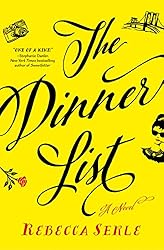
The Dinner List
Rebecca Serle, 2018
Flatiron Books
288 pp.
ISBN-13: 9781250295187
Summary
“We’ve been waiting for an hour.” That’s what Audrey says. She states it with a little bit of an edge, her words just bordering on cursive. That’s the thing I think first. Not: Audrey Hepburn is at my birthday dinner, but Audrey Hepburn is annoyed.
At one point or another, we’ve all been asked to name five people, living or dead, with whom we’d like to have dinner.
Why do we choose the people we do? And what if that dinner was to actually happen?
These are the questions Rebecca Serle contends with in her utterly captivating novel, The Dinner List, a story imbued with the same delightful magical realism as One Day, and the life-changing romance of Me Before You.
When Sabrina arrives at her 30th birthday dinner she finds at the table not just her best friend, but also three significant people from her past, and well, Audrey Hepburn. As the appetizers are served, wine poured, and dinner table conversation begins, it becomes clear that there’s a reason these six people have been gathered together.
Delicious but never indulgent, sweet with just the right amount of bitter, The Dinner List is a romance for our times. Bon appetit. (From the publisher.)
Author Bio
Rebecca Serle is an author and television writer, who spends her time between New York and Los Angeles. Serle received her MFA from the New School in NYC and has written a number of young adult novels. In 2017 she co-developed the hit TV series, Famous in Love, an adaptation of her YA series.
Serle published her first adult novel, The Dinner List, in 2018, followed by In Five Years, which came out in 2020. (Adapted from the publisher).
Book Reviews
Themes of love, loss, and forgiveness weave through this intriguing mix of the real and the fanciful.
Booklist
Years ago, Sabrina did that old thing of imagining whom she'd invite to a birthday dinner if she could have any five guests, dead or alive. She never thought her fantasy dinner would really happen…. A bittersweet tale of love, loss, and living with the memories.
Kirkus Reviews
Discussion Questions
We'll add publisher questions if and when they're available; in the meantime, use our LitLovers talking points to start a discussion for THE DINNER LIST … then take off on your own:
1. Why not start with the people on your own dinner list? Who's on it? If you don't have a list, then consider putting one together and share it with the group—the whos and whys.
2. What do you make of Sabrina and Tobias's relationship, or attempt at one? Why can't they seem to make each other happy?
3. What do we learn of Sabrina's difficult connection with her father?
4. What does Professor Conrad add to the party?
5. Same for Audrey Hepburn? What role does she play? How does she connect with different chapters in Sabina's life?
6. One of the themes of The Dinner List is the way in which a tiny incident, one particular decision, which at first seems incidental, can end up having a large impact on our lives. How do you see this play out in The Dinner List—especially in Sabrina's life?
7. Talk about the ways the dinner party ends up changing Sabrina, her perspective and her relationships, especially with Tobias and her father.
8. Talk about the motifs that run throughout The Dinner List: regret, forgiveness, loss, family, and love. How do they manifest themselves during the course of the novel?
(Questions by LitLovers. Please feel free to use them, online and off, with attribution. Thanks.)
Dinner with Anna Karenina
Gloria Goldreich, 2005
Mira Books
368 pp.
ISBN-13: 9780778325949
Summary
And the worst of it is, you understand, that I can't leave him: there are children, and I am bound. Yet I can't live with him...
Immediately the words from Anna Karenina take on a significance for the women who have gathered over good food and good wine for their first book club meeting of the year. These six very different women are not quite friends, not quite strangers but, bonded by their love of literature, they share a deep understanding of one another—or so they think.
On this night they are stunned when the most envied and privileged member of the group announces that she is divorcing her perfect husband for reasons she cannot, will not share. That such an idyllic marriage could be so vulnerable mystifies them, leaving them to speculate about what happened—and what, in their own imperfect relationships, would constitute the ultimate betrayal.
Over the course of a year, through cathartic discussions about their favorite novels, they reveal the burdens, bitterness and painful truths they have long been hiding, and in doing so, try to find the courage to open a new chapter in their own lives.
Written with a refreshing insight, Dinner with Anna Karenina takes an absorbing look at the complex lives and friendships of modern women. From their concealed rivalries with each other to their ongoing trials with husbands and lovers, award-winning author Gloria Goldreich's lyrical narrative captures their individual voices and struggles, with poignancy, humor and truth. (From the publisher.)
Author Bio
• Birth—1934
• Education—B.A. Brandeis University
• Awards—National Jewish Book Award;
Federation Arts and Letters Award
• Currently—lives in Tuckahoe, New York, USA
Gloria Goldreich is the bestselling and critically acclaimed author of several novels, including Walking Home and Leah's Journey, which won the National Jewish Book Award for Fiction. Her stories have also appeared in numerous magazines such as McCall's, Redbook, Ms., and Ladies' Home Journal. Gloria and her family live in Tuckahoe, New York. (From the publisher.)
More
Gloria Goldreich graduated from Brandeis University and did graduate work in Jewish history at the Hebrew University in Jerusalem. She was a coordinator in the Department of Jewish Education at National Hadassah and served as Public Relations Director of the Baruch College of the City University of New York.
While still an undergraduate at Brandeis, she was a winner of the Seventeen magazine short story contest where her first nationally published work appeared. Subsequently, her short fiction and critical essays have appeared in Commentary, McCalls, Redbook, Ladies Home Journal, Mademoiselle, Ms., Chatelaine, Hadassah magazine and numerous other magazines and journals. Her work has been widely anthologized and translated.
She is the author of a series of children's books on women in the professions entitled What Can She Be? She has also written novels for young adults, Ten Traditional Jewish Stories, and she edited a prize-winning anthology A Treasury of Jewish Literature.
Her novel, Leah's Journey won the National Jewish Book Award for fiction in 1979, and her second novel Four Days won the Federation Arts and Letters Award. Her other novels include Promised Land, This Burning Harvest, Leah's Children, West to Eden, Mothers, Years of Dreams and That Year of Our War. Her books have been selections of the Book of the Month Club, the Literary Guild and the Troll Book Club.
She has lectured throughout the United States and in Canada. She is married to an attorney and is the mother of two daughters and a son, and the grandmother of six grandchildren. (From e-Harlequin.)
Book Reviews
The vagaries of chance affect people in ways great and small. While reading Anna Karenina, a book club discovers the truth of this lesson when Cynthia, the golden girl of privilege in their group, abruptly announces she is divorcing her husband.... Gloria Goldreich's Dinner with Anna Karenina is a scintillating and magical visit to great literature wrapped in the everyday realities of women's lives. An extraordinary and impeccable keeper.
Sandra Huseby - BookPage
Six women discover their lives enriched and transformed by their shared passion for books in Goldreich's delightful tribute to friendship. Cynthia, Jen, Elizabeth, Trish, Rina and Donna participate in an informal Manhattan book club that exposes "their dreams, their deepest fears, their brightest hopes" while they discuss great literature and enjoy wonderful meals. The group's tranquility shatters when Cynthia, the most glamorous of the six, announces before an Anna Karenina discussion that she's divorcing her husband, Eric, a highly successful documentary filmmaker. Cynthia refuses to explain why she suddenly can no longer live with Eric, leaving her friends shocked and curious. For a whole year, as the other five endlessly speculate about Cynthia and face their own personal problems, the women probe the riches of authors like Tolstoy, Flaubert, Plath and Nabokov. In the end, their emotional support of each other grows as they learn to understand and forgive each other's weaknesses.
Publishers Weekly
A portrait of female friendship bound together with books, from the author of Walking Home (2005). During their first meeting of the year, a reading group composed of professional women in Manhattan discovers that one of their number is leaving her husband. As the story progresses, they come to terms with this dilemma and other personal troubles as they gather to talk about books and eat. For a group that prides itself on a passion for literature and intellectual rigor, this reading sorority tends to favor the superficial over real criticism. Discussions of, say, the writer's craft or cultural context generally lose out to chatty conversations about plot and self-referential character analysis-these women use incidents in the life of Emma Bovary to share anecdotes from their own, and they talk about how much they are like or unlike Anna Karenina. Each character's backstory unfolds in chunks of exposition inspired by Lolita and The Bell Jar, and the connections between the story being read and the stories being relived are always facile. The impoverished graduate student, for example, always talks about money. When someone mentions jewelry, each woman touches a bracelet or an earring and considers its significance in her life. Indeed, material culture is present here always, as if things are signifiers of the people who own them. When it is revealed that they are not, this is meant to shock: Who would have guessed that someone as well-dressed as Cynthia could be unhappy? The ensemble cast offers a host of vaguely drawn types—a wealthy department-store executive, an overworked psychologist, a guidance counselor with an autistic son and an abusive husband. Reading groups who want to read about reading groups will have something to pick up after they've finished The Jane Austen Book Club. Dreary, plodding and slightly pretentious-women's fiction of the most uninspired, uninspiring kind.
Kirkus Reviews
Discussion Questions
Use our LitLovers Book Club Resources; they can help with discussions for any book:
• How to Discuss a Book (helpful discussion tips)
• Generic Discussion Questions—Fiction and Nonfiction
• Read-Think-Talk (a guided reading chart)


The Diplomat's Wife
Pam Jenoff, 2008
Mira Books
360 pp.
ISBN-13: 9780778325123
Summary
How have I been lucky enough to come here, to be alive, when so many others are not? I should have died.… But I am here.
1945. Surviving the brutality of a Nazi prison camp, Marta Nederman is lucky to have escaped with her life. Recovering from the horror, she meets Paul, an American soldier who gives her hope of a happier future. But their plans to meet in London are dashed when Paul's plane crashes.
Devastated and pregnant, Marta marries Simon, a caring British diplomat, and glimpses the joy that home and family can bring. But her happiness is threatened when she learns of a Communist spy in British intelligence, and that the one person who can expose the traitor is connected to her past. (From the publisher.)
Author Bio
• Birth—N/A
• Where—Silver Spring, Maryland, USA
• Education—B.A., George Washington University; M.A., Cambridge University; J.D., University of Pennsylvania
• Currently—lives in Cherry Hill, New Jersey
Pam Jenoff was born in Maryland and raised outside Philadelphia. She attended George Washington University in Washington, D.C., and Cambridge University in England.
Upon receiving her master's in history from Cambridge, she accepted an appointment as Special Assistant to the Secretary of the Army. The position provided a unique opportunity to witness and participate in operations at the most senior levels of government, including helping the families of the Pan Am Flight 103 victims secure their memorial at Arlington National Cemetery, observing recovery efforts at the site of the Oklahoma City bombing and attending ceremonies to commemorate the fiftieth anniversary of World War II at sites such as Bastogne and Corregidor.
Following her work at the Pentagon, Pam moved to the State Department. In 1996 she was assigned to the U.S. Consulate in Krakow, Poland. It was during this period that Pam developed her expertise in Polish-Jewish relations and the Holocaust. Working on matters such as preservation of Auschwitz and the restitution of Jewish property in Poland, Pam developed close relations with the surviving Jewish community.
Pam left the Foreign Service in 1998 to attend law school and graduated from the University of Pennsylvania. She worked for several years as a labor and employment attorney both at a firm and in-house in Philadelphia and now teaches law school at Rutgers.
Pam is the author of The Kommandant's Girl, which was an international bestseller and nominated for a Quill award, as well as The Diplomat's Wife, The Ambassador's Daughter, Almost Home, A Hidden Affair and The Things We Cherished.
She lives outside Philadelphia with her husband and three children. (From the publisher.)
Book Reviews
Jenoff's stirring sequel to her debut, The Kommandant's Girl, chronicles the perilous post-WWII adventures of Marta Nederman, a member of the Polish resistance and best friend of the earlier book's heroine.... Marta goes on a dangerous mission to Poland, where a Communist takeover is imminent and where the seesaw plot takes more than one surprise twist. Historical romance fans will be well rewarded.
Publishers Weekly
[S]uccessful and satisfying second novel.... Jenoff explores the immediate aftermath of World War II with sensitivity and compassion, shedding light on an often overlooked era of European history. She expertly draws out the tension and illustrates the danger and poverty of Eastern Europe as it falls under communism. Highly recommended for all fiction collections. —Jessica E. Moyer
Library Journal
The English government taps Marta for help in finding a traitor in the British intelligence corps, sending her on an undercover mission that entails revisiting her past. Jenoff gives readers a thrilling and intense look at the beginning of the cold war as well as a heartrending love story about two very brave people as she continues the story of the heroic resistance members from The Kommandant’s Girl (2007). —Patty Engelmann
Booklist
Discussion Questions
1. The Diplomat's Wife addresses many of the questions that were left open at the end of The Kommandant's Girl. Were you surprised by the answers? Satisfied?
2. How did Marta's character change/evolve throughout the story?
3. What was the most difficult challenge faced by Marta in the book?
4. What was Marta's greatest strength? Her greatest flaw?
5. What do you think drew Marta and Paul together so powerfully? How did their dynamic change throughout the book?
6. What was Marta's relationship like with the places and people from her past?
7. Did you agree with Marta's choices in the book? Did you find them believable?
8. How was Marta's life affected by the secrets that she kept?
9. How did Marta's view of Emma, and Emma's view of Marta, change in this book?
10. Where do you think Marta ends up one month after the end of the book? One year? Five years?
11. Did you think the events in Marta's life were driven by fate? Chance?
12. What was the central theme of the book? Did it resonate with you?
(Questions courtesy of the author.)

Disappearing Earth
Julia Phillips, 2019
Knopf Doubleday
272 pp.
ISBN-13: 9780525520412
Summary
Spellbinding, moving—evoking a fascinating region on the other side of the world—this suspenseful and haunting story announces the debut of a profoundly gifted writer.
One August afternoon, on the shoreline of the Kamchatka peninsula at the northeastern edge of Russia, two girls—sisters, eight and eleven—go missing.
In the ensuing weeks, then months, the police investigation turns up nothing. Echoes of the disappearance reverberate across a tightly woven community, with the fear and loss felt most deeply among its women.
Taking us through a year in Kamchatka, Disappearing Earth enters with astonishing emotional acuity the worlds of a cast of richly drawn characters, all connected by the crime: a witness, a neighbor, a detective, a mother.
We are transported to vistas of rugged beauty—densely wooded forests, open expanses of tundra, soaring volcanoes, and the glassy seas that border Japan and Alaska—and into a region as complex as it is alluring, where social and ethnic tensions have long simmered, and where outsiders are often the first to be accused.
In a story as propulsive as it is emotionally engaging, and through a young writer's virtuosic feat of empathy and imagination, this powerful novel brings us to a new understanding of the intricate bonds of family and community, in a Russia unlike any we have seen before. (From the publisher.)
Author Bio
• Birth—1989
• Where—Montclair, New Jersey, USA
• Education—Barnard College
• Currently—lives in Brooklyn, New York City, New York
Julia Phillips is an American author, born in New Jersey. Her debut novel, Disappearing Earth, published in 2019, was a finalist for the National Book Award for Fiction.
Phillips attended Montclair High School and earned her B.A. in English from Barnard College. She spent a semester of college abroad in Moscow, volunteering at the Crime Victims Treatment Center.[
After graduating from college, Phillips earned a Fulbright Program grant, allowing her to return to Moscow, this time where she conducted research into the affect of foreign investment and tourism on the Kamchatka Peninsula. She also wrote blog posts for The Moscow Times.
During her time in Kamchatka, she began exploring the everyday living experiences of women. This eventually led to the publication of her debut novel, Disappearing Earth, published in 2019, which was based on the fictional kidnapping of two girls in the Kamchatka Peninsula. In addition to being listed as a National Book Award finalist, The New York Times named the book one its "10 Best Books of 2019." (Adapted from Wikipedia. Retrieved 4-10-2020.)
Book Reviews
Superb…. Brilliant…. Phillips's deep examination of loss and longing… is a testament to the novel's power.
New York Times Book Review
Immensely moving.
Wall Street Journal
Absorbing and extraordinarily well crafted.… It is a many-stranded crime story. It is also a complex portrait of clashing cultures.
Boston Globe
Unshakeable…. Disappearing Earth has the makings of a lurid thriller, but first-time novelist Julia Phillips does something more sophisticated than that…. It’s so specific, and yet so universal. These are stories of women the world over.
USA Today
Riveting, deeply rewarding…. As each succeeding story of Disappearing Earth takes us another month away from hope that Sophia and Alyona will be found alive, it becomes apparent that the book is not about the sisters but about a place so remote and unfriendly that it only takes a couple of months for a tragedy to become a dark fairy tale the characters tell one another.… Beautifully written.
Minneapolis Star Tribune
Stunning…. Beautifully delineated scenes…. The situations remain strange in their specificities and universal in their familiarity… The mystery is worth reading until the very end.
NPR
Invigoratingly hard to classify…. [Phillips] ingeniously dismantl[es]… convention[s]…. The ending of Disappearing Earth ignites an immediate desire to reread the chapters leading up to it.
New Yorker
Thrilling…. This mystery takes you to a scrappy ice-bound town in Russia's frozen north. Rumors and rivalries, secrets and lies, all add up to a compelling portrayal of a community under siege.
People
Mesmerizing.…. It's the strength of Phillips's writing, her careful attention to character and tone, that will grip you right up until the final heart-stopping pages.
Vanity Fair
Elegant, ingeniously interwoven…. As a series of character studies, it’s brilliant…. But Phillips never stops tracing Disappearing Earth’s arc, tilting her tapestry toward a singularly satisfying ending.
Entertainment Weekly
[E]xceptional and suspenseful…. Phillips’s exquisite descriptions of the desolate landscape… are masterful throughout, as is her skill at crafting a complex and genuinely addictive whodunit. This novel signals the arrival of a mighty talent.
Publishers Weekly
(Starred review) Cinematic…. A knockout novel that combines literary heft with a propulsive plot…. Phillips imagines a cold, desolate climate inhabited by characters who exude warmth and strength…. Dazzlingly original. —Sally Bissell, formerly with Lee Cty. Lib. Syst., Fort Myers, FL
Library Journal
(Starred review) Accomplished and gripping…. Phillips’ spellbinding prose is saturated with… emotional intensity, as she subtly traces the shadows of Russia’s past and illuminates today’s daunting complexities of gender and identity, expectations and longing.
Booklist
[I]mmersive, impressive, and strikingly original…. An unusual, cleverly constructed thriller that is also a deep dive into the culture of a place many Americans have probably never heard of.
Kirkus Reviews
Discussion Questions
1. In the first chapter, Alyona tells a story about a town that suddenly disappears when a wave washes it away. How is the theme of disappearance explored throughout the rest of the novel? How does this opening story relate to other examples of disappearances in the book? What does the title, Disappearing Earth, mean to you?
2. Before Alyona and Sophia went missing, another young woman, Lilia, disappeared too. How are these two crimes treated differently in their communities? How are they similar? How does the social, political, and economic climate of Kamchatka affect the way these victims are viewed and discussed? Do you see any similarities to the way people talk about crimes in your own community?
3. How do you think the sparsely populated Kamchatka setting informs the plot and characters? How do you think the story would be different if it were set somewhere else?
4. During the Soviet era, Kamchatka was a closed military zone, and it is now a remote tourist destination. How do the characters experience this transition to a post-Communist society differently? Consider these two passages from Katya’s and Valentina’s points-of-view:
Katya, pg. 39:
After the USSR collapsed, there were no longer any restrictions on travel, no stop to movement; the Soviet military bases that had constrained the entire peninsula were shuttered, so Kamchatka’s residents could finally explore their own land. Katya’s family had gone as far north as Esso to meet the natives with their reindeer herds, west to see steaming craters, and south to pull caviar out of what had become unpatrolled lakes. She spent her youth in the brief reckless period between the Communists’ rigidity and Putin’s strength, and though she had grown into a boundary enforcer, inspecting imports and issuing citations, within herself there remained a post-Soviet child. Some part of her did crave the wild.
Valentina, pg. 52:
She grew up knowing the region at its best. Military funding used to stuff the stores with food. There were no vagrants, then, no salmon poachers, and no planes but Soviet military jets overhead. The peninsula was so tightly defended that even other Russians needed government permission to enter. But when the country changed, Kamchatka went down with it. A whole civilization lost. Valentina was sorry for her daughter, for all the children, who would grow up without the love of a motherland.
5. Discuss the theme of violence against women in the novel. What kinds of violence are represented in the book? What role does violence play in these women’s lives? What forms of violence are seen in public, and which take place in private?
6. The book is centered on one specific act of violence—the disappearance of the Golosovsky sisters. How does this crime affect the rest of the characters in the novel and the community of Kamchatka in its entirety?
7. Consider the following conversation between Chander and Ksyusha on pg 73:
"You haven’t noticed by now that you can’t trust them? They don’t care about us the same way they care about themselves." Ksyusha waited for Chander to voice an exception: Ruslan. He did not. In her thoughts, Ruslan slipped from a man she should defend to a man who might abandon—Ruslan could leave her so much more easily than she could leave him.
How does Ksyusha’s relationship with Chander compare to her relationship with Ruslan? What draws her to each man? How do power dynamics factor into her relationships? What other examples of power dynamics are explored throughout the novel?
8. In addition to the white Russians, many indigenous communities and migrants live in Kamchatka. Discuss how the indigenous and migrant communities are viewed and treated. How does this affect how the police investigate the disappearances? Discuss Zoya’s attraction to the migrant construction workers. How does this compare to the other perspectives of migrants in the book?
9. The novel is written from the points of view of many different women. How are these women connected, and what draws them apart? Which woman’s story was the most memorable to you?
10. Examine the structure of Disappearing Earth. Why do you think Phillips decided to tell the story month by month and from different perspectives? How does this format help dissect a community in its entirety? How does the tension surrounding the investigation progress as the year goes on/the book progresses?
11. Although every chapter covers a month following the disappearance, one chapter breaks this mold and examines a specific date, the New Year’s chapter. Why do you think this specific date/chapter is highlighted?
12. Discuss Marina’s conversations with Alla Innokentevna about their missing daughters. What do these women have in common? How are their experiences different? Why do you think Phillips chose to share Marina’s perspective toward the end of the novel rather than earlier in the book? Why do you think she chose the festival celebrating cultural minorities as the context for Marina’s and Alla’s meeting?
13. The final chapter of the book reveals a shocking ending. Why do you think Phillips chose to end the novel in this way? When the story of the disappearing town resurfaces, how are we reminded of the theme of disappearing? How is it symbolic of the missing girls’ fate?
(Questions issued by the publisher.)

A Discovery of Witches (All Souls Trilogy 1)
Deborah Harkness, 2011
Penguin Group USA
592 pp.
ISBN-13: 9780143119685
Summary
A richly inventive novel about a centuries-old vampire, a spellbound witch, and the mysterious manuscript that draws them together.
Deep in the stacks of Oxford's Bodleian Library, young scholar Diana Bishop unwittingly calls up a bewitched alchemical manuscript in the course of her research. Descended from an old and distinguished line of witches, Diana wants nothing to do with sorcery; so after a furtive glance and a few notes, she banishes the book to the stacks.
But her discovery sets a fantastical underworld stirring, and a horde of daemons, witches, and vampires soon descends upon the library. Diana has stumbled upon a coveted treasure lost for centuries-and she is the only creature who can break its spell.
Debut novelist Deborah Harkness has crafted a mesmerizing and addictive read, equal parts history and magic, romance and suspense. Diana is a bold heroine who meets her equal in vampire geneticist Matthew Clairmont, and gradually warms up to him as their alliance deepens into an intimacy that violates age-old taboos. This smart, sophisticated story harks back to the novels of Anne Rice, but it is as contemporary and sensual as the Twilight series-with an extra serving of historical realism. (From the publisher.)
The second book in the All Souls Trilogy is Shadow of Night (2012), and the third is The Book of Life (2014)
Author Bio
• Birth—N/A
• Raised—outside of Philadelphia, PA, USA
• Education—B.A., Mount Holyoke College; M.A., Northwestern University; Ph.D., University of California-Davis
• Currently—lives in southern California
Deborah Harkness is a professor of history at the University of Southern California. She has received Fullbright, Guggenheim, and National Humanities Center fellowships, and her most recent scholarly work is The Jewel House: Elizabethan London and the Scientific Revolution. She also writes an award-winning wine blog, Good Wine Under $20. (From the publisher.)
More
In her own words
I grew up in the suburbs of Philadelphia and have lived in western Massachusetts, the Chicago area, Northern California, upstate New York, and Southern California. In other words, I’ve lived in three out of five time zones in the US! I’ve also lived in the United Kingdom in the cities of Oxford and London.
For the past twenty-eight years I’ve been a student and scholar of history, and received degrees from Mount Holyoke College, Northwestern University, and the University of California at Davis. During that time I researched the history of magic and science in Europe, especially during the period from 1500 to 1700.
The libraries I’ve worked in include Oxford’s Bodleian Library, the All Souls College Library at Oxford, the British Library, London’s Guildhall Library, the Henry E. Huntington Library, the Folger Shakespeare Library, and the Newberry Library—proving that I know my way around a card catalogue or the computerized equivalent. These experiences have given me a deep and abiding love of libraries and a deep respect for librarians. Currently, I teach European history and the history of science at the University of Southern California in Los Angeles.
My previous books include two works of non-fiction: John Dee’s Conversations with Angels: Cabala, Alchemy, and the End of Nature (Cambridge University Press, 1999) and The Jewel House: Elizabethan London and the Scientific Revolution (Yale University Press, 2007). It has been my privilege to receive fellowships from the American Council of Learned Societies, the Guggenheim Foundation, the National Science Foundation, and the National Humanities Center. And I was honored to receive accolades for my historical work from the History of Science Society, the North American Conference on British Studies, and the Longman’s/History Today Prize Committee.
In 2006, I took up my keyboard and entered the world of blogging and Twitter. My wine blog, Good Wine Under $20, is an online record of my search for the best, most affordable wines. These efforts have been applauded by the American Wine Blog Awards, Saveur.com, Wine & Spirits magazine, and Food & Wine magazine. My wine writing has also appeared on the website Serious Eats and in Wine & Spirits magazine. (From the author's website.)
Book Reviews
"Write what you know," debut novelists are told, and Professor Deborah Harkness has accordingly set hers in the world of academia.... A bubbling cauldron of illicit desire...all the ingredients for an assured saga that blends romance with fantasy.
Daily Mail (UK)
An inventive addition to the supernatural craze.... Historian Harkness's racy paranormal romance has exciting amounts of spells, kisses and battles, and is recounted with enchanting, page-turning panache.
Marie Claire
In Harkness's lively debut, witches, vampires, and demons outnumber humans at Oxford's Bodleian Library, where witch and Yale historian Diana Bishop discovers an enchanted manuscript, attracting the attention of 1,500-year-old vampire Matthew Clairmont. The orphaned daughter of two powerful witches, Bishop prefers intellect, but relies on magic when her discovery of a palimpsest documenting the origin of supernatural species releases an assortment of undead who threaten, stalk, and harass her. Against all occult social propriety, Bishop turns for protection to tall, dark, bloodsucking man-about-town Clairmont. Their research raises questions of evolution and extinction among the living dead, and their romance awakens centuries-old enmities. Harkness imagines a crowded universe where normal and paranormal creatures observe a tenuous peace. "Magic is desire made real," Bishop says after both her desire and magical prowess exceed her expectations. Harkness brings this world to vibrant life and makes the most of the growing popularity of gothic adventure with an ending that keeps the Old Lodge door wide open.
Publishers Weekly
Diana Bishop is a history scholar—and a witch in denial of her powers. Researching the early beginnings of scientific study in Oxford's Bodleian Library, she unwittingly discovers an ancient tome of alchemy and finds herself attracting a great deal of unwanted attention from a startling array of deamons, witches, and other supernatural beings. Among them is the brilliant (and attractive) vampire geneticist Matthew Clairmont. Set in our contemporary world with a magical twist, this sparkling debut by a history professor features a large cast of fascinating characters, and readers will find themselves invested in Diana's success at unlocking the secrets of the manuscript. Although not a nail-biting cliff-hanger, the finale skillfully provides a sense of completion while leaving doors open for the possibility of wonderful sequel adventures. This reviewer, for one, hopes they come soon! Verdict: Destined to be popular with fantasy and paranormal aficionados, this enchanting novel is an essential purchase. Harkness is an author to watch. —Crystal Renfro, Georgia Inst. of Technology Lib., Atlanta
Library Journal
(Starred review.) All [the] characters are fully fleshed and unique, which, when combined with the complex and engaging plot, results in one of the better fantasy debuts in recent months. —Jessica Moyer
Booklist
Harry Potter meets Lestat de Lioncourt. Throw in a time machine, and you've got just about everything you need for a full-kit fantasy. The protagonist is a witch. Her beau is a vampire. If you accept the argument that we've seen entirely too many of both kinds of characters in contemporary fiction, then you're not alone. Yet, though Harkness seems to be arriving very late to a party that one hopes will soon break up, her debut novel has its merits; she writes well, for one thing, and, as a historian at the University of Southern California, she has a scholarly bent that plays out effectively here. Indeed, her tale opens in a library—and not just any library, but the Bodleian at Oxford, pride of England and the world. Diana Bishop is both tenured scholar and witch, and when her book-fetcher hauls up a medieval treatise on alchemy with "a faint, iridescent shimmer that seemed to be escaping from between the pages," she knows what to do with it. Unfortunately, the library is crammed with other witches, some of malevolent intent, and Diana soon finds that books can be dangerous propositions. She's a bit of a geek, and not shy of bragging, either, as when she trumpets the fact that she has "a prodigious, photographic memory" and could read and write before any of the other children of the coven could. Yet she blossoms, as befits a bodice-ripper no matter how learned, once neckbiter and renowned geneticist Matthew Clairmont enters the scene. He's a smoothy, that one, "used to being the only active participant in a conversation," smart and goal-oriented, and a valuable ally in the great mantomachy that follows—and besides, he's a pretty good kisser, too. "It's a vampire thing," he modestly avers. Entertaining, though not in the league of J.K. Rowling—or even Anne Rice. But please, people: no more vamps and wizards, OK?
Kirkus Reviews
Discussion Questions
1. Diana's mother says that fear is "the strongest force on earth" (p.5). What does she mean? Do you agree?
2. Early in the novel, Harkness describes the typical personalities and physical traits of daemons, witches, and vampires. If you could be any one of these beings, which would you choose and why?
3. Who is the Congregation? Is it a force for good or a force for evil?
4. What happened to Diana's parents? What were they trying to hide?
5. Diana studies alchemy, which she defines as a type of "science with magic" (p. 73) used to explore and understand unexplained phenomena. Do you use astrology, fortune-telling, or ESP to provide a deeper understanding of events in your own life?
6. Why is Diana and Matthew's love forbidden? Have you ever loved someone whom your family or friends thought was inappropriate? How did their reaction influence your feelings?
7. Most of the book is told from Diana's perspective, yet a few chapters are written in the third person. Why? What feature or purpose unites those chapters?
8. Diana and Matthew travel back to the sixteenth century. If you had the power to time walk, as she does, what period in history would you visit?
9. In chapter 31, Diana remembers the bedtime story her mother told her as a child. In what ways does that story foreshadow the events of Diana's life?
10. Harkness presents the use of witchcraft not only as an otherworldly ability but also as a part of everyday life; for example, Diana uses a spell to fix her washing machine. Which example of the novel's blending of the magical with the mundane did you find most entertaining or creative? If you could use magic in your daily life, what would you use it for?
11. Look at the last page of the book. What is the significance of the blood and mercury? What is the reason behind the sense of relief felt in the house? What does the last sentence of the book mean?
(Quesions issued by publisher.)


Disgrace
J.M. Coetzee, 1999
Penguin Publishing
224 pp.
ISBN-13: 9780140296402
Summary
Winner, 1999 Booker Award
Set in post-apartheid South Africa, J. M. Coetzee’s searing novel tells the story of David Lurie, a twice divorced, 52-year-old professor of communications and Romantic Poetry at Cape Technical University.
Lurie believes he has created a comfortable, if somewhat passionless, life for himself. He lives within his financial and emotional means. Though his position at the university has been reduced, he teaches his classes dutifully; and while age has diminished his attractiveness, weekly visits to a prostitute satisfy his sexual needs.
He considers himself happy. But when Lurie seduces one of his students, he sets in motion a chain of events that will shatter his complacency and leave him utterly disgraced.
Lurie pursues his relationship with the young Melanie—whom he describes as having hips "as slim as a twelve-year-old’s"—obsessively and narcissistically, ignoring, on one occasion, her wish not to have sex. When Melanie and her father lodge a complaint against him, Lurie is brought before an academic committee where he admits he is guilty of all the charges but refuses to express any repentance for his acts.
In the furor of the scandal, jeered at by students, threatened by Melanie’s boyfriend, ridiculed by his ex-wife, Lurie is forced to resign and flees Cape Town for his daughter Lucy’s smallholding in the country. There he struggles to rekindle his relationship with Lucy and to understand the changing relations of blacks and whites in the new South Africa.
But when three black strangers appear at their house asking to make a phone call, a harrowing afternoon of violence follows which leaves both of them badly shaken and further estranged from one another. After a brief return to Cape Town, where Lurie discovers his home has also been vandalized, he decides to stay on with his daughter, who is pregnant with the child of one of her attackers.
Now thoroughly humiliated, Lurie devotes himself to volunteering at the animal clinic, where he helps put down diseased and unwanted dogs. It is here, Coetzee seems to suggest, that Lurie gains a redeeming sense of compassion absent from his life up to this point.
Written with the austere clarity that has made J. M. Coetzee the winner of two Booker Prizes, Disgrace explores the downfall of one man and dramatizes, with unforgettable, at times almost unbearable, vividness the plight of a country caught in the chaotic aftermath of centuries of racial oppression. (From the publisher.)
Author Bio
• Birth—February 9, 1940
• Where—Cape Town, South Africa
• Education—B.A. (English), B.A. (Math), University of Cape Town; Ph.D., University
of Texas, Austin
• Awards—Nobel Prize, 2003; Man Booker Prize—1983 and 1999
• Currently—lives in Adelaide, Australia
John Maxwell Coetzee is a South African-born novelist, essayist, linguist, translator and recipient of the 2003 Nobel Prize in Literature. He relocated to Australia in 2002 and lives in Adelaide where, in 2006, he became an Australian citizen.
In 2013, Richard Poplak of the Daily Maverick described Coetzee as "inarguably the most celebrated and decorated living English-language author." Even before receiving the 2003 Nobel Prize in Literature, Coetzee had been awarded the Man Booker Prize twice: in 1983 for Life & Times of Michael K and in 1999 for Disgrace. Other awards include the Jerusalem Prize, Central News Agency Prize (three times), France's Prix Femina Etranger, and The Irish Times International Fiction Prize.
Early life and academia
Coetze was born in Cape Town, Cape Province, Union of South Africa to Afrikaner parents. His father, Zacharias Coetzee, was an occasional attorney and government employee, and his mother, Vera Coetzee (nee Wehmeyer), a schoolteacher. He is descended on his father's side from 17th-century Dutch immigrants to South Africa and on his mother's side from German and Polish immigrants. The family mainly spoke English at home, but John spoke Afrikaans with other relatives.
Coetzee spent most of his early life in Cape Town and in Worcester in Cape Province (modern-day Western Cape), as recounted in his fictionalised memoir, Boyhood (1997). The family moved to Worcester when he was eight, after his father had lost his government job. He studied mathematics and English at the University of Cape Town where he received two Bachelor of Arts degrees, both with honours: one in English in 1960 and the other in Mathematics in 1961.
In 1962 he relocated to the UK, working as a computer programmer for IBM in London, and ICT (International Computers and Tabulators) in Bracknell. He stayed until 1965. In 1963, while still in the UK, Coetzee was awarded a Master of Arts degree from the University of Cape Town for a thesis on the novels of Ford Madox Ford entitled "The Works of Ford Madox Ford with Particular Reference to the Novels" (1963). His experiences in England were later recounted in Youth (2002), his second volume of fictionalized memoirs.
In 1965 Coetzee won a Fulbright Scholarship to the University of Texas at Austin, in the US, where he received his doctorate in 1969. His PhD dissertation, "The English Fiction of Samuel Beckett: An Essay in Stylistic Analysis" (1968), was on computer stylistic analysis of Beckett's works.
In 1968, he began teaching English literature at the State University of New York at Buffalo where he stayed until 1971. It was at Buffalo that he began his first novel, Dusklands.
Beginning in 1968, he sought permanent residence in the United States, a process that was ultimately unsuccessful due in part to his involvement in anti-Vietnam-War protests. He had been one of 45 faculty members who, in 1970, occupied the university's Hayes Hall and were subsequently arrested for criminal trespass—although charges against the 45 were dropped in 1971.
Coetzee eventually returned to South Africa to teach English literature at the University of Cape Town where, in 1983, he was promoted to Professor of General Literature. From 1999-2001, he was Distinguished Professor of Literature.
He retired in 2002, relocating to Adelaide, Australia, where he was made an honorary research fellow in the English Department of the University of Adelaide.
Man Booker Prize
Coetzee was the first writer to be awarded the Booker Prize twice: first for Life & Times of Michael K in 1983, and again for Disgrace in 1999. Two other authors have since managed this—Peter Carey (in 1988 and 2001) and Hilary Mantel (in 2009 and 2012).
Summertime, named on the 2009 longlist, was an early favorite to win an unprecedented third Booker Prize for Coetzee. It subsequently made the shortlist, but lost out to the eventual winner Wolf Hall by Hilary Mantel. Coetzee was also longlisted in 2003 for Elizabeth Costello and in 2005 for Slow Man.[
Nobel Prize
Coetzee was the recipient of the 2003 Nobel Prize in Literature, making him the fifth African writer to be so honored and the second South African after Nadine Gordimer. When awarding the prize, the Swedish Academy cited the moral nature of Coetzee's work and his "well-crafted composition, pregnant dialogue and analytical brilliance."
Public image
Coetzee is known as reclusive, avoiding publicity to such an extent that he did not collect either of his two Booker Prizes in person. According to South African writer Rian Malan...
Coetzee is a man of almost monkish self-discipline and dedication. He does not drink, smoke, or eat meat. He cycles vast distances to keep fit and spends at least an hour at his writing-desk each morning, seven days a week. A colleague who has worked with him for more than a decade claims to have seen him laugh just once. An acquaintance has attended several dinner parties where Coetzee has uttered not a single word.
Asked in an email about Malan's comment, Coetzee wrote, "I have met Rian Malan only once in my life. He does not know me and is not qualified to talk about my character."
As a result of his reclusive nature, signed copies of Coetzee's fiction are highly sought after. Recognizing this, he was a key figure in the establishment of Oak Tree Press's First Chapter Series, limited edition signed works by literary greats to raise money for the child victims and orphans of the African HIV/AIDS crisis.
Personal life
He married Philippa Jubber in 1963 and divorced in 1980. The two have a daughter Gisela (1968) and a son Nicolas (1966) from their marriage. Nicolas died in 1989 at the age of 23 in an accident. Coetzee's younger brother, the journalist David Coetzee, died in 2010.
In 2006, Coetzee became an Australian citizen.
Anti-apartheid and racism
During the apartheid era, Coetzee called on the South African government to abandon its apartheid policy. Scholar Isidore Diala has stated that J. M. Coetzee, Nadine Gordimer and Andre Brink were "three of South Africa's most distinguished white writers, all with definite anti-apartheid commitment."
Jane Poyner, in a South African academic journal, argued that Coetzee's 1999 novel Disgrace allegorizes South Africa's Truth and Reconciliation Commission (TRC). Asked about his views on the commission, Coetzee said:
In a state with no official religion, the TRC was somewhat anomalous: a court of a certain kind based to a large degree on Christian teaching and on a strand of Christian teaching accepted in their hearts by only a tiny proportion of the citizenry. Only the future will tell what the TRC managed to achieve.
Following his Australian citizenship ceremony, Coetzee said that...
I did not so much leave South Africa, a country with which I retain strong emotional ties, but come to Australia. I came because from the time of my first visit in 1991, I was attracted by the free and generous spirit of the people, by the beauty of the land itself and—when I first saw Adelaide—by the grace of the city that I now have the honour of calling my home."
When he initially moved to Australia, he had cited the South African government's lax attitude to crime in that country as a reason for the move. That statement led to a spat with Thabo Mbeki, who, speaking of Coetzee's novel Disgrace stated that "South Africa is not only a place of rape." In a 1999 investigation into racism in the media, the African National Congress pointed to Coetzee's novel Disgrace as exploiting racial stereotypes. However, when Coetzee won his Nobel Prize, Mbeki congratulated him "on behalf of the South African nation and indeed the continent of Africa."
Other political concerns
In 2005, Coetzee criticized contemporary anti-terrorism laws as resembling those employed by the apartheid regime in South Africa:
I used to think that the people who created [South Africa's] laws that effectively suspended the rule of law were moral barbarians. Now I know they were just pioneers ahead of their time.
The main character in Coetzee's 2007 Diary of a Bad Year shares similar concerns about the policies of John Howard and George W. Bush.
In recent years, Coetzee has become a vocal critic of animal cruelty, including the modern animal husbandry industry, and advocate for the animal rights movement. Coetzee's fiction has similarly engaged with the problems of animal cruelty and animal welfare, in particular his books Disgrace, The Lives of Animals, Elizabeth Costello and in the short story "The Old Woman and the Cats," which has as its protagonist Elizabeth Costello. He is vegetarian. (Author bio adapted from Wikipedia. Retrieved 11/4/2015.)
Novels
Dusklands (1974)
In the Heart of the Country (1977)
Waiting for the Barbarians (1980)
Life & Times of Michael K (1983)
Foe (1986)
Age of Iron (1990)
The Master of Petersburg (1994)
Disgrace (1999)
Elizabeth Costello (2003)
Slow Man (2005)
Diary of a Bad Year (2007)
The Childhood of Jesus (2013)
Book Reviews
There is more in Disgrace than I can manage to describe here. But let me end by suggesting Coetzee's most impressive achievement, one that grows from the very bones of the novel's grammar. This novel stands as one of the few I know in which the writer's use of the present tense is in itself enough to shape the structure and form of the book as a whole. Even though it presents an almost unrelieved series of grim moments, Disgrace isn't claustrophobic or depressing, as some of Coetzee's earlier work has been. Its grammar allows for the sublime exhilaration of accident and surprise, and so the fate of its characters—and perhaps indeed of their country—seems not determined but improvised. Improvised in the way that our own lives are.... Disgrace surely deserves such recognition [his second Man Booker Prize]. But that may, in time, come to seem among the least of this extraordinary novel's distinctions.
Michael Gorra - New York Times Book Review
It may be that 200 pages have never worked so hard as they do in Coetzee's hands. He's a novelist of stunning precision and efficiency. Disgrace loses none of its fidelity to the social and political complexities of South Africa, even while it explores the troubling tensions between generations, sexes, and races. This is a novel of almost frightening perception from a writer of brutally clear prose.
Ron Charles - Christian Science Monitor
Written in deceptively spare prose that lets an eerie story unfold, Disgrace is a revelatory, must-read portrayal of racial fortunes reversed.
USA Today
J.M. Coetzee's new novel Disgrace, which last week won the South African writer his second Booker Prize is an absolute page-turner. It is also profound, rich and remarkable...is destined to be a classic.
New York Post
The most powerful novel this year.
Wall Street Journal
Disgrace is a relentlessly bleak novel.
Boston Sunday Globe
Disgrace is an act of literature...further proof that Mr. Coetzee stands with the very best writers in the world today.
Dallas Morning News
The richness of em>Disgrace lies in the elegant and allegorical role reversals, the spare symbolism of the language and in the characterization. We may not like David Lurie, but in Coetzee's skillful hands we can't dismiss him without pity.
Toronto Globe and Mail
Disgrace is a subtle, multilayered story, as much concerned with politics as it is with the itch of male flesh. Coetzee's prose is chaste and lyrical—it is a relief to encounter writing as quietly stylish as this.
Independent (UK)
The kind of territory J.M Coetzee has made his own.... By this late point in the century, the journey to a heart of narrative darkness has become a safe literary destination.... Disgrace goes beyond this to explore the furthest reaches of what it means to be human: it is at the frontier of world literature.
Sunday Telegraph (UK)
Disgrace is at the frontier of world literature
Sunday Telegraph (UK)
Compulsively readable.... A novel that not only works its spell but makes it impossible for us to lay it aside once we've finished reading it.... Coetzee's sentences are coiled springs, and the energy they release would take other writers pages to summon.
New Yorker
Disgrace is a gripping tale told with spare pose, steely intelligence and a remarkable degree of tenderness.
Paula Chin - People
A slim novel with a bleak powerful story to tell.... Coetzee writes with a cool, calm lucidity that fends off despair, and his characters find a kind of peace in acceptance, if not hope.
Newsweek
[A] searing evocation of post-apartheid South Africa.... [N]ot a single note is false; every sentence is perfectly calibrated and essential.... The book somehow manages to speak of little but interiority and still insinuate peripheries of things it doesn't touch. Somber and crystalline.
Publishers Weekly
Disgrace is a superbly constructed work of pain and candor, and although it involves events that require the largest generosity, it has as its hero a man gripped by habits of petty selfishness.
Penelope Mesic - Book Magazine
Middle-aged professor David Lurie shuffles numbly through the shifting landscape of postapartheid South Africa.... Winner of the Booker Prize, Coetzee's eighth novel employs spare, compelling prose to explore subtly the stuttering steps one man takes in a new world.
Library Journal
Discussion Questions
1. The novel begins by telling us that "For a man his age, fifty-two, divorced, he has, to his mind, solved the problem of sex rather well." What can you infer about David Lurie’s character from this sentence? In what ways is it significant, particularly in relation to the events that follow, that he views sex as a "problem" and that his "solution" depends upon a prostitute?
2. Lurie describes sexual intercourse with the prostitute Soraya as being like the copulation of snakes, "lengthy, absorbed, but rather abstract, rather dry, even at its hottest." When he decides to seduce his student, Melanie, they are passing through the college gardens. After their affair has been discovered Melanie’s father says that he never thought he was sending his daughter into "a nest of vipers." Lurie has also written a book about Faust and Mephistopheles and explicates for his class a poem by Byron about the fallen angel, Lucifer, whom Lurie describes as being "condemned to solitude." What do you think Coetzee is trying to suggest through this confluence of details? How clearly does Lurie himself understand his behavior? How does his reading of the Byron poem prefigure his own fate?
3. When Lurie shows up unexpectedly at Melanie’s flat, "she is too surprised to resist the intruder who thrusts himself upon her." Later, he tells himself that it was "not rape, not quite that, but undesired nevertheless, undesired to the core." How do you view what happens in this scene? Is it rape?
4. How would you characterize Lurie’s attitude before the academic committee investigating the charges of harassment brought against him? Is the committee justified in asking for more than an admission of guilt? Why does Lurie refuse to assent to the fairly simple demands that would save his job? What consequences, practical and spiritual, follow from this refusal?
5. Lurie claims that in his relationship with Melanie, he was "a servant of Eros" and that his case rests on the rights of desire. On the God who makes even the small birds quiver." Is this an acceptable explanation of his actions? Do you think it is sincere?
6. What parallels do you see between the attack on Lurie and his daughter Lucy and Lurie’s own treatment of Melanie and Melanie’s father? To what extent do you think Coetzee wants us to see Lucy’s rape as a punishment for Lurie’s undesired sexual encounter with Melanie? Is this an instance of the sins of the father being visited upon the child?
7. In the course of the attack, Lurie is burned and blinded, temporarily, in one eye. What symbolic value might attach to these events? In what other ways has Lurie been blind? What significance does fire have for him?
8. Why does Lucy refuse to report her rape? How is her decision related to the changed relations between blacks and whites in post-apartheid South Africa? Why does she accept Petrus’ protection even after he has been implicated in the attack?
9. How do you feel about Lucy’s neighbor Petrus? To what extent do you think he was involved in the attack? What are his motives? What are the motives of the attackers? In what ways does Petrus embody the transition South Africa is making between apartheid and democracy? In what sense will Lucy’s child also represent that transition?
10. During a heated argument about whether animals have souls and how they should be treated, Lurie tells his daughter: "As for the animals, by all means let us be kind to them. But let us not lose perspective. We are of a different order of creation from the animals. Not higher necessarily, just different. So if we are going to be kind, let it be out of simple generosity, not because we feel guilty or fear retribution." In what ways does this speech echo the logic of racial oppression and apartheid?
11. Throughout Disgrace, Lurie contemplates writing an opera based on Byron’s last years in Italy. Why is he so drawn to Byron? How does Byron’s situation in Italy resemble Lurie’s own? What ironies do you see in the fact that Lurie composes the music for his opera on a banjo and that he considers including a part for a dog?
12. From virtually the first page to the last, David Lurie suffers one devastating humiliation after another. He loses his job and his reputation. He is forced to flee Cape Town to live with his daughter on her smallholding in the country. There he is beaten and burned and trapped helplessly in the bathroom while his daughter is raped. Finally, he ends up ferrying dead dogs to the incinerator. Is there a meaning or purpose in his suffering? Is he in some way better off at the end of the novel than he was at the beginning? How has he changed?
13. Disgrace is narrated in the present tense, largely through David Lurie’s consciousness, though not in the first person. What effect does this method of narration have on how the story unfolds? How would the novel differ if told in the past tense? At what points do you sense a divergence between Lurie’s view of himself and the narrator’s view of him?
14. In what ways can the events dramatized in Disgrace be seen as a result of South Africa’s long history of racial oppression? What does the novel imply about the larger themes of retribution and forgiveness and reversals of fortune? About the relation between the powerful and the powerless?
(Questions issued by the publisher.)


The Disillusioned
D.J. Williams, 2013
384 pp.
ISBN-13: 9781449786007
Summary
A mother's suicide threatens to destroy a family legacy. Her sons, Sam and Daniel, are forced to leave their comfortable worlds behind and search for a woman they believe can unlock the secrets that have remained hidden. They are propelled into separate journeys from Los Angeles to the heart of the Zambezi, where they are forced to confront a man known as Die Duiwel, the Devil.
On their adventures they will find themselves in a place where death is one breath away, where thousands of children are disappearing into the darkness, and where the woman they are searching for is on the hunt for revenge. When they stand face-to-face with the forgotten slaves of Africa, they will fight to redeem what has been lost.
Author Bio
For the past fifteen years Williams has worked in the non-profit and entertainment industry. He has produced media projects that have raised awareness to help those in need. With the DNA of a world traveler, Williams was born in Hong Kong, has ventured into the jungles of the Amazon, the bush of Africa, and the slums of the Far East, to share stories of those who are overcoming incredible odds. His first novel, The Disillusioned, released in May 2013. As an Executive Producer, Producer, and Director, Williams has worked on over 200 television episodes syndicated on NBC, ABC, FOX and various cable networks worldwide. He currently lives in Los Angeles, California. (From the author.)
Visit the author's website.
Follow D.J. on Facebook.
Book Reviews
A fast-paced mystery…you won’t put it down until you’ve unlocked the secrets and lies to find the truth.
Judith McCreary, Co-Executive Producer, Law & Order: SVU, Criminal Minds, & CSI
Riveting…an indelible picture painted with suspense.
Mitch Kruse, Author of Restoration Road
An engrossing tale…makes you think about the world we live in and your place in it.
Tony Guerrero, Founder of F.A.C.T. Alliance: Fight Against Child Trafficking
A real roller-coaster of a read…powerful, well written…a thought provoking novel full of topical issues that, as well as wonderfully compelling reading for the individual, will make superb reading and prompt much discussion for reader groups.
Tracy Terry, Book Reviewer (UK)
The Disillusioned pulls its reader headlong into the adventure and achieves an entertaining story of life, love, faith, and both the strength and fragility of the human spirit.
Casee Marie - Literary Inklings
The Disillusioned is a powerful novel written by D.J. Williams which brings to light what happens when one family has lost much of its color, luster, and vibrancy once clearly seen in their family’s mural. This well written, fast paced novel will keep you on the printed page from start to finish. Characters are well defined, well crafted, and a story line that is both interesting and easy for readers to follow. Some endings come in a dramatic way and others will change so many lives. The Disillusioned: find out who finally sees the light.
Fran Lewis, Book Reviewer
The Disillusioned is gripping, riveting and keeps the reader on its toes till its very last page.
Yatin Gupta, Book Reviewer
This novel will literally keep you guessing up to the very last second. It has it all. Romance. Suspense. Intrigue. Mystery. Inspiration. I absolutely could not put this book down. Just when I thought I was going to uncover something, Williams switches the point of view character. Every time I said to myself, “Okay, just one more chapter” I ended up reading for at least another hour, “C’mon,” I thought. “The suspense is killing me! With complex, realistic characters, descriptive settings, and an intricately woven plot, my craving for a meaty story was completely satisfied page after page. I really felt like Williams took his time planning this novel which, as a reader, made me feel valued. This guy knows his stuff.
Sara Ella, Book Reviewer
Have you ever read a book that just grabs you into it and you cannot put it down? Author D.J. Williams does a magnificent job in writing a story full of mystery that puts the reader into a trance.
Terri - IEMommy.com
Some books you should not start unless you have time to finish it without interruption “The Disillusioned” by D. J Williams is one of them. I declined an invitation from my husband to go out so that I could finish this book. Yes, it is better than good. “The Disillusioned” is truly a well written novel filled with intrigue. Of course I recommend this book, it is too good to pass up!
Marsha Randolph - Beyond The Bookstore
I really enjoyed this book. It brought out a plethora of emotions. I felt anger at the father, sympathy for the mother, and whole range of feelings with the brothers as they went through their plight. Notice I said “with” the brothers because the author had me right there with them in every situation. I don’t want to spoil it for anyone so I won’t go into any of the plot details, but this is a book you do not want to miss. It is the adventure of a lifetime; I did not want to put it down!
Kandy Kay Scaramuzzo, Book Reviewer
The Disillusioned is an amazing story! I just finished reading it, and I’m feeling that withdrawal you feel after reading a good book. It’s as if you have been on an incredible journey and now must return to real life. This book is suspenseful, mysterious, thrilling, eye-opening, and convicting all at the same time. From the very first chapter, it grips you and keeps you wanting more. It is a book that really makes you think. It transcends genres. It is a book for anyone who cares about fixing what is wrong with the world. It is for anyone who loves adventure. The action is riveting and keeps you on the edge of your seat. It’s for anyone driven by compassion for a suffering world. And it is for anyone willing to be convicted to be more than what they are.
Christy Maurer, Book Reviewer
The intricacies of religion, politics and child slavery are woven into a riveting story where death is all too common. The Disillusioned is an excellent book and I highly recommend it, giving it an A.
Cindy Johnson, Book Reviewer
Plenty of mystery, intrigue, action, suspense, and more. It is thought-provoking, showing that there is a difference between faith and religion and also shining a light on the subject of human trafficking. There was much more here than I was expecting. Kept me reading and wondering and occasionally biting my nails. I recommend this one if you like a book that keeps you guessing.
Brinda G. - WiLoveBooks
The back of this book will tell you a lot about the story that lies within. But you could never imagine what will happen. While it is a work of fiction there is so much truth in it. It is a book that will haunt me the rest of my life. This is one of the best books I have read in this genre. The way it is thought out and crafted is brilliant. Right from the start you realize it will not be a book you will want to set aside and do other things. For me it was read as much as I can. I even cried at parts of the story. The author gives us a great story that is filled with realism. Thank you D.J. Williams for working so hard and opening our minds to things we know happens, but do not think about enough.
Sandra Heptinstall - Whispering Winds Book Reviews
I happily found within this book, a truly emotional and heartfelt story full of mystery, intrigue and a genuine concern for both the characters and the reality behind their fiction. As with every good mystery, you have to claw your way through all of the lies and deceit surrounding Sam and Daniel’s family to get to the bottom of a wonderfully disturbing book. The Disillusioned features mental health problems, suicide, child labour, kidnapping, murder, religion and so much more. It is fast-paced from the beginning though a little distant to begin with though after moving some way through the book and learning about the characters and who they are, I can’t help but feel that the initial cold start was intentional and brilliantly done. In just one moment, the lives of two brothers drastically change and we follow them as they uncover a barrage of secrets and lies whilst discovering who they are, and the type of people they want to be. As I’ve already said, the book has great characters and the writing is perfect for the book. D.J.Williams isn’t afraid to tell it like it is and the plot was so well described (without constant reiteration) that I could picture it perfectly – not always a good thing considering the topic but still. I could definitely see it being a movie full of action and intrigue. The Disillusioned could very well be held at the centre of important and intelligent discussion as there is quite obviously more to the story than what is on the pages. A great novel from D.J.Williams and if it sounds like something you’d enjoy then I suggest you do so, soon!
Caragh Finnan - Loaded Shelves
Starts with the point of view of an old woman in a mental institution thinking over her life. I was drawn in right away, wondering what secrets she is keeping that are causing her so much pain. The focus shifts to her sons and there is plenty of mystery, intrigue, action, suspense, and more. It is thought-provoking, showing that there is a difference between faith and religion and also shining a light on the subject of human trafficking. There was much more here than I was expecting. Kept me reading and wondering and occasionally biting my nails. I recommend this one if you like a book that keeps you guessing.
WiLoveBooks Review
Discussion Questions
1. Which character did you find yourself identifying with? Why?
2. Which character was the most surprising throughout the story?
3. How did you see the main characters change by the end of the book?
4. Were you hooked by the first chapter? If so, why?
5. Do you think the shorter chapters kept you engaged more?
6. What were the main themes you pulled from the story?
7. What was your favorite moment in the story?
8. At the end of the book did you find yourself imagining what happened next?
9. If you could ask the author one question, what would you ask?
10. Has this novel changed you? If so, how?
(Questions courtesy of the author.)

Dissident Gardens
Jonathan Lethem, 2013
Knopf Doubleday
384 pp.
ISBN-13: 9780307744494
Summary
An epic yet intimate family saga about three generations of all-American radicals.
At the center of Jonathan Lethem’s superb new novel stand two extraordinary women: Rose Zimmer, the aptly nicknamed Red Queen of Sunnyside, Queens, is an unreconstructed Communist who savages neighbors, family, and political comrades with the ferocity of her personality and the absolutism of her beliefs.
Her precocious and willful daughter, Miriam, equally passionate in her activism, flees Rose’s influence to embrace the dawning counterculture of Greenwich Village.
These women cast spells over the men in their lives: Rose’s aristocratic German Jewish husband, Albert; her cousin, the feckless chess hustler Lenny Angrush; Cicero Lookins, the brilliant son of her black cop lover; Miriam’s (slightly fraudulent) Irish folksinging husband, Tommy Gogan; their bewildered son, Sergius.
Flawed and idealistic, Lethem’s characters struggle to inhabit the utopian dream in an America where radicalism is viewed with bemusement, hostility, or indifference.
As the decades pass—from the parlor communism of the ’30s, McCarthyism, the civil rights movement, ragged ’70s communes, the romanticization of the Sandinistas, up to the Occupy movement of the moment—we come to understand through Lethem’s extraordinarily vivid storytelling that the personal may be political, but the political, even more so, is personal.
Lethem’s characters may pursue their fates within History with a capital H, but his novel is—at its mesmerizing, beating heart—about love. (From the publisher.)
Author Bio
• Birth—February 19, 1964
• Where—Brooklyn, New York, USA
• Education—Bennington College (no degree)
• Awards—National Book Critics Circle Award; World Fantasy
Award; Macallan Gold Dagger Award
• Currently—lives in Los Angeles, California
Jonathan Allen Lethem is an American novelist, essayist and short story writer. His first novel, Gun, with Occasional Music, a genre work that mixed elements of science fiction and detective fiction, was published in 1994. It was followed by three more science fiction novels. In 1999, Lethem published Motherless Brooklyn, a National Book Critics Circle Award-winning novel that achieved mainstream success. In 2003, he published The Fortress of Solitude, which became a New York Times Best Seller. In 2005, he received a MacArthur Fellowship.
Early life
Lethem was born in Brooklyn, New York, to Judith Frank Lethem, a political activist, and Richard Brown Lethem, an avant-garde painter. He was the eldest of three children. His father was Protestant (with Scottish and English ancestry) and his mother was Jewish, from a family that originated in Germany, Poland, and Russia. His brother Blake became an artist, and his sister Mara became a photographer and writer.
The family lived in a commune in the pre-gentrified Brooklyn neighborhood of North Gowanus (now called Boerum Hill). Despite the racial tensions and conflicts, he later described his bohemian childhood as "thrilling" and culturally wide-reaching. He gained an encyclopedic knowledge of the music of Bob Dylan, saw Star Wars twenty-one times during its original theatrical release, and read the complete works of the science fiction writer Philip K. Dick. Lethem later said Dick’s work was "as formative an influence as marijuana or punk rock—as equally responsible for beautifully fucking up my life, for bending it irreversibly along a course I still travel."
His parents divorced when Lethem was young. When he was thirteen, his mother Judith died from a malignant brain tumor, an event which he has said haunted him and has strongly affected his writing. (Lethem discusses the direct relation between his mother and the Bob Dylan song "Like a Rolling Stone" in the 2003 Canadian documentary Complete Unknown.) In 2007, Lethem explained, "My books all have this giant, howling missing [center]—language has disappeared, or someone has vanished, or memory has gone."
Intending to become a visual artist like his father, Lethem attended the High School of Music & Art in New York, where he painted in a style he describes as "glib, show-offy, usually cartoonish." At Music & Art he produced his own zine, The Literary Exchange, which featured artwork and writing. He also created animated films and wrote a 125-page novel, Heroes, still unpublished.
After graduating from high school, Lethem entered Bennington College in Vermont in 1982 as a prospective art student. At Bennington, Lethem experienced an "overwhelming....collision with the realities of class—my parents’ bohemian milieu had kept me from understanding, even a little, that we were poor.... [A]t Bennington that was all demolished by an encounter with the fact of real privilege." This, coupled with the realization that he was more interested in writing than art, led Lethem to drop out halfway through his sophomore year.
He hitchhiked from Denver, Colorado, to Berkeley, California, in 1984, across "a thousand miles of desert and mountains through Wyoming, Utah, and Nevada, with about 40 dollars in my pocket," describing it as "one of the stupidest and most memorable things I've ever done." He lived in California for twelve years, working as a clerk in used bookstores, including Moe's and Pegasus & Pendragon Books, and writing on his own time. Lethem published his first short story in 1989 and published several more in the early 1990s.
First novels
Lethem’s first novel, Gun, with Occasional Music, is a merging of science fiction and the Chandleresque detective story, which includes talking kangaroos, radical futuristic versions of the drug scene, and cryogenic prisons. The novel was published in 1994 to little initial fanfare, but an enthusiastic review in Newsweek, which declared Gun an "audaciously assured first novel," catapulted the book to wider commercial success. It became a finalist for the 1994 Nebula Award. In the mid-1990s, film producer-director Alan J. Pakula optioned the novel's movie rights, which allowed Lethem to quit working in bookstores and devote his time to writing.
His next several books include Amnesia Moon (1995), partially inspired by Lethem's experiences hitchhiking cross-country; The Wall of the Sky, the Wall of the Eye (1996), a collection of short stories; As She Climbed Across the Table (1997) about a physics researcher who falls in love with an artificially generated spatial anomaly called "Lack."
Lethem moved returned to Brooklyn in 1996, after which he published Girl in Landscape (1998) about a world populated by aliens but "very strongly influenced" by the 1956 John Wayne Western The Searchers, a movie with which Lethem is "obsessed."
In 1999, he released Motherless Brooklyn, a return to the detective theme, with a protagonist suffering from Tourette syndrome and obsessed with language. The book won the National Book Critics Circle Award for Fiction, The Macallan Gold Dagger for crime fiction, and the Salon Book Award, and was named book of the year by Esquire.According to the New York Times, the mainstream success of Motherless Brooklyn made Lethem "something of a hipster celebrity," and he was referred to several times as a "genre bender." Lev Grossman of Time classed Lethem with a movement of authors similarly eager to blend literary and popular writing, including Michael Chabon (with whom Lethem is friends), Margaret Atwood, and Susanna Clarke.
In the early 2000s, Lethem published a story collection, edited two anthologies, wrote magazine pieces, and published the 55-page novella This Shape We're In (2000)—one of the first offerings from McSweeney's Books, the publishing imprint that developed from Dave Eggers' McSweeney's Quarterly Concern.
In November 2000, Lethem said that he was working on an uncharacteristically "big sprawling" novel, about a child who grows up to be a rock journalist. The novel was published in 2003 as The Fortress of Solitude. The semi-autobiographical bildungsroman features a tale of racial tensions and boyhood in Brooklyn during the late 1970s.
Lethem's second collection of short fiction, Men and Cartoons, was published in late 2004. In a 2009 interview with Armchair/Shotgun, Lethem said of short fiction:
I'm writing short stories right now, that's what I do between novels, and I love them. I'm very devoted to it.... [T]he story collections I've published are tremendously important to me. And many of the uncollected stories—or yet-to-be-collected stories—are among my proudest writings. They're very closely allied, obviously, to novel writing. But also very distinct..
In 2005 Lethem released The Disappointment Artist, his first collection of essays, and in the same year he received a MacArthur Fellowship.Mid-career novels
After Motherless Brooklyn and The Fortress of Solitude, Lethem decided it "was time to leave Brooklyn in a literary sense anyway... I really needed to defy all that stuff about place and memory." In 2007, he returned—as a novelist—to California, where some of his earlier fiction had been set, with You Don't Love Me Yet, a novel about an upstart rock band. The novel received mixed reviews.
In early 2009, Lethem published Chronic City, set on the Upper East Side of Manhattan. The author claimed it was strongly influenced by Saul Bellow, Philip K. Dick, Charles G. Finney. and Hitchcock’s Vertigo and referred to it as "long and strange."
Lethem's next novel, Dissident Gardens, was in 2013. According to Lethem in an interview with the Los Angeles Times, the novel concerns "American leftists," very specifically "a red-diaper baby generation trying to figure out what it all means, this legacy of American Communism." He considers it "another New York neighborhood book, very much about the life of the city.... [W]riting about Greenwich Village in 1958 was really a jump for me...as much of an imaginative leap as any of the more fantastical things I've done."
Personal life
In 1987, Lethem married the writer and artist Shelley Jackson; they were divorced by 1997. In 2000, he married Julia Rosenberg, a Canadian film executive; they divorced two years later.
Lethem's current wife is filmmaker Amy Barrett; the couple has a son. Lethem has relocated to Los Angeles, California, where he is the Disney Professor of Writing at Pomona College in Claremont. (Adapted from Wikipedia. Retrieved 9/17/2013.)
Book Reviews
In Dissident Gardens, a novel jampacked with the human energy of a crowded subway car, Jonathan Lethem attempts a daunting feat: turning three generations' worth of American leftists into a tragicomic tale of devolution. He has couched this as a family story and written it so that someone's hot breath is always in the reader's face…It's a big book set in small spaces—kitchen, classroom, folky nightclub—that keep its battles personal at all times…[a] wild, logorrheic, hilarious and diabolical novel. Those who reflexively compare Mr. Lethem to other Jonathans, like Jonathan Franzen, would be better off invoking Philip Roth to characterize this one
Janet Maslin - New York Times
Lethem is as ambitious as Mailer, as funny as Philip Roth and as stinging as Bob Dylan.... Dissident Gardens shows Lethem in full possession of his powers as a novelist, as he smoothly segues between historical periods and internal worlds.... Erudite, beautifully written, wise, compassionate, heartbreaking and pretty much devoid of nostalgia.
Los Angeles Times
Claiming to have lost my reviewer's copy of Jonathan Lethem's Dissident Gardens, I asked his publicist at Doubleday to send a couple more galleys my way.... I wanted the additional copies so I could press them into the hands of close family and dear friends, telling them as I did so: 'Here, read the year's best novel.'"
Alexander Nazaryan - New Republic
[This] novel's powerful and polarizing cultural, political, and racial energies are animated by a typically Lethem-esque cast of zanies, communalists, sexual adventurers, innocents, druggies, dreamers, and do-gooders—cosmopolitans all—whose lives collide and clash with gut-busting humor, heart, and hubris, which Lethem delivers in his seductively vertiginous prose."
Elle
In the past two decades, Jonathan Lethem has written, co-authored or edited 23 books, picking up a MacArthur 'genius' grant along the way. He shows no signs of flagging in his rich ninth novel, Dissident Gardens, an evocative, deeply sympathetic work about three generations of New Yorkers caught up in personal and global politics...It's also no small thing that this famously Brooklynite author has brought to life some of the neglected borough of Queens — and so much life, so artfully, persuasively created. When a book pulls me for so long into a beautifully made world, there's always a strange sensation upon the last page: I feel the air yanked from me in a sigh for endings and a whoosh of wow."
Bloomberg.com
In this epic and complex new novel, Lethem considers what happened to the [American Communist Party], as well as some other questions, about maternal isolation and filial resentment..... [A] heady, swirly mix of fascinating, lonely people. Lethem’s writing, as always, packs a witty punch...and the book is as illuminating of 20th-century American history as it is of the human burden of overcoming alienation.
Publishers Weekly
(Starred review.) [A] stunning new novel.... Spanning several major events—from 1930s McCarthyism through the recent Occupy Wall Street movement—and featuring an imaginative nonlinear time sequence so that the novel's particulars arrive at unexpected moments, this work is a moving, hilarious satire of American ideology and utopian dreams.... Lethem enthusiasts may find this to be his best yet. Very highly recommended. —Lisa Block, Atlanta, Ga.
Library Journal
(Starred review.) [A] a richly saturated, multigenerational novel about a fractured family of dissidents headquartered in Queens.... He shreds the folk scene, eviscerates quiz shows, [and] pays bizarre tribute to Archie Bunker.... A righteous, stupendously involving novel about the personal toll of failed political movements and the perplexing obstacles to doing good.
Booklist
A dysfunctional family embodies a dysfunctional epoch.... The setup of this novel is so frequently funny that it reads like homage to classic Philip Roth, yet the book, like the end of the 20th century, takes a darker turn, as hippie naivete leads to more dangerous activism, illusions shatter, and old age takes its toll.... In "a city gone berserk," pretty much every character struggles with identity, destiny and family. Not Lethem's tightest novel, but a depth of conviction underlies its narrative sprawl.
Kirkus Reviews
Discussion Questions
Use our LitLovers Book Club Resources; they can help with discussions for any book:
• How to Discuss a Book (helpful discussion tips)
• Generic Discussion Questions—Fiction and Nonfiction
• Read-Think-Talk (a guided reading chart)
We'll add specific questions if and when they're made available by the publisher.
The Distance Between Us
Masha Hamilton, 2004
Unbridled Books
279 pp.
ISBN-13: 9781932961140
Summary
Caddie Blair, a war correspondent, loses her photojournalist lover and her detachment in one tragic moment during an unexpected ambush in the war-torn Middle East. An authentic look at the emotional and ethical chaos she feels and the consequences when she becomes too involved in the story she is covering.
The Distance Between Us is a straight-ahead story of human passion—desire, conviction, and the guilt of a survivor—struggling for order within the frayed justice of the Middle East conflict. (From the publisher.)
Author Bio
• Birth—1957
• Where—N/A
• Education—B.A., Brown University
• Currently—lives in Brooklyn, New York, USA
A journalist who has worked for NBC Mutual Radio, the Los Angeles Times, the Associated Press, and other well-known news organizations, Masha Hamilton is the author of The Distance Between Us, Staircase of a Thousand Steps and The Camel Bookmobile. She lives with her family in New York City in (From the publisher.)
More
Hamilton worked as a foreign correspondent for The Associated Press for five years in the Middle East, where she covered the intefadeh, the peace process and the partial Israeli withdrawal from Lebanon. Then she spent five years in Moscow, where she was a correspondent for the Los Angeles Times, wrote a newspaper column, "Postcard from Moscow," and reported for NBC/Mutual Radio. She wrote about Kremlin politics as well as life for average Russians under Gorbachev and Yeltsin during the coup and collapse of the Soviet Union. She reported from Afghanistan in 2004, and in 2006 she traveled in Kenya to research The Camel Bookmobile and to interview street kids in Nairobi and drought and famine victims in the isolated northeast.
A Brown University graduate, she has been awarded fiction fellowships from Yaddo, Blue Mountain Center, Squaw Valley Community of Writers and the Arizona Commission on the Arts. She teaches for Gotham Writers' Workshop and has also taught at the 92nd Street Y in New York City and at a number of writers' workshops around the country.
She is a licensed shiatsu practitioner and is currently studying nuad phaen boran, Thai traditional massage. She lives with her husband and three children in Brooklyn. (From the author's website.)
Book Reviews
An exciting novel .... we're left thinking about the human tragedy rather than the political scorecard ... [Hamilton's] determined to plumb the conflicted motives of people who rush to see danger in the world or in their newspaper. The result is a powerful portrayal of religious warfare and an unsettling challenge to anyone watching.
The Christian Science Monitor
Masha Hamilton's prose has been described as graceful, luminous, and elegant. I will add beguiling to that list. It seems appropriate that she now teaches at the acclaimed Gotham Writers Workshop. Her past profession as journalist in trouble spots around the world lends credence to this second book The Distance Between Us is believable, the characters multi-faceted, and the plot engaging from first page to last
Catherine "Caddie" Blair is a war correspondent covering Jerusalem. In that part of the world, even the most peaceful inhabitants can be driven to extremes of revenge. Violence is the only common language. While seeking an interview with an Arab extremist, Caddie finds herself in unfamiliar territory, the dusty roads of Lebanon. She's accomanied by co-workers and her lover, Marcus. Marcus is a photo journalist, a skilled creator of moments frozen in time. When bullets are fired at their Land Rover from ambush, all Caddie can remember is the weight of her lover's dying body and his hand pressed to her back in a gesture of protection. In seconds, the man who kept her centered and focused is gone. From that day, Caddie wanders from the barren dry place where Marcus died, to the winding streets of Jerusalem, to Gaza. She's lost her edge. Pieces of herself have been scattered. She seeks renewal, and revenge against whoever fired that fatal bullet in Lebanon.
She quickly takes Alexander Goronsky as her lover. In Goronsky,"darkness lives beneath a tightly controlled exterior." Goronsky sees them as two sides of the same coin. He's a man familiar with the concept of revenge. Their relationship takes Caddie deeper and farther into self-knowledge than her love affair with Marcus ever did. The mysterious Goronsky supports and feeds her journey towards revenge for Marcus' death.
In addition to extremes of passion with Goronsky, she seeks God and gunfire -- that combustible combination ever present in the Middle East. Caddie covers skirmishes as if she were bullet proof and immune to rocks and bottles thrown as weapons, or impervious to the answering explosions of stun grenades, Molotov cocktails and tear gas cannisters. In battle, as in Goronsky's arms, Caddie throws herself into the action searching for some meaningful renewal. Her epiphany, when it comes, is found in one of Marcus' journals. Like Caddie, he had been stripped naked by the wars they've covered, left floundering, living behind a brave facade.
I could endlessly quote passages of glorious prose from this book, but won't. I'll let readers discover Hamilton's gifted way with words for themselves. The author has given us the scents, sights, and sounds of Jerusalem, the sorrows shared by Israeli and Arab cousins. And she's put starkly realistic faces on human weaknesses and strengths. Unbridled Books has picked a winner here.
Laurel Johnson - Midwest Book Review (found on Barnes & Noble.com)
A foreign correspondent's facade of emotional invincibility is shattered by the death of a colleague in journalist Hamilton's sharply etched, emotionally ferocious second novel (after Staircase of a Thousand Steps). Thirty-two-year-old Caddie Blair swears by "measured closeness and a dose of dulled feelings," but everything changes after a stunning ambush on the way to an interview with a Lebanese crime king leaves her lover, news photographer Marcus Lancour, dead in her arms. Caddie retreats to her flat in Jerusalem to make sense of her personal involvement in Marcus's death, refusing to take a cushy desk job in New York and continuing to work both sides of the Palestinian-Israeli conflict. A mysterious and alluring Russian professor, Alexander Goronsky, offers insider information about terrorist cell activity, feeding Caddie's need to seek (and witness) revenge. Hamilton's novel is as edgily paced as a thriller, with its jaded crew of international journalists, scenes of horrific violence by Jews and Arabs alike and explosive sex when Goronsky and Caddie come together to forget respective wounds. Hamilton no doubt enlists her own experience as a foreign correspondent to effectively flesh out the characters Caddie encounters, such as Jewish settlers Moshe and his blank wife, Sarah, and the Arab girl, Halima, who wants to bear witness. This is an affecting, viscerally charged work that offers no easy moral answers.
Publishers Weekly
Caddie Blair is a war correspondent in the Middle East whose life is tragically changed in a single second. En route to a high-level interview, she and her lover, Marcus, are caught in an ambush; he catches a bullet and dies beside her. Suddenly, the immunity that Caddie had built up to gunfire, tanks, and corpses evaporates. Faced with survivor's guilt and the loss of her journalistic detachment, Caddie must develop new defense mechanisms to endure the violent world she has called home for years. Enter Goronsky, another victim of terrorism, who holds the deep belief that revenge is the best choice to combat evil. In her second novel (after Staircase of a Thousand Steps), Hamilton, once a foreign correspondent, has crafted a compelling tale of reprisal and endurance with a rich cast of characters. With prose both beguiling and elegant, the story will strike a chord in readers following current events in the Middle East. Recommended for all public libraries. —Christopher J. Korenowsky, Columbus Metropolitan Lib. System, OH.
Library Journal
Hamilton tracks an American journalist in the Middle East. Outside Beirut, on the way to interview a Lebanese crime kingpin with terrorist ties, reporter Caddie Blair survives an ambush that kills British photographer Marcus. Recovering in a dingy hospital, Caddie realizes that she has no one to notify. Marcus was her lover; her grandmother and mother are long dead, and she has few friends in Jerusalem, where she lives. If she ever had a home, it was with Marcus—he'd understood her passion for her work, and she'd admired his: he'd had an uncommon talent for capturing moments that defined the grinding conflict between Israel and the countries that surround it. But his fame was no protection against his fate—and his unknown murderers will go unpunished. Desiring a revenge she can't take, Caddie plunges back into reporting, maintaining a careful distance, yet drawn to scenes of violence as she reflects on Marcus's meaningless death, her parents' long-ago abandonment of her, and her own taste for life on the razor's edge. Fluent in Arabic, she talks to a Palestinian woman seeking treatment for her mortally injured daughter, knowing that the woman's young son built the bomb that burned his little sister to the bone. Before the doctors realize that Caddie is American, she learns the hideous truth: there isn't enough morphine to go around and not enough penicillin. In a restless quest to get a story—any story—she interviews Moshe Bar Lev, a militant settler. A firebomb destroys the bus they're riding, and the settlers retaliate with gunfire, hoping to kill as many Arabs as possible. All in a day's work.... Moshe returns home to dinner with his family and Caddie tags along. There's no peace to be found—though she does find love again with a fellow journalist, himself a survivor of tragic violence. Thoughtfully written but emotionally distant and overly cerebral.
Kirkus Reviews
Discussion Questions
1. The essence of this book is in its title. Distance exists in the political landscape of this novel as well as in Caddie's life. What are some of the historical and cultural differences that create distance between the Palestinians and the Jews in this story? How does creating distance influence Caddie's relationship with Marcus? her professional colleagues? her friends? her community? herself?
2. In an instant, Caddie loses the two elements of her life most dear to her: Marcus and her professional detachment. How has reporting about violence in the past affected her?
3. After Marcus's death, Caddie finds herself drawn closer and closer to dangerous situations, putting herself at increasingly greater personal and professional risk, as if she were invincible. What drives this reckless behavior? What other professions encourage similar forms of escape? Does escaping become addictive?
4. What is behind Caddie's strong attraction to Goronsky? From the beginning, he is not honest with her yet she continues to rely on him.
5. Lingering thoughts of revenge plague Caddie. Did you expect this? How do her experiences with Goronsky, Avraham, Halima, and others affect her attitude?
6. The female characters in this novel—including Ya'el, Sarah, Halima, Anya--are diverse women who represent many cultures and values. How does each affect Caddie's actions and influence her decisions?
7. Memories of Marcus's death haunt Caddie. Is she in any way responsible for his death, or is she struggling with her own guilt for surviving the ambush? How does Marcus's journal
8. Sarah tells Caddie, "Two kinds of people find their way to this place. Those who leave, and those who stay." Does Caddie's decision to stay surprise you? Will her personal and professional losses reshape her reporting style?
9. This fictional account of violence in the Middle East parallels many real-life, contemporary scenarios, both at home and abroad (for example, the war in Iraq, September 11, Columbine High School, Kosovo, Sarajevo, and Sudan). What motivates the kind of coverage given to these events? Is the reporting informative or voyeuristic, merely feeding the general public's appetite for violence?
10. This book is dedicated to Kevin Carter, a photojournalist who won a Pulitzer Prize for his disturbing photo of the famine in Sudan. In the picture, a gaunt Sudanese child crouches low to the ground while a vulture lurks nearby. Not long after winning the Pulitzer, Carter took his life. As a strict observer, journalists sometimes may have to let violence and brutality occur because if they become involved, they may change the outcome of the event or the public's understanding of a situation. Are there situations when a journalist should become a participant or is it better to remain an observer?
(Questions from the author's website.)
top of page (summary)


The Dive from Clausen's Pier
Ann Packer, 2002
Random House
432 pp.
ISBN-13: 9780375727139
Summary
A riveting novel about loyalty and self-knowledge, and the conflict between who we want to be to others and who we must be for ourselves.
Carrie Bell has lived in Wisconsin all her life. She’s had the same best friend, the same good relationship with her mother, the same boyfriend, Mike, now her fiancé, for as long as anyone can remember. It’s with real surprise she finds that, at age twenty-three, her life has begun to feel suffocating. She longs for a change, an upheaval, for a chance to begin again.
That chance is granted to her, terribly, when Mike is injured in an accident. Now Carrie has to question everything she thought she knew about herself and the meaning of home. She must ask: How much do we owe the people we love? Is it a sign of strength or of weakness to walk away from someone in need?
The Dive from Clausen’s Pier reminds us how precarious our lives are and how quickly they can be divided into before and after, whether by random accident or by the force of our own desires. It begins with a disaster that could happen, out of the blue, in anybody’s life, and it forces us to ask how we would bear up in the face of tragedy and what we know, or think we know, about our deepest allegiances.
Elegantly written and ferociously paced, emotionally nuanced and morally complex, The Dive from Clausen’s Pier marks the emergence of a prodigiously gifted new novelist. (From the publisher.)
Author Bio
• Birth—1959
• Where—Stanford, California, USA
• Education—B.A., Yale University; M.F.A., University of Iowa
• Awards—James Michener Award, National Endowment for the Arts Fellowship
• Currently—lives in Northern California
Ann Packer is an American novelist and short story writer, perhaps best known for her critically acclaimed first novel The Dive From Clausen's Pier. She is the recipient of a James Michener Award and a National Endowment for the Arts fellowship.
Personal life
Packer was born in Stanford, California. She is the daughter of Stanford University professors Herbert Packer and Nancy (Huddleston) Packer.
Her mother was a student of novelist Wallace Stegner at the Stanford Writing Program; she later joined the Stanford faculty as professor of English and creative writing. Ann's father was on the faculty of Stanford Law School, where he highlighted the tensions between Due Process and Crime Control. In 1969, when Ann was 10 years old, he suffered a stroke that paralyzed the right side of his body. He committed suicide three years later. Her brother, George Packer, is a novelist, journalist, and playwright.
Packer currently lives in Northern California with her two children.
Early career
Packer was an English major at Yale University, but only began writing fiction during her senior year. She moved to New York after college and took a job writing paperback cover copy at Ballantine Books. She attended the Iowa Writers' Workshop from 1986 to 1988, selling her first short story to The New Yorker a few weeks before receiving her M.F.A. degree.
In 1988 Packer moved to Madison, Wisconsin as a fellow at the Wisconsin Institute for Creative Writing. During her two years in Wisconsin she published stories in literary magazines, including the story "Babies," which was included in the 1992 O. Henry Award prize stories collection. The New Yorker story, "Mendocino," became the title story of her first book, Mendocino and Other Stories, published by Chronicle Books in 1994.
Recent career
Packer spent almost 10 years writing The Dive From Clausen's Pier. Geri Thoma of the Elaine Markson Agency agreed to take on the book and sold it almost immediately to the editor Jordan Pavlin at Alfred A. Knopf. It was published in 2002 and became the first selection of the Good Morning America "Read This!" Book Club. It also received a Great Lakes Book Award, an American Library Association Award, and the Kate Chopin Literary Award. The novel was adapted into a 2005 cable television film.
Packer’s next two books were also published by Knopf: a novel, Songs Without Words (2007), and a collection of short fiction, Swim Back to Me (2011). "Things Said or Done," one of the stories in Swim Back to Me, was included in the 2012 O. Henry Award prize stories collection. In 2015 another novel, The Children's Crusade, was published by Scribner.
In addition to fiction, Packer has written essays for the Washington Post, Vogue, Real Simple, and Oprah Magazine. (From Wikipedia. Retrieved 4/13/2015.)
Book Reviews
At the start of this quietly engrossing début novel, twenty-three-year-old Carrie Bell is tiring of her stalled life in Madison, Wisconsin, and her bland, relentlessly loving boyfriend of eight years' standing. When a dive into the local reservoir leaves him paralyzed from the neck down, she flees to Manhattan, where she takes shelter with a group of wannabe artists in a decaying Chelsea brownstone and falls for an elusive older man. The journey is a familiar one, but Packer fleshes it out with a naturalist's vigilance for detail, so that her characters seem observed rather than invented, and capable of mistakes that the author may never have intended. The result is genuine suspense, as Carrie feels her way toward the truth about herself, and what it means to be a moral being.
The New Yorker
Packer's engrossing debut novel begins without ostentation. On Memorial Day, Carrie Bell and her fiance, Mike Mayer, drive out to Clausen's Pier for their annual ritual, a picnic with their friends, a trip they make the way a middle-aged couple might, in grudging silence. Before their resentments can be aired, Mike dives into too shallow water, suffering injuries that change their lives. If Mike survives, he will survive as a quadriplegic, and Carrie faces unexpected responsibilities. Ultimately, Carrie does what is both understandable and unthinkable. She leaves her hometown of Madison, Wis., and shows up on the doorstep of a friend in New York City. There she discovers a different world, different friends and a different self. The hovering question what will Carrie do? Abandon Mike or return to him? generates genuine suspense. Packer portrays her characters both New Yorkers and Madisonites deftly, and her scenes unfold with uncommon clarity. But if Packer has a keen eye, she has an even keener ear. The dialogue is usually witty; more important, it is always surprising, as if the characters were actually thinking one of the reasons they become as familiar to the reader as childhood friends. The recipient of several awards, Packer is also the author of Mendocino and Other Stories. Clearly, she has honed her skills writing short fiction. What is unexpected is the assurance she brings to a larger canvas. In quiet but beautiful prose, Packer tells a complex and subtly constructed story of friendship, love and the hold the past has on the present. This is the sort of book one reads dying to know what happens to the characters, but loves for its wisdom: it sees the world with more clarity than you do.
Publishers Weekly
When a young woman's fiancé dives into shallow water and becomes a quadriplegic, her future dramatically changes as well. Because she had doubts about the future of their long-term relationship before the accident, she is faced with a moral dilemma: be the long-suffering, loving, tragic girlfriend or pick up the pieces of her own life. First she chooses the expected role, but when the pressure becomes too much, she escapes to New York and makes a new life. How she reconciles her pre-accident and post-accident lives and deals with her guilt is the theme of the book. Two interesting aspects of the novel are the contrast between her Madison, Wisconsin life and her New York life and how important sewing is to her and to what happens to her. It's a little risky of the author to give her young heroine an interest as untrendy as sewing without making her seem a throwback to an earlier time. Instead, the reader will probably view her as a courageous and interesting character. The ending is a bit perplexing, but thought provoking. When an author leaves the reader thinking about the future of the characters, as if they have lives beyond the final page, that's a sign of good writing, and this book is full of good writing. Recommended for advanced students and adults.
Nola Theiss - KLIATT
Discussion Questions
1. Why is Carrie unable to cry until Mike awakes from the coma (p. 1)?
2. What effect does Rooster have on Carrie's emotional turmoil during part one? Is Rooster fair in his attack on Carrie outside the library (p. 76)?
3. When Carrie and Mike see the bride and groom on TV in the hospital, Carrie thinks: "If his next words were Let's get a minister over here and get married tomorrow, I would say yes" (p. 91) What feelings are driving her at this point? What might have happened to Carrie and Mike if Mike had persisted in getting married after the accident?
4. What does Mike mean when he says: "It was like we were already married–we'd gone too far" (p. 370)? What went wrong or changed in Carrie's and Mike's relationship? Did Carrie or Mike change, or did their circumstances change, or both?
5. Carrie tells the reader: "For him [Mike], it was all about the future. For me, the past" (p. 69). How does Carrie's past inform her present? What do each of the three memories of her father mean for Carrie (pp. 28-9)? What Carrie does not remember about her father is "nearly infinite.... A whole book of things, an entire encyclopedia—a volume that I tried and tried to fill at the Mayers’" (p. 29). Might Carrie have stayed with Mike—and the Mayers—for longer than she would have because she was trying to fill the void left by her father? What influence does Carrie's memory of her father have on her decision to leave Madison—and then, ultimately, to return? By returning, is Carrie escaping her father's legacy?
6. When she leaves Madison, Carrie seems to believe that people are defined by the actions or perceptions of other people. She says: "Because we were caretakers of each other's habits and expressions, weren't we, witnesses who didn't just see but who gave existence?" (p. 128). Remembering Kilroy's touch, she says, "How extraordinary...that someone could touch you and make you into something" (p. 330). Carrie's mother asserts that "people aren't defined by what they do so much as they define what they do" (p. 318). Are people defined by what they do, or by how others perceive them, or by neither? Does Carrie's opinion on this topic change by the novel's end?
7. How does Mike's family react to his accident? How do his friends react? Are these reactions typical or expected in the face of such a tragedy? What about Carrie's outward behavior in reaction to Mike's tragedy makes her behavior so surprising to their families and friends? Are there typical or expected ways people react to tragedies generally, and what do deviations from this expected behavior signify?
8. Carrie explains her love for sewing: "It was the inexorability of it that appealed to me, how a length of fabric became a group of cut-out pieces that gradually took on the shape of a garment" (p. 11). How is the process of sewing, and Carrie's own projects with expensive silk fabrics, a metaphor for Carrie's emotional evolution? Does playing pool have a similar meaning for Kilroy?
9. Is it Jamie's call that propels Carrie to finally return home, or is some other event the catalyst for her return? Does guilt or obligation play a role in Carrie's decision to stay in Wisconsin? Is she trying to prove something to herself or to others? Is she acting truly selflessly? Is she settling, giving up or being true to herself?
10. Could Carrie properly be called a heroine? What would have been the heroic path for her to take?
11. Carrie poses the question: "How much do we owe the people we love?" When she leaves Madison, she seems to view the answer as an all or nothing proposition: "What I had discovered was that I couldn't give up my life for Mike—that's how I saw it at the time, that's the choice I thought I had to make. And because I couldn't give up everything, I also thought I couldn't give up anything" (p. 128). Does Carrie see her answer differently at the end of the novel? What does Carrie give up for Mike? Did she need Kilroy in order to have something other than herself to give up for Mike? What does Kilroy owe his parents? Can love be separate from obligation? How might Jamie's or Rooster's or Kilroy's definition of love differ from Carrie's definition?
12. How do the tones and styles of part one and part three reflect Carrie's different state of mind before her time in New York City and afterward?
13. What is Carrie looking for in a relationship? What characteristics of Kilroy attract Carrie that were or are absent in Mike?
14. Is Carrie's resolution of her relationship with Kilroy satisfying? By "being there" in Carrie's life, what does Kilroy teach Carrie about herself? What does Lane teach Carrie about herself?
15. Is the resolution to the mystery surrounding Kilroy satisfying? Is "the tragedy named Mike" different for Carrie than for Kilroy (p. 359)?
16. Why are the minor characters of Harvey (Mike's new roommate in the hospital) and Harvey's wife (pp. 199—200) so significant to the novel's themes of love, obligation and choices?
17. Mike and Rooster theorize about the irony in names such as the dentist, Dr. Richard Moler, or the orthopedist, Dr. Bonebrake (pp. 18—19). Do the names in the novel—e.g., Carrie Bell, Kilroy, Rooster—have any ironic meaning?
18. While Mike literally dives from Clausen's Pier, who figuratively dives from Clausen's Pier? What metaphoric images does the title conjure up for the reader before and after reading the novel?
19. Envision an inverted version of The Dive from Clausen's Pier written from Mike's point of view in which Carrie had been the one to have had the accident. How might their lives have played out differently? What does this exercise reveal about their relationship and Carrie's character?
(Questions issued by publisher.)
top of page (summary)
The Divine Husband
Francisco Goldman, 2004
Grove/Atlantic
468 pp.
ISBN-13: 9780802142214
Summary
The Divine Husband tells the story of Maria de las Nieves Moran, daughter of an Irish-American father and a Central American mother, whose brief career as a nun is terminated when a rapacious general closes the convents—in part to reach her beautiful, aristocratic best friend Paquita, hidden away from him in the cloister.
Maria de las Nieves makes her own way in the secular world, surrounded by an unforgettable cast of characters striving for love or success in late-nineteenth-century Central America and New York: Jose Marti, the poet and hero of nineteenth-century Cuban independence and the first man Maria de las Nieves loves; Mack Chinchilla, the Yankee-Indio entrepreneur intent on winning her hand; a stuffy British diplomat setting up a political impostor plot; and Mathilde, the daughter whose birth—perhaps fathered by one of these men—ruins María de las Nieves’s reputation and launches her on a journey to a new future in New York.
This is a joyfully imagined novel of ideas and a broad, beautifully achieved canvas populated by sassily adorable Indian girls, wandering Jewish coffee farmers, the founder of the rubber-balloon industry, and one of Latin America’s greatest and most complex men, of whom it paints an unprecedented and rich portrait. The Divine Husband is an extraordinarily inventive, poetic engagement with the meaning of literature and the writing of history. It is a rich, thrilling accomplishment that is destined to be a literary event. (From the publisher.)
Author Bio
• Birth—1954
• Where—Boston, Massachusetts, USA
• Education— Hobart College; University of Michigan;
New School for Social Research
• Awards—Sue Kaufman Prize for First Fiction; TR Fyvel
Freedom of Expression Book Award; Guggenheim Fellow-
ship
• Currently—lives in Mexico City, Mexico and New York
Francisco Goldman is an American novelist, journalist, and Allen K. Smith Professor of Literature and Creative Writing at Trinity College. He is workshop director at Fundacion Nuevo Periodismo Iberoamericano (FNPI), the journalism school for Latin-America created by Gabriel García Márquez. Goldman is also known as Francisco Goldman Molina, "Frank" and "Paco".
Life
Goldman was born in Boston, Massachusetts, to a Guatemalan Catholic mother and Jewish-American father. He attended Hobart College, the University of Michigan and the New School for Social Research Seminar College, and studied translation at New York University. He has taught at Columbia University in the MFA program; Brooklyn College; the Institute of New Journalism (founded by Gabriel Garcia Marquez) in Cartagena, Colombia; Mendez Pelayo Summer Institute in Santander, Spain; the North American Institute in Barcelona, Spain. He has been a resident of UCross Foundation. Francisco Goldman was awarded the Mary Ellen von der Heyden fellowship for Fiction and was spring 2010 Fellow at the American Academy in Berlin.
Writing
His first novel, The Long Night of White Chickens (1992), won the Sue Kaufman Prize for First Fiction and was a finalist for the PEN/Faulkner Award, and his second, The Ordinary Seaman (1997), was a finalist for the PEN/Faulkner Award and The Los Angeles Times Book Prize, and was short-listed for the International IMPAC Dublin Literary Award.
In November 2007, he acted as guest-fiction editor for Guernica Magazine. "The Ordinary Seaman" was named one of the 100 Best American Books of the Century by The Hungry Mind Review. He was the recipient of a Guggenheim Fellowship in 1998 and of a New York Public Library Center for Scholars and Writers Fellowship in 2000-2001. His books have been translated and published in a total of eleven languages worldwide. In the 1980s, he covered the wars in Central America as a contributing editor to Harper's magazine.
Goldman's 2007 book The Art of Political Murder: Who Killed the Bishop? is a nonfiction account of the assassination of Guatemalan Catholic Bishop Juan José Gerardi Conedera, a crime perpetrated by the Guatemalan military. The book, an expansion on what began as an article in The New Yorker represents the culmination of years of journalistic investigation. It was a New York Times Notable Book, and a Best Book of the Year at Washington Post Book World, The Economist, Chicago Tribune, San Francisco Chronicle and New York Daily News. While the book has been widely acclaimed, to some degree a predictable disinformation campaign of exactly the kind described in the book itself has been waged against it. A new afterword in the paperback edition, rebuts them. The book is the winner of the 2008 TR Fyvel Freedom of Expression Book Award from the Index on Censorship and of the 2008 Duke University-WOLA (Washington Office on Latin America) Human Rights Book Prize. It was shortlisted for the 2008 Golden Dagger Award in non-fiction and for the inaugural Warwick Prize for Writing.
In 2007 Goldman published his novel, The Divine Husband and, in 2011, Say Her Name, the account of his wife's accidental death.
Family
Goldman's wife, Aura Estrada, died in a bodysurfing accident in Mexico in 2007, which he documents in his 2011 memoir, Say Her Name. He has also established a prize in her honor, The Aura Estrada Prize, to be given every two years to a female writer, 35 or under, who writes in Spanish and lives in the USA or Mexico. (From Wikipedia.)
Book Reviews
As in Francisco Goldman's previous two novels—especially his more recent, the intermittently stunning Ordinary Seaman—the characters in The Divine Husband are driven by various kinds of illusions, and like Quixote, they recognize them as illusions, yet persist in rebuilding them when they break apart. Far from being crazy, their idealism is tarnished by their sanity.
Lee Siegel - The New York Times
That Goldman's book largely succeeds in spite of this familiar material remains a testament to its author's deep imagination, stylistic verve and psychological acuity.
Michael Dirda - The Washington Post
From shards of literary and historical evidence, Goldman’s novel re-creates an interlude in the life of José Martí, the great Cuban patriot and poet. In 1877, the young Martí, exiled from Cuba for anti-Spanish activities, grew curious about the recent liberal revolution in Guatemala and took a job teaching at a women’s college there. In many ways, the novel is built around Martí’s 1891 collection “Versos Sencillos,” one poem of which has led scholars to speculate that Martí fathered an illegitimate child in Guatemala. Goldman’s Martí is indeed wildly popular with his female students, one of whom, a former novice in a convent abolished by the liberals, is able, through prayer and intense meditation, to transport herself from one place to another—an ability that provides an apt metaphor for Goldman’s sense of both a country at a cultural crossroads and an exotic lost world.
The New Yorker
There exists a level of writing, very rare, that takes your breath away.... Love is the touchstone of Goldman's hefty, sagacious third novel, one that took him seven years to write-love religious and secular, of poetry, of nation. The Divine Husband is an alchemist's brew of history, fiction and legend.... The soul of the sweeping plot, however, is José Martí, the driven, charismatic poet and revolutionary who is the fire behind Cuba's insurgence against Spanish rule.... Vagaries of desire propel the book forward, with its dangerous journeys dedicated to the beloved, its doomed passions and tender reconciliations.... While reading this latest work, I wondered about the identity of the narrator who guides us through complex political situations...as well as through beautifully rendered personal moments. Ultimately, it is Goldman's ability to create a multifaceted world, part indefatigable research and part invention, that infuses the persona of the storyteller. His title is a poem, a query, in itself. Who or what constitutes a divine husband? Within these pages, some find the answer in faith, others in a poet-hero, still others in home and country, or in the embrace of long-sought kinship. Their journeys make for a uniquely ambitious and enlightening read.
Houston Chronicle - Lisa Jennifer Selzman
The Guatemalan-American Goldman has used the often violent modern history of Central America as the backdrop of his two previous novels. His latest plunges back to the 19th century, telling the story of a woman who might have borne an illegitimate child of the great Cuban poet, Jose Marti. First a nun, then a translator for the British ambassador, Maria de las Nieves Moran is involved with four men, one of whom is Jose Marti. Unfortunately, Marti never transcends his wooden theatricality as "the poet" in Goldman's narrative. Much more interesting are Maria's three other suitors, especially Maria's true love, a mysterious boy whom the ambassador has plucked out of obscurity and wants to make the king of the Mosquitoes, an Indian tribe on the Atlantic coast of Nicaragua. Certain sequences (a journey to the interior of the republic, the romance between Maria and the "king" of the Mosquitos, etc.) are beautifully written. The narrative, however, loses his sense of what is central and what is peripheral. The novel suffers from too much clutter and the obsession with Marti, a bothersome McGuffin in an otherwise independently interesting story. Though a respectable entry in the author's growing oeuvre, this doesn't pack the narrative punch of Goldman's first two novels.
Publishers Weekly
Cuban poet and revolutionary Jose Marti (1853-95) spent a little over a year in Guatemala; from that biographical nugget, Goldman fabricates a complex tale set in late 19th-century Central America (the exact country is never specified). Maria de las Nieves and Paquita Aparisio grow up together as novitiates in a convent; they later pollute their upbringing, Paquita by marrying the country's ruthless dictator and Maria by having two children out of wedlock. One of the characters with whom Maria comes into close contact is Marti himself, the suspected father of Mathilde, her firstborn. The avowed purpose of this novel is, in fact, to determine who Mathilde's father is, though this is not divulged until page 400. Though the historical framework is basically sound, Goldman missed a golden opportunity to play up the Marti "man of action" connection, since the legendary Cuban hero appears far too seldom to satisfy the reader's curiosity. Even that probably wouldn't have been enough, however, to save the stilted prose; the narration reads like a stodgy treatise or a digressive journal. Not recommended. —Lawrence Olszewski, OCLC Lib., Dublin, OH.
Library Journal
Goldman returns to 19th-century Central America to trace the life and loves of a half-Indian, half-Irish near-nun who falls for Jose Marti. Sexier-than-pretty Mar'a de las Nieves Moran entered one of the many convents in her nameless little Central American homeland not for love of God but for love of her bosom friend Paquita. It's a long story (densely written, it's muy long), but nubile, adolescent, and beautiful Paquita had become the romantic object of the much older El Anticristo, anticlerical leader of the current Liberal rebel forces. Paquita had promised not to lose her virginity until Mar'a de las Nieves had lost hers, so the latter's vows should have put Paquita out of circulation forever. Not so. When El Anticristo, without too much trouble or bloodshed, seizes the country's helm, Paquita becomes the first lady and Mar'a de las Nieves, whose misunderstood sacrifice has netted little save a severe allergy for wool, is out of a job. El Anticristo and his Liberal government have disbanded the monasteries and convents, driving the career nuns into hiding and the novices back into the world. Multilingual Mar'a de las Nieves cashes in her small inheritance to buy a little house and become a functionary in the English embassy, where she becomes the object of numerous crushes. She, however, has eyes only for Cuban revolutionary poet Jose Marti, who has eyes for just about anything in a skirt in general and the beautiful daughter of the deposed president in particular, his Mexican fiancee notwithstanding. Too bad she can't see her way to loving ambitious autodidact and fellow Indio Marco Aurelio ("Mack") Chinchilla until they've both gone through more perils and upheavals than Candide and Cunegonde. Everybody winds up in New York. Informative, chatty, wry, often amusing, but not enough so that readers won't be checking their watches. Or calendars.
Kirkus Reviews
Discussion Questions
1. Francisco Goldman has written an extensively researched historical novel full of real-life details that intermingle with invented ones. There are the historical documents and events-José Martí's writings, Cesar Romero's television appearance claiming Martí as his grandfather, the hagiography of Sor María de Agreda, the espionage plot involving Dr. Slam, and the broad outlines of the life of the real Francisca Aparicio. And there are Goldman's inventions: José Martí's spoken dialogue, the Pinkerton report, the Batman episode, and María de las Nieves. What was your reaction to Goldman's richly textured novel?
2. Goldman has called the historical novel "pure humbug.... it's ridiculous to pretend you're actually giving a realistic depiction of how things were. To me the past is pure fiction." In what sense is the past "pure fiction"? Why is fiction even relevant to an exploration of history? What can fiction do that "pure" history cannot?
3. In The Divine Husband the narrator strives to uncover the paternity of Mathilde, with a particular eye to José Martí. To what extent would you call this question of paternity the novel's subject? Or would you describe Goldman's subject in wholly other terms?
4. According to the narrator, an "historic vow" (p. 6) made by two thirteen-year-old convent girls "influence[s] the history of that small Central American republic" (p. 3). What is Goldman suggesting about the place of women and domestic concerns in history? Who in the novel makes history?
5. How did you feel about the novel's portrayal of José Martí? Though he is its most historically important character, and his significance hovers over the novel, he gets very little time to speak and act for himself. In fact, Goldman had researched José Martí extensively enough to write a book simply on him, but arguably it is María de las Nieves who provides the book its center of gravity. What does Goldman's choice suggest about his subject? What did it say to you about the knowability of great historical heroes? About the concerns Goldman was interested in engaging in his novel?
6. On the first page Goldman proposes an analogy: "what if love, earthly or divine, is to history as air is to a rubber balloon?" (p. 3). How important is this idea in the novel? And how important is love in The Divine Husband? How does love affect history, not only our personal histories but also our political histories?
7. Convents fall under the ultimate critique—elimination—within the course of the novel (although more than secular ideology drives their closure). The convent is often portrayed as a harsh, unyielding environment that suppresses young women, body and soul. How does Goldman depict the cloistered religious life, so censured by the modern age?
8. Why does María de las Nieves rebel against the convent? What did her obsession with sneezing, and her wool allergy, represent? What might it mean that she has a quasi-religious vision, and that her wool allergy returns at the baths at Don Ky's, when she does not yet know she is pregnant?
9. José Martí tells María de las Nieves, "You represent the new American intelligence, María de las Nieves. You will be a mother of our new America" (p. 217). What do you take these words to mean? What idea of the "new America" surfaces in the book?
10. How does the book use María de las Nieves as a personification of our tendency to "keep secrets" in order to idealize great historical figures—as was certainly the case among those who were close to José Martí? How do you interpret María de las Nieves's story of trilocation during the conception of Carlos Lopez, and her evolution into one of the very scholars responsible for Martí's idealized image?
11. What is the place of revolutionary movements in the novel? Of violence? How would you characterize Goldman's depiction of El Anticristo? Of Paquita? How does the novel handle the question of Paquita's guilt by association?
12.The Divine Husband is full of religions of all different sorts. Catholicism predominates, but native animism, shamanism, Judaism, and the Popol Vuh are all alluded to. After Mack Chinchilla leaves La Pequeña Paris, he even participates in the War of the Caves with a shaman who has created his own blend of several of these faiths. What is the place of religion in the novel? How does Goldman portray religion in the modern world?
13. Goldman creates a vivid sense of the exploding possibilities of capitalism and industry in The Divine Husband, for example, the Jewish florists who set up shop in La Pequena Paris and the coffee-importing firm for which Mack Chinchilla works in New York. What is the role of work in the novel? How do the nineteenth-century changes Goldman describes-the secularization of governments, increases in international trade-influence the nature of work? How does the novel illuminate the relationship between the United States and its neighbors to the south?
14. The novel takes place in an era when international travel, while possible, was extremely arduous. Yet there are many adventurers in the book seeking a better life by traveling to countries with greater opportunity—for example, Don José, the Nahon brothers, the shipload of Italians, Sor Gertrudis, and Mack Chinchilla. What are each of these characters seeking, in spite of the hardship of travel? How is Paquita and María de las Nieves's journey to New York of a different type than these other journeys?
15. La Pequeña Paris, in the novel, is a cosmopolitan metropolis, peopled with Indians, Spaniards, Spanish-Indian mestizos, North Americans, Europeans, tearaways from the Jewish Diaspora, even a random family of what we might today call German hippies. There are also several characters who change their names—Mack Chinchilla and Don José Przyzpyz, for example. What do you think about the way Goldman handles ethnicity in the book?
16. When speaking about the structure of The Divine Husband, Francisco Goldman paraphrased Flaubert: "The right structure only comes along when the illusion of the subject becomes an obsession." Goldman went on to say that you "follow the story that's emerging, and eventually, in a very slow motion kaleidoscope, the form begins to take place." As a reader, what was your experience of the book's movement through time? How might a more linear structure have changed the experience of the book and even its meaning?
17. Francisco Goldman has said the following about The Divine Husband: "I wanted to write an antirealism, as opposed to, say, even a magic realism. I was dreaming of going hunting for that strange beast of a novel that's like none we've ever seen before." What do you think he meant? Is The Divine Husband a "strange beast"? Is it antirealistic? How is it distinct from the magic realism of a writer like Gabriel Garcia Marquez? How would you describe the mystical bi-location in the novel-as magic realism, antirealism, or something else?
18. Finally, the title The Divine Husband accrues considerable complexity by the end of the book. It refers in a literal sense to Jesus Christ, the Divine husband that nuns are "married" to. But in the book, María de las Nieves renounces the divine husband she is promised to and goes back out into el Siglo, the world. Who, in the universe of the novel, is María de las Nieves's real "divine husband"? Does the novel have a definition of true love? Did its final romantic resolution satisfy you?
(Questions issued by publisher.)
top of page (summary)
The Divine Secrets of the Ya-Ya Sisterhood
Rebecca Wells, 1996
HarperCollins
400 pp.
ISBN-13: 9780060759957
Summary
Sidda is a girl again in the hot heart of Louisiana, the bayou world of Catholic saints and voodoo queens. She walks barefoot into the humid night, moonlight on her freckled shoulders. Near a huge, live oak tree on the edge of her father's cotton fields, Sidda looks up into the sky. In the crook of the crescent moon sits the Holy Lady, with strong muscles and a merciful heart. She kicks her splendid legs like the moon is her swing and the sky, her front porch. She waves down at Sidda like she has just spotted an old buddy. Sidda stands in the moonlight and lets the Blessed Mother love every hair on her six-year-old head. Tenderness flows down from the moon and up from the earth. For one fleeting, luminous moment, Sidda Walker knows there has never been a time she has not been loved.
When Siddalee and Vivi Walker, an utterly original mother-daughter team, get into a savage fight over a New York Times article that refers to Vivi as a "tap-dancing child abuser," the fall-out is felt from Louisiana to New York to Seattle. Siddalee, a successful theatre director with a huge hit on her hands, panics and postpones her upcoming wedding to her lover and friend Connor McGill. But Vivi's intrepid gang of life-long girlfriends, the Ya-Yas, sashay in and conspire to bring everyone back together.
In 1932, Vivi and the Ya-Yas were disqualified from a Shirley Temple Look-Alike Contest for unladylike behavior. Sixty years later, they're "bucking seventy," and still making waves. They persuade Vivi to send Sidda a scrapbook of girlhood momentos entitled "The Divine Secrets of the Ya-Ya Sisterhood."
Sidda retreats to a cabin on Washington State's Olympic Peninsula, tormented by fear and uncertainty about the future, and intent on discovering a key to the tangle of anger and tenderness she feels toward her mother. But the album reveals more questions than answers, and leads Sidda to encounter the unknowable mystery of life and the legacy of imperfect love.
With passion and a rare gift of language, Rebecca Wells moves from present to past, unraveling Vivi's life, her enduring friendships with the Ya-Yas, and the reverberations on Siddalee. The collective power of the Ya-Yas, each of them totally individual and authentic, permeates this story of a tribe of Louisiana wild women impossible to tame. (From the publisher.)
The Divine Secrets of the Ya-Ya Sisterhood became a 2002 movie starring Sandra Bullock, Ellen Burstyn, James Garner, Ashley Judd, and Maggie Smith.
Author Bio
• Birth—N/A
• Where—Alexandria, Louisiana, USA
• Education—B.A., Louisiana State University; Graduate work,
Louisiana State and Naropa Institute
• Awards—Western States Book Award; ABBY Award
• Currently—lives near Seattle, Washington, USA
In 1992, a Louisiana-born playwright and actress introduced the world to a clan of quirky Southerners that instantly made an indelible imprint on readers all over the country. Little Altars Everywhere was the warm and witty story of the Walker family of Thornton, Louisiana, and it established Rebecca Wells as one of the most beloved writers in contemporary literature. She solidified that position further with Divine Secrets of the Ya-Ya Sisterhood in 1996. Now, nearly ten years later, Wells is giving her avid fans yet another reason to celebrate.
Wells originally made waves as an acclaimed playwright. After a childhood spent indulging in the Southern tradition of verbal story-telling, Wells decided to develop her innate skill for yarn-spinning by penning plays after moving to New York City to pursue a career as a stage actor.
It was not until the early '90s that Wells decided to try her hand at a novel. While telling the larger story of the dysfunctional Walkers, Little Altars Everywhere chiefly focused on a young girl named Siddalee, a character which author Andrew Ward once described as "one of the sharpest little chatterboxes since Huckleberry Finn." Little Altars became both a critical favorite and a bestseller, and paved the way for the smashingly successful Divine Secrets of the Ya-Ya Sisterhood, which continued Siddalee's story and revealed her mother Vivi's affiliation with an exuberant society of Southern women. The Ya-Ya Sisterhood not only wowed critics across the country, but it hit #1 on the New York Times bestseller list and inspired a cult-like following of readers to rival Wells's fictional sisterhood.
Unfortunately, during the years following the release of Wells's most beloved novel, she was diagnosed with Lyme disease, an illness that no doubt slowed her productivity. "Before I started treatment, on my weakest days, I was unable to lift my hands to type," she says on her web site. "My husband would hold a tape recorder for me so I could talk scenes that were in my imagination. On some days, I could not walk. My husband would lift me out of my wheelchair and into my writing chair. I could only write about 20 minutes, always at night. I learned to humble myself to limitations of energy, and I learned to be grateful that even though my body was so sick, my imagination was still very much alive. I consider Ya-Yas in Bloom to be my 'miracle baby.'"
Indeed, her legion of fans will agree that her latest release is nothing short of miraculous. After nearly a decade since the release of Divine Secrets of the Ya-Ya Sisterhood, Rebecca Wells has finally produced the third installment of her popular series. Ya-Yas in Bloom reaches further back than either of her previous novels, examining the origins of the Ya-Ya sisterhood in the 1930s through various narrators and a family album-like format. Wells's devoted followers will surely find much to enjoy in what the author describes as a "more tender book" than her last two works. "Illness—and the love and forgiveness I have been given have taught me about the need for Tenderness," she says. "Now I know more deeply that we all need more compassion and kindness than this fast, consumer-driven world encourages. Life is not easy. It is filled with pain. It is also filled with joy and moments of ...[a]nd all of a sudden, you realize how beautiful this raggedy life really is."
Wells's positive outlook should only glow more brightly as her health continues to improve. As for the Ya-Yas, Wells is happy to report, "Good Lord willing and the creek don't rise, I definitely hope to write more Ya-Ya books. The universe of the Ya-Yas has a million tales, and somebody has to tell them!"
Extras
From a 2006 Barnes & Noble interview:
• While attending the Naropa Institute in Boulder, Colorado, Wells studied language and consciousness with legendary beat poet Allen Ginsberg.
• Writing is not the only thing that this author takes seriously. In 1982, she formed a chapter of the Performing Artists for Nuclear Disarmament in Seattle, Washington.
Her own words
• Flowers heal me. Tulips make me happy. I keep myself surrounded by them as soon as they start coming to the island from Canada, and after that when they come from the fields in La Connor, not far from where I live. When their season is over, I surround myself with dahlias from my friend Tami's garden.
• I believe that we are given strength and help from a power much larger than ourselves. I believe if I humble myself that this power will come through me, and help me create work that is bigger than I would have ever been able to have done alone. I believe that illness has led me to a life of gratitude, so I consider Lyme disease at this point in my life to be a blessing in disguise.
• I value humor, kindness, and the ability to tell a good story far more than money, status, or the kind of car someone drives.
• love being with my husband and family, walking outside, standing in La Luz de La Luna in her ever-changing stages, playing with my dog, singing, dancing, having dinner with friends, playing word games in the parlor, thrilling at our sheep eating alfalfa out of my hand, going to the island farmer's market on Saturdays. I love being told by my doctors that there is every reason to believe that I will get ‘better and better' from Lyme disease. I love that I am privileged enough to have been diagnosed and treated for the fastest growing vector-born bacterial disease in this country."
• When asked what book most influenced her career as a writer, here is what she said:
The Gift by Lewis Hyde. For me, this book is solid gold for those involved in making any kind of art. Hyde divides the book into two parts: first, a wide-reaching exploration of indigenous people's gift-giving societies; secondly, a study of what happens to a piece of art when it is put forth into a commodity society. Hyde gave me a way to look at not only my work, but also my life—and all life—as a gift. Pure gift.
This book, tattered from years of carrying it in suitcases, duffel bags, and carry-ons has been my talisman as I continue to try and understand how to keep the spirit of gift-giving while I work for profit. This book gave me a vocabulary for talking about any art form. After readings and re-readings, after success came to me, it helped me establish my personal aesthetic: Does a work of art constrict the heart or does it open it wider to more love and generosity? (From Barnes & Noble.)
Book Reviews
A very entertaining and, ultimately, deeply moving novel about the complex bonds between mother and daughter.
Carolyn See - Washington Post
Wells' voice is uniquely her own, funny and generous and full of love and heartbreak, in that grand Louisiana literary tradition of transforming family secrets into great stories.
New Orleans Time-Picayune
One heck of a rollicking good read...You'll laugh. You'll cry. But you'll mostly want to laugh and offer Wells a hearty merci.
Columbus Dispatch
Carrying echoes of both Fannie Flagg and Pat Conroy, Wells's second novel continues the story of Siddalee Walker, introduced in Little Altars Everywhere. When Sidda asks her mother, the aging belle Vivi, for help in researching women's friendships, Vivi sends her daughter a scrapbook. From this artifact of Vivi's own lifelong friendship with three women collectively known as 'the Ya-Ya's,' and from Sidda's response to it, a story unfolds regarding a dark period in Vivi and Sidda's past that plagues their present relationship. While anecdotes about the Ya-Ya's (such as the riotous scene at a Shirley Temple look-alike contest) are often very amusing, the narrative is beset by superficial characterization and forced colloquialisms. Told through several narrative vehicles and traveling through space and time from Depression-era Louisiana to present-day Seattle, this novel attempts to wed a folksy homespun tale to a soul-searching examination of conscience. But while Wells' ambition is admirable and her talent undeniable, she never quite makes this difficult marriage work.
Publishers Weekly
When a reporter uses upcoming theatrical director Siddalee Walker's description of her mother, Vivi, as a "tap-dancing child abuser," Vivi casts her daughter out of her life. Sidda, feeling unloved and unlovable, postpones her wedding and retreats to Washington State's Olympic Peninsula to try to understand why she cannot sustain emotional relationships. Vivi's three lifelong friends (known collectively as the "Ya-Yas") persuade her to send Sidda the scrapbook filled with mementos of Vivi's life in the small Central Louisiana town where she grew up, married, and raised her family. Paging through the scrapbook, Sidda begins to glimpse the dark shadows in her mother's life. The narrative deftly switches between first- and third-person viewpoints, from Vivi's past as revealed in the scrapbook to Sidda's childhood guilt about failing her mother. Wells (Little Altars Everywhere) demonstrates that with knowledge can come forgiveness. She has written an entertaining and engrossing novel filled with humor and heartbreak. Readers will envy Vivi her Ya-Ya "sisters" and Sidda, her lover, who is one of the most appealing men to be found in recent mainstream fiction. This entirely satisfactory novel belongs in public libraries of all sizes. — Nancy Pearl, Washington Center for the Book, Seattle.
Library Journal
Discussion Questions
1. Wells uses three quotations as epigraphs for the novel. Why might she have chosen the first two, which address the need for spiritual growth and love? What connection, might there be between the "unknowable" that sits there "licking its chops" and our need for spiritual growth and love?
2. While Vivi was not a perfect mother, Wells does not blame her as a mother. Discuss the concept of the "good enough" mother and what acceptance of that concept means to a woman's acceptance of self.
3. One of the dominant motifs in the novel focuses on the contrast between the spirit and the law. Sister Solange and Sister Fermin take very different approaches to teaching Vivi. The Ya-Yas and Buggy have very different ideas as to what makes a statue of the Virgin Mary beautiful. The Ya-Yas and the Catholic Church have very different ideas as to where Genevieve can be buried. And, on one occasion, Vivi thinks that "Sometimes higher laws than Thornton's must be obeyed." To what higher laws is Vivi referring? Do those higher laws have any connection with the conflict that Wells seems to see between the spirit and the law?
4. Religious imagery abounds in the novel. The young Ya-Yas prick their fingers and drink each other's blood and experience a communion. Sidda baptizes herself. Why might Wells rely so heavily on religious imagery to describe everyday experiences?
5. One of the themes of the novel is the necessity of and the difficulty of personal growth. For instance, Sidda must remind herself and be reminded that she is a "grown up." Which characters in the novel experience personal growth? What obstacles must those characters overcome in order to grow? How do those characters that grow overcome the obstacles that stand in their way?
6. Is there any special significance that can be attached to the fact that Wells ends her novel with a marriage?
7. Vivi is a tangled, charismatic, and haunted character. How much does the culture Vivi grew up in influence her? Does a woman face special problems when she grows up in the South during the 1940's? Look closely at Margaret Mitchell's Gone with the Wind to see how it influenced Vivi's idea of who she was. In what way might "being a lady" pose problems for Vivi, her friends, and their daughters?
8. Why does Wells switch back and forth between the present (Sidda's current life) and the past (Vivi's youth and early motherhood)? What might Wells be suggesting about mothers and daughters?
9. "The Holy Lady" appears at the beginning and at the end of the novel. Discuss her presence in the book and what Wells might be suggesting with such inclusions.
10. What role does humor serve throughout the novel? Discuss how closely Wells weaves humor and pathos.
(Questions issued by publisher.)
top of page (summary)


The Divorce Papers
Susan Rieger, 2014
Crown Publisher
480 pp.
ISBN-13: 9780804137447
Summary
Witty and wonderful, sparkling and sophisticated, this debut romantic comedy brilliantly tells the story of one very messy, very high-profile divorce, and the endearingly cynical young lawyer dragooned into handling it.
Twenty-nine-year-old Sophie Diehl is happy toiling away as a criminal law associate at an old line New England firm where she very much appreciates that most of her clients are behind bars. Everyone at Traynor, Hand knows she abhors face-to-face contact, but one weekend, with all the big partners away, Sophie must handle the intake interview for the daughter of the firm’s most important client.
After eighteen years of marriage, Mayflower descendant Mia Meiklejohn Durkheim has just been served divorce papers in a humiliating scene at the popular local restaurant, Golightly’s. She is locked and loaded to fight her eminent and ambitious husband, Dr. Daniel Durkheim, Chief of the Department of Pediatric Oncology, for custody of their ten-year-old daughter Jane—and she also burns to take him down a peg. Sophie warns Mia that she’s never handled a divorce case before, but Mia can’t be put off. As she so disarmingly puts it: It’s her first divorce, too.
Debut novelist Susan Rieger doesn’t leave a word out of place in this hilarious and expertly crafted debut that shines with the power and pleasure of storytelling. Told through personal correspondence, office memos, emails, articles, and legal papers, this playful reinvention of the epistolary form races along with humor and heartache, exploring the complicated family dynamic that results when marriage fails.
For Sophie, the whole affair sparks a hard look at her own relationships—not only with her parents, but with colleagues, friends, lovers, and most importantly, herself. Much like Where’d You Go, Bernadette, The Divorce Papers will have you laughing aloud and thanking the literature gods for this incredible, fresh new voice in fiction. (From the publisher.)
Author Bio
Susan Reiger is a graduate of Columbia Law School. She has worked as a residential college dean at Yale and an associate provost at Columbia. She has taught law to undergraduates at both schools and written frequently about the law for newspapers and magazines. She lives in New York City with her husband. The Divorce Papers is her first novel. (From the publisher.)
Book Reviews
Susan Rieger's smart and wonderfully entertaining domestic comedy, with all its shifts of tone from the personal to the legal and a lot in between, takes up [the age-old marriage] problem and makes it fresh and lively—and in some places so painful...you don't want to go on. But you do. The power and canniness of this bittersweet work of epistolary fiction pulls you along.
Allen Cheuse - NPR
With a sharp take on the dissolution of a high-profile marriage, Rieger’s hilarious debut is sure to be a must-read for the summer—if you can wait that long.
Entertainment Weekly.com
Susan Rieger brings her real-life experience as a lawyer to the table in this debut romantic comedy that’s written, refreshingly, in the epistolary style.
Cosmopolitan.com
(Starred review.) In Rieger’s clever and funny debut—an epistolary novel told through memos, e-mails, and letters—Sophie Diehl is a criminal lawyer...juggling family dynamics, nasty interoffice politics, and the ups and downs of her own romantic life.... Rieger’s tone, textured structure, and lively voice make this debut a winner.
Publishers Weekly
Witty and engaging... The Divorce Papers is a sharp read and an impressive debut. [Rieger’s] prose—peppered with literary, historical and philosophical references—is whip smart.
BookPage
Rieger presents her story in epistolary fashion...giving the novel an almost voyeuristic feel. Where Rieger excels is with her characters. Sophie and her crowd are witty, insightful, and interesting people. Although the legal documentation gets heavy at times... [it is] a refreshing and absorbing read. —Carol Gladstein
Booklist
(Starred review.) A brutally comic chronicle of high-end divorce.... Brilliant 29-year-old Sophie Diehl is an up-and-coming criminal defense lawyer... [when] the daughter of one of [her firm's] wealthiest clients has been served divorce papers by her husband of 18 years.... Rieger pulls out every legal document connected to the case.... Extremely clever, especially the legal infighting.
Kirkus Reviews
Discussion Questions
1. Is Sophie a good lawyer? Why? Why not?
2. At the beginning of the novel, Sophie feels she’s “treading water.” Why does Sophie seem to be having so much trouble finding her way? How does this change as the novel progresses?
3. Both of Sophie’s parents are European. How has that influenced who she is?
4. Why does Maggie put up with Sophie? Would you?
5. Is Dr. Durkheim the book’s “villain”? Why do you think he wanted a divorce? Do you think he knew about Jacques? Did your opinion of him change over time?
6. Mia confesses she initially withheld some information from Sophie. She also has a flair for the dramatic and loves to tell a good story. Do you believe her version of events? In an epistolary novel, how do you decide who is a reliable narrator?
7. Are Mia and Daniel equally to blame for the failure of their marriage? Do you think their marriage could have been saved?
8. Mia loved living and working in New York City, but she moved to New Salem for Daniel and his job. What were the trade-offs at that time? Do they seem worthwhile in retrospect?
9. What do you think was going on at the firm with Fiona? Why was she so hostile toward Sophie at the beginning? Did you agree with Fiona that her reprimand was unfair? Sexist?
10. Will or Harry?
11. There are three father-daughter relationships, all difficult: Mia and Bruce Meiklejohn; Sophie and John Diehl; Jane and Daniel Durkheim. Do they change over time? If so, what makes the change happen? If not, what is the sticking point?
12. There are two mother-daughter relationships: Elisabeth and Sophie and Mia and Jane. In what ways are these stronger than the father-daughter relationships? Weaker?
13. What do you think of the decision to give custody to Bruce in the event Mia dies before Jane is eighteen? Was Mia right to insist on that? How do you think Daniel felt?
14. Is the separation agreement fair and reasonable? Who came out better, if anyone?
15. What’s next for Mia? For Sophie?
(Questions issued by the publisher.)

Do Not Become Alarmed
Maile Meloy, 2017
Penguin Publishing Group
352 pp.
ISBN-13: 9780735216525
Summary
From a beloved, award-winning writer, the much-anticipated novel about what happens when two families go on a tropical vacation—and the children go missing.
When Liv and Nora decide to take their families on a holiday cruise, everyone is thrilled. The ship's comforts and possibilities seem infinite. The children—two eleven-year-olds, an eight-year-old, and a six-year-old—love the nonstop buffet and the independence they have at the Kids' Club.
But when they all go ashore in beautiful Central America, a series of minor misfortunes leads the families farther and farther from the ship's safety. One minute the children are there, and the next they're gone.
What follows is a riveting, revealing story told from the perspectives of the adults and the children, as the once-happy parents—now turning on one another and blaming themselves—try to recover their children and their lives.
Celebrated for her ability to write vivid, spare, moving fiction, Maile Meloy shows how quickly the life we count on can fall away, and how a crisis changes everyone's priorities.
The fast-paced, gripping plot of Do Not Become Alarmed carries with it an insightful, provocative examination of privilege, race, guilt, envy, the dilemmas of modern parenthood, and the challenge of living up to our own expectations.
(From the publisher.)
Author Bio
• Birth—February 15, 1972
• Where—Helena, Montana, USA
• Education—B.A., Harvard University; M.F.A., University of California-Irvine
• Awards—PEN/Malmud Award (more below)
• Currently—lives in Los Angeles, California
Maile Meloy (pronounced MY-lee) is an Americcan novelist and short story writer. Her novels include Do Not Become Alarmed (2017), A Family Daughter (2006), Liars and Saints (2003). She has published the story collections, Both Ways Is the Only Way I Want It (2009) and Half in Love (2002). Both Ways was named one of the Ten Best Books of the Year by the New York Times Book Review and one of the best books of the year by the Los Angeles Times.
She has also written a well regarded trilogy for young readers, starting with The Apothecary (2011), a New York Times bestseller and winner of the 2012 E.B. White Award. Next in the series came The Apprentice (2013) and, finally, The After-Room (2017).
Meloy’s short stories have been published in The New Yorker, The Paris Review, Granta, and Best American Short Stories 2015. Her essays have appeared in the New York Times, Wall Street Journal, The New Yorker, Slate, and O.
Recognition
Meloy has received The Paris Review’s Aga Khan Prize for Fiction, the PEN/Malamud Award for Excellence in the Short Story, the Rosenthal Foundation Award from the American Academy of Arts and Letters, as well as two California Book Awards, and a Guggenheim Fellowship. In 2007, she was chosen as one of Granta’s 21 Best Young American Novelists. (Adapted from Wikipedia and the author's website. Retrieved 6/19/2017.)
Book Reviews
[A]n earnest and surprisingly generic children-in-jeopardy novel, one that makes few demands on us and doesn’t deliver much, either…[although] Meloy pokes around in some profound subject matter.… Meloy’s portrait of well-meaning but still ugly Americans resonates.… Near the end of this novel, one of the luckier parents thinks: "He and his family had escaped, leaving chaos behind them. It was the American way."
Dwight Garner - New York Times
[I]t should be a literary event, a big summer book.… [I]t has a strong premise…; it addresses big topics…. Its writing is uniformly excellent. So what happened?… [D]espite these moments, the book is essentially a write-off. To begin with, it’s a thriller without thrills.... Again and again, Do Not Become Alarmed trots out a vague sense of social responsibility, while focusing emotionally on a handful of nervous Americans.
Charles Finch - Washington Post
This is one of those can’t-stop-turning-the-pages novels, which quickly reveals itself to be something more than a page-turner… [Meloy] writes with breathless tension yet lets her characters breathe; you believe these children and their desperate parents, and find yourself utterly entrenched in their fate.
Seattle Times
A taut, nervy thriller.… Meloy has a keenly intuitive ear for family dynamics, first-world privilege, and all the ways that human nature can adapt to the unthinkable.
Entertainment Weekly
A marital reboot becomes a zip line to disaster in Maile Meloy’s holiday cruise-set thriller Do Not Become Alarmed, in which the children’s moral complexity outstrips that of their parents.
Vogue
Nothing pairs better with summer than a suspense that will keep you guessing (especially when it involves a cruise ship). The pulse-inducing unputdownable tale about the disappearance of four children on a family cruise, Do Not Become Alarmed is a powerful suspense that will leave readers asking themselves if family truly keeps us safe.
Redbook
In crafting this high-stakes page-turner, Meloy excels as a master of suspense. Though some of the circumstances seem piled on for the sake of melodrama…, the story is nonetheless engrossing for all its nerve-racking twists and turns.
Publishers Weekly
A taut, gripping thriller…[an] entertaining examination of privileged, modern families.
Library Journal
[A] propulsive drama…infusing literary fiction with criminality and terror.…Meloy compounds the suspense in this gripping and incisive tale by orchestrating a profoundly wrenching shift in perspective…. Meloy’s commanding, heart-revving, and thought-provoking novel has enormous power and appeal.
Booklist
(Starred review.) The plot unfolds with terrifying realism.… This writer can apparently do it all—New Yorker stories, children's books, award-winning literary novels, and now, a tautly plotted and culturally savvy emotional thriller. Do not start this book after dinner or you will almost certainly be up all night.
Kirkus Reviews
Discussion Questions
We'll add publisher questions if and when they're available; in the meantime, use our LitLovers talking points to start a discussion for Do Not Become Alarmed …then take off on your own:
1. What do you think of the characters at the book's onset? Consider all four (or six) of the adults, as well as the children. Do you prefer some over others? Do any of the characters change over the course of the novel? Do your opinions of them change?
2. Talk about the ways in which three of the characters — the autistic, the actor, and the diabetic — require specialized attention and love from Liv and Nora. How do their needs affect the dynamics of the group as a whole? How do they affect the two women?
3. In what ways does the author Maile Meloy (pronounced MY-lee) first begin to ratchet up the sense of peril before the actual disappearance of the children?
4. How does each adult respond/react to the missing children? Are their reactions appropriate? Are they believable (in terms of how actual human beings, rather than fictional characters would react)? What fault lines are exposed in the adults' relationships by the kidnapping?
5. Liv thinks "The karmic bus had mowed her down." What does she mean? In what way does she feel she is being punished for the disaster? What about the other two women?
6. The book deals in serious topics, especially having to do with rich Americans who use the poverty-ridden Latin America as a playground. Does this issue resonate with you? Or do you consider that American tourists offer poorer cultures an economic opportunity?
7. Can/should the children's disappearance be laid at the feet of any of the women? Does their lack of caution border on neglect or carelessness? Or could something like this happen without anyone being "to blame"?
8. A couple of references (hints) are made that the children are too soft and that their parents have not prepared them adequately for the world. Is that criticism or observation fair or not—are these children coddled? Are American children in general overprotected? Or has, say, the media made them smarter or savvier than you were as a child?
9. Have you ever been on a cruise before? Does the author do a good job of portraying the sense of pleasure in which the travelers are enveloped? Has reading Do Not Become Alarmed made you think twice about taking another cruise...or ever taking a first one?
10. What do you make of the book's title? What is its significance?
11. The novel allows different characters to express their point of view. Did you find the shifting perspectives confusing, enriching, distracting …or something else?
12. What was your experience reading the novel? Were you on the seat of your pants? What about the ending—do you find it satisfying?
(Questions by LitLovers. Please feel free to use them, online or off, with attribution. Thanks.)

Do Not Say We Have Nothing
Madeleine Thien, 2016
W.W. Norton & Company
480 pp.
ISBN-13: 9780393609882
Summary
Winner, 2016 Giller Prize
Winner, 2016 Governor General's Literary Award
Shortlisted, 2016 Man Booker Prize
Master storyteller Madeleine Thien takes us inside an extended family in China, showing us the lives of two successive generations—those who lived through Mao’s Cultural Revolution and their children, who became the students protesting in Tiananmen Square.
At the center of this epic story are two young women, Marie and Ai-Ming. Through their relationship Marie strives to piece together the tale of her fractured family in present-day Vancouver, seeking answers in the fragile layers of their collective story.
Her quest will unveil how Kai, her enigmatic father, a talented pianist, and Ai-Ming’s father, the shy and brilliant composer, Sparrow, along with the violin prodigy Zhuli were forced to reimagine their artistic and private selves during China’s political campaigns and how their fates reverberate through the years with lasting consequences.
With maturity and sophistication, humor and beauty, Thien has crafted a novel that is at once intimate and grandly political, rooted in the details of life inside China yet transcendent in its universality. (From the publisher.)
Author Bio
• Birth—1974
• Where—Vancouver, British Columbia, Canada
• Education—Simon Fraser University; University of British Columbia
• Awards—Giller Prize; Governor General's Literary Award
• Currently—lives in Montreal, Quebec
Madeleine Thien is a Canadian short story writer and novelist. Born in Vancouver, British Columbia, to a Malaysian Chinese father and a Hong Kong Chinese mother, she studied contemporary dance at Simon Fraser University and literature at the University of British Columbia.
Thien's first book, Simple Recipes (2002), is a collection of short stories, of which Alice Monroe said, "I am astonished by the clarity and ease of the writing, and a kind of emotional purity."
Thien's first novel, Certainty (2007), has been translated into 16 languages. Her second novel, Dogs at the Perimeter (2012), about the aftermath of the Cambodian genocide, has been translated into 9 languages.
In 2008, Thien was invited to participate in the International Writing Program at the University of Iowa, as well as its 2010 State Department-funded study tour of the U.S. The tour involved eight international writers who were asked to explore the unresolved legacies of American history. Thien's essay, "The Grand Tour: In the Shadow of James Baldwin," concludes the 2015 program's essay collection, Fall and Rise, American Style: Eight International Writers Between Gettysburg and the Gulf. The study tour was also the subject of filmmaker Sahar Sarshar's documentary, Writing in Motion: A Nation Divided.
From 2010 to 2015, Thien was part of City University of Hong Kong's International Faculty in the MFA Program for Creative Writing. After Hong Kong's crackdown on freedom of speech, she wrote a controversial essay about the writing program's abrupt closure for the UK's Guardian newspaper.
In 2013, Thien became the Simon Fraser University Writer-in-Residence.
Thien's 2016 novel, Do Not Say We Have Nothing, won the Governor General's Award for English-language fiction and the 2016 Scotiabank Giller Prize. It was also shortlisted for the Man Booker Prize. In advance of its U.S. publication, it was longlisted (fiction list) for the Andrew Carnegie Medals for Excellence.
Thien is the common-law partner of novelist Rawi Hage.
Awards and recognition
2001 - Canadian Authors Association Award (most promising Canadian writer under 30)
2002 - City of Vancouver Book Award, VanCity Book Prize, Ethel Wilson Prize
2010 - Ovid Prize
2015 - Frankfort Book Fair's de:LiBeraturpreis
2016 - Governor General's Award, Scotiabank Giller Prize
(Author bio adaptd from Wikipedia. Retrieved 11/07/2016.)
Book Reviews
[A] beautiful, sorrowful work. The book impresses in many senses: It stamps the memory with an afterimage; it successfully explores larger ideas about politics and art (the mind is never still while reading it); it has the satisfying, epic sweep of a 19th-century Russian novel, spanning three generations and lapping up against the shores of two continents…The background of Do Not Say We Have Nothing pulses with music. Ms. Thien has that rare, instinctive sense of what it's like for a person's brain to be a hostage to its inner score—the call inside these characters' heads is always louder than the call of the outside world, most fatally that of the Communist Party—and her observations about Bach and Prokofiev, Shostakovich and Debussy are some of the book's sweetest pleasures, as are her ruthless critiques of musicians.
Jennifer Senior - New York Times
A powerfully expansive novel…Thien writes with the mastery of a conductor who is as in command of the symphony’s tempo as she is attuned to the nuances of each individual instrument.
Jiayang Fan - New York Times Book Review
[A] graceful, intricate novel whose humanity threads through it like a stirring melodic line.
Sam Sacks - Wall Street Journal
A moving and extraordinary evocation of the 20th-century tragedy of China, and deserves to cement Thien’s reputation as an important and compelling writer.
Guardian (UK)
Extraordinary…It recalls the panoramic scale and domestic minutiae of the great 19th-century Russian writers…A highly suspenseful drama…as courageous and far-reaching as principled resistance itself.
Financial Times (UK)
A magnificent epic of Chinese history, richly detailed and beautifully written.
London Times
A deeply profound and moving tale where music, mathematics and family history are beautifully woven together in a poetic story…Full of wisdom and complexity, comedy and beauty, Thien has delivered a novel that is both hugely political and severe, but at the same time delicate and intimate, rooted in the tumultuous history of China.
Herald (UK)
Filled with intrigue, shifting loyalties, broken families, and unbroken resistance, this novel is beautifully poetic and as carefully constructed as the Bach sonatas that make frequent appearance in the text. Thien's reach—though epic [makes]...a lovely fugue of a book.
Publishers Weekly
[An] ambitious saga explores the upheavals in Chinese politics from 1949 to the present through several generations of friends, family, and lovers whose intersecting destinies are upturned by the sweep of events.... Mythic yet realistic, panoramic yet intimate...and deeply haunting.
Kirkus Reviews
Discussion Questions
Use our LitLovers Book Club Resources; they can help with discussions for any book:
• How to Discuss a Book (helpful discussion tips)
• Generic Discussion Questions—Fiction and Nonfiction
• Read-Think-Talk (a guided reading chart)
(We'll add specific questions if and when they're made available by the publisher.)


Doctor Sleep
Stephen King, 2013
Scribner
544 pp.
ISBN-13: 9781451698855
Summary
Stephen King returns to the character and territory of one of his most popular novels ever, The Shining, in this instantly riveting novel about the now middle-aged Dan Torrance and the very special twelve-year-old girl he must save from a tribe of murderous paranormals.
On highways across America, a tribe of people called the True Knot travel in search of sustenance. They look harmless—mostly old, lots of polyester, and married to their RVs. But as Dan Torrance knows, and spunky twelve-year-old Abra Stone learns, the True Knot are quasi-immortal, living off the steam that children with the shining produce when they are slowly tortured to death.
-
Haunted by the inhabitants of the Overlook Hotel, where he spent one horrific childhood year, Dan has been drifting for decades, desperate to shed his father’s legacy of despair, alcoholism, and violence. Finally, he settles in a New Hampshire town, an AA community that sustains him, and a job at a nursing home where his remnant shining power provides the crucial final comfort to the dying. Aided by a prescient cat, he becomes “Doctor Sleep.”
Then Dan meets the evanescent Abra Stone, and it is her spectacular gift, the brightest shining ever seen, that reignites Dan’s own demons and summons him to a battle for Abra’s soul and survival. This is an epic war between good and evil, a gory, glorious story that will thrill the millions of devoted readers of The Shining and satisfy anyone new to this icon in the King canon. (From the publisher.)
Author Bio
• Birth—September 21, 1947
• Where—Portland, Maine, USA
• Education—B.A., University of Maine
• Awards—see below
• Currently—lives in Bangor, Maine
Stephen Edwin King is an American author of contemporary horror, suspense, science fiction, and fantasy. His books have sold more than 350 million copies and have been adapted into a number of feature films, television movies and comic books. King has published 50 novels, including seven under the pen-name of Richard Bachman, and five non-fiction books. He has written nearly two hundred short stories, most of which have been collected in nine collections of short fiction. Many of his stories are set in his home state of Maine.
Early life
King's father, Donald Edwin King, who was born circa 1913 in Peru, Indiana, was a merchant seaman. King's mother, Nellie Ruth (nee Pillsbury; 1913–1973) was born in Scarborough, Maine. The two were married in 1939 in Cumberland County, Maine.
Stephen Edwin King was born September 21, 1947, in Portland, Maine. When King was two years old, his father left the family under the pretense of "going to buy a pack of cigarettes," leaving his mother to raise King and his adopted older brother, David, by herself, sometimes under great financial strain. The family moved to De Pere, Wisconsin, Fort Wayne, Indiana and Stratford, Connecticut. When King was eleven years old, the family returned to Durham, Maine, where Ruth King cared for her parents until their deaths. She then became a caregiver in a local residential facility for the mentally challenged. King was raised Methodist.
As a child, King apparently witnessed one of his friends being struck and killed by a train, though he has no memory of the event. His family told him that after leaving home to play with the boy, King returned, speechless and seemingly in shock. Only later did the family learn of the friend's death. Some commentators have suggested that this event may have psychologically inspired some of King's darker works, but King makes no mention of it in his memoir On Writing.
King's primary inspiration for writing horror fiction was related in detail in his 1981 non-fiction Danse Macabre, in a chapter titled "An Annoying Autobiographical Pause." King makes a comparison of his uncle successfully dowsing for water using the bough of an apple branch with the sudden realization of what he wanted to do for a living. While browsing through an attic with his elder brother, King uncovered a paperback version of an H. P. Lovecraft collection of short stories entitled The Lurker in the Shadows that had belonged to his father. The cover art—an illustration of a yellow-green Demon hiding within the recesses of a Hellish cavern beneath a tombstone—was, he writes, the moment in his life which "that interior dowsing rod responded to." King told Barnes & Noble Studios during a 2009 interview, "I knew that I'd found home when I read that book."
Education and early career
King attended Durham Elementary School and graduated from Lisbon Falls High School, in Lisbon Falls, Maine. He displayed an early interest in horror as an avid reader of EC's horror comics, including Tales from the Crypt (he later paid tribute to the comics in his screenplay for Creepshow). He began writing for fun while still in school, contributing articles to Dave's Rag, the newspaper that his brother published with a mimeograph machine, and later began selling stories to his friends which were based on movies he had seen (though when discovered by his teachers, he was forced to return the profits). The first of his stories to be independently published was "I Was a Teenage Grave Robber", serialized over three published and one unpublished issue of a fanzine, Comics Review, in 1965. That story was published the following year in a revised form as "In a Half-World of Terror" in another fanzine, Stories of Suspense, edited by Marv Wolfman.
From 1966, King studied English at the University of Maine, graduating in 1970 with a Bachelor of Arts in English. That same year his first daughter, Naomi Rachel, was born. He wrote a column for the student newspaper, The Maine Campus, titled "Steve King's Garbage Truck", took part in a writing workshop organized by Burton Hatlen, and took odd jobs to pay for his studies, including one at an industrial laundry. He sold his first professional short story, "The Glass Floor," to Startling Mystery Stories in 1967. The Fogler Library at the University of Maine now holds many of King's papers.
After leaving the university, King earned a certificate to teach high school but, being unable to find a teaching post immediately, initially supplemented his laboring wage by selling short stories to men's magazines such as Cavalier. Many of these early stories have been published in the collection Night Shift. In 1971, King married Tabitha Spruce, a fellow student at the University of Maine whom he had met at the University's Fogler Library after one of Professor Hatlen's workshops. That fall, King was hired as a teacher at Hampden Academy in Hampden, Maine. He continued to contribute short stories to magazines and worked on ideas for novels. It was during this time that King developed a drinking problem, which would plague him for more than a decade.
Writing, 1970-2000
In 1973, King's novel Carrie was accepted by publishing house Doubleday. King threw an early draft of the novel in the trash after becoming discouraged with his progress writing about a teenage girl with psychic powers. His wife retrieved the manuscript and encouraged him to finish it. His advance for Carrie was $2,500, with paperback rights earning $400,000 at a later date. King and his family moved to southern Maine because of his mother's failing health. At this time, he began writing a book titled Second Coming, later titled Jerusalem's Lot, before finally changing the title to Salem's Lot (published 1975). In a 1987 issue of The Highway Patrolman magazine, he stated, "The story seems sort of down home to me. I have a special cold spot in my heart for it!" Soon after the release of Carrie in 1974, his mother died of uterine cancer. His Aunt Emrine read the novel to her before she died. King has written of his severe drinking problem at this time, stating that he was drunk delivering the eulogy at his mother's funeral.
After his mother's death, King and his family moved to Boulder, Colorado, where King wrote The Shining (1977). The family returned to western Maine in 1975, where King completed his fourth novel, The Stand (1978). In 1977, the family, with the addition of Owen Phillip (his third and last child), traveled briefly to England, returning to Maine that fall where King began teaching creative writing at the University of Maine. He has kept his primary residence in Maine ever since.
In 1985 King wrote his first work for the comic book medium, writing a few pages of the benefit X-Men comic book Heroes for Hope Starring the X-Men. The book, whose profits were donated to assist with famine relief in Africa, was written by a number of different authors in the comic book field, such as Chris Claremont, Stan Lee, and Alan Moore, as well as authors not primarily associated with that industry, such as Harlan Ellison. The following year, King wrote the introduction to Batman No. 400, an anniversary issue in which he expressed his preference for that character over Superman.
On June 19, 1999 at about 4:30 pm, King was walking on the shoulder of Route 5, in Lovell, Maine. Driver Bryan Smith, distracted by an unrestrained dog moving in the back of his minivan, struck King, who landed in a depression in the ground about 14 feet from the pavement of Route 5. According to Oxford County Sheriff deputy Matt Baker, King was hit from behind and some witnesses said the driver was not speeding, reckless, or drinking.
King was conscious enough to give the deputy phone numbers to contact his family but was in considerable pain. The author was first transported to Northern Cumberland Hospital in Bridgton and then flown by helicopter to Central Maine Medical Center, in Lewiston. His injuries—a collapsed right lung, multiple fractures of his right leg, scalp laceration and a broken hip—kept him at CMMC until July 9. His leg bones were so shattered doctors initially considered amputating his leg, but stabilized the bones in the leg with an external fixator. After five operations in ten days and physical therapy, King resumed work on On Writing in July, though his hip was still shattered and he could only sit for about forty minutes before the pain became worse. Soon it became nearly unbearable.
King's lawyer and two others purchased Smith's van for $1,500, reportedly to prevent it from appearing on eBay. The van was later crushed at a junkyard, much to King's disappointment, as he dreamed of beating it with a baseball bat once his leg was healed. King later mentioned during an interview with Fresh Air's Terry Gross that he wanted to completely destroy the vehicle himself with a pickaxe.
During this time, Tabitha King was inspired to redesign his studio. King visited the space while his books and belongings were packed away. What he saw was an image of what his studio would look like if he died, providing a seed for his novel Lisey's Story.
In 2002, King announced he would stop writing, apparently motivated in part by frustration with his injuries, which had made sitting uncomfortable and reduced his stamina. He has since resumed writing, but states on his website that:
I'm writing but I'm writing at a much slower pace than previously and I think that if I come up with something really, really good, I would be perfectly willing to publish it because that still feels like the final act of the creative process, publishing it so people can read it and you can get feedback and people can talk about it with each other and with you, the writer, but the force of my invention has slowed down a lot over the years and that's as it should be.
Writing, 2000's
In 2000, King published a serialized novel, The Plant, online, bypassing print publication. At first it was presumed by the public that King had abandoned the project because sales were unsuccessful, but he later stated that he had simply run out of stories. The unfinished epistolary novel is still available from King's official site, now free. Also in 2000, he wrote a digital novella, Riding the Bullet, and has said he sees e-books becoming 50% of the market "probably by 2013 and maybe by 2012." But he also warns: "Here's the thing—people tire of the new toys quickly."
In August 2003 King began writing a column on pop culture appearing in Entertainment Weekly, usually every third week. The column is called "The Pop of King," a play on the nickname "The King of Pop" commonly given to Michael Jackson. In 2006, King published an apocalyptic novel, Cell. The book features a sudden force in which every cell phone user turns into a mindless killer. King noted in the book's introduction that he does not use cell phones. In 2007, Marvel Comics began publishing comic books based on King's Dark Tower series, followed by adaptations of The Stand in 2008 and The Talisman in 2009.
In 2008, King published both a novel, Duma Key, and a collection, Just After Sunset. The latter featured 13 short stories, including a novella, N., which was later released as a serialized animated series that could be seen for free, or, for a small fee, could be downloaded in a higher quality; it then was adopted into a limited comic book series.
In 2009, King published Ur, a novella written exclusively for the launch of the second-generation Amazon Kindle and available only on Amazon.com, and Throttle, a novella co-written with his son Joe Hill, which later was released as an audiobook Road Rage, which included Richard Matheson's short story "Duel". On November 10 that year, King's novel, Under the Dome, was published. It is a reworking of an unfinished novel he tried writing twice in the late 1970s and early 1980s, and at 1,074 pages, it is the largest novel he has written since 1986's It. It debuted at No. 1 in The New York Times Bestseller List.
Writing, 2010s
On February 16, 2010, King announced on his website that his next book would be a collection of four previously unpublished novellas called Full Dark, No Stars. In April of that year, King published Blockade Billy, an original novella issued first by independent small press Cemetery Dance Publications and later released in mass market paperback by Simon & Schuster. The following month, DC Comics premiered American Vampire, a monthly comic book series written by King with short story writer Scott Snyder, and illustrated by Rafael Albuquerque, which represents King's first original comics work. King wrote the background history of the very first American vampire, Skinner Sweet, in the first five-issue story arc. Scott Snyder wrote the story of Pearl.
In 2011 King published 11/22/63. It was nominated for the 2012 World Fantasy Award Best Novel. The eighth Dark Tower volume, The Wind Through the Keyhole, was published in 2012.
King's most recent novel is the 2013 Doctor Sleep, a sequel to The Shining (1977).
Awards
Alex Award
Balrog Award
Black Quill Award
Bram Stocker AWards (14)
British Fantasy Society Awards (6)
Deutscher Phantastik Pries (5)
Horror Guild Awards (6)
Hugo Award
International Horror Guild Awards (2)
Locus Awards (5)
Mystery Writers of America Awards (2, incl.,Grand Master)
National Book Foundation, Medal of Distringuished Contribution to American Letters
O. Henry Award
Quill Award
Shirely Jackson Award
Thriller Award
World Fantasy Awards (4)
World Horror Convention, World Horror Grandmaster Award
Personal life
King and his wife own and occupy three different houses, one in Bangor, one in Lovell, Maine, and they regularly winter in their waterfront mansion located off the Gulf of Mexico, in Sarasota, Florida. He and Tabitha have three children, Naomi, Joe and Owen, and three grandchildren.
Shortly after publication of The Tommyknockers, King's family and friends staged an intervention, dumping evidence of his addictions taken from the trash including beer cans, cigarette butts, grams of cocaine, Xanax, Valium, NyQuil, dextromethorphan (cough medicine) and marijuana, on the rug in front of him. As King related in his memoir, he then sought help and quit all forms of drugs and alcohol in the late 1980s, and has remained sober since. The first novel he wrote after quitting drugs and alcohol was Needful Things.
Tabitha King has published nine of her own novels. Both King's sons are published authors: Owen King published his first collection of stories, We're All in This Together: A Novella and Stories, in 2005. Joseph Hillstrom King, who writes under the professional name Joe Hill, published a collection of short stories, 20th Century Ghosts, in 2005. His debut novel, Heart-Shaped Box, was published in 2007 and will be adapted into a feature film by director Neil Jordan. King's daughter Naomi is a Unitarian Universalist Church minister in Plantation, Florida with her same-sex partner, Rev. Dr. Thandeka.
King is a fan of baseball, and of the Boston Red Sox in particular; he frequently attends the team's home and away games, and occasionally mentions the team in his novels and stories. He helped coach his son Owen's Bangor West team to the Maine Little League Championship in 1989. He recounts this experience in the New Yorker essay "Head Down," which also appears in the collection Nightmares & Dreamscapes. In 1999, King wrote The Girl Who Loved Tom Gordon, which featured former Red Sox pitcher Tom Gordon as the protagonist's imaginary companion. In 2004, King co-wrote a book titled Faithful: Two Diehard Boston Red Sox Fans Chronicle the Historic 2004 Season with Stewart O'Nan, recounting the authors' roller coaster reaction to the Red Sox's 2004 season, a season culminating in the Sox winning the 2004 American League Championship Series and World Series. In the 2005 film Fever Pitch, about an obsessive Boston Red Sox fan, King tosses out the first pitch of the Sox's opening day game. (From Wikipedia. See complete article.)
Book Reviews
Mr. King's earlier books were full of phantasms and demons, but he grows ever more adept at rooting his dark thoughts and toughest struggles in reality…He remains amazingly resourceful. He's so good at scaring that he can even raise goose bumps when he writes about the measles.
New York Times - Janet Maslin
King is a pro: by the end of this book your fingers will be mere stubs of their former selves, and you will be looking askance at the people in the supermarket line, because if they turn around they might have metallic eyes. King's inventiveness and skill show no signs of slacking: Doctor Sleep has all the virtues of his best work.
What are those virtues? First, King is a well-trusted guide to the underworld. His readers will follow him through any door marked "Danger: Keep Out"…[because they know] he will also get them out alive…Second, King is right at the center of an American literary taproot that goes all the way down: to the Puritans and their belief in witches, to Hawthorne, to Poe, to Melville, to the Henry James of The Turn of the Screw, and then to later exemplars like Ray Bradbury.
New York Times Book Review - Margaret Atwood
[P]icks up the narrative threads of The Shining many years on. Young psychic Danny Torrance has become a middle-aged alcoholic...[and] remains blissfully unaware of the actions of the True Knot, a caravan of human parasites...as they search for children with “the shining” (psychic abilities of the kind that Dan possesses), upon whom they feed.... Less terrifying than its famous predecessor...[it]is still a gripping, taut read.
Publishers Weekly
[A] return to form for the old master.... Danny (now Dan) Torrance...meets a young girl with a shining even stronger than his own. Together, he and young Abra Stone must take on a tribe of people called the True Knot.... Verdict: This is vintage King, a classic good-vs.-evil tale that will keep readers turning the pages late into the night. —Amy Hoseth, Colorado State Univ. Lib., Fort Collins
Library Journal
(Starred review.) King clearly revels in his tale, and though it's quite a bit more understated than his earlier, booze-soaked work, it shows all his old gifts.... His cast of characters is as memorable as any King has produced.... Satisfying at every level. King even leaves room for a follow-up, should he choose to write one—and with luck, sooner than three decades hence.
Kirkus Reviews
Discussion Questions
Use our LitLovers Book Club Resources; they can help with discussions for any book:
• How to Discuss a Book (helpful discussion tips)
• Generic Discussion Questions—Fiction and Nonfiction
• Read-Think-Talk (a guided reading chart)
We'll add specific questions if and when they're made available by the publisher.


The Dog
Joseph O'Neill, 2014
Knopf Doubleday
256 pp.
ISBN-13: 9780307378231
Summary
The author of the best-selling and award-winning Netherland now gives us his eagerly awaited, stunningly different new novel: a tale of alienation and heartbreak in Dubai.
Distraught by a breakup with his long-term girlfriend, our unnamed hero leaves New York to take an unusual job in a strange desert metropolis. In Dubai at the height of its self-invention as a futuristic Shangri-la, he struggles with his new position as the "family officer" of the capricious and very rich Batros family.
And he struggles, even more helplessly, with the "doghouse," a seemingly inescapable condition of culpability in which he feels himself constantly trapped—even if he’s just going to the bathroom, or reading e-mail, or scuba diving.
A comic and philosophically profound exploration of what has become of humankind’s moral progress, The Dog is told with Joseph O’Neill’s hallmark eloquence, empathy, and storytelling mastery. It is a brilliantly original, achingly funny fable for our globalized times. (From the publisher.)
Author Bio
• Birth—1964
• Where—Cork, Ireland
• Raised—primarily in Holland
• Awards—PEN/Faulkner Award
• Education—LL. B., Cambridge University
• Currently—New York, New York, USA
Joseph O'Neill is an Irish novelist and non-fiction writer. His 2008 novel Netherland was awarded the 2009 PEN/Faulkner Award for Fiction, and The Dog, published in 2014, was longlisted for the Man Booker Prize.
Early life
O'Neill was born in Cork Ireland, in 1964. He is of half-Irish and half-Assyrian (his mother's family belonged to the Syrian Catholic Church in Mersin) ancestry. His parents moved around much in O'Neill's youth: he spent time in Mozambique as a toddler and in Turkey until the age of four, and he also lived in Iran. From the age of six, O'Neill lived in The Netherlands, where he attended the Lycee francais de La Haye and the British School in the Netherlands.
He read law at Girton College, Cambridge, preferring it over English because "literature was too precious" and he wanted it to remain a hobby. O'Neill started off his literary career in poetry but had turned away from it by the age of 24. After a year off to write his first novel, O'Neill became a barrister at the English Bar, where he practiced for ten years at a barristers chambers in the Temple, principally in the field of business law. Since 1998 he has lived in New York City. He teaches at Bard College.
Writing
O'Neill is the author of four novels, including This Is the Life (1991), The Breezes (1996), Netherland (2008), and The Dog (2014).
His 2008 Netherland was featured on the cover of the New York Times Book Review, where it was called "the wittiest, angriest, most exacting and most desolate work of fiction we've yet had about life in New York and London after the World Trade Center fell." It was also included in the New York Times list of the 10 Best Books of 2008.
His fourth novel The Dog, published in 2014, was long-listed for the Man Booker Prize.
In addition to fiction, he is also the author of a non-fiction book, Blood-Dark Track: A Family History, which was a New York Times Notable Book for 2002 and a book of the year for the Economist and the Irish Times.
Additionally, O'Neill writes literary and cultural criticism, most regularly for the Atlantic Monthly. (Adapted from Wikipedia. Retrieved 10/16/2014.)
Book Reviews
With consummate elegance, The Dog turns in on itself in imitation of the dreadful circling and futility of consciousness itself. Its subplots go nowhere, as in life. But, unlike life, its wit and brio keep us temporarily more alive than we usually allow ourselves to be.
Lawrence Osborne - New York Times Book Review
An interesting moral complexity....makes [The Dog] more than a comic novel. The writing is brisk and funny, but O'Neill is also exploring deep questions about ethics and happiness in a globalized age of instant information and economic inequality. His narrator is a fascinating creation: charming and repugnant, selfless and self-absorbed, erudite and steeped in popular culture.
Nick Romeo - Chicago Tribune
We’ve been waiting six years for a new book by Joseph O’Neill, after the spectacular Netherland, and it’s finally here. The Dog takes readers on a comical and philosophical journey to Dubai.
Time Out New York
(Starred review.) As he did brilliantly in Netherland, O’Neill, in his latest, creates a character who is alienated from his home and social class, and who feels dangerously vulnerable in a country in which he lives a luxurious but precarious existence.... Clever, witty, and profoundly insightful, this is a beautifully crafted narrative about a man undone by a soulless society.
Publishers Weekly
(Starred review.) A humorous meditation on the dialects of attention and distraction in the modern world, O’Neill’s work playfully skewers the global economy of consumption and our abstract notions of responsibility in its perpetuation. —Joshua Finnell
Library Journal
(Starred review.) O’Neill gets some much-needed comic effects from the linguistic jigsaw puzzle, although he’s also capable of outright funny moments.... [A] thoughtful modern fable of exile, a sad story that comments darkly on the human condition and refuses bravely to trade on the success of Netherland.
Kirkus Reviews
Discussion Questions
1. The protagonist of The Dog describes Dubai as a city of contradictions: hypermodern in some respects, but antiquated in others. How does this tension between modernity and tradition manifest throughout the novel? In what situations is the city’s dual nature most apparent? Most troubling?
2. Discuss the protagonist’s relationship with Ali. In light of the protagonist’s own hesitations in his role as Family Officer, how would you describe the parameters of Ali’s job? How did the protagonist react to Ali’s termination?
3. The protagonist’s interactions with Alain provide many humorous moments throughout The Dog. Describe their relationship? How does the protagonist’s understanding of wealth and privilege change based on his interactions with Alain?
4. The concept of nationality is discussed throughout The Dog, revealing social and political inequities in Dubai. Discuss the label "bidoon." How does this concept of "statelessness" render bidoons inferior in Dubai society? How did you interpret the protagonist’s reluctance to ask Ali about his status?
5. Class divisions are readily apparent throughout The Dog, and often generate moral conflict. Discuss the protagonist’s guilt in regards to his esteemed position in society. What interactions cause him the most anguish? How does this relate to his feeling of being in "the doghouse"? In what ways is his privilege more pronounced in Dubai than it was in the United States?
6. Names bear an important symbolic weight throughout The Dog. How did you interpret the protagonist’s hesitation to reveal his name? Jenn’s aversion to her own? What connections can be made between names and power?
7. The Dog is a novel that explores the thin line between morality and immorality. How does the protagonist define morality? Would you consider him to be a moral person? In what areas of life is his moral compass most greatly challenged?
8. Discuss the scene that starts on page 162, wherein the protagonist reveals how he and Jenn ended their relationship. How does referring to her as "un-Jenn" during this scene help you to understand her character? Based on earlier descriptions of Jenn, were you surprised by her actions? Did you have any sympathy for her? For the protagonist?
9. The protagonist was a New York attorney. How does legalistic thinking and interpretation of events come into play throughout The Dog? How does he use logic to process business and personal affairs? Discuss the instances in which he breaks down social situations and interprets them within the scope of legality.
10. The reader is led to believe that the protagonist’s hesitation to commit to Jenn is based on his indifference toward having children, but in his fantasy about running off with the stranger in Union Square, he mentions that he "always wanted daughters." (page 159) Do you think this is a genuine statement, or is it borne out of his fantasy?
11. On page 197, the protagonist asserts that he is "fully aware that country branding is as old as Genesis." How do you interpret that statement? Why is branding so crucial to Dubai? Do the protagonist’s observations about life in the city give credence to the branding put forth by the country? In what ways are these ads misleading?
12. The protagonist’s sexual fantasies are laid out plainly throughout the novel. Why do you think he chose to use a pseudonym while patronizing prostitutes? How did these liaisons help to shape your understanding of him? His guilt?
13. The protagonist specifically states that Ollie is one of his only friends in Dubai. What makes their friendship unique? What does the protagonist value most in his friendships?
14. Social media—and the choice to participate in it—is discussed throughout The Dog. How does this manifest during the Ted Wilson incident? What complications arise when the presentation of "self" in social media does not match the presentation of "self" in real life?
15. The protagonist identifies himself as both half Swiss and an American. How does his status as an ex-pat align him more closely with the latter? Does he express a greater allegiance to either nationality—and if so, why?
16. How has the modern world challenged our understanding of nationality? How is it possible to do good when we are aware of the plight of everyone everywhere? Is Dubai really any different from the United States?
17. The Ted Wilson plotline carries throughout The Dog, revealing information about the protagonist and the social environment of Dubai as it unfolds. Given that we never meet Ted, why is he important to the plot? How does his absence open up opportunities for the protagonist to explore himself and his own feelings toward marriage, relationships, and identity?
18. Throughout the novel, the protagonist’s internal monologues reveal his inclination toward self-debasement. Did you think his actions justify his self-image? Did you consider him a likable character? A sympathetic one? Did your feelings toward him shift or change throughout your reading experience?
(Questions issued by the publisher.)


The Dog Stars
Peter Heller, 2012
Knopf Doubleday
336 pp.
ISBN-13: 9780307959942
Summary
A riveting, powerful novel about a pilot living in a world filled with loss—and what he is willing to risk to rediscover, against all odds, connection, love, and grace. Hig survived the flu that killed everyone he knows. His wife is gone, his friends are dead, he lives in the hangar of a small abandoned airport with his dog, his only neighbor a gun-toting misanthrope.
In his 1956 Cessna, Hig flies the perimeter of the airfield or sneaks off to the mountains to fish and to pretend that things are the way they used to be. But when a random transmission somehow beams through his radio, the voice ignites a hope deep inside him that a better life—something like his old life—exists beyond the airport. Risking everything, he flies past his point of no return—not enough fuel to get him home—following the trail of the static-broken voice on the radio. But what he encounters and what he must face—in the people he meets, and in himself—is both better and worse than anything he could have hoped for.
Narrated by a man who is part warrior and part dreamer, a hunter with a great shot and a heart that refuses to harden, The Dog Stars is both savagely funny and achingly sad, a breathtaking story about what it means to be human. (From the publisher.)
Author Bio
• Birth—February 13, 1959
• Raised—New York, New York, USA
• Education—B.A., Dartmouth College; M.F.A, Iowa Writers' Workshop
• Awards—Iowa Writers' Workshop's Michener Fellowship; National Outdoor's Book Award
• Currently—lives in Denver, Colorado
Peter Heller is a longtime contributor to NPR, and a contributing editor at Outside Magazine, Men’s Journal, and National Geographic Adventure. He is an award winning adventure writer and the author of four books of literary nonfiction. The Dog Stars, his first novel, was published in 2012.
Heller was born and raised in New York. He attended high school in Vermont and Dartmouth College in New Hampshire where he became an outdoorsman and whitewater kayaker. He traveled the world as an expedition kayaker, writing about challenging descents in the Pamirs, the Tien Shan mountains, the Caucuses, Central America and Peru.
At the Iowa Writers’ Workshop, where he received an MFA in fiction and poetry, he won a Michener fellowship for his epic poem “The Psalms of Malvine.” He has worked as a dishwasher, construction worker, logger, offshore fisherman, kayak instructor, river guide, and world class pizza deliverer. Some of these stories can be found in Set Free in China, Sojourns on the Edge. In the winter of 2002 he joined, on the ground team, the most ambitious whitewater expedition in history as it made its way through the treacherous Tsangpo Gorge in Eastern Tibet. He chronicled what has been called "The Last Great Adventure Prize" for Outside, and in his book Hell or High Water: Surviving Tibet’s Tsangpo River.
The gorge—three times deeper than the Grand Canyon—is sacred to Buddhists, and is the inspiration for James Hilton’s Shangri La. It is so deep there are tigers and leopards in the bottom and raging 25,000 foot peaks at the top, and so remote and difficult to traverse that a mythical waterfall, sought by explorers since Victorian times, was documented for the first time in 1998 by a team from National Geographic. The book won a starred review from Publisher’s Weekly, was number three on Entertainment Weekly’s “Must List” of all pop culture, and a Denver Post review ranked it “up there with any adventure writing ever written.”
In December, 2005, on assignment for National Geographic Adventure, he joined the crew of an eco-pirate ship belonging to the radical environmental group the Sea Shepherd Conservation Society as it sailed to Antarctica to hunt down and disrupt the Japanese whaling fleet.
The ship is all black, sails under a jolly Roger, and two days south of Tasmania the engineers came on deck and welded a big blade called the Can Opener to the bow—a weapon designed to gut the hulls of ships. In The Whale Warriors: The Battle at the Bottom of the World to Save the Planet’s Largest Mammals, Heller recounts fierce gales, forty foot seas, rammings, near-sinkings, and a committed crew’s clear-eyed willingness to die to save a whale. The book was published in 2007.
In the fall of 2007 Heller was invited by the team who made the acclaimed film The Cove to accompany them in a clandestine filming mission into the guarded dolphin-killing cove in Taiji, Japan. Heller paddled into the inlet with four other surfers while a pod of pilot whales was being slaughtered. He was outfitted with a helmet cam, and the terrible footage can be seen in the movie. The Cove went on to win an Academy Award. Heller wrote about the experience for Men’s Journal.
Heller’s most recent memoir, about surfing from California down the coast of Mexico, Kook: What Surfing Taught Me about Love, Life, and Catching the Perfect Wave, was published in 2010. Can a man drop everything in the middle of his life, pick up a surfboard and, apprenticing himself to local masters, learn to ride a big, fast wave in six months? Can he learn to finally love and commit to someone else? Can he care for the oceans, which are in crisis? The answers are in. The book won a starred review from Publisher’s Weekly, which called it a “powerful memoir…about love: of a woman, of living, of the sea.” It also won the National Outdoor Book Award for Literature. (From the author's website.)
In 2012, Heller published his first novel, The Dog Stars, to wide acclaim. It received starred reviews from Publishers Weekly, Library Journal and Booklist and was chosen as a "Best Book of the Month" by both Amazon and Barnes & Noble.
Heller currently lives in Denver, Colorado.
Book Reviews
The Dog Stars by Peter Heller is a heavenly book, a stellar achievement by a debut novelist that manages to combine sparkling prose with truly memorable, shining, characters. It contains constellations of grand images and ideas, gleams with vitality, and sparkles with wit. And for a story of this ilk, it is also—a rarity—radiant with hope. Despite the many terrible events threatening to engulf our heroes, The Dog Stars never falls into the black hole of hopelessness common in many post-apocalyptic fictions.... Luminous with bright ideas.... The Dog Stars is the story of Hig’s conversation with his faith, with his humanity, with his former life. By turns moving, articulate and, exciting, it is also one of those stories that remains with the reader long after the book is closed. It contains all of the lyricism of Cormac McCarthy at his best—Hig fights for ‘things that have no use anymore except as a bulwark against oblivion. Against the darkness of total loss.’ And he reaches for the stars. For the constellations of his memory. He looks up and not down.
A. J. Kirby - New York Journal of Books
With its soulful hero, macabre villains, tender love story and action scenes staggered at perfectly spaced intervals, [The Dog Stars] unfolds with the vigor of the film it will undoubtedly become. But it also succeeds as a dark, poetic and funny novel in its own right.... That [Hig’s] story is not in the end depressing may be the most disturbing part of this novel. In fact, at times, the destruction of civilization seems to have given Hig the chance to live more richly in the present, to feel grace more acutely, to sleep outdoors and gaze up at the stars in his purged, rejuvenated universe. It is frightening to face up to the apocalypse. It’s perhaps even more frightening when we get past that and start seeing its upside.
Jennifer Reese - NPR
The Dog Stars is a post-apocalyptic adventure novel with the soul of haiku..... Heller is a well-known adventure writer, and his knowledge of and sensitivity to nature and outdoor pursuits come through here with precision and power.... A novel that gets under the skin of what it means to survive unbearable loss.
Margaret Quamme- Columbus Dispatch
A heart-wrenching and richly written story about loss and survival—and, more important, about learning to love again.... The Dog Stars is a love story, but not just in the typical sense. It’s an ode to friendship between two men, a story of the strong bond between a human and a dog, and a reminder of what is worth living for.
Michele Filgate - Minneapolis Star Tribune
By putting us in the worst of all possible times, literature can allow us to experience the best side of humankind, where instead of giving up, we struggle desperately in the ruins for love, connection and hope. And that brings us to Peter Heller’s ravishing doomsday novel, The Dog Stars.... An indelible core of kindness beats like a heart within [Hig]..... The supreme pleasure of this book is the lovely writing. Hig talks to himself, and to us, in a kind of syncopated rhythm that’s as intimate as a conversation, with pauses and clipped words.... In the midst of all the devastation, Heller shows us the stunning beauty of the natural world.... The pages of The Dog Stars are damp with grief for what is lost and can never be recovered. But there are moments of unexpected happiness, of real human interaction, infused with love and hope, like the twinkling of a star we might wish upon, which makes this end-of-the-world novel more like a rapturous beginning.... Remarkable.
Caroline Leavitt - San Francisco Chronicle
When Hig takes his plane into the wilderness surrounding the airport, The Dog Stars can feel less like a 21st-century apocalypse and more like a 19th-century frontier narrative (albeit one in which many, many species have become extinct). There are echoes of Grizzly Adams or Jeremiah Johnson in scenes where Heller lingers on the details of how the water in a flowing stream changes color as the sun moves across the sky, or making a fire from fallen twigs on a bed of dry moss. Modern technology finds its way back into the story, but we’re so far inside Hig’s head that it feels like one more element in the dreamlike landscape. Though it is punctuated by intensely violent outbursts, once these recede into the background, Heller’s novel can approach moments of quiet, poetic beauty.
Ron Hogan -Dallas News
Heller crafts a richly emotional perspective on how humans choose to respond when confronted with calamity.... [T]here’s a singular voice at work here in Hig’s halting first-person narration that turns his mind into a battleground between two choices of handling apocalypse: self-preserving fear, or risky humanity. At times funny, at times thrilling, at times simply heartbreaking and always rich with a love of nature, The Dog Stars finds a peculiar poetry in deciding that there’s really no such thing as the end of the world—just a series of decisions about how we live in whatever world we’ve got.
Scott Renshaw - Salt Lake City Weekly
The Dog Stars is a compelling debut from author Peter Heller, which decisively strikes at the ever-arching desire to know what makes us human.... Gruff, tormented and inspirational, Heller has the astonishing ability to make you laugh, cringe and feel ridiculously vulnerable throughout the novel that will have you rereading certain passages with a hard lump in the pit of your stomach. One of the most powerful reads in years.
Playboy
(Starred review.) In the tradition of postapocalyptic literary fiction such as Cormac McCarthy’s The Road and Jim Crace’s The Pesthouse, this hypervisceral first novel by adventure writer Heller (Kook) takes place nine years after a superflu has killed off much of mankind. Hig, an amateur pilot living in Colorado, has retreated to an abandoned airport from which he flies sorties in “the Beast,” his vintage Cessna, over isolated pockets of survivors. His only neighbor is the survivalist Bangley, who’s sitting on a stockpile of weapons and munitions, and the only visitors are plague survivors who have descended into savagery. Hig’s one real comfort, besides the memory of his dead wife, Melissa, who fell victim to the flu while pregnant, is his dog, Jasper. But when that comfort is withdrawn, Hig flies west in search of the radio voice that called out to him three years before. Instead, he ends up being shot down and restrained by a doctor named Cima and her shotgun-toting father, a former Navy SEAL. With its evocative descriptions of hunting, fishing, and flying, this novel, perhaps the world’s most poetic survival guide, reads as if Billy Collins had novelized one of George Romero’s zombie flicks. From start to finish, Heller carries the reader aloft on graceful prose, intense action, and deeply felt emotion.
Publishers Weekly
(Starred review.) In the near future, a flu pandemic has decimated civilization, leaving only scattered pockets of survivors to fend for themselves. Hig is one of the healthy ones. For the past nine years, he has coexisted with a loner named Bangley...find[ing] sanity in fishing, staring at the constellations, and flying his plane.... Verdict: After an award-winning career as an adventure writer and NPR contributor, Heller has written a stunning debut novel. In spare, poetic prose, he portrays a soaring spirit of hope that triumphs over heartbreak, trauma, and insurmountable struggles. A timely must-read. —Donna Bettencourt, Mesa Cty. P.L., Grand Junction, CO
Library Journal
(Starred review.)Richly evocative yet streamlined journal entries propel the high-stakes plot while simultaneously illuminating Hig’s nuanced states of mind as isolation and constant vigilance exact their toll, along with his sorrow for the dying world.... Heller’s surprising and irresistible blend of suspense, romance, social insight, and humor creates a cunning form of cognitive dissonance neatly pegged by Hig as an "apocalyptic parody of Norman Rockwell"—a novel, that is, of spiky pleasure and signal resonance. —Donna Seaman
Bookblist
(Starred review.) A post-apocalyptic novel in which Hig, who only goes by this mononym, finds not only survival, but also the possibility of love.... Although Heller creates with chilling efficiency the bleakness of a world largely bereft of life as we know it, he holds out some hope that human relationships can be redemptive.
Kirkus Reviews
Discussion Questions
1. The prose style of The Dog Stars is clipped, terse, often fragmented. Why would Heller choose this way of writing this particular story? In what ways is it fitting?
2. At the beginning of Chapter III, the narrator wonders why he’s telling this story. What might be his motivations? Who does he imagine his audience will be?
3. Hig says that Bangley “had been waiting for the End all his life.... He didn’t do anything that wasn’t aimed at surviving” [p. 71]. He also clearly enjoys killing people. In what ways is Hig different from Bangley? How did “the End” affect him? How does he feel about killing?
4. How and why does Hig’s relationship with Bangley change over the course of the novel?
5. Jasper’s death is a turning point for Hig. How and why does it affect him so powerfully?
6. When Cima’s father asks Hig why he came to their canyon—why he flew beyond the point of no return—Hig can’t find an answer. What might have prompted Hig to take that risk? What was he looking for?
7. When they decide to take a ewe and a ram with them on the plane, Hig says, “Like the Ark. Here we go” [p. 273]. He says it jokingly, but does the novel offer a sense of hope that life on the planet might continue, postapocalypse? What other biblical references occur in the novel?
8. The Dog Stars is a serious book about a devastating subject, but what are some of its more lighthearted moments? Why is it important that the book have this mixture of tenderness and violence, anxiety and peace?
9. What has caused the end of human civilization in the novel? Why have the scattered survivors become so savage? Does the postapocalyptic world Heller presents seem accurate and likely, given the state of the world today?
10. Why is Hig’s relationship with Cima so important in the novel? What makes it particularly touching, given what each of them has suffered?
11. The novel’s ending is ambiguous. Cima, Hig, Bangley, and Pops have formed a kind of family, the spruce and aspen are coming back, eagles and hawks are flourishing, but the trout and elk are gone, water is disappearing, and mysterious jets are flying overhead. What might happen next, or in the next ten years, for these characters and the world they live in?
12. Why does Heller conclude The Dog Stars with Hig’s favorite poem “When Will I Be Home?” by Li Shang-Yin? Why is this a fitting way to end the story? In what ways is the novel about the longing for home?
13. What does the novel imply about human nature, after the constraints of civilization have been removed? What does it suggest about the possible consequences of the way we are living now?
14. What similarities does The Dog Stars share with other recent dystopian novels like The Hunger Games and The Road? In what important ways does it differ from them?
(Questions issued by publisher.)


Dog-Head: Tales from the Neotropics: Three Fictions
Michael Jarvis, 2015
Field of Vision Books
356 pp.
ISBN-13: 9780988538955
Summary
From a Caribbean island and the pursuit of a legendary boa constrictor, to the Belizean jungle and a fixation on the demise of the Maya civilization, to the Gulf of Honduras and a journey into ancestor worship, these tropical stories blend and explore history, religion, mythology, travel, mystery, illness, the nature of man, the nature of the beast, obsession, and the lure of discovery.
In "Dog-Head," a rejected man on an island holiday sets out to capture a large snake despite his lack of experience or the fear the legendary reptile inspires in the local people.
In "Remnants," a young couple on a Central American diving trip encounters a charismatic stranger whose intense obsession with the Maya civilization drives a wedge between them.
In "Moho Bight," an injured American fisherman in Belize, grappling with a new state of mind, becomes involved with a local woman whose mysterious illness leads him to a remote village and into the tribal rituals of the Garifuna culture.
In each of these three fictions, travel and obsession mix into new forms that propel and endanger those susceptible to the lure of the exotic and the unknown, taking the reader with them into uncharted territory. (From the publisher.)
Author Bio
• Birth—September 13, 1954
• Where—Montgomery, Alabama, USA
• Raised—moved regularly with military family
• Education—B.A., B.F.A,, Florida International University
• Currently—lives in Miami, Florida
Michael Jarvis was born on Maxwell Air Force Base and traveled regularly, living as a child in Alabama, Texas, Ohio, Guam, Georgia, and England.
He graduated from Florida International University with degrees in English and Fine Arts.
Since the mid 80s and beginning with the television series Miami Vice, he has been scouting locations for various films, shows, and commercials.
He travels for work, research, and pleasure, and has explored parts of the Caribbean, North, Central & South America, Europe, Africa, and Asia.
His short story, "American Kestrel," was published in The Secret of Salt: An Indigenous Journal (Key West, 2008) and will be included in a collection scheduled for release in 2017. (From the author.)
Visit the author's website.
Follow Michael on Facebook.
Book Reviews
This is an extraordinary collection of three novellas all centered on themes of obsession, myth, and exoticism. They are each mesmerizing, beautifully written, and wholly immersive, presenting the reader with intimate glimpses of little-seen worlds.
Locations are left relatively vague, as the stories are more often told from the point of view of the white outsider; the author is aware of the ways a tourist’s expectations of savage jungles and down-to-earth natives can color lived experiences, but his locals are just as aware of this exchange, which leads to excellent tension. The stories build their worlds slowly and then snap the reader out of reverie with quick plot changes and dramatic conclusions.
IR Verdict: Dog-Head: Tales from the Neotropics is a striking and viscerally immersive exploration of island culture and white tourism, man’s obsession with conquering nature, and the power of mythology.
IndieReader Review
Discussion Questions
1. What does the snake represent to the protagonist, Harlan Rivers, in "Dog-Head"?
2. In "Remnants," what do the religious elements have in common with Ben’s selfish actions?
3. What are some of the parallels between the Mayan belief system and Christianity?
4. In "Moho Bight," how are environmental concerns contrasted with the sporting life?
5. Why does Reese try to participate in the Garifuna rituals?
6. How does the underwater figure of the manatee serve the psychological aspect of the story?
7. How are the three stories linked thematically?
(Questions courtesy of the author.)

A Dog's Purpose
W. Bruce Cameron, 2010
Tom Dougherty Assoc.
336 pp.
ISBN-13: 9780765388117
Summary
Heartwarming, insightful, and often laugh-out-loud funny, A Dog's Purpose is not only the emotional and hilarious story of a dog's many lives, but also a dog's-eye commentary on human relationships and the unbreakable bonds between man and man's best friend.
This moving and beautifully crafted story teaches us that love never dies, that our true friends are always with us, and that every creature on earth is born with a purpose.
Bailey's story continues in A Dog's Journey, the charming New York Times and USA Today bestselling direct sequel to A Dog's Purpose. (From the publisher.)
Don't miss the 2017 movie version with Dennis Quaid. Be sure to take a hanky—that goes for guys, too!
Author Bio
• Birth—1960
• Where—Petosky, Michigan, USA
• Education—West Minster College
• Awards—(for journalism: see below)
• Currently—lives in California
William Bruce Cameron is an American author, columnist, and humorist. He is most famous for his novel A Dog's Purpose (2010) which spent 52 weeks on the New York Times bestseller list and is the first book in a two book series that concludes with A Dog's Journey.
A Dog's Purpose, both hard- and soft-cover, spent a year on the New York Times Bestseller list. It became the basis for the 2017 film with Dennis Quaid, Britt Robertson, Peggy Lipton, K.J. Apa, Juilet Rylance, Luke Kirby, John Ortiz and Pooch Hall.
Cameron is also the author of the best-selling self-improvement book, 8 Simple Rules for Dating My Teenage Daughter (2011) which was later adapted into the ABC sitcom of the same name that aired between 2002 and 2005. His book, 8 Simple Rules for Marrying My Daughter, released in 2008, already had a Hollywood movie deal before its publication, with 89 Films and Wendy Finerman, producer of The Devil Wears Prada.
Cameron is the author of How to Remodel a Man (2004), which was excerpted (before publication) in the August 2005 issue of O, The Oprah Magazine, and was the subject of the November 1, 2005 Oprah Show.
He is also a columnist for Hawaii's MidWeek Newspaper, with his "8 Simple Rules" column named after his bestselling, a humorous cautionary tales and memories of his life.
Awards
2006 - Robert Benchley Society Award for Humor
2006 - National Society of Newspaper Columnists Award for Best Humor
2011 - Columnist of the Year National Society of Newspaper Columnists. (Author bio adapted from Wikipedia. Retrieved 2/1/2017.)
Book Reviews
This is an exquisite, magical, fantastic book. I devoured it in a, "I-resent-anything-that-prevents-me-from-getting-back-to-the-book-why-do-I-have-to-work-my-kid-is-almost-six-can't-he-drive-himself-to-school?" way. I adored Bailey, the dog narrator, and though I got teary, I absolutely loved this book. You should quickly fetch "A Dog's Purpose," an exemplar of the literary canine canon.
Duncan Strauss - NPR, Talking Animals
A tail-wagging three hanky boo-hooe...fiction debut.... Cameron also successfully captures the essence of a dog's amazing capacity to love and protect. And happily, unlike Marley, this dog stays around for the long haul.
Publishers Weekly
Through his many lives, Bailey searches for his purpose, his reason for living and living again. Bailey's courage and determination are tested as he travels towards his goal. Verdict: By turns funny, heartwarming, and touching without being overly sentimental.
Library Journal
Through all [his] lives, Bailey contemplates his purpose in a voice full of curiosity and humor. He ruminates on the usefulness of cats (“none”) and the strange natures of humans (“Am I a good dog or a bad dog? They can’t decide”). This quickly paced, touching novel will charm all animal fans. —Kaite Mediatore Stover
Booklist
[T]he spiritual journey of a dog through four incarnations.... Toby-who understands human language as soon as he hears it-is immediately drawn to the human kindness.... Marley and Me combined with Tuesdays with Morrie.
Kirkus Reviews
Discussion Questions
Use our LitLovers talking points to help start a discussion for A Dog's Purpose...then take off on your own:
1. Talk about how Bruce Cameron uses point of view to find both humor and pathos in his novel.
2. Follow-up to Question 1: How well does the author do in his ability (or not) to mimic what a dog might (might!) be thinking? Is there a certain credibility, or not, to the novel's premise—a thinking dog?
3. Talk about Bailey's feelings toward the cat Smokey. Agree...disagree? In other words are you a cat or a dog person. Or maybe you're both.
4. What is the problem with Todd, and why does his sister save Bailey? Why did Todd take Bailey in Chapter 9?
5. What gives humans purpose in life...and what ultimately does Bailey come to see as his purpose? Is it any different than what our purpose in life might be?
6. Are you a proponent of reincarnation? For humans...or pets?
7. Talk about sociopaths and their treatment of animals. Do some research and talk about the disorder and its diagnoses. Is Todd a sociopath?
8. Do dogs dream?
9. At one point, Bailey is reborn as a working dog. How do they, perhaps, differ from a normal pet, especially in terms of temperament and intelligence?
(Questions by LitLovers. Please feel free to use them, online or off, with attribution. Thanks.)

Doha 12
Lance Charnes, 2012
Wombat Group Media
420 pp.
ISBN-13: 9780988690301
Summary
Jake Eldar’s and Miriam Schaffer’s names may kill them.
Jake manages a bookstore in Brooklyn. Miriam is a secretary at a Philadelphia law firm. Both grew up in Israel and emigrated to build new lives in America. Neither knows the other exists…until the Israeli intelligence agency Mossad uses their identities in an operation to assassinate a high-ranking Hezbollah commander in Doha, Qatar.
Now Hezbollah plans to kill them both.
Jake, Miriam and ten other innocents in five countries—the Doha 12—awake to find their identities stolen and their lives caught between Mossad and Hezbollah in an international game of murder and reprisal. Jake stumbles upon Hezbollah’s plot but can't convince the police it exists. When his wife is murdered in a botched hit meant for him, Jake and Miriam try desperately to outrun and outfight their pursuers while shielding Jake's young daughter from the killers on their trail.
Hezbollah, however, has a fallback plan: hundreds of people will die if Jake and Miriam survive.
Inspired by actual events, Doha 12 will sweep you from the suburbs of Beirut and Tel Aviv to a pulse-pounding climax in the wintry streets of Manhattan as Jake and Miriam race along the thin, faded gray line between good and bad, hero and villain, truth and lies. (From the publisher.)
Author Bio
• Birth—1960
• Where—Oakland, California, USA
• Education—B.A. University of California, Berkeley; M.S.,California State University, Long Beach
• Currently—lives in Orange County, California
Lance Charnes has been an Air Force intelligence officer, information technology manager, computer-game artist, set designer and Jeopardy! contestant, and is now an emergency management specialist. He’s had training in architectural rendering, terrorist incident response and maritime archaeology, but not all at the same time. His Facebook author page features spies, archaeology and art crime.
Lance is the author of the international thriller DOHA 12, the near-future thriller SOUTH, and the DEWITT AGENCY FILES series of international art-crime novels. All are available in trade paperback and digital editions. He's also a frequent contributor to Macmillan's Criminal Element website. (From the author.)
Visit the author's website.
Follow Lance on Facebook.
Book Reviews
This book does this thing that I feel all thriller books should do, and that is, be engaging within the first 20 pages…There is so much to the book. Such a rich backdrop to what is unfolding. The characters have their own backstories which are great and the scale of what is going on is amazing…These characters are humanized, and the weight of what they do is shown to weigh on them, more than in the physical manner…The treatment of life and death in the literal, figurative and spiritual sense is remarkable, as well as living in fear and allowing circumstances to leave you shortchanged.
The Review Hutch
Mr. Charnes has beaten James Patterson in all categories…The characters are ordinary people drawn from your family, your neighbors, your coworkers. There are no demigods, no super humans, no magical powers, no extraordinary luck. These are people who toil in lower to middle-income jobs reacting to danger the way you would, rising to the occasion as you would, falling apart as you would. Their emotions are deep and visceral.
Seeley James - author, The Geneva Decision
Fast-paced, action-packed thriller that takes the reader on an emotional journey across the globe. I would love to read more.
Juniper Grove
Discussion Questions
1. Doha 12 is based on an actual event in which the Mossad used the names of real dual-national Israelis during an assassination operation. What would you do if you saw your name connected to a major crime in the news? What steps would you take to protect yourself? How do you think your friends and relatives might react?
2. Jake is compelled by circumstances to give up a low-paying job he loves to take a higher-paying job he’s good at, but doesn’t like. Have you ever been placed in that position? How did your decision work out for you in the long run? Would you do the same thing again?
3. Jake hides from Rinnah the nature of the threat against them. If you knew of such a threat to your family but were helpless to protect them, would you still tell them, and what would you say? Do you believe Jake’s feelings of guilt are justified, and if so, why? What do you think Jake should have done?
4. Late in the story, Jake wonders, “What kind of father am I?” (p. 326, paperback edition). How would you answer him? What, if anything, should he have done differently with Eve?
5. Do you believe that a woman can have the attitudes Miriam does and take the actions she does, and still be “womanly” or “feminine”? Do you think she would be a good substitute mother for Eve?
6. Under the same circumstances, would you do to Ziyad what Miriam does? If not, what would you do instead? How did her actions and their consequences change your view of torture?
7. Who do you see as the villains in Doha 12: the Mossad team, Alayan’s team, al-Shami’s team, some combination, or none of them? Explain why.
8. Discuss Alayan’s motives. Do you understand how he came to be what he is? Is he a patriot, a soldier, a terrorist, or some combination? Can someone such as he be a sympathetic character? Why or why not?
9. Compare Alayan’s and al-Shami’s tactics. What moral or ethical differences can you see? How might each one’s tactics be more effective than the other’s, and how might they be less effective?
10. Gur worries whether his Mossad team is a greater threat to Jake and Miriam than Hezbollah (p. 213, paperback edition). Why do you think he has that concern, and is it justified? To what extent should Gur’s team have protected the “Doha 12,” as opposed to concentrating entirely on stopping Alayan’s team?
11. Gur and Kelila become involved during the operation. Given the circumstances and their prior (unconsummated) attraction, do you think this is realistic? Contrast this with Jake’s and Miriam’s failure to act on their growing attraction. If you found yourself drawn to someone during a high-stress situation, would you act on that attraction if it seemed likely you might not get a chance afterward? Why or why not?
12. Real-world gunfights tend to be messy, confused actions, frightening to both participants and onlookers, in which far more shots miss than hit their targets. Did the author portray this reality effectively in the action sequences? Do you find this preferable to the usual Hollywood depiction of gunfights, and why/why not?
13. Are you familiar with any of the real-world locations that appear in Doha 12? If so, do you feel the author presented them effectively and made good use of them? What other locations could the author have used to greater effect, and how might that have changed the action or the story?
14. Consider the various fates of the principal characters. Which ones ended up the way you expected? Which ones had outcomes different from what you expected? If you could change one main character’s fate, whose would it be, and what would you change?
(Questions courtesy of the author.)


A Doll's House
Henrik Ibsen, 1879
80 pp. (Varies by publisher)
A Doll's House, a three-act play, premiered at the Royal Theatre in Copenhagen, Denmark, on 21 December 1879, having been published earlier that month.
The play is significant for its critical attitude toward 19th century marriage norms. It aroused great controversy at the time, as it concludes with the protagonist, Nora, leaving her husband and children because she wants to discover herself. Ibsen was inspired by the belief that "a woman cannot be herself in modern society," since it is "an exclusively male society, with laws made by men and with prosecutors and judges who assess feminine conduct from a masculine standpoint.
In a speech given to the Norwegian Association for Women's Rights in 1898, Ibsen insisted that he "must disclaim the honor of having consciously worked for the women's rights movement," since he wrote "without any conscious thought of making propaganda," his task having been "the description of humanity."
In 2006, the centennial of Ibsen's death, A Doll's House held the distinction of being the world's most performed play. UNESCO has inscribed Ibsen's autographed manuscripts of A Doll's House on the Memory of the World Register in 2001, in recognition of their historical value. (From CreateSpace edition—ISBN: 9781497489905.)
Author Bio
• Birth—Mary 20, 1828
• Where—Skien, Grenland, Norway
• Death—May 23, 1905
• Where—Christiana (now Oslo), Norway
• Education—left school at 15
Henrik Johan Ibsen was a major 19th-century Norwegian playwright, theatre director, and poet. He is often referred to as "the father of realism" and is one of the founders of Modernism in theatre. His major works include Brand, Peer Gynt, An Enemy of the People, Emperor and Galilean, A Doll's House, Hedda Gabler, Ghosts, The Wild Duck, Rosmersholm, and The Master Builder. He is the most frequently performed dramatist in the world after Shakespeare, and A Doll's House became the world's most performed play by the early 20th century.
Several of his plays were considered scandalous to many of his era, when European theatre was required to model strict morals of family life and propriety. Ibsen's work examined the realities that lay behind many façades, revealing much that was disquieting to many contemporaries. It utilized a critical eye and free inquiry into the conditions of life and issues of morality. The poetic and cinematic play Peer Gynt, however, has strong surreal elements.
Ibsen is often ranked as one of the truly great playwrights in the European tradition. Richard Hornby describes him as "a profound poetic dramatist—the best since Shakespeare." He is widely regarded as the most important playwright since Shakespeare, and he influenced other playwrights and novelists, including George Bernard Shaw, Oscar Wilde, Arthur Miller, James Joyce, Eugene O'Neill and Miroslav Krleza.
Ibsen wrote his plays in Danish (the common written language of Denmark and Norway), and they were published by the Danish publisher Gyldendal. Although most of his plays are set in Norway—often in places reminiscent of Skien, the port town where he grew up—Ibsen lived for 27 years in Italy and Germany, and rarely visited Norway during his most productive years. Born into a merchant family connected to the patriciate of Skien, his dramas were shaped by his family background. He was the father of Prime Minister Sigurd Ibsen. (From Wikipedia. See Wiki's longer version.)
Book Reviews
A Doll's House still has the force of social truth and the force of art.
Margo Jefferson - New York Times (Nov. 24, 2003)
Happiness [for Nora] lies elsewhere. So out the door she goes. Slam, bang, curtain down. It's one of drama's most stunning endings; even today it still shocks—even when you know it's coming. Read more...
LitLovers LitPicks
[E]very time I read the play I find myself judging Nora with less and less sympathy. The play is, as is frequently pointed out, flawlessly constructed—there is not a wasted word, and every scene tightens the noose around Nora's neck. There is a tragic inevitability to the way in which her "crime" is brought into the open. But with the same momentum she displays a silliness and insensitivity that are also part of her downfall. At the beginning she is lying to Torvald about the macaroons he has forbidden and she has concealed. This could be comic but is part of a tissue of lies and evasions that make up her life. Whether these lies are a function of social pressures or Nora's own nature is left to us to determine.
A.S. Byatt - Guardian (UK - May 1, 2009)
Nora's departure is no claptrap "Farewell for ever," but a journey in search of self-respect and apprenticeship to life. Yet there is an underlying solemnity caused by a fact that that popular instinct has divined: to wit, that Nora's revolt is the end of a chapter of human history. The slam of the door behind her is more momentous than the cannon of Waterloo or Sedan, because when she comes back, it will not be to the old home; for when the patriarch no longer rules, and the "breadwinner" acknowledges his dependence, there is an end of the old order.
George Bernard Shaw - Saturday Review (May 5, 1897)
[A Doll's House is about] the need of every individual to find out the kind of person he or she really is and to strive to become that person.
Michael Meyer - translator, biographer, dramatist (1921-2000)
That slammed door reverberated across the roof of the world.
James Huneker - American literary critic (1857-1921)
Discussion Questions
Use our LitLovers Book Club Resources; they can help with discussions for any book:
• How to Discuss a Book (helpful discussion tips)
• Generic Discussion Questions—Fiction and Nonfiction
• Read-Think-Talk (a guided reading chart)
Also, consider these talking points to help start a discussion for A Doll's House:
1. Consider Act I only. How would you describe the nature of Torvald and Nora's relationship? If you knew nothing about the following two acts, would you consider theirs a good marriage? Why or why not?
2. Consider Torvald's pet names for Nora. What do they suggest about his perception of his wife? Having read the entire play, what is the ultimate irony behind those references?
3. Would you describe Torvald as the antagonist of the play? Is he a misogynist? Or is he a victim of his society's mores?
4. How do you first view Nora in Act I? How does your idea of her change throughout the play?
5. Consider A.S. Byatt's judgment of Nora (under Book Reviews, above), in which she sees Nora as displaying "a silliness and insensitivity." Do you agree or disagree with Byatt's observation?
6. What law has Nora broken? Is she justified in doing so? Was there another option open to her? Is Torvald worthy of her sacrifice (see Question 3)? Would you ever risk so much to save someone you love?
7. Consider the many references to sickness and fever in the play. What larger meanings might Ibsen have meant by them?
8. Talk about the symbolic use of the masquerade costumes, especially the dress that Kristina Linde helps Nora repair. What other symbols does Ibsen incorporate to highlight major concerns within the play? Consider the hidden macaroons, Nora's dancing the tarantella (given the folklore surrounding the dance), the light Nora calls for when Dr. Rank tells her he loves her.
9. Why does Kristina Linde convince Krogstad not to retrieve his letter of revelation? Even, or especially, in light of the final consequences, was she right or wrong?
10. Once he reads the letter, Torvald insists that "happiness doesn't matter; all that matters is...the appearance." What does that suggest about Torvald...about societal values?
11. Torvald tells Nora that "before all else [she] is a wife and mother." Nora believes that she is first and foremost a human being. Who is right? Must those two stances be separate?
12. Nora tells Torvald that she could stay in the marriage only if "the greatest miracle of all" could happen—the ability to live together in a "true marriage." What is her idea of a true marriage? Is that "miracle" possible for the couple after what has happened?
13. Is Nora's departure—and final door slam—the only option open to her, the only path by which she can achieve full humanity? Where will Nora go? What do you predict will happen to her?
14. Follow-up to Question 13: Consider that Ibsen, under pressure (and to his later dismay), rewrote the ending. What do you think that ending entailed? How would you rewrite the ending?
(Questions by LitLovers. Please feel free to use them, online or off, with attribution. Thanks. )


Dollbaby 9780143127499
Laura Lane McNeal, 2014
Penguin Books
352 pp.
ISBN-13: 9780143127499
Summary
It’s the summer of 1964 and eleven-year-old Ibby has just lost her father in a freak bicycle accident. Undone by the whole ordeal, Ibby’s mother Vidrine unceremoniously dumps Ibby, along with an urn of her father’s ashes, at the New Orleans home of Ibby’s paternal grandmother, Fannie.
The big old house with its boarded-up bedrooms, Victorian embellishments and strange food are odd enough to a little girl who’s grown up in the state of Washington. Then there’s the grandmother she never knew she had: Fannie is a volatile woman who runs a betting ring on her back porch, has a history of asylum stays, and a mysterious past that Ibby has been forbidden to question.
But soon, Fannie’s black cook Queenie, and her daughter Dollbaby, help Ibby orient herself to her new surroundings, welcoming her into the fold with delicious Creole meals, handmade clothes, and plenty of seasoned advice about dealing with her unpredictable grandmother. Fannie, for her part, quickly takes to her new role as a grandmother, pampering Ibby with her very own perfume, a birthday lunch at historic Antoine’s, and a sense of family legacies.
Though at first Ibby bristles at Fannie’s old-fashioned ideas like party dresses and gloves, she eventually warms to Fannie and realizes that beneath her eccentric and impulsive manner,, Fannie has a real heart. As Fannie’s tragic personal history comes to light, Ibby begins to see her own family history more clearly, finding new appreciation for Fannie’s role in her life. What was supposed to be only a temporary stay evolves into a more permanent, although tentative, arrangement as both Fanny and Ibby discover the ties that bind them together.
Meanwhile, the Civil Rights movement is stirring up New Orleans. Everyone seems to be taking sides, and not even Dollbaby and Queenie agree on the direction the country is headed under President Lyndon Johnson’s new law. If that’s not enough, Ibby’s growing friendship with Dollbaby’s daughter, Birdelia, makes Ibby a target for racist neighbors.
Still, there’s an ache in her heart for all she’s lost—her beloved father, and a mother who left her for a visit, then disappeared without a trace. As she wonders whether her mother will ever come back for her, Ibby must decide if chasing the past will give her what’s she looking for, or if this new crazy quilt of a family is where her heart truly belongs.
Laura Lane McNeal’s vividly drawn characters, caught in the vortex of cultural change, are as bold and charming as New Orleans itself. (From the publisher.)
Author Bio
• Birth—ca. 1954-55 (?)
• Where—New Orleans, Louisiana, USA
• Education—B.F.A., B.B.A., Southern Methodist University; M.B.A., Tulane.
• Currently—lives in New Orleans, Louisiana
Laura Lane McNeal grew up In New Orleans where people laugh a lot, talk with their hands, love good music, good food, and will make up any excuse for a party.
After receiving two undergraduate degrees from Southern Methodist University (a Bachelor of Fine Arts and a Bachelor of Business Administration), she went on to earn an MBA from Tulane University.
She spent most of her career in advertising, working for firms in New York and Dallas, before returning to New Orleans where she started her own marketing consulting firm and became a free-lance writer as well as a decorative artist. In 2005, when the devastation of Hurricane Katrina left her with having to rebuild her life, Laura seized the opportunity to fulfill her lifetime dream of becoming a writer. She hasn't stopped since.
Laura resides in New Orleans and is married with two sons. Dollbaby is her first published novel; she is presently working on a second. (From the author's website.)
Book Reviews
Don't be surprised if you see McNeal's book in a lot of beach totes along the Gulf Coast this summer.
New Orleans Times Picayune
When someone asks you for a great book to read, usually you pause and think about genre and authors and then give a few options. But every now and then there’s a book you tell everyone to read, because it is that good. Dollbaby by Laura Lane McNeal is that book.
Durham Herald-Sun
(Starred review.) Ibby Bell is dumped by her mother on her grandmother's doorstep, holding an urn with the ashes of her recently deceased father.... Bursting with believable conflict and lovable characters, along with a lush and evocative portrait of the Crescent City during the civil rights era, this debut novel marks the arrival of an original and assured writer. —Julia M. Reffner, Fairport, NY
Library Journalb
A touching coming-of-age story that is sincere and poignant.
Booklist
[A] touching coming-of-age tale brings to life Civil Rights–era New Orleans.... McNeal’s portrait of a time and place is rich enough to mitigate the flaws. Slowly, a picture of Fannie’s past emerges...final secrets are revealed—truths that will tug a tear from the hardest of hearts. Rich characterization makes McNeal’s debut a lovely summer read.
Kirkus Reviews
Discussion Questions
1. Ibby’s arrival to Fannie’s home is the catalyst for change. How does Ibby transform the household?
2. Ibby is warned early on not to ask Fannie about her past. Why is she given this advice?
3. Why does Vidrine leave Ibby with Fannie? Later, after four years, why does Vidrine suddenly come back and what does she wish to achieve from the visit?
4. As Ibby lives in Fannie’s house, she begins to uncover its hidden truths, both physically and emotionally. What secrets does the house hide, and what do they mean to her?
5. In some ways Fannie is very old-fashioned, yet in other ways she seems quite progressive for someone of her era. How would you characterize her, and why?
6. Dollbaby wants to participate in the civil rights protests but Queenie tries to discourage her. What is the difference between their views on the issue and why do you think they differ?
7. As the era unfolds, what are its political effects on Fannie’s household? How do the realities of race and class trickle down to affect the characters’ lives?
8. Fannie tells Ibby that she must be “willing to live the life that is waiting for you.” What does she mean by this, and how does the advice relate to both of their lives?
9. Through this novel McNeal seems to suggest that family is what we make it. How does Ibby’s adopted family influence the person she ultimately becomes?
(Questions issued by the publisher.)

The Dollhouse
Fiona Davis, 2016
Penguin Publishing
304 pp.
ISBN-13: 9781101984994
Summary
The Dollhouse.... That's what we boys like to call it.... The Barbizon Hotel for Women, packed to the rafters with pretty little dolls. Just like you."
Fiona Davis's stunning debut novel pulls readers into the lush world of New York City's glamorous Barbizon Hotel for Women, where in the 1950's a generation of aspiring models, secretaries, and editors lived side-by-side while attempting to claw their way to fairy-tale success, and where a present-day journalist becomes consumed with uncovering a dark secret buried deep within the Barbizon's glitzy past.
When she arrives at the famed Barbizon Hotel in 1952, secretarial school enrollment in hand, Darby McLaughlin is everything her modeling agency hall mates aren't: plain, self-conscious, homesick, and utterly convinced she doesn't belong—a notion the models do nothing to disabuse.
Yet when Darby befriends Esme, a Barbizon maid, she's introduced to an entirely new side of New York City: seedy downtown jazz clubs where the music is as addictive as the heroin that's used there, the startling sounds of bebop, and even the possibility of romance.
Over half a century later, the Barbizon's gone condo and most of its long-ago guests are forgotten. But rumors of Darby's involvement in a deadly skirmish with a hotel maid back in 1952 haunt the halls of the building as surely as the melancholy music that floats from the elderly woman's rent-controlled apartment.
It's a combination too intoxicating for journalist Rose Lewin, Darby's upstairs neighbor, to resist—not to mention the perfect distraction from her own imploding personal life. Yet as Rose's obsession deepens, the ethics of her investigation become increasingly murky, and neither woman will remain unchanged when the shocking truth is finally revealed. (From the publisher.)
Author Bio
• Birth—ca. 1966-67
• Where—Canada
• Raised—New Jersey, Utah, and Texas, USA
• Education—B.A., College of William and Mary; M.A., Columbia University
• Currently—lives in New York, New York
Fiona Davis was born in Canada and raised in New Jersey, Utah, and Texas. She began her career in New York City as an actress, where she worked on Broadway, off-Broadway and in regional theater. After 10 years, she changed careers, working as an editor and writer and specializing in health, fitness, nutrition, dance and theater.
She’s a graduate of the College of William and Mary and the Columbia University Graduate School of Journalism, and is based in in New York City. She loves nothing better than hitting farmer’s markets on weekends in search of the perfect tomato, and traveling to foreign cities steeped in history, like London and Cartagena. The Dollhouse (2016) is her first novel. (From the publisher.)
Book Reviews
In her page-turning debut, Fiona Davis deftly weaves the storylines of two women living at the famed Barbizon hotel for women…Davis alternates the chapters between each woman until the twists and turns of their respective storylines ultimately weave together, upping the anticipation along the way.
RealSimple.com
This suspenseful novel about a woman who took a decidedly different path—and the journalist who wants to uncover her secrets—will quicken your pulse.
InStyle.com
“Highly readable, The Dollhouse conjures up 1950s New York convincingly. In particular the now-vanished world of the Barbizon Hotel for Women, with its antiquated rules and intriguing array of female personalities and tragic fates, lives on in the pages of the novel in delectable detail… this is no mere ‘chick-lit,’ but feminist-inspired entertainment.
Historical Novel Society
(Starred review) Davis’s impeccably structured debut is equal parts mystery...and classic love story.... Davis juxtaposes the elegance and dark side of a bygone era—its jazz, glamorous models, career-minded women, and nascent heroin market—with the crass, digitally obsessed, and cutthroat media world of today.
Publishers Weekly
Fans of Suzanne Rindell’s Three-Martini Lunch will enjoy this debut’s strong sense of time and place as the author brings a legendary New York building to life and populates it with realistic characters who find themselves in unusual situations.
Library Journal
[Davis's] novel....isn't convincing.... Neither the Barbizon nor the spicy, mysterious nightlife outside it ever quite evoke the vivid portrait that Davis seems to have sought.... Despite moments of liveliness, this period piece fails to ignite much warmth, let alone a spark.
Kirkus Reviews
Discussion Questions
1. When Griff returns home from work, Rose ponders if, as a man, he ever wondered “whether his face was too shiny, his hair curling unreasonably, or if his crow’s feet had possibly deepened overnight? He entered the room as an agent of change, a man who made the news. Not as the pleasant-featured girl who simply reported it.” Do you think her comments reflect the current climate women in the work place experience? Why or why not? How is this different from or similar to Darby’s time?
2. Why was Darby attracted to Esme as a friend? What characteristics did Esme espouse that Darby desired? Is Esme a foil for Darby? If so, then what does Stella represent? Which one of these three characters would you rather be in the story and why?
3. What did you think of young Stella’s plan to find the wealthiest, handsomest man she could? Do you think it was a mark of codependence or independence? Why or why not? Did your impression of Stella change from the 1950s to 2016? If so, how and why?
4. What did you think about how The Dollhouse portrays the darker, seedy underbelly of the New York City jazz scene in the 1950s? Does it still retain its glamour? Why or why not?
5. Why do you think Esme kissed Darby? Was it a sexual kiss? What did it mean to each woman?
6. Do you think Rose is justified in her skewering description of the modern startup workplace and startup CEO? Do you think it accurately reflects the modern culture of these workplaces?
7. Put yourself in Darby’s shoes. Would you have gone back home after being expelled from Gibbs? Why or why not? What did you think of Darby’s plan? How did it differ from Esme’s? What do these differences reveal about their friendship?
8. What did you think of Esme in the end? What different factors of her life played in to her desperate final actions? Is she a character to be pitied, vilified, or something much more complex? How did she change Darby, for better or for worse?
9. What did you think of Rose’s concerns about her future after her breakup with Griff? Were they justified? Was Rose fair in how she viewed the lives of the elderly Barbizon women?
10. What do you think of the older women’s lives now? Are they a symbol of feminism or a dying breed? What are the advantages and disadvantages of being one of the original Barbizon inhabitants?
11. Is Rose an accurate portrayal of the modern-day woman? Do you think Rose was too opportunistic in her desire to become a news-breaking journalist? Was she too desperate for Griff’s attention? What choices would you have made in her place and would those choices have been difficult? Why?
12. Did Rose’s story mirror Darby’s story? Why or why not? What are the differences and similarities? How do you think each woman changed and grew over the course of the novel?
13. Several people take on different identities, or present themselves to the world in a not-entirely-truthful way, in The Dollhouse. What purpose did these identities serve and how do you think they helped or hurt the various characters in the end?
14. How do you think the presence of food and delicacies, the different textures, spices, and smells, plays into the plot and texture of the book? How does it illuminate or obscure aspects of the two time periods? Did you have a favorite meal or ingredient? What was it and why?
15. What do you think about how Darby handled things with Sam after her skirmish with Esme? What would you have done in her situation? How do you think Darby’s life would have been different if she’d made a different choice? Ultimately, what did you think about what Darby made of her life?
(Questions issued by the publisher.)
Dominic
Kathleen Robinson
eReads
412 pp.
ISBN-13: 9781585860852
Summary
A beautifully written and stunningly evocative debut novel, Dominic follows the title character's adventures through the collapse of the ancient Roman Empire, depicting a society rife with reckless abandon and chaos, a world of display and caprice.
Into this milieu arrives Dominic, an orphaned dwarf child from Gaul. Left to fend for himself, his travels bring him into contact with many lively personalities, such as a caravan of gypsies and the inmates of a dungeon. His adventures eventually land him in the company of a friend, the gigantic Danish bard Kevin Dunskaldir, who helps him to defeat an evil as sinister as any force threatening the empire.
Creating two unique heroes, acting against the mighty backdrop of a society in transition, Robinson successfully brings together all of the elements of a literary masterpiece in this classic tale of friendship, fate and adversity. Dominic is exhilarating historical fiction, featuring characters you won't easily forget. (From the publisher.)
About the Author
Dominic is Kathleen Robinson's first novel. She lives in Texas, USA.
Book Reviews
Robinson begins her episodic debut novel with the birth of the dwarf, Dominic, in Gaul in A.D. 375. As Dominic travels through the provinces to Rome, Constantinople and the borders of the Roman empire, the daily lives of Gauls, Greeks, Goths, pagans, Christians, peasants and aristocrats are portrayed in detail. Orphaned as a child, Dominic is sold to the owner of an itinerant Greek circus troupe, becomes an accomplished acrobat and learns to enjoy the vagabond life. After escaping the wrath of a Roman senator, he is betrayed and sold to an Arab trader who in turn sells him to an enlightened master in Constantinople. The death of this master leads into a drawn-out account of Dominic's subsequent torture and degradation at the hands of the bestial commander of a Roman garrison on the Rhine. Pagan, Greek, Roman and Viking myths color this lively but overlong chronicle.
Publishers Weekly
A picaresque first novel about a sharp-witted dwarf growing up in ancient Rome, Dominic is a study of contrasts: personal, emotional, geographical, religious, and philosophical. Dominic, a Christian child, is orphaned in Gaul, sold into slavery, and trained as an acrobat in a circus troupe of pagan vagabonds. The slave's changing fortunes include higher education and travels throughout the ancient world. His incredible journeys bring cruelty and unmitigated misery to this engaging dwarf, who also finally experiences the joys of friendship and caring. Thoroughly good reading, Dominic makes an unfamiliar era live. This is well recommended. —Ellen R. Cohen, Rockville, Md.
Library Journal
A fourth-century A.D. young dwarf narrates his adventures—some fairly hideous—here and there within the disintegrating Roman Empire. Dominic, the son of a poor Gallic goatherder, is raised with love and tenderness. Both parents dead (the father is killed by Roman troops), the boy is taken in by an uncle, who after two years sells him into slavery. Then through extraordinary luck Dominic is bought by the leader of a band of vagabond performers, learns their skills, is introduced to a new religion (worship of the Egyptian Isis), and becomes part of a devoted family. Off to Rome for revels—and terrible tragedy. Twice again Dominic will be sold into slavery—some experiences will net him learning, travels to exotic places, and even affection. But later he'll return to the Gallic provinces—and hell itself—in the castle of a sadistic noble. There'll be, happily, a miraculous rescue. Among the lands Dominic travels: Rome, Athens, Constantinople, Alexandria, and some lovely, scenic wild places. An earnest narration unfolds elementary characters, relentless adventures, and views of ancient urban splendors. It all moves along at a lively clip.
Kirkus Reviews
Discussion Questions
Use our LitLovers Book Club Resources; they can help with discussions for any book:
• How to Discuss a Book (helpful discussion tips)
• Generic Discussion Questions—Fiction and Nonfiction
• Read-Think-Talk (a guided reading chart)
Also consider these LitLovers talking points to help get a discussion started for Dominic:
1. Talk about the exchange between young Dominic and his mother, in which he wonders why stories can't always have happy endings.
Mama says, Life is like that—true tales don't always have happy endings.... Sad things happen and wonderful things happen and they all mix up together...and the end is a little of both.... so you cry and laugh at the same time. Living is like that.
How does that passage foreshadow the events in the novel? And how does it reflect life in general? It's a wise observation, but when hardships come, can any of us be that wise and philosophical?
2. What is Dominic's full name, and what does it mean?
3. His parents tell Dominic that being a dwarf was "God's choice..... He must have some purpose of His own for you, Lad." At first Dominic doesn't accept that explanation for his dwarfism. Does he eventually come to do so?
4. Were you able to keep separate the different Germanic tribes: Goths, Visigoths, Huns and Burgundians? What was the nature of their threat to the Roman Empire? Today, some European nations still refer to Germany as Allemagne (French) or Alemania (Spanish). According to the account in Dominc, what is the derivation of that name?
5. Talk about the life and work of the circus. Why did Dominic take such pleasure in being part of the troupe?
6. What about the tension between the new Christian and the old Pagan religions. Why is it important to Dominic, upon first joinning the circus troupe, that he maintain his Christian faith? What is the bargain that he strikes with Ronaldo with regards to the Pagan festivals? Talk about why Domnic eventually decides to become a follower of Isis?
7. The novel is filled with allusions and references to mythology...Norse, Egyptian and Roman. It might be fun to a research those myths and trace their presence within this novel. Gerrick, for instance, alludes to the mountian Dwarves and he, himself, wears the headgear of the Forest King—both of which are significant mythological figures. Or perhaps look into the festival of Saturnalia.
8. Dominic travels the world, achieving a degree of enlightened wisdom. One could even retitle this book "The Education of Dominic." What does Dominic come to learn, both worldly and spiritually? (Dominic, like Pi in The Life of Pi, is a quester, and so this question lies at the heart of the book.)
9. Are the torture scenes too realistic, too long, too drawn-out for you? Or do you feel they are necessary to the plot?
10. Traveling alone through the Alps in Gaul, Dominic contemplates the universe and his role in it. Read this passage and comment on its significance to you, to all humans who hold faith, of one kind or another:
Lucretius may have been right, that there exist no gods to toy with our lives, that the universe is one magnificent galaxy of suns—thousands of suns shining on thousands of worlds like this one.... In such moments I am visited with a strange sense of aloneness, a feeling that I and my joys and sorrows and yearnings are meaningless, and I am hopelessly lost in the enormity of a universe I cannot even begin to comprehend.... I did not even know what life was for or what I was supposed to do with it. A tumult of philosophies clamored in my brain.... The Alps, even at their most turbulent, were peace. Their solitude was all the peace I had—or needed.
11. Toward the end of the novel, as Dominic and Kevin make their way to Lausanna, they come across a statue of Mary and the infant Jesus. Dominic sees that it had formerly been a statue of Isis and Horus. What does this suggest about the co-mingling of the different faiths in the 4th century?
12. In the same episode, Dominic says that he has made his "peace with Isis." What does he mean?
13. What character in this novel do you particularly like? And what episodes do you like? How, in particular, do you feel about the character of Dominic? In what ways does he emerge as a full human being?
(Questions by LitLovers. Please feel free to use them, online or off, with attribution. Thanks.)
top of page (summary)


Don't Breathe a Word
Jennifer McMahon, 2011
HarperCollins
464 pp.
ISBN-13: 9780061689376
Summary
On a soft summer night in Vermont, twelve-year-old Lisa went into the woods behind her house and never came out again. Before she disappeared, she told her little brother, Sam, about a door that led to a magical place where she would meet the King of the Fairies and become his queen.
Fifteen years later, Phoebe is in love with Sam, a practical, sensible man who doesn't fear the dark and doesn't have bad dreams—who, in fact, helps Phoebe ignore her own. But suddenly the couple is faced with a series of eerie, unexplained occurrences that challenge Sam's hardheaded, realistic view of the world. As they question their reality, a terrible promise Sam made years ago is revealed—a promise that could destroy them all. (From the publisher.)
Author Bio
• Birth—1968
• Where—suburban, Connecticut, USA
• Education—B.A., Goddard College; M.F.A., Vermont College
• Currently—Montpelier, Vermont
In her words
I was born in 1968 and grew up in my grandmother’s house in suburban Connecticut, where I was convinced a ghost named Virgil lived in the attic. I wrote my first short story in third grade.
I graduated with a BA from Goddard College in 1991 and then studied poetry for a year in the MFA in Writing Program at Vermont College. A poem turned into a story, which turned into a novel, and I decided to take some time to think about whether I wanted to write poetry or fiction.
After bouncing around the country, I wound up back in Vermont, living in a cabin with no electricity, running water, or phone with my partner, Drea, while we built our own house. Over the years, I have been a house painter, farm worker, paste-up artist, Easter Bunny, pizza delivery person, homeless shelter staff member, and counselor for adults and kids with mental illness—I quit my last real job in 2000 to work on writing full time.
In 2004, I gave birth to our daughter, Zella. These days, we're living in an old Victorian in Montpelier, Vermont. Some neighbors think it looks like the Addams family house, which brings me immense pleasure. (From the author's website.)
Book Reviews
[A] strange and unsettling shocker ... With the tale’s outcome utterly unforeseeable even as it races along, Don’t Breathe a Word leaves you breathless.
Wall Street Journal
Family secrets and fairy lore create a shifting reality in McMahon's unsettling novel about the disappearance of a 12-year-old girl.... [A] rural Vermont chiller with a Rosemary's Baby vibe, but even after a surprising villain...emerges and more than a few disquieting passages about Lisa are burned through, many readers will remain in the dark
Publishers Weekly
A young girl disappears in the woods one summer night. The only clue to her whereabouts rests with her brother and her cousin, who never reveal what they know.... [This] literary thriller seems designed to keep readers guessing, but with an overly complex plot and excess of characters, the thrill of suspense is lost amid confusion and frustrating loose ends. —Leigh Wright, Bridgewater, NJ
Library Journal
Discussion Questions
1. From an early age, Phoebe has a complicated relationship with men and their place in her life. How do you think this affects her relationship withvSam? How do you think it affects her ability to trust?
2. Throughout the book, there are a lot of references to fairy tales. How doyou think fairy tales mold children’s perceptions about the world? In what ways do fairy tales represent or mimic real world problems and fears?
3. How do you think the Evie/Lisa relationship and the Phyllis/Hazel relationship parallel each other? Does one woman in each bond hold sway over the other? Is it always apparent who’s really in control of the situation?
4. Throughout the book, it seems as if some men, or the idea of a man like Teilo, hold a strong power over the women. Why do you think this is? How are those men different from Sam and Dave?
5. Lisa's unwavering belief in the fairies, despite the skepticism of everyonearound her, is a driving force in the story. Is believing in something so fiercely a strength or a weakness?
6. At one point, Sam states that instead of having cancer and heart disease passed down in their family, they have malevolent stories. Do you think the stories we tell have the power to shape, even change, reality? Are there stories that have been passed down in your family that, true or not, have become part of how you see yourself and where you come from?
7. We get to know Sam and Evie both as children and as adults. How do you think their childhood selves compare to their grown-up selves? Do you think the adults they became were shaped by what happened the summer Lisa went missing?
8. Part of the book is told from the point of view of Sam's present-day girlfriend, Phoebe. She is the one character who was not part of the story’s central mystery, Lisa’s disappearance. Why do you think the author chose to tell the present day story from Phoebe’s perspective? Is she an effective narrator?
9. Evie, in some ways, is the most complicated character in the book. She is fiercely loyal to Lisa, yet she betrays her terribly; she wants the truth to come out, yet participates in the deception. Does Evie truly have Lisa's best interests at heart? Is she responsible for all of her actions?
10. The ending of the book is open to different interpretations. What do you think really happened?
(Questions issued by the publisher.)


Don't Go
Linda Scottoline, 2013
St. Martin's Press
416 pp.
ISBN-13: 9781250010087
Summary
Bestselling author Lisa Scottoline has thrilled millions with her emotionally-charged novels that feature strong women exploring the boundaries of family, justice, and love. In Don’t Go, she breaks new ground and delivers the story of a soldier who discovers what it means to be a man, a father, and ultimately, a hero.
When Dr. Mike Scanlon is called to serve as an army doctor in Afghanistan, he’s acutely aware of the dangers he’ll face and the hardships it will cause his wife Chloe and newborn baby. And deep inside, he doesn’t think of himself as a warrior, but a healer.
However, in an ironic turn of events, as Mike operates on a wounded soldier in a war-torn country, Chloe dies at home in the suburbs, in an apparent household accident. Devastated, he returns home to bury her, only to discover that the life he left behind has fallen apart. His medical practice is in jeopardy, and he is a complete stranger to the only family he has left—his precious baby girl. Worse, he learns a shocking secret that sends him into a downward spiral.
Ultimately, Mike realizes that the most important battle of his life faces him on the home front and he’ll have to put it all on the line to save what’s dearest to him—his family. Gripping, thrilling, and profoundly emotional, Don’t Go is Lisa Scottoline at her finest. (From the publisher.)
Author Bio
• Birth—July 1, 1955
• Where—Philadelphia, Pennsylvania, USA
• Education—B.A., J.D., University of Pennsylvania
• Awards—Edgar Award
• Currently—lives in Philadelphia, Pennsylvania
Lisa Scottoline is the New York Times bestselling author and Edgar award-winning author of some two dozen novels and several nonfiction books. She also writes a weekly column with her daughter Francesca Serritella for the Philadelphia Inquirer titled "Chick Wit" which is a witty and fun take on life from a woman's perspective.
These stories, along with many other never-before-published stories, have been collected in four books including their most recent, Have a Nice Guilt Trip, and the earlier, Meet Me at Emotional Baggage Claim, Best Friends, Occasional Enemies, Why My Third Husband Will Be a Dog, which has been optioned for TV, and My Nest Isn't Empty, It Just Has More Closet Space.
Lisa reviews popular fiction and non-fiction, and her reviews have appeared in the New York Times, Washington Post and Philadelphia Inquirer. Lisa has served as President of Mystery Writers of America and has taught a course she developed, "Justice and Fiction" at The University of Pennsylvania Law School, her alma mater.
Lisa is a regular and much sought after speaker at library and corporate events. Lisa has over 30 million copies of her books in print and is published in over 35 countries. She lives in the Philadelphia area with an array of disobedient pets, and she wouldn't have it any other way.
Lisa's books have landed on all the major bestseller lists including the New York Times, USA Today, Wall Street Journal, Publisher's Weekly, Washington Post, and Los Angeles Times, and Look Again was named "One of the Best Novels of the Year" by the Washington Post, and one of the best books in the world as part of World Book Night 2013.
Lisa's novels are known for their emotionality and their warm and down-to-earth characters, which resonate with readers and reviewers long after they have finished the books. When writing about Lisa’s Rosato & Associates series, Janet Maslin of the New York Times applauds Lisa's books as "punchy, wisecracking thrillers" whose "characters are earthy, fun and self-deprecating" and distinguishes her as having "one of the best-branded franchise styles in current crime writing."
Recognition
Lisa's contributions through her writing has been recognized by organizations throughout the country. She is the recipient of the Edgar Award, the Mystery Writer's of America most prestigious honor, the Fun, Fearless, Fiction Award by Cosmopolitan Magazine, and named a PW Innovator by Publisher's Weekly.
Lisa was honored with AudioFile's Earphones Award and named Voice of the Year for her recording of her non-fiction book, Why My Third Husband Will Be a Dog. The follow up collection, My Nest Isn't Empty, It Just Has More Closet Space has garnered both Lisa and her daughter, Francesca, an Earphones Award as well. In addition, she has been honored with a Distinguished Author Award from Scranton University, and a "Paving the Way" award from the University of Pennsylvania, Women in Business.
Personal
Lisa's accomplishments all pale in comparison to what she considers her greatest achievement, raising, as a single mom, her beautiful (a completely unbiased opinion) daughter, an honors graduate of Harvard, author, and columnist, who is currently working on her first novel.
Lisa believes in writing what you know, and she puts so much of herself into her books. What you may or may not learn about Lisa from her books is that...
♦ she is an incredibly generous person
♦ an engaging and entertaining speaker
♦ a die-hard Eagles fan
♦ a good cook.
♦ She loves the color pink, her Ipod has everything from U2 to Sinatra to 50 Cent, she is proud to be an American, and nothing makes her happier than spending time with her daughter.
Dogs
Lisa is also a softie when it comes to her furry family. Nothing can turn Lisa from a professional, career-minded author, to a mushy, sweet-talking, ball-throwing woman like her beloved dogs. Although she has owned and loves various dog breeds, including her amazing goldens, she has gone crazy for her collection of King Charles Spaniels.
Lisa first fell in love with the breed when Francesca added her Blehneim Cavalier, Pip, to the mix. This prompted Lisa to get her own, and she started with the adorable, if not anatomically correct (Lisa wrote a "Chick Wit" column about this), Little Tony, her first male dog. Little Tony is a black and tan Cavalier King Charles Spaniel.
But Lisa couldn't stop at just one and soon added her little Peach, a Blehneim King Charles Cavalier. Lisa is now beyond thrilled to be raising Peach’s puppies, Daniel Boone and Kit Carson, and for daily puppy pictures, be sure to follow Lisa on Facebook or Twitter. Herding together the entire pack is Lisa’s spunky spit-fire of a Corgi named Ruby. The solitude of writing isn't very quiet with her furry family, but she wouldn't have it any other way.
Cats
Not to be outshined by their canine counterparts, Lisa's cats, Vivi and Mimi, are the princesses of the house, and have no problem keeping the rest of the brood in line. Vivi is a grey and white beauty and is more aloof than her cuddly, black and white partner, Mimi.
When Lisa’s friend and neighbor passed, Lisa adopted his beloved cat, Spunky, a content and beautiful ball of fur.
Chickens
Lisa loves the coziness of her farmhouse, and no farm is complete without chickens. Lisa has recently added a chicken coop and has populated it with chicks of different types, and is overjoyed with each and every colorful egg they produce. Watching over Lisa's chicks are her horses, which gladly welcomed the chicks and all the new excitement they bring. (Author bio adapted from the author's website.)
Visit the author's website.
Follow Lisa on Facebook.
Book Reviews
[E]ffectively tugs at the emotions even as it verges on the melodramatic. Mike Scanlon...serving in Afghanistan, is allowed to return for one week to his suburban Philadelphia home to bury his wife.... Overcome with grief, Mike realizes that he’s a stranger to his seven-month-old daughter—and that Chloe was hiding a shocking secret.... Mike’s Job-like trials push the boundaries of believability, but his journey to make peace with himself and be a father to his daughter will resonate with many readers.
Publishers Weekly
This is not your typical Scottoline novel…it is Scottoline on steroids. In her first book featuring a male protagonist, Scottoline spins a compelling drama that reads like the literary lovechild of Jodi Picoult and Nicholas Sparks.... Readers will fall in love with this war vet father who fights seemingly insurmountable odds, and his powerfully addictive story will haunt them long after the final page. —Mary Todd Chesnut, Northern Kentucky Univ. Lib., Highland Heights
Library Journal
A cascade of melodramatic reversals for a podiatric surgeon, who returns from Afghanistan to find even more trouble waiting at home.... Unfortunately, Mike reacts to all these shocks like a bull in a china shop. In a trice, he's been arrested for assault, sued by the man he thinks cuckolded him and threatened with the permanent loss of [his young daughter]. In the hands of many another novelist, this nightmare would spiral further down to a grim conclusion, but Scottoline (Come Home, 2012, etc.) has a fairy-tale ending in reserve. The author's recent crossover novels have mostly featured imperiled or hard-used heroines.... A surprisingly successful attempt to retool the damsel-in-distress formula.
Kirkus Reviews
Discussion Questions
1. Don't Go explores the theme of parenthood, and what it means to be a good parent. Do you think a father can be as good of a parent as a mother? Does the gender of the child change your answer? Why or why not?
2. What do you think caused Chloe's downward spiral after Mike left? In what way did your understanding of her actions change by the end of the book?
3. Do you understand Mike’s feelings of alienation from his daughter? Would he have felt this way had his child been a boy? How did Danielle either contribute towards these feelings, or help alleviate them?
4. What motivations do you attribute to Bob and Danielle's actions? How did your impression of them change throughout the story? Did you like them? Why or why not?
5. In what ways do you think the war changed Mike as a person? Did you agree or disagree with his decision to return? Do you think he really had a choice? Why or why not?
6. Mike forms an unbreakable bond with his war buddies, yet his longtime friend from home turns out to be less than trustworthy. If he had met his war buddies in regular life how do you think their friendships would have differed? In what ways do friendships amongst women differ from friendships among men?
7. Mike's return home from war turns out disastrous. What do you think Mike could have done different to make his transition with his daughter better? What ways can our communities and government help our veterans to transition back into society when they return? What about helping the families left behind?
8. Mike experiences betrayal from several people he loves the most. Whose betrayal do you consider the most significant? If Mike had not gone to war, how do you think his relationship with Chloe would have been different? How did his feelings towards her change throughout the book?
9. At what point do you think Mike decided to fight back? What do you think are his greatest challenges in raising a daughter as a single dad and a wounded war vet?
10. Don't Go is filled with both dark moments and bright moments. What do you think was the darkest moment in the book, and what was the most uplifting?
11. Ultimately, Don't Go is about being a hero. What do you think it means to be a hero? In what ways is Mike a hero?
(Questions issued by publisher.)


The Double Bind
Chris Bohjalian, 2007
Knopf Doubleday
395 pp.
ISBN-13: 9781400031665
Summary
Chris Bohjalian is back with an ambitious new novel that travels between Jay Gatsby’s Long Island and rural New England, between the Roaring Twenties and the twenty-first century.
When college sophomore Laurel Estabrook is attacked while riding her bicycle through Vermont’s back roads, her life is forever changed. Formerly outgoing, Laurel withdraws into her photography and begins to work at a homeless shelter.
There she meets Bobbie Crocker, a man with a history of mental illness and a box of photographs that he won’t let anyone see. When Bobbie dies suddenly, Laurel discovers that he was telling the truth: before he was homeless, Bobbie Crocker was a successful photographer who had indeed worked with such legends as Chuck Berry, Robert Frost, and Eartha Kitt.
As Laurel’s fascination with Bobbie’s former life begins to merge into obsession, she becomes convinced that some of his photographs reveal a deeply hidden, dark family secret. Her search for the truth will lead her further from her old life—and into a cat-and-mouse game with pursuers who claim they want to save her.
In this spellbinding literary thriller, rich with complex and compelling characters—including Jay Gatsby and Daisy Buchanan—Chris Bohjalian takes readers on his most intriguing, most haunting, and most unforgettable journey yet. (From the publisher.)
Author Bio
• Birth—1960
• Where—White Plains, New York, USA
• Education—Amherst College
• Awards—Anahid Literary Award, 2000; New England Book Award, 2002
• Currently—lives in Lincoln, Vermont
Christopher Aram Bohjalian, who goes by the pen name Chris Bohjalian, is an American novelist. Bohjalian is the author of 15 novels, including New York Times bestsellers Midwives, Secrets of Eden, The Law of Similars, Before You Know Kindness, The Double Bind, Skeletons at the Feast, and The Night Strangers.
Bohjalian is the son of Aram Bohjalian, who was a senior vice president of the New York advertising agency Romann & Tannenholz. Chris Bohjalian graduated summa cum laude from Amherst College, where he was a member of the Phi Beta Kappa Society. In the mid-1980s, he worked as an account representative for J. Walter Thompson advertising agency in New York.
He and his wife lived in a co-op in Brooklyn until March 1986, when the two were riding in a taxicab in which the driver refused to let them out of the car for 45 minutes, ignoring all traffic lights and stop signs. Around midnight, the driver dropped them off at a near-deserted street in front of a crack house, where the police were conducting a raid and Bohjalian and his wife were forced to drop to the ground for their protection. The incident prompted the couple to move from Brooklyn; Bohjalian said, "After it was all over, we just thought, "Why do we live here?" A few days later, the couple read an ad in The New York Times referencing the "People's Republic of Vermont," and in 1987 the couple moved to Lincoln, Vermont.
Early career
After buying their house, Bohjalian began writing weekly columns for local newspaper and magazine about living in the small town, which had a population of about 975 residents. The Concord Monitor said of Bohjalian during this period, "his immersion in community life and family, Vermont-style, has allowed him to develop into a novelist with an ear and empathy for the common man." Bohjalian continued the column for about 12 years, writing about such topics as his own daily life, fatherhood and the transformation of America. The column has run in the Burlington Free Press since 1992. Bohjalian has also written for such magazines as Cosmopolitan, Reader's Digest and the Boston Globe Sunday Magazine.
Bohjalian's first novel, A Killing in the Real World, was released in 1988. Almost two decades after it was released, Bohjalian said of the book, "It was a train wreck. I hadn't figured things out yet." His third novel, Past the Bleachers, was released in 1992 and adapted as a Hallmark Channel television movie in 1995.
In 1998, Bohjalian wrote his fifth book, Midwives, a novel focusing on rural Vermont midwife Sibyl Danforth, who becomes embroiled in a legal battle after one of her patients died following an emergency Caesarean section. The novel was critically acclaimed and was selected by Oprah Winfrey as the October 1998 selection of her Oprah's Book Club, which helped push the book to great financial success. It became a New York Times and USA Today bestseller. Victoria Blewer has often described her husband as having "a crush" on the Sybil Danforth character. In 2001, the novel was adapted into a Lifetime Movie Network television film starring Sissy Spacek in the lead role. Spacek said the Danforth character appealed to her because "the heart of the story is my character's inner struggle with self-doubt, the solo road you travel when you have a secret."
Later career
Bohjalian followed Midwives with the 1999 novel The Law of Similars, about a widower attorney suffering from nameless anxieties who starts dating a woman who practices alternative medicine. The novel was inspired by Bohjalian's real-life visit to a homeopath in an attempt to cure frequent colds he was catching from his daughter's day care center. Bohjalian said of the visit, "I don't think I imagined there was a novel in homeopathy, however, until I met the homeopath and she explained to me the protocols of healing. There was a poetry to the language that a patient doesn't hear when visiting a conventional doctor." The protagonist, a father, is based in part on Bohjalian himself, and his four-year-old daughter is based largely on Bohjalian's daughter, who was three when he was writing the book., Liz Rosenberg of The New York Times said the novel shared many similarities with Midwives but that it paled in comparison; Rosenberg said, "Unlike its predecessor, it fails to take advantage of Bohjalian's great gift for creating thoughtful fiction featuring characters in whom the reader sustains a lively interest." Megan Harlan of The Boston Phoenix described it as "formulaic fiction" and said Bohjalian focused too much on creating a complex plot and not enough of complex characterizations. The Law of Similars, like Midwives, made the New York Times bestsellers list.
He won the New England Book Award in 2002, and in 2007 released "The Double Bind," a novel based on Fitzgerald's The Great Gatsby.
In 2008, Bohjalian released Skeletons at the Feast, a love story set in the last six months of World War II in Poland and Germany. The novel was inspired by an unpublished diary written by German citizen Eva Henatsch from 1920 to 1945. The diary was given to Bohjalian in 1998 by Henatsch's grandson Gerd Krahn, a friend of Bohjalian, who had a daughter in the same kindergarten class as Bohjalian's daughter. Bohjalian was particularly fascinated by Henatsch's account of her family's trek west ahead of the Soviet Army, but he was not inspired to write a novel from it until 2006, when he read Armageddon: The Battle for Germany, Max Hastings' history of the final years of World War II. Bohjalian was struck not only by how often Henatsch's story mirrored real-life experiences, but also the common "moments of idiosyncratic human connection" found in both. Skeletons of the Feast was considered a departure for Bohjalian because it was not only set outside of Vermont, but set in a particular historical moment.
His 2010 novel, Secrets of Eden, was also a critical success, receiving starred reviews from three of the four trade journals (Booklist, Library Journal, and Publishers Weekly), as well as many newspapers and magazines. It debuted at # 6 on The New York Times bestseller list.
His next novel, The Night Strangers, published in 2011, represents yet another departure for Bohjalian. The is both a gothic ghost story and a taut psychological thriller.
He has written a weekly column for Gannett's Burlington Free Press since February 1992 called "Idyll Banter." His 1,000th column appeared in May 2011.
Personal comments
In a 2003 Barnes & Noble interview, Bohjalian offered up these personal comments:
I was the heaviest child, by far, in my second-grade class. My mother had to buy my pants for me at a store called the "Husky Boys Shop," and still she had to hem the cuffs up around my knees. I hope this experience, traumatizing as it was, made me at least marginally more sensitive to people around me.
I have a friend with Down syndrome, a teenage boy who is capable of remembering the librettos from entire musicals the first or second time he hears them. The two of us belt them out together whenever we're driving anywhere in a car.I am a pretty avid bicyclist. The other day I was biking alone on a thin path in the woods near Franconia Notch, New Hampshire, and suddenly before me I saw three bears. At first I saw only two, and initially I thought they were cats. Then I thought they were dogs. Finally, just as I was approaching them and they started to scurry off the path and into the thick brush, I understood they were bears. Bear cubs, to be precise. Which is exactly when their mother, no more than five or six feet to my left, reared up on her hind legs, her very furry paws and very sharp claws raised above her head in a gesture that an optimist might consider a wave and guy on a bike might consider something a tad more threatening. Because she was standing on a slight incline, I was eye level with her stomach—an eventual destination that seemed frighteningly plausible. I have never biked so fast in my life in the woods. I may never have biked so fast in my life on a paved road.
I do have hobbies—I garden and bike, for example—but there's nothing in the world that gives me even a fraction of the pleasure that I derive from hanging around with my wife and daughter.
He lives with his wife and daughter in Lincoln, Vermont, where he is active in the local church and the Vermont theater community—always off-stage, never on.
Writing style
Bohjalian novels often focus on a specific issue, such as homelessness, animal rights and environmentalism, and tend to be character-driven, revolving around complex and flawed protagonists and secondary characters. Bohjalian uses characteristics from his real life in his writings; in particular, many of his novels take place in fictional Vermont towns, and the names of real New Hampshire towns are often used throughout his stories. Bohjalian said, "Writers can talk with agonizing hubris about finding their voices, but for me, it was in Vermont that I discovered issues, things that matter to me." His novels also tend to center around ordinary people facing extraordinarily difficult situations resulting from unforeseen circumstances, often triggered by other parties. (From Wikipedia.)
Book Reviews
Artfully crafted, terrifying. . .Bohjalian has written a literary thriller. . .Laurel is an unforgettable, vulnerable, complicated character, as is Crocker. . .The pictures blur the line between reality and fiction, as photos so often do, making reality seem an even more precarious and dizzying height from which to read a work of fiction.
Susan Salter Reynolds - The Los Angeles Times
The idea of the invented self hovers over Gatsby. Jay Gatsby, we remember, begins an unpromising life as James Gatz and is murdered for a crime he does not commit. Bohjalian, too, is interested in the gray area between hope and delusion, in how people are shaped by the events of their lives and the efforts they make to hold the self inviolable against fate and harm. As Nick Carraway concludes, the past is powerfully present in the future, and Laurel's investigations into Bobbie Crocker's life lead her inevitably into her own history. Some readers may reach the end and feel blindsided rather than enlightened, but The Double Bind describes just how circuitous that inescapable journey can be.
Carrie Brown - The Washington Post
Laurel Estabrook, a young social worker living in Vermont, becomes obsessed with a box of photographs that belonged to a deceased homeless man, Bobbie Crocker. An amateur photographer herself, Laurel wonders how someone as destitute as Crocker came to possess such high-quality photos, many of them featuring famous people and, bizarrely, Laurel's childhood town. As she devotes more and more time to researching Crocker's past, her friends and family become concerned for her mental well-being. Six years previously, Laurel was attacked by two men in the woods while riding her bike, and though she recovered enough to finish college and get a job, she remains fragile. Bohjalian, whose Midwiveswas an Oprah Book Club selection, adds original and creative elements to this tale by blending the story of The Great Gatsbywith Laurel's story and including photographs by a real-life homeless man named Bob Campbell. Far from being simply a mystery story, this is a complex exploration of the human psyche and its efforts to heal and survive in whatever manner possible. Recommended for all fiction collections.
Library Journal
Psychological thriller, crime novel and "what-if" sequel to The Great Gatsby-with significant twists. Schizophrenic, yes, and alcoholic-but Bobbie Crocker isn't your stereotypical street person. Bohjalian (Before You Know Kindness, 2004, etc.) invests him with mystery; when he dies in Burlington, Vt., he leaves behind photographs from 1960s issues of Life magazine. Eartha Kitt, Dick Van Dyke, Muddy Waters-they're celebrity shots he took, combined with elegant evocations of Jazz Age Long Island. Laurel Estabrook, social worker at Crocker's shelter, discovers something else among them: a snapshot of herself riding a bike, just as she had, seven years before, when savaged by two thugs. The attack scarring her, she'd retreated into PTSD therapy, affairs with comforting, if noncommittal, father figures and a life less of ambition than service. Crocker's photos provide Laurel clues to their strangely interconnected pasts-and she sets out to decode them. Had the homeless man actually been to the manor born, son of Tom and Daisy Buchanan of fabled West Egg? His sister denies it, having spent most of her 70 years trying to whitewash her parents' reputation-Tom's brutality and Daisy's suspicious involvement in the car crash that killed one of his lovers. Had those wealthy, morally bankrupt parents caused Bobbie's "double bind," provoking schizophrenia by instilling in an unwanted child love/hate mixed messages? Or could Bobbie's father be someone yet more notorious, the darkly glamorous star of Fitzgerald's masterpiece? And why was Laurel's own likeness found in Crocker's cache? Sleuthing obsessively, she discovers that Bobbie had a son himself, a boy who grew up toterrify his father. And terrify her. Conflating literary lore, photographic analysis and meditations on homelessness and mental illness, Bohjalian produces his best and most complex fiction yet.
Kirkus Reviews
Discussion Questions
1. The Double Bind was inspired by the photographs of Bob "Soupy" Campbell, who, as Chris Bohjalian explains in his Author's Note, "had gone from photographing luminaries from the 1950s and 1960s to winding up at a homeless shelter in northern Vermont." While the novel's character, Bobbie Crocker, is entirely fictitious, the photographs in The Double Bind are Campbell's actual work. What do they add to the narrative?
2. Discuss the book's treatment of homelessness. Did The Double Bind change your thoughts and views on the plight of the homeless in America? If so, how?
3. Bohjalian seamlessly meshes the world of F. Scott Fitzgerald's The Great Gatsby with that of his own novel. Did you recognize elements of Fitzgerald's fiction as you read The Double Bind? Did you find the appearance of characters from another work of fiction intriguing?
4. Why does Bohjalian connect his novel to The Great Gatsby? What themes does Fitzgerald's novel share with The Double Bind? What influence does the past exert on the characters in both novels?
5. In what ways is Dan Corbett's tattoo in The Double Bind reminiscent of the billboard that overlooks the Valley of Ashes in The Great Gatsby? Is there other imagery in the novel that echoes Fitzgerald's symbolism?
6. We learn from Laurel that the phrase "double bind" refers to Gregory Bateson's theory that "a particular brand of bad parenting could inadvertently spawn schizophrenia." What else might the title of the book refer to?
7. Why do you think Laurel, as the author writes, allowed Talia to "remain a part of her life when she consciously exiled herself from the rest of the herd"?
8. How does Laurel's imagined life for Bobbie reflect her own preoccupations, problems, and needs?
9. The Double Bind ends with a shocking revelation. Did you see clues to this development earlier in the story? Did you find yourself reviewing the novel or rereading it to search for them?
Further reading: F. Scott Fitzgerald's The Great Gatsby.
(Questions issued by publisher.)
top of page (summary)
The Double Comfort Safari Club (No. 1 Ladies Detective Agency series #11)
Alexander McCall Smith, 2010
Knopf Doubleday
240 pp.
ISBN-13: 9780307277480
Summary
Readers will agree that this touching and dramatic new installment in Alexander McCall Smith’s beloved and best-selling series is the finest yet. In this story, Precious Ramotswe deals with issues of mistaken identity and great fortune against the beautiful backdrop of Botswana’s remote and striking Okavango Delta.
Mma Ramotswe and Mma Makutsi head to a safari camp to carry out a delicate mission on behalf of a former guest who has left one of the guides a large sum of money. But once they find their man, Precious begins to sense that something is not right. To make matters worse, shortly before their departure Mma Makutsi’s fiancé, Phuti Radiphuti, suffers a debilitating accident, and when his aunt moves in to take care of him, she also pushes Mma Makutsi out of the picture.
Could she be trying to break up the relationship? Finally, a local priest and his wife independently approach Mma Ramotswe with concerns of infidelity, creating a rather unusual and tricky situation. Nevertheless, Precious is confident that with a little patience, kindness and good sense things will work out for the best, something that will delight her many fans. (From the publisher.)
Author Bio
• Birth—August 24, 1948
• Where—Bulawayo, Rhodesia (now Zimbabwe)
• Education—Christian Brothers College; Ph.D., University
Edinburgh
• Honors—Commandre of the Order of the British Empire
(CBE); Fellow of the Royal Society of Edinburgh (FRSE)
• Currently—lives in Edinburgh, Scotland, UK
Alexander (R.A.A.) "Sandy" McCall Smith, CBE, FRSE, is a Rhodesian-born Scottish writer and Emeritus Professor of Medical Law at the University of Edinburgh. In the late 20th century, McCall Smith became a respected expert on medical law and bioethics and served on British and international committees concerned with these issues. He has since become internationally known as a writer of fiction. He is most widely known as the creator of the The No. 1 Ladies' Detective Agency series.
Alexander McCall Smith was born in Bulawayo, in what was then Southern Rhodesia and is now Zimbabwe. His father worked as a public prosecutor in what was then a British colony. He was educated at the Christian Brothers College before moving to Scotland to study law at the University of Edinburgh, where he received his Ph.D. in law.
He soon taught at Queen's University Belfast, and while teaching there he entered a literary competition: one a children's book and the other a novel for adults. He won in the children's category, and published thirty books in the 1980s and 1990s.
He returned to southern Africa in 1981 to help co-found and teach law at the University of Botswana. While there, he cowrote what remains the only book on the country's legal system, The Criminal Law of Botswana (1992).
He returned in 1984 to Edinburgh, Scotland, where he lives today with his wife, Elizabeth, a physician, and their two daughters Lucy and Emily. He was Professor of Medical Law at the University of Edinburgh at one time and is now Emeritus Professor at its School of Law. He retains a further involvement with the University in relation to the James Tait Black Memorial Prize.
He is the former chairman of the British Medical Journal Ethics Committee (until 2002), the former vice-chairman of the Human Genetics Commission of the United Kingdom, and a former member of the International Bioethics Commission of UNESCO. After achieving success as a writer, he gave up these commitments.
He was appointed a CBE in the December 2006 New Year's Honours List for services to literature. In June 2007, he was awarded the Honorary Degree of Doctor of Laws at a ceremony celebrating the tercentenary of the University of Edinburgh School of Law.
He is an amateur bassoonist, and co-founder of The Really Terrible Orchestra. He has helped to found Botswana's first centre for opera training, the Number 1 Ladies' Opera House, for whom he wrote the libretto of their first production, a version of Macbeth set among a troop of baboons in the Okavango Delta.
In 2009, he donated the short story "Still Life" to Oxfam's 'Ox-Tales' project—four collections of UK stories written by 38 authors. McCall Smith's story was published in the Air collection. (From Wikipedia.)
Book Reviews
Mma Ramotswe’s observations not only inevitably expose her suspects, but also reveal much about humanity as a whole.... [McCall Smith] is a master.... There’s beauty and revelation of one kind or another woven expertly into every line.
Christian Science Monitor
These novels...loft the spirits. They make the reader feel good—about life, the world, the basic decency of people.... They are wise.
Winston-Salem Journal
McCall Smith is a vivid observer and an elegant writer, honoring Botswanan customs and culture.... Like the best traditions, this series is one we hope will endure.
Cleveland Plain Dealer
As in 2009’s Tea Time for the Traditionally Built, the previous entry in this beguiling, bestselling series, a personal crisis for one of the leads, rather than a mystery, drives the plot of Smith’s superb 11th novel set in Botswana featuring his infinitely understanding sleuth, Precious Ramotswe. When a delivery truck backs into Phuti Radiphuti, the fiancé of Mma Ramotswe’s prickly and insecure assistant, Grace Makutsi, and crushes his leg against a wall, Phuti’s rude aunt won’t allow Grace to visit her beloved in the hospital. Meanwhile, the No. 1 Ladies’ Detective Agency tries to help the executor of an American woman, who wished to leave some money to a kind tour guide, but couldn’t recall the guide’s name. The resolution to the problem of another client, who was cheated out of his home by a gold-digger, might strike some as unduly fortuitous, but it makes sense within the framework of these books, which are more about humanity than logic.
Publishers Weekly
(Starred review.) New challenges and an exciting adventure await Botswana lady detective Precious Ramotswe in this eleventh entry in the much-beloved series.... As always, wrongs are righted and all is resolved, thanks to the wit and wisdom of these two shrewd Mmas. Even after nearly a dozen installments, McCall Smith manages to keep his series engaging and fresh. Expect much demand: the release of a new No. 1 Ladies’ Detective Agency novel is always cause for celebration among the author’s many fans —Allison Block
Booklist
Mma Precious Ramotswe's 11th full cupboard of cases takes her from her office in Gaborone into a safari camp to track down the elusive heir to an unexpected legacy. On her deathbed, Estelle Grant, late of St. Paul, Minn., amended her will to leave $3,000 to the guide who'd been kind to her on a safari to the Okavango Delta, but she couldn't remember the name of the guide or the camp. Can the No. 1 Ladies' Detective Agency (Tea Time for the Traditionally Built, 2009, etc.) locate the beneficiary and inform him of his good fortune? Only if Mma Ramotswe can find the time to spare from the rest of her caseload. Her old friend, senior midwife Constance Mateleke, is convinced that her inattentive husband is carrying on an affair and wants the agency to find evidence she can use in her divorce proceedings. Government biologist Robert Monageng Kereleng, whose family business has already been plundered by an employee who fled to South Africa, wants Mma Ramotswe to help him recover the house he'd unwisely deeded to an avaricious girlfriend who has no intention of sharing it with him. And Mma Grace Makutsi, the agency's secretary and assistant detective, has problems of her own: Not only has her fiance, furniture salesman Phuti Radiphuti, been hospitalized with a serious injury, but his territorial aunt won't let Mma Makutsi near him. All these problems are solved with Mma Ramotswe's customary grace and wisdom, though it would take a sharp reader to see which of them will prove the most intransigent.
Kirkus Reviews
Discussion Questions
1. Mr. J.L.B. Matekoni thinks of himself as less clever than his wife. What happens in the opening scene that proves him to be as observant and intuitive as Mma Ramotswe herself (pp. 7–14)?
2. The differences between men and women have long been a topic of discussion between Mma Ramotswe and Mma Makutsi. Mma Makutsi thinks, “Of course men and women were different, and women were, on the whole, different in a better way. . . . Women were capable of doing rather more than men” (p. 38). Does this prove true in the course of the story?
3. Botswana is more than just a setting in these stories. Mr. J.L.B. Matekoni thinks about the country as he drives to the aid of Mma Mateleke (p. 4), while Mma Ramotswe thinks about her father’s Botswana “in which young people had shown respect for older people” (p. 34). What does Botswana represent, for Mma Ramotswe particularly?
4. Mma Makutsi challenges the patience and kindness of Mma Ramotswe often in this novel. How does Mma Ramotswe respond to Grace’s suggestion about switching teapots? Why does she buy Grace a new pair of boots?
5. “How to Love Your Country Again” is a chapter that appears not to advance the plot. What is the purpose, then, of this seeming pause in the story? What are some of the observations and reflections here that provide insight into Mma Ramotswe’s character?
6. What is at stake in the struggle between Grace and Phuti’s aunt? Do you find Phuti’s timidity disturbing as the story goes on? Is this an aspect of his character that Grace fully accepts?
7. What is the lesson of the visiting priest who gives the sermon in the cathedral? Why does Mma Ramotswe change her mind about telling people not to weep (pp. 67–68)?
8. Mma Ramotswe defines wisdom as “an understanding of the feelings of others and of what would work and what would not work; which stood by one’s shoulder and said this is right or this is wrong, or this person is lying or this person is telling the truth” (p. 34). What do you think of this definition of the term? Is wisdom the key to her success as a detective?
9. Violet Sephotho has convinced Robert Kereleng to put his new house in her name. Why does her plan backfire (pp. 147–49)? Why is Grace so happy about this (pp. 153–54)?
10. When Precious and Grace travel to the Okavango Delta, several comic scenes develop. What are some of your favorite funny moments during their trip?
11. Mma Ramotswe has been hired to find an unnamed guide at a safari camp, to whom an American woman has left a large amount of money. A coincidence—two women named Mrs. Grant—causes Mma Ramotswe to tell the wrong man he will receive the bequest. But another coincidence resolves the difficulty (pp. 187, 194). Would you consider this outcome a matter of plot manipulation or a plausible situation, given the closeness of kinship ties in a place like Botswana?
12. Why does Mma Potokwane succeed in the confrontation with Phuti’s aunt? What is Mma Potokwane willing to do that Mma Ramotswe did not do (pp. 206–10)? Is this because Mma Ramotswe is too kind to act forcefully?
13. In most detective fiction, readers seek the identity of the criminal or the resolution of a mystery. Who is the guilty party, and what if anything is the mystery, in The Double Comfort Safari Club? How does Mma Ramotswe differ from most fictional detectives? How do plot and pace differ, and what other unique features distinguish the No. 1 Ladies’ Detective Agency series from other detective fiction?
14. How does Mma Ramotswe figure out what is going on in Mma Mateleke’s marriage? How well does she manage her tricky conversations with the husband and the wife?
15. The novel’s ending brings a happy reunion of Grace and Phuti, who says that Grace will be “Mma Radiphuti . . . very soon now” (p. 210). Do you expect that the marriage will take place in the next installment?
(Questions issued by publisher.)
top of page (summary)
Double Take (FBI series, #11)
Catherine Coulter, 2008
Penguin Group USA
368 pp.
ISBN-13: 9780515144697
Summary
The police are convinced that Julia Ransom was guilty of the brutal murder of her husband, renowned psychic August Ransom. But after six months of investigation and media frenzy, she is free of their scrutiny, because of the lack of evidence. One afternoon she walks from her Pacific Heights home to Fisherman's Wharf, alone, unwatched—and, she realizes, happy. Standing at the railing on Pier 39, she savors the sounds around her—tourists, countless seals on the barges—and for a moment enjoys the sheer normalcy of it all.
It suddenly comes to an end when a respectable-looking man distracts her with conversation before striking her unconscious and heaving her over the railing into San Francisco Bay. If it weren't for Special Agent Cheney Stone, Julia would've drown. Cheney quickly realizes the attempt on Julia's life has to connect to the murder of her husband, and reopens the investigation with the SFPD.
Meanwhile, in Maestro, Virginia, Sheriff Dixon Noble—last seen in Point Blank—learns about a woman named Charlotte Pallack, whose extraordinary resemblance to his vanished wife, Christie, gone for three years, sends him across the country. Although in his heart he knows that this woman can't possibly be his missing wife, Dix is compelled to see her with his own eyes.
In San Francisco, Dix's and Cheney's paths cross, brought together by FBI Special Agents Dillon Savich and Lacey Sherlock. All four begin to unlock the mystery behind Charlotte Pallack's identity, as well as the forces behind Julia Ransom's attempted murder and the vicious murder of her husband.
The most fascinating aspect of the case is the extraordinary cast of psychics they meet as they push deep into the intriguing and complex world of visions, mind benders, and communications to the dead.
As the stakes and the body count rise, Savich, Sherlock, Dix, and Cheney fight for answers—and their lives. (From the publisher.)
Author Bio
• Birth—December 26, 1942
• Where—Cameron County, Texas, USA
• Education—B.A., University of Texas; M.A., Boston College
• Currently—lives in Marin County, California
Catherine Coulter is the author of fifty novels, thirty-eight of which have been New York Times bestsellers.
She earned her reputation writing historical romances, but in recent years turned her hand to penning—with great success—contemporary suspense novels. The Cove spent nine weeks on the New York Times paperback bestseller list and sold more than one million copies. The Maze was Coulter's first book to land on the New York Times hardcover bestseller list. A review of The Maze in Publisher's Weekly stated that it "was gripping enough to establish Coulter firmly in this genre." Coulter continues to live up to that promise with her subsequent New York Times bestselling FBI thrillers The Target, The Edge, Riptide, Hemlock Bay, and Eleventh Hour.
Catherine Coulter's first novel, The Autumn Countess, was published at the end of 1978 when she had just reached puberty. It was a Regency romance because, as she says, "as any publisher will tell you, it's best to limit the unknowns in a first book, and not only had I grown up reading Georgette Heyer, but I earned my M.A. degree in 19th century European history."
Following The Autumn Countess (a Gothic masquerading as a Regency, she says), Catherine wrote six more Regency romances. In 1982, she published her first long historical, Devil's Embrace. She has continued to write long historicals, interspersing them with hardcover contemporary novels, beginning with False Pretenses in 1988.
She pioneered the trilogy in historical romance, each of them very popular. They include: Song, Star, Magic, Night, Bride, Viking, and Legacy trilogies. She enjoys trilogies because she doesn't have to say good-bye to the characters and neither do the readers.
Catherine grew up on a horse ranch in Texas. She graduated from the University of Texas and received her masters at Boston College. Prior to becoming a full-time writer, she worked on Wall Street as a speechwriter for a company president. She loves to travel and ski, reads voraciously, and has a reputation for telling jokes—believing the publishing business is too crazy not to laugh. Catherine lives in Marin County, California with her physician husband.
Catherine Coulter loves to hear from readers. You can e-mail her at
Book Reviews
(Starred review.) At the start of bestseller Coulter's gripping 11th FBI thriller, Julia Ransom is enjoying a liberating stroll on San Francisco's Pier 39 after having been suspected of the brutal murder of her renowned psychic husband, Dr. August Ransom, six months earlier and hounded by the media. When an unknown assailant throws Julia off the pier, FBI Special Agent Cheney Stone rescues her. Stone later senses a link between the attack and the death of Julia's husband. Meanwhile in Virginia, Sheriff Dixon Noble is finally feeling his life is getting back to normal after his wife went missing three years earlier. When Noble comes to San Francisco to pursue a lead into his wife's disappearance, he gets involved in a harrowing investigation with Stone into both mysteries. As usual, the author conjures strong visual images, particularly a wild car chase through the streets of San Francisco. Credible characters and a fascinating look at the world of psychics and thieves help make this one of Coulter's best.
Publishers Weekly
With this romantic suspense novel, best-selling author Coulter returns to her FBI series, last visited with Point Blank. Most of the characters from the previous books return, including Sheriff Dixon Noble, from Maestro, VA. The story has two separate plot lines. In the first, the FBI, led by Special Agent Cheney Stone, investigates an assassin's multiple attempts to kill Julia Ransom, a widow whose professional psychic husband, August, was recently murdered. Trying to locate Julia's stalker, Cheney is drawn into the August case, as well as into the world of psychics. The second plot concerns Sheriff Noble's wife, who has been missing for three years. He is investigating Charlotte Pallack, a San Francisco woman who strongly resembles his wife, but Charlotte denies any connection. Inevitably, the FBI crosses paths with the sheriff, and they work together to solve both mysteries. The large number of characters and the switching back and forth between the two stories can be somewhat confusing. Still, this will be popular in public libraries; recommended.
Mary Knapp - Library Journal
When Julia Ransom is attacked while taking a stroll on San Francisco's Fisherman's Wharf, an FBI agent dining nearby saves her life and finds himself drawn into her complicated world. It turns out the young, beautiful Julia is a widow; her much older celebrity-psychic husband, August, was recently savagely murdered.... Mystery-suspense fans will enjoy the colorful characters; twisting, turning plots; loads of potential suspects; and an ultimately satisfying conclusion. —Kathleen Hughes
Booklist
Discussion Questions
Use our LitLovers Book Club Resources; they can help with discussions for any book:
• How to Discuss a Book (helpful discussion tips)
• Generic Discussion Questions—Fiction and Nonfiction
• Read-Think-Talk (a guided reading chart)
Also consider these LitLovers talking points to help get a discussion started for Double Take:
1. Coulter has said she admires Dillon Savich and Lacey Sherlock—in fact, this is their 11th appearance in her books. What do you like and admire about them. Do you feel they're well-developed characters? Are they convincing? What about the others—Julia Ransom, Cheney Stone, and Dix Noble?
2. Does Cheney's attraction to Julia compromise his objectivity regarding her husband's murder? Or do his instincts matter?
3. What makes Dix so certain that Charlotte Pallack is not his wife Christie? After all, she's been missing for three years.
4. Coulter did a fair amount of research and based her psychic characters on some of San Francisco's practicing psychics. Were those parts of the book convincing to you? What are your own thoughts about psychic powers? Do they exist or not?
5. Did you enjoy the double strand of mysteries in this book? Did you expect them to come together in the way they did? If so, what were some of the clues? If not, was there anything in particular that threw you off track?
6. What is the significance of the title, "Double Take"? Is there more than one meaning—maybe a double one?
7. Are you satisfied with the ending? Does Coulter wrap up all the pieces for you? Is the ending, perhaps, too pat, or just right?
(Questions by LitLovers. Please feel free to use them, online or off, with attribution. Thanks.)
top of page (summary)

A Doubter's Almanac
Ethan Canin, 2016
Random House
576 pp.
ISBN-13: 9781400068265
Summary
In this mesmerizing novel, Ethan Canin, bestselling author of America America and The Palace Thief, explores the nature of genius, rivalry, ambition, and love among multiple generations of a gifted family.
Milo Andret is born with an unusual mind. A lonely child growing up in the woods of northern Michigan in the 1950s, he gives little thought to his own talent.
But with his acceptance at U.C. Berkeley he realizes the extent, and the risks, of his singular gifts.
California in the seventies is a seduction, opening Milo’s eyes to the allure of both ambition and indulgence. The research he begins there will make him a legend; the woman he meets there—and the rival he meets alongside her—will haunt him for the rest of his life.
For Milo’s brilliance is entwined with a dark need that soon grows to threaten his work, his family, even his existence.
Spanning seven decades as it moves from California to Princeton to the Midwest to New York, A Doubter’s Almanac tells the story of a family as it explores the way ambition lives alongside destructiveness, obsession alongside torment, love alongside grief. It is a story of how the flame of genius both lights and scorches every generation it touches.
Graced by stunning prose and brilliant storytelling, A Doubter’s Almanac is a surprising, suspenseful, and deeply moving novel, a major work by a writer who has been hailed as "the most mature and accomplished novelist of his generation." (From the publisher.)
Author Bio
• Birth—July 19, 1960
• Where—Ann Arbor, Michigan, USA
• Raised—San Francisco, California
• Education—B.A., Stanford; M.F.A., University of Iowa; M.D., Harvard
• Currently—lives in Iowa City, Iowa, and San Francisco
Ethan Andrew Canin is an American author, educator, and physician. He is a member of the faculty of the Iowa Writers' Workshop at the University of Iowa.
Canin was born in Ann Arbor, Michigan while his parents were vacationing from Iowa City, where his father, Stuart Canin, taught violin at the University of Iowa. He and his family moved around the midwestern and northeastern United States, and eventually settled in San Francisco, California where he attended Town School and later graduated from San Francisco University High School. He attended Stanford University and earned an undergraduate degree in English. Returning to the University of Iowa, Canin entered the Iowa Writers' Workshop, receiving an MFA in 1984 and went on to attend Harvard Medical School where he earned an M.D. in 1991.
Beginning his medical practice with a residency at the University of California San Francisco, he pursued both medicine and writing for several years, leaving medicine in 1998 to join the faculty of the Iowa Writers' Workshop, where he still teaches. He is a co-founder of the San Francisco Writers' Grotto. (From Wikipedia. Retrieved 2/22/2016.)
Book Reviews
Mathematicians, like rich people, are different from you and me. Just how different is the subject of Ethan Canin’s remarkable novel.Milo Andret is a certified genius, a rare math talent in a field flush with talent. But his brilliance—a gift and a curse—becomes an obsession, alienating him from anyone who ventures near. Worse, it has a devastating impact on his wife and children. READ MORE.
Molly Lundquist - LitLovers
Math made beautiful.... Ethan Canin writes with such luxuriant beauty and tender sympathy that even victims of Algebra II will follow his calculations of the heart with rapt comprehension.
Washington Post
A blazingly intelligent novel.
Los Angeles Times
[Canin] is at the top of his form, fluent, immersive, confident. You might not know where he’s taking you, but the characters are so vivid, Hans’s voice rendered so precisely, that it’s impossible not to trust in the story.... "It was as though the numerals had been expressly fabricated, like more-perfect words, to elucidate the details of creation," Canin writes of Milo’s passion for math, though he might as well be referring to his novel, in which the delicate networks of emotion and connection that make up a family are illuminated, as if by magic, via his prose.
Slate
Canin’s hugely anticipated tale of male genius and its destructive power is a fine-grained portrait of a troubled mathematician and the emotional footprint he leaves behind.
Vogue
(Starred review.) [S]tunning assurance and elegant, resonant prose.... Fascinating in its character portrayal and psychological insights.... Canin’s accomplishments are many, not least of which is his...superb storytelling that makes this novel a tremendous literary achievement.
Publishers Weekly
(Starred review.) [A] compelling family saga that follows troubled math genius Milo Andret from birth to death.... Verdict: A moving, spiritual journey, this poetic novel clocks in at well over 500 pages but begs to be read in one sitting...it's tough to keep a dry eye through this one. —Kate Gray, Boston P.L.
Library Journal
(Starred review.) Epic...thoroughly absorbing...a nuanced, heartbreaking portrait of a tortured mathematician.... Canin, in translucent prose, elucidates the way a mathematician sees the world and humanity’s own insignificance within it. A harrowing, poignant read about the blessing and curse of genius.
Booklist
This complex portrait of a troubled math genius and the effect his gift has on those close to him combines a strong narrative and bumper crop of themes.... Canin then switches to the voice of Milo's son, Hans.... Mean Dad was the motherlode, and it's not clear that Canin's easing of the darkness makes for a better novel.
Kirkus Reviews
Discussion Questions
Use our LitLovers Book Club Resources; they can help with discussions for any book:
• How to Discuss a Book (helpful discussion tips)
• Generic Discussion Questions—Fiction and Nonfiction
• Read-Think-Talk (a guided reading chart)
(We'll add specific questions if and when they're made available by the publisher.)
Douglass' Women
Jewell Parker Rhodes, 2002
Simon & Schuster
384 pp.
ISBN-13: 9780743278867
Summary
Frederick Douglass, the great African-American abolitionist, was a man who cherished freedom in life and in love. In this ambitious work of historical fiction, Douglass' passions come vividly to life in the form of two women: Anna Murray Douglass and Ottilie Assing.
Douglass' Women is an imaginative rendering of these two women — one black, the other white — in Douglass' life. Anna, his wife, was a free woman of color who helped Douglass escape as a slave. She bore Douglass five children and provided him with a secure, loving home while he traveled the world with his message.
Along the way, Douglass satisfied his intellectual needs in the company of Ottilie Assing, a white woman of German-Jewish descent, who would become his mistress for decades to come. How these two women find solidarity in their shared love for Douglass — and his vision for a free America — is at the heart of Jewell Parker Rhodes' extraordinary, epic novel. (From the publisher.)
Author Bio
• Birth—1954
• Where—Pittsburgh, Pennsylvania, USA
• Education—B.A. M.A., Ph.D., Carnegie Mellon University
• Awards—(see below)
• Currently—lives in Scottsdale, Arizona
Jewell Parker Rhodes is professor of Creative Writing and American Literature and former Director of the MFA Program in Creative Writing at Arizona State University.
Born and raised in Manchester, a largely African-American neighborhood on the North Side of Pittsburgh, she received a Bachelor of Arts in Drama Criticism, a Master of Arts in English, and a Doctor of Arts in English (Creative Writing) from Carnegie Mellon University.
She is the author of five novels: Voodoo Dreams, Magic City, Douglass' Women, Voodoo Season, Yellow Moon, and Hurricane Levee Blues; and a memoir, Porch Stories: A Grandmother's Guide to Happiness.
She has also authored two writing guides: Free Within Ourselves: Fiction Lessons for Black Authors, and The African American Guide to Writing and Publishing Non-Fiction. Her play, Voodoo Dreams, was cited as "Most Innovative" Drama in the 2000-2001 Professional Theater Season by the Arizona Republic and she is currently at work on a theatrical version of Douglass' Women.
Her work has been published in Germany, Italy, Canada, Turkey, and the United Kingdom and reproduced in audio and for NPR's "Selected Shorts." Her literary awards include: Yaddo Creative Writing Fellowship, the American Book Award, the National Endowment of the Arts Award in Fiction, the Black Caucus of the American Library Award for Literary Excellence, the PEN Oakland/Josephine Miles Award for Outstanding Writing, two Arizona Book Awards, and a finalist citation for the Hurston-Wright Legacy Award. She has been a featured speaker at the Runnymeade International Literary Festival (University of London-Royal Holloway), Santa Barbara Writers Conference, Creative Nonfiction Writers Conference, and Warwick University, among others.
Recent fiction and essays have been anthologized in Rise Up Singing: Black Women Writers on Motherhood, (ed., Berry), In Fact: The Best of Creative Nonfiction, (ed. Gutkind), Gumbo, (ed., Golden and Harris) Children of the Night: Best Short Stories By Black Writers, (ed., Naylor) among others.
She has been awarded the California State University Distinguished Teaching Award, ASU's Dean's Quality Teaching Award, Outstanding Thesis Director from the Barrett Honors College, and the Outstanding Faculty Award from the College of Extended Education. She is a member of the Arizona/International Women's Forum and a Renaissance Weekend invitee.
Dr. Jewell Parker Rhodes is the Artistic Director for Global Engagement and the Piper Endowed Chair of the Virginia G. Piper Center for Creative Writing at Arizona State University (From Wikipedia.)
Book Reviews
Frederick Douglass's love life was nearly as tumultuous as his political career or so Rhodes (Voodoo Dreams; Magic City) posits in this vividly imagined recreation of the romantic triangle formed by the great abolitionist, his black wife and his white mistress. Anna Murray is Douglass's first love, a free Maryland woman of color who falls in love with the young slave and helps him escape the South. Douglass follows through by marrying Murray and moving her to New Bedford, Conn. Marital life begins blissfully enough, but soon Anna finds herself alone raising Douglass's children while he travels to promote the abolitionist cause. Douglass, meanwhile, meets his intellectual match in German beauty Ottilie Assing, and their relationship turns physical when they journey together to England. Anna learns of the affair shortly after their return, but once her temper cools she tolerates Assing's presence, even allowing Douglass to include her in the living arrangements when the family moves to Rochester. The narrative clips along as Rhodes introduces the various romantic angles, but as a character study the book has some noticeable flaws. The uneducated but feisty Anna emerges as a well-drawn, multifaceted character, and Assing is effectively portrayed as she tries to balance her love for Douglass with her desire to be known as something more than the obscure mistress of a powerful, charismatic figure. Douglass, however, remains a shadow figure, mostly because Rhodes never gets beneath the surface of his romantic personality and leaves out elements of his controversial political contributions that would have fleshed out the narrative. This is a solid, well-conceived novel, but by isolating Douglass's passion from his politics, Rhodes creates a book that is as incomplete in its own way as the historical treatments that ignore the personal life of the great orator.
Publishers Weekly
This gorgeously written historical novel by the author of Voodoo Dreams draws a private portrait of Frederick Douglass through the alternating voices of the two women who love him. His wife, Anna, is an illiterate laundress who helps him escape from slavery. His mistress, Ottilie Assing, is a German heiress who travels the world with him, typing and translating his famous manuscripts. Rhodes ennobles both women by "reimagining" their individual accounts of heartbreaking loyalty toward the famous abolitionist and author. Through each woman's perspective, Douglass is in turn brilliant, passionate and as beautiful as a god. He's also self-centered, hypocritical and brutally callous. Though never friends, the two characters form a complex and uneasy partnership that spans the women's rights movement, the raid on Harper's Ferry and the Civil War. The author captures Anna's quiet dignity and explores the desperate reasoning that allows Ottilie to give up her own freedom in order to remain Frederick's "spiritual wife." Unlike her two tragic heroines, Rhodes achieves a true balance of heart and mind in this fully realized book.
Library Journal
This gorgeously written historical novel by the author of Voodoo Dreams draws a private portrait of Frederick Douglass through the alternating voices of the two women who love him. His wife, Anna, is an illiterate laundress who helps him escape from slavery. His mistress, Ottilie Assing, is a German heiress who travels the world with him, typing and translating his famous manuscripts. Rhodes ennobles both women by "reimagining" their individual accounts of heartbreaking loyalty toward the famous abolitionist and author. Through each woman's perspective, Douglass is in turn brilliant, passionate and as beautiful as a god. He's also self-centered, hypocritical and brutally callous. Though never friends, the two characters form a complex and uneasy partnership that spans the women's rights movement, the raid on Harper's Ferry and the Civil War. The author captures Anna's quiet dignity and explores the desperate reasoning that allows Ottilie to give up her own freedom in order to remain Frederick's "spiritual wife." Unlike her two tragic heroines, Rhodes achieves a true balance of heart and mind in this fully realized book.
Book Magazine
Discussion Questions
1. When Anna first sees Frederick in the shipyard, she finds herself drawn to him even though they do not speak during this initial encounter. What is it about Frederick that attracts Anna to him?
2. How would you describe Anna's relationship with Frederick from their days in Baltimore through their decades-long marriage? Why do you think Anna remained with Frederick in spite of his flagrant unfaithfulness? How would you describe Frederick's relationship with Ottilie? Why do you think Ottilie chose to remain with Frederick especially since she, unlike Anna, had the financial means to care for herself?
3. In the author's note at the end of the book, Jewell Parker Rhodes describes Anna and Ottilie as "two brave women." Why do you think she chose to describe them as brave? Do you agree with this assessment? Did you empathize with one woman more than the other?
4. The time period in which the novel takes place was marked by political unrest and social change—the fight against slavery, the coming of the Civil War, and the burgeoning women's movement. To what extent do these political and social circumstances contribute to the individual fates and fortunes of the three main characters— Frederick, Anna, and Ottilie?
5. From the time she first meets Frederick, Anna worries that she "might not be what he wanted" (pg. 22). She believes that he finds her unattractive, uneducated, too old when they marry, and her skin not light enough. Are her fears grounded in reality? How does this belief in part define her relationship with Frederick?
6. The story is constructed in alternating chapters told from Anna and Ottilie's perspectives. How does this narrative structure enhance thestory? Each woman is looking back on the past and telling her story. Does the vantage point of age influence the telling of each one's tale?
7. When she first journeys to America, Ottilie encounters a slave, Oluwand, who commits suicide by jumping over the ship's railing. Throughout her life Ottilie is haunted by visions of Oluwand, in one instance saying that "she'd appear in my bedroom, on the edge of my bed. Her black eyes blinking like an owl's" (pg 219). What does Oluwand represent to her, and why can't she forget her?
8. Why do you think Frederick married Helen Pitts and not Ottilie after Anna's death? Why do you think, in spite of his having forsaken her, that Ottilie left her estate to Frederick?
9. One of Ottilie's diary excerpts refers to Anna by saying, "I shouldn't have hated her. She loved him, just like me." Anna, referring to Ottilie, says the following: "Miss Assing wasn't a Delilah. I see that now." In the end, do you think Anna and Ottilie come to understand one another to some degree?
10. History has remembered Frederick Douglass as a great man and abolitionist. Did reading this novel alter your opinion of Frederick Douglass?
(Questions issued by publisher.)
top of page (summary)


The Dovekeepers
Alice Hoffman, 2011
Scribner
512 pp.
ISBN-13: 9781501103711
Summary
The Dovekeepers is Alice Hoffman’s most ambitious and mesmerizing novel, a tour de force of imagination and research, set in ancient Israel.
In 70 C.E., nine hundred Jews held out for months against armies of Romans on Masada, a mountain in the Judean desert. According to the ancient historian Josephus, two women and five children survived. Based on this tragic and iconic event, Hoffman’s novel is a spellbinding tale of four extraordinarily bold, resourceful, and sensuous women, each of whom has come to Masada by a different path.
Yael’s mother died in childbirth, and her father, an expert assassin, never forgave her for that death. Revka, a village baker’s wife, watched the horrifically brutal murder of her daughter by Roman soldiers; she brings to Masada her young grandsons, rendered mute by what they have witnessed. Aziza is a warrior’s daughter, raised as a boy, a fearless rider and an expert marksman who finds passion with a fellow soldier. Shirah, born in Alexandria, is wise in the ways of ancient magic and medicine, a woman with uncanny insight and power.
The lives of these four complex and fiercely independent women intersect in the desperate days of the siege. All are dovekeepers, and all are also keeping secrets—about who they are, where they come from, who fathered them, and whom they love. Taking more than five years to be written, The Dovekeepers is Alice Hoffman’s masterpiece. (From the publisher.)
Author Bio
• Birth—March 16, 1952
• Where—New York, New York, USA
• Education—B.A., Adelphi Univ.; M.A., Stanford Univ.
• Currently—lives in Boston, Massachusetts
Born in the 1950s to college-educated parents who divorced when she was young, Alice Hoffman was raised by her single, working mother in a blue-collar Long Island neighborhood. Although she felt like an outsider growing up, she discovered that these feelings of not quite belonging positioned her uniquely to observe people from a distance. Later, she would hone this viewpoint in stories that captured the full intensity of the human experience.
After high school, Hoffman went to work for the Doubleday factory in Garden City. But the eight-hour, supervised workday was not for her, and she quit before lunch on her first day! She enrolled in night school at Adelphi University, graduating in 1971 with a degree in English. She went on to attend Stanford University's Creative Writing Center on a Mirrellees Fellowship. Her mentor at Stanford, the great teacher and novelist Albert Guerard, helped to get her first story published in the literary magazine Fiction. The story attracted the attention of legendary editor Ted Solotaroff, who asked if she had written any longer fiction. She hadn't — but immediately set to work. In 1977, when Hoffman was 25, her first novel, Property Of, was published to great fanfare.
Since that remarkable debut, Hoffman has carved herself a unique niche in American fiction. A favorite with teens as well as adults, she renders life's deepest mysteries immediately understandable in stories suffused with magic realism and a dreamy, fairy-tale sensibility. (In a 1994 article for the New York Times, interviewer Ruth Reichl described the magic in Hoffman's books as a casual, regular occurrence — "...so offhand that even the most skeptical reader can accept it.") Her characters' lives are transformed by uncontrollable forces — love and loss, sorrow and bliss, danger and death.
Hoffman's 1997 novel Here on Earth was selected as an Oprah Book Club pick, but even without Winfrey's powerful endorsement, her books have become huge bestsellers — including three that have been adapted for the movies: Practical Magic (1995), The River King (2000), and her YA fable Aquamarine (2001).
Hoffman is a breast cancer survivor; and like many people who consider themselves blessed with luck, she believes strongly in giving back. For this reason, she donated her advance from her 1999 short story collection Local Girls to help create the Hoffman Breast Center at Mt. Auburn Hospital in Cambridge, MA
Extras
From a 2003 Barnes & Noble interview:
• Hoffman has written a number of children's books, including Fireflies: A Winter's Tale (1999), Horsefly (2000), and Moondog (2004).
• Aquamarine was written for Hoffman's best friend, Jo Ann, who dreamed of the freedom of mermaids as she battled brain cancer.
• Here on Earth is a modern version of Hoffman's favorite novel, Wuthering Heights.
• Hoffman has been honored with the Massachusetts Book Award for her teen novel Incantation.
• When asked what books most influenced her life or career, here's what she said:
Edward Eager's brilliant series of suburban magic: Half Magic, Magic by the Lake, Magic or Not, Knight's Castle, The Time Garden, Seven-Day Magic, The Well Wishers. Anything by Ray Bradbury, Shirley Jackson, J. D. Salinger, Grace Paley. My favorite book: Emily Brontë's Wuthering Heights. (Author bio and interview from Barnes & Noble.)
Book Reviews
Nothing [Hoffman's] written would prepare you for the gravitas of her new book, an immersive historical novel about Masada during the Roman siege in the 1st century. The Dovekeepers is an enormously ambitious, multi-part story, richly decorated with the details of life 2,000 years ago.... Hoffman doesn't ignore the larger-than-life leaders and their deadly clash, but her creative path into Masada is from the ground up: not through its generals and warriors, but through its mothers, daughters and wives. The result is a high-minded feminist story of unassailable seriousness.
Ron Charles - Washington Post
Almost too dense to bear, Hoffman's 23rd novel is brimming with doom, based on the story of the mass suicide of Jewish Zealots at Masada as recorded by the historian Josephus.... Hoffman can tell a tale and knows about creating compassionate characters, but the leaden archaic prose style she uses tells more than it shows. Massive descriptive paragraphs slow the action, until, by the end, the reader is simply worn out.
Publishers Weekly
Only two women and five children of more than 900 people survived the Roman siege of Masada in the year 73 C.E. after the suicide pact of the Jewish rebels there, according to the historian Josephus. In this well-researched novel, Hoffman vividly brings this tragedy to life.... [A] owerful and gripping novel about survival and endurance. —Leslie Patterson, Rehoboth, MA
Library Journal
Hoffman births literature from tragedy: the destruction of Jerusalem's Temple, the siege of Masada and the loss of Zion.... The plot is intriguingly complex, with only a single element unresolved. An enthralling tale rendered with consummate literary skill.
Kirkus Reviews
Discussion Questions
1. The novel is split into four principal parts, with each of the main characters—Yael, Revka, Aziza, and Shirah—narrating one section. Which of these women did you find most appealing, and why? Were you surprised to find you had compassion for characters who were morally complex and often made choices that later caused guilt and sorrow?
2. Yael describes her relationship with Ben Simon as "a destroying sort of love" (p. 46). What does she mean by that? Are there other relationships in the novel that could be described in the same way?
3. From Yael's setting free the Romans' lion, to Shirah's childhood vision of a fish in the Nile, to the women's care of the doves, animals are an important component in the book. What did animals mean to the people of this ancient Jewish society, and what specific symbolic forms do they take in the novel?
4. The figure of Wynn, "The Man from the North," who comes to serve the women in the dovecote, is based upon archeological finds at Masada. In what ways does Wynn come to bring the women together? Compare Yael's relationship with Ben Simon to her relationship with Wynn.
5. How do spells function in the novel? What is the relationship between Shirah's Jewish beliefs and her use of magic? If you have read other Alice Hoffman novels that include mystical elements—such as Practical Magic or Fortune's Daughter—how do they compare to The Dovekeepers and its use of magic?
6. How do Shirah's daughters react to the intimate friendship that develops between Yael and their mother? Is Shirah a good mother or not?
7. What do you make of Channa's attempt, essentially, to kidnap Yael's baby Arieh? Is Channa different from the other major female characters in the book? Do you find your opinion of her changes?
8. "You don't fight for peace, sister," Nahara tells Aziza. "You embrace it." (p. 343) What do you think of Nahara's decision to join the Essenes? Is she naÏve or a true believer? Do you see similarities between the Essenes and the early Christian movement?
9. Why is the Roman Legion preparing to attack the Jews at Masada? From historical references in the book, as well as your own knowledge of history, explain the roots of the conflict. Do you feel the lives of the women in The Dovekeepers echo the lives of women in the modern world who are experiencing war and political unrest?
10. Revka's son-in-law, the warrior known as The Man from the Valley, asks Aziza, "Did you not think this is what the world was like?" (p. 378). Describe the circumstances of this question. After all her training for battle, why is Aziza unprepared for the experience of attacking a village filled with women and children?
11. In the final pages of the book, Yael sums up those who perished at Masada, remembering them as "men who refused to surrender and women who were ruled by devotion" (p. 478). Do you agree with her description?
12. For the women at Masada, dreams contain important messages, ghosts meddle in the lives of the living, and spells can remedy a number of human ills. How does their culture's acceptance of the mystical compare to our culture's view on such things today? Do mystical and religious elements overlap? How do they compare to your own views?
13. In the letter below, Hoffman explains that the historical foundation of her story comes from Josephus, the first-century historian who has written the only account of the massacre. How does knowing that the novel is based on history and archeological findings affect your reading of the book?
14. Women's knowledge in The Dovekeepers is handed down from mother to daughter, sister to sister, friend to friend. Why do you think it is so difficult to know what the lives of ancient women were really like? Do you see any connection with the way in which your own family stories are handed down through the generations?
(Questions issued by publisher.)
top of page (summary)
Down the River Unto the Sea
Walter Mosley, 2018
Mulholland Books
336 pp.
ISBN-13: 9780316509640
Summary
Joe King Oliver was one of the NYPD's finest investigators, until, dispatched to arrest a well-heeled car thief, he is framed for assault by his enemies within the NYPD, a charge which lands him in solitary at Rikers Island.
A decade later, King is a private detective, running his agency with the help of his teenage daughter, Aja-Denise. Broken by the brutality he suffered and committed in equal measure while behind bars, his work and his daughter are the only light in his solitary life.
When he receives a card in the mail from the woman who admits she was paid to frame him those years ago, King realizes that he has no choice but to take his own case: figuring out who on the force wanted him disposed of—and why.
Running in parallel with King's own quest for justice is the case of a Black radical journalist accused of killing two on-duty police officers who had been abusing their badges to traffic in drugs and women within the city's poorest neighborhoods.
Joined by Melquarth Frost, a brilliant sociopath, our hero must beat dirty cops and dirtier bankers, craven lawyers, and above all keep his daughter far from the underworld in which he works. All the while, two lives hang in the balance: King's client's, and King's own. (From the publisher.)
Author Bio
• Birth—January 12, 1952
• Where—Los Angeles, California, USA
• Education—B.A., Johnson State College
• Awards—Mystery Writers Grand Master; Shamus Award, Private Eye Writers of America; Grammy Award for Best Album Notes
• Currently—lives in New York City
When President Bill Clinton announced that Walter Mosley was one of his favorite writers, Black Betty (1994), Mosley's third detective novel featuring African American P.I. Easy Rawlins, soared up the bestseller lists. It's little wonder Clinton is a fan: Mosley's writing, an edgy, atmospheric blend of literary and pulp fiction, is like nobody else's. Some of his books are detective fiction, some are sci-fi, and all defy easy categorization.
Mosley was born in Los Angeles, traveled east to college, and found his way into writing fiction by way of working as a computer programmer, caterer, and potter. His first "Easy Rawlins" book, Gone Fishin' didn't find a publisher, but the next, Devil in a Blue Dress (1990) most certainly did—and the world was introduced to a startlingly different P.I.
More
Part of the success of the Easy Rawlins series is Mosley's gift for character development. Easy, who stumbles into detective work after being laid off by the aircraft industry, ages in real time in the novels, marries, and experiences believable financial troubles and successes. In addition, Mosley's ability to evoke atmosphere—the dangers and complexities of life in the toughest neighborhoods of Los Angeles—truly shines. His treatment of historic detail (the Rawlins books take place in Los Angeles from the 1940s to the mid-1960s) is impeccable, his dialogue fine-tuned and dead-on.
In 2002, Mosley introduced a new series featuring Fearless Jones, an Army vet with a rigid moral compass, and his friend, a used-bookstore owner named Paris Minton. The series is set in the black neighborhoods of 1950s L.A. and captures the racial climate of the times. Mosley himself summed up the first book, 2002's Fearless Jones, as "comic noir with a fringe of social realism."
Despite the success of his bestselling crime series, Mosley is a writer who resolutely resists pigeonholing. He regularly pens literary fiction, short stories, essays, and sci-fi novels, and he has made bold forays into erotica, YA fiction, and political polemic. "I didn't start off being a mystery writer," he said in an interview with NPR. "There's many things that I am." Fans of this talented, genre-bending author could not agree more!
Extras
From a 2004 Barnes & Noble interview:
• Mosley is an avid potter in his spare time.
• He was a computer programmer for 15 years before publishing his first book. He is an avid collector of comic books. And ahe believes that war is rarely the answer, especially not for its innocent victims.
• When asked what book most influenced his career as a writer, here is what he said:
The Stranger by Albert Camus probably had the greatest impact on me. I suppose that's because it was a novel about ideas in a very concrete and sensual world. This to me is the most difficult stretch for a writer—to talk about the mind and spirit while using the most pedestrian props. Also the hero is not an attractive personality. He's just a guy, a little removed, who comes to heroism without anyone really knowing it. This makes him more like an average Joe rather than someone beyond our reach or range.
(Bio and interview from Barnes & Noble .)
Book Reviews
Great stuff.… The vibrant characters and pulsating dialogue are primo Mosley.
Marilyn Stasio - New York Times Book Review
Walter Mosley is back with a whole new character to love.… As gorgeous a novel as anything he's ever written. And with Joe King Oliver I'm betting, and hoping, he's given us a character we haven't see the last of.
Richard Lipez - Washington Post
Gritty.… The plot soars.… Few mystery writers can examine issues of race-how it divides and binds people-as clearly and unflinchingly as Walter Mosley.
Oline Cogdill - Associated Press
A wild ride that delivers hard-boiled satisfaction while toying with our prejudices and preconceptions.… The darker and uglier the story gets, the more Joe King Oliver comes alive.… The journey is fun and joyful.… A fitting work for a world riddled with dark contradiction."
Steph Cha - Los Angeles Times
Remarkable.… Walter Mosley's latest novel [is] all the more relevant in Black Lives Matter era.
Lloyd Sachs - Chicago Tribune
Down the River Unto the Sea is a well-constructed crime novel, urgent in its plotting and carefully observed in the behaviors and the voices of its supporting cast. Mosley makes it all look simple, creating in Joe King Oliver another fascinatingly flawed detective brimming with potential.
Michael Berry - San Francisco Chronicle
This is one of those books that leaves you a little breathless—not only while you're reading, but once the back cover's closed, too. For anyone who loves hard-bitten PI thrillers, reading Down the River unto the Sea couldn't be more right.
Teri Schlichenmeyer - Miami Times
(Starred review) [An] excellent standalone from MWA Grand Master Mosley…. The novel’s dedication—to Malcolm, Medgar, and Martin—underlines the difference that one man can make in the fight for justice.
Publishers Weekly
In this latest from Mystery Writers Grand Master Mosley, a stand-alone and possible series launch, top NYPD investigator Joe King Oliver is framed by bad guys on the force and ends up at Rikers. Now he runs his own agency with teenage daughter….
Library Journal
(Starred review) [R]emarkable energy…. Mosley writes with great power here about themes that have permeated his work: institutional racism, political corruption, and [how both] affect… society at large [and] individual men and women.
Booklist
[S]o many aspects of this novel are reminiscent of other Mosley books that it tempts one to wonder whether he's stretching his resources a little thin. But ultimately it's Mosley's signature style—rough-hewn, rhythmic, and lyrical—that makes you ready and eager for whatever he's serving up.
Kirkus Reviews
Discussion Questions
We'll add publisher questions if and when they're available; in the meantime, please use our GENERIC MYSTERY QUESTIONS to start a discussion for Down the River Unto the Sea … then take off on your own:
GENERIC DISCUSSION QUESTIONS
Mystery / Crime / Suspense Thrillers
1. Talk about the characters, both good and bad. Describe their personalities and motivations. Are they fully developed and emotionally complex? Or are they flat, one-dimensional heroes and villains?
2. What do you know...and when do you know it? At what point in the book do you begin to piece together what happened?
3. Good crime writers embed hidden clues in plain sight, slipping them in casually, almost in passing. Did you pick them out, or were you...clueless? Once you've finished the book, go back to locate the clues hidden in plain sight. How skillful was the author in burying them?
4. Good crime writers also tease us with red-herrings—false clues—to purposely lead readers astray? Does your author try to throw you off track? If so, were you tripped up?
5. Talk about the twists & turns—those surprising plot developments that throw everything you think you've figured out into disarray.
- Do they enhance the story, add complexity, and build suspense?
- Are they plausible or implausible?
- Do they feel forced and gratuitous—inserted merely to extend the story?
6. Does the author ratchet up the suspense? Did you find yourself anxious—quickly turning pages to learn what happened? A what point does the suspense start to build? Where does it climax...then perhaps start rising again?
7. A good ending is essential in any mystery or crime thriller: it should ease up on tension, answer questions, and tidy up loose ends. Does the ending accomplish those goals?
- Is the conclusion probable or believable?
- Is it organic, growing out of clues previously laid out by the author (see Question 3)?
- Or does the ending come out of the blue, feeling forced or tacked-on?
- Perhaps it's too predictable.
- Can you envision a different or better ending?
8. Are there certain passages in the book—ideas, descriptions, or dialogue—that you found interesting or revealing...or that somehow struck you? What lines, if any, made you stop and think?
9. Overall, does the book satisfy? Does it live up to the standards of a good crime story or suspense thriller? Why or why not?
(Generic Mystery Questions by LitLovers. Please feel free to use them, online or off, with attribution. Thanks.)
Dracula
Bram Stoker, 1897
350-400 pp. (varies by publisher)
Summary
The punctured throat, the coffin lid slowly opening, the unholy shriek as the stake pierces the heart—these are just a few of the chilling images Bram Stoker unleashed upon the world with his 1897 masterpiece, Dracula. Inspired by the folk legend of nosferatu, the undead, Stoker created a timeless tale of gothic horror and romance that has enthralled and terrified readers ever since.
A true masterwork of storytelling, Dracula has transcended generation, language, and culture to become one of the most popular novels ever written. It is a quintessential tale of suspense and horror, boasting one of the most terrifying characters ever born in literature: Count Dracula, a tragic, night-dwelling specter who feeds upon the blood of the living, and whose diabolical passions prey upon the innocent, the helpless, and the beautiful.
But Dracula also stands as a bleak allegorical saga of an eternally cursed being whose nocturnal atrocities reflect the dark underside of the supremely moralistic age in which it was originally written — and the corrupt desires that continue to plague the modern human condition. (From Barnes & Noble edition.)
Author Bio
• Birth—November 8, 1847
• Where—Dublin, Ireland, UK
• Died—April 20, 1912
• Where—London, England
• Education—Trinity College, Dublin (in mathematics)
Abraham "Bram" Stoker was an Irish writer of novels and short stories, who is best known today for his 1897 horror novel Dracula. During his lifetime, he was better known for being the personal assistant of the actor Henry Irving and the business manager of the Lyceum Theatre in London, which Irving owned.He was born in 1847 at 15 Marino Crescent— then as now called "The Crescent"—today in Fairview, Dublin, Ireland. His parents were Abraham Stoker and the feminist Charlotte Mathilda Blake Thornely. Stoker was the third of seven children. Abraham and Charlotte were members of the Clontarf Church of Ireland parish and attended the parish church (St. John the Baptist located on Seafield Road West) with their children, who were both baptised there.
Stoker was bed-ridden until he started school at the age of seven — when he made a complete recovery. Of this time, Stoker wrote, "I was naturally thoughtful, and the leisure of long illness gave opportunity for many thoughts which were fruitful according to their kind in later years."
After his recovery, he became a normal young man, even excelling as an athlete (he was named University Athlete) at Trinity College, Dublin (1864 – 1870), from which he graduated with honours in mathematics. He was auditor of the College Historical Society and president of the University Philosophical Society, where his first paper was on "Sensationalism in Fiction and Society
In 1878 Stoker married Florence Balcombe, a celebrated beauty whose former suitor was Oscar Wilde. The couple moved to London, where Stoker became business manager (at first as acting-manager) of Irving's Lyceum Theatre, a post he held for 27 years. On 31st December 1879, Bram and Florence's only child was born, a son that they christened Irving Noel Thornley Stoker. The collaboration with Irving was very important for Stoker and through him he became involved in London's high society, where he met, among other notables, James McNeil Whistler, and Sir Arthur Conan Doyle.
In the course of Irving's tours, Stoker got the chance to travel around the world. In the mid 1890s, Stoker is rumored to have become a member of the Hermetic Order of the Golden Dawn, though there is no concrete evidence to support this claim. The Golden Dawn was a fraternal magical order that also included among its members author W.B.Yeats, occultist Aleister Crowley, author and co-creator of the Rider-Waite Tarot deck, Arthur Edward Waite, London stage actress and musician Florence Farr and others. Although there is no evidence that Stoker was actually a member of the order, one of his closest friends was J.W. Brodie-Innis, a major figure in the Order, and Stoker himself hired Pamela Coleman-Smith, the artist who created the Rider-Waite Tarot deck, a major instrument in the Order, as an artist at the Lyceum Theater.
Stoker supplemented his income by writing novels; the best known being the vampire tale Dracula which was published in 1897. Before writing Dracula, Stoker spent eight years researching European folklore and stories of vampires.
Dracula is an epistolary novel, written as collection of diary entries, telegrams, and letters from the characters, as well as fictional clippings from the Whitby and London newspapers. Stoker's inspirations for the story were a visit to Slains Castle in Aberdeenshire, and a visit to the crypts under the church St. John the Baptist where Stoker was baptised.
Bram Stoker died in 1912, and was cremated and his ashes placed in a display urn at Golders Green Crematorium. After Irving Noel Stoker's death in 1961, his ashes were added to that urn. The original plan had been to keep his parents' ashes together, but after Florence Stoker's death her ashes were scattered at the Gardens of Rest.
The short story collection Dracula's Guest and Other Weird Stories was published in 1914 by Stoker's widow Florence Stoker. The first film adaptation of Dracula was named Nosferatu. It was directed by Friedrich Wilhelm Murnau and starred Max Schreck as Count Orlock. Nosferatu was produced while Florence Stoker, Bram Stoker's widow and literary executrix, was still alive. Represented by the attorneys of the British Incorporated Society of Authors, she eventually sued the filmmakers. Her chief legal complaint was that she had been neither asked for permission for the adaptation nor paid any royalty. The case dragged on for some years, with Mrs. Stoker demanding the destruction of the negative and all prints of the film. The suit was finally resolved in the widow's favour in July 1925. Some copies of the film survived, however and the film has become well known. (From Wikipedia.)
Book Reviews
(Classic works have few, if any, mainstream reviews online. See Amazon and Barnes & Noble for helpful customer reviews.)
Stoker gives us the most remarkable scenes of horror…Each is unforgettable, and no movie has quite done justice to any of them.
Stephen King
Stoker puts a creative, psychoanalytic twist on the staple Gothic convention of the doggelganger...popularized by...The Strange Cae of Dr. Jekyll and Mr. Hyde.... Over the century or so since Dracula was released, the popularity of the novel has mushroomed steadily....one of the reasons is surely the amazing versatility of Dracula, the different interpretations it admits, each with its own level of coherence and complexithy.... Unusual among novels of the period, Dracula has remained a favorite of popular fiction while becomeing a landmark of serious literature, has remained a timeless thriller, while becoming recognized as an important historical document, has remained a classic tale of the supernatural while coming into its own as commentary of the social condition.
Joseph Valente (Introduction to Simon & Schuster 2003 edition.)
Discussion Questions
1. Dracula relies on journal fragments, letters, and newspaper clippings to tell its story. Why might Stoker have chosen to narrate the story in this way? Do letters and journal entries make the story seem more authentic or believable to you? Likewise, discuss the significance that many of the male protagonists are doctors (Dr. Seward) or men of science (Dr. Van Helsing). Why is this important to the story?
2. How does the novel invert Christian mythology in its description of Count Dracula's reign of terror? For instance, what specific elements of Stoker's story parallel scenes or images from the New Testament? Why might this subversion of Christian myth be significant?
3. Discuss the roles of Lucy Westenra and Mina Harker in the novel. How are the two women similar? Different? What accounts for their differences? To what extent does the novel depend on both of these women to propel the narrative forward?
4. Discuss the role of sexuality in Dracula. Would you say that Dracula attempts to reproduce himself sexually or by some other means? In what ways does the figure of Dracula subvert conventional notions of heterosexuality? Consider, for instance, his predilection for drinking blood and his habit of making his victims feed from his chest.
5. What are the elements of vampire folklore? For example, what, according to the novel, attracts or repels a vampire? How do you kill a vampire for good? Although Stoker did not invent the mythology of the vampire, his novel firmly established the conventions of vampire fiction. Choose another novel that deals with vampires and compare it with Dracula. (Consider, for example, one of Anne Rice's vampirebooks or Stepanie Meyer's Twilight series.) In what ways are the novels similar? Different?
6. Consider Freud's essay "The Uncanny" in relation to Stoker's Dracula. How would Freud describe the world that Stoker evokes in the novel? Is this a world of common reality? Or is it a world governed by supernatural belief? Or both? Discuss Freud's claim that the writer of gothic fiction is "betraying to us the superstitiousness which we have ostensibly surmounted; he deceives us by promising to give us the sober truth, and then after all overstepping it." In what ways does Stoker's narrative strategy of employing newspaper clippings and journal entries promise the "sober truth"? To what extent do you think Dracula achieves a sense of the uncanny?
(Questions issued by Random House.)
Dread Nation
Justina Ireland, 2018
HarperCollins
464 pp.
ISBN-13: 9780062570604
Summary
At once provocative, terrifying, and darkly subversive, Dread Nation is Justina Ireland's stunning vision of an America both foreign and familiar—a country on the brink, at the explosive crossroads where race, humanity, and survival meet.
Jane McKeene was born two days before the dead began to walk the battlefields of Gettysburg, Pennsylvania—derailing the War Between the States and changing the nation forever.
In this new America, safety for all depends on the work of a few, and laws like the Native and Negro Education Act require certain children attend combat schools to learn to put down the dead.
But there are also opportunities—and Jane is studying to become an Attendant, trained in both weaponry and etiquette to protect the well-to-do. It's a chance for a better life for Negro girls like Jane. After all, not even being the daughter of a wealthy white Southern woman could save her from society’s expectations.
But that’s not a life Jane wants. Almost finished with her education at Miss Preston's School of Combat in Baltimore, Jane is set on returning to her Kentucky home and doesn’t pay much mind to the politics of the eastern cities, with their talk of returning America to the glory of its days before the dead rose.
But when families around Baltimore County begin to go missing, Jane is caught in the middle of a conspiracy, one that finds her in a desperate fight for her life against some powerful enemies.
And the restless dead, it would seem, are the least of her problems. (From the publisher.)
Author Bio
• Birth—ca. 1978-79
• Where—San Bernardino, California, USA
• Education—M.F.A., Hamline University
• Currently—lives in York, Pennsylvania
Justina Ireland is the author of several young adult fantasy novels; her most recent, Dread Nation, (2018), is an alternate history of the Civil War in which zombies rise up from the battlefields.
Ireland was born and raised in California: first, in San Bernardino; then, in her sophomore year of high school, she moved to Walnut Grove. At 19 she joined the U.S. Army in order to pay for the cost of college. While serving, she became a linguist specializing in Arabic. Nearly 10 years later, married and pregnant with her daughter, Ireland turned to writing fiction. In 2015 she enrolled in the M.F.A. for Children's Literature at Hamline University, receiving her degree in 2017.
One of Ireland's primary goals as a black writer is to change publishing, especially its Children's and Young Adult divisions, making the industry more inclusive of writers of color. She wants, she says, to have young heroines look like her own daughter. As she told Publishers Weekly:
There are precious few Black girls living full and complex lives in children’s fiction..… And even when we get our own characters, their story is usually one of unmitigated suffering, as though the only narrative worth telling about Black people in America is one of tragedy.…
I wanted to write a story that would create space for Black boys and girls to exist. I want to expand the possibilities, so that everyone could see us as heroes in literature for a change.
Although publishers claim they want to do more regarding diversity—hiring more black editors and publishing more black authors—they have yet to do so. According to Vulture, in an industry where 80% of its editors are white, the barriers for black voices remains high. The proof is in the numbers: of the 3,700 kids' and YA books published in 2017 (the year before Dread Nation was released), 340 were about black children and teens; of those, only 100 were written by black authors.
Let's hope that Dread Nation and it's sequel will make a significant dent in that color barrier. (Adapted from various online sources. Retrieved 4/4/2018.)
Book Reviews
(Starred review.) [A]lternate-history horror tale… First in a duology, Ireland’s gripping novel is teeming with monsters—most of them human. Abundant action, thoughtful worldbuilding, and a brave, smart, and skillfully drawn cast (Ages 14–Up).
Publishers Weekly
(Starred review.) Slavery comes to a halt when the dead on Civil War battlefields begin to rise and eat their compatriots.… Ireland skillfully works in the different forms of enslavement, mental and physical, into a complex and engaging story (Gr. 9 & Up). —Desiree Thomas, Worthington Library, OH
School Library Journal
(Starred review.) Ireland delivers a necessary, subversive, and explosive novel with her fantasy-laced alternate history that does the all-important work of exploring topics of oppression, racism, and slavery whi…. Brilliant and gut-wrenching.
Booklist
(Starred review.) All the classic elements of the zombie novel are present, but Ireland takes the genre up a notch with her deft exploration of racial oppression…. With a shrewd, scythe-wielding protagonist of color …an exciting must-read (Ages 14-adult).
Kirkus Reviews
Discussion Questions
We'll add publisher questions if and when they're available; in the meantime, use our LitLovers talking points to help start a discussion for DREAD NATION … then take off on your own:
1. How would you describe Jane?
2. What about Kate? In what way is she trapped—what is her figurative "imprisonment"? How does she serve as a literary foil for Jane?
3. Jane recognizes that some black people have internalized white racism:
Most of the white folks in the room are nodding and giving praise. I glance around the Negro tables and realize a few of those folks are as well. That makes me sad and scared.
What does Jane mean—how does what she witnesses make her "scared"?
4. Even though slavery has been abolished, white people continue to devise different ways of keeping people of color as slaves—like slavery, just without the title. What are the new forms of not-slavery in Dread Nation?
5. In what way does the book reflect our current society? Consider all the uncomfortable topics that white people would rather ignore and pretend do not exist. From prison systems, to Black Lives Matter, to systemic racism.
6. How are men, particularly white men, portrayed in this novel?
7. What do you think of Miss Preston's School. What are the reasons Jane feels lucky to be sent to that school in particular.
8. Do these words, from Summerland, sound familiar today?
Government pays to send them to those fancy schools while real mean like me are left to fend for ourselves. If it wasn’t for all that money going to educate [slur], we have better weapons to fight the undead, and better training for real men, too.
9. Talk also about the treatment of Native Americans in the novel. Does the novel conform to what you know of American Indians' actual history in the U.S.
(Questions by LitLovers. Please feel free to use them, online and off, with attribution. Thanks.)
The Dream Daughter
Diane Chamberlain, 2018
St. Martin's Press
384 pp.
ISBN-13: 9781250087300
Summary
A thrilling, mind-bending novel about one mother's journey to save her child.
When Carly Sears, a young woman widowed by the Vietnam war, receives the news that her unborn baby girl has a heart defect, she is devastated.
It is 1970, and she is told that nothing can be done to help her child. But her brother-in-law, a physicist with a mysterious past, tells her that perhaps there is a way to save her baby.
What he suggests is something that will shatter every preconceived notion that Carly has. Something that will require a kind of strength and courage she never knew existed. Something that will mean an unimaginable leap of faith on Carly's part.
And all for the love of her unborn child.
The Dream Daughter is a rich, genre-spanning, breathtaking novel about one mother's quest to save her child, unite her family, and believe in the unbelievable. Diane Chamberlain pushes the boundaries of faith and science to deliver a novel that you will never forget. (From the publisher.)
Author Bio
• Birth—1950
• Where—Plainfield, New Jersey, USA
• Education—B.A., M.A., San Diego State University
• Awards—RITA Award
• Currently—lives in North Carolina
Diane Chamberlain is the bestselling American author of some 30 novels, primarily surrounding family relationships, love, and forgiveness. Her works have been published in 20 languages. Her best-known books include The Silent Sister (2014), Necessary Lies (2013), and The Secret Life of CeeCee Wilkes (2006).
In her own words:
I was an insatiable reader as a child, and that fact, combined with a vivid imagination, inspired me to write. I penned a few truly terrible "novellas" at age twelve, then put fiction aside for many years as I pursued my education.
I grew up in Plainfield, New Jersey and spent my summers at the Jersey Shore, two settings that have found their way into my novels.
In high school, my favorite authors were the unlikely combination of Victoria Holt and Sinclair Lewis. I loved Holt's flair for romantic suspense and Lewis's character studies as well as his exploration of social values, and both those authors influenced the writer I am today.
I attended Glassboro State College in New Jersey as a special education major before moving to San Diego, where I received both my bachelor's and master's degrees in social work from San Diego State University. After graduating, I worked in a couple of youth counseling agencies and then focused on medical social work, which I adored. I worked at Sharp Hospital in San Diego and Children's Hospital in Washington, D.C. before opening a private psychotherapy practice in Alexandria, Virginia, specializing in adolescents. I reluctantly closed my practice in 1992 when I realized that I could no longer split my time between two careers and be effective at both of them.
It was while I was working in San Diego that I started writing. I'd had a story in my mind since I was a young adolescent about a group of people living together at the Jersey Shore. While waiting for a doctor's appointment one day, I pulled out a pen and pad began putting that story on paper. Once I started, I couldn't stop. I took a class in fiction writing, but for the most part, I "learned by doing." That story, Private Relations, took me four years to complete. I sold it in 1986, but it wasn't published until 1989 (three very long years!), when it earned me the RITA award for Best Single Title Contemporary Novel. Except for a brief stint writing for daytime TV (One Life to Live) and a few miscellaneous articles for newspapers and magazines, I've focused my efforts on book-length fiction and am currently working on my nineteenth novel.
My stories are often filled with mystery and suspense, and–I hope–they also tug at the emotions. Relationships – between men and women, parents and children, sisters and brothers – are always the primary focus of my books. I can't think of anything more fascinating than the way people struggle with life's trials and tribulations, both together and alone.
In the mid-nineties, I was diagnosed with rheumatoid arthritis, a challenging disease to live with. Although my RA is under good control with medication and I can usually type for many hours a day, I sometimes rely on voice recognition technology to get words on paper. I’m very grateful to the inventor of that software! I lived in Northern Virginia until the summer of 2005, when I moved to North Carolina, the state that inspired so many of my stories and where I live with my significant other, photographer John Pagliuca. I have three grown stepdaughters, three sons-in-law, three grandbabies, and two shelties named Keeper and Jet.
For me, the real joy of writing is having the opportunity to touch readers with my words. I hope that my stories move you in some way and give you hours of enjoyable reading. (With permission from the author's website. Retrieved 6/6/2014.)
Book Reviews
Rich and hearbreakingly written.
Women's World Magazine
A heartwarming and exciting page turner.
Augusta Chronicle
A touching story of love.
Parkersburg News-Sentinel
[E]xciting and heartfelt…. Chamberlain expertly blends the time-travel elements with the wonderful story of a mother’s love and the depths of sacrifice she makes for her child. This is a page-turning crowd-pleaser.
Publishers Weekly
Chamberlain stretches her sense of familial relationships and toe-curling suspense in new directions, weaving in elements of trust, history, and time as she explores the things we do for love. With a little tension and a lot of heart.
Booklist
[T]he reader… [is] asked to suspend a lot of disbelief… and try not to guess several obvious plot twists. Still, Carly is a likable heroine… caught in a heart-wrenching dilemma.… [W]ell-paced and… satisfyingly sweet despite its predictability.
Kirkus Reviews
Discussion Questions
1. How does the prologue set the reader up for the rest of the novel? What did it leave you wondering about?
2. How does the dual perspective—Hunter’s narration in 1970 and Carly’s narration throughout her experiences—affect your reading experience? What are the primary differences between their voices? What do you like about having both sides of the story?
3. Throughout the novel, Carly and Hunter share a very special bond of trust and understanding. Where do you think that bond comes from? Is it simply because they are family? Do you have a similar bond with your family, either the one you were born with or the one you chose for yourself?
4. In The Dream Daughter, Carly has to take the ultimate leap of faith, both literally and metaphorically. Have you ever had to take a similar leap? What about it scared you? Was it ultimately worth it?
5. When Carly first travels to 2001, she is baffled by all of the technology and the changing social norms. Which things that Carly didn’t understand do you find most interesting? Were any of them funny? What do you think you would find if you traveled thirty years into the future?
6. Throughout the novel, the presence of water plays an important role in Carly’s life. She lives close to the ocean in North Carolina, she met her husband at the beach, and she feels much more comfortable stepping off over water whenever she can. What do you think water means to Carly? How does she find comfort in it, even in New York City?
7. On page 178, Patti says to Hunter, "It would be like you killed her. Maybe you have." Why do you think Patti feels this way about her husband, whom she loves very much? How is Patti processing her grief and fear differently from Hunter? How do you think you would react in a similar situation?
(Questions issued by the publishers.)
top of page (summary)


Dream Lake (Friday Harbor Series, 3)
Lisa Kleypas, 2012
St. Martin's Press
384 pp.
ISBN-13: 9781250008299
Summary
Dream Lake takes readers once again to the exquisite setting of Friday Harbor, and tells the story of Zoe Hoffman, an innkeeper who has all but given up on love. She’s a gentle, romantic soul, but has been so hurt in the past that she dare not trust her heart with anyone. Especially not Alex Nolan. Alex is the most haunted of all the Nolan brothers. He drinks to keep his demons at bay and not only has he given up on love, he has never, ever believed in it.
Zoe and Alex are oil and water, fire and ice, sunshine and shadow. But sometimes, it takes only a glimmer of light to chase away the dark. Dream Lake is classic Lisa Kleypas: romantic, powerful, emotional, and magical. (From the publisher.)
Author Bio
• Birth—1964
• Where—N/A
• Education—B.A., Wellesley College
• Awards—RITA Award (twice)
• Currently—lives in Washington, USA
Lisa Kleypas is a best-selling American author of historical and contemporary romance novels.
Kleypas has always loved to read, especially within the romance genre. She began writing her own romance novels during her summer breaks from studying political science at Wellesley College, Her parents agreed to support her for a few months after her graduation so that she could finish her latest manuscript. Approximately two months later, at age 21, Kleypas sold her first novel.
At approximately the same time, the 5'2" Kleypas was named Miss Massachusetts. During her competition at the Miss America pageant, Kleypas sang a song she had written, earning her a "talented nonfinalist" award.
Kleypas has been a full-time romance writer since selling that first book. Her novels have ranked high on major best-seller lists, sold millions of copies around the globe and have been translated into fourteen different languages.
In October 1998, Kleypas's Texas home flooded within a matter of hours after heavy rains inundated their town. She and her family lost everything except the clothes they were wearing and her purse. Within days,her colleagues at Avon sent boxes of clothes and books to help the family recover. For Kleypas, though, the defining moment was the after the flood, when she and her mother (whose home had also flooded), made a quick trip to the store to purchase toothbrushes, clean clothes, and other necessities. Separately, each of them had also chosen a romance novel, a necessity to them in helping them escape the stress they were currently under. To Kleypas, this realization validated her decision to write romance novels instead of more literary works.
Though primarily known for her historical romance novels, Kleypas made an announcement in early 2006 concerning her momentary departure from historical romances to delve into the contemporary romance genre. She does plan to write historical romances again in the future.
Lisa lives in Washington with her husband, Gregory, and their two children. (From Wikipedia.)
Book Reviews
It works perfectly. With her effortlessly poetic prose and flawless characterisation, Kleypas managed to make every page feel like a delicious morsel for your mind to devour. We savoured every single word.... Dream Lake is a thing of beauty from start to finish. Read it!
Heat Magazine
This is a romance - and a lovely one.... The tie between the past generation and the present is particularly well done, as poignant as an old song
RT Book Reviews
The amnesiac ghost of a World War II pilot could be just what Alex Nolan needs. The third in Kleypas' (Rainshadow Road, 2012, etc.) Friday Harbor series follows the fortunes of the youngest Nolan brother. Emotionally starved by his alcoholic parents, Alex learned to trust no one. When his wife, Darcy, asks for a divorce.... Erasing himself bit by bit, Alex nonetheless begins helping his brother, Sam, renovate a beautiful home on Rainshadow Road. The moment Zoe Hoffman walks in the door with a plate of blueberry muffins, however, Alex realizes he is in trouble.... Alex and Zoe are clearly meant for each other and predictably try to deny their obvious attraction. Luckily, Alex has also met the ghost, who has lived in the old house for over 60 years.... Surprisingly, the ghost character works, allowing other magical events in the novel to seem less contrived. A little magic, a lot of romance and well-drawn characters make a satisfying read.
Kirkus Reviews
Discussion Questions
1. Do you believe in ghosts? If so, why? If not, why not? Have you had any experience with supernatural events in your life?
2. What factors do you think have brought Alex Nolan to the bad state he is in when the novel opens? And in what ways do you see Alex’s story mirrored in the ghost’s?
3. Zoe and Alex are opposites in every way. Do you believe this made their attraction more compelling?
4. Of the three Nolan brothers, why do you think Alex is the most damaged, even though they all come from the same family background?
5. What was the turning point for you in Alex and Zoe’s relationship? When did you truly believe that these two belonged together? Was there any moment in the book when you felt that they should not be together?
6. How realistically do you think the author handled Alzheimer’s disease in this novel?
7. In the context of the novel, do you believe that the childlike aspects of Alzheimer’s make one more open to the possibilities of the supernatural?
8. What elements of Friday Harbor itself make it come alive to you? Is Friday Harbor a place you’d like to visit? To live? Why or why not?
9. Why do you think the ghost could not cross over and what do you believe occurred to make it possible?
10. What is the author trying to say about true love and the power of love?
(Questions issued by publisher.)


The Dream Lover
Elizabeth Berg, 2015
Random House
368 pp.
ISBN-13: 9780812993158
Summary
A lush historical novel based on the sensuous Parisian life of the nineteenth-century writer George Sand—which is perfect for readers of Nancy Horan and Elizabeth Gilbert.
At the beginning of this powerful novel, we meet Aurore Dupin as she is leaving her estranged husband, a loveless marriage, and her family’s estate in the French countryside to start a new life in Paris. There, she gives herself a new name—George Sand—and pursues her dream of becoming a writer, embracing an unconventional and even scandalous lifestyle.
Paris in the nineteenth century comes vividly alive, illuminated by the story of the loves, passions, and fierce struggles of a woman who defied the confines of society. Sand’s many lovers and friends include Frederic Chopin, Gustave Flaubert, Franz Liszt, Eugene Delacroix, Victor Hugo, Marie Dorval, and Alfred de Musset.
As Sand welcomes fame and friendship, she fights to overcome heartbreak and prejudice, failure and loss. Though considered the most gifted genius of her time, she works to reconcile the pain of her childhood, of disturbing relationships with her mother and daughter, and of her intimacies with women and men. Will the life she longs for always be just out of reach—a dream?
Brilliantly written in luminous prose, and with remarkable insights into the heart and mind of a literary force, The Dream Lover tells the unforgettable story of a courageous, irresistible woman. (From the publisher.)
Author Bio
• Birth—December 2, 1948
• Where—St. Paul, Minnesota, USA
• Education—A.A.S, St. Mary’s College
• Awards—(see below)
• Currently—lives in Chicago, Illinois
Before she became a writer, Elizabeth Berg spent 10 years as a nurse. It's a field, as she says on her website, that helped her to become a writer:
Taking care of patients taught me a lot about human nature, about hope and fear and love and loss and regret and triumph and especially about relationships—all things that I tend to focus on in my work.
Her sensitivity to humanity is what Berg's writing is noted for. As Publishers Weekly wrote in reviewing The Dream Lover, her 2015 portrayal of George Sand, "Berg offers vivid, sensual detail and a sensitive portrayal of the yearning and vulnerability" behind her main character.
Background
Berg was born in St. Paul Minneapolis. When her father re-enlisted in the Army, she and her family were moved from base to base—in one single year, she went to three different schools. Her peripatetic childhood makes it hard for Berg to answer the usually simple question, "where did you grow up?"
Berg recalls that she loved to write at a young age. She was only nine when she submitted her first poem to American Girl magazine; sadly, it was rejected. It was another 25 years before she submitted anything again—to Parents Magazine—and that time she won.
In addition to nursing, Berg worked as a waitress, another field she claims is "good training for a writer." She also sang in a rock band.
Writing
Berg ended up writing for magazines for 10 years before she finally turned to novels. Since her 1993 debut with Durable Goods, her books have sold in large numbers and been translated into 27 languages. She writes nearly a book a year, a number of which have received awards and honors.
Recognition
Two of Berg's books, Durable Goods and Joy School, were listed as "Best Books of the Year" by the American Library Association. Open House became an Oprah Book Club Selection.
She won the New England Booksellers Award for her body of work, and Boston Public Library made her a "literary light." She has also been honored by the Chicago Public Library. An article on a cooking school in Italy, for National Geographic Traveler magazine, won an award from the North American Travel Journalists Association.
Personal
Now divorced, Berg was married for over twenty years and has two daughters and three grandchildren. She lives with her dogs and a cat in Chicago. (Author bio adapted from the author's website.)
Book Reviews
In its attempt to capture Sand's entire eventful life, the novel can get overly expository. In the smaller, more intimate moments—the kind that helped make her previous books so successful—Berg offers vivid, sensual detail and a sensitive portrayal of the yearning and vulnerability behind Sand’s bold persona.
Publishers Weekly
(Starred review.) Verdict: Years ago, Berg urged Nancy Horan (Loving Frank) to write a fictional biography of Sand. Horan told Berg to write it herself. Wisely, Berg took her advice to heart, as evidenced by this beautiful, imaginative re-creation of a brilliant, complicated writer, feminist, romantic, and activist. —Beth Andersen, formerly with Ann Arbor Dist. Lib., MI
Library Journal
[A] vivid historical novel...."There is only one happiness in life, to love and be loved," [George] Sand once wrote, and it is that quest that becomes the focal point of Berg's novel.... [Aurore], intoxicating, beautiful, gifted...never quite becomes human. She remains mythlike, and we remain one step removed. A thoroughly pleasant escape, if not a particularly deep one.
Kirkus Reviews
Discussion Questions
1.Sand felt abandoned by her mother. Did the circumstance of having been left with her grandmother at an early age make her stronger or weaker? How do you think life would have been different for George if her father had lived?
2. George Sand behaved boldly, but was at heart very shy. What other paradoxes did you notice in her character and in her life?
3. Two very different environments were important to George Sand’s life and work: the city of Paris and her country home at Nohant. Which do you think was more important to her? What did each offer her?
4. How do you think Sand’s marriage affected her art? What do you think contributes more strongly into the making of an artist: genetics or life circumstances?
5. George Sand demonstrated a fluidity in assuming the roles of both man and woman. She often referred to herself as a man, yet Alfred de Musset referred to her as the most feminine woman he had ever known. What was your perception of George?
6. The mother-daughter relationships in The Dream Lover are particularly complex. Did you think Sophie was a "bad" mother? What about George herself?
7. What do you think George Sand needed most from a relationship? How is that different from what she believed she needed?
8. George Sand described herself this way: "…very impressionable, carried away by my love of beauty, hungry for truth, faulty in judgement, often absurd, and always sincere." Do you agree?
9. In her quest to live truthfully, George Sand left her husband altogether and her children much of the time. How do you feel about that? Was it necessity or selfishness?
10. George Sand quickly became maternal with her male lovers. She said at one point that it was so they would become dependent on her and not leave her. What do you think of this statement?
11. One of the great sorrows in George Sand’s life was her contentious relationship with her daughter. What do you think might have improved her relationship with Solange?
12. The Dream Lover suggests that Marie Dorval was the great love of George Sand’s life. How did you feel about Marie’s assertion that one seeks not the object of one’s desire, but desire itself? Could George Sand ever have accepted anything but continuous passion in a relationship?
13. Nature and spirituality were important constants in Sand’s life. What were the sources for these affinities? How did they play out in her work and in her life? How did they affect her world view? If she had been allowed to become a nun, do you think she would have stayed one?
14. Some people say that the idea of what could have been is the hardest sorrow to bear. Do you agree?
15. Did you learn any surprising things about George Sand’s famous friends (Chopin, Flaubert, Balzac, Liszt)?
16. At the end of the novel, there is a quote from Sand from a letter she wrote to Delacroix, saying that nothing dies, nothing is lost and nothing ends. What sentiments or experiences do you think fueled such a remark? How do you interpret it?
17. Do you think that after having lived over 150 years ago, George Sand and the things she wrote about are still relevant?
18. The Dream Lover invites us into the life of salons. Do you think that book clubs help to bring back some semblance of that kind of regular, enriching and stimulating encounter? Why do we need book clubs? What do they offer our spirits and psyches that reading alone does not? How can they be expanded to provide an even deeper experience?
(Questions issued by the publisher.)
Dreams of Joy
Lisa See, 2011
Random House
368 pp.
ISBN-13: 9781400067121
Summary
In her most powerful novel yet, Lisa See continues the story of sisters Pearl and May from Shanghai Girls, and Pearl’s strong-willed nineteen-year-old daughter, Joy.
Reeling from newly uncovered family secrets, and anger at her mother and aunt for keeping them from her, Joy runs away to Shanghai in early 1957 to find her birth father—the artist Z.G. Li, with whom both May and Pearl were once in love. Dazzled by him, and blinded by idealism and defiance, Joy throws herself into the New Society of Red China, heedless of the dangers in the communist regime.
Devastated by Joy’s flight and terrified for her safety, Pearl is determined to save her daughter, no matter the personal cost. From the crowded city to remote villages, Pearl confronts old demons and almost insurmountable challenges as she follows Joy, hoping for reconciliation. Yet even as Joy’s and Pearl’s separate journeys converge, one of the most tragic episodes in China’s history threatens their very lives.
Acclaimed for her richly drawn characters and vivid storytelling, Lisa See once again renders a family challenged by tragedy and time, yet ultimately united by the resilience of love. (From the publisher.)
Author Bio
• Birth—February 18, 1955
• Where—Paris, France
• Education—B.A., Loyola Marymount University
• Currently—lives in Los Angeles, California
Lisa See is an American writer and novelist. Her Chinese-American family (See has one Chinese great-grandparent) has had a great impact on her life and work. Her books include On Gold Mountain: The One-Hundred-Year Odyssey of My Chinese-American Family (1995) and the novels Flower Net (1997), The Interior (1999), Dragon Bones (2003), Snow Flower and the Secret Fan (2005), Peony in Love (2007), Shanghai Girls (2009), which made it to the 2010 New York Times bestseller list, and China Dolls (2014).
Flower Net, The Interior, and Dragon Bones make up the Red Princess mystery series. Snow Flower and the Secret Fan and Peony in Love focus on the lives of Chinese women in the 19th and 17th centuries respectively. Shanghai Girls chronicles the lives of two sisters who come to Los Angeles in arranged marriages and face, among other things, the pressures put on Chinese-Americans during the anti-Communist mania of the 1950s. See published a sequel titled Dreams of Joy.
Writing under the pen name Monica Highland, See, her mother Carolyn See, and John Espey, published three novels: Lotus Land (1983), 110 Shanghai Road (1986), and Greetings from Southern California (1988).
Biography
Lisa See was born in Paris but has spent many years in Los Angeles, especially Los Angeles Chinatown. Her mother, Carolyn See, is also a writer and novelist. Her autobiography provides insight into her daughter's life. Lisa See graduated with a B.A. from Loyola Marymount University in 1979.
See was West Coast correspondent for Publishers Weekly (1983–1996); has written articles for Vogue, Self, and More; has written the libretto for the opera based on On Gold Mountain, and has helped develop the Family Discovery Gallery for the Autry Museum, which depicts 1930s Los Angeles from the perspective of her father as a seven-year-old boy. Her exhibition On Gold Mountain: A Chinese American Experience was featured in the Autry Museum of Western Heritage, and the Smithsonian. See is also a public speaker.
She has written for and led in many cultural events emphasizing the importance of Los Angeles and Chinatown. Among her awards and recognitions are the Organization of Chinese Americans Women's 2001 award as National Woman of the Year and the 2003 History Makers Award presented by the Chinese American Museum. See has served as a Los Angeles City Commissioner. (From Wikipedia. Retrieved 5/21/2014.)
Book Reviews
See revisits Shanghai Girls sisters Pearl and May in this surefire story of life in Communist China. Joy, the daughter Pearl has raised as her own in L.A., learns the truth about her parentage and flees to China to seek out her father and throw herself into the Communist cause, giving See ample opportunity to explore the People's Republic from an unlikely perspective as Joy reconnects with her artist father, Z.G. Li, and the two leave sophisticated Shanghai to go to the countryside, where Z.G., whose ironic view of politics is lost on naïve Joy, has been sent to teach art to the peasants. Joy, full of political vigor, is slow to pick up on the harsh realities of communal life in late 1950s China, but the truth sinks in as Mao's drive to turn China into a major agriculture and manufacturing power backfires. Pearl, meanwhile, leaves L.A. on a perhaps perilous quest to find Joy. As always, See creates an immersive atmosphere—her rural China is far from postcard pretty—but Joy's education is a stellar example of finding new life in a familiar setup, and See's many readers will be pleased to see the continued development of Pearl and May's relationship. Looks like another hit.
Publishers Weekly
This is the eagerly anticipated sequel to See's Shanghai Girls, and what a sequel it is! Continuing the story of Pearl and May Chin, who escaped the Japanese invasion of China during the 1930s, the novel centers on Joy, the daughter that both women have raised, one as aunt, one as mother. When 19-year-old Joy discovers the identity of her "real" mother, she returns to China in 1957. Readers will be drawn in as they experience Joy's life in Mao's Communist China: her life on a commune, starvation, love, oppression, and her fight to stay alive. It's this struggle for life that May and Pearl understand all too well, and it's what sends Pearl back to China. Pearl has the fierce mother love that allows her to disregard her own life to save her daughter. And that's the essential question: What makes a true mother? Verdict: Readers of historical fiction will appreciate the authentic details that See weaves into her novel. You don't have to read Shanghai Girls to love this book, but if you have, this sequel will make you want to reread its predecessor. —Marika Zemke, Commerce Twp. Community Lib., MI
Library Journal
Discussion Questions
1. Joy is frequently described in terms of her Tiger astrological sign. In Dreams of Joy, where do you see her acting true to her Tiger nature? Where do you see her acting un-Tiger like?
2. Many of us grew up believing that the People’s Republic of China was “closed,” and that it remained that way until President Nixon “opened” it. Certainly Pearl (and even Joy, to a great extent) go to China with preconceived ideas of what they’ll see and experience. In what ways are they right—or wrong?
3. Does seeing the world through Joy’s eyes help you to understand Pearl? Similarly, does Pearl give insights into her daughter?
4. The novel’s title, Dreams of Joy, has many meanings. What does the phrase mean to the different characters in the novel, to Lisa, to the reader?
5. In many ways Dreams of Joy is a traditional coming-of-age novel for Joy. Lisa has said that she believes it’s also a coming of age novel for Pearl and May. Do you agree? If so, how do these three characters grow up? Do they find their happy endings?
6. Although May plays a key role in Dreams of Joy, she is always off stage How do you feel about this? Would you rather have May be an on-stage figure in this novel?
7. Pearl has some pretty strong views about motherhood. At one point she asks, “What tactic do we, as mothers, use with our children when we know they’re going to make, or have already made, a terrible mistake? We accept blame.” Later, she observes, “Like all mothers, I needed to hide my sadness, anger, and grief.” Do you agree with her? Does her attitude about mothering change during the course of the novel?
8. Joy’s initial perception of China is largely a projection of her youthful idealism. What are the key scenes that force her to adjust her beliefs and feelings in this regard?
9. Describe the roles that Tao, Ta-ming, Kumei, and Yong play in Dreams of Joy. Why are they so important thematically to the novel?
10. Food—or severe lack of it—are of critical importance in Dreams of Joy. How does food affect Joy’s growth as a person? Pearl’s?
11. Let’s consider the men—whether present in the novel as living characters or not—for a moment. What influence do Sam, Z.G., Pearl’s father, Dun, and Tao have on the story? How do they show men at their best and worst? Are any of these characters completely good—or bad?
12. Dreams of Joy is largely a novel about mothers and daughters, but it’s also about fathers and daughters. How do Joy’s feelings toward Sam and Z.G. change over the course of the novel? Does Pearl’s attitude towards her father change in any way?
13. There are several moments in the novel when people have to choose the moral or ethical thing to do. Where are those places? What purpose do they play? And why do you think Lisa choose to write them?
14. Z.G. quotes a 17th-century artist when he says, “Art is the heartbeat of the artist.” How has this idea influenced his life? What impact does this concept have on Joy?
15. Ultimately, Dreams of Joy is about “mother love”—the love Pearl feels for Joy, Joy feels for her mother, Joy experiences with the birth of her daughter, and the on-going struggle between Pearl and May over who is Joy’s true mother. In what ways do secrets, disappointments, fear, and overwhelming love affect mother love in the story?
(Questions issued by publisher.)


The Dressmaker
Kate Alcott, 2012
Knopf Doubleday
320 pp.
ISBN-13: 9780385535588|
Summary
A vivid, romantic, and relentlessly compelling historical novel about a spirited young woman who survives the Titanic disaster only to find herself embroiled in the media frenzy left in the wake of the tragedy.
Tess, an aspiring seamstress, thinks she's had an incredibly lucky break when she is hired by famous designer Lady Lucile Duff Gordon to be a personal maid on the Titanic's doomed voyage. Once on board, Tess catches the eye of two men, one a roughly-hewn but kind sailor and the other an enigmatic Chicago millionaire. But on the fourth night, disaster strikes.
Amidst the chaos and desperate urging of two very different suitors, Tess is one of the last people allowed on a lifeboat. Tess’s sailor also manages to survive unharmed, witness to Lady Duff Gordon’s questionable actions during the tragedy. Others—including the gallant Midwestern tycoon—are not so lucky.
On dry land, rumors about the survivors begin to circulate, and Lady Duff Gordon quickly becomes the subject of media scorn and later, the hearings on the Titanic. Set against a historical tragedy but told from a completely fresh angle, The Dressmaker is an atmospheric delight filled with all the period's glitz and glamour, all the raw feelings of a national tragedy and all the contradictory emotions of young love. (From the publisher.)
Author Bio
Kate Alcott is the pen name of author Patricia O'Brien, who is the author of Harriet and Isabella, The Glory Cloak and co-author of I Know Just What You Mean, a New York Times bestseller. She lives in Washington, D.C.
A New York Times article explains the reason for O'Brien's new pseudonym:
Patricia O’Brien had five novels to her name when her agent, Esther Newberg, set out last year to shop her sixth one, a work of historical fiction called The Dressmaker. A cascade of painful rejections began. Ms. O’Brien’s longtime editor at Simon & Schuster passed on it, saying that her previous novel, Harriet and Isabella, hadn’t sold well enough.
One by one, 12 more publishing houses saw the novel. They all said no.
Just when Ms. O’Brien began to fear that The Dressmaker would be relegated to a bottom desk drawer like so many rejected novels, Ms. Newberg came up with a different proposal: Try to sell it under a pen name.
Written by Kate Alcott, the pseudonym Ms. O’Brien dreamed up, it sold in three days.
Book Reviews
The book, a story of a scrappy seamstress who survives the sinking of the Titanic,... ushered in by sparkling reviews (Kirkus said it had “an appealing, soulful freshness”) and with translation rights sold in five countries, something that had never happened to any of Ms. O’Brien’s books before.
Julie Bosman - New York Times
An unashamed girlie-book....we learn a good deal about what it was like when the ship went down. But we also follow Tess as she learns about the high-fashion business in New York.
Washington Post
Why write a Titanic story not really about the Titanic? Because what happens to the survivors makes for interesting reading.....compelling.....Her research into the Titanic, its sinking, and the hearings subsequently prompted is impeccable....fascinating.....actual historical figures become intricate characters in Alcott's hands.
Seattle Post-Intelligencer
The 1912 sinking of the Titanic is the stone at the center of a ripple expanding to encompass the rest of the world in this fictionalized account of real historical persons and events. It is a layered story highlighting class differences and the public and private personas people put on as easily as high-fashion dresses, illustrating both the tragedy’s individual torment as well as a larger wave of survivor’s guilt. Multiple points of view bring many perspectives to the witch-hunt atmosphere and courtroom drama of a shocked world looking for someone to blame. By setting the story mainly in New York City, Alcott contrasts Lady Duff Gordon’s lush, glittering world of high society with reporter Pinky Wade’s tenement squalor and seamstress Tess Collins’s ambition and longing for freedom. Tess, the fulcrum of a star-crossed love triangle with two fellow survivors, a twice-divorced wealthy American and a sailor with a talent for woodcarving, never loses her integrity as she struggles to make sense of everything. These small stories stand for hundreds of others whose voices were stolen by the tragedy as survivors faced the consequences of indiscretion and quick tongues. A low hum of background action–suffragettes and union tensions–mirrors the human costs in the disaster that besets the Titanic....will find much to think about in this story shaped by the inherent desire to know more about one of the most documented and researched tragedies in human history
Library Journal
It's Titanic revisited, in a romance focused on the survivors and the scandal, seen from the perspective of an aspiring seamstress whose fortunes intertwine with real characters from the epic tragedy....interesting historical facts...an appealing, soulful freshness to this shrewdly commercial offering.
Kirkus Reviews
Discussion Questions
1. The sinking of the Titanic in 1912 remains in many people’s eyes a symbolic dividing line between a world with rigid class divisions and one with a rising middle class. Tess yearned to be part of the glamour and Jim wanted to be free of its constraints. Can a happy medium be found between these two desires, not only for Tess and Jim, but for anyone in similar circumstances?
2. Tess and Pinky were two young women in a rapidly changing world, on the cusp of a time when women could actually make choices about their lives and work. Describe how the choices for women one hundred years ago differ from today, and how they remain the same.
3. Tess and Pinky are both smart, competent women who experience moments of both conflict and companionship with one another. What ultimately draws them together and bonds their friendship?
4. In many ways Tess is unflappable and emotionally direct, but at times, she can be anxious and uncertain, especially around Lucille. Dealing with design—fabric, texture, and color seem to be the best route to confidence. What does this say about Tess’ personality?
5. What is your overall impression of Lucile? Is she a villain or simply misunderstood? If her arrogance and sense of privilege are what got her into trouble, what redeeming factors—if any—do you see in her?
6. How would you argue Lucille’s case? Compare her treatment to that of celebrities of our own time who get caught in controversy.
7. Fashion is its own character in the book—both glamorous and fickle. Is the fashion industry viewed differently now than it was in 1912? Who is Lucille’s design equivalent today? Or was Lucille incomparable?
8. If Lucille’s career had not declined after the sinking, do you think she could have evolved as a designer and conformed to society’s new opinions of the female figure and fashion? Or were both Lucille and her designs destined to become obsolete?
9. Only one of twenty lifeboats went back for survivors. Many people felt anguish and regret; others believed they had no choice. Can you picture yourself in that same situation? Husbands, children in the water—what comes first, the instinct to survive or to save others? How would you hope you would act?
10. Officer Harold Lowe was criticized for declaring he waited until the pleas for help from the water “thinned out” before going back on a rescue mission. This kind of blunt honesty shocked those who heard it. Are we still adverse to hearing hard facts from those whom we want to be heroes?
11. Using the “whitewash brush,” as a ship officer put it, the White Star Line did its best to deny all responsibility for the Titanic tragedy. Its officers even falsely claimed at first that the ship had not sunk, raising the hopes of the families waiting on land. What parallels do you see with White Star’s corporate reaction and current corporate self-protectiveness?
12. Did you find out anything new about the Titanic from reading the book? Were you aware of the hearings that occurred after the sinking?
(Questions issued by publisher.)


Driftless
David Rhodes, 2009
Milkweed Editions
448 pp.
ISBN-13: 9781571310682
Summary
Rhodes returns to the midwestern landscape he knows so well, offering a fascinating and entirely unsentimental portrait of a town apparently left behind by the march of time.
Home to a few hundred people yet absent from state maps, Words, Wisconsin, comes richly to life by way of an extraordinary cast of characters. Among them, a middle-aged couple guards the family farm from the mendacious schemes of their milk co-operative; a lifelong paraplegic suddenly regains the use of her legs, only to find herself crippled by fury at her sister and caretaker.
A woman of conflicting impulses and pastor of the local Friends church stumbles upon an enlightenment she never expected; a cantankerous retiree discovers a cougar living in his haymow, haunting him like a childhood memory; and, finally, a former drifter forever alters the ties that bind a community together.
At once intimate and funny, wise and generous, Driftless is an unforgettable story of contemporary life in rural America. (From the publisher.)
Visit the website.
Author Bio
• Birth—1946
• Raised—outside Des Moines, Iowa, USA
• Education—B.A., Marlboro College; M.F.A., Iowa
Writers' Workshop
• Currently—lives in Wonewoc, Wisconsin
David Rhodes is an American novelist. He has published five books—Jewelweed in 2013 and before that Driftless in 2008. Both books, along with Rock Island Line before them, take place in the fictional small town of Word, Wisconsin.
Rhodes grew up outside Des Moines, Iowa. As a young man, he worked in fields, hospitals, and factories across the state. He earned a Bachelor of Arts degree from Marlboro College in 1969 and a Master of Fine Arts degree from The Iowa Writers' Workshop in 1971. Soon after, he published three acclaimed novels: The Last Fair Deal Going Down (1972), The Easter House (1974), and Rock Island Line (1975).
In 1976, a motorcycle accident left Rhodes partially paralyzed. In 2008, he returned to the literary scene with Driftless, a novel hailed as “the best work of fiction to come out of the Midwest in many years” (Alan Cheuse). He was awarded a Guggenheim Fellowship in 2010, to support the writing of Jewelweed, published three years later.
Rhodes lives with his wife, Edna, in rural Wonewoc, Wisconsin. (Adapted from the pubisher and Wikipedia. Retrieved 6/4/2013.)
Book Reviews
[Driftless] presents a series of portraits that resemble Edgar Lee Masters’s Spoon River Anthology in their vividness and in the cumulative picture they create of village life. Each of these stories glimmers.
New Yorker
Driftless is a fast-moving story about small town life with characters that seem to have walked off the pages of Edgar Lee Masters’s Spoon River Anthology.
Wall Street Journal
A wry and generous book. Driftless shares a rhythm with the farming community it documents, and its reflective pace is well-suited to characters who are far more comfortable with hard work than words. (Best Novels of 2008)
Christian Science Monitor
Rhodes consciously avoids drama to deliver a portrait of a real rural America as singular, beautiful and foreign as anywhere else.
Philadelphia City Paper
Now, after what had to have been years of effort beyond the usual struggle of trying to make a good novel, we get [Rhodes’s] fourth, and, I have to shout it out, finest book yet. Driftless is the best work of fiction to come out of the Midwest in many years.
Chicago Tribune
A symphonic paean to the stillness that can be found in certain areas of the Midwest, The writing in Driftless is beautiful and surprising throughout, [and] it’s this poetic pointillism that originally made Rhodes famous.
Minneapolis Star Tribune
A profound and enduring paean to rural America. Radiant in its prose and deep in its quiet understanding of human needs.
Milwaukee Journal Sentinel
Comprised of a large number of short chapters, the novel opens with a prologue reminiscent of Steinbeck’s beautiful tribute to the Salinas Valley in the opening of East of Eden, with a little touch of Michener’s prologue to his novel Hawaii. The book moves at a stately pace as it offers deep philosophy and meditative asides about life in Words, Wisconsin, in the Driftless zone, which is to say, about life on earth.
NPR - All Things Considered
After a 30-year absence from publishing due to a motorcycle accident that left him paralyzed, Rhodes is back with a novel featuring July Montgomery, the hero of his 1975 novel, Rock Island Line, which movingly involves him with the fates of several characters who live in the small town of Words, Wis.... It takes a while for all these stories to kick in, but once they do, Rhodes shows he still knows how to keep readers riveted.... [T]the result is a novel that is as affecting as it is pleasantly overstuffed.
Publishers Weekly
[S]et in a rural area of Wisconsin so remote and forgotten that it's left off the map. Most of the residents have chosen to be isolated from the world around them and one another. Nevertheless, their concerns—spirituality, family, love, and desire—are global and universal.... The characters and their struggles come vibrantly alive, though Rhodes's didactic authorial voice at times overwhelms the narrative and seeps into the dialog. —Christine DeZelar-Tiedman
Library Journal
(Starred review.) By the end of the darkly rhapsodic novel Rock Island Line (1975), July Montgomery has suffered enough tragedies for several cursed lifetimes even though he is only 22. His creator, on the other hand, was riding high as each of his three novels met with acclaim. But Rhodes was about to face his own season of loss. Now, in a triumphant return after 30 years...Rhodes picks up the thread of July’s life with deepened powers.... Encompassing and incisive, comedic and profound, Driftless is a radiant novel of community and courage. —Donna Seaman
Booklist
Rhodes's first novel in more than 30 years (Rock Island Line, 1975, etc.) provides a welcome antidote to overheated urban fiction.... Life is slow and rural; it's farm country, and locals care about the rhythms of the seasons, their roots in the community and each other. All is not well, however, when the milk cooperative tries to increase its profit margins at the expense of honest farmers.... A quiet novel of depth and simplicity.
Kirkus Reviews
Discussion Questions
1. The prologue describes the geography of the region in which Driftless takes place, and the novel’s title is taken from the name of the area. How does the Driftless Region, which Rhodes describes as “singularly unrefined...in its hilly, primitive form,” influence the events of the book?
2. Words, Wisconsin, is a tiny town, not even located on maps of the region. How important is the rural setting of Driftless? How would the book be different if it were set in a city, or even in nearby Grange?
3. In many ways, Driftless seems to be a novel of oppositions—between the dairy corporation and the farmers, the Amish and the other residents, or a caregiver and a caretaker. What are some of the other oppositions in the book?
4. When July first arrives on the outskirts of Words, he observes that “the dead forever change the living.” How does this assertion relate to July’s experience? Is a statement like this more true in a small town like Words?
5. During Winnie’s epiphany, she realizes that “boundaries did not exist. Where she left off and something else began could not be established.” Is this notion and/or experience of unity displayed elsewhere in the book?
6. Early in the book, Winnie is told that “religion is irrelevant to the modern world.” Do you agree? In this book, is religion a source for wisdom, naïveté, or a combination of the two?
7. Both Winnie and Gail are described as being “chosen”—Winnie through her epiphany; Gail because of the song she writes. What does the parallel between these two characters tell you about them? Are there other characters who are similarly paired?
8. Driftless is a collection of stories from many different characters. Do you think any one of the characters is particularly important or central? What is the effect of having many speakers narrate the story?
9. Grahm is forced to trust Cora’s instincts when they lose their children in the snowstorm. In what way does that decision influence the rest of their story? Are there other characters who must trust in something beyond their control?
10. Words is described as a town “attached more firmly to the past than to the present.” Some of the inhabitants of Words do seem firmly rooted in their history, but many of them also seem to be escaping their past. What role does the past play in Driftless?
11. Words, Wisconsin, is said to be named for Elias Words, the explorer who founded the town. Yet the name Words may also be metaphorical. What role does language play in the book? Which characters are good with words, and which are not? How does this affect their stories?
12. Rusty’s attitudes toward the Amish seem out of line with his own neighbors’ attitudes. Are his concerns justified? If Rusty’s attitude has changed by the end of the novel, to what would you attribute that change?
13. In this book, corporations seem to be corrupt, and the government is little help. The most radical response to this problem is Moe Ridge’s militia. His speech at the end of the book convinces some, but not all, of the characters to join his cause. What do you think of Moe?
14. The cougar July spots at the beginning of the book is an unfamiliar presence to the residents of Words. Are there other external forces facing Words? What do you think the future holds for the town?
15. After his death, revelations about July lead some of his friends to suspect that they didn’t really know him, and yet a number of characters considered July a good friend. In retrospect, was July a good friend to the other characters in the novel?
(Questions issued by publisher.)

Drive Your Plow Over the Bones of the Dead
Olga Tokarczuk, 2019
Penguin Publishing
288 pp.
ISBN-13: 9780525541332
Summary
Winner, 2018 Nobel Prize for Literature
In a remote Polish village, Janina devotes the dark winter days to studying astrology, translating the poetry of William Blake, and taking care of the summer homes of wealthy Warsaw residents.
Her reputation as a crank and a recluse is amplified by her not-so-secret preference for the company of animals over humans.
Then a neighbor, Big Foot, turns up dead. Soon other bodies are discovered, in increasingly strange circumstances. As suspicions mount, Janina inserts herself into the investigation, certain that she knows whodunit. If only anyone would pay her mind …
A deeply satisfying thriller cum fairy tale, Drive Your Plow over the Bones of the Dead is a provocative exploration of the murky borderland between sanity and madness, justice and tradition, autonomy and fate. Whom do we deem sane? it asks. Who is worthy of a voice? (From the publisher.)
Author Bio
• Birth—January 29, 1962
• Where—Sulechow, Poland
• Education—University of Warsaw
• Awards—Nobel Prize for Literature; Man Booker International Prize
• Currently—lives in Krajanow, Poland
Olga Nawoja Tokarczuk is a Polish writer, activist, and public intellectual, who has been described in Poland as one of the most critically acclaimed and commercially successful authors of her generation. All told, she has published a collection of poems, several novels, as well as other books with shorter prose works.
Noted for the mythical tone of her writing, Tokarczuk won the 2019 Nobel Prize for Literature for her "narrative imagination that, with encyclopedic passion, represents the crossing of boundaries as a form of life." In 2018 she won the Man Booker International Prize for her novel, Flights.
Tokarczuk was born in Sulechow, in western Poland (0ne of her grandmothers was from Ukraine). She trained as a psychologist at the University of Warsaw and, during her studies, volunteered in an asylum for adolescents with behavioural problems.
After graduation in 1985, Tokarczuk moved first to Wrocław and later to Wałbrzych, where she practiced as a therapist. Tokarczuk considers herself a disciple of Carl Jung and cites his psychology as an inspiration for her literary work. Since 1998, Tokarczuk has lived in a small village Krajanow near Nowa Ruda, from where she also manages her private publishing company Ruta.
A leftist, a vegetarian, and feminist, Tokarczuk has been criticized by some Polish groups as unpatriotic, anti-Christian, and a promoter of eco-terrorism. Denying the allegations and describing herself as a "true patriot," she turned the tables on her critics, labeling them as xenophobes who are damaging Poland's international reputation. (Adapted from Wikipedia. Retrieved 4/13/2019 .)
Book Reviews
A marvelously weird and fablelike mystery.… Tokarczuk masters… pacing and suspense. But even as Tokarczuk sticks landing after landing,… this book is not a mere whodunit: It’s a philosophical fairy tale about life and death that’s been trying to spill its secrets. Secrets that, if you’ve kept your ear to the ground, you knew in your bones all along.
New York Times Book Review
While it adopts the straightforward structure of a murder mystery, [the book features] macabre humor and morbid philosophical interludes [that] are distinctive to its author… [and an] excellent payoff at the finale.… As for Ms. Tokarczuk, there’s no doubt: She’s a gifted, original writer, and the appearance of her novels in English is a welcome development.
Wall Street Journal
Sometimes the opening sentence of a first-person narrative can so vividly capture the personality of its speaker that you immediately want to spend all the time you can in their company. That’s the case with… Drive Your Plow Over the Bones of the Dead…, [a] barbed and subversive tale about what it takes to challenge the complacency of the powers that be.
Boston Globe
A brilliant literary murder mystery.
Chicago Tribune
Bewitching…. Serious crosscurrents… explore everything from animal rights to predetermination to the way society stigmatizes and marginalizes those it considers mad, strange or simply different.… Tokarczuk is capable of miracles and ensures that this extraordinary novel soars.
Minneapolis Star Tribune
Drive Your Plow is exhilarating in a way that feels fierce and private, almost inarticulable; it’s one of the most existentially refreshing novels I’ve read in a long time.
New Yorker
A winding, imaginative, genre-defying story. Part murder mystery, part fairy tale, Drive Your Plow is a thrilling philosophical examination of the ways in which some living creatures are privileged above others.
Time
(Starred review) [A]n astounding mystical detective novel.… Tokarczuk’s novel succeeds as both a suspenseful murder mystery and a powerful and profound meditation on human existence and how a life fits into the world around it. Novels this thrilling don’t come along very often.
Publishers Weekly
More than an offbeat and dark detective work,…Tokarczuk combines ecological and social issues with disturbing images and great characterizations. Fans… will likely be caught off guard when the surprise identity of the murderer is ultimately exposed. —Lawrence Olszewski, North Central State Coll., Mansfield, OH
Library Journal
[C]aptivating…. Mythical and distinctive, Tokarczuk’s translated novel erupts off the page, artfully telling a linear tale while also weaving in the metaphysical, multilayered nuances of Janina’s life.
Booklist
(Starred review) Tokarczuk's novel is a riot of quirkiness and eccentricity, and the mood of the book, which shifts from droll humor to melancholy to gentle vulnerability, is unclassifiable—and just right. Tokarczuk's mercurial prose seems capable of just about anything..
Kirkus Reviews
Discussion Questions
We'll add publisher questions if and when they're available; in the meantime, use our LitLovers Book Club Resources. They can help with discussions for any book:
• How to Discuss a Book (helpful discussion tips)
• Generic Discussion Questions—Fiction and Nonfiction
• Read-Think-Talk (a guided reading chart)
(Resources by LitLovers. Please feel free to use them, online and off, with attribution. Thanks.)


Drowning Ruth
Christina Schwarz, 2000
Random House
352 pp.
ISBN-13: 9780345460356
Summary
Oprah Book Club Selection (2000)
Deftly written and emotionally powerful, Drowning Ruth is a stunning portrait of the ties that bind sisters together and the forces that tear them apart, of the dangers of keeping secrets and the explosive repercussions when they are exposed. A mesmerizing and achingly beautiful debut.
Winter, 1919. Amanda Starkey spends her days nursing soldiers wounded in the Great War. Finding herself suddenly overwhelmed, she flees Milwaukee and retreats to her family's farm on Nagawaukee Lake, seeking comfort with her younger sister, Mathilda, and three-year-old niece, Ruth. But very soon, Amanda comes to see that her old home is no refuge—she has carried her troubles with her.
On one terrible night almost a year later, Amanda loses nearly everything that is dearest to her when her sister mysteriously disappears and is later found drowned beneath the ice that covers the lake. When Mathilda's husband comes home from the war, wounded and troubled himself, he finds that Amanda has taken charge of Ruth and the farm, assuming her responsibility with a frightening intensity. Wry and guarded, Amanda tells the story of her family in careful doses, as anxious to hide from herself as from us the secrets of her own past and of that night.
Ruth, haunted by her own memory of that fateful night, grows up under the watchful eye of her prickly and possessive aunt and gradually becomes aware of the odd events of her childhood. As she tells her own story with increasing clarity, she reveals the mounting toll that her aunt's secrets exact from her family and everyone around her, until the heartrending truth is uncovered.
Guiding us through the lives of the Starkey women, Christina Schwarz's first novel shows her compassion and a unique understanding of the American landscape and the people who live on it. (From the publisher.)
Author Bio
• Birth—N/A
• Where—the state of Wisconsin, USA
• Education—B.A., M.A., Yale University
• Currently—Southern California
Christina Schwarz is an American novelist, best known for her Oprah Book Club pick Drowning Ruth (2000). Other works include The Edge of Earth (2013), So Long at the Fair (2009), and All is Vanity (2003). Born and raised in rural Wisconsin, Schwarz now lives in Southern California. (From the publisher .)
Book Reviews
[A] suspenseful, unusually well-crafted first novel . . . a richly textured book with an enveloping sense of the sisters' Wisconsin farm life . . . [S]he fuses this suspense with such strong period detail that Drowning Ruth creates a visceral sense of the forces that constrain its women's lives.
Janet Maslin - New York Times
The vivid realism of the novel's setting adds depth to an already gripping plot. . . . Schwarz maintains her mystery with an expert hand . . . Drowning Ruth is a remarkable debut: surprising, unsettling and sure.
Maile Meloy - New York Times Book Review
[T]his unusually deft and assured first novel conveys a good deal more than thrills and chills.
Paul Gray - Time
"Ruth remembered drowning." The first sentence of this brilliantly understated psychological thriller leaps off the page and captures the reader's imagination. In Schwarz's debut novel, brutal Wisconsin weather and WWI drama color a tale of family rivalry, madness, secrets and obsessive love.... Schwarz deftly uses first-person narration to heighten the drama. Her prose is spare but bewitching, and she juggles the speakers and time periods with the surety of a seasoned novelist.
Publishers Weekly
A wonderfully constructed gothic suspense novel set on a stark Wisconsin farm in 1919. The story goes backward and forward in time and is told by Amanda, her niece Ruth, and an omniscient narrator.... Mattie's mysterious drowning during a winter blizzard and guilty lies soon engulf Amanda and threaten to change the lives of several others in the small rural community. A compelling complex tale of psychological mystery and maddeningly destructive provincial attitudes. —Jackie Gropman, Kings Park Library, Fairfax, VA
School Library Journal
Schwarz keeps the focus on the choices, interactions, and all-too-frequent misunderstandings of her people, all of whom react to the effects of tragedy with surprising complexity. The narrative jumps from viewpoint to viewpoint a bit too jerkily at times, but the charm of its detail and the generous insight into even small, imperfect lives more than compensate for minor technical lapses. An engrossing debut from a writer to watch.
Kirkus Reviews
Discussion Questions
1. Throughout the story, Amanda seems to be alternately portrayed as either sinister and mentally unbalanced or as a sad woman who is a victim of circumstance. What are your feelings about her? Were you mostly sympathetic to her or turned off by her controlling spirit?
2. Did you find most of the main players in Drowning Ruth to be complicated and not easily categorized? Who intrigued you the most?
3. Do you think the author skillfully built up the suspense of the fateful night on the lake? Did you guess what would happen?
4. Ruth and Amanda’s relationship is one of the most compelling elements of the novel. At times they are presented in a mother/daughter dynamic, but at other moments they seem poised as siblings almost, or even as foils to each other—especially when Amanda speaks to us about her own childhood. How do you think Amanda regarded Ruth? What, in your mind, was the real significance of their relationship? Did Amanda truly love Ruth?
5. The lake is a striking backdrop throughout the novel, and most of the traumatic or profound moments occur there: Mathilde and Clement die there, Amanda forces Ruth to swim in it, Imogene and Ruth both fall in love upon it. Do you think the author intended for it to be symbolic of something? If so, what?
6. The complicated and varied relationships between women—friends, sisters, mothers and daughters, aunts and nieces—lie at the heart of this novel. Did any of these relationships, in particular, strike a chord with you?
7. Do you feel that Amanda’s jealousy of her sister was abnormal or just common sibling rivalry? Why do you think the author juxtaposed their relationship with Ruth and Imogene’s?
8. Men hover at the edges of the novel. The three main male characters—Carl, Clement, Arthur—though different, are all ultimately ineffectual in some sense. Carl leaves, Clement womanizes, Arthur cannot determine whom he truly loves. Even Amanda’s father is barely realized. Why do you think the author created these male characters this way?
9. The island seems to be a very important metaphor. Both Mathilde and Amanda become pregnant there, and it is where they retreat to during Amanda’s term. She, especially, is preoccupied throughout the novel with this locale. What does the island represent?
10. Did you like the continuously shifting narration? What was the overall effect of this plot device?
11. Ruth and Imogene’s intense friendship commences with the voluntary loss of Ruth’s dead, black tooth. Why do you think the author chose such an unusual, visually graphic scene to mark the unfolding of their intertwined lives?
12. In the end, does Ruth follow her heart, or is she still under Amanda’s control? Does Ruth return home truly of her own volition?
13. Were the book to continue, do you think the author would have chosen for Ruth and Arthur to unite? Why or why not? What type of man do you envision Ruth with?
14. Drowning Ruth was an Oprah Book Club selection. Have you read any other Oprah picks? If so, how did this compare?
(Questions issued by publisher.)

The Dry
Jane Harper, 2016 (2017, U.S.)
Flatiron Books
336 pp.
ISBN-13: 9781250105608
Summary
A small town hides big secrets in The Dry, an atmospheric, page-turning debut mystery by award-winning author Jane Harper.
After getting a note demanding his presence, Federal Agent Aaron Falk arrives in his hometown for the first time in decades to attend the funeral of his best friend, Luke. Twenty years ago when Falk was accused of murder, Luke was his alibi.
Falk and his father fled under a cloud of suspicion, saved from prosecution only because of Luke’s steadfast claim that the boys had been together at the time of the crime. But now more than one person knows they didn’t tell the truth back then, and Luke is dead.
Amid the worst drought in a century, Falk and the local detective question what really happened to Luke.
As Falk reluctantly investigates to see if there’s more to Luke’s death than there seems to be, long-buried mysteries resurface and so do the lies that have haunted them. Falk will find that small towns have always hidden big secrets. (From the publisher.)
Author Bio
• Birth—1979-80
• Where—Manchester, England, UK
• Education—B.A., University of Kent (Canterbury, England)
• Currently—lives in St. Kilda, Victoria, Australia
Jane Harper is an Englisn-born, partially Australian-raised writer, now living in Australia. She is the author of The Dry (2016/2017), Force of Nature (2018), and The Lost Man (2019)—all crime novels set in Australia.
Jane was born in Manchester, England, but her family moved to a subrub of Melbourne, Australia, where she lived till she was six. The family then returned to England, and Jane attended the University of Kent where she earned her B.A., in History and English.
Her first job out of school was as a journalist (yes, she actually had to pass a qualifying exam). She first worked for the Darlington & Stockton Times and, later, as senior news editor for the Hull Daily Mail, both papers in Yorkshire, England.
But Australia beckoned, and in 2008 Jane returned to her early childhood stromping grounds, again working in journalism—first for the Geelong Advertiser, then in 2011 for the Herald Sun in Melbourne.
After she had a short story accepted for inclusion in the annual Fiction Edition of The Big Issue (Melbourne), Jane turned to fiction writing in a serious way. In 2014, she signed up for a 12-week online creative writing course. The story she submitted for acceptance into the program turned out to be the beginning of her novel, The Dry. By the end of the three months, Jane had her first draft of the novel.
Making this almost a fairytale come true, Jane felt confident enough to enter the novel's third draft in the Victorian Premier’s Literary Award for an Unpublished Manuscript. It won the $15,000 prize in May, 2015, and Pan Macmillan paid a non-specified “six-figure” sum for a three-book deal.
Jane and her husband live in St. Kilda, outside of Melbourne, with their daughter. Jane now writes fiction full time. (Adapted from the author's website and news.com.au.)
Book Reviews
“The Dry” is a breathless page-turner.... In addition to its constant recovery of forgotten facts and little clues, The Dry skips along on frequent changes of focus. Ms. Harper’s energy is so unrestrainable that she tears off in a new direction every time Falk or Raco begins seeing the case from some previously unconsidered point of view. What if the reinterpretation of a single word changes everything? (This actually happens. And if you enjoy being hoodwinked by writers in this way, you’ll love Ms. Harper’s sleight of hand.)
Janet Maslin - New York Times
Every now and then an Australian crime novel comes along to stop your breath and haunt your dreams…There is about The Dry something mythic and valiant. This a story about heroism, the sins of the past, and the struggle to atone.
Sydney Morning Herald
A razor-sharp crime yarn dripping in the sights, sounds and smells of the Australian bush…The storytelling is accomplished, with a bald sparseness to the writing that draws you in and characterization that rings resoundingly true…as the action twists and turns, the pace build[s] to a fantastic finale that will leave you breathless.
Australian Women’s Weekly
A tightly plotted page-turner that kept me reading well into the night…Harper shines a light on the highs and lows of rural life – the loyalty born of collective endurance in adversity, as well as the loneliness and isolation, and the havoc wrought by small-town gossip. She also explores the nature of guilt and regret, and the impact of the past on the present. In this cracker of a book Harper maintains the suspense, with the momentum picking up as it draws to its nerve-wracking conclusion.
Australian Financial Review
The Dry is a page-turner written with a maturity of style rarely seen in a first-time novelist and it’s here the writer excels. Harper’s exploration of the pressures of a small town where people are not able to escape the past is thoughtful and mature. Her plot twists and layering are intricate and subtle and keep you guessing to the end while the townspeople grow on you despite their dirty secrets. Harper’s well-executed final scenes are both filmic and tense, and sure to spark a few did-you-guess-it discussions.
West Australian
(Starred review.) [A] devastating debut.... From the ominous opening paragraphs, all the more chilling for their matter-of-factness, Harper, a journalist...spins a suspenseful tale of sound and fury as riveting as it is horrific.
Publishers Weekly
[A]n Australian best seller, but despite the critical acclaim it has received, this work fails on many fronts as a mystery: slow, tedious pacing; poor character development; lack of suspense or surprise (readers can spot the culprit and plot twist a mile away).... Because of the advance hype, crime fiction fans will want this. —Wilda Williams
Library Journal
(Starred review.) A stunner…It’s a small-town, big-secrets page-turner with a shocker of an ending…Recommend this one to fans of James Lee Burke and Robert Crais, who mix elements of “bromance” into their hard-boiled tales.
Booklist
(Starred review.) A mystery that starts with a sad homecoming quickly turns into a nail-biting thriller about family, friends, and forensic accounting.... A chilling story set under a blistering sun, this fine debut will keep readers on edge and awake long past bedtime.
Kirkus Reviews
Discussion Questions
We'll add publisher questions if and when they're available; in the meantime, our generic mystery questions can you in the right direction...then you can take off on your own:
GENERIC DISCUSSION QUESTIONS
Mystery / Crime / Suspense Thrillers
1. Talk about the characters, both good and bad. Describe their personalities and motivations. Are they fully developed and emotionally complex? Or are they flat, one-dimensional heroes and villains?
2. What do you know...and when do you know it? At what point in the book do you begin to piece together what happened?
3. Good crime writers embed hidden clues in plain sight, slipping them in casually, almost in passing. Did you pick them out, or were you...clueless? Once you've finished the book, go back to locate the clues hidden in plain sight. How skillful was the author in burying them?
4. Good crime writers also tease us with red-herrings—false clues—to purposely lead readers astray? Does your author try to throw you off track? If so, were you tripped up?
5. Talk about the twists & turns—those surprising plot developments that throw everything you think you've figured out into disarray.
- Do they enhance the story, add complexity, and build suspense?
- Are they plausible or implausible?
- Do they feel forced and gratuitous—inserted merely to extend the story?
6. Does the author ratchet up the suspense? Did you find yourself anxious—quickly turning pages to learn what happened? A what point does the suspense start to build? Where does it climax...then perhaps start rising again?
7. A good ending is essential in any mystery or crime thriller: it should ease up on tension, answer questions, and tidy up loose ends. Does the ending accomplish those goals?
- Is the conclusion probable or believable?
- Is it organic, growing out of clues previously laid out by the author (see Question 3)?
- Or does the ending come out of the blue, feeling forced or tacked-on?
- Perhaps it's too predictable.
- Can you envision a different or better ending?
8. Are there certain passages in the book—ideas, descriptions, or dialogue—that you found interesting or revealing...or that somehow struck you? What lines, if any, made you stop and think?
9. Overall, does the book satisfy? Does it live up to the standards of a good crime story or suspense thriller? Why or why not?
(Generic Mystery Questions by LitLovers. Please feel free to use them, online or off, with attribution. Thanks.)
top of page (summary)