


Fierce Kingdom
Gin Phillips, 2017
Penguin Publishing
288 pp.
ISBN-13: 9780735224278
Summary
An electrifying novel about the primal and unyielding bond between a mother and her son, and the lengths she’ll go to protect him.
The zoo is nearly empty as Joan and her four-year-old son soak up the last few moments of playtime. They are happy, and the day has been close to perfect.
But what Joan sees as she hustles her son toward the exit gate minutes before closing time sends her sprinting back into the zoo, her child in her arms. And for the next three hours—the entire scope of the novel—she keeps on running.
Joan’s intimate knowledge of her son and of the zoo itself — the hidden pathways and under-renovation exhibits, the best spots on the carousel and overstocked snack machines — is all that keeps them a step ahead of danger.
A masterful thrill ride and an exploration of motherhood itself — from its tender moments of grace to its savage power — Fierce Kingdom asks where the boundary is between our animal instinct to survive and our human duty to protect one another. For whom should a mother risk her life? (From the publisher.)
Author Bio
• Birth—ca. 1974-75
• Raised—Montgomery, Alabama, USA
• Education—B.A., Birmingham-Southern College
• Currently—lives in Birmingham, Alabama
Gin Phillips is an American author of adult novels and children's books. She was born in Montgomery, Alabama, and attended Birmingham-Southern College, graduating with a degree in political journalism. Following college, she spent more than 10 years as a journalist, living in Ireland, New York City, and Washington, D.C., before moving back to Alabama. She now lives in Birmingham with her husband, children, and dog.
Philips wrote her first two novels for the adult market. The Well and the Mine, published in 2009, was awarded the Barnes & Noble Discover Award, along with $10,000. Her second, Come in and Cover Me, was released in 2012.
For her next two books, Phillips turned to children's literature with The Hidden Summer in 2013 and A Little Bit of Spectacular in 2015. Her fifth book, Fierce Kingdom, this one for adults, came out in 2017. (Adapted from Wikipedia and from the author's website. Retrieved 10/28/2017.)
Book Reviews
Every choice the protagonist makes in Fierce Kingdom, the expertly made new thriller by Gin Phillips, is another precarious step up a gnarled decision tree. If she reaches for the wrong branch—snap! Darkness. Part of the book's great allure is that the reader feels as if this character, Joan, is working out each of her dilemmas in real time.… Our full visibility into Joan's moment-to-moment reasoning is also what makes this novel so clever and irresistible. Fierce Kingdom is a portrait of a mind at work under macabre duress. We feel almost as cornered and overwhelmed as Joan does.… Any more tension would be unbearable.… Seldom are the banal logistics of child rearing — Does Joan risk a trip to the vending machines to avert a hunger meltdown? How does she keep Lincoln occupied? — as riveting as they are in this book.
Jennifer Senior - New York Times
Of all the places where you really do not want to come across a couple of nut cases with guns, a zoo full of wild animals would be high on the list. Gin Phillips taps into that primal fear with Fierce Kingdom, a heart-thumping thriller about a mother who finds herself and her 4-year-old son trapped when two marksmen start hunting down visitors.… [Joan] gives new meaning to the term "tiger mom." Compressed into a little over three hours, the story flies by like a gazelle being chased by a lion and is easily consumed in a single sitting.
Marilyn Stasio - New York Times Book Review
A page-turning, adrenaline-soaked read.
Guardian (UK)
The premise of this novel will send chills down the spine of any parent — and keep them turning pages into the wee hours.
Newsday
Fierce Kingdom is gripping and almost impossible to put down.
Atlanta Journal-Constitution
Because we make fun of helicopter parents for the lengths they go to to keep perfectly safe children even safer, we can can forget that, for children, safety is a kind of love — and that makes Fierce Kingdom a terrifying book, but more importantly, a beautiful one.
NPR
By introducing the threat of violence, the book amplifies everyday domestic concerns, producing a kind of crystallization of the experience of parenthood.
New Yorker
A shot of pure adrenaline. But it’s not just the action that will keep you turning pages: Fierce Kingdom is a moving story too.
Entertainment Weekly
Gin Phillips’s heartpounding novel will have readers questioning what lengths a mother would go to in order to save her child …or someone else’s.
Real Simple
A powerhouse of a read that balances empathy and fear as it poses complex questions about human nature.
Washington Independent Review of Books
Fierce Kingdom is a novel that crackles with tension and danger.… Do yourself a favor and devour this book before the inevitable movie premiere.
New York Journal of Books
(Starred review.) [H]arrowing.… A searing exploration of motherhood at its most basic, this all-too-plausible horror story may haunt even readers with steely nerves and strong stomachs.
Publishers Weekly
Phillips skillfully captures the terror of the situation…. This literary thriller encompasses three terrifying hours in the lives of some zoo visitors and the gunmen hunting them, movingly conveying much of the action through the viewpoint of a mother and her young son. —Melissa DeWild, BookOps, New York P.L.
Library Journal
(Starred review.) Phillips manages to combine beautiful imagery with heart-pounding, nerve-fraying intensity. . . . Fans of literary page-turners, like Sunil Yapa’s Your Heart Is a Muscle the Size of a Fist, won’t want to miss this.
Booklist
(Starred review.) Phillips’ characters are exquisitely rendered, her prose is artful and evocative.… Poignant and profound, this adrenaline-fueled thriller will shatter readers like a bullet through bone.
Kirkus Reviews
Discussion Questions
We'll add publisher questions if and when they're available; in the meantime, use our LitLovers talking points to help start a discussion for Fierce Kingdom … and then take off on your own:
1. Consider the fact that Fierce Kingdom is set in a zoo — an environment we normally think of as safe and where animals, not humans, are in captivity. How has the author turned that conception on its head? Why might Gin Phillips have used a zoo? What darker currents might she be exploring?
2. Follow-up to Question 1: Consider, too, that motherhood is a form of instinctive animal behavior.
3. Describe Joan as a mother. Is she normally overly protective of Lincoln (to wit: watching her sister-in-law strap him into the car)? Or are her concerns typical of most mothers?
4. Once under fire at the zoo, how does Joan go about protecting Lincoln? What kind of traits emerge that enable her to keep him safe? How does her knowledge of her son help her make the choices she does? How might you fare under such circumstances?
5. Talk about Lincoln. How does he respond to the danger he and his mother are both exposed to? Did you find some of his chatter and cleverness grating … or endearing?
6. What do you make of Joan's observation about Lincoln — that "He is a whole separate being, as real as she is"? If you are a parent of a young child (or if you once were), does this statement resonate with you? Have you ever had that epiphany?
7. What do you make of the fact that we are privy to the inner thoughts of one of the shooters — an unusual perspective, to say the least? Why might Phillips have decided to give us access to Robbie's point of view? What do we learn about him?
8. The action takes place in real time: we read as events transpire from moment to moment. What effect does the tick-tock time-keeping have on your reading?
(Questions by LitLovers. Please feel free to use them, online or off, with attribution. Thanks.)
A Fierce Radiance
Lauren Belfer, 2010
HarperCollins
544 pp.
ISBN-13: 9780061252518
Summary
Claire Shipley is a single mother haunted by the death of her young daughter and by her divorce years ago. She is also an ambitious photojournalist, and in the anxious days after Pearl Harbor, the talented Life magazine reporter finds herself on top of one of the nation's most important stories. In the bustling labs of New York City's renowned Rockefeller Institute, some of the country's brightest doctors and researchers are racing to find a cure that will save the lives of thousands of wounded American soldiers and countless others—a miraculous new drug they call penicillin. Little does Claire suspect how much the story will change her own life when the work leads to an intriguing romance.
Though Claire has always managed to keep herself separate from the subjects she covers, this story touches her deeply, stirring memories of her daughter's sudden illness and death—a loss that might have been prevented by this new "miracle drug." And there is James Stanton, the shy and brilliant physician who coordinates the institute's top-secret research for the military. Drawn to this dedicated, attractive man and his work, Claire unexpectedly finds herself falling in love. But Claire isn't the only one interested in the secret development of this medicine. Her long-estranged father, Edward Rutherford, a self-made millionaire, understands just how profitable a new drug like penicillin could be.
When a researcher at the institute dies under suspicious circumstances, the stakes become starkly clear: a murder has been committed to obtain these lucrative new drugs. With lives and a new love hanging in the balance, Claire will put herself at the center of danger to find a killer—no matter what price she may have to pay.
Lauren Belfer dazzled readers with her debut novel, City of Light, a New York Times notable book of the year. In this highly anticipated follow-up, she deftly captures the uncertainty and spirit, the dreams and hopes, of a nation at war. A sweeping tale of love and betrayal, intrigue and idealism, A Fierce Radiance is an ambitious and deeply engaging novel from an author of immense talent. (From the publisher.)
About the Author
• Birth—N/A
• Where—Rochester, New York, USA
• Reared—Buffalo, New York
• Education—B.A., Swarthmore College; M.F.A., Columbia
University
• Currently—lives in New York City, New York
Lauren Belfer is an American author from Buffalo, New York, where she attended the Buffalo Seminary, which would later become the girls boarding-school depicted in her debut novel, City of Light, about Buffalo, NY during the Pan-American Exposition.
At Swarthmore College, she majored in Medieval Studies. After graduating, she worked as a file clerk at an art gallery, a paralegal, an assistant photo editor at a newspaper, a fact checker at magazines, and as a researcher and associate producer on documentary films. She has an M.F.A. from Columbia University.
Her debut novel, City of Light, published in 1999, was a New York Times bestseller and a bestseller in Great Britain. It has been translated into seven languages.
Her second novel, A Fierce Radiance, is a romantic historical thriller which follows the development of penicillin during World War II in New York City. The novel was published in June, 2010.
Belfer's fiction has also been published in the Michigan Quarterly Review, Shenandoah, and Henfield Prize Stories. Her nonfiction has appeared in the New York Times Book Review, the Washington Post Book World, the Christian Science Monitor, and elsewhere.
Belfer is interviewed as an author/historian for the PBS documentary on Elbert Hubbard entitled Elbert Hubbard: An American Original.
She lives in New York City. (From Wikipedia.)
Book Reviews
A Fierce Radiance is...ambitious, combining medical and military history with commercial rivalry, espionage and thwarted love. Belfer clearly knows her scientific material. She also knows how to turn esoteric information into an adventure story and how to tell that story very well.
Maggie Scarf - New York Times Book Review
Penicillin operates as the source of romance, murder, and melodrama in Belfer's (City of Light) evocative WWII–era novel. When Life magazine sends strikingly beautiful photographer Claire Shipley to report on a promising new medication made from green mold, Claire, 36, the single mother of a young son, who lost her daughter to blood poisoning eight years before, is moved by the drug's potential to save lives. She also becomes smitten with resident doctor James Stanton, a man with two interests: penicillin and bedding Claire. But as the war casualties pile up, penicillin becomes an issue of national security and the politics of the drug's production threaten to disrupt the pair's lust-fueled romance, especially when James is sent abroad to oversee human trials of the drug. The pharmaceutical companies—including one owned by Claire's father—realize the financial potential in penicillin, which leads to a hodgepodge of soapy plot twists: suspicious deaths, amnesia, illness, exploitation, and espionage. Belfer handily exploits Claire's photo shoots to add historical texture to the book, and the well-researched scenes bring war-time New York City to life, capturing the anxiety-ridden period.
Publishers Weekly
Thirty-six-year-old Claire Shipley is a most modern woman in 1941. A gifted, focused photographer for LIFEmagazine, a divorced single mother, and fearless in the pursuit of her career, she stumbles upon an enormous story when she is sent to cover the use of an experimental, hard-to-produce drug, penicillin, on infections. Having lost one child to septicemia, she is fiercely protective of her son. When her original story is killed, she is asked by the U.S. government to pursue it as a patriot, keeping an eye on the big pharmaceutical companies who are supposed to be mass-producing patent-free penicillin for use on the battlefield but are really working on the much more profitable cousin drugs. VERDICT With an exquisite artist's eye for detail that puts readers right in the middle of New York City and the World War II fronts and incorporating all the elements of a hot, sprawling, page-turning romance—not to mention espionage, murder, crime-scene deceptions, big business intrigue, and family estrangements—Belfer (City of Light) once again blends fiction and facts with riveting results. —Beth E. Andersen, Ann Arbor Dist. Lib., MI
Library Journal
An engrossing and ambitious novel that vividly portrays a critical time in American history.
Booklist
A novel from Belfer (City of Light) about the race to develop penicillin and other antibiotics during World War II. Claire, a photographer with Life magazine, is sent to cover a groundbreaking discovery by scientists at Manhattan's Rockefeller Institute. A mold seems to have generated a lifesaving drug, and doctors at the Institute are testing it on patients suffering from infections. Claire is deeply invested in her assignment-long ago, she lost a daughter to blood poisoning. She's drawn to Jamie, the handsome doctor administering the trials. Now divorced, single-handedly raising son Charlie and tentatively healing her long estrangement from her Wall Street kingpin father, Rutherford, Claire is shocked when patients on the verge of recovery die-supplies of penicillin, grown haphazardly in bottles and bedpans, are too sparse for a complete course of treatment. When the United States enters the war after Pearl Harbor, pharmaceutical companies, including some still-familiar players like Merck and Pfizer, compete to be the first to mass-produce penicillin. The success of the war effort and, of course, scads of money are at stake. Jamie's sister Tia, a Rockefeller mycologist, is investigating other antimicrobial agents found in soil, known as penicillin's "cousins." Tia has just isolated a particularly promising specimen when she falls from a cliff near the Institute-or was she pushed? The sample she was cataloguing, notable for its startling blue color, disappears. The government, with the cooperation of Life publisher Henry Luce, enlists Claire to document the progress Pharma is making on the penicillin front. Rutherford has an entrepreneurial interest in patentable antibiotics. When Nick, a doctor from an impoverished immigrant background, who had flirted with Tia, offers to sell Rutherford a strikingly cerulean "cousin," Rutherford bites, but now he's keeping secrets from Claire. Jamie, who's engaged to Claire, returns from service in North Africa to find his romance disrupted by the fact that his prospective father-in-law might have ordered his sister's murder. A ponderously paced historical thriller. Kirkus Reviews
Discussion Questions
1. A Fierce Radiance is set in New York, at the onset of World War II. Talk about America during wartime. How was the war a part of the lives of Claire and Charlie Shipley, Jamie Stanton, Edward Rutherford, Bill Shipley, and other Americans? Did any of your relatives serve in the war? What about on the home front—do you know how your relatives' lives were affected during that time?
2. Contemporary Americans are also living during a time of war. How have the wars in Afghanistan and Iraq impacted Americans today? Contrast the two times. Do you think Americans today feel as part of the war effort as they did in the 1940s? Explain.
3. Wartime New York City is brought vividly to life in the novel. What were your impressions of the city? How do those impressions compare to your ideas of what the city is like today? What was the place you call home like during World War II? How does it compare to its contemporary version? Do you think we—as a society and a nation—have lost anything in the decades between then and now?
4. What is your opinion of Claire Shipley? Do you think she was like other women of her time? How did her background influence her choices, including her work? How did her career shape her outlook on the events that were happening around her? Claire Shipley is a woman trying to be successful in a man's world, and she exploits her femininity when she needs to. Is this a sign of power or of weakness?
5. Outside of her son, the most important men in Claire's life were her father, Edward Rutherford, Jamie Stanton, and Henry Luce. What did each of them mean to her? How did her relationship with each change over the course of the story?
6. Claire was a photojournalist for Life magazine. Have you ever seen an issue of that publication? What role did Life play in the national consciousness? Do we have anything like Life today?
7. Think about Claire's job as a photojournalist and her directives from her boss, Henry Luce. Did she see herself as part of the war effort or as an objective bystander covering events? What is the role of a journalist today? Might our outlook of the Second World War be different if Claire and her colleagues covered it following today's journalistic standards? What are the pros and cons of objectivity?
8. Before reading A Fierce Radiance, did you have any idea that penicillin and other antibiotics were discovered less than a hundred years ago? How did these medical miracles change our lives? Are we too reliant on drugs like antibiotics as well as antibacterial household products today? Will these drugs always be as effective as they have been? How do you think can we extend the potency of the drugs we have available to us?
9. Do you think 21st-century Americans take their good health and advanced medical care for granted? Could you imagine living or raising a child when the simplest of conditions—a cold, a scraped knee, a cat scratch—could lead to death? How do you think you would cope living with such knowledge? Have we as a nation, forgotten the transformation that the discovery of antibiotics and vaccines have made in our lives?
10. The Rockefeller Institute followed the motto "for the good of humankind." The doctors, scientists, and researchers worked tirelessly in the name of science, not wealth. Does this kind of selfless humanity still exist? Should everything be done for profit? Why? Do you think we as a nation have lost our sense of shared commitment, of the "common good"?
11. Claire argues with her father that selling antibacterials are not like selling rivets. He disagrees, to which she responds: "You don't think there's well, a human right for people to be able to receive an antibacterial at two cents a dose if that's what it costs to produce? Okay, at a dollar to allow for a hefty profit, but surely not as much as two hundred dollars for one shot?" How would you answer this? Companies often do spend a great deal of money in research and development, which they want to recoup. But how much profit is enough, or are there no limits, no matter the cost to other human beings?
12. With the lives of millions of soldiers at stake, the war department claimed the patents on penicillin's means of production to ensure that no single drug company could either have a monopoly on this essential "war weapon" or to divert government funding into other more lucrative research of their own. Do you think this was a good or necessary thing to do? What might have happened if they decided to let the free market take care of production?
13. Before doctors can discover cures, they need to do an enormous amount of medical testing. In A Fierce Radiance, some of the subjects were given drugs without knowing the possible side effects. Some of these were interned Japanese Americans. Should they have been told what could happen if they received the medication? Rutherford felt using them as test subjects was a necessary byproduct of saving the many, especially when the drugs saved their lives. Others felt these "Japs"—whom they viewed as possible enemy sympathizers or combatants—didn't deserve such knowledge. What do you think?
14. If one of your family members did something that horrified you, as Claire's father does something that horrifies her when he allows a new drug to be tested on Japanese internees, would you be able to forgive that person? Should you try to?
15. The government lackey, Andrew Barnett, tells Claire, there is "no morality in war." Do you agree with this? Is "winning at any cost"—if it includes murder and letting a killer go free—victory?
16. What did you take away from reading A Fierce Radiance?
17. Do you think Claire and Jamie will be together after the war?
(Questions issued by publisher.)
top of page (summary)


Fifteen Stories Under the Florida Sun
Katie Marie Bille, 2015
Orange Tree / CreateSpace
120 pp.
ISBN-13: 9781507887585
Summary
Fifteen Love Stories Under The Florida Sun, By Katie Marie Bille a former Mrs. Wisconsin. Orange Tree Publications brings you 15 different love stories for only $12.95.
This enjoyable travel, romance series, takes place in Florida’s amazing cities, a country club setting, islands, keys, and on beautiful sandy beaches. The Amazon.com has 2 Kindle E- book also, the love stories and Child Development And More…Birth To Twelve Years. (From the publisher.)
Author Bio
• Birth—March 21, 1954
• Where—Oshkosh, Wisconsin, USA
• Education—N/A
• Currently—lives in Bradenton, Florida
(No other biographical information was provided.)
Discussion Questions
1. Have you ever visited any of the Florida cities in which the 15 love stories take place? If so, which ones? Are there other cities in Florida you visited because you read about them?
2. Which was your favorite travel love story, one that warmed your heart and sparked your imagination?
3. Which relationships in the book did you find most believable?
4. Talk about the age ranges of the characters in the 15 love stories? Did the ages have any effect on the quality, progress, or outcome of the romances?
5. Have you ever wanted to get married on an island near a beach?
6. Would you want to read and experience more travel love stories in other states? Which states and why?
(Questions courtesy of the author.)

The Fifth Petal
Brunonia Barry, 2017
Crown/Archetype
448 pp.
ISBN-13: 9781101905609
Summary
A spellbinding new thriller, a complex brew of suspense, seduction and murder.
When a teenage boy dies suspiciously on Halloween night, Salem's chief of police, John Rafferty, now married to gifted lace reader Towner Whitney, wonders if there is a connection between his death and Salem’s most notorious cold case, a triple homicide dubbed "The Goddess Murders."
Three young women, all descended from accused Salem witches, were slashed on Halloween night in 1989.
Rafferty finds unexpected help in Callie Cahill, the daughter of one of the victims newly returned to town. Neither believes that the main suspect, Rose Whelan, respected local historian, is guilty of murder or witchcraft.
But exonerating Rose might mean crossing paths with a dangerous force. Were the women victims of an all-too-human vengeance, or was the devil raised in Salem that night? And if they cannot discover what truly happened, will evil rise again? (From the publisher.)
Author Bio
• Born—1950
• Where— Massachusetts, USA
• Education—Green Mountain College; University of New Hampshire
• Awards— Baccante Award-Woman’s International Fiction Festival
• Currently—lives in Salem, Massachusetts
Born and raised in Massachusetts, Brunonia Barry studied literature and creative writing at Green Mountain college in Vermont and at the University of New Hampshire and was one of the founding members of the Portland Stage Company. While still an undergraduate at UNH, Barry spent a year living in Dublin and auditing Trinity College classes on James Joyce’s Ulysses.
Barry’s love of theater led to a first job in Chicago where she ran promotional campaigns for Second City, Ivanhoe, and Studebaker theaters. After a brief stint in Manhattan, where she studied screenwriting at NYU, Barry relocated to California because she had landed an agent and had an original script optioned. Working on a variety of projects for several studios, she continued to study screenwriting and story structure with Hollywood icon Robert McKee, becoming one of the nine writers in his Development Group.
Brunonia’s love for writing and storytelling has taken her all across the country but after nearly a decade in Hollywood, Barry returned to Massachusetts where, along with her husband, she co-founded an innovative company that creates award-winning word, visual and logic puzzles. In recent years, she has written books for the "Beacon Street Girls", a fictional series for ‘tweens. Happily married, Barry lives with her husband and her only child that just happens to be a 12-year-old Golden Retriever named Byzantium. The Lace Reader was her first original novel.
Barry is the first American Writer to win the Woman’s International Fiction Festival’s 2009 Baccante Award (for The Lace Reader). Her second novel, The Map of True Places, was published in 2010. (From the author's website.)
Book Reviews
[T]he parallels between a past crime and the present-day death of a teenage boy.... Dark and suspenseful, Barry’s well-constructed tale is filled with traps and red herrings as the truth is slowly revealed and Salem is forced to confront its sordid past.
Publishers Weekly
[T]he many suspenseful, intriguing events presented in this sort-of-sequel are sure to haunt [readers].... Banshees, lost memories, and secret pasts each play a significant role in this novel. —Andrea Tarr, Corona P.L., CA
Library Journal
(Starred review.) Barry fans will welcome the return of beloved characters and the introduction of new ones into a contemporary Salem appropriately fraught with remnants and reminders of its dark and twisted history. This spooky, multilayered medley of mysteries is sure to be a bestseller.
Booklist
Since the ultimate answers are supplied or at least confirmed by Callie's visions and dreams, one wonders why she couldn't have divulged these earlier, saving us all from having to turn (eagerly, it must be said) so many pages.... [F]lawed but entertaining.
Kirkus Reviews
Discussion Questions
1. Contemporary Salem is a safe haven for neo-witches, greatly enhancing the city’s tourist trade, but there are many who want to ditch the witch." Could a modern day witch hunt happen in Salem again, and, if so, what might it look like? Are witch hunts happening in other parts of the world?
2. "You know who you are, you have always been other," Rose says in her Book of Trees. In what way is each character in the book "other"? Rose later claims every culture, and every individual, harbors a prejudice against those they consider "other". Do you agree?
3. Callie longs for home and family, and particularly for a mother figure, having lost her own mother at a young age. How does Callie fulfill that dream, and at what cost?
4. Is the banshee a goddess or a monster? Its power seems to reside in a woman’s raised voice. How does that power manifest in the hands of the different characters?
5. At one point in the story, Rose tells Callie not to "court the strike." What does she mean, and why is this important to the story?
6. Social media is both a resource and a curse in the novel. The wealth of available information helps Rafferty with his case, but the opinions of anonymous posters also condemn Rose, mirroring Salem’s accusers of 1692. Discuss the positive and negative impacts of social media.
7. Brunonia Barry, who lives in Salem, is often surprised by the generational guilt the city still suffers for the 1692 witch hangings. In what ways does this manifest in the story?
8. Sound and vibration figure in The Fifth Petal, with a capacity to both hurt and heal. How does the banshee’s killer sound relate to vibration and music therapy? How does the music of the spheres that Callie hears during meditation relate to the ancient music heard in Matera?
9. Religion played a huge role in 1692 Salem, as did misogyny and fear of the unknown. Discuss Rose’s quote: "Tell me what you want, and I’ll tell you who you think you are. Tell me what you fear, and I’ll tell you who you really are."
10. Trees symbolize both the interconnectedness of all life and the roots of humanity in this story. How does the sacred oak help Rose, and what is the significance of the Tree of Life? What does it mean to Callie in her translation of Rose’s Book of Trees?
(Questions issued by the publisher.)


Fifty Shades Darker (Book Two of the Fifty Shades Trilogy)
E.L. James, 2011
Knopf Doubleday
544 pp.
ISBN-13: 9780345803498
Summary
Daunted by the singular tastes and dark secrets of the beautiful, tormented young entrepreneur Christian Grey, Anastasia Steele has broken off their relationship to start a new career with a Seattle publishing house.
But desire for Christian still dominates her every waking thought, and when he proposes a new arrangement, Anastasia cannot resist. They rekindle their searing sensual affair, and Anastasia learns more about the harrowing past of her damaged, driven and demanding Fifty Shades.
While Christian wrestles with his inner demons, Anastasia must confront the anger and envy of the women who came before her, and make the most important decision of her life. This book is intended for mature audiences. (From the publisher.)
See our Reading Guides for the other books in the Fifty Shades Trilogy: Fifty Shades of Grey, the first book; Fifty Shades Freed, the third.
Author Bio
E L James is a former TV executive, wife and mother of two based in West London. Since early childhood she dreamed of writing stories that readers would fall in love with, but put those dreams on hold to focus on her family and her career. She finally plucked up the courage to put pen to paper with her first novel, Fifty Shades of Grey. (From the publisher.)
Book Reviews
Sorry, There are no mainstream press reviews online for the Fifty Shades Darker, the second book in the Shades of Grey trilogy. See Amazon and Barnes & Noble for helpful customer reviews.
Discussion Questions
Use our LitLovers Book Club Resources; they can help with discussions for any book:
• How to Discuss a Book (helpful discussion tips)
• Generic Discussion Questions—Fiction and Nonfiction
• Read-Think-Talk (a guided reading chart)
Also consider these LitLovers talking points to help get a discussion started for Fifty Shades Darker:
1. Talk about Ana's state of mind at the beginning of the book. Why does she allow Christian back into her life?
2. Does Ana's explanation about why she never said the safeword at the end of book one make sense to you? Christian wonders whether he can ever trust her again...and she apologizes. Why?
3. Jack, Ana's boss, is one of the new characters introduced in this installment. What do you think of him? Does your opinion of him change as the book progresses?
4. What do you think of Elena, or "Mrs. Robinson" as Ana refers to her? Why does Christian refuse to acknowledge his teenage sexual encounter with her? Why does she desire a friendship with Ana?
5. What's wrong with Leila?
6. What more do you learn about Christian's past? Does that knowledge provide further insight into his character?
7. Why does Ana wish to up the ante (or discipline) with Christian?
8. Talk about the party scene between Ana and Elena toward the end of the book.
9. What do you think of the marriage proposal?
10. Is this just a dirty book—or are there deeper issues at stake here?
11. What about the ending—is it satisfying? Or is it merely a set-up for the sequel?
12. If you've come this far in the trilogy, you'll most likely read the 3rd installment. Any predictions? Or have you had enough?
13. Do either Ana or Christian change from the first book through the end of the second (or does your attitude toward them change)? Has their relationship evolved...or does it remained as it was previously?
14. Review the questions from Fifty Shades of Grey—some of them pertain to this book as well.
15. Time for honesty: are these books a turn on? Would YOU do this? HAVE you done this?
(Questions by LitLovers. Please feel free to use them, online or off, with attribution. Thanks.)


Fifty Shades Freed (Book Three of the Fifty Shades Trilogy)
E.L. James, 2011
Knopf Doubleday
592 pp.
ISBN-13: 9780345803504
Summary
When unworldly student Anastasia Steele first encountered the driven and dazzling young entrepreneur Christian Grey it sparked a sensual affair that changed both of their lives irrevocably. Shocked, intrigued, and, ultimately, repelled by Christian’s singular erotic tastes, Ana demands a deeper commitment. Determined to keep her, Christian agrees.
Now, Ana and Christian have it all—love, passion, intimacy, wealth, and a world of possibilities for their future. But Ana knows that loving her Fifty Shades will not be easy, and that being together will pose challenges that neither of them would anticipate. Ana must somehow learn to share Christian’s opulent lifestyle without sacrificing her own identity. And Christian must overcome his compulsion to control as he wrestles with the demons of a tormented past.
Just when it seems that their strength together will eclipse any obstacle, misfortune, malice, and fate conspire to make Ana’s deepest fears turn to reality. This book is intended for mature audiences. (From the publisher.)
See our Reading Guides for the other books in the Fifty Shades Trilogy: Fifty Shades of Grey, the first book; Fifty Shades Darker, the second.
Author Bio
E L James is a former TV executive, wife and mother of two based in West London. Since early childhood she dreamed of writing stories that readers would fall in love with, but put those dreams on hold to focus on her family and her career. She finally plucked up the courage to put pen to paper with her first novel, Fifty Shades of Grey. (From the publisher.)
Book Reviews
Sorry, There are no mainstream press reviews online for the Fifty Shades Darker, the second book in the Shades of Grey trilogy. See Amazon and Barnes & Noble for helpful customer reviews.
Discussion Questions
Use our LitLovers Book Club Resources; they can help with discussions for any book:
• How to Discuss a Book (helpful discussion tips)
• Generic Discussion Questions—Fiction and Nonfiction
• Read-Think-Talk (a guided reading chart)
Also consider these LitLovers talking points to help get a discussion started for Fifty Shades Freed:
1. The third book of the trilogy opens after Ana and Christian's wedding. Is their marital relationship what you expected? Is it more of the same...or different from books one and two?
2. E.L. James introduces flashbacks into this novel. Why might she have done so? Do they enhance the flow of the novel...or slow it down?
3. Does James maintain the same page-turning level of suspense in this third installment as she did in the other two?
4. What does the title mean?
5. Some feel that James should have ended the series after the second book. Do you agree or disagree? Is the book repetitive or does it introduce something new, either in terms of plot or in the relationship between Ana and Christian?
6. Is Ana and Christian's relationship an abusive relationship masquerading as a romantic one...or something else?
7. What do you think of Christian's reaction to the news that Ana is pregnant? Would you want to bring a child into a "family" environment such as theirs? What kind of parents do you predict they'll be in the long run?
8. Why is Ana always apologizing? Readers have complained throughout the series that Ana is either stupid, dense, or lacking any kind of backbone. Do you agree or disagree? Does Ana change by the end of book three? If so, how?
9. If you were Ana's friend, what would you advise her regarding her relationship (and now marriage) to Christian?
10. What about Christian—does he change? Would you have stayed with him despite his good looks and wealth? What else is there to recommend him?
11. At the end of the book, Christian still looks upon Mrs. Robinson a friend, despite the pain she had caused him? Why? Does it bother you that he finds a way to exculpate a pedophile?
12. Does the series end where you wanted it to end? Does the ending feel forced or tacked on...or does it evolve naturally from what came before?
13. Are people who engage in BDSM troubled? Or is BDSM simply a more potent form of sexual expression, which explores the human soul on a deeper level?
(Questions by LitLovers. Please feel free to use them, online or off, with attribution. Thanks.)


Fifty Shades of Grey (Book One of the Fifty Shades Trilogy)
E L James, 2011
Knopf Doubleday
528 pp.
ISBN-13: 9780345803481
Summary
When literature student Anastasia Steele goes to interview young entrepreneur Christian Grey, she encounters a man who is beautiful, brilliant, and intimidating.
The unworldly, innocent Ana is startled to realize she wants this man and, despite his enigmatic reserve, finds she is desperate to get close to him. Unable to resist Ana’s quiet beauty, wit, and independent spirit, Grey admits he wants her, too—but on his own terms.
Shocked yet thrilled by Grey’s singular erotic tastes, Ana hesitates. For all the trappings of success—his multinational businesses, his vast wealth, his loving family—Grey is a man tormented by demons and consumed by the need to control. When the couple embarks on a daring, passionately physical affair, Ana discovers Christian Grey’s secrets and explores her own dark desires.
Erotic, amusing, and deeply moving, the Fifty Shades Trilogy is a tale that will obsess you, possess you, and stay with you forever. (From the publisher.)
See our Reading Guides for the next two books in the Fifty Shades Trilogy: Fifty Shades Darker, the second book; and Fifty Shades Freed, the third.
See the 2015 film version with Dakota Johnson and Jamie Dornan.
Listen to our Movies Meet Book Club Podcast as Hollister and O'Toole discuss the movie and book.
Author Bio
E L James is a former TV executive, wife and mother of two based in West London. Since early childhood she dreamed of writing stories that readers would fall in love with, but put those dreams on hold to focus on her family and her career. She finally plucked up the courage to put pen to paper with her first novel, Fifty Shades of Grey. (From the publisher.)
Book Reviews
This is a book that will spark converstion like no other—on many levels, for many reasons and it's not just about the sex. It's a fresh witty look about courtship and compromise, written in a delightful style. It's about how the past shapes our present and how one person challenges another in a relationship. The characters are endearing and unpreidictable making it a fun enchanting read.
Princeton Review (online)
Odds are also that each woman [reading Fifty Shades of Grey] is in a state of arousal, amusement, or, at the very least, amazement at the ingenuity and imagination with which the pseudonymous James...has made steamy female-centric erotica out of what began as Twilight fan fiction. If Bella Swan had more gumption and sexual curiosity, she might be Anastasia Steele
Lisa Schwarzbaum - Entertainment Weekly
So is it worth picking up a copy? Yes, if you come prepared to wade through pages of treacly cliche. James’s subject matter may be hard-hitting, but her writing is as hackneyed as the hoariest Mills & Boon. Words like “Adonis” circle round almost every mention of Gray, who can’t stop “flashing his grey eyes” at the smitten Steele; and she, for her part, talks repeatedly and irritatingly of her “inner goddess."... In fact it's the definition of a page-turner: even if anyone unfamiliar with the world of BDSM [bondage, discipline, sado-masochism] is likely to turn the pages more out of horrified fascination than engagement with the characters.
Telegraph (UK)
Discussion Questions
Use our LitLovers Book Club Resources; they can help with discussions for any book:
• How to Discuss a Book (helpful discussion tips)
• Generic Discussion Questions—Fiction and Nonfiction
• Read-Think-Talk (a guided reading chart)
Also consider these LitLovers talking points to help get a discussion started for Fifty Shades of Grey:
1. How would you describe this book: as erotica, porn, soft porn, romantic fiction, comedy...or something else?
2. How do you feel about the portrayal of sex, particularly Christian's prediliction for sado-masochism: do you find it overly graphic, refreshingly frank, disturbing, amusing, offensive, arousing?
3. Does this book place women in a degrading light, as some have claimed?
4. Are you surprised that a woman would/could write about submissive-dominant relationships so openly? Does her feminine perspective bring a different view on sexuality than a male writer's might?
5. What about the characters, Anastasia and Christian? Are they fully developed as three-dimensional characters, complete with emotional and psychological complexity—or are they flat and one-dimensional? Are you able to see beyond the sexual encounters to become sympathetically engaged with the two? Do you come to think of them as real people?
6. Why are Ana and Christian drawn to one another in the first place?
7. As more of his character and background are revealed, does your attitude toward Christian change?
8. Is Ana the submissive partner in the relationship, sexual or otherwise? Would you say she's an equal partner...or is she dominated by the older, more powerful Christian?
9. What about Ana's mother? What role does she play in all this? What role should she have played? What about some of the other secondary characters—do you have a favorite?
10. What is the metaphorical significance of the see-saw? How might it suggest the book's resolution?
11. What does the title refer to?
12. Many have described the book as a page turner—did you have trouble putting it down? What do you think explains the run-away success of Fifty Shades, first published as an ebook? What is the audience (aside from you!), and who should, or should not, read the book?
13. What do you think of the author's writing—E L James's frequent use of Adonis to describe Christian, the way Christian continually flashes his gray eyes, or Ana's numerous references to her inner goddess? Does the style engage you, amuse you, put you off, help delineate character...?
14. Do you plan on reading the other two installments of the Fifty Shades Trilogy? Have you read other books similar to Fifty Shades of Grey?
15. Who would you like to see play the lead roles in the film version?
(Questions by LitLovers. Please feel free to use them, online or off, with attribution. Thanks.)

Fifty Words for Rain
Asha Lemmie, 2020
Penguin Publishing
464 pp.
ISBN-13: 9781524746360
Summary
From debut author Asha Lemmie, a sweeping, heartrending coming-of-age novel about a young woman's quest for acceptance in post-World War II Japan.
Kyoto, Japan, 1948. "Do not question. Do not fight. Do not resist."
Such is eight-year-old Noriko "Nori" Kamiza’s first lesson.
—She will not question why her mother abandoned her with only these final words.
—She will not fight her confinement to the attic of her grandparents’ imperial estate.
—She will not resist the scalding chemical baths she receives daily to lighten her skin.
The child of a married Japanese aristocrat and her African American GI lover, Nori is an outsider from birth. Her grandparents take her in, only to conceal her, fearful of a stain on the royal pedigree that they are desperate to uphold in a changing Japan.
Obedient to a fault, Nori accepts her solitary life, despite her natural intellect and curiosity.
But when chance brings her older half-brother, Akira, to the estate that is his inheritance and destiny, Nori finds in him an unlikely ally with whom she forms a powerful bond—a bond their formidable grandparents cannot allow and that will irrevocably change the lives they were always meant to lead.
Because now that Nori has glimpsed a world in which perhaps there is a place for her after all, she is ready to fight to be a part of it—a battle that just might cost her everything.
Spanning decades and continents, Fifty Words for Rain is a dazzling epic about the ties that bind, the ties that give you strength, and what it means to be free. (From the publisher.)
Author Bio
• Birth—ca. 1995
• Where—the State of Virginia, USA
• Rasied—the State of Maryland
• Education—B.A., Boston College
• Currently—lives in New York City, New York
Asha Lemmie is an American author, who, from the early age of two developed a passionate interest in reading. By the time she was five, she was writing her own stories. Attending school in Washington, D.C., Lemmie was fortunate to be exposed to a wide variety of cultural influences.
After graduating from Boston College with a degree in English literature and creative writing, Lemmie relocated to New York City, where she worked in book publishing. Fifty Words for Rain is her first novel. (Adapted from the publisher.)
Book Reviews
[An] epic, twisty debut…. [A] few bewildering narrative choices…, but Lemmie keeps the reader guessing and ends with a staggering gut punch. Sometimes bleak, sometimes hopeful,… [this] heartbreaking story of familial obligations packs an emotional wallop.
Publishers Weekly
[A gripping historical tale that will transport readers through myriad emotions…. Lemmie intimately draws the readers into every aspect of Noriko’s complex story,… bringing us to anger, tears, and small pockets of joy. A truly ambitious and remarkable debut.
Booklist
[T]he majority of the novel propels Nori toward a grand moment of defying her grandmother, but in the final pages Lemmie pulls her punch…. A bold historical portrait of a woman overcoming oppression marred by inconsistent character development.
Kirkus Reviews
Discussion Questions
1. What do you think the title "Fifty Words for Rain" means? What role does nature play in Nori’s life?
2. For Nori, watching Akira play the violin is captivating, and she wants to be able to make people feel that way too. Why do you think music has such a strong effect on Nori? Aside from, bringing her and Akira closer, what does playing the violin mean to Nori?
3. Have you previously read a World War II novel set in Japan? How does setting a story outside Europe change the way you think about this period? What are some of the lasting effects from the war that you see in the book?
4. Discuss Akira and Nori’s relationship. Despite the vastly different ways they are treated, they form a very powerful bond. Why do you think they are able to be close? How does their relationship change the course of their lives?
5. There are many examples of female relationships in the book. Look at how Nori interacts with her mother, her grandmother, Alice, Kiyomi, and Miyuki. How do these women’s relationships reflect and resist Japanese culture in the 1950s?
6. What does Nori learn from reading her mother’s diaries? How do you think this influences her own trajectory?
7. How does Nori transform throughout the book? In one regard, she moves from not fighting her confinement to resisting other people’s control over her life. What inspired those changes within her? Are those changes reflected in the rest of society?
8. This is a book about family, love, duty, and isolation. Do you see any parallels between the views in the book and those of today, especially about our attitudes toward women and other marginalized people?
9. What do you think Nori’s Obaasama (grandmother), Yuko, means when she says "Many, and none" in response to Nori’s question about whether she has any regrets?
10. Do you agree with Nori’s decision about her future? When considering what to do in your own life, how do you balance your desire for happiness, purpose, and sense of responsibility, whether it be to your family, friends, or society?
(Questions issued by the publisher.)

Fill the Sky
Katherine A. Sherbrooke, 2016
SixOneSeven Books
245 pp.
ISBN-13: 9780984824533
Summary
Biotech entrepreneur Tess Whitford has built her life around the certainty of logic and thrives on solving problems.
But when one of her dearest friends exhausts the reaches of medicine while fighting cancer and grabs onto the hope that traditional healers in Ecuador might save her, Tess has to let go of everything she knows—and every instinct she has. Unable to deny Ellie a request that might be her last, Tess flies to Ecuador to help.
Together with Joline, another close college friend whose spiritual work inspired the trip, they travel to the small mountain village of Otavalo. Immersed in nature and introduced to strange ancient ceremonies, the three friends are pushed to recognize that good health is not only physical.
Tess grapples with her inability to trust; Ellie struggles with a painful secret; and Joline worries about the contract she made with an aggressive businessman whose ambitions could destroy the delicate fabric of the local community.
When an ayahuasca ceremony goes awry and an unlikely betrayal suddenly threatens to unravel their decades-long friendship, these three very different women awaken to a shared realization: they each have a deep need for healing.
Fill the Sky captures the challenges of mid-life, the hope we seek when we explore alternative paths, and the profound nature of women’s friendships. It’s a beautifully told and moving story about lifelong friends, the power of the spirit, and the age-old quest to not simply fight death but to shape an authentic life.
Author Bio
• Birth—November, 6, 1967
• Where—Millburn, New Jersey, USA
• Education—B.A., Dartmourth College; M.B.A., Stanford University
• Currently—lives in Cohasset, Massachusetts
Katherine A. Sherbrooke received her B.A. from Dartmouth College and M.B.A. from Stanford University. An entrepreneur and writer, she is the author of Finding Home, a family memoir about her parents’ tumultuous and inspiring love affair. Fill the Sky is her first novel.
Katherine wanted to be an author from the time she opened her first book, and lived on books like food and water for a long time. Somewhere along the line, though, she caught the start-up bug and co-founded a Boston based company called Circles. After that wonderful 15 year+ entrepreneurial adventure, she reignited her original dream and finally sat down to write. She credits GrubStreet in Boston with giving her all the tools needed to pursue this dream, including rigorous programming and a supportive community of writers.
An avid supporter of the arts, she was a long-time board member of RAW Art Works in Lynn, MA, and currently serves as Chair of the board of GrubStreet in Boston. She lives outside Boston with her husband, two sons, and black lab. (From the author.)
Visit the author's website.
Follow Katherine on Facebook.
Book Reviews
Three women, each with an important question to answer, travel together into a world richly imagined and beautifully rendered to find unconventional answers. This is a deeply moving novel about love, honesty, respect, the unlikely, and the truly possible.
Anita Shreve, New York Times bestselling author
Fill the Sky takes us to places we seldom dare explore and pushes the boundaries of love, friendship, and healing. Sherbrooke has a deft understanding of human nature and a painter’s eye for place. A journey every woman should take.
Brunonia Barry, New York Times bestselling author of The Lace Reader
Sherbrooke's insight into friendship—all the slights and secrets, yet more importantly all the love that defines it—propels this novel forward to its deeply satisfying conclusion. Fill the Sky is pure heart and a perfect read for a circle of friends.
Lynne Griffin, author of Girl Sent Away and Sea Escape
[E]xamines our relationships with nature, with our bodies and with others, while addressing big-picture questions such as the meaning of a full life.
New Jersey Monthly Magazine
Fill the Sky is beautifully written and thoroughly engaging. The setting of the story is almost a fourth character—Sherbrooke’s own experiences traveling to Ecuador and working with the shamans there allow her to richly and vividly paint the scenery with words and describe the ceremonies such that the reader can almost imagine they are participating themselves.
Sweatpants & Coffee
Discussion Questions
1. Given the state of her health when the novel opens, do you think Ellie is being resourceful or reckless in choosing to go to Ecuador? Do you think Ellie survives?
2. The book opens with the Einstein quote “Look deep, deep into nature, and then you will understand everything better.” How did nature help these characters understand themselves better? Were there particular elements of nature that you found particularly significant?
3. What do you think of the method of Parker’s proposal? It is characterized differently by each of the three friends as: “smart,” “bold,” and “cowardly.” What do you think?
4. Before Ellie’s ultimate epiphany, did you think Ellie should tell David about Gavin? Why or why not?
5. Joline is both friend and sister-in-law to Ellie. Which did you think Joline felt the weight of more in dealing with Ellie’s infidelity?
6. How was Chi-Chi important to the story and Tess’s personal journey?
7. In Mama Rosita’s ceremony with Bryce, she uses her foreknowledge of his yellow dock to manipulate the situation. What do you think of that?
8. On their last night in Ecuador, Marco tells Tess that Mama Rosita had a vision of “one more rock” that she worked to dislodge from Ellie’s “river.” What do you think that rock represents?
9. What is the key lesson each woman learns about herself over the course of the week? Who changes the most?
10. All three women are in their mid-forties at the time of the story. Do you think being in their middle years had any particular impact on their experience in Ecuador?
(Questions courtesy of the author.)


Fin & Lady
Cathleen Schine, 2013
Farrar, Straus and Giroux
288 pp.
ISBN-13: 9781250050052
Summary
From the author of The Three Weissmanns of Westport, a wise, clever story of New York in the ’60s
It’s 1964. Eleven-year-old Fin and his glamorous, worldly, older half sister, Lady, have just been orphaned, and Lady, whom Fin hasn’t seen in six years, is now his legal guardian and his only hope. That means Fin is uprooted from a small dairy farm in rural Connecticut to Greenwich Village, smack in the middle of the swinging ’60s. He soon learns that Lady—giddy, careless, urgent, and obsessed with being free—is as much his responsibility as he is hers.
So begins Fin & Lady, the lively, spirited new novel by Cathleen Schine, the author of the bestselling The Three Weissmanns of Westport. Fin and Lady lead their lives against the background of the ’60s, the civil rights movement, and the Vietnam War—Lady pursued by ardent, dogged suitors, Fin determined to protect his impulsive sister from them and from herself.
From a writer The New York Times has praised as “sparkling, crisp, clever, deft, hilarious, and deeply affecting,” Fin & Lady is a comic, romantic love story: the story of a brother and sister who must form their own unconventional family in increasingly unconventional times. (From the publisher.)
Author Bio
• Birth—1953
• Where—Bridgeport, Connecticut, USA
• Education—B.A., Barnard College
• Currently—lives in New York City and Venice, California
In her own words:
I tried to be a medieval historian, but I have no memory for facts, dates, or abstract ideas, so that was a bust. When I came back to New York, I tried to be a buyer at Bloomingdale's because I loved shopping. I had an interview, but they never called me back. I really had no choice. I had to be a writer. I could not get a job.
After doing some bits of freelance journalism at the Village Voice, I did finally get a job as a copy editor at Newsweek. My grammar was good, but I can't spell, so it was a challenge. My boss was very nice and indulgent, though, and I wrote Alice in Bed on scraps of paper during slow hours. I didn't have a regular job again until I wrote The Love Letter.
The Love Letter was about a bookseller, so I worked in a bookstore in an attempt to understand the art of bookselling. I discovered that selling books is an interdisciplinary activity, the disciplines being: literary critic, psychologist, and stevedore. I was fired immediately for total incompetence and chaos and told to sit in the back and observe, no talking, no touching.
I dislike humidity and vomit, I guess. My interests and hobbies are too expensive or too physically taxing to actually pursue. I like to take naps. I go shopping to unwind. I love to shop. Even if it's for Q-Tips or Post-Its.
When asked what book most influenced her career as a writer, here is her response:
When I left graduate school after a gruesome attempt to become a medieval historian, I crawled into bed and read Our Mutual Friend. It was, unbelievably, the first Dickens I had ever read, the first novel I'd read in years, and one of the first books not in or translated from Latin I'd read in years. It was a startling, liberating, exhilarating moment that reminded me what English can be, what characters can be, what humor can be. I of course read all of Dickens after that and then started on Trollope, who taught me the invaluable lesson that character is fate, and that fate is not always a neat narrative arc.
But I always hesitate to claim the influence of any author: It seems presumptuous. I want to be influenced by Dickens and Trollope. I long to be influenced by Jane Austen, too, and Barbara Pym and Alice Munro. I aspire to be influenced by Randall Jarrell's brilliant novel, Pictures from an Institution. And I read Muriel Spark when I feel myself becoming soft and sentimental, as a kind of tonic. (From a 2003 Barnes & Noble interview.)
Book Reviews
In this bildungsroman set against the swinging '60s, a young boy named Fin is orphaned and must move from his quiet Connecticut dairy farm to live with his much older half sister, Lady, in Greenwich Village, where things will never be the same for him.
Los Angeles Times
The tale of an unprepared relative thrust into parenting a newly orphaned child usually takes a comedic bent and wraps up with a newfound romance and emotional maturity. Eleven-year-old Fin and his stepsister...haven't seen each other in six years.... Readers whose interest may begin to flag over Fin's adoration of Lady should hang on for a final plot twist.... [F]amily [drama] with more bite than sweetness. —Jan Blodgett, Davidson Coll. Lib., NC
Library Journal
[A] young boy raised by his madcap half sister....a mix of Auntie Mame and Holly Golightly.... [Lady] puts Fin in charge of finding her a suitable husband...[but] she's unable to love anyone except Fin and their black housekeeper, Mable, a character who defies conventional stereotypes and thus personifies the upheavals in the decade's civil rights movement.... Schine offers up a bittersweet lemon souffle of family love and romantic passion.
Kirkus Reviews
Discussion Questions
Use our LitLovers Book Club Resources; they can help with discussions for any book:
• How to Discuss a Book (helpful discussion tips)
• Generic Discussion Questions—Fiction and Nonfiction
• Read-Think-Talk (a guided reading chart)
(We'll add specific questions if and when they're made available by the publisher.)

Final Girls
Riley Sager, 2017
Penguin Publishing
352 pp.
ISBN-13: 9781101985366
Summary
Ten years ago, college student Quincy Carpenter went on vacation with five friends and came back alone, the only survivor of a horror movie–scale massacre.
In an instant, she became a member of a club no one wants to belong to—a group of similar survivors known in the press as the Final Girls. Lisa, who lost nine sorority sisters to a college dropout's knife; Sam, who went up against the Sack Man during her shift at the Nightlight Inn; and now Quincy, who ran bleeding through the woods to escape Pine Cottage and the man she refers to only as Him.
The three girls are all attempting to put their nightmares behind them, and, with that, one another. Despite the media's attempts, they never meet.
Now, Quincy is doing well—maybe even great, thanks to her Xanax prescription. She has a caring almost-fiancé, Jeff; a popular baking blog; a beautiful apartment; and a therapeutic presence in Coop, the police officer who saved her life all those years ago. Her memory won’t even allow her to recall the events of that night; the past is in the past.
That is, until Lisa, the first Final Girl, is found dead in her bathtub, wrists slit, and Sam, the second, appears on Quincy's doorstep. Blowing through Quincy's life like a whirlwind, Sam seems intent on making Quincy relive the past, with increasingly dire consequences, all of which makes Quincy question why Sam is really seeking her out.
And when new details about Lisa's death come to light, Quincy's life becomes a race against time as she tries to unravel Sam's truths from her lies, evade the police and hungry reporters, and, most crucially, remember what really happened at Pine Cottage, before what was started ten years ago is finished. (From the publisher.)
Author Bio
Supposedly, Riley Sager is a pseudonym for an author who has published under another name. But, then again, it might not be a pseudonym at all … but rather her actual name. Riley Sager appears to be the daughter of famed sports announcer Craig Sager, who died in 2016. Riley would be one of his five children, a daughter from from his second marriage. Riley says she is a writer, editor and graphic designer, a native of Pennsylvania who now lives in Princeton, New Jersey.
The question remains: if she is a previously published author, what name has she been writing under. 'Tis a mystery. (Based on our own clever sleuthing via the Google search bar.)
Book Reviews
[An] uneven thriller debut.… Sager does a good job building suspense, but some readers may find the book’s themes of casual male power and female subservience after trauma deeply unsettling.
Publishers Weekly
The tale builds to a fantastic conclusion that will have readers thinking of Gillian Flynn's Gone Girl and Paula Hawkins's The Girl on the Train. Verdict: Sager (a pseudonym for a published author) is a "new" star in the making. This brilliant horror/psychological thriller will fly off the shelves. —Jason L. Steagall, Gateway Technical Coll. Lib., Elkhorn, WI
Library Journal
(Starred review) An original take on a…[familiar] trope … the young woman who … lives to tell the tale.… [Even] knowing the outcome of this horrible event makes watching it unfold nerve-wracking.… Sager does an excellent job throughout of keeping the audience guessing until the final twist. A fresh voice in psychological suspense.
Kirkus Reviews
Discussion Questions
(We'll add publisher questions if they're made available; in the meantime, use our LitLovers talking points to help start a discussion for The Final Girls … then take off on your own:
1. How would you describe Quincy Carpenter? Do you find her sympathetic as a character? Did you opinion of her change during the course of the novel?
2. (Follow-up to Question 1) It has been 10 years after the Pine Cottage Murders, and Quincy believes she has recovered from the trauma. What suggests differently, and why does she seem unwilling to admit the murders continue to haunt her? Consider what current research suggests about the effects of trauma and survivor guilt, as well as all the ways we humans manage to repress both?
3. What do you think of Samantha Boyd and the effect she has on Quincy? Why is she so insistent that Quincy relive the past? Trace the change in Sam's behavior — the way it becomes increasingly erratic. What does it reveal about Sam?
4. What role does the media play in this story?
5. Then there is the dinner party in which everyone behaves despicably. Care to unpack that one? Consider the red wine spills and the "white fabric turning red."
6. Whom did you suspect at first? Did your suspicions turn toward Quincy herself? Sam? Joe Hannen, perhaps? Were you surprised by identity of the real killer … or see it coming?
7. The author intersperses scenes from the night of the slaughters into the narrative, most of which is told from Quincy's perspective. What effect do those scenes have on your reading of the story? Do they provide more information or heighten the suspense (even though we know the outcome)? If you're a slasher fan, how do the details of these scenes parallel other slasher movies (e.g., an isolated cabin and badly behaved, privileged teens … etc.)?
8. A number of reader and reviewer comments mention the actual writing of Final Girls, some finding it poor, clumsy, even childish. Others have given the book starred reviews, calling it "brilliant" and "well-crafted." Where do you fit into that argument?
GENERIC DISCUSSION QUESTIONS
Mystery / Crime / Suspense Thrillers
1. Talk about the characters, both good and bad. Describe their personalities and motivations. Are they fully developed and emotionally complex? Or are they flat, one-dimensional heroes and villains?
2. What do you know...and when do you know it? At what point in the book do you begin to piece together what happened?
3. Good crime writers embed hidden clues in plain sight, slipping them in casually, almost in passing. Did you pick them out, or were you...clueless? Once you've finished the book, go back to locate the clues hidden in plain sight. How skillful was the author in burying them?
4. Good crime writers also tease us with red-herrings—false clues—to purposely lead readers astray? Does your author try to throw you off track? If so, were you tripped up?
5. Talk about the twists & turns—those surprising plot developments that throw everything you think you've figured out into disarray.
- Do they enhance the story, add complexity, and build suspense?
- Are they plausible or implausible?
- Do they feel forced and gratuitous—inserted merely to extend the story?
6. Does the author ratchet up the suspense? Did you find yourself anxious—quickly turning pages to learn what happened? A what point does the suspense start to build? Where does it climax...then perhaps start rising again?
7. A good ending is essential in any mystery or crime thriller: it should ease up on tension, answer questions, and tidy up loose ends. Does the ending accomplish those goals?
- Is the conclusion probable or believable?
- Is it organic, growing out of clues previously laid out by the author (see Question 3)?
- Or does the ending come out of the blue, feeling forced or tacked-on?
- Perhaps it's too predictable.
- Can you envision a different or better ending?
8. Are there certain passages in the book—ideas, descriptions, or dialogue—that you found interesting or revealing...or that somehow struck you? What lines, if any, made you stop and think?
9. Overall, does the book satisfy? Does it live up to the standards of a good crime story or suspense thriller? Why or why not?
(Generic Mystery Questions by LitLovers. Please feel free to use them, online or off, with attribution. Thanks.)
top of page (summary)


Find Her (Detective D.D. Warren, 8)
Lisa Gardner, 2016
Penguin Publishing
416 pp.
ISBN-13: 9780525954576
Summary
Flora Dane is a victim.
Seven years ago, carefree college student Flora was kidnapped while on spring break. For 472 days, Flora learned just how much one person can endure.
Flora Dane is a survivor.
Miraculously alive after her ordeal, Flora has spent the past five years reacquainting herself with the rhythms of normal life, working with her FBI victim advocate, Samuel Keynes. She has a mother who’s never stopped loving her, a brother who is scared of the person she’s become, and a bedroom wall covered with photos of other girls who’ve never made it home.
Flora Dane is reckless.
. . . or is she? When Boston detective D. D. Warren is called to the scene of a crime—a dead man and the bound, naked woman who killed him—she learns that Flora has tangled with three other suspects since her return to society. Is Flora a victim or a vigilante? And with her firsthand knowledge of criminal behavior, could she hold the key to rescuing a missing college student whose abduction has rocked Boston?
When Flora herself disappears, D.D. realizes a far more sinister predator is out there. One who’s determined that this time, Flora Dane will never escape. And now it is all up to D. D. Warren to find her. (From the publisher.)
Author Bio
• AKA—Alicia Scott
• Birth—ca. 1971-72
• Where—Hillsboro, Oregon, USA
• Education—University of Pennsylvania
• Awards—Best Hardcove (Int'l. Thriller Writers); France's Grand Prix des lectrices
de Elle, prix du policie; Daphne du Maurier Award (Romances Writers of America)
• Currently—lives in New Hampshire
Lisa Gardner is an American author of fiction. She is the author of 30 some novels, including thriller-suspense works such as The Killing Hour, The Next Accident, Catch Me, and most recently Find Her. She also has written romance novels using the pseudonym Alicia Scott. With over 22 million books in print, Lisa is published in 30 countries. Four of her novels have been adapted as TV movies.
Her work as a research analyst for a consulting firm spurred her interest in police procedure, cutting edge forensics and twisted plots—a fascination she parlayed into more than 16 bestselling suspense novels.
Raised in Hillsboro, Oregon, she graduated from the city's Glencoe High School. As of 2007, Gardner lives in New Hampshire. (Author bio adapted from Wikipedia and the author's website.)
Book Reviews
Lisa Gardner is the master of the psychological thriller…The world of the FBI, the terror of abduction and victim advocates blend into this tense…thriller.
Associated Press
You'll read Find Her for its adrenaline-charged plot. You'll remember it for its insights into trauma and forgiveness.
Oprah.com
The line between mysteries and thrillers and so-called literary fiction has always been a thin one, but contemporary writers like Lisa Gardner make that sort of arbitrary distinction seem especially foolish…. Find Her...is a taut, brilliantly constructed look at the same sort of horrific situation that powered Emma Donoghue’s Room.
Connecticut Post
Gardner is known for creating complex, fascinating characters...This is an incredible story
Romance Times Book Reviews
When it comes to author Lisa Gardner, the tales she writes are always extreme gems in the literary world, and this is no exception.
Suspense Magazine
[C]ompelling.... [T]he reader is treated to fascinating insights into the psychology of sadistic sexual predators, trauma bonding, and the effects violent crime have on victims and loved ones.
Publishers Weekly
(Starred review.) Gardner doesn't disappoint. Longtime fans as well as those new to the series (there is no need to have read the other books in the series to enjoy this one) will delight in this suspenseful offering. —Cynthia Price, Francis Marion Univ. Lib., Florence, SC
Library Journal
Gardner alternates between Warren's investigation into Flora's disappearance and Flora's present-day hell..., but the implausibility of the sheer number of kidnappings, among other things, strains credulity. A gritty, complicated heroine like Flora Dane deserves a better plot than this needlessly complicated story.
Kirkus Reviews
Discussion Questions
1. When Flora is trapped in Devon’s garage, she muses that "people saw what they wanted to see." Devon was more than just a bartender and Flora more than just another victim. Discuss how their social ruses both helped and hindered them.
2. Why do you think the author chose a fox as a recurring symbol throughout the novel? What do you think it symbolizes?
3. In her childhood, Flora’s mother tells her "Every creature must learn to make it on its own. Encouraging dependence doesn’t do anyone any favors." Why do you think such a mantra made an impression on Flora in her later life, and in what ways do you think she adopted it?
4. Discuss the role of victim advocates from the information provided in the book. What do you think their main function is, and who do you think they benefit the most?
5. Discuss the symbol of DR. Keynes’s shoes. Flora and Dr. Keynes call them a "symbol of civilization…a note of beauty and culture and care." What other interpretations can be made as to why Flora was so preoccupied with them when she first awoke in the hospital? How does clothing play into self-image and our perception of others?
6. How does D. D. Warren balance being a full time detective, a mother, and a wife? What would you say are her greatest strengths and weaknesses in both her professional and personal life?
7. Discuss Flora’s relationship with her mother. How do you think it will improve or degrade after the events of the book? What about her relationship with her brother?
8. When Stacey Summers’s father calls Detective D. D. Warren, she tries not to give him too much information. When Flora is missing the first time, her mother is also not privy to the investigation. Despite the risks involved, do you agree with how missing person’s cases are handled in this book? Where should there be boundaries in notifying family members of details in the investigation?
9. At times Flora imagines Jacob laughing or mocking her from beyond the grave. Why do you think he’s become such a large part of her conscience so many years after she was rescued? Discuss the relationship dynamics between victims and their captors.
10. What is the significance of Flora giving up her father’s name to Jacob? Why do you think this was one of the final straws in Flora giving up her identity?
11. Do you think Flora is justified in becoming a vigilante given everything she has gone through?
(Questions issued by the publisher.)
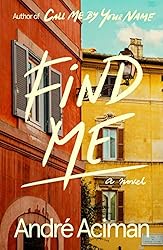
Find Me
Andre Aciman, 2019
Farrar, Straus & Giroux
272 pp.
ISBN-13: 9780374155018
Summary
In this spellbinding exploration of the varieties of love, the author of the worldwide bestseller Call Me by Your Name revisits its complex and beguiling characters decades after their first meeting.
No novel in recent memory has spoken more movingly to contemporary readers about the nature of love than Andre Aciman’s haunting Call Me by Your Name. First published in 2007, it was hailed as "a love letter, an invocation… an exceptionally beautiful book" (Stacey D’Erasmo, The New York Times Book Review). Nearly three quarters of a million copies have been sold, and the book became a much-loved, Academy Award–winning film starring Timothee Chalamet as the young Elio and Armie Hammer as Oliver, the graduate student with whom he falls in love.
In Find Me, Aciman shows us Elio’s father, Samuel, on a trip from Florence to Rome to visit Elio, who has become a gifted classical pianist. A chance encounter on the train with a beautiful young woman upends Sami’s plans and changes his life forever.
Elio soon moves to Paris, where he, too, has a consequential affair, while Oliver, now a New England college professor with a family, suddenly finds himself contemplating a return trip across the Atlantic.
Aciman is a master of sensibility, of the intimate details and the emotional nuances that are the substance of passion.
Find Me brings us back inside the magic circle of one of our greatest contemporary romances to ask if, in fact, true love ever dies. (From the publisher.)
Author Bio
• Birth—January 2, 1951
• Where—Alexandria, Egypt; Rome, Italy
• Education—B.A., Lehman College; M.A., Ph.D., Harvard University
• Awards—Whiting Award, Lambda Literary Award
• Currently—lives in New York, New York, USA
Andre Aciman (as-i man) is an Egyptian-Italian-American writer. He is the author of several novels, including Call Me by Your Name (2007) and its sequel Find Me (2020). In 1995, he published his memoir Out of Egypt, which won the Whiting Award, and which The New York Times compared to the styles of Gabriel Garcia Marquez, Lawrence Durrell, and Anton Chekkov.
Background and career
Aciman was born in Alexandria, Egypt, and raised in a multi-lingual family that spoke primarly French but also Italian, Greek, Ladino, and Arabic. His parents were Sephardic Jews, of Turkish and Italian origin, whose families had settled in Alexandria in 1905. Because increased tensions with Israel put Jews in a precarious position, his family left Egypt in 1965.
After his father purchased Italian citizenship for the family, Aciman moved with his mother and brother to Rome while his father moved to Paris. In 1968 the family moved to New York City. From there, Aciman attended Lehman College. He went on to earn an M.A. and Ph.D. in Comparative Literature from Harvard University.
Currently, Aciman is distinguished professor at the Graduate Center of City University of New York, where he teaches the history of literary theory and the works of Marcel Proust. He previously taught creative writing at New York University and French literature at Princeton and Bard College. He lives with his wife and three sons in New York. (Adapted from Wikipedia. Retreived 4/9/2020.)
Book Reviews
[Find Me] is a lyrical meditation on being forced to move to another location after the party’s over, on the Sisyphean task of trying to replicate the magic of young passion…. [I]t strikes an affectingly melancholy chord.
Josh Duboff - New York Times Book Review
Aciman’s quiet, label-free presentation of bisexual life represents a minor triumph…. Likewise, his refusal to offer easy resolution, which infuses the whole romantic enterprise with a kind of delicious melancholy. There are moments, particularly in the final chapter, that may have readers gazing tearfully into their fireplaces, real or imaginary, just like Timothee Chalamet at the end of Luca Guadagnino’s superlative film of Call Me by Your Name.
Charles Arrowsmith - Washington Post
Aciman writes about desire with blunt honesty, describing erotic and emotional interactions with equal clarity. Sex can be tender or not, the connection lasting or ephemeral, but it is almost always multilayered and complex.
Clea Simon - Boston Globe
With all of the richly painted details, emotional nuance, and deeply affecting romance as the first installment, this book will draw you in and make you believe in love again.
Good Housekeeping
The elegant sequel to Aciman’s celebrated first novel, Call Me by Your Name, revisits his best-known characters some 20 years later.… The novel again demonstrates Aciman’s capacity to fuse the sensual and the cerebral in stories that touch the heart.
Publishers Weekly
(Starred review) Aciman's incandescent sequel to the acclaimed Call Me by Your Name.… [Find Me is] a beautiful 21st-century romance that reflects on the remembrance of things past and the courage to embrace the future. Highly recommended. —Sally Bissell, formerly with Lee Cty. Lib. Syst., Fort Myers, FL
Library Journal
(Starred review) Call Me By Your Name was widely praised for its treatment of the nature of love, a theme that Find Me continues with subtlety and grace. Its treatment of the characters' psychology is astute and insightful… [Will the] star-crossed lovers reunite…. One can only hope.
Booklist
Aciman blends assuredly mature themes with deep learning… and his story is touching without being sentimental even if some of it is too neatly inevitable. An elegant, memorable story of enduring love across the generations.
Kirkus Reviews
Discussion Questions
1. The book begins with a conversation between Miranda and Samuel, who are strangers. What is your first impression of them? What are the similarities and differences in attitudes, beliefs, and experiences that draw them to each other? What are the critical moments in the development of their relationship? Why might Aciman have chosen this opening, given that the story ultimately belongs to Elio and Oliver?
2. Who is the "Me" of the book’s title? Might there be more than one? What does it mean to be found? How are the themes of love, loss, and loneliness explored in each section?
3. Miranda’s father is editing a dissertation that contains parables, which he says prove that "life and time are not in sync" and that we all "have many lives." How is each character’s story a parable about how time and life are not in sync? How does each have many lives?
4. What is a vigil? What are the vigils that Samuel and Elio are looking forward to in Rome? How does Miranda’s presence affect their experience? Are there other significant vigils in the book?
5. How are Elio and Michel, in the early stages of their love affair, like Samuel and Miranda? What vigils do they establish? What are the differences between the two couples?
6. When Michel asks his father, Adrien, who Leon was, his father replies, "You’re making me remember, and I don’t want to remember." What is the significance of the story of Adrien and Leon and the musical score, the cadenza, that Adrien leaves to his son? Is there a message hidden in Leon’s work? Why is Elio determined to help Michel discover who Leon was and how he died? In the end, does Michel find out what his father didn’t want to remember?
7. What is a canard? Why is it the word Michel chooses to describe Oliver’s marriage? Is it meant to be ironic? Are there other canards in the characters’ lives?
8. The story of Elio and Oliver is revealed gradually. What do we learn about them in each section? How did Elio’s experience of first love as a boy shape the man he has become? What do we know of Oliver’s life in the years after he left Elio in Italy? What does Oliver’s infatuation with Erica and Paul tell us about him? What happens in the time between the events of "Capriccio" and "DaCapo"?
9. How are the different stages of life—youth, middle age, and old age—depicted? How does a character’s age influence his or her beliefs about life, love, and death? Why does Miranda tell Samuel that "none of it would have happened if you were thirty years old?" How does Michel describe the differences between his younger and older selves?
10. Samuel and Miranda, and Elio and Michel, meet entirely by chance. In the relationships that develop between each couple, as well as Oliver’s fantasy relationship with Erica and Paul, what are the moments, words, or gestures that suggest the possibility of deeper connections?
11. Which of the characters believe in the power of fate to alter the course of a life? How does fate or chance impact each of them? How do the lyrics of the Brazilian song that Elio translates for Michel resonate throughout the book?
12. Does Elio fall in love with Michel? Has Oliver ever loved anyone except Elio? Why does love come so easily to Samuel and Miranda? In general, what lessons does the book teach us about love? To whom is it available? What sacrifices does it require?
13. Miranda’s father says, "I want those who outlive me to extend my life, not just to remember it." Michel tells Elio, "Nothing belongs to the past." How are past and present intertwined and what are the consequences? By the end of the book, how have the lives of the deceased been extended into the present? Why does Elio feel that his half brother is his and Oliver’s child, and that his father "knew it just as well, had known it all along?"
14. What is the significance of each section title? For example, "Tempo," the title of the first section, is a musical term meaning the speed at which a passage of music is or should be played. It is also the Italian word for time. How do both meanings resonate? What are the meanings of the other section titles? How are the themes of time and music interrelated?
15. Find Me is a romance, a tragicomic novel that spans generations, with themes of separation and reunion, exile, and jealousy. What are the moments of tragedy in the book? Of comedy? How else do the stories of Samuel and Miranda, Elio and Michel, and Elio and Oliver work as romance? What are other stories of lovers reunited after years of separation?
(Questions issued by the publisher.)
top of page (summary)


Finding Jake
Bryan Reardon, 2015
HarperCollins
272 pp.
ISBN-13: 9780062339485
Summary
A heart-wrenching yet ultimately uplifting story of psychological suspense in which a parent is forced to confront what he does—and does not—know about his teenage son
For sixteen years, Simon Connelly's successful wife has gone to her law office each day, while he has stayed home to raise their children. Though Simon has loved taking care of Jake and Laney, it has cost him a part of himself, and has made him an anomaly in his pretty, suburban neighborhood—the only stay-at-home dad among a tight circle of mothers.
Shepherding them through childhood, the angst-ridden father has tried to do the best for the kids, even if he often second-guesses his choices. For sunny, outgoing Laney, it's been easy. But quiet Jake has always preferred the company of his books or his sister to playdates and organized sports. Now that they are in high school, Simon should feel more relaxed, but he doesn't. He's seen the statistics, read the headlines.
Then, on a warm November day, he receives a text: There has been a shooting at the high school.
Racing to the rendezvous point, Simon is forced to wait with scores of other anxious fathers and tearful mothers, overwhelmed by the disturbing questions running through his head. How many victims were there? Why did this happen? One by one, parents are reunited with their children. Their numbers dwindle, until Simon is alone. Laney has gone home with her mom. Jake is the only child missing.
As his worst nightmare unfolds, Simon begins to obsess over the past, searching for answers, for hope, for the memory of the boy he raised, for the mistakes he must have made, for the reason everything came to this. Where is Jake? What happened in those final moments? Is it possible he doesn't really know his son? Or he knows him better than he thought? Jake could not have done this—or could he?
As rumors begin to ricochet, amplified by an invasive media, Simon must find answers. But there is only one way to understand what has happened . . . he must find Jake.
A story of faith and conviction, strength and courage, love and doubt that is harrowing and heartbreaking, surprisingly healing and redemptive, Finding Jake asks us to consider how well we know ourselves...and those we love. (From the publisher.)
Author Bio
Bryan Reardon is a freelance writer specializing in medical communications. He co-wrote Ready, Set, Play! with retired NFL player and ESPN analyst Mark Schlereth, and Cruel Harvest with Fran Elizabeth Grubb.
Prior to becoming a full-time writer, Bryan worked for the state of Delaware for more than a decade, starting in the office of the governor. He holds a BA in psychology from the University of Notre Dame and lives in West Chester, Pennsylvania, with his wife, kids, and rescue dog, Simon. (From .)
Book Reviews
[M]oving, if at times maudlin.... Could [Simon Connolly] really have been so grievously wrong about what kind of boy he was raising?... Reardon deftly builds suspense by setting his dual story lines on a collision course toward a shattering—and surprising—conclusion.
Publishers Weekly
Simon Connolly is the anguished father and narrator in this psychological thriller.... [H]e's not sure whether he can believe in [his son] Jake's innocence. He reviews incidents from Jake's past...that might (or might not) be significant. A compelling read; disturbingly relevant in contemporary America.
Kirkus Reviews
Discussion Questions
1. Who is Jake Connolly? Does Simon have a good understanding of his son's personality?
2. Most parents assume they know their children well. How true is that assumption? Should parents know everything about their children? Where is the line between privacy and parenting?
3. Are Simon and Jake introverts? Is introvert a bad word? Could Simon have done more to teach Jake to be social?
4. As more fathers stay at home with their children, has it become a socially acceptable family paradigm? How do you think stay-at-home dads are really seen in our society? How do you think stay-at-home dads view their decision to buck social norms? Would you want Simon at a play-date?
5. Why does Simon struggle to fit in with the other stay-at-home parents? Is it his own insecurities, or their discomfort? What could Simon have done to be more approachable and social?
6. Is Finding Jake about a school shooting or about the more mundane challenges of modern parenting? How have parenting methods changed from past generations? How might changing parenting methods influence society? Can parents prevent tragedy?
7. Does the media's response to the shooting and to Jake and Doug ring true today? Do you find yourself delving into the lives of those struck by tragedy? Or those responsible for it?
8. Simon experiences a moment of parental pride when he tells Jake he should always be nice to people, even if others are not. Did that advice contribute to the shooting? Should Simon have gone back to that advice and felt responsible? Or was that just one of a myriad of mistakes he thought he made? Can a parent's influence of a child ever truly be predicted?
9. Do Simon and Rachel still love one another? What factors influence the change in their relationship? Can they survive together? In what ways can raising children challenge a marriage/relationship?
10. Could events have been changed if Jake talked openly with his father about his life and school? Do any children tell their parents everything? Does a parent really want to know everything? Where is the line between protecting your child and letting him/her grow up?
11. Did the ending surprise you? What, if any, aspects of the story led you to believe it would end differently? What other ways could the story have ended?
12. Which character did you like or relate to the most? Which the least? Do you have to love a character to enjoy a book?
13. How responsible is a parent for their children’s actions? In a tragic situation such as this, is it fair to blame parents for not seeing what was coming?
14. There are certainly challenges that face stay at home dads, and the perspective here is from Simon’s viewpoint, but how do you imagine that scenario affects the mothers who work? Is there guilt or resentment on the mother’s part that she is not home with her children? Is there too much pressure to be the primary income earner? Does she lose her maternal instincts or feel that she has been denied a natural role? What price do these families pay to break the norm?
(Questions issued by the publisher.)


A Fine Balance
Rohinton Mistry, 1995
Random House
624 pp.
ISBN-13: 9781400030651
Summary
Winner: L.A. Times Prize in Fiction, Commonwealth Writers Best Book of the Year, and Giller Prize.
At 600 pages, Mistry's stunning second novel looks intimidating, yet this moving tale of four people caught up in India's 1975 state of emergency—when Prime Minister Indira Gandhi suspended the constitution in order to hold on to power following a scandal—is an incredibly detailed, compelling read that sweeps you along from the opening pages and is over far too soon.
Though it takes place in a time of political upheaval and chaos, A Fine Balance is not a political diatribe. Instead, it is a beautiful and compassionate portrait of the resiliency of the human spirit when faced with death, despair, and unconscionable suffering.
Set in an unnamed city by the sea, it is the story of four disenfranchised strangers—a widow, a young student, and two tailors—who are forced by their impoverished circumstances to share a cramped apartment. Initially distrustful of one another, Dina, Maneck, Ishvar, and Om gradually build loving, familial bonds and learn together "to maintain a fine balance between hope and despair" in a society suddenly turned inhumanly cruel and corrupt. (From the publisher.)
Author Bio
• Birth—1952
• Where—Bombay, India
• Education—B. S., University of Bombay; B.A., University of Toronto, 1983
• Awards—Governor General's Award; Commonwealth Writers Prize (twice); Giller Prize
• Currently—lives in Toronto, Canada
Rohinton Mistry was born in Bombay and now lives near Toronto. His first novel, Such a Long Journey, was shortlisted for the Booker Prize and received, among other awards, the Governor General's Award and the Commonwealth Writers Prize for Best Book of the Year. A Fine Balance is his second novel, winner of the Los Angeles Times Book Prize in Fiction, the Giller Prize, and the Commonwealth Writers Prize as well as a Booker Prize finalist. Mistry is also the author of Swimming Lessons: And Other Stories from Firozsha Baag, a collection of short stories.
Four years after publishing Swimming Lessons in 1987, Mistry released his first novel. Such a Long Journey, which follows a bank clerk’s unwitting descent into corrupt political dealings in 1971 Bombay, was short-listed for the Booker prize and won Canada’s Governor General’s Award. Next came A Fine Balance, Mistry’s sweeping story of four strangers forced into sharing an apartment in 1975 Bombay. Again the Booker short list, and top Canadian honor the Giller Prize.
The selection of A Fine Balance for Oprah’s Book Club in 2001 changed the nature of Mistry’s career, as it has for many authors. While already respected, he had now earned a recognition with a new readership in the hundreds of thousands—a readership that was by and large unlikely to pick up a sprawling book set in 1970s India. Mistry told the show, “[India] remains my focus and makes it all worthwhile because of the people...their capacity for laughter, their capacity to endure.... Perhaps my main intention in writing this novel was to look at history from the bottom up.”
As a result of the Oprah publicity, a greater weight of expectation may have rested on Mistry’s third novel than it might have otherwise; this is true not only because of the increased pairs of eyes on Mistry’s work, but because he is a writer who is clearly still evolving. His earlier books encountered some criticism for heavyhandedness, particularly where the injection of political and social commentary were concerned.
In 2002’s Family Matters, Mistry moves away from a charged national backdrop and focuses more on family politics, though his keen observance of Indian culture remains a strong element. Charting the effects of one partriarch’s physical decline on his extended family, Family Matters moves forward in Bombay time to the mid-1990s and uses the Vakeel clan as a lens through which the author views (critically) religious fundamentalism.
Mistry’s consistent performance as a novelist, and ever growing awareness of his talents among American readers, promises a long and fruitful career. One Atlantic reviewer, beginning a review of Family Matters, put it this way: “[Mistry] has long been recognized as one of the best Indian writers; he ought to be considered simply one of the best writers, Indian or otherwise, now alive.”
Extras
• Mistry has not lived in his native India for many years; but like many expatriate writers, he continues a relationship with his country in his writings and has enriched his readers’ understanding of it. In his first two novels, Such a Long Journey and A Fine Balance, Mistry set his humorous, heartrending, Dickensian view of Bombay under the shadow of tumult under Indira Ghandi’s rule in the 1970s.
• Although he left India in 1975 and does not often go back, Mistry told a British magazine that he feels no hindrance in writing about his home country. "So far I have had no difficulty writing about it, even though I have been away for so long," he said. "All fiction relies on the real world in the sense that we all take in the world through our five senses and we accumulate details, consciously or subconsciously. This accumulation of detail can be drawn on when you write fiction..."
• After emigrating to Toronto in 1975, Mistry got a job as a bank clerk and ascended to the supervisor of customer service after a few years. His dissatisfaction in the job led to his taking classes in English, first at York College, and ultimately pursuing a degree part-time at the University of Toronto.
• Mistry had no ambitions to be a writer until he got to Canada and began taking classes in literature at the University of Toronto. Encouraged by his wife, he set out to win a university literary contest by writing his first short story. He called in sick from work, devoted several days to the story, entered it, and won the contest. (From Barnes & Noble.)
Book Reviews
Those who continue to harp on the decline of the novel...ought to consider Rohinton Mistry. He needs no infusion of magic realism to vivify the real. The real world, through his eyes, is magical.
The New York Times
Astonishing.... A rich and varied spectacle, full of wisdom and laughter and the touches of the unexpectedly familiar through which literature illuminates life.
Wall Street Journal
Monumental.... Few have caught the real sorrow and inexplicable strength of India, the unaccountable crookedness and sweetness, as well as Mistry.
Time
In mid-1970s urban India—a chaos of wretchedness on the streets and slogans in the offices—a chain of circumstances tosses four varied individuals together in one small flat. Stubbornly independent Dina, widowed early, takes in Maneck, the college-aged son of a more prosperous childhood friend and, more reluctantly, Ishvar and Om, uncle and nephew tailors fleeing low-caste origins and astonishing hardships. The reader first learns the characters' separate, compelling histories of brief joys and abiding sorrows, then watches as barriers of class, suspicion, and politeness are gradually dissolved. Even more affecting than Mistry's depictions of squalor and grotesque injustice is his study of friendships emerging unexpectedly, naturally. The novel's coda is cruel and heart-wrenching but deeply honest. This unforgettable book from the author of Such a Long Journey is highly recommended.
Library Journal
From the Toronto-based Mistry (Such a Long Journey, 1991), a splendid tale of contemporary India that, in chronicling the sufferings of outcasts and innocents trying to survive in the "State of Internal Emergency" of the 1970s, grapples with the great question of how to live in the face of death and despair. Though Mistry is too fine a writer to indulge in polemics, this second novel is also a quietly passionate indictment of a corrupt and ineluctably cruel society. India under Indira Gandhi has become a country ruled by thugs who maim and kill for money and power. The four protagonists (all victims of the times) are: Dina, 40-ish, poor and widowed after only three years of marriage; Maneck, the son of an old school friend of Dina's; and two tailors, Ishvar and his nephew Om, members of the Untouchable caste. For a few months, this unlikely quartet share a tranquil happiness in a nameless city—a city of squalid streets teeming with beggars, where politicians, in the name of progress, abuse the poor and the powerless. Dina, whose dreams of attending college ended when her father died, is now trying to support herself with seamstress work; Maneck, a tenderhearted boy, has been sent to college because the family business is failing; and the two tailors find work with Dina. Though the four survive encounters with various thugs and are saved from disaster by a quirky character known as the Beggarmaster, the times are not propitious for happiness. On a visit back home, Om and Ishvar are forcibly sterilized; Maneck, devastated by the murder of an activist classmate, goes abroad. But Dina and the tailors, who have learned "to maintain a fine balance between hope and despair," keep going. A sweeping story, in a thoroughly Indian setting, that combines Dickens's vivid sympathy for the poor with Solzhenitsyn's controlled outrage, celebrating both the resilience of the human spirit and the searing heartbreak of failed dreams.
Kirkus Reviews
Discussion Questions
1. Why has Mistry chosen not to name the Prime Minister or the City by the Sea, when they are easily recognizable? Does recognition of these elements make any difference in your attitude toward the story?
2. Is Nusswan presented entirely as a villain, or does he have redeeming features? What are his real feelings toward Dina?
3. How does Dina's position within her family reflect the position of women in her culture and social class? Is the status of Om's sisters the same as Dina's, or different? What sorts of comparisons can you make between the roles and functions of women in India (as represented in this novel) and in America?
4. Post-Independence India has seen much religious and ethnic violence: for instance, the mutual slaughter of Hindus and Muslims after Partition (1947), during which Ishvar and Narayan saved Ashraf and his family, and the hunting down and killing of Sikhs after the Prime Minister's murder, witnessed by Maneck. How does the behavior of the characters in the novel, ordinary Hindus, Parsis, and Muslims, contrast with the hatred that inspired these terrible acts? How much of this hatred seems to be fomented by political leaders? Dukhi observes bitterly "that at least his Muslim friend treated him better than his Hindu brothers" [p. 115]. What does this say about ethnic and religious loyalties, as opposed to personal ones?
5. After Rustom's death, Dina's primary goal is self-reliance. But as the novel progresses and she makes new friends, she begins to change her ideas. "We'll see how independent you are when the goondas come back and break your head open, " Dina says to Maneck [p. 433]. Does she find in the end thatreal self-reliance is possible, or even desirable? Does she change her definition of self-reliance?
6. Most people seem indifferent or hostile to the Prime Minister and her Emergency policies, but a few characters, like Mrs. Gupta and Nusswan, support her. What does the endorsement of such people indicate about the Prime Minister? Can you compare the Prime Minister and her supporters with other political leaders and parties in today's world?
7. Why does Avinash's chess set become so important to Maneck, who comes to see chess as the game of life? "The rules should always allow someone to win, " says Om, while Maneck replies, "Sometimes, no one wins" [p. 410]. How do the events of the novel resemble the various moves and positions in chess?
8. Dina distances herself from the political ferment of the period: "Government problemsÑgames played by people in power, " she tells Ishvar. "It doesn't affect ordinary people like us" [p. 75]. But in the end it does affect all of them, drastically. Why do some, like Dina and Maneck, refuse to involve themselves in politics while others, like Narayan and Avinash, eagerly do so? Which position is the better or wiser one?
9. When Ishvar and Om are incarcerated in the labor camp, Ishvar asks what crime they have committed. "It's not a question of crime and punishment—it's problem and solution, " says the foreman [p. 338]. If it is true that there is a problem—the vast number of homeless people and beggars on city streetsÑwhat would a proper and humane solution be?
10. People at the bottom of the economic heap frequently blame so-called middlemen: people like Dina, who makes her living through other people's labor, or like Ibrahim the rent collector. Do such middlemen strike you as making money immorally? Who are the real villains?
11. How would you sum up Beggarmaster: Is he ruthless, kind, or a bit of both? Does he redeem himself by his thoughtful acts, the seriousness with which he takes his responsibilities toward his dependents? In a world this cruel, are such simple categories as "good" and "bad" even applicable?
12. When Beggarmaster draws Shankar, Shankar's mother, and himself, he represents himself as a freak just like the other two. What does this vision he has of himself tell us about him?
13. The government's birth control program is enforced with violence and cruelty, with sterilization quotas and forced vasectomies. But is birth control policy in itself a bad thing? Dina tells Om, for example, "Two children only. At the most, three. Haven't you been listening to the family planning people?" [p. 466]. How might family planning be implemented in a humane fashion?
14. After Dina's father dies, her family life is blighted until she marries Rustom. In later years, she chooses to withdraw from her natural family; it is not until her year with the tailors and Maneck that she again comes to know what a family might be. What constitutes a family? What other examples of unconventional "families" do you find in the novel?
15. Why do Ishvar, Om, and Dina survive, in their diminished ways, while Maneck finally gives up? Is it due to something in their pasts, their childhoods, their families, their characters?
16. "People forget how vulnerable they are despite their shirts and shoes and briefcases, " says Beggarmaster, "how this hungry and cruel world could strip them, put them in the same position as my beggars" [p. 493]. Does A Fine Balance show people's vulnerability, or their fortitude?
17. What effect is achieved by the novel's mildly comic ending, with Om and Ishvar clowning around at Dina's door? Is the ending appropriate, or off-balance?
18. The novel gives us a vivid picture of life for members of the untouchable caste in remote villages. Why might such an apparently anachronistic system have survived into the late twentieth century? Does it resemble any other social systems with which you are acquainted? Why do so few of its victims fight the system, as Narayan does? Why do so few leave the village: is it from necessity, social conservatism, respect for tradition?
(Questions issued by publisher.)
top of page (summary)


The Finkler Question
Howard Jacobson, 2010
Bloomsbury Group
307 pp.
ISBN-13: 9781608196111
Summary
Winner, 2010 Man Booker Prize
He should have seen it coming. His life had been one mishap after another. So he should have been prepared for this one…
Julian Treslove, a professionally unspectacular former BBC radio producer, and Sam Finkler, a popular Jewish philosopher, writer and television personality, are old school friends. Despite a prickly relationship and very different lives, they've never quite lost touch with each other—or with their former teacher, Libor Sevcik, a Czech always more concerned with the wider world than with exam results.
Now, both Libor and Finkler are recently widowed, and with Treslove, his chequered and unsuccessful record with women rendering him an honorary third widower, they dine at Libor's grand, central London apartment.
It's a sweetly painful evening of reminiscence in which all three remove themselves to a time before they had loved and lost; a time before they had fathered children, before the devastation of separations, before they had prized anything greatly enough to fear the loss of it. Better, perhaps, to go through life without knowing happiness at all because that way you have less to mourn? Treslove finds he has tears enough for the unbearable sadness of both his friends' losses. And it's that very evening, at exactly 11:30 pm, as Treslove, walking home, hesitates a moment outside the window of the oldest violin dealer in the country, that he is attacked. And after this, his whole sense of who and what he is will slowly and ineluctably change.
The Finkler Question is a scorching story of friendship and loss, exclusion and belonging, and of the wisdom and humanity of maturity. Funny, furious, unflinching, this extraordinary novel shows one of our finest writers at his brilliant best. (From the publisher.)
Author Bio
• Birth— August 25, 1942
• Where—Manchester, England, UK
• Education—Cambridge University
• Awards—Man Booker Prize
• Currently—lives in London, England
Howard Jacobson is a British author and journalist, best known for his comic novels that often revolve around the dilemmas of British Jewish characters. Born in Manchester, Jacobson was brought up in Prestwich and was educated at Stand Grammar School in Whitefield, before going on to study English at Downing College, Cambridge under F. R. Leavis. He lectured for three years at the University of Sydney before returning to England to teach at Selwyn College, Cambridge. His later teaching posts included a stint at Wolverhampton Polytechnic in the 1970s.
Although Jacobson has described himself as "a Jewish Jane Austen" (in response to being described as "the English Phillip Roth"), he also states, "I'm not by any means conventionally Jewish. I don't go to shul. What I feel is that I have a Jewish mind, I have a Jewish intelligence. I feel linked to previous Jewish minds of the past. I don't know what kind of trouble this gets somebody into, a disputatious mind. What a Jew is has been made by the experience of 5,000 years, that's what shapes the Jewish sense of humour, that's what shaped Jewish pugnacity or tenaciousness." He maintains that "comedy is a very important part of what I do."
Writing
His time at Wolverhampton was to form the basis of his first novel, Coming from Behind, a campus comedy about a failing polytechnic that plans to merge facilities with a local football club. The episode of teaching in a football stadium in the novel is, according to Jacobson in a 1985 BBC interview, the only portion of the novel based on a true incident. He also wrote a travel book in 1987, titled In the Land of Oz, which was researched during his time as a visiting academic in Sydney.
His fiction, particularly in the novels he has published since 1998, is characterised chiefly by a discursive and humorous style. Recurring subjects in his work include male–female relations and the Jewish experience in Britain in the mid- to late-20th century. He has been compared to prominent Jewish-American novelists such as Philip Roth, in particular for his habit of creating doppelgängers of himself in his fiction. Jacobson has been called "the English Philip Roth", although he calls himself the "Jewish Jane Austen."
His 1999 novel The Mighty Walzer, about a teenage table tennis champion, won the Bollinger Everyman Wodehouse Prize for comic writing. It is set in the Manchester of the 1950s and Jacobson, himself a table tennis fan in his teenage years, admits that there is more than an element of autobiography in it. His 2002 novel Who's Sorry Now?—the central character of which is a Jewish luggage baron of South London—and his 2006 novel Kalooki Nights were longlisted for the Man Booker Prize. Jacobson described Kalooki Nights as "the most Jewish novel that has ever been written by anybody, anywhere."
As well as writing fiction, he also contributes a weekly column for The Independent newspaper as an op-ed writer. In recent times, he has, on several occasions, attacked anti-Israel boycotts, and for this reason has been labelled a "liberal Zionist."
In October 2010 Jacobson won the Man Booker Prize for his novel The Finkler Question, which was the first comic novel to win the prize since Kingsley Amis's The Old Devils in 1986. The book, published by Bloomsbury, explores what it means to be Jewish today and is also about "love, loss and male friendship." Andrew Motion, the chair of the judges, said: "The Finkler Question is a marvellous book: very funny, of course, but also very clever, very sad and very subtle. It is all that it seems to be and much more than it seems to be. A completely worthy winner of this great prize." Jacobson—at the age of 68—was the oldest winner since William Golding in 1980.
Jacobson's 2014 dystopian novel, J, was shortlisted for the Man Booker Prize.
Broadcasting
He has also worked as a broadcaster. Two recent television programmes include Channel 4's Howard Jacobson Takes on the Turner, in 2000, and The South Bank Show in 2002 featured an edition entitled "Why the Novel Matters." An earlier profile went out in the series in 1999 and a television documentary entitled "My Son the Novelist" preceded it as part of the Arena series in 1985. His two non-fiction books—Roots Schmoots: Journeys Among Jews (1993) and Seriously Funny: From the Ridiculous to the Sublime (1997—were turned into television series.
In 2010 Jacobson presented "Creation," the first part of the Channel 4 series The Bible: A History. (From Wikipedia.)
Book Reviews
Mr. Jacobson doesn't just summon [Philip] Roth; he summons Roth at Roth's best. This prizewinning book is a riotous morass of jokes and worries about Jewish identity, though it is by no means too myopic to be enjoyed by the wider world. It helps that Mr. Jacobson's comic sensibility suggests Woody Allen's, that his powers of cultural observation are so keen, and that influences as surprising as Lewis Carroll shape this book.
Janet Maslin - New York Times
Although there is a plot, The Finkler Question is really a series of tragicomic meditations on one of humanity's most tenacious expressions of malice, which I realize sounds about as much fun as sitting shiva, but Jacobson's unpredictable wit is more likely to clobber you than his pathos. In these pages, he's refined the funny shtick of Kalooki Nights (2007) to produce a more cerebral comedy about the bizarre metastasis of anti-Semitism and the exhausting complications of Zionism.
Ron Charles - Washington Post
A striking novel and a subtle one… The Finkler Question has all the qualities we expect from Mr. Jacobson—especially a mordant wit, sometimes as acrid as it is exuberant. He has been called the English Philip Roth, and it is true that the two authors have in common a white-hot indignation, at anti-Semitism and much else... With The Finkler Question, Mr. Jacobson has managed to channel his themes and his characters' emotions... with nuance, insight and, yes, laughter.
Wall Street Journal
It is tempting—after reading something as fine as The Finkler Question—not to bother reviewing it in any meaningful sense but simply to urge you to put down this paper and go and buy as many copies as you can carry … Full of wit, warmth, intelligence, human feeling and understanding. It is also beautifully written … Indeed, there’s so much that is first rate in the manner of Jacobson’s delivery that I could write all day on his deployment of language without once mentioning what the book is about.
Edward Docx - Observer (UK)
This charming novel follows many paths of enquiry, not least the present state of Jewish identity in Britain and how it integrates with the Gentile population. Equally important is its exploration of how men share friendship. All of which is played out with Jacobson’s exceptionally funny riffs and happy-sad refrains … Jacobson’s prose is a seamless roll of blissfully melancholic interludes. Almost every page has a quotable, memorable line.
Christian House - Independent on Sunday (UK)
There are some great riffs and skits in The Finkler Question.... But at the heart of the book is Julian the wannabe Jew, a wonderful comic creation precisely because he is so tragically touching in his haplessness. The most moving (and funniest) scenes are those in which he and Libor, the widower with nothing more to live for, ruminate on love and Jewishness.
Adam Lively - Sunday Times (UK)
(Starred review.) Winner of the 2010 Man Booker Prize, Jacobson's wry, devastating novel examines the complexities of identity and belonging, love, and grief through the lens of contemporary Judaism. Julian Treslove, a former BBC producer who works as a celebrity double, feels out of sync with his longtime friend and sometimes rival Sam Finkler, a popular author of philosophy-themed self-help books and a rabidly anti-Zionist Jewish scholar. The two have reconnected with their elderly professor, Libor Sevcik, following the deaths of Finkler and Libor's wives, leaving Treslove—the bachelor Gentile—even more out of the loop. But after Treslove is mugged—the crime has possible anti-Semitic overtones—he becomes obsessed with what it means to be Jewish, or "a Finkler." Jacobson brilliantly contrasts Treslove's search for a Jewish identity—through food, spurts of research, sex with Jewish women—with Finkler's thorny relationship with his Jewish heritage and fellow Jews. Libor, meanwhile, struggles to find his footing after his wife's death, the intense love he felt for her reminding Treslove of the belonging he so craves. Jacobson's prose is effortless—witty when it needs to be, heartbreaking where it counts—and the Jewish question becomes a metaphor without ever being overdone.
Publishers Weekly
Discussion Questions
Use our LitLovers Book Club Resources; they can help with discussions for any book:
• How to Discuss a Book (helpful discussion tips)
• Generic Discussion Questions—Fiction and Nonfiction
• Read-Think-Talk (a guided reading chart)
Also consider these LitLovers talking points to help get a discussion started for The Finkler Question:
1. What's wrong with Julian Treslove? Why has his life been such a disappointment? What is missing in him?
2. How does Julian view his friend Sam Finkler? Why does Julian consider him a prototype of Jews? What is the catalog of traits he ascribes to "the Finklers"?
3. What is the significance of the mugging incident, and why does it awaken Julian's desire to become Jewish?
4. Do you find Julian's regard for Judaism funny, endearing, or disturbing? Is he anti-semitic? Can you tell if (or when) he's joking?
5. Describe the contrasting stances on Israel and Judaism taken by Sam and Libor Sevcik? Why, for instance, won't Sam even use the word "Israel"? What are the range of positions on the Israel-Palestine question? Whom do you side with?
6. What is the significance of the book's title, the "Finkler Question"?
7. Does Jewish exceptionalism exist? What are the arguments for or against?
8. Talk about the meaning of Sam's group, ASHamed Jews? What is the butt of author Jacobson's satire here?
9. Sam tells Libor that he has no anti-Semitic friends, and Libor replies, "Yes, you do. The Jewish ones." Is Libor right: does the primary bastion of anti-semitism lie within the Jewish community? And what does the Jewish film director mean when he says anti-semitism makes perfect sense to him?
10. A resurgence of anti-semitic attacks begin to filter in. Care to comment on this passage?
After a period of exceptional quiet, anti-Semitism was becoming again what it had always been—an escalator that never stopped, and which anyone could hop on at will.
11. During dinner early in the book, the three friends—Julian, Sam, and Libor Sevcik—conclude that happiness is sad because we mourn for it when it's missing in our lives. Agree...disagree? Make sense...nonsense?
12. Julian sees his life as "an absurd disgrace, to be exceeded in disgracefulness only by death." What does he mean, and how do you view the statement—is it funny, tragic, correct, dead wrong...?
13. There is a lot of wit in this book. What did you find especially funny—when Libor, for instance, tells Julian at the Lewis Carroll Seder (!) that “the chicken symbolizes the pleasure Jewish men take in having a team of women to cook it for them”? What about Sam's bestselling book titles?
14. Is there far too much rumination, navel-gazing, or self-analysis in this book? Do you find it tedious...or does Jacobson's humor enliven the book's introspection?
15. Is this book a comedy or tragedy?
(Questions by LitLovers. Please feel free to use them, online or off, with attribution. Thanks.)
top of page (summary)


Fireflies at Twilight: Letters from Pat Adams
Pat Adams, (Cate Adams, Carole Milks Turner, eds.) 2014
First Person Productions
163 pp.
ISBN-13: 9780984727650
Summary
Fireflies at Twilight: Letters from Pat Adams tells a story through family and friends' letters and emails.
Pat lived the last 15 years of her life with cancer and its repercussions. However, she was more annoyed and irritated than ever stopped or labeled by the disease. The entries instead highlight her daily life on a farm in southern Wisconsin, her appreciation of the natural world, and her courage and vivacity to live fully each day.
Pat’s writing include her quiet thoughts during winter hibernation in a drafty farmhouse, a raw intimate love letter to her husband before her first surgery; her frank yet kind advice to her daughters about employment and empowerment; a description of a winter outing to a nearby bison farm; summer observances in her travel journal of turtles and loons in Upper Peninsula, Michigan; and her lively commentary about her beloved Book Babes group.
Pat's story is not as much about the art of dying as it is about the art of living in the present, with messages of humor and hope in how the human spirit remains undaunted. One reader says: "Pat's letters are filled with thoughts of life—advice for her children, shared memories with friends and family—and always a reminder that her love for them will never change, that there is no force powerful enough to diminish the bonds they share." (From the publisher.)
Author Bio
• Birth—January 20, 1951
• Rasied—Footville, Wisconsin, USA
• Death—March 14, 2011
• Where—New Glarus, Wisconsin
• Education—University of Wisconsn-Madison
Patsy Ann Adams was born in 1951 in Stoughton, Wisconsin, and grew up in Footville, Wisconsin, where she attended Orfordville's Parkview High School. She attended the University of Wisconsin–Madison and was employed at the New Glarus Elementary School near her rural home for 14 years.
Pat worked with special needs children in the New Glarus school system, starting as an aide to one young boy whom she accompanied all day. She went on to help with special needs children in mainstream and special education classrooms.
Pat loved her home on her husband’s family’s working dairy farm. A lover of all living things, she raised her own pigs, poultry, and vegetables, as well as flowers, dogs, cats, and kids—her own and others. "Half the kids in town knew her as 'Mama Pat,'" says her daughter Cate. She kept her four children—Sam, Cate, Norah, and Dan—involved in after-school activities from sports to music lessons, and attended every concert, recital and sports event.
Pat was an active community member and activist. She became a Girl Scout leader when her oldest daughter Cate joined in third grade and for fifteen years led the New Glarus area Girl Scouts, until her younger daughter Norah graduated from high school. Pat became involved in the teachers' union as her school’s representative for a number of years and served as the union’s president.
Pat always loved travel, including yearly summer vacations at a cabin in Michigan’s Upper Peninsula, which typically included an assortment of visiting family, friends, and pets, and trips that took her farther afield, including Ecuador and California.
Through her letters and emails, Pat kept in touch with family and friends near and far throughout the hectic family years and the more peaceful "empty nest" stage that preceded her death in March 2011.
Book Reviews
Deftly compiled and co-edited by Cate Adams and Carole Milks Turner, Fireflies at Twilight: Letters from Pat Adams is a compelling and personal read. The candor is consistently impressive. The observations unusually insightful. Informative, intensely personal, thoughtful and thought-provoking...an extraordinary and enthusiastically recommended addition to personal reading lists, as well as community and academic library American Biography collections.
Midwest Book Review
[The authors] have turned Pat Adams from an unknown entity into someone who feels like a "dear, trusted friend." ... I didn't want this book to end, for with its ending came a sense of a visit with a close friend coming to a close before you are ready for it to do so. Fireflies at Twilight gives readers a certain peace and calm that is all to rare in today's hectic world. Pat Adams knew how to find beauty and peace and joy in the simple things of life—and how to share that with those she loved most.
Story Circle Book Reviews
Discussion Questions
1. Have you ever faced a serious illness or helped a friend or family member through a serious illness? What did you learn from the experience?
2. Pat found a lot of comfort in gardening, nature, pets, her children, friendships and books. She mentioned books coming in the mail, trips to the library, etc. What are some things (including books) that give you comfort?
3. How do you think writing helped Pat? Do you journal on a regular basis?
4. Do you correspond via handwritten letters or postcards with anyone? What does a handwritten note tell about the author (rather than a typed one), such as mood or state of mind?
5. New York Times bestselling author Michael Perry said about Pat and the book: "First, just write it all down. You never know what a legacy it might become." Do you cherish and save handwritten items? Why/Why not?
6. Do you think that the schools should continue to teach writing? Why/Why not?
7. How does grief play a part in Pat’s life? For example, a month before Pat died, she was buying books online and had a friend check out a stack of books from her local library. On the other hand Pat takes care of "her business," and even writes her own obituary.
8. Pat writes about her grown children: "…I imagined a rotating visit plan with my chicks. They could each stay a month (or more) at a time. Not practical, but delightful to imagine. I do miss them when they are far away—always want them close. They help me in so many ways."
How does each child in his and her own way help and sustain their mother?
9. In a letter to a friend, Pat writes:
I love having girlfriends (like you) around me—so natural, comfortable. In my younger days, I dreamed of a community of women and children, with the men living on the next piece of land. Made good sense to me.
Pat was born in 1951, and therefore grew up during the '60’s and '70s. How does this impact her attitudes toward friendship, feminism, culture, music, and relationships?
10. There is much in the media these days about death and dying, prolonging life through medical interventions vs. receiving palliative care only. Pat and her family courageously made a commitment to keep her at home and bring hospice in to help her during her final months. How would you approach the dying process if you had a terminal illness?
(Questions issued by the editors, Cathy Gorey, and Marilyn Christensen.)


Firefly Lane
Kristin Hannah, 2008
St. Martin's Press
496 pp.
ISBN-13: 9780312537074
Summary
From the New York Times bestselling author of On Mystic Lake comes a powerful novel of love, loss, and the magic of friendship.
In the turbulent summer of 1974, Kate Mularkey has accepted her place at the bottom of the eighth-grade social food chain. Then, to her amazement, the “coolest girl in the world” moves in across the street and wants to be her friend. Tully Hart seems to have it al—beauty, brains, ambition. On the surface they are as opposite as two people can be: Kate, doomed to be forever uncool, with a loving family who mortifies her at every turn. Tully, steeped in glamour and mystery, but with a secret that is destroying her. They make a pact to be best friends forever; by summer’s end they’ve become TullyandKate. Inseparable.
So begins Kristin Hannah’s magnificent new novel. Spanning more than three decades and playing out across the ever-changing face of the Pacific Northwest, Firefly Lane is the poignant, powerful story of two women and the friendship that becomes the bulkhead of their lives.
From the beginning, Tully is desperate to prove her worth to the world. Abandoned by her mother at an early age, she longs to be loved unconditionally. In the glittering, big-hair era of the eighties, she looks to men to fill the void in her soul. But in the buttoned-down nineties, it is television news that captivates her. She will follow her own blind ambition to New York and around the globe, finding fame and success . . . and loneliness.
Kate knows early on that her life will be nothing special. Throughout college, she pretends to be driven by a need for success, but all she really wants is to fall in love and have children and live an ordinary life. In her own quiet way, Kate is as driven as Tully. What she doesn’t know is how being a wife and mother will change her . . . how she’ll lose sight of who she once was, and what she once wanted. And how much she’ll envy her famous best friend. . . .
For thirty years, Tully and Kate buoy each other through life, weathering the storms of friendship—jealousy, anger, hurt, resentment. They think they’ve survived it all until a single act of betrayal tears them apart . . . and puts their courage and friendship to the ultimate test.
Firefly Lane is for anyone who ever drank Boone’s Farm apple wine while listening to Abba or Fleetwood Mac. More than a coming-of-age novel, it’s the story of a generation of women who were both blessed and cursed by choices. It’s about promises and secrets and betrayals. And ultimately, about the one person who really, truly knows you—and knows what has the power to hurt you . . . and heal you. Firefly Lane is a story you’ll never forget . . . one you’ll want to pass on to your best friend. (From the publisher.)
Author Bio
• Birth—September, 1960
• Where—Southern California, USA
• Reared—Western Washington State
• Education—J.D., from a school in Washington (state)
• Awards—Golden Heart Award; Maggie Award; National Reader's Choice
• Currently—lives on Bainbridge Island, Washington
In her words
I was born in September 1960 in Southern California and grew up at the beach, making sand castles and playing in the surf. When I was eight years old, my father drove us to Western Washington where we called home.
After working in a trendy advertising agency, I decided to go to law school. "But you're going to be a writer" are the prophetic words I will never forget from my mother. I was in my third-and final-year of law school and my mom was in the hospital, facing the end of her long battle with cancer. I was shocked to discover that she believed I would become a writer. For the next few months, we collaborated on the worst, most clichéd historical romance ever written.
After my mom's death, I packed up all those bits and pieces of paper we'd collected and put them in a box in the back of my closet. I got married and continued practicing law.
Then I found out I was pregnant, but was on bed rest for five months. By the time I'd read every book in the house and started asking my husband for cereal boxes to read, I knew I was a goner. That's when my darling husband reminded me of the book I'd started with my mom. I pulled out the boxes of research material, dusted them off and began writing. By the time my son was born, I'd finished a first draft and found an obsession.
The rejections came, of course, and they stung for a while, but each one really just spurred me to try harder, work more. In 1990, I got "the call," and in that moment, I went from a young mother with a cooler-than-average hobby to a professional writer, and I've never looked back. In all the years between then and now, I have never lost my love of, or my enthusiasm for, telling stories. I am truly blessed to be a wife, a mother, and a writer. (From the author's website.)
Book Reviews
This terrific buddy saga about two best girlfriends who survive all sorts of escapades and catastrophes will inevitably provoke comparisons with Iris Dart's Beaches, but the story is all Hannah's own.
Seattle Times
Hannah (On Mystic Lake) goes a little too far into Lifetime movie territory in her latest, an epic exploration of the complicated terrain between best friends—one who chooses marriage and motherhood while the other opts for career and celebrity. The adventures of poor, ambitious Tully Hart and middle-class romantic Kate Mularkey begin in the 1970s, but don't really get moving until about halfway into the book, when Tully, who claws her way to the heights of broadcast journalism, discovers it's lonely at the top, and Katie, a stay-at-home Seattle housewife, forgets what it's like to be a rebellious teen. What holds the overlong narrative together is the appealing nature of Tully and Katie's devotion to one another even as they are repeatedly tested by jealousy and ambition. Katie's husband, Johnny, is smitten with Tully, and Tully, who is abandoned by her own booze-and-drug-addled mother, relishes the adoration from Katie's daughter, Marah. Hannah takes the easy way out with an over-the-top tear-jerker ending, though her upbeat message of the power of friendship and family will, for some readers, trump even the most contrived plot twists.
Publishers Weekly
Tully Hart is one of the most popular girls in school, though her mother abandons her frequently to her grandmother's care. Kate Mularkey has a stable family life but feels she is an outcast with no friends. Though they couldn't be more different, Kate and Tully become best friends for life in 1974, when they are both in eighth grade and living on Firefly Lane. At the beginning of their 30-year friendship, they set out for careers in journalism, but ultimately their lives take different paths. Kate becomes a stay-at-home mom, while Tully has a glamorous life, first as a television reporter and then as a talk-show host. Both have regrets, but Tully has more and is not beyond appropriating Kate's family, especially her daughter, Marah, when she feels the need. Plot threads include mother-daughter relationships, jealousy, friendship, family, and cultural and social references of the times (clothing brands, rock songs, hairstyles, movies, etc.). The story is overlong and formulaic in places, but Hannah's many fans will not be deterred; they will enjoy the book, with its tearjerker ending. Read competently and unobtrusively by Susan Ericksen, this is recommended for all popular fiction collections
Mary Knapp - Library Journal
Hannah limns the depths of female friendship in her new novel, which follows a girlhood bond that matures into an adult one.... Covering the 1970s to the new millennium, Hannah’s latest is a moving and realistic portrait of a complex and enduring friendship. Expect female readers to flock to this absorbing novel.
Kristine Huntley - Booklist
Lifelong, conflicted friendship of two women is the premise of Hannah's maudlin latest again set in Washington State. Tallulah "Tully" Hart, father unknown, is the daughter of a hippie, Cloud, who makes only intermittent appearances in her life. Tully takes refuge with the family of her "best friend forever," Kate Mularkey, who compares herself unfavorably with Tully, in regards to looks and charisma. In college, "TullyandKate" pledge the same sorority and major in communications. Tully has a life goal for them both: They will become network TV anchorwomen. Tully lands an internship at KCPO-TV in Seattle and finagles a producing job for Kate. Kate no longer wishes to follow Tully into broadcasting and is more drawn to fiction writing, but she hesitates to tell her overbearing friend. Meanwhile a love triangle blooms at KCPO: Hard-bitten, irresistibly handsome, former war correspondent Johnny is clearly smitten with Tully. Expecting rejection, Kate keeps her infatuation with Johnny secret. When Tully lands a reporting job with a Today-like show, her career shifts into hyperdrive. Johnny and Kate had started an affair once Tully moved to Manhattan, and when Kate gets pregnant with daughter Marah, they marry. Kate is content as a stay-at-home mom, but frets about being Johnny's second choice and about her unrealized writing ambitions. Tully becomes Seattle's answer to Oprah. She hires Johnny, which spells riches for him and Kate. But Kate's buttons are fully depressed by pitched battles over slutwear and curfews with teenaged Marah, who idolizes her godmother Tully. In an improbable twist, Tully invites Kate and Marah to resolve their differences on her show, only to blindside Kate by accusing her, on live TV, of overprotecting Marah. The BFFs are sundered. Tully's latest attempt to salvage Cloud fails: The incorrigible, now geriatric hippie absconds once more. Just as Kate develops a spine, she's given some devastating news. Will the friends reconcile before it's too late? Dated sermonizing on career versus motherhood, and conflict driven by characters' willed helplessness, sap this tale of poignancy.
Kirkus Reviews
Discussion Questions
1. One of the first things Tully says to Kate is a lie. Indeed, Tully is quick to lie throughout her life. Do you think this trait is her way ofhiding the shames in her past or is it a willful reinterpretation of self? Do these lies and manipulations, big and small, help her ultimately to be morehonest about whom she is or do they undermine her ability to face her ownshortcomings?
2. From her earliest memory, Tully feels abandoned by her mother and father. How does this sense of being unwanted influence her life? How does her troubled relationship with her mother lead to the decisions she makes in her life? Do children have an obligation of some kind to forgive their parents, even in the face of repeated disappointment? How much do you think childhood heartaches make us who we are?
3. The Kate-Johnny-Tully triangle is one of the fundamental underpinnings of the novel. How does Johnny really feel about Tully? How does Tully feel about him?
4. Kate believes she is Johnny's second choice for love. How does Johnny contribute to her insecurities? How did Tully? How much of a relationshipis set in the beginning and how are changes made as we grow?
5. When Chad leaves Tully, she rationalizes away her broken heart by saying,"if really loved me, he would wait for me." What does this reveal about Tully's perception of romantic love? How do these perceptions set the stage for the rest of her life? Do you believe that Tully will ever fall in love?
6. Near the end of the novel, when their friend is on the rocks, both women feel wronged. Certainly Kate has ample reason to feel betrayed, but what about Tully's similar belief? Do you understand why Tully was upset, too? Do you believe that a friend should always reach out, even when great pain has been caused? Or do you believe that true friends would never hurt each other?
7. If you could think of one word that personified the seventies, the eighties, the nineties, and the new millennium (so far), what would those words be?
8. At which moment in the novel did you first notice a hint of tension between Tully and Kate? Who do you feel was to blame for this turning point?
9. Music plays an important role in this novel. What musical memories do you have of your teen years, your twenties, and today? Do you feel, as we get older, that music plays less of a role in our lives? Why do you feel that music so profoundly impacts us when we're "coming of age?"
10. What do you feel Kate was most jealous about with regards to Tully? And what was Tully the most envious of in Kate's life? Jealousy is often wanting what we cannot have. Do you feel that these characters truly could not have the things they wanted? If not, why not?
11. Under what circumstances do you feel a betrayal is unforgivable? Do you feel that any of these characters crossed that line?
12. What role do you see Tully playing in Mara's life, after the pages of the novel are closed?
(Questions issued by publisher.)
top of page (summary)

First Comes Love
Emily Giffin, 2016
Random House
400 pp.
ISBN-13: 9780345546920
Summary
A pair of sisters find themselves at a crossroads in this story about family, friendship, and the courage to follow your own heart—wherever that may lead.
Growing up, Josie and Meredith Garland shared a loving, if sometimes contentious, relationship. Josie was impulsive, spirited, and outgoing, Meredith hardworking, thoughtful, and reserved. When tragedy strikes, their delicate bond splinters.
Fifteen years later, Josie and Meredith are in their late thirties, following very different paths. Josie, a first grade teacher, is single—and this close to swearing off dating for good. What she wants more than the right guy, however, is to become a mother—a feeling that is heightened when her ex-boyfriend’s daughter is assigned to her class. Determined to have the future she’s always wanted, Josie decides to take matters into her own hands.
On the outside, Meredith is the model daughter with the perfect life. A successful attorney, she’s married to a wonderful man, and together they’re raising a beautiful four-year-old daughter. Yet lately Meredith feels dissatisfied and restless, secretly wondering if she chose the life that was expected of her rather than the one she truly desired.
As the anniversary of their tragedy looms, and painful secrets from the past begin to surface, Josie and Meredith must not only confront the issues that divide them but also come to terms with their own choices. In their journey toward understanding and forgiveness, both sisters discover that they need each other more than they knew—and that in the search for true happiness, love always comes first. (From the publisher.)
Author Bio
• Birth—March 20, 1979
• Where—Baltimore, Maryland, USA
• Raised—Naperville, Illinois
• Education—B.A., Wake Forest University; J.D., University of Virginia
• Currenbtly—lives in Atlanta, Georgia
Emily Giffin is the bestselling American author of eight novels commonly categorized as "chick lit." More specifically, Giffin writes stories about relationships and the full array of emotions experienced within them.
Giffin earned her undergraduate degree at Wake Forest University, where she also served as manager of the basketball team, the Demon Deacons. She then attended law school at the University of Virginia. After graduating in 1997, she moved to Manhattan and worked in the litigation department of Winston & Strawn. But Giffin soon determined to seriously pursue her writing.
In 2001, she moved to London and began writing full time. Her first young adult novel, Lily Holding True, was rejected by eight publishers, but Giffin was undaunted. She began a new novel, then titled Rolling the Dice, which became the bestselling novel Something Borrowed.
2002 was a big year for Emily Giffin. She married, found an agent, and signed a two-book deal with St. Martin's Press. While doing revisions on Something Borrowed, she found the inspiration for a sequel, Something Blue.
In 2003, Giffin and her husband left England for Atlanta, Georgia. A few months later, on New Year's Eve, she gave birth to identical twin boys, Edward and George.
Something Borrowed was released spring 2004. It received unanimously positive reviews and made the extended New York Times bestsellers list. Something Blue followed in 2005, and in 2006, her third, Baby Proof, made its debut. No new hardcover accompanied the paperback release of in 2007. Instead, Giffin spent the year finishing her fourth novel and enlarging her family. Her daughter, Harriet, was born May 24, 2007.
More novels:
2008 - Love the One You're With
2010 - Heart of the Matter
2012 - Where We Belong
2014 - The One & Only
2016 - First Comes Love
(Author bio adapted from Wikipedia.)
Visit the author's website.
Follow Emily on Twitter.
Book Reviews
Giffin’s talent is pretty much unparalleled when it comes to the modern woman’s story about life, love and family.
Redbook
[A] chronicle of the rocky relationship between two disparate sisters.... Chapters alternate from each sister’s point of view, convincing the reader to see things from both perspectives.... Giffin manages to explore numerous themes...: holding on to the past, expectations, and forgiveness. This is Giffin at her finest—a fantastic, memorable story.
Publishers Weekly
This well-written and engaging story explores how relationships evolve and people can surprise us if we let them.... Giffin's latest is sure to be a great discussion starter for book groups and a hit with the author's many fans. —Karen Core, Detroit P.L.
Library Journal
Moving and complex.... proves [Emily Giffin is] still at the top of her game.
Booklist
Giffin paints a realistic portrait of the troubled and complex relationship between a pair of sisters. Beyond the sisters, the novel is rich with well-drawn characters.... Giffin’s fans will be pleased with this fast-paced, witty, and thoughtful new offering.
Kirkus Reviews
Discussion Questions
Use our LitLovers Book Club Resources; they can help with discussions for any book:
• How to Discuss a Book (helpful discussion tips)
• Generic Discussion Questions—Fiction and Nonfiction
• Read-Think-Talk (a guided reading chart)
(We'll add specific questions if and when they're made available by the publisher.)


First Frost
Sarah Addison Allen, 2015
St. Martin's Press
304 pp.
ISBN-13: 9781250019837
Summary
It's October in Bascom, North Carolina, and autumn will not go quietly. As temperatures drop and leaves begin to turn, the Waverley women are made restless by the whims of their mischievous apple tree...and all the magic that swirls around it. But this year, first frost has much more in store.
Claire Waverley has started a successful new venture, Waverley’s Candies. Though her handcrafted confections—rose to recall lost love, lavender to promote happiness and lemon verbena to soothe throats and minds—are singularly effective, the business of selling them is costing her the everyday joys of her family, and her belief in her own precious gifts.
Sydney Waverley, too, is losing her balance. With each passing day she longs more for a baby— a namesake for her wonderful Henry. Yet the longer she tries, the more her desire becomes an unquenchable thirst, stealing the pleasure out of the life she already has.
Sydney’s daughter, Bay, has lost her heart to the boy she knows it belongs to…if only he could see it, too. But how can he, when he is so far outside her grasp that he appears to her as little more than a puff of smoke?
When a mysterious stranger shows up and challenges the very heart of their family, each of them must make choices they have never confronted before. And through it all, the Waverley sisters must search for a way to hold their family together through their troublesome season of change, waiting for that extraordinary event that is First Frost.
Lose yourself in Sarah Addison Allen's enchanting world and fall for her charmed characters in this captivating story that proves that a happily-ever-after is never the real ending to a story. It’s where the real story begins. (From the publisher.)
Author Bio
• Aka—Katie Gallagher
• Birth—ca. 1972
• Where—Ashville, North Carolina, USA
• Education—B.A., University of North Carolina, Asheville
• Currently—lives in Asheville, North Carolina
Garden Spells didn't start out as a magical novel," writes Sarah Addison Allen. "It was supposed to be a simple story about two sisters reconnecting after many years. But then the apple tree started throwing apples and the story took on a life of its own... and my life hasn't been the same since."
North Carolina novelist Sarah Addison Allen brings the full flavor of her southern upbringing to bear on her fiction—a captivating blend of fairy tale magic, heartwarming romance, and small-town sensibility.
Born and raised in Asheville, in the heart of the Blue Ridge Mountains, Allen grew up with a love of books and an appreciation of good food (she credits her journalist father for the former and her mother, a fabulous cook, for the latter). In college, she majored in literature—because, as she puts it, "I thought it was amazing that I could get a diploma just for reading fiction. It was like being able to major in eating chocolate."
After graduation in 1994, Allen began writing seriously. She sold a few stories and penned romances for Harlequin under the pen name Katie Gallagher; but her big break occurred in 2007 with the publication of her first mainstream novel, Garden Spells, a modern-day fairy tale about an enchanted apple tree and the family of North Carolina women who tend it. Booklist called Allen's accomplished debut "spellbindingly charming," and the novel became a BookSense pick and a Barnes & Noble Recommends selection.
The Sugar Queen followed in 2008, The Girl Who Chased the Moon in 2009, The Peach Keeper in 2011; and Lost Lake in 2014. Allen's 2015 novel First Frost returned to some of her charaters in Garden Spells.
Since then, Allen has continued to serve heaping helpings of the fantastic and the familiar in fiction she describes as "Southern-fried magic realism." Clearly, it's a recipe readers are happy to eat up as fast as she can dish it out.
Extras
From a 2007 Barnes and Noble interview:
• I love food. The comforting and sensual nature of food always seems to find its way into what I write. Garden Spells involves edible flowers. My book out in 2008 involves southern and rural candies. Book three, barbeque. But, you know what? I'm a horrible cook.
• In college I worked for a catalog company, taking orders over the phone. Occasionally celebrities would call in their own orders. My brush with celebrity? I took Bob Barker's order.
• I was a Star Wars fanatic when I was a kid. I have the closet full of memorabilia to prove it — action figures, trading cards, comic books, notebooks with ‘Mrs. Mark Hamill' written all over the pages. I can't believe I just admitted that.
• While I was writing this, a hummingbird came to check out the trumpet vine outside my open window. I stopped typing and sat very still, mesmerized, my hands frozen on the keys, until it flew away. I looked back to my computer and ten minutes had passed in a flash.
• I love being a writer.
• When asked what book most influenced her career as a writer, here is her response:
Every book I've ever read has influenced me in some way. Paddington Bear books and Beverly Cleary in elementary school. Nancy Drew and Judy Blume in middle school. The sci-fi fantasy of my teens. The endless stream of paperback romances I devoured as I got older. Studying world literature and major movements in college. Who I am, what I am, is the culmination of a lifetime of reading, a lifetime of stories. And there are still so many more books to read. I'm a work in progress. (Author bio from Barnes & Noble.)
Book Reviews
Allen takes the reader on a journey to the small town of Bascom, N.C., where the Waverley women are known for their unusual gifts.... [A] beautiful, lyrical story, complete with genuine characters whose depth reflects Allen’s skill as a writer.
Publishers Weekly
Fans of Allen will recognize familiar characters from her 2007 Garden Spells. This novel features charming characters, exploration of the family ties that bind and captivate us, and a touch of the supernatural, which will especially please longtime Allen readers. —Julia M. Reffner, Fairport, NY
Library Journal
Discussion Questions
1. Lush descriptions that involve all the senses, a trademark of Sarah Addison Allen’s writing, fill this novel. What are some of your favorite descriptions found in First Frost? How do these descriptions help ground the world of First Frost in reality, and at the same time create a sense of magic?
2. There are many different types of mother‐daughter relationships in this novel. How did the absence of Claire and Sydney’s mother influence the choices they made, and the way they now parent their own children? In what ways do we see the relationship with their daughters change as Bay and Mariah grow up?
3. Henry and Tyler play important parts in the overall story. Being outsiders, as well as the only men in the Waverley family, they’ve formed a bond. How are each of their roles described throughout the novel? How are the dynamics of Claire and Tyler’s marriage both similar to and different from those of Sydney and Henry’s?
4. What do you think of the mysterious old magician? He disrupts the lives of many, but his backstory is a complicated one. Do you think he deserves a happy ending? What do you think about his comment about "balancing on moral cusps?"
5. The old magician seems to bring the colder weather with him when he arrives. How does the autumn season add to the atmosphere of the book? Why do you think the apple tree blooms in the fall, instead of losing its leaves like other trees? Do you think certain seasons bring about changes in us?
6. What do you think of the Waverleys’ magical "gifts?" When Claire sets aside her candy‐making in order to cook a feast for their traditional first frost party, she seems to be reclaiming her gift, realizing that it was hers whether she had Waverley blood in her or not. And Evanelle tells Fred that he now has her own gift of anticipation, even though Fred isn’t related to the Waverleys. What do you think this says about the idea of nature vs. nurture?
7. The Waverleys aren’t the only family in town with distinct characteristics. What other families in Bascom are known for certain things?
8. In her note to Josh, Bay says that "we spend all our lives looking for puzzle pieces that will give us a clearer picture of ourselves, of where we’re supposed to go and who we’re supposed to be." Identity and a sense of belonging are explored throughout the story. Which characters do we see struggle with identity and belonging? How do their journeys differ and how are they the same? What are puzzle pieces in your own life that create the picture of who you are?
9. How did you react to Sydney’s relationship with Violet? What drove Sydney to give Violet chance after chance? Were you surprised by what happened in the end?
10. Did you have any guesses as to what the story was behind Mariah’s friend, "Em?" Were you surprised when the truth was revealed?
(Questions issued by the publisher.)


The First Phone Call from Heaven
Mitch Albom, 2013
HarperCollins
336 pp.
ISBN-13: 9780062294371
Summary
The First Phone Call from Heaven tells the story of a small town on Lake Michigan that gets worldwide attention when its citizens start receiving phone calls from the afterlife. Is it the greatest miracle ever or a massive hoax?
Sully Harding, a grief-stricken single father, is determined to find out. An allegory about the power of belief—and a page-turner that will touch your soul—Albom's masterful storytelling has never been so moving and unexpected.
Readers of The Five People You Meet in Heaven will recognize the warmth and emotion so redolent of Albom's writing, and those who haven't yet enjoyed the power of his storytelling, will thrill at the discovery of one of the best-loved writers of our time. (From the publisher.)
Author Bio
• Birth—May 23, 1958
• Raised—Oaklyn, New Jersey, USA
• Education—B.A., Brandeis University; M.J., Columbia
University; M.B.A., Columbia University
• Currently—lives in Detroit, Michigan
Mitchell David "Mitch" Albom is an American best-selling author, journalist, screenwriter, dramatist, radio, television broadcaster and musician. His books have sold over 30 million copies worldwide. Having achieved national recognition for sports writing in the earlier part of his career, he is perhaps best known for the inspirational stories and themes that weave through his books, plays and films.
Early life
Mitch Albom was born May 23, 1958 in Passaic, New Jersey. He lived in Buffalo for a little bit but then settled in Oaklyn, New Jersey which is close to Philadelphia. He grew up in a small, middle-class neighborhood from which most people never left. Mitch was once quoted as saying that his parents were very supportive and always used to say, “Don’t expect your life to finish here. There’s a big world out there. Go out and see it.”
His older sister, younger brother and he himself, all took that message to heart and traveled extensively, His siblings are currently settled in Europe. Albom once mentioned that how his parents presently say, “Great. All our kids went and saw the world and now no one comes home to have dinner on Sundays.”
Sports journalism
While living in New York, Albom developed an interest in journalism. Supporting himself by working nights in the music industry, he began to write during the day for the Queens Tribune, a weekly newspaper in Flushing, New York. His work there helped earn him entry into the Graduate School of Journalism. During his time there, to help pay his tuition he took work as a babysitter. In addition to nighttime piano playing, Albom took a part-time job with SPORT magazine.
Upon graduation, he freelanced in that field for publications such as Sports Illustrated, GEO, and the Philadelphia Inquirer, and covered several Olympic sports events in Europe, paying his own way for travel and selling articles once he was there. In 1983, he was hired as a full-time feature writer for the Fort Lauderdale News and Sun Sentinel, and eventually promoted to columnist. In 1985, having won that year’s Associated Press Sports Editors award for best Sports News Story, Albom was hired as lead sports columnist for the Detroit Free Press.
During his years in Detroit he became one of the most award-winning sports writers of his era; he was named best sports columnist in the nation a record 13 times by the Associated Press Sports Editors, and won best feature writing honors from that same organization a record seven times. No other writer has received the award more than once.
He has won more than 200 other writing honors from organizations including the National Headliner Awards, the American Society of Newspaper Editors, the National Sportscasters and Sportswriters Association, and National Association of Black Journalists. In 2010, Albom was awarded the APSE's Red Smith Award for lifetime achievement, presented at the annual APSE convention in Salt Lake City, Utah. Many of his columns have been collected into a series of four anthologies—the Live Albom books—published from 1988-1995.
Sports books
Albom's first non-anthology book was Bo: Life, Laughs, and the Lessons of a College Football Legend (1998), an autobiography of football coach Bo Schembechler co-written with the coach. The book became Albom's first New York Times bestseller.
Albom's next book was Fab Five: Basketball, Trash Talk, The American Dream (1993), a look into the starters on the University of Michigan men's basketball team who, as freshman, reached the NCAA championship game in 1992 and again as sophomores in 1993. The book also became a New York Times bestseller.
Tuesdays with Morrie
Albom's breakthrough book came about after a friend of his viewed Morrie Schwartz's interview with Ted Koppel on ABC News Nightline in 1995, in which Schwartz, a sociology professor, spoke about living and dying with a terminal disease, ALS (amyotrophic lateral sclerosis, or Lou Gehrig's disease).
Albom, who had been close with Schwartz during his college years at Brandeis, felt guilty about not keeping in touch so he reconnected with his former professor, visiting him in suburban Boston and eventually coming every Tuesday for discussions about life and death. Albom, seeking a way to pay for Schwartz's medical bills, sought out a publisher for a book about their visits. Although rejected by numerous publishing houses, the idea was accepted by Doubleday shortly before Schwartz's death, and Albom was able to fulfill his wish to pay off Schwartz's bills.
The book, Tuesdays with Morrie (1997) is a small volume that chronicles Albom's time spent with his professor. The initial printing was 20,000 copies. Word of mouth grew the book sales slowly and a brief appearance on "The Oprah Winfrey Show" nudged the book onto the New York Times bestseller's list in October 1997. It steadily climbed, reaching the No. 1 position six months later. It remained on the New York Times bestseller list for 205 weeks. One of the top selling memoirs of all time, Tuesdays With Morrie has sold over 14 million copies and been translated into 41 languages.
Oprah Winfrey produced a television movie adaptation by the same name for ABC, starring Hank Azaria as Albom and Jack Lemmon as Morrie. It was the most-watched TV movie of 1999 and won four Emmy Awards. A two-man theater play was later co-authored by Albom and playwright Jeffrey Hatcher and opened Off Broadway in the fall of 2001, starring Alvin Epstein as Morrie and Jon Tenney as Albom.
The Five People You Meet in Heaven
Albom's next foray was in fiction with The Five People You Meet in Heaven (2003). The book was a fast success and again launched Albom onto the New York Times bestseller list, selling over 10 million copies in 35 languages. In 2004, it was turned into a television movie for ABC, starring Jon Voight, Ellen Burstyn, Michael Imperioli, and Jeff Daniels. The film was critically acclaimed and the most watched TV movie of the year, with 18.6 million viewers.
The Five People You Meet in Heaven is the story of Eddie, a wounded war veteran who lives what he believes is an uninspired and lonely life fixing rides at a seaside amusement park. On his 83rd birthday, Eddie is killed while trying to save a little girl from a falling ride. He awakes in the afterlife, where he learns that heaven is not a location but a place in which your life is explained to you by five people who were in, who affected, or were affected by, your life.
Albom has said the book was inspired by his real life uncle, Eddie Beitchman, who, like the character, served during World War II in the Philippines, and died when he was 83. Eddie told Albom, as a child, about a time he was rushed to surgery and had a near-death experience, his soul floating above the bed. There, Eddie said, he saw all his dead relatives waiting for him at the edge of the bed. Albom has said that image of people waiting when you die inspired the book's concept.
For One More Day
Albom's third novel, For One More Day (2006), spent nine months on the New York Times bestseller list after debuting at the top spot. It also reached No. 1 on USA Today and Publishers Weekly bestseller lists. It was the first book to be sold by Starbucks in the launch of the Book Break Program in the fall of 2006. It has been translated into 26 languages. On December 9, 2007, the ABC aired the 2-hour television event motion picture Oprah Winfrey Presents: Mitch Albom's For One More Day, which starred Michael Imperioli and Ellen Burstyn. Burstyn received a Screen Actors Guild Award nomination for her role as Posey Benetto.
For One More Day is “Chick” Benetto, a retired baseball player who, facing the pain of unrealized dreams, alcoholism, divorce, and an estrangement from his grown daughter, returns to his childhood home and attempts suicide. There he meets his long dead mother, who welcomes him as if nothing ever happened. The book explores the question, “What would you do if you had one more day with someone you’ve lost?”
Albom has said his relationship with his own mother was largely behind the story of that book, and that several incidents in For One More Day are actual events from his childhood.
Have a Little Faith
His first nonfiction book since Tuesdays was published, Have a Little Faith (2009) recounts Albom's experiences which led to him writing the eulogy for Albert L. Lewis, a Rabbi from his hometown in New Jersey. The book is written in the same vein as Tuesdays With Morrie, in which the main character, Mitch, goes through several heartfelt conversations with the Rabbi in order to better know and understand the man that he would one day eulogize. Through this experience, Albom writes, his own sense of faith was reawakened, leading him to make contact with Henry Covington, the African-American pastor of the I Am My Brother's Keeper church, in Detroit, where Albom was then living. Covington, a past drug addict, dealer, and ex-convict, ministered to a congregation of largely homeless men and women in a church so poor that the roof leaked when it rained. From his relationships with these two very different men of faith, Albom writes about the difference faith can make in the world.
The Time Keeper
Albom's third work of fiction, The Time Keeper (2012) is fablistic tale about the inventor of the world's first clock who is punished for trying to measure God's greatest gift. He is banished to a cave for centuries and forced to listen to the voices of all who come after him seeking more days, more years. Eventually, with his soul nearly broken, Father Time is granted his freedom, along with a magical hourglass and a mission: a chance to redeem himself by teaching two earthly people the true meaning of time.
The First Phone Call from Heaven
Albom's fourth work of fiction, The First Phone Call from Heaven (2013) tells the story of a small town on Lake Michigan that gets worldwide attention when its citizens start receiving phone calls from the afterlife.
The Magic Strings of Frankie Presto
Told from the point of view of the Spirit of Music, Albom's fifth novel (2015) traces the life of the legendary (and fictional) super guitarist Frankie Presto and his extraordinary impact on the music of his time.
Charity work
Albom has founded a number of charitable organizations whose missions are to aid disadvantaged and homeless people. The groups have raised funds to pay for resuce services, youth programs, beds, kitchen, food, and daycare.
• The Dream Fund at the College for Creative Studies (CCS) was started by Albom in 1992. Its purpose is to provide funding for under-served children to participate in the arts and to instill confidence in our youth. Since its founding, CCS has used the Dream Fund to support visual, performing, summer “Week at a Time” youth scholarships, community art programs, and even the Detroit 300 project in 2001. The Dream Fund has raised over $115,000 in scholarships since its inception.
• S.A.Y. Detroit (which stands for Super All Year Detroit) is an umbrella organization for charities dedicated to improving the lives of the neediest—including A Time to Help, S.A.Y. Detroit Family Health Clinic, and A Hole in the Roof Foundation. S.A.Y. distributes money to shelters in Detroit for projects specifically designed to help the plight of those in need. Its projects to date include the building of a state-of-the-art kitchen at the Michigan Veterans Foundation shelter and a day-care center at COTS for children of homeless women
• A Time To Help was established in 1997 as a means of galvanizing the people of Detroit to volunteer on a regular basis. The group has staged more than 100 monthly projects ranging from building houses, delivering meals, beautifying city streets, running adoption fairs, repairing homeless shelters, packing food, and hosting an annual Christmas party to a shelter for battered women.
• A Hole in the Roof Foundation helps faith groups of any denomination, who care for the homeless, to repair the spaces in which they carry out their work and offer their services. The seed that gave root to the Foundation—and also inspired its name—is the I Am My Brother's Keeper church in Detroit, MI. Here, despite a gaping hole in the roof, and no matter how harsh the weather, the pastor tends to his community to provide spiritual nourishment and a sanctuary for the homeless. (Adapted from Wikiipedia. First retrieved 9/18/2013.)
Book Reviews
(Starred review.) Albom has a nose for “thin places”: places where the boundary between secular and sacred is porous, and ultimate meaning is easier to encounter. In his new novel, Coldwater, Mich., is this thin place, a town where people who have lost loved ones begin receiving phone calls from the dead in heaven.... Another winner from Albom
Publishers Weekly
Albom's story is simplistic theology about love's eternal nature, forgiveness and the afterlife. There's a hint of romance and some formulaic secondary characters.... Framed by short anecdotes relating to Alexander Graham Bell's invention of the telephone, Albom's story unfolds in reportorial-style sketches, right up to a double-twist conclusion. A sentimental meditation on "[w]hat is false about hope?"
Kirkus Reviews
Discussion Questions
1. Are you surprised by the various reactions from the people who receive the phone calls from heaven? How do you think you would react if you were to receive such a call?
2. How do these phone calls from heaven change the small midwestern town of Coldwater? Do you think it would be different if the same thing happened in a major city?
3. How do the town's different religious leaders handle the news of the calls? What would you do if you were a spiritual guide like Pastor Warren, and one of your parish members broke such news to you?
4. One of the most serious concerns of the religious leaders was the idea that, "if people truly believed they were talking with heaven, how soon before they expected to hear from the Lord?" What are the implications of this question? Do you think this is a legitimate concern?
5. If you could hear from someone you have lost, would you want to? If so, who would you most want to hear from?
6. Throughout the novel, Mitch Albom interweaves the story of Alexander Graham Bell and the telephone. Why do you think he includesthis? How is it connected to the main story and how does it illuminate the novel's message?
7. Is Sully a good man? Describe him. What emotions motivate him when we first meet him? Is he the same person at the end of the novel? Why is he skeptical from the very beginning? Why drives him to find the truth? Did he do the right thing trying to find answers? Are the answers he finds those he was truly looking for?
8. What advice would you give Sully to help him protect his son, yet help him understand death in the cycle of life?
9. The role of media and technology plays a big part in spreading the news of the phone calls. Is our instant connectedness ultimately a good thing? Can it have a detrimental effect? What about Amy, the journalist who broke the original story? How does she feel about her role? How does her outlook change as the novel progresses? What factors influence her viewpoint?
10. Towns like Coldwater face major social and economic problems today, thanks to global competition, economic contraction, and a host of other issues. Do these problems make it more likely that people would cling to a miracle like a phone call from heaven? Might the reaction have been different in better times?
11. What propelled Horace to do the things he did? Were his motives pure? Sully accuses Horace of giving people false hope. Horace asks him, "What is false about hope?" Is there such a thing as false hope? Do you sympathize with Horace's actions?
12. One of the effects of the phone calls is to drive people back to organized religion and their individual houses of worship. Why? What role does faith and God play in the community both before the phone calls and after? What about individual characters' lives? Choose a few and use examples from the book to support your discussion.
13. How does belief enhance our lives, and how can it be destructive? Pastor Warren advices Elias, "If you believe it, you don't need proof." Do you agree with this? Should proof matter?
14. What do you think will happen to the characters and this town? What has the impact of the event had on all their lives? Was the event ultimately positive or negative? Did you have a favorite character? If so, what drew you to this person?
15. What did you take away from reading The First Phone Call from Heaven?
(Questions issued by the publisher. )
top of page (summary)


The First Rule of Swimming
Courtney Angela Brkic, 2013
Little, Brown
336 pp.
ISBN-13: 9780316217385
Summary
A woman must leave her island home to search for her missing sister-and confront the haunted history of her family.
Magdalena does not panic when she learns that her younger sister has disappeared. A free-spirit, Jadranka has always been prone to mysterious absences. But when weeks pass with no word, Magdalena leaves the isolated Croatian island where their family has always lived and sets off to New York to find her sister. Her search begins to unspool the dark history of their family, reaching back three generations to a country torn by war.
A haunting and sure-footed debut by an award-winning writer, The First Rule of Swimming explores the legacy of betrayal and loss in a place where beauty is fused inextricably with hardship, and where individuals are forced to make wrenching choices as they are swept up in the tides of history. (From the publisher.)
Author Bio
• Birth—1972
• Where—Washington, D.C., and Arlington, Virginia, USA
• Education—College of William and Mary; M.F.A., New
York University
• Awards—Whiting Writers' Award
• Currently—lives near Washington, D.C.
Courtney Angela Brkic is Croatian American memoirist, short story writer, and novelist. A native of Washington, D.C., she grew up in Arlington, Virginia, and graduated from Yorktown High School. She studied archaeology at the College of William and Mary, and graduated from New York University with an MFA.
In 1996, she went to eastern Bosnia and Herzegovina as part of a Physicians for Human Rights forensic team, then worked as a summary translator for the International Criminal Tribunal for the former Yugoslavia. She has taught creative writing at New York University, the Cooper Union, and Kenyon College, where she held the Richard L. Thomas Chair in Creative Writing in 2006.
Her short story collection Stillness won the 2003 Whiting Writers' Award. Stone Fields, an exploration of the 1995 massacre at Srebrenica, was published in 2004. Her debut novel, The First Rule of Swimming, came out in 2013.
Brkic is also the recipient of a National Endowment for the Arts and Literature grant, a Fulbright Scholarship to research women in Croatia's war-afflicted population, and a New York Times fellowship. She teaches at George Mason University and lives near Washington, D.C. with her husband and son. (Adapted from Wikipedia. Retrieved 9/6/2013.)
Book Reviews
The violent history of postwar Croatia, from 1945 until the turn of the millennium, created three generations of dislocated people…Courtney Angela Brkic conveys all these dislocations with empathy and poetic grace…The First Rule of Swimming examines lives bruised and twisted by history, like weather-beaten trees that nevertheless manage to produce the sweetest fruit.
Brooke Allen - New York Times Book Review
Two sisters from a remote Croatian...Magdalena, the elder sister and a schoolteacher, leads a Spartan, practically celibate...while Jadranka is an unpredictable redhead.... When the sisters' American cousin Katarina unexpectedly invites Jadranka to live in New York City, several generations' worth of secrets begin to unravel... Brkic juggles too many perspectives and gets bogged down in back-story, when the present-day action and the fraught triangle between the sisters and their estranged mother Ana is what is most absorbing.
Publishers Weekly
Brkic's a special writer whose works hit me right in the heart.... So take a good look at her first novel, whose heroine must set out to New York from the remote Croatian island where she lives to find her free-spirited sister. Instead, she uncovers some family darkness. In-house raves.
Library Journal
(Starred review.) In her exquisitely crafted, superbly structured novel, Brkic summons undertones of Greek tragedy to create her arresting characters and their intense emotions and dire secrets. By dramatizing nuanced questions of who is at fault, who can be trusted, and who will sink or swim, Brkic reveals persistent, multigenerational wounds of war, sacrifice, exile, and longing and imagines how healing might commence. —Donna Seaman
Booklist
Magdalena is...content to remain a spinster schoolteacher [on her remote Croatian island]. But the disappearance of Jadranka, a gifted artist who had gone to visit a cousin in New York City, prompts her sister to begin an odyssey that uncovers some ugly secrets about their family and the agonized history of the former Yugoslavia. Brkic's well-crafted narrative...affirming[s] the power of love and forgiveness...but...remind[s] us that...reunions can't necessarily heal every wound or change a person's destiny. A few unnecessarily melodramatic plot twists only slightly mar a sensitive tale of deep emotional force.
Kirkus Reviews
Discussion Questions
Use our LitLovers Book Club Resources; they can help with discussions for any book:
• How to Discuss a Book (helpful discussion tips)
• Generic Discussion Questions—Fiction and Nonfiction
• Read-Think-Talk (a guided reading chart)
We'll add specific questions if and when they're made available by the publisher.


Five and Twenty-Fives
Michael Pitre, 2014
Bloomsbury USA
400 pp.
ISBN-13: 9781620407547
Summary
It’s the rule—always watch your fives and twenty-fives. When a convoy halts to investigate a possible roadside bomb, stay in the vehicle and scan five meters in every direction.
A bomb inside five meters cuts through the armor, killing everyone in the truck. Once clear, get out and sweep twenty-five meters. A bomb inside twenty-five meters kills the dismounted scouts investigating the road ahead.
Fives and twenty-fives mark the measure of a marine’s life in the road repair platoon. Dispatched to fill potholes on the highways of Iraq, the platoon works to assure safe passage for citizens and military personnel. Their mission lacks the glory of the infantry, but in a war where every pothole contains a hidden bomb, road repair brings its own danger.
Lieutenant Donavan leads the platoon, painfully aware of his shortcomings and isolated by his rank. Doc Pleasant, the medic, joined for opportunity, but finds his pride undone as he watches friends die. And there’s Kateb, known to the Americans as Dodge, an Iraqi interpreter whose love of American culture—from hip-hop to the dog-eared copy of Huck Finn he carries—is matched only by his disdain for what Americans are doing to his country.
Returning home, they exchange one set of decisions and repercussions for another, struggling to find a place in a world that no longer knows them. A debut both transcendent and rooted in the flesh, Fives and Twenty-Fives is a deeply necessary novel. (From the publisher.)
Author Bio
• Birth—ca. 1978-79
• Where—Lafourche Parish, Louisiana, USA
• Raised—states of New Mexico, Texas, Louisiana
• Education—B.A., Louisian State University; M.B.A., Loyola University
• Currently—lives in New Orleans
Michael Pitre is a graduate of Louisiana State University, where he was a double major in history and creative writing. In 2002, he joined the Marines, deploying twice to Iraq and attaining the rank of Captain before leaving the service in 2010 to get his MBA at Loyola. He lives in New Orleans. (From the publisher.)
Book Reviews
Mr. Pitre…provides an unblinking, razor-edged portrait of the war through the lives of members of his fictional platoon. Like Phil Klay in his short-story collection Redeployment, he focuses on the war's emotional fallout—not just in real time in Iraq, but afterward, too, as it continues to haunt veterans following their return home…Mr. Pitre makes us care about all these soldiers and their efforts to navigate the war.
Michiko Kakutani - New York Times Book Review
Gripping and penetrating.
Atlanta Journal-Constitution
(Starred review.) [u]nflinching portrait of the Iraq war, both through flashbacks to the conflict and stories about its principal characters once they have returned home.... Pitre’s restrained depictions...[are] praiseworthy. But it’s the nuanced take on Dodge’s divided loyalties...that imbues the novel with depth and integrity.
Publishers Weekly
Pitre’s suspenseful debut, influenced by his combat experience in the Iraq War, follows a Marine Corps road crew searching for hidden bombs on the treacherous highways encircling Baghdad.... A thrilling, defining novel of the Iraq War. —Adam Morgan
Booklist
The quiet pathos of war, its aftermath and the individuals affected by it, and the inability of a tone-deaf society to relate to them, is rendered with poignancy and stark honesty in Fives and Twenty-Fives. Readers will be floored by Pitre's spare literary style, the authenticity of each of his characters' three different voices, and those mesmerizing characters themselves...; we are lucky to have such a fine voice as Pitre's....
Shelf Awareness
(Starred review.) The corrosive psychological effects—and the dark humor—of modern conflict are hauntingly captured in Iraq War veteran Pitre's powerfully understated debut.... Though the narrative voices...sometimes blend together, and the scenes on the homefront...are a bit undercooked, those are minor flaws in a book in which everything rings so unshakably true.... [O]ne of the definitive renderings of the Iraq experience.
Kirkus Reviews
Discussion Questions
Use our LitLovers Book Club Resources; they can help with discussions for any book:
• How to Discuss a Book (helpful discussion tips)
• Generic Discussion Questions—Fiction and Nonfiction
• Read-Think-Talk (a guided reading chart)
(We'll add specific questions if and when they're made available by the publisher.)


Five Days
Douglas Kennedy, 2013
Atria Books
336 pp.
ISBN-13: 9781451666359
Summary
From the critically lauded, internationally bestselling author of The Moment comes a profoundly moving novel that explores how a single brief encounter can change one’s life.
Laura spends her days looking at other people’s potential calamities. She works in the radiography unit of a small hospital on the Maine coast, bearing constant witness to the fears of patient after frightened patient. In a job where finding nothing is always the best possible outcome, she is well versed in the random injustices of life, a truism that has lately been playing out in her marriage as well. Since being downsized, her husband, Dan, has become withdrawn, his emotional distance gradually corroding their relationship. With a son in college and a daughter soon due to leave home, Laura has begun to fear that the marital sounds of silence will only deepen once the nest is truly empty.
When an opportunity arises to attend a weekend medical conference in Boston, Laura jumps at this respite from home. While checking in, she meets a man as gray and uninspired as her drab hotel room. Richard is an outwardly dull, fiftysomething insurance salesman. But during a chance second encounter, Laura discovers him to be surprisingly complex and thoughtful, someone who, like herself, is grappling with the same big questions about decisions made and the human capacity for self-entrapment. As their conversation deepens and begins to veer into shared confessions, the overwhelming sense of personal and intimate connection arises. A transformative love affair begins. But can this potential, much-longed-for happiness be married to their own difficult personal circumstances? Can they upend their lives and embrace that most loaded of words: change?
A love story as clear-sighted and ruminative as it is affecting, Five Days will have you reflecting about the choices we all make that shape our destinies. Crafted with Kennedy’s trademark evocative prose and pitch-perfect in its depiction of the complex realities of modern life, it is a novel that speaks directly to the many contradictions of the human heart. (From the publisher.)
Author Bio
• Birth—1955
• Where—New York, New York, USA
• Education—B.A., Bowdoin College; a year
at Trinity College, Dublin.
• Awards—Chevalier de l'Ordre des Arts et des Lettres; Grand Prix du Figaro
• Currently—divides his betweeen London, Paris, Berlin, Montreal and Maine.
Douglas Kennedy, an American novelist, was born in Manhattan in 1955, the son of a commodities broker and a production assistant at NBC. He was educated at The Collegiate School and graduated magna cum laude from Bowdoin College in 1976. He also spent a year studying at Trinity College Dublin. He explained:
I was a history major. Retrospectively, I think the history major provides much better training for a novelist. So much of what I do in my own fiction is observational; is looking at behavior. By studying human history you really see how human folly endlessly repeats itself. In my work—in whatever form it takes—I am very much grappling with what it means to be American in this way.
In 1977, he returned to Dublin and started a co-operative theatre company with a friend. He was later hired to run the Abbey Theatre's second house, The Peacock. At the age of 28, he resigned from The Peacock to write full-time. After several radio plays for the BBC and one stage play, he decided to switch directions and wrote his first book, a narrative account of his travels in Egypt called Beyond the Pyramids, which published in 1988. Kennedy and his wife moved to London that year, where Kennedy expanded his journalistic work, and wrote for the Sunday Times, Sunday Telegraph, Listener, New Statesman, and the British editions of Esquire and GQ.
His 10 novels have been translated in 22 countries. His most recent novel Five Days was published in 2013. His 2011 novel The Moment became a #1 Bestseller in France, as did his 2010 novel, Leaving the World. He received the Chevalier de l'Ordre des Arts et des Lettres in 2007. In November 2009, he received the first “Grand Prix du Figaro,” awarded by the newspaper Le Figaro.
Kennedy has two children, Max and Amelia. He divides his time between London, Paris, Berlin, Montreal and Maine. (From Wikipedia.)
Read an interview with the author in the Financial Times
Book Reviews
A gripping emotional rollercoaster, pressing so many buttons it’s likely to have readers examining their own what-might-have-beens.
Daily Mail (UK)
Laura Warren is a radiographic technician in Maine, trained to spot disease in others, but unable to determine the cause of her own sadness in the bumpy 11th novel from Kennedy.... [She] jumps at the opportunity for a weekend conference in Boston. There she meets Richard Copeland... [and the two] find in their shared loneliness a common longing to lead a better life together, if they can find the courage to change. While Laura and Richard’s quickly developing relationship is rarely believable, Laura’s confusion and fear are well drawn, and Kennedy ably raises questions about marriage, identity, and happiness.
Publishers Weekly
Kennedy (The Moment) has a way with women, or at least with women characters.... He does this so well that the reader may double-check the author's name to see whether "he" isn't really "she." Laura, 42, married Dan Warren 23 years ago.... She is also the family's mainstay both financially and emotionally.... When Laura attends a work conference in Boston, she meets Richard, a married insurance salesman. Within a few days, the two recognize their unlikely but increasing connection. Finding in each other a mirror image of lost passion, sad marriages, broken dreams, self-doubt, and a corresponding regard for wordplay and art, they offer each other the bolstering and applause they so sorely lack at home. —Sheila M. Riley, Smithsonian Inst. Libs., Washington, DC
Library Journal
The prolific Kennedy explores his favored themes of mortality, love, and loss in this fluidly written tale. Deftly depicting how certain choices can unexpectedly narrow a life, instead of expanding it, he has much to say about the nature of happiness, the difficulty of change, and the great divide between obligation and desire.
Booklist
Two middle-aged, ordinary Mainers have an opportunity to alter their lives through love. Laura, a radiology technician in a small town, is a seasoned diagnostician of the benign or deadly menaces lurking within her patients, even if delivery of the good or bad news must be left to her supervising physician. The fact that she has sold herself short all her life has led to disappointments on every level.... When, at a conference in a Boston hotel, she meets, by chance, insurance salesman Richard, she soon sees the parallels in their lives.... As passionate embraces cinch the deal, it seems that these two lost souls have lucked into a second chance—but will they dare to take it? Despite pages of self-revelatory dialogue, Richard and Laura remain ciphers who may not command enough reader identification to make us care whether their future promises new love or merely a fresh hell. Despite some character underdevelopment, a fine tale of lives re-examined.
Kirkus Reviews
Discussion Questions
1. Why do you think Douglas Kennedy wrote Laura’s story as it happens in just five days? How would the novel be different if it weren’t limited to this time frame? What does it gain by the limitation?
2. Laura and Lucy “both read to find windows into our own dilemmas” (page 49). Do you choose books for the same reason? What book has recently spoken to you the most? Why?
3. How do Laura’s, Dan’s, and Richard’s relationships with their parents affect their lives? Their marriages? Does it change how they parent their own children?
4. Though there were problems already, Laura and Dan’s marriage went downhill when he lost his job. How does this financial pressure change their relationship? If Dan hadn’t been laid off, do you think they would have stayed married?
5. “That’s been one of the unwritten rules of our friendship: we tell each other everything we want to share. We ask advice and give it reciprocally. But we stop short of saying what we really feel about the other’s stuff” ( page 50). Do you think this is a good “rule” for friends to have? What would you have said to Laura if you were Lucy?
6. Is adultery really a betrayal of trust—or, in the case of Laura, a necessary way for her to begin to confront the empty sadness of her marriage?
7. Why wouldn’t Five Days be the same story if it were told from Richard’s point of view? Does Douglas Kennedy accurately capture the voice of Laura?
8. Both Richard and Laura spent most of their lives in Maine, in small towns with lots of gossip and not much financial opportunity. Could these characters come from any small town, spending a weekend in any big city? Why, or why not?
9. Ben and Billy seem to relate best to one parent. Is this always the case in family life?
10. Laura and Richard both dwell on what direction their lives might have taken if only Eric hadn’t died or Richard had left with Sarah. What is your “possible” life story?
11. Ben, Sally, Billy, and even Laura are in some ways defined by their first relationships. How does this theme play an important part of the novel?
12. Were you surprised by the outcome of Laura and Richard’s affair?
13. In the end, divorce seems to be accomplished without much legal melodrama, at least once the decision is made to end the marriage. How would this novel be different if the divorce were more contentious? Do you think this is an accurate portrayal?
14. Would Laura have had the strength to leave her marriage if she hadn’t met Richard? Why, or why not?
(Questions issued by publisher.)
Five Fortunes
Beth Gutcheon, 1998
HarperCollins
416 pp.
ISBN-13: 9780060929954
Summary
Witty, wise, and hope-filled, Five Fortunes is a large-hearted tale of five vivid and unforgettable women who know where they've been but have no idea where they're going.
A lively octogenarian, a private investigator, a mother and daughter with an unresolved past, and a recently widowed politician's wife share little else except a thirst for new dreams, but after a week at the luxurious health spa known as "Fat Chance" their lives will be intertwined in ways they couldn't have imagined.
At a place where doctors, lawyers, spoiled housewives, movie stars, and captains of industry are stripped of the social markers that keep them from really seeing one another, unexpected friendships emerge, reminding us of the close links between the rich and the poor, fortune and misfortune, and the magic of chance. (From the publisher.)
Author Bio
• Birth—March 18, 1945
• Where—Sewickley, Pennsylvania, USA
• Education—B.A., Harvard University
• Currently—New York, NY
Beth Gutcheon grew up in western Pennsylvania. She attended the Sewickley Academy, Miss Porter's School in Farmington, Connecticut, and Harvard College, where she took an honors B.A. in English literature. She has spent most of her adult life in New York City, except for sojourns in San Francisco and on the coast of Maine.
In 1978, she wrote the narration for a feature-length documentary on the Kirov ballet school, The Children of Theatre Street, which was nominated for an Academy Award, and she has made her living as a full-time storyteller (novels and occasional screenplays) since then. Gutcheon's novels have been translated into 14 languages (if you count the pirated Chinese edition of Still Missing), plus large-print and audio formats. Still Missing was made into a feature film called Without a Trace and was also published in a Reader's Digest Condensed version, which particularly pleased the author's mother. (From the author's website.)
More
From a 2005 Barnes and Noble interview:
"When my second novel was in manuscript, a subsidiary rights guy at my publisher secretly sent a copy of it to a friend who was working in Hollywood with the producer Stanley Jaffe, who had made Goodbye Columbus, The Bad News Bears, and Kramer v. Kramer, run Paramount Pictures before he was 30, and met the queen of England. My agent had an auction set up for the film rights of Still Missing for the following Friday, with some very heavy-hitter producers and such, which was exciting enough. Two days before the auction, Stanley Jaffe walked into my agent's office in New York and said,
"I want to make a pre-emptive bid for Beth Gutcheon's novel."
"But you haven't read it," says Wendy.
"Nevertheless," says Stanley.
"There's an auction set up. It'll cost a lot to call it off," says Wendy.
"I understand that," says Stanley.
Wendy named a number.
Stanley said, "Done," or words to that effect.
To this day, remembering Wendy's next phone call to me causes me something resembling a heart attack. When, several weeks later, Stanley called and asked me if I had an interest in writing the screenplay of the movie that became Without a Trace, I said, ‘No.' He quite rightly hung up on me.
I then spent twenty minutes in a quiet room wondering what I had done. A man with a shelf full of Oscars, on cozy terms with Lizzie Windsor, had just offered me film school for one, all expenses paid by Twentieth Century Fox. He knew I didn't know how to write screenplays. He wasn't offering to hire me because he wanted to see me fail. Who cares that all I ever wanted to see on my tombstone was ‘She Wrote a Good Book?' The chance to learn something new that was both hard and really interesting was not resistible. I spent the rest of the weekend tracking him from airport to airport until I could get him back on the phone. (This was before we all had cell phones.)
I was sitting in my bleak office on a wet gray day, on which my newly teenaged son had shaved his head and I had just realized I'd lost my American Express card, when the phone rang. "Is this Beth Gutcheon?" asked a voice that made my hair stand on end. I said it was. ‘This is Paul Newman,' said the voice.
It was, too. The fine Italian hand of Stanley Jaffe again, he'd recommended me to work on a script Paul was developing. Paul invited me to dinner to talk about it. My son said, "For heaven's sake, Mother, don't be early and don't be tall." I was both. We did end up writing a script together; it was eventually made for television with Christine Lahti, and fabulous Terry O'Quinn in the Paul Newman part, called The Good Fight."
Extras
• I read all the time. My husband claims I take baths instead of showers because I can't figure out how to read in the shower, and he's right.
• I started buying poetry for the first time since college after 9/11, but wasn't reading it until a friend mentioned that she and her husband read poetry in the morning before they have breakfast. She is right — a pot of tea and a quiet table in morning sunlight is exactly the right time for poetry. I read the New York Times Book Review in the bath and on subways because it is light and foldable. I listen to audiobooks through earphones while I take my constitutionals or do housework. I read physical books for a couple of hours every night after everyone else is in bed—usually two books alternately, one novel and one biography or book of letters.
• I have a dog named Daisy Buchanan. She ran for president last fall; her slogan was ‘No Wavering, No Flip-flopping, No pants.' She doesn't know yet that she didn't win, so if you meet her, please don't tell her.
• When I was in high school I invented, by knitting one, a double-wide sweater with two turtlenecks for my brother and his girlfriend. It was called a Tweter and was even manufactured in college colors for a year or two. There was a double-paged color spread in Life magazine of models wearing Tweters and posing with the Jets football team. My proudest moment was the Charles Addams cartoon that ran in The New Yorker that year. It showed a Tweter in a store window, while outside, gazing at it in wonder, was a man with two heads.
• When asked what book most influenced her life as a writer, here is her answer:
Great Expectations by Charles Dickens. Dickens often manages to be both dramatic and funny, while telling a thundering great story, but in Great Expectations, in spite of the unforgettable gargoyles like Miss Havisham and charming Wemmick with his Aged P, it's a very human story about the difference between how things look and how they really are. When Pip recognizes how he has fooled himself, and what he must accept about reality, you see that while Dickens has been amusing you with any number of major and minor melody lines that all seemed to be tripping along by themselves, he has in fact been in perfect control, building up to a major chord, every note right and every instrument contributing at just the right moment. I understood that to make a novel pay off like that, you have to know from the get-go what story you are telling, how it ends, what it means, and exactly what you want the reader to feel and know when it's over. It was the book that made me start thinking like a writer, not just as a passionate reader, about how stories are made. (From Barnes and Noble.)
Book Reviews
Beth Gutcheon's novel about the enduring friendships within a group of women may depict interesting lives, but it is not, in the end, very interesting as fiction.
Betsy Groban - New York Times Book Review
Gutcheon's style is clean, literate, funny and mostly unsentimental. She brings to mind Armistead Maupin in the wry understatement of her prose, her broad canvas and the intelligence with which she attacks substantial issues. I was unable to put Five Fortunes down.
Washington Post
Friends, lovers, adulterers, a fortune-teller and even a murderer are objects of gently sardonic fun in Gutcheon's stylish new comedy (after "Saying Grace") about five women who meet at The Cloisters, a posh $4000-a-week health spa in Arizona. Octogenarian Rae Strouse, a former fan-dancer and now a wealthy San Francisco matron, returns for her 22nd visit. A birthday gift for outsized (six feet and 180 lbs.) L.A. PI Carter Bond allows her a week in the hallowed hot tubs. Amy Burrows and her obese teenage daughter, Jill, come tangled in dirty laundry from their privileged Manhattan life, while anomalous, athletic Idahoan Laurie Lopez comes to grieve over the death of her husband, a politician and once a tennis star. "Fat Chance" is an apt nickname for this temple of rejuvenation: most of the guests haven't a prayer of living up to the example of their enthusiastic, neon-clad fitness instructors, one of whom is so thin "her body looked like a collection of bicycle parts." At the end of their frog march through the fat farm's regimen, the women meet in secret with a mysterious palm-reading masseuse, whose predictions will follow them long after they have completed their tour of duty at The Cloisters; by then, we are as caught up in this fast-paced story as these women are in each other's lives.
Publishers Weekly
The importance of connections between women is highlighted in this story of friendship and support among a group of five women who first meet on a week-long retreat at a health spa in Arizona.... The friends discover that through finding ways to support one another, each is able to move toward healing and growth in her own life. Gutcheon is the author of four previous novels and the Academy Award-nominated film script, The Children of Theatre Street. —Grace Fill
Booklist
Gutcheon, veteran chronicler of the moneyed but miserable set (Saying Grace, 1995, etc.), takes five women and turns the friendship they make at a spa into an upbeat tale of love, redemption, and purpose helped along by money and powerful contacts. The five women, all with problems or heartaches, meet at the Cloisters, a fashionable health resort in the Arizona desert where the rich and famous come to lose weight, stop smoking, or relax. The women include chipper octogenarian Rae Strouse, who has lots of bucks but whose husband Albie, at home in the family manse in San Francisco, is failing fast. Lonely college student Jill, who looks like a blimp since she started eating as a way of coping with being raped in Central Park, is there with mother Amy, a woman who, the resident palm reader suggests, has rare abilities and will soon remarry, a bit of a surprise, since she is currently married to Noah, a New York surgeon. Lanky Carter Bond, divorced and a Los Angeles private investigator, wants to stop smoking, and Laura Lopez, a judge, mother of five, and recent widow, just wants to grieve. Inevitably, the women are drawn to one another, and once they leave the spa keep in touch. In the year that follows, Jill, who experienced an affirming epiphany, loses weight, deals with another attack, and makes new friends; Rae, heartbroken after Albie dies, finds a new purpose in life when she starts building a housing project; a drug bust that went wrong brings not only baby Flora into Carter's life but also former husband Jerry; Laura, back home in Idaho, runs for the Senate, at her friends' urging; and, when Amy sees Noah with another woman, she moves out and focuses her considerable talents on running Laura's campaign. An unpretentious tale of friendship among the well-heeled that is both a page-turner and day-brightener.
Kirkus Reviews
Discussion Questions
1. Five Fortunes begins and ends at a health spa. Why was this particular setting chosen? How does it bring out the essence of each character?
2. Of the five central characters, Jill is the only person who is under 40, and arguably, she has the most complicated inner life. Which experiences in Jill's life account for this? What does the nature of Jill's friendship with other women say about the relationships forged in middle age as opposed to friendships forged inthe years of early youth?
3. The Taoist tale of the Tiger that Jill, Carter, and Laurie hear in T'ai Chi is a cautionary tale which says that any act, no matter how well meant, could have an unforeseen harmful consequence, and any horrible event may bring some good with it. We can't know the ultimate effect of our actions, and we can't necessarily tell the difference between good and evil when we're looking right at it. All we can do is remember that everything we do matters, and will have consequences for ourselves and others. Which events in this novel support the assumption?
4. In the year we follow them, each character grows in different ways. Is there any one who grows more than the others? If so, which one?
5. One of the undercurrent themes in Five Fortunes is that acts of generosity have impact on both the givers and the receivers. If the ability to give wisely and well is one of life's greatest luxuries, then Albie Strouse is a truly rich man, but what has made him so? What if we ask the same question about Eloise?
6. MacDuff is an ambiguous figure, but his presence seems to embody important themes in the book. How does his story comment on the Tale of the Tiger? How about Walter's story about the man who won the Hero medal? What is the author saying about giving and receiving? About who is saved, and how?
7. Five Fortunes explores the overlapping cycles of a woman's life. What are some of these cycles? How do Rae, Carter, Amy, Jill, and Laura personify each one?
(Questions issued by publisher.)
The Five People You Meet in Heaven
Mitch Albom, 2003
Hyperion
208 pp.
ISBN-13: 9781401308582
Summary
From the author of the phenomenal #1 New York Times bestseller Tuesdays with Morrie, a novel that explores the unexpected connections of our lives, and the idea that heaven is more than a place; it's an answer.
Eddie is a wounded war veteran, an old man who has lived, in his mind, an uninspired life. His job is fixing rides at a seaside amusement park. On his 83rd birthday, a tragic accident kills him as he tries to save a little girl from a falling cart. He awakes in the afterlife, where he learns that heaven is not a destination. It's a place where your life is explained to you by five people, some of whom you knew, others who may have been strangers.
One by one, from childhood to soldier to old age, Eddie's five people revisit their connections to him on earth, illuminating the mysteries of his "meaningless" life, and revealing the haunting secret behind. (From the publisher.)
Author Bio
• Birth—May 23, 1958
• Raised—Oaklyn, New Jersey
• Education—B.A., Brandeis University; M.J., Columbia
University; M.B.A., Columbia University
• Currently—lives in Detroit, Michigan
Mitchell David "Mitch" Albom is an American best-selling author, journalist, screenwriter, dramatist, radio, television broadcaster and musician. His books have sold over 30 million copies worldwide. Having achieved national recognition for sports writing in the earlier part of his career, he is perhaps best known for the inspirational stories and themes that weave through his books, plays and films.
Early life
Mitch Albom was born May 23, 1958 in Passaic, New Jersey. He lived in Buffalo for a little bit but then settled in Oaklyn, New Jersey which is close to Philadelphia. He grew up in a small, middle-class neighborhood from which most people never left. Mitch was once quoted as saying that his parents were very supportive and always used to say, “Don’t expect your life to finish here. There’s a big world out there. Go out and see it.”
His older sister, younger brother and he himself, all took that message to heart and traveled extensively, His siblings are currently settled in Europe. Albom once mentioned that how his parents presently say, “Great. All our kids went and saw the world and now no one comes home to have dinner on Sundays.”
Sports journalism
While living in New York, Albom developed an interest in journalism. Supporting himself by working nights in the music industry, he began to write during the day for the Queens Tribune, a weekly newspaper in Flushing, New York. His work there helped earn him entry into the Graduate School of Journalism. During his time there, to help pay his tuition he took work as a babysitter. In addition to nighttime piano playing, Albom took a part-time job with SPORT magazine.
Upon graduation, he freelanced in that field for publications such as Sports Illustrated, GEO, and the Philadelphia Inquirer, and covered several Olympic sports events in Europe, paying his own way for travel and selling articles once he was there. In 1983, he was hired as a full-time feature writer for the Fort Lauderdale News and Sun Sentinel, and eventually promoted to columnist. In 1985, having won that year’s Associated Press Sports Editors award for best Sports News Story, Albom was hired as lead sports columnist for the Detroit Free Press.
During his years in Detroit he became one of the most award-winning sports writers of his era; he was named best sports columnist in the nation a record 13 times by the Associated Press Sports Editors, and won best feature writing honors from that same organization a record seven times. No other writer has received the award more than once.
He has won more than 200 other writing honors from organizations including the National Headliner Awards, the American Society of Newspaper Editors, the National Sportscasters and Sportswriters Association, and National Association of Black Journalists. In 2010, Albom was awarded the APSE's Red Smith Award for lifetime achievement, presented at the annual APSE convention in Salt Lake City, Utah. Many of his columns have been collected into a series of four anthologies—the Live Albom books—published from 1988-1995.
Sports books
Albom's first non-anthology book was Bo: Life, Laughs, and the Lessons of a College Football Legend (1998), an autobiography of football coach Bo Schembechler co-written with the coach. The book became Albom's first New York Times bestseller.
Albom's next book was Fab Five: Basketball, Trash Talk, The American Dream (1993), a look into the starters on the University of Michigan men's basketball team who, as freshman, reached the NCAA championship game in 1992 and again as sophomores in 1993. The book also became a New York Times bestseller.
Tuesdays with Morrie
Albom's breakthrough book came about after a friend of his viewed Morrie Schwartz's interview with Ted Koppel on ABC News Nightline in 1995, in which Schwartz, a sociology professor, spoke about living and dying with a terminal disease, ALS (amyotrophic lateral sclerosis, or Lou Gehrig's disease).
Albom, who had been close with Schwartz during his college years at Brandeis, felt guilty about not keeping in touch so he reconnected with his former professor, visiting him in suburban Boston and eventually coming every Tuesday for discussions about life and death. Albom, seeking a way to pay for Schwartz's medical bills, sought out a publisher for a book about their visits. Although rejected by numerous publishing houses, the idea was accepted by Doubleday shortly before Schwartz's death, and Albom was able to fulfill his wish to pay off Schwartz's bills.
The book, Tuesdays with Morrie (1997) is a small volume that chronicles Albom's time spent with his professor. The initial printing was 20,000 copies. Word of mouth grew the book sales slowly and a brief appearance on "The Oprah Winfrey Show" nudged the book onto the New York Times bestseller's list in October 1997. It steadily climbed, reaching the No. 1 position six months later. It remained on the New York Times bestseller list for 205 weeks. One of the top selling memoirs of all time, Tuesdays With Morrie has sold over 14 million copies and been translated into 41 languages.
Oprah Winfrey produced a television movie adaptation by the same name for ABC, starring Hank Azaria as Albom and Jack Lemmon as Morrie. It was the most-watched TV movie of 1999 and won four Emmy Awards. A two-man theater play was later co-authored by Albom and playwright Jeffrey Hatcher and opened Off Broadway in the fall of 2001, starring Alvin Epstein as Morrie and Jon Tenney as Albom.
The Five People You Meet in Heaven
Albom's next foray was in fiction with The Five People You Meet in Heaven (2003). The book was a fast success and again launched Albom onto the New York Times bestseller list, selling over 10 million copies in 35 languages. In 2004, it was turned into a television movie for ABC, starring Jon Voight, Ellen Burstyn, Michael Imperioli, and Jeff Daniels. The film was critically acclaimed and the most watched TV movie of the year, with 18.6 million viewers.
The Five People You Meet in Heaven is the story of Eddie, a wounded war veteran who lives what he believes is an uninspired and lonely life fixing rides at a seaside amusement park. On his 83rd birthday, Eddie is killed while trying to save a little girl from a falling ride. He awakes in the afterlife, where he learns that heaven is not a location but a place in which your life is explained to you by five people who were in, who affected, or were affected by, your life.
Albom has said the book was inspired by his real life uncle, Eddie Beitchman, who, like the character, served during World War II in the Philippines, and died when he was 83. Eddie told Albom, as a child, about a time he was rushed to surgery and had a near-death experience, his soul floating above the bed. There, Eddie said, he saw all his dead relatives waiting for him at the edge of the bed. Albom has said that image of people waiting when you die inspired the book's concept.
For One More Day
Albom's third novel, For One More Day (2006), spent nine months on the New York Times bestseller list after debuting at the top spot. It also reached No. 1 on USA Today and Publishers Weekly bestseller lists. It was the first book to be sold by Starbucks in the launch of the Book Break Program in the fall of 2006. It has been translated into 26 languages. On December 9, 2007, the ABC aired the 2-hour television event motion picture Oprah Winfrey Presents: Mitch Albom's For One More Day, which starred Michael Imperioli and Ellen Burstyn. Burstyn received a Screen Actors Guild Award nomination for her role as Posey Benetto.
For One More Day is “Chick” Benetto, a retired baseball player who, facing the pain of unrealized dreams, alcoholism, divorce, and an estrangement from his grown daughter, returns to his childhood home and attempts suicide. There he meets his long dead mother, who welcomes him as if nothing ever happened. The book explores the question, “What would you do if you had one more day with someone you’ve lost?”
Albom has said his relationship with his own mother was largely behind the story of that book, and that several incidents in For One More Day are actual events from his childhood.
Have a Little Faith
His first nonfiction book since Tuesdays was published, Have a Little Faith (2009) recounts Albom's experiences which led to him writing the eulogy for Albert L. Lewis, a Rabbi from his hometown in New Jersey. The book is written in the same vein as Tuesdays With Morrie, in which the main character, Mitch, goes through several heartfelt conversations with the Rabbi in order to better know and understand the man that he would one day eulogize. Through this experience, Albom writes, his own sense of faith was reawakened, leading him to make contact with Henry Covington, the African-American pastor of the I Am My Brother's Keeper church, in Detroit, where Albom was then living. Covington, a past drug addict, dealer, and ex-convict, ministered to a congregation of largely homeless men and women in a church so poor that the roof leaked when it rained. From his relationships with these two very different men of faith, Albom writes about the difference faith can make in the world.
The Time Keeper
Albom's third work of fiction, The Time Keeper (2012) is fablistic tale about the inventor of the world's first clock who is punished for trying to measure God's greatest gift. He is banished to a cave for centuries and forced to listen to the voices of all who come after him seeking more days, more years. Eventually, with his soul nearly broken, Father Time is granted his freedom, along with a magical hourglass and a mission: a chance to redeem himself by teaching two earthly people the true meaning of time.
The First Phone Call from Heaven
Albom's fourth work of fiction, The First Phone Call from Heaven (2013) tells the story of a small town on Lake Michigan that gets worldwide attention when its citizens start receiving phone calls from the afterlife.
The Magic Strings of Frankie Presto
Told from the point of view of the Spirit of Music, Albom's fifth novel (2015) traces the life of the legendary (and fictional) super guitarist Frankie Presto and his extraordinary impact on the music of his time.
Charity work
Albom has founded a number of charitable organizations whose missions are to aid disadvantaged and homeless people. The groups have raised funds to pay for resuce services, youth programs, beds, kitchen, food, and daycare.
• The Dream Fund at the College for Creative Studies (CCS) was started by Albom in 1992. Its purpose is to provide funding for under-served children to participate in the arts and to instill confidence in our youth. Since its founding, CCS has used the Dream Fund to support visual, performing, summer “Week at a Time” youth scholarships, community art programs, and even the Detroit 300 project in 2001. The Dream Fund has raised over $115,000 in scholarships since its inception.
• S.A.Y. Detroit (which stands for Super All Year Detroit) is an umbrella organization for charities dedicated to improving the lives of the neediest—including A Time to Help, S.A.Y. Detroit Family Health Clinic, and A Hole in the Roof Foundation. S.A.Y. distributes money to shelters in Detroit for projects specifically designed to help the plight of those in need. Its projects to date include the building of a state-of-the-art kitchen at the Michigan Veterans Foundation shelter and a day-care center at COTS for children of homeless women
• A Time To Help was established in 1997 as a means of galvanizing the people of Detroit to volunteer on a regular basis. The group has staged more than 100 monthly projects ranging from building houses, delivering meals, beautifying city streets, running adoption fairs, repairing homeless shelters, packing food, and hosting an annual Christmas party to a shelter for battered women.
• A Hole in the Roof Foundation helps faith groups of any denomination, who care for the homeless, to repair the spaces in which they carry out their work and offer their services. The seed that gave root to the Foundation—and also inspired its name—is the I Am My Brother's Keeper church in Detroit, MI. Here, despite a gaping hole in the roof, and no matter how harsh the weather, the pastor tends to his community to provide spiritual nourishment and a sanctuary for the homeless. (Adapted from Wikiipedia. First retrieved 9/18/2013.)
Book Reviews
Sincere.... A book with the genuine power to stir and comfort its readers.
Janet Maslin - The New York Times
There's much wisdom here.... An earnest meditation on the intrinsic value of human life.
Los Angeles Times
"At the time of his death, Eddie was an old man with a barrel chest and a torso as squat as a soup can," writes Albom, author of the bestselling phenomenon Tuesdays with Morrie, in a brief first novel that is going to make a huge impact on many hearts and minds. Wearing a work shirt with a patch on the chest that reads "Eddie" over "Maintenance," limping around with a cane thanks to an old war injury, Eddie was the kind of guy everybody, including Eddie himself, tended to write off as one of life's minor characters, a gruff bit of background color. He spent most of his life maintaining the rides at Ruby Pier, a seaside amusement park, greasing tracks and tightening bolts and listening for strange sounds, "keeping them safe." The children who visited the pier were drawn to Eddie "like cold hands to a fire." Yet Eddie believed that he lived a "nothing" life—gone nowhere he "wasn't shipped to with a rifle," doing work that "required no more brains than washing a dish." On his 83rd birthday, however, Eddie dies trying to save a little girl. He wakes up in heaven, where a succession of five people are waiting to show him the true meaning and value of his life. One by one, these mostly unexpected characters remind him that we all live in a vast web of interconnection with other lives; that all our stories overlap; that acts of sacrifice seemingly small or fruitless do affect others; and that loyalty and love matter to a degree we can never fathom. Simply told, sentimental and profoundly true, this is a contemporary American fable that will be cherished by a vast readership. Bringing into the spotlight the anonymous Eddies of the world, the men and women who get lost in our cultural obsession with fame and fortune, this slim tale, like Charles Dickens's A Christmas Carol, reminds us of what really matters here on earth, of what our lives are given to us for.... This wonderful title should grace national fiction bestseller lists for a long time.
Publishers Weekly
Sports columnist, radio talk-show host, and author of Tuesdays with Morrie, Albom has written a parable quite different from his best-selling memoir about his old professor but with the potential to follow it as a favorite of the book club circuit. At an oceanside amusement part, 83-year-old maintenance mechanic Eddie is killed while trying to save a little girl. Instead of floating through the cliched tunnel-and-light territory, Eddie meets five people whose lives intersected with his during his time on Earth. The novel comes down firmly on the side of those who feel that life matters, that what we do as individuals matters, and that in the end there will be a quiz. The touchy-feely phobic need not be afraid: this is not judgmental ax-grinding; nor does it favor any religion. Before you finish reading, you can't help thinking about your own life—Albom's whole point, of course. Morrie fans will want to read this first novel, and readers daring to examine their own lives may enjoy as well. For all public libraries. —Mary K. Bird-Guilliams, Wichita P.L., KS.
Library Journal
Discussion Questions
1. At the start of The Five People You Meet in Heaven, Albom says that "all endings are also beginnings." In general, what does this mean? How does it relate to this story in particular? Share something in your life that has begun as another thing ended, and the events that followed.
2. What initially grabs your attention in The Five People You Meet in Heaven? What holds it?
3. How does counting down the final minutes of Eddie's life affect you as a reader? Why does Albom do this? Other storytelling devices Albom uses include moving from past to present by weaving Eddie's birthdays throughout the story. How do these techniques help inform the story? What information do you learn by moving around in time? How effective is Albom's style for this story in particular?
4. What does Eddie look like and what kind of guy is he? Look at and discuss some of the details and descriptions that paint a picture of Eddie and his place of business. What is it about an amusement park that makes it a good backdrop for this story?
5. Consider the idea that "no story sits by itself. Sometimes stories meet at corners and sometimes they cover one another completely, like stones beneath a river." How does this statement relate to The Five People You Meet in Heaven?
6. How does Albom build tension around the amusement park ride accident? What is the significance of Eddie finding himself in the amusement park again after he dies? What is your reaction when Eddie realizes he's spent his entire life trying to get away from Ruby Pier and he is back there immediately after death? Do you think this is important? Why?
7. Describe what Albom's heaven is like. If it differs from what you imagined, share those differences. Who are the five people Eddie meets? Why them? What are their relationships to Eddie? What are the characteristics and qualities that make them the five people for Eddie?
8. Share your reactions and thoughts about the Blue Man's story, his relationship with his father, and his taking silver nitrate. What, if anything, does this have to do with Eddie? Why does he say to Eddie, "This is not your heaven, it's mine"?
9. How does the Blue Man die? What affect does it have on you when you look at the same story from two different points of view—his and Eddie's? Can you share any events that you have been involved in that can be viewed entirely differently, from another's point of view? How aware are we of other's experiences of events that happen simultaneously to us and to them? Why?
10. Discuss what it means that "That there are no random acts. That we are all connected. That you can no more separate one life from another than you can separate a breeze from the wind." Even though Eddie hasn't been reincarnated, consider karma in Eddie's life (where Eddie's actions would affect his reincarnation). If it isn't karma, what is Albom telling us about life, and death?
11. Think about Eddie's war experiences and discuss your reactions to Albom's evocation of war. What did Eddie learn by being in war? How did he "come home a different man"? Why did the captain shoot Eddie? Explore what it means when the captain tells Eddie, "I took your leg to save your life." Why does the captain tell Eddie that sacrifice is not really a loss, but a gain? Examine whether or not Eddie understands this, and the significance of this lesson.
12. Discuss what you might say to Eddie when he asks "why would heaven make you relive your own decay?".
13. Examine whether or not you agree with the old woman when she tells Eddie, "You have peace when you make it with yourself," and why. Consider what she means when she says, "things that happen before you are born still affect you. And people who come before your time affect you as well." How does this relate to Eddie's life? Who are some who have come before you that have affected your own life?
14. What is Eddie's father's response each time Eddie decides to make an independent move, away from working at the pier? Examine how Eddie's father's choices and decisions actually shape Eddie's life. Why does Eddie cover for his father at the pier when his father becomes ill? What happens then? Share your own experience of a decision your own parents made that affected your life, for better or for worse.
15. Who tells Eddie that "we think that hating is a weapon that attacks the person who harmed us. But hatred is a curved blade. And the harm we do we do to ourselves"? What is the significance of this particular person in Eddie's life? Why is this important for Eddie to understand? Is it important for all of us to understand? Why? Discuss whether or not you agree that, "all parents damage their children. It cannot be helped." How was Eddie damaged?
16. Why does Marguerite want to be in a place where there are only weddings? How does this relate to her own life, and to her relationship and life with Eddie?
17. Discuss why Eddie is angry at his wife for dying so young. Examine what Marguerite means when she says, "Lost love is still love. It takes a different form. You can't see their smile or bring them food or tousle their hair or move them around on the dance floor. But when these senses waken, another heightens. . . . Life has an end. Love doesn't." Why does she say this to Eddie? Do you think he gets it? Discuss whether or not you agree with her, and why.
18. Why does Eddie come upon the children in the river? What does Tala mean when she says "you make good for me"? Discuss whether or not Eddie's life is a penance, and why. What is the significance of Tala pulling Eddie to safety after he dies? Why is it Tala that pulls him to heaven and not one of the other four?
19. What would you say to Eddie when he laments that he accomplished nothing with his life? Discuss what has he accomplished.
20. Briefly recall the five lessons Eddie learns. How might these be important for all of us? Share which five people might meet you in heaven, and what additional or different lessons might be important to your life. Discuss how Albom's The Five People You Meet in Heaven has provided you with a different perspective of your life.
(Questions issued by publisher.)


Five Quarters of the Orange
Joanne Harris, 2001
HarperCollins
307 pp.
ISBN-13: 9780061214608
Summary
When Framboise Simon returns to a small village on the banks of the Loire, the locals do not recognize her as the daughter of the infamous woman they hold responsible for a tragedy during the German occupation years ago.
But the past and present are inextricably entwined, particularly in a scrapbook of recipes and memories that Framboise has inherited from her mother. And soon Framboise will realize that the journal also contains the key to the tragedy that indelibly marked that summer of her ninth year. (From the publisher.)
Author Bio
• Birth—Birth—July 3, 1964
• Where—Where—Barnsley, Yorkshire, England
• Education—B.A. and M.A., Cambridge University, England
• Currently—Currently—lives in Yorkshire, England
Joanne Harris, part French and part English, found the inspiration for her novel Chocolat in her own family history and folklore—herself having lived in a sweet-shop and being the great-granddaughter of a Frenchwoman known locally as a witch and a healer who once disguised herself as an apparition of the Virgin Mary to shock the local priest. Harris, who studied at St. Catharine's College in Cambridge where she received a BA and an MA in French and German, teaches French in an English school and lives in Yorkshire, England, with her husband and daughter. (From the publisher.)
More
I’m a chocoholic! I admit it! I eat it all the time. Almost on a daily basis…but not quite.” Joanne Harris starts the day with drinking chocolate made from milk and proper chocolate. “It’s a stimulant. A bit like coffee. But it tastes better to me.” She doesn’t diet because “I’m not a nice person if I’m doing things like that.”Harris, who is half French, grew up in her grandparents’ corner sweetshop in Yorkshire, in the north of England. Her mother had just come over from France and didn’t speak English. Joanne grew up speaking French, and still speaks it with her own daughter at home. “Most of the family that I have contact with is French.... I’ve been more or less surrounded by French culture since I was born.” She associates chocolate with France, big family reunions and Easter parades. “A lot of members of my family ended up creeping into this story.”
She lives with her husband, small daughter and several cats in the small Yorkshire mining community of Barnsley where she grew up. Harris feels that small communities the world over have much in common, and Barnsley sometimes felt like Lansquenet in its suspicion of the outsider — “because we were a French family, because my mother moved to England without knowing any English and because we were always those funny people at end o’ t’road...." (From Barnes & Noble.)
Book Reviews
The craftsmanship and emotional power of this novel...place Ms. Harris in the forefront of women writers.
Richmond Times-Dispatch
If Harris's previous novel, Chocolat, was an adorably sweet morsel of French village lore, then this, her third, is a richer, more complex dessert wine. Still using her arsenal of culinary metaphors, quirky characters and slightly surreal incidents, Harris presents a complicated but beautiful tale involving misfortune, mystery and intense family relations. Framboise Dartigen, a feisty yet sensitive girl, grew up in a gossip-ridden hamlet on the banks of the Loire called Les Laveuses. Striving for attention and power, nine-year-old Framboise (or Boise, to her family) took to playing nasty tricks on her headstrong, mentally vulnerable mother, Mirabelle, who had a weakness for oranges. And it was not the usual affliction Mirabelle actually experienced "spells" (akin to epileptic fits) if she even smelled the fruit. But despite Framboise's girlish pranks, Mirabelle's maternal instinct was strong. When her children befriended German soldiers who were in the village during the World War II occupation, things went awry, and mother and children were forced to flee. As Framboise tells the tale, she's in her 60s and has returned to Les Laveuses, posing as a widow named Fran oise Simon. When the caf she owns is reviewed in a national food magazine, her cover is blown and the past resurfaces. Harris has constructed a multilayered plot, punctuated with scrumptious descriptions of French delicacies and telling depictions of the war's jolting effects on one fragile family. This intense work brims with sensuality and sensitivity. (May) Forecast: Given Chocolat's brilliant success in print and on screen, this book will have no trouble attracting attention. Whether the previous book's readers are ready for this more serious novel is questionable, however..
Publishers Weekly
Tragedy, revenge, suspicion, and love are the ingredients for the latest offering from the author of the acclaimed Chocolat. Framboise Dartigen recounts what happened in her tiny village of Les Laveuses during the German occupation and why after carrying the secret for more than 55 years she hid her identity upon returning. Beset by wartime privations, the people of Les Laveuses were a mixture of resistance fighters, collaborators, and financial opportunists. When a German soldier died mysteriously, townspeople were executed, and Framboise's mother was tortured and driven out by her neighbors, who believed that she had collaborated. Only her children knew the truth, and now Framboise, the sole survivor, has come back to claim the family farm and run a little cr perie featuring her mother's recipes. In the album she inherited from her mother are not only her recipes and mementos but also clues to what really happened so long ago. Like the oranges whose fragrance so tortured Framboise's mother, the ending is bittersweet, and readers will love it. Highly recommended. —Susan Clifford Braun, Aerospace Corp., El Segundo, CA
Library Journal
An overwrought and often contrived tale with one too many characters named after food. When elderly widow Françoise Simon returns to the sleepy village on the Loire where she grew up, she's grateful that no one recognizes her after all these years as Framboise Dartigen, daughter of a woman suspected of collaboration during WWII. Framboise sets up a small crêperie and keeps her silence, whiling away the time by studying the immense scrapbook her mother, Mirabelle, left to her. This crumbling but fascinating volume is crammed with recipes, clippings, and handwritten notes in a peculiar code, which she gradually deciphers. Framboise is forced to relive her own central role in the long-ago scandal as the youngest of three children who eagerly take small luxuries like chocolate and silk stockings from the occupying German soldiers, offering in exchange information that can be used to blackmail the villagers. Framboise befriends Tomas Liebniz, youngest and best-looking of the soldiers, and confides her desire to catch Old Mother, an enormous pike lurking in the depths of the Loire. He provides fishing tackle and advice, as well as a means of getting around her disapproving mother. Mirabelle suffers from excruciatingly painful migraines, which can be triggered by the scent of oranges. Tomas gives one to the nasty little girl, who saves the peel and uses its pungent smell to repeatedly incapacitate her mother. Only morphine—now impossible to obtain—eases the pain, and despite her hatred for the Germans who shot and killed her husband, Mirabelle too turns to clever Tomas, who procures it for her. After his accidental death by drowning and a bloody shooting rampage byGerman soldiers, the Dartigens face the wrath of the townsfolk.... Harris (Chocolat, 1999) is capable of elegantly sensual writing, but Five Quarters degenerates into melodrama all too soon.
Kirkus Reviews
Discussion Questions
1. Framboise's mother loved all fruit—except for oranges, which gave her migraines. Young Framboise exploited this to her advantage. Discuss Framboise's motivations. Was she cruel, or just acting on the impulses that often drive adolescents to commit cruel acts?
2. How did you feel about the children's involvement with Tomas? Were they morally deficient? Do you think that the author judged the children's actions anywhere in the narrative? Discuss how the presence—or lack—of judgement affected the tone of the novel.
3. How is the title, Five Quarters of the Orange, manifested in the structure of the novel?
4, What do you think Old Mother symbolized? When Framboise finally caught Old Mother, what did she lose?
5. Why do you think Framboise returned to Les Laveuses? Was there a part of her that wanted the truth revealed?
6. "Food was her nostalgia, her celebration, its nurture and preparation the sole outlet for her creativity" (pg 4). Framboise said this about her mother's relationship with food. Discuss the many different roles food plays in Framboise's life.
7. How did you feel about the mixture of love and animosity that Framboise and Mirabelle feel for each other? And what about the relationship between Framboise and her own daughter? What do you think the novel says about mothers and daughters in general?
(Questions issued by publisher.)
top of page (summary)
 Five Selves
Emanuela Barasch-Rubinstein, 2015
Holland House Books
190 pp.
ISBN-13: 9781909374799
Summary
Five Selves is a collection of five stories.
♦ "A Bird Flight," is about a woman traveling from Israel to Chicago after the death of her father. It is the story of my own dealing with the death of my beloved father.
♦ "Earrings" is about a relationship between a grandmother and granddaughter in Israel—three generations of Israeli women, three stages of Israeli society.
♦ "The Grammar Teacher" is a reflection on the changing values of our world; an excellent, hardworking teacher is fired because she is not assertive or "modern" enough.
♦ "Watchdog" is a story about dealing with phobia. A young man manages to overcome his fear of dogs.
♦ "Aura," an experimental work, depicts a man waking up after a severe accident, unable to recognize his family. It is an attempt to adopt a primordial perspective. (From the author.)
Author Bio
• Birth—N/A
• Where—Jerusalem, Israel
• Education— B.A., M.A., Ph.D., Hebrew University, Jerusalem
• Currently—lives in Tel Aviv, Israel
Emanuela Barasch-Rubinstein is an author, scholar in the Humanities, and a blogger. She focuses on cultural symbols and themes, and studies their effect on human behavior.
Emanuela was born in Jerusalem. Her parents fled their homes in Eastern Europe at the outbreak of World War II, wandered for years during the war, until they finally came to Israel. Her father was an art historian, Moshe Barasch. He encouraged Emauela's humanistic education and enthusiastically nurtured any intellectual curiosity.
The choice of studying in the faculty of the Humanities at the Hebrew University was a natural one. Her B.A. is in Comparative Literature and Philosophy. Her M.A. and Ph.D. are in the field of Comparative Religion. She was part of the Comparative Religions graduate program at Tel Aviv University, and now she is part of the Nevzlin Center for Jewish Peoplehood Studies at the Interdisciplinary Center (IDC) in Herzlya, a private academic center.
Emanuela engages in literary writing. A collection of five novellas, Five Selves, was published by Holland House Books in the UK. She wrote the stories in Hebrew and translate them herself into English.
Emanuela runs a successful blog: On Ourselves and Others on literature, art history, history, and other cultural topics, with a pronounced Israeli perspective.
Emanuela has published scholarly books on the cultural perception of Nazism: The Devil, the Saints, and the Church (Peter Lang, 2004), Nazi Devil (Magnes Press, 2010), and Mephisto in the Third Reich (De Gruyter Press, 2014).
Book Reviews
(Starred review) While preoccupied with different issues—grief and privacy, inflexibility and a changing work culture, generational rift, and a phobia—characters are interconnected in the literature through their common search for personal insight.... Barasch-Rubinstein's lean, beautiful writing prevents the characters from overstating emotion and avoids any melodrama.... This anthology is a highly visual, spiritual gem.
Publishers Weekly
A man in a hospital percreives the world through semi-consciousness; another seeks to overcome his fear of dogs; a teacher confronts her limitations; a woman coming to terms with the death of her father travels to a symposium.... [C]aptured at a moment of crisis, are written with an affecting, powerful intelligence, and shot through with an emotional intensity. A memorable and singular voice."
Mail on Sunday: Best New Fiction (UK)
Some writers dwell on flesh and furnishings, others, like Emanuela Barasch-Rubinstein, look deep into interior lives. Her Five Selves is a mindscape masterpiece—a handful of novellas in which the dramatis personae struggle to understand themselves in dark times. An Israeli-born scholar of culture, religion and philosophy, Barasch-Rubinstein seems to perceive the soul through x-ray eyes—or perhaps, as the daughter of a renowned art historian, she was raised to look way beyond canvas and brush-strokes.
Madeleine Kinksley - Jewish Chronicle
Discussion Questions
1. "A Bird's Flight"—what are the stages of mourning for a loved one?
2. "Earrings"—Could a grandaughter be closer to her gradmother more than her mother, not only presonally but also culturally?
3. "The Grammar Teacher"—in the contemporary, modern world, is appearance more important than substance?
4. "Watch Dog"—when struggeling with phobia, what is it that we need to overcome?
5. "Aura"—When we talk about "memory loss," is the fundamental human framework of thought and experience still there?
(Questions courtesy of the author.)


Five Star Billionaire
Tash Aw, 2013
Random House
400 pp.
ISBN-13: 9780812994346
Summary
Long-listed for the Man-Booker Prize
An expansive, eye-opening novel that captures the vibrancy of China today.
Phoebe is a factory girl who has come to Shanghai with the promise of a job—but when she arrives she discovers that the job doesn’t exist. Gary is a country boy turned pop star who is spinning out of control. Justin is in Shanghai to expand his family’s real estate empire, only to find that he might not be up to the task. He has long harbored a crush on Yinghui, a poetry-loving, left-wing activist who has reinvented herself as a successful Shanghai businesswoman. Yinghui is about to make a deal with the shadowy Walter Chao, the five star billionaire of the novel, who with his secrets and his schemes has a hand in the lives of each of the characters.
All bring their dreams and hopes to Shanghai, the shining symbol of the New China, which, like the novel’s characters, is constantly in flux and which plays its own fateful role in the lives of its inhabitants.
Five Star Billionaire is a dazzling, kaleidoscopic novel that offers rare insight into the booming world of Shanghai, a city of elusive identities and ever-changing skylines, of grand ambitions and outsize dreams. Bursting with energy, contradictions, and the promise of possibility, Tash Aw’s remarkable new book is both poignant and comic, exotic and familiar, cutting-edge and classic, suspenseful and yet beautifully unhurried. (From the publisher.)
Author Bio
• Birth—1971
• Raised—Kuala Lampur, Maylaysia
• Education—Cambridge University; University
of Warwick
• Awards—Whitbread Book Awards First Novel Award;
Commonwealth Writers Prize for Best First Novel (Asia Pacific region)
• Currently—lives in London, England, UK
Tash Aw, whose full name is Aw Ta-Shi is a Malaysian writer living in London
Born in Taipei, Taiwan, to Malaysian parents, he grew up in Kuala Lumpur, Malaysia before moving to England to study law at Jesus College, Cambridge and at the University of Warwick and then moved to London to write. After graduating he worked at a number of jobs, including as a lawyer for four years whilst writing his debut novel, which he completed during the creative writing course at the University of East Anglia.
His first novel, The Harmony Silk Factory, was published in 2005. After Malaysian journalists reported that he had been paid over £500,000 for the novel, The Star and The New Straits Times called him the "RM3.5 million man," and local interest in his book deal continues today, even though the novelist himself has consistently denied the size of this advance, preferring to talk about the novel, which was longlisted for the 2005 Man Booker Prize and won the 2005 Whitbread Book Awards First Novel Award as well as the 2005 Commonwealth Writers Prize for Best First Novel (Asia Pacific region). It also made it to the long-list of the world's prestigious 2007 International Impac Dublin Award and the Guardian First Book Prize. It has thus far been translated into twenty languages. Aw cites his literary influences as Joseph Conrad, Vladimir Nabokov, Anthony Burgess, William Faulkner and Gustave Flaubert.
His second novel, titled Map of the Invisible World, was released in May 2009 to critical acclaim, with TIME magazine calling it "a complex, gripping drama of private relationships," and describing "Aw matchless descriptive prose" and "immense intelligence and empathy." His 2013 novel Five Star Billionaire has been longlisted for the Man Booker Prize 2013.
Based on royalties as well as prizes, Aw is the most successful Malaysian writer of recent years. Following the announcement of the Booker longlist, the Whitbread Award and his Commonwealth Writers' Prize award, he became a celebrity in Malaysia and Singapore, and is now one of the most respected literary figures in Southeast Asia. (From Wikipedia. Retrieved 8/7/2013.)
Book Reviews
Mr. Aw has an eye for status distinctions. There is some Edith Wharton, as well as some Tom Wolfe, in how he invests awareness of these distinctions with moral and financial peril. Five Star Billionaire…[is] a busy yet sophisticated portrait of life in one of the most populous cities on earth…Mr. Aw is a patient writer, and an elegant one…a writer to watch. He works high and low, and is as interesting to read on pop music as he is on finance or sibling rivalry.
Dwight Garner - New York Times
In Five Star Billionaire, the Taiwanese-born, Malaysian writer Tash Aw chooses a refreshingly novel perspective.... Through five distinct Malaysian-Chinese voices, Mr. Aw wonderfully expresses the grit and cosmopolitan glamour of Shanghai today.... Mr. Aw has done more than merely satirize a social milieu; he has created a cast of compelling characters, all of whom have come to Shanghai to remake themselves, yet are haunted by their pasts in ways that they barely understand.... In Five Star Billionaire, Mr. Aw has achieved something remarkable.
Wall Street Journal
[Aw’s] ever-spiraling web of connections is as improbable as it is entertaining, but he knits his various threads with an elegance...coupled with a photorealistic eye for the minutiae of urban life.
Boston Globe
Tash Aw’s brilliant new novel focuses on four Malaysian immigrants, all determinedly on the make.... The unputdownable story of how these lives interconnect and touch upon the billionaire of the title, a shadowy avenging angel, is played out against the noisy, glitzy backdrop of a society on the cusp between abandoning old values and embracing a lifestyle as flashy as its neon glow.
Daily Mail (UK)
Aw is a master storyteller and Five Star Billionaire can be read as The Way We Live Now for our times.... [It is a story] of lives lost and found, of the transience of material success and the courage required to hope and to trust again, to forgive oneself and to believe in the possibility of love.
Guardian (UK)
[Five Star Billionaire] aches with grieving humanity as it follows the crisscrossing ups and downs of five migrant characters trying to make their mark on contemporary Shanghai... Towering about them all is the theater of illusions that is the novel’s dominant character.... Sometimes it seems as if he has ingested every last detail of rising Asia’s latest glossy magazines, yet never lost sight of the emptiness in the models’ eyes or the wistfulness in the lonely readers’ hearts.... No one knows who anyone is—not even themselves—and when one character reveals himself as a (real) celebrity, he’s taken to be the most shameless fake of all.... Five Star Billionaire is hard to beat....
Pico Iyer - Time
Aw...follows five Malaysian immigrants in Shanghai as they try to realize the city’s dazzling promise.... These characters, whose lives intersect and overlap in the strangest of ways, create a portrait of an unforgiving city that “held its promises just out of your reach.” But like the characters, who are left confused and wanting more, one reaches the novel’s conclusion feeling disappointed.
Publishers Weekly
(Starred review.) A literary victory.... Think of Aw’s third novel as an ingenious game called "How To Be a Billionaire."... The playing board is Shanghai, that twenty-first-century city of limitless possibility; the power broker is the epyonymous Five Star Billionaire. A quartet of players...are revealed one by one.... Aw moves fluidly between past and present, creating a multilayered narrative about chasing, catching, and sometimes losing elusive opportunities.(starred review)
Library Journal
Making it in Shanghai: Five immigrants find life challenging.... Character interaction is a relief from the long slabs of exposition. The only break has been the voice of Walter Chao, who addresses the reader directly. He has overcome poverty in Malaysia to become a successful businessman....but is he reliable or a con man?... The answer comes only at the very end, in one throwaway sentence, Aw having seemingly lost interest in his own handiwork.... A clunky novel.
Kirkus Reviews
Discussion Questions
Use our LitLovers Book Club Resources; they can help with discussions for any book:
• How to Discuss a Book (helpful discussion tips)
• Generic Discussion Questions—Fiction and Nonfiction
• Read-Think-Talk (a guided reading chart)
We'll add specific questions if and when they're made available by the publisher.
 Five Weeks to Jamaica: A Novel
Doug Oudin, 2015
iuniverse
353 pp.
ISBN-13: 9781491763025
Summary
When four friends discovered a "luxury" five-week cruise to Jamaica being offered for a mere five-hundred dollars, they considered the offer too good to pass up. On first sight of the vessel, their expectations diminished to the point where they questioned the logic of going through with the voyage.
Larry, always the optimist, persuaded Kurt, Madison, and Marcos to stick it out. Their adventure would turn into much more than they could have ever imagined, and ultimately changed their lives forever.
Joining a group of thirty eclectic souls aboard the 147 ft. Explorer, the friends departed Ensenada, Mexico, bound for Jamaica. From the beginning, it soon became obvious that the cruise would not be luxurious, and in fact, it was doubtful that it could even reach their intended destination. As they became acquainted with their shipmates, and began the journey down the coast of Mexico and Central America, through the Panama Canal, and on to Jamaica, friendships emerged, as did romances.
It soon became obvious to all that the five-week time-frame could not be realized, and several passengers departed at various ports along the way. Those who remained aboard began to discover a multitude of unique and interesting pastimes to immerse themselves in, inspiring laughter, tears, danger, and drama; and always, the sea buoyed their spirits, and carried them on its majestic presence.
When the ship did finally reach Jamaica, another odd twist to the journey developed. Kurt, Madison, and Larry agreed to set sail with a crusty Englishman on an old steel-hulled sailboat bound for Florida. Although the Englishman, Jeffrey Smythe knew the sea well, they had no idea what dangers and personal interactions lie ahead.
For those who love the ocean, know or wonder about tropical destinations, or merely enjoy the colorful interactions of a lively set of characters, Five Weeks to Jamaica is a story that will pique your curiosity, captivate your imagination, and entertain from its uncertain beginning, right through to its rather surprising end.
It's a great read for anyone with a yearning for wanderlust, a passion for adventure, or a glimpse into the very human relationships that bond men, women, and the ocean.
Author Bio
Charles Douglas (Doug) Oudin, author of Between Two Harbors, Reflections of a Catalina Island Harbormaster (a memoir) and Five Weeks to Jamaica (a novel), is a former harbormaster on Catalina Island. He wrote a column for the Catalina Islander Newspaper for twenty-one years, prior to beginning his career as an author.
Now living in Grants Pass, Oregon, he has been married to the love of his life, Maureen, for thirty-seven years. They have two sons, Trevor and Troy.
Doug Oudin lived and worked on an island, and spent much time on the Pacific Coast and parts of the Eastern Pacific and Caribbean, his love of the sea serves him well for creating colorful seafaring adventures.
His first book, Between Two Harbors, Reflections of a Catalina Island Harbormaster, chronicles his thirty-two years living and working on Catalina Island, and includes his involvement and perceptions concerning the tragic death of actress Natalie Wood. (From the author.)
Visit the author's website.
Follow Doug on Facebook.
Book Reviews
Five Weeks to Jamaica by Doug Oudin is a book in the fiction section. It traces the journey of the passengers from the coast of Mexico to Jamaica, aboard the cruise ship, Explorer.
Five weeks of non-stop fun and adventuring at the sea? Definitely yes! ... The book is written in third person, covering the individual stories of the passengers which are effortlessly intertwined with the central theme of their tumultuous but exciting journey across the ocean. The author has penned down a story with rich and colorful descriptions, which leave a strong visual imprint on the reader’s mind....
The characters display the complex human emotions fairly well. The emotional turmoil faced by some of the characters and their ensuing troubled romances, are captured nicely by the author. There is an air of believability about the characters, especially how they slowly come to trust each other and overcome their inhibitions. The struggles of the group and their determination to enjoy the trip, despite the troubles, dangers and a few mishaps, have been portrayed very well by the author.
This book will appeal to all the readers who love the sea. It will also appeal to those readers who love travelling, if not the ocean (like me). I rate the book 4 out of 4 stars, for its believable characters and wondrous scenes.
Online Bookclub, a professional review
I found Five weeks to Jamaica to be a great read! I was hooked just from reading the Preface. I have been a licensed Yacht Delivery Captain for almost thirty years and have been to many of the locations described in the book (very accurately by Doug Oudin). The whole premise of a group of people from many different walks of life, willing to take that leap of faith on a far from pristine yacht, with a questionable crew and ship on a dangerous and uncertain journey staggers the imagination! This cruise would be filled with possible problems and mishaps with the best of ships and crews and to venture out of the harbor on that ship was obviously going to be the start of a wild and uncertain ride. All aspects of this voyage was masterfully written by Doug Oudin. He brought all the characters to life and put you in the middle of this wild ride. I read the book in two days and cannot wait for his next one! (Five stars.)
Robert Murcott
Loved the story so much. It gave me an awesome look into the lives of those who love the sea, and spend their life on it. I thought the ending was poignant, and thought provoking. Thank you for sharing this adventure! (Five stars.)
Monica Murphy, Amazon Customer
A fascinating read with a new adventure on almost every page; author Doug Oudin describes, in intimate detail, the lives of his characters, fishing, surfing, the beauty and mishaps while aboard a yacht and sailboat, as well as capturing the beauty of the lands and cultures from Mexico, through Central America, and on to the Caribbean. (Four stars.)
Doranne Long, Goodreads
Discussion Questions
1. How do you like the character development, particularly the four main characters, but also the supporting characters like Captain Ellis, Tiona, Guillermo, Sanford, and Jeffrey Smythe?
2. Do the scene and setting descriptions enhance the storyline? Are the ports and harbors visited along the way described in a manner that helps you visualize the tropical beauty and cultural depictions?
3. Is Tiona's flirtatious personality and promiscuity merely a quest for her to get attention, or might she have deeper rooted personal issues?
4. When Jeffrey Smythe joins the cruise, does his arrival immediately arouse Kurt's ire, or is it Smythe's infatuation with Madison that creates tension and distrust from Kurt?
5. What is the cause of Captain Ellis' gradual transformation? Is his personality change due to some form of substance abuse, or is it merely the pressure from having to constantly try to hold things together aboard a ship that is obviously falling to pieces?
6. How well do the plot twists and turns enhance the story? Does the ending fit well with the storyline?
(Questions courtesy of the author.)
The Fixer
Bernard Malamud, 1966
Farrar, Straus and Giroux
352 pp.
ISBN-13: 9780374529383
Summary
Winner, 1966 Pulitizer Prize and National Book Award
The Fixer is Bernard Malamud's best-known and most acclaimed novel—one that makes manifest his roots in Russian fiction, especially that of Isaac Babel.
Set in Kiev in 1911 during a period of heightened anti-Semitism, the novel tells the story of Yakov Bok, a Jewish handyman blamed for the brutal murder of a young Russian boy. Bok leaves his village to try his luck in Kiev, and after denying his Jewish identity, finds himself working for a member of the anti-Semitic Black Hundreds Society.
When the boy is found nearly drained of blood in a cave, the Black Hundreds accuse the Jews of ritual murder. Arrested and imprisoned, Bok refuses to confess to a crime that he did not commit. (From the publisher.)
Author Bio
• Birth—April 28, 1914
• Where—Brooklyn, New York, USA
• Education—B.A., City College of New York; M.A., Columbia
University
• Awards—National Book Award (twice); Pulitizer Prize
Bernard Malamud, perhaps more than any Jewish-American author in the twentieth century, including Saul Bellow, translated the literature of the Eastern European shtetl to the streets of America. So carefully written, so diligently constructed, are his stories and novels that one could erringly view them as narratives that represent a certain current of "Jewish" writing, or as period pieces. Upon numerous re-readings of his many works, the exact opposite feeling is engendered. This is one of the most profound literati of our age, and his contributions will surely transcend the earthly time in which they were written.
Because of the reconstruction of The Natural (1952) as a movie with a happy ending, belying the bitter pill swallowed by slugger Roy Hobbs at the end of the book, Malamud's popularity has enjoyed a revival, particularly for elevating the game of baseball—already an American fantasy—to the realm of mythos. The truth was that true to his literary forebears, I.L. Peretz and Sholom Aleichem, Malamud's reliance upon myth, legend, and magic often helped convey the most intimate details of existence, and consequently, life's pathos and sadness as much as life's joy and fulfillment. Malamud explicated the tragic role of the Jew in many of his stories, including The Fixer (1966), which won the National Book Award and the Pulitzer Prize, and later was adapted into a motion picture. That novel was based on the true story of Mendel Beilis, victim of the Kiev Blood Libel of 1913.
The stories are marked by a faithfulness to accent and tone that lends an unmistakable reality to every sentence and idea Malamud chose to set forth. The Magic Barrel (1954) is the diadem of his many short pieces. The sufferings of a rabbinic student, Leo Finkle, and his heroic but ungainly attempt to turn his life inside out, as he grasps desperately with his forlorn search for a marriage partner, are wrenching and inexpressibly moving. Suffering is Malamud's focus, and no author probed the subject more intensely.
The crowning literary achievement for Malamud came with the publication of The Assistant (1957). Again, mixing myth with reality, a virtual monk, Morris Bober, a grocer, welcomes into his cell the itinerant ne'er-do-well, Frank Alpine, whose initials most surely stand for the wonder-worker, St. Francis of Assisi. In the strictness of his prose, Malamud reshapes the grocery into a kind of Jewish monastery, as Frank, the repentant, becomes Morris's disciple in training for a new vocation. At a certain point in his novitiate, Frank asks Morris: "Tell me why it is that Jews suffer so much? It seems to me that they like to suffer, don't they?" Morris answers: "Do you like to suffer? They suffer because they are Jews." Frank responds: "That's what I mean, they suffer more than they have to." Morris replies: "If you live, you suffer. Some people suffer more, but not because they want. But I think if a Jew don't suffer for the Law, he will suffer for nothing. What do you suffer for Morris?" said Frank. "I suffer for you," Morris said calmly. "What do you mean?" asked Frank. "I mean you suffer for me."
The aching reality. The underlying mythos. The seeming simplicity. All point to the immeasurable depth of a master artisan and artist whose literary bequest remains one of the Jewish community's most priceless possessions. (From Barnes & Noble, courtesy of Congregation Emanu-El of the City of New York.)
Book Reviews
A literary event in any season.
Eliot Fremont-Smith - The New York Times
The Fixer deserves to rank alongside the great Jewish-American novels of Saul Bellow and Philip Roth.
The Independent (London)
Brilliant [and] harrowing . . . Historical reality combined with fictional skill and beauty of a high order make [it] a novel of startling importance.
Elizabeth Hardwick - Vogue
What makes it a great book, above and beyond its glowing goodness, has to do with something else altogether: its necessity...This novel, like all great novels reminds us that we must do something.
Jonathan Safran Foer (Introduction to this edition)
Discussion Questions
Use our LitLovers Book Club Resources; they can help with discussions for any book:
• How to Discuss a Book (helpful discussion tips)
• Generic Discussion Questions—Fiction and Nonfiction
• Read-Think-Talk (a guided reading chart)
Also consider these LitLovers talking points to help get a discussion started for The Fixer:
1. What is the thematic significance of the title? Why is the novel called, "The Fixer"?
2. The New York Times reviewer, Eliot Fremont-Smith wrote that all Malamud's books deal with the theme of redemption: redemption being...
the movement from "fate or the way things unspeakably are...to individual acts of courage or conscience" and to the realization that "hope is part of the way things are, part of what is given."
In what way, then, might The Fixer be seen as a story of redemption?
3. Why does Yakov leave the shtetl for Kiev? What is he looking for, what does he want? Might Malamud be drawing a possible parallel between Adam & Eve...or Faust?
4. Following up on Question 3: is there a way in which Yakov is responsible for his misfortunes...or is he thoroughly passive, a victim of fate and the machinations of a corrupt system? Does it matter when it comes to how we view Yakov—as hero...or victim...or martyr? Or is he all of those? Or none?
5. Why does Bibikov, the prosecutor, come to believe in Yakov's innocence?
6. Why does Yakov reject religion. Why, even when imprisoned and subjected to brutality, does he not seek solace in God? What does the philosopher Spinoza's teachings offer him that he doesn't find in Judaism? You might do some investigation of Spinoza's life—his ideas and works.
7. Yakov and his father-in-law debate whether God has abandoned Yakov, or Yakov abandoned God? Which do you think? Has Yakov been singled out to bear the punishment of humankind? This is a central question of the Book of Job, as well as The Fixer. Does that question still have resonance today, in the 21st century?
8. In what way is Yakov transformed during his harrowing years in prison?
9. Comment on this passage from The Fixer: "In chains all that was left of freedom was life, just existence; but to exist without choice was the same as death." Yes? No? (Existentialists, like Jean Paul Sarte, believe that we always have choice—even in chains. So...following this passage's logic, it would mean that life has worth—chains or not.)
10. Talk about the historical roots—and practice—of anti-semitism in Russia. Do some research into the many pogroms Jews were subjected to throughout the millennia. How was anti-semitism manifested throughout Europe, Britain, and America...even before the Holocaust. Has the face of anti-semitism changed today?
11. Can you compare The Fixer to other works you might have read in which an individual confronts an unjust, brutal monolithic state—works by Camus ... Orwell ... Dostoyevsky ... Solzhenitsyn ... the myth of Prometheus? Others?
12. The book ends as Yakov is finally to undergo his trial, a long awaited event. What do you think the verdict will be? Given the logic of the narrative, will he be found innocent or guilty?
13. Malamud's story is based on a real murder in Russia and the imprisonment and trial of Mendel Bielis. Beilis was eventually exonerated—after his plight became an international cause celebre. Does this knowledge change the way you see this story? Does it undermine Malamud's intent in The Fixer? Does it lessen Yakov's struggle with life's meaning — or rob him of redemption? Or none of these?
(Questions by LitLovers. Please feel free to use them, online or off, with attribution. Thanks.)
top of page (summary)


The Flamethrowers
Rachel Kushner, 2013
Scribner
416pp.
ISBN-13: 9781439142011
Summary
The year is 1975 and Reno—so-called because of the place of her birth—has come to New York intent on turning her fascination with motorcycles and speed into art. Her arrival coincides with an explosion of activity in that world—artists have colonized a deserted and industrial SoHo and are blurring the line between life and art.
Reno meets a group of dreamers and raconteurs who submit her to a sentimental education of sorts. Ardent, vulnerable, and bold, she begins an affair with an artist named Sandro Valera, the estranged scion of an Italian tire and motorcycle empire. When they visit Sandro’s family home in Italy, betrayal sends her reeling into a clandestine undertow.
The Flamethrowers is an intensely engaging exploration of the mystique of the feminine, the fake, the terrorist. At its center is author Rachel Kushner’s superbly realized protagonist, a young woman on the verge. Thrilling and fearless, this is a major American novel from a writer of spectacular talent and imagination. It “unfolds on a bigger, brighter screen than nearly any recent American novel I can remember” (Dwight Garner, The New York Times).
One of the New York Times Book Review's 10 Best Books of 2013. (From the publisher.)
Author Bio
• Birth—1968
• Where—Eugene, Oregon, USA
• Education—B.A., University of California, Berkeley; M.F.A., Columbia University
• Awards—Finalist, National Book Award
• Currently—lives in Los Angeles, California
Rachel Kushner a writer who lives in Los Angeles. She was born in Eugene, Oregon, and moved to San Francisco in 1979. She graduated from the University of California, Berkeley, and earned her MFA in creative writing from Columbia University in 2000.
Kushner lived in New York City for 8 years, where she was an editor at Grand Street (magazine) and BOMB (magazine). She has written widely on contemporary art, including numerous features in Artforum. She is currently an editor of Soft Targets, praised by the New York Times as an "excellent, Brooklyn-based journal of art, fiction and poetry."
Her first novel, Telex from Cuba, was published in July 2008. It was the cover review of the July 6, 2008 issue of the New York Times Book Review, where it was described as a "multi-layered and absorbing" novel whose "sharp observations about human nature and colonialist bias provide a deep understanding of the revolution's causes." It was a finalist for the 2008 National Book Award. (From Wikipedia.)
Kuskner's second novel, The Flamethrowers, issued in 2013, also received extraordinary praise. James Wood of The New Yorker extolled: "the first twenty pages could make any writer's career," while Dwight Garner of The New York Times said, the book "unfolds on a bigger, brighter screen than nearly any recent American novel I can remember. Jonathan Franzen in his NY Times review called Kushner "a thrilling and prodigious novelist."
Book Reviews
The Flamethrowers unfolds on a bigger, brighter screen than nearly any recent American novel I can remember. It plays out as if on Imax, or simply higher-grade film stock…Ms. Kushner can really write. Her prose has a poise and wariness and moral graininess that puts you in mind of ….Robert Stone and Joan Didion…[Kushner has] a sensibility that’s on constant alert for crazy, sensual, often ravaged beauty…persuasive and moving…provocative.
Dwight Garner - New York Times
Rachel Kushner’s new novel, The Flamethrowers, is a high-wire performance worthy of Philippe Petit. On lines stretched tight between satire and eulogy, she strolls above the self-absorbed terrain of the New York art scene in the 1970s, providing a vision alternately intimate and elevated…[Kushner is] a superb recent-historical novelist…20 brilliant pages could make any writer’s career: a set piece of New York night life that’s a daze of comedy, poignancy and violence…What really dazzles…is her ability to steer this zigzag plot so expertly that she can let it spin out of control now and then…The Flamethrowers concludes with two astonishing scenes: one all black, one all white, as striking as any of the desert photographs Reno aspires to shoot, but infinitely richer and more evocative. Hang on: This is a trip you don’t want to miss.
Ron Charles - Washington Post
Rachel Kushner so deftly interweaves the story of an Italian industrialist with that of a young woman insinuating herself into the 1970s New York art scene that The Flamethrowers slowly and seductively becomes a novel you just can’t quit.
Sherryl Connelly - New York Daily News
Brilliant and exhilarating…Kushner fearlessly tackles art, death, and social unrest. In so doing, she has written the sort of relentless and immersive novel that forces the reader to look up and make sure the room hasn’t disappeared around her.
Eugenia Williamson - Boston Globe
[A] big, rich wonder of a novel… [Kushner’s] polychrome sentences…are shot through with all the longing and regret you find in those of Thomas Pynchon, whose influence is all over this novel… a glittering, grave, brutally unsentimental book that’s spectacularly written enough to touch greatness.
Craig Seligman - Bloomsburg
Rachel Kushner’s second novel, The Flamethrowers, is scintillatingly alive, and also alive to artifice. It ripples with stories, anecdotes, set-piece monologues, crafty egotistical tall tales, and hapless adventures: Kushner is never not telling a story… it manifests itself as a pure explosion of now: it catches us in its mobile, flashing present, which is the living reality it conjures on the page at the moment we are reading… Kushner employs a[n]…eerie confidence throughout her novel, which constantly entwines the invented with the real, and she often uses the power of invention to give her fiction the authenticity of the reportorial, the solidity of the historical…Kushner watches the New York art world of the late seventies with sardonic precision and lancing humor, using Reno’s reportorial hospitality to fill her pages with lively portraits and outrageous cameos…[Kushner’s] novel is an achievement precisely because it resists either paranoid connectedness or knowing universalism. On the contrary, it succeeds because it is so full of vibrantly different stories and histories, all of them particular, all of them brilliantly alive.
James Wood - The New Yorker
Life, gazed at with exemplary intensity over hundreds of pages and thousands of sentences precision-etched with detail—that’s what The Flamethrowers feels like. That’s what it is. And it could scarcely be better.The Flamethrowersis a political novel, a feminist novel, a sexy novel, and a kind of thriller…Virtually every page contains a paragraph that merits—and rewards—rereading.
James Bissell - Harper's
[A] brilliant lightning bolt of a novel…The Flamethrowers is an entire world, intimately and convincingly observed, filled with characters whose desires feel true. It is also an uncannily perceptive portrait of our culture—psychologically and philosophically astute, candid about class, art, sex and the position of women—with a deadly accuracy that recalls the young Joan Didion, and that, despite the precisely rendered historical backdrop, gives the story a timeless urgency.
Maude Newton - NPR
Exhilarating…it’s impossible not to be pulled in by the author’s sense of the period’s vitality…the novel’s brilliance is in its understanding of art’s relationship to risk, and in its portrait of Reno’s—and New York’s—age of innocence.
Megan O'Grady - Vogue
(Starred review.) This rich second novel from Kushner takes place in late-‘70s New York City and Italy…Kushner’s psychological explorations of her characters are incisive, the novel is peppered with subtle ‘70s details, and it bursts with you-are-there depictions of its time and places.
Publishers Weekly
(Starred review.) Kushner, with searing insights, contrasts the obliteration of the line between life and art in hothouse New York with life-or-death street battles in Rome. Adroitly balancing astringent social critique with deep soundings of the complex psyches of her intriguing characters, Kushner has forged an incandescently detailed, cosmopolitan, and propulsively dramatic tale of creativity and destruction.
Booklist
(Starred review.) novel of art and politics but also of bikes and speed…exhilarating.
Kirkus Reviews
Discussion Questions
1. Reno wants to create Land Art in the manner of iconic artists like Robert Smithson and Michael Heizer. Why does she leave the West, where both of those famous figures chose to make their work, for New York City? Is the contemporary art world accessible to most people? Or is it somewhat elitist?
2. In her trip back West for the speed trials at the Bonneville salt flats, Reno watches a couple literally playing with fire at a gas station. A man flicks matches at spilled gasoline on his girlfriend’s legs. In another scene, a truck driver tells Reno she won’t look nearly as good in a body bag. What do these interactions imply about the world Reno inhabits?
3. Reno reflects that Stretch, the maintenance man at the motel near the salt flats, had said her name “like he believed he knew her.” And yet readers never learn her actual name. Why do you think the author chose to leave her nameless? Would we know her better if we knew the name that Stretch uttered?
4. Were you surprised Reno wiped out on the salt flats? Why or why not?
5. What first got Sandro’s father into motorcycles? To what extent was his lustful desire for Marie a factor?
6. As a young person, Sandro’s father encounters a gang of subversives in Rome. What are these rabble-rousers rejecting about the “old” Italy? What is exciting to them about machines, and the future? About going to fight in World War One? Are their expectations about the war met, or not?
7. Giddle, who claims to work at a coffee shop as a kind of conceptual performance, tells Reno the most cowardly acts are to exhibit ambition, to become famous, and to kill yourself. Is this yet one more performance, or is there some honesty in what she says? Do you have the sense that Giddle is more naïve than Reno, or less? More or less wise to the ways of the art world? To the ways of men?
8. Reno is a “China girl” on film stock leader, which her boss Marvin says is “as much a part of the film as its narrative,” despite her being unseen and in the margin. Is there any thematic echo of this in Reno’s presence in the novel? She is the narrator, but often others (mostly men) with stronger personalities drown her out. Perhaps find an image of a China girl online and talk about these mysterious film lab secretaries who posed in the now gone era of celluloid film.
9. How would you describe the relationship between Stanley Kastle and his wife Gloria? Do you think their behavior and antagonism is a kind of game, or something darker?
10. Is it simply bad luck to be hit with a meteorite while sitting in the kitchen? If so, why does Reno imagine the scenario of a bored housewife regarding it as something special, a kind of destiny?
11. Reno says that the smell of gasoline on the crowd of people in Rome—and the disconnect between that world and the one she grew up in—made her “sad for Scott and Andy in a way [she] could not explain” (284). If you had to explain it for her, what would you say?
12. The theme of time seems to crop up in various ways. Reno says that “curler time was about living the now with a belief that a future, an occasion for set hair, existed.” What do you think she means? Is Reno herself in “curler time”? Meanwhile, Sandro’s father says that unlike men, women “are trapped in time.” What makes him say this? Do you agree with him?
13. Do you think Ronnie is being unfair when he “demonstrates” for Reno “the uselessness of the truth”? Or do you think she had it coming? Is Ronnie a sympathetic character despite being incapable of sincerity?
14. Why do you think we suddenly hear from Sandro directly, near the close of the novel? Does he sufficiently account for his choices, when he shares with the reader his “side” of things?
15. After waiting all day for Gianni to ski down into France, Reno gives up in order to move on “to the next question.” (383) How has Reno changed by the end of the novel, and why do you think the author chose to end on this melancholy and ambiguous note? Would it have been more satisfying if Reno had triumphed by the end, found her way to love and success? Or would you have felt manipulated?
16. Take a look at the spring 2013 issue of the Paris Review, whose art Kushner curated—a suite of images that inspired her as she wrote the novel (you can also access it online, at http://www.theparisreview.org/art-photography/6197/the-flamethrowers-rachel-kushner) (Questions issued by publisher.)
The Flight Attendant
Chris Bohjalian, 2018
Knopf Doubleday
368 pp.
ISBN-13: 9780385542418
Summary
A powerful story about the ways an entire life can change in one night: a flight attendant wakes up in the wrong hotel, in the wrong bed, with a dead man—and no idea what happened.
Cassandra Bowden is no stranger to hungover mornings.
She's a binge drinker, her job with the airline making it easy to find adventure, and the occasional blackouts seem to be inevitable. She lives with them, and the accompanying self-loathing.
When she awakes in a Dubai hotel room, she tries to piece the previous night back together, already counting the minutes until she has to catch her crew shuttle to the airport. She quietly slides out of bed, careful not to aggravate her already pounding head, and looks at the man she spent the night with. She sees his dark hair. His utter stillness.
And blood, a slick, still wet pool on the crisp white sheets.
Afraid to call the police—she's a single woman alone in a hotel room far from home—Cassie begins to lie. She lies as she joins the other flight attendants and pilots in the van. She lies on the way to Paris as she works the first class cabin. She lies to the FBI agents in New York who meet her at the gate.
Soon it's too late to come clean—or to face the truth about what really happened back in Dubai. Could she have killed him? If not, who did?
Set amid the captivating world of those whose lives unfold at forty thousand feet, The Flight Attendant unveils a spellbinding story of memory, of the giddy pleasures of alcohol and the devastating consequences of addiction, and of murder far from home. (From the publisher.)
Author Bio
• Birth—1960
• Where—White Plains, New York, USA
• Education—Amherst College
• Awards—Anahid Literary Award, 2000; New England Book Award, 2002
• Currently—lives in Lincoln, Vermont
Christopher Aram Bohjalian, who goes by the pen name Chris Bohjalian, is an American novelist. Bohjalian is the author of nearly 20 novels, including New York Times bestsellers Midwives, Secrets of Eden, The Law of Similars, Before You Know Kindness, The Double Bind, Skeletons at the Feast, and The Night Strangers.
Bohjalian is the son of Aram Bohjalian, who was a senior vice president of the New York advertising agency Romann & Tannenholz. Chris Bohjalian graduated summa cum laude from Amherst College, where he was a member of the Phi Beta Kappa Society. In the mid-1980s, he worked as an account representative for J. Walter Thompson advertising agency in New York.
He and his wife lived in a co-op in Brooklyn until March 1986, when the two were riding in a taxicab in which the driver refused to let them out of the car for 45 minutes, ignoring all traffic lights and stop signs. Around midnight, the driver dropped them off at a near-deserted street in front of a crack house, where the police were conducting a raid and Bohjalian and his wife were forced to drop to the ground for their protection. The incident prompted the couple to move from Brooklyn; Bohjalian said, "After it was all over, we just thought, "Why do we live here?" A few days later, the couple read an ad in The New York Times referencing the "People's Republic of Vermont," and in 1987 the couple moved to Lincoln, Vermont.
Early career
After buying their house, Bohjalian began writing weekly columns for local newspaper and magazine about living in the small town, which had a population of about 975 residents. The Concord Monitor said of Bohjalian during this period, "his immersion in community life and family, Vermont-style, has allowed him to develop into a novelist with an ear and empathy for the common man." Bohjalian continued the column for about 12 years, writing about such topics as his own daily life, fatherhood and the transformation of America. The column has run in the Burlington Free Press since 1992. Bohjalian has also written for such magazines as Cosmopolitan, Reader's Digest and the Boston Globe Sunday Magazine.
Bohjalian's first novel, A Killing in the Real World, was released in 1988. Almost two decades after it was released, Bohjalian said of the book, "It was a train wreck. I hadn't figured things out yet." His third novel, Past the Bleachers, was released in 1992 and adapted as a Hallmark Channel television movie in 1995.
In 1998, Bohjalian wrote his fifth book, Midwives, a novel focusing on rural Vermont midwife Sibyl Danforth, who becomes embroiled in a legal battle after one of her patients died following an emergency Caesarean section.
The novel was critically acclaimed and was selected by Oprah Winfrey as the October 1998 selection of her Oprah's Book Club, which helped push the book to great financial success. It became a New York Times and USA Today bestseller. Victoria Blewer has often described her husband as having "a crush" on the Sybil Danforth character. In 2001, the novel was adapted into a Lifetime Movie Network television film starring Sissy Spacek in the lead role. Spacek said the Danforth character appealed to her because "the heart of the story is my character's inner struggle with self-doubt, the solo road you travel when you have a secret."
Later career
Bohjalian followed Midwives with the 1999 novel The Law of Similars, about a widower attorney suffering from nameless anxieties who starts dating a woman who practices alternative medicine. The novel was inspired by Bohjalian's real-life visit to a homeopath in an attempt to cure frequent colds he was catching from his daughter's day care center. Bohjalian said of the visit, "I don't think I imagined there was a novel in homeopathy, however, until I met the homeopath and she explained to me the protocols of healing. There was a poetry to the language that a patient doesn't hear when visiting a conventional doctor."
The protagonist, a father, is based in part on Bohjalian himself, and his four-year-old daughter is based largely on Bohjalian's daughter, who was three when he was writing the book., Liz Rosenberg of The New York Times said the novel shared many similarities with Midwives but that it paled in comparison; Rosenberg said, "Unlike its predecessor, it fails to take advantage of Bohjalian's great gift for creating thoughtful fiction featuring characters in whom the reader sustains a lively interest." Megan Harlan of The Boston Phoenix described it as "formulaic fiction" and said Bohjalian focused too much on creating a complex plot and not enough of complex characterizations. The Law of Similars, like Midwives, made the New York Times bestsellers list.
He won the New England Book Award in 2002, and in 2007 released "The Double Bind," a novel based on Fitzgerald's The Great Gatsby.
In 2008, Bohjalian released Skeletons at the Feast, a love story set in the last six months of World War II in Poland and Germany. The novel was inspired by an unpublished diary written by German citizen Eva Henatsch from 1920 to 1945. The diary was given to Bohjalian in 1998 by Henatsch's grandson Gerd Krahn, a friend of Bohjalian, who had a daughter in the same kindergarten class as Bohjalian's daughter. Bohjalian was particularly fascinated by Henatsch's account of her family's trek west ahead of the Soviet Army, but he was not inspired to write a novel from it until 2006, when he read Armageddon: The Battle for Germany, Max Hastings' history of the final years of World War II. Bohjalian was struck not only by how often Henatsch's story mirrored real-life experiences, but also the common "moments of idiosyncratic human connection" found in both. Skeletons of the Feast was considered a departure for Bohjalian because it was not only set outside of Vermont, but set in a particular historical moment.
His 2010 novel, Secrets of Eden, was also a critical success, receiving starred reviews from three of the four trade journals (Booklist, Library Journal, and Publishers Weekly), as well as many newspapers and magazines. It debuted at # 6 on The New York Times bestseller list.
His next novel, The Night Strangers, published in 2011, represents yet another departure for Bohjalian. The is both a gothic ghost story and a taut psychological thriller.
He has written a weekly column for Gannett's Burlington Free Press since February 1992 called "Idyll Banter." His 1,000th column appeared in May 2011.
Personal comments
In a 2003 Barnes & Noble interview, Bohjalian offered up these personal comments:
I was the heaviest child, by far, in my second-grade class. My mother had to buy my pants for me at a store called the "Husky Boys Shop," and still she had to hem the cuffs up around my knees. I hope this experience, traumatizing as it was, made me at least marginally more sensitive to people around me.
I have a friend with Down syndrome, a teenage boy who is capable of remembering the librettos from entire musicals the first or second time he hears them. The two of us belt them out together whenever we're driving anywhere in a car.I am a pretty avid bicyclist. The other day I was biking alone on a thin path in the woods near Franconia Notch, New Hampshire, and suddenly before me I saw three bears. At first I saw only two, and initially I thought they were cats.
Then I thought they were dogs. Finally, just as I was approaching them and they started to scurry off the path and into the thick brush, I understood they were bears. Bear cubs, to be precise. Which is exactly when their mother, no more than five or six feet to my left, reared up on her hind legs, her very furry paws and very sharp claws raised above her head in a gesture that an optimist might consider a wave and guy on a bike might consider something a tad more threatening. Because she was standing on a slight incline, I was eye level with her stomach—an eventual destination that seemed frighteningly plausible. I have never biked so fast in my life in the woods. I may never have biked so fast in my life on a paved road.
I do have hobbies—I garden and bike, for example—but there's nothing in the world that gives me even a fraction of the pleasure that I derive from hanging around with my wife and daughter.
He lives with his wife and daughter in Lincoln, Vermont, where he is active in the local church and the Vermont theater community—always off-stage, never on.
Writing style
Bohjalian novels often focus on a specific issue, such as homelessness, animal rights and environmentalism, and tend to be character-driven, revolving around complex and flawed protagonists and secondary characters.
Bohjalian uses characteristics from his real life in his writings; in particular, many of his novels take place in fictional Vermont towns, and the names of real New Hampshire towns are often used throughout his stories. Bohjalian said, "Writers can talk with agonizing hubris about finding their voices, but for me, it was in Vermont that I discovered issues, things that matter to me."
His novels also tend to center around ordinary people facing extraordinarily difficult situations resulting from unforeseen circumstances, often triggered by other parties. (From Wikipedia.)
Book Reviews
Bohjalian delivers on the high bar he has set for himself. Readers will cheer on Cassie, staying up too late to piece together what happened, and enjoy the quirky, interesting facts he’s woven into the narrative. Did you know death by misadventure is what coroners write on death certificates “when people died doing something monumentally stupid”? Well, now you do, thanks to Chris Bohjalian. READ MORE …
Abby Fabiaschi, AUTHOR - LitLovers
Filled with turbulence and sudden plunges in altitude, The Flight Attendant is a very rare thriller whose penultimate chapter made me think to myself, "I didn’t see that coming." The novel—Bohjalian’s 20th— is also enhanced by his deftness in sketching out vivid characters and locales and by his obvious research into the realities of airline work.
Maureen Corrigan - Washington Post
Bohjalian twists the tension tight and keeps the surprises startling.
Tom Nolan - Wall Street Journal
An expertly turned thriller… An assured novel about reckoning not just with some ruthless bad guys, but private sadness as well… [Bohjalian]’s developed a graceful hand at thriller mechanics, smoothly shifting from Cassie’s private paranoia to the intricacies of spycraft and mercenaries to the public tabloid sensation she’s become. He’s back-loaded the story with twists, from ones that were hinted at early to left-field surprises. And the brisk and busy ending is a fireworks show of redemption, revelation and old-fashioned gunplay.
Mark Athitakis - USA Today
The author provides enough twists for a roller coaster fan... The beauty of the book is that, along with the politics of the plot, Cassie’s humanity comes through...the last 100 pages turn tense as you try to follow the unexpected but believable surprises Bohjalian has in store and answers whether Cassie can find salvation.
Amanda St. Amand - St. Louis Post-Dispatch
The stakes couldn't be higher (literally)as Cassandra pieces together a mystery while working 40,000 feet above ground in Chris Bohjalian's gripping The Flight Attendant. Read it before Kaley Cuoco stars in the upcoming series!
Cosmopolitan
[A] killer set-up, and Bohjalian initially maximizes the dual plot lines.… Bohjalian’s less successful in avoiding cliches or in making an espionage subplot plausible.… [F]ans will still have fun.
Publishers Weekly
(Starred review) Caught in a downward spiral, [Cassie] must brace for impact. After so many lies and devastating choices, she's almost given up on being a good person. Will she get a chance at redemption, or will her fate be decided by the murder in Dubai? —K.L. Romo, Duncanville, TX
Library Journal
(Starred review) Bohjalian is an unfaltering storyteller who crosses genres with fluidity, from historical fiction to literary thrillers…a read-in-one-sitting escapade that is as intellectually satisfying as it is emotionally entertaining.
Booklist
As Cassie's addiction becomes the primary focus, the intricate plotting required of an international thriller lags.The moral overcomes the mystery in this sobering cautionary tale.
Kirkus Reviews
Discussion Questions
1. What traits do Cassie and Elena (“Miranda”) have in common, and what are their fundamental differences? Though they were raised worlds apart, how did their parents teach them to conceal their true selves? To what extent do both women manage to deceive themselves as well?
2. How did your opinion of Alex Sokolov shift as his life story unfolded? At first, what did you think was the motive behind his murder?
3. How is Cassie’s dependence on alcohol linked to her dependence on lying? What is at the root of her cycle of intoxicated euphoria followed by self-loathing?
4. What accounts for the very different paths Cassie and her younger sister, Rosemary, take in life? How does their relationship compare to the one between you and your siblings?
5. What does The Flight Attendant say about the distinction between bad decisions and destiny? To what degree are Cassie and Elena in control of their misdirected choices?
6. Discuss the men in Cassie’s life. What keeps her from experiencing real intimacy? What’s different about Enrico?
7. In this novel, what did you learn about the cyber world and the real world after the fall of the Soviet Union? Does technology give you hope or make you worry?
8. When Cassie compulsively pilfers items while traveling and then wraps them up as gifts, is she simply trying to live on a limited budget, or does it say something deeper about her relationship to possessions and the images she wanted her loved ones to have of her?
9. As the flight attendants in the novel work a variety of international routes, what do their experiences prove about the common threads that exist in all of humanity, no matter where we are?
10. What does it take for Cassie to own up to her missteps? Before she met Alex, had she ever harmed anyone but herself?
11. As you read the FBI reports, what did you discover about information and power? Would you have followed the advice of attorney Ani Mouradian, telling the truth to the FBI?
12. Are the novel’s characters either cold-blooded or compassionate, or are they some combination of each? Were you good at predicting which characters were the bad guys?
13. Even though she has logged thousands of miles in her career, Cassie still marvels at the miracle of flight when she sees a plane passing overhead. How did the novel enhance your appreciation for air travel and flight crews? What elements of the job surprised you the most? If you were in Cassie’s line of work, which routes would you bid on most often?
14. In the novel and in your own experience, what does it ultimately take to become the person you always wanted to be?
15. What are the hallmarks of this author’s storytelling? How was your experience of The Flight Attendant enhanced by the Bohjalian novels you’ve previously read?
(Questions issued by publishers.)

Flight Behavior
Barbara Kingsolver, 2012
HarperCollins
464 pp.
ISBN-13: 9780062124272
Summary
Flight Behavior transfixes from its opening scene, when a young woman's narrow experience of life is thrown wide with the force of a raging fire.
In the lyrical language of her native Appalachia, Barbara Kingsolver bares the rich, tarnished humanity of her novel's inhabitants and unearths the modern complexities of rural existence. Characters and reader alike are quickly carried beyond familiar territory here, into the unsettled ground of science, faith, and everyday truces between reason and conviction.
Dellarobia Turnbow is a restless farm wife who gave up her own plans when she accidentally became pregnant at seventeen. Now, after a decade of domestic disharmony on a failing farm, she has settled for permanent disappointment but seeks momentary escape through an obsessive flirtation with a younger man. As she hikes up a mountain road behind her house to a secret tryst, she encounters a shocking sight: a silent, forested valley filled with what looks like a lake of fire.
She can only understand it as a cautionary miracle, but it sparks a raft of other explanations from scientists, religious leaders, and the media. The bewildering emergency draws rural farmers into unexpected acquaintance with urbane journalists, opportunists, sightseers, and a striking biologist with his own stake in the outcome.
As the community lines up to judge the woman and her miracle, Dellarobia confronts her family, her church, her town, and a larger world, in a flight toward truth that could undo all she has ever believed.
Flight Behavior takes on one of the most contentious subjects of our time: climate change. With a deft and versatile empathy Kingsolver dissects the motives that drive denial and belief in a precarious world. (From the publisher.)
Author Bio
• Birth—April 8, 1955
• Where—Annapolis, Maryland, USA
• Education—B.A., DePauw University; M.S., University of
Arizona
• Awards—Orange Prize
• Currently—lives on a farm in Virginia
Barbara Kingsolver was born on April 8, 1955. She grew up "in the middle of an alfalfa field," in the part of eastern Kentucky that lies between the opulent horse farms and the impoverished coal fields. While her family has deep roots in the region, she never imagined staying there herself. "The options were limited—grow up to be a farmer or a farmer's wife."
Kingsolver has always been a storyteller: "I used to beg my mother to let me tell her a bedtime story." As a child, she wrote stories and essays and, beginning at the age of eight, kept a journal religiously. Still, it never occurred to Kingsolver that she could become a professional writer. Growing up in a rural place, where work centered mainly on survival, writing didn't seem to be a practical career choice. Besides, the writers she read, she once explained, "were mostly old, dead men. It was inconceivable that I might grow up to be one of those myself..."
Kingsolver left Kentucky to attend DePauw University in Indiana, where she majored in biology. She also took one creative writing course, and became active in the last anti-Vietnam War protests. After graduating in 1977, Kingsolver lived and worked in widely scattered places. In the early eighties, she pursued graduate studies in biology and ecology at the University of Arizona in Tucson, where she received a Masters of Science degree. She also enrolled in a writing class taught by author Francine Prose, whose work Kingsolver admires.
Kingsolver's fiction is rich with the language and imagery of her native Kentucky. But when she first left home, she says, "I lost my accent.... [P]eople made terrible fun of me for the way I used to talk, so I gave it upslowly and became something else." During her years in school and two years spent living in Greece and France she supported herself in a variety of jobs: as an archaeologist, copy editor, X-ray technician, housecleaner, biological researcher and translator of medical documents.
After graduate school, a position as a science writer for the University of Arizona soon led her into feature writing for journals and newspapers. Her numerous articles have appeared in a variety of publications, including The Nation, the New York Times, and Smithsonian, and many of them are included in the collection, High Tide in Tucson: Essays from Now or Never. In 1986 she won an Arizona Press Club award for outstanding feature writing, and in 1995, after the publication of High Tide in Tucson, Kingsolver was awarded an Honorary Doctorate of Letters from her alma mater, DePauw University.
Writing
Kingsolver credits her careers in scientific writing and journalism with instilling in her a writer's discipline and broadening her "fictional possiblities." Describing herself as a shy person who would generally prefer to stay at home with her computer, she explains that "journalism forces me to meet and talk with people I would never run across otherwise."
From 1985 through 1987, Kingsolver was a freelance journalist by day, but she was writing fiction by night. Married to a chemist in 1985, she suffered from insomnia after becoming pregnant the following year. Instead of following her doctor's recommendation to scrub the bathroom tiles with a toothbrush, Kingsolver sat in a closet and began to write The Bean Trees, a novel about a young woman who leaves rural Kentucky (accent intact) and finds herself living in urban Tucson.
The Bean Trees, originally published in 1988 and reissued in a special ten-year anniversary edition in 1998, was enthusiastically received by critics. But, perhaps more important to Kingsolver, the novel was read with delight and, even, passion by ordinary readers. "A novel can educate to some extent," she told Publishers Weekly. "But first, a novel has to entertain—that's the contract with the reader: you give me ten hours and I'll give you a reason to turn every page. I have a commitment to accessiblity. I believe in plot. I want an English professor to understand the symbolism while at the same time I want the people I grew up with—who may not often read anything but the Sears catalogue—to read my books."
For Kingsolver, writing is a form of political activism. When she was in her twenties she discovered Doris Lessing. "I read the Children of Violence novels and began to understand how a person could write about the problems of the world in a compelling and beautiful way. And it seemed to me that was the most important thing I could ever do, if I could ever do that."
The Bean Trees was followed by the collection, Homeland and Other Stories (1989), the novels Animal Dreams (1990), and Pigs in Heaven (1993), and the bestselling High Tide in Tucson: Essays from Now and Never (1995). Kingsolver has also published a collection of poetry, Another America: Otra America (Seal Press, 1992, 1998), and a nonfiction book, Holding the Line: Women in the Great Arizona Mine Strike of l983 (ILR Press/Cornell University Press, 1989, 1996). The Poisonwood Bible (1998) earned accolades at home and abroad, and was an Oprah's Book Club selection.
Barbara's Prodigal Summer (2000), is a novel set in a rural farming community in southern Appalachia. Small Wonder, April 2002, presents 23 wonderfully articulate essays. Here Barbara raises her voice in praise of nature, family, literature, and the joys of everyday life while examining the genesis of war, violence, and poverty in our world.
Two additional books became best sellers. Animal, Vegetable, Miracle came in 2007, again to great acclaim. Non-fiction, the book recounts a year in the life of Kingsolver's family as they grew all their own food. The Lacuna, published two years later, is a fictional account of historical events in Mexico during the 1930, and moving into the U.S. during the McCarthy era of the 1950's.
Extras
• Barbara Kingsolver lives in Southern Applachia with her husband Steven Hopp, and her two daughters, Camille from a previous marriage, and Lily, who was born in 1996. When not writing or spending time with her family, Barbara gardens, cooks, hikes, and works as an environmental activist and human-rights advocate.
• Given that Barbara Kingsolver's work covers the psychic and geographical territories that she knows firsthand, readers often assume that her work is autobiographical. "There are little things that people who know me might recognize in my novels," she acknowledges. "But my work is not about me...."
• "If you want a slice of life, look out the window. An artist has to look out that window, isolate one or two suggestive things, and embroider them together with poetry and fabrication, to create a revelation. If we can't, as artists, improve on real life, we should put down our pencils and go bake bread." (Adapted from Barnes & Noble.)
Book Reviews
Barbara Kingsolver's majestic and brave new novel... is both intimate and enormous, centered on one woman, one family, one small town no one has ever heard of — until Dellarobia stumbles into a life-altering journey of conscience. How do we live, Kingsolver asks, and with what consequences, as we hurtle toward the abyss in these times of epic planetary transformation?... One of the gifts of a Kingsolver novel is the resplendence of her prose. She takes palpable pleasure in the craft of writing, creating images that stay with the reader long after her story is done.... A majestic and brave new novel.
Dominique Browining - New York Times Book Review
Kingsolver has written one of the more thoughtful novels about the scientific, financial and psychological intricacies of climate change. And her ability to put these silent, breathtakingly beautiful butterflies at the center of this calamitous and noisy debate is nothing short of brilliant. Flight Behavior isn't trying to reform recalcitrant consumers or make good liberals feel even more pious about carpooling—so often the purview of environmental fiction—it's just trying to illuminate the mysterious interplay of the natural world and our own conflicted hearts.
Ron Charles - Washington Post
With her powerful new novel, Kingsolver (The Lacuna) delivers literary fiction that conveys an urgent social message. Set in a rural Tennessee that has endured unseasonal rain, the plot explores the effects of a bizarre biological event on a Bible Belt community. The sight that young wife and mother Dellarobia Turnbow comes upon—millions of monarch butterflies glowing like a “lake of fire” in a sheep pasture owned by her in-laws—is immediately branded a miracle, and promises a lucrative tourist season for the financially beleaguered Turnbows. But the arrival of a research team led by sexy scientist Ovid Byron reveals the troubling truth behind the butterflies’ presence: they’ve been driven by pollution from their usual Mexican winter grounds and now face extinction due to northern hemisphere temperatures. Equally threatening is the fact that her father-in-law, Bear, has sold the land to loggers. Already restless in her marriage to the passive Cub, for whom she gave up college when she became pregnant at 17, unsophisticated, cigarette-addicted Dellarobia takes a mammoth leap when she starts working with the research team. As her horizons expand, she faces a choice between the status quo and, perhaps, personal fulfillment. Spunky Dellarobia is immensely appealing; the caustic view she holds of her husband, in-laws, and neighbors, the self-deprecating repartee she has with her best friend Dovey, and her views about the tedium of motherhood combined with a loving but clear-eyed appraisal of her own children invest the narrative with authenticity and sparkling humor. Kingsolver also animates and never judges the uneducated, superstitious, religiously devout residents of Feathertown. As Dellarobia flees into a belated coming-of-age, which becomes the ironic outcome of the Monarchs’ flight path to possible catastrophe in the collapse of a continental ecosystem, the dramatic saga becomes a clarion call about climate change, too lucid and vivid for even skeptics to ignore.
Publishers Weekly
Dellarobia Turnbow is in a perpetual state of fight or flight. Married at 17 to kind, dull Cub, she finds even the satisfaction of motherhood small consolation for the stultifying existence on her in-laws' struggling Tennessee sheep farm. When a fluke of nature upends the monotony of her life, Dellarobia morphs into the church's poster child for a miracle, an Internet phenomenon, and a woman on the verge of unexpected opportunity as scientists, reporters, and ecotourists converge on the Turnbow property. Orange Prize winner Kingsolver (The Lacuna) performs literary magic, generously illuminating both sides of the culture wars, from the global-warming debate to public eduction in America. It's a joy to watch Dellarobia and her precocious son, Preston, blossom under the tutelage of entomologist Ovid Byron. Verdict: Like E.O. Wilson in his novel Anthill, Kingsolver draws upon her prodigious knowledge of the natural world to enlighten readers about the intricacies of the migration patterns of monarch butterflies while linking their behavior to the even more fascinating conduct of the human species. Highly recommended. —Sally Bissell, Lee Cty. Lib. Syst., Ft. Myers, FL
Library Journal
Dellarobia thought she would escape a future of grim rural poverty by attending college. Instead, she got pregnant and married. Now 27, feeling stifled by the responsibility of two young children she loves and a husband she tolerates, Dellarobia...happens upon a forested valley taken over by a host of brilliant orange butterflies...[which has] landed in Tennessee because their usual winter habitat in Mexico has been flooded out.... Soon, a handsome black scientist with a Caribbean accent has set up in her barn to study the beautiful phenomena, which he says may spell environmental doom. Dellarobia is attracted to the sophisticated, educated world Dr. Byron and his grad school assistants represent...[y]et, she is fiercely defensive against signs of condescension toward her family and neighbors.... One of Kingsolver's better efforts at preaching her politics and pulling heartstrings at the same time.
Kirkus Reviews
Discussion Questions
1. What is the significance of the novel's title? Talk about the imagery of flight. How is it represented throughout the story?
2. How do the chapter titles relate both to scientific concepts as well as the events that unfold within each chapter itself?
3. Describe Dellarobia. How is she of this mountain town in Tennessee and how is she different from it? How are she and her family connected to the land and to nature itself? How are they disconnected? How does this shape their viewpoints? How does she describe herself? Do you agree with her self-assessment?
4. Talk about the characters names—Dellarobia, Preston, Cordelia, Dovey, Ovid Byron, Cub, Bear, Hester. How does the author's choice of nomenclature suit her characters? When you first meet these characters, including Pastor Bobby, what were your first impressions? Were your notions about them challenged as the story progressed?
5. Describe the small town in Tennessee where Dellarobia lives. What are the people like? Are they familiar to you? What is everyday life like for them? What are their major joys and concerns? How you strike a balance between protecting nature when your livelihood depends upon its destruction?
6. Talk about Della's relationships with the various people in her life: Cub, Hester, Pastor Bobby, Dovey, Ovid Byron. What do her experiences teach her about herself and life?
7. How does Della react when she first sees the Monarchs? What greater meaning do the butterflies hold for her? How is she like the butterflies? How does finding them transform her life? Were the butterflies a miracle?
8. As news of her discovery spreads, what are the reactions of her in-laws and her neighbors? How do they view Della? What are their impressions of the scientists and tourists who descend upon their remote town?
9. What does Dellarobia think about her new friends, and especially Ovid Byron? What about the scientists—how do they view people like Della, her family, and her neighbors? Does either side see they other realistically?
10. Cub and his father, Bear, want to sell the patch of forest where the Monarchs are to a lumber company for clear-cutting. What ramifications would this have, not only for the butterflies but for Della's family and her town? Why is it often difficult for people see the long-term effects of their immediate actions? Cub doesn't consider conserving nature to be his problem. What might you say to convince him otherwise?
11. Though she may not have a formal education beside her high school diploma, would you call Dellarobia wise? Where does her knowledge come from? Is she religious? Their Christian faith is very important to many of her neighbors. How does Barbara Kingsolver portray religion, faith, and God in the novel? What are your impressions of Pastor Bobby?
12. Della tells Ovid that...
Kids in Feathertown wouldn't know college-bound from a hole in the ground. They don't need it for life around here. College is kind of irrelevant.
Why isn't college important to these people? Should it be? Would you say the people of Feathertown respect education? Why is faith and instinct enough for some people? When she explained this to Ovid,
His eyes went wide, as if she'd mentioned they boiled local children alive. His shock gave her a strange satisfaction she could not have explained. Insider status, maybe.
Explain her attitude. Yet Dellarobia also believes that, "educated people had powers. What does she mean by this? How does education empower people? Can it also blind them?
13. After Dellarobia's parents died, what options did she have? She wanted to go to school—and did try—she tells Ovid.
People who hadn't been through it would think it was that simple: just get back on the bus, ride to the next stop. He would have no inkling of the great slog of effort that tied up people like her in the day to day. Or the quaking misgivings that infected every step forward, after a loss. Even now, dread still struck her down sometimes if she found herself counting on things being fine. Meaning her now-living children and their future, those things. She had so much more to lose now than just herself or her own plans.
What are the factors that hold back people in Dellarobia's circumstances? How can they be overcome? How is each character's ideas about the future colored by his or her circumstances?
14. Flight Behavior illuminates the conflicting attitudes of different classes towards nature and the idea of climate change. How does each side see this issue? Where do they find common ground? Do you believe in global warming or climate change? Explain the basis of your beliefs. How much do you know about both the proponents and opponents in this debate?
15. Why do so many Americans fear or dislike science? Why do so many others fear or dislike religion? What impact do these attitudes have on the nation now and what do they portend for our future?
16. For Dellarobia...
Nobody truly decided for themselves, there was too much information. What they actually did was scope around, decide who was looking out for their clan, and sign on for the memos on a wide array of topics.
Do you agree that this is a fair assessment of a divided America? How can we get beyond our judgments and stereotypes?
17. How is media both a help and a hindrance in our understanding of social issues? How does it offer clarity and how does it add confusion? How is the media portrayed in Flight Behavior? What impact does it have on Dellarobia and the fate of the butterflies? People are envious that the media pays attention to Dellarobia, yet she says being interviewed was like, "having her skin peeled off." Why are so many people consumed by a desire for fame?
18. Ovid has doubts about his work. He asks Dellarobia:
What was the use of saving a world that had no soul left in it. Continents without butterflies, seas without coral reefs, he meant. What if all human effort amounted basically to saving a place for ourselves to park?
How would you answer him?
19. Flight Behavior interweaves important themes: religion and science, poverty and wealth, education and instinct or faith, intolerance and acceptance, How are these themes used to complement each other and how do they conflict? Choose one theme and trace it throughout the novel, explaining how it illuminates a particular character's life.
20. At the end of the novel, Dellarobia recalls when Ovid Byron first met Preston and declared the boy a scientist.
A moment, Dellarobia now believed, that changed Preston's life. You never knew which split second might be the zigzag bolt dividing all that went before from everything that comes next.
Have you ever had such a defining moment in your life? Was there a special person who influenced you and helped guide or shift the course of your life?
21. What do you think will happen to Dellarobia, Preston, and Cordelia?
22. What did you take away from reading Flight Behavior?
(Questions issued by publisher.)


Flight of Dreams
Ariel Lawhon, 2016
Knopf Doubleday
336 pp.
ISBN-13: 9780385540025
Summary
On the evening of May 3rd, 1937, ninety-seven people board the Hindenburg for its final, doomed flight to Lakehurst, New Jersey.
Among them are a frightened stewardess who is not what she seems; the steadfast navigator determined to win her heart; a naive cabin boy eager to earn a permanent spot on the world’s largest airship; an impetuous journalist who has been blacklisted in her native Germany; and an enigmatic American businessman with a score to settle.
Over the course of three hazy, champagne-soaked days their lies, fears, agendas, and hopes for the future are revealed.
Flight of Dreams is a fiercely intimate portrait of the real people on board the last flight of the Hindenburg. Behind them is the gathering storm in Europe and before them is looming disaster. But for the moment they float over the Atlantic, unaware of the inexorable, tragic fate that awaits them.
Brilliantly exploring one of the most enduring mysteries of the twentieth century, Flight of Dreams is that rare novel with spellbinding plotting that keeps you guessing till the last page and breathtaking emotional intensity that stays with you long after. (From the publisher.)
Author Bio
Ariel Lawhon is co-founder of the popular online book club, She Reads, a novelist, blogger, and life-long reader. She lives in the rolling hills outside Nashville, Tennessee with her husband and four young sons (aka The Wild Rumpus).
Lawhon's first novel, The Wife, the Maid, and the Mistress (2014) is centered around the still-unsolved disappearance of New York State Supreme Court Judge, Joseph Crater. Ariel believes that Story is the shortest distance to the human heart.
Her second novel, Flight of Dreams (2016) is a fictional exploration of the mystery behind the the 1937 Hindenberg blimp explosion. I Was Anastasia (2018), Lawhon's third novel, follows Anna Anderson, who claimed to be Anastasia Romonov, the lone survivor of the execution of the Czar of Russia and his family. (From the author's website.)
Book Reviews
The novel beautifully exploits the unique, excruciating kind of suspense in which the poor horrified reader knows from the start exactly what’s going to happen. Well, maybe not exactly….Under Lawhon’s revolving spotlight, we are introduced to a carousel of suspicious characters…so as the zeppelin cruises serenely through the clouds the earthbound reader ricochets from distrust to uncertainty to outright foreboding. At every page a guilty secret bobs up; at every page Lawhon keeps us guessing. Who will bring down the Hindenburg? And how?
New York Times Book Review
An enthralling nail-biter…Almost 80 years after the Hindenburg’s fiery end in a New Jersey airfield, Lawhon reimagines the downing of the Nazi zeppelin...[E]verything points to the inevitable disaster – but you’re still on the edge of your seat.
People Magazine
Lawhon builds the narrative on facts...then propels the story forward with the thrust of fiction. This is a novel made all the more readable by weaving its way through a riveting historical event… Flight of Dreams may be viewed as a "Titanic" of the skies. Lawhon's novel, however, needs no such comparison. It has ample emotional fuel to sail on its own, even knowing its spectacular end.
Associated Press
Lawhon deftly braids together the complex threads of her characters' stories, narrating via a keenly observed third-person voice. Her taut prose and subtle plotting create a gripping narrative, rich with historical detail and spiked with plenty of surprises even for those who know the Hindenburg's fate.... [R]eaders will find themselves unable to look away.
Shelf Awareness
Lawhon...reimagines a front-page news event, filling in the entertaining backstory with passion, secrets, and nail-biting suspense.... [She] threads many stories together, connecting passengers and crew and bringing behind-the-scenes depth and humanity to a great 20th-century tragedy—even though we all know the Hindenburg’s fate.
Publishers Weekly
The crew and passengers and some of the conversations were plucked directly from historical accounts, although they never quite come to life as real people here; the clever banter, elaborate plot twists, and period detail will be appreciated by lovers of historical fiction. —Elizabeth Safford, Boxford Town Lib., MA
Library Journal
As the disaster inches closer with every chapte...Lawhon evokes the airborne luxury of the ship...in such detail that you end up feeling a little sad that the stately flight of the Hindenberg marked the end of passenger travel by airship forever. A clever, dramatic presentation of a tragic historical event. Suspenseful and fun.
Kirkus Reviews
Discussion Questions
Use our LitLovers Book Club Resources; they can help with discussions for any book:
• How to Discuss a Book (helpful discussion tips)
• Generic Discussion Questions—Fiction and Nonfiction
• Read-Think-Talk (a guided reading chart)
Also, consider these LitLovers talking points to help start a discussion for Flight of Dreams...and then take off on your own:
1. Lawhon tells the story of the Hindenberg's flight through a handful of characters. Whose story, and personality, were most clearly developed. Which characters were most sympathetic, and who did you first suspect might be responsible for the disaster? Were you rooting the survival of any over the others...or for all equally?
2. Talk about the travel onboard the Hindenberg: the meals, the cocktails, the smoking room, and the service.
3. Do a little research into the current theories to explain the cause of the explosion? How and why does Lawhon upend those theories?
4. How is the author able to create such suspense in a story for which every reader knows the outcome?
5. Do you see any parallels with Flight of Dreams and the 1997 movie The Titanic?
(We'll add specific questions if and when they're made available by the publisher.)


The Flight of Gemma Hardy
Margot Livesey 2012
HarperCollins
447 pp.
ISBN-13: 9780062064226
Summary
When her widower father drowns at sea, Gemma Hardy is taken from her native Iceland to Scotland to live with her kind uncle and his family. But the death of her doting guardian leaves Gemma under the care of her resentful aunt, and it soon becomes clear that she is nothing more than an unwelcome guest at Yew House.
When she receives a scholarship to a private school, ten-year-old Gemma believes she's found the perfect solution and eagerly sets out again to a new home. However, at Claypoole she finds herself treated as an unpaid servant.
To Gemma's delight, the school goes bankrupt, and she takes a job as an au pair on the Orkney Islands. The remote Blackbird Hall belongs to Mr. Sinclair, a London businessman; his eight-year-old niece is Gemma's charge. Even before their first meeting, Gemma is, like everyone on the island, intrigued by Mr. Sinclair. Rich (by Gemma's standards), single, flying in from London when he pleases, Hugh Sinclair fills the house with life. An unlikely couple, the two are drawn to each other, but Gemma's biggest trial is about to begin: a journey of passion and betrayal, redemption and discovery, that will lead her to a life of which she's never dreamed.
Set in Scotland and Iceland in the 1950s and '60s, The Flight of Gemma Hardy—a captivating homage to Charlotte Bronte's Jane Eyre—is a sweeping saga that resurrects the timeless themes of the original but is destined to become a classic all its own. (From the publisher.)
Author Bio
• Birth—July 24, 1953
• Where—Perth, Scotland, UK
• Education—B.A., University of York, England
• Awards—L.L. Winship/PEN New England Award
• Currently—Boston, Massachusetts, USA
Margot Livesey is a Scottish born writer. She is the author of eight novels, numerous short stories, and essays on the craft of writing fiction.
Livesey came to North America during the 1970s where she worked to get her fiction published, reportedly because her boyfriend at the time was also a writer.
Her work has appeared in The New Yorker, Atlantic Monthly, and a number of literary quarterlies. She is also the Fiction Editor at Ploughshares, a renowned literary journal. Livesey served as a judge for the PEN/Bellwether Prize for Socially Engaged Fiction in 2012.
She currently lives in the Boston area and is the writer-in-residence at Emerson College and at the Iowa Writers' Workshop. She has formally served as a professor at Boston University, Bowdoin College, Tufts University, Carnegie Mellon University, Brandeis University, Cleveland State University, Williams College, and at the University of California, Irvine. (From Wikipedia. Retrieved 9/16/2016.)
When asked by Barnes and Noble editors in 2004, what book influenced her the most, Livesey had this to say:
This sounds self-centered but the book that had the biggest impact on me as a writer was the novel I wrote when I was twenty-two and traveling around Europe and North Africa. When I reread it at the end of the year I was amazed at how completely I had failed to be influenced by the many wonderful books I'd read. My characters were unbelievable, their conversations preposterous, the plot simultaneously dull and far-fetched, etc., etc. Seeing the enormous gap between the books I loved and my own was what made me want to be a writer in a serious way.
Book Reviews
Livesey's appealing new novel, is, as she has explained, a kind of continued conversation, a "recasting" of both Jane Eyre and Livesey's own childhood…Livesey is drawn to literary gambles, and there's no question that modeling her new book on a classic is a risky move. For the most part, she succeeds. It's a delight to follow the careful dovetailing of the two novels…Livesey is a lovely, fluid writer.
Sarah Towers - New York Times Book Review
Readers…will appreciate Livesey’s smooth and lucid prose. She’s a fine storyteller who can maintain the antique flavor of her tale with far simpler sentences and an updated vocabulary.
Ron Charles - Washington Post
The talented Livesey updates Jane Eyre...taking care to home in on the elements of this classic story that so resonate with readers.... Despite readers’ familiarity with the story line, they will be held rapt.... A sure bet for both book clubs and Bronte fans.
Booklist
“[An] original slant on a classic story.... Within the classic framework, Livesey molds a thoroughly modern character who learns to expect the best of herself and to forgive the missteps of others. The author has a gift for creating atmosphere.
Library Journal
A clever orphan girl, mistreated by relatives, then sent to suffer cruelly at boarding school, finds heartbreak and eventual heartsease with a brooding older man. Sound familiar? "Neither my autobiography nor a retelling of Jane Eyre," says Livesey (The House on Fortune Street, 2008, etc.) about her new novel in the foreword. However, this story bears more than a passing resemblance to Charlotte Brontë's immortal classic. Poignantly narrated, Livesey's tale opens in late-1950s Scotland where, after her uncle's death, harsh new conditions are imposed on 10-year-old Gemma by her cartoonishly callous aunt and cousins. Sent to horrible Claypoole School as a working pupil, Gemma becomes a lonely, bullied drudge until befriended by asthmatic Miriam, whose sad death gives Gemma the power to endure. After the school's closure she moves, now almost 18, to a remote Orkney island, to work as an au pair caring for Nell, the unruly niece of taciturn banker Hugh Sinclair. Love and a surprise proposal follow, and it's here the story parts company most noticeably and least convincingly from Jane Eyre. Shameful secrets, foreign travel and a quest fulfilled follow, before Gemma finally establishes a future on her own terms. Nicely, touchingly done, and the familiar story exerts its reliably magnetic pull, but fans of Jane Eyre will wonder why.
Kirkus Reviews
Discussion Questions
1. Did Gemma’s name take on new meanings for you in the course of the novel? What about the other names she uses at various points?
2. In the opening chapters, Gemma’s aunt is quite hardhearted, even cruel. Did your opinion of her change by the time you finished the novel?
3. How do you think the various landscapes that Gemma passes through help to change, or inform, her journey?
4. Gemma’s uncle is a devout Christian. Do you think Gemma minds losing her faith? Do her childhood values still govern her actions?
5. Throughout the novel there are various supernatural occurrences. How do you understand these?
6. How do Gemma’s relations with the various orphans she takes care of deepen your sense of her?
7. Gemma is at the mercy of chance but she also takes charge of her life and makes certain crucial decisions. How do you feel about those decisions?
8. What about the role of animals and birds in Gemma’s life?
9. If you’ve read Charlotte Bronte’s Jane Eyre, are there places in The Flight of Gemma Hardy where you find yourself remembering Jane particularly vividly? Do those memories change, or deepen, your reading?
10. Did The Flight of Gemma Hardy make you think of other orphan stories beyond Jane Eyre? Why are orphan stories so endlessly appealing?
(Questions developed by Margot Livesey and used with her kind permission.)

The Flight Portfolio
Julie Orringer, 2019
Knopf Doubleday
576 pp.
ISBN-13: 9780307959409
Summary
The long-awaited new work from the best-selling author of The Invisible Bridge takes us back to occupied Europe in this gripping historical novel based on the true story of Varian Fry's extraordinary attempt to save the work, and the lives, of Jewish artists fleeing the Holocaust.
In 1940, Varian Fry—a Harvard educated American journalist—traveled to Marseille carrying three thousand dollars and a list of imperiled artists and writers he hoped to rescue within a few weeks.
Instead, he ended up staying in France for thirteen months, working under the veil of a legitimate relief organization to procure false documents, amass emergency funds, and set up an underground railroad that led over the Pyrenees, into Spain, and finally to Lisbon, where the refugees embarked for safer ports.
Among his many clients were Hannah Arendt, Franz Werfel, André Breton, Max Ernst, Marcel Duchamp, and Marc Chagall.
The Flight Portfolio opens at the Chagalls' ancient stone house in Gordes, France, as the novel's hero desperately tries to persuade them of the barbarism and tragedy descending on Europe.
Masterfully crafted, exquisitely written, impossible to put down, this is historical fiction of the very first order, and resounding confirmation of Orringer's gifts as a novelist. (From the publisher.)
Author Bio
• Birth—June 12, 1973
• Where—Miami, Florida, USA
• Education—B.A., Cornell University; M.F.A., University of Iowa; Stegner Fellowship, Stanford University
• Awards—Ploughshares Cohen Award; Paris Review’s Plimpton Prize for Fiction
• Currently—lives in Brooklyn, New York City, New York
Julie Orringer is a short story writer and author of two higly acclaimed works of historical fiction. Both were bestsellers. The Invisible Bridge was published in 2010, and The Flight Portfolio in 2019.
Orringer is a graduate of the Iowa Writers' Workshop and Cornell University, and was a Stegner Fellow in the Creative Writing Program at Stanford University. Her stories have appeared in the Paris Review, Yale Review, Ploughshares, Pushcart Prize Anthology, and Zoetrope: All-Story. She lives in Brooklyn, New York City. (From the publisher.)
Book Reviews
(Cover review) Sympathetic and prodigiously ambitious…scrupulous.… Her landscapes regularly rise to a Keatsian sensuousness. Her Marseille breathes as a city breathes.… [A] thriller.
New York Times Book Review
Orringer is a blue-chip writer with a string of prizes and fellowships and a previous bestseller, The Invisible Bridge. That, too, was a long novel set during World War II, and both books are of the kind invariably reviewed using the same small cachet of words: rich, sweeping, ambitious, heartfelt, exquisite. To her credit, Orringer earns them all. She’s a superb researcher, a natural storyteller and a clear writer. The Flight Portfolio is in a style I think of as high-unimpeachable, difficult but riskless, with only safe little darting flights of flamboyance.
Charles Finch - Newsday
Gorgeous…lush…meticulously researched…classic storytelling through a transgressive lens.… The Flight Portfolio offers a testament to the enduring power of art, and love, in any form.
Entertainment Weekly
(Starred review) Magnificent.… As in 2010's superb The Invisible Bridge, Orringer seamlessly combines compelling inventions with complex fact.… Brilliantly conceived, impeccably crafted, and showcasing Orringer’s extraordinary gifts, this is destined to become a classic.
Publishers Weekly
Orringer is a meticulous researcher, and the novel’s cloak-and-dagger thrills keep the pace lively in this lengthy but intriguing tale of resilience and resistance.
BookPage
Gripping….Orringer is a beautiful prose stylist who captures depth of meaning about complex human issues, and she addresses head-on the moral dilemma of making value judgments on individual lives…. Vivid.
Booklist
(Starred review) [E]legant, meditative…. The central point of intrigue, providing a fine plot twist, is also expertly handled, evidence of an accomplished storyteller at work. Altogether satisfying.… [Y]ou’ll have a feel for the territory in which this well-plotted book falls.
Kirkus Reviews
Discussion Questions
We'll add publisher questions if and when they're available; in the meantime, use our LitLovers Book Club Resources. They can help with discussions for any book:
• How to Discuss a Book (helpful discussion tips)
• Generic Discussion Questions—Fiction and Nonfiction
• Read-Think-Talk (a guided reading chart)
(Resources by LitLovers. Please feel free to use them, online and off, with attribution. Thanks.)

Flights
Olga Tokarczuk (Trans., Jennifer Croft), 2018
Penguin Publishing
416 pp.
ISBN-13: 9780525534204
Summary
Winner, 2018 Nobel Prize in Literature
Winner, 2018 Man Booker International Prize
From the incomparably original Polish writer Olga Tokarczuk, Flights interweaves reflections on travel with an in-depth exploration of the human body, broaching life, death, motion, and migration.
- Chopin's heart is carried back to Warsaw in secret by his adoring sister.
- A woman must return to her native Poland in order to poison her terminally ill high school sweetheart
- A young man slowly descends into madness when his wife and child mysteriously vanish during a vacation and just as suddenly reappear.
Through these brilliantly imagined characters and stories, interwoven with haunting, playful, and revelatory meditations, Flights explores what it means to be a traveler, a wanderer, a body in motion not only through space but through time.
Where are you from? Where are you coming in from? Where are you going? we call to the traveler. Enchanting, unsettling, and wholly original, Flights is a master storyteller's answer.. (From the publisher.)
Author Bio
• Birth—January 29, 1962
• Where—Sulechow, Poland
• Education—University of Warsaw
• Awards—Nobel Prize for Literature; Man Booker International Prize
• Currently—lives in Krajanow, Poland
Olga Nawoja Tokarczuk is a Polish writer, activist, and public intellectual, who has been described in Poland as one of the most critically acclaimed and commercially successful authors of her generation. All told, she has published a collection of poems, several novels, as well as other books with shorter prose works.
Noted for the mythical tone of her writing, Tokarczuk won the 2019 Nobel Prize for Literature for her "narrative imagination that, with encyclopedic passion, represents the crossing of boundaries as a form of life." In 2018 she won the Man Booker International Prize for her novel, Flights.
Tokarczuk was born in Sulechow, in western Poland (0ne of her grandmothers was from Ukraine). She trained as a psychologist at the University of Warsaw and, during her studies, volunteered in an asylum for adolescents with behavioural problems.
After graduation in 1985, Tokarczuk moved first to Wrocław and later to Wałbrzych, where she practiced as a therapist. Tokarczuk considers herself a disciple of Carl Jung and cites his psychology as an inspiration for her literary work. Since 1998, Tokarczuk has lived in a small village Krajanow near Nowa Ruda, from where she also manages her private publishing company Ruta.
A leftist, a vegetarian, and feminist, Tokarczuk has been criticized by some Polish groups as unpatriotic, anti-Christian, and a promoter of eco-terrorism. Denying the allegations and describing herself as a "true patriot," she turned the tables on her critics, labeling them as xenophobes who are damaging Poland's international reputation. (Adapted from Wikipedia. Retrieved 4/13/2019 .)
Book Reviews
It’s a busy, beautiful vexation, this novel, a quiver full of fables of pilgrims and pilgrimages, and the reasons—the hidden, the brave, the foolhardy—we venture forth into the world.… In Jennifer Croft’s assured translation, each self-enclosed account is tightly conceived and elegantly modulated, the language balletic, unforced.
New York Times
A beautifully fragmented look at man’s longing for permanence… ambitious and complex.
Washington Post
An unclassifiable medley of linked fictions and essays.… Reading it is like being a passenger on a long trip…. It’s amusing, exciting…. It moves… to moments of intense interest and beauty.
Wall Street Journal
Tokarczuk’s discerning eye shakes things up, in the same way that her book scrambles conventional forms…. Like her characters, our narrator is always on the move, and is always noticing and theorizing, often brilliantly.
New Yorker
A revelation…. Flights is a witty, imaginative, hard-to-classify work that is in the broadest sense about travel…. In this risky, restlessly mercurial book, Tokarczuk has found a way of turning… philosophy into writing that doesn't just take flight but soars.
NPR (Fresh Air)
What’s in a novel? This Man Booker International Prize winner reads like a rigorous response to that question in the best, most edifying (and maddening) way.… Flights has the scattered intimate quality of a personal diary, its magic wedded to its singularity. It’s an unexpected, funny journey into that most elusive of places—the human condition.
Entertainment Weekly
A select few novels possess the wonder of music, and this is one of them. No two readers will experience it exactly the same way. Flights is an international, mercurial, and always generous book, to be endlessly revisited. Like a glorious, charmingly impertinent travel companion, it reflects, challenges, and rewards.
Los Angeles Review of Books
(Starred review) [A]n indisputable masterpiece…. Punctuated by maps and figures, the discursive novel is reminiscent of the work of [W.G.] Sebald. The threads ultimately converge in a remarkable way, making this an extraordinary accomplishment.
Publishers Weekly
(Starred review) This host of haunting narratives teases the mind and taunts the soul…. As a solution of severed threads, it relies on readers for assemblage, and the task is exhilarating indeed.
Library Journal
(Starred review) Characters are drawn to precision…. Tokarczuk’s tales vary in length and are complex and layered, forming an exploration into the impermanence of existence and experience.
Booklist
It’s not a novel exactly.… This is a series of fragments tenuously linked by the idea of travel—through space and also through time—and a thoughtful, ironic voice…. Tokarczuk has a sly sense of humor.… A welcome introduction to a major author.
Kirkus Reviews
Discussion Questions
We'll add publisher questions if and when they're available; in the meantime, use our LitLovers talking points to help start a discussion for FLIGHTS … then take off on your own:
1. At the onset of Flights, the narrator tells us that "a thing in motion will always be better than a thing at rest; that change will always be a nobler thing than permanence." What is her reasoning; why does she make such a claim? Do you agree with her that journeys play a vital role in our lives?
2. (Follow-up to Question 1) The narrator recalls her childhood: her parents led an itinerant life, moving from place to place in their van, settling for only a year. Yet she concludes that the sedentary life is not for her:
Clearly I did not inherit whatever gene it is that makes it so that when you linger in a place you start to put down roots.… [M]y roots have always been shallow.… I don’t know how to germinate.
Having hardly led a stationary existence while growing up, what was it about her childhood that our narrator finds unfulfilling?
3. (Follow-up to Question 1) How does the narrator work her idea, that movement is nobler than stasis, into the overarching theme for the various stories/essays in Flights?
4. Flights is a compilation of stories and fragments featuring different characters—the whole of which barely seems to tie together. Can you make the case that the stories, etc. do create a whole—either narratively or thematically? Or is the book simply too discursive to be understandable or satisfying? At one point, half-way through, the narrator herself wonders if she is…
doing the right thing by telling stories? Wouldn’t it be better to fasten the mind with a clip, tighten the reins and express myself not by means of stories and histories, but with the simplicity of a lecture?
What are your thoughts?
5. Which of the short stories or essays or fragments most stand out for you… and why? Which do you find most engaging or intriguing?
6. In an interview, Tokarczuk has described her method of structuring Flights as one in which she "throws stories, essays and sketches into orbit, allowing the reader’s imagination to form them into meaningful shapes"? Were you able to see her work as a "meaningful" whole? Why or why not?
7. Perhaps Tokarczuk implies in her work that, as travelers, we learn about ourselves. Are you a devotee of traveling to distant realms? If so, in what way do you find traveling fulfilling? Have you learned something valuable about yourself, or about how you can best live in the world with others?
(Questions by LitLovers. Please feel free to use them, online and off, with attribution. Thanks.)


Fling!
Lily Iona MacKenzie, 2015
Pen-L Publishing
272 pp.
ISBN-13: 9781942428299
Summary
When ninety-year-old Bubbles receives a letter from Mexico City asking her to pick up her mother’s ashes, lost there seventy years earlier and only now surfacing, she hatches a plan.
A woman with a mission, Bubbles convinces her hippie daughter Feather to accompany her on the quest. Both women have recently shed husbands and have a secondary agenda: they’d like a little action. And they get it.
Alternating narratives weave together Feather and Bubbles’ odyssey with their colorful Scottish ancestors, creating a family tapestry. The two women travel south from Canada to Mexico where Bubbles’ long-dead mother, grandmother, and grandfather turn up, enlivening the narrative with their hilarious antics.
In Mexico, where reality and magic co-exist, Feather gets a new sense of her mother, and Bubbles’ quest for her mother’s ashes—and a new man—increases her zest for life. Unlike most women her age, fun-loving Bubbles takes risks, believing she’s immortal. She doesn’t hold back in any way, eating heartily and lusting after strangers, exulting in her youthful spirit.
Readers will believe they’ve found the fountain of youth themselves in this character. At ninety, Bubbles comes into her own, coming to age, proving it’s never too late to fulfill one’s dreams.
Author Bio
• Birth—N/A
• Where—Edmonton, Alberta, Canada
• Education—M.As. (two), San Francisco State University
• Currently—lives in San Francisco Bay Area, California
Lily Iona MacKenzie sprouted on the Canadian prairies under cumulous clouds that bloomed everywhere in Alberta’s big sky. They were her first creative writing instructors, scudding across the heavenly blue, constantly changing shape: one minute an elephant, bruised and brooding. The next morphing into a rabbit or a castle. These billowing masses gave her a unique view of life on earth.
As a girl, she prowled the land, talking to chickens and pigs and lambs, creating scenarios for them. She also tried to make perfume from the wild Alberta roses and captured caterpillars, watching with wonder when they transformed themselves into butterflies. Everything around her seemed infused by nature spirits waiting to be released.
She realized that all objects are in motion, waiting for stories to illuminate them. The clouds’ shifting form also schooled her in the various possibilities open to her as a writer. So did Jack Frost’s enchanted creations that enlivened the windows in wintertime, forcing her to view her surroundings as if through a bewitching prism. These early experiences helped her to envision multi-dimensional characters. Magical realism pulses at the heart of her narratives, her work celebrating the imagination.
As an adult, Lily continues to seek instruction about fiction from clouds. Just as they provide the earth with much-needed water, she believes that stories have a similar function, preparing the mind to receive new ideas. Also, conditions inside a cloud are not static—water droplets are constantly forming and re-evaporating. Stories, too, change, depending on who is reading them, each one giving life to its readers.
A high school dropout and a mother at 17, in her early years, Lily supported herself as a stock girl in the Hudson’s Bay Company, as a long distance operator for the former Alberta Government Telephones, and as a secretary (Bechtel Corp sponsored her into the States).
She also was a cocktail waitress at the Fairmont Hotel in San Francisco, briefly broke into the male-dominated world of the docks as a longshoreman (and almost got her legs broken), founded and managed a homeless shelter in Marin County, co-created “The Story Shoppe," a weekly radio program for children that aired on KTIM in Marin County, and eventually earned two Master’s degrees (one in English with an emphasis on Creative writing and one in the Humanities).
She has published reviews, interviews, short fiction, poetry, travel pieces, essays, and memoir in over 150 American and Canadian venues. Fling!, one of her novels, was published in 2015. Her poetry collection All This was published in 2011. Another novel, Bone Songs, will be published in November 2016.
She taught writing at the University of San Francisco for over 30 years, was vice-president of USF's part-time faculty union, and currently is available as a writing coach, tutor, and editor. When she isn’t writing, she paints and travels widely with her husband.
Lily is available to visit reading groups in person (if the group is in the San Francisco Bay Area), via Skype, or by speaker phone. (From the author.)
Visit the author's website.
Follow Lily Iona on Facebook...and watch her on Youtube.
Book Reviews
Fling! is both hilarious and touching, the madcap journey of an aging mother and her adult daughter from cold Protestant Canada into the hallucinogenic heart of Mexico's magic, where the past literally comes to life. Every page is a surprise… A scintillating read.
Lewis Buzbee, author and professor of creative writing - University of San Francisco
I was sold before I even turned the first page. No more than twenty pages in, I struggled to put it down, drawn in by the brief interlacing point of view chapters that leap chronologically and geographically between Scotland, Canada, and Mexico. To say that I was pleasantly surprised by Mackenzie’s charmingly offbeat novel would be an inexcusable understatement. Captivated by the surreal plot, eccentric yet relatable characters, and simple but vivid language, I quickly confirmed my suspicion that Fling! was about far than just a fling (which, in the age of Tinder, has taken on something of an unsavory connotation). With all the lighthearted fun of a fling, this novel also explores the importance of restoring fractured familial relationships, coming to terms with mortality and transience, and maintaining a certain joie de vivre no matter what your age or circumstances.
Karen Lively - California Journal of Women Writers
A 90-year-old woman goes on a trip to Mexico City with her hippie daughter—and runs into several very dead, very funny relatives on the way—in the freewheeling new novel from the Bay Area author, who teaches writing at the University of San Francisco. (One of eight summer reads along with Judy Blume, Bruce Bochy, and other well-known authors.)
San Francisco Weekly
This book is a giddy, breathless, dizzy journey through space and time—pinballing from Isle of Skye in Scotland in the early twentieth century, Canada in the 1950’s and Mexico in 1996. The point of view bounces around quite a bit, and at times I was rather seasick from the view inside Bubbles’ head. That said, Bubbles’ swings in thought, focus, mood and personality were authentic, reminding me of listening to my own grandmother during the middle stages of dementia. It is obvious that the author is familiar with the idiosyncrasies of a free-spirited woman entering her nineties; unwilling to go gently into anyone’s version of “that dark night.” This is a poetic, unconventional, farcical journey through the enigmatic terrain of family relationships, shifting perceptions and lost loves.
Trisha Slay - TrishaSlay.com
Magical realism dominates much of the last third of the book. At times, it feels as if Feather and Bubbles have followed "Alice" down the rabbit hole into Wonderland. Except, in this story, Wonderland is rural and impoverished Mexico and it exists on a parallel plane where death is merely another state of living. If you aren't able to take an adventurous vacation this year, Fling! is the next best alternative. You won't soon forget Bubbles whose effervescent name matches her buoyant ability to never act nor succumb to her advanced age.
Audry Fryer - AllThingsAudry.blogspot.com
Fling! is a delightful piece of magical realism that will be thoroughly enjoyed by anyone who loves this often overlooked subgenre. The main characters are funny, quirky and developed in an engaging way as the novel progresses. I was never bored at any moment while reading this amazing piece by MacKenzie.
indtale.com
As the chapters flick backwards and forwards in time following Bubbles back to her childhood in Skye and Feather to her adolescence, we come to see the roots not only of the two women's behaviour but also that in some ways the women are not so dissimilar and are following a family pattern. When in the latter part of the novel Bubbles's mother and grandmother turn up, this family dynamic is expanded and further explored. Many readers will identify with Feather's feelings of frustration, resentment and love towards her mother. And many will enjoy the comedy and zaniness of Bubbles and her adventures. There are times when the reader might feel that she too has been smoking some of Feather's weed. But the novel is more than just a light-hearted read. Of course there is the daughter/mother relationship to consider. But it is also interesting to note the parallels drawn between the Gaelic beliefs of the family's Scottish roots and those they encounter in Mexico. And what is more there are some delightful references to the magic realist tradition for those if us who care about such things.
Zoe Brooks - magic-realism-books.blogspot.com
Bubbles, a sprightly ninety when the novel opens, decides she and Feather must follow in Heather’s footsteps—not vanish into Mexico but simply retrieve Heather’s long lost ashes and perhaps discover what tempted her mother to leave family behind forever. Of course, Feather and Bubbles discover much more: sex, drugs, shamans, a very vital statue, and living, dancing long-dead relatives—including Heather, still wild and spry and generous with motherly advice. With a light but practiced hand, MacKenzie weaves the rich traditions of Skye with the myths and magic of Mexico (and a rather modest portrayal of her hometown Calgary) to explore motherhood, the ties that bind generations of women—and perhaps the secret to happiness itself.
understoreymagazine.ca
Ms. Mackenzie does a wonderful creating the irrepressible Bubbles! The ninety-year-old matriarch not only says what she thinks, but also acts on it, whether it is eating with gusto, dancing, or seducing men young enough to be her grandson! Her colorful remembrances and internal dialogues should delight readers. Feather, her daughter, is a harder character to embrace. She considers herself a self-styled hippie, but often her behavior tends to be more rigid and conservative with her concerns about money, her mother’s mental stability, and control. The author highlights the contrast between who Feather thinks she is and who she really is. The reader tags along as the duo make their way south enjoying the sun, liquid-eyed hunks, and life. Fling! is a self-discovery road trip, and an enjoyable read reminding the reader to chase rainbows while on the right side of the soil.
forums.onlinebookclub.org
Discussion Questions
1. How is magic (or supernatural elements) introduced in the novel?
2. What is its role in the narrative?
3. What kind of reading agreement has to be established between the author and the reader in order for the magical elements to work?
4. Do the magical realist devices disrupt the logic of the story or enhance it?
5. What specific things give this novel a magical quality?
6. Which character or characters do you identify with the most?
7. How does each character (Bubbles and Feather) reveal herself over the course of the novel. At what point do your sympathies begin to change (if they do)?
8. What role does death have in this book?
9. Does Fling! remind you of any other works you’ve read?
10. How did this novel cause you to think differently about mother/daughter relationships or family dynamics?
11. How does the use of time in Fling! contribute to its magical qualities?
12. What do you think are the novel’s main themes?
13. What role does “the goddess” play in Fling!?
14. In what ways does Bubbles seem mythic or ageless? (not mythic in the sense of implausible)
15. How do the characters in Fling! subvert the stereotypes of older adults?
16. What role does the setting have in Fling!?
17. How would you describe the difference between Heather, Annie, Bubbles, and Feather?
18. What role do the men play in this novel?
19. How does Feather get educated about her mother (Bubbles)?
20. Would you classify Fling! as a coming-of-age novel? Why or why not?
21. Did anything surprise you in Fling!? Did you learn something new about being human?
(Questions provided courtesy of the author.)

The Floating World
C. Morgan Babst, 2017
Algonquin Books of Chapel Hill
384 pp.
ISBN-13: 9781616205287
Summary
In this dazzling debut about family, home, and grief, C. Morgan Babst takes readers into the heart of Hurricane Katrina and the life of a great city.
As the storm is fast approaching the Louisiana coast, Cora Boisdore refuses to leave the city.
Her parents, Joe Boisdore, an artist descended from freed slaves who became the city’s preeminent furniture makers, and his white “Uptown” wife, Dr. Tess Eshleman, are forced to evacuate without her, setting off a chain of events that leaves their marriage in shambles and Cora catatonic — the victim or perpetrator of some violence mysterious even to herself.
This mystery is at the center of Babst’s haunting and profound novel.
Cora’s sister, Del, returns to New Orleans from the successful life she built in New York City to find her hometown in ruins and her family deeply alienated from one another. As Del attempts to figure out what happened to her sister, she must also reckon with the racial history of the city and the trauma of a disaster that was not, in fact, some random act of God but an avoidable tragedy visited on New Orleans’s most vulnerable citizens.
Separately and together, each member of the Boisdore clan must find the strength to remake home in a city forever changed.
The Floating World is the Katrina story that needed to be told—one with a piercing, unforgettable loveliness and a vivid, intimate understanding of this particular place and its tangled past. (From the publisher.)
Author Bio
C. Morgan Babst is a native of New Orleans. She studied writing at New Orleans Center for Creative Arts, Yale, and NYU, and her essays and short fiction have appeared in such journals as Garden and Gun, Oxford American, Guernica, Harvard Review, and New Orleans Review. The Floating World is her first novel. (From the publisher.)
Book Reviews
In scripture, the great flood was a purifying event. When, after 40 days and nights, the rain ceased and the waters receded, wickedness had been cleansed from the earth. (It grew back stronger than ever, but never mind.) But real floods, C. Morgan Babst reminds us in The Floating World… don’t wash away human contamination; they bring it to the surface.
Sam Sacks - Wall Street Journal
The Floating World is the most striking New Orleans novel inspired by Hurricane Katrina so far, a story as complex and nonlinear as the map of the Crescent City, interweaving the troubles caused by the storm with the specific difficulties one family already faced before the first raindrop fell.
Marion Winik - Newsday
Set in New Orleans, this important and powerful novel follows the Boisdore family…in the months after Katrina. A profound, moving and authentically detailed picture of the storm’s emotional impact on those who lived through it.
People
C. Morgan Babst's portrait of a troubled New Orleans family that fractures further during and after Hurricane Katrina is poetic and suspenseful.… [A]n ambitious novel.
NPR.org
This is a spot-on examination of race and the tumult natural disasters leave in their wake.
Marie Claire
This powerful family drama (with a mystery at its core) promises to be an emotional read. A dazzling debut about family, home, and grief, The Floating World takes readers into the heart of Hurricane Katrina with the story of the Boisdores, whose roots stretch back nearly to the foundation of New Orleans.
Paste Magazine
This unforgettable and timely novel tells the story of those who lost everything in the hurricane and the lives they sought to rebuild.
RealSimple.com
Set in New Orleans in the aftermath of Hurricane Katrina, this wrenching and hypnotic book will give you chills with its descriptions of the flooding.
Bustle
Babst’s tightly written debut focuses on the fractured Boisdore clan, whose familial tensions are brought to a head in the immediate aftermath of Hurricane Katrina.… [T]his is a riveting novel about the inescapable pull of family.
Publishers Weekly
(Starred review.) A richly written, soak-in-it kind of book.… The mystery of what really happened unfolds with breath-holding poignancy throughout the shifting narrative.… Utterly affecting.
Library Journal
(Starred review.) [A] powerful, important novel.… Deeply felt and beautifully written; a major addition to the literature of Katrina.
Kirkus Reviews
Discussion Questions
We'll add publisher questions if and when they're available; in the meantime, use our LitLovers Book Club Resources. They can help with discussions for any book::
1. In The Floating World, the flood functions as both plot point and symbol. It "had hidden the mess, lifted everything up, given the city of a sense of buoyancy." What is the meaning of that observation? What is the mess that is hidden, and what is lifted up — both literally and figuratively?
2. Follow-up to Question 1: How else does the storm become a metaphor? Consider the uprooted magnolia tree that has crashed through the roof or the water that puts everything adrift.
3. How was it that Cora is left in New Orleans while her parents evacuated? Is Joe to be blamed for her refusal to leave?
4. Describe the Boisdore couple, Joe and Tess, and their marriage. What are the fissures in their relationship that are widened irreparably during Katrina? What slights, aspirations, observations, and disappointments do Joe and Tess grapple with yet rarely discuss openly?
5. How would you describe Del as well as her relationship with her family? What effect does her return to New Orleans have on the rest of the Boisdores?
6. In what way do race and culture drive the action of this novel, as much as, perhaps even more so, than Katrina?
7. Talk about Vincent Boisdore, Joe's father. In what way does he behave as both an old man and a child?
8. "Grief was infinite, though wasn't it something like love that, divided, did not diminish?" What does that question / observation mean, and how does it apply to members of the Boisdore family?
9. Whose narrative point of view most engaged you in this novel?
10. “MAKE GOOD, as if any good could be made out of what was, essentially, a hate crime of municipal proportions.” In what way are racism and class responsible for the Katrina debacle?
11. Consider each of the ways the Boisdore family members live up to the last line of the novel: "I'm home."
(Questions by LitLovers. Please feel free to use them, online or off, with attribution. Thanks.)


Flora
Gail Godwin, 2013
Bloomsbury
288 pp.
ISBN-13: 9781620401200
Summary
Ten-year-old Helen and her summer guardian, Flora, are isolated together in Helen's decaying family house while her father is doing secret war work in Oak Ridge during the final months of World War II. At three Helen lost her mother and the beloved grandmother who raised her has just died.
A fiercely imaginative child, Helen is desperate to keep her house intact with all its ghosts and stories. Flora, her late mother's twenty-two-year old first cousin, who cries at the drop of a hat, is ardently determined to do her best for Helen. Their relationship and its fallout, played against a backdrop of a lost America will haunt Helen for the rest of her life.
This darkly beautiful novel about a child and a caretaker in isolation evokes shades of The Turn of the Screw and also harks back to Godwin's memorable novel of growing up, The Finishing School. With its house on top of a mountain and a child who may be a bomb that will one day go off, Flora tells a story of love, regret, and the things we can't undo. It will stay with readers long after the last page is turned. (From the publisher.)
Author Bio
• Birth—June 18, 1937
• Where—Birmingham, Alabama, USA
• Raised—Ashville, North Carolina
• Education—B.A., University of North Carolina, Chapel Hill;
M.A. and Ph.D., University of Iowa, Writers' Workshop
• Currently—lives in Woodstock, New York
Gail Kathleen Godwin, an American novelist and short story writer, has published one non-fiction work, two collections of short stories, and eleven novels, three of which have been nominated for the National Book Award and five of which have made the New York Times Bestseller List.
Personal life
Godwin was born in Birmingham, Alabama but raised in Asheville, North Carolina by her divorced mother and grandmother. She attended Peace College in Raleigh, North Carolina (a women's college founded by Presbyterians in 1857) from 1955 to 1957, but graduated with a B.A. in Journalism from the University of North Carolina at Chapel Hill in 1959. She worked briefly as a reporter for the Miami Herald and married a Herald photographer named Douglas Kennedy. After the job and the marriage finished (by firing and by divorce, respectively), she worked as waitress back home in North Carolina to save money to travel to Europe.
In the early 1960s, Godwin worked for the U.S. Travel Service at the U.S. Embassy in London and wrote novels and short stories in her spare time. She returned to the United States and worked briefly as an editorial assistant at the Saturday Evening Post before attending the University of Iowa, earning her M.A. (1968) from the Iowa Writers' Workshop and PhD (1971) in English Literature.
Godwin's body of work has garnered many honors, including three National Book Award nominations, a Guggenheim Fellowship, National Endowment for the Arts grants for both fiction and libretto writing, and the Award in Literature from the American Academy and Institute of Arts and Letters. Five of her novels have been on the New York Times best seller list.
Godwin lives and writes in Woodstock, New York. Her family includes her half-brother Rebel A. Cole and half-sister Franchelle Millender.
Writings
Godwin’s eighteen books have established her as a leading voice in American literature along several currents. Her first few novels, published in the early 1970s, explored the worlds of women negotiating restrictive roles. The Odd Woman (1974) was a National Book Award finalist, as was her fourth novel, Violet Clay (1978), in which she modernized the Gothic novel and explored such themes as villainy and suicide.
A Mother and Two Daughters (1982) marked a turning point in Godwin’s career. It encompassed a community, Mountain City, based on her hometown of Asheville, North Carolina, and carried out her empathetic method of entering many characters’ minds within a fluid narrative. Voted a National Book Award finalist, it also became Godwin’s first best-seller. Between it and her next four best-sellers, Godwin interposed Mr. Bedford and the Muses (1983), her second short story collection after Dream Children (1976).
Dream Children had been Godwin’s offering, with some additions, of work she’d created at the Iowa Writer’s Workshop, studying with advisors Kurt Vonnegut and Robert Coover. It exhibits her early interest in allegory made real on a psychological level. The Iowa years come alive in her edited journals, The Making of a Writer, Journals, 1963-1969 (2010). A previous volume, The Making of a Writer, Journals, 1961-1963 (2006), presents her years in Europe after a do-or-die decision to become a writer. The novella, “Mr. Bedford,” which leads her second story collection, derives from her time in London. Narrated in the first person, it achieves the author’s quest for timelessness through a look into a living room window.
“Last night I dreamed of Ursula DeVane,” begins Godwin’s sixth novel, The Finishing School (1984), again employing a first person reverie, and turning it toward one of Godwin’s fertile interests, the effect of a powerful personality on a developing one. The suspense that tragically ensues relates to her next novel, A Southern Family, which returns to Mountain City, but is darker than A Mother and Two Daughters, as it involves a murder-suicide that sends shock waves and melancholy through a family. All of Godwin’s second three novels were published additionally as mass market paperbacks.
Father Melancholy’s Daughter (1991), also a best-seller, represented Godwin’s independence from the best-seller niche being marketed for her. The daughter of the title navigates her relationships with her father, an Episcopal minister; and with a classic Godwin character, a bewitching theatrical auteur. Theology, and its non-doctrinal meaning in spiritual life, became one of the areas in which Godwin began to act as a leading explorer. The subject is embraced in Evensong, her 1999 sequel to Father Melancholy’s Daughter; and in her 2010 novel, Unfinished Desires. It also informs her non-fiction book, Heart: A Natural History of the Heart-Filled Life (2001), illustrated by stories from her life and from her constant reading.
Godwin ninth novel, The Good Husband (1994), makes use of a form she’d emulated as a 24-year-old in Europe, Lawrence Durrell’s quartet (as in The Alexandria Quartet), by which a story is told through four related characters. Godwin’s new direction—not just in form, but also in choice of characters—did not reach the best-seller list. Evensong, her tenth novel, did; and then she engaged in another literary experiment, "Evenings at Five" (2003), a novella that explores, through a distinctive kind of stream-of-consciousness, the presence that follows the death of a long-term companion. It is based on her relationship with composer Robert Starer, with whom she collaborated on nine libretti. Regarding Evenings at Five, Godwin said she wanted “to write a different kind of ghost story.” The trade paperback edition of the book, with Godwin’s autobiographical “Christina Stories” added, became one of eight works of her fiction published as Ballantine Readers Circle trade paperbacks, with interviews and reader’s guides.
For her twelfth novel, Queen of the Underworld, Godwin fashioned a Bildungsroman, derived from her years as a Miami Herald reporter, 1959-60. Her experience included close familiarity with the Cuban emigre community, with whom, at times, she conversed in Spanish.
Unfinished Desires (2010) exemplified her empathetic method by inhabiting the minds and enunciating the voices of more than a dozen full characters. Set at a girls’ school run by nuns, it makes the connection between religious devotion and artistic seriousness. The novel openly reveals girls in adolescence, as well as their elders, who bequeath them their deep-set issues. Suspense comes from multi-punch power plays, as well as from characters’ struggles to be good. The novel’s original title, "The Red Nun," refers to the statue of a tragic novitiate, whose story becomes the subject of a school play, which in turns becomes an arena for acting out. The play’s the thing, dramatically, metaphorically, and psychologically. (From Wikipedia. Retrieved 7/2/2010.)
Book Reviews
Witty and moving.... The incidents of this plot are daringly few: A boring summer during which nothing happens is a challenge most novelists should avoid. Godwin, though, has the psychological sensitivity to make these still, humid days seem fraught with impending consequence.... The success of this trim novel rests entirely on Godwin's ability to maintain the various chords of Helen's voice, which are by degrees witty, superior, naive and rueful.... Her recollection of that tragic summer, turned over and over in her mind for years, is something between a search for understanding and a mournful confession. But finally it's a testament to the power of storytelling to bring solace when none other is possible.
Ron Charles - Washington Post
Flora is Godwin at her best, a compelling story about Helen’s growth of consciousness told with fearless candor and the poignant wisdom of hindsight.
Boston Globe
Flora is a tightly focused, painful and eventually eruptive novel. Its ruminative, sometimes regretful narrator explores the complex heart of a child, showing us that it's not inevitably a sweet, gooey thing. It can be, as well, a shuddering volcanic island with but a single haunted inhabitant.
Christian Science Monitor
On the surface, Gail Godwin’s luminous Flora is a quiet, simple novel about a few weeks spent in near isolation in the North Carolina mountains in the summer of 1945. Under the surface, however, run currents connecting the lives of the two main characters to those of dozens of others, present and especially past.
Columbus Dispatch
Gail Godwin’s Flora sneaks up on you. The premise is small, but ambitiously so in the 'small, square, two inches of ivory' sense that Jane Austen used to describe her novelistic palette . . . . [Godwin]draws out the haunting Big Questions — loss, regret, family bonds — as the novel progresses, and then she leaves them, smartly and humbly, for the reader to answer.
Minneapolis Star Tribune
Remorse may be the defining emotion for our narrator, Helen, but Godwin the writer has nothing to regret: Flora is an elegant little creeper of a story.
Maureen Corrigan - NPR's Fresh Air
In a coming-of-age novel as exquisitely layered and metaphorical as a good peom, Godwin explores the long-term fallout from abandonment and betrayal, the persistence of remorse and the possibility of redemption
MORE magazine
Narrator Helen Anstruther, “going on eleven,” is the relentlessly charismatic and wry star of this stirring and wondrous novel from Godwin.... When her father leaves to do “secret work for World War II” in neighboring Tennessee... [Fora] is left in the care of 22-year-old...relative.... Godwin’s thoughtful portrayal of their boredom, desires, and the eventual heartbreak of their summer underscores the impossible position of children, who are powerless against the world and yet inherit responsibility for its agonies.
Publishers Weekly
(Starred review.) A superbly crafted, stunning novel by three-time National Book Award award finalist Godwin (A Mother and Two Daughters), this is an unforgettable, heartbreaking tale of disappointment, love, and tragedy. Highly recommended.
Library Journal
Godwin, celebrated for her literary finesse, presents a classic southern tale galvanic with decorous yet stabbing sarcasm and jolting tragedy.... Godwin’s under-your-skin characters are perfectly realized, and the held-breath plot is consummately choreographed. But the wonder of this incisive novel of the endless repercussions of loss and remorse at the dawn of the atomic age is how subtly Godwin laces it with exquisite insights into secret family traumas, unspoken sexuality, class and racial divides, and the fallout of war while unveiling the incubating mind of a future writer.
Booklist
In the summer of 1945, 10-year-old Helen....needs someone to stay with her while [her father] does "more secret work for World War II" in Oak Ridge, Tenn. So he asks her mother's 22-year-old cousin, Flora,...[who] seems like a dumb hick to snobbish little Helen...a thoroughly unappealing narrator. But as Godwin skillfully peels back layers of family history...we see that Helen is mean because she's terrified.... Unsparing yet compassionate; a fine addition to Godwin's long list of first-rate fiction bringing 19th-century richness of detail and characterization to the ambiguities of modern life.
Kirkus Reviews
Discussion Questions
1. Flora begins, “There are things we can’t undo, but perhaps there is a kind of constructive remorse that could transform regrettable acts into something of service to life.” (1) What “regrettable acts” is Helen referring to? How does she try to make her remorse “constructive” and “of service to life,” in telling the story of her summer with Flora?
2. When Flora begins, Honora “Nonie” Anstruther is already dead, yet we get to know her intimately throughout the novel. In what ways do we become acquainted with Nonie’s voice? What aspects of Nonie’s personality are revealed through her loved ones’ memories?
3. Consider the descriptions of Old One Thousand, the Anstruther estate where Helen grows up. How does the house feel haunted by its former occupants, including the Recoverers, Honora, and Lisbeth? What elements of decay contribute to the estate’s creepy and isolated feel?
4. Consider Helen’s inheritances from her various family members. In what ways does she resemble her grandmother, her father, her mother, and even her cousin Flora? What personality traits, positive and negative, does she owe to each of these forebears?
5. Consider the few details Helen reveals about her adult life as she recalls the summer of 1945. If she has written “a collection of stories about failed loves,” what might her personal life be like? (121) What might have caused her “breakdown and lengthy stay in
an expensive institution,” (276) and how has writing helped Helen reconnect with her past?
6. Finn disagrees with Helen’s low opinion of Flora; he says, “I think you are confusing simpleminded and simple-hearted.” (255) What does Finn mean by “simple-hearted?” Does this capture Flora more accurately than Helen’s youthful opinion of her? Why or why not?
7. “You’ve had such a strange childhood,” Flora tells Helen. (77) Why does Flora’s observation upset Helen? In what ways has her childhood been “strange,” and why might young Helen not recognize its oddness?
8. Discuss the hints of the supernatural in Flora. What might explain the voice Helen hears while sitting in Nonie’s car and walking down the driveway? What does Mrs. Jones’s intimate relationship with her daughter, Rosemary, suggest about the enduring relationship between the dead and living?
9. Helen reflects on her game of “fifth grade” with Flora, “We were making up a game that needed both of us . . . But right here, right in here somewhere, in what we were making together, is located the redemption, if there is to be any.” (141) Discuss the ways that Helen and Flora collaborate when they play “fifth grade.” What does Helen learn from Flora while they play, despite her assumption that she controls the game completely?
10. Honora writes to Flora in a 1944 letter, “‘Spoken word is slave; unspoken is master,’ as the old adage goes.” (162) Why does Honora believe in the value of silence over speech? How has Helen inherited Honora’s opinions about the spoken and unspoken? How does the novel itself tiptoe the line between secrecy and revelation?
11. Two past scandals are revealed in Flora: Harry’s teenage affair with a Recoverer named Willow Fanning, and the identity of Harry’s true father, Earl Quarles. How has the Anstruther family kept these two events under wraps? How does the novel eventually reveal each of these secrets?
12. Discuss the love triangle of Helen, Finn, and Flora. How does Helen become so emotionally invested in Finn? What fantasies overtake her when she thinks about him? What is the basis of the attraction between Finn and Flora? How does each react to Helen’s jealousy and rage?
13. Helen concludes about Flora, “I thought I knew all there was to know about her, but she has since become one of my profoundest teachers, thought she never got to stand in front of a real class and teach.” (273) What lessons about life, love, and generosity does Helen learn from Flora? How does Helen react to Flora’s birthday gift of Honora’s letters—uncensored, so Helen can “grow into them” ? (272)
14. In the novel, the manufacture of atomic weaponry at Oak Ridge is called the “best kept secret in the history of the world.” (227) Discuss the relationship between family secrets and war secrets in the novel. How does the secret history of World War II intersect with the Anstruthers’ secrets?
15. The day after Flora’s death and the atomic explosion in Hiroshima, Harry and Finn both appear in the paper, “grouped beneath the caption LOCAL HEROES.” (265) What are the ironies of Harry and Finn’s supposed heroism? What are the consequences of their “heroic” efforts in the war and at home?
(Questions issued by publisher.)
Florence Adler Swims Forever
Rachel Beanland, 2020
Simon & Schuster
320 pp.
ISBN-13: 9781982132460
Summary
Over the course of one summer that begins with a shocking tragedy, three generations of the Adler family grapple with heartbreak, romance, and the weight of family secrets.
Atlantic City, 1934.
Every summer, Esther and Joseph Adler rent their house out to vacationers escaping to "America’s Playground" and move into the small apartment above their bakery.
Despite the cramped quarters, this is the apartment where they raised their two daughters, Fannie and Florence, and it always feels like home.
Now Florence has returned from college, determined to spend the summer training to swim the English Channel, and Fannie, pregnant again after recently losing a baby, is on bedrest for the duration of her pregnancy. After Joseph insists they take in a mysterious young woman whom he recently helped emigrate from Nazi Germany, the apartment is bursting at the seams.
Esther only wants to keep her daughters close and safe but some matters are beyond her control: there’s Fannie’s risky pregnancy—not to mention her always-scheming husband, Isaac—and the fact that the handsome heir of a hotel notorious for its anti-Semitic policies, seems to be in love with Florence.
When tragedy strikes, Esther makes the shocking decision to hide the truth—at least until Fannie’s baby is born—and pulls the family into an elaborate web of secret-keeping and lies, bringing long-buried tensions to the surface that reveal how quickly the act of protecting those we love can turn into betrayal.
Based on a true story and told in the vein of J. Courtney Sullivan’s Saints for All Occasions and Anita Diamant’s The Boston Girl, Beanland’s family saga is a breathtaking portrait of just how far we will go to in order to protect our loved ones and an uplifting portrayal of how the human spirit can endure—and even thrive—after tragedy. (From the publisher.)
Author Bio
Rachel Beanland is a graduate of the University of South Carolina and earned her MFA in creative writing from Virginia Commonwealth University. She lives with her husband and three children in Richmond, Virginia. Florence Adler Swims Forever is her first novel. (From the publisher.)
Book Reviews
Beanland is particularly good at conjuring… the historical moment… as American Jews try to save relatives in an increasingly untenable Nazi Germany. We see cruel obstacles to immigration, and the growing chasm between European Jews and their increasingly prosperous American counterparts.…The [America] dream is not without costs, and the dreamers are not immune to tragedy.
New York Times Book Review
In less than ten pages, I… allow[ed] Beanland's storytelling ability to overpower me.… What's remarkable is not how quickly the book hooked me, but how it held my attention during and after reading. After spending a pleasant afternoon flying through the first 96 pages, I woke up at 3 a.m. thinking about the plot. I simply couldn't put it out of my head. I finished in two days.… I felt awe.
USA Today
Beanland beautifully handles the depiction of loss and rebuilding life without a loved one, describing moments that are by turns painful and moving. The thick emotional tension will please fans of character-driven historicals.
Publishers Weekly
As the secrets threaten to spill and heartbreak blankets them, the [Adler] family must unite to face a future without Florence.… [A] richly drawn debut family saga based on the story of an ancestor of the author's. —Laura Jones, Indiana State Lib., Indianapolis
Library Journal
The novel's events take place in the shadow of the approaching Holocaust, but the author fails to engage meaningfully with it…. [H]er half-baked approach is an "add-Holocaust-and-stir" effect that lacks emotional verisimilitude.… A unique if occasionally overreaching novel.
Kirkus Reviews
Florence Adler Swims Forever… foreshadows… the coming catastrophe of the Holocaust.… [A] satisfying historical family drama.
BookPage
Discussion Questions
We'll add publisher questions if and when they're available; in the meantime, use our LitLovers talking points for FLORENCE ADLER SWIMS FOREVER … then take off on your own:
1. "We can’t tell Fannie. Not when the pregnancy is already so precarious." What do you think of the Adler family's decision to keep Florence's death from her sister Fannie? Would you have made the same decision? (Author Rachel Beanland has indicated that she herself is unsure that secrecy was the right choice to have made.)
2. Florence drowns early in the novel. What do we know about her? How does her death continue to haunt each of the Adlers; how does each deal with feelings of grief?
3. Talk about the novel's other characters—as well as the secrets they are keeping from one another. Whose perspective did you enjoy most? Perhaps it's 7-year-old Gussie; if so, how does a child's viewpoint, often naive, end up revealing deep truths.
4. Is Joseph's treatment of Isaac fair: the requirement that he disappear, contacting his little girl only through letters and only twice a year at that?
6. Discuss the growing threat of the holocaust under Nazi Germany as it is foreshadowed in this novel. What are the obstacles thrown in the paths of those who were desperate to emigrate to the U.S? Were you aware of the how difficult it was for European Jews to find refuge in this country? Should some Jewish refugees manage to make it to the U.S., talk about some of the challenges they faced as portrayed in Florence Adler Swims Forever.
7. What is the significance of the novel's title, the idea that Florence will "swim forever"?
(Questions by LitLovers. Please feel free to use them, online and off, with attribution. Thanks.)
Florida: Stories
Lauren Groff, 2018
Penguin Publishing
288 pp.
ISBN-13: 9781594634512
Summary
In her thrilling new book, Lauren Groff brings the reader into a physical world that is at once domestic and wild—a place where the hazards of the natural world lie waiting to pounce, yet the greatest threats and mysteries are still of an emotional, psychological nature.
A family retreat can be derailed by a prowling panther, or by a sexual secret. Among those navigating this place are a resourceful pair of abandoned sisters; a lonely boy, grown up; a restless, childless couple, a searching, homeless woman; and an unforgettable, recurring character—a steely and conflicted wife and mother.
The stories in this collection span characters, towns, decades, even centuries, but Florida—its landscape, climate, history, and state of mind—becomes its gravitational center: an energy, a mood, as much as a place of residence.
Groff transports the reader, then jolts us alert with a crackle of wit, a wave of sadness, a flash of cruelty, as she writes about loneliness, rage, family, and the passage of time. With shocking accuracy and effect, she pinpoints the moments and decisions and connections behind human pleasure and pain, hope and despair, love and fury—the moments that make us alive.
Startling, precise, and affecting, Florida is a magnificent achievement. (From the publisher.)
Author Bio
• Birth—July 23, 1978
• Where—Cooperstown, New York, USA
• Education—B.A., Amherst College; M.F.A., University of Wisconsin-Madison
• Awards—Pushcart Prize
• Currently—lives in Gainesville, Florida
Lauren Groff is an American novelist and short story writer, who was as born and raised in Cooperstown, New York. She graduated from Amherst College and from the University of Wisconsin–Madison with an MFA in fiction.
Novels
Groff is the author of three novels. Her first novel, The Monsters of Templeton (2008), is a contemporary tale about coming home to Templeton, a stand-in for Cooperstown, New York. Interspersed in the book are voices from characters drawn from the town's history, as well as from James from Fenimore Cooper's 1823 The Pioneers, the first book in the Leatherstocking Tales. Fenimore Cooper set his book in a fictionalized Cooperstown which he, too, called Templeton. Groff's debut landed on the New York Times Bestseller list and was shortlisted for the Orange Prize for New Writers.
Groff's second novel, Arcadia (2012), recounts the story of the first child born in a fictional 1960s commune in upstate New York. It, too, became a New York Times Bestseller, received solid reviews, and was named as one of the Best Books of 2012 by the New York Times, Washington Post, Kirkus Reviews, NPR, Vogue, Toronto Globe and Mail, and Christian Science Monitor.
Fates and Furies (2015), Groff's third novel, examines a complicated marriage over the course of 24 years aas told by first the husband, then his wife. Like her previous novels, it, too, was published to wide acclaim, some calling it "brilliant," with Ron Charles of the Washington Post saying that "Lauren Groff just keeps getting better and better."
Stories
Groff has had short stories published in the New Yorker, Atlantic Monthly, Five Points, and Ploughshares, as well as the anthologies Best New American Voices 2008, Pushcart Prize XXXII, and Best American Short Stories—the 2007, 2010 and 2014 editions. Many of her stories appear in her collection Delicate Edible Birds (2009).
Personal
Groff is married with two children and currently lives in Gainesville, Florida. Groff's sister is the Olympic Triathlete Sarah True. (Adapted from Wikipedia. Retrieved 9/22/2015.)
Book Reviews
Readers can practically feel the mosquitoes buzzing at their necks in stories Ms. Groff started writing a decade ago after moving to Florida.… In her stories, predators bite, hurricanes destroy and nature does not forgive.
Wall Street Journal
[Groff] stakes her claim to being Florida's unofficial poet laureate, as Joan Didion was for California,
Ron Charles - Washington Post
Superlative collection—seriously, there’s not a dud in the bunch.… Groff is an extra terrific writer, as ever.… Having followed an astonishing, astonishingly accessible novel with such an outstanding, accessible collection, Groff is surely poised to topple the tiny monkeys in charge of deciding that the perceived realm of the feminine isn’t sufficiently deep.
Boston Globe
[The stories] take on an inexplicably cohesive form with a sad-, beautiful- and naked-ness that reverberates in the mind long after the book is shut.
Atlanta Constitution-Journal
Groff is still on-brand. Her writing about relationships rarely sticks within the narrow, Updike-ian confines of domestic dysfunction, though. Even in short stories, she prefers broader canvases, and much of Florida is filled with hurricanes and other violent storms that run parallel to the personal crises she describes.… Straightforward but moody and metaphorical—magical realism without the sparkle and sense of wonder.
Los Angeles Times
Groff’s desire seems to be to show—in a frequently funny, sometimes painful and always deeply sensitive way—that women and children are often stronger than we tend to think, and that the Earth is more fragile than we usually allow ourselves to understand.
San Francisco Chronicle
[T]ogether, the stories have the feel of autobiography, although, as in a Salvador Dali painting, their emotional disclosures are encrypted in phantasmagoria.… The sentences indigenous to Florida are gorgeously weird and limber.
New Yorker
Slime mold, a father killed by snake venom, a mother haunted by a deadly panther, and half-feral little girls abandoned on an island—these bizarre happenings could be set only in the Sunshine State, and be written only by Groff, the Gabriel García Márquez of Gainesville. Reading as required as insect repellent in a swamp.
O Magazine
Ferocious weather and self-destructive impulses plague the characters in this assured collection…. Groff’s skillful prose, self-awareness, and dark humor leaven the bleakness, making this a consistently rewarding collection.
Publishers Weekly
A frank, rambunctious, generous writer, Groff… provides slice-of-life reading, capturing the scents and sounds of her newly adopted state, Florida.… Well-observed, unexpected writing for fans and more.
Library Journal
(Starred review) These are raw, danger-riddled, linguistically potent pieces. They unsettle their readers at every pass.… And Groff gets the humid, pervasive white racism that isn't her point but curdles through plenty of her characters. A literary tour de force.
Kirkus Reviews
Discussion Questions
We'll add publisher questions if and when they're available; in the meantime, use our talking points to help start a discussion for FLORIDA … then take off on your own:
1. Talk about some of the ways the stories, as a whole or separately, portray the state of Florida—sometimes, for instance, it is a "dense, damp tangle," or perhaps "an Eden of dangerous things."
2. (Follow-up to Question 1) How, then, might Florida, reveal the complexities of human life (or human psychology)—our desires, fears, sorrows, illnesses?
3. Although the stories in Florida are not quite magical realism, describe how they tend to blur what is real and what is imaginary.
4. Consider the appearance of the cougar at the beginning of "The Midnight Zone"—described as "the glimpse of "something terrible," "the darkest thing," which seems to portend the mother's cancer. What other symbols does Lauren Groff use in these stories that carry the weight of the human condition?
5. After reading this collection of stories, will you ever visit Florida again? If you live in the state, does Groff write about the Florida you know—do you recognize this Florida?
6. Which story is your favorite—and your least favorite? Do all the stories work, or are some less successful than others?
7. In "Ghosts and Empties," what stokes the wife's anger as she walks at night and peers into her neighbors' windows? When she enters the drugstore to buy Epsom salts, she leaves without buying what she has come for. Why? What does she mean when she says "I am not ready for such easy absolution as this. I can't"?
8. In "Above and Below," what prompts the graduate student to leave her life as a student and take up that of a homeless person? Is her decision an act of escape… or protest? Or is it neither? Perhaps it's something else.
9. Overall, how would you describe the tone of these eleven stories?
(Questions by LitLovers. Please feel free to use them, online and off, with attribution. Thanks.)
Flowers for Algernon
Daniel Keyes, 1966
Houghton Mifflin Harcourt
320 pp.
ISBN-13: 9780156030083
Summary
With more than five million copies sold, Flowers for Algernon is the beloved, classic story of a mentally disabled man whose experimental quest for intelligence mirrors that of Algernon, an extraordinary lab mouse. In poignant diary entries, Charlie tells how a brain operation increases his IQ and changes his life.
As the experimental procedure takes effect, Charlie's intelligence expands until it surpasses that of the doctors who engineered his metamorphosis. The experiment seems to be a scientific breakthrough of paramount importance—until Algernon begins his sudden, unexpected deterioration. Will the same happen to Charlie? (From the publisher.)
The book became the 1968 movie Charly with Claire Bloom and Cliiff Robertson as Charlie, who won the Academy Award for Best Actor.
Author Bio
• Birth—August 9, 1927
• Where—Brooklyn, New York, USA
• Education—B.A., M.A., Brooklyn College
• Awards—Hugo Award for Best Short Fiction; Nebula Award
• Currently—Boca Raton, Florida
Daniel Keyes is an American author best known for his Hugo award-winning short story and Nebula award-winning novel Flowers for Algernon. Keyes was given the Author Emeritus honor by the Science Fiction and Fantasy Writers of America in 2000.
At age 17, Daniel Keyes joined the U.S. Maritime Service as ship's purser. He obtained a B.A. in psychology from Brooklyn College, and after a stint in fashion photography (partner in a photography studio), earned his M.A. in English and American literature at night while teaching English in New York City public schools during the day and writing weekends.
In the early 1950s, he was editor of the pulp magazine Marvel Science Fiction for a publisher Martin Goodman, who also published the comic book lines Timely Comics and Atlas Comics, the 1940s and 1950s precursors, respectively, of Marvel Comics. After Goodman ceased publishing pulps in favor of paperback books and men's adventure magazines, Keyes became associate editor of Atlas Comics, under editor-in-chief and art director Stan Lee. Circa 1952, Keyes was one of several staff writers, officially titled editors, who wrote for such horror and science fiction comics as Journey into Unknown Worlds, for which Keyes wrote two stories with artist Basil Wolverton. From 1955-56, Keyes wrote for the celebrated EC Comics, including its titles Shock Illustrated and Confessions Illustrated.
Flowers for Algernon was published initially as a short story in the April 1959 issue of The Magazine of Fantasy & Science Fiction. The story won the science fiction field's Hugo Award for Best Short Fiction. The 1966 novel, which added several new story threads including a sexual relationship between Charlie and his former teacher, was joint winner of the Nebula Award in 1966. The novel has been adapted several times for other media, most prominently as the 1968 film Charly, starring Cliff Robertson (who won an Academy Award for Best Actor) and Claire Bloom.
Keyes went on to teach creative writing at Wayne State University in Detroit, Michigan, and in 1966 became an English and creative writing professor at Ohio University, in Athens, Ohio, where he was honored as a professor emeritus in 2000.
A 1988 edition of his novel Flowers for Algernon states he was a member of the English department at Yale University, in New Haven, Connecticut, circa that year. This was an error in a special leatherbound collector's edition.
Keyes' other books include Fifth Sally, The Minds of Billy Milligan, The Touch, Unveiling Claudia, and the memoir Algernon, Charlie, and I: A Writer's Journey. (From Wikipedia.)
Book Reviews
Flowers for Algernon...is a technician's maze. ...That it works at all works at all as a novel is proof of Mr. Keyes's deftness. And it is really quite a performance. He has taken the obvious, treated it in a most obvious fashion, and succeeded in creating a tale that is convincing, suspenseful and touching—all in modest degree, but it is enough. The obvious part is the message: We must respect life, respct one another, be kind to those less fortunate than ourselves."
Eliot Fremont-Smith - New York Times (1966)
Strikingly original....
Publishers Weekly
Absorbing... Immensely original... Going to be read for a long time to come.
Library Journal
Discussion Questions
Use our LitLovers Book Club Resources; they can help with discussions for any book:
• How to Discuss a Book (helpful discussion tips)
• Generic Discussion Questions—Fiction and Nonfiction
• Read-Think-Talk (a guided reading chart)
Also consider these LitLovers talking points to help get a discussion started for Flowers for Algernon:
1. Discuss the moral implications of Dr. Nemur's experimental surgery. What are the competing motivations behind Nemur's desire to perform, and Charlie's agreement to undergo, the operation?
2. Talk about Charlie's flashbacks to his childhood and life before meeting Nemur and Strauss. What do those remembrances suggest about the historical treatment accorded to the mentally challenged? In fact, what does it say about us as a society that today we use the term "challenged" rather than "retarded"? Has our treatment improved...or not really?
3. How does Charlie feel when he attends the convention in Chicago? How is he treated by the scientific community?
4. The question of identity surfaces in this work. Is Charlie, after the operation, the same person he was before the operation? Charlie fees a sense of disconnect with his past—to what degree does our past define us as human beings?
5. Why does he not reveal himself to his father?
6. How does Charlie change by the end of the novel? What does he come to learn about the gifts of superior intelligence? What trade-offs are involved as Charlie develops his genius... and, again, as he begins to revert to his previous state?
7. What does Algernon represent to Charlie? What are the parallels between their conditions?
8. Talk about the differences between Nemur and Strauss in terms of how they view or practice science.
9. How about the style of writing? While reading Flowers, did you find the misspellings and grammatical errors of Charlie's early progris reports irritating and distracting? Did it get in the way of the story for you? Or did you find the style authentic in a way that enhanced Keyes's storytelling?
10. Watch the 1968 film adaptation, Charly, either all or selected clips. How closely does the movie follow the book? Where and how does it differ?
(Questions by LitLovers. Please feel free to use them, online or off, with attribution. Thanks.)
top of page (summary)


Fly Away
Kristin Hannah, 2013
St. Martin's Press
416 pp.
ISBN-13: 9780312577216
Summary
Once, a long time ago, I walked down a night-darkened road called Firefly Lane, all alone, on the worst night of my life, and I found a kindred spirit. That was our beginning. More than thirty years ago. TullyandKate. You and me against the world. Best friends forever. But stories end, don’t they? You lose the people you love and you have to find a way to go on. . . .
Tully Hart has always been larger than life, a woman fueled by big dreams and driven by memories of a painful past. She thinks she can overcome anything until her best friend, Kate Ryan, dies. Tully tries to fulfill her deathbed promise to Kate—to be there for Kate’s children—but Tully knows nothing about family or motherhood or taking care of people.
Sixteen-year-old Marah Ryan is devastated by her mother’s death. Her father, Johnny, strives to hold the family together, but even with his best efforts, Marah becomes unreachable in her grief. Nothing and no one seems to matter to her...until she falls in love with a young man who makes her smile again and leads her into his dangerous, shadowy world.
Dorothy Hart—the woman who once called herself Cloud—is at the center of Tully’s tragic past. She repeatedly abandoned her daughter, Tully, as a child, but now she comes back, drawn to her daughter’s side at a time when Tully is most alone. At long last, Dorothy must face her darkest fear: Only by revealing the ugly secrets of her past can she hope to become the mother her daughter needs.
A single, tragic choice and a middle-of-the-night phone call will bring these women together and set them on a poignant, powerful journey of redemption. Each has lost her way, and they will need each one another—and maybe a miracle—to transform their lives.
An emotionally complex, heart-wrenching novel about love, motherhood, loss, and new beginnings, Fly Away reminds us that where there is life, there is hope, and where there is love, there is forgiveness. Told with her trademark powerful storytelling and illuminating prose, Kristin Hannah reveals why she is one of the most beloved writers of our day. (From the publisher.)
Author Bio
• Birth—September, 1960
• Where—Southern California, USA
• Reared—Western Washington State
• Education—J.D., from a school in Washington (state)
• Awards—Awards—Golden Heart Award; Maggie Award; National Reader's Choice
• Currently—lives in Bainbridge Island, Washington
In her words
I was born in September 1960 in Southern California and grew up at the beach, making sand castles and playing in the surf. When I was eight years old, my father drove us to Western Washington where we called home.
After working in a trendy advertising agency, I decided to go to law school. "But you're going to be a writer" are the prophetic words I will never forget from my mother. I was in my third-and final-year of law school and my mom was in the hospital, facing the end of her long battle with cancer. I was shocked to discover that she believed I would become a writer. For the next few months, we collaborated on the worst, most clichéd historical romance ever written.
After my mom's death, I packed up all those bits and pieces of paper we'd collected and put them in a box in the back of my closet. I got married and continued practicing law.
Then I found out I was pregnant, but was on bed rest for five months. By the time I'd read every book in the house and started asking my husband for cereal boxes to read, I knew I was a goner. That's when my darling husband reminded me of the book I'd started with my mom. I pulled out the boxes of research material, dusted them off and began writing. By the time my son was born, I'd finished a first draft and found an obsession.
The rejections came, of course, and they stung for a while, but each one really just spurred me to try harder, work more. In 1990, I got "the call," and in that moment, I went from a young mother with a cooler-than-average hobby to a professional writer, and I've never looked back. In all the years between then and now, I have never lost my love of, or my enthusiasm for, telling stories. I am truly blessed to be a wife, a mother, and a writer. (From the author's website .)
Book Reviews
Prolific novelist Hannah revisits the characters...of her bestselling Firefly Lane in this slow-paced but largely well-executed sequel. Tully Hart, the famous 50-year-old former host of the talk show The Girlfriend, isn’t dealing well with the recent death of her best friend Kate, whose daughter, Marah, has run away.... Told in a shopworn form—turns and flashbacks from the perspectives of Marah, Johnny, and Tully—the plot is unnecessarily repetitive,...but fans will appreciate the depth of character as they wade toward a neatly tied-up and heart-warming denouement.
Publishers Weekly
Hannah's enthralling and touching sequel to Firefly Lane continues the tale of Tully and Kate's poignant friendship and the journey they still share even in death. Once Kate dies....[Tullly]...quickly finds herself following in her mother's footsteps of addiction.... Verdict: A moving read about mothers and daughters, families, friends, second chances, love, heartbreak, faith, grieving, and healing. Tissues required. —Anne M. Miskewitch, Chicago P.L.
Library Journal
When we last left Kate and Tully,...the friendship was on rocky ground. Now Kate has died of cancer, and Tully, whose once-stellar TV talk show career is in free fall, is wracked with guilt.... Tully's long-estranged mother, Dorothy, aka Cloud...details for the first time the abusive childhood...that led to her life as a junkie lowlife and punching bag for trailer-trash men. Although powerful, Cloud's largely peripheral story deflects focus away from the main conflict, as if Hannah was loath to tackle the intractable thicket in which she mired her main characters. Unrelenting gloom relieved only occasionally by wrenching trauma; somehow, though, Hannah's storytelling chops keep the pages turning even as readers begin to resent being drawn into this masochistic morass.
Kirkus Reviews
Discussion Questions
1. First, a show of hands: Who among you has read Firefly Lane? For those who have not: Do you wish you had read it before this follow-up novel? Or does Fly Away stand on its own? Discuss your reasons. This might be a good time to fill the haven’t-reads in on some plot points—no spoilers!—from Firefly Lane as well.
2. When we first see Tully in Fly Away, she is a wreck. Why do you think she’s still so destroyed by her best friend’s death? How did losing Kate contribute to Tully’s loss of her own sense of self? And do you believe that one person can really be the glue that holds a whole life together?
3. In Firefly Lane, a dying Kate said these words to Tully: “You’re afraid of love, but you’ve got so much of it to give.” Is that true of the Tully we see in Fly Away? Is giving—or finding or receiving—love a choice that Tully can just make or break? Why can’t Tully believe in love?
4. Kate was deeply loved by her family. How do Johnny, Marah, the twins, and Margie cope with her loss? How does each character find a way to heal? Do they help or hinder each other? Do their struggles feel real to you as a reader? You may choose to share your own personal experiences if doing so seems relevant or even helpful.
5. At Kate’s funeral, Johnny had “pushed through the crowd [and] passed several people, all of whom murmured some variation of the same useless words—sorry, suffering over, better place.” What is the language of loss? How do we talk about death in everyday life? How do the characters do so in Fly Away?
6. A better place. Where is Kate in the world of this novel? How do her loved ones look for signs of her—and how does she find a way to reach them? Again, talk about what feels real to you as a reader. What narrative devices did the author use to bring the more mystical elements of life, death, and life-after-death to the novel? Did Fly Away succeed in making you ...believe? 7. In Fly Away, the dark truth about Dorothy’s past comes to light. “How could she explain to her daughter what she’d never been able to understand for herself? All her life she had tried to protect Tully from the truth ...It was too late to undo all that damage now.” Do you believe that’s true? Is it ever too late to tell the people you love about your past? Do you forgive Dorothy for Tully’s abandonment? Do you understand why it happened?
8. “I wanted to become a woman the whole world admired,” says Tully. “Without [fame] who would I be? Just a girl with no family who was easy to leave behind and put aside.” Even though Tully enjoyed great success as a celebrity journalist, she had to pay a price: Her downfall unfolded on a national stage. Take a moment to talk about Tully’s public persona versus her private one. How did being famous help Tully during her times of need? How did it hurt her? Do you believe that being a celebrity and being loved by strangers can truly make you happy?
9. Take the question above to another level: Why do we invest so much interest in celebrity culture? What passes for entertainment in the age of reality television? How do you think Tully, and Tully’s celebrity, fits into the world as you see it now? Did Tully’s fame and fortune contribute to her fall?
10. Fly Away is a novel about love and loss, family and friendship, and everything in between. It’s also about the pursuit of the American Dream, offering glimpses into key events, trends, and cultural mores in our country’s history. What did being—and becoming—American mean to Dorothy’s Ukrainian parents? To Rafe Montoya? Talk about some of the cultural highlights (and lowlights) that are woven into Fly Away—from the freewheeling sixties and the Vietnam War to the material-girl eighties up to the present day. How does each character embrace or reject the so-called values of his or her era? What risks and benefits are involved?
11. Paxton and Marah. Rafe and Dorothy. Romeo and Juliet. “It seemed so romantic at first,” Marah thinks. “All that ‘us against them.’” What is it about love that’s forbidden that is so attractive to the characters in Fly Away? Why is the theme of ill-fated love so well represented in literature in general? Why do we love stories about love’s triumph over—everything?
12. If you could ask the author anything about Fly Away—clarification on a plot point, a detail about a particular character, scenes from the cutting-room floor—what would it be? (You may choose to contact Kristin via Facebook, and ask her!)
(Questions issued by publisher.)


Fly Away Home
Jennifer Weiner, 2010
Simon & Schuster
432 pp.
ISBN-13: 9780743294287
Summary
Sometimes all you can do is fly away home . . .
When Sylvie Serfer met Richard Woodruff in law school, she had wild curls, wide hips, and lots of opinions. Decades later, Sylvie has remade herself as the ideal politician’s wife—her hair dyed and straightened, her hippie-chick wardrobe replaced by tailored knit suits. At fifty-seven, she ruefully acknowledges that her job is staying twenty pounds thinner than she was in her twenties and tending to her husband, the senator.
Lizzie, the Woodruffs’ younger daughter, is at twenty-four a recovering addict, whose mantra HALT (Hungry? Angry? Lonely? Tired?) helps her keep her life under control. Still, trouble always seems to find her. Her older sister, Diana, an emergency room physician, has everything Lizzie failed to achieve—a husband, a young son, the perfect home—and yet she’s trapped in a loveless marriage. With temptation waiting in one of the ER’s exam rooms, she finds herself craving more.
After Richard’s extramarital affair makes headlines, the three women are drawn into the painful glare of the national spotlight. Once the press conference is over, each is forced to reconsider her life, who she is and who she is meant to be.
Written with an irresistible blend of heartbreak and hilarity, Fly Away Home is an unforgettable story of a mother and two daughters who after a lifetime of distance finally learn to find refuge in one another. (From the publisher.)
Author Bio
• Birth—March 28, 1970
• Where—De Ridder, Louisiana, USA
• Raised—Simsbury, Connecticut
• Education—B.A., Princeton University
• Currently—lives in Philadelphia, Pennsylvania
Jennifer Weiner is an American writer, television producer, and former journalist. She is based in Philadelphia, Pennsylvania.
Background
Weiner was born in DeRidder, Louisiana, where her father was stationed as an army physician. The next year, her family (including a younger sister and two brothers) moved to Simsbury, Connecticut, where Weiner spent her childhood.
Weiner's parents divorced when she was 16, and her mother came out as a lesbian at age 55. Weiner has said that she was "one of only nine Jewish kids in her high school class of 400" at Simsbury High School. She entered Princeton University at the age of 17 and received her bachelor of arts summa cum laude in English in 1991, having studied with J. D. McClatchy, Ann Lauterbach, John McPhee, Toni Morrison, and Joyce Carol Oates. Her first published story, "Tour of Duty," appeared in Seventeen magazine in 1992.
After graduating from college, Weiner joined the Centre Daily Times in State College, Pennsylvania, where she managed the education beat and wrote a regular column called "Generation XIII" (referring to the 13th generation following the American Revolution), aka "Generation X." From there, she moved on to Kentucky's Lexington Herald-Leader, still penning her "Generation XIII" column, before finding a job with the Philadelphia Inquirer as a features reporter.
Novels and TV
Weiner continued to write for the Inquirer, freelancing on the side for Mademoiselle, Seventeen, and other publications, until after her first novel, Good in Bed, was published in 2001.
In 2005, her second novel, In Her Shoes (2002), was made into a feature film starring Cameron Diaz, Toni Collette and Shirley MacLaine by 20th Century Fox. Her sixth novel, Best Friends Forever, was a No. 1 New York Times bestseller and made Publishers Weekly's list of the longest-running bestsellers of the year. To date, she is the author of 10 bestselling books, including nine novels and a collection of short stories, with a reported 11 million copies in print in 36 countries.
In addition to writing fiction, Weiner is a co-creator and executive producer of the (now-cancelled) ABC Family sitcom State of Georgia, and she is known for "live-tweeting" episodes of the reality dating shows The Bachelor and The Bachelorette. In 2011, Time magazine named her to its list of the Top 140 Twitter Feeds "shaping the conversation." She is a self-described feminist.
Personal
Weiner married attorney Adam Bonin in October of 2001. They have two children and separated amicably in 2010. As of 2014 she lives in Philadelphia, Pennsylvania, with her partner Bill Syken.
Gender bias in the media
Weiner has been a vocal critic of what she sees as the male bias in the publishing industry and the media, alleging that books by male authors are better received than those written by women, that is, reviewed more often and more highly praised by critics. In 2010, she told Huffington Post,
I think it's a very old and deep-seated double standard that holds that when a man writes about family and feelings, it's literature with a capital L, but when a woman considers the same topics, it's romance, or a beach book—in short, it's something unworthy of a serious critic's attention.... I think it's irrefutable that when it comes to picking favorites—those lucky few writers who get the double reviews AND the fawning magazine profile AND the back-page essay space AND the op-ed...the Times tends to pick white guys.
In a 2011 interview with the Wall Street Journal blog Speakeasy, she said, "There are gatekeepers who say chick lit doesn’t deserve attention but then they review Stephen King." When Jonathan Franzen's novel Freedom was published in 2010 to critical acclaim and extensive media coverage (including a cover story in Time), Weiner criticized what she saw as the ensuing "overcoverage," igniting a debate over whether the media's adulation of Franzen was an example of entrenched sexism within the literary establishment.
Though Weiner received some backlash from other female writers for her criticisms, a 2011 study by the organization VIDA bore out many of her claims, and Franzen himself, in an interview with the Daily Telegraph, agreed with her:
To a considerable extent, I agree. When a male writer simply writes adequately about family, his book gets reviewed seriously, because: "Wow, a man has actually taken some interest in the emotional texture of daily life," whereas with a woman it’s liable to be labelled chick-lit. There is a long-standing gender imbalance in what goes into the canon, however you want to define the canon.
As for the label "chick lit", Weiner has expressed ambivalence towards it, embracing the genre it stands for while criticizing its use as a pejorative term for commercial women's fiction.
I’m not crazy about the label because I think it comes with a built-in assumption that you’ve written nothing more meaningful or substantial than a mouthful of cotton candy. As a result, critics react a certain way without ever reading the books.
In 2008, Weiner published a critique on her blog of a review by Curtis Sittenfeld of a Melissa Bank novel. Weiner deconstructs Sittenfeld's review, writing,
The more I think about the review, the more I think about the increasingly angry divide between ladies who write literature and chicks who write chick lit, the more it seems like a grown-up version of the smart versus pretty games of years ago; like so much jockeying for position in the cafeteria and mocking the girls who are nerdier/sluttier/stupider than you to make yourself feel more secure about your own place in the pecking order.
(Author bio adapted from Wikipedia. Retrieved 5/21/2014.)
Book Reviews
Unflappably fun… Hilarious… In Jennifer Weiner's luscious new novel, Fly Away Home, a political wife's predicament is the catalyst for a highly entertaining story… The message is choosing to live an authentic life. As always, Weiner gives us a woman who stands taller, curvier, and happier when she does just that.
USA Today
Fresh, nuanced... Weiner wryly and sensitively shows the trade-offs we all make to maintain our relationships.
Parade
Weiner (Best Friends Forever) weaves a forgettable family drama with three weakly connected storylines: mother Sylvie Woodruff long ago sacrificed herself to become the perfect politician's wife, but the revelation of her husband's infidelity sends her off to reconnect with her old self. Her daughters aren't faring any better: recovering addict Lizzie is pursuing an interest in photography, but a childhood incident continues to trouble her; and dutiful older daughter Diana, an ER doctor, is escaping her blandly offensive husband via her own affair. The three women's crises function in parallel, and Weiner is unable to keep the narrative tension going when she hops from one character to another, largely because their issues are so tidily resolved and the women are never in real emotional danger--Sylvie's husband's affair is a "one-day story," Lizzie's narcotic slip is to take a couple of Advil PM (and an apology resolves the unresolved past), and the breakdown of Diana's marriage is dispatched as easily as Diana making a resolution to change her life. The lack of conflict and strong characters, and the heavy dose of brand names and ripped-from-the-headlines references, make this disappointingly disposable.
Publishers Weekly
[Some] critics ...aren't quite so sure that Fly Away Home rises above Weiner's usual fare. After all, it's the compulsively likable, if somewhat clichéd, women and their issues that take center stage; the less-developed male characters fall by the wayside.
Bookmarks Magazine
Sylvie Serfer Woodruff is stunned when her husband, Senator Richard Woodruff, is exposed by the press for having an affair with a staffer. Though Sylvie is humiliated, she agrees to stand by Richard’s side during his mea culpa press conference.... Weiner’s trademark blend of wit and sensitivity distinguishes this timely tale about a family in crisis. —Kristine Huntley
Booklist
Discussion Questions
1. One of Lizzie's counselors in Minnesota suggests that she uses her camera as a distancing strategy, saying, "If you're taking pictures, it takes you out of the story...it turns you into an observer instead of a participant." Lizzie instead thinks that her camera offers her a role as the family historian. Which do you think is true, and why?
2. Both Diana and Richard are involved in extramarital affairs with people that they meet at work. Did you judge them and their actions differently? If so, can you explain why?
3. The mother-daughter relationship is central to Fly Away Home. Discuss how the female characters reacted against their mothers in their own life choices.
4. Flight and escape are recurrent themes in the novel. In contrast, HALT is the mantra Lizzie learns in rehab to help her address addictive behaviors. What do you think the author is saying about coping mechanisms? In which instances do these seem to be healthy and effective, and in which are they neither?
5. How are Lizzie and Diana shaped by their relationship with their father? What do their choices in men suggest? Compare and contrast Jeff, Doug, and Gary to Richard. How are they similar, and how are they different?
6. The concept of working mothers is particularly fraught in this novel: both Selma and Diana work in demanding professions that have traditionally been male-dominated, and while Sylvie is not traditionally employed, she admits that she "she took care of Richard, and it was a job that left little room for taking care of anything else . . . sometimes not even her daughters." How important is a career to how each of these women defines herself?
7. When Sylvie tells Tim about the incident between Lizzie and Kendall, she says that she and Richard had chosen incorrectly. Do you agree? Putting yourself in Sylvie's shoes, what would you have done?
8. Diana says that she had essentially arranged her own marriage with Gary, but that perhaps "passion, chemistry, attraction, whatever you wanted to call it, was like a kind of frosting that could be smoothed over the cracks and lumps of a badly baked cake." What do you think about this statement?
9. Sylvie is preoccupied by how the media and public view political wives who "stand by their men." Did reading Fly Away Home change the way you think about women like Elizabeth Edwards, Jenny Sanford, Silda Spitzer, or Hillary Clinton?
10. We see Sylvie, Diana, and Lizzie both as daughters, and as mothers (or expecting mothers!). Did you see their personalities shift in each role? If so, how?
11. Richard tells a young Diana that "sometimes serving the people—the big-P people—meant that he was less available for the little-P people that he loved." Do you think that in a job as high-powered as Richard's, family relationships inevitably suffer?
12. Lizzie and Diana each seem to define themselves in relation to the other—namely, as each other's opposites. In what ways is this true? In what ways are they similar?
13. Selma asks Sylvie, "Would Richard be happy with a different kind of marriage? A different kind of wife?" Based on what you saw of the Woodruffs' marriage, what do you think? What do you envision happening between Richard and Sylvie

Followers
Megan Angelo, 2020
Graydon House Books
384 pp.
ISBN-13: 9781525836268
Summary
An electrifying story of two ambitious friends and the dark choices they make to become internet famous.
Orla Cadden is a budding novelist stuck in a dead-end job, writing clickbait about movie-star hookups and influencer yoga moves.
Then Orla meets Floss—a striving, wannabe A-lister—who comes up with a plan for launching them both into the high-profile lives they dream about.
So what if Orla and Floss’s methods are a little shady—and sometimes people get hurt? Their legions of followers can’t be wrong.
Thirty-five years later, in a closed California village where government-appointed celebrities live every moment of the day on camera, a woman named Marlow discovers a shattering secret about her past. Despite her massive popularity—twelve million loyal followers—Marlow dreams of fleeing the corporate sponsors who would do anything to keep her on-screen.
When she learns that her whole family history is based on a lie, Marlow finally summons the courage to run in search of the truth, no matter the risks.
Followers traces the paths of Orla, Floss and Marlow as they wind through time toward each other, and toward a cataclysmic event that sends America into lasting upheaval.
At turns wry and tender, bleak and hopeful, this darkly funny story reminds us that even if we obsess over famous people we’ll never meet, what we really crave is genuine human connection. (From the publisher.)
Author Bio
• Birth—ca. 1983-84
• Where—Quakerstown, Pennsylvania, USA
• Education—Villanova University
• Currently—lives in Bethlehem, Pennsylvania
Megan Angelo grew up in Quakertown, Pennsylvania, graduating from Villanova University in Philadelphia. The fiction bug bit Angelo early on; she recalls rolling pieces o scrap paper into her parents' typewriter and inventing "very creepy, tragic, dark stories." Fortunately, teachers from elementary school on up through high, encouraged her to continue.
An internship at the Philadelphia Inquirer started Angelo on a path toward journalism, and a second internship placed her at a highly coveted spot at Conde Nast. Upon graduation, she stayed in New York, accepting a job at Nast as editorial assistant. After Nast closed the small imprint she had worked for, Angelo supported herself as a freelance writer. Finally, she hit pay dirt: a job as contributing editor at Glamour.
In 2010, Angelo married a high school classmate, and in 2012 the couple moved to Bethlehem, Pennsylvania. They started a family, which now includes three children. All the while, Angelo continued writing until, in 2020, she published Followers, her first novel.
As a freelancer, Angelo's writing has appeared in The New York Times, Wall Street Journal, Glamour and Elle, among other publications. She continues to live in Pennsylvania with her family. (Adapted from the publisher and online sources.)
Book Reviews
Megan Angelo’s Followers, with its terrific writing about terrifying ideas, is destined to be such a talker that you must read it immediately or risk being out of the loop when your friends start saying things like "She’s such a Marlow!" or "What Would Floss Do?"
Washington Post
Followers is an engaging confection wrapped around a thoughtful critique of how we live our lives online, and how we value others based on their curated personas.
USA Today
This dark, pitch-perfect novel about our dependence on technology for validation and human connection is as addictive as social media itself.
People
[A] dark, witty, astute debut novel.
Slate
As addictive as the social media it questions.
Parade
One of next year's most anticipated books… a scathing, razor-sharp take on the future of humanity and social media
Entertainment Weekly
A compelling look at the power of technology and social networks. You won’t be able to put it down.
Vogue.com
(Starred review) [S]pectacular… Angelo masterfully explores the dark side of social media. [T]he tale skillfully builds to a terrifyingly believable climax…. Angelo delivers a strong, consistently fascinating debut.
Publishers Weekly
(Starred review) Angelo… weaves in a perspective on contemporary political decisions and the effect they could have on us all in the not-so-distant future. This is an intricate and brave story of friendship, ambition, and love and the lengths people will go to protect it all.
Booklist
(Starred review) [T]he joy of details continues all the way to a denouement in Atlantis (formerly Atlantic City), where the… two plotlines are untangled and confirmed. Endless clever details and suspenseful plotting make this speculative-fiction debut an addictive treat.
Kirkus Reviews
Discussion Questions
1. Marlow’s story, in 2051, imagines a gentle extrapolation of the technologies we have now. What do you think future versions of our technology might look like, and how might they impact our lives? Think of other books, movies, or TV shows that imagine a near future. What is different or similar about this one?
2. Marlow lives a life that seems glamorous, but that grants her very few choices. What did you make of the things she takes back for herself—like her sense of smell—and what does it mean to her? How different do you think Marlow’s life is from that of current celebrities, especially those who were famous as children?
3. If you had to choose between the incredible fame that Floss, Orla, and Marlow experience—and all the wealth and power it brings—or absolute freedom and privacy, which would you choose?
4. Orla and Floss have a complicated bond. Are they friends, exactly, or something more difficult to define? What did you make of their relationship?
5. Why do you think Honey dresses in and surrounds herself with white?
6. How does being a father affect Aston’s character development?
7. Think about the things that Orla and Floss want, respectively. How different do you think they are? How alike?
8. Followers raises many questions about privacy in our digital age. What do we give up and what do we gain with devices that make our lives easier? Does easier necessarily mean better? What kinds of choices are we making every day, without even realizing we’re making them? What do these choices cost us?
9. Discuss Orla’s relationship with her parents, Gayle and Jerry, and to her hometown of Mifflin, Pennsylvania.
10. Marlow is forced to make a terrible choice about her reproductive freedom. Reflect on this choice in light of our current society and the restrictions it places on women’s rights.
(Questions issued by the publisher.)
top of page (summary)
The Food of Love
Anthony Capella, 2004
Penguin Group USA
310 pp.
ISBN-13: 9780452286559
Summary
In Anthony Capella's delicious debut novel, Laura, a twentysomething American, is on her first trip to Italy. She's completely enamored of the art, beauty, and, of course, food that Rome has to offer. Soon she's enamored of the handsome and charming Tommaso, who tells her he's a chef at the famed Templi restaurant and begins to woo her with his gastronomic creations.
But Tommaso hasen't been entirely truthful—he's really just a waiter.
The master chef behind the tantalizing meals is Tommaso's talented but shy friend Bruno, who loves Laura from afar. Thus begins a classic comedy of errors full of the culinary magic and the sensual stmosphere of Italy. The result is a romantic comedy in the tradition of Cyrano de Bergerac and Roxanne that tempts readers to devour it in one sitting. (From the publisher.)
Author Bio
• Birth—1962
• Where—Uganda, Africa
• Education—Oxford University
• Currently—lives in London
Anthony Capella was born in Uganda, Africa in 1962. He was educated at St Peter’s College, Oxford, where he graduated with a First in English Literature.
The Food of Love, his first novel, was a Richard and Judy Summer Read in the UK. It has been translated into nineteen languages and has been optioned for the screen by Warner. His second novel, The Wedding Officer, was an international bestseller and is being made into a film by New Line. His third novel The Various Flavours of Coffee was released 2008 and The Empress of Ice Cream in 2010. (From the the author's website.)
Book Reviews
Anyone who has spent a Sunday afternoon roaring through Manhattan with a handsome Italian in a gorgeous Maserati, searching for the perfect bresaola—or anyone who would like to—will look indulgently on Capella's well-fashioned fable about the lovesick Bruno's culinary seduction of his friend Tommaso's girl, Laura.
Laura Schillinger - New York Times
In this first novel, Anthony Capella has created an enjoyable though predictable narrative. But predictability is not always bad—reading the book is like going to your favorite Roman trattoria while on vacation. You know ahead of time how the spaghetti carbonara will taste, but you will nevertheless revel in the sensation as each ingredient warms your palate and leaves you satisfied.
Mark Rotella - Washington Post
Evoking the sights, smells and flavors of Italy in sensuous prose, this lively book also features recipes for readers to create (or just dream about) Bruno's food of amore.
People
She had never eaten food like this before. No: she had never eaten before." And that's just the first of 22-year-old Laura Patterson's gustatory epiphanies in Rome, where she has come to study art history. Handsome Tomasso seduces her with succulent baby artichokes and frothy zabagliones, but what the reader knows and Laura doesn't is that Tomasso is a waiter. The creator of the rapturous meals is his best friend, Bruno, who has a big nose, a poet's soul and a mad passion for Laura. Capella's spin on Cyrano is his debut novel, but his sentences are as expert as Bruno's sauces, and he serves up a brilliant meal of soothing predictabilities punctuated by surprises. Secondary characters are fully realized, especially earthy Benedetta, Bruno's truffle country consolation until she urges him to follow his heart back to Laura. The cooking lesson e-mails at the end of the book are like a second glass of grappa, too much of a good thing, but Capella is deservedly the subject of buzz in the food world. This is a foodie treat. Sophisticated gourmets will realize right away that Capella's no poseur (he quotes Marcella Hazan, for starters).
Publishers Weekly
If "chick lit" is a recognized genre, then "foodie lit" should be a delicious offshoot of this predictably enjoyable group. Travel to the eternal city, Rome, with college student Laura Patterson as she embarks on an art history course peppered with the lives and loves of Italian Romeos and chefs. Tommaso's ways with women are legendary, Bruno's talents with food are exquisite, and the inevitable sexual encounters and the proper remorse regarding romantic deceit move this delightful narrative as swiftly as one's passion for Roman cooking. Like an extended family, there is a huge cast of characters and considerable travel between colorful towns and beautiful piazzas. The story is decidedly more mature than Tucker Shaw's Flavor of the Week or Susan Heyboer O'Keefe's Death by Eggplant; this reader was reminded of the films Chocolat and Big Night as the aromas of Rome wafted off the pages. This is an ideal selection for older students going abroad to Italy, or readers who are fond of shopping, cooking and hearing Italian phrases translated for sentimental reasons.
Nancy Zachary - KLIATT
An American studying art in Rome, Laura thinks she is through with Italian men, until her friend persuades her to give bella romance another chance by dating a chef since chefs are good with their hands. At first, Tomasso thinks that Laura is just another beautiful American who will quickly succumb to his sexy wiles, but he discovers that she is holding out for a man who can cook. After telling Laura he is a chef at one of Rome's most famous restaurants, Tomasso-who is actually only a waiter-begs his friend Bruno to use his culinary gifts to help him woo Laura. Bruno, who is shy everywhere but the kitchen, agrees, only to discover that he is helping his friend seduce the woman he loves. With its vividly detailed setting, wonderfully amusing characters, and beautifully described native dishes, Capella's earthy and seductive debut novel is as irresistible as good Italian cooking. Seasoned with the right blend of romance and humor, it invites readers to savor each delicious word. Highly recommended for all public libraries. —John Charles, Scottsdale P.L., AZ
Library Journal
A Cyrano de Bergerac first novel about a shy Roman chef who helps one of his waiters seduce an American coed with the perfect meal. At 22, Laura Patterson is a bit more sophisticated and serious than the typical junior-year-abroader, and at the Anglo-American University in Rome (whose students tend to hang out in Irish bars and complain about Italian pizza), she stands out. For one thing, Laura actually has Italian friends, who have dutifully taught her not to order cappuccino in the afternoon and never to wear sneakers in public. So for Tomasso Masi, who has made a career of seducing tourists, Laura is a rare prize: a blond American who walks into his neighborhood bar and can speak (and swear) in Roman slang. Tomasso is a waiter at Templi, a restaurant so rarefied that you need to make reservations three months in advance, but he tells Laura that he's a chef in order to lure her to his apartment for dinner and whatever else might follow. Fortunately for Tomasso, his roommate Bruno is a chef-at Templi-and the meal he concocts (and Tomasso passes off as his own) removes any qualms Laura may have had about spending the night. Tomasso is very happy, but the problem is that Laura has fallen in love as much with Bruno's cooking as with Tomasso himself. So for several months Bruno goes along with the charade, secretly preparing meals and slipping out just before Laura arrives. Why such magnanimity? Mainly because Bruno (who has never had a girlfriend in his life) has secretly fallen in love with Laura himself. Will he ever let on? Cyrano, you remember, very nearly took the secret to his grave—but he wasn't an Italian. A nice romp through the back alleys of the Eternal City, all in a lighthearted tone more farce than tragedy.
Kirkus Reviews
Discussion Questions
Use our LitLovers Book Club Resources; they can help with discussions for any book:
• How to Discuss a Book (helpful discussion tips)
• Generic Discussion Questions—Fiction and Nonfiction
• Read-Think-Talk (a guided reading chart)
Also consider these LitLovers talking points to help get a discussion started for The Food of Love:
1. The Food of Love is a modern twist on Cyrano de Bergerac. Briefly familiarize yourself with the famous story (the author's website has a synopsis) then find the parallel plot points in this book. Does Capella's book work as a re-do?
2. Talk about the ways in which food is used as a metaphor for love and sexuality. Did you enjoy the passages? Find them humorous? Too much? What...?
3. There are a number of other books also centered on "food cultures" — countries in which food takes on a larger role than fueling the body. In these cultures, food carries mystical properties—able to fuel the soul... bind community...mine deep instinctual emotions. Water for Chocolate is one such book. Can you name any others?
4. Why does Bruno persist with Tomasso's charade? How far do obligations of friendship and loyalty carry one?
5. Why is Bruno bored and dissatisfied with his new restaurant? What is he seeking, and what does he eventually find or learn from Benedetta?
6. Did you enjoy the book's long passages on Roman cuisine and the inside view of a working Italian restaurant? What were some of your favorite food descriptions—the ones that really made your mouth water?
7. Who do you feel are the most fully developed characters in the book, and in what way?
8. Were you suprised and/or pleased by the ending?
(Questions by LitLovers. Please feel free to use them, online or off, with attribution. Thanks.)
top of page (summary)


Fool
Christopher Moore, 2009
HarperCollins
336 pp.
ISBN-13: 9780060590321
Summary
This is a bawdy tale. Herein you will find gratuitous shagging, murder, spanking, maiming, treason, and heretofore unexplored heights of vulgarity and profanity, as well as nontraditional grammar, split infinitives, and the odd wank.... If that's the sort of thing you think you might enjoy, then you have happened upon the perfect story!"
Verily speaks Christopher Moore, much beloved scrivener and peerless literary jester, who hath writteneth much that is of grand wit and belly-busting mirth, including such laurelled bestsellers of the Times of Olde Newe Yorke as Lamb, A Dirty Job, and You Suck (no offense). Now he takes on no less than the legendary Bard himself (with the utmost humility and respect) in a twisted and insanely funny tale of a moronic monarch and his deceitful daughters—a rousing story of plots, subplots, counterplots, betrayals, war, revenge, bared bosoms, unbridled lust...and a ghost (there's always a bloody ghost), as seen throbugh the eyes of a man wearing a codpiece and bells on his head.
A man of infinite jest, Pocket has been Lear's cherished fool for years, from the time the king's grown daughters—selfish, scheming Goneril, sadistic (but erotic-fantasy-grade-hot) Regan, and sweet, loyal Cordelia—were mere girls. So naturally Pocket is at his brainless, elderly liege's side when Lear—at the insidious urging of Edmund, the bastard (in every way imaginable) son of the Earl of Gloucester—demands that his kids swear their undying love and devotion before a collection of assembled guests. Of course Goneril and Regan are only too happy to brownnose Dad. But Cordelia believes that her father's request is kind of...well, stupid, and her blunt honesty ends up costing her her rightful share of the kingdom and earns her a banishment to boot.
Well, now the bangers and mash have really hit the fan. The whole damn country's about to go to hell in a handbasket because of a stubborn old fart's wounded pride. And the only person who can possibly make things right...is Pocket, a small and slight clown with a biting sense of humor. He's already managed to sidestep catastrophe (and the vengeful blades of many an offended nobleman) on numerous occasions, using his razor-sharp mind, rapier wit...and the equally well-honed daggers he keeps conveniently hidden behind his back. Now he's going to have to do some very fancy maneuvering—cast some spells, incite a few assassinations, start a war or two (the usual stuff)—to get Cordelia back into Daddy Lear's good graces, to derail the fiendish power plays of Cordelia's twisted sisters, to rescue his gigantic, gigantically dim, and always randy friend and apprentice fool, Drool, from repeated beatings...and to shag every lusciously shaggable wench who's amenable to shagging along the way.
Pocket may be a fool...but he's definitely not an idiot. (From the publisher.)
Author Bio
• Birth—August 5, 1958
• Where—Toledo, Ohio, USA
• Education—Ohio State Univ., Brooks Inst. of Photography
• Awards—Quill Award, 2005 and 2006
• Currently—Hawaii and San Francisco, California
A 100-year-old ex-seminarian and a demon set off together on a psychotic road trip...
Christ's wisecracking childhood pal is brought back from the dead to chronicle the Messiah's "missing years"...
A mild-mannered thrift shop owner takes a job harvesting souls for the Grim Reaper...
Whence come these wonderfully weird scenarios? From the fertile imagination of Christopher Moore, a cheerfully demented writer whose absurdist fiction has earned him comparisons to master satirists like Kurt Vonnegut, Terry Pratchett, and Douglas Adams.
Ever since his ingenious debut, 1992's Practical Demonkeeping and his 2002 Lamb: The Gospel According to Biff , Moore has attracted an avid cult following. But, over the years, as his stories have become more multi-dimensional and his characters more morally complex, his fan base has expanded to include legions of enthusiastic general readers and appreciative critics.
Asked where his colorful characters come from, Moore points to his checkered job resume. Before becoming a writer, he worked at various times as a grocery clerk, an insurance broker, a waiter, a roofer, a photographer, and a DJ — experiences he has mined for a veritable rogue's gallery of unforgettable fictional creations. Moreover, to the delight of hardcore fans, characters from one novel often resurface in another. For example, the lovesick teen vampires introduced in 1995's Bloodsucking Fiends are revived (literally) for the 2007 sequel You Suck—which also incorporates plot points from 2006's A Dirty Job.
For a writer of satirical fantasy, Moore is a surprisingly scrupulous researcher. In pursuit of realistic details to ground his fiction, he has been known to immerse himself in marine biology, death rituals, Biblical scholarship, and Goth culture. He has been dubbed "the thinking man's Dave Barry" by none other than The Onion, a publication with a particular appreciation of smart humor.
As for story ideas, Moore elaborates on his website: "Usually [they come] from something I read. It could be a single sentence in a magazine article that kicks off a whole book. Ideas are cheap and easy. Telling a good story once you get an idea is hard." Perhaps. But, to judge from his continued presence on the bestseller lists, Chris Moore appears to have mastered the art.
Extras
From a 2006 Barnes & Noble interview:
• In researching his wild tales, Moore has done everything from taking excursions to the South Pacific to diving with whales. So what is left for the author to tackle? He says he'd like to try riding an elephant.
• One of the most memorably weird moments in Moore's body of work is no fictional invention. The scene in Bloodsucking Fiends where the late-night crew of a grocery store bowls with frozen turkeys is based on Moore's own experiences bowling with frozen turkeys while working the late shift at a grocery store.
• When asked what book influenced his career as a writer, he answered:
Cannery Row by John Steinbeck. In Cannery Row, Steinbeck writes about very flawed people, but with great affection, and by doing so, shows us that it is our flaws that make us human, and that is what we share, that is our humanity. A friend of mine used to say, "He writes with the voice of a benevolent God." In the process, the book is also very funny. I think I saw that as a model, as a guide. I'd always written humor that was fairly edgy, but here was a guy writing with great power and gentle humor. I was moved and inspired." (Author bio Barnes & Noble.)
Book Reviews
In truth, Fool is exuberantly, tirelessly, brazenly profane, vulgar, crude, sexist, blasphemous and obscene. Compared to Moore’s novel, even Mel Brooks’s hilariously tasteless film "Blazing Saddles" appears a model of stately 18th-century decorousness.
Michael Dirda - Washington Post Book World
In transforming King Lear into a potty-mouthed jape, Moore is up to more than thumbing his nose at a masterpiece. His version of Shakespeare’s fool, who accompanies Lear on his slide from paternal arrogance to spiritual desolation in the original text, simultaneously honors and imaginatively enriches the character.
San Francisco Chronicle
Moore is a very clever boy when it comes to words. There are good chuckles to be had in this tale. …Whether you need to read the original King Lear before you read Moore’s Fool is debatable. Seems a fool’s errand to us. Just enjoy.
USA Today
Often funny, sometimes hilarious, always inventive, this is a book for all, especially uptight English teachers, bardolaters and ministerial students of the kind who come to our doorstep on Saturday mornings.
Dallas Morning News
(Starred review.) Here's the Cliff Notes you wished you'd had for King Lear—the mad royal, his devious daughters, rhyming ghosts and a castle full of hot intrigue—in a cheeky and ribald romp that both channels and chides the Bard and all Fate's bastards. It's 1288, and the king's fool, Pocket, and his dimwit apprentice, Drool, set out to clean up the mess Lear has made of his kingdom, his family and his fortune—only to discover the truth about their own heritage. There's more murder, mayhem, mistaken identities and scene changes than you can remember, but bestselling Moore (You Suck) turns things on their head with an edgy 21st-century perspective that makes the story line as sharp, surly and slick as a game of Grand Theft Auto. Moore confesses he borrows from at least a dozen of the Bard's plays for this buffet of tragedy, comedy and medieval porn action. It's a manic, masterly mix—winning, wild and something today's groundlings will applaud.
Publishers Weekly
While a jolly good time can be had...., King Lear is one tough play to parody, at least at this length, and the book feels like something Moore had to get out of his system. His legion of fans will forgivingly enjoy it, while newcomers should be quickly steered toward The Lust Lizard of Melancholy Cove (1999) or The Stupidest Angel (2004) for a giddy taste of Moore at his ludicrous best.
Ray Olson - Booklist
Less may be more, but it isn’t Moore. Wretched excess doth have power to charm, and there are great reeking oodles of it strewn throughout these irreverent pages.
Kirkus Reviews
Discussion Questions
Use our LitLovers Book Club Resources; they can help with discussions for any book:
• How to Discuss a Book (helpful discussion tips)
• Generic Discussion Questions—Fiction and Nonfiction
• Read-Think-Talk (a guided reading chart)
Also consider these LitLovers talking points to help get a discussion started for Fool:
1. Christopher Moore has said that as the King's fool (or court jester) Pocket is in a position to speak "truth to power." What does he mean by that comment?
2. What does Moore gain by telling the story through the perspective of Pocket, the fool?
3. Why does Cordelia refuse to yield to Lear's demand that his daughters swear their love and devotion to him? (It's a point that has puzzled some critics of Shakespeare for eons.)
4. If familiar with Shakespeare's King Lear, can you identify some of the parallels with, and departures from, the original? Can you identify insertions from other Shakespeare plays?
5. Is Moore successful at turning Lear, one of Shakespeare's most tragic and grisly plays, into a comedy. Is Fool funny?
(Questions by LitLovers. Please feel free to use them, online or off, with attribution. Thanks.)
top of page (summary)


A Foolish Consistency
Andrea Weir, 2014
Cedar Forge Press
342 pp.
ISBN-13: 9781936672738
Summary
When a trip to the emergency room on Christmas Eve brings Callie Winwood together with Will Tremaine, the man she once thought she’d marry but has not seen in twenty-five years, their chance meeting reignites feelings each has harbored for more than two decades.
Their journey toward one another is anything but simple, however. Following the death of his wife, Joanna, two years earlier, which he believes he caused, Will has devoted himself to his two young children.
As Will and Callie struggle with their own personal histories of love and loss, they must also navigate the complex emotions of Will’s children who still grieve for their mother. At the same time, they must struggle with Joanna s family, who refuse to accept that she is gone, and will do anything to avoid facing the truth.
Just as Callie and Will find happiness at last, they are forced apart when a scandal threatens to unravel their respective families. Putting their children above all else, Callie and Will separate—willingly but painfully—until an unexpected ally intervenes.
A Foolish Consistency explores the damage—emotional and otherwise—wrought by unacknowledged fear and grief, as well as the futility of trying to control the uncontrollable. Yet, it is also a passionate love story, and a statement on the power of hope, the importance of forgiveness, and, ultimately, the joy of redemption. (From the publisher.)
Author Bio
• Birth—N/A
• Raised—San Francisco Bay Area, California, USA
• Education—University of California, Santa Barbara
• Currently—lives in Santa Barbara, California
Andrea Weir is an accomplished journalist whose work has appeared in newspapers and magazines across the country and around the world. Born in Boston, she grew up in the San Francisco Bay Area then completed a bachelor’s degree at the University of California, Santa Barbara. She and her husband continue to live in Santa Barbara, where they raised their two daughters, Rebecca and Catherine.
An avid reader and writer since adolescence, Weir composed her first stories in grade-school notebooks, and has kept a journal since she was 14. She has led writing workshops for high school juniors and seniors, and seminars on journaling for writers of all ages.
A Foolish Consistency is Weir’s first novel. (From the publisher.)
Visit the author's website.
Follow Andrea on Facebook.
Book Reviews
[Weir] expertly juxtaposes the sadness of loss with the joy of new beginnings ... [s]he also explores the idea of blended families with insight and finesse.
Kirkus Reviews
Weir [goes] to the next level by not glossing over the delicate choices involved in starting over at love and commitment.
µµµµ - Foreword Clarion
[A] rich, compelling love story that is anything but foolish … a complex romance for literate grown ups.
Seasons Magazine
Discussion Questions
1. The point of view shifts from first-person to third-person. What purpose does the shift serve?
2. Will and Callie each believe they have failed at their respective marriages. Why?
3. Was it a good idea for Will to tell the Hallorans about his relationship with Callie so early on?
4. Eleanor and Rowan are determined to keep Will from getting involved with Callie. What are their individual motivations?
5. What did Callie mean when she told Will she and her brother felt invisible as children?
6. What does Callie accomplish by going to Joanna’s grave?
7. Lizzy knows that Eleanor and Rowan have the wrong idea about Ben’s behavior toward her when they met in San Sebastian. Why doesn’t she correct them?
8. Did Callie and Will do the right thing by ending their relationship for the sake of their children?
9. What is the significance of Chase finally standing up to Eleanor?
10. Why was it important that Lizzy be the one to make Eleanor see the truth?
(Questions courtesy of the author.)