
The Dry Grass of August
Anna Jean Mayhew, 2011
Kensington Publishing
352 pp.
ISBN-13: 9780758254092
Summary
In this beautifully written debut, Anna Jean Mayhew offers a riveting depiction of Southern life in the throes of segregation, what it will mean for a young girl on her way to adulthood--and for the woman who means the world to her. . .
On a scorching day in August 1954, thirteen-year-old Jubie Watts leaves Charlotte, North Carolina, with her family for a Florida vacation. Crammed into the Packard along with Jubie are her three siblings, her mother, and the family's black maid, Mary Luther. For as long as Jubie can remember, Mary has been there—cooking, cleaning, compensating for her father's rages and her mother's benign neglect, and loving Jubie unconditionally.
Bright and curious, Jubie takes note of the anti-integration signs they pass, and of the racial tension that builds as they journey further south. But she could never have predicted the shocking turn their trip will take. Now, in the wake of tragedy, Jubie must confront her parents' failings and limitations, decide where her own convictions lie, and make the tumultuous leap to independence. (From the publisher.)
Author Bio
Anna Jean (A.J.) Mayhew, a native of Charlotte, North Carolina, has never lived outside the state, although she often travels to Europe with her Swiss-born husband.
Much of A.J.’s work reflects her vivid memories of growing up in the segregated South. A.J. has been a member of the same writing group since 1987, is a writer-in-residence at The Weymouth Center for the Arts & Humanities, and is a former member of the Board of Trustees of the North Carolina Writers' Network. The Dry Grass of August is her first novel. (From the publisher.)
Book Reviews
A girl comes of age in the tumultuous 1950s South in Mayhew's strong debut. When 13-year-old Jubie Watts goes on a Florida vacation with her family in 1954, Mary, the family's black maid who's closer to Jubie than her own mother, comes along, and though the family lives in North Carolina, Jubie notices the changing way Mary's received the further south they travel. After a tragedy befalls the family, Jubie's eyes are opened to the harsh realities of racism and the importance for standing up for one's beliefs—though this does little to help her when her father's failures in business and marriage lead to the family falling apart. In Jubie, Mayhew gives readers a compelling and insightful protagonist, balancing Jubie's adolescence with a racially charged plot and other developments that are beyond her years. Despite a crush of perhaps unwarranted late-book suffering, Mayhew keeps the story taut, thoughtful, and complex, elevating it from the throng of coming-of-age books.
Publishers Weekly
[O]nce you’ve experienced The Dry Grass of August, you’ll swiftly see that Anna Jean Mayhew’s debut novel deserves all the early praise it’s getting.
Bookpage
Through immediate first-person narration, this first novel gets the prejudice and cruelty in daily life exactly right. We feel the horrible normality of not regarding anyone black as a person ("all coloreds look alike"), and we see where blatant racism leads. Because the novel is totally true to Jubie's point of view, it generates gripping drama as we watch her reach beyond authority to question law and order. —Hazel Rochman
Booklist
Discussion Questions
1. What do you think about Paula’s decision to take Mary on the trip, given the antipathy in the deep south post Brown v. Board?
2. Why does Puddin so often try to hide or run away? What does her behavior say about the family?
3. Why didn’t Paula try to stop Bill from beating Jubie?
4. Is Uncle Taylor a racist?
5. Why did the clown at Joyland by the Sea give Jubie a rose?
6. If you’d been Paula (or Bill) what would you have done when Cordelia failed to appear for dinner? How could they have handled that differently?
7. Why does Paula take Bill back after his affair with her brother’s wife?
8. Did Bill and Paula act responsibly as parents when they allowed Jubie and Stell to go with Mary to the Daddy Grace parade in Charlotte? The tent meeting in Claxton?
9. Why didn’t Paula punish Jubie for stealing the Packard to go to Mary’s Funeral?
10. What drove Stamos to suicide?
11. Which major character changes the most? The least?
12. Which character in the book did you identify with the most? The least?
13. If you could interview Jubie, what would you ask her? What about Mary? Paula? Bill? Stell?
14. If Bill died at the end of the book, what would his obituary say if Paula wrote it? If Stell wrote it? If Jubie wrote it?
15. Given that there’s little hope for Jubie and Leesum to be friends in 1954, what would it be like for them if they met again today?
(Questions issued by publisher.)
top of page (summary)


Duck the Halls (Meg Langslow Mystery, 16)
Donna Andrews, 2013
St. Martin's Press
336 pp.
ISBN-13: 9781250046710
Summary
A few nights before Christmas, Meg Langslow is awakened when volunteer fireman Michael is called to the Baptist church.
Someone had rigged a cage full of skunks in the choir loft.
Next morning, the congregation of the Catholic church arrives to find it filled with several hundred ducks. Some serious holiday pranksters are on the loose, and Meg is determined to find them.
Then a fire breaks out at Trinity Episcopal, and the elderly vestryman is found dead. (From the publisher.)
Author Bio
• Birth—October 25, 1952
• Where—Yorktown, Virginia, USA
• Education—B.A., University of Virginia
• Awards—3 Agatha Awards (more below)
• Currently—lives in Reston, Virginia
Donna Andrews is an American mystery fiction writer of two award-winning amateur sleuth series. Her first book, Murder with Peacocks (1999), introduced Meg Langslow, a blacksmith from Yorktown, Virginia. The debut won the St. Martin's Minotaur Best First Traditional Mystery contest, as well as awards for best first novel from the … Agatha, Anthony, Barry, and Romantic Times Reviewers' Choice Awards. It also won the Lefty Award for funniest mystery of 1999.
In 2002, she published You've Got Murder, the first novel in the Turing Hopper series featuring an Artificial Intelligence (AI) personality who becomes sentient. That mystery also won the Agatha Award for best mystery of the year.
Donna Andrews was born in Yorktown, Virginia (the setting of her Meg Langslow series), studied English and drama at the University of Virginia, and now lives and works in Reston, Virginia.
Awards
1999 - Agatha Award: Best First Novel (Murder with Peacocks)
2000 - Anthony Award: Best First Novel (Peacocks)
2000 - Barry Award: Best First Novel (Peacocks)
2000 - Lefty Award (Peacocks)
1999 - Romantic Times Reviewers' Choice: Best First Mystery (Peacocks)
2002 - Agatha Award: Best Novel (You've Got Murder)
2003 - Toby Bromberg Award: Most Humorous Mystery (Crouching Buzzard, Leaping Loon)
2005 - Lefty Award (We'll Always Have Parrots)
2007 - Agatha Award: Best Short Story ("A Rat's Tour," Ellery Queen Mystery, October 2007)
2009 - Toby Bromberg Award: Most Humorous Mystery
2012 - Lefty Award (The Real Macaw)
(From Wikipedia. Retrieved 12/9/2017.)
Book Reviews
Duck the Halls offers a wealth of yuletide yuks amid the Christmas carnage, and Andrews' faithful fans will flock to greet the birth of her latest funfest.
Richmond Times-Dispatch
The stakes rise when another prank takes a life at Trinity. Andrews leavens the action with her trademark humor, including dueling Christmas dinners and an extravagant — and extravagantly funny — live nativity scene.
Publishers Weekly
A fun and uncomplicated cozy mystery that will make you long to visit small-town Virginia for the Christmas holidays.
Library Journal
Meg, as well as her quirky extended family, makes this humorous cozy a holiday treat.
Booklist
Given her vast experience as an amateur sleuth.… Not many felonies, clues or deductions, and rather too many pranks…. There's charm enough here to get by with Meg's many fans, but newcomers will want to open other gifts in this waggish series first.
Kirkus Reviews
Discussion Questions
The below questions were graciously submitted to LitLovers by Shelley Holley, M.L.S of the Southington (Conn.) Library. Thank you, Shelley!
1. What did you think of the book? Like or Dislike?
2. What do you think of Meg’s relationship with her grandfather?
3. What did you think about the competition regarding the Christmas meals between the
mothers-in-law?
4. Did you find Meg’s mother a bit manipulative?
5. Did you find it funny that she knew almost everyone in the town?
6. Do you think Meg and Michael are a good team or is he too easy going with her helping
all the churches?
7. If you were making a movie of this book, who would you cast?
8. Would you read another book by this author?
9. Did this book remind you of other books?
10. Did you like the theme?
(Questions by Shelley Holley of the Southington, Conn., Library. Please feel free to use them, online and off, with attribution to Shelley and LitLovers. Thanks.)

Ducks, Newburyport
Lucy Ellman, 2019
Biblioasis
1040 pp.
ISBN-13: 9781771963077
Summary
Baking a multitude of tartes tatins for local restaurants, an Ohio housewife contemplates her four kids, husband, cats and chickens.
Also, America's ignoble past, and her own regrets.
She is surrounded by dead lakes, fake facts, Open Carry maniacs, and oodles of online advice about survivalism, veil toss duties, and how to be more like Jane Fonda.
But what do you do when you keep stepping on your son's toy tractors, your life depends on stolen land and broken treaties, and nobody helps you when you get a flat tire on the interstate, not even the Abominable Snowman?
When are you allowed to start swearing?
With a torrent of consciousness and an intoxicating coziness, Ducks, Newburyport lays out a whole world for you to tramp around in, by turns frightening and funny. A heart-rending indictment of America's barbarity, and a lament for the way we are blundering into environmental disaster, this book is both heresy—and a revolution in the novel. (From the publisher.)
Author Bio
• Birth—October, 18 1956
• Where—Evanston, Illinois, USA
• Education—B.A.University of Essex; M.A., Courtald Institute of Art
• Awards—Booker Prize, shortlisted
• Currently—lives in Edinburgh, Scotland, UK
Lucy Ellmann was born in the U.S., to biographer Richard Ellman and writer Mary (Donahue) Ellman. The family moved to Britain when she was 13, and although she has said she always meant to return to American soil, she never did. She received her B.A. from the University of Essex and her M.A. at the Courtald Institute of Art. She now lives in Scotland.
Ellman's first novel, Sweet Desserts (1989), won the Guardian Fiction Prize. It was followed by Varying Degrees of Hopelessness (1991), Man or Mango? (1998), Dot in the Universe (2002), Doctors & Nurses (2006), Mimi (2013). Her most recent work, Duck, Newburyport (2019) was shortlisted for the Booker Prize.
Her short stories have appeared in magazines, newspapers and anthologies, and she has written for the New York Times, Washington Post, Guardian, Independent, Independent on Sunday, Times Literary Supplement, Telegraph, New Statesman and Society, Spectator, Herald, Scottish Review of Books, Time Out (London), Art Monthly, Thirsty Books, Bookforum, Aeon, Evergreen, and Baffler.
A screenplay, The Spy Who Caught a Cold, was filmed and broadcast on Channel 4 in the UK. She edits fiction for the Fiction Atelier (fictionatelier.wordpress.com), and abhors standard ways of teaching Creative Writing, which she considers mostly criminal. (Adapted from the publisher.)
Book Reviews
This book… mimics the way our minds move now, toggling between tabs, between the needs of small children and aging parents, between news of ecological collapse and school shootings while somehow remembering to pay taxes and fold the laundry.… [It] demands the very attentiveness, the care, that it enshrines.
Parul Sehgal - New York Times
Brilliantly ambitious…. At times there’s such fury to these ruminations that the book seems to shift into direct cultural critique… but it is also, fundamentally, a very long and meaningful list… as accumulative, as pointed, as death-addled, as joyous, as storied, as multitudinous and as large as life.
Martin Riker - New York Times Book Review
A book about a mother’s love, but also about loss and grief, and anxiety dreams about Donald Trump, and despair about mass shootings..… It is also a catalogue of life’s many injuries and mishaps… and of the simple joys and consolations of memory and imagination. [A] triumph.
Guardian (UK)
Resplendent in ambition, humour and humanity.… [A] lifetime of memories hoarded and pored over, like the family heirlooms the narrator and her husband have inherited along with all the joy and desolation contained within them.… In Ducks, Newburyport Ellmann has created a wisecracking, melancholy Mrs Dalloway for the internet age.
Financial Times (UK)
Perhaps the most intensely real depiction of the life of the quotidian mind I’ve ever witnessed... what Ducks amounts to is one great trauma diagnosis for the entire country.… It’s a colossal feat.
Spectator (UK)
Ellmann captures the pathos of the everyday, how one might use pie crusts and film synopses to dam in pain.… [The book] also flickers with tenderness… that every individual is owed an unending devotion, and that such devotion, applied universally, might change the fate of the world.
New Yorker
Brilliant—and addictive.… There have been comparisons to James Joyce’s Ulysses, but Ellmann is in a class by herself.
Associated Press
The free-associative stream accumulates into a work of great formal beauty, whose distinctive linguistic rhythms and patterns envelop the reader like music or poetry.… If art is measured by how skillfully it holds a mirror up to society, then Ellmann has surely written the most important novel of this era.
Paris Review
Lucy Ellmann has written a genre-defying novel, a torrent on modern life, as well as a hymn to loss and grief. Her creativity and sheer obduracy make demands on the reader. But Ellmann’s daring is exhilarating—as are the wit, humanity and survival of her unforgettable narrator.
Joanna MacGregor - 2019 Booker Prize Jury Citation
(Starred review) [A] stream-of-consciousness monologue… [in which] plot is secondary…. This jumble of cascading thoughts provides a remarkable portrait of a woman in contemporary America contemplating her own life and society’s storm clouds… challenging but… brilliant.
Publishers Weekly
(Starred review) [A] long, free-association, run-on sentence from the overactive brain of a mother of four…. Is it worth the considerable time and effort required… to journey into the mind of this funny and insanely loveable worrywart? Yes! It's a jaw-dropping miracle. —Barbara Love, formerly with Kingston Frontenac P.L., Ont.
Library Journal
(Starred review) Mesmerizing, witty, maximalist…. [A] bravura and caring inquiry into Earth’s glory, human creativity and catastrophic recklessness, and the transcendence of love.
Booklist
[A] Ulysses-sized saga…. Literary experimentation that, while surely innovative, could have made its point in a quarter the space.
Kirkus Reviews
Discussion Questions
We'll add publisher questions if and when they're available; in the meantime, use our LitLovers Book Club Resources. They can help with discussions for any book:
• How to Discuss a Book (helpful discussion tips)
• Generic Discussion Questions—Fiction and Nonfiction
• Read-Think-Talk (a guided reading chart)
(Resources by LitLovers. Please feel free to use them, online and off, with attribution. Thanks.)

The Dutch House
Anne Patchett, 2019
HarperCollins
352 pp.
ISBN-13: 9780062963673
Summary
A powerful novel and richly moving story that explores the indelible bond between two siblings, the house of their childhood, and a past that will not let them go.
"Do you think it’s possible to ever see the past as it actually was?" I asked my sister. We were sitting in her car, parked in front of the Dutch House in the broad daylight of early summer."
At the end of the Second World War, Cyril Conroy combines luck and a single canny investment to begin an enormous real estate empire, propelling his family from poverty to enormous wealth.
His first order of business is to buy the Dutch House, a lavish estate in the suburbs outside of Philadelphia. Meant as a surprise for his wife, the house sets in motion the undoing of everyone he loves.
The story is told by Cyril’s son Danny, as he and his older sister, the brilliantly acerbic and self-assured Maeve, are exiled, by their stepmother, from the house where they grew up. The two wealthy siblings are thrown back into the poverty their parents had escaped from and find that all they have to count on is one another.
It is this unshakeable bond between them that both saves their lives and thwarts their futures.
Set over the course of five decades, The Dutch House is a dark fairy tale about two smart people who cannot overcome their past. Despite every outward sign of success, Danny and Maeve are only truly comfortable when they’re together.
Throughout their lives they return to the well-worn story of what they’ve lost with humor and rage. But when at last they’re forced to confront the people who left them behind, the relationship between an indulged brother and his ever-protective sister is finally tested.
The Dutch House is the story of a paradise lost, a tour de force that digs deeply into questions of inheritance, love and forgiveness, of how we want to see ourselves and of who we really are.
Filled with suspense, you may read it quickly to find out what happens, but what happens to Danny and Maeve will stay with you for a very long time.
Author Bio
• Birth—December 2, 1963
• Where—Los Angeles, California, USA
• Raised—Nashville, Tennessee
• Education—B.A., Sarah Lawrence College; M.F.A., University of Iowa
• Awards—Guggenheim Fellowship; PEN/Faulkner Award; Orange Prize
• Currently—lives in Nashville, Tennessee
Ann Patchett is an American author of both fiction and nonfiction. She is perhaps best known for her 2001 novel, Bel Canto, which won her the Orange Prize and PEN/Faulkner Award and brought her nationwide fame.
Patchett was born in Los Angeles, California, and raised in Nashville, Tennessee. Her mother is the novelist Jeanne Ray. Her father, Frank Patchett, who died in 2012 and had been long divorced from her mother, served as a Los Angeles police officer for 33 years, and participated in the arrests of both Charles Manson and Sirhan Sirhan. The story of Patchett's own family is the basis for her 2016 novel, Commonwealth, about the individual lives of a blended family spanning five decades.
Education and career
Patchett attended St. Bernard Academy, a private Catholic school for girls run by the Sisters of Mercy. Following graduation, she attended Sarah Lawrence College and took fiction writing classes with Allan Gurganus, Russell Banks, and Grace Paley. She managed to publish her first story in The Paris Review before she graduated. After college, she went on to the Iowa Writers' Workshop at the University of Iowa
For nine years, Patchett worked at Seventeen magazine, writing primarily non-fiction; the magazine published one of every five articles she wrote. She said that the magazine's editors could be cruel, but she eventually stopped taking criticism personally. She ended her relationship with the magazine following a dispute with one editor, exclaiming, "I’ll never darken your door again!"
In 1990-91, Patchett attended the Fine Arts Work Center in Provincetown, Massachusetts. It was there she wrote The Patron Saint of Liars, which was published in 1992 (becoming a 1998 TV movie). It was where she also met longtime friend Elizabeth McCracken—whom Patchett refers to as her editor and the only person to read her manuscripts as she is writing.
Although Patchett's second novel Taft won the Janet Heidinger Kafka Prize in fiction in 1994, her fourth book, Bel Canto, was her breakthrough novel. Published in 2001, it was a National Book Critics Circle Award Finalist and won the PEN/Faulkner Award and Britain's Orange Prize.
In addition to her other novels and memoirs, Patchett has written for publications such as The New York Times Magazine, Washington Post, Oprah Magazine, ELLE, GQ, Gourmet, and Vogue. She is the editor of the 2006 volume of the anthology series The Best American Short Stories.
Personal
Patchett was only six when she moved to Nashville, Tennessee, and she lives there still. She is particularly enamored of her beautiful pink brick home on Whitland Avenue where she has lived since 2004 with her husband and dog. When asked by the New York Times where would she go if she could travel anywhere, Patchett responded...
I've done a lot of travel writing, and people like to ask me where I would go if I could go anyplace. My answer is always the same: I would go home. I am away more than I would like, giving talks, selling books, and I never walk through my own front door without thinking: thank-you-thank-you-thank-you.... [Home is] the stable window that opens out into the imagination.
In 2010, when she found that her hometown of Nashville no longer had a good book store, she co-founded Parnassus Books with Karen Hayes; the store opened in November 2011. In 2012, Patchett was on Time magazine's list of the 100 most influential people in the world. She is a vegan for "both moral and health reasons."
In an interview, she once told Barnes and Noble that the book that influenced her writing more than any other was Humboldt's Gift by Saul Bellow.
I think I read it in the tenth grade. My mother was reading it. It was the first truly adult literary novel I had read outside of school, and I read it probably half a dozen times. I found Bellow's directness very moving. The book seemed so intelligent and unpretentious. I wanted to write like that book.
Books
1992 - The Patron Saint of Liars
1994 - Taft
1997 - The Magician's Assistant
2004 - Truth and Beauty: A Friendship
2001 - Bel Canto
2007 - Run
2008 - What Now?
2011 - State of Wonder; The Getaway Car: A Practical Memoir About Writing and Life
2013 - This Is the Story of a Happy Marriage
2016 - Commonwealth
2019 - The Dutch House
(Author bio adapted from Wikipedia. Retrieved 9/5/2016.)
Book Reviews
(Starred review) [M]asterly…. [Patchett's] splendid novel is a thoughtful, compassionate exploration of obsession and forgiveness, what people acquire, keep, lose or give away, and what they leave behind.
Publishers Weekly
Not all of Patchett’s characters, particularly Maeve, are fully developed or believable, perhaps because of the narrator’s own limited powers of observation…. Still, this is an affecting family drama that explores the powerful tug of nostalgia and the exclusionary force of shared resentments
Library Journal
(Starred review) Patchett is at her subtle yet shining finest in this gloriously incisive, often droll, quietly suspenseful drama of family, ambition, and home.… Patchett gracefully choreographs surprising revelations and reunions as her characters struggle with the need to be one’s true self.
Booklist
(Starred review) [A] deeply pleasurable book about a big house and the family that lives in it.… [Patchett] proves herself a master of aging an ensemble cast of characters over many decades…. [T]his richly furnished novel gives brilliantly clear views into the lives it contains.
Kirkus Reviews
Discussion Questions
1. What are the many and varied details of the Dutch House—rooms, stairways, architectural specifics, furniture, windows and doors, etc.? What mood or personality does each space or element possess? What is the complex, overall effect? What might Danny mean when he says,"the house was the story" or that it was "impossible"?
2. What is the nature of the relationship between Maeve and Danny? What explains the longevity and power of their support and love for one another?
3. What is Cyril Conroy like? How might specific behaviors, routines, and decisions of his have influenced Maeve and Danny? Why was he "always more comfortable with his tenants than he was the people in his office or…in his house"? What was it about buildings that he loved so much?
4. What are Fluffy’s various, evolving roles in the Dutch House? What is her overall influence on Maeve and Danny?
5. What explains why Elna Conroy abandoned her children? In what ways might such a profounddecision be justified or not? Why, as Maeve argues, are men who leave their families oftenjudged less harshly?
6. What were the various effects of Elna Conroy leaving her husband and children? Was it preferable, as Maeve argues, to have spent some years with her and then lost her or, as Danny experienced, to never have known her? What are the particular emotional challenges of each experience?
7. What might be the significance of Maeve receiving a box of matches and instruction for how to light a fire from her mother on her eighth birthday?
8. When discussing Maeve’s diabetes, Danny suggests that, "the body had all sorts of means to deal with what it couldn’t understand." What does this mean? What is the relationship between physical health and emotional stress or trauma?
9. In what ways are Sandy and Jocelyn important to the various Conroys?
10. What are Maeve’s particular strengths and abilities? What are her priorities in life? What might explain her decision to stay at her unchallenging job or not pursue a committed romantic relationship or family of her own?
11. What forces—familial, social, cultural—might explain why the two males, Cyril and Danny, are in various ways "excused…from all responsibility" about the lives and struggles of the girls and women in the house?
12. What is the source of Andrea’s power? Why is she so bent on using it against the others—especially the women—in the house? What does she covet and care about?
13. What is significant about each of the portraits in the Dutch House?
14. Why do Maeve and Danny sit secretly in a car outside of the Dutch House many times throughout the years after they are exiled from it?
15. Consider the various literary allusions throughout the novel. What is suggested, for example, by Celeste reading Adrienne Rich’s Necessities of Life when Danny first meets her on a train or by Marilynne Robinson’s novel Housekeeping?
16. What were the "original disappointments" that Celeste felt about Danny? Why did her relationship with Maeve begin so well and become so acrimonious?
17. Despite completing medical school, why is Danny drawn so powerfully to the construction ,buying, and selling of buildings? What does he mean when he says he is "at home on a building site"?
18. What does it mean the Maeve and Danny "had made a fetish out of [their] misfortune, fallen in love with it"? What explains such powerful attachment to painful experiences and relationships? Why might Danny not want "to be dislodged from [his] suffering"?
19. Danny eventually realizes that "after years of living in response to the past, [he and Maeve] had somehow become miraculously unstuck." What does this mean? How did it happen? What explains the "insatiable appetite for the past" that Maeve and Fluffy shared? How does one determine when connections to the past are healthy or restrictive?
20. Later in life, sitting outside the Dutch House, Danny realizes that "the feeling of home" he was experiencing was due not to the house but "wholly and gratefully" to his sister Maeve. What defines and determines a feeling of home? What role does a house play or not?
21. What explains the very different responses Maeve and Danny have to their mother’s return?
22. What might it mean that, when confronted with an aged and enraged Andrea, Danny thinks he "had not been born with an imagination large enough to encompass this moment"? What’s the role of imagination in times of trauma or emotional difficulty? What is its relationship to compassion and empathy? When does imagination become unhealthy illusion?
23. After reuniting, Elna tells Maeve and Danny that when she left she "knew [they] were going to be fine." In what ways did they end up fine or not?
24. Finally, Danny realizes that "the rage [he] carried for [his] mother exhaled and died. There was no place for it anymore." What does this mean? What are other ways to process such anger and emotional pain?
25. What changes and transformations are suggested by May’s buying of the Dutch House? What might it imply that Danny walks with her through the darkness to enter it?
(Questions issued by publishers.)
top of page (summary)
Dying for Chocolate (Goldy Culinary Mystery Series #2)
Diane Mott Davidson, 1992
Random House
352 pp.
ISBN-13: 9780553560244
Summary
The Caterer—Meet Goldy Bear: a bright, opinionated, wildly inventive caterer whose personal life has become a recipe for disaster. She's got an abusive ex-husband who's into making tasteless threats, a rash of mounting bills that are taking a huge bite out of her budget, and two enticing men knocking on her door.
The Dish— Now determined to take control of her life, Goldy moves her business and her son to ritzy Aspen Meadow Country Club, where she accepts a job as a live-in cook. But just as she's beginning to think she's got it made—catering decadent dinners and posh society picnics and enjoying the favors of Philip Miller, a handsome local shrink, and Tom Shulz, her more-than-friendly neighborhood cop—the dishy doctor inexplicably drives his BMW into an oncoming bus.
The Unsavory Killer— Convinced that Philip's bizarre death was no accident, Goldy decides to do a little investigating of her own. But sifting through the unpalatable secrets of the dead doc's life will toss her into a case seasoned with unexpected danger and even more unexpected revelations—the kind that could get a caterer and the son she loves killed. (From the publisher.)
Author Bio
• Birth—March 22, 1949
• Where—Honolulu, Hawaii, USA
• Education—B.A., Stanford University; M.A. Johns Hopkins
• Awards—Anthony Award from Bouchercon (World Mystery
Convention)
• Currently—Evergreen, Colorado
Diane Mott Davidson is an American author of mystery novels that use the theme of food. Several recipes are included in each book, and each novel title is a play on a food or drink word.
Mott Davidson studied political science at Wellesley College and lived across the hall from Hillary Clinton. In a few of her novels (particularly, The Cereal Murders), she references a prestigious eastern women's college that her sleuth, Goldy Schulz, attended before transferring to a Colorado state university. In real life, Mott Davidson transferred from Wellesley and eventually graduated from Stanford University.
The main character in Mott Davidson's novels is Goldy Schulz, a small town caterer who also solves murder mysteries in her spare time. At the start of the series, Goldy is a recently divorced mother with a young son trying to make a living as a caterer in the fictional town of Aspen Meadows, CO. As the series progresses, new characters are introduced that change Goldy's professional and personal life. It has been noted that Aspen Meadows closely resembles a real Colorado town, Evergreen. Evergreen is where Mott Davidson currently resides with her family.
The series has now reached 15 books, with Fataly Flakey (2009) as the most recent. The first 12 books interwove recipes with the novel's text. When a dish is first described in the novel, the relevant recipe followed within the next few pages. Double Shot, the 12th novel, marked a change in the publishing of these recipes. In that book all recipes are compiled and printed at the end of the novel.
She was the guest of honor at the 2007 Great Manhattan Mystery Conclave in Manhattan, Kansas. (From Wikipedia.)
Book Reviews
A classic whodunit that's the perfect book for food lovers.
New York Daily News
Gourmet magazine meets Sherlock Holmes.
Washington Times
In this perky mystery complete with toothsome hi-cal recipes, Davidson (Catering to Nobody) brings back Goldy Bear, the cherubic culinary sleuth with Shirley Temple curls. Fleeing her abusive ex-spouse, a physician she dubs "The Jerk," Goldy and her teenage son Arch find a snug third-floor refuge in the Aspen Meadow, Colo., mansion of quirky Gen. Bo Farquhar, a retired munitions and terrorist pro who breezily detonates bombs while gardening and bird-watching. As the general's live-in gourmet cook, Goldly still has time to run Goldilocks' Catering and juggle two suitors—attractive psychiatrist Philip Miller and comfortably chubby cop Tom Schultz. Philip's shocking death—he careens off a cliff in a BMW after munching her brunch—casts suspicion on Goldy. Which of her foes might want to frame her? And who is the critic writing vicious reviews of her cooking in the Mountain Journal ? The plot spins along in good-humored fashion, while Goldy continues to whip up goodies for events like a disastrous "aphrodisiac dinner" for eight and a barbecue at which her luscious dessert smashes on the floor. When Arch vanishes, Goldly panics, but the author makes sure that all enigmas wind up in solutions that will surprise and please.
Publishers Weekly
Aspen caterer Goldy Bear (Catering to Nobody) is horrified when her new beau, psychologist Philip Miller, suddenly begins driving erratically, crashes, and dies, while she, right behind in her own car, is helpless. Is there any way in which his death might have been caused by a patient? Among his appointments last week were munitions stockpiler General Farquhar and his wife Adele, who accompanied teenager Julian, their boarder and charity student; and the day before Philip died, he had had lunch with Weezie Harrington, who, to Goldy's surprise, was supposed to be his lover. Did Weezie's lecherous husband kill him? If so, then who dispatched him later on in the week? Goldy again turns to handsome cop Tom Schultz for advice, while trying to sidestep the irrational rages of her own ex-husband. Delving into the pasts of the Farquhars and the Harringtons, she discovers an unacknowledged birth—which is brought to light between Goldy's pig-outs on chocolate. A flat second effort, which weighs Goldy down with a battering former husband (this year's mystery trend), pedestrian menu-planning, and a contrived plot. Son Arch, however, rings true and likable.
Kirkus Reviews
Discussion Questions
Use our LitLovers Book Club Resources; they can help with discussions for any book:
• How to Discuss a Book (helpful discussion tips)
• Generic Discussion Questions—Fiction and Nonfiction
• Read-Think-Talk (a guided reading chart)
Also consider these LitLovers talking points to help get a discussion started for Dying for Chocolate:
1. What makes Goldy suspect that Phillip Miller's death was not an accident? Who are her initial possible suspects? Were you surprised to learn about Weezie?
2. How well do you think Goldy copes with the various roles she's called upon to play—motherhood, caterer, and detective? How would you describe her as a character?
3. Describe Goldy's relationship with her son Arch. Is she overbearing or careless...or what? How well does she do as a mom? How about Arch—what do you make of him? Why does he run away?
4. Then there's "The Jerk." Want to talk about him...or move on? Up to you.
5. Julian is the young person in the story. Did you come to suspect him in Phillip's death...or not?
6. General Bo and his wife Adele Farquhar are quirky characters. Do you like them...and what roles do they play with regards to the two strands of this mystery, particularly regarding the mysterious birth certificate? Was it fun for you to get a bird's-eye-view of a privileged segment of society?
7. Now that you've finished the book, go back and identify the the clues that Davidson embeds in her story. Did you figure them out as you were reading and thus solve the mystery? Or were the clues cleverly hidden, leading to a surprise (rather than predictable) ending? In other words...does this Davidson deliver a good mystery?
8. What do the recipes add to this book? Have you tried them out; in fact, are you serving them at your book club meeting?
9. Some readers say that Goldy annoys them—she's whiny and complaining—until she puts on her caterer's hat and cooks. Then she is transformed into someone more likable. Care to comment on that?
10. If you've read other Goldy Bear mysteries, how does this one compare? If this is your first, are you inspired to read more of the series? Does this detective remind you of other female crime sleuths, like Stephanie Plum...or Precious Ramotswe...or China Bale? If so, how does Goldy stack up with her co-horts in other series?
(Questions by LitLovers. Please feel free to use them, online or off, with attribution. Thanks.)


Each Vagabond by Name
Margo Orlando Littell, 2016
University of New Orleans Press
256 pp.
ISBN-13: 9781608011223
Summary
When a group of traveling people descends on the sleepy town of Shelk, Pennsylvania, Zaccariah Ramsy, owner of the local bar, finds himself drawn into their world after a hungry man turns up on his doorstep.
Meanwhile, Stella Vale, Ramsy's former love, believes that her long-lost daughter might be among those who begin to rob townspeople's homes.
As tensions between Shelk residents and the newcomers rise, Stella and Ramsy must decide whether they will remain isolated from the world around them--or reach for a life of new possibilities.
A piercing tale of isolation, redemption, and belonging, Each Vagabond by Name is a powerful exploration of loss by a commanding new literary voice. (From the publisher.)
Author Bio
• Birth—Oct. 29, 1976
• Where—Connellsville, Pennsylvania, USA
• Education—B.A., University of Dayton; M.F.A., Columbia University
• Currently—Maplewood, New Jersey
Margo Orlando Littell grew up in a small southwestern Pennsylvania town where crumbling mansions are all that remain of the coal-and-coke wealth from the early twentieth century, when the town led the United States in millionaires per capita. Now, nearly half the population lives at or below the poverty level, and haunting, once-splendid buildings in the old downtown can be purchased for a song.
After fifteen years of living in New York City, Barcelona, and Northern California, she now lives in northern New Jersey with her husband and two little girls. Still, southwestern Pennsylvania is the place that inspires almost all her fiction.
She is driven to write about characters who are rooted to a place and who, even if they succeed at leaving, feel pulled toward home for one reason or another. She finds inspiration in odd rummage-sale finds, visits to her hometown of Connellsville, PA, and newspaper articles that give a glimpse of quiet struggles and preoccupations that are just to the side of the expected thing.
The winner of the University of New Orleans Publishing Lab Prize, Each Vagabond by Name is her first novel. (From the author.)
Visit the author's webpage.
Follow Margo on Facebook.
Discussion Questions
1. Stella has never given up hope of finding Lucy. But when she finally gets the blanket, her hope seems to evaporate. Do you think Stella will continue to hope to find Lucy? If so, do you think she bases this hope in realistic expectations?
2. Again and again, Ramsy remembers Hawk’s words: Worry’ll undo you. He claims that he’s always stayed out of people’s business, and his involvement with JT and the other thieves is new territory for him. How accurate is his own self-assessment? Is Ramsy more compassionate than he gives himself credit for?
3. When Ramsy grieves JT, he grieves both for JT and for "what he recognized of himself in him." What did Ramsy see of himself in JT? How are they alike and different?
4. The disappearances of Lucy and Liza bring Ramsy and Stella together, and Liza’s return is partially responsible for their breakup. What role do Liza and Lucy play in their eventual reconciliation? Discuss the impact of missing and found children on the evolution of Ramsy and Stella’s relationship.
5. How do the thieves change Ramsy’s life? How do they change Stella’s? And how do they change Smelk?
6. The thieves break into houses and use violence against the locals. Why does Ramsy feel compassion for them? Why doesn’t he join the local men in trying to make them leave?
7. Consider the definition and connotations of "vagabond." In what way are Ramsy and Stella vagabonds? Besides the thieves, could any other characters be considered vagabonds?
8. Ritual and tradition are a big part of life in Smelk. What traditions and rituals do the locals value most? To what extent is the anger against the thieves related to their disrupting these important rites?
9. Do you think Ramsy sees Smelk as his home? Why or why not? Does his idea of "home" change throughout the novel?
10. Ramsy doesn’t put much thought into domesticity, and the meals he cooks for himself are bland and simple. What does food represent to Ramsy? What role does food play in the novel?
11. Is Ramsy a moral character? What is his moral code? Consider the choices he makes regarding Emilian, JT, Jack Kurtz, and Marcie.
(Questions courtesy of the author.)
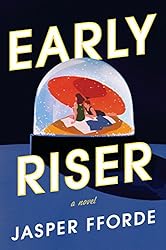
Early Riser
Jasper Fforde, 2019
Penguin Publishing
563 pp.
ISBN-13: 9780670025039
Summary
Every Winter, the human population hibernates.
During those bitterly cold four months, the nation is a snow-draped landscape of desolate loneliness, devoid of human activity.
Well, not quite.
Your name is Charlie Worthing and it's your first season with the Winter Consuls, the committed but mildly unhinged group of misfits who are responsible for ensuring the hibernatory safe passage of the sleeping masses.
You are investigating an outbreak of viral dreams which you dismiss as nonsense; nothing more than a quirky artefact borne of the sleeping mind.
When the dreams start to kill people, it's unsettling.
When you get the dreams too, it's weird.
When they start to come true, you begin to doubt your sanity.
But teasing truth from the Winter is never easy: You have to avoid the Villains and their penchant for murder, kidnapping, and stamp collecting, ensure you aren't eaten by Nightwalkers, whose thirst for human flesh can only be satisfied by comfort food, and sidestep the increasingly less-than-mythical WinterVolk.
But so long as you remember to wrap up warmly, you'll be fine. (From the publisher.)
Author Bio
• Birth—January 11, 1961
• Where—Brecon, Powys, Wales, UK
• Education—left school at 18
• Awards—Wodehouse Prize
• Currently—lives in London, England
Jasper Fforde is a British novelist, who was born in London as the son of John Standish Fforde, the 24th Chief Cashier for the Bank of England—whose signature appeared on sterling banknotes during his time in office.
Fforde was educated at the progressive Dartington Hall School. His first jobs after school were as a focus puller in the film industry, where he worked on a such films as The Trial, Quills, GoldenEye, and Entrapment.
Fforde was also writing, and after 17 rejections he finally published his first novel in 2001, The Eyre Affair. That novel became the basis for the well-known mystery/crime series named for detective Thursday Next. He wrote six more in that series, ending in 2012 with The Woman Who Died a Lot.
The third mystery in the "Thursday Next" series, The Well of Lost Plots, earned Fforde the 2004 Wodehouse Prize for comic fiction. The series is so beloved that a number of streets in Swindon (southwest England) have been named after characters from the books.
Fforde's other works include two books in the loosely connected "Nursery Crime" series, one book (so far) in the "Shades of Grey" series, and three in the "Dragon Slayer" series, young adult fantasy novels. In 2019 he released his first stand-alone novel, Early Riser.
All of his works contain a profusion of literary allusions and wordplay, tightly scripted plots, and playfulness with the conventions of traditional genres. They also contain elements of metafiction, parody, and fantasy.
Extras facts
Fforde has an interest in aviation and owns and flies a Rearwin Skyranger.
Starting in 2005, Fforde's hometown of Swindon has held an annual "Fforde Fiesta" (think Ford Fiesta ), an event built around Fforde's books. Attended by fans from as far away as Australia and the U.S., attendees take part in a variety of events, including a re-enactment of the game show, "Name That Fruit," the "Hamlet Speed Reading" competition, and interactive performances of Richard III. (Author bio adapted from Wikipedia. Retrieved 2/15/2019.)
Book Reviews
Fans of Jasper Fforde's unique blend of comic dystopia and quirky British cosiness will not be disappointed with his first novel in six years, Early Riser.… Hilarious.
Guardian (UK)
Addictively propulsive.
Times (UK)
[Early Riser is] worth the wait.… There are many laughs and wry smiles to be had from this genre-merging writing—a mad, clever, mix of fantasy, satire, parody and thriller. Well worth staying awake for.
Oxford Mail (UK)
If a cross between the monstrous winter of George R.R. Martin’s A Song of Fire series and dream-heist film Inception sounds appealing then British author Jasper Fforde’s standalone novel Early Riser is for you.… Fforde is wildly innovative in his world-building.… The novel builds to a thrilling climax that is worth staying up for.
Straits Times (UK)
[Jasper Fforde] is one of our great comic writers, a man of seemingly boundless imagination.
Scotsman (UK)
Endlessly imaginative and distinctively quirky, this is entertaining fun.
Mail on Sunday (UK)
[A] richly detailed, dystopic novel…. Charlie’s confused but determined mundanity is a relatable anchor in this wild winter world, leavened by Fforde’s surrealistic humor. Douglas Adams fans will enjoy the vibe.
Publishers Weekly
A wonderfully weird dystopian thriller.… As precisely built as an ice sculpture, Fforde's wintry nightmare glistens with mystery and menace. Though the zombie apocalypse elements spin a darker tale… plenty of pure Ffordian humor pops up.
ShelfAwareness
(Starred review) Readers familiar with Fforde's gleefully pun-heavy world building will relish this standalone novel, confident that everything will work out in the end for the underdog.
Booklist
[A] madcap adventure…. Charlie's journey… is so absorbing, and Fforde's wit so sharp, the reveal that the narrative is also a commentary on capitalism comes across as a brilliant twist.… [A] wonderful tale…. Whip-smart, tremendous fun, and an utter delight from start to finish.
Kirkus Reviews
Discussion Questions
We'll add publisher questions if and when they're available; in the meantime, use our LitLovers Book Club Resources. They can help with discussions for any book:
• How to Discuss a Book (helpful discussion tips)
• Generic Discussion Questions—Fiction and Nonfiction
• Read-Think-Talk (a guided reading chart)
(Resources by LitLovers. Please feel free to use them, online and off, with attribution. Thanks.)


Early Warning (Last Hundred Years Trilogy, 2)
Jane Smiley, 2015
Knopf Doubleday
496 pp.
ISBN-13: 9780307700322
Summary
A riveting, emotionally engaging journey through mid-century America, as lived by a remarkable family with roots in the heartland of Iowa
Early Warning opens in 1953 with the Langdon family at a crossroads. Their stalwart patriarch, Walter, who with his wife, Rosanna, sustained their farm for three decades, has suddenly died, leaving their five children, now adults, looking to the future. Only one will remain in Iowa to work the land, while the others scatter to Washington, D.C., California, and everywhere in between.
As the country moves out of post–World War II optimism through the darker landscape of the Cold War and the social and sexual revolutions of the 1960s and ’70s, and then into the unprecedented wealth—for some—of the early 1980s, the Langdon children each follow a different path in a rapidly changing world.
And they now have children of their own: twin boys who are best friends and vicious rivals; a girl whose rebellious spirit takes her to the notorious Peoples Temple in San Francisco; and a golden boy who drops out of college to fight in Vietnam—leaving behind a secret legacy that will send shock waves through the Langdon family into the next generation.
Capturing a transformative period through richly drawn characters we come to know and care deeply for, Early Warning continues Smiley’s extraordinary epic trilogy, a gorgeously told saga that began with Some Luck and will span a century in America.
But it also stands entirely on its own as an engrossing story of the challenges—and rewards—of family and home, even in the most turbulent of times, all while showcasing a beloved writer at the height of her considerable powerss. (From the publisher.)
This is the second volume of the Last Hundred Years Trilogy. The first is Some Luck, published in 2014, and the third is Golden Age, published in late 2015.
Author Bio
• Birth—September 26, 1949
• Where—Los Angeles, California, USA
• Rasied—Webster Groves, Missouri
• Education—B.A., Vassar College; M.A., M.F.A, and Ph.D., Iowa University
• Awards—Pulitzer Prize, 1992; National Book Critics Circle Award, 1991
• Currently—lives in Northern California
Jane Smiley is the author of numerous works of fiction, including The Age of Grief, The Greenlanders, Ordinary Love & Good Will, A Thousand Acres (for which she was awarded the Pulitzer Prize), and Moo. She lives in northern California. (From the publisher.)
More
Jane Smiley is a Pulitzer Prize-winning American novelist.
Born in Los Angeles, California, Smiley grew up in Webster Groves, Missouri, a suburb of St. Louis, and graduated from John Burroughs School. She obtained a B.A. at Vassar College, then earned an M.F.A. and Ph.D. from the University of Iowa. While working towards her doctorate, she also spent a year studying in Iceland as a Fulbright Scholar.
Smiley published her first novel, Barn Blind, in 1980, and won a 1985 O. Henry Award for her short story "Lily", which was published in the Atlantic Monthly. Her best-selling A Thousand Acres, a story based on William Shakespeare's King Lear, received the Pulitzer Prize for Fiction in 1992. It was adapted into a film of the same title in 1997. In 1995 she wrote her sole television script produced, for an episode of Homicide: Life on the Street. Her novella The Age of Grief was made into the 2002 film The Secret Lives of Dentists.
Thirteen Ways of Looking at the Novel (2005), is a non-fiction meditation on the history and the nature of the novel, somewhat in the tradition of E. M. Forster's seminal Aspects of the Novel, that roams from eleventh century Japan's Murasaki Shikibu's The Tale of Genji to twenty-first century Americans chick lit.
From 1981 to 1996, she taught undergrad and graduate creative writing workshops at Iowa State University. She continued teaching at ISU even after moving her primary residence to California.
In 2001, Smiley was elected a member of The American Academy of Arts and Letters. (From Wikipedia.)
Book Reviews
Smiley gives her trilogy the sweep of history. But what interests Smiley most is the way those historic events play out in the lives of one family whose roots are deeply embedded in the middle of America. (On Some Luck.)
Lynn Neary - NPR
The [big] cast of characters isn’t as vivid and particular as it was in the knock-out first volume. Still, Smiley keeps you reading; as a writer she is less concerned about individual characters, but still as deft as ever at conveying the ways in which a family develops: some stories carrying on, while others fall away.
Publishers Weekly
Those new to this multigenerational saga should start with Some Luck. Those already familiar will be eager to continue with the inevitable conflicts among cousins and the appearance of an unexpected family member that await in the third volume. While Smiley's latest offering is not as captivating as the first installment, readers interested in a story well told will be satisfied. —Stephanie Sendaula, Library Journal
Library Journal
Each of the large cast of characters has sharply individualized traits, and though we're seldom emotionally wrapped up in their experiences—Smiley has never been the warmest of writers—they are unfailingly interesting.... Sags a bit, as trilogy middle sections often do, but strong storytelling...
Kirkus Reviews
Discussion Questions
1. Early Warning is the second volume of The Last Hundred Years trilogy and builds upon the characters first introduced in volume one, Some Luck. Had you read Some Luck before starting this novel? If you did, how did you reorient yourself in the world of the Langdons? And if not, what was it like to meet the family for the first time here in 1953?
2. In Early Warning’s first scene, the family is gathered for the funeral of Walter, who died at the end of Some Luck. How does this reunion establish the dynamics among the present family members as well as bridge the gap between the two books? How is Walter’s presence felt throughout the scene and by each of his five children and his wife, Rosanna?
3. How is the secrecy behind Frank and Arthur’s relationship, personal and professional, conveyed throughout the novel? Do you think that either of them can ever fully know the other’s true motives or responsibilities, given their personalities and the political climate of this time period? Why or why not?
4. How does Smiley capture the tensions of the postwar era during the first half of the novel, politically and socially, in the United States and internationally?
5. Why does Andy have such misgivings toward her children and role as a mother? Does this aspect of her character change during the course of the book as Janet, Michael, and Richie grow up?
6. What are the different kinds of parenting portrayed in the book? How do parenting methods and attitudes change over time and between generations of mothers and fathers? What if anything struck you in particular about how this next generation of Langdons raises their children?
7. How does a farmer’s sense of responsibility, impending doom, and preparedness get passed on from generation to generation among the farmers in this novel? Does being cautious and expectant of the “many things [that] could go wrong” on a farm help the land in Denby, and those who are tilling it, flourish (37)?
8. Describe the bond between Henry and Claire. Besides their proximity in age, what about this set of siblings’ personalities and lifestyles makes them so close?
9. How do Andy’s therapy sessions reveal to the reader, and to her, certain parts of her past that she’s kept hidden? What do the various doctors and techniques she tries say about psychiatry and its parallel practices during the 1950s, including in the context of the more liberal ideas of sex during that time period?
10. How do the secrets and burdens of Arthur’s job manifest themselves in his decisions and relationship with his family, especially Lillian? In what ways does he embody the paranoia of the Cold War period? Are his fears even greater than the average American’s during this time?
11. Despite Janet’s antagonism toward her mother, what do she and Andy have in common? Do either of them acknowledge these overlaps in their dreams, fears, and ideas about motherhood? Do their attitudes toward one another change over the course of the novel?
12. What do we learn about Fiona in the scene where she rides her horse bareback? What is it that draws Debbie and Tim alike so strongly to her?
13. Are the twins, Richie and Michael, more enemies or accomplices? How does the trouble they get into from the time they’re very young demonstrate their respective personalities and characters, as well as their complicated feelings for each other?
14. What do you think motivates Frank to betray his wife and hold himself at a distance from his family? What about Lydia Forêt makes her deserve being called the “love of his life”? What did you make of Andy’s reaction to discovering Frank’s infidelities?
15. What do you think the title of the book, Early Warning, means? How is it relevant to the events and general atmosphere of this novel and to what may be to come in the third volume of Smiley’s trilogy?
16. How does Rosanna, the matriarch of the Langdon family, stay connected to her children as they grow up in a new age while also holding fast to her values from the more distant past? How do those past values conflict with various developments in politics and other social changes in her present?
17. How does Smiley use Tim’s brief time in Vietnam to lend specificity to the way the war was fought, from the setting to the interactions among the men to their understanding of their goals there? In what ways does Lillian’s sense that “he would manifest again” after his death come true?
18. What are the differences between the military experiences of Tim, Michael, and Richie? How do these also compare with what you know from Some Luck, or heard retold in Early Warning, about Frank’s and Walter’s military service?
19. Describe the diaspora among the younger Langdons. What takes some of them away from Iowa and what makes others, like Joe and Jesse, stay? What events and emotions consistently bring them back together, and what does this say about the pull of home in general in a family?
20. What do Henry’s romantic interests—from his cousin Rosa to Basil and Philip—reveal about his character and the times in which he came of age?
21. How does Smiley juxtapose the older, more traditional values of a previous generation of characters, those in Some Luck with the changing cultural climate of the ’60s and ’70s at the end of Early Warning? Which of the characters emerge as supporters of a more liberal point of view, and which are more conservative? Were you surprised by any of the characters’ decisions or attitudes?
22. What true feelings does their trip to Paris arouse among the members of Frank’s family? Does Janet’s confrontation with Frank surprise you? Why might the level of trust and support among Frank, Andy, and Janet be especially complicated, even beyond the normal tensions among parents and children?
23. How does Janet embrace the revolutionary fervor of her time? What are some of the more personal reasons she has for joining certain protests and the Peoples Temple when she’s young, and how does her rebelliousness change once she is a wife and mother herself?
24. How is Frank’s buying out of the farm received by other members of the family, and why do you think he did this? Who do you think is the real inheritor of the farm? What might you guess is to come of the land based on this transaction and the kinds of crops, techniques, etc. being used by Jesse as he takes over from Joe, his father?
25. Why does Lillian keep the truth of her illness from her family for so long, and how have perceptions of cancer changed since she first discovered the lump in her breast? What does the tone of Lillian’s funeral suggest about her place in the family and how they’ll continue without her?
26. What is fitting about the way that Chance, Michael and Loretta’s son, is born? Does it suggest anything to you about the twins might behave as fathers in the future?
27. Who is Charlie, and why do you think Smiley introduces him into the story the way she does? Were you able to figure out his identity while reading? What does his presence add to the sense of mystery and secrecy that pervades the story in other ways?
28. How does the conclusion of Early Warning both tie up narrative threads woven throughout the book and introduce new potential conflicts and through-lines for the Langdons in the final volume of the trilogy? What do you expect will come next, and how does this degree of expectation compare to what you felt upon finishing Some Luck?
(Questions issued by the publisher.)
top of page (summary)
The Earth is Enough
Harry Middleton, 1989
Pruett Publishing Co.
228 pp.
ISBN-13: 9780871088741
Summary
It is the year 1965, a year rife with change in the world—and in the life of a boy whose tragic loss of innocence leads him to the healing landscape of the Ozarks. Haunted by indescribable longing, twelve-year-old Harry is turned over to two enigmatic guardians, men as old as the hills they farm and as elusive and beautiful as the trout they fish for—with religious devotion.
Seeking strength and purpose from life, Harry learns from his uncle, grandfather and their crazy Sioux neighbor, Elias Wonder, that the very pulse of life beats from within the deep constancy of the earth, and from one's devotion to it. Amidst the rhythm of an ancient cadence, Harry discovers his home: a farm, a forest, a mountain stream, and the eye of a trout rising. (From the publisher.)
Author Bio
• Birth—December 28, 1949
• Where—N/A
• Death—July 28, 1993
• Where—Birmingham, Alabama, USA
• Education—B.A., Northwestern State University (Louisiana);
M.A., Louisian State University
Harry Middleton was a southern American nature writer, most noted for his book The Earth is Enough (1989).
Little is known about Middleton's life other than the information he offered through his novels. Middleton died a garbage man in the summer of 1993. He had previously worked as an outdoors columnist for Southern Living magazine, but it is speculated that their firing of him spurred a depression which helped lead to his demise. Prior to working at Southern Living, Middleton wrote in the early 1980s for Louisiana Life. His column of personal observations, entitled "Louisiana At Large," included essays such as "The Day the Spider Died," and "The Boy's First Brush with Education."
Middleton was an English major at Northwestern State University in Natchitoches, Louisiana, and earned a master's degree in Western history at Louisiana State University in 1973. His thesis: Frontier outpost: a history of Fort Jesup, Louisiana, 1822-1846.
He lived in New Orleans, where he wrote about food, art, music and books for Figaro, an alternative newspaper. He later moved to Birmingham.
Harry Middleton is also widely considered to be the best American fishing writer of all time. His signed books command the highest prices of any outdoor writer. His first novel, The Earth is Enough, was published in 1989. (From Wikipedia.)
Book Reviews
lHis warmly elegiac memoir shows that in the modern world, madness may be saner than sanity.
Los Angeles Times
His masterpiece, a haunted and haunting memoir of growing up in the Ozarks with two eccentric old men as guardians, both of whom are dedicated fly fishers. He left a legacy that demonstrated both his awareness of mortality and his appreciation of how fishing could momentarily stay it.
Fly Rod and Reel
At the age of 14, as the country drifted into war in Vietnam, the author was sent to live with his great uncle and his grandfather on a farm in the Ozarks. In a world far removed from global events, these kind old men, content with solitude and a meager subsistence scraped from the land, occupied their time reading, trout fishing and steadfastly refusing to make concessions to modern technology. They measured the success of their resistance to change by the amount of disapproval they elicited from their God-fearing neighbors, the local preacher and the state agricultural agent, all of whom failed to indoctrinate the pair in the paths of righteousness and profitable farming. Middleton, outdoors columnist for Southern Living magazine, writes with humor and compassion of these witty and articulate eccentrics who changed his life and taught him to love and respect the earth and its creatures.
Publishers Weekly
As the United States got involved in the Vietman war, Middleton's military father sent 14-year-old Harry to live with his grandfather in rural Arkansas. There Middleton, now outdoors columnist for Southern Living magazine, discovered the wonders of living a life close to nature. His grandfather shared a farm with two other men, and the trio strove to protect the farm from the 20th century. They taught Middleton the value of a simple life, yet also instilled in him a yearning for knowledge and a love of good books. He recalls hours spent in the woods and fishing for trout in the stream that flowed through the farm. Using the trout as a metaphor for all things wild, Middleton manages to weave together his boyhood memories with a profound respect for the natural world. An understated, evocative work. Recommended.—Randy Dykhuis, OCLC, Dublin, Ohio
Library Journal
Poetically written, filled with neat anecdotes and salty reflections—warm and wonderful.
Kirkus Reviews
Discussion Questions
Use our LitLovers Book Club Resources; they can help with discussions for any book:
• How to Discuss a Book (helpful discussion tips)
• Generic Discussion Questions—Fiction and Nonfiction
• Read-Think-Talk (a guided reading chart)
Also consider these LitLovers talking points to help get a discussion started for The Earth is Enough:
1. Is this book about fly fishing?
2. Other than fly fishing, what else do Harry's mentors teach him? Why is he in need of their lessons? What are some of the simple wisdoms offered?
3. Describe Harry's mentors—grandfather, uncle and Elias Wonder. Out of the three, do you have a particular favorite? In what ways are these three out-of-step with other residents of the town?
4. Talk about fly fishing as a metaphor for life...and why so many fine authors—Hemingway, Norman MacClean, David James Duncan—have written moving tributes to it.
5. Middleton speaks of "the hopeless addiction to trout and the push of water against your legs." And Uncle Albert wonders, "should any man turn his back on ambition, profit, security, and a parking place in the city, just to pursue a fish? Why is this sport so addictive...what is its lure?
6. How do you view the way of life described so lovingly in this book? Is it something to value? Is it still in existence... under threat...already gone? (If gone, what has taken its place?)
7. If you're a devotee of fly fishing, does Middleton's book teach you anything new about the sport? If you're not a fan, did you, nonetheless, enjoy reading about the sport? What else do you find of value in this work?
8. In what way is this a coming-of-age story? What does Harry come to learn about himself, the adult world, and his place in that world?
9. Talk about the significance of the title, The Earth Is Enough.
10. Does it color your reading of his book to know that Middleton struggled with severe clinical depression and took his own life?
11. Do you find Middleton's character portrayals black and white—that his mentors are perfect while all others are suspicious, slovenly or in some way unpleasant?
12. What other books have you read that are similar to The Earth is Enough? How does this book stack up against those works?
(Questions by LitLovers. Please feel free to use them, online or off, with attribution. Thanks.)


East of Denver
Gregory Hill, 2011
Penguin Group USA
272 pp.
ISBN-13:9780142196885
Summary
Winner, 2011 Amazon Breakthrough Novel
Mixing pathos and humor in equal measure, East of Denver is an unflinching novel of rural America, a poignant, darkly funny tale about a father and son finding their way together as their home and livelihood inexorably disappears.
When Stacey “Shakespeare” Williams arrives at his family’s farm in eastern Colorado to bury a dead cat, he finds his widowed and senile father, Emmett living in squalor. He has no money, the land is fallow, and a local banker has cheated his father out of the majority of the farm equipment and his beloved Cessna.
With no job and no prospects, Shakespeare suddenly finds himself caretaker to both his dad and the farm, and drawn into an unlikely clique of old high school classmates: Vaughn Atkins, a paraplegic confined to his mother’s basement; Carissa McPhail, an overweight bank teller who pitches for the local softball team; and longtime bully D. J. Beckman, who now deals drugs throughout small-town Dorsey. Facing the loss of the farm, Shakespeare hatches a half-serious plot with his father and his fellow gang of misfits to rob the very bank that has stolen their future.
East of Denver is a remarkably assured, sharply observed, and utterly memorable debut. (From the publisher.)
Author Bio
• Birth—N/A
• Raised—Jose, Colorado, USA
• Education—University of Colorado, Boulder
• Awards—2011 Amazon Breakthrough Novel
• Currently—lives in Denver, Colorado
Gregory Hill was raised in Joes Colorado, which he calls "my favorite place in the world." He loves rock, having performed (guitar, tenor saxophone, vocals) in various bands since 1995. His current band is the Babysitters, a rock-and-roll power trio that includes his wife on drums.
Hill lives in Denver, where he works at the University of Denver library. His second novel (in the works) involves a ranch, a snow storm, the American Basketball Association, and some prehistoric megafauna.
Oh, and he has no sense of smell. "I was born that way," he says. (Adapted from the publihser and the author's website.)
Book Reviews
In his promising debut, Hill wrings lightness from a hopeless situation. Stacey “Shakespeare” Williams returns to the eastern Colorado farmland of his childhood and discovers that his widower father’s senility has worsened.... So Shakes moves in to look after his ailing pa.... But bills mount and foreclosure looms, and Shakes’s high school buddies devise a plan: rob a bank.... Though Shakes’s psychic paralysis is palpable, it’s hard to understand...what stalled his life’s takeoff back in Denver [or]....why he refuses to look for at least one parachute during his father’s nosedive.
Publishers Weekly
Suddenly caretaker of his senile father and the family farm in eastern Colorado, to which he has just returned, Stacey "Shakespeare" Williams links up with some old high school buddies and hatches a plan to rob the victimizing local bank. Do they really mean to go through with it? Dark comedy with an in-the-news edge.
Library Journal
A fine first novel from a writer with a great sense of character.
Booklist
You can go home again, but Lord knows why you'd ever want to. Such is the lesson learned by rural drifter Stacey "Shakespeare" Williams in this agreeable, offbeat debut novel..... The only hole is that we learn almost nothing of Shakespeare's back story.... Shakespeare eventually decides that his best option is an unrealistic plan to rob the bank; whether he'll go through with it is a running question throughout the book. A story about a father and son who bond against the odds, with an ending as quirkily satisfying as the rest of the book
Kirkus Reviews
Discussion Questions
1) Is East of Denver a comedy? Or are the "funny" parts so tinged with sadness that the book can only be considered tragic? For instance, is it okay to laugh when Emmett misstates an idiomatic expression? Or should we pity him? Further, does the book respect Emmett or is it so unsentimental in its portrayal that it he becomes a clown?
2) Why does the book, after two hundred pages of more or less realistic behavior, go completely nuts for the last few chapters? Why does the book end where it does, without a complete resolution? Do Shakes and Emmett land the plane? What happens to the people inside the bank? Ultimately, is it a happy ending or a sad ending?
3) What role does hopelessness play in East of Denver? It seems that most of the characters are motivated not by a promise of a better life, but out of a certain despair for the gradual worsening of their own. Clarissa McPhail's eating disorder, Vaughan Atkins’ reluctance to leave his basement, and Shakespeare's ultimate decision for the future of the farm all seem to be the acts of people who've given up hope. Does this make these characters hard to like? Only Emmett, with his lack of mooring in time, seems to be impervious to the misery that gradually descends throughout the novel.
4) Sense of place questions: The author has said that East of Denver represents the "unhomesteading of America," going so far as to claim that the book can be interpreted as a reverse of Hal Borland's growing-up-on-the-plains memoir, High Wide and Lonesome. Is there a greater geographical, political, environmental message within this concept of "unhomesteading?" And how is the barren, yet teeming-with-life, nature of the landscape reflected in the book's characters?
5) The plot of East of Denver is unconventional, almost meandering at times. Is this a weakness or is it a deliberate attempt to mimic the undirected nature of life overcome by dementia?
6) Why don't we ever find out what Shakes did for work in Denver? It seems like his job/friends/living conditions would be relevant to the story. But the book barely mentions his Denver life.
7) Are there any biblical allusions in the story? The bush with snake in it, the garden, the conclusive flight toward the heavens. . .are these deliberate biblical references with some sort of message? Or did the author put them in just to make people ask questions like this one?
(Questions kindly provided by the author...with a big assist from Nancy McWhorter, one of LitLovers' loyal readers!)
East of Eden
John Steinbeck, 1952
Penguin Group USA
608 pp.
ISBN-13: 9780142000656
Summary
In his journal, John Steinbeck called East of Eden “the first book,” and indeed it has the primordial power and simplicity of myth. Set in the rich farmland of California’s Salinas Valley, this sprawling and often brutal novel follows the intertwined destinies of two families—the Trasks and the Hamiltons—whose generations helplessly reenact the fall of Adam and Eve and the poisonous rivalry of Cain and Abel.
Adam Trask came to California from the East to farm and raise his family on the new, rich land. But the birth of his twins, Cal and Aron, brings his wife to the brink of madness, and Adam is left alone to raise his boys to manhood. One boy thrives, nurtured by the love of all those around him; the other grows up in loneliness, enveloped by a mysterious darkness.
First published in 1952, East of Eden is the work in which Steinbeck created his most mesmerizing characters and explored his most enduring themes: the mystery of identity, the inexplicability of love, and the murderous consequences of love’s absence. A masterpiece of Steinbeck’s later years, East of Eden is a powerful and vastly ambitious novel that is at once a family saga and a modern retelling of the Book of Genesis. (From the publisher.)
Author Bio
• Birth—February 27, 1902
• Where—Salinas, California USA
• Death—December 20, 1968
• Where—New York, NY
• Education—Studied marine biology at Stanford University,
1919-25
• Awards—Pulitzer Prize and National Book Award, 1940;
Nobel Prize, 1962.
John Ernst Steinbeck, Nobel and Pulitzer Prize winner, was born in Salinas, California February 27, 1902. His father, John Steinbeck, served as Monterey County Treasurer for many years. His mother, Olive Hamilton, was a former schoolteacher who developed in him a love of literature. Young Steinbeck came to know the Salinas Valley well, working as a hired hand on nearby ranches in Monterey County.
In 1919, he graduated from Salinas High School as president of his class and entered Stanford University majoring in English. Stanford did not claim his undivided attention. During this time he attended only sporadically while working at a variety jobs including on with the Big Sur highway project, and one at Spreckels Sugar Company near Salinas.
Steinbeck left Stanford permanently in 1925 to pursue a career in writing in New York City. He was unsuccessful and returned, disappointed, to California the following year. Though his first novel, Cup of Gold, was published in 1929, it attracted little literary attention. Two subsequent novels, The Pastures of Heaven and To A God Unknown, met the same fate.
After moving to the Monterey Peninsula in 1930, Steinbeck and his new wife, Carol Henning, made their home in Pacific Grove. Here, not far from famed Cannery Row, heart of the California sardine industry, Steinbeck found material he would later use for two more works, Tortilla Flat and Cannery Row.
With Tortilla Flat (1935), Steinbeck's career took a decidedly positive turn, receiving the California Commonwealth Club's Gold Medal. He felt encouraged to continue writing, relying on extensive research and personal observation of the human drama for his stories. In 1937, Of Mice and Men was published. Two years later, the novel was produced on Broadway and made into a movie. In 1940, Steinbeck won the Pulitzer Prize for fiction for Grapes of Wrath, bringing to public attention the plight of dispossessed farmers.
After Steinbeck and Henning divorced in 1942, he married Gwyndolyn Conger. The couple moved to New York City and had two sons, Thomas and two years later, John. During the war years, Steinbeck served as a war correspondent for the New York Herald Tribune. Some of his dispatches reappeared in Once There Was A War. In 1945, Steinbeck published Cannery Row and continued to write prolifically, producing plays, short stories and film scripts. In 1950, he married Elaine Anderson Scott and they remained together until his death.
Steinbeck received the Nobel Prize for Literature in 1962 "for his realistic as well as imaginative writings, distinguished by a sympathetic humor and keen social perception." In his acceptance speech, Steinbeck summarized what he sought to achieve through his works:
Literature is as old as speech. It grew out of human need for it and it has not changed except to become more needed. The skalds, the bards, the writers are not separate and exclusive. From the beginning, their functions, their duties, their responsibilities have been decreed by our species.... Furthermore, the writer is delegated to declare and to celebrate man's proven capacity of greatness of heart and spirit—gallantry in defeat, for courage, compassion and love. In the endless war against weakness and despair, these are the bright rally flags of hope and emulation. I hold that a writer who does not passionately believe in the perfectibility of man has no dedication nor any membership in literature...
Steinbeck remained a private person, shunning publicity and moving frequently in his search for privacy. He died on December 20, 1968 in New York City, where he and his family made a home. But his final resting place was the valley he had written about with such passion. At his request, his ashes were interred in the Garden of Memories cemetery in Salinas. He is survived by his son, Thomas. (Author bio from Barnes & Noble, courtesy of the National Steinbeck Center.)
Book Reviews
Probably the best of John Steinbeck's novels, East of Eden is long but not "big," and anyone who, deceived by its spread in space and time (c. 1860-1920), says that it is "epical in its sweep," is merely in the usual grip of cliche. It's dramatic center is a narrow story of social horror that rests quite disarmingly on the proposition that "there are monsters born in the world to human parents." But through the exercise of a really rather remarkable freedom of his rights as a novelist, Mr. Steinbeck weaves in...this story of prostitution a fantasia of history and of myth that results in a strange and original work of art.
Mark Schorer - New York Times (9/21/52)
A novel planned on the grandest possible scale.... One of those occasions when a writer has aimed high and then summoned every ounce of energy, talent, seriousness, and passion of which he was capable.... It is an entirely interesting and impressive book.
New York Herald Tribune
The newest addition to the Oprah pantheon is John Steinbeck's East of Eden, published in 1952.... All well and good, but that makes it all the more disheartening to report that East of Eden is a complete dud. And not just from the perspective of an academic such as Harold Bloom, who once wrote that nothing by Steinbeck after The Grapes of Wrath, including East of Eden, deserves re-reading. We're not talking about getting through this book twice, but just once. Oprah promised her readers a rip-roaring plot—“like a movie,” “you just don't want it to end”—and every one of the juicy Danielle Steele essentials—“[East of Eden] has it all: love and betrayal and greed and murder and sex.” But when the love has no resonance or dimension and the betrayal and murder seem deserved because a character has been written with such dullness, the book doesn't pass muster as a beach read, let alone a tome to stand the test of time. And the sex? Don't let Oprah fool you. She's mostly referring to the decidedly unsexy whorehouse that serves as a set piece in the second half of the book.
Jia Lynn Yang - Yale Review of Books
Discussion Questions
1. Steinbeck has a character refer to Americans as a "breed," and near the end of the book Lee says to a conflicted Cal that "We are all descended from the restless, the nervous, the criminals, the arguers and brawlers, but also the brave and independent and generous. If our ancestors had not been that, they would have stayed in their home plots in the other world and starved over the squeezed-out soil." What makes this a quintessentially American book? Can you identify archetypically American qualities—perhaps some of those listed above—in the characters?
2. Sam Hamilton—called a "shining man"—and his children are an immigrant family in the classic American model. What comes with Sam and his wife Liza from the "old country"? How does living in America change them and their children? What opportunities does America provide for the clan, and what challenges?
3. Adam Trask struggles to overcome the actions of others—his father, brother, and wife—and make his own life. What is the lesson that he learns that frees him from Kate and allows him to love his sons? He says to Cal near the end that "if you want to give me a present—give me a good life. That would be something I could value." Does Adam have a good life? What hinders him? Would you characterize his life as successful in the end?
4. Lee is one of the most remarkable characters in American literature, a philosopher trapped by the racial expectations of his time. He is the essence of compassion, erudition, and calm, serving the Trasks while retaining a complex interior and emotional life. Do you understand why he speaks in pidgin, as he explains it to Sam Hamilton? How does his character change—in dress, speech, and action—over the course of the book? And why do you think Lee stays with the Trasks, instead of living on his own in San Francisco and pursuing his dream?
5. Women in the novel are not always as fully realized as the main male characters. The great exception is Adam Trask's wife, Cathy, later Kate the brothel owner. Clearly Kate's evil is meant to be of biblical proportions. Can you understand what motivates her? Is she truly evil or does Steinbeck allow some traces of humanity in his characterization of her? What does her final act, for Aron Trask, indicate about her (well-hidden) emotions?
6. Sibling rivalry is a crushing reoccurrence in East of Eden. First Adam and his brother Charles, then Adam's sons Cal and Aron, act out a drama of jealousy and competition that seems fated: Lee calls the story of Cain and Abel the "symbol story of the human soul." Why do you think this is so, or do you disagree? Have you ever experienced or witnessed such a rivalry? Do all of the siblings in the book act out this drama or do some escape it? If so, how? If all of the "C" characters seem initially to embody evil and all the "A" characters good—in this novel that charts the course of good and evil in human experience—is it true that good and evil are truly separate? Are the C characters also good, the A characters capable of evil?
7. Abra, at first simply an object of sexual competition to Cal and Aron, becomes a more complex character in her relationships with the brothers but also with Lee and her own family. She rebels against Aron's insistence that she be a one-dimensional symbol of pure femininity. What is it that she's really looking for? Compare her to some of the other women in the book (Kate, Liza, Adam's stepmother) and try to identify some of the qualities that set her apart. Do you think she might embody the kind of "modern" woman that emerged in postwar America?
8. Some of Steinbeck's ethnic and racial characterizations are loaded with stereotype. Yet he also makes extremely prescient comments about the role that many races played in the building of America, and he takes the time to give dignity to all types of persons. Lee is one example of a character that constantly subverts expectations. Can you think of other scenes or characters that might have challenged conventional notions in Steinbeck's time? In ours? How unusual do you think it might have been to write about America as a multicultural haven in the 1950s? And do you agree that that is what Steinbeck does, or do you think he reveals a darker side to American diversity?
9. What constitutes true wealth in the book? The Hamiltons and the Trasks are most explicitly differentiated by their relationship to money: though Sam Hamilton works hard he accumulates little, while Adam Trask moons and mourns and lives off the money acquired by his father. Think of different times that money is sought after or rejected by characters (such as Will Hamilton and Cal Trask) and the role that it plays to help and hinder them in realizing their dreams. Does the quest for money ever obscure deeper desires?
10. During the naming of the twins, Lee, Sam, and Adam have a long conversation about a sentence from Genesis, disagreeing over whether God has said an act is ordered or predetermined. Lee continues to think about this conversation and enlists the help of a group of Chinese philosophers to come to a conclusion: that God has given humans choice by saying that they may (the Hebrew word for "may," timshel, becomes a key trope in the novel), that people can choose for themselves. What is Steinbeck trying to say about guilt and forgiveness? About family inheritance versus free will? Think of instances where this distinction is important in the novel, and in your own life.
11. The end of the novel and the future of the Trasks seems to rest with Cal, the son least liked and least understood by his father and the town. What does Cal come to understand about his relationship to his past and to each member of his family? The last scene between Adam and Cal is momentous; what exactly happens between them, and how hopeful a note is this profound ending? Why is Lee trying to force Cal to overturn the assumption that lives are "all inherited"? What do you think Cal's future will be?
12. East of Eden is a combination novel/memoir; Steinbeck writes himself in as a minor character in the book, a member of the Hamilton family. What do you think he gained by morphing genres in this fashion? What distinguishes this from a typical autobiography? What do you think Steinbeck's extremely personal relationship to the material contributes to the novel?
(Questions issued by publisher.)
top of page (summary)


Eat What You Kill
Ted Scofield, 2014
St. Martin's Press
304 pp.
ISBN-13: 9781250021823
Summary
Evan Stoess is a struggling young Wall Street analyst obsessed with fortune and fame. A trailer park kid who attended an exclusive prep school through a lucky twist of fate, Evan’s unusual past leaves him an alien in both worlds, an outsider who desperately wants to belong.
When a small stock he discovers becomes an overnight sensation, he is poised to make millions and land the girl of his dreams, but disaster strikes and he loses everything.
Two years later a mysterious firm offers Evan a chance for redemption, and he jumps at the opportunity. His new job is to short stocks—to bet against the market. But when the stock goes up and he finds himself on the brink of ruin once again, another option presents itself: murder. At a moral crossroads, Evan must ask himself—how far will a man go for money and revenge? (From the publisher.)
Author Bio
• Birth—N/A
• Where—Louisville, Kentucky, USA
• Education—B.A., J.D., M.B.A. Vanderbilt University
• Currently—lives in New York, New York
Ted Scofield is an author, securities attorney, and entrepreneur.
Ted serves as the General Counsel of Icebreaker Entertainment, LLC, a New York-based company that creates and markets consumer products under multiple brands. In his role as an attorney, Ted advises entrepreneurs, emerging companies, and established corporations on the private and public sales of both equity and debt.
After graduating from Vanderbilt University, Ted started a political consulting firm. During this time period, he wrote essay-length features for a weekly newspaper in Louisville, Kentucky, where Ted was born and raised.
In 1994 Ted returned to Vanderbilt University, where he earned a JD and MBA in finance. In New York, he worked for Orrick, Herrington & Sutcliffe LLP before launching his own private practice and joining his current firm.
Ted has extensive media experience including appearances as a political commentator on WPIX Channel 11 in New York City. He has been quoted in USA Today, the New York Times, BusinessWeek and dozens of other regional and national publications.
Ted lives on the Upper East Side of Manhattan with his wife, Christi, their palm tree, Spike, and their little money tree, Benjamin. (From the author.)
Visit the author's website.
Follow Ted on Facebook.
Book Reviews
Stephen Frey fans will welcome Scofield’s debut, a financial thriller that accessibly conveys the intricacies of a world in which a company can make millions on other companies whose stocks decline in value.
Publishers Weekly
Surprisingly, Stoess is a sympathetic character despite his murderous ways, which makes this debut novel an emotional rollercoaster of a read. Recommend it to fans of financial thrillers, especially those by Christopher Reich and Joseph Finder.
Booklist
Scofield’s debut novel, a financial thriller, introduces readers to a main character so difficult and full of malice that he makes Hannibal Lector seem like a kindly old uncle with quirky dietary habits.
Kirkus Reviews
Discussion Questions
1. Let’s start with the title. What does “eat what you kill” mean, as it relates to the book? Do you believe an “eat what you kill” mentality is beneficial for an individual? Is it positive for society in general?
2. A reviewer for Booklist said “Stoess is a sympathetic character despite his murderous ways.” Do you agree? Did you sympathize with Evan? Did you find yourself rooting for him? Why or why not?
3. Evan describes himself as a “disciple” of Ayn Rand’s philosophy of objectivism. What does he mean by this? How does objectivism influence his thoughts and actions?
4. The ability to sell stocks short: A good thing or bad thing? Why?
5. Why is Evan attracted to Albert Camus? What aspects of Camus’s philosophy and life appeal to Evan, and why?
6. Do violent video games “breed evil”? Are video game players more likely to engage in criminal or antisocial behavior? If so, what should we, as a society, do about it?
7. What roles do pop culture and literature play in the book? Why does Evan so often quote movies, books and television shows?
8. Eat What You Kill has been described as American Psycho meets Wall Street. Do you agree with this description? Is Evan more Patrick Bateman, or Bud Fox?
9. Were you surprised by the revelation in the final chapter about the relationship between Evan and another character? If not, when did you figure it out?
10. What is next for Evan Stoess? And who should play him in the movie?
(Questions courtesy of the author.)
The Echo Maker
Richard Powers, 2006
Macmillan Picador
464 pp.
ISBN-13: 9780312426439
Summary
Winner, 2006 National Book Award
On a winter night on a remote Nebraska road, 27-year-old Mark Schluter flips his truck in a near-fatal accident. His older sister Karin, his only near kin, returns reluctantly to their hometown to nurse Mark back from a traumatic head injury. But when he emerges from a protracted coma, Mark believes that this woman—who looks, acts, and sounds just like his sister—is really an identical impostor.
Shattered by her brother’s refusal to recognize her, Karin contacts the cognitive neurologist Gerald Weber, famous for his case histories describing the infinitely bizarre worlds of brain disorder. Weber recognizes Mark as a rare case of Capgras Syndrome, a doubling delusion, and eagerly investigates. What he discovers in Mark slowly undermines even his own sense of being.
Meanwhile, Mark, armed only with a note left by an anonymous witness, attempts to learn what happened the night of his inexplicable accident. The truth of that evening will change the lives of all three beyond recognition. Set against the Platte River’s massive spring migrations—one of the greatest spectacles in nature—The Echo Maker is a gripping mystery that explores the improvised human self and the even more precarious brain that splits us from and joins us to the rest of creation. (From the publisher.)
Author Bio
• Birth—June 18, 1957
• Where—Evanston, Illinois, USA
• Education—M.A., University of Illinois
• Awards—National Book Award-Fiction
• Currently—lives in the Smoky Mountian region of Tennessee
Richard Powers is an American novelist whose works explore the effects of modern science and technology. The Echo Maker, perhaps his best known work, won the 2006 National Book Award for Fiction.
Early years
One of five children, Powers was born in Evanston, Illinois. His family later moved a few miles south to Lincolnwood where his father was a local school principal. When Powers was 11 they moved to Bangkok, Thailand, where his father had accepted a position at International School Bangkok, which Powers attended through his freshman year, ending in 1972.
During that time outside the U.S. he developed skill in vocal music and proficiency in cello, guitar, saxophone, and clarinet. He also became an avid reader, enjoying nonfiction, primarily, and classics such as the Iliad and the Odyssey.
Education
The family returned to the U.S. when Powers was 16. Following graduation in 1975 from DeKalb High School in DeKalb, Illinois, he enrolled at the University of Illinois at Urbana-Champaign (UIUC) with a major in physics, which he switched to English literature during his first semester. There he earned the BA in 1978 and the MA in Literature in 1980.
He decided not to pursue the PhD partly because of his aversion to strict specialization, which had been one reason for his early transfer from physics to English, and partly because he had observed in graduate students and their professors a lack of pleasure in reading and writing (as portrayed in Galatea 2.2).
Career
For some time Powers worked in Boston, as a computer programmer. Viewing the 1914 photograph "Young Farmers" by August Sander, on a visit to the Museum of Fine Arts, he was inspired to quit his job and spend the next two years writing his first book, Three Farmers on Their Way to a Dance, which was published in 1985.
To avoid the publicity and attention generated by that first novel, Powers moved to the Netherlands where he wrote Prisoner's Dilemma, followed up with The Gold Bug Variations. During a year's stay at the University of Cambridge, he wrote most of Operations Wandering Soul; then, in 1992 Powers returned to the U.S. to become writer-in-residence at the University of Illinois.
All told, Powers has published a dozen books, winning him numerous literary awards and other recognitions. These include, among various others, a MacArthur Fellowship; Pushcart Prize, PEN/Faulkner Special Citation, Man Booker long listing; nominations for the Pulitzer and the National Book Critics Circle Award; and the National Book Award itself in 2006.
In 2010 and 2013, Powers was a Stein Visiting Writer at Stanford University, during which time he partly assisted in the lab of biochemist Aaron Straight. In 2013, Stanford named him the Phil and Penny Knight Professor of Creative Writing in the Department of English.
While writing his 2018 novel, The Overstory, Powers left Palo Alto, California, moving to the foothills of the Smoky Mountains in Tennessee. (Adapted from Wikipedia. Retrieved 4/16/2018.)
Book Reviews
Part of the joy of reading Powers over the years has been his capacity for revelation. His scientific discourses point to how the world works, but the struggles of his characters, whether down-and-out misfits like Mark or well-heeled magicians like Weber, help us understand how we work. And that’s where the setting — 2002, early 2003 — comes in. As the features of life after 9/11 come into focus — the engagement in Afghanistan, "that bleak, first anniversary" of the attacks, the march to war in Iraq — Powers accomplishes something magnificent, no facile conflation of personal catastrophe with national calamity, but a lovely essay on perseverance in all its forms.
Colson Whitehead - The New York Times
Richard Powers's new novel—a kind of neuro-cosmological adventure—is an exhilarating narrative feat. The ease with which the author controls his frequently complex material is sometimes as thrilling to watch as the unfolding of the story itself.
Sebastian Faulks - The Washington Post
This novel, winner of the National Book Award, addresses the question of how we know who we really are. Mark, who repairs machinery at a meat-processing plant, suffers a head injury that prevents him from recognizing his sister Karin; he believes that she is a look-alike sent to spy on him. Karin, who has spent her life trying to escape their small Nebraska town, returns to old lovers and habits she thought she'd renounced. Stung by Mark's rejection, she sends a desperate plea to an Oliver Sacks-like neurologist whose popular books have suddenly come under critical attack, causing fissures in his public persona and his seemingly perfect marriage. Powers's smooth coincidences and cute patter can be unconvincing and leaden, and he has a tendency to lapse into distracting repetitions. Yet his philosophical musings have the energy of a thriller, and he gives lyrical, haunting life to the landscape of the Great Plains.
The New Yorker
A truck jackknifes off an "arrow straight country road" near Kearney, Nebraska, in Powers's ninth novel, becoming the catalyst for a painstakingly rendered minuet of self-reckoning. The accident puts the truck's 27-year-old driver, Mark Schluter, into a 14-day coma. When he emerges, he is stricken with Capgras syndrome: he's unable to match his visual and intellectual identifications with his emotional ones. He thinks his sister, Karin, isn't actually his sister-she's an imposter (the same goes for Mark's house). A shattered and worried Karin turns to Gerald Weber, an Oliver Sacks-like figure who writes bestsellers about neurological cases, but Gerald's inability to help Mark, and bad reviews of his latest book, cause him to wonder if he has become a "neurological opportunist." Then there are the mysteries of Mark's nurse's aide, Barbara Gillespie, who is secretive about her past and seems to be much more intelligent than she's willing to let on, and the meaning of a cryptic note left on Mark's nightstand the night he was hospitalized. MacArthur fellow Powers masterfully charts the shifting dynamics of Karin's and Mark's relationship, and his prose—powerful, but not overbearing—brings a sorrowful energy to every page.
Publishers Weekly
Powers, who has won a Lannan Literary Award and the James Fenimore Cooper Prize for historical fiction, here investigates the mystery of traumatic brain injury. Set in small-town Nebraska near the bird-watching spectacle of Platte River, Powers's ninth novel centers on the life of 27-year-old Mark Schluter, who is unable to recognize his sister, Karin, after suffering a near-fatal accident. Desperate for clarity, Karin turns to world-renowned cognitive neurologist and writer Gerald Weber (reminiscent of the real-life Oliver Sacks). Cleverly, this novel isn't simply about Mark's damaged brain (he appears to suffer from a rare case of Capgras syndrome); instead, it sheds light generally on the human mind and our struggle to make sense of both the past and the present. Echo Maker is both mystery and case history as Mark struggles to investigate his accident through an anonymous note and Weber attempts to sort through the nuance and plasticity of the mind in his own declining years. Powers bounces back and forth through Mark's rambling thoughts, Weber's neurological theories, Karin's insecurities, and wonderfully poetic details of the cranes on the Platte River. —Stephen Morrow, Columbus, OH
Library Journal
The theme of cognitive disorder, variously explored in Powers's forbiddingly brainy earlier fiction, is the central subject of his eerie, accomplished ninth novel. An image of sand-hill cranes migrating from Nebraska's Platte River sets the scene, where 20-something slaughterhouse-worker Mark Schluter crashes his truck in an adjacent field, sustaining severe bodily and neurological injuries. Repeating an all-too-familiar pattern, Mark's older sister Karin leaves her job and life in Sioux City to be with him—stirring up memories of their shared childhood in thrall to a violent, alcoholic father and religious zealot mother. But Mark (whose inchoate, terrified viewpoint is rendered in a rich melange of semi-coherent thoughts and visions) no longer knows Karin; he is, in fact, convinced she's a stranger masquerading as his sister. Eventually, he's diagnosed as suffering from "Capgras syndrome...one of a family of misidentification delusions." But Mark's symptoms elude the pattern familiar to Gerald Weber, a prominent New York cognitive neurologist and bestselling author, summoned by Karin's importuning letter. Weber's "tests" fail to relieve or explain Mark's delusive paranoia, and Karin turns first to the siblings' former childhood friend Daniel Riegel, long since estranged from Mark, now a deeply committed environmental activist; then to her former lover Robert Karsh, a manipulative charmer who has risen to local prominence as a successful developer. Contrasts thus established seem pat, but Powers explores the mystery surrounding Mark through suspenseful sequences involving his raucous drinking buddies (who may know more about his accident than they're telling); compassionate caregiver Barbara Gillespie; and the unidentified observer who left a cryptic message about Mark's ordeal at the patient's hospital bedside. Issues of environmental stewardship and rapine, compulsions implicit in migratory patterns and Weber's changing concept of the fluid, susceptible nature of the self are sharply dramatized in a fascinating dance of ideas. One of our best novelists once again extends his unparalleled range.
Kirkus Reviews
Discussion Questions
1. What echoes do the cranes create throughout the novel? What do the cranes signify to those who admire them—tourists, environmentalists, local residents along the Platte River? What parallels exist between the echo of the migrating birds and the echoes lurking in Mark’s shattered memory?
2. How would you characterize the sibling dynamics between Mark and Karin? How much of their former relationship remains intact after his accident? Would you have sacrificed as much as Karin did to help an injured brother or sister?
3. What is Bonnie’s stake in helping Mark heal? Is her perception of the world distorted, like Mark’s, or is she actually his best chance for returning to rational thinking? How does she cope with Dr. Weber’s assertion that faith in God has a neurological component?
4. Discuss the Nebraska landscape as if it were a character in the novel. What makes it alluring as well as daunting? In what way does the region’s “personality” mirror that of its inhabitants?
5. Which segments of Mark and Karin’s childhood do they most want to recall? Which memories of their parents continue to hurt them? Is either sibling on a path, perhaps even unwittingly, of carrying on their parents’ legacies?
6. What contemporary environmental concerns are reflected in the showdown over the Central Platte Scenic Natural Outpost? Is Daniel equally zealous about his relationship with Karin?
7. Were you suspicious of Barbara in the novel’s early chapters? How did your perception of her shift? How would you have responded if you had been in her position on the night of the accident?
8. In part three, Karin tells Daniel she thinks Mark might have been better off if she had stayed away. How can we know the difference between selfless and self-serving caregiving? In the end, was Karin right to remain in Mark’s life to such an intense extent?
9. What aspects of body, soul, and memory are presented in the epigraphs appearing throughout the book? Taken by themselves, do these quotations underscore or contradict each other?
10. In what ways did Gerald take on a fatherly role for Karin and Mark? Was their perception of him any more accurate than that of the fans who attended his lectures or saw him on television? What aspects of his true self was Gerald able to reclaim in Nebraska? What do you predict for his future with Sylvie and Jess?
11. From the friends who figure prominently in his life, particularly Duane Cain and Tom Rupp, and the figures who represent fear (such as Robert Karsh), what picture of Mark’s past were you able to piece together? What is the best way to discern the truth when memories clash?
12. Did Capgras syndrome make any aspects of Mark’s perception crystal clear or even closer to reality than his caregivers’ view of life? What universal experiences are reflected in his inability to accept the identity of someone who loves him, or, near the end, to acknowledge that he is fully
alive?
13. How did you ultimately interpret the note? For each of the main characters, what did it mean to be no one? In the end, who else was brought back?
14. What does Karin have to discover about the mind’s ability to shape memories? How does her understanding of her past change throughout Mark’s illness?
15. In what ways does The Echo Maker enhance themes in previous novels by Richard Powers you have read? What is unique about his approach to topics as far-ranging as science and history, deception and devotion?
(Questions issued by publisher.)
top of page (summary)

Eden: A Novel
Jeanne McWilliams Blasberg, 2017
She Writes Press
327 pp.
ISBN-13: 9781631521881
Summary
Recca Meister Fitzpatrick—wife, mother, grandmother, and pillar of the community—is the dutiful steward of her family’s iconic summer tradition … until she discover her recently deceased husband squandered their nest egg.
As she struggles to accept what is likely her last season in Long Harbor, Becca is inspired by her granddaughter’s boldness in the face of impending single-motherhood, and summons the courage to reveal a long-buried secret: the existence of a daughter she gave up fifty years earlier.
Eden is the heartrending account of the days leading up to the Fourth of July weekend as Becca prepares to uncover her secret and her son and brothers conspire to put the estate on the market, interwoven with the century-long history of Becca’s family—her parents’ beginnings and ascent into affluence, and her mother’s own secret struggles in the grand home her father named "Eden." (From the publisher.)
Author Bio
• Birth—September 28, 1965
• Raised—Westchester County, New York, USA
• Education—B.A., Smith College
• Currently—lives in Boston, Massachusetts, and Westerly, Rhode Island
Jeanne Blasberg is a voracious observer of human nature and has kept a journal since childhood. She has been known to stare at strangers on more than one occasion to the embarrassment of her three children. (Mom, stop staring!)
After graduating from Smith College, she surprised everyone who knew her by embarking on a career in finance, making stops on Wall Street, Macy’s and Harvard Business School, where she worked alongside the preeminent professor of retail and wrote case studies and business articles on all sorts of topics on everything that has to do with…shopping.
A firm believer that you are never too old to change course or topics (in truth, she’s not a big shopper), Jeanne enrolled at Grub Street, one of the country’s great creative writing centers, where she turned her attention to memoir and later fiction, inspired by her childhood journal. Eden is her debut novel. (From the publisher.)
Visit the author's website.
Follow Jeanne on Facebook.
Book Reviews
[A] beautifully written masterpiece that takes you on a historical journey….
Boston Herald
If you enjoy reading family sagas that cover real history and life, this is a must-read for you.
Reader’s Favorite
This beautifully written family saga firmly establishes Jeanne McWilliams Blasberg as a rising writer to watch – and it will likely have you liking your family a whole lot more this summer.
Redbook
This debut novel rings with lively dialogue that vivifies the rarified ethos of a family across generations.
Improper Bostonian
[A] big-hearted, if sometimes harrowing journey through one family’s twentieth century.
Squash Magazine
A classic family drama that centers around the Fourth of July, be sure to pack this in your tote bag this summer before anything else.
Working Mother Magazine
[An] evocative depiction of old summers in Watch Hill….
The Day (New London, CT)
[P]oignant and powerful….
Reader Views
Eden is splendid, majestic, and engaging.
Chick Lit Cafe
[A] love story to a family property and the beach community it inhabits….
Loud Library Lady
[T]he writing is seamless and the story is ageless.
Holly’s Little Book Reviews
Blasberg hit it out of the park….
Midwest Ladies who Lit
A stirring historical novel perfect for women’s fiction fans.
Booklist
Blasberg’s evocative prose captures the place and atmosphere…. An engrossing, character-driven family saga.
Kirkus Reviews
Discussion Questions
A SPOILER ALERT is in order here. Below are questions as well as approaches for discussion, which reveal plot points.
1. Why Eden?
Eden is utopia, a place of innocence, idyllic, most enjoyed by children. Ideals and paradise are, however, hard to hold on to. What happens when you cling to a place for too long, hide within its walls, expect too much?
The Garden of Eden is also an archetypal creation story. Eden is a creation story as well—it is all about babies being born! The circumstances around a conception have consequences for the mother and father and baby for years to come. Let’s say it sets the stage…
2. Discuss how history repeats itself in the novel.
Sadie was sent to Banford. Becca was sent to the Willows and Rachel sent herself to Copper Hill. They all go for different reasons, but they each take a hiatus from society to deal with a problem: postpartum depression, pregnancy, alcoholism.
What about these "banishments" from society? Where has progress been made over the years and where has it stayed the same? Clearly, Sadie and Becca lived during eras when their situation could not be discussed in polite company, nor, ironically enough, could they be discussed within the family. Were their retreats more for their sake or to protect their social class from unseemly details.
Rachel, leaves in more modern times and attends a 12 step program. It is her choice and her affliction is not exclusive to women, however, her departure echoes what happened to her mother and grandmother.
3. Discuss the similarities and differences between the unplanned pregnancies portrayed in the novel.
Eden illustrates how between only two or three generations in one family, so much can stay the same, while a great degree of change is imposed by the outside world. In the years between 1920 and 2000, so much changed in the United States. There were enormous industrial and technological advancements, economic shifts, and the impact of world wars. Eden shines a spotlight on the additional changes women faced. My characters, women from the same family, have lives that span a century and experience extremely different education and career opportunities, and especially different choices when it came to their reproductive rights. Each mother wistfully observed the freedoms her daughter enjoyed.
The book’s earliest matriarch is Sadie. She is married and in search of effective birth control in the early part of the 20th century, inspired by the contraceptive pioneer, Margaret Sanger. She is not successful and has a late in life pregnancy that she is unhappy about. Her daughter, Becca, is raped, although given the era in which she lived, is not equipped with the awareness nor vocabulary to call it such, and becomes pregnant. The only option Sadie will consider for her daughter, is to send her away to a maternity hospital under a veil of secrecy. Becca’s daughter, Rachel, is impregnated by her college boyfriend, and Becca and Dan coerce the young couple to do the "honorable thing" and marry. And modern day, Sarah, with almost no societal pressure at all to worry about, entertains the option of being a single mother.
4. Which biblical allusions stood out for you?
Allusions to the Bible are scattered throughout the novel to emphasizes that the same personal struggles described in the Book of Genesis carry on generation after generation, and indeed today.
The biblical allusions in Eden that are easiest to spot are names. There’s the title for one, and the name of the family home, with its abundant gardens. The names of the women: Sarah, Rebecca, Rachel, and Leah, are those of the Jewish matriarchs. Ruth is the dutiful daughter-in-law from the Book of Ruth, and Joseph and Benjamin are men from which future Jewish leaders are descended.
There is a serpent who enters the "Garden," offering temptation in the form of Charles and Maud Butterfield. They attempt to seduce Bunny and Sadie away from their original intention of creating a space sacred for their family.
There is a flood that acts as a cleanse, almost an opportunity to start anew in the form of the 1938 Hurricane. The day after the great storm, Becca sees a rainbow in the sky, and the following summer, when her family is all together, rebuilding their home, is the best ever.
5. Compare Bunny, the patriarch to Sadie, the matriarch.
Bunny is the preeminent patriarch of the family. None of the men that follow after, can ever live up to him. But Bunny was in no means perfect, he was hemmed in by societal pressures as much as Sadie was. He felt pressure to send his beautiful wife away to the Banford Sanitarium, and although the question lurks as to whether he ever really understood where Becca had gone when she was sent away to the maternity hospital, he was limited by the proper boundaries a father must keep with his daughter. There were certain realms of life that a successful businessman just could not dare enter. The irony is that Bunny was not born into the society in which he ultimately found himself, he aspired to it, and sought opportunities to be accepted throughout his life.
The matriarchs in the novel did not amass the family’s great wealth nor were they responsible for constructing Eden, but Eden would not have existed without them. The women breathed life into the home. Just like the ebb and flow of the tides, and the cycles of the moon, life in Long Harbor and within the walls of Eden operated with a maternal rhythm. Although Becca had little power in the commercial world, within her family and within her home she maintained control.
6. Discuss ways in which the act of naming is important in the novel.
To name a person is a great honor. It can be done as if offering a blessing, but it can also imply power or ownership. Giving a name is a venerable act, the first thing our parents give us, and in the Bible it is something GOD does repeatedly.
Characters in Eden are named and then re-named such as Bernhard becoming Bernard and later, Sadie dubbing him Bunny.
Bunny names their daughter Rebecca for his mother’s sister, while Sadie, who is displeased by the name, shortens it to Becca.
Bunny names their home Eden.
Rachel is persuaded to name her daughter Sarah, and Sarah, in turn, will name her baby for her mother.
The blessing that Becca reads at the end of the novel is a commentary on the various names a person takes on, the best, of course, being the one a person chooses for herself.
7. What is your reaction to the speculative conversation between Leah and Sarah in the book’s final chapter?
This conversation may or may not have actually happened. It is only something that Becca imagined. Sarah and Leah were each conceived out of wedlock, however Sarah’s parents married and Becca gave Leah up for adoption. The juxtaposition of these two upbringings and their respective emotional side effects is a primary theme of the novel. It gets back to Eden being a creation story, and to portray the different paths a life might take as a consequence of parents' choices.
8. How is the setting important to the story?
Multi-generational living was much more common in the early part of the twentieth century. In summer enclaves like fictional Long Harbor, multi-generational living continues to this day. The novel needed to be set in a place where it would be believable for the generations of an upper class family to gather. Long Harbor needed to be an upperclass, small town, rife with gossip and a set of rules all its own.
A summer home tradition can be wonderful and bind a family together, but can also amplify a family’s dysfunction. Adults often regress to childhood roles, as is the case with poor Rachel who loves Eden dearly even as it keeps her from moving on in her life.
9. Discuss the prevalence of natural forces in the novel.
The book is filled with the images of cycles: cycles of the seasons, the tides and the moon. The image of the full moon is present many times which emphasizes the close alignment between lunar power and feminine power.
There are also several storms in the book. There is the Hurricane of 1938, of course, which destroyed and tossed about all that man had built. Hurricane season returns at the end of the novel as Sarah’s baby is being born, however, the mood then is not of destruction, but of hope and renewal. Both storms bring about an opportunity for cleansing and the chance to start anew.
Natural forces abound to remind the reader of the presence of Mother nature (the greatest mother of all) as well as the universality of our stories and our vulnerability.
10. Discuss Lilly’s role in the family.
Lilly is outside the family, while also being a dear part of the family. If it weren’t for her, the other women wouldn’t have time to play cards, go to the beach, read, or write. There is an inference that their abundance of leisure time might lead to their communal dissatisfaction… Being on the outside looking in, Lilly is somewhat like Ruth in that way. Outsiders often have the most interesting perspective on a situation. However, Lilly is quite biased and loyal to Becca, Rachel, and Sarah. Lilly is a beloved employee of the family and the fact that her relationship is so strong and longstanding with Becca also speaks to both of their characters.
Rachel makes the claim, "Lilly practically raised me." Although it is very common for women in affluent families to have help with their children, it is interesting to consider the buffer they create between mothers and children. Is it possible that Lilly’s presence (and Alice’s before her) may have prevented the all-important mother/child bond from fully forming?
(Questions courtesy of the author and/ or publisher.)

Edgar and Lucy
Victor Lodato, 2017
St. Martin's Press
544 pp.
ISBN-13: 9781250096982
Summary
Edgar and Lucy is a page-turning literary masterpiece, a stunning examination of family love and betrayal.
Eight-year-old Edgar Fini remembers nothing of the accident people still whisper about. He only knows that his father is gone, his mother has a limp, and his grandmother believes in ghosts.
When Edgar meets a man with his own tragic story, the boy begins a journey into a secret wilderness where nothing is clear?not even the line between the living and the dead.
In order to save her son, Lucy has no choice but to confront the demons of her past.
Profound, shocking, and beautiful, Edgar and Lucy is a thrilling adventure and the unlikeliest of love stories. (From the publisher.)
Author Bio
Victor Lodato is am American playwright and novelist. His 2009 book, Mathilda Savitch was deemed a "Best Book of the Year" by the Christian Science Monitor, Booklist, and Globe and Mail. The novel won the PEN USA Award for Fiction and the Barnes & Noble Discover Prize, and has been published in sixteen countries. His second novel, Edgar and Lucy was published in 2017.
His short fiction and essays have been published in The New Yorker, New York Times, and Best American Short Stories. Victor was born and raised in New Jersey, and currently divides his time between Ashland, Oregon and Tucson, Arizona. (From the publisher.)
Book Reviews
[Lodato's] captivating debut novel, Mathilda Savitch, featured the 13-year-old heroine of the title as its fierce, brokenhearted narrator. In Edgar and Lucy, he switches things up a bit. Grief is still the heart of the matter here, but Lodato is working in a broader register that includes other, mostly adult, points of view. Still, he repeats the impressive trick of creating a character so peculiar, vivid and appealing (think of Owen Meany minus the messianic complex) that Edgar becomes this ambitious novel's enduring reward…On every page, Lodato's prose sings with a robust, openhearted wit, making Edgar and Lucy a delight to read.… What makes this disquieting exploration of love and mourning bearable is that Lodato works from a place of compassion. Even in the darkest moments, when his characters are being their worst selves, Lodato bathes them in tenderness and understanding.
Cynthia D'Aprix Sweeney - New York Times Book Review
Wonder-filled and magisterial.… Lodato's skill as a poet manifests itself on every page, delighting with such elegant similes and incisive descriptions…His skill as a playwright shines in every piece of dialogue.… And his skill as a fiction writer displays itself in his virtuoso command of point of view. The book pushes the boundaries of beauty.
Chicago Tribune
Edgar isn't like other boys and Lucy isn't like other moms, but grandma Florence keeps them tied to reality. And then their lives take a sharp turn.… This otherworldly tale will haunt you
People
A stunningly rendered novel.
Entertainment Weekly
The novel has the plot of a much briefer book, and, while some readers may revel in its rich description, others will find it self-indulgent. Secondary characters come across as more quirky than credible, and the introduction of the point of view of a ghostly character disrupts the flow of the narrative.
Publishers Weekly
(Starred review.) Flirting with danger on many fronts, this second novel from the author of the award-winning Mathilda Savitch is perceptive, compassionate, and humorous, drawing readers into the lives of these quirky yet recognizable and sympathetic characters. —James Coan, SUNY at Oneonta Lib.
Library Journal
[C]haracters hurtle toward a climax that begins to defy plausibility—the author ties things up with a jarring change in voice at the end—but readers who make it that far are apt to be enraptured already. A domestic fable about grief and redemption likely to leave readers emotionally threadbare.
Kirkus Reviews
Discussion Questions
1. The author considers this book “a love story.” Would you agree? If so, what are the various love stories represented? How would you define each of them? As triumphs or tragedies?
2. Look at the epigraphs throughout the book. Read them again and discuss how they relate to that particular part of the novel.
3. Think about Edgar’s relationships with the two women in his life. Does his extremely close bond to his grandmother Florence seem healthy, or problematic? As for Lucy: What do you think of her as a mother? Is she doing the best she can? Do you feel differently about her by the end of the book?
4. Think about the element of grief in this book. How does it affect the characters’ lives? How does it affect their decisions—and, ultimately, their fates?
5. Consider Edgar’s relationship with Conrad. What did you think, at first? Did your feelings change by the end of the book?
6. (SPOILER ALERT) Does Edgar run away from home, or is he kidnapped?
7. The author has referred to this book as “a New Jersey gothic.” Would you agree? If so, discuss the gothic elements in the novel. For instance: Do the characters have a complicated relationship to the past? Is there a sense of the past as a malignant influence? Do you think the dilapidated Fini house at 21 Cressida Drive or the cabin in the Pine Barrens could serve as updated version of the haunted or ruined castle of gothic literature?
8. Think about Lucy and Frank’s romance. Why do you think they were so drawn to each other? What is your opinion of Frank? What is his illness, exactly?
9. (SPOILER ALERT) What do you think of Edgar’s decision to return to the Pine Barrens? Why does he do it? How is he different when he’s finally reunited with his family.
10. How do you think the moments of comedy add to the storytelling?
11. (SPOILER ALERT) Discuss the reunion between Edgar and Lucy at the end of the novel. Why do they not go to each other immediately at the police station? What do they communicate to each other without words?
12. Consider Edgar’s personality: his shyness; his odd habits, such as hiding in tight spaces; his propensity for magical thinking. Do you think the doctor who suggests he might be “borderline autistic” is correct—or do you think something else is going on?
13. Discuss Edgar’s albinism. How does it affect his character? And what do you think is going on when his skin changes color after the fire—and then becomes white again at the end of the story?
14. Why do you think Conrad risks the closed world he’s built with Edgar to take him out to the cafe for pie?
15. How much sympathy (or lack thereof) do you have for Conrad?
16. Who really rescues Edgar from the fire—Conrad or Florence? Discuss the spiritual aspects of the book, including the idea of afterlife and/or limbo. Is the medium, Maria di Mariangela, fake or real? What about Florence’s ghost?
17. Why do you think the narration changes from third to first person toward the end? Who is really telling this story?
18. Think of all the secondary characters, such as Henry and Netty Schlip, Honey Fasinga, Thomas Pittimore, Jarell Lester, Jimmy Papadakis. What does Edgar’s disappearance mean to them? Does it reflect things from their own lives, their own sadnesses and longings? What is each person really looking for?
19. The author was born and raised in New Jersey. What did you think of his portrayal of the state and its inhabitants? Did you know much about the Pine Barrens before reading the book? Did you know the myth of the Jersey Devil?
20. Throughout the book, there are numerous descriptions of tunnels and water: Pio in the Lincoln Tunnel, the tunnels and aquifers under the Pine Barrens, Frank’s submerged car below Shepherd’s junction, even the waters of Consolidated Laundry where Florence worked. What do these waters and tunnels signify?
21. Did Edgar have three fathers: Frank, Conrad, and the butcher? Or no father?
22. Discuss the unfinished carving on the tree: Edgar loves… What is the meaning of this unfinished epitaph?
(Questions issued by the publisher.)
top of page (summary)


Edge of Dark Water
Joe R. Lansdale, 2012
Little, Brown & Co.
292 pp.
ISBN-13: 9780316188425
Summary
Mark Twain meets classic Stephen King—a bold new direction for widely acclaimed Edgar Award winner Joe R. Lansdale.
May Lynn was once a pretty girl who dreamed of becoming a Hollywood star. Now she's dead, her body dredged up from the Sabine River.
Sue Ellen, May Lynn's strong-willed teenage friend, sets out to dig up May Lynn's body, burn it to ash, and take those ashes to Hollywood to spread around. If May Lynn can't become a star, then at least her ashes will end up in the land of her dreams.
Along with her friends Terry and Jinx and her alcoholic mother, Sue Ellen steals a raft and heads downriver to carry May Lynn's remains to Hollywood.
Only problem is, Sue Ellen has some stolen money that her enemies will do anything to get back. And what looks like a prime opportunity to escape from a worthless life will instead lead to disastrous consequences. In the end, Sue Ellen will learn a harsh lesson on just how hard growing up can really be. (From the publisher.)
Author Bio
• Birth—October 28, 1951
• Where—Gladewater, Texas, USA
• Education—N/A
• Awards—8 Bram Stoker Awards; Grinzani Cavour Prize
for Literature; American Horror Award; (see more below)
• Currently—lives in Nacogdoches, Texas
Joe Richard Lansdale is an American author and martial-arts expert. He has written novels and stories in many genres, including Western, horror, science fiction, mystery, and suspense. He has also written for comics as well as Batman: The Animated Series.
Frequent features of Lansdale's writing are usually deeply ironic, strange or absurd situations or characters, such as Elvis and JFK battling a soul-sucking Egyptian mummy in a nursing home (the plot of his Bram Stoker Award-nominated novella, Bubba Ho-Tep, which was made into a movie by Don Coscarelli).
He is perhaps best known for his Hap and Leonard series of novels which feature two friends, Hap Collins and Leonard Pine, who live in the fictional town of Laborde, in East Texas, and find themselves solving a variety of often unpleasant crimes. The characters themselves are an unlikely pairing; Hap is a white working class laborer in his mid forties who once protested against the war in Vietnam, and Leonard is a gay black Vietnam vet. Both of them are accomplished fighters, and the stories (told from Hap's narrative point of view) feature a great deal of violence, profanity and sex. Lansdale paints a picture of East Texas which is essentially "good" but blighted by racism, ignorance, urban and rural deprivation and corruption in public officials. Some of the subject matter is extremely dark, and includes scenes of brutal violence. These novels are also characterized by sharp humor and "wisecracking" dialogue.
His current new release publisher is Mulholland Books, which in 2012 released Edge of Dark Water. About four friends who journey down the Sabine River in East Texas with the ashes of their dead friend and a stolen cache of money, the novel has inspired comparisons to Twain's Huck Finn and Dickey's Deliverence.
Lansdale, who was born in Gladewater, Texas, now lives in Nacogdoches and is the writer in residence at Stephen F. Austin State University. He also teaches at his own Shen Chuan martial arts school and is a member of both the United States Martial Arts Hall of Fame and Soke and the International Martial Arts Hall of Fame. He is the father of actress and musician Kasey Lansdale.
Awards
Joe Lansdale has won eight Bram Stoker Awards over the course of his long career—in the Short Fiction, Long Fiction (incl. novellas), Anthology, and Other Media (incl. comics) categories.
1988 - Night They Missed the Horror Show"- short story
1989 - On the Far Side of the Cadillac Desert With Dead Folks - novella
1992 - The Events Concerning a Nude Fold-Out Found in a Harlequin Romance"- short story
1993 - Jonah Hex: Two Gun Mojo - Comic Book
1997 - The Big Blow - novel
1999 - Mad Dog Summer (tied) - short story
2006 - Retro Pulp Tales (tied) Anthology
Lansdale was nominated for the Bram Stoker Award nine other times.
Other awards include:
1990 - British Fantasy Award, Best Short Story - "On the Far Side of the Cadillac Desert With Dead Folks"
2000 - Edgar Award, Best Novel - The Bottoms
2000 - Herodotus Award, Best Historical Mystery - The Bottoms
Lansdale is also frequently cited as winning the American Mystery Award, the Horror Critics Award, the Shot in the Dark International Crime Writer’s award, the Booklist Editor’s Award, and the Critic’s Choice Award. The specifics are difficult to track down at present, but it is likely that at least some of these were awarded to The Bottoms, which is by far his most acclaimed novel.
The Horror Writers Association gave him the Lifetime Achievement Award for 2011, which he received at the Bram Stoker Awards Banquet in Salt Lake City, Utah on March 31, 2012.
On 19 October 2012 he was inducted into The Texas Literary Hall of Fame. (Bio and awards adapted from Wikiipedia.)
Book Reviews
Joe R. Lansdale slips into his folksy storyteller persona…to spin a charming Gothic tale narrated by a feisty schoolgirl…an adventure as funny and frightening as anything that could have been dreamed up by the Brothers Grimm—or Mark Twain.
Marilyn Stasio - New York Times Book Review
A coming of age story peopled with original and fascinating blood-and-bones characters. A chillingly atmospheric tale of good and evil and adolescent angst. Edge of Dark Water has all the potential of becoming a classic, read by generations to come.
New York Journal of Books
Edgar-winner Lansdale channels Mark Twain in this chillingly atmospheric stand-alone set in Depression-era East Texas.... Lansdale's perfect ear for regional dialogue and ability to create palpable suspense lift this above the pack.
Washington Examiner
A storyteller in the great American tradition of Ambrose Bierce and Mark Twain.
Boston Globe
For those new to Lansdale's work, this novel will serve as a good intro: entertaining, eerie and soaked with the East Texas period atmosphere Lansdale owns like no other writer.... Along the river chase, readers will pick up on nods to homer, Dickey, Twain and others, but the brooding East Texas atmosphere is all Lansdale: the specter of Skunk is like something out of a horror movie; man and nature both provide plenty of thrills and chills; the mystery of who killed May Lynn is given just enough attention; and Sue Ellen's precocious teen wisdom and bumpkin delivery provides the laughs.... Joe R. Lansdale could fall into the Sabine River at its filthiest point and still come up dripping nothing but storytelling mojo.
Dallas Morning News
A doozy of a read, the kind of book we call an "all nighter".... It's that kind of great, and it's pure-blood Lansdale, crammed to bursting with plot twists that recall the snaky bends of the Sabine River.... This sucker moves.... It's our favorite book of the year so far, and one of Lansdale's best, ever.
Austin Chronicle
Edgar-winner Lansdale channels Mark Twain in this chillingly atmospheric stand-alone set in Depression-era East Texas. When 16-year-old Sue Ellen Wilson finds the body of her friend May Lynn Baxter in the Sabine River, ...[she] and her two best friends...hatch an elaborate plan: burn May Lynn’s body and take her ashes to California.... When the trio discover money squirreled away...they decide to take it with them on a raft down the Sabine en route to California. Soon they must contend with more than just the current. Lansdale’s perfect ear for regional dialogue and ability to create palpable suspense lift this above the pack.
Publishers Weekly
...[N]ear the dark, snake-infested Sabine River during the Depression years... [o]nly the beautiful May Lynn has thought much about the future, and her plans to run away to Hollywood die with her at the bottom of the Sabine River. Determined that May Lynn will achieve her dream, ...three friends...cremate her body, nab money and a raft, and set out...down the river to Gladewater, where they can catch a bus to Hollywood. Like Huck Finn, each time they leave the river, the friends experience tragedy.... Verdict: Lansdale crafts a perfect noir mood using time, place, and culture for a novel that pits the pretty good against pure evil. —Thomas L. Kilpatrick, formerly with Southern Illinois Univ. Lib. at Carbondale
Library Journal
[A] distaff Huck and Jim. Paddling a makeshift raft down the Sabine River, they flee East Texas, a New York minute ahead of their pursuers. There are four of them.... Flagrantly ill-treated, consistently undervalued, they've been brought together by a murder.... It's an event that provides the restless four with both a mission and a pretext. May Lynn always wanted to go to Hollywood.... The river, the raft, a stash of money coveted by bad guys, nonstop adventures that edify, terrify.... A highly entertaining tour de force.
Kirkus Reviews
Discussion Questions
1. Many reviewers have praised Edge of Dark Water by comparing it to classic works of American fction. What is it about the book that draws these comparisons? Which novels did Edge of Dark Water remind you of?
2. What would you say are the larger themes of Edge of Dark Water? What does this ragtag group’s attempts to preserve May Lynn’s dream of Hollywood stardom suggest about America’s ideals of success?
3. Who was your favorite character in Edge of Dark Water and why?
4. What did you think of the way Lansdale portrays East Texas during the Great Depression? Does his portrayal of the dangers of the road seem accurate to you? What about the state of race relations in the region? No year is ever mentioned outright in the novel—what do you make of Lansdale’s decision not to pin down the story with a specifc date?
5. What did you think of the author’s use of oral storytelling inEdge of Dark Water?
6. Why do you think Lansdale chose the Sabine River for the group’s journey? Would another means of transportation, such as a highway or trail, evoke a different mood or perspective?
7. What role does freedom play in Edge of Dark Water, especially in regard to Sue Ellen’s coming-of-age adventure story? If you were Sue Ellen, do you think you would have set out on the same journey away from home, or wanted to?
8. Which villain in Edge of Dark Water did you fnd most frighten-ing and why—Skunk, Constable Sy, or Uncle Gene?
9. What do you think Edge of Dark Water says about gender roles during the Depression?
10. What did you think of the role Terry played in May Lynn’s death? Do you blame him for the crime or for withholding information from Sue Ellen, Jinx, and Sue Ellen’s mother?


Edge of Etermity (Century Trilogy, 3)
Ken Follett, 2014
Penguin Group (USA)
1120 pp.
ISBN-13: 9780525953098
Summary
Ken Follett’s Century Trilogy follows the fortunes of five intertwined families—American, German, Russian, English, and Welsh—as they make their way through the twentieth century. It has been called “potent, engrossing” (Publishers Weekly) and “truly epic” (Huffington Post). USA Today said, “You actually feel like you’re there.”
Edge of Eternity, the finale, covers one of the most tumultuous eras of all: the 1960s through the 1980s, encompassing civil rights, assassinations, Vietnam, the Berlin Wall, the Cuban Missile Crisis, presidential impeachment, revolution—and rock and roll.
East German teacher Rebecca Hoffman discovers she’s been spied on by the Stasi for years and commits an impulsive act that will affect her family for generations
George Jakes, himself bi-racial, bypasses corporate law to join Robert F. Kennedy’s Justice Department and finds himself in the middle of not only the seminal events of the civil rights battle, but also a much more personal battle.
Cameron Dewar, the grandson of a senator, jumps at the chance to do some espionage for a cause he believes in, only to discover that the world is much more dangerous than he’d imagined Dimka Dvorkin, a young aide to Khrushchev, becomes an agent for good and for ill as the Soviet Union and the United States race to the brink of nuclear war, while his twin sister, Tania, carves out a role that will take her from Moscow to Cuba to Prague to Warsaw—and into history.
These characters and many others find their lives inextricably entangled as they add their personal stories and insight to the most defining events of the 20th century. From the opulent offices of the most powerful world leaders to the shabby apartments of those trying to begin a new empire, from the elite clubs of the wealthy and highborn to the passionate protests of a country’s most marginalized citizens, this is truly a drama for the ages.
With the Century Trilogy, Follett has guided readers through an entire era of history with a master’s touch. His unique ability to tell fascinating, brilliantly researched stories that captivate readers and keep them turning the pages is unparalleled. In this climactic and concluding saga, Follett brings us into a world we thought we knew, but now will never seem the same again. (From the publisher.)
Author Bio
• Birth—June 5, 1949
• Where—Cardiff, Wales, UK
• Education—B.A., University College, London
• Awards—(see below)
• Currently—lives in Hertfordshire, England
Kenneth Martin Follett is a Welsh author of thrillers and historical novels who has sold more than 150 million copies of his works. Many of his books have reached number 1 on the New York Times Best Seller list, including Edge of Eternity, Fall of Giants, A Dangerous Fortune, The Key to Rebecca, Lie Down with Lions, Triple, Winter of the World, and World Without End.
Early years
Follett was born in Cardiff, Wales, the first child of four children, to Martin Follett, a tax inspector, and Lavinia (Veenie) Follett. Barred from watching films and television by his Plymouth Brethren parents, he developed an early interest in reading but remained an indifferent student until he entered his teens. His family moved to London when he was ten years old, and he began applying himself to his studies at Harrow Weald Grammar School and Poole Technical College.
He won admission in 1967 to University College London, where he studied philosophy and became involved in center-left politics. He married his wife Mary in 1968, and their son was born in the same year. After graduating in the autumn of 1970, Follett took a three-month post-graduate course in journalism, working as a trainee reporter in Cardiff on the South Wales Echo. A daughter was born in 1973.
Career
After three years in Cardiff, Follett returned to London as a general-assignment reporter for the Evening News. He eventually left journalism for publishing, having found it unchallenging, and by the late 1970s became deputy managing director of the small London publisher Everest Books.
During that time, Follett began writing fiction as a hobby during evenings and weekends. Later, he said he began writing books when he needed extra money to fix his car, and the publisher's advance a fellow journalist had been paid for a thriller was the sum required for the repairs. Success came gradually at first, but the 1978 publication of Eye of the Needle, became an international bestseller and sold over 10 million copies, earning Follett wealth and international fame.
Each of Follett's subsequent novels, some 30, has become a best-seller, ranking high on the New York Times Best Seller list. The first five best sellers were fictional spy thrillers. Another bestseller, On Wings of Eagles (1983), is a true story based on the rescue of two of Ross Perot's employees from Iran during the 1979 revolution.
Kingsbridge series
For the most part, Follett continued writing spy thrillers, interspersed with historical novels. But he usually returned to espionage. Then in 1989, Follett surprised his readers with his first non-spy thriller, The Pillars of the Earth (1989), a novel about building a cathedral in a small English village during the Anarchy in the 12th century.
Pillars was wildly successful, received positive reviews, and stayed on the New York Times Best Seller list for 18 weeks. All told, (internationally and domestically), it has sold 26 million copies and even inspired a 2017 computer game by Daedalic Entertainment of Germany.
Two sequels followed a number of years later — in 2007 and 2017. World Without End (2007) returns to Kingsbridge 200 years after Pillars and focuses on lives devastated by the Black Death. A Column of Fire (2017), a romance and novel of political intrigue, is set in the mid-16th century — a time when Queen Elizabeth finds herself beset by plots to dethrone her.
Century trilogy
Follett initiated his Century trilogy in 2010. The series traces five interrelated families — American, German, Russian, English and Welsh — as they move through world-shaking events, beginning with World War I and the Russian Revolution, up through the rise of the Third Reich and World War II, and into the Cold War era and civil-rights movements.
Adaptations
A number of Follett's novels have been made into movies and TV mini series. Eye of the Needle was made into an acclaimed film, starring Donald Sutherland. Seven novels have been adapted as mini-series: The Key to Rebecca, Lie Down with Lions, On Wings of Eagles, The Third Twin (rights were sold for a then-record price of $1,400,000), The Pillars of the Earth, World Without End, and A Dangerous Fortune.
Follett also had a cameo role as the valet in The Third Twin and later as a merchant in The Pillars of the Earth.
Awards
2013 - Grand Master at the Edgar Awards (New York)
2012 - Que Leer Prize-Best Translation (Spain) - Winter of the World
2010 - Libri Golden Book Award-Best Fiction (Hungary) - Fall of Giants
2010 - Grand Master, Thrillerfest (New York)
2008 - Honorary Doctor of Literature - University of Exeter
2007 - Honorary Doctor of Literature - University of Glamorgan
2007 - Honorary Doctor of Literature - Saginaw Valley State University
2003 - Corine Literature Prize (Bavaria) - Jackdaws
1999 - Premio Bancarella Literary Prize (Italy) - Hammer of Eden
1979 - Edgar Award-Best Novel - Eye of the Needle
Personal life
During the late 1970s, Follett became involved in the activities of Britain's Labour Party when he met the former Barbara Broer, a Labour Party official. Broer became his second wife in 1984.
Follett, an amateur musician, plays bass guitar for Damn Right I Got the Blues. He occasionally plays a bass balalaika with the folk group Clog Iron. (Adapted from Wikipedia. Retrieved 10/4/2017.)
Book Reviews
(Starred review.) [A]mbitious, commanding...Follett expertly chronicles the pivotal events of the closing decades of the 20th century.... Follett’s smooth page-turner...is mesmerizing...exhaustive but rewarding...dense in thematic heft, yet flowing with spicy, expertly paced melodrama, character-rich exploits.
Publishers Weekly
(Starred review.) [W]orth the wait.... Follett covers all the bases in this sprawling, energetic novel. Bad things abound, but, the tone is upbeat. The book ends with the televising of Obama's 2008 election speech. .... Once again, Follett has written pitch-perfect popular fiction that readers will devour. —David Keymer, Modesto, CA
Library Journal
Those eagerly awaiting volume three of Follett’s ambitious Century Trilogy will not be disappointed.... Follett does an outstanding job of interweaving and personalizing complicated narratives set on a multicultural stage. —Margaret Flanagan
Booklist
Discussion Questions
Use our LitLovers Book Club Resources; they can help with discussions for any book:
• How to Discuss a Book (helpful discussion tips)
• Generic Discussion Questions—Fiction and Nonfiction
• Read-Think-Talk (a guided reading chart)
(We'll add specific questions if and when they're made available by the publisher.)
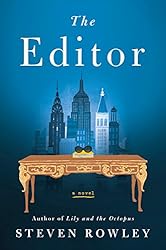
The Editor
Steven Rowley, 2019
Penguin Publishing
320 pp.
ISBN-13: 9780525537960
Summary
From the bestselling author of Lily and the Octopus comes a novel about a struggling writer who gets his big break, with a little help from the most famous woman in America.
After years of trying to make it as a writer in 1990s New York City, James Smale finally sells his novel to an editor at a major publishing house: none other than Jacqueline Kennedy Onassis.
Jackie—or Mrs. Onassis, as she's known in the office—has fallen in love with James's candidly autobiographical novel, one that exposes his own dysfunctional family.
But when the book's forthcoming publication threatens to unravel already fragile relationships, both within his family and with his partner, James finds that he can't bring himself to finish the manuscript.
Jackie and James develop an unexpected friendship, and she pushes him to write an authentic ending, encouraging him to head home to confront the truth about his relationship with his mother.
Then a long-held family secret is revealed, and he realizes his editor may have had a larger plan that goes beyond the page. (From the publisher.)
Author Bio
• Birth—ca. 1971-72
• Raised—Portland, Maine, USA
• Education—B.A., Emerson College
• Currently—lives in Los Angeles, California
Steven Rowley is an American author with two bestselling books to his name: his debut, Lily and the Octupus, published in 2016, and his second novel, The Editor, which was released in 2019.
Rowley, at the time, a 43-year-old paralegal and screenwriter, had sold several unproduced screenplays before writing a short story about the death of his dachshund, Lily, to cope with his grief. Rowley's boyfriend encouraged him to expand it into an novel.
Rowley wrote Lily and the Octopus in 100 days and submitted it to approximately 30 literary agents, who all declined to represent him. Rowley said of the manuscript, "I was proud of it as a piece of writing, but I never thought that this was going to change my life."
Intending to self-publish, Rowley hired freelance editor Molly Pisani, who later pitched the novel to her former colleague, Karyn Marcus of Simon & Schuster. Impressed by the quality of the book, Marcus forwarded it to Simon & Schuster editor-in-chief Marysue Rucci. According to Marcus:
I woke up to an email that [Ms. Rucci] had sent me at 3 in the morning, saying "this book is incredible, I wept real tears, you must buy it." … We knew immediately it was going to be a big book for us, and the advance certainly reflected that.
In April 2015, Publishers Weekly reported that Marcus had acquired the novel for Simon & Schuster in a "nearly seven-figure" book deal. The Hollywood Reporter noted that the offer "was made with unusual speed," with The New York Observer calling it "a timeline unheard of in the slow-paced publishing industry." (Adapted from Wikipedia. Retrieved 7/17/2016.)
Book Reviews
Filled with whimsy and warmth, the Lily and the Octopus author’s second novel centers on the complex relationship between a fledgling writer and his fabulous editor, the latter of whom becomes a mentor, friend, and maternal figure. Oh, and she happens to be Jacqueline Kennedy Onassis, but that’s Mrs. Onassis to you.
Oprah Magazine
Steven Rowley is the best-selling author of Lily and the Octopus, and he's honestly outdone himself with The Editor.
Cosmopolitan
[A] delightful slice of historical fiction (Must List).
Entertainment Weekly
[A] sharp, funny sophomore novel.
Town and Country
A journey of self-discovery.… Ultimately a story not about celebrity but about family and forgiveness.
Time
The Editor… sweetly evokes a mature Jacqueline Kennedy Onassis. In 1990s New York, James Smale is an obscure first-time novelist, but his editor is world-famous. In this delicately observed tale the steely Jackie becomes not just the midwife of the angsty gay Smale's manuscript, but of a wider reconciliation.
Sunday Times (UK)
(Starred review) [A] poignant tale of a new author’s breakout hit… under the guidance of… Jacqueline Kennedy Onassis.… Rowley deliberately mines the sentiment of the mother/son bond, but skillfully saves it from sentimentality; this is a winning dissection of family, forgiveness, and fame.
Publishers Weekly
[A] struggling young writer James Smale suddenly [lucks] out when editor Jacqueline Kennedy Onassis buys his novel. But he's drawn heavily on his own dysfunctional family and can't face finishing the manuscript, so Mrs. Onassis sends him home to address his conflicted relationship with his mother.
Library Journal
While diving deep into questions of identity, loyalty, and absolution within the bonds of family, Rowley… soars to satisfying heights in this deeply sensitive depiction of the symbiotic relationships at the heart of every good professional, and personal partnership.
Booklist
As this novel is already on its way to the screen, one can only hope that the first few scenes come off better on film than they do on paper…. Even if you have Jackie Kennedy—and this is a particularly sensitive and nuanced portrait of her—you still have to have a plot.
Kirkus Reviews
Discussion Questions
1. The Editor is centered on a woman who looms larger than life in our history: Jacqueline Kennedy Onassis. How did the Jackie of the novel compare to your own imaginings of the former first lady?
2. Ithaca, as both a place and a story, is a recurring idea in the novel. Do you think it takes on a particular meaning? If so, what is it?
3. Imagine you had the opportunity to work closely with a major historical figure. Who would you pick?
4. James has been a struggling writer for years. But his big break isn’t a happy one initially. How does it affect his relationships, with Daniel, with his family? What does his success do to his own sense of self and personal history?
5. As his editor, Jackie pushes James to reconnect with his family in order to write a more authentic ending to his novel. How do you think realism and personal intimacy impact storytelling? Are endings that ring more true ultimately more satisfying?
6. In her own way, Jackie slowly reveals parts of her personal life to James over the course of their relationship. How does this change James’s perception of her?
7. The book’s epigraph comes from the musical Camelot by Lerner and Loewe, and Jackie herself references Camelot in a later scene with James. President Kennedy was said to be attracted to the Arthurian legend, the idea that history is made by great heroes with moral clarity, and the idea of a Camelot has become a shorthand for the Kennedys’ brief time in the White House. What acts of heroism does James see in both Jackie and his mother?
8. Talk about the different endings James strives to achieve throughout the story: with the manuscript, with his father, with his biological father, with his mother. How are each of these connected? Do any of them lead to the others, and are they ever really achieved?
9. What do you imagine happens next for James? For his mother? For Daniel?
10. Like James, would you ever write a novel about your real life? How would you balance the autobiographical and the fictional? Would you ever feel comfortable sharing it with your family and friends?
(Questions issued by the publisher.)


The Egypt In My Looking Glass
Yuri Kruman, 2014
Author House
192 pp.
ISBN-13: 9781491847763
Summary
Twenty-five years after their hellish emigration—thirty from their famous father's exodus—a sister and her brothers hear his voice again. All three have long since "made it" in the States, despite—maybe, because of—his abandonment.
Forced by his own divorce to question everything, Vlad reels and frolics to forget himself—and learn to live again. Skirt-chasing author Mark, seething with writer's block, commits himself to marry by a verbal slip. Alla's precocious children prod her to examine who she is and why. A sleazy cousin—Tolik, hopeless Brighton product—is about to score his one big hit, again. His brother, Boris, now religious, struggles to transcend his past.
A family get-together threatens to ignite their old resentments. Edouard Yablonskiy, freshly minted dissident, has one last chance to make amends. His three grown children now must choose—to exit their own Egypt and forgive or let the past demand their satisfaction.
Author Bio
• Birth—April 13, 1983
• Where—Moscow, Russia
• Raised—Lexington, Kentucy, USA
• Education—B.A., University of Pennsylvania; J.D.,
Benjamin Cardozo School of Law
• Currently—lives in New York, New York
Yuri Kruman was born in Moscow and, at the age of nine, moved to Kentucky where he grew up. He studied neuroscience and anthropology at University of Pennsylvania before receiving his law degree from Benjamin N. Cardozo School of Law. He has worked on Wall Street and in healthcare. He lives with his wife and daughter in Manhattan. (From the author.)
Visit the author's website.
Visit the author on Goodreads.
Discussion Questions
1. What does Vlad's "rebellion" signal about his internal state?
2. What effect do her kids' questions about childhood and heritage have on her self-understanding?
3. Which of the three kids and/or two cousins is the most sensitive to their Russian heritage and why?
4. What is the nature of the tension between the three kids and their cousins, other than leftover childhood resentment? Is this typical of the Russian community or all immigrant group in New York?. Discuss.
5. How is the mother depicted in this book, as seen through the eyes of her children and nephews? Discuss her role in her children's lives at this stage.
(Questions provided courtesy of the author.)
The Egyptologist
Arthur Phillips, 2004
Random House
416 pp.
ISBN-13: 9780812972597
Summary
From the bestselling author of Prague comes a witty, inventive, brilliantly constructed novel about an Egyptologist obsessed with finding the tomb of an apocryphal king. This darkly comic labyrinth of a story opens on the desert plains of Egypt in 1922, then winds its way from the slums of Australia to the ballrooms of Boston by way of Oxford, the battlefields of the First World War, and a royal court in turmoil.
Just as Howard Carter unveils the tomb of Tutankhamun, making the most dazzling find in the history of archaeology, Oxford-educated Egyptologist Ralph Trilipush is digging himself into trouble, having staked his professional reputation and his fiancée’s fortune on a scrap of hieroglyphic pornography.
Meanwhile, a relentless Australian detective sets off on the case of his career, spanning the globe in search of a murderer. And another murderer. And possibly another murderer. The confluence of these seemingly separate stories results in an explosive ending, at once inevitable and utterly unpredictable.
Arthur Phillips leads this expedition to its unforgettable climax with all the wit and narrative bravado that made Prague one of the most critically acclaimed novels of 2002. Exploring issues of class, greed, ambition, and the very human hunger for eternal life, this staggering second novel gives us a glimpse of Phillips’s range and maturity–and is sure to earn him further acclaim as one of the most exciting authors of his generation. (From the publisher.)
Author Bio
• Birth—April 23, 1969
• Where—Minneapolis, Minnesota, USA
• Education—B.A., Harvard
• Currently—lives in New York City
Arthur Phillips is an American novelist active in the 21st century. His novels include Prague (2002), The Egyptologist (2004), Angelica (2007), The Song Is You (2009), and The Tragedy of Arthur (2011).
Phillips was born in Minneapolis and received a BA in history from Harvard (1986–90). After spending two years in Budapest (1990–1992), he then studied jazz saxophone for four semesters at Berklee College of Music (1992–93).[2] In his author biography and several interviews he claims to have been a child actor, a jazz musician, a five-time Jeopardy! champion, a speechwriter, and an advertising copywriter for medical devices, and a "dismally failed entrepreneur." He lived in Budapest from 1990 to 1992 and in Paris from 2001 to 2003, and now lives in New York with his wife and two sons.
Before becoming a best-selling novelist, Phillips was (in fact) a five-time champion on Jeopardy! in 1997. In 2005, he competed in the Jeopardy! Ultimate Tournament of Champions. He won his opening-round game but lost in the second round.
Books
• Prague (2002)
Despite its title, Prague is set almost entirely in Budapest, Hungary, primarily in 1990, with an interlude detailing several previous generations of Hungarian history, from the Austro-Hungarian monarchy through the First and Second World Wars.
The main line of the novel follows a group of young Western expatriates through their lives in Budapest. Interwoven tales produce an ensemble portrait of the expats and their adopted city, just recovering from decades of Communism, fascism, and war. The novel's recurring themes include nostalgia, sincerity and authenticity, and young people's first search for meaning in life. The novel was well received commercially and critically, winning Phillips the 2003 Los Angeles Times/Art Seidenbaum Award for Best First Fiction, as well as other honors.
• The Egyptologist (2004)
The novel is structured as journals, letters, telegrams, and drawings, from several different points of view. The main story is set in 1922 and follows a hopeful explorer who, working near Howard Carter (the man who discovered the tomb of King Tutankhamun), risks more and more of his life and savings on an apparently quixotic effort to find the tomb of an apocryphal Egyptian king.
The book was an international bestseller and critical success in more than two dozen countries. US critics noted Phillips's versatility in producing a book so different from his first, and fans of the book included Gary Shteyngart, George Saunders, Elizabeth Peters, and Stephen King. Others, however, most notably Michiko Kakutani of the New York Times, found the book overlong and confusing.
• Angelica (2007)
Superficially a Victorian ghost story, Angelica won Phillips comparisons to Henry James, Vladimir Nabokov, and Stephen King. King himself praised the book, and the Washington Post opined that it cemented Phillips's reputation as "one of the best writers in America."
In the novel, the same events are retold four times from four different perspectives, each section casting doubt on the version that came before, until the reader is left to sort truth from fantasy on his or her own. Although the novel received extensive critical praise, it was a commercial disappointment.
• The Song Is You (2009)
Phillips's fourth novel tells the story of a middle-aged man's pursuit of a young woman, an Irish pop singer he sees performing in a bar. Kirkus Reviews said, "Phillips still looks like the best American novelist to have emerged during the present decade."
• The Tragedy of Arthur (2011)
This fifth book was shortlisted for the IMPAC International Literary Prize. A faux memoir, the story revolves around a con-man father who convinces his son to sell a hitherto unknown Shakespeare play. Publishers Weekly called it "a tricky project, funny and brazen, smart and playful." (Adapted from Wikipedia. Retrieved 1/21/2014.)
Book Reviews
The book is a tour de force of plotting and narrative technique; the intertwining storylines lead with mounting inevitability to one of the most horrendously, hideously humorous endings in modern fiction. It isn't an ending for the faint of heart, but if you appreciated Evelyn Waugh's Black Mischief, this one will knock you out.
Barbara Mertz - The Washington Post
Ralph M. Trilipush—an obscure Egyptologist who claims to have discovered the tomb of an unknown yet visionary Pharaoh—is off his rocker. The fun comes in the way his megalomania mirrors the temperament of supposedly levelheaded scholars.... Phillips is nearly as deft as Nabokov at parodying the academic mind.... Unfortunately, he tricks up his plot by adding a dull detective who labors to expose Trilipush’s lies, and by stealing a twist from The Talented Mr. Ripley. The result is pastiche overload.
The New Yorker
Where does fact end and imagination, illusion and wishful thinking begin? Phillips is a master manipulator, able to assume a dozen convincingly different voices at will, and his book is vastly entertaining. It's apparent that something dire is afoot, but the reader, while apprehensive, can never quite figure out what. The ending, which cannot be revealed, is shocking and cleverly contrived.
Publishers Weekly
Ralph M. Trilipush, the eponymous Egyptologist—a war hero who attended Oxford but never served in the military, with no record of his attendance at the venerable British institution? A sheltered, society heroine who drinks to oblivion and takes opium? These are but two central mysteries of this potpourri of intrigue, subterfuge, and deception concocted by Phillips.... [Q]uite tongue in cheek, a tableau of action and adventure in a 1920s setting. —Edward Cone, New York
Library Journal
A secretive archaeologist's obsession with an obscure Egyptian king uncovers several concealed histories—in Phillips's clever, labyrinthine successor to his prizewinning debut (Prague, 2002).... This is a suave, elegant novel, replete with sinuously composed sentences and delicious wordplay.... Alas, it's also intermittently labored and redundant.... Nonetheless, Phillips's formidable research and witty prose make this one well worth your time. He's que possibly a major novelist in the making.
Kirkus Reviews
Discussion Questions
1. Why do you think Arthur Phillips used an epistolary structure for The Egyptologist? Would it have been possible for him to structure it differently? What effect do the letters and journal entries have on the voice of the novel?
2. Early in the novel, Trilipush writes to Margaret, stating "These writings are the story of my discovery, my truncating of doubters and self-doubt. I am entrusting to you nothing less than my immortality.... If something should happen to my body, then you are now responsible ... to ensure that my name and the name of Atum-hadu never perish" (5-6). What drives his obsession with immortality? Explore Ferrell's similar preoccupation with his own lasting fame, and how this theme pervades the novel as a whole.
3. What does Atum-hadu symbolize? How does Trilipush relate to him?
4. In his journal, Trilipush relays three drastically different translations of hieroglyphs written by Atum-hadu—he writes, "Clenched and trembling men like Harriman and Vassal cannot restrain themselves from spilling educated and less educated guesses over barren, tattered evidence, producing great, pregnant speculations" (90). What point is Phillips making here about history and truth?
5. Describe Trilipush and Margaret's relationship. Are they really in love? Do they have other motives for carrying on their love affair? How does their relationship change throughout the course of the novel?
6. Explain the effect of unreliable narrators in The Egyptologist. At which points did you find yourself trusting Trilipush or Ferrell? What are each of their motives?
7.Trilipush wonders, "How did [Atum-hadu] know that his authority would endure to the last crucial minute, and that his world would then disappear a moment later, under the onslaught, before anyone who knew enough thought to disturb his peace? Somehow he did it, setting for us the most brilliant Tomb Paradox in the history of Egyptian immortality and preparing, for only the most brilliant and deserving, a discovery like no other" (160). What is the Tomb Paradox, and what significance does it have? What is its equivalent in Trilipush's life?
8. Explore the issue of self-delusion in The Egyptologist. What have each of the characters—Trilipush, Ferrell, Margaret—deluded themselves into believing? At what point does each of them come to their definition of truth, and what effects do their versions of clarity have on them?
9. Trilipush writes, "Despite my easy childhood, the men whom I admire most in this world are self-made men, a description which seems to fit the king" (265). What does he mean by this? Has his own evolution followed that of a "self-made" man?
10. On page 267, Trilipush explores the concept of three births. Explore the significance of this cycle and how it relates to the novel.
11. Were you surprised by the ending of The Egyptologist? How does the tone of the novel change in the final scenes? How does your perception of Trilipush and what he has achieved changed?
(Questions issued by publisher.)
top of page (summary)


Eight Hundred Grapes
Laura Dave, 2015
Simon & Schuster
272 pp.
ISBN-13: 9781476789255
Summary
There are secrets you share, and secrets you hide….
Growing up on her family’s Sonoma vineyard, Georgia Ford learned some important secrets. The secret number of grapes it takes to make a bottle of wine: eight hundred. The secret ingredient in her mother’s lasagna: chocolate. The secret behind ending a fight: hold hands.
But just a week before her wedding, thirty-year-old Georgia discovers her beloved fiancé has been keeping a secret so explosive, it will change their lives forever.
Georgia does what she’s always done: she returns to the family vineyard, expecting the comfort of her long-married parents, and her brothers, and everything familiar. But it turns out her fiancé is not the only one who’s been keeping secrets….
Eight Hundred Grapes is a heartbreaking, funny, and deeply evocative novel about love, marriage, family, wine, and the treacherous terrain in which they all intersect. (From the publisher.)
Author Bio
• Birth—July 18, 1977
• Raised—Scarsdale, New York, USA
• Education—B.A., University of Pennsylvania; M.F.A., University of Virginia
• Awards—Association of Writers and Writing Programs Intro Award
• Currently—lives in Los Angeles, California
Laura Dave is an American author of several novels, including London Is The Best City In America (2006), The Divorce Party (2008), The First Husband (2011), and Eight Hundred Grapes (2015). She most often writes about relationships, family, infidelity, and marriage.
Dave, whose interest in writing began in elementary school, grew up in Scarsdale, New York. She graduated from the University of Pennsylvania in 1999 with a B.A. in English and from the University of Virginia with an M.F.A. in creative writing. She was a Henry Hoyns Fellow and a recipient of the Tennessee Williams Scholarship. She received several awards for her writing including the AWP Intro Award in Short Fiction.
After graduate school, Dave worked as a freelance journalist for ESPN.
In addition to her novels, Dave's short fiction and essays have been published in the New York Times, New York Observer, ESPN, Redbook, and Huffington Post. She has appeared on CBS's The Early Show, Fox News Channel's Fox & Friends and NPR's All Things Considered. In 2008, Cosmopolitan named her a "Fun and Fearless Phenom of the Year.
She lives with her screenwriter husband, Josh Singer, in Los Angeles, California. (Adapted from Wikipedia. Retrieved 9/3/2015.)
Book Reviews
Secrets and love affairs on a Sonoma vineyard mean reading with wine is basically mandatory.
Cosmopolitan
Need a vacation? Dave will transport you with mouthwatering lasagna, breathtaking vistas—and an unforgettable lesson in loyalty.
Glamour
The idyllic life of Georgia Ford is crashing down—oh, and it’s just days before her wedding. Cue cold feet.
Marie Claire
Dave’s tightly woven family drama is best enjoyed with a glass of wine (or two); readers found this one impossible to put down. (#1 Reader's Prize Selection)
Elle
This novel’s hero discovers the complexity of human relationships and desires amid the well-researched backdrop of a fictional Sonoma winery.
Wine Enthusiast
[C]harms and pulls at the heartstrings...well-crafted.... [T]he author throws in a few secrets about winemaking—in fact, the title is a reference to the number of grapes needed to produce a bottle of wine. This winning tale will...satisfy on a literary level....[A] tasty treat.
Publishers Weekly
Fast-moving chapters and snappy dialog make this a quick, breezy, perfect beach read, but the story would improve if the protagonist had some romantic love scenes and a bit more passion.... [Laura Dave] is gaining a following and finding her spot next to the likes of Emily Giffin and Nancy Thayer. —Sonia Reppe, Stickney-Forest View P.L., IL
Library Journal
Through a series of flashbacks that range from canny to cloying, we learn how the Ford family has reached [their] collective crisis point. Resolutions arrive slowly and often unexpectedly for each of them, giving this satisfying novel legs.
Kirkus Reviews
Discussion Questions
1. Discuss the myth of the yellow VW bug and the Ford family’s belief in "synchronization" as opposed to fate. How does this theory evolve over the course of the novel?
2. Do you think Georgia feels she has agency in the beginning of the story? The end? Is she right?
3. Georgia has made a lot of life choices to avoid repeating an upbringing that involved unpredictability. How does your life resist or yield to your own childhood? Discuss how that relates to the definition of "concerto" and its varying degrees of cooperation and opposition.
4. As twins, Finn and Bobby are often at odds with each other. In what ways do you think they are alike? Why do you think it’s so difficult for them to connect?
5. The one common denominator for the Ford siblings is love of their mother’s lasagna. Do you have a similar tradition in your family? What brings you together, no matter what?
6. Discuss the role of the contract that Georgia asks her brothers to sign. Why is she so afraid of the vineyard? Can you relate?
7. How does forgiveness play into this story? Could you forgive Ben for hiding Maddie? Could you forgive Finn for kissing Margaret?
8. Georgia insists on doing everything in her power to stop her loved ones from doing something they’ll regret. Discuss her mother’s response, "But which way is regret?" What do you think she means here?
9. Why is Jacob unexpectedly appealing to Georgia? Discuss their similarities, both in personality and life paths.
10. Georgia’s father has many rules of winemaking, like: "If you do your job," then, "you make good soil." He also has "a theory that what was equally as important as the wine you presented in your vintage was the wine you left out of the vintage. In winemaking, this was known as declassification." How do these rules apply to decision making on a larger scale? Do you think Georgia abides by them?
11. Who are Georgia’s "have-to-haves" at the end of the novel? Who are the have-to-haves in your own life?
12. Ben takes full responsibility for lying, but Finn points out that Georgia wasn’t necessarily tuned in to her fiancé. Discuss whether there are two sides to every conflict, even when something seems black and white.
13. Do you think that Georgia will be happy running the vineyard and being with Jacob? Why or why not? What’s the biggest lesson she has learned?
(Questions issued by the publisher.)
top of page (summary)
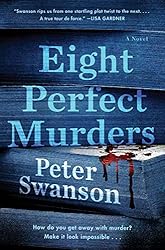
Eight Perfect Murders
Peter Swanson, 2008
HarperCollins
288 pp.
ISBN-13: 9780062838209
Summary
A chilling tale of psychological suspense and an homage to the thriller genre tailor-made for fans: the story of a bookseller who finds himself at the center of an FBI investigation because a very clever killer has started using his list of fiction’s most ingenious murders.
Years ago, bookseller and mystery aficionado Malcolm Kershaw compiled a list of the genre’s most unsolvable murders, those that are almost impossible to crack—which he titled “Eight Perfect Murders,”
The titles were chosen from among the best of the best—including Agatha Christie’s A. B. C. Murders, Patricia Highsmith’s Strangers on a Train, Ira Levin’s Death Trap, A. A. Milne's Red House Mystery, Anthony Berkeley Cox's Malice Aforethought, James M. Cain's Double Indemnity, John D. Macdonald's The Drowner, and Donna Tartt's A Secret History.
But no one is more surprised than Mal, now the owner of the Old Devils Bookstore in Boston, when an FBI agent comes knocking on his door one snowy day in February. She’s looking for information about a series of unsolved murders that look eerily similar to the killings on Mal’s old list.
And the FBI agent isn’t the only one interested in this bookseller who spends almost every night at home reading. There is killer is out there, watching his every move—a diabolical threat who knows way too much about Mal’s personal history, especially the secrets he’s never told anyone, even his recently deceased wife.
To protect himself, Mal begins looking into possible suspects … and sees a killer in everyone around him. But Mal doesn’t count on the investigation leaving a trail of death in its wake.
Suddenly, a series of shocking twists leaves more victims dead—and the noose around Mal’s neck grows so tight he might never escape. (From the publisher.)
Author Bio
• Birth—January 11, 1964
• Where—Carlisle, Massachusetts, USA
• Education—B.A., Trinity College; M.A., University of Massachusetts-Amherst; M.F.A., Emerson College
• Currently—lives in Somerville, Massachusetts
Peter Swanson is the author of several novels: The Girl with a Clock for a Heart (2014) The Kind Worth Killing (2015), Her Every Fear (2016), and Before She Knew Him (2019). Eight Perfect Murders (2020) is his most recent.
Swanson's poems, stories and reviews have appeared in such journals as The Atlantic, Asimov’s Science Fiction, Epoch, Measure, Notre Dame Review, Soundings East, and The Vocabula Review. He has won awards in poetry from The Lyric and Yankee Magazine, and is currently completing a sonnet sequence on all 53 of Alfred Hitchcock’s films.
Swanson has degrees in creative writing, education, and literature from Trinity College, the University of Massachusetts at Amherst, and Emerson College. He lives with his wife and cat in Somerville, Massachusetts. (From the publisher and the author's website.)
Book Reviews
[E]ngagingly original.… [A] multilayered mystery that brims with duplicity, betrayal and revenge—all bubbling slowly to the surface in increasingly bloody pages.… Fans won’t be disappointed.… Swanson plants clues and misdirections throughout. Not only does he make many literary references, he analyzes the perfect murders’ storylines. While he’s spinning this compelling murder story that will keep you on edge and guessing, he’s also spoiling those eight classics for anyone who hasn’t read them. Swanson warns readers up front.… Some mystery lovers will savor how slow the suspense builds with Mal’s no-hurry, low-adrenaline narrative. Others, not so much. This is a cerebral mystery, more dialogue than action. Although the twisted finale isn’t all that unexpected or climactic, when it comes to perfect murders, it’s the process that matters, not so much the end, right?
USA Today
(Starred review) [O]utstanding.… The stakes rise when Kershaw admits he knew one of the victims but chose not to share that with Mulvey. Swanson will keep most readers guessing until the end. Classic whodunit fans will be in heaven.
Publishers Weekly
The wintry New England setting and eerily cool narration, together with trust-no-one twists and garish murders, will satisfy thriller readers…. While you may not warm to Malcolm, you'll stay to the finish of this one. —Liz French
Library Journal
(Starred review) A devilish premise combined with jaw-dropping execution.… Mystery fans will be salivating as the plot unfolds, trying to outsmart the confoundingly unreliable narrative…. Swanson hits every note in this homage to the old-school crime novel, and the turnabout ending will leave readers reeling in delight.
Booklist
(Starred review) [While] a triple helping of cleverness… might seem like a fatal overdose, the pleasures of following, and trying to anticipate, [the] narrator… intense. If the final revelations are anticlimactic, that's only because you wish the mounting complications… could go on forever.
Kirkus Reviews
Discussion Questions
(We'll add questions if and when they're made available by the publisher. In the meantime, use our generic mystery questions to help start a discussion for EIGHT PERFECT MURDERS … then take off on your own:
GENERIC DISCUSSION QUESTIONS
Mystery / Crime / Suspense Thrillers
1. Talk about the characters, both good and bad. Describe their personalities and motivations. Are they fully developed and emotionally complex? Or are they flat, one-dimensional heroes and villains?
a. In this book, Eight Perfect Murders, you'll especially want to spend time discussing Malcolm's unreliable narration, his confounding second, even third, guessing, his eerie detachment. How does Malcolm affect you, as reader?
2. What do you know...and when do you know it? At what point in the book do you begin to piece together what happened?
3. Good crime writers embed hidden clues in plain sight, slipping them in casually, almost in passing. Did you pick them out, or were you...clueless? Once you've finished the book, go back to locate the clues hidden in plain sight. How skillful was the author in burying them?
4. Good crime writers also tease us with red-herrings—false clues—to purposely lead readers astray? Does your author try to throw you off track? If so, were you tripped up?
5. Talk about the twists & turns—those surprising plot developments that throw everything you think you've figured out into disarray.
- Do they enhance the story, add complexity, and build suspense?
- Are they plausible or implausible?
- Do they feel forced and gratuitous—inserted merely to extend the story?
6. Does the author ratchet up the suspense? Did you find yourself anxious—quickly turning pages to learn what happened? A what point does the suspense start to build? Where does it climax...then perhaps start rising again?
7. A good ending is essential in any mystery or crime thriller: it should ease up on tension, answer questions, and tidy up loose ends. Does the ending accomplish those goals?
- Is the conclusion probable or believable?
- Is it organic, growing out of clues previously laid out by the author (see Question 3)?
- Or does the ending come out of the blue, feeling forced or tacked-on?
- Perhaps it's too predictable.
- Can you envision a different or better ending?
8. Are there certain passages in the book—ideas, descriptions, or dialogue—that you found interesting or revealing...or that somehow struck you? What lines, if any, made you stop and think?
9. Overall, does the book satisfy? Does it live up to the standards of a good crime story or suspense thriller? Why or why not?
(Generic Mystery Questions by LitLovers. Please feel free to use them, online or off, with attribution. Thanks.)

The Eighth Life
Nino Haratischvili, 2014 (2020 in the U.S & U.K.; transl., Charlotte Collins, Ruth Martin)
Scribe Publications, Ltd.
944 pp.
ISBN-13: 9781950354146
Summary
An epic family saga beginning with the Russian Revolution and swirling across a century, encompassing war, loss, love requited and unrequited, ghosts, joy, massacres, tragedy.
At the start of the twentieth century, on the edge of the Russian empire, a family prospers.
It owes its success to a delicious chocolate recipe, passed down the generations with great solemnity and caution. A caution which is justified: this is a recipe for ecstasy that carries a very bitter aftertaste.
Stasia learns it from her Georgian father and takes it north, following her new husband, Simon, to his posting at the center of the Russian Revolution in St Petersburg. Stasia’s is only the first in a symphony of grand but all too often doomed romances that swirl from sweet to sour in this epic tale of the red century.
Tumbling down the years, and across vast expanses of longing and loss, generation after generation of this compelling family hears echoes and sees reflections.
A ballet dancer never makes it to Paris and a singer pines for Vienna. Great characters and greater relationships come and go and come again.
The world shakes, and shakes some more, and the reader rejoices to have found at last one of those glorious old books in which you can live and learn, be lost and found, and make indelible new friends. (From the publisher.)
Author Bio
Nino Haratischvili was born in Georgia in 1983, and is an award-winning novelist, playwright, and theatre director. At home in two different worlds, each with their own language, she has been writing in both German and Georgian since the age of twelve.
In 2010, her debut novel Juja was nominated for the German Book Prize, as was her most recent Die Katze und der General in 2018. In its German edition, The Eighth Life was a bestseller, and won the Anna Seghers Prize, the Lessing Prize Stipend, and the Bertolt Brecht Prize 2018.
The Eighth Life is being translated into many languages, and has already been a major bestseller on publication in Holland, Poland, and Georgia. (From the publisher.)
Book Reviews
Something rather extraordinary happened. The world fell away and I fell, wholly, happily, into the book…. My breath caught in my throat, tears nestled in my lashes…devastatingly brilliant.
New York Times Book Review
Spanning six generations of a family between 1900 and the 21st century, its characters travel to Tbilisi, Moscow, London and Berlin in an epic story of doomed romance that combines humour with magic realism.
Guardian (UK)
This is a long, rewarding novel…ably translated through a collaborative process. It makes for an engrossing book. Haratischvili has created a fascinating cast (and it’s easy to imagine it as a television series) whose lives illuminate some of the greatest events of the 20th century.
Irish Times (UK)
Elegant… [and] demonstrates a technical mastery, impressively sustained…. The Eighth Life is more than a family saga: it is an ode, a lamentation, a monument―to Georgia, its people, its past and future.
Times Literary Supplement (UK)
The Eighth Life is capacious, voluble, urgent, readable, translated heroically and sparklingly by Charlotte Collins and Ruth Martin.
Telegraph (UK)
Nino Haratischvili's elegant epic… is a triumph of both authorship and painstaking translation…. The Eighth Life is an unforgettable love letter to Georgia and the Caucasus, to lives led and to come, and to writing itself.
Economist
The Eighth Life… is a lavish banquet of family stories that can, for all their sorrows, be devoured with gluttonous delight. Nino Haratischvili’s characters… come to exuberant life. Her huge novel… shows a double face, its crushing pain and loss nonetheless conveyed with an artful storyteller’s sheer joy in her craft.
Financial Times
(Starred review) [An] exceptional, deeply evocative saga…. In heartfelt prose, Haratischvili seamlessly weaves the political upheaval around the characters into love and loss…. [Her] epic portrait of a close-knit family is a stunning tribute to the power of resilience.
Publishers Weekly
(Starred review) If it’s a family saga you’re seeking, look no further than this grand tale…. The author gracefully interweaves the historical backdrop of her novel with the lives of her characters, thus adding depth to her story. Heartily recommended.
Library Journal
(Starred review) This novel has generated substantial industry buzz and international critical praise. Both are justified…. The Eighth Life—the story of a family, a country, a century—is an imaginative, expansive, and important read.
Booklist
Discussion Questions
We'll add publisher questions if and when they're available; in the meantime, use our LitLovers Book Club Resources. They can help with discussions for any book:
• How to Discuss a Book (helpful discussion tips)
• Generic Discussion Questions—Fiction and Nonfiction
• Read-Think-Talk (a guided reading chart)
(Resources by LitLovers. Please feel free to use them, online and off, with attribution. Thanks.)


Eighty Days: Nellie Bly and Elizabeth Bisland's History-Making Race Around the World
Matthew Goodman, 2013
Random House
480 pp.
ISBN-13: 9780345527264
Summary
On November 14, 1889, Nellie Bly, the crusading young female reporter for Joseph Pulitzer’s World newspaper, left New York City by steamship on a quest to break the record for the fastest trip around the world. Also departing from New York that day—and heading in the opposite direction by train—was a young journalist from The Cosmopolitan magazine, Elizabeth Bisland. Each woman was determined to outdo Jules Verne’s fictional hero Phileas Fogg and circle the globe in less than eighty days. The dramatic race that ensued would span twenty-eight thousand miles, captivate the nation, and change both competitors’ lives forever.
The two women were a study in contrasts. Nellie Bly was a scrappy, hard-driving, ambitious reporter from Pennsylvania coal country who sought out the most sensational news stories, often going undercover to expose social injustice. Genteel and elegant, Elizabeth Bisland had been born into an aristocratic Southern family, preferred novels and poetry to newspapers, and was widely referred to as the most beautiful woman in metropolitan journalism. Both women, though, were talented writers who had carved out successful careers in the hypercompetitive, male-dominated world of big-city newspapers. Eighty Days brings these trailblazing women to life as they race against time and each other, unaided and alone, ever aware that the slightest delay could mean the difference between victory and defeat.
A vivid real-life re-creation of the race and its aftermath, from its frenzied start to the nail-biting dash at its finish, Eighty Days is history with the heart of a great adventure novel. Here’s the journey that takes us behind the walls of Jules Verne’s Amiens estate, into the back alleys of Hong Kong, onto the grounds of a Ceylon tea plantation, through storm-tossed ocean crossings and mountains blocked by snowdrifts twenty feet deep, and to many more unexpected and exotic locales from London to Yokohama. Along the way, we are treated to fascinating glimpses of everyday life in the late nineteenth century—an era of unprecedented technological advances, newly remade in the image of the steamship, the railroad, and the telegraph. For Nellie Bly and Elizabeth Bisland—two women ahead of their time in every sense of the word—were not only racing around the world. They were also racing through the very heart of the Victorian age. (From the publisher.)
Author Bio
Matthew Goodman is the author of three books of non-fiction: Eighty Days: Nellie Bly and Elizabeth Bisland’s History-Making Race Around the World (2013); The Sun and the Moon: The Remarkable True Account of Hoaxers, Showmen, Dueling Journalists, and Lunar Man-Bats in Nineteenth-Century New York 2008); and Jewish Food: The World at Table (2005).
Matthew’s books have been translated into eight languages. His essays, articles, and short stories have appeared in the American Scholar, Harvard Review, Village Voice, Forward, Bon Appetit, and many other publications, and have been cited for Special Mention in the Pushcart Prize and Best American Short Story anthologies.
He has given book talks at venues including the Museum of the City of New York, the Gotham Center for New York History, the National Yiddish Book Center, the Brooklyn Book Festival, and many bookstores and libraries; his radio appearances include NPR’s On the Media, Back Story with the History Guys, and The Splendid Table; The Bob Edwards Show on XM-Sirius Radio; and numerous others.
Matthew has taught creative writing and literature at Vermont College, Tufts University, Emerson College, and at writers’ conferences including the Antioch Writers Workshop and the Chautauqua Institute. He has received fellowships from the MacDowell Colony (twice) and the Corporation of Yaddo.
He lives in Brooklyn, New York, with his wife and two children.
Book Reviews
Two pioneering women hurtle across the globe—and into a changing future—in this stimulating true-life adventure story.... Deftly mixing social history into an absorbing travel epic, Goodman conveys the exuberant dynamism of a very unfusty Victorian era obsessed with speed, power, publicity, and the breaking of every barrier. Photos. (Mar.)
Publishers Weekly
Most of us have heard of Nellie Bly, a reporter for Joseph Pulitzer's World newspaper, who left New York City on November 14, 1889, in a bid to circumnavigate the globe in record-breaking time. Fewer people know that Elizabeth Bisland, who wrote for the Cosmopolitan, left New York on the same day with the same goal in mind. Bly won, but this account covers the journeys of both women—traveling in opposite directions and each, initially, without knowledge of the other. Suspense and fabulous locations; sounds like armchair travel at its best.
Library Journal
A richly detailed double narrative of the adventures of two young women journalists in a race against time, each striving to be the first to travel around the world in 75 days, outdoing the fictional Phileas Fogg's 80 days. Goodman.... Who was the real winner? Goodman's depiction of the swashbuckling Bly, whose self-regard often seemed larger than her regard for the truth, is somewhat less sympathetic than his portrait of the now-forgotten Bisland. The author also examines the shenanigans of the press, the vicissitudes of travel and the global power of the British Empire in the Victorian era. A tad overlong, but entertaining and readable throughout.
Kirkus Reviews
Discussion Questions
Use our LitLovers Book Club Resources; they can help with discussions for any book:
• How to Discuss a Book (helpful discussion tips)
• Generic Discussion Questions—Fiction and Nonfiction
• Read-Think-Talk (a guided reading chart)
We'll add specific questions if and when the publisher makes them available.


Eileen
Ottessa Mosfegh, 2015
Penguin
272 pp.
ISBN-13: 9781594206627
Summary
A lonely young woman working in a boys’ prison outside Boston in the early 60s is pulled into a very strange crime, in a mordant, harrowing story of obsession and suspense, by one of the brightest new voices in fiction.
So here we are. My name was Eileen Dunlop. Now you know me.
I was twenty-four years old then, and had a job that paid fifty-seven dollars a week as a kind of secretary at a private juvenile correctional facility for teenage boys. I think of it now as what it really was for all intents and purposes—a prison for boys. I will call it Moorehead. Delvin Moorehead was a terrible landlord I had years later, and so to use his name for such a place feels appropriate. In a week, I would run away from home and never go back.
This is the story of how I disappeared . . .
The Christmas season offers little cheer for Eileen Dunlop, an unassuming yet disturbed young woman trapped between her role as her alcoholic father’s caretaker in a home whose squalor is the talk of the neighborhood and a day job as a secretary at the boys’ prison, filled with its own quotidian horrors. Consumed by resentment and self-loathing, Eileen tempers her dreary days with perverse fantasies and dreams of escaping to the big city. In the meantime, she fills her nights and weekends with shoplifting, stalking a buff prison guard named Randy, and cleaning up her increasingly deranged father’s messes.
When the bright, beautiful, and cheery Rebecca Saint John arrives on the scene as the new counselor at Moorehead, Eileen is enchanted and proves unable to resist what appears at first to be a miraculously budding friendship. In a Hitchcockian twist, her affection for Rebecca ultimately pulls her into complicity in a crime that surpasses her wildest imaginings.
Played out against the snowy landscape of coastal New England in the days leading up to Christmas, young Eileen’s story is told from the gimlet-eyed perspective of the now much older narrator. Creepy, mesmerizing, and sublimely funny, in the tradition of Shirley Jackson and early Vladimir Nabokov, this powerful debut novel enthralls and shocks, and introduces one of the most original new voices in contemporary literature. (From the publisher.)
Author Bio
• Birth—May 20, 1981
• Where—Boston, Massachusetts, USA
• Education—Stanford University
• Awards—Paris Review’s Plimpton Prize; Fence Modern Prize in Prose
• Currently—a Wallace Stegner Fellow at Stanford University in Palo Alto, California
Ottessa Moshfegh is an American author and novelist, born in Boston, Massachusetts. Her mother was born in Croatia and her father was born in Iran. She received the Plimpton Prize for Fiction from The Paris Review in 2013 for her story "Bettering Myself."
Moshfegh is a frequent contributor to The Paris Review; she has published six stories in the journal since 2012. Fence Books published her novella, McGlue, in 2014, as the inaugural winner of the Fence Modern Prize in Prose judged by Rivka Galchen. It was shortlisted for the Believer Book Award.
Her novel, Eileen, was published in 2015 to positive reviews, while a forthcoming collection of short stories is set to be published, although the date has not been announced.
Moshfegh was a Wallace Stegner Fellow at Stanford University from 2013 to 2015. (Adapted from Wikipedia. Retrieved 8/24/2015.)
Book Reviews
[D]ark and unnerving.... As the claustrophobia and filth of [Eileen's] circumstances become more suffocating...they seem more redundant than effective. With the arrival of the mysterious Rebecca...the narrative’s [momentum] finally picks up somewhat, although it will still feel stagnant to some.
Publishers Weekly
Initially, this novel reads like a memoir of a drab, friendless young woman.... [Then] the tale shapeshifts into a crime thriller.... Moshfegh's ability to render Eileen's dreary tale so compelling is testament to her narrative skills. —Reba Leiding, emeritus, James Madison Univ. Lib., Harrisonburg, VA
Library Journal
(Starred review.) Literary psychological suspense at its best.
Booklist
(Starred review.) A woman recalls her mysterious escape from home in this taut, controlled noir about broken families and their proximity to violence.... A shadowy and superbly told story of how inner turmoil morphs into outer chaos.
Kirkus Reviews
Discussion Questions
Use our LitLovers Book Club Resources; they can help with discussions for any book:
• How to Discuss a Book (helpful discussion tips)
• Generic Discussion Questions—Fiction and Nonfiction
• Read-Think-Talk (a guided reading chart)
(We'll add specific questions if and when they're made available by the publisher.)

Eleanor Oliphant Is Completely Fine
Gail Honeyman, 2017
Penguin Publishing
336 pp.
ISBN-13: 9780735220683
Summary
No one’s ever told Eleanor that life should be better than fine.
Meet Eleanor Oliphant: She struggles with appropriate social skills and tends to say exactly what she’s thinking. Nothing is missing in her carefully timetabled life of avoiding social interactions, where weekends are punctuated by frozen pizza, vodka, and phone chats with Mummy.
But everything changes when Eleanor meets Raymond, the bumbling and deeply unhygienic IT guy from her office.
When she and Raymond together save Sammy, an elderly gentleman who has fallen on the sidewalk, the three become the kinds of friends who rescue one another from the lives of isolation they have each been living. And it is Raymond’s big heart that will ultimately help Eleanor find the way to repair her own profoundly damaged one.
Smart, warm, uplifting, Eleanor Oliphant is Completely Fine is the story of an out-of-the-ordinary heroine whose deadpan weirdness and unconscious wit make for an irresistible journey as she realizes.
The only way to survive is to open your heart. (From the publisher.)
Author Bio
• Birth—ca. 1971
• Where—central Scotland, Uk
• Education—University of Glasgow; Oxford University
• Currently—lives in Glasgow
Gail Honeyman was raised in central Scotland and as a child could be found in the library, she says, "a ridiculous number of times a week." Now in her 40s and author of a big-buzz book, Eleanor Oliphant Is Completely Fine, Honeyman still finds herself in the library quite but is much happier to be there.
Honeyman studied French at Glasgow University and did postgraduate studies at Oxford. Deciding against pursuing her Ph.D., she ended up in working in university administration for a number of years. After a good number of years, the writing bug bit, and she enrolled in writing classes at Britain's well-known Faber Academy.
When not at her day job, Honeyman wrote—mornings, nights and weekends—all of which paid off handsomely. She entered and won competitions, and in 2015, her book was in the object of an eight-way tug of war among publishers. It was the talk of the town at that year's Frankfurt Book Fair and earned Honeyman a seven figure advance.
For anyone curious about how it feels to publish a first novel at 45, here's what Honeyman says:
It’s one of those jobs where the more life experience you have, the better—so it’s absolutely not a handicap to be older.… A bit of perspective and life experience isn’t a bad thing. Anyway, if you start a new career at 40, you’ve still got another 35 years to go.
(Author bio adapted from an article in The Guardian.)
Book Reviews
[E]xquisite, heartbreaking, funny, and irresistible…. Surprises abound as the author boldly turns literary expectations upside down and gives to her readers Eleanor Oliphant, who, yes, is completely, beautifully fine. —Beth Andersen, formerly with Ann Arbor Dist. Lib., MI
Library Journal
(Starred review.) Move over, Ove…. Witty, charming, and heartwarming, Eleanor Oliphant Is Completely Fine is a remarkable debut about a singular woman. Readers will cheer Eleanor as she confronts her dark past and turns to a brighter future. Feel good without feeling smarmy.
Booklist
A very funny novel…. At 29, Eleanor Oliphant has built an utterly solitary life that almost works.… [But] it turns out that shell was serving a purpose.… Honeyman's endearing debut is part comic novel, part emotional thriller, and part love story.
Kirkus Reviews
Discussion Questions
Use our LitLovers Book Club Resources; they can help with discussions for any book:
• How to Discuss a Book (helpful discussion tips)
• Generic Discussion Questions—Fiction and Nonfiction
• Read-Think-Talk (a guided reading chart)
(We'll add specific questions if and when they're made available by the publisher.)
top of page (summary)

The Elegance of the Hedgehog
Muriel Barbery, 2007
Penguin Group USA
336 pp.
ISBN-13: 9781933372600
Summary
We are in the center of Paris, in an elegant apartment building inhabited by bourgeois families.
Renée, the concierge, is witness to the lavish but vacuous lives of her numerous employers. Outwardly she conforms to every stereotype of the concierge: fat, cantankerous, addicted to television.
Yet, unbeknownst to her employers, Renée is a cultured autodidact who adores art, philosophy, music, and Japanese culture. With humor and intelligence she scrutinizes the lives of the building's tenants, who for their part are barely aware of her existence.
Then there's Paloma, a twelve-year-old genius. She is the daughter of a tedious parliamentarian, a talented and startlingly lucid child who has decided to end her life on the sixteenth of June, her thirteenth birthday.
Until then she will continue behaving as everyone expects her to behave: a mediocre pre-teen high on adolescent subculture, a good but not an outstanding student, an obedient if obstinate daughter.
Paloma and Renée hide both their true talents and their finest qualities from a world they suspect cannot or will not appreciate them. They discover their kindred souls when a wealthy Japanese man named Ozu arrives in the building.
Only he is able to gain Paloma's trust and to see through Renée's timeworn disguise to the secret that haunts her. This is a moving, funny, triumphant novel that exalts the quiet victories of the inconspicuous among us. (From the publisher.)
Author Bio
• Birth—May 28, 1969
• Where—Casablanca, Morocco
• Education—Ecole Normale Superieure de Fontenay-Saint-Cloud
• Currently—lives outside of Paris, France
Muriel Barbery is a French novelist and professor of philosophy.
She was born in Casablanca, Morocco, although her parents left when she was only two months old. She studied at the Lycee Lakanal (comparable to American high schools) in the outskirts of Paris and then entered the Ecole Normale Superieure de Fontenay-Saint-Cloud in 1990. In 1993 she obtained her agregation in philosophy (secondary teaching degree).
She then taught philosophy in a lycee (at the Universite de Bourgogne) and at the Saint-Lo IUFM (teacher training college). After she quit her job, she lived for two years in Japan (2008 and 2009). She currently lives in the countryside, south of Paris.
Barbery attained fame with her second novel The Elegance of the Hedgehog. The book topped the French best-seller lists for 30 consecutive weeks and was reprinted 50 times. By May 2008 it had sold more than a million copies and has been a bestseller in France, Italy, Germany, Spain, South Korea, and many other countries. The novel concerns the inhabitants of a small upper-class Paris apartment block, notably its autodidact concierge, Renee. In 2009 the book was adapted to film, titled The Hedgehog.
Her third novel, The Life of Elves, a fantastical fable in which elves serve as intermediaries between the human and natural worlds, is a departure from Barbery's normal realism. It was released in 2015 (2016 in the U.S.).
Books
2000 - Gourmet Rhapsody, Europa Editions (2009, Engl.)
2006 - The Elegance of the Hedgehog (2008, Engl.)
2015 - The Life of Elves (2016, Engl.)
(Author bio adapted from Wikipedia. Retrieved 3/17/2016.)
Book Reviews
Nobody ever imagined that this tender, funny book with a philosophical vein would have enjoyed such incredible success. For some, it is part Sophie's World by Jostein Gaarder, part Monsieur Malaussene by Daniel Pennac. While for others it resembles a written version of the film Amelie. Either way, readers are responding in vast numbers.
Le Monde
Enthusiastically recommended for anyone who loves books that grow quietly and then blossom suddenly.
Marie Clair (France)
An exquisite book in the form of a philosophical fable that has enchanted hundreds of thousands of readers.
Elle (Italy)
The Elegance of the Hedgehog, a best seller in France and several other countries, belongs to a distinct subgenre: the accessible book that flatters readers with its intellectual veneer…Renee's story is addressed to no one (that is, to us), while Paloma's takes the form of a notebook crammed with what she labels "profound thoughts." Both create eloquent little essays on time, beauty and the meaning of life…Even when the novel is most essayistic, the narrators' kinetic minds and engaging voices (in Alison Anderson's fluent translation) propel us ahead.
Caryn James - New York Times
Renee Michel and Paloma Josse provide the double narrative of The Elegance of the Hedgehog, and you will—this is going to sound corny—fall in love with both. In Europe, where Muriel Barbery's book became a huge bestseller in 2007, it has inspired the kind of affection and enthusiasm American readers bestow on the works of Alexander McCall Smith. Still, this is a very French novel: tender and satirical in its overall tone, yet most absorbing because of its reflections on the nature of beauty and art, the meaning of life and death. Out of context, Madame Michel's pensees may occasionally sound pretentious, just as Paloma might sometimes pass for a Gallic (and female) version of Holden Caulfield. But, for the most part, Barbery makes us believe in these two unbelievable characters.
Michael Dirda - Washington Post
This story, like all great tales, will break your heart, but it will also make you realize—or remember—that sometimes the pain is worth it."
Chicago Sun-Times
A beautiful story with a large cast of fascinating, complicated characters whose behavior is delightfully unpredictable.
Wall Street Journal
This dark but redemptive novel, an international bestseller, marks the debut in English of Normandy philosophy professor Barbery. Renée Michel, 54 and widowed, is the stolid concierge in an elegant Paris hôtel particulier. Though "short, ugly, and plump," Renée has, as she says, "always been poor," but she has a secret: she's a ferocious autodidact who's better versed in literature and the arts than any of the building's snobby residents. Meanwhile, "supersmart" 12-year-old Paloma Josse, who switches off narration with Renée, lives in the building with her wealthy, liberal family. Having grasped life's futility early on, Paloma plans to commit suicide on her 13th birthday. The arrival of a new tenant, Kakuro Ozu, who befriends both the young pessimist and the concierge alike, sets up their possible transformations. By turns very funny (particularly in Paloma's sections) and heartbreaking, Barbery never allows either of her dour narrators to get too cerebral or too sentimental. Her simple plot and sudden denouement add up to a great deal more than the sum of their parts.
Publishers Weekly
Published in France in 2006, this work quickly captured the European imagination, and the advance praise is sufficiently glowing to guarantee attention in the English-speaking world. The novel itself is more problematic. Philosophy professor Barbery—the author of one previous novel, Une gourmandise-has fashioned a slow and sentimental fable out of her own personal interests—art, philosophy, and Japanese culture-about a widow who serves as caretaker of a Parisian apartment building and a troubled girl living in the building. Barbery attempts to make the story appear more cutting-edge by introducing dizzying changes in typography, but the effect seems precious from the outset and quickly grow tiresome. Recommended for public libraries where literature in translation is in demand and for academic libraries to complement their French collections
Sam Popowich - Library Journal
The second novel (but first to be published in the United States) from France-based author Barbery teaches philosophical lessons by shrewdly exposing rich secret lives hidden beneath conventional exteriors. Renee Michel has been the concierge at an apartment building in Paris for 27 years. Uneducated, widowed, ugly, short and plump, she looks like any other French apartment-house janitor, but Mme Michel is by no means what she seems. A "proletarian autodidact," she has broad cultural appetites-for the writings of Marx and Kant, the novels of Tolstoy, the films of Ozu and Wenders. She ponders philosophical questions and holds scathing opinions about some of the wealthy tenants of the apartments she maintains, but she is careful to keep her intelligence concealed, having learned from her sister's experience the dangers of using her mind in defiance of her class. Similarly, 12-year-old Paloma Josse, daughter of one of the well-connected tenant families, shields her erudition, philosophical inclinations, criticism-and also her dreams of suicide. But when a new Japanese tenant, Kakuro Ozu, moves in, everything changes for both females. He detects their intelligence and invites them into his cultured life. Curious and deeply fulfilling friendships blossom among the three, offering Paloma and Renee freedom from the mental prisons confining them. With its refined taste and political perspective, this is an elegant, light-spirited and very European adult fable.
Kirkus Reviews
Discussion Questions
1. True life is elsewhere…
One French critic called The Elegance of the Hedgehog “the ultimate celebration of every person’s invisible part.” How common is the feeling that a part of oneself is invisible to or ignored by others? How much does this “message” contribute to the book’s popularity? Why is it sometimes difficult to show people what we really are and to have them appreciate us for it?
2. This book will save your life…
The Elegance of the Hedgehog has been described as “a toolbox one can look into to resolve life’s problems,” a “life-transforming read,” and a “life-affirming book.” Do you feel this is an accurate characterization of the novel? If so, what makes it thus: the story told, the characters and their ruminations, something else? Can things like style, handsome prose, well-turned phrases, etc. add up to a life-affirming book independently of the story told? To put it another way—Renée Michel’s way—can an encounter with pure beauty change our lives?
3. —a rose
By any other name would smell as sweet. Both Renée and Paloma use stereotypes to their benefit, hiding behind the perceptions others have of their roles. Our understanding and appreciation of people is often limited to a superficial acknowledgement of their assigned roles, their social monikers—single mother, used car salesman, jock, investment banker, senior citizen, cashier… While we are accustomed to thinking of people as victims of stereotypes, is it possible that sometimes stereotypes can be useful? When, under what circumstances, and why, might we welcome an interpretation based on stereotypes of our actions or of who we are? Have you ever created a mise en place that conforms to some stereotype in order to hide a part of yourself?
4. “One of the strengths I derive from my class background is that I am accustomed to contempt.” (Dorothy Allison)
Some critics call this novel a book about class. Barbery herself called Renée Michel, among other things, a vehicle for social criticism. Yet for many other readers and reviewers this aspect is marginal. In your reading, how integral is social critique to the novel? What kind of critique is made? Many pundits were doubtful about the book’s prospects in the US for this very reason: a critique of French class-based society, however charming it may be, cannot succeed in a classless society. Is the US really a classless society? Are class prejudices and class boundaries less pronounced in the US than in other countries? Are the social critique elements in the book relevant to American society?
5. Hope I die before I get old…
Paloma, the book’s young protagonist, tells us that she plans to commit suicide on the day of her thirteenth birthday. She cannot tolerate the idea of becoming an adult, when, she feels, one inevitably renounces ideals and subjugates passions and principles to pragmatism. Must we make compromises, renounce our ideals, and betray our youthful principles when we become adults? If so, why? Do these compromises and apostasies necessarily make us hypocrites? At the end of the book, has Paloma re-evaluated her opinion of the adult world or confirmed it?
6. Kigo: the 500 season words…
Famously, the Japanese language counts twelve distinct seasons during the year, and in traditional Japanese poetry there are five hundred words to characterize different stages and attributes assigned to the seasons. As evidenced in its literature, art, and film, Japanese culture gives great attention to detail, subtle changes, and nuances. How essential is Kakuro’s being Japanese to his role as the character that reveals others’ hidden affinities? Or is it simply his fact of being an outsider that matters? Could he hail from Tasmania and have the same impact on the story?
7. Circumstances maketh the woman…
Adolescent children and the poor are perhaps those social groups most prone to feel themselves trapped in situations that they cannot get out of, that they did not choose, and that condition their entire outlook. Some readers have baulked at the inverse snobbery with which the main characters in The Elegance of the Hedgehog initially seem to view the world around them and the people who inhabit it. Is this disdain genuine or a well-honed defence mechanism provoked by their circumstances? If the later, can it therefore be justified? Do Renée’s and Paloma’s views of the world and the people who surround them change throughout the book? Would Paloma and Renée be more prone to fraternal feelings if their circumstances were different?
8. “Unprovided with original learning, unformed in the habits of thinking, unskilled in the arts of composition, I resolved to write a book.” (Edward Gibbon)
In one of the book’s early chapters, Renée describes what it is like to be an autodidact. “There are days when I feel I have been able to grasp all there is to know in one single gaze, as if invisible branches suddenly spring out of nowhere, weaving together all the disparate strands of my reading—and then suddenly the meaning escapes, the essence evaporates, and no matter how often I reread the same lines, they seem to flee ever further with each subsequent reading, and I see myself as some mad old fool who thinks her stomach is full because she’s been attentively reading the menu. Apparently this combination of ability and blindness is a symptom exclusive to the autodidact.” How accurately does this describe sensations common to autodidacts? What are the advantages and disadvantages of being self-taught?
9. The Philosopher’s Stone…
Much has been made of the book’s philosophical bent. Some feel that the author’s taste for philosophy and her having woven philosophical musings into her characters’ ruminations, particularly those of Renée, hampers the plot; others seem to feel that it is one of the book’s most appealing attributes. What effect did the philosophical elements in this book have on you and your reading? Can you think of other novels that make such overt philosophical references? Which, and how does Hedgehog resemble or differ from them?
10. A Bridge across Generations…
Renée is fifty-four years old. Paloma, the book’s other main character, is twelve. Yet much of the book deals with these two ostensibly different people discovering their elective affinities. How much is this book about the possibilities of communication across generations? And what significance might the fact that Renée is slightly too old to be Paloma’s mother, and slightly too young to be her grandmother have on this question of intergenerational communication?
11. Some stories are universal…
The Elegance of the Hedgehog has been published in thirty-five languages, in over twenty-five countries. It has been a bestseller in France, Spain, Germany, Italy, South Korea, and America. In many other countries, while it may not have made the bestseller lists, it nonetheless has enjoyed considerable success. In the majority of these cases, success has come despite modest marketing, despite the author’s reticence to appear too often in public, and her refusal to appear in television, and despite relatively limited critical response. The novel has reached millions of readers largely thanks to word-of-mouth. What, in your opinion, makes this book so appealing to people? And why, even when compared to other beloved and successful books, is this one a book that people so frequently talk about, recommend to their friends, and give as gifts? And what, if anything, does the book’s international success say about the universality of fictional stories today?
12. “…a text written above all to be read and to arouse emotions in the reader.”
In a related question, The Elegance of the Hedgehog has been described as a “book for readers” as opposed to a book for critics, reviewers, and professors. What do you think is meant by this? And, if the idea is that it is a book that pleases readers but not critics, do you think this could be true? If so, why?
(Questions issued by publisher.)
top of page (summary)
The Eleventh Man
Ivan Doig, 2008
Houghton Mifflin Harcourt
416 pp.
ISBN-13: 9780547247632
Summary
Driven by the memory of a fallen teammate, TSU’s 1941 starting lineup went down as legend in Montana football history, charging through the season undefeated. Two years later, the "Supreme Team" is caught up in World War II. Ten of them are scattered around the globe in the war’s various lonely and dangerous theaters.
The eleventh man, Ben Reinking, has been plucked from pilot training by a military propaganda machine hungry for heroes. He is to chronicle the adventures of his teammates, man by man, for publication in small-town newspapers across the country like the one his father edits. Ready for action, he chafes at the assignment, not knowing that it will bring him love from an unexpected quarter and test the law of averages, which holds that all but one of his teammates should come through the conflict unscathed. (From the publisher.)
Author Bio
• Birth—June 27, 1939
• Where—White Sulphur Springs, Montana, USA
• Death—April 9, 2015
• Where—Seattle, Washington
• Education—B.A., M.A., Northwestern University; Ph.D., University of Washington
Ivan Doig was born in Montana to a family of home-steaders and ranch hands. After the death of his mother Berneta, on his sixth birthday, he was raised by his father Charles "Charlie" Doig and his grandmother Elizabeth "Bessie" Ringer. After several stints on ranches, they moved to Dupuyer, Pondera County, Montana in the north to herd sheep close to the Rocky Mountain front.
After his graduation from Valier high school, Doig attended Northwestern University, where he received a bachelor's degree and a master's degree in journalism. He later earned a Ph.D. in American history at the University of Washington, writing his dissertation about John J. McGilvra (1827-1903). He now lives with his wife Carol Doig, nee Muller, a university professor of English, in Seattle, Washington.
Before he became a novelist, Doig wrote for newspapers and magazines as a free-lancer and worked for the United States Forest Service. He has also published two memoirs—This House of Sky (1979) and Heart Earth (1993).
Much of his fiction (more than 10 novels) is set in the Montana country of his youth. His major theme is family life in the past, mixing personal memory and regional history. As the western landscape and people play an important role in his fiction, he has been hailed as the new dean of western literature, a worthy successor to Wallace Stegner. (From Wikipedia.)
Extras
His own words:
• Taking apart a career in such summary sentences always seems to me like dissecting a frog—some of the life inevitably goes out of it—and so I think the more pertinent Ivan Doig for you, Reader, is the red-headed only child, son of ranch hand Charlie Doig and ranch cook Berneta Ringer Doig (who died of her lifelong asthma on my sixth birthday), who in his junior year of high school (Valier, Montana; my class of 1957 had 21 members) made up his mind to be a writer of some kind.
• No one is likely to confuse my writing style with that of Charlotte Bronte, but when that impassioned parson’s daughter lifted her pen from Jane Eyre and bequeathed us the most intriguing of plot summaries—"Reader, I married him"—she also was subliminally saying what any novelist ... must croon to those of you with your eyes on our pages: "Reader, my story is flirting with you; please love it back."
• One last word about the setting of my work, the American West. I don’t think of myself as a "Western" writer. To me, language—the substance on the page, that poetry under the prose—is the ultimate "region," the true home, for a writer. Specific geographies, but galaxies of imaginative expression —we’ve seen them both exist in William Faulkner’s postage stamp-size Yoknapatawpha County, and in Gabriel Garcia Marquez’s nowhere village of Macondo, dreaming in its hundred years of solitude. If I have any creed that I wish you as readers, necessary accomplices in this flirtatious ceremony of writing and reading, will take with you from my pages, it’d be this belief of mine that writers of caliber can ground their work in specific land and lingo and yet be writing of that larger country: life. (From the author's website.)
Book Reviews
In the solid latest from veteran novelist Doig (The Whistling Season), 11 starters of a close-knit Montana college championship football team enlist as the U.S. hits the thick of WWII and are capriciously flung around the globe in various branches of the service. Ben Reinking, initially slated for pilot training, is jerked from his plane and more or less forced to become a war correspondent for the semisecret Threshold Press War Project, a propaganda arm of the combined armed forces. His orders: to travel the world, visiting and writing profiles on each of his heroic teammates. The fetching Women's Airforce Service Pilot who flies him around, Cass Standish, is married to a soldier fighting in the South Pacific, which leads to anguish for them both (think Alan Ladd and Loretta Young). Meanwhile, Ben's former teammates are being killed one by one, often, it seems, being deliberately put into harm's way. Doig adroitly keeps Ben on track, offering an old-fashioned greatest generation story, well told.
Publishers Weekly
This inspiring World War II novel features a large cast of skillfully drawn characters and celebrates the many sacrifices made by anonymous soldiers during the war; fans of Doig (The Whistling Season) will welcome his characteristic warmth and generosity. The narrative follows the members of an undefeated high school football team from Montana after the war casts them all over the globe. At the center is Ben Reinking, who has been selected by the army to report on his teammates in various theaters of the war. These reports quickly become popular, but as the losses mount, Reinking is increasingly pressured by the government to report information selectively or in ways that are misleading. In the end, Doig has important things to say about our thirst for heroes and heroic stories and where we might find them. He also shows great sympathy for the unheralded men and women who fought this war.
Library Journal
The members of a legendary Montana college football team become grist for the World War II PR mill in this latest from Doig (The Whistling Season, 2006, etc.). Ben Reinking isn't thrilled to be yanked out of pilot training and told that his assignment for the duration is to write about his former Treasure State University teammates for the Threshold Press War Project (TPWP), which provides ready-made stories for local newspapers across America. Despite their undefeated season at TSU in 1941, Ben has bad memories of their bullying coach, indirectly responsible for the death from overexertion of the squad's 12th man, and he despises Ted Loudon, the smarmy sports columnist who dubbed them the "Supreme Team" and now thinks their collective story will be a propaganda bonanza. In the war's far-flung theaters, from the jungles of New Guinea to bomb-blasted Antwerp, Ben struggles to write honestly about his teammates, including one who's a conscientious objector, under the constraints imposed by the TPWP, which wants heroes, not the truth. His other major preoccupation is Cass Standish, a crackerjack pilot confined by her gender to ferrying fighter planes to bases. Ben and Cass are having a torrid affair, but she's married and too honest to pretend she knows what will happen when her husband comes home from the Pacific. Doig, as always, brings American history alive in a rousing narrative that doesn't airbrush the past; questions of loyalty, courage and conscience, he shows, were just as complicated during World War II as they are today. He offers several scenes with his trademark blend of high drama underpinned by technical know-how: Ben and a buddy struggling to get a tired old plane in the air from a soft gravel runway; Ben reporting into a microphone attached to an unwieldy tape recorder as he lands with the Marines at Guam. Montana remains important as home ground, for the main characters and their author, but it's a pleasure to see Doig expanding his horizons. Another fine effort from a veteran writer who knows how to play to his strengths while continuing to challenge himself.
Kirkus Reviews
Discussion Questions
1. Scott Turow wrote that The Eleventh Man "is about loyalty and survival and sacrifice—and love." Do you think any one of these elements predominates?
2. The Eleventh Man has many characters and is set in many locations. How does Ivan pull such a complex plot together?
3. Capt. Cass Standish is stopped by MPs who "didn't know what a WASP is....lt burns me up, Ben. I've been in this damn war as long as anybody, and so have plenty of other women." Is their service generally known today?
4. Cass and Ben face the dilemma of falling in love although she is married to a military man serving in a war zone. Do you think this would be an easier situation today than it was in 1943?
5. Vic Rennie's death comes early in the novel and seems particularly hard for Ben to accept. What do you think makes this so?
6. Were you aware of the conscientious objectors and their unpopularity despite their service in World War II?
7. Jake Eisman is a particular buddy of Ben's and Ben is particularly worried about him. Why?
8. Discuss the role of the football coach in motivating Ben.
9. The Seattle Times review said that The Eleventh Man "is a war novel with an anti-war heart." Do you agree?
10. Are you satisfied with the ending?
(Questions from the author's website.)


Eligible: A Modern Retelling of Pride and Prejudice
Curtis Sittenfeld, 2016
Random House
512 pp.
ISBN-13: 9781400068326
Summary
A modern retelling of Pride and Prejudice. Equal parts homage to Jane Austen and bold literary experiment, Eligible is a brilliant, playful, and delicious saga for the twenty-first century.
This version of the Bennet family—and Mr. Darcy—is one that you have and haven’t met before: Liz is a magazine writer in her late thirties who, like her yoga instructor older sister, Jane, lives in New York City.
When their father has a health scare, they return to their childhood home in Cincinnati to help—and discover that the sprawling Tudor they grew up in is crumbling and the family is in disarray.
Youngest sisters Kitty and Lydia are too busy with their CrossFit workouts and Paleo diets to get jobs. Mary, the middle sister, is earning her third online master’s degree and barely leaves her room, except for those mysterious Tuesday-night outings she won’t discuss. And Mrs. Bennet has one thing on her mind: how to marry off her daughters, especially as Jane’s fortieth birthday fast approaches.
Enter Chip Bingley, a handsome new-in-town doctor who recently appeared on the juggernaut reality TV dating show Eligible. At a Fourth of July barbecue, Chip takes an immediate interest in Jane, but Chip’s friend neurosurgeon Fitzwilliam Darcy reveals himself to Liz to be much less charming. . . .
And yet, first impressions can be deceiving.
Wonderfully tender and hilariously funny, Eligible both honors and updates Austen’s beloved tale. Tackling gender, class, courtship, and family, Sittenfeld reaffirms herself as one of the most dazzling authors writing today. (From the publisher.)
Author Bio
• Birth—August 23, 1975
• Where—Cincinnati, Ohio, USA
• Education—B.A., Stanford University; M.F.A., Iowa Writers' Workshop
• Currently—lives in St. Louis, Missouri
Elizabeth Curtis Sittenfeld is an American writer, the author of several novels and a collection of short stories.
Sittenfeld was the second of four children (three girls and a boy) of Paul G. Sittenfeld, an investment adviser, and Elizabeth (Curtis) Sittenfeld, an art history teacher and librarian at Seven Hills School, a private school in Cincinnati.
She attended Seven Hills School through the eighth grade, then attended high school at Groton School, a boarding school in Groton, Massachusetts, graduating in 1993. In 1992, the summer before her senior year, she won Seventeen magazine's fiction contest.
She attended Vassar College in Poughkeepsie, New York, before transferring to Stanford University in Palo Alto, California. At Stanford, she studied Creative Writing, wrote articles for the college newspaper, and edited that paper's weekly arts magazine. At the time, she was also chosen as one of Glamour magazine's College Women of the Year. She earned an MFA from the Iowa Writers' Workshop at the University of Iowa.
Novels
• Prep
Her first novel Prep (2005) deals with coming of age, self-identity, and class distinctions in the preppy and competitive atmosphere of a private school.
• The Man of My Dreams
Sittenfeld's second novel, The Man of My Dreams (2006), follows a girl named Hannah from the end of her 8th grade year through her college years at Tufts and into her late twenties.
• American Wife
Sittenfeld's third novel, American Wife (2008), is the tale of Alice Blackwell, a fictional character who shares many similarities with former First Lady Laura Bush.
• Sisterland
Her fourth novel, Sisterland (2013), concerns a set of identical twins who have psychic powers, one of whom hides her strange gift while the other has become a professional psychic.
• Eligible
A 21st-century retelling of Jane Austen's Pride and Prejudice, Eligible was released in 2016. (Adapted from Wikipedia. Retrieved 6/12/2013.)
Book Reviews
If there exists a more perfect pairing than Curtis Sittenfeld and Jane Austen, we dare you to find it.... Sittenfeld makes an already irresistible story even more beguiling and charming.
Elle
Sittenfeld is an obvious choice to re-create Jane Austen’s comedy of manners. [She] is a master at dissecting social norms to reveal the truths of human nature underneath.
Millions
The further afield that Sittenfeld strays from Austen, the less compelling and less credible her story is, and the ending sags under the weight of a television-programmed finale. Overall...Sittenfeld’s latest offers amusing details and provocative choices but little of the penetrating insight into underlying values.
Publishers Weekly
In this charming modern adaptation of Pride and Prejudice, Sittenfeld deftly brings Austen's classic into the 21st century.... Her take on Austen's iconic characters is skillful, her pacing excellent, and her dialog highly entertaining.... [A] wonderful addition to the genre. —Kristen Droesch
Library Journal
A delightful romp for not only Austen devotees but also lovers of romantic comedies and sly satire, as well.... Bestselling Sittenfeld plus Jane Austen? What more could mainstream fiction readers ask for?
Booklist
The modernization of this classic story allows for a greater and more humorous range of incompetency and quirks.... Delight in this tale for its hilarious and endearing family drama, but don’t expect to get the same level of romantics and Darcy-inflicted swoon that make the original untouchable.
Kirkus Reviews
Discussion Questions
Use our LitLovers Book Club Resources; they can help with discussions for any book:
• How to Discuss a Book (helpful discussion tips)
• Generic Discussion Questions—Fiction and Nonfiction
• Read-Think-Talk (a guided reading chart)
Consider these LitLovers talking points to help start a discussion for Eligible...then take off on your own:
1. The most obvious place to start is with comparisons between Curtis Sittenfeld's homage and Jane Austen's original Pride and Prejudice. Consider the following—characters—plot points—dialogue—humor—setting. How closely does Sittenfeld adhere to Austen and where does she depart? Do the departures work?
2. Does this book hold up on its own as an independent novel, disregarding any comparisons with the original?
3. Consider reading (and viewing) other recent takes on Pride and Prejudice:
♦ Pride and Prejudice and Zombies by Seth Grahame-Smith. Read both book and film.
(Also listen to Screen Thoughts podcast movie review.)
♦ Austenland by Shannon Hale. Read both book and film.
4. Take up the question of why P&P has remained a perennial favorite for 200 years. What makes the book so timeless? The original takes place in an era with values, many of which we find repugnant today: tight restrictions on female freedom and a pernicious class system. So why do we love and admire Austen's most famous work?
(We'll add specific questions if and when they're made available by the publisher. In the meantime, feel free to use these, online or off, with attribution. Thanks.)

Margaret George, 2011
Penguin Group USA
704 pp.
ISBN-13: 9780143120445
Summary
New York Times bestselling author Margaret George captures history's most enthralling queen—as she confronts rivals to her throne and to her heart.
One of today's premier historical novelists, Margaret George dazzles here as she tackles her most difficult subject yet: the legendary Elizabeth Tudor, queen of enigma-the Virgin Queen who had many suitors, the victor of the Armada who hated war; the gorgeously attired, jewel- bedecked woman who pinched pennies. England's greatest monarch has baffled and intrigued the world for centuries.
But what was she really like?
In this novel, her flame-haired, lookalike cousin, Lettice Knollys, thinks she knows all too well. Elizabeth's rival for the love of Robert Dudley, Earl of Leicester, and mother to the Earl of Essex, the mercurial nobleman who challenged Elizabeth's throne, Lettice had been intertwined with Elizabeth since childhood.
This is a story of two women of fierce intellect and desire, one trying to protect her country, and throne, the other trying to regain power and position for her family and each vying to convince the reader of her own private vision of the truth about Elizabeth's character. Their gripping drama is acted out at the height of the flowering of the Elizabethan age. Shakespeare, Marlowe, Dudley, Raleigh, Drake-all of them swirl through these pages as they swirled through the court and on the high seas.
A magnificent, stay-up-all-night page-turner, Elizabeth I is George's finest and most compelling novel and one that is sure to please readers of Alison Weir, Philippa Gregory, and Hilary Mantel. (From the publisher.)
Author Bio
• Birth—1943
• Where—Nashville, Tennessee, USA
• Education—B.A., Tufts University; M.A., Stanford University
• Currently—lives in Madison, Wisconsin
Margaret George is an American historian and historical novelist, specializing in epic fictional biographies. She is known for her meticulous research and the large scale of her books.
She is the author of the bestselling novels Elizabeth I (2011), The Autobiography of Henry VIII (1986), Mary, Queen of Scotland and the Isles (1992), and The Memoirs of Cleopatra (1997). The latter novel was adapted into an Emmy-nominated TV miniseries. Other bestselling novels include Mary Called Magdalene (2002) and Helen of Troy (2006). She co-authored a children's book about tortoises called Lucille Lost. George plans to write a novel about Boudicca, highlighting her conflict with Rome and Nero.
George, whose father joined the U.S. Foreign Service when she was four, lived all over the world—Taiwan, Israel, and Germany—before she was thirteen. Exposed early to historical sites, she learned that legends might have historical bases: she attended school in Jaffa, Israel, where Jonah set sail (en route to meeting the whale), and she lived on the Rhine in Germany across from the Drachenfels, where Siegfried of the Nibelungenlied killed the dragon.
She graduated from Tufts University with a B.A. and Stanford University with an M.A., co-majoring in biological science and English literature. She worked as a science writer for several years at the National Institutes of Health in Bethesda, Maryland. Since then she has lived in El Salvador and Sweden, and now calls Madison, Wisconsin, home.
Writing
She began writing at a very early age, composing on yellow lined tablets and illustrating them herself. By middle school, she had begun writing novels, but did not show them to anyone except a few close friends. Only when a book was completely finished did she try for publication. Although she is now known exclusively for historical tomes, she wrote in many genres—science fiction, teen, humor, chick lit (although it wasn’t called that then), action-adventure, before finding what suited her best.
Her first published novel, The Autobiography of Henry VIII, 1986, set the pattern. It successfully defended the notorious king’s honor and argued his case. Twenty-five years after its publication, it is still influential and was at the top of the fans’ recommended Henry VIII fiction list for "The Tudors" TV miniseries.
Her other books show the same key characteristics: careful research almost qualifying for non-fiction standards, enough length to give perspective to the subject’s life, and colorful imagery.
She has been interviewed on A & E’s Biography Series on Henry VIII (Henry VIII: Scandals of a King, 1996) and Elizabeth I (Elizabeth : The Virgin Queen, 1996), as well as a special about Cleopatra (Cleopatra’s World: Alexandria Revealed, 1999). She was also a consultant for the CNN special "The Two Marys" in 2004.
Her knowledge of ancient medicine, acquired through her research on Cleopatra, Mary Magdalene, and Helen of Troy, led to being an invited lecturer at The American Glaucoma Society (San Diego, 2009), The Glaucoma Foundation (New York City,1997) and the International Congress of Glaucoma Surgery (Luxor, Egypt, 2003). (Adapted from Wikipedia.)
Book Reviews
(Starred review.) Personal and political conflicts among such larger-than-life historical figures as Francis Bacon, Walter Raleigh, Francis Drake, and Will Shakespeare intertwine in George's meticulously envisioned portrait of Elizabeth I during the last 25 years of her reign.… George painstakingly reveals a monarch who defined an era.
Publishers Weekly
George's writing is of an older, more formal style; neither cinematic nor intimately personal. Her story arc is leisurely to the point of plodding…. This is a book that would be treasured by history buffs but may try the patience of casual readers. —Therese Oneill, Monmouth, OR
Library Journal
(Starred review.) Narrating her own story, Elizabeth is in late middle age, still formidable.… George's mastery of period detail and her sure navigation through the rocky shoals of Elizabethan politics mean this lengthy novel never flags. —Mary Ellen Quinn
Booklist
Overly busy novel of life inside the Virgin Queen's court—and mind.… [I]t is it's all rather clinical.… The tale is also nicely bloody and byzantine, but it goes on much too long.… Historically sound, but without the sympathetic spark of the best historical fiction.
Kirkus Reviews
Discussion Questions
1. George brings the Elizabethan era to life. Which details or moments really made you feel as though you had been transported to another time?
2. How did Elizabeth’s court help to establish and support her public image? What challenges did her courtiers and advisers present? Besides Elizabeth, who had the most to gain by her not marrying?
3. Elizabeth admits on page 17 that she "had loved [Dudley] madly, as a young woman can do only once in her life." She continues by saying that time had evolved their relationship into a "sturdier, thicker, stronger, quieter thing." Which is more appealing to you—mad passion or quiet devotion?
4. Lettice says that she and Elizabeth "could almost be twins, except she loved the day and I the night" (p.178). In what ways are Elizabeth and Lettice reflections of each other? Which examples from the book can you find that illustrate this point?
5. Elizabeth, speaking of the death of King Philip of Spain, says, "Losing my steadfast enemy felt oddly like losing a steadfast friend; both defined me" (p. 399). How does Elizabeth’s relationship with Philip highlight key aspects of her personality? Of all the characters, who best fills the role of Elizabeth’s "steadfast friend"?
6. What sacrifices did Elizabeth make for her public role? Were they worth it? In her place, would you have done the same?
7. Love manifests itself in many ways, both romantic and otherwise. Compare and contrast the men who loved Elizabeth. How did Elizabeth benefit from these relationships?
8. George prefaces the novel with a quote from Shakespeare’s imagining of Elizabeth’s baptism in 1533. Does this quote accurately reflect Elizabeth’s life? If so, what examples would you draw from the novel to prove the point? If not, how would you amend the quote to better speak to her experience?
9. Did Elizabeth and Lettice’s relationship end the way that you expected? How would you describe the development of your feelings for these women over the course of the novel? Did one draw more sympathy or frustration than the other?
10. On the last page of the novel, Lettice attempts to explain the "kind of magic" that Elizabeth had as a ruler to make her subjects "feel as if they were wearing armor or sinking ships" (p. 662). What does she mean by this?
11. If you could choose any person in history for Margaret George to write about next, who would it be? What would you like to know about that person?
(Questions issued by the publisher.)
top of page (summary)

Elizabeth Is Missing
Emma Healey, 2014
HarperCollins
320 pp.
ISBN-13: 9780062309686
Summary
Winner, 2014 Costa First Novel Award
In this darkly riveting debut novel—a sophisticated psychological mystery that is also an heartbreakingly honest meditation on memory, identity, and aging—an elderly woman descending into dementia embarks on a desperate quest to find the best friend she believes has disappeared, and her search for the truth will go back decades and have shattering consequences.
Maud, an aging grandmother, is slowly losing her memory—and her grip on everyday life. Yet she refuses to forget her best friend Elizabeth, whom she is convinced is missing and in terrible danger.
But no one will listen to Maud—not her frustrated daughter, Helen, not her caretakers, not the police, and especially not Elizabeth’s mercurial son, Peter. Armed with handwritten notes she leaves for herself and an overwhelming feeling that Elizabeth needs her help, Maud resolves to discover the truth and save her beloved friend.
This singular obsession forms a cornerstone of Maud’s rapidly dissolving present. But the clues she discovers seem only to lead her deeper into her past, to another unsolved disappearance: her sister, Sukey, who vanished shortly after World War II.
As vivid memories of a tragedy that occurred more fifty years ago come flooding back, Maud discovers new momentum in her search for her friend. Could the mystery of Sukey’s disappearance hold the key to finding Elizabeth? (From the publisher.)
Author Bio
• Birth—February 27, 1985
• Where—London, England, UK
• Education—M.A., University of East Anglia
• Awards—Costa Award, First Novel; Betty Trask Award
• Currently—lives in Norwich, England
Emma Healey holds a degree in bookbinding and an MA in creative writing. Elizabeth Is Missing is her first novel. She lives in the United Kingdom. (From the publishers.)
Book Reviews
Maud Horsham, the narrator of Emma Healey’s spellbinding first novel…is aware that she’s slipping into dementia.… It’s a sad and lonely business watching your identity slowly slip away. But even at the end, Maud insists on making herself heard and understood.
New York Times Book Review
[A] knockout debut…. Ms. Healey’s audacious conception and formidable talent combine in a bravura performance that sustains its momentum and pathos to the last.
Wall Street Journal
Elizabeth Is Missing is every bit as compelling as the… hype suggests.… The novel is both a gripping detective yarn and a haunting depiction of mental illness, but also more poignant and blackly comic than you might expect.
Observer (UK)
This is no conventional crime novel but a compelling work that crosses literary genres.… The result is bold, touching and hugely memorable.
Sunday Times (UK)
It is a gripping thriller, but it’s also about life and love: the love of an exasperated daughter for her mother; the love of sisters and of friends and the love I felt for Maud.
Independent (UK)
A compelling read, Elizabeth is Missing offers added depth of mystery and suspense along with aptly portraying a family trying to cope with illness.
New York Journal of Books
British author Healey draws on her own grandmothers’ experiences…. Few readers may want to journey through the mind of a person with dementia, but Healey demonstrates that an absorbing tale can indeed be written from such a perspective.
Publishers Weekly
(Starred review.) Delving into the mind of a woman suffering from dementia, Healey uses her unreliable narrator to create realistic tension. Suspenseful and emotional in equal parts, the author's debut hits all the right notes. —Jane Jorgenson, Madison P.L., WI
Library Journal
(Starred review.) Part mystery, part meditation on memory, part Dickensian revelation of how apparent charity may hurt its recipients, this is altogether brilliant
Booklist
Maud's memory is failing, slipping further away each day. So how can she convince anyone that her best friend is truly missing?… A poignant novel of loss.
Kirkus Reviews
Discussion Questions
1. What interesting and complex narrative effects result from the narrator having such difficulty with her memory?
2. Consider the prominent image of summer squash in the novel. What connotations does it add to the story? What are the various effects of the repeated references?
3. What key details are introduced in the Prologue?
4. How does the consistent shift from present to past affect the telling of the story? How does the author transition between them?
5. In Chapter 1 there are several allusions to Little Red Riding Hood. In what ways might this fairy tale be relevant to the story?
6. Carla, one of Maud's caregivers, often tells of horrible crimes she's read about in the news. What does this add to the novel? How does it affect Maud?
7. What is the difference between something or someone being missing, lost, or gone? Consider various points of view.
8. In what relevant ways does the war--and all the lengthy separations it causes — affect the people and relationships in the novel?
9. What is the importance and effect of "the mad woman" throughout the novel?
10. Consider Douglas and Frank. Both seemingly have moments of menace and kindness. In what ways are they similar or different?
11. In Chapter 10, Maud, having forgotten what room she was headed to, says, "I must be going mad." In what ways is she similar to or different from the mad woman?
12. What does the subject of Maud's childhood illness add to the story?
13. Throughout her life, but especially once her sister Sukey goes missing, Maud collects random, found objects. In what various ways do physical objects come to possess meaning or value?
14. Of what particular significance to the novel is the detail of Maud collecting "boxes full of disintegrating bees and wasps and beetles"?
15. At one point, speaking to Frank, Maud denies that she has secrets, but then admits to liking the idea. In what ways might secrets be important? How can they be unhealthy?
16. Late in the novel, Maud touches something of her sister's and says, "The contact makes it possible to breathe again." What is she experiencing?
17. What does Maud's granddaughter Katy bring to the novel?
18. Consider the Epilogue. What is the effect of ending the novel with the lyric swirl of Maud's receding memories?
(Questions issued by the publisher.)
Elizabeth Street
Laurie Fabiano, 2006
Amazon Encore
438 pp.
ISBN-13: 9781935597025
Summary
Laurie Fabiano tells a remarkable, and previously unheard, story of the Italian immigrant experience at the start of the twentieth century. Culled from her own family history, Fabiano paints an entrancing portrait of Giovanna Costa, who, reeling from personal tragedies, tries to make a new life in a new world.
Shot through with the smells and sights of Scilla, Italy, and New York’s burgeoning Little Italy, this intoxicating story follows Giovanna as she finds companionship, celebrates the birth of a baby girl, takes pride in a growing business, and feels a sense of belonging on a family outing to Coney Island.
However, these modest successes are rewarded with the attention of the notorious Black Hand, a gang of brutal extortionists led by Lupo the Wolf. As the stakes grow higher and higher, readers share with Giovanna her desperate struggle to remain outside the fray, and then to fight for—and finally to save—that which is important above all other: family. (From the publisher.)
Author Bio
Laurie Fabiano loves her family and all things Italian. She has dedicated her career to marketing and event production for non-profit organizations empowering others to share their life stories and raising hundreds of millions of dollars on behalf of those in need.
This book, her first, is her story. Laurie lives in Hoboken, New Jersey with her husband Joe and their daughter Siena (From the publisher .)
Book Reviews
Basing this story—including the kidnapping—on her own family's immigrant experiences, Fabiano provides a wealth of period detail, infusing the compulsively readable narrative with an authentic sense of time, place, and community. —Margaret Flanagan
Booklist.
Booklist
Discussion Questions
Use our LitLovers Book Club Resources; they can help with discussions for any book:
• How to Discuss a Book (helpful discussion tips)
• Generic Discussion Questions—Fiction and Nonfiction
• Read-Think-Talk (a guided reading chart)
Also consider these LitLovers talking points to help get a discussion started for Elizabeth Street:
1. Talk about the of the name of the Italian town in which Giovanni Costa was born. What is its mythological background — as well as its metaphorical implication in Fabiano's novel.
2. Describe Giovanni. What kind of a character is she? What inner strengths does she draw upon that give her the courage to pursue a new life far from home, stand up to an American corporation and, eventually, take on the Black Hand?
3. Talk about Giovanni's second marriage. Was it a pragmatic decision, cowardly, or courageous to marry a man she didn't love. Did she have other options? What might you have done in her place?
4. Much of the power of this book lies in its detailed descriptions—the sights and sounds of life in Little Italy, New York, at the turn of the last century. Read aloud and talk about some of the passages that struck you as most descriptive or interesting.
5. Have you come away from this book with a different insight into the immigrant experience of the early 1900s—the need to develop close knit families and communities, as well as the overwhelming challenges faced by many new arrivals? Talk about some of those hardships.
6. Does this book inspire you to investigate your own family's history as newcomers (we all were at one time) to this country? If you're recently descended from immigrants—and steeped in family lore—does Fabiano's book ring true to you? Does it feel authentic?
7. Talk about the experience of many of the Italians, particularly southerners, on their arrival at Ellis Island. What prompted the discriminatory treatment? How else were Italians discriminated against once they stepped foot on the mainland? What about other nationalities arriving earlier or around the same time—the Irish and Eastern Europeans on the East Coast of the U.S., and the Chinese on the West coast.
8. It would be impossible to read Elizabeth Street and not consider today's immigration issue. Can you make any comparisons between conditions in the novel and those in contemporary life?
9. What prompted the beginnings of the Black Hand? How did they gain power over the residents of Little Italy—and why, politically, was it allowed to flourish? Does Fabiano's depiction challenge or support what some have considered the romanticized myth of the underworld?
10. Had you known before about the devastating 1908 earthquake in Italy and tsunamis that followed?
11. According to Fabiano, the story is based on her great- grandmother and grandmother, who was indeed abducted as a child. Does knowing this affect your view of the novel?
12. There are a number of comparisons made of this book to A Tree Grows in Brooklyn...or Doctorow's Waterworks; even to a films like Gangs of New York or The Godfather. Have you read other works in which you see similarities—perhaps The Namesake or Shanghai Girls?
13. Overall, what was your experience reading Elizabeth Street? Was it engaging, were characters well developed, did the pace move well, was the ending satisfactory?
(Questions by LitLovers. Please feel free to use them, online or off, with attribution. Thanks.)
top of page (summary)


Ella's Paradise
Amanda Summerbell, 2013
CreateSpace
152 pp.
ISBN-13: 9781492860204
Summary
When Leigh Carrington’s uncle Jack, a well-known author at the peak of good health, mysteriously collapses, she inherits his stately Victorian hilltop home in sleepy Hallstead, Virginia. She packs up and moves in, but it isn’t long before Leigh suspects that something’s not quite right in the house they call “Ella’s Paradise.” Why have so many of its inhabitants died unexpectedly?
Who is leaving bouquets of fresh flowers in the ballroom? Could it really be the ghost of little Ella Mabry she hears giggling in the middle of the night? When a dark stranger with a story to tell helps Leigh make some sense of the bizarre goings-on, she is faced with a decision: Can she trust him? Or will she succumb to the danger lurking within her own walls? (From the author.)
Author Bio
• Birth—August 20, 1978
• Where—Fairfax, Virginia, USA
• Education—B.A., George Mason University
• Currently—lives in Charleston, West Virginia
Book Reviews
Sorry, this book has not yet been reviewed.
Discussion Questions
1. How did loss affect Leigh's life?
2. What presumed clues did Leigh's uncle leave for her to solve the mystery?
3. What clues were found throughout the book that led you to the ending?
4. Which characters were the most complex?
5. How appealing was the plot and was the book suspenseful? Did you have a hard time putting it down?
(Questions courtesy of the author.)
Ellen Foster
Kaye Gibbons, 1987
Random House
126 pp.
ISBN-13: 9780375703058
Summary
Winner of the Kaufman Prize—American Academy and Institute of Arts and Letters.
When I was young, I would think of ways to kill my daddy." So begins Kaye Gibbon's debut novel, Ellen Foster, a powerful story told by the epononymous Ellen, an 11-year orphan whose violent father is responsible for her mother's suicide. Ellen is eventually taken out of her father's care and placed in a series of temporary homes—first with her grandmother, where she is made to toil in the fields as twisted payback for her father's brutality, and then with a neglectful aunt and her spoiled daughter, Dora.
Told as a dual narrative, Ellen Foster follows the heroine's ordeals both chronologically and in reflection, and ends with her wish of a "new mama" fulfilled. (From the publisher.)
Author Bio
• Birth—May 05, 1960
• Where—Nash County, North Carolina, USA
• Education—North Carolina State University and University of
North Carolina at Chapel Hill
• Awards—Hemingway Award Citation, 1987; PEN/Revson
Award, 1988; NEA Grant, 1989; Knighthood of the Order of
Arts & Letters, Paris, 1998; Kaufman Prize, American
Society of Arts & Letters
• Currently—lives in Raleigh, North Carolina, and New York
Kaye Gibbons is the author of eight novels beginning with Ellen Foster. Her later works include, A Virtuous Woman, A Cure for Dreams, and Charms for the Easy Life, Sights Unseen, On the Occasion of My Last Afternoon, Divining Women, The Life All Around Me by Ellen Foster. She lives in Raleigh, North Carolina, with her husband and five children.
More
Kaye Gibbons was born in Nash County, North Carolina and attended Rocky Mount Senior High School, North Carolina State University, and the University of North Carolina at Chapel Hill. Her first novel, Ellen Foster, was awarded the Sue Kaufman Prize for First Fiction of the American Academy and Institute of the Arts and Letters and a special citation from the Ernest Hemingway Foundation. She has been the recipient of a National Endowment for the Arts Fellowship and was recently awarded the PEN/Revson Fellowship for A Cure for Dreams. She is writer-in-residence at the Library of North Carolina State University. She and her husband, Michael, and their three daughters Mary, Leslie and Louise, live in Raleigh.
In 1987, a novel detailing the hardships and heartbreaks of a tough, witty, and resolute 11-year-old girl from North Carolina found its way into the hearts of readers all over the country. Ellen Foster was the story of its namesake, who had suffered years of tough luck and cruelty until finding her way into the home of a kind foster mother. Now,
In 2006, some nineteen years later, author Kaye Gibbons wrote a continuation of Ellen's story. Ellen is now fifteen and living in a permanent household with her new adoptive mother. However, Ellen still feels unsettled an incomplete. Due to "the surplus of living" she had "jammed" into the years leading up to this point in her life, Ellen feels as though she is deserving of early admission into Harvard University. However, when this dream does not come to be, she re-embarks on her soul-searching journey, drawing her back to those she left behind in North Carolina.
Good-bye, Ellen Foster?
While it took Gibbons nearly two decades to return to her most-beloved character, she never truly let go of Ellen Foster, even as she was penning bestsellers and critical favorites such as A Cure For Dreams and Charms For the Easy Life. "She is like a fourth child in my house," Gibbons said in an audio interview with Barnes&Noble.com. "Ellen is really like the kid who came to spend the weekend and stayed for twenty years."
Perhaps Gibbons's close association with the little orphan is the result of her own personal connection to the character. She claims that the Ellen Foster books were "emotionally" autobiographical and helped her to come to terms with the most painful experience of her life. When Gibbons was a child, her ailing mother committed suicide—an event that placed her on the same pathless quest for love and belonging as Ellen.
The untimely death of Gibbons's mother provided much of the impetus for her to revisit Ellen in the 2006 sequel. "Before I wrote The Life All Around Me," she confides, "I wasn't obsessed by my mother's suicide, but I was angry about it... and it's something that I thought about every few minutes of the day, and I always wondered what my life would have been like had she stayed. She had extremely awful medical problems and had just had open-heart surgery, and back then we didn't know what we know now about the hormonal changes after heart surgery and the depression that's so typical after it. After I wrote The Life All Around Me, I was amazed that I didn't think about it as much as I did, and I found that I'd forgiven her and understood it."
Now that she has set some of her old demons to rest with Ellen Foster's sequel, which Booklist called "compelling and unique," Gibbons has vowed not to allow another nineteen years to pass before completing the next chapter in Ellen's story. She ensures that Ellen's adventures are just beginning and ultimately intends to tell the tale of her entire life.
I decided to recreate the life of a woman in literature. I always liked to have a big job to do... and I thought about how marvelous it would be at the end of my life to have created a free-standing woman; a walking, talking all-but-breathing person on paper.
Ambitious as this project may sound, a woman who has faced the challenges that Gibbons has shall surely prove herself to be up to the task.
Her Own Words:
From a 2006 Barnes & Nobel interview:
• I wrote A Virtuous Woman while nursing two babies simultaneously, typing with my arms wrapped around them. I turned in stained pages but never called them to anyone's attention for fear they'd be horrified.
• I got a C on an Ellen Foster paper I rewrote for a daughter's tenth-grade English class.
• Writing serious work one wants to be read and to last isn't like a hobby that can be picked up and put down, it's a lovely obsession and a very demanding joy.
• Getting involved with things that don't matter in life will get in the way of it, as they will with anything, like family and home, that do matter.
• To unwind, I watch movies and do collages with old photographs from flea markets or make jewelry with my daughter, and the best way to clear my mind is to walk around New York, where I write most of the time in a tiny studio apartment with random mice I've named Willard and Ben, though I can't tell any of those guys apart!
• My writing is powered by Diet Coke, very cold and in a can. If Diet Coke was taken off the market, I'm afraid I'd never write again!
• When asked what book most influenced her life as a writer, her is her response:
One Hundred Years of Solitude by Gabriel Garcia Marquez. There's a staggering density to the novel as well as an ethereal, magical lightness, and I'm constantly studying passages to divine how Garcia Marquez was able to do both with such uncompromising intellectual conviction. (Author bio and interview from Barnes & Noble.)
Book Reviews
If one should never trust the person who has had a happy childhood, then Ellen Foster, the 11-year-old heroine of Kaye Gibbons's accomplished first novel, may be the most trustworthy character in recent fiction....In many ways this is an old-fashioned novel about traditional values and inherited prejudices, taking place in a South where too little has changed too slowly....What might have been grim, melodramatic material in the hands of a less talented author is instead filled with lively humor, compassion and intimacy. This short novel focuses on Ellen's strengths rather than her victimization, presenting a memorable heroine who rescues herself.
Jane Hamilton - The New York Times Book Review
The appealing, eponymous, 11-year-old orphan heroine of this Southern-focused debut survives appalling situations until she finds safe harbor in a good foster home.... Some readers will find the recital of Ellen's woes mawkishly sentimental...but for others it may be a perfect summer read.''
Publishers Weekly
Ellen Foster is the often heart-wrenching tale of an 11-year-old girl who loses her dearly loved mother through suicide and is left to coexist with her alcoholic father. "Old Ellen,'' as the protagonist refers to herself, is a tough but tender young soul, determined and wise beyond her years. Initially, she is resourceful enough to ferret out money for necessities, but eventually she becomes fearful for her safety and runs away to live with her art teacher. When a court decides she can no longer remain there, Ellen is briefly shuttled between uncaring relatives but eventually triumphs in finding a "new mamma.'' Gibbons has produced a warm and caring first novel about a backwoods child persevering through hard times to establish a new and satisfying identity. It is written with the freshness of a child but the wisdom of an adult. —Kimberly G. Allen, Supreme Court Lib., Washington, D.C.
Library Journal
Discussion Questions
1. Ellen is searching for a home. How does she define home at the beginning of the novel, and how does she refine her definition during the course of the narrative? What examples of family life and of parenthood has she had to guide her? How do the various parents she observes measure up? What message does Ellen receive during the course of the book about parents and parenthood? Is Gibbons's point that, in the end, family members are unreliable? That one can rely on no one but oneself?
2. Ellen is a person who is inclined to make lists; she is very concerned with order. What attempts does she make to introduce order into her own life? What is the source of this need for order and what light does it shed on Ellen's personality? How does this character trait relate to Ellen's instinct for survival? How does the theme of control and personal responsibility come up in relation to the novel's other characters? How does it relate to the deaths of Ellen's mother and grandmother?
3. Why have none of the concerned adults in Ellen's life—her teachers, Starletta's parents, Julia and Roy, Mavis—been able to rescue her from the dreadful and dangerous life she leads within her own family? How does this failure reflect upon the nature of Ellen's society? What is it about the life even of a small and interconnected community that keeps people from being able to help a desperate child? Is the legal system at fault? The social one?
4. "People say they do not try to be white" [p. 29], Ellen says about Starletta's parents. What does this tell us about them and about the society they live in? What does Ellen's initial description of Starletta's home reveal about Ellen herself? Whatdetails in her narrative expose her assumptions about black people? By extension, what do they show about her own vision of herself and her family? How do these assumptions change, and what causes them to do so? How does Ellen's observation of Mavis and her family contribute to her changing attitudes? Ellen's grandmother said she would learn something from picking cotton. What, in fact, does she learn?
5. "Nobody but a handful of folks I know pays attention to rules about how you treat somebody anyway, " Ellen reflects. "But as I lay in that bed and watch my Starletta fall asleep I figure that if they could fight a war over how I'm supposed to think about her then I'm obligated to do it" [p. 126]. What discovery has Ellen made here? Why is Starletta's weekend visit so significant to Ellen? Do you think the author is saying that Ellen is now a person without prejudice?
6. The South's violent history of slavery, war, and racial hatred is the unstated background for this story. How does Gibbons make us aware of its silent presence? To what degree is Ellen herself aware of it? Is the contemporary black experience as she observes it still based upon the fact of slavery, paid or unpaid? What is Ellen's way of personally coping with this tragic history?
7. The judge who awarded Ellen's custody to her grandmother expresses the common idea that a child should be with her own family, but Ellen objects. "What do you do when the judge talks about the family society's cornerstone but you know yours was never a Roman pillar but is and always has been a crumbly old brick?" [p. 56] she asks herself. Does Gibbons imply that a child's being with its biological family is not, after all, that important? Which is more important, the family you choose or the family you are born into?
8. Ellen does not believe in the church's version of God. "Chickenshit is what I would say" [p. 96], she says of Nadine's version of Heaven. But she does have her own version of God, and speaks to him on occasion. What sort of relationship does she have with the deity? What kind of deity is he--fair or strict? Accessible or inaccessible? Forgiving or unforgiving? How much of his character derives from the traditional God about whom the church has taught her?
9. The society around Ellen--particularly her mother's family—tries to make her feel guilty about many of her actions, even, in the case of her mama's mama, about her very existence. To what degree does Ellen share the feeling that she herself is guilty? Are the acts she feels guilty about the same ones she is blamed for by the people around her? She seems deeply concerned with the idea of personal atonement. What are her feelings about atonement and how does she herself atone by the end of the novel?
10. Money and the good and bad effects of having it or not having it are a recurring issue in Ellen Foster. Ellen baldly states, "All I really cared about accumulating was money. I saved a bundle" [p. 61]. In the book, economic status is often integrated into character descriptions or included in the rationale for characters' actions. How does Gibbons depict money as a force in people's lives? Is money, in and of itself, deemed to be either good or evil?
11. In Ellen Foster, Kaye Gibbons has chosen not to use quotation marks for dialogue. Look at passages like the ones on pages 32; 47 and 48. Why might she have used that technique?
12. How do you know who is speaking? Are we listening only to Ellen, or listening in on a private conversation? How does the author's decision not to use quotation marks affect the reading experience?
12. "Dora, let me tell you a thing or two, " Ellen says. "There is no Santa Claus" [p. 107]. Yet, on Christmas Eve, Ellen longs to hear something landing on the roof. Having been deprived of her own childhood illusions, she hates Dora for retaining all of hers, but in spite of Starletta's happy Christmas and her toys, Ellen does not hate Starletta. What is the difference between Dora's and Starletta's innocent belief in Santa Claus? What does the Christmas scene as a whole say about the characters of Dora and Nadine? What does it say about family, childhood, innocence, and celebration?
13. What does Ellen's encounter with the school psychiatrist tell us about Ellen? What does it tell us about the psychiatrist and the kind of therapy he practices? How effective is the therapy as a tool for dealing with children like Ellen? Is it the psychiatrist's personal defects that keep it from working with Ellen, or would it be equally ineffective no matter who the practitioner was?
14. Two of the primary metaphors that recur throughout the novel are the magician and the microscope. What do you think each symbolizes? Who is the magician? How do his "appearances" after the deaths of Ellen's mother and father affect her internalization of the events? Why does the novel's diction change so markedly during these passages?
15. Why has Gibbons chosen the quotation from Emerson's Self-Reliance to begin her novel? How does the quotation relate to the text, to the character of Ellen, and to Gibbons's stated and implied themes? What has the novel itself to say about the attribute of self-reliance? Do you find that the novel's focus upon that quality places it within a particular tradition of American literature? What other American novels does Ellen Foster echo? If you have read Mark Twain's Huckleberry Finn, can you compare the two novels? Would it be fair to say that Ellen Foster is a female version of that very masculine story? How does the concept of "self-reliance" mold both books?
(Questions issued by publisher.)
top of page (summary)

Elmet
Fiona Mozley, 2017
Algonquin Books
320 pp.
ISBN-13: 9781616208424
Summary
The family thought the little house they had made themselves in Elmet, a corner of Yorkshire, was theirs, that their peaceful, self-sufficient life was safe.
Cathy and Daniel roamed the woods freely, occasionally visiting a local woman for some schooling, living outside all conventions. Their father built things and hunted, working with his hands; sometimes he would disappear, forced to do secret, brutal work for money, but to them he was a gentle protector.
Narrated by Daniel after a catastrophic event has occurred, Elmet mesmerizes even as it becomes clear the family's solitary idyll will not last.
When a local landowner shows up on their doorstep, their precarious existence is threatened, their innocence lost. Daddy and Cathy, both of them fierce, strong, and unyielding, set out to protect themselves and their neighbors, putting into motion a chain of events that can only end in violence.
As rich, wild, dark, and beautiful as its Yorkshire setting, Elmet is a gripping debut about life on the margins and the power—and limits—of family loyalty. (From the publisher.)
Author Bio
• Birth—ca. 1987-88
• Where—York, England, UK
• Education—B.A., Ph.D., Cambridge University
• Awards—shortlist, Man Booker Prize
• Currently—lives in York, England
Fiona Mozley grew up in York, England, and studied at Cambridge. After briefly working at a literary agency in London, she moved back to York to complete a Ph.D, in Medieval Studies. She also has a weekend job at the Little Apple Bookshop in York. Elmet is her first novel and has been shortlisted for the Man Booker Prize 2017. (From the publisher.)
Book Reviews
[A] lyrical and mythic work…[Mozley's] story is rooted, actually and tonally, in ancient soil. The mentions, early on, of cars and television sets are surprising, some of the first indicators that we're anywhere north of, say, the 12th century. The successful execution of this bold strategy, to voice a story set in the present day as if it could be happening nearly any time in human history, is just one indicator of Mozley's skill and ambition.… In its signposting and pacing, Elmet promises a reckoning, and we get one. The climactic scene is full of bedlam. It is also cartoonish. One might balk at its outlandishness, or squirm at its vivid, protracted violence, but it keeps your attention and doesn't leave any fireworks unpopped.… Despite the book's frequent attention to realistic details, it is securely situated in fable territory, and Mozley's sheer storytelling confidence sends the reader sailing past almost every speed bump.
John Williams - New York Times Book Review
Thrums with all the energy and life of the forests that surround the family.… Rhythmic and lilting, the writing is dreamily poetic.… Elmet is a rich and earthy tale of family life, sibling relationships, identity, how we define community.
Financial Times (UK)
An impressive slice of contemporary noir steeped in Yorkshire legend.… Elmet possesses a rich and unfussy lyricism.
Guardian (UK)
A stunning debut.… A wonder to behold. An utterly arresting novel about family, home, rural exploitation, violence and, most of all, the loyalty and love of children under siege.
Evening Standard (UK)
[A] magical debut novel. Set in modern-day Yorkshire, this dazzling debut feels steeped in a more primitive, violent past. Teenagers Cathy and Daniel are living self-sufficiently in the woods with their father—until their peaceful existence is threatened by a wealthy landowner. Narrated by 14-year-old Daniel in seductively poetic prose, the book shines a light on the toll of power wielded cruelly, as well as on a countering force: the extraordinary sustenance family devotion can provide.
People
Lushly written, yet perfectly understated.… What makes this novel stand out … is its dense palette of language, layer upon layer of image and visual description that transports the reader into an almost dreamlike world.
New York Journal of Books
[A] rugged, potent work whose concentrated mixture of lyricism and violence recalls Cormac McCarthy.… [O]verheated scenes of gore and overlong speeches … dissipate the novel’s power.… Mozley is best when describing the tight-knit family in its isolated splendor.
Publishers Weekly
One of the surprises on Britain’s Man Booker Prize shortlist…. American readers now have the chance to experience the novel’s atmospheric writing and its vivid portrait of a family struggling to outrun its past.… Elmet paints a memorable picture of fraught familial relationships and the perils of revenge.
BookPage
(Starred review.) [P]reternaturally accomplished … riveting and disquieting.… [A] suspenseful family tragedy stoked by social critique, escalated by men’s violence against women, and darkly veined with elements of country noir.
Booklist
(Starred review.) Part fairy tale, part coming-of-age story, part revenge tragedy with literary connections, Mozley's first novel is a shape-shifting, lyrical, but dark parable of life off the grid in modern Britain. Mozley's instantaneous success . . . is a response to the stylish intensity of her work, which boldly winds multiple genres into a rich spinning top of a tale.
Kirkus Reviews
Discussion Questions
We'll add publisher questions if and when they're available; in the meantime, please use our LitLovers talking points to help start a discussion for Elmet ... then take off your own:
1. John has almost two different representations in the novel: as "Daddy" to Cathy and Daniel and as a physically bare-knuckled gargantuan of a man. How do his children see him … and how do outsiders see him? How do you see him?
2. The novel is set in contemporary times, but Fiona Mozley locates it in a "strange, sylvan otherworld," a fable-like setting, that evokes ancient Celtic Britain. How does she accomplish this? (Try pointing to passages that establish this near mythic quality.) Why might the author wish to create an otherworldly atmosphere?
3. Danny says his father “wanted to strengthen us against the dark things in the world. The more we knew of it, the better we would be prepared. And yet there was nothing of the world in our lives, only stories of it.” Is he in fact preparing his children to face the world or endangering them?
4. How would you describe the two siblings? Start with Cathy, who describes herself as "angry all the time." Why?
5. Follow-up to Question 4: Talk about Danny, who seems almost the opposite of his sister. While Cathy's strength is underestimated by those who provoke her, Danny admits that he "never thought of [himself] as a man." How does Danny think of himself. How do you think of him?
6. "Mentioning her was so rare that we did not know whether to take it as an invitation or a warning." Where is the children's mother?
7. Talk about the economic conditions of Elmet and the tinder box of its inequality.
8. What is the back history of John and Price's relationship?
9. What do you think of Vivien? What is her role vis-a-vis the two children? How does she help Daniel to think of his father's tendency toward violence?
10. What are the signposts Mozley offers of the disaster in waiting?
11. Follow-up to Question 2: Even though the novel is based in realism, in what way can Elmet be thought of as a fable? Fables usually end with a moral: is there a lesson, or overarching theme, say, that the author seems to be reaching for in Elmet?
12. Is the ending too overwrought? Too gory? Or does it serve the expectations of the storyline?
(Questions by LitLovers. Please feel free to use them, online and off, with attribution. Thanks.)
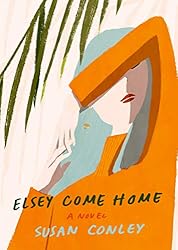
Elsey Come Home
Susan Conley, 2019
Knopf Doubleday
256 pp.
ISBN-13: 9780525520986
Summary
A shattering new novel that bravely delves into the darkest corners of addiction, marriage, and motherhood.
When Elsey’s husband, Lukas, hands her a brochure for a weeklong mountain retreat, she knows he is really giving her an ultimatum: Go, or we’re done.
Once a successful painter, Elsey set down roots in China after falling passionately for Lukas, the tall, Danish MC at a warehouse rave in downtown Beijing.
Now, with two young daughters and unable to find a balance between her identities as painter, mother, and, especially, wife, Elsey fills her days worrying, drinking, and descending into desperate unhappiness.
So, brochure in hand, she agrees to go and confront the ghosts of her past.
There, she meets a group of men and women who will forever alter the way she understands herself: from Tasmin, another (much richer) expat, to Hunter, a young man whose courage endangers them all, and, most important, Mei—wife of one of China’s most famous artists and a renowned painter herself—with whom Elsey quickly forges a fierce friendship and whose candidness about her pain helps Elsey understand her own.
But Elsey must risk tearing herself and Lukas further apart when she decides she must return to her childhood home—the center of her deepest pain—before she can find her way back to him.
Written in a voice at once wry, sensual, blunt, and hypnotic, Elsey Come Home is a modern odyssey and a quietly dynamic portrait of contemporary womanhood. (From the publisher.)
Author Bio
• Birth—ca. 1967 ?
• Where—rural Maine, USA
• Education—B.A., MIddlebury College; M.F.A., San Diego State University
• Currently—lives in Portland, Maine
Susan Conley is the author of two novels—Elsey Come Home (2019) and Paris Was the Place (2013)—as well a memoir, The Foremost Good Fortune (2011). The latter won the Maine Literary Award for memoir.
Born and raised in rural Maine, Conley received her B.A., from Middlebury College and her M.F.A. from San Diego State University. Her writing has appeared in the New York Times Magazine, Paris Review, and Ploughshares. She has been awarded fellowships from the MacDowell Colony, the Bread Loaf Writers' Conference, the Maine Arts Commission, and the Massachusetts Arts Council.
Conley spent three years in Beijing with her husband and two sons before moving back to Portland, Maine, where she helped found The Telling Room, a creative writing center serving 4,000 Maine students each year. She still lives in Portland, teaching in the Stonecoast Writing Program at the University of Southern Maine. (From the publisher.)
Book Reviews
Much of Elsey’s narrative is backward looking. Information drifts in slowly.… Learning more about Elsey’s life gradually clarifies its trajectory, but the unhurried pace of the narrative snippets dulls the first quarter of the book because the details on offer do not make clear why Elsey can neither nurture her beloved family nor pick up her artist’s brush.… In the end… this is a thought-provoking novel, often beautifully written.
Wsshington Times
Described as "perfect" by Judy Blume herself, Susan Conley’s new novel follows Elsey, a woman living in Beijing struggling to reconcile her identities as painter, mother, expat, individual, and wife. When the novel opens, Elsey is drinking heavily and descending rapidly into misery. Her husband suggests she take part in a retreat, where she meets a handful of strangers who change her life. It’s a necessary look at the identity crisis women can face when the world forces them into boxes.
Marie Claire
Elsey used to be a recognized painter, but now she’s the wife of expat Danish musician Lukas and the mother of two girls under 10, and she’s tethered to their home in China. As the slim novel opens, she’s depressed and lost and in crisis; at Lukas’ insistence, she leaves the family for a weeklong retreat that will end up transforming her. Even within a few paragraphs of this exploration of motherhood and individuality, Elsey’s voice and emotional turbulence leap off the page.
Huffington Post
(Starred review) Conley hits the mark on a story line that feels both high-stakes and fine-tuned. But it’s the raw desperation of Elsey’s inner dialogue that elevates the novel, making for an honest and astute depiction of the human psyche.
Publishers Weekly
An esteemed artist, the disaffected, suddenly hard-drinking Elsey has stopped painting in favor of a desperate attachment to her children, and her adventures in yoga and thereafter are a way of trying to get back to her husband.
Library Journal
A yoga retreat on a mountain in China signals a turning point for an expatriate American painter..…Conley's slim novel illustrates the power of storytelling [in] healing. What entices and endures here is the voice: dreamy, meditative, hypnotic, and very real.
Kirkus Reviews
Discussion Questions
We'll add publisher questions if and when they're available; in the meantime, use our LitLovers talking points to help start a discussion for ELSEY COME HOME … then take off on your own:
1. How would you describe Elsey? Why is her life such a struggle? As the book progresses through flashbacks, what do we come to learn about Elsey's past that continues to haunt her?
2. What makes Elsey decide to attend the retreat? Is it solely to please or assuage Lukas?
3. Once at the retreat, Justice, the leader, tells a story of a Daoist philosopher who dreamed he was a butterfly. When he awoke, he could not tell if he was a man dreaming he was a butterfly or if he was a butterfly dreaming he was a man. Justice tells the group, "This is what I want from you here. To become a butterfly." What does he mean?
4. Follow-up to Question 3: Elsey admits to being puzzled by the butterfly dream and Justice's charge to become a butterfly, but she says, "I just knew I wanted to be like him, calm." Is that part of what Justice means, or perhaps at least a beginning of an inward journey?
5. Elsey seems to mock herself. "You hear it and don’t understand when women say they lost themselves because it seems so overdone," she says at one point, "and there are four hundred million people in China living on a dollar a day, so cry me a river." Is Elsey's self-deprecation, or her sense of guilt, over the magnitude of her problems genuine? Is she right: do her problems pale in comparison to others, especially in China? Is she simply being self-indulgent, complaining about first-world problems? On the other hand, is Elsey being unfair to herself?
6. Elsey says, "I couldn't understand how to be obsessed with my children and obsessed with my painting at the same time. I thought both called for obsession." Parse those two sentences—in terms of Elsey's life goals and in terms of your own. Is obsession necessary for pursuing a career and/or raising a family?
7. The author gives a bird's-eye view of China and its numerous social problems: disappearing activists, kidnapped Hong Kong booksellers, the plight of factory workers, and abortion used as birth control. Were these insights into Chinese society interesting, or did you find them distracting from the main story?
8. Talk about the meaning of the novel's title: Elsey come home. Where is home, what is home—in other words, what is the meaning of home, for Elsey in this book, for you, for anyone?
9. Talk about the way in which the week-long retreat changes Elsey. What insights into her life does she gain? How does her friendship with Mei affect her? What about the other participants? What are their individual roles in this story?
10. What do you see for Elsey in the future?
(Resources by LitLovers. Please feel free to use them, online and off, with attribution. Thanks.)


An Ember in the Ashes
Sabaa Tahir, 2015
Penguin Young Readers
464 pp.
ISBN-13: 9781595148032
Summary
An Ember in the Ashes, is the first book in an exhilarating fantasy adventure series about the power of hope in the face of oppression.
Debut novelist Sabaa Tahir tells the thrilling, heart-wrenching story of two unforgettable characters willing to sacrifice everything for the chance to write their own destinies.
In a world inspired by ancient Rome and defined by brutality, seventeen-year old Laia has grown up with one rule for survival: Never challenge the Empire.
But when Laia’s brother Darin is arrested for treason, she leaves behind everything she knows, risking her life to try and save him. She enlists help from the rebels whose extensive underground network may lead to Darin. Their help comes with a price, though. Laia must infiltrate the Empire’s greatest military academy as a spy.
Elias is the Empire’s finest soldier—and its most unwilling one. Since childhood, he has trained to become one of the Masks, deadly fighters who ravage and destroy in the name of the Empire. But Elias is secretly planning a dangerous escape from the very tyranny he has sworn to enforce.
Thrown together by chance and united by their hatred of the Empire, Laia and Elias will soon discover that their fates are intertwined—and that their choices may change the destiny of the entire Empire. (From the publisher.)
This is the first book in the series. The second is A Torch Against the Night.
Author Bio
• Birth—ca. 1981-82
• Raised—London, England (UK)
• Raised—Mojave Desert, California, USA
• Education—B.A., University of California-Los Angeles
• Currently—lives in Bay Area of San Francisco, California
Sabaa Tahir was born in London, England, but raised in a small outpost in California's Mojave Desert. She is the daughter of Pakistani immigrants who own a small 18-room motel at a U.S. military base. Growing up, Tahir was an outcast among her peers—the butt of bullying and taunts that she and her family should "go back to where they came from." That childhood experience of exclusion had a profound affect on Tahir's worldview.
Tahir left the desert at 17 to attend the University of California-Los Angeles (UCLA) and after graduation took a job as a copy editor at the Washington Post. It was while working at the Post that she came across a news item that inspired her to write. A group of Pakistani women in the Indian-occupied region of Kashmir had lost all the men in their families. Husbands, sons, and fathers—all were taken away by the occupying forces; they disappeared without a clue as to where they were being held or what was happening to them.
That's the world we live in, Tahir realized. There was nothing she could do. Yet in her imagination, she could do something: she could create a world in which thse oppressed could fight back. Out of that kernel, and after years writing and rewriting, came her first book, An Ember in the Ashes. The book is the first in a planned series and is already optioned for film. The second book, released in 2016, is A Torch Against the Night.
During the first book's creation, Tahir left the Washington Post, moved back to California with her husband, gave birth to two children, and continued writing. The family now lives in the San Francisco Bay Area. (Adapted from Entertainment Weekly and other sources. Retrieved 9/6/2016.)
Book Reviews
Tahir's exploration of the many ways in which we fall prey to one another, and to ourselves, strengthens the fiber of this action-driven book…There's a duality at work in An Ember in the Ashes: The novel thrusts its readers into a world marred by violence and oppression, yet does so with simple prose that can offer moments of loveliness in its clarity. This complexity makes Ember a worthy novel—and one as brave as its characters.
Marie Rutkoski - New York Times
This novel is a harrowing, haunting reminder of what it means to be human—and how hope might be kindled in the midst of oppression and fear.
Washington Post
This epic fantasy set in the Martial Empire has it all: danger and violence, secrets and lies, strong characters and forbidden romance and a touch of the supernatural.
Atlanta Journal-Constitution
Fast-paced, well-structured and full of twists and turns, An Ember in the Ashes is an evocative debut that has left me invested in knowing what happens next.
NPR
Sabaa Tahir spins a captivating, heart-pounding fantasy.
Us Weekly
An Ember in the Ashes mixes The Hunger Games with Game of Thrones...and adds a dash of Romeo and Juliet.
Hollywood Reporter
Blew me away...This book is dark, complex, vivid, and romantic—expect to be completely transported.
MTV.com
Once you get caught up in the story, it’s addictive, and there’s no way you can put it down before you figure out what happens to the characters you have fallen for over the course of the 400 some-odd pages. So I didn’t.
Bustle
One thing I can say for sure: this is a page-turner. There comes a moment when it's impossible to put it down. Sabaa Tahir is a strong writer, but most of all, she's a great storyteller.
Huffington Post
(Starred review.) Tahir’s deft, polished debut alternates between two very different perspectives on the same brutal world, deepening both in the contrast.... [A] tale brimming with political intrigue and haunted by supernatural forces.... [Age 14 & up.]
Publishers Weekly
Tahir's world-building is wonderfully detailed and the setting is an unusual one for fantasy novels. All of her characters, even minor ones, are fully realized..... The author doesn't pull any punches; her descriptions of torture, punishment, and battle are graphic and brutal, and her realistic depictions of the treatment of slaves include rape and physical abuse. [Gr 9 & up.] —Kathleen E. Gruver, Burlington County Library, Westampton, NJ
School Library Journal
Readers may wince at the cruelty of the trials, which pose friend against friend, and require the competitors to kill others. The trials seem repetitive at times, and the heroics sometimes impossible. A fair amount of double crossing adds to the tension, but the ending is unexpectedly satisfying. [Ages 12-18.]
VOYA
Predictably, action, intrigue, bloodshed and some pounding pulses follow; there's betrayal and a potential love triangle or two as well. Sometimes-lackluster prose and a slight overreliance on certain kinds of sexual violence as a threat only slightly diminish...[this] truly engaging if not fully fleshed-out fantasy world. [Ages 13 & up.]
Kirkus Reviews
Discussion Questions
We'll add publisher questions if and when they're available. In the meantime, consider using these LitLovers talking points to help start a discussion for An Ember in the Ashes...then take off on your own:
1. The setting in An Ember in the Ashes is reminiscent of ancient Rome. Talk about the society, particularly it's slavery and the way that practice undermines a civilization's humanity.
2. Does the Sabaa Tahir flesh out her characters fully? Or do some seem undeveloped, overly cruel, even cartoonish perhaps? What kind of character is Elias, for instance, and why does he want to run away? Here is a child of privilege and yet he is unhappy with the way things are. What changes his mind?
3. Tahir uses multiple points of view, including that of the cruel headmistress of the military school. What does it feel like to see from her perpective? Does it change your attitude toward her character?
4. How and why is violence turned against the members of the empire, making them, in a way, victims of their own society.
5. And what about the violence. Does its frequent use in the novel inure you to it (do you become used to it), or are you continually repulsed by the brutality? Is the use of violence gratuitous, perhaps? Or is it purposeful in furthering the plot and building an overarching sense of dread?
6. Comparisons have inevitably been made to The Hunger Games and Game of Thrones. What do you think?
7. What is the significance of the book's title?
(Questions by LitLovers. Please feel free to use them, online or off, with attribution. Thanks.)


Emergency Care
Linda Owen, 2014
Westbow Press
290 pp.
ISBN-13: 9781490814001
Summary
In Mexico, Hurricane Bertha flattened tobacco crops and coffee bean fields and demolished entire villages. Then suddenly she turned northward—a surprising act that had not been foreseen by meteorologists.
After twelve hours, the winds that had reached 180 miles per hour would slow, and the storm would die. But before that, Bertha would terrorize the unsuspecting residents of a South Texas hospital and the bank robbers holding them hostage.
It is a toss-up whether nurse Sidney Shelton is more afraid of the thugs or the hurricane. For hours the captors threaten and brutalize the hostages. Sidney wonders whether they will be dead or alive when the robbers leave. What can she do to protect her six-year-old son and friends from harm? God sends her unexpected help from a Mexican policeman and a soldier with post-traumatic stress disorder.
Author Bio
• Birth—N/A
• Where—San Marcos, Texas, USA
• Education—B.S., Southwest Texas University; M.Div., Perkins School of Theology
• Currently—lives in San Antonio, Texas
Linda Owen has had thousands of articles published. She is a regular writer on faith, retirement, travel, and general interest subjects for a variety of newspapers and magazines, both secular and Christian.
She received a Master of Divinity Degree from Perkins School of Theology (SMU) and served briefly as the pastor in churches. Linda teaches a weekly Bible study and has written Bible Study Curriculum for the United Methodist Publishing House. For five years she edited www.saworship.com, a Christian magazine. She is also the author of Lady President, a romantic suspense.(From the author.)
Visit the author's website.
See article on Linda.
Book Reviews
If you like your suspense fast paced with non-stop action and surprise twists, then check out Emergency Care, the debut novel by Linda Owen. With a definite edgy tone, this novel is a quick read that packs a clear spiritual message.
Four dangerous men make their way to a small Texas town near the Mexican border trying to elude the police after a murder and bank robbery. An accident puts them in the ER of the local hospital along with a small holiday staff and a hurricane bearing down on them. They take the patients and staff hostage and try to ride out the storm, but events are soon out of their control.
There are a number of surprises in store for the reader of Emergency Care. Just when you think you know what is going to happen next, Owen throws a curve ball to ramp up the adrenaline.... As I said, this is an edgy novel. Never graphic, it does contain some violence and adult situations, but no profanity. A good choice for fans of Brandilyn Collins or Steven James.
Beckie Burnham - By The Book
Discussion Questions
1. What was unique about the hospital setting and how did it enhance or take away from the story? Was the hurricane relevant or not?
2. What specific themes did the author emphasize throughout the novel? What do you think she is trying to get across to the reader?
3. Do you think the Lone Ranger motif relates to the character of Perry? Why or why not?
4. Several characters change or evolve throughout the course of the story. Which one was your favorite? What events trigger such changes?
5. Did certain parts of the book make you uncomfortable? If so, why did you feel that way?
6. Did the author lead you to a new understanding or awareness of God’s role in your life?
7. What made you want to read this book? Did it live up to your expectations? Why or why not?
8. Discuss the book's structure. Does the author use any narrative devices like flashbacks or multiple voices in telling the story? What do you consider the climax of the novel? Would you have preferred it to end then, instead of showing the effect of the horrific experience on the survivors?
9. Do you think suffering makes people closer to God or causes them to distance themselves from Him? What has been the pattern in your life?
10. Were you satisfied with Sidney’s answers to Jamie about God and her illness? (See chapter 24.) What else would you have told the girl? Have you seen God working through human beings to accomplish His plan? When?
11. Do you believe in the healing power of God? Even if there is no healing miracle, where do you see God at work?
12. Were you in agreement with Ruby’s explanation to Jim about suffering in the world? She cites Rom. 8:28. Do you have a Bible verse that you prefer?
13. Do you agree with what Pastor Charles says about taking another person’s life? About God’s forgiveness? If you were in Sidney’s place, would the clergyman’s counsel have helped you?
14. How effectively does the author portray the presence of spirituality in the characters' lives? Does the author succeed in presenting prayer in a way that feels relevant? Are there specific characters whose beliefs resonate with yours?
15. What do you see as the major message of the novel?
16. What does Jesus say about forgiveness that relates to your life?
(Questions courtesy of the author.)
Emergency Contact
Mary H.K. Choi, 2018
Simon & Schuster
400 pp.
ISBN-13: 9781534408968
Summary
From debut author Mary H.K. Choi comes a compulsively readable novel that shows young love in all its awkward glory—perfect for fans of Eleanor & Park and To All the Boys I’ve Loved Before.
For Penny Lee high school was a total nonevent. Her friends were okay, her grades were fine, and while she somehow managed to land a boyfriend, he doesn’t actually know anything about her.
When Penny heads to college in Austin, Texas, to learn how to become a writer, it’s seventy-nine miles and a zillion light years away from everything she can’t wait to leave behind.
Sam’s stuck. Literally, figuratively, emotionally, financially. He works at a cafe and sleeps there too, on a mattress on the floor of an empty storage room upstairs. He knows that this is the god-awful chapter of his life that will serve as inspiration for when he’s a famous movie director but right this second the seventeen bucks in his checking account and his dying laptop are really testing him.
When Sam and Penny cross paths it’s less meet-cute and more a collision of unbearable awkwardness.
Still, they swap numbers and stay in touch—via text—and soon become digitally inseparable, sharing their deepest anxieties and secret dreams without the humiliating weirdness of having to see each other. (From the publisher.)
Author Bio
• Birth—ca. 1978-79
• Where—Seoul, South Korea
• Raised—Hong Kong; San Antonio, Texas, USA
• Education—B.A., University of Texas, Austin
• Currently—lives in Brooklyn, New York City, New York
Mary H.K. Choi is a writer for the New York Times, GQ, Wired, and the Atlantic. She has written comics for Marvel and DC, as well as a collection of essays called Oh, Never Mind.
She is the host of Hey, Cool Job!, a podcast about jobs, and is a culture correspondent for VICE News Tonight on HBO. Emergency Contact is her first novel. Mary grew up in Hong Kong and Texas and now lives in New York. (From the publisher.)
Book Reviews
[A] blushingly tender and piquant debut novel.… [Choi] inserts timely issues like sexual assault, cultural appropriation and even DACA into her characters' intimate conversations, but it is her examination of digital vs. F2F communication that feels the most immediate.
New York Times Book Review
Penny somehow broke down all my walls. Her tech became incidental and her voice endearing, and just like that, I was hooked. Even the texts feel very natural and elegantly woven into the narration.There is much more to both Sam and Penny than quirky character traits and witty repartee.… While the story does traffic in the heart flutter of romance that is tantalizingly out of reach, its emotional core goes deep.
NPR
(Starred review) Choi sensitively shows the evolution of two lonely, complicated people…. Her sharp wit and skillful character development…ensure that readers will feel that they know Penny and Sam inside and out before the gratifying conclusion (Ages 14–up).
Publishers Weekly
Choi creates an up-to-date and realistic contemporary romance by upending the love story trope. Miscues and miscommunications, which often propel romantic plots forward, are replaced by open and constant screen-to-screen communication (Gr 9-up). —Eva Thaler-Sroussi, Needham Free Public Library, MA
School Library Journal
Readers will swoon…. Choi has a knack for creating relatable characters, and this quirky, socially awkward love story will keep your cheeks rosy with every page.… [T]he perfect book for those who root for the underdog and believe broken people can heal together.
Romance Times
It is sadly ironic that the [negative] feedback from Penny's creative writing professor …applies equally to this novel. Witty asides and up-to-the-minute slang cannot compensate for an absence of emotional depth or well-crafted prose (Ages 14-18).
Kirkus Reviews
Discussion Questions
We'll add publisher questions if and when they're available; in the meantime, use our LitLovers talking points to help start a discussion for EMERGENCY CONTACT … then take off on your own:
1. Describe Penny and Sam. What do we come to learn about them through their texts? What character traits lay beneath their witty repartee? Some readers have found Penny overly judgmental to the point of unpleasantness, preferring Sam's character over hers. What's your opinion?
2. In what way is the texting between Penny and Sam confessional? How does the couple's texting evolve over time? Importantly, how do Penny and Sam themselves evolve over the course of the novel—or do they?
3. Consider Penny's mother, Celeste, who "resembled an incoming freshman as much as Penny did." What do you think of her? What about the other characters—Jude, Mallory, Lorraine, and Andy?
4. How is texting easier or safer than personal contact—in which two people have to look each other in the eye? Consider, for instance, Sam's worries about the way Penny might judge his impoverished background.
5. Is a virtual relationship as real or legitimate as an "in-person" relationship? Is it possible to "know" someone through texting? Is texting any different than being pen pals through the written and mailed letters of a previous generation? If either your child or a close friend confided in you about a new romance via texting, how would you respond?
6. Consider the nature of the couple's texting, its intimate revelatory nature. Then consider the book's title. Why might that title be seen as ironic, or at least engendering a different take on the word "emergency"? And yet in other ways, "emergency" is an absolutely appropriate word for the relationship between Sam and Penny. How so?
7. Author Mary H.K. Choi has said of her novel, "high-key nothing happens." Does nothing happen in this book? What do you think?
8. Penny gets some of the novel's best lines. What are some of your favorites? What do you make, for instance, of the multiple choice list she creates for responding to personal slights?
9. Penny describes her relationship with Sam: "It wasn't a romance; it was too perfect for that. Care to comment—what does it mean when a relationship is too perfect for a romance?
10. If you're over 30, is the teenage text lingo difficult to grasp? Does the overall language make the novel work for you? Or do you find it off putting?
11. By the novel's end, what are your hopes/expectations for Penny and Sam?
(Questions by LitLovers. Please feel free to use them, online and off, with attribution. Thanks.)
Emma
Jane Austen, 1815
400-500 pp. (varies by publisher)
Summary
Beautiful, clever, rich—and single—Emma Woodhouse is perfectly content with her life and sees no need for either love or marriage. Nothing, however, delights her more than interfering in the romantic lives of others. But when she ignores the warnings of her good friend Mr. Knightley and attempts to arrange a suitable match for her protegee Harriet Smith, her carefully laid plans soon unravel and have consequences that she never expected. With its imperfect but charming heroine and its witty and subtle exploration of relationships, Emma is often seen as Jane Austen's most flawless work.
More
Emma was written between January 1814 and March 1815, published in 1815. The title character, Emma Woodhouse, is queen of her little community. She is lovely and wealthy. Se has no mother; her fussy, fragile father imposes no curbs on either her behavior or her self-satisfaction. Everyone else in the village is deferentially lower in social standing. Only Mr. Knightley, an old family friend, ever suggests she needs improvement.
Emma has a taste for matchmaking. When she meets pretty Harriet Smith, "the natural daughter of somebody," Emma takes her up as both a friend and a cause. Under Emma's direction, Harriet refuses a proposal from a local farmer, Robert Martin, so that Emma can engineer one from Mr. Elton, the vicar. Unluckily, Mr. Elton misunderstands the intrigues and believes Emma is interested in him for herself. He cannot be lowered to consider Harriet Smith.
Things are further shaken by the return to the village by Jane Fairfax, niece to the garrulous Miss Bates; and by a visit from Frank Churchill, stepson of Emma's ex-governess. He and Jane are secretly engaged, but as no one knows this, it has no impact on the matchmaking frenzy.
The couples are eventually sorted out, if not according to Emma's plan, at least to her satisfaction. Uninterested in marriage at the book's beginning, she happily engages herself to Mr. Knightly before its end. (From the Penguin Classics edition.)
Author Bio
• Born—December 16, 1775
• Where—Steventon in Hampshire, UK
• Death—July 18, 1817
• Where—Winchester, Hampshire
• Education—taught at home by her father
In 1801, George Austen retired from the clergy, and Jane, Cassandra, and their parents took up residence in Bath, a fashionable town Jane liked far less than her native village. Jane seems to have written little during this period. When Mr. Austen died in 1805, the three women, Mrs. Austen and her daughters, moved first to Southampton and then, partly subsidized by Jane's brothers, occupied a house in Chawton, a village not unlike Jane's first home. There she began to work on writing and pursued publishing once more, leading to the anonymous publication of Sense and Sensibility in 1811 and Pride and Prejudice in 1813, to modestly good reviews.
Known for her cheerful, modest, and witty character, Jane Austen had a busy family and social life, but as far as we know very little direct romantic experience. There were early flirtations, a quickly retracted agreement to marry the wealthy brother of a friend, and a rumored short-lived attachment—while she was traveling—that has not been verified. Her last years were quiet and devoted to family, friends, and writing her final novels. In 1817 she had to interrupt work on her last and unfinished novel, Sanditon, because she fell ill. She died on July 18, 1817, in Winchester, where she had been taken for medical treatment. After her death, her novels Northanger Abbey and Persuasion were published, together with a biographical notice, due to the efforts of her brother Henry. Austen is buried in Winchester Cathedral.
Jane Austen's delightful, carefully wrought novels of manners remain surprisingly relevant, nearly 200 years after they were first published. Her novels—Pride and Prejudice and Emma among them—are those rare books that offer us a glimpse at the mores of a specific period while addressing the complexities of love, honor, and responsibility that still intrigue us today. (From Barnes & Noble.)
Book Reviews
(Classic works have few, if any, mainstream press reviews online. See Amazon and Barnes & Noble for helpful customer reviews.)
A brilliant, complex dance—with skip-steps, turns, and sashays. Emma is Austen’s masterpiece, a story in which triple strands of plot bob and weave in and around one another, and Austen never misses a step. Austen’s witty, critical eye is in fine fiddle, drawing sharp-edged portraits of types: hypochondriacs, garrulous elders, social climbers, handsome rakes, and salt-of-the-earth yeoman farmers. Of course, what makes Austen so rewarding and endlessly funny is that we recognize these same types in our own era—some 200 years later.
A LitLovers LitPick (Jan. '07)
A masterpiece ... the fusing of moral consideration and human drama achieves perfect pitch.'
Carol Shields, author
Jane Austen exercises her taste for cutting social observation and her talent for investing seemingly trivial events with profound moral significance as Emma traverses a gentle satire of provincial balls and drawing rooms, along the way encountering the sweet Harriet Smith, the chatty and tedious Miss Bates, and Emma's absurd father Mr. Woodhouse—a memorable gallery of Austen's finest personages. Thinking herself impervious to romance of any kind, Emma tries to arrange a wealthy marriage for poor Harriet, but refuses to recognize her own feelings for the gallant Mr. Knightley. What ensues is a delightful series of scheming escapades in which every social machination and bit of "tittle-tattle" is steeped in Austen's delicious irony. Ultimately, Emma discovers that "Perfect happiness, even in memory, is not common." Virginia Woolf called Jane Austen "the most perfect artist among women," and Emma Woodhouse is arguably her most perfect creation. Though Austen found her heroine to be a person whom "no one but myself will much like," Emma is her most cleverly woven, riotously comedic, and pleasing novel of manners.
Steven Marcus - Barnes & Noble Classics edition
Discussion Questions
1. Describe the class and rank of various characters in the village of Highbury. Compare the positions of Mr. Weston, Mr. Elton, Miss Taylor, Harriet, and Emma with others in Highbury. How do matters of class affect the interaction of these characters, and would you describe class as being rigid or flexible as it is depicted by Jane Austen? To what extent can class be said to be of central importance to the development of the novel, since it is one of the most important considerations in marriage? Does class seem to be treated differently by those in Highbury than it does by outsiders, for example Frank Churchill and Mrs. Elton? Do you think it is significant that no woman in Highbury is of Emma's age and rank?
2. How does the relationship between Mr. Knightley and Emma change throughout the course of the novel? Although Austen does not directly tell us what their relationship was like during Emma's childhood, their long and intimate friendship is established at the novel's opening. In light of their occasional quarrels and Knightley's criticisms of Emma, for example, the criticism he made on Box Hill, how does Mr. Knightley feel about Emma? Do Mr. Knightley's feelings change as the novel progresses? If they do, what incidents account for the changes in his feelings?
3. Does Emma act as a good friend to Harriet Smith? Are Emma's concerns for Harriet's education and refinement born of an honest desire to help, or is it something less altruistic? Are Mr. Knightley's criticisms of Emma's interference with Mr. Martin's marriage proposal justified? Does Harriet ultimately benefit from Emma's friendship or her attempts to help her?
4. While matchmaking is the central device in Emma, both for the plot and as a backdrop to develop characters, not all of the matches made in the novel are good. Compare the matches made between Mr. Weston and Miss Taylor, Emma and Mr. Knightley, Harriet and Mr. Martin, Jane Fairfax and Frank Churchill, and Mr. Elton and Mrs. Elton. Which are good matches and which are bad? What character traits in the couples make them suited or unsuited for each other? Why are the mismatches so important to the story?
5. In the final analysis, is Emma a sympathetic character? Does she seem to have good intentions only marred by a slight desire to interfere with other people's lives, or is she thoughtless and unconcerned with the effects she has on others? In your estimation, is Emma ultimately moral or immoral? What specific incidents in the novel lead you to that conclusion?
(Questions issued by Penguin Classics—cover image, top left.)
top of page (summary)

Emma in the Night
Wendy Walker, 2017
St. Martin's Press
320 pp.
ISBN-13: 9781250141439
Summary
One night three years ago, the Tanner sisters disappeared: fifteen-year-old Cass and seventeen-year-old Emma.
Three years later, Cass returns, without her sister Emma. Her story is one of kidnapping and betrayal, of a mysterious island where the two were held.
But to forensic psychiatrist Dr. Abby Winter, something doesn't add up. Looking deep within this dysfunctional family Dr. Winter uncovers a life where boundaries were violated and a narcissistic parent held sway.
And where one sister's return might just be the beginning of the crime.
Bestselling author Wendy Walker returns with another winning thriller, Emma in the Night. (From the publisher.)
Author Bio
• Birth—ca. 1966-67
• Where—Fairfield County, Connecticut, USA
• Education—B.A., Brown University; J.D., Georgetown University
• Currently—lives in Fairfield County, Connecticut
Wendy Walker was born and raised in Fairfield County, Connecticut, where she still lives, practicing law and and writing novels.
She earned her undergraduate degree from Brown Univeristy, spending a year abroad at the London School of Economics, then heading to Georgetown University for her law degree. She has been a financial analyst for Goldman Sachs and is now a family lawyer.
Divorced and the mother of three sons, Walker recalled writing her first novel "on the fly in her minivan," as The New York Times put it—a la J.K. Rowling, without the welfare check."
That first novel was Four Wives (2008), set in the fictional town of Hunting Ridge in wealthy Fairfield County. Walker's next two novels, Social Lives (2009) and All is Not Forgotten (2016), a thriller, are also set in her native Fairfield County. Emma in the Night (2017) is Walker's fourth novel. (Adapted from the author's website and various online sources. Retrieved 7/19/2017.)
Book Reviews
Finally, where's Emma? If this were a better book, we would be on tenterhooks about that question throughout. Instead, there's so much else going on that solving the riddle of her disappearance sometimes shrinks into a minor matter. But Emma is not forgotten. Rest assured that the opportunity for a big, exploitative here-comes-Emma scene does not go to waste.
Janet Maslin - New York Times
(Starred review.) In this searing psychological thriller.…Walker's portrayal of the ways in which a narcissistic, self-involved mother can affect her children deepens the plot as it builds to a shocking finale.
Publishers Weekly
(Starred review.) Both twisted and twisty, this smart psychological thriller sets a new standard for unreliable narrators.
Booklist
A tense thriller explores the bond between sisters and family dynamics that give new meaning to the term "dysfunctional."…This thriller aims right for the heart and never lets go.
Kirkus Reviews
Discussion Questions
We'll add publisher questions if and when they're available; in the meantime, use our GENERIC MYSTERY QUESTIONS to start a discussion for Emma in the Night ... then take off on your own:
GENERIC DISCUSSION QUESTIONS
Mystery / Crime / Suspense Thrillers
1. Talk about the characters, both good and bad. Describe their personalities and motivations. Are they fully developed and emotionally complex? Or are they flat, one-dimensional heroes and villains?
2. What do you know...and when do you know it? At what point in the book do you begin to piece together what happened?
3. Good crime writers embed hidden clues in plain sight, slipping them in casually, almost in passing. Did you pick them out, or were you...clueless? Once you've finished the book, go back to locate the clues hidden in plain sight. How skillful was the author in burying them?
4. Good crime writers also tease us with red-herrings—false clues—to purposely lead readers astray? Does your author try to throw you off track? If so, were you tripped up?
5. Talk about the twists & turns—those surprising plot developments that throw everything you think you've figured out into disarray.
- Do they enhance the story, add complexity, and build suspense?
- Are they plausible or implausible?
- Do they feel forced and gratuitous—inserted merely to extend the story?
6. Does the author ratchet up the suspense? Did you find yourself anxious—quickly turning pages to learn what happened? A what point does the suspense start to build? Where does it climax...then perhaps start rising again?
7. A good ending is essential in any mystery or crime thriller: it should ease up on tension, answer questions, and tidy up loose ends. Does the ending accomplish those goals?
- Is the conclusion probable or believable?
- Is it organic, growing out of clues previously laid out by the author (see Question 3)?
- Or does the ending come out of the blue, feeling forced or tacked-on?
- Perhaps it's too predictable.
- Can you envision a different or better ending?
8. Are there certain passages in the book—ideas, descriptions, or dialogue—that you found interesting or revealing...or that somehow struck you? What lines, if any, made you stop and think?
9. Overall, does the book satisfy? Does it live up to the standards of a good crime story or suspense thriller? Why or why not?
(Generic Mystery Questions by LitLovers. Please feel free to use them, online or off, with attribution. Thanks.)
top of page (summary)
The Emperor of Ocean Park
Stephen L. Carter, 2002
Knopf Doubleday
657 pp.
ISBN-13: 9780307279934
Summary
The Emperor of Ocean Park is set in two privileged worlds: the upper crust African American society of the eastern seaboard—old families who summer on Martha's Vineyard—and the inner circle of an Ivy League law school. It is the story of a complex family with a single, seductive link to the shadowlands of crime.
The Emperor of the title, Judge Oliver Garland, has just died, suddenly. A brilliant legal mind, conservative and famously controversial, Judge Garland made more enemies than friends. Many years before, he'd a earned a judge's highest prize: a Supreme Court nomination. But in a scene of bitter humiliation, televised across the country, his nomination collapsed in scandal. The humbling defeat became a private agony, one from which he never recovered."
But now the judge's death raises more questions—and it seems to be leading to a second, even more terrible scandal. Could Oliver Garland have been murdered? He has left a strange message for his son Talcott, a professor of law at a great university, entrusting him with "the arrangements"—a mysterious puzzle that only Tal can unlock, and only by unearthing the ambiguities of his father's past. When another man is found dead, and then another, Talcott—wry, straight-arrow, almost too self-aware to be a man of action—must risk his career, his marriage, and even his life, following the clues his father left him. (From the publisher.)
Author Bio
• Birth—October 26, 1954
• Where—Washington, D.C., USA
• Education—B.A. Stanford University; J.D., Yale Law School
• Currently—New Haven, Connecticut
Stephen L. Carter has helped shape the national debate on issues ranging from the role of religion in American political culture to the impact of integrity and civility on our daily lives. The New York Times has called him one of the nation's leading public intellectuals.
Born in Washington, D.C., Stephen L. Carter studied law at Yale University and went on to serve as a law clerk, first on the U.S. Court of Appeals for the District of Columbia, and later for Supreme Court Justice Thurgood Marshall.
In 1982 he joined the faculty at Yale, where he is now William Nelson Cromwell Professor of Law. His critically acclaimed nonfiction books on subjects including affirmative action, the judicial confirmation process, and the place of religion in our legal and political cultures have earned Carter fans among luminaries as diverse as William F. Buckley, Anna Quindlen, and former President Bill Clinton.
Carter's first novel, The Emperor of Ocean Park, draws heavily on the author's familiarity with the law and the world of highly placed judges, but he didn't begin by attempting to write a "judicial" thriller— Carter earlier tried the character of Judge Garland out as a White House aide, and also as a professor like himself. He has said that in the end "only the judicial role really fit."
With Emperor Carter has moved (for the moment) from writing nonfiction to fiction—a shift which he downplays by noting "I have always viewed writing as a craft." But, while he has also indicated that another novel like this one is in the works, he sees himself as "principally a legal scholar and law professor" and plans to continue publishing nonfiction as well.
New England White, Carter's second novel, published in 2008, takes up the story of two secondary characters from The Emperor of Ocean Park, LeMaster and Julia Carlyle.
Extras
From a Barnes & Noble interview:
• An avid chess player, Stephen L. Carter is a life member of the United States Chess Federation. Although he says he plays less now than he once did, he still plays online through the Internet Chess Club. For The Emperor of Ocean Park, Professor Carter says he had to learn about "the world of the chess problemist, where composers work for months or years to set up challenging positions for others to solve."
• Carter lives with his wife, Enola Aird, and their two children, near New Haven, Connecticut.
• When asked what books most influenced his career as a writer or scholar, her is what he said:
I would have to say the Bible, especially as I began to read theology and philosophy in a serious way. The Bible has changed my life.
• Other favorite books include:
Toni Morrison’s Song of Solomon, for the sheer beauty of the prose and the seamless integration of metaphor into the story. Rarely have I encountered such remarkable characterizations and settings. And, oh, how deft her touch with dialogue!
F. Scott Fitzgerald's The Great Gatsby. Simply put, one of the greatest novels ever written in English. Bringing an era to life and offering a withering critique without preaching at us. Marvelous characters, engaging story, and in so small a package.
James Baldwin's Go Tell It on the Mountain. A novel of immense passion and power, taking seriously the Christianity of its characters but presenting them as complex and flawed as he cuts back and forth across their stories. Just stunning. I am not sure I have read a finer inter-generational story.
E. L. Doctorow's Ragtime. Whether you think it is just a good read or, as some think, a novel-length metaphor for the '60s, a wonderfully evocative tale of a hundred years back, set in a time of great social flux, told in a prose so compelling that it is difficult to find a place to stop for breath.
Chinua Achebe's Things Fall Apart. I read this in college, before it became a standard text for high schoolers, and its power nearly wore me out. No finer story, in my experience, of the conflict between traditional society and the modern world, with the possible exceptions of two others I rather like: Death and the King’s Horseman, by Wole Soyinka, and, more recently, The Remains of the Day, by Kazuo Ishiguro.
George Orwell's 1984. I have never read another novel that provides more food for thought, or more text for discussion. And as scary as they come.
Stephen King's Christine. Few people would probably rank this as King’s best, but I think that it creates as fully realized an adolescent world as one is likely to find in popular fiction. One of the few contemporary novels I find worth going back to again and again to learn more.
John le Carré's Smiley’s People and Tinker, Tailor, Soldier, Spy—the two modern masterpieces of the espionage genre. I suppose I could add some mystery writers, such as Sue Grafton and Agatha Christie. (Author bio and interview from Barnes & Noble.)
Book Reviews
A contrived, implausible and needlessly baroque melodrama, which reads as if it were written for serial publication, with nearly every chapter ending on a hokey cliffhanger.
New York Times - Michiko Katutani
Taking a sabbatical from penning didactic nonfiction about America's cultural decline, Carter has written a mammoth debut novel about upper-class African-American society that doubles as a legal thriller. The setup is suspiciously Grishamesque: Judge Oliver Garland, an iconic black conservative famous for his outspoken opinions, a long list of enemies and his near-appointment to the Supreme Court, dies of a heart attack. Or does he? Soon after Oliver's death, his son Talcott, a cuckolded law professor who has spent his life trying to get out of his father's shadow, begins to receive strange threats. Exactly who's making the threats (and why) is all very hush-hush, but whispers of dark family secrets and "arrangements" that have been left by Oliver keep everyone jumpy and conspiracy-happy. The book's subject, an often-ignored segment of American society, is a welcome departure. However, the author is prone to lectures on race relations and the state of academe, and the story suffers from his tin ear for dialogue and portentous tone.
Book Magazine
Carter, a Yale law professor and distinguished conservative African-American intellectual known for his nonfiction (The Culture of Disbelief), has written a first-rate legal thriller guaranteed to broaden his audience. The narrator, Talcott Garland, is a law professor at Elm Harbor University whose occasional Carteresque editorializing about politics and justice are saved from didacticism by his abiding existential loneliness. The mystery at the heart of the novel stems from Tal's father's disgrace: Judge Oliver Garland (a Robert Bork meets Clarence Thomas type) was nominated by Ronald Reagan for a Supreme Court seat, but brought down in the Senate hearings when it was revealed that he had a friendship with Jack Ziegler, a wild-card former CIA agent now rumored to be an organized crime kingpin. When the judge dies of what looks like a heart attack and Ziegler turns up at his funeral, Tal is initiated into a quest to uncover mysterious "arrangements" his father made in the event of his untimely demise. Various shady entities observe Tal chasing down the judge's clues, which include a cryptic note ("you have little time....Excelsior! It begins!") and derive from chess strategy. Meanwhile, Talcott is going through a rough patch: his wife, Kimmer, a high-powered attorney, is probably cheating on him, his Elm Harbor law school colleagues are suspicious of him and a fake FBI man is following him around. As Talcott digs deeper, he uncovers a vein of corruption that runs all the way to the top, and his own life becomes threatened. This thriller, which touches electrically on our sexual, racial and religious anxieties, will be the talk of the political in-crowd this summer.
Publishers Weekly
A Yale law professor and author of seven nonfiction books of legal and political philosophy, Carter (The Culture of Disbelief) here turns his hand to fiction. When Judge Garland dies, his son Talcott tries to piece together his father's secret life and make sense of "the arrangements," his father's mysterious final requests. At least that's what Tal thinks he's doing. Suddenly, this law professor a failure at marriage and distracted father finds himself caught in an invisible net of vague clues about the judge's arrangements, delivered in hushed voices by a bewildering cast of extended family, so-called friends, Mafia "uncles," and thugs disguised as FBI agents. Carter moves the unwitting professor inch by painful inch toward truth and psychological disintegration as he learns about his father's corruption and also loses his wife. Suspense falls flat, however, as the author delivers description for action and philosophy rather than plot. The book is overlong and reads more like a composite view of Carter's ideology than the legal thriller it could have been. Those who enjoy a leisurely pace to their suspense and subscribe to Carter's philosophy of conservatism will enjoy it. The rest will stick with Grisham, Martini, and Margolin. —Jennifer Baker, Seattle, Or.
Library Journal
This sleek, immensely readable first novel by Yale law professor Carter, author of such provocative nonfiction as The Culture of Disbelief and God's Name in Vain, is custom-designed for the kind of commercial success enjoyed by John Grisham's The Firm. The complicated fun begins with the death of federal Judge Oliver Garland, a black conservative and former Reagan appointee to the Supreme Court-a nomination that fell through when a scandal linked Garland to "underground investment banker" Jack Ziegler, whose shadowy figure initiates the subsequent intrigues into which Garland's son Talcott (a prim law prof, and Carter's narrator) is swept up. Talcott's fiery sister Mariah insists that their father (a presumable suicide) was murdered. Initially unpersuaded, Talcott gradually becomes a believer as he's alternately stroked and betrayed by various colleagues and pols, stalked, shot at, and thunderstruck by what he learns regarding the (earlier) death of his sister Abigail in a hit-and-run accident, the Judge's mingled grief and fury thereafter, and the hidden agenda of Talcott's forceful wife "Kimmer" (Kimberly), an attorney hustling for her own appointment to the federal bench. Almost everybody is other than what he or she seems, including Talcott's feckless older brother Addison, NBA pro-turned law student Lionel Eldridge, liberal Justice Wallace Wainwright, an ebullient mystery woman named Maxine, and urbane black careerist Lemaster Carlyle. Prominent among the crucial narrative elements are a missing set of "arrangements" supposedly written by Judge Garland, a reputed hit man posing as an FBI agent, baffling references to (the unknown) "Angela's boyfriend," a chess problem known as "Double Excelsior," and several misheard scraps of information. Carter connects all this irresistible hugger-mugger with great skill, building toward a series of staggered climaxes that explode over the final 150 pages. Few readers will refrain from racing excitedly through them. A melodrama with brains and heart to match its killer plot.
Kirkus Reviews
Discussion Questions
1. How does The Emperor of Ocean Park differ from more conventional mysteries? In what ways is the narrator, Talcott Garland, unlike his counterparts—men like Philip Marlow, Sam Spade, and their descendants—in the prototypical mystery?
2. How does Carter build and sustain suspense throughout the novel? What are the several mysteries Talcott is trying to solve? What discoveries does he make—about his father, his wife, his brother, Jack Ziegler, Justice Wainwright, and others—over the course of the novel? What effect do these discoveries have on him?
3. The issue of race is a recurrent theme in The Emperor of Ocean Park. What is Talcott’s attitude toward race? In what instances is he subject to racial stereotyping? What observations does he make about the white liberal racism he encounters on campus? What racial hypocrisies does he see in his fellow blacks?
4. At the Judge’s funeral, Aunt Alma cryptically tells Talcott that he has “the chance to make everything right.... You can fix it.... But your daddy will let you know what to do when the time comes” [p. 24]. Like Hamlet, Talcott is charged by his father, beyond the grave, to set things right. In what other ways is Talcott a Hamlet-like character? In what ways must he both fulfill and transcend his father’s demands?
5. What makes Jack Ziegler such a frightening character? In what ways is he more than a mere villain? In what sense is he, as Talcott says, the “author” of the Garland family’s misery?
6. Talcott’s cousin Sally tells him: “You think you’re so different from Uncle Oliver, but you’re just like him. In some good ways, sure, but in some of the worst ways, too. You look down your nose at people you think are your moral inferiors. People like your brother. People like me” [p. 270]. Is she right? In what other ways is Talcott like his father? How is he different from him?
7. What role do the chess problems play in the novel? How do they lead Talcott to uncover his father’s “arrangements”? How are they related to issues of race and power? In what sense is Talcott himself a pawn?
8. When a man calls his house asking for his wife, Talcott thinks: “Odd the way the immediate concerns about a dying marriage can knock worries about torture and murder and mysterious chess pieces right out of the box, but priorities are funny that way” [p. 453]. In what ways is the story of Talcott and Kimmer’s failing marriage—and the larger story of the complex relations in the Garland family—more important than the murder mystery? How are his marital problems related to the mystery he is trying to solve?
9. The Emperor of Ocean Park describes a social milieu rarely seen in American fiction: the black middle class. What does the novel tell us about the highly successful people who make up this class? How are they different from African Americans more commonly encountered in modern and contemporary fiction?
10. Late in the novel, “a wave of fatalism” sweeps over Talcott and he wonders “whether I could have done anything differently, or if, once the Judge died, setting his awful plan in motion, and Jack Ziegler showed up demanding to know the arrangements, everything else was fixed. Whether my marriage, even, was doomed from the day of the funeral” [p. 533]. Is the story fated to end as it does or could Talcott have changed its outcome? What might he have done differently?
11. The Emperor of Ocean Park is not merely a thriller, but also an extended critique of American culture, commenting on issues of family, religion, law, education, race, marriage, wealth, and politics. What do the frequent philosophical digressions add to the novel? What beliefs and values does Talcott Garland try to live by?
12. During a dinner-table argument, Dr. Young asserts that Satan “always attacks us in the same ways.... He attacks us with sexual desire and other temptations that distract the body. He attacks us with drink and drugs and other temptations that addle the brain. He attacks us with racial hatred and love of money and other temptations that distort the soul” [p. 346]. How does this perspective illuminate the behavior of the major characters in the novel? Who gives in to the temptations that Dr. Young describes in this speech? Who resists them?
13. How do Talcott’s relationships with his family—with his father, his sister, his brother, his wife, and his son—change over the course of the novel?
14. When Talcott retells the story of how he and his future wife had gotten out of the Burial Ground by crawling through a drainage tunnel, he writes: “Some metaphors need no interpretation” [p. 515]. Is the meaning of this metaphor obvious? How should the escape from the cemetery be interpreted? How is the Burial Ground itself important to the novel’s plot?
15. As the Judge’s secret life is revealed, Dana Worth, a woman who had always admired Oliver Garland, tells Talcott: “I don’t want to say he was evil...but he wasn’t just deluded, either” [p. 615]. How should the Judge finally be judged? What drove him to do what he did? Are his actions understandable? Forgivable?
16. When he delivers the eulogy at Theo Mountain’s funeral, Talcott breaks down weeping. “I suppose people think I was crying over Theo. Maybe I was, a little. But, mainly, I was crying over all the good things that will never be again, and the way the Lord, when you least expect it, forces you to grow up” [p. 620]. What are the “good things” Talcott mourns the loss of here? In what ways has the Lord forced him to “grow up”? How have the events of the novel changed him?
(Questions issued by publisher.)


The Emperor's Children
Claire Messud, 2006
Random House
528 pp.
ISBN-13: 9780307276667
Summary
The Emperor's Children, Claire Messud's richly plotted, densely populated comedy of manners and ideas is set in New York City: not the august, whalebone-corseted New York of Edith Wharton's The Age of Innocence nor the brainy, feuding city of Saul Bellow's Humboldt's Gift, but New York at the turn of the 21st century, when restaurants have taken the place of museums—and maybe even churches—and every new magazine launch is billed as the opening salvo of a revolution.
It's a New York where ideas, along with beauty, have become a form of currency, essential for anyone who wants to go anywhere but not to be taken too seriously. Much of the novel's comedy arises from the misunderstandings between those characters who understand this and those who don't: the latter have their hearts broken.
At the novel's center are two young women and a young man, friends since college, who are now entering their thirties. Marina Thwaite is a beautiful "It" girl who by virtue of her looks and connections has been given a contract for a book she's not sure she can write.
Danielle Minkoff is a thoughtful young woman laboring in the purgatory of television and longing romantically for something better.
Julius Clarke is frivolous, hard-living, and famously witty, having parlayed said wit into a career as a downtown critic but not much of a living: to his torment, he has to work temp jobs.
All of these three revolve at varying proximities around Murray Thwaite, Marina's father, an aging liberal journalist of lofty reputation and even higher self-estimation. It's he who is the Emperor of the novel's title. Soon Murray's gravity draws a fourth satellite, his young nephew Bootie, an awkward, worshipful boy who aspires to become a genius and sees Murray as essential to that objective.
It's Bootie's arrival in New York that sets much of the novel's events in motion.
He gets a job as Murray's secretary and — after Julius hooks up with a rich, doting boyfriend — sublets his apartment. He pines for Marina even as she becomes involved with the man Danielle had set her sights on, the elegant, serpentine Australian magazine editor Ludovic Seeley.
And when Bootie's worship of Murray predictably turns sour, he announces his change of heart with a gesture that destroys the equilibrium the other characters—mistakenly or not—took for happiness.
There are comedies that leave a book's characters with whipped cream on their faces and comedies that leave them deeply, and sometimes painfully, changed, and The Emperor's Children is one of those.
Thanks to Claire Messud's deft grasp of character, her flawless eye for New York's social hierarchies, and her deliciously unscrolling sentences, her book also changes the reader. (From the publisher.)
Author Bio
• Birth—1966
• Where—Greenwich, CT, USA
• Education—BA, Yale University; M.A. Cambridge University
• Awards—Addison Metcalf Award and Strauss Living Award,
both from the American Academy of Arts & Letters
• Currently—lives in Cambridge, Massachusetts
Claire Messud is an American novelist and literature and creative writing professor. She is best known as the author of the 2006 novel The Emperor's Children. She lives with her husband and family in Cambridge, Massachuesetts.
Born in Greenwich, Connecticut, Messud grew up in the United States, Australia, and Canada, returning to the United States as a teenager. Messud's mother is Canadian, and her father is French from French Algeria (Algeria was a French colony until 1962). She was educated at Milton Academy, Yale University, and Cambridge University, where she met her spouse, the British literary critic James Wood. Messud also briefly attended the MFA program at Syracuse University.
Writing
Messud's debut novel, When The World Was Steady (1995), was nominated for the PEN/Faulkner Award. In 1999, she published her second book, The Last Life, about three generations of a French-Algerian family. Her 2001 work, The Hunters, consists of two novellas.
Her 2006 novel, The Emperor’s Children, was longlisted for the 2006 Man Booker Prize. Messud wrote the novel while a fellow at the Radcliffe Institute for Advanced Study in 2004–2005. The Woman Upstairs came out in 2014 and her most recent, The Burning Girl, in 2017.
Teaching
Messud has taught creative writing at Kenyon College, University of Maryland, Amherst College, in the Warren Wilson College MFA Program for Writers in North Carolina, and in the Graduate Writing program at The Johns Hopkins University. Messud also taught at the Sewanee: The University of the South in Sewanee, Tennessee. Each spring semester, beginning 2009, Messud teaches a literary traditions course as a part of CUNY Hunter College's MFA Program in Creative Writing.
She is on the editorial board of the literary magazine The Common, based at Amherst College. She has contributed articles to publications such as The New York Review of Books.[6]
Honors
The American Academy of Arts and Letters has recognized Messud's talent with both an Addison Metcalf Award and a Strauss Living Award. She was considered for the 2003 Granta Best of Young British Novelists list, although none of the three passports she holds is British. As of 2010–2011, she is a fellow at the Wissenschaftskolleg zu Berlin / Institute of Advanced Study. (From Wikipedia.)
Book Reviews
In tracing each of these characters’ trajectories, Ms. Messud does a nimble, quicksilver job of portraying her central characters from within and without — showing us their pretensions, frailties and self-delusions, even as she delineates their secret yearnings and fears. At the same time, she uses their stories to explore many of the same questions she explicated so masterfully in The Last Life questions about how an individual hammers out an identity of his or her own under the umbrella of a powerful family, questions about the ways in which people mythologize their own lives and the lives of those they love.
Michiko Kakutani - The New York Times
We've all caught glimpses of them before, but Claire Messud has captured and pinned under glass members of a striking subspecies of the modern age: the smart, sophisticated, anxious young people who think of themselves as the cultural elite. Trained for greatness in the most prestigious universities, these shiny liberal arts graduates emerge with expensive tastes, the presumption of entitlement and no real economic prospects whatsoever. If you're one of them or if you can't resist the delicious pleasure of pitying them, you'll relish every page of The Emperor's Children.
Ron Charles - THe Washington Post
Marina Thwaite, Danielle Minkoff and Julian Clarke were buddies at Brown, certain that they would soon do something important in the world. But as all near 30, Danielle is struggling as a TV documentary maker, and Julius is barely surviving financially as a freelance critic. Marina, the startlingly beautiful daughter of celebrated social activist, journalist and hob-nobber Murray Thwaite, is living with her parents on the Upper West Side, unable to finish her book—titled The Emperor's Children Have No Clothes (on how changing fashions in children's clothes mirror changes in society). Two arrivals upset the group stasis: Ludovic, a fiercely ambitious Aussie who woos Marina to gain entr e into society (meanwhile planning to destroy Murray's reputation), and Murray's nephew, Frederick "Bootie" Tubb, an immature, idealistic college dropout and autodidact who is determined to live the life of a New York intellectual. The group orbits around the post-September 11 city with disconcerting entitlement—and around Murray, who is, in a sense, the emperor. Messud, in her fourth novel, remains wickedly observant of pretensions—intellectual, sexual, class and gender. Her writing is so fluid, and her plot so cleverly constructed, that events seem inevitable, yet the narrative is ultimately surprising and masterful as a contemporary comedy of manners.
Publishers Weekly
Beautiful, Ivy League-educated, and the daughter of a renowned journalist, Marina Thwaite lives in New York City along with two close friends from Brown: television producer Danielle and freelance writer Julius, who is gay. All three are just barely 30 and making their way into adulthood. Marina has recently broken up with a longtime lover she thought she might marry and is struggling to finish a book whose advance is long spent. Meanwhile, Danielle is returning from an investigative trip to Australia, and Julius is trying to figure out how to make ends meet without admitting to his friends that he's flat broke. Enter Marina's young cousin, Bootie, a college dropout who's decided that life in New York City has got to be better than life in upstate New York. Bootie's arrival in the city is a catalyst for events that will change all their lives forever. Messud's (The Hunters) comedy of manners is extremely well written and features characters that come alive. The reader will be tugged in many directions as these characters' lives intersect in the realms of love, family, friendship, and tragedy. This wonderful read is an insightful look at our time and the decisions people make. Highly recommended.—Robin Nesbitt, Columbus Metropolitan Lib., OH
Library Journal
A stinging portrait of life among Manhattan's junior glitterati. In March 2001, a decade after they met at Brown, three best friends are finding it hard to be 30. Danielle Minkoff is the most established, although her job in TV news largely entails cranking out puff pieces on the dangers of, say, liposuction. Freelance critic Julius Clarke wonders how much longer a hip social life can substitute for a regular income. They're both strivers from the Midwest, while Marina Thwaite was born into the liberal elite: Father Murray is a crusading journalist, mom Annabel a dedicated social worker. But beautiful Marina is floundering, at sea in the book she's supposedly writing, about children's clothing, living with her parents after the breakup of a long-time romance. Their uneasy stasis is disrupted by two new arrivals. Australian Ludovic Seeley, funded by a Murdoch-like mogul to edit a new magazine, The Monitor, latches onto Marina, giving her the confidence to finish her manuscript as well as its glib title, The Emperor's Children Have No Clothes. College dropout Bootie Tubb, the 19-year-old son of Murray's sister, arrives from Watertown, N.Y., hoping to learn from his famous uncle how to be an intellectual. Bootie is swiftly disillusioned—unsurprisingly, since Murray's self-absorption is surpassed only by that of his daughter, one of the most narcissistic characters in recent fiction. Messud deftly paints the neurotic uncertainties of people who know they're privileged and feel sorry for themselves anyway; she makes her characters human enough so we don't entirely detest them, but overall, they're a distasteful bunch. In this shallow world, the enigmatic but clearly malevolent Ludovic is bound to succeed, even though The Monitor's launch is scuttled by the attack on the World Trade Center. It's a bit disconcerting to find 9/11 so smoothly integrated into the author's thematic concerns and plot development—it believably motivates the breakup of Murray's affair with Danielle—but five years on, perhaps it's time for this catastrophe to enter the realm of worthy fictional material. Intelligent, evocative and unsparing.
Kirkus Reviews
Discussion Questions
1. At the novel's onset, most of the characters are outside New York: Danielle in Australia, pursuing an idea for a story and finding someone to have a crush on; Marina at her parents' summer house in Stockbridge, accompanied by Julius; and Bootie in his mother's house in upstate New York. Why might Messud have chosen to begin in this manner? At what other points in the book do the characters leave the city and with what results?
2. Messud introduces her characters through their environments: the womblike bathroom where Bootie soaks in hot water and serious literature; the Thwaites' resplendent Central Park West apartment; and Danielle's pristine, aesthetically climate-controlled studio. What do these spaces tell us about their occupants? Why might the author have used this rather old-fashioned way of ushering us into a novel set in 2001? Where else does she employ the techniques of an earlier age of literature?
3. Which of the novel's characters strikes you as its moral center? Is it Bootie, who comes to New York with such high ideals and easily rankled feelings? Is it Danielle, who has lived there long enough to feel at home there but who still sees its pretensions and absurdities? With which of these characters is the reader meant to identify? Whose judgments seem the most reliable? And what flaws or blind spots afflict even him or her?
4. Julius is obsessed with the characters of Pierre and Natasha from War and Peace, longing to be the sparkling Natasha but fearing he's really more like the brooding, self-conscious Pierre. Bootie is constantly reading Emerson. Which of the other characters has an emblematic book, and what role do those books play in their lives, in the way they see the world, and, of course, the way they see themselves? Is Julius anything like Pierre or Natasha? Does Bootie really live up to Emerson's criterion of genius? At what points do they similarly misread other characters?
5. In addition to reading, many of Messud's people are also engaged in writing: Marina has her book-in-progress and Murray has his (which he's thinking of calling How to Live), and Bootie has his essay on Murray (and Murray's book). What is their relationship to their writing? What do they hope to achieve through it? How do other characters respond to it? Does Messud give us any indication as to which of these characters' work is good (or genuine) and which is failed or fraudulent?
6. Almost everybody in The Emperor's Children envies, and is intimidated by, somebody else. Julius, for instance, is in awe of Marina's self-confidence and envious of her sense of entitlement. Marina is cowed by her father. And poor Bootie is a virtual pressure cooker of indiscriminate awe and resentment. What sort of things do Messud's characters feel insecure about? Is there anyone in the book who seems truly comfortable with him or herself or any relationship that seems to be conducted by equals? Would you say that awe and envy are this novel's dominant emotions?
7. Marina, we learn, frequently accompanies Murray to public functions, and is sometimes mistaken for his "trophy wife." [35] Does their relationship strike you as incestuous (in which case it's a brilliant stroke of Messud to make Ludovic call her "her father's Anna Freud [110]")? Compare Marina's unfolding relationship with Ludovic to her bond with her father. Do you think that Ludovic—incidentally, the only major character who is seen entirely from the outside, through the eyes of others—really loves Marina or is merely using her, and if so for what purpose?
8. Just as Marina has symbolically taken over her mother's role, "Danielle had the peculiar sensation of having usurped her friend's role in the Thwaite family, and more than that, of having usurped it at some moment in the distant past, a decade or more ago: she felt like a teenager...and she was suddenly, powerfully aware of the profound oddity of Marina's present life, a life arrested at, or at least returned to, childhood." [41] How many of the other characters seem similarly suspended? Which of them seems like a full-grown adult, and what does it mean to be an adult in the scheme of this novel? If Danielle has indeed usurped Marina's place, what is the significance of her affair with Marina's father? Which of the other characters takes on another character's role, and for what reasons?
9. When pressed to take a job, Marina confesses, "I worry that that will make me ordinary, like everybody else." [67] To what extent are other characters possessed by the same fear, and how do they defend themselves against it? Do they have a common idea of what constitutes ordinariness? Can ordinariness even exist in a social world in which everyone is constantly, feverishly striving to be unique? Is it possible that Marina is just lazy and prevaricating in her charming way?
10. With his high-flown ambitions, his indolence, and his appalling sense of hygiene, Bootie initially seems like a comic character. But in the course of the novel Messud's portrait of him darkens until he comes to seem either sinister or tragic-perhaps both. How does she accomplish this? Which other characters does she gradually reveal in a different light? Compare Messud's shifting portrayal of Bootie to her handling of Julius and Danielle. In what ways do they too evade or defy the reader's initial expectations about them?
11. Ludovic repeatedly declares that he wants to make a revolution with his magazine The Monitor, but what is the magazine supposed to be about? Lest we think that The Emperor's Children is merely a satire of the New York media, what other highly touted ideas in this novel turn out to be light on substance, and what does this suggest about the value of ideas at this historical moment?
12. On similar lines, both Ludovic and Bootie denounce Murray as a fraud while Bootie in particular prides himself on his sincerity. But is such sincerity a good thing? What other characters embrace that virtue, and with what results? Compare Bootie's frank literary assessment of his uncle with Murray's frank critique of his daughter's manuscript, or his even franker response to Bootie's essay. When in this novel does honesty turn out to be a pretext for something else? And when do subterfuge and deception turn out to be acts of kindness?
13. Murray feels that his mother's efforts at improving him succeeded only in "turning her boy into someone, something, she couldn't understand." [123] By contrast, he thinks, Marina has been paralyzed by the very expansiveness of her upbringing. What does this novel have to say about parents and children? Which of the Emperor's children has proved a disappointment to his or her parents? Does any parent in this novel (Murray, Annabel, Judy, Randy) truly understand his or her offspring? And is it good for said offspring to be understood?
14. Some of Messud's characters begin the novel in a state of happiness and others attain it, but nearly all of them see their happiness threatened or even shattered. How does this come about? Which of them is the victim of outside forces and which is responsible for his or her fall? How would you describe this novel's vision of happiness? Considering that the typical comedy has a happy (or happy-ish) ending, what do you make of the fact that so many of Messud's characters end up bereft or disappointed?
15. Among this novel's many characters, one has to include the character of New York City. How does Messud bring the city to life? Compare Murray's New York with Marina's and Danielle's, Bootie's and Julius's. What is it that draws a Bootie Tubb and a Julius Clarke, a Danielle Minkoff and a Ludovic Seeley to prove themselves in New York?
16. What role do the events of September 11, 2001, play in The Emperor's Children? Are there other points when history-or, put another way, reality-impinges on the safe and mostly privileged world its characters inhabit? What is the significance of Annabel Thwaite's client DeVaughn or results of Julius and David's affair? Does the ending make sense when compared with the rest of the novel?
(Questions issued by publisher.)
top of page (summary)


Empire Falls
Richard Russo, 2001
Knopf Doubleday
484 pp.
ISBN-13: 9780375726408
Summary
Winner, 2002 Pulitzer Prize
Richard Russo—from his first novel, Mohawk—has demonstrated a peerless affinity for the human tragicomedy, and with this stunning new novel he extends even further his claims on the small-town, blue-collar heart of the country.
Dexter County, Maine, and specifically the town of Empire Falls, has seen better days, and for decades, in fact, only a succession from bad to worse. One by one, its logging and textile enterprises have gone belly-up, and the once vast holdings of the Whiting clan (presided over by the last scion’s widow) now mostly amount to decrepit real estate. The working classes, meanwhile, continue to eke out whatever meager promise isn’t already boarded up.
Miles Roby gazes over this ruined kingdom from the Empire Grill, an opportunity of his youth that has become the albatross of his daily and future life. Called back from college and set to work by family obligations—his mother ailing, his father a loose cannon—Miles never left home again.
Even so, his own obligations are manifold: a pending divorce; a troubled younger brother; and, not least, a peculiar partnership in the failing grill with none other than Mrs. Whiting. All of these, though, are offset by his daughter, Tick, whom he guides gently and proudly through the tribulations of adolescence.
A decent man encircled by history and dreams, by echoing churches and abandoned mills, by the comforts and feuds provided by lifelong friends and neighbors, Miles is also a patient, knowing guide to the rich, hardscrabble nature of Empire Falls: fathers and sons and daughters, living and dead, rich and poor alike.
Shot through with the mysteries of generations and the shattering visitations of the nation at large, it is a social novel of panoramic ambition, yet at the same time achingly personal. In the end, Empire Falls reveals our worst and best instincts, both our most appalling nightmares and our simplest hopes, with all the vision, grace and humanity of truly epic storytelling. (From the publisher.)
Author Bio
• Birth—July 15, 1949
• Where—Johnstown, New York, USA
• Education—B.A., M.F. A. and Ph.D., University of Arizona
• Awards—Pulitzer Prize
• Currently—lives in Camden, Maine
Prizewinning author Richard Russo is regarded by many critics as the best writer about small-town America since Sherwood Anderson and Sinclair Lewis. "He doesn't over-sentimentalize [small towns]," said Maureen Corrigan, the book critic for NPR's "Fresh Air." Nor does he belittle the dreams and hardships of his working-class characters. "I come from a blue-collar family myself and I think he gets the class interactions; he just really nails class in his novels," said Corrigan.
When Russo left his own native small town in upstate New York, it was with hopes of becoming a college professor. But during his graduate studies, he began to have second thoughts about the academic life. While finishing up his doctorate, he took a creative writing class; and a new career path opened in front of him.
Russo's first novel set the tone for much of his later work. The story of an ailing industrial town and the interwoven lives of its inhabitants, Mohawk won critical praise for its witty, engaging style. In subsequent books, he has brought us a dazzling cast of characters, mostly working-class men and women who are struggling with the problems of everyday life (poor health, unemployment, mounting bills, failed marriages) in dilapidated, claustrophobic burghs that have—like their denizens—seen better days. In 2001, Russo received the Pulitzer Prize for Empire Falls, a brilliant, tragicomic set-piece that explores past and present relationships in a once-thriving Maine town whose textile mill and shirt factory have gone bust.
Russo's vision of America would be bleak, except for the wit and optimism he infuses into his stories. Even when his characters are less than lovable, they are funny, rueful, and unfailingly human. "There's a version of myself that I still see in a kind of alternative universe and it's some small town in upstate New York or someplace like that," Russo said in an interview. That ability to envision himself in the bars and diners of small-town America has served him well. "After the last sentence is read, the reader continues to see Russo's tender, messed-up people coming out of doorways, lurching through life," said the fiction writer Annie Proulx. "And keeps on seeing them because they are as real as we are."
Extras
From a 2005 Barnes & Noble interview:
• In 1994, Russo's book Nobody's Fool was made into a movie starring Paul Newman and Bruce Willis. Newman also starred in the 1998 movie Twilight, for which Russo wrote the screenplay. Russo now divides his time between writing fiction and writing for the movies.
• When he wrote his first books, Russo was employed full-time as a college teacher and would stop at the local diner between classes to work on his novels. After the success of Nobody's Food (the book and movie), he was able to quit teaching—but he still likes to write in tight spots, such as the Camden Deli. It's "a less lonely way to write," he told USA Today. "I'm less self-conscious when it's not so quiet."
• When asked what his favorite books are, he offered this list:
Great Expectations by Charles Dickens—All of Dickens, really. The breadth of his canvas, the importance he places on vivid minor characters, his understanding that comedy is serious business. And in the character of Pip, I learned, even before I understood I'd learned it, that we recognize ourselves in a character's weakness as much than his strength. When Pip is ashamed of Joe, the best man he knows, we see ourselves, and it's terrible, hard-won knowledge.
The Adventures of Huckleberry Finn by Mark Twain—Twain's great novel demonstrates that you can go to the very darkest places if you're armed with a sense of humor. His study of American bigotry, ignorance, arrogance, and violence remains so fresh today, alas, because human nature remains pretty constant. I understand the contemporary controversy, of course. Huck's discovery that Jim is a man is hardly a blinding revelation to black readers, but the idea that much of what we've been taught by people in authority is a crock should resonate with everybody. Especially these days.
The Great Gatsby by F. Scott Fitzgerald—Mostly, I suppose, because his concerns -- class, money, the invention of self -- are so central to the American experience. Fitzgerald understood that our most vivid dreams are often rooted in self-doubt and weakness. Many people imagine that we identify with strength and virtue. Fitzgerald knew better.
Cannery Row by John Steinbeck—For the beauty of the book's omniscience. It's fine for writers to be humble. Most of us have a lot to be humble about. But it does you no good to be timid. Pretend to be God? Why not? (Bio and interview from Barnes & Noble.)
Book Reviews
Russo's characters are a rich combination of humor and despondency. They inhabit minds that have thoughts like this one from Miles Roby, the central character whose wife is divorcing him: "For Miles, one of the great mysteries of marriage was that you had to actually say things before you realized they were wrong." It's similar to the quip that circulates on the internet: "if a man is alone in the woods and speaks, is he wrong?" But Miles's insight is more poignant.....
A LitLovers LitPick (Nov '07)
A rich, humorous, elegantly constructed novel rooted in the bedrock traditions of American fiction. [T]his is easily Russo's most seductive book thus far.
Janet Maslin - The New York Times
In Empire Falls, the inhabitants seem so real that the smallest incidents are engaging, and the horrors that erupt will catch your breath. Try reminding yourself it's only a book while praying their dreams somehow break into life.
Ron Charles - Christian Science Monitor
Writer Tom Wolfe charged that "the American novel is dying, not of obsolescence, but of anorexia." The remedy? "Novelists with the energy and the verve to approach America in the way her moviemakers do," with "huge appetites and mighty, unslaked thirsts." For a feast of social realism, the hungry reader might turn to Richard Russo's latest work, a multigenerational epic of rich detail, memorable character and indelible plot. This is the sort of big-theme novel that complainers maintain no one is writing any more, an ambitious throwback to an era when novelists more often looked outward than inward for inspirational nourishment.
In Empire Falls, which is set in a Maine town teetering toward oblivion, Russo introduces a cross section of society's also-rans; trapped between a past of minimal opportunity and a future unimaginable as anything better, characters settle for diminished returns on the dreams of their parents. The lay of this fictional land will be familiar to admirers of Russo's previous books about the blue-collar Northeast, including his 1986 debut, Mohawk, and its 1988 sequel, The Risk Pool, as well as 1993's Nobody's Fool and 1997's hilarious Straight Man.
Even if the title Empire Falls (it's also the name of the town) is a bit too dramatic or obvious, the central imagery of the river in this story finds Russo imaginatively engaging and challenging his readers. "Has it ever occurred to you that life is a river, dear boy?" the controlling heiress, responsible for the closing of both the town's mill and its factory, asks the novel's protagonist. "I suspect that's occurred to anyone who's ever seen a river, Mrs.Whiting," replies Miles Roby. In the novel's prologue, Mrs. Whiting's husband attempts the folly of changing the river's course to suit his whim. The rest of the book explores the possibility of changing the course of one's life, which is perhaps as great a folly—but maybe not, as Miles eventually dares to consider.
Miles, the book's moral compass, abandons a college education that offers a life beyond Empire Falls in order to care for his ailing mother. He comes home to run the Empire Grill for Mrs. Whiting, who has promised him ownership when she dies, though he doubts that she ever will (die, that is) or that the grill would be worth anything if she does. Paralyzed with obligation, he proceeds by numbness rather than nerve, acceding to "the strange decisions a man discovers he's made by not really making them." Miles' only hope—that his teenage daughter will not find herself trapped in Empire Falls—is marred by irony: Miles' mother vowed the same for him.
The soul of the novel lies in the relationship between Miles and his daughter, Tick, whose high school experiences provide parallels with her father's. Easily the most perceptive character (and the only one whose chapters are written in the present tense rather than the past), Tick wonders whether all adults suffer from "some sort of collective amnesia" or whether they are just "fundamentally dishonest." Russo's depiction of adolescence is particularly acute, balancing the love that the father and daughter share with the distance that separates them. And while Miles empathizes with his daughter's generation, he understands the limits to his understanding.
"My God, he couldn't help thinking, how terrible it is to be that age, to have emotions so near the surface that the slightest turbulence causes them to boil over," Miles reflects on the teenage temperament. "That, very simply, was what adulthood must be all about—acquiring the skill to bury things more deeply." Such turbulence moves from the plot's periphery to its climactic center, as parents who have failed to save themselves face the challenge of saving their children. Derided by his wife as "the human rut," Miles must accept the responsibility of salvaging his own future if there is any hope for Tick's. He finds the key to that salvation buried deep in the past, discovering the secrets of a town that he thought he'd known as well as his reflection in the mirror.
For all of its traditional pleasures, this is very much a novel of its time, building to a crescendo that calls to mind a contemporary tragedy with a terrifying immediacy. Though the conclusion is as riveting as any modern-day headline, the story's breadth over the span of decades makes it impossible to dismiss its developments as sensationalist plot twists. The narrative progression from borderline farce to bittersweet tragedy, set against the backdrop of a failing factory town, reflects an understanding of what makes seemingly drastic acts not just possible but perhaps inevitable.
Striving to sustain the interplay between the tragic and comic elements of the story, this book doesn't always sustain the graceful precision characteristic of smaller, more carefully wrought novels, ones that concern themselves with interior worlds rather than the world at large. What distinguishes Russo's work is the generosity of spirit he extends to both his characters and the reader. While some novelists satisfy their ambitions by tickling the brain, Russo feeds the hungry heart.
Don Mcleese - Book Magazine
In his biggest, boldest novel yet, the much-acclaimed author of Nobody's Fool and Straight Man subjects a full cross-section of a crumbling Maine mill town to piercing, compassionate scrutiny, capturing misfits, malefactors and misguided honest citizens alike in the steady beam of his prose. Wealthy, controlling matriarch Francine Whiting lives in an incongruous Spanish-style mansion across the river from smalltown Empire Falls, dominated by a long-vacant textile mill and shirt factory, once the center of her husband's family's thriving manufacturing dominion. In his early 40s, passive good guy Miles Roby, the son of Francine's husband's long-dead mistress, seems helpless to escape his virtual enslavement as longtime proprietor of the Whiting-owned Empire Grill, the town's most popular eatery, which Francine has promised to leave him when she dies. Miles's wife, Janine, is divorcing him and has taken up with an aging health club entrepreneur. In her senior year in high school, their creative but lonely daughter, Tick, is preoccupied by her parents' foibles and harassed by the bullying son of the town's sleazy cop who, like everyone else, is a puppet of the domineering Francine. Struggling to make some sense of her life, Tick tries to befriend a boy with a history of parental abuse. To further complicate things, Miles's brother, David, is suspected of dealing marijuana, and their rascally, alcoholic father is a constant annoyance. Miles and David's secret plan to open a competing restaurant runs afoul of Francine just as tragedy erupts at the high school. Even the minor members of Russo's large cast are fully fleshed, and forays into the past lend the narrative an extra depth and resonance. When it comes to evoking the cherished hopes and dreams of ordinary people, Russo is unsurpassed.
Publishers Weekly
People don't mind imposing on a nice guy like Miles Roby. Francine Whiting, for instance, owns most of the struggling mill town, including the Empire Grill that Miles manages for her, though she won't agree to the liquor license that might make it profitable. Francine's disabled daughter, Cindy, has a lifelong crush on Miles and has twice attempted suicide over him. His wife has left him for a flashy jerk, a health club owner who comes to the grill daily to taunt Miles; his ne'er-do-well father constantly nags him for handouts; and his daughter Tick seems to care about Miles, but she is navigating the treacherous shoals of high school, with the school bully determined to win her back and a complete outcast dependent on her for friendship. Reader Ron McLarty doesn't get the Maine accent quite right, but his performance will surely prove among the best of the year. Packed with heart and with wonderfully drawn characters (and a good deal funnier than it sounds), Empire Falls is an excellent choice for any library. —John Hiett, Iowa City P.L.
Library Journal
Discussion Questions
1. Richard Russo's description of the town of Empire Falls is as memorable and vivid as his portraits of the people who live there. How do the details he provides about the town's setting and its streets, buildings and neighborhoods create more than a physical backdrop against which the story is played out? How does the use of flashbacks strengthen the sense of the town as a "living" character?
2. "One of the good things about small towns, Miles's mother had always maintained, was that they accommodated just about everyone" [p. 21]. Is this an accurate description of Empire Falls? Which characters in particular benefit from this attitude? What influences the level of tolerance Miles is willing to extend to Max Roby, Walt Comeau and Jimmy Minty, all of whom are constant irritants to him? What does he see as the redeeming characteristics of each of them?
3. Why is his relationship with Tick so important to Miles? In what ways is it reminiscent of his mother's attachment to him? How do Grace's expectations for Miles, as well as her ultimate disappointment in him, shape the way he is raising Tick?
4. Even before the full story of Grace and Max's marriage is revealed, what hints are there that Grace was less than the ideal wife and mother Miles remembers and reveres? Why does Miles choose to accept his mother's version of events of their trip to Martha's Vineyard, even though it entails a betrayal of his father [pp. 136-47]? When Miles finally realizes who Charlie Mayne really is, does it change his feelings about Grace in a significant way? Would he have felt differently if Grace were still alive and able to answer his questions [pp.338-9]? How doesMiles's own situation—particularly his separation from Janine and his discovery of the relationship between Charlene and David—color his reaction to his mother's affair? How does his brief conversation with Max about Grace and Charlie [p. 373] shed light on the relationship between father and son?
5. Janine calls Miles "The World's Most Transparent Man" [p. 42] and Tick says, "It's not like you don't have any [secrets].... It's just that everybody figures them out" [p. 107]. Does Mrs. Whiting share this image of Miles? What evidence is there that she sees and understands more about the "real" Miles than the people closest to him do?
6. How does Russo use minor characters to fill out his portraits of the main figures? What roles do Horace Weymouth, Bea Majeski, Charlene and Otto Meyer play in shaping your impressions of and opinions about Miles, Janine and Tick?
7. How do David's feelings about Mrs. Whiting and the Empire Grill differ from Miles's? Whose attitude is more realistic? Is David's harsh criticism of Miles's passivity [pp. 224-5] justified? What insights does it give you into David's character? Is David more content with his life than Miles is with his own, and if so, why?
8. Charlene tells Miles: "David has this theory that between your mom and dad and him and you there's, like, one complete person" [p. 226]. Has each member of the family selected a particular role, or has it been thrust upon him or her? Is the division of roles a natural part of family life? Which member of the Roby family is the "most complete, " and what sacrifices did he or she make to establish a strong individual identity?
9. What does Father Mark offer Miles that he cannot get from his other relationships? Is Miles drawn to him only because he is a priest? Why does Russo depict both priests as flawed men—Father Mark by his sexual longings and Father Tom by his dementia? How would you characterize the impact of Catholicism on Miles and Grace? Does attending church genuinely comfort them, or is it a convenient way of hiding from the problems in their lives and the decisions they have made? In what ways do Grace's confession to Father Tom and the penance he demands affect her character and her outlook on life?
10. Why does Tick befriend John Voss? How does her sense of responsibility for him compare to Miles's feelings—both when he's a child and a grown man—about Cindy Whiting? Are the differences attributable to the circumstances that bring each pair together, or do they reflect something deeper about Tick's and Miles's morality and their ability to empathize with other people? What other incidents demonstrate Tick's understanding of what other people need? Why is she unable to treat Janine in the same comfortable, nonjudgmental way she treats Miles and Max Roby?
11. Would you define Mrs. Whiting as a mother figure for Miles? Does she perceive herself in this way? Does Miles? Beneath their very different personas, what traits do Mrs. Whiting and Grace share? Do they represent strengths and weaknesses usually associated with women? In what ways does Mrs. Whiting's description of her relationship with Grace [p. 435] reaffirm their similarities? Which woman is more honest with herself about her motivations and feelings?
12. All of the marriages in Empire Falls fail in one way or another. Does your sense of who is responsible for each marital breakdown change as the events of the past and present unfold? Discuss the contrast between the way each of these marriages is initially described and the "real" stories: Grace and Max; Mr. and Mrs. Whiting; Miles and Janine. Mrs. Whiting says "Most people...marry the wrong people for all the wrong reasons. For reasons so absurd they can't even remember what they were a few short months after they've pledged themselves forever" [p. 169]. How does this assessment apply to the marriages mentioned above?
13. From the almost unimaginable cruelty of John Voss's parents to Mrs. Whiting's coldness toward Cindy, to Grace's emotional withdrawal from David (and to some extent Miles) when she joins the Whiting household, the novel contains several examples of the emotional and physical harm parents inflict on their children. Why do you think Russo made this a central theme of the book? Does it adequately explain, or even justify, behavior you would otherwise find completely unacceptable?
14. Empire Falls traces three very different families—the Whitings, the Robys, and the Mintys—through several generations. What do each of these families represent in terms of American society in general? How do their fates embody the economic and social changes that have occurred over the last century? To what extent are the members of the current generation trapped by the past?
15. What does Empire Falls provide that its residents might not be able to find in another town or city? Does living in a small town necessarily limit the satisfactions people get out of life? Miles says, "After all, what was the whole wide world but a place for people to yearn for their hearts' impossible desires, for those desires to become entrenched in defiance of logic, plausibility, and even the passage of time?" [p. 295]. Is he right? Which characters might have had better, more fulfilling lives if they had moved away from?
16. In contemplating the past year, Tick says, "Just because things happen slow doesn't mean you'll be ready for them. If they happened fast, you'd be alert for all kinds of suddenness. . . "Slow" works on an altogether different principle, on the deceptive impression that there's plenty of time to prepare" [p. 441]. How does this relate to the novel as a whole and the way it is structured? Why has Russo chosen Tick to express this insight?
17. What adjectives would you use to describe Empire Falls? How does Russo make the story of a dying town (with more than its share of losers) entertaining and engaging? Did you find most, if not all, of the characters sympathetic in some way?
(Questions issued by publisher.)
top of page (summary)


The Enchanted
Rene Denfeld, 2014
HarperCollins
256 pp.
ISBN-13: 9780062285508
Summary
The lady, an investigator who excels at uncovering information to save her clients from execution . . . The fallen priest, beaten down by his guilt over a terrible sin and its tragic consequences . . . The warden, a kind man within a cruel system . . . The mute prisoner, sensing what others cannot in what he calls "this enchanted place. . .
The enchanted place is an ancient stone prison. Two outsiders walk here: a woman known only as the lady, and a fallen priest. The lady comes to the prison when she has a job to do. She's skilled at finding the secrets that get men off death row. This gift threatens her career—and complicates her life—when she takes on the case of York, a killer whose date of execution looms. York is different from the lady's former clients: he wants to die. Going against the condemned man's wishes, the lady begins her work. What she uncovers about York's birth and upbringing rings chillingly familiar. In York's shocking and shameful childhood, the lady sees the shadows of her own.
The lady is watched by a death row inmate who finds escape in the books he reads from the prison library and by reimagining the world he inhabits—a world of majestic golden horses that stampede underground and of tiny men who hammer away inside stone walls. He is not named, nor do we know his crime. But he listens. He listens to York's story. He sees the lady fall in love with the priest and wonders how such warmth is possible in these crumbling corridors. As tensions in "this enchanted place" build, he sees the corruption and the danger. And he waits as the hour of his own destiny approaches.
The Enchanted is a magical novel about redemption, the poetry that can exist within the unfathomable, and the human capacity to transcend and survive even the most nightmarish reality. Beautiful and unexpected, this is a memorable story. (From the publisher.)
Author Bio
Rene has written for many esteemed publications including the New York Times Magazine, Oregonian, and Philadelphia Inquirer. She is a published author of three books including the international bestseller The New Victorians: A Young Woman’s Challenge to the Old Feminist Order, Kill The Body, The Head Will Fall, and All God’s Children: Inside the Dark and Violent World of Street Families. Her first novel, The Enchanted, was published in 2014.
In addition to her writing career, Rene Denfeld is a licensed investigator who specializes in death penalty work. She is known for her diligent, informed and in-depth investigations. Rene has extensive training and experience in subjects including FASD, drug effects and cognitive impairments. She is the happy mother of three children she adopted from state foster care. (From the publisher.)
Book Reviews
The Enchanted explores the complexities of many crucial issues, including how we treat our children and the vulnerable and the consequences of our actions. It also makes us ask whether our personal behavior, social policies, and the justice system perpetuate more pain than otherwise for humanity.
New York Journal of Books
If you enjoy mystery and suspense as well as a bit of magic and horror you will find it all here. The story is enthralling and keeps you reading far into the night.
Seattle Post-Intelligencer
The Enchanted is instead a testament to the power of words, of language and symbols to reshape one’s reality, and it is an extraordinarily empathetic look at the sorrows and joys of even the worst aspects of human life.
Oregonian
The fiction debut from nonfiction author and journalist Denfeld (Kill the Body, the Head Will Fall) is a striking one-of-a-kind prison novel. The narrator, who is on death row and remains nameless until the book’s end, explains that the prison, although a place where “the walls sigh with sadness,” is enchanted: golden horses “run deep under the earth,” miniature men with miniature hammers hide in the walls, and “flibber-gibbets dance while the oven slowly ticks.” The narrator’s magical perspective—which is paradoxically necessary, perhaps, to preserve what remains of his sanity—contrasts heartbreakingly with the parallel tale of an investigator, also unnamed, who is tasked with finding details about the past of another death-row inmate, known as York, that will result in his sentence being commuted, even though York has decided he wants to die. The novel follows the investigator’s exploration of the inmate’s grim life, even as the narrator brings us inside the dank stone walls of the “dungeon” where he lives. Through the novel’s rich, haunting prose, Denfeld, who herself has worked as an investigator in death penalty cases, shines a light on lives led with capital punishment on the schedule. This is a stunning first novel from an already accomplished writer that will leave the reader hoping for more fiction in the author’s future.
Publishers Weekly
(Starred review.) Filled with themes of pain and suffering and still a pleasure to read, this impressive debut from author/journalist Denfeld (All God's Children) is set in a decaying, dark, corrupt prison, but as the opening line reveals, it "is an enchanted place." The Lady, a death-row investigator (similar to mitigation specialist Denfeld) uses her unique perspective as a victim of terrible childhood abuse and conditions to research the lives of inmates. Working with her are a fallen priest, who is hiding secrets and hurt of his own, and the warden, whose wife is dying of cancer. Much of the story is told from the fantastical perspective of a reclusive prisoner on death row, preferring to remain unseen for his own protection and those around him. In many ways, this is a tale about being seen, understood, possibly forgiven, and maybe even loved. VERDICT While dark enough to appeal to fans of fantasy and horror (think Stephen King's The Green Mile), this is also a work of love and redemption. Read this magical book, and prepare to be spellbound. —Shaunna E. Hunter, Hampden-Sydney Coll. Lib., VA
Library Journal
Evocative.... Denfeld’s humanizing of the potential for horror that is within all of us and her insistence that the reader see the beauty in the darkest corners of life sizzles through her sharp prose, which both makes us flinch and invites us to imagine.
Booklist
The lost souls are on both sides of the bars in this death-row melodrama, the first novel from the author of works on societal issues (All God's Children, 2007, etc.). The prison is old. The row itself is below ground. The nameless narrator calls the place enchanted, for the inmates are under the spell of death. Executions in the lethal injection chamber are frequent. Mute since the age of 6, this narrator left a mental hospital at 18 and did something "too terrible to name" to a little boy. He found sanctuary in the prison library until, intolerably provoked, he beat another inmate to death and was transferred to solitary. There are too many gaps in the mute's story to make him compelling. We know much more about his neighbor York, convicted of crimes against girls, again unspecified. His beautiful, mentally challenged mother had slept with half their small town; her visitors took advantage of York, too. He was born with syphilis. This detail is uncovered by the lady, as the death penalty investigator is known. (The author has worked in this field.) Acting for the defense to commute York's sentence to life, she is up against a tight deadline and against York himself, who wants to die. Her sleuthing could have made a powerful novella, but there are too many distractions. We delve into the lady's background, a mirror image of York's. She's painfully alone but looking for a mate, and she finds one in another death-row visitor, the fallen priest, a loner burdened by guilt. But Denfeld's not done; she explores the prison culture, in which corruption is rampant and rape condoned. She is on much surer ground here than with her magic realist touches, such as the golden horses that live beneath the row and start running as an execution nears. Their role? "[B]eauty in the pain," says the priest. An over-the-top work with a number of preordained victims but no individuals
Kirkus Reviews
Discussion Questions
1. The novel opens with the line, "This is an enchanted place. Others don't see it but I do." The Merriam-Webster dictionary defines the word "enchant" as, "to attract and hold the attention of (someone) by being interesting, pretty, etc.; to put a magic spell on (someone or something)." Why does the narrator call this place enchanted? What beauty does he find in his surroundings that others do not? What does this tell us about the narrator?
2. Talk about the main characters: the narrator, the lady, the priest, and York, the prisoner on death row at the center of the story. How are these characters' lives and their fates intrinsically connected? What do we learn about the lady and the priest from the narrator?
3. Why does York want to die and why does the lady want to save him? Is he worth saving? How does she go about gathering evidence to understand his case, knowledge that might prevent his execution? What propels her choice at the novel's end?
4. Think about York. What were your first impressions about him when he's introduced? As you discovered more about his story, did your outlook towards him change? How does the experience of investigating York's past affect the lady and her outlook towards York? How does it shape how she sees her own life?
5. What draws the lady and the priest to one another? Why do you think each chose the career they pursued? How do their callings sustain them emotionally? Are they good at what they do—even if the priest is himself fallen from grace?
6. What has being locked inside done to the narrator—and for him? What about some of the other prisoners he watches? Do you believe in rehabilitation? Do you think our prison system today encourages rehabilitation? Is there something else we can do besides imprison those who commit crimes?
7. One of the Ten Commandments is "thou shalt not kill." Isn't executing someone—even someone who committed a heinous crime such as taking another's life—going against morality? Why is the death penalty still used in the United States compared to most other modern democracies?
8. Do you believe that we are products of our circumstances? How much can free will mitigate terrible damage that inflicted in a person's youth, when he or she is most vulnerable and impressionable? Why do people do such terrible things to each other and to innocent children? "There is too much pain in the world, that's the problem," the lady tells the priest. What causes so much of the world's pain and can we, both individually and as a society, do to help alleviate this suffering? How much responsibility do we carry for our fellow men and women?
9. What do you think is the worst punishment that the prisoners in the novel face being locked away? "It is meaning that drives most people forward into time and it is meaning that reminds them of the past, so they know where they are in the universe. But what about men like me? For us time doesn't exist." Think about time in your life and in the narrator's. How do you respond to him? What can give a life that is not measured by the events of time real meaning? How is such a life measured? Think about not being able to touch someone or see the sky. How would that affect you for a day? A week? A year? A lifetime?
10. What happens to people when they are incarcerated? How can we make the prison system more humane? Should it be humane or do convicts, regardless of the level of their crimes, "deserve what they get"? As a society, do we see prison more as punishment or as retribution? How can we save people from having failed lives? Is it possible to save someone?
11. Do you think that death offers release for men like York and the narrator? Did they find peace?
12. Like the lady, Rene Denfeld is a fact investigator in death penalty cases. How do you think her work shaped the story? Did reading The Enchanted alter your view of prison?
13. Rene Denfeld touches on many issues and themes: Mental illness, justice, time, kindness, remorse, forgiveness, the need for love and connection, life and death itself. Choose one or two and trace them through the novel, using examples from the novel to enrich your analysis.
14. Why did you choose to read this novel? Did the novel surprise you in any way? Explain why or why not. What did you take away from reading The Enchanted?
(Questions published by the publisher.)


The Enchanted Life of Adam Hope
Rhonda Riley, 2013
HarperCollins
424 pp.
ISBN-13: 9780062099440
Summary
In the waning months of World War II, young Evelyn Roe's life is transformed when she finds what she takes to be a badly burned soldier, all but completely buried in the heavy red-clay soil on her family's farm in North Carolina.
When Evelyn rescues the stranger, it quickly becomes clear he is not a simple man. As innocent as a newborn, he recovers at an unnatural speed, and then begins to change—first into Evelyn's mirror image, and then into her complement, a man she comes to know as Adam.
Evelyn and Adam fall in love, sharing a connection that reaches to the essence of Evelyn's being. But the small town where they live is not ready to accept the likes of Adam, and his unusual origin becomes the secret at the center of their seemingly normal marriage.
Adam proves gifted with horses, and together he and Evelyn establish a horse-training business. They raise five daughters, each of whom possesses something of Adam's supernatural gifts. Then a tragic accident strikes the family, and Adam, in his grief, reveals his extraordinary character to the local community. Evelyn and Adam must flee to Florida with their daughters to avoid ostracism and prying doctors. Adrift in their new surroundings, they soon realize that the difference between Adam and other men is greater than they ever imagined.
Intensely moving and unforgettable, The Enchanted Life of Adam Hope captures the beauty of the natural world, and explores the power of abiding love and otherness in all its guises. It illuminates the magic in ordinary life and makes us believe in the extraordinary. (From the publisher.)
Author Bio
Rhonda Riley is a graduate of the creative writing program at the University of Florida. This is her first novel. She lives in Gainesville, Florida. (From the publisher.)
More
In her own words
The Enchanted Life of Adam Hope is my first published book. When I was in college, I published a few poems, then a couple of essays, but there was one story I could not make fit into a poem, an essay or a short story—the story of my mother’s life.
I attended the University of Florida and received an MFA in fiction writing, then real life distracted me. But still I wanted to write my mother’s story. Finally, after a divorce and the death of my brother, I decided life was too short to wait any longer. I quit my job and bought myself some time to write a very fictional account of my mother’s voice.
Many drafts, three jobs, and two writing groups later, I had a polished novel and the fortune to find a wonderful agent and great editor at Ecco. I live in Gainesville, Florida with a new, good man, two aging and equally good cats, and many frogs. (Visit the author's website.)
Book Reviews
The Enchanted Life of Adam Hope creates a world in which the reader will encounter the full spectrum of emotions… This stunningly beautiful and unforgettable novel, a testament to the possibilities and triumph of love, find a permanent home in the reader’s heart.
Richmond Times-Dispatch
Riley’s debut novel fuses a lyrical, tender love story with a sophisticated depiction of a supernatural sentient being.... Riley sometimes overdoes the quotidian minutiae of farm life, but succeeds both in getting the reader to suspend disbelief and fashioning a compelling story.
Publishers Weekly
First-time novelist Riley's exquisite language draws the reader into this improbable, beautifully rendered, somewhat biblical love story with a wildly imaginative premise that is irresistible, tender, and provocative. —Beth E. Andersen, Ann Arbor Dist. Lib., MI
Library Journal
Enhanced by gorgeous depictions, The Enchanted Life of Adam Hope evokes the wonder of being alive, of loving, of finding one’s home. By the end, it feels like you have truly listened in on a life. This should be one of 2013’s most deserving hits.
BookPage
Folkloric elements blend with pure romance in Rhonda Riley’s startling The Enchanted Life of Adam Hope, a debut novel that raises questions about how well we ever know our loved ones--and whether it even matters…. Riley’s unusual meditation on the private worlds we build to shelter our partners and our children is written with earthiness and deep appreciation for the power of the land…. Both dreamily erotic and filled with the relatable minutiae of day-to-day life.
Shelf Awareness
A husband literally made in the image of others teaches Evelyn Roe about enduring love and the equally enduring human distrust of difference in Riley's debut.... [If] Evelyn's love was ever shaken by any real conflicts, this sweet but rather anodyne tale would gain some needed bite. As is, despite a few asides on racism, it's basically a romance with E.T. trimmings. Well-written and stocked with many strong characterizations, but fuzzy in plotting and theme.
Kirkus Reviews
Discussion Questions
Use our LitLovers Book Club Resources; they can help with discussions for any book:
• How to Discuss a Book (helpful discussion tips)
• Generic Discussion Questions—Fiction and Nonfiction
• Read-Think-Talk (a guided reading chart)
We'll add specific questions if and when they're made available by the publisher.


Enchantments
Kathryn Harrison, 2012
Random House
334 pp.
ISBN-13: 9781400063475
Summary
From Kathryn Harrison, one of America’s most admired literary voices, comes a gorgeously written, enthralling novel set in the final days of Russia’s Romanov Empire.
St. Petersburg, 1917. After Rasputin’s body is pulled from the icy waters of the Neva River, his eighteen-year-old daughter, Masha, is sent to live at the imperial palace with Tsar Nikolay and his family—including the headstrong Prince Alyosha. Desperately hoping that Masha has inherited Rasputin’s miraculous healing powers, Tsarina Alexandra asks her to tend to Aloysha, who suffers from hemophilia, a blood disease that keeps the boy confined to his sickbed, lest a simple scrape or bump prove fatal.
Two months after Masha arrives at the palace, the tsar is forced to abdicate, and Bolsheviks place the royal family under house arrest. As Russia descends into civil war, Masha and Alyosha grieve the loss of their former lives, finding solace in each other’s company. To escape the confinement of the palace, they tell stories—some embellished and some entirely imagined—about Nikolay and Alexandra’s courtship, Rasputin’s many exploits, and the wild and wonderful country on the brink of an irrevocable transformation. In the worlds of their imagination, the weak become strong, legend becomes fact, and a future that will never come to pass feels close at hand.
Mesmerizing, haunting, and told in Kathryn Harrison’s signature crystalline prose, Enchantments is a love story about two people who come together as everything around them is falling apart. (From the publisher.)
Author Bio
• Birth—1961
• Where—Los Angeles, California, USA
• Education—B.A., Stanford Unveristy, Iowa
Writers' Workshop
• Currently—lives in New York City, New York
Kathryn Harrison was raised in Los Angeles by her maternal grandparents. She graduated from Stanford University in 1982 with a B.A. in English and Art History and received an MFA from the University of Iowa's Writers' Workshop in 1987. She lives in New York with her husband, the novelist and book editor Collin Harrison, whom she met in 1985, when the two of them were enrolled in the Writers' Workshop. They have three children, born in 1990, 1992 and 2000. The bestselling author famously documented a disturbing triangulation that developed involving her young mother, her father and herself in the memoir The Kiss, which described her father's seduction of the author when she was twenty and their incestuous involvement, which persisted for four years and is reflected in the plots and themes of her first three novels, published before The Kiss.
While much of her body of work documents her tortured relationship with her mother, who died in 1985—the essays collected in Seeking Rapture: Scenes From a Life, a second memoir, The Mother Knot, as well as The Kiss—she has also written extensively of her maternal grandparents, both in her personal essays and, in fictionalized form, in her novels. Her grandmother, a Sassoon, was raised in Shanghai, where she lived until 1920, her experiences there inspiring Harrison's historical novel, The Binding Chair. The Seal Wife, set in Alaska during the First World War, draws on the early life of her British grandfather, who spent his youth trapping fur in the Northwest Territories and laying track into Anchorage for the Alaska Railroad.
Harrison has published six novels, three memoirs, a travelogue, a biography, and a book of true crime. She frequently publishes reviews in The New York Times Book Review. Her personal essays have been included in many anthologies and have appeared in Bookforum, Harper's Magazine, More Magazine, The New Yorker, O: The Oprah Magazine, and Vogue, and at Salon.com, Nerve.Com and elsewhere. (From Wikipedia.)
Book Reviews
This splendid and surprising book circles through time and around stories both real and imagined, lending a tender perspective to familiar historical events as experienced by two central characters—Rasputin's daughter Maria, known as Masha, and Alyosha, the hemophiliac Romanov heir—whose physical and emotional suffering acutely remind us of the human lives behind the legends.
Susann Cokal - New York Times Book Review
A mesmerizing novel.
O, The Oprah Magazine
A surreal tale fueled by a legendarily randy real-life healer and his lion-taming daughter.... A scrupulously researched retelling of the fiery end of Russia.... Most of all, Enchantments is about the irreducible mysteries of human motivation.
Elle
Part love story, part history, this novel is a tour de force.... Told in language that soars and sears.
More
Kathryn Harrison triumphantly returns to her historical fiction roots with Enchantments, the sweeping (and wholly imagined) story of love between two unlikely allies.... Harrison takes a particular moment in time and brings it to stunning life.... Re-imagining history—and a love story—in a completely new way.
Bookpage
Harrison's novels always chart heated, dangerously emotional territory, and this one sounds no different—with the added benefit of being set during the Russian Revolution, as riveting a time as one can imagine. After Rasputin is killed, the Romanovs take responsibility for his daughters—and ask 18-year-old Masha to assume her father's job of tending to ailing tsarevitch Alyosha. The two become close, and their very different perspectives give historic scope to a country in turmoil. This should appeal to a wide range of readers—there's history and passion, told in a literary voice. Book club gold.
Library Journal
(Starred review) After the body of the revered and loathed mystic Rasputin is pulled from the ice-covered Neva River in Saint Petersburg, on New Year’s Day, 1917, his two daughters are taken in by the Romanovs. The czarina is hoping that Masha will be able to ease the suffering of their hemophiliac son, Alyosha, as her father did.... Harrison sets historic facts like jewels in this intricately fashioned work of exalted empathy and imagination, a literary Faberge egg. A best-selling author of great literary finesse, Harrison will attract fans and new readers while on a national tour with this bewitching historical novel about the infamous demise of a legendary dynasty
Booklist
Discussion Questions
1. Enchantments opens in 1917 St. Petersburg, with the body of “Mad Monk” Grigory Rasputin being pulled from the Neva River—a factually accurate event. But Harrison writes from the perspective of Rasputin’s daughter, Masha, weaving fact and fiction together throughout the novel. Discuss the ways in which Harrison plays with fact and fiction in Enchantments, and to what effect.
2. During one of their first meetings, Masha and Alyosha talk about how his mother worries endlessly about his health. Alyosha tells Masha that Tsarina Alexandra believes in “the grace of God” while he believes in history. (page 24) How does the tsarina’s faith in God influence her? How does Alyosha’s faith in history influence him?
3. Masha and Alyosha create a fantasy world while under house arrest at Tsarskoe Selo. Of all the stories they tell each other and the histories they share, what passages stand out to you? Why?
4. Masha and Varya have a complicated relationship in Enchantments. Varya tells little white lies to protect herself, while Masha believes in the power of truth. Masha tells Varya, “There are ways other than lying to protect oneself,” and Varya says, “I have no idea what you’re talking about. And neither do you.” (page 34) Discuss how truth and lies play into the novel. Does Masha have a point? Does Varya?
5. Harrison’s novel emphasizes the power of storytelling—through Rasputin and Masha’s relationship before his death, Masha and Alyosha’s interactions, and Alyosha’s later relations with Katya. Why do you think sharing stories—both real and imagined—hold so much power?
6. Masha struggles with Alyosha’s accident throughout the novel, wondering if he meant to hurt himself to distract his parents—and others at Tsarskoe Selo—from their plight. Alyosha tells Masha he didn’t mean to hurt himself, but she has trouble believing him. What do you think really happened?
7. As Masha and Alyosha tell their own versions of their family histories, they imagine how things might have turned out differently had their ancestors made different choices—if they had married other people, or made alternate political decisions, etc. How does the concept of fate unfold in the novel? What about the power of choice?
8. The devil and his entourage of demons, the Virgin, the Holy Spirit, a host of saints, and 630 Jesuses all appear in Enchantments. Discuss these religious apparitions and what they mean to and for the characters.
9. Alyosha and Masha are drawn to each other despite Alyosha’s condition, their age difference, and their unique predicament. Yet when they first kiss, Masha is so worried about hurting Alyosha that she can’t allow herself to enter the moment. Alyosha says, “It’s the only thing that does matter, whether or not you liked it.” Masha says, “There are other things to think about.” (page 155) What does Masha mean? How does her perspective affect their relationship?
10. According to the novel (and some historical reports), Rasputin’s death was widely predicted. Of her father and his unfortunate death, Masha reflects: “Once he’d met a man, he couldn’t imagine that man as a murderer, much less his murderer.” (page 201) Discuss this quote—in the context of both Rasputin’s death and more generally in the novel.
11. Masha and Alyosha’s relationship is cut short when she and her sister are abruptly set free from Tsarskoe Selo. Masha’s life takes many interesting turns after she leaves Alyosha: she gets married and is then widowed, moves from Paris to Vienna to America, joins the circus and is herself gravely injured. Discuss Masha’s life after the Romanovs. What did you find most surprising? Engaging?
12. Masha is afraid her father’s legacy will prevent her from getting her working papers in Paris, but in fact the Rasputin name helps her. She reflects: “The sole thing of value I possessed was my father’s history [and] his name.” (page 272) Is this true? If so, in what ways?
13. At the end of the novel, Masha dreams she is with the Romanov girls again. They are grown women, very much alive, and they want to show her a Faberge egg she has seen before. “But I know what’s inside,” Masha says. “I don’t need to see it again.” The girls all laugh and Tatiana says, “Of course you don’t know what’s inside! You can’t know. No one can. It’s never the same twice.” (pages 309–10) Discuss the meaning of this conversation in the context of the novel.
(Questions issued by publisher.)

Enchantress of Numbers: A Novel of Ada Lovelace
Jennifer Chiaverini, 2017
Penguin Publishing
448 pp.
ISBN-13: 9781101985205
Summary
The fascinating life of the world’s first computer programmer Ada Byron King, Countess of Lovelace—a woman whose exceptional contributions to science and technology have gone unsung for too long.
The only legitimate child of Lord Byron, the most brilliant, revered, and scandalous of the Romantic poets, Ada was destined for fame long before her birth.
Estranged from Ada’s father, who was infamously "mad, bad, and dangerous to know," Ada’s mathematician mother is determined to save her only child from her perilous Byron heritage.
Banishing fairy tales and make-believe from the nursery, Ada’s mother provides her daughter with a rigorous education grounded in mathematics and science. Any troubling spark of imagination — or worse yet, passion or poetry — is promptly extinguished. Or so her mother believes.
When Ada is introduced into London society as a highly eligible young heiress, she at last discovers the intellectual and social circles she has craved all her life. Little does she realize that her delightful new friendship with inventor Charles Babbage — brilliant, charming, and occasionally curmudgeonly — will shape her destiny.
Intrigued by the prototype of his first calculating machine, the Difference Engine, and enthralled by the plans for his even more advanced Analytical Engine, Ada resolves to help Babbage realize his extraordinary vision, unique in her understanding of how his invention could transform the world.
All the while, she passionately studies mathematics — ignoring skeptics who consider it an unusual, even unhealthy pursuit for a woman — falls in love, discovers the shocking secrets behind her parents’ estrangement, and comes to terms with the unquenchable fire of her imagination.
In Enchantress of Numbers, New York Times bestselling author Jennifer Chiaverini unveils the passions, dreams, and insatiable thirst for knowledge of a largely unheralded pioneer in computing — a young woman who stepped out of her father’s shadow to achieve her own laurels and champion the new technology that would shape the future. (From the publisher.)
Author Bio
• Birth—1969
• Raised—Ohio, Michigan, and Southern California (USA)
• Education—B.A., University of Notre Dame; University of Chicago
• Currently—lives in Madison, Wisconsin
Jennifer Chiaverini is an American quilter and author. She is best known for writing the Elm Creek Quilts novels. In 2013, in a departure from her quilting novels, she published Mrs. Lincoln's Dressmaker.
Growing up one of three children, Chiaverini lived in Ohio, Michigan and Southern California. She loved to read all genres, but ultimately fell in love with historical fiction. "My parents indulged my storytelling. I’ve wanted to write since I was young." The desire to quilt came later.
A graduate of the University of Notre Dame and the University of Chicago, she is also a former writing instructor at Penn State and Edgewood College. She lives with her husband and two sons in Madison, Wisconsin.
In addition to the seventeen volumes of the Elm Creek Quilts series, she is the author of four volumes of quilt patterns inspired by her novels, as well as the designer of the Elm Creek Quilts fabric lines from Red Rooster Fabrics. (From Wikipedia.)
Book Reviews
Cherished Reader, Should you come upon Enchantress of Numbers by Jennifer Chiaverini…consider yourself quite fortunate indeed…Chiaverini makes a convincing case that Ada Byron King is a woman worth celebrating.
USA Today
[A] fascinating homage.
Real Simple
While Lovelace may not have received the credit she was due in her own time-period, Chiaverini’s novel stands as a fitting ode to one of the greatest women in the history of science.
Harper's Bazaar
Chiaverini writes captivating stories of forgotten women in history, including that of the young math and science genius Ada Lovelace, responsible for writing the world’s first-ever computer code.… Chiaverini brings [Ada Lovelace] to life around you.
Bustle
Ada finally achieves her goals, going on to develop … the first computer, though it took the world nearly a century to recognize her achievements. Verdict: After a slow start, Chiaverini deftly draws a compelling study of a complicated woman. —Cynthia Johnson, formerly with Cary Memorial Lib., Lexington, MA
Library Journal
[An] exquisite biographical novel.… [A] quintessential example of the form.… Wholeheartedly recommended for historical-fiction fans and STEM enthusiasts.
Booklist
[An] emotionally neglected child became a…profoundly talented and imaginative mathematician. [The] novel … charts Ada’s discovery of her own talents…. A compelling yet heartbreaking homage to the mother of computer science.
Kirkus Reviews
Discussion Questions
1. How do you think the loneliness and isolation of Ada’s childhood and her mother’s jealousy of the nurses Ada loves affect her as she grows into adolescence?
2. What is it about flight that captivates Ada’s imagination? The scientific aspects of Flyology fascinate her, of course, but what else could Ada’s desire to create wings for herself represent?
3. How does her status as the daughter of the renowned poet Lord Byron shape Ada’s life? What is it like growing up in the shadow of his brilliance and infamy? What similarities and differences do you see between Ada’s experiences and those of the children of celebrities today?
4. Why do you think Ada’s mother was so fearful of Ada’s imagination and "the influence of [her] bad Byron blood?" Why does she forbid her daughter to indulge in fairy tales, poetry, and make-believe play, even though she herself writes poetry?
5. The first time Ada visits Babbage’s home, she is introduced to his dancing automaton, which arrests her attention. She draws closer to it, "longing to trace the lines of the dancer’s face with my fingertip. Even her eyes seemed alive, full of mischief and imagination." Why was she so fascinated by the Silver Lady?
6. After an argument with her mother, Ada muses, "I realized that the only way I could escape her control any sooner would be to marry." What are Ada’s expectations for marriage? Are they fulfilled? Does she enjoy more independence or less as a married woman, or are her circumstances essentially unchanged?
7. Ada mentions that Mrs. Somerville, though very accomplished in science and mathematics, was barred from the Royal Society because she was a woman. How is Ada affected by this? Does she feel the loss of this exclusion? Why or why not?
8. Why do you think Ada was so enthralled by Babbage’s inventions, both the Difference Engine and the Analytical Engine? How does Ada’s poetic and imaginative mind help her understand their potential even more so than Babbage himself?
9. At various periods throughout her life, friends and family worry that Ada is dangerously obsessed with mathematics and science, often describing her pursuit of knowledge as a "mania." Ada fiercely rejects this label. Do you agree with Ada, or do you think her friends and family had some cause for concern? Why or why not?
10. Compare and contrast Ada and Lord King’s courtship to her mother and Lord Byron’s and their early years of marriage.
11. Ada’s love for her mother wavers between reverence and resentment. How does this affect Ada’s own childrearing?
12. All her life, Ada has been told that her foremost duty is to marry and produce an heir. Why is this not enough for her? Why is she driven to create a "Great Work" of mathematics or science as her legacy?
(Questions issued by the publisher.)
The End of Mr. Y
Scarlett Thomas, 2006
Houghton Mifflin Harcourt
416 pp.
ISBN-13: 9780156031615
Summary
A cursed book. A missing professor. Some nefarious men in gray suits. And a dreamworld called the Troposphere?
Ariel Manto has a fascination with nineteenth-century scientists—especially Thomas Lumas and The End of Mr. Y, a book no one alive has read. When she mysteriously uncovers a copy at a used bookstore, Ariel is launched into an adventure of science and faith, consciousness and death, space and time, and everything in between.
Seeking answers, Ariel follows in Mr. Y’s footsteps: She swallows a tincture, stares into a black dot, and is transported into the Troposphere—a wonderland where she can travel through time and space using the thoughts of others. There she begins to understand all the mysteries surrounding the book, herself, and the universe. Or is it all just a hallucination?
With The End of Mr. Y, Scarlett Thomas brings us another fast-paced mix of popular culture, love, mystery, and irresistible philosophical adventure. (From the publisher.)
Author Bio
• Birth—1972
• Where—Hammersmith, England, UK
• Education—Chelmsford College; University of East London
• Awards—Elle Style Award-Best Young Writer;
• Currently—teachers at University of Kent
Scarlett Thomas is an English author, who has written some 10+ novels, including PopCo (2005), The End of Mr. Y (2006), and Our Tragic Universe (2011), and Oligarchy (2019). She teaches English literature at the University of Kent.
She is the daughter of Francesca Ashurst, and attended a variety of schools, including a state junior school in Barking, and a boarding school for eighteen months. She studied for her A levels at Chelmsford College and achieved a First in a degree in Cultural Studies at the University of East London from 1992-1995.
Her first three novels feature Lily Pascale, an English literature lecturer who solves murder mysteries. Each of the succeeding novels is independent of the others.
In 2008 she was a member of the Edinburgh International Film Festival jury, along with Director Iain Softley and presided over by actor Danny Huston.
She has taught English Literature at the University of Kent since 2004, and has previously taught at Dartmouth Community College, South East Essex College and the University of East London. She reviews books for the Literary Review, Independent on Sunday, and Scotland on Sunday.
Thomas shares with Ariel, her protagonist in The End of Mr. Y, a wish to know everything:
I'm very much someone who wants to work out the answers. I want to know what's outside the universe, what's at the end of time, and is there a God? But I think fiction's great for that--it's very close to philosophy.
She is currently studying for an MSc in Ethnobotany, and working on her ninth novel, The Seed Collectors.
In 2001 she was named by the Independent as one of 20 Best Young Writers.
In 2002 she won Best New Writer in the Elle Style Awards, and also featured as an author in New Puritans, a project led by the novelists Matt Thorne and Nicholas Blincoeconsisting of both a manifesto and an anthology of short stories. (From Wikipedia.)
Book Reviews
Unfortunately, to my mind, the more times Ariel swallows her holy water and enters the Troposphere and the more deadly become the perils there, the more the place feels like a computer game.... But there is a vast gap between even the most interactive computer game and genuine narrative, and this novel dissipates much of its power in that empty space.
Ursula Le Guin - Guardian (UK)
Thomas writes with marvelous panache, although I wish she indulged less in her earnest calls for homeopathy and animal rights. Amid all the novel s engaging questions about the nature of reality, it s hard to get worked up about a subplot that has Ariel traveling through time to save laboratory mice. Still, she spins Derrida and subatomic theory into a wholly enchanting alternate universe that should appeal to a wide popular audience, and that s something no deconstructionist or physicist has managed to do. Consider The End of Mr. Y an accomplished, impressive thought experiment for the 21st century.
Gregory Cowles - New York Times Book Review
You might say that Thomas has redefined activism for the Digital Age. Inspired by a venerable tradition, she achieves here a scope and a passion to match the intelligence and empathy her fiction has always had.
Los Angeles Times Book Review
In Thomas's dense, freewheeling novel, Ariel Manto, an oversexed renegade academic, stumbles across a cursed text, which takes her into the Troposphere, a dimension where she can enter the consciousness, undetected, of other beings. Thomas first signals something is askew even in Ariel's everyday life when a university building collapses; soon after, Ariel discovers her intellectual holy grail at a used book shop: a rare book with the same title as the novel, written by an eccentric 19th-century writer interested in "experiments of the mind." The volume jump-starts her doctoral thesis, but her adviser disappears. And when Ariel follows a recipe in the book, she finds herself in deep trouble in the Troposphere. Her young ex-priest love interest may be too late to save her. Thomas blithely references popular physics, Aristotle, Derrida, Samuel Butler and video game shenanigans while yoking a Back to the Future-like conundrum to a gooey love story. The novel's academic banter runs the gamut from intellectually engaging to droning; this journey to the "edge of consciousness" is similarly playful but less accessible than its predecessor, PopCo.
Publishers Weekly
Graduate student Ariel Manto acquires a copy of a cursed book, The End of Mr. Y. According to the curse, whoever reads the book will die. This doesn't stop Ariel from reading it and taking a tincture prescribed in the text, which transports her to a parallel, multidimensional existence called the Troposphere. Suddenly, Ariel is being pursued by ominous government agents, making friends with the god of mice, falling in love with an office mate, and trying to save the world or at least, the laboratory mice therein. The bare plot outline cannot begin to describe the dizzying inventiveness of Thomas's (PopCo) second novel. It is a combination of postmodern philosophy and physics, spine-tingling science fiction, clever, unexpected narrative twists, and engaging characters all on one wild drug trip. With this book, Thomas, who in 2001 was named by the Independent on Sunday one of Britain's 20 best young writers, has moved into first place. While the science, mathematics, and philosophy may challenge readers, this novel is highly recommended for all fiction collections. —Andrea Kempf, Johnson Cty. Community Coll. Lib., Overland Park
Library Journal
British author Thomas bites off a bit more than she can chew in this novel incorporating time travel, Derrida, and the dangers of sadistic trysts.... Like her previous novel, PopCo (2005), Thomas' mildly amusing second offering aspires to be both wonky and hip: her protagonist obsesses over philosophical matters one moment, her lamentable love life the next. Chick lit for nerds. —Allison Block
Booklist
The curiosity of a young academic triggers a journey of wonder and danger. Ariel Manto, a Ph.D. candidate at a British university, gets an unexpected day off when old tunnels in the campus building adjoining hers threaten to collapse. On the way home, she stumbles onto a much bigger stroke of luck. At a modest bookshop, she comes across a copy of Thomas Lumas's seminal work, The End of Mr. Y, a mysterious novel often cited but thought to be no longer extant. Serendipitously, Ariel is studying Lumas. Lured to the university by Professor Saul Burlem, Ariel has been writing extensively about science, but from a literary perspective. This makes Lumas—a scientific theorist who wrote books in many genres—an ideal candidate for her research. Shortly after April moved into Burlem's capacious office, Burlem vanished, presumably on a research project. Ariel begins to devour Lumas's masterpiece, chunks of which alternate with the main narrative. Mr. Y describes a sort of time travel, into what Lumas calls the Troposphere. Unfortunately, the crucial page that explains how the hero achieves the time-travel trick is missing. Acting on a hunch, Ariel downloads all the information on Burlem's computer, and just in time. Department secretary Yvonne is about to have all Burlem's belongings put into storage to make room for two new occupants, the overfriendly Heather and the highly attractive Adam, with whom Ariel feels an immediate attraction. They seem headed for an affair until Adam informs her that he's a clergyman. Burlem's computer contains the missing page, which had a formula, the ingredients for which Ariel acquires at a local herbalist. Almost before she knows it, she's transported to Lumas's alternate reality, gets chased by CIA-like agents back in her "real" world and indeed drifts toward romance with dreamy Adam. Delicious cross-genre literary picnic, breezy and fiercely intelligent, reminiscent of Haruki Murakami.
Kirkus Reviews
Discussion Questions
Use our LitLovers Book Club Resources; they can help with discussions for any book:
• How to Discuss a Book (helpful discussion tips)
• Generic Discussion Questions—Fiction and Nonfiction
• Read-Think-Talk (a guided reading chart)
Also consider these LitLovers talking points to help get a discussion started for The End of Mr. Y:
1. Is Ariel a winning narrator? Why or why not? Would you describe her voice as sassy...or whiney? How would you describe her as a character? In what way is she an addictive personality (as she describes herself)?
2. Ariel says, "Give me the invisibility of the contents of books, the thoughts, the ideas, the images. Let me become part of a book...." Why is the book world more attractive to Ariel than the physical world? Do you ever feel that way? Is that why we read...why you read?
3. What exactly is the Troposphere? Is it an alluring place...or not? A reviewer from the Telegraph (UK) likened it to surfing the web. Good analogy? How is the Troposhpere a metaphor for literature?
4. Is the Troposphere "real"? How does Scarlett Thomas use Derrida's and Heidegger's ideas for her Troposphere? (In other words, how is the Troposhpere a manifestsation of the philosophical ideas of phenomenology?)
5. Is the "real" world real? Based on the theroy of quantum physicals—with its mysterious quarks and charms—how "real" is our 3-dimenionsal physical realm?
6. Does something have to be thought of in order to be real? For example: did Einstein create relativity by thinking it into existence? How does Thomas apply Einstein's theories to conjure up her fictional world?
7. What about the weighty intellectualism of Derrida, Heidegger, or Einstein? Do they get in the way of the plot? Do Ariel's digressions into homeopathy interest you?
8. Ariel must accomplish two tasks: halt the breeding of a line of laboratory mice and stop the writing of Mr. Y. How do those tasks represent time and the metaphysical relationship of past, present, and future?
9. Are the passages from the Lumas book of interest...or do they drag the book's pacing down?
10. Consider the name Ariel.
- Ariel possesses special powers within the Troposphere. How does that suggest the symbolism of her first name?
- Ariel Manto" is an anagram of "I am not real." What's the joke? How is this a philosophical comment on the book...its very existence, its ideas, your reading it, your talking about it?
11. Is Apollo Smitheus a more appealing hero than Adam? To what does the Mouse God owe his existence...and what does that suggest about the power of thought?
12. What does Adam's role as an ex-priest suggest about religion?
13. Talk about the book's title as a pun, "The End of Mystery." What does the pun mean?
14. How does this book explore the importance in life of literature? Does it provide answers to the questions, why read fiction...what is fiction good for?
15. The joy of books lies in their disconnect from the real world. Certainly, Ariel's intellectual life is separate from her squalid physical life. Even her doctoral supervisor has disappeared from her real life. How does The End of Mr. Y pose a solution to the idea that one's creative / intellectual life is divorced the "real" world?
16. In what way is Ariel's task a classic quest-story?
17. Is the ending satisfying? What questions about the nature of reality are you left with after having read this book?
(Questions by LitLovers. Please feel free to use them, online or off, with attribution. Thanks.)
top of page (summary)
The End of the Affair
Graham Greene, 1951
Penguin Group USA
192 pp.
ISBN-13: 9780142437988
Summary
The novel focuses on Maurice Bendrix, a rising writer during World War II in London, and Sarah Miles, the wife of an impotent civil servant.
Bendrix and Sarah fall in love quickly, but he soon realizes that the affair will end as quickly as it began. The relationship suffers from his overt and admitted jealousy. He is frustrated by her refusal to divorce Henry, her amiable but boring husband. When a bomb blasts Bendrix's flat as he is with Sarah, he is nearly killed. After this, Sarah breaks off the affair with no apparent explanation.
Later, Bendrix is still wracked with jealousy when he sees Henry crossing the Common that separates their flats. Henry has finally started to suspect something, and Bendrix decides to go to a private detective to discover Sarah's new lover. Through her diary, he learns that, when she thought he was dead after the bombing, she made a promise to God not to see Bendrix again if he allowed him to live again. Greene describes Sarah's struggles. After her sudden death from a lung infection bought to a climax by walking on the Common in the rain, several miraculous events occur, advocating for some kind of meaningfulness to Sarah's faith. By the last page of the novel, Bendrix may have come to believe in a God as well, though not to love him. (From Wikipedia.)
The End of the Affair is the fourth and final explicitly Catholic novel by Greene. The others are Brighton Rock (1938) The Power and the Glory (1940), The Heart of the Matter (1948).
The novel has been adapted twice to film: in 1955, with Van Johnson and Deborah Kerr, and in 1999, with Ralph Fiennes and Julianne Moore.
Author Bio
• Birth—October 2, 1904
• Where—Berkhamstd, England, UK
• Death—April 3, 1991
• Where—Vevey, Switzerland
• Education—Oxford University
• Awards—Hawthornden Prize; Companion
of Honour; Chevalier of the Legion of
Honour; Order of Merit.
Known for his espionage thrillers set in exotic locales, Graham Greene is the writer who launched a thousand travel journalists. But although Greene produced some unabashedly commercial works—he called them "entertainments," to distinguish them from his novels—even his escapist fiction is rooted in the gritty realities he encountered around the globe. "Greeneland" is a place of seedy bars and strained loyalties, of moral dissolution and physical decay.
Greene spent his university years at Oxford "drunk and debt-ridden," and claimed to have played Russian roulette as an antidote to boredom. At age 21 he converted to Roman Catholicism, later saying, "I had to find a religion...to measure my evil against." His first published novel, The Man Within, did well enough to earn him an advance from his publishers, but though Greene quit his job as a London Times subeditor to write full-time, his next two novels were unsuccessful. Finally, pressed for money, he set out to write a work of popular fiction. Stamboul Train (also published as The Orient Express) was the first of many commercial successes.
Throughout the 1930s, Greene wrote novels, reviewed books and movies for the Spectator, and traveled through eastern Europe, Liberia, and Mexico. One of his best-known works, Brighton Rock, was published during this time; The Power and the Glory, generally considered Greene's masterpiece, appeared in 1940. Along with The Heart of the Matter and The End of the Affair, they cemented Greene's reputation as a serious novelist—though George Orwell complained about Greene's idea "that there is something rather distingué in being damned; Hell is a sort of high-class nightclub, entry to which is reserved for Catholics only."
During World War II, Greene was stationed in Sierra Leone, where he worked in an intelligence capacity for the British Foreign Office under Kim Philby, who later defected to the Soviet Union. After the war, Greene continued to write stories, plays, and novels, including The Quiet American, Travels with My Aunt, The Honorary Consul, and The Captain and the Enemy. For a time, he worked as a screenwriter for MGM, producing both original screenplays and scripts adapted from his fiction.
He also continued to travel, reporting from Vietnam, Haiti, and Panama, among other places, and he became a vocal critic of U.S. foreign policy in Central America. Some biographers have suggested that his friendships with Communist leaders were a ploy, and that he was secretly gathering intelligence for the British government. The more common view is that Greene's leftist leanings were part of his lifelong sympathy with the world's underdogs—what John Updike called his "will to compassion, an ideal communism even more Christian than Communist. Its unit is the individual, not any class."
But if Greene's politics were sometimes difficult to decipher, his stature as a novelist has seldom been in doubt, in spite of the light fiction he produced. Kingsley Amis, Evelyn Waugh, and R. K. Narayan paid tribute to his work, and William Golding prophesied: "He will be read and remembered as the ultimate chronicler of twentieth-century man's consciousness and anxiety."
Extras
• Greene's philandering ways were legendary; he frequently visited prostitutes and had several mistresses, including Catherine Walston, who converted to Catholicism after reading The Power and the Glory and wrote to Greene asking him to be her godfather. After a brief period of correspondence, the two met, and their relationship inspired Greene's novel The End of the Affair.
• Greene was a film critic, screenwriter, and avid moviegoer, and critics have sometimes praised the cinematic quality of his style. His most famous screenplay was The Third Man, which he cowrote with director Carol Reed. Recently, new film adaptations have been made of Greene's novels The End of the Affair and The Quiet American. Greene's work has also formed the basis for an opera: Our Man in Havana, composed by Malcolm Williamson. (From Barnes & Noble.)
Book Reviews
Undeniably a major work of art...It remains from first to last an almost faultless display of craftsmanship and a wonderfully assured statement of ideas.
The New Yorker
An absorbing piece of work, passionately felt and strikingly written.
Atlantic Monthly
Singularly moving and beautiful...the relationship of lover to husband with its crazy mutation of pity, hate, comradeship, jealousy, and contempt is superbly described...the heroine is consistently lovable.
Evelyn Waugh
Brighton Rock, The Heart of the Matter, and The End of the Affair...all have claims to greatness; they are as intense and penetrating and disturbing as an inquisitor's gaze.
John Updike
Graham Greene was in class by himself.... He will be read and remembered as the ultimate twentieth-century chronicler of consciousness and anxiety.
William Golding
Discussion Questions
Use our LitLovers Book Club Resources; they can help with discussions for any book:
• How to Discuss a Book (helpful discussion tips)
• Generic Discussion Questions—Fiction and Nonfiction
• Read-Think-Talk (a guided reading chart)
Also consider these LitLovers talking points to help get a discussion started for The End of the Affair:
1. Graham Greene tells his story through flashbacks. Why might he have used this plot technique? What does it lend to the story that otherwise might not be achieved through a straightforward timeline?
2. How would you describe Maurice Bendrix? Is he a sympathetic character? What about Sarah Miles? How would you describe her character? Is she sympathetic?
3. Why do the two fall in love? What is the nature of their affair? Is it sexual passion...is it simply wanting something forbidden or unattainable? Or is their relationship based on something more? What is each searching for?
4. Author Graham Greene plums the nature of human love in this novel. How does he present its complexities and its contradictions? How is it possible to both love and hate someone at the same time? Why are we willing to hurt those we love?
5. Follow-up to Question #4: In what way is Greene suggesting that human love mirrors divine love in this novel? How are the two connected?
6. Sarah makes a bargain with God, a God she's not sure she actually believes in. Why then does she continue to hold to her bargain if she is so skeptical? Did your feelings change toward Sarah when you understood her reasons for breaking off the affair? Or do you find her bargain admirable...or shallow and self-serving?
7. What happens to Sarah as she listens to atheist Richard Smythe denounce religion on the common and when he lectures her on the falsity of religious doctrines? Why do his atheistic arguments, which she tries to accept, have the opposite effect on her? What is at work? Is it simply reverse psychology? Or something else? What makes Sarah come to think of Richard as a believer—rather than the atheist he professes to be?
8. What is the spiritual journey that Sarah ultimately makes as she reaches the close of her life?
9. Talk about the arguments Bendix has with God toward the end of the novel. How does he move from disbelief to belief? How would you desdribe the nature of his faith...has he reached a final acceptance of God?
10. What, does Graham seem to be saying in this novel about the need for divine love? Why isn't human love adequate for our needs?
11. What feelings did you experience at the end of the novel?
12. Has reading this book in any way altered—or affirmed—your own beliefs? Has the book enlightened you...or not particularly?
(Questions by LitLovers. Please feel free to use them, online or off, with attribution. Thanks.)
top of page (summary)