


The End of the Point
Elizabeth Graver, 2013
HarperCollins
352 pp.
ISBN-13: 9780062184849
Summary
A place out of time, Ashaunt Point—a tiny finger of land jutting into Buzzards Bay, Massachusetts—has provided sanctuary and anchored life for generations of the Porter family, who summer along its remote, rocky shore.
But in 1942, the U.S. Army arrives on the Point, bringing havoc and change. That summer, the two older Porter girls—teenagers Helen and Dossie—run wild. The children's Scottish nurse, Bea, falls in love. And youngest daughter Janie is entangled in an incident that cuts the season short and haunts the family for years to come.
As the decades pass, Helen and then her son Charlie return to the Point, seeking refuge from the chaos of rapidly changing times. But Ashaunt is not entirely removed from events unfolding beyond its borders. Neither Charlie nor his mother can escape the long shadow of history—Vietnam, the bitterly disputed real estate development of the Point, economic misfortune, illness, and tragedy.
An unforgettable portrait of one family's journey through the second half of the twentieth century, The End of the Point artfully probes the hairline fractures hidden beneath the surface of our lives and traces the fragile and enduring bonds that connect us. With subtlety and grace, Elizabeth Graver illuminates the powerful legacy of family and place, exploring what we are born into, what we pass down, preserve, cast off or willingly set free. (From the publisher.)
Author Bio
• Birth—1964
• Where—Los Angeles, California, USA
• Raised—Williamstwn, Massachusetts
• Education—B.A., Weslyan University;
M.F.A., Washington University in St. Louis
• Awards—(see below)
• Currently—lives in Boston, Massachusetts
Elizabeth Graver is a contemporary American writer of fiction and non-fiction. She was born in Los Angeles, California, and grew up in Williamstown, Massachusetts. She received her B.A. from Wesleyan University in 1986, and her M.F.A. from Washington University in St. Louis in 1999. She also did graduate work at Cornell University.
A recipient of fellowships from Guggenheim Foundation, the MacDowell Colony, and the National Endowment for the Arts, she has been a Professor of English and Creative Writing at Boston College since 1993. Married to civil rights lawyer James Pingeon, Graver is the mother of two daughters.
Graver writes character-driven psychological fiction set in a wide variety of times and places, as well as more experimental short fiction, and non-fiction essays on a variety of subjects. Her 2013 novel, The End of the Point, is set in a summer community on the coast of Massachusetts from 1942 through 1999 and is a layered meditation on place and family across half a century.
Her first novel Unravelling, published in 1999, is set in 19th-century America in the Lowell textile mills and tells the story of a fiercely independent young woman and the life she eventually fashions for herself. The Honey Thief of 2000, a contemporary novel, explores a mother/daughter relationship, as well as the fall-out of living with—and losing—a mentally ill father. Her 2005 novel In Awake uses the genetic disease Xeroderma Pigmentosum to explore a mother's relationships with her sons, her husband and, eventually, her lover; the novel is set at a camp for children with this rare disease. A Chicago Tribune review called Graver "one of our finest writers on the grand drama of simply growing up."
Awards
- 1991 Drue Heinz Literature Prize, for Have You Seen Me?
- 1991 Cohen Prize from Ploughshares Magazine, for “The Mourning Door”
- 1991 Guggenheim Foundation Fellowship
- 1992 National Endowment for the Arts Fellowship
- 1997, 2009, 2011, 2012 MacDowell Colony Fellowships (Author bio from Wikipedia.)
Book Reviews
It’s 1942, and the Porters are coming back to Ashaunt, Mass., the piece of the New England coast they’ve always come back to, no matter that the Army is building barracks and viewing platforms there. Graver (Awake) opens her fourth novel with a beautifully evoked glimpse of the very first arrival at Ashaunt—that of the Europeans—and the native people’s eventual sale (or, alternately, “bargain, theft, or gift”) of the land. She then moves omnisciently and believably through the minds of Bea, the Porters’ Scottish nanny, and the wild Helen, the oldest daughter. As 1942 gives way to 1947, 1961, then 1970, and finally 1999, Graver also moves fluidly across time, all on this same beloved piece of land. Bea is a wonderful character, and Graver is incredibly good at evoking past, present, and future, and the ways in which they intersect. Unfortunately, the latter sections of the book, which focus mostly on Helen, no longer a wild girl, and her adult son Charlie, aren’t quite as strong, perhaps because the issues of generational strife, blowback from drug use, and land development are more familiar. That said, Graver’s gifts—her control of time, her ability to evoke place and define character—are immense.
Publishers Weekly
The Porter family, which has summered for generations at Ashaunt Point, a spit of land pushing into Buzzards Bay, MA, is entirely unsettled when the U.S. Army arrives there in 1942. The next generation tries and fails to find escape at Ashaunt Point as Vietnam looms. From Drue Heinz Literature Prize winner Graver; perhaps not the biggest title here, but it's loved in house.
Library Journal
(Starred review.) With a style and voice reminiscent of William Trevor and Graham Swift, Graver's powerfully evocative portrait of a family strained by events both large and small celebrates the indelible influence certain places can exert over the people who love them.
Booklist
(Starred review.) This multigenerational story of a privileged family's vacations on Massachusetts' Buzzards Bay is as much about the place as the people.... As one generation passes to the next, Ashaunt Point remains the gently wild refuge where the Porters can most be themselves. A lovely family portrait: elegiac yet contemporary, formal yet intimate.
Kirkus Reviews
Discussion Questions
1. The End of the Point begins with an epigraph from William Starr Dana's Plants and Their Children. How does this quote set the tone for the novel? How does it reflect the story's themes?
2. The novel is told through three main points of view⎯Bea's, Helen's, and Charlie's⎯over a period of more than fifty years. What does each perspective and timeframe bring to the story? What would the book lose or gain if the author had set it in one era and/or followed a single character's perspective?
3. What is Bea's relationship to various members of the Porter family? How does it evolve over time? Discuss Bea's bond with her charge, Jane. Is she too close to Jane—closer than Jane's biological mother? Do you think such a deep and close bond between nanny and child could exist in the United States today?
4. Bea has an offer of marriage from Smitty, the soldier she meets at Ashaunt during World War II. Why does she turn him down? Do you think this is ultimately the right choice for her? Though she spends most of her life in America with the Porters, she eventually returns to her native Scotland. Why?
5. Helen, who comes of age in the 1940's and 50's, is torn between a number of ambitions and drives. How do the circumstances she was born into inform who she is? What do you view as her strengths and weaknesses as a sister, wife, intellectual, and mother?
6. The Porters are a wealthy American family. What privileges does their wealth afford them? How might their money be detrimental to themselves or others?
7. Many major events and trends of the twentieth century⎯World War II, the Vietnam War, women's liberation, psychoanalysis, environmentalism, land development—are portrayed in the story. How are these wider contexts made visceral through the characters' experiences? How do these wider movements affect the characters' relationship to Ashaunt?
8. When he is older, Charlie remembers that his mother accused him of courting suffering. Did he? What about Helen herself? Bea? How do the three of them change over the course of the story?
9. Would you characterize the three protagonists as idealists? Why or why not?
10. What other authors or books might you place in the same literary "family" as The End of the Point, and why?
11. Author Gish Jen writes, "In this globalized age, with everyone talking about migration, here comes Elizabeth Graver to remind us of just what place can mean. The attachment in this book . . . transcends time and personality. It is deep, extraordinarily ordinary, and finally provocative." What might be "provocative" about the book's evocation of place? What sorts of questions does the novel prompt us to ask about how we live our 21st-century lives? Is there a place in your own life that you feel a great attachment to?
12. Discuss the novel's fine scene. Why end here?
(Questions issued by publisher.)


The End We Start From
Megan Hunter, 2017
Grove/Atlantic
160 pp.
ISBN-13: 9780802126894
Summary
A searing original, a modern-day parable of rebirth and renewal, of maternal bonds, and the instinct to survive and thrive in the absence of all that’s familiar.
As London is submerged below floodwaters, a woman gives birth to her first child, Z.
Days later, she and her baby are forced to leave their home in search of safety. They head north through a newly dangerous country seeking refuge from place to place. The story traces fear and wonder as the baby grows, thriving and content against all the odds.
The End We Start From is an indelible and elemental first book — a lyrical vision of the strangeness and beauty of new motherhood, and a tale of endurance in the face of ungovernable change. (From the publisher.)
Author Bio
Megan Hunter earned a BA in English literature from Sussex University and an MPhil in English literature from Jesus College, Cambridge. Her poetry has been shortlisted for the Bridport Prize International Creative Writing Competition, and she was a finalist for the Aesthetica Creative Writing Award with her short story "Selfing. (From the publisher.)
Book Reviews
A short, haunting story about the end of days, sparse, beautiful and heroic.
Evie Wyld - Observer (UK)
Startlingly poetic.… Hunter writes with delicacy and precision; her imagery is pearlescent in places. It’s a sliver of a novel, but it shimmers. (Best Debut Fiction)
Natasha Tripney - Guardian (UK)
Ambitious, original and disturbing. (Best Debuts)
Fanny Blake - Daily Mail (UK)
Motherhood is an immersive experience and Hunter is brilliant on the urgency of it.... Hunter traces — with expert precision and such lyricism—who we are when life is minimized. How we respond under pressure, when time is measured in terms of where the next meal will come from.… Formally, and by placing motherhood at the center of the narrative, there is an echo of Jenny Offill’s Dept of Speculation... it is a highly interior story, in the hands of a narrator of great skill. As an exploration of motherhood, it’s a visceral, poetic confession. There is an extra resonance in reading The End We Start From in uncertain Brexit/Trump times — and who can say whether this is a worse dystopia than either of those? But there is a postdiluvian hope on these pages. There is meaning in community, in simple things, and in words and family. A world can be as small as three people, but it can contain multitudes.
Sinead Gleeson - Irish Times (UK)
[A] strange and haunting novella-cum-prose poem.… [O]ddly familiar, both to the narrator and to the reader, all the dystopian fiction that’s come before filling in the ellipses in Hunter’s narrative.… Virginia Woolf does cli-fi.… I found myself picturing scenes from Alfonso Cuaron’s film Children of Men while I read, Hunter’s narrative evoking a similar balance between the commonplace and the alien — of everyday life in a world that’s recognizably our own, but as seen through a glass darkly.… [T]he beating heart of this tender and tremendous story is without doubt Hunter’s portrait of early motherhood, an all-encompassing world of its own.
Lucy Scholes - Independent (UK)
The End We Start From is reminiscent of Cormac McCarthy's The Road, in that it shares the same narrative detachment, and the same precise poetry. It is of course told from the perspective of a mother, rather than a father, and is set in a world that is only beginning to fall into chaos.… Megan Hunter's remarkable debut novel feels like the other half of the story.
Financial Times (UK)
Extraordinary.… [A] spare, futuristic fable about a brand-new mother navigating a flooded world. While it’s written with poetic reticence, it paints an expansive and moving portrait of the struggles and celebrations that any new parent faces against a backdrop that feels at once like a distant nightmare and an all-too-probable consequence of climate change.
Chloe Schama - Vogue.com
In elegiac lines, Hunter tells a love story through the eyes of a new mother, who witnesses the death of an old life and the start of a new one…a perfect portrait of rebirth the final testament that time, and life, do go on, despite our best efforts.
Cotton Codinha - Elle
A new take on the [dystopian] genre, this startling debut combines utter despair with the reality of family life.… Megan Hunter's prose is beautiful and insightful. Everyone who reads this will come away feeling renewed.
Sharmaine Lovegrove - Elle (UK)
Poetic and succinct, Megan Hunter’s The End We Start From is an etiological exercise for a climate-changed world — a post-apocalyptic novel in which current human mistakes are followed forward to dismaying ends.… Though the story is marked by incredible loss, the hope beyond the devastation is worth holding on for. Hunter’s is an uncommon disaster tale — lovely, intimate, and foreboding.
Michelle Anne Schingler - Forward Reviews
The postapocalyptic literary novel is currently in vogue almost to the point of redundancy, but Hunter’s slim yet sharp debut offers a level of precision and interiority rarely seen in the genre.… [T]his novel showcases Hunter’s considerable talents and range.
Publishers Weekly
The postapocalyptic literary novel is currently in vogue almost to the point of redundancy, but Hunter’s slim yet sharp debut offers a level of precision and interiority rarely seen in the genre.… [T]his novel showcases Hunter’s considerable talents and range.
Library Journal
A haunting take on modern disaster, this contemporary fable fuses the epic and the intimate, the semicollapse of society alongside the birth of a child.… Prescient in its depiction of climate change–induced catastrophe and timeless in its cleareyed understanding of love, Hunter’s tale gains impact from its plausibility.
Kirkus Reviews
Discussion Questions
We'll add publisher questions if and when they're available; in the meantime, please use our LitLovers talking points to help start a discussion for The End We Start From … then take off on your own:
1. No one has a name in Megan Hunter's novel: neither the narrator/mother, her partner R and their child Z. R's parents are referred to as N and G. Why the initials and no names?
2. In what way is having a child, or motherhood, the central metaphor for the novel? How does Z's coming birth and infancy parallel the course of the flood? Is the point, perhaps, that becoming a parent feels like the end of the world? How could that be?
3. The narrator observes: "How easily we have got used to it all, as though we knew what was coming all along." What is she referring to — got used to what?
4. What do we know about the causes of the cataclysm? Or what do you surmise is the cause? Talk about the resulting devastation and collapse of British society — the traveling crowds on the road, food shortages, and refugee camps — the peril around every corner.
5. What prompts R to take off from the refugee camp, leaving the narrator on her own with the baby?
6. How would it be for you to raise a child in this less-than-Brave (i.e., "admirable") New World? Reading about Z's growth, we can contrast his normal development with the abnormal state of the world. Aside from protecting Z, what does the narrator hope to accomplish for her child? What skills will she pass on to him, or how will she enable him to live in this new world?
7. Some of the narrator's observations about motherhood and babies are very funny. Find some passages you find particularly humorous.
8. How do you react to Hunter's use of the italicized interludes, which seem to be based on various creation myths. Do they enrich the storyline? Do you find them lyrical and imaginatiive, or hollow and undeveloped, or perhaps just confusing? What is their purpose?
9. What was your experience reading The End We Start From? Reviewers have commented on the sparseness of Hunter's writing. Do you find it too sparse, wishing the prose had been more expansive? Or is the writing just brief enough to allow the story to come through? Why might the author have chosen to write in such an abbreviated style? Might she be alluding to the inadequacy of language to convey all that is happening in the world?
10. As a follow-up to Questions 9 and 2: Might Hunter's sparseness with language be another way to use motherhood as a metaphor for the altered world? Consider that a mother's bond to her child is primal, requiring few words. Nor do infants yet have the capacity for language to express their needs.
11. What does the book's title, "The End We Start From" mean?
(Questions by LitLovers. Please feel free to use them, online of off, with attribution. Thanks.)
Ender's Game (Ender Wiggin Series #1)
Orson Scott Card, 1985
Tom Doherty Assoc. (Tor Science Fiction)
352pp.
ISBN-13: 9780812550702
Summary
In order to develop a secure defense against a hostile alien race's next attack, government agencies breed child geniuses and train them as soldiers. A brilliant young boy, Andrew "Ender" Wiggin lives with his kind but distant parents, his sadistic brother Peter, and the person he loves more than anyone else, his sister Valentine. Peter and Valentine were candidates for the soldier-training program but didn't make the cut—young Ender is the Wiggin drafted to the orbiting Battle School for rigorous military training.
Ender's skills make him a leader in school and respected in the Battle Room, where children play at mock battles in zero gravity. Yet growing up in an artificial community of young soldiers Ender suffers greatly from isolation, rivalry from his peers, pressure from the adult teachers, and an unsettling fear of the alien invaders. His psychological battles include loneliness, fear that he is becoming like the cruel brother he remembers, and fanning the flames of devotion to his beloved sister.
Is Ender the general Earth needs? But Ender is not the only result of the genetic experiments. The war with the Buggers has been raging for a hundred years, and the quest for the perfect general has been underway for almost as long. Ender's two older siblings are every bit as unusual as he is, but in very different ways. Between the three of them lie the abilities to remake a world. If, that is, the world survives. (From the publisher.)
Author Bio
• Birth—August 24, 1951
• Where—Richland, Washington, USA
• Education—B.A., Brigham Young University; M.A.,
University of Utah
• Awards—(see below)
• Currently—lives in Greensboro, North Carolina
Any discussion of Orson Scott Card's work must necessarily begin with religion. A devout Mormon, Card believes in imparting moral lessons through his fiction, a stance that sometimes creates controversy on both sides of the fence. Some Mormons have objected to the violence in his books as being antithetical to the Mormon message, while his conservative political activism has gotten him into hot water with liberal readers.
Whether you agree with his personal views or not, Card's fiction can be enjoyed on many different levels. And with the amount of work he's produced, there is something to fit the tastes of readers of all ages and stripes. Averaging two novels a year since 1979, Card has also managed to find the time to write hundreds of audio plays and short stories, several stage plays, a television series concept, and a screenplay of his classic novel Ender's Game. In addition to his science fiction and fantasy novels, he has also written contemporary fiction, religious, and nonfiction works.
Card's novel that has arguably had the biggest impact is 1985's Hugo and Nebula award-winner Ender's Game. Ender's Game introduced readers to Andrew "Ender" Wiggin, a young genius faced with the task of saving the Earth. Ender's Game is that rare work of fiction that strikes a chord with adults and young adult readers alike. The sequel, Speaker for the Dead, also won the Hugo and Nebula awards, making Card the only author in history to win both prestigious science-fiction awards two years in a row.
In 2000, Card returned to Ender's world with a "parallel" novel called Ender's Shadow. Ender's Shadow retells the events of Ender's Game from the perspective of Julian "Bean" Delphinki, Ender's second-in-command. As Sam to Ender's Frodo, Bean is doomed to be remembered as an also-ran next to the legendary protagonist of the earlier novel. In many ways, Bean is a more complex and intriguing character than the preternaturally brilliant Ender, and his alternate take on the events of Ender's Game provide an intriguing counterpoint to fans of the original series.
In addition to moral issues, a strong sense of family pervades Card's work. Card is a devoted family man and father to five (!) children. In the age of dysfunctional family literature, Card bristles at the suggestion that a positive home life is uninteresting. "How do you keep good parents' from being boring?" he once said. "Well, in truth, the real problem is, how do you keep bad parents from being boring? I've seen the same bad parents in so many books and movies that I'm tired of them."
Critical appreciation for Card's work often points to the intriguing plotlines and deft characterizations that are on display in Card's most accomplished novels. Card developed the ability to write believable characters and page-turning plots as a college theater student. To this day, when he writes, Card always thinks of the audience first. "It's the best training in the world for a writer, to have a live audience," he says. "I'm constantly shaping the story so the audience will know why they should care about what's going on."
Card brought Bean back in 2005 for the fourth and final novel in the Shadow series: Shadow of the Giant. The novel presented some difficulty for the writer. Characters who were relatively unimportant when the series began had moved to the forefront, and as a result, Card knew that the ending he had originally envisioned would not be enough to satisfy the series' fans.
Although the Ender and Shadow series deal with politics, Card likes to keep his personal political opinions out of his fiction. He tries to present the governments of futuristic Earth as realistically as possible without drawing direct analogies to our current political climate. This distance that Card maintains between the real world and his fictional worlds helps give his novels a lasting and universal appeal.
Extras
• Card has won numerous awards, including four Hugo Awards; four Locus Awards; two Nebula Awards; two Hamilton-Brackett Memorial Awards; World Fantasy Award; John W. Campbell Award (World Science Fiction Convention); Mythopoeic Society Award; Margaret A. Edwards Award (Young Adult Library Services Assn.); Whitney Award.
• When asked in a Barnes & Noble interview what book most influenced his life or his career as a writer, here is what he said:
The Book of Mormon. Mark Twain was wrong. It isn't chloroform in print. But, like most books, it can't survive a hostile reading. My reading as a child was not hostile. I found the stories gripping and morally challenging. Though I was not conscious of the influence as I started writing, in retrospect the motifs and stylistic quirks I picked up from the Book of Mormon are obvious. I'd like to think it has influenced my life a great deal more than it has influenced my writing. (Author bio and interview adapted from Barnes & Noble.)
Book Reviews
(Audio version.) For the 20th anniversary of Card's Hugo and Nebula Award–winning novel, Audio Renaissance brings to life the story of child genius Ender Wiggin, who must save the world from malevolent alien "buggers." In his afterword, Card declares, "The ideal presentation of any book of mine is to have excellent actors perform it in audio-only format," and he gets his wish. Much of the story is internal dialogue, and each narrator reads the sections told from the point of view of a particular character, rather than taking on a part as if it were a play. Card's phenomenal emotional depth comes through in the quiet, carefully paced speech of each performer. No narrator tries overmuch to create separate character voices, though each is clearly discernible, and the understated delivery will draw in listeners. In particular, Rudnicki, with his lulling, sonorous voice, does a fine job articulating Ender's inner struggle between the kind, peaceful boy he wants to be and the savage, violent actions he is frequently forced to take. This is a wonderful way to experience Card's best-known and most celebrated work, both for longtime fans and for newcomers.
Publishers Weekly
(Audio version; Grade 7 & up.) The novel asks: What does it take to successfully lead men into battle? The buggers have invaded Earth twice. The last time mankind survived only because of the brilliance of Mazer Rackham, commander of the International Fleet. Years later, a third invasion is feared and a new commander is sought. Ender Wiggin is only six years old when he is plucked to succeed Rackham and sent to the space station Battle School. He is isolated, ridiculed, bullied, and persecuted-but he survives and thrives. Using his astonishing intelligence, the boy learns to be a top-notch solider and, despite his youth and small stature, is quickly promoted up the ranks. By the age of 12, Ender learns the art of command and earns the respect and fear of his fellow soldiers. This audio version was created in celebration of the 20th anniversary of the novel and it's a gem. The audiobook is narrated by a full cast. Stefan Rudniki is particularly good as Ender. Despite Ender's age, this is not a children's novel. Its profound themes (and mild profanity) call for intelligent teens who appreciate a complex novel. —Tricia Melgaard, Centennial Middle School, Broken Arrow, OK
School Library Journal
Ender is portrayed as just a pawn in the larger game..., and readers will alternately sympathize with his exploitation and cheer when he is able to make friends in spite of the tremendous forces working to isolate and dehumanize him. The political and philosophical material at the novel's end may get too heavy for some readers, but for the most part, this novel will deservedly reach a new generation through this new edition.
Noral Piehl - Children's Literature
Card has taken the venerable sf concepts of a superman and interstellar war against aliens, and, with superb characterization, pacing and language, combined them into a seamless story of compelling power. This is Card at the height of his very considerable powers—a major sf novel by any reasonable standards.
Booklist
Discussion Questions
1. Is childhood a right? Does a person robbed of a "normal" childhood have any possibility of stability as an adult? Does Ender have any chance of living "happily ever after"?
2. The Buggers communicate telepathically using no identifiable external means of communication. Was it inevitable that war would have to occur when two sentient species met but were unable to communicate?
3. Card has stated that "children are a perpetual, self-renewing underclass, helpless to escape from the decisions of adults until they become adults themselves." Does Ender's Game prove or disprove this opinion?
4. The government in Ender's world plays a huge role in reproductive decisions, imposing financial penalties and social stigma on families who have more than two children but exerting pressure on specific families who show great generic potential to have a "third" like Ender. Is government ever justified in involving itself in family planning decisions? Why or why not?
5. Is genocide, or in the case of Ender's Game where an entire alien race is annihilated, xenocide, ever justified? Was the xenocide of the buggers inevitable?
6. Ender's Game has often been cited as a good book to read by readers who are not fans of science fiction. Why does it appeal to both fans of science fiction and those who do not usually read science fiction?
7. Peter appears to be the personification of evil, but as Locke, acts as a good person. How does Card treat the concept of good versus evil in Ender's Game?
8. In their thoughts, speech, and actions Card describes children in terms not usually attributed to children. In the introduction to Ender's Game he states that he never felt like a child. "I felt like a person all along—the same person that I am today. I never felt that my emotions and desires were somehow less real than an adult's emotions and desires." Do contemporary teens feel this same way? Do only gifted children feel this way or is it a universal feeling?
(Questions from the author's website.)

Enduring Love
Ian McEwan, 1997
Random House
272 pp.
ISBN-13: 9780385494144
Summary
Considered by many critics to be the novel that should have won Ian McEwan the Booker Prize, Enduring Love is an extraordinary exploration of love, faith, and obsession, the story of two delicately ordered lives thrown out of balance by a desperate, deranged passion.
Joe Rose is a scientist by training and a science writer by trade. Though he has a secure, loving relationship with his wife, Clarissa, the stillborn specter of the scientific career he might have had still haunts him. Clarissa also has her ghosts—those of the children a medical mishap has left her unable to bear.
Despite these disappointments, they have established a careful emotional equilibrium between themselves and their professional lives. But while hiking through the Chiltern Hills one windy spring afternoon, Joe and Clarissa become unscripted players in a hot-air balloon tragedy that leaves one would-be rescuer dead and saddles Joe with the ardent and unwanted attentions of a disturbed young man. (From the publisher.)
Author Bio
• Birth—June 21, 1948
• Where—Aldershot, England, UK
• Education—B.A., University of Sussex; M.A. University of East Anglia
• Awards—(see blow)
• Currently—lives in Oxford, England
Ian Russell McEwan is an English novelist. He was born in Aldershot, Hampshire, the son of David McEwan and Rose Lilian Violet (nee Moore). His father was a working class Scotsman who had worked his way up through the army to the rank of major. As a result, McEwan spent much of his childhood in East Asia (including Singapore), Germany and North Africa (including Libya), where his father was posted. His family returned to England when he was twelve.
McEwan was educated at Woolverstone Hall School; the University of Sussex, receiving his degree in English literature in 1970; and the University of East Anglia, where he was one of the first graduates of Malcolm Bradbury and Angus Wilson's pioneering creative writing course.
Career
McEwan's first published work was a collection of short stories, First Love, Last Rites (1975), which won the Somerset Maugham Award in 1976. He achieved notoriety in 1979 when the BBC suspended production of his play Solid Geometry because of its alleged obscenity. His second collection of short stories, In Between the Sheets, was published in 1978.
The Cement Garden (1978) and The Comfort of Strangers (1981) were his two earliest novels, both of which were adapted into films. The nature of these works caused him to be nicknamed "Ian Macabre." These were followed by The Child in Time (1987), winner of the 1987 Whitbread Novel Award; The Innocent (1990); and Black Dogs (1992). McEwan has also written two children's books, Rose Blanche (1985) and The Daydreamer (1994). His 1997 novel, Enduring Love, about the relationship between a science writer and a stalker, was popular with critics and adapted into a film in 2004.
In 1998, he won the Man Booker Prize for Amsterdam. His next novel, Atonement (2001), received considerable acclaim; Time magazine named it the best novel of 2002, and it was shortlisted for the Booker Prize. In 2007, the critically acclaimed movie Atonement, directed by Joe Wright and starring Keira Knightley and James McAvoy, was released in cinemas worldwide. His next work, Saturday (2005), follows an especially eventful day in the life of a successful neurosurgeon. Saturday won the James Tait Black Memorial Prize for 2005, and his novel On Chesil Beach (2007) was shortlisted for the 2007 Booker Prize.
McEwan has also written a number of produced screenplays, a stage play, children's fiction, an oratorio and a libretto titled For You with music composed by Michael Berkeley.
In 2008 at the Hay Festival, McEwan gave a surprise reading of his then novel-in-progress, eventually published as Solar (2010). The novel includes a scientist hoping to save the planet from the threat of climate change and got its inspiration from a 2005 Cape Farewell expedition. McEwan along with fellow artists and scientists spent several weeks aboard a ship near the north pole.
McEwan's twelfth novel, Sweet Tooth (2012), is historical in nature and set in the 1970. In an interview with the Scotsman newspaper, McEwan revealed that the impetus for writing the novel was a way for him to write a "disguised autobiography." McEwan's 13th novel, The Children Act (2014), is about a high court judge.
Controversy
In 2006 McEwan was accused of plagiarism, specifically a passage in Atonement that closely echoed one from a 2012 memoir, No Time for Romance, by Lucilla Andrews. McEwan acknowledged using the book as a source for his work; in fact, he had included a brief note at the end of the book referring to Andrews's autobiography, among several other works. Writing in the Guardian in November 2006, a month after Andrews' death, McEwan professed innocence of plagiarism while acknowledging his debt to the author.
The incident recalled critical controversy over his debut novel The Cement Garden, key plot elements that closely mirrored some of those in Our Mother's House, a 1963 novel by Julian Gloag, which had also been made into a film. McEwan denied charges of plagiarism, claiming he was unaware of the earlier work.
In 2011 McEwan caused controversy when he accepted the Jerusalem Prize for the Freedom of the Individual in Society. In the face of pressure from groups and individuals opposed to the Israeli government, specifically British Writers in Support of Palestine (BWISP), McEwan wrote a letter to the Guardian in which he said...
There are ways in which art can have a longer reach than politics, and for me the emblem in this respect is Daniel Barenboim's West-Eastern Divan Orchestra—surely a beam of hope in a dark landscape, though denigrated by the Israeli religious right and Hamas. If BWISP is against this particular project, then clearly we have nothing more to say to each other.
He announced that he would donate the ten thousand dollar prize money to Combatants for Peace, an organization that brings together Israeli ex-soldiers and Palestinian ex-fighters.
Recognition
McEwan has been nominated for the Man Booker prize six times to date, winning the Prize for Amsterdam in 1998. His other nominations were for The Comfort of Strangers (1981, Shortlisted), Black Dogs (1992, Shortlisted), Atonement (2001, Shortlisted), Saturday (2005, Longlisted), and On Chesil Beach (2007, Shortlisted). McEwan also received nominations for the Man Booker International Prize in 2005 and 2007.
He is a Fellow of the Royal Society of Literature, a Fellow of the Royal Society of Arts, and a Fellow of the American Academy of Arts and Sciences. He was awarded the Shakespeare Prize by the Alfred Toepfer Foundation, Hamburg, in 1999. He is also a Distinguished Supporter of the British Humanist Association. He was awarded a CBE in 2000. In 2005, he was the first recipient of Dickinson College's Harold and Ethel L. Stellfox Visiting Scholar and Writers Program Award, in Carlisle, Pennsylvania, U.S. In 2008, McEwan received an honorary degree of Doctor of Literature by University College, London, where he used to teach English literature. In 2008, The Times (of London) featured him on their list of "The 50 greatest British writers since 1945".
Personal
McEwan has been married twice. His 13-year marriage to spiritual healer and therapist Penny Allen ended in 1995 and was followed by a bitter custody battle over their two sons. His second wife, Annalena McAfee, was formerly the editor of the Guardian's Review section.
In 2002, McEwan discovered that he had a brother who had been given up for adoption during World War II when his mother was married to a different man. After her first husband was killed in combat, McEwan's mother married her lover, and Ian was born a few years later. The brothers are in regular contact, and McEwan has written a foreword to Sharp's memoir. (Excerpted and adapted from Wikipedia. Retrieved 9/4/2014.)
Book Reviews
Ian McEwan's reputation as a writer of small, impeccably written fictions is secure. His gift for the cold and scary is well established, too....But his books are more than tales of suspense and shock; they raise issues of guilt and love and fear, essentially of what happens when the civilized and ordered splinters against chaos. There can be something of Greek myth in his narratives....At the same time he is the quietest and most lucid of stylists, with never a word wasted or fumbled.
Rosemary Dinnage - New York Review of Books
A vibrant and unsettling [novel that] reminds us that normal behavior conceals but does not banish unsavory truths.
Sven Birkets - New York Times Book Review
The opening scene in Enduring Love is absolutely riveting: Joe Rose, who's picnicking with his wife, Clarissa, hears a shout and races toward a helium balloon that's about to crash with a boy trapped in its basket. Joe and four other passers-by attempt to rescue the child by grabbing onto the balloon to weigh it down. But as the balloon suddenly rises, four of the men—Joe included—go; only one man holds on, and he's killed for his bravery. "Hanging a few feet above the Chilterns escarpment, our crew enacted morality's ancient, irresolvable dilemma: us, or me."
In the early chapters, McEwan slows the action and savors the implications of individuals' pulling together or falling apart. But it's soon revealed that the ballooning accident is a bit of clever misdirection, an intense experience that propels Jed Parry, one of the would-be heroes, to fall hopelessly and obsessively in love with Joe. While Joe, a science writer, is prepared to parse out the Darwinian impulses that might explain the ballooning tragedy, he's powerless to make sense of Parry's stalking phone calls and appearances outside Joe and Clarissa's flat.
McEwan is interested in how we construct coherent narratives out of chaos. Eventually, Joe de-mystifies Parry by diagnosing his feelings as a morbid passion called de Clerambault's syndrome. Too bad, because naming and pathologizing Parry's love saps the story of its energy. Instead of confronting Parry, Joe buys a gun and becomes enmeshed in a meandering side plot. And then—unexpectedly, miraculously—the novel comes alive again in its two appendices, one a clinical case study of de Clerambault's syndrome and the other a blissed-out letter from Parry to Joe. McEwan offers these two poles, the scientific and emotional, to frame the range of responses to the inexplicable mystery of love, pathological or otherwise.
Enduring Love gracefully bridges genres; it's a psychological thriller, a meditation on the narrative impulse, a novel of ideas. McEwan's prose is deft, unself-conscious and a joy to read. Here's a book that kept me up all night, mesmerized and entertained. So why am I ingrate enough to complain? For all the wonderful moments, I wish McEwan hadn't dropped the ball, chasing stray plot lines when he could have been teasing out the complexities of the relationships between Parry, Joe and Clarissa. It's because Enduring Love sometimes soars to such heights that I'm disappointed it didn't, in the end, reach greatness.
Elizabeth Judd - Salon
After the calm of a pleasant afternoon picnic is punctured by a terrible accident--a man falls to his death as a hot-air balloon floats away, carrying a child—Joe Rose finds himself imbedded in the aftershock. One of several men who tried to hold down the balloon but eventually let go, he must reconcile his part in the tragedy with the threat posed by a stalker trying to save him through love. In turns obsessively morbid and cunningly funny, McEwan's deftly crafted prose holds the reader with the intensity of a thriller while engaging in a deep psychological exploration of shock, grief, the need for redemption, and, ultimately, the makeup of compassion and love.
Library Journal
A sad, chilling, precise exploration of deranged love. Joe Rose, a middle-aged science writer, takes his wife Clarissa to London's Hampstead Heath for a picnic—and stumbles into a tragedy when a man and his young grandson, on a jaunt by balloon, get into serious trouble. Joe is among the bystanders who race to seize the balloon, which is damaged, close to the ground, and being pushed by high winds toward a precipice. One of the rescuers dies. In the aftermath, Joe exchanges words with Jed Parry, a deeply disturbed young man among those who came rushing to help. Isolated, independently wealthy, Parry has attempted to suppress his homosexual inclinations by immersing himself in a fervent and very personal version of Christianity. Parry quickly fixates on Joe, and, deciding that he is meant to be the means by which Joe, a nonbeliever, will be brought back to God, Parry begins haunting him. He shadows Joe's movements around London, loiters outside his apartment, constantly leaves messages and letters. It's not only God's love that Parry believes he's carrying; he's also, in a confused and only partially conscious manner, convinced that Joe loves him and knows everything about him. Joe's increasingly angry attempts to rid himself of Parry seem to the obsessed man only another test of his devotion, while Joe and Clarissa's marriage begins to crumble under the strain, as do their careers. Finally, a desperate Parry decides he must get rid of Clarissa and, possibly, even Joe himself. In lesser hands, the story might be overwrought and unbelievable, but McEwan's terse, lucid prose and sure grasp of character give resonance to this superb anatomy of obsession and exploration of the mind under extreme circumstance. Painful and powerful work by one of England's best novelists.
Kirkus Reviews
Discussion Questions
1. Which is the enduring love the title refers to?
2. Look carefully at the first chapter and talk about the way in which it holds the promise of the whole novel.
3. The narrator says, "I'm lingering in the prior moment because it was a time when other outcomes were still possible" (page 2). Discuss this as a theme throughout the novel.
4. How does science infuse this story? Discuss the different theories described and explained and their importance to this novel.
5. The author writes of "... morality's ancient, irresolvable dilemma: us, or me" (page 15) in relation to the balloon accident. Does this apply to other situations in the novel as well?
6. Joe describes how Clarissa views the trend in science toward neo-Darwinism, evolutionary psychology, and genetics as "rationalism gone berserk, " and adds that she thought "everything was being stripped down... and in the process some larger meaning was lost" (page 75). Discuss this as a theme in the novel.
7. Did you think at the beginning that Joe and Clarissa's relationship would reach the crisis point it did? Did you think that Joe and Clarissa's love would endure? At different points, what made you think so?
8. In chapter nine, the author switches from first-person to third-person point of view, where the reader is in Clarissa's head as imagined by Joe. Talk about this unusual choice. What does it add to your understanding of Joe? Of Clarissa?
9. Did you doubt Joe, as Clarissa and others did? Did the author want you to?
10. In responding to Jean Logan's theory of her husband's tryst, Joe says,"But you can't know this... it's so particular, so elaborate. It's just a hypothesis. You can't let yourself believe in it" (page 132). Discuss the irony of Joe's remembering, moments later, what he's read about de Clerambault's syndrome.
11. At the moment before Clarissa first tells him it's over between them, Joe thinks about love, about how it "generates its own reserves." About how "conflicts, like living organisms, had a natural lifespan" (page 155). Later he notes that "... sustained stress is corrosive of feeling. It's the great deadener" (page 231). In light of what happens in this novel, in what ways is Joe right or wrong about this?
12. In both Amsterdam and Enduring Love, characters at a police station have faulty memories of events. Talk about the role of unreliable perceptions in this novel.
13. "It's like in banks. You never say money. Or in funeral parlors, no one says dead" (page 205). Though this is not a comic novel, the author uses observational humor throughout. Talk about other examples of humor in the novel.
14. The novel ends with the children and the river. What is the author saying with this choice?
15. In the appendixes, we're reminded (with Jed's letter) that "it is not always easy to accept that one of our most valued experiences may merge into psychopathology" (page 259). Is this true in your experience?
16. Why did the author choose to let us know that Joe and Clarissa reconciled (and adopted a child) with a line in a case study in the appendix?
(Questions issued by publisher.)
top of page (summary)

Enemy Women
Paulette Jiles, 2002
HarperCollins
336 pp.
ISBN-13: 9780061337635
Summary
The Civil War Era was one of the most divisive and heart-rending in our nation's history. For 18-year-old Adair Colley it brought about intense personal change as well.
Although the Colley family was neutral on the issues of secession and slavery, many men from their area in Missouri Ozarks had joined the Confederate army.
One day in November 1864 the Union Militia swept in on their mission to rout Confederate sympathizers. They set the Colley homestead on fire, and arrested Adair's father, a mild-mannered justice of the peace.
Adair and her two younger sisters gathered together what they could and set off to find shelter. Along the way, however, Adair herself is arrested on charges of "enemy collaboration" and sent to a women's prison in St. Louis.
There she meets a Union major, William Neumann, who is to be her interrogator, and the two fall in love. Before he is sent back to the front, Neumann helps Adair plan an escape and, not long after he leaves, she makes her break. Weakened and alone, Adair must now travel through dangerous territory as she makes her way home—not knowing who or what she will find there. (From the publisher.)
Author Bio
• Birth—1943
• Where—Salem, Missouri, USA
• Education—B.A., University of Missouri
• Awards—(see below)
• Currently—lives near San Antonio, Texas
Poet, memoirist, and novelist Paulette Jiles was born and raised in the Missouri Ozarks and moved to Canada in 1969 after graduating with a degree in Romance languages from the University of Missouri at Kansas City.
She spent eight years as a journalist in Canada, before turning to writing poetry. In 1984, she won the Governor General's Award (Canada's highest literary honor) for Celestial Navigation, a collection of poems lauded by the Toronto Star as "...fiercely interior and ironic, with images that can mow the reader down."
In 1992, Jiles published Cousins, a beguiling memoir that interweaves adventure and romance into a search for her family roots. Ten years later, she made her fiction debut with Enemy Women (2002), the survival story of an 18-year-old woman caged with the criminally insane in a St. Louis prison during the Civil War. Janet Maslin raved in the New York Times, "This is a book with backbone, written with tough, haunting eloquence by an author determined to capture the immediacy of he heroine's wartime odyssey." The book won the Willa Literary Award for Historical Fiction (U.S.) and the Rogers Writers' Trust Fiction Prize (Canada).
In her second novel, 2007's Stormy Weather, Jiles mined another rich trove of American history. Set in Texas oil country during the Great Depression, the story traces the lives of four women, a widow and her three daughters, as they struggle to hold farm and family together in a hardscrabble world of dust storms, despair, and deprivation. In its review, the Washington Post praised the author's lyrical prose, citing descriptions that "crackle with excitement."
A dual citizen of the United States and Canada, Jiles currently lives on a ranch near San Antonio, Texas.
Books
1973 - Waterloo Express (poetry)
1984 - Celestial Navigation (poems)
1985 - The Golden Hawks (children)
1986 - Sitting in the Club Car Drinking Rum and Karma Kola
1986 - The Late Great Human Road Show
1988 - The Jesse James Poems
1988 - Blackwater (short stories)
1989 - Song to the Rising Sun (poems)
1992 - Cousins (memoir)
2995 - Flying Lesson: Selected Poems
1995 - North Spirit: Travels Among the Cree and Ojibway Nations and Their Star Maps (memoir)
2002 - Enemy Women
2007 - Stormy Weather
2009 - The Color of Lightning
2013 - Lighthouse Island
2016 - News of the World
2020 - Simon the Fiddler
Awards
Governor General’s Award for Poetry,Canada (Celestial Navigation)
Rogers Writers’ Trust Fiction Prize, Canada (Enemy Women)
Willa Literary Award for Historical Fiction, U.S. (Enemy Women)
Extras
From a 2007 Barnes & Noble interview:
• When I lived in Nelson, British Columbia, there were three or four of us women who were struggling writers; we were very poor and we had a great deal of fun. We shared writing and money and wine. Woody (Caroline Woodward) had a great, huge Volkswagen bug—green—named Greena Garbo. When any of us managed to publish something there were celebrations. It was a wonderful time. They always managed to show up at my place just when I'd baked bread. One time Meagan and Joanie arrived to share with me a horrible dinner they had made of cracked wheat and onions—we were actually all short of food. I had just made lasagna—and they ate all of my lasagna and left me with that vile dish of groats and onions. And then we all got married and went in different directions.
• I have a small ranch that keeps me busy—two horses, a donkey, a cat, a dog, fences, a pasture—I and spend lots of time preventing erosion, clearing cedar, etc.
• When asked what book most influenced her career as a writer, here is her response:
Anatomy of Criticism: Four Essays by Northrop Frye gives a clear and cogent analysis of the various sorts of imaginative narratives, among them the quest story. It does not assign value to any one type of story. I came upon Frye's The Well-Tempered Critic in college and loved it. It has the same sort of descriptive brilliance as Anatomy. It was a relief from the contemporary insistence that only the novel of psychological exploration was of literary value."
Other influential books include The Old Man and the Sea by Ernest Hemingway; All the Pretty Horses by Cormac McCarthy. (Author bio from Barnes & Noble.)
Book Reviews
This is a book with backbone, written with tough, haunting eloquence by an author determined to capture the immediacy of her heroine's wartime odyssey. And Ms. Jiles, in her debut novel, has brought spellbinding intensity to the process of leading readers backward through time.
Janet Maslin - New York Times
Comparisons with Charles Frazier's Cold Mountain are bound to arise, especially with regard to Adair's odyssey. Her adventures in the ravaged countryside are much more credible than Inman's in Frazier's novel, and the characters she meets are not caricatures or symbols; nor is Jiles's ending sentimental. It may not be saying much to call this novel better—Cold Mountain was overrated—but the real excitement in Enemy Women lies in watching a writer become an accomplished novelist before one's eyes. As the narrative gathers steam, Jiles's descriptions come alive and her dialogue attains a homely authenticity.
New York Times Book Review
I loved Enemy Women. It is a gritty, memorable book, full of the things I like best in a novel - a sparky heroine, an unsentimental love story, a confident retelling of the past. Jiles' experience as a poet has clearly helped her to create a dreamlike style that perfectly reflects the story's war-torn landscape. It is a delight from start to finish, without a single misstep. Enemy Women deserves the Pulitzer Prize.
Toronto Globe and Mail
Not a typical romantic heroine, Adair has the saucy naevete of an unsophisticated countrywoman and the wily bravery born of an honest character. Jiles's strengths include a sure command of period vernacular and knowledge of the social customs among backwoods people, as well as a delicate hand with the love story. Sure to be touted as a new Cold Mountain, this stark, unsentimental, yet touching novel will not suffer in comparison.
Publishers Weekly
(Adult/High School) A well-told historical novel.... [T]his love story gives vivid descriptions of the dangerous countryside and glimpses into the horrors of war and its aftermath. Chapters begin with contemporary journal entries, letters, and news stories. Magical, lyrical, and hauntingly beautiful, this title is a must read for its strong female protagonist and a side of the Civil War not usually dealt with in history books. —Pat Bender, The Shipley School, Bryn Mawr, PA.
Library Journal
As a love story, this one quickly loses steam, but it becomes obvious that Jiles is a gifted Missouri historian who brings to light many overlooked Civil War facts and acutely portrays Missouri's logistic misfortune as a hotbed of both Union and Confederate violence.— Elsa Gaztambide
Booklist
The whole book possesses the quality of a timeless fable and its style—sinewy, restrained and yet hauntingly eloquent—takes a while to fully engage, but once it does it never relinquishes its grip upon the imagination.... Surprisingly lyrical and yet utterly unsentimental, it's a powerful tale of hope and self-determination set in a time of war.
Kirkus Reviews - UK
Discussion Questions
1. The first chapter of the book paints the Civil War in the Ozarks with a very broad brush. It is a short chapter, and yet the emotional tone of the chapter shifts between the beginning and the end. How does the tone change, and what techniques does the author use to change it? What is the tone in the beginning of the chapter; what is it at the end of the chapter?
2. The scope of the novel is larger than Adair's personal relationships with her family and the Major. There are battle scenes and longjourneys, depictions of the city of St. Louis and its wartime waterfront. What technical choices does the author make to distinguish the "larger picture" scenes from the narratives that deal exclusively with personal relationships?
3. Although Enemy Women is a novel, many of the historical events it describes are real, and the author includes snippets from letters, journals, newspapers, and military dispatches at the beginning of each chapter. Do you like this technique of mixing the actual with the imagined? How does it affect your reading and/or enjoyment of the narrative? Is there a thread or ongoing story unfolding through the historical quotes themselves?
4. Do you think the author has succeeded at portraying 19th century personalities and attitudes through her characters? Or do you feel she has simply transposed late 20th century attitudes and behavior onto the Civil War era? What's the difference?
5. The author goes against convention by not using quotation marks throughout the book. How did this unusual technique make you feel? Were you immediately comfortable, or did it take you a while to get used to it? How did it affect your experience of the dialogue?
6. Adair, and other characters in the book, reveal their inner lives through their actions rather than through devices such as interior monologue or omniscient description or flashbacks to childhood. How is this different from methods usually employed in other novels? Does the author use dialogue to reveal character?
7. There are no flashbacks in the novel. Where and how does Adair impart some information about the Colley family's life before the war? The author then doubles back and casts doubt on the authenticity of the information. How and why does the author do this?
8. At one point, the Major says to Adair, "Had you met me at a social gathering, you would probably not even have spoken to me, because I am a Yankee officer." Had Adair and the Major met under other circumstances, would she have ignored him?
9. Enemy Women has a rich array of minor characters. Among them are Christopher Columbus Jones (the ostler at the Major's boardinghouse), Lt. Brawley, Mr. and Mrs. Greathouse (the couple who argue over the hat), Greasy John, the "botanical steam doctor" in the town of Valles Mines, Jessie Hyssop, Colonel Timothy Reeves (who only appears at the very end of the book, although we hear about him from the beginning). Who are your favorite minor characters, and why?
10. Rivers play an important role in Enemy Women, both as symbols and as actual barriers. In the 19th century, rivers were far more than symbols; they were dangerous crossing points that had to be negotiated at some risk. What significance is there in the name of each river? Does a change occur to the hero or heroine as he or she meets new tests or enemies on the far side?
11. Adair changes over the course of the book, from an audacious, outspoken, fearless young woman to someone more inner-directed, cautious, quiet, even frightened. Where are the crucial scenes that demonstrate this transformation?
12. When Adair finally returns home, she finds a family of traveling players has occupied her empty house. What purpose does this serve in the narrative? Is the author being lightly satiric through the player's explanation of the roles of the "aristocratic girl" and the "saucy girl"?
13. At the end of the book, when the Major stands before the empty Colley homestead and calls out to Adair, saying he has kept his promise, what famous early 20th century poem do these lines evoke?
14. In the beginning of the book, Adair seems dubious about marriage, and reluctant to give up her freedom. By the end of the book, though, she has apparently changed her mind. How do we know that Adair has fallen in love with the Major, despite her doubts and confusions?
15. At the end of the story, Adair is weak, in many ways as faded and ragged as the Confederacy itself. What small, sneaky symbol at the very end gives the reader hope that Adair may recover and flesh out to become her old self again? (Hint, hint: It's up in the sky.)
(Questions issued by publisher.)
top of page (summary)


The Engagements
J. Courtney Sullivan, 2013
Knopf Doubleday
400 pp.
ISBN-13: 9780307958716
Summary
A gorgeous, sprawling novel about marriage—about those who marry in a white heat of passion, those who marry for partnership and comfort, and those who live together, love each other, and have absolutely no intention of ruining it all with a wedding.
Evelyn has been married to her husband for forty years—forty years since he slipped off her first wedding ring and put his own in its place. Delphine has seen both sides of love—the ecstatic, glorious highs of seduction, and the bitter, spiteful fury that descends when it’s over. James, a paramedic who works the night shift, knows his wife’s family thinks she could have done better; while Kate, partnered with Dan for a decade, has seen every kind of wedding—beach weddings, backyard weddings, castle weddings—and has vowed never, ever, to have one of her own.
As these lives and marriages unfold in surprising ways, we meet Frances Gerety, a young advertising copywriter in 1947. Frances is working on the De Beers campaign and she needs a signature line, so, one night before bed, she scribbles a phrase on a scrap of paper: “A Diamond Is Forever.” And that line changes everything.
A rich, layered, exhilarating novel spanning nearly a hundred years, The Engagements captures four wholly unique marriages, while tracing the story of diamonds in America, and the way—for better or for worse—these glittering stones have come to symbolize our deepest hopes for everlasting love. (From the publisher.)
Author Bio
• Birth—1982
• Where—near Boston, Massachusetts, USA
• Education—B.A., Smith College
• Currently—Brooklyn, New York, New York
Julie Courtney Sullivan, better known as J. Courtney Sullivan, is an American novelist and former writer for the New York Times. She comes from an Irish-Catholic family where many of the women go by their middle rather than first names.
Sullivan grew up outside of Boston, Massachusetts. She attended Smith College in Northampton, Massachusetts, where she majored in Victorian literature and received the Ellen M. Hatfield Memorial Prize for best short story, the Norma M. Leas prize for excellence in written English, and the Jeanne MacFarland Prize for excellent work in Women's Studies.
She graduated in 2003, then moved to New York and began working at Allure. Sullivan later moved to the New York Times, where she worked for over three years. Her writing has since appeared in the New York Times Book Review, Chicago Tribune, New York magazine, New York Observer, Men's Vogue, Elle, and Glamour.
In 2007, her first book was published, a dating guide titled Dating Up: Dump the Shlump and Find a Quality Man; she has since stated that she wrote the book for money and that "fiction was always [her] passion."
She self-identifies as a feminist, a stance that has been reflected in both her fiction and nonfiction work. In 2006, she wrote a piece for the New York Times "Modern Love" column about her experiences in the dating world, and in 2010 she co-edited a feminist essay collection titled Click: When We Knew We Were Feminists. Her novels often deal prominently with relationships between female characters.
Currently, Sullivan serves on the advisory board of Girls Write Now, a nonprofit organization that pairs young and professional female writers in mentoring partnerships. She has also been involved with GEMS, a New York organization dedicated to ending child sex trafficking.[6]
Novels
• Commencement
In 2010, Sullivan published her first novel, Commencement, which focuses on the experiences of four friends at Smith College, Sullivan's alma mater. She wrote 15 different drafts of the book before sending it to her editor, after which it underwent two or three more revisions.
Commencement received positive reviews from many major publications and became a New York Times bestseller. After the book's publication, feminist icon Gloria Steinem called Sullivan personally to offer her praise. Steinem described the novel as "generous-hearted, brave...Commencement makes clear that the feminist revolution is just beginning". In 2011, Oprah's Book Club included Commencement in a list of "5 Feminist Classics to (Re)read as a Mom, Wife and Writer."
• Maine
Sullivan's second novel, Maine, deals with four women from three different generations of the same family spending the summer at a beachfront cottage in New England. Though Sullivan did not base the fictional Kellehers directly on her own Irish-Catholic family, she drew on her own childhood experiences while writing the novel. Maine received reviews that were slightly more mixed than those for Commencement, but that were ultimately postitive. It was named one of the top ten fiction books of 2011 by Time magazine.
• The Engagements
Sullivan's third novel, The Engagements, came out in 2013 to solid reviews. The novel traces four different marriages. Ron Charles of the Washington Post called it, "a delightful marriage of cultural research and literary entertainment." (From Wikipedia. Retrieved 6/11/2013.)
Book Reviews
Satisfying.... At each stage of the game, the engagement ring has a different meaning.
Janet Maslin - New York Times
In Sullivan's easy, unadorned style, The Engagements is a delightful marriage of cultural research and literary entertainment—the perfect book to ruin your wedding plans. It's hard to describe The Engagements without making it sound like a lot of clunky exposition and domestic construction: five settings, dozens of characters, and all the attendant social and political contexts that need to be built for these separate plots. Don't worry: Even jumping from story to story every few pages, Sullivan handles all the details elegantly, and the situations are surprisingly distinct, adorned with the unique elements of the times and even the disparate ways people spoke.
Ron Charles - Washington Post
The author of Commencement and Maine threads her story with the glitter of diamonds.... It’s a tale that sweeps across varied emotional landscapes.
Sherryl Connelly - New York Daily News
This sprawling novel about marriage spans nearly 100 years and focuses on four couples, as well as a young single copywriter who coins the ad slogan ‘Diamonds Are Forever,’ which resonates through the decades.”
Cathleen Schine - Los Angeles Times
[C]aptivating.... [E]xamines the many facets of marriage, focusing on four couples—and on Frances Gerety, the real-life 1940s ad writer who came up with the phrase "A diamond is forever."
Laurie Hertzel - Minneapolis Star Tribune
The Engagements is a rollicking, entertaining read and a thought-provoking one too. Several of the characters’ voices have stayed in my head, and even days after putting it down I am left with a sturdy, hopeful sense of the fundamental goodwill of people and the abiding power of love.
Lindsey Mead - Huffington Post
The Engagements...opens in 1947 with ad-agency copywriter Frances Gerety.... Struggling to find a last-minute tagline for De Beers, she scribbles down ‘A Diamond Is Forever' and promptly falls asleep. For Frances, a lifelong bachelorette, it's just marketing—her boss points out that the phrase isn't even grammatically correct. But The Engagements' other characters show how much her tossed-off idea came to define diamonds as the ultimate symbol of love and commitment . . . [Sullivan is] a born storyteller. Like its mineral muse, The Engagements shines.”
Leah Greenblatt - Entertainment Weekly
Delving into the allure of ‘for better or worse,’ Sullivan’s novel starts with Frances, an unmarried copywriter who coins the ‘A Diamond Is Forever’ slogan, then follows four couples to the altar. Frank, but fun.”
Good Housekeeping
The author of Maine and Commencement returns with a sprawling tale about marriage, its meaning, its importance and whether or not a diamond really is forever.”
Ashley Ross - Marie Claire
The bestselling author of Maine and Commencement opens her third novel with the tale of Frances Gerety, the real-life ad copywriter who coined ‘A diamond is forever’ for De Beers. It’s the perfect springboard for Sullivan’s story, which follows four couples as they navigate the shifting terrain of love and marriage.”
People
Inspired by the real-life story of Frances Gerety, a 1940s copywriter who penned the ‘A Diamond is Forever’ tagline for DeBeers, Sullivan riffs on the fragile state of marriage through a clever series of loosely connected vignettes. At the heart of each episode lies that sparkly symbol of romantic commitments . . . given a sharp and crystalline coherence by virtue of Sullivan’s sometimes bold, sometimes nuanced improvisation on the resonance of the diamond engagement ring. —Carol Haggas
Booklist
Is a diamond really forever? So Sullivan asks in her third novel, which explores the familiar territory of people who can't quite find the old connections but keep looking for them all the same.... Sullivan's story...ingeniously connect[s] stories that span generations.... [E]legant, assured, often moving and with a gentle moral lesson to boot.
Kirkus Reviews
Book Club Discussion Questions
1. The Engagements’s epigraph refers to diamonds as “nothing more than an empty cage for our dreams—blank surfaces upon which the shifting desires of the heart could be written.” What does this tell us about the novel we’re about to discuss?
2. Feminism and the role of women is a recurring theme in The Engagements. Which character’s attitude did you relate to the most, and why?
3. Two of the novel’s major characters are anti-marriage, with story lines that are decades apart. How does time change society’s attitude toward intentionally unmarried women?
4. On page 27, Evelyn thinks, “Men made mistakes and when they asked forgiveness, women forgave. It happened every day.” Does this prove true throughout the novel, with other characters?
5. Did you know that Frances Gerety was a real person? How does that change your feelings about the character?
6. Why do you think Frances is the only character whose story moves through time?
7. On page 100, in a section set in 1972, Evelyn thinks, “Since she and Gerald were young, what it meant to be an American had changed. There was so much emphasis on the self now—self over country, self over family, self over all else. Her son was a shining example of the consequences.” How does this play out in more contemporary sections of the novel and with other story lines?
8. While the novel is clearly about marriage, parental relationships also play a major role. Discuss and compare the parenting styles of Evelyn, James, and Kate.
9. How does Delphine’s bond with her late father influence her romantic life?
10. In the novel, a Stradivarius violin and a diamond ring are each cherished heirlooms. Which do you think has more value? Which does the author value more?
11. What did you think about Delphine’s reaction to P.J.’s betrayal?
12. On page 175, Meg says to Frances, “Sometimes it just feels like we can’t tell what we’ve given up until it’s too late.” What other characters could have uttered that line?
13. Sullivan paints Kate as principled yet judgmental. Does Sullivan want us to like her?
14. On page 275, May says to Kate, “It’s very rare to find anyone who’s absolutely certain that she chose the right ring.” What metaphor is at work here?
15. Late in the novel, on page 344, Gerald says to Evelyn, “No one has the right to comment on the way anyone else falls in love.” He says that in 1972. How does it apply in other decades?
16. What did you think when you learned how James was connected to the other stories?
17. What point do you think Sullivan is making about the ethics of diamonds? Did reading this novel change your feelings about them?
18. Which story line did you enjoy the most? Whose story would you like to keep reading?
(Questions issued by publisher.)
top of page (summary)
English Creek
Ivan Doig, 1984
Simon & Schuster
352 pp.
ISBN-13: 9780743271271
Summary
This novel wa written first as part of Doig's McCaskill Trilogy—Dancing at the Rascal Fair and Ride with Me, Mariah Montana—but read Rascal Fair first, then English Creek.
The days of arriving summer, the rangeland green at last across northern Montana, the hundred-mile horizon of the Rocky Mountains, form the backdrop for Jick McCaskill's coming-of-age late in the Depression.
Jick is fourteen and able now to share in the full life of family and town and ranch in the sprawling Two Medicine country. His father is a roustabout range rider turned forest ranger; his mother, from a local ranching family, is a practical woman with a peppery wit. His idolized brother Alec is eighteen and strong-minded, set on marriage to a town girl and on a livelihood as a cowboy. Alec's choice of "cow chousing" throws the McCaskills into conflict, and through Jick's eyes we see a family at a turning point—"where all four of our lives made their bend."
The course of the book follows the events of the Two Medicine country's summer, a season of humor and escapade as well as drama. Jick accompanies his father on a horseback journey to count sheep onto Mountain rangeland allotted by the national forest—a routine yearly duty that leads to the revelation of a long-kept family secret.
The Fourth of July, a time of rodeo and picnic and all-night square dance, is the summer's social zenith, brought to life by Jick's journey from innocence. But it is an end-of-August forest fire that brings the book, as well as the McCaskill family's struggle within itself, to a stunning climax. (From the publisher.)
Author Bio
• Birth—June 27, 1939
• Where—White Sulphur Springs, Montana, USA
• Death—April 9, 2015
• Where—Seattle, Washington
• Education—B.A., M.A., Northwestern University; Ph.D., University of Washington
Ivan Doig was born in Montana to a family of home-steaders and ranch hands. After the death of his mother Berneta, on his sixth birthday, he was raised by his father Charles "Charlie" Doig and his grandmother Elizabeth "Bessie" Ringer. After several stints on ranches, they moved to Dupuyer, Pondera County, Montana in the north to herd sheep close to the Rocky Mountain front.
After his graduation from Valier high school, Doig attended Northwestern University, where he received a bachelor's degree and a master's degree in journalism. He later earned a Ph.D. in American history at the University of Washington, writing his dissertation about John J. McGilvra (1827-1903). He now lives with his wife Carol Doig, nee Muller, a university professor of English, in Seattle, Washington.
Before he became a novelist, Doig wrote for newspapers and magazines as a free-lancer and worked for the United States Forest Service. He has also published two memoirs—This House of Sky (1979) and Heart Earth (1993).
Much of his fiction (more than 10 novels) is set in the Montana country of his youth. His major theme is family life in the past, mixing personal memory and regional history. As the western landscape and people play an important role in his fiction, he has been hailed as the new dean of western literature, a worthy successor to Wallace Stegner. (From Wikipedia.)
Extras
His own words:
• Taking apart a career in such summary sentences always seems to me like dissecting a frog—some of the life inevitably goes out of it—and so I think the more pertinent Ivan Doig for you, Reader, is the red-headed only child, son of ranch hand Charlie Doig and ranch cook Berneta Ringer Doig (who died of her lifelong asthma on my sixth birthday), who in his junior year of high school (Valier, Montana; my class of 1957 had 21 members) made up his mind to be a writer of some kind.
• No one is likely to confuse my writing style with that of Charlotte Bronte, but when that impassioned parson’s daughter lifted her pen from Jane Eyre and bequeathed us the most intriguing of plot summaries—"Reader, I married him"—she also was subliminally saying what any novelist ... must croon to those of you with your eyes on our pages: "Reader, my story is flirting with you; please love it back."
• One last word about the setting of my work, the American West. I don’t think of myself as a "Western" writer. To me, language—the substance on the page, that poetry under the prose—is the ultimate "region," the true home, for a writer. Specific geographies, but galaxies of imaginative expression —we’ve seen them both exist in William Faulkner’s postage stamp-size Yoknapatawpha County, and in Gabriel Garcia Marquez’s nowhere village of Macondo, dreaming in its hundred years of solitude. If I have any creed that I wish you as readers, necessary accomplices in this flirtatious ceremony of writing and reading, will take with you from my pages, it’d be this belief of mine that writers of caliber can ground their work in specific land and lingo and yet be writing of that larger country: life. (From the author's website.)
Book Reviews
Commonly compared with Paul Horgan and Wallace Stegner...Doig seems something else. A truer comparison might be with Robert Louis Stevenson because of Doig's magical welding of history into fiction, of adventure with everyday life, of legend with lore.
Washington Post
Here is the real Montana, the real West, through the eyes of a real writer.
Wallace Stegner
Sheer magic...simply a national treasure.
USA Today
The summer of his 14th year brings challenges and changes to Jick McCaskill and his family, in this book which echoes with the pioneering and human spirit.... Jick's older brother decides not to attend college, becoming a cowboy instead; a fire in Two Medicine National Forest threatens to destroy the community; and, by summer's end, Jick has learned the secret his father and an old campjack have kept from the rest of the community.
Publishers Weekly
Discussion Questions
1. Much of the success of English Creek stems from the credibility of the narrative voice. Show how Jick McCaskill's acute sensitivity and observant personality make him a prime candidate for creating a balanced narrative structure. How does Doig artistically meld Jick's psychological musings with his more historical accounts?
2. The novel is in great part about Jick's journey into maturity, into wisdom. How does Jick bridge the gap between boyhood and manhood? Who is particularly influential in his coming of age?
3. Laconicism is a common characteristic of the ranchers and mountain-men in Western film and fiction. Jick inherits his father's wry wit; show how he uses it to deal with life's bitter situations.
4. Is Alec a foil to Jick? Are there key choices that Alec makes and particular events in his life that save him from being a flat character and make him, rather, someone worth serious consideration?
5. At the end of Chapter One, Jick says, "Skinning wet sheep corpses, contending with a pack horse who decides he's a mountain goat, nursing Stanley along, lightning, any number of self-cooked meals, the hangover I'd woke up with and still had more than a trace of—what sad sonofabitch wouldn't realize he was being used out of the ordinary?" Jick's pack trip with Stanley Meixell is a jolting thrust from innocence to experience. What prompts Jick to discard his first impressions of Stanley and delve deeper into the meaning of the man behind Dr. Al K. Hall?
6. Why is Beth eager to avoid looking back? Compare and contrast Jick's attitude toward the past and its stories with his mother's attitude. Do the deaths of Varick and Alec rattle Beth into retrospective musings, even regret about what might have been?
7. Discuss how the Double W embodies the characteristics of the classic villain of the West.
8. Consider Velma Simms and Leona Tracy and how Doig paints their entrance into a room full of males. Compare and contrast the adoration they receive with the more quiet acknowledgement Beth receives from the men who love her. Why is Leona so alluring to Alec, even Jick? Is her highly physical role in the novel, a role charged with sexual tension, somehow comparable to the role of Cather's Lena Lingard in My Antonia?
9. The 4th of July dance adds mystery and musicality to the novel. Discuss the imagery surrounding this "beautiful haunting" and how the scene helps Jick to see his parents in a way that illuminates "all that had begun at another dance, at the Noon Creek schoolhouse 20 years before."
10. Why does Varick McCaskill listen to Stanley's advice about the fire in Flume Gulch? Were Jick not "prey to a profound preoccupation," would the novel have turned out the way that it does?
11. Doig recognizes the danger of engaging in literary symbolism at the risk of adding pretense to a novel that aims to be more realistic. What literary devices does he use instead to enliven both the narrative and his characters' voices? Do you think the inclusion of these devices, particularly song lyrics, is Doig's attempt at a fusion of poetry and fiction?
(Questions courtesy of the author's website.)


The English Girl (Gabriel Allon #13)
Daniel Silva, 2013
HarperCollins
496 pp.
ISBN-13: 9780062270924
Summary
Seven days.... One girl.... No second chances.
Madeline Hart is a rising star in Britain's governing party: beautiful, intelligent, driven by an impoverished childhood to succeed. But she is also a woman with a dark secret: she is the lover of Prime Minister Jonathan Lancaster. Somehow, her kidnappers have learned of the affair, and they intend to make the British leader pay dearly for his sins. Fearful of a scandal that will destroy his career, Lancaster decides to handle the matter privately rather than involve the British police. It is a risky gambit, not only for the prime minister but also for the operative who will conduct the search.
You have seven days, or the girl dies.
Enter Gabriel Allon—master assassin, art restorer and spy—who is no stranger to dangerous assignments or political intrigue. With the clock ticking, Gabriel embarks on a desperate attempt to bring Madeline home safely. His mission takes him from the criminal underworld of Marseilles to an isolated valley in the mountains of Provence to the stately if faded corridors of power in London—and, finally, to a pulse-pounding climax in Moscow, a city of violence and spies where there is a long list of men who wish Gabriel dead.
From the novel's opening pages until the shocking ending when the true motives behind Madeline's disappearance are revealed, The English Girl will hold readers spellbound. It is a timely reminder that, in today's world, money often matters more than ideology. And it proves once again why Daniel Silva has been called his generation's finest writer of suspense and foreign intrigue. (From the publisher.)
Author Bio
• Birth—November 30, 1959
• Where—Michigan, USA
• Raised—California
• Currently—lives in Washington, D.C.
Daniel Silva was attending graduate school in San Francisco when United Press International offered him a temporary job covering the 1984 Democratic National Convention. Later that year, the wire service offered him full-time employment; he quit grad school and went to work for UPI—first in San Francisco, then in Washington, D.C., and finally as a Middle East Correspondent posted in Cairo. While covering the Iran-Iraq War in 1987, he met NBC correspondent Jamie Gangel. They married, and Silva returned to Washington to take a job with CNN.
Silva was still at CNN when, with the encouragement of his wife, he began work on his first novel, a WWII espionage thriller. Published in 1997, The Unlikely Spy became a surprise bestseller and garnered critical acclaim. ("Evocative.... Memorable..." said the Washington Post; "Briskly suspenseful," raved the New York Times). On the heels of this somewhat unexpected success, Silva quit his job to concentrate on writing.
Other books followed, all earning respectable reviews; but it was Silva's fourth novel that proved to be his big breakthrough. Featuring a world-famous art restorer and sometime Israeli agent named Gabriel Allon, The Kill Artist (2000) fired public imagination and soared to the top of the bestseller charts. Gabriel Allon has gone on to star in several sequels, and his creator has become one of our foremost novelists of espionage intrigue, earning comparisons to such genre superstars as John le Carre, Frederick Forsythe, and Robert Ludlum. Silva's books have been translated into more than 25 languages and have been published around the world. (From Barnes & Noble.)
Book Reviews
[Silva’s] 13 Gabriel Allon novels have both entertained and informed tens of millions of readers about the realities of world in which we live more than any other writer over the past decade…. You will read the book in at most a couple of sittings.
National Examiner
Although Gabriel’s adventures are set in the real world of greedy politicians and grabs for control of a diminishing supply of natural resources, ‘Israel’s avenging angel’ has the superhuman abilities that make for a satisfying fantasy.
St. Louis Dispatch
This is thriller writing at the highest level, offering up a tight plot, believable characters, and an ending that even the most jaded of readers probably won’t see coming.
Denver Post
Fast-paced intrigue and provocative characters make this a fine addition to an outstanding series.
People Magazine
Allon is a great political operative, but Silva is an even greater writer. That is what makes The English Girl a must read.
Huffington Post
Someone once said that their favorite books are ones that entertain and inform at the same time. The English Girl is one of those novels….A top-notch, old-fashioned East-meets-West, cloak-and-dagger thriller.
Bookreporter.com
One of the more unusual literary spies is Gabriel Allon, an Israeli intelligence officer who wants to retire so he can continue as an artist restoring damaged master artworks. But life interferes, and thank goodness, because otherwise we wouldn’t have such great novels from Daniel Silva.
Lincoln Joural Star
Spectacular....This captivating new page-turner from the undisputed master of spy fiction is sure to thrill new and old fans alike.
D.C. Spotlight
To call The English Girl a page turner is an oversimplification. Smart, unpredictable, and packed with bits of history, art, heart, and imagination, this is a page turner to be savored.... And it’s been a while since I grabbed anyone by the lapels and said, “Read this now,” so let me strongly suggest that you take The English Girl to the beach, or wherever summer may take you.
Neal Thompson - Amazon Best Book of the Month
As usual, Silva takes the reader hostage from page one with his canny mix of spy craft and suspense…. Silva’s ongoing ability to combine le Carre-like texture with high energy plotting has produced a string of commercial and critical successes. Chalk up another one.
Booklist
Silva drops Israeli superspy Gabriel Allon into a fractious encounter with the KGB's ugly remnants. Ambivalent and angst-filled agent Allon prefers painting, along with his passion for restoring the artwork of the masters.... But duty calls.... Silva's...accomplished character sketches...are captivating. Nevertheless, Silva seems intent on...lacing the narrative with historical factoids and geographical minutia each time Allon sets foot in a new locale. Literate, top-notch action laced with geopolitical commentary.
Kirkus Reviews
Discussion Questions
1. Gabriel Allon has settled with Chiara in Jerusalem. Considering this location and the specific description of their home at the beginning of Chapter 3, how would you describe the state he's in at this point in his life?
2. Consider the fictional version of the painting of Susanna and the Elders believed to be by Jacopo Bassano. What do the details offered about her story add to how you think about Madeline Hart?
3. Gabriel, once a talented painter of original works, admits he began to study art restoration because his profound and brutal three-year experience at the center of operation Wrath of God changed him. What might he have lost that a creative artist needs?
4. Graham Seymour, Deputy Director of Britain's MI5, is close to Gabriel as fellow members of "a secret brotherhood who did the unpleasant chores no one else was willing to do" to keep their countries safe. What else accounts for Gabriel's willingness to trust and work with him?
5. Seymour responds to Gabriel's compliment about an esteemed career by saying that "it's difficult to measure success in the security business, isn't it? We're judged on things that don't happen—the secrets that aren't stolen, the buildings that don't explode. It can be...profoundly unsatisfying." What are other important careers or actions that prove difficult to measure regarding success?
6. After Madeline is kidnapped, she appears in a video "as if she were responding to questions posed by a television interview." What connotations does this simile, another journalistic reference, add to the scene?
7. In what various ways does the relationship between Gabriel and Chiara demonstrate real equality? In what ways are they valuably different?
8. What layers of meaning are added to the novel by the fictional discovery and museum exhibition of the "twenty-two pillars of Solomon's Temple"?
9. How does Chiara's tragic experience at the hands of Ivan Kharkov and that of Gabriel's first wife and only son Daniel affect Gabriel's decisions and actions regarding Madeline Hart?
10. What does the location of Corsica and what goes on there bring to the novel? What about the details of the macchia?
11. Examine the fascinating character of the signadora. What does her supernatural presence and behavior bring to the novel? How does this fit or contradict Gabriel's belief system, one quite important to how he goes about his job? What are the possible benefits or dangers of belief in such a medium?
12. Consider the character of Christopher Keller and his elaborate evolution from upper-middle-class Brit to rebellious soldier and top member of the SAS's Regiment to presumed dead rogue assassin-for-hire employed by Don Orsati. In what ways are he and Gabriel similar or different?
13. Explain the details and psychology that allows Gabriel to trust and work with Keller, someone who was at one point hired to kill him. What qualities are necessary to transform a work relationship into a friendship?
14. What does the banter between Gabriel and Christopher Keller add to the novel? What's the role of humor in a work of such weighty subject matter?
15. Consider the many artists and works of art mentioned throughout the novel (Bassano, Viktor Frankel, Bellini's San Zaccaria altarpiece, Cezanne, Matisse, Monet, Puccini, Wagner, Dumas, Dickens, Forster, etc.). What specific and overall effects do such references have?
16. A number of times Gabriel mentions the immense amount of waiting, often intense or stressful waiting, "always the waiting." What's challenging about such a seemingly simple activity?
17. Will Gabriel make a good director of Israel's secret intelligence service? Why or why not?
18. What profound effects would becoming a father again have on Gabriel?
(Questions issued by publisher.)
Equal of the Sun
Anita Amirrezvani, 2012
Simon & Schuster
448 pp.
ISBN-13: 9781451660470
Summary
Legendary women—from Anne Boleyn to Queen Elizabeth I to Mary, Queen of Scots—changed the course of history in the royal courts of sixteenth-century England. They are celebrated in history books and novels, but few people know of the powerful women in the Muslim world, who formed alliances, served as key advisers to rulers, lobbied for power on behalf of their sons, and ruled in their own right. In Equal of the Sun, Anita Amirrezvani’s gorgeously crafted tale of power, loyalty, and love in the royal court of Iran, she brings one such woman to life, Princess Pari Khan Khanoom Safavi.
Iran in 1576 is a place of wealth and dazzling beauty. But when the Shah dies without having named an heir, the court is thrown into tumult. Princess Pari, the Shah’s daughter and protÉgÉ, knows more about the inner workings of the state than almost anyone, but the princess’s maneuvers to instill order after her father’s sudden death incite resentment and dissent. Pari and her closest adviser, Javaher, a eunuch able to navigate the harem as well as the world beyond the palace walls, are in possession of an incredible tapestry of secrets and information that reveals a power struggle of epic proportions.
Based loosely on the life of Princess Pari Khan Khanoom, Equal of the Sun is a riveting story of political intrigue and a moving portrait of the unlikely bond between a princess and a eunuch. Anita Amirrezvani is a master storyteller, and in her lustrous prose this rich and labyrinthine world comes to vivid life with a stunning cast of characters, passionate and brave men and women who defy or embrace their destiny in a Machiavellian game played by those who lust for power and will do anything to attain it. (From the publisher.)
Author Bio
• Birth—November 13, 1961
• Where—Tehran, Iran
• Raised—San Francisco, California, USA
• Education—B.A., University of California-Berkeley;
M.F.A., San Francisco State University
• Currently—lives in San Francisco
Born in Tehran, Anita Amirrezvani was raised by her mother in San Francisco following her parent's divorce. By the time she was 13, she was visiting Iran to spend time with her father and his side of her family—complete with 11 cousins and two young half-brothers.
While visiting Tehran in 1979, the country became embroiled in the Islamic Revolution; her father, deciding the country was too dangerous, packed up his family, including Anita, and left the country, for what they hoped would be a short time. After two years at Vassar, Amirrezvani transferred to Berkeley in California, attaining her B.A. in English. After college, Amirrezvani worked as a journalist, spending 10 years as a dance critics and arts writer for two newspapers in the San Francisco Bay Area. (From the publishers.)
More
Her own words:
It took me about five years to get to the end of the first draft, and I didn’t tell anyone I was working on a novel until then. As part of my research, I spent a lot of time reading about Iranian history and literature in university library stacks. I also asked my father and stepmother to take me to Isfahan on two separate occasions in order to be able to describe the settings in my novel. One of my fondest memories is sharing hot tea and cookies with them at a teahouse on one of Isfahan’s historic bridges while watching the river rush by. (From the author's website.)
Book Reviews
Equal of the Sun is a page turner, with plenty of gripping moments. Here’s hoping Amirrezvani will write many more tales illuminating the incredible history of the Iranians.
Washington Post
Equal of the Sun is a fine political novel, full of rich detail and intrigue, but it’s also a thought-provoking study of the intersection between gender and power.
Historical Novel Society
Expertly woven.
Kirkus Reviews
Discussion Questions
1. In the opening pages of Equal of the Sun, Javaher notes: “People say that one’s future is inscribed on the forehead at birth—Pari’s forehead announced a future that was rich and storied.” Does Pari fulfill her prophecy? What about Javaher?
2. Why do you think Pari opposes Haydar and supports Isma’il, even though she hasn’t seen Isma’il since she was a girl?
3. How much did you know about Iranian history before reading Equal of the Sun? What was the most striking or interesting thing you learned while reading?
4. Balamani calls information a “jewel” and it is from this proclamation that Javaher derives his name. How does information act as a currency in Equal of the Sun? Does Javaher live up to his name?
5. There are many different, competing tribes in Qazveen, including the Ostajlu, the Takkalu, and the Circassians. Javaher himself has both Tajik and Turkic blood. How do these tribal conflicts influence Pari’s attempt at power?
6. What do you think is the significance of the novel’s title, Equal of the Sun?
7. Why do you think Javaher agrees to become a eunuch at such a late stage in life? Is it his only option?
8. Excerpts from the epic poem the Shahnameh appear before each chapter. How do these passages influence your understanding of the novel? What role does poetry play in Pari and Javaher’s world?
9. Javaher attempts to avenge his father by discovering who ordered him killed. Does he find closure when he uncovers the truth? Discuss your response.
10. How does Javaher feel about Pari? Romantic? Paternal? Worshipful? How do these feelings change and evolve throughout the course of the novel?
11. Javaher says, “God demanded that his leaders rule with justice, but what if they did not? Must we simply endure tyranny?” Do you think Javaher and Pari come to a moral solution when dealing with Isma’il? Why or why not?
12. Pari describes Javaher as a “third sex.” Do you see aspects of both masculinity and femininity in Javaher’s character? What about Pari?
13. Javaher says, “Just because we have gotten rid of a Zahhak doesn’t mean we have to become one.” Are Javaher and Pari ever in danger of using their power too ruthlessly? Do they ever step over the line?
14. Why is Pari so stubborn in her treatment of Mirza Salman and Mohammed after Mohammed is chosen shah, even when Javaher and Shamkhal warn her against it? What are the ramifications of her actions?
15. From his relationships with his sister, Mahmood, and Massoud Ali, it’s clear that Javaher would have liked to be a father. Do you think he regrets his decision to become a eunuch? How do his feelings change over the course of the novel?
16. Do you think Amirrezvani’s observations about power and gender have resonance today? Discuss.
(Questions issued by publisher.)
Eragon
Christopher Paolini, 2002
Random House Children's Books
544 pp.
ISBN-13: 9780440240730
Summary
Fifteen-year-old Eragon believes that he is merely a poor farm boy—until his destiny as a Dragon Rider is revealed. Gifted with only an ancient sword, a loyal dragon, and sage advice from an old storyteller, Eragon is soon swept into a dangerous tapestry of magic, glory, and power. Now his choices could save—or destroy—the Empire.. (From the publisher.)
Author Bio
• Birth—November, 17, 1983
• Where—Southern California, USA
• Raised—Paradise Valley, Montana
• Education—home schooled
• Currently—lives in Paradise, Montana
Christopher Paolini’s abiding love of fantasy and science fiction inspired him to begin writing his debut novel, Eragon, when he graduated from high school at fifteen after being home-schooled all his life.
Both Eragon and Eldest, the second book in the Inheritance cycle, became instant New York Times bestsellers. Brisingr is the third volume in the cycle. Paolini lives in Montana, where the dramatic landscape feeds his visions of Alagaësia. (From the publisher.)
More
Christopher Paolini, an American writer, is best known as the author of the Inheritance Cycle, which consists of the books Eragon, Eldest, Brisingr, and an as yet untitled fourth book.
He was Home schooled for the duration of his education, Paolini graduated from high school at the age of 15 through a set of accredited correspondence courses from American School of Correspondence in Lansing, Illinois. Following graduation, he started his work on what would become the novel Eragon the first of a series set in the land of Alagaësia.
In 2002, Eragon was published by Paolini International LLC, Paolini's parents' company. To promote the book, Paolini toured over 135 schools and libraries, discussing reading and writing, all the while dressed in "a medieval costume of red shirt, billowy black pants, lace-up boots, and a jaunty black cap." He created the cover art for the first edition of Eragon, which featured Saphira's eye. He also drew the maps on the inside covers of his books.
In Summer 2002, the stepson of author Carl Hiaasen found Eragon in a bookstore and loved it, and Hiaasen brought it to the attention of his publisher, Alfred A. Knopf. Knopf subsequently made an offer to publish Eragon and the rest of the Inheritance cycle. The second edition of Eragon was published by Knopf in August 2003. At the age of nineteen, Paolini became a New York Times bestselling author. Eragon has since been adapted into a film of the same name.
Paolini's essay "It All Began with Books" was included in the April 2005 anthology Guys Write for Guys Read.
Paolini's literary inspirations include the works of J.R.R. Tolkien, E. R. Eddison and the epic poem Beowulf. Paolini said that Eragon was "specifically inspired" by the work of Bruce Coville. Other literary influences include David Eddings, Andre Norton, Brian Jacques, Anne McCaffrey, Raymond E. Feist, Mervyn Peake, Ursula K. Le Guin, and Frank Herbert. Other favorite authors include Jane Yolen, Philip Pullman, and Garth Nix.
Nature influences much of Paolini's writing. In a three-way interview with Philip Pullman and Tamora Pierce, Paolini said that Paradise Valley, Montana is "one of the main sources" of his inspiration.
In the book Eldest, Paolini described his elves as vegetarians. When asked about his own diet, Paolini answered, "No, I am not vegetarian, although I lean in that direction."
In the acknowledgments of Brisingr, Paolini acknowledged the influence of Leon and Hiroko Kapp's The Craft of the Japanese Sword for his description of the forging of Eragon's sword. Additionally, Paolini admitted he is a Doctor Who fan, which inspired his reference to the "lonely god" (the epithet given to the Doctor by the Face of Boe in season 2, episode 1, New Earth). (From Wikipedia.)
Book Reviews
Eragon is filled with nightmare moments, dreams, visions. It never falters in its velocity. Its plot is episodic rather than climactic; it is clearly part of a larger work. The 500-plus pages race past. I found myself dreaming about it at night, and reaching for it as soon as I woke. Like countless other readers, I am waiting to see what happens next, with wonder, with admiration and with hope. As Eragon's dragon tells him, ''All will be well, little one.
Lia Rosenberg - New York Times
Christopher Paolini make[s] literary magic with his precocious debut.
People
(Starred review) Unusual, powerful...fresh and fluid. An impressive start to a writing career that’s sure to flourish
Booklist
Eragon by science fiction and fantasy enthusiast Christopher Paolini is a vigorously written high fantasy epic of Eragon, a young man armed with a mythic red sword, accompanied by a beautiful dragon companion named Saphira, and the recipient of Brom's old storyteller wisdom. Our hero is drawn into a complex, interwoven saga of a fantastic land with a cruel and ruthless king. Legacies etched in stars and dreams guide his steps in this enchanting adventure. Eragon is highly recommended for dedicated fantasy enthusiasts.
MidWest Book Review
Paolini takes a little Tolkien, a little McCaffrey, a coming-of-age quest, and combines them with some wicked good storytelling in this first book of his trilogy. Fifteen-year-old Eragon, a poor farmer's foster son, finds a gem-like blue stone that turns out to be a dragon egg. Instead of providing riches for his family, the egg's hatchling and her bond to Eragon give birth to a new generation of the legendary Dragon Riders, the noble magic-users who stood for good and justice throughout the land until betrayed and destroyed by one of their own, who has claimed ultimate power as the Empire's evil king. Eragon's simple life is destroyed as he must flee or be captured by the king's dark servants. He is accompanied on his journey by Brom, the town's old storyteller who is much more than he seems. Eragon, Brom, and the dragon Saphira travel throughout the vast land, seeking safety from the king's minions and answers about Eragon's future. On the journey, Eragon learns of love and loss, loyalty and treachery, while he explores his emerging powers. Ultimately Eragon finds himself caught in the middle of the brewing war between the king who seeks him and the Varden, the king's sworn enemies. Fantasy buffs will find themselves immersed in a world of magic and sword fighting among creatures of legend, eagerly awaiting Book Two. Paolini's Empire is well mapped for readers, and he includes a glossary of terms in the various languages his creatures speak.
Michele Winship - KLIATT
In wunderkind (he's 18) Christopher Paolini's impressive epic fantasy, Eragon, the titular hero (who's 15) and Saphira, the dragon he's raised from a baby, set out to avenge the murder of Eragon's uncle and soon find themselves pursued by the fanatical king Galbatroix. The fantasy bildungsroman has the brave youngster learning about exile, magic, love and his own destiny, and Paolini promises his saga will continue in two more volumes of the planned Inheritance series.
Publishers Weekly
Eragon, 15, is hunting for wild game when he witnesses a mysterious explosion. At the center of the blast radius he finds a polished blue stone marked with white veins. Brom, the village storyteller, has shown interest in it, so it is to him that Eragon turns when it starts squeaking, then wobbling, and then hatches into a majestic sapphire blue dragon. His decision to keep and raise Saphira starts him on an epic journey of Tolkienesque proportions that is only partially told in the 500 pages of this book. Eragon learns that the Empire's cruel and oppressive king will stop at nothing to get Eragon and Saphira to serve him. Training and traveling with Brom, the teen and dragon learn to work together in war and peace, using a combination of traditional fighting arts and magic. They encounter massive humanoid warriors with savage intentions and are befriended by Murtagh, a human warrior with mysterious ties to the Varden and the Empire. Eventually, they seek refuge with dwarves who harbor the Varden, who exist to free the Empire. Eragon does not approach the depth, uniqueness, or mastery of J. R. R. Tolkien's works, and sometimes the magic solutions are just too convenient for getting out of difficult situations. However, the empathetic characters and interesting plot twists will appeal to the legions of readers who have been captivated by the "Lord of the Rings" trilogy and are looking for more books like it. —Susan L. Rogers, Chestnut Hill Academy, PA
Library Journal
This solid, sweeping epic fantasy crosses vast geography as it follows 15-year-old Eragon from anonymous farm boy to sword-wielding icon on whose shoulders may rest the fate of Alagaësia. Dragon Riders have died out over the years, leaving the Empire under the iron fist of King Galbatorix; but hunting in the forest one day, Eragon finds a blue stone that soon hatches into his very own dragon. The next months find him learning magic, sword skills, and bits of his land's history. A slight tone of arrogance running through the narrative voice will hardly bother readers busily enjoying the reliable motifs of elegant immortal elves, mining dwarves, a wise elderly man, and a hero of mysterious birth. Replete with histories, names, and languages, this high fantasy with visible Tolkien influence ends with Eragon's first battle and a tempting pointer towards the second installment, when Eragon will visit the unseen elven city and plunge headlong into his destiny. (Includes map, pronunciation key, glossaries of three created languages).
Kirkus Reviews
Discussion Questions
1. History and Beliefs
- Compare the different historic traditions of Alagaësia as they are explained in Eldest. Why do the dwarves, the elves, and the humans all have such different mythologies? What do their stories tell us about each of their races?
- What does Saphira tell Eragon about the dragons’ beliefs in Eldest? Compare what the dragons believe with what the dwarves and elves do.
- After reading Eldest, explain the origins of the animosity among the races of dragons, elves, dwarves, and humans. What are the effects of those ancient wars on the present day situation in Alagaësia?
- Why are the elves vegetarians? Why does Eragon become a vegetarian after living with them and studying with Oromis in Eldest?
- Compare the ways the different races live–the elves in the forest, the dwarves in their caves, the humans in cities and towns. How does the habitat of each of these peoples affect their way of life and their connection with their environment?
2. Family and Home
- Discuss who Eragon's parents might be. Why is his father’s identity a mystery, and why did his mother bring him to her brother to raise and then disappear? How does the reader’s understanding change after reading Eldest?
- What was Eragon’s life like before he found the dragon’s egg in the Spine in Eragon? How did his discovery of the egg change his life?
- Why was Eragon comfortable exploring the Spine when everyone else in his village was afraid of the place? What does the Spine represent to the other inhabitants of Carvahall? How does Roran convince them to overcome those fears in Eldest?
- Is it hard for Roran to convince the villagers to leave their homes in Eldest? What does he hope to find for them when they do leave? Why do some insist on staying behind?
- Does Nasuada take control of the Varden because she is Ajihad’s daughter or because she has special qualities of leadership? Compare Nasuada’s relationship with her father in Eragon with Arya’s relationship with Islanzadí in Eldest.
- Why does Hrothgar make Eragon a member of his clan before he leaves Farthen Dûr in Eldest? What does this mean to Eragon?
- What feelings do Eragon and Roran experience when they meet again at the end of Eldest? Why is Roran so angry with Eragon? Can he forgive Eragon for Garrow’s death?
- When Murtagh tells Eragon who he really is at the end of Eldest, what effect does it have on him? Do you think what Murtagh tells him is true? What does it mean for Eragon’s future?
- In the last chapter of Eldest, Eragon thinks: “Fathers, mothers, brothers, cousins.... It all comes down to family.” What does he mean? Who is Eragon’s true family? Where has he found his greatest sense of belonging?
3. Destiny and Responsibility
- The first line of Eragon reads: “Wind howled through the night, carrying a scent that would change the world.” What does this opening tell you about the meaning of destiny in the tale? What does the author mean by a “scent that would change the world”?
- Discuss the importance of names in Christopher Paolini’s novels. How does it affect Eragon to learn that his name was also the name of the first dragon rider? How does he choose Saphira’s name in the first book? In Eldest, how is Eragon affected by others calling him “Shadeslayer”? How has Galbatorix gained control over Murtagh and why is that control so complete?
- What does Saphira mean in Eragon when she says, “It is our destiny to attempt the impossible, to accomplish great deeds regardless of fear. It is our responsibility to the future.” Is this true for everyone? What is the responsibility of each of us to the future?
- In Eragon, Angela the fortuneteller says, “To know one’s fate can be a terrible thing.” Would you want to know your future if someone could tell you? Why does Eragon decide to hear her predictions? What does she mean when she says, “That freedom [to choose your fate] is a gift, but it is also a responsibility more binding than chains”? Which of her predictions (in the chapter titled “The Witch and the Werecat”) actually come true as the story continues in Eldest?
- How does it affect Roran when people start to call him “Stronghammer” in Eldest? Why does Roran take most of the village of Carvahall with him in his quest to rescue Katrina?
- How does Eragon change in the course of his studies with Oromis in Eldest? Which of his new powers are the result of hard training and which are the result of learning more about the use of magic? Is he, indeed, fulfilling a destiny or responding to his sense of duty and responsibility–or both?
4. Trust and Fear
- In Eragon, how does Eragon know that he can trust Brom enough to travel with him? Why does he leave his home and all that is familiar to him?
- Who are the Ra’zac and what do they represent to Eragon when he first encounters them in Eragon? Why do the Ra’zac return to Carvahall in Eldest? Why do they take Katrina away with them? Is it trust or fear that makes the people of Carvahall follow Roran into the wilderness?
- In the first book, when Eragon realizes that Arya is an elf, does it change his feelings about her? Why does he rescue her from the prison even though it puts his own safety in jeopardy? What is it that keeps Arya from returning Eragon’s affection in Eldest?
- When Eragon finds the stronghold of the Varden in the first book he is challenged and his mind probed by the Twins. Why did Ajihad trust the Twins? Are there clues in Eragon to indicate that the Twins were actually working for Galbatorix, as we discover in Eldest?
- How does Eragon feel when he learns about Murtagh’s parentage in Eragon? Does the fact that Murtagh’s father was Morzan affect Eragon’s trust of him? Does it affect your feelings about his character? What does Eragon feel when he realizes who he is fighting at the end of Eldest? Will he ever be able to trust Murtagh again?
- What is Eragon’s greatest fear? What is Roran’s greatest fear? Do their fears affect the way they act and interact with others? Discuss their reunion in the last chapter of Eldest. Why does Roran strike Eragon? How do they regain their trust for each other?
5. Use and Abuse of Power
- In Eldest, Oromis says: “As Galbatorix has demonstrated, power without moral direction is the most dangerous force in the world.” What does he mean by this? By the end of Eldest what other characters have “power without moral direction”?
- Discuss the connection of magic to power in this story. Why does Eragon have to learn the use of magic so slowly, first from Brom (in Eragon) and then from Oromis (in Eldest)? Who are the other characters that can use magic and what are the limits on their magical powers?
- Why does the use of magic drain the energy of the person performing the magic? What are the ways that Eragon learns to control his use of magic and his energy in Eldest?
- In Eldest, is Murtagh able to use magic more effectively than Eragon? Why do you think this is so?
6. Good and Evil
- Many fantasy novels deal with the struggle between forces of good and evil. Discuss the ways in which the Inheritance books explore this theme and which characters represent good and which represent evil. Are there some characters that you are still not sure about by the end of Eldest?
- Eragon begins with the Shade and his ruthless ambush of the elf we later learn is Arya. How did this Prologue affect your anticipation of the story to come? Why is the Prologue titled “Shade of Fear”? What do we learn of the Shade’s past when he is killed at the end of Eragon?
- How did Galbatorix establish his rule of Alagaësia? According to the history Brom shares in Eragon, what experiences turned Galbatorix into a cruel and feared ruler?
- The Urgals seem to be completely ruthless, yet Eragon is hesitant to kill them with his magic in Eragon. In the chapter called “A Costly Mistake,” why does he only use his magic to stun them? Why is he so upset when Murtagh kills Torkenbrand, the slave trader? By the end of Eldest, Eragon has different feelings about the Urgals. What has changed his mind?
- In Eldest Roran commits crimes in his efforts to save the people of Carvahall who have placed their trust in him; he kills, steals, and uses trickery to get what he needs. Can he justify what he has done in the name of helping others? How does he feel about the men he has killed?
- Why is Oromis so angry about the blessing that Eragon gave to the child in Farthen Dûr? What is the place of Elva in the story by the end of Eldest? Is her blessing/curse a force for good or for evil? How can it work both ways?
7. Character Study
- Compare Eragon and his cousin Roran. How do Eragon’s and Roran’s journeys in Eldest parallel each other and how are they different? Describe the changes in each of them from the beginning of Eragon to the end of Eldest. What influences are most important on their growth? Which people and events are most important to their development?
- Compare Brom (in Eragon) and Oromis (in Eldest). How are they similar and how are they different? What does each of them contribute to Eragon’s training? Which of them, do you think, has the most influence on Eragon’s growth as a Rider?
- How would you describe Arya? Why does Arya reject Eragon’s romantic feelings in Eldest? What aspects of her personality contribute to their friendship and what keeps them from having a romantic relationship? How does Arya feel about being the daughter of the queen?
- Compare the magical qualities of Angela and Elva as we see them in Eldest. What do we know about each of them and how do their magical abilities contribute to the story? How do you feel about these characters–in terms of their trustworthiness?
- Compare the leadership styles of Nasuada and Orrin, the king of Surda, in Eldest. Why do the Varden go to Surda, and what help do they expect from Orrin?
- Describe the character of Saphira. How has she grown from the time she was a hatchling? What does she learn from Glaedr and how does she grow during her training? What are some of the difficult feelings and pain that Saphira and Eragon share? What are some of the joys that they share?
8. One Step Beyond: Predictions
- Do you think Eragon will ever be able to return to the Palancar Valley and Carvahall? He longs for his home in the midst of his adventures, but will he and Roran be able to return to the farm when their adventures are over?
- At the end of the first book, Eragon hears a voice in his head, someone helping him to escape the horrors of Durza’s memories. In Eldest, we learn that person is Oromis, who will become Eragon’s trainer. What foreshadowing comes at the end of Eldest? Predict some of the plot of Book Three of Inheritance. What do you expect to happen?
- Who are the characters that might play a major role in the next book? Will Eragon come face-to-face with Galbatorix? Will he fight Murtagh again? Will Eragon and Roran be able to rescue Katrina? Who will provide the most assistance to Eragon?
- Why do you think Galbaltorix continues to gain strength, and how is he able to make Murtagh stronger than Eragon? How do you think Eragon and Saphira can develop the strength to combat the evil powers of Galbatorix?
9. Connecting Fantasy to Real Life
- What kinds of good and evil do you hear about in the news of our world? Discuss examples from news stories that report events representing the good and evil in our society and in international news.
- What circumstances can bring people together to become friends and what can make those friendships grow and develop? What circumstances can hurt a friendship? What are some of the ways people have difficulty with family members?
- Do you feel that some people have a destiny to fulfill or a special reason for living? Name people in history who had a strong responsibility to a cause for good or evil. (Possibilities might be Abraham Lincoln, Gandhi, and Martin Luther King for good causes and Attila the Hun, Adolf Hitler, and Josef Stalin for evil.)
- Name some characters from legend, literature, or film who represent the causes of good or evil. (Possibilities might be Luke Skywalker, King Arthur, Frodo for good; Darth Vader, Mordred, Sauron for evil.)
(Guide from Random House: prepared by Connie Rockman, Children’s Literature Consultant, adjunct professor of literature for youth, and editor of the Junior Authors and Illustrators series by H.W. Wilson)
top of page (summary)

The Essex Serpent
Sarah Perry, 2016 (2017, U.S.)
HarperCollins
432 pp.
ISBN-13: 9780062666376
Summary
An exquisitely talented young British author makes her American debut with this rapturously acclaimed historical novel, set in late nineteenth-century England, about an intellectually minded young widow, a pious vicar, and a rumored mythical serpent.
When Cora Seaborne’s brilliant, domineering husband dies, she steps into her new life as a widow with as much relief as sadness: her marriage was not a happy one.
Wed at nineteen, this woman of exceptional intelligence and curiosity was ill-suited for the role of society wife. Seeking refuge in fresh air and open space in the wake of the funeral, Cora leaves London for a visit to coastal Essex, accompanied by her inquisitive and obsessive eleven-year old son, Francis, and the boy’s nanny, Martha, her fiercely protective friend.
While admiring the sites, Cora learns of an intriguing rumor that has arisen further up the estuary, of a fearsome creature said to roam the marshes claiming human lives. After nearly 300 years, the mythical Essex Serpent is said to have returned, taking the life of a young man on New Year’s Eve.
A keen amateur naturalist with no patience for religion or superstition, Cora is immediately enthralled, and certain that what the local people think is a magical sea beast may be a previously undiscovered species. Eager to investigate, she is introduced to local vicar William Ransome. Will, too, is suspicious of the rumors. But unlike Cora, this man of faith is convinced the rumors are caused by moral panic, a flight from true belief.
These seeming opposites who agree on nothing soon find themselves inexorably drawn together and torn apart—an intense relationship that will change both of their lives in ways entirely unexpected. (From the publisher.)
Author Bio
• Birth—1979
• Where—Chelmsford, England, UK
• Education—Ph.D., Royal Holloway University
• Currently—lives in Norwich, England
Sarah Perry is an English author. She has had two novels published: The Essex Serpent (2016) and After Me Comes the Flood (2014). Perry was born in Chelmsford, Essex, into a family of devout Christians who were members of a Strict Baptist church.
Perry grew up with little, if any, access to contemporary art, culture, and writing. She filled her time with classical music, classic novels and poetry, and church-related activities. She says this early immersion in old literature and the King James Bible profoundly influenced her writing style.
She has a PhD in creative writing from Royal Holloway University where her supervisor was English novelist and poet, Sir Andrew Motion. Her doctoral thesis was on the Gothic in the writing of Iris Murdoch, and Perry has subsequently published an article on the Gothic in Aeon magazine.
I wrote about the power of place in my PhD thesis, particularly the importance of buildings in the Gothic (a genre which I find myself inhabiting without ever having meant to). Fiction in the Gothic inheritance makes much of the potent importance of the interior, from the castle where Jonathan Harker finds himself holed up to Thornfield, and from the suburban homes in Hilary Mantel’s Beyond Black to the ghastly crypts in The Monk.
Recognition
Perry's second nove, The Essex Serpent, was nominated in the Novel category for the 2016 Costa Book Awards and was named Waterstones Book Of The Year 2016. It was placed on the long list for the 2017 Baileys Women's Prize for Fiction. In 2013 she was a writer in residence at Gladstone's Library. She won the 2004 Shiva Naipaul Memorial prize for travel writing for "A Little Unexpected," an article about her experiences in the Philippines. (From Wikipedia. Retrieved 6/12/2017.)
Book Reviews
Sarah Perry ‘s exquisite novel evokes of the best of 19th-century fiction — descriptive power, lush imagery, and vivid characters, especially females. The spirits of Austen, Bronte, Dickens, Hardy, and Eliot are alive and well within its pages.… It was hard to close the cover of The Essex Serpent when I finished; I didn’t want — I don’t want — to leave its world of earthy smells and wonderful characters. Sarah Perry has written a breathtaking book (and won the British National Book Award for it), and I’m eager to see what comes next. READ MORE …
Molly Lundquist - LitLovers
Sarah Perry's The Essex Serpent is a novel of almost insolent ambition — lush and fantastical, a wild Eden behind a garden gate. Set in the Victorian era, it's part ghost story and part natural history lesson, part romance and part feminist parable. It's wonderfully dense and serenely self-assured.
Jennifer Senior - New York Times Book Review
An irresistible new novel…the most delightful heroine since Elizabeth Bennet in Pride and Prejudice.… By the end, The Essex Serpent identifies a mystery far greater than some creature "from the illuminated margins of a manuscript": friendship.
Washington Post
Richly enjoyable.… Ms. Perry writes beautifully and sometimes agreeably sharply.… The Essex Serpent is a wonderfully satisfying novel. Ford Madox Ford thought the glory of the novel was its ability to make the reader think and feel at the same time. This one does just that.
Wall Street Journal
For originality, richness of prose and depth of characterization is unlikely to be bettered this year.… [O]ne of the most memorable historical novels of the past decade.
Sunday Times (UK)
Perry’s achieved the near impossible.…A thing of beauty inside and out …a stunning achievement.
Independent (UK)
Irresistible.… [Y]ou can feel the influences of Mary Shelley, Bram Stoker, Wilkie Collins, Charles Dickens and Hilary Mantel channeled by Perry in some sort of Victorian seance. This is the best new novel I’ve read in years.
Daily Telegraph (UK)
A Victorian-era gothic with a Dickensian focus on societal ills, Perry’s second novel surprises in its wonderful freshness.… [Her] singular characters are drawn with a fondness that is both palpable and contagious, all making for pure pleasure.
Observer (UK)
A suspenseful love story… The Essex Serpent recalls variously the earthiness of Emily Brontë, the arch, high-tensile tone of Conan Doyle, the evocation of time and place achieved by Hilary Mantel and Sarah Waters and the antiquarian edgelands horror of M. R. James.
New Statesman (UK)
Perry fully inhabits many of the concerns and stylistic elements of the 19th century novel — but its interests are still contemporary ones: desire, fulfillment and questioning the world… Her language is exquisite, her characterization finely tuned.… [I]t’s clear that Perry is a gifted writer of immense ability.
Irish Times
An exquisitely absorbing, old-fashioned page-turner.… The Essex Serpent is shot through with such a vivid, lively sense of the period that it reads like Charles Dickens at his most accessible and fans of Jonathan Strange & Mr. Norrell will also find much to love.
Daily Express (UK)
[E]xcellent.… Like John Fowles’s The French Lieutenant’s Woman, whose Lyme Regis setting gets a shout-out here, this is another period literary pastiche with a contemporary overlay. Cora makes for a fiercely independent heroine around whom all the other characters orbit.
Publishers Weekly
(Starred Review.) The vivid, often frightening imagery …and the lush descriptions …create a magical background for the sensual love story between Sarah and Will. Book-discussion groups will have a field day with the imagery, the well-developed characters, and the concepts of innocence, evil, and guilt.
Booklist
(Starred Review.) [S]weeping 19th-century saga of competing belief systems.… The sumptuous twists and turns of Perry's prose invite close reading…. Stuffed with smarts and storytelling sorcery, this is a work of astonishing breadth and brilliance.
Kirkus Reviews
Discussion Questions
1. Many comparisons have been drawn between Sarah Perry’s writing and the Victorian novelists who were writing at the time the book was set, including Charles Dickens and Wilkie Collins. Do you think this book feels Victorian, or contemporary?
2. "I'll fill your wounds with gold," Michael says. He means both literally that he will make sure Cora is financially comfortable during their marriage in exchange for the pleasure of hurting her, but also that he will remake her as something more beautiful and interesting than she was before. Cora survived her horrible marriage, but was definitely damaged by it. What do you think the seams of gold are in Cora’s character?
3. Many of the characters have unequal relationships: Cora and Martha, Spencer and Luke. Do you think that viewing someone as a means to an end necessarily precludes loving them?
4. Cora’s son, Francis, might today be diagnosed as being on the autistic spectrum. Despite his challenges, he gets a lot of pleasure from learning about the natural world. Eccentricity seems to have been more acceptable in the Victorian era, at least for men of a certain class. Do you think Francis would be happier in his time or in our own?
5. Will is at odds with the superstitious villagers, who insist the serpent is real, whereas he sees their conviction as a sign of their lack of faith. However, he is also wrangling with Cora, who is more interested in science than religious belief. And while Will is a minister of the established Church, he secretly reads Darwin. Do you think he believes faith is fundamentally rooted in the words of the Bible or a more personal encounter with the world?
6. When Francis asks Will what sin is, he describes it as falling short. When Will and Cora finally have their encounter in the woods, Will’s wife is still alive. How do you think Will would judge this incident by his own definition of sin?
7. Cora’s physical size and mannish habits of dress are frequently commented upon by other characters in the novel. She rejects a lot of society’s expectations of her as a woman, whereas Stella Ransome is the living embodiment of the perfect housewife. Despite their differences, they are friends. What do you think Perry is trying to tell us by having Cora save her rival instead of quietly letting her drown?
8. Cora sends her angry letter to Luke at a terrible time — it arrives as all his other hopes are being dashed. If this unfortunate coincidence hadn’t taken place, would we still read the letter as cruel? Should she have expressed her thoughts more kindly or was she right to be angry?
9. One of the subplots of the novel is the disappearance of Naomi Banks. She and Joanna Ransome argued and Naomi ran away. By the end of the novel, she has returned and Joanna is trying to cope with the imminent death of her mother. Do you think they will become close friends again, for good, or are the differences between them simply too great?
10. The novel sets up Cora to choose between two men and in the end she chooses neither. Do you think this is a comment on traditional literary plots? Do you think the novel sees friendship as more valuable and enduring than romantic love?
(Questions issued by the publisher.)
Ethan Frome
Edith Wharton, 1911
100-125 pp. (varies by publisher)
Summary
Ethan Frome, a poor, downtrodden New England farmer is trapped in a loveless marriage to his invalid wife, Zeena. His ambition and intelligence are oppressed by Zeena's cold, conniving character. When Zeena's young cousin Mattie arrives to help care for her, Ethan is immediately taken by Mattie's warm, vivacious personality. They fall desperately in love as he realizes how much is missing from his life and marriage.
Tragically, their love is doomed by Zeena's ever-lurking presence and by the social conventions of the day. Ethan remains torn between his sense of obligation and his urge to satisfy his heart's desire up to the suspenseful and unanticipated conclusion. (Penguin Group edition.)
More
One of Edith Wharton’s few works of fiction that takes place outside of an urban, upper-class setting, Ethan Frome draws upon the bleak, barren landscape of rural New England. A poor farmer, Ethan finds himself stuck in a miserable marriage to Zeena, a sickly, tyrannical woman, until he falls in love with her visiting cousin, the vivacious Mattie Silver. As Mattie is forced to leave his household, Frome steals one last afternoon with her—one that culminates in a ruinous sled ride with unspeakably tragic results.
Unhappily married herself, Edith Wharton projected her dark views of love onto people far removed from her social class in Ethan Frome. Her sensitivity to natural beauty and human psychology, however, make this slim novel a convincing and compelling portrait of rural life. A powerful tale of passion and loss—and the wretched consequences thereof—Ethan Frome is one of American literatures great tragic love stories. (From Barnes & Noble edition.)
Author Bio
• Birth—January 24, 1862
• Where—New York, NY
• Death—August 11, 1937
• Where—Paris, France
• Education: Educated privately in New York and Europe
• Awards—Pulitzer Prize for The Age of Innocence, 1921,
French Legion of Honor, 1916
One of America's most important novelists, Edith Wharton was a refined, relentless chronicler of the Gilded Age and its social mores. Along with close friend Henry James, she helped define literature at the turn of the 20th century, even as she wrote classic nonfiction on travel, decorating and her own life.
More
Edith Newbold Jones was born January 24, 1862, into such wealth and privilege that her family inspired the phrase "keeping up with the Joneses." The youngest of three children, Edith spent her early years touring Europe with her parents and, upon the family's return to the United States, enjoyed a privileged childhood in New York and Newport, Rhode Island. Edith's creativity and talent soon became obvious: By the age of eighteen she had written a novella, and (as well as witty reviews of it) and published poetry in the Atlantic Monthly.
After a failed engagement, Edith married a wealthy sportsman, Edward Wharton. Despite similar backgrounds and a shared taste for travel, the marriage was not a success. Many of Wharton's novels chronicle unhappy marriages, in which the demands of love and vocation often conflict with the expectations of society. Wharton's first major novel, The House of Mirth, published in 1905, enjoyed considerable Literary Success. Ethan Frome appeared six years later, solidifying Wharton's reputation as an important novelist. Often in the company of her close friend, Henry James, Wharton mingled with some of the most famous writers and artists of the day, including F. Scott Fitzgerald, André Gide, Sinclair Lewis, Jean Cocteau, and Jack London.
In 1913 Edith divorced Edward. She lived mostly in France for the remainder of her life. When World War I broke out, she organized hostels for refugees, worked as a fund-raiser, and wrote for American publications from battlefield frontlines. She was awarded the French Legion of Honor for her courage and distinguished work.
The Age of Innocence, a novel about New York in the 1870s, earned Wharton the Pulitzer Prize for fiction in 1921 — the first time the award had been bestowed upon a woman. Wharton traveled throughout Europe to encourage young authors. She also continued to write, lying in her bed every morning, as she had always done, dropping each newly penned page on the floor to be collected and arranged when she was finished. Wharton suffered a stroke and died on August 11, 1937. She is buried in the American Cemetery in Versailles, France.
Extras
• Surprisingly, in addition to her career as a fiction writer, Wharton was also a well-known interior designer. Her book, The Decoration of Houses was widely read and is today considered the first modern manual of interior design.
• Upon the publication of The House of Mirth in 1905, Wharton became an instant celebrity, and the the book was an instant bestseller, with 80,000 copies ordered from Scribner's six weeks after its release.
• Wharton had a great fondness for dogs, and owned several throughout her life. (From Barnes and Noble.)
Book Reviews
Wharton's use of an observer eases the reader's entry into Ethan's story. In the opening of the novel the narrator recaptures his first arresting glimpse of Wharton's central character, when he had been struck by Frome's physiognomy and bearing. Harmon Gow, who had driven the stage between Starkfield and other towns in the region's pre-trolley days, provides further background on Frome.
From Gow the narrator learns of Ethan's age and of his reluctance to escape Starkfield because of obligations to care for his failing parents. The narrator also hears not only Gow's chilling comment on Ethan's endurance—"Ethan'll likely touch a hundred"—but also his opinion that Ethan's stay in Starkfield constituted a kind of imprisonment: "Guess he's been in Starkfield too many winters. Most of the smart ones get away".
The narrator's interview of Gow develops the tale only "as far as his [Gow's] mental and moral reach permitted", and he hopes that the more educated, sophisticated Mrs. Ned Hale, with whom he is staying, will provide greater insight. He cannot cut through her reserve and reticence, however, even though she has more firsthand knowledge of the aftermath of the accident that scarred Frome's forehead. Implying a suffering too great for words, her only comment is: "It was awful".
The narrator infers that he must piece together Ethan's story from different sources, and that consequently each retelling will be a little bit different. The meaning of the story, he infers, will be found even in gaps or silences after he has accumulated a succession of hints, suggestions, and clues that surround Frome. For all the narrator's curiosity about the Frome household, this technique gives his telling an elliptical effect, a sense that much has been left unsaid or not fully articulated.
When the winter snows prevent the narrator's return to Starkfield after Frome volunteers to drive him to his business appointment, he is granted a night's shelter at the farm. Enveloped by the severe storm, the narrator experiences a "soft universal diffusion more confusing than the gusts and eddies of the morning." In the "formless night" his disorientation temporarily intensifies, and "even [Ethan's] sense of direction, and the bay's homing instinct, finally ceased to serve". The narrator's perplexity and bewilderment imply a need to reorient himself, to jolt himself, so to speak, into a perspective that demands clearer sight and more acute insight.
It is at this point that Wharton effects the transition back to the period of Ethan's youth. Although some critics have quarreled with the subjective nature of her narrator's perceptions, there seems little doubt that Wharton intended his narrative to be more than one version of events among others. Accordingly, it is a "vision"; in her 1922 introduction she noted: "Only the narrator has scope to see it all, to resolve it back into simplicity, and to put it in its rightful place among his larger categories.
Kent P. Jungquist (Introdution, Barnes & Noble Edition)
Discussion Questions
Use our LitLovers Book Club Resources; they can help with discussions for any book:
• How to Discuss a Book (helpful discussion tips)
• Generic Discussion Questions—Fiction and Nonfiction
• Read-Think-Talk (a guided reading chart)
Also consider these LitLovers talking points to help get a discussion started for Ethan Frome:
1. Discuss the three characters. Do you find Zeena's shrewishness believable? Does Ethan control his life, or do life's events control him? Is Mattie a sympathetic character or not?
2. Mattie wears red when we readers first see/meet her. What does the red signifiy?
3. Discuss Mattie's and Ethan's decision in the sleigh—an act of desperation, clearly. Is it justified, immoral, unethical, irresponsible? Or the only honorable way out of an untenable situation?
4. Discuss the ending—in what way is it ironic? How do you feel about Ethan's final situation? (See LitCourse 8 on Irony and read Wharton's "Roman Fever"—a short story that packs an ironic wallop at the end.)
(Questions by LitLovers. Please feel free to use them, online or off, with attribution. Thanks.)
top of page (summary)


Etta and Otto and Russell and James
Emma Hooper, 2015
Simon & Schuster
320 pp.
ISBN-13: 9781476755670
Summary
A gorgeous literary debut about unlikely heroes, lifelong promises, and last great adventures.
The two men had formed a deep bond as boys after an accident on a tractor left Russell partially crippled. Thereafter they alternated days at the schoolhouse, which was run by a young teacher, Etta Gloria Kinnick. Then World War II came, when Otto and every other young man in town (except Russell, because of his disability) was called to serve.
As time passed, Etta read of Otto’s experiences in the war during a tender correspondence between them, which blossomed into romance when the young man returned on leave. Russell supported Etta emotionally when she suffered a devastating loss, but Etta chose Otto, not Russell, as her husband. Thereafter the three shared a warm friendship into their latter years.
Now eighty-three-year-old Etta makes her way on foot toward Halifax in the east, taking on as a companion a somewhat tame coyote, whom she names James; her friend Russell, hoping to dissuade her from her mission, tracks her down, but she refuses to turn back and goes on undeterred.
Otto, who knows in his heart that Etta must do as her own heart dictates, diverts his unease and sadness by taking up the craft of papier-mâché, at which he excels; and the two men await the outcome of Etta’s quest. (From the publisher.)
Author Bio
Raised in Alberta, Canada, Emma Hooper brought her love of music and literature to the UK, where she received a doctorate in Musico-Literary studies at the University of East-Anglia and currently lectures at Bath Spa University. A musician, Emma performs as the solo artist Waitress for the Bees and plays with a number of bands. She lives in Bath, UK, but goes home to Canada to cross-country ski whenever she can. (From the pubisher.)
Book Reviews
Hooper…has more or less nailed the Amélie charm with this sweet, disarming story of lasting love…Hooper shows great restraint in balancing the quirky with the universal, blurring the lines between them…[Her] steady hand creates the perfect setup for the unexpected.
Regina Marler - New York Times Book Review
Hooper places us in a world that doesn’t entirely overlap with our own, and the novel is perhaps best read as an extended fairytale—in the wild, Etta meets James, a coyote who talks and sings cowboy songs when no one else is around. But the story is grounded firmly enough in the real world to maintain suspense as we wonder what will become of Etta—the scenes of her struggles with near-starvation in the wilderness are harrowing.
Guardian (UK)
Quirky, offbeat... Modern life is full of people spouting rubbish about spurious emotional and spiritual "journeys." Etta's trek as she comes to the end of her life and reckons with the past, has, in contrast, a real and worthwhile dignity to it.
Financial Times
[Hooper’s] crisp, unadorned prose beautifully captures her characters' sentiments, and conveys with compassion but also a degree of distance their experiences of love and pain, longing and loss… this novel pulsates with an energy that can best be described as raw but also highly restrained.
Chicago Tribune
Heartfelt… In simple, graceful prose, Hooper has woven a tale of deep longing, for reinvention and self-discovery, as well as for the past and for love and for the boundless unknown.
San Francisco Chronicle
Hooper has conjured a character who is a gift… As the lines blur between Etta’s and Otto’s memories, and even between their physical bodies, readers emerge with a deeper appreciation for life and for its suffering against its backdrop of majesty.
Dallas Morning News
A bit like a fairy tale, Etta and Otto and Russell and James is whimsical, even magical. A bit like the Canadian prairie, it is spare, yet beautiful.
Fort Worth Star-Telegram
Fictional journeys toward enlightenment and self-discovery fill miles of book shelves, but few are as freshly told as the road trip traced in Etta and Otto and Russell and James…. It’s filled with magical realism, whimsy and the idea that you’re never too old to take risks.
Minneapolis Star-Tribune
In this haunting debut, set in a starkly beautiful landscape, Hooper delineates the stories of Etta and the men she loved (Otto and Russell) as they intertwine through youth and wartime and into old age. It’s a lovely book you’ll want to linger over.
People
(Starred review.) Hooper’s arresting debut novel, with its spare, evocative prose, seamlessly interweaves accounts of the present-day lives of its eponymous main characters with the stories of their pasts and how they first connected with each other.... Hooper...reveals the extraordinary lengths to which people will go in the name of love.
Publishers Weekly
(Starred review.) Hooper’s spare, evocative prose dips in and out of reality and travels between past and present creating what Etta tells Otto is "just a long loop." This is a quietly powerful story whose dreamlike quality lingers long after the last page is turned.
Library Journal
(Starred review.) Drawing on wisdom and whimsy of astonishing grace and maturity, Hooper has written an irresistibly enchanting debut novel that explores mysteries of love old and new, the loyalty of animals and dependency of humans, the horrors of war and perils of loneliness, and the tenacity of time and fragility of memory.
Booklist
(Starred review.) Hooper’s debut is a novel of memory and longing and desires too long denied…To a Cormac McCarthy–like narrative—sans quotation marks, featuring crisp, concise conversations—Hooper adds magical realism…. The book ends with sheer poetry…A masterful near homage to Pilgrim’s Progress: souls redeemed through struggle.
Kirkus Reviews
Discussion Questions
1. One day during their childhood years, Alma impressed her little sister Etta with a display of whitened fish bones, which Etta found strikingly beautiful: "What language do fish speak?" she asked. "Probably French," said Alma. "Like Grandma." Does the scene contain a clue to Etta’s late-life journey?
2. During the journey, James the coyote begins to speak to Etta in human language; a little boy who has seen Etta says she was "maybe a witch or maybe a lady-Santa-Claus. She was magical." We are in a world of magic realism. What other subtle magic do you see in the novel? What role do you think this stylistic choice plays in the narrative?
3. Otto and Russell first learn about the war abroad through radio interviews, in which they hear a story about imprisoned children and babies who float through the prison window because they are so light from malnourishment. Discuss the meaning of this story. Where else in the novel do you come across storytelling or oral history?
4. Etta and Otto have long corresponded by letter, beginning with Otto’s letter from the European front and continuing much later while Etta is hiking to the ocean. In what ways do letters at the beginning and the end of their relationship mirror one another? Why do you think Emma Hooper chose the epistolary form to convey many of the details in her novel?
5. When Russell finds Etta and tries to convince her to come home, she responds: "You’re not actually here to fetch me.... You’re here...because it’s your turn, finally. It’s sad that you felt you needed my permission for that, but, oh well. Go, Russell, go do whatever, wherever. Go do it alone, and now, because you want to and you’re allowed to and you can." What has Etta learned on her trek that prompts her to encourage Russell to travel? What meaning do you think Russell is seeking when he rides north in search of caribou?
6. In the course of Etta’s travels, she becomes a celebrity—as does Otto, at home, though both would rather have pursued their endeavors privately. What qualities do Etta’s pilgrimage to the sea and Otto’s papier-mâché projects share? What qualities distinguish them? What might these august achievements say about the nature of celebrity?
7. Russell does not return to his farm before the end of the novel, but in the latter part of the novel he sends a letter to Otto estimating that he "should be home" before autumn; then, still later, he is shown soliciting directions to the airport. How might his travels in the Northwest Territories have changed him?
8. In one of his letters, Otto admits to Etta that he has "this idea that all these boys who have come to fill the places of the ones we’ve lost will fill their places exactly and be shot through or stabbed in the dark or blown up just like the last ones, exactly like them, one to one." His vision betrays disillusionment in the face of unremitting death on the battlefield. Do you think this is the author’s statement about the nature of war? How have wars affected you or those close to you?
9. As Etta’s journey gains national media attention, a journalist named Bryony decides unexpectedly to travel alongside her. Do you think Bryony’s account of her brother’s troubled life helps to explain that decision? Compare the loss of Bryony’s brother to Etta’s loss of her sister Alma.
10. At home, when husband and wife slept in the same bed, Etta tried to "sleep without any part of her touching any part of [Otto]," so that she would no longer be pulled into his dream. What was the dream? And while she lies in a hospital bed late in her journey, for a while her husband’s identity replaces her own. How do you interpret this phenomenon?
11. In the final pages, Etta enters the ocean at last. At home in his bed, Otto breathes "easy and deep six times in a slow ritardando," and then he is "underwater." How do you interpret the lovers’ meeting underwater, and their tender words as they sit there together? Why dos the author return to the past in the final lines of the novel?
(Questions issued by the publisher.)
top of page (summary)
Eucalyptus
Murray Bail, 1998
Macmillan Picador
265 pp.
ISBN-13: 9780312427313
Summary
The gruff widower Holland has two possessions he cherishes above all others: his sprawling property of eucalyptus trees and his ravishingly beautiful daughter, Ellen.
When Ellen turns nineteen Holland makes an announcement: she may marry only the man who can correctly name the species of each of the hundreds of gum trees on his property. Ellen is uninterested in the many suitors who arrive from around the world, until one afternoon she chances on a strange, handsome young man resting under a Coolibah tree.
In the days that follow, he spins dozens of tales set in cities, deserts, and faraway countries. As the contest draws to a close, Ellen and the stranger's meetings become more erotic, the stories more urgent. Murray Bail's rich narrative is filled with unexpected wisdom about art, feminine beauty, landscape, and language. Eucalyptus is a shimmering love story that affirms the beguiling power of storytelling itself. (From the publisher.)
Author Bio
• Birth—september 22, 1941
• Where—Adelaide, South Australia
• Awards—Miles Franklin Award and Commonwealth Writer's
Prize, both 1999; ASL Gold Medal, 1998; Victorial Premier's
Award for Fiction and The Age Book of the Year, both 1980.
• Currently—lives in Sydney, Australia
Murray Bail is an Australian writer of novels, short stories and non-fiction.
He has lived most of his life in Australia except for sojourns in India (1968-1970) and England and Europe (1970-1974). He currently lives in Sydney.
He was also trustee of the National Gallery of Australia from 1976 to 1981, and wrote a book on Australian artist, Ian Fairweather.
A portrait of Bail by the artist Fred Williams is hung in the National Portrait Gallery in Canberra. The portrait was done while both Williams and Bail were Williams and Bail were Council members of the National Gallery of Australia.
He is most well known for his novel Eucalyptus which won the Miles Franklin Award in 1999. His other work includes the novels Homesickness, which was a joint winner of The Age Book of the Year in 1980, and Holden's Performance, another award-winner. Reviewers recently compared Bail's Notebooks 1970-2003 with Proust, Gide and Valery's
Clancy suggests that Bail is, with Peter Carey and Frank Moorhouse, one of the chief innovators in Australian short story writing, and that he was part of its revival in the 1970s. He notes that Bail is particularly interested in the relationship between language and reality and that this is evident in his early short stories. He says "the stories display the strange mixture of surrealist fantasy and broad satire of Australian mores that characterizes all of Bail's work." (From Wikiipedia.)
Book Reviews
Eucalyptus bristles with psychosexual tension as it addresses the human urges to manipulate, possess, and surrender—in other words, the whole imbroglio of Love with a capital L.... It's a pleasure simply to be immersed in Bail's caprice-prone mind; the only warning readers need is that [the book] leaves you hungering for more—far more—of its author's strange and spry imaginings....Incandescent . . .
Michael Upchurch - New York Times Book Review
A mesmerizing novel, Eucalyptus offers eccentric meditations on art, landscape, gender differences, history and much else....Curious power is precisely what this novel delivers.
Washington Post
A minor masterpiece... One of the best courtship stories ever written.
Seattle Times
In this bland modern-day fairy tale, 19-year-old Ellen is the beautiful motherless daughter of John Holland, who decides to find a suitable husband for his only child. Holland devises a test--he who correctly identifies the genus and species of every one of the nearly 500 eucalyptus trees planted by Holland himself on his vast Australian spread will win Ellen's hand. Her legendary beauty attracts countless eager suitors, but all fail. Then older, courtly Mr. Cave arrives, and Ellen watches in increasing despair as he successfully identifies one grove after another. Enter a mysterious unnamed young stranger who suddenly appears by Ellen's side, escorting her from tree to tree, charming her with dozens of stories, each clearly tied to the names of the eucalyptus. Bursting with Latin terms and tree characteristics intended to serve as metaphors for life and love, this novel (whose author won Australia's National Book Award for Homesickness in 1986) may appeal to romantics with a special interest in the botanical. A marginal purchase for large public libraries.—Beth E. Andersen, Ann Arbor Dist. Lib., MI
Library Journal
A fable-like novel from prizewinning Australian writer Bail (Homesickness) poses an age-old question: How do you win a woman's heart? After Holland brings his small motherless daughter to his newly purchased estate in New South Wales, the two find themselves wandering the property and grand house seemingly without much purpose. But as the years pass, and as Ellen grows into a great beauty, Holland plants eucalyptus trees, every variety he can get, hundreds upon hundreds, virtually filling the once barren landscape with a 'museum of trees.' Meanwhile, Ellen's radiance becomes the talk of the town, the county, and the country, with her sun-dappled loveliness and isolation likened to those of a princess in a tower. Then, when she's almost 20, Holland devises a trial for suitors who want to win his daughter's hand in marriage, a presumably impossible test that will keep her close to him: each suitor must name and identify every tree on the property. And, of course, many fall by the wayside until a certain Mr. Cave shows up. An expert on eucalyptus trees, the serious-minded Cave seems a likely winner, trudging up and down the property with Holland, identifying the trees. Meanwhile, Ellen, who's come to hate the naming of trees, takes solace in the forest created for her, and there meets a mysterious young man. He tells Ellen stories, almost all of them centering on a father, a daughter, and the theme of misguided love. As Mr. Cave gets closer to identifying all the specimens, Ellen and the stranger's meetings become more erotic, the stories more urgent. Finally, just as Cave successfully concludes Holland's test, Ellen falls ill. It seems that only storytelling can remedy her despondency.
Kirkus Reviews
Discussion Questions
Use our LitLovers Book Club Resources; they can help with discussions for any book:
• How to Discuss a Book (helpful discussion tips)
• Generic Discussion Questions—Fiction and Nonfiction
• Read-Think-Talk (a guided reading chart)


Euphoria
Lily King, 2014
Grove Atlantic
288 pp.
ISBN-13: 97808021237011
Summary
From New England Book Award winner Lily King comes a breathtaking novel about three young anthropologists of the ‘30’s caught in a passionate love triangle that threatens their bonds, their careers, and, ultimately, their lives.
English anthropologist Andrew Bankson has been alone in the field for several years, studying the Kiona river tribe in the Territory of New Guinea. Haunted by the memory of his brothers’ deaths and increasingly frustrated and isolated by his research, Bankson is on the verge of suicide when a chance encounter with colleagues, the controversial Nell Stone and her wry and mercurial Australian husband Fen, pulls him back from the brink.
Nell and Fen have just fled the bloodthirsty Mumbanyo and, in spite of Nell’s poor health, are hungry for a new discovery. When Bankson finds them a new tribe nearby, the artistic, female-dominated Tam, he ignites an intellectual and romantic firestorm between the three of them that burns out of anyone’s control.
Set between two World Wars and inspired by events in the life of revolutionary anthropologist Margaret Mead, Euphoria is an enthralling story of passion, possession, exploration, and sacrifice from accomplished author Lily King. (From the publisher.)
Author Bio
• Birth—1963
• Where—State of Massachusetts, USA
• Education—B.A., University of North Carolina; M.A., Syracuse University
• Awards—Whiting Writers' Award; Raymon Carver Prize; New England Book Award; 2 Maine Fiction Awards
• Currently—lives in Yarmouth, Maine
Lily King is the author of several well-regarded novels, which have achieved numerous "best novel" and "editor choice" citations, as well as literary prizes and nominations.
King grew up in Massachusetts and received her B.A. in English Literature from University of North Carolina at Chapel Hill, and her M.A. in Creative Writing from Syracuse University. She has taught English and Creative Writing at several universities and high schools in this country and abroad. She lives in Maine.
Books
1999 - The Pleasing Hour
2005 - The English Teacher
2010 - Father of the Rain
2014 - Euphoria
2020 - Writers & Lovers: A Novel
Lily is the recipient of a MacDowell Fellowship and a Whiting Writer's Award. Her short fiction has appeared in literary magazines including Ploughshares and Glimmer Train, as well as in several anthologies. (Bio adapted from the publisher 3/3/2020.)
Book Reviews
In Euphoria, the novelist Lily King has taken the known details of that occasion—a 1933 field trip to the Sepik River, in New Guinea, during which Mead and her second husband, Reo Fortune, briefly collaborated with the man who would become her third husband, the English anthropologist Gregory Bateson—and blended them into a story of her own devising. The result is as uncanny as it is transporting. Euphoria is a meticulously researched homage to Mead’s restless mind and a considered portrait of Western anthropology in its primitivist heyday. It’s also a taut, witty, fiercely intelligent tale of competing egos and desires in a landscape of exotic menace—a love triangle in extremis.
Emily Eakin - New York Times Book Review
King's superb coup is to have imagined a story loosely founded on the intertwined lives of the above three that instantly becomes its own, thrilling saga—while provoking a detective's curiosity about its sources.... There are so many exhilarating elements to savor... By the end of Euphoria, this reader sighed with wistful satisfaction, wishing the book would go on. Brava to Lily King.
Joan Frank - San Francisco Chronicle
It’s the rare novel of ideas that devours its readers’ attention.... It’s not a literary form known for its great romances, either, although of course love and sex play a role in most fictional characters’ lives. Lily King’s Euphoria, a shortish novel based on a period in the life of pioneering anthropologist Margaret Mead, is an exception. At its center is a romantic triangle, and it tells a story that begs to be consumed in one or two luxurious binges... King is a sinewy, disciplined writer who wisely avoids the temptation to evoke the overwhelming physicality of the jungle (the heat, the steam, the bugs) by generating correspondingly lush thickets of language. Her story... sticks close to the interlocking bonds that give the novel its tensile power.
Laura Miller - Salon
"
(Starred review.) While the love triangle sections do turn pages..., King’s immersive prose takes center stage. The fascinating descriptions of tribal customs and rituals, paired with snippets of Nell’s journals—as well as the characters' insatiable appetites for scientific discovery—all contribute to a thrilling read that, at its end, does indeed feel like "the briefest, purest euphoria."
Publishers Weekly
(Starred review.) [The] three-way relationship is complex and involving, but even more fascinating is the depiction of three anthropologists with three entirely diverse ways of studying another culture..... These differences, along with professional jealousy and sexual tension, propel the story toward its inevitable conclusion. —Evelyn Beck, Piedmont Technical Coll., Greenwood, SC
Library Journal
Set between the First and Second World Wars, the story is loosely based on events in the life of Margaret Mead. There are fascinating looks into other cultures and how they are studied, and the sacrifices and dangers that go along with it. This is a powerful story, at once gritty, sensuous, and captivating."—Booklist
Booklist
(Starred review.)[C]learly based on anthropologist Margaret Mead's relationship with her second and third husbands, R. F. Fortune and Gregory Bateson—neither a slouch in his own right.... King does not shy from showing the uncomfortable relationship among all three anthropologists and those they study.... A small gem, disturbing and haunting.
Kirkus Reviews
Discussion Questions
1. Set against the lush tropical landscape of 1930s New Guinea, this novel charts British anthropologist Andrew Bankson’s fascination for colleagues Nell Stone and her husband, Fen, a fascination that turns deadly. How far does the setting play a role in shaping events? Is there a sense that the three have created their own small universe on the banks of the Sepik River, far removed from the Western world? If so, by whose rules are they playing?
2. "She tried not to think about the villages they were passing.… [T]he tribes she would never know and words she would never hear, the worry that they might right now be passing the one people she was meant to study, a people whose genius she would unlock, and who would unlock hers, a people who had a way of life that made sense to her" (p. 8). In the light of this quote, discuss Nell Stone’s passion and need for anthropology and find ways in which they differ from Bankson’s and Fen’s. Talk about the significance of her childhood dream of being carried away by gypsies.
3. Continue your discussion by considering Nell’s statement: "If I didn’t believe they shared my humanity entirely, I wouldn’t be here.… I’m not interested in zoology" (p. 55). Find instances in the novel in which she demonstrates this. How far do you agree, as Nell states, that it is an anthropologist’s role to encourage self-analysis and self-awareness in the tribes he/she studies?
4. Over the course of the novel we learn a great deal about Bankson’s childhood and young adulthood. Talk about the reasons and life events that brought him to anthropology. What has led him to the brink of suicide? How seriously do you think he views his statement: "The meaning of life is the quest to understand the structure and order of the natural world—that was the mantra I was raised on. To deviate from it was suicide" (p. 32).
5. Given his upbringing and his father’s passion for "hard" science, Nell’s focus on humanity instead of zoology must hold great appeal for Bankson. What else draws him to Nell, leaving him with "Fierce desires, a great tide of feeling of which I could make little sense, an ache that seems to have no name but want. I want" (p. 86). What exactly does Bankson want?
6. Discuss the ways in which Bankson’s attitude toward his work changes as he gets to know Nell and her research methods. Consider his acknowledgment of the limitations of an anthropologist’s work and discuss how far it is possible to ever get to know another’s culture. Take into account Bankson’s interest in the objectivity of the observer.
7. Take your discussion of the previous question a step further by considering whether it is ever possible to truly know another person. Apply your observations to Bankson’s views of Nell and Fen.
8. The theme of possession, of ownership, runs throughout the novel, twisting like the river Sepik itself through the relationships and conversations of the protagonists. Talk about Nell’s search for "a group of people who give each other the room to be in whatever way they need to be" (p. 88). Has she found this kind of freedom in any of the tribes she has studied? In any of her relationships? Talk specifically about Fen and Bankson.
9. Further your discussion by focusing on the idea of words and thoughts as things to be owned—as Nell states, "once I published that book and my words became a commodity.… " (p. 91). How has this impacted her relationship with Fen? Consider her statement "I only know that when F leaves and B and I talk I feel like I am saying—and hearing—the first wholly honest words of my life" (p. 198).
10. On several occasions during the novel, Nell refers to an Amy Lowell poem, "Decade." Why do you think the poem holds such meaning for her? How does the poem’s central idea—of feelings for a lover changing from the sweet, almost painful intensity of red wine into the blissful satisfaction of bread—relate to her and her own relationships?
11. While Nell declares later that "He is wine and bread and deep in my stomach" (p. 247), do you believe that Bankson was able to give Nell the freedom she was looking for? How or how not? Could it have led inevitably to her death?
12. How far would you consider Nell to be the epitome of a young, independent accomplished woman? Talk about her character, her personality, work habits and motivations. Then discuss her disturbing relationship with Fen, and her inability to escape his harm. How did she end up in such an untenable situation?
13. In one journal entry, Nell writes: "I am angry that I was made to choose, that both Fen & Helen needed me to choose, to be their one & only when I didn’t want a one & only" (p. 92). Consider Nell’s relationship with Helen as compared to her relationship with Fen and talk about the reasons she may have chosen Fen over Helen. Do you think that she made this decision or it was made for her?
14. Set against a distant backdrop of a Western world mired in doubt and economic depression, the novel can be seen to depict a search for understanding, for a sense of order. Look at the ways in which the study of the tribes of New Guinea reflects the protagonists’ desperate search for meaning—a search that can lead to a sense of failure or instead to Nell’s euphoria when "at that moment the place feels entirely yours" (p. 50). Find instances of despair and disillusionment for Nell, Fen, and Bankson in their various work experiences. How do they react?
15. What do the three of them really see in the tribes of New Guinea? To what extent, when unlocking the puzzles of the Kiona and the Tam, are they searching for meaning within themselves? How important is it to impending events that the Tam tribe appears to be female-dominated?
16. In the context of the previous two questions, talk about the significance of the Grid to the three anthropologists. What does it represent to them? Why does Bankson refer to a "shift in the stars" caused by the Grid?
17. Discuss the glimpses the novel gives into the world of 1930s colonialism—in the conversations with Westerners in New Guinea and in Australia; and in Bankson’s, Nell’s, and Fen’s attitudes to the tribes they study and the Western society to which they must eventually return. How, if at all, do Nell, Fen, and Bankson take colonial approaches toward their research practices and anthropological subjects? What is the role of Xambun as he rejoins his tribal village after being recruited by a Western company? Is it possible to live between the two worlds?
18. Fen briefly mentions a dark family secret, then continues the conversation to discuss the primitive world versus the "civilized world": "Nothing in the primitive world shocks me, Bankson. Or I should say, what shocks me in the primitive world is any sense of order and ethics. All the rest—the cannibalism, infanticide, raids, mutilation—it’s all comprehensible, nearly reasonable, to me. I’ve always been able to see the savageness beneath the veneer of society" (p.137-38). What does this say about Fen? How far do you agree with his comment, especially in the light of events that follow in the novel?
19. For all of Nell and Bankson’s heartfelt conversations, and Bankson’s keen observations of her at work, there are many important things left unsaid. Nell states: "You don’t realize how language actually interferes with communication . . . how it gets in the way like an overdominant sense" (p. 79). Should Bankson have understood further Nell’s sadness within her marriage, Fen’s physical abuse? As a reader, do we miss the clues too?
20. Discuss Fen’s obsession with the flute, and the reasons why it ultimately leads to the destruction of so much: the anthropologists’ relationship with the Tam tribe, Fen’s relationship with Nell and Bankson. If Xambun had not been killed, would it have been acceptable for Fen to take the flute?
21. Continue your discussion to consider whether an anthropologist must always betray in some way the tribes he/she works with. How does Nell writing books about the people she studies differ from Fen selling the flute to a museum? Was Nell’s work in the field beneficial to the Tam or to the children of Kirakira? Are her reasons for working with them ultimately as selfish as Fen’s need to profit from the flute? How morally responsible are Bankson and Nell for Xambun’s death?
22. Fen justifies taking the flute so that he can restore balance to his relationship with Nell: "There has to be a balance. A man can’t be without power—it doesn’t work like that" (p. 238). Contrast this with Nell’s thoughts on balance: "[P]erhaps a culture that flourishes is a culture that has found a similar balance among its people" (p. 144). Do you think they are talking about the same thing? Does balance always need to rest on power?
23. Trace Bankson’s emotional and intellectual development throughout the course of the novel, ending with his visits from his biographer. How do you think his experience with Nell and Fen affected and changed him? Talk about what may have kept him going after Nell’s death. Why did he not revert back to his suicidal path? Consider the quote that holds so much meaning for him from war poet Edward Shillito’s "Hardness of Heart": "Tears are not endless and we have no more."
(Questions by Lindsey Tate; issued by the publisher.)
Eva Luna
Isabel Allende, 1988
Random House
307 pp.
ISBN-13: 9780553280586
Summary
My name is Eva, which means “life,” according to a book of names my mother consulted. I was born in the back room of a shadowy house, and grew up amidst ancient furniture, books in Latin, and human mummies, but none of these things made me melancholy, because I came into the world with a breath of the jungle in my memory...“
This is the voice that carries us through Eva Luna, the assured voice of a naturally inventive storyteller, a woman who relates to us the picaresque tale of her own life (born poor, orphaned early, she will eventually rise to a position of unique influence) and of the people—from all levels of society—that she meets along the way. They include the rich and eccentric, for whom she works as a servant...the Lebanese emigre who befriends her and takes her in... her unfortunate godmother, whose brain is addled by rum, and who believes in all the Catholic saints, some of African origin and a few of her own invention, a street urchin who grows into a petty criminal and, later, a leader in the guerrilla struggle, a celebrated transsexual entertainer who instructs her, with great tenderness and insight, in the ways of the adult world, a young refugee whose flight from postwar Europe will prove crucial to Eva's fate.
As Eva tells her story, Isabel Allende conjures up a whole complex South American nation—the rich, the poor, the simple, and the sophisticated—in a novel replete with character and incident, with drama and comedy and history, a novel that will delight and increase her devoted audience. (From the author's website.)
One year later, in 1989, Allende followed up Eva Luna with a collection of short stories, Stories by Eva Luna. Though not strictly a sequel, the collection incorporates a number of characters from the novel. (From the publisher.)
Author Bio
• Birth—August 2, 1942
• Where—Lima, Peru
• Education—private schools in Bolivia and Lebanon
• Awards—Dorothy and Lillian Gish Prize, 1998; Sara Lee
Foundation Award, 1998; WILLA Literary Award, 2000
• Currently—lives in San Rafael, California, USA
Isabel Allende is a Chilean writer whose works sometimes contain aspects of the "magic realist" tradition. Author of more than 20 books—essay collections, memoirs, and novels, she is perhaps best known for her novels The House of the Spirits (1982), Daughter of Fortune (1999), and Ines of My Soul (2006). She has been called "the world's most widely read Spanish-language author." All told her novels have been translated from Spanish into over 30 languages and have sold more than 55 million copies.
Her novels are often based upon her personal experience and pay homage to the lives of women, while weaving together elements of myth and realism. She has lectured and toured many American colleges to teach literature. Fluent in English as a second language, Allende was granted American citizenship in 2003, having lived in California with her American husband since 1989.
Early background
Allende was born Isabel Allende Llona in Lima, Peru, the daughter of Francisca Llona Barros and Tomas Allende, who was at the time the Chilean ambassador to Peru. Her father was a first cousin of Salvador Allende, President of Chile from 1970 to 1973, making Salvador her first cousin once removed (not her uncle as he is sometimes referred to).
In 1945, after her father had disappeared, Isabel's mother relocated with her three children to Santiago, Chile, where they lived until 1953. Allende's mother married diplomat Ramon Huidobro, and from 1953-1958 the family moved often, including to Bolivia and Beirut. In Bolivia, Allende attended a North American private school; in Beirut, she attended an English private school. The family returned to Chile in 1958, where Allende was briefly home-schooled. In her youth, she read widely, particularly the works of William Shakespeare.
From 1959 to 1965, while living in Chile, Allende finished her secondary studies. She married Miguel Frias in 1962; the couple's daughter Paula was born in 1963 and their son Nicholas in 1966. During that time Allende worked with the United Nations Food and Agriculture Organization in Santiago, Chile, then in Brussels, Belgium, and elsewhere in Europe.
Returning to Chile in 1996, Allende translated romance novels (including those of Barbara Cartland) from English to Spanish but was fired for making unauthorized changes to the dialogue in order to make the heriones sound more intelligent. She also altered the Cinderella endings, letting the heroines find more independence.
In 1967 Allende joined the editorial staff for Paula magazine and in 1969 the children's magazine Mampato, where she later became editor. She published two children's stories, Grandmother Panchita and Lauchas y Lauchones, as well as a collection of articles, Civilice a Su Troglodita.
She also worked in Chilean television from 1970-1974. As a journalist, she interviewed famed Chilean poet Pablo Neruda. Neruda told Allende that she had too much imagination to be a journalist and that she should become a novelist. He also advised her to compile her satirical columns in book form—which she did and which became her first published book. In 1973, Allende's play El Embajador played in Santiago, a few months before she was forced to flee the country due to the coup.
The military coup in September 1973 brought Augusto Pinochet to power and changed everything for Allende. Her mother and diplotmat stepfather narrowly escaped assassination, and she herself began receiving death threats. In 1973 Allende fled to Venezuela.
Life after Chile
Allende remained in exile in Venezuela for 13 years, working as a columnist for El Nacional, a major newspaper. On a 1988 visit to California, she met her second husband, attorney Willie Gordon, with whom she now lives in San Rafael, California. Her son Nicolas and his children live nearby.
In 1992 Allende's daughter Paula died at the age of 28, the result of an error in medication while hospitalized for porphyria (a rarely fatal metabolic disease). To honor her daughter, Allenda started the Isabel Allende Foundation in 1996. The foundation is "dedicated to supporting programs that promote and preserve the fundamental rights of women and children to be empowered and protected."
In 1994, Allende was awarded the Gabriela Mistral Order of Merit—the first woman to receive this honor.
She was granted U.S. citizenship in 2003 and inducted into the American Academy of Arts and Letters in 2004. She was one of the eight flag bearers at the Opening Ceremony of the 2006 Winter Olympics in Turin, Italy.
In 2008 Allende received an honorary Doctor of Humane Letters from San Francisco State University for her "distinguished contributions as a literary artist and humanitarian." In 2010 she received Chile's National Literature Prize.
Writing
In 1981, during her exile, Allende received a phone call that her 99-year-old grandfather was near death. She sat down to write him a letter wishing to "keep him alive, at least in spirit." Her letter evolved into The House of the Spirits—the intent of which was to exorcise the ghosts of the Pinochet dictatorship. Although rejected by numerous Latin American publishers, the novel was finally published in Spain, running more than two dozen editions in Spanish and a score of translations. It was an immense success.
Allende has since become known for her vivid storytelling. As a writer, she holds to a methodical literary routine, working Monday through Saturday, 9:00 A.M. to 7:00 P.M. "I always start on 8 January,"Allende once said, a tradition that began with the letter to her dying grandfather.
Her 1995 book Paula recalls Allende's own childhood in Santiago, Chile, and the following years she spent in exile. It is written as an anguished letter to her daughter. The memoir is as much a celebration of Allende's turbulent life as it is the chronicle of Paula's death.
Her 2008 memoir The Sum of Our Days centers on her recent life with her immediate family—her son, second husband, and grandchildren. The Island Beneath the Sea, set in New Orleans, was published in 2010. Maya's Notebook, a novel alternating between Berkeley, California, and Chiloe, an island in Chile, was published in 2011 (2013 in the U.S.). Three movies have been based on her novels—Aphrodite, Eva Luna, and Gift for a Sweetheart. (Adapted from Wikipedia. Retrieved 5/23/2013.)
Book Reviews
A remarkable novel, one in which a cascade of stories tumbles our before the reader, stories vivid and passionate and human... A beautiful translation catches the memorable voice of a smart, tough, and independent woman... Reading this novel is like asking your favorite storyteller to tell you a story and getting a hundred stories!
Alan Ryan - Washington Post
Eva Luna is the fiesty narrator of Isabel Allende's sumptuous, picaresque third novel—a tale that spans 40 years and moves from a surreal jungle to a modern-day urban capital where even the most apolitical are driven to risky antigovernment activities.
Elizabeth Benedict - Chicago Tribune
A woman makes love to an Indian dying of snakebite, miraculously restoring him to life and engendering a daughter named Eva "so she will love life.'' Thus begins Allende's latest novel, a magnificent successor to The House of the Spirits and Of Love & Shadows. Set in a Latin American country, it relates Eva's picaresque adventures. Brought up in the house of an eccentric doctor devoted to mummifying corpses, where her mother is a servant, Eva is left an orphan at six. Her black godmother, or madrina, leases her as a servant to a series of bizarre households of metaphorical significance, the last of which she leaves in grand style upon emptying a government Minister's chamberpot over his head. Interleaved with Eva's story is her account of a certain Rolf Carle, with whom her life will become linkedshe tells of his youth in Nazi Austria and young manhood as a filmmaker in South America. Through a series of improbable and felicitous coincidences, Eva is taken under the wing of such exotic benefactors as a street urchin who becomes a guerrilla leader, a colorful whorehouse Madam, a kindly Turkish merchant and a stunningly beautiful transsexual. Like the author, Eva is a prodigious fabulist, weaving extraordinary tales that change reality at will, making it, as she says, easier to bear. Although the fabulist's art is seen as dangerously escapist, Allende's wonderful novel, crammed with the strange and fantastical, the sensuous and the erotic, also speaks powerfully in the cause of freedom.
Publishers Weekly
Born in the back room of the mansion where her mother toils, and herself in service from an early age, the enchanting and ever-enchanted Eva Luna escapes oppression through story telling. Rolf Carle flees Germany for South America, and ultimately works as a documentary film maker, to escape childhood memories of burying the concentration camp dead. The two are brought together by guerrilla Huberto Naranjo, Eva's lover and a subject for Rolf's camerain this dense, opulent novel that serves as a metaphor for redemption through creative effort. In her earlier works (The House of the Spirits, Of Love and Shadows), Allende's rich language occasionally shaded into overripeness; but here the prose is more tightly controlled, the characterizations defter. Her best work yet. —Barbara Hoffert.
Library Journal
Discussion Questions
1. 1991 Allende defined Magic Realism as “a literary device or a way of seeing in which there is space for the invisible forces that move the world: dreams, legends, myths, passions, history.” Why do you suppose she includes history in this list? Where do you see evidence of Magic Realism in Eva Luna? Do you think this technique or “way of seeing” makes her writing more “literary” (that is, more likely to be regarded as “serious fiction”) than would otherwise be the case?
2. An avowed feminist, Isabel Allende often critiques male dominance in her fiction, but she generally balances favorable with unfavorable male characters. What kinds of behavior does she tend to criticize even in male characters she does not portray as out-and-out villains? What traits does she celebrate most in her male characters? Why do you think she ends up with Rolf as her lover instead of Huberto?
3. Do you think of Eva Luna as a credible character, or does she strike you as some sort of stereotypical female superhero, perhaps a heroine drawn from TV soap opera (very popular throughout Latin America) or melodrama? Or is this really a useful question to ask about her? What do you think Allende intends to achieve with this character?
4. Aside from Eva Luna, what would you say about the parts played by other female characters in this novel? Consider, for example, her mother Consuelo, her madrina or godmother, La Señora, and Zulema. What do you have to say about Mimí’s role in the novel, particularly with respect to gender?
5. If you happen to read Eva Luna as a commentary, of sorts, on life and politics in modern Latin America, what does Allende appear to be saying? To what extent does revolutionary activity, as she depicts it, appear likely to produce positive results? What do you make of her characterization of Colonel Tolomeo Rodriguez?
6. Throughout the novel we are reminded of Eva’s desire to be a writer. In fact, her mother’s most important gift to her appears to be her capacity to tell unusual stories, and Allende dedicates the book to her own mother “who gave me a love of stories.” Aside from the novel itself, which we are presumably expected to think of as Eva’s work, what evidence do you see of her commitment to writing? Both this novel and The Stories of Eva Luna are preceded with an epigraph from "A Thousand and One Tales of the Arabian Nights." What does this tell you about Eva Luna’s (or Isabel Allende’s) views about the importance of stories?
(These questions were developed by and used with the permission of The Idaho Commission for Libraries.)
top of page (summary)
The Evening Star
Larry McMurtry, 1992
Simon & Schuster
640 pp.
ISBN-13: 9780684857510
Author Bio
In this sequel to Terms of Endearment, Aurora Greenway consoles herself about her elderly boyfriend's impotence and her grandchildren.
McMurtry takes us deep into the heart of Texas, and deep into the heart of one of the most memorable characters of our time—along with her family, friends, and lovers—in a tale of affectionate wit, bittersweet tenderness, and the unexpected turns that life can take.
This is Larry McMurtry at his very best: warm, compassionate, full of comic invention, an author so attuned to the feelings, needs, and desires of his characters that they possess a reality unique in American fiction. (From the publisher.)
The 1996 film version starred Shirley MacLaine, Bill Paxton, and Juliette Lewis.
Author Bio
• Birth—June 3, 1936
• Where—Wichita Falls, Texas, USA
• Education—B.A., North Texas State University; M.A., Rice
University; studied at Stanford University
• Awards—Pulitzer Prize, 1986
• Currently—Archer City, Texas
Back in the late 60s, the fact that Larry McMurtry was not a household name was really a thorn in the side of the writer. To illustrate his dissatisfaction with his status, he would go around wearing a T-shirt that read "Minor Regional Novelist." Well, more than thirty books, two Oscar-winning screenplays, and a Pulitzer Prize later, McMurtry is anything but a minor regional novelist.
Having worked on his father's Texas cattle ranch for a great deal of his early life, McMurtry had an inborn fascination with the West, both its fabled history and current state. However, he never saw himself as a life-long rancher and aspired to a more creative career. He achieved this at the age of 25 when he published his first novel. Horseman, Pass By was a wholly original take on the classic western. Humorous, heartbreaking, and utterly human, this story of a hedonistic cowboy in contemporary Texas was a huge hit for the young author and even spawned a major motion picture starring Paul Newman called Hud just two years after its 1961 publication. Extraordinarily, McMurtry was even allowed to write the script, a rare honor for such a novice.
With such an auspicious debut, it is hard to believe that McMurtry ever felt as though he'd been slighted by the public or marginalized as a minor talent. While all of his books may not have received equal attention, he did have a number of astounding successes early in his career. His third novel The Last Picture Show, a coming-of-age-in-the-southwest story, became a genuine classic, drawing comparisons to J. D. Salinger and James Jones. In 1971, Peter Bogdonovich's screen adaptation of the novel would score McMurtry his first Academy award for his screenplay. Three years later, he published Terms of Endearment, a critically lauded urban family drama that would become a hit movie starring Jack Nicholson and Shirley MacLaine in 1985. A sequel, Evening Star, was published in 1992 and adapted to film in 1996.
McMurtry published what many believe to be his definitive novel. An expansive epic sweeping through all the legends and characters that inhabited the old west, Lonesome Dove was a masterpiece. All of the elements that made McMurtry's writing so distinguished—his skillful dialogue, richly drawn characters, and uncanny ability to establish a fully-realized setting—convened in this Pulitzer winning story of two retired Texas rangers who venture from Texas to Montana. The novel was a tremendous critical and commercial favorite, and became a popular miniseries in 1989.
Following the massive success of Lonesome Dove, Larry McMurtry's prolificacy grew. He would publish at least one book nearly every year for the next twenty years, including Texasville, a gut-wrenching yet hilarious sequel to The Last Picture Show, Buffalo Girls, a fictionalized account of the later days of Calamity Jane, and several non-fiction titles, such as Crazy Horse.
Interestingly, McMurtry would receive his greatest notoriety in his late 60s as the co-screenwriter of Ang Lee's controversial film Brokeback Mountain. The movie would score the writer another Oscar and become one of the most critically heralded films of 2005. The following year he published his latest novel. Telegraph Days is a freewheeling comedic run-through of western folklore and surely one of McMurtry's most inventive stories and enjoyable reads. Not bad for a "minor regional novelist."
Extras
McMurtry comes from a long line of ranchers and farmers. His father and eight of his uncles were all in the profession.
The first printing of McMurtry's novel In a Narrow Grave is one of his most obscure for a rather obscure reason. The book was withdrawn because the word "skyscrapers" was misspelled as "skycrappers" on page 105. (From Barnes & Noble.)
Book Reviews
From time to time [McMurtry] goes overboard in one direction: a series of episodes in which the general exposes himself feels tasteless and repetitious, just as the series of romantic disasters that overtake members of the Greenway circle seems contrived and melodramatic. For the most part, though, Mr. McMurtry's fluency and poise as a writer smooth over such bumpy sections, seducing the reader and soothing away any lingering doubts. His quick, eager sympathy for his characters, his uncanny ability to zip in and out of all their minds and his effortless narrative inventiveness all combine to create a story that's as emotionally involving as it is entertaining.
Michiko Kakutani - New York Times
The Evening Star is a very long book, more than 600 pages, and sometimes it moves as slowly.... But the slow spots usually just mean a new eccentric relative is about to stop in and liven things up. And if, in the end, Aurora Greenway and her extended and highly dysfunctional family turn out to be more entertaining than genuinely moving, it's reassuring to know that they—and the reader—are in the hands of a real pro.
Robert Plunket - New York Times Book Review
Here old age and death catch up with some beloved McMurtry characters familiar to readers since Terms of Endearment . Willful, tart-tongued Aurora Greenway and her outspoken maid and confidante, Rose Dunlup, sp ok? yes are in their 70s when this book begins; Aurora's lover, Gen. Hector Scott, is nearing 90. Their eccentricities have been exacerbated by the passing of years. Still greedy for life and sexual fulfillment, Aurora convinces Hector that they need psychoanalysis to ensure his better performance; then she begins an affair with the therapist, who is 30 years her junior. Aurora's grandchildren, the legacy of her dead daughter, Emma, are painfully neurotic: former dope dealer Tommy is in prison for manslaughter; though trying maintain mental stability with Jane and their adorable baby, Teddy again comes close to breakdown; pregnant Melissa's feckless boyfriend abandons her for a woman with a Ferrari. The vicissitudes of all these lives occupy the overlong narrative, which blends humor and bathos, snappy dialogue and tedious conversations. When McMurtry is at his best, as in capturing the wise and witty exchanges between Aurora and Rosie, the novel is irresistible. Often, however, the meandering plot seems interminable. Readers who quit in frustration will miss the poignant last third of the novel, in which several lives come to a close.
Publishers Weekly
McMurtry's latest novel picks up Aurora Greenway's life 17 years after her exploits in Terms of Endearment . Now in her mid-60s, Aurora still manages to both enchant and infuriate with her queenly world view and unswerving tastes, including a perpetual quest for new beaux. The capricious, generally directionless characters lead lives fraught with whimsy but also with sorrow, a sense of time escaping before life's real purpose is revealed. The cast includes General Scott, Aurora's increasingly senile "old boyfriend"; her maid and best friend, Rosie; her three grown grandchildren, all slightly damaged in some central way; as well as a variety of suitors. The connections between people in this novel, characterized by humor and serenity, run deep and sympathetic. Yet, as in life, there is a fair quotient of the unexpected and the tragic. McMurtry speaks from the heart with the gentle voice of acceptance. Don't miss this rare and wonderful book. Highly recommended for all audiences. —Marilyn Jordan, Keiser Coll. Lib., Ft. Lauderdale, Fla.
Library Journal
Part Two of the amorous adventures of Aurora Greenway, the high-spirited heroine of Terms of Endearment (1975). Aurora and her faithful maid/best-friend Rosie are pushing 70 (``late middle age''), living together in Aurora's Houston home. Aurora's daughter Emma, who died of cancer, left three kids, all emotional cripples, despite Aurora's efforts. Tommy is a murderer, doing time for shooting his ex-girlfriend; Teddy, sweet but fragile, lives with Jane (they met in a mental hospital) and their baby son Bump; Melanie, a college dropout, is pregnant by her ex- boyfriend. All Aurora's beaus are dead, except for General Hector Scott, her live-in lover; but the octogenarian General is now impotent, and Aurora's flirtation with Pascal, a diminutive Frenchman, has not sweetened his temper. Aurora decides they should go for therapy together, and she soon seduces their "seriously attractive"' therapist, Jerry Bruckner—not for an affair but simply "to get laid,'' as she tells Jerry upfront. For Aurora, to her surprise, is consumed by lust. She and Hector have discovered the golden years are far more messy than serene; sex is Aurora's way of resisting "the downward curve of life" and keeping herself in the mainstream. Her fling with Jerry is good news for the reader, too, since it liberates Aurora from the brittle sitcom routines involving her, Rosie, Hector, and Pascal, and provides something of substance at the center. That aside, McMurtry's freshest writing is about the kids (Tommy in the joint, Melanie in Hollywood, Teddy in a manage a trois with Jane's girlfriend), and his most portentous is about Aurora's final days, consoling herself with a brand-new great-grandson and the Brahms Requiem. McMurtry's celebration of the life force in an inhospitable world has just enough kick to keep you interested, but his uncertain handling (vaudeville or tragicomedy?) keeps you from full involvement; also, it's way too long.
Kirkus Reviews
Discussion Questions
Use our LitLovers Book Club Resources; they can help with discussions for any book:
• How to Discuss a Book (helpful discussion tips)
• Generic Discussion Questions—Fiction and Nonfiction
• Read-Think-Talk (a guided reading chart)
Also consider these LitLovers talking points to help get a discussion started for The Evening Star:
1. Aurora Greenway believes that life is...
nothing but a matter of innumerable comings and goings, separations and separateness, of departures from which there might be no certain return.
How is this passage reflected throughout the novel—in terms of mood, plot, or theme?
2. How would you describe Aurora? What kind of character is she? If you have read Terms of Endearment, has Aurora changed over the years? Are you sympathetic toward her character...or irritated by her...or impatient with her?
3. How do Aurora, Rosie, and the General, all of whom are feeling the dread and pressure of old age, cope with their frustrations? Talk about their their various coping techniques—how would you describe them?
4. What about Aurora's grandchildren—Melanie, Teddy, and Tommy. Aurora worries that she somehow failed in raising them after their mother, Emma, died. What do you think? Which of the now-adult children do you most sympathize with?
5. Robert Plunket in a New York Times review says Aurora's family is "a happy unhappy family." What does he mean...and is he right?
6. Larry McMurtry is known for his comic writing. What parts did you find especially amusing? Or do you think (as some readers do) that McMurtry goes to far: that the scenes, for instance, revolving around the general's nudity are tasteless? What is your opinion?
7. A good deal of the plot revolves around sex. But sex seems to represent something more than simple lust for these characters. What do you think drives their desire for coupling?
8. Is this book too long? Did it hold your interest for all of its 600+ pages?
9. Are you satisfied with the way the story ends? Why or why not?
(Questions by LitLovers. Please feel free to use them, online or off, with attribution. Thanks.)


Eventide
Kent Haruf, 2004
Random House
299 pp.
ISBN-13: 9780375725760
Summary
One of the most beloved novels in recent years, Plainsong was a best-seller from coast to coast—and now Kent Haruf returns to the High Plains community of Holt, Colorado, with a story of even more masterful authority.
When the McPheron brothers see Victoria Roubideaux, the single mother they’d taken in, move from their ranch to begin college, an emptiness opens before them—and for many other townspeople it also promises to be a long, hard winter. A young boy living alone with his grandfather helps out a neighbor whose husband, off in Alaska, suddenly isn’t coming home, leaving her to raise their two daughters.
At school the children of a disabled couple suffer indignities that their parents know all too well in their own lives, with only a social worker to look after them and a violent relative to endanger them further. But in a small town a great many people encounter one another frequently, often surprisingly, and destinies soon become entwined—for good and for ill—as they confront events that sorely test the limits of their resilience and means, with no refuge available except what their own character and that of others afford them.
Spring eventually does reach across the land, and how the people of Eventide get there makes for an engrossing, profoundly moving novel rich in the wisdom, humor, and humanity for which Kent Haruf is justly acclaimed. (From the publisher.)
Author Bio
• Birth—February 24, 1943
• Where—Pueblo, Colorado, USA
• Died—November 30, 2014
• Where—Salida, Colorado
• Education—B.A., Nebraska Wesleyan University; M.F.A., Iowa Writers' Workshop
• Awards—(see below)
Alan Kent Haruf was an American novelist and author of six novels, all set in the fictional town of Holt, Colorado.
Life
Haruf was born in Pueblo, Colorado, the son of a Methodist minister. He graduated with a BA from Nebraska Wesleyan University in 1965, where he would later teach, and earned an MFA from the Iowa Writers' Workshop at the University of Iowa in 1973.
Before becoming a writer, Haruf worked in a variety of places, including a chicken farm in Colorado, a construction site in Wyoming, a rehabilitation hospital in Denver, a hospital in Phoenix, a presidential library in Iowa, an alternative high school in Wisconsin, as an English teacher with the Peace Corps in Turkey, and colleges in Nebraska and Illinois.
He lived with his wife, Cathy, in Salida, Colorado until his death in 2014. He had three daughters from his first marriage.
Works
All of Haruf's novels take place in the fictional town of Holt, in eastern Colorado, a town based on Yuma, Colorado, one of Haruf's residences in the early 1980s. His first novel, The Tie That Binds (1984), received a Whiting Award and a special Hemingway Foundation/PEN citation. Where You Once Belonged followed in 1990. A number of his short stories have appeared in literary magazines.
Plainsong was published in 1999 and became a U.S. bestseller. The New York Times' Verlyn Klinkenborg called it "a novel so foursquare, so delicate and lovely, that it has the power to exalt the reader." Plainsong won the Mountains & Plains Booksellers Award and the Maria Thomas Award in Fiction and was a finalist for the National Book Award for Fiction.
Eventide, a sequel to Plainsong, was published in 2004. Library Journal described the writing as "honest storytelling that is compelling and rings true." Jonathan Miles saw it as a "repeat performance" and "too goodhearted."
On November 30, 2014, at the age of 71, Kent Haruf died at his home in Salida, Colorado, of interstitial lung disease.
Our Souls at Night, his final work, was published posthumously in 2015 and received wide praise. Ron Charles of the Washington Post called it "a tender, carefully polished work that it seems like a blessing we had no right to expect."
Recognition
1986 - Whiting Award for fiction
1999 - Finalist for the 1999 National Book Award for Plainsong
2005 - Colorado Book Award for Eventide
2005 - Finalist for the Book Sense Award for Eventide
2009 - Dos Passos Prize for Literature
2012 - Wallace Stegner Award
2014 - Folio Prize shortlist for Benediction
(Author bio adapted from Wikipedia. Retrieved 8/26/2015.)
Book Reviews
If a sense of deja vu dogs the reader of this book, the novel also showcases the qualities that made Plainsong such a seductive performance. It's not just that readers of Plainsong will want to find out what has happened to Raymond and Harold McPheron and their neighbors. It's that Mr. Haruf makes us care about these plain-spoken, small town folks without ever resorting to sentimentality or cliches. Instead, he uses their own language — simple, laconic and uninflected with irony or contemporary slang — to capture the mood and mores of the town.
Michiko Kakutani - New York Times
This bleak, compassionate book takes up where the author’s widely acclaimed novel Plainsong left off, in the windy high-plains country in and around the tiny town of Holt, Colorado. Distress is general: out on their ranch, two stolid elderly brothers discover loneliness after the wayward girl they took in leaves for college; various troubles—illness, death, basic inability to cope—afflict the adults in town; and some young children are set adrift from disintegrating homes, with dangerous consequences. Every action in Holt casts a long shadow, and the gist of Haruf’s story is what happens when those shadows touch. (The results are equal parts grace and calamity.) It’s rare that such slow, deliberate prose is this highly charged, but Haruf’s writing draws power from his sense of character—its limitations and its possibilities—and how it propels action.
The New Yorker
In creating a place whose people are tethered to each other by history and emotion as much as place, Haruf's work is now competing with Faulkner's Mississippi, Sherwood Anderon's Midwest, and Wallace Stegner's northern California.
Mark Athitakis - Chicago Sun-Times
This hardscrabble story kicks up a dust cloud of melancholy that will sting even the most hardened readers' eyes. At the end of some chapters I was left wondering, Who in America can still write like this? Who else has such confidence and such humility?
Ron Charles - Christian Science Monitor
This novelist writes with such unabashed wonder before life's mysteries, such compassion for frail humanity that he seems to have issued from another time, a better place.
Dan Cryer - Newsday
Haruf's follow-up to the critically acclaimed and bestselling Plainsong is as lovely and accomplished as its predecessor. The aging bachelor McPheron brothers and their beloved charges, Victoria and her daughter, Katie, return (though Victoria quickly heads off to college), and Haruf introduces new folks-a disabled couple and their children, an old man and the grandson who lives with him-in this moving exploration of smalltown lives in rural Holt, Colo. Ranchers Raymond and Harold McPheron have spent their whole lives running land that has been in their family for many generations, so when Harold is killed by an enraged bull, worn-out Raymond faces a void unlike any he has ever known. His subsequent first-ever attempts at courtship and romance are almost heartbreaking in their innocence, but after some missteps, he finds unexpected happiness with kind Rose Tyler. Rose is the caseworker for a poor couple struggling so dimly and futilely to better their lives that it becomes painful to witness. Children play crucial roles in the novel's tapestry of rural life, and they are not spared life's trials. But Haruf's characters, such as 11-year-old orphan DJ Kephart, who cares for his retired railroad worker grandfather, and Mary Wells, whose husband abandons her with two young girls, maintain an elemental dignity no matter how buffeted by adversity. And while there is much sadness and hardship in this portrait of a community, Haruf's sympathy for his characters, no matter how flawed they are, make this an uncommonly rich novel. Readers will find that what made Plainsong a bestseller-its humanity, its grace and its moving, heartfelt story-shines again in Eventide.
Publishers Weekly
(Audio version.) While some characters in this novel are holdovers from Haruf's extremely well-received Plainsong, listeners need not be familiar with the earlier book to become quickly engrossed in the goings-on of these small-town Colorado folk. It is through the author's grace as a writer that we care about every life he touches, no matter how trivial or earth-shattering their concerns, regardless if they are the center of attention or make a cameo appearance. Haruf does a marvelous job of bridging the generations, giving new meaning to words such as friendship and family. There are many different stories here, and Haruf's narrative follows no preset sequence, but listeners should have no trouble picking up the threads. A lot happens in less than a year, but nowhere does he give in to easy melodrama; it's as if we're sitting around a table in a warm country kitchen, eavesdropping on the stories of close and trusted friends. Eventide is highly recommended for all collections. —Rochelle Ratner.
Library Journal
This novel picks up where Plainsong left off, with clear, quiet prose evoking the Holt, Colorado, landscape and dialogue as unassuming and simple as the characters. Readers need not have read the first book, however, to enjoy this one because the threads of those interwoven stories are picked up and joined with the strands of new characters' lives. Victoria, a young unwed mother, leaves the McPheron's ranch, where she was kindly taken in when she was pregnant, to go to college. Shortly afterward, Harold McPheron is killed by an angry bull, and Raymond is left to find his way in the world without his brother. Eventually he meets Rose, a kindhearted social worker who gives Raymond a new lease on life. Meanwhile Rose grapples with a difficult case involving Betty and Luther, inadequate parents who cannot keep Hoyt, Betty's uncle, from abusing their two children. Hoyt also turns his cruelty on DJ, a quiet young man saddled with caring for his surly grandfather and whose only friend is Dena. After her mother's preoccupation with her failing love life results in a car accident that badly scars Dena, she and her family suddenly move away, leaving DJ alone once more. Older teens will appreciate the continuation of these simply told stories, but they might be disappointed that Victoria's story is not as much of a focus this time around. Nonetheless the characters are engaging and their stories beautifully told. Haruf skillfully reveals the importance of intergenerational relationships and the powerful influence that the young and old can have on each other. He also perfectly captures the pace and feel of small towns that brim with life despite their size, transforming the town of Holt into a character to be cherished, remembered, and loved. (Hard to imagine it being any better written. Adult-marketed book recommended for Young Adults).
Valerie Ott - VOYA
Haruf sings the second verse of his moving hymn to life on America's great plains. Eventide is a sequel to the 1999 Plainsong, Haruf's wonderfully straight-talking debut novel about life and work in and around Holt, Colorado, a withering town long miles from Denver and light-years from the coasts. Some of the characters from that first story return in major and minor roles. Harold and Raymond McPheron, a pair of aging bachelor brothers who work the ranch on which they were born, take center stage, and the Guthries, schoolteacher Tom and his motherless boys, move to the wings. Victoria Roubideaux, the young high-school girl who moved in with the McPherons to escape her mother and find refuge during her pregnancy is moving off to Fort Collins with her daughter to go to college. The ranchers, who dearly love her and her daughter, will be bereft in their absence but they have made the move possible. They resume their hard, lonely work, setting great store by Victoria's weekly phone calls. In town, three small families are finding their own hard lives harder. Welfare recipients Betty and Luther Wallace, a couple who should probably be in a group home, are unable to protect their two children either from schoolyard cruelty or from Betty's sadistic prison-bound uncle Hoyt. Mary Wells and her two daughters are living on money sent from Mary's husband in Alaska, but the marriage is broken and Mary will lose her pride and her domestic order. Down the street, ten-year-old DJ Kephart has sole care of his grandfather, a retired railroad man close to the end of a tough life. DJ's sole comfort is his friendship with Dena Wells, Mary's elder daughter. When a bad-tempered bull kills Harold McPherson, Raymond is nearly numb, leaving him vulnerable to—of all things-romance. Melancholy truths set to gorgeous melody.
Kirkus Reviews
Discussion Questions
1. Two elderly bachelors living on an isolated ranch in eastern Colorado—not what one would immediately consider an exciting premise for a work of fiction. How does Kent Haruf transform the mundane materials of his characters and setting into such an emotionally compelling story?
2. In what ways does Eventide deepen readers' relationships with those characters who also inhabit Haruf's previous novel Plainsong? How are the two novels alike? In what ways are they significantly different?
3. What kind of men are Harold and Raymond McPheron? What are their most distinctive and appealing characteristics? What makes them so likable?
4. Why does Haruf interweave, in alternating chapters, the stories of the McPheron brothers and Victoria Roubideaux, Luther and Betty Wallace and Rose Tyler, Hoyt Raines, DJ Kephart and his grandfather, and Mary Wells and her daughters? How are their lives interconnected? In what ways do they represent a wide spectrum of American society?
5. When Tom Guthrie and his sons finish separating the cows and their calves, Ike Guthrie says, "They make an awful lot of noise.... They don't seem to like it much." To which Tom replies, "They never do like it.... I can't imagine anything or anybody that would like it. But every living thing in this world gets weaned eventually" [p. 155]. How does this statement illuminate the central themes of Eventide? In what ways is the novel about the pain of separation, of getting "weaned"?
6. Haruf's writing, like the speech of the characters he writes about, is restrained, as when Raymond calls Victoria to tell her of Harold's death:
Honey, I got something to tell you.
Oh, no, she said. Oh no. No.
I'm just afraid I do, he said. And then he told her [p. 80].
Why does Haruf end the conversation there? Why is it more moving to let the reader imagine the rest of the conversation than to describe it more completely? Where else in the novel does Haruf show this kind of reserve?
7. When Del Gutierrez tells Raymond that he can't see how just one man can run the ranch—"It seems like too much for one person to do"—Raymond responds, "What else you going to do?" [p. 233]. How does this response typify Raymond's attitude about life and his own predicament?
8. When Raymond worries that they might have to wait until seven-thirty to have dinner, Rose says, "You wouldn't do very well in New York or Paris, would you," and Raymond replies: "I wouldn't even do very good in Fort Morgan" [p. 255]. Why wouldn't Raymond do well in a big city? In what ways is he suited to, and a product of, the rural life of the high plains?
9. Why has Haruf included a character like Hoyt Raines in the novel? What does he add to the emotional texture of the book?
10. Parent-child relationships are important in Eventide. What kinds of behavior does the novel dramatize between parents (or grandparents or surrogate parents) and children? How are children seen and treated by their elders in the book? What are the best and worst examples of parent-child relationships in Eventide?
11. Near the end of the novel, Luther and Betty Wallace's children are placed in a foster home. Why does the court make this decision? Is it the right one? Does Haruf intend for readers to regard Luther and Betty critically, sympathetically, or with some mixture of feelings?
12. Why is the budding romance between Rose and Raymond so appealing? Why must Raymond be tricked into meeting her? Why are they so drawn to each other?
13. Eventide ends with Raymond and Rose sitting together quietly, "the old man with his arm around this kind woman, waiting for what would come" [p. 300]. Why is this a satisfying way to end the novel? What is likely to come for them? Literary works often imply, if only implicitly, a set of values to live by. What attitudes and values does Eventide seem to hold up for emulation?
(Questions issued by publisher.)
top of page (summary)


Everett
Jenifer Ruff, 2014
World Castle Publishing
278 pp.
ISBN-13: 9781629891422
Summary
At Everett, perfection has a dark side....
Brooke is a highly-motivated coed at prestigious Everett College. She is determined to graduate number one in her class, get accepted at a top medical school, and become a surgeon. She is brilliant, tenacious, and beautiful. Everything is going according to plan, although she's not sure what to do about Ethan, an attractive guy who would like to be more than just friends.
Her classmates and professors are all captivated by her achievements and her outward appearance, with the exception of one student. Only Jessica, a wealthy socialite and Brooke's complete opposite, senses that Brooke might not be all that she appears. But Jessica has her own problems, fueled by too many prescription pills, energy drinks, and a huge case of snobbery.
She's too busy looking down her nose when she should be watching her back. As the semester progresses, Brooke's carefully laid plans are inadvertently threatened. Her sinister past is revealed, and nothing is off limits when it comes to achieving her goals.
Jenifer Ruff does an excellent job weaving this thriller with deep character development, foreboding and surprising events.
Author Bio
• Birth—N/A
• Where—Northampton, Massachusetts, USA
• Education—B.A., Mount Holyoke College; M.P.H., Yale University
• Currently—lives in Charlotte, North Carolina
Jenifer Ruff is the author of dark psychological suspense novels Everett and Rothaker. For more information and future release dates visit the author's website.
Book Reviews
To begin with this appears just like any US college book about a bunch of students, warts and all. The author is subtle introducing the reader to the character. Brooke the star pupil appears perfect- wants to become a surgeon, has the best body as she is ultra fit teaches exercise classes and is so focused. Can anyone be more perfect?
Then there is Jessica living the charmed life, rich but hating the world and surviving on pills and energy drinks. Ethan is starry eyed with Brooke and only sees this “perfect person.” This is a really good psychological thriller, hints are there that Brooke is not as everyone thinks—Jessica is the only person to realize this, but in hating the world and having her own problems the rest just goes past her. The author has created a dark strange character in Brooke and it is only as you get further into the story that you realize just what she is capable of. A sequel is planned and I will be keen to see how things move forward and will Brooke become the surgeon she so longs to become?
A great psychological thriller and an author to look out for.
Jane Brown - e-thriller.com
Discussion Questions
1. How did Everett fit with your own school experiences?
2. Did any of the characters remind you of people you know?
3. What clues did you pick up on along the way that something was not quite right with one of the characters?
4. What were the themes in this book?
5. Near the end of the book Brooke tells Sarah a story about cars being towed at a party and Sarah says “how did you not know what was happening right under your noses?” and Brooke says “sometimes people just see what they want to see.” How do you think this applies to the book?
6. Do you think Brooke could actually get away with what she did?
7. Did it end the way you expected? What would you like to have happened?
8. What do you think is in store for Brooke?
9. If you could ask the author a question, what would you ask?
10. If this were a movie, who would you cast for the main characters?
(Questions courtesy of the author.)


Every Day
David Levithan, 2012
Random House Children's Books
336 pp.
ISBN-13: 9780307931887
Summary
Every day a different body. Every day a different life. Every day in love with the same girl.
There’s never any warning about where it will be or who it will be. A has made peace with that, even established guidelines by which to live: Never get too attached. Avoid being noticed. Do not interfere.
It’s all fine until the morning that A wakes up in the body of Justin and meets Justin’s girlfriend, Rhiannon. From that moment, the rules by which A has been living no longer apply. Because finally A has found someone he wants to be with—day in, day out, day after day.
With his new novel, David Levithan, bestselling co-author of Will Grayson, Will Grayson, and Nick and Norah's Infinite Playlist, has pushed himself to new creative heights. He has written a captivating story that will fascinate readers as they begin to comprehend the complexities of life and love in A’s world, as A and Rhiannon seek to discover if you can truly love someone who is destined to change every day. (From the publisher.)
Author Bio
• Birth—September 7, 1972
• Where—Short Hills, New Jersey, USA
• Education—B.A., Brown University
• Awards—Lambda Literary Award (2)
• Currently—N/A
David Levithan is an American young-adult fiction editor and award-winning author. His first book, Boy Meets Boy, was published in 2003. He has written numerous works featuring strong male gay characters, most notably Boy Meets Boy and Nick and Norah's Infinite Playlist.
At 19, Levithan received an internship at Scholastic Corporation where he began working on the The Baby-sitters Club series. Seventeen years later, Levithan is still working for Scholastic as an editorial director. Levithan is also the founding editor of PUSH, a young-adult imprint of Scholastic Press focusing on new voices and new authors. PUSH publishes edgier material for young adults and is where Patricia McCormick got her start with 2002's Cut.
In an interview with Barnes & Noble, Levithan claimed that he learned how to write books that were both funny and touching from Judith Viorst's Alexander and the Terrible, Horrible, No Good, Very Bad Day. After working as an editor for years, Levithan's first book Boy Meets Boy was published in 2003. He continues to work as both a writer and editor saying, "I love editing just as much, if not more than writing". Levithan's first collaboration with author Rachel Cohn, 2006's Nick and Norah's Infinite Playlist was adapted for the big screen in 2008, and his novel, Love is the Higher Law, was published in August 2009 by Knopf Books for Young Readers. (Adapted from Wikipedia.)
Book Reviews
It demonstrates Levithan's talent for empathy, which is paired in the best parts of the book with a persuasive optimism about the odds for happiness and for true love.
New York Times Book Review
It's the rare book that challenges gender presumptions in a way that's as entertaining as it is unexpected and, perhaps most important, that's relatable to teens who may not think they need sensitivity training when it comes to sexual orientation and the nature of true love. Every Day is precisely such a book.... A story that is always alluring, oftentimes humorous and much like love itself—splendorous.
Los Angeles Times
Rich in wisdom and wit.... Levithan keeps the pages turning not only with ingenious twists on his central conceit but with A's hard-earned pieces of wisdom about identity, isolation, and love. Every Day has the power to teach a bully empathy by answering an essential question: What's it like to be you and not me—even if it's just for one day?"
Entertainment Weekly
Is it possible to disregard someone’s exterior to see—and love—that person’s true, interior self? That’s just one of the provocative questions Levithan (Every You, Every Me) asks in a novel that follows “A,” who takes over the body of a different person each day at midnight. Right around A’s 6,000th day on the planet, A meets Rhiannon—girlfriend of current host body Justin—and falls in love. A is careful not to disrupt the lives of the bodies he/she inhabits (A doesn’t identify as male or female), but that starts to change as A pursues Rhiannon. Levithan sets up the rules of this thought experiment carefully: A only hops between the bodies of teenagers (who all live fairly near each other), and A can access their memories. As a result, the story unfolds smoothly (the regular shifts between bodies give the novel a natural momentum), but it’s also less ambitious. Despite the diverse teens A inhabits, A’s cerebral, wiser-than-thou voice dominates, in much the same way A directs the lives of these teens for 24 hours.
Publishers Weekly
Every step of the narrative feels real and will elicit a strong emotional response from readers and offer them plenty of fodder for speculation, especially regarding the nature of love.
School Library Journal
Levithan has created an irresistible premise that is sure to captivate readers.... [Every Day] is a study in style, an exercise in imagination, and an opportunity for readers themselves to occupy another life: that of A, himself.
Booklist
Imagine waking up in a different body every day. A is a 16-year-old genderless being who drifts from body to body each day, living the life of a new human host of the same age and similar geographic radius for 24 hours.... Straight boys, gay girls, teens of different races, body shapes, sizes and genders make up the catalog of A's outward appearances, but ultimately A's spirit--or soul--remains the same.... Readers will devour his trademark poetic wordplay and cadences that feel as fresh as they were when he wrote Boy Meets Boy (2003). An awe-inspiring, thought-provoking reminder that love reaches beyond physical appearances or gender.
Kirkus Reviews
Discussion Questions
Use our LitLovers Book Club Resources; they can help with discussions for any book:
• How to Discuss a Book (helpful discussion tips)
• Generic Discussion Questions—Fiction and Nonfiction
• Read-Think-Talk (a guided reading chart)
Specific discussion questions will be added if and when they are made available by the publisher.


Every Day Is for the Thief
Teju Cole, 2014
Random House
176 pp.
ISBN-13: 9780812985856
Summary
For readers of J. M. Coetzee and Chimamanda Ngozi Adichie, Every Day Is for the Thief is Teju Cole’s second novel, following his critically acclaimed debut, Open City—winner of the PEN/Hemingway Award, finalist for the National Book Critics Circle Award, and named one of the best books of the year by more than twenty publications.
Fifteen years is a long time to be away from home. It feels longer still because I left under a cloud.
A young Nigerian living in New York City goes home to Lagos for a short visit, finding a city both familiar and strange. In a city dense with story, the unnamed narrator moves through a mosaic of life, hoping to find inspiration for his own. He witnesses the "yahoo yahoo" diligently perpetrating email frauds from an Internet cafe, longs after a mysterious woman reading on a public bus who disembarks and disappears into a bookless crowd, and recalls the tragic fate of an eleven-year-old boy accused of stealing at a local market.
Along the way, the man reconnects with old friends, a former girlfriend, and extended family, taps into the energies of Lagos life—creative, malevolent, ambiguous—and slowly begins to reconcile the profound changes that have taken place in his country and the truth about himself.
In spare, precise prose that sees humanity everywhere, interwoven with original photos by the author, Every Day Is for the Thief is a wholly original amalgamation of fiction, memory, art, and travel writing.
Originally published in Nigeria in 2007, this revised and updated edition is the first time this unique book has been available outside Africa. You've never read a book like Every Day Is for the Thief because no one writes like Teju Cole. (From the publisher.)
Author Bio
• Birth—June 27, 1975
• Where—U.S.
• Raised—Nigeria
• Education—B.A., Kalamazoo College; M.A., University of London; M.Phil.,
Columbia University
• Awards—Hemingway Foundation/PEN Award; International Literature
Award (for the German transl.)
• Currently—lives in Brooklyn, New York City, New York
Teju Cole is a Nigerian-American writer, photographer, and art historian, best known for his 2011 novel, Open City. For that work, Cole won the Hemingway Foundation/PEN Award.
Biography and work
Cole was born in the United States to Nigerian parents, raised in Nigeria, and moved back to the United States at the age of 17. He received his Bachelor's from Kalamazoo College, an M.A. from the School of Oriental and African Studies at the University of London, and his M.Phil. from Columbia University.
He is the author of Every Day is for the Thief, a novella published in 2007 in Nigeria and in 2014 in the U.S. His anovel, Open City was published in 2011.
Cole lives in Brooklyn, New York City, and is currently the Distinguished Writer in Residence at Bard College. He is also writer in residence of the Literaturhaus Zurich from June to November, 2014. Cole is a regular contributor to publications including the New York Times, Qarrtsiluni, Granta, New Yorker, Transition, New Inquiry, and A Public Space. He is currently at work on a book-length non-fiction narrative of Lagos, and on "Small Fates." (Adapted from Wikipedia. Retrieved 6/16/2014.)
Book Reviews
[A] book of taut peregrinations…Mr. Cole's novels assume the shape of travel writing, and they are sly commentaries on the genre. They are also dense with travel writing's pleasures, with sharp, sudden observation…his novels are lean, expertly sustained performances. The places he can go, you feel, are just about limitless. The story [Cole] tells here is just about the most primal one, "an inquiry into what it was I longed for all those times I longed for home.
New York Times - Dwight Garner
Cole constructs a narrative of fragments, a series of episodes that he allows to resonate, interspersing them with photographs. A less stylish writer would have become bogged down by the demands of narrative, spelling out the narrator's relationships with his family and friends in a way that Every Day Is for the Thief deftly avoids. Cole places his narrator in fleeting situations where the fault lines in his identity are most likely to crack open.
New York Times Book Review - Hari Kunzru
[Teju] Cole is following in a long tradition of writerly walkers who, in the tradition of Baudelaire, make their way through urban spaces on foot and take their time doing so. Like Alfred Kazin, Joseph Mitchell, J. M. Coetzee, and W. G. Sebald (with whom he is often compared), Cole adds to the literature in his own zeitgeisty fashion.
Boston Globe
[A] tightly focused but still marvelously capacious little novel...built with cool originality.... The house of literature [Cole] is busy creating is an in-between space with fluid dimensions, resisting entrenchment.
Christian Science Monitor
very Day Is for the Thief holds something for people with all levels of familiarity with Nigeria. It is an introduction and a provocation, a beautifully simple portrait and a nuanced examination. It invites you to steal a glimpse of Lagos.
Pittsburgh Post-Gazette
A worthy precursor and, in a way, a companion piece to Cole’s highly acclaimed Open City.... Cole’s narrator is compelling—someone with whom you want to spend time ambling, looking and chatting. I was happy to be along for the journey.
Cleveland Plain Dealer
Omnivorous and mesmerizing.... [I]t is a pleasure to be in [the narrator’s] company.
Minneapolis Star Tribune
Beautifully written.... The Lagos presented here teems with stories.
Milwaukee Journal Sentinel
A luminous rumination on storytelling and place, exile and return.... [E]xtraordinary.
San Francisco Chronicle
Direct and bracing, a short, sharp counterpunch to those who seek to romanticise Africa.
Telegraph (UK)
Rich imagery and sharp prose...widely praised as one of the best fictional depictions of Africa in recent memory.
New Yorker
very Day Is for the Thief is unapologetically a novel of ideas: a diagnosis of the systemic corruption in Cole’s native Lagos and of corruption’s psychological effects. But, remarkably, the book avoids any of the chunkiness that usually accompanies such work. Emotional and intellectual life are woven too tightly together. The ideas make the character and vice versa.
New Republic
Every Day Is for the Thief is a testament to [Nigeria’s] power to inspire.
Vanity Fair
Excellently crafted.... Optimism regarding the future of [Nigeria] pulsates steadily . . . through [Every Day Is for the Thief].
Huffington Post
[Cole] revels in ambiguity, taking inspiration from authors who have toyed with what a novel can be, like W. G. Sebald, J. M. Coetzee and V. S. Naipaul.... There is a touch of Alfred Kazin and Joseph Mitchell—two of the most observant walkers in [New York City’s] history—in his books’ open-eyed flaneurs.
New York Observer
This pared-down writing style comes at the cost of character development.... The structure is loose, a collection of observances of daily life in Lagos in which Cole presents the complexities of culture and poverty....but it's his willingness to explore so many uncomfortable paradoxes that sears this narrative into our brains.
Publishers Weekly
After living in America for 15 years, a Nigerian writer returns to his homeland. Reunited with a beloved aunt, with whom he stays, he reconnects with a boyhood friend, now a struggling doctor, and visits the woman who was his first love, now married with a daughter, as he contemplates staying in Lagos. But he is struck by the omnipresent corruption, as officials at all levels, including police and soldiers, supplement often meager wages with bribes. He sees thieving “area boys” all around, Internet-scamming “yahoo yahoo” in cyber cafes, a jazz shop practicing piracy, and a national museum gone to ruin, its artifacts ill-maintained and its historical presentations inaccurate. Yet in addition to scoring high in corruption, Nigeria’s claim to fame is that it is the most religious country in the world and its people the happiest. This novella, a revised version of the first book written by Nigerian Cole, author of the acclaimed Open City (2011), is a scathing but loving look at his native land in measured, polished prose. —Michele Leber
Booklist
A Nigerian living in the U.S. finds corruption, delight and ghosts on a return visit to Lagos in this rich, rougher-edged predecessor to Cole's celebrated debut novel (Open City, 2011). First published in Nigeria in 2007, this novella records the unnamed narrator's impressions of the city he left 13 years earlier. His observations range from comic to bitterly critical, playing off memories of growing up in Lagos and his life abroad. Cole paints brisk scenes that convey the dangers and allure of the "gigantic metropolis" in prose that varies from plain to almost poetic to overwrought. The narrator says a woman holding a book by Michael Ondaatje "makes my heart leap up into my mouth and thrash about like a catfish in a bucket." Bribe-hungry police, a vibrant street market, perilous bus rides, brazen home invaders: From the locally commonplace emerge sharp contrasts with the West. Coming to the market, for instance, he recalls an 11-year-old boy burned alive for petty theft. In the city's many new Internet cafes, a "sign of the newly vital Nigerian economy," teens write emails to perpetrate the "advance fee fraud" for which the country has become infamous. The returnee laments the dilapidation and skewed historical record of the National Museum before admiring the world-class facilities of the Musical Society of Nigeria Centre. It's a graphic contrast that billboards questions bedeviling the narrator: Why did I leave? Should I return for good? What have I gained? Or lost? Such an exile's catechism could serve with slight variations the many displaced people Cole writes of in the "open city" of New York. And as with the novel, the influence of W.G. Sebald arises again here, not least in Cole's addition of photographs that are much like the novella's prose: uneven yet often evocative.
Kirkus Reviews
Discussion Questions
Use our LitLovers Book Club Resources; they can help with discussions for any book:
• How to Discuss a Book (helpful discussion tips)
• Generic Discussion Questions—Fiction and Nonfiction
• Read-Think-Talk (a guided reading chart)
Also, use these LitLovers talking points to help get a discussion started for Every Day Is for the Thief:
1. The narrator finds on his return to Nigeria that to survive in his country, one must have "the will to be violent, a will that has to be available when it is called for." What does he witness that prompts him to make such an observation? Talk about what it means to live with the potential for violence and how it affects the human soul...and the collective "soul" of the nation's culture.
2. Cole derives the title of his book from the Yoruban proverb,"Every day is for the thief, but one day is for the owner." Why does he use the proverb as the title of his book...and why only the first part?
3. When he comes upon the scammers in the internet cafe, the narrator believes that the swindled and swindler deserve one another. Why does he feel that way...and do you agree or disagree? In what way are the yahoo-yahoos indicative of the Nigerian culture?
4. In what way, is Nigeria, as the narrator says, "a hostile environment for the life of the mind"? How important are debates and "contradictory voices" to intellectual vibrancy?
5. After a dispiriting visit to the National Museum, the narrator wonders what the "social consequences [are] of life in a country that has no use for history." How important is an understanding of history? And whose history gets told? Do U.S. citizens have an understanding of their national history?
6. How would you describe daily life in Lagos—its culture, poverty, and corruption?
7. Talk about whether or not Cole's pared down writing style and episodic structure lessens the novel's ability to flesh out its characters. Are any of his characters fully developed? Or is character exploration not his purpose?
8. What affect do the photos have on your reading of this novel? Why does Cole use them? Does he over-rely on the photos? Do they enhance or detract from his narrative?
9. The narrator tells us that this story is "an inquiry into what it was I longed for all those times I longed for home," which brings to mind the Thomas Wolfe title "You Can't Go Home Again." Does the narrator find what he has longed for? What has he found...or not found?
(Questions by LitLovers. Please feel free to use them, online or off, with attribution. Thanks.)


Every Fifteen Minutes
Lisa Scottoline, 2015
St. Martin's Press
464 pp.
ISBN-13: 9781250010124
Summary
Dr. Eric Parrish is the Chief of the Psychiatric Unit at Havemeyer General Hospital outside of Philadelphia. Recently separated from his wife Alice, he is doing his best as a single Dad to his seven-year-old daughter Hannah.
His work seems to be going better than his home life, however. His unit at the hospital has just been named number two in the country and Eric has a devoted staff of doctors and nurses who are as caring as Eric is.
But when he takes on a new patient, Eric's entire world begins to crumble. Seventeen-year-old Max has a terminally ill grandmother and is having trouble handling it. That, plus his OCD and violent thoughts about a girl he likes makes Max a high risk patient. Max can't turn off the mental rituals he needs to perform every fifteen minutes that keep him calm. With the pressure mounting, Max just might reach the breaking point.
When the girl is found murdered, Max is nowhere to be found. Worried about Max, Eric goes looking for him and puts himself in danger of being seen as a "person of interest" himself. Next, one of his own staff turns on him in a trumped up charge of sexual harassment. Is this chaos all random? Or is someone systematically trying to destroy Eric's life?
New York Times best selling author Lisa Scottoline's visceral thriller, Every Fifteen Minutes, brings you into the grip of a true sociopath and shows you how, in the quest to survive such ruthlessness, every minute counts. (From the publisher.)
Author Bio
• Birth—July 1, 1955
• Where—Philadelphia, Pennsylvania, USA
• Education—B.A., J.D., University of Pennsylvania
• Awards—Edgar Award
• Currently—lives in Philadelphia, Pennsylvania
Lisa Scottoline is the New York Times bestselling author and Edgar award-winning author of some two dozen novels and several nonfiction books. She also writes a weekly column with her daughter Francesca Serritella for the Philadelphia Inquirer titled "Chick Wit" which is a witty and fun take on life from a woman's perspective.
These stories, along with many other never-before-published stories, have been collected in four books including their most recent, Have a Nice Guilt Trip, and the earlier, Meet Me at Emotional Baggage Claim, Best Friends, Occasional Enemies, Why My Third Husband Will Be a Dog, which has been optioned for TV, and My Nest Isn't Empty, It Just Has More Closet Space.
Lisa reviews popular fiction and non-fiction, and her reviews have appeared in the New York Times, Washington Post and Philadelphia Inquirer. Lisa has served as President of Mystery Writers of America and has taught a course she developed, "Justice and Fiction" at The University of Pennsylvania Law School, her alma mater.
Lisa is a regular and much sought after speaker at library and corporate events. Lisa has over 30 million copies of her books in print and is published in over 35 countries. She lives in the Philadelphia area with an array of disobedient pets, and she wouldn't have it any other way.
Lisa's books have landed on all the major bestseller lists including the New York Times, USA Today, Wall Street Journal, Publisher's Weekly, Washington Post, and Los Angeles Times, and Look Again was named "One of the Best Novels of the Year" by the Washington Post, and one of the best books in the world as part of World Book Night 2013.
Lisa's novels are known for their emotionality and their warm and down-to-earth characters, which resonate with readers and reviewers long after they have finished the books. When writing about Lisa’s Rosato & Associates series, Janet Maslin of the New York Times applauds Lisa's books as "punchy, wisecracking thrillers" whose "characters are earthy, fun and self-deprecating" and distinguishes her as having "one of the best-branded franchise styles in current crime writing."
Recognition
Lisa's contributions through her writing has been recognized by organizations throughout the country. She is the recipient of the Edgar Award, the Mystery Writer's of America most prestigious honor, the Fun, Fearless, Fiction Award by Cosmopolitan Magazine, and named a PW Innovator by Publisher's Weekly.
Lisa was honored with AudioFile's Earphones Award and named Voice of the Year for her recording of her non-fiction book, Why My Third Husband Will Be a Dog. The follow up collection, My Nest Isn't Empty, It Just Has More Closet Space has garnered both Lisa and her daughter, Francesca, an Earphones Award as well. In addition, she has been honored with a Distinguished Author Award from Scranton University, and a "Paving the Way" award from the University of Pennsylvania, Women in Business.
Personal
Lisa's accomplishments all pale in comparison to what she considers her greatest achievement, raising, as a single mom, her beautiful (a completely unbiased opinion) daughter, an honors graduate of Harvard, author, and columnist, who is currently working on her first novel.
Lisa believes in writing what you know, and she puts so much of herself into her books. What you may or may not learn about Lisa from her books is that...
♦ she is an incredibly generous person
♦ an engaging and entertaining speaker
♦ a die-hard Eagles fan
♦ a good cook.
♦ She loves the color pink, her Ipod has everything from U2 to Sinatra to 50 Cent, she is proud to be an American, and nothing makes her happier than spending time with her daughter.
Dogs
Lisa is also a softie when it comes to her furry family. Nothing can turn Lisa from a professional, career-minded author, to a mushy, sweet-talking, ball-throwing woman like her beloved dogs. Although she has owned and loves various dog breeds, including her amazing goldens, she has gone crazy for her collection of King Charles Spaniels.
Lisa first fell in love with the breed when Francesca added her Blehneim Cavalier, Pip, to the mix. This prompted Lisa to get her own, and she started with the adorable, if not anatomically correct (Lisa wrote a "Chick Wit" column about this), Little Tony, her first male dog. Little Tony is a black and tan Cavalier King Charles Spaniel.
But Lisa couldn't stop at just one and soon added her little Peach, a Blehneim King Charles Cavalier. Lisa is now beyond thrilled to be raising Peach’s puppies, Daniel Boone and Kit Carson, and for daily puppy pictures, be sure to follow Lisa on Facebook or Twitter. Herding together the entire pack is Lisa’s spunky spit-fire of a Corgi named Ruby. The solitude of writing isn't very quiet with her furry family, but she wouldn't have it any other way.
Cats
Not to be outshined by their canine counterparts, Lisa's cats, Vivi and Mimi, are the princesses of the house, and have no problem keeping the rest of the brood in line. Vivi is a grey and white beauty and is more aloof than her cuddly, black and white partner, Mimi.
When Lisa’s friend and neighbor passed, Lisa adopted his beloved cat, Spunky, a content and beautiful ball of fur.
Chickens
Lisa loves the coziness of her farmhouse, and no farm is complete without chickens. Lisa has recently added a chicken coop and has populated it with chicks of different types, and is overjoyed with each and every colorful egg they produce. Watching over Lisa's chicks are her horses, which gladly welcomed the chicks and all the new excitement they bring. (Author bio adapted from the author's website.)
Visit the author's website.
Follow Lisa on Facebook.
Book Reviews
[A]n unflinching eye on the damaged world of sociopaths in this exciting page-turner.... Many characters...are likely candidates for a sociopathic diagnosis...[but] the identity of the culprit ...is a genuine surprise.
Publishers Weekly
Dr. Eric Parrish is the Chief of the Psychiatric Unit...[and] has a new patient, 17-year-old Max, afflicted with OCD and decidedly high risk.... Then an accusation of sexual harassment surfaces, and it starts to look as if someone has Eric in his sights.
Library Journal
(Starred review.) Scottoline has plenty of tricks up her sleeve.
Booklist
(Starred review.) A sociopath targets a suburban Pennsylvania psychiatrist...[in] a series of nightmarish reversals.... A proficient, mounting-stakes actioner that proves Scottoline is just as comfortable with a shrink determined to go to the wall for a troubled teen as she ever was with Bennie Rosato's all-female law practice.
Kirkus Reviews
Discussion Questions
1. Sociopaths are very difficult to unmask, and we they are capable of fooling almost everyone. What did you learn about sociopaths by reading Every Fifteen Minutes? Have you ever encountered a sociopath in your life? If so, what effects did it have on your life? What makes sociopaths especially dangerous, and what are some of the red flags we should heed?
2. When Dr. Eric Parrish is desperate to find who may have killed a teenage girl, the first place he turns is Facebook, which is full of all kinds of information. How do you use social media, and what kind of restrictions do you place on yourself or kids? Have you ever posted something and then regretted it? What are the positive uses for social media? What are the downsides?
3. Eric and Caitlin have different parenting styles and different ideas about how to respond to Hannah’s anxiety. What was your reaction to their different styles and the way they dealt with co-parenting? Did you consistently find yourself siding with one parent over the other? In what ways would you have handled the situation differently?
4. The Tarasoff case highlights the unique position that psychiatrists are in, as they have a responsibility to protect not only their patients, but also other people from potential harm done by their patients. Eric considers whether he has a Tarasoff issue with Eric, but is reluctant to act too quickly because of the repercussions. Did you agree or disagree with Eric’s decision, why or why not? What potential conflicts does the Tarasoff issue raise?
5. Max has a very special relationship to his grandmother, and more and more, grandparents are helping raise their grandchildren. In what way is the grandparent relationship different from the parental relationship? What are the downsides to a child being reared by a grandparent instead of a traditional parent? What are the benefits?
6. Eric had a responsibility to uphold the patient-doctor confidentiality, and he does so with vehemence, even when breaking it could work in Jason’s favor. Under what circumstances do you think it is okay for a doctor to reveal confidential patient information? Did you agree or disagree with Eric’s decisions? Why or why not? Do you think Eric was more so trying to protect himself or Jason?
7. In evaluating his deteriorating marriage, Eric decides that his wife “had fallen in love with a cardboard cutout of a man, a resume rather than a human being.” Do you understand what Eric means by this? Do you think this is a fair assessment of what happened in their marriage? Does this statement seem as if Eric is blaming his wife?
8. Jason has some mental illness that is very manageable with the proper treatment, but much mental illness goes undiagnosed or untreated and can lead to serious problems. Why do you think this country is so lacking in the treatment of mental illnesses? Do you have anyone in your life with a mental illness, and if so, how are they being treated? What do you think we can do to better care for people, early screening Funding research? Awareness campaigns?
9. Paul is an aggressive but effective lawyer. What did you think about his style? Would you want Paul as your lawyer, why or why not?
10. There was a lot of blame to go around in Every Fifteen Minutes. Other than Renee, who else did you think was a true victim? What responsibility did each main character have in what happened? In the end, do you think justice was done?
(Questions issued by the publisher.)
top of page (summary)
Every Last One
Anna Quindlen, 2010
Random House
320 pp.
ISBN-13: 9781400065745
Summary
In this breathtaking and beautiful novel, the #1 New York Times bestselling author Anna Quindlen creates an unforgettable portrait of a mother, a father, a family, and the explosive, violent consequences of what seem like inconsequential actions.
Mary Beth Latham is first and foremost a mother, whose three teenaged children come first, before her career as a landscape gardener, or even her life as the wife of a doctor. Caring for her family and preserving their everyday life is paramount. And so, when one of her sons, Max, becomes depressed, Mary Beth becomes focused on him, and is blindsided by a shocking act of violence.
What happens afterwards is a testament to the power of a woman’s love and determination, and to the invisible line of hope and healing that connects one human being with another.
Ultimately, in the hands of Anna Quindlen’s mesmerizing prose, Every Last One is a novel about facing every last one of the the things we fear most, about finding ways to navigate a road we never intended to travel, to live a life we never dreamed we’d have to live but must be brave enough to try. (From the publisher.)
Author Bio
• Birth—July 8, 1952
• Where—Philadelphia, PA, USA
• Education—B.A., Barnard College
• Awards—Pulitzer Prize for her New York Times column
• Currently—New York, New York
Anna Quindlen could have settled onto a nice, lofty career plateau in the early 1990s, when she had won a Pulitzer Prize for her New York Times column; but she took an unconventional turn, and achieved a richer result.
Quindlen, the third woman to hold a place among the New York Times' Op-Ed columnists, had already published two successful collections of her work when she decided to leave the paper in 1995. But it was the two novels she had produced that led her to seek a future beyond her column.
Quindlen had a warm, if not entirely uncritical, reception as a novelist. Her first book, Object Lessons, focused on an Irish American family in suburban New York in the 1960s. It was a bestseller and a New York Times Notable Book of 1991, but was also criticized for not being as engaging as it could have been. One True Thing, Quindlen's exploration of an ambitious daughter's journey home to take care of her terminally ill mother, was stronger still—a heartbreaker that was made into a movie starring Meryl Streep. But Quindlen's fiction clearly benefited from her decision to leave the Times. Three years after that controversial departure, she earned her best reviews yet with Black and Blue, a chronicle of escape from domestic abuse.
Quindlen's novels are thoughtful explorations centering on women who may not start out strong, but who ultimately find some core within themselves as a result of what happens in the story. Her nonfiction meditations—particularly A Short Guide to a Happy Life and her collection of "Life in the 30s" columns, Living Out Loud—often encourage this same transition, urging others to look within themselves and not get caught up in what society would plan for them. It's an approach Quindlen herself has obviously had success with.
Extras
• To those who expressed surprise at Quindlen's apparent switch from columnist to novelist, the author points out that her first love was always fiction. She told fans in a Barnes & Noble.com chat, "I really only went into the newspaper business to support my fiction habit, but then discovered, first of all, that I loved reporting for its own sake and, second, that journalism would be invaluable experience for writing novels."
• Quindlen joined Newsweek as a columnist in 1999. She began her career at the New York Post in 1974, jumping to the New York Times in 1977.
• Quindlen's prowess as a columnist and prescriber of advice has made her a popular pick for commencement addresses, a sideline that ultimately inspired her 2000 title A Short Guide to a Happy Life Quindlen's message tends to be a combination of stopping to smell the flowers and being true to yourself. Quindlen told students at Mount Holyoke in 1999, "Begin to say no to the Greek chorus that thinks it knows the parameters of a happy life when all it knows is the homogenization of human experience. Listen to that small voice from inside you, that tells you to go another way. George Eliot wrote, 'It is never too late to be what you might have been.' It is never too early, either. And it will make all the difference in the world."
• Studying fiction at Barnard with the literary critic Elizabeth Hardwick, Quindlen's senior thesis was a collection of stories, one of which she sold to Seventeen magazine. (From Barnes & Noble.)
Book Reviews
[E]ngrossing…It would be unfair to reveal what happens to the Lathams, other than to say that tragedy of an outrageous, almost unbelievable, dimension strikes at the heart of the family. The events leading to this catastrophe, and then its painful aftermath, make for a spellbinding tale.
Maggie Scarf - New York Times
Anna Quindlen's new novel, Every Last One, packs an emotional punch similar to that of her previous bestsellers One True Thing and Black and Blue. Her ability to convey the mundanity of everyday life while also building suspense stems from her journalistic eye for detail…Quindlen succeeds at conveying the transience of everyday worries and the never-ending boundaries of a mother's love.
Nancy Robertson - Washington Post
In her latest, Quindlen (Rise and Shine) once again plumbs the searing emotions of ordinary people caught in tragic circumstances. Mary Beth Latham is a happily married woman entirely devoted to her three teenaged children. When her talented daughter Ruby casually announces she's breaking up with her boyfriend Kirenan, a former neighbor who's become like family, Mary Beth is slightly alarmed, but soon distracted by her son Max, who's feeling overshadowed by his extroverted, athletic twin brother Alex. Quindlen's novel moves briskly, propelled by the small dramas of summer camp, proms, soccer games and neighbors, until the rejected Kirenan blindsides the Lathams, and the reader, with an incredible act of violence. Left with almost nothing, Mary Beth struggles to cope with loss and guilt, protect what she has left, and regain a sense of meaning. Quindlen is in classic form, with strong characters and precisely cadenced prose that builds in intensity.
Publishers Weekly
Unforeseen catastrophe and how we cope with it is fiction’s raison d’etre, yet few novelists can turn the innocent “before” and the shattered “after” into fiction as accessible, specific, authentic, graceful, touching, and radiant as Quindlen’s.... [W]hat stands out most are her charming and insightful portrayals of mercurial, marvelous teenagers, her fluency in the complexity of family dynamics, and her deep understanding of mother love. —Donna Seaman
Booklist
Essayist and novelist Quindlen tosses a grenade of murderous mayhem into the middle of an otherwise standard-issue novel of manners about an upper-middle-class community in Vermont. Mary Beth Latham, who runs a landscaping business, and her eye-doctor husband Glen are the parents of 14-year-old twins Alex and Max and 17-year-old Ruby. The first half of the novel is Mary Beth's self-deprecating yet vaguely self-congratulatory narration of her family's life. Mary Beth's marriage to dull but decent Glen continues on middle-aged simmer. Soccer star Alex is as popular in his way as self-confident iconoclast Ruby, who is past her little bout of anorexia. Only Max, geeky and socially awkward, seems to be struggling. Although he does seem to like his therapist—by coincidence a specialist in twins and a twin himself—his only friend is Ruby's boyfriend Kiernan. But Ruby has outgrown Kiernan, who continues to hang around the house mooning after her and adopting the Lathams as a surrogate family since his own parents' nasty divorce. Mary Beth deals with small business crises and her Mexican workman. She and her friends commiserate over their children, although not their marriages, in admirable if not quite believable rectitude. Then Kiernan, whose mental problems Mary Beth has either missed or ignored, although they'll seem pretty apparent to the reader, goes berserk and commits a horrendous act of violence against Mary Beth's family. Only Mary Beth and Alex survive, and the remainder of the book details their road to emotional recovery. Unfortunately, while Quindlen's a pro at writing about the quotidian details in the life of a bourgeois Everywoman like Mary Beth, the actual plot is hard to swallow. The murders are too obviously meant to shock. Mary Beth's guilt over a brief affair she had with Kiernan's womanizing dad years ago rings false. And the outpouring of support she receives from friends and family is too saccharinely redemptive. An unsatisfying mix of melodrama and the mundane.
Kirkus Reviews
Discussion Questions
Use our LitLovers Book Club Resources; they can help with discussions for any book:
• How to Discuss a Book (helpful discussion tips)
• Generic Discussion Questions—Fiction and Nonfiction
• Read-Think-Talk (a guided reading chart)
Also consider these LitLovers talking points to help get a discussion started for Every Last One:
1. As a parent...or a child once in a family...how well does Quindlen capture the dynamics and the nuances of family life? In your view, is the Latham family a typical—or atypical— family?
2. Is Mary Beth believable as a character? What kind of woman is she? What kind of mother... and wife? And the crying jags—"overwhelming and mysterious"—what are they about? Why does she feel lonely?
3. How would you describe Glen Latham? Is there a certain symbolic irony in his being an opthamologist?
4. Talk about Mary Beth and Glen's marriage? Is there still fire? How well does the couple communicate their feelings and fears with one another? How truely intimate are they emotionally? Does Quindlen paint a realistic portrait of a middle-aged marriage...for those of you who are there?
5. Talk about the three Latham children—Ruby and the two boys. Do you care for one more than the others? Are they realistic portrayals of siblings...and teens? What rings true to you...or false...in Quindlen's depiction of them?
6. When Ruby explains chaos theory to her mother—that a butterfly beating its wings in Mexico could result in a breeze in their back yard—what is Mary Beth's reaction...and why? How does chaos theory relate symbolically to the story?
7. Did you see it coming? What were the clues?
8. What might have prevented the tragedy? What might Mary Beth or Glen have done differently? Should they have paid greater attention?
9. Is the tragedy—or the scale of tragedy—necessary to the plot? Or do you feel it's gratuitous—it's purpose only to shock? Could Quindlen have achieved her goal some other way?
10. Talk about the aftermath...the possibility of healing. Is Quindlen's handling of grief honest? What did you come away from this novel having learned about how individuals cope with devastating loss? Can one gain something during loss?
(Questions by LitLovers. Please feel free to use them, online or off, with attribution. Thanks.)
top of page (summary)
Every Man Dies Alone
Hans Fallada, 1947 (Germany); 2009 (US)
Melville House Publishing
544 pp.
ISBN-13: 9781935554271
Summary
This never-before-translated masterpiece—by a heroic best-selling writer who saw his life crumble when he wouldn’t join the Nazi Party—is based on a true story.
It presents a richly detailed portrait of life in Berlin under the Nazis and tells the sweeping saga of one working-class couple who decides to take a stand when their only son is killed at the front. With nothing but their grief and each other against the awesome power of the Reich, they launch a simple, clandestine resistance campaign that soon has an enraged Gestapo on their trail, and a world of terrified neighbors and cynical snitches ready to turn them in.
In the end, it’s more than an edge-of-your-seat thriller, more than a moving romance, even more than literature of the highest order—it’s a deeply stirring story of two people standing up for what’s right, and for each other. (From the publisher.)
Author Bio
• Birth—July 21, 1893
• Where—Greifswald, Germany
• Died—February 5, 1947
• Where—Berlin, Germany
Hans Fallada, born Rudolf Wilhelm Friedrich Ditzen in Greifswald, Germany, was a German writer of the first half of the 20th century. Some of his better known novels include Little Man, What Now? (1932) and Every Man Dies Alone (1947). His works belong predominantly to the New Objectivity literary style, with precise details and journalistic veneration of the facts. Fallada's pseudonym derives from a combination of characters found in the Grimm's Fairy Tales: the protagonist of "Hans in Luck" and a horse named Falada in "The Goose Girl."
Early years
Hans Fallada was the child of a magistrate on his way to becoming a supreme court judge and a mother from a middle-class background, both of whom shared an enthusiasm for music, and to a lesser extent, literature. Jenny Williams notes in her biography More Lives than One (1998), that Fallada's father would often read aloud to his children works by authors such as Shakespeare and Schiller.
In 1899, when Fallada was 6, his father relocated the family to Berlin following the first of several promotions he would receive. Fallada had a very difficult time upon first entering school in 1901. As a result, he immersed himself in books, eschewing literature more in line with his age for authors such as Flaubert, Dostoevsky, and Dickens. In 1909 the family again relocated, to Leipzig, following his father's appointment to the Imperial Supreme Court.
A severe road accident in 1909 (age 16)—he was run over by a horse-drawn cart, then kicked in the face by the horse—and the contraction of typhoid in 1910 (age 17) seem to mark a turning point in Fallada's life and the end of his relatively care-free youth. His adolescent years were characterized by increasing isolation and self-doubt, compounded by the lingering effects of these ailments. In addition, his life-long drug problems were born of the pain-killing medications he was taking as the result of his injuries.
These issues manifested themselves in multiple suicide attempts. In 1911 he made a pact with his close friend, Hanns Dietrich, to stage a duel to mask their suicides, feeling that the duel would be seen as more honorable. Because of both boys' inexperience with weapons, it was a bungled affair. Dietrich missed Fallada, but Fallada did not miss Dietrich, killing him. Fallada was so distraught that he picked up Dietrich's gun and shot himself in the chest, but somehow survived. Nonetheless, the death of his friend ensured his status as an outcast from society. Although he was found innocent of murder by way of insanity, from this point on he would serve multiple stints in mental institutions. At one of these institutions, he was assigned to work in a farmyard, thus beginning his lifelong affinity for farm culture.
Writing career and encounters with Nazism
While in a sanatorium Fallada took to translation and poetry, albeit unsuccessfully, before finally breaking ground as a novelist in 1920 with the publication of his first book Young Goedeschal. During this period he also struggled with morphine addiction, and the death of his younger brother in the First World War.
In the wake of the war, Fallada worked at several farmhand and other agricultural jobs in order to support himself and finance his growing drug addiction. While before the war Fallada relied on his father for financial support while writing, after the German defeat he was no longer able, or willing, to depend on his father's assistance.
Shortly after the publication of Anton und Gerda, Fallada reported to prison in Greifswald to serve a 6-month sentence for stealing grain from his employer and selling it to support his drug habit. Less than 3 years later, in 1926, Fallada again found himself imprisoned as a result of a drug and alcohol-fueled string of thefts from employers. In February 1928 he finally emerged free of addiction.
Fallada married Suse Issel in 1929 and maintained a string of respectable jobs in journalism, working for newspapers and eventually for the publisher of his novels, Rowohlt. It is around this time that his novels became noticeably political and started to comment on the social and economic woes of Germany. Williams notes that Fallada's 1930/31 novel Peasants, Bosses and Bombs "..established [him] as a promising literary talent as well as an author not afraid to tackle controversial issues" Martin Seymour-Smith said it is one of his best novels, "it remains one of the most vivid and sympathetic accounts of a local revolt ever written."
The great success of Little Man, What Now in 1932, while immediately easing his financial straits, was overshadowed by his anxiety over the rise of Nazism and a subsequent nervous breakdown. Although none of his work was deemed subversive enough to warrant action by the Nazis, many of his peers were arrested and interned, and his future as an author under the Nazi regime looked bleak.
These anxieties were compounded by the loss of a baby only a few hours after childbirth. However he was heartened by the great success of Little Man, What Now? in Great Britain and the United States, where the book was a bestseller. In the U.S., it was selected by the Book of the Month Club, and was even made into a Hollywood movie, Little Man, What Now? (1934).
Because the film was made by Jewish producers, however, it earned Fallada closer attention by the rising Nazi Party. Meanwhile, as the careers, and in some cases the lives, of many of Fallada's contemporaries were rapidly drawing to a halt, he began to draw some additional scrutiny from the government in the form of denunciations of his work by Nazi authors and publications, who also noted that he had not joined the Party. On Easter Sunday, 1933, he was jailed by the Gestapo for "anti-Nazi activities" after one such denunciation, but despite a ransacking of his home no evidence was found and he was released a week later.
Although his 1934 novel, Once We Had a Child met with initially positive reviews, the official Nazi publication Völkischer Beobachter disapproved. In the same year, the Ministry for Public Enlightenment and Propaganda "recommended the removal of Little Man, What Now? from all public libraries." Meanwhile, the official campaign against Fallada was beginning to take a toll on the sales of his books, landing him into financial straits that precipitated another nervous breakdown in 1934.
In September 1935 Fallada was officially declared an "undesirable author," a designation that banned his work from being translated and published abroad. Although this order was repealed a few months later, it was at this point that his writing shifted from an artistic endeavor to merely a much needed source of income, writing "children's stories and harmless fairy tales" that would also conveniently avoid the unwanted attention of the Nazis. During this time the prospect of emigration held a constant place in Fallada's mind, although he was reluctant because of his love of Germany.
In 1937 the publication and success of Wolf Among Wolves marked Fallada's temporary return to his serious, realistic style. The Nazis read the book as a sharp criticism of the Weimar Republic, and thus naturally approved. Notably, Joseph Goebbels called it "a super book." Goebbels's interest in Fallada's work would lead the writer to a world of worry: he would subsequently suggest the writer compose an anti-Semitic tract, and his praise indirectly resulted in Fallada's commission to write a novel that would be the basis for a state-sponsored film charting the life of a German family up to 1933.
The book, Iron Gustav, was a look at the deprivations and hardships brought on by World War I, but upon reviewing the manuscript Goebbels would suggest that Fallada stretch the time-line of the story to include the rise of the Nazis and their depiction as solving the problems of the War and Weimar. Fallada wrote several different versions before eventually capitulating under the pressure of both Goebbels and his depleted finances.
Other evidence of his surrender to Nazi intimidation came in the form of forewords he subsequently wrote for two of his more politically ambiguous works, brief passages in which he essentially declared that the events in his books took place before the rise of the Nazis and were clearly "designed to placate the Nazi authorities."
By the end of 1938, despite the deaths of several colleagues at the hands of the Nazis, Fallada reversed his decision to finally emigrate. His British publisher, George Putnam, had made arrangements and sent a private boat to whisk Fallada and his family out of Germany. According to Jenny Williams, Fallada had actually packed his bags and loaded them into the car when he told his wife he wanted to take one more walk around their smallholding. "When he returned some time later," Williams writes, "he declared that he could not leave Germany and that Suse should unpack."
This seemingly abrupt change of plans coincided with an inner conviction that Fallada had long harbored. Years earlier he had confided to an acquaintance that “I could never write in another language, nor live in any other place than Germany.”
World War II
Fallada once again dedicated himself to writing children's stories and other non-political material suitable for the sensitive times. Nevertheless, with the German invasion of Poland in 1939 and the subsequent outbreak of World War II, life became still more difficult for Fallada and his family. War rations were the basis for several squabbles between his family and other members of his village.
On multiple occasions neighbors reported his supposed drug addiction to authorities, threatening to reveal his history of psychological disturbances, a dangerous record indeed under the Nazi regime. The rationing of paper, which prioritized state-promoted works was also an impediment to his career. Nevertheless he continued to publish in a limited role, even enjoying a very brief window of official approval. This window closed abruptly near the end of 1943 with the loss of his 25-year publisher Rowohlt, who fled the country. It was also at this time that he turned to alcohol and extra-marital affairs to cope with, among other matters, the increasingly strained relationship with his wife.
In 1944, although their divorce was already finalized, a drunk Fallada and his wife were involved in an altercation in which a shot was fired by Fallada, according to Suse Ditzen in an interview she gave late in her life to biographer Jenny Williams. According to Suse Ditzen, she took the gun from her husband and hit him over the head with it before calling the police, who confined him to a psychiatric institution.
Throughout this period Fallada had one hope to cling to: the project he had concocted to put off Goebbels's demands that he write an anti-Semitic novel. It involved the novelization of "a famous fraud case involving two Jewish financiers in the nineteen twenties" which, because of its potential as propaganda, was supported by the government and had eased pressure on him as he worked on other, more sincere projects. Finding himself incarcerated in a Nazi insane asylum, he used this project as a pretext for obtaining paper and writing materials, saying he had an assignment to fulfill for Goebbels's office.
This successfully forestalled more harsh treatment: the insane were regularly subjected to barbarous treatment by the Nazis, including physical abuse, sterilization, and even death. But rather than writing the anti-Jewish novel, Fallada used his allotment of paper to write — in a dense, overlapping script that served to encode the text — the novel The Drinker, a deeply critical autobiographical account of life under the Nazis. It was an act easily punishable by death, but he was not caught, and was released in December 1944 as the Nazi government began to crumble.
Postwar life
Despite a seemingly successful reconciliation with his first wife, he went on to marry the young, wealthy and attractive widow Ulla Losch only a few months after his release and moved in with her in Feldberg, Mecklenburg. Shortly after, the Soviets invaded the area and began to restore order. Fallada, as a celebrity, was asked to give a speech at a ceremony to celebrate the end of the war. Following this speech, he was appointed interim mayor of Feldberg for 18 months.
The time in the mental institution had taken a toll on Fallada, and, deeply depressed by the seemingly impossible task of eradicating the vestiges of fascism that were now so deeply ingrained in society by the Nazi regime, he once again turned to morphine with his wife, and both soon ended up in hospital. He spent the brief remainder of his life in and out of hospitals and wards. Losch's addiction to morphine appears to have been even worse than Fallada's, and her constantly mounting debts were an additional source of concern.
Death
At the time of Fallada's death in February 1947, he had recently completed Every Man Dies Alone, an anti-fascist novel based on the true story of a German couple, Otto and Elise Hampel, who were executed for producing and distributing anti-fascist material in Berlin during the war. According to Jenny Williams, he wrote the book in a "white heat"—a mere 24 days. He died just weeks before its publication. Fallada was buried in Pankow, a borough of Berlin, but later moved to Carwitz where he had lived from 1933 till 1944.
After Fallada's death, because of possible neglect and continuing addiction on the part of his second wife and sole heir, many of his unpublished works were lost or sold.
Fallada remained a popular writer in Germany after his death. But, although Little Man, What Now? had been a great success in the United States and the UK, outside of Germany Fallada faded into obscurity for decades, until American publisher Melville House Publishing reissued several Fallada titles, beginning in 2009 with Little Man, What Now?, The Drinker, and Every Man Dies Alone. In 2010 the publisher released Wolf Among Wolves.
Other German writers who had quit the country when Hitler rose to power felt disgust for those such as Fallada who had remained, compromising their work under the Nazi regime. Most notable of these critics was Fallada's contemporary Thomas Mann, who had fled Nazi repression early on and lived abroad. He expressed harsh condemnation for writers like Fallada, who though opponents of Nazism made concessions which compromised their work. “It may be superstitious belief, but in my eyes, any books which could be printed at all in Germany between 1933 and 1945 are worse than worthless and not objects one wishes to touch. A stench of blood and shame attaches to them. They should all be pulped.”
The Hans Fallada Prize, a literary prize awarded by the city of Neumünster, was named after the author. (From Wikipedia.)
Book Reviews
Rescued from the grave, from decades of forgetting, this novel…testifies to the lasting value of an intact, if battered, conscience…To read Every Man Dies Alone, Fallada's testament to the darkest years of the 20th century, is to be accompanied by a wise, somber ghost who grips your shoulder and whispers into your ear: "This is how it was. This is what happened.
Liesl Schillinger - New York Times Book Review
A one-of-a-kind novel … Fallada can be seen as a hero, a writer-hero who survived just long enough to strike back at his oppressors.
Toronto Globe and Mail
One of the most extraordinarily ambitious literary resurrections in recent memory.
Los Angeles Times
The book has the suspense of a John le Carré novel, and offers a visceral, chilling portrait of the distrust that permeated everyday German life during the war. Especially interesting are the details that show how Nazi-run charities and labor organizations monitored and made public the degree to which individuals supported or eschewed their cause. The novel shows how acts that at the time might have seemed “ridiculously small”...could have profound and lasting meaning.
New Yorker
This disturbing novel, written in 24 days by a German writer who died in 1947, is inspired by the true story of Otto and Elise Hampel, who scattered postcards advocating civil disobedience throughout war-time Nazi-controlled Berlin. Their fictional counterparts, Otto and Anna Quangel, distribute cards during the war bearing antifascist exhortations and daydream that their work is being passed from person to person, stirring rebellion, but, in fact, almost every card is immediately turned over to authorities. Fallada aptly depicts the paralyzing fear that dominated Hitler's Germany, when decisions that previously would have seemed insignificant—whether to utter a complaint or mourn one's deceased child publicly—can lead to torture and death at the hands of the Gestapo. From the Quangels to a postal worker who quits the Nazi party when she learns that her son committed atrocities and a prison chaplain who smuggles messages to inmates, resistance is measured in subtle but dangerous individual stands. This isn't a novel about bold cells of defiant guerrillas but about a world in which heroism is defined as personal refusal to be corrupted.
Publishers Weekly
Based on the Gestapo files of a real couple, Fallada’s story is powerful and bleak, an anguished lament that resistance is necessary yet futile. Penned in just 24 days, this was Fallada’s final work before dying of a morphine overdose; it may also be his most honest memoir of his life under the Nazis. —Brendan Driscoll
Booklist
Grim, powerful epic portrait of life in Germany under Nazi rule, published shortly after the author's death in 1947 but never before available in English. Fallada was a bestselling novelist before the rise of the Third Reich, but during World War II he was hounded by the Gestapo and psychologically brutalized by Joseph Goebbels, who unsuccessfully tried to force him to write an anti-Semitic book. Sinking into alcohol and drug addiction, he was a broken man by the end of his life, and his final novel is shot through with his despair. Written in a 24-day rush, it was inspired by the real-life case of a working-class husband and wife who conducted a covert three-year propaganda campaign against the Nazi regime. Fallada's fictionalized version centers on Otto and Anna Quangel, who are driven to protest after learning that their only son has died fighting at the front. The protest is small and timid: Otto writes anti-Hitler messages on postcards that he distributes around Berlin, and the Quangels are never certain if they influence any hearts or minds. Nonetheless, they provoke the Gestapo. Fallada reveals a deep understanding of the agency's chain of command, its grisly abuses of power and the culture of fear it cultivated among German citizens. His hefty novel includes a host of characters, from hard-drinking reprobates and factory workers to judges and, in a poignant early passage, an elderly Jewish woman in the Quangels' apartment building who lives in a perpetual state of terror. Most of these people are archetypal to a fault: Otto Quangel rarely strays from a stance of stoic nobility, and the drunken, proud bloviations of Gestapo brass occasionally border on the absurd. The characters' fates are clearly telegraphed, yet Fallada keeps readers engaged with passionate prose that rushes events along at a thriller-like pace. And there's stark grandeur in the closing chapters, featuring a Nazi trial, an execution and death in prison. A very welcome resurrection for a great writer crucified by history.
Kirkus Reviews
Discussion Questions
Use our LitLovers Book Club Resources; they can help with discussions for any book:
• How to Discuss a Book (helpful discussion tips)
• Generic Discussion Questions—Fiction and Nonfiction
• Read-Think-Talk (a guided reading chart)
Also consider these LitLovers talking points to help get a discussion started for Every Man Dies Alone:
1. Discuss the observation mentioned in the book: that "half the [German] population is set on locking up the other half." What does the comment mean? How would that fact have instilled terror among the German population?
2. What is the significance of the book's title, Every Man Dies Alone? Do you agree with the title's statement?
3. Talk about what it must have been like, as an ordinary German citizen, to live with constant fear of imprisonment, torture, and death at the hands of the Nazi's?
4. Why do those who find the postcards, even if they secretly oppose the Nazi's, turn them in? Had you found a one, what would you have done?
5. When Otto Quangel conceives of the postcard idea, he admits that as small a protest as it is, "it'll cost us our lives." Anna says, "but the main thing was, you fought back." Is their decision one of bravery, true resistance, or simply despair and nihilism as a result of the death of their son?
6. Would you have been willing or able to undertake such a dangerous—and ultimately futile—project as the Quangels? Knowing that resistance against evil is futile, is one still morally bound to resist as Anna indicates? Asking a broader question: What makes ordinary people do extraordinary things?
7. The Quangels know that not only are their own lives in jeopardy, so are the lives of friends and family. Are their actions justified knowing the danger their actions bring to others?
8. Otto begins the novel as a man who withholds friendship and connection to others, except Anna. How does he change...and what brings that change about?
9. What do you think about Escherick, the Gestapo man who works to uncover the Postcard Phantom? How does he change throughout the course of the novel? What does he come to realize about the Nazi's and his role in the hierarchy of power?
10. Does Fallada do a good job of making Nazi Germany come to life? When reading did you have the sense that you were living in the midst of Berlin in the early 1940s under Hitler?
11. Talk, one-by-one, about the supporting characters in the novel: Baldur Persickes, the Hitler Youth; the elderly Jewish women terrified of being taken; Judge Fromm, the compassionate, reluctant jurist; Eva Kluge, the postal worker—to name several. Which character do you find most sympathetic...which least?
12. There has been some criticism that characters are a somewhat black and white: Otto and Anna, noble; all Nazi's absurd. Do you agree...or does Fallada do a good job of fleshing out his characters?
13. Did you come away from this book having learned something about the Nazis that you hadn't known before? What, in particular, shocked you...or horrified you most?
(Questions by LitLovers. Please feel free to use them, online or off, with attribution. Thanks.)
top of page (summary)
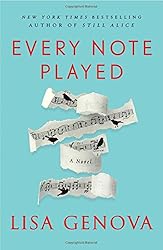
Every Note Played
Lisa Genova, 2018
Gallery/Scout
320 pp.
ISBN-13: 9781476717807
Summary
From neuroscientist and bestselling author of Still Alice comes a powerful exploration of regret, forgiveness, freedom, and what it means to be alive.
An accomplished concert pianist, Richard received standing ovations from audiences all over the world in awe of his rare combination of emotional resonance and flawless technique. Every finger of his hands was a finely calibrated instrument, dancing across the keys and striking each note with exacting precision.
That was eight months ago.
Richard now has ALS, and his entire right arm is paralyzed. His fingers are impotent, still, devoid of possibility. The loss of his hand feels like a death, a loss of true love, a divorce—his divorce.
He knows his left arm will go next.
Three years ago, Karina removed their framed wedding picture from the living room wall and hung a mirror there instead. But she still hasn’t moved on. Karina is paralyzed by excuses and fear, stuck in an unfulfilling life as a piano teacher, afraid to pursue the path she abandoned as a young woman, blaming Richard and their failed marriage for all of it.
When Richard becomes increasingly paralyzed and is no longer able to live on his own, Karina becomes his reluctant caretaker. As Richard’s muscles, voice, and breath fade, both he and Karina try to reconcile their past before it’s too late.
Poignant and powerful, Every Note Played is a masterful exploration of redemption and what it means to find peace inside of forgiveness. (From the publisher.)
Author Bio
• Birth—November 22, 1970
• Where—N/A
• Education—B.S. Bates College; Ph.D, Harvard University
• Currently—lives on Cape Cod, Massachusetts
Lisa Genova is an American neuroscientist and author of fiction. She graduated valedictorian, summa cum laude from Bates College with a BS degree in biopsychology and received her Ph.D. in neuroscience from Harvard University in 1998.
Genova did research at Massachusetts General Hospital East, Yale Medical School, McLean Hospital, and the National Institutes of Health. She also taught neuroanatomy at Harvard Medical School fall 1996.
Genova married and gave birth to a daughter in 2000. Four years later she and her husband divorced, and Genova began writing full-time. To hear Genova tell it:
When I was 33, I got divorced. I’d been a stay-at-home mom for four years, and I planned to go back to work as a health-care industry strategy consultant. But then I asked myself a question that changed the course of my life: If I could do anything I wanted, what would I do? My answer, which was both exciting and terrifying—write a novel about a woman with Alzheimer’s (Cape Cod Magazine.).
In 2007 she self-published her first novel, Still Alice, which went on to became a major best seller and award winning film. Since then, Genova has written three other fictional works about characters dealing with neurological disorders.
Still Alice
Genova's debut novel follows a woman suffering from early-onset Alzheimer’s disease. Alice Howland, a 50-year-old woman, is a cognitive psychology professor at Harvard and a world-renowned linguistics expert. She is married to an equally successful husband, and they have three grown children. The disease takes hold swiftly, changing Alice’s relationship with her family and the world.
Self-published, Genova sold copies of the book out of the trunk of her car. The book was later acquired by Simon & Schuster and published in 2009. It appeared on the New York Times best seller list for more than 40 weeks, was sold in 30 countries, and translated into more than 20 languages.
The book was adapted for the stage by Christine Mary Dunford and performed by Chicago's Lookingglass Theatre Company in 2013.
A 2014 film adaptation starred Julianne Moore as the lead and co-starred Alec Baldwin, Kristen Stewart, and Kate Bosworth. Moore won an Oscar for Best Actress.
Other books
♦ Left Neglected (2011)
Genova's second novel tells the story of a woman who suffers from left neglect (also called hemispatial or unilateral neglect), caused by a traumatic brain injury. As she struggles to recover, she learns that she must embrace a simpler life. She begins to heal when she attends to elements left neglected in herself, her family, and the world around her.
♦ Love Anthony (2012)
Offering a unique perspective in fiction, this third novel presents the extraordinary voice of Anthony, a nonverbal boy with autism. Anthony reveals a neurologically plausible peek inside the mind of autism, why he hates pronouns, why he loves swinging and the number three, how he experiences routine, joy, and love. And it is the voice of this voiceless boy that guides two women in this powerfully unforgettable story to discover the universal truths that connect us all.
♦ Inside the O'Briens (2015)
In her fourth novel, Genova follows Joe O'Brien, a middle-aged Boston policeman diagnosed with Huntington's. There is no cure, and the disease is progressive and lethal. The story revolves around the fallout on Joe's family, including his daughter who is at risk for carrying the genes.
TV and film
Since her first novel was published, Genova has become a professional speaker about Alzheimer's disease. She has been a guest on the Today Show, Dr. Oz, CNN, PBS News Hour, and the Diane Rehm Show. She appeared in the documentary film To Not Fade Away. It is a follow-up to the Emmy Award-winning film, Not Fade Away (2009), about Marie Vitale, a woman who was diagnosed with Alzheimer's disease at the age of 45. (Adapated from Wikipedia. Retrieved 4/6/2015.)
Book Reviews
What’s amazing about her newest novel, Every Note Played, is what is amazing about all of Genova’s books. She is both the neuroscientist and the actor when she writes. She tells not only the story of a person struck down by some disease. She tells the story of the disease, too. And you learn this way. But it never feels like learning.
Boston Globe
[Lisa Genova] delivers another gripping journey through a dread disease in Every Note Played. This time she trains her masterful storytelling skills on ALS as it plays out in a fractured family... deft phrasing eases the reader’s passage through a story that can’t end happily.
Minneapolis Star Tribune
An expertly written depiction of the toll a ravaging disease takes on both the body and the heart.
Marie Claire
[A] gripping novel.… Unsparing in her depiction of the disease’s harrowing effects, neuroscientist Genova also celebrates humanity and the rewards of asking for, and offering, forgiveness.
People
This book is especially remarkable because as a neuroscientist, author Lisa Genova has keen insight into the realities of ALS.
Bustle
Genova captivates with [her] painful but unflinching story…. [The characters'] harrowing journey, though it lacks any true narrative surprises, is both substantively informative about ALS and an emotionally wrenching psychological portrait.
Publishers Weekly
Genova expertly details the devastation ALS wreaks on Richard, and though her latest is a sometimes difficult read, she finds hope in the opportunities Richard has to repair his relationships with his daughter and brothers before it’s too late.
Booklist
While undeniably formulaic, Genova's latest is one of her strongest—more internalized, sometimes slow, but an eloquent and touching imagining of how a peaceful terminal place might be reached.
Kirkus Reviews
Discussion Questions
1. Why do you think Lisa Genova chose the title Every Note Played for this novel? How did the title help your reading of the novel? Richard and Karina were both professional pianists. Describe how they relate to the music they played. Were there any notes or compositions that were particularly meaningful to them?
2. Karina wonders if she could "have seen the red flags through the thick haze of lust at twenty." (p. 43) What do you think? Were there any warning signs that Richard wasn’t the person he seemed? Describe their early relationship. What initially drew Richard and Karina to each other?
3. Discuss the structure of Every Note Played. What’s the effect of having the chapters alternate between Richard’s life and Karina’s? Does it help you understand both of the characters? If so, how?
4. As he is performing, Richard remembers Karina telling him, "Being married is more than wearing a ring." (p. 2) What triggers this memory for Richard? Explain Karina’s statement, particularly in light of her marriage to Richard. Were you surprised to learn the reasons for their divorce? What does being married mean to you?
5. Upon learning of Richard’s diagnosis, Karina pays him a visit. "She had such good intentions," and wonders how it went "so wrong." (p. 32) Describe the visit. Did you learn anything that surprised you about their relationship? What are Karina’s motivations for visiting Richard? Do you think that her intentions are good? Why or why not?
6. While Richard and Karina were both classically trained pianists, Karina’s true passion is playing jazz piano. What does she like about jazz? Why does Richard prefer classical music? Do their musical preferences reflect their personalities? How so?
7. Richard comes to think of Bill as "equal parts brother, doctor, parent, and friend." (p. 96) What did you think of him? How does he help Richard preserve his sense of dignity and humanity? What’s effect does Bill have on Karina?
8. While Richard’s ALS is progressing, he reflects on how "in a million ways, living with ALS is a practice in the art of Zen." (p. 98) For example, although Richard dislikes Broadway musicals, he does not tell Bill when Bill sings show tunes. Why not? Can you think of any other instances when Richard practices "the art of Zen"? What are they?
9. While visiting Richard, Karina reflects on how "the story of their lives can be an entirely different genre depending on the narrator." (p. 29) Explain this statement. How would you characterize the story of Richard and Karina’s marriage as told from Karina’s perspective? What about Richard’s? Are there any other instances in Every Note Played when two characters experience the same event completely differently based on their perspective? What are they?
10. Who is Alexander Lynch? Describe his performance. How is seeing it a transformative experience for Karina? Explain why Karina originally resisted going on the trip where she encounters Alexander. Do you agree with her rationale? Why or why not?
11. Describe Richard’s relationship with his brothers. Why is he reluctant to tell them of his diagnosis? What did you think of Tommy and Mikey? Were you surprised by Tommy’s apology? If so, why? How does Tommy’s apology and the ensuing conversation help Richard see another side of his brothers? Why might Richard’s "big, brave, tough jock brothers [be] scared of their father, too"? (p. 221)
12. Upon hearing that Grace has told her boyfriend that Karina is "an amazing pianist," Karina is "caught surprised, moved that Grace would describe her this way." (p. 38) Describe Karina’s reaction to Grace’s praise. Why did Karina give up her career? How much blame, if any, does Richard deserve? What does Karina think?
13. Describe Dr. George. How is Dr. George able to relate to Richard and put him at ease? Dr. George suggests that Richard consider recording "legacy messages." What are they? What does Richard think about them? Discuss legacy messages with your book club. If you were in Richard’s situation, for whom would you want to record these messages? What would your messages say?
14. At the clinic, the practitioners use the term care, "and Richard doesn’t openly object but care is not provided every three months when he comes for his appointment." (p. 51) Why does Richard continue to go to the clinic? Does Richard’s opinion regarding the "care" that he gets at the clinic change? If so, why? Are there different ways to provide care? What kind of care does Kathy provide to Richard? Compare and contrast it with the care that Bill and Karina provide him.
(Questions issued by the publisher.)


Everybody Has Everything
Katrina Onstad, 2012
Random House Canada
312 pp.
ISBN-13: 9780771068980
Summary
Combining a pitch-perfect, whip-smart dissection of contemporary urban life with a fresh and perceptive examination of our individual and collective ambivalence towards parenthood, Katrina Onstad's Everybody Has Everything balances tragedy and comedy with verve and flair, and is destined to be one of Canada's most talked-about novels of 2012.
What happens when the tidy, prosperous life of an urban couple is turned inside out by a tragedy with unexpected consequences? After a car crash leaves their friend Marcus dead and his wife Sarah in a coma, Ana and James are shocked to discover that they have become the legal guardians of a 2½-year-old, Finn. Finn's crash-landing in their lives throws into high relief deeply rooted, and sometimes long-hidden, truths about themselves, both individually and as a couple. Several chaotic, poignant, and life-changing weeks as a most unusual family give rise to an often unasked question: Can everyone be a parent? (From the publisher.)
Author Bio
• Birth—N/A
• Where—Vancouver, British Columbia, Canada
• Education—B.A., McGill University; M.A. University
of Toronto
• Currently—lives in Toronto, Ontario
Katrina Onstad’s second novel, Everybody Has Everything, came out in Canada in 2012 and in the U.S. in 2013. Her first novel, How Happy to Be, was met with critical acclaim in 2006.
Katrina is also a freelance writer whose work on culture high and low appears in publications including the New York Times Magazine, Guardian and Elle. Katrina has a column in the Saturday Style section of the national paper Globe and Mail and is a regular contributor to Toronto Life magazine. At CBC.ca, she was head film critic and an on-line arts producer.
Born and raised in Vancouver, B.C., Katrina has an English degree from McGill and a Master’s from University of Toronto. She lives in Toronto with her family.
Katrina is a National Magazine Award winner in Canada for Arts Writing, and has been nominated several times, including as Best Columnist for her work in Chatelaine. In 2008, Katrina was a finalist for an American National Magazine Award in the Essay category for an article about high school sex scandals and female desire that ran in Elle.
Other Media
Katrina’s work in non-print media includes reading and hosting at the Harbourfront International Festival of Authors; frequent appearances on CBC radio and television; TVO’s Saturday Night at the Movies and The Agenda; hosting events for the Toronto International Film Festival Group; and co-hosting the national film review show Reel to Real. She also does speaking and teaching engagements, and is a writer-for-hire. (From the author's website.)
Book Reviews
More ambitious and assured that Onstad’s debut, but just as gripping.... Onstad’s timely new novel examines how and why adults choose to be parents, and what happens when you don’t have that much choice in the matter.... Ana and James are thoroughly convincing and their agony and triumphs compelling in this impressive sophomore effort.
Globe and Mail
A literary excursion into the poignancy and murkiness of loss, parenting and marriage.... This is sharp, edgy writing.... Onstad mines the emotions of flawed and wounded characters.... Impressive...intelligent, ambitious and unsettling.... Most definitely memorable.
Winnipeg Free Press
Unsparingly honest.... Never sentimental but always compassionate, this compelling book is hard to put down.
Hello Magazine
Everyone will recognize the all too common yearnings and failings of two people trying to figure out what will make them happy.
Chatelaine
This new book is very good, to get that out of the way: Onstad’s writing is always vigorous, funny and mean-because-it’s-true.... Onstad perfectly gets at her characters, and their so-called “status life”...the rhythms of rich, white city parents, who used to be young and who have problems that are at once real and magical. Writing all of it like this, so cruel and right, makes it feel even worse than it is, but by its very telling, a little bit better.
National Post
Revelations are both joyous and heartbreaking, and Onstad handles both aspects well.... The characters’ motivations, self-revelations, and discoveries are carefully elucidated, such that the reader is able to form connections not just with Ana and James, but with the supporting characters as wel.... Onstad delicately builds up layers and peels them away.
Quill & Quire
Discussion Questions
1. How do you understand the meaning of the novel’s title?
2. Consider the epigraph the author has chosen. What do you think she hopes you to take from it? How does is relate to the novel?
3. There are many poetic and musical references in the novel, and one song in particular plays a key role in the narrative. What do the various quotations tell us about the different characters in the novel who recall or recognize them? What do you think the author wishes to say through the use of that one key song? About Ana’s life, about James’s life, about life more generally?
4. Is this a particularly “urban” novel? Why or why not?
5. “How did you know?” Ana asks Sarah on page 57, about wanting to have a child. Whose side of the ensuing exchange made the most sense to you? Why could Ana not be honest with Sarah about when, or if, she herself “knew”?
6. How does James’s behaviour upend (or conform to) conventional notions of masculinity? At work? At home? With Finn? In what ways does Ana challenge the concept of femininity? How do these shifting gender roles affect the story?
7. At certain points, both Ana and James find themselves acutely aware of their age. What triggers this awareness in each of them? What does this awareness mean to each of them?
8. Neither Ana’s nor James’s mother quite fits the picture of an “ordinary mother.” Can you see people you know in either of them? In what ways?
9. Is it still a social taboo for a woman to resist motherhood? How does Ana experience society’s attitudes toward women who aren’t mothers? Is it possible for a female character to be sympathetic if she rejects motherhood?
10. How does the sudden presence of a child in James and Ana’s relationship foment marital discord, and flirtations with infidelity – or does it? To what extent is their marriage affected by parenthood?
11. What do you make of Ana’s flirtation with Charlie? What attracts her to him?
12. The final scene of the novel involves James telling Finn (and Ana) a story. How does this closing story-within-a-story relate to the novel as a whole?
13. What do you think the next chapter in life will be for Ana, for James, for Finn, for Sarah?
(Questions issued by publisher.)


Everybody Rise
Stephanie Clifford, 2015
St. Martin's Press
400 pp.
ISBN-13: 9781250077509
Summary
It's 2006 in the Manhattan of the young and glamorous. Money and class are colliding in a city that is about to go over a financial precipice and take much of the country with it.
At 26, bright, funny and socially anxious Evelyn Beegan is determined to carve her own path in life and free herself from the influence of her social-climbing mother, who propelled her through prep school and onto the Upper East Side. Evelyn has long felt like an outsider to her privileged peers, but when she gets a job at a social network aimed at the elite, she's forced to embrace them.
Recruiting new members for the site, Evelyn steps into a promised land of Adirondack camps, Newport cottages and Southampton clubs thick with socialites and Wall Streeters. Despite herself, Evelyn finds the lure of belonging intoxicating, and starts trying to pass as old money herself.
When her father, a crusading class-action lawyer, is indicted for bribery, Evelyn must contend with her own family's downfall as she keeps up appearances in her new life, grasping with increasing desperation as the ground underneath her begins to give way.
Bracing, hilarious and often poignant, Stephanie Clifford's debut offers a thoroughly modern take on classic American themes—money, ambition, family, friendship—and on the universal longing to fit in. (From the publisher.)
Author Bio
• Birth—N/A
• Where—Seattle, Washington, USA
• Education—B.A., Harvard University
• Awards—Gerald Loeb Award (journalism)
• Currently—lives in Brooklyn, New York City, New York
Stephanie Clifford is a Loeb-award winning reporter at the New York Times, where she has covered business, media and New York City. She is currently a Metro reporter covering federal and state courts in Brooklyn. She joined the Times in 2008 from Inc. magazine, where she was a senior writer.
Stephanie grew up in Seattle and graduated magna cum laude from Harvard. She lives in Brooklyn with her husband, son and two cats. Everybody Rise is her first book. (From the publisher.)
See the author's "informal bio."
Book Reviews
In a tightly plotted narrative, Clifford shows how Evelyn's tenuous initiation into this most elite of social networks coincides with an increasingly desperate effort to secure her footing there...Clifford details the manners of the old-money set with a reporter's well-trained eye.
New York Times Book Review
A smart tragicomedy about a young woman attempting to infiltrate the "Primates of Park Avenue" crowd.... Ferociously incisive class commentary....a 21st-century fable of one woman's reconstruction.
Washington Post
Gossip Girl fans, rejoice! Behold the literary version of a Jenny-esque narrated story, had she met Blair and Serena in her mid-20s. Cue lies, affairs and mounting debt.
Marie Claire
The summer's most anticipated beach read...a funny, sharply observed debut novel about young one percenters in New York...a buzzy Tom-Wolfe-meets-Edith-Wharton novel of young Manhattan.
Hollywood Reporter
Author Stephanie Clifford has been described as a modern-day Edith Wharton.
Elle
Addictive: think Prep meets The Devil Wears Prada.
Good Housekeeping
The upstart heroine...wages a one-woman assault on the old-money snobbery of the Upper East Side, before the Wall Street stock market crash of 2008.... [A]n amusing page-turning beach read. But if the author is trying to suggest that after 2008, class and the UES no longer hold sway, her argument is thin.
Publishers Weekly
(Starred review.) Clifford...has penned either a...cautionary tale for those seeking access to this rarefied world.... A compulsive, up-close-and-personal read about the first cracks in the greed-and-bleed U.S. economy that went flying off the rails so spectacularly a short time later. —Beth Andersen, formerly with Ann Arbor Dist. Lib., MI
Library Journal
A young woman who works at a tech startup tries to shoehorn her way into New York's high society.... But [she] spends so much time doing such bone-headed things...that's it's hard to work up any interest in what happens to her. Clifford's debut tries to be a Bonfire of the Vanities for our time but doesn't make it.
Kirkus Reviews
Discussion Questions
1. Why do you think Barbara has such specific expectations for her daughter? When does Evelyn successfully push back against these, and how? Why do you think Evelyn comes to hold some of the same values as her mother? How does the Barbara-Evelyn relationship shift as the novel goes on? Do you have sympathy for Barbara?
2. Evelyn considers, at one point, how easy it would be if she could marry Preston. Do you think this would be a good pairing? Can marriages of convenience like this work? Should Preston’s sexuality, or Evelyn’s assessment of Preston’s sexuality, figure into her thinking more?
3. How porous is social class in America? Could Evelyn have made different decisions that would have allowed her to ultimately fit in in Camilla’s circle?
4. At the end, Charlotte updates Evelyn and tells her that all her former friends are just fine. Still, the financial crisis is coming. How do you think the characters who stay in New York make it through that? Do you think they are as untouchable as Charlotte seems to think? Now, several years after the financial crisis, do you see certain groups who haven’t been affected and certain groups who have?
5. When we first meet Evelyn, she feels overlooked: "But it would be nice to have a place for once, to have people look at her and think she was interesting and worth talking to, not to have them politely fumble for details about her life and get them wrong and instantly forget her. (Murray Hill, right? No, the Upper East Side. Ah, and Bucknell? No, Davidson.)" Why is that important to her? Does she achieve this place she’s looking for? Have you struggled with a similar goal? What happened?
6. Why does Scot end up accepted by this group in the end? What does he bring to the table that Evelyn does not?
7. Did you find Evelyn likable? Why or why not? How important is it to you as a reader that a book’s protagonist be likeable? What are books you’ve liked where the main character is unlikable? Do you have different expectations about likability for male and for female protagonists?
8. Do you think Dale committed bribery? Why or why not? How important is the question of her father’s guilt or innocence to Evelyn?
9. Charlotte seems to see herself as a moral arbiter in the book. Do you agree with her moral stance? Is she a good friend to Evelyn? Are there ways that Evelyn is a good friend to her?
10. At one point Evelyn puzzles over why debutante balls still exist when young women are hardly kept behind closed doors until age eighteen. What’s your take on this? Why do they continue to occur?
11. As Evelyn watches her father’s sentencing, she wonders why he’s receiving such a harsh punishment when others who have erred are not. "Why were the consequences so severe for him?" she asks. Is that something you see elsewhere in the novel—that rules apply to one set of people but not another? Are there current events where this apply? Or do you think she’s making excuses for her father—and for herself ?
12. Is Camilla and Evelyn’s friendship genuine? Why or why not? Have you had short-term friendships? Why didn’t they work out? What makes for a real and lasting friendship?
13. Do you think Evelyn and Scot are well-paired as a couple? At the novel’s end, after Evelyn has changed, would you see them working out?
(Questions issued by the publisher.)

Everybody's Fool
Richard Russo, 2016
Knopf Doubleday
496 pp.
ISBN-13: 9780307270641
Summary
Richard Russo, at the very top of his game, now returns to North Bath, in upstate New York, and the characters who made Nobody’s Fool (1993) a "confident, assured novel [that] sweeps the reader up," according to the San Francisco Chronicle back then.
The irresistible Sully, who in the intervening years has come by some unexpected good fortune, is staring down a VA cardiologist’s estimate that he has only a year or two left.
It’s hard work trying to keep this news from the most important people in his life: Ruth, the married woman he carried on with for years—the ultra-hapless Rub Squeers, who worries that he and Sully aren’t still best friends, and Sully’s son and grandson, for whom he was mostly an absentee figure (and now a regretful one).
We also enjoy the company of Doug Raymer, the chief of police who’s obsessing primarily over the identity of the man his wife might’ve been about to run off with, before dying in a freak accident; Bath’s mayor, the former academic Gus Moynihan, whose wife problems are, if anything, even more pressing
And then there’s Carl Roebuck, whose lifelong run of failing upward might now come to ruin. And finally, there’s Charice Bond—a light at the end of the tunnel that is Chief Raymer’s office—as well as her brother, Jerome, who might well be the train barreling into the station.
Everybody’s Fool is filled with humor, heart, hard times and people you can’t help but love, possibly because their various faults make them so stridently human. This is classic Russo—and a crowning achievement from one of the greatest storytellers of our time. (From the publisher.)
Author Bio
• Birth—July 15, 1949
• Where—Johnstown, New York, USA
• Education—B.A., M.F. A. and Ph.D., University of Arizona
• Awards—Pulitzer Prize
• Currently—lives in Camden, Maine
Prizewinning author Richard Russo is regarded by many critics as the best writer about small-town America since Sherwood Anderson and Sinclair Lewis. "He doesn't over-sentimentalize [small towns]," said Maureen Corrigan, the book critic for NPR's "Fresh Air." Nor does he belittle the dreams and hardships of his working-class characters. "I come from a blue-collar family myself and I think he gets the class interactions; he just really nails class in his novels," said Corrigan.
When Russo left his own native small town in upstate New York, it was with hopes of becoming a college professor. But during his graduate studies, he began to have second thoughts about the academic life. While finishing up his doctorate, he took a creative writing class; and a new career path opened in front of him.
Russo's first novel set the tone for much of his later work. The story of an ailing industrial town and the interwoven lives of its inhabitants, Mohawk won critical praise for its witty, engaging style. In subsequent books, he has brought us a dazzling cast of characters, mostly working-class men and women who are struggling with the problems of everyday life (poor health, unemployment, mounting bills, failed marriages) in dilapidated, claustrophobic burghs that have—like their denizens—seen better days. In 2001, Russo received the Pulitzer Prize for Empire Falls, a brilliant, tragicomic set-piece that explores past and present relationships in a once-thriving Maine town whose textile mill and shirt factory have gone bust.
Russo's vision of America would be bleak, except for the wit and optimism he infuses into his stories. Even when his characters are less than lovable, they are funny, rueful, and unfailingly human. "There's a version of myself that I still see in a kind of alternative universe and it's some small town in upstate New York or someplace like that," Russo said in an interview. That ability to envision himself in the bars and diners of small-town America has served him well. "After the last sentence is read, the reader continues to see Russo's tender, messed-up people coming out of doorways, lurching through life," said the fiction writer Annie Proulx. "And keeps on seeing them because they are as real as we are."
Extras
From a 2005 Barnes & Noble interview:
• In 1994, Russo's book Nobody's Fool was made into a movie starring Paul Newman and Bruce Willis. Newman also starred in the 1998 movie Twilight, for which Russo wrote the screenplay. Russo now divides his time between writing fiction and writing for the movies.
• When he wrote his first books, Russo was employed full-time as a college teacher and would stop at the local diner between classes to work on his novels. After the success of Nobody's Food (the book and movie), he was able to quit teaching—but he still likes to write in tight spots, such as the Camden Deli. It's "a less lonely way to write," he told USA Today. "I'm less self-conscious when it's not so quiet."
• When asked what his favorite books are, he offered this list:
Great Expectations by Charles Dickens—All of Dickens, really. The breadth of his canvas, the importance he places on vivid minor characters, his understanding that comedy is serious business. And in the character of Pip, I learned, even before I understood I'd learned it, that we recognize ourselves in a character's weakness as much than his strength. When Pip is ashamed of Joe, the best man he knows, we see ourselves, and it's terrible, hard-won knowledge.
The Adventures of Huckleberry Finn by Mark Twain—Twain's great novel demonstrates that you can go to the very darkest places if you're armed with a sense of humor. His study of American bigotry, ignorance, arrogance, and violence remains so fresh today, alas, because human nature remains pretty constant. I understand the contemporary controversy, of course. Huck's discovery that Jim is a man is hardly a blinding revelation to black readers, but the idea that much of what we've been taught by people in authority is a crock should resonate with everybody. Especially these days.
The Great Gatsby by F. Scott Fitzgerald—Mostly, I suppose, because his concerns -- class, money, the invention of self -- are so central to the American experience. Fitzgerald understood that our most vivid dreams are often rooted in self-doubt and weakness. Many people imagine that we identify with strength and virtue. Fitzgerald knew better.
Cannery Row by John Steinbeck—For the beauty of the book's omniscience. It's fine for writers to be humble. Most of us have a lot to be humble about. But it does you no good to be timid. Pretend to be God? Why not? (Bio and interview from Barnes & Noble.)
Book Reviews
[D]elightful…. North Bath, N.Y., a fictitious upstate town [is]…a town where dishonesty abounds, everyone misapprehends everyone else and half the citizens are half-crazy. It's a great place for a reader to visit, and it seems to be Mr. Russo's spiritual home…. Both Bath and Everybody's Fool are funny—very funny…Mr. Russo's people…sideswipe, wisecrack, sneak, scheme and talk to figments of their imaginations. It's a joy to spend time with any of them, two-legged or four.
Janet Maslin - New York Times
[I]n both [Nobody's Fool and Everybody's Fool>, the humor is…genial, and it works in service of the characters. Sully in particular emerges as one of the most credible and engaging heroes in recent American fiction…. Taken together, at over 1,000 pages, the two Fool books represent an enormous achievement, creating a world as richly detailed as the one we step into each day of our lives. Bath is real, Sully is real, and so is Hattie's and the White Horse Tavern and Miss Peoples's house on Main, and I can only hope we haven't seen the last of them. I'd love to see what Sully's going to be up to at 80.
T. C. Boyle - New York Times Book Review
How could twenty-three years have slipped by since Nobody’s Fool? . . . Russo is probably the best writer of physical comedy that we have [but] even the zaniest elements of the story are interspersed with episodes of wincing cruelty. . . . The abiding wonder [is that] Russo’s novel bears down on two calamitous days and exploits the action in every single minute . . . mudslides, grave robbery, collapsing buildings, poisonous snakes, drug deals, arson, lightning strikes and toxic goo. North Bath is a sleepy little town that never sleeps [and] no tangent ever feels tangential.
Ron Charles - Washington Post
A madcap romp, weaving mystery, suspense and comedy in a race to the final pages.
Jennifer Maloney - Wall Street Journal
Buoyantly unsentimental.... You hold his books to your heart.
Jan Stuart - Boston Globe
A writer of great comedy and warmth, Russo’s living proof that a book can be profound and wise without aiming straight into darkness. [His] voice can play in any register, any key, any style [in this] portrait of an entire community, in all its romance and all its grit.
Eliot Schrefer, USA Today
Elegiac but never sentimental. . . . Russo’s compassionate heart is open to the sorrows, and yes, the foolishness of this lonely world, but also the humor, friendship and love that abide.
Paul Wilner - San Francisco Chronicle
Everybody should read Everybody’s Fool. Almost nobody in Richard Russo’s novel is sure of anything, but I’m sure of that. . . . [He] has given readers all they should want.
Brian O’Neill - Pittsburgh Post-Gazette>
[A] shaggy dog story of revenge and redemption.The give-and-take of rude but funny dialogue is Russo's trademark, as is his empathy for down-and-outers on the verge of financial calamity. He takes a few false steps...but clever plot twists end the novel on lighthearted note.
Publishers Weekly
(Starred review.) Loneliness and missed connections loom large in Russo's work, but he tempers tear-inducing sentiment with laugh-out-loud moments.... Russo avoids caricature with writing that reflects his deep affection for the quotidian and for the best and worst that's found in every human heart. —Sally Bissell, formerly with Lee Cty. Lib. Syst., Fort Myers, FL
Library Journal
(Starred review.) Triumphant.... Russo's reunion with these beloved characters is genius: silly slapstick and sardonic humor play out in a rambling, rambunctious story that poignantly emphasizes that particular brand of loyalty and acceptance that is synonymous with small-town living. —Carol Haggas
Booklist
(Starred review.) A sequel to the great Nobody's Fool (1993) checks in on the residents of poor old North Bath, New York, 10 years later.... For maximum pleasure, read Nobody's Fool first. Russo hits his trademark trifecta: satisfying, hilarious, and painlessly profound.
Kirkus Reviews
Discussion Questions
1. Evaluate the title of the book. Who do you believe the title is referencing? Is the foolishness of the title character—or characters—something determined by public opinion or something revealed via a process of self-reflection? Explain. What causes the character(s) to act foolishly or otherwise be perceived as foolish?
2. Analyze the setting of the book. How does the author characterize North Bath? How does North Bath compare with its neighboring town Schuyler Springs? What factors have contributed to the condition of North Bath? How does the economic and aesthetic state of the town affect its residents?
3. Everybody’s Fool opens with a description of the local cemetery. How might the cemetery and its present condition function as symbolism? What might the uprooted tree and coffins represent? Why do you think that Russo chose to begin the story with this imagery of the divided and overflowing cemetery?
4. Evaluate the themes of fortune and luck. How much are the characters’ lives shaped by luck? Do they have any control over their fate? If so, where is this evident? Why does Gus think that the townspeople of North Bath are determined to believe in the idea of luck and fortune? Do you agree with him? Why or why not?
5. At the start of the book, Raymer notes that he has always been "vulnerable to the judgments of others" (16), so much so that he actually becomes whatever people call him. Is he ever able to overcome this problem? What other characters in the novel are influenced by the judgments of others? Are the judgments a primarily positive or negative influence?
6. In the chapter entitled "Slinky," Raymer indicates that he prefers order, but says that generally "humans preferred to meander" (67). What does he mean by this? Does the novel ultimately seem to support or refute his claim? Explain.
7. Is there an identifiable protagonist or antagonist in the book or a sense of "good" and "bad" characters, or do the characters offer a more complicated and nuanced view of humanity and human nature? Does any single point of view overshadow the rest? Which of the characters do you feel most sympathetic toward and why? Who do you find the most disagreeable and how does the author elicit this response? Does your perception of any one of the characters change substantially over the course of the novel? If so, which character and how?
8. Consider the various relationships depicted in the book. Do the characters in North Bath share a strong bond with one another? If so, what unites them? Alternatively, why do you think that so many of the characters are entangled in or just out of broken relationships, and how have they been affected by these relationships? What seems to prevent the characters from having healthier and stronger relationships?
9. Why do you believe that the author incorporates elements of comedy and the absurd in the novel? How did these elements influence and shape your interpretation of the novel and your response to its characters? For instance, does the use of comedy make you feel more or less sympathetic to the characters and their plight? Explain.
10. Many of the characters in the book are aging and are faced with their morality. How does this affect their actions and the way they choose to live? What questions arise as a result of their awareness of their limited time? What answers to these questions do they arrive at? Do these aging characters seem to become wiser with age?
11. How does Russo portray the aging process? Do the older characters age gracefully and with dignity? Do they seem to have control over this process and how they handle it? Discuss.
12. How do the characters use fantasy to escape their present condition? What examples of this are found in the novel? Does this kind of escapism prove to be an effective or destructive means of coping?
13. Why did Gus wish to be mayor of North Bath? What did he hope to accomplish in this position? What obstacles does he face as he attempts to accomplish this? Is he ultimately successful? Why or why not?
14. Evaluate the theme of complicity. Which of the characters believe they have been complicit and why do they believe this? Do you agree? Explain. Where else in the novel do we see complicity at work? What do you think causes the characters to be complicit and what are the consequences?
15. In the chapter entitled "Grave Doings," Carl asks what men are even good for. Sully admits that this is a question he has avoided asking himself his entire life. Does the novel ever answer this question? Why might the characters be so determined to avoid it?
16. Explore the theme of legacy. How do characters who are deceased or who are referenced indirectly in the story influence the main characters of the book? Consider, for example, Miss Beryl, Rub’s parents, Becka, or Judge Flatt. How do they continue to have an impact on the lives of others and affect the community even in their absence? What might this indicate about the power of an individual, the weight of one’s actions, and the value of a single human life?
17. Evaluate the treatment of prejudice and race in the book. Why is Miller hesitant to ask out Charice? Why does Raymer feel like a fool when Charice tells him what she plans to make him for dinner? How do the people of Bath treat Jerome? Are the residents of North Bath primarily an accepting people?
18. Consider the treatment of women. What do the female characters seem to share in common? How are they treated by the men in the novel? How do the women view themselves? What do their stories, when considered collectively, reveal about sexuality and womanhood?
19. Russo named one of the chapters "Secrets". What secrets do the characters in the novel keep? Do any of the characters ultimately choose to reveal their secrets? If so, what motivates them and what happens when they do? What might this indicate about truth telling or about shared experience?
20. Is there any evidence of a system of justice in the world the characters inhabit? Explain. If you believe that there is, does the book seem to suggest that justice is something dealt by an outside force such as karma, God, or fate, or is it something that must be dealt by humankind? What injustices are presented in the novel? Do you believe that they could have been prevented or otherwise addressed? If so, how?
21. Why didn’t Miss Beryl want Sully to enlist in the army? What does she think young people are always being asked to risk? Do you agree with her? Can readers tell how the veterans in the story have been affected or changed by their service?
22. Evaluate the theme of forgiveness. What examples of forgiveness, if any, are evident in the book? What causes the characters to reach a place of forgiveness—or to be unable to forgive? What does Miss Beryl think is the real reason that people forgive others? What does the book suggest about self-forgiveness?
23. Compare Everybody’s Fool with Russo’s 1993 novel Nobody’s Fool. What themes does Russo revisit in Everybody’s Fool? Who are some of the recurring characters and how have they changed or remained the same between books? What do you think the books offer collectively that they do not or cannot offer when considered singularly?
(Questions issued by the publisher.)
Everyman
Philip Roth, 2006
Random House
182 pp.
ISBN-13: 9780307277718
Summary
PEN/Faulkner Award
Philip Roth's new novel is a candidly intimate yet universal story of loss, regret, and stoicism. The best-selling author of The Plot Against America now turns his attention from "one family's harrowing encounter with history" (New York Times) to one man's lifelong skirmish with mortality.
The fate of Roth's everyman is traced from his first shocking confrontation with death on the idyllic beaches of his childhood summers, through the family trials and professional achievements of his vigorous adulthood, and into his old age, when he is rended by observing the deterioration of his contemporaries and stalked by his own physical woes.
A successful commercial artist with a New York ad agency, he is the father of two sons from a first marriage who despise him and a daughter from a second marriage who adores him. He is the beloved brother of a good man whose physical well-being comes to arouse his bitter envy, and he is the lonely ex-husband of three very different women with whom he's made a mess of marriage. In the end he is a man who has become what he does not want to be.
The terrain of this powerful novel—Roth's twenty-seventh book and the fifth to be published in the twenty-first century—is the human body. Its subject is the common experience that terrifies us all.
Everyman takes its title from an anonymous fifteenth-century allegorical play, a classic of early English drama, whose theme is the summoning of the living to death. (From the publisher.)
Author Bio
• Birth—March 19, 1933
• Where—Newark, New Jersey, USA
• Education—B.A., Bucknell University; M.A., University of
Chicago
• Awards—the most awarded US writer—see below
• Currently—lives in Connecticut
After many years of teaching comparative literature—mostly at the University of Pennsylvania—Philip Roth retired from teaching as Distinguished Professor of Literature at Hunter College in 1992. Until 1989, he was general editor of the Penguin book series Writers from the Other Europe, which he inaugurated in 1974 and which introduced the work of Bruno Schultz and Milan Kundera to an American audience.
His lengthy interviews with foreign authors—among them Primo Levi, Ivan Klima, and Aharon Appelfeld—have appeared in the New York Review of Books, the London Review of Books, and the New York Times Book Review. Roth was born in Newark, New Jersey, in 1933 and has lived in Rome, London, Chicago, and New York. He now resides in Connecticut. (From the publisher.)
More
Philip Roth's long and celebrated career has been something of a thorn in the side of the writer. As it is for so many, fame has been the proverbial double-edged sword, bringing his trenchant tragic-comedies to a wide audience, but also making him a prisoner of expectations and perceptions. Still, since 1959, Roth has forged along, crafting gorgeous variations of the Great American Novel and producing, in addition, an autobiography (The Facts) and a non-fictional account of his father's death (Patrimony: A True Story).
Roth's novels have been oft characterized as "Jewish literature," a stifling distinction that irks Roth to no end. Having grown up in a Jewish household in a lower-middle-class sub-section of Newark, New Jersey, he is incessantly being asked where his seemingly autobiographical characters end and the author begins, another irritant for Roth. He approaches interviewers with an unsettling combination of stoicism, defensiveness, and black wit, qualities that are reflected in his work. For such a high-profile writer, Roth remains enigmatic, seeming to have laid his life out plainly in his writing, but refusing to specify who the real Philip Roth is.
Roth's debut Goodbye, Columbus instantly established him as a significant writer. This National Book Award winner was a curious compendium of a novella that explored class conflict and romantic relationships and five short stories. Here, fully formed in Roth's first outing, was his signature wit, his unflinching insightfulness, and his uncanny ability to satirize his character's situations while also presenting them with humanity. The only missing element of his early work was the outrageousness he would not begin to cultivate until his third full-length novel Portnoy's Complaint—an unquestionably daring and funny post-sexual revolution comedy that tipped Roth over the line from critically acclaimed writer to literary celebrity.
Even as Roth's personal relationships and his relationship to writing were severely shaken following the success of Portnoy's Complaint, he continued publishing outrageous novels in the vein of his commercial breakthrough. There was Our Gang, a parodic attack on the Nixon administration, and The Breast, a truly bizarre take on Kafka's Metamorphosis, and My Life as a Man, the pivotal novel that introduced Roth's literary alter ego, Nathan Zuckerman.
Zuckerman would soon be the subject of his very own series, which followed the writer's journey from aspiring young artist with lofty goals to a bestselling author, constantly bombarded by idiotic questions, to a man whose most important relationships have all but crumbled in the wake of his success. The Zuckerman Trilogy (The Ghost Writer, Zuckerman Unbound, and The Counterlife) directly parallels Roth's career and unfolds with aching poignancy and unforgiving humor.
Zuckerman would later reemerge in another trilogy, although this time he would largely be relegated to the role of narrator. Roth's American Trilogy (I Married a Communist, the PEN/Faulkner Award winning The Human Stain, and The Plot Against America), shifts the focus to key moments in the history of late-20th–century American history.
In Everyman (2006), Roth reaches further back into history. Taking its name from a line of 15th-century English allegorical plays, Everyman is classic Roth—funny, tragic, and above all else, human. It is also yet another in a seemingly unbreakable line of critical favorites, praised by Kirkus Reviews, Booklist, Publishers Weekly, and The Library Journal.
In 2007's highly anticipated Exit Ghost, Roth returned Nathan Zuckerman to his native Manhattan for one final adventure, thus bringing to a rueful, satisfying conclusion one of the most acclaimed literary series of our day. While this may (or may not) be Zuckerman's swan song, it seems unlikely that we have seen the last Philip Roth. Long may he roar. (Author bio from Barnes & Noble.)
Literary Awards
Philip Roth is one of the most celebrated living American writers. Two of his works of fiction have won the National Book Award (Goodbye, Columbus; Sabbath's Theater); two others were finalists. Two have won National Book Critics Circle awards (Patrimony; Counterlife); again, another two were finalists. He has also won three PEN/Faulkner Awards (Operation Shylock, The Human Stain, and Everyman) and a Pulitzer Prize for Fiction for his 1997 novel, American Pastoral. In 2001, The Human Stain was awarded the United Kingdom's WH Smith Literary Award for the best book of the year. In 2002, he was awarded the National Book Foundation's Award for Distinguished Contribution to American Letters. Literary critic Harold Bloom has named him as one of the four major American novelists still at work, along with Thomas Pynchon, Don DeLillo, and Cormac McCarthy. In May 2006, he was given the PEN/Nabokov Award, and in 2007 the first PEN/Saul Bellow Award — both for lifetime achievement.
The May 21, 2006 issue of the New York Times Book Review announced the results of a letter that was sent to what the publication described as "a couple of hundred prominent writers, critics, editors and other literary sages, asking them to please identify 'the single best work of American fiction published in the last 25 years." Of the 22 books cited, six of Roth's novels were selected: American Pastoral, The Counterlife, Operation Shylock, Sabbath's Theater, The Human Stain, and The Plot Against America. The accompanying essay, written by critic A.O. Scott, stated, "If we had asked for the single best writer of fiction of the past 25 years, [Roth] would have won." ("More" and "Awards" from Wikipedia.)
Book Reviews
If descriptive amplitude went out with the nineteenth century, Philip Roth, who strides the whole time and territory of the word, has resuscitated it—in description revved with the power of narrative itself.
New York Times Book Review
Our most accomplished novelist.... [With Everyman] personal tenderness has reached a new intensity.
New Yorker Magazine
“[Roth is] as essential to the experience of modern America–its literature, history, and moral reckoning–as any writer on the planet.
Boston Globe
Let's use a noun I've never used before: masterpiece.
Atlantic Monthly
Through consummate art, Roth elevates the links that bind his protagonist to us, the readers who judge his life. From a distance, Everyman looks like a shaggy dog story—a long, quotidian story whose meaning resides in its final pointlessness. Up close, though, it is a parable that captures, as few works of fiction have, the pathos of Being, as it's manifested even in the favored precincts of affluent America.
Norman Rush - Washington Post
What is it about Philip Roth? He has published 27 books, almost all of which deal with the same topics—Jewishness, Americanness, sex, aging, family—and yet each is simultaneously familiar and new. His latest novel is a slim but dense volume about a sickly boy who grows up obsessed with his and everybody else's health, and eventually dies in his 70s, just as he always said he would. (I'm not giving anything away here; the story begins with the hero's funeral.) It might remind you of the old joke about the hypochondriac who ordered his tombstone to read: "I told you I was sick."
And yet, despite its coy title, the book is both universal and very, very specific, and Roth watchers will not be able to stop themselves from comparing the hero to Roth himself. (In most of his books, whether written in the third person or the first, a main character is a tortured Jewish guy from Newark-like Roth.) The unnamed hero here is a thrice-married adman, a father and a philanderer, a 70-something who spends his last days lamenting his lost prowess (physical and sexual), envying his healthy and beloved older brother, and refusing to apologize for his many years of bad behavior, although he palpably regrets them. Surely some wiseacre critic will note that he is Portnoy all grown up, an amalgamation of all the womanizing, sex- and death-obsessed characters Roth has written about (and been?) throughout his career.
But to obsess about the parallels between author and character is to miss the point: like all of Roth's works, even the lesser ones, this is an artful yet surprisingly readable treatise on...well, on being human and struggling and aging at the beginning of the new century. It also borrows devices from his previous works—there's a sequence about a gravedigger that's reminiscent of the glove-making passages in American Pastoral, and many observations will remind careful readers of both Patrimony and The Dying Animal—and through it all, there's that Rothian voice: pained, angry, arrogant and deeply, wryly funny. Nothing escapes him, not even his own self-seriousness. "Amateurs look for inspiration; the rest of us just get up and go to work," he has his adman-turned-art-teacher opine about an annoying student. Obviously, Roth himself is a professional.
Publishers Weekly
Much like John Updike's Harry Angstrom, the protagonist of Roth's new novel confronts the loneliness of growing old, despair over the loss of his sexual vitality, and anguish over how he has shattered the lives of those who love him. Using a splendidly unique narrative technique, our hero recounts his boyhood vigor (he swam for miles every day off the Jersey Shore), energetic sexual life (three marriages and countless affairs), affection for his daughter, and visceral shock at his body's rapid decay. Once he reaches middle age, his body begins to break down, and soon his life is measured out in yearly cuts and scrapes of the surgeon's knife. After one operation, he moves from Manhattan to a retirement community near the Jersey Shore, where his sense of alienation grows ever stronger. As the palpable pain of loneliness creeps into his bones, Roth's Everyman muses over his role in bringing this loss on himself ("he had completed the decomposition of his original family; decomposing families was his specialty") and poignantly declares that "old age isn't a battle; old age is a massacre." This brilliant little morality play on the ways that our bodies dictate the paths our lives take is vintage Roth; essential for every fiction collection. —Henry L. Carrigan Jr., Lancaster, PA.
Library Journal
Roth follows his recent succession of critically acclaimed novels (e.g., American Pastoral, 1997; The Plot Against America, 2004) with a compact meditation on mortality, which partially echoes his 1991 memoir-novel Patrimony. Inspired by the medieval English allegorical drama whose title it shares, it's the story of an erring, death-haunted representative man (never named). It begins as his departed spirit observes his own funeral, then weaves backward and forward throughout his past life, envisioned as inevitable progression from virile youth through morally compromised adulthood and middle age, into "his sixties when his health began giving way and his body seemed threatened all the time," and beyond—into the beyond. This Everyman grows up in Elizabeth, N.J., the son of a benevolent and prosperous jeweler, further blessed by a doting mother and a tirelessly kind and supportive "perfect" older brother. He enjoys a successful career as an advertising agency's art director, but fails at marriage (losing three wives, as he pursues countless other women), and is almost as disastrous a parent, suffering permanent estrangement from the two sons of his first marriage, but achieving a sustaining relationship with daughter (from his second marriage) Nancy, whose patient filial devotion interestingly parallels that of the medieval Everyman's character Good Deeds, who accompanies the title character into the realm of Death. This risky novel is significantly marred by redundancy and discursiveness (especially by a surfeit of rhetorical questions), but energized by vivid writing, palpable emotional intensity and several wrenching scenes—for example, encounters in the painting class that he (an amateur artist) organizes for other seniors at his retirement village; a blistering exchange with second wife Phoebe, long aware of his womanizing; a wonderful conversation with a black gravedigger at the cemetery where his parents are buried, where he'll soon be buried. A rich exploration of the epiphany that awaits us all—that "life's most disturbing intensity is death."
Kirkus Reviews
Discussion Questions
1. What is the relevance of the title to the story that is told in the novel?
2. What do you learn about the man being buried from the opening scene at the cemetery? What would the book be like if this scene came—as it might if the story were told chronologically—at the end rather than at the beginning?
3. Describe precisely his predicament with his sons, Lonny and Randy.
4. Describe precisely his relationship with his daughter, Nancy. What is the nature of their predicament?
5. Why does he refuse the consolations of religion despite his sharing in the universal terror of death?
6. What is his relationship with the dead?
a. With his dead parents
b. With Millicent Kramer
c. With those of his family who are long dead
7. Why does he take up painting, and why does he abandon it? Why does he begin teaching painting classes to his fellow retirees, and why does he stop teaching?
8. Exactly what transpires between the young jogger and the hero? Trace the shifting development of their encounter line by line.
9. While visiting his parents’ graves, the protagonist imagines his father telling him: “Look back and atone for what you can atone for, and make the best of what you have left” [p. 171]. Why does he imagine his father giving this order? Why doesn’t he imagine his mother giving it? Why does he imagine his mother saying “Good. You lived” [p. 171]. What does she mean? How do you explain the difference between what is voiced by the father and what is voiced by the mother?
10. Some readers have said that they wept when they finished reading the book. Did you weep? If so, why? If not, how do you understand the response of those who did?
11. Examine the final paragraph of the book sentence by sentence. Discuss the motifs that are gathered together in these final sentences and the importance of each to the novel.
12. How does the twenty-first-century novel Everyman significantly diverge in content, form, and intent from the fifteenth-century English morality play "Everyman"? In what important ways has Roth modernized and secularized that medieval text?
(Questions issued by publisher.)
top of page (summary)

Everyone Brave is Forgiven
Chris Cleave, 2016
Simon & Schuster
532 pp.
ISBN-13: 9781501124372
Summary
London, 1939.
The day war is declared, Mary North leaves finishing school unfinished, goes straight to the War Office, and signs up.
Tom Shaw decides to ignore the war—until he learns his roommate Alistair Heath has unexpectedly enlisted. Then the conflict can no longer be avoided.
Young, bright, and brave, Mary is certain she’d be a marvelous spy. When she is—bewilderingly—made a teacher, she finds herself defying prejudice to protect the children her country would rather forget.
Tom, meanwhile, finds that he will do anything for Mary.
And when Mary and Alistair meet, it is love, as well as war, that will test them in ways they could not have imagined, entangling three lives in violence and passion, friendship and deception, inexorably shaping their hopes and dreams.
Set in London during the years of 1939–1942, when citizens had slim hope of survival, much less victory; and on the strategic island of Malta, which was daily devastated by the Axis barrage, Everyone Brave is Forgiven features little-known history and a perfect wartime love story inspired by the real-life love letters between Chris Cleave’s grandparents.
This dazzling novel dares us to understand that, against the great theater of world events, it is the intimate losses, the small battles, the daily human triumphs that change us most. (From the publisher.)
Author Bio
• Birth—1973
• Where—London, England, UK
• Where—raised in both Buckinghamsire (UK) and Cameroon
• Education—Oxford University
• Awards—Somerset Maughm Award; Prix des Lecteurs
• Currently—lives in London
Chris Cleave is a British author of four novels and has been a journalist for London's Guardian newspaper, where from 2008 until 2010 he wrote the column "Down With the Kids."
Novels
His first novel, Incendiary, was published in 2005 and released in 20 countries. It won the 2006 Somerset Maugham Award and the Prix Special du Jury at the 2007 French Prix des Lecteurs. In 2008, the novel was adapted to film starring Ewan McGregor and Michelle Williams.
His second novel, Little Bee, was inspired by his childhood in West Africa. It was shortlisted for the prestigious Costa Award for Best Novel. Gold, his third novel, came out in 2012, and his fourth, Everyone Brave Is Forgiven, was published in 2016. That novel is based on his grandparents' experience during the London Blitz of World War II.
Cleave lives in London with his French wife and three mischievous Anglo-French children. (Adapted from Wikipedia. Retrieved 4/24/2016.)
Visit the author's website.
Book Reviews
(Starred review.) Real, engaging characters, based loosely on Cleave’s own grandparents, come alive on the page. Insightful, stark, and heartbreaking, Cleave’s latest novel portrays the irrepressible hopefulness that can arise in the face of catastrophe.
Publishers Weekly
[S]weeping saga...well crafted and compelling but a tad shy of perfect, if only because the romance between the main characters isn't developed convincingly.... Cleave shines when delivering droll banter, and [some of the] exchanges...are particularly clever and touching. —Christine Perkins, Whatcom Cty. Lib. Syst., Bellingham, WA
Library Journal
Intensely felt…Full of insight and memorably original phrasings, the story is leavened by sardonic humor… Cleave paints an emotion-filled portrait of a damaged city with its inequities amplified by war and of courageous individuals whose connections to one another make them stronger.
Booklist
Privileged young Londoners lose their sense of entitlement and their moral innocence in Cleave's romantic but very adult World War II love story.... Among all the recent fictions about the war, Cleave's miniseries of a novel is a surprising standout, with irresistibly engaging characters who sharply illuminate issues of class, race, and wartime morality.
Kirkus Reviews
Discussion Questions
1. Both Mary and Alistair sign up to be part of the war effort almost immediately after war is declared. What are their motivations for doing so? How does each of them serve? Why is Mary surprised by her assignment?
2. When Mary first begins spending time with Tom, she describes him as "Thoughtful. Interesting. Compassionate." (p. 41) What did you think of him? Discuss Mary’s relationship with Tom. Are the two well suited for each other? Why, or why not?
3. In a letter, Mary writes, "I was brought up to believe that everyone brave is forgiven, but in wartime courage is cheap and clemency out of season." (p. 245) Why do you think Chris Cleave chose to take the title of his novel from this line? Does your interpretation of the title change when you read it in the full context of the quote? In what ways?
4. Mary’s student Zachary makes a big impression on her. Why? Discuss their relationship. Why does Mary write to Zachary after he has been evacuated to the countryside? How do her letters help both of them?
5. While Alistair is on leave, he returns to London and finds "there was a new way of moving that he could not seem to weave himself into." (p. 100) Why does Alistair have difficulty adjusting to life in London? Why does Alistair put off seeing Tom? Do you think he is right in doing so? Explain your answer.
6. Early in the novel, while Mary is with Tom, she is "thinking how much she was enjoying the war." (p. 86) Why might Mary enjoy the war? What new freedoms are afforded to her in wartime?
7. During one of her conversations with her mother, Mary notices that "There was a sadness in her mother’s eyes. Mary wondered whether it had always been there, becoming visible only now that she was attuned to sorrow’s frequency." (p. 236) Describe Mary’s relationship with her mother. Is Mary’s mother supportive? Explain your answer. Why might Mary’s experiences during the war make her more "attuned to sorrow’s frequency"? Do these experiences help Mary better relate to her mother? Why, or why not?
8. Alistair tells Mary "Nobody is brave, the first time in an air raid." (p. 164) How do each of the main characters react the first time that they experience an air raid? Were any of them brave? In what ways? Were you surprised by the way any of them reacted to the bombs?
9. When Mary meets with Cooper to discuss going back to work, she tells him "We needn’t put this city back the way we found it." (p. 228) What prompts Mary to make her comment and what does she mean by it? How has life in London changed as a result of the war? Have any of those changes been positive? Why might Mary be reluctant to return to the status quo?
10. Explain the significance of Tom’s jar of blackberry jam. When Alistair is injured, he worries that "if he opened it, the dust would get into everything he minded about." (p. 302) What does the jam represent and why doesn’t Alistair open the jar? Is Simonson right to think that "to eat the jam would be a betrayal." (p. 393) Why? Think about your own belongings. Do you own anything like the jam jar that has special significance? Tell your book club about it.
11. Mary tells Alistair "My mother thinks [happiness] isn’t even a word, in wartime." (p. 416) Do you think Mary’s mother is right? Why, or why not? Are there any moments of happiness in Everyone Brave is Forgiven? What are they? Discuss them with your book club.
12. What were your initial impressions of Hilda? Did they change as you learned more about her? If so, why? Discuss Hilda’s friendship with Mary. Do you think the women are good friends to each other? Explain your answer.
13. While Alistair is on leave, he, Tom, Mary and Hilda go to see Zachary’s father’s show at the Lyceum. How does each of them react to the show? Does this give you any insight into their characters? Why is Mary ashamed to go over and say hello to Zachary’s father during the interval?
14. After seeing the effects of one of the air raids, Mary "knew, now, why her father had not spoken of the last war, nor Alistair of this. It was hardly fair on the living." (p. 268) What does Mary see that leads to her have this insight? What effect does not speaking of his experiences in war have on Alistair?
(Questions issued by the publisher.)
Everything Changes
Jonathan Tropper, 2005
Random House
352 pp.
ISBN-13: 9780385337427
Summary
Jonathan Tropper’s novel The Book of Joe dazzled critics and readers alike with its heartfelt blend of humor and pathos. Now Tropper brings all that—and more—to an irresistible new novel. In Everything Changes, Tropper delivers a touching, wickedly funny new tale about love, loss, and the perils of a well-planned life.
To all appearances, Zachary King is a man with luck on his side. A steady, well-paying job, a rent-free Manhattan apartment, and Hope, his stunning, blue-blooded fiancée: smart, sexy, and completely out of his league. But as the wedding day looms, Zack finds himself haunted by the memory of his best friend, Rael, killed in a car wreck two years earlier—and by his increasingly complicated feelings for Tamara, the beautiful widow Rael left behind.
Then Norm—Zack’s freewheeling, Viagra-popping father—resurfaces after a twenty-year absence, looking to make amends. Norm’s overbearing, often outrageous efforts to reestablish ties with his sons infuriate Zack, and yet, despite twenty years of bad blood, he finds something compelling in his father’s maniacal determination to transform his own life. Inspired by Norm, Zack boldly attempts to make some changes of his own, and the results are instantly calamitous. Soon fists are flying, his love life is a shambles, and his once carefully structured existence is spinning hopelessly out of control.
Charged with intelligence and razor sharp wit, Everything Changes is at once hilarious, moving, sexy, and wise—a work of transcendent storytelling from an exciting new talent. (From the publisher.)
Author Bio
• Birth—1970
• Where—Riverdale, New York, USA
• Education—N/A
• Currently—lives in Westchester, New York
Jonathan Tropper is also the author of Everything Changes, This is Where I Leave You, How to Talk to a Widower, The Book of Joe, and Plan B. He lives with his wife, Elizabeth, and their children in Westchester, New York, where he teaches writing at Manhattanville College.
How To Talk To A Widower, was the 2007 selection for the Richard and Judy Show in the United Kingdom. Everything Changes was a Booksense selection. Three of Tropper's books are currently being adapted into movies. Tropper is also currently working on a television series How to Talk to a Widower which was optioned by Paramount Pictures, and Everything Changes and The Book of Joe are also in development as feature films. (Adapted from the publisher and Wikipedia.)
Book Reviews
The arrival of a long-lost absent father forces a Manhattan man to come to terms with an ongoing romantic triangle in Tropper's latest, a funny, sensitive and occasionally over-the-top comic novel that revolves around the calamitous life of 32-year-old Zack King. King's a horrible job as a corporate drone for a supply company is balanced by his impending marriage to Hope, his gorgeous, successful fianc e. But chaos comes with the arrival of his wacky divorced father, Norm, who left Zack and his two brothers after his wife used graphic pictures of his infidelity as the backdrop for the family Christmas cards. Norm makes himself an unwelcome guest as Zack tries to deal with a potentially devastating health problem and a job crisis that makes him realize how much he hates his life. But the real problem is Zack's growing attraction to Tamara, the beautiful, recently widowed single mother who was married to Zack's friend Rael until a car accident took Rael's life and left Zack alive during an ill-fated road trip to Atlantic City. Viagra-popping Norm becomes increasingly cartoonish as the novel unfolds, and the triangle material is boilerplate, but pithy observations on love, marriage and corporate life give the book a graceful charm. Tropper continues to display a fine feel for romantic comedy in this enjoyable follow-up to The Book of Joe.
Publishers Weekly
Tropper, author of Plan B (2000) and The Book of Joe (2004), offers up the story of Zachary King, a man in his early thirties facing a possible health crisis and major life changes.... By turns funny and moving, Tropper's warm, winning tale will appeal to both male and female readers and may draw comparisons to Nick Hornby and John Scott Shepherd. —Kristine Huntley
Booklist
Girlfriend problems, workplace problems, deadbeat dad problems, even a cancer scare: The sky is falling on the hapless protagonist of Tropper's third (The Book of Joe, 2004, etc.). A very minor earthquake rattles windows in Manhattan, and Zack instinctively reaches out for Tamara before remembering he's in bed with Hope. The author signals us right off the bat that Tamara is Zack's soulmate, though it takes 300-plus pages for true love to win out. There are, in fact, good reasons for 32-year-old Zack's ambivalence. While both women are gorgeous (and feebly differentiated), Tamara is the widow of Zack's best friend, Rael, who died in a car crash that Zack survived. So he's now cast in the role of sympathetic friend to Tamara and her small daughter, Sophie, whereas with Hope there are no complications. That's why the smart, sophisticated Upper East Sider is Zack's fiancee, and the engagement party is just days away. Zack sees himself as the middleman, unable to turn Hope loose or declare himself to Tamara. In his job, which he hates, he really is a middleman, brokering deals between vendors and manufacturers. Add to the mix Zack's father, Norm, who shows up after many years' absence and a bitter divorce from wife Lela. Here again, Zack is ambivalent, raging at his old man's fecklessness but moved despite himself by Dad's sentimental warmth. All this, and then Zack rushes to the urologist after seeing blood in his urine. Tropper seems conflicted too. Should he go for bittersweet realism or for laughs? There are lots of Viagra jokes and three slapstick brawls—the last one at the engagement party, when Hope's father goes ballistic after catching Zack and Tamara smooching. Then Tropper pulls a rabbit out of the hat in the form of an adorable five-year-old, for a shamelessly weepy finale. Touching and true descriptions of Zack's broken family, including a lovely vignette of his retarded brother; the rest is fluff.
Kirkus Reviews
Discussion Questions
1. Everything Changes begins with an earthquake, in New York City no less. How does Zach interpret this event? What does it lead you to expect from the novel?
2. Several times, Zach refers to himself as the man in the middle-among friends, in his family, and especially at work. To what extent is this true? To what extent is he also expected to be the man in charge?
3. When Norm arrives for his surprise reunion, the first thing Zach notices is his father's bulge. What was your reaction to this theme of virility in comic proportions? How do the novel's characters view their own sexiness, including Pete (who wanted the Mustang to be his chick magnet)?
4. Zach's health scare gives him a quick lesson in urology, and mortality. What else does his experience with Dr. Sanderson teach him about himself, physically and emotionally?
5. In chapter Seven Zach recalls the wreck that took Rael's life. How do you picture Zach before the accident? In what way does it seem to have changed him? Were Rael and Tamara a good match?
6. In your opinion, what is the novel's turning point? What spurs Zach to face his true self? Can it be attributed to one event, or was it a gradual process that would have happened no matter what?
7. Chapters Ten and Eleven give us a glimpse of Matt as a performer, while Zach is botching a one-night stand with Jesse. What do Matt and Zach have in common at that point in their lives, besides being brothers?
8. How do Lela's sons perceive her? How does she compare to the other women in their lives?
9. Discuss the choices Jonathan Tropper made in crafting a storytelling voice for Zach. How does he weave new plot twists with Zach's memories? What is the effect of the passages that begin "this is what happens" and are written in the second person?
10. How does Zach's family compare to Hope's in ways that extend beyond material wealth? Does her overzealous father share any personality traits with Norm? Do Vivian and Lela have similar burdens to bear?
11. Zach shirks responsibility and fools around with other women. Does this mean he is following in his father's footsteps?
12. Zach and his family take on a number of bullies in the novel: bosses, snobs, a country club that Norm believes to be anti-Semitic, rude doctors, and Satch, who sold the car to Pete. How many of these battles do they win? How do they define victory?
13. Though Tamara didn't initially want children, she is devoted to her daughter. What is Sophie's role in Zach's life? How does her presence shape the narrative?
14. What stays the same in Everything Changes? What are the constants in Zach's life?
15. What did Norm mean at the end of chapter Thirty-nine when he writes, "If all it took was the love in my heart, I'd be father of the year"? Was Henry the only reason he came back to his family? Could anything have made him stay? Could anyone have made him honest?
16. Why were Tamara and Zach so hesitant to acknowledge their attraction? Was it simply an issue of timing, or were they both afraid of something deeper?
17. What do you predict for Henry's new life with Zach? What will Henry's role be among his three colorful brothers?
(Questions issued by publisher.)
top of page (summary)

Everything Here Is Beautiful
Mira T. Lee, 2018
Penguin Publishing
368 pp.
ISBN-13: 9780735221963
Summary
A dazzling novel of two sisters and their emotional journey through love, loyalty, and heartbreak
Two sisters—Miranda, the older, responsible one, always her younger sister’s protector; Lucia, the headstrong, unpredictable one, whose impulses are huge and, often, life changing.
When their mother dies and Lucia starts hearing voices, it is Miranda who must find a way to reach her sister.
But Lucia impetuously plows ahead, marrying a bighearted, older man only to leave him, suddenly, to have a baby with a young Latino immigrant. She moves her new family from the States to Ecuador and back again, but the bitter constant is that she is, in fact, mentally ill. Lucia lives life on a grand scale, until, inevitably, she crashes to earth.
Miranda leaves her own self-contained life in Switzerland to rescue her sister again—but only Lucia can decide whether she wants to be saved. The bonds of sisterly devotion stretch across oceans—but what does it take to break them?
Told in alternating points of view, Everything Here Is Beautiful is, at its heart, the story of a young woman’s quest to find fulfillment and a life unconstrained by her illness. But it’s also an unforgettable, gut-wrenching story of the sacrifices we make to truly love someone—and when loyalty to one’s self must prevail over all. (From the publisher.)
Author Bio
• Birth—1970
• Where—N/A
• Education—Stanford University
• Currently—lives in Cambridge, Massachusetts
Mira T. Lee’s work has been published in numerous quarterlies and reviews, including The Missouri Review, The Southern Review, Harvard Review, and Triquarterly. She was awarded an Artist’s Fellowship by the Massachusetts Cultural Council in 2012, and has twice received special mention for the Pushcart Prize.
She is a graduate of Stanford University, and currently lives with her husband and two young sons in Cambridge, Massachusetts. This is her debut novel. (From the publisher.)
Book Reviews
A] promising debut.… Lee handles a sensitive subject with empathy and courage. Readers will find much to admire and ponder throughout, and Lucy’s section reveals Lee as a writer of considerable talent and power.
Publishers Weekly
First novelist Lee's story of mental illness and its effects on Lucia and those who love her alternates points of view from among various characters. The portrayal of sisterly love and its limits is visceral. A solid choice for general fiction readers.
Library Journal
The interaction of cultures, with the inevitable misunderstandings that accompany it, forms a vibrant subtheme, and as the novel branches out from New York to Ecuador and then Minnesota, its sense of place deepens.
Booklist
To Lee's credit, Lucia, the more compellingly drawn of the two siblings, never seems like a psychological case study. Instead, we get inside her head—perhaps even inside her soul—to grapple with the challenges she faces.… [B]eautifully written.
Kirkus Reviews
Discussion Questions
1. Many of the characters in the novel struggle to find balance between self-fulfillment and obligation to others. What would you have done if you were in Lucia’s situation in the campo? Have you ever had to choose between what you want for yourself and what’s best for someone you love (e.g., a child)?
2. Miranda has been caring for her younger sister since she was a child. But as an adult, what role should she play in her sister’s life? Did you find her actions caring or meddlesome?
3. Is Lucia a modern woman trying to balance family, career, and personal fulfillment or is she "rash, reckless, irresponsible"? To what lengths would you go/have gone to become a mother? Is it ever not okay for a woman to have a child?
4. Manny has to live with the brunt of Lucia’s illness. At one point he reflects: "This was love, or this was duty, he could no longer tell the difference." What is the difference? When does love turn into duty and when does duty become love? Do you consider Manny loyal, or is he simply passive? Do Manny and Lucia love each other?
5. In the book, Lee writes, "immigrants are the strongest.… Everywhere we go, we rebuild." All the characters in the novel are immigrants, rebuilding their lives in some way. But who is running away from something, and who is running toward something? How do their immigrant experiences differ?
6. How does ethnicity/culture play into this novel? Would you consider this an ethnic novel? Why or why not? Could the same story have been told if the characters were white?
7. Lucia points out that in our society, cancer survivors are viewed much differently from sufferers of mental illness. Do you agree? Do you know someone who has a mental illness? How does stigma affect our views of mental illness?
8. Anosognosia, or "lack of insight," is a frequent symptom of psychotic disorders such as schizophrenia and makes these illnesses especially difficult to treat. How do you help someone who doesn’t realize they are ill? How did you feel about Manny putting pills in Lucia’s tea?
9. "He tried so hard to love her—yet how best to love her still eluded him." The men in the book struggle with how best to love the women in their lives. Should Yonah have let Lucia walk out of their marriage so easily? Should Stefan have supported Miranda’s efforts to help her sister at the expense of her own well-being? Are there right or wrong ways to love someone?
10. Who is most to blame for Lucia’s end? Herself? Yonah? Miranda? Manny? Could someone have done something differently to alter the outcome? What do you think happened to Lucia?
(Questions issued by the publisher.)

Everything I Never Told You
Celeste Ng, 2014
Penguin Group (USA)
320 pp.
ISBN-13: 9780143127550
Summary
Lydia is dead. But they don’t know this yet . . .
So begins the story of this exquisite debut novel, about a Chinese American family living in 1970s small-town Ohio. Lydia is the favorite child of Marilyn and James Lee; their middle daughter, a girl who inherited her mother’s bright blue eyes and her father’s jet-black hair.
Her parents are determined that Lydia will fulfill the dreams they were unable to pursue—in Marilyn’s case that her daughter become a doctor rather than a homemaker, in James’s case that Lydia be popular at school, a girl with a busy social life and the center of every party.
When Lydia’s body is found in the local lake, the delicate balancing act that has been keeping the Lee family together tumbles into chaos, forcing them to confront the long-kept secrets that have been slowly pulling them apart. James, consumed by guilt, sets out on a reckless path that may destroy his marriage.
Marilyn, devastated and vengeful, is determined to find a responsible party, no matter what the cost. Lydia’s older brother, Nathan, is certain that the neighborhood bad boy Jack is somehow involved. But it’s the youngest of the family—Hannah—who observes far more than anyone realizes and who may be the only one who knows the truth about what happened.
A profoundly moving story of family, history, and the meaning of home, Everything I Never Told You is both a gripping page-turner and a sensitive family portrait, exploring the divisions between cultures and the rifts within a family, and uncovering the ways in which mothers and daughters, fathers and sons, and husbands and wives struggle, all their lives, to understand one anothera. (From the publisher.)
Author Bio
• Birth—ca. 1980-81
• Raised—Pittsburgh, Pennsylvania; Shaker Heights, Ohio, USA
• Education—Harvard University; M.F.A., Michigan University
• Awards—Hopwood Award; Pushcart Prize
• Currently—lives in Cambridge, Massachusetts
Celeste Ng [pronounced "ing"] grew up in Pittsburgh, Pennsylvania, and Shaker Heights, Ohio, in a family of scientists. She attended Harvard University and earned an MFA from the University of Michigan (now the Helen Zell Writers’ Program at the University of Michigan), where she won the Hopwood Award.
Her debut novel, Everything I Never Told You (2014) was a New York Times bestseller and was also included as one of the paper's Notable Books of the Year. It was named a best book of the year by more than a dozen other publications, won several awards, and was a finalist for a number of others.
Little Fires Everywhere (2017), Ng's second novel, was also published to rave and starred reviews.
Her fiction and essays have appeared in One Story, TriQuarterly, Bellevue Literary Review, Kenyon Review Online, and elsewhere, and she is the recipient of the Pushcart Prize. She lives in Cambridge, Massachusetts, with her husband and son. (Adapted from the publisher.)
Book Reviews
Wonderfully moving…Emotionally precise…A beautifully crafted study of dysfunction and grief…[The book] will resonate with anyone who has ever had a family drama
Boston Globe
When Lydia Lee, the favored daughter in a mixed-race family in '70s Ohio, turns up dead, the Lees' delicate ecosystem is destroyed. Her parents' marriage unravels, her brother is consumed by vengeance, and her sister—always an afterthought—hovers nervously, knowing more than anyone realizes. Ng skillfully gathers each thread of the tragedy, uncovering secrets and revealing poignant answers.
Entertainment Weekly
With the skill of a veteran heart surgeon…Ng writes of maternal expectations, ingrained prejudice and sibling conflict in a culture that has just begun to grapple with interracial marriage and shifting gender roles
MORE Magazine
(Starred review.) This emotionally involving debut novel explores themes of belonging using the story of the death of a teenage girl, Lydia, from a mixed-race family in 1970s Ohio.... Lydia is remarkably imagined, her unhappy teenage life crafted without an ounce of cliche. Ng’s prose is precise and sensitive, her characters richly drawn.
Publishers Weekly
(Starred review.) Ng's debut is one of those aching stories about which the reader knows so much more than any of the characters, even as each yearns for the unknowable truth.... [A] mesmerizing narrative...[and] breathtaking triumph, reminiscent of prophetic debuts by Ha Jin, Chang-rae Lee, and Chimamanda Adichie, whose first titles matured into spectacular, continuing literary legacies. —Terry Hong, Smithsonian BookDragon, Washington, DC
Library Journal
(Starred review.) The cracks in Lydia’s perfect-daughter foundation grow slowly but erupt suddenly and tragically, and her death threatens to destroy her parents and deeply scar her siblings. Tantalizingly thrilling, Ng’s emotionally complex debut novel captures the tension between cultures and generations with the deft touch of a seasoned writer. Ng will be one to watch. —Carol Haggas
Booklist
[L]ong-hidden, quietly explosive truths, weighted by issues of race and gender, slowly bubble to the surface of Ng's sensitive, absorbing novel and reverberate long after its final page. Ng's emotionally complex debut novel sucks you in like a strong current and holds you fast until its final secrets surface.
Kirkus Reviews
Discussion Questions
1. Discuss the relationships between Nath, Lydia, and Hannah. How do the siblings both understand and mystify one another?
2. Why do you think Lydia is the favorite child of James and Marilyn? How does this pressure affect Lydia, and what kind of impact do you think it has on Nath and Hannah? Do you think it is more difficult for Lydia to be the favorite, or for Nath and Hannah, who are often overlooked by their parents?
3. “So part of him wanted to tell Nath that he knew: what it was like to be teased, what it was like to never fit in. The other part of him wanted to shake his son, to slap him. To shape him into something different.... When Marilyn asked what happened, James said merely, with a wave of the hand, 'Some kids teased him at the pool yesterday. He needs to learn to take a joke.’”
4. How did you react to the “Marco Polo” pool scene with James and Nath? What do you think of James’s decision?
5. Discuss a situation in which you’ve felt like an outsider. How do the members of the Lee family deal with being measured against stereotypes and others’ perceptions?
6. What is the meaning of the novel’s title? To whom do the “I” and “you” refer?
7. What would have happened if Lydia had reached the dock? Do you think she would have been able to change her parents’ views and expectations of her?
8. This novel says a great deal about the influence our parents can have on us. Do you think the same issues will affect the next generation of Lees? How did your parents influence your childhood?
9. “It struck her then, as if someone had said it aloud: her mother was dead, and the only thing worth remembering about her, in the end, was that she cooked. Marilyn thought uneasily of her own life, of hours spent making breakfasts, serving dinners, packing lunches into neat paper bags.”
10. Discuss the relationship Marilyn and her mother have to cooking and their roles as stay-at-home mothers. Do you think one is happier or more satisfied?
11. The footprint on the ceiling brings Nath and Lydia closer when they are young, and later, Hannah and James discover it together and laugh. What other objects bring the characters closer together or drive them further apart?
12. There’s so much that the characters keep to themselves. What do you wish they had shared with one another? Do you think an ability to better express themselves would have changed the outcome of the book?
(Questions issued by the publisher.)
top of page (summary)

Everything is Illuminated
Jonathan Safran Foer, 2002
HarperCollins
276 pp.
ISBN-13: 9780060792176
Summary
With only a yellowing photograph in hand, a young man—also named Jonathan Safran Foer—sets out to find the woman who might or might not have saved his grandfather from the Nazis.
Accompanied by an old man haunted by memories of the war, an amorous dog named Sammy Davis, Junior, Junior, and the unforgettable Alex, a young Ukrainian translator who speaks in a sublimely butchered English, Jonathan is led on a quixotic journey over a devastated landscape and into an unexpected past.
As their adventure unfolds, Jonathan imagines the history of his grandfather's village, conjuring a magical fable of startling symmetries that unite generations across time.
Lit by passion, fear, guilt, memory, and hope, the characters in Everything Is Illuminated mine the black holes of history. As the search moves back in time, the fantastical history moves forward, until reality collides with fiction in a heart-stopping scene of extraordinary power.
An arresting blend of high comedy and great tragedy, this is a story about searching for people and places that no longer exist, for the hidden truths that haunt every family, and for the delicate but necessary tales that link past and future. Exuberant and wise, hysterically funny and deeply moving, Everything is Illuminated is an astonishing debut. (From the publisher.)
Author Bio
• Birth—1977
• Where—Washington, D.C., USA
• Education—B.A., Princeton University
• Currently—lives in New York City
Jonathan Safran Foer was born in 1977 in Washington, D.C. He is the editor of the anthology A Convergence of Birds: Original Fiction and Poetry Inspired by the Work of Joseph Cornell, a Boston Globe bestseller. His stories have been published in the Paris Review, The New Yorker and Conjunctions. He lives in Queens, New York.
Recent literary history is rife with auspicious debuts, and Jonathan Safran Foer's arrival was one of 2002's brightest and most media-friendly. After all, the backstory was publicist-ready: Everything Is Illuminated began as a thesis at Princeton under advisers Joyce Carol Oates and Jeffrey Eugenides, and Houghton Mifflin reportedly paid somewhere around half a million dollars for the rights.
Foer achieved a fresh, creative approach to the English language by viewing it through the eyes of his foreign narrator, a young Ukranian man named Alex who works in a family tour operating business targeted toward American Jews seeking their family roots. Alex's comical, dictionary-aided writing consists of not-quite-right sentences such as "He is always promenading into things. It was only four days previous that he made his eye blue from a mismanagement with a brick wall." Alex's client, an American Jew named Jonathan Safran Foer, wants to find a woman who hid his grandfather from the Nazis. The two set out—with an old picture, and the name Augustine—to find the woman, bringing Alex's grandfather and an odiferous seeing-eye dog.
The story unfolds both through Alex's eyes and in a later correspondence with Jonathan, who reveals chapters of a fictionalized version of Augustine's story. Despite the novel's decidedly earnest and serious themes, what's most striking about it is its strange, resonant humor. Publishers Weekly saw "demented genius" in it; and Francine Prose, who also used the adjective "demented" for Foer's writing, noted in the New York Times Book Review, "The problem [with the book] is, you keep laughing out loud, losing your place, starting again, then stopping because you're tempted to call your friends and read them long sections of Jonathan Safran Foer's assured, hilarious prose."
Since Foer admitted to doing little research (although he did take a trip similar to the fictional Foer's, inspiring the book), and the historical fiction sections earned some critical gripes for being uneven (Salon called them "dime-store García Márquez"), the chief strength of Everything Is Illuminated lies in a scope and wit that are stunning from an author who was still finishing up college at the time he began it. The paperback rights for Everything Is Illuminated later went for reportedly close to $1 million. The book was adapted to film in 2005 with Elijah Wood in the lead role. (From Barnes and Noble.)
More
In his second novel, Extremely Loud and Incredibly Close, published in 2005, Foer uses 9/11 as a backdrop for the story of 9-year-old Oskar Schell learning to deal with the death of his father in the World Trade Center. Extremely Loud and Incredibly Close utilizes many nontraditional writing techniques. It follows multiple but interconnected storylines, is peppered with photographs of doorknobs and other such oddities, and ends with a 12-page flipbook.
Foer's utilization of these techniques resulted in both glowing praise and harsh censure from critics. Despite diverse criticism, the novel sold briskly and was translated into several languages.
Extras
• A vegetarian since the age of 10, Foer recorded the narration for "If This Is Kosher..." (2006), a harsh exposé of the kosher certification process that advocates vegetarianism and also includes Rabbi David Wolpe and Rabbi Irving Greenberg.
• Foer is the middle child of three sons. His older brother, Franklin, is the editor of The New Republic. His younger brother, Joshua, is a freelance journalist specializing in science writing. Foer married Nicole Krauss in June 2004. Their first child, Sasha, was born in February 2006.
• In the spring of 2008 he taught writing for the first time, as a visiting professor of intermediate fiction at Yale University. ("More" and "Extras" from Wikipedia.)
Book Reviews
What would it sound like if a foreigner wrote a novel in broken English? Foer answers this question to marvelous effect in his inspired though uneven first novel. Much of the book is narrated by Ukrainian student Alex Perchov, whose hilarious and, in their own way, pitch-perfect malapropisms flourish under the influence of a thesaurus. Alex works for his family's travel agency, which caters to Jews who want to explore their ancestral shtetls. Jonathan Safran Foer, the novel's other hero, is such a Jew an American college student looking for the Ukrainian woman who hid his grandfather from the Nazis. He, Alex, Alex's depressive grandfather and his grandfather's "seeing-eye bitch" set out to find the elusive woman. Alex's descriptions of this "very rigid search" and his accompanying letters to Jonathan are interspersed with Jonathan's own mythical history of his grandfather's shtetl. Jonathan's great-great-great-great-great-grandmother Brod is the central figure in this history, which focuses mostly on the 18th and 19th centuries. Though there are some moments of demented genius here, on the whole the historical sections are less assured. There's a whiff of kitsch in Foer's jolly cast of pompous rabbis, cuckolded usurers and sharp-tongued widows, and the tone wavers between cozy ethnic humor, heady pontification and sentimental magic-realist whimsy. Nonetheless, Foer deftly handles the intricate story-within-a-story plot, and the layers of suspense build as the shtetl hurtles toward the devastation of the 20th century while Alex and Jonathan and Grandfather close in on the object of their search. An impressive, original debut.
Publishers Weekly
This highly imaginative debut novel features a protagonist with the same name as the author. The fictional Jonathan Safran Foer, also a writer, travels to Eastern Europe after his junior year in college. His mission, as he ventures through the farmlands, is to find Augustine, who may have saved the grandfather he never knew from the Nazis. Accompanying Jonathan on his quixotic quest is Alex, a young Ukrainian translator who speaks hilariously fractured English. The fabled history of his grandfather's shtetl, or village, is juxtaposed with events in the present using comedy interspersed with tragedy. Generations become united across time in this fanciful tale, as Foer, the author, gives the reader a contemporary version of 19th-century Jewish drama one that blends laughter and tears. Recommended for all libraries. —Molly Abramowitz, Silver Spring, MD
Library Journal
Comedy and pathos are braided together with extraordinary skill in a haunting debut, a tale that depicts, with riveting intensity and originality, a young Jewish American writer's search for his family's European roots. Three stories are told therein: that of 20-year-old college student Jonathan Safran Foer's journey (in 1997) to the Ukraine in search of "Augustine," the woman rumored to have saved his grandfather from the Nazis; Jonathan's novel-in-progress, a fictional history of Trachimbrod, the Polish shtetl where his ancestors settled in the late 18th century; and letters written to Foer by his Ukrainian guide and translator Alex Perchov, an imperturbable Americanophile who boasts that he's "fluid" in English (in fact, he mangles it as memorably as Mrs. Malaprop) and blithely rearranges all his employer's plans. The seriocomic, partly surreal picture of life in Trachimbrod begins in fine magical-realist form with the story of a newborn baby who inexplicably survives when her father's wagon tumbles into the Brod River (for which she'll be named) and he drowns. Thereafter, Foer keeps the reader both hooked and pleasingly disoriented, as the narrative careens between Jonathan's sedulous exploration of "the dream that we are our fathers" and Alex's ingenuous accounts of their travels, undertaken in the company of his bilious Grandfather and an amorous canine bitch called Sammy Davis, Junior, Junior. The aged Augustine is (or perhaps is not) found, horrific tales of Nazi atrocities and of a bitter legacy of apostasy, betrayal, and guilt gradually unfold-and "illumination"-is ironically achieved, as these several stories fuse together. Summary would mislead, as interlocking revelations are the story's core: suffice it to say that at its overpowering climax, the river where it all began "speaks"—before another voice adds an even more passionate, plaintive coda. Beauty from ashes. And a vibrant response to Jonathan's grim aphorism "The novel is the art form that burns most easily." Not this novel.
Kirkus Reviews
Discussion Questions
1. Everything Is Illuminated is a novel written in two voices: Alex's account of the fictional character Jonathan Safran Foer's journey to Ukraine, and Jonathan's magical history of the village of his ancestors. How would you describe these two voices? How is the language different? In what ways do the two narratives intersect or diverge? Why do you think the author chose to write the novel in this way?
2. On page 1, Alex refers to Jonathan Safran Foer as "the hero of this story." Is he the hero? Why do you think the author Jonathan Safran Foer chose to give the protagonist of the novel his name? Does this decision affect how you read the story? Would the experience of reading Everything Is Illuminated be different if this character had another name?
3. Why does Jonathan travel to Ukraine? What is he searching for? What are Alex and his grandfather searching for on the journey? What does each character find?
4. On page 3, Alex says, "I had never met a Jewish person until the voyage." How would you describe Alex's view of Jewish people? What about his grandfather's? Do these views change as the journey progresses?
5. On page 61, referring to his grandmother, Jonathan explains to Alex: "I couldn't even tell her I was coming to the Ukraine. She thinks I'm still in Prague." Why can't Jonathan tell his grandmother about his trip? Why is it a secret? Which other characters have secrets they cannot tell their families? What secrets are concealed? What secrets are revealed?
6. Many of the chapters are titled "Falling in Love." What are many kinds of love in the novel? (Specifically, see Questions 7-9)
7. On page 83, Jonathan writes about the love between Brod and Yankel: "But each was the closest thing to a deserving recipient of love that the other would find. So they gave each other all of it." How would you describe this love?
8. There is also Jonathan's love of Augustine, the woman he is searching for. Alex writes, on page 24, "I am certain that I can fathom it." In what ways do Jonathan and Alex love Augustine? How does Alex's grandfather love her?
9. Brod loves the Kolker, the man she marries. And there is Safran's love for the Gypsy girl. What other kinds of love are there in the novel? How are they similar or different from each other?
10. Many of the reviewers of the book have noted the unusual and successful use of humor in the novel, especially in light of its concern with the tragic history of the Holocaust. On page 53, Alex writes to Jonathan: "Humor is the only truthful way to tell a sad story." How would you describe the humor in the novel? How does it relate to tragedy? What are your feelings about using humor in a novel that deals with the Holocaust?
11. On page 79, Jonathan writes that Brod "would never be happy and honest at the same time." And on page 117, Alex, frustrated by not finding Augustine, explains that "not-truths hung in front of me like fruit. Which could I pick for the hero? Which could I pick for Grandfather? Which for myself?" What roles do lies and deception play in Everything Is Illuminated? When and why are lies sometimes necessary? When do they hurt either the liar or the ones they lie to?
12. Many things and people are split in the novel: the two narratives; the twins, Hannah and Chana; the Kolker, his head literally split by a saw blade; the Double-House in Trachimbrod. What other doubles are there? Why do you think this is such a prominent theme in the novel? What does it reflect about human nature? How does it relate to the question of how we write about historical events, as made clear by the opening sentence of the second chapter: "It was March 18, 1791, when Trachim B's double-axle wagon either did or did not pin him against the bottom of the Brod River."
13. On page 154, following the realization that he has not found Augustine, Alex writes that "I persevered to think of her as Augustine, because like Grandfather, I could not stop thinking of her as Augustine." Why do Alex and his grandfather refuse to acknowledge that the woman they meet is not Augustine? Why do they want her to be Augustine? Who is the woman really?
14. Guilt is a big theme in Everything Is Illuminated. On page 187, Alex's grandfather, responding to the account of the Nazis' murdering innocent Jews, tells Alex: "You would not help somebody if it signified that you would be murdered and your family would be murdered." On page 227, Alex's grandfather says, "I am not a bad person. I am a good person who has lived in a bad time." Do you think Alex's grandfather did anything wrong? Should he feel in any way guilty? If your answers to the two questions are different, how can that be? Are we responsible for the bad things that others do if we do nothing to stop them? Should we feel guilty if a family member did something bad in the past? Can we free ourselves from guilt for past deeds?
15. On pages 265-6, Jonathan writes, "Every widow wakes one morning, perhaps after years of pure and unwavering grieving, to realize she has slept a good night's sleep, and will be able to eat breakfast, and doesn't hear her husband's ghost all the time, but only some of the time." How do the characters in Everything Is Illuminated live their lives in the wake of tragic events? How do we both move on and still remember these events? What roles do stories play in reconciling ourselves with the past?
16. Do you consider the ending of the book hopeful or tragic? Why?
17. What does the title of the novel, Everything Is Illuminated, mean? Does it mean one thing? What things are illuminated? What is illumination? What is gained and lost by illumination?
(Questions issued by publisher.)
top of page (summary)

Everything You Wanted Me to Be
Mindy Mejia, 2017
Atria
352 pp.
ISBN-13: 9781501123429
Summary
Full of twists and turns, Everything You Want Me to Be reconstructs a year in the life of a dangerously mesmerizing young woman, during which a small town’s darkest secrets come to the forefront...and she inches closer and closer to her death.
High school senior Hattie Hoffman has spent her whole life playing many parts: the good student, the good daughter, the good citizen.
When she’s found brutally stabbed to death on the opening night of her high school play, the tragedy rips through the fabric of her small town community.
Local sheriff Del Goodman, a family friend of the Hoffmans, vows to find her killer, but trying to solve her murder yields more questions than answers.
It seems that Hattie’s acting talents ran far beyond the stage. Told from three points of view—Del, Hattie, and the new English teacher whose marriage is crumbling—Everything You Want Me to Be weaves the story of Hattie’s last school year and the events that drew her ever closer to her death.
Evocative and razor-sharp, Everything You Want Me to Be challenges you to test the lines between innocence and culpability, identity and deception. Does love lead to self-discovery—or destruction? (From the publisher.)
Author Bio
• Birth—ca. 1979
• Where—Minneapolis, Minnesota
• Education—B.A., University of Minnesota; M.F.A., Hamline University
• Currently—lives in the Twin Cities, Minnesota
Mindy Mejia is an American author, best known for her suspense novels, Everything You Want Me to Be (2017) and Leave No Trace (2018). She was born and raised in the Twin Cities, Minnesota. She loved to write even as a child: her mother gave her a journal when she was 11, and Mindy continued writing throughout high school for the speech team and school literary magazine. In college she took a few writing courses. As she said in an interview on the blog, The Suspense is Killing Me,
Half-finished novels and story fragments littered my life during the 90’s. I began much more than I ever seemed to finish.
Mejia earned her B.A. from the University of Minnesota and afterward headed to the corporate world, eventually becoming a financial manager in an electronics firm. She continued to write on her lunch breaks, and went back to school to get her MFA. Her award-winning thesis project became her first novel, The Dragon Keeper, which was published by Ashland Creek Press in 2012. Five years later Emily Bestler Books published her second novel, Everything You Wanted Me to Be.
Mejia's short stories have been published in rock, paper, scissors; Things Japanese: An Anthology of Short Stories; and THIS Literary Magazine. Her next novel, Leave No Trace, is due out in 2018 from Emily Bestler Books.
She now writes full time and lives in the Twin Cities with her husband and children. (Author bio courtesy of the author.)
Book Reviews
Ms. Mejia displays the enviable ability and assurance of such contemporaries as Megan Abbott and Laura Lippman in convincingly charting inter-generational passion and angst.
Wall Street Journal
[A] fast read with a bright, clean style. The ending should launch some ferocious debates.
New York Journal of Books
Mejia's novel is full of suspense, intrigue and twists at every turn. The reader is transported into three different worlds as they try to figure out who committed a horrendous crime. Told from three different perspectives, this is a fantastic read that wastes no time in drawing the reader into the story.
Romance Times
Buckle up for this killer mystery in which identity, truth, and self-discovery take some fatal turns.
Bustle
The story occasionally drags, and the murder’s resolution seems almost like an afterthought, but Mejia adroitly charts Hattie’s development. Peter, initially sympathetic, becomes cloying, while Del...emerges as the most compelling...of the trio.
Publishers Weekly
(Starred review.) Readers drawn to this compelling psychological thriller because of its shared elements with Gillian Flynn’s Gone Girl will be pleasantly surprised to discover that Mejia’s confident storytelling pulls those themes into an altogether different exploration of manipulation and identity.
Booklist
There's an attempt at profundity here that falls flat, leaving instead a story we've seen before of a pretty girl who winds up dead and the usual cast of suspects who may have killed her.
Kirkus Reviews
Discussion Questions
We'll add publisher questions if and when they're available; in the meantime, use our generic mystery questions to set you in the right direction...then take off on your own:
GENERIC DISCUSSION QUESTIONS
Mystery / Crime / Suspense Thrillers
1. Talk about the characters, both good and bad. Describe their personalities and motivations. Are they fully developed and emotionally complex? Or are they flat, one-dimensional heroes and villains?
2. What do you know...and when do you know it? At what point in the book do you begin to piece together what happened?
3. Good crime writers embed hidden clues in plain sight, slipping them in casually, almost in passing. Did you pick them out, or were you...clueless? Once you've finished the book, go back to locate the clues hidden in plain sight. How skillful was the author in burying them?
4. Good crime writers also tease us with red-herrings—false clues—to purposely lead readers astray? Does your author try to throw you off track? If so, were you tripped up?
5. Talk about the twists & turns—those surprising plot developments that throw everything you think you've figured out into disarray.
- Do they enhance the story, add complexity, and build suspense?
- Are they plausible or implausible?
- Do they feel forced and gratuitous—inserted merely to extend the story?
6. Does the author ratchet up the suspense? Did you find yourself anxious—quickly turning pages to learn what happened? A what point does the suspense start to build? Where does it climax...then perhaps start rising again?
7. A good ending is essential in any mystery or crime thriller: it should ease up on tension, answer questions, and tidy up loose ends. Does the ending accomplish those goals?
- Is the conclusion probable or believable?
- Is it organic, growing out of clues previously laid out by the author (see Question 3)?
- Or does the ending come out of the blue, feeling forced or tacked-on?
- Perhaps it's too predictable.
- Can you envision a different or better ending?
8. Are there certain passages in the book—ideas, descriptions, or dialogue—that you found interesting or revealing...or that somehow struck you? What lines, if any, made you stop and think?
9. Overall, does the book satisfy? Does it live up to the standards of a good crime story or suspense thriller? Why or why not?
(Generic Mystery Questions by LitLovers. Please feel free to use them, online or off, with attribution. Thanks.)
top of page (summary)

Everything, Everything
Nicola Yoon, 2015
Random House Children's
352 pp.
ISBN-13: 9780553496673
Summary
Now a major motion picture starring Amandla Stenberg as Maddy and Nick Robinson as Olly.
Risk everything . . . for love.
What if you couldn’t touch anything in the outside world? Never breathe in the fresh air, feel the sun warm your face…or kiss the boy next door?
In Everything, Everything, Maddy is a girl who’s literally allergic to the outside world, and Olly is the boy who moves in next door…and becomes the greatest risk she’s ever taken.
My disease is as rare as it is famous. Basically, I’m allergic to the world. I don’t leave my house, have not left my house in seventeen years. The only people I ever see are my mom and my nurse, Carla.
But then one day, a moving truck arrives next door. I look out my window, and I see him. He's tall, lean and wearing all black—black T-shirt, black jeans, black sneakers, and a black knit cap that covers his hair completely. He catches me looking and stares at me. I stare right back. His name is Olly.
Maybe we can’t predict the future, but we can predict some things. For example, I am certainly going to fall in love with Olly. It’s almost certainly going to be a disaster.
Everything, Everything will make you laugh, cry, and feel everything in between. It's an innovative, inspiring, and heartbreakingly romantic debut novel that unfolds via vignettes, diary entries, illustrations, and more. (From the publisher.)
The novel was adapted to film in 2017 and stars Amandla Stenberg as Maddy and Nick Robinson as Olly.
Author Bio
• Birth—1972
• Where—Jamaica
• Raised—Jamaica; Brooklyn, New York City, New York, USA
• Education—M.F.A., Emerson College
• Currently—lives in Los Angeles, California
Nicola Yoon is the New York Times bestselling author of the young adult books Everything, Everything (2015) and The Sun Is Also a Star (2016). She grew up in Jamaica (the island) and Brooklyn (on Long Island).
Yoon's path to writing was a roundabout one. As a child, she loved to write, starting when she was 8 or 9, yet by high school, she'd become a math nerd, and in college she majored in electrical engineering. It wasn't until her senior college year, when she took a creative writing class, that she rediscovered her love of writing.
Nonetheless, Yoon went on to become a financial data programmer for investment firms. She worked in that field for several years and then decided to enroll in a creative writing program at Emerson College, where she earned an M.F.A. Still, she worked for another 20-some years—while writing on the side—before getting her first book deal.
That first book was Everything, Everything—a bestseller, a "best book of the year" on many lists, and a 2017 motion picture. Yoon says her inspiration came with the birth of her daughter after which she worried obsessively about her child's safety. Anything, she said, would make her frantic. Then she began to imagine a child whose life truly was threatened by the world, for ever, simply by being in it. How would an overly protective mother respond to those threats, and what shape would the mother-daughter relationship take?
That germ of an idea grew into Everything Everything, which was released in 2015. Yoon's husband, by the way, provided the artwork for the book. Her debut was followed by The Sun Is Also a Star in 2016, which has also been widely praised.
Yoon lives in Los Angeles, California, with her family. She’s also a hopeless romantic who firmly believes that you can fall in love in an instant and that it can last forever. (Adapted from the publisher and various online sources.)
Book Reviews
[G]orgeous and lyrical.… [W]ith offbeat, pragmatic and sweetly romantic characters and an unconventional narrative style—the text is punctuated with medical charts, kissing primers, and other illustrations from Yoon's husband, David Yoon—Everything, Everything tells us something we will always need to hear, no matter our age: that it's not the risks of love or heartbreak that might end us. It's the fear of the pain we might experience along the way that keeps us trapped in our cocoons—or our white, decontaminated houses.
Whitney Joiner - New York Times Book Review
It’s tempting to drop everything everything once you’ve begun…[and] hard not to be consumed by this tale of doomed love.
Times (UK)
Not only was I totally hooked…by the end I was totally blown away.
Arun Rath - NPR
A vibrant, thrilling, and, ultimately, wholly original tale that's bound to be an instant hit.
Bustle.com
The main conflict is resolved in a few brief pages and reflects an overall tendency for things to happen a bit too easily. Even so, this is an easy romance to get caught up in (Ages 12–up).
Publishers Weekly
Discussion Questions
We'll add publisher questions if and when they're available; in the meantime, use our LitLovers talking points to help start a discussion for Everything, Everything …then take off on your own:
1. How would you describe Maddy's character? Despite her drastic isolation, she seems incredibly well grounded. How do you account for that? Carla tells Maddy that "you're the strongest, bravest person I know." Do you agree? In what sense is Maddy brave?
2. How would you cope if you were in Maddy's situation? Or if you were a mother of a child with SCID?
3. At one point, Maddy tells her mother, "I am not lonely I am alone. Those things are different." What does she mean? And do agree with her distinction between alone and loneliness?
4. Talk about the role that technology plays in Maddy's life. How does it connect her to the outside? How does it connect her with Olly, and how does it allow their relationship to develop?
5. How is Olly different from Maddy in terms of personality? What draws him to Maddy? In what way do the two serve as foils for each other: in other words, how does one highlight (almost in opposition) the character traits of the other?
6. Risking for love is a major theme of this story. Is love worth risking everything for? What do you think? Nearly everyone in this book risks something—what does each risk? When is risk worthwhile, and when is it irresponsible ...and how you can know which it is?
7. What do you think of Carla and the actions she takes in the novel? At one point, she tells Maddy that "doomed love is a part of life." Do you think she is being glib...or wise here?
8. Finally, talk about Madeline's mother. Oh, boy. What do you predict for the future of their relationship? What would you like to see happen?
9. This book asks the question, can you love someone too much? If you do, is it love?
(We'll add specific questions if and when they're made available by the publisher.)
Evidence of Things Unseen
Marianne Wiggins, 2003
Simon & Schuster
400 pp.
ISBN-13: 9780743258098
Summary
This poetic novel, by the acclaimed author of John Dollar, describes America at the brink of the Atomic Age. In the years between the two world wars, the future held more promise than peril, but there was evidence of things unseen that would transfigure our unquestioned trust in a safe future.
Fos has returned to Tennessee from the trenches of France. Intrigued with electricity, bioluminescence, and especially x-rays, he believes in science and the future of technology. On a trip to the Outer Banks to study the Perseid meteor shower, he falls in love with Opal, whose father is a glassblower who can spin color out of light.
Fos brings his new wife back to Knoxville where he runs a photography studio with his former Army buddy Flash. A witty rogue and a staunch disbeliever in Prohibition, Flash brings tragedy to the couple when his appetite for pleasure runs up against both the law and the Ku Klux Klan. Fos and Opal are forced to move to Opal's mother's farm on the Clinch River, and soon they have a son, Lightfoot. But when the New Deal claims their farm for the TVA, Fos seeks work at the Oak Ridge Laboratory—Site X in the government's race to build the bomb.
And it is there, when Opal falls ill with radiation poisoning, that Fos's great faith in science deserts him. Their lives have traveled with touching inevitability from their innocence and fascination with "things that glow" to the new world of manmade suns.
Hypnotic and powerful, Evidence of Things Unseen constructs a heartbreaking arc through twentieth-century American life and belief. (From the publisher.)
Author Bio
• Birth—September 8, 1947
• Where—Lancaster, Pennsylvania, USA
• Education—Manheim Township High School, Lancaster
• Awards—Whiting Award, 1989; Janet Heidiger Kafka Prize
for best novel written by an American woman, 1990
• Currently—lives in Los Angeles, California
Marianne Wiggins was born in Lancaster, Pennsylvania, and has lived in Brussels, Rome, Paris, and London. She is the author of ten books of fiction, including John Dollar and Evidence of Things Unseen, for which she was a National Book Award finalist in fiction, as well as a finalist for the Pulitzer Prize. She has won an NEA grant, the Whiting Writers' Award, and the Janet Heidinger Kafka Prize. She is Professor of English at the University of Southern California. (From the publisher.)
More
From a 2005 Barnes & Noble interview:
Q: What was the book that most influenced your life or your career as a writer—and why?
A: Hands down, this was Tillie Olsen's Silences. It was published soon after I turned 30, when I had one book in print and had not really found my canvas nor my voice. I was at a turning point in my life, not knowing if I could make a "career" of writing and having a young daughter to support on my own. Olsen's masterpiece is not so much "written" as gasped — her passionate engagement with the subject of women writers grips you physically like a madwoman on a bus demanding your participation in her cause. I read it in the kitchen, I read it in bed — I still read parts of it at least once every month.
Q: What are your favorite books, and what makes them special to you?
A: When I moved back to the United States after living 16 years in London, I had to ship all my possessions to California through the Panama Canal. I'll always remember the look on that Allied Movers agent's face when he saw my shelves of books: over 300 cartons' worth, and that was after I weeded out the out-of-date travel books to places like Burma and Romania that I had bought for research for my novels. I'm going to have to sidestep this question, adapting my sister's line. She has five children and frequently, sincerely, says, "I love ‘em all." (Bio and interview from Barnes & Noble.)
Book Reviews
There is roughness in Evidence of Things Unseen, an occasional grandiloquent reach beyond its fictional grasp. Rarely, you sense Wiggins spurring her story to lift it to the next stage, or chivying a sentence to snare a sublimity. This time, though, she has schooled her winged horse to transport human riders.
Richard Eder - New York Times Book Review
This nice little story would be quite sufficient for a delightful reading experience, but Wiggins has a more ambitious agenda. Foster's name (Ray, as in X-ray) is a not-too-subtle clue that he will have some symbolic role to play, and sure enough he functions as a modern mythic figure in the final third of the book, when the science that enthralled him becomes his nemesis.
Charles Platt - Washington Post
Hideous tragedies are nothing new in Wiggins' work; her warm portrait of abiding love embedded in marriage is the real surprise. Brilliantly charting the shifting currents of Fos and Opal's relationship over two decades, Wiggins gradually leads us to the understanding that while, for Fos, his wife is enough, Opal can't be entirely happy without the baby they have failed to conceive—and her husband knows it. With this poignant, realistic portrait of two people who love one another deeply but not equally, Wiggins may have tapped a vein of common humanity that will bring Evidence of Things Unseen a wider audience than her earlier work.
Wendy Smith - Los Angeles Times
Redoubtable Wiggins, always fearless in choosing subjects for her work (John Dollar; Almost Heaven) here tells the story of the atomic bomb through the eyes of one average Joe, amateur chemist Ray Foster, or "Fos," of Kitty Hawk, N.C. His fascination with "the kinds of lights nature can produce, the ones not always visible to man," serves him well in lighting the trenches during the Great War in France. When it is over, fellow soldier "Flash" Handy invites Fos to help him start a photography studio in Knoxville, Tenn. In a fated moment, Fos falls in love with a glassblower's daughter, the unflappable and luminescent Opal; they marry, and Opal helps run the studio. Meanwhile, Flash turns out to be a man with many secrets, one so tragic that it separates him permanently from Fos and Opal. Their sorrow at Flash's fate is somewhat forgotten when, after years of infertility, they are granted a baby, named Lightfoot. They move to land Opal inherits in rural Tennessee, but after it is claimed by the Tennessee Valley Authority in 1942, Fos finds a job in Oak Ridge with a government lab that, unbeknownst to him, is on deadline to create the atomic bomb that will be dropped on Hiroshima. In response to that horrific event and other heartache, the Fosters do something desperate that only serves to betray their nine-year-old son. Lightfoot proves to be more courageous and determined than Fos or Opal ever were, and finally finds the only person left in the world who can help him. Wiggins fits her lyrical prose to a distinctly rural, Southern cadence, easily blending the vernacular with luminous imagery, adding bits of poetry, passages explaining scientific phenomena, interpolations about the Scopes trial and even references to Moby-Dick, which serves as a leitmotif. By the time she brings the narrative full circle in a masterful and moving plot twist, she has succeeded in creating "literature as an ongoing exploration of the human tragedy-man's condition." Wiggins comes into her own with this novel, her best book to date. Higgins's last big success was with John Dollar, in 1989. This new novel has the potential to eclipse it, so long as it gets the review coverage it deserves
Publishers Weekly
Wiggins (Almost Heaven) here links her themes with those of Melville's Moby-Dick. The elusive white whale of this book is nothing less than the building blocks of existence, and the obsessed seeker is a believer in the promises of modern science. World War I veteran, longtime bachelor, and quintessential common man Ray "Fos" Foster meets Opal, the love of his life, during his annual journey to North Carolina's Outer Banks to observe the August meteor showers. They marry, and the intelligent but inexperienced young wife is soon deeply involved with both the Knoxville photography business Fos runs with a quirky, doomed Army pal and with Fos's dreams of scientific discoveries. Opal joins Fos in exhibiting his X-ray machine at county fairs, demonstrating modern technology to skeptical crowds by irradiating Opal's foot. Fos's reputation as a knowledgeable amateur gains him employment with the Tennessee Valley Authority-which eventually claims Opal's inherited farm for a dam, evicting the couple and their young son. In the early 1940s another, better opportunity seems to fulfill the family's faith in both scientific progress and the American dream: a good job and comfortable housing at Site X, a.k.a. Oak Ridge, TN. But when Opal falls mysteriously ill, the hideous, unintended consequences of Fos's well-meaning quest overtake and batter two generations. Strong characters, vivid settings, and extreme situations are described in masterly prose; this is another tour de force from a first-class literary novelist. Recommended for most fiction collections. —Starr E. Smith, Fairfax Cty. P.L., VA
Library Journal
A comprehensive love story stretches from the birth of X-rays to the detonation of the first nuclear weapons, and links it all with rural America between the wars. Ray Foster carries X-ray equipment in his truck and has "Phenomenologist" painted on the side. His experience runs the gamut of the expressions of war and the insidious technology of it; he was gassed by Germans in WWI, and is fascinated by all things headed toward atomic reaction, from firecrackers on up. Back in the States he becomes known as a photographer, but before long meets Opal, who can talk to him about nihilism, and explain what a "glory hole" is: the hottest part of a glassblower’s furnace. The two have chemistry, quite literally: "I like it when you talk your science stuff," Opal says. The newlyweds are soon off on the adventure of their marriage, first a return to Ray’s Knoxville, then to a farm Opal inherits. Their travels take them through a convenient tour of contemporary science: moonshiners, accidental electrocutions, Clarence Darrow arguing for Evolution, the Office of Rural Electrification, where Ray eventually comes to work. When a friend dies, a votive candle isn’t enough for these two: they toss a chunk of phosphorous into water to watch the light sink away. It’s an absence of chemistry that keeps Ray and Opal from starting a family of their own, but before long they happen upon a foundling they name Lightfoot. At her best, Wiggins (John Dollar, 1988; Eveless Eden, 1995, etc.) here belongs in the company of Eudora Welty. Still, the connection between modern science and Ray and Opal’s landscape can seem strained—"Like the Big Dipper, which has seven identifiable stars, the Tennessee pours through seven states"—and where would this story go if not to the tragedy of radiation poisoning for one of its principals? Still, the author brings these characters to life even as Ray (as in ray of light) and Opal (opalescence) begin to seem overtly apocryphal.
Kirkus Reviews
Discussion Questions
1. To what does the title refer? Does it have more than one meaning? From what source did Wiggins choose it?
2. What experience in your own life does the title speak to? What in your life gives you evidence of things unseen?
3. How does war in Evidence of Things Unseen shape the character's lives and how are we shaped by war now? What do you think Ray and Opal would have done if they had not met?
4. If Fos "were more like Flash, more cynical about the fundamental nature of mankind," might the events in Fos' life have taken a different turn?
5. Ray and Opal seemed to be bond together as one. They don't even communicate at certain times but yet they are connected to each other's feelings and thoughts. Is this unique to the characters or do couples/or close people really become that in tune with each other?
6. Would Fos have committed suicide if he could have foreseen the effect it would have on Lightfoot's life, or was his love for Opal too overwhelming?
7. Is Flash ultimately redeemed by the events that occur near the end of the novel? We find that he had overstayed his sentence in prison, citing his brother's unwillingness to hear his application for parole. How much of Flash's punishment is self-inflicted? Why did Opal seem to forgive him when he had so clearly not forgiven himself? Is he in fact making another prison for himself when he buys the derelict boat, or has he freed himself by guiding Lightfoot toward his future?
8. "In what ways, if any, do you think Lightfoot's life would have changed if he found out that Opal and Fos were not his real parents?" (Questions provided by publishers.)
_____________________
A second set of questons from the publishers:
1. Look at the McPhee quote at the beginning of the book. What is "The Curve of Binding Energy"? How does it figure in the story? Why does Wiggins use this to title three chapters?
2. Discuss "White Sands." What connection does it have to the characters and the story as a whole?
3. Talk about the character names. What do they reveal to you about the characters?
4. Recount Fos' "chance of a lifetime." (page 11) Thinking about the entire book, what is the relevance of the story on page 10 about the Curies and Becquerel and liquid radium? Why does the author include it at this point, so early on, in the book? Trace the life of Fos' x-ray machine and what he does with it.
5. What is your response to Wiggins' description of Opal and her glassblower father on pages 24 and 25? How does Opal first appear to Fos, and how is this scene significant?
6. How does Wiggins use Melville's Moby-Dick? Explore whether or not you need to be familiar with the story of Moby-Dick to understand Evidence of Things Unseen, and why. How do whales resonate throughout the story? Why does Opal's land-locked cousin make whales out of wood? Why is Lightfoot so attracted to them? Why is Flash so enamored of Melville's work?
7. Consider what Fos means when he says, "Family is a secret....That's what family is. A secret. From the world." Is there foreshadowing here, or illumination of the past? Why? What happens to Opal, Fos and Lightfoot? Discuss your reaction to Lightfoot's predicament at age nine.
8. Sharehow you responded when Lightfoot meets Flash. What does Flash mean when he says, "There are people for whom the past is important..."? (page 346) What kind of person are you?
9. Why is it so important for Lightfoot to find out about his past? What is your response when Flash tells Lightfoot, "The past doesn't hold the answers for you about who you are — the future does"? (page 360) Do you agree? Why?
10. Why do Flash and Lightfoot set out together across the country? What does it mean that "Lightfoot became more like Ahab on the bridge of the Pequod than he had ever been, steering only for the course in the direction of the thing he couldn't see"? (Page 352) Do you agree that Flash should not tell Lightfoot about his parentage? Why?
11. What does Ramona mean when she says "there are hundreds of stories out there...thousands. I can't turn the whole ocean into a sad story just for me." (Page 377) Why is this important for Lightfoot to hear? Why does Lightfoot go to White Sands? What, if anything, does this have to do with the opening section "White Sands"? What happens to him there?
12. Discuss the box that Opal was clutching when she died. Why is it called "The Box of Clues"? What is in it? What is the significance of these items? What do they mean to Lightfoot? To Opal?
(Questions issued by publisher.)
The Evil Beneath
AJ Waines, 2013
CreateSpace
444 pp.
ISBN-13: 9781490303543
Summary
The Evil Beneath is a Psychological Thriller by debut UK author, AJ Waines. It is set in London, with the River Thames taking a central role and has a strong female lead.
Impulsive and intrepid psychotherapist, Juliet Grey, can’t resist responding to an anonymous text message telling her to go to Hammersmith Bridge at dawn. But it isn’t simply the dead body in the water that disturbs her, it’s the way something uniquely personal to Juliet has been left on the corpse.
Another obscure message—another London bridge—and Juliet finds herself caught up with a serial killer, who leaves personal mementos instead of collecting trophies. Teaming up with local detective, DCI Brad Madison, Juliet strives to find out why she has been targeted and how it’s connected to the accident that killed her brother, nineteen years ago.
Can Juliet use her knowledge of the human psyche to get inside the mind of the killer, before another body is found under a bridge? And how long before Juliet herself becomes the next target? (From the publisher.)
Author Bio
• Birth—November 15, 1959
• Where—Middlesbrough, Yorkshire, UK
• Education—Diploma, (Psychotherapy), Univeristy
of East London; M.A. (Music), Reading University;
• Currently—lives in Southampton, England
AJ Waines is a Crime Fiction Writer, specialising in Psychological Thrillers. She draws on over fifteen years of experience as a Psychotherapist, including work with clients from high security prisons. This exclusive and privileged role has given her a rare insight into abnormal psychology. She is interested in writing about the extraordinary dilemmas and traumas ordinary people often have to face—particularly "crimes of passion," hidden motives, family secrets and moral dilemmas. (From the author's website.)
Book Reviews
(Five Stars) AJ Waines first novel is an explosion of thrills a rollercoaster of a read that will have you second guessing yourself throughout the book. A Clever and well thought-out plot a mix of interesting characters, you’ll be thinking it is him; no it is not, yes it is.
Goodreads - Member review
Discussion Questions
1. The title of the novel refers initially to the foul murders of women found under London bridges. How else does this idea surface throughout the book and why do you think Alison chose it as the title?
2. Why do you think the killer leaves the corpses in places where they could easily be found?
3. How important is the setting to the novel? Could it have been set anywhere?
4. How does Juliet Grey’s character develop as the story moves on? Is she the same person at the ends as she is at the beginning? What shifts have occurred for her?
5. Why is this book a Psychological Thriller and not simply a crime novel?
6. What are the central themes of the book? Do you think Juliet acts rationally to events that occur? Could she have done more to prevent the murders?
7. What is the motive of the killer? How much do you sympathise with the killer, and do you feel as though Alison would like you to sympathise with that person?
8. Did the book challenge your assumptions about any issues? Such as psychotherapy, Asperger’s, bullying, retribution, grief? Did reading the book help you understand any issues better?
9. What are the arguments for a psychotherapist seeing clients in their own home? Does it matter that she is female? What are the risks involved? How can these be overcome?
10. There are several twists and revelations in the novel? What came as the biggest shock?
(Questions provided courtesy of the author.)

Evvie Drake Starts Over
Linda Holmes, 2019
Random House
304 pp.
ISBN-13: 9780525619246
Summary
From the host of NPR’s Pop Culture Happy Hour podcast comes a heartfelt debut about the unlikely relationship between a young woman who’s lost her husband and a major league pitcher who’s lost his game.
In a sleepy seaside town in Maine, recently widowed Eveleth "Evvie” Drake rarely leaves her large, painfully empty house nearly a year after her husband’s death in a car crash.
Everyone in town, even her best friend, Andy, thinks grief keeps her locked inside, and Evvie doesn’t correct them.
Meanwhile, in New York City, Dean Tenney, former Major League pitcher and Andy’s childhood best friend, is wrestling with what miserable athletes living out their worst nightmares call the "yips”: he can’t throw straight anymore, and, even worse, he can’t figure out why.
As the media storm heats up, an invitation from Andy to stay in Maine seems like the perfect chance to hit the reset button on Dean’s future.
When he moves into an apartment at the back of Evvie’s house, the two make a deal: Dean won’t ask about Evvie’s late husband, and Evvie won’t ask about Dean’s baseball career.
Rules, though, have a funny way of being broken—and what starts as an unexpected friendship soon turns into something more.
To move forward, Evvie and Dean will have to reckon with their pasts—the friendships they’ve damaged, the secrets they’ve kept—but in life, as in baseball, there’s always a chance—up until the last out.
A joyful, hilarious, and hope-filled debut, Evvie Drake Starts Over will have you cheering for the two most unlikely comebacks of the year—and will leave you wanting more from Linda Holmes. (From the publisher.)
Author Bio
• Birth—ca. 1970-71
• Raised—Wilmington, Delaware, USA
• Education—B.A., Oberlin College; J.D., Lewis and Clark Law School
• Currently—lives in Washington, D.C.
Linda Holmes is a pop culture correspondent for National Public Radio and the host of the podcast Pop Culture Happy Hour, which has held sold-out live shows in New York, Los Angeles, Washington, and elsewhere.
She appears regularly on NPR’s radio shows, including Morning Edition, All Things Considered, and Weekend Edition. Before NPR, she wrote for New York magazine online and for TV Guide, as well as for the influential website Television Without Pity. In her free time, she watches far too many romantic comedies, bakes bread, watches her nephews get taller, and recently knitted her first hat. (From the publisher.)
Book Reviews
Holmes’s debut charms, as a young widow and a former Major League pitcher learn to begin again.… Believable, flawed characters are at the heart of this novel. At times deeply emotional yet sometimes extremely humorous, this is a satisfying crowd-pleaser.
Publishers Weekly
Though one could make the case for this being a romance—and plenty of romance readers will enjoy it—there's a stronger focus on the characters' individual arcs than on them as a couple. Holmes's debut is charming, funny, and warmhearted.
Library Journal
(Starred review) The charm of Holmes’ novel comes not only from a genuine friendship between Evvie and Dean… but also from watching amiable Evvie stumble through the process of finding herself in a realistic way. A warm and funny book that will utterly captivate.
Booklist
(Starred review) [H]ilarious dialogue, making… conversations a joy to read. Refreshingly, … [a]lthough their romance is often front and center, there are many other emotionally affecting storylines.
Kirkus Reviews
(Starred review) [H]eartwarming rom-com about loss, grief and second chances…. Despite the kernel of sadness rooted at the novel’s core, Evvie Drake Starts Over is a feel-good read that radiates warmth. Holmes nails the balance between romance and humor.
BookPage
(Starred review) [S]mart… ripe with amusing wit and charm…. [Holmes] skillfully explores regret and longing, friendship, love and forgiveness and the challenges posed by reinvention. Strong characterizations and… filled with clever banter.
Shelf Awareness
Discussion Questions
1. Small towns like Calcasset, Maine, can be wonderful—Evvie has a strong support network, community traditions, stability—but there can also be downsides. After her husband’s death, Evvie keeps secret her previous plans to leave him. Why do you think she does this? Have you ever found it difficult to voice an ugly truth?
2. What does Dean’s unexpected and inexplicable inability to pitch a baseball mean to you? Have you ever found yourself in a situation where you haven’t been able to perform as you would like to?
3. Evvie and Dean are both thrown huge curve balls—Evvie loses her husband, Dean his livelihood. Do you think they handle the changes in their lives well?
4. Andy and Evvie are close friends with no romantic interest in each other—but things get complicated when Andy starts dating Monica. Have you ever had to balance a relationship and a close friendship?
5. Do you think that balance is further complicated if that friend is a member of the opposite sex? Is this an experience you can relate to?
6. As Evvie and Dean become closer, Evvie reveals more about her marriage. What does she come to understand about her marriage to Tim by the end of the book, and how does this new understanding change her?
7. Evvie finds it difficult to rely on others or to ask for help. Can you relate? Do you find it hard to depend on other people for emotional or practical support?
8. Why does Evvie decide to take a break from speaking to her mother? Do you think she makes the right decision?
9. Evvie, Andy, and Dean are all struggling with different forms of grief. What is each character grieving and how do they find ways to heal?
10. Why do you think Evvie puts off contacting Nona about her job proposition? Why do you think she finally does call Nona back? Have you ever put off an opportunity? What made you finally take the plunge?
11. Do you think Evvie successfully "starts over” by the end of the novel? How does she change from the beginning to the end of the book?
12. What actors would you cast in a film version of Evvie Drake Starts Over?
(Questions issued by the publisher.)

The Excellent Lombards
Jane Hamilton, 2016
Grand Central Publishing
288 pp.
ISBN-13: 9781455564224
Summary
A heartfelt coming-of-age story that Karen Joy Fowler calls "a timeless classic...a book you will read and reread."
Mary Frances "Frankie" Lombard is fiercely in love with her family's sprawling apple orchard and the tangled web of family members who inhabit it.
Content to spend her days planning capers with her brother William, competing with her brainy cousin Amanda, and expertly tending the orchard with her father, Frankie desires nothing more than for the rhythm of life to continue undisturbed. But she cannot help being haunted by the historical fact that some family members end up staying on the farm and others must leave.
Change is inevitable, and threats of urbanization, disinheritance, and college applications shake the foundation of Frankie's roots. As Frankie is forced to shed her childhood fantasies and face the possibility of losing the idyllic future she had envisioned for her family, she must decide whether loving something means clinging tightly or letting go. (From the publisher.)
Author Bio
• Birth—July 13, 1957
• Where—Oak Park, Illinois, USA
• Education—B.A., Carleton College
• Awards—Hemingway/PEN Award, 1988
• Currently—lives in Rochester, Wisconsin
Her first published works were short stories, "My Own Earth" and "Aunt Marj's Happy Ending", both published in Harper's Magazine in 1983. "Aunt Marj's Happy Ending" later appeared in The Best American Short Stories 1984.
Her first novel, The Book of Ruth, was published in 1988 and won the Hemingway Foundation/PEN Award, Great Lakes College Association New Writers Award, and the Wisconsin Library Association Banta Book Award in 1989. The Book of Ruth was an Oprah's Book Club selection in 1996, and it was the basis for a 2004 television film of the same title.
In 1994, she published A Map of the World, which was adapted for a film in 1999 and, the same year, was also an Oprah's Book Club selection. Her third novel, The Short History of a Prince, published in 1998, was a Publishers Weekly Best Book of 1998. This book was also shortlisted for the 1999 Orange Prize. In 2000, Hamilton was named a Notable Wisconsin Author by the Wisconsin Library Association.
All of her books are set, at least in part, in Wisconsin.
In an interview with the Journal Times in Racine, Wisconsin, in November 2006, Hamilton talked about her early inspiration for writing novels. As a student at Carleton College, she overheard a professor say she would write a novel one day. Hamilton had written only two short stories for the professor's class. Overhearing the conversation gave her confidence. "It had a lot more potency, the fact that I overheard it, rather than his telling me directly," she said. (From Wikipedia.)
Book Reviews
[A] tender, astute look behind the scenes at a small-scale family farm in the years when the locavore movement was just taking hold…Mary Frances goes by many names—Francie to her mother, Marlene to her father, Frankie or Imp to her brother—but as expertly rendered by Hamilton…she's a storybook character, an inquisitive, imperious but lovable girl akin to Harper Lee's Jean Louise Finch, Rumer Godden's Cecil Grey or Ian McEwan's Briony Tallis. Like them, she absorbs and channels emotion and drama, processing it for the reader as a vested outsider: an outsider because she's a child, but vested because she wants to have this land, and the life she lives on it, remain unchanged forever.
New York Times Book Review - Mary Pols
Ms. Hamilton has written what's known as a "quiet" novel, yet this beautiful coming-of-age story offers a more trenchant narrative on the sustainability of family farming.
New York Times - Carmela Ciuraru
A powerful coming-of-age story.... [Hamilton's] penetration into the hearts of her characters is as profound, perhaps more so, than ever before.... This is a very fine novel: Its people, their individual predicaments and their relationships with one another and with the land stay with the reader long after that last page has been turned.
Minneapolis Star Tribune
Funny and heartbreaking, colored with a palpable wistfulness...deeply affecting, a moving elegy for an idyllic way of life that's slipping away as development and technology encroach and children grow up and away from rural pleasures.
Miami Herald
Despite the growing threat of urbanization and her sharp-tongued librarian mother’s attempts to steer her toward university, Francie clings obsessively to the orchard.... [Eventually, she] learns that sometimes loving a person and a place means letting go. The novel ends a little abruptly, but Hamilton’s coming-of-age story is written with humour and compassion
Toronto Star
A poignant coming-of-age tale that resonates with readers...beautiful.
Romantic Times
This coming-of-age story is captivating and passionate, taking us back to being a child and believing in one thing wholeheartedly. Simply put, this is a book you won't be able to put down.
BookPage
(Starred review.) Hamilton's lushly pleasurable novel of radiant comedy, deep emotions, and resonant realizations considers the wonders of nature, the boon and burden of inheritance, and the blossoming of the self.
Booklist
A Wisconsin girl reluctantly comes of age in Hamilton's tender and rueful latest. A suspenseful opening chapter, with the Lombards racing to get their freshly baled hay into the barn...deftly sets the scene for the fraught family drama..... Richly characterized, beautifully written, and heartbreakingly poignant—another winner from this talented and popular author.
Kirkus Reviews
Discussion Questions
Use our LitLovers Book Club Resources; they can help with discussions for any book:
• How to Discuss a Book (helpful discussion tips)
• Generic Discussion Questions—Fiction and Nonfiction
• Read-Think-Talk (a guided reading chart)
(We'll add specific questions if and when they're made available by the publisher.)
Excellent Women
Barbara Pym, 1952
Penguin Group USA
256 pp.
ISBN-13: 9780143104872
Summary
Excellent Women is one of Barbara Pym's richest and most amusing high comedies. Mildred Lathbury is a clergyman's daughter and a mild-mannered spinster in 1950s England.
She is one of those "excellent women," the smart, supportive, repressed women who men take for granted. As Mildred gets embroiled in the lives of her new neighbors—anthropologist Helena Napier and her handsome, dashing husband, Rocky, and Julian Malory, the vicar next door—the novel presents a series of snapshots of human life as actually, and pluckily, lived in a vanishing world of manners and repressed desires. (From the publisher.)
More
Barbara Pym’s Excellent Women is a novel about a woman named Mildred Lathbury who is living in London in the 1950s. A self-proclaimed spinster, virtuous almost to a fault, intelligent, and entirely without family, Mildred is alone and content to be so. As the story begins, she is leading a quiet life of churchgoing and part-time charity work, with the Malorys—Julian, a pastor and single man, and his frazzled, sweet sister, Winifred—as her dearest friends.
However, as Mildred herself notes, “An unmarried woman, just over thirty, who lives alone and has no apparent ties, must expect to find herself involved or interested in other people’s business” (p. 5). And so upon her too-comfortable existence enter a host of unsettling and decidedly unvirtuous characters: the Napiers—Helena and Rockingham—a glamorous and unconventional couple who become Mildred’s housemates; Allegra Gray, the calculating widow who destabilizes Mildred’s relationship with the Malorys; and Everard Bone, the aloof anthropologist who befriends Mildred against all of her expectations.
The Napiers’ marriage is on the rocks, due to Helena’s fierce dedication to her anthropological fieldwork and to dashing Rockingham’s effortless romancing of every woman he encounters. As their go-between and confidant, Mildred suddenly finds herself swept into their milieu of romantic drama and self-important science.
Two love triangles develop: between the Napiers and Everard Bone, and between Allegra Gray, Julian Malory, and, to her surprise, Mildred herself. Even as she expresses her intent to preserve her independence, a number of potential suitors present themselves. The more Mildred tries to extricate herself, the more involved she becomes, as each of her friends depends on her to sort out the unflattering messes they make for themselves.
Yet behind her plain and patient facade, capable Mildred turns out to be a more ruthless social observer than even the anthropologists whose job it is to “study man.” Excellent Women is a romantic comedy that makes the decidedly unromantic suggestion that its narrator might be happiest alone. Mildred’s wit and independence subvert the stereotype that “excellent women” are dull. Set against the backdrop of postwar London, a city sorting through the disruptions of wartime bombing, the beginnings of feminism, and the end of colonialism, the novel offers effortless social critique that is as entertaining as it is enlightening. (From the publisher introduction to the Reading Guide.)
Author Bio
• Full name—Barbara Mary Crampton Pym
• Birth—June 2, 1913
• Where—Shropshire, England, UK
• Death—January 11, 1980
• Where—Finstock, Oxfordshire, England
• Education—Oxford University
Pym was born in Oswestry, Shropshire. She was privately educated at Queen’s Park School, a girls school in Oswestry and from the age of twelve attended Huyton College, near Liverpool. After studying English at St Hilda's College, Oxford, she served in the Women's Royal Naval Service during World War II.
Her literary career is noteworthy because of the long hiatus between 1963 and 1977, when, despite early success and continuing popularity, she was unable to find a publisher for her richly comic novels.
The turning point for Pym came with an influential article in the Times Literary Supplement in which two prominent names, Lord David Cecil and Philip Larkin, nominated her as the most underrated writer of the century. Pym and Larkin had kept up a private correspondence over a period of many years. Her comeback novel, Quartet in Autumn, was nominated for the Booker Prize. Another novel, The Sweet Dove Died, previously rejected by many publishers, was subsequently published to critical acclaim, and several of her previously unpublished novels were published after her death.
Pym worked at the International African Institute in London for some years, and played a large part in the editing of its scholarly journal, Africa, hence the frequency with which anthropologists crop up in her novels. She never married, despite several close relationships with men, notably Henry Harvey, a fellow Oxford student, and the future politician, Julian Amery.
After her retirement, she moved into Barn Cottage at Finstock in Oxfordshire with her younger sister, Hilary. In 1980, Barbara Pym died of breast cancer, aged 66. Following her death, her sister Hilary continued to champion her work, and the Barbara Pym Society was set up in 1993. Hilary remained at Barn Cottage until her own death in February 2005. A blue plaque was placed on the cottage in 2006. The sisters played an active role in the social life of the village, and are both buried in Finstock churchyard.
In all, Pym published 12 novels:
Some Tame Gazelle (1950)
Excellent Women (1952
Jane and Prudence (1953)
Less than Angels (1955)
A Glass of Blessings (1958)
No Fond Return Of Love (1961)
Quartet in Autumn (1977)
The Sweet Dove Died (1978)
A Few Green Leaves (1980)
Crampton Hodnet (ca. 1940, pub. - 1985)*
An Unsuitable Attachment (1963; pub. - 1982)*
An Academic Question (1970-72; pub. - 1986)*
* Published posthumously. (Author bio from Wikipedia.)
Book Reviews
A startling reminder that solitude may be chosen and that a lively, full novel can be constructed entirely within the precincts of that regressive virtue, feminine patience.
John Updike - The New Yorker
Reading Barbara Pym is...a wonderful experience, full of unduplicable perceptions, sensations, and soul-stirrings.
Newsweek
An unqualifiedly great novel from the writer most likely to be compared to Jane Austen, this is a very funny, perfectly written book that can rival any other in its ability to capture the essence of its characters on the page.
Amazon.com Review
Discussion Questions
1. Try to define the “excellent women” of the novel’s title. What are their habits and character traits? How do others view them, and what is their role in society? Consider whether Mildred herself views herself as an excellent woman, both at the beginning and the end of the novel.
2. As a single woman without family, Mildred is perceived to be always available to others. Nearly every character—from the Napiers to the Malorys to Everard Bone—comes to Mildred for help and advice. What aspects of Mildred’s personality make her seem dependable, as someone to rely on for help? Do you think she actually helps those who come to her? How does she feel about the role that is thrust upon her?
3. Excellent Women is firmly rooted in a specific place and time. What can you learn about England in the 1950s from this novel? Think about the war in the then-recent past—the specter of the bombed-out church that Mildred and Everard attend, for example—and the changing position of women. How would you describe the city and the lives of Londoners? Is London a place of opportunity or a metropolis haunted by history? What in particular does it offer to Mildred that another place might not?
4. Women and their relationship to work is a theme throughout the novel. Helena Napier, for example, struggles to balance her passion for fieldwork with her marital duties, while Mildred herself tries to maintain meaningful part-time work alongside solitude. How do their lives compare to the lifestyles of single women in their thirties today? Which of their problems continue to vex contemporary working women?
5. The jumble sales at All Souls are a preoccupation for many of the women who fit Mildred’s description in the book. Who buys clothing and knickknacks at such events, and what do the volunteer organizers enjoy or despise about participating in the sales? What might these bazaars of used things symbolize, consciously or unconsciously, for these characters or for Barbara Pym?
6. Though Mildred professes that she is satisfied with her life, she is also tempted by the options she sees other women taking. Think of the women she envies and the women she pities. What possible futures do you think are available to her in her era? In ours? Return to places in the novel in which she contemplates her fate. What does she fear she might become?
7. Consider the type of work that Mildred does, the church activities as well as her job with the impoverished gentlewomen’s group. Do these still exist as common occupations in the place that you come from? Who is involved in them? Are there new volunteer or religious or NGO positions that have replaced the former charity and part-time work of “excellent women”?
8. Helena and Everard are anthropologists—students of human societies. How perceptive are they about their own lives and society? Compare their skills to Mildred’s own social acuity. What does Pym suggest about the gulf between science and lived reality? Do you think her depiction of anthropology is merely satirical, or does she suggest that there might be something to gain from such study? What does Mildred think?
9. Many people seem to pity Mildred for being unmarried, and over the course of the novel more than one suitor presents himself to her. What does Mildred think of the possibility of marriage? Think over various scenes in the novel when she considers married life, its preoccupations and obligations. What in her life would change if she were no longer single? Does Mildred want to be married, or are there things she values more?
10. Mildred lives alone, as do many of the minor characters in the novel, including Dora, William, and Everard Bone. What do these characters gain by living alone, and what do they lose? Who is happy with his or her situation, and who seeks to change it? What do you think the author’s attitude is toward these characters? What is yours?
11. At the end of the novel, Pym hints at changes in Mildred’s life while being ambiguous about what exactly those changes might be. What do you predict for her? What do you think would make her happiest or most fulfilled? What would be the traditional happy ending?
12. Why does Mildred insist that she is nothing like the gothic heroine Jane Eyre? What does this suggest about her modesty or her self-regard? Do you think she might be termed a heroine, even if an untraditional one? What about her is heroic? What about her story is an adventure, a quest, or a journey?
(Questions issued by publisher.)
top of page (summary)

An Excess Male
Maggie Shen King, 2017
HarperCollins
416 pp.
ISBN-13: 9780062662552
Summary
A chilling dystopian tale of politics, inequality, marriage, love, and rebellion, set in a near-future China, that further explores the themes of the classics The Handmaid's Tale.
Under the One Child Policy, everyone plotted to have a son.
Now 40 million of them can't find wives.
China’s One Child Policy and its cultural preference for male heirs have created a society overrun by 40 million unmarriageable men. By the year 2030, more than twenty-five percent of men in their late thirties will not have a family of their own.
An Excess Male is one such leftover man’s quest for love and family under a State that seeks to glorify its past mistakes and impose order through authoritarian measures, reinvigorated Communist ideals, and social engineering.
Wei-guo holds fast to the belief that as long as he continues to improve himself, his small business, and in turn, his country, his chance at love will come. He finally saves up the dowry required to enter matchmaking talks at the lowest rung as a third husband—the maximum allowed by law.
Only a single family—one harboring an illegal spouse—shows interest, yet with May-ling and her two husbands, Wei-guo feels seen, heard, and connected to like never before. But everyone and everything—walls, streetlights, garbage cans—are listening, and men, excess or not, are dispensable to the State.
Wei-guo must reach a new understanding of patriotism and test the limits of his love and his resolve in order to save himself and this family he has come to hold dear.
In Maggie Shen King’s startling and beautiful debut, An Excess Male looks to explore the intersection of marriage, family, gender, and state in an all-too-plausible future. (From the publisher.)
Author Bio
• Birth—N/A
• Raised—Taiwan; Seattle, Washington, USA
• Education—B.A., Harvard University;
• Currently—lives in the San Francisco Bay Area, California
Maggie Shen King is the author of An Excess Male, published by Harper Voyager. Her short stories have appeared in Ecotone, ZYZZYVA, Asimov’s Science Fiction, and Fourteen Hills. Her manuscript "Fortune's Fools," won Second Prize in Amazon's 2012 Breakthrough Novel Award. She is Goodread's September 2017 Debut Author of the Month.
Maggie grew up in Taiwan and attended both Chinese and American schools before moving to Seattle at age sixteen. She attended Harvard University where she took a single creative writing class but did not begin writing in earnest until 2004 when her youngest child started middle school.
Since then, she has studied with Nancy Packer, Eric Puchner, Thomas McNeely, and Otis Haschemeyer at Stanford University’s Continuing Studies Program. She shows her work regularly to two writing groups, one of which was formed at the conclusion of her first course at Stanford.
Maggie lives with her family in the San Francisco Bay Area of California. When she is not writing, she can usually be found hacking her way around a golf course. She adores roses and is always on the lookout for shade-tolerant varieties that can thrive in the odd corners of her garden. (Adapted fom the author's website.)
Read an interview with the author on The Quillery.
Book Reviews
What King does so skillfully, with a light, deft, even comedic, touch, is to limn the human heart — with all its unruly urges and desires. She captures the vagaries of life, how easily one can veer off the "correct" path and risk punishment by a chillingly repressive state. [But] the best part of An Exccess Male happens to be its characters, who grow and change, who are lovable, sometimes irascible — yet who surprise us with their innate kindness.… [The book is] a winner — a romance, captivating family drama, and sobering view of totalitarian power. Highly recommended. READ MORE…
P.J. Adler - LitLovers
Through an almost satirical look into a near-future China, Maggie Shen King’s debut, An Excess Male, makes a compelling argument that marriage stands as a method of societal control.… King writes distinctive and sympathetic characters, and her vision of a not-so-far future is unnerving and thought-provoking.
Everdeen Mason - Washington Post
[T]houghtful, heartbreaking…. A scary twist in the third act keeps the pages turning. King expertly explores the myriad routes to family, hope, and love in a repressive country.
Publishers Weekly
This is a believable near-future vision of what could happen with China's growing gender imbalance. The relationships between the brothers and their shared spouse are interesting, although… [the novel] doesn't quite maintain momentum for the entire novel, seeming more suited for a short story.
Library Journal
King imagines a frightening reality, in which forced cultural norms run counter to basic human rights, leaving readers exceedingly uncomfortable with its feasibility,
Booklist
Boldly envisioned and executed, An Excess Male is thrilling, provocative and genuinely frightening in its implications.
Shelf Awareness
[A] dystopian future of longing, inequality, and constant surveillance.… An intelligent, incisive commentary on how love survives—or doesn't—under the heel of the State.
Kirkus Reviews
Discussion Questions
1. The One Child Policy was adopted in 1979 to help China reduce its population to an "ideal" 700 million in order to limit the demand for water and other resources and alleviate social, economic and environmental problems. What other forms of social engineering were carried out in this book for the public good? Who is valued under a government that espouses China First?
2. By the year 2030, China’s One Child Policy and its cultural preference for male heirs will have created a society overrun by 30 million unmarriageable men. More than 25% of men in their late thirties will never have married. Is it more immoral to violate the traditional notion of marriage or to deny tens of millions of men the comforts of family and home? What might be another solution to this problem?
3. In a society where marriageable men outnumbered women in the millions, it seems logical that the scarcity of women would elevate their social status and role in society. What went wrong for women in this book? Were Compatibility Tests advantageous for them? Can you think of an example where women heavily outnumbered men? How did that affect the balance of power?
4. During the 18th and 19th century, polyandry (marriage where wife has more than one husband) was practiced in rural China to help impoverished families pool resources and avoid breakup of property. The elites of the Qing Dynasty considered the practice immoral, yet emperors kept concubines and wealthy men had multiple wives and mistresses. Why do you think polyandry garnered such opposition?
5. Hann was forced to live contrary to his most fundamental nature. How do you feel about him lying to May-ling and creating a sexual outlet in his badminton team?
6. By requiring him to marry and become a parent, XX’s family also forced him to live against his nature and his wishes. Was Hann right to interfere with so many details of XX’s day-to-day life? Was it for XX’s own good when Hann tried to encourage him to conform to social norms? To what extent should families of productive and independent adults like XX intrude upon their lives?
7. How do you think polyandry affects BeiBei and other children in such a family unit?
8. Privacy was of the utmost importance to XX. He insisted that his new spouse maintain a discreet digital footprint, yet he felt no compunction in planting a bug on Wei-guo, training cameras on his family in their apartment, or developing mind-reading algorithms that could be used on the public at large. Is he amoral, mercenary, or a modern-day hero?
9. What devices did the author use to build this fictional world? Did you find the world believable?
10. An Excess Male was narrated from four alternating points of view. Whose story was it? How would the story change if it was told only from Wei-guo’s or May-ling’s point of view?
(Questions issued by the publisher.)

Exciting Times
Naoise Dolan, 2020
HarperCollins
256 pp.
ISBN-13: 9780062968746
Summary
An intimate, bracingly intelligent debut novel about a millennial Irish expat who becomes entangled in a love triangle with a male banker and a female lawyer.
Ava, newly arrived in Hong Kong from Dublin, spends her days teaching English to rich children.
Julian is a banker. A banker who likes to spend money on Ava, to have sex and discuss fluctuating currencies with her. But when she asks whether he loves her, he cannot say more than "I like you a great deal."
Enter Edith. A Hong Kong–born lawyer, striking and ambitious, Edith takes Ava to the theater and leaves her tulips in the hallway. Ava wants to be her—and wants her.
And then Julian writes to tell Ava he is coming back to Hong Kong…. Should Ava return to the easy compatibility of her life with Julian or take a leap into the unknown with Edith?
Politically alert, heartbreakingly raw, and dryly funny, Exciting Times is thrillingly attuned to the great freedoms and greater uncertainties of modern love.
In stylish, uncluttered prose, Naoise Dolan dissects the personal and financial transactions that make up a life—and announces herself as a singular new voice. (From the publisher.)
Author Bio
Naoise Dolan is an Irish writer born in Dublin. She studied English literature at Trinity College Dublin and Oxford University. Exciting Times is her first novel, an excerpt from which was published in The Stinging Fly by Sally Rooney. (From the publisher.)
Book Reviews
[A] wry and bracing tale of class and privilege…. Ava is hyper-verbal and exacting, and… [her] written correspondences—social media posts and emails she labors over, analyzes, doesn't send or sends by accident—become increasingly vulnerable in their disclosures…. They form a digital counterbalance to Ava's aloof and guarded in-person presence, and capture perfectly the nauseating insecurity of growing up today.
New York Times Book Review
In fewer than 250 pages, [Dolan] has captured the touchstone millennial tension between sardonicism and sincerity—the electric ambivalence of figuring out how to be a person in these times.… Exciting Times is a funny novel (both haha and weird), resisting the pull of melodrama in favor of a sharp point of view and… engaged with the ways class, inequality and politics manifest in social life.
Los Angeles Times
The prevailing experience of [Dolan’s] endeavor is one of invigoration. Exciting Times is… edifying, funny, tender, plangent and rich with the sensibility of an individual who, condemned to conditions that are not of her making, finds the space that she needs to take flight, and who proceeds as the person she was.
Seattle Times
I wouldn’t be surprised if it emerges as the book of the summer.… A rich, sharply witty story made out of the frictions and complexities of young love…. Kept me rapt until the final page.
The Times (UK)
A funny, smart, contemporary love story.
Sunday Times (UK)
A dazzling debut.… Dolan’s writing is precise, acerbic and enviably good, and her characters are perfectly drawn.
Evening Standard (UK)
Whipsmart…. A modern love story…. Exciting Times is an impressive, cerebral debut written with brio and humour… The observations are keen, heartfelt and delivered in a brutally nonchalant style…. Heralding for sure a new star in Irish writing.
Irish Times
A wonderfully sharp, comic writer, adept at making wisecracks in the caustic, knock-em-off, knock-em-down tradition of Dorothy Parker, Joan Rivers and Nora Ephron.… [Ava] is Bridget Jones’s sour sister, or Bridget Jones marinaded in vinegar…. I found myself purring with pleasure. I loved Exciting Times’s snap and its bite.… This is comic writing at the highest level.
Daily Mail (UK)
A love triangle like you've never seen it before.… Wry and sardonic, Dolan relentlessly examines untold truths about love, classicism, and ambition.
Marie Claire
Wry, stylish…. In this witty satire of the haves and have nots, Dolan explores tender, insightful truths about the vagaries of modern love.
Esquire
In Dolan’s wry, tender debut, a young Dubliner navigates her love life and sexuality.… Dolan’s smart, brisk debut works as charming comedy of manners, though it packs less of a punch when it comes to class consciousness.
Publishers Weekly
This delightfully sardonic, insightful debut picks apart life at the whims of the economy, love, and self-sabotage.… Overall, this surprising novel is believable and piercingly written —Henrietta Verma, Credo Reference, New York, NY
Library Journal
Volleying dialogue, rich interiority, and perceptive writing on money, politics, and class…. A clever and deep novel of sex, connection, and the complexities of self expression.
Booklist
A young millennial finds herself in a love triangle with a man and woman.… Dolan’s preoccupation with power is often couched in humor but always expertly observed. Her elegantly simple writing allows her ideas and musings to shine. A refreshingly wry and insightful debut.
Kirkus Reviews
Discussion Questions
We'll add publisher questions if and when they're available; in the meantime, use our LitLovers talking points to help start a discussion for EXCITING TIMES … then take off on our own:
1. Do you find Ava a sympathetic character? At the beginning… by the end?
2. Author Naoise Dolan said in an NPR interview that Ava is a "somewhat repressed," young woman, who uses "dark humor as a coping device." What are some of the examples of her humor? Are there other coping mechanisms she uses?
3. In the same NPR interview, Dolan also says that Ava is much better at thinking analytically about "things" than she is at understanding her own, or others', emotions. Talk about how this tendency makes Ava an unreliable narrator.
4. How would you describe Ava and Julian's relationship? What, for instance, does Julian mean by this passage: "To be clear Ava: we're both dead behind the eyes, at least I can pay rent." And Ava thinks about Julian: "He doesn't want anyone to like him just for him" because he "wouldn't know what to do with the information." What do these statements and others reveal about the two of them—individually and as a couple?
5. What is your opinion of Edith? Were you frustrated by Ava's inability to commit?
6. The title of the book comes from Ava, who says, "We agree it was an exciting time to be alive." Is Ava being sarcastic? What is behind that comment, and why might Dolan have chosen it for the novel's title?
7. Talk about the role of class in this story. How do wealth and privilege, or their lack, evidence themselves?
(Questions by LitLovers. Please feel free to use them, online and off, with attribution. Thanks.)


The Exiles Return
Elisabeth de Waal, 2014
Picador
336 pp.
ISBN-13: 9781250045782
Summary
With a foreward by Edmund de Waal, author of The Hare with the Amber Eyes . . . Set in the ashes of post-second World War Vienna, a powerful, subtle novel of exiles returning home fifteen years after fleeing Hitler's deadly reign.
Vienna is demolished by war, the city an alien landscape of ruined castles, a fractured ruling class, and people picking up the pieces. Elisabeth de Waal’s mesmerizing The Exiles Return is a stunningly vivid postwar story of Austria’s fallen aristocrats, unrepentant Nazis, and a culture degraded by violence.
The novel follows a number of exiles, each returning under very different circumstances, who must come to terms with a city in painful recovery. There is Kuno Adler, a Jewish research scientist, who is tired of his unfulfilling existence in America; Theophil Kanakis, a wealthy Greek businessman, seeking to plunder some of the spoils of war; Marie-Theres, a brooding teenager, sent by her parents in hopes that the change of scene will shake her out of her funk; and Prince “Bimbo” Grein, a handsome young man with a title divested of all its social currency.
With immaculate precision and sensitivity, de Waal, an exile herself, captures a city rebuilding and relearning its identity, and the people who have to do the same. De Waal has written a masterpiece of European literature, an artifact revealing a moment in our history, clear as a snapshot, but timeless as well. (From the publisher.)
Author Bio
• Birth—1899
• Where—Vienna, Austria
• Death—1991
• Where—England, UK
• Education—Ph.D., University of Vienna
Elisabeth de Waal was born in Vienna in 1899. She studied philosophy, law, and economics at the University of Vienna, and completed her doctorate in 1923. She also wrote poems (often corresponding with Rilke), and was a Rockefeller Foundation fellow at Columbia. She wrote five unpublished novels, two in German and three in English, including The Exiles Return in the late 1950s. She died in 1991. (From the publisher.)
Book Reviews
The Exiles Return has an immediacy that makes de Waal's readers feel the experiences of its characters in a visceral way....With the publication, after all these years, of The Exiles Return, we are allowed to hear a voice that has not only endured but, by the subtlety and fervor of its free expression, triumphed.
Andrew Ervin - New York Times Book Review
Elisabeth de Waal has assembled an unusual tableau—evocative and altogether memorable.... Here’s hoping that The Exiles Return will now find the American audience that it deserves.
Erika Dreifus - Washington Post
There is a distinctly fin de siècle feel to Elisabeth de Waal's rediscovered novel about Viennese exiles, banished by war, streaming back to their native city in the mid-1950s. The Exiles Return captures the atmosphere of post-World War II Vienna, with its crumbling buildings, decaying aristocracy, mercantile fervor and ideological denial. But its restrained prose style and preoccupation with the gap between public morality and private behavior evoke even more strongly the novels of Henry James, Thomas Hardy, Gustave Flaubert, Leo Tolstoy and other 19th-century masters.... The Exiles Return is both an oddity and the bittersweet legacy of a gifted writer, melding the narrative pleasures of fiction with a vivid historical snapshot.
Chicago Tribune
The Exiles Return is, in a sense, a reverie about what it meant to return to postwar Vienna; a dream turned nightmare of a family wanting to recoup its wartime losses….The Exiles Return, a novel of five exiles returning home after fleeing Hitler, is a masterpiece of European literature.
Buffalo News
[The Exiles Return] succeeds magnificiently on its own uncompromising terms...And in holding up a uniquely wrought mirror to [de Waal's] Vienna.
San Francisco Chronicle
Until Edmund de Waal, Elisabeth de Waal’s grandson, inherited “the yellowing typescript” of this historical novel, written in the 1950s, it languished and was untitled and unpublished in her lifetime. The setting is postwar Vienna.... While the novel’s prose is by turns lyrical and melancholy, and there’s much to be admired in this elegy to loss and return, the novel’s dramatic impact is ultimately thwarted by an operatic ending that betrays its age.
Publishers Weekly
Exile Kuno Adler, a fiftyish research pathologist now living in New York, decides to...return to his native Austria.... His homecoming coincides with that of two others.... Three stories eventually come together in a sensational conclusion.... This elegant novel should appeal to readers who admire the European stylishness of war-era books such as...Suite Francaise and ...Sarah's Key. —Barbara Love, Kingston Frontenac P.L., Ont.
Library Journal
[An] incisive, and tragic tale of bombarded and morally decimated postwar Vienna....De Waal's acid, eyewitness drama of malignant prejudice, innocence betrayed, the disintegration of the old order, and love transcendent has the same jolting immediacy as the novels of Irene Nemirovsky as well as deeply archetypal dimensions.
Booklist
An elegant, unpublished novel…This novel reveals [de Waal’s] intelligence and articulateness as it evokes 1950s Vienna, haunted by the ghosts of its distant and more recent pasts…. Restrained yet incisive, this finely observed novel lacks a resounding conclusion but nevertheless offers European mood music of a particular and beguiling resonance.
Kirkus Reviews
Discussion Questions
1. The story behind the book is its own tale of exile: The author fled Vienna for England in 1939, wrote the manuscript there ten years later, and kept it hidden in her archives until they passed on to her grandson, who saw the book published. "My grandmother had spent her life in transit," Edmund de Waal writes in the foreword. Could you sense this perspective in the story? Did it feel written as a simple chronicling of the exile life, a yearning for her own return to Vienna, as catharsis?
2. Dr. Krieger hides his Nazi history at first, and when he finally reveals it, justifies it with his exoneration—"I was acquitted and vindicated," he says—as if a successful trial could change past events. How does the novel suggest we approach the past? Do our own personal histories exist as irreducible facts, or are they their own stories, which we can edit, retell, hide, or erase entirely?
3. Kanakis returns to Vienna to buy an eighteenth-century villa—his "dream house," a "hotel particulier." Is he trying to relive the past, or preserve it, by owning it? Is that possible?
4. What is Vienna itself like, as a character? Is its identity constructed more by old historic families like Nina's in her palace, or by the newest arrivals, the "Czech and Pole and Croat, Magyar and Italian, and Jew of course" who, Kanakis says, "enrich this German city, which through them became unique and truly imperial."
5. Adler says in the book's opening chapter that, despite his wife's disapproval, "the urge to go had been irresistible." As he explains to Dr. Krieger, "I came home. I am an Austrian. I belong here." Is Adler's return as simple as that, or are there deeper reasons for it? Why do you think he came back? Would you?
6. How does returning from exile change the characters? Do they become more themselves—reclaim some missing piece of their identity lost when they fled—or do they become different people entirely?
7. What does the novel tell us about free will and destiny? It opens with Adler, on a train returning to Vienna, conflicted about his own freedom—feeling on the one hand like "an automaton, like a piece of machinery" and on the other, rationalizing with himself that "he could, of course, have got out in Zurich," that he "still was a free agent." Are the novel's characters driven by forces beyond their control, or are they masters of their own future? Are some characters more free than others?
8. Adler is disgusted by the sin of his wife's fashion business, and by the aesthetic hedonism of Kanakis; Nina is depressed by her appearance, saying "all men are alike, a fair face was what attracted them" while she herself wants to "penetrate the mask" of Adler's looks. What does these characters find immoral about superficiality?
9. Can a place exist both as our memories of it, and as something real? Which is more potent—its present reality or what we remember it to be? "Strange how these early memories persist and remain untouched by later experience," Adler thinks. Can we keep the past separate from the present?
10. Do you agree that where one comes from is an inescapable part of one's identity, that, as Kanakis's father told him, "being Viennese...was something which you cannot lose." Or can we choose and construct our identities independently of our birthplace? Or is it some combination of the two?
11. Adler's loneliness upon returning to Vienna "was of a different kind from the loneliness he had experienced in exile." How so?
12. What does the author mean when she calls Austria a "God-created, man-cultivated, man-cared-for country?"
(Questions issued by the publisher.)
Exit Ghost
Philip Roth, 2007
Knopf Doubleday
304 pp.
ISBN-13: 9780307387295
Summary
Like Rip Van Winkle returning to his hometown to find that all has changed, Nathan Zuckerman comes back to New York, the city he left eleven years before. Alone on his New England mountain, Zuckerman has been nothing but a writer: no voices, no media, no terrorist threats, no women, no news, no tasks other than his work and the enduring of old age.
Walking the streets like a revenant, he quickly makes three connections that explode his carefully protected solitude. One is with a young couple with whom, in a rash moment, he offers to swap homes. They will flee post-9/11 Manhattan for his country refuge, and he will return to city life. But from the time he meets them, Zuckerman also wants to swap his solitude for the erotic challenge of the young woman, Jamie, whose allure draws him back to all that he thought he had left behind: intimacy, the vibrant play of heart and body.
The second connection is with a figure from Zuckerman’s youth, Amy Bellette, companion and muse to Zuckerman’s first literary hero, E. I. Lonoff. The once irresistible Amy is now an old woman depleted by illness, guarding the memory of that grandly austere American writer who showed Nathan the solitary path to a writing vocation.
The third connection is with Lonoff’s would-be biographer, a young literary hound who will do and say nearly anything to get to Lonoff’s “great secret.” Suddenly involved, as he never wanted or intended to be involved again, with love, mourning, desire, and animosity, Zuckerman plays out an interior drama of vivid and poignant possibilities.
Haunted by Roth’s earlier work The Ghost Writer, Exit Ghost is an amazing leap into yet another phase in this great writer’s insatiable commitment to fiction. (From the publisher.)
Author Bio
• Birth—March 19, 1933
• Where—Newark, New Jersey, USA
• Education—B.A., Bucknell University; M.A., University of
Chicago
• Awards—the most awarded US writer—see below
• Currently—lives in Connecticut
After many years of teaching comparative literature—mostly at the University of Pennsylvania—Philip Roth retired from teaching as Distinguished Professor of Literature at Hunter College in 1992. Until 1989, he was general editor of the Penguin book series Writers from the Other Europe, which he inaugurated in 1974 and which introduced the work of Bruno Schultz and Milan Kundera to an American audience.
His lengthy interviews with foreign authors—among them Primo Levi, Ivan Klima, and Aharon Appelfeld—have appeared in the New York Review of Books, the London Review of Books, and the New York Times Book Review. Roth was born in Newark, New Jersey, in 1933 and has lived in Rome, London, Chicago, and New York. He now resides in Connecticut. (From the publisher.)
More
Philip Roth's long and celebrated career has been something of a thorn in the side of the writer. As it is for so many, fame has been the proverbial double-edged sword, bringing his trenchant tragic-comedies to a wide audience, but also making him a prisoner of expectations and perceptions. Still, since 1959, Roth has forged along, crafting gorgeous variations of the Great American Novel and producing, in addition, an autobiography (The Facts) and a non-fictional account of his father's death (Patrimony: A True Story).
Roth's novels have been oft characterized as "Jewish literature," a stifling distinction that irks Roth to no end. Having grown up in a Jewish household in a lower-middle-class sub-section of Newark, New Jersey, he is incessantly being asked where his seemingly autobiographical characters end and the author begins, another irritant for Roth. He approaches interviewers with an unsettling combination of stoicism, defensiveness, and black wit, qualities that are reflected in his work. For such a high-profile writer, Roth remains enigmatic, seeming to have laid his life out plainly in his writing, but refusing to specify who the real Philip Roth is.
Roth's debut Goodbye, Columbus instantly established him as a significant writer. This National Book Award winner was a curious compendium of a novella that explored class conflict and romantic relationships and five short stories. Here, fully formed in Roth's first outing, was his signature wit, his unflinching insightfulness, and his uncanny ability to satirize his character's situations while also presenting them with humanity. The only missing element of his early work was the outrageousness he would not begin to cultivate until his third full-length novel Portnoy's Complaint—an unquestionably daring and funny post-sexual revolution comedy that tipped Roth over the line from critically acclaimed writer to literary celebrity.
Even as Roth's personal relationships and his relationship to writing were severely shaken following the success of Portnoy's Complaint, he continued publishing outrageous novels in the vein of his commercial breakthrough. There was Our Gang, a parodic attack on the Nixon administration, and The Breast, a truly bizarre take on Kafka's Metamorphosis, and My Life as a Man, the pivotal novel that introduced Roth's literary alter ego, Nathan Zuckerman.
Zuckerman would soon be the subject of his very own series, which followed the writer's journey from aspiring young artist with lofty goals to a bestselling author, constantly bombarded by idiotic questions, to a man whose most important relationships have all but crumbled in the wake of his success. The Zuckerman Trilogy (The Ghost Writer, Zuckerman Unbound, and The Counterlife) directly parallels Roth's career and unfolds with aching poignancy and unforgiving humor.
Zuckerman would later reemerge in another trilogy, although this time he would largely be relegated to the role of narrator. Roth's American Trilogy (I Married a Communist, the PEN/Faulkner Award winning The Human Stain, and The Plot Against America), shifts the focus to key moments in the history of late-20th–century American history.
In Everyman (2006), Roth reaches further back into history. Taking its name from a line of 15th-century English allegorical plays, Everyman is classic Roth—funny, tragic, and above all else, human. It is also yet another in a seemingly unbreakable line of critical favorites, praised by Kirkus Reviews, Booklist, Publishers Weekly, and The Library Journal.
In 2007's highly anticipated Exit Ghost, Roth returned Nathan Zuckerman to his native Manhattan for one final adventure, thus bringing to a rueful, satisfying conclusion one of the most acclaimed literary series of our day. While this may (or may not) be Zuckerman's swan song, it seems unlikely that we have seen the last Philip Roth. Long may he roar. (Author bio from Barnes & Noble.)
Literary Awards
Philip Roth is one of the most celebrated living American writers. Two of his works of fiction have won the National Book Award (Goodbye, Columbus; Sabbath's Theater); two others were finalists. Two have won National Book Critics Circle awards (Patrimony; Counterlife); again, another two were finalists. He has also won three PEN/Faulkner Awards (Operation Shylock, The Human Stain, and Everyman) and a Pulitzer Prize for Fiction for his 1997 novel, American Pastoral. In 2001, The Human Stain was awarded the United Kingdom's WH Smith Literary Award for the best book of the year. In 2002, he was awarded the National Book Foundation's Award for Distinguished Contribution to American Letters. Literary critic Harold Bloom has named him as one of the four major American novelists still at work, along with Thomas Pynchon, Don DeLillo, and Cormac McCarthy. In May 2006, he was given the PEN/Nabokov Award, and in 2007 the first PEN/Saul Bellow Award — both for lifetime achievement.
The May 21, 2006 issue of the New York Times Book Review announced the results of a letter that was sent to what the publication described as "a couple of hundred prominent writers, critics, editors and other literary sages, asking them to please identify 'the single best work of American fiction published in the last 25 years." Of the 22 books cited, six of Roth's novels were selected: American Pastoral, The Counterlife, Operation Shylock, Sabbath's Theater, The Human Stain, and The Plot Against America. The accompanying essay, written by critic A.O. Scott, stated, "If we had asked for the single best writer of fiction of the past 25 years, [Roth] would have won." ("More" and "Awards" from Wikipedia.)
Book Reviews
Exit Ghost is just too fascinating to leave alone…this book is latter-day Roth at his intricately thoughtful best.
Clive James - New York Times Book Review
Mr. Roth has created a melancholy, if occasionally funny, meditation on aging, mortality, loneliness and the losses that come with the passage of time…Compared with Mr. Roth's big postwar trilogy (American Pastoral, I Married a Communist and The Human Stain), which unfolded into a bold chronicle of American innocence and disillusionment, this volume is definitely a modest undertaking, but it has a sense of heartfelt emotion lacking in Everyman and Dying Animal, and for fans of the Zuckerman books, it provides a poignant coda to Nathan's story, putting a punctuation point to his journey from youthful idealism and passion through midlife confusion and angst toward elderly renunciation.
Michiko Kakutani - New York Times
This being Philip Roth, Exit Ghost manages some occasional laughter in the dark…and, again, this being Philip Roth, the novel is sometimes brutally sexual (the description of Jamie's past, whether imagined or actual). Above all, though, the book shows us a man trying to work with the cards that fate has dealt him—and to accommodate himself to the diminution of his mental and physical powers. In this struggle, any of us can see our own destinies, whether we are "no-longers" or "not-yets." As Leon Trotsky, no less, said with simple truth: "Old age is the most unexpected of all the things that happen to a man."
Michael Dirda - Washington Post
Philip Roth's 28th book is, it seems, the final novel in the Zuckerman series, which began in 1979 with The Ghostwriter. A 71-year-old Nathan Zuckerman returns to New York after more than a decade in rural New England, ostensibly to see a doctor about a prostate condition that has left him incontinent and probably impotent. But Zuckerman being Zuckerman and Roth being Roth, the plot is much more complicated than it at first appears. Within a few days of arriving in New York, Zuckerman accidentally encounters Amy Bellette, the woman who was once the muse/wife of his beloved idol, writer S.I. Lonoff; he also meets a young novelist and promptly begins fantasizing about the writer's young and beautiful wife. There's also a subplot about a would-be Lonoff biographer, who enrages Zuckerman with his brashness and ambition, two qualities a faithful Roth reader can't help ascribing to the young, sycophantic Zuckerman himself. As usual, Roth's voice is wise and full of rueful wit, but the plot is contrived (the accidental meeting with Amy, for example, is particularly unbelievable) and the tone hovers dangerously close to pathetic. In the Rothian pantheon, this one lives closer to The Dying Animal than Everyman.
Publishers Weekly
In Roth's ninth installment in the Zuckerman saga, the reclusive author leaves his mountain retreat in the Berkshires to return to New York City for a promising new treatment for incontinence, a lingering reminder of his battle with prostate cancer. Almost immediately, Zuckerman is contacted by Richard Kliman, a brash young journalist who is working on a biography of the long-forgotten writer E.I. Lonoff, one of Zuckerman's mentors and the subject of Roth's first (and best) Zuckerman novel, The Ghost Writer(1979). Scandalous new details have emerged about Lonoff's sex life, and Kliman wants to break the story. Zuckerman resents Kliman's Zuckerman-like ambition, and argues heatedly that Lonoff's literary work is the only thing that matters. His private life is off limits. Meanwhile, Zuckerman becomes obsessed with a beautiful, wealthy young Texan and imagines an elaborate seduction, which he is simply too old and too sick to put into effect. While not one of Roth's strongest works, this novel has all the elements: unreliable narrators, authorial games, meditations on the use and abuse of literature, and a firm grounding in the reality of post-9/11 New York. Recommended for most fiction collections.
Edward B. St. John - Library Journal
Discussion Questions
Use our LitLovers Book Club Resources; they can help with discussions for any book:
• How to Discuss a Book (helpful discussion tips)
• Generic Discussion Questions—Fiction and Nonfiction
• Read-Think-Talk (a guided reading chart)

Exit West
Mohsin Hamid, 2017
Penguin Publishing
240 pp.ref
ISBN-13: 9780735212176
Summary
Shortlisted, 2017 Man Booker Prize
An astonishingly visionary love story that imagines the forces that drive ordinary people from their homes into the uncertain embrace of new lands.
In a country teetering on the brink of civil war, two young people meet—sensual, fiercely independent Nadia and gentle, restrained Saeed. They embark on a furtive love affair, and are soon cloistered in a premature intimacy by the unrest roiling their city.
When it explodes, turning familiar streets into a patchwork of checkpoints and bomb blasts, they begin to hear whispers about doors—doors that can whisk people far away, if perilously and for a price. As the violence escalates, Nadia and Saeed decide that they no longer have a choice. Leaving their homeland and their old lives behind, they find a door and step through.
Exit West follows these remarkable characters as they emerge into an alien and uncertain future, struggling to hold on to each other, to their past, to the very sense of who they are. Profoundly intimate and powerfully inventive, it tells an unforgettable story of love, loyalty, and courage that is both completely of our time and for all time. (From the publisher.)
Author Bio
• Birth—1971
• Where—Lahore, Pakistan
• Education—B.A., Princeton University; J.D., Harvard University
• Awards—Anisfield-Wolf Book Award; Asian American Literary Award
• Currently—lives in Lahore, Pakistan; London, England, UK; New York, NY, USA
Mohsin Hamid is a British Pakistani novelist and writer. His novels are Moth Smoke (2000), The Reluctant Fundamentalist (2007), How to Get Filthy Rich in Rising Asia (2013), and Exit West (2017).
Early life and education
Hamid spent part of his childhood in the United States, where he stayed from the age of 3 to 9 while his father, a university professor, was enrolled in a Ph.D. program at Stanford University. He then moved with his family back to Lahore, Pakistan, and attended the Lahore American School.
At the age of 18, Hamid returned to the U.S. to continue his education. He graduated from Princeton University summa cum laude in 1993, having studied under the writers Joyce Carol Oates and Toni Morrison. Hamid wrote the first draft of his first novel for a fiction workshop taught by Morrison. He returned to Pakistan after college to continue working on it.
Hamid then attended Harvard Law School, graduating in 1997. Finding corporate law boring, he repaid his student loans by working for several years as a management consultant at McKinsey & Company in New York City. He was allowed to take three months off each year to write, and he used this time to complete his first novel Moth Smoke.
Works
Hamid moved to London in the summer of 2001, initially intending to stay only one year. Although he frequently returned to Pakistan to write, he continued to live in London for eight years, becoming a dual citizen of the United Kingdom in 2006.
Moth Smoke, tells the story of a marijuana-smoking ex-banker in post-nuclear-test Lahore who falls in love with his best friend's wife and becomes a heroin addict. Published in 2000, it quickly became a cult hit in Pakistan and India. It was also a finalist for the PEN/Hemingway Award given to the best first novel in the US, and was adapted for television in Pakistan and as an operetta in Italy.
His second novel, The Reluctant Fundamentalist, told the story of a Pakistani man who decides to leave his high-flying life in America after a failed love affair and the terrorist attacks of 9/11. It was published in 2007 and became a million-copy international best seller, reaching No.4 on the New York Times Best Seller list. The novel was shortlisted for the Man Booker Prize, won several awards including the Anisfield-Wolf Book Award and the Asian American Literary Award, and was translated into over 25 languages. The Guardian selected it as one of the books that defined the decade.
Like Moth Smoke, The Reluctant Fundamentalist was formally experimental. The novel used the unusual device of a dramatic monologue in which the Pakistani protagonist continually addresses an American listener who is never heard from directly. (Hamid has said The Fall by Albert Camus served as his model.)
His third novel, How to Get Filthy Rich in Rising Asia, was excerpted by The New Yorker in their September 24, 2012 issue and by Granta in their Spring 2013 issue. As with his previous books, it bends conventions of both genre and form. Narrated in the second person, it tells the story of the protagonist's ("your") journey from impoverished rural boy to tycoon in an unnamed contemporary city in "rising Asia," and of his pursuit of the nameless "pretty girl" whose path continually crosses but never quite converges with his. Stealing its shape from the self-help books devoured by ambitious youths all over "rising Asia," the novel is playful but also quite profound in its portrayal of the thirst for ambition and love in a time of shattering economic and social upheaval. In her New York Times review of the novel, Michiko Kakutani called it "deeply moving," writing that How to Get Filthy Rich in Rising Asia "reaffirms [Hamid's] place as one of his generation's most inventive and gifted writers."
Hamid's 2017 novel, Exit West, is about a young couple, Nadia and Saeed, and their relationship in a time where the world is taken by storm by migrants.
Hamid has also written on politics, art, literature, travel, and other topics, most recently on Pakistan's internal division and extremism in an op-ed for the New York Times. His journalism, essays, and stories have appeared in Time, The Guardian, Dawn, New York Times, Washington Post, International Herald Tribune, Paris Review, and other publications. In 2013 he was named one of the world's 100 Leading Global Thinkers by Foreign Policy magazine.
Personal life
Hamid moved to Lahore in 2009 with his wife Zahra and their daughter Dina. He now divides his time between Pakistan and abroad, living between Lahore, New York, London, and Mediterranean countries including Italy and Greece. Hamid has described himself as a "mongrel" and has said of his own writing that "a novel can often be a divided man’s conversation with himself." (Adapted from Wikipedia. Retrieved 3/17/2017.)
Book Reviews
In spare, crystalline prose, Hamid conveys the experience of living in a city under siege with sharp, stabbing immediacy. He shows just how swiftly ordinary life — with all its banal rituals and routines — can morph into the defensive crouch of life in a war zone…[and] how insidiously violence alters the calculus of daily life.… By mixing the real and the surreal, and using old fairy-tale magic, Hamid has created a fictional universe that captures the global perils percolating beneath today’s headlines.
Michiko Kakutani - New York Times
Hamid exploits fiction's capacity to elicit empathy and identification to imagine a better world. It is also a possible world. Exit West does not lead to utopia, but to a near future and the dim shapes of strangers that we can see through a distant doorway. All we have to do is step through it and meet them.
Viet Thanh Nguyen - New York Times Book Review (cover)
No novel is really about the cliche called "the human condition," but good novels expose and interpret the particular condition of the humans in their charge, and this is what Hamid has achieved here. If in its physical and perilous immediacy Nadia and Saeed’s condition is alien to the mass of us, Exit West makes a final, certain declaration of affinity: "We are all migrants through time."
Washington Post
In gossamer-fine sentences, Exit West weaves a pulse-raising tale of menace and romance, a parable of our refugee crisis, and a poignant vignette of love won and lost.… Let the word go forth: Hamid has written his most lyrical and piercing novel yet, destined to be one of this year’s landmark achievements.
Minneapolis Star Tribune
Hamid doesn’t avoid or sugarcoat the heartache and hurt accompanying contradiction and change, as people "all over the world were slipping away from where they had been." But he also has the courage to…see change as an opportunity.
Milwaukee-Wisconsin Journal Sentinel
With great empathy, Hamid skillfully chronicles the manic condition of involuntary migration… Exit West rattles our perception of home.
St. Louis Post-Dispatch
A dark fable for our turbulent time, Exit West…portrays a world of transience, violence, and insecurity that rhymes with our world of porous borders and rabid tribalists.
Dallas Morning News
Hamid rewrites the world as a place thoroughly, gorgeously, and permanently overrun by refugees and migrants.… But, still, he depicts the world as resolutely beautiful and, at its core, unchanged. The novel feels immediately canonical, so firm and unerring is Hamid’s understanding of our time and its most pressing questions.
NewYorker.com
A remarkable accomplishment…not putting a human face on refugees so much as putting a refugee face on all of humankind.… Hamid’s writing—elegant and fluid…—makes Exit West an absorbing read, but the ideas he expresses and the future he’s bold enough to imagine define it as an unmissable one.
Atlantic
Hamid’s timely and spare new novel confronts the inevitability of mass global immigration, the unbroken cycle of violence and the indomitable human will to connect and love.
Huffington Post
Hamid’s storytelling is stripped down, and the book’s sweeping allegory is timely and resonant. Of particular importance is the contrast between the migrants’ tenuous daily reality and that of the privileged second- or third-generation native population who’d prefer their new alien neighbors to simply disappear.
Publishers Weekly
(Starred review.) Both mellifluous and jarring, this novel is a profound meditation on the unpredictable temporality of human existence and the immeasurable cost of widespread enmity. —Terry Hong, Smithsonian BookDragon, Washington, DC
Library Journal
(Starred review.) [A] richly imaginative tale of love and loss in the ashes of civil war.… One of the most bittersweet love stories in modern memory and a book to savor even while despairing of its truths.
Kirkus Reviews
Discussion Questions
We'll add publisher questions if and when they're available; in the meantime, please use our LitLovers talking points to start a discussion for Exit West...then take off on your own:
1. In what way does war distort everyday life for those who live in its midst? How does Mohsin Hamid convey the fear of truck bombs and snipers, armed checkpoints and surveillance drones? What effect does it have on the people who live through it? Have you ever lived in a war zone?
2. Describe Nadia and Saeed, their outward personalities and inner thoughts. Nadia is more driven, perhaps, while Saeed is more introspective. What attracts them to one another?
3. After the two leave home, they end up in a makeshift refugee camp. Talk about what that was like?
4. In the couple's attempts to immigrate to other countries and other continents, Hamid writes, "It was said in those days that the passage was both like dying and like being born." What do you think he means?
5. Why do you think the author uses the device of a magical door, almost as if purposely recalling C.S. Lewis's The Lion, the Witch and the Wardrobe? In what way is crossing territories, always under threat of thirst, punishing heat and sun, or frigid nights, comparable to stepping through a magic door?
6. Saeed continues to pray. What is he praying for? What does he believe prayer is about?
7. How does the hardship of exile change Saeed? How does it change Nadia, who seems more adaptable? Most of all, how does it test—and ultimately change—their relationship?
8. The primary story of Nadia and Saeed is interrupted with stories of threats and travails in other corners of the world. For what purpose might Hamid have interjected those brief scenarios?
9. How does each new home they settle in receive the couple? How are they made to feel? How well do they blend in to the existing cultures and population?
10. What does one of the book's final declarations mean: "We are all migrants through time."
(Questions issued by LitLovers. Please feel free to use them, online of off, with attribution. Thanks.)
top of page (summary)
Exodus
Leon Uris, 1958
Random House
608 pp.
ISBN-13: 9780553258479
Summary
Exodus is an international publishing phenomenon—the towering novel of the twentieth century's most dramatic geopolitical event. Leon Uris portrays the birth of a new Jewish nation in the midst of its enemies—the beginning of an earthshaking struggle for power. Here is the story of an American nurse, an Israeli freedom fighter caught up in a glorious, heartbreaking, triumphant era. (From the publisher.)
Author Bio
• Birth—August 3, 1924
• Where—Baltimore, Maryland, USA
• Death—June 21, 2003
• Where—Shelter Island, Long Island, New York
Leon Marcus Uris was an American novelist, known for his historical fiction and the deep research that went into his novels. His two bestselling books were Exodus, published in 1958, and Trinity, in 1976.
Leon Uris was born in Baltimore, Maryland the son of Jewish-American parents Wolf William and Anna (Blumberg) Uris. His father, a Polish-born immigrant, was a paperhanger and then later a storekeeper. William spent a year in Palestine after World War I before entering the United States. He derived his surname from Yerushalmi, meaning "man of Jerusalem." (His brother Aron, Leon Uris' uncle, took the name Yerushalmi) "He was basically a failure," Uris later said of his father. "He went from failure to failure."
Uris attended schools in Norfolk, Virginia and Baltimore, but never graduated from high school, having failed English three times. At the age of seventeen Uris joined the United States Marine Corps. He served in the South Pacific as a radioman at Guadalcanal, Tarawa, and New Zealand from 1942 to 1945. While recuperating from malaria in San Francisco, he met Betty Beck, a female Marine sergeant. They married in 1945.
In 1950, Esquire magazine bought an article from him and this encouraged him to work on a novel. The result was the best seller Battle Cry, graphically showing the toughness and courage of U.S. Marines in the Pacific and The Angry Hills, a novel set in war-time Greece.
As a screen writer and a newspaper correspondent, he became intensely interested in Israel which led to his best-known work, Exodus, which is about Jewish history from the late 19th century through the founding of the state of Israel in 1948. Exodus was a worldwide bestseller, translated into a dozen languages, and was made into a feature film in 1960, starring Paul Newman, as well as a short-lived Broadway musical in 1971.
Later works include Mila 18, a story of the Warsaw ghetto uprising; Armageddon: A Novel of Berlin, which reveals the detailed work by British and American intelligence services in planning for the occupation and pacification of post WWII Germany; Trinity, an epic novel about Ireland's struggle for independence, QB VII, a chilling novel about the role of a Polish doctor in a German concentration camp, and The Haj, with insights into the history of the Middle East and the secret machinations of foreigners which have led to today's turmoil.
He also wrote the screenplays for Battle Cry and Gunfight at the O.K. Corral.
Uris was married three times. First with Betty Beck in 1945, with whom he had three children, and divorced in 1968, then with Margery Edwards in 1969, who died of an apparent suicide a year later, and finally with Jill Peabody in 1970, with whom he had two children, and divorced in 1989. They remained friends. Leon Uris died of renal failure at his Long Island home on Shelter Island, aged 78. (From Wikipedia.)
Book Reviws
(Older works have few, if any, mainstream press reviews online. See Amazon and Barnes & Noble for helpful customer reviews.)
Mr. Uris's fiction...was painstakingly researched and compulsively readable, and it mattered little to millions of fans that some critics found it wanting in characterization or literary grace. Preparing to write Exodus, for example, he read nearly 300 books, underwent a physical-training program in preparation for about 12,000 miles of travel within Israel and interviewed more than 1,200 people.... Reviewing a later novel by Mr. Uris in the New York Times Book Review, Pete Hamill wrote in 1976: ''Leon Uris is a storyteller, in a direct line from those men who sat around fires in the days before history and made the tribe more human. The subject is man, not words; story is all, the form it takes is secondary.'' He continued: ''So it is a simple thing to point out that Uris often writes crudely, that his dialogue can be wooden, that his structure occasionally groans under the excess baggage of exposition and information. Simple, but irrelevant. None of that matters as you are swept along in the narrative.''
Christopher Lehmann-Haupt - New York Times (6/25/03, upon Uris' death)
Discussion Questions
Use our LitLovers Book Club Resources; they can help with discussions for any book:
• How to Discuss a Book (helpful discussion tips)
• Generic Discussion Questions—Fiction and Nonfiction
• Read-Think-Talk (a guided reading chart)


The Expatriates
Janice Y.K. Lee, 2016
Penguin Publishing Group
336 pp.
ISBN-13: 9780525429470
Summary
Sex and the City meets Lost in Translation. —The Skimm
Janice Y. K. Lee explores with devastating poignancy the emotions, identities, and relationships of three very different American women living in the same small expat community in Hong Kong.
♦ Mercy, a young Korean American and recent Columbia graduate, is adrift, undone by a terrible incident in her recent past.
♦ Hilary, a wealthy housewife, is haunted by her struggle to have a child, something she believes could save her foundering marriage.
♦ Margaret, once a happily married mother of three, questions her maternal identity in the wake of a shattering loss.
As each woman struggles with her own demons, their lives collide in ways that have irreversible consequences for them all. Atmospheric, moving, and utterly compelling, The Expatriates confirms Lee as an exceptional talent and one of our keenest observers of women’s inner lives. (From the publishers.)
Author Bio
• Birth—1972
• Where—Hong Kong, China
• Education—Harvard University
• Currently—lives in Hong Kong
Janice Y. K. Lee was born and raised in Hong Kong and graduated from Harvard College. A former features editor at Elle and Mirabella magazines, she currently lives in Hong Kong with her husband and children. (From the publisher.)
More
Janice Lee was born in Hong Kong to Korean parents and lived there until she was fifteen, attending the international school. She then left for boarding school in New Hampshire, where she learned the true meaning of winter.
From there, she moved south to Cambridge, MA, where she spent four years at Harvard, developing a taste for excellent coffee, Au Bon Pain pastries, and staying up all night, sometimes indulging in all three at the same time. She also pleased her parents by meeting, on the very first day of school, the man who would become her husband.
After graduating with a degree in English and American Literature and Language, she relocated down to New York where she got her first post-college job fetching coffee as an assistant to the beauty editor at Elle magazine. After a few months booking massages learning about the cosmetics industry, she heard about a job in the features section and was able to switch departments and return to her true roots, being happily inundated with books on a daily basis.
She then moved to Mirabella magazine where she did more of the same. As much as she enjoyed her job, she eventually came to realize that if she stayed on this career track, she would have no time to write her own book, something that had been a goal of hers since elementary school.
Taking a deep breath, she quit to freelance, think about writing, and eventually ended up at the Hunter College MFA Program, which at the time was headed up by the wonderful Chang-Rae Lee. She spent most of her time in grad school writing short stories, some of which got published, but most of which are still languishing in various states of completion on her computer.
She was about to graduate with no definite plans when she received a letter from Yaddo, the artists’ colony, saying that her application for a summer residency had been approved. She also found out she was pregnant with her first child.
At Yaddo, she started to organize her thoughts into what would become The Piano Teacher. After she had her first child, she put away the book for a year, adjusting to her new life as a mother. Then she had another child and picked it up again. Then she moved to Hong Kong. When she found out she was pregnant with her third and fourth (twins!) she had all the incentive she needed to finish the book, seeing as how she might not have any time to do anything ever again.
Five years after she started it, she had a good first draft and sold The Piano Teacher two months before she gave birth to the twins. When she told her mother she had sold her first novel, her mother asked whether Janice's husband had been the buyer. Really. (From the author's website.)
Book Reviews
A female, funny Henry James in Asia, Janice Y. K. Lee is vividly good on the subject of Americans abroad.... [The Expatriates is] vibrant social satire: Inside these dark materials lies the sharpness of a comic novelist, and Lee’s eye for the nuance and clash of culture, class, race and sex is subtle and shrewd.
New York Times Book Review
At turns illuminating, entertaining, cringe-inducing, piercing . . . With meticulous details and nuanced observations, Lee creates an exquisite novel of everyday lives in extraordinary circumstances.... How Lee’s triumvirate reacts, copes, and ventures forth (or not) proves to be a stupendous feat of magnetic, transporting storytelling.... Mark my words: The Expatriates will appear repeatedly on year-end award nominations and all the 'best of' compilations."
Christian Science Monitor
A nuanced reminder of how shockingly easy it can be to lose everything in a moment and of how to reinvent one’s life after a fall.
San Francisco Chronicle
One chief pleasure of The Expatriates is watching how the lives of Hilary, Mercy and Margaret converge and are changed by that convergence, and how they each metabolize grief. A more subtle yet lingering benefit is getting to know Lee's acutely observed Hong Kong, a city on the cusp of change that must eventually affect the lives of expatriates and locals alike.
Los Angeles Times
Powerful [and] nuanced...poignant and compelling.... The Expatriates moves with urgency, but also takes time to slowly reveal a complex story. Lee’s storytelling is intricate, precise and rich enough to keep the reader seduced until the end.
Seattle Times
One of the novel’s strengths is Lee’s exploration of the sometimes subtle interplay between different layers and types of privilege; another is her empathy for the loneliness that her characters must endure. The result is a shrewd and moving study of how race, gender and education constrain the options that life gives you.
Financial Times
We imagine we know these [expatriate] women, who are distanced from their work, friends, and family, but we don’t. Janice Y. K. Lee does. Set in Hong Kong, The Expatriates looks inside the lives of three women...all in crisis, all needing one another in ways they, and we, can’t imagine.
Vanity Fair
A novel about displacement and belonging.... A thoughtful portrait of motherhood trade-offs, the book also offers sharp insights into the tensions between moneyed expats and the impoverished locals who serve them. (The Best New Books)
People
We found ourselves racing through this exotic, sexy, heartbreaking book.... We couldn’t wait to find out what happens to each of the women.
Glamour
Janice Y.K. Lee’s absorbing, poignant novel...[is a] nuanced story of the ordinary heroism needed to move past some of life’s worst experiences. It’s a great read and a testament to the strength and resilience we all have.
Redbook
After...The Piano Teacher, Lee returns with a captivating book about three American women living in an expatriate community in Hong Kong. She explores their experiences with love, loss, and uncertainty about the future and the unexpected ways their lives intersect.... [C]ompelling.
Publishers Weekly
Like Jodi Picoult and Kristin Hannah, Lee is a perceptive observer of her compelling characters and brings them vividly to life in this moving novel
BookPage
Hong Kong sets the stage for stories of expatriation, cultural divide, and, most strikingly, the varying ways in which grief causes isolation.... An unfortunate side effect of unraveling tragedy is that these characters are lost in reflection, and so there's not much present action and the narrative is often lacking immediacy.... [Still, it is a] richly detailed novel.
Kirkus Reviews
Discussion Questions
1. SPOILER ALERT: DON’T READ AHEAD IF YOU HAVEN’T FINISHED THE NOVEL.
2. Have you ever lived outside your native country for an extended period of time? If so, how did your experience compare with Lee’s description?
3. Would you be interested in living the expatriate life in Hong Kong? What about it appeals to you? What aspects would you find difficult to accept?
4. Do you think Margaret is a good mother? Why or why not?
5. Is Mercy solely to blame for what happened in Seoul? Is she as unlucky as she believes herself to be?
6. Does Margaret initially feel a connection to Mercy because she herself is a quarter Korean? When we are in an unfamiliar environment, do we naturally gravitate toward those most similar to ourselves?
7. Is Charlie a missed opportunity for Mercy or would the relationship not have worked out anyway, given Mercy’s luck?
8. Did your opinion of Mercy change over the course of the novel? Why or why not?
9. What is your take on the anonymous discussion-board post describing Hilary’s initial relationship with Julian as similar to "trying on a coat"?
10. Overall, do social media outlets like Facebook, Instagram, and message boards such as the one Hilary haunts make people more or less connected with their fellow human beings? What are their pluses and minuses?
11. Did David ultimately help Hilary to overcome her indecision about adopting Julian? What do you think David will do at the end of the book? Will he be a happier person?
12. Would a child have healed David and Hilary’s marriage or was the rift between them already too great?
13. If you are a mother, do you feel that having a child is a transformative experience? Can a woman who’s not a mother understand the depth of Margaret’s loss?
14. What aspect of The Expatriates most resonated with you? Why?
15. Where do you see each of these three women in five years?
(Questions issued by the publisher.)


The Expats
Chris Pavone, 2012
Crown Publishing
352 pp.
ISBN-13: 9780770435721
Summary
An international thriller, The Expats is the story of a seemingly ordinary working mom, Kate Moore, whose husband, Dexter, is offered a lucrative job in Luxembourg—a move that will unravel everything they believed about each other.
Kate and Dexter have struggled to make ends meet, so they jump at the chance to start a new life abroad with the promise of rich rewards. But Kate has been leading a double life, and leaving America forces her to abandon her dangerous but heroic job. She soon discovers that it will be harder than she thought to shed her past, especially while coping with the weight of an unbearable secret.
Dexter seems to be keeping secrets of his own, working long hours for a banking client whose name he can't reveal. When another American couple befriends them, Kate begins to peel back the layers of deception that surround her, revealing a heart-stopping con that threatens her family, her marriage, and her life.
Sophisticated and expertly crafted, The Expats is set in some of Europe's most enchanting locales, and races toward a provocative, startling conclusion. (From the publisher.)
Author Bio
• Birth—1969
• Where—New York, New York, USA
• Education—B.A., Cornell University
• Awards—Edgar Award; Anthony Award
• Currently—lives in New York City and on the North Fork of Long Island, New York
Chris Pavone’s (Pah-VOH-nee) first novel, The Expats, was a New York Times and international bestseller, with nearly 20 foreign editions and a major film deal. It received both the 2013 Edgar Award and Anthony Award for Best First Novel. Pavone's second novel, The Accident, was published in 2014 and was also an instant New York Times bestseller.
Chris grew up in New York City and attended Midwood High School in Brooklyn and then Cornell University. He worked at a number of publishing houses over nearly two decades, mostly as an editor. He is married and the father of twin schoolboys, and they all live in New York City and on the North Fork of Long Island. (From the author's website.)
Book Reviews
As it repeatedly morphs from humdrum dailiness into espionage maneuvers, The Expats pulls off the crazy illusion that these elements actually belong in the same story…Mr. Pavone strengthens this book with a string of head-spinning revelations in its last pages, as layer after layer of deceit is peeled away. (Think of an onion.) The tireless scheming of all four principals truly exceeds all sane expectations.
Janet Maslin - New York Times
[S]martly executed…Pavone is full of sharp insights into the parallels between political espionage and marital duplicity…The absence of a story angle linking Kate's personal quest to some larger issue of international consequence keeps this novel outside the mainstream of espionage fiction. But the intimate look it offers into the experiences of people who exist in a boring but happy limbo…makes The Expats thoroughly captivating.
Marilyn Stasio - New York Times Book Review
Expertly and intricately plotted, with a story spiraling into disaster and a satisfyingly huge amount of double-crossing, The Expats certainly doesn’t feel like a first novel. This is an impressively assured entry to the thriller scene.
Guardian (UK)
Pavone plunges around with a plot-load of surprises...and he moves smoothly between the mundane and the melodramatic...The spinning of the plot is ingenious.
Washington Times
Refreshingly original.... Part Ludlum in the pacing, part Le Carré in the complexity of story and character, but mostly Chris Pavone.... A thriller so good that you wonder what other ideas [Pavone] has up his cloak, right alongside the obligatory dagger.
Newark Star-Ledger
Amazing... Impossible to put down.... Pavone invokes memories of the great writers of spy fiction of the past, and he has the chops to be mentioned with the best of them.
Associated Press
Superb.... [Pavone] expertly draws readers along with well-timed clues and surprises.... An engineering marvel.
Richmond Times-Dispatch
Bombshell-a-minute.... Pavone creates a fascinating, complicated hero.
Entertainment Weekly
A gripping spy drama and an artful study of the sometimes cat-and-mouse game of marriage.
Family Circle
[M]eticulously plotted, psychologically complex spy thriller.... The sheer amount of bombshell plot twists are nothing short of extraordinary, but it's Pavone’s portrayal of Kate and her quest to find meaning in her charade of an existence that makes this book such a powerful read.
Publishers Weekly
Kate is a young mom cozily wrapped up in her expat life in tiny Luxembourg—her two young sons and husband fill her days. What keeps her up at night glued to the Internet is the suspicion that a couple of casual buddies she met on the cocktail circuit are really assassins.... Brilliant, insanely clever, and delectably readable. —Barbara Conaty, Falls Church, Va
Library Journal
A stunningly assured first novel.... An intricate, suspenseful plot that is only resolved in the final pages. The juxtaposition of marital deceptions and espionage is brilliantly employed.... A must for espionage fans.
Booklist
An impressive thriller by first-time novelist Pavone, with almost more double-crosses than a body can stand.... While Kate occasionally has to rely on former CIA contacts to help straighten out the mess she finds herself in, she shows herself quite capable of ruthlessness and venality. A thoroughly competent and enjoyable thriller with unanticipated twists that will keep readers guessing till the end.
Kirkus Reviews
Discussion Questions
1. How does Kate's sense of self shift throughout the novel? In the end, how does she reconcile the roles of wife, mom, and adrenaline-seeking agent?
2. In chapter ten, on page ninety-three, Kate thinks about crossing an unspoken line that exists in many marriages: "You know the lines are there, you feel them: the things you don't discuss.... You go about your business, as far away from these lines as possible, pretending they're not there." To what degree did Kate and Dexter deceive themselves, as much as they deceived each other? Is complete honesty realistic for most married couples?
3. After working hard to keep her own career a secret from Dexter, why is it hard for Kate to accept his secrecy about his job? Was she setting a double standard or just responding to her well-honed instincts?
4. What were your initial theories about Julia and Bill, and the "Today" scenes?
5. Kate was well suited to her job when she led a solitary life. What did the CIA give her in lieu of love? As she realizes that Dexter and her family are all she has, how does her understanding of love change?
6. What is Hayden's role in Kate's life? Do you have a Hayden to rely on?
7. How do Kate and Dexter feel about the power of breadwinners in a marriage? What does their story say about resenting a spouse who doesn't seem to be contributing (Dexter in America) versus resenting a spouse who seems to be a workaholic (Dexter in Luxembourg)? In the end, which of the novel's characters prove to be the most materialistic?
8. Kate is haunted by the Torres episode. How did this continue to define her decision making and actions years later? If you were ever in a situation like this, how far would you go to protect your family?
9. Dexter often cites human gullibility as a weakness in I.T. security. Discuss the characters who let their guard down for love, vanity, sex, wealth, or other lures. What ultimately makes Dexter gullible? Does his gullibility make him blameless?
10. As the plot began to unfold, which revelations surprised you the most? What truth was buried beneath the layers of deception?
11. The Expats delivers a highly realistic portrayal of female agents, motherhood, and strong women who outsmart men. What is the effect of knowing that the book was written by a man?
12. Does it matter that the Colonel was bloodthirsty? Do the ends justify the means?
13. What does the novel say about trust and how it is earned? What do Kate and Dexter discover about the strength of their trust for each other?
14. Discuss the life of expatriates in general—a role the author experienced when his wife accepted a job in Luxembourg. If you were to live abroad, where would you want to set up housekeeping? How do expats balance the fact that they're foreigners with the need to feel at home? Would you enjoy close-knit communities of expat spouses, or would the lack of privacy be hard to handle?
(Questions issued by the publisher.)


The Expected One (The Magdalene Line 1)
Kathleen McGowan, 2006
Simon & Schuster
480 pp.
ISBN-13: 9781416531692
Summary
A Gripping thriller and a profound spiritual journey that reveals the greatest story never told!
Two thousand years ago, Mary Magdalene hid a set of scrolls in the rocky foothills of the French Pyrenees, a gospel that contained her own version of the events and characters of the New Testament. Protected by supernatural forces, these sacred scrolls could be uncovered only by a special seeker, one who fulfills the ancient prophecy of l'attendue—The Expected One.
When journalist Maureen Paschal begins the research for a new book, she has no idea that she is stepping into an ancient mystery so secret, so revolutionary, that thousands of people have killed and died for it. She becomes deeply immersed in the mystical cultures of southwest France as the eerie prophecy of The Expected One casts a shadow over her life and work and a long-buried family secret comes to light.
Ultimately she, and the reader, come face-to-face with Jesus Christ, Mary Magdalene, John the Baptist, Judas, and Salome in the pages of a deeply moving and powerful new gospel, the life of Jesus as told by Mary Magdalene. Contains new, unpublished material from the Arques Gospel. (From the publisher.)
Author Bio
Kathleen McGowan is an American author. Her novel The Expected One sold over a million copies worldwide and has appeared in over fifty languages. She claims to be a descendant of Jesus Christ and Mary Magdalene.
The Magdalene Line is a series of novels, featuring both fictitious and historical female characters which the author believes history has either misrepresented or obliterated.
McGowan began working on the first novel The Expected One in 1989. Focusing on the role of Mary Magdalene, it was self-published in 2005, selling 2,500 copies. In 2006, the book was re-published by Simon & Schuster. The second novel of the series is The Book of Love, published in 2009, focusing on the life of Saint Mathilda of Canossa. The third novel of the series, The Poet Prince, was published in 2010 and focuses on the life of Lorenzo de Medici.
Each novel of the series features the fictitious heroine Maureen Paschal, who is tasked with uncovering alleged historical and Christian enigmas. Other fictitious characters include Berenger Sinclair and Tamara Wisdom, as well as the enigmatic character Destino.
McGowan lives in Los Angeles with her husband and three sons. (From Wikipedia.)
Book Reviews
The standard religious-thriller architecture is evident in McGowan's much-heralded debut, which coincidentally shares similarities with The Da Vinci Code (e.g., murders, Vatican interference, nefarious secret societies), but mostly the characters sit and talk about biblical history and the search for Magdalene-connected treasure. Biblical dreams and visions plague American Maureen Paschal, author of the bestselling HERstory—a Defense of History's Most Hated Heroines. When she travels to France's mysterious Languedoc region at the urging of Magdalene scholar Lord Berenger Sinclair, Maureen finds what has eluded centuries of treasure hunters-the original Magdalene scrolls that detail her love affair with Jesus, their marriage and the crucifixion. Though the author makes no effort to render these gospel excerpts in period prose, they're the most compelling part of a novel otherwise freighted with romance-fiction stylings and unadorned facts numbingly narrated. Originally self-published, this first of a trilogy has already sold foreign rights in 22 countries.
Publishers Weekly
Thanks to the movie adaptation of Dan Brown's The Da Vinci Code, Mary Magdalene and her relationship to Jesus is a hot topic in the fast-growing biblical/ancient mystery/thriller genre. In what is sure to be a big summer hit, journalist McGowan's page-turning debut introduces readers to Maureen Pascal, a journalist unprepared for the visions that haunt her as she researches her new book on misunderstood heroines of the past. In France, Maureen uncovers a family secret and a document that many have died to protect (both linked to Mary Magdalene) and becomes entwined with two secret societies whose rivalry has extended over centuries. McGowan's ability to create dimensional characters while sustaining multiple, fast-paced story lines is sure to win her many readers. This work, based on 20 years of research, may prove to be more controversial than Brown's book, as it addresses not only the possibility that Jesus and Mary Magdalene produced offspring but also that other biblical relationships may have differed from what the Catholic Church had ordained to be true. Public libraries should purchase multiple copies to meet demand. Highly recommended. —Nanci Milone Hill, Nevins Memorial Lib., Methuen, MA
Library Journal
Discussion Questions
1. Maureen has her students take a vow to remember: "History is not what happened. History is what was written down." She later discusses the importance of "experiential understanding" when touring the Cathar region of Languedoc, France with Jean-Claude. How do you feel about Maureen's approach to studying the past? What are the benefits and drawbacks to relying on oral traditions for information?
2. Maureen's book, Herstory, proposes that, throughout history, male record-keepers and scholars have intentionally slandered women. Identify some of the historically important women mentioned in The Expected One. Discuss and compare their stories as you first learned them to their stories as retold by characters in the novel.
3. Many characters in this novel struggle to reconcile the idea of religion with faith, "Church" with spiritual experience. Describe some of the personal conflicts that these characters encounter, such as Maureen's visions versus her disdain for the Church. What concepts or situations in the novel leave you feeling similarly torn?
4. Father Peter Healy explains, "for people of faith the facts simply don't matter. But don't make the common mistake of confusing faith with ignorance." Do you think his opinion has changed by the end of the novel? Do you think that faith and fact can coexist? What are the dangers of holding to faith to the exclusion of fact, and vice versa?
5. Why do you think the author chose to interject passages from the Arques Gospel of Mary Magdalene, The Book of Disciples, throughout the novel? Discuss how each cited passage relates to the text it precedes.
6. Names are an important factor in genealogy. Identify the characters with names that have significance to the story. For example, Maureen ("Little Mary") and Paschal (which indicates her relation to Mary the Shepherdess and the Expected One prophecy).
7. As she pursues the truth about Mary Magdalene and Jesus, Maureen learns much about the politics of the early Christian movement. Discuss the ways in which politics influenced this novel's version of biblical events.
8. In this novel, both John the Baptist and Jesus are martyred for different reasons and to different effects. How were the deaths of these two critical figures each beneficial and detrimental to the Christian movement as described in the novel?
9. When did you first suspect who the "Messiah" of the Guild of the Righteous was? Were you surprised to learn that followers of John have developed such a different variation of Christianity than followers of the Nazarenes?
10. Tammy and Maureen contemplate the resistance of most theologians to the idea of Jesus as a married man. Tammy says to Maureen, "How does that impact his divinity? I just don't see it." What do you think? Would it change your opinion of Christianity if Jesus married Mary Magdalene and fathered children? Do you think he could have been both the Son of God and a family man? Why or why not?
11. Regardless of his motives, John the Baptist is portrayed as an abusive, controlling husband to Mary. Yet Mary prays for his forgiveness for the rest of her life. Is this a realistic response? Contrast this with Salome, who schemes to have John arrested and whose manipulations ultimately lead to his death.
12. Love and forgiveness are critical elements of Christianity, or "The Way" as the Jesus and Mary Magdalene of this novel taught it. For Maureen, forgiving her cousin Peter for his betrayal seems to come so easily. Which other characters are also in a position to forgive? Which choose to do so and why?
13. It is clear early on that someone is watching Maureen very closely. Were you surprised to find out that it was Peter all along? Did you expect Peter to steal the scrolls to give them to the Church? What clues, if any, did you pick up on throughout the novel?
14. Many of the characters in The Expected One turn out to be quite different than they appear. Which characters' true roles in the plot were you most surprised to discover, and why?
15. If the information presented in this novel turned out to be true, how do you think it would change Christianity? Do you think it could change the world? Why or why not?
16. Every story has two sides. Identify and discuss the alternate views presented in the novel regarding historical figures, events, and works of art or literature such as the execution of John the Baptist, Joan of Arc, da Vinci's "The Last Supper" and Mary Magdalene.
(Questions by publisher.)
top of page (summary)