


House Rules
Jodi Picoult, 2010
Simon & Schuster
532 pp.
ISBN-13: 9780743296441
Summary
Jacob Hunt is a teenage boy with Asperger's syndrome. He's hopeless at reading social cues or expressing himself well to others, and like many kids with AS, Jacob has a special focus on one subject—in his case, forensic analysis.
He's always showing up at crime scenes, thanks to the police scanner he keeps in his room, and telling the cops what they need to do...and he's usually right.
But then his town is rocked by a terrible murder and, for a change, the police come to Jacob with questions. All of the hallmark behaviors of Asperger's—not looking someone in the eye, stimulatory tics and twitches, flat affect— can look a lot like guilt to law enforcement personnel.
Suddenly, Jacob and his family, who only want to fit in, feel the spotlight shining directly on them. For his mother, Emma, it's a brutal reminder of the intolerance and misunderstanding that always threaten her family. For his brother, Theo, it's another indication of why nothing is normal because of Jacob. And over this small family the soul-searing question looms: Did Jacob commit murder?
Emotionally powerful from beginning to end, House Rules looks at what it means to be different in our society, how autism affects a family, and how our legal system works well for people who communicate a certain way—and fails those who don't.
Good schools, solid values and a healthy real estate market. It’s the kind of place where parents are involved in their children’s lives–coaching sports. (From the publisher.)
Author Bio
• Birth—May 19, 1966
• Where—Nesconset (Long Island), New York, USA
• Education—B.A., Princeton University; M.Ed., Harvard University
• Currently—lives in Hanover, New Hampshire
Jodi Lynn Picoult is an American author. She was awarded the New England Bookseller Award for fiction in 2003. Picoult currently has approximately 14 million copies of her books in print worldwide.
Early life and education
Picoult was born and raised in Nesconset on Long Island in New York State; when she was 13, her family moved to New Hampshire. Even as a child, Picoult had a penchant for writing stories: she wrote her first story— "The Lobster Which Misunderstood"—when she was five.
While still in college—she studied writing at Princeton University—Picoult published two short stories in Seventeen magazine. To pay the bills, after graduation she worked at a variety of jobs, including copy writing and editing textbooks; she even taught eighth-grade English and attained a Masters in Education from Harvard University.
In 1989, Picoult married Timothy Warren Van Leer, whom she met in college, and while pregnant with their first child, wrote her first book. Song of the Humpbacked Whale, her literary debut, came out in 1992. Two more children followed, as did a string of bestseller novels. All told, Picoult has more than 20 books to her name.
Writing
At an earlier time in her life, Picoult believed the tranquility of family life in small-town New England offered little fodder for writing; the truly interesting stuff of fiction happened elsewhere. Ironically, it is small-town life that has ended up providing the settings for Picoult's novels. Within the cozy surroundings of family and friends, Picoult weaves complex webs of relationships that strain, even tear apart, under stress. She excels at portraying ordinary people who find themselves in extraordinary circumstances. Disoriented by some accident of chance, they stumble, whirl, and attempt to regain a footing in what was once their calm, ordered world.
Nor has Picoult ever shied from tackling difficult, controversial issues: school shooting, domestic violence, sexual abuse, teen suicide, and racism. She approaches painful topics with sympathy—and her characters with respect—while shining a light on individual struggles. Her legions of readers have loved and rewarded her for that compassion—and her novels have been consistent bestsellers.
Personal life
Picoult and her husband Timothy live in Hanover, New Hampshire. They have three children and a handful of pets. (Adapted from a 2003 Barnes and Noble interview and from Wikipedia. Retrieved 9/28/2016.)
Book Reviews
Throughout the long unfolding of House Rules, Picoult keeps so many storyline streamers whirling in the air that it would be easy just to praise her technical mastery. But though the multiple plots and narrators are, indeed, adroitly managed, what most readers will cherish is the character of Jacob Hunt, an 18-year-old high school student with Asperger's syndrome.… Picoult's depiction of Jacob and his family is complex, compassionate and smart…. But, again, it's Jacob who will linger with readers. Desperate to connect with other people and yet hampered in his ability to do so, he is painfully glassed off from the world of his peers, as well as from most adults. Picoult's superb novel makes us inhabit Jacob's solitude and abide his yearning.
Maureen Corrigan - Washington Post
Picoult is a skilled wordsmith, and she beautifully creates situations that not only provoke the mind but touch the flawed souls in all of us.
Boston Globe
Perennial bestseller Picoult (Handle with Care) has a rough time in this Picoult-esque blend of medical and courtroom drama that lacks her usual storytelling finesse. Eighteen-year old Jacob Hunt has Asperger's syndrome, and his devoted single mother, Emma, has built their family's life around Jacob's needs, sacrificing her career to act as his caregiver and all but ignoring a younger son, Theo. But when Jacob is accused of murder, that carefully crafted life comes apart, and all of the hallmarks of Jacob's diagnosis begin to make him look guilty. Emma hires a young attorney whose attachment to Jacob brings him close to the family as he struggles to mount a defense for Jacob, whose inability to read social cues makes him less than an ideal client. While Picoult's research is impeccable and she deals intelligently with charged questions about autism and Asperger's, the whodunit is stretched sitcom-thin and handled poorly, with characters withholding information from the reader throughout. Picoult's writing, line by line, is as smooth as ever, and she does a great job of getting into Jacob's head, but the wobbly plotting is a massive detriment.
Publishers Weekly
The prolific Picoult crafts a cunning whodunit that explores what it's like to be not only a teenager with Aspberger's syndrome but also as an AS kid accused of murder.... Faithful Picoult fans will whisk this off the shelves, but devoted readers of savvy courtroom dramas should also give it a try— Carol Haggas
Booklist
A young autistic man obsessed with criminology is charged with the murder of his tutor, in Picoult's suspenseful but anticlimactic latest (Handle with Care, 2009, etc.). Jacob, now 18, first exhibited signs of Asperger's syndrome at three, shortly after his first vaccination series. Highly verbal and analytical, but flummoxed by the most ordinary social interactions, Jacob negotiates a world fraught with terrors by adhering to a rigid set of rules and calming rituals. Jacob's life centers around a CSI-esque TV show called CrimeBusters, which he must watch each afternoon as punctiliously as Rain Man watches Wapner. Usually, Jacob beats the CrimeBusters cast to a solution of each episode's mystery by about 20 minutes. He's created his own forensics lab in his bedroom, and, alerted by a police scanner, has snuck out at night to "crash" crime scenes in his small Vermont hometown. His mother, Emma, is a financially struggling, part-time advice columnist. Jacob's father fled the chaotic household after Jacob knocked his younger brother Theo's highchair over, wounding the infant. Theo, now 15, resents the oxygen sucked out of his family life by Jacob and, yearning to observe "normal" domesticity, has begun breaking into homes. Circumstances converge, resulting in the death, from blunt head trauma, of Jacob's tutor, Jess, a college student. Theo enters a home where, unbeknownst to him, Jess is housesitting, and flees after surprising her in the shower. Her loutish boyfriend Mark had been observed quarreling with her earlier. Jacob, arriving for an appointment with Jess, finds her body and expertly sets up a crime scene to focus suspicion on Mark. The body of Jess is discovered in a culvert, and, on the pretext of seeking his advice, a police detective interrogates Jacob, who handily incriminates himself, even reciting his own Miranda Rights from memory. Emma hires a rookie attorney who gamely cobbles together a defense, with Jacob's coaching. Worth the read for the detailed dramatization of Asperger's; however, like Jacob, the reader will solve this whodunit far in advance of the principals.
Kirkus Reviews
Discussion Questions
1. "My mother will tell you Jacob’s not violent, but I am living proof that she’s kidding herself" (p.11).
As with many of Jodi Picoult’s previous novels House Rules is written from the perspective of several different characters, each taking turns to narrate a chapter. Why do you think Picoult favours this narrative device, considering the nature of her stories? Is it a successful technique?
2. Jacob’s meltdown give the reader many clues into what Emma’s like is like taking care of Jacob. What does it tell us about Emma and her personality?
3. (p. 20) Jacob says, “Why would I want to be friends with kids who are nasty to people like me anyway?” What does this tell us about Jacob?
4. (p.20) There are 12 things listed that Jacob can’t stand. Do you see his logic? We all have things we could put into such a list. What would yours be?
5. The rules of the house are listed on page 21. Do they seem appropriate or unusual? Would they be rules that would work in your house? Why should a rule that works in one situation not work in another? (p 75) "If a bully taunts him and I tell him it’s all right to reciprocated….why shouldn’t he do the same with a teacher who humiliates him in public?" Discuss.
6. Theo is the younger brother but he has to take care of Jacob. How does Theo handle the conflict of his position in the family? Do you agree that he has it "worse than Jacob" (p.107)?
7. Asperger’s Syndrome is a relatively new term. Do you know someone who has been diagnosed with AS? Have you read any other books that deal with autism as a theme, or that depict autistic characters? How does House Rules compare? Does autism make good subject material and, if so, why? What challenges does AS pose in the telling of a story? How well does Jodi Picoult deal with those challenges?
8. Theo breaks into houses and Jacob saves the Christmas cards. Both boys are trying to have the same thing—what they consider to be a real home. What makes their home not a “real” home to them? What do they want?
9. (p. 146) Jacob says being on the other side of dead isn’t that different from having Asperger’s. What do you think he means by that?
10. The evidence points to Mark as a suspect. He claims he’s innocent. What does Emma see on the news that changes everything? How would you react? Would you call the police?
11. "I’m new to practicing criminal law, period, but I don’t tell her that" (p.231). Is it fair of Oliver to take on Jacob’s case, considering his inexperience? Does he prove himself a good lawyer? How might he have done things differently?
12. Mark Maguire perceives AS as a "Get Out of Jail Free card" (p.285), whereas a defender general observes that "Vermont’s decidedly crappy when it comes to psychiatric care for inmates" (p.231) and Neurodiversity Nation believes ‘neurotypicals’ are trying to "destroy diversity" for autistic people (p.321). Who is closest to the truth? What kind of social provisions are made for Jacob at home, at school and in the wider community? Are they excessive, inadequate or inappropriate?
13. Who is a better brother, Jacob or Theo?
14. Oliver makes a request for accommodations for Jacob in court. Do they seem fair? The first 5 minutes of the trial show the constant vigilance needed to keep Jacob from having a meltdown and how much Emma does know about her son. Discuss.
15. Emma’s been a single mom for about 15 years. She doesn’t appreciate her ex-husband showing up. Would you? How does she change later?
16. (p. 454) Jacob’s concept: "The concept of Asperger’s is like a flavoring added to a person and although my concentration is higher than those of others, if tested everyone would have traces of this condition too." Discuss.
17. Look again at the novel’s opening passage, and at some chapter endings. What literary devices does Jodi Picoult employ to arrest your attention and keep it engaged? Consider how Picoult has crafted this novel. How might it be different without certain plot elements, such as Jacob’s love of forensics or Emma’s single mother status, or Oliver’s professional inexperience? Does Jodi Picoult deserve her reputation as a "master plotter"?
18. "I can smell my mother…my knees give with relief, with the knowledge that I have not faded away after all" (p.241).
How would you describe Jacob’s ability to feel emotion and relate to people — particularly Emma, Theo and Jess? Is he capable of love, despite his AS?
19. In her acknowledgements, Jodi Picoult reveals that when researching House Rules "I spoke with numerous people who have personal experience with Asperger’s syndrome’ (p.viii). How important is this sort of authentication for a work of fiction?
20. How does Picoult deal with the highly contentious issue of autism and childhood vaccinations? What are her responsibilities, if any, to present a balanced view?
21. How do you think you might have voted if you were on Jacob’s jury? Why do you think Jodi Picoult omits the verdict from the end of the book? Is it a good ending?
22. "I think I might be dead. I make this deduction from the following facts…" (p.216). "Oliver…spoke to me in the language of nature. That’s all I’ve ever wanted: to be as organic as…the spiral of a shell" (p.241) What did you make of Jacob’s narrative? Does his account differ to the others’? Did it help you get to "know" Jacob, and to understand his Asperger’s?
23. "Who…hasn’t felt marginalized at some point? Who hasn’t felt like they don’t belong?’ (p.252).
24. Rich’s empathy for Jacob is based on "the things that, against all odds, we have in common" (p.254). Do you agree that you have to feel a connection with someone to empathise with him/her? How did you engage with this book emotionally, and whom did you empathise with most? Which bits did you find most moving — the domestic back-story, or the dramatic present?
25. House Rules is intersected with real-life criminal case studies. What do they bring to the novel? What did you make of "Case 11: My Brother’s Keeper" and the "I" that appears on the book’s final page? Who is this "I"? Does it change your understanding of what came before? Does it change your view of the "house rules"?
26. Did you ever suspect Jacob? Or Theo? When did you guess what had happened to Jess? Did you enjoy the story’s detective elements?
27. "You’re either a father twenty-four/seven or not at all" (p.448). Is Emma’s admonishment of Henry fair? What does House Rules have to say about parenthood and its responsibilities?
28. Many of Jodi Picoult’s novels pivot on a court case or legal dispute. What does the legal contention in House Rules lend to the book? How might it be different without it?
29. Who are the "baddies" in House Rules? Who are the "goodies" and the victims? Who tells the truth? Whose rules are best? Does the book challenge our idea of right and wrong and of legal justice?
30. "We’ve always said that Asperger’s isn’t a disability…just a different ability" (p.265). What did you know about autism and AS before reading House Rules? Did the novel challenge your views on the subject, or on disability more generally? Is it an educational book?
(Questions from the author's website.)
top of page (summary)
The Houseguest
Agnes Rossi, 2000
Penguin Group USA
304 pp.
ISBN-13: 9780452281974
Summary
The year is 1934 and Edward Devlin, recently widowed and a disillusioned veteran of Ireland's struggle for independence, leaves his small daughter, Maura, behind in Ireland and heads for America with not much more than his memories and a lingering desire for his beautiful dead wife. His one tenuous connection is to a man named Fitzgibbon, owner of a silk-dyeing mill in Paterson, New Jersey. Fitz greets his fellow Irishman with hospitality, inviting Edward into his home and, ultimately, setting up a chain of events that will cause Fitz to lose everything and Edward to gain all he dared not hope for.
Moving from a small town in the north of Ireland to Depression-era Paterson to the New Jersey Shore, The Houseguest is an eloquent and morally complex novel that perfectly captures the rhythms of grief, hope, and humor that are indelible parts of the Irish-American experience. (From the publisher.)
Author Bio
• Birth—1959
• Where—Paterson, New Jersey, USA
• Education—B.A., Rutgers University; M.F.A., New York
University
• Currently—N/A
Agnes Rossi is the author of the 1992 story collection, The Quick, a New York Times Notable Book of the Year, and the 1994 novel, Split Skirt. She was a finalist for the 1996 Granta Best of Young Novelists Award. (From the publisher.)
Book Reviews
[T]he book's moral sensibility has been dragged by the facts into [an] impasse, and we are left with a lingering distaste for the supposedly romantic characters on whom we have expended our interest. Rossi...is to be praised for her vivid descriptions and creation of at least one achingly real character, but her novel's moral and historical compasses waver too often to bring us to the heart of its story.
Lucy Ferriss - New York Times Book Review
Rossi, a compelling stylist...looks at how tragedies can sever our connection to life.
New York Daily News
A rich novel of Irish immigration and personal loss.... Discursive, quiet, thoughtful, lovely at times, and delicately put together, like a whispered conversation in a church, at a high requiem, when mourning and longing come together to color the world with a vibrant brand of melancholy, that Irish sadness that never resides far from beauty.
Elle
Based loosely on pivotal events in the life of author Rossi's mother, this tale of loss, displacement and new beginnings is set in 1930s Ireland and Paterson, N.J. The novel opens with a tragic scene in Ireland: young Maura learns that her mother has died of tuberculosis, and that her father is leaving her with Irish relatives who don't want her, while he returns to America, where Maura grew up. Edward Devlin, shattered ex-revolutionary, deposits his daughter in the care of two ill-tempered aunts, Sadie and Bell, and settles into Paterson, hoping that an old acquaintance, "Fitz" Fitzgibbon, can help him find work in a woefully depressed economy. Fitz, now a silk tycoon and local celebrity, finds an engineering job for Edward, and invites him to live in the home he shares with his young wife, Sylvia. Edward ends up staying with the Fitzgibbons for nearly a year, moving into his own apartment only after he has an affair with Sylvia. Back in Ireland, Maura is sent to a strict Catholic boarding school where she is allowed to speak only Irish. Rossi interpolates updates on Maura's world into the larger drama of Edward's relations with the Fitzgibbons, as all of their lives head for a drastic change. Despite Rossi's (Split Skirt; The Quick) skillful prose and heartrending plot, this is a surprisingly dispassionate tale, with the cast of characters kept at arm's distance even as their flaws and hopes are rendered with painstaking care. Edward's mostly selfish actions alternate with his hazy regrets and a grief made even more vague with drink; and Maura's chilly ambivalence seems fitting, as she's living in limbo, hoping to be reunited with her father. The main characters' desperate hearts are all the more melancholy for their detachment. The author's decision to tell this story with such uneasy restraint makes for challenging, unsentimental reading.
Publishers Weekly
As Rossi explores the narcissism of both love and grief, and the way lovers become a circle of two—with no place for a pathetic, precocious child—she reveals herself a gifted storyteller. Judging from this elegant, searing novel, seen from several viewpoints, this author has a million tales in her mind burning to be told. — Emily White
Amazon Editorial Reviews
From Granta-award finalist and acclaimed story writer Rossi, a well-orchestrated second novel, consistently probing and upbeat, in which three people get their hearts' desires by willfully transcending suffering and doubt. The Depression-struck factory town of Paterson, New Jersey, is perhaps an unlikely place to find fulfillment, but that's where engineer Edward Devlin decides to go in 1934 after burying his young wife, Agnes, in Ireland. He gives their daughter, Maura, into the care of his spinster sisters, since in his wild grief he can think only of leaving everything behind. Paterson for Edward means Fitzgibbon, a successful Irish factory owner who may help him make a fresh start. Sure enough, Fitz welcomes Edward with open arms after hearing his story and soon finds him a good job. But as Edward begins his new life in the home of his benefactor, he slowly discovers that he's attracted to Fitz's wife, Sylvia, and that the feeling is mutual. Frustrated by a childless marriage and unsatisfied by charity work, Sylvia has dreamed of a release; she and Edward share a neediness, it seems, that Fitz in all his self-sufficiency could never imagine. The pairs happiness together is undermined by the burden of their deceit, even after Edward finds his own apartment and they can become lovers at their leisure. But when Fitz, who recognizes the affair as the ticket to his own freedom, begins divorce proceedings, all are well on their way to having exactly what they want. On the periphery of this equation is Maura, who languishes in a convent school back in Ireland but remains unshakeable in her conviction that her father will come to get her. She too is ultimately triumphant. In lesser hands this would be the stuff of melodrama, but here its transformed into a story remarkable for its fluidity and grace. A rare accomplishment.
Kirkus Reviews
Book Club Discussion Questions
Use our LitLovers Book Club Resources; they can help with discussions for any book:
• How to Discuss a Book (helpful discussion tips)
• Generic Discussion Questions—Fiction and Nonfiction
• Read-Think-Talk (a guided reading chart)
Also consider these LitLovers talking points to help get a discussion started for The Houseguest:
1. What kind of man is Edward Devlin? What do you think of his decision to leave his daughter Maura behind in Ireland after his wife died? Is he correct in doing so—is his decision in the best interests of himself...or Maura...or both?
2. What about Sylvia—what kind of woman is she? What are her dreams...and why is her life unfulfilling to her?
3. Consider Sylvia's marriage to Fitzgibbon: is it possible to justify her affair with Edward? Do you have sympathy for the couple...Edward and Sylvia? For Edward—is his infatuation with Sylvia a betrayal of his deceased wife? Or is it earned: a feeling that "all the dreariness of the last months [was] working its way out of his system"?
4. Fitzgibbon thinks of Sylvia and Edward thus: ''He could not imagine spending the rest of his life with Sylvia.... Men like Devlin needed wives. They hardly existed without them. They hardly existed with them." Is this a fair assessment or not? Is Fitzgibbon overly self-sufficient—without normal human needs? Or is his independence admirable—what do you think?
5. Then, of course, there is Maura, left by her father in the care of two bitter aunts—Bell and Sadie. How well does Maura manage her grief and loneliness? In the end, she passes a sort of judgment on her father...is she right?
6. What is the moral predicament at the heart of this novel? Is there one...or more than one?
7. Are you satisfied by the novel's end? Do you feel the moral dilemmas have been resolved...or put aside?
8. Agnes Rossi tells her story from differing points of view. Why might she have decided to structure her narrative in that manner, rather than use a single narrator? How do these varying viewpoints affect your understanding of the novel?
9. Which character in this story did you sympathsize with most? Which one, the least?
(Questions by LitLovers. Please feel free to use them, online of off, with attribution. Thanks.)
top of page
The Housekeeper and the Professor
Yoko Ogawa, 2003 (Eng. trans., 2009)
Macmillan Picador
192 pp.
ISBN-13: 9780312427801
Summary
He is a brilliant math Professor with a peculiar problem—ever since a traumatic head injury, he has lived with only eighty minutes of short-term memory.
She is an astute young Housekeeper, with a ten-year-old son, who is hired to care for him.
And every morning, as the Professor and the Housekeeper are introduced to each other anew, a strange and beautiful relationship blossoms between them. Though he cannot hold memories for long (his brain is like a tape that begins to erase itself every eighty minutes), the Professor’s mind is still alive with elegant equations from the past. And the numbers, in all of their articulate order, reveal a sheltering and poetic world to both the Housekeeper and her young son.
The Professor is capable of discovering connections between the simplest of quantities—like the Housekeeper’s shoe size—and the universe at large, drawing their lives ever closer and more profoundly together, even as his memory slips away.
The Housekeeper and the Professor is an enchanting story about what it means to live in the present, and about the curious equations that can create a family. (From the publisher.)
About the Author
• Birth—March 30, 1962
• Where—Ikayama, Okayama Prefecture, Japan
• Education—Waseda University
• Awards—Kaien Prize; Akutagawa Prize; Yomiuri Prize;
Isumi Prize; Tanizaki Prize
• Currently—lives in Ashiya, Hyogo
Ogawa was born in Okayama, Okayama Prefecture, graduated from Waseda University, and lives in Ashiya, Hyōgo, with her husband and son. Since 1988, she has published more than twenty works of fiction and nonfiction. Her novel The Professor's Beloved Equation (aka The Housekeeper and the Professor) has been made into a movie. In 2006 she co-authored An Introduction to the World's Most Elegant Mathematics with Masahiko Fujiwara, a mathematician, as a dialogue on the extraordinary beauty of numbers.
Kenzaburo Oe has said, "Yoko Ogawa is able to give expression to the most subtle workings of human psychology in prose that is gentle yet penetrating." The subtlety in part lies in the fact that Ogawa's characters often seem not to know why they are doing what they are doing. She works by accumulation of detail, a technique that is perhaps more successful in her shorter works; the slow pace of development in the longer works requires something of a deus ex machina to end them. The reader is presented with an acute description of what the protagonists, mostly but not always female, observe and feel and their somewhat alienated self-observations, some of which is a reflection of Japanese society and especially women's roles within in it. The tone of her works varies, across the works and sometimes within the longer works, from the surreal, through the grotesque and the —sometimes grotesquely— humorous, to the psychologically ambiguous and even disturbing. (Hotel Iris, one of her longer works, is more explicit sexually than her other works and is also her most widely translated.) (From Wikipedia.)
Book Reviews
This is one of those books written in such lucid, unpretentious language that reading it is like looking into a deep pool of clear water. But even in the clearest waters can lurk currents you don't see until you are in them. Dive into Yoko Ogawa's world (she is the author of more than 20 works of fiction and nonfiction) and you find yourself tugged by forces more felt than seen.
Dennis Overbye - New York Times
We don't pay much attention to literary news from Japan unless it’s bizarre: businessmen on crowded subways reading pornographic manga, teenage girls buying cell-phone romance novels by the millions. But here’s an example of Japanese reading habits that’s just as odd, if less sexy: Yoko Ogawa’s The Housekeeper and the Professor has sold more than 2.5 million copies in the small island nation. Oprah would have to recommend a book about Harry Potter’s dying Labrador to move that many copies in the United States.... The Housekeeper and the Professor is strangely charming, flecked with enough wit and mystery to keep us engaged throughout. This is Ogawa’s first novel to be translated into English, and Stephen Snyder has done an exceptionally elegant job.
Ron Charles - Washington Post
This sweetly melancholy novel adheres to the Japanese aesthetic that finds beauty in what is off-center, imperfect.... In treating one another with such warm concern and respect, the characters implicitly tell us something about the unforgiving society on the other side of the Professor's cottage door. The Housekeeper and the Professor is a wisp of a book, but an affecting one.
Amanda Heller - Boston Globe
Gorgeous, cinematic...The Housekeeper and the Professor is a perfectly sustained novel...like a note prolonged, a fermata, a pause enabling us to peer intently into the lives of its characters.... This novel has all the charm and restraint of any by Ishiguro or Kenzaburo Oe and the whimsy of Murakami. The three lives connect like the vertices of a triangle.
Susan Salter Reynolds - Los Angeles Times
Lovely.... Ogawa's plot twists, her narrative pacing, her use of numbers to give meaning and mystery to life are as elegant in their way as the math principles the professor cites.... Ogawa's short novel is itself an equation concerning the intricate and intimate way we connect with others—and the lace of memory they sometimes leave us.
Anthony Bukoski - Minneapolis Star Tribune
(Starred review.) Ogawa (The Diving Pool) weaves a poignant tale of beauty, heart and sorrow in her exquisite new novel. Narrated by the Housekeeper, the characters are known only as the Professor and Root, the Housekeepers 10-year-old son, nicknamed by the Professor because the shape of his hair and head remind the Professor of the square root symbol. A brilliant mathematician, the Professor was seriously injured in a car accident and his short-term memory only lasts for 80 minutes. He can remember his theorems and favorite baseball players, but the Housekeeper must reintroduce herself every morning, sometimes several times a day. The Professor, who adores Root, is able to connect with the child through baseball, and the Housekeeper learns how to work with him through the memory lapses until they can come together on common ground, at least for 80 minutes. In this gorgeous tale, Ogawa lifts the window shade to allow readers to observe the characters for a short while, then closes the shade. Snyder—who also translated Pool—brings a delicate and precise hand to the translation.
Publishers Weekly
First published in Japanese in 2003, this gem won the prestigious 2004 Yomiuri Prize and in 2006 was adapted for film (The Professor's Beloved Equation). The story evolves around a young housekeeper and her ten-year-old son, who have an esoteric link to a retired university professor through "amicable numbers." Ogawa (The Diving Pool) deliberately avoids any hint of romance between the two adult protagonists. Instead, she delves into the educational process between the housekeeper, a high school dropout, and the professor, a mathematical genius. With a prose style justly acclaimed as gentle yet penetrating, Ogawa gives mathematical theories from Eratosthenes to Einstein a titanic wink; under her pen, they no longer are solely a topic of conversation among academics but a tool that facilitates conflict resolution, communication between commoner and intellectual, and appreciation for the nobility and individuality of everyday objects; they also help us establish our worth in a chaotic world. This novel evokes the joy of learning, and, with its somewhat eccentric yet lovable protagonists, is a pleasure to read. Highly recommended for both public and academic libraries. —Victor Or, Surrey P.L. North Vancouver Lib., BC
Library Journal
Discussion Questions
1. The characters in The Housekeeper and the Professor are nameless (“Root” is only a nickname). What does it mean when an author chooses not to name the people in her book? How does that change your relationship to them as a reader? Are names that important?
2. Imagine you are writer, developing a character with only eighty minutes of short-term memory. How would you manage the very specific terms of that character (e.g. his job, his friendships, how he takes care of himself)? Discuss some of the creative ways in which Yoko Ogawa imagines her memory-impaired Professor, from the notes pinned to his suit to the sadness he feels every morning.
3. As Root and the Housekeeper grow and move forward in their lives, the Professor stays in one place (in fact he is deteriorating, moving backwards). And yet, the bond among the three of them grows strong. How is it possible for this seemingly one-sided relationship to thrive? What does Ogawa seem to be saying about memory and the very foundations of our profoundest relationships?
4. The Professor tells the Housekeeper: “Math has proven the existence of God because it is absolute and without contra-diction; but the devil must exist as well, because we cannot prove it.” Does this paradox apply to anything else, beside math? Perhaps memory? Love?
5. The Houskeeper’s father abandoned her mother before she was born; and then the Housekeeper herself suffered the same fate when pregnant with Root. In a book where all of the families are broken (including the Professor’s), what do you think Ogawa is saying about how families are composed? Do we all, in fact, have a fundamental desire to be a part of a family? Does it matter whom it’s made of?
6. Did your opinion of the Professor change when you realized the nature of his relationship with his sister-in-law? Did you detect any romantic tension between the Professor and the Housekeeper, or was their relationship chaste? Perhaps Ogawa was intending ambiguity in that regard?
7. The sum of all numbers between one and ten is not difficult to figure out, but the Professor insists that Root find the answer in a particular way. Ultimately Root and the
Housekeeper come to the answer together. Is there a thematic importance to their method of solving the problem? Generally, how does Ogawa use math to illustrate a whole
worldview?
8. Baseball is a game full of statistics, and therefore numbers. Discuss the very different ways in which Root and the Professor love the game.
9. How does Ogawa depict the culture of contemporary Japan in The Housekeeper and the Professor? In what ways does is it seem different from western culture? For example, consider the Housekeeper’s pregnancy and her attitude toward single motherhood; or perhaps look at the simple details of the story, like Root’s birthday cake. In what ways are the cultures similar, different?
10. Ogawa chooses to write about actual math problems, rather than to write about math in the abstract. In a sense, she invites the reader to learn math along with the characters.
Why do you think she wrote the book this way? Perhaps to heighten your sympathy for the characters?
11. Do numbers bear any significance on the structure of this book? Consider the fact that the book has eleven chapters. Are all things quantifiable, and all numbers fraught with poetic
possibility?
(Questions issued by publisher.)
top of page (summary)


Housekeeping
Marilynne Robinson, 1980
Macmillan Picador
224 pp.
ISBN-13: 9780312424091
Summary
Winner, 1982 PEN/Hemingway Award
A modern classic, Housekeeping is the story of Ruth and her younger sister, Lucille, who grow up haphazardly, first under the care of their competent grandmother, then of two comically bumbling great-aunts, and finally of Sylvie, the eccentric and remote sister of their dead mother.
The family house is in the small town of Fingerbone on a glacial lake in the Far West, the same lake where their grandfather died in a spectacular train wreck and their mother drove off a cliff to her death. It is a town "chastened by an outsized landscape and extravagant weather, and chastened again by an awareness that the whole of human history had occurred elsewhere." Ruth and Lucille's struggle toward adulthood beautifully illuminates the price of loss and survival, and the dangerous and deep undertow of transcience. (From the publisher.)
Author Bio
• Birth—November 26, 1943
• Where—Sandpoint, Idaho, USA
• Education—B.A., Brown University
• Awards—PEN/Hemingway Award;National Book Critics Circle Award; Pulitzer Prize; Orange Prize
• Currently—Iowa City, Iowa
Marilynne Robinson was born and raised in Idaho, where her family has lived for several generations. She recieved a B.A. from Brown University in 1966 and a Ph.D. in English literature from the University of Washington in 1977.
Housekeeping, her first novel, was published in 1981 and won the PEN/Hemingway Award for First Fiction and the American Academy and Institute's Richard and Hinda Rosenthal Award. Mother Country, an examination of Great Britain's role in radioactive environmental pollution, was published in 1989. Robinson published Gilead in 2004 and Home in 2008. Home won the 2009 Orange Prize. She lives in Iowa City, Iowa, with her family. (From the publisher.)
More
For someone who has labored long in the literary vineyard, Marilynne Robinson has produced a remarkably slim oeuvre. However, in this case, quality clearly trumps quantity. Her 1980 debut, Housekeeping, snagged the PEN/Hemingway Award for best first novel and was nominated for the Pulitzer Prize for Fiction.
Twenty-four years later, her follow-up novel, Gilead, won the National Book Critics Circle Award, the Ambassador Book Award, and the Pulitzer Prize. And in between, her controversial extended essay Mother Country: Britain, the Welfare State and Nuclear Pollution (1989) was shortlisted for the National Book Award.
Robinson is far from indolent. She teaches at several colleges and has written several articles for Harper's, Paris Review, the New York Times Book Review, and other publications. Still, one wonders—especially in the face of her great critical acclaim—why she hasn't produced more full-length works. When asked about these extended periods of literary dormancy, Robinson told Barnes & Noble.com, "I feel as if I have to locate my own thinking landscape... I have to do that by reading—basically trying to get outside the set of assumptions that sometimes seems so small or inappropriate to me." What that entails is working through various ideas that often don't develop because, as she says, "I couldn't love them."
Still, occasionally Robinson is able to salvage something important from the detritus—for example, Gilead's central character, Reverend John Ames. "I was just working on a piece of fiction that I had been fiddling with," Robinson explains. "There was a character whom I intended as a minor character... he was a minister, and he had written a little poem, and he transformed himself, and he became quite different—he became the narrator. I suddenly knew a great deal about him that was very different from what I assumed when I created him as a character in the first place."
This tendency of Robinson's to regard her characters as living, thinking beings may help to explain why her fictional output is so small. While some authors feel a deep compulsion to write daily, approaching writing as a job, Robinson depends on inspiration which often comes from the characters themselves. She explains, "I have to have a narrator whose voice tells me what to do—whose voice tells me how to write the novel."
As if to prove her point, in 2008, Robinson crafted the luminous novel Home around secondary characters from Gilead: John Ames's closest friend, Reverend Robert Boughton, his daughter Glory, and his reprobate son Jack. Paying Robinson the ultimate compliment, Kirkus Reviews declared that the novel "[c]omes astonishingly close to matching its amazing predecessor in beauty and power."
However, the deeply spiritual Robinson is motivated by a more personal directive than the desire for critical praise or bestsellerdom. Like the writing of Willa Cather—or, more contemporaneously, Annie Dillard—her novels are suffused with themes of faith, atonement, and redemption. She equates writing to prayer because "it's exploratory and you engage in it in the hope of having another perspective or seeing beyond what is initially obvious or apparent to you." To this sentiment, Robinson's many devoted fans can only add: Amen.
Extras
• Robinson doesn't just address religion in her writing. She serves as a deacon at the Congregational Church to which she belongs.
• One might think that winning a Pulitzer Prize could easily go to a writer's head, but Robinson continues to approach her work with surprising humility. In fact, her advice to aspiring writers is to always "assume your readers are smarter than you are."
• Robinson is no stranger to controversy. Mother Country, her indictment of the destruction of the environment and those who feign to protect it, has raised the ire of Greenpeace, which attempted to sue her British publisher for libel. (Author bio from Barnes & Noble.)
Book Reviews
The language is so precise, so distilled and so beautiful one does not want to miss any pleasure it might yield up to patience. — The New York Times Books of the Century
Charles McGrath - The New York Times
(Audio version.) Their lives spun off the tilting world like thread off a spindle," says Ruthie, the novel's narrator. The same may be said of Becket Royce's subtle, low-keyed reading. The interwoven themes of loss and love, longing and loneliness-"the wanting never subsided"-require a cool, almost impersonal touch. Royce narrates natural and manmade catastrophe and ruin as the author offers them: with a sort of watery vagueness engulfing extraordinary events. Occasionally this leads Royce to sound sleepy or to glide over humor. But she expresses Ruthie's story without any irksome effort to sound childlike, and she avoids the pitfall of dramatizing other characters, such as the awkward sheriff, the whispery insubstantiality of Aunt Sylvie or the ladies bearing casseroles to lure Ruthie away from Aunt Sylvie and into their concept of normality. Originally published in 1980 and filmed in 1987, Housekeeping is finally on audio because of Robinson's new Pulitzer Prize-winning novel, Gilead. The novel holds up remarkably and painfully well, and the language remains searching and sonorous. Anatole Broyard wrote back then: "Here is a first novel that sounds as if the author has been treasuring it up all her life...." And because the author's rhythms, images and diction are so original and dense, this audio is a treasure for listeners who have or haven't read the book.
Publishers Weekly
Discussion Questions
1. Why do you think Marilynne Robinson has chosen Housekeeping as the title for her novel? What does the concept of housekeeping mean to Sylvie? To the girls' grandmother? To Lucille? Why is the idea of housekeeping such an important one in this book?
2. How do the geography and character of Fingerbone mold and shape the lives of the people who live there? What does Ruth mean when she says that Fingerbone was "chastened" (p. 62)? How does the fact that Fingerbone is "shallow-rooted" (p. 177), a "meager and difficult place" (p. 178), affect Ruth and her family?
3. "So long as you look after your health," their grandmother tells Ruth and Lucille, "and own the roof above your head, you're as safe as anyone can be, God willing" (p. 27). Do the experiences of her daughters and granddaughters confirm or refute this opinion?
4. Do you find that the three generations of Foster women — the grandmother, Sylvie and her sisters, and Ruth and Lucille — are certain unusual or eccentric qualities? Do they have similar attitudes toward men and marriage? Do you notice a family resemblance between these women? Why might they, as a family, have kept themselves isolated from the rest of the community?
5. After the death of Edmund Foster, the women of the Foster family inhabit a world entirely removed from masculine influence. What effect does this have on their lives and characters? Why do you think Sylvie and Helen eventually reject their own husbands so completely?
6. Why do you think that Sylvie ventured out onto the railroad bridge (p. 81)? Was it from simple curiosity, as she assures the girls, or is it possible that she was actually thinking of killing herself, of dying in the lake like her sister and father? Where else in the novel can you find images of drowning?
7. Lucille, Ruth believes, thinks that Ruth and Sylvie are alike. Do you find that Ruth is really like Sylvie, or does she come to resemble her during the course of the story? If so, why?
8. At what point in the novel do you begin to notice the differences between Ruth and Lucille? Is Lucille's wish for a 'normal' life evident early in the story, or does it take hold only as she reaches adolescence? What is the significance of Ruth's and Lucille's dreams (pp. 118-20)? What does each dream say about the dreamer's character and eventual destiny?
9. Housekeeping is told through Ruth's very distinctive point of view. Do you feel, as she seems to, that Lucille's defection from the family unit was an act of emotional dishonesty and betrayal? Or do you think that Lucille's decision was the only way she could save herself. What is Lucille's attitude toward Ruth? Does Lucille purposely leave Ruth behind, or does she try to save her?
10. If you were one of Sylvie's acquaintances or neighbors, you might consider her mad. After seeing her through Ruth's eyes, do you believe that she is in fact mad? Which of the characters in the book do you think are mad? Which ones do you think are sane?
11. What happens to Ruth during the day she spends alone at the abandoned house in the mountains (chap. 8)? How does this experience affect the direction she will take in life? How does her relationship with Sylvie change at this point?
12. Do you agree with the sheriff that Ruth would be better off separated from Sylvie, in a "normal" household? Do you believe that if he were to succeed in separating her from Sylvie at this point, Ruth would grow up to lead a normal life?
13. "Everything that falls upon the eye is apparition, a sheet dropped over the world's true workings" (p. 116). What is Ruth saying in the long paragraph which contains this sentence, and how does this central idea of illusion, the unreality of reality, contribute to her leaving Fingerbone with Sylvie?
14. Do you think that Ruth would have become a transient had she never met Sylvie? When Ruth leaves Fingerbone with Sylvie at the end of the novel, is it wittingly or unwittingly?
15. One of the lessons Ruth has learned from her early life, and from Sylvie, is that all things are impermanent: "the appearance of relative sotidity in my grandmothers house was deceptive . . . It is better to have nothing, for at last even our bones will fall. It is better to have nothing" (pp. 158-59). And, "once alone, it is impossible to believe that one could ever have been otherwise" (p. 157). Do you find this point of view convincing? Why has Lucille, obviously an intelligent young woman, not received the same message from their shared childhood?
16. Ruth's life has been permanently shaped by her grief at her mothers abandonment and death. Sylvie and Helen, too, suffered from the shocking loss of a parent. "Memory is the sense of loss, and loss pulls us after it," Ruth reflects (p. 194). Do you see the events of Housekeeping as springing primarily from grief and loss? Can the novel be seen as a story about the different ways in which people cope, or fail to cope, with grief?
17. "Even the illusion of perimeters fails when families are separated" (p. 198). What does the concept of "family" mean to the various members of the Foster family? To which people is the family most important, and why is it so overwhelmingly important to them? Which of the characters is ultimately willing to sacrifice the family and his or her own place within it?
18. Why do Sylvie and Ruth attempt to burn down the house at the end of the novel?
(Questions issued by publisher.)
top of page (summary)
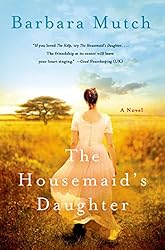

The Housemaid's Daughter
Barbara Mutch, 2013
St. Martin's Press
416 pp.
ISBN-13: 9781250054463
Summary
Barbara Mutch's stunning first novel tells a story of love and duty colliding on the arid plains of Apartheid-era South Africa
When Cathleen Harrington leaves her home in Ireland in 1919 to travel to South Africa, she knows that she does not love the man she is to marry there—her fiance Edward, whom she has not seen for five years.
Isolated and estranged in a small town in the harsh Karoo desert, her only real companions are her diary and her housemaid, and later the housemaid's daughter, Ada. When Ada is born, Cathleen recognizes in her someone she can love and respond to in a way that she cannot with her own family.
Under Cathleen's tutelage, Ada grows into an accomplished pianist and a reader who cannot resist turning the pages of the diary, discovering the secrets Cathleen sought to hide. As they grow closer, Ada sees new possibilities in front of her—a new horizon.
But in one night, everything changes, and Cathleen comes home from a trip to find that Ada has disappeared, scorned by her own community. Cathleen must make a choice: should she conform to society, or search for the girl who has become closer to her than her own daughter?
Set against the backdrop of a beautiful, yet divided land, The Housemaid's Daughter is a startling and thought-provoking novel that intricately portrays the drama and heartbreak of two women who rise above cruelty to find love, hope, and redemption. (From the publisher.)
Author Bio
• Birth—N/A
• Where—South Africa
• Education—Rhodes Univesity (S.A.)
• Currently—lives in Surrey, England, UK
Barbara was born and brought up in South Africa, the granddaughter of Irish immigrants who settled in the Karoo in the early 1900s. She went to school in Durban and Port Elizabeth and then graduated from Rhodes University in the Eastern Cape during the height of apartheid.
She is married and has two sons. For most of the year the family lives in Surrey near London but spends time whenever possible at their home in the Cape.
Barbara loves music and is a gifted pianist like Ada in The Housemaid's Daughter. She is an amateur naturalist with a particular interest in Cape fynbos and birds, as well as being a follower of African politics and history. (From .)
Book Reviews
Interludes from Cathleen’s diary, intended to supply an additional perspective, are a bit heavy-handed, as is the predictable (and bleak) ending. But a vividly drawn setting and Ada’s consistent, special voice drive the story and keep the pages turning.
Publishers Weekly
[A] dark read. Mutch's characters are not very complex, but her setting is a fascinating one, and she does an excellent job of showing the horrifying effects of apartheid law on individual lives. —Mara Bandy, Champaign P.L., IL
Library Journal
South Africa before, during and after apartheid.… In creating a white Lady Bountiful and a wise but unworldly black servant, South African Mutch has [much] in common with The Help's Kathryn Stockett….
Kirkus Reviews
Discussion Questions
1. Do you think the author captures Cathleen’s loneliness and did you sympathize with her sense of isolation?
2. How would you sum up Cathleen and Ada’s relationship? And what does each of them bring to it?
3. Ada’s character develops throughout the book. What words would you use to describe her as a child, a young woman, and then as an adult?
4. Why do you think Ada felt her relationship with Edward was her duty?
5. How do you feel South Africa’s political background colors the novel?
6. Why do you think Dawn is so much more entrenched in the life of the township than her mother is?
7. Did you believe that Ada’s method of approaching the Mayor and the newspaper direct about housing was effective?
8. What do you think happened to Jake?
9. Why do you think Rose behaves in the way that she does?
10. What do you feel that the theme of music contributes to the book?
11. Did you feel that the author offered a real sense of hope with the return of Helen?
12. Did you identify any metaphors that the author uses to enhance the story?
13. What incident affected you the most in the book? And what emotions were you left with?
14. If you were to meet Ada today, what single question would you ask her?
(Questions issued by the publisher.)


How Angels Die
David-Michael Harding, 2011
Q&CY Books
420 pp.
ISBN-13: 9780615503325
Summary
In the darkest days of World War II, when France found itself at the mercy of a brutal dictator, the frontlines of resistance may just have been in the grasp of a few good women.
How Angels Die, the epic work of historical fiction by author David-Michael Harding, delivers a highly inventive and uncommon take on the French Resistance that is certain to appeal to anyone who relishes a blood-pumping drama, which also sheds searing new light on the astounding bravery, profound passion, and razor-sharp cunning of the fairer sex during the most trying times.
In four fateful days, two remarkable sisters, Monique and Claire McCleash, battle the German occupation of their coastal French town in the early days of June 1944. While their mission is the same, their methods of upending the occupation are irreconcilably at odds. The strikingly beautiful Monique puts her body and wit to work for the Resistance by dating and sleeping with German officers; her younger sister Claire elects instead to serve as an active combat guerilla fighter for the cause.
Brimming with high drama that is punctuated by family humor, How Angels Die lifts the veil on a lesser-known side of the French Resistance. Through the prism of two intrepid women, the novel illuminates how these women employ their formidable assets and fierce love of country to face down a vicious enemy.
With page-turning action, unstoppable passion, and historical accuracy, this heart-racing novel is a must-read for sisters, history buffs, and action enthusiasts alike. (From the publisher.)
Author Bio
• Birth—January 4, 1958
• Where—Waverly, New York, USA
• Education—M.A., Elmira College
• Currently—lives in Tampa, Florida
David-Michael Harding is a life-long writer whose work has appeared in national publications and has been recognized by the international writing community. He is a collegiate writing instructor and former semi-professional football player. His experiences provide readers with well researched, crushing fast-paced action. Most of his days are spent writing from the cockpit of his sailboat, Pegasus, somewhere off the Nature Coast of Florida in the Gulf of Mexico. (From the publisher.)
Visit the author's website.
Follow David-Michael on Facebook.
Book Reviews
In How Angels Die. Harding delivers an edge of the seat read as he skillfully summarizes the events and pain of years of conflict during the Nazi occupation of France into ninety-six gut wrenching, mesmerizing hours.
David Roth, Tampa Writing Examiner
A brilliantly written account of life in France during the Nazi occupation of World War II. Characters are believable and sympathetic—each caught in abnormal everyday living in the time of war. The plot spares the reader none of the horrors of the years of the French Resistance. The story's ending is powerful and unforgettable as the reader learns of the bravery of people now long forgotten.
Readers Favorite
Tells the story of two sisters who dared stand against Hitler's regime in World War II, taking their own paths to thwart the German occupation in June of 1944. Even as they work towards the same goals, they find themselves at odds in many ways, as David Harding writes a story of intrigue through war, politics, and family. How Angels Die is a riveting tale that should prove hard to put down.
Midwest Book Review
Terrific book and historical fiction at its best! Set in France during WWII, we learn of life during the Nazi occupation. I loved the characters and we became fast friends. I laughed with them and I cried with them. Mostly I cheered them on in their courageous work in the French Resistance. It was a page turner with plenty of action and drama. Ending is very satisfying. You won't be disappointed.
Reading Room
This book is incredible! The main story revolves around two sisters and how they both work for two very different sides of the resistance. I found this book very easy to read and hard to put down. David Michael Harding has a unique way of storytelling that read very much like a movie. I would highly recommend reading this book.
Life Improvement Radio
Not just another WWII story; it's about how individuals & united groups give all they are to a common cause out of pure love. It’s not a fantasy tale or contrived story; it's a well-research realistic viewpoint celebrating cost of ensuring evil won’t prevail in history's unfortunately too frequent travesties of justice & fair treatment! Awesome, amazing, & deserving of best-seller status!
The Best Reviews
Discussion Questions
1. Consider Monique and Claire as characters—what are their personality traits, motivations, inner qualities, external qualities/talents? Why do they do what they do? Are their actions justified? Now change whose definition of 'justified’ you are using. Try theirs. Their parents. Yours. Do you admire or disapprove of the sisters’ tactics for the Resistance? Why?
2. Explore & describe the dynamics between the sisters. Between each sister and the other Resistance fighters. Between each sister and their parents.
3. How do Monique and Claire change throughout the novel? Where does the change happen and what drives it?
4. You are Estelle’s neighbor. What advice would you have shared with her over tea and stitching uniforms to help her with her relationship with Claire? Given Estelle’s clandestine role, what could she have done to bolster her relationship with Claire?
5. Consider the novel’s plotlines and structure. Are the relationships, events, and circumstances that tie Paul & Valerie to the primary story line plausible? Consistent? Engaging? How do you feel about Paul and what would you have said or done to help him?
6. Are there particular lines of dialogue or passages that encapsulate a character for you? Is it a subtle or foreshadowing effect, or an "in your face" point?
7. Could you relate to the sisters’ snipping/biting dialogue they reserved only for each other? Why does Claire come to mask her love for her sister?
8. What is the significance of Sean’s pipes?
9. Comment on Estelle’s line below from the big blow out at the McCleash house following Claire’s raid. (Hard copy page 217). “Which stays on your soul? Which stains the hands of our daughters more, the killing or the sex?” Does this reflect the main theme of the story? Is it the sin, the contrition, or the redemption that makes a story—makes a life?
10. Did you suspect Monique's big secret?
11. Describe the reading experience. Were you engaged immediately, or did it take you a while to "get into it"? Did the characters and story stay with you after the reading?
12. If you could ask the author a question, what would it be? Have you read other books by the same author? If so how does this book compare. If not, does this book inspire you to read others?
13. Have you learned anything in the reading of How Angels Die? Historically or more personal?
14. Movie time: who would you like to see play what part?
(Questions courtesy of author and publisher.)
top of page (summary)
How Clarissa Burden Learned to Fly
Connie May Fowler, 2010
Grand Central Publishing
278 pp.
ISBN-13: 9780446540681
Summary
How Clarissa Burden Learned to Fly is the transcendent story of a young woman who, in a twenty-four hour period, journeys through startling moments of self-discovery that lead her to a courageous and life-altering decision. (From the publisher).
Author Bio
• Birth—Janury 3, 1958
• Where—N/A
• Education—B.A., University of Tampa; M.A., University of
Kansas
• Awards—Southern Book Critics Circle Award; League of
American Pen Women - Frances Buck Award; Chataqua
South Literary Award
• Currently—lives in the state of Florida, USA
Connie May Fowler is an essayist, screenwriter, and novelist. She is the author of several novels, including How Clarissa Burden Learned to Fly; The Problem with Murmur Lee; and a memoir, When Katie Wakes. In 1996, she published Before Women Had Wings, which became a paperback bestseller and was made into a successful Oprah Winfrey Presents movie.
She founded the Connie May Fowler Women With Wings Foundation, a non-profit organization dedicated to aiding women and children in need. (From the publisher.)
More
Connie May Fowler is an American novelist, essayist, memoirist, screenwriter, and poet. She earned a Bachelor of Arts (English Literature) from University of Tampa and a Masters of Arts (English Literature with an Emphasis in Creative Writing) from University of Kansas where she studied with the novelist Carolyn Doty
Her semi-autobiographical novel, Before Women had Wings, received the 1996 Southern Book Critics Circle Award and the Francis Buck Award (League of American Pen Women). She adapted the novel for Oprah Winfrey and the subsequent Emmy-winning film starred Winfrey, Ellen Barkin, Julia Stiles, and Tina Majorino.
Remembering Blue received the Chautauqua South Literary Award. Three of her novels were Dublin International Literary Award nominees.
Her other novels include Sugar Cage; River of Hidden Dreams; The Problem with Murmur Lee (Redbook’s premier book club selection); and How Clarissa Burden Learned to Fly. Her memoir, When Katie Wakes, explores her family’s generational cycle of domestic violence. Her books have been translated into fifteen languages.
Fowler’s essays, touch on a wide range of topics such as family history, Sumo wrestling, popular culture, music, sex, and food. They have been published in a variety of publications including the New York Times, The Times, Japan Times, International Herald Tribune, Oxford American, Best Life, and Forum.
Her work has been characterized as southern fiction with a post-modern sensibility. It often melds magical realism with the harsh realities of poverty. It generally focuses on working class people of various racial backgrounds.
She has been cited in sources such as Advancing Sisterhood?: Interracial Friendships in Contemporary Southern Fiction; and Race Mixing: Southern Fiction Since the Sixties. She is considered part of a "fourth generation" of American writers—black and white—that explodes old notions of race, segregation, and interpersonal racial relationships.
Extras
• In 2007, Fowler performed at New York City’s The Player's Club with actresses Kathleen Chalfont, Penny Fuller, and others in a performance based on The Other Woman, an anthology that includes Fowler’s essay “The Uterine Blues.” In 2003, Fowler performed in a charity benefit performance of The Vagina Monologues with Jane Fonda and Rosie Perez.
• Fowler has held numerous jobs including bartender, caterer, nurse, television producer, TV show host, antique dealer, and construction worker.
• From 1997-2003 she directed the Connie May Fowler Women Wings Foundation, an organization that served at risk women and children. From 2003–2007, she was the Irving Bacheller Professor of Creative Writing at Rollins College and directed their author series “Winter With the Writers.”
• Fowler, a life-long resident of Florida, has set all of her books, thus far, in that state. ("More" and "Extras" from Wikipedia.)
Book Reviews
In this gloomy novel, Fowler (Before Women Had Wings) presents a day in the life of writer Clarissa Burden, stuck in a loveless marriage and preoccupied with a joyless childhood. Memories of a cruel mother aren't the only things haunting Clarissa; a number of ghosts, including the 19th-century biracial family who had lived in Clarissa's Florida home, also weave themselves into Clarissa's story. Plagued by writer's block and suspicious of her photographer husband (and the nude models he employs), Clarissa leaves home for a day filled with spooky cemeteries, near-death experiences, life-altering conversations, exhilaration, and frustration. The plot tends to meander, incorporating not just incorporeal spirits but occasional jaunts into the minds of Florida's animals; still, Fowler produces some singularly memorable characters. By the time Clarissa stands up to her husband, readers will have suffered mightily through a sweltering Florida solstice, listening to the heroine's witty, sometimes whiney, internal monologue, and wishing for some real action. Fortunately, Fowler delivers on that wish, bringing together all her characters—dead, alive, and imagined—for an explosive conclusion
Publishers Weekly
In the little town called Hope, FL, it's the summer solstice, not only the longest but the hottest day of the year. On this day, Clarissa Burden's life changes irrevocably. Supporting a brutal husband who makes no living sketching and wooing frolicking female nudes and who deeply resents her successful career as a novelist, Clarissa needs release. Badly. Unbeknownst to her, there are ghosts living in her rambling home who need a release of their own. For all parties, enough is enough, and during this solstice day's long hours, things change forever. In this novel by best-selling author Fowler (The Problem with Murmur Lee) past and present lives collide in magical and violent ways with surprising, liberating, and redeeming results. The colorful characters include an almost-angel, carnival dwarves, and anthropomorphic animals, and the result is folksy and sophisticated, and humorous yet at times grave and appalling, with the sins of the past clearly depicted. Verdict: A seductive and thoroughly satisfying read. —Jyna Scheeren, NYPL
Library Journal
Florida novelist Clarissa Burden is suffering from writer’s block...her mind is blank.... Fowler blurs the line between the written and the writer as we witness Clarissa’s brave discovery that the real truth is often the most risky tale to tell. —Annie Bostrom
Booklist
Book Club Discussion Questions
1. How Clarissa Burden Learned to Fly opens with vivid descriptions of the weather and wildlife of Hope, Florida: “this swampy southern outpost,” “the humidity-laden situation,” “its sundry wildlife…all steeling themselves against the inevitable onslaught of the day’s hellish heat” (1). How do the climate and geography of Hope affect the story? Could the events that take place have happened anywhere else in the country? In the world?
2. Recalling what she once thought of as a heroic move, Clarissa considers the way Iggy left his family and South Africa because of their different feelings about race. She did not ask, 'If a man walks away from his mother because he seriously disagrees with her politics, how deep is his allegiance to a wife?’” (6). Do you agree that one’s relationship with family can be an indicator of one’s relationship with a spouse? Why or why not?
3. A fly that is in love with Clarissa plays an important role in this story. We are also introduced to other insects and animals living in Clarissa’s home, truck, and other spaces around her that she doesn’t even know about. How does knowing about these creatures affect your perception of Clarissa, if at all? Would the story be different without them?
4. “Jane was, unknowingly, ticking off the list of the most asked, most useless questions thrown at writers” (43). Is it fair that Clarissa thinks of her interviewer’s questions this way? What questions would you want to ask a writer you admire? What questions would you want an interviewer to ask you?
5. Clarissa is described as not having much confidence or independence at the beginning of the book: “uncharacteristically courageous” (59), “Despite all that she had accomplished in her life, she was not a woman accustomed to doing things on her own” (62). How does Clarissa change as the day progresses? What was it about this one day that was so special?
6. “What was love if not an idea—abstract as wind, concrete as rain—an invisible homily so powerful that it propelled even the meekest souls to hold dear what they feared most?” (64). Do you agree that love drives you toward what you “fear most?” Why or why not? Have you experienced love that made you feel this way? What would the fly in the story think about this notion?
7. What is the significance of all the trash that piled up in Clarissa’s truck, and why is she so determined to get rid of it by herself on this day?
8. Why does Clarissa go to the cemetery, and in what way did it affect her? Do you think she is aware of the ghosts there, particularly the children who pull her out of the mud?
9. Clarissa realizes "...her marriage hung by a single tendril spun of stubbornness and fear" (115). What is she being stubborn about, and what is she fearful of? How does Iggy fit into this fragile arrangement?
10. Clarissa is harassed by the boys at the Treetop General Store, but Miss Lossie seems to get rid of them without a problem. "Surprised at their compliance, Clarissa wondered why she had commanded such little respect from the two-pint punks” (122). What is it about Miss Lossie that Clarissa doesn’t possess? How do Miss Lossie and Chester aid Clarissa in her spiritual journey?
11. How do the stories about the worm gruntin’ stob fit into the larger picture of Clarissa’s new life? Why do Chester and Miss Lossie regard worm gruntin’ so highly, and what does Clarissa take away from that devotion?
12. How do Clarissa’s perceptions and desires shift as she rides Chester’s motorcycle? “Hurtling down the highway on two wheels, she felt death’s presence...Duende...the Spanish notion of a creative force antithetical to the muse—a death dancer spinning a flamenco composed of carnality, sadness, and passion” (144-5). How does this awakening relate to the rest of her lessons of the day?
13. Despite all the excitement of buying a flashy new car, Clarissa notices the understated details of car salesman Raul:
Raul’s fingers resumed their dance. They were graceful fingers, tanned, and still bore the calluses of a man who used his hands to make a living. Clarissa wondered how long he had worked at the car lot and if he missed whatever it was that earned him those calluses. Maybe he understood the secrets of oak and pine, citrus and tomatoes, drywall and nails (152).
How could Clarissa spend so much time considering the back story of another when her own life is changing so wildly? Do you think that the mind of a writer naturally imagines the histories of those she encounters?
14. Iggy’s ire over the new car doesn’t surprise Clarissa, but she realizes, "Her life—all of its molehills and detours—she realized, was an enormous annoyance to him” (168). What kept her from having this awareness during their seven years of marriage? What gives Clarissa the strength to do something about her problems now?
15. "What good was hope if it remained nebulous? Hope was one of those abstractions, like love; for it to be meaningful, it had to be hitched to something real" (179). If this is true and it’s also true that love drives a person to what they fear most, what does hope motivate a person to do? According to Clarissa, how are the two similar and how are they different? What’s your opinion?
16. Compare Iggy and Adams. How do they perceive Clarissa, how do they treat her? In what ways does she respond to each of them?
17. Clarissa taught Adams that writing is scary and painful and dangerous, and now he has to re-explain that lesson back to her. What made Clarissa forget this essential part of her craft? How does she turn her writer’s block around?
18. Do you agree that Olga’s story is the one that Clarissa should focus on for her new book, as Adams says? Why or why not?
19. “She'd woken up that morning naive. And now she was not. Now the world was a different place. And Iggy was going to have to catch up” (236). Do you think it’s possible to turn a life around in one day? Have you ever had an epitome similar to Clarissa’s, whether it was about a relationship, a job, or another major life decision?
20. How do Larry Dibble/Lawrence Butler and the Villada-Archer family function in Clarissa’s alteration? Do you believe that spirits of the past can influence the present?
21. What do you think will happen next to Clarissa Burden?
(Questions issued by publisher.)
top of page
Summary | Author | Book Reviews | Discussion Questions
How Green Was My Valley
Richard Llewellyn, 1939
Simon & Schuster
512 pp.
ISBN-13: 9780684825557
In Brief
Set in Wales in the late Victorian era (the precise time is never clear), How Green Was My Valley tells the story of the Morgans, a poor but respectable mining family of the South Wales valleys, through the eyes of the youngest son, Huw Morgan.
Huw's academic ability sets him apart from his elder brothers and enables him to consider a future away from this troubled industrial environment. His five brothers and his father are miners; after the eldest brother, Ivor, is killed in an industrial accident, Huw moves in with his sister-in-law, Bronwen, with whom he has always been in love. Later, Huw's father is also killed in the mine. One of Huw's three sisters, Angharad, makes an unhappy marriage to a wealthy mine owner and never overcomes her clandestine relationship with the local minister.
After everyone Huw has known either dies or moves away, he decides to leave as well, and tells us the story of his life just before he does. (From Wikipedia.)
top of page
About the Author
• Birth—December 8, 1906
• Where—Hendon, Middlesex, England, UK
• Death—November 30, 1983
• Where—Dublin, Ireland, UK
Richard David Vivian Llewellyn Lloyd, better known by his pen name Richard Llewellyn, was a Welsh novelist.
Llewellyn was born Richard David Vivian Llewellyn Lloyd of Welsh parents in Hendon, Middlesex in 1906. Only after his death was it discovered that his claim that he was born in St. Davids, West Wales was false.
Several of his novels dealt with a Welsh theme, the best-known being How Green Was My Valley (1939), which won international acclaim and was made into a classic Hollywood film. It immortalised the way of life of the South Wales Valleys coal mining communities, where Llewellyn spent a small amount of time with his grandfather. Three sequels followed.
He lived a peripatetic life, travelling widely throughout his life. Before World War II, he spent periods working in hotels, wrote a play, worked as a coal miner and produced his best known novel. During World War II, he rose to the rank of Captain in the Welsh Guards. Following the war, he worked as a journalist, covering the Nuremberg Trials, and then as a screenwriter for MGM. Late in his life, he lived in Eilat, Israel.
Protagonists who assume new identities, often because they are transplanted into foreign cultures, are a recurring element in Llewellyn's novels, including a spy adventure (Edmund Trothe) that extends through several volumes.
Llewellyn married twice: his first wife was Nona Sonstenby, whom he married in 1952 and divorced in 1968, and his second wife was Susan Heimann, whom he married in 1974.
Richard Llewellyn died on 30 November 1983. (From Wikipedia.)
top of page
Critics Say . . .
(Older works have few, if any, mainstream press reivews online. For more, see Amazon and Barnes & Noble customer reviews.)
A story of exquisite distinction and vibrant interest; clear and strong as the music under the sky.
New York Times
Llewellyn's tale of a young boy's coming-of-age in a Welsh mining village—the source for the beloved John Ford film of the same name—is "a beautiful story told in words that have Welsh music in them...a book that will live in the mind and memory of its readers.
Atlantic Monthly
In characterization, in vigorous scenes, in the picture of the everyday life of the family and the village, in tragic scenes and in festive ones, the book cuts deep into our hearts. It is a profoundly moving story, realistic and yet poignantly lyrical...[with the] simplicity of a peasant saga and occasional over-playing of the heroic.... The story is told by Huw Morgan, looking back from the vantage point of old age to the days of his youth, as one of a large family, when "green was my valley"—and his language is still tinged with the almost Biblical overtones of his people. Don't overlook this book.
Kirkus Reviews
top of page
Book Club Discussion Questions
Use our LitLovers Book Club Resources; they can help with discussions for any book:
• How to Discuss a Book (helpful discussion tips)
• Generic Discussion Questions—Fiction and Nonfiction
• Read-Think-Talk (a guided reading chart)
Also consider these LitLovers talking points to help get a discussion started for How Green Was My Valley:
1. Talk about the character of Huw Morgan—whose better angel often gives way to his lesser one.
2. Think about the ways in which the novel pits the strength of family unity against the dissolution of community and progress. How does the narrator view the idea of progress?
2. The book's characters question their religious beliefs. As a child, Huw wonders how Jesus could be divine, and after his fathers death, Huw's mother renounces her belief altogether. How would you answer Huw and his mother?
3. What is the significance of the slag pile, a phrase which Llewellyn took initially as the novel's title?
4. Many have commented on the book's poetic language. Talk specifically about the book's use of Welsh dialect. What was Llewellyn's purpose? Did it enhance or detract from your reading experience?
5. Do you feel the issues raised in the book have relevance to today—particularly environmentalism, the labor movement, and corporate governance.
6. Discuss Mr. Gryffyd's decision to resign his post as pastor? Was he correct to do so? Were there other options?
(Questions by LitLovers. Please feel free to use them, online and off, with attribution. Thanks.)
top of page


How It All Began
Penelope Lively, 2012
Penguin Group USA
240 pp.
ISBN-13: 9780670023448
Summary
When Charlotte Rainsford, a retired schoolteacher, is accosted by a petty thief on a London street, the consequences ripple across the lives of acquaintances and strangers alike.
A marriage unravels after an illicit love affair is revealed through an errant cell phone message; a posh yet financially strapped interior designer meets a business partner who might prove too good to be true; an old-guard historian tries to recapture his youthful vigor with an ill-conceived idea for a TV miniseries; and a middle-aged central European immigrant learns to speak English and reinvents his life with the assistance of some new friends.
Through a richly conceived and colorful cast of characters, Penelope Lively explores the powerful role of chance in people's lives and deftly illustrates how our paths can be altered irrevocably by someone we will never even meet. Brought to life in her hallmark graceful prose and full of keen insights into human nature, How It All Began is an engaging, contemporary tale that is sure to strike a chord with her legion of loyal fans as well as new readers.
A writer of rare wisdom, elegance, and humor, Lively is a consummate storyteller whose gifts are on full display in this masterful work. (From the publisher.)
Author Bio
• Birth—March 17, 1933
• Where—Cairo, Egypt
• Education—Oxford University
• Awards—Man Booker Prize; Carnegie
Medal; Whitbread Children's Book of
the Year.
• Currently—lives London, England, UK
Penelope Lively was born in Cairo, Egypt but settled in England after the war and took a degree in history at St Anne's College, Oxford. She is a Fellow of the Royal Society of Literature, and a member of PEN and the Society of Authors. She was married to the late Professor Jack Lively, has a daughter, a son and four grandchildren, and lives in Oxfordshire and London.
Lively is the author of many prize-winning novels and short story collections for both adults and children. She has twice been shortlisted for the Booker Prize; once in 1977 for her first novel, The Road to Lichfield, and again in 1984 for According to Mark. She later won the 1987 Booker Prize for her highly acclaimed novel Moon Tiger. Her novels include Passing On, City of the Mind, Cleopatra's Sister, and Heat Wave.
Penelope Lively has also written radio and television scripts and has acted as presenter for a BBC Radio 4 program on children's literature. She is a popular writer for children and has won both the Carnegie Medal and the Whitbread Award. (From the publisher.)
Book Reviews
As she's done in so many earlier books, Ms. Lively writes with an astringent blend of sympathy and detachment, emotional wisdom and satiric wit, and the result, here, is a Chekhovian tale that's entertaining, even funny on the surface, but ultimately melancholy in its awareness of time and lost opportunities, its characters' apprehension of mortality and the limits to their dreams.
Michiko Kakutani - New York Times
One of our most talented writers has written an elegant, witty work of fiction, deceptively simple, emotionally and intellectually penetrating, the kind of novel that brings a plot to satisfying closure but whose questions linger long afterward in the reader's mind.
Susan Cokal - New York Times Book Review
How It All Began,..focuses on the significance of stories, showing how lives touch and tangle with one another....This densely patterned novel feels at once clever and contrived. Each character seems the reflection of another, and several display a similar helplessness....This novel shows that if minor events wreak major effects, so can grand systems shape our own small ends—and our beginnings, too.
Abigail Deutsch - San Francisco Chronicle
The ever-productive, ever-graceful Penelope Lively returns to several pet themes—memory, history and the powerful role of happenstance in reshaping lives—with a fresh and charming novel that could well be called "Chance." ...Lively has provided a golden passport that will sweep you through the border control of other people's lives.
Heller McAlpin - Denver Post
In her latest title, the Booker Prize-winning author of Moon Tiger explores the far-reaching effect of happenstance, as individual circumstances shift, lives change, and the known is perceived in an altogether new light. The novel opens with the mugging of retired schoolteacher Charlotte Rainsford on a London street. Subsequently, a diverse cast of richly embroidered acquaintances and strangers find their lives irrevocably altered by this event, which many of them haven't even heard about. We see how the mugging affects Charlotte's daughter Rose, who works for a historian desperate to return to the limelight, and the spillover to his niece Marion, a cash-poor interior designer hunting for a business partner while carrying on an affair eventually revealed through a stray cell-phone call. Lively delivers her story about these intertwined lives with faultless dexterity, sly humor, keen insight, and deft economy. Verdict: Lively's 12th novel is a feel-good masterpiece that will delight faithful fans as well as those new to the work of this consummate storyteller. —Joyce Townsend, Pittsburg, CA
Library Journal
Discussion Questions
1. How It All Began is a book about reading and writing. What does reading give to Lively’s more literate characters? What does the absence of reading deny to the others?
2. How might Lively’s application of chaos theory to human relations conflict with the idea of a divinely ordered universe? What quarrels might a religious person have with Lively’s representation of events and their causes?
3. Given the randomness of events in the world that Lively describes, where seemingly wicked events can produce unforeseen happy results, how is it possible to distinguish good from evil?
4. Lively is fond of inserting historians into her fiction. What precisely does a character like Lord Henry contribute to the mood and structure of How It All Began?
5. What are the differences in the ways in which Charlotte and Lord Henry confront old age? Which approach should we admire more?
6. Charlotte’s mugger notwithstanding, the characters who come closest to true evil in How It All Began are unscrupulous professional men like the grasping solicitor Paul Newsome and the amoral financier George Harrington. What does Lively appear to think about the ethics of powerful people in the modern age?
7. Lively shows us two married couples whose shared lives are endangered by infidelities, either real or contemplated. How might these two subplots be compared and contrasted?
8. How It All Began is acutely conscious of the European debt crisis. However, the novel’s embattled characters tend to have either marketable skills or salable property that they can eventually fall back on. How might How It All Began have been different if Lively had chosen to make her characters’ circumstances more dire?
9. What does How It All Began suggest about the effect of television on the intellectual culture of Britain? Does Lord Henry, for all of his dry pomposity, deserve more of a soapbox than electronic media are prepared to give him?
What characteristics does Lively seem to most admire in a woman?
10. What traits does she evidently most despise in a man?
11. Does Rose make the right choice between Gerry and Anton? What are the arguments on either side of this question?
12. Near the end of How It All Began, Lively gives us a glimpse of the baby who lives next door to Charlotte. How does this brief insertion fit in thematically with the rest of the novel?
13, Charlotte observes that the modern novel has tried to free itself of messages but that they still seem to “creep in here and there” (69). What messages do you think have crept into How It All Began, and did Lively really try all that hard to keep them out?
(Questions issued by publisher.)
How It Happened
Michael Koryta, 2018
Little, Brown and Co.
368 pp.
ISBN-13: 9780316293938
Summary
And that is how it happened. Can we stop now?
Kimberly Crepeaux is no good, a notorious jailhouse snitch, teen mother, and heroin addict whose petty crimes are well-known to the rural Maine community where she lives.
So when she confesses to her role in the brutal murders of Jackie Pelletier and Ian Kelly, the daughter of a well-known local family and her sweetheart, the locals have little reason to believe her story.
Not Rob Barrett, the FBI investigator and interrogator specializing in telling a true confession from a falsehood. He's been circling Kimberly and her conspirators for months, waiting for the right avenue to the truth, and has finally found it.
He knows, as strongly as he's known anything, that Kimberly's story-a grisly, harrowing story of a hit and run fueled by dope and cheap beer that becomes a brutal stabbing in cold blood-is how it happened.
But one thing remains elusive: where are Jackie and Ian's bodies?
After Barrett stakes his name and reputation on the truth of Kimberly's confession, only to have the bodies turn up 200 miles from where she said they'd be, shot in the back and covered in a different suspect's DNA, the case is quickly closed and Barrett forcibly reassigned.
But for Howard Pelletier, the tragedy of his daughter's murder cannot be so tidily swept away. And for Barrett, whose career may already be over, the chance to help a grieving father may be the only one he has left.
How It Happened is a frightening, tension-filled ride into the dark heart of rural American from a writer Stephen King has called "a master" and the New York Times has deemed "impossible to resist." (From the publisher.)
Author Bio
• Birth—September 20, 1982
• Raised—Bloomington, Indiana, USA
• Education—B.A., University of Indiana
• Currently—lives in Bloomington, Indiana, and Camden, Maine
Michael Koryta (Ko ree tah) is the New York Times bestselling author of more than a dozen suspense novels. He was raised in Bloomington, Indiana, where he graduated from Indiana University with a B.A. in criminal justice.
Koryta began writing at a very young age. As an eight-year-old boy, he began writing to his favorite writers and by 16 had decided he wanted to become a crime novelist. Four years later when he was only 20 (and still a student at IU), his first novel, Tonight I Said Goodbye, was accepted for publication and later nominated for an Edgar Award. In fact, he wrote his first two published novels—and was published in nearly 10 languages—all before he fulfilled the "writing requirement" classes required for his diploma.
Before turning to writing full-time, Koryta worked as a private investigator, a newspaper reporter, and taught at the Indiana University School of Journalism.
Koryta's novels in include How It Happened, Rise the Dark, Last Words, Those Who Wish Me Dead, The Prophet, The Ridge, and So Cold The River. His books have won or been nominated for the Los Angeles Times Book Prize, Edgar Award, Shamus Award, Barry Award, Quill Award, International Thriller Writers Award, and the Golden Dagger.
Koryta and his wife, Christine, divide their time between Bloomington, Indiana, and Camden, Maine, with a cranky cat named Marlowe, an emotionally disturbed cat named John Pryor (after the gravestone on which he was found as an abandoned kitten), and a dog of unknown heritage named Lola. (Adapted from the publisher and Wikipedia. Retrieved 5/17/2018.)
Book Reviews
Ingenious.… Koryta' s plotting is sure-footed, and the secrets he discloses, one by one, at the novel's end are both surprising and plausible.… How It Happened [is] a book the reader won't soon forget.
Washington Post
(Starred review) With this searing look at an investigator’s obsessive efforts to close a case that has reawakened childhood demons, bestseller Koryta has produced his most powerful novel in years.…Koryta, when he’s at the top of his game, has few peers.
Publishers Weekly
(Starred review) As with many of Koryta's recent novels, his main characters are men with hidden rage they've been struggling with since their childhoods.… [D]devotees of murder mysteries will enjoy this enthralling tale. —Jason L. Steagall, Gateway Technical Coll. Lib., Elkhorn, WI
Library Journal
(Starred review) Is Koryta capable of telling a less-than-gripping tale? This book may not be as ambitious as his best efforts (including Rise the Dark, 2016), but it is flawless, unpredictable storytelling streaked with his usual dark undercurrents.Crime fiction doesn't get any more enjoyable.
Kirkus Reviews
Discussion Questions
We'll add publisher questions if and when they're available; in the meantime, please use our GENERIC MYSTERY QUESTIONS to start a discussion for HOW IT HAPPENED … then take off on your own:
GENERIC DISCUSSION QUESTIONS
Mystery / Crime / Suspense Thrillers
1. Talk about the characters, both good and bad. Describe their personalities and motivations. Are they fully developed and emotionally complex? Or are they flat, one-dimensional heroes and villains?
2. What do you know...and when do you know it? At what point in the book do you begin to piece together what happened?
3. Good crime writers embed hidden clues in plain sight, slipping them in casually, almost in passing. Did you pick them out, or were you...clueless? Once you've finished the book, go back to locate the clues hidden in plain sight. How skillful was the author in burying them?
4. Good crime writers also tease us with red-herrings—false clues—to purposely lead readers astray? Does your author try to throw you off track? If so, were you tripped up?
5. Talk about the twists & turns—those surprising plot developments that throw everything you think you've figured out into disarray.
- Do they enhance the story, add complexity, and build suspense?
- Are they plausible or implausible?
- Do they feel forced and gratuitous—inserted merely to extend the story?
6. Does the author ratchet up the suspense? Did you find yourself anxious—quickly turning pages to learn what happened? A what point does the suspense start to build? Where does it climax...then perhaps start rising again?
7. A good ending is essential in any mystery or crime thriller: it should ease up on tension, answer questions, and tidy up loose ends. Does the ending accomplish those goals?
- Is the conclusion probable or believable?
- Is it organic, growing out of clues previously laid out by the author (see Question 3)?
- Or does the ending come out of the blue, feeling forced or tacked-on?
- Perhaps it's too predictable.
- Can you envision a different or better ending?
8. Are there certain passages in the book—ideas, descriptions, or dialogue—that you found interesting or revealing...or that somehow struck you? What lines, if any, made you stop and think?
9. Overall, does the book satisfy? Does it live up to the standards of a good crime story or suspense thriller? Why or why not?
(Generic Mystery Questions by LitLovers. Please feel free to use them, online or off, with attribution. Thanks.)

How Much of These Hills Is Gold
C. Pam Zhanag, 2020
Pengin Publishing
288 pp.
ISBN-13: 9780525537205
Summary
An electric debut novel set against the twilight of the American gold rush, two siblings are on the run in an unforgiving landscape—trying not just to survive but to find a home.
Ba dies in the night; Ma is already gone. Newly orphaned children of immigrants, Lucy and Sam are suddenly alone in a land that refutes their existence.
Fleeing the threats of their western mining town, they set off to bury their father in the only way that will set them free from their past. Along the way, they encounter giant buffalo bones, tiger paw prints, and the specters of a ravaged landscape as well as family secrets, sibling rivalry, and glimpses of a different kind of future.
Both epic and intimate, blending Chinese symbolism and re-imagined history with fiercely original language and storytelling, How Much of These Hills Is Gold is a haunting adventure story, an unforgettable sibling story, and the announcement of a stunning new voice in literature.
On a broad level, it explores race in an expanding country and the question of where immigrants are allowed to belong. But page by page, it's about the memories that bind and divide families, and the yearning for home. (From the publisher.)
Author Bio
Born in Beijing but mostly an "artifact" of the United States, C Pam Zhang has lived in thirteen cities across four countries and is still looking for home. She's been awarded support from Tin House, Bread Loaf, Aspen Words and elsewhere, and currently lives in San Francisco. (From the publisher.)
Book Reviews
Sure to be the boldest debut of the year…. C Pam Zhang grapples with the legend of the wild west and mines brilliant new gems from a well-worn setting…. The story is heavy with layers of trauma…. On the one hand, the novel is in close touch with the entire tradition of wild west mythology and film…. At the same time, the story feels completely original… [as] the classic western is given a rich new shading as race, gender, sexual identity, poverty and pubescence come into play. The novel is thick with detail, metaphor and oblique allusion ... at its core is a chilling sense of the utter loneliness and isolation felt by Lucy and Sam.
Guardian (UK)
[This] thoroughly engrossing saga… starts out slow.… [But] in section two… the tale [is transformed] into a fully immersive epic drama packed with narrative riches and exquisitely crafted prose…. How Much of These Hills Is Gold succeeds as a riveting account of one family’s struggle to make ends meet in the American West…. But the novel is also a much-needed homage to the untold history of American immigrants… giving a voice to the "honest folks" of color who were enslaved, robbed, raped or murdered in the process…. Zhang captures not only the mesmeric beauty and storied history of America’s sacred landscape, but also the harsh sacrifices countless people were forced to make in hopes of laying claim to its bounty.
San Francisco Chronicle
(Starred review) [E]xtraordinary debut, a beautifully rendered family saga, centers on a pair of siblings…. Gorgeously written and fearlessly imagined, Zhang’s awe-inspiring novel introduces two indelible characters whose odyssey is as good as the gold they seek.
Publishers Weekly
(Starred review) This moving tale of family, gold, and freedom rings with a truth that defies rosy preconceptions. The description of human and environmental degradation is balanced by shining characters who persevere greatly. Highly recommended. —Henry Bankhead, San Rafael P.L., CA
Library Journal
(Starred review) The journey of these two children… force us to confront just how "white" the history we've been taught is…. [Zhang has] creat[ed] a new and spellbinding mythology of her own. Aesthetically arresting and a vital contribution to America's conversation about itself..
Kirkus Reviews
Discussion Questions
1. In How Much of These Hills is Gold, Pam Zhang crafts a reimagined American West, filled with magic and myth, at the height of the Gold Rush. The epigraph reads: "This land is not your land" but within Chapter One, Lucy recalls Ba’s words: "You remember you belong to this place as much as anybody." (24). What do you think the novel is saying about birthrights? Are they inherited or claimed?
2. Much is made about the burial process—for loved ones; for things and animals; for past selves. Is there a right way to honor the dead as seen in the novel? What does Sam’s decision to take the two silver dollars from Ba’s burial tell us about their relationship?
3. Ba and Sam are prone to fanciful storytelling. Consider the many stories told within the novel, as well as the tellers. What are the differences between the stories that the characters tell one another and the stories they tell themselves? To what extent is myth involved in the creation of each character’s origin story?
4. Bodies, like the land, are often claimed. At the end of Part Two, Sam is "born" as Ma "dies." Dissect the ways in which, Lucy, Sam, and Ma adhere to or subvert gender norms throughout the novel.
5. Compare and contrast the various teachers in the novel, their specific motivations, and their successes. Billy to Ba; Teacher Leigh to Lucy; Ba to Ma. etc.,—what kind of education does each receive? What are the power dynamics in evidence between teacher and student?
6. Ba helps Sam become the boy he always wanted to be, meanwhile Lucy and Ma are thick as thieves. Discuss the differing family dynamics. Why does Ba choose to tell Sam Ma’s secret, but not Lucy? Why doesn’t Ma seek out Lucy after she’s disappeared if they’re so close? In what ways do Sam and Lucy exemplify characteristics of each of their parents?
7. In Part Three, Ba speaks through the voice of the wind and hopes that Lucy hears it in the night. How does the revelation of Ba’s true origin affect your reading of him throughout the book? Did learning his side of the story change your perspective about his behavior and motivations?
8. The novel places a large significance on gold and Ba’s belief that prospecting is a talent. The other mountain folk, however, think striking gold has all to do with chance. In what ways does the novel interrogate these ideas? What other factors are at play in one’s ability to strike gold?
9. The environment is as much a character as Lucy and Sam’s family and is often anthropomorphized. Analyze the relationship between the characters and the natural world, as well as animals, both real and imagined. Why do you think the author chose to name the chapters after recurring natural elements?
10. When we encounter Lucy and Sam in Part Four, Lucy has chosen to settle in the town of Sweetwater, and Sam chooses life on the trail. Consider the dichotomy and tension between civilization and wilderness in the novel. Are there elements of each in the other?
11. Throughout the novel, Lucy often asks "What makes a home a home?" Does she ever find a sufficient answer to that question? Consider Ma’s homeland across the sea, the family’s home in town, Lucy’s place in Sweetwater. Are there degrees to what can make a "home"?
12. What do you think Lucy asks the gold man for at the conclusion of the novel? Why do you think the author chose not to name it?
(Questions issued by the publisher.)


How Should a Person Be?
Sheila Heti, 2012
Henry Holt and Co.
320 pp.
ISBN-13: 9780805094725
Summary
Reeling from a failed marriage, Sheila, a twentysomething playwright, finds herself unsure of how to live and create.
When Margaux, a talented painter and free spirit, and Israel, a sexy and depraved artist, enter her life, Sheila hopes that through close—sometimes too close—observation of her new friend, her new lover, and herself, she might regain her footing in art and life.
Using transcribed conversations, real emails, plus heavy doses of fiction, the brilliant and always innovative Sheila Heti crafts a work that is part literary novel, part self-help manual, and part bawdy confessional. It's a totally shameless and dynamic exploration into the way we live now, which breathes fresh wisdom into the eternal questions: What is the sincerest way to love? What kind of person should you be? (From the publisher.)
Author Bio
• Birth—December 25, 1976
• Where—Toronto, Ontario, Canada
• Education—University of Toronto; National
Theatre School of Canada.
• Currently—lives in Toronto, Ontario
Heti was born in Toronto, Ontario. Her parents are Hungarian Jewish immigrants. She studied art history and philosophy at the University of Toronto and playwriting at the National Theatre School of Canada. She works as Interviews Editor at The Believer where she also conducts interviews regularly, and she wrote a column on acting for Maisonneuve. Her brother is the comedian David Heti.
Writings
Heti's novel, Ticknor, was released in 2005. The novel's main characters are based on real people: William Hickling Prescott and George Ticknor, although the facts of their lives are altered. Her short story collection, The Middle Stories, was published in 2001 Canada when she was twenty-four, and by McSweeney's in the United States, and translated into German, French, Spanish and Dutch. In 2011, she published The Chairs are Where The People Go which she wrote with her friend, Misha Glouberman. The New Yorker called it "a triumph of conversational philosophy" and named it one of the Best Books of 2011.
Heti's book How Should a Person Be? was published in 2010, (2012 in the U.S.)—in which she describes as book of constructed reality, based on recorded interviews with her friends, particularly the painter Margaux Williamson. It was chosen by the New York Times as one of the 100 Best Books of 2012 and by James Wood of The New Yorker as one of the best books of the year. It was also included on year-end lists on Salon, New Republic, New York Observer, and more. In her 2007 interview with Dave Hickey for Believer, she noted, "Increasingly I’m less interested in writing about fictional people, because it seems so tiresome to make up a fake person and put them through the paces of a fake story. I just—I can’t do it."
Other activities
Extras
• Heti is the creator of Trampoline Hall, a popular monthly lecture series based in Toronto and New York, at which people speak on subjects outside their areas of expertise. The New Yorker praised the series for "celebrating eccentricity and do-it-yourself inventiveness". It has sold out every show since its inception in December 2001.
• For the early part of 2008, Heti kept a blog called The Metaphysical Poll, where she posted the sleeping dreams people were having about Barack Obama and Hillary Clinton during the 2008 primary season, which readers sent in.
• Heti was an actress as a child, and as a teenager appeared in shows directed by Hillar Liitoja, the founder and Artistic Director of the experiemental DNA Theatre.
• Heti appears in Margaux Williamson's 2010 film, Teenager Hamlet.
• Heti plays Lenore Doolan in Leanne Shapton's book, Important Artifacts and Personal Property from the Collection of Lenore Doolan and Harold Morris, including Books, Street Fashion, and Jewelry. (From Wikipedia.)
Book Reviews
I do not think this novel knows everything, but Sheila Heti does know something about how many of us, right now, experience the world, and she has gotten that knowledge down on paper, in a form unlike any other novel I can think of.
David Haglund - New York Times Book Review
How Should a Person Be? teeters between youthful pretension and irony in ways that are as old as Flaubert’s Sentimental Education...but Ms. Heti manages to give Sheila’s struggle a contemporary and particular fee.... How Should a Person Be? reveals a talented young voice of a still inchoate generation.
Kay Hymowitz - Wall Street Journal
A perfect summer read. It is also one of the bravest, strangest, most original novels I’ve read this year…. We care about Sheila’s plight, but the souls in limbo here are, ultimately, our own. With so many references to the world outside of the fiction, this novel demands to know: Can art inform our lives, and tell us how to be?
Christopher Boucher - Boston Globe
Brutally honest and stylistically inventive, cerebral and sexy, this ‘novel from life’ employs a grab bag of literary forms and narrative styles on its search for the truth…meandering and entertaining exploration of the big questions, rousting aesthetic, moral, religious and ethical concerns most novels wouldn’t touch.
Michael David Lukas - San Francisco Chronicle
[Sheila Heti] has an appealing restlessness, a curiosity about new forms, and an attractive freedom from pretentiousness or cant…How Should a Person Be? offers a vital and funny picture of the excitements and longueurs of trying to be a young creator in a free, late-capitalist Western City…This talented writer may well have identified a central dialectic of twenty-first-century postmodern being.
James Wood - The New Yorker
I read this eccentric book in one sitting, amazed, disgusted, intrigued, sometimes titillated I’ll admit to that, but always in awe of this new Toronto writer who seems to be channeling Henry Miller one minute and Joan Didion the next. Heti’s book is pretty ugly fiction, accent on the pretty.
Alan Cheuse - NPR
[A] breakthrough novel...Just as Mary McCarthy’s The Company She Keeps (written at the same age) was an explosive and thrilling rejoinder to the serious, male coming-of-age saga exemplified during her era by Sartre’s The Age of Reason, Heti’s book exuberantly appropriates the same, otherwise tired genre to encompass female experience. How Should a Person Be?’s deft, picaresque construction, which lightly-but-devastatingly parodies the mores of Toronto’s art scene, has more in common with Don Quixote than with Lena Dunham’s HBO series “Girls” or the fatuous blogs and social media it will, due to its use of constructed reality, inevitably be compared with…Like [Kathy] Acker, [Heti] is a brilliant, original thinker and an engaging writer.
Chris Kraus - LA Review of Books
Toronto-based Heti and her real-life friends, including Misha Glouberman with whom she wrote a previous book (Where the Chairs Are Where the People Go, 2011), are central characters in this meandering novel that attempts to erase the line between fact and fiction. Sheila is a recently divorced playwright...attempting to finish a commissioned play.... She spends time with her friend Margaux, an artist who lives with Misha.... For a while, Sheila and Margaux fall into a pattern of heavy partying and druggy debauchery until Margaux pulls away. Sheila worries she's a narcissist, not without good reason perhaps...[and] leaves Toronto for New York, but she's no happier there.... Pretentious navel-gazing without the humor of HBO's Girls, which covers similar terrain.
Kirkus Reviews
Discussion Questions
1. How Should a Person Be? is constructed as part fiction; part play; part confession. How has this mixture of genres shaped your understanding of the novel and how do the different elements converge to create the story?
2. Describe Sheila. What kind of person is she at the beginning of the novel, and what kind of person does she set out to be? What aae some things that she does in order to become a “complete person?” Do you think she succeeds? Why or why not?
3. Why is Sheila so drawn to Margaux when they first meet? How would you describe their relationship and what makes them such a dynamic pair?
4. The concept of beauty is highly subjective, especially in the context of this book. Margaux says that there are things that are “not ugly for the world,” but “looks like death” to her. What is your definition of "ugly?" What is the significance of the ugly painting contest?
5. Israel seems to possess an intoxicating power over Sheila. Why is she so consumed by him? How is she finally able to free herself? Why do you think it was important to Sheila to cut ties with Israel?
6. How are the ideas of fate and freedom manifested in the novel? Are our lives dictated by fate or is fate a self-fulfilling prophesy? How does Sheila reconcile her fear of her fate and her desire to live a meaningful life?
7. Religion is a major conceit throughout the novel. Sheila often finds solace in religious references and comparisons. What significance does Sheila find in these references to Moses and the Israelites? Are religion and fate bound together?
8. Margaux claims that boundaries allow you to love someone. Do you agree with this statement? Why or why not?
9. When are human beings cheaters, and how did Sheila’s cheating affect Margaux? How do you distinguish between truly being and merely appearing to be?
10. Towards the end of the book, the author includes one chapter that is isolated from the rest of the narrative titled “The Gravedigger.” What is the significance of this story and how does it relate to the rest of the book?
11. In this novel, art takes on various forms—the conversations Sheila records with Margaux; the work done at the salon; even the actual book is a form of art. For Heti, artistry and life seem intertwined. Is art a depiction of life, or is it the other way around?
12. Does the book answer the question of how a person should be? Do you think there is an answer? How do you want to be?
(Questions issued by publisher.)


How Stella Got Her Groove Back
Terry McMillan, 1996
Penguin Publishing
416 pp.
ISBN-13: 9780451209146
Summary
Stella Payne is forty-two, divorced, a high-powered investment analyst, mother of eleven-year-old Quincy—and she does it all.
In fact, if she doesn't do it, it doesn't get done, from Little League carpool duty to analyzing portfolios to folding the laundry and bringing home the bacon. She does it all well, too, if her chic house, personal trainer, BMW, and her loving son are any indication.
So what if there's been no one to share her bed with lately, let alone rock her world? Stella doesn't mind it too much; she probably wouldn't have the energy for love—and all of love's nasty fallout—anyway.
But when Stella takes a spur-of-the-moment vacation to Jamaica, her world gets rocked to the core—not just by the relaxing effects of the sun and sea and an island full of attractive men, but by one man in particular. He's tall, lean, soft-spoken, Jamaican, smells of citrus and the ocean—and is half her age.
The tropics have cast their spell and Stella soon realizes she has come to a cataclysmic juncture: not only must she confront her hopes and fears about love, she must question all of her expectations, passions, and ideas about life and the way she has lived it.
Told in Stella's own exuberant, dead-on, dead honest voice, How Stella Got Her Groove Back is full of Terry McMillan's signature humor, heart, and insight. More than a love story, it is ultimately a novel about how a woman saves her own life—and what she must risk to do it. (From the publisher.)
Author Bio
• Birth—October 18, 1951
• Where—Port Huron, Michigan, USA
• Education—B.A., University of California, Berkeley
• Awards— Essence Award for Excellence in Literature
• Currently—lives in northern California
Terry McMillan is an American author. Her interest in books comes from working at a library when she was sixteen. She received her BA in journalism in 1986 at University of California, Berkeley. Her work is characterized by relatable female protagonists.
Her first book, Mama, was published in 1987. She achieved national attention in 1992 with her third novel, Waiting to Exhale, which remained on the New York Times bestseller list for many months. In 1995, Forest Whitaker turned it into a film starring Whitney Houston.
Another of McMillan's novels, her 1998 novel How Stella Got Her Groove Back, was also made into a movie. Disappearing Acts (2012) was subsequently produced as a direct-to-cable feature, starring Wesley Snipes and Sanaa Lathan.
McMillan also published the best seller A Day Late and a Dollar Short in 2002 and The Interruption of Everything in 2005. Getting to Happy, the long-awaited sequel to Waiting to Exhale, was published in 2010. In 2013, she published Who Asked You?, an intimate look at the burdens and blessings of family, and in 2016, I Almost Forgot About You, a look at mid-life crises.
Personal
McMillan married Jamaican Jonathan Plummer in 1998; she was in her late 40s and he in his early 20s. He was the inspiration for the love interest of the main character in her novel How Stella Got Her Groove Back. Her life did not follow the movie when, in December 2004, Plummer told McMillan that he was gay; in March 2005, she filed for divorce. The divorce was settled for an undisclosed amount. In March 2007, McMillan sued Plummer and his lawyer for $40 million, citing an intentional strategy to embarrass and humiliate her during the divorce proceedings; McMillan eventually won a judgment of intentional infliction of emotional distress, but had withdrawn the suit before the case went to trial; Plummer was never ordered to pay the intended amount. On September 27, 2010, the two sat together with talk show host Oprah Winfrey to discuss their post-divorce relationship and partial reconciliation; both acknowledged that he fulfilled the role of boyfriend and husband before his coming-out, although McMillan stated that "he's not my BFF." McMillan has a son Solomon and lives outside San Francisco, California. (From Wikiipedia.)
Visit the author's website.
Book Reviews
Terry McMillan is the only novelist I have ever read...who makes me glad to be a woman.... Fans of McMillan's previous novels, the hugely popular Waiting to Exhale and the more critically esteemed Disappearing Acts and Mama, will recognize McMillan's authentic, unpretentious voice in every page of How Stella Got Her Groove Back. It is the voice of the kind of woman all of us know and all of us need; the warm, strong, bossy mother/sister/best friend.
Liesl Schillinger - Washington Post Book World
So much fun in so many ways...a down-and-dirty, romantic and brave story told to you by this smart, good-hearted woman as if she were your best friend or your sister.
New York Newsday
A confessional, sister-can-you-understand-this open diary....I laughed out loud.
Boston Globe
The novel sparkles.
Chicago Sun-Times
A riotous, sexy book...told in the inimitable voice of Stella, who will charm the reader from the first page.... Fans and first-time readers will be hooked.
Richmond Times Dispatch
A liberating love story...tells women it's okay to let go, follow your heart, take a chance and fall in love, even if that love comes from a place you'd least expect.
Orlando Sentinel
[A] a fairy tale.... [R]eaders who have been yearning for a Judith Krantz of the black bourgeoisie—albeit one with a dirty mouth and a more ebullient spirit—will be pleased with this fantasy of sexual fulfillment.
Publishers Weekly
.
[A] tossed-together tale.... The love story provides a suitable frame for the author's trademark charm and credible sense of black middle-class values, but sloppy prose and a single, rather solitary protagonist fail to give readers the synergistic magic of the earlier book.
Kirkus Reviews
Discussion Questions
Use our LitLovers Book Club Resources; they can help with discussions for any book:
• How to Discuss a Book (helpful discussion tips)
• Generic Discussion Questions—Fiction and Nonfiction
• Read-Think-Talk (a guided reading chart)
(We'll add specific questions if and when they're made available by the publisher.)


How the Garcia Girls Lost Their Accents
Julia Alvarez, 1991
Algonquin Books
336 pp.
ISBN-13: 9781565129757
Summary
The Garcias—Dr. Carlos (Papi), his wife Laura (Mami), and their four daughters, Carla, Sandra, Yolanda, and Sofía—belong to the uppermost echelon of Spanish Caribbean society, descended from the conquistadores. Their family compound adjoins the palacio of the dictator’s daughter.
So when Dr. Garcia’s part in a coup attempt is discovered, the family must flee. They arrive in New York City in 1960 to a life far removed from their existence in the Dominican Republic. Papi has to find new patients in the Bronx. Mami, far from the compound and the family retainers, must find herself.
Meanwhile, the girls try to lose themselves—by forgetting their Spanish, by straightening their hair and wearing fringed bell bottoms. For them, it is at once liberating and excruciating being caught between the old world and the new, trying to live up to their father’s version of honor while accommodating the expectations of their American boyfriends. Acclaimed writer Julia Alvarez’s brilliant and buoyant first novel sets the Garcia girls free to tell their most intimate stories about how they came to be at home—and not at home—in America.
It's a long way from Santo Domingo to the Bronx, but if anyone can go the distance, it's the Garcia girls. Four lively latinas plunged from a pampered life of privilege on an island compound into the big-city chaos of New York, they rebel against Mami and Papi's old-world discipline and embrace all that America has to offer. (From the publisher.)
Author Bio
• Birth—March 27, 1949
• Where—New York, New York
• Raised—Dominican Repubic
• Education—B.A., Middlebury College; M.F.A.,
University of Syracuse
• Awards—Lamont Prize from the Academy of American Poets;
PEN Oakland/Josephine Miles Literary Award, Belpre Medal
(twice); Hispanic Heritage Award in Literature
• Currently—lives in Middlebury, Vermont
Julia Alvarez was born in New York City during her Dominican parents' "first and failed" stay in the United States. While she was still an infant, the family returned to the Dominican Republic—where her father, a vehement opponent of the Trujillo dictatorship, resumed his activities with the resistance. In 1960, in fear for their safety, the Alvarezes fled the country, settling once more in New York.
Education
Alvarez has often said that the immigrant experience was the crucible that turned her into a writer. Her struggle with the nuances of the English language made her deeply conscious of the power of words, and exposure to books and reading sharpened both her imagination and her storytelling skills. She graduated summa cum laude from Middlebury College in 1971, received her M.F.A. from Syracuse University, and spent the next two decades in the education field, traveling around the country with the poetry-in-the-schools program and teaching English and Creative Writing to elementary, high school, and college students.
Writing
Alvarez is regarded as one of the most critically and commercially successful Latina writers of her time. Her published works include five novels, a book of essays, four collections of poetry, four children's books, and two works of adolescent fiction.
Among her first published works were collections of poetry; The Homecoming, published in 1984, was expanded and republished in 1996. Poetry was Alvarez's first form of creative writing and she explains that her love for poetry has to do with the fact that "a poem is very intimate, heart-to-heart." Her poetry celebrates nature and the detailed rituals of daily life, including domestic chores. Her poems portray stories of family life and are often told from the perspective of women. She questions patriarchal privilege and examines issues of exile, assimilation, identity, and the struggle of the lower class in an introspective manner. She found inspiration for her work from a small painting from 1894 by Pierre Bonnard called The Circus Rider. Her poems, critic Elizabeth Coonrod Martínez suggests, give voice to the immigrant struggle.
How the Garcia Girls Lost Their Accents, Alvarez's first novel, was published in 1991, and was soon widely acclaimed. It is the first major novel written in English by a Dominican author. A largely personal novel, the book details themes of cultural hybridization and the struggles of a post-colonial Dominican Republic. Alvarez illuminates the integration of the Latina immigrant into the U.S. mainstream and shows that identity can be deeply affected by gender, ethnic, and class differences. She uses her own experiences to illustrate deep cultural contrasts between the Caribbean and the United States. So personal was the material in the novel, that for months after it was published, her mother refused to speak with her; her sisters were also not pleased with the book. The book has sold over 250,000 copies, and was cited as an American Library Association Notable Book.
Released in 1994, her second novel, In the Time of the Butterflies, has a historical premise and elaborates on the death of the Mirabal sisters during the time of the Trujillo dictatorship in the Dominican Republic. In 1960 their bodies were found at the bottom of a cliff on the north coast of the island, and it is said they were a part of a revolutionary movement to overthrow the oppressive regime of the country at the time. These legendary figures are referred to as Las Mariposas, or The Butterflies. This story portrays women as strong characters who have the power to alter the course of history, demonstrating Alvarez's affinity for strong female protagonists and anti-colonial movements. As Alvarez explains, "I hope that through this fictionalized story I will bring acquaintance of these famous sisters to English speaking readers. November 25, the day of their murders is observed in many Latin American countries as the International Day Against Violence Toward Women. Obviously, these sisters, who fought one tyrant, have served as models for women fighting against injustices of all kinds."
In 1997, Alvarez published Yo!, a sequel to How the Garcia Girls Lost Their Accents, which focuses solely on the character of Yolanda. Drawing from her own experiences, Alvarez portrays the success of a writer who uses her family as the inspiration for her work. Yo! could be considered Alvarez's musings on and criticism of her own literary success. Alvarez's opinions on the hybridization of culture are often conveyed through the use of Spanish-English malapropisms, or Spanglish; such expressions are especially prominent in How the Garcia Girls Lost Their Accents. Alvarez describes the language of the character of Laura as "a mishmash of mixed-up idioms and sayings."
In the Name of Salome (2000) is a novel that weaves together the lives of two distinct women, illustrating how they devoted their lives to political causes. It takes place in several locations, including the Dominican Republic before a backdrop of political turbulence, Communist Cuba in the 1960s, and several university campuses across the United States, containing themes of empowerment and activism. As the protagonists of this novel are both women, Alvarez illustrates how these women, "came together in their mutual love of [their homeland] and in their faith in the ability of women to forge a conscience for Out Americas." This book has been widely acclaimed for its careful historical research and captivating story, and was described by Publishers Weekly as "one of the most politically moving novels of the past half century.
Honors and awards
Alvarez has received grants from the National Endowment for the Arts and the Ingram Merrill Foundation. Some of her poetry manuscripts now have a permanent home in the New York Public Library, where her work was featured in an exhibit, "The Hand of the Poet: Original Manuscripts by 100 Masters, From John Donne to Julia Alvarez." She received the Lamont Prize from the Academy of American Poets in 1974, first prize in narrative from the Third Woman Press Award in 1986, and an award from the General Electric Foundation in 1986.
How the Garcia Girls Lost Their Accents was the winner of the 1991 PEN Oakland/Josephine Miles Literary Award for works that present a multicultural viewpoint. Yo! was selected as a notable book by the American Library Association in 1998. Before We Were Free won the Belpre Medal in 2004, and Return to Sender won the Belpre Medal in 2010. She also received the 2002 Hispanic Heritage Award in Literature. (From Wikipedia and Barnes & Noble.)
Book Reviews
Poignant.... Powerful.... Beautifully capture[s] the threshold experience of the new immigrant, where the past is not yet a memory.
New York Times Book Review
A clear-eyed look at the insecurity and yearning for a sense of belonging that are a part of the immigrant experience.... Movingly told.
Washington Post Book World
Subtle.... Powerful... Reveals the intricacies of family, the impact of culture and place, and the profound power of language.
San Diego Tribune
The chronicle of a family in exile that is forced to find a new identity in a new land, these 15 short tales, grouped into three sections, form a rich, novel-like mosaic.... [F]irst generation American females in rebellion against their immigrant elders, and...the stories pile up with layers of multiple points of view and overlapping experiences, building to a sense of family myths in the making.... This is an account of parallel odysseys, as each of the four daughters adapts in her own way, and a large part of Alvarez's Garcia's accomplishment is the complexity with which these vivid characters are rendered.
Publishers Weekly
This rollicking, highly original first novel tells the story (in reverse chronological order) of four sisters and their family, as they become Americanized after fleeing the Dominican Republic in the 1960s.... There is no straightforward plot; rather, vignettes (often exquisite short stories in their own right) featuring one or more of the sisters...strung together in a smooth, readable story. Alvarez is a gifted, evocative storyteller of promise. —Ann H. Fisher, Radford P.L., VA
Library Journal
(Young adult.) This sensitive story of four sisters who must adjust to life in America after having to flee from the Dominican Republic is told through a series of episodes beginning in adulthood, when their lives have been shaped by U. S. mores, and moving backwards to their wealthy childhood on the island.... This unique coming-of-age tale is a feast of stories that will enchant and captivate readers. —Pam Spencer, Thomas Jefferson Sci-Tech, Fairfax County, VA
School Library Journal
Discussion Questions
1. Discuss the title of the novel. What steps do the Garcia girls take to "lose their accents"? In what ways does each girl try to become more American? In turn, what steps does each girl take to define herself as an individual?
2. In the first chapter, Yolanda has returned to the Island to try living her life there. What do we learn during the course of the novel that explains why she would want to leave America? What difficulties does she encounter in trying to reassimilate to Island life? After experiencing the freedoms of America, can Yolanda be happy back in the rigid structure of Island life?
3. Why do her older sisters intervene when Sofia becomes involved with Manuel? Are they more upset by the way Manuel treats Sofia, or that Sofia might stay on the Island indefinitely to be with her boyfriend? What about Sofia's transformation during her time on the Island troubles the sisters so much? In the end, were they right to ensure Sofia's return to America?
4. What is the significance of the García girls' nicknames? Why, when she gets older, is Yolanda so opposed to her many nicknames?
5. What attempts does Mami make to keep the family as a tight unit? What are the long-term effects of Mami's refusal to see her daughters as individuals? How does this effect the girls (consider Sandra's art lessons and Yolanda's writing)?
6. As children, the girls are fascinated by the presents that are brought back for them from New York. What do the toys from FAO Schwartz represent to them? In what ways are they given an unrealistic impression of America? How are they effected when the steady flow of toys and presents they received on the Island is cut off?
7. How does each character change when they are forced to leave the Island? Is America responsible for the adults that each girl becomes? Are they torn between their childhood on the Island and their adulthood in New York? Also consider how Mami and Papi change. What effect does the emigration have on Papi? How is his older self different from the way we see him when the children are young?
(Questions issued by Penguin Group USA)


How the Light Gets In (Inspector Gamache series, 9)
Louise Penny, 2013
St. Martin's Press
416 pp.
ISBN-13: 9780312655471
Summary
There is a crack in everything. That’s how the light gets in. —Leonard Cohen
Christmas is approaching, and in Québec it’s a time of dazzling snowfalls, bright lights, and gatherings with friends in front of blazing hearths. But shadows are falling on the usually festive season for Chief Inspector Armand Gamache.
Most of his best agents have left the Homicide Department, his old friend and lieutenant Jean-Guy Beauvoir hasn’t spoken to him in months, and hostile forces are lining up against him. When Gamache receives a message from Myrna Landers that a longtime friend has failed to arrive for Christmas in the village of Three Pines, he welcomes the chance to get away from the city. Mystified by Myrna's reluctance to reveal her friend's name, Gamache soon discovers the missing woman was once one of the most famous people not just in North America, but in the world, and now goes unrecognized by virtually everyone except the mad, brilliant poet Ruth Zardo.
As events come to a head, Gamache is drawn ever deeper into the world of Three Pines. Increasingly, he is not only investigating the disappearance of Myrna’s friend but also seeking a safe place for himself and his still-loyal colleagues. Is there peace to be found even in Three Pines, and at what cost to Gamache and the people he holds dear?
How the Light Gets In is the ninth Chief Inspector Gamache Novel from Louise Penny. (From the publisher.)
Author Bio
• Birth—1958
• Where—Toronto, Canada
• Education—B.A, Ryerson University
• Awards—Agatha Award (4 times) "New Blood" Dagger Award;
Arthur Ellis Award; Barry Award, Anthony Award; Dilys Award.
• Currently—lives in Knowlton, Canada (outside of Montreal)
In her words
I live outside a small village south of Montreal, quite close to the American border. I'd like to tell you a little bit about myself. I was born in Toronto in 1958 and became a journalist and radio host with the Canadian Broadcasting Corporation, specializing in hard news and current affairs. My first job was in Toronto and then moved to Thunder Bay at the far tip of Lake Superior, in Ontario. It was a great place to learn the art and craft of radio and interviewing, and listening. That was the key. A good interviewer rarely speaks, she listens. Closely and carefully. I think the same is true of writers.
From Thunder Bay I moved to Winnipeg to produce documentaries and host the CBC afternoon show. It was a hugely creative time with amazingly creative people. But I decided I needed to host a morning show, and so accepted a job in Quebec City. The advantage of a morning show is that it has the largest audience, the disadvantage is having to rise at 4am.
But Quebec City offered other advantages that far outweighed the ungodly hour. It's staggeringly beautiful and almost totally French and I wanted to learn. Within weeks I'd called Quebecers "good pumpkins", ordered flaming mice in a restaurant, for dessert naturally, and asked a taxi driver to "take me to the war, please." He turned around and asked "Which war exactly, Madame?" Fortunately elegant and venerable Quebec City has a very tolerant and gentle nature and simply smiled at me.
From there the job took me to Montreal, where I ended my career on CBC Radio's noon programme.
In my mid-thirties the most remarkable thing happened. I fell in love with Michael, the head of hematology at the Montreal Children's Hospital. He'd go on to hold the first named chair in pediatric hematology in Canada, something I take full credit for, out of his hearing.
It's an amazing and blessed thing to find love later in life. It was my first marriage and his second. He'd lost his first wife to cancer a few years earlier and that had just about killed him. Sad and grieving we met and began a gentle and tentative courtship, both of us slightly fearful, but overcome with the rightness of it. And overcome with gratitude that this should happen to us and deeply grateful to the family and friends who supported us.
Fifteen years later we live in an old United Empire Loyalist brick home in the country, surrounded by maple woods and mountains and smelly dogs.
Since I was a child I've dreamed of writing and now I am. Beyond my wildest dreams (and I can dream pretty wild) the Chief Inspector Gamache books have found a world-wide audience, won awards and ended up on bestseller lists including the New York Times. Even more satisfying, I have found a group of friends in the writing community. Other authors, booksellers, readers—who have become important parts of our lives. I thought writing might provide me with an income—I had no idea the real riches were more precious but less substantial. Friendships.
There are times when I'm in tears writing. Not because I'm so moved by my own writing, but out of gratitude that I get to do this. In my life as a journalist I covered deaths and accidents and horrible events, as well as the quieter disasters of despair and poverty. Now, every morning I go to my office, put the coffee on, fire up the computer and visit my imaginary friends, Gamache and Beauvoir and Clara and Peter. What a privilege it is to write. I hope you enjoy reading the books as much as I enjoy writing them.
Chief Inspector Gamache was inspired by a number of people, and one main inspiration was this man holding a copy of En plein coeur. Jean Gamache, a tailor in Granby. He looks slightly as I picture Gamache, but mostly it was his courtesy and dignity and kind eyes that really caught my imagination. What a pleasure to be able to give him a copy of En plein coeur! (From the author's website with permission.)
Book Reviews
Penny writes with grace and intelligence about complex people struggling with complex emotions. But her great gift is her uncanny ability to describe what might seem indescribable—the play of light, the sound of celestial music, a quiet sense of peace.
New York Times Book Review
Gorgeous writing…fresh and fully realized.
Washington Post
Penny continues to amaze with each novel. Wrapped in exciting plots and domestic details, her characters are people we want to follow through their very real joys and sorrows.
Cleveland Plain Dealer
All of Penny's talents combine to make the Gamache series worthy of the multiple awards bestowed upon it. But what lifts her work to the highest plane is the deep sense of humanity with which she invests her novels.
Richmond Times-Dispatch
Penny proves again that she is one of our finest writers.
People
Complex characterizations and sophisticated.... The devastating conclusion to the previous book saw Jean-Guy Beauvoir abandon his mentor, Chief Insp. Armand Gamache of the Quebec Surete, and return to substance abuse..... Gamache lands a strange murder case. There’s no obvious motive for why somebody killed elderly Constance Ouellet.... Once again, Penny impressively balances personal courage and faith with heartbreaking choices and monstrous evil.
Publishers Weekly
(Starred review.) Highly recommended for mystery lovers, readers who enjoy character-driven mysteries, and those who like seeing good triumph and evil get its just desserts.
Library Journal
(Starred review.) Penny has always used setting to support theme brilliantly, but here she outdoes herself, contrasting light and dark, innocence and experience, goodness and evil both in the emotional lives of her characters and in the way those characters leave their footprints on the landscape. Another bravura performance from an author who has reinvented the village mystery as profoundly as Dashiell Hammett transformed the detective novel.
Booklist
(Starred review.) The answer [to this mystery] is developed throughlues worthy of Agatha Christie.... Three Pines, with its quirky tenants, resident duck and luminous insights into trust and friendship, that will hook readers and keep them hooked.
Kirkus Reviews
Discussion Questions
1. Louise Penny has said that Three Pines isn't just the setting for How the Light Gets In; it is a main character and plays a pivotal role. How do you view that character and that role?
2. The title is taken from a verse in Leonard Cohen's “Anthem.” What meaning do the lyrics have in the story—and perhaps in your own experience?
Ring the bells that still can ring,
Forget your perfect offering,
There’s a crack in everything.
That’s how the light gets in.
3. We meet Constance Ouellet only briefly, at the start of this novel, yet by the end we understand a great deal about her life. What do you make of that life? How about Audrey Villeneuve's?
4. How do you view the relationship between Gamache and Beauvoir throughout the book? What do you ultimately think of both men?
5. On her website, Louise says, “If you take only one thing away from any of my books I'd like it to be this: Goodness exists.” How is goodness manifested in this book? What about evil?
6. On page 124, we are told that the birth “was a miracle, but it was also a mess.” What else, in the novel and in life, can be described in that way?
7. On page 200, “Chief Inspector Gamache walked over to one of the maps of Québec tacked to a wall. He smiled. Someone had placed a tiny dot south of Montreal….Written there, in a small perfect hand, was one word. Home. It was the only map in existence that showed the village of Three Pines.” What does this passage—and the concept of home—mean to you?
8. Page 236 describes “the stained-glass window made after the Great War, showing bright young soldiers walking forward. Not with brave faces. They were filled with fear. But still they advanced.” What does this image, along with the events in the novel, say about courage?
9. If you have read any (or all) of Louise's previous novels, what changes have you seen in the characters and in the books themselves?
10. Many readers have said that they wish they could move to Three Pines. Do you feel that way? What appeals to you (or does not) about the place and the people there?
11. If there was another chapter, after the end of this book, what would happen in it?
(Questions issued by the publisher.)
top of page (summary)


How To Be a Good Wife
Emma Chapman, 2013
St. Martin's Press
288 pp.
ISBN-13: 9781250018199
Summary
Emma Chapman is a haunting literary debut about a woman who begins having visions that make her question everything she knows.
Marta and Hector have been married for a long time. Through the good and bad; through raising a son and sending him off to life after university. So long, in fact, that Marta finds it difficult to remember her life before Hector. He has always taken care of her, and she has always done everything she can to be a good wife—as advised by a dog-eared manual given to her by Hector’s aloof mother on their wedding day.
But now, something is changing. Small things seem off. A flash of movement in the corner of her eye, elapsed moments that she can’t recall. Visions of a blonde girl in the darkness that only Marta can see. Perhaps she is starting to remember—or perhaps her mind is playing tricks on her. As Marta’s visions persist and her reality grows more disjointed, it’s unclear if the danger lies in the world around her, or in Marta herself. The girl is growing more real every day, and she wants something. (From the publisher.)
Author Bio
• Birth—1985
• Raised—Manchester, England, UK
• Education—B.A., Edinburgh University; M.A., Royal Holloway
• Currently—lives in Jakarta, Indonesia
Emma J. Chapman grew up in Manchester, England. She studied English Literature at the University of Edinburgh, followed by a Masters in Creative Writing at Royal Holloway, University of London. After university, she travelled solo in Scandinavia, where she learned to camp, bathe in fjords, and carry everything she needed. She is currently living in Perth, Western Australia. How To Be a Good Wife (2013) is her first novel.
Emma wanted to be an actress until she was 16 and acted in a school play. She was terrible. But she did realise that the things she loved about acting (imagining she was somebody else), she could work at in a locked room as a writer instead of in front of an audience as an actress. That way, she could slog quietly until she was good and then everyone would think she was a genius.
After studying English Literature at Edinburgh University, Emma moved to London and did an MA in Creative Writing at Royal Holloway. She also worked part time at Toby Eady Associates literary agency, where she was taught the ropes of publishing by the kindly green-tea-drinking folks there.
After her masters, she moved to Western Australia. From there, she sent Toby Eady Associates her finished novel, and then nearly swallowed her own tongue in anticipation. Luckily, they liked it, and after drinking much champagne, Emma worked on the novel with them for a further two years. (From the publishers and the author's website.)
Book Reviews
This novel surely belongs within that subgenre of Gothic literature associated with the persecuted woman…But How to Be a Good Wife is distinguished from the typical tale of the persecuted woman by its absence of Gothic shadows. Here all is white. The house is spotless; the outside world is blanketed in snow; the sky is cloudless. The effect is to heighten the horror. There is darkness, but it resides within Marta's sick mind. More crucially, Chapman has written Marta's story with a brilliant twist: it can be read either as a descent into insanity or as the tale of a woman severely psychologically traumatized…Chapman's accomplishment is to confine us so closely within poor Marta's nightmare that no certain reading of her experience is possible.
Patrick McGrath - New York Times Book Review
[C]hilling.... Cracks begin to appear in Marta’s formerly comfortable life.... As she examines more closely what’s beneath her family’s habits and some of her own memories, she becomes certain that she has uncovered a terrible dark truth that—if she reveals it—will tear their lives apart. Despite a far-fetched conclusion, Chapman excels at creating tension and suspense.
Publishers Weekly
In an unnamed Scandinavian village, Marta lives a claustrophobic life with her controlling husband, Hector. Her son is grown, her nest empty, and her husband's solution to her increasingly dark and unsettling moods are the little pink pills he forces upon her each day. In an act of rebellion, Marta stops taking the pills and begins to experience startling flashbacks and increasing waves of anger and suspicion. Are they the result of drug withdrawal, or is she remembering another life, before Hector?
Library Journal
[C]lever chiller.... Marta stopped taking her medication after her son left home and is being visited by a series of images—or are they repressed memories?... Although some may find the ambiguous ending frustrating, others will be drawn into this claustrophobic examination of the meaning of marriage. —Joanne Wilkinson
Booklist
A mad housewife learns that her problems may not all be imaginary in Chapman's disquieting debut.... [T]he twist that propels expectations in a whole new direction is masterfully wrought. However, the outcome...will leave readers, particularly feminists and/or victims' advocates, very dissatisfied indeed. Gripping but rather implausible.
Kirkus Reviews
Discussion Questions
1. What were your first impressions of Marta? Did you like her as a character? Did your impressions of her change throughout the book?
2. What did you think was the significance of the setting of the novel? Why do you think it is specifically unnamed?
3. Hector is an ambiguous character throughout the book. Did your views of him change as the book progressed?
4. Marta can be considered an unreliable narrator. Were there moments in the book when you didn’t trust her? Why?
5. A book Marta was given as a wedding gift left a lasting impression on her. Why do you think she played by the ‘rules’ according to the book?
6. Do you think Marta’s interpretations of events were correct?
7. Can you see things from Hector’s side? Who did you believe?
8. The ending of the novel is ambiguous. Did you think this was the right ending for Marta?
9. The novel examines three generations of women from the same family. Do you think it raises larger questions about what it is to be a woman and to fulfill certain roles?
10. If so, how did you respond to the questions it raised? Do you think the writer has an opinion on how the questions should be answered?
(Questions issued by publisher.)
How to Be an American Housewife
Margaret Dilloway, 2011
Penguin Group USA
352 pp.
ISBN-13: 9780425241295
Summary
A mother-daughter story about the strong pull of tradition, and the lure and cost of breaking free of it.
When Shoko decided to marry an American GI and leave Japan, she had her parents' blessing, her brother's scorn, and a gift from her husband—a book on how to be a proper American housewife.
As she crossed the ocean to America, Shoko also brought with her a secret she would need to keep her entire life...
Half a century later, Shoko's plans to finally return to Japan and reconcile with her brother are derailed by illness. In her place, she sends her grown American daughter, Sue, a divorced single mother whose own life isn't what she hoped for. As Sue takes in Japan, with all its beauty and contradictions, she discovers another side to her mother and returns to America unexpectedly changed and irrevocably touched. (From the publisher.)
Author Bio
• Birth—N/A
• Where—San Diego, California, USA
• Education—N/A
• Currently—lives in San Diego, California
Margaret Dilloway grew up in San Diego, California, the daughter of a Japanese mother and an American father (of Irish-Welsh origin, if you must know). A writer since she could wield a pencil and make coherent words, Margaret dabbled in other art forms, including a major in Studio Art at Scripps College. After college, she worked as Contributing Editor for two weekly newspapers; wrote and sold Bluetooth For Dummies (canceled, but used the money for LASIK so it wasn’t a total loss); and did a lot of random online writing and mystery shopping to bring in income while she watched over her three kids and improved her fiction writing.
She lives in San Diego with her children and husband, a former Army Ranger (known as Cadillac on this blog). Cadillac is rather like Mr. Darcy, because he appears very stern but he’s sweet inside (well, really only to his wife. Who I am, though I’m writing about myself in third person).
Check out 20 Random Things to learn other fun facts about Margaret. (From the author's website.)
Book Reviews
A strong-willed Japanese war bride, Shoko Morgan tries to run the perfect American household but only alienates her native-born children. Not until Shoko s life is fading does her grown daughter Sue travel to Japan and learn who her mother really was. This radiant debut pays moving tribute to the power of forgiveness.
People
How to Be an American Housewife by Margaret Dilloway Nope, this novel s not a Mad Men style throwback but a nuanced debut about what happens when expectations and cultures collide in a family. Shoko is a Japanese immigrant who spent her adult life trying to be the perfect American wife. When her grown daughter, Sue, gets a divorce, Shoko feels that Sue has thrown away the American dream. Does she have a point? And what is the American dream anyway? Put on the snacks and the shiraz and get ready for this novel to spark a late-into-the-night book-club gabfest.
Redbook
In this enchanting first novel, Dilloway mines her own family's history to produce the story of Japanese war bride Shoko, her American daughter, Sue, and their challenging relationship. Following the end of WWII, Japanese shop girl Shoko realizes that her best chance for a future is with an American husband, a decision that causes a decades-long rift with her only brother, Taro. While Shoko blossoms in America with her Mormon husband, GI Charlie Morgan, and their two children, she's constantly reminded that she's an outsider—reinforced by passages from the fictional handbook How to Be an American Housewife. Shoko's attempts to become the perfect American wife hide a secret regarding her son, Mike, and lead her to impossible expectations for Sue. The strained mother-daughter bond begins to shift, however, when a now-grown Sue and her teenage daughter agree to go to Japan in place of Shoko, recently fallen ill, to reunite with Taro. Dilloway splits her narrative gracefully between mother and daughter (giving Shoko the first half, Sue the second), making a beautifully realized whole.
Publishers Weekly
Dilloway narrates from both women’s perspectives, sensitively dramatizing the difficulties and struggles Shoko and Sue faced in being Japanese, American, and housewives. —Carolyn Kubisz
Booklist
Discussion Questions
1. How to Be an American Housewife is partially based on the author and her mother’s personal experiences. As a reader, do you find it more interesting when you know that there is a nonfiction element to the story?
2. Did you sympathize with Shoko’s decision not to marry Ronin? Do you think she could have—or should have—accepted his proposal?
3. Shoko marries Charlie in order to leave Japan and live a more comfortable life in America. She thinks Charlie will make a good husband, but she doesn’t yet love him. Does she turn out to be wrong, or right? Would she have been better off staying in Japan, and marrying a Japanese man?
4. A recurrent theme in the novel is how mothers and daughters communicate (for better and worse). In what ways did you feel that the difficulties between Shoko and Sue were universal to mothers and daughters, and in what ways were they cultural? How is this borne out in Sue’s relationship with Helena?
5. Shoko and Sue represent very different models and standards of motherhood, caretaking, and housekeeping. What do you consider their strengths and weaknesses, and what would you consider the most essential qualities?
6. The chapters are introduced with snippets from Shoko’s “How to Be an American Housewife” guidebook. How did you respond to that book’s advice? Did it surprise you to learn that the author’s mother had a very similar book, and that many women like Shoko were expected to follow its advice?
7. Shoko’s guidebook advises women to raise their sons differently from their daughters. Do you think boys and girls are raised differently in all cultures, including your own, and what impact does this have on all of us?
8. Prejudice and stereotypes are prevalent themes in the novel. The “How to Be an American Housewife” guidebook that Shoko is given by Charlie is largely based on stereotypes of Japanese and American cultures. It seems that all the characters feel or experience prejudice to some degree or another. Discuss the various forms of prejudice and stereotype in the novel, and their impact on the characters. Have you experienced similar sorts of prejudice in your own life?
9. The author took a risk by having two different narrators, both of whom have strengths and flaws. Are you more drawn to Sue or to Shoko? Do you think the story would have been stronger or weaker with one narrator?
10. Sue’s life and her sense of herself and her options are quite narrow and confined at the beginning of the novel. Her world expands dramatically by the novel’s end. How do the outer circumstances of Sue’s life change how she views herself on the inside? Do you think it’s significant that she finds herself in Japan?
(Questions from the author's website.)
top of page (summary)


How to Be Both
Ali Smith, 2014
Knopf Doubleday
384 pp.
ISBN-13: 9780375424106
Summary
How to Be Both is a novel all about art's versatility.
Borrowing from painting's fresco technique to make an original literary double-take, it's a fast-moving genre-bending conversation between forms, times, truths and fictions. There's a renaissance artist of the 1460s. There's the child of a child of the 1960s.
Two tales of love and injustice twist into a singular yarn where time gets timeless, structural gets playful, knowing gets mysterious, fictional gets real—and all life's givens get given a second chance. (From the publisher.)
Author Bio
• Birth—1962
• Where—Inverness, Scotland, UK
• Education—University of Abderdeen; Cambridge University
• Awards—Whitbread Award
• Currently—lives in Cambridge, England
Ali Smith is a Scottish writer who won the Whitbread Award in 2005 for her novel, The Accidental. To date, she has been shortlisted for the Man Booker Prize three times and the Orange Prize twice.
She was born to working-class parents, raised in a council house in Inverness and now lives in Cambridge. She studied at the University of Aberdeen and then at Newnham College, Cambridge, for a PhD that she never finished.
She worked as a lecturer at University of Strathclyde until she fell ill with Chronic Fatigue Syndrome. She then became a full-time writer and now writes for The Guardian, Scotsman, and Times Literary Supplement. She lives in Cambridge, England, with her partner filmmaker Sarah Wood.
Works
Smith is the author of several works of fiction, including the novel Hotel World (2001), which was short-listed for both the Orange Prize and the Man Booker Prize in 2001. She won the Encore Award and the Scottish Arts Council Book of the Year Award in 2002. ♦ The Accidental (2007) won the Whitbread Award and was also short-listed for both the Man Booker and Orange Prize. ♦ Her 2011 novel, There But For The, was shortlisted for the James Tait Black Prize and named as a Best Book of the Year by both the Washington Post and Boston Globe. ♦ How to Be Both (2014) was also shortlisted for the Man Booker Prize.
Her story collections include Free Love, which won the Saltire Society Scottish First Book Award and a Scottish Arts Council Award, and The Whole Story and Other Stories.
In 2007 she was elected a Fellow of the Royal Society of Literature.
In 2009, she donated the short story "Last" (previously published in the Manchester Review Online) to Oxfam's Ox-Tales project, four collections of UK stories written by 38 authors. Her story was published in the "Fire" collection. (From Wikipedia. Retrieved 11/20/2014.)
Book Reviews
Extraordinary.... Warm, funny, subtle, layered, intelligent.... Brilliant.
Spectator (UK)
Exuberant, rhapsodic.... Dizzyingly good and so clever that it makes you want to dance.
New Statesman (UK)
Dazzling indeed.... Smith has written a radical novel, one that becomes two novels, with discrete meanings . . . Those writers making doomy predictions about the death of the novel should read Smith’s re-imagined novel/s, and take note of the life it contains.
Independent (UK)
[A] rich, strong and moving novel.... Ingenious.... A triumph.
Financial Times (UK)
Immensely enjoyable.... Inventive and playful, compassionate and sagacious.... Explores the injustices of life but also its delights, including the pleasures of art and the redemptive power of love.
Express (UK)
An heir to Virginia Woolf, Ali Smith subtly but surely reinvents the novel.... How to Be Both brims with palpable joy, not only at language, literature and art’s transformative power but at the messy business of being human, of wanting to be more than one kind of person at once.
Telegraph (UK)
(Starred review.) British author Smith...a playful, highly imaginative literary iconoclast, surpasses her previous efforts in this inventive double novel that deals with gender issues, moral questions, the mystery of death, the value of art, the mutability of time.... Two books coexist under the same title, each presenting largely the same material arranged differently...a provocative reevaluation of the form.
Publishers Weekly
(Starred review.) This adventurous, entertaining writer offers two distinctive takes on youth, art and death—and even two different editions of the book.... Both are remarkable depictions of the treasures of memory and the rich perceptions and creativity of youth, of how we see what's around us and within us. Comical, insightful and clever, Smith builds a thoughtful fun house with her many dualities.
Kirkus Reviews
Discussion Questions
Use our LitLovers Book Club Resources; they can help with discussions for any book:
• How to Discuss a Book (helpful discussion tips)
• Generic Discussion Questions—Fiction and Nonfiction
• Read-Think-Talk (a guided reading chart)
(We'll add specific questions if and when they're made available by the publisher.)


How to Get Filthy Rich in Rising Asia
Mohsin Hamid, 2013
Penguin Group USA
240 pp.
ISBN-13: 9781594632334
Summary
From the best-selling author of The Reluctant Fundamentalist, Mohsin Hamid's How to Get Filthy Rich in Rising Asia tells the story of an anonymous man's journey from impoverished rural boy to tycoon in an unnamed contemporary city in “rising Asia,” and of his pursuit of the nameless “pretty girl” whose path continually crosses but never quite converges with his.
Stealing its shape from the self-help books devoured by ambitious youths all over “rising Asia,” the novel is genre-bending and playful but also reflective and profound in its portrayal of the thirst for ambition and love in a time of shattering economic and social upheaval. How to Get Filthy Rich in Rising Asia, Mohsin Hamid's third novel, confirms that this radically inventive storyteller is among the most important of today's international writers. (From the publisher.)
Author Bio
• Birth—1971
• Where—Lahore, Pakistan
• Education—A.B., Princeton Univer.; J.D., Harvard Univer.
• Awards—Betty Trask Award; South Bank Show Award
• Currently—lives in London, England, UK
Although he was born and raised in Lahore, Pakistan, award-winning novelist Mohsin Hamid spent part of his childhood in California while his father attended grad school at Stanford. Returning to the U.S. to complete his own education, Hamid graduated from Princeton University and Harvard Law School. He worked for a while as a management consultant in New York, then moved to London, where he continues to work and write.
Hamid made his literary debut in 2000 with Moth Smoke, a noir-inflected story about a young banker living on the fringes of Lahore society who plummets into an underworld of drugs and crime when he is fired from his job. Providing a rare glimpse into the complexities of the Pakistani class system, the book was called "a brisk, absorbing novel" (New York Times Book Review), "a hip page-turner" (Los Angeles Times), and "a first novel of remarkable wit, poise, profundity, and strangeness" (Esquire). Moth Smoke received a Betty Trask Award and was named a New York Times Notable Book of the Year.
In 2007, Hamid added luster to his reputation with The Reluctant Fundamentalist. Written as a single, sustained monolog, this "elegant and chilling little novel" (New York Times) is an electrifying psychological thriller that puts a dazzling new spin on culture, success, and loyalty in the post-9/11 world. The book became an international bestseller; it was shortlisted for the Man Booker Prize, the Decibel Award, and the Commonwealth Writers Prize, and went on to win the South Bank Show Award for Literature.
2013 saw the publication of How to Get Filthy Rich in Rising Asia to both public and critical acclaim. The New York Time's Michiko Kakutani called it "deeply moving," writing that How to Get Filthy Rich in Rising Asia "reaffirms [Hamid's] place as one of his generation's most inventive and gifted writers."
There is no question that Hamid's unusual life experience, a cross-cultural stew of influences and perspectives, has informed his fiction. In addition to consulting and writing novels, he remains a much-in-demand freelance journalist, contributing articles and op-ed pieces — often with a Pakistani slant — to publications like Time magazine, The Guardian, New York Times, Independent, and Washington Post. He holds dual citizenship in the U.K. and Pakistan.
Extras
From a 2007 Barnes & Noble interview:
• When I was three years old I spoke no English, but fluent Urdu. We moved from Pakistan to America for a few years. I got lost in the backyard because all the townhouses were identical. I was knocking on the door of the townhouse next to ours by mistake, and some kids gathered around, making fun of me. For a month after that I didn't say a word. When I started speaking again, it was entirely, and fluently, in English.
• I once woke up in Pakistan and found a bullet in the bonnet of my car. Someone had fired it into the air, probably to celebrate a wedding, and it had hit on the way down. That incident set in motion an entire line of the plot of my first novel, Moth Smoke. Without it, the protagonist would not have been an orphan.
• My wife was born four houses from the house in which I had been born in Lahore, Pakistan. But we met for the first time by chance in a bar in London, thirty-two years later. It's a small world.
•When asked what book most influenced his career as a writer, here is his response:
Toni Morrison's Jazz. Not because it is her best book, nor because it is my favorite book, but because it was the first book of hers I read and also the book I was reading when she read me. I wrote the first draft of my first novel, Moth Smoke, for a creative writing class with her in my final semester at Princeton. When she read my words aloud I understood something about writing, about the power of orality, of cadence and rhythm and the spoken word, that unlocked my own potential for finding voices and shaped everything I have written since. This book opened a door that I walked through without ever, in fourteen years, looking back.
(Author bio and interview from Barnes & Noble.)
Book Reviews
It is a measure of Mr. Hamid's audacious talents that he manages to make his protagonist's story work on so many levels. "You" is, at once, a modern-day Horatio Alger character, representing the desires and frustrations of millions in rising Asia; a bildungsroman hero, by turns knavish and recognizably human, who sallies forth from the provinces to find his destiny; and a nameless but intimately known soul, whose bittersweet romance with the pretty girl possesses a remarkable emotional power. With How to Get Filthy Rich in Rising Asia Mr. Hamid reaffirms his place as one of his generation's most inventive and gifted writers.
New York Times - Michiko Kakutani
Brilliant… In its cleverness, its slightly cruel satire and its complex understanding of both Western and Eastern paradigms, How to Get Filthy Rich in Rising Asia is pure Hamid… His storytelling style is both timeless and contemporary, a postmodern Scheherazade… This novel is smart about many things, including medicine and the processes of death, but is smartest of all about literature itself.
Marion Winik - Newsday
[E]xtraordinarily clever…Hamid…has taken the most American form of literature—the self-help book—and transformed it to tell the story of an ambitious man in the Third World. It's a bizarre amalgam that looks like a parody of the genre from one angle and a melancholy reflection on modern life from another…Working within the frame of a self-help book would seem constricting at best, annoying at worst, but Hamid tells a surprisingly moving story…His protagonist is never named, indeed, there aren't any named people or places in this novel…But the story manages to be both particular and broad at the same time.
Ron Charles - Washington Post
Hamid is as much an inventive stylist as he is a gifted storyteller… As a result, his novels are compulsively readable, and "Rising Asia" is no exception… Tremendously profound and entertaining.
Alex Gilvarry - Boston Globe
Astounding… An ambitious, moving story about love and loneliness [that] constantly surprises… by reinventing itself just as characters reinvent themselves… At the heart of the book is [the] consideration of what it means to succeed, to rise or to help oneself. How does one live and die? …The questions simmer below the surface of this tremendous, wise and surprisingly moral book.
San Francisco Chronicle
Thanks to Hamid's meticulous use of detail—and his sympathy for a man on the make in a society of endemic poverty—we engage deeply with a serious character whose essence remains his own yet who stands as a figure representative of his time and place, an effect only the best novelists can create… This tale of an unscrupulous striver may bring to mind a globalized version of The Great Gatsby. Given the unabashed gimmickry of Hamid's how-to design, it's a pleasant surprise to find that his book is nearly that good.
Alan Cheuse - NPR
A love story and bildungsroman disguised as a self-help book, and the result has all the inventiveness, exuberance and pathos that the writer's fans have come to expect… Marvelous and moving.
Time
Wonderfully astringent… Hamid is a sly witness to a traditional culture’s dizzying trajectory—supermodels stalk city billboards; a drone hovers ominously in the sky—but his satiric impulse gives way to compassion for the intimacies that keep us tethered in a rapidly changing world.
Vogue
This is one of those original works that are also resonant as a record of human experience and geo-political shift, and a strong argument for Hamid as one of the most important writers working today. An enjoyable read no matter who ‘you’ are.
Daily Beast
Mohsin Hamid’s hotly anticipated new book tells the story of young love between capitalism and the latest target of its cupid’s arrow: Asia… Political, romantic, exciting, and a page-turner throughout.
Harper’s Bazaar
Ambition rules in this playful third novel from PEN/Hemingway Award finalist Hamid (The Reluctant Fundamentalist). The novel follows the unnamed narrator’s journey from his village childhood to becoming a corporate superstar in the big city. The novel is told in the second person, the narrator ushering us through a life in an unidentified developing Asian country while elucidating the many conditions that must be met to become filthy rich. The hero seems to be on the right track; still, he must navigate the usual obstacles in life that could hinder the way to his final goal: family illness, bad luck, and most dangerously, love. The protagonist is merely a teenager when he meets his ideal woman, but this pretty girl’s life has a similar arc as the hero’s. Though readers may find it frustrating that they never overlap for long, the intermittent intersections provide them an anchor to the lives they left in desperation. The book takes its formal cues from the self-help genre, but the adopting of that form’s unceasing optimism also nullifies any sense of depth or struggle. Fortunately, Hamid offers a subtle and rich look at the social realities of developing countries, including corruption, poverty, and how economic development affects daily life from top to bottom. Agent: Jay Mandel, William Morris Endeavor. (Mar.)
Publishers Weekly
The title could come from one of those get-rich-quick books, and in fact Hamid imaginatively uses that genre's format to shape his narrative. But this is very much a novel, by the author of the Betty Trask Award-winning Moth Smoke and the best-selling, Man Booker-short-listed The Reluctant Fundamentalist. Here, the nameless protagonist goes from rags to riches as he builds a corporate empire based on that increasingly scarce commodity, water. He also crosses paths repeatedly and passionately with a pretty young woman on the rise. Hamid always manages to nail the realities of the culturally seismic post-9/11 world.
Library Journal
Discussion Questions
1. Why do you think the author chose to write this novel not only in the second person but also in the form of a self–help book? What effect did these choices have on your experience as a reader?
2. How does the transition from rural to urban life affect the family? What challenges does it alleviate for them, both individually and as a unit, and what new challenges does it create?
3. What first intrigues the hero about the pretty girl? In what ways does her rise parallel—and diverge from—his? Were you surprised by the course of their affair? Why do you think the author chose to give it this form rather than craft a more conventional romance? What does the book ultimately have to say about love?
4. What happens to morality—for the hero, his father, and the pretty girl—in the pursuit of ambition? What happens to love?
5. Apart from continents, no place is named in the book and all of the characters are anonymous. Why do you think the author chose to forgo names? What effect does this anonymity have on the telling of the story and on your experience reading it?
6. The story spans the hero's entire life, from early childhood to death. How does the author convey such a broad sweep of time in so few pages? What insights about mortality does the story offer?
7. The book is set against a backdrop of massive and often brutal economic and social change. In what ways does this context limit the hero's life choices? In what ways does it liberate him? What might this story look like played out elsewhere in the world?
8. At one point the hero becomes affiliated with a group of “idealists,” and at other points his father's faith and his wife's religious–minded activism are discussed. What do you think the novelist's attitude toward religion is?
9. In Chapter 9, “Patronize the Artists of War,” the role of “information” and its less–than–benign uses emerges, and the tenor of the narrative shifts as well. How would you describe this shift, and how are these two developments related?
10. After finishing the book, what do you think of the title? In what sense does the novel ultimately offer “self–help”? How does it blur the boundaries between genres—fiction, nonfiction, self–help, and even sci–fi?
11. What did you think of the ending of the book? Was it surprising, given the title? Satisfying? Where did it leave you as a reader, and where do you think the author intended it to leave you?
(Questions issued by publisher.)

How to Party with an Infant
Kaui Hart Hemmings, 2016
Simon & Schuster
240 pp.
ISBN-13: 9781501100796
Summary
A hilarious and charming story about a quirky single mom in San Francisco who tiptoes through the minefields of the "Mommy Wars" and manages to find friendship and love.
When Mele Bart told her boyfriend Bobby she was pregnant with his child, he stunned her with an announcement of his own: he was engaged to someone else.
Fast forward two years, Mele’s daughter is a toddler, and Bobby and his fiancée want Ellie to be the flower girl at their wedding. Mele, who also has agreed to attend the nuptials, knows she can’t continue obsessing about Bobby and his cheese making, Napa-residing, fiancee.
She needs something to do. So she answers a questionnaire provided by the San Francisco Mommy Club in elaborate and shocking detail and decides to enter their cookbook writing contest. Even though she joined the group out of desperation, Mele has found her people: Annie, Barrett, Georgia, and Henry (a stay-at-home dad). As the wedding date approaches, Mele uses her friends’ stories to inspire recipes and find comfort, both.
How to Party with an Infant is a hilarious and poignant novel from Kaui Hart Hemmings, who has an uncanny ability to make disastrous romances and tragic circumstances not only relatable and funny, but unforgettable. (From the publisher.)
Author Bio
• Birth—1975
• Where—Hawaii, USA
• Education—B.A., Colordo College; Sarah Lawrence
• Currently—lives in San Fransisco, California
Kaui Hart was born and raised in Hawaii. She attended Colorado College, earning a B.A., and later, Sarah Lawrence College. She was also awarded a Stegner Fellowship at Stanford University.
Hemmings first novel, The Descendants, released in 2007, was an expanded version of a story from her 2005 collection, House of Thieves. The novel became a New York Times bestseller, was published in twenty-two other countries and adapted in 2011 as an Oscar-winning film, starring George Clooney.
Her second novel, Possibilities came out in 2014. Her third, the young adult novel Juniors, was published in 2015 and her fourth (adult) novel, How to Party With an Infant, in 2016. Hemmings lives in San Francisco, California. (Adapted from the publisher.)
Book Reviews
How to Party with an Infant…rejoices in irresistibly dry wit…. Hemmings perfectly captures modern parenthood among the privileged and, with moments of concise poignancy, the silent shames of motherhood: envy, boredom, laziness and guilt…. The book takes a few stabs at easy targets…. But the pleasures of Hemmings's levity and wisdom more than sustain the reader. We cheer for her warm, self-deprecating characters and hope they continue to laugh together instead of crying alone.
Heidi Pitlor - New York Times Book Review
Side-splittingly snark...the novel's characters and settings are rich and resonant... [A] smart, funny send-up of modern motherhood, San Francisco-style.
San Francisco Chronicle
The wit is often diabolical—which is to say, delicious—in Kaui Hart Hemmings’ new novel...[is a] sly takedown of 21st-century parenting.... Underneath this wicked wit, though, is a warm heart.
Seattle Times
It’s not often a reviewer can say that there is absolutely nothing wrong with a book; that a novel is standalone perfection and needs no tweaks or editing. How to Party with an Infant is one of those rare exceptions...incredibly well written and thought out.... Best of all: it’s funny! Actually, incredibly, tremendously funny! This book will surely put a smile on readers’ faces from start to finish...a powerful tale sure to make readers’ hearts swell while cracking the biggest grin, i.e. the best kind of story.
Portland Book Reivew
The sarcastic, irreverent voice we loved in The Descendants is back in Kaui Hart Hemmings' new novel...a funny, incisive tour de force that takes on the pretensions and foibles of these haute-bourgeois, narcissistic urbanites...Joyful and sexy.
Honolulu Star-Advertiser
Mommyhood gets hilariously tricky in this novel from the author of The Descendents (A Cosmo Reads pick).
Cosmopolitan
Meet Mele, a young single mom, a good cook, and an even better eavesdropper. She enters a San Francisco mommy club’s cookbook contest and makes recipes based on her cohort’s humiliating confessions in this charmer from the author of The Descendents.
Marie Claire
In Kaui Hart Hemmings' cheeky yet poignant novel, Mele attempts to navigate parenthood as a single mom. She finds comfort while writing a cookbook filled with recipes inspired by tales of her friends' own parenting disasters (Hot Summer Stories pick).
Us Weekly
In her funny and sensitive fourth novel, Hemmings explores the intersection of personhood and parenthood.... [A] layered narrative that is both ruthless and empathetic, satirical and sincere.
Publishers Weekly
Hemmings effectively captures the judgmental, overly prescribed nature of today's parenting assumptions. [P]arents will relate, while those who are not will feel relieved. The book's format as a questionnaire accompanying Mele's cookbook application is somewhat artificial but doesn't interfere too much with the storytelling. —Christine DeZelar-Tiedman, Univ. of Minnesota Libs., Minneapolis
Library Journal
This is satire with soul. Hemmings skewers the cottage industries that helicopter motherhood has fostered, while plaintively celebrating the basic joys and frustrations all parents experience. Whip smart, sharp witted, and downright brave, Hemmings’ novel of modern parenting is sleek, sly, and sublime.
Booklist
[A] potato-chip-thin comedy about a single mother in San Francisco hoping to win a cookbook competition.... From the plucky heroine whose life is not very hard to the easy potshots at stereotypical monster-moms, this novel is so contrived it's hard to believe it comes from the same author as the [2007] emotionally wrenching The Descendents.
Kirkus Reviews
Discussion Questions
1. Why does Mele decide to enter the cookbook competition in the first place? What does she mean when she says, "It’s comforting to be able to explain yourself, or to be asked anything at all"? In what ways do the questionnaire and the cookbook become Mele’s diary? How do you think Mele would feel actually to win the competition? Is this even her goal?
2. What do you think about the unconventional format of the novel, from Mele’s revealing first-person responses to the questionnaire and her friends’ stories to the Greek-chorus style emails from the SFMC listserv interjected throughout? How does this creative structure contribute to your understanding of the plot and characters of the novel?
3. Talk about the concepts of "the mommy wars" and "helicopter parenting," and how they come to play out in this novel. Have you ever found yourself the victim of judgment over choices you have made, whether pertaining to parenting or otherwise? How does the author satirize modern parenting in San Francisco?
4. Discuss the crucial role that class plays in the novel; think about specific scenes such as Mele’s first SFMC playgroup with the rich mommies, Annie’s obsession with Tabor Boyard, and Henry’s embarrassment over his friends’ reaction to his home. How and why do certain characters feel defined by and defensive about their wealth (or lack thereof)? Why does social class become such a key part of the relationships and interactions in the novel?
5. The core of the novel is Mele—the careful observer and frustrated writer—listening to the wide-ranging stories of her friends and reimagining their varied experiences as recipes. Of all the stories she hears, whose did you relate to the most and why? Which character would you like to hear more stories from? (And which meal would you most like to eat?)
6. Georgia tells Mele about the night she bailed Chris out of jail and ends up spinning a web of lies for her teenage son—that she was a model, a cocaine addict, and a yogi in India. Why does Georgia lie to her son? What does she stand to gain from the story she tells him? How does her tall tale impact her relationship with her son in the short term, and what does their one unplanned day—when "she’s not on a playground bench staring into space, when she’s not at home watching other people on television making love"—do for Georgia?
7. Why doesn’t Mele confess that she’s taken the Hermes belt from the charity giveaway pile at the Betts’s house? What does the belt symbolize and why does Mele ultimately leave it on the curb?
8. While Annie and Mele have only very young children, Henry, Georgia, and Barrett all have tween and teenage children in addition to their younger children. How do each of these characters’ stories highlight the increasingly complex challenges facing parents of teenagers? What fears about raising children to adulthood do each of these parents reveal in their stories? What can Mele learn about raising Ellie from her friends’ (often cautionary) tales?
9. Despite the fact that Henry’s wife cheats on him and Annie’s husband is constantly traveling for work, Mele is the only one of her friends who is definitely single. What challenges and judgments does Mele face as a single mother? Georgia says that she envies Mele and that she is "free." Do you think that Mele is indeed free, or is it more complicated than that?
10. "Ellie wasn’t a baby anymore, and I was still reacting versus living." How does becoming a mother change Mele? What does she miss about her life before Ellie, and how does she set out to change her approach to her life over the course of the novel? Do you think that she successfully reaches a place where she is in fact living versus reacting? If you are a parent, can you relate to Mele’s sentiment?
11. Discuss how Mele and Bobby’s relationship changes and develops over the course of the novel. Do you think that Mele should ask more of Bobby as a father to Ellie? Why does she decide to attend the wedding? What do you think the future holds for her, Bobby, and the cheesemaker wife?
12. Were you surprised by the end of the novel? What do you think happens next with Mele and Henry?
(Questions issued by the publisher.)
Summary | Author | Book Reviews | Discussion Questions
How to Read the Air
Dinaw Mengestu, 2010
Penguin Group USA
320 pp.
ISBN-13: 9781594487705
In Brief
Dinaw Mengestu's first novel, The Beautiful Things That Heaven Bears, earned him comparisons to Bellow, Fitzgerald, and Naipaul, and garnered ecstatic critical praise for its haunting depiction of the immigrant experience in America. Now he enriches the themes that defined his debut in a novel that follows two generations of an immigrant family.
One September afternoon, Yosef and Mariam, Ethiopian immigrants who have spent all but their first year of marriage apart, set off on a road trip from their home in Peoria, Illinois, to Nashville, Tennessee, in search of a new identity as an American couple. Just months later, their son, Jonas, is born in Illinois.
Thirty years later, Yosef has died, and Jonas is desperate to make sense of the volatile generational and cultural ties that have forged him. How can he envision his future without knowing what has come before?
Leaving behind his marriage and his job in New York, Jonas sets out to retrace his parents' trip and, in a stunning display of imagination, weaves together a family history that takes him from the war-torn Ethiopia of his parents' youth to a brighter vision of his life in the America of today, a story—real or invented—that holds the possibility of reconciliation and redemption. (From the publisher.)
top of page
About the Author
• Birth—1978
• Where—Addis Ababa, Ethiopa
• Raised—USA
• Education—B.A., Georgetown University; M.F.A., Columbia
University
• Awards— (see below)
• Currently—lives in New York City
Dinaw Mengestu was born in Addis Ababa, Ethiopia, in 1978. In 1980, he and his family came to the United States. A graduate of Georgetown University and Columbia University’s MFA program in fiction, he lives in New York City. (From the publisher.)
Awards
Guardian First Book Award: Winner 2007
National Book Foundation's "5 Under 35" Award
New York Times Notable Book
Dylan Thomas Prize Shortlist
Los Angeles Times Book Prize
Lannan Literary Fellowship
Prix du Premier Roman
Young Lions Fiction Award Finalist
NAACP Image Award Finalist
(From the publisher.)
top of page
Critics Say . . .
[D]eeply thought out, deliberate in its craftsmanship and in many parts beautifully written.... In How to Read the Air, [Mengestu] has forged something meaningful from his cultural perspective. The book lingers in the mind as personal—not in the characters' specifics, but in their frustrated dislocation in the world.
Miguel Syjuco - New York Times Book Review
[Mengestu]makes us rethink the tropes of immigrant literature .... At a time when some of our most powerful, and popular, stories are narrated by foreigners (and some of our most contentious public debates concern foreigners' rights to be in this country), Mengestu's novel keenly explores our complicated relationship with the idea of the immigrant experience.
Newsweek
[Q]uiet and beautiful.... [T]hanks to uncanny empathy and a deep understanding of history, Mengestu transcends heartbreak and offers up the hope that despite all obstacles, love can survive.
O, The Oprah Magazine
(Starred review) Mengestu (The Beautiful Things That Heaven Bears) stunningly illuminates the immigrant experience across two generations. Jonas Woldemariam's parents, near strangers when they marry in violence-torn Ethiopia, spend most of the early years of their marriage separated, eventually reuniting in America, but their ensuing life together devolves into a mutual hatred that forces a contentious divorce. Three decades later, Jonas, himself moving toward a divorce, retraces his parents' fateful honeymoon road trip from Peoria, Ill., to Nashville in an attempt to understand an upbringing that turned him into a man who has "gone numb as a tactical strategy" and become a fluent and inveterate liar—a skill that comes in handy at his job at an immigration agency, where he embellishes African immigrants' stories so that they might be granted asylum. Mengestu draws a haunting psychological portrait of recent immigrants to America, insecure and alienated, striving to fit in while mourning the loss of their cultural heritage and social status. Mengestu's precise and nuanced prose evokes characters, scenes, and emotions with an invigorating and unparalleled clarity.
Publishers Weekly
The characters in Mengestu's triumphant second novel (after the award-winning The Beautiful Things That Heaven Bears) are forever having what one of them calls a "leaving experience." Ethiopian immigrant Yosef passed many borders before arriving in America; wife Miriam continually walks away from her abusive husband (even leaving their wrecked car in a ditch) before finally achieving permanent escape; and their diffident son, Jonas, the story's narrator, leaves dreams unfulfilled and eventually leaves his marriage—though, says his wife, he was never really there in the first place. The well-constructed narrative parallels Jonas's story and that of his parents, deftly cutting from the slow fizzle of Jonas's marriage to his parents' troubled lives to their iconic car trip from Peoria to Nashville before he was born. After his marriage ends, Jonas reconstructs that trip—a device that frames the novel, though it's really the emotional journey that matters. Verdict: In authoritative prose that flows like liquid gold, Mengestu tells an absorbing story of how we learn that simply going forward is in fact to triumph. Highly recommended. —Barbara Hoffert
Library Journal
top of page
Book Club Discussion Questions
1. Should Mariam and Yosef have stayed married to each other? Can a relationship survive a long separation?
2. Who is more responsible for the failure of Jonas and Angela's marriage, Jonas or Angela?
3. Was it wrong of Jonas to lie to the board member? Or was it more wrong of him to invent a story for his students? Do you agree or disagree with the school's handling of his fabrications?
4. Do you think reenacting his parents' trip will help Jonas?
5. Jonas is mostly estranged from his father before he dies, and mostly estranged from his mother before the end of this novel. Is there ever a reason to cut family members out of your life, or is it better to maintain close relationships whenever possible?
6. Given all she had suffered at the hands of Yosef, was Mariam justified in causing the car accident in Missouri? Why or why not? Is there ever an instance in which violence should be answered with violence? How did the violent episodes in Jonas's parents' marriage shape him?
7. Why did Jonas lie to Angela about his position at the academy?
8. Why does Jonas get so swept away with rewriting the personal statements of the immigrants seeking asylum? In what other ways does he reimagine his world and the world around him? Does this tendency help him cope, or does it hurt him?
9. Where do you think Jonas's trip takes him in the end? What kind of future do you see for him?
(Questions issued by publisher.)
top of page

How to Stop Time
Matt Haig, 2018
Penguin Publishing
336 pp.
ISBN-13: 9780525522874
Summary
"The first rule is that you don’t fall in love," he said… "There are other rules too, but that is the main one. No falling in love. No staying in love. No daydreaming of love. If you stick to this you will just about be okay."
Tom Hazard has a dangerous secret. He may look like an ordinary 41-year-old, but owing to a rare condition, he's been alive for centuries.
Tom has lived history—performing with Shakespeare, exploring the high seas with Captain Cook, and sharing cocktails with Fitzgerald. Now, he just wants an ordinary life.
So Tom moves back his to London, his old home, to become a high school history teacher--the perfect job for someone who has witnessed the city's history first hand. Better yet, a captivating French teacher at his school seems fascinated by him.
But the Albatross Society, the secretive group which protects people like Tom, has one rule: Never fall in love. As painful memories of his past and the erratic behavior of the Society's watchful leader threaten to derail his new life and romance, the one thing he can't have just happens to be the one thing that might save him. Tom will have to decide once and for all whether to remain stuck in the past, or finally begin living in the present.
How to Stop Time tells a love story across the ages—and for the ages—about a man lost in time, the woman who could save him, and the lifetimes it can take to learn how to live. It is a bighearted, wildly original novel about losing and finding yourself, the inevitability of change, and how with enough time to learn, we just might find happiness. (From the publisher.)
Author Bio
• Birth—July 3, 1975
• Where—Sheffield, Yorkshire, UK
• Education—B.A., University of Hull; M.A., Leeds University
• Currently—lives in Brighton, England
Matt Haig is a British novelist and journalist, writing both fiction and non-fiction for children and adults, often in the speculative fiction genre. He was born in Sheffield and studied English and history at the University of Hull.
Writing
His novels are often dark and quirky takes on family life. The Last Family in England (2004) retells Shakespeare's Henry IV, Part 1 with the protagonists as dogs. His second novel Dead Fathers Club (2006) is based on Hamlet, telling the story of an introspective 11-year-old dealing with the recent death of his father and appearance of his father's ghost.
His third adult novel, The Possession of Mr Cave (2008), deals with an obsessive father desperately trying to keep his teenage daughter safe. Shadow Forest (2007), a children's novel, is a fantasy that begins with the horrific death of the protagonists' parents. It won the Nestle Children's Book Prize in 2007. A year later, he followed it with a sequel, Runaway Troll (2008).
The Radleys (2011) is a domestic drama about a family of vampires, and The Humans (2013) is the story of an alien posing as a university lecturer whose work in mathematics threatens the stability of the planet. In How to Stop Time (2018), a man who appears to be 40 years old is, in fact, more than 400 years old. The film adaption is scheduled to star Benedict Cumberland.
At the age of 24, Haig suffered from severe depression, which he wrote about in his memoir Reasons to Stay Alive (2015). The book was a number one Sunday Times (London) bestseller and was in the UK top 10 for 46 weeks.
Personal life
Haig resides in Brighton, England, with his wife Andrea Semple. He homeschools their two children. (Adapted from Wikipedia. Retrieved 2/13/2018.)
Book Reviews
Haig's novel is a treasure a storehouse of wry humor, historical information, and philosophical insights. Haig examines the consolation of music and the necessity of human connection. He ponders the very things that make life meaningful—along with love, one of them turns out to be, of all things, our own gloriously short lifespan. Highly recommended. READ MORE …
P.J. Adler - LitLovers
Haig has phenomenal range: he has turned his versatile talent to everything from children’s literature to young adult vampire novels to the hard-won wisdom of his bestselling memoir of depression, Reasons to Stay Alive.… How to Stop Time is written in a different, more minor key. It is plangent. It has designs on our heartstrings.… [Nonetheless,] the energy and zip of this book are hard to resist.
Hermione Eyre - Guardian
A quirky romcom dusted with philosophical observations…. A delightfully witty…poignant novel.
Washington Post
Haig’s novel offers a wry, intriguing meditation on time and an eternal human challenge: how to relinquish the past and live fully in the present.
People
[E]nthralling…Haig follows his protagonist through the Renaissance up to “now,” when Tom works as a history teacher in London.… His persistence through the centuries shows us that the quality of time matters more than the quantity lived.
Publishers Weekly
[A] marvel of invention—it is seamlessly presented, telling an absolutely compelling story. It examines large issues…but in an engagingly thought-provoking, compulsively readable way. It is, in every way, a triumph not to be missed. —Michael Cart
Booklist
Haig skillfully enlivens Tom's history with spare, well-chosen detail, making much of the book transporting. An engaging story framed by a brooding meditation on time and meaning.
Kirkus Reviews
Discussion Questions
We'll add publisher questions if and when they're available; in the meantime, use our LitLovers talking points to help start a discussion for HOW TO STOP TIME … then take off on your own:
1. How does Tom Hazard feel about his life as an Albatross? What does he see as the draw-backs of great longevity? Would you want the kind of lifespan the Albas have? Let's say you were an Alba, how would you want to live your life, especially given the no-falling-in-love rule and the secrecy rule?
2. Follow-up to Question 1: Tom thinks that being an Alba isn't anything special:
We weren't superheroes. We were just old … always living within the parameters of [our] personality. No expanse of time or space could change that. You could never escape yourself. (p.12)
What does Tom mean? Why does he want to escape himself? Is it possible to escape ourselves?
3. During his job interview with Daphne, Tom explains his view of history: "History isn't something you need to bring to life. History already is alive. We are history.… History is everywhere" (p. 17). What is history to you? Was it a favorite or despised subject for you in school? What about today?
4. Follow-up to Question 3: Other than what he tells Daphne during his interview, how is Tom's view of history different from the way we "mayflies" see it? He has seen a lot of it roll by. Is he optimistic or pessimistic about history and humankind's role in its events? Consider George Santayana's famous warning: "Those who cannot remember the past are condemned to repeat it" (p. 320).
5. On his first trip to America, Tom considers the (at that time) modern ocean liner and thinks that humans measure progress as "the distance we placed between ourselves and nature (p. 83). It seems a rather cynical definition. Or maybe it's simply unsentimental. What do you think? How do you define progress.
6. Tom attends a live performance of Tchaikovsky directing one of his orchestral pieces. What consolations does music offer Tom, not just symphonic music but all music? What are the things you turn to in your own life for consolation?
7. Follow-up to Question 6: At the concert in Carnegie Hall, Hendrich points out Andrew Carnegie in the balcony. Despite all his wealth, with music halls and libraries carrying his name, Hendrich scoffs at Carnegie. He says to Tom, "Legacy. What a meaningless thing" (p. 98). What does Hendrich mean, and why does one's name after death count for nothing in his eyes? Do you agree? Is legacy merely a stab at achieving immortality? Does legacy have significance? Or is it ultimately meaningless?
8. In one of his peregrinations through present-day London, Tom views young people in a gym on treadmills, plugged in to headphones, watching TV, or checking email.
Places don't matter to people anymore. Places aren't the point. People are only ever half present where they are these days. They always have at least one foot in the great digital nowhere. (p. 109)
What do you make of his observation? Is there truth to it? Before you answer, consider his observation in the context of Question 2, i.e., Tom's despair about being unable to escape himself.
9. Why did Tom enjoy his life during the Jazz Age? In hindsight, how does he see the era as a prelude to fascism and World War II? He talks about the rise of "bully-boy leaders" and scapegoats and cults; then he adds, "It happened every now and then" (p. 205). Do you sense any parallels to our current age?
10. Of the historical personages Tom has met, eras he has lived through, and events he has witnessed, who or what do you find most interesting or engaging or disturbing?
11. Hendrich says he does only "what is necessary." He has saved Flora Brown, Reginald Fisher, and others. Tom continues to work for the Society because, despite its flaws, he believes that ultimately it's the good work that matters. Discounting the end of the novel, do you agree with Tom at this point: is it possible to overlook the evil and concentrate on the good, especially if it saves lives? In other words, does the good outweigh the bad?
12. On the flight to Australia, Tom wonders if his love for Camilla is a different kind of love from the love he had for Rose. What do you think? Are there different ways to be "in love"? Isn't all "romantic" love fundamentally the same?
13. Omai tells Tom about his seven years with Hoku, saying those years "contained more than anything else." Then he goes on to talk about time:
That's the thing with time isn't it? It's not all the same. Some days—some years—some decades—are empty. There is nothing to them. It's just flat water. Then you come across a year, or even a day, or an afternoon. And it is everything. It is the whole thing. (p. 296)
Have you ever had the sense that the duration of time varies—that some days go faster and others more slowly, or that some periods of time have greater import or a stronger claim on your memory than others?
14. Omai also talks about love:
You cannot simply fall in love and and not think there is something bigger ruling us. Something not quite us … that lives inside of us … ready to help or fuck us over. (p. 297)
What does Omai mean?
15. Why does Omai reject the Albatross Society and its protection?
16. Once back from Australia, Tom types an email to the biotech company investigating cellular damage in illnesses and ageing. He gives his age and writes that he might be able to help wth research. He saves it as a draft, but we never know whether he sends it. Should he?
17. What is your prediction for Tom and Camilla? Has it struck you, by the way, that the two women loved by Tom are named for flowers. (There's … a … symbol … there …)
18. What is the significance of the title, "How to Stop Time"? Some of the characters talk about stopping time, though for different reasons: mayflies because it goes by too quickly, Tom because he's had too much of it. Nonetheless, the title is "how" to stop it. What does Tom realize by the novel's end?
19. Follow-up to Question 18: In one of the most beautiful passages of the book, on page 314, Tom considers how he wishes to live his life: without fear of hurt or loneliness, without looking forever toward the future but living in the here and now. Read the passage aloud in your book group, and consider how each of you wishes to live your own life. Are you in accordance with Tom's wishes? Would you add anything to his list … or leave anything out?
(Questions by LitLovers. Please feel free to use them, online and off, with attribution. Thanks.)
Summary | Author | Book Reviews | Discussion Questions
How to Talk to a Widower
Jonathan Tropper, 2007
Random House
352 pp.
ISBN-13: 9780385338912
In Brief
When twenty-seven year old Doug Parker traded in his bachelor pad for a house in the suburbs, complete with a teenaged stepson, he never expected that two years later he would suddenly lose the woman who meant everything to him. Without beautiful, confident Hailey to guide him through the challenges of now becoming a true surrogate father to her son Russ, Doug is on his own to navigate their new course.
And while he knows he can't travel back to the way things were, it will take a bossy twin sister under his roof, and some colorful mistakes, before Doug will realize how far he has come, and appreciate how far he will go. (From the publisher.)
top of page
About the Author
• Birth—1970
• Where—Riverdale, New York, USA
• Education—N/A
• Currently—lives in Westchester, New York
Jonathan Tropper is also the author of This is Where I Leave You, How to Talk to a Widower, Everything Changes, and Plan B. He lives with his wife, Elizabeth, and their children in Westchester, New York, where he teaches writing at Manhattanville College.
How To Talk To A Widower, was the 2007 selection for the Richard and Judy Show in the United Kingdom. Everything Changes was a Booksense selection. Three of Tropper's books are currently being adapted into movies. Tropper is also currently working on a television series How to Talk to a Widower which was optioned by Paramount Pictures, and Everything Changes and The Book of Joe are also in development as feature films. (Adapted from the publisher and Wikipedia.)
top of page
Critics Say . . .
A portrait of a modern guy in crisis, Tropper's third novel follows Doug Parker, whose life is frozen into place at 29 when Hailey, his wife of two years, is killed in a plane crash. Unable to leave the tony suburban house they once shared, he spends his days reliving their brief marriage from the moment he found her sobbing in his office over troubles with her first husband. At the same time, Doug's magazine column about grieving for his wife has made him irresistible to the media (book deals, television spots and the like are proffered) and to a wide array of women who find him "slim, sad and beautiful." Though stepson Russ is getting in trouble at school and Doug's pregnant twin sister, Claire, moves in, no amount of crying to strippers can keep Doug from the temptations of his best friend's wife or Russ's guidance counselor. Alternately flippant and sad, Tropper's book is a smart comedy of inappropriate behavior at an inopportune time.
Publishers Weekly
Doug Parker is having a bad year. After the death of his wife in a plane crash, the 29-year-old freelance magazine writer withdraws from family and friends and rarely leaves the home he shared with his wife and stepson in the New Radford suburb of New York. There, he medicates with alcohol, produces a much-lauded monthly column about his grief, and wages war on a band of insurgent neighborhood rabbits. With his life in shambles and the specter of his dead wife haunting every waking thought, Doug struggles to hold off the world-his dysfunctional family, a nagging agent hoping to cash in on the success of his magazine column, and his troubled teenage stepson in need of a surrogate father figure-while he navigates an unfamiliar landscape of pain and hopelessness. Eric Ruben's sometimes uneven reading captures well the jarring moments when Doug's seemingly impenetrable self-absorption is pierced by genuine compassion for and understanding of those around him-most notably his stroke-afflicted father, his domineering mother, and his two sisters-all of whom conspire at different moments to draw him out of his paralyzing grief. Ruben also deftly handles Doug's sexual misadventures with the right combination of passion, humor, and despair, as the wounded and irresistible widower agonizes over his longing for his dead wife and his growing need for companionship and love. Recommended for all general fiction collections.
Library Journal
Mixing pathos and comedy in equal measure, Tropper tells the story of "slim, sad, and beautiful" Doug Parker. A year after his wife Hailey's death in a plane crash, 29-year-old widower Doug is still grieving heavily and has abandoned all pretense at civility and discretion.... With superb comic timing, Tropper keeps the sappiness at bay by juxtaposing tender scenes that often feature Doug's reminiscences about meeting and marrying his wife with funny, often vitriolic dialogue. —Joanne Wilkinson
Booklist
Bereft hipster stuck in suburbia struggles to rejoin the world of the living after losing his wife in a plane crash. In a full-on retreat from human contact, 29-year-old Doug Parker passes the year following the death of his wife of two years in a numb Jack Daniel's-fueled haze. An anomaly in the upper-middle-class town of New Radford, the freelance writer only moved there to be with Hailey, a divorcee ten years his senior. Doug copes with the loss through his popular monthly "How to Talk to a Widower" magazine column, while fending off the advances of the local womenfolk, who yearn to ease his pain. Both hyper-aware of his unique situation, yet filled with self-loathing, he struggles mightily with the realization that his career success, comfortable home and affluence (via a fat airline settlement) all stem from Hailey's death. He also has to deal with conflicted feelings for Hailey's son Russ, a sensitive but troubled teenager who is in worse shape than Doug. Feeling unwelcome in the home of his womanizing dad, Jim, Russ dabbles in drugs and gets into fights. He needs a stable male figure in his life-a role Doug hardly feels qualified to take on. Meanwhile, Doug's bossy twin sister Claire suddenly moves in with him after her marriage falters, taking it upon herself to get her brother dating again, demanding that he begin to say "yes" to life. Doug goes out on a series of comically unsuccessful dates, while flirting with Russ's foxy guidance counselor Brooke. He also succumbs to the hottest of his desperate housewives, Laney Potter, setting off a chain of events culminating at the wedding of his baby sister Debbie, a brittle overachiever. With strong, impossibly beautiful female characters and naughty, unworthy men, Tropper's latest (Everything Changes, 2005) is a resigned yet hopeful examination of grief with a side of human absurdity. Warm and modestly knowing, with a wisecracking slacker hero.
Kirkus Reviews
top of page
Book Club Discussion Questions
1. Doug suffered a tragic and sudden loss, but in the fall-out of this event hasn't always behaved the way one would hope to if in his shoes. Do you empathize with Doug or is his self-destructive behavior a detriment to his character? What allowances would you give to someone who is grieving, and when do their actions become unforgivable?
2. What are Doug's views on marriage both before and after meeting Hailey? Do they change after he loses his spouse? Do you foresee him eventually remarrying?
3. Following his stroke, Doug's father underwent a personality change. Describe how this changed his relationship with his family, especially with his son. Does Doug see him as a role model; why or why not? Discuss the parallels between father and son after a traumatic event.
4. How would the story be different if it were not told in the first-person narrative? Is Doug's omniscient perspective at the heart of the novel? How would the tone change if it was being told from someone outside looking in at Doug?
5. How does the novel'ssuburban setting play a role? What is the author's attitude about living in the suburbs? Do you think the portrayal of the town is meant to be satirical?
6. The author is a man-were you reminded of this while reading the novel? Would a female author writing this story have as effectively portrayed the macho attitude and competitiveness that exists between the male characters?
7. "I had a wife. Her name was Hailey. Now she's gone. And so am I." This passage appears on pages 74, 141, 282, 329, and 330 and serves as a mantra. When Doug repeats it, do you think this "reality check" provides him with comfort or is it destructive to his recovery? Does its' meaning, or his reasons for evoking the mantra, evolve?
8. Do you feel that Doug overcomes his grief? Does it change him; if so, how? Does grieving necessarily change a person? Can it be treated like other ailments that one conquers, or is it a permanent part of the sufferer, something that continues to live within them, ever changing but present?
9. Discuss the significance of setting. How are family dynamics illustrated by their surroundings and locale? Is Hailey's home and her belongings another character that haunts this story-the bra left hanging on the bathroom doorknob, the bottles of perfume collecting dust on her dresser?
10. How do the author and his protagonist use humor both in the sense of it being a literary tool, and as a way the characters relate to each other?
11. Doug's extended family is as endearing as they are dysfunctional. How do they compare to your ideal definition of a family?
12. Compare Doug's relationships with his two sisters-Claire, his twin, and Debbie, the youngest. What role does being a twin serve in Doug's life? How does Debbie's wedding bring out the individual struggles of many of the characters in the novel?
13. Discuss betrayal as it manifests itself across a wide range of connections-between spouses, friends, and siblings.
14. "The course of true love is never straight." (page 338) This is true for several of the characters. Do you think it is a universal truth? Is love so simple that people turn it into something which is complicated, or is it as complex as the people it involves?
15. Are you optimistic at the end of the novel that life will improve for Doug?
(Questions issued by publisher.)


How to Tell Toledo from the Night Sky
Lydia Netzer, 2014
St. Martin's Press
352 pp.
ISBN-13: 9781250047021
Summary
Lydia Netzer, the award-winning author of Shine Shine Shine, weaves a mind-bending, heart-shattering love story that asks, “Can true love exist if it’s been planned from birth?”
Like a jewel shimmering in a Midwest skyline, the Toledo Institute of Astronomy is the nation's premier center of astronomical discovery and a beacon of scientific learning for astronomers far and wide. Here, dreamy cosmologist George Dermont mines the stars to prove the existence of God. Here, Irene Sparks, an unsentimental scientist, creates black holes in captivity.
George and Irene are on a collision course with love, destiny and fate. They have everything in common: both are ambitious, both passionate about science, both lonely and yearning for connection. The air seems to hum when they’re together. But George and Irene’s attraction was not written in the stars. In fact their mothers, friends since childhood, raised them separately to become each other's soulmates.
When that long-secret plan triggers unintended consequences, the two astronomers must discover the truth about their destinies, and unravel the mystery of what Toledo holds for them—together or, perhaps, apart.
Lydia Netzer combines a gift for character and big-hearted storytelling, with a sure hand for science and a vision of a city transformed by its unique celestial position, exploring the conflicts of fate and determinism, and asking how much of life is under our control and what is pre-ordained in the heavens. (From the publisher.)
Author Bio
• Birth—ca. 1971-72
• Where—Detroit, Michigan, USA
• Education—B.A. Bowling Green State University
• Currently—lives in Norfolk, Virginia
In her words:
I was born in Detroit and raised by two public school teachers. We lived in Michigan during the school year, and at an old farm in the hills of western Pennsylvania during school vacations. My world revolved around horses, music, and books. I went to college and grad school in the midwest, met my husband and got married in Chicago, and then moved to Norfolk when we decided to have kids. We have two: a boy and a girl. I homeschool them and taxi them to orchestra rehearsal, the karate dojo, the pony farm, and many music lessons. At our homeschool co-op I teach literature, and I love to travel, knit, play my electric guitar, and of course read. (From the author's website.)
How to Tell Toledo from the Night Sky is Lydia's second book; her first is Shine, Shine, Shine (2012).
Book Reviews
Antically inventive, often outrageously funny…Netzer excels at comedy.... [B]ecause we know what will happen to [the characters], some of the suspense and momentum ebbs away. Ultimately, though, Netzer’s fans are likely to be quite entertained by this second charmingly weird novel of hers that grapples with big questions. Is love written in the stars? Where does inspiration come from? Who decides our fates?
Alena Graedon - New York Times Book Review
You’re pulled into the drama through the incredible natural beauty of her writing … deftly and wittily done … people say her style reminds them of Anne Tyler, but she reminded me a little bit more of Don DeLillo.
Liesl Schillinger - New York Times Book Review Podcast
Two star-crossed stargazers twinkle in Lydia Netzer’s spritely How to Tell Toledo from the Night Sky.
Wall Street Journal
[A] winning second novel…two flawed souls whose love is as quarky as it is quirky…showing us the redemptive power of love as a truly cosmic force.
Boston Globe
With a title that reads like a line of verse, the novel’s mesmerizing cadence is little surprise. There is a deeper poetry to Netzer’s writing, as well. Netzer exposes the magic in the mundane, the enchantment of the earthbound. Her characters, like us, share space with the stars. Perhaps the most breathtaking revelation of Netzer’s novel is that the world is more dazzling on our side of the atmosphere.
Minneapolis Star Tribune
It’s a lovely summer valentine.
Entertainment Weekly
Netzer’s sophomore effort may be even stronger than her excellent debut. Readers will be unable to stop thinking about this book, stunning in its poignancy, long after the last page has been read. (Top pick-4.5 stars)
Romance Times
Netzer’s star burst into existence with Shine Shine Shine and flares even more brightly in How to Tell Toledo From the Night Sky. Watch her work for further illumination, and pity lesser writers who settle for the commonplace light of ordinary days.
Richmond Times Dispatch
Just the kind of touchingly offbeat stuff you could expect from the author of Shine Shine Shine, a big debut that was a New York Times Notable Book, a Los Angeles Times Book Prize Finalist, and more.
Library Journal
(Starred review.) A diverting romp through two generations of well-intentioned friends and lovers...much-anticipated, fabulous second novel.
Booklist
Discussion Questions
1. The mothers in the story plan for their children to grow up to be soulmates. Is this a natural impulse best friends have for their children? Could arranged marriages like this really work in our society?
2. How do you define love? Is it a mystical connection based solely on emotion, or is it a rational decision based on compatibility? A combination of the two? Which is more important?
3. In the book, sleep is a practice for death, and dreaming is compared to the afterlife. Do you believe this? How does dreaming affect the characters’ waking behavior?
4. Characters in the novel can manipulate their dreams after they become aware that they're dreaming. Have you ever been able to control your dreams? Change the course of your dreams?
5. Irene stands on "suicide bridges" as a way to come to grips with her mortality. Is this a morbid behavior? Or is this a positive gesture, a way to come to grips with her mortality in a healthy, life-affirming way? If someone you knew had this habit, would you feel an intervention was needed?
6. What do you know about Toledo, Ohio? What makes Toledo a good setting for this story?
7. Do you think that the ending, for Bernice, is fair? What about for Sally? Does either get what she deserves?
8. How did the way Bernice and Sally raised them affect George and Irene’s career choices and paths? Do mothers have any control over what their kids choose to do later in life? Do you think that's a good thing or a bad thing? What responsibility does a mother have to her children and their happiness?
9. Are you more comfortable believing in astronomy or astrology? Given that astronomers have often been wrong, do you think it's fair to say that science is more trustworthy than faith?
10. Will these two fields of science and belief always be at odds with each other, or is there a way for faith and science to coexist peacefully, in the same Toledo, in the same mind?
11. How is this novel like Shakespeare's Romeo and Juliet? Consider the balcony scene with Kate Oakenshield and Belion, the sunrise sex scene in the super collider, the swordplay, and the scene at the hospital at the end. Would you say Bernice and Sally's storyline was a comedy or a tragedy? Would you say George and Irene's storyline was a comedy or a tragedy?
12. What do you think happened to George and Irene in the end? Do you think there are multiple ways to read this ending?
(Questions issued by the publisher.)
How to Walk Away
Katherine Center, 2018
St. Martin's Press
320 pp.
ISBN-13: 9781250149060
Summary
From the author of Happiness for Beginners comes an unforgettable love story about finding joy even in the darkest of circumstances.
Margaret Jacobsen is just about to step into the bright future she’s worked for so hard and so long: a new dream job, a fiancé she adores, and the promise of a picture-perfect life just around the corner.
Then, suddenly, on what should have been one of the happiest days of her life, everything she worked for is taken away in a brief, tumultuous moment.
In the hospital and forced to face the possibility that nothing will ever be the same again, Maggie must confront the unthinkable.
First there is her fiance, Chip, who wallows in self-pity while simultaneously expecting to be forgiven. Then, there's her sister Kit, who shows up after pulling a three-year vanishing act. Finally, there's Ian, her physical therapist, the one the nurses said was too tough for her.
Ian, who won't let her give in to her pity, and who sees her like no one has seen her before. Sometimes the last thing you want is the one thing you need. Sometimes we all need someone to catch us when we fall. And sometimes love can find us in the least likely place we would ever expect.
How to Walk Away is Katherine Center at her very best—a masterpiece of a novel that is both hopeful and hilarious; truthful and wise; tender and brave. (From the publisher.)
Author Bio
• Birth—March 4, 1972
• Raised—Houston, Texas, USA
• Education—B.A., Vassar College; M.F.A., University of Houston
• Currently—lives in Houston, Texas
Katherine Center is the author of several contemporary novels about love and family. She graduated from St. John's School in Houston, Texas, and later earned her B.A. from Vassar College, where she won the Vassar College Fiction Prize.
She went on to receive her M.A. in fiction from the University of Houston. While in graduate school, she distinguised herself as a writer and editor: she co-edited Gulf Coast, a literary fiction magazine, and her graduate thesis earned her a spot as a finalist for the Mary McCarthy Prize in Short Fiction.
Center is the author of 7 novels, starting in 2006 with: The Bright Side of Disaster. More recently she has published How to Walk Away (2018), which became a Book of the Month Club pick; Things to Save in a Fire (2019), and What You Wish For (2020). Center's work is often categorized as women's fiction, chick lit and mommy lit. She describes her books as "bittersweet comic novels."
Center currently lives in Houston, Texas, with her husband and two children.
Extras
- Along with Jeffrey Toobin and Douglas Brinkley, Center was one of the speakers at the 2007 Houston Chronicle Book and Author Dinner.
- Her first novel was optioned by Varsity Pictures.
- Center has published essays in Real Simple and the anthologies Because I Love Her, CRUSH: 26 Real-Life Tales of First Love, and My Parents Were Awesome.
- Center also makes video essays, one of which, a letter to her daughter about motherhood, became the very popular "Defining a Movement" video for the Mom 2.0 conference.
- As a speaker at the 2018 TEDx Bend, Center's talk was entitled, "We Need to Teach Boys to Read Stories About Girls."
(Author bio adapted from Wikipedia. Retrieved 5/15/2018.)
Book Reviews
[A] bittersweet tale of a young woman suffering from a devastating injury who learns to care about others when she can’t figure out what to do for herself.… Center transforms the story of a family tragedy into a heartfelt guide to living the fullest life possible.
Inspiring and romantic, this novel is similar to Jojo Moyes's Me Before You. The budding romance will draw readers in, but the relationships among the many other characters also make it memorable. —Holly Skir, Broward Cty. Lib., FL
Library Journal
(Starring review) Center knows how to keep the pages turning, ensuring readers will be completely swept up in Margaret’s story. With its appealing characters and wisdom about grappling with life’s challenges, Center’s sixth novel has all the makings of a breakout hit.
Booklist
(Starring review) A woman faces a new life after surviving a plane crash in this moving story…. A story that could be either uncompromisingly bleak or unbearably saccharine is neither in Center's hands… with plenty of romantic-comedy…[H]onest and wryly funny.
Kirkus Reviews
Discussion Questions
1. After Maggie’s accident, everyone in her life reacts to the news in very different ways. What different ways of dealing with grief do you see on display in the novel, both healthy and unhealthy? How do you deal with tragedies in your own life?
2. On page 37, when Maggie wakes up from her time in the ICU, her mother says to her, "You were perfect," implying that she is now imperfect. Why do you think her mother reacts this way? What kind of impact do you think that comment has on Maggie when she’s already in an emotional state?
3. Throughout the novel, Maggie has to navigate her changing relationship with her family. At one point she says, "This was the trouble with sisters. This was the trouble with family. I had barely cracked open the door to my life, and she’d just barged in and made herself at home." Why do you think Maggie feels invaded by her family? Do you think that her family really was out of line, or was Maggie just struggling? How does your own family react in times of trouble?
4. On page 111, Maggie sees her skin grafts for the first time and thinks, "I would forever be someone who made other people uncomfortable." Her immediate concern isn’t about being less attractive, but about making others uncomfortable. What do you make of this reaction? What does it reveal about Maggie as a character? Why do we feel so uncomfortable around those who have physical differences?
5. The central focus of Maggie’s physical therapy and the thing that her mother and others fixate on is walking: to get her walking again. What do you think the ability to walk symbolizes, not just for Maggie but for people in general? Just freedom, independence? Or is there something more about the ability to walk on our own that makes us terrified of losing the ability?
6. Ian tells Maggie that it is the trying that heals you, not necessarily succeeding. Do you think he’s right? Why or why not? Do you think that, ultimately, it is the trying that heals Maggie?
7. While she is in the hospital, one of the people who provides Maggie with the most emotional support is her sister, Kitty. How do you see the relationship between Maggie and Kitty developing throughout the novel? Why do you think this happened, when they spent so many years estranged from each other?
8. Maggie’s life has been divided into a "before" and an "after" by the accident. Have you experienced something that split your life like this? How do you think you can mesh the two people—the old you and the new you? Where can you see Maggie struggling to do this? Where can you see her succeeding?
9. On page 165, Maggie thinks, "This was my mangled body and my hopeless soul, stepping up at last." What does she mean by this? What motivates her to step up when she would rather give up? How do we come to terms with our own "hopeless souls" in our lives?
10. One of the epigraphs that opens the novel is a quote from Eve Lapin that says "There are all kinds of happy endings." What do you think of the ending of this story? What kind of happy ending is it? Is it satisfying, even if everything isn’t perfect?
(Questions issued by the publisher.)
(top of page (summary)
Howards End
E.M. Forster, 1910
~300-350 pp. (varies by publisher)
Summary
"To me," D. H. Lawerence once wrote to E. M. Forster, "you are the last Englishman."
Indeed, Forster's novels offer contemporary readers clear, vibrant portraits of life in Edwardian England. Published in 1908 to both critical and popular acclaim, A Room with a View is a whimsical comedy of manners that owes more to Jane Austen that perhaps any other of his works.
The central character is a muddled young girl named Lucy Honeychurch, who runs away from the man who stirs her emotions, remaining engaged to a rich snob. Forster considered it his 'nicest' novel, and today it remains probably his most well liked. Its moral is utterly simple. Throw away your etiquette book and listen to your heart. But it was Forster's next book, Howards End, a story about who would inhabit a charming old country house (and who, in a larger sense, would inherit England), that earned him recognition as a major writer.
Centered around the conflict between the wealthy, materialistic Wilcox family and the cultured, idealistic Schlegel sisters-and informed by Forester's famous dictum "Only connect"—it is full of tenderness towards favorite characters.
Howards End is a classic English novel...superb and wholly cherishable...one that admirers have no trouble reading over and over again,' said Alfred Kazin. (From Penguin Classics Edition.)
More
The Schlegels are intellectuals, devotees of art and literature. The Wilcoxes are practical and materialistic, leading lives of "telegrams and anger."
When the elder Mrs. Wilcox dies and her family discovers she has left their country home—Howards End—to one of the Schlegel sisters, a crisis between the two families is precipitated that takes years to resolve. Howards End is a symbolic exploration of the social, economic, and intellectual forces at work in England in the years preceding World War I, a time when vast social changes were occurring. In the Schlegels and the Wilcoxes, Forster perfectly embodies the competing idealism and materialism of the upper classes, while the conflict over the ownership of Howards End represents the struggle for possession of the country’s future.
As critic Lionel Trilling once noted, the novel asks, "Who shall inherit England?" Forster refuses to take sides in this conflict. Instead he poses one of the book’s central questions: In a changing modern society, what should be the relation between the inner and outer life, between the world of the intellect and the world of business? Can they ever, as Forster urges, "only connect"? (From Barnes & Noble.)
Author Bio
• Birth—January 1, 1879
• Where—London, UK
• Death—June 7, 1970
• Where—Coventry, UK
• Education—B. A., (two: in classics and in history); M.A.,
Cambridge
Edward Morgan Forster was an English novelist, short story writer, essayist and librettist. He is known best for his ironic and well-plotted novels examining class difference and hypocrisy in early 20th-century British society. Forster's humanistic impulse toward understanding and sympathy may be aptly summed up in the epigraph to his 1910 novel Howards End: "Only connect." His 1908 novel, A Room with a View, is his most optimistic work, while A Passage to India (1924) brought him his greatest success.
Early years
Forster was born into an Anglo-Irish and Welsh middle-class family at 6 Melcombe Place, Dorset Square, London NW1, in a building that no longer exists. He was the only child of Alice Clara "Lily" (nee Whichelo) and Edward Morgan Llewellyn Forster, an architect. His name was officially registered as Henry Morgan Forster, but at his baptism he was accidentally named Edward Morgan Forster. To distinguish him from his father, he was always called Morgan. His father died of tuberculosis in 1880, before Morgan's second birthday.
He inherited £8,000 (£659,300 as of 2013) from his paternal great-aunt Marianne Thornton (daughter of the abolitionist Henry Thornton), who died in 1887. The money was enough to live on and enabled him to become a writer. He attended the notable public school Tonbridge School in Kent as a day boy. The theatre at the school has been named in his honour.
At King's College, Cambridge, between 1897 and 1901, he became a member of a discussion society known as the Apostles (formally named the Cambridge Conversazione Society). Many of its members went on to constitute what came to be known as the Bloomsbury Group, of which Forster was a peripheral member in the 1910s and 1920s. There is a famous recreation of Forster's Cambridge at the beginning of The Longest Journey.
After leaving university, he travelled in continental Europe with his mother. In 1914, he visited Egypt, Germany and India with the classicist Goldsworthy Lowes Dickinson, by which time he had written all but one of his novels. In the First World War, as a conscientious objector, Forster volunteered for the International Red Cross, and served in Alexandria, Egypt.
Forster spent a second spell in India in the early 1920s as the private secretary to Tukojirao III, the Maharajah of Dewas. The Hill of Devi is his non-fictional account of this period. After returning to London from India, he completed his last novel, A Passage to India (1924), for which he won the James Tait Black Memorial Prize for fiction.
After A Passage to India
In the 1930s and 1940s Forster became a successful broadcaster on BBC Radio and a public figure associated with the Union of Ethical Societies. He was awarded a Benson Medal in 1937.
Forster was a closeted homosexual and lifelong bachelor. He developed a long-term, loving relationship with Bob Buckingham, a married policeman. Forster included Buckingham and his wife May in his circle, which included J. R. Ackerley, a writer and literary editor of The Listener, the psychologist W. J. H. Sprott and, for a time, the composer Benjamin Britten. Other writers with whom Forster associated included the poet Siegfried Sassoon and the Belfast-based novelist Forrest Reid.
From 1925 until his mother's death at age 90 in 1945, Forster lived with her at West Hackhurst, Abinger Hammer, finally leaving in 1946. His London base was 26 Brunswick Square from 1930 to 1939, after which he rented 9 Arlington Park Mansions in Chiswick until at least 1961.
Forster was elected an honorary fellow of King's College, Cambridge in 1946 and lived for the most part in the college, doing relatively little. He declined a knighthood in 1949 and was made a Companion of Honour in 1953. In 1969 he was made a member of the Order of Merit. Forster died of a stroke at the Buckinghams' home in Coventry on June 7, 1970. He was 91.
Novels
Forster had five novels published in his lifetime. Although Maurice was published shortly after his death, it had been written nearly sixty years earlier. He never finished a seventh novel Arctic Summer.
His first novel, Where Angels Fear to Tread (1905), is the story of Lilia, a young English widow who falls in love with an Italian man, and of the efforts of her bourgeois relatives to get her back from Monteriano (based on San Gimignano). Philip Herriton's mission to retrieve her from Italy has features in common with that of Lambert Strether in Henry James's The Ambassadors. Forster discussed that work ironically and somewhat disapprovingly in his book Aspects of the Novel (1927). Where Angels Fear to Tread was adapted to film in 1991.
Next, Forster published The Longest Journey (1907), an inverted bildungsroman following the lame Rickie Elliott from Cambridge to a career as a struggling writer and then to a post as a schoolmaster, married to the unappealing Agnes Pembroke. In a series of scenes on the hills of Wiltshire, which introduce Rickie's wild half-brother Stephen Wonham, Forster attempts a kind of sublime related to those of Thomas Hardy and D. H. Lawrence.
Forster's third novel, A Room with a View (1908), is his lightest and most optimistic. It was started as early as 1901, before any of his others; its earliest versions are entitled "Lucy." The book explores the young Lucy Honeychurch's trip to Italy with her cousin, and the choice she must make between the free-thinking George Emerson and the repressed aesthete Cecil Vyse. George's father Mr Emerson quotes thinkers who influenced Forster, including Samuel Butler. A Room with a View was adapted as a film in 1985 by the Merchant-Ivory team.
Where Angels Fear to Tread and A Room with a View can be seen collectively as Forster's Italian novels. Both include references to the famous Baedeker guidebooks and concern narrow-minded middle-class English tourists abroad. The books share many themes with his short stories collected in The Celestial Omnibus and The Eternal Moment.
Howards End (1910) is an ambitious "condition-of-England" novel concerned with different groups within the Edwardian middle classes, represented by the Schlegels (bohemian intellectuals), the Wilcoxes (thoughtless plutocrats) and the Basts (struggling lower-middle-class aspirants). Critics have observed that numerous characters in Forster's novels die suddenly. This is true of Where Angels Fear to Tread, Howards End and, most particularly, The Longest Journey.
Forster achieved his greatest success with A Passage to India (1924). The novel takes as its subject the relationship between East and West, seen through the lens of India in the later days of the British Raj. Forster connects personal relationships with the politics of colonialism through the story of the Englishwoman Adela Quested, the Indian Dr. Aziz, and the question of what did or did not happen between them in the Marabar Caves. Forster makes special mention of the author Ahmed Ali and his Twilight in Delhi in his Preface to its Everyman's Library Edition.
Maurice (1971) was published posthumously. It is a homosexual love story which also returns to matters familiar from Forster's first three novels, such as the suburbs of London in the English home counties, the experience of attending Cambridge, and the wild landscape of Wiltshire. The novel was controversial, given that Forster's homosexuality had not been previously known or widely acknowledged. Today's critics continue to argue over the extent to which Forster's sexuality and personal activities influenced his writing.
Critical reception
In the United States, interest in, and appreciation for, Forster was spurred by Lionel Trilling's E. M. Forster: A Study, which began:
E. M. Forster is for me the only living novelist who can be read again and again and who, after each reading, gives me what few writers can give us after our first days of novel-reading, the sensation of having learned something. (Trilling 1943).
Key themes
Forster was President of the Cambridge Humanists from 1959 until his death and a member of the Advisory Council of the British Humanist Association from 1963 until his death. His views as a humanist are at the heart of his work, which often depicts the pursuit of personal connections in spite of the restrictions of contemporary society.
His humanist attitude is expressed in the non-fictional essay "What I Believe." When Forster’s cousin, Philip Whichelo, donated a portrait of Forster to the Gay and Lesbian Humanist Association (GLHA), Jim Herrick, the founder, quoted Forster's words: "The humanist has four leading characteristics—curiosity, a free mind, belief in good taste, and belief in the human race."
Two of Forster's best-known works, A Passage to India and Howards End, explore the irreconcilability of class differences. A Room with a View also shows how questions of propriety and class can make human connection difficult. The novel is his most widely read and accessible work, remaining popular long after its original publication. His posthumous novel Maurice explores the possibility of class reconciliation as one facet of a homosexual relationship.
Sexuality is another key theme in Forster's works. Some critics have argued that a general shift from heterosexual to homosexual love can be observed through the course of his writing career. The foreword to Maurice describes his struggle with his homosexuality, while he explored similar issues in several volumes of short stories. Forster's explicitly homosexual writings, the novel Maurice and the short story collection The Life to Come, were published shortly after his death.
Forster is noted for his use of symbolism as a technique in his novels, and he has been criticised (as by his friend Roger Fry) for his attachment to mysticism. One example of his symbolism is the wych elm tree in Howards End. The characters of Mrs. Wilcox in that novel and Mrs. Moore in A Passage to India have a mystical link with the past, and a striking ability to connect with people from beyond their own circles. (From Wikipedia. Retrieved 5/25/2013.)
Book Reviews
(Older works have few, if any, mainstream press reviews online. See Amazon or Barnes & Noble for helpful customer reviews.)
Over the years, Howards End has remained one of Forster's most beloved novels. Few works combine social comedy and political commentary with the skillful characterizations seen in the Schlegel sisters. Writing during a time of lively discussion about his country's socioeconomic conditions, Forster conceived the work as a "condition-of-England novel," a work designed to enter Edwardian debates about wealth and poverty, art and pragmatism, country life and urban sprawl that would not have sounded unfamiliar in Thatcher's England or Reagan's America. Forster, with a comic suspicion of the dogmas championed by liberals and conservatives alike, provides a distinctly humanistic perspective on some of the central debates of his time and ours.
David Lodge - Penguin Classics Edition
Howards End is undoubtedly Forster's masterpiece; it develops to their full the themes and attitudes of [his] early books and throws back upon them a new and enhancing light.
Lionel Trilling (critic)
Book Club Discussion Questions
1. The differences between the two Schlegel sisters are highlighted in their reactions to Beethoven: Helen "can see heroes and shipwrecks in the music's flood," while Margaret "can see only the music." Discuss the disparity in their outlooks and how this leads to disagreements, for example, over Leonard Bast and Henry Wilcox.
2. Given Forster's portrayal of Henry Wilcox, what do you think attracts Margaret to him? Why does she accept his proposal of marriage, even though she admits to her sister that she does not love him? Does she grow to love him in the end?
3. Compared to more radical modernist contemporaries like D. H. Lawrence and Ford Madox Ford, Forster's retention of the omniscient narrator appears conservative and traditional. Yet the narrator's "omniscience" is distinctively qualified and tentative: "It is rather a moment when the commentator should step forward. Ought the Wilcoxes to have offered their home to Margaret? I think not." Whose viewpoint (or viewpoints) does the narrator convey?
4. The juxtaposition of masculine principles (money, logic, conquest, the external life) and feminine principles (spirit, intuition, accommodation, the inner life) is perhaps best embodied in the characters of Henry and Helen. Margaret, however, is less stereotypically feminine and maternal, saying "I do not love children. I am thankful I have none." The narrator tells us that "On the whole she sided with men as they are." When Margaret ultimately "charged straight through these Wilcoxes" and united Helen and Henry at Howards End, was it a victory in the masculine or feminine mode?
5. Leonard Bast is portrayed as a spiritual orphan, "sucked into the town" and loosed from the moorings of his working-class origins. Are the Wilcoxes and the Schlegels responsible for his death? To what extent is his ascent from poverty hindered by his own personal limitations and ambitions?
6. Although Forster's work is not conventionally religious, he frequently expresses a deep spirituality. Discuss the spiritual outlook expressed in Margaret's contemplation on love (Chapter XX), Mrs. Wilcox's bond with the English countryside, and Helen's "mind that readily shreds the visible."
7 "I'm broken—I'm ended," says Henry Wilcox as he contemplates his son's imminent arrest near the end of the book. Has Henry in fact changed at the end of the novel? Have his values been transformed by his marriage to Margaret? Before their marriage the narrator asserts that Henry "did alter her character—a little." Is that true?
8. In the final chapter, Margaret and Helen's vista from Howards End is spoiled only by the "red rust" in the distance, the mark of London encroaching on the pristine landscape. Discuss Forster's view of technology and his hope for a civilization that will "rest on the earth."
9. Images of water are repeatedly evoked in Howards End to suggest the dynamic ebb and flow of life, "progress," and the rush of time. London is a place where "all the qualities, good, bad, and indifferent, [are] streaming away." Contrast these images with the farm house, wych-elm, and meadow that bind the characters to the earth and the past.
10 "More and more," Margaret protests, "do I refuse to draw my income and sneer at those who guarantee it.... Hurray for riches!" Margaret's vigorous defense of the material basis of her lifestyle, a defense that shocks some of her family and friends, reflects Forster's own reexamination of the antibusiness, antimaterialist sentiments he had imbibed during his university education. How do her comments highlight the limitations of both the intellectuals' and the capitalists' attitudes toward wealth? Why can't she and her family ultimately help the Leonard Basts of the world— let alone the "unthinkable" poorer classes—financially?
11. On the surface, Ruth Wilcox is very different from Margaret Schlegel: unworldly, apolitical, more easily accepting of her husband's ways and views. On what basis does she sense such a close bond with Margaret and come to see her as the proper "spiritual heir" of Howards End? What does Margaret mean when she says to Helen, "I feel that you and I and Henry are only fragments of that woman's mind"?
(Questions from Penguin Classics Edition.)
top of page (summary)
The Human Stain
Philip Roth, 2000
Knopf Doubleday
384 pp.
ISBN-13: 9780375726347
Summary
Winner, 2001 PEN/Faulkner Award
It is 1998, the year in which America is whipped into a frenzy of prurience by the impeachment of a president, and in a small New England town, an aging classics professor, Coleman Silk, is forced to retire when his colleagues decree that he is a racist. The charge is a lie, but the real truth about Silk would have astonished even his most virulent accuser.
Coleman Silk has a secret, one which has been kept for fifty years from his wife, his four children, his colleagues, and his friends, including the writer Nathan Zuckerman. It is Zuckerman who stumbles upon Silk's secret and sets out to reconstruct the unknown biography of this eminent, upright man, esteemed as an educator for nearly all his life, and to understand how this ingeniously contrived life came unraveled. And to understand also how Silk's astonishing private history is, in the words of the Wall Street Journal, "magnificently" interwoven with "the larger public history of modern America." (From the publisher.)
Author Bio
• Birth—March 19, 1933
• Where—Newark, New Jersey, USA
• Education—B.A., Bucknell University; M.A., University of
Chicago
• Awards—the most awarded US author—see below
• Currently—lives in Connecticut
After many years of teaching comparative literature—mostly at the University of Pennsylvania—Philip Roth retired from teaching as Distinguished Professor of Literature at Hunter College in 1992. Until 1989, he was general editor of the Penguin book series Writers from the Other Europe, which he inaugurated in 1974 and which introduced the work of Bruno Schultz and Milan Kundera to an American audience.
His lengthy interviews with foreign authors—among them Primo Levi, Ivan Klima, and Aharon Appelfeld—have appeared in the New York Review of Books, the London Review of Books, and the New York Times Book Review. Roth was born in Newark, New Jersey, in 1933 and has lived in Rome, London, Chicago, and New York. He now resides in Connecticut. (From the publisher.)
More
Philip Roth's long and celebrated career has been something of a thorn in the side of the writer. As it is for so many, fame has been the proverbial double-edged sword, bringing his trenchant tragic-comedies to a wide audience, but also making him a prisoner of expectations and perceptions. Still, since 1959, Roth has forged along, crafting gorgeous variations of the Great American Novel and producing, in addition, an autobiography (The Facts) and a non-fictional account of his father's death (Patrimony: A True Story).
Roth's novels have been oft characterized as "Jewish literature," a stifling distinction that irks Roth to no end. Having grown up in a Jewish household in a lower-middle-class sub-section of Newark, New Jersey, he is incessantly being asked where his seemingly autobiographical characters end and the author begins, another irritant for Roth. He approaches interviewers with an unsettling combination of stoicism, defensiveness, and black wit, qualities that are reflected in his work. For such a high-profile writer, Roth remains enigmatic, seeming to have laid his life out plainly in his writing, but refusing to specify who the real Philip Roth is.
Roth's debut Goodbye, Columbus instantly established him as a significant writer. This National Book Award winner was a curious compendium of a novella that explored class conflict and romantic relationships and five short stories. Here, fully formed in Roth's first outing, was his signature wit, his unflinching insightfulness, and his uncanny ability to satirize his character's situations while also presenting them with humanity. The only missing element of his early work was the outrageousness he would not begin to cultivate until his third full-length novel Portnoy's Complaint—an unquestionably daring and funny post-sexual revolution comedy that tipped Roth over the line from critically acclaimed writer to literary celebrity.
Even as Roth's personal relationships and his relationship to writing were severely shaken following the success of Portnoy's Complaint, he continued publishing outrageous novels in the vein of his commercial breakthrough. There was Our Gang, a parodic attack on the Nixon administration, and The Breast, a truly bizarre take on Kafka's Metamorphosis, and My Life as a Man, the pivotal novel that introduced Roth's literary alter ego, Nathan Zuckerman.
Zuckerman would soon be the subject of his very own series, which followed the writer's journey from aspiring young artist with lofty goals to a bestselling author, constantly bombarded by idiotic questions, to a man whose most important relationships have all but crumbled in the wake of his success. The Zuckerman Trilogy (The Ghost Writer, Zuckerman Unbound, and The Counterlife) directly parallels Roth's career and unfolds with aching poignancy and unforgiving humor.
Zuckerman would later reemerge in another trilogy, although this time he would largely be relegated to the role of narrator. Roth's American Trilogy (I Married a Communist, the PEN/Faulkner Award winning The Human Stain, and The Plot Against America), shifts the focus to key moments in the history of late-20th–century American history.
In Everyman (2006), Roth reaches further back into history. Taking its name from a line of 15th-century English allegorical plays, Everyman is classic Roth—funny, tragic, and above all else, human. It is also yet another in a seemingly unbreakable line of critical favorites, praised by Kirkus Reviews, Booklist, Publishers Weekly, and The Library Journal.
In 2007's highly anticipated Exit Ghost, Roth returned Nathan Zuckerman to his native Manhattan for one final adventure, thus bringing to a rueful, satisfying conclusion one of the most acclaimed literary series of our day. While this may (or may not) be Zuckerman's swan song, it seems unlikely that we have seen the last Philip Roth. Long may he roar. (Author bio from Barnes & Noble.)
Literary Awards
Philip Roth is one of the most celebrated living American writers. Two of his works of fiction have won the National Book Award (Goodbye, Columbus; Sabbath's Theater); two others were finalists. Two have won National Book Critics Circle awards (Patrimony; Counterlife); again, another two were finalists. He has also won three PEN/Faulkner Awards (Operation Shylock, The Human Stain, and Everyman) and a Pulitzer Prize for Fiction for his 1997 novel, American Pastoral. In 2001, The Human Stain was awarded the United Kingdom's WH Smith Literary Award for the best book of the year. In 2002, he was awarded the National Book Foundation's Award for Distinguished Contribution to American Letters. Literary critic Harold Bloom has named him as one of the four major American novelists still at work, along with Thomas Pynchon, Don DeLillo, and Cormac McCarthy. In May 2006, he was given the PEN/Nabokov Award, and in 2007 the first PEN/Saul Bellow Award — both for lifetime achievement.
The May 21, 2006 issue of the New York Times Book Review announced the results of a letter that was sent to what the publication described as "a couple of hundred prominent writers, critics, editors and other literary sages, asking them to please identify 'the single best work of American fiction published in the last 25 years." Of the 22 books cited, six of Roth's novels were selected: American Pastoral, The Counterlife, Operation Shylock, Sabbath's Theater, The Human Stain, and The Plot Against America. The accompanying essay, written by critic A.O. Scott, stated, "If we had asked for the single best writer of fiction of the past 25 years, [Roth] would have won." ("More" and "Awards" from Wikipedia.)
Book Reviews
On page 4, the protagonist of Roth's novel, a classics professor, asks his students: "You know how European literature begins?... With a quarrel. All of European literature springs from a fight." And there you have The Iliad, whose characters and raw passions Roth overlays onto a story that takes place some 3,000 years after Troy in the town of Athena, Mass. And those two stories are jammed up right up against the story of Bill and Monica in the White House in the summer of 1998. Oh boy—buckle your seatbelts!
A LitLovers LitPick (Aug. '08)
The Human Stain is a book that shows how the public Zeitgeist can shape, even destroy, an individual's life, a book that takes all of Roth's favorite themes of identity and rebellion and generational strife and refracts them not through the narrow prism of the self but through a wide-angle lens that exposes the fissures and discontinuities of 20th-century life...Roth does a beautifully nuanced job -- by turns, unnerving, hilarious and sad.
Michiko Kakutani - New York Times
The darkness that seeps into every corner of this novel is not oppressive or dreary, thanks to Mr. Roth's narrative energy. The story he tells, packed with twists and revelations, moves sinuously back and forth in time, from one perfectly realized scene to the next. The darkness that seeps into every corner of this novel is not oppressive or dreary, thanks to Mr. Roth's narrative energy. The story he tells, packed with twists and revelations, moves sinuously back and forth in time, from one perfectly realized scene to the next.
Sam Tanenhaus - Wall Street Journal
Philip Roth's new book offers a bleak look beneath the surface of a self-satisfied nation.
Time
Roth holds nothing back in The Human Stain. His prose style is aggressive, his humor often savage, his narrative punctuated with virtuoso digressions. But Roth's reckless desire to tell the whole human story lends his latest novel the texture of necessary fiction.
Men's Journal - Mark Levine
The passages get more and more brilliant–so brilliant you can’t stand it anymore–and then he goes himself one better. Whether he’s giving you America’s bygone glove-making industry down to its most minute particular (which works like gangbusters on both concrete and metaphorical levels), or parsing to a fare-thee-well the vagaries of the human heart, he is, word for word, paragraph for paragraph, Mozartean, simply unsurpassable.
New York Observer
Roth almost never fails to surprise. After a clunky beginning, in which crusty Nathan Zuckerman is carrying on about the orgy of sanctimoniousness surrounding Clinton's Monica misadventures, his new novel settles into what would seem to be patented Roth territory. Coleman Silk, at 71 a distinguished professor at a small New England college, has been harried from his position because of what has been perceived as a racist slur. His life is ruined: his wife succumbs under the strain, his friends are forsaking him, and he is reduced to an affair with 34-year-old Faunia Farley, the somber and illiterate janitor at the college. It is at this point that Zuckerman, Roth's novelist alter ego, gets to know and like Silk and to begin to see something of the personal and sexual liberation wrought in him by the unlikely affair with Faunia. It is also the point at which Faunia's estranged husband Les Farley, a Vietnam vet disabled by stress, drugs and drink, begins to take an interest in the relationship. So far this is highly intelligent, literate entertainment, with a rising tension. Will Les do something violent? Will Delphine Roux, the young French professor Silk had hired, who has come to hate him, escalate the college's campaign against him? Yes, but she now wants to make something of his Faunia relationship too. Then, in a dazzling coup, Roth turns all expectations on their heads, and begins to show Silk in a new and astounding light, as someone who has lived a huge lie all his life, making the fuss over his alleged racism even more surreal. The book continues to unfold layer after layer of meaning. There is a tragedy, as foretold, and an exquisitely imagined ending in which Zuckerman himself comes to feel both threatened and a threat. Roth is working here at the peak of his imaginative skills, creating many scenes at once sharply observed and moving: Faunia's affinity for the self-contained remoteness of crows, Farley's profane longing for a cessation to the tumult in his head, Zuckerman delightedly dancing with Silk to the big band tunes of their youth. He even brings off virtuoso passages that are superfluous but highly impressive, like his dissection of the French professor's lonely anguish in the States. This is a fitting capstone to the trilogy that includes American Pastoral and I Married a Communist—a book more balanced and humane than either, and bound, because of its explosive theme, to be widely discussed.
Publishers Weekly
With the help of his alter ego, Nathan Zuckerman, Roth continues the inquiry into the state of the American soul during the second half of the twentieth-century. Fueled by the story of his magnetic hero, Coleman Silk, it roars, with heart-revving velocity, through a literary landscape that embraces the politics of race and sex, the Vietnam War, and the absurdity of extreme political correctness, the dumbing down of the academy, and President Clinton's impeachment. —Donna Seaman
Booklist
Roth's extraordinary recent productivity (the prizewinning Sabbath's Theater, 1995, and American Pastoral, 1997) continues apace with this impressively replete and very moving chronicle of an academic scandal and its impact on both the aging professor at its center and his friendalter ego novelist Nathan Zuckerman. In the turbulent summer of 1998 (while the country reacts with prurient dismay to the Bill Clinton, Monica Lewinsky mess), Coleman Silk, classics teacher and Dean of Faculty at New England's Athena College, innocently uses the word "spook'' (correctly, as it happens) in class, and is immediately accused of racism. His career and reputation are in ruins, his wife dies as a result of the ensuing emotional trauma, and Silk becomes estranged from his several adult children. Then, his "exploitative'' ongoing affair with Faunia Farley, a passive cleaning woman less than half his age, is discovered. Zuckerman, in whom Coleman has confided, befriends him, hears him outthen, following the last of the storys several climaxes, sedulously "reconstructs'' his beleaguered friend's history ("I am forced to imagine. It happens to be what I do for a living''). There's another secret in Coleman's pastand Zuckerman/Roth teases it out and explores its consequences in a back-and-forth narrative filled with surprises that strains plausibility severely, while simultaneously involving us deeply with its vividly imagined characters. In addition to Coleman Silk (whose arrogance and secretiveness in no way lessen our respect for him), Roth creates telling and unusually full characterizations of the semiliterate Faunia (both a pathetic victim of circumstance and a formidably strong woman); her angry ex-husband Les, a Vietnam vet crippled by post-traumatic stress disorder; and even Delphine Roux, Coleman's single-minded feminist colleague, and his most dedicated enemy. And in the long elegiac final scene, Zuckerman contrives a resolution that may confer forgiveness on them all. A marvel of imaginative empathy, generosity, and tact. Roth's late maturity looks more and more like his golden age.
Kirkus Reviews
Discussion Questions
1. Why does Roth begin the novel by establishing the parallel story of the public scandal over Bill Clinton's affair with Monica Lewinsky—a scandal that "revived America's oldest communal passion, historically perhaps its most treacherous and subversive pleasure: the ecstasy of sanctimony" [p. 2]? How are Clinton's and Silk's stories similar? In what ways does this context extend the novel's scope beyond one man's experience to a larger critique of late twentieth-century American culture?
2. Coleman Silk's downfall is caused, ostensibly, by the spurious charge of racism that results from his question about two absent black students. But as we learn more of Silk's past—a past of which his colleagues at Athena have no knowledge—his disgrace takes on different meanings. What ironies are involved in Silk being charged with racism when he himself is black? By denying his own racial identity has he turned it into a kind of ghost? Is Coleman in any way responsible for his own destruction?
3. Delphine Roux appears to act on behalf of the aggrieved students, but what other motives does she have for orchestrating the attack on Coleman Silk? Is she aware of her motivation? What discrepancies are revealed between her public position and her emotional struggles?
4. Why do Silk's colleagues fail to defend him? Why would highly educated academics—people trained to weigh evidence carefully and to be aware of the complex subtleties of any object of study—so readily believe the absurd stories concocted to disgrace Coleman Silk? Why does Ernestine describe Athena College as "a hotbed of ignorance" [p. 328]?
5. Coleman and Faunia are an unlikely couple—a seventy-one-year-old classics professor and a thirty-four-year-old janitor. What draws them together? What do they offer each other? How is their relationship—the relationship about which "everyone knows" [as Delphine Roux claims in her anonymous letter]—different from what others imagine it to be? Why is Coleman able to reveal his secret to her?
6. Throughout the novel, characters are portrayed as caricatures through a set of preexisting and cliched stories—Coleman is the racist professor and lecherous old man who takes advantage of a woman half his age; Faunia Farley is the naive and helpless victim; Les Farley is the crazed, abusive husband. How does the real story of each of these characters defy or complicate these simplifications?
7. In what ways are each of the major characters in the novel—Coleman, Faunia, and Les—controlled by the past?
8. After the funeral, when Ernestine reveals that Coleman was black, Nathan reflects, "I couldn't imagine anything that could have made Coleman more of a mystery to me than this unmasking. Now that I knew everything, it was as though I knew nothing" [p. 333]. What is Roth saying about the limits of our ability really to know one another? At what other points in the novel does this problem arise?
9. Late in the novel, Nathan discovers that Faunia had kept a diary and that "the illiteracy had been an act, something she decided her situation demanded" [p. 297]. Why did Faunia feign illiteracy? Was there any reason why she chose this flaw in lieu of others? What are the implications of her secret?
10. In the overheard conversation that begins Chapter 3, one of the characters complains of his students, "They fix on the conventionalized narrative, with its beginning, middle, and end—every experience, no matter how ambiguous, no matter how knotty or mysterious, must lend itself to this normalizing, conventionalizing, anchorman cliche. Any kid who says 'closure' I flunk. They want closure, there's their closure" [p. 147]. In what ways does The Human Stain resist this "conventionalizing" need for closure? How does it alter the classical unities of beginning, middle, and end?
11. The Vietnam vet Les Farley is a menacing, violently angry character, whose stream-of-consciousness rants reflect some of the most powerful writing in the book. What kind of mental and emotional damage has the war done to him? How has it changed who he is? What are the implications of Les's being the instrument of Coleman's destruction?
12. After an argument with Coleman, Faunia drives to the Audubon Society to visit Prince, a crow who was raised by people and achieved notoriety for acting like a "big shot" and stealing girls' barrettes. When Faunia learns that Prince has ripped down the newspaper clippings about him, she says, "He didn't want anybody to know his background! Ashamed of his own background! Prince! . . . Oh, you good boy. You're a good crow" [p. 240]. And when she's told that Prince can't live among other crows, she says, "That's what comes of hanging around all his life with people like us. The Human Stain" [p. 242]. In what ways can this episode be read as a parable of Coleman Silk's own experience? How does this passage help to explain the novel's title?
13. Nathan interprets Coleman's choosing to reject his past and create a new identity for himself as "the drama that underlies America's story, the high drama that is upping and leaving—and the energy and cruelty that rapturous drive demands," whereas Walter thinks of his brother as a "calculating liar," a "heartless son," and a "traitor to his race" [p. 342]. Which of these views seems closer to the truth? Are they both legitimate? What is Ernestine's position?
14. Coleman Silk is a professor of ancient Greek and Roman literature, and the novel abounds in classical references. The college is named Athena, Coleman thinks Viagra should be called Zeus, the author of the anonymous e-mail message that slanders Coleman calls herself Clytemnestra, the three young professors whom Coleman overhears commenting on the Clinton/Lewinsky scandal are referred to as a chorus, and so on. What do these allusions add to the novel? How are elements of Greek tragedy such as hubris, the hero's fall, retribution, and ritual cleansing relevant to the action of the novel?
15. The Human Stain ends with Zuckerman finding Les Farley ice fishing in the middle of a secluded lake. Les says, "And now you know my secret spot. . . . You know everything. . . . But you won't tell nobody, will you? It's nice to have a secret spot. You don't tell anybody about 'em. You learn not to say anything" [p. 361]. In what sense is the entire novel about revealing and concealing secrets?
16. The Human Stain is a novel of sweeping ambition that tells the stories not just of individual lives but of the moral ethos of America at the end of the twentieth century. How would that ethos be described? What does the novel reveal about the complexity of issues such as race, sex, identity, and privacy?
(Questions issued by publisher.)
top of page (summary)


The Humanity Project
Jean Thompson, 2013
Blue Rider Press
352 pp.
ISBN-13: 9780142180907
Summary
After surviving a shooting at her high school, Linnea is packed off to live with her estranged father, Art, who doesn’t quite understand how he has suddenly become responsible for raising a sullen adolescent girl.
Art’s neighbor, Christie, is a nurse distracted by an eccentric patient, Mrs. Foster, who has given Christie the reins to her Humanity Project, a bizarre and well-endowed charity fund.
Just as mysteriously, no one seems to know where Conner, the Fosters’ handyman, goes after work, but he has become the one person Linnea can confide in, perhaps because his own home life is a war zone: his father has suffered an injury and become addicted to painkillers.
As these characters and many more hurtle toward their fates, the Humanity Project is born: Can you indeed pay someone to be good? At what price?
Thompson proves herself at the height of her powers in The Humanity Project, crafting emotionally suspenseful and thoroughly entertaining characters, in which we inevitably see ourselves. Set against the backdrop of current events and cultural calamity, it is at once a multifaceted ensemble drama and a deftly observant story of our twenty-first-century society. (From the publisher.)
Author Bio
Jean Thompson is the author of The Humanity Project (2013), The Year We Left Home (2012), the acclaimed short fiction collections Do Not Deny Me (2009) and Throw Like a Girl (2007), the novel City Boy (2004); the short story collection Who Do You Love (1999), a National Book Award finalist for fiction; and the novel Wide Blue Yonder (2002), a New York Times Notable Book and Chicago Tribune Best Fiction selection.
Her short fiction has been published in many magazines and journals, including The New Yorker, and been anthologized in The Best American Short Stories and Pushcart Prize. Jean's work has been praised by Elle magazine as "bracing and wildly intelligent writing that explores the nature of love in all its hidden and manifest dimensions."
Jean's other books include the short story collections The Gasoline Wars and Little Face, and the novels My Wisdom and The Woman Driver.
She has been the recipient of Guggenheim and National Endowment for the Arts fellowships, among other accolades, and taught creative writing at the University of Illinois—Champaign/ Urbana, Reed College, Northwestern University, and many other colleges and universities. (From the author's website.)
Book Reviews
Thompson's thoughtful new novel ponders the sins we commit in the name of love and our capacity for compassion.... Thompson asks what can we actually do to change the lives of others, and investigates the value of good intentions, finding answers in the emotional lives of richly-drawn characters who do what they must–and what they think they must—in order to help the ones they love.
Publishers Weekly
(Starred review.) Thompson achieves exceptional clarity and force in this instantly addictive, tectonically shifting novel. As always, her affection and compassion for her characters draw you in close, as does her imaginative crafting of precarious situations and moments of sheer astonishment.... Thompson is at her tender and scathing best in this tale of yearning, paradox, and hope.
Booklist
(Starred review.) [T]his book isn't preachy, and Thompson has a knack for rendering characters who are emotionally fluid.... Thompson caps the story with a smart twist ending that undoes many of the certainties the reader arrived at in the preceding pages. A rare case of a novel getting it both ways: A formal, tightly constructed narrative that accommodates the mess of everyday lives.
Kirkus Reviews
Discussion Questions
1. The novel opens with a brief chapter set in italics, and other similar passages are interspersed throughout the novel. Although the italicized section at the end of the book is clearly Linnea’s, who did you think was speaking in these earlier sections? What kind of voice does it seem to be?
2. What brings Conner and Linnea together? Linnea refers to it as either a "desperate friendship or peculiar courtship." What do they give to each other?
3. Does Linnea's arrival change Art? How so? What compels him to reach out to Beata and invite her to lunch?
4. Beata asks Art what he’d like to be doing in ten years, and tells him that she wants "to be entirely new…new work, new house. Everything new and amazing." What do you make of this? What does it tell the reader about Beata? What does Art’s reaction to this comment tell you about him?
5. We get to know the characters both through the sections they narrate, and by the opinions and responses of other characters. Were there some characters you believed more than others? Was it interesting to pick out the discrepancies between different characters’ points of view?
6 A reviewer of the book writes that it "vividly, insistently poses questions we should be asking." What, in your view, are the questions it asks? (Suzanne Berne, The New York Times Book Review)
7. Several characters wonder aloud what "The Humanity Project" means, or even what "humanity" means. Does the novel have an answer to this question? What is the purpose of the project? Is it actually definable? Does it succeed in any way?
8. Towards the end of the novel, Christie wonders: "What if she were to allow herself to feel everything she really felt…why fight against her every instinct and impulse, bend herself into some impossible and hobbled shape, hold herself back with every step?" Why do you think it has "taken her so long to even ask" these questions?
9. What does the book have to say about virtue? What is it, and what is it not? Does the novel make a judgment at all?
10. Consider the parent-child relationships depicted in the novel: Linnea and Art, Conner and Sean, Leslie and Mrs. Foster, "Laurie" and the shooter. What kind of picture of parenthood does the book paint? Linnea says that she can understand why her mother chose her husband over her child. Do you believe her?
11. Can you understand Linnea’s impulse to change her name and find a new identity? Why does she lie to Connor about what happened to Megan?
12. Discuss Christie ("Nursie") and Sean’s reunion. Christie thinks, "how strange to be so remembered and so touched, in so much forlorn darkness." This line closes the main action of the novel. Would you consider it a hopeful end? Would you agree with Christie that "to be alive is to be, in spite of everything, hopeful?"
(Questions issued by the publisher.)
The Hummingbird's Daughter
Luis Urrea, 2005
Little, Brown & Co.
528 pp.
ISBN-13: 9780316154529
Summary
The prizewinning writer Luis Alberto Urrea's long-awaited novel is an epic mystical drama of a young woman's sudden sainthood in late 19th-century Mexico. It is 1889, and civil war is brewing in Mexico. A 16-year-old girl, Teresita, illegitimate but beloved daughter of the wealthy and powerful rancher Don Tomas Urrea, wakes from the strangest dream—a dream that she has died.
Only it was not a dream. This passionate and rebellious young woman has arisen from death with a power to heal—but it will take all her faith to endure the trials that await her and her family now that she has become the Saint of Cabora. The Hummingbird's Daughter is a vast, hugely satisfying novel of love and loss, joy and pain. Two decades in the writing, this is the masterpiece that Luis Alberto Urrea has been building up to. (From the publisher.)
Author Bio
• Birth—1955
• Where—Tiujana, Mexico
• Education—B.A., University of California, San Diego;
University of Colorado, Boulder (graduate work)
• Awards—American Book Award, Christopher Award, Lannan
Literary Award, Pulitizer Prize (nonfiction); Latino Literature
Hall of Fame
• Currently—lives in Naperville, Illinois, USA
Luis Alberto Urrea, 2005 Pulitzer Prize finalist for nonfiction and member of the Latino Literature Hall of Fame, is a prolific and acclaimed writer who uses his dual-culture life experiences to explore greater themes of love, loss and triumph.
Born in Tijuana, Mexico to a Mexican father and an American mother, Urrea has published extensively in all the major genres and is currently published by Little, Brown and Company.
The critically acclaimed author of 11 books, Urrea is an award-winning poet and essayist. The Devil's Highway, his 2004 non-fiction account of a group of Mexican immigrants lost in the Arizona desert, won the 2004 Lannan Literary Award and was a finalist for the Pulitzer Prize and the Pacific Rim Kiriyama Prize. A national best-seller, The Devil's Highway was also named a best book of the year by the Los Angeles Times, the Miami Herald, the Chicago Tribune, the Kansas City Star and many other publications.
Urrea's first book, Across the Wire, was named a New York Times Notable Book and won the Christopher Award. Urrea also won a 1999 American Book Award for his memoir, Nobody's Son: Notes from an American Life and in 2000, he was voted into the Latino Literature Hall of Fame following the publication of Vatos. His book of short stories, Six Kinds of Sky, was named the 2002 small-press Book of the Year in fiction by the editors of ForeWord magazine. He has also won a Western States Book Award in poetry for The Fever of Being and was in The 1996 Best American Poetry collection.
Urrea's 2005 book, The Hummingbird's Daughter, is the culmination of 20 years of research and writing. The historical novel tells the story of Teresa Urrea, sometimes known as The Saint of Cabora and the Mexican Joan of Arc.
Urrea attended the University of California at San Diego, earning an undergraduate degree in writing, and did his graduate studies at the University of Colorado-Boulder.
Extras
• After serving as a relief worker in Tijuana and a film extra and columnist-editor-cartoonist for several publications, Urrea moved to Boston where he taught expository writing and fiction workshops at Harvard. He has also taught at Massachusetts Bay Community College and the University of Colorado and he was the writer in residence at the University of Louisiana-Lafayette.
• Urrea's other titles include By the Lake of Sleeping Children, In Search of Snow, Ghost Sickness and Wandering Time. His writing has won an American Book Award, a Western States Book Award, a Colorado Center for the Book Award and a Christopher Award. The Devil's Highway has been optioned for a film by CDI Producciones.
Urrea lives with his family in Naperville, IL, where he is a professor of creative writing at the University of Illinois-Chicago. (From the author's website.)
Book Reviews
The style that Urrea has adopted to tell Teresita's—and Mexico's—story [is]...simultaneously dreamy, telegraphic and quietly lyrical. Like a vast mural, the book displays a huge cast of workers, whores, cowboys, rich men, bandits and saints while simultaneously making them seem to float on the page. Urrea's sentences are simple, short and muscular; he mixes low humor with metaphysics, bodily functions with deep and mysterious stirrings of the soul. These 500 pages—though they could have been fewer—slip past effortlessly...
Stacey D'Erasmo - New York Times Book Review
To the very end, The Hummingbird's Daughter is a book of surprises and savory treasures. Urrea's much-praised recent work, The Devil's Highway , was a journalistic re-creation of the deaths of 14 Mexicans who crossed illegally into the U.S. southern desert in 2001. He has loosened his expressive reportorial skills to write lyrical fiction, and we can only be grateful.
Joanne Omang - Washington Post
Twenty years in the making, Urrea's epic novel recounts the true story of his great-aunt Teresita. In 1873, amid the political turbulence of General Porfirio Díaz's Mexican republic, Teresita is born to a fourteen-year-old Indian girl, "mounted and forgotten" by her white master. Don Tomàs Urrea later takes his illegitimate daughter into his home, where she learns to bathe every week and read "Las Hermanas Brontë." But Teresita also continues a folk education as a curandera, discovering healing powers and a mystical relationship with God. Indian pilgrims swarm to the Urrea ranch, where "St. Teresita," a mestiza Joan of Arc, kindles in them a powerful faith in God and a perilous hunger for revolution. The novel brings to life not only the deeply pious figure whom Díaz himself dubbed "the Most Dangerous Girl in Mexico" but also the blood-soaked landscape of pre-revolutionary Mexico.
The New Yorker
"Her powers were growing now, like her body. No one knew where the strange things came from. Some said they sprang up in her after the desert sojourn with Huila. Some said they came from somewhere else, some deep inner landscape no one could touch. That they had been there all along." Teresita, the real-life "Saint of Cabora," was born in 1873 to a 14-year-old Indian girl impregnated by a prosperous rancher near the Mexico-Arizona border. Raised in dire poverty by an abusive aunt, the little girl still learned music and horsemanship and even to read: she was a "chosen child," showing such remarkable healing powers that the ranch's medicine woman took her as an apprentice, and the rancher, Don Tomas Urrea, took her-barefoot and dirty-into his own household. At 16, Teresita was raped, lapsed into a coma and apparently died. At her wake, though, she sat up in her coffin and declared that it was not for her. Pilgrims came to her by the thousands, even as the Catholic Church denounced her as a heretic; she was also accused of fomenting an Indian uprising against Mexico and, at 19, sentenced to be shot. From this already tumultuous tale of his great-aunt Teresa, American Book Award-winner Urrea (The Devil's Highway) fashions an astonishing novel set against the guerrilla violence of post-Civil War southwestern border disputes and incipient revolution. His brilliant prose is saturated with the cadences and insights of Latin-American magical realism and tempered by his exacting reporter's eye and extensive historical investigation. The book is wildly romantic, sweeping in its effect, employing the techniques of Catholic hagiography, Western fairy tale, Indian legend and everyday family folklore against the gritty historical realities of war, poverty, prejudice, lawlessness, torture and genocide. Urrea effortlessly links Teresita's supernatural calling to the turmoil of the times, concealing substantial intellectual content behind effervescent storytelling and considerable humor.
Publishers Weekly
More than 20 years in the making, this narrative is based on the first 19 years in the life of the author's Mexican great aunt, Teresa Urrea, or Saint Teresa of Cabora (1873-1906). The illegitimate daughter of a poor Indian woman and a wealthy landowner, Teresa is raised on a farm and taught the healing arts by a curandera (female healer) until a near-death experience endows her with the divine gift of healing. Teresa's popularity soars, and she serves as the battle cry for an antigovernment insurrection, after which she and her father are exiled to the United States, where she is not officially recognized as a saint owing to the somewhat unorthodox nature of her work. Urrea (creative writing, Univ. of Illinois, Chicago) has written more a novelized biography than a work of fiction; more research seems to have crept in than creativity. And though he excels at describing the atmosphere of a familiar world, the dialog is often stilted, and the telling of the insurrection and miracles lacks conviction. Appropriate for Hispanic collections.
Library Journal
The making of a young medicine woman in 19th-century Mexico. Urrea, a Mexican-American best known for his prizewinning nonfiction (The Devil's Highway, 2004, etc.), has based his leisurely account on the life of an ancestor. Cayetana Chavez is 14 when she gives birth to Teresita, the future healer. Cayetana herself is known as the hummingbird, God's messenger, and even more auspicious is the red triangle on her child's forehead. Teresita's birth takes place on one of the four ranches belonging to Tomas Urrea (the author hasn't changed the family name), who is one of the Yori, or white masters; his Indian cowboys and fieldhands are the People, or, in the author's compelling image, nails destined for the hammer. Teresita is one of Tomas's many love children, and he will eventually acknowledge her, for he has always been fond of the People and is a decent man, despite his philandering. His story is interwoven with that of Teresita, who is abandoned by her mother and abused by an evil aunt until the old medicine woman Huila offers her protection. In 1880, Tomas decides to move everybody north to another ranch that will provide greater safety from the long-time dictator Porfirio D'az (the political context is sketchy). Teresita, now 15, comes into her own as midwife and healer-until she is raped and apparently killed by a miner. After she comes back to life during her own wake, the pilgrims start arriving by the thousands, though Teresita denies she is a saint and the nonbeliever Tomas deplores the invasion of his ranch. Eventually, the dictator D'az, getting reports of an insurrection, orders the capture of Teresita and her father. The 19-year-old healer's death sentence is commuted to exile, and she makes a spectacular exit from the country. Only at the end does Urrea fully evoke Teresita's incandescent spiritual power—in a second novel (after In Search of Snow, 1994) that, otherwise, is a mildly engaging look at life on a prerevolutionary Mexican ranch, with amusingly irreverent touches.
Kirkus Reviews
Discussion Questions
1. Many readers and reviewers have compared The Hummingbird’s Daughter to the work of Gabriel García Márquez. How apt do you consider this comparison? Is The Hummingbird’s Daughter a work of magical realism? Why or why not?
2. One reviewer noted that The Hummingbird’s Daughter employs the techniques of “Catholic hagiography, Western fairy tale, Indian legend, and everyday family folklore.” Do you agree? Are elements of each of these literary traditions present in this book? Give examples to support your answer.
3. The Hummingbird’s Daughter is a wildly romantic work of fiction, but it is, in fact, grounded in historical truth. Luis Alberto Urrea conducted two decades of research, and to this day La Santa de Cabora is revered in some parts of northern Mexico. How does the author balance grim
history with sweeping fiction?
4. Tomás Urrea likes to think of himself as a man of reason in a world filled with superstition. Indeed, he feels scorn for those who “saw the faces of Jesus Christ and the Virgin of Guadalupe in burned tortillas.” Yet he has trouble explaining Teresita’s resurrection. Have you ever had trouble finding a logical explanation for a strange occurrence?
5. In contrast to Tomás, Teresita believes that the “world of reason must be a lonely place.” What does she mean? Do you agree with her?
6. Despite his position as a powerful Patrón and his comfortable life on his ranch, Tomás can’t help feeling that his existence is a bit monotonous. Urrea writes, “Perhaps, deep in his heart, Tomás wanted no one to be wild if he himself could not run free.” How does the dichotomy between his quotidian routine and Teresita’s wildness inform their relationship?
7. Teresita’s healing powers are obviously a tremendous gift. But at the same time, they bring a lot of chaos into her life: pilgrims hound her, and Porfirio Díaz dubs her the “most dangerous girl in Mexico.” In what sense might Teresita be considered the Joan of Arc of Mexico?
8. Huila seems to think that all men are silly and that women will someday rule the world. And many of the novel’s strongest and most interesting characters are female. How are women presented in The Hummingbird’s Daughter? Does the novel have feminist undercurrents?
9. There are many journeys depicted in this novel. In what ways do these journeys mirror the modern immigrant experience?
10. Luis Alberto Urrea first heard the stories of his great aunt Teresita at family gatherings. Do you have any family members or relatives who have lived remarkable lives? What are their stories?
(Questions issued by publisher.)
top of page (summary)


A Hundred Flowers
Gail Tsukiyama, 2012
St. Martin's Press
320 pp.
ISBN-13: 9781250022547
Summary
A powerful new novel about an ordinary family facing extraordinary times at the start of the Chinese Cultural Revolution.
China, 1957. Chairman Mao has declared a new openness in society: “Let a hundred flowers bloom; let a hundred schools of thought contend.” Many intellectuals fear it is only a trick, and Kai Ying’s husband, Sheng, a teacher, has promised not to jeopardize their safety or that of their young son, Tao. But one July morning, just before his sixth birthday, Tao watches helplessly as Sheng is dragged away for writing a letter criticizing the Communist Party and sent to a labor camp for “reeducation.”
A year later, still missing his father desperately, Tao climbs to the top of the hundred-year-old kapok tree in front of their home, wanting to see the mountain peaks in the distance. But Tao slips and tumbles thirty feet to the courtyard below, badly breaking his leg.
As Kai Ying struggles to hold her small family together in the face of this shattering reminder of her husband’s absence, other members of the household must face their own guilty secrets and strive to find peace in a world where the old sense of order is falling. Once again, Tsukiyama brings us a powerfully moving story of ordinary people facing extraordinary circumstances with grace and courage. (From the publisher.)
Author Bio
• Birth—N/A
• Where—San Francisco, California, USA
• Education—B.A., M.A., San Francisco State University
• Awards—Academy of American Poets Award;
PEN Oakland/Josephine Miles Literary Award
• Currently—El Cerito, California
Readers know Gail Tsukiyama through her best-selling novel The Samurai’s Garden (1994). Her other works include Women of the Silk (1991), Night of Many Dreams (1998), The Language of Threads (1999), The Street of a Thousand Blossoms (2007), Dreaming Water (2002), and A Hundred Flowers (2012).
Born to a Chinese mother and a Japanese father, she grew up in San Francisco and now lives in El Cerrito, California. She earned her bachelor's and master's degrees in English with a concentration in Creative Writing at San Francisco State University. With an understanding of her heritage, Tsukiyama explores the sights, sounds and feelings of China and Japan in her novels.
She was one of nine fiction authors to appear during the first Library of Congress National Book Festival in 2001. (From the publisher.)
Book Reviews
I was following this family almost as though it were my own and stayed all the way to the end of their story.
NPR, All Things Considered
Tsukiyama adopts the contemporary template of multiple perspective narration to explore the relationships of a close family in a closed society. Though complex human beings fail to emerge from the facade of stock voices, the tenderness the author shows for her characters creates a sympathetic portrait of intellectuals trying to live honestly in the shadow of oppression.
Publishers Weekly
Best-selling author Gail Tsukiyama, recipient of PEN Oakland/Josephine Miles Literary Award, takes us back to those times not by painting a panorama but in her thoughtful and forthright way by showing the consequences for one family.
Library Journal
Tsukiyama’s close attention to detail and descriptive language paint a vivid picture of the daily life of Kai Ying and her family. Tsukiyama gently envelops the reader into the quiet sadness that permeates the entire household while weaving in the multiple hardships the family faces under communism. Strength of community; support and love of family, both natural and adopted; and the ability to heal and overcome loss are major themes within the moving novel.
Booklist
A young boy and his family struggle to adjust after the imprisonment of his father, an outspoken intellectual, in this dour slice-of-life novel about Maoist China from Tsukiyama.... For all the delicacy of the prose, the novel substitutes moral cliches against abuse and authoritarianism for emotional energy. The result reads like a faded black-and-white photo, charming but indistinct.
Kirkus Reviews
Discussion Questions
1. Wei and Sheng have different philosophies of life as evidenced by their statements on page 17. Wei says to "look for the quiet within the storm" while Shen states to walk "straight into the storm." As the plot unfolds do you feel that these early declarations are true to each man's character?
2. On page 83 Kai Yeng remembers Sheng telling her that worrying about the worst things that could happen in life takes the same amount of energy as hoping for the best. Do you agree? What examples of hope do you find in the book? Do you feel that Sheng had hope? Kai Yeng?
3. Why is the character of Suyin necessary to the plot? What different roles does she play for the other members of the household?
4. Do you agree with Wei's observation (page 239) that China "could easily have caught up with the rest of the world if she weren't always being dragged backward"?
5. In the end the Kapok tree heals itself. Do you feel that the relationship between Wei and Sheng was healed? Are they truly "more alike than either of us knew" (page 281)? How might this also be true for others in the book? Explain.
6. The Kapok tree is almost a character unto itself in this book. Explain its significance to one or more characters.
7. What role do you think Tian plays in the book? If Tian was not on the train, do you think Wei would have been successful? After Tian leaves Wei and the story, speculate what happens to Tian. Do you think he gets involved with the Lee family afterwards?
8. At first Tao seems to resent having Suyin living with his family. What happens that changes his feelings to her? Compare this to Tao's forgiveness of his school friend Little Shan.
9. Compare and contrast the marriages in the book.
10. Although this concentrates on a difficult time period in Chinese history, how do each of the characters embody a sense of hope for the future?
11. What do you think will happen with Sheng? Why?
12. Was grandfather Wei wrong to write to "The Party" when he knew it might endanger the family?
(Questions issued by publisher.)


The Hundred-Foot Journey
Richard C. Morais, 2010
Scribner
272 pp.
ISBN-13: 9781476765853
Summary
That skinny Indian teenager has that mysterious something that comes along once a generation. He is one of those rare chefs who is simply born. He is an artist.
And so begins the rise of Hassan Haji, the unlikely gourmand who recounts his life’s journey in Richard Morais’s charming novel, The Hundred-Foot Journey. Lively and brimming with the colors, flavors, and scents of the kitchen, The Hundred-Foot Journey is a succulent treat about family, nationality, and the mysteries of good taste.
Born above his grandfather’s modest restaurant in Mumbai, Hassan first experienced life through intoxicating whiffs of spicy fish curry, trips to the local markets, and gourmet outings with his mother. But when tragedy pushes the family out of India, they console themselves by eating their way around the world, eventually settling in Lumière, a small village in the French Alps.
The boisterous Haji family takes Lumière by storm. They open an inexpensive Indian restaurant opposite an esteemed French relais—that of the famous chef Madame Mallory—and infuse the sleepy town with the spices of India, transforming the lives of its eccentric villagers and infuriating their celebrated neighbor. Only after Madame Mallory wages culinary war with the immigrant family, does she finally agree to mentor young Hassan, leading him to Paris, the launch of his own restaurant, and a slew of new adventures.
The Hundred-Foot Journey is about how the hundred-foot distance between a new Indian kitchen and a traditional French one can represent the gulf between different cultures and desires. A testament to the inevitability of destiny, this is a fable for the ages—charming, endearing, and compulsively readable. (From the publisher.)
A film version of the novel, released in 2014, stars Helen Mirren.
Author Bio
• Birth—ca. 1959-60
• Where—Portugal
• Raised—Switzerland
• Education—B.A., Sarah Lawrence College
• Currently—lives in New York City, New York USA
Richard C. Morais is an American financial journalist and author, who was born in Portugal and raised in Switzerland. He spent 17 years in London working for Forbes magazine and, since 2003, has lived in New York City. Currently Morais is is the editor of Penta, a Barron’s website and quarterly magazine.
After graduating from Sarah Lawrence College (Bronxville, New York), Morais began work as a news intern for PBS's The MacNeil/Lehrer Newshour, eventually selling freelance film features to the New York Times. In 1986 he moved to London as Forbes magazine's European correspondent and later its European bureau chief. Over the years, he won three London-based Business Journalist of the Year Awards for his international coverage.
Morais published his first book, the biographay Pierre Cardin: The Man Who Became a Label, in 1991. The Hundred-Foot Journey, his first novel, came out in 2010 and was adapted to film in 2014. His second novel, Buddhaland Brooklyn, also came out in 2014. (Adapted from the author's website.)
Book Reviews
The novel’s charm lies in its improbability: it’s Slumdog Millionaire meets Ratatouille.
New York Times Book Review
Serious foodies will swoon. Morais throws himself into the kind of descriptive writing that makes reading a gastronomic event.
Washington Post Book Review
[A] rich, imagery-filled culinary world that begins in Bombay and ends in Paris.... From vibrantly depicted French markets and restaurant kitchens to the lively and humorously portrayed Haji family, Morais engulfs the reader in Hassan’s wondrous world of discovery. Regardless of one’s relationship with food, this novel will spark the desire to wield a whisk or maybe just a knife and fork.
Publishers Weekly
This novel, of mythic proportions yet told with truly heartfelt realism, is a stunning tribute to the devotion of family and food. Bound to please anyone who has ever been happily coaxed to eat beyond the point of fullness, overwhelmed by the magnetism of "just one more bite."
Booklist
Precise descriptive writing offers much to savor in this bouillabaisse of a first novel....it's the story of a Muslim boy born in Mumbai who grows up to achieve great fame in the rarefied world of French cuisine.... Will this book eventually become a Merchant-Ivory film, laden with choice roles for Indian actors and featuring (a no-brainer, this) Meryl Streep?
Kirkus Reviews
Discussion Questions
1. The title of the novel is The Hundred-Foot Journey. Discuss the title in relation to where Hassan started and where he ends up—in both the geographic and the psychological senses. Ultimately, which journey do you feel was more important? To which other characters might the title apply, and in what ways? Even characters like Madame Mallory who never leave home are somehow transformed through the course of the novel. Discuss how Hassan’s transformation is different or similar to that of other characters in the book.
2. The Haji family first settles in London before embarking on a whirlwind journey across Europe and eventually settling in Lumière. Discuss Hassan’s time in London. How did his stay there influence his later life? Why do you think Abbas eventually decided his family needed to move on?
3. After Hassan’s hands are burned, Madame Mallory, alone in a small chapel, thinks about her life while staring at the chapel’s fresco: “And in the depths of those glinting little eyes she sees the balance sheet of her life, an endless list of credits and debits, of accomplishments and failures, small acts of kindness and real acts of cruelty” (p. 120). Do you see life in the same terms, as a balance sheet of how we act and what we achieve? Do you think her offer to teach Hassan is a true act of kindness, or because she felt she owed the universe a great debt? Or some combination of both?
4. While Hassan’s father undoubtedly plays an important role in his son’s life, Hassan is strongly influenced by the women around him. Consider his grandmother, his mother, Madame Mallory, Margaret, and even his sister Mehtab. What does he learn from each of these women at various points throughout the novel, both in the kitchen and otherwise?
5. Choose one adjective you think best sums up the character of Hassan and share it with the group. Were you surprised by how others in your group perceived him? What are his strengths and his weaknesses? How is your perception of his character altered throughout the story?
6. Madame Mallory says to Hassan, “Good taste is not the birthright of snobs, but a gift from God sometimes found in the most unlikely of places and in the unlikeliest of people” (p. 235). What do you think about this statement and the particular way she phrases it?
7. Chef Tom Colicchio said that “in The Hundred-Foot Journey, food isn’t just a theme, it’s a main character.” Do you agree? Discuss the relationships between the characters and the food described in the book. How does this novel illustrate the old adage that “you are what you eat”?
8. Did Hassan’s decision to move to Paris, and eventually open a French restaurant, surprise you? Why or why not? Do you feel his experiences in Mumbai—in the kitchen of his family’s restaurant and exploring the city with his mother—were influential in his later work? How?
9. “It was shortly thereafter, sitting in the bathtub, drinking a tea spiked with garam masala and dripping with sweat, all the while thinking of my father, that the name of the new restaurant suddenly came to me” (p. 166). Look up the meaning of “Le Chien Méchant” and discuss its significance as the name of Hassan’s restaurant. Compare it to the other restaurants named in the book, such as Paul Verdun’s Le Coq d’Or, Madame Mallory’s Le Saule Pleureur, or even the Hassan family’s Maison Mumbai. How much (or how little) can be told about each character from the name of their restaurant?
10. In reworking the menu of Le Chien Méchant, Hassan tells his staff to “go back to your hometowns, back to your roots across France” (p. 204). Do you think that, until this point, he had forgotten the importance of home and family, of roots and past experiences, in his journey to become the best chef he could be?
11. Later, Hassan walks by a small, hole-in-the-wall Indian restaurant in Paris and stands at the window for a while. As he leaves, he reflects, “I took one longing last look at Madras...leaving behind the intoxicating smells of machli ka salan, an olfactory wisp of who I was, fading fast in the Parisian night” (p. 235). Do you feel this passage is symbolic as well as literal? Did Hassan have to leave behind a part of who he was to keep moving forward? Do you think this was a choice he consciously made? Do you agree with his choice? What did Hassan gain and what did he lose in his journey?
12. In the elite world of haute cuisine, what are the costs of rising to the top? Discuss this idea in relation to Madame Mallory and Paul Verdun, and then to Hassan and his family. Do you think the sacrifices were worth the successes? Do you think that all artists are forced to give up something incredibly vital in pursuit of their passions? Did Hassan manage to avoid the trap of his mentors? (Questions issued by the publisher.)
top of page (summary)
The Hundred Secret Senses
Amy Tan, 1995
Random House
406 pp.
ISBN-13: 9780375701528
Summary
Amy Tan's latest effort unfolds a series of family secrets that questions the connection between fate, beliefs, and hopes, memory and imagination, and the natural gifts of our hundred secret senses. Years after her Chinese half-sister assails her with ghost stories set in the mysterious world of Yin, a young woman finds herself in China, looking for a way to reconcile the ghosts of her past with the dreams of her future. (From the publisher.)
Author Bio
• Also named—En-Mai Tan
• Birth—February 15, 1952
• Where—Oakland, California, USA
• Education—B.A., M.A., San Jose State University
• Currently—San Francisco, California
Amy Tan is a Chinese-American writer, many of whose works explore mother-daughter relationships. Her first novel, The Joy Luck Club (1989) brought her fame and has remained one of her most popular works. It was adapted to film in 1993.
Early yeaars
Tan is the second of three children born to Chinese immigrants John and Daisy Tan. Her father was an electrical engineer and Baptist minister who traveled to the US to escape the Chinese Revolution. Although she was born in Oakland, California, her family moved a number of times throughout her childhood.
When she was fifteen, her father and older brother Peter both died of brain tumors within six months of each other. Tan subsequently moved with her mother and younger brother, John Jr., to Switzerland, where she finished high school at the Institut Monte Rosa in Montreux.
It was during this period that Tan learned about her mother's previous marriage in China, where she had four children (a son who died in toddlerhood and three daughters). Her mother had left her husband and children behind in Shanghai — an incident that became the basis for Tan's first novel, The Joy Luck Club. In 1987, she and her mother traveled to China to meet her three half-sisters for the first time.
Tan enrolled at Linfield College in Oregon, a Baptist college of her mother's choosing. After she dropped out to follow her boyfriend to San Jose City College in California, she and her mother stopped speaking for six months. Tan ended up marrying the young man in 1974 and subsequently earned both her B.A. and M.A. in English and linguistics from San Jose State University. She began her doctoral studies in linguistics at University of California-Santa Cruz and Berkeley, but abandoned them in 1976.
Career
While in school, Tan worked odd jobs — serving as a switchboard operator, carhop, bartender, and pizza maker. Eventually, she started writing freelance for businesses, working on projects for AT&T, IBM, Bank of America, and Pacific Bell, writing under non-Chinese-sounding pseudonyms.
In 1985, she turned to fiction, publishing her first story in 1986 in a small literary journal. It was later reprinted in Seventeen magazine and Grazia. On her return from the China trip with her mmother, where she had met her half-sisters, Tan learned her agent had signed a contract for a book of short stories, only three of which were written. That book eventually became The Joy Luck Club and launchd Tan's literary career.
Extras
In addition to her novels (see below), Tan has written two children's books: The Moon Lady (1992) and Sagwa, the Chinese Siamese Cat (1994), which was turned into an animated series airing on PBS. She has also appeared on PBS in a short spot encouraging children to write.
Tan is a member of the Rock Bottom Remainders, a rock band consisting of published writers, including Barbara Kingsolver, Matt Groening, Dave Barry and Stephen King, among others. In 1994 she co-wrote, with the other band members, Mid-Life Confidential: The Rock Bottom Remainders Tour America With Three Chords and an Attitude.
In 1998, Tan contracted Lyme disease, which went undiagnosed for a few years. As a result, she suffers from epileptic seizures due to brain lesions. Tan co-founded LymeAid 4 Kids, which helps uninsured children pay for treatment, and wrote about her life with Lyme disease in a 2013 op-ed piece in the New York Times.
Tan is still married to the guy she ran off with from Linfield College and married in 1974. He is Louis DeMattei, a lawyer, and the two live in San Francisco.
Books
1989 - The Joy Luck Club
1991 - The Kitchen God's Wife
1995 - The Hundred Secret Senses
2001 - The Bonesetter's Daughter
2003 - The Opposite of Fate: A Book of Musings (Essays)
2005 - Saving Fish from Drowning
2013 - The Valley of Amazement
2017 - Where the Past Begins: A Writer's Memoir
(Author bio adapted from Wikipedia and the author's website.)
Book Reviews
Ms. Tan has...injected a large dose of supernatural whimsy into her story in an effort to explore the connections between the generations. The results are decidedly mixed: a contemporary tale of familial love and resentment, nimbly evoked in Ms. Tan's guileless prose, and unfortunately overlaid by another, more sensational tale of reincarnation that undermines the reader's trust.
Michiko Kakutani - New York Times
The wisest and most captivating novel Tan has written.
Boston Globe
Her most polished work.... Tan is a wonderful storyteller, and the story's many strands — Olivia's childhood, her courtship and marriage, Kwan's ghost stories and village tales — propel the work to its climactic but bittersweet end.
USA Today
Truly magical...unforgettable.... The first-person narrator is Olivia Laguni, and her unrelenting nemesis from childhood on is her half-sister, Kwan Li.... It is Kwan's haunting predictions, her implementation of the secret senses, and her linking of the present with the past that cause this novel to shimmer with meaning.
San Diego Tribune
Tan has once more produced a novel somewhat like a hologram: turn it this way and find Chinese-Americans shopping and arguing in San Francisco; turn it that way and the Chinese of Changmian village in 1864 are fleeing into the hills to hide from the rampaging Manchus.... The Hundred Secret Senses doesn't simply return to a world but burrows more deeply into it, following new trails to fresh revelations.
Newsweek
Again grounding her novel in family and the workings of fate, Tan (The Kitchen God's Wife) spins the tale of two sisters, two cultures, and several acts of betrayal. Kwan, who came to San Francisco from China when she was 18, remains culturally disjointed, a good-natured, superstitious peasant with a fierce belief that she has "yin eyes," which enable her to see ghosts. Kwan's younger half-sister Olivia (or Libby-ah, as Kwan calls her) is supremely annoyed by Kwan's habit of conversing with spirits and treats her with disdain. Despite herself, however, Libby is fascinated by the stories Kwan tells of her past lives, during one of which, in the late 1800s, she claims to have befriended an American missionary who was in love with an evil general. Kwan relates this story in installments that alternate with Libby's narration, which stresses her impatience with Kwan's clinging presence. But Kwan's devotion never cools: "She turns all my betrayals into love that needs to be betrayed," Libby muses. When circumstances take Kwan, Libby and Libby's estranged husband, Simon, back to Kwan's native village in China on a magazine assignment, the stories Kwan tells of magic, violence, love and fate begin to assume poignant and dangerous relevance. In Kwan, Tan has created a character with a strong, indelible voice, whose (often hilarious) pidgin English defines her whole personality. Needy, petulant, skeptical Libby is not as interesting; though she must act as Kwan's foil, demonstrating the dichotomy between imagination and reality, she is less credible and compelling, especially when she undergoes a near-spiritual conversion in the novel's denouement. Indeed, some readers may feel that the ending is less than satisfactory, but no one will deny the pleasure of Tan's seductive prose and the skill with which she unfolds the many-layered narrative.
Publishers Weekly
Tan's fantastical novel is both mesmerizing and awkward. She is obviously betting that readers will find the ancient and modern worlds she draws here equally fascinating, but Kwan steals every scene she appears in, and her magnetic ghost stories completely overpower Olivia's more modern tale of a broken relationship. It's no contest, for who can resist the lure of a good old-fashioned ghost story.
Booklist
As in The Joy Luck Club, Tan unwinds another haunting tale that examines the ties binding Chinese Americans to their ancestors. Nearing divorce from her husband, Simon, Olivia Yee is guided by her elder half-sister, the irrepressible Kwan, into the heart of China. Olivia was five when 18-year-old Kwan first joined her family in the United States, and though always irritated by Kwan's oddities, Olivia was entranced by her eerie dreams of the ghost World of Yin. Only when visiting Kwan's home in Changmian does Olivia realize the dreams are, in Kwan's mind, memories from past lives. Kwan believes she must help Olivia and Simon reunite and thereby fix a broken promise from a previous incarnation. Tan tells a mysterious, believable story and delivers Kwan's clipped, immigrant voice and engaging personality with charming clarity. Highly recommended. —Sheila Riley, Smithsonian Inst. Libs., Washington, D.C.
Library Journal
Olivia, the narrator of this story, was born to an American mother and a Chinese father. She meets her 18-year-old Chinese half sister, Kwan, for the first time shortly after their father's death. Kwan adores "Libby-ah" and tries to introduce her to her Chinese heritage through stories and memories. Olivia is embarrassed by her sibling, but finds as she matures that she has inadvertently absorbed much about Chinese superstitions, spirits, and reincarnation. Olivia explains, "My sister Kwan believes she has Yin eyes. She sees those who have died and now dwell in the World of Yin..." Now in her mid-30s, Olivia, a photographer, is still seeking a meaningful life. The climax of the story comes when she and her estranged husband Simeon, a writer, go to China on assignment with Kwan as the interpreter. In the village in which she grew up, Kwan returns to the world of Yin, her mission completed. Olivia finally learns what Kwan was trying to show her: "If people we love die, then they are lost only to our ordinary senses. If we remember, we can find them anytime with our hundred secret senses." The meshing of the contemporary story of Olivia and the tales Kwan tells of her past life in late-19th century China may confuse some readers. Although this story is different from Tan's previous novels because of the supernatural twist, YAs will find some familiar elements. —Carol Clark, R. E. Lee High School, Springfield, VA
School Library Journal
Discussion Questions
Use our LitLovers Book Club Resources; they can help with discussions for any book:
• How to Discuss a Book (helpful discussion tips)
• Generic Discussion Questions—Fiction and Nonfiction
• Read-Think-Talk (a guided reading chart)
Also consider these LitLovers talking points to help get a discussion started for A Hundred Secret Senses:
1. In what ways are the two half-sisters, Olivia and Kwan, different from one another? How would you describe their relationship? And how does each reflect the two cultures: traditional Chinese and 20th century American?
2. Discuss Kwan's belief in the workings of a supernatural world, especially the World of Yin. How does Kwan believe this world plays out in San Francisco in the 1990s?
3. What is happening in Simon and Olivia's marriage? Why does Kwan want Olivia and Simon to accompany her to China—what does she hope for, and why does the couple agree to go along?
4. Kwan resists a strong spiritual connection between herself and her sister. According to Olivia, "In spite of all our obvious differences, Kwan thinks she and I are exactly alike. As she sees it, we're connected by a cosmic Chinese umbilical cord that's given us the same inborn traits, personal motives, fate and luck." By the book's end, who is right—Olivia or Kwan?
5. Do enjoy the interjection of a ghost world in a realistic novel? Does Tan make this spiritual world palpable and believable...or do you find it strained?
6. What about Kwan's stories? Did you enjoy them—did they enrich the story for you? Or did you find yourself impatient, skipping over them to get back to the central plot?
7. Talk about the ways in which the taboos of race, class, and politics affect the fate of the doomed lovers, Yiban and Miss Banner.
8. What is the significance of the book's title? What are the hundred secret senses?
9. Do you feel you came away from Tan's book having learned more about China and its history?
10. Who changes—and in what ways—by the end of the book? Do you, as a reader, come to feel differently about any of the characters at the end?
(Questions by LitLovers. Please feel free to use them, online or off, with attribution. Thanks.)
top of page


A Hundred Summers
Beatriz Williams, 2013
Penguin Group USA
368 pp.
ISBN-13: 9780425270035
Summary
Memorial Day, 1938: New York socialite Lily Dane has just returned with her family to the idyllic oceanfront community of Seaview, Rhode Island, expecting another placid summer season among the familiar traditions and friendships that sustained her after heartbreak.
That is, until Greenwalds decide to take up residence in Seaview.
Nick and Budgie Greenwald are an unwelcome specter from Lily’s past: her former best friend and her former fiancé, now recently married—an event that set off a wildfire of gossip among the elite of Seaview, who have summered together for generations. Budgie’s arrival to restore her family’s old house puts her once more in the center of the community’s social scene, and she insinuates herself back into Lily's friendship with an overpowering talent for seduction...and an alluring acquaintance from their college days, Yankees pitcher Graham Pendleton. But the ties that bind Lily to Nick are too strong and intricate to ignore, and the two are drawn back into long-buried dreams, despite their uneasy secrets and many emotional obligations.
Under the scorching summer sun, the unexpected truth of Budgie and Nick’s marriage bubbles to the surface, and as a cataclysmic hurricane barrels unseen up the Atlantic and into New England, Lily and Nick must confront an emotional cyclone of their own, which will change their worlds forever. (From the publisher.)
Author Bio
• Birth—ca. 1971-72
• Raised—Seattle, Washington, USA
• Education—B.A., Stanford University; M.B.A., Columbia University
• Currently—lives in Greenwich, Connecticut
A graduate of Stanford University with an MBA from Columbia, Beatriz spent several years in New York and London hiding her early attempts at fiction, first on company laptops as a corporate and communications strategy consultant, and then as an at-home producer of small persons.
She now lives with her husband and four children near the Connecticut shore, where she divides her time between writing and laundry. (From the author's website.)
Book Reviews
[A] fast-paced love story…the scorching sun illuminates a friend’s betrayal and reignites a romance.
Oprah Magazine
Summer of 1938: A scandalous love triangle and a famous hurricane converge in a New England beach community. Add in a betrayal between friends, a marriage for money, and a Yankee pitcher, and it’s a perfect storm.
Good Houskeeping
Born into post-Depression New York society, innocent, steadfast Lily Dane and fast, jazzy Budgie Byrne are best friends. It’s through Budgie that Lily meets Nicholson Greenwald, handsome, smart, charming.... Only now ex-fiance Nick and ex-bestie Budgie are Mr. and Mrs. Nick Greenwald..... When the great New England hurricane of 1938 makes landfall near the end, it feels less like a natural disaster and more like a convenient way to get the most problematic characters out of the way so true love can prevail.
Publishers Weekly
While Williams's new novel starts strongly, it becomes a bit mired in melodrama in the latter third. Lily makes for an appealing protagonist.... The problem is that only Lily and Nick are fleshed out as characters.... The lack of development of the supporting cast weakens the eventual exploration of just what happened. —Jane Jorgenson, Madison P.L., WI
Library Journal
Williams' sweeping saga of betrayal, sacrifice, and redemption trenchantly examines the often duplicitous nature of female friendships and family friendships.
Booklist
[T]he period story of a derailed love affair seen through a sequence of summers spent at Seaview, R.I.... "What went wrong?" between Lily Dane and good-looking-but-Jewish Nick Greenwald,...[and] how, seven years on, can Nick be married to Lily's BFF Budgie Byrne while Lily herself is single and accompanied by her 6-year-old sister, Kiki? The answer is teased out at length via parallel narratives set in 1931 and 1938, both voiced by Lily.... An elegant if somewhat old-fashioned delayed-gratification seaside romance with a flavor of Daphne du Maurier.
Kirkus Reviews
Discussion Questions
1. The main narrative of A Hundred Summers takes place in an oldmoney enclave in Rhode Island during the summer of the great New England hurricane of 1938. Why do you think the author chose this setting? What kind of changes were taking place in American society at the time, and how did those influence the plot and characters? What role do think the storm played, both as a dramatic device and to convey the novel’s themes?
2. What did you think of Lily Dane? How do you think she developed as a character during the course of the novel? Did you find her essential innocence a strength or a weakness? How did her thoughts and actions in Seaview compare to her thoughts and actions in the other settings?
3. The friendship between Lily and Budgie forms the backbone of the novel, both in 1931 and in 1938. What did you think of the dynamic between the two women? How did it change and develop in the course of the narrative? Was Lily right to accept Budgie’s overture of friendship after her marriage to Nick? Would you call this a toxic relationship? Who do you think needed the other the most?
4. What do you think motivates Budgie? Do you consider her a bad person or only a troubled one? Do you think she really cares for Lily? Did the author convey her character effectively, or was she too ambiguous? How do you see her in the context of the historical period, and the changing status of women in the 1920s and 1930s?
5. Nick Greenwald appears in both 1931 and 1938 as the love interest for both women. How did Nick change between his college years and adulthood? Why do you think he married Budgie? Would you be able for forgive him for this decision, and for his activities in Paris in the years between?
6. Nick’s Jewish heritage is presented as a barrier to social acceptance among Lily’s family and social connections. Do you think this accurately represents the attitudes of that time and society? How do you think the perception of Jews in America compared to the position in Europe, and how would Nick’s attitude to antisemitism have been affected by the prolonged periods he spent overseas? How did Nick’s ambiguous status—Jewish father, Episcopalian mother—affect his self-perception and his actions in the novel?
7. What did you think of Graham Pendleton? Did he really love Lily? What do you think both Budgie and Graham were looking for in their relationships with Lily? Would Graham have been able to reform if he married Lily?
8. Until the end of the book, Lily’s mother remains offscreen, or viewed from a distance. Why do you think the author chose to keep her veiled and ambiguous? What did you think of her? How do you think Lily’s character was influenced by her relationship with her mother? If your partner underwent the same kind of trauma as Lily’s father did in the First World War, how might the terms of your marriage change over time?
9. Did the novel conclude too conveniently for you, or did the fates of the various characters make sense given their actions and propensities? Do you think events like hurricanes happen “for a reason”, or are they “random and senseless”? Have you experienced a devastating storm, or an unexpected tragedy? How did it affect you and/or your family and community, both short and long term?
10. Reread the poem at the beginning of the novel. What do you think it means? How does it relate to the narrative and theme of A Hundred Summers? What’s the message you take away from reading the book?
(Questions issued by publisher.)


A Hunka Hunka Nursing Love
Kathryn Maeglin, 2013
Soul Mate Publishing
276 pp.
ISBN-13: 9781619352476
Summary
Imagine a visiting-nurse service with hot young guys as caregivers. What golden girl wouldn’t dig that?
Valerie Palka is a savvy businesswoman who is obsessed with keeping her elderly mom, Helen, safe from all the lethal disasters that can befall widows living alone. Helen thinks the workaholic Valerie should focus on having as much luck in the bedroom as she does in the boardroom.
But when Helen takes a spill and is rushed to the ER, a handsome male nurse, Keith Nuber, strikes her fancy, and she tells her daughter, "If you could get a handsome devil like that to take care of me, I’d be willing to consider it." So Valerie creates a care agency, Home Health Hunks, staffed by attractive younger men.
Valerie’s idea is filled with potential . . . and potholes. As she navigates the tricky road to satisfying her mom as well as her own ambition, she finds herself falling for one of her employees—Keith—and is forced to examine her beliefs about the true meaning of success.
Author Bio
• Birth—December 23, 1958
• Where—Moline, Illinois, USA
• Education— A.A. Black Hawk College; B.S., Arizona State
• Currently—lives in Indianapolis, Indiana
In her words
When I was a little girl, I wanted to be a nurse. I quickly discovered this was not a wise choice, since I couldn’t stand the sight of blood. Next I wanted to be an actress. Unfortunately, my only talent onstage was that I could be heard in the back row.
Finally I decided to become a journalist. My original goal was to be Jane Pauley’s replacement on the "Today" show. Alas, I didn’t have Jane’s looks, poise, confidence, skill or wisdom. In fact, the only thing we had in common was that we were both corn-fed blondes from the Midwest. In my case, much more corn had been consumed.
So I ended up being a print journalist for 24 years. I worked for daily newspapers in Rock Island, Ill., and Madison, Wis.; for a Chicago-based trade journal that covered the radio and TV industry; and as special projects editor for the Indianapolis Business Journal. I started a couple of special sections for women, one of which won two state awards, while the other won a national award.
I began writing fiction several years ago, driven primarily by the desire to create and entertain. But I also try to share something of value by spinning tales that remind us we're all in this crazy mess called "life" together. I hope you can relate to my writing, even if it's just to share a laugh.
I’m happily married and have two overfed, underemployed cats.
Ten percent of my net royalties will be donated to two charities that serve people dealing with cancer: Cancer Support Community and Pink Ribbon Connection.
Visit the author's website.
Follow Kathryn on Facebook.
Book Reviews
A clever concept and comical cougars give readers a hot dose of humor as well as A Hunka Hunka Nursing Love. Don't miss Kathryn Maeglin's delightful debut.
Pamela Morsi, USA Today Bestselling Author
Kathryn Maeglin enchants as she weaves through the vagaries of life while dating and caring for an older parent. Ms. Maeglin addresses issues of aging some of us wish to ignore, but does it in such a way that we grow to love her endearing characters. Well done. From the beginning scene to the end, this book is about passion and compassion, which we all need in our lives. Excellent and entertaining!
Emma Wildes, Author of Ruined by Moonlight and Twice Fallen
Surprisingly layered with deeply realistic characters and situations that many are facing, Maeglin's debut offering is clever, heartwarming and full of situations that range from laugh out loud funny to tear-inducing—5 Stars.
I Am, Indeed: the Place to Find Your Next Read
This story had a lot of fun and interesting elements in it (cougar, senior-citizen and same-sex love stories), yet...the author knows how to tie them together seamlessly and make it sweet and heartwarming. I really enjoyed this story and even admit that I wouldn't mind reading it again.
The Reading Cafe
[A] well-crafted love story that sensitively addresses the issues of caring for aging parents. I also thought the author did a good job with character development.
Manic Readers
4.5 Stars
Chick Lit Plus
Discussion Questions
1. When Valerie decides to create Home Health Hunks, she takes a risk that moves her out of her normal comfort zone. Think of a time when you took a large risk and describe how that turned out. What did you learn from the process?
2. At one point, Valerie bemoans: "I finally get to be a mom, but my child is my own mother." Have you ever found yourself in the position of having to "parent" one of your own parents? If so, what was that experience like?
3. There were times when Helen clearly felt Valerie was overstepping her bounds as an adult child. Do you think children have a responsibility to care for their aging parents? If so, at what point would you say the child has gone too far?
4. Many successful businesspeople, particularly entrepreneurs, say they have to work sixty to eighty hours a week or they won’t be successful. Can you sympathize with these people, or do you think they’re making an unwise choice? How do you handle the work-life balance challenge?
5. If someone actually started a business such as Home Health Hunks, they would probably come under fire for "objectifying" men. Do you think there’s a double standard when it comes to objectifying men vs. objectifying women? Why or why not?
6. Some would say Valerie’s decision to get involved with an employee was unethical. Would you agree with that? Why or why not?
7. Valerie had serious concerns about the age difference between herself and Keith. Do you think her concerns were valid? Why or why not? Have your ever dated/married someone considerably older or younger than yourself? If so, how would you describe that experience?
8. Mother-daughter relationships can range from very close to very contentious. What could Valerie and/or Helen have done to make their relationship less adversarial?
9. Helen knows Valerie’s workaholism has caused her daughter great pain, and at one point, she tells Valerie: "Sometimes your greatest strength can also be your worst enemy." Can you think of an example of this in your own life? Please elaborate.
10. The main theme of this book is: If you’re always worried about the future, you can’t enjoy the present. Do you strive to make the most of the present, and if so, how?
(Questions courtesy of the author.)
Summary | Author | Book Reviews | Discussion Questions
The Hunt Club
John Lescroart, 2006
Penguin Group USA
544 pp.
ISBN-13: 9780451220103
In Brief
A federal judge is murdered, found shot to death in his home—together with the body of his mistress. The crime grips San Francisco. To homicide inspector Devin Juhle, it first looks like a simple case of a wife’s jealousy and rage. But Juhle’s investigation reveals that the judge had powerful enemies...some of whom may have been willing to kill to prevent him from meddling in their affairs.
Meanwhile, private investigator Wyatt Hunt, Juhle’s best friend, finds himself smitten with the beautiful and enigmatic Andrea Parisi. A lawyer who recently has become a celebrity as a commentator on Trial TV, Andrea has star power in spades, and seems bound for a national anchor job in New York City. Until Juhle discovers that Andrea, too, had a connection to the judge, along with a client that had everything to gain from the judge’s death.
And then she suddenly disappears....
Andrea becomes Juhle’s prime suspect. Wyatt Hunt thinks she may be a kidnap victim, or worse...another murder victim. And far more than that, she’s someone with whom he believes he may have a future.
As the search for Andrea intensifies, Hunt gathers a loose band of friends and associates willing to bend and even break the rules, leading to a chilling confrontation from which none of them might escape. (From the publisher.)
top of page
About the Author
• Birth—January 14, 1948
• Where—Houston, Texas, USA
• Education—B.A., University of California, Berkeley
• Currently—lives in El Macero, California
John Lescroart has made a name (albeit an unpronounceable one!) for himself as the author of crime thrillers, most notably an acclaimed series starring the San Francisco lawyer-and-cop team of Dismas Hardy and Abe Glitsky. But the road to bestsellerdom has been paved with more than a few unexpected detours for this hardworking novelist, who has been writing all his adult life but who only started to chart big around the mid-1990s.
Lescroart (pronounced les-KWA) grew up with an equal interest in music and writing. After college, he concentrated his energies on the former, performing alone and in bands around the San Francisco Bay area and scribbling in whatever spare time he could find. But he set a deadline for himself, and when he had not "made it" by age 30, he quit music to focus on writing. Within weeks he finished up a novel-in-progress based on his experiences living in Spain. He submitted it to a former high school teacher who was less than dazzled; but the man's wife loved it and entered the manuscript in a local competition. Although it would not formally see print for another four years, Sunburn won the prestigious Joseph Henry Jackson Award, beating out Anne Rice's Interview with a Vampire for the best novel by a California author.
To support his art, Lescroart held down a dizzying succession of jobs — from house painting and bartending to working as a legal secretary. At one point, just as he was ready to enroll in the creative writing program at Amherst, he was offered a lucrative gig he could not afford to pass up, and graduate school fell by the wayside. As the years passed, some of his books were published, but he never felt financially secure enough to write full-time. Then, in 1989, he contracted spinal meningitis after body-surfing in contaminated seawater. He emerged from his life-threatening ordeal with a new resolve, quit the last of his day jobs, and became a real working novelist.
It took a few tries for Dismas Hardy to become the fully realized character Lescroart's fans have come to know and love. Debuting in 1989's Dead Irish, Hardy began life as an ex-cop/ex-attorney turned bartender and did not return to the practice of law until his third appearance in Hard Evidence (1993). From then on, interest grew in the series, which has snowballed into a lucrative franchise for the author. In 2006, Lescroart introduced another San Francisco-based dynamic duo, private investigator Wyatt Hunt and homicide detective Devin Juhle, in The Hunt Club. Slightly younger than Hardy and Glitsky but drawn with the same humanizing brush, the protagonists of this series have proved immensely popular with readers.
Incidentally, Lescroart's writing success has allowed him to return to his other love: He has founded his own independent label, CrowArt Records, which showcases some of his own music and produces CDs by a number of artist/friends. At long last, John Lescroart is able to enjoy the best of both worlds.
Extras
From a 2004 Barnes & Noble interview:
• First, it's Less-KWAH. Here's a tip—don't have that name. Get a pen name that people can pronounce and remember. Just this Saturday, I gave a talk at a well-attended writers' conference. There were probably a hundred people in the room, and the talk went very well. Five minutes later, I was in the bathroom washing my hands and around the corner, I heard a guy tell another that he'd just heard the greatest talk by John le Carré. "You know, The Tailor of Panama and the Smiley books? Good stuff. I'm going to go buy all his books."
• Second, I didn't have to quit the day job to keep writing. One of the most productive times in my early writing life was while I had a full-time job as a word processor in a law firm and also worked part-time at night, often working until 11:00 p.m. How did I do any writing, you might ask? Well, I did it between 6:00 and 8:00 in the morning, four pages a day, and published five books in six years. But because a) I was making some money doing 'regular' work and didn't have to be scrounging for coin and b) I was panic-stricken at the little time that was left in the day to write, I wound up becoming more efficient.
• Third, I don't wait on inspiration, and I refuse to acknowledge 'writer's block.' I simply sit down and put words on the paper. It's like being a carpenter — writers build things. Carpenters don't wake up and say, 'Hmm, I'm not in the mood to drive nails today.' No, they go to work and do the job. It's not very romantic, but that's how I approach writing.
• If you have a good relationship, nurture it. The great god of Writing with a capital "W" isn't the only thing in life. It can be a great part and a big part, but it shouldn't consume you on a daily basis and shouldn't make your life miserable all the time. Try not to get nuts about the greater success of other writers — we're really not in competition with other writers. We're only trying to outdo ourselves, to get better at our jobs. Go on dates. Spend some time outside (fishing is good, so is skiing, hiking, swimming, jogging). Stay in shape — writing is a marathon. Don't drink too much. Have as much fun as you can.
• Lescroart used to perform as "Johnny Capo" in a group called Johnny Capo and His Real Good Band. Although he no longer performs with that outfit, he still pursues music as the founder of his very own independent label called CrowArt Records. The first project on the label was Date Night, a CD of his own compositions performed by master pianist Antonio Castillo de la Gala. Followers of Lescroart's writing may recognize the in-joke in the album's title. As he explains on his web site, "Fans of Dismas Hardy will know that Diz and Frannie (Dismas's wife) set aside every Wednesday night for some time alone together— it's their date night."
• When asked what book most influenced his life as a writer, here is his response:
The single most important book for my life and my career as a writer is actually a connected group of four books: The Alexandria Quartet (Justine, Balthazar, Mountolive, and Clea) by Lawrence Durrell. These works are not "mysteries." They are profoundly "literary," and yet there is plenty of intrigue and suspense. Character development — with dozens of main and hundreds of ancillary characters — is the glue that holds the stories together. But even important is the conceit that binds these books—the idea, based to some extent on chaos theory and quantum mechanics — is that the act of viewing an event changes the event itself. Point of view becomes, then, in some respects, as much of a "character" in these books as any of the people who inhabit them. This shifting point of view, even sometimes within individual chapters, has become a hallmark of my own writing, and has enabled me to enlarge my palette to include many elements in my work that are "novelistic" rather than genre-specific. And perhaps to give the books, although set in San Francisco, something of a universal flavor.
(Author bio and interview from Barnes & Noble.)
Critics Say . . .
Lescroart...inaugurat[es] a new San Francisco series, starring private investigator Wyatt Hunt and homicide detective Devin Juhle. Longtime Lescroart fans can relax: these pals are at least as interesting and enterprising as Hardy/Glitsky. Hunt's eccentric pack of friends and associates (aka the loose organization known as the Hunt Club) are investigating the murder of a federal judge and his young girlfriend. What would normally be a job for the police becomes personal after Hunt's love interest, who has connections to the judge, goes missing. Both Hunt and Juhle have appropriately troubled pasts: Hunt was forced out of a career as a child protective services officer, and Juhle is trying to live down a shoot-out that killed his last partner. As a PI, Hunt is free to detect in unorthodox and entertaining ways, while Juhle brings to bear the technical and logistic resources of official law enforcement. Most readers will agree that it's a great combination, both on the job and on the page.
Publishers Weekly
In recent volumes of his popular Dismas Hardy/Abe Glitsky courtroom series (Second Chair and The Motive), Lescroart has flirted with the addition of new characters and subplots, but here he takes a fully fledged leap into the previously uncharted territory of private investigator Wyatt Hunt. Lescroart introduces Hunt as a caseworker for Child Protective Services (CPS) in San Francisco, follows him through an incident that ends his CPS career, and sets him up as a new protege of Dismas Hardy's ever-expanding law firm. Four years later, the staff and associates of Hunt's team, aptly named the Hunt Club, are drawn into a baffling investigation of the murder of a federal judge and his mistress that has surprising connections within the Bay City's power strata. Lescroart is to be applauded for recognizing the need for a fresh viewpoint in his narrative and for the creation of the energetic, streetwise Hunt, who certainly fills that bill. Hardy/Glitsky fans and new Lescroart readers alike will most assuredly want to join the Hunt Club. —Nancy McNicol, Ora Mason Branch Lib., West Haven, CT
Library Journal
Lescroart takes a break from the long-running adventures of San Francisco attorney Dismas Hardy and Lt. Abe Glitsky (The Second Chair, 2004, etc.) to audition a new detective hero. Wyatt Hunt worked for Child Protective Services until a politically connected boss forced him out even though he loved the work and was good at it. When he saw his chance for revenge, Hunt took it, shifted gears to get his p.i. license, opened an agency called the Hunt Club, with an unofficial annex of justice-minded friends—and never looked back. But his interest in the murders of aging federal judge George Palmer and Staci Rosalier, the much younger waitress His Honor had just given a diamond necklace, is more personal than professional. While Inspector Devin Juhle, a Hunt Club veteran from SFPD Homicide, is running around trying to pin the shootings on either the judge's widow or the hardnosed prison guards' union he was investigating, Hunt rescues TV lawyer Andrea Parisi from an embarrassing night on the town and takes her to bed hours before she vanishes from the face of the earth. What connection could her disappearance have with the double murder and the spreading stain of corruption Juhle finds beneath it? Lescroart's eye for Bay Area graft is as far-reaching and unerring as ever; conspiracies seem to lurk under every parked car in the city. Though well-connected complications keep slipping in, however, the solution is disconcertingly simple, disappointingly limited in scope and impact and readily spotted from as far away as the Golden Gate Bridge. Inside a story as big and loose-limbed as any of Dis and Abe's cases, Lescroart has hidden an uncommonly detailed story of his hero's origins and a much smaller case of double murder.
Kirkus Reviews
top of page
Book Club Discussion Questions
Use our LitLovers Book Club Resources; they can help with discussions for any book:
• How to Discuss a Book (helpful discussion tips)
• Generic Discussion Questions—Fiction and Nonfiction
• Read-Think-Talk (a guided reading chart)
Also consider these LitLovers talking points to help get a discussion started for The Hunt Club:
1. Discuss Wyatt Hunt's character...what kind of man is he? Why was he removed from his former job in Child Protective Services?
2. Same with Wyatt's friend Devlin Juhle. What kind of character is he...and on what is the two men's friendship based?
3. Talk about the meaning of the "Hunt Club" that Wyatt establishes. What is the club based on?
4. How does Wyatt's relationship with Andrea Parisi strain the friendship with Devlin? After she disappears, both men want to find her, but they proceed in divergent ways. How do they differ in their detection/police work—and why? What are each man's goals? Do you side with one man's method over the other's?
5. What makes Staci Roaslier's murder so baffling to the police? Where are her friends or family?
6. What complications arise with the prison guard union (CCPOA) and what is/was Andrea's connection with that investigation?
7. Overall, there are three distinct plotlines within the story? Does Lescroart do a good job of interweaving them...or does he keep the strands separate, pursuing each independently? Is there too much going on in the book, making it confusing? Or do the divergent plots add to the excitement?
8. Do you find the legal issues of this novel interesting? Have they enlightened you on how our court and legal process operate? Or do you find them tiresome, weighing down the pace of the plot? Are you disappointed that the book contains no courtroom scenes?
9. Point out some of the passages that move away from the legal/thriller aspect of the plot and concentrate on the ideals of love? Which ones do you find insightful...or moving? How do these passages contribute to the novel? In what way do they deepen character?
10. All in all, does this book deliver? Did you find yourself on the edge of your seat, rapidly turning pages, unable to put the book down? Or did you find it disappointing, dragged down by too many plots, uninteresting characters...too much legalese? Does Lescroart tie up all the loose ends to your satisfaction?
11. Have you read the other Lescroart series, based on Hardy and Glitsky? If so, how does this new effort compare with that first series? If you haven't read other Lescroart books, are you inspired to do so after reading The Hunt Club?
(Questions by LitLovers. Please feel free to use them, online or off, with attribution. Thanks.)
top of page

The Hunting Party
Lucy Foley, 2019
HarperCollins
336 pp.
ISBN-13: 9780062868909
Summary
A shivery, atmospheric, page-turning novel of psychological suspense in the tradition of Agatha Christie, in which a group of old college friends are snowed in at a hunting lodge … and murder and mayhem ensue.
Everyone's invited … everyone's a suspect.… All of them are friends. One of them is a killer.
During the languid days of the Christmas break, a group of thirtysomething friends from Oxford meet to welcome in the New Year together, a tradition they began as students ten years ago. For this vacation, they’ve chosen an idyllic and isolated estate in the Scottish Highlands—the perfect place to get away and unwind by themselves.
They arrive on December 30th, just before a historic blizzard seals the lodge off from the outside world.
Two days later, on New Year’s Day, one of them is dead.
The trip began innocently enough—admiring the stunning if foreboding scenery, champagne in front of a crackling fire, and reminiscences about the past. But after a decade, the weight of secret resentments has grown too heavy for the group’s tenuous nostalgia to bear. Amid the boisterous revelry of New Year’s Eve, the cord holding them together snaps.
Now one of them is dead … and another one of them did it.
Keep your friends close, the old adage goes. But just how close is too close? (From the publisher.)
Author Bio
• Birth—1985
• Where—London, England, UK
• Education—Durham University; University College London
• Currently—lives in London, England
Lucy Foley is a British novelist, born and still living in London. She is best known for her works of historical fiction, but she also published two murder mysteries, The Hunting Party (2019) and The Guest List (2020).
After studying English Literature at Durham University in Northeast England and University College London, Foley worked for several years as a fiction editor in the publishing industry, before leaving to write full-time. The Hunting Party was inspired by a particularly remote spot in Scotland that fired her imagination.
Foley's historical novels—The Book of Lost and Found (2015), The Invitation (2016) and Last Letter from Istanbul (2018)—have been translated into sixteen languages. Her journalism has appeared in ES Magazine, Sunday Times Style, Grazia and more. (Adapted from Amazon.)
Book Reviews
Lucy Foley proves that the traditional country-house murder formula… can still work brilliantly.… Superb.
Times (UK)
Foley excels at the small details that make up a person… builds the tension cleverly and creepily, underlining the point that old friends aren’t always the best.
Observer (UK)
A claustrophobic, compulsive read.
Tatler (UK)
Like a deliciously drawn out game of Clue, this novel brings together a group of Oxford friends at a remote Scottish highlands estate for the Christmas holidays.…Foley paints such a vivid hunting-lodge-and-lochs setting that you’ll immediately be booking your own highland fling, clandestine killers or no.
National Geographic
A tense, perfectly paced murder mystery.
People
A great update on the classic country house murder… brilliantly builds the tension.
Good Housekeeping
Historical novelist Foley makes an auspicious thriller debut.… Foley spins her story skillfully through multiple narrators, and if she’s less sure-handed with character, this still makes for a cracklingly suspenseful story for a long winter’s night.
Publishers Weekly
In her first crime novel, Foley takes a group of thirtyish Oxford graduates who celebrate New Year's Eve together to a dreamily remote estate in the Scottish Highlands. They're snowed in by a blizzard of historic proportions, and by New Year's one of them lies dead.
Library Journal
Anyone who’s grown apart from old friends will recognize the yearning depicted here to make everything as it was.… Readers are left wondering until the end which guest has died as well as who the killer is; they will be well rewarded by the story’s ending.
Booklist
[T]old in flashbacks from several different characters' perspectives, each with a different… dark secret…, as is classic in this form of the whodunit.… Plot, reasonably clever. Setting, nicely done. Characters, two-dimensional stereotypes, but you can't have everything.
Kirkus Reviews
Discussion Questions
We'll add publisher questions if and when they're available; in the meantime, please use our GENERIC MYSTERY QUESTIONS to start a discussion for THE HUNTING PARTY … then take off on your own:
GENERIC DISCUSSION QUESTIONS
Mystery / Crime / Suspense Thrillers
1. Talk about the characters, both good and bad. Describe their personalities and motivations. Are they fully developed and emotionally complex? Or are they flat, one-dimensional heroes and villains?
2. What do you know...and when do you know it? At what point in the book do you begin to piece together what happened?
3. Good crime writers embed hidden clues in plain sight, slipping them in casually, almost in passing. Did you pick them out, or were you...clueless? Once you've finished the book, go back to locate the clues hidden in plain sight. How skillful was the author in burying them?
4. Good crime writers also tease us with red-herrings—false clues—to purposely lead readers astray? Does your author try to throw you off track? If so, were you tripped up?
5. Talk about the twists & turns—those surprising plot developments that throw everything you think you've figured out into disarray.
- Do they enhance the story, add complexity, and build suspense?
- Are they plausible or implausible?
- Do they feel forced and gratuitous—inserted merely to extend the story?
6. Does the author ratchet up the suspense? Did you find yourself anxious—quickly turning pages to learn what happened? A what point does the suspense start to build? Where does it climax...then perhaps start rising again?
7. A good ending is essential in any mystery or crime thriller: it should ease up on tension, answer questions, and tidy up loose ends. Does the ending accomplish those goals?
- Is the conclusion probable or believable?
- Is it organic, growing out of clues previously laid out by the author (see Question 3)?
- Or does the ending come out of the blue, feeling forced or tacked-on?
- Perhaps it's too predictable.
- Can you envision a different or better ending?
8. Are there certain passages in the book—ideas, descriptions, or dialogue—that you found interesting or revealing...or that somehow struck you? What lines, if any, made you stop and think?
9. Overall, does the book satisfy? Does it live up to the standards of a good crime story or suspense thriller? Why or why not?
(Generic Mystery Questions by LitLovers. Please feel free to use them, online or off, with attribution. Thanks.)

The Huntress
Kate Quinn, 2019
HarperCollins
560 pp.
ISBN-13: 9780062740373
Summary
From the author of The Alice Network, comes another fascinating historical novel about a battle-haunted English journalist and a Russian female bomber pilot who join forces to track the Huntress, a Nazi war criminal gone to ground in America.
In the aftermath of war, the hunter becomes the hunted…
Bold and fearless, Nina Markova always dreamed of flying. When the Nazis attack the Soviet Union, she risks everything to join the legendary Night Witches, an all-female night bomber regiment wreaking havoc on the invading Germans.
When she is stranded behind enemy lines, Nina becomes the prey of a lethal Nazi murderess known as the Huntress, and only Nina’s bravery and cunning will keep her alive.
Transformed by the horrors he witnessed from Omaha Beach to the Nuremberg Trials, British war correspondent Ian Graham has become a Nazi hunter. Yet one target eludes him: a vicious predator known as the Huntress.
To find her, the fierce, disciplined investigator joins forces with the only witness to escape the Huntress alive: the brazen, cocksure Nina. But a shared secret could derail their mission unless Ian and Nina force themselves to confront it.
Growing up in post-war Boston, seventeen-year-old Jordan McBride is determined to become a photographer. When her long-widowed father unexpectedly comes homes with a new fiancee, Jordan is thrilled. But there is something disconcerting about the soft-spoken German widow.
Certain that danger is lurking, Jordan begins to delve into her new stepmother’s past—only to discover that there are mysteries buried deep in her family… secrets that may threaten all Jordan holds dear.
In this immersive, heart-wrenching story, Kate Quinn illuminates the consequences of war on individual lives, and the price we pay to seek justice and truth. (From the publisher.)
Author Bio
• Birth—May 9, 1975
• Where—southern California, USA
• Education—B.A., M.Mus., Boston University
• Currently—lives in the state of Maryland
Kate Quinn is the author of historical novels. Several, set in ancient Rome, are known as the Empress of Rome Saga. Another series, The Borgia Chronicles, is set during the Italian Renaissance. With her novels, The Alice Network (2017) and The Huntress (2019), Quinn switched centuries, setting her stories during the eras of World War I and World War II, respectively.
Quinn has also joined 10 or so other authors in a collaborative series called Songs of Blood and Gold. The three books, now collected in a single volume, span the era of ancient Greece into the Roman empire.
As she writes on her website, Quinn has always loved history. She tells us why she enjoys writing about her favorite subject:
Too often we grow up thinking history is boring, dull, nothing but flat lists of dates and places. In my books I hope to show the life, the laughter, and the humanity that runs through our common past.
The author is a native of Southern California. She attended Boston University, where she earned a Bachelor's and Master's degree in classical voice. Today she lives in Maryland with her husband and two dogs. She still loves opera, as well as action movies, cooking, and baseball. (Adapted from the author's website.)
Book Reviews
Kate Quinn’s follow-up to The Alice Network is compulsively readable historical fiction… [a] powerful novel about unusual women facing sometimes insurmountable odds with grace, grit, love and tenacity.
Kristin Hannah - Washington Post
[A] complexly structured saga delivers exciting aerial sequences and intrigue worthy of a Hitchcock movie. The book’s psychological and dramatic elements combine for a powerful and satisfying finale. To paraphrase one of the characters, Ms. Quinn’s book is "dynamite in print."
Wall Street Journal
The Huntress reads like the best World War II fiction. [An] engrossing, suspenseful, and authentic book to give you a new perspective on women, war, and the wheels of justice.
NPR
Gripping historical fiction.
Good Housekeeping
If you like period dramas, thrillers, female-fronted sagas, or all three, you’ll want to pre-order your copy soon.
Marie Claire
[S]uspenseful WWII tale of murder and revenge.… Though it’s longer than it needs to be, this exciting thriller vividly reveals how people face adversity and sacrifice while chasing justice and retribution.
Publishers Weekly
★ Readers should expect to give up weekend plans once they start this novel. Using fictional characters in a story based on real-life efforts to find Nazi fugitives provides a new historical viewpoint.… A great choice for historical fiction. —Stacey Hayman, Rocky River P.L., OH
Library Journal
★ [I]mpressive…. [Using] Russian folklore [and] witty banter, Quinn’s tale… avoids contrived situations while portraying three… unpredictable love stories; the… quest for justice; and the courage involved in confronting one’s greatest fears.
Booklist
Nazi hunters team up with a former bomber pilot to bring a killer known as the Huntress to justice.… [In parts] Quinn strains credulity,… [but] her characters are good literary company. With any luck, the Nazi hunting will go on for a sequel or two.
Kirkus Reviews
Quinn’s narrative is full of suspense. Expertly plotted, with questions of justice at its center, The Huntress is a dark, riveting account of war, revenge and deep human compassion in the face of both
Shelf Awareness
Discussion Questions
1. All the characters begin the book standing on different lake shores—Nina at Lake Baikal, Anneliese at Altaussee, Jordan at Selkie Lake, and Ian at the lake in Cologne. Nina and the Huntress clash for the first time at Lake Rusalka in Poland, and everyone comes together ultimately at the lake in Massachusetts. Discuss how the idea of the lake, and the rusalka lake spirit, weaves through The Huntress as a theme.
2. Ian states that the life of a Nazi hunter is about patience, boredom, and fact checking, not high-speed glamour and action. Do you agree with him? What preconceptions did you have about Nazi hunters?
3. Jordan’s drive to become a photographer clashes with the expectations of her father—and almost everyone else she knows—that she will marry her high school boyfriend, work in the family business, and relegate picture-snapping to a hobby. How have expectations of career versus marriage changed for women since 1950?
4. The Night Witches earn their nickname from the Germans, who find their relentless drive on bombing runs terrifying, but the men on their own side haze them, mock them, and call them "little princesses." How does prejudice and misogyny drive the women of the Forty-Sixth to succeed? Did you know anything about the Night Witches before reading The Huntress?
5. Nina calls herself a savage because of her early life in the wilds around the lake with her murderous, unpredictable father. How did her upbringing equip her to succeed, first as a bomber pilot and then as a fugitive on the run? Does her outsider status make her see Soviet oppression more clearly than Yelena, who accepts it as the way things should be?
6. When Jordan first brings up suspicions about her stepmother at Thanksgiving, her theories are quashed by Anneliese’s plausible explanations. Did you believe Anneliese’s story at Thanksgiving, or Jordan’s instinct? When did you realize that Jordan’s stepmother and die Jagerin were one and the same?
7. "The ends justify the means." Ian disagrees strongly, maintaining he will not use violence to pursue war criminals. Nina, on the other hand, has no problem employing violent methods to reach a target, and Tony stands somewhere between them on the ideological scale. How do their beliefs change as they work together? Who do you think is right?
8. Ian and Nina talk about lakes and parachutes, referencing the bad dreams and postwar baggage that inevitably come to those who have gone to war. How do Ian and Tony deal with their post-traumatic stress disorder and survivor guilt, as opposed to Nina and the Night Witches?
9. Throughout The Huntress, war criminals attempt to justify their crimes: Anneliese tells Jordan she killed as an act of mercy, and several witnesses tell Ian they were either acting under orders or ignorant of what was happening. Why do they feel the need to justify their actions, even if only to themselves? Do you think any of them are aware deep down that they committed evil acts, or are they all in denial?
10. Jordan sincerely comes to love Anneliese, who is not just her stepmother but her friend. After learning the truth about Anneliese’s past, Jordan is perturbed that she cannot simply switch off her affection for the one person who encouraged her to chase her dreams. How do you think you would react if you found out a beloved family member was a murderer and a war criminal?
11. In the final confrontation at Selkie Lake, the team is able to capture Anna instead of killing her or allowing her to commit suicide, and she later faces a lifetime in prison for war crimes. Were you satisfied with her fate, or do you wish she had paid a higher price for her actions?
12. By the end of The Huntress, Jordan has found success as a photographer, Tony is a human rights attorney, and Ian and Nina are still hunting war criminals. Where do you see the team in ten years? Do you think Ian and Nina will remain married, or will Nina find a way back to Yelena, her first love? Do you think Jordan and Tony will stay together, or drift apart as friends? What about Ruth?
(Questions issued by the publisher.)


The Hurricane Sisters
Dorothea Benton Frank, 2014
HarperCollins
336 pp.
ISBN-13: 9780062132529
Summary
Hurricane season begins early and rumbles all summer long, well into September. Often people's lives reflect the weather and The Hurricane Sisters is just such a story.
Once again Dorothea Benton Frank takes us deep into the heart of her magical South Carolina Lowcountry on a tumultuous journey filled with longings, disappointments, and, finally, a road toward happiness that is hard earned. There we meet three generations of women buried in secrets.
The determined matriarch, Maisie Pringle, at eighty, is a force to be reckoned with because she will have the final word on everything, especially when she's dead wrong. Her daughter, Liz, is caught up in the classic maelstrom of being middle-age and in an emotionally demanding career that will eventually open all their eyes to a terrible truth. And Liz's beautiful twenty-something daughter, Ashley, whose dreamy ambitions of her unlikely future keeps them all at odds.
Luckily for Ashley, her wonderful older brother, Ivy, is her fierce champion but he can only do so much from San Francisco where he resides with his partner. And Mary Beth, her dearest friend, tries to have her back but even she can't talk headstrong Ashley out of a relationship with an ambitious politician who seems slightly too old for her.
Actually, Ashley and Mary Beth have yet to launch themselves into solvency. Their prospects seem bleak. So while they wait for the world to discover them and deliver them from a ramen-based existence, they placate themselves with a hare-brained scheme to make money but one that threatens to land them in huge trouble with the authorities.
So where is Clayton, Liz's husband? He seems more distracted than usual. Ashley desperately needs her father's love and attention but what kind of a parent can he be to Ashley with one foot in Manhattan and the other one planted in indiscretion? And Liz, who's an expert in the field of troubled domestic life, refuses to acknowledge Ashley's precarious situation. Who's in charge of this family? The wake-up call is about to arrive.
The Lowcountry has endured its share of war and bloodshed like the rest of the South, but this storm season we watch Maisie, Liz, Ashley, and Mary Beth deal with challenges that demand they face the truth about themselves. After a terrible confrontation they are forced to rise to forgiveness, but can they establish a new order for the future of them all?
Frank, with her hallmark scintillating wit and crisp insight, captures how a complex family of disparate characters and their close friends can overcome anything through the power of love and reconciliation. This is the often hilarious, sometimes sobering, but always entertaining story of how these unforgettable women became The Hurricane Sisters. (From the publisher.)
Author Bio
• Birth—1951
• Where—Sullivan's Island, North Carolina, USA
• Education—Fashion Institute of America
• Currently—lives in New Jersey and on Sullivan Island
An author who has helped to put the South Carolina Lowcountry on the literary map, Dorothea Benton Frank hasn't always lived near the ocean, but the Sullivan's Island native has a powerful sense of connection to her birthplace. Even after marrying a New Yorker and settling in New Jersey, she returned to South Carolina regularly for visits, until her mother died and she and her siblings had to sell their family home. "It was very upsetting," she told the Raleigh News & Observer. "Suddenly, I couldn't come back and walk into my mother's house. I was grieving."
After her mother's death, writing down her memories of home was a private, therapeutic act for Frank. But as her stack of computer printouts grew, she began to try to shape them into a novel. Eventually a friend introduced her to the novelist Fern Michaels, who helped her polish her manuscript and find an agent for it.
Published in 2000, Frank's first "Lowcountry tale," Sullivan's Island made it to the New York Times bestseller list. Its quirky characters and tangled family relationships drew comparisons to the works of fellow southerners Anne Rivers Siddons and Pat Conroy (both of whom have provided blurbs for Frank's books). But while Conroy's novels are heavily angst-ridden, Frank sweetens her dysfunctional family tea with humor and a gabby, just-between-us-girls tone. To her way of thinking, there's a gap between serious literary fiction and standard beach-blanket fare that needs to be filled.
"I don't always want to read serious fiction," Frank explained to The Sun News of Myrtle Beach, South Carolina. "But when I read fiction that's not serious, I don't want to read brain candy. Entertain me, for God's sake." Since her debut, she has faithfully followed her own advice, entertaining thousands of readers with books Pat Conroy calls "hilarious and wise" and characters Booklist describes as "sassy and smart,."
These days, Frank has a house of her own on Sullivan's Island, where she spends part of each year. "The first thing I do when I get there is take a walk on the beach," she admits. Evidently, this transplanted Lowcountry gal is staying in touch with her soul.
Extras
From a Barnes & Noble interview:
• Before she started writing, Frank worked as a fashion buyer in New York City. She is also a nationally recognized volunteer fundraiser for the arts and education, and an advocate of literacy programs and women's issues.
• Her definition of a great beach read—"a fabulous story that sucks me in like a black hole and when it's over, it jettisons my bones across the galaxy with a hair on fire mission to convince everyone I know that they must read that book or they will die."
• When asked about her favorite books, here is what she said: After working your way through all of F. Scott Fitzgerald, Jane Austen, Eudora Welty, Tennessee Williams, Flannery O'Connor, of course, you have to read Gone with the Wind a billion times, then [tackle these authors].
The Water is Wide by Pat Conroy; To Kill a Mockingbird by Harper Lee; The Handmaid's Tale by Margaret Atwood; A Thousand Acres by Jane Smiley; The Red Tent by Anita Diamant; Ladder of Years by Anne Tyler; Brunelleschi's Dome by Ross King; Making Waves and The Sunday Wife by Cassandra King; Islands by Anne Rivers Siddons; Rich in Love, Fireman's Fair, Dreams of Sleep, and Nowhere Else on Earth (all three) by Josephine Humphrey. (Author bio and interview from Barnes and Noble.)
Book Reviews
With a host of subplots and constant foreshadowing, this multigenerational title falls somewhat short. While it would serve as a quick summer read and does include valuable information about domestic violence, the rotating point-of-view narrative style results in a lack of depth and leaves the reader wanting more. —Chelsie Harris, San Diego Cty. Lib.
Library Journal
Discussion Questions
Use our LitLovers Book Club Resources; they can help with discussions for any book:
• How to Discuss a Book (helpful discussion tips)
• Generic Discussion Questions—Fiction and Nonfiction
• Read-Think-Talk (a guided reading chart)
(We'll add specific questions if and when they're made available by the publisher.)
top of page (summary)


Hurricanes in Exile
Claude Brickell, 2014
Bricbooks
145 pp.
ISBN-13: 9781312009660 (Kindle)
Summary
Murder, mystery and mayhem in madcap New Orleans!
When ex-Marine Tobias Cochran arrives in New Orleans after his discharge, he right away lands a gig as server at the St. Charles Avenue Mansion.This popular wedding venue holds a host of wacky characters the likes of which Toby has never seen. And just when he is getting use to the frenetic pace of things, a pretty female bartender he has taken a liking to is suddenly murdered. Toby can't believe what has happened, and as the detective assigned to the case is turning up no leads, Toby is determined to track down and expose the culprit of this cruel and senseless act himself.
This leads him to various alternative locales each offering a variety of clues that soon point to one suspect in particular. The trail, though, takes an unexpected turn when Toby discovers a vampire-like cult the supposed culprit hangs out with. Despite the horrors of this, Toby is driven to solve the crime no matter what even if it means getting in with this sinister group himself. He is convinced by doing so, the identity of the real murderer will at last be revealed. All this with an impending hurricane heading directly for the Louisiana shore.
Also, Four Short stories: A Southern Boy Comes Home
Author Bio
Claude Brickell is a New York-based writer of adventure mysteries. Born and raised in the South, he received his formal education at New York University Tisch School of the Arts, the American Collage and the Sorbonne in Paris and Oxford University in England. He is a Vietnam-era veteran and a former ice hockey league player. His mystery series The Jewel Trilogy follows art historian Michael Bennington as he travels the world searching for rare and missing jewels and artifacts. The first installment, The Napoleon Connection, is an Amazon.com bestseller. Hurricanes in Exile follows the mystery series. (From the author.)
Discussion Questions
1. How would you best describe the genre of this book?
2. The lead character Toby Cochran is an ex-Marine. Is he likable?
3. A young woman is murdered and Toby is determined to solve the crime. Is the way he goes about it credible?
4. The story is set in New Orleans. Is that interestingly?
5. Attached to the book are four short stories. Do you feel they were appropriate to be attached?
(Questions courtesy of the author.)
Husband and Wife
Leah Stewart, 2011
HarperCollins
352 pp.
ISBN-13: 9780061774478
Summary
In this new novel by the celebrated author of The Myth of You and Me, a young mother discovers that her husband's novel about infidelity might be drawn from real life.
Sarah Price is thirty-five years old. She doesn't feel as though she's getting older, but there are some noticeable changes: a hangover after two beers, the stray gray hair, and, most of all, she's called “Mom” by two small children. Always responsible, Sarah traded her MFA for a steady job, which allows her husband, Nathan, to write fiction. But Sarah is happy and she believes Nathan is too, until a truth is revealed: Nathan's upcoming novel, Infidelity, is based in fact.
Suddenly Sarah's world is turned upside down. Adding to her confusion, Nathan abdicates responsibility for the fate of their relationship and of his novel's publication—a financial lifesaver they have been depending upon—leaving both in Sarah's hands. Reeling from his betrayal, she is plagued by dark questions. How well does she really know Nathan? And, more important, how well does she know herself?
For answers, Sarah looks back to her artistic twenty-something self to try to understand what happened to her dreams. When did it all seem to change? Pushed from her complacent plateau, Sarah begins to act—for the first time not so responsibly—on all the things she has let go of for so long: her blank computer screen; her best friend, Helen; the volumes of Proust on her bookshelf. And then there is that e-mail in her inbox: a note from Rajiv, a beautiful man from her past who once tempted her to stray. The struggle to find which version of herself is the essential one—artist, wife, or mother—takes Sarah hundreds of miles away from her marriage on a surprising journey.
Wise, funny, and sharply drawn, Leah Stewart's Husband and Wife probes our deepest relationships, the promises we make and break, and the consequences they hold for our lives, revealing that it's never too late to step back and start over perfect place to raise children: it has the proverbial good schools, solid values and a healthy real estate market. It’s the kind of place where parents are involved in their children’s lives–coaching sports. (From the publisher.)
Author Bio
• Birth—1973
• Where—Laughlin Air Force Base, Texas, USA
• Raised—Virginia, Idaho, Kansas, New Mexico (USA); England, UK
• Education—B.A., Vanderbilt University; M.F.A., University of
Michigan
• Awards—National Endowment for the Arts Fellowship
• Currently—lives in Cincinnati, Ohio
Leah Stewart was born in 1973 at Laughlin Air Force Base in Texas, where her father was stationed. As a child, she lived in Virginia, Idaho, England, Kansas, and Virginia again. She went to high school in Clovis, New Mexico, a town featured in her second novel, The Myth of You and Me. She always wanted to be a writer, as evidenced by her college application essay.
At Vanderbilt University Leah was the editor of the student newspaper, the Vanderbilt Hustler, and spent summers interning for the Tennessean in Nashville and the Commercial Appeal in Memphis. The latter experience inspired her first novel, Body of a Girl. After college, Leah went to the MFA program at the University of Michigan, and then moved to Boston, where she put her master’s degree to work by taking a job as a secretary for the Harvard Graduate School of Education. She had an office with a door, and she wrote most of her first novel there.
Since then, Leah has worked as a secretary at Duke, a cataloguer in a used bookstore, a magazine editor, a copyeditor, and a staff member at the Sewanee Writers’ Conference. She has been a visiting professor at Vanderbilt University, Sewanee, and Murray State University. The recipient of a 2010 NEA Literature Fellowship, Leah teaches in the University of Cincinnati’s creative writing program, and lives in Cincinnati with her husband and two children. (From the author's website.)
Book Reviews
Some confessions are better left unuttered, as Sarah Price learns in Stewart's (The Myth of You and Me) solid latest. When novelist Nathan Bennett confesses to his wife, Sarah, right before a friend's wedding that he slept with another woman (his novel is titled Infidelity), Sarah's concerns shift from whether the dress she plans to wear to the wedding makes her look fat to what she will do about her future and that of their two young children, Mattie and Binx. What follows is an unflinching look at what happens when one's identity is shattered, and “what-ifs” and past choices come back to haunt the present. Chief among these what-ifs: Rajiv, an old friend nursing a long-unrequited crush on Sarah, and Sarah's longing to be seen once again as a poet. Stewart's graceful prose and easy storytelling pull the reader into caring about what happens to the struggling heroine while exploring the many gray areas of life and marriage. The conclusion, while true to Sarah, is surprising but not unrealistic.
Publishers Weekly
(Starred review.) Stewart (The Myth of You and Me) creates a crisis of faith where adult reality collides with youthful dreams, “the people we were and the people…we always thought we should be.” The writing is tactile, elemental, even comical, providing readers with a situation that could so easily be their own. Highly recommended. —Bette-Lee Fox
Library Journal
Heartbreaking and darkly humorous.... [Stewart] is an acute social observer..
BookPage
Discussion Questions
1. What is the significance of the title—what does it mean to be a "husband and wife?" How do we reconcile our romantic ideals about marriage with the mundane realities of sorting socks, changing dirty diapers, cooking dinner?
2. Describe Sarah and Nathan's marriage. Is this husband and wife a good fit? How did marriage change them from when they first met? Does marriage have to transform us as individuals? How do we retain who we once were—and the promise of the dreams we once had—as the years pass? Should we even want to?
3. Infidelity is the catalyst for the events that unfold in Husband and Wife. How do you define infidelity? It is commonly accepted that having sex with another person beside your mate is cheating. But is harboring romantic feelings for someone other than your partner infidelity as well? How would you compare the two?
4. Why did Nathan cheat? Why did he confess? Was he right to tell Sarah about his infidelity? Are there some secrets partners should keep to themselves?
5. Talk about Sarah's reaction to Nathan's news. Are you sympathetic to her response? She, too, has a secret—one involving feelings for another man—that she has been keeping from her husband for years. What affect does this have on her marriage and the events that unfold? Did Nathan's behavior give her license to act as she did, or do you think she might have turned to Rajiv at some point even if Nathan never cheated?
6. After he confesses the affair, Nathan tells Sarah that their future—the marriage, the publication of his book—is hers to decide. Why did he give her this power? Should he have? Did she want this control?
7. At the beginning of the story, Sarah reveals a little about herself. "Now I'm thirty-five, and these days most people would call me a working mother, a term I don't much like. That I have a job and two small children is a better, if less succinct, way to put it." Having gotten to know her over the course of the novel, why does the term "working mother" bother her? Do you think it's an accurate description? What's the difference between being a working mother and having a job with children?
8. She also shares insights into the path her life has taken and its impact on her relationship. "When we met, I was a poet. When Nathan confessed, I was a mother, a business manager, a wife. I'm not saying I held this against him. I'm saying he held it against me." Do you agree with her assessment?
9. What is your opinion of Sarah? What kind of a wife and mother is she? Why did she stop writing? Does Sarah bear any responsibility for her husband's betrayal? Do we choose our roles—victim, cheater, responsible one, free spirit, artist, employee—or are they thrust upon us?
10. What is Sarah and Nathan's relationship with their elderly neighbors? When she learns they have been married for fifty-three years, Sarah wonders, "Was this a good thing? A bad thing? Just a fact?" How would you answer her? Should marriage last a lifetime?
11. What role do their best friends, Helen and Smith, play in the story? What about the couple they brought together, Alex and Adam? Their neighbors, the Dodsons? What do we learn about Sarah and Nathan through them?
12. Sarah ponders Americans' ambivalence and confusion about growing up. "We say that growing up is all about disappointment, even as we insist to our young that anything is possible. ‘Follow your dreams,' we say, and then we spend our free time making fun of the blinkered contestants on American Idol." Why do we associate adulthood and disappointment? What does it mean to "follow your dream" or to "do what you want"? Should we encourage ourselves to seek fulfillment if it may hurt others?
13. Sarah thinks of herself as a grown up. Is she? What does being an adult mean? How does aging—and the experiences that go with it—color our outlook on life? How do we cope when the realities of middle life don't match up with the dreams of our youth?
14. Husband and Wife also touches on the idea of happiness. What is happiness? Are we too focused as a society on the notion of happiness? Why? Are Sarah and Nathan happy? Were they before Nathan's confession? Is happiness possible after infidelity?
15. Why does Sarah go to Austin? What does Rajiv offer her that Nathan does not? Do you think Sarah treated Rajiv fairly? What about Nathan? Does he deserve fairness or consideration in light of what he's done?
16. What do you think of Nathan? Were you angry with him? Sympathetic? Did you understand his motivations? Do you believe he loves Sarah? Does Sarah love him? Why do we hurt the people we say we love? What are your impressions of Rajiv?
17. Does Sarah ultimately forgive Nathan's transgression—is she capable of forgiveness? How do you think Nathan would react if he knew of Sarah's own betrayal? Why doesn't she tell him? Do you think she may ever confess to him?
18. At the end of the novel, do you think Sarah made the right choice? Should she have left Nathan? Will their relationship last? What lessons did she ultimately learn about herself, her husband, and marriage itself? What did you learn? Do you think Husband and Wife an accurate portrayal of modern relationship?
(Questions by publisher.)
top of page (summary)

The Husband's Secret
Liane Moriarty, 2013
Penguin Group USA
416 pp.
ISBN-13: 9780399159343
Summary
At the heart of The Husband’s Secret is a letter that’s not meant to be read: My darling Cecilia, if you’re reading this, then I’ve died. . . .
Imagine that your husband wrote you a letter, to be opened after his death. Imagine, too, that the letter contains his deepest, darkest secret—something with the potential to destroy not just the life you built together, but the lives of others as well. Imagine, then, that you stumble across that letter while your husband is still very much alive.
Cecilia Fitzpatrick has achieved it all—she’s an incredibly successful businesswoman, a pillar of her small community, and a devoted wife and mother. Her life is as orderly and spotless as her home. But that letter is about to change everything, and not just for her: Rachel and Tess barely know Cecilia—or each other—but they too are about to feel the earth-shattering repercussions of her husband’s secret.
Acclaimed author Liane Moriarty has written a gripping, thought-provoking novel about how well it is really possible to know our spouses—and, ultimately, ourselves. (From the publisher.)
Author Bio
• Birth—November 1966
• Where—Sydney, Australia
• Education—M.A., Macquarie University
• Currently—lives in Sydney
Liane Moriarty is an Australian author and sister of author Jaclyn Moriarty. In its review of her 2013 novel, The Husband's Secret, she was referred to as "an edgier, more provocative and bolder successor to Maeve Binchy" by Kirkus Reviews.
Moriarty began work in advertising and marketing at a legal publishing company. She then ran her own company for a while before taking work as a freelance advertising copywriter. In 2004, after obtaining a Master's degree at Macquarie University in Sydney, her first novel Three Wishes, written as part of the degree, was published.
She is now the author of several other novels, including The Last Anniversary (2006) and What Alice Forgot (2010), The Hypnotist's Love Story (2011), and The Husband's Secret (2013). She is also the author of the Nicola Berry series for children.
Moriarty lives in Sydney with her husband and two children. (Adapted from Wikipedia. Retrieved 8/5/2013.)
Book Reviews
Liane Moriarty (What Alice Forgot) is far more than the skillful writer of potboilers.... Amid three intertwined story lines and terrific plot twists, Moriarty presents a nuanced and moving portrait of the meaning of love, both marital and familial, and how life can hinge on a misunderstanding or a decision made in haste. The Husband's Secret is so good, you won't be able to keep it to yourself.
USA Today
A novel that’s perfect for vacation reading: There’s humor, suspense, a circle of appealing women whose dilemma intersect with Cecilia’s and enough food for thought to keep you from feeling empty afterward.
People
The Husband's Secret is a smart, thoughtful read...[a] lip-smacking and intelligently written novel.
Entertainment Weekly
Australian author Moriarty...puts three women in an impossible situation and doesn’t cut them any slack. Cecilia Fitzpatrick...finds a letter from her husband...to be opened only in the event of his death. She opens it anyway, and everything she believed is thrown into doubt.... [A] page-turner...Moriarty’s novel challenges the reader as well as her characters, but in the best possible way.
Publishers Weekly
A secret from her husband's past is about to bring [Celia's] perfectly sculpted world crumbling down.... Moriarty shows how Cecilia struggles to live her life as she did before the secret burdened her marriage—like those Berliners who attempted normalcy after the infamous wall went up/came down.... Verdict: Moriarty examines the ease with which darkness can spread into relationships...leaving the reader wondering what will happen next. —Brooke Bolton, North Manchester P.L., IN
Library Journal
At first, this reviewer wanted to warn readers not to be taken in by the light tone of Liane Moriarty's The Husband's Secret. On second thought, maybe readers should let this rather crafty novelist's deceptive breeziness and humor sweep them along. It makes the shocks just that much more deliciously nasty, including the gob-smacking twist in the epilogue.
Bookpage
There are more than enough secrets to go around in the intertwining lives of three women connected to a Catholic elementary school in Sidney.... As the women confront the past and make hard decisions about their futures...their fates collide in unexpected ways. Moriarty may be an edgier, more provocative and bolder successor to Maeve Binchy. There is real darkness here, but it is offset by the author's natural wit—she weaves in the Pandora myth and a history of the Berlin Wall—and irrepressible goodwill toward her characters.
Kirkus Reviews
Discussion Questions
1. When Cecilia finds the letter addressed to her from her husband, "To be opened only in the event of my death," she is tormented by the ethics of opening it. Do you agree with her ultimate decision? What would you have done?
2. Consider the title The Husband's Secret. Several characters in the book have secrets they hold on to that they eventually reveal. Felicity and Will share the secret of their affair to Tess; John-Paul guards his secret from Cecilia until he is forced to admit it. What are the ramifications of their secrets? Is secrecy is ever warranted and justifiable?
3. Tess has suffered her whole life from crippling social anxiety. How has this made everyday situations a challenge for her? Why has she never confronted her problem? Why doesn't she tell anyone about it?
4. The Berlin Wall is referred to throughout the novel as Esther works on her school project. And in fact, we learn that Cecilia met John-Paul on the day the Wall finally came down. What does the Wall signify in the book?
5. Grief is a major theme in the novel, and many of the characters have suffered as a result of their losses. How has grief affected Rachel? Rob? Tess? John-Paul? How do they each cope? In what ways have their lives have been irrevocably altered as a result of their grieving? Do you think people can fully stop grieving and move on with their lives?
6. The concept of guilt also plays a major role in the novel. Rachel feels that because of a brief flirtation with Toby Murphy she was absent when Janie died. John-Paul continues to sacrifice things that he loves, out of guilt for what he did to Janie. It seems that these characters have never been able to recover from the feelings of guilt caused by their actions. Yet at the same time, other characters in the book do not appear to feel guilt in the same way. Consider Felicity and Will. Do they have remorse for their affair? And does Tess regret her fling with Connor? What determines how guilty one feels-is it the situation, or is it determined by the individual's character?
7. Tess and Felicity have a history of making snide comments about other people. Tess realizes this only once she is out of the comfort zone she's shared with Felicity for so many years. How has such negative energy affected her relationships with others? Do you think she and Felicity are actually cruel, or is there another reason for their unkind behavior?
8. Ethics and morals are important themes in the book. Discuss how John-Paul, Cecilia, Tess, Will, and Rachel have each done something they would not have thought possible. Have you ever acted in a way that seems entirely out of character? How did you feel? Does love cause people to do things they wouldn't normally do?
9. Consider the notion of betrayal in this book. Which characters have betrayed someone they love? Are their acts of betrayal premeditated, or are they unplanned decisions that become regrettable actions? When one person betrays another, can that person be forgiven? Or is the damage irreparable?
10. The novel is narrated in third-person and in past tense. Given the intense focus on three women, why did the author choose to tell the story from this point of view? How does this perspective add a sense of mystery and foreboding?
11. Cecilia has been married to John-Paul for fifteen years and has three children with him. Until she opens his letter, she seems to trust him and believe him to be the wonderful husband and father she's always thought him to be. But when she discovers his terrible, sinful secret, she begins to question him. How well can one know one's spouse? Is it possible to ever completely know another person?
(Questions issued by publisher.)


Hyde
Daniel Levine, 2014
Houghton Mifflin Harcourt
416 pp. *
ISBN-13: 9780544191181
Summary
What happens when a villain becomes a hero?
Mr. Hyde is trapped, locked in Dr. Jekyll’s surgical cabinet, counting the hours until his inevitable capture. As four days pass, he has the chance, finally, to tell his story—the story of his brief, marvelous life.
Summoned to life by strange potions, Hyde knows not when or how long he will have control of "the body." When dormant, he watches Dr. Jekyll from a remove, conscious of this other, high-class life but without influence.
As the experiment continues, their mutual existence is threatened, not only by the uncertainties of untested science, but also by a mysterious stalker. Hyde is being taunted—possibly framed. Girls have gone missing; someone has been killed. Who stands, watching, from the shadows? In the blur of this shared consciousness, can Hyde ever be confident these crimes were not committed by his hand? (From the publisher.)
* Includes Robert Louis Stevenson's original 84-page novella, Dr. Jekyll and Mr. Hyde, at the end.
Author Bio
• Birth—ca. 1979-80
• Raised—Livingston, New Jersey, USA
• Education—B.A., Brown University; M.F.A., University of Florida
• Currently—lives in Boulder, Colorado
Book Reviews
The novel is a pleasure nonetheless, a worthy companion to its predecessor. It’s rich in gloomy, moody atmosphere (Levine’s London has a brutal steampunk quality), and its narrator’s plight is genuinely poignant. The best parts are those in which Hyde peers out at Jekyll as though he were a stranger, straining to understand him, to know his thoughts. Hyde yearns, above all, for intimacy with his host, for relief from his own isolation, but it eludes him. He’s the unconscious mind personified, submerged, ignored and desperate to be heard.
Walter Kirn - New York Times Book Review
Riveting Hyde renders evil in shades of gray…in his spellbinding first novel [Levine] offers many surprises and rich, often intoxicating prose. It’s a fascinating read.
Washington Post
Levine's account is a masterpiece of hallucination; his narrator is feverish, righteous, intense. The author knows what to invent and what to leave to the master. And about that confession: Hyde doesn't open it, and neither does Levine. He leaves it to Stevenson, to whom he is faithful with his prose. The shockers may be born of this century, but this chilling new version is a remarkably good fit with the original horror classic.
Miami Herald
Daniel Levine’s intelligent and brutal first novel, Hyde, puts a fresh spin on the well-worn material…It goes beyond a companion piece to an independent novel worth reading in its own right.
Columbus Dispatch
(Starred review.) [T]his ambitious first novel provides an alternate perspective on Jekyll’s chemical experiments on the split personality.... Levine’s...skill at grounding his narrative in arresting descriptive images is masterful.... If this exceptional variation on a classic has any drawback, it’s that it particularizes to a single character a malaise that Stevenson originally presented belonging universally to the human condition.
Publishers Weekly
Levine's debut novel is deviously plotted but relies a great deal on readers having a close familiarity with the parent text, while the anachronistically graphic descriptions of sex and violence may be off-putting for some. On the other hand, readers who enjoy the grittier crime fiction of Dennis Lehane, James Ellroy, and John Connolly might give it a try. —Liv Hanson, Chicago
Library Journal
Daniel Levine’s ambitious and imaginative literary debut...Taking the parameters of Stevenson’s story, but deepening and extending the details, Levine allows us to view Hyde not merely as the venal incarnation of Jekyll’s soul, but as a fully fledged character in his own right...Levine answers many questions that Stevenson left unexplored....a visually dark and viscerally brooding tale that avails itself of a cinematic style of storytelling that, of course, Stevenson could never have imagined....an entertaining and intriguing work, as much a meditation on and extrapolation of Stevenson’s original intentions as a freestanding work of popular fiction. With compelling intensity, Levine makes a noteworthy literary debut.
BookPage
Levine debuts with a dark literary-fiction re-imagining of the macabre tale of Dr. Jekyll and Mister Hyde. Dr. Jekyll's an "alienist," precursor of the psychiatrist, but it's Hyde who seizes control and rips the narrative open.... Cleverly imagined and sophisticated in execution, this book may appeal to those who like magical realism and vampire stories, but the latter should know that the book is more intellectual than thriller.
Kirkus Reviews
Discussion Questions
Use our LitLovers Book Club Resources; they can help with discussions for any book:
• How to Discuss a Book (helpful discussion tips)
• Generic Discussion Questions—Fiction and Nonfiction
• Read-Think-Talk (a guided reading chart)
(We'll add specific questions if and when they're made available by the publisher.)

Hystopia
David Means, 21016
Farrar, Straus and Giroux
352 pp.
ISBN-13: 9780865479135
Summary
At the bitter end of the 1960s, after surviving multiple assassination attempts, President John F. Kennedy is entering his third term in office.
The Vietnam War rages on, and the president has created a vast federal agency, the Psych Corps, dedicated to maintaining the nation’s mental hygiene by any means necessary.
Soldiers returning from the war have their battlefield traumas “enfolded”—wiped from their memories through drugs and therapy—while veterans too damaged to be enfolded roam at will in Michigan, evading the government and reenacting atrocities on civilians.
This destabilized version of American history is the vision of twenty-two-year old Eugene Allen, who has returned from Vietnam to write the book-within-a-book at the center of Hystopia. In conversation with some of the greatest war narratives, from Homer’s Iliad to the Rolling Stones’ “Gimme Shelter,” David Means channels the voice of Allen, the young veteran out to write a novel that can bring honor to those he fought with in Vietnam while also capturing the tragic history of his own family.
The critic James Wood has written that Means’s language “offers an exquisitely precise and sensuous register of an often crazy American reality.” In Hystopia, his highly anticipated first novel, David Means brings his full talent to bear on the crazy reality of trauma, both national and personal.
Outlandish and tender, funny and violent, timely and historical, Hystopia invites us to consider whether our traumas can ever be truly overcome. The answers it offers are wildly inventive, deeply rooted in its characters, and wrung from the author’s own heart. (From the publisher.)
Author Bio
• Birth—October 17, 1961
• Where—Kalamazoo, Michigan., USA
• Education—B.A., College of Wooster; M.F.A., Columbia University
• Currently—lives in Nyack, New York
David Means is an American author of several short story collections and the 2016 novel Hystopia. He has been a part-time member of the English department at Vassar College since 2001 and lives in Nyack, New York, along the Hudson River. He and his wife have two children.
Education
Born in Kalamazoo, Michigan, Means graduated from Loy Norrix High School in and received his bachelor's degree in 1984 from the College of Wooster. He went to graduate school at Columbia University where he received an MFA in poetry.
Work
Hystopia, Means's 2016 novel, presents an alternate version of history in which John F. Kennedy survived the assassination attempt and is in his third presidential term. The story focuses on the horrors of the Vietnam War, which Kennedy prosecutes with determination. Various comparisons have been made to David Foster Wallace, Charlie Kaufman, Kazuo Ishiguro, and even Hemingway.
In addition to his collections, Means's stories have appeared in many publications, including Esquire, The New Yorker, and Harper's. They are frequently set in the Midwest or the Rust Belt, or along the Hudson River in New York. Means has been compared to such writers as Raymond Carver and Alice Munro while Eileen Battersby in the Irish Times compared him to Eudora Welty and John Cheever. Praised for his sharp prose, James Wood in the London Review of Books wrote...
Means' language offers an exquisitely precise and sensuous register of an often crazy American reality. Sentences gleaming with lustre are sewn through the stories. One will go a long way with a writer possessed of such skill.
(Adapted from Wikipedia. Retrieved 4/23/2016.)
Book Reviews
Hystopia, David Means's dark acid trip of a novel, reads like a phantasmagorical…mash-up of David Foster Wallace's Infinite Jest, Charlie Kaufman's screenplay Eternal Sunshine of the Spotless Mind and Michael Herr's Vietnam classic, Dispatches. It's a meditation on war…and the toll it takes on soldiers and families and loved ones. It's also a portrait of a troubled America in the late 1960s and early '70s—an America reeling from unemployment and lost dreams, and seething with anger, and uncannily familiar, in many ways, to America today. Perhaps most insistently, it's an exploration of how storytelling—the causal narratives we manufacture in our heads—shapes our identities and provides a hedge against the chaos of real life.
Michiko Kakutani - New York Times
The horrors of war, especially the traumas of America’s experience in Vietnam, birthed the recursive, thickly ironized literary sensibility we call postmodernism. David Means’s violent, mind-warped novel-within-a-novel Hystopia is a throwback to this style’s heyday, a drug-addled nightmare version of American history nodding in the direction of Philip K. Dick, Kurt Vonnegut and Hunter S. Thompson.... Hystopia’s tale-swallowing metafiction ingeniously embodies the self-replicating mental prisons of war trauma (in Allen’s telling, even enfolded veterans feel caged inside their forgetfulness).
Sam Sacks - Wall Street Journal
Supremely gonzo and supremely good.... If Flannery O'Connor had written about Vietnam, Rake is the kind of character she would have created.... What is the relation between the chaos of lived experience and the coherence of narrative? How is trauma tied to the fracturing of narrative, to our inability to see the past as past, distinct from, yet leading to the present? Henry James once described the real as "the things we cannot possibly not know." Hystopia often reads, strange as it sounds, like a Jamesian investigation of knowledge, albeit one fueled by amphetamines.
Anthony Domestico - Boston Globe
Subtle yet evocative..... [T]here is a lot to unpack in this novel whose central themes include, but are hardly limited to, trauma, memory and violence..... [Means is] a writer of imagination and vision, someone for whom history is not ossified but still very much alive, and rich with possibilities for reinvention.
Shoshana Olidort - Chicago Tribune
Brilliant..... [T]he writing is beautiful and exuberant, moving and funny, and always one step ahead. The descriptions of getting stoned are as vivid as the landscapes. Means s characters live in a state of constant sensory attention that keeps them always attuned to the texture...the smell of lakes and trees, the taste of carbon.
Christine Smallwood - Harper's
(Starred review.) After four story collections, Means delivers his first novel, and it’s a dazzling and singular trip.... Means writes stunning prose and draws his characters with verve.... [Hystopia] reads like an acid flashback, complete with the paranoia, manic monologues, and violent visions, proving that some traumas never go away.
Publishers Weekly
John F. Kennedy has survived several assassination attempts and founded a federal agency called the Psych Corps, meant to keep the nation positive. (Vietnam vets have the horrors they've seen scrubbed from their memories.) Into this fake brightness lands a vet named Eugene Allen, who writes the novel within this novel. Eyebrow-raising.
Library Journal
(Starred review.) A compelling, imaginative alternative-history tale about memory and distress . . . By turns disturbing, hilarious, and absurd, Means’ novel is also sharply penetrating in its depiction of an America all too willing to bury its past.
Booklist
(Starred review.) [P]recise, relentless, unsentimental...[tracing] the inevitability of loss. [O]ne of the pleasures of this dark and complex work is to see Means stretch out. Even more, however, it's the novel's manic energy, its mix of realism and satire, set in an alternative universe.... Means' first novel is a compelling portrait of an imagined counterhistory that feels entirely real.
Kirkus Reviews
Discussion Questions
We'll add the publisher's questions if and when they're available. In the meantime, use these LitLovers talking points to kick off a discussion for Hystopia...and then take off from there:
1. The war veterans take a drug called Tripizoid to enable them to forget the trauma of war. Even providing that it works, are the veterans better off with "therapeutic amnesia"? Is there a benefit to the erasure of traumatic memories...to not remembering? If you cut out memory, what is left?
2. What is the purpose of the novel within a novel—a novel "enfolded" within a novel? How is the inner novel linked to the real one (David Means's Hystopia)? Why might Means have chosen to structure his story this way? Consider that the "editor" tells us Eugene Allen suffered from “Stiller’s disease”—the "propensity...to witness the world from a distance and within secure confines." Is that what David Means is choosing to do,as well?
3. Can you draw parallels between Hystopia's veterans of 40 some years ago and today's veterans from the Middle East? What other ways does the novel comment on contemporary life?
4. Talk about the title, "Hystopia"? What is its significance...its play on words?
5. Why does Rake, whose failed enfolding sends him on a killing spree, deliberately leave clues behind for the Psych Corps?
6. How has Hank, unlike Jake, been able to reverse the mal-effects of his failed treatment? What are the ways in which he is able to find peace?
7. Talk about the references to Hemingway's traumatized veterans. As Agent Singleton notes:
Hemingway's war had produced a certain kind of character, a new way of thinking and speaking that came from what was left out, from the things war had demolished and pushed away forever.
What does Singleton mean? What was "left out" in the "new way of thinking a speaking"? How is this observation relevant to Singleton, Rake and Hank?
8. The author juxtaposes the natural world and the man made world. Describe the state of the State of Michigan, the setting for the novel. In what way does Michigan border on dystopia? What are the parallels to the "rust belt" of today.
9. How does the rather uplifting conclusion of Allen's novel conflict with the editor's note at the very beginning about Eugene Allen's suicide and his sister's unhappy end?
10. One of the major concerns in the book is the role of memory in preserving personal history—and thus self-identity. What, for instance, is the relationship among Rake, Singleton, and Wendy if their memories are erased?
11. How might this book be using personal amnesia as a metaphor for national amnesia?
12. Talk about the following passage: "Don’t accuse the kid of bending history. Accuse history of bending the kid. And the war, the war bent him, too. Like so many, he came back changed."
13. Reviewers have compared this book to an acid trip. Care to comment?
(Questions by LitLovers. Please feel free to use them, online or off, with attribution. Thanks.)

I Almost Forgot About You
Terry McMillan, 2016
Crown/Archetype
368 pp.
ISBN-13: 9781101902578
Summary
The inspiring story of a woman who shakes things up in her life to find greater meaning.
In I Almost Forgot About You, Dr. Georgia Young's wonderful life—great friends, family, and successful career—aren't enough to keep her from feeling stuck and restless.
When she decides to make some major changes in her life, including quitting her job as an optometrist and moving house, she finds herself on a wild journey that may or may not include a second chance at love. Georgia’s bravery reminds us that it’s never too late to become the person you want to be, and that taking chances, with your life and your heart, are always worthwhile.
Big-hearted, genuine, and very universal, I Almost Forgot About You shows what can happen when you face your fears, take a chance, and open yourself up to life, love, and the possibility of a new direction. It’s everything you’ve always loved about Terry McMillan. (From the publisher.)
Author Bio
• Birth—October 18, 1951
• Where—Port Huron, Michigan, USA
• Education—B.A., University of California, Berkeley
• Awards— Essence Award for Excellence in Literature
• Currently—lives in northern California
Terry McMillan is an American author. Her interest in books comes from working at a library when she was sixteen. She received her BA in journalism in 1986 at University of California, Berkeley. Her work is characterized by relatable female protagonists.
Her first book, Mama, was published in 1987. She achieved national attention in 1992 with her third novel, Waiting to Exhale, which remained on the New York Times bestseller list for many months. In 1995, Forest Whitaker turned it into a film starring Whitney Houston.
Another of McMillan's novels, her 1998 novel How Stella Got Her Groove Back, was also made into a movie. Disappearing Acts (2012) was subsequently produced as a direct-to-cable feature, starring Wesley Snipes and Sanaa Lathan.
McMillan also published the best seller A Day Late and a Dollar Short in 2002 and The Interruption of Everything in 2005. Getting to Happy, the long-awaited sequel to Waiting to Exhale, was published in 2010. In 2013, she published Who Asked You?, an intimate look at the burdens and blessings of family, and in 2016, I Almost Forgot About You, a look at mid-life crises.
Personal
McMillan married Jamaican Jonathan Plummer in 1998; she was in her late 40s and he in his early 20s. He was the inspiration for the love interest of the main character in her novel How Stella Got Her Groove Back. Her life did not follow the movie when, in December 2004, Plummer told McMillan that he was gay; in March 2005, she filed for divorce. The divorce was settled for an undisclosed amount. In March 2007, McMillan sued Plummer and his lawyer for $40 million, citing an intentional strategy to embarrass and humiliate her during the divorce proceedings; McMillan eventually won a judgment of intentional infliction of emotional distress, but had withdrawn the suit before the case went to trial; Plummer was never ordered to pay the intended amount. On September 27, 2010, the two sat together with talk show host Oprah Winfrey to discuss their post-divorce relationship and partial reconciliation; both acknowledged that he fulfilled the role of boyfriend and husband before his coming-out, although McMillan stated that "he's not my BFF." McMillan has a son Solomon and lives outside San Francisco, California. (Adapted from Wikiipedia. Retrieved 6/12/2016)
Visit the author's website.
Book Reviews
After almost three decades of success and celebrity, McMillan still knows how to please…. Self-discovery, second chances and the importance of family are thematic hallmarks of McMillan’s novels, as is the rich and colorful dialogue that make her books so much fun to read. I Almost Forgot About You checks all the boxes.... By novel’s end, you’ll realize what a clever title McMillan has chosen. Georgia’s choices will have readers of a certain age looking at their own lives and agreeing with her that sometimes you know in your heart it’s time for a change.
Washington Post
McMillan is funny and frank about men, women and sex. Her summaries of Georgia’s marriages and major love connections—"this is what he gave me"—are powerful and poetic.
USA Today
McMillan paints relationships in joyous primary colors; her novel brims with sexy repartee, caustic humor, and a fluent, assured prose that shines a bright light on her memorable characters. Her very best since Waiting to Exhale.
O Magazine
Reading a Terry McMillan book feels like catching up with an old friend... Displaying a range of emotions, I Almost Forgot About You is a book that is important for readers of every age. Before reading this novel, the "you" in the title may be up for discussion, but in the end, it’s clear McMillan wants readers to look within to find the answers they needed all along.
Ebony
[A] rambunctious showcase of the bestselling author’s keen ear for language, clear eye for the give-and-take of sex, love, and commitment, and heartfelt faith in happy endings.... There’s no better guide than McMillan for this excursion through early-, middle-, and old-age crises.
Publishers Weekly
(Starred review.) McMillan has written an engaging novel with an appealing cast of women.... This near-perfect choice for women’s book club discussions will prompt arguments of what makes a guy too good to be true.
Library Journal
In her signature mode, McMillan has a casual, conversational style that makes her determined female lead warmly engaging and relatable. With humor and a feel-good tone, McMillan reminds readers that it is never too late for love or new possibilities.
Booklist
The reader finds herself torn between gritting her teeth at how right McMillan gets the relationships between best friends, ex-spouses, ex-lovers, parents and children and putting the book down to laugh out loud. Run, don't walk and pick up this exuberant summer read.
BookPage
Here is McMillan's trademark style in full, feisty effect: strong, complicated female characters, energetic prose, and an entertaining, seductive narrative. A heartwarming story that reminds us of the pure joy of believing in love.
Kirkus Reviews
Discussion Questions
Use our LitLovers Book Club Resources; they can help with discussions for any book:
• How to Discuss a Book (helpful discussion tips)
• Generic Discussion Questions—Fiction and Nonfiction
• Read-Think-Talk (a guided reading chart)
(We'll add specific questions if and when they're made available by the publisher.)


I Always Loved You
Robin Oliveira, 2014
Viking Adult
352 pp.
ISBN-13: 9780670785797
Summary
A novel of Mary Cassatt and Edgar Degas’s great romance.
The young Mary Cassatt never thought moving to Paris after the Civil War to be an artist was going to be easy, but when, after a decade of work, her submission to the Paris Salon is rejected, Mary’s fierce determination wavers.
Her father is begging her to return to Philadelphia to find a husband before it is too late, her sister Lydia is falling mysteriously ill, and worse, Mary is beginning to doubt herself. Then one evening a friend introduces her to Edgar Degas and her life changes forever. Years later she will learn that he had begged for the introduction, but in that moment their meeting seems a miracle. So begins the defining period of her life and the most tempestuous of relationships.
In I Always Loved You, Robin Oliveira brilliantly re-creates the irresistible world of Belle Epoque Paris, writing with grace and uncommon insight into the passion and foibles of the human heart. (From the publisher.)
Author Bio
• Birth—1954
• Raised—Loudonville, New York, USA
• Education—B.A., Universityof Montana; M.F.A., Vermont College
• Awards—Michael Shaara Prize; James Jones First Novel Award
• Currently—lives outside Seattle, Washington
Robin Oliveira is an American author, former literary editor, and nurse, who is known for her 2010 debut novel, My Name is Mary Sutter. Her second novel is I Always Loved You was issued in 2014.
Background
Robin Frazier Oliveira was born in Albany, New York, in 1954 and grew up in nearby Loudonville, graduating from Shaker High School. She earned a Bachelor of Arts in Russian from the University of Montana in 1976, and continued her study at the Pushkin House Institute of Russian Literature in Moscow. After finding this wasn't a viable career path, she studied nursing, earning a living as registered nurse specializing in critical care and bone marrow transplant, in Seattle.
Writing
Oliveira worked in nursing until the birth of her children, when she left work to stay home with them, but when her youngest son entered kindergarten, she decided to try to write a book instead of returning. She went back to school to earn a Master of Fine Arts in Writing from the Vermont College of Fine Arts in 2006. She served as assistant editor at Narrative Magazine and from 2007 through 2011 as fiction editor for the annual literary magazine Upstreet.
In 2002 Oliveira began writing the novel that became My Name is Mary Sutter. It tells the story of an Albany midwife trying to become a surgeon during the American Civil War. At first, Oliveira admits, the writing wasn't very good, and her writing teacher doubted it could succeed. Rewriting took years, including traveling to Washington D.C. for extensive research at the National Archives and the Library of Congress. In 2007, while still in progress, it won the James Jones First Novel Award under the working title The Last Beautiful Day.
My Name is Mary Sutter was finally published in 2010. It was widely reviewed, mostly favorably, with reviewers commenting on the detailed research and the determined heroine. It won an honorable mention for the 2010 Langum Prize for American Historical Fiction and won the 2011 Michael Shaara Award for Excellence in Civil War Fiction.
Her 2013 novel, I Always Loved You imagines a love affair between Mary Cassat and Edgar Degas. Kikus Reviews cited the "accomplished" research, which will enable readers to "gain a better understanding of impressionism."
Personal
Oliveira lives just outside Seattle, Washington, with her husband Andrew. They have a daughter, Noelle, and a son, Miles. (Adapted from Wikipedia. Retrieved 2/19/2014.)
Book Reviews
American painter Mary Cassatt has just moved to the City of Light....[where] a chance meeting with Edgar Degas...changes the course of her career and life. Though it’s never been proven that the two painters were lovers, Oliveira explores the next 40 turbulent years of their relationship, and what might have been, crafting a tale of inspiration, desire.
Publishers Weekly
Oliveira has woven a rich tapestry of the artist's life in Belle Epoque Paris, in a close, intimate rendering rather than a grand, sweeping landscape. Readers who enjoy historical fiction set in this time period will enjoy the novel, as will those who like fictionalized accounts of historical figures. —Pam O'Sullivan, Coll. at Brockport Lib., SUNY
Library Journal
Oliveira draws from research and imagination.... The book is accomplished and well-researched, but the relationship between Cassatt and Degas isn't as engaging as the secondary story: the love affair between Morisot and Manet. Readers may come away with little understanding of what made Cassatt and Degas click; nevertheless, they'll gain a better understanding of impressionism.
Kirkus Reviews
Discussion Questions
1. In Robin Oliveira's novel, it's clear that Mary Cassatt and Edward Degas genuinely loved each other. Might they have found happiness in marriage? Would their art have been diminished or elevated by the relationship?
2. It seems extraordinary that one organization, the Ecole des Beaux Arts, once held such power in determining what was considered "good" art. Yet in our own era, an exhibition at the Museum of Modern Art will attract more reviews and attendees than any show in an independent gallery. Does this kind of official validation ultimately have a positive or negative effect on art, literature, music, and other creative commodities?
3. After she meets Degas, Cassatt thinks, "People were always asking artists that inane question. Don't ask me how I do what I do.... But hadn't she asked Degas the same thing in his studio?" (p. 112) Why are we drawn to understand other people's creative processes?
4. Mary Cassatt's father, Robert, is indifferent to the needs of anyone beside himself. To what extent did his attitude toward the women in his family influence Mary's attitudes toward marriage and her relationship with Degas?
5. While Mary Cassatt is still struggling to make her name, her father asks her, "What is the purpose of any endeavor if not to make money? And how does an artist tell whether or not he is successful?" (p. 130) How would you answer his questions?
6. As depicted in Oliveira's novel, many legendary artists—not to mention the writers Emile Zola and Stephane Mallarme—were part of the same circle. How did their association help them achieve success? Do you think all of them would have achieved fame independently?
7. Degas treated his "rat," Marie, quite cruelly while she modeled for his wax sculpture of a ballet dancer. Does great art justify the collateral damage of its creation?
8. The novel intimates that Edouard Manet married his father's mistress and that Berthe Morisot married Edouard's brother, Eugene. Do you empathize with their decisions?
9. So many of Cassatt's later paintings capture the love between mother and child. Yet she herself was childless. Do you think she could really understand this particular form of love? Why or why not? If you were a woman living in an era when childbirth put your health-and often your life-at risk, do you think you would have been willing to take that chance?
10. Manet died at the height of his powers, whereas Degas lived for years unable to create. In your opinion, which artist suffered the worse fate?
11.To whom does the novel' s title I Always Loved You refer?
(Questions issued by the publisher.)


I Am Having So Much Fun Here Without You
Courtney Maum, 2014
Touchstone
352 pp.
ISBN-13: 9781476764580
Summary
A reverse love story set in Paris and London about a failed monogamist’s attempts to answer the question: Is it really possible to fall back in love?
Despite the success of his first solo show in Paris and the support of his brilliant French wife and young daughter, thirty-four-year-old British artist Richard Haddon is too busy mourning the loss of his American mistress to a famous cutlery designer to appreciate his fortune.
But after Richard discovers that a painting he originally made for his wife, Anne—when they were first married and deeply in love—has sold, it shocks him back to reality and he resolves to reinvest wholeheartedly in his family life . . . just in time for his wife to learn the extent of his affair. Rudderless and remorseful, Richard embarks on a series of misguided attempts to win Anne back while focusing his creative energy on a provocative art piece to prove that he’s still the man she once loved.
Skillfully balancing biting wit with a deep emotional undercurrent, debut novelist Courtney Maum has created the perfect portrait of an imperfect family—and a heartfelt exploration of marriage, love, and fidelity. (From the publisher.)
Author Bio
Courtney Maum graduated from Brown University with a degree in Comparative Literature. She then lived in France for five years where she worked as a party promoter for Corona Extra, which had everything to do with getting a Visa, and nothing to do with her degree. Today, Maum splits her time between the Berkshires, New York City, and Paris, working as a creative brand strategist, corporate namer, and humor columnist. (From the publisher.)
Book Reviews
A charming and engrossing portrait of one man's midlife mess.... Smart, fast-paced.... You come for the plot, but you stay for the characters—especially Maum's flawed but likable and basically well-intentioned hero. Ultimately, this is the story of a man who would do anything to be a better person, and you will avidly wish for him to succeed.
Elle
Courtney Maum bursts onto the scene with a hilarious and wise novel.... Richard Haddon is one of the more lovable male characters we've encountered this season.... You'll find yourself agog at Maum's masterful storytelling and dead-on descriptions.
Glamour
Courtney Maum kills it.
Vanity Fair
[An] affably comic take on husbandly comeuppance, Courtney Maum’s I Am Having So Much Fun Here Without You follows a once-sizzling British artist’s hilariously misguided efforts to win back the love of his wife.
Vogue
In Maum’s debut novel, it’s 2002, and as English artist Richard Haddon’s reputation swells...his marriage slowly crumbles.... These characters are complex, and their story reflects their confusion and desire. As her story bounces through time and across continents...Maum rarely loses focus. An impressive, smart novel.
Publishers Weekly
Richard Haddon should be celebrating.... Instead, he's feeling like a sellout. Anne has just discovered that Richard had been having an affair.... Maum carefully paints Richard and Anne's relationship, from its heady start, to Richard's infidelity, to his shaky attempts to repair the damage. A solid, well-written character-driven contemporary novel. —Christine Perkins, Whatcom County Lib. Syst., Bellingham, WA
Library Journal
Maum’s tale deftly captures a thirtysomething’s sense of grief for the lost passion of youth and the search for something of depth to take its place. Writing with an authentic and affecting vulnerability, Maum considers sentimentality from every possible angle—interpersonal relationships, lofty idealism, and art—and each receives an equally unflinching examination. An unapologetically thoughtful novel told without melodrama and with a lot of heart.
Booklist
Despite the clever title and intellectual-verging-on-pretentious characters—a sensitive British painter who wants his work to have meaning; his French lawyer wife who doesn't want him to sell out...—Maum's first novel is basically a romantic comedy for elitists.... The not-terribly-sharp humor is more enjoyable than the predictable plot shot through with sentimentality.
Kirkus Reviews
Discussion Questions
1. The novel begins with the statement, "Moments of great import are often tinged with darkness because perversely we yearn to be let down" (p. 1). Consider this in light of Anne-Laure and Richard’s marriage. In what ways is their marriage "tinged with darkness"? Do you agree that Richard wanted to be let down? Why or why not?
2. Early in the novel, Richard explains their financial situation: Richard, a struggling artist, and Anne-Laure, a law student, accept help from Anne’s parents to buy a house while expecting their daughter. While Anne "never felt guilty about accepting her parents’ cash" (p. 29), Richard did, feeling that he let "the shame of such a handout build inside...until it made me feel like less of a man, less of an artist, less than everything I had one day hoped to be" (p. 29). Discuss the theme of shame in the novel. How do Richard’s expectations for himself differ from the reality of his life? In what way(s) does shame drive Richard to do what he does? Do you think shame also drives Anne-Laure?
3. The Blue Bear is continually compared to Richard’s key paintings throughout the novel. While the former was painted during a particularly emotional time in Richard’s life, the latter series "was effortless...[m]editative" (p. 31), painted in a "nostalgic fugue state" (p. 31). How do the two paintings act as metaphors for Richard’s life? Do you think there is any meaning in Richard painting himself outside of the room, with a limited point of view, in the key paintings and in The Blue Bear?
4. Discuss the ways in which Richard and Anne-Laure’s marriage is portrayed in the novel. Are their marital problems unusual or ordinary? Can you determine what might have gone wrong in their marriage to cause Richard to stray?
5. So much of the novel centers on the power of the visual to transcend language. And it is Richard, the artist, who struggles the most with finding the words to say what he means. In a casual conversation with Anne, Richard refers to himself as a "traitor" for wanting to leave Julian’s gallery—a word loaded with meaning given Richard’s recent past. Richard laments his inability to express himself, claiming his "words were never right" (p. 66). What are other examples in the novel when words fail Richard? In what ways does he rely on his artwork to do the talking for him? Does Richard ultimately discover a way to express himself?
6. Revisit the scene where Anne-Laure discovers Lisa’s letters in Richard’s bag (pages 95-99). What makes this scene so heart-wrenching? Do you think Anne-Laure did the right thing by asking Richard to leave immediately? Would you have done the same? Imagine Richard had thrown away the letters as he planned—do you think their marriage would have healed sooner?
7. Revisit the scene on page 184 when Anne-Laure reveals to her parents that Richard was unfaithful. How does the their response to infidelity compare with the response from Richard’s parents? How does Lisa’s response differ from the responses of Richard’s and Anne-Laure’s parents? Discuss how these three responses—French, British, and American—might imply cultural differences regarding extramarital affairs.
8. The personal—Richard and Anne-Laure’s relationship—and the political—the increasing conflict in Iraq—intersect greatly in the novel. How do they relate? How do they evoke different kinds of uncertainty?
9. Why do you think Richard decides to move out of the house? Do you think he believes in the saying, If you love something, give it away? Do you? Turn to page 244 and discuss.
10. Do you think that Richard and Anne-Laure feel similarly about infidelity? Does one character seem more flexible about the rules of monogamy? If so, do these responses support or debunk cultural stereotypes?
11. Discuss Richard’s video project. What’s at stake for him in this project? How does it have a similar voice, so to speak, as The Blue Bear? In what ways do both projects explore absence?
12. "Because in the end, that’s why some of us stupid humans get married. Because we know that we can lose each other, and find each other again. Because we’re capable of forgiveness. Or at least, we think we are" (p. 326). Is this a true definition of what marriage means? Does Anne-Laure save the marriage in the end, when Richard could not? How so?
13. Explore the implications of the title. Who is having so much fun alone? Is the title meant to be ironic? What might you cite as the overall message of the novel?
(Questions issued by the publisher.)
I Capture the Castle
Dodie Smith, 1948
St. Martin's Press
352 pp.
ISBN-13: 9780312316167
Summary
I Capture the Castle tells the story of seventeen-year-old Cassandra and her family, who live in not-so-genteel poverty in a ramshackle old English castle. Here she strives, over six turbulent months, to hone her writing skills. She fills three notebooks with sharply funny yet poignant entries.
Her journals candidly chronicle the great changes that take place within the castle's walls, and her own first descent into love. By the time she pens her final entry, she has "captured the castle"—and the heart of the reader—in one of literature's most enchanting entertainments. (From the publisher.)
The novel was adapted to film in 2003.
Author Bio
• Birth—May 3 1896
• Where—Lancashire, Enland, UK
• Death—November 24, 1990
• Where—Doylestown, Pennsylvania, USA
• Education—Royal Academy of Dramatic Art
Before Dodie Smith died in 1990, she asked the novelist Julian Barnes to be her literary executor. As Barnes later told The Guardian, "She said she didn't think I'd have much to do as her literary executor—in the last years of her life she was only earning around £12,000 from her books—but since her death her career has revived in a spectacular way."
Indeed it has. Smith was once best known in the United States for her children's book The Hundred and One Dalmatians, which inspired an animated film from Disney—and, later, the live-action movie starring Glenn Close. Her other major work, the 1948 novel I Capture the Castle, was out of print here for many years (though it has always had a following in Britain). But with the book's 1998 reissue, and the 2003 release of a film version from BBC Films, modern readers are rediscovering Dodie Smith.
As a young woman, Smith's first ambition was to be an actress, and she enrolled at the Academy of Dramatic Art (later the Royal Academy of Dramatic Art) with hopes of going on the stage. But at five feet tall, she was "too short and not attractive enough," in her own words, so she gave up acting and took a job at Heal's in London, where she became the store's toy buyer. She still loved the theater, however, and in 1929 she wrote and sold a very successful play, Autumn Crocus. Smith followed it with several more hit plays, including Dear Octopus, which starred John Gielgud.
During World War II, Smith and her pacifist husband, Alec Beesley, moved to America to avoid the British draft. She wrote screenplays for Paramount and formed "great friendships" with other writers, including Christopher Isherwood. Although Smith missed her home, she and Beesley stayed in America for many years after the war ended—they didn't want to put their Dalmatian dogs through the six months' quarantine that was then required to bring pets into England.
Homesickness helped inspire Smith's first novel, I Capture the Castle, which evokes a peculiarly English version of genteel poverty. The 17-year-old narrator and her family, who live in a dilapidated house built onto a ruined castle, belong to "that odd class of intelligent and cultured people who are also unskilled and unemployable," as Salon writer Charles Taylor put it. From its much-quoted opening sentence ("I write this sitting in the kitchen sink") to its bittersweet ending, Smith's witty coming-of-age tale has captivated adolescent and adult readers alike. Writers from J. K. Rowling and Susan Isaacs to Armistead Maupin and Erica Jong have praised it for the merits Penelope Lively summed up as "a good story, flourishing characters, and the most persuasive narrative voice."
Smith's other well-known work, The Hundred and One Dalmatians, was published in 1958 and is now considered a classic work of children's literature, though not all fans of Disney's 101 Dalmatians realize that the movie was based on a book. (Smith's sequel to Dalmatians, a fantasy titled The Starlight Barking, bears no resemblance to the Disney film sequel 102 Dalmatians). Towards the end of her life, Smith produced four volumes of autobiography: Look Back with Love: A Manchester Childhood, Look Back with Mixed Feelings, Look Back with Astonishment and Look Back with Gratitude.
A few of Smith's plays are still produced occasionally, but she remains best known for I Capture the Castle and The Hundred and One Dalmatians. To Smith's fans, this is no small accomplishment—as Sue Summers pointed out in The Guardian, "Two prose classics in one lifetime is more than most writers achieve."
Extras
Though Smith's books have a cozy, old-fashioned charm, Smith herself was a bit of an iconoclast. After several youthful love affairs, she fell in love with a co-worker, Alec Beesley. For the first few years of their relationship, they lived in separate London flats but shared a weekend cottage in the country. After they married and moved into one house, Smith attributed their years of happy domestic life to their habit of keeping separate bedrooms.
Pongo, the canine hero of The Hundred and One Dalmatians, was named after the first of Smith's own much-loved salmatians. Smith said she began to get ideas for the story after a friend joked that a dalmatian would make a good fur coat.
Disney once planned to film I Capture the Castle as a vehicle for child star Hayley Mills, but script problems kept the movie out of production. Years later, Smith's estate got the movie rights back from Disney in exchange for permission to make a live-action version of 101 Dalmatians. (From Barnes & Noble.)
Book Reviews
Ms. Garai [star of 2003 film], who lives in London, read Dodie Smith's canny and resolutely unsentimental 1948 novel...on which the movie was based, when she was 13. ''It's an amazing book to read when you're that age,'' Ms. Garai said ''because you start to realize...it takes a long time to change from girlhood to womanhood. We live in a society where children are expected to become adults overnight. Cassandra's story is about that process taking a long time, and about it being painful.''
Stephanie Zacharek - New York Times
It is an occasion worth celebrating when a sparkling novel, a work of wit, irony, and feeling is brought back into print after an absence of many years. So uncork the champagne for I Capture the Castle.
Los Angeles Times
Dreamy and funny...an odd, shimmering timelessness clings to its pages. A thousand and one cheers for its reissue. A+
Entertainment Weekly
I Capture the Castle is finally back in print. It should be welcomed with a bouquet of roses and a brass band. Ever since I was handed a tattered copy years ago with the recommendation 'You'll love it,' it has been one of my favorite novels.
Susan Issacs (author)
Cassandra Mortmain captures the castle not with trebuchet or battering ram but with her pen. At a low point in the Mortmains' life in their castle, 17-year-old Cassandra begins a journal vividly describing her family's unusual life and her feelings about growing up. She explains how the family discovered their castle home back when they were wealthy and how their wealth and resources dwindled, forcing the Mortmains to sell off all their possessions of value. They become expert at making do with very little but are beginning to tire of the lack of food and other basics. As the journal begins, Cassandra's sister, Rose, half-jokingly invokes a spell to change their fortunes. Shortly afterward a series of events dramatically changes their lives. As in all good stories, there are ups and downs, disappointments and failures, along with the happy incidents. And as we know it will, the story ends on an optimistic note. The book, first published in 1948, was made into a play in 1954 and a movie in July 2003. This is the first novel of the author, born in 1896. She was one of the most successful female dramatists of her time. She is also author of 101 Dalmatians. I read this book last year and liked so much that I was happy to read every word again before I wrote this review. 2003 (orig. 1948).
Janet Crane Barley - Children's Literature
Discussion Questions
1. I Capture the Castle was first published in 1948. How might readers have responded differently to the novel at that time? How might their responses have been the same? Why does the novel continue to appeal to readers today as it did in 1948?
2. I Capture the Castle is told through Cassandra's entries in her journals, an exercise she has undertaken in order to teach herself how to write. Why do you think Dodie Smith chose the form of the diary to tell the story of Cassandra and the Mortmain family?
3. Mortmain's celebrated novel is described throughout I Capture the Castle as a literary breakthrough, a predecessor to James Joyce's work, and meriting the analysis of famous literary critics. Yet beyond a few spare descriptions, Smith tells us little about the actual story. What do you imagine Jacob Wrestling to be about?
4. A voracious reader, Cassandra compares her situation to that of the Bennets in Jane Austen's Pride and Prejudice. How would you compare the situation of the Mortmain sisters to that of the Bennet sisters?
5. Why does Mortmain encourage Cassandra to be "brisk" with Stephen? What does I Capture the Castle say about class in mid-twentieth-century England?
6. What is the meaning of the book's title?
7. Cassandra is fascinated by the Cottons and their American mannerisms, traditions and expressions, just as the Cottons are fascinated by the Mortmains and their English mannerisms, traditions and expressions. What does I Capture the Castle say about English preconceptions of Americans and America and vice versa?
8. How does I Capture the Castle reflect society's changing views toward women during the first half of the century? How do the women in the novel view the roles and opportunities open to them both in the family and in the world at large differently? Consider Cassandra, Rose, Topaz, Mrs. Cotton, and Mrs. Fox-Cotton.
9. Over the course of the novel, Cassandra comes to seem less a child "with a little green hand" and more a young woman. How is I Capture the Castle a story of Cassandra's coming of age?
(Questions issued by publishers.)

I Found You
Lisa Jewell, 2016 (2017, U.S.)
Atria
352 pp.
ISBN-13: 9781501154591
Summary
In a windswept British seaside town, single mom Alice Lake finds a man sitting on the beach outside her house. He has no name, no jacket, and no idea how he got there. Against her better judgment, she invites him inside.
Meanwhile, in a suburb of London, twenty-one-year-old Lily Monrose has only been married for three weeks. When her new husband fails to come home from work one night she is left stranded in a new country where she knows no one. Then the police tell her that her husband never existed.
Twenty-three years earlier, Gray and Kirsty are teenagers on a summer holiday with their parents. Their annual trip to the quaint seaside town is passing by uneventfully, until an enigmatic young man starts paying extra attention to Kirsty. Something about him makes Gray uncomfortable—and it’s not just that he’s playing the role of protective older brother.
Two decades of secrets, a missing husband, and a man with no memory are at the heart of this brilliant new novel, filled with the "beautiful writing, believable characters, pacey narrative, and dark secrets" (Daily Mail, UK) that make Lisa Jewell so beloved by audiences on both sides of the Atlantic. (From the publisher.)
Author Bio
• Birth—July 19, 1968
• Where—London, England, UK
• Education—Epsom School of Art & Design
• Awards—Melissa Nathan Award For Comedy Romance
• Currently—lives in London, England
Lisa Jewell is a British author of popular fiction. Her books number some 15, including most recently The House We Grew Up In (2013), The Third Wife (2014), The Girls in the Garden (U.S. title of 2016), I found You (2016), and Watching You (2018).
She was educated at St. Michael's Catholic Grammar School in Finchley, north London, leaving school after one day in the sixth form to do an art foundation course at Barnet College followed by a diploma in fashion illustration at Epsom School of Art & Design.
She worked in fashion retail for several years, namely Warehouse and Thomas Pink.
After being made redundant, Jewell accepted a challenge from her friend to write three chapters of a novel in exchange for dinner at her favourite restaurant. Those three chapters were eventually developed into Jewell's debut novel Ralph's Party, which then became the UK's bestselling debut novel in 1999.
Jewell is one of the most popular authors writing in the UK today, and in 2008 was awarded the Melissa Nathan Award For Comedy Romance for her novel 31 Dream Street.
She currently lives in Swiss Cottage, London with her husband Jascha and two daughters. (From Wikipedia. Retrieved 6/22/2016.)
Visit the author's website.
Book Reviews
One word: wow! This latest offering from Jewell starts off strong and keeps readers riveted until the very last word.… [T]his book is "unreliable narrator" at its best!
RT Reviews
(Starred review.) [T]horoughly compelling.… Jewell is a wonderful storyteller. Her characters are believable, her writing is strong and poetic, and her narrative is infused with just enough intrigue to keep the pages turning. —Susan Clifford Braun, Bainbridge Island, WA
Library Journal
Full of suspense yet emotionally grounded…Fans of Liane Moriarty, Paula Hawkins, and Carla Buckley will adore this peek inside a gated community that truly takes care of its own, no matter the consequences.
Booklist
(Starred review.) Lisa Jewell is a brilliant storyteller, creating suspenseful yet believable novels time and again. I Found You is no exception—filled with intriguing characters connected in startling ways. Quickly paced yet delicately nuanced, this novel is sure to appeal to fans of Big Little Lies and The Woman in Cabin 10.
Shelf Awareness
[T]he plot moves a bit too quickly for a full explanation of everyone's identity and motivations. Yet even these too-short character back stories serve to circle back and reinforce the novel's central question: how much does knowing a person in the present count for? Dark and moody, this is a mystery with substance.
Kirkus Reviews
Discussion Questions
1. Before they ever speak, Gray has a decidedly negative impression of Mark. His family chalks it up to jealousy and possessiveness. How big a role do you think those biases played in shaping Gray’s apprehension around Mark? Is it possible to determine when you should trust your instincts and when you are being unfairly prejudicial? How might you tell the difference?
2. Mark reveals his jealousy of Gray and Kirsty when he says, "you live in your lovely, cozy little mummy-daddy-brother-sister bubble" (page 201). Did it surprise you that Gray’s envy and resentment was reciprocated? Considering what we learn about Mark’s family background, did you feel sympathy for him? Why, or why not?
3. Gray notes that there were plenty of girls on the beach who were, by appearances, a better match for Mark, and who weren’t accompanied by their families. What do you think initially attracted Mark to Kirsty? Why was his attention drawn to her rather than other women on the beach? Discuss.
4. When asked about how Carl treated her, Lily says "He worshipped me…it’s more than love. It’s obsession" (page 205). Later, he writes her a letter saying "I love you more than I have ever loved anyone or anything in my whole stupid life" (page 326). Do you believe he loved her? Why or why not?
5. After discovering what Frank did before he lost his memory, Alice chooses to forgive him. Would you have forgiven him if you were in her position?
6. Both Lily and Alice are attracted to men who have done terrible things in their pasts, and feel on some level they shouldn’t love anymore. In what ways do these two loves parallel each other? In what ways are they portrayed differently from each other? Compare and contrast, discussing the reasons behind these similarities and differences.
7. When Lily reports her husband’s disappearance to the police, she pretends to understand what a policewoman is saying because "she’s already sure this woman thinks she is an idiot" (page 39). Discuss with your group examples from your own life in which you saw or experienced someone making assumptions about intelligence as a result of cultural or language barriers. Have you ever inadvertently made similar assumptions yourself?
8. In response to Alice offering a lost stranger a jacket, her friend Derry tells her not to get involved. Repeatedly throughout the novel, various characters question whether Alice’s generosity is advisable, or if she is unwisely endangering her family. Did you see her actions as kind, or foolish? If the stranger had turned out to be Lily’s missing husband, would that have changed your ultimate opinion of Alice? Where would you draw the line between being charitable and leaving yourself overly vulnerable?
9. When Frank is trying to remember who he is, some of his memories are more accessible than others. For example, he is unable to remember to cut a bagel in half before toasting it, but he quickly rediscovers his ability to draw. Which of your memories or talents do you think would remain or be easily regained if you forgot who you were?
10. Lily unabashedly describes herself as a "very dark person" (page 205). What do you think she means by that? Do you think that is an accurate self-assessment? Do you consider yourself or any of your loved ones dark people?
11. Frank insists that he is not as bad a person as Mark, saying of his actions "It makes me wrong, but it doesn’t make me a monster" (page 302). Do you agree with this statement? Are there circumstances in which revenge—even violence— is justified? If so, where do you think the line should be drawn? How do you differentiate between justification and simply the motive for a crime?
12. Mark’s aunt says of his parents "They thought they could heal all the wounds and make up for all the hurt and unfortunately they were wrong. It was hardwired" (page 307). Do you agree that there is a point in a child’s life when it is too late to heal the effects of trauma, or to rehabilitate selfish and destructive behavior? Whether you agree or disagree, what do you think Mark’s family could have done differently to help?
13. One of the major themes I Found You contends with is how our memories shape us as people. Are there aspects of our personalities that are innate? Do our memories determine who we are attracted to, as Frank wonders when he questions whether he would have been attracted to Alice if he met her before his fugue state? Are some personal attributes more or less impacted by our experiences than others? Discuss.
(Questions issued by the publisher.)
I Know This Much Is True
Wally Lamb, 1998
HarperCollins
912 pp.
ISBN-13: 9780061097645
Summary
With his stunning debut novel, She's Come Undone, Wally Lamb won the adulation of critics and readers with his mesmerizing tale of one woman's painful yet triumphant journey of self-discovery. Now, this brilliantly talented writer returns with I Know This Much Is True, a heartbreaking and poignant multigenerational saga of the reproductive bonds of destruction and the powerful force of forgiveness.
A masterpiece that breathtakingly tells a story of alienation and connection, power and abuse, devastation and renewal—this novel is a contemporary retelling of an ancient Hindu myth. A proud king must confront his demons to achieve salvation. Change yourself, the myth instructs, and you will inhabit a renovated world.
When you're the same brother of a schizophrenic identical twin, the tricky thing about saving yourself is the blood it leaves on your bands—the little inconvenience of the look-alike corpse at your feet. And if you're into both survival of the fittest and being your brother's keeper—if you've promised your dying mother—then say so long to sleep and hello to the middle of the night. Grab a book or a beer. Get used to Letterman's gap-toothed smile of the absurd, or the view of the bedroom ceiling, or the influence of random selection. Take it from a godless insomniac. Take it from the uncrazy twin—the guy who beat the biochemical rap.
Dominick Birdsey's entire life has been compromised and constricted by anger and fear, by the paranoid schizophrenic twin brother he both deeply loves and resents, and by the past they shared with their adoptive father, Ray, a spit-and-polish ex-Navy man (the five-foot-six-inch sleeping giant who snoozed upstairs weekdays in the spare room and built submarines at night), and their long-suffering mother, Concettina, a timid woman with a harelip that made her shy and self-conscious: She holds a loose fist to her face to cover her defective mouth—her perpetual apology to the world for a birth defect over which she'd had no control.
Born in the waning moments of 1949 and the opening minutes of 1950, the twins are physical mirror images who grow into separate yet connected entities: the seemingly strong and protective yet fearful Dominick, his mother's watchful "monkey"; and the seemingly weak and sweet yet noble Thomas, his mother's gentle "bunny." From childhood, Dominick fights for both separation and wholeness—and ultimately self-protection—in a house of fear dominated by Ray, a bully who abuses his power over these stepsons whose biological father is a mystery. I was still afraid of his anger but saw how he punished weakness—pounced on it. Out of self-preservation I hid my fear, Dominick confesses. As for Thomas, he just never knew how to play defense. He just didn't get it.
But Dominick's talent for survival comes at an enormous cost, including the breakup of his marriage to the warm, beautiful Dessa, whom he still loves. And it will be put to the ultimate test when Thomas, a Bible-spouting zealot, commits an unthinkable act that threatens the tenuous balance of both his and Dominick's lives.
To save himself, Dominick must confront not only the pain of his past but the dark secrets he has locked deep within himself, and the sins of his ancestors—a quest that will lead him beyond the confines of his blue-collar New England town to the volcanic foothills of Sicily's Mount Etna, where his ambitious and vengefully proud grandfather and a namesake Domenico Tempesta, the sostegno del famiglia, was born. Each of the stories Ma told us about Papa reinforced the message that he was the boss, that he ruled the roost, that what he said went. Searching for answers, Dominick turns to the whispers of the dead, to the pages of his grandfather's handwritten memoir, The History of Domenico Onofrio Tempesta, a Great Man from Humble Beginnings.
Rendered with touches of magic realism, Domenico's fablelike tale—in which monkeys enchant and religious statues weep—becomes the old man's confession—an unwitting legacy of contrition that reveals the truths of Domenico's life, Dominick learns that power, wrongly used, defeats the oppressor as well as the oppressed, and now, picking through the humble shards of his deconstructed life, he will search for the courage and love to forgive, to expiate his and his ancestors' transgressions, and finally to rebuild himself beyond the haunted shadow of his twin. (From the publisher.)
Author Bio
• Birth—October 17, 1950
• Where—Norwich, Connecticut, USA
• Education—B.A., M.A., University of Connecticut;
M.F.A., University of Vermont
• Awards—(see below)
• Currently—lives in Connecticut
Wally Lamb is an American author of several novels, including She's Come Undone (1992) and I Know This Much Is True (1998), The Hour I First Believed (2008), and We Are Water (2013). The first two books were Oprah Book Club selections. Lamb was the director of the Writing Center at Norwich Free Academy in Norwich from 1989 to 1998 and has taught Creative Writing in the English Department at the University of Connecticut.
Early life
Lamb was born to a working-class family in Norwich, Connecticut. Three Rivers, the fictional town where several of his novels are set, is based on Norwich and the nearby towns of New London, Willimantic, Connecticut, and Westerly, Rhode Island. As a child, Lamb loved to draw and create his own comic books—activities which, he says, gave him "a leg up" on the imagery and colloquial dialogue that characterize his stories. He credits his ability to write in female voices, as well as male, with having grown up with older sisters in a neighborhood largely populated by girls.
After graduating from high school, Lamb studied at the University of Connecticut during the turbulent early 1970s era of anti-war and civil-rights protests and student strikes. He holds a B.A. and an M.A. in Education from the University of Connecticut and an M.F.A. in Writing from Vermont College.
Writing
Lamb began writing in 1981, the year he became a first-time father. Lamb's first published stories were short fictions that appeared in Northeast, a Sunday magazine of the Hartford Courant. "Astronauts," published in the Missouri Review in 1989, won the Missouri Review William Penden Prize and became widely anthologize
d. His first novel, She's Come Undone, was followed six years later by I Know This Much Is True, a story about identical twin brothers, one of whom develops paranoid schizophrenia. Both novels became number one bestsellers after Oprah Winfrey selected them for her popular Book Club. Lamb's third novel, The Hour I First Believed, published in 2008, interfaces fiction with such non-fictional events as the Columbine High School shooting, the Iraq War, and, in a story within the story, events of nineteenth-century America. Published the following year, Wishin' and Hopin' was a departure for Lamb: a short, comically nostalgic novel about a parochial school fifth grader, set in 1964. In We Are Water, Lamb returns to his familiar setting of Three Rivers. The novel focuses on art, 1950s-era racial strife, and the impact of a devastating flood on a Connecticut family.
Teaching
Lamb taught English and writing for 25 years at the Norwich Free Academy, a regional high school that was his alma mater. In his last years at the school, Lamb designed and implemented the school's Writing Center, where he instructed students in writing across the disciplines. As a result of his work for this program, he was chosen the Norwich Free Academy's first Teacher of the Year and later was named a finalist for the honor of Connecticut Teacher of the Year (1989). From 1997 to 1999, he was an Associate Professor in the English Department at the University of Connecticut. As the school's Director of Creative Writing, he originated a student-staffed literary and arts magazine, The Long River Review.
Prison work
From 1999 to the present, Lamb has facilitated a writing program for incarcerated women at the York Correctional Institute, Connecticut's only women's prison in Niantic, Connecticut. The program has produced two collections of his inmate students' autobiographical writing, Couldn't Keep It to Myself: Testimonies from Our Imprisoned Sisters and I'll Fly Away: Further Testimonies from the Women of York Prison, both of which Lamb edited.
The publication of the first book became a source of controversy and media attention when, a week before its release, the State of Connecticut unexpectedly sued its incarcerated contributors—not for the six thousand dollars each writer would collect after her release from prison but for the entire cost of her incarceration, calculated at $117 per day times the number of days in her prison sentence. When one of the writers won a PEN/Newman's Own First Amendment Award, given to a writer whose freedom of speech is under attack, the prison destroyed the women's writing and moved to close down Lamb's program. These actions caught the interest of the CBS 60 Minute; the State of Connecticut settled the lawsuit and reinstated the program shortly before the show was aired.
Influences
Lamb says he draws influence from masters of long- and short-form fiction, among them John Updike, Flannery O'Connor, F. Scott Fitzgerald, Willa Cather, Edith Wharton, Raymond Carver, and Andre Dubus.
He credits his perennial teaching of certain novels to high school students with teaching him about "the scaffolding" of longer stories. Among these, Lamb lists Harper Lee's To Kill a Mockingbird, Mark Twain's The Adventures of Huckleberry Finn, and J.D. Salinger's The Catcher in the Rye. He says Joseph Campbell's The Hero with a Thousand Faces and other anthropological analyses of the commonalities of ancient myths from diverse world cultures helped him to figure out the ways in which stories, ancient and modern, can illuminate the human condition. Lamb has also stated that he is influenced by pop culture and artists who work in other media. Among these he mentions painters Edward Hopper and René Magritte.
Honors and awards
Lamb's writing awards include grants from the National Endowment for the Arts and the Connecticut Commission on the Arts, the Connecticut Center for the Book's Lifetime Achievement Award, selections by Oprah's Book Club and Germany's Bertelsmann Book Club, the Pushcart Prize, the New England Book Award for Fiction, and New York Times Notable Books of the Year listings.
She's Come Undone was a finalist for the Los Angeles Times's Best First Novel Award and one of People magazine's Top Ten Books of the Year. I Know This Much Is True won the Friends of the Library USA Readers' Choice Award for best novel of 1998 and the National Alliance for the Mentally Ill's Kenneth Johnson Award for its anti-stigmatizing of mental illness.
Teaching awards for Lamb include a national Apple Computers "Thanks to Teachers" Excellence Award and the Barnes and Noble "Writers Helping Writers" Award for his work with incarcerated women. Lamb has received Honorary Doctoral Degrees from several colleges and universities and was awarded Distinguished Alumni awards from Vermont College of Fine Arts and the University of Connecticut. (From Wikipedia. Retrieved 9/14/13.)
Book Reviews
I Know This Much is True never grapples with anything less than life's biggest questions.... A modern-day Dostoyevsky with a pop sensibility. In his view, it's not just the present that's the pits...it's also the ghosts of dysfunctional family members and your non-relationship with a mocking, sadistic God, whom you still turn to in times of trouble — which is all the time.
Karen Karbo - New York Times Book Review
Every now and then a book comes along that sets new standards for writers and readers alike. Wally Lamb's latest novel is stunning — and even that might be an understatement....This is a masterpiece.
Associated Press
Within Wally Lamb's second book, I Know This Much Is True, there's a fine novel shouting to get out. Narrated by an identical twin, the book recounts Dominick Birdsey's hard journey to come to terms with the paranoid schizophrenia of his brother Thomas, and his own helplessness in the face of it. Through the twins' aggressive attempts to wrench themselves into polar opposites, Lamb movingly explores their fears of becoming each other, and of being unable to live without each other. But Dominick's sorrow at the loss of a brother he can't control or save drowns in a wash of resentment and melodrama. It's a novel of too little style and too much substance.
Lamb's strong first novel, She's Come Undone, depicted with comedic force the anger of an overweight woman who also survives myriad slings and arrows to find forgiveness and grace. Dolores Price's voice remained sympathetic because her repulsion toward her world was coupled with strong desire. But Dominick is steeped in resentment, and spews from above. His voice doesn't sparkle, not even with the kind of Beavis-and-Butthead stupidity that would ironically connect him to the objects of his critique. As a result, there's little sense of scale. The SIDS death of his daughter, his divorce and subsequent breakdown, the violent guards in his brother's mental institution, his 23-year-old aerobics teacher girlfriend's affair with her bisexual stepuncle — all seem to get the same withering treatment as his girlfriend's refusal to reclose the saltines wrapper.
Like many first-person novels, I Know This Much Is True suffers from the flaws of its narrator, who curates his own museum of misery. Eventually Dominick crashes his car, falls from a 30-foot ladder, gets into therapy and realizes the limits of his power. But by the time his therapist/anthropologist diagnoses Dominick as a typical Repressed-and-Angry American Male, and points out how he's numbing himself with his incessant cataloging of insults and injuries, Lamb has battered the reader with a plot out of Soap Opera Digest. That Thomas saws off his own hand to protest the Gulf War is only the beginning: besides countless episodes of their stepfather's gruesome abuses, Dominick recounts date-raping his future wife and participating in the racist frame-up of a co-worker (who turns out to have been exploited for years by a homosexual child pornographer).
The medley of issues surveyed in I Know This Much Is True includes an AIDS death, incest, suicide, amputation, Native American casino rights and mental illness policies; we even slog through transcripts of Thomas' paranoiac conspiracy theories. And Dominick's paternity search gives Lamb the occasion to saddle us — incest again looming — with the lengthy memoirs of his Sicilian grandfather, whose frigid wife and her evil-witch companion turn out to have been adolescent murderers.
Perhaps sweeping male anger is less fresh than its female equivalent. Or perhaps this 912-page tome simply needed an editor bold enough to persuade a talented novelist whose first book sold 3 million copies (thanks in large part to Oprah Winfrey's benediction) to trim the fat from the meat of its melodrama. I Know This Much Is True takes on too much to allow Dominick's losses the terrible specificity of universal tragedy. Nor does Lamb's vision ever expand into the kind of wider Swiftian satire that would have enabled him to take the entire world to task.
Joyce Hackett - Salon
Contemporary fiction just doesn't get much better than this. It's the kind of book that makes you stop reading and shake your head, shocked by the insights you've encountered. In short, you'll be undone.
Hartford Advocate
Both a moving character study and a gripping story of family conflict are hidden somewhere inside the daunting bulk of this annoyingly slick second novel by Lamb. The character (and narrator) is Dominick Birdsey, a 40-year-old housepainter whose subdued life in his hometown of Three Rivers, Connecticut, is disturbed in 1990 when his identical twin brother Thomas, a paranoid schizophrenic whose condition is complicated by religious mania, commits a shocking act of self-mutilation. The story is that of the embattled Birdseys, as recalled in Dominick's elaborate memory-flashbacks and in the 'autobiography' (juxtaposed against the primary narrative) of the twins' maternal grandfather, Italian immigrant (and tyrannical patriarch) Domenico Tempesta. But Lamb combines these promising materials with overattenuated accounts of Dominick's crippled past (the torments inflicted on him and Thomas by an abusive stepfather, a luckless marriage, the crib death of his infant daughter), and with a heavy emphasis on the long-concealed identity of the twins' real father—a mystery eventually solved, not, as Dominick and we expect, in Domenico's self-aggrandizing story, but by a most surprising confession. This novel is derivative (of both Pat Conroy's The Prince of Tides and the film Dominick and Eugene), it pushes all the appropriate topical buttons (child abuse, AIDS, New Age psychobabble, Native American dignity, and others), and it works a little too hard at wringing tears. But it's by no means negligible. Lamb writes crisp, tender-tough dialogue, and his portrayal of the decent, conflicted Dominick (who is forced, and blessed, to acknowledge that 'We were all, in a way, each other')is convincing. The pathetic, destroyed figure of Thomas is, by virtue of its very opacity, both haunting and troubling.
Kirkus Reviews
Discussion Questions
Reading a novel is a highly personal experience and I think different readers will take different things from it. As for me, the experience of writing the book has reinforced for me the truths that Dominick had to learn: that love grows from forgiveness, that "mongrels" make good dogs, and that the roundness of life's design may be a sign that there is a presence beyond ourselves. —Wally Lamb
1. Wally Lamb has said that what interested him most about his character, Dominick Birdsey, was the protagonist's conflictedness. Discuss some of the ways in which, as both child and adult, Dominick is pulled in opposing directions and wrestles with conflicting emotions.
2. How does this novel reflect the attitudes toward and the treatment of the mentally ill as they have evolved through the 20th century?
3. Do you see Dominick Birdsey as a hero or an anti-hero? Why?
4. The author has commented that his discovery of an ancient Hindu myth, "The King and the Corpse," allowed him to discover, in turn, Dominick's story. In this ancient tale, a cadaver whispers riddles into the ears of a naive king and the solving of these puzzles allows the king to save himself. In what ways does the plot of I Know This Much Is True follow a similar path?
5. Wally Lamb has said, "Whereas Dolores Price, themain character of my first novel, She's Come Undone, deals with her pain and fear by imploding, Dominck tends to wrestle with pain and fear by exploding." Do females and males tend to respond differently to emotional pain? If so, why?
6. The principal female characters of this novel are Concettina Birdsey, Dessa Constantine, Lisa Sheffer, Dr. Rubina Patel, Ignazia Tempesta, and Prosperine Tucci (the monkey). Discuss I Know This Much Is True as a depiction of women.
7. Wally Lamb has stated that a worthwhile novel should not only draw you into the story but also kick you in the pants so that you'll be more inclined to go out and fix the world. Do you agree or disagree?
8. I Know This Much Is True is in development as a major motion picture. If you were the casting director, which actors would you choose for the major roles?
9. Discuss the themes of mirror vs. images, wholeness vs. fragmentation, connection vs. separation as they are explored in I Know This Much Is True.
10. To what extent is Dominick Birdsey's life shaped by his ethnicity? To what extent do you feel your life is defined by the place and the culture of your forebearers? Discuss.
(Questions graciously supplied by the author, Mr. Lamb.)
top of page (summary)

I Let You Go
Clare Mackintosh, 2014 (U.S., 2016)
Berkeley Books
400 pp.
ISBN-13: 9781101987506
Summary
On a rainy afternoon, a mother's life is shattered as her son slips from her grip and runs into the street...
I Let You Go follows Jenna Gray as she moves to a ramshackle cottage on the remote Welsh coast, trying to escape the memory of the car accident that plays again and again in her mind and desperate to heal from the loss of her child and the rest of her painful past.
At the same time, the novel tracks the pair of Bristol police investigators trying to get to the bottom of this hit-and-run. As they chase down one hopeless lead after another, they find themselves as drawn to each other as they are to the frustrating, twist-filled case before them.
Elizabeth Haynes, author of Into the Darkest Corner, says, "I read I Let You Go in two sittings; it made me cry (at least twice), made me gasp out loud (once), and above all made me wish I'd written it...a stellar achievement." (From the publisher.)
Author Bio
• Birth—ca. 1976-77
• Raised— Aylesbury, Buckinghamshire, England, UK
• Education—B.A., Royal Holloway University, Surrey
• Awards—Theakston's Old Peculier Crime Novel of the Year; Cognac Prix du Polar Best
International Novel
• Currently—lives in the Cotswolds, Oxfordshire, England
Clare Mackintosh, a former British policewoman, is the author of the thriller novels, I Let You Go (2014) and I See You (2017). The first book was a Richard & Judy book club pick, winner of Theakston's Old Peculier Crime Novel of the Year Award (beating J.K.Rowling writing as Robert Galbraith), and the Best International Novel at France's Cognac Festival Prix du Polar awards.
Education and career
After attending Aylesbury High School in Buckinghamshire, Mackintosh went to Royal Holloway University in Surrey, taking a degree in French and management. As part of her course work, she spent a year in Paris as a bilingual secretary. Upon graduation, however, she decided she wanted to enter police work. After training, she was transfered to Chipping Norton in the Cotswolds where she was promoted to town sergeant. Later, she became Thames Valley Police operations inspector for Oxfordshire. All told, Mackintosh spent 12 years in the police force
For a number of years, Mackintosh had been writing her own blog, and in 2011 she left police work to try her hand at writing full-time. She took on feature articles as a free-lancer, became a columnist for Cotswold Life, and eventually turned to fiction. After writing what she calls "a fairly mediocre chick-lit novel"—clever enough to gain her an agent but not a publisher—she realized she needed to write on a subject she knew something about: a hit-and-run accident in Oxfordshire that took the life of a young child. Some years later, Mackintosh went through her own devastating loss as a mother. Those two tragedies led her to write I Let You Go.
Personal
In 2006, Clare and her husband Rob Mackintosh became the parents of twin boys, delivered prematurely. Their son Alex contracted meningitis and died when he was a few weeks old. When her surviving son was 15 months old, Mackintosh gave birth to a second set of twins.
Mackintosh is founder and director of the Chipping Norton Literary Festival and has become patron of the Silver Star Society, a charity supporting the John Radcliffe Hospital's work with families facing difficult pregnancies. (Adapted from Wikipedia and other online sources, including Writing Magazine. Retrieved 1/17/2017.)
Book Reviews
The big plot twist in Clare Mackintosh’s first novel, I Let You Go, is genuinely shocking. The jolts that follow, right up until the last page, are pretty good too...[a] cunning psychological thriller.
Marilyn Stasio - New York Times Book Review
An intense psychological thriller…[that] revels in surprises and twists…Outstanding.
Associated Press
Thrilling…a tense psychological thriller.
Real Simple
[An] accomplished debut.... Mackintosh easily shifts points of view and keeps readers on their toes, slowly upping the suspense, so that when she does reveal her twists they—mostly—work.
Publishers Weekly
(Starred review.) [A] complex tale out of seemingly straightforward circumstances.... This UK best seller is a wonderfully layered thriller that skillfully builds from that one tragic event.... Highly recommended. —Jane Jorgenson, Madison P.L., WI
Library Journal
(Starred review.) Mackintosh, a former U.K. deputy inspector, delivers an accurate portrayal of a typical police investigation.... [E]xcellent writing...memorable characters and a compelling portrayal of the eccentricities of small-town life....the kind of book that sticks in the reader's mind well after the final sentence.
Kirkus Reviews
Discussion Questions
1. How does the title, I Let You Go, link to the themes in the novel?
2. The author of I Let You Go is a former police officer. Do you think this is evident in the storytelling?
3. How does the author pull the wool over the reader’s eyes in preparation for the first major twist? How did you feel when you reached it?
4. Discuss the relationship between Ray and Kate.
5. Some of the scenes in I Let You Go present a high level of violence. Are these sections hard to read? Are they necessary for the story? Why did the author include them?
6. The ending is intentionally ambiguous: what do you think happened at the end of the story, and do you think it was the right ending? How would you have resolved the story?
7. What does the future hold for Jenna?
(Questions from the author's website.)