


Harmony
Carolyn Parkhurst, 2016
Penguin Publishing
288 pp.
ISBN-13: 9780399562600
Summary
A taut, emotionally wrenching story of how a seemingly normal family could become desperate enough to leave everything behind and move to a family camp in New Hampshire—a life-changing experience that alters them forever.
How far will a mother go to save her family? The Hammond family is living in DC, where everything seems to be going just fine, until it becomes clear that the oldest daughter, Tilly, is developing abnormally—a mix of off-the-charts genius and social incompetence.
Once Tilly—whose condition is deemed undiagnosable—is kicked out of the last school in the area, her mother Alexandra is out of ideas.
The family turns to Camp Harmony and the wisdom of child behavior guru Scott Bean for a solution. But what they discover in the woods of New Hampshire will push them to the very limit.
Told from the alternating perspectives of both Alexandra and her younger daughter Iris (the book's Nick Carraway), this is a unputdownable story about the strength of love, the bonds of family, and how you survive the unthinkable. (From the publisher.)
Author Bio
• Birth—January 18, 1971
• Raised—Waltham, Massachusetts, USA
• Education—B.A., Weslyan University; M.F.A., America University
• Currently—lives in Washington, D.C.
Carolyn Parkhurst is an American author who has published several books. Her first, the 2003 The Dogs of Babel (Lorelei's Secret in the UK) was a New York Times Notable Book and on the New York Times Best Seller List.
She followed that effort with Lost and Found in 2006, The Nobodies Album in 2010, and Harmony in 2016. Her first children's book, Cooking with Henry and Elliebelly, was co-authored with Dan Yaccarino in 2010.
Parkhurst grew up in Waltham, Massachusetts, the only child of parents who separated when she was two. Parkhurst spent so much time reading, she had to be sent outside to play. Her first story, she says, was written at age three by dictating The Table Family to her mother, the first of her stories to appear in print was for a Halloween contest by a local newspaper, and her first job in publishing came at 15, writing record reviews for a magazine called Star Hits.
Parkhurst received her B.A. degree from Wesleyan University and an M.F.A. in Creative Writing from American University. Married since 1998 and the mother of two children, she currently resides in Washington, D.C. (Adapted from Wikipedia. Retrieved 8/9/2016.)
Book Reviews
In Parkhurst’s deft treatment, Harmony becomes a story of our time, a compassionate treatise on how society judges parents, how parents judge themselves and how desperation sometimes causes otherwise rational people to choose irrational lives.... Parkhurst cements herself as a writer capable of astonishing humanity and exquisite prose, someone whose wisdom parents and their judges should heed.
Washington Post
Propulsive.... Everything from the parents’ desperation to the camp’s creepy vibe feels vividly real, and this provocative page-turner also invites important, broader conversations about autism.
People
[F]amily bonds, modern-day parenting, and the the foundations of cult-like groups, all with nuance and a liberal dose of dark humor.... Parkhurst’s memorable tale features a complex cast of characters and a series of conundrums with no easy answers. Book-discussion groups will be particularly interested in the tale’s numerous deftly explored gray areas.
Publishers Weekly
Narrated by the three female members of the family in alternating chapters that jump back and forth in time, the story maintains an air of suspense.... This blend of literary fiction and domestic suspense is an ideal choice for book clubs. —Laurie Cavanaugh, Thayer P.L., Braintree, MA
Library Journal
(Starred review.) From the first sentences of this unusual and compelling novel...pages turn with the momentum of an emotional thriller.... The characters go straight to your heart. Brilliant, funny, and beautiful monologues that show how deeply Parkhurst understands what she’s writing about. Suspenseful, moving, and full of inspiration and insight about parenting a child with autism.
Kirkus Reviews
Discussion Questions
1. The book begins In a different world, you make it work. How do you think the Hammonds’ life might have played out if Alexandra hadn’t met Scott Bean? Do you think they’d end up in a better or worse place than they are at the end of the novel?
2. What did you think about the pieces written by Tilly scattered throughout the book? Did they help you gain insight into Tilly’s inner life?
3. What do you make of Scott Bean? What motivates him? Is he a narcissist, a manipulator, or just someone whose good intentions are hampered by his own personal demons? Do you think he genuinely cares about helping the children and families at Camp Harmony?
4. Are any of Scott Bean’s philosophies good ones? Under different circumstances, could a place like Camp Harmony be productive and beneficial for families who are struggling?
5. What do you think Tilly will be like in adulthood? Will she be able to overcome some of the issues that make it difficult for her to communicate with other people and function in the world? What about Iris—how do you think these experiences in her youth will affect the kind of adult she becomes?
6. What kind of marriage do Josh and Alexandra have? Has it been primarily strengthened or weakened by the stresses of raising Tilly?
7. How has it affected Iris to have a sibling with special needs? Do you think Iris has seen any benefits or positive effects?
8. What did you think of the epilogue? Is the metaphor of a child born with wings an accurate expression of Tilly’s particular difficulties and quirks?
(Questions issued by the publisher.)


Harriet Wolf's Seventh Book of Wonders
Julianna Baggott, 2015
Little, Bown & Co.
336 pp.
ISBN-13: 9780316375108
Summary
The reclusive Harriet Wolf, revered author and family matriarch, has a final confession—a love story.
Years after her death, as her family comes together one last time, the mystery of Harriet's life hangs in the balance. Does the truth lie in the rumored final book of the series that made Harriet a world-famous writer, or will her final confession be lost forever?
Harriet Wolf's Seventh Book of Wonders tells the moving story of the unforgettable Wolf women in four distinct voices: the mysterious Harriet, who, until now, has never revealed the secrets of her past; her fiery, overprotective daughter, Eleanor; and her two grown granddaughters—Tilton, the fragile yet exuberant younger sister, who's become a housebound hermit, and Ruth, the older sister, who ran away at sixteen and never looked back.
When Eleanor is hospitalized, Ruth decides it's time to do right by a pact she made with Tilton long ago: to return home and save her sister. Meanwhile, Harriet whispers her true life story to the reader. It's a story that spans the entire twentieth century and is filled with mobsters, outcasts, a lonesome lion, and a home for wayward women. It's also a tribute to her lifelong love of the boy she met at the Maryland School for Feeble-minded Children.
Harriet Wolf's Seventh Book of Wonders, Julianna Baggott's most sweeping and mesmerizing novel yet, offers a profound meditation on motherhood and sisterhood, as well as on the central importance of stories. It is a novel that affords its characters that rare chance we all long for—the chance to reimagine the stories of our lives while there's still time (From the publisher.)
Author Bio
• AKA—Bridget Asher; N.E. Bode
• Birth—September 30, 1969
• Raised—Newark, Deleware, USA
• Education—B.A., Loyola University-Maryland; M.F.A., University of North Carolina-Greensboro
• Currently—lives in Tallahassee, Florida
Julianna Baggott is a novelist, essayist, and poet who also writes under the pen names Bridget Asher and N.E. Bode. She is an associate professor at Florida State University’s College of Motion Picture Arts, as well as a visiting professor at The College of the Holy Cross in Worcester, Massachusetts. She lives in Florida with her husband, writer David G.W. Scott, and their four children.
Early years
Baggott began publishing when she was twenty-two. After receiving her M.F.A. from the University of North Carolina at Greensboro, she published her first novel Girl Talk (2001) while she was still in her twenties. Girl Talk was a national bestseller and was quickly followed by The Miss America Family (2002), and then The Madam (2003), a historical novel based on the life of her grandmother. She co-wrote Which Brings Me to You (2006) with Steve Almond, which became one of Kirkus Reviews Best Books of 2006.
Books
Over the past dozen years or so years, Baggott has published some 20 books. Her 2015 novel, Harriet Wolf's Seventh Book of Wonders tells the story of a fictitional writer's family searching for their mother's last book. Pure, the first in a dystopian trilogy, came out in 2012, followed by Fuse in 2013 and Burn in 2014, both part of the Pure trilogy.
Pen names and children's books
She has published several books under the pen name Bridget Asher—All of Us and Everything (2015), My Husband's Sweethearts (2008), The Pretend Wife (2009), and The Provence Cure for the Brokenhearted (2011).
She also writes bestselling novels for younger readers under the name N.E. Bode. Her Anybodies trilogy—The Anybodies (2005), The Somebodies (2007), and The Nobodies (2011)—was a People magazine pick, a Washington Post Book of the Week, a Girls' Life Top Ten, and a Booksense selection.
In 2007, also as N.E. Bode, she wrote The Slippery Map, as well as The Amazing Compendium of Edward Magorium That book was the "prequel" to the 2007 film Mr. Magorium's Wonder Emporium, starring Dustin Hoffman, Natalie Portman, and Jason Bateman.
N.E. Bode was a recurring personality on Sirius XM Radio for two years.
She penned two other children's books under her own name, Julianne Baggott—The Prince of Fenway Park and The Ever Breath, both in 2009.
Other works
In addition to fiction, Baggott has published three collections of poetry—Lizzie Borden in Love (2009), Compulsions of Silkworms and Bees (2007), and This Country of Mothers (2001). Her poems have been published in major literary publications, including Poetry, The American Poetry Review, and The Best American Poetry.
Baggott's work has appeared in the New York Times, Boston Globe, Glamour, Ms., Real Simple, and read on NPR's Here and Now and Talk of the Nation. Her essays, stories, and poems are highly anthologized. She also writes haiku, which is one of her many passions.
Philanthropy
In 2006, Baggott and her husband co-founded the nonprofit organization Kids in Need-Books in Deed, which focuses on literacy and getting free books to underprivileged children in the state of Florida. (Adapted from Wikipedia. Retrieved 9/5/2015.)
Book Reviews
Many things are hidden in Julianna Baggott's intricate, tenderhearted novel about a writer, her children and a legacy of loss. Love letters, folded into origami cranes that never take flight, are tucked under a mattress. A newborn child, mute and sallow, is spirited away from her mother and secreted in an institution. A young man supports himself as a professional hider of things, until he too must go into hiding. A wife is lost, a husband is lost, a mother is lost and so is a father. Indeed, an entire book, Harriet Wolf's seventh novel, has disappeared. And, like so many precious lost things, it may be hiding in plain sight. All this sounds somber. But in groping for what's lost, Baggott's characters also stumble across pleasure, joy—and recognition.
Dominique Browning - New York Times Book Review
[Recent] mania for literary treasures provides the perfect moment for Julianna Baggott's new novel, Harriet Wolf's Seventh Book of Wonders. In a daring bit of whimsy, Baggott has imagined what it would be like to have written a phenomenally popular series, a collection of novels that everyone has read.... [T]he chapters narrated in Tilton's fairy-like voice are the novel's most interesting and creative. Baggott conveys her fragmentary understanding of what's happening as she responds to the literal meaning of everything anyone says to her. This is easy to get wrong; the risk of mocking a young woman with special needs is high here, but Baggott captures Tilton's oddness and charm with real affection. Hearing her internal voice, we can tell that she enjoys a rich imagination, seeded long ago by her famous grandmother.... As a novel about learning to love and forgive, Harriet Wolf's Seventh Book of Wonders offers some sweet moments of reconciliation.
Ron Charles - Washington Post
Julianna Baggott can do anything with words. Anything, I tell you.... Wonders is deliberately, playfully strange. It has been made scrumptious with oddities of every conceivable sort....Baggott takes the time to speak truly-about love, about books, about fame, about what it is to be alive.
New York Journal of Books
Julianna Baggott's latest novel refuses to be confined to only one genre. Harriet Wolf's Seventh Book of Wonders is a captivating multigenerational family saga, a love story, and a mystery-tinged with a bit of fantasy.... Baggott's mesmerizing tale of the resilient ties of motherhood and the bonds between sisters will resonate with a wide variety of readers.
Bookpage
[A] bleak and gorgeous]y rendered dystopian tale.... Harriet Wolf is long dead, but rumors of a final, revelatory book left unpublished are still very much alive.... [A] narrative that delivers a powerful sense of the meaning of motherhood and the bonds between sisters.
Library Journal
[I]t falls to [Harriet Wolf's] family to puzzle out how to continue to live and love in a real world that is not as enchanting as that of her novels. Moments of heartbreak balance moments of hilarity in Baggott's ambitious portrait of a family created from equal parts secrecy and love.
Kirkus Reviews
Discussion Questions
Use our LitLovers Book Club Resources; they can help with discussions for any book:
• How to Discuss a Book (helpful discussion tips)
• Generic Discussion Questions—Fiction and Nonfiction
• Read-Think-Talk (a guided reading chart)
(We'll add specific questions if and when they're made available by the publisher.)
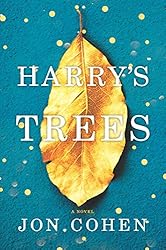
Harry's Trees
Jon Cohen, 2018
MIRA
432 pp.
ISBN-13: 9780778364153
Summary
When you climb a tree, the first thing you do is to hold on tight…
Thirty-four-year-old Harry Crane works as an analyst for the US Forest Service. When his wife dies suddenly, he is unable to cope.
Leaving his job and his old life behind, Harry makes his way to the remote woods of northeastern Pennsylvania’s Endless Mountains, determined to lose himself.
But fate intervenes in the form of a fiercely determined young girl named Oriana. She and her mother, Amanda, are struggling to pick up the pieces from their own tragedy—Amanda stoically holding it together while Oriana roams the forest searching for answers.
And in Oriana’s magical, willful mind, she believes that Harry is the key to righting her world.
Now it’s time for Harry to let go…
After taking up residence in the woods behind Amanda’s house, Harry reluctantly agrees to help Oriana in a ludicrous scheme to escape his tragic past.
In so doing, the unlikeliest of elements—a wolf, a stash of gold coins, a fairy tale called The Grum’s Ledger and a wise old librarian named Olive—come together to create a golden adventure that will fulfill Oriana’s wildest dreams and open Harry’s heart to a whole new life.
Harry’s Trees is an uplifting story about the redeeming power of friendship and love and the magic to be found in life’s most surprising adventures. (From the publisher.)
Author Bio
• Birth—1958
• Where—Swarthmore, Pennsylvania, USA
• Education—B.A., Connecticut College; R.N. (nursing)
• Awards—Saturn Award for Best Writing (screenwriting)
• Currently—lives outside Philadelphia, Pennsylvania
Jon Cohen is an American novelist and screenwriter. He is the author of several novels, most recently, Harry's Trees (2018). As a screenwriter he is best known for co-writing the 2002 film Minority Report.
A native of Swarthmore, Pennsylvania, Cohen was the son of a librarian and a English professor. After earning a B.A. in English, he switched tracks and got a second degree as a Registered Nurse, after which he worked for 10 years as a critical care nurse in Philadelphia.
During his time in nursing, Cohen began to write stories and, in 1991, published his first novel, Max Lakeman and the Beautiful Stranger. That same year Cohen also received a creative writing grant from the National Endowment for the Arts. The following year, 1992, Cohen's second book, The Man in the Window, came out (the novel was reissued in 2013 by Nancy Pearl's Book Lust Rediscoveries), and a third, Dentist Man, came out in 1993.
Then Cohen made another change: he decided to teach himself screenwriting—a decision that eventually led to working on the script for Steven Spielberg's Minority Report. That screenplay won him the 2002 Saturn Award for Best Writing (he shared the award with co-writer Scott Frank).
In 2018, Cohen published his fourth novel, Harry's Trees, in 2018. (Adapted from Wikipedia and BookPage. Retrieved 9/5/2018.)
Book Reviews
[W]insome but overstuffed novel…. Cohen tries to do too much in an otherwise straightforward narrative. Appalachian decline, the role of books in society, health care dysfunction, and dendrology are all packed into the novel…. The result is a story that never truly gets beneath the surface.
Publishers Weekly
[Starred review] Part fairy tale and… heartbreakingly realistic, Cohen's third novel will entrance readers from page one, and by the end, even skeptics will agree that magic can still be found in the most unlikely places and in the most surprising people if only we're willing to look.
Library Journal
[Starred review] When a young girl asks you to believe in fairy tales, sometimes you just have to obey. In Cohen's capable hands, the unlikely teamwork between an optimistic child and a wary adult makes for a tender tale of first loves and second chances.
Booklist
[T]his redemptive tale will speak to the hearts of those who've lost a loved one… and the many ways to heal; about redemption; about forgiveness; about letting go; but most of all, about the power of the human spirit to soar above tragedy and reunite with joy.
Kirkus Reviews
Discussion Questions
We'll add publisher questions if and when they're available; in the meantime, use our LitLovers talking points to help start a discussion for HARRY'S TREES … then take off on your own:
1. How would you describe Harry—what kind of man is he? To what extent is his guilt over Beth's accident self-imposed: is his self-blame senseless or understandable? What is the irony of Harry's work as an analyst given his love of trees?
2. Talk about the way Harry's life has been shaped by his childhood. How would you describe that childhood—his parents, brother, and general upbringing? For young Harry, what do trees come to represent?
3. Harry's Trees is based on the belief that "the ordinary world is extraordinary, all the time, for everyone." What is meant by the "ordinary" world, and does that world have special meaning for you?
4. According to Harry, "Everybody's got a special tree, whether currently as an adult, or a tree from childhood." What is it about humans and our love for trees? What about you: have you ever had a special tree?
5. In a BookPage interview, Cohen has said, "I truly believe that when you are in love or when you grieve, you cross a line and see the world in an altered way.” Do you agree with Cohen? How does Cohen's observation play out in his novel? Have you ever had the kind of experience that has altered your perception of the world?
6. Talk about Amanda and, especially, Oriana. What does Oriana's world look like as she wanders the woods after her father's death? Would you consider her mature or immature for a 10-year old?
7. This novel is very much about the power of books in our lives. How does the author portray their significance?
8. What draws Harry and Oriana together. How are their two minds or souls matched? Oriana sees Harry's appearance in her life as a sign. A sign of what? Equally importantly, what does Harry see in Oriana?
9. What creates the magical feel to this otherwise realistic novel? The book asks the question, where does reality end and magic take over? Where do you think the lines are drawn…in the book and /or in real life? What roles do chance or luck play in our lives.
10. Other than the lottery (duh), how are the characters transformed by the end of the novel? Are they?
(Questions by LitLovers. Please feel free to use them, online and off, with attribution. Thanks.)


Harvest
Jim Crace, 2013
Knopf Doubleday
256 pp.
ISBN-13: 9780307278975
Summary
Shortlisted, 2012 Man Booker Prize
On the morning after harvest, the inhabitants of a remote English village awaken looking forward to a hard-earned day of rest and feasting at their landowner's table. But the sky is marred by two conspicuous columns of smoke, replacing pleasurable anticipation with alarm and suspicion.
One smoke column is the result of an overnight fire that has damaged the master's outbuildings. The second column rises from the wooded edge of the village, sent up by newcomers to announce their presence. In the minds of the wary villagers a mere coincidence of events appears to be unlikely, with violent confrontation looming as the unavoidable outcome.
Meanwhile, another newcomer has recently been spotted taking careful notes and making drawings of the land. It is his presence more than any other that will threaten the village's entire way of life.
In effortless and tender prose, Jim Crace details the unraveling of a pastoral idyll in the wake of economic progress. His tale is timeless and unsettling, framed by a beautifully evoked world that will linger in your memory long after you finish reading. (From the publisher.)
Author Bio
• Birth—March 1, 1946
• Where—St. Albans, Hertfordshire, UK
• Education—B.A., Birminghham City University
• Awards—2 Whitbread Awards; National Book
Award (US)
• Currently—lives in Birmingham, England
James "Jim" Crace (born ) is a contemporary English writer who has won a number of awards. He currently lives in the Moseley area of Birmingham with his wife. They have two children, Thomas Charles Crace (born 1981) and the actress Lauren Rose Crace, who played Danielle Jones in EastEnders.
Biography
Crace was born in St Albans, Hertfordshire, and grew up with his siblings in Forty Hill, an area at the far northern point of Greater London, close to Enfield, where Crace attended Enfield Grammar School. He studied for a degree at the Birmingham College of Commerce (now part of Birmingham City University), where he was enrolled as an external student of the University of London.
After securing a BA (Hons) in English Literature in 1968, he travelled overseas with the UK organization Voluntary Services Overseas (VSO), working in Sudan. Two years later he returned to the UK, and worked with the BBC, writing educational programmes. From 1976 to 1987 he worked as a freelance journalist, before giving up due to the excessive "political interference" he experienced at newspapers such as The Sunday Times.
In 1974 he published his first work of prose fiction, Annie, California Plates in The New Review, and in the next 10 years would write a number of short stories and radio plays.
In 1986 Crace published Continent, which won the Whitbread First Novel of the Year Award, the David Higham Prize for Fiction, and the Guardian Fiction prize. He won the National Book Critics Circle Award in 1999 and has had two books shortlisted for the Man Booker Prize, including his 11th and most recent, Harvest. (From Wikipedia. Retrieved 9/14/13.)
Book Reviews
Glorious.... Crace writes with a particular, haunting empathy for the displaced.... His plots may be epic, but his sentences carry a sensual charge.... In his compassionate curiosity and his instincts for insurgent uncertainty, Crace surely ranks among our greatest novelists of radical upheaval, a perfect fit for our unstable, unforgiving age.
Rob Nixon - New York Times Book Review
[Harvest] is intellectually and morally engaging while also being exciting to read.... Mr. Crace's imagery brilliantly suggests the loamy, lyric glories of rustic English language and life.... [he] devotes his considerable talents to telling an affecting tale of a bound world and its simple people as they head toward a tragic and inexorable breakdown.
Wall Street Journal
Harvest is as finely written as it is tautly structured. Pungently flavoured with archaic words, its language is exhilaratingly exact, sometimes poetic and sometimes stark. Magnificently resurrecting a pivotal moment in our history about which it is deeply knowledgeable, this simultaneously elegiac and unillusioned novel is an achievement worthy to stand alongside those of Crace’s great fictional influence, William Golding.
Sunday Times (London)
Crace, an original and a literary stylist, with, usually, something remarkable to say, says it here in a haunting work of sudden violence and vengeance ... Few novels as fine or as complex in their apparent simplicity will be published this, or indeed any, year.
Irish Times
As with Crace's other novels, Harvest is deftly written, in language — formal, slightly archaic even — that reflects the setting it describes. It's also tightly plotted ... Crace's real concern is his characters, the way that, like all of us, they make mistakes and act from weakness, and turn on one another when things go wrong.
Los Angeles Times
(Starred review.) [Harvest] is intellectually and morally engaging while also being exciting to read ... Mr. Crace's imagery brilliantly suggests the loamy, lyric glories of rustic English language and life ... [he] devotes his considerable talents to telling an affecting tale of a bound world and its simple people as they head toward a tragic and inexorable breakdown.
Publishers Weekly
[W]ith the hard work of planting and harvesting as backdrop, we see the villagers move inexorably toward a tragedy they've provoked. One morning, Master Kent's stable is found burning, and strangers who have peaceably signaled their presence by sending up the customary smoke plume are blamed.... Verdict: A quietly breathtaking work revealing how fate plays with us as we play with fate; highly recommended. —Barbara Hoffert
Library Journal
The order and calm of a preindustrial village in England is upset by a mysterious fire and the simultaneous appearance of three strangers. The insular community strikes out against the newcomers but turns on itself in a fit, literally, of witch hunting.... This is a spare, disquieting, unique, and ultimately haunting and memorable little novel. Its limited accessibility may restrict its audience, but followers of literary fiction will be reading and talking about it. —Mark Levine
Booklist
(Starred review.) Rarely does language so plainspoken and elemental tell a story so richly open to interpretation on so many different levels. Is this a religious allegory? An apocalyptic fable? A mystery? A meditation on the human condition? With economy and grace.... Crace continues to occupy a singular place in contemporary literature.
Kirkus Reviews
Discussion Questions
Use our LitLovers Book Club Resources; they can help with discussions for any book:
• How to Discuss a Book (helpful discussion tips)
• Generic Discussion Questions—Fiction and Nonfiction
• Read-Think-Talk (a guided reading chart)
We'll add specific questions if and when they're made available by the publisher.


Harvesting the Heart
Jodi Picoult, 1995
ISBN-13: 9780140230277
Summary
Picoult earned rave notices for her debut novel, Songs of the Humpback Whale. Now this gifted young writer turns her considerable literary talents to the story of a young woman overcome by the demands of having a family. Written with astonishing clarity and evocative detail, convincing in its depiction of emotional pain, love, and vulnerability, Harvesting the Heart recalls the writing of Alice Hoffman and Sue Miller.
Paige has only a few vivid memories of her mother, who left when she was five. Now, having left her father behind in Chicago for dreams of art school and marriage to an ambitious young doctor, she finds herself with a child of her own. But her mother's absence, and shameful memories of her past, make her doubt both her maternal ability and her sense of self worth. Out of Paige's struggle to find wholeness, Jodi Picoult crafts an absorbing novel peopled by richly drawn characters and explores issues and emotions readers can relate to. (From the publisher.)
Author Bio
• Birth—May 19, 1966
• Where—Nesconset (Long Island), New York, USA
• Education—B.A., Princeton University; M.Ed., Harvard University
• Currently—lives in Hanover, New Hampshire
Jodi Lynn Picoult is an American author. She was awarded the New England Bookseller Award for fiction in 2003. Picoult currently has approximately 14 million copies of her books in print worldwide.
Early life and education
Picoult was born and raised in Nesconset on Long Island in New York State; when she was 13, her family moved to New Hampshire. Even as a child, Picoult had a penchant for writing stories: she wrote her first story— "The Lobster Which Misunderstood"—when she was five.
While still in college—she studied writing at Princeton University—Picoult published two short stories in Seventeen magazine. To pay the bills, after graduation she worked at a variety of jobs, including copy writing and editing textbooks; she even taught eighth-grade English and attained a Masters in Education from Harvard University.
In 1989, Picoult married Timothy Warren Van Leer, whom she met in college, and while pregnant with their first child, wrote her first book. Song of the Humpbacked Whale, her literary debut, came out in 1992. Two more children followed, as did a string of bestseller novels. All told, Picoult has more than 20 books to her name.
Writing
At an earlier time in her life, Picoult believed the tranquility of family life in small-town New England offered little fodder for writing; the truly interesting stuff of fiction happened elsewhere. Ironically, it is small-town life that has ended up providing the settings for Picoult's novels. Within the cozy surroundings of family and friends, Picoult weaves complex webs of relationships that strain, even tear apart, under stress. She excels at portraying ordinary people who find themselves in extraordinary circumstances. Disoriented by some accident of chance, they stumble, whirl, and attempt to regain a footing in what was once their calm, ordered world.
Nor has Picoult ever shied from tackling difficult, controversial issues: school shooting, domestic violence, sexual abuse, teen suicide, and racism. She approaches painful topics with sympathy—and her characters with respect—while shining a light on individual struggles. Her legions of readers have loved and rewarded her for that compassion—and her novels have been consistent bestsellers.
Personal life
Picoult and her husband Timothy live in Hanover, New Hampshire. They have three children and a handful of pets. (Adapted from a 2003 Barnes and Noble interview and from Wikipedia. Retrieved 9/28/2016.)
Book Reviews
Picoult has become a master—almost a clairvoyant—at targeting hot issues and writing highly readable page-turners about them.... It is impossible not to be held spellbound by the way she forces us to think, hard, about right and wrong.
Washington Post
Picoult writes with a fine touch, a sharp eye for detail, and a firm grasp of the delicacy and complexity of human relationships.
Boston Globe
Picoult brings her considerable talents to this contemporary story of a young woman in search of her identity..... Told in flashbacks, this is a realistic story of childhood and adolescence, the demands of motherhood, the hard paths of personal growth and the generosity of spirit required by love. Picoult's imagery is startling and brilliant; her characters move credibly through this affecting drama
Publishers Weekly
In her second novel, Jodi Picoult recounts with power and grace a young woman's efforts to achieve "grandeur...and the ability to be comfortable in the world."... Picoult considers various forces that can unite or fracture families and examines the complexities of the human heart both literally and figuratively. Highly recommended. — Jane S. Bakerman, Indiana State Univ., Terre Haute
Library Journal
An updated formulaic second novel in which the young heroine not only finds herself but along the way comes to terms with that other contemporary women's issue: motherhood.... Some good writing, but not enough to sustain a concept-driven and rather old-fashioned story, despite its occasional contemporary gloss.
Kirkus Reviews
Book Club Discussion Questions
1. Paige remembers her father saying over and over again “Life can turn on a dime.” Nicholas remembers his father used to say “Life turns on a dime.” What do they mean by that phrase? Do you agree?
2. Paige’s art is a catalyst for events throughout the novel. Discuss how her pictures help mold her life.
3. When Paige becomes pregnant with Max, she says she doesn’t know how to be a mother because she never had one. Can you be a good mother if you didn’t have a mother?
4 . When Nicholas saves the patient’s life (p. 80), he is a hero. When his father brings his girlfriend to the ballgame (p.120), Nicholas wants his father to be able to save someone so he is a hero. Discuss how we all need heroes? What do we need them to do? How do doctors often attain such a status?
5. At the Halloween Ball, Nicholas tells the others that he met Paige “waiting tables.” Why does she feel so betrayed and hurt? Would you feel that way?
6. How different are Paige’s parents? How different are Nicholas’ parents?
7. Nicholas’ father married wealth. So did Paige. How do they each handle it? How are they alike? How are they different?
8. The novel is divided into three parts: Conception, Growth, and Delivery. How is each part an analogy of birth?
9. Nicholas lies that he has been called to the hospital so he can leave after caring for Max for an hour (p. 186.) He’s feeling the same way Paige is but he gets to leave. Is Paige justified in leaving later?
10. Nicholas doesn’t understand why Paige is upset being with Max all day since he is the one working on his feet, keeping his reputation intact, and saving lives. How common is this thinking in today’s world? In our parents’ generation? Has it changed?
11. When Max falls off the couch, Paige feels terrible and is relieved he’s okay. Nicholas assumes that Paige is not taking good care of Max—possibly causing the fall. How unfair does that seem to strike you?
12. It is obvious that Nicholas and Paige were no way near prepared to be parents. How does that affect their relationship?
13. When tossing Nicholas’ shirts from the car when leaving, Paige is metaphorically tossing off her old life. Have you ever done that or wanted to do that?
14. It is interesting how Nicholas is ready to fall apart trying to deal with Max and asking the Candy Striper for help. Discuss the irony that he didn’t think Paige needed help but now HE needs help.
15. How do we know Paige’s dad has always loved her mother?
16. On page 306, the contradiction of guilt: those mothers who work feel guilty leaving their children yet Paige was able to stay at home with Max and wanted to be anywhere but there. How does the media play into all this today?
17. Paige asks her mother why she left. Her mother’s answer describes both herself and Paige. Discuss. (page 342)
18. How different is it between living the life you are expected to live and the life you want to live? Are they ever the same?
19. What brings Paige and Nicholas back together?
20. Both Paige and Astrid capture the world through their art, whether through charcoal drawings or through a camera lens. They both become famous in their own world. How does this make them alike? How does this make them different?
21. The author always has a double meaning in the titles of her books. What hearts are harvested in the novel, Harvesting the Heart?
(Questions from the author's website.)
top of page (summary)

The Hate U Give
Angie Thomas, 2017
HarperCollins
464 pp.
ISBN-13: 9780062498533
Summary
Sixteen-year-old Starr Carter moves between two worlds: the poor neighborhood where she lives and the fancy suburban prep school she attends.
The uneasy balance between these worlds is shattered when Starr witnesses the fatal shooting of her childhood best friend Khalil at the hands of a police officer. Khalil was unarmed.
Soon afterward, his death is a national headline. Some are calling him a thug, maybe even a drug dealer and a gangbanger. Protesters are taking to the streets in Khalil’s name. Some cops and the local drug lord try to intimidate Starr and her family.
What everyone wants to know is: what really went down that night? And the only person alive who can answer that is Starr.
But what Starr does—or does not—say could upend her community. It could also endanger her life. (From the publisher.)
Author Bio
• Birth—ca. 1987-88
• Where—Jackson, Mississippi, USA
• Education—B.F.A., Belhaven University
• Awards—Walter Dean Myers Grant
• Currently—lives in Jackson, Mississippi
Angie Thomas is an African-American author and former teen rapper. Her debut novel, The Hate U Give, whose manuscript was the object of a 13-publishing-house bidding war, was released in 2016 by a HarperCollins young adult imprint. The book has received wide acclaim, starred reviews, and considered required reading by the New York Times and Entertainment Weekly.
Thomas was raised, and still lives, in Jackson, Mississippi. From a young age, she was enthralled by stories and books. At the age of six, while out riding her bike, she was nearly trapped in the middle of gun fire. After that frightening experience, Angie turned to books and escaped into another world, soon using her own imagination to tell and write stories. Knowing budding talent when she saw it, her third grade teacher asked Angie to read one of her stories to the class every Friday after lunchtime.
Several years on, Thomas became a teen rapper—a proud achievement was a feature article about her in Right-On magazine. Thomas went on to graduate from Belhaven University where she studied creative writing. She won the very first Walter Dean Myers Grant, awarded in 2015 by We Need Diverse Books. (Adapted from various online sources, including the author's website.)
Book Reviews
Through the main character Starr, whose family lives in the projects while she attends a private school in the burbs, Angie Thomas' The Hate U Give delivers a unique perspective to YA readers.… The Hate U Give made me think. And cry. And cringe at the widely varying experience Americans have — depending on their zip code and race.
Abby Fabiaschi, AUTHOR - LitLovers
[A] page turner brimming with pop culture references and humor…I marveled at the balancing act between dead-serious politics and concerns familiar to kids and former kids of all backgrounds. …[T]here's plenty for readers of all ages to enjoy.
Marjorie Ingall - New York Times Book Review
(Starred review.) [H]eartbreakingly topical… authentic.… [A] teenage girl… attempts to reconcile what she knows to be true about their lives with the way those lives are… completely undervalued (Ages 14 & up).
Publishers Weekly
(Starred review.) The first-person, present-tense narrative is immediate and intense, and the pacing is strong, with Thomas balancing dramatic scenes of violence and protest with moments of reflection.… [A] powerful debut (Gr. 8 & up). —Mahnaz Dar
School Library Journal
(Starred review.) Beautifully written in Starr’s authentic first-person voice, this is a marvel of verisimilitude as it insightfully examines two worlds in collision. An inarguably important book that demands the widest possible readership.
Booklist
(Starred review.) [S]mooth but powerful prose delivered in Starr's natural, emphatic voice, finely nuanced characters, and intricate and realistic relationship dynamics…. This story is necessary. This story is important (Ages 14 & up).
Kirkus Reviews
Discussion Questions
As Starr and Khalil listen to Tupac, Khalil explains what Tupac said "Thug Life" meant. Discuss the meaning of the term "Thug Life" as an acronym and why the author might have chosen part of this as the title of the book. In what ways do you see this in society today? (Chapter 1, p. 17)
2. Chapter 2 begins with Starr flashing back to two talks her parents had with her when she was young. One was about sex ("the usual birds and bees"). The second was about what precautions to take when encountering a police officer (Chapter 2, p. 20). Have you had a similar conversation about what to do when stopped by the police? Reflect upon or imagine this conversation.
3. Thomas frequently uses motifs of silence and voice throughout the book. Find instances in the book where silence or voice and speech are noted, and talk about the author’s possible intentions for emphasizing these motifs.
4. At the police station after Starr details the events leading up to the shooting, the detective shifts her focus to Khalil’s past. Why do you think the detective did this? Discuss Starr’s reaction to this "bait" (Chapter 6, pp. 102–103).
5. Once news of Khalil’s shooting spreads across the neighborhood, unrest arises: "Sirens wail outside. The news shows three patrol cars that have been set ablaze at the police precinct.… A gas station near the freeway gets looted.… My neighborhood is a war zone" (Chapter 9, pp. 136–139). Respond to this development and describe some parallels to current events.
6. How do you think Starr would define family? What about Seven? How do you define it?
7. Chris and Starr have a breakthrough in their relationship—Starr admits to him that she was in the car with Khalil and shares the memories of Natasha’s murder (Chapter 17, pp. 298–302). Discuss why Starr’s admission and releasing of this burden to Chris is significant. Explore the practice of "code switching" and discuss how you might code switch in different circumstances in your own life.
8. How and why does the neighborhood react to the grand jury’s decision (Chapter 23)? How does Starr use her voice as a weapon, and why does she feel that it is vital that she does? Refer back to "Thug Life" and discuss how the acronym resonates in this chapter.
9. Starr pledges to "never be quiet" (Chapter 26, p. 444). After reading this book, how can you use your voice to promote and advance social justice? Reflect on how you and your community discuss and address inequality.
(Questions issued by publishers.)


Hausfrau
Jill Alexander Essbaum, 2015
Random House
336 pp.
ISBN-13: 9780812997538
Summary
Anna was a good wife, mostly. For readers of The Girl on the Train and The Woman Upstairs comes a striking debut novel of marriage, fidelity, sex, and morality, featuring a fascinating heroine who struggles to live a life with meaning—"a modern-day Anna Karenina tale."*
Anna Benz, an American in her late thirties, lives with her Swiss husband, Bruno—a banker—and their three young children in a postcard-perfect suburb of Zürich. Though she leads a comfortable, well-appointed life, Anna is falling apart inside. Adrift and increasingly unable to connect with the emotionally unavailable Bruno or even with her own thoughts and feelings, Anna tries to rouse herself with new experiences: German language classes, Jungian analysis, and a series of sexual affairs she enters with an ease that surprises even her.
But Anna can’t easily extract herself from these affairs. When she wants to end them, she finds it’s difficult. Tensions escalate, and her lies start to spin out of control. Having crossed a moral threshold, Anna will discover where a woman goes when there is no going back.
Intimate, intense, and written with the precision of a Swiss Army knife, Jill Alexander Essbaum’s debut novel is an unforgettable story of marriage, fidelity, sex, morality, and most especially self. Navigating the lines between lust and love, guilt and shame, excuses and reasons, Anna Benz is an electrifying heroine whose passions and choices readers will debate with recognition and fury. Her story reveals, with honesty and great beauty, how we create ourselves and how we lose ourselves and the sometimes disastrous choices we make to find ourselve. (From the publisher.)
Author Bio
• Birth—1971
• Where—Bay City, Texas, USA
• Education—University of Texas; University of Houston
• Awards—Bakeless Poetry Prize
• Currently—lives in Austin, Texas
Jill Alexander Essbaum is the author of several collections of poetry and her work has appeared in The Best American Poetry, as well as its sister anthology, The Best American Erotic Poems, 1800-Present. She is the winner of the Bakeless Poetry Prize and recipient of two NEA literature fellowships. A member of the core faculty at the University of California, Riverside’s Palm Desert Low-Residency MFA program, she lives and writes in Austin, Texas. (From the publisehr .)
Read more about the author on the Poetry Foundation Website.
Book Reviews
Hausfrau...seems positioned to ride a wave of comparisons to the erotic stylings of E. L. James....[but] the two are very different. Ms. Essbaum has far more sophistication, but she tethers it to the tale of a morose, insufferable American narcissist who is bored by her Swiss husband.... But Ms. Essbaum hasn’t got much of a plot in mind either, so the book meanders from sexual liaisons—which quickly develop a perfunctory sameness and have nothing like the superlucrative kinks of Ms. James’s books—to psychoanalysis appointments to those dreadful moments when Anna has time to slow down and contemplate herself.
Janet Maslin - New York Times
Madame Bovary meets Fifty Shades of Grey.
Sunday Express (UK)
There is much to admire in Essbaum's intricately constructed, meticulously composed novel, including its virtuosic intercutting of past and present. It is equally impressive that Essbaum is able to retain our sympathy, if just barely, for her lost and self-involved protagonist—at least until the novel's heavily foreshadowed, but still startling, conclusion.
Julia M. Klein - Chicago Tribune
We’re in literary territory as familiar as Anna’s name, but Essbaum makes it fresh with sharp prose and psychological insight.
San Francisco Chronicle
For a first novelist, Essbaum is extraordinary because she is a poet. Her language is meticulous and resonant and daring.
NPR’s Weekend Edition
A powerful, lyrical novel.... Hausfrau boasts taut pacing and melodrama, but also a fully realized heroine as love-hateable as Emma Bovary and a poet’s fascination with language.
Huffington Post
[Hausfrau] feels more contemporary, subjective, and just plain funny than classical bourgeois ennui. Imagine Tom Perrotta’s American nowheresvilles swapped out for a tidy Zürich suburb, sprinkled liberally with sharp riffs on Swiss-German grammar and European hypocrisy.
New York Magazine
Brain-surgically constructed to fascinate you, entertain you, and then make you question what a life lived with meaning looks like—all with a sense of poetic discipline and introspection.
Los Angeles Magazine
(Starred review.) Over a century after the publication of Madame Bovary and Anna Karenina, poet Essbaum proves in her debut novel that there is still plenty of psychic territory to cover in the story of "a good wife, mostly."... The realism of Anna’s dilemmas and the precise construction of the novel are marvels of the form.... This novel is masterly as it moves toward its own inescapable ending, and Anna is likely to provoke strong feelings in readers well after the final page.
Publishers Weekly
An American in her thirties, Anna Benz has a picture-perfect life, with glowing children, a gorgeous house, and a Swiss banker husband. Of course, what looks that good on the outside is often rotten on the inside, and Anna launches a series of affairs. This debut by a recipient of the Bakeless Poetry Prize and two NEA literature fellowships is an in-house favorite
Library Journal
[Essbaum’s protagonist] shares more than her name with that classic adulteress, Anna Karenina, but Essbaum has given a deft, modern facelift to the timeless story of a troubled marriage and tragic love in this seductive first novel.
Booklist
Between caring for three children, visiting a Jungian analyst and taking a German class, Anna wouldn't seem to have much time for extramarital liaisons, but like her namesake, Madame Karenina, she manages.... There's plenty of tension—will Anna get caught?—but it's hard to be invested in the life of a woman who doesn't care much about it herself. A smart book that entertains page by page but doesn't add up to anything larger.
Kirkus Reviews
Discussion Questions
1. That Anna. So—really—what’s her deal? Her thoughts loop on a script of immutable passivity, but is that her whole story? From the onset we know she is a flawed protagonist, a damaged character, a woman who is "nothing but a series of poor choices executed poorly." Taking into account Anna’s personal history, her psychic and spiritual makeup, and those aforementioned poor choices, is there any part of this tragedy that somehow isn’t her fault? What should she be held accountable for? Of what, if anything, are you willing to absolve her?
2. Bruno proposes to Anna with the words "I think you would make a good wife for me." What, in your opinion, would make him think that? They’ve been together for over a decade. By book’s end it’s clear that Bruno has either known about or suspected Anna’s infidelities the entire time. Why would he tolerate them? Why would he tolerate her? Is this a sign of his weakness or his strength? What does he "get" out of this marriage?
3. Mary, in her decency, stands in direct opposition to the self-centered narcissism of the majority of Anna’s actions. Simply put, Mary seems to be everything that Anna should be but isn’t. But the book suggests that Mary’s two-shoes aren’t altogether goody, so to speak. In three separate instances, she "spills" herself in front of Anna: when she drops her purse and blurts out a more-Anna-than-Mary expletive, when she drops her purse and the erotic novel (and the wistful truth that she regrets not exploring her sexuality) tumbles out, and, finally, when she admits to the bullying and setting the fire. In these ways, Mary has more in common with Anna than Anna is open to recognizing. Do you think Mary can see past Anna’s façade? Do you think she understands Anna on a fundamental level? If not, then do you think she would ever be able to? What do you think will happen to Mary after the book ends?
4. Anna’s lack of morality is almost shocking. What do you think is her gravest mistake? Is there any point during the course of the narrative where she could have stopped the progression of events?
5. Anna rarely tells Doktor Messerli the whole truth. Why, then, do you think she continues the analysis?
6. Anna has never learned to speak German, and yet she exhibits an unmistakable talent for language: she plays with words, turns puns, thinks in entendre—though rarely does she speak these things aloud. Is it shyness that prevents her from showing this side of herself? Fear? What would it look like if Anna could tap into her "voice"? What would it change?
7. Of all the children, Charles is the most dear to Anna. Victor is too much like Bruno for Anna to fully trust. But as the sole memento of the relationship with Stephen, one might assume that Polly Jean would hold the spot closest to Anna’s heart. Discuss Anna’s relationship with her children. She won’t win mother of the year in anyone’s contest—but is there any way in which she can be commended? Is there anything she does as a mother that is correct? Good? Nurturing?
8. Anna confesses she majored in home economics in college. Couple this with the perfect memory of sewing with her mother, and the seed of Anna’s present psychology begins to form. As her station as a wife and a mother starts to fail her (or rather, she, them), we are able to understand that somewhere in Anna’s fundamental self she was raised to be these things. Why does she cling to this fantasy if it doesn’t seem to suit her?
9. At the end of chapter 6, Anna thinks, "I wish I’d never met the man." Which man do you suppose she means?
10. Doktor Messerli warns Anna that "consciousness doesn’t come with an automatic ethic," and Anna’s choices seem to bear this out. Taking into consideration Doktor Messerli’s explanation of the Shadow, her story of the Teufelsbrücke, and the final events of the book, is it possible to argue that, ethics aside, Anna has come into complete consciousness?
11. Archie says to Anna that a man can smell a woman’s sadness. In the same vein, Anna talks herself through the morning after the physical confrontation with Bruno with a "You had this coming" speech to herself ("I provoked this.... I brought this to myself."). By this reasoning, Anna is an active participant in her own downfall. But Anna claims to be almost entirely passive. Do you consider Anna to be more passive or more active? How does this complicate your understanding of Anna’s psychology?
12. In terms of the structure of the novel, the analytic sessions with Doktor Messerli serve to explicate, illuminate, underscore, and complicate the plot of the book and any conclusion that Anna believes she’s arrived at. Are there any places in the book where this is particularly meaningful to you?
13. There’s an intriguing symmetry to the way that the grammar of the German language—the tenses, moods, conjugations, false cognates, infinitives, et cetera—lays itself out in a pattern that easily overlays the poignant heartbreak of the novel. And yet, one of the themes of Hausfrau is language’s ultimate inadequacy. Is that tension resolvable? If so, how? Is this something you have encountered in your own life?
14. The book depends upon the coolness of the Swiss, the impenetrable nature of the landscape, and the solitude of nighttime in order to fully call forth Anna’s deep despair and alienation. Could this book take place in another setting? Anna’s everyday environs—the hill, the bench, the trains, the Coop—become characters in their own right Are there other functions the novel’s setting serves?
15. Hausfrau is in some sense a study in female sexuality. What might the author be suggesting about the sexual appetites of a woman at midlife? What might the author be suggesting about a woman’s emotional needs?
16. An entirely speculative question: What do you think will happen to Bruno and Victor and Polly Jean? Can you imagine their lives post-Anna?
(Questions issued by the publisher.)
Have a Little Faith: A True Story
Mitch Albom, 2009
Hyperion Books
272 pp.
ISBN-13: 9780786868728
Summary
What if our beliefs were not what divided us, but what pulled us together?
In Have a Little Faith, Mitch Albom offers a beautifully written story of a remarkable eight year journey between two worlds — two men, two faiths, two communities — that will inspire readers everywhere.
Albom’s first nonfiction book since Tuesdays with Morrie was published twelve years ago, Have A Little Faith begins with an unusual request: an 82-year-old rabbi from Albom’s old hometown asks him to deliver his eulogy.
Feeling unworthy, Albom insists on understanding the man better, which throws him back into a world of faith he’d left years ago. Meanwhile, closer to his current home, Albom becomes involved with a Detroit pastor — a reformed drug dealer and convict — who preaches to the poor and homeless in a decaying church with a hole in its roof.
Moving between their worlds, Christian and Jewish, African-American and white, impoverished and well-to-do, Mitch observes how these very different men employ faith similarly in fighting for survival: the older, suburban rabbi, embracing it as death approaches; the younger, inner-city pastor relying on it to keep himself and his church afloat.
As America struggles with hard times and people turn more to their beliefs, Mitch and the two men of God explore issues that perplex modern man: how to endure when difficult things happen; what heaven is; intermarriage; forgiveness; doubting God; and the importance of faith in trying times. Although the texts, prayers and histories are different, Albom begins to realize a striking unity between the two worlds — and indeed, between beliefs everywhere.
In the end, as the rabbi nears death and a harsh winter threatens the pastor’s wobbly church, Albom sadly fulfills the last request and writes the eulogy. And he finally understands what both men had been teaching all along: the profound comfort of believing in something bigger than yourself.
Have a Little Faith is a book about a life’s purpose; about losing belief and finding it again; about the divine spark inside us all. It is one man’s journey, but it is everyone’s story. (From the publisher.)
Author Bio
• Birth—May 23, 1958
• Raised—Oaklyn, New Jersey
• Education—B.A., Brandeis University; M.J., Columbia
University; M.B.A., Columbia University
• Currently—lives in Detroit, Michigan
Mitchell David "Mitch" Albom is an American best-selling author, journalist, screenwriter, dramatist, radio, television broadcaster and musician. His books have sold over 30 million copies worldwide. Having achieved national recognition for sports writing in the earlier part of his career, he is perhaps best known for the inspirational stories and themes that weave through his books, plays and films.
Early life
Mitch Albom was born May 23, 1958 in Passaic, New Jersey. He lived in Buffalo for a little bit but then settled in Oaklyn, New Jersey which is close to Philadelphia. He grew up in a small, middle-class neighborhood from which most people never left. Mitch was once quoted as saying that his parents were very supportive and always used to say, “Don’t expect your life to finish here. There’s a big world out there. Go out and see it.”
His older sister, younger brother and he himself, all took that message to heart and traveled extensively, His siblings are currently settled in Europe. Albom once mentioned that how his parents presently say, “Great. All our kids went and saw the world and now no one comes home to have dinner on Sundays.”
Sports journalism
While living in New York, Albom developed an interest in journalism. Supporting himself by working nights in the music industry, he began to write during the day for the Queens Tribune, a weekly newspaper in Flushing, New York. His work there helped earn him entry into the Graduate School of Journalism. During his time there, to help pay his tuition he took work as a babysitter. In addition to nighttime piano playing, Albom took a part-time job with SPORT magazine.
Upon graduation, he freelanced in that field for publications such as Sports Illustrated, GEO, and the Philadelphia Inquirer, and covered several Olympic sports events in Europe, paying his own way for travel and selling articles once he was there. In 1983, he was hired as a full-time feature writer for the Fort Lauderdale News and Sun Sentinel, and eventually promoted to columnist. In 1985, having won that year’s Associated Press Sports Editors award for best Sports News Story, Albom was hired as lead sports columnist for the Detroit Free Press.
During his years in Detroit he became one of the most award-winning sports writers of his era; he was named best sports columnist in the nation a record 13 times by the Associated Press Sports Editors, and won best feature writing honors from that same organization a record seven times. No other writer has received the award more than once.
He has won more than 200 other writing honors from organizations including the National Headliner Awards, the American Society of Newspaper Editors, the National Sportscasters and Sportswriters Association, and National Association of Black Journalists. In 2010, Albom was awarded the APSE's Red Smith Award for lifetime achievement, presented at the annual APSE convention in Salt Lake City, Utah. Many of his columns have been collected into a series of four anthologies—the Live Albom books—published from 1988-1995.
Sports books
Albom's first non-anthology book was Bo: Life, Laughs, and the Lessons of a College Football Legend (1998), an autobiography of football coach Bo Schembechler co-written with the coach. The book became Albom's first New York Times bestseller.
Albom's next book was Fab Five: Basketball, Trash Talk, The American Dream (1993), a look into the starters on the University of Michigan men's basketball team who, as freshman, reached the NCAA championship game in 1992 and again as sophomores in 1993. The book also became a New York Times bestseller.
Tuesdays with Morrie
Albom's breakthrough book came about after a friend of his viewed Morrie Schwartz's interview with Ted Koppel on ABC News Nightline in 1995, in which Schwartz, a sociology professor, spoke about living and dying with a terminal disease, ALS (amyotrophic lateral sclerosis, or Lou Gehrig's disease).
Albom, who had been close with Schwartz during his college years at Brandeis, felt guilty about not keeping in touch so he reconnected with his former professor, visiting him in suburban Boston and eventually coming every Tuesday for discussions about life and death. Albom, seeking a way to pay for Schwartz's medical bills, sought out a publisher for a book about their visits. Although rejected by numerous publishing houses, the idea was accepted by Doubleday shortly before Schwartz's death, and Albom was able to fulfill his wish to pay off Schwartz's bills.
The book, Tuesdays with Morrie (1997) is a small volume that chronicles Albom's time spent with his professor. The initial printing was 20,000 copies. Word of mouth grew the book sales slowly and a brief appearance on "The Oprah Winfrey Show" nudged the book onto the New York Times bestseller's list in October 1997. It steadily climbed, reaching the No. 1 position six months later. It remained on the New York Times bestseller list for 205 weeks. One of the top selling memoirs of all time, Tuesdays With Morrie has sold over 14 million copies and been translated into 41 languages.
Oprah Winfrey produced a television movie adaptation by the same name for ABC, starring Hank Azaria as Albom and Jack Lemmon as Morrie. It was the most-watched TV movie of 1999 and won four Emmy Awards. A two-man theater play was later co-authored by Albom and playwright Jeffrey Hatcher and opened Off Broadway in the fall of 2001, starring Alvin Epstein as Morrie and Jon Tenney as Albom.
The Five People You Meet in Heaven
Albom's next foray was in fiction with The Five People You Meet in Heaven (2003). The book was a fast success and again launched Albom onto the New York Times bestseller list, selling over 10 million copies in 35 languages. In 2004, it was turned into a television movie for ABC, starring Jon Voight, Ellen Burstyn, Michael Imperioli, and Jeff Daniels. The film was critically acclaimed and the most watched TV movie of the year, with 18.6 million viewers.
The Five People You Meet in Heaven is the story of Eddie, a wounded war veteran who lives what he believes is an uninspired and lonely life fixing rides at a seaside amusement park. On his 83rd birthday, Eddie is killed while trying to save a little girl from a falling ride. He awakes in the afterlife, where he learns that heaven is not a location but a place in which your life is explained to you by five people who were in, who affected, or were affected by, your life.
Albom has said the book was inspired by his real life uncle, Eddie Beitchman, who, like the character, served during World War II in the Philippines, and died when he was 83. Eddie told Albom, as a child, about a time he was rushed to surgery and had a near-death experience, his soul floating above the bed. There, Eddie said, he saw all his dead relatives waiting for him at the edge of the bed. Albom has said that image of people waiting when you die inspired the book's concept.
For One More Day
Albom's third novel, For One More Day (2006), spent nine months on the New York Times bestseller list after debuting at the top spot. It also reached No. 1 on USA Today and Publishers Weekly bestseller lists. It was the first book to be sold by Starbucks in the launch of the Book Break Program in the fall of 2006. It has been translated into 26 languages. On December 9, 2007, the ABC aired the 2-hour television event motion picture Oprah Winfrey Presents: Mitch Albom's For One More Day, which starred Michael Imperioli and Ellen Burstyn. Burstyn received a Screen Actors Guild Award nomination for her role as Posey Benetto.
For One More Day is “Chick” Benetto, a retired baseball player who, facing the pain of unrealized dreams, alcoholism, divorce, and an estrangement from his grown daughter, returns to his childhood home and attempts suicide. There he meets his long dead mother, who welcomes him as if nothing ever happened. The book explores the question, “What would you do if you had one more day with someone you’ve lost?”
Albom has said his relationship with his own mother was largely behind the story of that book, and that several incidents in For One More Day are actual events from his childhood.
Have a Little Faith
His first nonfiction book since Tuesdays was published, Have a Little Faith (2009) recounts Albom's experiences which led to him writing the eulogy for Albert L. Lewis, a Rabbi from his hometown in New Jersey. The book is written in the same vein as Tuesdays With Morrie, in which the main character, Mitch, goes through several heartfelt conversations with the Rabbi in order to better know and understand the man that he would one day eulogize. Through this experience, Albom writes, his own sense of faith was reawakened, leading him to make contact with Henry Covington, the African-American pastor of the I Am My Brother's Keeper church, in Detroit, where Albom was then living. Covington, a past drug addict, dealer, and ex-convict, ministered to a congregation of largely homeless men and women in a church so poor that the roof leaked when it rained. From his relationships with these two very different men of faith, Albom writes about the difference faith can make in the world.
The Time Keeper
Albom's third work of fiction, The Time Keeper (2012) is fablistic tale about the inventor of the world's first clock who is punished for trying to measure God's greatest gift. He is banished to a cave for centuries and forced to listen to the voices of all who come after him seeking more days, more years. Eventually, with his soul nearly broken, Father Time is granted his freedom, along with a magical hourglass and a mission: a chance to redeem himself by teaching two earthly people the true meaning of time.
The First Phone Call from Heaven
Albom's fourth work of fiction, The First Phone Call from Heaven (2013) tells the story of a small town on Lake Michigan that gets worldwide attention when its citizens start receiving phone calls from the afterlife.
The Magic Strings of Frankie Presto
Told from the point of view of the Spirit of Music, Albom's fifth novel (2015) traces the life of the legendary (and fictional) super guitarist Frankie Presto and his extraordinary impact on the music of his time.
Charity work
Albom has founded a number of charitable organizations whose missions are to aid disadvantaged and homeless people. The groups have raised funds to pay for resuce services, youth programs, beds, kitchen, food, and daycare.
• The Dream Fund at the College for Creative Studies (CCS) was started by Albom in 1992. Its purpose is to provide funding for under-served children to participate in the arts and to instill confidence in our youth. Since its founding, CCS has used the Dream Fund to support visual, performing, summer “Week at a Time” youth scholarships, community art programs, and even the Detroit 300 project in 2001. The Dream Fund has raised over $115,000 in scholarships since its inception.
• S.A.Y. Detroit (which stands for Super All Year Detroit) is an umbrella organization for charities dedicated to improving the lives of the neediest—including A Time to Help, S.A.Y. Detroit Family Health Clinic, and A Hole in the Roof Foundation. S.A.Y. distributes money to shelters in Detroit for projects specifically designed to help the plight of those in need. Its projects to date include the building of a state-of-the-art kitchen at the Michigan Veterans Foundation shelter and a day-care center at COTS for children of homeless women
• A Time To Help was established in 1997 as a means of galvanizing the people of Detroit to volunteer on a regular basis. The group has staged more than 100 monthly projects ranging from building houses, delivering meals, beautifying city streets, running adoption fairs, repairing homeless shelters, packing food, and hosting an annual Christmas party to a shelter for battered women.
• A Hole in the Roof Foundation helps faith groups of any denomination, who care for the homeless, to repair the spaces in which they carry out their work and offer their services. The seed that gave root to the Foundation—and also inspired its name—is the I Am My Brother's Keeper church in Detroit, MI. Here, despite a gaping hole in the roof, and no matter how harsh the weather, the pastor tends to his community to provide spiritual nourishment and a sanctuary for the homeless. (Adapted from Wikiipedia. First retrieved 9/18/2013.)
Book Reviews
(Starred review.) Albom delivers a command audio performance. He brings his two clergymen-protagonists-an elderly rabbi from Albom's home synagogue and an African-American pastor leading a ministry to Detroit's homeless population-to vivid life and conveys their messages of faith with sensitivity and respect. The audio's most memorable moments feature the humility-and eccentricity-of the two spiritual leaders who, despite their deep religious commitment, refuse to be placed on a pedestal. From the ail-ing Jewish leader breaking out into whimsical songs in the middle of his grueling medical treatments and his Christian counterpart savoring the joys of barbecuing, Albom's characterizations brim with humor and compassion.
Publishers Weekly
Discussion Questions
1. Have a Little Faith asks, “What if our beliefs were not what divided us, but what pulled us together?” How would you begin to answer this question? Which of the world’s ills could be healed, which wrongs could be made right, if religion were more of a unifying force?
2. How would you react if someone you knew asked you to write their eulogy? How would you go about doing so?
3. In describing the journeys of faith taken by the Reb and Pastor Henry, Mitch Albom discusses his complicated relationship to his Jewish beliefs. Talking about one’s religious faith is a personal endeavor; do you find it easy or difficult to talk to others about religion, specifically your relationship to it? Are you comfortable discussing religion with someone with different beliefs?
4. In continuation of the above question, do you think anyone can ever “win” a religious argument? What do you think lies at the core of disagreements about religion?
5. How can many faiths coexist? If different faiths have different beliefs, how can they all be correct? Does one faith have the right or obligation to convert members of the others? When Mitch asks this of the Reb, he explains that just as there are a variety of trees, multiple faiths all come from the same God (page 160). What do you think about the Reb’s explanation? Can dialogue and debate about different beliefs, as the Reb argues, really enrich one’s own faith?
6. Compare and contrast the Reb and Pastor Henry. How are their stories similar, and different? Did you identify with one man more than the other?
7. Were you uncomfortable with Henry’s troubled past, especially when he admits his violation of the Ten Commandments? What did you think of Mitch’s initial hesitancy toward him? Do you think that someone who turns so far away from God, even though truly repentant, can really be a “Man of God”?
8. Think about some famous eulogies delivered in recent memory: Charles Spencer’s eulogy of his sister, Princess Diana; Oprah Winfrey’s of Rosa Parks; Cher’s emotional tribute to her former husband Sonny Bono; President Obama’s stirring remarks about Senator Edward M. Kennedy. Re-read Albom’s eulogy of the Reb at the end of the book. What does it have in common with other eulogies you’ve heard or read? What makes a eulogy truly memorable—does it rely solely upon the personality of the person who died?
9. Have you ever experienced a crisis of faith? How did you approach it? Was it resolved? Was there a lesson you took away from it?
10. In the chapter called “A Little History” (page 11) Albom describes his early religious education, and his resistance to it. Did you receive any religious instruction as a child? If so, did you enjoy it, or did you experience it the same way Mitch did, going to lessons feeling like a “dragged prisoner”?
11. Albom talks about his ambivalence toward his New Jersey childhood home, characterizing it as being “too small for what I wanted to achieve in life, like being stuck wearing your grade school clothes” (page 25). What do you think of your hometown now? Why are hometowns so pivotal to how people are shaped?
12. Consider what the Reb says to Albom in the chapter “May: Ritual” (page 42): “‘Mitch,’ he said, ‘faith is about doing. You are how you act, not just how you believe.’ ” Do you agree with the Reb’s sentiment?
13. Re-read the anecdote that Albom relays on page 76, about his interpretation of the story of the parting of the Red Sea. What does this story mean to you?
14. “It is far more comforting to think God listened and said no, than to think nobody’s out there” (page 82). What do you think of this statement by the Reb? Do you agree?
15. Both the Reb and Pastor Henry describe what they believe to be the keys to happiness. What do you think the secrets to happiness are? Where might faith fall on such a list?
16. In “September: What Is Rich?” (page 112) Albom explores the Reb’s childhood as an impoverished son of immigrants living in New York City. After finishing this chapter, how would you answer the question asked in its title? What does “rich” mean to you?
17. At the end of the chapter called “Church” (page 140) Albom describes the Hindu celebration of Kumbh Mela, a gathering that’s been called “the world’s largest single act of faith.” In your own life, have you ever been a part of something big while doing something small? How did it make you feel?
18. On page 176, Albom presents a quote from the Robert Browning Hamilton poem “Sadness.” What does this verse mean to you? How does it relate to the themes Albom explores in the book?
19. After reading Have a Little Faith, were you inspired to learn more about religions other than your own? What are some commonalities among different religions?
20. Have you read any of Mitch Albom’s other works, such as Tuesdays with Morrie, or his novels The Five People You Meet in Heaven or For One More Day? What does Have a Little Faith have in common with Albom’s other books?
21. If you had to write your own eulogy, what would you say about yourself? How would you most like to be remembered?
(Questions issued by publisher.)
top of page (summary)

The Hazel Wood (Hazel Wood Series, 1)
Melissa Albert, 2018
Flatiron Books
368 pp.
ISBN-13: 9781250147905
Summary
Seventeen-year-old Alice and her mother have spent most of Alice’s life on the road, always a step ahead of the uncanny bad luck biting at their heels.
But when Alice’s grandmother, the reclusive author of a cult-classic book of pitch-dark fairy tales, dies alone on her estate, the Hazel Wood, Alice learns how bad her luck can really get: Her mother is stolen away—by a figure who claims to come from the Hinterland, the cruel supernatural world where her grandmother's stories are set.
Alice's only lead is the message her mother left behind: "Stay away from the Hazel Wood."
Alice has long steered clear of her grandmother’s cultish fans. But now she has no choice but to ally with classmate Ellery Finch, a Hinterland superfan who may have his own reasons for wanting to help her.
To retrieve her mother, Alice must venture first to the Hazel Wood, then into the world where her grandmother's tales began—and where she might find out how her own story went so wrong. (From the publisher.)
Author Bio
• Birth—ca. 1984-85 (?)
• Raised—Chicago, Illinois, USA
• Education—B.A., Columbia College of Chicago
• Currently—lives in Brooklyn, New York City, NY
Melissa Albert is the founding editor of the Barnes & Noble Teen Blog and the managing editor of BN.com. She has written for McSweeney’s, Time Out Chicago, MTV, and more. Melissa is from Illinois and lives in Brooklyn. The Hazel Wood (2018) is her first novel; Night Country (2020) is its sequel. (From the publisher.)
Book Reviews
(Starred review.) [A] tantalizing tale of secret histories and magic that carries costs and consequences. There is no happily-ever-after resolution except this: Alice’s hard-won right to be in charge of her own story (Ages 12–up).
Publishers Weekly
(Starred review.) The lilting structure and deliberate tone bring to mind fairy tales…while also hinting at the teeth this story will bear in the form of murder, mayhem, and violence both in the Hinterland tales and in Alice's reality.… [E]mpowering. (Gr. 9-up) —Emma Carbone, Brooklyn Public Library
Library Journal
(Starred review.) Highly literary, occasionally surreal, and grounded by Alice’s clipped, matter-of-fact voice, The Hazel Wood is a dark story that readers will have trouble leaving behind. The buzz for this debut is deafening, and the fact that the film adaption is already in the works doesn’t hurt.
Booklist
(Starred review.) Simultaneously wondrous and horrific, dreamlike and bloody, lyrical and creepy, exquisitely haunting and casually, brutally cruel. Not everybody lives, and certainly not "happily ever after"—but within all the grisly darkness, Alice's fierce integrity and hard-won self-knowledge shine unquenched.
Kirkus Reviews
Discussion Questions
We'll add publisher questions if and when they're available; in the meantime, use our LitLovers talking points to help start a discussion for THE HAZEL WOOD … then take off on your own:
1. What do you make of Alice—her explosive anger, rudeness, even cruelty? Does she grow on you? Do you perhaps come to care what happens to her? Does what we finally learn of Alice's past adequately explain—maybe even excuse—her offensive behavior?
2. How would you describe the mother-daughter relationship between Ella and Alice. Alice herself calls it a "symbiotic relationship that looks cute on TV but felt fucking exhausting when you're moving for the third time in a year…." What are they running from, precisely?
3. Why has Ella kept Alice apart from Althea, never permitting Alice to read Tales from the Hinterland nor visit her grandmother? Ella's note orders Alice to "stay away from Hazel Wood." Why?
4. How does Melissa Albert's The Hazel Wood compare with standard fairy tales … even some of the more recent re-tellings?
5. Ellery Finch says of Tales from the Hinterland, the fairy tales within the fairy tale:
There are no lessons … just this harsh, horrible world … where shitty things happen. And they don't happen for a reason, or in threes, or in a way that looks like justice. They're set it a place that has no rules and doesn't want any.
What does it say about Ellery that he has such affection for these stories—stories in which random cruelty takes place and where there is no rhyme or reason for any of it?
6. How do you respond to Alice's disregard for Ellery's concerns about race and racial profiling? Does the fact that he grew up in a wealthy family make the color of his skin unimportant? Is Ellery more "privileged" than Alice, who grew up without money?
7. What do you think of Althea's Tales from the Hinterland—especially the two stories Ellery recounts? What light do they shed on the events within The Hazel Wood? Are you hoping Melissa Albert will publish a complete volume of Tales on its own?
8. The Hazel Wood is peppered with allusions to other famous fairy tales. How do they inform the action/plot line within Albert's novel?
9. What does Melissa Albert's novel suggest about the power of words? Consider this passage:
Once upon a time there was a beautiful queen who thought words were stronger than anything. She used them to win love and money and gifts. She used them to carry her across the world.
10. Were you as confused as Alice seems to be on the journey she undertakes with Ellery? In fact, were you confused generally throughout the novel, as some readers say they were? Overall, how did you experience The Hazel Wood? Was it what you expected … or something different?
11. And the novel's ending—what do you think?
(Questions by LitLovers. Please feel free to use them, online and off, with attribution. Thanks.)


He Belongs to Me
Theresa Rizzo, 2013
self-published
pp. 394
ISBN-13: 978098045018 (e-book only)
Summary
Catherine Boyd will do anything to regain custody of her young son… Even reconcile with the husband accused of killing their son’s twin.
Catherine graduates from college, eager to start a new life with her six-year-old son, Drew. But when she tries to bring him home, her parents refuse to relinquish control of the grandson they’d raised.
Wrongly accused of a horrible crime, Thomas Boyd has buried himself in his career, determined to forget his painful past and the family he lost. But now, five years later, Catherine is back, requesting his help to regain custody of their son—custody he thought she had. Though older and wiser, when courtroom battles reveal lies and secrets and generations of pain, will Thomas and Catherine find more tragedy and loss, or will old wounds finally heal?
Catherine Boyd will do anything to regain custody of her young son… Even reconcile with the husband accused of killing their son’s twin. (From the publisher.)
Author Bio
Born into an Irish-Italian family, there was never a dull moment in Theresa Rizzo’s home growing up in Grosse Point, Mich. And despite her struggle as a child with mild dyslexia, Rizzo loved books and became a voracious reader. Still, growing up the daughter of a nurse and a general surgeon, Rizzo hadn’t considered a career in writing.
She studied to be a registered nurse in college in Riverdale, New York, when she also married her high school sweetheart and moved to Long Island.They later relocated to the suburbs of Chicago, then headed to the west coast for five years in sunny San Diego, Calif. before settling down near Boulder, Colo.
Writing became Rizzo’s creative outlet, and almost a type of therapy for her while dealing with the every day stresses as a mom of four. Creating manuscripts for over 16 years, Rizzo is now an award-winning writer who pens emotional stories that explore the complexity of relationships and families through real-life trials.
She is a member of the Romance Writers of America and the Rocky Mountain Fiction Writers, and serves as the co-coordinator of the annual Crested Butte Writers Conference. (From the author.)
Book Reviews
Theresa Rizzo offers up a story of a family torn apart by secrets and lies, and a
woman’s courageous journey to reclaim the truth. This is a perfect blend of suspense
and romance, for readers who can’t resist a page-turner.
Susan Wiggs - New York Times Bestselling Author
This is a story that will command the attention of any parent, and probably everyone
else, too. The courtroom battles are especially gripping, filled with twists and turns.
Theresa Rizzo knows how to speak to the heart.
William Bernhardt - New York Times Bestselling Autho
Discussion Questions
1. Thomas and Catherine were driven apart by not only the death of their infant, but by terrible accusations charging Thomas with accidentally murdering him. How many young couples would have been strong enough to endure a tragedy such as that, defy her father, move away, and go to college? Would you have, or would your marriage have ended in divorce?
2. Parents often rule their children's lives under the guise of orchestrating what is "good for them", but are they fooling themselves? In what way did Eric fool himself that Catherine wasn't ready to mother Drew? What subconscious reason drove his belief? Do you make decisions for your children that are truly "for their own good," or might you sometimes have other, deeper, reasons that direct your decisions?
3. Eric testified, honestly, that had Catherine married a young man from a prominent family, such as a Kennedy or a Ford, he probably would not have opposed their marriage and probably would not have withheld her trust fund. When considering young people marrying, do social standing and family name really matter? How? Why?
4. After Catherine graduated from Stanford, she had a job and a home. Should she have just kept Drew and forced her parents to sue her to regain custody? After all, she is Drew's mother.
5. Catherine's mother, Sarah, was not a nurturing woman, yet she did quite well with her grandson. What changed? How could she love and understand Drew and not her own children? Is raising a grandchild really that different?
6. Emotional abuse and neglect is difficult to prove. Is it a good enough reason to keep children from having a relationship with their grandparents?
7. Given that the baby died in his hands, Thomas always carried a deep-seeded belief that he might have accidentally killed his infant son. Going to jail and enduring the beginnings of the trial was a humiliating, terrifying experience. So when the person he loved and trusted most in this world, Catherine, said that she believe he was guilty of killing their baby and that she could never trust him with Drew, she wounded him as no other could. Can Thomas ever really forgive her? Could you?
8. Catherine said awful things to Thomas to drive him away, knowing she'd devastate him and break his heart, but it was "for his own good." Was she any better than her father who interfered in her life "for her own good"? Is "for your own good" a good enough reason to take away a young adult's choice in a situation that is not life or death?
9. When Catherine's life is endangered during Elisa's delivery, Thomas orders the doctor to save his wife. If it comes to a choice, he wants the doctor to save Catherine and allow the baby to die. Do you agree with this decision? Does it make a difference if you are the pregnant woman who could die, or if it is your loved one who may die?
10. Eric pushed his children to excel at sports and academics. Andrew and Catherine's education was extremely important to him. In wanting the best for our children, parents often get caught up in reliving their youth through their children. Did Eric? If you're honest, do you?
11. Neither Catherine nor Thomas had an ideal, leave-it-to-Beaver childhood. Underneath family facades, what percentage of adults are luck enough to experience emotionally healthy childhoods? Are Catherine and Thomas' families highly dysfunctional or, unfortunately, more the secret norm?
12. Will Eric and Sarah's marriage survive what she did to Catherine?
(Questions provided courtsey of the author.)

He Said / She Said
Erin Kelly, 2017
St. Martin's Press
400 pp.
ISBN-13: 9781250113696
Summary
In the summer of 1999, Kit and Laura travel to a festival in Cornwall to see a total eclipse of the sun. Kit is an eclipse chaser; Laura has never seen one before. Young and in love, they are certain this will be the first of many they’ll share.
But in the hushed moments after the shadow passes, Laura interrupts a man and a woman. She knows that she saw something terrible. The man denies it. It is her word against his.
The victim seems grateful. Months later, she turns up on their doorstep like a lonely stray. But as her gratitude takes a twisted turn, Laura begins to wonder—did she trust the wrong person?
15 years later, Kit and Laura married are living under new names and completely off the digital grid: no Facebook, only rudimentary cell phones, not in any directories. But as the truth catches up to them, they realize they can no longer keep the past in the past.
From Erin Kelly, queen of the killer twist, He Said/She Said is a gripping tale of the lies we tell to save ourselves, the truths we cannot admit, and how far we will go to make others believe our side of the story. (From the publisher.)
Author Bio
• Birth—1976
• Where—Essex, England, UK
• Education—B.A. Warwick University
• Currently—London, England
Erin Kelly is a bestselling British author living in London, England. Born in 1976, she grew up in Essex and studied English at Warwick University. After graduation, she worked as a journalist and continues to freelance, writing over the years for The Daily Mail, Psychologies, Red, and Look, as well as for Elle, Marie Claire, and Glamour.
Her first novel The Poison Tree (2009) became a major ITV drama and Richard & Judy bestseller; it was also longlisted for the 2011 CWA John Creasy Award. She followed that initial success with The Sick Rose (2011), The Burning Air (2013) and The Ties That Bind (2014) — all of which attained wide acclaim and were translated into 19 languages. In 2014, Kelly wrote the novelization of the award-winning TV series, Broadchurch. (Sadly, she never met the series star David Tennant.)
Kelly also teaches writing. Since 2014 she has been a course tutor for Curtis Brown Creative, where four of her students have gone on to achieve six-figure book deals and others have found agents. She regularly runs courses for Guardian Masterclasses and Swanwick Writers School; she also gives lectures and runs workshops at literary festivals throughout the UK.
Kelly lives in north London with her husband and daughters. (Adapted from various online sources.)
Book Reviews
Thriller of the Month. Creepy, tangled and disturbing. Erin Kelly’s new thriller will keep you guessing to the end. [She] is on fine form here.… [A] master at drip-feeding us the details, keeping us guessing about the truth, and the many shades of grey it contains, right until the end
Guardian (UK)
Erin Kelly is supremely skilled at unusual and intelligent suspense plots, and this one has to be my favourite so far.
Daily Mail (UK)
There’s so much to love here — seamless plotting, descriptive prose, characters so real they pull you in to their tangled lives — and then an absolute humdinger of a twist that will take your breath away.
Sunday Mirror (UK)
Erin Kelly has a pleasantly crisp style and expertly hides the "unreliable twist."
Raleigh News and Observer
He Said/She Said is a thriller to savor, and should be one of the highlights of the summer.
Associated Press
The shockertwist is a jaw-dropper.
Good Housekeeping
Kelly brings readers a truly intriguing thriller, with dark twists and moments that truly mess with the psyche. He Said/She Said will keep you poised at the edge of your seat as you try to predict what will happen next — even though it's impossible to do so. The characters are poignantly flawed, with deep emotions and complex backgrounds. The writing is at points tense and truly nerve-wracking, but the payoff is worth every moment of uncertainty the novel brings.
Romance Times
This riveting psychological thriller from British author Kelly explores the extremes to which people will go to conceal a lie.… [R]eaders will be rewarded with airtight plotting, mounting tension, and shocking twists.… [T]his is an affecting tale of infatuation, desperation, and betrayal.
Publishers Weekly
Lorem ipsum dolor sit amet, nascetur neque iaculis vestibulum, sed nam arcu et, eros lacus nulla aliquet condimentum, mauris ut proin maecenas, dignissim et pede ultrices ligula elementum. Sed sed donec rutrum, id et nulla orci. Convallis curabitur mauris lacus, mattis purus rutrum porttitor arcu quis
Library Journal
(Starred review.) Kelly delivers another tale full of lies, obsessions, and richly drawn characters.This is a sure bet for readers who like their psychological suspense heavy on character and full of twists.
Booklist
(Starred review.) This first-rate psychological thriller and deft exploration of the delicate dance of marriage and the secrets people keep works on multiple levels, and the passages about the early days of Laura and Kit’s relationship—filled with the gossamer promise of new love—make what's in store for them even more harrowing. A stunning conclusion will take more than a few days to fade from memory.
Kirkus Reviews
Discussion Questions
(We'll add specific questions if and when they're made available by the publisher. In the meantime, use our generic mystery questions.)
GENERIC DISCUSSION QUESTIONS
Mystery / Crime / Suspense Thrillers
1. Talk about the characters, both good and bad. Describe their personalities and motivations. Are they fully developed and emotionally complex? Or are they flat, one-dimensional heroes and villains?
2. What do you know...and when do you know it? At what point in the book do you begin to piece together what happened?
3. Good crime writers embed hidden clues in plain sight, slipping them in casually, almost in passing. Did you pick them out, or were you...clueless? Once you've finished the book, go back to locate the clues hidden in plain sight. How skillful was the author in burying them?
4. Good crime writers also tease us with red-herrings—false clues—to purposely lead readers astray? Does your author try to throw you off track? If so, were you tripped up?
5. Talk about the twists & turns—those surprising plot developments that throw everything you think you've figured out into disarray.
- Do they enhance the story, add complexity, and build suspense?
- Are they plausible or implausible?
- Do they feel forced and gratuitous—inserted merely to extend the story?
6. Does the author ratchet up the suspense? Did you find yourself anxious—quickly turning pages to learn what happened? A what point does the suspense start to build? Where does it climax...then perhaps start rising again?
7. A good ending is essential in any mystery or crime thriller: it should ease up on tension, answer questions, and tidy up loose ends. Does the ending accomplish those goals?
- Is the conclusion probable or believable?
- Is it organic, growing out of clues previously laid out by the author (see Question 3)?
- Or does the ending come out of the blue, feeling forced or tacked-on?
- Perhaps it's too predictable.
- Can you envision a different or better ending?
8. Are there certain passages in the book—ideas, descriptions, or dialogue—that you found interesting or revealing...or that somehow struck you? What lines, if any, made you stop and think?
9. Overall, does the book satisfy? Does it live up to the standards of a good crime story or suspense thriller? Why or why not?
(Generic Mystery Questions by LitLovers. Please feel free to use them, online or off, with attribution. Thanks.)
top of page (summary)


The Headmaster's Wife
Thomas Christopher Greene, 2013
St. Martin's Press
288 pp.
ISBN-13: 9781250038944
Summary
An immensely talented writer whose work has been described as “incandescent” (Kirkus) and “poetic” (Booklist), Thomas Christopher Greene pens a haunting and deeply affecting portrait of one couple at their best and worst.
Inspired by a personal loss, Greene explores the way that tragedy and time assail one man’s memories of his life and loves. Like his father before him, Arthur Winthrop is the Headmaster of Vermont’s elite Lancaster School. It is the place he feels has given him his life, but is also the site of his undoing as events spiral out of his control. Found wandering naked in Central Park, he begins to tell his story to the police, but his memories collide into one another, and the true nature of things, a narrative of love, of marriage, of family and of a tragedy Arthur does not know how to address emerges.
Luminous and atmospheric, bringing to life the tight-knit enclave of a quintessential New England boarding school, the novel is part mystery, part love story and an exploration of the ties of place and family. Beautifully written and compulsively readable, The Headmaster’s Wife stands as a moving elegy to the power of love as an antidote to grief. (From the publisher.)
Author Bio
• Birth—N/A
• Where—Worcester, Massachusetts, USA
• Education—B.A., Hobart College; M.F.A., Vermont College
• Currently—lives in Montpelier, Vermont
Thomas Christopher Greene was born and raised in Worcester, Massachusetts to Richard and Dolores Greene, the sixth of seven children. He was educated in Worcester public schools and then Suffield Academy in Suffield, Connecticut. He earned his BA in English from Hobart College in Geneva, New York, where he was the Milton Haight Turk Scholar. His MFA in Writing is from the former Vermont College.
Tom has worked as an oyster shucker, delivered pizza, on the line in a staple factory, as a deputy press secretary for a presidential campaign, the director of public affairs for two universities and as a professor of writing and literature. Since 1993, Tom has resided in central Vermont.
Novels
In 2003, his first novel, Mirror Lake, was published to critical acclaim. His second, I’ll Never Be Long Gone, followed two years later and his third, Envious Moon, was published in 2007. His fiction has been translated into 11 languages and has found a worldwide following. His writing has been called incandescent and poetic and has been nominated for the IMPAC Dublin Literary Award. His first novel was named one of the thirty books to be rediscovered by Waterstone’s in the UK, alongside authors Kurt Vonnegut, Jose Saramango, Alice Hoffmann and others.
Tom’s fourth novel is The Headmaster's Wife, published in 2014. Inspired by a personal tragedy he experienced while creating the college, the novel is his most profound and moving work to date.
Academia
In 2006, after years of writing full time, Tom was asked to lead one of the MFA programs at Vermont College where he had graduated from and had previously served as a senior administrator. Shortly thereafter the university that owned the campus announced that the historic 1868 campus was for sale to developers. The three nationally acclaimed MFA programs—MFA in Writing; MFA in Writing for Children and Young Adults; and the MFA in Visual Art—were in danger of closing.
Tom mobilized the college community and the larger community in central Vermont to create a non-profit that could buy the campus and the three academic programs. In two years, with his business partner, Bill Kaplan, Tom raised $13.5M in capital, built a national board of trustees, developed a strategic plan and an infrastructure to manage and run a new academic entity. In June, 2008, Vermont College of Fine Arts became the first new college in Vermont in over 30 years—and the fastest to achieve accreditation in the 125 year history of the New England Association of Schools and Colleges. Tom was named the college’s founding President, a position he still serves in today.
In the five years since its inception, Tom has led Vermont College of Fine Arts on a mission to become a national center for education in the arts. Its writing programs enjoy top national rankings and he has started new programs in graphic design, music composition and film. Today, under his leadership, Vermont College of Fine Arts has arguably a greater influence on American Arts and letters than any small school since the heyday of Black Mountain College almost as century ago.
Tom lives in Montpelier, Vermont with his wife and daughter. (From the publisher.)
Book Reviews
Part of a grand literary tradition… But literary overtones notwithstanding, Greene’s plot has the tight, relentless pacing of a fine detective novel… Deeply felt… and utterly absorbing.
Washington Post
A layered story of love, unbearable loss and grief.
Fort Worth Star-Telegram
Greene's deft and nimble hand make the story itself a guiltless pleasure to read.
Denver Post
What seems to be a deceptively simple story about the headmaster of a New England boarding school and his wife, facing late middle age and growing apart over a difference of opinion about their teenage son, morphed into a haunting, mysterious page-turner… A meditation on longing in all of life’s stages, a literary mystery, and a novel with much for book clubs to untangle.
Concord Monitor
A tightly woven, atmospheric thriller about a New England academic whose life goes off the rails.
People
Thomas Christopher Greene’s haunting tale tracks the unraveling of a marriage. It starts, eerily, with a naked man’s arrest in New York City’s Central Park, then twists back in time through love, grief, betrayal, and love again.
Good Housekeeping
Nothing is what it appears in this brilliant story of a life gone awry.... Arthur Winthrop, headmaster of the Vermont-based Lancaster School, is found wandering around naked in snow-covered Central Park in New York City.... [The story is] about the trajectory of Arthur’s inauspicious marriage.... [A]t its core, a trenchant examination of one family’s terrible loss and how the aftermath of tragedy can make or break a person’s soul.
Publishers Weekly
(Starred review.) Greene has created a brilliant, harrowing novel depicting the spectacular unraveling of a once distinguished and proudly successful man. He has also conceived one of the most convincingly drawn unreliable narrators that readers may ever meet, a character recalling the creations of Edgar Allan Poe… This is a riveting psychological novel about loss and the terrible mistakes and compromises one can make in love and marriage. Essential for fans of literary fiction.
Library Journal
Greene’s genre-bending novel of madness and despair evokes both the predatory lasciviousness of Nabokov’s classic, Lolita, and the anxious ambiguity of Gillian Flynn’s contemporary thriller, Gone Girl (2012). —Carol Haggas
Booklist
The first half of Greene's fourth novel unfolds like a conventional academic tale.... [But] the novel takes a wholly unexpected twist, which is then compounded by another, even more surprising one.... Although the puzzle element threatens to overwhelm the narrative, this is a moving testament to the vicissitudes of love and loss, regret and hope.
Kirkus Reviews
Discussion Questions
1. What did you think were the central themes of the book, and how did they resonate with
you?
2. The novel explores the taboo subject of a teacher—student affair. What did you think of the
author’s handling of this?
3. "Maybe, I think, this is what love is." There are several varieties of love portrayed in the book:
passionate affairs, marriage and parental love. Discuss the depiction of love in all of its
forms.
4. The river is described as "timeless and uncaring." Explore the symbolic resonance of water in
the book and what it means to the characters.
5. How did your opinion of the headmaster and his wife change throughout the course of the
novel? Did you understand them more having encountered both points of view?
6. "Time is malleable. Memory fails. Memory changes." Discuss the representation of time and
memory throughout the pages of the book.
7. What do you think the structure of the novel brought to your reading experience? Did the
narrative switch surprise you?
8. Ethan’s death has a profound effect upon his parents’ lives. Explore the theme of loss and
grief in the book.
9. What did you think of the author’s representation of the boarding-school culture at
Lancaster? Has it altered any of the views you currently hold?
10. Were you satisfied with the ending of the novel? Which character did you sympathize with
most, and why?
(Questions issued by the publisher.)
Heart and Soul
Maeve Binchy, 2008
Knopf Doubleday
417 pp.
ISBN-13: 9780307278425
Summary
With the insight, humor, and compassion we have come to expect from her, Maeve Binchy tells a story of family, friends, patients, and staff who are part of a heart clinic in a community caught between the old and the new Ireland.
Dr. Clara Casey has been offered the thankless job of establishing the underfunded clinic and agrees to take it on for a year. She has plenty on her plate already–two difficult adult daughters and the unwanted attentions of her ex-husband–but she assembles a wonderfully diverse staff devoted to helping their demanding, often difficult patients.
Before long the clinic is established as an essential part of the community, and Clara must decide whether or not to leave a place where lives are saved, courage is rewarded, and humor and optimism triumph over greed and self-pity. Heart and Soul is Maeve Binchy at her storytelling best. (From the publisher.)
Author Bio
• Birth—May 28, 1940
• Where—Dalkey (outside Dublin), Ireland
• Death—July 30, 2012
• Where—Dalkey, Ireland
• Education—B.A., University College, Dublin
• Awards—see below
Maeve Binchy Snell was an Irish novelist, playwright, short story writer, columnist, and speaker. She is best known for her humorous take on small-town life in Ireland, her descriptive characters, her interest in human nature and her often clever surprise endings. Her novels, which were translated into 37 languages, sold more than 40 million copies worldwide, and her death, announced by Vincent Browne on Irish television late on 30 July 2012, was mourned as the passing of Ireland's best-loved and most recognisable writer.
Her books have outsold those of other Irish writers such as Oscar Wilde, James Joyce, Samuel Beckett, W. B. Yeats, Seamus Heaney, Edna O'Brien and Roddy Doyle. She cracked the U.S. market, featuring on the New York Times best-seller list and in Oprah's Book Club. Recognised for her "total absence of malice" and generosity to other writers, she finished ahead of Jane Austen, Charles Dickens and Stephen King in a 2000 poll for World Book Day.
Early life
Binchy was born in Dalkey, County Dublin (modern-day Dún Laoghaire–Rathdown), Ireland, the oldest child of four. Her siblings include one brother, William Binchy, Regius Professor of Laws at Trinity College, Dublin, and two sisters: Renie (who predeceased Binchy) and Joan Ryan. Her uncle was the historian D. A. Binchy (1899–1989). Educated at the Holy Child Convent in Killiney and University College Dublin (where she earned a bachelor's degree in history), she worked as a teacher of French, Latin, and history at various girls' schools, then a journalist at the Irish Times, and later became a writer of novels, short stories, and dramatic works.
In 1968, her mother died of cancer aged 57. After Binchy's father died in 1971, she sold the family house and moved to a bedsit in Dublin.
Israel
Her parents were Catholics and Binchy attended a convent school.[12] However, a trip to Israel profoundly affected both her career and her faith. As she confided in a Q&A with Vulture:
In 1963, I worked in a Jewish school in Dublin, teaching French with an Irish accent to kids, primarily Lithuanians. The parents there gave me a trip to Israel as a present. I had no money, so I went and worked in a kibbutz — plucking chickens, picking oranges. My parents were very nervous; here I was going out to the Middle East by myself. I wrote to them regularly, telling them about the kibbutz. My father and mother sent my letters to a newspaper, which published them. So I thought, It’s not so hard to be a writer. Just write a letter home. After that, I started writing other travel articles.
Additionally, one Sunday, attempting to locate where the Last Supper is supposed to have occurred, she climbed a mountainside to a cavern guarded by a Brooklyn-born Israeli soldier. She wept with despair. The soldier asked, “What’ya expect, ma’am—a Renaissance table set for 13?” She replied, “Yes! That’s just what I did expect.” Binchy was no longer a Catholic.
Marriage
Binchy, described as "six feet tall, rather stout, and garrulous", confided to Gay Byrne of the Late Late Show that, growing up in Dalkey, she never felt herself to be attractive; "as a plump girl I didn't start on an even footing to everyone else", she shared. After her mother's death, she expected to a lead a life of spinsterhood, or as she expressed: "I expected I would live at home, as I always did." She continued, "I felt very lonely, the others all had a love waiting for them and I didn't."
She ultimately encountered the love of her life, however; when recording a piece for Woman's Hour in London, she met children's author Gordon Snell, then a freelance producer with the BBC. Their friendship blossomed into a cross-border romance, with her in Ireland and him in London, until she eventually secured a job in London through the Irish Times. She and Snell married in 1977 and after living in London for a time, moved to Ireland. They lived together in Dalkey, not far from where she had grown up, until Binchy's death. She told the Irish Times:
[A] writer, a man I loved and he loved me and we got married and it was great and is still great. He believed I could do anything, just as my parents had believed all those years ago, and I started to write fiction and that took off fine. And he loved Ireland, and the fax was invented so we writers could live anywhere we liked, instead of living in London near publishers.
Ill health...and death
In 2002, Binchy "suffered a health crisis related to a heart condition", which inspired her to write Heart and Soul. The book about (what Binchy terms) "a heart failure clinic" in Dublin and the people involved with it, reflects many of her own experiences and observations in the hospital.
Towards the end of her life, Binchy had the following message on her official website: "My health isn't so good these days and I can't travel around to meet people the way I used to. But I'm always delighted to hear from readers, even if it takes me a while to reply."
She suffered with severe arthritis, which left her in constant pain. As a result of the arthritis she had a hip operation.
Binchy died on 30 July 2012 after a short illness. She was 72.] Gordon was by her side when she died in a Dublin hospital. Immediate media reports described Binchy as "beloved", "Ireland's most well-known novelist" and the "best-loved writer of her generation". Fellow writers mourned their loss, including Ian Rankin, Jilly Cooper, Anne Rice, and Jeffrey Archer. Politicians also paid tribute. President Michael D. Higgins stated: "Our country mourns." Taoiseach Enda Kenny said, “Today we have lost a national treasure.” Minister of State for Disability, Equality and Mental Health Kathleen Lynch, appearing as a guest on Tonight with Vincent Browne, said Binchy was, for her money, as worthy an Irish writer as James Joyce or Oscar Wilde, and praised her for selling so many more books than they managed.
In the days after her death tributes were published from such writers as John Banville, Roddy Doyle, and Colm Tóibín. Banville contrasted Binchy with Gore Vidal, who died the day after her, observing that Vidal "used to say that it was not enough for him to succeed, but others must fail. Maeve wanted everyone to be a success." Numerous tributes appeared in publications on both sides of the Atlantic, including the Guardian and CBC News.
Shortly before her death, Binchy told the Irish Times:
I don't have any regrets about any roads I didn't take. Everything went well, and I think that's been a help because I can look back, and I do get great pleasure out of looking back ... I've been very lucky and I have a happy old age with good family and friends still around.
Just before dying, she read her latest short story at the Dalkey Book Festival.
She once said she would like to die "... on my 100th birthday, piloting Gordon and myself into the side of a mountain." She was cremated that Friday in Mount Jerome. It was a simple ceremony, as she had requested.
Journalism
The New York Times reports: Binchy's "writing career began by accident in the early 1960s, after she spent time on a kibbutz in Israel. Her father was so taken with her letters home that "he cut off the ‘Dear Daddy’ bits,” Ms. Binchy later recounted, and sent them to an Irish newspaper, which published them." Donal Lynch observed of her first paying journalism role: the Irish Independent "was impressed enough to commission her, paying her £16, which was then a week-and-a-half's salary for her."
In 1968, Binchy joined the staff at the Irish Times, and worked there as a writer, columnist, the first Women's Page editor then the London editor, later reporting for the paper from London before returning to Ireland.
Binchy's first published book is a compilation of her newspaper articles titled My First Book. Published in 1970, it is now out of print. As Binchy's bio posted at Read Ireland describes: "The Dublin section of the book contains insightful case histories that prefigure her novelist's interest in character. The rest of the book is mainly humorous, and particularly droll is her account of a skiing holiday, 'I Was a Winter Sport.'"
Literary works
In all, Binchy published 16 novels, four short-story collections, a play and a novella. Her literary career began with two books of short stories: Central Line (1978) and Victoria Line (1980). She published her debut novel Light a Penny Candle in 1982. In 1983, it sold for the largest sum ever paid for a first novel: £52,000. The timing was fortuitous, as Binchy and her husband were two months behind with the mortgage at the time. However, the prolific Binchy—who joked that she could write as fast as she could talk—ultimately became one of Ireland's richest women.
Her first book was rejected five times. She would later describe these rejections as "a slap in the face [...] It's like if you don't go to a dance you can never be rejected but you'll never get to dance either".
Most of Binchy's stories are set in Ireland, dealing with the tensions between urban and rural life, the contrasts between England and Ireland, and the dramatic changes in Ireland between World War II and the present day. Her books were translated into 37 languages.
While some of Binchy's novels are complete stories (Circle of Friends, Light a Penny Candle), many others revolve around a cast of interrelated characters (The Copper Beech, Silver Wedding, The Lilac Bus, Evening Class, and Heart and Soul). Her later novels, Evening Class, Scarlet Feather, Quentins, and Tara Road, feature a cast of recurring characters.
Binchy announced in 2000 that she would not tour any more of her novels, but would instead be devoting her time to other activities and to her husband, Gordon Snell. Five further novels were published before her death—Quentins (2002), Nights of Rain and Stars (2004), Whitethorn Woods (2006), Heart and Soul (2008), and Minding Frankie (2010). Her final work, A Week in Winter, was published posthumously in 2012.
Binchy wrote several dramas specifically for radio and the silver screen. Additionally, several of her novels and short stories were adapted for radio, film, and television.
Awards and honours
- In 1978, Binchy won a Jacob's Award for her RTÉ play, Deeply Regretted By. A second award went to the lead actor, Donall Farmer.
- A 1993 photograph of her by Richard Whitehead belongs to the collection of the National Portrait Gallery (London) and a painting of her by Maeve McCarthy, commissioned in 2005, is on display in the National Gallery of Ireland.
- In 1999, she received the British Book Award for Lifetime Achievement.
- In 2000, she received a People of the Year Award.
- In 2001, Scarlet Feather won the W H Smith Book Award for Fiction, defeating works by Joanna Trollope and then reigning Booker winner Margaret Atwood, amongst other contenders.
- In 2007, she received the Irish PEN Award, joining such luminaries as John B. Keane, Brian Friel, Edna O'Brien, William Trevor, John McGahern and Seamus Heaney.
- In 2010, she received a lifetime achievement award from the Irish Book Awards.
- In 2012, she received an Irish Book Award in the "Irish Popular Fiction Book" category for A Week in Winter.
- There have been posthumous proposals to name a new Liffey crossing Binchy Bridge in memory of the writer Other writers to have Dublin bridges named after them include Beckett, Joyce and O'Casey.
- In 2012 a new garden behind the Dalkey Library in County Dublin was dedicated in memory of Binchy. (Author bio adapted from Wikipedia.)
Book Reviews
Binchy is adept at juggling multiple story lines and creating genuine drama out of the quotidian problems of life: illness, accidents, misunderstandings, romantic and sexual betrayal. Her work reflects a pervasive generosity of spirit and projects a reassuring quality that is, I think, a central element of her enduring popularity…this good-hearted…novel offers many honest pleasures and deserves the success it will no doubt achieve.
Bill Sheehan - Washington Post
Ambitious and intelligently conceived...A heart clinic is really the perfect metaphor for how this book feels. It's a warm and comfy world...not unlike getting a hug from your mother.... Binchy's millions-strong readership...will not be disappointed.”
William Kowalski - Toronto Globe and Mail
Brings together the secret hopes and dreams of a disparate group of characters...with [Binchy's] trademark warmth and empathy.
Irish Sunday Independent
[Binchy] knows how to fashion a minor drama into a crisis, and the book rattles along from one gripping story to another, leaving the reader with a satisfying glow.... It does exactly what it says on the tin: gives heart and soul
Daily Mail (UK)
Binchy delivers another delightful Binchyesque amalgamation of intersecting lives, this time centering on Clara Casey, a cardiologist whose marriage and career have fallen apart. After she accepts an undesirable post at St. Brigid's Hospital, Clara throws herself into work to forget the humiliation of her husband's many affairs, but it's difficult to escape her home life with two adult daughters who still depend on her as if they were children. Though she stands at the center of the book, Clara cedes the stage to others, such as Declan Carroll, a young doctor at the clinic trying to make a life for himself, and Ania, Clara's assistant, whose affair with a married man forced her to leave her Polish hometown. Beautiful, hardworking and humble, Ania attracts the attention of Carl Walsh, the son of one of the clinic's patients. And so it goes in this novel of intersecting lives that keeps daily drama interesting even when it occasionally sacrifices suspense for realism. In spite of a few dull moments, the collective, charming effect of these story lines suggests that individuals are more connected than they might think.
Publishers Weekly
The newly hired director of a cardiac-care center, Dr. Clara Casey is a strong character, who with great humor and panache manages life as a female medical professional and the single mother of two daughters. Crossing paths in the clinic or via clinic staff are Nora and Aidan Dunne, Father Bryan Flynn, Tom and Cathy Feather, and twins Simon and Maud, among others from various earlier Binchy novels (e.g., Evening Class). In keeping with tradition, several important dinners take place at Quentins restaurant. A nurse in Clara's clinic, Fiona Ryan has rebounded from the disastrous relationship portrayed in Nights of Rain and Stars, and a hard-working Polish immigrant named Ania overcomes her past and blossoms in her adopted country. The novel ranges far and wide, following some recurring characters to Greece, and it is always a comfort to catch up with familiar faces and meet new friends. Binchy fills the book with people finding true love, discovering their niche in life, and taking full advantage of second chances. Binchy's numerous fans will seek this out.
Beth Lindsay - Library Journal
Interweaving the domestic narratives of a dissimilar collection of individuals is beloved Binchy's stock-in-trade, and once again, she does so with sublime ease, inventively engaging readers through a reassuring and persuasive combination of gracious warmth, gentle humor, and genuine affection. —Carol Haggas
Booklist
Only a curmudgeon could resist this master of cheerful, read-by-the-fire comfort.
Kirkus Reviews
Discussion Questions
1. Have you read any of Maeve Binchy's other books? If you've encountered any of these characters before, how did this new novel deepen your understanding of them? If you haven't, which characters would you like to spend more time with?
2. It's clear what the “heart” of the title refers to, but who-or what-is the “soul”?
3. The heart clinic is the embodiment of a new idea that advocates teaching people about their health without having to go to a hospital or to a doctor who may not have much time to spend with an individual patient. Why do you think the heart clinic is a good idea? Is there such a thing in your town or neighborhood?
4. There are many different mothers in the novel. Who does Binchy portray as a good mother? In what ways? Which mother would you most like to have as your own?
5. How are Binchy's mother-daughter relationships different from her mother-son ones?
6. Why does Clara find it easier to be kind to Ania than to her daughters Adi or Linda?
7. Clara is a firm believer in the “curative powers of being busy” (page 23). How does this affect her in her career? In her personal life?
8. It is very difficult to make decisions about your parents when they are older. Was Hilary right to try to keep her mother at home with her?
9. There are two car accidents in the novel. How does each one change the course of the story?
10. What role does the “new Ireland” play in Heart and Soul? Is Quentins part of the new Ireland and if so how? What other aspects of this novel reflect the new Ireland?
11. Discuss the bigotry Ania faces, especially by Rosemary. In what ways is the treatment of new immigrants different in Ireland than it is in this country?
12. Several of the women have had relationships with abusive and entirely untrustworthy men. How does their prior history affect their current romances? Are these relationships healthier than the previous ones because of the men involved, or have the women themselves changed?
13. The pharmacist, Peter Barry, seems as if he would be a good husband. What made Clara realize that he wasn't the man for her? Do you think she was right in her decision?
14. On page 148, Ania says, “I like this word peaceable. It's what I would like to be.” Does she achieve this goal? How does her new-found peace help in her encounters with Rosemary?
15. Was Eileen Edwards genuinely delusional, or do you think she had another reason for blackmailing Father Flynn? What did you think of Johnny's solution to Father Flynn's problem? Who benefited the most from the resolution?
16. Twice in the novel, characters state, “We always regret what we don't do, rarely what we do do.” Who follows this code to the greatest advantage? Is there anyone who should apply it but doesn't?
17. Who is the most contented character in the novel? The most disappointed? What role does money play in their happiness?
18. On page 393, Declan says to Rosemary “May you get what you deserve in life.” Does she? Which of Binchy's characters doesn't?
19. Who was your favorite character and why?
20. What do you imagine happens next between Clara and Frank?
(Questions issued by publisher.)
top of page (summary)


The Heart Goes Last
Margaret Atwood, 2015
Knopf Doubleday
320 pp.
ISBN-13: 9780385540353
Summary
Living in their car, surviving on tips, Charmaine and Stan are in a desperate state.
So, when they see an advertisement for Consilience, a "social experiment" offering stable jobs and a home of their own, they sign up immediately. All they have to do in return for suburban paradise is give up their freedom every second month—swapping their home for a prison cell.
At first, all is well. But then, unknown to each other, Stan and Charmaine develop passionate obsessions with their "Alternates," the couple that occupy their house when they are in prison. Soon the pressures of conformity, mistrust, guilt and sexual desire begin to take over. (From the publisher.)
Author Bio
• Birth—November 18, 1939
• Where—Ottawa, Ontario, Canada
• Education—B.A., University of Toronto; M.A. Radcliffe; Ph.D., Harvard University
• Awards—Governor General's Award; Booker Prize; Giller Award
• Currently—lives in Toronto, Canada
Margaret Eleanor Atwood, is a Canadian poet, novelist, literary critic, essayist, and environmental activist. She is among the most-honoured authors of fiction in recent history. She is a winner of the Arthur C. Clarke Award and Prince of Asturias Award for Literature, has been shortlisted for the Booker Prize five times, winning once, and has been a finalist for the Governor General's Award several times, winning twice. She is also a founder of the Writers' Trust of Canada, a non-profit literary organization that seeks to encourage Canada's writing community.
Early life
Born in Ottawa, Ontario, Canada, Atwood is the second of three children of Margaret Dorothy (nee Killam), a former dietitian and nutritionist, and Carl Edmund Atwood, an entomologist. Due to her father’s ongoing research in forest entomology, Atwood spent much of her childhood in the backwoods of Northern Quebec and traveling back and forth between Ottawa, Sault Ste. Marie, and Toronto. She did not attend school full-time until she was in grade 8. She became a voracious reader of literature, Dell pocketbook mysteries, Grimm's Fairy Tales, Canadian animal stories, and comic books. She attended Leaside High School in Leaside, Toronto, and graduated in 1957.
Atwood began writing at the age of six and realized she wanted to write professionally when she was 16. In 1957, she began studying at Victoria College in the University of Toronto, where she published poems and articles in Acta Victoriana, the college literary journal. Her professors included Jay Macpherson and Northrop Frye. She graduated in 1961 with a Bachelor of Arts in English (honours) and a minor in philosophy and French.
In late 1961, after winning the E.J. Pratt Medal for her privately printed book of poems, Double Persephone, she began graduate studies at Harvard's Radcliffe College with a Woodrow Wilson fellowship. She obtained a master's degree (MA) from Radcliffe in 1962 and pursued further graduate studies at Harvard University for two years but did not finish her dissertation, "The English Metaphysical Romance." She has taught at the University of British Columbia (1965), Sir George Williams University in Montreal (1967–68), the University of Alberta (1969–70), York University in Toronto (1971–72), the University of Alabama in Tuscaloosa (1985), where she was visiting M.F.A. Chair, and New York University, where she was Berg Professor of English.
Personal life
In 1968, Atwood married Jim Polk; they were divorced in 1973. She formed a relationship with fellow novelist Graeme Gibson soon after and moved to a farm near Alliston, Ontario, north of Toronto, where their daughter was born in 1976. The family returned to Toronto in 1980.
Other genres
While she is best known for her work as a novelist, she has also published fifteen books of poetry. Many of her poems have been inspired by myths and fairy tales, which have been interests of hers from an early age. Atwood has published short stories in Tamarack Review, Alphabet, Harper's, CBC Anthology, Ms., Saturday Night, and many other magazines. She has also published four collections of stories and three collections of unclassifiable short prose works.
Atwood has also produced several children's books, including Princess Prunella and the Purple Peanut (1995) and Rude Ramsay and the Roaring Radishes (2003)—delicious alliterative delights that introduce a wealth of new vocabulary to young readers
Speculative fiction vs. sci-fic
The Handmaid's Tale received the first Arthur C. Clarke Award in 1987. The award is given for the best science fiction novel that was first published in the United Kingdom during the previous year. It was also nominated for the 1986 Nebula Award, and the 1987 Prometheus Award, both science fiction awards.
Atwood was at one time offended at the suggestion that The Handmaid's Tale or Oryx and Crake were science fiction, insisting to the UK's Guardian that they were speculative fiction instead: "Science fiction has monsters and spaceships; speculative fiction could really happen." She told the Book of the Month Club: "Oryx and Crake is a speculative fiction, not a science fiction proper. It contains no intergalactic space travel, no teleportation, no Martians."
She clarified her meaning on the difference between speculative and science fiction, admitting that others use the terms interchangeably: "For me, the science fiction label belongs on books with things in them that we can't yet do.... [S]peculative fiction means a work that employs the means already to hand and that takes place on Planet Earth." She said that science fiction narratives give a writer the ability to explore themes in ways that realistic fiction cannot.
Environmentalism
Although Atwood's politics are commonly described as being left-wing, she has indicated in interviews that she considers herself a Red Tory in the historical sense of the term. Atwood, along with her partner Graeme Gibson, is a member of the Green Party of Canada (GPC) and has strong views on environmental issues. She and Gibson are the joint honorary presidents of the Rare Bird Club within BirdLife International. She has been chair of the Writers' Union of Canada and president of PEN Canada, and is currently a vice president of PEN International. In a Globe and Mail editorial, she urged Canadians to vote for any other party to stop a Conservative majority.
During the debate in 1987 over a free trade agreement between Canada and the United States, Atwood spoke out against the deal, and wrote an essay opposing the agreement.
Atwood celebrated her 70th birthday at a gala dinner at Laurentian University in Sudbury, Ontario, marking the final stop of her international tour to promote The Year of the Flood. She stated that she had chosen to attend the event because the city has been home to one of Canada's most ambitious environmental reclamation programs: "When people ask if there's hope (for the environment), I say, if Sudbury can do it, so can you. Having been a symbol of desolation, it's become a symbol of hope." (Adapted from Wikipedia. Retrieved 9/17/2013.)
Book Reviews
As the narrative builds and couples try to regain their freedom, the quest is sometimes thrilling, sometimes comic, often absurd and entirely engaging, spinning sins into the territory of Elvis-themed escorts, stuffed-animal carnality and customizable sexbots.…What keeps The Heart Goes Last fresh, as with the rest of Atwood's recent work, is that while it revisits earlier themes of her oeuvre, it never replicates. Rather, it reads like an exploration continued, with new surprises, both narratively and thematically, to be discovered…Margaret Atwood…has become something nearly as fantastical as one of her storytelling subjects: a living legend who continues to remain fresh and innovative on the page. The Heart Goes Last is a captivating jump into the absurdity of dominance and desire, love and independence—opposing forces that never find resolution.
Mat Johnson - New York Times Book Review
At first a classic Atwood dystopia, rationally imagined and developed, [The Heart Goes Last] relaxes suddenly into a kind of surrealist adventure. The satirical impulse foregrounds itself. Narrative drive ramps up … Atwood allows her sense of the absurd its full elbow room; her cheerfully caustic contempt–bestowed even-handedly on contemporary economics, retro culture, and the social and neurological determination of identity–goes unrestrained … Jubilant comedy of errors, bizarre bedroom farce, SF prison-break thriller, psychedelic 60s crime caper: The Heart Goes Last scampers in and out of all of these genres, pausing only to quote Milton on the loss of Eden or Shakespeare on weddings. Meanwhile, it performs a hard-eyed autopsy on themes of impersonation and self-impersonation, revealing so many layers of contemporary deception and self-deception that we don’t know whether to laugh or cry.
Guardian (UK)
[The Heart Goes Last] opens with an evocation of sub-prime poverty so hopeless, so crushing, and yet so engrossing that within 10 pages you don’t know whether to weep or applaud … You never lose the eerie feeling that each feature of this world could rematerialise in our own. It’s what makes her fiction the opposite of the escapism of the geek genres. It’s the lack of an escape route that shapes the predicaments of Atwood’s characters. That and an imagination without equal.
London Evening Standard (UK)
(Starred review.) In the dystopian landscape of the unflappable Atwood’s latest novel, there are "not enough jobs, and too many people.... Atwood is fond of intricate plot work, and the novel takes a long time to set up the action, but once it hits the last third, it gains an unstoppable momentum.
Publishers Weekly
In her first stand-alone novel since the Man Booker Prize-winning The Blind Assassin, published in 2000, Atwood draws on the same almost-here dystopia as her online Positron stories. Charmaine and Stan are barely getting by when they answer an ad for Consilience, a social experiment that allows them a comfortable home of their own in suburbia. The one little hitch is that every other month they must spend time in a prison cell. Classic Atwood.
Library Journal
(Starred review.) [A] riotous plot.... This laser-sharp, hilariously campy, and swiftly flowing satire delves deeply into our desires, vices, biases, and contradictions, bringing fresh, incisive comedy to the rising tide of postapocalyptic fiction in which Atwood has long been a clarion voice.
Booklist
Dystopian cliches are played as farce in this nasty tale. Comparisons to Atwood's earlier work...are best avoided here. This slapped-together pastiche...will leave the few who have gotten [to the end] completely bewildered.... Atwood has taught her readers to expect better.
Kirkus Reviews
Discussion Questions
1. If you were in Stan and Charmaine’s situation, would you sign up for the Positron Project?
2. What is the significance of Charmaine’s memories of Grandma Win and her cheerful aphorisms?
3. Do you think society could actually break down to the point that it does in the novel? Why or why not?
4. Bright colors figure into many descriptions in the novel, and act as a counterpoint to the drab quality of daily life in Positron. Stan and Charmaine’s lockers are pink and green; the Alternates’ lockers are purple and red; prison uniforms are orange; the knitted bears are blue. Do you think the colors assigned to the various objects are intentional or incidental?
5. How did your attitudes toward Stan and Charmaine change over the course of the novel?
6. The novel’s title has surprising significance. When it was revealed, did you find it a clever twist or macabre and disturbing?
7. Charmaine is placed in an impossible situation when she discovers Stan on the gurney. Did she make the right choice? What would you have done?
8. No one is who he or she seems to be in Consilience. Did the shifting identities of characters make you wonder what their previous lives had been like before they came to Consilience? Would they have been better off "outside the walls"?
9. Could the Positron Project ever be a viable solution to solving societal upheaval?
10. The author is known for embracing emerging technologies, but in this work medical science and robotics are used in sinister and manipulative ways. In this sense is The Heart Goes Last a cautionary tale?
11. "The world is all before you," says Jocelyn at the close of the novel. How do you think Charmaine will adjust to freedom?
(Questions issued by the publisher.)
The Heart Is a Lonely Hunter
Carson McCullers, 1940
Random House
448 pp.
ISBN-13: 9780679424741
Summary
When The Heart Is a Lonely Hunter, Carson McCullers's literary debut, was first published, the twenty-three-year-old author became a literary sensation virtually overnight. The novel is considered McCullers's finest work, an enduring masterpiece that was chosen by the Modern Library as one of the top one hundred works of fiction published in the twentieth century.
Set in a small Southern mill town in the 1930s, The Heart Is a Lonely Hunter is a haunting, unforgettable story that gives voice to the rejected, the forgotten, and the mistreated. At the novel's center is the deaf-mute John Singer, who is left alone after his friend and roommate, Antonapoulos, is sent away to an asylum. Singer moves into a boarding house and begins taking his meals at the local diner, and in this new setting he becomes the confidant of several social outcasts and misfits. Drawn to Singer's kind eyes and attentive demeanor are Mick Kelly, a spirited young teenager with dreams greater than her economic means; Jake Blount, an itinerant social reformer with a penchant for drink and violence; Biff Brannon, the childless proprietor of the local café; and Dr. Copeland, a proud black intellectual whose unwavering ideals have left him alienated from those who love him.
With its profound sense of moral isolation, compassionate glimpses into its characters' inner lives, and deft portrayal of racial tensions in the South, The Heart Is a Lonely Hunter is considered one of the most extraordinary debuts in modern American literature. Richard Wright praised McCullers for her ability "to rise above the pressures of her environment and embrace white and black humanity in one sweep of apprehension and tenderness." The Heart Is a Lonely Hunter is Carson McCullers at her endearing best, and just as timely and powerful today as when it was first published. (From the publisher.)
Author Bio
• Birth—February 19, 1917
• Where—Columbus, Georgia, USA
• Death—1967
• Where—Nyack, New York, USA
• Education—New York University; Columbia University
Carson McCullers was born Lula Carson Smith on February 19, 1917, in Columbus, Georgia. A promising pianist, McCullers enrolled in the Juilliard School of Music in New York when she was seventeen, but lacking the money for tuition, she did not attend classes. Eventually she studied writing at New York University and Columbia University, which ultimately led to the publication of her first short story, "Wunderkind," in Story magazine. In 1937, Carson married fellow writer James Reeves McCullers.
Less than three years later, when she was twenty-three, she published her first novel, The Heart Is a Lonely Hunter. She went on to write Reflections in a Golden Eye, The Member of the Wedding, The Ballad of the Sad Café, and Clock Without Hands, among other works. The recipient of two Guggenheim fellowships, McCullers also won awards for her Broadway stage adaptation of The Member of the Wedding. Plagued by a series of strokes, attributed to a misdiagnosed and untreated case of childhood rheumatic fever, Carson McCullers died in Nyack, New York, at age fifty.
With a body of work including five novels, two plays, twenty short stories, more than two dozen nonfiction pieces, a book of verse for children, a small number of poems, and an unfinished autobiography, McCullers is considered among the most significant American writers of the twentieth century. (From the publisher.)
Book Reviews
A remarkable book.... [McCullers] writes with a sweep and certainty that are overwhelming. Her art suggests a Van Gogh painting peopled with Faulkner figures.
New York Times
There is not only the delicately sensed need that one might expect youth to know but an even more delicately sensed ironic knowledge.
Chicago Tribune
McCullers writes with a calm and factual realism, and with a deep and abiding insight into human psychology. She does so without an iota of vulgarity and bawdiness, in a manner which many a present day novelist would do well to study.
Boston Globe
To me the most impressive aspect of The Heart Is a Lonely Hunter is the astonishing humanity that enables a white writer, for the first time in Southern fiction, to handle Negro characters with as much ease and justice as those of her own race.
Richard Wright - New Republic
McCullers leaves her characters hauntingly engraved in the reader's memory.
The Nation
When one puts [this book] down, it is with...a feeling of having been nourished by the truth.
May Sarton
McCullers's gift was to evoke, through an accumulation of images and musically repeated phrases, the singularity of experience, not to pass judgment on it.
Joyce Carol Oates
Discussion Questions
1. The title of the book comes from a poem by William Sharp, with the lines "But my heart is a lonely hunter that hunts / On a lonely hill." What is the significance of the title? Is each character in the novel hunting the same thing, or is each in search of something different? McCullers's original title for the book was The Mute. Why do you suppose the change was made?
2. McCullers describes John Singer as "an emotional catalyst for all the other characters." What does his presence inspire in others? Do you believe that he remains inert, as a catalyst by definition should, or is he himself affected by his interactions with the others? Why or why not?
3. McCullers once described the central characters in the novel as "heroic, though ordinary." How does each character show elements of heroism? Is there a character you find more heroic than the rest?
4. In the book's first section, Biff's wife, Alice, quotes Mark 1:16–18: "Come ye after me, and I will make you to become fishers of men." How does this quote resonate throughout the novel? What role does spirituality play in the novel? Do the characters strive for communion with a higher spiritual force or unifying principle, something greater than themselves?
5. Music has great importance in the book, from Mick's aspirations to become a pianist to Willie's ever-present harmonica. McCullers, who had once hoped to study music at Juilliard, even described the structure of the novel as a three-part fugue, and explained, "Like a voice in a fugue, each one of the main characters is an entity in himself — but his personality takes on a new richness when contrasted and woven in with the other characters in the book." In what other ways does this musicality assert itself in The Heart Is a Lonely Hunter? What does music symbolize in the novel? How, too, is silence used?
6. The novel has been widely praised for its ability to illustrate how social, economic, and racial factors serve to isolate people from one another. In what way is each character isolated? What efforts does each make to overcome this alienation? Are the efforts successful or ultimately futile?
7. John Singer dreams he is kneeling before Antonapoulos, who stands at the head of a set of stairs. Behind Singer kneel the four other main characters: Mick, Biff, Jake, and Copeland. How does Singer's dream reflect the relationships among the main characters? To what extent is Singer's love of Antonapoulos similar to the attention paid to Singer by Mick, Biff, Jake, and Copeland? Are these characters capable of loving one another? Of receiving love? Are some characters better emotionally equipped than others? Why or why not?
8. Mick Kelly is considered the most autobiographical character McCullers ever created. Mick's tomboyishness, her musical aspirations, and her dream to escape small-town life parallel the author's own. When Mick realizes she cannot afford a violin, she tries to build her own. What does the violin symbolize? What does this act tell you about Mick's character? Do you have sympathy for her when she fails? Do you feel closer to Mick than you do to the other narrators?
9. Mick compartmentalizes her thoughts into what she calls an inner room and an outer room. Why does she do this? Do other characters show this same type of duality? How does it manifest itself?
10. When Jake Blount finds a Bible passage written on a wall, he responds with his own message and then searches for the person who wrote the original message. Why is it important to him to find that person?
11. Dr. Copeland has great dreams for his family and for his community, but he is unable to gain much support for his ideas. Do you think Copeland's self-perception that he is a failure is valid? How many of his frustrations are a result of racial bias in society? Why do you suppose his relationships with his children are fraught?
12. The Heart Is a Lonely Hunter has been praised for its sensitive and realistic portrayal of racial tensions in the Depression-era South. What relevance does the novel have today? How much has changed since the 1930s?
(Questions issued by publisher.)


Heart Like Mine
Amy Hatvany, 2013
Simon & Schuster
345 pp.
ISBN-13: 9781451640564
Summary
Thirty-six-year-old Grace McAllister never longed for children. But when she meets Victor Hansen, a handsome, charismatic divorced restaurateur who is father to Max and Ava, Grace decides that, for the right man, she could learn to be an excellent part-time stepmom. After all, the kids live with their mother, Kelli. How hard could it be?
At thirteen, Ava Hansen is mature beyond her years. Since her parents’ divorce, she has been taking care of her emotionally unstable mother and her little brother—she pays the bills, does the laundry, and never complains because she loves her mama more than anyone. And while her father’s new girlfriend is nice enough, Ava still holds out hope that her parents will get back together and that they’ll be a family again. But only days after Victor and Grace get engaged, Kelli dies suddenly under mysterious circumstances—and soon, Grace and Ava discover that there was much more to Kelli’s life than either ever knew.
Narrated by Grace and Ava in the present with flashbacks into Kelli’s troubled past, Heart Like Mine is a poignant, hopeful portrait of womanhood, love, and the challenges and joys of family life. (From the publisher.)
Author Bio
• Birth—1972
• Where—Seattle, Washington, USA
• Education—Western Washington University
• Currently—lives in Seattle, Washington
Amy, the youngest of three children, grew up in Washington State. When she graduated with a degree in sociology, she discovered most sociologists are unemployed. Soon followed a variety of jobs—some of which she loved, like decorating wedding cakes; others which she merely tolerated, like receptionist. In 1998, Amy finally decided to sell her car, quit her job, and take a chance on writing books.
The literary gods took kindly to her aspirations, and The Kind of Love that Saves You was published in 2000. The Language of Sisters was published two years later, in 2002. (Both were published under her previous last name, Yurk.)
Amy spends most of her time today with her second and final husband, Stephan. (Seriously, if this one doesn’t work out, she’s done, kaput, no more husbands.) She stays busy with her two children, Scarlett and Miles, and her “bonus child,” Anna. Their blended family also includes two four-legged hairy children, commonly known as Black Lab mutts, Kenda and Dolcé.
When Amy’s not with friends or family, she is most likely reading, cooking, or zoning out on certain reality television shows. Top Chef is a current favorite. She eagerly awaits auditions for the cast of “Top Author.” (“Quick Edit” instead of “Quick Fire” Challenge? C’mon, producers! That’s gripping television!). (From the author's website.)
Book Reviews
There are no storybook perfect endings here, but this compelling novel raises the possibility of a hopeful way forward.
Seattle Times
Grace McAllister....is unexpectedly thrust into the role of full-time stepmother when Victor’s ex-wife dies of a heart attack.... Grace assumes the difficult job of managing seven-year-old Max and Ava, 13.... Grace generously explores memories and old photo albums with the children, but what Ava discovers on her own roils this fragile arrangement as the incipient family.... Hatvany maintains a difficult balance between compelling and saccharine prose.... Forced into a tough position, Grace is an easy protagonist to root for, at times overshadowing the broadly drawn, less relatable Victor. Look beyond the more melodramatic aspects and there’s a lot to like.
Publishers Weekly
Will delight readers…vivid and written with a depth of feeling.
Library Journal
The voices are so down-to-earth and familiar and the events so much like real life that readers will feel like they know the characters. Grace is a wonderful, witty woman.... You learn to love her right away and are glad when she meets Victor, a smart and gentle man. You feel the pain of Victor's two children through his ex-wife, Kelli.... From the chapters about Kelli, one can sense a painful past, ultimately revealed. What keeps the reader turning pages is not suspense (there are no real surprises here) but rather the desire to keep company with the likable cast. An uplifting and heartwarming experience.
Kirkus Reviews
Discussion Questions
1. Consider the two epigraphs that Hatvany opens the novel with. How do they frame the novel? How do you interpret the title, Heart Like Mine, in relation to these two quotations?
2. On the surface, Kelli and Grace are very different characters. What do they share? How do their upbringings shape the kind of women they become?
3. Heart Like Mine is narrated by the three women in Victor’s life—but we never hear from him directly. As a group, discuss your impressions of Victor. How does each narrator present a different side of him?
4. While family dynamics are at the heart of this novel, friendships are also integral to these characters’ lives. Discuss the role of female friendship. What do Kelli, Grace, and Ava each get from a friend that they can’t get from a significant other or a family member? How do you experience this in your own life?
5. How are mothers and fathers portrayed differently in the novel? What do you think the author is saying about the significance of each parental figure in a child’s life?
6. Shortly after Kelli dies, Grace admits, “However much I loved Victor and worried for Max and Ava, I wasn’t sure I could go through this without losing myself completely.” Could you empathize with her in this moment? Did you agree with her when she later concluded, “It didn’t matter whether I felt ready or not”?
7. Discuss the ways that Max expresses his grief over losing his mom. How do they differ from the ways that Ava shows her sadness? What methods does each child use to try to cope with Kelli’s death?
8. A pivotal moment in the novel occurs on page 87, when Victor asks Grace to leave the room before he tells Max and Ava that their mother died. Did you think this was the right thing for him to do for his children? Why or why not?
9. Consider Grace’s coworker’s comment about how having children changes you: “But you really don’t know what love is until you’re a mother. You can’t understand it until you’ve had a baby yourself, but it’s the most intense feeling in the world” (page 109). Do you agree with this? Do you think Grace comes to share this belief?
10. On page 67, Ava thinks, “I also thought it was weird that Mama was always telling me how pretty I was, but then practically in the next breath, she insisted being smart was more important.” Based on what you learned about Kelli’s past over the course of the novel, how can you explain this apparent contradiction?
11. How does Ava’s relationship with her father change after Kelli’s death? What did you think about her comment on page 295 that, “I didn’t want him to think I was like Mama. I wanted him to believe I was stronger than that”?
12. Ava recalls her parents fighting about how much Victor was working at the restaurant. Did you side with either Kelli or Victor while you were reading these scenes?
13. Do you believe that maternal instincts are innate, or do you think that they are acquired? What do you think the novel is saying about the ways that mothering is either a learned skill or a natural ability?
(Questions issued by publisher.)
top of page (summary)


Heart of Darkness
Joseph Conrad, 1899
Penguin Group USA
160 pp.
ISBN-13: 9780140281637
Summary
A masterpiece of twentieth-century writing, Heart of Darkness exposes the tenuous fabric that holds "civilization" together and the brutal horror at the center of European colonialism. Conrad's crowning achievement recounts Marlow's physical and psychological journey deep into the heart of the Belgian Congo in search of the mysterious trader Kurtz. (From the publisher.)
Author Bio
• Birth—December 3, 1857
• Where—Berdichev, Ukraine
• Death—August 3, 1924
• Where—England, UK
• Education—N/A
Joseph Conrad (Jozef Teodor Konrad Korzeniowski) was a Polish novelist who wrote in English, after settling in England. Although he is regarded as one of the great novelists in English, he did not speak the language fluently until he was in his twenties (and then always with a marked Polish accent). A master prose stylist, he brought a distinctly non-English tragic sensibility into English literature.
Writing in the heyday of the British Empire, Conrad drew upon his experiences in the French and later the British Merchant Navy to create novels and short stories that reflect aspects of a worldwide empire while also plumbing the depths of the human soul. His works depict trials of the human spirit by the demands of duty and honour. While some of his works have a strain of Romanticism, he is viewed as a precursor of Modernist literature.
His narrative style and anti-heroic characters have influenced many authors and inspired 10 films: Victory, Lord Jim, The Secret Agent, An Outcast of the Islands, The Rover, The Shadow Line, The Duel, Heart of Darkness, Nostromo, and Almayer's Folly.
Early life
Joseph Conrad was born in Berdichev, Poland—now part of the Ukraine—into a highly patriotic, noble Polish family that bore the Nałęcz coat-of-arms. His father, Apollo Korzeniowski, was a writer of politically themed plays and a translator of Alfred de Vigny and Victor Hugo from French and of Charles Dickens and Shakespeare from English. He encouraged his son Konrad to read widely in Polish and French.
In 1861 the elder Korzeniowski was arrested by Imperial Russian authorities in Warsaw, Poland, for helping organise what would become the January Uprising of 1863–64, and was exiled to Vologda, a city some 300 miles (480 km) north of Moscow.
His wife, Ewelina Korzeniowska (nee Bobrowska), and four-year-old son followed him into exile. Because of Ewelina's poor health, Apollo was allowed in 1865 to move to Chernigov, Chernigov Governorate, where within a few weeks Ewelina died of tuberculosis. Apollo died four years later in Krakow, leaving Conrad orphaned at the age of eleven.
In Krakow, young Conrad was placed in the care of his maternal uncle, Tadeusz Bobrowski—a more cautious person than Conrad's parents. Nevertheless, Bobrowski allowed Conrad to travel at the age of sixteen to Marseille and to begin a career as a seaman. This came after Conrad had been rejected for Austro-Hungarian citizenship, leaving him liable to conscription into the Russian Army.
Life at sea
In 1878 Conrad was wounded in the chest. Some biographers say he had fought a duel in Marseille, others that he had attempted suicide. He then took service on his first British ship, bound for Constantinople before its return to Lowestoft, his first landing in Britain.
Barely a month after reaching England, he signed on for the first of six voyages between July and September 1878 from Lowestoft to Newcastle on the coaster Skimmer of the Sea. Crucially for his future career, he "began to learn English from East Coast chaps, each built to last for ever and coloured like a Christmas card."
On 21 September 1881 Conrad sailed from London on the small vessel Palestine (13 hands) bound for Bangkok, finally reaching the Sundra Strait (between the islands of Java and Sumatra) in March 1883 after a series of mishaps and false starts. The Palestine is renamed Judaea in Conrad's famous story "Youth," which covers the events of the voyage and was Conrad's first fateful contact with the exotic East, the setting for many of his later works.
In 1883 he joined the Narcissus in Bombay, a voyage that inspired his 1897 novel The Nigger of the Narcissus. In 1886 he gained both his Master Mariner's certificate and British citizenship, officially changing his name to "Joseph Conrad."
A childhood ambition of Conrad's to visit central Africa was realised in 1889, when he contrived to reach the Congo Free State. He became captain of a Congo steamboat, and the atrocities he witnessed and his experiences there not only informed his most acclaimed and ambiguous work, Heart of Darkness, but served to crystallise his vision of human nature—and his beliefs about himself. These were in some measure affected by the emotional trauma and lifelong illness that he had contracted there. During his stay, he became acquainted with Roger Casement, whose 1904 Casement Report detailed the abuses suffered by the indigenous population.
The journey upriver made by the narrator of Heart of Darkness, Charles Marlow, closely follows Conrad's own, and he appears to have experienced a disturbing insight into the nature of evil. Conrad's experience of loneliness at sea, of corruption, and of the pitilessness of nature converged to form a coherent, if bleak, vision of the world. Isolation, self-deception, and the remorseless working out of the consequences of character flaws are threads running through much of his work.
In 1891 Conrad stepped down in rank to sail as first mate on the clipper ship Torrens, quite possibly the British finest ship ever launched: no ship approached her speed for the outward passage to Australia. On her record-breaking run to Adelaide, she covered 16,000 miles in 64 days. Conrad made two voyages to Australia aboard her as Chief Officer under Captain Cope from November 1891 to June 1893.
In 1894 at the age of 36, having served a total of sixteen years in the merchant navy, he received a bequest from his late uncle Tadeusz Bobrowski. Conrad reluctantly gave up the sea, partly because of poor health and partly because he had become so fascinated with writing that he decided to devote himself to a literary career. He had already begun writing his first novel aboard the Torrens.
Later life
That first novel, Almayer's Folly, set on the east coast of Borneo, was published in 1895. Its appearance marked his first use of the pen name "Joseph Conrad" ("Konrad" was the third of his Polish given names). Almayer's Folly, together with its successor, An Outcast of the Islands (1896), laid the foundation for Conrad's reputation as a romantic teller of exotic tales—a misunderstanding of his purpose that was to frustrate him for the rest of his career.
In March 1896 Conrad married an Englishwoman, Jessie George, and together they moved into a small semi-detached villa in Victoria Road, Stanford-le-Hope, Essex, and later to a medieval lath-and-plaster farmhouse, "Ivy Walls," in Billet Lane. He subsequently lived in London and near Canterbury, Kent. The couple had two sons, John and Borys. Except for several vacations in France and Italy, a 1914 vacation in his native Poland, and a visit to the United States in 1923, Conrad lived out the rest of his life in England.
Although financial success evaded Conrad, a Civil List pension of £100 per annum stabilized his affairs, and collectors began to purchase his manuscripts. Though his talent was recognised by the English intellectual elite, popular success eluded him until the 1913 publication of Chance—paradoxically so, as that novel is not now regarded as one of his better ones.
Thereafter, for the remaining years of his life, Conrad was the subject of more discussion and praise than any other English writer of the time. He enjoyed increasing wealth and status. Conrad had a true genius for companionship, and his circle of friends included talented authors such as Stephen Crane and Henry James. In the early 1900s he composed a short series of novels in collaboration with Ford Madox Ford.
In April 1924 Conrad, who possessed a hereditary Polish status of nobility and coat-of-arms, declined a non-hereditary British knighthood offered by Prime Minister Ramsay MacDonald.
Shortly after, on 3 August 1924, Conrad died of a heart attack. He was interred at Canterbury Cemetery, Canterbury, England, under his original Polish surname, Korzeniowski. Inscribed on his gravestone are lines from Book I, Canto IX, stanza 40, of Edmund Spenser's The Faerie Queene: "Sleepe after toyle, port after stormie seas, / Ease after warre, death after life does greatly please." (Author bio adapted from Wikipedia.)
Book Reviews
(Classic works have few, if any, mainstream press reviews online. See Amazon and Barnes & Noble for helpful customer reviews.)
Heart of Darkness has had an influence that goes beyond the specifically literary. This parable of a man's "heart of darkness" dramatized in the alleged "Dark Continent" of Africa transcended its late Victorian era to acquire the stature of one of the great, if troubling, visionary works of western civilization.
Joyce Carol Oates
Heart of Darkness (1899) is one of the most broadly influential works in the history of British literature. The novella’s diverse attributes—its rich symbolism, intricate plotting, evocative prose, penetrating psychological insights, broad allusiveness, moral significance, metaphysical suggestiveness—have earned for it the admiration of literary scholars and critics, high school and college teachers, and general readers alike. Further, its impact can be gauged not only by the frequency with which it is read, taught, and written about, but also by its cultural fertility. It has heavily influenced works ranging from T. S. Eliot’s landmark poem The Waste Land (1922), the manuscript of which has as its original epigraph a passage from the book that concludes with the last words of Conrad’s antihero Kurtz, to Barbara Kingsolver’s novel The Poisonwood Bible (1998)
A. Michael Matsin - Barnes & Noble Classics
Discussion Questions
(For a particularly good introduction, see the Penguin Group Introduction to this Reading Guide.)
1. Why does Conrad have one of Marlow's listeners relate the story, rather than make Marlow the narrator of the novel who speaks directly to the reader?
2. Why does the narrator note Marlow's resemblance to a Buddha, at the beginning as well as the end of Marlow's story?
3. Why does Marlow want to travel up the Congo River?
4. What is Marlow's attitude toward the African people he encounters on his trip up the Congo? In describing them, why does Marlow say that "what thrilled you was just the thought of their humanity—like yours—the thought of your remote kinship with this wild and passionate uproar" (p. 63)?
5. What does Marlow mean when he says that "there is a taint of death, a flavour of mortality in lies" (p. 49)?
6. Why does Marlow consider it lucky that "the inner truth is hidden" (p. 60)?
7. What does Kurtz mean when, as he's dying, he cries out, "The horror! The horror!" (p. 112)?
8. What is the significance of the report Kurtz has written for the International Society for the Suppression of Savage Customs? Why does Marlow tear off the postscriptum, which reads "Exterminate all the brutes!" (p. 84), before giving the report to the man from the Company?
9. Why does Marlow think that Kurtz was remarkable?
10. Why does Marlow tell the Intended that Kurtz's last words were her name?
11. What does Marlow mean when he says that Kurtz "was very little more than a voice" (p. 80)?
12. What does the narrator mean when he says of Marlow's narrative that it "seemed to shape itself without human lips in the heavy night-air of the river" (p. 50)?
For Further Reflection
13. Is it possible to distinguish between civilized and uncivilized societies?
14. Is complete self-knowledge desirable? Is it possible?
(Questions issued by Penguin Group publishers.)


Heart of the Matter
Emily Giffin, 2010
St. Martin's Press
368 pp.
ISBN-13: 9780312554170
Summary
Tessa Russo is the mother of two young children and the wife of a renowned pediatric surgeon. Despite her own mother's warnings, Tessa has recently given up her career to focus on her family and the pursuit of domestic happiness. From the outside, she seems destined to live a charmed life.
Valerie Anderson is an attorney and single mother to six-year-old Charlie—a boy who has never known his father. After too many disappointments, she has given up on romance—and even to some degree, friendships—believing that it is always safer not to expect too much.
Although both women live in the same Boston suburb, the two have relatively little in common aside from a fierce love for their children. But one night, a tragic accident causes their lives to converge in ways no one could have imagined.
In alternating, pitch-perfect points of view, Emily Giffin creates a moving, luminous story of good people caught in untenable circumstances. Each being tested in ways they never thought possible. Each questioning everything they once believed. And each ultimately discovering what truly matters most. (From the publisher.)
Author Bio
• Birth—March 20, 1979
• Where—Baltimore, Maryland, USA
• Raised—Naperville, Illinois
• Education—B.A., Wake Forest University; J.D., University of Virginia
• Currenbtly—lives in Atlanta, Georgia
Emily Giffin is the bestselling American author of eight novels commonly categorized as "chick lit." More specifically, Giffin writes stories about relationships and the full array of emotions experienced within them.
Giffin earned her undergraduate degree at Wake Forest University, where she also served as manager of the basketball team, the Demon Deacons. She then attended law school at the University of Virginia. After graduating in 1997, she moved to Manhattan and worked in the litigation department of Winston & Strawn. But Giffin soon determined to seriously pursue her writing.
In 2001, she moved to London and began writing full time. Her first young adult novel, Lily Holding True, was rejected by eight publishers, but Giffin was undaunted. She began a new novel, then titled Rolling the Dice, which became the bestselling novel Something Borrowed.
2002 was a big year for Emily Giffin. She married, found an agent, and signed a two-book deal with St. Martin's Press. While doing revisions on Something Borrowed, she found the inspiration for a sequel, Something Blue.
In 2003, Giffin and her husband left England for Atlanta, Georgia. A few months later, on New Year's Eve, she gave birth to identical twin boys, Edward and George.
Something Borrowed was released spring 2004. It received unanimously positive reviews and made the extended New York Times bestsellers list. Something Blue followed in 2005, and in 2006, her third, Baby Proof, made its debut. No new hardcover accompanied the paperback release of in 2007. Instead, Giffin spent the year finishing her fourth novel and enlarging her family. Her daughter, Harriet, was born May 24, 2007.
More novels:
2008 - Love the One You're With
2010 - Heart of the Matter
2012 - Where We Belong
2014 - The One & Only
2016 - First Comes Love
(Author bio adapted from Wikipedia.)
Visit the author's website.
Follow Emily on Twitter.
Book Reviews
Amid all the angst, Giffin displays her trademark ability to capture the complexities of human emotions while telling a rip-roaring tale. She maintains a will-they/won't-they tension and supplies enough clucking friends and relatives to keep it spicy.
Kristi Lanier - Washington Post
Giffin excels at creating complex characters and stories that ask us to explore what we really want from our lives.
Atlanta Journal-Constitution
In the popular Giffin's latest, Nick Russo is a pediatric plastic surgeon; his wife, Tessa (sister of Dex, from Something Borrowed), is a professor turned stay-at-home mom living a cushy life in Boston. Nick is called in to care for a six-year-old burn victim, and Nick's devotion to his work is soon tangled up in his attraction to the boy's mother, Valerie, a single attorney. Narrated in turn by Tessa and Valerie, the action centers around—will they or won't they, and, if they do, will Tessa forgive him? While unclear what Nick finds so unsatisfying in his marriage, adultery is always tempting and Tessa and Valerie both have their charms. Longtime fans will enjoy the cameos, but for the best of Giffin, don't miss her earlier works.
Publishers Weekly
Tessa Russo is a Boston stay-at-home mother of two young children. Her husband, Nick, is a busy pediatric surgeon. Valerie Anderson is a single mom of six-year-old Charlie. Their lives intersect when Charlie is badly burned at a sleepover party, and Nick becomes his doctor. Much to Nick's chagrin, Tessa is on the fast track to joining the inner circle of a clique of uptight and wealthy suburban moms; meanwhile, he increasingly devotes himself to Charlie and Valerie. His relationship with Valerie builds gradually as they fool themselves into believing that they are just friends. That is, until Tessa goes out of town. Verdict: Best-selling author Giffin's fifth novel is fast paced and well written; readers will be eager to find out how the relationships evolve and how the characters deal with the messy reality of adultery. Sure to be in demand by fans of women's fiction. —Karen Core, Detroit P.L.
Library Journal
The [story's] premise is a familiar one, but Giffin injects freshness by getting inside both Tessa’s and Valerie’s heads and by making both sympathetic, fleshed-out characters. Giffin’s talent lies in making her characters believable and relatable, and readers will be enthralled by this layered, absorbing novel. —Kristine Huntley
Booklist
Discussion Questions
1. Discuss the opening lines of the novel: "Whenever I hear of someone else's tragedy… I find myself reconstructing those final, ordinary moments. Moments that make up our lives. Moments that were blissfully taken for granted—and that likely would have been forgotten altogether but for what followed. The before snapshots." Have you had an event in your life with a clear before and after? What were those snapshots for you?
2. Heart of the Matter is told from two points of view, Tessa's and Valerie's. How does this technique affect our view of the characters and their actions?
3. In what ways are Valerie and Tessa different? In what ways are they similar? With whom do you sympathize and identify more? Did you find yourself taking sides as their stories unfolded?
4. We never hear Nick’s point of view, other than what he shares with Tessa and Valerie. What do you think of him as a person? A husband and father? A surgeon? Do you think your feelings would have changed had he been given a voice?
5. Valerie has closed herself off from personal relationships, both casual and romantic, claiming to only have time for her son, Charlie, and to a lesser extent her career as an attorney. How does meeting Nick change her? Does it affirm what she's always suspected? What do you think she’ll be like moving forward?
6. In contrast to Valerie, Tessa seems to fit in perfectly in their social circle. Yet she, too, grapples with some of the social issues. In what ways is she different from the women around her?
7. How do money and materialism play a part in this novel? Social standing? Education?
8. What did you think of Romy Croft? Of April? Do you know similar people? Do you think their actions were misunderstood? How would you have reacted to Romy had you been in Valerie’s shoes?
9. Do you think Tessa made the right decision to give up her career to become a stay-at-home-mother? Do you think the decision contributed to problems in her marriage? If so, why?
10. Are her mother’s misgivings about Tessa’s decision founded? How are her mother’s views colored by her own past?
11. How was Tessa's reaction to Nick's transgressions shaped by the experience of her mother? Her friends? Her brother's seemingly perfect marriage? Who do you think has the more enviable life—Tessa or Cate?
12. Why did Nick have an affair? Do you believe it was specific to Valerie or was there something missing in his marriage? Do you believe he was in love with Valerie? Was he telling the truth in the final chapter of the book? Do you subscribe to the notion “once a cheater, always a cheater”?
13. Do you think Valerie is a good mother? How much do you think Charlie factored into her decisions in this story? How much does she let Lion, and her past, influence her decisions?
14. Compare and contrast the mother-daughter relationships in this book. What makes these relationships so complex?
15. Why do you think women judge each other so much when it comes to personal decisions about work, motherhood, relationships?
16. At the end of the book, Tessa has a decision to make. Do you feel she made the right one? What would you have done? What do you see as the “heart of the matter” in this story? How is trust distinct from forgiveness? Do you think Tessa will forgive Nick? If so, will she learn to trust him?
17. Fast forward ten years. What do you see happening to each of these characters? Do you think they are happy? Why or why not? How will Nick and Valerie’s affair continue to affect the lives of all three characters?
(Questions issued by publisher.)
The Heart of the Matter
Graham Greene, 1948
Penguin Group USA
288 pp.
ISBN-13: 9780142437995
Summary
Set in a small British colonial outpost in Sierra Leone during World War II, The Heart of the Matter occupies and comments on the ambitious subjects of war, espionage, love, adultery, treachery, and betrayal. But at its core—at the heart of The Heart of the Matter—it is a novel of moral dilemmas. Its plot, its psychological and spiritual depth, even its political intrigues turn around two basic moral questions: Is it possible to make others happy? Is suicide ever the right choice? The novel's enigmatic protagonist, police officer Henry Scobie, even wonders if Christ's death might be understood as an act of suicide, since He allowed Himself to be sacrificed.
Before he reaches the climactic decision of his own moral crisis, Scobie struggles to make his poetry-loving and deeply unhappy wife, Louise, happy. Fed up with the ghastly climate, the remoteness, and, in her case, friendlessness of village life in Sierra Leone, Louise lets her husband know the full depth of her misery. And Henry Scobie is not a man who can bear the thought that he has caused another to suffer. When he is passed over for the job of Commissioner of Police, Louise feels humiliated in the eyes of the other British officers and their wives, and her unhappiness is brought to a fever pitch. She decides she must leave, and Henry makes a fateful promise to send her to South Africa, even though he lacks the funds to do so.
Thus begins a series of decisions and bargains that push Scobie into a terrifyingly unfamiliar moral terrain. Though Scobie wonders if any human being can arrange another's happiness and even considers the desire to be happy in a world so filled with pain and suffering to be impossibly foolish, he still tries to make Louise happy. To raise the money to pay for his wife's passage, Scobie strikes a bargain with Yusef that leads to Scobie's corruption after many years of honest service. And once Louise is gone, Scobie begins an affair with the recently widowed Helen and soon finds himself responsible for the happiness of two people, rather than just of one. When Louise returns, hoping to restore their strained marriage, she suggests that they receive communion together, which requires a full confession, and the cage door swings shut on Scobie and his deceptions.
Only one way of escape presents itself to Scobie, and he believes that eternal damnation awaits him if he chooses it. But he convinces himself that by sacrificing his own life, he can spare both Helen and Louise further misery at his expense. And it is here that the crucial question of the novel is asked most poignantly: how far should one sacrifice oneself for the happiness of others? Henry Scobie provides one answer but the novel itself leaves the question open for its readers to ponder. (From the publisher.)
This is the third of four in what are considered Graham Greene's explicitiy Catholic novels. The other three are Brighton Rock (1938), The Power and the Glory (1940), and The End of the Affair (1951).
Author Bio
• Birth—October 2, 1904
• Where—Berkhamstd, England, UK
• Death—April 3, 1991
• Where—Vevey, Switzerland
• Education—Oxford University
• Awards—Hawthornden Prize; Companion
of Honour; Chevalier of the Legion of
Honour; Order of Merit.
Known for his espionage thrillers set in exotic locales, Graham Greene is the writer who launched a thousand travel journalists. But although Greene produced some unabashedly commercial works—he called them "entertainments," to distinguish them from his novels—even his escapist fiction is rooted in the gritty realities he encountered around the globe. "Greeneland" is a place of seedy bars and strained loyalties, of moral dissolution and physical decay.
Greene spent his university years at Oxford "drunk and debt-ridden," and claimed to have played Russian roulette as an antidote to boredom. At age 21 he converted to Roman Catholicism, later saying, "I had to find a religion...to measure my evil against." His first published novel, The Man Within, did well enough to earn him an advance from his publishers, but though Greene quit his job as a London Times subeditor to write full-time, his next two novels were unsuccessful. Finally, pressed for money, he set out to write a work of popular fiction. Stamboul Train (also published as The Orient Express) was the first of many commercial successes.
Throughout the 1930s, Greene wrote novels, reviewed books and movies for the Spectator, and traveled through eastern Europe, Liberia, and Mexico. One of his best-known works, Brighton Rock, was published during this time; The Power and the Glory, generally considered Greene's masterpiece, appeared in 1940. Along with The Heart of the Matter and The End of the Affair, they cemented Greene's reputation as a serious novelist—though George Orwell complained about Greene's idea "that there is something rather distingué in being damned; Hell is a sort of high-class nightclub, entry to which is reserved for Catholics only."
During World War II, Greene was stationed in Sierra Leone, where he worked in an intelligence capacity for the British Foreign Office under Kim Philby, who later defected to the Soviet Union. After the war, Greene continued to write stories, plays, and novels, including The Quiet American, Travels with My Aunt, The Honorary Consul, and The Captain and the Enemy. For a time, he worked as a screenwriter for MGM, producing both original screenplays and scripts adapted from his fiction.
He also continued to travel, reporting from Vietnam, Haiti, and Panama, among other places, and he became a vocal critic of U.S. foreign policy in Central America. Some biographers have suggested that his friendships with Communist leaders were a ploy, and that he was secretly gathering intelligence for the British government. The more common view is that Greene's leftist leanings were part of his lifelong sympathy with the world's underdogs—what John Updike called his "will to compassion, an ideal communism even more Christian than Communist. Its unit is the individual, not any class."
But if Greene's politics were sometimes difficult to decipher, his stature as a novelist has seldom been in doubt, in spite of the light fiction he produced. Kingsley Amis, Evelyn Waugh, and R. K. Narayan paid tribute to his work, and William Golding prophesied: "He will be read and remembered as the ultimate chronicler of twentieth-century man's consciousness and anxiety."
Extras
• Greene's philandering ways were legendary; he frequently visited prostitutes and had several mistresses, including Catherine Walston, who converted to Catholicism after reading The Power and the Glory and wrote to Greene asking him to be her godfather. After a brief period of correspondence, the two met, and their relationship inspired Greene's novel The End of the Affair.
• Greene was a film critic, screenwriter, and avid moviegoer, and critics have sometimes praised the cinematic quality of his style. His most famous screenplay was The Third Man, which he cowrote with director Carol Reed. Recently, new film adaptations have been made of Greene's novels The End of the Affair and The Quiet American. Greene's work has also formed the basis for an opera: Our Man in Havana, composed by Malcolm Williamson. (From Barnes & Noble.)
Book Reviews
(Older works have few, if any, mainstream press reviews online. See Amazon and Barnes & Noble for helpful customer reviews.)
Mr. Greene has wrestled brilliantly with [his themes. He] is a profound moralist with a technique to match his purpose. From first page to last, this record of one man's breakdown...makes its point as a crystal-clear allegory—and as an engrossing novel.... The novel never labors...[as] Mr. Greene's triumph is not that he makes his doomed policeman human but that one sympathizes with this roges and weaklings as well..
William Du Bois - New York Times (1948)
Greene had the sharpest eyes for trouble, the finest nose for human weaknesses, and was pitilessly honest in his observations.... For experience of a whole century he was the man within.
Norman Sherry - Independent (UK)
Discussion Questions
1. How relevant is the setting to the action of The Heart of the Matter? How do the climate, the war, and the indigenous people of this remote colonial outpost affect Scobie, Louise, Helen, and Wilson? Is the novel implicitly or explicitly anticolonial?
2. Scobie thinks that "no human being can really understand another, and no one can arrange another's happiness" (p. 75). What are the fateful consequences of Scobie's trying to make others happy? In what ways does the novel reveal the limits of our ability to understand one another?
3. What kind of woman is Louise? Why is her love of literature so often regarded with derision in the novel? Why is she so upset when Scobie is passed over for the commissionership? To what extent is she responsible for Scobie's downfall?
4. What role does Yusef play in the novel? By what means does he entice Scobie into a corrupt relationship? Are we meant to see him as a diabolical character or merely as someone working the colonial occupation to his best advantage?
5. In discussing mercy and damnation, Father Rank says, "The Church knows all the rules. But it doesn't know what goes on in a single human heart" (p. 254). To what extent can The Heart of the Matter be read as a critique of the Catholic Church? In what ways does the novel show the workings of the human heart to be beyond the comprehension of Catholic doctrine?
6. Early in the novel, Scobie promises to find a way to send Louise to South Africa, and we read that "He would still have made the promise even if he could have foreseen all that would come of it" (p. 50). What are the consequences of this promise? Why would Scobie still have made it, even if he could foresee the ruin that it would cause?
7. In what ways is Wilson a foil for Scobie? How are the two men different? For what reasons does Wilson wish to destroy Scobie?
8. How has the death of his only child affected Scobie and the decisions he makes throughout the novel?
9. Why is Scobie so drawn to Helen? Why do they feel so "safe" in each other's presence? Why does this sense of safety turn out to be so dangerous?
10. In what ways do the subplots of spying and diamond smuggling parallel the novel's central concern with relationships? In what ways is the novel about the tensions between openness and secrecy, honesty and deception?
11. At the end of the novel, Father Rank says of Scobie, "It may seem an odd thing to say—when a man's as wrong as he was—but I think, from what I saw of him, that he really loved God." To which Louise replies: "He certainly loved no one else" (p. 255). Are these statements about Scobie true? Does he love God and no one else? If so, how can we explain the choices he has made—to commit adultery and finally suicide?
12. After Pemberton's suicide, Scobie thinks: "Suicide was for ever out of his power—he couldn't condemn himself for eternity—no cause was important enough" (p. 83). Why does Scobie kill himself, even when he believes it will bring eternal damnation? How does he rationalize his suicide to himself? Should his suicide be considered self-sacrifice for the well-being of Helen and Louise? Is suicide his only choice? What else might he have done?
(Questions issued by publisher.)
top of page (summary)

Heart Spring Mountain
Robin MacArthur, 2018
HarperCollins
368 pp.
ISBN-13: 9780062444424
Summary
In this evocative first novel, a young woman returns to her rural Vermont hometown in the wake of a devastating storm to search for her missing mother and unravel a powerful family secret
It’s August 2011, and Tropical Storm Irene has just wreaked havoc on Vermont, flooding rivers and destroying homes.
One thousand miles away—while tending bar in New Orleans—Vale receives a call and is told that her mother, Bonnie, has disappeared. Despite a years-long estrangement from Bonnie, Vale drops everything and returns home to look for her.
Though the hometown Vale comes back to is not the one she left eight years earlier, she finds herself falling back into the lives of the family she thought she’d long since left behind. As Vale begins her search, the narrative opens up and pitches back and forth in time to follow three generations of women—a farming widow, a back-to-the-land dreamer, and an owl-loving hermit—as they seek love, bear children, and absorb losses.
All the while, Vale’s search has her unwittingly careening toward a family origin secret more stunning than she ever imagined.
Written with a striking sense of place, Heart Spring Mountain is an arresting novel about returning home, finding hope in the dark, and of the power of the land—and the stories it harbors—to connect and to heal. It’s also an absorbing exploration of the small fractures that can make families break-and the lasting ties that bind them together. (From the publisher.)
Author Bio
• Birth—ca. 1978 (?)
• Where—Marlboro, Vermont, USA
• Education—B.A., Brown University; M.F.A., Vermont College of Fine Arts
• Awards—2017 PEN/New England Award-Fiction
• Currently—lives in Marlboro, Vermont
Robin MacArthur is the author of the novel, Heart Spring Mountain (2018), and Half Wild: Stories (winner of the 2017 PEN/New England Award). She grew up on the same farm her grandparents bought in 1950 and on which her parents later built their home. She received her B.A. from Brown University and an M.F.A. from Vermont College of Fine Arts.
MacArthur married Ty Gibbons, a fellow Vermonter, who writes music for documentary films. The two formed the folk duo, Red Heart the Ticker, and issued a couple of albums. After living in Providence, New York, and Philadelphia, they decided that moving back to Vermont would spur their creative impulses. They built a cabin on their own, including milling their own logs. They've continued to expand it along with their growing family (now two children).
MacArthur is also the editor of Contemporary Vermont Fiction: An Anthology. She has received grants from the Vermont Arts Council and the National Endowment for the Arts. (Adapted from the author's website and from Design Sponge. Retrieved 3/5/2018.)
Book Reviews
(Starred review) [N]uanced, poetic, and evocative; MacArthur empathetically depicts each of her characters in their wounded but hopeful glory.
Publishers Weekly
Lyrical and faintly political (but never pedantic), Heart Spring Mountain is a timely wonder of a debut.
Shelf Awareness
Powerful.… MacArthur demonstrates a commanding ability to weave meaning from separate narrative threads, exploring how the impact of a person’s choices can echo through generations, even as a storm washes the past away.
Booklist
[O]ccasionally pockmarked with only-in-a-novel dialogue and actions ("Find me!" Vale cries after flinging her clothes off in a rainstorm). But MacArthur ably sustains multiple narrative threads and voices.… A fecund and contemplative feminist family saga.
Kirkus Reviews
Discussion Questions
We'll add publisher questions if and when they're available; in the meantime, use our LitLovers talking points to help start a discussion for HEART SPRING MOUNTAIN … then take off on your own:
1. Heart Spring Mountain considers the extent to which our ancestral past determine many of our actions and beliefs, basically who we are. As Aunt Deb says, our ancestors' lives form "blueprints for how to be in the world." Do you agree? How powerful is our heritage in forming who we are?
2. In the wake of hurricane Irene's devastation, Deb wonders what other natural catastrophes lay in wait for us in the coming years. Vale asks, "what, then, is the cure?" Does the novel provide an answer? Are there cures?
3. Deb comes to Vermont after having lived on a commune and filled with 1970s idealism. Now years later, is that idealism in any way flawed?
4. What does the novel suggest that we owe, if anything, to the land?
5. Were the shifts in time and voice difficult to follow for you? Does the author succeed in weaving together the disparate narratives into a whole?
6. Follow-up to Question 5: Describe the various characters—their quirks, personalities and challenges. Do you have a favorite section or character? Are some more compelling than others?
7. As Vale uncovers some of the family secrets, she wonders whether any of that knowledge, especially the family's Abenaki ancestry, might have made her mother less vulnerable to drugs. What do you think?
8. Consider Robin MacArthur's use of the storm—not just as a plot point but as a metaphor.
(Questions by LitLovers. Please feel free to use them, online and off, with attribution. Thanks.)

The Heart's Invisible Furies
John Boyne, 2017
Crown/Archetype
592 pp.
ISBN-13: 9781524760786
Summary
A sweeping, heartfelt saga about the course of one man's life, beginning and ending in post-war Ireland
Cyril Avery is not a real Avery — or at least, that's what his adoptive parents tell him. And he never will be. But if he isn't a real Avery, then who is he?
Born out of wedlock to a teenage girl cast out from her rural Irish community and adopted by a well-to-do if eccentric Dublin couple via the intervention of a hunchbacked Redemptorist nun, Cyril is adrift in the world, anchored only tenuously by his heartfelt friendship with the infinitely more glamourous and dangerous Julian Woodbead.
At the mercy of fortune and coincidence, he will spend a lifetime coming to know himself and where he came from - and over his many years, will struggle to discover an identity, a home, a country, and much more.
In this, Boyne's most transcendent work to date, we are shown the story of Ireland from the 1940s to today through the eyes of one ordinary man. The Heart's Invisible Furies is a novel to make you laugh and cry while reminding us all of the redemptive power of the human spirit. (From the publisher.)
Author Bio
• Birth—April 30, 1971
• Where—Dublin, Ireland
• Education—Trinity College
• Awards—Curtis Brown Award; Irish Book Awards: People's
Choice of the Year
• Currently—Dublin, Ireland
John Boyne is an Irish novelist, the author of 10 adult novels and five for younger readers. He is best known for his 2006 YA novel, The Boy in the Striped Pajamas, which sold 9 million copies and catapulted him to international fame. The book became a 2008 feature film. His novels are published in over 50 languages.
Background
Born in Dublin, Ireland, where he still lives, Boyne studied English literature at Trinity College and later creative writing at the University of East Anglia in Norwich, England. While at UEA, he won the Curtis Brown Prize and years later, in 2015, received a UEA Honary Doctorate of Letters.
In 1993 the Sunday Tribune published Boyne's first short story; the story was subsequently shortlisted for a Hennessy Award. In addition to his novels, Boyne regularly reviews for The Irish Times. He has also served as judge for a number of literary awards: Hennessy Literary Awards, International IMPAC Dublin Literary Award, Green Carnation Prize, and Scotiabank Giller Prize, for which he served as the 2015 jury chair.
Awards
Boyne's own list of awards list is impressive: Hennessy Literary Hall of Fame Award for the body of his work; three Irish Book Awards (Children's Book of the Year, People's Choice Book of the Year, and Short Story of the Year); Que Leer Award Novel of the Year (Spain); and Gustave Heineman Peace Prize (Germany). (Adapted from Wikipedia and the author's website. Retrieved 8/14/2017.)
Book Reviews
A picaresque, lolloping odyssey for the individual characters and for the nation that confines them.… The book blazes with anger as it commemorates lives wrecked by social contempt and self‑loathing.… [A] substantial achievement.
Guardian (UK)
This is nothing less than the story of Ireland over the past 70 years, expressed in the life of one man… highly entertaining and often very funny…Big and clever.
Times Sunday Review (UK)
An epic full of verve, humour and heart… sure to be read by the bucketload.… [D]eeply cinematic [and] extremely funny.
Irish Times (UK)
By turns savvy, witty, and achingly sad.… This is a novelist at the top of his game.
Mail on Sunday (UK)
An epic novel.… The Heart’s Invisible Furies proves that John is not just one of Ireland’s best living novelists but also one of the best novelists of Ireland.
Express (UK)
Boyne creates lightness out of doom, humour out of desperately sad situations.… [A] terrific read.
Press Association (UK)
The book becomes both an examination of Cyril’s life and a catalogue of Western society’s evolution from post-war to present day, with all its failings, triumphs, complexities, and certainties. The story falters slightly near the end, but the life of Cyril Avery is one to be relished. (Aug.)
Publishers Weekly
Readers will fall in love with Boyne's characters, especially Mrs. Goggin and Cyril's adoptive mother, Maude Avery, in this heartbreaking and hilarious story. —John G. Matthews, Washington State Univ. Libs., Pullman
Library Journal
(Starred review.) Boyne, who has a wonderful gift for characterization, does a splendid job of weaving these various lives together in ways that are richly dramatic, sometimes surprising, and always compelling… Often quite funny, the story nevertheless has its sadness, sometimes approaching tragedy. Utterly captivating and not to be missed.
Booklist
(Starred review.) [Cyril's] later years in Ireland seem to bring the promise of reconciliation on several fronts, but there is still penance and pain until the book's last word. A dark novel marred by occasional melodrama but lightened by often hilarious dialogue.
Kirkus Reviews
Discussion Questions
We'll add publisher questions if and when they're available; in the meantime, use these LitLovers talking points to help start a discussion for The Heart's Invisible Furies … then take off on your own:
1. It's 1945. Father James Monroe. Care to comment?
2. Point to some of the book's humor — what do you find funny? Is Cyril's voice, or some of his observations, from the womb funny, for instance?
3. Describe the Church's position in the young republic of Ireland and talk about how its power changes by 2015.
4. Cyril knows he is gay; how does he deal with this knowledge, especially in the middle years of the 20th century?
5. What do you make of Cyril's adoptive family, especially his father Charles who insists that Cyril is "not really an Avery" and that he should consider his growing up years with the family as a "tenancy." What does he mean by that, and how do those words affect Cyril?l
6. Why does Maude Avery disdain popularity as a writer? Why does she bother to write and sell books?
7. How would you delineate Cyril's interior monologues from his outward behavior. How do those two modes differ?
8. John Boyne's book is very much about self-transformation. "Even at that tender age I knew that there was something about me that was different and that it would be impossible ever to put right." Is change possible after a certain age, after the brain becomes less malleable?
9. Boyne peppers his writing with coincidence. Why might he do so: what is he suggesting by its frequent use?
10. Talk about post-war Ireland in the 1950s. In what way might you describe it as nightmarish?
11. Consider the book's title. What are the furies, and why invisible? Boyne reserves much of his ire not only for the clergy, but also politicians. What makes him angry?
12. Which section of The Heart's Invisible Furies engage you more than the others … and why?
(Questions by LitLovers. Please feel free to use them, online or off, with attribution. Thanks.)
Summary | Author | Book Reviews | Discussion Questions
Heartbreak Hotel
Anne Rivers Siddons, 1976
Simon & Schuster
384 pp.
ISBN-13: 9781416544906
In Brief
Maggie Deloach has everything going for her. She's one of the most popular girls on Randolph University's campus, beloved of the faculty and the student body. She belongs to the best sorority and is pinned to the most eligible fraternity boy, Boots Claibornes. From an impeccable lineage, Maggie was brought up to behave like a perfect Southern belle. Maggie knows the rules and is willing to play by them, which all but guarantees her a future of smooth sailing, with no surprises, and no disappointments.
But this is Alabama, in the summer of 1956, and the world is about to be rocked by the burgeoning Civil Rights Movement. Maggie runs into a young newspaper reporter, Hoyt Cunningham, who begins to open her eyes to the momentous societal changes that are happening all around her. Responding to her obvious intelligence, Hoyt challenges her to become a part of the veritable revolution that is sweeping the nation. A visit to the Claiborne family estate in the delta brings Maggie face to face with the cruel injustices of segregation and racism.
Her newly-awakened moral indignation drives her to write an incendiary article in Randolph's college newspaper that forever changes the way people think of Maggie, and how she thinks of herself. As the nation rocks to Elvis Presley tunes and the winds of change blow across the South, Maggie is launched onto a wrenching journey of self-discovery that threatens to shatter her whole world. (From the publisher.)
top of page
About the Author
• Birth—January 9, 1936
• Where—Atlanta, Georgia, USA
• Education—B.A., Auburn University; Atlanta School of Art
• Currently—lives in Charleston, South Carolina and Maine
Born in 1936 in a small town near Atlanta, Anne Rivers Siddons was raised to be a dutiful daughter of the South — popular, well-mannered, studious, and observant of all the cultural mores of time and place. She attended Alabama's Auburn University in the mid-1950s, just as the Civil Rights Movement was gathering steam. Siddons worked on the staff of Auburn's student newspaper and wrote an editorial in favor of integration. When the administration asked her to pull the piece, she refused. The column ran with an official disclaimer from the university, attracting national attention and giving young Siddons her first taste of the power of the written word.
After a brief stint in the advertising department of a bank, Siddons took a position with the up and coming regional magazine Atlanta, where she worked her way up to senior editor. Impressed by her writing ability, an editor at Doubleday offered her a two-book contract. She debuted in 1975 with a collection of nonfiction essays; the following year, she published Heartbreak Hotel, a semi-autobiographical novel about a privileged Southern coed who comes of age during the summer of 1956.
With the notable exception of 1978's The House Next Door, a chilling contemporary gothic compared by Stephen King to Shirley Jackson's classic horror novel The Haunting of Hill House, Siddons has produced a string of well-written, imaginative, and emotionally resonant stories of love and loss —all firmly rooted in the culture of the modern South. Her books are consistent bestsellers, with 1988's Peachtree Road (1988) arguably her biggest commercial success. Described by her friend and peer, Pat Conroy, as "the Southern novel for our generation," the book sheds illuminating light on the changing landscape of mid-20th-century Atlanta society.
Although her status as a "regional" writer accounts partially for Siddons' appeal, ultimately fans love her books because they portray with compassion and truth the real lives of women who transcend the difficulties of love and marriage, family, friendship, and growing up.
Extras
• Although she is often compared with another Atlanta author, Margaret Mitchel, Siddons insists that the South she writes about is not the romanticized version found in Gone With the Wind. Instead, her relationship with the region is loving, but realistic. "It's like an old marriage or a long marriage. The commitment is absolute, but the romance has long since worn off...I want to write about it as it really is: I don't want to romanticize it."
• Siddons' debut novel Heartberak Hotel was turned into the 1989 movie Heart of Dixie, starry Ally Sheedy, Virginia Madsen, and Phoebe Cates. (From Barnes & Noble.)
Critics Say . . .
Elvis Presley's song was all the rage in 1956 when Maggie Deloach, Alabama belle, has to choose between a Delta plantation beau and an activist reporter. Anne Rivers Siddon dissects the period with a precision that's anything but nostalgic, yet makes her novel a good-natured rather than angry look backward.
New York Times
The year is 1956. Eisenhower is president, the United States is prosperous, and Elvis is King. Underneath this happy era of relative peace are the powder kegs of the Civil and Women's Rights movements. Maggie Deloach is a senior at a small Southern college. She is a golden girl, active in sorority and campus functions, and attached to Boots Claiborne, a rich fellow whom she is expected to marry. She is on the path to being the perfect Southern matron. However, a series of events shatter Maggie's perfect world and make her aware of the storm lurking beneath the calm of the times. Though painfully slow in starting, listeners will enjoy this tale of a young woman who realizes that she is not happy with the life she is expected to lead. For most collections. —Danna C. Bell-Russel, Marymount Univ. Lib. , Arlington, VA
Library Journal
Book Club Discussion Questions
1. Maggie says of the imprisoned black man, "he was something in a trap and he couldn't get out, and he hated the people who'd trapped him, but at the same time he'd do anything on earth they wanted him to,just so they didn't punish him. And I recognized that, I knew what he was feeling, I understood that." What does she mean? What does her initial empathy for the black man lead her to conclude about her own life? How does she succeed in getting out of the "trap" for herself?
2. What role does Aiken play in Maggie's life? How does Maggie's impression of Aiken change through the course of the novel? What are the different types of friendships Maggie has with other women? Which proves to be the most instrumental in her life, and why?
(Questions issued by publisher.)

Heather, the Totality
Matthew Weiner, 2017
Little, Brown and Company
144 pp.
ISBN-13: 9780316435314
Summary
The explosive debut novel — about family, power and privilege — from the creator of the award-winning Mad Men. One of People magazine's "People Picks."
Mark and Karen Breakstone have constructed the idyllic life of wealth and status they always wanted, made complete by their beautiful and extraordinary daughter Heather.
But they are still not quite at the top.
When the new owners of the penthouse above them begin construction, an unstable stranger penetrates the security of their comfortable lives and threatens to destroy everything they've created. (From the publisher.)
Author Bio
• Birth—June 29, 1965
• Raised—Los Angeles, California, USA
• Education—B.A., Weslyan University; M.A., University of Southern California
• Awards—9 Emmies; 3 Golden Globes
• Currently—lives in Los Angeles, California
Matthew Weiner is an American writer, director and producer. He is the creator of the AMC television drama series Mad Men, which premiered in 2007 and ended in 2015. He is also noted for his work on the HBO drama series The Sopranos, on which he served as a writer and producer during the show's fifth and sixth seasons (2004; 2006–2007). He directed the comedy film Are You Here in 2013, marking his filmmaking debut.
Weiner has received nine Primetime Emmy Awards for his work on Mad Men and The Sopranos, winning seven for Mad Men, as well as three Golden Globe Awards for Mad Men. In 2011, Weiner was included in Time's annual "Time 100" as one of the "Most Influential People in the World." In 2011, The Atlantic named him one of 21 "Brave Thinkers."
Early life and education
Weiner was born in 1965 in Baltimore, to a Jewish family but grew up in Los Angeles. His father was a medical researcher and chair of the neurology department at University of Southern California. His mother graduated from law school but never practiced. He enrolled in the College of Letters at Wesleyan University, studying literature, philosophy, and history and earned an MFA from the University of Southern California School of Cinema and Television.
Career
Weiner described the start of his career as a "dark time. Show business looked so impenetrable that I eventually stopped writing." During this time, his wife financially supported them with her work as an architect. He began his screenwriting career writing for the short-lived Fox sitcom Party Girl (1996), then as a writer and producer on The Naked Truth and Andy Richter Controls the Universe. Weiner wrote the pilot of Mad Men in 1999 as a spec script while working as a writer on Becker. The Sopranos creator and executive producer David Chase offered Weiner a job as a writer for the series after being impressed by his Mad Men script.
Weiner served as a supervising producer for the fifth season of The Sopranos (2004), a co-executive producer for the first part of the sixth season (2006), and an executive producer for the second part of the sixth season (2007). He has sole or joint credit for 12 episodes overall, including the Primetime Emmy Award-nominated episodes "Unidentified Black Males" (co-written with Terence Winter) and "Kennedy and Heidi" (co-written with David Chase).
In addition to writing and producing, he acted in two Soprano episodes, "Two Tonys" and "Stage 5" as fictional mafia expert Manny Safier, author of The Wise Guide to Wise Guys, on TV news broadcasts within the show.
Weiner also spent a hiatus between two seasons teaching at his alma mater, the University of Southern California School of Cinema-Television (now School of Cinematic Arts), where he taught an undergraduate screenwriting class on Feature Rewriting during the Fall 2004 semester.
During his time on The Sopranos Weiner began looking for a network to produce Mad Men. HBO, Showtime, and FX passed on the project. Weiner eventually pitched the series to AMC, which had never produced an original dramatic television series. They picked up the show, ordering a full 13-episode season, and Mad Men premiered on July 19, 2007, six weeks after The Sopranos concluded. Weiner served as showrunner, an executive producer, and head writer of Mad Men throughout its seven seasons. Mad Men has received considerable critical acclaim and has won four Golden Globe Awards and fifteen Primetime Emmy Awards.
In 2017, Weiner pubished his debut novel, Heather, the Totality, a noir thriller.
Personal life
Weiner is married to architect Linda Brettler. One of his four sons, Marten Holden Weiner, played the recurring role of Glen Bishop on Mad Men. (FromWikipedia. Retrieved 11/16/2017.)
Book Reviews
Weiner deftly exposes the weirdness of mundane life changes" and "chillingly reminds us of how unstable the ground is that we take for granted beneath our feet.
Maureen Corrigan - NPR's Fresh Air
[C]creepy, unsettling...and queasily seductive.
USA Today
Beyond its chilling portrait of America's social and economic divide, the novel raises a number of thorny questions.… Weiner writes with maximum economy.
Associated Press
You'll devour it in a single, heart-racing sitting.
People
[A] finely honed tale that highlights class conflict.… Weiner somewhat telegraphs his final twist, but the results of that twist may still surprise.
Publishers Weekly
[A] a razor-sharp, fast-paced dark look at the class divide. Fans of Richard Yates will enjoy this chilling addition to noir literature. —Russell Michalak, Goldey-Beacom Coll. Lib., Wilmington, DE
Library Journal
The sense of doom is sharply rendered, characters are well developed, and their motivations are finely wrought. Readers will hope for more book-form fiction from Weiner.
Booklist
From the first sentence, it all starts so innocently.… The creator of Mad Men makes his fiction debut with a noirish novella designed to be read in one hair-raising session.
Kirkus Reviews
Discussion Questions
We'll add publisher questions if and when they're available; in the meantime, please use our GENERIC MYSTERY QUESTIONS to start a discussion for Heather, the Totality … then take off on your own:
GENERIC DISCUSSION QUESTIONS
Mystery / Crime / Suspense Thrillers
1. Talk about the characters, both good and bad. Describe their personalities and motivations. Are they fully developed and emotionally complex? Or are they flat, one-dimensional heroes and villains?
2. What do you know...and when do you know it? At what point in the book do you begin to piece together what happened?
3. Good crime writers embed hidden clues in plain sight, slipping them in casually, almost in passing. Did you pick them out, or were you...clueless? Once you've finished the book, go back to locate the clues hidden in plain sight. How skillful was the author in burying them?
4. Good crime writers also tease us with red-herrings—false clues—to purposely lead readers astray? Does your author try to throw you off track? If so, were you tripped up?
5. Talk about the twists & turns—those surprising plot developments that throw everything you think you've figured out into disarray.
- Do they enhance the story, add complexity, and build suspense?
- Are they plausible or implausible?
- Do they feel forced and gratuitous—inserted merely to extend the story?
6. Does the author ratchet up the suspense? Did you find yourself anxious—quickly turning pages to learn what happened? A what point does the suspense start to build? Where does it climax...then perhaps start rising again?
7. A good ending is essential in any mystery or crime thriller: it should ease up on tension, answer questions, and tidy up loose ends. Does the ending accomplish those goals?
- Is the conclusion probable or believable?
- Is it organic, growing out of clues previously laid out by the author (see Question 3)?
- Or does the ending come out of the blue, feeling forced or tacked-on?
- Perhaps it's too predictable.
- Can you envision a different or better ending?
8. Are there certain passages in the book—ideas, descriptions, or dialogue—that you found interesting or revealing...or that somehow struck you? What lines, if any, made you stop and think?
9. Overall, does the book satisfy? Does it live up to the standards of a good crime story or suspense thriller? Why or why not?
(Generic Mystery Questions by LitLovers. Please feel free to use them, online or off, with attribution. Thanks.)


Heft
Liz Moore, 2012
W.W. Norton & Co.
352 pp.
ISBN-13: 9780091944209
Summary
Former academic Arthur Opp weighs 550 pounds and hasn't left his rambling Brooklyn home in a decade.
Twenty miles away, in Yonkers, seventeen-year-old Kel Keller navigates life as the poor kid in a rich school and pins his hopes on what seems like a promising baseball career—if he can untangle himself from his family drama. The link between this unlikely pair is Kel’s mother, Charlene, a former student of Arthur’s.
After nearly two decades of silence, it is Charlene’s unexpected phone call to Arthur—a plea for help—that jostles them into action. Through Arthur and Kel’s own quirky and lovable voices, Heft tells the winning story of two improbable heroes whose sudden connection transforms both their lives. Heft is a novel about love and family found in the most unexpected places. (From the publisher.)
Author Bio
• Birth—May 25, 1983
• Where—Boston, Massachusetts, USA
• Education—M.F.A., Hunter College
• Currently—lives in Philadelphia, Pennsylvania
Liz Moore is a writer, musician, and teacher.
She wrote most of her first novel, The Words of Every Song (2007), while in college. The book, which centers on a fictional record company in present-day New York City, draws partly on Liz’s own experiences as a musician. It was selected for Borders’ Original Voices program, received 3.5/4 stars in People Magazine, and was given a starred review by Kirkus. Roddy Doyle wrote of it, “This is a remarkable novel, elegant, wise, and beautifully constructed. I loved the book.”
After the publication of her debut novel, Liz released an album, Backyards, and obtained her MFA in Fiction from Hunter College, where she studied with Peter Carey, Colum McCann, and Nathan Englander. After being awarded the University of Pennsylvania’s ArtsEdge residency, she moved to Philadelphia in the summer of 2009. She has taught Creative Writing at Hunter College and the University of Pennsylvania. She is currently an Assistant Professor of Writing at Holy Family University in Philadelphia, where she lives.
Her second novel, Heft, was published by W.W. Norton in January 2012 to popular and critical acclaim. Of Heft, The New Yorker wrote, “Moore’s characters are lovingly drawn...a truly original voice”; The San Francisco Chronicle wrote, “Few novelists of recent memory have put our bleak isolation into words as clearly as Liz Moore does in her new novel”; and editor Sara Nelson wrote in O, The Oprah Magazine, “Beautiful.... Stunningly sad and heroically hopeful.” (From the publisher.)
Book Reviews
[E]engaging, quirky…Arthur's voice is engaging. His honesty is funny, even if the revelations of his haplessness are painful…Without archness or overly artistic sentences, Heft achieves real poignancy. [Moore]'s explanation of Arthur's psychology is perhaps too neat, but the warmth, the humanity and the hope in this novel make it compelling and pleasurable.
Carol Burns - Washington Post
A bittersweet novel, Heft is peopled by men and women so isolated by their fear or rejection, they’ve ceased to seek meaningful connections.
Philadelphia Inquirer
Few novelists of recent memory have put our bleak isolation into words as clearly as Liz Moore does.... By the end we are in love with the characters and just want to see them happy.
San Francisco Chronicle
his is not a novel with a happy ending, and that’s a good thing. Moore doesn’t tie her story up in a pretty package and hand it to the reader with care, but artfully acknowledges in the end that some heavy loads cannot easily be left behind.
Minneapolis Star-Tribune
Arthur Opp is heartbreaking. A 58-year old former professor of literature, he weighs 550 lbs., hasn’t left his Brooklyn apartment in years and is acutely attuned to both the painful and analgesic dimensions of his self-imposed solitude. Kel Keller, a handsome and popular high school athlete whose mother drinks too much to take care of him or even herself, faces his own wrenching struggles. The pair, apparently connected only by a slender thread, at first seem unlikely as co-narrators and protagonists of this novel, but they both become genuine heroes as their separate journeys through loneliness finally intersect. Though Moore’s narrative is often deeply sad, it is never maudlin. She writes with compassion and emotional insight but resists sentimentality , briskly moving her plot forward, building suspense and empathy. Most impressive is her ability to thoroughly inhabit the minds of Arthur and Kel; these are robust, complex characters to champion, not pity. The single word of the title is obviously a reference to Arthur’s morbid obesity, but it also alludes to the weight of true feelings and the courage needed to confront them. Heft leads to hope.
People Magazine
Discussion Questions
1. Why do you think Arthur has isolated himself? What kind of connection does he want, and does he find it?
2. Is it possible for the characters of Heft to free themselves from the behaviors, the characteristics, and even the physical objects (a house, for instance) they inherit from their parents?
3. Several of the main characters in Heft are outsiders. How does one’s inability to "belong" shape his or her character in the long term? Did the novel reinforce boundaries between different groups? Who appear to be the outsiders in the book?
4. From Charlene to Yolanda to Marty to his neighbor’s wife, Suzanne, Arthur seems more comfortable in the company of women. Why do you think that is? What do you make of these platonic relationships?
5. Why do you think Charlene kept the identity of Kel’s father a secret, even when she knew she was going to die?
6. Do you think Kel will continue to search for his biological father now that he knows Arthur isn’t his? Should he?
7. What are the aspirations of the characters in Heft? When is it important for us to strive for something more, and when do those same impulses become harmful?
8. Why do you think the author chose to tell this story from multiple perspectives? Did it affect how you perceived these characters? What about your impression of the novel as a whole?
9. Both Arthur and Charlene struggle with different types of addiction. Did either of their compulsive behaviors strike you as more dangerous or unacceptable than the other?
10. Is it possible to divide the characters in Heft into those who help others and those who are dependent on others' help? Are there examples of mutual support, too?
11. Arthur and Kel still have not met at the novel’s close. What do you think will happen between the two of them when they do meet? Are you optimistic about their futures?
(Questions issued by publisher.)


Heir to a Secret
Melinda Richarz Lyons, 2013
TreasureLine
201 pp.
ISBN-13: 9781617521614
Summary
East Texas native Addison Cameron is devastated after the sudden death of her husband of thirty years, Eric. Even more shocking is the discovery that she is an heir to a secret. On top of coping with deep grief, Addison must also face the challenge of uncovering the truth about Eric's hidden past.
On her journey Addison meets another widow, the colorful Miranda Jones, who helps unravel the mystery. But more important, Miranda's friendship encourages Addison to find life after death and have faith that it's never too late for happily ever after.
Their road to recovery takes them through the world of paper tripping and a dangerous encounter on a dark Texas lane. Along the way Addison and Miranda are entertained by boot scootin' cowboys, on-line senior matchups, rescue calls, "worth a second try guys" and jealous confrontations.
On Addison's quest to move ahead and embrace acceptance and forgiveness, she finds herself attracted to Private Investigator Todd Baker. His romantic nature and fabulous blue eyes have Addison wondering, "Is it possible to fall in love again and have hot sex after fifty?"
Author Bio
• Birth—July 31, 1948
• Where—San Antonio, Texas, USA
• Education—B.A., University of North Texas
• Currently—Tyler, Texas
Born in San Antonio, Melinda Richarz Lyons was raised an "Air Force brat," and lived in Okinawa, Oklahoma, Alabama, Colorado, and Oregon, where she graduated high school. She attended Kilgore College in East Texas (now University of North Texas), where, as a member of the Rangerettes, she had the opportunity to perform in places like the Astrodome, The Cotton Bowl and Macy’s Thanksgiving Day Parade.
In 1968 she married her college sweetheart, Sid Bailey. The couple spent a few years on the road, temporarily living in Chicago, Canada, and Atlanta while Sid played professional football. His business career then took them from Texas to Denver, Memphis, Springdale, Arkansas, Oklahoma City, and ultimately Murfreesboro, Tennessee, where they settled in 1994.
Ms. Lyons suffered a devastating loss when her husband of almost thirty-eight years died in 2005. Determined to put her life back together, she moved to Tyler, Texas a year later. In 2007, she met Tom Lyons and they were married June 14, 2009. This union blessed her with something she always wanted but never had—children and grandchildren!
In her words:
I have actually been writing creatively since I could speak. My Mother said I would sit in my crib with one of my favorite picture books, babbling away as I turned the pages. When I was eleven, a prayer I wrote was published by a national children’s Christian magazine. I got paid a whole dollar! That thrilling experience made me realize that sometimes other people actually not only like what you write, they occasionally reward you for it. I wrote a book at the age of 13, and have penned numerous stories, poems, newspaper articles and even songs over the years.
I have enough rejection letters to paper a room, but I have also had quite a few things published. It is fantastic to see your name in print, and even better to get paid. But—like most writers—I don’t do it for the money (what little there is!). I write because I have to. It is what I am supposed to do. I write for the sheer joy of writing, and that wonderful feeling I get when I know words that came from my heart and my head touched someone else.
Discussion Questions
1. Did you find the book interesting right away, and why or why not?
2. Did you feel the friendship between the two main female characters is sincere?
3. Could you identify with the female characters in any way?
4. Is the mystery behind the secret believable?
5. Is the book exciting enough?
6. Is the book free of distractions like grammatical errors?
7.Did you find the romance between older characters fun?
8. Is that realistic?
9. Did you like the mystery or the romance better, or both? Why?
(Questions courtesy of the author.)

Hell, Heaven & In-between: One Woman's Journey to Finding Love
Kathryn Hurn, 2016
Mattsamkat Publishing
604 pp.
ISBN-13: 9780692773802
Summary
HELL IS THE WASTELAND. The point when you have stopped being yourself…
This is the personal history, the loves and losses of Lucy Bell, whose life as a young woman was blown off course and her attempts to right her way seemed a labyrinth of griefs and disappointments. But life isn’t just what happens to you. And heaven is there in the blue sky for all to see.
"For most people, their wedding day seemed like heaven on earth, to me it was hell, H, E, double toothpicks."
Darkly funny and uncommonly frank, Lucy recounts an unforgettable emotional and spiritual journey from darkness and error to light and knowledge, her sense of isolation, unfulfilled longing and struggle for personal fulfillment, to finally arrive at love’s threshold feeling the joy and peace of having discovered her proper place in the world.
"…marrying a man whose one-dimensional, good-ole-boy persona couldn’t possibly guess the depths of my raging passions nor ever wish to know of their existence."
Healing, like the gaining of wisdom, is not a power outside your self. A young woman breaks up her sham of a marriage to a husband whose less-than-honest dealings do more harm than he will ever admit, embarks on a journey to independence and authenticity, then in a poetic vision falls madly in love with an erudite mountaineer who proposes from the top of a 8,000-meter peak only to disappear in the glint of an ice storm. Between the explained and the unexplained a mystery lies.
"Leaving for Annapurna on 4/5, Snow Leopard baby…I love you in so many ways…"
Author Bio
• Birth—May 9, 1960
• Where—Tucson, Arizona, USA
• Education—B.A., University of North Texas
• Currently—lives in Salt Lake City, Utah
Kathryn Hurn is an American writer, best known as the creator of the fictional character Lucy Bell, a semi-autobiographical story chronicling her life from a twenty-something retailer married to the wrong man, to a thirty-something single mother vying for independence, authenticity, passion and love and finally at fifty wins the man worthy of her love.
Born into a middle-class military family, Kathryn is the eldest of Mary Catherine and Lt. Col. William P. Hurn’s five children. She credits both her parents for exemplifying and encouraging lifelong learning, creativity and fearless pursuit of dreams. She spent her early life following her father’s Air Force transfers from one end of the United States to the other. Girls Scouts and family trips to Yosemite sparked a romance with Nature and mountains that continues to this day. Educated in parochial schools in California and Nebraska until attending high school in Limestone, Maine, (where she was Maine's Junior Miss), Kathryn went on to study Fashion Marketing at the Universities of Maine and North Texas.
An avid traveler, backpacker, artist and literary enthusiast, Kathryn is also a 30-plus-year fitness professional and yoga teacher. She has two grown sons and lives in Salt Lake City where they have the world’s best snow. (From the author.)
Visit the author's website.
Discussion Questions
1. How does the title set up readers’ expectations of the main themes the author intends to explore? What symbols reinforce those themes?
2. How do the chapter headings help structure the novel?
3. Volume One shifts back and forth in time from the present to the past allowing Lucy to tell of her early childhood and then skips to the time when she is in high school. Why tell of her childhood at all? Why not just begin with her marriage to John?
4. All through her child and girlhood Lucy felt what D. H. Lawrence called, "a oneness with the infinite." What evidence is there for this? What caused her to lose that connection? In what ways does she regain it?
5. What for Lucy represented the Dark Wood?
6. What symbols foreshadow Lucy’s doomed marriage?
7. What do the funny and fanciful dreams and imaginings tell us about Lucy?
8. Why does Lucy seem easily manipulated by people in authority?
9. What does it mean to be true to your self?
10. How did the Teenage Miss pageant damage Lucy?
11. Beauty contests claim to have changed in response to the growing role of feminism in America. For example, contestants are not called beauty queens but scholars. But contestants still epitomize the roles women are forced to play and reinforce the standard that men are judged by their actions, women by their appearance. Do you believe beauty contests are an affront to women and men who care about women?
12. How does Lucy decide to think about physical beauty and its importance to her happiness? Is this significant in her attraction for Ralph and his attraction for her?
13. As far as women may have come, in what ways did Lucy suffer from conventional ideas about the place and nature of women?
14. From the bra-burning emergence of women’s liberation in the 1960s to the selfie-obsessed narcissism of today, do you believe women find it easier or harder to be true to their own vision of their lives?
15. Lucy was conflicted about having had sex before marriage as prescribed by the Catholic Church and her desire to experience love and passion. Bad girls are sexual and good girls are virgins. What do you think about women’s split identity as Naomi Wolf calls it, "virgin and whore"?
16. Society approves of a man who has sex calling him: a ladies’ man, player, stud, Casanova, Romeo. His behavior is usually met with a smile and a pat on the back. It is acceptable for women to have sex within the confines of marriage or a monogamous commitment otherwise a sexually active woman may be called a slut, a whore, dirty. Can you think of any positive terms to describe a normal, healthy, sexually-active, independent woman?
17. Lucy sees her sexless marriage as poetic justice for having pre-marital sex and experiences guilt caused by the conflict between what most religions teach young girls: to be good, chaste and obedient, and what’s seen as the darker biological, sensual pressures of love and the body and what women, just like men, want. For those of us who want neither to be a saint or a demon, how do we reintegrate the light and dark sides of ourselves and lay claim to our rightful humanity, which is sexual and equal?
18. Religion plays a large role in this story. What characterizations and experiences alter Lucy’s feelings about religion? As her story goes on is it religion or virtue that guides her?
- Why doesn’t Lucy just live with John? Should "living in sin" be universally accepted as the best means of establishing compatibility?
- Do you believe Lucy exhibited strength or weakness in leaving her marriage? Or did she get her just desserts for marrying without love?
- How do you forgive yourself for major life mistakes?
- Which kind of love, romantic love or self-love is placed on an equal or higher footing than religion?
19. What was Lucy’s sin?
20. Do you mark Lucy’s struggles and triumphs as conventional or heroic? She makes some mistakes. Her refusal to lead a false life is noble, but should she be let off the hook for her sin? What would you have done in her situation?
21. What importance does eye contact or lack thereof mean in the novel?
22. What significance does money have on Lucy’s relationships? In what ways do the main characters’ financial security shape their personal freedom?
23. Though possessing an inner strength that sustains her during the most difficult times, what means does Lucy turn to for wisdom and support, intellectual stimulation and inspiration?
24. On the quest toward full womanhood, Naomi Wolf in her book, Fire With Fire calls the monsters that must be slain "the Dragons of Niceness." Lucy calls her ailment "the Nice Lady Syndrome." What does she mean?
25. Lucy describes dissatisfaction with her career. Is it simply another manifestation of her original sin and Nice Lady Syndrome or is it something more?
26. Describe Lucy’s views of marriage, using as evidence all the marriages that are described even briefly in the story. (There are at least 15 to consider.)
27. Do you feel any sympathy for Lucy’s husband, John?
28. The French writer Albert Camus began his philosophical essay "The Myth of Sisyphus" with the famous line "There is but one truly serious philosophical problem and that is suicide." Is suicide a crime, a sin or an act of heroic proportions?
29. Which of the book’s themes is held up as more important: self-love or romantic love? Can romantic love exist outside the framework of self-love?
30. Bell, of course, is Lucy’s last name, but it’s more than that. What significance do you attribute to the author’s use of bells?
Literary Echoes
MADAME BOVARY
31. In Volume One what comparisons can you make between Lucy and Emma Bovary? Between John and Charles Bovary?
THE DIVINE COMEDY
32. Like Dante in The Divine Comedy, Lucy makes herself the heroine and commentator of her story. He was condemned to perpetual exile from his home Florence. Is Lucy’s story also one of exile? From what? Would she have written her story if she hadn’t believed herself in exile?
33. Lucy attempts to recover from her mistakes, what circle of Hell would she have been sent if she had died unrepentant?
34. In The Divine Comedy, sinners’ punishments either resemble or contrast their sin. For instance, the Lustful in Circle Two are perpetually blown about by a violent storm, they can never rest, mirroring life when one acts purely from emotions: aimless and fruitless. How do you see sins punished in HHIB? Who seems to suffer most?
35. Is making yourself the center of the universe a sin?
36. What is the author saying by not providing Lucy a pagan or otherwise guide to help her navigate the physical and spiritual landscape of Hell and Purgatory?
37. Like Dante, Lucy encounters three animal vehicles, who were they, what sins do they represent and how do they impede Lucy’s progress?
38. What does Lucy have to abandon in order to advance? Talk about a time when you faced difficulties and how you overcame them.
39. After returning from Pakistan, Ralph says he feels like he’s on the Seven-Storey Mountain. Can climbing Everest and the Gasherbrum parallel climbing Mount Purgatory? What accounts for the sense of powerlessness that fuels Ralph’s desperation and spurs his restless travels?
40. In Purgatory souls who were used to acting independently must learn how to work together, do you believe Ralph and Lucy can reconcile and enter into the happiness of heaven?
41. Lucy discovers that life can change on a dime for the worse but also for the better if she chooses what?
JANE EYRE
42. Do you see any parallels and contrasts with Charlotte Bronte’s Jane Eyre?
Supernatural events?
Doubles?
Name play?
Tone?
Themes?
Plot?
43. How do you perceive Ralph’s secret? Do you see his near maiming as punishment for his attempted bigamy? Does his shroud of mystery make him even more attractive to Lucy? Is his dishonesty justifiable? Forgivable? What role does forgiveness play in HHIB?
44. Do the novel’s main characters: Lucy, John, and Ralph grow over the course of the novel? And if so, how?
45. One aspect of the novel is its insistence on uncertainty and suspense and the primacy of suffering. People die, commit crimes, and don’t love you when you need their love most. What is the novel saying?
46. What kind of love did Lucy find in the end?
47. Why is the end the end? Are you happy with the ending? Would you have preferred it end differently?
Like Jane Eyre, Lucy comes to the self-knowledge:
I can live alone, if self-respect and circumstance require me so to do… I have an inward treasure, born with me, which can keep me alive if all extraneous delights should be withheld; or offered only at a price I cannot afford to give.
Do you think Lucy will marry Ralph?
After coming into her newfound power, do you think she’ll be happier with Ralph or on her own?
48. What choice would you have made in Lucy’s place? Would that choice have been difficult? Why?
49. What passages strike you as insightful, even profound? Has this novel changed you?
50. What is the novel’s goal? How well did HHIB achieve its goal?
(Questions courtesy of the publisher.)


The Help
Kathryn Stockett, 2009
Penguin Group USA
464 pp.
ISBN-13: 9780425232200
Summary
Twenty-two-year-old Skeeter has just returned home after graduating from Ole Miss. She may have a degree, but it is 1962, Mississippi, and her mother will not be happy till Skeeter has a ring on her finger. Skeeter would normally find solace with her beloved maid Constantine, the woman who raised her, but Constantine has disappeared and no one will tell Skeeter where she has gone.
Aibileen is a black maid, a wise, regal woman raising her seventeenth white child. Something has shifted inside her after the loss of her own son, who died while his bosses looked the other way. She is devoted to the little girl she looks after, though she knows both their hearts may be broken.
Minny, Aibileen’s best friend, is short, fat, and perhaps the sassiest woman in Mississippi. She can cook like nobody’s business, but she can’t mind her tongue, so she’s lost yet another job. Minny finally finds a position working for someone too new to town to know her reputation. But her new boss has secrets of her own.
Seemingly as different from one another as can be, these women will nonetheless come together for a clandestine project that will put them all at risk. And why? Because they are suffocating within the lines that define their town and their times. And sometimes lines are made to be crossed.
In pitch-perfect voices, Kathryn Stockett creates three extraordinary women whose determination to start a movement of their own forever changes a town, and the way women—mothers, daughters, caregivers, friends—view one another. A deeply moving novel filled with poignancy, humor, and hope, The Help is a timeless and universal story about the lines we abide by, and the ones we don’t. (From the publisher.)
Author Bio
• Birth—1969
• Where—Jackson, Mississppi, USA
• Education—B.A., University of Alabama
• Currently—lives in Atlanta, Georgia
Kathryn Stockett was born and raised in Jackson, Mississippi. After graduating from the University of Alabama with a degree in English and Creative Writing, she moved to New York City, where she worked in magazine publishing and marketing for nine years. She currently lives in Atlanta with her husband and daughter. This is her first novel. (From the publisher.)
More
From an interview with publisher Penguin Group, USA:
Q: Tell us about your own family maid and your and your family’s relationship with her.
Growing up in Mississippi, almost every family I knew had a black woman working in their house—cooking, cleaning, and taking care of the white children. That was life in Mississippi. I was young and assumed that’s how most of America lived.
My grandmother’s maid was named Demetrie. She started working for my grandparents in 1955, when my father and uncle were still boys and she was twenty-eight. When they were grown, she looked after us, the grandchildren. I loved Demetrie dearly, and I felt so loved too. We got the best part of her.
I think another reason my siblings and I had such a close connection with Demetrie is that she never had children of her own. She’d grown up poor and lived with an abusive husband. When a person has that much sadness and kindness wrapped up inside, sometimes it just pours out as gentleness. She was a gentle soul. There haven’t been enough people like her in this world.
Q: Since you weren’t alive in 1962, what research, if any, did you do to make sure the time period and social attitudes of the era were accurate?
It sounds crazy, but I would go to the Eudora Welty Library in Jackson and look at old phone books. The back section of the phone book captures so much about the mundane life in a certain time, which somehow becomes interesting fifty years later. The fancy department stores, the abundance of printing shops, and the fact that there were no female doctors or dentists— all helped me visualize the time. In the residential listings, most families just listed the husband’s name, with no mention of the wife.
I also read the Clarion-Ledger newspapers for facts and dates. Once I’d done my homework, I’d go talk to my Grandaddy Stockett, who, at ninety-eight, still has a remarkable memory. That’s where the real stories came from, like Cat-bite, who’s in the book, and the farmers who sold vegetables and cream from their carts everyday, walking through the Jackson neighborhoods.
Q: You interviewed both African-Americans and whites from this time period. Was there anything surprising in what they told you?
One black woman from Birmingham told me she and her friends used to hide down in a ditch, waiting for the bus to take them to work. They were that afraid to stand on a street corner because white men would harass them. Still, all of the black women I spoke to were very proud of the jobs they’d had. They wanted to tell me where their white children live today and what they do for a living. I heard it over and over: “They still come to see me” and “They call me every Christmas.”
The surprises actually came with the white women I interviewed. I realize there’s a tendency to idealize the past, but some of the women I spoke to, especially the middle-aged generation, just fell apart before they even started talking. They remembered so many details: She taught me to tell time; She taught me to iron a man’s shirt before I got married; She taught me how to wait for the green light. They’d remember and sigh.
Q: Were you nervous that some people might take affront that you, a white woman in 2008—and a Southern white woman at that— were writing in the voice of two African-American maids?
At first, I wasn’t nervous writing in the voice of Aibileen and Minny because I didn’t think anybody would ever read the story except me. I wrote it because I wanted to go back to that place with Demetrie. I wanted to hear her voice again.
But when other people started reading it, I was very worried about what I’d written and the line I’d crossed. And the truth is, I’m still nervous. I’ll never know what it really felt like to be in the shoes of those black women who worked in the white homes of the South during the 1960s and I hope that no one thinks I presume to know that. But I had to try. I wanted the story to be told. I hope I got some of it right.
Q: Of the three women—Aibileen, Minny and Skeeter—who is your favorite character? Were they all equally easy or difficult to write? Were any of them based on real people?
Aibileen is my favorite because she shares the gentleness of Demetrie. But Minny was the easiest to write because she’s based on my friend Octavia. I didn’t know Octavia very well at the time I was writing, but I’d watched her mannerisms and listened to her stories at parties. She’s an actress in Los Angeles, and you can just imagine the look on her face when some skinny white girl came up and said to her, “I’ve written a book and you’re one of the main characters.” She kind of chuckled and said, “Well, good for you.” Skeeter was the hardest to write because she was constantly stepping across that line I was taught not to cross. Growing up, there was a hard and firm rule that you did not discuss issues of color. You changed the subject if someone brought it up, and you changed the channel when it was on television. That said, I think I enjoyed writing Skeeter’s memories of Constantine more than any other part of the book. (Author bio and interview from Penguin Group USA.)
Book Reviews
In The Help, Kathryn Stockett's button-pushing, soon to be wildly popular novel...the two principal maid characters...leap off the page in all their warm, three dimensional glory. Book groups armed with hankies will talk and talk.... [A] winning novel.
New York Times
Powerful.... [Stockett's] attention to historical detail, dialect and characterization create a beautiful portrait of a fragmenting world.... This heartbreaking story is a stunning debut from a gifted talent.
Atlanta Constitution Journal
Thought-provoking.... [Stockett's] pitch-perfect depiction of a country's gradual path toward integration will pull readers into a compelling story that doubles as a portrait of a country struggling with racial issues.... This is already one of the best debut novels of the year.
Entertainment Weekly
(Starred review.) Four peerless actors render an array of sharply defined black and white characters in the nascent years of the civil rights movement. They each handle a variety of Southern accents with aplomb and draw out the daily humiliation and pain the maids are subject to, as well as their abiding affection for their white charges. The actors handle the narration and dialogue so well that no character is ever stereotyped, the humor is always delightful, and the listener is led through the multilayered stories of maids and mistresses. The novel is a superb intertwining of personal and political history in Jackson, Miss., in the early 1960s, but this reading gives it a deeper and fuller power.
Publishers Weekly
Set in Stockett's native Jackson, MS, in the early 1960s, this first novel adopts the complicated theme of blacks and whites living in a segregated South. A century after the Emancipation Proclamation, black maids raised white children and ran households but were paid poorly, often had to use separate toilets from the family, and watched the children they cared for commit bigotry. In Stockett's narrative, Miss Skeeter, a young white woman, is a naive, aspiring writer who wants to create a series of interviews with local black maids. Even if they're published anonymously, the risk is great; still, Aibileen and Minny agree to participate. Tension pervades the novel as its events are told by these three memorable women. Is this an easy book to read? No, but it is surely worth reading. It may even stir things up as readers in Jackson and beyond question their own discrimination and intolerance in the past and present.
Rebecca Kelm - Library Journal
Discussion Questions
1. Who was your favorite character? Why?
2. What do you think motivated Hilly? On the one hand she is terribly cruel to Aibileen and her own help, as well as to Skeeter once she realizes that she can’t control her. Yet she’s a wonderful mother. Do you think that one can be a good mother but, at the same time, a deeply flawed person?
3. Like Hilly, Skeeter’s mother is a prime example of someone deeply flawed yet somewhat sympathetic. She seems to care for Skeeter— and she also seems to have very real feelings for Constantine. Yet the ultimatum she gives to Constantine is untenable; and most of her interaction with Skeeter is critical. Do you think Skeeter’s mother is a sympathetic or unsympathetic character? Why?
4. How much of a person’s character would you say is shaped by the times in which they live?
5. Did it bother you that Skeeter is willing to overlook so many of Stuart’s faults so that she can get married, and that it’s not until he literally gets up and walks away that the engagement falls apart?
6. Do you believe that Minny was justified in her distrust of white people?
7. Do you think that had Aibileen stayed working for Miss Elizabeth, that Mae Mobley would have grown up to be racist like her mother? Do you think racism is inherent, or taught?
8. From the perspective of a twenty-first century reader, the hairshellac system that Skeeter undergoes seems ludicrous. Yet women still alter their looks in rather peculiar ways as the definition of “beauty” changes with the times. Looking back on your past, what’s the most ridiculous beauty regimen you ever underwent?
9. The author manages to paint Aibileen with a quiet grace and an aura of wisdom about her. How do you think she does this?
10. Do you think there are still vestiges of racism in relationships where people of color work for people who are white?
11. What did you think about Minny’s pie for Miss Hilly? Would you have gone as far as Minny did for revenge?
(Questions issued by publisher.)
top of page (summary)


Her
Harriet Lane, 2015
Litte, Brown and Company
272 pp.
ISBN-13: 9780316369879
Summary
You don't remember her—but she remembers you.
Two different women; two different worlds. On the face of it, Emma and Nina have very little in common. Isolated and exhausted by early motherhood, Emma finds her confidence is fading fast. Nina is sophisticated and assured, a successful artist who seems to have it all under control.
And yet, when the two women meet, they are irresistibly drawn to each other. As the friendship develops, as Emma gratefully invites Nina into her life, it emerges that someone is playing games-and the stakes could not be higher.
What, exactly, does Nina see in Emma? What does she want? And how far will she go in pursuit of it?
A gripping novel about friendship and identity, about the wild hopes and worst fears of parenthood, about the small and easily forgotten moments that come to define a life, Her is unputdownable—compelling and hauntingly discomfiting. (From the publisher.)
Author Bio
Harriet Lane is the British author of Alys, Always (2012) and Her (2015). Previously, she worked as an editor and staff writer at Tatler and the Observer. She also has written for the Guardian, Telegraph and Vogue. After an autoimmune disorder began to impair her eyesight, Lane gave up her full-time career in journalism and eventually took up fiction writing. She lives in north London. (Adapted fom the publisher.)
Book Reviews
The action in this icicle-sharp British chiller kicks in with an act of civic kindness: A stranger returns a dropped wallet to its owner. Unbeknown to the grateful recipient, an overwhelmed homemaker and toddler’s mom named Emma, the wallet was not in fact mislaid. What’s more, Emma shares a distant history with the well-heeled and effortlessly urbane good Samaritan, Nina, which apparently only Nina recalls..... This is psychological bait-and-switchery to put on the shelf alongside Patricia Highsmith and Georges Simenon.
Jan Stuart - New York Times Book Review
A small jewel of a suspense novel.
Sherryl Connelly - New York Daily News
Lane does motherhood noir-the noir of nurseries with nightlights and tense twilit bedrooms-as well as anybody.
Marion Winik - Newsday
Keeps the reader perpetually on edge.
Kevin Nance - Chicago Tribune
Harriet Lane is a fantastic writer.... Her thrives in its psychological investigations. The cost of the past, the way we tell stories, and the fascinating power dynamics, resentments, memories and fleeting hopes of these women as they negotiate their lives is wonderfully executed.
Jennifer Gilmore - Los Angeles Times
Her takes a deep dive into the nature of domesticity and asks what womanhood and motherhood mean to the modern woman. What is demanded of them? What do they want for themselves? How does female friendship come into the fore?
Brooke Wylie - San Francisco Examiner
A thrilling, chilling tale.... Lane's keen eye for the intricacies of female relationships - the confidences and competition that so often co-exist in them, for better and worse - extends to the mother-daughter bond, as complicated here as it is inextricable.... The final, heart-stopping sequence in HER juxtaposes a mother's love and fear with a daughter's displaced sense of betrayal and rage. What binds Nina and Emma in the end is desperation, a quality that pulses just beneath Lane's measured, nuanced writing until it slaps us—as it does Emma—in the face, leaving us breathless.
Elysa Gardner - USA Today
[Harriet Lane's] cornered the market when it comes to unassuming but distinctly dangerous, creepy female protagonists….As seductive as it is chilling, Her is quality literary fiction meets psychological thriller.
Guardian (UK)
A taught revenge drama….the endgame, when it comes, is shattering.
Independent (UK)
Lane's writing is always careful and elegant, loaded with significance and often beautiful. Lane follows her debut, Alys, Always, with a gracefully written psychological thriller about friendship wielded as a weapon.
Telegraph (UK)
If you're looking to jump-start the year with a page-turner, Her is your book.
Megan Angelo - Glamour
Affluent artist Nina Bremner glimpses a lovely but disheveled pregnant woman shopping with a toddler one day and experiences a shock of recognition. She once knew Emma Nash—and her hatred for the other woman simmers, though it’s not clear why.... [S]ubtle, deliberate, chillingly effective, and hauntingly sad.
Publishers Weekly
On the surface, Nina Bremner's life seems enviable.... But her ease is set disrupted when she recognizes a woman she knew as a teenager on her street.... [T]he overall creepy factor is high—a tense read for fans of the intellectual psychological thriller. —Devon Thomas, Chelsea, MI
Library Journal
(Starred review.) [T]aut, fraught tale..... With chilling precision, Lane narrates the re-entwining of...two women's lives through domestic details. Afternoon teas, disastrous shopping trips, cluttered homes and even well-populated playgrounds begin to seep with danger.... A domestic thriller of the first order.
Kirkus Reviews
Discussion Questions
Use our LitLovers Book Club Resources; they can help with discussions for any book:
• How to Discuss a Book (helpful discussion tips)
• Generic Discussion Questions—Fiction and Nonfiction
• Read-Think-Talk (a guided reading chart)
(We'll add specific questions if and when they're made available by the publisher. In the meantime, use our generic mystery questions.)
GENERIC QUESTIONS
Mystery / Crime / Suspense Thrillers
1. Talk about the characters, both good and bad. Describe their personalities and motivations. Are they fully developed and emotionally complex? Or are they more one-dimensional heroes and villains?
2. What do you know...and when do you know it? At what point in the book do you, the reader, begin to piece together what happened?
3. Good crime writers are skillful at hiding clues in plain sight. How well does the author hide the clues in this work?
4. Does the author use red-herrings—false clues—to purposely lead readers astray?
5. Talk about plot's twists & turns—those surprising developments that throw everything you think you've figured out into disarray. Do they enhance the story, add complexity, and build suspense? Are they plausible? Or do the twists & turns feel forced and preposterous—inserted only to extend the story.
6. Does the author ratchet up the story's suspense? Did you find yourself anxious—quickly turning pages to learn what happened? How does the author build suspense?
7. What about the ending—is it satisfying? Is it probable or believable? Does it grow out of clues previously laid out by the author (see Question 2). Or does the ending come out of the blue? Does it feel forced...tacked-on...or a cop-out? Or perhaps it's too predictable. Can you envision a better, or different, ending?
8. Are there certain passages in the book—ideas, descriptions, or dialogue—that you found interesting or revealing...or that somehow struck you? What lines, if any, made you stop and think?
9. Overall, does the book satisfy? Does it live up to the standards of a good crime story or suspense thriller? Why or why not?
(Generic Mystery Questions by LitLovers. Please feel free to use them, online or off, with attribution. Thanks.)
top of page (summary)

Her Every Fear
Peter Swanson, 2017
HarperCollins
352 pp.
ISBN-13: 9780062427021
Summary
An electrifying and downright Hitchcockian psychological thriller—as tantalizing as the cinema classics Rear Window and Wait Until Dark—involving a young woman caught in a vise of voyeurism, betrayal, manipulation, and murder.
The danger isn’t all in your head . . .
Growing up, Kate Priddy was always a bit neurotic, experiencing momentary bouts of anxiety that exploded into full blown panic attacks after an ex-boyfriend kidnapped her and nearly ended her life.
When Corbin Dell, a distant cousin in Boston, suggests the two temporarily swap apartments, Kate, an art student in London, agrees, hoping that time away in a new place will help her overcome the recent wreckage of her life.
But soon after her arrival at Corbin’s grand apartment on Beacon Hill, Kate makes a shocking discovery: his next-door neighbor, a young woman named Audrey Marshall, has been murdered. When the police question her about Corbin, a shaken Kate has few answers, and many questions of her own—curiosity that intensifies when she meets Alan Cherney, a handsome, quiet tenant who lives across the courtyard, in the apartment facing Audrey’s.
Alan saw Corbin surreptitiously come and go from Audrey’s place, yet he’s denied knowing her. Then, Kate runs into a tearful man claiming to be the dead woman’s old boyfriend, who insists Corbin did the deed the night that he left for London.
When she reaches out to her cousin, he proclaims his innocence and calms her nerves ... until she comes across disturbing objects hidden in the apartment—and accidentally learns that Corbin is not where he says he is. Could Corbin be a killer? And what about Alan?
Kate finds herself drawn to this appealing man who seems so sincere, yet she isn’t sure. Jetlagged and emotionally unstable, her imagination full of dark images caused by the terror of her past, Kate can barely trust herself ... So how could she take the chance on a stranger she’s just met?
Yet the danger Kate imagines isn’t nearly as twisted and deadly as what’s about to happen. When her every fear becomes very real.
And much, much closer than she thinks.
Told from multiple points of view, Her Every Fear is a scintillating, edgy novel rich with Peter Swanson’s chilling insight into the darkest corners of the human psyche and virtuosic skill for plotting that has propelled him to the highest ranks of suspense, in the tradition of such greats as Gillian Flynn, Paula Hawkins, Patricia Highsmith, and James M. Cain. (From the publisher.)
Author Bio
• Birth—January 11, 1964
• Where—Carlisle, Massachusetts, USA
• Education—B.A., Trinity College; M.A., University of Massachusetts-Amherst; M.F.A., Emerson College
• Currently—lives in Somerville, Massachusetts
Peter Swanson is the author of several novels: The Girl with a Clock for a Heart (2014) The Kind Worth Killing (2015), Her Every Fear (2016), and Before She Knew Him (2019). Eight Perfect Murders (2020) is his most recent.
Swanson's poems, stories and reviews have appeared in such journals as The Atlantic, Asimov’s Science Fiction, Epoch, Measure, Notre Dame Review, Soundings East, and The Vocabula Review. He has won awards in poetry from The Lyric and Yankee Magazine, and is currently completing a sonnet sequence on all 53 of Alfred Hitchcock’s films.
Swanson has degrees in creative writing, education, and literature from Trinity College, the University of Massachusetts at Amherst, and Emerson College. He lives with his wife and cat in Somerville, Massachusetts. (From the publisher and the author's website.)
Book Reviews
Most readers won’t anticipate the Hitchcockian twists and turns in this standout suspense tale.
Washington Post
Chapter by chapter, the text peels back layers to reveal a pathological relationship between Kate’s cousin and a long-ago acquaintance that’s reminiscent of a folie à deux out of Patricia Highsmith... By then, readers, privy to much Kate doesn’t know, may be experiencing their own anxiety.
Wall Street Journal
Peter Swanson tells the engaging story of a woman battling severe anxiety who decides to radically change her life - and the horrifying results that follow - in Her Every Fear… An effective and compulsive thriller.
St. Louis Post Dispatch
[U]nconvincing psychological thriller.... The characters, especially the female ones, rarely make rational decisions, and Kate herself doesn’t consistently react in the face of grave danger in the manner of someone suffering from crippling anxiety. Swanson fans will hope for a return to form next time.
Publishers Weekly
(Starred review.) Psychological thriller devotees should block time to read [this] ... in one sitting, preferably in the daylight. Readers can expect the hairs on their necks to stand straight up as they are consumed with a full-blown case of heebie-jeebies. —Mary Todd Chesnut, Northern Kentucky Univ. Lib., Highland Heights
Library Journal
(Starred review.) The skillfully conjured Boston winter creates the perfect atmosphere for breeding paranoia, which kicks into high gear with the introduction of Cherney’s Rear Window-like flashbacks. Swanson … introduces a delicious monster-under-the-bed creepiness to the expected top-notch characterization and steadily mounting anxiety.
Booklist
The book flounders a bit when Swanson enters Highsmith territory, attempting to inhabit the minds of sociopathic killers, but he does complicate things interestingly and engineers a tense and intricate finale. A solid and quick-paced thriller—but one that seems to feature a pop-up psychopath behind every door and under every bed.
Kirkus Reviews
[It] has "movie adaptation" written all over it. It has an alluring location, a fragile yet resilient protagonist and a thoroughly Hitchcockian storyline, replete with the requisite false starts and plot twists… High tension, lightning-fast pacing and psychological drama in spades.
BookPage
Discussion Questions
(We'll add specific questions if and when they're made available by the publisher. In the meantime, use our generic mystery questions.)
GENERIC DISCUSSION QUESTIONS
Mystery / Crime / Suspense Thrillers
1. Talk about the characters, both good and bad. Describe their personalities and motivations. Are they fully developed and emotionally complex? Or are they flat, one-dimensional heroes and villains?
2. What do you know...and when do you know it? At what point in the book do you begin to piece together what happened?
3. Good crime writers embed hidden clues in plain sight, slipping them in casually, almost in passing. Did you pick them out, or were you...clueless? Once you've finished the book, go back to locate the clues hidden in plain sight. How skillful was the author in burying them?
4. Good crime writers also tease us with red-herrings—false clues—to purposely lead readers astray? Does your author try to throw you off track? If so, were you tripped up?
5. Talk about the twists & turns—those surprising plot developments that throw everything you think you've figured out into disarray.
- Do they enhance the story, add complexity, and build suspense?
- Are they plausible or implausible?
- Do they feel forced and gratuitous—inserted merely to extend the story?
6. Does the author ratchet up the suspense? Did you find yourself anxious—quickly turning pages to learn what happened? A what point does the suspense start to build? Where does it climax...then perhaps start rising again?
7. A good ending is essential in any mystery or crime thriller: it should ease up on tension, answer questions, and tidy up loose ends. Does the ending accomplish those goals?
- Is the conclusion probable or believable?
- Is it organic, growing out of clues previously laid out by the author (see Question 3)?
- Or does the ending come out of the blue, feeling forced or tacked-on?
- Perhaps it's too predictable.
- Can you envision a different or better ending?
8. Are there certain passages in the book—ideas, descriptions, or dialogue—that you found interesting or revealing...or that somehow struck you? What lines, if any, made you stop and think?
9. Overall, does the book satisfy? Does it live up to the standards of a good crime story or suspense thriller? Why or why not?
(Generic Mystery Questions by LitLovers. Please feel free to use them, online or off, with attribution. Thanks.)
top of page (summary)
Her Fearful Symmetry
Audrey Niffenegger, 2009
Simon & Schuster
406 pp.
ISBN-13: 978-1439169018
Summary
When Elspeth Noblin dies of cancer, she leaves her London apartment to her twin nieces, Julia and Valentina. These two American girls never met their English aunt, only knew that their mother, too, was a twin, and Elspeth her sister. Julia and Valentina are semi-normal American teenagers—with seemingly little interest in college, finding jobs, or anything outside their cozy home in the suburbs of Chicago, and with an abnormally intense attachment to one another.
The girls move to Elspeth's flat, which borders Highgate Cemetery in London. They come to know the building's other residents. There is Martin, a brilliant and charming crossword puzzle setter suffering from crippling Obsessive Compulsive Disorder; Marjike, Martin's devoted but trapped wife; and Robert, Elspeth's elusive lover, a scholar of the cemetery. As the girls become embroiled in the fraying lives of their aunt's neighbors, they also discover that much is still alive in Highgate, including—perhaps—their aunt, who can't seem to leave her old apartment and life behind.
Niffenegger weaves a captivating story in Her Fearful Symmetry about love and identity, about secrets and sisterhood, and about the tenacity of life—even after death. (From the publisher.)
Author Bio
• Birth—June 13, 1963
• Where—South Haven, Michigan, USA
• Education—B.F.A., School of the Art Institute of Chicago;
M.F.A., Northwestern University
• Awards—Ragdale Foundation Fellowships
• Currently—lives in Chicago, Illinois
Audrey Niffenegger is a professor in the M.F.A. program at the Columbia College Chicago Center for Book and Paper Arts.
The Time Traveler's Wife, her first novel, was published in 2004. In 2005, she published an illustrated story: Three Incestuous Sisters. Her Fearful Symmetry is Niffenegger's third book. Niffenegger lives in Chicago. (Adapted from the publisher.)
More
In her book Three Incestuous Sisters, Audrey Niffenegger tells the tale of a trio of sisters, each with her own special trait. There is blond Bettine, the beautiful one, blue-haired Ophile, the smart one, and then there's Clothilde. While hardly unintelligent and certainly not unattractive, it is still probably no coincidence that Niffenegger decided to cast her fellow redhead Clothilde as the talented one considering that she is so abundant in talent. A gifted illustrator and writer, Niffenegger is parlaying her quirky imagination into one of the most interesting bodies of work in contemporary literature.
Niffenegger's love of writing developed when she was a young girl, quietly spending her time writing and illustrating books as a hobby. Her wonderfully eccentric imaginativeness was in play from her earliest writing efforts. "My ‘first' novel was an epic about an imaginary road trip [sic] I went on with The Beatles," she explains on her website, "handwritten in turquoise marker, seventy pages long, which I wrote and illustrated when I was eleven."
Niffenegger's mini-magical mystery tour may have been her "first novel," but the first one to which the rest of the world would be privy came many years later. She had already established herself as a prominent artist whose work had been shown in the National Museum of Women in the Arts, the Library of Congress, and the Houghton Library at Harvard University when The Time Traveler's Wife was published in 2003. "I wanted to write about a perfect marriage that is tested by something outside the control of the couple," Niffenegger told bookbrowse.com. "The title came to me out of the blue, and from the title sprang the characters, and from the characters came the story."
The Time Traveler's Wife, a sci-fi romance about the mercurial time traveler Henry and Clare, the wife who patiently awaits his return to the present, became a sensation upon its publication. This thoroughly original love story captured mass praise from USA Today, the Washington Post, People Magazine, and the Denver Post, not to mention celebrity couple Jennifer Aniston and Brad Pitt, who promptly purchased the rights to the book and are currently developing it into a motion picture.
Now that she had established herself as a talent to watch, Niffenegger finally had the opportunity to produce a book she would describe as "a fourteen-year labor of love." Three Incestuous Sisters: An Illustrated Novel, is a gorgeous, modern-gothic storybook about the love and rivalry shared between three women. With its minimal text, Niffenegger's chiefly uses her eerie illustrations to convey the sisters' story. Booklist summed up Three Incestuous Sisters quite succinctly by stating that "Niffenegger's grim yet erotic tale and stunningly moody gothic prints possess the sly subversion of Edward Gorey, the emotional valence of Edvard Munch, and her very own brilliant use of iconographic pattern, surprising perspective, and tensile line in the service of a delectable, otherworldly sensibility."
In her third work, Niffenegger turned her attentions back to straight prose: Her Fearful Symmetry. "It's set in London's Highgate Cemetery, and features as many of the cliches of 19th century fiction as I can summon," she said in an interview with the Hennepin County Library in Minneapolis. Amazingly, with such a wide variety of styles in her still budding body of work — from science fiction to fairy tale to her impending period piece — Audrey Niffenegger's books still share a strong sense of unity, a distinctly peculiar and particular vision. "The thing that unites all my work is narrative," she said on her website. "I'm interested in telling stories, and I'm interested in creating a world that's recognizable to us as ours, but is filled with strangeness and slight changes in the rules of the universe." (From Barnes & Noble.)
Extras
From a 2004 Barnes & Noble interview:
• My current job is teaching graduate students how to write, print type on letterpresses, and create limited-edition books by hand. I work for Columbia College's Center for Book and Paper Arts in Chicago. I helped to found the Center, and it is the center of my universe nine months of the year. The other three months I try to ignore the phone, and I do my own work.
• I make art. Readers can see some of it at Printworks Gallery in Chicago. They have a web site: printworkschicago.com.
• Almost all of the places mentioned in my book are real places that you can visit. The Newberry Library is open to people who have research projects that fit the collections of the Newberry. Vintage Vinyl is a real record store in Evanston. The Aragon Ballroom, South Haven, Michigan, Bookman's Alley, The Berghoff — I heartily recommend them all.
• I collect taxidermy, skeletons, books (of course), comics (mostly Raw and post-Raw independent stuff, no superheroes). I only collect small taxidermy, no bison heads, my place isn't that big. I don't own a TV. I spend a lot of time hanging out with my boyfriend, Christopher Schneberger, and attending Avocet concerts (Avocet is the band Chris plays drums with). We travel a lot; my new book is set in London, so there's lots of research to do. I garden, in a rather haphazard way. I also enjoy finding, buying, and wearing vintage clothes. All in all, it's a pleasant life. ("More" and "Extras" from Barnes & Noble.)
Book Reviews
The endurance of love animates this gothic story set in and around Highgate Cemetery, in London. When Elspeth Noblin dies of cancer, she leaves her estate, including an apartment overlooking the graveyard, to the twin daughters of her twin sister, from whom she has been estranged for twenty years. When Valentina and Julia show up to claim their inheritance, they soon discover that Elspeth is still in residence, in ghostly form. Niffenegger’s writing can be wearyingly overblown, but she has a knack for taking the romantic into the realm of creepiness, and she constructs a taut mystery around the secrets to be found in Elspeth’s diaries and the lengths to which she will go to reunite with her younger lover. It’s no small achievement that the revelations are both organic and completely unexpected.
The New Yorker
Niffenegger follows up her spectacular The Time Traveler's Wife with a beautifully written if incoherent ghost story. When Elspeth Noblin dies, she leaves everything to the 20-year-old American twin daughters of her own long-estranged twin, Edie. Valentina and Julia, as enmeshed as Elspeth and Edie once were, move into Elspeth's London flat bordering Highgate Cemetery in a building occupied by Elspeth's lover, Robert, and the novel's most interesting character, Martin, whose wife is long suffering due to his crushing and beautifully portrayed OCD. The girls are pallid and incurious; they wander around London and spend time with Robert and Martin and Elspeth's ghost. Valentina's developing relationship with Robert arouses mild jealousy, and when Valentina pursues her interest in fashion design, Julia disapproves, which leads Valentina and Elspeth to concoct an extreme plan to allow Valentina to lead her own life. The plan, unsurprisingly, goes awry, followed by weakly foreshadowed and confusing twists that take the plot from dull to silly. While Niffenegger's gifted prose and past success will garner readers, the story is a disappointment.
Publishers Weekly
Twin sisters inherit a London flat, and a bundle of baggage, from their mother's long-estranged twin. Elspeth has expired at 44 of cancer, leaving her younger lover and neighbor Robert bereft and obsessed with her memory. Robert is entrusted with her diaries and named executor of her will, which bequeaths her flat and substantial cash reserves to her 20-year-old twin nieces, Julia and Valentina. Elspeth's twin sister Edie and her husband Jack, a Chicago banker, receive nothing and are expressly forbidden to visit the flat. Presumably, Elspeth's hostility stems from the fact that, 20 years before, Edie had eloped with Jack, then Elspeth's fiance, and fled with him to Chicago. When the girls move to London, their own sibling rivalry escalates. Julia dominates minutes-younger Valentina, forcing her to share a life of indolence rather than pursue her ambition to be a fashion designer. Robert, a perennial doctorate candidate writing his thesis on the historic 19th-century cemetery Highgate, is intimately familiar with all manner of Victorian morbidity, including the extreme measures taken to avoid being buried alive. Robert introduces the twins to the all-volunteer staff of Highgate, where many luminaries, including Karl Marx and George Eliot, are buried. Valentina is drawn to Robert, who finds her resemblance to Elspeth uncanny, unnerving and ultimately irresistible. Julia befriends upstairs neighbor Martin, an obsessive-compulsive agoraphobe whose wife, finally fed up with his draconian rituals, has just left him. Meanwhile, Elspeth has returned to her former flat, training her ghostly self to communicate with the occupants. Only Valentina can see her, and she enlists her aunt's aid ingetting free of Julia. The manner in which Elspeth accomplishes Valentina's liberation, and the mind-boggling double cross revealed in the diaries, are breathtakingly far-fetched. Gimmickry, supernatural and otherwise, blunts what could have been an incisive inquiry into the mysteries and frustrations of too-close kinship from the talented Niffenegger (The Time Traveler's Wife, 2003, etc.).
Kirkus Reviews
Discussion Questions
1. Just as she did with time travel in The Time Traveler's Wife, Audrey Niffenegger made the bold choice to center the story in Her Fearful Symmetry around a fantastical subject: ghosts. How does Niffenegger strive to make this supernatural occurrence believable in the novel? Do you think she succeeds? Why do you think Niffenegger is attracted to subjects like time travel and ghosts?
2. The book opens with Elspeth's death. Why might this be significant? In Chicago, why is Jack "relieved" when he hears that Elsepth has died? How do Jack's feelings for Elspeth foreshadow events later in the novel?
3. The narrator, in describing the physical appearance of Julia and Valentina, remarks that the twins "might have been cast as Victorian orphans in a made for TV movie." How do the twins appear to the outside world? Why do you think Niffenegger decided to make them beautiful but fragile— "like dandelions gone to seed?"
4. Before she dies, Elspeth tries to explain to Robert the nature of her relationship with Edie. Elspeth says, "All I can say is, you haven't got a twin, so you can't know how it is." How does Niffenegger depict the bonds between the two sets of twins in the novel? Compare and contrast the relationships between Elspeth and Edie and between Julia and Valentina.
5. In what ways does Valentina live up to her nickname, "Mouse," and in what ways do her actions in the novel contradict it?
6. As she observes Elspeth's funeral procession, Marijke muses that the cemetery is like "an old theater." What does she mean? How does Highgate Cemetery come to function like a character in Her Fearful Symmetry?
7. Martin is an unusual person: a translator of obscure languages and crossword puzzle setter who also suffers from Obsessive Compulsive Disorder. Why is it important that he and Julia should become friends? What does their friendship reveal about each other?
8. "A bad thing about dying," Elspeth writes to the twins, "is that I feel I'm being erased." What does she mean by that? How does Elspeth seek to rectify this feeling of "being erased"? Similarly, after Marijke leaves him, Martin worries that his wife is gradually “bleaching out of his memory.” How is the issue of memory important to the characters in Her Fearful Symmetry?
9. One of the pivotal moments in the plot occurs when Robert takes Valentina on their first date. How does their sudden romantic attachment affect Julia and Valentina's relationship? How does it affect Robert? How did you react when you realized that Robert and Valentina might become lovers, and why?
10. Why does Elspeth choose to leave her apartment to Julia and Valentina? At one point, Robert conjectures that “it’s the extravagance of the thing that appealed to her.” Do you agree? How does your opinion of Elspeth change over the course of the novel?
11. Though ghosts figure prominently in the storyline, the characters in the novel spend relatively little time asking themselves about the spiritual implications of their predicament. Why do you think that is?
12. Niffenegger depicts several long-term romantic relationships in Her Fearful Symmetry: Elspeth and Robert; Martin and Marijke; Edie and Jack; as well as Jessica and James Bates. Which, if any, of these relationships is successful, and why?
13. Many of the characters in the novel demonstrate nostalgia for things in the past: Robert with Highgate Cemetery and its history; Martin with mostly forgotten languages; Elspeth with her book collection; and, even Julia and Valentina, with their appreciation of old clothes and television shows. Why do you think Niffenegger includes so many “nostalgic” elements?
14. Niffenegger plays with the idea of "being lost" in at least two ways in the novel. Julia and Valentina are frequently lost in London. When she loses her way, Valentina begins to panic, but Julia "abandons" herself to "lostness." Meanwhile, Robert and Elspeth experience loss as it relates to death. How do these two types of loss play out in the novel? Are they somehow related?
15. The title Her Fearful Symmetry is derived from a poem written in 1794 by William Blake, “The Tyger.” Look up the poem online, and read it. Why do you think Niffenegger chose this title? How do you think she intends for readers to understand the word “fearful”?
(Questions issued by publisher.)
top of page (summary)
Her One Mistake
Heidi Perks, 2019
Gallery Press
320 pp.
ISBN-13: 9781501194221
Summary
What should have been a fun-filled, carefree day takes a tragic turn for the worse for one mother when her best friend’s child goes missing in this "seriously page-turning" (author, Lisa Jewell), suspenseful, and darkly twisted psychological thriller.
Charlotte was supposed to be looking after the children, and she swears she was.
But while her three kids are all safe and sound at the school fair, Alice, her best friend Harriet’s daughter, is nowhere to be found. Frantically searching everywhere, Charlotte knows she must find the courage to tell Harriet that her beloved only child is missing—and admit that she’s solely to blame.
Harriet, devastated by this unbearable loss, can no longer bring herself to speak to Charlotte again, much less trust her. Now, more isolated than ever and struggling to keep her marriage afloat, Harriet believes nothing and no one.
But as the police bear down on both women, trying to piece together the puzzle of what happened to this little girl, dark secrets begin to surface—and Harriet discovers that trusting Charlotte again may be the only thing that will reunite her with her daughter.
This breathless and fast-paced novel—perfect for fans of Big Little Lies and The Couple Next Door—takes you on a chilling journey that will keep you guessing until the very last page. (From the publisher.)
Author Bio
Heidi Perks was born and raised in the seaside town of Bournemouth on the south coast of England. After moving up to London for a short stint, she has since moved back to Bournemouth where she now lives with her husband and two children. Heidi has been writing since she was small, though for too many years her day time job and career in marketing got in the way. Now she writes full time and cannot think of anything she would rather be doing. Her One Mistake is her first novel. (From the publisher.)
Book Reviews
Perks lays down a major twist halfway through, but the book is also a clever, thoughtful study of the fraught power dynamics between women—as well as the people they love (and, sometimes, fear).
Entertainment Weekly
In the vein of Big Little Lies, Heidi Perks's latest thriller gives domesticity a biting edge when a mother's only daughter goes missing, vanishing under the watchful eye of her best friend Charlotte.
InStyle
[T]his psychological thriller is one you can't afford to miss.
Popsugar
The narrative is full of twists and turns… the ending is shocking and totally unexpected.
New York Journal of Books
[G]ripping if flawed…. Most of the plot and the denouement are realistic, but a twist inconsistent with one character’s persona jars. Still, fans of domestic thrillers will look forward to Perks’s second outing.
Publishers Weekly
[This] domestic suspense debut is sure to be a hit…. Once the pace takes off, the twists come fast. Perks is an author to watch, and this examination of true female friendship will appeal to many.
Booklist
Discussion Questions
1. Compare and contrast Harriet Hodder and Charlotte Reynolds. How does Harriet view Charlotte, and vice versa? In what ways does their friendship seem out of the ordinary?
2. How does Charlotte’s momentary distraction implicate her in Alice’s unexplained disappearance? How does her behavior appear in light of her willingness to supervise four children at a crowded school fair? In your opinion, to what extent does Charlotte seem deserving of the attacks she receives from strangers on social media, and, to some extent, her friends?
3. "It pained [Harriet] to be away from Alice. It made her heart quite literally burn, but no one understood that" (p. 23). How does the intensity of Harriet’s attachment to Alice relate to her own upbringing as a child? Given that Harriet has never before been separated from four-year-old Alice, how typical does her level of anxiety seem?
4. How does the specter of Mason Harbridge, the little boy missing from a nearby village, hang over Alice Hodder’s disappearance? Why do the characters in the novel continually reflect on his alleged abduction?
5. "I need to know what [Charlotte] was doing when our daughter went missing… because she obviously wasn’t watching Alice" (p. 56). To what extent does Brian Hodder’s fury at Charlotte Reynolds seem justifiable? What does Alice’s disappearance reveal about the nature of Brian’s marriage to Harriet?
6. How does the author’s decision to narrate the novel through both the present- and past-tense perspectives of Charlotte and Harriet complicate the story the reader must unravel? Of the two perspectives, which did you find more compelling, and why?
7. "Harriet liked having Angela in her life. She thought they could have been friends in very different circumstances" (p. 121). Describe Detective Angela Baker, the family liaison officer assigned to Harriet and Brian Hodder. How does Brian feel about Angela’s presence in his home? What does Angela think of their marriage?
8. In what ways does Charlotte’s friendship with Audrey differ from her friendship with Harriet? Of the two women, whom would you say is Charlotte’s closer friend, and why?
9. The depictions of fatherhood in Her One Mistake span a spectrum from abject neglect to selfless sacrifice. In your discussion, compare and contrast the paternal instincts of Tom Reynolds, Brian Hodder, and Les Matthews. How do their behaviors compare to the book’s depictions of motherhood?
10. At what point in the novel did you become aware of disputed facts that called into question the reliability of the narrator? Whose version of the truth did you find more credible? Why?
11. How does Brian’s concern for Harriet’s mental health undermine her self-confidence and sanity? To what extent does his ongoing characterization of events qualify as gaslighting? What possible motive would Brian have for this behavior? How else might one interpret the bizarre and inconsistent things happening to Harriet?
12. "Harriet read through her notes and the discrepancies between what Brian said and what he tried to make her believe, until she was confident she knew the truth" (p. 146). How do Harriet’s entries in her journal enable her to reject her husband’s version of events? To what extent is her contemporaneous written account persuasive for you as a reader?
13. Why does Harriet deliberately conceal her ability to swim and her father’s existence from her husband?
14. To whom and to what do you think the "one mistake" in the book’s title refers?
15. What does Charlotte’s willingness to help Harriet in Cornwall, despite learning about her friend’s ongoing deception, suggest about her character? What compels Charlotte to ignore her instincts to help Harriet?
16. "She’d never have been able to consider that she could be capable of murder, but then being a mother can make you go to extraordinary lengths" (p. 307). Discuss whether you believe Harriet is innocent or guilty of murder. Why does her unplanned pregnancy with George serve as the catalyst for her plan?
(Questions issued by the publisher.)


The Herbalist
Niamh Boyce, 2013
Penguin
320 pp.
ISBN-13: 9780241964583
Summary
Voted Newcomer of the Year at the 2013 Irish Book Awards, The Herbalist is a vividly imagined tale of love, lust and longing set in a midlands Irish town.
A stranger claiming to be a herbal expert appears one morning in the market square and the local people are soon flocking to the exotic visitor. He seems to have a cure for everything that ails them. But as the summer progresses life becomes more complicated and dangerous for the herbalist and his devotees.
This is a rich multi-layered story of life in 1930s Ireland told through the eyes of four women, each of whose fate is changed irrevocably by the herbalist. (From the publisher.)
Author Bio
• Birth—June 11, 1971
• Where—Athy, County Kildare, Ireland, UK
• Education—B.A., National University of Ireland; M.A.,
Trinity College, Dublin
• Awards—Irish Book Awards, Newcomer of the Year (2013);
New Irish Writer of the Year (2012)
• Currently—lives in County Laois, Ireland
Visit the author's blog.
Book Reviews
Boyce’s subject matter may be dark, and she treats it with the seriousness it deserves, but she writes with a lightness of touch not often seen in the genre; this is the most entertaining yet substantial historical novel I’ve read since Joseph O’Connor’s Star of the Sea. You may not expect a book about fear and repression to be not only enjoyable but funny; The Herbalist often is.
Irish Times
Sharply rendered and full of dark humour.
Irish Times
A devilishly good debut novel.... Boyce has plotted and executed an elegant morality tale about the inescapable strictures of women’s lives in post-independence Ireland. Her publisher describes her on the jacket as "a dazzling new voice." I cannot disagree.
Justine McCarthy - Sunday Times (UK)
A vividly imagined tale of love, lust and longing ... It is also an important book, which adds a rich fictional version of Irish history to a stark period of Irish life ... a compelling read with a cathartic ending that deserves a wide readership. It remains authentic and moving to the end.
Sara Keating - Sunday Business Post
[C]omparisons to Edna O’Brien and Pat McCabe are more than justified. That said, Boyce has a unique voice and sensibility, one that’s entirely her own.
Image Magazine
A richly layered and finely realised evocation of the closed world of a vanished Ireland, encompassing its innocent insularity and its hidden corners where sexuality and respectability collide. Niamh Boyce's compelling female characters push against the rigid social parameters of 1930s Ireland, yearning for the light of the outside world, which comes in the shape of a stranger trading in herbs, cures, complications and danger.
Dermot Bolger
A humane and gripping story of women's lives.
Patricia Ferguson
Discussion Questions
1.How do the characters develop and change over the course of the book? Which of the characters changes most?
2.Which characters voice did you enjoy, which did you dislike?
3.Did you find the characters believable?
4.The book uses multiple narrators, why do you think the author chose to rotate the point of view in this manner?
5.How did hearing from all the different characters affect your opinion of The Herbalist?
6.The main character Emily is written in the first person (I) and Sarah and Carmel are written in the third person (she). What's the effect of this device your relationship with the characters?
7.Carmel expresses the urge to step into the biblical story of Lot, to stop Lots wife before she looks back and turns into a pillar of salt. Was there a point in the story where you wanted to step in and prevent one of the characters from doing what they were about to do?
8.Emily says of the herbalist—he was the only one who liked the first impression he got of me- what do you think The Herbalist symbolised for Emily?
9.Do you think Emily made the right decision in the latter part of the book?
10.Did the plot engage you, were the plot developments unexpected or did you see them coming?
11.When you finished the book, did any of the characters stay with you? Which one, if any? Why do you think that is?
12.The characters in this novel have been described as "yearning for the light of the outside world" (Dermot Bolger)—how do you think they would fare in the contemporary world?
(Questions courtesy of the author.)


Here
Richard McGuire, 2014
Knopf Doubleday
304 pp.
ISBN-13: 9780375406508
Summary
From one of the great comic innovators, the long-awaited fulfillment of a pioneering comic vision.
Richard McGuire’s Here is the story of a corner of a room and of the events that have occurred in that space over the course of hundreds of thousands of years. With full-color illustrations throughout. (From the publisher.)
Author Bio
• Birth—1957
• Where—New Jersey, USA
• Education—N/A
• Currently—lives in New York City, New York
Richard McGuire is an illustrator, graphic designer, comic book artist, animator, children's book author, musician and toy designer. His illustrations have been published in the New York Times, The New Yorker, Le Monde, and other publications. He is a founding member and bassist for the band Liquid Liquid. His bass line from the song Cavern is considered one of the most sampled bass lines of all time.
His short story "Here" is perhaps the most lauded comic book story from recent decades. An updated book-length version of Here, along with a digital version, was published in 2014. (Adapted from the publisher.)
Book Reviews
Getting from here to there can be hard enough. But it has taken Richard McGuire 25 years to do something even more complicated: get form here to here….the book promises to leapfrog immediately to the front ranks of the graphic-novel genre.
Schuessler Jennifer - New York Times
(Starred review.) Expanding on an influential piece that first appeared in Raw in 1989, McGuire, best known for his illustrated children’s books, explores a single patch of land (apparently in Perth Amboy, N.J.) over the course of millions of years.... [A] masterful sense of time and...power of the mundane....
Publishers Weekly
Lorem ipsum dolor sit amet, nascetur neque iaculis vestibulum, sed nam arcu et, eros lacus nulla aliquet condimentum, mauris ut proin maecenas, dignissim et pede ultrices ligula elementum. Sed sed donec rutrum, id et nulla orci. Convallis curabitur mauris lacus, mattis purus rutrum porttitor arcu quis
Library Journal
(Starred review.) Later spreads flash with terrible and ancient supremacy, impending cataclysm, and distant, verdant renaissance, then slow to inevitable, irresistible conclusion. The muted colors and soft pencils further blur individual moments into a rich, eons-spanning whole. A gorgeous symphony.”
Kirkus Reviews
Discussion Questions
Use our LitLovers Book Club Resources; they can help with discussions for any book:
• How to Discuss a Book (helpful discussion tips)
• Generic Discussion Questions—Fiction and Nonfiction
• Read-Think-Talk (a guided reading chart)
(We'll add specific questions if and when they're made available by the publisher.)


Here Burns My Candle
Liz Curtis Higgs, 2010
Doubleday Religious Publishing
480 pp.
ISBN-13: 9781400070015
Summary
A mother who cannot face her future. A daughter who cannot escape her past.
Lady Elisabeth Kerr is a keeper of secrets. A Highlander by birth and a Lowlander by marriage, she honors the auld ways, even as doubts and fears stir deep within her.
Her husband, Lord Donald, has secrets of his own, well hidden from the household, yet whispered among the town gossips.
His mother, the dowager Lady Marjory, hides gold beneath her floor and guilt inside her heart. Though her two abiding passions are maintaining her place in society and coddling her grown sons, Marjory’s many regrets, buried in Greyfriars Churchyard, continue to plague her.
One by one the Kerr family secrets begin to surface, even as bonny Prince Charlie and his rebel army ride into Edinburgh in September 1745, intent on capturing the crown.
A timeless story of love and betrayal, loss and redemption, flickering against the vivid backdrop of eighteenth-century Scotland, Here Burns My Candle illumines the dark side of human nature, even as hope, the brightest of tapers, lights the way home. (From the publisher.)
Author Bio
• Birth—July, 1954
• Where—Lititz, Pennsylvania, USA
• Education—B.A., Bellamine College
• Awards—Christy Award (see "Published works")
• Currently—lives in Louisville, Kentucky
Liz Curtis Higgs is an award-winning author of both fiction and non-fiction books, as well as children's books. She is also a veteran public speaker and former radio personality. To date, Higgs has written thirty books, with more than three million copies in print, and is the recipient of several literary awards.
Early years
The youngest of six children, Higgs is a native of Lititz in eastern Pennsylvania. An avid reader even as a child, she started with Nancy Drew and Cherry Ames then moved on to Newberry medal winners. Madeleine L’Engle’s A Wrinkle in Time was also an influence on her early reading.
At the age of 10, Liz hand wrote her first novel in a Marble notebook—a Nancy Drew spinpoff she called Mountain Cabin Mystery. She continued writing mysteries and romances up through her high school years.
Higgs attended Bellarmine College, graduating in with a Bachelor of Arts in English. Struggling with weight and self-confidencer as a teenager, Higgs refers to herself a "Former Bad Girl" in Bad Girls of the Bible series. As she admits, she "spent a decade immersed in a sex, drugs, and rock ‘n’ roll lifestyle," finding it easier to identify with some of the wild women of the Bible when she first became a Christian.
After college, Higgs worked in Detroit, Mich. as a rock-radio DJ along with Howard Stern; then in 1981 she moved to Louisville, Kentucky, where she continued her work as a DJ. It was a career she pursued for 10 years and which inspired much of her first novel Mixed Signals (1999). Her second book Bookends also includes some autobiographical information: the novel is set in the Moravian community in Pennsylvania, where she spent her childhood.
Christianity and marriage
By 1982 Christiaity had become a life changing force for Higgs, and though she remained in secular radio, her show began to reflect her strong faith. Churches began inviting Higgs to share her testimony with her message of humor and hope—until by 1986 she was speaking ninety times a year, on top of her six-day-a-week radio job.
In 1986 Higgs also married Bill, a broadcasting engineer with a Ph.D. in Old Testament languages. She left the radio world the next year when she learned she was expecting her first child. Matthew was born in 1987. The couple's second child Lillian was born in 1989. Today, Higgs and her husband live in Louisville, Kentucky. Bill Higgs supports his wife as the Director of Operations for her speaking and writing enterprises.
Writing carreer
Higgs's historical fiction is set in Scotland, a country that has fascinated her since the 1980s, at least. She had developed love for Scottish folk music and calendars featuring Scottish scenery. Then in 1996 she and her husband spent their 10th anniversary in Scotland where her "love affair with all things Caledonian began in earnest."
Her desire to write fiction came long before she began focusing on the women of the Bible. It wasn't until 1995 that she was introduced to Christian fiction through a bookseller who had a booth at one of the conferences where she was speaking.
For ten years Higgs was a columnist for Today’s Christian Woman magazine. Her articles have also appeared in Faith & Friends in Canada, Woman Alive in Great Britain, and Enhance in Australia. And more than 4,500 churches nationwide use her video Bible study series, Loved by God.
Published works
1. Nonfiction books for women:
Rise and Shine
Embrace Grace
My Heart's in the Lowlands
The Girl's Still Got It
2. Bad Girls of the Bible series:
Bad Girls of the Bible
Really Bad Girls of the Bible—ECPA Gold Medallion Finalist
Unveiling Mary Magdalene
Slightly Bad Girls of the Bible—Retailers Choice Award
Companion workbooks for all the above
3. Contemporary novels
Mixed Signals—RITA Award Finalist
Bookends—Christy Award Finalist
Three Weddings and a Giggle (coauthored with Karen Ball and Carolyn Zane)
4. Scottish Historical fiction:
Thorn in My Heart
Fair Is the Rose
Whence Came a Prince—Christy Award for Best Historical Fiction
Grace in Thine Eyes
Here Burns My Candle
Mine is the Night
A Wreath of Snow
5. Children's books: Parable series was awarded the ECPA Gold Medallion for Excellence
The Pumpkin Patch Parable
The Sunflower Parable
The Parable of the Lily
The Pine Tree Parable
Go Away, Dark Night
Public speaking
Since 1986, Liz Curtis Higgs has presented more than 1,700 inspirational programs for audiences in all 50 states as well as 14 foreign countries. In 1995, Higgs received the highest award for speaking excellence, the “Council of Peers Award for Excellence,” becoming one of only forty women in the world named to the CPAE-Speaker Hall of Fame by the National Speakers Association. (Bio adapted from Wikipedia and with gracious input from the author.)
To find out more about Liz's Scottish historical fiction...
- Website: http://www.MyScottishHeart.com
- Blog: http://www.MyScottishHeart.com/blog/
- Facebook: http://www.Facebook.com/MyScottishHeart
- Twitter: http://www.Twitter.com/MyScottishHeart
- Pinterest: http://pinterest.com/lizcurtishiggs/a-victorian-visit-to-stirling-scotland/
Book Reviews
Prolific and popular Christy winner Higgs (Whence Came a Prince) returns to Scotland with this historical tale set in the 1745 Jacobite rebellion led by Charles Edward Stuart, grandson of the deposed King James. In Edinburgh, Lady Elisabeth Kerr brings beauty, modest origins, and Highland-born sympathy for Bonnie Prince Charlie to her marriage to the handsome royalist Lord Donald Kerr, who loves his wife and has an eye for beautiful women. She secretly follows the auld ways, pagan worship of the moon. Donald, too, has his secret affairs; his widowed mother, Dowager Lady Marjory Kerr, has bags of gold hidden away. The story begins slowly, picking up speed after characters and tensions are introduced and rebellious forces take Edinburgh. The characters are remarkably flawed—the better to be redeemed in an evangelical Christian novel—though Donald's flaws and Elisabeth's notable patience may try some readers' patience. Higgs is a stickler for period authenticity and has done her homework on history and dialect. Fans have been waiting five years for this novel and will not be disappointed.
Publishers Weekly
During the 1745 Jacobite uprising in Scotland, Lady Elisabeth Kerr and her husband, Lord Donald Kerr, are on opposite sides of the political divide. And both have secrets: Elisabeth follows the pagan religion, while Donald carries on affairs with several women. They, along with Elisabeth's mother, Marjorie, try desperately to guard their secrets as political tensions build in the country. Verdict: Christy Award winner Higgs (Whence Came a Prince) has a faithful following, and though these characters are sometimes too whiny, the author's broad appeal makes this a winner for those who love period detail in their historicals.
Library Journal
As a Highlander, Elisabeth Kerr is delighted when she hears that bonny Prince Charlie is marching on Edinburgh, intent on claiming his father’s throne. The rest of Elisabeth’s family, including her mother-in-law Dowager Lady Marjory Kerr, is less than thrilled with the idea given that they owe their position in society to the British crown.... Based on the first part of the Book of Ruth, Christy-award winner Higgs’s latest richly detailed, leisurely paced novel about two women whose faith brings them closer together is a compelling tale of love, loss, faith, and forgiveness that is certain to please both inspirational readers and fans of well-crafted historical fiction. —John Charles
Booklist
Discussion Questions
1. History plays a major role in Here Burs My Candle. Not only Scottish history, but also ancient history steps onto the stage since our two main characters, Marjory and Elisabeth Kerr, are drawn from the biblical story of Naomi and Ruth. How did your familiarity with the original story shape your reading experience? What surprises did you find along the way? In what ways were the characters different than you expected? What are the benefits of taking a fictionalized look at a well-known story?
2. Although Elisabeth Kerr is featured on the cover, the novel opens by introducing us to her mother-in-law, Marjory Kerr. How would you describe Marjory in the first chapter? And in the final chapter? What changes did you notice in her attitude toward the Almighty One over the course of the novel? And how did your feelings toward Marjory change, if at all, from first page to last? In your own experience, is growth more often borne of joy or of pain? Why might that be the case?
3. Ruth is celebrated as one of the “good girls” of the Bible, yet we often forget she began life as a pagan Moabitess, captured here in Elisabeth’s worship of the Nameless One.Why do you think Elisabeth continued the auld ways even after marrying into a churchgoing family? In what ways does the power of tradition shape our attitudes and actions? In chapter 4 Elisabeth poses many questions about the Almighty One. If you were sitting across from her right now, how would you answer her?
4. Donald and Andrew have their biblical counterparts too. Donald is based on Mahlon, whose name means “weakling” or “infertility.” How does that description fit Donald? What other words might you use to characterize him? What, if anything, did you like about Elisabeth’s husband? Andrew is patterned after Chilion, whose name means “pining” or “consumptive.” Again, how do those words suit Andrew? Would Lord John have been proud of his sons, as Marjory was on that October eve in the forecourt of the palace, described in chapter 42?Why or why not?
5. Faithfulness and forgiveness are two themes interwoven throughout the story. In what ways are Marjory, Elisabeth, and Donald faithful? And unfaithful? For what does each need forgiveness and from whom? If you were in Elisabeth’s place, faced with a loved one’s request to “Forgive me…for all of it,” how might you respond? In what ways do these characters’ struggles with faithfulness and forgiveness reflect our desire to connect with others on a more meaningful level?
6. The epigraphs that open each chapter are meant to capture the heart of the action to come. How does the quote from George Herbert --- “Words are women, deeds are men” --- suit chapter 32? To what extent does his statement reflect your assessment of female-male differences? Choose an epigraph you especially like from the novel. Why does it appeal to you, and how does the quote match the chapter it introduces?
7. Marjory calls Elisabeth “a keeper of secrets.” In truth, all the major characters in this story have something to hide. When Simon reveals his painful past, how does that impact Elisabeth’s heart? When Donald confesses his litany of sins on paper, how does that affect the lives of those around him? And what secrets do Marjory and Elisabeth each harbor? In life, as in fiction, how might keeping secrets cause more harm than sharing the truth with those we love and trust?
8. Though Rob MacPherson has no biblical counterpart, he plays an important role in this story. What do his interactions with Elisabeth reveal about her character? And what does his relationship with Marjory tell us about her? How does Rob compare with Donald? Do you find Rob appealing or disturbing, and why? In what ways does Rob fall short of true hero status? What sort of future would you choose for him?
9. Loss is one of the central themes of the novel, summarized in Marjory’s own fears: “Surely a grieving widow could not lose everything. Not all she owned. Not everything.” Name all the things, big and small, that are taken from Marjory. Which of these losses struck you as most unexpected? If you’ve experienced one or more of these losses, how was your life affected? How would you cope if you truly lost everything? To what or whom would you look for strength and help, whatever the extent of your loss?
10. When Elisabeth chooses which direction her future will take, do you think she is running away from something or toward something, and why? Does Elisabeth fit the definition of a true heroine: a woman who loves sacrificially? If so, how? If not, what is she lacking? Her newfound faith will surely be tested in the sequel, Mine Is the Night. What indications do you have about how Elisabeth might respond to future trials and tribulations? What about Marjory? What course do you imagine their relationship will take in the months ahead?
11. Now that you’ve read this 18th-century interpretation, read the real story in Ruth 1:1–18. As you consider the passage verse by verse, what parallels do you find between the Scottish novel and the biblical original? What “famine” might Lord John and Lady Marjory have experienced that sends them packing for Edinburgh? Why do you suppose Orpah turns back, just as Janet does? In Ruth 1:18 Naomi falls silent; Marjory does the same in the final chapter. Why, in each story, might that be the case?
12. Our Readers Guide opens with a quote from Thomas Carlyle, a 19th-century Scottish historian and essayist. In what ways does the historical reality of the Jacobite Rising of 1745 serve as a fitting backdrop for this story? What more recent historical event might also provide an interesting setting for this story and its themes? What eternal truths did you find illuminated in the hearts and lives of these characters? Finally, what do you love most about historical fiction, and what did you enjoy about Here Burns My Candle in particular?
(Questions Copyright 2013 by Liz Curtis Higgs.)

Here Comes the Sun
Nicole Dennis-Benn, 2016
Liveright Publishing
352 pp.
ISBN-13: 9781631491764
Summary
In this radiant, highly anticipated debut, a cast of unforgettable women battle for independence while a maelstrom of change threatens their Jamaican village...a tender hymn to a world hidden among pristine beaches and the wide expanse of turquoise seas.
At an opulent resort in Montego Bay, Margot hustles to send her younger sister, Thandi, to school. Taught as a girl to trade her sexuality for survival, Margot is ruthlessly determined to shield Thandi from the same fate.
When plans for a new hotel threaten their village, Margot sees not only an opportunity for her own financial independence but also perhaps a chance to admit a shocking secret: her forbidden love for another woman. As they face the impending destruction of their community, each woman—fighting to balance the burdens she shoulders with the freedom she craves—must confront long-hidden scars.
From a much-heralded new writer, Here Comes the Sun offers a dramatic glimpse into a vibrant, passionate world most outsiders see simply as paradise. (From the publisher.)
Author Bio
• Birth—ca. 1981-82
• Where—Kingston, Jamaica
• Education—B.A., Cornell University; M.F.A., Sarah Lawrence College
• Currently—lives in Brooklyn, New York, USA
Nicole Dennis-Bann is a Jamaican writer whose debut novel, Here Comes the Sun, was published to wide acclaim in 2016. With eductional opportunities fairly limited at home, Dennis-Benn left Jamaica when she was 17 to attend Cornell Unviersity. As she told Diane Daniel of The New York Times,
My fmaily was working class, and it's very hard to move up. On topof that, with being a lesbian in a homophobic place, the U.S.s seemed the best choice.
She went on to earn her M.F.A., from Sara Lawrence College and now teaches writing at Baruch College in New York City, where she also lives with her wife.
Dennis-Benns's writing has appeared in Elle Magazine, Electric Literature, Lenny Letter, Catapult, Red Rock Review, Kweli Literary Journal, Mosaic, Ebony, and the Feminist Wire.
She was awarded a Richard and Julie Logsdon Fiction Prize, and two of her stories have been nominated for the prestigious Pushcart Prize in Fiction. She has also received fellowships from the Sewanee Writers' Conference and Lambda Foundation, among others. (Adapted from the publisher.)
Book Reviews
[A] lithe, artfully-plotted debut....Margot is one of the reasons to read this book. She is a startling, deeply memorable character. All of Ms. Dennis-Benn’s women are. The author has a gift for creating chiaroscuro portraits, capturing both light and dark.... Here Comes the Sun is deceptively well-constructed, with slow and painful reveals right through the end.
Jennifer Senior - New York Times
One of the most stunningly beautiful novels in recent years…Dennis-Benn's writing is so assured, so gorgeous, that it's hard to believe Here Comes the Sun is a debut novel…it feels like a miracle.
Michael Schaub - NPR.org
Dennis-Benn writes movingly about the ways in which social distinctions and stigmas limit individual freedom, and the tradeoffs that keep fragile hopes alive.
Jane Ciabattari - BBC.com
Striking…Here Comes the Sun arrives in the season of the beach read, but with eloquent prose and unsentimental clarity, Dennis-Benn offers an excellent reason to look beyond the surface beauty of paradise. This novel is as bracing as a cold shower on a hot day
Connie Olge - Miami Herald
Betrayal, forbidden trysts, innocence lost: for two Jamaican sisters wrestling with identity and womanhood, life in a seemingly postcard-perfect paradise is a lot more complicated than it looks.
Cosmopolitan
Remember this title: It'll likely be the buzzword in all upcoming literary awards competitions.
Marie Claire
The novel, with its knife fights and baroque blackmail schemes, often threatens to stray from operatic intensity to soap opera melodrama. But Dennis-Benn redeems it with her striking portrayal of a vibrant community...[and]how shame whips desire into submission.
Publishers Weekly
Not for the faint of heart, as the women are often unlikable and their circumstances dire, but readers and book clubs interested in complicated characters and challenging themes will appreciate this first novel. —Pamela Mann, St. Mary's Coll. Lib., MD
Library Journal
Dennis-Benn reveals a sure hand, creating a world she knows well, while offering intimate portraits of characters readers will care deeply about even as their struggles lead to less than stellar choices. An impressive debut.
Booklist
(Starred review.) [A]n astute social commentary on the intricacies of race, gender, wealth inequality, colorism, and tourism.... Haunting and superbly crafted, this is a magical book from a writer of immense talent and intelligence.
Kirkus Reviews
Discussion Questions
We'll add publisher's questions if and when they're available; in the meantime, use LitLovers talking points to kick off a discussion for Here Comes the Sun...then take off on your own:
1. Riding to work one day, Margot says, "Can't wait to leave dis godforsaken place." When the taxi driver says, "we live by di sea," Margot responds "This is not paradise. At least, not for us." Talk about the disparity between Jamaica's image as a tourist destination and Jamaica as a place to live for its residents. If you've visited Jamaica, or other Caribbean Islands, where you surprised by life portrayed in Here Comes the Sun?
2. What do you think of the three women characters—Dolores, Margot, and Thandi? The choices they make are problematic, to say the least. Can their choices be understood, even acceptable, given the dire poverty the women face?
3. (Follow-up to Question 2) What do you think of the "extra job" Margot undertakes in order to raise money for Thandi's schooling? What else does Margot do to get ahead. Is she blameworthy or can her choices be defended?
4. Dolores believes that in her culture a woman is valued for "what's between her legs." Is this a realistic assessment or a warped and cynical one?
5. What are the promises—and threats—of the proposed new hotel? Will it bring hoped for prosperity or only destruction of the village?
6. Discuss Thandi's decision to undergo skin bleaching and the hierarchy of race as explained by the woman who administers the skin treatment.
7. The book poses significant questions about greed and sacrifice, about being desperate in paradise. What are the many humiliations undergone in order to achieve security? What would any of us do—what would you do—in order to survive in a culture and economy like these women face?
7. Discuss homophobia in Jamaica. The author, herself a lesbian, chose to leave Jamaica rather than live in a hostile environment. What about Margot and Verdene? Will living in a gated community offer the protection Margot dreams of?
8. Given the desperate lives the women lead and the choices they make, do you find this book difficult to read? Is it simply too grim? Or does the writing—in particular, the depth of the characters and the complexity of the issues—redeem the book in your eyes? (There is no single or right answer to this question!)
(Questions by LitLovers. Please feel free to use them, online or off, with attribution. Thanks.)

Here I Am
Jonathan Safran Foer, 2016
Farrar, Straus and Giroux
592 pp.
ISBN-13: 9780374280024
Summary
In the book of Genesis, when God calls out, "Abraham!" before ordering him to sacrifice his son, Isaac, Abraham responds, "Here I am." Later, when Isaac calls out, "My father!" before asking him why there is no animal to slaughter, Abraham responds, "Here I am."
How do we fulfill our conflicting duties as father, husband, and son; wife and mother; child and adult? Jew and American? How can we claim our own identities when our lives are linked so closely to others’?
These are the questions at the heart of Jonathan Safran Foer’s first novel in eleven years—a work of extraordinary scope and heartbreaking intimacy.
Unfolding over four tumultuous weeks in present-day Washington, D.C., Here I Am is the story of a fracturing family in a moment of crisis. As Jacob and Julia Bloch and their three sons are forced to confront the distances between the lives they think they want and the lives they are living, a catastrophic earthquake sets in motion a quickly escalating conflict in the Middle East.
At stake is the meaning of home—and the fundamental question of how much aliveness one can bear.
Showcasing the same high-energy inventiveness, hilarious irreverence, and emotional urgency that readers loved in his earlier work, Here I Am is Foer’s most searching, hard-hitting, and grandly entertaining novel yet. It not only confirms Foer’s stature as a dazzling literary talent but reveals a novelist who has fully come into his own as one of our most important writers. (From the publisher.)
Author Bio
• Birth—February 21, 1977
• Where—Washington, D.C., USA
• Education—B.A., Princeton University
• Currently—lives in New York City, New York
Jonathan Safran Foer is an American novelist. He is best known for his novels Everything Is Illuminated (2002), Extremely Loud and Incredibly Close (2005). He teaches creative writing at New York University.
Early life and education
Foer was born in Washington, D.C., the son of Albert Foer, a lawyer and president of the American Antitrust Institute, and Esther Safran Foer, a child of Holocaust survivors born in Poland, who is now Senior Advisor at the Sixth & I Historic Synagogue.
Foer is the middle son in this Jewish family; his older brother, Franklin, is a former editor of The New Republic and his younger brother, Joshua, is the founder of Atlas Obscura and author of Moonwalking with Einstein (2011). Jonathan was a "flamboyant" and sensitive child who, at the age of 8, was injured in a classroom chemical accident that resulted in "something like a nervous breakdown drawn out over about three years," during which "he wanted nothing, except to be outside his own skin."
Foer attended Princeton and in 1995, while a freshman at Princeton University, he took an introductory writing course with author Joyce Carol Oates. Oates took an interest in his writing, telling him that he had "that most important of writerly qualities, energy."
Foer later recalled that "she was the first person to ever make me think I should try to write in any sort of serious way. And my life really changed after that." Oates served as the advisor to Foer's senior thesis, an examination of the life of his maternal grandfather, the Holocaust survivor Louis Safran. For his thesis, Foer received Princeton's Senior Creative Writing Thesis Prize.
After graduating from Princeton in 1999, Foer attended briefly the Mount Sinai School of Medicine before dropping out to pursue his writing career.
Writing
In 2001, Foer edited the anthology A Convergence of Birds: Original Fiction and Poetry Inspired by the Work of Joseph Cornell, to which he contributed the short story, "If the Aging Magician Should Begin to Believe."
He also traveled to Ukraine to expand his Princeton senior thesis, which grew into his first novel, Everything Is Illuminated. The book was published in 2002, winning a National Jewish Book Award and a Guardian First Book Award. In 2005, Liev Schreiber adapted the book to film (writing and directing); the movie starred Elijah Wood.
The year 2005 also saw the release of Foer's second novel Extremely Loud and Incredibly Close. With 9/11 as a backdrop for the story, Foer uses a technique known as "visual writing" by including photographs of doorknobs and other oddities, and ending the novel with a 14-page flipbook. The technique garnered both praise and criticism. This book was adapted to film in 2012; Tom Hanks, Thomas Horn, and Sandra Bullock starred.
Foer wrote the libretto for an opera titled Seven Attempted Escapes From Silence, which premiered at the Berlin State Opera in 2005. In 2006 he recorded the narration for the documentary If This is Kosher..., an expose of the kosher certification process that advocates Jewish vegetarianism.
In 2009, Foer published a work of nonfiction, Eating Animals, an examination of factory farming. The book asks how humans can be so loving to our companion animals while simultaneously indifferent to others. Foer explores what this inconsistency tells us about ourselves.
Foer published his third novel, Tree of Codes, to mixed reviews in released in 2010. His fourth novel, Here I Am, came out in 2016—this one to high praise. Publishers Weekly claimed it showed "the mark of a thrillingly gifted writer."
Other
In 2006 Foer recorded the narration for "If This Is Kosher...", PETA's undercover investigation of the world's largest glatt kosher slaughterhouse. The New York Times referred to the 30-minute video as "grisly." Foer also serves as a board member for Farm Forward, a nonprofit organization that implements innovative strategies to promote conscientious food choices, reduce farm animal suffering, and advance sustainable agriculture.
In 2008, Foer taught writing as a visiting professor of fiction at Yale University. He is currently a writer-in-residence in the graduate creative writing program at New York University.
Personal
Foer married writer Nicole Krauss in 2004. They lived in Park Slope in Brooklyn, New York, with their children. The couple separated amicably in 2014 and now live in different homes elsewhere in Brooklyn, but in proximity to one another. (From Wikipedia. Retrieved 9.5.2016.)
Book Reviews
Brilliant, always original.... Certain set pieces...show a masterly sense of timing and structure and deep feeling.... Foer strews small, semiprecious comic and gnomic gems all along the trail he is breaking.... "Here I Am" is not only the novel's title but also, maybe, an announcement of its ambitious and crazy-talented author's literary residence―an announcement that not only his location but his basic sensibility and very identity are to be found in this work.
Daniel Menaker - New York Times Book Review
Dialogue pings, as animated as an Aaron Sorkin script, and is often, very, very funny.
Jonathan Dean - Sunday Times (UK)
"[A] startling and urgent novel.... There are scenes so sad and so funny and so wry that I texted a friend repeatedly as I was reading it, just to say "goodness me!"... [T]he soul, if you will, of this novel is not in its technique, but in its soulfulness. It is a novel about why we love and how we love and how we might stop loving. It is humane in that no character is a caricature. Foer has become the novelist we deserve.... [He has] stretched and expanded the possibilities of the novel without losing either intellectual integrity or emotional honesty. Here I Am is not just bold, it is brave.... That this book is not on the Man Booker shortlist is nothing short of a disgrace: it will be remembered when all the second-rate crime fiction and dinner party novels are long forgotten
Stuart Kelly - Scotsman (UK)
Here I Am, an epic of family and identity...offers an unflinching, tender appraisal of cultural displacement in an uncertain age.
Rebecca Swirsky - Economist (UK)
Here I Am is one of those books, like Middlemarch, or for that matter Gone Girl, which lays bare the interior of a marriage with such intelligence and deep feeling and pitiless clarity, it’s impossible to read it and not re-examine your own family, and your place in it.
Lev Grossman - Time
Foer tests his own boundaries of spirituality and sexuality, ambition and sacrifice, originality and influence, revisiting themes and techniques from his earlier books. With this novel, he is stepping up to compete for his place in literary history.... Foer rises to the rhetorical challenges of this plot, paying full attention to its comic, apocalyptic, psychological, emotional and historic possibilities. It’s an exciting, masterful performance and his energy and power of invention never flags.
Elaine Showalter - Prospect (UK)
Brilliant.... The book ends on a sorrowful and deeply poignant scene, but even the moments of pain and loss do not diminish the vital spirit, so authentically Jewish, that is the real glory of Here I Am.
Jonathan Kirsch - Jewish Journal
[Here I Am] is at once painfully honest and genuinely hilarious―and full of emotional surprises that will leave you reeling.
Elle
(Starred review.) [A] teeming saga.... [Foer's] dark wit drops in zingers of dialogue, leavening his melancholy assessments of the loneliness of human relationships and a world riven by ethnic hatred.... [A]t once poignant, inspirational, and compassionate...the mark of a thrillingly gifted writer.
Publishers Weekly
(Starred review.) Julia and Jacob Bloch's marriage, once buoyed by the determination always to act with purpose, has been worn thin by a slow withholding and the demands of daily life.... Verdict: Rigorous questions within an accessible story; highly recommended. —Barbara Hoffert
Library Journal
(Starred review.) Foer’s....polyphonic, and boldly comedic tale of one family’s quandaries astutely and forthrightly confronts humankind’s capacity for the ludicrous and the profound, cruelty and love.
Booklist
[Here I Am] showcases Foer's emotional dexterity even as it takes place across a wider canvas than his previous books.... This is great stuff, written with the insight of someone who has navigated the crucible of family, who understands how small slights lead to crises, the irreconcilability of love.... Sharply observed
Kirkus Reviews
Discussion Questions
1. From Isaac and Irving to Jacob and Sam to Tamir and Barak, the male characters of Here I Am complicate simple notions of Jewish masculinity. How do the expectations of manhood differ across generations and nationalities? What do the Bloch and Blumenberg men all have in common?
2. Jacob and Julia are not traditionally religious, but early in their relationship they practiced a "religion for two"—their own Friday Shabbat, Wednesday strolls, and Rosh Hashanah rituals, among others. What do rituals mean for the characters of Here I Am? How important are rituals—in religion, in relationships, and in everyday life—for you?
3. Irv tells his son, Jacob, "Without context, we’d all be monsters" (page 24). What are the contexts that the characters refer to in order to explain their behavior? Are they being honest when they do this? Does the context for behavior make a person more or less responsible for his or her actions?
4. What did you think of Julia’s reaction upon discovering Jacob’s secret cell phone? How would you have reacted?
5. Technology is central to the lives of the characters of Here I Am: texting, virtual worlds, tablets, the Internet, television, Skype, podcasts, blogs, and so on. What are the different roles that technologyplays in the lives of these characters? How does technology affect your own life and the ways you communicate?
6. What do Sam and Billie learn about love and conflict at Model UN? How does the students’ imaginary leadership differ from the responses of world leaders when an actual crisis erupts in the Middle East?
7. In the chapter "Maybe It Was the Distance" (beginning on page 219), we learn that Isaac and Benny (Tamir’s grandfather) were the only siblings out of a family of seven brothers who survived the Shoah. After a few years together in a displaced persons camp, Isaac settles in America, and Benny in Israel. Foer writes, "Isaac never understood Benny. Benny understood Issac, but never forgave him." Did Isaac evade his responsibilities to the Jewish homeland by moving to Washington, D.C.? What did you think of Jacob’s decision not to go to Israel? Was he being cowardly or courageous? How do the other characters, like Tamir and Irv, define courage?
8. "Before [Jacob and Julia] had kids, if asked to conjure images of parenthood they would have said things like ‘Reading in bed,’ and ‘Giving a bath,’ and ‘Running while holding the seat of a bicycle.’ Parenthood contains such moments of warmth and intimacy, but isn’t them. It’s cleaning up. The great bulk of family life involves no exchange of love, and no meaning, only fulfillment. Not the fulfillment of feeling fulfilled, but of fulfilling that which now falls to you" (page 466). If you are a parent, do you agree? Did this vision of family life ring true to you?
9. At Isaac’s funeral, the rabbi says: "And so it is with prayer, with true prayer, which is never a request, and never praise, but the expression of something of extreme significance that wouldotherwise have no way to be expressed. As Abraham Joshua Heschel wrote, ‘Prayer may not save us. But prayer may make us worthy of being saved.’ We are made worthy, made righteous, by expression" (page 350). What is the role of prayer for the characters in the novel? What does prayermean in your own life?
10. Compare the early version of Sam’s bar mitzvah speech, which begins on page 101, to the final version, which begins on page 450. How has his view of the world, and of himself, been transformed?
11. The novel takes its title from passages in Genesis in which God calls out, "Abraham!" before ordering him to sacrifice his son, Isaac. Abraham dutifully responds, "Here I am." When do the novel’s characters let each other know "Here I am," bound by duty? How does this kind of duty both make us free and constrain us?
12. How does Jacob and Julia’s divorce affect their three sons? Does it bring them together? What did you think of the "family conversation" between the brothers that begins on page 437?
13. After viewing a documentary on concentration camps, Sam is wracked with the notion that "his life was, if not the result of, then at least inextricably bound to, the profound suffering, and that there was some kind of existential equation, whatever it was and whatever its implications, between his life and their deaths. Or no knowledge, but a feeling.... The feeling of being Jewish, but what was that feeling?" (pages 338–39). How does the legacy of the Holocaust affect the Blochs? How do they define their Jewish identity?
14. How did you react to Jacob’s terrifying, exhilarating experience in the lion’s den (page 390)? What was Tamir’s motivation in insisting that Jacob make the leap? How does that moment serve as a metaphor for their adult lives?
15. Discuss the "How to Play" instructions that make up part VII, "The Bible." What autobiographical details do they reveal about Jacob? Has everyone in his family spent their lives performing an invented role? How do the different characters use humor to express their feelings?
16. Should Julia have run away from Mark, or should she have run to him even sooner? Could Jacob and Julia have saved their marriage? Was it the texts that undid their marriage, or was it something else? Why do you think Jacob wrote the texts?
17. "More than a thousand 'constructed languages' have been invented—by linguists, novelists, hobbyists—each with the dream of correcting the imprecision, inefficiency, and irregularity of natural language. Some constructed languages are based on the musical scale and sung. Some are color-based and silent. The most admired constructed languages were designed to reveal what communication could be, and none of them is in use" (pages 427–28). The characters of Here I Am struggle to express outside what they feel inside, to overcome the inadequacy of language and say what they really mean. What conflicts in the book are rooted in failures of communication? Do you struggle, like Julia, Jacob, Sam, Isaac, and the others, to express yourself, to speak hard truths?
18. Do you think the book stakes out a position on Israel and its relationship with the United States?
19. What makes Argus’s story a fitting conclusion to the novel? What has Argus taught Jacob about
finding fulfillment in life?
(Questions issued by the publisher.)

Here's to Us
Elin Hilderbrand, 2016
Little, Brown and Co.
416 pp.
ISBN-13: 9780316375146
Summary
An emotional, heartwarming story from New York Times bestselling author Elin Hilderbrand about a grieving family that finds solace where they least expect it.
Celebrity chef Deacon Thorpe has always been a force of nature with an insatiable appetite for life. But after that appetite contributes to Deacon's shocking death in his favorite place on earth, a ramshackle Nantucket summer cottage, his (messy, complicated) family is reeling.
Now Deacon's three wives, his children, and his best friend gather on the island he loved to say farewell. The three very different women have long been bitter rivals, each wanting to claim the primary place in Deacon's life and his heart.
But as they slowly let go of the resentments they've held onto for years and remember the good times, secrets are revealed, confidences are shared, and improbable bonds are formed as this unlikely family says goodbye to the man who brought them all together, for better or worse—and the women he loved find new ways to love again (From the publisher.)
Author Bio
• Birth—ca. 1969-70
• Where—Collegeville, Pennsylvania, USA
• Education—B.A., Hopkins University; University of Iowa Writers' Workshop
• Currently—lives in Nantucket, Massachuestts
Elin Hilderbrand is an American writer of Summer beach read romance novels, some 20 in all. Her books have been set on and around Nantucket Island where she lives with her husband and three children.
Hilderbrand was born and raised in Collegeville, Pennsylvania. As a child, she spent summers on Cape Cod, "playing touch football at low tide, collecting sea glass, digging pools for hermit crabs, swimming out to the wooden raft off shore," until her father died in a plane crash when she was sixteen. She spent the next summer working—doing piecework in a factory that made Halloween costumes; she promised herself that the goal for the rest of her life would be that she would always have a real summer.
She graduated from Johns Hopkins University and became a teaching/writing fellow at the University of Iowa Writers' Workshop. In 1993 she moved to Nantucket, took a job as "the classified ads girl" at a local paper, and later started writing.
Her first novels were published by St. Martin's Press. With A Summer Affair, published in 2008, she moved to Little, Brown and Company. (From Wikipedia. Retrieved 7/11/2013.)
Book Reviews
The queen of the summer beach read...keeps the title with another light-as-air Nantucket-centered tome.
New York Post
Beautiful people, dysfunctional families and Nantucket: That's Hilderbrand territory, and it wouldn't be summer without a visit...[Here's to Us is] just the thing for a day by the sea.
Kim Hubbard - People"
It must be summer: Hilderbrand is back with a new beach read.
Jocelyn McClurg - USA Today
The perfect summer read...Fans of delectable summer reads and romances with a touch of tragedy will love this latest Hilderbrand novel, a perfect companion for a sunny summer morning and a bowl of something sweet.
Tara Sonin - B&N Reads
The bestselling author of The Rumor pens yet another must-pack beach read--this time about forgiveness, unlikely friendships and the experiences that unite us.
Ava Baccari - Hello Canada
The book immediately draws you in with its scenic descriptions of the island and the Page Six-worthy life of a famous rock star chef. A comfy beach chair and Here's to Us is the perfect recipe for a delectable reading experience.
Bronwyn Miller - BookReporter
A celebrity chef's sudden death leaves his widow, exes, children, and best friend in a quandary. And since this is a Hilderbrand novel, is there any doubt that the dilemma involves Nantucket real estate?... No one captures the flavor and experience of a summer place—the outdoor showers, the seafood, the sand in the floorboards—like Hilderbrand.
Kirkus Reviews
Discussion Questions
We'll add specific questions if they're made available by the author. In the meantime, use these LitLovers talking points to help kick off a discussion for Here's to Us...then take off on your own:
1. This story is told through shifting points of view, one chapter at a time, a rather different structure than usual for Elin Hilderbrand. Did the structure work for you...were you able to engage with the characters as much as you wanted? Were you able to keep up with all the different characters—or was it hard, at first, to keep them straight?
2. How would you describe Deacon Thorpe, the deceased husband? Talk about his abandonment by his parents and how it shaped his life. Does that single event explain his actions or, perhaps, even exonerate him despite the fact that he hurt numerous people all through his life? In other words, are you able to feel sympathy for him?
3. What kind of a parent was Deacon Thorpe? Talk about the connections (or lack thereof) he had with this children, especially with Angie.
4. Talk about the wives and how they differ from one another. Who of the three—Belinda, Laurel, or Scarlett—was most suitable for Deacon? They come together resenting, maybe despising, one another, but how do their attitudes and relationships toward one another change by the end of the novel? How did your attitude toward them change?
5. Same with the three children. Talk about their emotional baggage, their relationships with their parents and with one another.
6. How does this book treat addiction: does it suggest it is a a failure of character or an inherited trait? What do you think? Did the revelations in the book alter your views?
7. Was the ending satisfying...or did you wish for more?
(Questions by LitLovers. Please feel free to use them, online or off, with attribution. Thanks.)


The Heretic's Daughter
Kathleen Kent, 2008
Little, Brown & Co.
332 pp.
ISBN-13: 9780316024495
Summary
Martha Carrier was one of the first women to be accused, tried and hanged as a witch in Salem, Massachusetts. Like her mother, young Sarah Carrier is bright and willful, openly challenging the small, brutal world in which they live. Often at odds with one another, mother and daughter are forced to stand together against the escalating hysteria of the trials and the superstitious tyranny that led to the torture and imprisonment of more than 200 people accused of witchcraft.
This is the story of Martha's courageous defiance and ultimate death, as told by the daughter who survived.
Kathleen Kent is a tenth generation descendent of Martha Carrier. She paints a haunting portrait, not just of Puritan New England, but also of one family's deep and abiding love in the face of fear and persecution. (From the publisher.)
The Wolves of Andover is the prequel to this work.
Author Bio
Kathleen Kent is a tenth-generation descendant of Martha Carrier. She lives in Dallas with her husband and son. The Heretic's Daughter is her first novel;The Wolves of Andover, its prequel, is her second.
Book Reviews
A powerful coming-of-age tale in which tragedy is trumped by an unsinkable faith in human nature…Like The Crucible, The Heretic’s Daughter uses the Salem witch hunt to explore larger themes…but at its core, it’s a story about a family.
New York Times Book Review (Editor’s Choice)
A family’s conflict becomes a battle for life or death in this gripping and original first novel.... Sarah’s front row view of the trials and the mayhem that sweeps the close-knit community provides a fresh, bracing and unconvential take on a much covered episode.
San Fransisco Examiner
Kathleen Kent takes a new approach to an old topic, the 17th-century Salem, Mass., witch trials, in her engrossing debut novel, The Heretic's Daughter…. Ms. Kent movingly sketches the lives of this extended family as they get drawn into the maelstrom of unfounded suspicion and religious insanity, which eventually put more than 150 people behind bars as accused witches, including many children, Sarah and her siblings among them….Ms. Kent brings a gentle decency to her portrait of this nasty episode in American life.
Dallas Morning News
The most shocking aspect of the 17th-century Salem witch trials was that anyone with a grudge could accuse a neighbor of being in league with the devil... It is the fundamental outrageousness of these tragic events that Kathleen Kent portrays to great effect in her debut novel, The Heretic's Daughter.... Kent tells a heart-wrenching story of family love and sacrifice. Its warnings about the dire consequences of intolerance and fundamentalism still have meaning in the modern world.
USA Today
The panic and horror of the Salem witch trials in Kent's novel is conveyed with dead-eyed calm and an occasional tremor of emotion by Mare Winningham, whose tempered, dispassionate voice is not given to great displays of drama. Her melodiousness is pleasing to the ear, and Kent's novel becomes a sort of long-form song possessed of many verses and no chorus. At times, the melody overwhelms the meaning, but Winningham is more than capable as a reader, and her reading of Kent's sad tale of women accused and accusing emits a hint of deeply buried, untouchable tragedy.
Publishers Weekly
Kent, a descendant of Martha Carrier (one of the first women convicted of witchcraft in 1690s Salem, MA), has created an engrossing historical debut novel based on her ancestors' experiences. Told from the point of view of Sarah, Martha's daughter, it is filled with vivid characters and detail-rich anecdotes of everyday life in Puritan New England. Emmy® Award-winning actress Mare Winningham's clear, believable reading flows well, even through those few times when the prose gets a bit bogged down (particularly when Martha is imprisoned).
Library Journal
Told from the point of view of young Sarah, the daughter of one of the first women to be accused, tried, and hanged as a witch in Salem, this novel paints a vivid and disturbing picture of Puritan New England life. Based on fact and the author's family history, the story portrays Martha, Sarah's mother, as a strong-willed nonconformist who knows she is a target of the zealots who pit family members against one another with their false accusations. All but one of the siblings end up imprisoned with their mother, and much of the story is told from the inhumane and corruptly run jail. When Martha is finally executed, her husband "would stand for all of us so that when she closed her eyes for the last time, there would be a counterweight of love against the overflowing presence of vengeance and fear." History is brought to life as readers learn of the strength of Martha's convictions and the value she places on her conscience. They will also appreciate the themes of family love, repression, intolerance, and persecution in this beautifully written and compelling first novel. —Jane Ritter, Mill Valley School District, CA
School Library Journal
A first-time novelist recreates her family's involvement in the Salem witch trials. On August 19, 1692, Martha Carrier was hanged. She was one of the first women convicted of witchcraft amidst the hysteria that started in Salem and spread throughout Massachusetts. Kent is a tenth-generation descendent of Carrier, and, in this novel, she looks at this troubled time through the eyes of Martha's daughter. As Sarah Carrier tells her story, she creates a vivid portrait of the harsh, hard-headed woman who was her mother. When the story begins, Sarah begrudges her mother's stubbornness and severity. She knows that the neighbors resent Martha's sharp tongue, and Martha's unyielding attitude toward her sister's husband means that Sarah is separated from her beloved cousin. When petty village feuds turn into whispered rumors about Martha's dealings with the devil, Martha remains steadfast in her protestations of innocence, and Sarah learns that her mother's willfulness is the product of integrity, courage and fierce individuality. Sarah learns, in fact, that the very qualities that condemned her mother redeemed her as well. The story Kent tells—of a powerful woman punished by a society that fears and hates women—is not a new one. It's not a bad one, either, but this particular iteration is not one of the most compelling. One problem is that Sarah is one of the less remarkable characters in the novel. Both her parents are substantially more intriguing and would have made for dynamic central characters. In fact, Kent seems to have a general problem with distinguishing between the interesting and the uninteresting. The pace of her narrative slows to a crawl, offering lyrical, metaphor-laden, mostly unilluminating descriptions of the natural world. And her practice of breaking the novel into little sections that inevitably end on a portentous note give the story a leaden, numbing rhythm. Serviceable, if unexciting, historical fiction with a feminist perspective.
Kirkus Reviews
Discussion Questions
1. How was Sarah Carrier changed by the time she spent living with the family of her cousin Margaret? How was Sarah affected by the return to her own family?
2. At one point Sarah says, "Mother had an unsettling ability to foretell the weather" (page 91). Do you believe that Martha Carrier possessed special powers of any sort? What was it about Martha’s character that seemed to antagonize so many neighbors?
3. In what ways did Martha and Sarah have a typical mother-daughter relationship? If there are aspects of their relationship that you found exceptional, can you attribute those exceptions to the particular time and circumstances in which the Carriers lived? Consider Sarah’s statement: "Perhaps it was true that I was like my mother, as everyone seemed to think so" (page 142).
4. Identify and discuss some of the factors that contributed to the witch hysteria in seventeenth- century New England.
5. Discuss Mercy Williams’s role in the tragedy that befalls the Carrier family. What motivates Mercy?
6. Discuss the signifi cance of Martha Carrier’s big red leatherbound book. Why does she ask Sarah to "keep this one thing a secret, even among your brothers" (page 150)? And why does Martha make Sarah promise not to try to read the book until she comes of age (page 178)?
7. Why did Martha choose to take a stand of innocence, knowing that a refusal to confess meant death?
8. Why did Thomas, despite his size and capabilities, not seek to persuade or deter Martha from her course of action?
9. Discuss the assault on Sarah in the burying ground near the meetinghouse (pages 121–125). To what extent does the incident seem a typical case of adolescent bullying? Have you, or has anyoneyou know, had a similar experience? Put yourself in Sarah’s shoes; how would you have responded to the girls’ taunting?
10. Why do you think the magistrates, and the wider community of Salem, so easily believed in and relied on "spectral evidence"?
11. Has reading The Heretic’s Daughter in any way changed your opinion of the men and women who were hanged as witches in seventeenth- century New England?
12. Do you believe in witchcraft? Have you ever met anyone who claimed to be, or whom you perceived as, a witch?
13. If you have read or seen Arthur Miller’s 1953 play The Crucible, discuss the ways that both that play and The Heretic’s Daughter draw from the historical record to tell fresh and relevant stories. In what ways are the two works similar? How are they different?
14. Are you aware of any social intolerance in the community in which you live? If so, discuss the nature of that intolerance (for example, religious, ethnic, xenophobic). Do you think this intolerance could ever rise to the toxic level of the Salem witch hunts? Why or why not?
15. Are there any notable or notorious ancestors in your family tree? If so, do you remember your relatives telling stories about them when you were young? If you’ve researched your ancestry, discuss what you’ve learned about your family and yourself.
(Questions issued by publisher.)

Heroes of the Frontier
Dave Eggers, 2016
Knopf Doubleday
448 pp.
ISBN-13: 9781101974636
Summary
A captivating, often hilarious novel of family, loss, wilderness, and the curse of a violent America from the bestselling author of The Circle, this is a powerful examination of our contemporary life and a rousing story of adventure.
Josie and her children’s father have split up, she’s been sued by a former patient and lost her dental practice, and she’s grieving the death of a young man senselessly killed.
When her ex asks to take the children to meet his new fiancée’s family, Josie makes a run for it, figuring Alaska is about as far as she can get without a passport. Josie and her kids, Paul and Ana, rent a rattling old RV named the Chateau, and at first their trip feels like a vacation: They see bears and bison, they eat hot dogs cooked on a bonfire, and they spend nights parked along icy cold rivers in dark forests.
But as they drive, pushed north by the ubiquitous wildfires, Josie is chased by enemies both real and imagined, past mistakes pursuing her tiny family, even to the very edge of civilization.
A tremendous new novel from the best-selling author of The Circle, Heroes of the Frontier is the darkly comic story of a mother and her two young children on a journey through an Alaskan wilderness plagued by wildfires and a uniquely American madness. (From the publisher.)
Author Bio
• Birth—March 12, 1970
• Where—Boston, Massachusetts, USA
• Raised—Lake Forest, Illinois
• Education—University of Illinois (no degree)
• Currently—lives in the San Francisco Bay Area, California
Dave Eggers is an American writer, editor, and publisher. He is known for the best-selling memoir A Heartbreaking Work of Staggering Genius and for his more recent work as a novelist and screenwriter.
He is also the founder of McSweeney's, the co-founder of the literacy project 826 Valencia, and the founder of ScholarMatch, a program that matches donors with students needing funds for college tuition. His works have appeared in several magazines, most notably The New Yorker. His works have received a significant amount of critical acclaim.
Personal life
Eggers was born in Boston, Massachusetts, one of four siblings. His father was John K. Eggers (1936–1991), an attorney. His mother, Heidi McSweeney Eggers (1940–1992), was a school teacher. When Eggers was still a child, the family moved to the upscale suburb of Lake Forest, near Chicago. He attended high school there and was a classmate of the actor Vince Vaughn. Eggers attended the University of Illinois at Urbana-Champaign, intending to get a degree in journalism, but his studies were interrupted by the deaths of both of his parents in 1991–1992—his father in 1991 from brain and lung cancer, and his mother in January 1992 from stomach cancer. Both were in their 50s.
These events were chronicled in his first book, the fictionalized A Heartbreaking Work of Staggering Genius. At the time, Eggers was 21, and his younger brother, Christopher ("Toph"), was 8 years old. The two eldest siblings, Bill and Beth, were unable to commit to care for Toph; his older brother had a full-time job and his sister was enrolled in law school. As a result, Dave Eggers took the responsibility.
He left the University of Illinois and moved to Berkeley, California, with his girlfriend Kirsten and his brother. They initially moved in with Eggers's sister, Beth, and her roommate, but eventually found a place in another part of town, which they paid for with money left to them by their parents. Toph attended a small private school, and Eggers did temp work and freelance graphic design for a local newspaper. Eventually, with his friend David Moodie, he took over a local free newspaper called Cups. This gradually evolved into the satirical magazine Might.
Eggers lives in the San Francisco Bay Area and is married to Vendela Vida, also a writer. They have two children.
He was one of three 2008 TED Prize recipients. His TED Prize wish was for community members to personally engage with local public schools The same year, Utne Reader named him one of "50 Visionaries Who Are Changing the World."
In 2005, he was awarded an honorary Doctor of Letters from Brown University. He delivered the baccalaureate address at the school in 2008.
Literary work
• Egger's first book was a memoir (with fictional elements), A Heartbreaking Work of Staggering Genius (2000), which focused on the author's struggle to raise his younger brother in San Francisco following the deaths of both of their parents. The book quickly became a bestseller and was a finalist for the Pulitzer Prize for General Non-Fiction.
• In 2002, Eggers published his first novel, You Shall Know Our Velocity, a story about a frustrating attempt to give away money to deserving people while haphazardly traveling the globe. He has also published a collection of short stories, How We Are Hungry, and three politically themed serials for Salon.com.
• In 2005, Eggers published Surviving Justice: America's Wrongfully Convicted and Exonerated, a book of interviews with former prisoners sentenced to death and later exonerated. The book was compiled with Lola Vollen, "a physician specializing in the aftermath of large-scale human rights abuses" and "a visiting scholar at the University of California, Berkeley's Institute of International Studies and a practicing clinician." Lawyer novelist Scott Turow wrote the introduction to Surviving Justice.
• Eggers' 2006 novel What Is the What: The Autobiography of Valentino Achak Deng was a finalist for the 2006 National Book Critics Circle Award for Fiction. Eggers also edits the Best American Nonrequired Reading series, an annual anthology of short stories, essays, journalism, satire, and alternative comics.
• In 2009, he published Zeitoun and, as a result, was presented with the Courage in Media Award by the Council on American-Islamic Relations. Zeitoun is the account of a Syrian immigrant, Abdulrahman Zeitoun, in New Orleans who was helping neighbors after Hurricane Katrina when he was arrested, imprisoned and suffered abuse. The book has been optioned by Jonathan Demme, who is working on a screenplay for an animated film-rendition of the work. To Demme, it "felt like the first in-depth immersion I’d ever had through literature or film into the Muslim-American family.... The moral was that they are like people of any other faith."
• Eggers published A Hologram for the King in July 2012, which became a finalist for the National Book Award. The novel is the story of one man's struggle to hold himself and his splintering family together in the face of the new realities of a global economy.
• In 2013, he released The Circle, a satirical novel about the internet's subversive power over citizen privacy. The Circle is a combination of Facebook, Google, Twitter and more, as seen through the eyes of Mae Holland, a new hire who starts in customer service.
McSweeney's
In 1998, Eggers founded McSweeney's, an independent publishing house, which takes his mother's maiden name. Apart from its book list, McSweeney's also publishes the quarterly literary journal Timothy McSweeney's Quarterly Concern, the daily-updated literature and humor site McSweeney's Internet Tendency, the monthly magazine The Believer, the quarterly food journal Lucky Peach, the sports journal Grantland Quarterly (in association with sports and pop culture website Grantland), and the quarterly DVD magazine, Wholphin. The publishing house also runs three additional imprints: Believer Books; McSweeney's McMullens, a children's book department; and the Collins Library.
826 National
In 2002, Eggers and educator Nínive Clements Calegari co-founded 826 Valencia, a nonprofit writing and tutoring center for kids ages 6–18 in San Francisco. It has since grown into seven chapters across the United States: Los Angeles, New York City, Seattle, Chicago, Ann Arbor, Boston, and Washington, D.C., all under the auspices of the nonprofit organization 826 National.
In 2006, Eggers appeared at a series of fund-raising events, dubbed "Revenge of the Book–Eaters Tour," to support his educational programs. The Chicago show featured Death Cab for Cutie front man Ben Gibbard. Other performers on the tour included Sufjan Stevens, Jon Stewart, Davy Rothbart, and David Byrne.
In 2007, the Heinz Family Foundation awarded Eggers a $250,000 Heinz Award (given to recognize "extraordinary achievements by individuals"). In accordance with Eggers' wishes, the award money was given to 826 National and The Teacher Salary Project. In April 2010, under the umbrella of 826 National, Eggers launched ScholarMatch, a nonprofit organization that connects donors with students to make college more affordable. (Adapted from Wikipedia. Retrieved 9/17/2013.)
Book Reviews
[A] picaresque adventure and spiritual coming-of-age tale—On the Road crossed with Henderson the Rain King with some nods to National Lampoon's Vacation along the way…. Mr. Eggers has so mastered the art of old-fashioned, straight-ahead storytelling here that the reader quickly becomes immersed in Josie's funny-sad tale…. What injects Josie's story with heartfelt emotion is her relationship with Paul and Ana…. Mr. Eggers's cleareyed portraits of these children remind us of the indelible portrait he created in A Heartbreaking Work of Staggering Genius of his 8-year-old brother, Toph, whom he brought up after their parents died within weeks of each other….That bone-deep knowledge of a child's relationship with a parent informs Mr. Eggers's portraits of Paul and Ana, and their love for and dependence upon Josie—by far the strongest and most deeply affecting parts of this absorbing…novel.
Michiko Kakutani - New York Times
The common writerly mistake is to slight child characters for lack of a formed intelligence. But by around age 6, the psychologists tell us, we already have the I.Q. and most of the personality we're ever going to get. It's a rich combination—personhood unconstrained by the acquired prejudices of culture—and [Eggers] taps it here with impressive results. He likewise nails single parenthood in all its crowded loneliness and moral angst…Heroes of the Frontier…offers complex, believable characters…The heroes of this frontier are Ana and Paul, a dynamic duo who command us to pay attention to the objects we find in our path, and stop pretending we already know the drill.
Barbara Kingsolver - New York Times Book Review
Among his bestselling literary fiction peers, Dave Eggers alone is engaged in a sustained effort to write about contemporary America. He’s been going at it so regularly, and so swiftly, that he’s keeping pace with the times, if not getting a half-step ahead…. When Eggers draws the present into his fiction, it’s there not just as window dressing or setting; it tells us something about ourselves… Heroes gives us a woman who’s at the end of her rope, in a place of salvation without the wherewithal to seek it, as its promise goes up in flames.”
Carolyn Kellogg - Los Angeles Times
This is a novel about America, about what forces people to leave ‘the lower 48’ to seek refuge in a forbidding, unpeopled landscape… Eggers renders it with such passion and good humour, and describes the ‘land of mountains and light’ in such stirring, lustrous prose… There is a feeling of utopianism about the novel, a sense that, in Alaska, some original American dream slumbers just beneath the ice… Heroes of the Frontier acts on the reader like a breath of Alaskan air, cleansing the spirit and lifting the heart.”
Alex Preston - Guardian (UK)
The frontier in Eggers’s appealing and affecting new novel is Alaska, but also, arguably, the adventures of its heroine, Josie.... Eggers’s shaggy plot may not be to all tastes, but his writing is fresh and full of empathy, his observations on modern society apt and insightful.
Publishers Weekly
Eggers, writing with exuberant imagination, incandescent precision, and breathless propulsion, casts divining light on human folly and generosity and the glories and terror of nature. This uproarious quest...is fueled by uncanny insight, revolutionary humor, and profound pleasure in the absurd and the sublime. —Donna Seaman
Booklist
[Josie] is an archetypal figure, representative of how modern living corrodes our psyches.... But...the overall baggy and rambling nature of the story...doesn't meaningfully develop Josie's character.... An ungainly, overlong merger of an adventure tale and social critique.
Kirkus Reviews
Discussion Questions
We'll add publisher questions if and when they're available; in the meantime, consider these LitLovers talking points to help start a discussion for Heroes of the Frontier...then take off on your own :
1. Describe Josie. Is she merely hapless, unusually prone to trouble and mistakes. Or is she simply beset by pressures common to many of us? She seems restless yet weary of life, impatient yet self-doubting. What else is she? Consider, also, her childhood and the way it has shaped her life.
2. What kind of a mother is Josie? She dreams of a new beginning for Paul and Ana, how all three might reinvent themselves in the frontier of Alaska. Is it right of her to deprive the children of what order and ritual they have in their lives? Is it fair to subject them to the uncertainty of her own rather amorphous dreams?
3. To what degree, if any is Josie responsible for Jeremy's death? Was she wrong to tell him to follow his dream, a dream that would place him directly in harm's way?
4. In Alaska, Josie expects to find "a plain-spoken and linear existence centered around work and trees and sky." What kind of life—and people—does she find instead?
5. Think of Josie's road trip, like all mythical journeys, as a journey to self-discovery. What does Josie learn about herself in the course of the novel? How does she grow?
6. What do her children learn on the trip? How do they change?
7. In what way does this novel comment on the American way of life? What are its observations about what Americans value as a society and how we live our lives?
8. What is the symbolic significance of the novel's title: Heroes of the Frontier? Obviously, one frontier is Alaska, but what other kind of frontier is being explored? Who are the heroes of the book?
m. Explore the idea that the ramshackle R.V. Jose and kids travel and live in is a stand-in for civilization...and that wilderness with its forest fires represents a sort of dystopia. What might the book be commenting on?
(Questions by LitLovers. Please feel free to use them, online or off, with attribution. Thanks.)
Heroic Measures
Jill Ciment, 2009
Knopf Doubleday
208 pp.
ISBN-13: 9780307386786
Summary
From the author of Tattoo Artist, a new novel—taut, moving, accomplished—set in a fraught, post-9/11 New York...about real estate, dog love, and a city on alert.
A gasoline tanker truck is “stuck” in the Midtown Tunnel. New Yorkers are panicked. Is this the next big attack?
Alex, an artist, and Ruth, a former schoolteacher with an FBI file as thick as a dictionary, must get their beloved dachshund, whose back legs have suddenly become paralyzed, to the animal hospital sixty blocks north. But the streets of Manhattan are welded with traffic. Their dog, Dorothy, twelve-years-old and gray-faced, is the emotional center of Alex and Ruth's forty-five-year-long childless marriage. Using a cutting board as a stretcher, they ferry the dog uptown.
This is also the weekend that Alex and Ruth must sell their apartment. While house hunters traipse through it during their open house, husband and wife wait by the phone to hear from the animal hospital. During the course of forty-eight hours, as the missing truck driver terrorizes the city, the price of their apartment becomes a barometer for collective hope and despair, as the real estate market spikes and troughs with every breaking news story.
In shifting points of view—Alex’s, Ruth’s, and the little dog’s —man, woman, and one small tenacious beast try to make sense of the cacophony of rumors, opinions, and innuendos coming from news anchors, cable TV pundits, pollsters, bomb experts, hostages,witnesses, real estate agents, house hunters, bargain seekers, howling dogs, veterinarians, nurses, and cab drivers.
A moving, deftly told novel of ultrahigh-urban anxiety. (From the publisher.)
Author Bio
• Birth—May 20, 1955
• Where—Montreal, Canada
• Education—M.F.A., University of California, Irvine (USA)
• Awards—Two New York State Foundation for the Arts Fellowships; National Endowment for the Arts
Fellowship; Guggenheim Foundation grant; Janet Hiedinger Kafka Prize; NEA Japan Fellowship Prize.
• Currently—lives in Gainesville, Florida
Jill Ciment was born in Montreal, Canada. Her books include three novels, Tattoo Artist, Teeth of the Dog and The Law of Falling Bodies; a collection of short stories, Small Claims; and a memoir, Half a Life. She has been awarded two New York State Foundation for the Arts Fellowships and a National Endowment for the Arts Fellowship. Ciment is a professor of English at the University of Florida. She lives in Gainesville, Florida. (From the publisher and Wikipedia.)
Book Reviews
Yet the core of Heroic Measures is the patient, specific laying forth of the lives of this childless septuagenarian couple, these City College graduates with their little dog, their fluorescent light over the kitchen sink, their regular ethnic dinner with friends, their love for Chekhov and, yes, their Viagra-aided sex life. These quotidian but palpably truthful details add up to a story that doesn’t seem at all unconvincing. If that seems like faint praise, well, this isn’t a novel that goes for a big plot payoff (despite Pamir’s antics) or courts raves with ambitious prose. With this 48-hour portrait of a marriage in which troubles flare only briefly, Ciment seems to be aiming for something lighter and yet more real.
Caitlin Macy - New York Times
Read Jill Ciment’s Heroic Measures for its painterly depictions of a rattled city, its deliciously biting satire of media and real estate madness, its tender knowledge of the creaturely ties that bind.
O Magazine
Ciment's spare and surprisingly gripping novel details one long weekend in the life of Ruth and Alex Cohen, an elderly New York couple hoping to sell their East Village apartment of 45 years.... Ciment plays the veterinary, real estate and domestic details like elements of a thriller plot, while the couple's love of their dog provides heartrending texture.
Publishers Weekly
Three days of personal and public disasters form the scene of this latest from Ciment (The Tattoo Artist).... The story is touching, with more than a little wry humor aimed at the easily agitated media and the vagaries of real estate in New York. By the end of the first chapter, the reader feels at home with Ruth, Alex, and their little dog.
Amy Ford - Library Journal
Three disparate narrative elements—a possible terrorist attack, the real-estate market in New York City, a sick dachshund-somehow cohere into a blackly comic yet tenderly touching novel..... Could have been loopy in less deft hands, but Ciment keeps things lively and edgy throughout.
Kirkus Reviews
Book Club Discussion Questions
Use our LitLovers Book Club Resources; they can help with discussions for any book:
• How to Discuss a Book (helpful discussion tips)
• Generic Discussion Questions—Fiction and Nonfiction
• Read-Think-Talk (a guided reading chart)
Also consider these LitLovers talking points to help get a discussion started for Heroic Measures:
1. How does Ciment treat the lives of Ruth and Alex as an aging couple? Does she emphasize their limitations, using them as a point of humor? Or does she present their aging as a normal phase of life? The couple have been together for 45 years; how would you describe their relationship?
2. Dorothy, of course, is almost more important a character than Alex—she's given her own "voice." How did you react to Dorothyt's narration? Is she "believable" as a character? What about her name: in what way might Dorothy allude to the heroine of The Wizard of Oz?
3. Many readers and critics say that the state of Dorothy's health worried them more than the terrorist's threat—that her out-come was more important than the city's. Was that your experience reading the book? Symbolically, how might the dog's illness reflect (or structurally parallel) what's happening in New York?
4. Talk about Abdul Pamir as a character. Do you find him sympathetic, pathetic...or what? Is there humor in his situation...or is it not particularly funny to you? What about the moment when the police bomb-sniffing German Shepherd approaches Pamir?
5. Ciment takes aim at Americans', in particular New Yorkers', high anxiety about terrorist attacks. On whom (or what) does she level her satiric eye? Who is most ridiculous in this story —and why? Is her humor fairly leveled, or does the public have reason to be frightened?
6. In what way does the real estate market track the city's level of anxiety?
7. Alex is creating a work based on Ruth's FBI file. What do we learn about Ruth's past? And how does that past, especially with regards to the House Un-American Activities Committee, connect thematically to the present?
8. What is the significance of the book's title, Heroic Measures?
9. Does this book deliver for you? Did you enjoy the dialogue, characters and fast-paced, thriller-like plot?
(Questions by LitLovers. Please feel free to use them, online or off, with attribution. Thanks.)
top of page (summary)


A Hidden Affair
Pam Jenoff, 2010
Atria
320 pp.
ISBN-13: 9781416590729
Summary
Past wars, past lives, past loves . . . can we ever really let them go . . . and should we?
Ten years ago, U.S. State Department intelligence officer Jordan Weiss’s life was turned upside down when she was told her college boyfriend, Jared, drowned in the River Cam. In a shocking discovery, though, she realizes that things weren’t as they seemed and that she had been lied to and betrayed by those closest to her.
Reeling from the shock—and the knowledge that Jared is still alive—Jordan resigns her State Department post and sets off in search of answers. Traveling to Jared’s last known whereabouts on the French Riviera, she encounters Nicole, a mysterious woman who flees after refusing to disclose what she knows about Jared.
Following Nicole across Europe, Jordan soon discovers that she is not alone in her pursuit— Aaron, a handsome and enigmatic Israeli, is chasing Nicole for his own cryptic reasons. Though distrustful of each other, Jordan and Aaron join forces on a journey that takes them half a world away, and only steps ahead of grave peril.
As Jordan draws closer to finding the answers that have eluded her for a decade, larger questions remain: Can she reconcile her attraction to Aaron with her unresolved feelings for Jared, the only man she ever loved? Will the truth be too devastating to handle or finally set her free?
Will she have a chance at happiness at last? Thrilling, romantic, and impossible to put down, A Hidden Affair gives us a brave and relentless heroine who never gives up on her search for the truth. (From the publisher.)
Author Bio
• Birth—N/A
• Where—Silver Spring, Maryland, USA
• Education—B.A., George Washington University; M.A., Cambridge University; J.D., University of Pennsylvania
• Currently—lives in Cherry Hill, New Jersey
Pam Jenoff was born in Maryland and raised outside Philadelphia. She attended George Washington University in Washington, D.C., and Cambridge University in England.
Upon receiving her master's in history from Cambridge, she accepted an appointment as Special Assistant to the Secretary of the Army. The position provided a unique opportunity to witness and participate in operations at the most senior levels of government, including helping the families of the Pan Am Flight 103 victims secure their memorial at Arlington National Cemetery, observing recovery efforts at the site of the Oklahoma City bombing and attending ceremonies to commemorate the fiftieth anniversary of World War II at sites such as Bastogne and Corregidor.
Following her work at the Pentagon, Pam moved to the State Department. In 1996 she was assigned to the U.S. Consulate in Krakow, Poland. It was during this period that Pam developed her expertise in Polish-Jewish relations and the Holocaust. Working on matters such as preservation of Auschwitz and the restitution of Jewish property in Poland, Pam developed close relations with the surviving Jewish community.
Pam left the Foreign Service in 1998 to attend law school and graduated from the University of Pennsylvania. She worked for several years as a labor and employment attorney both at a firm and in-house in Philadelphia and now teaches law school at Rutgers.
Pam is the author of The Kommandant's Girl, which was an international bestseller and nominated for a Quill award, as well as The Diplomat's Wife, The Ambassador's Daughter, Almost Home, A Hidden Affair and The Things We Cherished.
She lives outside Philadelphia with her husband and three children. (From the publisher.)
Book Reviews
this thriller should keep romantic suspense fans hooked until its explosive climax.
Publishers Weekly
Guaranteed to appeal to a wide variety of fiction readers, it's a winner in every way
Library Journal
Discussion Questions
1. What compels Jordan to resign her position with the State Department and set out on her own to search for Jared? What are her main reasons for wanting to find him?
2. “The fact that Jared is alive means that the past ten years of my life, every thought I had and decision I made, was predicated upon a flawed assumption” (pg 22), says Jordan. In what ways did her belief that Jared was dead affect her life and the choices she made, both personally and professionally?
3. Jordan initially dislikes Aaron, finding him “dismissive and condescending” (pg 39). When does she begin to feel differently about him? What conflicts develop between them, and are they things that can be overcome? Is the fact that they’re both intelligence operatives an advantage or a detriment in their romantic relationship?
4. Why is Jordan even more determined to find Jared after she finds out that he’s married to Nicole? Why does Nicole encourage Jordan to go see Jared alone after their confrontation on the dock?
5. Jordan and Jared were college sweethearts, together for less than three months before his presumed death. Would their relationship have withstood the test of time? Why or why not? Who is the better romantic partner for Jordan, Jared or Aaron?
6. Discuss the historical and political aspects of the novel, including how wine was used during World War II. Regarding Jordan and Ari’s difference of opinion about Israel, which one do you think presents the stronger argument?
7. “[Jared] has the life that I do not, that I could not have while I was eternally grieving for him. I feel angry and foolish at the same time” (pg 225), admits Jordan. Why was she unable to get past Jared’s “death,” while he moved on with his life? Discuss whether or not you think Jared was justified in faking his own death.
8. Discuss Jordan’s reunion with Jared. How is it different than what she had imagined? Ultimately, what realizations does Jordan come to about herself and Jared? Does she find the closure she was seeking? Why or why not?
9. When Jordan finds out that Noah has been kidnapped, she offers to help rescue him. Why does she put her life at risk to save Jared and Nicole’s son?
10. How compelling did you find the suspense aspect of the storyline? Were you able to predict any plot turns, or did the author keep you guessing until the end?
11. Have you read Almost Home, the prequel to A Hidden Affair? If so, what are your thoughts on the continuation of Jordan’s story? If not, share whether or not you’re now interested in reading Almost Home.
(Questions courtesy of the author.)


Hidden Bodies
Caroline Kepnes, 2016
Atria Books
448 pp.
ISBN-13: 9781476785622
Summary
In the compulsively readable follow-up to her widely acclaimed debut novel, You, Caroline Kepnes weaves a tale that Booklist calls “the love child of Holden Caulfield and Patrick Bateman.”
Hidden Bodies marks the return of a voice that Stephen King described as original and hypnotic, and through the divisive and charmingly sociopathic character of Joe Goldberg, Kepnes satirizes and dissects our culture, blending suspense with scathing wit.
Joe Goldberg is no stranger to hiding bodies.
In the past ten years, this thirty-something has buried four of them, collateral damage in his quest for love. Now he’s heading west to Los Angeles, the city of second chances, determined to put his past behind him.
In Hollywood, Joe blends in effortlessly with the other young upstarts. He eats guac, works in a bookstore, and flirts with a journalist neighbor.
But while others seem fixated on their own reflections, Joe can’t stop looking over his shoulder. The problem with hidden bodies is that they don’t always stay that way. They re-emerge, like dark thoughts, multiplying and threatening to destroy what Joe wants most: truelove.
And when he finds it in a darkened room in Soho House, he’s more desperate than ever to keep his secrets buried. He doesn’t want to hurt his new girlfriend—he wants to be with her forever. But if she ever finds out what he’s done, he may not have a choice (From the publisher.)
Author Bio
• Birth—ca. 1977
• Where—Hyannis, Massachusetts, USA
• Education—B.A., Brown University
• Currently—lives in Los Angeles
Caroline Kepnes is a native of Cape Cod and the author of many published short stories. After graduating from Brown University, Caroline moved to New York where she covered pop culture for Entertainment Weekly and Tiger Beat.
She also worked as a staff writer on the first season of ABC Family's The Secret Life of the American Teenager. Caroline’s second novel, Hidden Bodies, is the follow-up to her debut novel, You, which was optioned by Showtime.
Caroline now lives in Los Angeles, where she writes fiction, drinks artificially sweetened caffeinated beverages, and avoids freeways. (From the publisher.)
Visit the author's website.
Follow Caroline on Facebook.
Book Reviews
With Hidden Bodies, Caroline Kepnes delivers a more riveting, more chilling, more fascinating sophomore novel as our favorite sociopath Joe Goldberg takes on Hollywood… suspenseful, charming and unexpectedly poetic…With her singular style, endearing antihero and captivating social satire, Kepnes will leave you entirely satisfied and ready for more.
USA Today
Kepnes succeeds in convincing us to root for her insanely narcissistic yet strangely charming protagonist, and she is magnificent at satirising the collection of vacuous Hollywood wannabes that he encounters.
Guardian (UK)
Fifteen months ago, Kepnes published her first thriller, You, a debut so impressive that I suggested: "If you read only one thriller in 2015, make it this one." This sequel more than lives up to that and, even more excitingly, it extends the extraordinary story of the foul-mouthed, amoral, hyper-randy and intensely creepy bookstore assistant Joe Goldberg, who was the focus of the first book…. The nihilism of Los Angeles and the world of movies and music is superbly evoked…. But it is the character of the rampant Goldberg that casts a distinctive spell. There are hints of the great Patricia Highsmith in Kepnes’s story-telling and, like her, she never allows the tension to sag. Second thrillers are tricky to pull off, but this proves they can be done brilliantly.
Daily Mail (UK)
There’s something deeply insidious about the storytelling of Caroline Kepnes. As satire of a self-absorbed society, Kepnes hits the mark, cuts deep, and twists the knife.
Entertainment Weekly
Joe Goldberg, the narrator of Kepnes’s dark, quirky sequel to 2014’s You, is a serial killer who otherwise leads a normal life.... [In this second novel, he] undergoes a surprising personal transformation, and remarkably, the author convinces the reader to empathize with her killer protagonist.
Publishers Weekly
Kepnes received strong reviews when she debuted last year with You, featuring creepy antihero Joe Goldberg, dangerously obsessed with a woman who bought a book at the East Village bookstore where he works. In this sequel, Joe become equally obsessed with new bookstore employee Amy Adam.
Library Journal
The story reads like the love child of Holden Caulfield and Patrick Bateman but without the gore and misogyny, which means nothing stands in the way of the reader enjoying Joe’s cynical, murderous charm. Though it is a sequel to You (2014), Hidden Bodies may be even better on its own.
Booklist
Kepnes expertly tosses up roadblocks to keep her murderous antihero busy and the reader constantly guessing.... With its scathing social satire and loathsome yet strangely charming leading man, Kepnes' sophomore effort is well worth the read.
Kirkus Reviews
Discussion Questions
Use our LitLovers Book Club Resources; they can help with discussions for any book:
• How to Discuss a Book (helpful discussion tips)
• Generic Discussion Questions—Fiction and Nonfiction
• Read-Think-Talk (a guided reading chart)
(We'll add specific questions if and when they're made available by the publisher. In the meantime, use our generic mystery questions.)
GENERIC DISCUSSION QUESTIONS
Mystery / Crime / Suspense Thrillers
1. Talk about the characters, both good and bad. Describe their personalities and motivations. Are they fully developed and emotionally complex? Or are they flat, one-dimensional heroes and villains?
2. What do you know...and when do you know it? At what point in the book do you begin to piece together what happened?
3. Good crime writers embed hidden clues in plain sight, slipping them in casually, almost in passing. Did you pick them out, or were you...clueless? Once you've finished the book, go back to locate the clues hidden in plain sight. How skillful was the author in burying them?
4. Good crime writers also tease us with red-herrings—false clues—to purposely lead readers astray? Does your author try to throw you off track? If so, were you tripped up?
5. Talk about the twists & turns—those surprising plot developments that throw everything you think you've figured out into disarray.
- Do they enhance the story, add complexity, and build suspense?
- Are they plausible or implausible?
- Do they feel forced and gratuitous—inserted merely to extend the story?
6. Does the author ratchet up the suspense? Did you find yourself anxious—quickly turning pages to learn what happened? A what point does the suspense start to build? Where does it climax...then perhaps start rising again?
7. A good ending is essential in any mystery or crime thriller: it should ease up on tension, answer questions, and tidy up loose ends. Does the ending accomplish those goals?
- Is the conclusion probable or believable?
- Is it organic, growing out of clues previously laid out by the author (see Question 3)?
- Or does the ending come out of the blue, feeling forced or tacked-on?
- Perhaps it's too predictable.
- Can you envision a different or better ending?
8. Are there certain passages in the book—ideas, descriptions, or dialogue—that you found interesting or revealing...or that somehow struck you? What lines, if any, made you stop and think?
9. Overall, does the book satisfy? Does it live up to the standards of a good crime story or suspense thriller? Why or why not?
(Generic Mystery Questions by LitLovers. Please feel free to use them, online or off, with attribution. Thanks.)
top of page (summary)

The Hidden Life of Trees: What They Feel, How They Communicate—Discoveries from a Secret World
Peter Wohlleben, 2015 (2016, U.S. printing)
Greystone Books
288 pp.
ISBN-13: 9781771642484
Summary
Are trees social beings?
In this international bestseller, forester and author Peter Wohlleben convincingly makes the case that, yes, the forest is a social network.
He draws on groundbreaking scientific discoveries to describe how trees are like human families: tree parents live together with their children, communicate with them, support them as they grow, share nutrients with those who are sick or struggling, and even warn each other of impending dangers.
Wohlleben also shares his deep love of woods and forests, explaining the amazing processes of life, death, and regeneration he has observed in his woodland.
After learning about the complex life of trees, a walk in the woods will never be the same again. (From the publisher.)
Author Bio
• Birth—1964
• Where—Bonn, Germany
• Education—studied Forestry
• Currently—lives in Hummel, Germany
Peter Wohlleben is a German forest ranger and author, who has spent over twenty years working for the forestry commission in Germany before leaving to put his ideas of ecology into practice. He now runs an environmentally-friendly woodland in Germany, where he is working for the return of primeval forests. He is the author of numerous books about trees.
Wohlleben's love of the forest goes back to his childhood. He grew up in Bonn, Germany, in the 1960s and ’70s, raising spiders and turtles, and playing outside. When, as a teen, he was exposed to the sobering prospects for the world's ecological future, he decided his life's mission would be to help.
He studied forestry, and began working for the state forestry administration in Rhineland-Palatinate in 1987. Later, as a young forester in charge of a 3,000-odd acre woodlot in the Eifel region, about an hour outside Cologne, he felled old trees and sprayed logs with insecticides. But he did not feel good about it: "I thought, 'What am I doing? I'm making everything kaput.'"
His 2015 book, The Hidden Life of Trees became a surprise bestseller and is still at the top of the lists in Germany. The book has hit a nerve around the globe, as well, drawing attention of the importance of the world's forests. (Adapted from the publisher and the New York Times.)
Book Reviews
The matter-of-fact Mr. Wohlleben has delighted readers and talk-show audiences alike with the news—long known to biologists—that trees in the forest are social beings.
Sally McGrane - New York Times
[A] declaration of love and an engrossing primer on trees, brimming with facts and an unashamed awe for nature.
Andrea Wulf - Washington Post
[A] passionate and penetrating guide to the inner workings of each tree and every woodland.
Gerard Helferich - Wall Street Journal
The book is dreamy and strange; it tells about trees and their tightknit communities in the forest. The book is full of science. But it's written from the standpoint of a person who lives and works with trees in the forest rather than someone who studies them.… Wohlleben enumerates myriad ways in which trees actually communicate with each other. For example, when confronted with a parasite, some trees will emit [protective] chemicals…nearby trees, whose contact with the original tree is through…the tips of their roots, will then emit the chemical repellent in turn.
NPR.org
German forester Peter Wohlleben’s account of anthropomorphized trees…infuriates scientists and utterly charms everyone else who reads it.
Brian Bethune - Maclean's Magazine
Peter Wohlleben’s The Hidden Life of Trees breaks entirely new ground…[Wohlleben] has listened to trees and decoded their language. Now he speaks for them.
Thomas Pakenham - New York Review of Books
[F]ascinating.… Wohlleben anthropomorphizes his subject, using such terms as friendship and parenting, which serves to make the technical information relatable, and he backs up his ideas with information from scientists. He even tackles the question of whether trees are intelligent.
Publishers Weekly
In this spirited exploration, [Wohlleben] guarantees that readers will never look at these life forms in quite the same way again.… [E]ven general readers will gain a rich appreciation of a forest's dynamism. —Kelsy Peterson, Forest Hill Coll., Melbourne, Australia
Library Journal
Discussion Questions
We'll add publisher questions if and when they're available; in the meantime, use our LitLovers talking points to start a discussion for The Hidden Life of Trees…then take off on your own:
1. What struck you most—what did you find most interesting or surprising—in reading about the secret life of trees?
2. Talk about the ways trees form communities underground via the "woodwide web." Explain what Peter Wohlleben means when he talks about how "social" trees are.
3. Describe the parental behavior of trees…and the "childish" behavior of their offspring.
4. Do you think that Wohlleben over anthropomorphizes trees in his book—that he makes them, perhaps, too human? Or is that question in and of itself a reflection of our own anthropocentric attitudes that hinder any acceptance of other forms of "being."
5. (Follow-up to Question 4): Are trees "beings"? Actually, maybe start with a definition of the word being. What does Wohlleben think? What do you think?
6. (Follow-up to Question 4): How much of what Wohlleben writes about in The Hidden Life of Trees is based on scientific research?
(Questions issued by LitLovers. Please feel free to use them, online or off, with attribution.)
top of page (summary)
Hieroglyphics
Jill McCorkle, 2020
Algonquin Books of Chapel Hill
320 pp.
ISBN-13: 9781643750538
Summary
A mesmerizing novel about the burden of secrets carried across generations.
Lil and Frank married young, launched into courtship when they bonded over how they both—suddenly, tragically— lost a parent when they were children.
Over time, their marriage grew and strengthened, with each still wishing for so much more understanding of the parents they’d lost prematurely.
Now, after many years in Boston, they’ve retired to North Carolina. There, Lil, determined to leave a history for their children, sifts through letters and notes and diary entries—perhaps revealing more secrets than Frank wants their children to know.
Meanwhile, Frank has become obsessed with what might have been left behind at the house he lived in as a boy on the outskirts of town, where a young single mother, Shelley, is just trying to raise her son with some sense of normalcy.
Frank’s repeated visits to Shelley’s house begin to trigger memories of her own family, memories that she’d hoped to keep buried. Because, after all, not all parents are ones you wish to remember.
Hieroglyphics reveals the difficulty of ever really knowing the intentions and dreams and secrets of the people who raised you.
In her deeply layered and masterful novel, Jill McCorkle deconstructs and reconstructs what it means to be a father or a mother, and what it means to be a child piecing together the world around us, a child learning to make sense of the hieroglyphics of history and memory. (From the publisher.)
Author Bio
• Birth—July 7, 1958
• Where—Lumberton, North Carolina, USA
• Education—B.A., University of North Carolina; M.A., Hollins College.
• Awards—(see below)
• Currently—lives in Hillsborourgh, North Carolina
Jill Collins McCorkle is an American short story writer and novelist. She graduated from University of North Carolina, in 1980, where she studied with Max Steele, Lee Smith, and Louis D. Rubin. She obtained her M.A. from Hollins College.
Novels
McCorkle has the distinction of having her first two novels published on the same day in 1984. Of these novels, the New York Times Book Review said, “One suspects the author of The Cheer Leader is a born novelist, with July 7th, she is also a full grown one.”
Since then she has published several other novels—including Life After Life (2013) and Hieroglyphics (2020). Five of her books have been named New York Times notable books
Stories
McCorkle has also published four collections of short stories, out of which four stories have been tapped for Best American Short Stories and several collected in New Stories from the South. Her short stories have appeared in the Atlantic, Ploughshares, Oxford American, Southern Review, Narrative Magazine and American Scholar among others.
Her story “Intervention” is included in the Norton Anthology of Short Fiction. An essay, “Cuss Time,” originally published in American Scholar was selected for Best American Essays. Other essays and reviews have appeared in the New York Times Book Review, Washington Post, Boston Globe, Garden and Gun, Southern Living, Our State, Allure and Real Simple.
Teaching
McCorkle has taught at UNC-Chapel Hill, Tufts, and Brandeis where she was the Fannie Hurst Visiting Writer. She was a Briggs-Copeland Lecturer in Fiction at Harvard for five years where she also chaired Creative Writing.
Currently, McCorkle teaches creative writing in the MFA Program at NC State University and is a core faculty member of the Bennington College Writing Seminars. She is a frequent instructor in the Sewanee Summer Writers Program and a member of the Fellowship of Southern Writers.
Awards
New England Booksellers Award
John Dos Passos Prize for Excellence in Literature
North Carolina Award for Literature
McCorckle lives with her husband, photographer Tom Rankin, in Hillsborough, NC. (Adapted from Wikipedia and the author's website.)
Book Reviews
[V]ibrant, engaging…. McCorkle’s art lies in chronicling the many minor episodes that build one person’s unique life…. The tone of Hieroglyphics is dreamier and more interior than that of McCorkle’s previous novel [Life After Life].… [A] generous, humane writer.
Sylvia Brownrigg - New York Times Book Review
(Starred review) [E]ngrossing…. McCorkle finds an elegant mix of wistfulness and appreciation for life…. Throughout, McCorkle weaves a powerful narrative web, with empathy for her characters and keen insight on their motivations. This is a gem.
Publishers Weekly
(Starred review) It isn’t a mystery, yet… Hieroglyphics builds like one as characters appear, slowly reveal more of their pasts and secrets…. The prose is magnetic, drawing you in and holding your attention as questions slowly turn into answers
BookPage
(Starred review) [P]owerful… masterful…. McCorkle offers a poignant meditation on the timeless question: is there existence beyond the grave?… A deeply moving and insightful triumph.
Booklist
(Starred review) Four characters take turns narrating [until on] closer reading… the ingenious structure of this novel reveals itself.… [Hierglypics] gathers layers like a snowball racing downhill before striking us in the heart.
Kirkus Reviews
Discussion Questions
We'll add publisher questions if and when they're available; in the meantime, use our LitLovers talking points to help start a discussion for HIEROGLYPHICS … then take off on your own:
1. How have the tragedies in both Lil's and Frank's childhoods shaped their lives and their ideas about both life and death? How have their separate histories informed the adults they have become—Lil, for instance, wanting to be the mother for her children she never had?
2. How do Frank and Lil each face the prospect of death, which in their advanced ages, is not far off?
3. (Follow-up to Question 2) What role have Frank's academic pursuits had on his beliefs about death—how does he view death? How do you view death? Lil writes to her children: "Your father has lately pitched death like one of his adventurous trips or a romantic rendezvous." What does she mean?
4. What is Lil's purpose, or her desire, in writing down her reminiscences—what does she hope to accomplish? What do her journal entries reveal about her and her state of mind? Do you keep a journal? If so, why? Is it for you? Is it for posterity?
5. What do you make of Shelley? Why is she so wary of Frank and his desire to visit his old home?
m. Shelley "learned early that she was treated best when not noticed … no one wants what the average or below-average person has, and so they leave you alone, and sometimes being left alone seems the best choice." What does this passage actually mean, and what does it reveal about Shelley. Do you agree with her: being "left alone seems the best choice"?
6. Discuss how the murder trial is woven into this story.
7. Do you find the ending of the novel uplifting or depressing? Ultimately, how would you define the novel's conclusion about what is essential when it comes to living life … and facing death?
8. What are hieroglyphics, and why might Jill McCorkle have chosen the term as the title of her novel?
(Questions by LitLovers. Please feel free to use them, online and off, with attribution. Thanks.)


The High Mountains of Portugal
Yann Martel, 2016
Penguin Random House
352 pp.
ISBN-13: 9780812997170
Summary
In Lisbon in 1904, a young man named Tomas discovers an old journal. It hints at the existence of an extraordinary artifact that—if he can find it—would redefine history.
Traveling in one of Europe’s earliest automobiles, he sets out in search of this strange treasure.
Thirty-five years later, a Portuguese pathologist devoted to the murder mysteries of Agatha Christie finds himself at the center of a mystery of his own and drawn into the consequences of Tomas’s quest.
Fifty years on, a Canadian senator takes refuge in his ancestral village in northern Portugal, grieving the loss of his beloved wife. But he arrives with an unusual companion: a chimpanzee.
And there the century-old quest will come to an unexpected conclusion.
The High Mountains of Portugal—part quest, part ghost story, part contemporary fable—offers a haunting exploration of great love and great loss. Filled with tenderness, humor, and endless surprise, it takes the reader on a road trip through Portugal in the last century—and through the human soul. (From the publisher.)
Author Bio
• Birth—June 25, 1963
• Where—Salamanca, Spain
• Education—B.A., Trent University, Ontario
• Awards—Booker Prize, 2002; Hugh MacLennan Prize, Quebec Writers’ Federation
• Currently—Montreal, Quebec, Canada
Yann Martel was born in Spain in 1963 of peripatetic Canadian parents. He grew up in Alaska, British Columbia, Costa Rica, France, Ontario and Mexico, and has continued travelling as an adult, spending time in Iran, Turkey and India. Martel refers to his travels as, “seeing the same play on a whole lot of different stages.”
After studying philosophy at Trent University and while doing various odd jobs—tree planting, dishwashing, working as a security guard—he began to write. In addition to Life of Pi, Martel is the prize-winning author of The Facts Behind the Helsinki Roccamatios, a collection of short stories, and of Self, a novel, both published internationally. Yann has been living from his writing since the age of 27. He divides his time between yoga, writing and volunteering in a palliative care unit. Yann Martel lives in Montreal.
More
Sometime in the early 1990s, Yann Martel stumbled across a critique in the New York Times Review of Books by John Updike that captured his curiosity. Although Updike's response to Moacyr Scliar's Max and the Cats was fairly icy and indifferent, the premise immediately intrigued Martel. According to Martel, Max and the Cats was, "as far as I can remember...about a zoo in Berlin run by a Jewish family. The year is 1933 and, not surprisingly, business is bad. The family decides to emigrate to Brazil. Alas, the ship sinks and one lone Jew ends up in a lifeboat with a black panther." Whether or not the story was as uninspiring as Updike had indicated in his review, Martel was both fascinated by this premise and frustrated that he had not come up with it himself.
Ironically, Martel's account of the plot of Max and the Cats wasn't completely accurate. In fact, in Scliar's novel, Max Schmidt did not belong to a family of zookeepers—he was the son of furrier. Furthermore, he did not emigrate from Berlin to Brazil with his family as the result of a failing zoo, but was forced to flee Hamburg after his lover's husband sells him out to the Nazi secret police. So, this plot that so enthralled Martel—which he did not pursue for several years because he assumed Moacyr Scliar had already tackled it—was more his own than he had thought.
Meanwhile, Martel managed to write and publish two books: a collection of short stories titled The Facts Behind the Helsinki Roccamatios in 1993 and a novel about gender confusion called Self in 1996. Both books sold only moderately well, further frustrating the writer. In an effort to collect his thoughts and refresh his creativity, he took a trip to India, first spending time in bustling Bombay. However, the overcrowded city only furthered Martel's feelings of alienation and dissolution. He then decided to move on to Matheran, a section near Bombay but without that city's dense population. In this peaceful hill station overlooking the city, Martel began revisiting an idea he had not considered in some time, the premise he had unwittingly created when reading Updike's review in the New York Times Review of Books. He developed the idea even further away from Max and the Cats. While Scliar's novel was an extended holocaust allegory, Martel envisioned his story as a witty, whimsical, and mysterious meditation on zoology and theology. Unlike Max Schmidt, Pi Patel would, indeed, be the son of a zookeeper. Martel would, however, retain the shipwrecked-with-beasts theme from Max and the Cats. During an ocean exodus from India to Canada, the ship sinks and Pi finds himself stranded on a lifeboat with such unlikely shipmates as a zebra, a hyena, and a Bengal tiger named Richard Parker.
The resulting novel, Life of Pi, became the smash-hit for which Martel had been longing. Selling well over a million copies and receiving the accolades of Book Magazine, Publisher's Weekly, Library Journal, and, yes, the New York Times Review of Books, Life of Pi has been published in over 40 countries and territories, in over 30 languages. It is currently in production by Fox Studios with a script by master-of-whimsy Jean-Pierre Jeunet (City of Lost Children; Amélie) and directorial duties to be handled by Alfonso Cuarón (Y tu mamá también; Harry Potter and the Prisoner of Azkaban).
Martel is now working on his third novel, a bizarrely allegorical adventure about a donkey and a monkey that travel through a fantastical world...on a shirt. Well, at least no one will ever accuse him of borrowing that premise from any other writer.
Extras
From a 2002 Barnes & Noble interview:
• Life of Pi is not Yann Martel's first work to be adapted for the screen. His short story "Manners of Dying" was made into a motion picture by fellow Canadian resident Jeremy Peter Allen in 2004.
• When he isn't penning modern masterpieces, Martel spends much of his time volunteering in a palliative care unit.
• When asked what book was most influential to his career as a writer, here's what he said:
I would say Le Petit Chose, by the French writer Alphonse Daudet. It was the first book to make me cry. I was around ten years old. It made me see how powerful words could be, how much we could see and feel through mere black jottings on a page. (Author bio and interview from Barnes & Noble.)
Book Reviews
Pack your bags: Fifteen years after The Life of Pi, Yann Martel is taking us on another long journey. Fans of his Man Booker Prize–winning novel will recognize familiar themes from that seafaring phenomenon, but the itinerary in this imaginative new book is entirely fresh. . . . Martel’s writing has never been more charming, a rich mixture of sweetness that’s not cloying and tragedy that’s not melodramatic. . . . The High Mountains of Portugal attains an altitude from which we can see something quietly miraculous.
Ron Charles - Washington Post
Martel continues his quirky romance with ideas, using three interlocking novellas to chew over religious revelation, human mortality, and interspecies communication, among other notions.... [He] maintains his fascination with the porous borders between homo sapiens and other species.... [Martel packs] his inventive novel with beguiling ideas. What connects an inept curator to a haunted pathologist to a smitten politician across more than seventy-five years is the author’s ability to conjure up something uncanny at the end.
Boston Globe
In his whimsy-streaked, sometimes inscrutable novels, what the eye sees and what the soul experiences can be two completely different things.... Martel's blend of fable, magic realism, road comedy and religious philosophy never coheres. But there's no denying the simple pleasures to be had in The High Mountains of Portugal.
Chicago Tribune
Just as ambitious, just as clever, just as existential and spiritual [as Life of Pi] . . . a book that rewards your attention...an excellent book club choice.
San Francisco Chronicle
I took away indelible images from High Mountains, enchanting and disturbing at the same time: the motorcar hitting obstacle after obstacle as it gradually, comically falls to pieces (as does its driver), or the ape as he swings his way across the rooftops of a Portuguese village. As whimsical as Martel’s magic realism can be, grief informs every step of the book’s three journeys. In the course of the novel we burrow ever further into the heart of an ape, pure and threatening at once, our precursor, ourselves. You must change your life.
NPR
We’re fortunate to have brilliant writers using their fiction to meditate on a paradox we need urgently to consider—the unbridgeable gap and the unbreakable bond between human and animal, our impossible self-alienation from our world.... [Martel’s] semi-surreal, semi-absurdist mode is well suited to exploring the paradox. The moral and spiritual implications of his tale have, in the end, a quality of haunting tenderness.
Ursula K. Le Guin - Guardian (UK)
Written with nuanced beauty; not for nothing has Martel established himself as our premier writer of animal-based fiction.
Toronto Star
Gleefully bizarre, genuinely thrilling and entirely heartbreaking.... While The High Mountains of Portugal is an exuberantly narrative novel, it is even more so a contemplative, philosophical one.... The book’s prose [reminds] us of how subtle and elegant a craftsman Martel is.... High Mountains resists the reader at every turn in the most pleasing way possible: it does not seek to offer you absolute truth, though it contains much wisdom; instead, it seeks to evade you, and in doing so deepens your sense of its mysteries, and the mysteries of the world we share with it.
Toronto Globe and Mail
His depiction of loss is raw and deeply affecting—but it’s the way in which he contextualises it within formal religion that gives this book an extra dimension. Martel’s writing is enriched and amplified by the abundance and intricacy of his symbology (touching on Job, St. Peter, Doubting Thomas and the parables of Jesus) and his probing of religion’s consolations. Martel is not in the business of providing us with answers, but through its odd, fabulous, deliberately oblique stories, his new novel does ask some big questions (four stars).
Telegraph (UK)
[An] extravagant smorgasbord of a novel.... If fans of [Life of Pi] have been feeling deprived, they will be happy to know [that The High Mountains of Portugal] deals in many of the same fundamental questions of life, love, family and faith.... At every turn Martel’s deft observations and quiet compassion for human suffering shine through.
Saturday Paper (Australia)
(Starred review.) Highly imaginative.... Martel’s narrative wizardry connects three novellas set seven decades apart in the eponymous region of Portugal.... Martel is in a class by himself in acknowledging the tragic vicissitudes of life while celebrating wildly ridiculous contretemps that bring levity to the mystery of existence.
Publishers Weekly
(Starred review.) In three distinct yet connected parts, each centered on the high plains in northern Portugal, the narrative describes an innovative arc of endings and beginnings.... An enjoyable journey that brings meaning and discovery. —Henry Bankhead, San Rafael P.L., CA
Library Journal
[A] by-the-numbers connections of incidents and family relations that obscure Martel's much more interesting musings on how we deal with tragedy and find our true home. Provocative ideas straitjacketed in an overdetermined plot.
Kirkus Reviews
Discussion Questions
Use our LitLovers Book Club Resources; they can help with discussions for any book:
• How to Discuss a Book (helpful discussion tips)
• Generic Discussion Questions—Fiction and Nonfiction
• Read-Think-Talk (a guided reading chart)
Also, consider these LitLovers talking points to help start a discussion for The High Mountains of Portugal...then take off on your own:
1. In The High Mountains of Portugal as in, say, Life of Pi, Yann Martel explores the discrepancy between reality and myth. How do you see this discrepancy play out in this novel? Talk about the ways in which what the eye sees differs from what the soul knows.
2. What is the title's significance? Consider the fact that Tomas arrives in Portugal to find a "treeless steppe" and Peter Tovy finds a "barren savannah," There's not a peak in sight for either man.
3. Why does Tomas decide to walk backward? Talk about this passage:
Walking backwards, his back to the world, his back to God, he is not grieving. He is objecting. Because when everything cherished by you in life has been taken away, what else is there to do but object??
Does this statement ring true...or is it misguided?
4. Once Tomas finds his crucifix, how does it reveal or reflect his personal anger toward God?
5. Follow-up to Question 3: What are the consolations for profound loss and grief explored and hinted at by Yann Martel in The High Mountains of Portugal?
6. Martel combines pathos with humor, especially with Tomas and Peter. Where in the text does he do so...and, most of all, why? Why the juxtaposition of sadness with laughter.
7. Of the three quests, which did you enjoy reading most?
8. What is the symbolic significance of the chimp in each of the stories? How are each of the men changed by the chimp?
9 Discuss how religious faith is considered in this novel. Consider, for instance, these questions asked by Lozora's wife:
Why would Jesus speak in parables? Why would he both tell stories and let himself be presented through stories? Why would Truth use the tools of fiction?
How would you answer her? What is the connection between faith and storytelling? How does this novel link them?
10. How does Peter Tovy's life and story finally weave all three stories together? Or does it? Do you feel satisfied with the way the novel ends?
11. Do you enjoy Yann Martel's whimsy and his heavy dependence on metaphor? Or do you find his work difficult to grasp, perhaps even arcane? Does his use of symbolism and magical realism deepen your understanding of his themes...or confound you?
(Questions by LitLovers. Please feel free to use them, online or off, with attribution. Thanks.)


Hild
Nicola Griffith, 2013
Farrar, Straus & Giroux
560 pp.
ISBN-13: 9781250056092
Summary
A brilliant, lush, sweeping historical novel about the rise of the most powerful woman of the Middle Ages: Hild
In seventh-century Britain, small kingdoms are merging, frequently and violently. A new religion is coming ashore; the old gods are struggling, their priests worrying. Hild is the king’s youngest niece, and she has a glimmering mind and a natural, noble authority. She will become a fascinating woman and one of the pivotal figures of the Middle Ages: Saint Hilda of Whitby.
But now she has only the powerful curiosity of a bright child, a will of adamant, and a way of seeing the world—of studying nature, of matching cause with effect, of observing her surroundings closely and predicting what will happen next—that can seem uncanny, even supernatural, to those around her.
Her uncle, Edwin of Northumbria, plots to become overking of the Angles, ruthlessly using every tool at his disposal: blood, bribery, belief. Hild establishes a place for herself at his side as the king’s seer. And she is indispensable—unless she should ever lead the king astray. The stakes are life and death: for Hild, for her family, for her loved ones, and for the increasing numbers who seek the protection of the strange girl who can read the world and see the future.
Hild is a young woman at the heart of the violence, subtlety, and mysticism of the early Middle Ages—all of it brilliantly and accurately evoked by Nicola Griffith’s luminous prose. Working from what little historical record is extant, Griffith has brought a beautiful, brutal world to vivid, absorbing life. (From the publisher.)
Author Bio
• Birth—September 30, 1960
• Where—Yorkshire, England, UK
• Education—Michigan State University Writing Workshop
• Awards—Nebula Award; World Fantasy Award; 6 Lambda Awards;
James Tiptree, Jr. Award;
• Currently—Seattle, Washington, USA
Nicola Griffith is a British science fiction author, editor and essayist. Griffith is a 1988 alumnus of the Michigan State University-Clarion science fiction writing workshop and has won a Nebula Award, the James Tiptree, Jr. Award, the World Fantasy Award and six Lambda Literary Awards.
Personal life
Nicola Griffith was born in Yorkshire, England, the fourth of five sisters. The youngest, Helena, died in a police-chase in Australia in 1988, and one of her older sisters, Carolyn, died in 2001. Griffith has stated in interviews that grief and rage over her sisters' deaths have played a large part in the writing process for her novels. In March 1993, she was diagnosed with multiple sclerosis.
Griffith lives with her partner, writer Kelley Eskridge, in Seattle, Washington (in the US).
Career
Nicola Griffith published her first novel Ammonite in 1993. It won both the James Tiptree, Jr. Award and the Lambda Award. Her second novel, Slow River (1994), won the Nebula Award, for best novel, and another Lambda.
Together with Stephen Pagel, Griffith has edited a series of three anthologies, Bending the Landscape: Fantasy (1997), Bending the Landscape: Science Fiction (1998) and Bending the Landscape: Horror (2001). These explore gay and lesbian issues in fantastic settings.
The Blue Place (1998), Stay (2002), and Always (2007) are crime novels. Her collection of stories, With Her Body (2004) is science fiction and fantasy. Her memoir And Now We Are Going to Have a Party: Liner Notes to a Writer's Early Life (2007) won the Lambda Literary Award in the Women's Memoir/Biography category. It is a multi-media memoir, a "do-it-yourself Nicola Griffith home assembly kit."
Griffith's historical novel Hild (2013) is set in seventh-century England and based on the real life of St. Hilda of St. Whitsby. It takes place at the time of the Synod of Whitby in CE 642, in which Oswiu of Northumbria decided whether or not to adopt Celtic or Roman Catholic Christianity. In 2013, Griffith was also awarded the Jim Duggins Outstanding Mid-Career Novelists' Prize from the Lambda Literary Foundation in 2013. (Adapted from Wikipedia. Retrieved 12/18/13.)
Book Reviews
[A] fictional coming-of-age story about real-life Saint Hilda of Whitby, who grew up pagan in seventh-century Britain.... Griffith goes boldly into the territory, lingering over landscape, wallowing in language, indulging the senses, mixing historical fact with feminist fiction in a sweeping panorama...: the Dark Ages transformed into a fantasy world of skirt and sword.
Publishers Weekly
Based on the real-life St. Hilda of Whitby (614-80 CE), Griffith's Hild may be too remarkable to be true, but the novel provides a fascinating view of women's lives in the early Middle Ages, from their vital roles in textile production and keepers of the household to sleeping arrangements and sexuality. Recommend to readers of historical fiction. —Reba Leiding, formerly with James Madison Univ. Lib., Harrisonburg, VA
Library Journal
Griffith realistically represents the brutality of everyday life in this milieu. She is interested in exploring the costs of slavery...the ramifications of illness or injury...and the effects of political change...on the lives of individual people.… In its ambition and intelligence, Hild might best be compared to Hilary Mantel's novels about Thomas Cromwell—Jenny Davidson.
Bookforum
(Starred review.) In her first foray into historical fiction, Griffith explores the young life of Hild, the future St. Hilda of Whitby.... Griffith expertly blends an exploration of seventh-century court life and a detailed character study of Hild as she balances a need for acceptance, love, and friendship and a desire to escape the strict gender roles of her time ... Griffith triumphs with this intelligent, beautifully written, and meticulously researched novel. —Kerri Price
Booklist
[B]ased on the real life of the "Anglisc" girl who would become Saint Hilda of Whitby. Of Hilda's...life not much is known, save that she was an adept administrator and intellectually tough-minded champion of Christianity in the first years of its arrival in Britain. The lacuna affords Griffith the opportunity to put her well-informed imagination to work while staying true to the historical details.... Elegantly written.
Kirkus Reviews
Discussion Questions
1. As you watched the young Hild serve as cupbearer, what intelligent decisions, what connections, did you see her make? It takes physical strength to lift the cup, but what other strengths make this possible?
2. What does Hild’s mother, Breguswith, teach her about survival? Do you think Breguswith is on Hild’s side? How is Hild’s sense of security affected by the memories of her sister, Hereswith?
3. What qualities does Hild possess that make her a good seer? Do those skills help her in other ways?
4. Hild has a lifelong relationship with Cian, from their early childhood to the book’s closing scenes. How do they manage their power imbalance and their kinship? Ultimately, what do they need from each other?
5. Do you admire Edwin as a leader? Would you want him to be your king?
6. In Hild’s world, what roles do of the conquerors and the defeated wealh (strangers) play? Do you think the Angles are really that different from the native British?
7. How is Hild affected by her sexual awakening? Does it make her stronger or more vulnerable?
8. What did you discover about the early kingdoms of Britain by reading the novel? Which aspects of medieval life were startling to you? Which aspects were timeless, echoed in modern culture and twenty-first-century politics? How would you have fared in this society?
9. How does mysticism shape Hild’s perception of life and death, before and after her conversion?
10. As their lives unfold, the people of Hild’s community seek to know their wyrd, or fate. What do they believe about their ability to shape their destiny? What do they expect from religion?
11. Discuss the significance of the scene in which Gwladus’s collar is removed. What does freedom mean under those circumstances? How does that moment change the way Gwladus sees herself and her role in Hild’s life?
12. Discuss Hild’s relationship to the land and to the unpredictable natural elements. How does her love for Menewood compare to her love of humanity?
13. Do you believe in Hild’s fighting prowess and her ability to lead?
14. What gives Hild the ability to counsel Angeth with clarity, although Hild hasn’t experienced motherhood? How does Angeth’s role in Cian’s life compare to Hild’s?
15. How are Hild’s rites of passage as a woman distinct from those of the other women in her life? What advantages does her gender provide?
16. If you have done a bit of online research on Saint Hilda of Whitby, the historical figure who inspired this novel, what parallels do you see between the fictional Hild and Saint Hilda? In Saint Hilda, do you find a woman who was empowered or disempowered by the church?
17. What is unique about the female characters Griffith creates, in Hild and in any of her previous novels that you have read? What traits do her most memorable characters possess, transcending the diverse settings Griffith has designed for them?
18. What books does this novel remind you of?
(Questions issued by publisher.)
Summary | Author | Book Reviews | Discussion Questions
The Hindi-Bindi Club
Monica Pradhan, 2007
Random House
448 pp.
ISBN-13: 9780553384529
In Brief
For decades they have remained close, sharing treasured recipes, honored customs, and the challenges of women shaped by ancient ways yet living modern lives. They are the Hindi-Bindi Club, a nickname given by their American daughters to the mothers who left India to start anew—daughters now grown and facing struggles of their own.
For Kiran, Preity, and Rani, adulthood bears the indelible stamp of their upbringing, from the ways they tweak their mothers’ cooking to suit their Western lifestyles to the ways they reject their mothers’ most fervent beliefs. Now, bearing the disappointments and successes of their chosen paths, these daughters are drawn inexorably home.
Kiran, divorced, will seek a new beginning—this time requesting the aid of an ancient tradition she once dismissed. Preity will confront an old heartbreak—and a hidden shame. And Rani will face her demons as an artist and a wife. All will question whether they have the courage of the Hindi-Bindi Club, to hold on to their dreams—or to create new ones.
An elegant tapestry of East and West, peppered with food and ceremony, wisdom and sensuality, this luminous novel breathes new life into timeless themes. (From the publisher.)
top of page
About the Author
• Birth—N/A
• Where—Pittsburgh, Pennsylvania, USA
• Raised—in the Washington, DC area
• Education—B.S., Syracuse University; M.B.A., University of
Cincinnati
• Currently—lives in Minnieapolis, Minnesota (USA); Toronto
(Canada)
Monica Pradhan's parents immigrated to the United States from Mumbai, India, in the 1960s. She was born in Pittsburgh, PA, and grew up outside Washington, DC. and now lives in Minnesota and Toronto with her husband. (From the publisher.)
More
Monica Pradhan's parents emigrated from Mumbai, India, to the United States in the 1960s after her father won a scholarship to the University of Pennsylvania for his Ph.D. in Electrical Engineering. Monica was born in Pittsburgh, grew up in the Washington, D.C. area, and currently lives in Minneapolis and Toronto with her husband. (The two have also lived in New York, Maryland, North Carolina, Ohio, Georgia, and Michigan.)
Monica credits Nancy Drew books, discovered early in elementary school, for her love of novels and desire to write. As a teen at Langley High School, she was Editor-in-Chief of the school newspaper, The Saxon Scope, and was admitted to Syracuse University as a dual major in journalism and business. Quickly, however, Monica discovered she had neither the talent nor the desire to write on demand and dropped journalism.
Though she went on to earn a B.S. in Managerial Law & Public Policy from Syracuse University and an M.B.A. in Finance from the University of Cincinnati, the writing bug never died. (From the author's website.)
top of page
Critics Say . . .
The Hindi-Bindi Club is the affectionate, if mocking, name bestowed by their American-born daughters on three Indian-born women whose lifelong friendship was forged when they met 40 years ago in Boston's graduate school community. The narrative voices change, with each mother and each daughter telling her story.... The book is an interesting account of cultural change. It's more than Indian-American chick-lit, although it's that, too, with a wedding in the last chapter and lots of recipes interspersed in the narrative.
Boston Globe
Everything you wanted to know about India, its culture and its people combine here to make a fascinating read.
Rocky Mountain News
Pradhan's vibrant tale bears witness to the eternal struggle between mothers and daughters, with a slight Bollywood twist. Instead of elaborate musical numbers, the reader is treated to all manner of delicious, mouth-watering recipes that bookend each chapter. Told from the multiple points of view of both mothers and daughters, we see that, although cultures may be different, the problems between the generations are universal. A rich tapestry of a people, a country and three distinct families is woven into this story of mothers and daughters, childhood and adulthood, marriage and love, food and sustenance.
BookReporter.com
A small treasure of a book. I found it to be a warm, loving peek into a culture about which I know little or nothing. It contains many details of the cultural and social customs of India, how they have translated and changed within our culture, and even recipes for traditional Indian dishes. It made me look at people I know who have immigrated in a new way. It highlights the tale of generational America, and the diversity that makes us. Weighty stuff, but written in a witty, fun way.
Romance Reviews Today
The age-old intergenerational struggle between mothers and daughters gets a curried twist in Pradhan's debut, in which the subcontinent meets the modern West. As children, first-generation Americans Kiran Deshpande, Preity Chawla Lindstrom and Rani McGuiness Tomashot gently mocked their Indian mothers, collectively nicknamed "The Hindi-Bindi Club" for their Old World leanings. Though the three are now successful adults, they aren't necessarily seen as such by their parents. For starters, none married Indian men. But now, Kiran's parents may get their chance to "semi-arrange" a marriage for their divorced daughter as she considers the possibility that there may be something to the old ways. Preity, mostly happily married to business school beau Eric, carries a small torch for a long-lost love—a Muslim her parents didn't approve of—and considers seeking him out. Meanwhile, rocket scientist Rani's passion for art starts to pay off as she becomes spiritually listless. Pradhan's debut is breezy (there are enough recipes dotting the narrative to fill a cookbook), though it touches on not-so sunny issues—prejudice, breast cancer, infidelity. The prose isn't dynamite and the characters are stock, but the novel easily fulfills its ready-made requirements.
Publishers Weekly
At the beginning of this debut novel, American-born Kiran Deshpande returns home as the divorced prodigal daughter of Indian parents. But her story quickly unfolds into the larger tale of her mother, Meenal, and Meenal's friends, whom Kiran and her childhood friends Preity and Rani had dubbed the Hindi-Bindi Club.... Each chapter is narrated by a different character and explores the diverse experiences of these mothers, daughers, and wives who struggle to be Indian and American. Readers learn about cherished family recipes and the history that brought these women to the present. Pradhan imbues the narrative with such honesty and real emotion that the novel is difficult to put down. Highly recommended for readers who enjoy mother-daughter fiction and all popular fiction collections.
Library Journal
Although Pradhan's novel is much lighter than Tan's, her pages are alive with the sights, sounds, and smells (recipes included) of a vibrant Indian culture. In addition, her young characters speak with fresh but cutting humor about the difficulties of assimilation. —Joanne Wilkinson
Booklist
Book Club Discussion Questions
1. Discuss the storytelling approach Pradhan takes. Did you find the varying first person narrative chapters effective or jarring in any way? Did you like the email and letter exchanges that are strewn throughout?
2. Though Meenal, Saroj and Uma—the three mothers that make up the Hindi-Bindi Club—all had fairly different experiences in India, they forged a very strong bond once they moved to America. Did they all embrace the American way of life in the same way? How did their pasts affect their adaptation? Think about each woman’s choice of lifestyle—how she lives, if she works, how she raised her children, etc.
3. Describe the dynamic between the daughters, Kiran, Preity and Rani, during the first part of the novel. In your opinion, what is the reason for the tension that seems to surround these three women?
4. Kiran’s parents are perhaps the most traditional characters represented in this book. Explain the Deshpandes’ reaction to Kiran’s decision to marry and ultimately divorce, and the eventual strain her lifestyle caused to their whole family. Reference the words Kiran’s father shares about “a disposable society.” (page 106)
5. At one point during the novel, each of the three daughters journeys home to face and deal with a disappointing and/or haunting aspect of her life. Discuss the different experiences and situations. How do they use the comfort of their mothers and one another to gain the courage to do what will ultimately make them happy?
6. What do you make of Rani’s character? How has the pressure of success and consequent fear of failure in her decision to pursue art affected her?Explain the significance her trip to India with her mother has on her health, her relationship with her husband, and her overall outlook on life.
7 . Throughout the novel, the author weaves in a good deal of significant Indian history. Discuss the essential role it plays in the story and specifically describe the ways in which Partition dramatically affects both Saroj and her daughter Preity, though in quite different ways.
8. Uma tells the tragic story of her mother’s—and Rani’s grandmother’s—death. Reflect on the common Indian blessing, “May you be the mother of a hundred sons,” and relate this to Ma’s situation in life.
9. How does Pradhan use different illnesses or diseases to help reveal things about certain characters? Think about how in portraying the way Meenal, Rani, and Preity respectively deal with maladies, the reader’s understanding of the characters is changed.
10. How is Kiran’s semi-arranged marriage and her actual wedding ceremony a perfect blend of Eastern and Western traditions?
11. In addition to beautifully written narratives, the novel contains many different recipes. What is the significance of each recipe that follows every chapter? How does it represent the character who references it? What role does food play as a whole throughout the book?
(Questions issued by publisher.)
top of page

His Bloody Project: Documents Relating to the Case of Roderick Macrae
Graeme Macrae Burnet, 2016
Skyhorse Publishing
288 pp.
ISBN-13: 9781510719217
Summary
Finalist, 2016 Man Booker Prize (Shortlist)
A brutal triple murder in a remote Scottish farming community in 1869 leads to the arrest of seventeen-year-old Roderick Macrae.
There is no question that Macrae committed this terrible act. What would lead such a shy and intelligent boy down this bloody path? And will he hang for his crime?
Presented as a collection of documents discovered by the author, His Bloody Project opens with a series of police statements taken from the villagers of Culdie, Ross-shire. They offer conflicting impressions of the accused; one interviewee recalls Macrae as a gentle and quiet child, while another details him as evil and wicked.
Chief among the papers is Roderick Macrae’s own memoirs where he outlines the series of events leading up to the murder in eloquent and affectless prose. There follow medical reports, psychological evaluations, a courtroom transcript from the trial, and other documents that throw both Macrae’s motive and his sanity into question.
Graeme Macrae Burnet’s multilayered narrative—centered around an unreliable narrator—will keep the reader guessing to the very end. His Bloody Project is a deeply imagined crime novel that is both thrilling and luridly entertaining from an exceptional new voice. (From the publisher.)
Author Bio
• Birth—1967
• Where—Kilmarnock, Scotland, UK
• Education—B.A., Glasgow University; M.A., St Andrews University
• Awards—Scottish Trust New Writer's Award; Shortlist, Man Booker Award
• Currently—lives in Glasgow, Scotland
Graeme is one of Scotland’s brightest literary talents. Born and brought up in Kilmarnock, he spent some years working as an English teacher in Prague, Bordeaux, Porto and London, before returning to Glasgow and working for eight years for various independent television companies. He has degrees in English Literature and International Security Studies from Glasgow and St Andrews universities respectively.
His first novel, The Disappearance of Adele Bedeau (2014), received a New Writer’s Award from the Scottish Book Trust, was longlisted for the Waverton Good Read Award and was a minor cult hit. Set in small-town France, it is a compelling psychological portrayal of a peculiar outsider pushed to the limit by his own feverish imagination.
His second novel, His Bloody Project (2016), has been shortlisted for the Man Booker Prize 2016. He is currently working on another novel featuring Georges Gorski, the haunted detective in The Disappearance of Adele Bedeau. (From Saraband Publishing.)
Book Reviews
For a "semiliterate peasant," he has recorded a testament so "sustained and eloquent" that the Edinburgh literati suspect a hoax. Not so Roderick’s lawyer, Andrew Sinclair, who marvels at the prisoner’s graceful writing and command of language even as he’s sickened by the conditions under which people like the Macraes must toil. But the lawyer’s defense may not be enough to counter the contemptuous testimony of men like the bigoted prison surgeon, J. Bruce Thomson, who contributes his own sour observations to the medical reports and witness statements presented in court. Thomson’s examination of the prisoner confirms his view that criminal behavior is determined by heredity. In Macrae’s case, though, what might be inherited is sheer desperation.
Marilyn Stasio - New York Times Book Review
[A] powerful, absorbing novel…. Fiction authors from Henry James to Vladimir Nabokov to Gillian Flynn have used [an unreliable narrator] to induce ambiguity, heighten suspense and fold an alternative story between the lines of a printed text. Mr. Burnet, a Glasgow author, does all of that and more in this page-turning period account of pathos and violence in 19th-century Scotland…. [A] cleverly constructed tale…. Has the lineaments of the crime thriller but some of the sociology of a Thomas Hardy novel.
Tom Nolan - Wall Street Journal
Burnet is a writer of great skill and authority...few readers will be able to put down His Bloody Project as it speeds towards a surprising (and ultimately puzzling) conclusion.
Financial Times (UK)
Fiendishly readable.... A psychological thriller masquerading as a slice of true crime.... The book is also a blackly funny investigation into madness and motivation.
Gaurdian (UK)
A gripping crime story, a deeply imagined historical novel, and gloriously written – all in one tour-de-force of a book. Stevensonian – that’s the highest praise I can give (Books of the Year).
Chris Dolan - Sunday Herald (UK)
Psychologically astute and convincingly grounded in its environment, this study of petty persecution and murder is a fine achievement from an ambitious and accomplished writer.
Richard Strachan - National (UK)
I disappeared inside the pages of Graeme Macrae Burnet’s His Bloody Project.... [F]ascinating.
Seattle Times
Burnet has created an eloquent character who will stick with you long after the book is read.
Seattle Review of Books
Both a horrific tale of violence and a rumination on the societal problems for poor sharecroppers of the era.
Time
One of the most convincing and engrossing novels of the year.
Scotsman (UK)
A truly ingenious thriller as confusingly multilayered as an Escher staircase.
Daily Express (UK)
There is no gainstaying the ingenuity with which Burnet has constructed his puzzle.
Telegraph (UK)
(Starred review.) [F]ascinating.... The Rashomon-like shifting of perspectives adds depth to the characters and gives readers the pleasure of repeatedly reinterpreting events.... [T]his is not a bleak book. Rather, it is sly, poignant, gritty, thought-provoking, and sprinkled with wit.
Publishers Weekly
(Starred review.) Clever and gripping.
Library Journal
Discussion Questions
Use our LitLovers Book Club Resources; they can help with discussions for any book:
• How to Discuss a Book (helpful discussion tips)
• Generic Discussion Questions—Fiction and Nonfiction
• Read-Think-Talk (a guided reading chart)
(We'll add specific questions if and when they're made available by the publisher.)
The Historian
Elizabeth Kostova, 2005
Little, Brown and Co.
656 pp.
ISBN-13: 9780316067942
Summary
Late one night, exploring her father's library, a young woman finds an ancient book and a cache of yellowing letters. The letters are all addressed to "My dear and unfortunate successor," and they plunge her into a world she never dreamed of — a labyrinth where the secrets of her father's past and her mother's mysterious fate connect to an inconceivable evil hidden in the depths of history." The letters provide links to one of the darkest powers that humanity has ever known — and to a centuries-long quest to find the source of that darkness and wipe it out. It is a quest for the truth about Vlad the Impaler, the medieval ruler whose barbarous reign formed the basis of the legend of Dracula.
Generations of historians have risked their reputations, their sanity, and even their lives to learn the truth about Vlad the Impaler and Dracula. Now one young woman must decide whether to take up this quest herself — to follow her father in a hunt that nearly brought him to ruin years ago, when he was a vibrant young scholar and her mother was still alive. What does the legend of Vlad the Impaler have to do with the modern world? Is it possible that the Dracula of myth truly existed — and that he has lived on, century after century, pursuing his own unknowable ends?
The answers to these questions cross time and borders, as first the father and then the daughter search for clues, from dusty Ivy League libraries to Istanbul, Budapest, and the depths of Eastern Europe. Parsing obscure signs and hidden texts, reading codes worked into the fabric of medieval monastic traditions — and evading the unknown adversaries who will go to any lengths to conceal and protect Vlad's ancient powers — one woman comes ever closer to the secret of her own past and a confrontation with the very definition of evil. (From the publisher).
Author Bio
• Birth—December 26, 1964
• Where—New London, Connecticut, USA
• Rasied—Knoxville, Tennessee
• Education—B.A., Yale; M.F.A. University of Michigan
• Awards—Hopwod Award for Novel-in-Progress; Quill Award; Book Sense Award
• Currently—lives in Michigan, USA
Elizabeth Johnson Kostova, an American author, is best known for her debut novel The Historian. Swan Thieves, her second novel, was released in 2010.
Kostova's interest in the Dracula legend began with the stories her father told her about the vampire when she was a child. The family lived in Ljubljana, Slovenia in 1972, while her father was teaching at a local university; during that year, the family traveled across Europe. According to Kostova, "It was the formative experience of my childhood."She "was fascinated by [her father's Dracula stories] because they were...from history in a way, even though they weren't about real history, but I heard them in these beautiful historic places." Kostova's interest in books and libraries began early as well. Her mother, a librarian, frequently took her and her sisters to the public library — they were each allowed to check out 30 books and had a special shelf for their library books.
As a child, she listened to recordings of Balkan folk music and became interested in the tradition. As an undergraduate at Yale, she sang in and directed a Slavic chorus. In 1989, she and some friends traveled to Eastern Europe, specifically Bulgaria and Bosnia, to study local musical customs. The recordings they made will be deposited in the Library of Congress. While Kostova was in Europe, the Berlin Wall collapsed, heralding the fall of Communism in Eastern Europe, events which shaped her understanding of history.
Five years later, in 1994, when Kostova was hiking in the Appalachian Mountains with her husband, she had a flashback to those storytelling moments with her father and asked herself "what if the father were spinning his Dracula tales to his entranced daughter and Dracula was listening in? What if Dracula was still alive?" She immediately scratched out seven pages of notes into her writer's notebook. Two days later, she started work on the novel. At the time she was teaching English as a second language, creative writing, and composition classes at universities in Philadelphia, Pennsylvania. She then moved to Ann Arbor, Michigan, and finished the book as she was obtaining her Master of Fine Arts degree at the University of Michigan. In order to write the book, she did extensive research about Eastern Europe and Vlad Tepes.
Kostova finished the novel in January 2004 and sent it out to a potential literary agent in March. Two months later and within two days of sending out her manuscript to publishers, Kostova was offered a deal—she refused it. The rights to the book were then auctioned off and Little, Brown and Company bought it for US$2 million (US$30,000 is typical for a first novel from an unknown author). Publishers Weekly explained the high price as a bidding war between firms believing that they might have the next Da Vinci Code within their grasp. One vice-president and associate publisher said "Given the success of The Da Vinci Code, everybody around town knows how popular the combination of thriller and history can be and what a phenomenon it can become." Little, Brown, and Co. subsequently sold the rights in 28 countries. The book was published in the United States on 14 June 2005.
More
The novel blends the history and folklore of Vlad Tepes and his fictional equivalent Count Dracula and has been described as a combination of genres, including Gothic novel, adventure novel, detective fiction, travelogue, postmodern historical novel, epistolary epic, and historical thriller. Kostova was intent on writing a serious work of literature and saw herself as an inheritor of the Victorian style. Although based on Bram Stoker's Dracula, The Historian is not a horror novel, but rather an eerie tale. The novel is concerned with questions about history, its role in society, and how it is represented in books, as well as the nature of good and evil. As Kostova explains, "Dracula is a metaphor for the evil that is so hard to undo in history." The evils brought about by religious conflict are a particular theme and the novel explores the relationship between the Christian West and the Islamic East.
Heavily promoted, the book became the first debut novel to land at number one on the the New York Times bestseller list and as of 2005 was the fastest-selling hardback debut novel in US history. In general, the reviews of the novel were mixed. Several reviewers noted that she described the setting of her novel well. However, some reviewers criticized the book's structure and its lack of tonal variety. Kostova received the 2006 Book Sense award for Best Adult Fiction and the 2005 Quill Award for Debut Author of the Year. Sony bought the film rights to the novel for $1.5 million.
In May 2007, the Elizabeth Kostova Foundation was created. The Foundation helps support Bulgarian creative writing, the translation of contemporary Bulgarian literature into English, and friendship between Bulgarian authors and American and British authors.
Kostova's second novel, The Swan Thieves, was released in 2010 and The Shadow Land in 2017. (From Wikipedia.)
Book Reviews
Elizabeth Kostova has produced an honorable summer book, reasonably well written and enjoyable and, most important of all, very, very long: One can tote The Historian to the beach, to the mountains, to Europe or to grandmother's house and still be reading its 21st-century coda when Labor Day finally rolls around.
Michael Dirde - Washington Post
Kostova may have outdone Stoker or even, for that matter, Hollywood.... Before the sun sets, grab this book and take a long and satisfying drink.
USA Today
Stuffed with rich, incense-laden history cultural history and travelogue.... A smart, bibliophilic mystery.
Time
Blending history and myth, Kostova has fashioned a version of [the Dracula story] so fresh that when a stake is finally driven through the heart, it inspires the tragic shock of something happening for the very first time.
Newsweek
(Audio version.) When a teenage girl asks about a medieval book hidden in her father's library, he reluctantly recounts how it changed his life. The book of blank pages, graced with only a single dragon illustration and the word "Drakulya," appeared as he pursued his doctorate, luring him into a historical search for the real Dracula, Vlad the Impaler. Similar works appeared to his mentor and to his future wife, enticing each to follow a trail of manuscripts and maps in search of Dracula's grave. Equal parts mystery, romance, travelog, and political primer, Kostova's debut novel won the Hopwoods Award for Novel-in-Progress. The tome took a decade to write and is occasionally as tedious as a long journey, but actors Justine Eyre and Paul Michael propel listeners through the byzantine plot.
Library Journal
Book Club Discussion Questions
1. In the "Note to the Reader," the narrator tells us, "There is a final resource to which I have resorted when necessary — the imagination." How does she use this resource in telling her story? Is it a resource to which the other historians in the book resort, as well?
2. The theme of mentors and disciples is an important one in the book. Who are the story's mentors, and in what sense is each a mentor? Who are the book's disciples?
3. Near the end of Chapter 4, Rossi says, "Human history's full of evil deeds, and maybe we ought to think of them with tears, not fascination." Does he follow his own advice? How does his attitude toward history evolve in the course of his own story?
4. In Chapter 5, Paul's friend Massimo asserts that in history, there are no small questions. What does he mean by this and how does this idea inform the book? Do you agree with his statement?
5. Helen and Paul come from very different worlds, although they share a passion for history. How have their upbringings differed? What factors have shaped each?
6. Throughout the book, anyone who finds an antique book with a dragon in the middle is exposed to some kind of danger. What does this danger consist of? Is it an external power, or do the characters bring it upon themselves?
7. Each of the characters is aware of some of the history being made in his or her own times. What are some of these real historical events, and why are they important to the story?
8. At the beginning of Chapter 1, Paul's daughter notes, "I had been raised in a world so sheltered that it makes my adult life in academia look positively adventurous." How does she change as a person in the course of her quest?
9. Helen's history is deeply intertwined with that of Dracula. In what ways are the two characters connected? Does she triumph over his legacy, or not?
10. In Chapter 73, Dracula states his credo: "History has taught us that the nature of man is evil, sublimely so." Do the characters and events of the novel prove or disprove this belief?
(Questions issued by publisher.)


History of a Pleasure Seeker
Richard Mason, 2011
Knopf Doubleday
288 pp.
ISBN-13: 9780307599476
Summary
From the acclaimed author of The Drowning People (“A literary sensation” —The New York Times Book Review) and Natural Elements (“A magnum opus” —The New Yorker), an opulent, romantic coming-of-age drama set at the height of Europe’s belle epoque, written in the grand tradition with a lightness of touch that is wholly modern and original.
The novel opens in Amsterdam at the turn of the last century. It moves to New York at the time of the 1907 financial crisis and proceeds onboard a luxury liner headed for Cape Town.
It is about a young man—Piet Barol—with an instinctive appreciation for pleasure and a gift for finding it. Piet’s father is an austere administrator at Holland’s oldest university. His mother, a singing teacher, has died—but not before giving him a thorough grounding in the arts of charm.
Piet applies for a job as tutor to the troubled son of Europe’s leading hotelier: a child who refuses to leave his family’s mansion on Amsterdam’s grandest canal. As the young man enters this glittering world, he learns its secrets—and soon, quietly, steadily, finds his life transformed as he in turn transforms the lives of those around him.
History of a Pleasure Seeker is a brilliantly written portrait of the senses, a novel about pleasure and those who are in search of it; those who embrace it, luxuriate in it, need it; and those who deprive themselves of it as they do those they love. It is a book that will beguile and transport you—to another world, another time, another state of being. (From the publisher.)
Author Bio
• Birth—1977 or 1978 (?)
• Where—Johannesburg, South Africa
• Raised—England
• Education—Oxford University
• Currently—lives in New York, New York, USA
Born in Johannesburg, South Africa, Mason was ten years old when he moved to England with his parents. He was educated at Eton and New College Oxford.
His first novel, The Drowning People (1999), was published during his time at Oxford and has since been translated into 22 languages. His subsequent novels include: Us (2005), The Lighted Rooms (2008), Natural Elements (2010) and History of a Pleasure Seeker (2011). Mason now lives in New York City.
Mason set up the Kay Mason Foundation, in memory of his sister, who died when he was a child. The aim of the foundation is to make the best education available for young people in South Africa. The foundation has the patronage of Nobel Peace laureate Archbishop Desmond Tutu. In 2010, Mason was awarded a Merit in Philanthropy Award at the Inyathelo Philanthropy Awards in Cape Town.
In 2008, Mason set up Project Lulutho on 36 hectares of land in the Tunga Valley in the Eastern Cape of South Africa. Lulutho offers skills transfer, employment opportunities, and the restoration of a ravaged eco-system, to protect and preserve the Eastern Cape landscape. Lulutho is now an established Trust and Public Benefit Organization. (From Wikipedia.)
Book Reviews
If the book scares off prudish readers, it's their loss. Mason writes in a beautifully turned, classical style that yields both pleasing phrases and psychological complexity. Piet's relationships with Jacobina, Egbert and Didier, a footman who yearns for him, are genuinely moving.
John Williams - New York Times Book Review
the best new work of fiction to cross my desk in many moons. Mason…has written an unabashed romance, a classic story of a young man who rises from unprepossessing circumstances to win the favor of the rich and prominent…Mason's hand simply gets surer and surer with each new novel. He has an appealingly playful quality that has never been more evident than it is here; he likes all of his characters and mostly gives them what they deserve; he conjures up early-20th-century Amsterdam and, more briefly, New York, with confidence and exceptional descriptive powers. My only regret about History of a Pleasure Seeker...is that it didn't go on for several hundred pages more.
Jonathan Yardley - Washington Post
Richard Mason is the rare novelist who can write a very sexy book that never quite turns prurient.... This book about pleasure is a provocative joy.
O Magazine
It’s hard to imagine a better connoisseur of late 19th-century Europe’s gilded delights than Piet Barol, the bisexual hero at the heart of Richard Mason’s witty fourth novel, History of a Pleasure Seeker.... Think Balzac, but lighter and sexier – an exquisitely laced corset of a novel with a sleek, modern zipper down the side.”
Marie Claire
The title of Mason’s latest misleads, not only because his story details an interlude in a young man’s life, not a history, but also because this man is less a seeker than a receiver. The operative word, however, is pleasure, which comes in abundance to both the reader and the seductively handsome Piet Barol. The story opens in Amsterdam, 1907, during the belle époque, which Mason evokes with delightful period detail. Piet, at 24, is hired as a tutor for the deeply troubled son of the wealthy Maarten Vermeulen-Sickerts, a devout Calvinist whose belief in predetermination guides him to a degree that he conceals even from his cherished wife, Jacobina. Their obsessive son, Egbert, is tormented by invisible demons; his suffering adds weight to a tale that is otherwise amusingly, at times stubbornly, lighthearted. No one, including Jacobina or Egbert’s two older sisters, fails to notice Piet’s allure. He is bright, talented, and ambitious, but he trusts those qualities less than he trusts his sexuality, which leads him to many enthusiastic encounters with women, including Jacobina, and men, and helps him slide haplessly into passivity. Mason (Natural Elements) writes with sensuality and humor, but the novel fails to deeply satisfy, especially at its forced and hollow end.
Publishers Weekly
What would you do if you were Piet Barol, charismatic, head-turningly handsome, and ambitious for the best things in life yet raised in shabby circumstances and now, after the death of his sophisticated Parisienne mother, stuck with a glum academic father in a shack that has an outhouse? You'd accept Jacobina Vermeulen-Sickerts's invitation to interview for a job as tutor to young son Egbert, a brilliant pianist so powerfully phobic he cannot leave the house. Since the Vermeulen-Sickertses are among the wealthiest families of early 1900s Amsterdam, Piet is soon savoring the truly elegant life. He handles himself smoothly with the two spoiled Vermeulen-Sickerts daughters and mightily impresses the father, but not the least of his pleasures is his relationship with affection-starved Jacobina. When Piet leaves, only half in triumph, he's managed to heal some family wounds, though it takes him longer to learn which pleasures he should really seek. Verdict: Mason (Natural Elements) writes lushly, and he persuasively gets readers to side with Piet, despite his oily manipulations—for aren't those around him even more obviously self-serving? Highly recommended as an engaging portrait of an individual, a family, and time. —Barbara Hoffert
Library Journal
This bildrungsroman is as smart as it is seductive.... Readers will savor final scenes aboard the gilded ocean-liner Eugenie and welcome the undercurrent that perhaps Piet’s good fortune isn’t luck at all but a lesson that pleasure exists for those who seek it.
Booklist
Piet [Barol] infiltrates the household of Maarten Vermeulen-Sickerts, one of the wealthiest men in Amsterdam. Maarten's sex-starved wife Jacobina hires Piet to tutor their son Egbert, a boy who becomes hysterical outside his own home. Though playing a dangerous game—the image of a man walking a tightrope is threaded through the narrative—Piet loses no time in pursuing all pleasures, be it music, fine food, wealth or the charms of his employer's wife. Throughout the novel Mason displays a sharp eye and a wit to rival Oscar Wilde. A provocative and keenly funny portrait of a rake with an agenda all his own.
Kirkus Reviews
Discussion Questions
1. Who is the “pleasure seeker” of the title? Who else might that describe?
2. How does Maarten’s repudiation of pleasure define his character?
3. What is the metaphor of the tightrope?
4. How do the characters’ different religious beliefs shape the events of the story?
5. “Like his father, Egbert was deeply private about his interior afflictions” (page 40). Are there other ways in which father and son are alike? How are they different?
6. Throughout the novel, Mason calls our attention to shared character traits. What do Egbert and Piet share? Piet and Maarten?
7. What role does guilt play in Piet’s actions?
8. The voices Egbert hears are guided by color: “toying with primary colors was an offense that merited prolonged punishment” (page 100). Why do you think color affects Egbert this way? How does Mason use color with other characters?
9. What is the significance of the horseback-riding scene on pages 109–14? Why does it prompt Piet to carry Egbert outside?
10. How does having money—or not having it—affect the characters’ behavior? What about the other members of the household staff? In the terms of this novel, what is the difference between money and class?
11. Why is Piet willing to risk everything to see Jacobina? Is he in love with her?
12. When Louisa seeks her father’s help in opening a shop, he tells her: “You must marry a man with talent and ambition, whose interests you may serve as your mother has served mine. That is the way in which a woman may succeed” (page 153). Is this true for all the women in the novel? How are things changing with the times?
13. What finally gives Egbert the strength to go outside on his own? What role does music play in the decision (pages 154–5)?
14. When Piet turns down Louisa’s proposal, what is the result? How does it influence the novel’s denouement?
15. Why doesn’t the novel end when Piet leaves the Vermeulen-Sickerts household? How might you have imagined Piet’s next steps, if Mason hadn’t supplied them?
16. How does Piet’s interlude with his father change your understanding of his character? How did his late mother shape his behavior?
17. What role does Didier play in the novel’s ending? What impact might a different response from him have had on Piet’s future?
18. What has changed within Piet, that he resolves to tell the truth to Stacey?
(Questions issued by publisher.)