


In Paradise
Peter Matthiessen, 2014
Penguin Group (USA)
256 pp.
ISBN-13: 9781594633171
Summary
A profoundly searching new novel by a writer of incomparable range, power, and achievement.
In the winter of 1996, more than a hundred women and men of diverse nationality, background, and belief gather at the site of a former concentration camp for an unprecedented purpose: a weeklong retreat during which they will offer prayer and witness at the crematoria and meditate in all weathers on the selection platform, while eating and sleeping in the quarters of the Nazi officers who, half a century before, sent more than a million Jews to their deaths.
Clements Olin, an American academic of Polish descent, has come along, ostensibly to complete research on the death of a survivor, even as he questions what a non-Jew can contribute to the understanding of so monstrous a catastrophe. As the days pass, tensions, both political and personal, surface among the participants, stripping away any easy pretense to healing or closure. Finding himself in the grip of emotions and impulses of bewildering intensity, Olin is forced to abandon his observer’s role and to embrace a history his family has long suppressed—and with it the yearnings and contradictions of being fully alive.
In Paradise is a brave and deeply thought-provoking novel by one of our most stunningly accomplished writers. (From the publisher.)
Author Bio
• Birth—May 22, 1927
• Where—New York City, New York, USA
• Death—April 5, 2014
• Where—Sagaponack, New York
• Education—B.A., Yale University
• Awards—3 National Book Awards
Peter Matthiessen is an American novelist, naturalist, and wilderness writer. A co-founder of the literary magazine The Paris Review and a three-time National Book Award-winner, he has also been a prominent environmental activist. His nonfiction has featured nature and travel—notably The Snow Leopard (1978)—or American Indian issues and history—notably a detailed and controversial study of the Leonard Peltier case, In the Spirit of Crazy Horse (1983). His fiction has occasionally been adapted for film: the early story "Travelin' Man" was made into The Young One (1960) by Luis Bunuel and the novel At Play in the Fields of the Lord (1965) into the 1991 film of the same name.
In 2008, at age 81, Matthiessen received the National Book Award for Fiction for Shadow Country, a one-volume, 890-page revision of his three novels set in frontier Florida that had been published in the 1990s.
According to critic Michael Dirda, "No one writes more lyrically about animals or describes more movingly the spiritual experience of mountaintops, savannas, and the sea."
Youth and education
Matthiessen was born in New York City to Erard A. and Elizabeth (Carey) Matthiessen. (Erard, an architect, joined the Navy during World War II and helped design gunnery training devices. Afterwards, he gave up architecture to become a spokesman and fundraiser for the Audubon Society and the Nature Conservancy.) The well-to-do family lived in both New York City and Connecticut where, along with his brother, Matthiessen developed a love of animals that influenced his future work as a wildlife writer and naturalist.
He attended the Hotchkiss School, and—after briefly serving in the U.S. Navy (1945–47)—Yale University (B.A., 1950), spending his junior year at the Sorbonne. At Yale, he majored in English, published short stories (one of which won the prestigious Atlantic Prize), and studied zoology. Marrying and resolving to undertake a writer’s career, he soon moved back to Paris, where he associated with other expatriate American writers such as William Styron, James Baldwin, and Irwin Shaw.
There, in 1953, he became one of the founders (with Harold L. Humes, Thomas Guinzburg, Donald Hall,and George Plimpton) of the literary magazine The Paris Review. As revealed in a 2006 film, he was working for the CIA at the time, using the Review as his cover. In a 2008 interview with Charlie Rose, Matthiessen stated that he "invented The Paris Review as cover" for his CIA activities.) He returned to the U.S. in 1954, leaving Plimpton (a childhood friend of his) in charge of the Review. Matthiessen divorced in 1958 and began traveling extensively.
Career
In 1959, Mathiessen published the first edition of Wildlife in America, a history of the extinction and endangerment of animal and bird species as a consequence of human settlement, throughout North American history, and of the human effort to protect endangered species. It was one of the first books to call attention to climate change (then called global warming), by mentioning that polar ice cap formation caused the lowering of the seas, and that the isthmus over which Mongoloid people crossed from Asia to present-day Alaska (North America's first human immigration) is now submerged by the Bering Strait.
In 1965, Matthiessen published At Play in the Fields of the Lord, a novel about a group of American missionaries and their encounter with a South American indigenous tribe. The book was adapted into the film of the same name in 1991.
In 1968, he signed the "Writers and Editors War Tax Protest" pledge, vowing to refuse tax payments in protest against the Vietnam War.[7]
His work on oceanographic research, Blue Meridian, with photographer Peter A. Lake, documented the making of the film Blue Water, White Death (1971), directed by Peter Gimbel and Jim Lipscomb.
Late in 1973 Matthiessen joined field biologist George Schaller on an expedition in the Himalaya Mountains, which was the basis for The Snow Leopard (1978), his double-award-winner.
Interested in the Wounded Knee Incident and the 1976 trial and conviction of Leonard Peltier, an American Indian Movement activist, Mathiessen wrote a non-fiction account, In the Spirit of Crazy Horse (1983).
In 2008, Matthiessen revisited his trilogy of Florida novels published during the 1990s: Killing Mr. Watson (1990), Lost Man's River (1997) and Bone by Bone (1999), inspired by the frontier years of South Florida and the death of plantation owner Edgar J. Watson shortly after the Southwest Florida Hurricane of 1910. He revised and edited the three books, which had originated as one 1,500-page manuscript, which now yielded the single-volume Shadow Country, his latest award-winner.
Crazy Horse lawsuits
Shortly after the 1983 publication of In the Spirit of Crazy Horse, Matthiessen and his publisher Viking Penguin were sued for libel by David Price, a Federal Bureau of Investigation agent, and William J. Janklow, the former South Dakota governor. The plaintiffs sought over $49 million in damages; Janklow also sued to have all copies of the book withdrawn from bookstores. After four years of litigation, Federal District Court Judge Diana E. Murphy dismissed Price's lawsuit, upholding Matthiessen's right "to publish an entirely one-sided view of people and events." In the Janklow case, a South Dakota court also ruled for Matthiessen. Both cases were appealed. In 1990, the Supreme Court refused to hear Price's arguments, effectively ending his appeal. The South Dakota Supreme Court dismissed Janklow's case the same year. With the lawsuits settled, the paperback edition of the book was finally published in 1992.
Personal life
In his book The Snow Leopard, Matthiessen reports having had a somewhat tempestuous on-again off-again relationship with his wife Deborah, culminating in a deep commitment to each other made shortly before she was diagnosed with cancer. Matthiessen and Deborah had practiced Zen Buddhism. She died in New York City near the end of 1972.
In September of the following year came the field trip to Himalayan Nepal. Matthiessen later became a Buddhist priest of the White Plum Asanga. Before practicing Zen, Matthiessen was an early pioneer of LSD. He says his Buddhism evolved fairly naturally from his drug experiences.
In 1980, Matthiessen married Maria Eckhart, born in Tanzania, in a Zen ceremony on Long Island, New York. They live in Sagaponack, New York.
In 2005, Matthiessen, along with Barry Lopez, Terry Tempest Williams, and James Galvin, was hailed in The Land's Wild Music by Mark Tredinnick, which analyzed how the landscape nourished and developed Matthiessen's writing.[14]
Awards
• 1979 National Book Award, Contemporary Thought, for The Snow Leopard
• 1980 National Book Award, General Non-Fiction (paperback), for The Snow Leopard
• 1993 Helmerich Award (the Tulsa Library Trust)
• 1995–1997 - designated the State Author of New York
• 2000 Heinz Award in the Arts and Humanities
• 2008 National Book Award, Fiction, for Shadow Country
• 2010 Spiros Vergos Prize for Freedom of Expression.
(Author bio from Wikipedia. Retrieved 4/3/2014.)
Book Reviews
[A] meditative retreat at Auschwitz.... Passages about Olin’s family history, in particular, stand out. But the novel focuses mainly on the abstract: what it feels like to spend days on end at the death camp—the frustration, alienation, and otherworldliness of it. Throughout, there’s a hum of absurdity.
Publishers Weekly
(Starred review.) Not a mere recounting but a persuasive meditation on Auschwitz's history and mythology, this novel from three-time National Book Award winner Matthiessen uses scenes of confrontation, recollection, bitterness, and self-examination to trace aspects of culture that led to the Holocaust and that still reverberate today. —Jim Coan, SUNY at Oneonta Lib.
Library Journal
(Starred review.) The two-time National Book Award–winner doesn’t shy away from boldly tackling the most profound of subjects… Matthiessen expertly raises the challenges and the difficulties inherent in addressing this subject matter, proving…that the creation of art "is the only path that might lead toward the apprehension of that ultimate evil . . . [that] the only way to understand such evil is to reimagine it.
Booklist
In Paradise as a whole feels overly formal; the framing device of the retreat makes the philosophizing feel potted...and Clements' emotional longings, constricted. A burst of spontaneous dancing on the retreat gives the book a similarly surprising lift, but it's quickly back to hand-wringing and self-loathing. An admirable, if muted, minor-key study of the meaning of survivorship.
Kirkus Reviews
Discussion Questions
1. Soon after arriving at Auschwitz, Olin wonders if it’s even possible to "bear witness" to the Holocaust, especially given the number of years that have passed in the interim and how few survivors remain from that time. "Their mission here, however well-intended, is little more than a wave of parting to a ghostly horror withdrawing into myth," he says. What do you think? Is it still possible to bear witness to the Holocaust? If yes, what does that witness look like to you? If not, why not?
2. Peter Matthiessen was a lifelong naturalist who wrote prolifically about the "wild places" of the world—about far-flung landscapes and people who "lived on the edge of life." Do you see elements of the natural or the wild in In Paradise? Where?
3. A distinct thread of dark humor wends its way through In Paradise, emerging in Earwig’s provocations, Olin’s musings, and the interactions of the disparate groups on the retreat. What purpose can humor serve in a work like this?
4. Olin, when reflecting on the seminal Holocaust works of Levi and Borowski, muses that even the victims weren’t truly innocent in the death camps—that everyone was complicit, except for the children. He echoes Viktor Frankl’s infamous line, "We who have come back, we know. The best of us did not return." As members of the same race, Olin insists, we all share culpability. What do you think?
5. The epigraph that opens In Paradise is quoted again during the scene of "the dancing." How do you interpret Akhmatova’spoem? What is that "something not known...but wild in our breast for centuries"? How does it relate to the dance? To In Paradise as a whole?
6. On the surface, Olin and Earwig seem to be diametrically opposed. Do you see any parallels between their characters, in what they are searching for, or how they make sense of their personal histories? What does In Paradise have to say about questions of home and longing and identity?
7. What do you think Ben Lama means when he says, "In this place, we are all struggling with our dark angels?"
8. Olin, after reading Sister Catherine’s diary, recites the parable from the Gospel of Luke about Christ and the penitent thief crucified alongside him, in which the thief begs to be taken to Paradise, and Christ responds, "No, friend, we are in Paradise right now." Why do you think Matthiessen drew the title of his book from this story?
9. A longtime student of Zen Buddhism, Matthiessen participated in three witness-bearing retreats at Auschwitz in the later years of his life and had long wanted to write about what he experienced there. But as "a non-Jewish American journalist" he felt he had "no right to do so" as nonfiction. Who do you feel has agency when it comes to telling the stories of genocide? Does this differ from the telling of other truths? Should this be true?
10. One of the major themes of In Paradise is love—sacred love, but also erotic love, and, as with Olin’s feelings for Sister Catherine, the connection between the two. How did you perceive their relationship? Why?
(Questions issued by the publisher.)


In Sunlight and in Shadow
Mark Helprin, 2012
Houghton Mifflin Harcourt
705 pp.
ISBN-13: 9780547819235
Summary
Can love and honor conquer all?
Mark Helprin’s enchanting and sweeping novel springs from this deceptively simple question, and from the sight of a beautiful young woman, dressed in white, on the Staten Island Ferry, at the beginning of summer, 1946.
Postwar New York glows with energy. Harry Copeland, an elite paratrooper who fought behind enemy lines in Europe, has returned home to run the family business. Yet his life is upended by a single encounter with the young singer and heiress Catherine Thomas Hale, as they each fall for the other in an instant.
Harry and Catherine pursue one another in a romance played out in Broadway theaters, Long Island mansions, the offices of financiers, and the haunts of gangsters. Catherine’s choice of Harry over her longtime fiancé endangers Harry’s livelihood and eventually threatens his life. In the end, it is Harry’s extraordinary wartime experience that gives him the character and means to fight for Catherine, and risk everything.
Not since Winter’s Tale has Mark Helprin written such a magically inspiring saga. Entrancing in its lyricism, In Sunlight and in Shadow so powerfully draws you into New York at the dawn of the modern age that, as in a vivid dream, you will not want to leave. (From the publisher.)
Author Bio
• Birth—1947
• Where—New York City, New York, USA
• Education—B.A., M.A., Harvard University
• Awards—National Jewish Book Award
• Currently—lives in Earlysville, Virginia
Mark Helprin is an American novelist, journalist, conservative commentator, Senior Fellow of the Claremont Institute for the Study of Statesmanship and Political Philosophy, Fellow of the American Academy in Rome, and Member of the Council on Foreign Relations. While Helprin's fictional works straddle a number of disparate genres and styles, he has stated that he "belongs to no literary school, movement, tendency, or trend"
Biography
Helprin was born in Manhattan, New York in 1947. His father, Morris Helprin, worked in the film industry, eventually becoming president of London Films. His mother was actress Eleanor Lynn Helprin, who starred in several Broadway productions in the 1930s and 40s. In 1953 the family left New York City for the prosperous Hudson River Valley suburb of Ossining, New York. He was raised on the Hudson River and later in the British West Indies. Helprin holds degrees from Harvard University, and Harvard's Graduate School of Arts and Sciences. Helprin's postgraduate study was at Princeton University and Magdalen College, Oxford, University of Oxford, 1976-77. He is Jewish-American, and he became an Israeli citizen during the late 1970s. He served in the British Merchant Navy, the Israeli infantry, and the Israeli Air Force. Helprin is married to Lisa (Kennedy) Helprin. They have two daughters, Alexandra and Olivia. They live on a 56-acre farm in Earlysville, Virginia, and like his father and grandfather who had farms before him, Helprin does much of the work on his land.
Novels, Short Stories and Periodicals
His first novel, published in 1977, was Refiner’s Fire: The Life and Adventures of Marshall Pearl, a Foundling. The 1983 novel Winter’s Tale is a sometimes fantastic tale of early 20th century life in New York City. He published A Soldier of the Great War in 1991. Memoir from Antproof Case, published in 1995, includes long comic diatribes against the effects of coffee. Helprin came out with Freddy and Fredericka, a satire, in 2005. His latest, In Sunshine and In Shadow, was released in 2012, and has been described as an extended love song to New York City.
Helprin has published three books of short stories: A Dove of the East & Other Stories (1975), Ellis Island & Other Stories (1981), and The Pacific and Other Stories (2004). He has written three children’s books, all of which are illustrated by Chris Van Allsburg: Swan Lake, A City in Winter, and The Veil of Snows. His works have been translated into more than a dozen languages.
Helprin's writing has appeared in The New Yorker for two decades. He writes essays and a column for the Claremont Review of Books. His writings, including political op-eds, have appeared in The Wall Street Journal (for which he was a contributing editor until 2006), The New York Times, The Washington Post, The Los Angeles Times, The Atlantic Monthly, The New Criterion, National Review, American Heritage, and other publications.
Controversy
Helprin published an op-ed for the May 20, 2007 issue of The New York Times, in which he argued that intellectual property rights should be assigned to an author or artist as far as Congress could practically extend it. The overwhelmingly negative response to his position on the blogosphere and elsewhere was reported on The New York Times's blog the next day. Helprin was said to be shocked by the response.
In April 2009, HarperCollins published Helprin's "writer's manifesto", Digital Barbarism. In May, Lawrence Lessig penned a review of the book entitled "The Solipsist and the Internet" in which he described the book as a response to the "digital putdown" heaped upon Helprin's New York Times op-ed. Lessig called Helprin's writing "insanely sloppy" and also criticized HarperCollins for publishing a book "riddled with the most basic errors of fact."
In response to such criticisms Helprin wrote a long defense of his book in the September 21, 2009 edition of National Review, which concluded: "Digital Barbarism is not as much a defense of copyright as it is an attack upon a distortion of culture that has become a false savior in an age of many false saviors. Despite its lack of mechanical perfections, humanity, as stumbling and awkward as it is, is far superior to the machine. It always has been and always will be, and this conviction must never be surrendered. But surrender these days is incremental, seems painless, and comes so quietly that warnings are drowned in silence."
In May 2010, Helprin wrote an article which stated that China's military is "on the cusp" of being able to dominate Taiwan and the rest of the Far East.
Honors and Accomplishments
A Fellow of the American Academy in Rome and a former Guggenheim Fellow, Helprin has been awarded the National Jewish Book Award and the Prix de Rome from the American Academy and Institute of Arts and Letters.
He is also a senior fellow at the Claremont Institute for the Study of Statesmanship and Political Philosophy. In 1996 he served as a foreign policy advisor and speechwriter to presidential candidate Bob Dole.
In May 2006, the New York Times Book Review published a list of American novels, compiled from the responses to "a short letter [from the NYT Book Review] to a couple of hundred prominent writers, critics, editors and other literary sages, asking them to identify 'the single best work of American fiction published in the last 25 years.'" Among the twenty-two books to have received multiple votes was Helprin's Winter's Tale.
In 2006 Helprin received the Peggy V. Helmerich Distinguished Author Award. This award is presented annually by the Tulsa Library Trust.
On November 8, 2010, in New York City, Helprin was awarded the 2010 Salvatori Prize in the American Founding by the Claremont Institute. (Adapted from Wikipedia.)
Book Reviews
Passionate, earnest, nostalgic, and romantic.... Throughout the novel he splashes down paeans to virtue and beauty you’d have to be heartless not to enjoy.
Liesl Schillinger - New York Times Book Review
In its storytelling heft, its moral rectitude, the solemn magnificence of its writing and the splendor of its hymns to New York City, the new novel is a spiritual pendant to Winter's Tale, and every bit as extraordinary.... Even the most stubbornly resistant readers will soon be disarmed by the nobility of the novel's sentiments and seduced by the pure music of its prose.... The harmonization of the dual climaxes results in passages so gorgeous and stirring that I was moved to read them out loud. That is fitting, because the writing throughout In Sunlight and in Shadow sounds as though it were scored to some great choral symphony. Harry himself says it best: "My view is that literature should move beyond opinion, where music already is, and old age, if we're lucky, may lead.
Sam Sacks - Wall Street Journal
Mark Helprin's juicy and entertaining new novel...delivers a rich portrait of postwar America, and a late, lengthy flashback to Harry's war experiences brings some much needed ballast to the bigger picture.... In Sunlight and in Shadow is a sensational and perfectly gripping novel: a love story, a tribute to the fighting spirit of World War II, a hymn to the majesty of New York, and a cranky, pedantic elegy for the world that used to be.
Rodney Welch - Washington Post
Helprin is gifted at writing about war—not just combat, but the vastly complex and contradictory world that surrounds combat—and the passages describing Harry’s wartime experiences are...lyrical, thrilling and at times astonishing.... In Sunlight and in Shadow, like all of Helprin’s novels, exists to remind us that...it is sometimes wiser and more fulfilling to cherish our deepest ideals than to mock them.
Chicago Tribune
Prose seems too mundane a term for Helprin’s extravagant way with words and emotions.... Post-World War II Manhattan isn’t merely the backdrop...it’s a magical urban landscap.... His penchant for providing an epiphany on nearly every page could become wearying. But just when you think In Sunlight and in Shadow might float away into the ether, lofted by the sheer beauty of his sentences, he brings it down to earth with a shrewd comment on the speech patterns of Catherine’s ultra-privileged social class, or a vividly specific account of the production process at the West 26th Street loft that houses Harry’s high-end leather goods business.... In Helprin’s rhapsodic rendering.... In Sunlight and in Shadow is at heart a romance, not just the romance of two attractive young people but the romance of life itself.
Los Angeles Times
New York, New York, it's a wonderful town! And Mark Helprin's new near-epic novel makes it all the more marvelous. It's got great polarized motifs which the gifted novelist weaves into a grand, old-fashioned romance, a New York love story.... Helprin does several things extraordinarily well: He fights for and wins our close sympathy for his characters, even as he delivers a full-throated rendering of life at war and life at peace (with a little of each in the other). He also pays wonderful attention to the natural world, such as that New York spring that opens the story, the changing of seasons, dawn in France and winter in Germany during the war, such domestic matters as 30 minutes of kisses, and the rue and wonder of a great love affair. I was desperately disappointed, though, by the end of this grandly charming and deeply affecting novel—but only because it ended.
Alan Cheuse - NPR
Three decades after his seminal Winter’s Tale, Helprin offers another sprawling novel in which New York City is the participatory backdrop of a love story that begins as an American idyll only to be vexed by a legion of postwar anxieties. One day in 1946, Harry Copeland—recently of the 82nd Airborne and heir to his father’s leather goods company—spots Catherine Hale, a well-heeled songstress with a Bryn Mawr pedigree. The two fall immediately in love, despite the objections of Catherine’s powerful fiancé, and Catherine’s career is savaged in the fallout of this star-crossed affair, which, from Penn Station to the Ritz and back to Harry’s heroics behind enemy lines, swells to operatic grandeur over the course of 700 pages, drawing specters like anti-Semitism and the Mafia into its orbit and concluding with a desperate, violent scheme that will bring Harry’s wartime expertise to bear on his sense of justice. And yet, neither love nor New York has ever seemed less complicated: despite excellent set pieces, Helprin’s prose is often ham-fisted, his characters thin, and his invocations of Gotham Americana jingoistic. Still, there’s fun to be had, particularly when Gatsbyesque descriptions of “the great financial houses” run for pages, but subtlety is not the author’s strong suit, and the lack of moral ambiguity in his larger-than-life characters registers as a missed opportunity.
Publishers Weekly
Acclaimed novelist Helprin (A Soldier of the Great War) has written a tale of two individuals who meet by chance on New York City's Staten Island Ferry and fall in love forever. When Harry meets Sally, uh, Catherine, he pursues her until she rather quickly falls in love with him. She's a fabulously wealthy budding actress whose career seems thwarted owing to suspiciously bad reviews, while Harry, who has recently returned from active duty in Europe after World War II, is struggling to make a go of it with the leather goods business he inherited from his deceased dad even as he faces a shakedown by the mob. Both main characters are attractive, and plot and setting are well drawn. But the tale is about twice as long as it needs to be. At times the romance here seems to be the author's love of his own writing, with infelicitous consequences: "[T]he buses running along the avenues [were] like unhappy buffalo inexplicably tamed to their routes." Verdict: For readers who enjoy a rich, dense stew and won't notice that it is at times too thick to stir. —Edward Cone, New York
Library Journal
(Starred review.) In this prodigious, enfolding saga of exalted romance in corrupt, postwar New York, resplendent storyteller Helprin creates a supremely gifted and principled hero. Helprin’s suspenseful, many-stranded plot is unfailingly enthralling. The sumptuous settings are intoxicating.
Booklist
Elegant, elegiac novel of life in postwar America, at once realistic and aspirational, by the ever-accomplished Helprin (A Soldier of the Great War, 1991, etc.). Harry Copeland is a sturdy-looking man, so much so that a wise aunt likens him to a young Clark Gable, to which he replies, "For Chrissakes, Elaine, when he was young, without the mustache, Clark Gable looked like a mouse." There's nothing mousy about Harry, though he does share Gable's burden of tragedy. But that is far from his mind when he lays eyes on Catherine Thomas Hale on a New York ferry and is stopped in his tracks.... A fine adult love story—not in the prurient sense, but in the sense of lovers elevated from smittenness to all the grown-up problems that a relationship can bring.
Kirkus Reviews
Discussion Questions
Use our LitLovers Book Club Resources; they can help with discussions for any book:
• How to Discuss a Book (helpful discussion tips)
• Generic Discussion Questions—Fiction and Nonfiction
• Read-Think-Talk (a guided reading chart)
Specific discussion questions will be added if and when they are made available by the publisher.


In the Blood
Lisa Unger, 2014
Simon & Schuster
352 pp.
ISBN-13: 9781451691177
Summary
Someone knows Lana's secret—and he's dying to tell.
Lana Granger lives a life of lies. She has told so many lies about where she comes from and who she is that the truth is like a cloudy nightmare she can’t quite recall. About to graduate from college and with her trust fund almost tapped out, she takes a job babysitting a troubled boy named Luke. Expelled from schools all over the country, the manipulative young Luke is accustomed to controlling the people in his life. But, in Lana, he may have met his match. Or has Lana met hers?
When Lana’s closest friend, Beck, mysteriously disappears, Lana resumes her lying ways—to friends, to the police, to herself. The police have a lot of questions for Lana when the story about her whereabouts the night Beck disappeared doesn’t jibe with eyewitness accounts. Lana will do anything to hide the truth, but it might not be enough to keep her ominous secrets buried: someone else knows about Lana’s lies. And he’s dying to tell.
Lisa Unger’s writing has been hailed as "sensational" (Publishers Weekly) and "sophisticated" (New York Daily News), with "gripping narrative and evocative, muscular prose" (Associated Press). Masterfully suspenseful, finely crafted, and written with a no-holds-barred raw power, In the Blood is Unger at her best. (From the publisher.)
Author Bio
• Birth—April 26, 1970
• Where—New Haven, Connecticut, USA
• Raised—The Netherlands, UK, and New Jersey, USA
• Education—New School for Social Research
• Currently—lives in Florida
Lisa Unger is an award winning New York Times, USA Today and international bestselling author. Her novels have been published in over 26 countries around the world.
She was born in New Haven, Connecticut (1970) but grew up in the Netherlands, England and New Jersey. A graduate of the New School for Social Research, Lisa spent many years living and working in New York City. She then left a career in publicity to pursue her dream of becoming a full-time author. She now lives in Florida with her husband and daughter.
Her writing has been hailed as "masterful" (St. Petersburg Times), "sensational" (Publishers Weekly) and "sophisticated" (New York Daily News) with "gripping narrative and evocative, muscular prose" (Associated Press).
More
Her own words:
I have always most naturally expressed myself through writing and I have always dwelled in the land of my imagination more comfortably than in reality. There’s a jolt I get from a good story that I’m not sure can be duplicated in the real world. Perhaps this condition came about because of all the traveling my family did when I was younger. I was born in Connecticut but we moved often. By the time my family settled for once and all in New Jersey, I had already lived in Holland and in England (not to mention Brooklyn and other brief New Jersey stays) for most of my childhood. I don’t recall ever minding moving about; even then I had a sense that it was cool and unusual. But I think it was one of many things that kept me feeling separate from the things and people around me, this sense of myself as transient and on the outside, looking in. I don’t recall ever exactly fitting in anywhere. Writers are first and foremost observers … and one can’t truly observe unless she stands apart.
For a long time, I didn’t really believe that it was possible to make a living as a writer … mainly because that’s what people always told me. So, I made it a hobby. All through high school, I won awards and eventually, a partial scholarship because of my writing. In college, I was advised by teachers to pursue my talent, to get an agent, to really go for it. But there was a little voice that told me (quietly but insistently) that it wasn’t possible. I didn’t see it as a viable career option as I graduated from the New School for Social Research (I transferred there from NYU for smaller, more dynamic classes). I needed a “real job.” A real job delivers a regular pay check, right? So I entered a profession that brought me as close to my dream as possible … and paid, if not well, then at least every two weeks. I went into publishing.
When I left for Florida, I think I was at a critical level of burnout. I think that as a New Yorker, especially after a number of years, one starts to lose sight of how truly special, how textured and unique it is. The day-to-day can be brutal: the odors, the noise, the homeless, the trains, the expense. Once I had some distance though, New York City started to leak into my work and I found myself rediscovering many of the things I had always treasured about it. It came very naturally as the setting for Beautiful Lies. It is the place I know best. I know it as one can only know a place she has loved desperately and hated passionately and then come to miss terribly once she has left it behind.
But it is true that we can’t go home again. I live in Florida now with my wonderful husband, and I’m a full-time writer. There’s a lot of beauty and texture and darkness to be mined in this strange place, as well. I’m sure I’d miss it as much in different ways if I returned to New York. I guess that’s my thing … no matter where I am I wonder if I belong somewhere else. I’m always outside, observing. It’s only when I’m writing that I know I’m truly home. (Author bio from the author's website.)
Book Reviews
[A] brisk, crafty and fascinating psychological thriller.... Offers plenty of good, scary fun — scenes that will make readers jump... [and] a reveal that will surely elicit a satisfied gasp from the reader.... In the Blood is a complex mosaic as well, one that’s tricky, arresting and meaningful.
Washington Post
Always scary…Unger neatly distorts our perceptions, so there’s no telling what is what. Well done.
New York Daily News
In The Blood may be [Unger's] best one yet.... Keeps the shocks and twists coming at a breakneck pace.
Tampa Bay Tribune
A riveting chess match of twists will keep you guessing—and keep you up at night.
Family Circle
Nothing is what it seems as Unger pulls off some beautiful surprises in this intriguing thriller.... Masterfully told.
Associated Press
A fantastic novel full of suspense and intrigue. Massively recommended.
The Sun (UK)
Unger is a compelling storyteller whose tales rest on human frailty.... She makes it impossible to stop reading.
Charlotte Observer
(Starred review.) Bestseller Unger returns to the Hollows, the secluded upstate New York town that served as the setting for Fragile and Darkness, My Old Friend, for this gripping novel of psychological suspense.... [A] tense, surprise-laden plot.
Publishers Weekly
This fast-moving book is a rollercoaster thrill ride, withholding crucial facts and then pounding you with them as the chapters wind down. It’s a quick, adrenaline-filled read with a slam-bang climax. Unger’s skill with words, combined with a pace that never lets up, is guaranteed to keep the pages turning long past the midnight hour.
BookPage
We're asked to believe that one dangerously unstable child can grow up and learn to love with the help of therapy and lots of meds, while another with virtually identical issues will always be a monster. Few readers will dwell on this inconsistency as they savor the pleasure of being guided by Unger's sure hand along a deliciously twisted narrative path. Another scary winner from an accomplished pro.
Kirkus Reviews
Discussion Questions
1. In The Blood opens with an excerpt "The Tiger," a poem by the British poet William Blake. Why do you think the author chose this poem to open the story? What connections do you see between the subject matter of the poem and that of the novel?
2. One of the primary themes of In The Blood is the debate of "nature vs. nurture" and the relative importance of upbringing and genetics in determining individuals' personality. Why does this debate have such significance for the characters in the novel? What do you think the author’s point of view is in this debate? What do you think is more important in determining someone’s personality—their genes or their upbringing?
3. On page 25, we discover that the motto of Lana’s college is "Come with a purpose and find your path." What does this mean for Lana? What significance does the motto have for Lana’s life in general?
4. Lana’s urge to help others springs largely from her mother’s request that she use her intelligence and other gifts to help people. Why do you think this is so important to Lana? What does her mother’s request mean to her? What are some other reasons Lana might be motivated to help others?
5. One of the powerful themes of In The Blood is the thin line between "normal" and "abnormal." What do you think separates normal from abnormal in terms of psychology? Is this the difference between Lana and Luke? Why is it so difficult to diagnose someone who is “abnormal”?
6. Lana’s character is markedly ambiguous, androgynous, and evolves constantly throughout the book—both in her own person and in our understanding of her. How did your perception of Lana change throughout the novel? Did you like her as a person? How did your trust in her account of things, her reliability as a narrator, shift as certain facts were revealed?
7. Early in Lana’s job as Luke’s babysitter, she says, "In the light, he looked exactly what he was—a little boy, troubled maybe but just a kid. I felt an unwanted tug of empathy (p. 45)." Why doesn’t Lana want to empathize with Luke? How does this desire change throughout the course of the novel? Do you think Lana’s later empathy towards Luke is due to his manipulations, or is it something else?
8. Lana believes that the idea of the "bad seed" is a pervasive “acceptable bigotry (p.55)” in our society. Do you agree with her about this? How are people that are perceived to be “bad seeds” judged, or misjudged?
9. The diary that is woven throughout the story of Lana spends much of its time meditating on the stresses that having a child puts on a relationship. As the diary’s author says, "Maybe parenthood is a crucible; the intensity of its environment breaks you down to your most essential elements as a couple (p.129)." What do you think of this assessment? How does a so-called “problem child” complicate the situation?
10. Lana is immensely competitive with Luke, something he uses to his great advantage. Why do you think Lana is so easily sucked into competing with a young boy? Why is she compelled to keep participating in his games when she knows the dangers?
11. Lana has a unique perspective on forgiveness. As she puts it, "In real life, that doesn’t happen. People don’t forgive things like that. They don’t find peace. It’s pure bullshit. When something unspeakable happens, or when you do something unspeakable, it changes you. It takes you apart and reassembles you (p.122)." Do you agree with this perspective? Are some things unforgivable? Is forgiveness something you do for yourself, or for the person being forgiven?
12. On pages 142-143, Lana meditates on why people are so obsessed with violent, horrible crimes. She says, "People love a mystery, a tragedy, a shooting, a disappearance, a gruesome murder." Why do you think this is? Do you think Lana is right to condemn people’s interest in these kinds of crimes? What does Lana’s perspective as an insider tell you about this kind of interest or obsession that you may not have known, or known as well, before reading In The Blood?
13. Early in the novel, Lana says, "We count so much on politeness, those of us who are hiding things. We count on people not staring too long, or asking too many questions (p. 26)." Do you think this shows a downside to politeness? Are we are too polite, as a society? How does Lana’s urge to keep her secrets complicate the lives of other people in her life?
14. In The Blood poses a lot of complicated questions about the treatment of mental illness, and the possibility of "redeeming" sociopaths and genuine psychopaths. What do you think the right course of action is with these kinds of individuals? Using Luke as an example, what do you think was the right thing to do with him at the end of the book? Do you think Lana does the right thing in her actions towards Luke?
(Questions issued by the publisher.)
Summary | Author | Book Reviews | Discussion Questions
In the Company of Cheerful ladies (No. 1 Ladies Detective Agency series #6)
Alexander McCall Smith, 2004
Knopf Doubleday
256 pp.
ISBN-13: 9781400075706
In Brief
Precious Ramotswe is beset by problems, from a strange intruder in her house on Zebra Drive to the baffling appearance of a pumpkin, in the sixth novel of The No.1 Ladies’ Detective Agency series that has captivated readers around the world.
Both entertaining and moving, In the Company of Cheerful Ladies is another masterpiece of comic understatement from Alexander McCall Smith – a gentle and enigmatic mystery, and a love letter to Botswana and its people. (From the publisher.)
top of page
About the Author
• Birth—August 24, 1948
• Where—Bulawayo, Rhodesia (now Zimbabwe)
• Education—Christian Brothers College; Ph.D., University
Edinburgh
• Honors—Commandre of the Order of the British Empire
(CBE); Fellow of the Royal Society of Edinburgh (FRSE)
• Currently—lives in Edinburgh, Scotland, UK
Alexander (R.A.A.) "Sandy" McCall Smith, CBE, FRSE, is a Rhodesian-born Scottish writer and Emeritus Professor of Medical Law at the University of Edinburgh. In the late 20th century, McCall Smith became a respected expert on medical law and bioethics and served on British and international committees concerned with these issues. He has since become internationally known as a writer of fiction. He is most widely known as the creator of the The No. 1 Ladies' Detective Agency series.
Alexander McCall Smith was born in Bulawayo, in what was then Southern Rhodesia and is now Zimbabwe. His father worked as a public prosecutor in what was then a British colony. He was educated at the Christian Brothers College before moving to Scotland to study law at the University of Edinburgh, where he received his Ph.D. in law.
He soon taught at Queen's University Belfast, and while teaching there he entered a literary competition: one a children's book and the other a novel for adults. He won in the children's category, and published thirty books in the 1980s and 1990s.
He returned to southern Africa in 1981 to help co-found and teach law at the University of Botswana. While there, he cowrote what remains the only book on the country's legal system, The Criminal Law of Botswana (1992).
He returned in 1984 to Edinburgh, Scotland, where he lives today with his wife, Elizabeth, a physician, and their two daughters Lucy and Emily. He was Professor of Medical Law at the University of Edinburgh at one time and is now Emeritus Professor at its School of Law. He retains a further involvement with the University in relation to the James Tait Black Memorial Prize.
He is the former chairman of the British Medical Journal Ethics Committee (until 2002), the former vice-chairman of the Human Genetics Commission of the United Kingdom, and a former member of the International Bioethics Commission of UNESCO. After achieving success as a writer, he gave up these commitments.
He was appointed a CBE in the December 2006 New Year's Honours List for services to literature. In June 2007, he was awarded the Honorary Degree of Doctor of Laws at a ceremony celebrating the tercentenary of the University of Edinburgh School of Law.
He is an amateur bassoonist, and co-founder of The Really Terrible Orchestra. He has helped to found Botswana's first centre for opera training, the Number 1 Ladies' Opera House, for whom he wrote the libretto of their first production, a version of Macbeth set among a troop of baboons in the Okavango Delta.
In 2009, he donated the short story "Still Life" to Oxfam's 'Ox-Tales' project—four collections of UK stories written by 38 authors. McCall Smith's story was published in the Air collection. (From Wikipedia.)
top of page
Critics Say . . .
The ''No. 1 Ladies' Detective Agency'' series is a literary confection of such gossamer deliciousness that one feels it can only be good for one. Fortunately, since texts aren't cakes, there is no end to the pleasure that may be extracted from these six books.
Janet Maslin - New York Times
This loosely woven novel is as beguiling as Alexander McCall Smith’s earlier books about the No. 1 Ladies’ Detective Agency. His prose is deceptively simple, with a gift for evoking the earth and sky of Africa.
Seattle Times
In this sixth entry in McCall Smith's consistently delightful series, Botswana detective Precious Ramotswe, the traditionally built-and newly married-owner of the No. 1 Ladies' Detective Agency, is saddled with a surfeit of challenging cases and personal crises. There has been an intruder in her home (he managed to escape, but left a telltale pair of trousers in his wake). And the levelheaded sleuth is flustered by an encounter with a man from her past. Meanwhile, Mma Ramotswe's husband, master mechanic Mr. J.L.B. Matekoni, is neck-deep in work after the resignation of one of his apprentices, who has become romantically entangled with a married woman (Mma Ramotswe and assistant detective Grace Makutsi slyly gather the scurrilous details). Scotsman McCall Smith, who was born in what is now Zimbabwe, renders colorful characters with names that trip off the tongue. Among the new arrivals: Mma Makutsi's new suitor and dance partner, Phuti Radiphuti, a stuttering furniture salesman with two left feet; and Mr. Polopetsi, a wrongfully imprisoned pharmacist Mma Ramotswe deems worthy of a second chance. As always, when troubles are brewing, nothing puts things in perspective like time spent on the verandah with a cup of bush tea. Amid the hilarious scenarios and quiet revelations are luminous descriptions of Botswana, land of wide-open spaces and endless blue skies. The prolific McCall Smith dispenses tales from the No. 1 Ladies' Detective Agency at a rate of one per year (he's also author of a second detective series featuring Scottish-American moral philosopher Isabel Dalhousie). That's good news for loyal fans, who eagerly await new adventures with Precious Ramotswe.
Publishers Weekly
The sixth entry in Smith's always delightful "The No. 1 Ladies' Detective Agency" series sees the return of newly married Precious Ramotswe, with husband Mr. J.L.B. Matekoni, his apprentices, and assistant detective Grace Makutsi in tow. The group embarks on another set of clever and amusing Botswana adventures that kick off with an intruder in Mma Ramotswe's home and proceeds to a succession of other dilemmas: Mr. Matekoni's apprentice Charliekeeps company with a mysterious older woman and quits his position, Mma Ramotswe and her assistant encounters a good-hearted man with a dark past, and Mma Makutsi reluctantly begins dance lessons with a stuttering stranger. Smith remains true to form in this clever and wonderfully written installment; the characters are deliciously human, and the multiple plots mesh together seamlessly. An essential read for series fans and mystery buffs alike, this is highly recommended for all public libraries. Smith lives in Scotland. —Nicole A. Cooke, Montclair State Univ. Lib., Upper Montclair, NJ
Library Journal
The finest hour yet for Botswana's No. 1 Ladies' Detective Agency, which is tracking a defalcating Zambian financier even though it "preferred to deal with more domestic matters." Her marriage to Mr. J.L.B. Matekoni, proprietor of Tlokweng Road Speedy Motors, agrees with Mma Precious Ramotswe, but if anything it's increased her caseload. The trousers left behind by a housebreaker who hid under her bed have been replaced by a ripe pumpkin. Charlie, the older apprentice at Tlokweng Road Speedy Motors, has gone off to live with a rich woman who drives a Mercedes-Benz. The tenants in Mr. J.L.B. Matekoni's rental property have set up an illegal bar. Worst of all, Mma Ramotwse's first husband, abusive jazzman Note Mokoti, has reappeared with some most unwelcome news. Though all these problems are miles from the mysteries typical of the genre, all of them except for one rather big unresolved question yield to the patient wiles of Mma Ramotswe and her assistant, Grace Makutsi, the pride of Botswana Secretarial College, whose methods emphasize solving problems over fixing guilt. Along the way, Mma Makutsi will find love in an unexpected place; Mr. J.L.B. Matekoni will find a replacement for Jimmy; and the No. 1 Ladies' Detective Agency will almost find that Zambian financier. Smith (see also p. 314) maintains the most civilized standards in the annals of detective fiction. But now, for the first time, he plots as if he actually means it.
Kirkus Reviews
Book Club Discussion Questions
1. In the opening scene, Mma Ramotswe watches as a driver sideswipes a parked car and drives away without taking responsibility and as a woman at a market steals a bracelet from a merchant when his back is turned. Mma Ramotswe jumps up from the café and tries to alert the merchant to the robbery, but her waitress accuses her of trying to run out on the bill and attempts to elicit a bribe. How do such behaviors mark the difference, for Mma Ramotswe, between the old Botswana and the new? Why does she wish to maintain ties to the old ways of thinking?
2. Detective stories usually have complex plots and eventually solve a mystery. McCall Smith’s books, however, are not so much based on plot as on human interaction and on the fact that “the unexplained was unexplained not because there was anything beyond explanation, but simply because the ordinary, day-to-day explanation had not made itself apparent. Once one began to enquire, so-called mysteries rapidly tended to become something more prosaic” [p. 17]. How does Mma Ramotswe’s approach to the detective’s profession differ from that found in other detective novels you have read? Why is the mystery of the intruder left unresolved at the end of the story?
3. At the church service Mma Ramotswe reflects, “It was a time of sickness, and charity was sorely tested. There were mothers here, mothers who would leave children behind them if they were called” [p. 27]. The minister refers to “this cruel illness that stalks Africa” [p. 31]. While the book doesn’t refer directly to HIV/AIDS, how does this deadly epidemic inflect McCall Smith’s presentation of modern Botswana, as well as his presentation of Mma Ramotswe’s state of mind?
4. Is it surprising that Mma Ramotswe and Mma Makutsi interfere in Charlie’s affair with the woman in the Mercedes? How do they justify this intervention?
5. The state of people’s clothes and hands, their manner of speaking, and countless other details are indicators from which we can make guesses about them. How does Mma Ramotswe conclude that Mr Polopetsi, regardless of having been in prison, is a good man [p. 52]? Why was she not, in the past, similarly observant about the character of Note Mokoti?
6. Why do Mma Ramotswe and Mma Makutsi have nothing to say when Mr Polopetsi finishes the story of how he went to jail?
7. What does Mma Ramotswe think of the irresponsible behavior of men like Charlie and its effects on their lives and the lives of people around them? Why does she take a dim view of men on the whole, with the exception of men like Mr J. L. B. Matekoni and Mr Polopetsi?
8. Like Jane Austen, McCall Smith is interested in manners. Think, for example, about how and why Grace eventually gained the courage to buy her own tea-pot so she could brew her own tea, how Mma Ramotswe apologized to Grace for assuming that she liked bush tea [p. 41], and how Charlie drained oil into that tea-pot [pp. 74–75]. Why are a person’s manners such a precise indicator of his or her character?
9. How does Grace overcome her initial impression of Phuti Radiphuti, and what qualities does she come to see in him? As a reader, what is your impression of Rra Radiphuti?
10. Consider some of the beloved objects in the novel, like Mma Ramotswe’s tiny white van or Mma Makutsi’s lace handkerchief. What is their significance?
11. In the marriage of Mr J. L. B. Matekoni and Mma Ramotswe, much is left unsaid. For instance, when Note Mokoti comes to the garage, Rra Matekoni never asks Precious who this man is, and she doesn’t feel obligated to tell him. Is this degree of privacy unusual in a marriage? Are the two characters very different from each other? What is the foundation of their relationship?
12. What is the effect of reading that Mma Ramotswe, who is thought of as indomitable by the other characters, succumbs to fear and weakness in the presence of Note Mokoti? What is the source of his power, and what does this reveal about her character, past and present? How does she manage to subdue her fear?
13. If you have read other books in The No. 1 Ladies’ Detective Agency series, do the stories feel like one continuous novel, or do the individual volumes stand as discrete novels independent of the others? Is it important, for understanding the characters and their situations, to read the books in order, or is the order irrelevant?
14. Book reviewers and fans all agree that the novels in The No. 1 Ladies’ Detective Agency series give a great deal of reading pleasure. Does this pleasure mask their moral seriousness, or is their moral seriousness part of what makes them pleasurable?
15. A typographic design, repeating the word Africa, follows the novel’s final sentence. How does this affect your reading of the ending, and what emotions does it express?
(Questions issued by publisher.)
top of page
In the Company of the Courtesan
Sarah Dunant, 2006
Random House
385 pp.
ISBN-13: 9780812974041
Summary
My lady, Fiammetta Bianchini, was plucking her eyebrows and biting color into her lips when the unthinkable happened and the Holy Roman Emperor’s army blew a hole in the wall of God’s eternal city, letting in a flood of half-starved, half-crazed troops bent on pillage and punishment.
Thus begins In the Company of the Courtesan, Sarah Dunant’s epic novel of life in Renaissance Italy. Escaping the sack of Rome in 1527, with their stomachs churning on the jewels they have swallowed, the courtesan Fiammetta and her dwarf companion, Bucino, head for Venice, the shimmering city born out of water to become a miracle of east-west trade: rich and rancid, pious and profitable, beautiful and squalid.
With a mix of courage and cunning they infiltrate Venetian society. Together they make the perfect partnership: the sharp-tongued, sharp-witted dwarf, and his vibrant mistress, trained from birth to charm, entertain, and satisfy men who have the money to support her.
Yet as their fortunes rise, this perfect partnership comes under threat, from the searing passion of a lover who wants more than his allotted nights to the attentions of an admiring Turk in search of human novelties for his sultan’s court. But Fiammetta and Bucino’s greatest challenge comes from a young crippled woman, a blind healer who insinuates herself into their lives and hearts with devastating consequences for them all.
A story of desire and deception, sin and religion, loyalty and friendship, In the Company of the Courtesan paints a portrait of one of the world’s greatest cities at its most potent moment in history: It is a picture that remainsvivid long after the final page. (From the publisher.)
Author Bio
• Birth—August 8, 1950
• Where—London, England, UK
• Education—B.A., Cambridge University
• Awards—Silver Dagger Award for Crime Fiction
• Currently—lives in London, England
Sarah Dunant is a writer, broadcaster and critic. She was a founding vice patron of the Orange Prize for women's fiction, sits on the editorial board of the Royal Academy magazine, and reviews for the Times, Guardian, and Independent on Sunday. She teaches creative writing at The Faber Academy in London and biennially at Washington University in St. Louis in its Renaissance studies course. She is also a creative writing fellow at Oxford Brookes University. She has two daughters and lives in London and Florence.
Early career
Dunant was born in London. She attended Godolphin and Latymer School and studied history at Newnham College, Cambridge, where she was heavily involved in theatre and the Footlights review. After a brief spell working for the BBC she spent much of her twenties traveling (Japan, India, Asia and Central and South America) before starting to write. Her first two novels, along with a BBC television series, were written with a friend. After this she went solo.
Since then she has written ten novels, three screenplays and edited two books of essays. She has worked in television and radio as a producer and presenter: most notably for BBC Television where for seven years (1989–1996) she presented the live nightly culture programme The Late Show. After that she presented the BBC Radio 3 radio programme Night Waves.
Books
Dunant's work ranges over a number of genres and eras. Her narratives are hard to categorise due to their inventive treatment of time and space, and a favoured device of hers is to run two or more plot strands concurrently, as she does in Mapping the Edge. A common concern running through her work is women's perceptions and points of view, with other themes included.
Her first eight novels were broadly written within a thriller form. Their setting was contemporary and allowed her to explore such themes such as the drug trade, surrogacy, terrorism, animals rights, cosmetic surgery and sexual violence.
Then in 2000 an extended visit to Florence rekindled her first love: History. The novels which followed—The Birth of Venus (2003), In the Company of the Courtesan (2006), and Sacred Hearts (2009) were extensively researched historical explorations of what it was like to be a woman within the Italian Renaissance. The trilogy looked at marriage, the culture of courtesans and the life of cloistered nuns. They were all international best sellers and were translated into over 30 languages.
Her 2013 novel Blood & Beauty centers on a depiction of Italy's Borgia dynasty. It sets out to offer a historically accurate vision of a family who have been much maligned by history. Dunant states in her afterword that she plans to write a second, concluding novel, about the family. (From Wikipedia. Retrieved 9/22/2013.)
Book Reviews
The novel's plot is not particularly tight, but there are some great set-pieces, notably a muscular and violent battle between the Arsenale workers and the Nicoletti fishermen. Otherwise, this amiable, intelligent story ambles along pretty much of its own accord, toward a good surprise at the end.
Philippa Stockley - Washington Post
Dunant’s latest historical romp follows the fortunes of a beautiful, flame-haired courtesan, Fiammetta Bianchini, who, after escaping from the 1527 pillage of Rome, sets up shop in Venice. The novel, narrated by Fiammetta’s servant, a dwarf, chronicles the pair’s horrific scrapes and their dizzying triumphs, which include Fiammetta’s becoming Titian’s model for his “Venus of Urbino.” Along the way, Dunant presents a lively and detailed acccount of the glimmering palaces and murky alleys of Renaissance Venice, and examines the way the city’s clerics and prostitutes alike are bound by its peculiar dynamic of opulence and restraint.
The New Yorker
Renaissance Italy enchants in Dunant's delicious second historical (after The Birth of Venus), as a wily dwarf Bucino Teodoldo recounts fantastic escapades with his mistress, celebrated courtesan Fiammetta Bianchini. Escaping the 1527 sacking of Rome with just the clothes on their backs (and a few swallowed jewels in their bellies), Fiammetta and Bucino seek refuge in Venice. Starved, stinking, her beauty destroyed, Fiammetta despairs-but through cunning, will, Bucino's indefatigable loyalty and the magic of a mysterious blind healer called La Draga, she eventually recovers. Aided by a former adversary, who now needs her as much as she needs him, Fiammetta finds a wealthy patron to establish her in her familiar glory. Through Bucino's sharp-eyed, sharp-tongued narration, Dunant crafts a vivid vision of Venetian life: the weave of politics and religion; the layers of class; the rituals, intrigue, superstitions and betrayals. Dunant's characters-the steely courtesan whose glimpse of true love nearly brings her to ruin; the shrewd and passionate dwarf who turns his abnormalities into triumph; and the healer whose mysterious powers and secrets leave an indelible mark on the duo-are irresistible throughout their shifting fortunes.
Publishers Weekly
From the first page of Dunant's (The Birth of Venus) latest offering, there is no time to catch our breath. We are plunged into the household of the great courtesan Fiammetta Bianchini as she braces for the invaders during the 1527 sack of Rome. Chief among the servants is Bucino the dwarf, who serves as manager, confidante, entertainer, and pimp to the courtesan. Escaping Rome by the skin of their teeth, the two set up again in Venice, which emerges as lush and inviting as our heroine. Fiammetta not only excels in the arts of love but also enchants her customers with her intellect. But the real delight of this tale is Bucino, whose brilliant mind and devoted heart are those of a much larger man. Although the author begs forgiveness for any historical license taken, there is little to be found. It is rare that fiction writing and research intertwine as seamlessly as they do here. The portrait that Dunant paints of Renaissance Venice sparkles like light through Murano glass, and the story herein is perfect in its portrayal of human imperfection, like Bucino himself. —Wendy Bethel, Southwest Pub. Libs., Grove City, OH
Library Journal
Another tale of Renaissance Italy from Dunant (The Birth of Venus, 2003, etc.), this time replacing the art of painting with the art of seduction. The story begins in 1527 with the sack of Rome by (irony of ironies) the army of Holy Roman Emperor Charles V. While her neighbors barricade themselves inside their homes, Fiammetta Bianchini tells her cook to prepare a feast, gets dressed up and throws open her doors to the soldiers overturning her city, hoping that charm and hospitality will subdue invaders bent on rape and pillage. This bravura performance sets the stage for a drama that delights and dazzles from first page to last. Smart, witty and fearless, the delightful heroine is joined by an equally engaging cast of supporting characters. First among them is the dwarf Bucino, Fiammetta's business partner and closest friend. He's also the novel's narrator and, when he and his mistress move their operations to Venice, the reader's escort in the city. Bucino is an ideal guide, keen-eyed and sharp-witted, and the fact that he's a newcomer to La Serenissima ably serves the larger purposes of this intelligently structured text. The reader learns Venice's secrets as he does, and Dunant avoids the leaden exposition so common in historical fiction. She lets the life stories of Fiammetta and Bucino unfurl just as organically. Her captivating prose is restrained but eloquent, with flashes of pure poetry. Dunant uses language that feels antique without seeming ridiculous, and she treats the past as a real place rather than an amusement park. She never lets the reader forget that her Venice is a 16th-century city, offering just the right mix of raw sewage and gold-domed cathedrals, but she also makes it convincingly modern: truly cosmopolitan, ruled by commerce and gossip. It's the perfect setting for an enterprising whore, a resourceful dwarf and a story of love and intrigue. Rich, rewarding and wonderfully well-crafted entertainment.
Kirkus Reviews
Book Club Discussion Questions
1. In what way does In the Company of the Courtesan seem historically accurate to you? What details about Renaissance Italy do you think came from the author’s imagination, and what aspects of it do you think are based on her historical research of the period?
2. Do you think a character like Fiammetta could exist in today’s world? What, if anything, is modern about her?
3. What did you think of Fiammetta’s relationship with her mother, and of her mother’s influence on her life?
4. In the Company of the Courtesan is told from Bucino’s perspective. Why do you think the author wrote it this way, rather than from Fiammetta’s point of view? What are the benefits of hearing the story and seeing Venice from Bucino’s standpoint? What are the limitations?
5. We tend to think of Fiammetta’s profession as one that is very hard on women, one that doesn’t make for a happy life. On the whole, do you consider Fiammetta to be content or unhappy?
6. Did you find La Draga to be a likeable character? Did your view of her change as your reading progressed?
7. Is it accurate to describe Courtesan as a novel of “rebirth”? What are some other themes of this novel?
8. Do you think Fiammetta was truly in love with Foscari? If you don’t, how would you define their relationship? Was Bucino’s anger at this relationship justified?
9. What does sixteenth-century Venetian society have in common with our society today?
10. Why do Bucino and Fiammetta make such a good team? What makes them successful?
11. The picture on the cover of Courtesan is a detail from a painting by Tiziano Vecellio (Titian). When you were reading the novel, did you form an image of Fiammetta that was based on this cover image, or did you make up your own image of her? If your own, can you describe it?
12. What predictions would you make about little Fiammetta’s future life? Do you think she’ll have the same profession as her namesake?
(Questions issued by publisher.)


In the King's Arms
Sonia Taitz, 2011
McWitty Press
230 pp.
ISBN-13: 9780975561867
Summary
Lily Taub is the brilliant, beautiful and headstrong American daughter of Holocaust survivors. Seeking relief from their traumatized world, Lily escapes to Oxford University, where she meets Julian Aiken—black sheep of an aristocratic English family.
When Lily is invited to the family’s ancestral home over Christmas vacation, her deepening romance with young Julian is crossed by a shocking accident that affects them all. Julian must face the harsh disapproval of his anti-Semitic family, who consider Lily a destructive force, not only in Julian’s life, but to their own sense of order.
In the King's Arms is a lyrical, literary novel about the healing possibility of love. (From the publisher.)
Author Bio
• Birth—ca. 1950s
• Where—New York City, New York, USA
• Education—B.A., Barnard College/Columbia University;
J.D., Yale University; M.Phil, Oxford University
• Awards—Lord Bullock Prize (at Oxford)
• Currently—lives in New York City, New York
Sonia Taitz is a graduate of Barnard College/Columbia University (Phi Beta Kappa; summa cum laude), Yale Law School, and Oxford University, where she was granted an M.Phil in English literature.
She has written extensively for the New York Times and New York Observer, where she held a column, and is also a columnist for Psychology Today and Huffington Post.
Her first book, Mothering Heights, was highlighted in O Magazine and featured in a PBS special on love; In The King's Arms, a novel published in 2011, was praised by the New York Times Book Review, ForeWord Reviews (which placed the author in the ranks of “the best poets, playwrights, and novelists), and Jewish Book World, the publication of the Jewish Book Council. In the King's Arms as also nominated for the Sami Rohr Prize.
Sonia Taitz’s new memoir, The Watchmaker's Daughter, depicts her life as the American child of European concentration camp survivors, and her efforts—through education, travel, and a controversial romance—to bridge past and future. The Watchmaker's Daughter has been praised by People magazine, Jerusalem Report, Vanity Fair, and Readers’ Digest, which placed it on the “Can’t Miss” list. The book has been nominated by the ALA for the Sophie Brody Medal, and listed by ForeWord Magazine as one of the year’s “Best Memoirs.” (From the author.)
Book Reviews
In this beguiling first novel, Taitz interweaves Lily's comical fish-out-of-water mating dance with her family's grim and discomfiting Holocaust chronicles. Improbably, the mix works.
Jan Stuart - New York Times Book Review
Mid-1970s London may be thirty years post-war, but New Yorker Lily Taub, who embarks for graduate studies at Oxford University, can't seem to neatly cover the territory between the Europe her Holocuast survivor parents remember&mdashand burned into her own consciousness&mdash and the bright, shining new world she longs to prove exists, and to inhabit....This novel is richly embroidered, each page a highly polished prose gem, rendered with a loving literary hand, a gift to readers, a mitzvah.
Lisa Romeo - ForeWord Reviews
Sonia Taitz weaves a witty, literate, and heartfelt story filled with engaging characters and relationships. The reader is moved by and invested in Lily’s realization of who she is, where she comes from, and her hopes for a more tolerant and healed world.
Renita Last - Jewish Book Council Review
Discussion Questions
Use our LitLovers Book Club Resources; they can help with discussions for any book:
• How to Discuss a Book (helpful discussion tips)
• Generic Discussion Questions—Fiction and Nonfiction
• Read-Think-Talk (a guided reading chart)
We'll add specific questions if and when they're made available by the publisher.


In the Light of What We Know
Zia Haider Rahman, 2014
Farrar, Straus and Giroux
512 pp.
ISBN-13: 9780374175627
Summary
A bold, epic debut novel set during the war and financial crisis that defined the beginning of our century . . .
One September morning in 2008, an investment banker approaching forty, his career in collapse and his marriage unraveling, receives a surprise visitor at his West London townhouse.
In the disheveled figure of a South Asian male carrying a backpack, the banker recognizes a long-lost friend, a mathematics prodigy who disappeared years earlier under mysterious circumstances. The friend has resurfaced to make a confession of unsettling power.
In the Light of What We Know takes us on a journey of exhilarating scope—from Kabul to London, New York, Islamabad, Oxford, and Princeton—and explores the great questions of love, belonging, science, and war. It is an age-old story: the friendship of two men and the betrayal of one by the other. The visitor, a man desperate to climb clear of his wrong beginnings, seeks atonement; and the narrator sets out to tell his friend's story but finds himself at the limits of what he can know about the world—and, ultimately, himself.
Set against the breaking of nations and beneath the clouds of economic crisis, this surprisingly tender novel chronicles the lives of people carrying unshakable legacies of class and culture as they struggle to tame their futures. In an extraordinary feat of imagination, Zia Haider Rahman has telescoped the great upheavals of our young century into a novel of rare intimacy and power. (From the publisher.)
Author Bio
Born in rural Bangladesh, Zia Haider Rahman was educated at Balliol College, Oxford, and at Cambridge, Munich, and Yale Universities. He has worked as an investment banker on Wall Street and as an international human rights lawyer. In the Light of What We Know is his first novel. (From the publisher.)
Book Reviews
Zafar of Rahman's strange and brilliant novel is at ease drawing sharp lessons from subjects as varied as derivatives trading and the role of metaphor in determining the fate of pigeons…Zafar can often find distance from his pain when, with uncommon precision and lucidity, he discusses theorems and analogies. And so one might conclude that his intelligence is what gives this book its edge. But that would be a mistake. The demonstration of his intelligence is only a ruse, a cover, hiding the anger in Zafar's heart. The book is long, but that length is justified by the effort expended to conceal his rage, to deflect the guilt Zafar feels at the violence of his emotion. I was surprised it didn't explode in my hands.
Amitava Kumar - New York Times Book Review
[B]ristling with ideas about mathematics and politics, history and religion, Rahman's novel also wrestles with the intricacies of the 2008 financial crash. It is encyclopedic in its reach and depth, dazzling in its erudition... In the Light of What We Know is an extraordinary meditation on the limits and uses of human knowledge, a heartbreaking love story and a gripping account of one man's psychological disintegration. This is the novel I'd hoped Jonathan Franzen's Freedom would be (but wasn't)—an exploration of the post-9/11 world that is both personal and political, epic and intensely moving.
Alex Preston - Guardian (UK)
[A] a sprawling and thrillingly ambitious debut novel…A cross between Herman Melville and David Foster Wallace as refracted through Graham Greene, In the Light of What We Know offers 500 pages of self-described "digressions" and "tangents" involving bracing, sometimes mind-blowing discussions of high math, theoretical physics, cognitive science, Central Asian politics, the English class system, the bloody birth of Bangladesh, Bach, literature, epistemology, collateralized debt obligations and the 2008 collapse of world markets... Rahman drives home that every story is a lie. But stories like this one can teach us great truths about the ways we see—and how much we therefore miss.
Mike Fischer - Milwaukee Journal Sentinel
Rahman’s novel [is] astonishingly achieved for a first book…Rahman proves himself a deep and subtle storyteller, with a very good eye for dramatic detail—the wounding stray comment, the surge of shame, the livid parable... In the Light of What We Know is what Salman Rushdie once called an "everything novel." It is wide-armed, hospitable, disputatious, worldly, cerebral. Ideas and provocations abound on every page.
James Wood - New Yorker
[A] narrative with an unclear trajectory and stakes that are shadowy and ill-defined for much of the book. Only late does the novel's purpose become clear and Zafar's narrative gain resonance.... Rahman has written a simple human story... though this story is often lost amid Rahman's intellectual pyrotechnics.
Publishers Weekly
(Starred review.) The author's fascination with mathematics and the universe of ideas is contagious, and enriches the complex narrative about how we know the reality around us. Verdict: Despite some obvious plot devices, this ambitious debut novel has considerable depth and scope.... [J]am-packed with insights and observations. —Gwen Vredevoogd, Marymount Univ. Libs., Arlington, VA
Library Journal
(Starred review.) Rahman's narrative quickly takes flight, literally, moving from London and New York to Islamabad and Kabul and points beyond.... Rahman capably mixes a story that threatens to erupt into le Carré–like intrigue with intellectual disquisitions of uncommon breadth.... Rahman's is a quiet, philosophical novel of ideas, a meditation on memory, friendship and trust... Beautifully written.
Kirkus Reviews
Discussion Questions
Use our LitLovers Book Club Resources; they can help with discussions for any book:
• How to Discuss a Book (helpful discussion tips)
• Generic Discussion Questions—Fiction and Nonfiction
• Read-Think-Talk (a guided reading chart)
(We'll add specific questions if and when they're made available by the publisher.)
top of page (summary)


In the Midst of Winter
Isabel Allende, 2017
Atria Books
352 pp.
ISBN-13: 9781501178139
Summary
A sweeping novel about three very different people who are brought together in a mesmerizing story that journeys from present-day Brooklyn to Guatemala in the recent past to 1970s Chile and Brazil.
In the Midst of Winter begins with a minor traffic accident—which becomes the catalyst for an unexpected and moving love story between two people who thought they were deep into the winter of their lives.
Richard Bowmaster—a 60-year-old human rights scholar—hits the car of Evelyn Ortega—a young, undocumented immigrant from Guatemala—in the middle of a snowstorm in Brooklyn. What at first seems just a small inconvenience takes an unforeseen and far more serious turn when Evelyn turns up at the professor’s house seeking help.
At a loss, the professor asks his tenant Lucia Maraz—a 62-year-old lecturer from Chile—for her advice.
These three very different people are brought together in a mesmerizing story that moves from present-day Brooklyn to Guatemala in the recent past to 1970s Chile and Brazil, sparking the beginning of a long overdue love story between Richard and Lucia.
Exploring the timely issues of human rights and the plight of immigrants and refugees, the book recalls Allende’s landmark novel The House of the Spirits in the way it embraces the cause of "humanity, and it does so with passion, humor, and wisdom that transcend politics" (Jonathan Yardley, The Washington Post).
In the Midst of Winter will stay with you long after you turn the final page. (From the publisher.)
Author Bio
• Birth—August 2, 1942
• Where—Lima, Peru
• Education—private schools in Bolivia and Lebanon
• Awards—Dorothy and Lillian Gish Prize, 1998; Sara Lee Foundation Award, 1998; WILLA
Literary Award, 2000
• Currently—lives in San Rafael, California, USA
Isabel Allende is a Chilean writer whose works sometimes contain aspects of the "magic realist" tradition. Author of more than 20 books—essay collections, memoirs, and novels, she is perhaps best known for her novels The House of the Spirits (1982), Daughter of Fortune (1999), and Ines of My Soul (2006). She has been called "the world's most widely read Spanish-language author." All told her novels have been translated from Spanish into over 30 languages and have sold more than 55 million copies.
Her novels are often based upon her personal experience and pay homage to the lives of women, while weaving together elements of myth and realism. She has lectured and toured many American colleges to teach literature. Fluent in English as a second language, Allende was granted American citizenship in 2003, having lived in California with her American husband since 1989.
Early background
Allende was born Isabel Allende Llona in Lima, Peru, the daughter of Francisca Llona Barros and Tomas Allende, who was at the time the Chilean ambassador to Peru. Her father was a first cousin of Salvador Allende, President of Chile from 1970 to 1973, making Salvador her first cousin once removed (not her uncle as he is sometimes referred to).
In 1945, after her father had disappeared, Isabel's mother relocated with her three children to Santiago, Chile, where they lived until 1953. Allende's mother married diplomat Ramon Huidobro, and from 1953-1958 the family moved often, including to Bolivia and Beirut. In Bolivia, Allende attended a North American private school; in Beirut, she attended an English private school. The family returned to Chile in 1958, where Allende was briefly home-schooled. In her youth, she read widely, particularly the works of William Shakespeare.
From 1959 to 1965, while living in Chile, Allende finished her secondary studies. She married Miguel Frias in 1962; the couple's daughter Paula was born in 1963 and their son Nicholas in 1966. During that time Allende worked with the United Nations Food and Agriculture Organization in Santiago, Chile, then in Brussels, Belgium, and elsewhere in Europe.
Returning to Chile in 1996, Allende translated romance novels (including those of Barbara Cartland) from English to Spanish but was fired for making unauthorized changes to the dialogue in order to make the heriones sound more intelligent. She also altered the Cinderella endings, letting the heroines find more independence.
In 1967 Allende joined the editorial staff for Paula magazine and in 1969 the children's magazine Mampato, where she later became editor. She published two children's stories, Grandmother Panchita and Lauchas y Lauchones, as well as a collection of articles, Civilice a Su Troglodita.
She also worked in Chilean television from 1970-1974. As a journalist, she interviewed famed Chilean poet Pablo Neruda. Neruda told Allende that she had too much imagination to be a journalist and that she should become a novelist. He also advised her to compile her satirical columns in book form—which she did and which became her first published book. In 1973, Allende's play El Embajador played in Santiago, a few months before she was forced to flee the country due to the coup.
The military coup in September 1973 brought Augusto Pinochet to power and changed everything for Allende. Her mother and diplotmat stepfather narrowly escaped assassination, and she herself began receiving death threats. In 1973 Allende fled to Venezuela.
Life after Chile
Allende remained in exile in Venezuela for 13 years, working as a columnist for El Nacional, a major newspaper. On a 1988 visit to California, she met her second husband, attorney Willie Gordon, with whom she now lives in San Rafael, California. Her son Nicolas and his children live nearby.
In 1992 Allende's daughter Paula died at the age of 28, the result of an error in medication while hospitalized for porphyria (a rarely fatal metabolic disease). To honor her daughter, Allenda started the Isabel Allende Foundation in 1996. The foundation is "dedicated to supporting programs that promote and preserve the fundamental rights of women and children to be empowered and protected."
In 1994, Allende was awarded the Gabriela Mistral Order of Merit—the first woman to receive this honor.
She was granted U.S. citizenship in 2003 and inducted into the American Academy of Arts and Letters in 2004. She was one of the eight flag bearers at the Opening Ceremony of the 2006 Winter Olympics in Turin, Italy.
In 2008 Allende received an honorary Doctor of Humane Letters from San Francisco State University for her "distinguished contributions as a literary artist and humanitarian." In 2010 she received Chile's National Literature Prize.
Writing
In 1981, during her exile, Allende received a phone call that her 99-year-old grandfather was near death. She sat down to write him a letter wishing to "keep him alive, at least in spirit." Her letter evolved into The House of the Spirits—the intent of which was to exorcise the ghosts of the Pinochet dictatorship. Although rejected by numerous Latin American publishers, the novel was finally published in Spain, running more than two dozen editions in Spanish and a score of translations. It was an immense success.
Allende has since become known for her vivid storytelling. As a writer, she holds to a methodical literary routine, working Monday through Saturday, 9:00 A.M. to 7:00 P.M. "I always start on 8 January,"Allende once said, a tradition that began with the letter to her dying grandfather.
Her 1995 book Paula recalls Allende's own childhood in Santiago, Chile, and the following years she spent in exile. It is written as an anguished letter to her daughter. The memoir is as much a celebration of Allende's turbulent life as it is the chronicle of Paula's death.
Her 2008 memoir The Sum of Our Days centers on her recent life with her immediate family—her son, second husband, and grandchildren. The Island Beneath the Sea, set in New Orleans, was published in 2010. Maya's Notebook, a novel alternating between Berkeley, California, and Chiloe, an island in Chile, was published in 2011 (2013 in the U.S.). Three movies have been based on her novels—Aphrodite, Eva Luna, and Gift for a Sweetheart. (Adapted from Wikipedia. Retrieved 5/23/2013.)
Book Reviews
In Isabel Allende’s new novel, a snowstorm and a car accident bring three people together on an unexpected journey that transforms their lives. As if this premise is not sufficiently hackneyed, Allende adds literary insult to injury by spelling it out in breathy prose: "Over the next three days, as the storm wearied of punishing the land and dissolved far out to sea, the lives of Lucia Maraz, Richard Bowmaster and Evelyn Ortega would become inextricably linked." The novel is riddled with such formulations. Seemingly intended to stab at the surreal, fablelike quality for which Allende is known, they come off as merely soppy and uninspired. In fact, the story owes less to magical realism than to histrionic crime dramas.
Elizabeth Winkler - New York Times Book Review
(Starred review.) Grief and loss are transformed into a healing friendship in this fantastic novel from Allende.… Filled with Allende’s signature lyricism and ingenious plotting, the book delves wonderfully into what it means to respect, protect, and love.
Publishers Weekly
Richard Bowmaster feels he's hit the end of the road — and one snow-blown Brooklyn night really does hit the car of Evelyn Ortega. Young, undocumented Guatemalan Evelyn later appears at his house seeking help, which sends him scurrying to his tenant, Chilean lecturer Lucia Maraz, for advice.
Library Journal
(Starred review.) Themes of lasting passion, friendship, reflections in old age, and how people react to challenging circumstances…. As always, her lively storytelling pulls readers into her characters' lives immediately… the story has many heart felt moments, and readers will be lining up for it.
Booklist
The horrors of Evelyn's past have left her all but mute; Richard is a complete nervous wreck; Lucia fears there is no greater love coming her way than that of her Chihuahua, Marcelo. This winter's tale has something to melt each frozen heart.
Kirkus Reviews
Discussion Questions
1. Each of the three main characters—Lucia, Evelyn, and Richard—experiences some kind of isolation in their present life. The book begins with Lucia physically isolated in her apartment during a snowstorm. In what other ways is she isolated? How is her isolation different from Evelyn’s? And from Richard’s?
2. Evelyn comes to the United States as a refugee fleeing violence. Compare her experience entering the country with that of other immigrants you know of or have read about. Why did they leave their native countries, and what were their first experiences as immigrants? Did you find any aspects of Evelyn’s journey surprising? It is said that the United States is a country of immigrants, and that immigrants made this country great. Do you agree? Why or why not? Did this book change the way you think about immigrants? If so, how?
3. Many immigrants in the United States currently work in caretaker jobs: as nannies taking care of small children, or as home health aides caring for the sick, elderly, or dying. Do you know of any immigrants in these kinds of jobs? Do they encounter any difficulties similar to Evelyn’s? How do Frankie’s parents treat Evelyn? Why does she seem "invisible" to Frankie’s father?
4. Evelyn‘s relationship with Frankie is very special, and reveals a lot about her character. Why is she so successful at caring for him? In what ways does she expand his horizons? Do you know of someone who works with people who are physically, mentally, or emotionally challenged? Do they share any of Evelyn‘s character traits?
5. When Evelyn leaves her native village, she tells her grandmother Concepcion, "Just as I am going, Grandma, so I will return." Compare Evelyn’s relationship with her grandmother to her relationship with her mother, Miriam. What positive things has each of them given to Evelyn?
6. Lucia loses her brother during the political turmoil in Chile during the early 1970s and is forced to flee the country, eventually becoming an exile in Canada. What qualities does she have that help her face her life as an exile? Do you know of anyone who is an exile? What special difficulties do they share? How do the challenges of Lucia’s exile compare with Evelyn’s challenges as a refugee?
7. People and animals share their lives. Compare the companionship between Richard and the four cats and between Lucia and Marcelo. How do their interactions reflect each of their personalities?
8. Richard and his wife, Anita, go through the devastating experience of losing their baby son. How do their reactions to this tragedy differ? And how do these differences ultimately determine the fate of Bibi and of their marriage?
9. Anita’s family has always been very tight-knit, giving her a sense of well-being and support. How does this compare with Richard’s upbringing? He comes to resent Anita‘s family after the tragedy. Why do you think this is so? Is he fair in resenting their efforts?
10. When Richard arrives in New York with Anita, and his friend Horacio sees the state she is in, he says to Richard, "Make sure you don’t let her down, brother." In what ways does Richard end up letting Anita down? Why do you think he does? How does the fate of Anita and his children continue to shape his life long after their deaths?
11. There is often a conflict between "the letter of the law," which refers to a literal interpretation of the words, and "the spirit of the law," which refers to the intention behind the law. At the end of the book, Lucia tells Richard, "The law is cruel and justice is blind. Kathryn Brown helped us tilt the balance slightly in favor of natural justice, because we were protecting Evelyn, and now we have to do the same for Cheryl." Do you agree with Lucia’s decision? Why or why not? If you were in a situation similar to Lucia’s, how do you think you would handle it?
12. Each of the main characters is a stranger to the people around her/him. In what way is Evelyn a stranger to the family she works for? Lucia is of course a foreigner in New York, but even as a colleague of Richard’s at NYU she remains a stranger to him, just as he is to her. Why do you think that is? In what ways do they misinterpret each other? To what extent do Evelyn, Lucia, and Richard each become less of a stranger by the end of the book?
13. Our protagonists each deal with trauma in their own way: Lucia with an open heart and taking risks; Evelyn by hiding, being silent, and trying to make herself invisible; and Richard by closing down and protecting himself. They have all experienced events that could have utterly destroyed them. Identify what these are for each character and compare how they each handled those events. In what ways did they succeeded in overcoming the trauma of their past? In what ways do they still carry it with them?
14. Lucia and Richard find love at a mature age. At first, they believed they were too old to find love, before realizing that they came together at exactly the right time. Is there an age limit for certain life experiences like falling in love? How has the process and concept of aging changed today when compared to the previous generation? Consider how the timeline has shifted for younger generations with regards to traditional milestones of earning a higher degree, building a career, getting married, owning a home, and starting a family, etc.
15. "In the midst of winter, I finally found there was within me an invincible summer." Why do you think Isabel Allende chose to include this quote from Albert Camus in the book’s epigraph, title, and final scene? Most of the story literally takes place during the winter. But on the symbolic level, Evelyn, Lucia, and Richard are all experiencing a winter of the spirit. What does that consist of, for each of them? And what do you think the "invincible summer" is that each one finds within?
(Questions issued by the publisher.)
In the Miso Soup
Ryu Murakami, 1997 (Eng. trans., 2003)
Penguin Group USA
224 pp.
ISBN-13: 9780143035695
Summary
Another roller-coaster ride from a master of the psycho-thriller!
It looked as though Maki had another mouth below her jaw. Oozing from this second, smiling mouth was a thick, dark liquid, like coal tar. Her throat had been slit literally from ear to ear and more than halfway through, so that it looked as if her head might fall right off. And yet, incredibly, Maki was still on her feet and still alive, her eyeballs swiveling wildly and her lips quivering as she wheezed foam-flecked blood from the wound in her throat. She seemed to be trying to say something...
It is just before New Year's. Frank, an overweight American tourist, has hired Kenji to take him on a guided tour of Tokyo's sleazy nightlife on three successive evenings. But Frank's behavior is so strange that Kenji begins to entertain a horrible suspicion: that his new client is in fact the serial killer currently terrorizing the city. It isn't until the second night, however, in a scene that will shock you and make you laugh and make you hate yourself for laughing, that Kenji learns exactly how much he has to fear and how irrevocably his encounter with this great white whale of an American will change his life.
Kenji's intimate knowledge of Tokyo's sex industry, his thoughtful observations and wisecracks about the emptiness and hypocrisy of contemporary Japan, and his insights into the shockingly widespread phenomena of "compensated dating" and "selling it" among Japanese schoolgirls, give us plenty to think about on every page. Kenji is our likable, if far from innocent, guide to the inferno of violence and evil into which he unwillingly descends-and from which only Jun, his sixteen-year-old girlfriend, can possibly save him. (From the publisher.)
Author Biography
• Birth—February 19, 1952
• Reared—Sasebo, Nagasaki, Japan
• Education—Musashino Art University
• Awards—Noma Liberal Arts New Member Prize;
Hirabayashitai Children’s Literary Prize; Yomiuri
Literature Prize
• Currently—lives in Japan
Ryunosuke Murakami is a Japanese novelist and filmmaker. He is colloquially referred to as the "Maradona of Japanese literature. (His name Ryunosuke was taken from the main character in Daibosatsutoge a fiction by Nakazato Kaizan, 1885–1944).
Murakami attended primary, middle and senior high school in Sasebo. While a student in senior high, Murakami helped form a rock band, in which he was the drummer. After the band’s breakup, he went on to join the rugby club, which he found especially grueling. He soon left the rugby club and transferred to the school’s newspaper department. In the summer of his third year in senior high, Murakami and his colleagues barricaded the rooftop of his high school and he was placed under house arrest for three months. During this time, he had an encounter with the hippie culture which influenced him greatly.
Murakami graduated from high school in 1970, around which time he went on to form yet another rock band and produce 8-millimeter indie films.
Murakami went to Tokyo and enrolled in the silkscreen department in Gendaishichosha school of art, but dropped out halfway through the year. In October 1972, he moved to Fussa near the base of the U.S. army and was accepted into the Musashino Art University in the sculpture program.
More
Murakami's first work, the short novel Almost Transparent Blue, written while he was still a student of Musashino Art University, deals with promiscuity and drug use among disaffected Japanese youth. Critically acclaimed as a new style of literature, it won the newcomer's literature prize in 1976 despite some observers decrying it as decadent. Later the same year, Blue won the Akutagawa Prize, going on to become a best seller. In 1980, Murakami published the much longer novel Coin Locker Babies, again to critical acclaim.
In 1980, Murakami received the 3rd Noma Liberal Arts New Member prize for his novel Coin Locker Babies. Afterward he wrote an autobiographical work, 69. His next work, Ai to Genzou no Fascism (1987), revolves around the struggle reforming Japan’s Survival of the Fittest model of society, by a secret society, the "Hunting Society". His work in 1988, Topaz, is about a SM Girl’s radical expression of her sex
Murakami’s story The World in Five Minutes From Now (1994) is written as a point of view in a parallel universe version of Japan, which got him nominated for the 30th Tanizaki Junichiro prize. In 1996 he continued his autobiography 69, and released the Murakami Ryu Movie and Novel Collection. He also won the Hirabayashitai Children’s literary prize. The same year, he wrote the novel Topaz II about a female high school student engaged in compensated dating activities, which later was adapted as a live action film Love and Pop by Anime director Hideaki Anno.
In 1998 he wrote the Psycho-horror styled story In the Miso Soup which won him the Yomiuri Literature Prize. In 1999 he became in the Editor in Chief of mail magazine JMM which discusses the "bubble" economy of Japan. (From Wikipedia.)
Book Reviews
It is a testament to the strengths of Ryu Murakami's novel that it is ultimately defined not by its explicit depictions of violence and sex but instead by its misfit characters. In this skillful translation by Ralph McCarthy, Kenji is an appealing narrator, observant without being judgmental and nervous without being melodramatic; even the intensely creepy Frank is not entirely unsympathetic.
Curtis Sittenfeld - New York Times
In the unlikely event that you think wandering through the sex clubs of Tokyo in the company of a psycho killer might be a warm and fuzzy experience, In the Miso Soup will disabuse you of the notion. Ironically, the obligatory gore scene — cartoony and cold like something out of Quentin Tarantino — is less disturbing than Ryu Murakami's meditations on urban loneliness and disconnection, Japanese — and American — style.
Elizabeth Gold - Washington Post
Beyond one terribly shocking scene, Miso is a thoughtful novel about loneliness, lack of identity and cultural and moral corruption. Through simple yet chilling language, Murakami doesn't condemn his characters. Instead he takes aim at rampant consumerism and the dumbing-down of Japanese and American culture. No one, Murakami seems to say, is completely guilty because we are shaped by the world around us.
Christopher Theokas - USA Today
A compelling nightmare for...the reader [in which] everyone remains in evil's thrall until it's too late. A wicked meditation on the worst traits of American and Japanese society, this is a creepy culture clash indeed. — Frank Sennett
Booklist
Hipster Murakami follows a sex tour guide through the sleazy demimonde of Tokyo's worst streets during three nights on the town with a serial killer.... A blistering portrait of contemporary Japan, its nihilism and decadence wrapped up within one of the most savage thrillers since The Silence of the Lambs. Shocking but gripping.
Kirkus Reviews
Book Club Discussion Questions
Use our LitLovers Book Club Resources; they can help with discussions for any book:
• How to Discuss a Book (helpful discussion tips)
• Generic Discussion Questions—Fiction and Nonfiction
• Read-Think-Talk (a guided reading chart)
Also consider these LitLovers talking points to help get a discussion started for In the Miso Soup:
1. Talk about Frank. What is it — initially — that disturbs Kenji about him? Did you suspect him in the beginning — or consider him a red-herring (a false lead)?
2. As the story progresses, Kenji becomes increasingly troubled by Frank and complains about him to his girl friend. Why, then, does he continue to escort Frank around Tokyo? What is about Frank that draws Kenji to him?
3. Several vignettes build tension and dread...and portray Japan's dismal sex trade. Talk about those episodes and what they reveal about Japanese culture.
4. What about some the prostitutes: the one, for instance, who claims she won't fly economy...or the one who is disappointed to learn about Hilton hotels? Do you find their snobbery comical...or offensive...or...?
5. Kenji says he comes to see the victims as "filled with sawdust and scraps of vinyl, like stuffed animals, rather than flesh and blood." What does he mean here? Why is it hard for him to view the victims as flesh and blood human beings?
6. Why does Kenji decide not to report Frank to the police? What is the significance of Frank's parting gift to Kenji — a swan feather?
7. Ryu Murakami uses his narrator, Kenji, as a window through which readers observe Japanese society. What do you see that surprises you? Are there similarities between the Japanese and Western cultures?
8. Is this novel sleazy sensationalism? Or is it social commentary? If so, on what is Murakami commenting...and does he succeed in his attempts?
9. Murakami paints a sort of dystopia in which prostitutes are truthful, our so-called "sane" society has descended into a kind of madness, and Frank becomes heroic in his resistance to its pull. Do you agree with that interpretation?
10 Kenji and Frank discuss parallels between Japan and the U.S. — that neither country has had to adapt its culture to another, for example. Do you think their assessment are accurate?
11. What was your experience reading this book — were you filled with tension and anxiety? Were you offended by the violence? Were you interested in the characters? Did the ideas strike you as insightful?
(Questions by LitLovers. Please feel free to use them, online or off, with attribution. Thanks.)
top of page

In the Name of the Family
Sarah Dunant, 2017
Random House
448 pp.
ISBN-13: 9780812996975
Summary
Before the Corleones, before the Lannisters, there were the Borgias. One of history’s notorious families comes to life in a captivating novel from the author of The Birth of Venus.
Bestselling novelist Sarah Dunant has long been drawn to the high drama of Renaissance Italy: power, passion, beauty, brutality, and the ties of blood.
With In the Name of the Family, she offers a thrilling exploration of the House of Borgia’s final years, in the company of a young diplomat named Niccolò Machiavelli.
It is 1502 and Rodrigo Borgia, a self-confessed womanizer and master of political corruption, is now on the papal throne as Alexander VI. His daughter Lucrezia, aged twenty-two—already three times married and a pawn in her father’s plans—is discovering her own power. And then there is his son Cesare Borgia, brilliant, ruthless, and increasingly unstable; it is his relationship with Machiavelli that gives the Florentine diplomat a master class in the dark arts of power and politics.
What Machiavelli learns will go on to inform his great work of modern politics, The Prince. But while the pope rails against old age and his son’s increasingly erratic behavior, it is Lucrezia who must navigate the treacherous court of Urbino, her new home, and another challenging marriage to create her own place in history.
Sarah Dunant again employs her remarkable gifts as a storyteller to bring to life the passionate men and women of the Borgia family, as well as the ever-compelling figure of Machiavelli, through whom the reader will experience one of the most fascinating—and doomed—dynasties of all time. (From the publisher.)
Author Bio
• Birth—August 8, 1950
• Where—London, England, UK
• Education—B.A., Cambridge University
• Awards—Silver Dagger Award for Crime Fiction
• Currently—lives in London, England
Sarah Dunant is a writer, broadcaster and critic. She was a founding vice patron of the Orange Prize for women's fiction, sits on the editorial board of the Royal Academy magazine, and reviews for the Times, Guardian, and Independent on Sunday. She teaches creative writing at The Faber Academy in London and biennially at Washington University in St. Louis in its Renaissance studies course. She is also a creative writing fellow at Oxford Brookes University. She has two daughters and lives in London and Florence.
Early career
Dunant was born in London. She attended Godolphin and Latymer School and studied history at Newnham College, Cambridge, where she was heavily involved in theatre and the Footlights review. After a brief spell working for the BBC she spent much of her twenties traveling (Japan, India, Asia and Central and South America) before starting to write. Her first two novels, along with a BBC television series, were written with a friend. After this she went solo.
Since then she has written ten novels, three screenplays and edited two books of essays. She has worked in television and radio as a producer and presenter: most notably for BBC Television where for seven years (1989–1996) she presented the live nightly culture programme The Late Show. After that she presented the BBC Radio 3 radio programme Night Waves.
Books
Dunant's work ranges over a number of genres and eras. Her narratives are hard to categorise due to their inventive treatment of time and space, and a favoured device of hers is to run two or more plot strands concurrently, as she does in Mapping the Edge. A common concern running through her work is women's perceptions and points of view, with other themes included.
Her first eight novels were broadly written within a thriller form. Their setting was contemporary and allowed her to explore such themes such as the drug trade, surrogacy, terrorism, animals rights, cosmetic surgery and sexual violence.
Then in 2000 an extended visit to Florence rekindled her first love: History. The novels which followed—The Birth of Venus (2003), In the Company of the Courtesan (2006), and Sacred Hearts (2009) were extensively researched historical explorations of what it was like to be a woman within the Italian Renaissance. The trilogy looked at marriage, the culture of courtesans and the life of cloistered nuns. They were all international best sellers and were translated into over 30 languages.
Her 2013 novel Blood & Beauty centers on a depiction of Italy's Borgia dynasty. It sets out to offer a historically accurate vision of a family who have been much maligned by history. Dunant states in her afterword that she plans to write a second, concluding novel, about the family. (From Wikipedia. Retrieved 9/22/2013.)
Book Reviews
Beyond the attraction of the characters and the history, [Sarah] Dunant has a great immersive style. Her hallmark is the penetrating detail.… In the end, what’s a historical novelist’s obligation to the dead? Accuracy? Empathy? Justice? Or is it only to make them live again? Dunant pays these debts with a passion that makes me want to go straight out and read all her other books.
Diana Gabaldon - Washington Post
Dunant has a storyteller’s instincts for thrilling detail and the broad sweep of history. This, and her glorious prose, make Dunant’s version irresistible.
Times (UK)
Reading In the Name of the Family, I began to smell the scent of oranges and wood smoke on the Ferrara breeze. Such Renaissance-rich details fill out the humanity of the Borgias, rendering them into the kind of relatable figures whom we would hope to discover behind the cold brilliance of The Prince.
NPR
Renaissance doyenne Dunant turns her sights once again on the Borgia family [with] Pope Alexander VI.… Dunant is at her best focusing on the three Borgias, especially the conflicts between Cesare and his father as both gain in power and stature, and most particularly on the life of Lucrezia.
Publishers Weekly
Full to the brim with vivid historical details both gory and beautiful, Dunant's … [s]killfully drawn characters and an excellent sense of place will entice readers of historicals. —Pamela O'Sullivan, Coll. at Brockport Lib., SUNY
Library Journal
With a vibrant cast of characters both iconic, including the vastly influential Niccolo Machiavelli, and rarely highlighted, Dunant’s captivating Renaissance Italian saga will thrill her fans and bring more into the fold.
Booklist
Another sojourn with the infamous Borgias.… In Dunant's hands, she is a whole person, and that alone might keep readers captivated. Flawed but not without interest—sort of like the Borgias themselves.
Kirkus Reviews
Discussion Questions
1. The Borgias have had a rough ride in history and popular culture—though even when one tells the truth about them, they are hardly angels. How did knowing and understanding more of the society they came from affect your views about them? When it comes to the men, is it possible to can you admire someone you don’t like? Or like someone you can’t admire?
2. There would have been no Borgia history to write if it hadn’t been for Rodrigo himself. This extraordinary political player (the author Sarah Dunant herself has said he has "the mind of Putin and the body of Pavarotti") is seen here moving into old age, which can bring with it a certain vulnerability and nostalgia. How did that affect your impression and feelings about Rodrigo?
3. The Oedipal relationship between father and son can be powerful in all families—but here it is also shown to affect history. As the tension grows between Cesare and Rodrigo, do you side with either or both? How is their conflict mirrored by that Alfonso and his father Ercole d’Este?
4. Being a woman in renaissance Italy was not easy. Equally, it is not always easy for modern women to understand renaissance women, their limitations and their power, to see the world through their eyes. How does this book help you to do that, be it Lucrezia, Guilia Farnese or Isabella d’Este?
5. In particular what do you make of Lucrezia’s journey, how she copes with her setbacks, plays the cards she has been dealt, such as:
• Her marriage to Alfonso?
• The leaving of her son?
• The relationship with her father-in-law?
• Her "affair" with Pietro Bembo? (Some claim their relationship was consummated. Having studied the available evidence—and his history and personality—the author decided it was not. What do you think?)
6. When it comes to Cesare Borgia, all evidence points to a man who was bi-polar, added to which we know he suffered from syphilis (in those days, called the pox). Do you think his character was driven by illness? Or does it simply complement an already powerful personality? Do you share Machiavelli’s fascination with him?
7. Machiavelli himself has not had a much easier time in history than the Borgias. His analysis of power is often described as immoral and—well, Machiavellian. Having spent time in his company and the world that produced him, what did you make of him?
8. Machiavelli’s wife is almost unknown to history. There is just one letter remaining from her, quoted in the epilogue and mentioned in a few other chapters, which results in her character being the most "invented" in the book. What was your impression of her character? Does the author succeed in bringing this relatively unknown historical figure to life?
9. The Italian renaissance produced some of the greatest works of art the world has ever seen, many of them paid for by the institution of the church—which was, at the time, appallingly corrupt. How do you feel about the Sistine chapel or the new St. Peter’s Basilica being paid for by selling pardons or indulgences? What is the true price of priceless art?
10. Everything you have read in this novel is based on historical truth—though there are imagined conversations and inner feelings, all the events, even down to the reports of Machiavelli and many of the quoted letters, are historically accurate. As a reader of historical fiction, how much does it matter to you that what you read is accurate? Do writers have a duty to the past to make it "truthful" as well as entertaining?
11. Novels set in history are always at some level speaking to us about the present as well as the past. Did reading In the Name of the Family bring to mind any parallels about/to the world around you now?
(Questions issued by the publisher.)
top of page (summary)
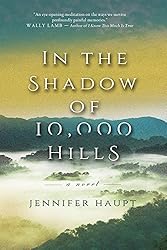
In the Shadow of 10,000 Hills
Jennifer Haupt, 2018
Central Avenue Publishing
384 pp.
ISBN-13: 9781771681339
Summary
In 1968, a disillusioned and heartbroken Lillian Carlson left Atlanta after the assassination of Martin Luther King.
She found meaning in the hearts of orphaned African children and cobbled together her own small orphanage in the Rift Valley alongside the lush forests of Rwanda.
Three decades later, in New York City, Rachel Shepherd, lost and heartbroken herself, embarks on a journey to find the father who abandoned her as a young child, determined to solve the enigma of Henry Shepherd, a now-famous photographer.
When an online search turns up a clue to his whereabouts, Rachel travels to Rwanda to connect with an unsuspecting and uncooperative Lillian.
While Rachel tries to unravel the mystery of her father's disappearance, she finds unexpected allies in an ex-pat doctor running from his past and a young Tutsi woman who lived through a profound experience alongside her father.
Set against the backdrop of a country grieving and trying to heal after a devastating civil war, follow the intertwining stories of three women who discover something unexpected: grace when there can be no forgiveness. (From the publisher.)
Author Bio
• Birth—N/A
• Where—Seattle, Washington, USA
• Education—University of Wisconsin
• Currently—lives in Seattle, Washington
Jennifer Haupt went to Rwanda as a journalist in 2006, a decade after the genocide that wiped out over a million people, to explore the connections between forgiveness and grief.
She spent a month travelling in the 10,000 hills with a guide, interviewing genocide survivors and humanitarian aid workers, and came home to Seattle with something unexpected: the bones of a novel.
Her essays and articles have been published in O, The Oprah Magazine, The Rumpus, Psychology Today, Travel & Leisure, The Seattle Times, Spirituality & Health, and many other publications. In the Shadow of 10,000 Hills is her first novel. (From the publisher.)
Book Reviews
Readers will appreciate a heightened perspective when comparing Rachel’s loss and struggles to the mass slaughter of an entire ethnic group. I left the book wanting to know more about current relations between the Hutus and Tutsis.
Abby Fabiaschi, AUTHOR - LitLovers
A woman’s pursuit of the truth about what happened to her father leads her to post-genocide Rwanda in Haupt’s ambitious debut.… Even though it’s ostensibly about the Rwandan genocide, Haupt’s story is one of humanity and hope.
Publishers Weekly
[T]hese resilient women embody the grace of a nation moving forward after unspeakable loss. Verdict: Journalist Haupt spent time in Rwanda researching the nature of grief and forgiveness. In this intensely beautiful debut, she shows that it's indeed the women who hold up half the sky. —Sally Bissell, formerly with Lee Cty. Lib. Syst., Fort Myers, FL
Library Journal
There are villains and horrible atrocities with far-reaching effects, but as Haupt examines events through different perspectives, the focus is on healing rather than revenge and anger.… [A] good choice for those seeking tales of hope after adversity and may prove popular with book clubs.
Booklist
[T]his novel is a glittering gem.
Powell's City of Books, Seattle
Discussion Questions
1. Which character were you most interested in learning more about and why?
2. All of the characters have secrets they keep from each other for various reasons. Did you think these reasons were selfish or compassionate—or both?
3. Which character’s main dilemma could you relate to the most and why?
4. Were there any characters who, at first, you had little empathy for and then developed more compassion as their storyline progressed?
5. There are several love affairs in this novel. Which one drew you in the most and why?
6. Which character surprised you the most—when and why?
7. Forgiveness is a theme in this novel. Where there any characters who were forgiven, who you thought shouldn’t have been? Where there any characters who weren’t forgiven who you thought should have been?
8. How do each of the main characters learn to embrace “Amahoro,” sorrow for the past and hope for the future?
(Questions courtesy of the author.)


In the Shadow of the Banyan
Vaddey Ratner, 2012
Simon & Schuster
336 pp.
ISBN-13: 9781451657708
Summary
You are about to read an extraordinary story. It will take you to the very depths of despair and show you unspeakable horrors.
It will reveal a gorgeously rich culture struggling to survive through a furtive bow, a hidden ankle bracelet, fragments of remembered poetry. It will ensure that the world never forgets the atrocities committed by the Khmer Rouge regime in Cambodia between 1975 and 1979, when an estimated two million people lost their lives. It will give you hope, and it will confirm the power of storytelling to lift us up and help us not only survive but transcend suffering, cruelty, and loss.
For seven-year-old Raami, the shattering end of childhood begins with the footsteps of her father returning home in the early dawn hours, bringing details of the civil war that has overwhelmed the streets of Phnom Penh, Cambodia’s capital. Soon the family’s world of carefully guarded royal privilege is swept up in the chaos of revolution and forced exodus. Over the next four years, as the Khmer Rouge attempts to strip the population of every shred of individual identity, Raami clings to the only remaining vestige of her childhood— the mythical legends and poems told to her by her father.
In a climate of systematic violence where memory is sickness and justification for execution, Raami fights for her improbable survival. Displaying the author’s extraordinary gift for language, In the Shadow of the Banyan is a brilliantly wrought tale of human resilience. (From the publisher.)
Author Bio
• Birth—1970
• Where—Cambodia
• Education—B.A., cornell University
• Currently—lives in Potomac, Maryland, USA
Vaddey Ratner was five years old when the Khmer Rouge came to power in 1975. After four years, having endured forced labor, starvation, and near execution, she escaped while many of her family members perished.
In 1981, she arrived in the U.S. as a refugee not knowing English and, in 1990, went on to graduate as her high school class valedictorian. She is a summa cum laude graduate of Cornell University, where she specialized in Southeast Asian history and literature. In recent years she traveled and lived in Cambodia and Southeast Asia, writing and researching, which culminated in her debut novel, In the Shadow of the Banyan. She lives in Potomac, Maryland. (From the publisher.)
Book Reviews
How is it that so much of this bleak novel is full of beauty, even joy?... As a work of fiction, In the Shadow of the Banyan is less a testament to atrocity than a reconciliation with the past. At one point, Raami’s nanny tells her that stories “are like footpaths of the gods. They lead us back and forth across time and space and connect us to the entire universe.” What is remarkable, and honorable, here is the absence of anger, and the capacity—seemingly infinite—for empathy.
Ligaya Mishan - New York Times Book Review
The horrors committed by Cambodia's Khmer Rouge, as experienced by one extremely resilient girl. A brutal novel, lyrically told.
O, The Oprah Magazine
(Starred review.) The struggle for survival is relayed with elegance and humility in Ratner’s autobiographical debut novel set in Khmer Rouge–era Cambodia. Raami is seven when civil war erupts, and she and her family are forced to leave Phnom Penh for the countryside. As minor royalty, they’re in danger; the Khmer Rouge is systematically cleansing the country of wealthy and educated people. Escaping their Phnom Penh home aboard a rusty military vehicle, a gold necklace is traded for rice, and literacy can mean death; “They say anyone with glasses reads too much... the sign of an intellectual.” Amid hunger, the loss of much of her family, and labor camp toil, Raami clings to the beauty that her father has shown her in traditional mythology and his own poetry. Raami’s story closely follows that of Ratner’s own: a child when the Khmer Rouge took over in 1975, she endured years under their rule until she and her mother escaped to the United States in 1981. This stunning memorial expresses not just the terrors of the Khmer Rouge but also the beauty of what was lost. A hauntingly powerful novel imbued with the richness of old Cambodian lore, the devastation of monumental loss, and the spirit of survival.
Publishers Weekly
Ratner's tale of what happens to seven-year-old Raami when the Khmer Rouge take over Cambodia is based on personal experience, though she herself was only five at the time, eventually arriving in America as a refugee in 1981. A huge in-house favorite.
Library Journal
Her heartrending, mournful tale depicts the horrors of thekilling fields and the senselessness of the violence there while still managingto capture small, beautiful moments…By countering the stark and abject realityof her experience with lyrical descriptions of the natural beauty of Cambodiaand its people, Ratner has crafted an elegiac tribute to the Cambodia she knewand loved.
Booklist
(Starred review.) Ratner's avowedly autobiographical first novel describes her family's travails during the genocide carried out by the Khmer Rouge in Cambodia in the late 1970s.... For four years, one terrible event follows another, with small moments of hope followed by cruelty and despair.... While names are changed (though not Ratner's father's name, which she keeps to honor his memory) and events are conflated, an author's note clarifies how little Ratner's novel has strayed from her actual memory of events. Often lyrical, sometimes a bit ponderous: a painful, personal record of Cambodia's holocaust.
Kirkus Reviews
Discussion Questions
1.According to the prophecy that Grandmother Queen tells Raami at the beginning of the novel, “There will remain only so many of us as rest in the shadow of a banyan tree.” What does the prophecy mean to Raami when she first hears it? How does her belief in the prophecy change by the end of the novel? After reading, what does the title of this novel mean to you?
2.Tata tells Raami, “The problem with being seven—I remember myself at that age—is that you’re aware of so much, and yet you understand so little. So you imagine the worst.” Discuss Raami’s impressions as a seven-year-old. How much is she aware of, and how much (or little) does she understand?
3.Review the scene in which Raami tells the Kamapibal her father’s real name. How does this serve as a turning point in the novel—what changes forever after this revelation? How does it affect Raami, and her relationship with both Papa and Mama?
4.Papa tells Raami, “I told you stories to give you wings, Raami, so that you would never be trapped by anything—your name, your title, the limits of your body, this world’s suffering.” How does the power of storytelling liberate Raami at different points in the novel?
5.Compare Mama’s and Papa’s styles of storytelling. When does each parent tell Raami stories, and what role do these stories serve? Which of Papa’s stories did you find most memorable? Which of Mama’s?
6.Consider Raami and her family’s Buddhist faith. How do their beliefs help them endure life under the Khmer Rouge?
7.Discuss Raami’s feelings of guilt over losing Papa and Radana. Why does she feel responsible for Papa’s decision to leave the family? For Radana’s death? How does she deal with her own guilt and grief?
8.What does Big Uncle have in common with Papa, and how do the two brothers differ? How does Big Uncle handle the responsibility of keeping his family together? What ultimately breaks his spirit?
9.Raami narrates, “my polio, time and again, had proven a blessing in disguise.” Discuss Raami’s disability, and its advantages and disadvantages during her experiences.
10.Although Raami endures so much hardship in the novel, in some ways she is a typical inquisitive child. What aspects of her character were you able to relate to?
11.Discuss how the Organization is portrayed in the novel. How does Raami picture the Organization to look, sound, and act? How do the Organization’s policies and strategies evolve over the course of the novel?
12.Names have a strong significance in the novel. Papa tells Raami he named her Vattaaraami, “Because you are my temple and my garden, my sacred ground, and in you I see all of my dreams.” What does Papa’s own name, Sisowath Ayuravann, mean? What traditions and stories are passed down through these names?
13.Consider Raami’s stay with Pok and Mae. Discuss what and how both Raami and Mama learn from them, albeit differently. Do you think their stay with Pok and Mae gave them hope?
14.“Remember who you are,” Mama tells Raami when they settle in Stung Khae. How does Raami struggle to maintain her identity as a daughter, a member of the royal family, and a Buddhist? Why does Mama later change her advice and encourage Raami to forget her identity?
15.Mama tells Raami after Radana’s death, “I live because of you—for you. I’ve chosen you over Radana.” Discuss Mama’s complicated feelings for her two daughters. Why did Raami assume that Radana was her mother’s favorite, and how does Mama’s story change Raami’s mind?
16.At the end of the novel, Raami realizes something new about her father’s decision to give himself up to the Kamapibal: “I’d mistaken his words and deeds, his letting go, for detachment, when in fact he was seeking rebirth, his own continuation in the possibility of my survival.” Discuss Papa’s “words and deeds” before he leaves the family. Why did Raami mistake his intentions, and how does she come to realize the truth about him?
17.How much did you know about the Khmer Rouge before reading In the Shadow of the Banyan? What did you learn?
(Questions issued by publisher.)


In the Unlikely Event
Judy Blume, 2015
Knopf Doubleday
416 pp.
ISBN-13: 9781101875049
Summary
A richly textured and moving story of three generations of families, friends and strangers, whose lives are profoundly changed by unexpected events.
In 1987, Miri Ammerman returns to her hometown of Elizabeth, New Jersey, to attend a commemoration of the worst year of her life. Thirty-five years earlier, when Miri was fifteen, and in love for the first time, a succession of airplanes fell from the sky, leaving a community reeling.
Against this backdrop of actual events that Blume experienced in the early 1950s, when airline travel was new and exciting and everyone dreamed of going somewhere, she paints a vivid portrait of a particular time and place—Nat King Cole singing "Unforgettable," Elizabeth Taylor haircuts, young (and not-so-young) love, explosive friendships, A-bomb hysteria, rumors of Communist threat. And a young journalist who makes his name reporting tragedy. Through it all, one generation reminds another that life goes on.
In the Unlikely Event is vintage Judy Blume, with all the hallmarks of Judy Blume’s unparalleled storytelling, and full of memorable characters who cope with loss, remember the good times and, finally, wonder at the joy that keeps them going. (From the publisher.)
Author Bio
• Birth— February 12, 1938
• Where—Elizabeth, New Jersey, USA
• Education—B.A., New York University
• Awards—(see below)
• Currently—lives in Key West, Florida
Judy Blume (born Judith Sussman) is an American writer. Her novels for children and young adults have exceeded sales of 80 million and have been translated into 32 languages. In 1996 she won the Margaret Edwards Award from the American Library Association for her contribution to writing for teens.
Blume's novels for teenagers have tackled racism (Iggie's House), menstruation (Are You There God? It's Me, Margaret.), divorce (It's Not the End of the World, Just As Long As We're Together), bullying (Blubber), masturbation (Deenie; Then Again, Maybe I Won't) and teen sex (Forever). Blume has used these subjects to generate discussion, but they have also been the source of controversy regarding age-appropriate reading.
Early life
Blume was born and raised in Elizabeth, New Jersey, the daughter of homemaker Esther (nee Rosenfeld) and dentist Ralph Sussman. She has a brother, David, who is five years older. Her family was Jewish. Blume has recalled, "I spent most of my childhood making up stories inside of my head."
She graduated from Battin High School in 1956, then enrolled in Boston University. In the first semester, she was diagnosed with mononucleosis and took a brief leave from school before graduating from New York University in 1961 with a bachelor's degree in Education.
In 1951 and 1952, there were three airplane crashes in her hometown of Elizabeth, New Jersey. 118 people died in the crashes, and Blume’s father, who was a dentist, helped to identify the unrecognizable remains. Blume says she "buried" these memories until she began writing her 2015 novel In the Unlikely Event, the plot of which revolves around the crashes.
Career
A lifelong avid reader, Blume first began writing when her children were attending preschool and published her first book, The One in the Middle Is the Green Kangaroo, in 1969. The decade that followed proved to be her most prolific, with 13 more books being published, including many of her most well-known titles, such as Are You There God? It's Me, Margaret. (1970), Tales of a Fourth Grade Nothing (1972), Otherwise Known as Sheila the Great (1972), and Blubber (1974). A number of Blume's books appear on the list of top all-time bestselling children's books.
After publishing novels for young children and teens, Blume tackled another genre—adult reality and death. Her novels Wifey (1978) and Smart Women (1983) shot to the top of The New York Times best-seller list. Wifey has become a bestseller, with over 4 million copies sold to date. Her third adult novel Summer Sisters (1998) was widely praised and has sold more than 3 million copies. It spent 5 months on The New York Times Bestseller list, with the hardcover reaching #3 while the paperback spent several weeks at #1. Her fourth adult novel, In the Unlikely Event, came out in 2015.
Awards
Judy Blume has won more than 90 literary awards, including three lifetime achievement awards in the US. The ALA Margaret A. Edwards Award recognizes one writer and a particular body of work for "significant and lasting contribution to young adult literature."
She won the annual award in 1996 citing the single book Forever, published in 1975. According to the citation,
She broke new ground in her frank portrayal of Michael and Katherine, high school seniors who are in love for the first time. Their love and sexuality are described in an open, realistic manner and with great compassion.
In April 2000 the Library of Congress named her to its Living Legends in the Writers and Artists category for her significant contributions to America's cultural heritage. In 2004 she received the annual Distinguished Contribution to American Letters Medal of the National Book Foundation as someone who "has enriched [American] literary heritage over a life of service, or a corpus of work."
Other work
The film version of Blume's 1981 novel Tiger Eyes was directed by the author's son, Lawrence Blume. Released in 2012, it stars Willa Holland as Davey and Amy Jo Johnson as Gwen Wexler.
Throughout Blume's career, she has also made efforts to advocate for organizations that support intellectual freedom. "Finding herself at the center of an organized book banning campaign in the 1980's she began to reach out to other writers, as well as teachers and librarians, who were under fire." This led to Blume joining the National Coalition Against Censorship.
All of her efforts go into helping protect the freedom to read. She is also the founder and trustee of a charitable and education foundation, called The Kids Fund. Blume serves on the board for other organizations, such as Author's Guild, Society of Children's Book Writers and Illustrators, Key West Literary Seminar, and National Coalition Against Censorship.
Personal life
On August 15, 1959, in the summer of her freshman year of college, she married John M. Blume, whom she had met while a student at New York University. He became a lawyer, while she was a homemaker before supporting her family by teaching and writing. They had two children. The couple divorced in 1976. Blume has stated that Lawrence was the inspiration for the character of Fudge. Blume has one grandchild, a grandson whom Blume credits with encouraging her to write the most recent Fudge books.
Shortly after her separation from her first husband, Blume met Thomas A. Kitchens, a physicist. The couple married in 1976, moved to New Mexico, but divorced in 1978. She later spoke about their split: "It was a disaster, a total disaster. After a couple years, I got out. I cried every day. Anyone who thinks my life is cupcakes is all wrong."
A mutual friend introduced her to George Cooper, a former law professor turned non-fiction writer. Blume and Cooper have been married since 1987. They reside in Key West. (Adapted from Wikipedia. Accessed 7/14/2015.)
Book Reviews
Judy Blume isn’t just revered, she’s revolutionary.... The novel moves with momentum, told in short chapter bursts, newspaper reports and even scripted dialogue.... Blume nails every 1950s detail, from the refinished basements with wet bars and knotty-pine walls to Elizabeth Taylor haircuts and mentions of Bogart and Bacall.... Blume, whose fiction for adults has the same emotional immediacy as her books for children, makes us feel the pure shock and wonder of living.
Caroline Leavitt - New York Times Book Review
A heartfelt novel intended to be heartwarming. In that it fully succeeds.
Sherryl Connelly - New York Daily News
It’s Judy Blume and, therefore, it’s gold.... Despite tragedy at its core, [In the Unlikely Event] soars.
Jacqueline Cutler - Newark Star Ledger
Comfort reading at its most soothing, the turn of its pages like sitting down with a beloved, long-lost friend.
Lucy Scholes - Independent (UK)
Quite simply, extraordinary.
Viv Groskop - Guardian (UK)
Blume, in clear and forthright storytelling, creates realistic characters searching for happiness while dodging the obstacles placed in their way. She does it with a compassionate understanding of life’s setbacks and the power we all have to survive and move on.
Carol Memmott - Chicago Tribune
In the Unlikely Event gives us everything that Blume is known (and beloved) for—the fierce, fraught nature of young relationships, the comfort and confines of cultural identity, the messiness and joys of the body—and takes it to a new level. This novel is her most ambitious to date, and she lives up to its reach with her characteristic frankness, compassion, and charm.
Gayle Brandeis - San Francisco Chronicle
Will appeal to loyal fans as well as new readers.... In Miri, Blume deftly exposes the inner life of a teenager girl during the 1950s—and not the sanitized version so often portrayed. In the Unlikely Event integrates Blume’s acclaimed observation of the teenage experience with intimate knowledge of an unusual series of events, making it a page-turner with cross-generational appeal.
Meganne Fabrega - Minneapolis Star-Tribune
Satisfying, heartfelt.... Delivers on the warm nostalgia that we remember from Blume’s earlier books.... It is her signature unparalleled ability to capture the innermost lives of teenagers that makes In the Unlikely Event vintage Judy Blume.
Melissa M. Firman - Pittsburgh Post-Gazette
[In the Unlikely Event] does not disappoint.... Blume’s great gift is [her] personal touch; her unflinching but reassuring voice—that of a no-nonsense big sister who gives it to you straight, then gives you a hug—characterizes her adult novels as distinctly as it does her YA output.
Emily Simon - Buffalo News
Blume creates characters who are real and sympathetic.
Amanda St. Amand - St. Louis Post-Dispatch
The details of the time and place ring true, and so do the feelings of the characters.
Margaret Quamme - Columbus Dispatch
An ambitious book that combines adult experience with the sweet familiarity of Blume’s writing for and about younger people.... The novel rivals Tolstoy or Ferrante in its number of characters, families, and stories, and it feels not just believable but like a regular preteen-style Judy Blume page-turner, emotionally resonant and down-to-earth at once.... It’s also the experience of being in Blume’s authoritative hands, reading a dramatic story about daily life told in a funny, orderly, honest style. Blume is always kind to her readers; the suffering her characters experience feels real but never cruel, never melodramatic.... [Her books are] deftly crafted, and she’s done the hard work for us.... Reading In the Unlikely Event is like reconnecting with a long-lost friend.
Sarah Larson - The New Yorker
Judy Blume is back—and on her game!... A deftly written story that captures a town coping with loss and the sudden fame that horrible tragedy brings. You won’t want to turn the last page.
Kim Hubbard - People Magazine
Excellent and satisfying.... Has all the elements of Blume’s best books: the complex relationships between friends and family members, the straight talk and lack of shame about sex, and, most of all, the compassionate insight into the pleasures and pains of growing up.
Aimee Levitt - Chicago Reader
Vividly rendered.... Blume deftly demonstrates just how different the personal fallout from tragedy can turn out to be.... As Blume proves over and over again not just in In the Unlikely Event but in all of her fiction, life does go on in spite of hardship. We love. We lose. We fail. We may fall. But the lucky ones, we try our best to endure.
Alexis Burling - Oregonian
Has [Judy Blume’s] signature warm, personal touch.
Megan O’Grady - Vogue.com
The three fatal plane crashes that hit Elizabeth, N.J., during the winter of 1951–52 are the inspiration for Elizabeth-native Blume's latest adult novel...while posing the question, how do individuals, families, and communities, deal with disaster?... [C]haracteristically accessible, frequently charming, and always deeply human.
Publishers Weekly
(Starred review.)There is no surprise that [In the Unlikely Event] is smoothly written, and its story compelling. The setting—the early 1950s—is especially well realized.... A new Blume novel will always be big news. —Michael Cart
Booklist
[A] story that mingles facts...[with] fictional characters. Though it's not always clear where truth ends and imagination begins.... Though it doesn't feel much like an adult novel, this book will be welcomed by any Blume fan who can handle three real tragedies and a few four-letter words.
Kirkus Reviews
Discussion Questions
1. Discuss the environment of Elizabeth, New Jersey, before the crashes occur. How would you describe the community? How does the community band together after the first crash?
2. Throughout In the Unlikely Event, newspaper clippings are interspersed among the text. How do those articles help to provide context for the events that occur? How did they aid your understanding of changes in Elizabeth?
3. Class and status play a role throughout In the Unlikely Event. How does Miri see herself in the socioeconomic structure of Elizabeth? When does she feel most uncomfortable with her family’s position? How does her idea of relative wealth change once she meets Mason?
4. Discuss Miri’s relationship with her mother. How would you define the relationship between Miri and Rusty at the beginning of the novel? Are there special pressures on Miri because she is an only child? How do Irene and Henry mitigate the mother-daughter disagreements between Miri and Rusty? Does the relationship change once Miri has her own children? If so, how?
5. In the Unlikely Event is arguably a novel about the crashes as much as it is one about Henry Ammerman’s development as a journalist. How does Henry’s career evolve over the course of the novel? Is he ever conflicted by his role in reporting the tragedy? How has reportage changed since the 1950s?
6. How does Miri’s idea of friendship change throughout the novel? Discuss the scene in which Miri visits Natalie in the hospital. How does this incident set the tone for their relationship going forward?
7. Discuss the conspiracy theories that emerge after the crashes. For the teenagers in the novel, how do these rumors act as a means of coping?
8. On page 29, it states that "Miri couldn’t help wishing" she had a father like Dr. Osner. What does she desire in a relationship with a father? Discuss her reunion with her biological father. How does this experience change her? Does she ever find someone to fulfill the role of father in her life?
9. Discuss how working women are portrayed in the novel. What challenges do these women face? Can you point to any particular incidents in which the working women—particularly Rusty, Daisy, and Christina—face discrimination or judgment for their roles in the workplace?
10. The crashes create a sense of palpable fear and anxiety for the residents of Elizabeth throughout In the Unlikely Event. How does it affect Miri on a psychological level? What about Natalie?
11. Several budding romances play out over the course of In the Unlikely Event. What relationship most surprised you? Whom did you root for?
12. How is teen culture described throughout In the Unlikely Event? What influence does pop culture have on Miri and her peers? Were you able to trace any similarities between the teens of the 1950s and the teens of today?
13. Discuss the events of the reunion. Did the characters’ lives turn out differently from how you would have expected? Who changed the most?
14. Judy Blume has had a prolific career writing books for readers of all ages. How many of her previous novels, if any, have you read? How did your reading experience of In the Unlikely Event compare with her other works? Are you able to pinpoint anything in the writing or character development that felt distinctly "Judy Blume" in style or execution?
(Questions issued by the publisher.)
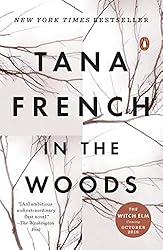
In the Woods (Dublin Murder Squad Series 1)
Tana French, 2007
Penguin Group USA
464 pp.
ISBN-13: 9780143113492
Summary
As dusk approaches a small Dublin suburb in the summer of 1984, mothers begin to call their children home.
But on this warm evening, three children do not return from the dark and silent woods. When the police arrive, they find only one of the children gripping a tree trunk in terror, wearing blood-filled sneakers, and unable to recall a single detail of the previous hours.
Twenty years later, the found boy, Rob Ryan, is a detective on the Dublin Murder Squad and keeps his past a secret.
But when a twelve-year-old girl is found murdered in the same woods, he and Detective Cassie Maddox—his partner and closest friend—find themselves investigating a case chillingly similar to the previous unsolved mystery. Now, with only snippets of long-buried memories to guide him, Ryan has the chance to uncover both the mystery of the case before him and that of his own shadowy past.
Richly atmospheric, stunning in its complexity, and utterly convincing and surprising to the end, In the Woods is sure to enthrall fans of Mystic River and The Lovely Bones. (From the publisher.)
Author Bio
• Birth—1973
• Where—Vermont, USA
• Education—B.A., Trinity College (Dublin)
• Awards—Edgar Award, Macavity Award, Barry Award
• Currently—lives in Dublin, Ireland
Tana French is an Irish novelist and theatrical actress. Her debut novel In the Woods (2007), a psychological mystery, won the Edgar, Anthony, Macavity, and Barry awards for best first novel. She is a liaison of the Purple Heart Theatre Company and also works in film and voiceover.
French was born in the U.S. to Elena Hvostoff-Lombardi and David French. Her father was an economist working in resource management for the developing world, and the family lived in numerous countries around the globe, including Ireland, Italy, the US, and Malawi.
French attended Trinity College, Dublin, where she was trained in acting. She ultimately settled in Ireland. Since 1990 she has lived in Dublin, which she considers home, although she also retains citizenship in the U.S. and Italy. French is married and has a daughter with her husband.
Dublin Murder Squad series
In the Woods - 2007
The Likeness - 2008
Faithful Place - 2010
Broken Harbor - 2012
The Secret Places - 2014
The Trespasser - 2016
Stand-alone mystery
The Witch Elm - 2018
(Bio adapted from Wikipedia. Retrieved 9/2/2014.)
Book Reviews
[French] sets a vivid scene for her complex characters, who seem entirely capable of doing the unexpected. Drawn by the grim nature of her plot and the lyrical ferocity of her writing, even smart people who should know better will be able to lose themselves in these dark woods.
Marilyn Stasio - New York Times
Readers who like their hardboiled police procedurals with an international flair will love Irish author Tana French’s debut novel.... In the Woods is as creepily imaginative as it gets.
USA Today
This is an amazing piece of work, taut, persuasive, and intricately constructed to stunning effect.
AudioFile
Irish author French expertly walks the line between police procedural and psychological thriller…. Ryan and Maddox are empathetic and flawed heroes, whose partnership and friendship elevate the narrative beyond a gory tale of murdered children.
Publishers Weekly
(Starred review.) Rob Ryan and his partner, Cassie Maddox, land the first big murder case of their police careers: a 12-year-old girl has been murdered in [surbuban] woods.… An outstanding debut and a series to watch for procedural fans. —Thomas Gaughan.
Booklist
[H]eavy on psycho-drama…. When not lengthily bogged down in angst, a readable, non-formulaic police procedural with a twist. It's ultimately the confession of a damaged man.
Kirkus Reviews
Discussion Questions
1. What do the woods represent symbolically in Tana French's novel? Does their significance change as the story progresses?
2. The loss or absence of stable families is a recurring motif in In the Woods. How do French's characters, particularly Ryan, attempt to compensate for this absence?
3. Does the Irish setting of In the Woods contribute significantly to the telling of the story, or do you find French's novel to be about humanity on a more universal level?
4. How does Ryan's experience In the Woods at the age of twelve affect his ability to function as a detective? Is it always a hindrance to him, or are there ways in which it improves and deepens his insights?
5. Cassie Maddox, Ryan's partner, is perhaps the most consistently appealing character in the novel. What are her most attractive qualities? What are the weaker points of her personality? Does Ryan ever fully appreciate her?
6. After sleeping together, Ryan and Cassie cease to be friends. Why do you think the experience of physical intimacy is so damaging to their relationship? Are there other reasons why their friendship falls apart?
7. Ryan states that he both craves truth and tells lies. How reliable to you find him as a narrator? In what ways does the theme of truth and misrepresentation lie at the heart of In the Woods?
8. Imagine that you are Ryan's therapist. With what aspects of his personality would you most want to help him come to terms? Do you think there would be any way to lead him out of ìthe woods?î
9. How convincing is French's explanation of the motivating forces that lead to Katy's murder—forces that come close to a definition of pure evil? Are such events and motivations ever truly explicable?
10. The plan to build the new motorway, trampling as it does on a past that some regard as sacred, is an outrage to the archaeologists who are trying to preserve an ancient legacy. How does this conflict fit thematically with Ryan's own contradictory desires to unearth and to pave over his past?
11. Do you have your own theories about the mysteries that remain unsolved at the end of In the Woods? What are they?
12. What were your thoughts and emotions upon finishing In the Woods? If this book affected you differently from other mysteries you have read, why do you think this was true?
(Questions issued by the publisher.)
top of page (summary)

In Twenty Years
Allison Winn Scotch, 2016
Amazon Publishing
322 pp.
ISBN-13: 9781503935242
Summary
Twenty years ago, six Penn students shared a house, naively certain that their friendships would endure—until the death of their ringleader and dear friend Bea splintered the group for good.
Now, mostly estranged from one another, the remaining five reluctantly gather at that same house on the eve of what would have been Bea’s fortieth birthday.
But along with the return of the friends come old grudges, unrequited feelings, and buried secrets.
Catherine, the CEO of a domestic empire, and Owen, a stay-at-home dad, were picture-perfect college sweethearts—but now teeter on the brink of disaster. Lindy, a well-known musician, is pushing middle age in an industry that’s all about youth and slowly self-destructing as she grapples with her own identity.
Behind his smile, handsome plastic surgeon Colin harbors the heartbreaking truth about his own history with Bea. And Annie carefully curates her life on Instagram and Facebook, keeping up appearances so she doesn’t have to face the truth about her own empty reality.
Reunited in the place where so many dreams began, and bolstered by the hope of healing, each of them is forced to confront the past. (From the publisher.)
Author Bio
• Birth—June 12, 1973
• Where—Charlottesville, Virginia; Seattle, Washington, USA
• Education—B.A. University of Pennsylvania
• Currently—lives in Los Angeles, California
Allison Winn Scotch is an American author with six books to her name. She grew up with a school-teacher mother who loved to read and passed her passion for books onto her children.
After graduating from the University of Pennsylvania, Allison worked as a freelance writer for popular magazines (a lot of "10 best ways to..." columns), but all the while she was honing her skills as a novelist. First one novel (awful), then another (not as bad), until finally in 2007 she published The Department of Lost and Found.
Since then, she has followed with, Time of My Life (2008), The One That I Want (2010), The Song Remains the Same (2012). The Theory of Opposites (2013), In Twenty Years (2016), Between You and Me (2018), and Cleo McDougal Has No Regrets (2020).
Allison lives in Los Angeles with her family and dogs. When not novel writing, she writes celebrity interviews and profiles, which she says indulges her obsession with pop culture. (Adapted from the author's website.)
Book Reviews
A story about youthful dreams and middle-age reality, this is a page turning book to talk about.
Parkersburg News & Sentinel
Allison Winn Scotch is the ultimate beach read. If you plan to sink your toes into the sand and need a fab book to kick back with...this is the one.
Parade
Both heartbreaking and funny, this novel explores how we cope with the disappointments of adulthood and come to terms with our past.
Real Simple
Winn Scotch’s highly anticipated, thought-provoking, and emotional sixth novel tells the story of complex yet relatable characters questioning the paths they have chosen in life (and who can’t thoroughly relate to that?).
New You Magazine
(Starred review.) Scotch hits a grand slam with this novel.... With wonderfully fleshed-out, relatable characters, this is an absolute must-read that lovers of women's contemporary fiction will devour in one sitting.
Library Journal
Told from five vastly different perspectives of characters who are deeply developed and relatable in their flawed ways, this novel captures the nostalgia many feel for the friendships and simple nature of youth...Heartfelt...Well written and memorable.
Romance Times Reviews
Discussion Questions
Use our LitLovers Book Club Resources; they can help with discussions for any book:
• How to Discuss a Book (helpful discussion tips)
• Generic Discussion Questions—Fiction and Nonfiction
• Read-Think-Talk (a guided reading chart)
(We'll add specific questions if and when they're made available by the publisher.)


Inamorata
Megan Chance, 2014
Lake Union Publihsing
420 pp.
ISBN-13: 9781477823033
Summary
American artist Joseph Hannigan and his alluring sister, Sophie, have arrived in enchanting nineteenth-century Venice with a single-minded goal. The twins, who have fled scandal in New York, are determined to break into Venice’s expatriate set and find a wealthy patron to support Joseph’s work.
But the enigmatic Hannigans are not the only ones with a secret agenda. Joseph’s talent soon attracts the attention of the magnificent Odile Leon, a celebrated courtesan and muse who has inspired many artists to greatness. But her inspiration comes with a devastatingly steep price.
As Joseph falls under the courtesan’s spell, Sophie joins forces with Nicholas Dane, the one man who knows Odile’s dark secret, and her sworn enemy. When the seductive muse offers Joseph the path to eternal fame, the twins must decide who to believe—and just how much they are willing to sacrifice for fame. (From the publisher.)
Author Bio
Megan Chance is a critically acclaimed, award-winning author of historical fiction. Her novels have been chosen for the Borders Original Voices and IndieBound’s Booksense programs. A former television news photographer and graduate of Western Washington University, Chance lives in the Pacific Northwest with her husband and two daughters. (From the publisher.)
Book Reviews
Chance’s eighth novel (after Bone River) is a thrilling depiction of the world of Venetian artists in the late 19th century, as well as an exploration of the myth of the muse. Chance gets better with each book, and this look at the dynamic between inspiration, desperation, and creation makes for a breathtaking tale.
Publishers Weekly
Discussion Questions
1. Odile’s gift is to inspire a great work of art, but the cost is that the artist never creates again. Do you think, as she does, that such a price is worth it? Is there any work of art or literature that you feel would be worth such a sacrifice? Do you think, as Odile does, that art requires sacrifice?
2. What do you think of the role of art in our lives? Do you agree, as the characters in the book do, that it can give life meaning and, as Odile says, give mankind a reason to strive, something that counters death and suffering? How important do you think art is?
3. Nicholas thinks of himself as a savior, even though his wish to save men from Odile has backfired more than once—leading men to commit suicide in some cases. Do you think he’s right? Do you believe, as Nicholas does, that their deaths are a mercy compared to what will happen to them in Odile’s hands?
4. Odile asks Joseph where his “vision” comes from, and he answers that it doesn’t matter. Do you agree? Do you think where talent or inspiration comes from is important? Does knowing the source of an artist’s inspiration change the way you view his work?
5. Sophie’s love for her brother and his for her was tempered and changed by abuse. What do you think of the their relationship? Do you think it wrong or immoral, particularly given what forged it?
6. Do you think the inspiration Joseph takes from his sister is tainted by their relationship? Or does the depth of his talent redeem it and make it all right—or even necessary?
7. In the book we discover that Joseph’s writing of an anonymous letter to Edward Roberts’ father led to Edward’s suicide. Do you think Joseph’s writing of this letter was justified, given what Edward did to them?
8. Do you believe Sophie and Joseph cripple each other? Do you think they live “half a life,” as Odile believes? Or do you think, as Sophie does, that theirs are lives “doubly lived?”
9. What do you think of the reasons that motivate Nicholas and Odile—his need to “matter” and hers to be recognized? Do you think those worthy or admirable motivations?
10. If you had been offered the gift that Madeleine offered Odile, would you take it?
(Questions from the author's website.)


The Incarnations
Susan Barker, 2014
Touchstone
384 pp.
ISBN-13: 9781501106781
Summary
A Beijing taxi driver's past incarnations over one thousand years haunt him through searing letters sent by his mysterious soulmate.
"Who are you? you must be wondering. I am your soulmate, your old friend, and I have come back to this city of sixteen million in search of you."
So begins the first letter that falls into Wang’s lap as he flips down the visor in his taxi.
The letters that follow are filled with the stories of Wang’s previous lives—from escaping a marriage to a spirit bride, to being a slave on the run from Genghis Khan, to living as a fisherman during the Opium Wars, and being a teenager on the Red Guard during the cultural revolution—bound to his mysterious "soulmate," spanning one thousand years of betrayal and intrigue.
As the letters continue to appear seemingly out of thin air, Wang becomes convinced that someone is watching him—someone who claims to have known him for over one thousand years. And with each letter, Wang feels the watcher growing closer and closer…
Seamlessly weaving Chinese folklore, history, and literary classics, The Incarnations is a taut and gripping novel that sheds light on the cyclical nature of history as it hints that the past is never truly settled. (From the publisher.)
Author Bio
• Birth—1978
• Raised—London, England, U.K.
• Education—B.A., Leeds University; Manchester University
• Currently—lives in the U.K.
Susan Barker is a British novelist, the daughter of an English father and Chinese-Malaysian mother. She grew up in East London, studied at Leeds University, and undertook the graduate writing program at Manchester University. She writes primarily about Asia, and spent several years living in Beijing while working on The Incarnations (2014). She now lives in the U.K.
Novels
♦ 2005 - Sayonara Bar, which Time called "a cocktail of astringent cultural observations, genres stirred and shaken, subplots served with a twist;
♦ 2008 - The Orientalist and the Ghost, longlisted for the Dylan Thomas Prize;
♦ 2014 - The Incarnations, a tale of a modern Beijing taxi driver who is pursued by his soulmate across a thousand years of Chinese history.
(Adapted from Wikipedia. Retrieved 1/3/2016.)
Book Reviews
wildly ambitious…[Barker's] dazzling use of language and natural storytelling gifts shine from every paragraph. As with David Mitchell, whose books can similarly hopscotch through times and places, each episode stands alone as a terrific tale in itself. You can become so immersed in one story that you have to almost physically drag yourself away to commit to the next…Embedded in the large themes is an irresistible mystery…The truth is a satisfying surprise, and it makes us think differently about everything that has come before. There's a bonus, too—the answer to a different puzzle we didn't know existed. It brings the story full circle, in a way, and adds urgency to the notion that in order to live properly, you must understand where you come from.
Sarah Lyall - New York Times
[A]stonishing, amazing…. The book's clever central contrivance involves a series of mysterious letters that are left in Wang's taxicab…it's the small sagas of Chinese history contained in the letters, together with Barker's vivid descriptions of today's China, that set this book apart as a work of considerable, if unnerving, importance. Were I a teacher of Chinese history, I would argue that Barker's novel brilliantly illuminates some of the defining episodes in the nation's long, long story at least as vividly as any of the textbooks available in our school…The letters offer up five such episodes, running from the Tang dynasty to the modern era. Each is a tightly wound, intensely wrought, fantastically exciting novella, detailing the minutiae of imagined lives in the richly perfumed gardens of China's near endless past.
Simon Winchester - New York Times Book Review
[Barker] has smartly structured this intricate tale, and its mystery pulls us forward.... The novel gains in power and polish as it progresses.... Close to the end, I found myself stalling—prolonging suspense.
Boston Globe
Barker makes Wang and his city as vividly real—and disturbing—as any of the other versions of China. . . . One of the novel’s many structural pleasures is watching Barker slowly reveal the connections between Wang’s seemingly simple life and the other lives the letter writer reveals.
Columbus Dispatch
A dazzling tapestry of epic scope.... [An] ambitious, enthralling tale, a deft melding of past and present, myth and reality, longing and torment.
Minneapolis Star Tribune
Highly successful as art and craft… The Incarnations uses its unique premise to combine a series of short stories based in history with a realistic account of a difficult modern life, for much more than the sum of the parts.
Albany Times Union
(Starred review.) [A] page-turning reincarnation fantasy. In modern-day Beijing, Driver Wang receives anonymous letters from a source claiming to have known him in five previous lifetimes.... Driving the narrative is the suspense over the identity of Wang’s stalker and whether the stories are indeed true. A very memorable read.
Publishers Weekly
[E]ngrossing.... Barker's writing is fluid, and the plotlines and characterizations found in her historical tales, while dark and sinister, are nonetheless intriguing. Misunderstandings abound throughout the novel to unravel the past that collides intensely with the present, ultimately leading to a disquieting finale. —Shirley Quan, Orange Cty. P.L., Santa Ana, CA
Library Journal
Daring.... The novel’s shifts from the distant past to the present are seamless, and the bittersweet twist at the book’s finale will have readers searching back through the novel for clues to the ending.... Skillfully combines history, the supernatural and the everyday in a novel that suggests that the past is never really past, while providing a cracking good read.
BookPage
(Starred review.) Moving between Wang's many pasts...Barker's historical tour de force is simultaneously sweeping and precise. It would be easy for the novel to teeter into overwrought melodrama; instead, Barker's psychologically nuanced characters and sharp wit turn the bleakness and the gore into something seriously moving.... A deeply human masterpiece.
Kirkus Reviews
Discussion Questions
1. Consider Wang’s relationship with Yida. How have social and cultural constraints affected their union? For example, early on we learn that Yida, like many Chinese parents, had wanted a boy but Wang "had shamed her into keeping the baby" (their daughter, Echo; page 13). Are there other examples of how social norms or constraints have affected their relationship dynamic?
2. The chapters telling the stories of Wang’s past incarnations are written in the first person ("I") and the second person ("you"). How did this style affect your experience reading the story? Why do you think the author chose to frame these sections from this narrative perspective?
3. Wang initially views the histories as "folktales" (page 75). Do you think he eventually comes to believe that these stories are true representations of his past lives? Why or why not? Find moments in the text that support your answer.
4. Betrayal is a recurring theme throughout the novel. Is there any significance to who betrays whom as the two characters’ lives proceed together over hundreds of years? Do you think that their actions in one life affect the next life? Or does each life stand apart? Refer to passages in the text to support your answers.
5. Consider the notion of madness in the novel. Which characters are seen as mad, and why? How does this classification affect those characters in Chinese society—both in the present and in the past?
6. In the fourth letter, the writer declares, "We must rebel against fate. . . . Fate must be outwitted. It must no longer stand in our way" (page 117). What role does fate play in the story? Do you think the characters succeed in rebelling against fate in the last incarnation? Why or why not?
7. In the fifth letter, the writer notes that this "third biography has been more punishing than the others" (page 179). And after reading it, Wang is convinced he read the story at some point in his schooling since "the story had resonated so strongly in his memory" (page 215). All of the histories are graphic and brutal stories; why do you think this one (Ming Dynasty, 1542) is the most difficult for the writer to relive? Which of the five histories do you see as the darkest or most agonizing?
8. Towards the end of the novel, we learn that Shuxiang is the letter writer. How does this change your understanding of Wang and Shuxiang’s relationship as mother and son? Do you see her differently as a mother? Refer back to Wang’s memories of his mother, and compare them to Shuxiang’s own recollections.
9. In each of their incarnations, the two characters have complex and intense relationships with each other. After so much conflict and passion between them throughout the past thousand years, consider the significance of ending the novel with a mother and son relationship. Why do you think the author chose to end the novel on this note?
10. Consider Echo’s role throughout the novel, and at the end; the author brings the novel full circle, placing Echo into the same histories her father and grandmother lived. Despite her conviction that "The Watcher is mentally ill" (page 367), Echo begins to read the letters and stories of her past lives. As such a young child, how will Echo interpret these stories? Do you think Shuxiang was right to pass on her insight of previous incarnations to her granddaughter? Why or why not?
(Questions issued by the publisher.)

The Incendaries
R.O. Kwon, 2018
Penguin Publishing
224 pp.
ISBN-13: 9780735213890
Summary
A powerful, darkly glittering novel of violence, love, faith, and loss, as a young woman at an elite American university is drawn into acts of terrorism by a cult tied to North Korea.
Phoebe Lin and Will Kendall meet their first month at prestigious Edwards University. Phoebe is a glamorous girl who doesn't tell anyone she blames herself for her mother's recent death. Will is a misfit scholarship boy who transfers to Edwards from Bible college, waiting tables to get by. What he knows for sure is that he loves Phoebe.
Grieving and guilt-ridden, Phoebe is increasingly drawn into a religious group—a secretive extremist cult—founded by a charismatic former student, John Leal. He has an enigmatic past that involves North Korea and Phoebe's Korean American family.
Meanwhile, Will struggles to confront the fundamentalism he's tried to escape, and the obsession consuming the one he loves. When the group bombs several buildings in the name of faith, killing five people, Phoebe disappears. Will devotes himself to finding her, tilting into obsession himself, seeking answers to what happened to Phoebe and if she could have been responsible for this violent act.
The Incendiaries is a fractured love story and a brilliant examination of the minds of extremist terrorists, and of what can happen to people who lose what they love most.
Named a "Most Anticipated Book of 2018" by the New York Times, Entertainment Weekly, Elle, Time, Parade, Vanity Fair, Cosmopolitan, Esquire, PBS, Vulture, Buzzfeed, BookRiot, PopSugar, Refinery29, Bustle, The Millions, The Rumpus, Paste, BBC. (From the publisher.)
Author Bio
R.O. Kwon is a National Endowment for the Arts Literature Fellow. Her writing has appeared in The Guardian, Vice, BuzzFeed, Noon, Time, Electric Literature, Playboy, San Francisco Chronicle, and elsewhere.
She has received awards and fellowships from Yaddo, MacDowell, the Bread Loaf Writers' Conference, the Sewanee Writers' Conference, Omi International, and the Norman Mailer Writers' Colony. Born in South Korea, she’s mostly lived in the United States. (Adapted from the publisher.)
Book Reviews
Radiant.… A dark, absorbing story of how first love can be as intoxicating and dangerous as religious fundamentalism.
New York Times Book Review
A sharp, little novel as hard to ignore as a splinter in your eye.… In a nation still so haunted by the divine promise, on the cusp of ever-more contentious debates about abortion and other intrinsically spiritual issues, The Incendiaries arrives at precisely the right moment.
Washington Post
Kwon is a writer of many talents, and The Incendiaries is a debut of dark, startling beauty.
San Francisco Chronicle
A stunning debut… After this impressive introduction of her work to the world, we’re excited to see where Kwon takes us in the future.
Marie Claire
Kwon’s multi-faceted narrative portrays America’s dark, radical strain, exploring the lure of fundamentalism, our ability to be manipulated, and what can happen when we’re willing to do anything for a cause.
Atlantic
Remarkable… Every page blooms with sensuous language and the book’s mood is otherworldly, even if its setting, a wealthy college in the Northeast, isn’t… These are characters in quiet crisis, burning, above all, to know themselves, and Kwon leads them, confidently, to an enthralling end.
Paris Review
A fairy-tale quality reminiscent of Donna Tartt’s The Secret History. [The Incendiaries is] the rare depiction of belief that doesn’t kill the thing it aspires to by trying too hard. It makes a space, and then steps away to let the mystery in.
New Yorker
Religion, politics, and love collide in this slim but powerful novel reminiscent of Donna Tartt’s The Secret History, with menace and mystery lurking in every corner.
People
Written in dazzling, spare prose…Kwon’s novel expertly addresses questions of faith and identity while managing to be formally inventive in its construction.… In this intriguing cult story, Kwon thoroughly explores her characters’ motivations, making for an urgent and disarming debut.
Publishers Weekly
Kwon successfully defines her characters’ depth while maintaining an air of intrigue and suspense. Throughout, she looks at the imperfections in all our lives and how our interactions may lead us down paths unbeknownst to ourselves. With a breezy yet intense style, newcomer Kwon is a writer to watch. —Shirley Quan, Orange Cty. P.L., Santa Ana, CA
Library Journal
A first-time novelist explores identity, deception, and obsession…. The narrative is so slow and so superficial that the climax is anticlimactic.… Aesthetically pleasing but narratively underwhelming.
Kirkus Reviews
Discussion Questions
We'll add publisher questions if and when they're available; in the meantime, use our LitLovers talking points to help start a discussion for THE INCENDIARIES ... then take off on your own:
1. At its core, The Incendiaries is about religious fervor. How does the novel portray faith, both its blessings and dangers?
2. How would you describe Will and Phoebe? What draws them together; what is it about Phoebe, especially, that attracts Will?
3. Why does the author choose Will to tell this story?
4. Both Phoebe and Will are searching for something that will bring meaning to their lives. What about their lives makes them feel empty or incomplete?
5. All three main characters, including John Leal, do not reveal the full truth about themselves. What is each hiding—and why?
6. Trace the development of John's religious faith. Kwon writes that John wasn't "just his Lord's child. He often had to be his substitute." What does she mean?
7. On his return to America, John targets Phoebe for his newly born mission. Why Phoebe? What makes her susceptible to his blandishments?
8. Why are religious cults so attractive: what do they offer, how do they drawn in new followers, and how do they keep them enthralled?
(Questions by LitLovers. Please feel free to use them, online and off, with attribution. Thanks.)
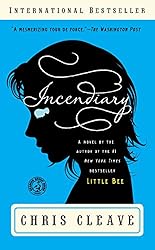
Incendiary
Chris Cleave, 2005
Simon & Schuster
272 pp.
ISBN-13: 9781451618495
Summary
"Dear Osama," a woman writes, "you blew up my husband and boy." With stark simplicity, these words begin a story that's as unsettling as it is compelling.
After a suicide bomb at a London soccer match, a young wife and mother is forced to confront the unthinkable. In a voice filled with despair, this unnamed narrator begins a letter to Osama bin Laden. She writes so he will "see what a human boy really is from the shape of the hole he leaves behind."
With her familiar life blown to pieces, the letter is a cri de coeur and an attempt to convince Osama to stop his campaign of terror. But this is only the beginning. With London under a virtual lockdown and every scrap of life she knew gone in one terrible moment, she talks her way into a job aiding the police in their investigation.
Befriended by a journalist and his girlfriend, she is drawn into a psychological tangle of subterfuge that threatens her sanity and her life. And when London faces yet another attack, she finds herself under siege, on the run, and witness to a desperation and violence she could never have fathomed.
Undeniably provocative and stunningly bold, with a vision as macabre as it is chillingly realistic, Incendiary is a keenly imaginative first novel, lit by the times we know. (From Barnes & Noble)
Author Bio
• Birth—1973
• Where—London, England, UK
• Where—raised in both Buckinghamsire (UK) and Cameroon
• Education—Oxford University
• Awards—Somerset Maughm Award; Prix des Lecteurs
• Currently—lives in London
Chris Cleave is a British author of four novels and has been a journalist for London's Guardian newspaper, where from 2008 until 2010 he wrote the column "Down With the Kids."
Novels
His first novel, Incendiary, was published in 2005 and released in 20 countries. It won the 2006 Somerset Maugham Award and the Prix Special du Jury at the 2007 French Prix des Lecteurs. In 2008, the novel was adapted to film starring Ewan McGregor and Michelle Williams.
His second novel, Little Bee, was inspired by his childhood in West Africa. It was shortlisted for the prestigious Costa Award for Best Novel. Gold, his third novel, came out in 2012, and his fourth, Everyone Brave Is Forgiven, was published in 2016. That novel is based on his grandparents' experience during the London Blitz of World War II.
Cleave lives in London with his French wife and three mischievous Anglo-French children. (Adapted from Wikipedia. Retrieved 4/24/2016.)
Visit the author's website.
Book Reviews
How are we left at the end of this gruesome and grueling saga? Strangely light-headed, as if we have lived through happenings in another world, a world brought brutally to life by current events. This is Chris Cleave's first novel. My imagination can't stretch to where he could go from here.
Brigitte Weeks - Washington Post
An al-Qaeda bomb attack on a London soccer match provides the tragicomic donnee of former Daily Telegraph journalist Cleave's impressive multilayered debut: a novel-length letter from an enraged mother to Osama bin Laden. Living hand to mouth in London's East End, the unnamed mother's life is shattered when her policeman husband (part of a bomb disposal unit) and four-year-old son are killed in the stadium stands. Complicating matters: our narrator witnesses the event on TV, while in the throes of passion with her lover, journalist Jasper Black. The full story of that day comes out piecemeal, among rants and ruminations, complete with the widow's shell-shocked sifting of the stadium's human carnage. London goes on high terror alert; the narrator downs Valium and gin and clutches her son's stuffed rabbit. After a suicide attempt, she finds solace with married police superintendent Terrence Butcher and in volunteer work. When the bomb scares escalate, actions by Jasper and his girlfriend Petra become the widow's undoing. The whole is nicely done, as the protagonist's headlong sentences mimic intelligent illiteracy with accuracy, and her despairingly acidic responses to events-and media versions of them-ring true. But the working-class London slang permeates the book to a distracting degree.
Publishers Weekly
Cleave's auspicious debut takes the form of a woman's letter to Osama bin Laden. A suicide bombing at a London sporting event leaves the city gripped by fear: 1000 are dead and many more irrevocably damaged by the experience. The author of the letter is a working-class woman whose husband and young son were killed in the blast. Afterward, haunted by visions of her son and other bombing victims, she teeters on the edge of reality, vacillating between hope and desperation. The narrator, whose name we never learn, goes on to develop a perverse relationship with an upper-class couple and take a job in the police department to help fight the war against terrorism. Graphic depictions of violence and gore accompany humorous reflections on life and class differences-an odd combination that makes for strangely compelling reading. —Sarah Conrad Weisman, Elmira Coll. Lib., NY
Library Journal
A grieving widow and mother composes a letter to Osama Bin Laden. At points, Cleave's oddly elegant debut novel about the soul-corroding effects of modern terrorism seems like something George Orwell might have written during the Blitz, had he been a little less concerned with the niceties of punctuation. Cleave opens with a high-wire burst of stream-of-consciousness grief on the part of a youngish but now careworn woman whose husband and son have been killed in a horrific suicide attack on the Arsenal football stadium: "I saw the video you made Osama where you said the West was decadent. Maybe you mean the West End? We aren't all like that. London is a smiling liar his front teeth are very nice but you can smell his back teeth rotten and stinking." Sinking into her mourning, she attempts to comfort herself with the thought that at least her son died in the company of his beloved father. It is not enough; sadness gives way to denial, and denial gives way to fury as the bereaved of London begin to suspect that the government knew something about the impending carnage and did nothing to stop it. Our narrator falls in with a fiercely ambitious columnist and an investigative journalist, with whom she had a brief, formless affair before the attack. Working as a civilian in an antiterrorist police unit at Scotland Yard, and urged on by her confidants, she discovers bits and pieces of information that, just in time for a new attack, collectively do much to slip the tether off whatever small mooring she has left in the world: "It is Christmas Eve Osama and this morning I decided you were right after all.... Some people are cruel and selfish and the world would be better off without them." Who knows what? Whom can we trust? Like David Mitchell's Ghostwritten, Cleave's provocative debut will make readers a little uneasy—and that's okay.
Kirkus Reviews
Discussion Questions
1. Incendiary opens with "Dear Osama," and is framed as a novel-length letter from a devastated mother of a terror-attack victim to Osama bin Laden. How does the epistolary structure impact your appreciation of the narrator's plight? Is the narrator's run-on narrative style intended to be indicative of a semi-literate upbringing, or to convey the urgency of her situation, or to suggest that she is psychologically unbalanced?
2. "And when I get nervous about all the horrible things in the world I just need something very soft and secret and warm to make me forget it for a bit." (p. 9) How is the narrator's sexual promiscuity connected to her anxiety? To what extent does her sexual encounter with Jasper Black on the day of the stadium attack seem reprehensible?
3. How does their shared awareness of class differences establish an immediate boundary between the narrator and Jasper Black? What is it about their social and cultural differences that makes them especially attractive to each other?
4. How does the setting of Incendiary in London resonate for you as a reader? Does London function as a character of sorts in the novel, as it undergoes changes as a result of the attacks?
5. "Well Osama I sometimes think we deserve whatever you do to us. Maybe you are right maybe we are infidels. Even when you blow us into chunks we don't stop fighting each other." (p. 50) How does the narrator's disgust with some of the Arsenal and Chelsea bombing victims reveal her own awareness of her society's failings? Why does the author choose to include details from the attack and its aftermath that are unflattering to the victims?
6. How did you interpret the narrator's interactions with her deceased son? To what extent do you think the author intended these glimpses of the boy as evidence of the narrator's post-traumatic mental condition? How might they also function as a kind of magical realism?
7. "I am someone who is having a surreal day," she said. "This afternoon I had a light lunch with Salman Rushdie. We drank CÔte de LÉchet. We discussed V.S. Naipaul and long hair on men." (p. 107) To what extent is Petra Sutherland a caricature of a self-involved snob? Does she transcend that characterization through her involvement with the narrator? What does her behavior in light of the narrator's discoveries about the May Day attack suggest about her true character?
8. In the text of her letter to Osama, the narrator imagines newspaper headlines that comment directly on her experiences. How is this propensity connected with the narrator's sense that her life offers the kind of spectacle that others only read about? How does it relate to her relationships with the journalists Jasper Black and Petra Sutherland?
9. "Yes," she said. "We have better sex when I look like you." (p. 163) How is Jasper Black's love triangle with the narrator and his girlfriend, Petra Sutherland, complicated by their similar appearances? How does Petra's pregnancy change the narrator's relationship with her? Does Jasper Black's staging of a dirty bomb in Parliament Square reveal his social conscience or his stupidity?
10. How does Terence Butcher's revelation about the truth behind the May Day attack impact his relationship with the narrator? What does his decision to tell the narrator the truth suggest about his feelings for her? To what extent do you feel his behavior before and after the attack is justifiable?
11. "A thousand City suits die and it's good-bye global economy. A thousand blokes in Gunners T-shirts die and you just sell a bit less lager." (p. 188) How do the social concerns introduced in Incendiary hint at the tensions between working class and middle class London in the twenty-first century?
12. Why doesn't author Chris Cleave give his narrator a name? To what extent does her anonymity impact your ability to identify with her as a reader?
(Questions issued by publisher.)
top of page (summary)


Independence Day (Frank Bascombe Series, 2)
Richard Ford, 1995
Knopf Doubleday
464 pp.
ISBN-13: 9780679735182
Summary
Winner, 1996 Pulitzer-Prize
In this visionary sequel to The Sportswriter, Richard Ford deepens his portrait of one of the most unforgettable characters in American fiction, and in so doing gives us an indelible portrait of America.
Frank Bascombe, in the aftermath of his divorce and the ruin of his career, has entered an "Existence Period," selling real estate in Haddam, New Jersey, and mastering the high-wire act of normalcy. But over one Fourth of July weekend, Frank is called into sudden, bewildering engagement with life.
Independence Day is a moving, peerlessly funny odyssey through America and through the layered consciousness of one of its most compelling literary incarnations, conducted by a novelist of astonishing empathy and perception.
(From the publisher.)
Author Bio
• Birth—February 16, 1944
• Where—Jackson, Mississippi, USA
• Education—B.A., Michigan State University; M.F.A., University of California, Irvine
• Awards—PEN/Faulkner Award; Pulitzer Prize (more below)
• Currently—lives in Boothbay, Maine
Richard Ford is an American novelist and short story writer. His best-known works are the novels that form the Bascombe quartet: The Sportswriter (1986), Independence Day (1995), The Lay of the Land (2006), and Let Me Be Frank with You (2014). He has also published several short story collections, the stories of which have been widely anthologized.
Early years
Ford was born in Jackson, Mississippi, the only son of Edna and Parker Carrol Ford. Parker was a traveling salesman for Faultless Starch, a Kansas City company. Of his mother, Ford has said, "Her ambition was to be, first, in love with my father and, second, to be a full-time mother." When Ford was eight years old, his father had a major heart attack, and thereafter Ford spent as much time with his grandfather, a former prizefighter and hotel owner in Little Rock, Arkansas, as he did with his parents in Mississippi. Ford's father died of a second heart attack in 1960.
Ford's grandfather had worked for the railroad. At the age of 19, before deciding to attend college, Ford began work on the Missouri Pacific train line as a locomotive engineer's assistant, learning the work on the job.
Ford received a B.A. from Michigan State University. Having enrolled to study hotel management, he switched to English. After graduating he taught junior high school in Flint, Michigan, and enlisted in the US Marines but was discharged after contracting hepatitis. At university he met Kristina Hensley, his future wife; the two married in 1968.
Despite mild dyslexia, Ford developed a serious interest in literature. He has stated in interviews that his dyslexia may, in fact, have helped him as a reader, as it forced him to approach books at a slow and thoughtful pace.
Ford briefly attended law school but dropped out and entered the creative writing program at the University of California, Irvine, to pursue a Master of Fine Arts degree, which he received in 1970. Ford chose this course simply because "they admitted me, he confessed in a profile in Ploughshares (7/8/2010):
I remember getting the application for Iowa, and thinking they'd never have let me in. I'm sure I was right about that, too. But, typical of me, I didn't know who was teaching at Irvine. I didn't know it was important to know such things. I wasn't the most curious of young men, even though I give myself credit for not letting that deter me.
As it turned out, Oakley Hall and E. L. Doctorow were teaching there, and Ford has been explicit about his debt to them. In 1971, he was selected for a three-year appointment in the University of Michigan Society of Fellows.
Early writing
Ford published his first novel, A Piece of My Heart, the story of two unlikely drifters whose paths cross on an island in the Mississippi River, in 1976; he followed it with The Ultimate Good Luck in 1981. In the interim he briefly taught at Williams College and Princeton. Despite good notices the books sold little, and Ford retired from fiction writing to become a writer for the New York magazine Inside Sports. Speaking for same the Ploughshares profile, he said:
I realized there was probably a wide gulf between what I could do and what would succeed with readers. I felt that I'd had a chance to write two novels, and neither of them had really created much stir, so maybe I should find real employment, and earn my keep.
In 1982, the magazine folded, and when Sports Illustrated did not hire Ford, he returned to fiction writing with The Sportswriter, a novel about a failed novelist turned sportswriter who undergoes an emotional crisis following the death of his son. The novel became Ford's "breakout book", named one of Time magazine's five best books of 1986 and a finalist for the PEN/Faulkner Award for Fiction.
Ford followed the success immediately with Rock Springs (1987), a story collection mostly set in Montana that includes some of his most popular stories, adding to his reputation as one of the finest writers of his generation.
Dirty realism
Reviewers and literary critics associated the stories in Rock Springs with the aesthetic movement known as dirty realism. This term referred to a group of writers in the 1970s and 1980s that included Raymond Carver and Tobias Wolff—two writers with whom Ford was closely acquainted—along with Ann Beattie, Frederick Barthelme, Larry Brown, and Jayne Anne Phillips, among others.
Those applying this label point to Carver's lower-middle-class subjects or the protagonists Ford portrays in Rock Springs. However, many of the characters in the "Frank Bascombe" books (The Sportswriter, Independence Day, The Lay of the Land, and Let Me Be Frank With You), notably the protagonist himself, enjoy degrees of material affluence and cultural capital not normally associated with the "dirty realist" style.
Mid-career and acclaim
Although his 1990 novel Wildlife, a story of a Montana golf pro turned firefighter, met with mixed reviews and middling sales, by the end of the 1980s Ford's reputation was solid. He was increasingly sought after as an editor and contributor to various projects. Ford edited the 1990 Best American Short Stories, the 1992 Granta Book of the American Short Story, and the 1998 Granta Book of the American Long Story, a designation he claimed in the introduction to prefer to the novella.
In 1995, Ford's career reached a high point with the release of Independence Day, a sequel to The Sportswriter, featuring the continued story of its protagonist, Frank Bascombe. Reviews were positive, and the novel became the first to win both the PEN/Faulkner Award and the Pulitzer Prize for Fiction. In the same year, Ford was chosen as winner of the Rea Award for the Short Story, for outstanding achievement in that genre. He ended this prodigiously creative and successful decade of the 1990s with a well-received story collection Women with Men published in 1997.
Later life and writings
Ford lived for many years on lower Bourbon Street in the French Quarter and then in the Garden District of New Orleans, Louisiana, where his wife Kristina was the executive director of the city planning commission. He now lives in East Boothbay, Maine.[12] In between these dwellings, Ford has lived in many other locations, usually in the U.S., though he's pursued an equally peripatetic teaching career.
He took up a teaching appointment at Bowdoin College in 2005, but remained in the post for only one semester. In 2008 Ford served as an Adjunct Professor at the Oscar Wilde Centre with the School of English at Trinity College, Dublin, Ireland, teaching on the Masters programme in creative writing. But at the end of 2010, Ford assumed the post of senior fiction professor at the University of Mississippi in the fall of 2011, replacing Barry Hannah, who died in March 2010.
Ford's intense creative pace (writing, teaching, editing, publishing) did not subside, either, as a new decade (and a new century) commenced. He published another story collection A Multitude of Sins (2002), followed by The Lay of the Land (2006), which continues (and, according to Ford's explicit statements made at this time, was to have ended) the Frank Bascombe series.
However, in April 2013, Ford read from a new Frank Bascombe story without revealing to the audience whether or not it was part of a longer work. But by 2014, it was confirmed that the story would indeed appear as part of a longer work to be published in November of that year. Titled Let Me Be Frank With You, it is a work consisting of four interconnected novellas (or "ong stories"), all narrated by Frank Bascombe.
Also, as he did in the preceding decade, Ford continued to assist with various editing projects. In 2007, he edited the New Granta Book of the American Short Story, followed by the Library of America's two-volume edition of the selected works of fellow Mississippi writer Eudora Welty. Ford's latest novel, Canada, was published in 2012. That same year, he became the Emmanuel Roman and Barrie Sardoff Professor of the Humanities and Professor of Writing at the Columbia University School of the Arts.
Critical opinion
Richard Ford's writings demonstrate "a meticulous concern for the nuances of language ... [and] the rhythms of phrases and sentences." Ford has described his sense of language as "a source of pleasure in itself—all of its corporeal qualities, its syncopations, moods, sounds, the way things look on the page."
This "devotion to language" is closely linked to what he calls "the fabric of affection that holds people close enough together to survive." Comparisons have been drawn between Ford's work and the writings of John Updike, William Faulkner, Ernest Hemingway and Walker Percy.
Ford's works of fiction "dramatize the breakdown of such cultural institutions as marriage, family, and community." His...
marginalized protagonists often typify the rootlessness and nameless longing... pervasive in a highly mobile, present-oriented society in which individuals, having lost a sense of the past, relentlessly pursue their own elusive identities in the here and now.*
Awards and honors
2013 - Prix Femina Etranger for Canada
2013 - Andrew Carnegie Medal for Excellence in Fiction for Canada
2001 - PEN/Malamud Award for excellence in short fiction
1995 - PEN/Faulkner Award[9] for Independence Day
1995 - Pulitzer Prize for Fiction for Independence Day
1995 - Rea Award for the Short Story for outstanding achievement in that genre. (Author bio adapted from Wikipedia. Retrieved 11/20/2014.)
*Huey Guagliardo, Perspectives on Richard Ford: Redeemed by Affection, University Press of Mississippi, 2000.
Book Reviews
[P]owerful....so persuasively does Mr. Ford conjure up the day-to-day texture of Frank Bascombe's life [that not] only does Mr. Ford do a finely nuanced job of delineating Frank's state of mind...but he also ...provide[s] a portrait of a time and a place, of a middle-class community caught on the margins of change and reeling, like Frank, from the wages of loss and disappointment and fear.... [H]is consummate ear for dialogue to give us a wonderfully recognizable cast of supporting characters ...and he orchestrates Frank's emotional transactions with them to create a narrative that's as gripping as it is affecting.
Michiko Kakutani - New York Times
Much of the book is taken up with notes and quotes dealing with novels, poems, and plays, and their authors….They are analyzed and discussed with the intelligence and style of a writer who throughout his adult life was a superlatively perceptive student and a professional writer learning from other professionals, never self—consciously a "critic." The quotations are very revealing and the comments often pearls.
Stephan Spender - New York Times Book Review
We have come to expect brilliant character sketches from Mr. Ford, and he doesn't disappoint us.... With a mastery second to none, Richard Ford has created, and continues to develop in Independence Day, a character we know as well as we know our next-door neighbors. Frank Bascombe has earned himself a place beside Willy Loman and Harry Angstrom in our literary landscape.
Charles Johnson - New York Times
Each flash of magical dialogue, every rumination a wild surprise.... Independence Day is a confirmation of a talent as strong and varied as American fiction has to offer.
New York Review of Books
This is a long, closely woven novel that, like life itself, is short on drama but dense with almost unconscious observations of the passing scene.... In fact, if it were possible to write a Great American Novel...this is what it would look like. Ford achieves astonishing effects on almost every page.... [I]t's difficult to imagine a better American novel appearing this year.
Publishers Weekly
That the best-laid plans of mice and men soon go awry is a generalization made concrete in Ford's latest novel, which picks up the story of Frank Bascombe where it left off in a previous novel, The Sportswriter (1986). The time is now the late 1980s, and Frank, divorced, is no longer sportswriting but selling real estate.... Ford has a large following, so this less-than-satisfying sequel is likely to generate demand. —Brad Hooper
Booklist
Bascombe is part angry white male, and part new sensitive guy, but mostly just a smug fool, who lingers over every detail of his life with Harold Brodkey-style obsession. Humorless and full of sham insight ("We're all free agents"), though fans of the first installment will not be disappointed.
Kirkus Reviews
Discussion Questions
1. You may have laughed out loud while reading Independence Day. Possibly the novel's serious purpose came as a surprise. What is the temper of Frank Bascombe's interior monologue as opposed to that of the novel's themes? How is Ford's pervasive use of humor integral to his development of plot and theme?
2. Haddam, New Jersey, is introduced as idyllic, but reality soon counters the idyll. How does Independence Day's catalog of past and present Americana juxtapose the ideal and the real? Does the novel express the American character?
3. Frank Bascombe believes he is "more or less normal-under-the-microscope" [p. 7]. But his ex-wife, Ann, says he may be "the most cynical man in the world" [p. 184]. Sally, his girlfriend, finds him "too smooth" and "noncommittal" [p. 272]. What kind of person is Frank? Does his profession suit him? He says, "I'm no hero" [p. 438]. In what ways is he heroic?
4. Frank labels Ann a "bedrock literalist" [p. 103]. Sally, he says, lives "a life played out in the foreground" [p. 153]. Does he perceive these women fairly? Are they alike? Unlike? Do they understand him?
5. How would you answer Paul when he says, "Don't you really think something's wrong with me" [p. 328]? How does his accidental "detachment" [p. 374] describe his problem? Is Clarissa also affected by the divorce? How does the novel mourn the loss of the nuclear family?
6. When Frank met Karl Bemish along the road, he decided to help him. What American characteristics does this "old nostalgian" [p. 136] typify? What does the rescue and rehabilitation of the hot dog stand signify?
7. The Markhams suffer from regret, indecision, inability to act, isolation, and a "current predicament of homelessness" [p. 55]. Should they be content at 212 Charity with a prison beyond the backyard fence? Should they stay permanently in a motel? Will they find solace in Frank's "colored rental" [p. 406]? Are they "out-of-the-ordinary white folks" [p. 423] in their racial outlook? How representative of Americans are they?
8. Of what narrative and thematic significance is the murder at the Sea Breeze Motel? Why are Frank and Tanks "unable to strike a spark" [p. 216]? What is the cause, and function, of Frank's remorse at the end of Chapter 6? Do you think the weekend journey has both literal and symbolic levels?
9. Which dictionary definition of "sanctuary" would you apply to the Deep River Bird Sanctuary: shrine, refuge, or protection? How else does the novel examine these forms of sanctuary?
10. "Do you believe in progress, Bascombe?" [p. 113] asks old man Schwindell. How does Frank come to define "progress?" Do the weekend's events chronicle Frank's spiritual growth as a kind of "progress"? What stages does he pass through from Haddam to Cooperstown?
11. What does the Baseball Hall of Fame represent to America and to Independence Day? How is Cooperstown a "replica" [p. 293]? What is Frank's objection to simulation?
12. Irv appears out of the blue when Paul is struck. Who is Irv? How does he minister to Frank? What problem does he express when he says, "I feel like some bad feeling is sort of eating away at me on the edges" [p. 389]? How do people like Irv fare in today's world? Does the photo in his "tiny wafer wallet" [p. 391] sanctify family? Does Frank accept Irv's invitation to return to family status? When Ann and Irv mouth "hope" together [p. 402], is Frank's spiritual journey advanced?
13. How is Paul's accident a catalyst for change? Is change "conversion"? How does Paul's eye injury alter Frank's vision? Consider "blindness" as metaphor. What vision does the author seek to restore?
14. Frank's imaginary syllabus topic, "Reconciling Past and Present: From Fragmentation to Unity and Independence" [p.259], might describe the trip's (and the novel's) goal and result. Is reconciliation accomplished?
15. "I don't believe in God" [p. 432], Frank insists. Does this mesh with the Christian tone of his thinking, his journey, and the novel? Karl answers, "You seem one way and are another." In what way does Ford similarly craft both character and novel?
16. Real estate is a central metaphor in Independence Day. Who are the metaphorical tenants and landlord? Is any form of shelter not described? Which characters seek shelter? Is it structure or solace? Does Frank really believe "place means nothing" [p. 152]? Which of the novel's many "mansions" does Ford recommend? What is suggested by Frank's comment: "What more can you do for wayward strangers than to shelter them" [p. 424]? Frank's former mansion is now an Ecumenical Center. In what sense is the novel also ecumenical?
17. Consider definitions of "independence." Is there irony in being "free to make new mistakes" [p. 60]? What does Independence Day really mean for Frank?
18. At novel's end, Frank says to an unidentifed phone caller, "Let me hear your thinking" [p. 451]. Does it matter who the caller is? What might Frank's response indicate about his thinking?
19. In 1776, John Adams wrote of Independence Day, "It ought to be solemnized with pomp and parade, with shows, games, sports, guns, bells, bonfires, and illuminations, from one end of this continent to the other..." How does Ford's novel meet all of Adams's requirements? With its varied allusions to light, what source of "illumination" does Independence Day offer to modern America?
(Questions issued by the publisher.)


Indiscretion
Charles Dubrow, 2013
HarperCollins
388 pp.
ISBN-13: 9780062201058
Summary
Every story has a narrator. Someone who writes it down after it's all over. Why am I the narrator of this story? I am because it is the story of my life—and of the people I love most.
Harry and Madeleine Winslow have been blessed with talent, money, and charm. Harry is a National Book Award–winning author on the cusp of greatness. Madeleine is a woman of sublime beauty and grace whose elemental goodness and serenity belie a privileged upbringing. Bonded by deep devotion, they share a love that is both envied and admired. The Winslows play host to a coterie of close friends and acolytes eager to bask in their golden radiance, whether they are in their bucolic East Hampton cottage, abroad in Rome thanks to Harry's writing grant, or in their comfortable Manhattan brownstone.
One weekend at the start of the summer season, Harry and Maddy, who are in their early forties, meet Claire and cannot help but be enchanted by her winsome youth, quiet intelligence, and disarming naivete. Drawn by the Winslows' inscrutable magnetism, Claire eagerly falls into their welcoming orbit. But over the course of the summer, her reverence transforms into a dangerous desire. By Labor Day, it is no longer enough to remain one of their hangers-on.
A story of love, lust, deception, and betrayal as seen through the omniscient eyes of Maddy's childhood friend Walter, a narrator akin to Nick Carraway in The Great Gatsby, Indiscretion is a juicy, richly textured novel filled with fascinating, true-to-life characters—an irresistibly sensual page-turner that explores having it all and the consequences of wanting more.
Indiscretion also marks the debut of a remarkably gifted writer and storyteller whose unique voice bears all the hallmarks of an exciting new literary talent. (From the publisher.)
Author Bio
• Birth—N/A
• Where—New York City, New York, USA
• Education—Weslyan University (no degree);
New York University
• Currently—New York City, New York
Charles Dubow was born in New York City and spent his summers at his family's house on Georgica Pond in East Hampton. He was educated at Wesleyan University and New York University. He has worked as a roustabout, a lumberjack, a sheepherder in New Zealand, and a congressional aide, and was a founding editor of Forbes.com and later an editor at Businessweek.com. He lives in New York City with his wife, Melinda; children, William and Lally; and Labrador retriever, Luke. This is his first novel. (From the publisher.)
Book Reviews
A smart, sensuous, and moving debut.... Delicious.... The characters exude a Jazz Age glamour.
O magazine
A cultural lament wrapped in a lesson about extramarital lust—a riveting read.
Daily Beast
Dubow tracks the fallout of an affair in his elegant debut centering on a golden couple, Harry and Maddy Winslow. He’s an award-winning writer, she’s a beautiful heiress; Walter Gervais, Maddy’s childhood friend and secret admirer, narrates the story. One weekend in the Hamptons, the Winslows meet Claire, a needy ingenue who develops a crush on the couple, especially Harry. Her role as hanger-on is severed when the Winslows leave for a year abroad, but Harry finds himself struggling with his next novel, and a chance encounter with Claire while on a business trip back to the U.S. launches him into a heady affair. Dubow draws the relationship perfectly—Claire is a giddy romantic, and Harry delights in playing the wealthy cosmopolitan. When Maddy discovers her husband’s betrayal, the four players form a miserable face-off, where Walter’s unrequited love bubbles to the surface in the face of Maddy’s grief, and Harry and Claire negotiate the affair’s relationship potential. Despite a disappointing and drawn-out ending, smart and observant writing makes the story well worth the ride.
Publishers Weekly
He's a National Book Award-winning author, she's kind and beautiful, and together they entertain friends at their elegant Manhattan brownstone and East Hampton cottage. But Harry and Madeleine Winslow are heading for trouble when they take charming young Claire under their wing. Great expectations for this work from New Yorker-to-the-bone Dubow.
Library Journal
Dubow crafts an epic novel of friendship, betrayal and undying love. It's a beautifully written debut. Walter Gervais is a true gentleman and childhood friend of Harry Winslow's wife, Maddy, and it's through his eyes that the story is told. Unobtrusive and playing a rather peripheral role, at least in the beginning, he delivers a balanced and fascinating account of the events that invariably change not only his friends' lives, but his own.... [T]he author chooses to add more unexpected layers to the story that elevate it from run-of-the-mill to outstanding. Dubow's book is a page turner that skillfully tugs at the heartstrings.
Kirkus Reviews
Discussion Questions
1. What were your first impressions of Claire? Did they change over the course of the novel?
2. Describe each of the protagonists: Maddy, Harry, Claire, Walter. What drives each of them? What attracts them to the other? Is their outcome inevitable? How much are each responsible for the events that unfold?
3. Walter described the couple as being unselfish about their love. "They share it with so many people. It is what draws the rest of us to them." Talk about his comment. What is it about the Winslows' love that is so appealing? Would they have been better off being more selfish about their feelings?
4. What is Claire's relationship to the Winslows? Why are they so willing to adopt her into their circle? Were there any signs that Maddy should have seen?
5. Harry made up bedtime stories for his son, Johnny. One of Walter's favorites was about the Penguin King. Think about that bedtime story. How does it relate to the wider story told in Indiscretion?
6. In describing the indiscretion at the heart of the story, Walter refuses to cast blame. "Who can blame them? There are few things more powerful, more intoxicating than knowing there is someone who desires you utterly. And if it is illicit, secret, forbidden, that makes it all the more exciting. Who cares at that point about other people? Others don't matter when it is just the two of you in your own little lifeboat. Desire is all. Shame does not figure into it." Are you sympathetic to Walter's point of view? Do you share his understanding?
7. Madeleine is a wise and worldly woman. Why is she taken by surprise by Harry's actions? Should she—could she—have handled her reaction differently?
8. Were you surprised by the novel's twist? Why does Charles Dubow turn the story as he does?
9. Harry's father, an English teacher, believes that Harry suffered from hamartia—the fatal flaw. "When the hero does something stupid or wrong, the fates won't let him forget it." Is he right? Was Harry a heroic character? Or is Harry's father trying to make rational sense of the irrational as Walter thinks?
10. Why doesn't Walter have Harry's second book published? Was the decision truly his to make? At the novel's end, Walter meets Claire again and she tells him that the naiveté of youth shields her from blame. Do you agree with her? She also tells him, "The irony is that I won in the end. At least in a way I did." What does she think she won?
11. Indiscretion is narrated by Maddy and Harry's friend, Walter. How does this affect how the story is told? How would the story change if it were narrated by multiple voices or from another character's viewpoint? Choose a character, and retell a few scenes from his or her perspective. How does this affect how you read the novel and your impressions of the characters and their motives?
12. Is Walter a reliable narrator? Is he believable? How does he attempt to earn the reader's trust? He explains that he is the narrator, "because it is the story of my life—and of the people I love most." Is he right? Was his loyalty to Maddy actually a flaw that complicated or exacerbated matters?
(Questions issued by publisher.)
The Industry of Souls
Martin Booth, 1998
Picador Macmillan
256 pp.
ISBN-13: 9780312267537
Summary
The Industry of Souls is the story of Alexander Bayliss, a British citizen arrested for spying in the Soviet Union in the early 1950's. Eventually freed from the gulag in the 1970's, he finds he has no reason to return to the West—he has become Russian in everything but birth.
Now, on the day of his 80th birthday, Russia has changed. Communism has evaporated. In the aftermath, information has come to light that Alex is still alive.
This moving story weaves together the events of Alex's life, exploring this momentous day, his harrowing past in the camp and his life in the village. And it ends with his having to make a personal choice, perhaps for the first time in his life, and the climax is shattering. (From the publisher.)
Author Bio
• Birth—September 7, 1944
• Where—Lancashire, England, UK
• Raised—Hong Kong, China
• Death—February 12, 2004
• Where—Devon, England
• Education—Trent Park College of Education (now part of
Middlesex University in England)
• Awards—Society of Authors' Gregory Award (for poetry)
Martin Booth was a highly prolific British writer—13 novels, five children's books, and numerous works of poetry and other non-fiction. He also worked as a teacher and screenwriter, and was the founder of the Sceptre Press.
Booth was born in Lancashire, but was brought up mainly in Hong Kong, where he attended King George V School, and left in 1964.
He made his name as a poet and as a publisher, producing elegant volumes by British and American poets, including slim volumes of work by Sylvia Plath and Ted Hughes. His own books of verse include The Knotting Sequence (1977), named for the village in which Booth was living at the time. The book features a series of lyrics in which he seeks links between the present and the Saxon past, and the man called Knot who gave his name to the village. Booth also accumulated a library of contemporary verse, which allowed him to produce anthologies and lectures.
In the late 1970s Booth turned mainly to writing fiction. His first successful novel, Hiroshima Joe, was published in 1985. The book is based on what he heard from a man he met as a boy in Hong Kong and contains passages set in that city during the Second World War.
Booth was a veteran traveller who retained an enthusiasm for flying, also expressed in his poems, such as "Kent Says," in Killing the Moscs. His interest in observing and studying wildlife resulted in a book about Jim Corbett, a big-game hunter and expert on man-eating tigers.
Many of Booth's works were linked to the British imperial past in China, Hong Kong and Central Asia. Booth was also fond of the United States, where he had many poet friends, and of Italy, which features in many of his later poems and in his novel A Very Private Gentleman (1990). These interests form a thread through his later novels, travel books and biographies.
Booth's novel The Industry Of Souls was shortlisted for the 1998 Booker Prize.
Booth died of cancer in Devon in 2004, shortly after completing Gweilo, a memoir of his Hong Kong childhood written for his own children. (From Wikipedia.)
See the Guardian (UK) for Booth's obituary.
Book Reviews
As we accompany Bayliss on a tour through his present and past, this meditative, unadorned novel, short-listed for the Booker Prize in 1998, raises questions about home, freedom and the meaning of a life that resonate long after the final page is turned.
Michael Porter - New York Times Magazine
This is often lyrical and nimble, and accomplishes the not-insignificant task of entertaining and enlightening by means of literary narrative.
Boston Book Review
As he wakes up on his 80th birthday, Alexander Bayliss, a British citizen who spent 25 years in a Soviet gulag after being charged with espionage and the next 20 years in the Russian village of Myshkino, has a major decision to make: Will he remain in the village or return home to England, where his family has just discovered that he is alive? Through flashbacks to the gulag, Booth (Opium: A History) introduces Bayliss's fellow workers, from Dimitri, who always has a story or a joke, to Yuli, who is terrified that the coal mine they are working in will collapse, to Kirill, the leader who points Bayliss to Myshkino and in doing so portrays the human side of gulag life. Interspersed with this material is an account of Bayliss's experiences in Myshkino detailing the people he has come to know and how the collapse of the Soviet Union affected them. Relying on strong character development, this intriguing work illuminates the social, political, and economic changes the downfall of communism brought to Russia while remaining readable, personal, and suspenseful. Highly recommended. —Joshua Cohen, Mid-Hudson Lib. Syst., Poughkeepsie, NY
Library Journal
Booth is a storyteller of rare power who makes the unbearable understandable.... This [book] was a finalist for last year's prestigious Booker Award; it's hard to imagine how any of the other nominees could have been better. —George Needham
Booklist
Much published in England but known here only for his nonfiction (Opium: A History,1998), Booth offers a gripping tale—short-listed for the Booker—of the gulag and one man's escape from it. In 1952, on business in Dresden, the university-educated Englishman Alexander Bayliss is picked up by the Soviets, charged with suspicion of espionage against the USSR, found guilty, and sentenced to 25 years of labor as a coal miner somewhere above the Arctic Circle. The reader gets this information from a much later time—gathering it from Bayliss's own lengthy reminiscence on his 80th birthday as he makes his usual "rounds" of the Russian village of Myshkino, where, for 20 years, ever since the end of his sentence, he has lived with the devoted young woman Frosya and her car-mechanic husband, Trofim. What led him to the village won't be told here, as neither will the cause of the special relationship between Bayliss—or Shurik, his Russian nickname—and young Frosya, who transparently reveres him. Why the villagers also venerate him, however, can be told—the reason being that even after a quarter-century in the gulag, he doesn't hate them, insisting that they did nothing to him. For Shurik, an intelligently avuncular Solzhenitsyn-figure who only occasionally becomes overbearing, there is an absolute difference between political abstractions and real people. And, as he reminisces back to the suffering, cruelty, terror, and death he suffered or witnessed, it's the people who were there with him that one will remember: Titian, the math professor now imprisoned; Avel, who flew MIG's against Yankees; and, most especially, Kirill, the leader of Shurik's work squad,whose boundless humor, generosity, friendship—and terrible death—will explain why Bayliss/Shurik chooses to devote what's left of his own life to humble Myshkino. By turns terrifying and moving, an observant book likely to be long remembered.
Kirkus Reviews
Discussion Questions
Use our LitLovers Book Club Resources; they can help with discussions for any book:
• How to Discuss a Book (helpful discussion tips)
• Generic Discussion Questions—Fiction and Nonfiction
• Read-Think-Talk (a guided reading chart)
Also consider these LitLovers talking points to help get a discussion started for The Souls of Industry:
1. Start with the book's title—what is its thematic significance? You might consider the following passage:
It is the industry of the soul, to love and to hate; to seek after the beautiful and to recognise the ugly, to honour friends and wreak vengeance upon enemies; yet, above all, it is the work of the soul to prove it can be steadfast in these matters.
2. The novel opens 20 years after Bayliss's release from the gulag. Why has he decided to remain in Russia—the very country that brutalized him? What do you make of the fact that he never let his family in England know he was alive? What is his reason?
3. At one point, Bayliss says that "friends are more important than flags." Why might he say that? Do you agree...would you say the same for yourself? Or have Bayliss's particular circumstances shaped his thinking?
4. Bayliss tells his pupils: "If you kill something of beauty, two uglinesses spring up in its place." What does he mean...and how is that observation related to events in the novel? Can you give examples from your own life?
5. Having reached his 80th birthday, how has Bayliss attained inner peace?
6. In the gulag, prisoners are advised not to dream of the future or to remember the past—but to live only in the present. Why? That advice seems counterintuitive: it negates hope. Isn't hope, which by definition is futuristic, crucial for human survival?
7. Talk about the role of friendship in Work Unit 8. How do these bonds develop...and how do they help the men survive? In other words, what makes friendship so powerful? In what other circumstances is friendship critical for survival?
8. Do you have favorites among the teammates of Work Unit 8—perhaps Kirill...or Yuli...or Dimiti? Talk about the particular relationship that develops between Shurik and Kirill.
9. In the gulag, any belief Shurik might have had in a just and merciful God is destroyed. Yet the novel contains Biblical parallels; certainly the role of forgiveness, central to this work, is Biblical. Would you say that The Industry of Souls is a religious book...or nonreligious...or anti-religious?
10. How do digging deep into the earth and mining the coal work as metaphors in this novel? Consider also the excavation of the mammoth...and the men's decision to roast and eat it. What might that act symbolize?
11. What is the significance of the caged fox story?
12. What was most disturbing for you in the gulag sections? Put yourself in the place of any one of the men: what would have been most difficult for you to endure? Do you think you could survive, given the hardships?
13. The Industry of Souls is also concerned with the fall of communism. In what way does its collapse affect the lives of the villagers?
14. The book's chapters move back and forth between village and gulag. Why might Booth have chosen an alternating structure? What effect does the structure have on your reading of the novel?
15. Have you read other works about the Soviet Union's penal system, in particular Aleksandr Solzhenitsyn's Gulag Archipelago or One Day in the Life of Ivan Denisovich? If so, how does this book compare to either of those...or any others you've read?
16. Were you surprised by the novel's outcome? Is the ending satisfying? If so, why? If not, how would you like it to end?
17. Overall, what was your experience reading this book? Does it deliver? Would you recommend it to others?
(Questions by LitLovers. Please feel free to use them, online or off, with attribution. Thanks.)
top of page
Ines of My Soul
Isabel Allende, 2006
HarperCollins
352 pp.
ISBN-13: 9780061161544
Summary
Born into a poor family in Spain, Ines, a seamstress, finds herself condemned to a life of hard work without reward or hope for the future. It is the sixteenth century, the beginning of the Spanish conquest of the Americas, and when her shiftless husband disappears to the New World, Ines uses the opportunity to search for him as an excuse to flee her stifling homeland and seek adventure. After her treacherous journey takes her to Peru, she learns that her husband has died in battle. Soon she begins a fiery love affair with a man who will change the course of her life: Pedro de Valdivia, war hero and field marshal to the famed Francisco Pizarro.
Valdivia's dream is to succeed where other Spaniards have failed: to become the conquerer of Chile. The natives of Chile are fearsome warriors, and the land is rumored to be barren of gold, but this suits Valdivia, who seeks only honor and glory. Together the lovers Ines Suarez and Pedro de Valdivia will build the new city of Santiago, and they will wage a bloody, ruthless war against the indigenous Chileans—the fierce local Indians led by the chief Michimalonko, and the even fiercer Mapuche from the south. The horrific struggle will change them forever, pulling each of them toward their separate destinies.
Ines of My Soul is a work of breathtaking scope: meticulously researched, it engagingly dramatizes the known events of Ines Suarez's life, crafting them into a novel full of the narrative brilliance and passion readers have come to expect from Isabel Allende. (From the publisher.)
Author Bio
• Birth—August 2, 1942
• Where—Lima, Peru
• Education—private schools in Bolivia and Lebanon
• Awards—Dorothy and Lillian Gish Prize, 1998; Sara Lee
Foundation Award, 1998; WILLA Literary Award, 2000
• Currently—lives in San Rafael, California, USA
Isabel Allende is a Chilean writer whose works sometimes contain aspects of the "magic realist" tradition. Author of more than 20 books—essay collections, memoirs, and novels, she is perhaps best known for her novels The House of the Spirits (1982), Daughter of Fortune (1999), and Ines of My Soul (2006). She has been called "the world's most widely read Spanish-language author." All told her novels have been translated from Spanish into over 30 languages and have sold more than 55 million copies.
Her novels are often based upon her personal experience and pay homage to the lives of women, while weaving together elements of myth and realism. She has lectured and toured many American colleges to teach literature. Fluent in English as a second language, Allende was granted American citizenship in 2003, having lived in California with her American husband since 1989.
Early background
Allende was born Isabel Allende Llona in Lima, Peru, the daughter of Francisca Llona Barros and Tomas Allende, who was at the time the Chilean ambassador to Peru. Her father was a first cousin of Salvador Allende, President of Chile from 1970 to 1973, making Salvador her first cousin once removed (not her uncle as he is sometimes referred to).
In 1945, after her father had disappeared, Isabel's mother relocated with her three children to Santiago, Chile, where they lived until 1953. Allende's mother married diplomat Ramon Huidobro, and from 1953-1958 the family moved often, including to Bolivia and Beirut. In Bolivia, Allende attended a North American private school; in Beirut, she attended an English private school. The family returned to Chile in 1958, where Allende was briefly home-schooled. In her youth, she read widely, particularly the works of William Shakespeare.
From 1959 to 1965, while living in Chile, Allende finished her secondary studies. She married Miguel Frias in 1962; the couple's daughter Paula was born in 1963 and their son Nicholas in 1966. During that time Allende worked with the United Nations Food and Agriculture Organization in Santiago, Chile, then in Brussels, Belgium, and elsewhere in Europe.
Returning to Chile in 1996, Allende translated romance novels (including those of Barbara Cartland) from English to Spanish but was fired for making unauthorized changes to the dialogue in order to make the heriones sound more intelligent. She also altered the Cinderella endings, letting the heroines find more independence.
In 1967 Allende joined the editorial staff for Paula magazine and in 1969 the children's magazine Mampato, where she later became editor. She published two children's stories, Grandmother Panchita and Lauchas y Lauchones, as well as a collection of articles, Civilice a Su Troglodita.
She also worked in Chilean television from 1970-1974. As a journalist, she interviewed famed Chilean poet Pablo Neruda. Neruda told Allende that she had too much imagination to be a journalist and that she should become a novelist. He also advised her to compile her satirical columns in book form—which she did and which became her first published book. In 1973, Allende's play El Embajador played in Santiago, a few months before she was forced to flee the country due to the coup.
The military coup in September 1973 brought Augusto Pinochet to power and changed everything for Allende. Her mother and diplotmat stepfather narrowly escaped assassination, and she herself began receiving death threats. In 1973 Allende fled to Venezuela.
Life after Chile
Allende remained in exile in Venezuela for 13 years, working as a columnist for El Nacional, a major newspaper. On a 1988 visit to California, she met her second husband, attorney Willie Gordon, with whom she now lives in San Rafael, California. Her son Nicolas and his children live nearby.
In 1992 Allende's daughter Paula died at the age of 28, the result of an error in medication while hospitalized for porphyria (a rarely fatal metabolic disease). To honor her daughter, Allenda started the Isabel Allende Foundation in 1996. The foundation is "dedicated to supporting programs that promote and preserve the fundamental rights of women and children to be empowered and protected."
In 1994, Allende was awarded the Gabriela Mistral Order of Merit—the first woman to receive this honor.
She was granted U.S. citizenship in 2003 and inducted into the American Academy of Arts and Letters in 2004. She was one of the eight flag bearers at the Opening Ceremony of the 2006 Winter Olympics in Turin, Italy.
In 2008 Allende received an honorary Doctor of Humane Letters from San Francisco State University for her "distinguished contributions as a literary artist and humanitarian." In 2010 she received Chile's National Literature Prize.
Writing
In 1981, during her exile, Allende received a phone call that her 99-year-old grandfather was near death. She sat down to write him a letter wishing to "keep him alive, at least in spirit." Her letter evolved into The House of the Spirits—the intent of which was to exorcise the ghosts of the Pinochet dictatorship. Although rejected by numerous Latin American publishers, the novel was finally published in Spain, running more than two dozen editions in Spanish and a score of translations. It was an immense success.
Allende has since become known for her vivid storytelling. As a writer, she holds to a methodical literary routine, working Monday through Saturday, 9:00 A.M. to 7:00 P.M. "I always start on 8 January,"Allende once said, a tradition that began with the letter to her dying grandfather.
Her 1995 book Paula recalls Allende's own childhood in Santiago, Chile, and the following years she spent in exile. It is written as an anguished letter to her daughter. The memoir is as much a celebration of Allende's turbulent life as it is the chronicle of Paula's death.
Her 2008 memoir The Sum of Our Days centers on her recent life with her immediate family—her son, second husband, and grandchildren. The Island Beneath the Sea, set in New Orleans, was published in 2010. Maya's Notebook, a novel alternating between Berkeley, California, and Chiloe, an island in Chile, was published in 2011 (2013 in the U.S.). Three movies have been based on her novels—Aphrodite, Eva Luna, and Gift for a Sweetheart. (Adapted from Wikipedia. Retrieved 5/23/2013.)
Book Reviews
What stays with the reader, after the treks and battles and politics fade, aren’t Allende’s political musings or even her characters. Instead it’s her vivid descriptions of daily life in 16th-century South America: the meager soups that starving settlers season with mice, lizards, crickets and worms; the marriage rituals of the Mapuche, in which a man “steals the girl he desires”; an attack in which the right hands and noses of Mapuche prisoners are removed with hatchets and knives. In Ines of My Soul, Allende succeeds in resurrecting a woman from history and endowing her with the gravitas of a hero.
Maggie Galehouse - The New York Times
Only months after the inauguration of Chile's first female president, Allende recounts in her usual sweeping style the grand tale of Ines Suarez (1507- 1580), arguably the country's founding mother. Writing in the year of her death, In s tells of her modest girlhood in Spain and traveling to the New World as a young wife to find her missing husband, Juan. Upon learning of Juan's humiliating death in battle, In s determines to stay in the fledgling colony of Peru, where she falls fervently in love with Don Pedro de Valdivia, loyal field marshal of Francisco Pizarro. The two lovers aim to found a new society based on Christian and egalitarian principles that Valdivia later finds hard to reconcile with his personal desire for glory. In s proves herself not only a capable helpmate and a worthy cofounder of a nation, but also a ferocious fighter who both captivates and frightens her fellow settlers. Ines narrates with a clear eye and a sensitivity to native peoples that rarely lapses into anachronistic political correctness. Basing the tale on documented events of her heroine's life, Allende crafts a swift, thrilling epic, packed with fierce battles and passionate romance.
Publishers Weekly
Allende (The House of the Spirits) once again features a strong woman in her new novel, which is based on the life of Ines Suarez, who came to the Americas around 1537 in search of a wayward husband. After learning of his death, she joins Pedro de Valdivia, the conqueror of Chile, as his mistress and fellow conquistador in the defense of Santiago against the Native Americans. This fictionalized account of one of Chile's national heroines is meticulously researched and offers a detailed account of a little-known time period in history, as an older Ines recounts her life story. Unfortunately, this passive retelling of hardships, battles, and love affairs becomes dry, tedious, and repetitive. Seldom are readers allowed to experience the story as it happens. Instead of eagerly anticipating each part of an unfolding drama, they may have to force themselves to pick the book up again and soldier onward, much as Ines and her comrades did as they marched through the deserts of South America. Recommended for Allende's popularity. —Kellie Gillespie, City of Mesa Lib., AZ
Library Journal
Chilean author Allende (Zorro, 2005, etc.) recounts the life of a national heroine in this historical novel. Ines Suarez was born in a small Spanish village in 1507. By the time she died, in 1580, she had journeyed to the New World, become the lover of the first governor of Chile and defended the city of Santiago when it was attacked by natives. The conquistadora's life was full of daring, intrigue and passionate romance, but much of the excitement of this extraordinary woman's adventure is lost in Allende's version. In a bibliographical note, the author explains that she spent several years doing research for this novel. It shows, unfortunately, as she frequently assumes a voice more suited to an encyclopedia: "The isthmus of Panam is a narrow strip of land that separates our European ocean from the South Sea, which is now called the Pacific." Such information ultimately overwhelms the story. Character development happens in dry, rushed bursts of exposition, and Allende frequently chooses cliche‚ over real description: "My relationship with Pedro de Valdivia turned my life upside down.... One day without seeing him and I was feverish. One night without being in his arms was torment." The narrative device that Allende has chosen—the novel is a letter from Surez to her adopted daughter—is boring and distracting. Suarez frequently includes information that her adopted daughter surely would have known; she manages to transcribe whole conversations to which she was not privy; and many of the historical details—casualty statistics from the sacking of Rome in 1527, for example—seem much more like something the author found in a reference work than anything her protagonist was likely to have been privy to. Turgid and detached—homework masquerading as epic.
Kirkus Reviews
Discussion Questions
1. Describe the dichotomy that is created between Spain's extravagance and excess and Chile's starvation and starkness. What does this say about the broader civilizations, and describe the transformative influence that each culture has on the other.
2. What is your opinion of Pedro de Valdivia? As a husband? As a lover? As a military and community leader? Do you agree with the decisions that he makes, and ultimately, do you believe he is a positive or negative influence on the foundation of Chile? Is he, as Ines alludes to on pg. 141: "The worst was surely his excessive hunger for fame, which in the end cost him, and many others, their lives.", fatally flawed?
3. Ines is presented as a strong female character in many situations throughout the book. Discuss the many ways in which she holds power as a female in a patriarchal society, in terms of her sensuality, her physical/military presence, and cleverness. In what ways does she defy the traditional attitudes towards women of her time? In what ways does she confirm them?
4. Discuss the differences and similarities between the war tactics employed by the native Indians and the Spaniards in the struggle to colonize Chile. What do these tactics say about these cultures?
5. The concept of colonization has been a heated topic for centuries, and Ines laments on how the Indians feel when she says: "What must the Indians have felt when they saw us arrive, and later, when they realized that we intended to stay?" How does this sympathetic statement to the Indians stand up to the actions that are taken against them in the fight to found Chile?
6. How is the female form as a source of power and powerlessness embodied in the character of Ines?
7. How does the theme of punishment present itself throughout the novel? Do you think the punishments, whether given to prisoners of war, to Ines by Pedro de Valdivia, to traitors, and lastly to Pedro by the Indians, fit the crime?
8. How is the concept of destiny, duty, and fate present throughout this story? Do Pedro de Valdivia, Rodrigo de Quiroga, and Ines carry out their destinies?
9. Felipe/Lautaro becomes a highly influential leader for the Mapuche tribe. Compare and contrast his rise to power with that of Pedro de Valdivia's. Are both leaders, ultimately, so different?
10. Ines has three great loves throughout the novel: Juán de Malaga, Pedro de Valdivia, and Rodrigo de Quiroga. What roles do each of these men play in her life, and how does her love for each of them differ? Do you agree or disagree that a person has only one true love in their lifetime?
(Questions issued by publisher.)
top of page (summary)


Infamy
Tom Milton, 2009
Nepperhan Press
277 pp.
ISBN-13: 9780979457951
Summary
Fenly Aquino, an American security agent, is working in Madrid with Raquel Lopez, a member of a Spanish security team that has heard about a planned terrorist attack. The plot involves the use of laundered money to buy weapons of mass destruction that will be directed at a target in New York City. The key to stopping the attack is to find the trail of money and follow it to the source of the weapons. They have only two weeks to stop the attack, so time is running out on them as they desperately try to unravel the plot. (From the author.)
Author Bio
• Birth—April 3, 1949
• Where—St. Paul, Minnesota, USA
• Education—Ph.D. Walden University, M.A. University
of Iowa (Writers Workshop), B.A. Princeton University
• Currently—lives in Hastings-on-Hudson, NY
Tom Milton was born and raised in St. Paul, Minnesota. After completing his undergraduate
degree at Princeton he worked for the Wall Street Journal, and then he was invited to the Writers Workshop in Iowa City, where he completed a novel and a master’s degree. He then served in the U.S. Army, and upon his discharge he joined a major international bank in New York. For the next twenty years he worked overseas, initially as an economic/political analyst and finally as a senior executive. He later became involved in economic development projects.
After retiring from his business career he joined the faculty of Mercy College, where he is a professor of international business. Five years ago he found a publisher for his novels, some of which are set in foreign cities where he lived (Buenos Aires, London, Madrid, and Santo Domingo). His novels are popular with reading groups because they deal with major issues, they have engaging characters, and they are good stories.
His first published novel, No Way to Peace, set in Argentina in the mid-1970s, is about the courage of five women during that country’s war of terror. His second novel, The Admiral’s Daughter, is about the conflict between a young woman and her father during the civil rights war in Mississippi in the early 1960s. His third novel, All the Flowers, set in New York in the late 1960s, is about a gifted young singer who gets involved in the antiwar movement because her twin brother joins the army to prove his manhood to his father. His fourth novel, Infamy, set in Madrid in 2007, is about the attempt of security agents to stop a terrorist attack on New York City that would use weapons of mass destruction. His next novel, A Shower of Roses, set in London in the early 1980s, is about a young nurse who is drawn by love into an intrigue of the Cold War. His next novel, Sara’s Laughter, set in Yonkers, NY in 1993, is about a woman in her mid-thirties who wants a child but is unable to get pregnant. And his latest novel, The Golden Door, is about a young Latina woman in Alabama whose future is threatened by a harsh anti-immigrant law that the state passed in 2011. (From .)
Extras
From a conversation with Tom Milton appearing at the end of Infamy:
Q: A major event of Fenly’s life was his meeting Camila in the elevator of the World Trade Center and falling in love with her.
A: Camila challenged his ideas about women, which had come from his imagined father, and Fenly had to change those ideas in order to attain her.
Q: You wrote so movingly about how he was affected by losing her in 9-11. Did you lose a loved one in the attack?
A: I knew people who lost parents, spouses, and children. When it happened I was at a location where I could see the towers collapse. I’ll never forget it. (From the author.)
Visit the author's website.
Book Reviews
Infamy is the story of a Latino American, Fenly Aquino, who works for Homeland Security. He is assigned to travel to Spain to work with Raquel Lopez, a former cop, to assist the Spanish anti-terrorist team in stopping a terrorist attack about to happen on U.S. soil. Both Fenly and Raquel have lost loved ones to terrorism: Fenly lost his fiancée, Camila, in 9/11 and Raquel lost her brother in the attack on Madrid commuter trains. They discover the current plot involves laundered money, drug dealers, prostitutes, Americans living in Spain and possible involvement of other U.S. security personnel. Eventually, it becomes obvious to the terrorists that Fenly, Raquel and the entire Spanish anti-terrorist team know too much about the plot and, by the end of the book, their lives are in danger.
Overall, I liked this novel very much. The story and plotlines were interesting, relevant and for the most part, the book was a page turner. The author is a competent writer who is also a good storyteller. His characters are believable and well-defined.
I particularly enjoyed the flashback scenes, although a few times, it took one or two sentences for me to realize that the paragraph was the beginning of another flashback. Milton does a good job showing Fenly's early tumultuous relationship with his mother, his longing for his absentee father, his eventual maturity, the growing relationship with his fiancée, all leading up to the horrible events on 9/11.
The romance which eventually develops between Fenly and Raquel happens a bit too abruptly.
Although the two work well together, there is very little indication that they will become romantically involved. All of a sudden, at the end, they decide they love one another. As well, the cover is too simplistic for a book of this caliber.
I recommend this book as an entertaining, interesting and relevant read.
Ellen Gable Hrkach - Catholic Fiction.
Discussion Questions
1. We learn early in the story that Fenly and Raquel both lost a loved one in a terrorist attack. How do they deal with that loss?
2. Both Fenly and Raquel grow up without a parent of their own gender as a role model. How did they deal that experience?
3. How are their mentors similar and different?
4. How is Fenly affected by the unexpected return of his father?
5. What does Fenly learn from falling in love with Camila?
6. What inner conflict does Raquel reveal in her words and actions?
7. What role does Leandro play in the story?
8. What role does Samira play?
9. How does the author use the characters of Antonio and José?
10. How does the method used by the terrorists to launder money relate to the theme of the novel?
11. What do you think of Daryl? Do you believe his claim?
12. What role does the mural near the Plaza del Carmen play in the story? Do you agree with its message?
13. Why did the author call this novel Infamy?
14. How might the ideas expressed by characters in this novel apply to situations in the world today?
(Questions courtesy of author.)


The Infatuations
Javier Marias (Margaret Jull Costa, trans.), 2013
Knopf Doubleday
352 pp.
ISBN-13: 9780307950734
Summary
From the award-winning Spanish writer Javier Marias comes an extraordinary new book that has been a literary sensation around the world: an immersive, provocative novel propelled by a seemingly random murder that we come to understand—or do we?—through one woman’s ever-unfurling imagination and infatuations.
At the Madrid cafe where she stops for breakfast each day before work, Maria Dolz finds herself drawn to a couple who is also there every morning. Though she can hardly explain it, observing what she imagines to be their “unblemished” life lifts her out of the doldrums of her own existence.
But what begins as mere observation turns into an increasingly complicated entanglement when the man is fatally stabbed in the street. Maria approaches the widow to offer her condolences, and at the couple’s home she meets—and falls in love with—another man who sheds disturbing new light on the crime.
As Maria recounts this story, we are given a murder mystery brilliantly reimagined as metaphysical enquiry, a novel that grapples with questions of love and death, guilt and obsession, chance and coincidence, how we are haunted by our losses, and above all, the slippery essence of the truth and how it is told. (From the publisher.)
Author Bio
• Birth—September, 20, 1951
• Where—Madrid, Spain
• Education—University of Madrid
• Awards—International IMPAC Dublin Literary Award; Prix
Femina Etranger; Romulo Gallegos Prize (Venezuela); Prix
Formentor
• Currently—lives in Madrid, Spain
Javier Marias is a Spanish novelist, translator, and columnist. The recipient of numerous prizes, he has written thirteen novels, three story collections, and nineteen works of collected articles and essays. His books have been translated into forty-three languages, in fifty-two countries, and have sold more than seven million copies throughout the world.
Marías was born in Madrid. His father was the philosopher Julian Marias, who was briefly imprisoned and then banned from teaching for opposing Franco. Parts of his childhood were spent in the United States, where his father taught at various institutions, including Yale University and Wellesley College. His mother died when Javier was 26 years old. Marias's first literary employment consisted in translating Dracula scripts for his maternal uncle, Jesus Franco. He was educated at the Colegio Estudio in Madrid.
Writing
Marias began writing in earnest at an early age. "The Life and Death of Marcelino Iturriaga," one of the short stories in While the Women are Sleeping (2010), was written when he was just 14. He wrote his first novel, The Dominions of the Wolf (1971) at age 17, after running away to Paris. His second novel, Voyage Along the Horizon (1973), was an adventure story about an expedition to Antarctica.
After attending the Complutense University of Madrid, Marias turned his attention to translating English novels into Spanish. His translations included work by Updike, Hardy, Conrad, Nabokov, Faulkner, Kipling, James, Stevenson, Browne, and Shakespeare. In 1979 he won the Spanish national award for translation for his version of Sterne's Tristram Shandy. Between 1983 and 1985 he lectured in Spanish literature and translation at the University of Oxford.
In 1986 Marias published The Man of Feeling and, in 1989, All Souls, which was set at Oxford University. The Spanish film director Gracia Querejeta released El Último viaje de Robert Rylands, adapted from All Souls, in 1996.
His 1992 novel A Heart So White was a commercial and critical success, with Marias and Margaret Jull Costa (the translator) becoming joint winners of the 1997 International IMPAC Dublin Literary Award. His 1994 novel, Tomorrow in the Battle Think On Me, won the Venezuelan Rómulo Gallegos Prize.
The protagonists of the novels written since 1986 are all interpreters or translators of one kind or another, based on his own experience as a translator and teacher of translation at Oxford University. Of these protagonists, Marías has written, "They are people who are renouncing their own voices."
In 2002 Marías published Your Face Tomorrow 1: Fever and Spear, the first part of a trilogy that is his most ambitious literary project. The first volume is dominated by a translator, an elderly don based on an actual professor emeritus of Spanish studies at Oxford University, Sir Peter Russell. The second volume, Your Face Tomorrow 2: Dance and Dream, was published in 2004. In 2007, Marias the completed the final installment, Your Face Tomorrow 3: Poison, Shadow and Farewell.
Marias operates a small publishing house under the name of Reino de Redonda. He also writes a weekly column in El País. An English version of his column "La Zona Fantasma" is published in the monthly magazine The Believer.
Marias was elected to the Royal Spanish Academy in 2006. At his investiture in 2008 he agreed with Robert Louis Stevenson that the work of novelists is "pretty childish," but also argued that it is impossible to narrate real events, and that “you can only fully tell stories about what has never happened, the invented and imagined.” (Adapted from Wikipedia and the publisher. Retrieved 11/01/2013.)
Book Reviews
For established fans, The Infatuations will be another welcome shipment of Marias; for new readers it is as good a place to start as any. Whatever else we may think is going on when we read, we are choosing to spend time in an author's company. In Javier Marias's case this is a good decision; his mind is insightful, witty, sometimes startling, sometimes hilarious, and always intelligent.
Edward St. Aubyn - New York Times Book Review
Mysterious and seductive; it’s got deception, it’s got love affairs, it’s got murder—the book is the most sheerly addictive thing Marias has ever written . . . Marias is a star writer in Europe, where his best-sellers collect prizes the way Kardashians collect paparazzi. He’s been hailed in America, too, yet he’s never broken through like Haruki Murakami or Roberto Bolaño. This should change with his new novel, The Infatuations, which is the ideal introduction to his work.
Fresh Air/NPR
The work of a master in his prime, this is a murder story that becomes an enthralling vehicle for all the big questions about life, love, fate, and death.
Guardian (UK)
A haunting masterpiece.... The lasting challenge to literature is to achieve a satisfying marriage between high art and the low drives of a simple plot. The Infatuations is just such a novel . . . Just as Macbeth is a thriller that’s also a great tragedy, The Infatuations is a murder story that’s also a profound story of fatal obsession.... Don Quixote was first published as long ago as 1620. I wouldn’t be surprised if The Infatuations soon acquired an equally devoted following.
Observer (UK)
Extraordinary.... Marias has defined the ethos of our time.
Alberto Manguel - Guardian (UK)
Absorbing and unnerving.... A labyrinthine exploration, at once thrilling and melancholy, of the meanings of one man’s death—and a vivid testimony to the power of stories, for good or ill, to weave the world into our thoughts and our thoughts into the world.
London Sunday Times
Marias shows that death is hardest on those left living.... With philosophical rigor, Marias uses the page-turning twists of crime fiction to interrogate the weighty concepts of grief, culpability, and mortality.... The novel’s power lies in its melding of readable momentum and existential depth...[as well as] clarity and digressive uncertainty; a novel that further secures Marias’s position as one of contemporary fiction’s most relevant voices.
Publishers Weekly
Marias turns a narrative about an apparently random homicide into a metaphysical inquiry fraught with ambiguity as accounts of the incident vary in their degree of accuracy and detail, a plot twist presents a questionable motive, and even the victim's name isn't certain.... [Maria's] fluid yet digressive style may not be to everyone's liking. When it comes to a novel exquisitely questioning the nature of fact and truth, however, this is a highly rewarding literary experience. —Lawrence Olszewski, OCLC Lib., Dublin, OH
Library Journal
An apparently random street murder sparks musings on shades of guilt and the mutability of truth.... As always with Marías, there are no definitive answers, only the exploration of provocative ideas in his trademark style: long, looping sentences... that mimic the stuttering starts and stops of a restless mind.... Marias' rare gift is his ability to make this intellectual jousting as suspenseful as the chase scenes in a commercial thriller. He's tremendously stimulating to read.... Blindingly intelligent, engagingly accessible—it seems there's nothing Marías can't make fiction do.
Kirkus Reviews
Discussion Questions
1. Over the period of a few years, Maria has spent part of every morning watching a married man and woman in a neighborhood café. She is drawn to them because of their seeming happiness, “as if they provided me with a vision of an orderly or...harmonious world” (4). Is this a strange thing to do? What does it reveal about Maria?
2. The “Perfect Couple,” as Maria calls Miguel and Luisa, is abruptly severed when a homeless man stabs Miguel to death in a seemingly unmotivated attack. When Maria learns that Miguel was killed on the same day she last saw him, she realizes that “his wife and I had said goodbye to him at the same time, she with her lips and I with my eyes only” (30). What do you think of Maria’s reaction to the murder? Is Maria in love with Miguel?
3. When Maria visits Luisa, both speculate on what Miguel might have been thinking as he was being stabbed and as he lay dying (50-51). Maria’s projection of Miguel’s state of mind proceeds in single sentence of more than two pages in length (52-54). What role does the imagination—especially imagining the thoughts or experiences of others—play in this novel? Why do you think the novel is occupied with questions about different possible paths and outcomes?
4. Luisa tells Maria that Miguel’s death has changed her way of thinking: “It’s as though I’ve become a different person since then...with an unfamiliar, alien mentality, someone given to making strange connections and being frightened by them” (49). She now hears a siren and is overcome with dread, not knowing who might be ill or wounded or dying. Has her husband’s death made Luisa think more like a novelist?
5. Maria imagines that in thinking of the bizarre misfortune of being attacked by a stranger, Miguel might have thought of Maria herself as one of a number of people “who are merely vague extras or marginal presences, who inhabit a corner or lurk in the obscure background of the painting and whom we don’t even miss if they disappear” (53). If Maria, as our narrator, is such a vague extra or marginal presence, do her first-person narration and her presence as a central character in the story dispel the notion of her obscurity?
6. Luisa says she would feel better if someone had plotted against her husband. She has looked up the word envidia—envy—and reads a part of the dictionary entry to Maria: “Unfortunately, this poison is often engendered in the breasts of those who are and who we believe to be our closest friends, in whom we trust; they are far more dangerous than our declared enemies” (61). Luisa later introduces Javier to Maria as “one of Miguel’s best friends” (59). Do you have suspicions of Javier at this point, or only later?
7. The second time Maria meets Javier they are in Madrid’s Natural History Museum, where dead animals preserved in the attitudes of life stare out of their cases. Why is this unusual setting relevant to Javier’s view that the grieving Luisa is holding on to “the image of Miguel, (106)” but that she will eventually assign him “a place in time, both him and his character frozen for ever” (107)? Do you agree with Javier that “the only people who do not fail or let us down are those who are snatched from us”?
8. Maria becomes sexually involved with Javier, and is drawn more deeply into the intrigue surrounding Miguel’s death. Look at the description of Javier on pages 85-86 and discuss what is appealing or provocative about him. How would you characterize Maria’s feelings toward Javier (117-121)? Is she obsessed? In love? Infatuated?
9. After Miguel’s death, Maria expresses the idea that the moment of death changes the identity of the person who dies. Javier is convinced that it’s only a matter of time until Luisa realizes that her husband is gone forever. How does Balzac’s novella Colonel Chabert demonstrate Javier’s view that something fixed and permanent divides the living and the dead—even if, as in Colonel Chabert’s case, the dead return to life (131-140)?
10. One night, some time after she and Javier have become lovers, Maria says, “I found myself wishing or, rather, fantasizing about the possibility that Luisa might die and thus leave the field open for me with Díaz-Varela, since she was doing nothing to occupy that field herself (147). I, for example, could launch an offensive against Luisa behind her back, one so oblique that she wouldn’t be aware of it because she wouldn’t even know that an enemy was stalking her” (151). The novel implies that all human beings are capable of fantasizing about the deaths of people who stand in their way. Do you believe this is true? Is it easy to understand or identify with these thoughts?
11. Maria is the first female narrator in a Marias novel. In an interview in The Paris Review, Marias noted that his female characters were “always seen through the eyes of a male.” In a scene in which Maria and Ruiberriz are talking, Maria has to decide whether she will emerge from the bedroom wearing only her skirt (166-175). Why are her thoughts about her body and her sexuality important in this scene and elsewhere? Why is it effective that the narrator in this novel is a woman?
12. Midway through the novel, Javier’s secret emerges when Maria overhears him talking to Ruiberriz, who was his intermediary with the homeless man who killed Miguel. Her reaction to this new knowledge is complex. Does she now think of Javier as a murderer, or does she think that Javier set up a chain of events that might well not have resulted in Miguel’s death, so he is not a murderer (176-194)?
13. Marias has said that literature is the “filter” through which he thinks and writes: “What I present to the reader comes from my experience and from what I have invented, but it has all been filtered by literature. That is what matters: the filter” (Paris Review interview). Discuss how the line “She should have died hereafter,” from Macbeth and the quote “Yes, a murder, nothing more” from The Three Musketeers, focus the philosophical concerns of the novel (See 107-116, 218-219, 229-230
14. What elements does The Infatuations share with mystery or detective fiction? How is it not at all like those genres? What do you make of the long discursive digressions? Are they always relevant to the larger questions and investigations of the novel?
15. Javier tells Maria, when she asks “what happened” to Colonel Chabert: “What happened is the least of it. It’s a novel, and once you’ve finished a novel, what happened in it is of little importance and soon forgotten. What matters are the possibilities and ideas that the novel’s imaginary plot communicates to us and infuses us with, a plot that we recall far more vividly than real events and to which we pay far more attention” (227). Discuss this important statement in terms of your experience of this novel.
16. The entire story is transmitted through the perspective of Maria. Does this call into question her authority or her reliability? What is the effect of being inside a single consciousness throughout the novel? To what degree can the story be read as the projection onto a fictional world of the activity of a novelist’s mind, Maria standing in for Marias?
17. Miguel knew, says Javier, “that the fact we are here at all is entirely thanks to an improbable coming-together of various chance events, and when that coming-together ceases, we cannot really complain.... No one can complain about not having been born or not having been in the world before or not having always been in the world, so why should anyone complain about dying or not being in the world hereafter or not remaining in it forever?” (283). How does Miguel’s philosophy about the contingent nature of human life resonate through the whole novel? Is it an appealing perspective on life and death?
18. Once Javier agreed to do Miguel the favor of arranging his death, he says, “My mind had to start working and plotting like the mind of a criminal” (292). Does his explanation of the circumstances make Javier, in the mind of Maria, any less a murderer? Does she even believe that Miguel was ill? Discuss her statement “Everything that has been said to us resonates and lingers” (295).
19. When Maria sees Javier and Luisa in a restaurant, apparently now married, the novel comes full circle (326-331). She recalls the statement of the lawyer Derville in Colonel Chabert: “Far more crimes go unpunished than punished, not to speak of those we know nothing about or that remain hidden, for there must inevitably be more hidden crimes than crimes that are known about and recorded” (334). What do you think about the resolution of the plot, and Maria’s sense of the story’s ending?
(Questions issued by publisher.)


Inferno (a Robert Langdon novel)
Dan Brown, 2013
Knopf Doubleday
480 pp.
ISBN-13: 9780385537858
Summary
In his international blockbusters The Da Vinci Code, Angels & Demons, and The Lost Symbol, Dan Brown masterfully fused history, art, codes, and symbols. In this riveting new thriller, Brown returns to his element and has crafted his highest-stakes novel to date.
In the heart of Italy, Harvard professor of symbology, Robert Langdon, is drawn into a harrowing world centered on one of history’s most enduring and mysterious literary masterpieces…Dante’s Inferno.
Against this backdrop, Langdon battles a chilling adversary and grapples with an ingenious riddle that pulls him into a landscape of classic art, secret passageways, and futuristic science. Drawing from Dante’s dark epic poem, Langdon races to find answers and decide whom to trust…before the world is irrevocably altered. (From the publisher.)
Author Bio
• Birth—June 22, 1964
• Where—Exeter, New Hampshire
• Education—B.A., Amherst College; University
of Seville, Spain
• Currently—lives in New England
Novelist Dan Brown may not have invented the literary thriller, but his groundbreaking tour de force The Da Vinci Code—with its irresistible mix of religion, history, art, and science—is the gold standard for a flourishing genre.
Born in Exeter, New Hampshire in 1964, Brown attended Phillips Exeter Academy (where his father taught), and graduated from Amherst with a double major in Spanish and English. After college he supported himself through teaching and enjoyed moderate success as a musician and songwriter.
Brown credits Sidney Sheldon with jump-starting his literary career. Up until 1994, his reading tastes were focused sharply on the classics. Then, on vacation in Tahiti, he stumbled on a paperback copy of Sheldon's novel The Doomsday Conspiracy. By the time he finished the book, he had decided he could do as well. There and then, he determined to try his hand at writing. His first attempt was a pseudonymously written self-help book for women co-written with his future wife Blythe Newlon. Then, in 1998, he published his first novel, Digital Fortress—followed in swift succession by Angels and Demons, Deception Point, The Lost Symbol, and most recently Inferno.
Then, in 2003, Brown hit the jackpot with his fourth novel, a compulsively readable thriller about a Harvard symbiologist who stumbles on an ancient conspiracy in the wake of a shocking murder in the Louvre. Combining elements from the fields of art, science, and religion, The Da Vinci Code became the biggest bestseller in publishing history, inspiring a big-budget movie adaptation and fueling interest in Brown's back list.
In addition, The Da Vinci Code became the subject of raging controversy, inspiring a spate of books by scholars and theologians who disputed several of the book's claims and accused Brown of distorting and misrepresenting religious history. The author, whose views on the subject are stated clearly on his website, remains unperturbed by the debate, proclaiming that all dialogue, even the most contentious, is powerful, positive, and healthy.
More
Brown revealed the inspiration for his labyrinthine thriller during a writer's address in Concord, New Hampshire. "I was studying art history at the University of Seville (in Spain), and one morning our professor started class in a most unusual way. He showed us a slide of Da Vinci's famous painting "The Last Supper"... I had seen the painting many times, yet somehow I had never seen the strange anomalies that the professor began pointing out: a hand clutching a dagger, a disciple making a threatening gesture across the neck of another... and much to my surprise, a very obvious omission, the apparent absence on the table of the cup of Christ... The one physical object that in many ways defines that moment in history, Leonardo Da Vinci chose to omit." According to Brown, this reintroduction to an ancient masterpiece was merely "the tip of the ice burg." What followed was an in-depth explanation of clues apparent in Da Vinci's painting and his association with the Priory of Sion that set Brown on a path toward bringing The Da Vinci Code into existence.
If only all writers could enjoy this kind of success: in early 2004, all four of Brown's novels were on the New York Times Bestseller List in a single week!
Extras
From a 2003 Barnes & Noble interview:
• If I'm not at my desk by 4:00 a.m., I feel like I'm missing my most productive hours. In addition to starting early, I keep an antique hourglass on my desk and every hour break briefly to do push-ups, sit-ups, and some quick stretches. I find this helps keep the blood—and ideas—flowing.
• I'm also a big fan of gravity boots. Hanging upside down seems to help me solve plot challenges by shifting my entire perspective.
• When asked what book most influenced his career as a writer, here is his response:
Until I graduated from college, I had read almost no modern commercial fiction at all (having focused primarily on the "classics" in school). In 1994, while vacationing in Tahiti, I found an old copy of Sydney Sheldon's Doomsday Conspiracy on the beach. I read the first page...and then the next...and then the next. Several hours later, I finished the book and thought, Hey, I can do that. Upon my return, I began work on my first novel—Digital Fortress—which was published in 1996.
(Author bio and interview from Barnes & Noble.)
Book Reviews
Inferno is jampacked with tricks. And...[t]o the great relief of anyone who enjoys him, Mr. Brown winds up not only laying a breadcrumb trail of clues about Dante (this is “Inferno,” after all) but also playing games with time, gender, identity, famous tourist attractions and futuristic medicine.... And it all ties together. Dante’s nightmare vision becomes the book’s visual correlative for what its scientific calculations suggest. And eventually the book involves itself with Transhumanism, genetic manipulation and the potential for pandemics.... [But] there is the sense of play that saves Mr. Brown’s books from ponderousness.
Janet Maslin - New York Times
No matter what the critics might say about his overwriting, his overuse of cliches, his paper-thin characterizations, and his impenetrably murky plots, Brown...isn’t just a novelist; he’s a crossover pop culture sensation.... Plot predictability aside, Brown really does deliver the kind of exotically situated entertainment his fans expect. The formula has become a formula for a reason: It works in getting readers to turn the page.
Chuck Leddy - Boston Globe
Despite all the predictability, Brown’s art reigns over boredom. He manages to keep the reader glued.... But as long as Brown has a die-hard readership that enjoys the conspiracy theory formula, he is still in the running, and some of the flack he gets is a bit unfair, as his novels are fun reads.
Samra Amir - International Herald Tribune
Yet, as I continued to turn the pages almost against my will, I wondered whether [Brown's] crimes against English prose might actually be a brilliant literary masterstroke. Brown's fusion of gothic hyperbole with a pedant's tour-guide deliberately restrains the imagination through its awkward awfulness. Once the plot finally kicks in, you are suddenly released like a stone from a blockbusting catapult.... Inferno moves with enhanced feelings of velocity, excitement and fun.
James Kidd - Independent (UK)
If Mr. Brown intended to use the plot as a wakeup call in light of today's global disasters, it certainly worked. I imagine that there will be some debate over his mathematical projections (and the interpretations of this data), but at the same time, controversy may arise when some readers are tempted to agree with the villain.... Inferno can still qualify as vacation reading, redeemed by the sweeping spectacle of the story. The ending is both startling and far more frightening than his other plots—and he does a good job of connecting the medieval world to the modern, where science fiction apocalyptic nightmares are becoming a living reality.
Rebecca Denova - Pittsburgh Post-Gazette
Discussion Questions
Use our LitLovers Book Club Resources; they can help with discussions for any book:
• How to Discuss a Book (helpful discussion tips)
• Generic Discussion Questions—Fiction and Nonfiction
• Read-Think-Talk (a guided reading chart)
Also, consider using these LitLovers talking points to help start a discussion for The Inferno:
1. You might begin a book discussion by providing some background on Dante's Divine Comedy—a review of the poem, as well as its historical influence on the development of art and literature.
2. Follow-up to #2: Before reading Dan Brown's thriller, how familiar, if at all, were you with the The Divine Comedy and its "Inferno" Cantica? Have you come away with a better understanding of the work? What are the ways in which the author uses Dante's great classic as a framework for his thriller?
3. Robert Langdon and Sienna Brooks race to save the world from a crazed scientist who plans to unleash his solution to the world's overpopulation. To what extent, if any, do you (secretly) agree with the Bertrand Zobrist in his desire, if not his methods, to control overpopulation?
How do you feel about this statement by Brooks:
As a species, humans were like the rabbits that were introduced on certain Pacific islands and allowed to reproduce unchecked to the point that they decimated their ecosystem and finally went extinct.
To what extent is overpopulation a real-life global problem? You might do a bit of research on overpopulation and look at some of the countervailing predictions, suggesting that the global population will actually begin to collapse after 2050.
4. Talk about the real possibility of a worldwide epidemic. How plausible is the threat as portrayed Brown's book?
5. Talk about Transhumanism. What is it, and does it pose a boon—or a threat—to the future of humanity?
6. Follow-up to Question 5: At the end of the book WHO Director Elizabeth Sinskey says, "We’re on the verge of new technologies that we can’t yet even imagine.” Those technologies come with dangers but also with hope.
Sienna Brooks adds this about Transhumanism...
One of its fundamental tenets is that we as humans have a moral obligation to participate in our evolutionary process...to use our technologies to advance the species, to create better humans—healthier, stronger, with higher-functioning brains. Everything will soon be possible.
She then says...
If we don’t embrace [these tools], then we are as undeserving of life as the caveman who freezes to death because he’s afraid to start a fire.
What do you think?
7. Have you traveled to any of the three sites of the novel: Florence, Venice, or Istanbul? If so, how accurate is Brown's depiction of these cities? If you haven't been to Italy or Turkey, does the author bring the cities to life? Are they places you would like to visit?
8. Is this book a page-turner? Did you find yourself unable to put it down? If so, what makes it enthralling? If you didn't find Inferno an engaging read, what put you off the book?
9. Follow-up to Question 8: Brown uses a 4-part pattern for the episodes in his book: 1) Langdon is presented with a clue he must interpret, 2) he has a "eureka" moment, 3) he is pursued by villains who make a sudden appearance, and 4) he escapes after a hair-raising chase. Try going through the book to identify the pattern in various episodes.
10. What about the book's ending? Do you find it predictable ... surprising ... shocking ... frightening ... satisfying?
11. Have you read other Dan Brown thrillers? If so, how does this compare?
(Questions by LitLovers. Please feel free to use them, online or off, with attribution. Thanks.)


Infinite Home
Katlhleen Alcott, 2015
Penguin
336 pp.
ISBN-13: 9781594633638
Summary
A beautifully wrought story of an ad hoc family and the crisis they must overcome together.
Edith is a widowed landlady who rents apartments in her Brooklyn brownstone to an unlikely collection of humans, all deeply in need of shelter.
Crippled in various ways—in spirit, in mind, in body, in heart—the renters struggle to navigate daily existence, and soon come to realize that Edith’s deteriorating mind, and the menacing presence of her estranged, unscrupulous son, Owen, is the greatest challenge they must confront together.
Faced with eviction by Owen and his designs on the building, the tenants—Paulie, an unusually disabled man and his burdened sister, Claudia; Edward, a misanthropic stand-up comic; Adeleine, a beautiful agoraphobe; Thomas, a young artist recovering from a stroke—must find in one another what the world has not yet offered or has taken from them: family, respite, security, worth, love.
The threat to their home scatters them far from where they’ve begun, to an ascetic commune in Northern California, the motel rooms of depressed middle America, and a stunning natural phenomenon in Tennessee, endangering their lives and their visions of themselves along the way.
With humanity, humor, grace, and striking prose, Kathleen Alcott portrays these unforgettable characters in their search for connection, for a life worth living, for home. (From the publisher.)
Author Bio
• Birth—ca. 1988-89
• Where—Petaluma, California, USA
• Education—Chapman University
• Currently—lives in Brooklyn, New York, New York
Kathleen Alcott is the author of the 2012 novel The Dangers of Proximal Alphabets, which was translated into several languages. Her second novel Infinite Home was released in 2015.
Alcott's fiction, criticism, and essays appear in publications including the Los Angeles Review of Books, Coffin Factory, Rumpus, ZYZZYVA, and elsewhere. Born in Northern California, she currently resides in Brooklyn. (From the publisher.)
Book Reviews
Kathleen Alcott's second novel takes on a big question—what makes a "home" a "home"?—and answers with stunning originality.... Beyond this compelling story, Alcott's incredibly accomplished prose is good reason to put Infinite Home at the very top of your to-read list.
Bustle.com
Alcott’s new novel takes place in a sprawling Brooklyn brownstone, offering a peek into the complicated lives of the tenants who have come to live in it.... The writing is dreamy and easy to inhabit, but is occasionally undermined by its tendency toward abstraction, when it would benefit more from precise plot development. Nevertheless, Alcott’s writing is generous, and her peculiar cast of characters memorable.
Publishers Weekly
(Starred review.) In her quietly wonderful second book, Alcott displays a deft hand with every one of her odd and startlingly real characters.... Their situation may not be enviable, but Alcott's handling of it is. The voices in this book speak volumes. A luminous second novel from a first-class storyteller.
Kirkus Reviews
Discussion Questions
Use our LitLovers Book Club Resources; they can help with discussions for any book:
• How to Discuss a Book (helpful discussion tips)
• Generic Discussion Questions—Fiction and Nonfiction
• Read-Think-Talk (a guided reading chart)
(We'll add specific questions if and when they're made available by the publisher.)
The Inheritance of Loss
Kiran Desai, 2006
Simon & Schuster
357 pp.
ISBN-13: 9780802142818
Summary
Winner, 2006 Man Booker Prize and National Book Critics Circle Award
Kiran Desai's first novel, Hullabaloo in the Guava Orchard, was published to unanimous acclaim in over twenty-two countries. Now Desai takes us to the northeastern Himalayas where a rising insurgency challenges the old way of life. In a crumbling, isolated house at the foot of Mount Kanchenjunga lives an embittered old judge who wants to retire in peace when his orphaned granddaughter Sai arrives on his doorstep. The judge's chatty cook watches over her, but his thoughts are mostly with his son, Biju, hopscotching from one New York restaurant job to another, trying to stay a step ahead of the INS, forced to consider his country's place in the world. When a Nepalese insurgency in the mountains threatens Sai's new-sprung romance with her handsome Nepali tutor and causes their lives to descend into chaos, they, too, are forced to confront their colliding interests. The nation fights itself.
The cook witnesses the hierarchy being overturned and discarded. The judge must revisit his past, his own role in this grasping world of conflicting desires—every moment holding out the possibility for hope or betrayal. A novel of depth and emotion, Desai's second, long-awaited novel fulfills the grand promise established by her first. (From the publisher.)
Author Bio
• Birth—September 3, 1971
• Where—New Delhi, India
• Education—in the USA: Bennington College, Hollins
University, Columbia University
• Awards—Man Booker Prize and National Book Critics Circle
Award, 2006
• Currently—lives in the US
Kiran Desai was born in India in 1971 and educated in India, England, and the United States. She studied creative writing at Columbia University, where she was the recipient of a Woolrich fellowship. Her work has appeared in The New Yorker and Salman Rushdie's anthology Mirrorwork: Fifty Years of Indian Writing. In 2006 Desai won the Man Booker Prize for her novel The Inheritance of Loss. (From the publisher.)
Book Reviews
Although it focuses on the fate of a few powerless individuals, Kiran Desai's extraordinary new novel manages to explore, with intimacy and insight, just about every contemporary international issue: globalization, multiculturalism, economic inequality, fundamentalism and terrorist violence. Despite being set in the mid-1980's, it seems the best kind of post-9/11 novel.
Pankaj Mishra - The New York Times
The writing has a melancholy beauty here, especially in its sensuous evocations of the natural world: "white azaleas in flower, virginal yet provocative like a good underwear trick"; "mountains where monasteries limpet to the sides of rock." Her keen appreciation of contradiction enriches the book, and, if the integrity of her narrative is less than perfect, the integrity of her ideological convictions is absolute.
Donna Rifkind - THe Washington Post
Desai’s second novel is set in the nineteen-eighties in the northeast corner of India, where the borders of several Himalayan states—Bhutan and Sikkim, Nepal and Tibet—meet. At the head of the novel’s teeming cast is Jemubhai Patel, a Cambridge-educated judge who has retired from serving a country he finds “too messy for justice.” He lives in an isolated house with his cook, his orphaned seventeen-year-old granddaughter, and a red setter, whose company Jemubhai prefers to that of human beings. The tranquillity of his existence is contrasted with the life of the cook’s son, working in grimy Manhattan restaurants, and with his granddaughter’s affair with a Nepali tutor involved in an insurgency that irrevocably alters Jemubhai’s life. Briskly paced and sumptuously written, the novel ponders questions of nationhood, modernity, and class, in ways both moving and revelatory.
The New Yorker
This stunning second novel from Desai (Hullabaloo in the Guava Orchard) is set in mid-1980s India, on the cusp of the Nepalese movement for an independent state. Jemubhai Popatlal, a retired Cambridge-educated judge, lives in Kalimpong, at the foot of the Himalayas, with his orphaned granddaughter, Sai, and his cook. The makeshift family's neighbors include a coterie of Anglophiles who might be savvy readers of V.S. Naipaul but who are, perhaps, less aware of how fragile their own social standing is—at least until a surge of unrest disturbs the region. Jemubhai, with his hunting rifles and English biscuits, becomes an obvious target. Besides threatening their very lives, the revolution also stymies the fledgling romance between 16-year-old Sai and her Nepalese tutor, Gyan. The cook's son, Biju, meanwhile, lives miserably as an illegal alien in New York. All of these characters struggle with their cultural identity and the forces of modernization while trying to maintain their emotional connection to one another. In this alternately comical and contemplative novel, Desai deftly shuttles between first and third worlds, illuminating the pain of exile, the ambiguities of post-colonialism and the blinding desire for a "better life," when one person's wealth means another's poverty.
Publishers Weekly
The theme of loss is explored in this novel through the lives of three characters: a retired judge who went to Cambridge and is now living in Kalimpong, a remote town isolated on the edge of the Himalayas; his orphaned teenage granddaughter, Sai, who lives with him; and her math tutor, Gyan, who soon becomes involved with revolutionaries. Another character, Biju, whose story is told as if he lives in a parallel universe, is an illegal immigrant in New York City, going from one job to another, trying to find a place for himself. The judge has lost his place in India, where once he identified with the British rather than his own people. Sai has lost her parents, her young love, and hasn't yet found herself. Biju is searching for his place in a new world that seems to have no niche for him. Although this story is set in the 1980s, the issues of immigration and resentment of the West by those living in the East are relevant to the post-9/11 world. Despite its serious themes and message that multiculturalism may not be the answer to the world's or any individual's personal woes, Desai's descriptions and her humor make this intensely dense novel of national and personal identity fascinating. (Winner of the 2006 Man Booker Prize.)
KLIATT
Discussion Questions
1. The Inheritance of Loss is preceded by a poem by Jorge Luis Borges. Given what you know of Borges, why do you think Kiran Desai chose his work as an epigraph? Who are “the ambitious...the loftily covetous multitude”? Why are they “worthy of tomorrow”? Who is “I”?
2. The first evening that Sai was at Cho Oyu, “she had a fearful feeling of having entered a space so big it reached both backward and forward” (p. 34). Discuss this observation. Could this be a description of the novel itself?
3. Discuss the terms globalization and colonialism. What does it mean to introduce an element of the West into a country that is not of the West, a person from a poor nation into a wealthy one? What are examples of this in the novel? Discuss them in political and economic terms. How are Noni and Lola stand-ins for the middle class the world over? See page 242.
4. Why did the judge lead such a solitary life in England? The judge returned to India a changed man. “He envied the English. He loathed Indians. He worked at being English with the passion of hatred and for what he would become, he would be despised by absolutely everyone, English and Indians, both” (p. 119). Discuss the effect that the prejudice and rejection he experienced in England had on the judge for the rest of his life.
5. Bose was the judge’s only friend in England. “A look of recognition had passed between them at first sight, but also the assurance that they wouldn’t reveal one another’s secrets, not even to each other” (p. 118). Compare and contrast the two men. Who was the optimist? How did Bose help the judge when they were in England? When they met again, thirty-three years later, Bose had changed. How? Why did he want to see the judge again?
6. Nimi attended a political rally unknowingly. Who took her to the rally? Explain why the judge was enraged at this. After independence, he found himself on the wrong side of history. What was happening politically in India at this time? What was the Congress Party?
7. The judge’s marriage to Nimi was destined to fail. Did the judge ever have any tender feelings for his wife? Why and how did her family pay for him to go to school in England? What finally happened to Nimi? What did the judge choose to believe about it? And finally, did the judge have regrets that he abandoned his family “for the sake of false ideals” (p. 308)?
8. Discuss the judge’s feelings for Sai, who was “perhaps the only miracle fate had thrown his way” (p. 210). The cook treated Sai like a daughter. Discuss their relationship.
9. Discuss the role that Mutt played in the judge’s life.
10. Sai’s parents left her at St. Augustine’s Convent, and she never saw them again. Why were they in the Soviet Union? How does their journey to and years in another country parallel the stories of Biju and the judge? How do India’s allegiances to other countries prompt this kind of immigration?
11. Describe Noni, who was Sai’s first tutor. What advice did Noni give Sai? Why? See page 69.
12. Compare Gyan’s and Sai’s homes. Gyan’s home is “modernity proffered in its meanest form, brand-new one day, in ruin the next” (p. 256) and Sai’s home had been a grand adventure for a Scotsman, but is now infested with spiders and termites, and the walls sail out from the humidity (p. 7). How do their homes illustrate the differences between them?
13. Compare Gyan and the judge. Both were the chosen sons of the family; much was sacrificed for their success and much expected of them. They are both lonely and feel that they don’t fit in anywhere. If they are so similar, why don’t they get along? Do you think they would raise their sons the way they had been raised?
14. How is it that the judge’s father realized that the class system in India would prevent his son from realizing his potential, but that colonialism offered a chink in that wall? Why does the judge not work in his own province once he returns to India? What are the different types of immigration that take place in the novel? There is Biju, Saeed Saeed, the judge, Sai’s mother and father, Father Booty and Uncle Potty, the Tibetan monks, the workers in the New York restaurants, and all the people in the Calcutta airport when Biju arrives back home (chapter 48). What does all this immigration mean?
15. Was Gyan a strong person? How did he become involved with a “procession coming panting up Mintri Road led by young men holding their kukris aloft and shouting, ‘Jai Gorkha’ ” (p. 156)? Gyan was not totally convinced at the rally. Later at Ex-Army Thapa’s Canteen “fired by alcohol” (p. 160), what decision did Gyan reach? Explain his reasons. What did Gyan think about his father?
16. The next day Gyan went to Cho Oyu. What had changed? He returned to the canteen after leaving Cho Oyu. Discuss his reasons for betraying Sai. “ ‘You hate me,’ said Sai, as if she read his thoughts, ‘for big reasons, that have nothing to do with me’ ” (p. 260). Discuss why Gyan rejected Sai.
17. Discuss the unrest, betrayals, and eventual violence that separate Gyan and Sai. How are their troubles, and those of the cook, the judge, Father Booty, and Lola and Noni, related to problems of statehood and old hatreds that will not die? Does Noni’s statement, “ ‘Very unskilled at drawing borders, those bloody Brits,’ ” (p. 129) fully explain the troubles?
18. Biju’s time in New York City is not what he had expected. How do the earlier immigrants treat him? How do the class differences in India translate into class differences in the United States, where there were supposed to be none? Saeed Saeed is a success in America: “He relished the whole game, the way the country flexed his wits and rewarded him; he charmed it, cajoled it, cheated it, felt great tenderness and loyalty toward it.... It was an old-fashioned romance” (p. 79). Why is he so successful, and Biju is not?
19. Most of the examples of Americans and other tourists in India are extremely unflattering (pp. 197, 201, 237, 264). Most of the Indians in America are also not impressive, such as the students to whom Biju delivers food (pp. 48–51) and the businesspeople who order steak in the restaurant in the financial district (p. 135). How do they judge themselves? How does Biju judge them?
20. How did the cook get his job with the judge? Did the cook accept his position in society? Did he fulfill his responsibilities despite the judge’s treatment? Why did the cook embellish the stories he told about the judge?
21. Why did the cook want his son, Biju, to go to America? Discuss Biju’s experiences there. How did he feel about the possibility that he might never see his father again? Why did Biju return to India? Describe how he felt when he stepped out of the airport.
22. Did Sai mature or change over the months of both personal and political turmoil? “The simplicity of what she had been taught wouldn’t hold. Never again could she think there was but one narrative and that narrative belonged only to herself” (p. 323). Explain what she means by this statement. Will Sai leave Cho Oyu?
23. The cook is not referred to by name until the next to last page of the novel. Why?
24. Which of the characters achieved, in Gyan’s words, “a life of meaning and pride” (p. 260)?
(Questions issued by publisher.)
top of page (summary)
INK
Glenn Benest, Dale Pitman, 2015
Larry Czeronka Publishing
315 pp.
ISBN-13: 9780692336182
Summary
His studio has become his refuge and his prison—a place of boundless imagination and lonely isolation. Brian Archer, creator of a series of successful graphic novels about a vengeful supernatural being called “The Highwayman,” has become a recluse after the adoration of a female fan turned to rage and violence.
But all that changes when he meets a renowned and beautiful illustrator, A.J. Hart, who carries emotional scars of her own. Their work together is fueled by the unrequited passion they share and a mysterious bottle of black ink that arrives one day at Brian’s doorstep.
The impossibly dark liquid has mystical properties, making their characters appear so real they eventually come to life, reigning terror on those who mean them harm and if not stopped—threatens to unleash an apocalypse on all mankind. Brian must break free of his self-imposed exile and solve the mystery that allowed these terrible creatures into the world.
Author Bio
• Birth—September 1, 1950
• Where—Garden City, Kansas, USA
• Education—B.A., Harvard University; M.F.A., University of California, Los Angeles
• Currently—lives in Glendale, California
Glenn Benest lives in Glendale, California, along with his adorable puppy, Milton, so named after the renowned English poet. He’s an award-winning screenwriter and producer with seven produced feature and television movie credits. He has been a professional writer his entire career.
Like the protagonist in our novel, I was a late bloomer when it came to reading, but when I got the hang of it, I spent many hours in the library, devouring everything I could get my hands on: Batman, westerns, sports books even pulp magazines. I also started writing poetry when I was in high school, then transitioned to the theatre at Harvard, where I realized I had to go for my dream. I quickly moved to Los Angeles where I got my master of fine arts degree at U.C.L.A., but soon realized I couldn’t make a living writing stage plays.
Glenn began to write screenplays and by the age of thirty wrote two films for acclaimed horror director Wes Craven.
I think I’ve written in every genre imaginable, including romance, thrillers, mystery, comedy, and drama. Writing fiction has been my latest endeavor, although INK combines two genres that have always fascinated me—paranormal romance and horror.
Glenn and his writing partner Dale Pitman met in one of Mr. Benest’s screenwriting workshops and quickly discovered they shared a passion for comic books and the supernatural.
This is their first novel. (From the author.)
Visit the authors' website....and the book's Goodreads page.
Book Reviews
Masterful! A scare-fest that is thrilling, macabre and spine-chilling!
Jenn Ann - The Book Tales
My brain is in total fangirl mode right now. I love, love, LOOOOVE this book!
Ash D. - Fear Street Zombies
Reading this book is as fun as going to the movies! The writing is so vivid! Highly recommended for pretty much everyone!
JP Bloch - Social Misfit Times
Discussion Questions
1. What is the curse of The Highwayman? How was he created?
2. Why did Brian, the author of The Highwayman, create this particular creature?
3. How is a graphic novel different from a normal novel?
4. What is the connection between Brian, hero, and A.J., the heroine?
5. What were the conditions that laid the groundwork for the attempted murder of the female fan?
6. Is an author responsible for his works of creation and how they affect others?
(Questions courtesy of the author.)
INK
Glenn Benest, Dale Pitman, 2015
Larry Czeronka Publishing
315 pp.
ISBN-13: 9780692336182
Summary
Lorem ipsum dolor sit amet, nascetur neque iaculis vestibulum, sed nam arcu et, eros lacus nulla aliquet condimentum, mauris ut proin maecenas, dignissim et pede ultrices ligula elementum. Sed sed donec rutrum, id et nulla orci. Convallis curabitur mauris lacus, mattis purus rutrum porttitor arcu quis. (From the publisher.)
Author Bio
• Birth—
• Where—
• Education—
• Awards—
• Currently—
Lorem ipsum dolor sit amet, nascetur neque iaculis vestibulum, sed nam arcu et, eros lacus nulla aliquet condimentum, mauris ut proin maecenas, dignissim et pede ultrices ligula elementum. Sed sed donec rutrum, id et nulla orci. Convallis curabitur mauris lacus, mattis purus rutrum porttitor arcu quis. (From .)
Book Reviews
Lorem ipsum dolor sit amet, nascetur neque iaculis vestibulum, sed nam arcu et, eros lacus nulla aliquet condimentum, mauris ut proin maecenas, dignissim et pede ultrices ligula elementum. Sed sed donec rutrum, id et nulla orci. Convallis curabitur mauris lacus, mattis purus rutrum porttitor arcu quis
Publishers Weekly
Lorem ipsum dolor sit amet, nascetur neque iaculis vestibulum, sed nam arcu et, eros lacus nulla aliquet condimentum, mauris ut proin maecenas, dignissim et pede ultrices ligula elementum. Sed sed donec rutrum, id et nulla orci. Convallis curabitur mauris lacus, mattis purus rutrum porttitor arcu quis
Library Journal
Lorem ipsum dolor sit amet, nascetur neque iaculis vestibulum, sed nam arcu et, eros lacus nulla aliquet condimentum, mauris ut proin maecenas, dignissim et pede ultrices ligula elementum. Sed sed donec rutrum, id et nulla orci. Convallis curabitur mauris lacus, mattis purus rutrum porttitor arcu quis
Kirkus Reviews
Discussion Questions
Use our LitLovers Book Club Resources; they can help with discussions for any book:
• How to Discuss a Book (helpful discussion tips)
• Generic Discussion Questions—Fiction and Nonfiction
• Read-Think-Talk (a guided reading chart)
(We'll add specific questions if and when they're made available by the publisher.)

Inland
Tea Obreht, 2019
Random House
384 pp.
ISBN-13: 9780812992861
Summary
The bestselling author of The Tiger’s Wife returns with a stunning tale of perseverance—an epic journey across an unforgettable landscape of magic and myth.
In the lawless, drought-ridden lands of the Arizona Territory in 1893, two extraordinary lives collide.
Nora is an unflinching frontierswoman awaiting the return of the men in her life—her husband, who has gone in search of water for the parched household, and her elder sons, who have vanished after an explosive argument. Nora is biding her time with her youngest son, who is convinced that a mysterious beast is stalking the land around their home.
Lurie is a former outlaw and a man haunted by ghosts. He sees lost souls who want something from him, and he finds reprieve from their longing in an unexpected relationship that inspires a momentous expedition across the West.
The way in which Nora’s and Lurie’s stories intertwine is the surprise and suspense of this brilliant novel.
Mythical, lyrical, and sweeping in scope, Inland is grounded in true but little-known history.
It showcases all of Téa Obreht’s talents as a writer, as she subverts and reimagines the myths of the American West, making them entirely—and unforgettably—her own. (From the publisher.)
Author Bio
• Birth—September 20, 1985
• Where—Belgrade, Yugoslavia
• Raised—Cyprus; Egypt; Georgia, & California, USA
• Education—B.A., University of Southern California; M.A., Cornell University
• Currently—lives in Ithica, New York
Tea Obreht was born in 1985 in the former Yugoslavia, and spent her childhood in Cyprus and Egypt before eventually immigrating to the United States in 1997.
Her writing has been published in The New Yorker, The Atlantic, Harper’s, Zoetrope: All-Story, The New York Times, and The Guardian, and has been anthologized in The Best American Short Stories and The Best American Non-Required Reading. The Tiger’s Wife (2011), is her first novel.
She has been named by The New Yorker as one of the twenty best American fiction writers under forty and included in the National Book Foundation’s list of 5 Under 35. Tea Obreht lives in Ithaca, New York.
Among many influences, Obreht has mentioned in press interviews the Colombian novelist Gabriel Garcia Marquez, the Yugoslav Nobel Prize winner Ivo Andric, Raymond Chandler, Ernest Hemingway, Isak Dinesen, and the children's writer Roald Dahl. (From the publisher and Wikipedia.)
Book Reviews
[S]entimental and meandering…. Let me pause to say: Obreht has real gifts as a storyteller… [but] all the drama feels fake, as if someone is backstage shaking a thunder sheet…. More common are observations and dialogue that are as softly didactic as refrigerator magnet slogans…. I realize I am being terribly hard on Obreht’s novel, but… [t]he many readers who will enjoy Inland and put it on best-seller lists can send an old curse in my direction.
Dwight Garner - New York Times
[T]he landscape of the West itself is a character, thrillingly rendered throughout…. Obreht's simple but rich prose captures and luxuriates in the West's beauty and sudden menace.… Obreht also has a poetic touch for writing intricate and precise character descriptions…. In Obreht's hands, this is an era that overflows with what the dead want, and with wants that lead to death.
Chanelle Benz - New York Times Book Review
[Inland] unfolds like a dream… a smoky borderland between…reality and fantasy, the living and the dead, textbook history and fairy tales. Ms. Obreht has the extraordinary ability to… [create] a fully immersive imaginary world governed by its own logic…. The bedtime-story elements can become twee and caricatured…. And the novel feels sanitized… [yet] when you’re under its spell the objections seem beside the point…. Inland is a place of killers, camels, families and phantoms. Reading it, you may feel as Lurie does: "I had somehow wanted my way into a marvel that had never before befallen this world."
Sam Sacks - Wall Street Journal
It’s a voyage of hilarious and harrowing adventures, told in the irresistible voice of a restless, superstitious man determined to live right but tormented by his past. At times, it feels as though Obreht has managed to track down Huck Finn years after he lit out for the Territory and found him riding a camel.… The unsettling haze between fact and fantasy in Inland is not just a literary effect of Obreht’s gorgeous prose: it’s an uncanny representation of the indeterminate nature of life in this place of brutal geography.
Ron Charles - Washington Post
Inland is a classic story, told in a classic way—and yet it feels wholly and unmistakably new.… At once a new Western myth and a far realer story than many we have previously received—and that’s even with all the ghosts.
NPR
Tea Obreht’s M.O. is clear: She’s determined to unsettle our most familiar, cliche-soaked genres.… Inland can feel like Cormac McCarthy’s Blood Meridian turned inside out: contemplative rather than rollicking, ghostly rather than blood-soaked.
Minneapolis Star Tribune
With Inland, Obreht makes a renewed case for the sustained, international appeal of the American West, based on a set of myths that have been continually shaped and refracted through outside lenses.
New Yorker
Obreht is the kind of writer who can forever change the way you think about a thing, just through her powers of description…. Inland is an ambitious and beautiful work about many things: immigration, the afterlife, responsibility, guilt, marriage, parenthood, revenge, all the roads and waterways that led to America. Miraculously, it’s also a page-turner and a mystery, as well as a love letter to a camel… splendid.
Oprah Magazine
What Obreht pulls off here is pure poetry. It doesn’t feel written so much as extracted from the mind in its purest, clearest, truest form.
Entertainment Weekly
(Starred review) [A] mesmerizing historical novel spun from two primary narrative threads.… Obreht paints a colorful portrait of the Western landscape, populated by a rogue’s gallery of memorable characters… . [She] knocks it out of the park in her second novel.
Publishers Weekly
(Starred review) At 37, Nora Lark feels she's become a hard woman from the impossible challenges over the last 20 years…. [P]arallel to Nora's story is one of the Balkans-born outlaw Lurie Mattie…. How he ends up in Nora's yard roped to a camel is a most unusual, absorbing tale. —Donna Bettencourt, Mesa Cty. P.L., Grand Junction, CO
Library Journal
(Starred review) [E]xtraordinarily intricate worldview, psychological and social acuity, descriptive artistry, and shrewd, witty, and zestful storytelling…. As her protagonists’ lives converge, Obreht inventively and scathingly dramatizes the delirium of the West—its myths, hardships, greed, racism, sexism, and violence.
Booklist
(Starred review) A frontier tale dazzles with camels and wolves and two characters who never quite meet.… Meanwhile, there are head lice, marvelous, dueling newspaper editorials, and a mute granny with her part to play. The final, luminous chapter is six pages that will take your breath away.
Kirkus Reviews
Discussion Questions
We'll add publisher questions if and when they're available; in the meantime, use our LitLovers Book Club Resources. They can help with discussions for any book:
• How to Discuss a Book (helpful discussion tips)
• Generic Discussion Questions—Fiction and Nonfiction
• Read-Think-Talk (a guided reading chart)
(Resources by LitLovers. Please feel free to use them, online and off, with attribution. Thanks.)
Summary | Author | Book Reviews | Discussion Questions
The Inn at Lake Devine
Elinor Lipman, 1999
Knopf Doubleday
pp. 272
ISBN-13: 9780375704857
In Brief
It's 1962 and all across America barriers are collapsing. But when Natalie Marx's mother inquires about summer accommodations in Vermont, she gets the following reply: "The Inn at Lake Devine is a family-owned resort, which has been in continuous operation since 1922. Our guests who feel most comfortable here, and return year after year, are Gentiles." For twelve-year-old Natalie, who has a stubborn sense of justice, the words are not a rebuff but an infuriating, irresistible challenge.
In this beguiling novel, Elinor Lipman charts her heroine's fixation with a small bastion of genteel anti-Semitism, a fixation that will have wildly unexpected consequences on her romantic life. As Natalie tries to enter the world that has excluded her—and succeeds through the sheerest of accidents—The Inn at Lake Devine becomes a delightful and provocative romantic comedy full of sparkling social mischief. (From the publisher.)
top of page
About the Author
• Birth—October 16, 1950
• Where—Lowell, Massachusetts, USA
• Education—A.B. Simmons College
• Awards—New England Books Award For Fiction
• Currently—lives in North Hampton, Massachusetts, and New York, New York
Elinor Lipman is an American novelist, short story writer, and essayist, known for her humor and societal observations. In his review of her 2019 novel, Good Riddance, Sam Sacks of the Wall Street Journal wrote that Lipman "has long been one of our wittiest chroniclers of modern-day romance."
The author was born and raised in Lowell, Massachusetts. She graduated from Simmons College in Boston where she studied journalism. While at Simon, Lipman began her writing career, working as a college intern with the Lowell Sun. Throughout the rest of the 1970s, she wrote press releases for WGBH, Boston's public radio station.
Writing
Lipman turned to writing fiction in 1979; her first short story, "Catering," was published in Yankee Magazine. In 1987 she published a volume of stories, Into Love and Out Again, and in 1990 she came out with her first novel, Then She Found Me. Her second novel, The Inn at Lake Devine, appeared in 1998, earning Lipman the 2001 New England Book Award three years later.
Lipman's first novel, Then She Found Me, was adapted into a 2008 feature film—directed by and starring Helen Hunt, along with Bette Midler, Colin Firth, and Matthew Broderick.
In addition to her fiction, Lipman released a 2012 book of rhyming political tweets, Tweet Land of Liberty: Irreverent Rhymes from the Political Circus. Two other books—a 10th novel, The View from Penthouse B, and a collection of essays, I Can't Complain: (all too) Personal Essays—were both published in 2013. The latter deals in part with the death of her husband at age 60. A knitting devotee, Lipman's poem, "I Bought This Pattern Book Last Spring," was included in the 2013 anthology Knitting Yarns: Writers on Knitting.
Lipman was the Elizabeth Drew Professor of Creative Writing at Smith College from 2011-12, and she continues to write the column, "I Might Complain," for Parade.com. Smith spends her time between North Hampton, Massachusetts, and New York City.
Works
1988 - Into Love and Out Again: Stories
1990 - Then She Found Me
1992 - The Way Men Act
1995 - Isabel's Bed
1998 - The Inn at Lake Devine
1999 - The Ladies' Man
2001 - The Dearly Departed
2003 - The Pursuit of Alice Thrift
2006 - My Latest Grievance
2009 - The Family Man
2012 - Tweet Land of Liberty: Irreverent Rhymes from the Political Circus
2013 - I Can't Complain: (All Too) Personal Essays
2013 - The View From Penthouse B
2017 - On Turpentine Lane
2019 - Good Riddance
(Author bio adapted from Wikipedia. Retrieved 2/27/2019.)
Critics Say . . .
Lipman waltzes fearlessly through a minefield of loaded subjects—AntiSemitism, intermarriage, ethnic cuisine and Anne Frank—in this witty romantic comedy.
New York Times
A punchy little comedy of manners.... Think Jane Austen in the Catskills.
Chicago Tribune
A funny, knowing novel about how love really does conquer all.... Thanks to Lipman's deft touch, the novel...rivals her own best work for its understanding of the way smart, opinionated people stumble toward happiness.
Glamour
A story of Jews and Gentiles, this very funny novel begins with a segregated inn in Vermont and ends with all the characters getting their comeuppance. In its skewering of assimilation and cultural diversity, it is reminiscent of Gish Jen's Mona in the Promised Land, only here Lipman uses Christians, not Chinese, to tweak social consciousness. Natalie Marx is shocked when, in response to an inquiry, her mother receives a note from the proprietor of the Inn at Lake Devine baldly stating that the guests who feel most comfortable there are Gentiles. Natalie inveigles an invitation from a friend to go to the inn and thereby sets off a lifelong fascination with breaking the rules. Both entertaining and thought-provoking, this delightful new work is highly recommended for all fiction collections. —Molly Abramovitz, Silver Spring, MD
Library Journal
Natalie Marx is the Jewish narrator of this good-humored tale of lovers of different faiths, who find happiness and even manage to be accepted by their initially not-so-happy parents. Natalie's family, who live in Massachusetts, summered each year in the 1960s either at the beach or on the lakes; one summer, in response to an inquiry her mother addressed to the Inn at Lake Devine in Vermont, a letter came from the proprietor, Ingrid Berry, saying that their guests were all Gentiles. Young Natalie was both angry and intrigued. She finessed a summer in her teens at the Inn by befriending WASP Robin Fife, whom she met at a summer camp, and then found both the Fife family and the Inn bland and boring. Now in 1970s Boston, Natalie, training to be a chef after college, runs into Robin, who asks her to come to her wedding at the Inn: She's marrying Nelson Berry, Ingrid's eldest son. Natalie goes, and cooks up a storm as the families grieve after Robin is killed on her way to Vermont, then falls for Kris, the younger Berry son. Neither the Marxes nor the Berrys are pleased. But their biases are nicely balanced when Linette Feldman, whose family owns a kosher hotel in the Catskills, falls for Nelson Berry, and her parents have also to be brought round. Love wins out, of course, thanks to perseverance and good sense. An upbeat and amusing romp through what is usually a minefield, by a writer who deftly makes her points but never preaches.
Kirkus Reviews
top of page
Book Club Discussion Questions
1. What fascinates Natalie most about the offensive note from Mrs. Berry is its "marriage of good manners and anti-Semitism" [p. 4]. Does Natalie show, later in the novel, what truly having "good manners" might mean?
2. What does Natalie mean when she mentions the "Gentile ambitions" [p. 65] that led her into a friendship with Robin Fife?
3. Although Eddie and Audrey Marx are both Jewish, they were originally drawn together because of their differences. For the spritelike Audrey, "there was something...about Eddie's jumbo presence, something like a bodyguard's or a football player's, that was normally off limits to a Jewish girl" [p. 19]. They were forced to marry when Audrey became pregnant at nineteen. Given the circumstances of their own history together, are Natalie's parents hypocritical in trying to stop Natalie from seeing Kris Berry?
4. Natalie says that her sister, Pamela, in marrying a Catholic (in a Catholic mass, no less), "used up our family's mixed-marriage chit, even our liberal-dating chit. It was up to me to bring home the perfect Jewish son-in-law" [p. 144]. Are Jewish parents more insistent than others about keeping their children from marrying outside their faith? If so, why?
5. The Inn at Lake Devine might be called a "revenge comedy." At the end the Berrys lose the Inn, and both of their sons take up with Jewish women. Is this a fitting comic closure for Ingrid Berry? What about the feckless but kind Mr. Berry, who loses his business because of carelessness in mushroom hunting? Should he have been more active in preventing his wife's exclusion of Jews from the hotel?
6. What are the social and class markers that Lipman uses to create a sense of realism at the Halseeyon and at the Inn at Lake Devine? How well do Kris and Nelson Berry respond to their weekend immersion in Jewish culture when they visit the Halseeyon with Natalie?
7. What role does food play in this novel? How do the significance and style of dining differ among social groups at Lake Devine and at the Halseeyon? Does food have more meaning for the Jews in the Catskills than it does for the WASPs in New England? What does the desire to be a chef reveal about Natalie's character?
8. At camp, Natalie first befriends Robin Fife in the hope of being invited by her family to the Inn at Lake Devine, but she is bored by the dull-witted Robin who, she notes, "couldn't take, make, or get a joke of any kind" [p. 41]. Her relationship with Robin at fourteen could be seen as mere opportunism; how does this change when they meet again ten years later?
9. Why do you suppose Elinor Lipman has chosen to leave out any details of Natalie's college years, including her experience of dating and sex?
10. The novel of the Jewish person coming of age in modern America—the most famous examples are Philip Roth's Portnoy's Complaint and Mordecai Richler's The Apprenticeship of Duddy Kravitz—is usually told from a young man's perspective. How does the shift to a female narrator in The Inn at Lake Devine challenge and transform this tradition?
11. Do some of the characters come across as more true to life than others? Which of the three families—Marx, Fife, or Berry—seems most realistically depicted? Does the role of surprise in the novel feel realistic? Does the unexpected always work? Does it add or detract from your enjoyment of the story?
12. This novel is based upon the reality of intermarriage and assimilation in American life, issues that are especially painful among the more observant Jewish communities. Lipman expertly draws the difference between the habits of Natalie's Reform family and those of her Orthodox friend Linette Feldman. Is it easier to feel good about the pairing of Natalie and Kris than that of Linette and Nelson? Do you feel that love rightly triumphs over religion in this novel?
13. One reviewer of this novel wrote, "Prejudice, in all its many disguises, is an unusually worthy but often ponderous subject; its very weightiness...often threatens to sink otherwise well-written and well-meaning tales."1 What aspects of Lipman's style allow her to avoid this pitfall?
14. What do you find most satisfying about the way that Lipman brings her plot to closure?
15. In a recent interview Elinor Lipman said, "I like novels that are funny, quirky, intelligent, and humane." How well, for you, does The Inn at Lake Devine fit this description?
(Questions issued by publisher.)
top of page


The Inn at Rose Harbor
Debbie Macomber, 2012
Random House
352 pp.
ISBN-13: 9780345528926
Summary
From #1 New York Times bestselling author Debbie Macomber comes a heartwarming new series based in the Pacific Northwest town of Cedar Cove, where a charming cast of characters finds love, forgiveness, and renewal behind the doors of the cozy Rose Harbor Inn.
Jo Marie Rose first arrives in Cedar Cove seeking a sense of peace and a fresh start. Coping with the death of her husband, she purchases a local bed-and-breakfast—the newly christened Rose Harbor Inn—ready to begin her life anew. Yet the inn holds more surprises than Jo Marie can imagine.
Her first guest is Joshua Weaver, who has come home to care for his ailing stepfather. The two have never seen eye to eye, and Joshua has little hope that they can reconcile their differences. But a long-lost acquaintance from Joshua’s high school days proves to him that forgiveness is never out of reach and love can bloom even where it’s least expected.
The other guest is Abby Kincaid, who has returned to Cedar Cove to attend her brother’s wedding. Back for the first time in twenty years, she almost wishes she hadn’t come, the picturesque town harboring painful memories from her past. And while Abby reconnects with family and old friends, she realizes she can only move on if she truly allows herself to let go.
A touching novel of life’s grand possibilities and the heart’s ability to heal, The Inn at Rose Harbor is a welcome introduction to an unforgettable set of friends. (From the publisher.)
Author Bio
• Birth—October 22, 1948
• Where—Yakima, Washington, USA
• Education—high school
• Awards—Quill Award; RITA and Distinguished Lifetime Achievement (Romance Writers of America)
• Currently—Port Orchard, Washington
Debbie Macomber is a best-selling American author of over 150 romance novels and contemporary women's fiction. Over 170 million copies of her books are in print throughout the world, and four have become made-for-TV-movies. Macomber was the inaugural winner of the fan-voted Quill Award for romance in 2005 and has been awarded both a Romance Writers of America RITA and a lifetime achievement award by the Romance Writers of America.
Beginning writer
Although Debbie Macomber is dyslexic and has only a high school education, she was determined to be a writer. A stay-at-home mother raising four small children, Macomber nonetheless found the time to sit in her kitchen in front of a rented typewriter and work on developing her first few manuscripts. For five years she continued to write despite many rejections from publishers, finally turning to freelance magazine work to help her family make ends meet.
With money that she saved from her freelance articles, Macomber attended a romance writer's conference, where one of her manuscripts was selected to be publicly critiqued by an editor from Harlequin Enterprises Ltd. The editor tore apart her novel and recommended that she throw it away. Undaunted, Macomber scraped together $10 to mail the same novel, Heartsong, to Harlequin's rival, Silhouette Books. Silhouette bought the book, which became the first romance novel to be reviewed by Publishers Weekly.
Career
Although Heartsong was the first of her manuscripts to sell, Starlight was the first of her novels to be published. It became #128 of the Silhouette Special Edition category romance line (now owned by Harlequin). Macomber continued to write category romances for Silhouette, and later Harlequin. In 1988, Harlequin asked Macomber to write a series of interconnected stories, which became known as the Navy series. Before long, she was selling "huge" numbers of books, usually 150,000 copies of each of her novels, and she was releasing two or three titles per year. By 1994, Harlequin launched the Mira Books imprint to help their category romance authors transition to the single title market, and Macomber began releasing single-title novels. Her first hardcover was released in 2001.
In 2002, Macomber realized that she was having more difficulty identifying with a 25-year-old heroine, and that she wanted to write books focusing more on women and their friendships. Thursdays at Eight was her first departure from the traditional romance novel and into contemporary women's fiction.
Since 1986, in most years Macomber has released a Christmas-themed book or novella. For several years, these novels were part of the Angel series, following the antics of angels Shirley, Goodness, and Mercy. Macomber, who loves Christmas, says that she writes Christmas books as well because "Every woman I know has a picture of the perfect Christmas in her mind, the same way we do romance. Reality rarely lives up to our expectations, so the best we can do is delve into a fantasy."
In general, Macomber's novels focus on delivering the message of the story and do not include detailed descriptive passages. Her heroines tend to be optimists, and the "stories are resolved in a manner that leaves the reader with a feeling of hope and happy expectation." Many of the novels take place in small, rural town, with her Cedar Cove series loosely based on her own hometown. Because of her Christian beliefs, Macomber does not include overly explicit sexual details in her books, although they do contain some sensuality.
Over 170 million copies of her books are in print throughout the world. This Matter of Marriage, became a made-for-tv movie in 1998. In 2009, Hallmark Channel broadcast "Debbie Macomber's Mrs. Miracle," their top-watched movie of the year. The next year Hallmark Channel aired "Call Me Mrs. Miracle," based on Debbie's novel of the same name, and it was the channel's highest rated movie of 2010. In 2011 Hallmark premiered "Trading Christmas," based on Debbie's novel When Christmas Comes (2004).
Debbie also now writes inspirational non-fiction. Her second cookbook, Debbie Macomber's Christmas Cookbook, and her second children's book, The Yippy, Yappy Yorkie in the Green Doggy Sweater (written with Mary Lou Carney), were released in 2012. There is also a Debbie Macomber line of knitting pattern books from Leisure Arts and she owns her own yarn store, A Good Yarn, in Port Orchard, Washington.
Now writing for Random House, Debbie published two Ballantine hardcovers in 2012, The Inn at Rose Harbor and Angels at the Table (November). The same year also saw the publication of two inspirational non-fiction hardcovers, One Perfect Word (Howard Books) and Patterns of Grace (Guideposts April). Starting Now, the ninth in her Blossom Street series, was issued in 2013.
Recognition
Macomber is a three-time winner of the B. Dalton Award, and the inaugural winner of the fan-voted Quill Award for romance (2005, for 44 Cranberry Point). She has been awarded the Romantic Times Magazine Distinguished Lifetime Achievement Award and has won a Romance Writers of America RITA Award, the romance novelist's equivalent of an Academy Award, for The Christmas Basket. Her novels have regularly appeared on the Waldenbooks and USAToday bestseller lists and have also earned spots on the New York Times Bestseller List. On September 6, 2007 she made Harlequin Enterprises history, by pulling off the rarest of triple plays—having her new novel, 74 Seaside Avenue, appear at the #1 position for paperback fiction on the New York Times, USAToday and Publishers Weekly bestseller lists. These three highly respected bestseller lists are considered the bellwethers for a book's performance in the United States.
She threw out the first pitch in Seattle Mariners games at Safeco Field in 2007 and 2012. The Romance Writers of America presented Debbie with their prestigious 2010 Nora Roberts Lifetime Achievement Award.
Personal
Macomber has mentored young people, is the international spokesperson for World Vision’s Knit for Kids and serves on the Guideposts National Advisory Cabinet. She was appointed an ambassador for the Big Brothers Big Sisters of America national office in 1997.
Debbie and her husband, Wayne, raised four children and have numerous grandchildren. They live in Port Orchard, Washington and winter in Florida. When not writing, she enjoys knitting, traveling with Wayne and putting on Grandma Camps for her grandchildren, for whom she has built a four-star tree house behind her home in Port Orchard. (From Wikipedia. Retrieved 3/11/2015.)
Book Reviews
Each unique character in this tale is suffering from one type of disaster or sadness that finds healing at the seaside inn in Cedar Cove. I found this to be a typical Debbie Macomber story filled to the brim with nostalgia and magical warmth and love. She has a wonderful way of leaving the reader with a stronger faith and belief in miracles by the end of the book. This is a most difficult book to put down until the very last page has been turned and left you with complete contentment. I truly loved this book in her new series of the town of Cedar Cove.
Fresh Fiction
The prolific Macomber introduces a spin-off of sorts from her popular Cedar Cove series, still set in that fictional small town but centered on Jo Marie Rose, a youngish widow who buys and operates the bed and breakfast of the title. This clever premise allows Macomber to craft stories around the B&B’s guests...while using Jo Marie and her ongoing recovery from the death of her husband Paul in Afghanistan as the series’ anchor.... With her characteristic optimism, Macomber provides fresh starts for both. — Patty Wetli
Booklist
Debbie Macomber has written a charming, cathartic romance full of tasteful passion and good sense. Reading it is a lot like enjoying comfort food, as you know the book will end well and leave you feeling pleasant and content. The tone is warm and serene, and the characters are likable yet realistic. A quick, light read, The Inn at Rose Harbor is a wonderful novel that will keep the reader’s undivided attention.
Bookreporter
Slow-paced, emotionally charged romance; the first in a planned series by best-selling genre novelist Macomber. Rose Harbor is...beautiful, a touch staid, full of folk who look and act the part of locals.... There, Jo Marie Rose has just moved to open a B&B. She had found romance...well, in her late 30s,...only to suffer the death of her husband in far-off Afghanistan.... Macomber's players are grief-ridden in different degrees and ways, and the saving grace of this book, full of explication and asides...is that the author recognizes that life is tough and that people need room to deal with that.... There's also plenty of narrative room for the promised sequel for those who can't wait to find out what happens to Mary Smith, Kent Shivers and the rest.
Kirkus Reviews
Discussion Questions
1. Debbie chose a bed-and-breakfast in the fictional Pacific Northwest town of Cedar Cove, Washington, as the backdrop for The Inn at Rose Harbor. How do you think the choice of a bed-and-breakfast versus a hotel or motel impacts the story? How is the depiction of Jo Marie’s bed-and-breakfast different or similar to your travel experiences?
2. In The Inn at Rose Harbor, the bed-and-breakfast turns out to be a place where its innkeeper and her guests heal from different kinds of heartache. Have you ever had a similar experience, where a trip or a stay in a certain place turned out to be so much more than you thought it would be, more than just a vacation or a respite from work and the stress of everyday living? If so, share the miracle of this trip and how it impacted your life, as the stay at the Rose Harbor Inn forever changed the lives of Jo Marie’s first two guests.
3. Cedar Cove quickly embraces Jo Marie Rose as one of its own. What qualities does Jo Marie possess that enable people to warm to her so openly? Do you think her ease in settling into the community of Cedar Cove had more to do with her personality or with the nature of the town—or both?
4. One of the recurrent themes in The Inn at Rose Harbor is second chances—that it’s never too late to start over, to adopt a fresh outlook on life. Which character struggling to overcome the past do you relate to the most and why?
5. As the story begins Richard is a difficult, unsympathetic character. Do you feel that he changes by the end of the book, and if so, how? Did his journey make you feel any different about someone in your life?
6. Jo Marie decides to have a rose garden planted at The Inn at Rose Harbor. What significance does this rose garden have for Jo Marie?
7. The one thing Josh hopes to retrieve from his stepfather when he returns to Cedar Cove is his late mother’s Bible. What memento or heirloom from a family member do you treasure and why?
8. Abby’s chance encounter with an old high school friend, who welcomes her back to Cedar Cove with honest enthusiasm, is the spark that gradually enables Abby to reconnect with those she loves and to begin to forgive herself. She also seeks forgiveness once again from Angela’s parents. Discuss the challenges and differences between forgiving yourself and forgiving others. Do you think one is more important than the other?
9. How does Jo Marie grow from the beginning of the story until the end? How have her guests, and her budding relationship with Mark, enriched her life and opened her to life’s possibilities?
(From the author's website.)


The Innocent
David Baldacci, 2012
Grand Central Publishing
448 pp.
ISBN-13: 9781455519002
Summary
America has enemies—ruthless people that the police, the FBI, even the military can't stop. That's when the U.S. government calls on Will Robie, a stone cold hitman who never questions orders and always nails his target.
But Will Robie may have just made the first—and last—mistake of his career.
The Innocent It begins with a hit gone wrong. Robie is dispatched to eliminate a target unusually close to home in Washington, D.C. But something about this mission doesn't seem right to Robie, and he does the unthinkable. He refuses to kill. Now, Robie becomes a target himself and must escape from his own people.
Fleeing the scene, Robie crosses paths with a wayward teenage girl, a fourteen-year-old runaway from a foster home. But she isn't an ordinary runaway-her parents were murdered, and her own life is in danger. Against all of his professional habits, Robie rescues her and finds he can't walk away. He needs to help her.
Even worse, the more Robie learns about the girl, the more he's convinced she is at the center of a vast cover-up, one that may explain her parents' deaths and stretch to unimaginable levels of power.
Now, Robie may have to step out of the shadows in order to save this girl's life...and perhaps his own. (From the publisher.)
Author Bio
• Birth—1960
• Where—Richmond, Virginia, USA
• Education—B.A., Virginia Commonwealth University; J.D.,
University of Virginia
• Currently—Northern Virginia
David Baldacci's authoritative legal thrillers operate on the irresistible notion that a sinister undercurrent threads through the country's most powerful institutions.
While his stories hinge on the complex machinations behind the presidency, the FBI, the Supreme Court and other spheres of influence, Baldacci (a former Washington, D.C.-based attorney) finds his way into a mystery through the eyes of the innocents. Semi-innocents, at least: small players who often don't realize they're players at all end up hunting down answers, and their hunt becomes the reader's.
According to Baldacci, reading John Irving's The World According to Garp convinced him that he wanted to be a novelist. Absolute Power—in which a thief finds himself accidentally connected to a murder involving the president and the ensuing coverup—was hardly Irvingesque; but it did begin Baldacci's friendly relationship with the bestseller lists, which has continued over his writing career.
Baldacci's style is brief and plot-driven, but he's not afraid to linger on macabre and vivid details, such as a rosary clenched in a plane crash victim's hand, or hard-learned lessons from a sniper's life (pack your food so you can find it at night, by touch). These small but memorable—indeed, almost cinematic—details give his books another layer that distinguishes them from the average potboiler.
Although the author has occasionally departed from his usual fare (examples include the tenderhearted coming-of-age tale Wish You Well and the holiday-themed adventure The Christmas Train), it is high-octane thrillers that are his true stock in trade. Whether it's a taut stand-alone or a new installment in his "Camel Club" series, readers know when they crack the spine of a new Baldacci book, they're in for an action-packed page-turner.
Extras
• Baldacci was a trial lawyer and a corporate lawyer for nine years in Washington, D.C.
• He worked his way through college as a Pinkerton security guard and by washing and detailing 18-wheel trucks.
• Baldacci writes under his own name except when published in Italy, where he uses a pseudonym because it is the homeland of his ancestors. (From Barnes and Noble.)
Book Reviews
[A] spectacular entry into the hardcore action-adventure world...a tour de force of storytelling power and grace. Baldacci at his best, which is as good as it gets.
Providence Sunday Journal
This is another great novel by a brilliant writer. Baldacci catches you from the very first page and grabs your attention until the last word. Read it.
Lincoln Journal Star
Another action tale of espionage and betrayal from a master storyteller. Baldacci brings his unusual, distinctive skill in character development to portray people who seem very real, with a degree of unpredictability that advances this very clever plot.
Free-Lance Star (Fredericksburg, VA)
The Innocent is....all-American, all-heart... a maze of bread-crumb clues keeping you riveted to the page as each precious minute ticks toward its deadly ultimatum ....His talent for weaving so many disparate and delicate strands into a perilous web of deception is masterful, resulting in a remarkable, intellectually satiating experience.
Everyday eBook
This book is a definite one-day, 'edge-of-your-chair' read, with an ending that is a complete surprise. One of the best Baldacci's since Absolute Power, this is one that will have all suspense readers enthralled.
Suspense Magazine
"The Innocent is Baldacci at his absolute best...Baldacci provides the reader a non-stop pulse pounding ride that will keep you on the edge of your seat into the wee hours of the morning...Five Stars.
Examiner.com (San Francisco)
David Baldacci is still at the top of his game.... He is a meticulous writer who blasts his plot into a million pieces yet is able to pull it back together before the final page is turned. [He] continutes to impress.
Huffington Post
Discussion Questions
Use our LitLovers Book Club Resources; they can help with discussions for any book:
• How to Discuss a Book (helpful discussion tips)
• Generic Discussion Questions—Fiction and Nonfiction
• Read-Think-Talk (a guided reading chart)
Also consider these LitLovers talking points to help get a discussion started for The Innocent:
1. Talk about the moral justification for assassination.
His employer decided who among the living and breathing would qualify as a target. And then they turned to men like Robie to end the living and breathing part. It made the world better, was the justification.
What do you think of "sanctioned assassinations?" Can there ever be, as the last sentence of the above quote says, a "justification" for political killing? Are assassinations sometimes necessary for public safety?
2. What do you think of Will Robie? How would you describe him as a character? Is he presented as one-dimensional—or does the author give him an psychological and emotional inner life? Does he have a moral compass?
3. Do you think our government ever employs hit men like Robie?
4. What makes Robie refuse to kill the target of his newest assignment? What makes him suspicious?
5. What do you think about Julie Getty? Does she represent the stereotypical foster child? Why does Robie decide to ally himself with her? When did he (and you, as the reader) begin to suspect that she was at the heart of the mission he was assigned to?
6. The plot consists of two climactic episodes: one when the villain is unmasked, and the second, well...we won't spoil that one. Did you find the climaxes satisfying? One more so than the other? Are the endings believable? Were you surprised...not surprised...gratified? Are all the loose ends tied up, so that all the mystifying events that take place earlier in the novel are revealed and resolved?
7. The thriller genre is characterized by a fast-paced plot, unexpected twists and turns, danger and suspense. Does The Innocent live up to its reputation as a thriller? Top-notch...or so-so?
8. If you're read other books by David Baldacci, how does this compare?
9. Do expect—hope—that The Innocent will be the first in a new Will Robie series?
(Questions by LitLovers. Please feel free to use them, online or off, with attribution. Thanks.)
Innocent
Scott Turow, 2010
Grand Central Publishing
406 pp.
ISBN-13: 9780446562423
Summary
The sequel to the genre-defining, landmark bestseller Presumed Innocent, Turow continues the story of Rusty Sabich and Tommy Molto who are, once again, twenty years later, pitted against each other in a riveting psychological match after the mysterious death of Rusty's wife. (From the publisher.)
Author Bio
• Birth—April 12, 1949
• Where—Chicago, Illinois, USA
• Education—B.A., Amherst; M.A. Stanford University; J.D.,
Harvard University
• Awards—Silver Dagger of British Crime Writers
• Currently—lives in Chicago, Illinois
Scott F. Turow is an American author and practicing lawyer, who has written eight fiction and two nonfiction books. His works have been translated into over 20 languages and have sold over 25 million copies. Movies have been based on several of his books.
Turow was born in Chicago, attended New Trier High School, and graduated from Amherst College in 1970. He received an Edith Mirrielees Fellowship to the Stanford University Creative Writing Center, where he attended from 1970 to 1972. In 1971, he married Annette Weisberg, a painter.
Scott Turow became a Jones Lecturer at Stanford until 1975, when he entered Harvard Law School. In 1977, Turow wrote One L, a book about his first year at law school.
After earning his Juris Doctor (J.D.) degree in 1978, Turow became an Assistant U.S. Attorney in Chicago, serving in that position until 1986. There he prosecuted several high-profile corruption cases, including the tax fraud case of state Attorney General William Scott. Turow also was lead counsel in Operation Greylord, the federal prosecution of Illinois judicial corruption cases.
Writing
After leaving the U.S. Attorney's office, Turow became a novelist, writing legal thrillers such as The Burden of Proof, Presumed Innocent, Pleading Guilty, and Personal Injuries, which Time magazine named as the Best Fiction Novel of 1999. All four became bestsellers, and Turow won multiple literary awards, most notably the Silver Dagger Award of the British Crime Writers.
Many of the characters appear in multiple books, and all of his novels take place in Kindle County. (The state is unspecified, but the county contains a tri-city conglomerate on the Mississippi between Chicago and New Orleans. —Burden of Proof p. 52.) In 1990, Turow was featured on the June 11 cover of Time, which described him as the "Bard of the Litigious Age." In 1995, Canadian author Derek Lundy published a biography of Turow, entitled Scott Turow: Meeting the Enemy (ECW Press, 1995). Also, in the 1990s a British publisher bracketed Turow’s work with that of Margaret Atwood and John Irving, republishing it in the series Bloomsbury Modern Library.
Turow is the president of the Authors Guild. He was also President from 1997 to 1998 and has served on its board.
From 1997 to 1998 Turow was a member of the U.S. Senate Nominations Commission for the Northern District of Illinois, which recommends federal judicial appointments.
Current legal work
Turow is a partner of the Chicago law firm of Sonnenschein Nath & Rosenthal. He works pro bono in most of his cases, including a 1995 case where he won the release of Alejandro Hernandez, who had spent 11 years on death row for a murder he did not commit. He was also appointed to the commission considering the reform of the Illinois death penalty by former Governor George Ryan and is currently a member of the Illinois State Police Merit Board. He and his wife Annette divorced in late 2008 with three grown children. (From Wikipedia.)
Book Reviews
[Turow's] intimate understanding of his characters and his authoritative knowledge of the legal world inject the narrative with emotional fuel, creating suspense that has less to do with the actual twists and turns of the plot than with our interest in what will happen to these people and how they will behave under pressure…Rusty's second trial—which takes up the better half of this novel—proves to be just as suspenseful and gripping as his first.
Michiko Kakutani - New York Times
In Innocent, [Turow's] exploring the many ways in which, time after time, we fail to under stand ourselves, in which we miss or misinterpret the evidence that could tell us who we are. "If we are always a mystery to ourselves," Anna asks at the end of Sabich's latest ordeal, "then what is the chance of fully understanding anybody else?" That's a novelist's question as much as it is a lawyer's…Innocent is a meticulously constructed and superbly paced mystery…a lovely novel, gripping and darkly self-reflective.
Terrence Rafferty - New York Times Book Review
There are enough surprises...to keep the reader's attention fixed—Turow has always been very good at that—but as usual in his fiction there's more than skillful legal drama. Turow is a serious man who has thought long and carefully about the law. He understands that in the end it is not really much better than any other mechanism at uncovering absolute truth; that the courtroom is a roll of the dice…that life itself is a crapshoot…All of which makes for an intelligent, thoughtful novel: a grownup book for grownup readers.
Jonathan Yardley - Washington Post
Mesmerizing prose and intricate plotting lift Turow's superlative legal thriller, his best novel since his bestselling debut, Presumed Innocent, to which this is a sequel. In 2008, 22 years after the events of the earlier book, former lawyer Rusty Sabich, now a Kindle County, Ill., chief appellate judge, is again suspected of murdering a woman close to him. His wife, Barbara, has died in her bed of what appear to be natural causes, yet Rusty comes under scrutiny from his old nemesis, acting prosecuting attorney Tommy Molto, who unsuccessfully prosecuted him for killing his mistress decades earlier. Tommy's chief deputy, Jim Brand, is suspicious because Rusty chose to keep Barbara's death a secret, even from their son, Nat, for almost an entire day, which could have allowed traces of poison to disappear. Rusty's candidacy for a higher court in an imminent election; his recent clandestine affair with his attractive law clerk, Anna Vostic; and a breach of judicial ethics complicate matters further. Once again, Turow displays an uncanny ability for making the passions and contradictions of his main characters accessible and understandable.
Publishers Weekly
It took Turow more than 20 years to bring us the sequel to his best-selling first novel, Presumed Innocent, and it was worth the wait. Now 60 and long after being acquitted of murdering his mistress, Rusty Sabich has become chief judge of the Kindle County, IL, appellate court and is running for the state supreme court. When his wife dies in her sleep, Sabich waits 24 hours before calling his son or anyone else, setting off suspicions of foul play with his old nemesis, acting prosecutor Tommy Molto. The coroner determines she died of natural causes, but Molto and his chief deputy, Brand, quietly start building a case, convinced Sabich is trying to get away with murder again. Verdict: This is a beautifully written book with finely drawn characters and an intricate plot seamlessly weaving a troubled family story with a murder. Drawing the reader in and not letting go until the last page, Turow's legal thriller is a most worthy successor to Presumed Innocent and perhaps the author's finest work to date. —Stacy Alesi, Palm Beach Cty. Lib. Syst., Boca Raton, FL
Library Journal
Though at least one other lawyer turned author has subsequently achieved greater commercial success, Turow remains the master of the form, at least partly because he's more fascinated by the mysteries of the human heart than he is by the intricacies of the law. Here, suspense and discovery sustain the narrative momentum until the final pages, but character trumps plot in Innocent. The ironic title underscores the huge gap between innocence as a moral state of grace and "not guilty" as a courtroom verdict. Once again, Turow's novel pits Rusty Sabich against Tommy Molto, former colleagues turned adversaries, with the former now chief judge of the appellate court and the latter as prosecuting attorney. Sabich remains more complicated and morally compromised, while Molto is much more certain of right and wrong. Exonerated in a murder trial 20 years ago, but his innocence never completely established, Sabich finds himself once again under suspicion after the sudden death of his mentally unstable, heavily medicated wife. As in the first novel, Sabich suffers the guilt of infidelity, but does this make him guilty of the murder Molto becomes convinced the judge has committed? Complicating the issue are the judge's only son, more of a legal scholar than his father though with some of his mother's emotional instability, and the whirlwind romance between the junior Sabich and the former clerk for the senior Sabich. To reveal more would undermine the reader's own pleasure of discovery, but the judge, whether guilty or not, might prefer prison to the revelation of crucial secrets. "How do we ever know what's in someone else's heart or mind?" the novel asks. "If we are always a mystery to ourselves, then what is the chance of fully understanding anybody else?" The various perspectives—with some characters knowing more than the reader does, while the reader knows more than others—contribute to an exquisite tension that drives the narrative. Where the title of the first novel may have presumed innocence, the sequel knows that we're all guilty of something.
Kirkus Reviews
Discussion Questions
Use our LitLovers Book Club Resources; they can help with discussions for any book:
• How to Discuss a Book (helpful discussion tips)
• Generic Discussion Questions—Fiction and Nonfiction
• Read-Think-Talk (a guided reading chart)
Also consider these LitLovers talking points to help get a discussion started for Innocent:
1. What is the significance of the book's title, ostensibly the legal term for someone found "not guilty"? In what way is it ironic, suggesting a philosophical, moral question?
2. Author Scott Turow uses an unusual structure for this novel, moving back and forth between time frames and viewpoints. Why might he have used this technique rather than a straightforward narrative? Did the novel's structure enhance or detract from your enjoyment?
3. Have you read Presumed Innocent, the "prequel" to this novel? If so, how do the two compare? Is it important to have read the previous book? Why or why not?
4. Follow-up to Question 3: If you haven't read Presumed Innocent, was it hard to come up to speed on this novel? Having finished Innocent—and looking back—would it have made a difference if you had read the first book? If so...in what way? Will you read PI now? Why or why not?
5. How would you describe Rusty Sabitch? What kind of a man is he? Has he learned from his past mistakes?
6. What is Rusty's wife Barbara like? Why have the two stayed married all these years?
7. Author Turow seems as interested in penetrating the mysteries of marriage and the human heart as he is the ins-and-outs of the legal system. What issues does he raise about how two people operate within a marriage? What do we come to learn about Barbara and Rusty's marriage? Do you see parallels to your own relationships?
8. What about Anna Vostic? First of all, will older men ever find age-appropriate women? Or is the answer to that "In your dreams, sweetheart"?
9. Back to Anna: what kind of person is she...and why does she end up in an affair with Rusty's son? Talk about those complications.
10. What about Nat? Is he a sympathetic character or not? Good boyfriend material...good son material?
11. What drives the prosecutorial team—Tommy Molto and Jim Brand? Why is Brand so eager to convict Rusty Sabitch? What evidence does the prosecution have against Rusty? Is it particularly strong?
12. Much of the book is a courtroom drama. Did you enjoy the pyrotechnics between prosecutors and defense attorneys?
13. How does Rusty's secret drive, or shape, his own defense?
14. Does this book deliver? Were you surprised by the various plot twists? Going back over the book, can you pick out where Turow purposely withholds information—then reveals it—to keep readers wondering?
15. What insights does this book offer—or issues does it raise—regarding the country's (or a state's) legal system ?
(Questions by LitLovers. Please feel free to use them, online or off, with attribution. Thanks.)

The Innocents
Francesca Segal, 2012
Voice
304 pp.
ISBN-13: 9781401341893
Summary
A smart and slyly funny tale of love, temptation, confusion, and commitment; a triumphant and beautifully executed recasting of Edith Wharton's The Age of Innocence.
Newly engaged and unthinkingly self-satisfied, twenty-eight-year-old Adam Newman is the prize catch of Temple Fortune, a small, tight-knit Jewish suburb of London. He has been dating Rachel Gilbert since they were both sixteen and now, to the relief and happiness of the entire Gilbert family, they are finally to marry.
To Adam, Rachel embodies the highest values of Temple Fortune; she is innocent, conventional, and entirely secure in her community—a place in which everyone still knows the whereabouts of their nursery school classmates. Marrying Rachel will cement Adam's role in a warm, inclusive family he loves.
But as the vast machinery of the wedding gathers momentum, Adam feels the first faint touches of claustrophobia, and when Rachel's younger cousin Ellie Schneider moves home from New York, she unsettles Adam more than he'd care to admit.
Ellie—beautiful, vulnerable, and fiercely independent—offers a liberation that he hadn't known existed: a freedom from the loving interference and frustrating parochialism of North West London. Adam finds himself questioning everything, suddenly torn between security and exhilaration, tradition and independence. What might he be missing by staying close to home? (From the publisher.)
Author Bio
• Birth—1980
• Where—London, England, UK
• Education—Oxford University
• Awards—Costa First Novel Award (more below)
• Currently—lives in London, England
Francesca Segal is a British writer and author of two well regarded novels, The Innocents (2012) and The Awkward Age (2017). She is one of two daughters of Erich Segal, most widely known as the author of Love Story, the bestseller novel turned blockbuster movie staring Ali McGraw and Ryan O'Neal.
Born in London, Francesca was brought up between the UK and America, where her father taught Greek and Latin at Harvard, Yale, and Princeton Universities. She returned to England to take her degree at St Hugh’s College, Oxford.
Since then, Segal has worked as a journalist and author. Her work has appeared in Granta, The Guardian, and Vogue (both UK and US), among others. She has been a features writer at Tatler, and for three years wrote the Debut Fiction column in The Observer.
Awards
For her first novel, The Innocents, Segal received the Costa First Novel Award, the National Jewish Book Award for Fiction, the Sami Rohr Prize, and a Betty Trask Award. She was also long-listed for the Bailey's Women's Prize for Fiction (formerly the Orange Prize). Segal lives in London. (Adapted from the publisher and Wikipedia. Retrieved on 5/25/2017.)
Book Reviews
[A] delightful first novel... wise, witty and observant.
London Times
Segal writes with an understated elegance.
Observer (UK)
"With understated wit, empathy and a cinematic eye of detail, Segal brings alive a host of characters so robust that you can easily imagine them onscreen... A winning debut novel.
People
A crafty homage... [Segal] writes with engaging warmth.
Entertainment Weekly
Segal’s debut novel is an example of how one can be influenced by great writers who’ve come before yet not be trapped by them. Nice, reliable Adam is engaged to Rachel, the perfect Jewish girl, in a closely knit North West London Jewish community. But Rachel’s free-spirited cousin Ellie, back from a scandalous time in the U.S., makes him feel not so nice and not so reliable. He falls for Ellie, but the machinations of both his fiancée and his community create obstacles to his desires. Inspired by The Age of Innocence, Segal’s book is warmer, funnier, and paints a more dynamic and human portrait of a functional community that is a wonderful juxtaposition to Wharton’s cold social strata in Gilded Age New York. Adam is just as much of a coward as Newland Archer, more in love with the idea of rebellion than actually capable of committing the act. Rachel echoes May Welland’s passive aggressiveness, yet goes after what she wants with more courage when faced with tough choices. Ellie is far more self-aware and less of a victim than Ellen Olenska, which makes her more interesting and sympathetic. The real hero of the book is Lawrence, Adam’s father-in-law, a man who deeply loves his family, appreciates the community, utilizes his “quiet faith,” and is profoundly grateful for his life. The book is full of delightful moments, such as Lawrence’s comment, “Any Jewish holiday can be described the same way. They tried to kill us. They failed. Let’s eat.” Segal took the theme of a well-known novel and made it her own. Lively and entertaining.
Publishers Weekly
Are communities cocoons sheltering us from the rigors of the world, or are they wet blankets stifling creativity and experimentation? That's the quandary facing Adam Newman, a product of the close-knit Jewish community centered around Temple Fortune, London NW11, an enclave that takes care of its own from cradle to grave...and beyond. For 12 years, he has been engaged to Rachel Gilbert and has been a member of her father's legal firm. When cousin Ellie Schneider appears on the scene, trailing clouds of marijuana and rumors of online pornography, Adam is torn between what seems like an unending succession of lovingly detailed family meals (guaranteed to make you reach for the nearest poppy seed coffee cake) and what Ellie might have to offer. If the story sounds familiar, that's because it is. In the year that marks the 150th anniversary of the birth of Edith Wharton, this imitation of The Age of Innocence is the sincerest form of flattery. The unexpressed moral might be plus ça change. Verdict: Readers who enjoy fast-paced, gently satirical literary novels, fans of Allegra Goodman, and book group participants will find a Shabbat dinner's worth of noshing in this accomplished debut novel by the daughter of author Erich Segal.—Bob Lunn, formerly with Kansas City P.L., MO
Library Journal
Edith Wharton's The Age of Innocence gets a reboot in this novel set in a present-day London Jewish enclave.... Segal isn't the ornate stylist Wharton is, but she writes elegantly and thoughtfully about Adam's growing sense of entrapment, and she excels at showing how a family's admirable supportiveness can suddenly feel like smothering.... Overall this is a well-tuned portrait of a couple whose connection proves to be much more tenuous than expected, and of religious rituals that prove more meaningful than they seem. Segal thoughtfully ties in family Holocaust lore and high-holiday gatherings to show that those long-standing bonds are tough to break. Even if the plot and themes are second-hand, this is an emotionally and intellectually astute debut.
Kirkus Reviews
Discussion Questions
1. Segal’s debut novel is a re-telling of the classic novel The Age of Innocence by Edith Wharton. For those of you who have read the book or seen the movie adaptation of The Age of Innocence, discuss the specific ways in which The Innocents parallels Wharton’s novel, and then consider the important ways in which it departs from her novel. Does knowledge of this parallel add to your understanding of Segal’s novel, or does it complicate it?
2. Apart from Adam’s initial physical attraction to Ellie, what in the beginning of the novel foreshadowed that Adam and Rachel were not, perhaps, as ideally suited to one another as he’d thought for the past 12 years?
3. How did the back-story about Jackie’s death help you to sympathize with Ellie? What aspects of her personality seem most likely a result of her mother’s early death and her father’s subsequent emotional distance?
4. Discuss Ziva’s relationship with Ellie and consider how the two women are similar in terms of being survivors. How much do you think this accounted for their mutual affection for one another? Could any of the others—Jaffa, Rachel, Adam—have truly understood Ziva? Why or why not?
5. Compare Ellie’s character with that of Rachel’s, and discuss Adam’s inability to commit wholly to just one of them for most of the novel. Between the two women, whom did you prefer? With whom did you sympathize the most? Do you think Adam made the right choice, in the end?
6. Also, compare and contrast the novel’s “Evan Goodman” financial scandal with recent events in the financial sector of our own culture—such as the Bernie Madoff scandal. Discuss how the ordeal operates as a catalyst and as a complication of the plot within the novel. Do you think it can also work as a symbol with any of Segal’s themes in the book? Why or why not?
7. How well does Segal portray the social, psychological, religious, and emotional lives of the Jewish community in North London? Do you feel that she conveys a reasonable and realistic portrait of this large and diverse group of people? What were her greatest strengths in her depiction, as well as her weaknesses?
8. Similarly, how did characters like Ziva Schneider help you to understand the Israeli immigrant experience? In particular, what did the novel help to show about the Jewish survivors of World War II, and their difficulties with nationality and assimilation into post-World War II European society?
9. Is Rachel’s character a passive one? Would you call her passive aggressive? Why or why not? By the end of the novel, in what significant ways has her character changed?
10. Discuss how Segal incorporates the subject of death into her novel – would you call her handling of the subject matter sensitive? Objective? Realistic? Consider the many moments in the novel where death is encountered or referenced and discuss Segal’s success when it comes to writing about the end of life and its impact on those who remain.
11. Similarly, discuss Segal’s choice of setting for this adaptation of Wharton’s novel. In what important ways does the Jewish community of North London in the early 2000’s parallel late 19th century New York? Discuss the key characteristics that these communities share, and then discuss their important differences.
12. Discuss the significance of Segal’s title to the characters in her book. Not only does the title recall Wharton’s novel, but it reflects a characteristic of the group of people she’s writing about, as well as specific characters. Discuss the ways in which The Innocents is both a sincere title and an ironic one.
(Questions issued by publisher.)


Innocents and Others
Dana Spiotta, 2016
Scribner
288 pp.
ISBN-13: 9781501122729
Summary
A novel about aspiration, film, work, and love.
Dana Spiotta’s new novel is about two women, best friends, who grow up in LA in the '80s and become filmmakers.
Meadow and Carrie have everything in common—except their views on sex, power, movie-making, and morality. Their lives collide with Jelly, a loner whose most intimate experience is on the phone.
Jelly is older, erotic, and mysterious. She cold calls powerful men and seduces them not through sex but through listening. She invites them to reveal themselves, and they do.
Spiotta is “a wonderfully gifted writer with an uncanny feel for the absurdities and sadnesses of contemporary life, and an unerring ear for how people talk and try to cope today” (The New York Times). Innocents and Others is her greatest novel—wise, artful, and beautiful. (From the publisher.)
Author Bio
• Birth—January 16, 1966
• Where—state of New Jersey, USA
• Raised—Los Angeles, California
• Education—Evergreen State College
• Awards—finalist, National Book Awards and National Book Critics Circle Award
• Currently—lives in Syracuse, New York
Dana Spiotta is the author of several novels: Innocents and Others (2016); Stone Arabia (2011), a National Book Critics Circle Award finalist; Eat the Document (2006), a National Book Award finalist; and Lightning Field (2001), a New York Times Notable Book of the Year.
Spiotta was born in New Jersey, moving to and from various suburbs until her family settled in Los Angeles when she was 13. The city, especially its film industry, impressed itself on her and later became the setting, even the subject, of her novels.
She attended Columbia University for two years but dropped out during the chaotic period of her parents' divorce. To support herself, she headed to Seattle, Oregon, eventually enrolling at Evergreen State College where she studied labor history and creative writing.
On a whim almost, she and a friend cold-called a number in New York City—a number they found on the back of Quarterly, the literary journal. When its editor, the famed writer-editor Gordon Lish, happened to pick up the phone, the girls ended up being offered jobs as managing editors, and the two headed to New York. It was while working at Quarterly that Spiotta met Don DeLillo, who became both mentor and friend. (Years later, Spiotta was referred to as "DeLillo with a vagina," meant, it's utterer said, as a compliment.)
Her second novel Eat the Document (2006)—published while working at an upstate restaurant (which she and her then-husband owned)—brought her to the attention of writers and critics. She was offered a teaching position in the M.F.A. program at Syracuse University, where she remains today. Her colleagues include such notables as George Saunders and Mary Karr (who called her "whip smart and tirelessly generous").
Spiotta has been a recipient of the Rome Prize in Literature, a Guggenheim Fellowship, and a New York Foundation for the Arts Fellowship. She lives in Syracuse with her daughter and her second husband. (Adapted from Wikipedia and New York Times. Retrieved 3/10/2016.)
Book Reviews
Ambitious.... Innocents and Others aims not only to use its characters’ experiences to open a window on American life in the late 20th century, but also to examine how technology has atomized contemporary life and the ways art mediates our relationships with friends and strangers. ...[S]harp, kinetic.... Ms. Spiotta writes about film with great knowledge and insight.
Michiko Kakutani - New York Times
Such is the subtlety of Spiotta’s prose, and the diversity of its presentation (the book includes biographical essays, video transcripts, diary entries, online chats), that the reader can never be sure which, if any, meaning is intended as primary. Are we meant to discern a deconstructive critique, or merely a mockery of chick lit, in Spiotta’s portrayal of two smart female artists trying to honor their pasts while inventing their futures, all without judging each other to death? Or are we reading a philosophical novel, one that enacts the immemorial debate between art as entertainment (Carrie’s filmography) and art for art’s sake (Meadow’s)?
Joshua Cohen - New York Times Book Review
A brilliant split-screen view of women working within and without the world of Hollywood…. [I]lluminating….. Among chapters of conventional narration, Spiotta presents the transcript of an eight-hour interview...lists, descriptions of editing sessions, a filmography, online essays. Whatever the novel needs, it confidently shifts to embrace…its moral dimensions feel vast. Once Spiotta has her disparate storylines in motion, they resonate with each other in ways you can’t stop thinking about…. Spiotta explores the remarkable species of sisterhood that survives jealousy and disappointment and even years of neglect....nothing can blot out their shared history, their abiding devotion, the great wonder that is a true friend.
Ron Charles - Washington Post
Enigmatic… fascinating… the need to connect, the desire for intimacy and friendship, and the quest for meaning in our lives are at the heart of this complex and compelling book… Spiotta is asking big, interesting, questions here. Without consciousness, without an inward operator, what are we connecting to? To art? To nature? To something divine?.... It is worth mentioning that in the structure of the novel, Spiotta is playing with time and narrative, jumping freely between story lines, to create a unique vibe that buzzes in your subconscious…. These dual (or triple) parallel threads intersect only briefly but with consequences that deliver a surprising wallop of emotion…. It's difficult not to descend into hyperbole talking about Spiotta's work. She writes with a breezy precision and genuine wit that put her on a short list of brilliant North American novelists who deserve a much wider audience…. And it's rare to find a novel that is so much fun and, at the same time, seeks emotional truth with such intellectual rigor; it adds up to an original and strangely moving book.
Mark Haskell Smith - Los Angeles Times
Haunting…[Meadow’s] story serves as the intellectual fulcrum of this intimate, unsettling novel, but Jelly provides its emotional heart.
Claudia Rowe - Seattle Times
A female critic may have been impolitic in calling Spiotta "DeLillo with a vagina"; more to the point, she’s DeLillo with a heart (or a stronger one, at least). Innocents and Others is both lean and capacious. Revolving around a documentary filmmaker, her rocky friendship with a more commercial director, and one of her subjects—a sympathetic con artist who catfishes powerful men over the phone—Innocents and Others uses both traditional narration and ‘found’ documents to build a sort of mixed-media meditation on alienation, friendship, technology, and the senses of hearing and sight.
Boris Kachka - New York Magazine
A thrillingly complex and emotionally astute novel about fame, power, and alienation steeped in a dark eroticism and a particularly American kind of loneliness.
Elissa Schappell - Vanity Fair
The visionary liberty and daring with which Dana Spiotta has crafted her brilliant new novel Innocents and Others is both inspirational and infectious. At its heart is a cinematic tale of friendship, obsession, morality, and creativity between best-friend filmmakers Carrie Wexler and Meadow Mori….over time, Meadow’s ‘penchant for failures, [her] soft spot for them’ and Carrie’s commercial success will test their bond to the max…original and seductive…with Innocents and Others, [Spiotta] delivers a tale about female friendship, the limits of love and work, and costs of claiming your right to celebrate your triumphs and own your mistakes.
Lisa Shea - Elle
Impossible to put down.
Steph Optiz - Marie Claire
Dana Spiotta’s whip-smart Innocents and Others maps the unexpected confluence of two rising feminist filmmakers and a movie buff who, posing as a film student, seduces Hollywood men over the phone, simply by listening to them.
Marnie Hanel - W
Brilliant…masterful…Recalling a younger, warmer DeLillo, Spiotta reminds us that the cinema is where America fears and desires have long been projected, the small-town theater an abandoned temple of shared dreams. At the same time, she nails a devastating irony: The more reachable we are, the more screens infiltrate our lives, the less there is that genuinely connects us.
Megan O’Grady - Vogue
Eschewing linear storytelling in favor of chapters interspersed with scene and interview transcripts and paragraphs of film theory, Spiotta delivers a patchwork portrait of two women on the verge of two very different nervous breakdowns. True to form, the effect is like watching raw footage before it’s been edited—sometimes moving, often disjointed, always thought provoking.
Publishers Weekly
(Starred review.) [E]nsnaring, sly, and fiercely intelligent.... A novel for readers thrilled by Jennifer Egan, Siri Hustvedt, Rachel Kushner, and Claire Messud, Spiotta’s deeply inquiring tale is about looking and listening, freedom and obligation, our dire hunger for illusion, and our profound need for friendship. —Donna Seaman
Booklist
(Starred review.) The complex relationship among three women and the film world drives this tale of technology and its discontents.... [Spiotta] finds something miraculous in how technology can reveal us to ourselves.... A superb, spiky exploration of artistic motivation.
Kirkus Reviews
Discussion Questions
We'll add the publisher's questions if and when they're available. In the meantime use these LitLovers talking points to kick off a discussion for Innocents and Others...then take off on your own:
1. "This is a love story," reads the opening line of Innocents and Others. How does that line apply to the novel as a whole? What is meant by the term "love"? Does it refer to intimacy or friendship or obsession...or something else?
2. The book opens with Meadow, one of the main characters, lying about an affair with Orson Welles. Why does Meadow fabricate the relationship? And why might Dana Spiotta have chosen to open her novel with a lie?
3. Talk about Meadow Mori and Carrie Wexler. How are they different from one another? Consider their childhood backgrounds, as well as the choices they made in their personal and professional lives.
4. Follow-up to Question 3: Discuss the long-term friendship at the heart of the novel. How do Carrie's and Meadow's career paths strain their relationhip? What continues to bind them together?
5. Consider Meadow's reaction when she sees Carrie's new film—the "funniest film of the summer." After seeing it, Meadow wonders, "What was wrong with her? Why was she like this, so ungenerous?" Is Meadow normally "ungenerous"? She also wonders, "Why couldn't she be better?" Have you ever had similar concerns about how you react to friends' successes (or failures...schadenfreud, anyone)? Is resentment or jealousy part of human nature?
6. One of the concerns of the novel has to do with artistic integrity. Whose career path is more authentic...and whose is less? Is Carrie a sellout because her films appeal to popular audiences? Or in an industry—and a society—that rewards escapism, is Carrie's choice inevitable, even blameless? Has Meadow remained true to her goals? Or is she following her own egotistical drive for acclaim among the art house crowd?
7. Is Meadow's film "Inward Operator" a betrayal of Jelly, or even a betrayal of her own standards?
8. Talk about the hollowness at the heart of the lives of the three women in this novel: Carrie, Meadow, and Jelly. Why are their lives not more fulfilling?
9. What about Jelly, who finds intimacy through her "pure calls"? Jelly says, "I was always happy to reach an inward operator." What is an "inward operator"—and who else might be searching for one in this novel?
10. Meadow believes that people reveal themselves in front of a camera whether they intend to or not. Do you believe cameras have a revelatory quality to them? Can we come to know others, even ourselves, through the lens of a camera? If so, how does that happen? When you see yourself on video, or hear your voice on tape, have you ever been surprised at how you look and sound?
11. Dana Spiotta avoids straight forward, linear story telling; instead, she intersperses her narrative with interviews, scene transcripts, webpages, film theory dissertations, and more. What affect does this have on your reading of the book? Why might the author have chosen this interruptive mode?
12. This book is concerned about the impact of art on human consciousness. What is art's purpose or intent? Is it to entertain? Is it to enable us to see what we often overlook—about the world, about ourselves? What are your thoughts on how art affects us? When we view art (an image, say, on film or otherwise), what are we connecting with—art itself, nature, ourselves, or something transcendant and divine ?
(Questions by LitLovers. Please feel free to use them, online or off, with attribution. Thanks.)


Inside the O'Briens
Lisa Genova, 2015
Gallery Books
368 pp.
ISBN-13: 9781476717791
Summary
A powerful and transcendent new novel about a family struggling with the impact of Huntington’s disease.
Joe O’Brien is a forty-four-year-old police officer from the Irish Catholic neighborhood of Charlestown, Massachusetts. A devoted husband, proud father of four children in their twenties, and respected officer, Joe begins experiencing bouts of disorganized thinking, uncharacteristic temper outbursts, and strange, involuntary movements.
He initially attributes these episodes to the stress of his job, but as these symptoms worsen, he agrees to see a neurologist and is handed a diagnosis that will change his and his family’s lives forever: Huntington’s Disease.
Huntington’s is a lethal neurodegenerative disease with no treatment and no cure. Each of Joe’s four children has a 50 percent chance of inheriting their father’s disease, and a simple blood test can reveal their genetic fate. While watching her potential future in her father’s escalating symptoms, twenty-one-year-old daughter Katie struggles with the questions this test imposes on her young adult life. Does she want to know? What if she’s gene positive? Can she live with the constant anxiety of not knowing?
As Joe’s symptoms worsen and he’s eventually stripped of his badge and more, Joe struggles to maintain hope and a sense of purpose, while Katie and her siblings must find the courage to either live a life "at risk" or learn their fate.
Praised for writing that “explores the resilience of the human spirit” (San Francisco Chronicle), Lisa Genova has once again delivered a novel as powerful and unforgettable as the human insights at its core. (From the publisher.)
Author Bio
• Birth—November 22, 1970
• Where—N/A
• Education—B.S. Bates College; Ph.D, Harvard University
• Currently—lives on Cape Cod, Massachusetts
Lisa Genova is an American neuroscientist and author of fiction. She graduated valedictorian, summa cum laude from Bates College with a BS degree in biopsychology and received her Ph.D. in neuroscience from Harvard University in 1998.
Genova did research at Massachusetts General Hospital East, Yale Medical School, McLean Hospital, and the National Institutes of Health. She also taught neuroanatomy at Harvard Medical School fall 1996.
Genova married and gave birth to a daughter in 2000. Four years later she and her husband divorced, and Genova began writing full-time. To hear Genova tell it:
When I was 33, I got divorced. I’d been a stay-at-home mom for four years, and I planned to go back to work as a health-care industry strategy consultant. But then I asked myself a question that changed the course of my life: If I could do anything I wanted, what would I do? My answer, which was both exciting and terrifying—write a novel about a woman with Alzheimer’s (Cape Cod Magazine.).
In 2007 she self-published her first novel, Still Alice, which went on to became a major best seller and award winning film. Since then, Genova has written three other fictional works about characters dealing with neurological disorders.
Still Alice
Genova's debut novel follows a woman suffering from early-onset Alzheimer’s disease. Alice Howland, a 50-year-old woman, is a cognitive psychology professor at Harvard and a world-renowned linguistics expert. She is married to an equally successful husband, and they have three grown children. The disease takes hold swiftly, changing Alice’s relationship with her family and the world.
Self-published, Genova sold copies of the book out of the trunk of her car. The book was later acquired by Simon & Schuster and published in 2009. It appeared on the New York Times best seller list for more than 40 weeks, was sold in 30 countries, and translated into more than 20 languages.
The book was adapted for the stage by Christine Mary Dunford and performed by Chicago's Lookingglass Theatre Company in 2013.
A 2014 film adaptation starred Julianne Moore as the lead and co-starred Alec Baldwin, Kristen Stewart, and Kate Bosworth. Moore won an Oscar for Best Actress.
Other books
♦ Left Neglected (2011)
Genova's second novel tells the story of a woman who suffers from left neglect (also called hemispatial or unilateral neglect), caused by a traumatic brain injury. As she struggles to recover, she learns that she must embrace a simpler life. She begins to heal when she attends to elements left neglected in herself, her family, and the world around her.
♦ Love Anthony (2012)
Offering a unique perspective in fiction, this third novel presents the extraordinary voice of Anthony, a nonverbal boy with autism. Anthony reveals a neurologically plausible peek inside the mind of autism, why he hates pronouns, why he loves swinging and the number three, how he experiences routine, joy, and love. And it is the voice of this voiceless boy that guides two women in this powerfully unforgettable story to discover the universal truths that connect us all.
♦ Inside the O'Briens (2015)
In her fourth novel, Genova follows Joe O'Brien, a middle-aged Boston policeman diagnosed with Huntington's. There is no cure, and the disease is progressive and lethal. The story revolves around the fallout on Joe's family, including his daughter who is at risk for carrying the genes.
TV and film
Since her first novel was published, Genova has become a professional speaker about Alzheimer's disease. She has been a guest on the Today Show, Dr. Oz, CNN, PBS News Hour, and the Diane Rehm Show. She appeared in the documentary film To Not Fade Away. It is a follow-up to the Emmy Award-winning film, Not Fade Away (2009), about Marie Vitale, a woman who was diagnosed with Alzheimer's disease at the age of 45. (Adapated from Wikipedia. Retrieved 4/6/2015.)
Book Reviews
This novel of siblings rocked by their father's Huntington's disease is a total tearjerker, but ultimately it's a tribute to family love.
Glamour
An intimate, heartbreaking look at life with Huntington's disease.
Marie Claire
(Starred review.) [The] tale of a Boston police officer who learns that he has Huntington's disease.... This is a gut-wrenching and memorable read, most similar to Genova's Still Alice in its detailed portrayal of the disintegration and rebuilding of a family in the face of a horrible illness. —Mariel Pachucki, Maple Valley, WA
Library Journal
Best-selling neuroscientist-turned-novelist Genova, author of several popular stories based on the experience of suffering debilitating diseases...now tackles the impact of Huntington's disease on one blue-collar Boston family.... Genova's intention once again is acceptance, and the wrung-out reader bids farewell to the family at a relatively calm and united moment. This journey to a place of mindfulness, while inevitably affecting, often reads like fictionalized campaign literature for a worthy cause.
Kirkus Reviews
Discussion Questions
2. In the beginning of the novel, Joe is horrified to recognize his mother, Ruth, in his reflection. Why do you think that is such a painful realization? How do his feelings about Ruth change? Discuss the complex ties we all have with our parents.
3. Joe is fiercely proud of his job as a police officer, but admits that he sometimes feels constrained by the uniform and the trappings that come with assuming that identity. How do you think that internal conflict ripples through his children and their professional choices? Who do you think is most like him? Who is most different?
4. Katie is compelled to leave, yet still feels tethered. Discuss the role that family and tradition play in the novel. When is tradition helpful, and when does it hold us back?
5. In the ways they can see, through external physical traits and personality, Katie and JJ come from their dad. Does this mean they also have his Huntington’s? Discuss the interplay of nature versus nurture in the narrative. How does each sibling define themselves in both relation and opposition to their family?
6. Even in their darkest moments, the O’Brien family finds reasons to be grateful. Name some of them. Do these reasons change over the course of the story? How? Do you specifically relate to any?
7. As a cop, it is essential that Joe make split-second decisions in high-stress environments. He takes pleasure in it. But later into his diagnosis, as his body goes to war with his mind, we see him starting to think in the long-term. Discuss the dichotomy of instinctual versus analytical thinking in the novel. When do they contradict each other? When do they complement each other?
8. Joe is a born storyteller but Rosie is "intensely private" about her family, especially when it comes to difficult topics. How do they compromise these two opposing impulses throughout the narrative?
9. Ultimately, Joe becomes an unreliable narrator. He can’t predict his moods or even his movements. How does he use the reflections of people and his surrounding environment to monitor himself? Who do you think he depends on most, and why?
10. Discuss what Catholicism means to the O’Brien family, specifically the theme of purgatory as it attends to the implications of the Huntington’s genetic test. Do you think religion informs their decision-making? How?
11. Joe is well versed in both the immediate and reverberating effects of trauma, having served in the aftermath of the Boston Marathon terrorist attack. He is aware that every day on the job might be his last. How is that specific dread different from the terrible anticipation of a Huntington’s diagnosis? How is it similar? Do you think Joe can still find honor in death from his disease? If so, how?
12. The O’Brien and extended Charlestown community is incredibly tight-knit. But when does that closeness cross the line into exclusivity? Discuss Katie’s relationship with Felix. Why do you think she hesitates to introduce him to her family? How does their reaction surprise her?
13. In chapter 31, Katie guides her dad through a yoga routine and tells him to "be the thermostat, not the temperature." What do you think she means? And how does it influence Joe’s decision to change his mantra from "stay in the fight" to “stay in the pose”?
14. In the novel, we learn one HD symptom is "chorea"—jerky, involuntary movements—and is derived from the Greek word for dance. Discuss the role of movement throughout the story, in both its liberating and debilitating forms. Why do you think Meghan decides to leave the Boston Ballet to work with a more experimental dance company in London?
15. In chapter 34, Katie frets about the effect a HD diagnosis would have on Felix’s future. Discuss the feeling of accountability that often comes with living with a terminal illness. At what point do we all have to relinquish the illusion of having control over someone else’s life?
16. Discuss Joe’s realization that his mother, Ruth, communicated gratitude and love to her children when she was in end-stage HD. How does that trickle down through him and onto Katie? Do you think Katie moves to Portland? Would you?
(Questions issued by the publisher.)
Instructions for a Heatwave
Maggie O'Farrell, 2013
Knopf Doubleday
336 pp.
ISBN-13: 9780345804716
Summary
Sophisticated, intelligent, impossible to put down, Maggie O’Farrell’s beguiling novels blend richly textured psychological drama with page-turning suspense.
Instructions for a Heatwave finds Maggie O'Farrell at the top of her game, with a novel about a family crisis set during the legendary British heatwave of 1976.
- Gretta Riordan wakes on a stultifying July morning to find that her husband of forty years has gone to get the paper and vanished, cleaning out his bank account along the way.
- Gretta’s three grown children converge on their parents’ home for the first time in years: Michael Francis, a history teacher whose marriage is failing.
- Monica, with two stepdaughters who despise her and a blighted past that has driven away the younger sister she once adored.
- Aoife, the youngest, now living in Manhattan, a smart, immensely resourceful young woman who has arranged her entire life to conceal a devastating secret.
O’Farrell writes with exceptional grace and sensitivity about marriage, about the mysteries that inhere within families, and the fault lines over which we build our lives—the secrets we hide from the people who know and love us best.
In a novel that stretches from the heart of London to New York City’s Upper West Side to a remote village on the coast of Ireland, O’Farrell paints a bracing portrait of a family falling apart and coming together with hard-won, life-changing truths about who they really are. (From the publisher.)
Author Bio
• Birth—1972
• Where—Coleraine, Northern Ireland, UK
• Raised—Wales and Scotland, UK
• Education—Cambridge University
• Awards—Costa Award; Betty Trask Award; Somerset Maugham Award
• Currently—lives in London, England
Maggie O'Farrell is a British author of contemporary fiction, who was once featured in Waterstones' 25 Authors for the Future. It is possible to identify several common themes in her novels—the relationship between sisters is one, another is loss and the psychological impact of those losses on the lives of her characters.
The Vanishing Act Esme Lennox was published in 2007. In 2010 O'Farrell won the Costa novel award for The Hand That First Held Mine. Her 2013 novel, Instructions for a Heatwave, also received wide acclaim.
Maggie was born in Ireland and grew up in Wales and Scotland. At the age of eight she missed a year of school due to a viral infection, an event that is echoed in The Distance Between Us. Maggie worked as a journalist, both in Hong Kong and as the Deputy Literary Editor of The Independent on Sunday. She has also taught creative writing.
She is married to the novelist William Sutcliffe, whom she met at Cambridge. They live in Hampstead Heath, London, with their two children. (From Wikipedia.)
Book Reviews
[O'Farrell] has made her mark by combining the elements of good old-fashioned drama—love affairs in the shadows, the reappearance of long-lost relatives, hidden wives—with a modern lightness of touch in language and a deft freedom in moving her narratives forward through juxtaposition rather than linear plotting. For the reader, this can feel like having one’s cake and eating it too. O’Farrell’s novels appeal to a broad audience, but they’re also smart and provocative. Over and over, they try to work out who people really are, how ordinary lives can conceal extraordinary stories.
Stacey D'Erasmo - New York Times Book Review
Riveting.... Finely drawn... Once again, O’Farrell demonstrates her mastery at depicting strained relationships, skewed family loyalties, and the just reachable light at the end of the tunnel.
Minneapolis Star Tribune
Acutely observed…revelatory, redemptive, and moving…There is a deliciousness to this novel, a warmth and readability that render it unputdownable and will surely make it a hit. O’Farrell has done it again.
Joanna Briscoe - Guardian (UK)
An accomplished and addictive story told with real humanity, warmth, and infectious love for the characters. Highly recommended,
Viv Groskop - Observer (UK)
A literary event…evocative, articulate, and joyously readable…O’Farrell’s talent for drawing intriguing but relatable characters is eclipsed only by a rare gift for description that is almost photographic in its imagery…An author at the top of her game.
Charlotte Heathcote - Sunday Express (UK)
Humorous, humane, and perceptive…O’Farrell depicts relationships with piercing acuity in haunting, intense prose…a deliciously insightful writer…Her sharp but humane eye dissects every form of human interaction.
Leyla Sanai - Independent on Sunday (UK)
Elegant, lyrical, and subtle…O’Farell’s a compassionate writer, showing us every member of the family from a variety of viewpoints, ensuring that we understand and feel for every one of them even as they drive each other mad…The Riordans will stay in your mind long after you finish reading this book. They’re funny, infuriating, and impossible not to love. They feel like family.
Anna Carey - Irish Times (UK)
Thoroughly absorbing and beautifully written…A novel about what we say and what other people hear; about families; what we don’t tell each other and what we do; the compromises and accommodations we make and what happens when we build our lives around half-truths.
Victoria Moore - Daily Mail (UK)
A ripping yarn…A brilliant domestic drama that teeters on the edge of being a thriller; it’ll hook you in at the start and keep you dangling.
Katie Law - Evening Standard (UK)
O’Farrell is adept at creating pace out of the intricacies of family relations. She keeps the gas up on the Bunsen burner throughout...I felt that I gobbled this book.
Vicky Allan - Herald (UK)
A rich, barbed interplay among siblings, who gibe, snap, and snipe as they go through their father's things, slowly teasing out one another's long-buried secrets—and a few of Gretta’s and Robert’s, too.
Entertainment Weekly
When Gretta Riordan's husband, Robert, disappears during the 1976 London heatwave, her three grown children return home for the first time in years.... [T]he siblings and their mother are forced to confront old resentments which bubble to the surface. O'Farrell skillfully navigates between past and present.... An absorbing read from start to finish, through O'Farrell's vibrant prose, each character comes alive as more is revealed and the novel unfolds.
Publishers Weekly
During an infamous heat wave in 1976 London, Robert Riordan fails to return after heading out to buy a newspaper, and wife Gretta calls in her grown children for help. Multi-award-winning O'Farrell should be a household name here.
Library Journal
A beautiful portrait of family life. The story really blossoms in the second half . . . where the family’s secrets and private feuds come raging forth so that the true healing can begin.
Booklist
An Irish family saga, replete with secrets, rivalries, and misbehavior becomes a compelling and entertaining story in Maggie O’Farrell’s hands.... O’Farrell takes readers on journeys interior and exterior—recounted in flawless prose that will have you reading while strap-hanging, standing in line, or waiting at a stop light.
Shelf Awareness
A sometimes-brooding but always sympathetic novel, by prize-winning British writer O'Farrell, of a family's struggles to overlook the many reasons why they should avoid each other's glances and phone calls.... [N]o one's quite normal, which is exactly as it is with every family on Earth.... O'Farrell paints a knowing, affectionate, sometimes exasperated portrait of these beleaguered people, who are bound by love, if a sometimes-wary love, but torn apart by misunderstanding, just like all the rest of us. A skillfully written novel of manners, with quiet domestic drama spiced with fine comic moments. The payoff is priceless, too.
Kirkus Reviews
Discussion Questions
1. The weather referenced in the novel’s title refers to the setting but also takes on symbolic or metaphorical significance. O’Farrell writes that “strange weather brings out strange behavior.... [People] start behaving...not so much out of character but deep within it” (p. 103). What does she mean by this? Where do we see examples of this among the characters? How does the heat enhance or mirror the psychological drama of the story?
2. Consider the various examples of siblings in the story. What are their relationships like? Are there many similarities among their relationships? Are the siblings very alike as characters? What problems or tensions are evident among them, and what causes this?
3. In the opening scenes of the book, O’Farrell creates a sense of the routine and the mundane through a description of Gretta’s and Robert’s daily habits. It creates a sense of domesticity, but how does this sense of the routine also heighten the feeling of alarm over Robert’s disappearance and affect our reaction to the revelations at the story’s end?
4. When we are introduced to Michael Francis, we find him thinking that “[h]e is, for a moment, exactly the person he is meant to be..... There is no difference...between the way the world might see him and the person he privately knows himself to be” (p. 13). What does the author mean by this? Where do we find discrepancies in the book between who a character really is and who others see the character to be? What causes this dissonance?
5. Examine the various representations of family and family structures in the book. Are they very similar? What does this tell us about marriage and family? About the characters? Most of the characters are, or have been, married. What were their reasons for marrying? How is marriage represented in the story? Are these unions mostly successful? What makes them successful or not?
6. Why is Michael Francis so upset by his wife’s haircut and enrollment in history classes?
7. Pregnancy and birth are recurring subjects in the book; the loss that can be associated with them is also explored. Evaluate the scenes that portray pregnancy and birth: Gretta’s births, Monica’s loss, Michael Francis’s children, and Aoife’s pregnancy. What message does the novel seem to present about birth?
8. Whose fault is it that Monica’s secret was found out? How did Monica respond to the secret being revealed to her husband? What is your reaction?
9. The characters reflect throughout the book on various events from their childhoods. What were some of the more memorable events, or events that had the greatest impact on them? What do these revelations seem to indicate about the impact of the past and its relationship to the present?
10. Consider the various conflicts in the novel. There is the problem of Robert’s disappearance, but other conflicts also begin to surface. Are these conflicts resolved? If so, how? How does the larger conflict unite or divide the characters? How does each character respond to conflict?
11. Evaluate the structure of the book. How does it accommodate point of view? Does any single standpoint dominate the story? How does this affect our response to the characters and our interpretation of the story? How would our understanding of the story have been different if it was told in only one point of view?
12. Evaluate the style of the book. Is O’Farrell’s language simple or difficult or complex? What about the sentence structures? How does her style of writing work to create a sense of portraiture, albeit with words?
13. Analyze O’Farrell’s use of flashbacks as a literary device. The characters are constantly recalling moments and events from the past. This allows us to know the unknowable. What insight does it give us into the characters? What does we learn about subjects such as memory, history, and truth?
14. Gretta tries to “keep Ireland alive” (p. 6) through trips to Ireland, Mass and communion, her cooking, and other customs. How do her children respond to her efforts? How does the book create a portrait of the complexities of tradition versus modernity? The characters are all living in different places–different countries, even. What might this say about contemporary living and the modern family?
15. Consider the sense of time in the book. The story takes place over only a few days, yet we get a sense of the entire history of each character from childhood to the present day. How does O’Farrell accomplish this?
16. Evaluate disappearance and estrangement as themes of the novel. While Mr. Riordan’s disappearance takes center stage, instances of disappearance and escape are not limited to his character. What other examples do we find in the novel? What causes these disappearances? What causes the divisions between the characters that grow into estrangement? How could this be helped?
17. What secrets do the characters keep from one another? Is one more surprising than another? If so, why? How do the characters react to the revelation of one another’s secrets?
18. Is Aoife’s disability identified? Why or why not? How does her disability affect how other characters perceive her? How does it affect her life? Does anyone try to help? How does it influence readers’ perception of her character?
19. What does the novel tell us about tragedy and the ways in which we face tragedies? Does each character respond in the same way? Does the way that the characters deal with tragedy change throughout the story?
20. How does this novel compare to O’Farrell’s other works? What are some of the recurring themes? Is their treatment similar? Are there recurring character types or plotlines?
(Questions by the publisher.)


The Interestings
Meg Wolitzer, 2013
Penguin Group USA
480 pp.
ISBN-13: 9781594632341
Summary
From bestselling author Meg Wolitzer a dazzling, panoramic novel about what becomes of early talent, and the roles that art, money, and even envy can play in close friendships.
The summer that Nixon resigns, six teenagers at a summer camp for the arts become inseparable. Decades later the bond remains powerful, but so much else has changed. In The Interestings, Wolitzer follows these characters from the height of youth through middle age, as their talents, fortunes, and degrees of satisfaction diverge.
The kind of creativity that is rewarded at age fifteen is not always enough to propel someone through life at age thirty; not everyone can sustain, in adulthood, what seemed so special in adolescence. Jules Jacobson, an aspiring comic actress, eventually resigns herself to a more practical occupation and lifestyle. Her friend Jonah, a gifted musician, stops playing the guitar and becomes an engineer. But Ethan and Ash, Jules’s now-married best friends, become shockingly successful—true to their initial artistic dreams, with the wealth and access that allow those dreams to keep expanding. The friendships endure and even prosper, but also underscore the differences in their fates, in what their talents have become and the shapes their lives have taken.
Wide in scope, ambitious, and populated by complex characters who come together and apart in a changing New York City, The Interestings explores the meaning of talent; the nature of envy; the roles of class, art, money, and power; and how all of it can shift and tilt precipitously over the course of a friendship and a life (From the publisher.)
Author Bio
• Birth—May 28. 1959
• Where—Brooklyn, New York, USA
• Education—B.A., Brown University
• Awards—National Endowment for the Arts grant, 1994; Best
American Short Stories, 1999; Pushcart Prize; 1998
• Currently—New York, New York
Meg Wolitzer grew up around books. Her mother, Hilma Wolitzer, published two novels while Meg was still in school, and weekly trips to the library were a ritual the entire family looked forward to. Not surprisingly, Meg served as editor for her junior high and high school literary magazines.
She graduated from Brown University in 1981. One year later, she published her debut novel, Sleepwalking, the story of three college girls bonded by an unhealthy fascination with suicidal women poets. It marked the beginning of a successful writing career that shows no sign of slacking.
Over the years, Wolitzer has proven herself a deft chronicler of intense, unconventional relationships, especially among women. She has explored with wit and sensitivity the dynamics of fractured families (This Is Your Life, The Position); the devastating effects of death (Surrender, Dorothy), the challenges of friendship (Friends for Life), and the prospective minefield of gender, identity, and dashed expectations (Hidden Pictures, The Wife, The Ten-Year Nap, The Interestings).
In addition to her bestselling novels, Wolitzer has written a number of screenplays. Her short fiction has appeared in The Best American Short Stories and The Pushcart Prize, and she has also taught writing at the University of Iowa Writers' Workshop and at Skidmore College.
Extras
From a Barnes & Noble interview:
• First of all, I am obsessed with playing Scrabble. It relaxes me between fits of writing, and I play online, in a bizarro world of anonymous, competitive players. It's my version of smoking or drinking—a guilty pleasure. The thing is, I love words, anagrams, wordplay, cryptic crossword puzzles, and anything to do with the language.
• I also love children's books, and feel a great deal of nostalgia for some of them from my own childhood (Harriet the Spy and The Phantom Tollbooth among others) as well as from my children's current lives. I have an idea for a kids' book that I might do someday, though right now my writing schedule is full up.
• Humor is very important to me in life and work. I take pleasure from laughing at movies, and crying at books, and sometimes vice versa. I also have recently learned that I like performing. I think that writers shouldn't get up at a reading and give a dull, chant-like reading from their book. They should perform; they should do what they need to do to keep readers really listening. I've lately had the opportunity to do some performing on public radio, as well as singing with a singer I admire, Suzzy Roche, formerly of the Roches, a great group that started in 1979. Being onstage provides a dose of gratification that most writers never get to experience.
• But mostly, writing a powerful novel—whether funny or serious, or of course both—is my primary goal. When I hear that readers have been affected by something I've written, it's a relief. I finally have come to no longer fear that I'm going to have to go to law school someday....
• When asked what book most influenced her career as a writer, here is her response:
Mrs. Bridge by Evan S. Connell—this is the perfect modern novel. Short, concise, moving, and about a character you come to care about, despite her limitations. It reminds me of life. It takes place over a span of time, and it's hilarious, tragic, and always stirring.
Book Reviews
[The Interestings] soars, primarily because Wolitzer insists on taking our teenage selves seriously and, rather than coldly satirizing them, comes at them with warm humor and adult wisdom.
Elle
You’ll want to be friends with these characters long after you put down the book.
Marie Claire
[A] big, juicy novel.... Wolitzer’s finger is unerringly on the pulse of our social culture.
Readers Digest
In the “nefarious, thoroughly repulsive” summer of 1974, 15-year-old Julie Jacobson, “an outsider and possibly even a freak” from the suburbs, gets a scholarship to an arts camp and falls in with a group of kids—the aptly self-named “Interestings.” Talented, attractive, and from New York City, to Julie they are “like royalty and French movie stars.” There Julie, renamed Jules, finds her place, and Wolitzer her story: the gap between promise and genuine talent, the bonds and strains of long friendships, and the journey from youth to middle age, with all its compromises, secrets, lies, and disparities.... While Wolitzer is adept at switching between past and present, and showing the different fears that dog Jules at different ages, the problem is that the Interestings are never quite as interesting as this 464-page look at them requires them to be.
Publishers Weekly
Wolitzer's latest novel follows a group of creative types from the beginning of their friendship as teenagers through middle age. Hipsters before their time, they dub themselves The Interestings, in an effort at pretentious irony.... Verdict: The novel skips back and forth, revealing information about each member of the group and covering their triumphs and tragedies over the course of the years. Ultimately, the work hits its own ironic note: Julie's successful and creative friends are far more normal than she'd ever realized. This is certain to attract readers of literary and smart women's fiction. —Mara Dabrishus, Ursuline Coll. Lib., Pepper Pike, OH
Library Journal
Wolitzer follows a group of friends from adolescence at an artsy summer camp in 1974 through adulthood and into late-middle age as their lives alternately intersect, diverge and reconnect. Middle-class suburban Julie becomes Jules when a group of more sophisticated kids from Manhattan include her in their clique at Camp Spirit-in-the-Woods in upstate New York.... After this first idyllic summer, the novel cuts to 2009 when Jules, now living a modest middle-class life as a therapist married to a medical technician....tries not to envy her friend's success. Secrets are kept for decades among the six "Interestings"; resentments are nursed; loyalties are tested with mixed results. Ambitious and involving, capturing the zeitgeist of the liberal intelligentsia of the era.
Kirkus Reviews
Discussion Questions
1. Think about how talent is presented in the book. In your opinion, is it something you are born with or something you work hard to achieve? What is Meg Wolitzer saying about early talent? How is it important to future success? What roles do money and class play in fostering talent? Think about Jules and Ash. How does money influence the trajectories of their lives?
2. Jealousy is referred to in the book as being “I want what you have,” whereas envy is “I want what you have, but I also want to take it away so you can’t have it.” Who is jealous in this book? Who is envious? Can jealousy become envy? How is envy tied up in issues like talent and money?
3. Single parents, lost parents, and absent parents play a role in this novel. In what ways do the families the characters were born into shape their futures? Ash and Goodman are the only characters to come from an intact nuclear family that is able to provide for all their needs. Do you think this is necessarily a good thing for Goodman? What about Ash?
4. Despite the well–quoted sentiment that “you can’t go home again,” Jules tries to return to the place that felt like her spiritual, emotional, and artistic home. Are there circumstances in life in which you can go home again successfully? Is Jules foolish to give up her current life for something much more uncertain? What positive changes does the experience bring?
5. Despite how much she wants to, Jules cannot make herself fall in love with Ethan. Do you wish she were able to? Do you think Jules wishes she could? What about Ethan?
6. Ethan is one of the most noble characters in the book, and yet he has trouble reconciling his son’s condition and lies to Ash to avoid going to Mo’s evaluation. How does Ethan’s ambivalence about Mo change the way you feel about him? How do you feel about Jules’s complicity in his deception?
7. The shift from the seventies to the eighties to the current moment is an important one depicted in the book. What do you think Meg Wolitzer is trying to say about art and how art is sold? How does the commoditization of art change the role of the artist? Was the art of the seventies as pure as it seemed to the creators? The Wunderlichs remain true to an even earlier version of what art should be. What are the positives of that vision? What are its limits?
8. What role does geography play in the book? Think about the different spaces and homes represented: Manhattan, Underhill, Spirit–in–the–Woods. What do they say about the people who live in them? Think about Jules’s own feelings about her mother’s home in Underhill compared with the Wolfs’ home in Manhattan. What do those two spaces mean to her?
(Questions issued by publisher.)
The Interpretation of Murder
Jed Rubenfeld, 2006
Macmillan Picador
464 pp.
ISBN-13: 9780312427054
Summary
National Bestseller The Interpretation of Murder opens on a hot summer night in 1909 as Sigmund Freud disembarks in New York from a steamship. With Freud is his rival Carl Jung; waiting for him on the docks is a young physician named Stratham Younger, one of Freud's most devoted American supporters. So begins this story of what will be the great genius's first—and last—journey to America.
The morning after his arrival, a beautiful young woman is found dead in an apartment in one of the city's grand new skyscrapers, The Balmoral. The next day brings a similar crime in a townhouse on Gramercy Park. Only this time the young heiress, Nora Acton, escapes with her life—but with no memory of the attack. Asked to consult on the case, Dr. Younger calls on Freud to guide him through the girl's analysis. Their investigation, and the pursuit of the culprit, lead throughout New York, from the luxurious ballrooms of the Waldorf-Astoria, to the skyscrapers rising on seemingly every street corner, to the bottom of the East River, where laborers are digging through the silt to build the foundation of the Manhattan Bridge.
Drawing on Freud's case histories, Shakespeare's Hamlet, and the historical details of a city on the brink of modernity, The Interpretation of Murder introduces a brilliant new storyteller who, in the words of the New York Times, "will be no ordinary pop cultural sensation. (From the publisher.)
Author Bio
• Birth—1959
• Where—Washington, D.C., USA
• Education—B.A., J.D., Harvard University
• Currently—lives in New Haven, Connecticut
Jed Rubenfeld, (born 1959 in Washington, D.C.), is the Robert R. Slaughter Professor of Law at Yale Law School. He is an expert on constitutional law, privacy, and the First Amendment. He joined the Yale Law School faculty in 1990 and was appointed to a full professorship in 1994. Rubenfeld has also taught as a visiting professor at both the Stanford Law School and the Duke University School of Law. He is also the author of two novels and a nonfiction work, co-authored with his wife, Amy Chu.
Education
Rubenfeld was a summa cum laude graduate of Princeton University (A.B., 1980) and a magna cum laude graduate of Harvard Law School (J.D., 1986). He also studied theater in the Drama Division of the Juilliard School between 1980-1982. Rubenfeld clerked for Judge Joseph T. Sneed on the United States Court of Appeals for the Ninth Circuit in 1986-1987.
After his clerkship, he worked as an associate at Wachtell, Lipton, Rosen & Katz and as an assistant U.S. Attorney in the Southern District of New York.
Books
2001 - Freedom and Time: A Theory of Constitutional Self-Government
2005 - Revolution by Judiciary: The Structure of American Constitutional Law
2006 - The Interpretation of Murder, a novel
2010 - The Death Instinct, a novel
2014 - The Triple Package: How Three Unlikely Traits Explain the Rise and Fall of
Cultural Groups in America (with Amy Chua)
Personal
Rubenfeld is Jewish. He lives in New Haven, Connecticut and is married to Yale Law School professor Amy Chua, author of several nonfiction works, the most well-known of which is her 2011 memoir on parenting, Battle Hymn of the Tiger Mother (2011). They have two daughters. (Adapted from Wikipedia. Retrieved 2/18/2014.)
Book Reviews
As The Interpretation of Murder races past ravished damsels, sinister aristocrats, architectural marvels (the building of the Manhattan Bridge), hysterical symptoms, a Hamlet-Freud nexus and downright criminal wordplay ("there are more things in heaven and earth, Herr Professor, than are dreamt in your psychology"; "sometimes a catarrh, I’m afraid, is only a catarrh"), it cobbles together its own brand of excitement. That excitement is as palpable as it is peculiar. In a book that pays too much homage to contemporary suspense templates, there are still deep reserves of insight, data, wit and anecdote upon which the author ingeniously draws.
Janet Maslin - The New York Times
Turning a psychological thriller with a cast that includes Sigmund Freud, Carl Jung and several important American politicians and millionaires from a rich textual experience to a gripping and exciting audio event requires a reader with many skills. Heyborne knows how to use just his voice to bring a variety of nationalities and social classes to life. He can catch the inherent smartness of a working-class detective in a phrase, and can as quickly mark a pioneering medical examiner as a dangerous crank. But where he really succeeds is in the three very different psychoanalysts who move Rubenfeld's story of murder and psychosis down its distinctive road. Heyborne's Freud is an all-too-human man of obvious charm and originality; Freud's disciple Jung is cold, calculating and obviously envious; and fictional narrator Dr. Stratham Younger is a bright and admiring early Freudian who is also somewhat skeptical about some of the Viennese master's theories. This goes a long way in easing listeners through some of Rubenfeld's longer monologues about life and architecture in New York in 1909-passages that readers had the option of skimming without missing any vital nuances.
Publishers Weekly
This is a gloriously intelligent exploration of what might have happened to Sigmund Freud during his only visit to America. The tortured body of a young society woman is found in a posh New York apartment in the summer of 1909. A day later, beautiful Nora Acton is found with similar marks, only she has managed to survive the brutal attack. Freud, en route with Carl Jung to a speaking engagement in Boston, finds himself drawn into the investigation. He asks an American colleague to psychoanalyze Nora, who has repressed all memory of the attack. Meanwhile, a determined if inexperienced police detective follows another trail. Can Freud and his fellow psychoanalysts find the killer before he strikes again? Filled with period detail, this historical thriller challenges the reader to reason out the mystery. Rubenfeld (law, Yale Univ.; Revolution by Judiciary: The Structure of American Constitutional Law) shows great talent for psychological suspense and uses shifting viewpoints to build tension. Fans of Caleb Carr will adore this work. Given the publicity planned, it is highly recommended for all fiction collections. —Laurel Bliss, Princeton Univ. Lib., NJ
Library Journal
Sigmund Freud and friends play Sherlock Holmes in an Alienist-style historical murder mystery. Human monsters stalk the teeming streets of early-20th-century New York City in Rubenfeld's ambitious debut. A sadist is assaulting rich society girls with whips and blades. Is the villain unscrupulous, wealthy entrepreneur George Banwell, who is mean to his horses and denies his gorgeous wife sexual intercourse because pregnancy would ruin her figure? Is it mysterious William Leon of Chinatown, in whose room one of the corpses is found? Or could Harry Thaw, notorious murderer of Stanford White, be slipping out from Matteawan State Hospital for the Criminally Insane? Freud, making his only visit to America, to lecture at Clark University, is in New York with a group of colleagues. Among them is one who seems crazy enough to be another murder suspect: Carl Jung. Carl has violent mood swings, carries a pocket revolver, lies about his ancestors and believes that he can hear supernatural voices. Freud's cohorts also include Dr. Stratham Younger, an American psychoanalyst given the job of analyzing lovely 17-year-old Nora Acton, who has survived an attack by the sex maniac but can't remember anything about it. Into this already-teeming stew, the author tosses a group of powerful grandees scheming to ruin Freud's visit and reputation, political corruption, the plight of the working poor, the coming psychological revolution, Oedipus, Hamlet and much more. Rubenfeld tends to slice and splice his chapters in cinematic fashion; Younger's first-person narration repeatedly jars with the remainder of the book's third-person perspective, often spoiling the buildup of tension. Other weaknesses include the author's failure to establish exactly who the central character is. Eventually, relying heavily on bait-and-switch, the story reaches its conclusion, giving Freud the last, prophetic word. Meaty and provocative, though also grandiose and calculated.
Kirkus Reviews
Discussion Questions
1. Discss the use of the title, The Interpretation of Murder.
2. The author’s portrayal of women is noteworthy: Is Nora still a victim when she is empowered by a sympathetic listener? What are Clara’s motives for the events in the novel? How is Betty the maid, Susie Merrill, and Greta depicted? Do these characters reflect the turn-of-the-century society, or do they represent a more timeless portrayal of women?
3. Dr. Stratham Younger, a thirty-three-year-old Harvard graduate who teaches at Clark University and who is the narrator of the book, insisted at age seventeen that all great art and scientific discoveries were made at or near the turn of a century (Michelangelo’s David- 1501; Cervantes’s Don Quixote-1604; Beethoven’s symphonies-1800; Freud’s Interpretation of Dreams-1900, etc.) Discuss this phenomenon.
4. Is Younger the right man for the job of trying to unravel the attempted murder of Nora? Discuss psychoanalysis versus interrogation.
5. Consider the role of class conflict in the book: Jung’s feelings of shame over his obvious wealth; Jung versus Freud; Acton versus Banwell; Chong versus Leon; Malley and Betty, etc.
6. What role does psychological transference and sexual attraction play in the book?
7. Younger asks, “How can human beings be loved if we carry within such repugnant desires?” Freud thinks that Nora wants to sodomize her father. Is this ultimately true?
8. Discuss the author’s mix of fact and fiction. How has this device been used in previous New York novels, such as The Alienist, Ragtime, Dreamland: A Novel, Paradise Alley, etc.
9. Younger is obsessed with solving the riddle of Hamlet in the book. Discuss his analysis of “to be or not to be” in terms of Freudian/Oedipal theories. What does Younger finally decide? Is this the correct interpretation?
10. Younger says, “Some people feel a need to bring about the very thing that will most torment them.” How does this describe the characters in the book?
11. When he boards the ship back to Europe, Freud says that “America is a mistake.... A gigantic mistake.” What does he mean?
(Questions issued by publisher.)
top of page
Interpreter of Maladies
Jhumpa Lahiri, 1999
Houghton Mifflin Harcourt
208 pp.
ISBN-13: 9780395927205
Summary
Winner of the 2000 Pulitzer Prize and PEN/Hemingway Award
Navigating between the Indian traditions they've inherited and the baffling new world, the characters in Jhumpa Lahiri's elegant, touching stories seek love beyond the barriers of culture and generations. In "A Temporary Matter," published in The New Yorker, a young Indian-American couple faces the heartbreak of a stillborn birth while their Boston neighborhood copes with a nightly blackout. In the title story, an interpreter guides an American family through the India of their ancestors and hears an astonishing confession. Lahiri writes with deft cultural insight reminiscent of Anita Desai and a nuanced depth that recalls Mavis Gallant. She is an important and powerful new voice. (From the publisher.)
More
Maladies both accurately diagnosed and misinterpreted, matters both temporary and life changing, relationships in flux and unshakeable, unexpected blessings and sudden calamities, and the powers of survival—these are among the themes of Jhumpa Lahiri's extraordinary, Pulitzer Prize-winning debut collection of stories. Traveling from India to New England and back again, Lahiri charts the emotional voyages of characters seeking love beyond the barriers of nations, cultures, religions, and generations. Imbued with the sensual details of both Indian and American cultures, they also speak with universal eloquence and compassion to everyone who has ever felt like an outsider. Like the interpreter of the title story—which was selected for both the O. Henry Award and The Best American Short Stories—Lahiri translates between the ancient traditions of her ancestors and the sometimes baffling prospects of the New World. Including three stories first published in The New Yorker, Interpreter of Maladies introduces, in the words of Frederick Busch, "a writer with a steady, penetrating gaze. Lahiri honors the vastness and variousness of the world." Amy Tan concurs: "Lahiri is one of the finest short story writers I’ve read." (Also from the publisher.)
Author Bio
• Birth—July 11, 1967
• Where—London, England, UK
• Raised—Kingston, Rhode Island, USA
• Education—B.A., Barnard College; 2 M.A's., M.F.A., and
Ph.D., Boston University
• Awards—Pulitizer Prize (see more below)
• Currently—lives in Rome, Italy
Jhumpa Lahiri is an Indian American author. Lahiri's debut short story collection, Interpreter of Maladies (1999), won the 2000 Pulitzer Prize for Fiction, and her first novel, The Namesake (2003), was adapted into the popular film of the same name.She was born Nilanjana Sudeshna but goes by her nickname Jhumpa. Lahiri is a member of the President's Committee on the Arts and Humanities, appointed by U.S. President Barack Obama.
Biography
Lahiri was born in London, the daughter of Indian immigrants from the state of West Bengal. Her family moved to the United States when she was two; Lahiri considers herself an American, having said, "I wasn't born here, but I might as well have been." Lahiri grew up in Kingston, Rhode Island, where her father Amar Lahiri works as a librarian at the University of Rhode Island; he is the basis for the protagonist in "The Third and Final Continent," the closing story from Interpreter of Maladies. Lahiri's mother wanted her children to grow up knowing their Bengali heritage, and her family often visited relatives in Calcutta (now Kolkata).
When she began kindergarten in Kingston, Rhode Island, Lahiri's teacher decided to call her by her pet name, Jhumpa, because it was easier to pronounce than her "proper names". Lahiri recalled, "I always felt so embarrassed by my name.... You feel like you're causing someone pain just by being who you are." Lahiri's ambivalence over her identity was the inspiration for the ambivalence of Gogol, the protagonist of her novel The Namesake, over his unusual name. Lahiri graduated from South Kingstown High School and received her B.A. in English literature from Barnard College in 1989.
Lahiri then received multiple degrees from Boston University: an M.A. in English, M.F.A. in Creative Writing, M.A. in Comparative Literature, and a Ph.D. in Renaissance Studies. She took a fellowship at Provincetown's Fine Arts Work Center, which lasted for the next two years (1997–1998). Lahiri has taught creative writing at Boston University and the Rhode Island School of Design.
In 2001, Lahiri married Alberto Vourvoulias-Bush, a journalist who was then Deputy Editor and now Senior Editor of Time Latin America. The couple lives in Rome, Italy with their two children.
Literary career
Lahiri's early short stories faced rejection from publishers "for years." Her debut short story collection, Interpreter of Maladies, was finally released in 1999. The stories address sensitive dilemmas in the lives of Indians or Indian immigrants, with themes such as marital difficulties, miscarriages, and the disconnection between first and second generation United States immigrants. Lahiri later wrote,
When I first started writing I was not conscious that my subject was the Indian-American experience. What drew me to my craft was the desire to force the two worlds I occupied to mingle on the page as I was not brave enough, or mature enough, to allow in life.
The collection was praised by American critics, but received mixed reviews in India, where reviewers were alternately enthusiastic and upset Lahiri had "not paint[ed] Indians in a more positive light." However, according to Md. Ziaul Haque, a poet, columnist, scholar, researcher and a faculty member at Sylhet International University, Bangladesh,
But, it is really painful for any writer living far away in a new state, leaving his/her own homeland behind; the motherland, the environment, people, culture etc. constantly echo in the writer’s (and of course anybody else’s) mind. So, the manner of trying to imagine and describe about the motherland and its people deserves esteem. I think that we should coin a new term, i.e. “distant-author” and add it to Lahiri’s name since she, being a part of another country, has taken the help of "imagination" and depicted her India the way she has wanted to; the writer must have every possible right to paint the world the way he/she thinks appropriate.
Interpreter of Maladies sold 600,000 copies and received the 2000 Pulitzer Prize for Fiction (only the seventh time a story collection had won the award).
In 2003, Lahiri published The Namesake, her first novel. The story spans over thirty years in the life of the Ganguli family. The Calcutta-born parents emigrated as young adults to the United States, where their children, Gogol and Sonia, grow up experiencing the constant generational and cultural gap with their parents. A film adaptation of The Namesake was released in 2007, directed by Mira Nair and starring Kal Penn as Gogol and Bollywood stars Tabu and Irrfan Khan as his parents. Lahiri herself made a cameo as "Aunt Jhumpa".
Lahiri's second collection of short stories, Unaccustomed Earth, was released in 2008. Upon its publication, Unaccustomed Earth achieved the rare distinction of debuting at number 1 on the New York Times best seller list. The Times Book Review editor, Dwight Garner, wrote, "It’s hard to remember the last genuinely serious, well-written work of fiction — particularly a book of stories — that leapt straight to No. 1; it’s a powerful demonstration of Lahiri’s newfound commercial clout."
Her fourth book and second movel, The Lowland, was published in 2013, again to wide acclaim. The story of two Indian born brothers who take different paths in life, it was placed on the shortlist for the Man Booker Prize.
Lahiri has also had a distinguished relationship with The New Yorker magazine in which she has published a number of her short stories, mostly fiction, and a few non-fiction including "The Long Way Home; Cooking Lessons," a story about the importance of food in Lahiri's relationship with her mother.
Since 2005, Lahiri has been a Vice President of the PEN American Center, an organization designed to promote friendship and intellectual cooperation among writers. In 2010, she was appointed a member of the Committee on the Arts and Humanities, along with five others.
Literary focus
Lahiri's writing is characterized by her "plain" language and her characters, often Indian immigrants to America who must navigate between the cultural values of their homeland and their adopted home. Lahiri's fiction is autobiographical and frequently draws upon her own experiences as well as those of her parents, friends, acquaintances, and others in the Bengali communities with which she is familiar. Lahiri examines her characters' struggles, anxieties, and biases to chronicle the nuances and details of immigrant psychology and behavior.
Unaccustomed Earth departs from this earlier original ethos as Lahiri's characters embark on new stages of development. These stories scrutinize the fate of the second and third generations. As succeeding generations become increasingly assimilated into American culture and are comfortable in constructing perspectives outside of their country of origin, Lahiri's fiction shifts to the needs of the individual. She shows how later generations depart from the constraints of their immigrant parents, who are often devoted to their community and their responsibility to other immigrants.
Television
Lahiri worked on the third season of the HBO television program In Treatment. That season featured a character named Sunil, a widower who moves to the United States from Bangladesh and struggles with grief and with culture shock. Although she is credited as a writer on these episodes, her role was more as a consultant on how a Bengali man might perceive Brooklyn.
Awards
• 1993 – TransAtlantic Award from the Henfield Foundation
• 1999 – O. Henry Award for short story "Interpreter of Maladies"
• 1999 – PEN/Hemingway Award (Best Fiction Debut of the Year) for "Interpreter of Maladies"
• 1999 – "Interpreter of Maladies" selected as one of Best American Short Stories
• 2000 – Addison Metcalf Award from the American Academy of Arts and Letters
• 2000 – "The Third and Final Continent" selected as one of Best American Short Stories
• 2000 – The New Yorker's Best Debut of the Year for "Interpreter of Maladies"
• 2000 – Pulitzer Prize for Fiction for her debut "Interpreter of Maladies"
• 2002 – Guggenheim Fellowship
• 2002 – "Nobody's Business" selected as one of Best American Short Stories
• 2008 – Frank O'Connor International Short Story Award for "Unaccustomed Earth"
• 2009 – Asian American Literary Award for "Unaccustomed Earth"
(Author bio from Wikipedia. Retrieved 9/12/13.)
Book Reviews
[Lahiri] announces herself as a wonderfully distinctive new voice.... [She] chronicles her characters' lives with both objectivity and compassion while charting the emotional temperature of their lives with tactile precision. She is a writer of uncommon elegance and poise...a precocious debut.
Michiko Kakutani - The New York Times
Her subject is not love's failure...but the opportunity that an artful spouse (like an artful writer) can make of failure.... She breathes unpredictable life into the page, and the reader finishes each story reseduced, wishing he could spend a whole novel with its characters. There is nothing accidental about her success; her plots are as elegantly constructed as a fine proof in mathematics.
Caleb Crain - The New York Times Book Review
Dazzling writing, an easy-to-carry paperback format and a budget-respecting price tag of $12: Jhumpa Lahiri's Interpreter of Maladies possesses these three qualities, making it my book of choice this summer every time someone asks for a recommendation.... Simply put, Lahiri displays a remarkable maturity and ability to imagine other lives....[E]ach story offers something special. Jhumpa Lahiri's Interpreter of Maladies will reward readers.
USA Today
Lahiri's language is uncluttered; she's sparing with metaphor, and the riches accumulate unobtrusively.
Laura Shapiro - Newsweek
There is not one false note here, not one misstep or hestiation.... [E]ach of these nine stories has the capacity to amaze us.... "In Lahiri's sympathetic tales, the pang of disappointment turns into a sudden hunger to know more.... Lahiri's achievement is something like Twinkle's. She breathes unpredictable life into the page, and the reader finishes each story reseduced, wishing he could spend a whole novel with its characters. There is nothing accidental about her success; her plots are as elegantly constructed as a fine proof in mathematics. To use the word Sanjeev eventually applies to Twinkle, Lahiri is 'wow.'"
Book Magazine
India is an inescapable presence in this strong first collection's nine polished and resonant tales, most of which have appeared in The New Yorker and other publications. Lahiri, who was born in London and grew up in Rhode Island, offers stories that stress the complex mechanics of adjustment to new circumstances, relationships, and cultures. Sometimes they're narrated by outside observers like the flatmates of an "excited" (presumably epileptic) young woman "cured" by "relations" with men (in "The Treatment of Bibi Haldar"); the preadolescent American schoolboy cared for at "Mrs. Sen's," where the eponymous immigrant is tortured by the pressure of adapting to American ways; or, most compellingly, the Indian-American girl emotionally touched and subtly matured by the kindness her parents show to a Pakistani friend who fears for the safety of his family back home amid civil war ("When Mr. Pirzada Came to Dine"). Richly detailed portrayals of young marriages dominate tales like that of an Indian emigrant's oddly fulfilling relationship with his landlady, a bellicose centenarian ("The Third and Final Continent"); "This Blessed House," in which the wedge afflicting a young couple is widened when they discover "Christian paraphernalia" left behind by their home's former owners; and "A Temporary Matter," which delicately traces how a pair of academics, continually mourning their stillborn baby, find in "an exchange of confessions" a renewal of their intimacy. Lahiri is equally skilled with more sophisticated plots, as in her title story's seriocomic disclosure of a middle-aged tour guide's self-delusive romance, or in the complexity of "Sexy," about a young American woman who's fascinated not only by her married Bengali lover but by all other things Indian—including the manner in which she is and isn't deflected from her passion by an afternoon with an Indian boy victimized by his own father's infidelity. Moving and authoritative pictures of culture shock and displaced identity.
Kirkus Reviews
Discussion Questions
1. What kinds of marriage are presented in the stories? One reviewer has written that Lahiri's "subject is not love's failure,...but the opportunity that an artful spouse (like an artful writer) can make of failure..." Do you agree or disagree with that assessment?
2. Lahiri has said, "As a storyteller, I'm aware that there are limitations in communication." What importance in the stories do miscommunication and unexpressed feelings have?
3. In "When Mr. Pirzada Came to Dine," what does the ten-year-old Lilia learn about the differences between life in suburban America and life in less stable parts of the world? What does she learn about the personal consequences of those differences?
4. For Mrs. Sen, "Everything is there" (that is, in India). What instances are there in these stories of exile, estrangement, displacement, and marginality—both emotional, and cultural?
5. What characterizes the sense of community in both the stories set in India and stories set in the U.S.? What maintains that sense, and what disrupts it?
6. Another reviewer has written, "Food in these stories is a talisman, a reassuring bit of the homeland to cling to." How do food and meal preparation maintain links to the characters’ homelands? What other talismans—items of clothing, for example—act as "reassuring bits of the homeland"?
7. The narrator of "The Third and Final Continent" ends his account with the statement, "Still, there are times I am bewildered by each mile I have traveled, each meal I have eaten, each person I have known, each room in which I have slept." In what ways are Lahiri's characters bewildered?
8. What are the roles and significance of routine and ritual in the stories? What are the rewards and drawbacks of maintaining long-established routines and ritual?
9. In "Interpreter of Maladies," Mr. Kapasi finds it hard to believe of Mr. and Mrs. Das that "they were regularly responsible for anything other than themselves." What instances of selfishness or self-centeredness do you find in these stories?
10. In "Interpreter of Maladies," visitors to Konarak find the Chandrabhaga River dried up, and they can no longer enter the Temple of the Sun, "for it had filled with rubble long ago..." What other instances and images does Lahiri present of the collapse, deterioration, or passing of once-important cultural or spiritual values?
11. What does Mrs. Sen mean when, looking at the traffic that makes "her English falter," she says to Eliot, "Everyone, this people, too much in their world"? What circumstances of life in both America and India account for people being "too much in their world"?
12. Rather than leave his weekly rent on the piano, the narrator of "The Third and Final Continent" hands it to Mrs. Croft. What similar small acts of kindness, courtesy, concern, or compassion make a difference in people's lives?
(Questions issued by publisher.)
top of page (summary)

The Intersect
Brad Graber, 2016
Dark Victory Press
460 pp.
ISBN-13: 9780997604207
Summary
Set against Arizona’s political and cultural vortex at the start of 2010, The Intersect explores the issues of the day by weaving together the lives of disparate characters striving to survive in a world where the strongest link, and most lasting connection, is made among strangers.
When Dave and Charlie relocate from the Bay Area to Phoenix, tensions ratchet up in their relationship as Charlie insists on buying a house on the grounds of the Arizona Biltmore as Dave contemplates leaving his job.
Daisy, a spry septuagenarian, shows up at their front door after a long convalescence, unaware that her greedy, Michigan relatives, Jack and Enid, have already sold her home. Charlie assumes the older woman is Dave’s distant aunt and happily ushers her into a guest room.
Meanwhile, across town, Anna, a gifted psychic who channels the dead, is concerned about her neighborhood. She hires a handyman to install motion-detectors, unaware that Ernie has entered the United States illegally from Mexico as a child.
When Henry, a homeless gay teen, attempts to rob Anna, Ernie intervenes and a melee ensues. The police mistakenly arrest Ernie, leading to his deportation. And so begins The Intersect as relationships unravel, secrets are revealed, love blossoms, and injustice leads to a thrilling climax. (From the publisher.)
Author Bio
• Birth—N/A
• Where—New York, New York, USA
• Education—B.A., State University of New York-Buffalo; M.H.A., Washington University
• Currently—lives in Phoenix, Arizona
Brad Graber was born and raised in New York City. He obtained a B.A. in Biology from the State University of New York at Buffalo, and an M.H.A. from Washington University in St. Louis, Missouri.
As a healthcare executive, Brad has held a number of management positions over the years. He’s lived in Highland Park, a suburb of Chicago; West Bloomfield, a suburb of Detroit; and Mill Valley, a suburb of San Francisco. Brad currently resides in Phoenix on the grounds of the Arizona Biltmore with his long-term spouse and their dog Charlie.
Brad is formerly a Fellow of the American College of Healthcare Executives and Certified Medical Executive through Medical Group Management Association. He no longer works in healthcare though he does continue to actively volunteer with local non-profit organizations.
He is currently working with Duet, transporting seniors to their medical appointments. He also takes a blind senior grocery shopping every two weeks. The Intersect is Brad’s debut novel.
Visit the author's website.
Book Reviews
For additional reviews, see Amazon Customer reviews.
Beautifully told by Brad Graber...I found myself thinking that I was one of the characters and interacting with those around me. It was really only when I closed the book that I really realized that I had only been reading.
Reviews by Amos Lassen
Discussion Questions
1. Why do you think the author named the novel The Intersect?
2. Were you surprised by the turn in Charlie and Dave’s relationship? What clues did the author provide along the way? What challenges do you think couples face as they go through a major life change? Do you think these stresses are experienced differently by gay and straight couples?
3. How did Charlie and Dave’s personality traits contribute to their relationship issues? Did you find it enlightening to have a glimpse into a gay relationship? Was there anything about that relationship which surprised you?
4. When Daisy breaks a hip, she finds herself struggling, afraid of becoming a permanent resident of a long-term care facility. What key factors make Daisy most vulnerable? How have her choices led to her present circumstances? How does she overcome these choices? Are there seniors living in your community who might be at-risk for experiences similar to Daisy’s? Are you aware of the support services that reach out to isolated seniors?
5. Jack and Enid are new to Arizona. How are the tensions in their marriage manifested in their relationship? Are these tensions the same for Charlie and Dave? What is the difference between these two couples and how they approach life together?
6. Jack struggles to see clearly what is happening to Daisy. How does this parallel his struggles? How do his experiences with Enid, Daisy, and Bonnie move his character along an arc of growth? Is Jack a victim or merely ignorant?
7. Bonnie has a pattern of failed relationships. What characteristics does she possess that explain her inability to connect? Do you think she’s like many women in their late-thirties who are career-driven and remain unmarried or in unattached relationships? What will it take to get Bonnie to make a commitment to a relationship?
8. Anna opens her heart to Henry, yet later in the novel, remains in Mexico with Ernie. Do you think she’s abandoned Henry? How can you explain this conflict in her character? Why does she remain unaware of Henry’s challenges?
9. There are clues throughout the novel about Ernie and his background. Did you catch them? Did you feel empathy for Ernie? Were you surprised by the final twist? What do you think the author is saying about undocumented immigrants who are raised in the United States?
10. The author shares the backstory on many of the characters in the novel. Whose backstory did you find the most compelling—Enid’s, Ernie’s, Daisy’s, or Jack’s childhood? How did their childhoods contribute to each character’s experience as an adult?
11. Henry struggles with his identity. Have you known a family that has trouble accepting their gay child? What about Henry’s struggle keeps him from sharing with Anna? What is it about Henry that makes him particularly vulnerable?
12. At the end of the novel, Charlie and Dave’s dynamic changes. Do you think it takes a trauma before we shift how we think about the direction of our own life?
13. Which character most closely touched your heart? Which character reminded you of someone in your own life? Which character would you have liked to learn more about?
14. The novel is set in Phoenix. What was your impression of Arizona before reading the book? Has that impression changed? Has the book made you want to visit Phoenix?
top of page (summary)
Into the Beautiful North
Luis Alberto Urrea, 2009
Little, Brown & Co.
338 pp.
ISBN-13: 9780316025263
Summary
Nineteen-year-old Nayeli works at a taco shop in her Mexican village and dreams about her father, who journeyed to the US to find work. Recently, it has dawned on her that he isn't the only man who has left town.
In fact, there are almost no men in the village—they've all gone north. While watching The Magnificent Seven, Nayeli decides to go north herself and recruit seven men—her own "Siete Magníficos"—to repopulate her hometown and protect it from the bandidos who plan on taking it over.
Filled with unforgettable characters and prose as radiant as the Sinaloan sun, Into the Beautiful North is the story of an irresistible young woman's quest to find herself on both sides of the fence. (From the publisher.)
Author Bio
• Birth—1955
• Where—Tiujana, Mexico
• Education—B.A., University of California, San Diego;
University of Colorado, Boulder (graduate work)
• Awards—American Book Award, Christopher Award, Lannan
Literary Award, Pulitizer Prize (nonfiction); Latino Literature
Hall of Fame
• Currently—lives in Naperville, Illinois, USA
Luis Alberto Urrea, 2005 Pulitzer Prize finalist for nonfiction and member of the Latino Literature Hall of Fame, is a prolific and acclaimed writer who uses his dual-culture life experiences to explore greater themes of love, loss and triumph.
Born in Tijuana, Mexico to a Mexican father and an American mother, Urrea has published extensively in all the major genres and is currently published by Little, Brown and Company.
The critically acclaimed author of 11 books, Urrea is an award-winning poet and essayist. The Devil's Highway, his 2004 non-fiction account of a group of Mexican immigrants lost in the Arizona desert, won the 2004 Lannan Literary Award and was a finalist for the Pulitzer Prize and the Pacific Rim Kiriyama Prize. A national best-seller, The Devil's Highway was also named a best book of the year by the Los Angeles Times, the Miami Herald, the Chicago Tribune, the Kansas City Star and many other publications.
Urrea's first book, Across the Wire, was named a New York Times Notable Book and won the Christopher Award. Urrea also won a 1999 American Book Award for his memoir, Nobody's Son: Notes from an American Life and in 2000, he was voted into the Latino Literature Hall of Fame following the publication of Vatos. His book of short stories, Six Kinds of Sky, was named the 2002 small-press Book of the Year in fiction by the editors of ForeWord magazine. He has also won a Western States Book Award in poetry for The Fever of Being and was in The 1996 Best American Poetry collection.
Urrea's 2005 book, The Hummingbird's Daughter, is the culmination of 20 years of research and writing. The historical novel tells the story of Teresa Urrea, sometimes known as The Saint of Cabora and the Mexican Joan of Arc.
Urrea attended the University of California at San Diego, earning an undergraduate degree in writing, and did his graduate studies at the University of Colorado-Boulder.
Extras
• After serving as a relief worker in Tijuana and a film extra and columnist-editor-cartoonist for several publications, Urrea moved to Boston where he taught expository writing and fiction workshops at Harvard. He has also taught at Massachusetts Bay Community College and the University of Colorado and he was the writer in residence at the University of Louisiana-Lafayette.
• Urrea's other titles include By the Lake of Sleeping Children, In Search of Snow, Ghost Sickness and Wandering Time. His writing has won an American Book Award, a Western States Book Award, a Colorado Center for the Book Award and a Christopher Award. The Devil's Highway has been optioned for a film by CDI Producciones.
Urrea lives with his family in Naperville, IL, where he is a professor of creative writing at the University of Illinois-Chicago. (From the author's website.)
Book Reviews
Deliciously composed.... [Urrea writes] in a sweet but serious style.... You find it in the dialogue...[and] in the description of the countryside.... The plot gathers as much strength as the prose.
Alan Cheuse - Chicago Tribune
Awash in a subtle kind of satire.... As a funny and poignant impossible journey,...Into the Beautiful North is a refreshing antidote to all the negativity currently surrounding Mexico.
Roberto Ontiveros - Dallas Morning News
A wonderful comic satire.... Urrea uses a breathtaking Mexican magical realism to construct a shimmering portrait of the United States.
Denver Post
"[A] wondrous yarn in the hands of a terrific storyteller.... Urrea's meticulous detail makes the story come to life.... Not to trivialize, but these characters cry out for a sequel—maybe a telenovela?—They are too good for just a single outing.
Valerie Ryan - Seattle Times
Nayeli, the Taqueria worker of Urrea's fine new novel (after The Hummingbird's Daughter), is a young woman in the poor but tight-knit coastal Mexican town of Tres Camarones who spends her days serving tacos and helping her feisty aunt Irma get elected as the town's first female mayor. Abandoned by her father who headed north for work years before, Nayeli is hit with the realization that her hometown is all but abandoned by men, leaving it at the mercy of drug gangsters. So Nayeli hatches an elaborate scheme inspired by The Magnificent Seven: with three friends, she heads north to find seven Mexican men and smuggle them back into Mexico to protect the town. What she discovers along the way, of course, surprises her. Urrea's poetic sensibility and journalistic eye for detail in painting the Mexican landscape and sociological complexities create vivid, memorable scenes. Though the Spanglish can be tough for the uninitiated to detangle, the colorful characters, strong narrative and humor carry this surprisingly uplifting and very human story.
Publishers Weekly
"Perhaps it is time for a new kind of femininity," declares Nayeli, the 19-year-old heroine of this engaging postglobalization immigration story from the author of The Hummingbird's Daughter. Nayeli's small village in the Sinaloa region of Mexico has been drained of its adult males, including her father, by the promise of El Norte, and taken over by some shadowy gangsters. Inspired by a screening of The Magnificent Seven at the local cinema, Nayeli decides to journey north herself, not to seek her fortune in "Los Yunaites" but to bring back some of the men who have abandoned their families and their country, thereby saving her beloved town. It would be hard to go wrong with such a premise, and Urrea rises to the occasion with a surprising, inventive, and very funny novel populated by an array of quirky characters. His fast-paced, accessible style has the crossover appeal of a John Steinbeck or Cormac McCarthy, while the politically charged undercurrent of the novel pulses with a compassionate vision of the future. Highly recommended.
Forest Turner - Library Journal
Three Mexican senoritas cross the border with a gay escort in this good-humored road novel from Urrea (The Hummingbird's Daughter, 2005, etc.). The coastal town of Tres Camarones has gone from sleepy to desolate since its men went north to "Los Yunaites," looking for work. Luckily there are two strong women in town. Middle-aged Irma, a no-nonsense former bowling champion, is running for mayor. Her niece Nayeli, a dark-skinned beauty one year out of high school, is her campaign manager. Nayeli misses her father, one of the migrants, and treasures his one postcard, from Kankakee, Ill. After Irma is elected, Nayeli turns her attention to the crime wave she sees coming-though all we've been shown are two out-of-luck drug dealers. Inspired by a screening of The Magnificent Seven at the Cine Pedro Infante, she decides to head north and bring back Mexican cops or soldiers to help her deal with the bandidos. Joining Nayeli in her quest are Yolo and Vampi, her "homegirls," and Tacho, gay owner of La Mano Ca'da Taquer'a and Internet cafe. The premise is weak, and Urrea keeps everything cartoon simple so he can get his show on the road. The town takes up a collection and gives the girls a big send-off. In Tijuana, Nayeli fights off some bad guys before being befriended by At-miko, ersatz warrior and authentic trash-picker, who insists on joining their mission. Using tunnels, they cross the border successfully on their second attempt. (This is well-covered ground for Urrea: See his nonfiction border trilogy, beginning with Across the Wire, 1992.) In a silly bit of farce, Tacho is arrested as a suspected al-Qaeda member. Meanwhile, the ladies spend time in San Diego. Their recruiting goes well. Yolo and Vampi find boyfriends. Nayeli, still single, goes back on the road with the liberated Tacho. They are heading for Illinois, her father's putative home, but the momentum has been lost and the ending is a fizzle. Minor work from a writer who has done much better.
Kirkus Reviews
Discussion Questions
1. Into the Beautiful North tells the exceptional story of a small group’s successful mission to save their village in its bleakest hour. What are some of the other themes that Luis Alberto Urrea unpacks along the way?
2. Language and dialect play an integral role in the novel’s style. Spanish words and phonetic spellings are laced throughout, and Spanglish and slang are used on both sides of the border. What does Urrea achieve by mixing language in this way? What does it say about the ability of language to bridge—or not to bridge—cultural gaps?
3. Into the Beautiful North is divided into two parts—Sur and Norte. References to American pop culture abound in the first half as Nayeli and her friends speak of life across the border with unwavering certainty. Where do their ideas of America come from? How does the reality of their time in the U.S. compare to their initial ideas of it? Are they surprised or disappointed?
4. Nayeli tells García-García, “Perhaps it is time for a new kind of femininity?” What does she mean? Given the homage to The Magnificent Seven and Seven Samurai in the novel, how has Urrea played with gender stereotypes?
5. Into the Beautiful North examines physical and psychological borders. Urrea repeatedly shows that while the physical borders can be crossed, some that are culturally defined appear unbridgeable. What are those culturally defined differences, and do you think it’s possible to eradicate such invisible borders?
6. After traveling thousands of miles in search of her father, Nayeli is unable to confront him. In your opinion, does she make the right decision to heed his words at this time—“all things must pass”—or should she have approached him?
7. What do you make of the overwhelming turnout produced by Aunt Irma’s interviews? Why do so many men want to return to Mexico, and does this strike you as ironic?
8. Nayeli and her friends are inspired by the movie The Magnificent Seven, a remake of the Japanese film Seven Samurai. Both films climax with the showdown between good guys and bad guys, but Urrea ends his novel before such a clash. Why do you think he did so?
9. Were you surprised to find the Mexican characters so knowledgeable about American pop culture? If you were surprised, did it change how you think about Mexico?
10. Where did your family emigrate from? Did you recognize any parallels between your family stories and this one?
(Questions issued by publisher.)
top of page (summary


Into the Free
Julie Cantrell, 2012
David C. Cook
368 pp.
ISBN-13: 9780781404242
Summary
Just a girl. The only one strong enough to break the cycle.
In Depression-era Mississippi, Millie Reynolds longs to escape the madness that marks her world. With an abusive father and a "nothing mama," she struggles to find a place where she really belongs.
For answers, Millie turns to the Gypsies who caravan through town each spring. The travelers lead Millie to a key that unlocks generations of shocking family secrets. When tragedy strikes, the mysterious contents of the box give Millie the tools she needs to break her family's longstanding cycle of madness and abuse.
Through it all, Millie experiences the thrill of first love while fighting to trust the God she believes has abandoned her. With the power of forgiveness, can Millie finally make her way into the free?
Saturated in Southern ambiance and written in the vein of other Southern literary bestsellers like The Help by Kathryn Stockett and Crooked Letter, Crooked Letter by Tom Franklin, Julie Cantrell has created in Into the Free—now a New York Times Best Seller—a story that will sweep you away long after the novel ends. (From the publisher.)
Author Bio
• Birth—1973
• Where—Baton Rouge, Louisiana, USA
• Education—N/A
• Awards—Christie Award for First Novel
• Currently—Oxford, Mississippi
Julie Cantrell was the editor-in-chief of the Southern Literary Review and has worked as a freelance writer for ten years, including a three-year stint as the activities editor for Mothers of Preschoolers, Intl. (MOPS). After publishing two picture books to help young children overcome nightmares and separation anxiety, she penned her first novel, Into the Free.
Julie is a certified speech-language pathologist and an active advocate for literacy in Oxford, Mississippi, where she and her family operate Valley House Farm. (From the publishers.)
Book Reviews
A beautiful and literary coming-of-age romance that is as close to perfect as I've seen in quite some time.
Serena Chase - USA TODAY
A young girl growing into adolescence confronts family abuse and a dark past in this lyrical debut novel.... A visceral and gripping journey of a young woman’s revelations about God and self, this novel will surely excite any reader who appreciates a compelling story about personal struggle and spiritual resilience
Publishers Weekly
Cantrell’s words paint vivid pictures that bring Millie’s harrowing story to life. Riveting you to your chair, this story is a reminder that sometimes faith—real faith—is slowly built during the darkest moments of your life.
Romance Times Reviews
Discussion Questions
1. How do the Reverend Paul Applewhite (Millie’s grandfather) and Jack Reynolds (Millie’s father) compare? Are they more alike or different from one another? What characteristics of these two men attract so many admirers (church members and rodeo fans)? Are you more drawn to those who live on the edge of madness, the more eccentric, creative, or wild personalities? Or do more stable personalities demand your attention? Think of famous people in today’s society. What is it that makes them so magnetic? What kind of people do you most admire?
2. Throughout her life, Millie is trying to figure out whether or not she really believes in God. Her mother seems to rely on her faith to keep her anchored, singing hymns, praying, telling Bible stories, and quoting Scripture, yet she never takes Millie to church. Millie feels closest to God when she’s in nature, and she speaks of the gypsy gathering as "holy." How does Millie’s questioning make you consider your own faith? When do you feel closest to God? What do you like or dislike about organized religion and traditions? Have you ever been judged, criticized, ostracized, or punished because of your faith? Have you ever visited a country (or do you live in a country) where religious worship is prohibited? What is the effect?
3. When Millie falls from the tree, she believes that a man catches her and saves her life. She sees this man many times, often when she feels most alone. Do you believe loved ones can watch over us after death? Do you believe in angels? Why do you think Millie’s guardian angel came in the form of Sloth rather than as one of her parents? What role did Sloth play in her life?
4. When Millie is just seventeen years old, she faces a choice of loving Bump or River. Do you think she makes the right choice? Do you think women have more options now than Millie did as a disadvantaged orphan girl in the 1940s? Even with more options, do women still tend to determine their life course based on their husband’s job and priorities? How does your religious affiliation affect the way you see yourself as a woman? Do you agree or disagree with your church’s view of women?
5. Throughout the book, Millie struggles to come to terms with traditional labels of "good" and "bad." Bill Miller is described as a good man, even describing himself with those words as he begins to rape Millie. As a rodeo veterinarian, Bump might be looked down upon by the likes of the upper-class Millers. And Millie was surprised to find River a well-read, well-groomed adventurer, rather than the illiterate, dirty stereotype she thought he’d be. What does Millie learn about the way people are perceived and the truth about who they really are? Do you portray your true self to the public, or do you strive to maintain a perfect image, like the Miller family? What stereotypes or class issues do you struggle to overcome, either in the way you perceive others or in the way you are perceived? How many people know the real you?
6. How do you feel about the way Millie handled the situation in the steeple? Have you ever been a victim of sexual, verbal, or physical abuse? How have you learned to take a more active role in your own life in order to prevent further victimization? What would you do differently if you could go back to that moment again? Have you been able to forgive the person(s) who harmed you, and how has that ability or inability to forgive affected you? Likewise, have you ever been the one to inflict harm on another person? If so, take time to evaluate the causes and effects of such events. What can you do to break that cycle?
7. Even though Millie felt so alone most of her life, her life has been filled with lots of people who loved her: Sloth, Miss Harper, Mama. She also develops a special bond with Diana’s housekeeper, Mabel, and Diana’s daughter, Camille. What do you think about the relationship she builds with each of them? Do you think she’ll continue to develop those relationships after she leaves Iti Taloa? What people have helped shape your life? Do you believe people are put into our lives for a reason? What efforts do you make to nourish your friendships?
8. Millie has a complicated relationship with her mother and father, yet she loves them both. What do you value most about your parents or your children? What would you like to improve about your relationship? What steps can you take to build a healthier relationship with them? Likewise, Millie’s relationship with her grandparents is beyond strained. How do you see your role as a grandparent or grandchild?
9. Millie leaves town without confronting Bill Miller. She chooses not to let him control one more minute of her life. She tries to leave that history behind her and start her new life with Bump, claiming, "It is finished." Do you think it’s possible to leave such traumatic events buried deep without ever coming to terms with them? Do you think the events that took place in the steeple will come back to haunt Millie, or is such a clean escape possible? Do you think she should tell Bump about the rape? Do you have secrets that you have kept from those you love? Have you ever wondered what would happen if you told the truth?
10. In the end, Millie reaches a comfortable place with her faith. She comes to believe that a loving God had been there all along, watching over her, allowing her to make her own choices. Do you believe everything is in God’s hands, and that all you need to do is pray (as Millie’s mother does)? Or do you believe God gives you options, and that it’s up to you to correct the negative things that happen to you, all while making your faith the central part of your life?
(Questions from author's website.)


Into the Night Sky
Caroline Finnerty, 2014
Poolbeg Press
326 pp.
ISBN-13: 9781781999929
Summary
Conor Fahy, owner of a struggling bookshop, is finding it hard to cope in the aftermath of his partner Leni’s tragic death. His friend Ella Wilde tries to be supportive but is herself in a fragile mental state—she has just been axed from her job as a TV presenter, having been caught shoplifting.
Then eight-year-old Jack White walks into Conor’s bookshop and settles down on the floor to read. Jack likes Ben 10, Giant Jawbreakers and Ronaldo. He likes his dad (when he doesn’t shout) but he doesn’t like the bad bugs that are eating up his ma inside her tummy.
Conor listens to the talkative boy but finds it hard to piece together what is really happening in his life. He is particularly mystified by Jack’s intense resentment of a woman called Rachel Traynor, not realising that she is a social worker assigned to Jack’s case and that Jack’s fate hangs in the balance.
They must each learn the healing power of love, and the need to let the past go and turn to the future. (From the publisher.)
Author Bio
• Birth—November 6, 1980
• Where—Kildare, Ireland
• Education—N/A
• Currently—Kildare, Ireland
Caroline Finnerty is an Irish author and freelance writer living on the banks of the Grand Canal in the County Kildare countryside with her husband, their three young children and their dog. She is the author of In a Moment, The Last Goodbye, and Into the Night Sky. She also compiled the charity anthology If I Was a Child Again in aid of Barnardos.
Caroline has written articles for The Irish Daily Mail, The Star, Woman’s Way Magazine, as well as several parenting magazines. (From the author.)
Visit the author's website.
Follow Caroline on Facebook.
Book Reviews
Impossible to put down.
Irish Independent
Discussion Questions
1. Did you feel empathy for Ella’s situation initially? What about afterwards?
2. There is strong use of imagery of the sea in Ella’s story, specifically her Martello Tower home situated on the rocks in Dublin Bay. Do you think that was intentional and does it add to the story?
3. Conor and Ella have been friends for a long time and share a close bond, do you think friendships between men and women can ever be truly platonic?
4. Rachel and Marcus have a seemingly perfect relationship except for the fact that he doesn’t want to have any more children. He is adamant that it is unfair to bring a child into the world when he doesn’t want it. Do you agree with this belief or do you think he should have relented so he could hold onto Rachel?
5. What did you think of John-Paul’s relationship with his son?
6. Do you agree with John-Paul’s solicitor when he argues in court that society has a natural bias towards women as mother figures?
7. Ella and her sister Andrea have very different attitudes to their mother’s desertion of their family as children. Why do you think this is?
8. Do you agree with Ella’s assertion that "every action has an equal and opposite reaction," i.e. that we must suffer the consequences of our actions?
9. Rachel mentions that you wouldn’t do her job if you didn’t have hope that people can change. How important is it to have this attitude in our everyday lives?
10. Who saves whom in this novel?
11. Which character do you think grew the most over the course of the story and why?
12. What do you think the future holds for Jack?
(Questions courtesy of the author.)

Into the Water
Paula Hawkins, 2017
Penguin Publishing
400 pp.
ISBN-13: 9780735211209
Summary
Paula Hawkin's addictive new novel of psychological suspense.
A single mother turns up dead at the bottom of the river that runs through town. Earlier in the summer, a vulnerable teenage girl met the same fate.
They are not the first women lost to these dark waters, but their deaths disturb the river and its history, dredging up secrets long submerged.
Left behind is a lonely fifteen-year-old girl. Parentless and friendless, she now finds herself in the care of her mother's sister, a fearful stranger who has been dragged back to the place she deliberately ran from—a place to which she vowed she'd never return.
With the same propulsive writing and acute understanding of human instincts that captivated millions of readers around the world in her explosive debut thriller, The Girl on the Train, Paula Hawkins delivers an urgent, twisting, deeply satisfying read that hinges on the deceptiveness of emotion and memory, as well as the devastating ways that the past can reach a long arm into the present.
Beware a calm surface—you never know what lies beneath. (From the publisher.)
Author Bio
• Birth—August 26, 1972
• Where—Harare, Zimbabwe
• Education—Oxford University
• Currently—lives in London, England, UK
Paul Hawkins was born and raised in Salisbury, Rhodesia (now Harare, Zimbabwe). Her father was an economics professor and financial journalist. In 1989, when she was 17, she moved to London to study for her A-Levels at Collingham College, an independent college in Kensington, West London. She later read philosophy, politics and economics at Oxford Unviersity. After graduation, she spent 15 years as a journalist — as a business reporter for The Times and later as a freelancer for a number of publications. She also wrote a financial advice book for women, The Money Goddess.
Sometime in 2009, Hawkins began to write romantic comedy under the pen name Amy Silver. She wrote four novels, including Confessions of a Reluctant Recessionista, but none ever achieved commercial success. Eventually, she decided to challenge herself by writing in a darker mode. Giving up her freelance work to write full-time on fiction, Hawkins ended up borrowing money from her family to make ends meet.
But after only six months, Hawkins finished her novel, and in 2015 The Girl on the Train was published. A complex thriller, with themes of domestic violence, alcohol, and drug abuse, the book became an instant bestseller. It has sold close to 20 million copies in 15 countries and 40 languages and in 2016 was adapted to film starring Emily Blunt. Hawkin's second novel, Into the Water, was released in 2017. (Adapted from Wikipedia. Retrieved 4/28/2017.)
Book Reviews
It’s a set-up that is redolent with possibility. But that promising start fails to deliver, and the main reason is structural. The story of Into the Water is carried by 11 narrative voices. To differentiate 11 separate voices within a single story is a fiendishly difficult thing. And these characters are so similar in tone and register – even when some are in first person and others in third – that they are almost impossible to tell apart, which ends up being both monotonous and confusing.
Val McDermid - Guardian (UK)
Hawkins is back with a second thriller, Into the Water. Many of the elements that helped propel The Girl on the Train are present here…[but] something’s amiss in this second novel: It’s stagnant rather than suspenseful.… The revelations about her sister’s life and death produce but a ripple in Jules’s day-to-day life.… [A] dull disappointment.
Maureen Corrigan - Washington Post
Hawkins is at the forefront of a group of female authors—think Gillian Flynn and Megan Abbott—who have reinvigorated the literary suspense novel by tapping a rich vein of psychological menace and social unease.… [T]here’s a certain solace to a dark escape, in the promise of submerged truths coming to light.
Vogue
Addicting… this novel has a little something for anyone looking for their next binge-read.
Marie Claire
Hawkins keeps you guessing until the final page.
Real Simple
Paula Hawkins is back with a brand-new thriller about a string of mysterious deaths. You’ll burn through this one!
People Style Watch
Beckford history is dripping with women who’ve thrown themselves—or been pushed?—off the cliffs into the Drowning Pool, and everyone…knows more than they’re letting on. Hawkins may be juggling a few too many story lines for comfort, but the payoff packs a satisfying punch.
Publishers Weekly
Hawkins guides readers through a muddled labyrinth of twists and turns, secrets and lies, and misdirections that will ultimately reveal the sordid details of three deaths before its surprising conclusion.… [For] fans of twisty thrillers. —Mary Todd Chesnut, Northern Kentucky Univ. Lib., Highland Heights
Library Journal
(Starred review.) Hawkins returns to the rotating-narration style of her breakout debut, giving voice to an even broader cast this time.
Booklist
[E]ven after you've managed to untangle all the willfully misleading information, half-baked subplots, and myriad characters, you're going to have a tough time keeping it straight.… Let's call it sophomore slump and hope for better things.
Kirkus Reviews
Discussion Questions
1. Family relationships, particularly the bond between sisters, feature heavily in Into the Water. How do you think Lena is affected by Nel and Jules’s estrangement? How does it influence her friendship with Katie?
2. Jules and Nel’s estrangement hinges on a misremembering of an event in their past. Are there any childhood or teenage memories you have that are no longer as clear when you look back now? How has this novel made you view your past, and the way it reflects upon your present?
3. Within the novel there are several inappropriate relationships — for example, Katie and Mark; Sean and Nel; Helen and Patrick. How does the depiction of the relationships between these characters affect your interpretation of their behavior and actions?
4. "Beckford is not a suicide spot. Beckford is a place to get rid of troublesome women." Discuss the gender dynamic in Into the Water. How much power does each of the women in the novel hold? What are the different types of power they hold?
5. Into the Water contains several different voices and perspectives. How did this structure affect your reading of the novel?
6. How do the epigraphs relate to the novel? Does one speak to you more than another? If so, why?
7. The structure of the novel means that we get tremendous insight into our suspects throughout. Who did you originally think was responsible for Nel’s death? Did your opinion change as the plot developed?
8. Was there a particular character you identified with? Was there a particular moment you found moving, surprising, or terrifying?
9. Many of the characters in the novel are grieving — some from more recent, raw losses and others from historic ones. How sympathetic were you to these characters? Was there a character you felt more sympathy for than another? Does their grief excuse their behavior?
10. Nickie Sage represents the legacy of witches that haunts the novel. Do you believe she sees things others cannot? Do you agree with the way she behaves?
(Questions from the author's website.)
top of page (summary)

The Invasion of the Tearling (Tearling Trilogy, 2)
Erika Johansen, 2015
HarperCollins
544 pp.
ISBN-13: 9780062290410
Summary
In this riveting sequel to the national bestseller The Queen of the Tearling, the evil kingdom of Mortmesne invades the Tearling, with dire consequences for Kelsea and her realm.
With each passing day, Kelsea Glynn is growing into her new responsibilities as Queen of the Tearling.
By stopping the shipments of slaves to the neighboring kingdom of Mortmesne, she crossed the Red Queen, a brutal ruler whose power derives from dark magic, who is sending her fearsome army into the Tearling to take what is hers. And nothing can stop the invasion.
But as the Mort army draws ever closer, Kelsea develops a mysterious connection to a time before the Crossing, and she finds herself relying on a strange and possibly dangerous ally: a woman named Lily, fighting for her life in a world where being female can feel like a crime. The fate of the Tearling—and that of Kelsea’s own soul—may rest with Lily and her story, but Kelsea may not have enough time to find out.
In this dazzling sequel, Erika Johansen brings back favorite characters, including the Mace and the Red Queen, and introduces unforgettable new players, adding exciting layers to her multidimensional tale of magic, mystery, and a fierce young heroine. (From the publisher.)
The Queen of the Tearling (2014) is the first book of the series. This is the second, and The Fate of the Tearling is the third.
Author Bio
Erika Johansen grew up in the San Francisco Bay area. She went to Swarthmore College, earned an MFA from the Iowa Writers’ Workshop, and eventually became an attorney, but she never stopped writing. (From the publishers.)
Read Erika's Buzzfeed article: Why We Need "Ugly" Heroines
Book Reviews
The Invasion of the Tearling glides over the sophomore slump, carrying the series upward with it.... The new Tearling characters are fascinating, and Johansen introduces them so smoothly, we care for them almost the instant we learn their names.
Entertainment Weekly
Get caught up with Kelsea, a heroine so badass, Emma Watson’s already signed up to play her.
Cosmopolitan
All hail Queen Kelsea! In the series’ second action-packed book, the teen saves her throne from a power-hungry neighbor.
Us Weekly
Genre-bending.... So good.... Gripping.
Buzzfeed
A dazzling and gripping followup.... Expertly combining modern and medieval themes, Johansen ratchets up suspense as she weaves a magical story that crosses time...one of the most original and well-written series in recent memory.
USA Today.com
Readers—Watson included —can’t seem to put down the novels, in large part because of the Queen of the Tearling herself: spunky, complex, tough-as-nails Kelsea Glynn.
Bustle
This sequel to The Queen of the Tearling continues Kelsea's story and provides the history that created Tea.... Verdict: Teens need to have read the first volume in order to understand and appreciate this sequel; both books should be at hand for fantasy fans. —Connie Williams, Petaluma High School, CA
School Library Journal
Gritty, gruesome, and enthrallingly magical fantasy.
Booklist
[T]he end gets all liony, witchy, and wardroby...requiring more than a little disbelief-suspension. Still, the writing is smart and...a touch above a lot of sword-and-sorcery stuff—but still very much bound up in the conventions of that genre. Overall, a satisfying close to a long but worthy yarn.
Kirkus Reviews
Discussion Questions
1. We first encounter the Queen of the Tearling when she visits the Keep’s jail to confront several new prisoners. She is described not as "delicate," or "pretty," but "tough," with hair "short like a man’s." What does this add to our understanding of her? What role does appearance play in authority?
2. Consider Ewen, the Keep’s Jailor. Despite his intellectual "slowness," what admirable and valuable qualities does he possess? What of his constant attempt and admitted failure "to paint the things he saw"?
3. Queen Kelsea "had been born angry," but saw her destructive anger as "pure," and "the closest she would ever get to the girl she really was deep down." What might it mean for anger to be "pure"? When does it serve her well or not? In what ways can anger be valuable?
4. What is introduced to the novel with Kelsea’s dreamlike connection to Lily Mayhew and her experience in the time of the pre-Crossing? What’s the effect on the novel of shifting between the two eras and storylines?
5. What qualities do Kelsea and Lily share? In what significant ways are they different? Is this the result of personality or profoundly different times and circumstances?
6. Despite various differences, like the scale and scope of technology, how are the social situations of the pre-Crossing America and that of the Tear similar?
7. What are the attitudes toward and use of books in each society? Why are books and literacy so important to both Kelsea and Lily?
8. How did Lily, an intelligent and independent person, become married to an abusive and dangerous man like Greg? In what ways is this similar to or different from other abused women like Andalie?
9. How does the painful memory of Maddy influence and help Lily?
10. An important theme in the novel is the struggle to balance thoughts of the past and future and how they both affect the present. What’s the relationship between these three conceptions of time? How are they similar or different? What’s a healthy balance of concern for each?
11. Kelsea’s struggle with her own "plain" appearance—hating herself when seen reflected in a mirror—continues but is complicated by her gradual transformation into a beautiful woman. What are the origins of her concern with her looks? Why might personal beauty matter to someone with such significant power and responsibility?
12. Consider Andalie and her personal history. What more does her experience reveal about the complex social issues of equality for women, violence against them, autonomy of their own bodies and ability, and even the importance of personal strength? How does her story affect Kelsea? What do Andalie’s daughters, Aisa and Glee, each bring to the novel?
13. Andalie powerfully defines "the crux of evil" as those without empathy, "who feel entitled to whatever they want, whatever they can grab." What are the origins of such entitlement? In what ways is it the result of "upbringing," as Kelsea says? How does a system based on inherited royalty avoid encouraging such entitlement? How might such feelings of entitlement be "eradicated"?
14. How does Kelsea’s developing physical desire—to the point of almost being seduced by the handsome but evil "dark thing"—complicate her responsibilities as Queen? To what extent are these feelings natural or related to her self-critical thoughts about her "unremarkable" appearance? In what ways is her relationship with close guard and "paramour" Pen Alcott healthy or not?
15. Of what significance, literally and symbolically, is it that Kelsea must forgive and free "the dark thing" in her attempt to defeat the Red Queen? Why is the information she gets so powerful?
16. Despite their differences, Kelsea and the Red Queen both use their powers to harm themselves. Why is this? What relationship does each have to pain? What does self-harm suggest about the complex issues women face regarding beauty, autonomy and their own bodies?
17. Considering the history of the human species, the ebb and flow of enlightenment and goodness, Kelsea wonders if "the most defining characteristic of the species might be lapse." In what ways might this be true? Why is it so difficult to evolve toward the good despite increased knowledge?
18. The Better World Lily enters is still threatened by people potentially bringing "their own nightmares of the past." What does this mean? How do people’s personal experiences affect the building of a healthy society?
19. Tear explains to Lily that the Better World will be "doomed to fail" unless people can "put the community’s needs before [their] own." What are these community needs? What would it take to control or sacrifice one’s personal desires? What forces might be strong enough to enable it?
(Questions issued by the publisher.)


The Invention of Exile
Vanessa Manko, 2012
Penguin Group (USA)
304pp.
ISBN-13: 9781594205880
Summary
Austin Voronkov is many things. He is an engineer, an inventor, an immigrant from Russia to Bridgeport, Connecticut, in 1913, where he gets a job at a rifle factory. At the house where he rents a room, he falls in love with a woman named Julia, who becomes his wife and the mother to his two children.
When Austin is wrongly accused of attending anarchist gatherings his limited grasp of English condemns him to his fate as a deportee; retreating with his family to his home in Russia, they become embroiled in the civil war and must flee once again, to Mexico.
While Julia and the children are eventually able to return to the United States, Austin becomes indefinitely stranded in Mexico City because of the black mark on his record. He keeps a daily correspondence with Julia as they each exchange their hopes and fears for the future and as they struggle to remain a family across a distance of two countries.
Austin becomes convinced that his engineering designs will be awarded patents, thereby paving the way for the government to approve his return and award his long sought-after American citizenship. At the same time he becomes convinced that an FBI agent working for the House Committee for Un-American Activities is monitoring his every move, with the intent of blocking any possible return to the United States.
Austin’s and Julia’s struggles build to crisis and heartrending resolution in this dazzling, sweeping debut. The novel is based in part on Vanessa Manko’s family history and a trove of hidden letters that serve as a kind of inheritance—letters from a grandfather she never knew.
Manko uses this history as a jumping-off point for the novel, which deals with themes of exile and invention and explores how loss reshapes and transforms lives. It is a profoundly moving story of family, history, and the meaning of home. (From the publisher.)
Author Bio
• Birth—N/A
• Where—Brookfield, Connecticut, USA
• Education—B.A., University of Connecticut; M.A., New York University
M.F.A, Hunter College
• Currently—lives in Brooklyn, New York City, New York
Vanessa earned her MFA in Creative Writing from Hunter College where she was the recipient of a Hertog Fellowship. Prior to writing, Vanessa trained in ballet at the North Carolina School of the Arts and danced professionally before returning to school to earn her B.A. in English from the University of Connecticut.
She went on to receive her M.A. from New York University’s Gallatin School of Individualized Study where she focused on dance history and performance studies. Vanessa has taught writing at NYU and SUNY Purchase and she is the former Dance Editor of The Brooklyn Rail. An excerpt of The Invention of Exile, her first novel, was published in Granta 114, Exit Strategies in 2012. Originally from Brookfield, CT, Vanessa now lives in Brooklyn, New York. (From the author's website.)
Book Reviews
An achingly painful and all too relevant meditation on what can happen to identity when human beings are crammed inside an unforgiving container of politics, bureaucracy, and fear...Manko’s own prose is… rich and convincing…[A] wonderful first novel.
Elizabeth Graver - Boston Globe
The summer’s surest candidate for lit-hit crossover.
New York Magazine
Manko’s debut thrums with longing.
Vanity Fair
An incident from her own family history inspired Manko’s fine fiction debut, in which Austin Voronkov, a Russian engineer and inventor, emigrates to the U.S. in 1913 and finds...[himself] falsely accused of being an anarchist.... The beating heart of Manko’s story is Austin’s determination to be reunited with his family.
Publishers Weekly
Trust Penguin Press to offer historically informed fiction. Early 1900s Russian immigrant Austin Voronkov is a happily married father of two in Bridgeport, CT. But after tripping over his English while responding to accusations [of anarchy,] the family must flee [their U.S.] home.
Library Journal
(Starred review.) A man separated from his family for years reckons with his isolation in Manko's debut, a superb study of statelessness.... She deeply explores...the impact of years of lacking a country.... A top-notch debut, at once sober and lively and provocative.
Kirkus Reviews
Discussion Questions
1. What are your definitions of home and family? What are Austin’s? How do your definitions align or differ?
2. What was your reaction to the interrogation scenes in Connecticut (pp. 20–37)? Do you think there was anything Austin could have done to sway the inquisitor’s mind?
3. How is the lighthouse symbolic in Austin’s and Julia’s lives? What about Julia’s flooded garden?
4. Austin is very hopeful, to the point of obsession, that his inventions will aid him in reuniting with his family. How does the theme of invention work in his life and in the novel?
5. What is Anarose’s role?
6. The storyline and perspective shift and jump over time and place. How does this structure inform the story?
7. Austin muses, “Paper is stronger than one thinks. Papers, documents don’t define a man, but they lived in a mire of them. . . . His days revolved around papers. But no amount of paper means a country” (p. 116). What do you think about this passage? How do papers control how Austin conducts his life?
8. How does Austin’s story fit into the trope of the United States as a “melting pot” for immigrants? How did it influence your thoughts on the immigrant experience?
9. Austin is paranoid that an FBI agent, Jack, has him under surveillance. Do you think the agent is real, or is he a figment born of fear and distrust? What purpose does Jack serve?
10. Correspondence is a vital undercurrent in Austin’s life. How do the many letters and notes we read bring him closer to—and push him further apart from—his loved ones? How do you correspond with people close to you?
11. How does Austin’s conception and understanding of being American and returning to the United States change throughout the novel? What was your reaction to his thoughts in the final pages?
12. What does the title, The Invention of Exile, mean to you? In what ways was Austin in exile?
(Questions issued by the publisher.)

The Invention of Wings
Sue Monk Kidd, 2014
Viking Press
384 pp.
ISBN-13: 9780143121701
Summary
Writing at the height of her narrative and imaginative gifts, Sue Monk Kidd presents a masterpiece of hope, daring, the quest for freedom, and the desire to have a voice in the world—and it is now the newest Oprah’s Book Club 2.0 selection.
Hetty “Handful” Grimke, an urban slave in early nineteenth century Charleston, yearns for life beyond the suffocating walls that enclose her within the wealthy Grimke household. The Grimke’s daughter, Sarah, has known from an early age she is meant to do something large in the world, but she is hemmed in by the limits imposed on women.
Kidd’s sweeping novel is set in motion on Sarah’s eleventh birthday, when she is given ownership of ten year old Handful, who is to be her handmaid. We follow their remarkable journeys over the next thirty five years, as both strive for a life of their own, dramatically shaping each other’s destinies and forming a complex relationship marked by guilt, defiance, estrangement and the uneasy ways of love.
As the stories build to a riveting climax, Handful will endure loss and sorrow, finding courage and a sense of self in the process. Sarah will experience crushed hopes, betrayal, unrequited love, and ostracism before leaving Charleston to find her place alongside her fearless younger sister, Angelina, as one of the early pioneers in the abolition and women’s rights movements.
Inspired by the historical figure of Sarah Grimke, Kidd goes beyond the record to flesh out the rich interior lives of all of her characters, both real and invented, including Handful’s cunning mother, Charlotte, who courts danger in her search for something better.
This exquisitely written novel is a triumph of storytelling that looks with unswerving eyes at a devastating wound in American history, through women whose struggles for liberation, empowerment, and expression will leave no reader unmoved. (From the publisher.)
Author Bio
• Birth—August 12, 1948
• Where—Sylvester, Georgia, USA
• Education—B.S., Texas Christian University
• Awards—Poets and Writers Award; Katherine Anne Porter
Award
• Currently—lives near Charleston, South Carolina
Sue Monk Kidd's first novel, The Secret Life of Bees, spent more than one hundred weeks on the New York Times bestseller list, has sold more than four million copies, and was chosen as the 2004 Book Sense Paperback Book of the Year and Good Morning America's "Read This!" Book Club pick. She is also the author of several acclaimed memoirs and the recipient of numerous awards, including a Poets & Writers award. She lives near Charleston, South Carolina.
More
Sue Monk Kidd first made her mark on the literary circuit with a pair of highly acclaimed, well-loved memoirs detailing her personal spiritual development. However, it was a work of fiction, The Secret Life of Bees, that truly solidified her place among contemporary writers. Although Kidd is no longer writing memoirs, her fiction is still playing an important role in her on-going journey of spiritual self-discovery.
Despite the fact that Kidd's first published books were nonfiction works, her infatuation with writing grew out of old-fashioned, Southern-yarn spinning. As a little girl in the little town of Sylvester, Georgia, Kidd thrilled to listen to her father tell stories about "mules who went through cafeteria lines and a petulant boy named Chewing Gum Bum," as she says on her web site. Inspired by her dad's tall tales, Kidd began keeping a journal that chronicled her everyday experiences.
Such self-scrutiny surely gave her the tools she needed to pen such keenly insightful memoirs as When the Hearts Waits and The Dance of the Dissident Daughter, both tracking her development as both a Christian and a woman. "I think when you have an impulse to write memoir you are having an opportunity to create meaning of your life," she told Barnes & Noble.com, "to articulate your experience; to understand it in deeper ways... And after a while, it does free you from yourself, of having to write about yourself, which it eventually did for me."
Once Kidd had worked the need to write about herself out of her system, she decided to get back to the kind of storytelling that inspired her to become a writer in the first place. Her debut novel The Secret Life of Bees showed just how powerfully the gift of storytelling charges through Kidd's veins. The novel has sold more than 4.5 million copies, been published in over twenty languages, and spent over two years on the New York Times bestseller list.
Even as Kidd has shifted her focus from autobiography to fiction, she still uses her writing as a means of self-discovery. This is especially evident in her latest novel The Mermaid Chair, which tells the story of a woman named Jessie who lives a rather ordinary life with her husband Hugh until she meets a man about to take his final vows at a Benedictine monastery. Her budding infatuation with Brother Thomas leads Jessie to take stock of her life and resolve an increasingly intense personal tug-of-war between marital fidelity and desire.
Kidd feels that through telling Jessie's story, she is also continuing her own journey of self-discovery, which she began when writing her first books. "I think there is some part of that journey towards one's self that I did experience. I told that particular story in my book The Dance of the Dissident Daughter and it is the story of a woman's very-fierce longing for herself. The character in The Mermaid Chair Jessie has this need to come home to herself in a much deeper way," Kidd said, "to define herself, and I certainly know that longing."
Kidd lives beside a salt marsh near Charleston, South Carolina, with her husband, Sandy, a marriage and individual counselor in private practice. (From Barnes & Noble.)
Book Reviews
A remarkable novel that heightened my sense of what it meant to be a woman - slave or free. . .will resonate with anyone who has ever struggled to find her power and her voice. . .Sue Monk Kidd has written a conversation changer. It is impossible to read this book and not come away thinking differently about our status as women and about all the unsung heroines who played a role in getting us to where we are.
O, The Oprah Magazine
A searing historical novel. . .these two women’s relationship with each other grows more complex while the culture shape-shifts around them. Their bold individual requests for independence are explored by Kidd in exquisitely nuanced language that makes this book a page turner in the most resonant and satisfying of ways.
More
Kidd...is no stranger to strong female characters. Here, her inspiration is the real Sarah Grimke, daughter of an elite Charleston family, who fought for abolition and women’s rights. Handful, Kidd’s creation, is Sarah’s childhood handmaid.... Bolstered by female mentors, Kidd’s heroines finally act on Sarah’s blunt realization: “We can do little for the slave as long as we’re under the feet of men.”
Publishers Weekly
(Starred review.) Women played a large role in the fledgling abolitionist movement preceding the Civil War by several decades but were shushed by their male compatriots if they pointed out their own subservient status.... Monk's compelling work of historical fiction stands out...because of its layers of imaginative details.... [A] richly imagined narrative...of two women who became sisters under the skin. —Laurie Cavanaugh, Holmes P.L., Halifax, MA
Library Journal
(Starred review.) [A] moving portrait of two women inextricably linked by the horrors of slavery..... While their pain and struggle cannot be equated, both women strive to be set free—Sarah from the bonds of patriarchy and Southern bigotry, and Handful from the inhuman bonds of slavery. Kidd is a master storyteller...with smooth and graceful prose. —Kerri Price
(Starred review.) Kidd hits her stride and avoids sentimental revisionism with this historical novel about the relationship between a slave and the daughter of slave owners in antebellum Charleston...Kidd’s portrait of white slave-owning southerners is all the more harrowing for showing them as morally complicated while she gives Handful the dignity of being not simply a victim, but a strong, imperfect woman.
Kirkus Reviews
Discussion Questions
1. The title The Invention of Wings was one of the first inspirations that came to Sue Monk Kidd as she began the novel. Why is the title an apt one for Kidd's novel? What are some of the ways that the author uses the imagery and symbolism of birds, wings, and flight?
2. What were the qualities in Handful that you most admired? As you read the novel, could you imagine yourself in her situation? How did Handful continue her relentless pursuit of self and freedom in the face of such a brutal system?
3. After laying aside her aspirations to become a lawyer, Sarah remarks that the Graveyard of Failed Hopes is "an all-female establishment." What makes her say so? What was your experience of reading Kidd's portrayal of women's lives in the nineteenth century?
4. In what ways does Sarah struggle against the dictates of her family, society, and religion? Can you relate to her need to break away from the life she had in order to create a new and unknown life? What sort of risk and courage does this call for?
5. The story of The Invention of Wings includes a number of physical objects that have a special significance for the characters: Sarah's fleur-de-lis button, Charlotte's story quilt, the rabbit-head cane that Handful receives from Goodis, and the spirit tree. Choose one or more of these objects and discuss their significance in the novel.
6. Were you aware of the role that Sarah and Angelina Grimke played in abolition and women's rights? Have women's achievements in history been lost or overlooked? What do you think it takes to be a reformer today?
7. How would you describe Sarah and Angelina's unusual bond? Do you think either one of them could have accomplished what they did on their own? Have you known women who experienced this sort of relationship as sisters?
8. Some of the staunchest enemies of slavery believed the time had not yet come for women's rights and pressured Sarah and Angelina to desist from the cause, fearing it would split the cause of abolition. How do you think the sisters should have responded to their demand? At the end of the novel, Sarah asks, "Was it ever right to sacrifice one's truth for expedience?"
9. What are some of the examples of Handful's wit and sense of irony, and how do they help her cope with the burdens of slavery?
10. Contrast Handful's relationship with her mother with the relationship between Sarah and the elder Mary Grimke. How are the two younger women formed-and malformed-by their mothers?
11. Kidd portrays an array of male characters in the novel: Sarah's father; Sarah's brother, Thomas; Theodore Weld; Denmark Vesey; Goodis Grimke, Israel Morris, Burke Williams. Some of them are men of their time, some are ahead of their time. Which of these male characters did you find most compelling? What positive and negative roles did they play in Sarah and Handful's evolvement?
12. How has your understanding of slavery been changed by reading The Invention of Wings? What did you learn about it that you didn't know before?
13. Sarah believed she could not have a vocation and marriage, both. Do you think she made the right decision in turning down Israel's proposal? How does her situation compare with Angelina's marriage to Theodore? In what ways are women today still asking the question of whether they can have it all?
14. How does the spirit tree function in Handful's life? What do you think of the rituals and meanings surrounding it?
15. Had you heard of the Denmark Vesey slave plot before reading this novel? Were you aware of the extent that slaves resisted? Why do you think the myth of the happy, compliant slave endured? What were some of the more inventive or cunning ways that Charlotte, Handful, and other characters rebelled and subverted the system?
16. The Invention of Wings takes the reader back to the roots of racism in America. How has slavery left its mark on American life? To what extent has the wound been healed? Do you think slavery has been a taboo topic in American life?
17. Are there ways in which Kidd's novel can help us see our own lives differently? How is this story relevant for us today?
(Questions issued by publisher.)