
Main Street
Sinclair Lewis, 1920
~400 pp. (varies by publisher)
Summary
Sinclair Lewis's barbed portrait of Gopher Prairie, Minnesota, shattered the myth of the American Middle West as God's Country and became a symbol of the cultural narrow-mindedness and smug complacency of small towns everywhere. At the center of the novel is Carol Kennicott, the wife of a town doctor, who dreams of initiating social reforms and introducing art and literature to the community.
The range of reactions to Main Street when it was published in 1920 was extraordinary, reflecting the ambivalence in the novel itself and Lewis's own mixed feelings about his hometwon of Sauk Centre, Minnesota, the prototype for Gopher Prairie. (From Penguin Signet Edition.)
More
Carol Milford is a liberal, free-spirited young woman, reared in the metropolis of Minneapolis. She marries Will Kennicott, a doctor, who is a small-town boy at heart. When they marry, Will convinces her to live in his home-town of Gopher Prairie, Minnesota. Carol is appalled at the backwardness of Gopher Prairie. But her disdain for the town's physical ugliness and smug conservatism compels her to reform it.
She speaks with its members about progressive changes, joins women's clubs, distributes literature, and holds parties to liven up Gopher Prairie's inhabitants. Despite her friendly, but ineffective efforts, she is constantly derided by the leading cliques. She finds comfort and companionship outside her social class. These companions are taken from her one by one.
In her unhappiness, Carol leaves her husband and moves for a time to Washington, D.C., but she eventually returns. Nevertheless, Carol does not feel defeated:
I do not admit that Main Street is as beautiful as it should be! I do not admit that dish-washing is enough to satisfy all women!
Carol is discontented with life in Gopher Prairie, but she finds that big city life also has disadvantages. In the end, she learns to settle with Gopher Prairie and accept it for what it is. (From Wikipedia.)
Book Reviews
• Birth—February 7, 1885
• Where—Sauk Centre, Minnesota, USA
• Death—January 10, 1951
• Where—Rome, Italy; buried in Sauk Centre, Minn.
• Education—B.A., Yale University
• Awards—Nobel Prize; Pulitizer Prize (he refused it)
Sinclair Lewis began reading books at a young age and kept a diary. His father, Edwin J. Lewis, was a physician and, at home, a stern disciplinarian who had difficulty relating to his sensitive, unathletic third son. Lewis' mother, Emma Kermott Lewis, died in 1891. The following year, Edwin Lewis married Isabel Warner, whose company young Lewis apparently enjoyed. Throughout his lonely boyhood, the ungainly Lewis—tall, extremely thin, stricken with acne and somewhat popeyed—had trouble gaining friends and pined after various local girls. At the age of 13, he unsuccessfully ran away from home, wanting to become a drummer boy in the Spanish-American War.
He entered Yale in 1903 but did not receive his bachelor's degree until 1908, having taken time off to work at Helicon Home Colony, Upton Sinclair's cooperative-living colony in Englewood, New Jersey, and to travel to Panama. Lewis's unprepossessing looks, "fresh" country manners, and seemingly self-important loquacity did not make it any easier for him to win and keep friends at Yale than in Sauk Centre. Some of his crueler Yale classmates joked "that he was the only man in New Haven who could fart out of his face". Nevertheless, he did manage to initiate a few relatively long-lived friendships among students and professors, some of whom recognized his promise as a writer.
Lewis's earliest published creative work—romantic poetry and short sketches—appeared in the Yale Courant and the Yale Literary Magazine, of which he became an editor. After his graduation from Yale, Lewis moved from job to job and from place to place in an effort to make ends meet, write fiction for publication, and chase away boredom. While working for newspapers and publishing houses (and for a time at the Carmel-by-the-Sea, California writers' colony), he developed a facility for turning out shallow, popular stories that were purchased by a variety of magazines. At this time, he also earned money by selling plots to Jack London.
Novels
Lewis's first published book was Hike and the Aeroplane, a Tom Swift-style potboiler that appeared in 1912 under the pseudonym Tom Graham. In 1914 he married Grace Livingston Hegger, who was an editor at Vogue magazine. His first serious novel, Our Mr. Wrenn: The Romantic Adventures of a Gentle Man, appeared in 1914, followed by The Trail of the Hawk: A Comedy of the Seriousness of Life (1915) and The Job (1917). That same year also saw the publication of another potboiler, The Innocents: A Story for Lovers, an expanded version of a serial story that had originally appeared in Woman's Home Companion. Free Air, another refurbished serial story, was published in 1919.
Upon moving to Washington, DC, Lewis completed Main Street which was published on October 23, 1920. As his biographer Mark Schorer wrote, the phenomenal success of Main Street "was the most sensational event in twentieth-century American publishing history." Based on sales of his prior books, Lewis's most optimistic projection was a sale of 25,000 copies. In the first six months of 1921 alone, Main Street sold 180,000 copies, and within a few years sales were estimated at two million. According to Richard Lingeman "Main Street earned Sinclair Lewis about three million current [2002] dollars."
He followed up this first great success with Babbitt (1922), a novel that satirized the American commercial culture and boosterism. The story was set in the fictional Zenith, Winnemac, a setting Lewis would return to in future novels.
Lewis' success in the 1920s continued with Arrowsmith (1925), a novel about an idealistic doctor which was awarded the Pulitzer Prize (which he refused). The controversial Elmer Gantry (1927), which exposed the hypocrisy of hysterical evangelicalism, was denounced by religious leaders and was banned in some U.S. cities. He divorced his first wife, Grace Hegger Lewis, in 1925, and married Dorothy Thompson, a political newspaper columnist, on May 14, 1928. Lewis closed out the decade with Dodsworth (1929), a novel about the most affluent and successful members of American society leading essentially pointless lives in spite of their great wealth and advantages.
Middle-Late Years
In 1930, Lewis won the Nobel Prize in Literature in his first year of nomination. In the Swedish Academy's presentation speech, special attention was paid to Babbitt. In his Nobel Lecture, he praised Theodore Dreiser, Willa Cather, Ernest Hemingway, and other contemporaries, but also lamented that...
in America most of us—not readers alone, but even writers—are still afraid of any literature which is not a glorification of everything American, a glorification of our faults as well as our virtues.... [America] is the most contradictory, the most depressing, the most stirring, of any land in the world today.
After winning the Nobel Prize, Lewis published nine more novels in his lifetime, the best remembered being It Can't Happen Here, a novel about the election of a fascist U.S. President.
Lewis died in Rome at the age of 65, from advanced alcoholism and his cremated remains were buried in Sauk Centre. A final novel, World So Wide, was published posthumously. (From Wikipedia.)
Book Reviews
Three major characteristics define Lewis's work: detail, satire, and realism. Lewis remarkably portrays ordinary life, ordinary characters, and ordinary speech. Many critics...praised Lewis for his ability to meticulously reproduce different dialects and speech. Lewis used vivid detail to create scenes of the American middle class. His social satire was critical of American life and certain types of Americans and institutions which he felt harmed Americans and prevented the country from living up to its democratic ideals.
Lewis's novels fit under the umbrella of American social fiction, whose primary purpose is to represent contemporary American society, primarily in a realist style with realistic language. Lewis artfully described American culture and life of the time, helping Americans see their own lives with their many flaws. Critics praised him, claiming that his writing represented the culture of the 1920s and 1930s. Mark Schorer, in his exhaustive biography, notes regarding Lewis's work:
American culture seems always to have had a literary spokesman, a single writer who presented American culture and American attitudes toward its culture, to the world" (270).
Lewis was that author. The titles of two of his novels, Main Street and Babbitt, were introduced into the American vocabulary. These words developed their own cultural meanings.
Sinclair Lewis Society
Main Street, which Mr. Sinclair Lewis's novel of that title has made a synonym for spiritual stagnation, is not merely the epitome of our Middle Western civilization. Nor are the inhabitants of Gopher Prairie characteristic of any one country alone, nor of any particular age. There have always been Main Streets—everywhere—and the make-up of the men and women who have lived along them has never fundamentally changed with time or place.
C. Edward Morris - New York Times (1/10/1921)
Main Street bored me to extinction. I hated it as one hates stale bread seven days a week.... [The book's] lack of style hurts at every step.... It's capacity for minuteness, plus a lumbering style, makes such a reader feel is if he were watching an elephant with a teacup—you're afraid he'll break it and you wish he would, in order to end a nerve-irritating performance.
Catherine Beach Ely - New York Times (5/8/1921)
In Main Street an American had at last written of our life with something of the intellectual rigor and critical detachment that had seemed so cruel and unjustified [in Charles Dickens and Matthew Arnold]. Young people had grown up in this environment, suffocated, stultified, helpless, but unable to find any reason for their spiritual discomfort. Mr. Lewis released them.
Lewis Mumford
Discussion Questions
Use our LitLovers Book Club Resources; they can help with discussions for any book:
• How to Discuss a Book (helpful discussion tips)
• Generic Discussion Questions—Fiction and Nonfiction
• Read-Think-Talk (a guided reading chart)
Also consider these LitLovers talking points to help get a discussion started for Main Street
1. In his time, Lewis was attacked for breaking-down the abiding American myth of small-town wholesomeness. Lewis painted small-town life as narrow, provincial, and suffocating. Was that a fair assessment back then, do you think? Is it a fair assessment today? Does today's technology—in travel and telecommunications—make a difference? Consider this question particularly in light of today's political climate of red-state, blue-state—amidst claims of heartland "values" vs. East-West Coast "elitism."
2. What is Carol's first impression of Gopher Prairie? Find the passage in which she first sees the town and talk about Lewis's attention to detail.
3. What does Carol's long-deceased father mean for her and for the subsequent events of the story? Think about, especially, how she sees her father in Erik.
4. Talk about both the Jolly Seventeen and the Thanatopsis Club. What is the raison d'etre of each group and what is lewis's point of satire? How do the women view Carol...and why doesn't she fit in?
5 How does Carol attempt to escape the boredom and narrowness of Gopher Prairie? Do you find her a sympathetic character? What about Kinnecott?
6. Is Carol's budding friendship with Erik a threat to her or a boon?
7. Talk about the difference between Carol's and Vida Sherwin's approaches to getting things accomplished.
8. Why does Carol give up life in Washington and return to Gopher Prairie?
9. Is the ending resolved or unresolved? Is Carol defeated by Gopher Prairie? Will she prevail in her idealism? Or has she learned something from her time in Washington? Will speaks the novel's last lines. Why? Is Lewis, perhaps, suggesting that his common-sense is a more preferred approach to life? Or a blending of both common-sense and idealism?
(Questions by LitLovers. Please feel free to use them, online or off, with attribution. Thanks.)
top of page (summary)
Maine
J. Courtney Sullivan, 2011
Knopf Doubleday
400 pp.
ISBN-13: 9780307595126
Summary
In her best-selling debut, Commencement, J. Courtney Sullivan explored the complicated and contradictory landscape of female friendship. Now, in her highly anticipated second novel, Sullivan takes us into even richer territory, introducing four unforgettable women who have nothing in common but the fact that, like it or not, they’re family.
For the Kellehers, Maine is a place where children run in packs, showers are taken outdoors, and old Irish songs are sung around a piano. Their beachfront property, won on a barroom bet after the war, sits on three acres of sand and pine nestled between stretches of rocky coast, with one tree bearing the initials “A.H.” At the cottage, built by Kelleher hands, cocktail hour follows morning mass, nosy grandchildren snoop in drawers, and decades-old grudges simmer beneath the surface.
As three generations of Kelleher women descend on the property one summer, each brings her own hopes and fears. Maggie is thirty-two and pregnant, waiting for the perfect moment to tell her imperfect boyfriend the news; Ann Marie, a Kelleher by marriage, is channeling her domestic frustration into a dollhouse obsession and an ill-advised crush; Kathleen, the black sheep, never wanted to set foot in the cottage again; and Alice, the matriarch at the center of it all, would trade every floorboard for a chance to undo the events of one night, long ago.
By turns wickedly funny and achingly sad, Maine unveils the sibling rivalry, alcoholism, social climbing, and Catholic guilt at the center of one family, along with the abiding, often irrational love that keeps them coming back, every summer, to Maine and to each other. (From the publisher.)
Author Bio
• Birth—1982
• Where—near Boston, Massachusetts, USA
• Education—B.A., Smith College
• Currently—Brooklyn, New York, New York
Julie Courtney Sullivan, better known as J. Courtney Sullivan, is an American novelist and former writer for the New York Times. She comes from an Irish-Catholic family where many of the women go by their middle rather than first names.
Sullivan grew up outside of Boston, Massachusetts. She attended Smith College in Northampton, Massachusetts, where she majored in Victorian literature and received the Ellen M. Hatfield Memorial Prize for best short story, the Norma M. Leas prize for excellence in written English, and the Jeanne MacFarland Prize for excellent work in Women's Studies.
She graduated in 2003, then moved to New York and began working at Allure. Sullivan later moved to the New York Times, where she worked for over three years. Her writing has since appeared in the New York Times Book Review, Chicago Tribune, New York magazine, New York Observer, Men's Vogue, Elle, and Glamour.
In 2007, her first book was published, a dating guide titled Dating Up: Dump the Shlump and Find a Quality Man; she has since stated that she wrote the book for money and that "fiction was always [her] passion."
She self-identifies as a feminist, a stance that has been reflected in both her fiction and nonfiction work. In 2006, she wrote a piece for the New York Times "Modern Love" column about her experiences in the dating world, and in 2010 she co-edited a feminist essay collection titled Click: When We Knew We Were Feminists. Her novels often deal prominently with relationships between female characters.
Currently, Sullivan serves on the advisory board of Girls Write Now, a nonprofit organization that pairs young and professional female writers in mentoring partnerships. She has also been involved with GEMS, a New York organization dedicated to ending child sex trafficking.[6]
Novels
• Commencement
In 2010, Sullivan published her first novel, Commencement, which focuses on the experiences of four friends at Smith College, Sullivan's alma mater. She wrote 15 different drafts of the book before sending it to her editor, after which it underwent two or three more revisions.
Commencement received positive reviews from many major publications and became a New York Times bestseller. After the book's publication, feminist icon Gloria Steinem called Sullivan personally to offer her praise. Steinem described the novel as "generous-hearted, brave...Commencement makes clear that the feminist revolution is just beginning". In 2011, Oprah's Book Club included Commencement in a list of "5 Feminist Classics to (Re)read as a Mom, Wife and Writer."
• Maine
Sullivan's second novel, Maine, deals with four women from three different generations of the same family spending the summer at a beachfront cottage in New England. Though Sullivan did not base the fictional Kellehers directly on her own Irish-Catholic family, she drew on her own childhood experiences while writing the novel. Maine received reviews that were slightly more mixed than those for Commencement, but that were ultimately postitive. It was named one of the top ten fiction books of 2011 by Time magazine.
• The Engagements
Sullivan's third novel, The Engagements, came out in 2013 to solid reviews. The novel traces four different marriages. Ron Charles of the Washington Post called it, "a delightful marriage of cultural research and literary entertainment." (From Wikipedia. Retrieved 6/11/2013.)
Book Reviews
Many novels begin with a full head of steam, only to peter out halfway through. So often I've gushed to friends about a book, then had to call them later to retract my recommendation. Maine, conversely, starts slowly, but once it gets going, it does not falter. You don't want the novel to end in July. You want to stay with the Kellehers straight through to the end of August, until the sand cools, the sailboats disappear from their moorings, and every last secret has been pried up.
Lily King - New York Times
If the three generations of guilt-ridden, backbiting, willful, scheming Kelleher women in J. Courtney Sullivan's new novel could just learn to keep their mouths shut, even part of the time, their lives wouldn't be nearly so tumultuous. Of course, Maine wouldn't be nearly so hilarious, either…I enjoyed every page of this ruthless and tender novel about the way love can sometimes redeem even the most contentious families. Like all first-rate comic fiction, Maine uses humor to examine the truths of the heart, in New England and far beyond.
Howard Frank Mosher - Washington Post
Sullivan follows debut Commencement with a summer spritzer that's equal parts family drama, white wine, and Hail Marys. The story follows the struggles of three generations of Kelleher women: drunken Alice, the mass-going matriarch; her rebel daughter, Kathleen, a Sonoma County farmer; Kathleen's sister-in-law, the dollhouse aficionado Ann Marie; and Kathleen's daughter, Maggie, an aspiring writer. Rather than allowing the characters to grow or the plot to thicken, the novel's conflict derives almost entirely from the airing (or not) of various grievances (Alice believes herself responsible for her sister's death; Maggie is pregnant, single, and terrified; Kathleen is still the bitter person she was before she sobered up; Ann Marie has a martyr complex). The Kelleher summer home on the Maine coast is the putative center around which the drama revolves, yet it is the women's common love for Daniel, the patriarch rendered faultless in death, who does the most to bring the women together. The book's tension is watered down at best, like a sun-warmed cocktail: mildly effective, but disappointing. When conflict finally does break the surface, the exhilaration is visceral but short-lived. Late in the story, Kathleen tells Maggie, "It's going to be okay," to which she responds, "It has to be." Unfortunately, the reader never gets much chance to worry otherwise.
Publishers Weekly
Beautiful, fractious, and 83 years old, Alice Kelleher rules her children—especially her daughter, Kathleen, and her daughter-in-law, Anne Marie—with her cruel and callous speech. Granddaughter Maggie fares a little better, largely owing to her desperate need to serve as peacemaker. At the heart of this compelling novel of three generations of women emotionally stunted by fate and willful stubbornness is the family vacation property in Cape Neddick, ME, where the Kellehers have convened for six decades. Thirty-two-year-old Maggie is single, newly pregnant, and abandoned. Her mother, the abrasively immature at sixtyish Kathleen, leaves her California "worm poop" farm and lovely partner, Arlo, to get Maggie to come to her senses regarding this pregnancy. As for Anne Marie, she struggles to maintain the outward appearance of the saintly martyr watching over Alice, who could slay an elephant with her narcissism. VERDICT In her second novel (after Commencement), Sullivan brilliantly lays out the case for the nearly futile task of these three generations of badly damaged Irish Catholic women seeking acceptance from one another while failing badly at self-acceptance. —Beth E. Andersen, Ann Arbor Dist. Lib., MI
Library Journal
Everyone has dark secrets. It's why God invented confession and booze, two balms frequently employed in Sullivan's well-wrought sophomore effort.... Mature, thoughtful, even meditative at times—but also quite entertaining.
Kirkus Reviews
Discussion Questions
1. The epigraph pairs two quotes; the first is from Elizabeth Barrett Browning’s poem Aurora Leigh:
Alas, a mother never is afraid,
Of speaking angrily to any child,
Since love, she knows, is justified of love.
The second iquote is from a letter written by F. Scott Fitzgerald: “Just do everything we didn’t do and you will be perfectly safe.” Why did the author put these quotes together? Which characters do you think they refer to?
2. If you had to choose one word to describe the overriding theme of Maine, what would it be?
3. Which of the women in the novel would you say is a good mother, and why? Who resents motherhood the most?
4. Discuss how each of the four main characters—Alice, Kathleen, Maggie, and Ann Marie—approaches religion. Who seems to have the most comfortable relationship with God?
5. What was Alice’s motivation for changing her will? Why did she wait so long to tell her family?
6. Speaking of secrets, many of the characters in the novel keep substantial secrets for one reason or another. Whose is the most damaging?
7. What role does alcohol—and alcoholism—play in the novel? How do the characters use alcohol (or abstain from it)?
8. “Even after thirty-three years of marriage, Ann Marie sat at every family dinner and listened to them tell the same stories, over and over. She has never met a family so tied up in their own mythology.” (page 140) What is the mythology of the Kelleher family? Who is helped the most by it? And harmed the most?
9. What does Ann Marie’s obsession with dollhouses tell us about her character?
10. After Daniel’s funeral, Alice says to Kathleen, “You killed him, and now you want me dead too, is that it?” (page 189) Why does she lash out like this?
11. Why did Daniel’s death have such an impact on the family?
12. What did you think of the revelation about Mary’s death? Was Alice right to blame herself?
13. On page 301, Maggie says to Kathleen, “I actually want this baby. I don’t feel it’s a mistake the way you did with us.” Why does Maggie feel this way about her mother? Do you agree with her assessment?
14. And on page 310, Kathleen says to Alice, “News flash, Mom, you really weren’t that talented. None of us stopped you from becoming anything. That was a stupid childish dream like everyone else has.” How does this relate to Maggie’s earlier outburst? How does the notion of sacrifice play into each woman’s story about herself?
15. How did Ann Marie misread Steve so completely? And why does Kathleen’s witnessing the event change her attitude towards Ann Marie? Why do you think Kathleen reacted the way she did?
16. What kind of mother do you think Maggie will be? Who will she take after most: Alice, Kathleen, or Ann Marie?
17. Discuss the last lines of the book: “She prayed until she heard footsteps behind her, coming slowly down the aisle, a familiar voice softly calling out her name: ‘Alice? Alice. It’s time.’” Is this Father Donnelly, Daniel, or someone else?
18. Which of these women would you like to spend more time with? Are there any you’d never want to see again?
(Questions issued by publisher.)
top of page (summary)
Maisie Dobbs (Maisie Dobbs series #1)
Jacqueline Winspear, 2003
Penguin Group USA
320 pp.
ISBN-13: 9780142004333
Summary
Maisie Dobbs entered domestic service in 1910 at thirteen, working for Lady Rowan Compton. When her remarkable intelligence is discovered by her employer, Maisie becomes the pupil of Maurice Blanche, a learned friend of the Comptons.
In 1929, following an apprenticeship with Blanche, Maisie hangs out her shingle: M. DOBBS, TRADE AND PERSONAL INVESTIGATIONS. She soon becomes enmeshed in a mystery surrounding The Retreat, a reclusive community of wounded WWI veterans. At first, Maisie only suspects foul play, but she must act quickly when Lady Rowan's son decides to sign away his fortune and take refuge there.
Maisie hurriedly investigates, uncovering a disturbing mystery, which, in an astonishing denouement, gives Maisie the courage to confront a ghost that has haunted her for years. (From the publisher.)
Author Bio
• Birth—April 30, 1955
• Where—Weald of Kent, England, UK
• Education—University of London's Institute of Education
• Awards—Alex Award for Best First Novel
• Currently—lives in Ojai, California, USA
Lovers of British mysteries and historical novels will find something to appreciate in Jacqueline Winspear's Maisie Dobbs books. Maisie, a housemaid-turned-student-turned-nurse-turned private investigator in early 20th-century London, manages to straddle Britain's class system by being a woman of exceptional "bearing" and intellect who happens to come from working-class stock. As an investigator, she's green, but sharp and ambitious. She's also surrounded by vividly sketched secondary players, such as her benefactor, Lady Rowan, and mentor Maurice Blanche.
In Winspear's first Maisie story, we learn the character's background: Forced by family circumstances to go to work as a housemaid at an early age, Maisie Dobbs' curiosity and intellect are noticed by her employer, Lady Rowan. Rowan takes care of her education, and she makes it to university but the Great War interrupts her ambitions. She serves as a nurse in France, then returns to England and starts her career as a private investigator in 1929. Her first case seems like a simple investigation into infidelity; it grows into something larger when it leads realizes there's something amiss at a convalescent home for war veterans called The Retreat.
Winspear's talent didn't go unnoticed when her first novel was published in July 2003. Maisie Dobbs was named in "best" lists in both the New York Times and Publishers Weekly. It was also nominated in the best novel category for an Edgar Award from the Mystery Writers of America. There was an almost palpable sense of relief in the reviews, pleasant surprise that someone had offered not only a solid addition to the historical mystery genre, but had given it further depth and breadth. As an NPR reviewer put it, "[The book's] intelligent eccentricity offers relief."
Telling Maisie's stories using a warm third-person narrator, Winspear charms with her ability to convey the historical context surrounding her characters, particularly regarding the impact of the Great War. For this reason, and because her mysteries steer clear of graphic violence or sex, her books are often recommended for younger readers also. Far from hardboiled, Winspear's characters are very human, and she delivers a little romance and heartache along with the criminal wrongdoing.
Part of the appeal in Winspear's books also lies in her ability to bring a deeper, more philosophical atmosphere to the proceedings. Maisie is trained in Freudian psychology and is as interested in helping as she is in solving. A case referenced in the second Maisie story, Birds of a Feather, for example, "would not be filed away until those whose lives were touched by her investigation had reached a certain peace with her findings, with themselves, and with one another." Reading Winspear's Dobbs series may not bring inner peace, but there is something relaxing about spending time with her appealing characters.|
Extras
From a 2004 Barnes & Noble interview
• Winspear also works as a creative coach. She writes on her web site, "As a coach I am engaged by those who want to establish clear intentions for their artistic endeavors, to support and encourage so that they sustain a level of energy and empowerment which is demonstrated in work that is rewarding, inspiring—and finished!" Winspear also writes about international education.
• Winspear loves outdoor pursuits such as horseback riding, hiking, sailing, and mountain biking; she's also an avid traveler, according to her web site bio.
• Her first ever job after college was as a flight attendant. "I wanted to travel and could not afford it, so I decided to get myself a job where I could travel. I did it for two years and had great fun."
• Her worst-ever job was in an egg-packing factory when she was 16.
• She love dogs, horses and generally all animals. "I will always stop to check on stray dogs—I once ended up in the emergency room with a tick embedded in me which had jumped off a dog I had rescued from a busy road. It was a deer tick, which carries Lyme Disease, so I wasn't taking any chances. Funnily enough, when I opened the only magazine in the emergency room, it was to a page carrying an article on tick bites and disease. It stated that you have six hours after the tick embeds itself, before it begins to release the bacteria that cause disease. I counted the hours from rescuing the dog, and by the time the doctor came in I was pleading, 'Get this thing out of me!!!'"
• Her favorite way to unwind is to go for a walk with her husband and the dog at the end of the working day, then they go to their local health club for a swim and to sit by the pool and read for a while. "I love time with family and friends, but completely relish time on my own when I have no agenda to follow, no to-do's, just me and time alone."
• When asked what book most influenced her life or career as a writer, here is what she said:
I love to read and have been an avid reader since the age of about three. However, I cannot say any one book ever impacted my writing career. I never read a book that made me want to be a writer per se; rather it was the love of words and what I could do with them that made me want to be a writer. So in that way my reading and writing were inextricably mixed. I cannot say that a book has ever influenced my life in a broader sense. This is always a tricky question, because "influence" suggests that it made you do something differently, or take a path not previously considered. Certainly there are books that have touched me, books that I thought about for days on end, but not that influenced me in the grand scheme of things, or made me do things differently. (Author bio and interview from Barnes & Noble.)
Book Reviews
There's something strange about the title character of Jacqueline Winspear's deft debut novel, Maisie Dobbs, which opens in London in 1929. For a clever and resourceful young woman who has just set herself up in business as a private investigator, Maisie seems a bit too sober and much too sad. Romantic readers sensing a story-within-a-story won't be disappointed at the sensitivity and wisdom with which Maisie resolves her first professional assignment, an apparent case of marital infidelity that turns out to be a wrenching illustration of the sorrowful legacies of World War I.
Marilyn Stasio - New York Time
In Winspear's inspired debut novel, a delightful mix of mystery, war story and romance set in WWI-era England, humble housemaid Maisie Dobbs climbs convincingly up Britain's social ladder, becoming in turn a university student, a wartime nurse and ultimately a private investigator. Both na ve and savvy, Maisie remains loyal to her working-class father and many friends who help her along the way. Her first sleuthing case, which begins as a simple marital infidelity investigation, leads to a trail of war-wounded soldiers lured to a remote convalescent home in Kent from which no one seems to emerge alive. The Retreat, specializing in treating badly deformed battlefield casualties, is run by an apparently innocuous former officer who requires his patients to sign over their assets to his tightly run institution. At different points in her remarkable career, Maisie crosses paths with a military surgeon to whom she's attracted despite his disfigurement from a bomb blast at the front. A refreshing heroine, appealing secondary characters and an absorbing plot, marred only by a somewhat bizarre conclusion, make Winspear a new writer to watch.
Publishers Weekly
From its dedication to the author's paternal grandfather and maternal grandmother, who were both injured during World War I, to its powerful conclusion, this is a poignant and compelling story that explores war's lingering and insidious impact on its survivors. The book opens in spring 1929 as Maisie Dobbs opens an office dedicated to "discreet investigations" and traverses back and forth between her present case and the long shadows cast by World War I. What starts out as a plea by an anxious husband for Maisie to discover why his wife regularly lies about her whereabouts turns into a journey of discovery whose answers and indeed whose very questions lie in a quiet rural cemetery where many war dead are buried. In Maisie, Winspear has created a complex new investigator who, tutored by the wise Maurice Blanche, recognizes that in uncovering the actions of the body, she is accepting responsibility for the soul. British-born but now living in America, first novelist Winspear writes in simple, effective prose, capturing the post-World War I era effectively and handling human drama with compassionate sensitivity while skillfully avoiding cloying sentimentality. At the end, the reader is left yearning for more discreet investigations into the nature of what it means to feel truth. Highly recommended.—Caroline Hallsworth, City of Greater Sudbury, Ont. Canada
Library Journal
(Adult/High School) Maisie is 14 when her mother dies, and she must go into service to help her father make ends meet. Her prodigious intellect and the fact that she is sneaking into the manor library at night to read Hume, Kierkegaard, and Jung alert Lady Rowan to the fact that she has an unusual maid. She arranges for Maisie to be tutored, and the girl ultimately qualifies for Cambridge. She goes for a year, only to be drawn by the need for nurses during the Great War. After serving a grueling few years in France and falling in love with a young doctor, Maisie puts up a shingle in 1929 as a private investigator. She is a perceptive observer of human nature, works well with all classes, and understands the motivations and demons prevalent in postwar England. Teens will be drawn in by her first big case, seemingly a simple one of infidelity, but leading to a complex examination of an almost cultlike situation. The impact of the war on the country is vividly conveyed. A strong protagonist and a lively sense of time and place carry readers along, and the details lead to further thought and understanding about the futility and horror of war, as well as a desire to hear more of Maisie. This is the beginning of a series, and a propitious one at that. —Susan H. Woodcock, Fairfax County Public Library, Chantilly, VA
School Library Journal
A romance/investigation debut novel set firmly in the spiritual aftermath of WWI. Maisie Dobbs, recently turned private investigator in 1929 England, had been a nurse back during the war to end all wars, so she knows about wounds-both those to the body and those to the soul. It's just a month after she sets up shop that she gets her first interesting case: What initially looks like just another infidelity matter turns out to be a woman's preoccupation with a dead man, Vincent Weathershaw, in a graveyard. Flashback to Maisie's upbringing: her transition from servant class to the intellectual class when she shows interest in the works of Hume, Kierkegaard, and Jung. She doesn't really get to explore her girlhood until she makes some roughshod friends in the all-woman ambulance corps that serves in France, and she of course falls for a soldier, Simon, who writes her letters but then disappears. Now, in 1929, Maisie's investigation into Vincent Weathershaw leads her to the mysterious Retreat, run like a mix between a barracks and a monastery, where soldiers still traumatized by the war go to recover. Maisie knows that her curiosity just might get her into trouble—yet she trusts her instincts and sends an undercover assistant into the Retreat in the hopes of finding out more about Vincent. But what will happen, she worries, if one needs to retreat from the Retreat? Will she discover the mystery behind her client's wife's preoccupation with a man who spent time there? And by any chance, albeit slight, might she encounter that old lover who disappeared back in 1917 and who she worried might be dead? Winspear rarely attempts to elevate her prose past the common romance, and what might have been a journey through a strata of England between the wars is instead just simple, convenient and contrived. Prime candidate for a TV movie.
Kirkus Reviews
Discussion Questions
Use our LitLovers Book Club Resources; they can help with discussions for any book:
• How to Discuss a Book (helpful discussion tips)
• Generic Discussion Questions—Fiction and Nonfiction
• Read-Think-Talk (a guided reading chart)
Also consider these LitLovers talking points to help get a discussion started for Maisie Dobbs:
1. How would you describe Maisie Dobbs? What do you most admire (or not) about her character? Is she psychologically complex...or superficially drawn?
2.. Why does the author structure the book as she does: three sections, with the middle section veering back into Mashie's past, while the first and third revolve around the present-day mystery?
3. Follow-up to Question 2: At What point do the mysterious allusions in the first part become clearer?
4. In many ways, Maisie Dobbs is an historical novel, as well as a mystery. What are the ways in which world War I and its horrors impact the story? Which was of greater interest to you—the background of London drawing rooms and vivid depictions of the war...or the current-day mystery?
5. When Christopher Davenham initially comes to Maisie with his case, she is reluctant to accept it. Why? Why does she later accept the case—what makes her change her mind?
6. How much of Maisie's investigative work relies on her almost supernatural powers? Is that...well, an easy way out for the author? Doesn't a good detective story rely on logical thinking and empirical evidence—the detective's intellectual prowess? Or is Maisie's intuition what makes the story so enjoyable?
7. Talk about Lady Compton's and Maurice Blanche's influence on Maisie Dobbs. What does Dr. Blanche mean when he says, "truth walks towards us on the paths of our questions"? What are some of his other pronouncements?
8. What prompts Maisie to question the goings-on at The Retreat?
9. How is Maisie representative of the changing role of women in the 1920's, after the War?
10. How do you feel about the ending? Some reviewers feel it unearned...or hokey...or thin. Others find it totally satisfying. Where do you stand?
11.Overall, does this book deliver? Is the mystery engaging and surprising...or flat and predictable? Does it inspire you to read other books in the Maisie Dobbs series?
(Questions by LitLovers. Please feel free to use them, online or off, with attribution. Thanks.)
top of page (summary)


Major Pettigrew's Last Stand
Helen Simonson, 2010
Random House
384 pp.
ISBN-13: 9780812981223
Summary
You are about to travel to Edgecombe St. Mary, a small village in the English countryside filled with rolling hills, thatched cottages, and a cast of characters both hilariously original and as familiar as the members of your own family.
Among them is Major Ernest Pettigrew (retired), the unlikely hero of Helen Simonson's wondrous debut. Wry, courtly, opinionated, and completely endearing, Major Pettigrew is one of the most indelible characters in contemporary fiction, and from the very first page of this remarkable novel he will steal your heart.
The Major leads a quiet life valuing the proper things that Englishmen have lived by for generations: honor, duty, decorum, and a properly brewed cup of tea. But then his brother's death sparks an unexpected friendship with Mrs. Jasmina Ali, the Pakistani shopkeeper from the village.
Drawn together by their shared love of literature and the loss of their respective spouses, the Major and Mrs. Ali soon find their friendship blossoming into something more.
But village society insists on embracing him as the quintessential local and her as the permanent foreigner. Can their relationship survive the risks one takes when pursuing happiness in the face of culture and tradition? (From the publisher.)
Author Bio
• Birth—ca. 1964-65
• Where—England, UK
• Education—London School of Economics; M.F.A., State University of New York,
at Stony Brook
• Currently—lives in Washington, DC,
Helen Simonson is the author of two novels, The Last Stand of Major Pettigrew (2010) and The Summer Before the War (2016). Though living in America, Simonson was born and raised in England.
She grew up near Rye, a 14th century smuggling port from which the sea receded long ago. The town is now surrounded by marshland, the very place Charles Dickens' Pip, from Great Expectations, started off on his jouney to manhood. Rye is situated in East Sussex, a county of medieval villages, seaside towns, and high grassy bluffs known as the South Downs. Simonson considers it her ideal of home.
But over the past three decades Simonson has lived in the U.S.—first, as a long-time and proud resident of Brooklyn, New York, and more recently in the Washington D.C. area.
As a young woman, Simonson was eager to head to London for college and, later, to move across the pond to America. Yet she has always carried with her a deep longing for home. "I think this dichotomy—between the desire for home and the urge to leave—is of central interest to my life and my writing," she has said. (Adapted from the author's website.)
Book Reviews
Funny, barbed, delightfully winsome storytelling.... As with the polished work of Alexander McCall Smith, there is never a dull moment.... This book feels fresh despite its conventional blueprint. Its main characters are especially well drawn, and Ms. Simonson makes them as admirable as they are entertaining. They are traditionally built, and that's not just Mr. McCall Smith's euphemism. It's about intelligence, heart, dignity and backbone. Major Pettigrew's Last Stand has them all.
Janet Maslin - New York Times
This thoroughly charming novel wraps Old World sensibility around a story of multicultural conflict involving two widowed people who assume they're done with love. The result is a smart romantic comedy about decency and good manners in a world threatened by men's hair gel, herbal tea and latent racism.... If Simonson can keep this up, she could be heir to the late John Mortimer, and if the Masterpiece Theatre people aren't already sending out casting calls for Major Pettigrew, they should get a move on with decorous haste.
Ron Charles - Washington Post
In her charming debut novel, Simonson tells the tale of Maj. Ernest Pettigrew, an honor-bound Englishman and widower, and the very embodiment of duty and pride. As the novel opens, the major is mourning the loss of his younger brother, Bertie, and attempting to get his hands on Bertie's antique Churchill shotgun—part of a set that the boys' father split between them, but which Bertie's widow doesn't want to hand over. While the major is eager to reunite the pair for tradition's sake, his son, Roger, has plans to sell the heirloom set to a collector for a tidy sum. As he frets over the guns, the major's friendship with Jasmina Ali—the Pakistani widow of the local food shop owner—takes a turn unexpected by the major (but not by readers). The author's dense, descriptive prose wraps around the reader like a comforting cloak, eventually taking on true page-turner urgency as Simonson nudges the major and Jasmina further along and dangles possibilities about the fate of the major's beloved firearms. This is a vastly enjoyable traipse through the English countryside and the long-held traditions of the British aristocracy.
Publishers Weekly
Sixty-eight-year-old Maj. Ernest Pettigrew has settled into a genteel life of quiet retirement in his beloved village of Edgecombe St. Mary. Refined, gentlemanly, unwaveringly proper in his sense of right vs. wrong, and bemused by most things modern, he has little interest in cavalier relationship mores, the Internet, and crass developments and is gently smitten by the widowed Mrs. Ali, the lovely Pakistani owner of the local shop where he buys his tea. After the unsettling death of his brother, Bertie, the Major finds his careful efforts to court Mrs. Ali (who shares his love of literature) constantly nudged off-course by his callow son, Roger; a handful of socialite ladies planning a dinner/dance at the Major's club; and the not-so-subtle racist attitudes his interest in Mrs. Ali engender. Verdict: This irresistibly delightful, thoughtful, and utterly charming and surprising novel reads like the work of a seasoned pro. In fact, it is Simonson's debut. One cannot wait to see what she does next. —Beth E. Andersen, Ann Arbor Dist. Lib., MI
Library Journal
Set-in-his-ways retired British officer tentatively courts charming local widow of Pakistani descent. Shortly after being informed that his younger brother Bertie has suddenly passed away from a coronary, Maj. Ernest Pettigrew answers his door to find Mrs. Ali, proprietress of his village food shop. She's on an errand, but when she steps in to help the somewhat older man during a vulnerable moment, something registers; then they bond over a shared love of Kipling and the loss of their beloved spouses. Their friendship grows slowly, with the two well aware of their very different lives. Though born in England, Mrs. Ali is a member of the Pakistani immigrant community and is being pressured by her surly, religious nephew Abdul Wahid to sign over her business to him. The major belongs to a non-integrated golf club in their village and is girding himself for a messy battle with his sister-in-law Marjorie over a valuable hunting rifle that should rightfully have gone to him after Bertie's death. He also must contend with his grown son Roger, a callow, materialistic Londoner who appears in the village with a leggy American girlfriend and plans to purchase a weekend cottage for reasons that seem more complex than mere family unity. Add to that a single mum with a small boy who bears a striking resemblance to Abdul Wahid, and you have enough distractions to keep the mature sweethearts from taking it to the next level. But the major rallies and asks Mrs. Ali to accompany him to the annual club dance, which happens to have an ill-advised "Indian" theme. The event begins magically but ends disastrously, with the besotted major fearing he has lost his love forever. His only chance at winning her back is to commit to a bold sacrifice without any guarantees it will actually work. Unexpectedly entertaining, with a stiff-upper-lip hero who transcends stereotype, this good-hearted debut doesn't shy away from modern cultural and religious issues, even though they ultimately prove immaterial.
Kirkus Reviews
Discussion Questions
Use our LitLovers Book Club Resources; they can help with discussions for any book:
• How to Discuss a Book (helpful discussion tips)
• Generic Discussion Questions—Fiction and Nonfiction
• Read-Think-Talk (a guided reading chart)
Also consider these LitLovers talking points to help get a discussion started for Major Pettigrew's Last Stand:
1. Major Pettigrew and Mrs. Ali have known one another for a time. What is it about this one moment, when he opens the door to her at the story's onset, that makes him fall in love with her?
2. How would you describe Major Pettigrew? In what way do we see him as "typically English"?
3. Reading and love of books play a defining role in how we are to perceive characters in this book. Talk about the differences in reading habits among Roger, Mrs. Ali, and Mr. Pettigrew.
4. How does Helen Simonson portray Americans in this novel? Is it a fair depiction...or over-drawn?
5. How are outsiders treated in this village...and who are considered outsiders?
6. Small mindedness is an underlying motif in this book. Who in the novel is small-minded? How does this parochialism lead to misunderstanding?
7. Talk about some of the book's humorous plot ingredients: the gun squabble, the aristocrat who loves to hunt, the golf club and its costume party tradition.
8. If you're a fan of English novels, especially the comedy of manners type, you will recognize Simonson's use of stock characters and set-up: a retired military man, a small quiet village, a local aristocrat, multiple misunderstandings. In what way does Simonson, while using these elements, create something deeper, more potent in Major Pettigrew's Last Stand?
(Questions by LitLovers. Please feel free to use them, online or off, with attribution. Thanks.)
top of page (summary)


Making Waves
Cassandra King, 1995, 2004
Hyperion
320 pp.
ISBN-13: 9780786891191
Summary
In a small Alabama town in Zion County, life is finally looking up for 20-year-old Donnette Sullivan.
Having just inherited her aunt's old house and beauty shop, she's taken over the business. Her husband Tim, recently crippled in an accident, is beginning to cope not just with his disability but also with the loss of his dreams. Once a promising artist who gave up art for sports, Tim paints a sign for Donnette's new shop, Making Waves, that causes ripples throughout the small southern community.
In a sequence of events—sometimes funny, sometimes tragic—the lives of Donnette, Tim, and others in their small circle of family and friends are unavoidably affected. Once the waves of change surge through Zion County, the lives of its people are forever altered. (From the publisher.)
Author Bio
• Birth—1944
• Where—Lower Alabama, USa
• Education—B.A., M.A., Alabama college
• Currently—lives in the Low Country, South Carolina
Cassandra King is the author of five novels, most recently the critically acclaimed Moonrise (2013), her literary homage to Rebecca by Daphne du Maurier. Moonrise is a Fall 2013 Okra Pick and a Southern Independent Booksellers Alliance (SIBA) bestseller. It has been described as “her finest book to date.”
Fellow Southern writers Sandra Brown, Fannie Flagg, and Dorothea Benton Frank hailed her previous novel, Queen of Broken Hearts (2008), as “wonderful,” “uplifting,” “absolutely fabulous,” and “filled with irresistible characters.” Prior to that, King’s third book, The Same Sweet Girls (2005), was a #1 Booksense Selection and Booksense bestseller, a Southeastern Bookseller Association bestseller, a New York Post Required Reading selection, and a Literary Guild Book-of-the-Month Club selection.
Her first novel, Making Waves in Zion, was published in 1995 by River City Press and reissued in 2004 by Hyperion. Her second novel, The Sunday Wife (2002), was a Booksense Pick, a People Magazine Page-Turner of the Week, a Literary Guild Book-of-the-Month selection, a Books-a-Million President’s Pick, a South Carolina State Readers’ Circle selection, and a Salt Lake Library Readers’ Choice Award nominee. In paperback, the novel was chosen by the Nestle Corporation for its campaign to promote reading groups.
King’s short fiction and essays have appeared in numerous journals and anthologies, including Callaloo, Alabama Bound: The Stories of a State (1995), Belles’ Letters: Contemporary Fiction by Alabama Women (1999), Stories From Where We Live (2002), and Stories From The Blue Moon Cafe (2004). Aside from writing fiction, she has taught writing on the college level, conducted corporate writing seminars, worked as a human-interest reporter for a Pelham, Alabama, weekly paper, and published an article on her second-favorite pastime, cooking, in Cooking Light magazine.
A native of L.A. (Lower Alabama), King currents lives in the Low Country of South Carolina with her husband, novelist Pat Conroy, whom she met when he wrote a blurb for Making Waves. (From the author's website.)
Book Reviews
You can't go wrong with this winner.
Birmingham News
[M]any surprising and remarkable moments in what must be hailed as a major novel of recent years.
Mobile Register
Zion is populated with plain-spoken eccentrics...the story blasts into a big finish.
Orlando Sentinel
Donnette and Tim have been sweethearts since childhood, but some folks in Zion County, Ala., don't think she's good enough for him. When a tragic accident ends Tim's chance for football greatness...Donnette snatches him up; they marry and buy her aunt's beauty salon.... Told in six chapters, narrated by four different characters, the novel offers a shifting moral landscape complemented by a sharp vision of Southern culture and life.
Publishers Weekly
Discussion Questions
1. Though Donnette is 20 years old, her thoughts and behavior can be very childlike. How is this most strongly demonstrated? What could account for this quality in her?
2. What are some of the sensory clues provided by the author that this story takes place in the Deep South? The novels setting, in the tiny town of Zion, Alabama is crucial to the story. Can you imagine the events and characters taking place or existing anywhere else in the United States?
3. At no time in the story does the author indicate what is happening in the world outside Zion County. What is the significance of this?
4. What role does the beauty parlor play in the town’s affairs?
5. The author makes the affection between Tim and Taylor appear to border on homosexuality—or does she? What does Tim and Taylor’s youthful relationship say about the expression of friendship between men today in this country?
6. One of the central characters of the story, the football hero Tim, did not have a voice. What was the effect of having him seen only through the eyes of others?
7. What other novels use the device of having different characters tell the story through their own voice? Is this a peculiar feature of Southern writing, and if so, why is it so?
8. Do the transformation of Ellis from a drab mouse to a glamour puss, and her rejections of religious teachings seem plausible? Could she have been the backbone of the story? What other characters seem capable of taking over the story, or perhaps spinning off a new novel?
9. Presumably Tim’s artistic abilities were suppressed for the same reason that Tim and Taylor’s love for each other was—it wasn’t "manly." What other Southern writers are known for employing themes of repressed desires and frustration?
10. Did Making Waves alter your impressions of life in the Deep South in any way? What did you learn?
11. Miss Maudie’s funeral was the catalyst that starts the novel and brings Tim and Taylor back together. What other new beginnings came about as a result of the funeral?
(Questions from the author's website.)
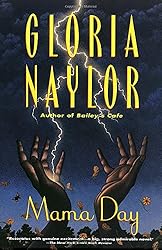

Mama Day
Gloria Naylor, 1985
Knopf Doubleday
336 pp.
ISBN-13: 9780679721819
Summary
On Willow Springs the presiding presence is Mama Day, nearly one hundred years old and still going strong.
Mama Day knows herbal cures and can summon lightning with her walking stick. She knows the true story of "the great, grand Mother" Sapphira Wade, who in 1823 persuaded her master to deed the island to his slaves, "bore him seven sons in just a thousand days" (p. 3), and killed him before she vanished in a burst of flame. Most of all, Mama Day knows that her world—any world—runs on the magic of belief.
These are the truths she will try to impart to her great-niece, Cocoa, a woman almost as formidable as Mama Day herself, and more important, to Cocoa’s New York–bred husband, George.
When George accompanies his wife on a fateful visit to Willow Springs, Naylor’s two worlds—and seemingly opposing realities—are brought together. As Cocoa falls victim to the island’s darker forces, this meticulously rational and self-reliant man discovers that the only way he can save her is by casting reason and self-reliance aside and by submitting to the wisdom of Mama Day, a woman he strongly suspects is crazy.
Mama Day affords the pleasures of both the "classical" novel—an intricately structured plot replete with doublings and foreshadowings—and the folk tale, with its oral rhythms and supernatural events. Unlike much contemporary fiction, it also imparts lessons about how we should live. Students who read this book will come away bearing some of the wisdom of Mama Day herself, perhaps most of all the understanding that "everybody wants to be right in a world where there ain’t no right or wrong to be found" (230). (From the publisher.)
Author Bio
• Birth—January 25, 1950
• Born—New York, New York, USA
• Died—September 28, 2016
• Where—Christiansted, St. Croix, US Virgin Islands
• Education—B.A., Brooklyn College; M.A. Yale University
• Awards—National Book Award
Gloria Naylor was was an American novelist, known for novels including The Women of Brewster Place (1982), Linden Hills (1985) and Mama Day (1988). She was born in New York, the oldest child of Roosevelt Naylor and Alberta McAlpin.
Background and early years
The Naylors, who had been sharecroppers in Robinsonville, Mississippi, had migrated to Harlem to escape life in the segregated South and seek new opportunities in New York City. Her father became a transit worker; her mother, a telephone operator. Even though Naylor's mother had little education, she loved to read, and encouraged her daughter to read and keep a journal. Before her teen years, Gloria began writing prodigiously, filling many notebooks with observations, poems, and short stories.
In 1963, Naylor's family moved to Queens and her mother joined the Jehovah's Witnesses. An outstanding student who read voraciously, Naylor was placed into advanced classes in high school, where she immersed herself in the work of nineteenth century British novelists.
Education
Naylor's educational aspirations were delayed by the shock of the assassination of Dr. Martin Luther King Jr. in her senior year. She decided to postpone her college education, becoming a missionary for the Jehovah's Witnesses in New York, North Carolina, and Florida instead. She left seven years later as "things weren't getting better, but worse."
From 1975 to 1981 Naylor attended Medgar Evers College and then Brooklyn College while working as a telephone operator, majoring in nursing before switching to English.
It was at that time that she read Toni Morrison's novel The Bluest Eye, which was a pivotal experience for her. She began to avidly read the work of Zora Neale Hurston, Alice Walker, and other black women novelists, none of which she had been exposed to previously. She went on to earn an M.A. in African-American studies at Yale University; her thesis eventually became her second published novel, Linden Hills.
Career
Naylor's debut novel, The Women of Brewster Place, was published in 1982 and won the 1983 National Book Award in the category First Novel. It was adapted as a 1989 television miniseries of the same name by Oprah Winfrey's Harpo Productions.
Naylor went on to publish Linden Hills (1985), Mama Day (1987), and Bailey's Cafe (1992). Each of these novels garnered much attention for their exploration of the modern black American experience.
Naylor's work is featured in such anthologies as Breaking Ice: An Anthology of Contemporary African-American Fiction (1990), Calling the Wind: Twentieth-Century African-American Short Stories (1992) and Daughters of Africa (1992).
During her career as a professor, Naylor taught writing and literature at several universities, including George Washington University, New York University, Boston University, and Cornell University.
Death
Naylor died of a heart attack on September 28, 2016, while visiting St. Croix, United States Virgin Islands. She was 66. (Adapted from Wikipedia. Retrieved 5/8/2018.)
Book Reviews
Resonates with genuine excitement.… [A] big, strong admirable novel.
New York Times Book Review
This is a wonderful novel, full of spirit and sass and wisdom, and completely realized.
Washington Post
Naylor has a dazzling sense of humour, rich comic observation and that indefinable quality we call "art."
Rita Mae Brown - Los Angeles Times
The beauty of Naylor's prose is its plainness, and the secret power of her third novel is that she does not simply tell a story but brings you face to face with human beings living through the complexity, pain and mystery of real life.
Publishers Weekly
[Mama Day] showcases Naylor's talent for descriptive prose. Though the novel as a whole fairly breathes with life, it is marred by the unintentionally comic death of a major character, who is attacked by a vicious chicken. This farm boy was not convinced. —Laurence Hull, Cannon Memorial Lib., Concord, N.C.
Library Journal
Discussion Questions
1. On page 10 we are told that people on Willow Springs know the story of Sapphira Wade "without a single living soul really telling a word." How can a community know its history if that history remains untold? What distinction does this book make between spoken and unspoken truth? Which kind of wisdom does it value more highly?
2. In what way is Mama Day a book about people’s perceptions and misperceptions—not only of each other, but of reality itself?
3. Mama Day possesses a number of powers that might be called supernatural: she knows the secrets of people she sees on television; she can turn flowers into butterflies and cure a woman’s infertility by magic. Yet she also describes what she does as "mother-wit disguised with hocus pocus" (97) and maintains that "she ain’t never tried to get over nature" (262). How can both of these things be true? How does Mama Day view her powers? Compare her "magic" to the magic practiced by Ruby and Dr. Buzzard.
4. On page 61 George observes, "My city was a network of small towns." What does he mean by this? How does George’s New York compare to Willow Springs? In what ways is Mama Day a book about small towns and their inhabitants and histories?
5. The sections of Mama Day that are set in Willow Springs contain a great deal of gossip. What sorts of information does the gossip of Willow Springs impart? What does gossip tell us about the community in which it circulates? In what ways is Mama Day a book about "the oral tradition"—about the kind of knowledge that is not imparted by books but by people’s gossip, stories, and folklore?
6. George and Cocoa fall in love reluctantly. And, even after they fall in love, they often seem to punish each other for it. Contrast their fear of emotional connection with the attitudes of Miranda and Abigail, who, like George and Cocoa, have suffered because of love. In addition, the two sisters know a secret that George and Cocoa do not: that each of the preceding Day women has broken the heart of the man who loved her. How does Naylor develop the theme of love—between man and woman, mother and child, grandmother and granddaughter, and sister and sister—in this book? What connections does she draw between love and heartbreak?
BEYOND THE BOOK
1. In describing the peculiar logic that prevails on Willow Springs, Naylor’s narrator says: "Being we was brought here as slaves, we had no choice but to look at everything upside-down" (8). In what ways do people on Willow Springs see things "upside-down"? In what ways is Willow Springs an upside-down or mirror image of New York? What other reversals and inversions occur in this book?
2. Each of the major characters in Mama Day has a key phrase that sums up his character and world-view:
- Cocoa: "Nothing stays put" (63);
- George: "Only the present has potential" (23);
- Mama Day’s: "Folks see what they want to see. And for them to see what’s really happening… they gotta be ready to believe" (97).
Talk about how these phrases reflect Cocoa, George, and Mama Day? How do these people’s characters and beliefs clash in the course of the book? How do they change?
3. Mama Day is full of aphorisms that tell large truths about the world inside and outside the book. Discuss some of the following, what they mean and what role they might play in the book as a whole:
- "I had what I could see" (27)
- "The only miracle is life itself" (43)
- "Every blessing hides a curse, and every curse a blessing" (78)
- "Lead on with light" (110)
- "A man dies from a broken heart" (118)
- "I was losing you because of my fear of losing you" (129)
- "Ain’t no hoodoo anywhere as powerful as hate" (157)
- ."It’s all happened before, and it’ll happen again with a different set of faces" (163)
- "A woman shouldn’t have to fight her man to be what she [is]; he should be fighting that battle for her" ( 203)
- "You were entering a part of my existence that you were powerless in. Your maps were no good here." (177)
- "I can tell you the truth, which you won’t believe, or I can invent a lie, which you would" (266)
- "There’s only the sense of being. Daughter" (283) m."She needs his hand in hers—his very hand—so she can connect it up with all the believing that had gone before" (285).
4. Discuss the legend of Sapphira Wade—"the great, grand Mother" who began the Day lineage. What role does this myth play in Willow Springs? How is Sapphira’s half-remembered story echoed by the stories of her female descendants? What role, in general, do mothers play in Willow Springs and in Mama Day?
5. One of the techniques that Gloria Naylor uses to great effect in this novel is foreshadowing—hinting at themes and events that will gradually become more explicit and meaningful in her story. Discuss how Naylor uses foreshadowing to develop one of the following:
- the theme of the mother
- men with broken hearts
- mistrust and belief
- "the other place"
- magic, good and evil, true and false
- the storm
- G. the relationship between Abigail and Miranda Day,
- the theme of the sacrificed child.
6. In the fictional Willow Springs, Gloria Naylor has constructed an alternate world, populated exclusively by African-Americans and exempt from many of the crueler turns of America’s racial history: for example, Willow Springs may be the only place in the American South where blacks have been able to vote uninterruptedly since the nineteenth century.
Yet Willow Springs also embodies—and in some ways magnifies—the history of black Americans, beginning with the fact of slavery itself. In what ways does Naylor use her invented world to comment on America’s racial history? What does she accomplish by creating a world in which the races are wholly separate?
7. Mama Day makes use of many traditional African-American customs and beliefs, like Candle Walk, conjure women, working roots, and the use of brooms as symbolic barriers. Find out about a tradition in your own family, community, or ethnic group, perhaps by consulting grandparents or other older relatives. What are the origins of this tradition? How has it changed over the generations? How is it observed today?
8. Mama Day’s given name is Miranda and Cocoa’s is Ophelia. Both of these names appear in Shakespeare’s plays; Miranda in The Tempest and Ophelia in Hamlet. Do a little research into the two plays and then discuss how Shakespeare's heroines compare with their namesakes in this novel. Why might Gloria Naylor have chosen these names for her characters?
9. Gloria Naylor has written other novels set in self-contained communities: the inner-city of The Women of Brewster Place and the mythical diner of Bailey’s Cafe. Talk about the worlds of these books and Mama Day. Why do you think she has chosen to set these books in such highly compressed "universes"?
10. Mama Day employs the literary technique called "magical realism," in which elements of dreams, fairy-tales, and mythology are combined with recognizable everyday reality. Which characters, settings, or events in this novel are "realistic"? Which ones are "magical"? What role does magic play on Willow Springs?
(Questions issued by the publisher.)

A Man Called Ove
Fredrik Backman, 2012 (U.S., 2014)
Atria Books
368 pp.
ISBN-13: 9781476738024
Summary
In this bestselling and delightfully quirky debut novel from Sweden, a grumpy yet loveable man finds his solitary world turned on its head when a boisterous young family moves in next door.
Meet Ove. He’s a curmudgeon—the kind of man who points at people he dislikes as if they were burglars caught outside his bedroom window. He has staunch principles, strict routines, and a short fuse. People call him “the bitter neighbor from hell.” But must Ove be bitter just because he doesn’t walk around with a smile plastered to his face all the time?
Behind the cranky exterior there is a story and a sadness. So when one November morning a chatty young couple with two chatty young daughters move in next door and accidentally flatten Ove’s mailbox, it is the lead-in to a comical and heartwarming tale of unkempt cats, unexpected friendship, and the ancient art of backing up a U-Haul. All of which will change one cranky old man and a local residents’ association to their very foundations.
A feel-good story in the spirit of The Unlikely Pilgrimage of Harold Fry and Major Pettigrew’s Last Stand, Fredrik Backman’s novel about the angry old man next door is a thoughtful and charming exploration of the profound impact one life has on countless others. (From the publisher.)
Author Bio
• Birth—June 2, 1981
• Raised—Helsingborg, Sweden
• Education—no degree
• Currently—Stockholm
Fredrik Backman, Swedish author, journalist, and blogger, was voted Sweden's most successful author in 2013.
Backman grew up in Helsingborg, studied comparative religion but dropped out and became a truck driver instead. When the free newspaper Xtra was launched in 2006, the owner reached out to Backman, then still a truck driver, to write for the paper. After a test article, he continued to write columns for Xtra
In spring 2007, he began writing for Moore Magazine in Stockholm, a year-and-a-half later he began freelancing, and in 2012 he became a writer for the Metro. About his move to writing, Backman said...
I write things. Before I did that I had a real job, but then I happened to come across some information saying there were people out there willing to pay people just to write things about other people, and I thought "surely this must be better than working." And it was, it really was. Not to mention the fact that I can sit down for a living now, which has been great for my major interest in cheese-eating. (From his literary agent's website.)
Backman married in 2009 and became a father the following year. He blogged about preparations for his wedding in "The Wedding Blog" and about becoming a father on "Someone's Dad" blog. During the 2010 Winter Olympics, he wrote the Olympic blog for the Magazine Cafe website and has continued as a permanent blogger for the site.
In 2012, Backman debuted as an author, publishing two books on the same day: a novel, A Man Called Ove (U.S. release in 2014), and a work of nonfiction, Things My Son Needs to Know About the World. His second novel, My Grandmother Sent Me to Tell You She's Sorry, came out in 2013 (U.S. release in 2015). (Adapted from Wikipedia and the publisher. Retrieved 7/23/2014.)
Book Reviews
(Starred review.) [A]s time passes, [the] characters slowly weave themselves into his life, offering Ove a chance at rebirth. The debut novel...is a fuzzy crowd-pleaser that serves up laughs to accompany a thoughtful reflection on loss and love. Though Ove’s antics occasionally feel repetitive, the author writes with winning charm.
Publishers Weekly
(Starred review.) Readers seeking feel-good tales with a message will rave about the rantings of this solitary old man with a singular outlook. If there was an award for ''Most Charming Book of the Year,'' this first novel by a Swedish blogger-turned-overnight-sensation would win hands down.
Booklist
[A] charming debut. The book...takes its time revealing that [its] dyed-in-the-wool curmudgeon has a heart of solid gold.... [T]he narration can veer toward the preachy or overly pat, but wry descriptions, excellent pacing and the juxtaposition of Ove’s attitude with his deeds add plenty of punch to balance out any pathos.
Kirkus Reviews
Discussion Questions
1. How does the opening scene, in which Ove attempts to purchase a computer, succinctly express the main points of Ove’s ongoing battle with the stupidities of the modern world?
2. Ove loves things that have a purpose, that are useful. How does this worldview fail him when he believes himself to be useless? How is he convinced that he can still be useful?
3. As readers, we get to know Ove slowly, with his past only being revealed piece by piece. What surprised you about Ove’s past? Why do you think the author revealed Ove’s past the way that he did?
4. We all know our own grumpy old men. How do Ove’s core values lead him to appear as such a cranky old coot, when he is in fact nothing of the sort? Which of these values do you agree or disagree with?
5. Although Ove has some major "disagreements" with the way the world turned out, there are some undeniable advantages to the modernization he finds so hollow. How do these advantages improve Ove’s life, even if he can’t admit it?
6. Parveneh’s perspective on life, as radically different from Ove’s as it is, eventually succeeds in breaking Ove out of his shell, even if she can’t change his feelings about Saabs. How does her brash, extroverted attitude manage to somehow be both rude and helpful?
7. Ove strives to be “as little unlike his father as possible.” Although this emulation provides much of the strength that helps Ove persevere through a difficult life, it also has some disadvantages. What are some of the ways that Ove grows into a new way of thinking over the course of the book?
8. Ove is a believer in the value of routine—how can following a routine be both comforting and stultifying? How can we balance routine and spontaneity? Should we? Or is there sense in eating sausage and potatoes your whole life?
9. The truism “it takes a village to raise a child” has some resonance with A Man Called Ove. How does the eclectic cast of posers, suits, deadbeats, and teens each help Ove in their own way?
10. Although we all identify with Ove to some extent, especially by the end of the story, we certainly also have our differences with him. Which of the supporting cast (Parveneh, Jimmy, the Lanky One, Anita) did you find yourself identifying with most?
11. What did you make of Ove’s ongoing battle with the bureaucracies that persist in getting in his way? Is Ove’s true fight with the various ruling bodies, or are they stand-ins, scapegoats, for something else?
12. On page 113, after a younger Ove punches Tom, the author reflects: "A time like that comes for all men, when they choose what sort of men they want to be." Do you agree with this sentiment, especially in this context? How does the book deal with varying ideas of masculinity?
13. On page 246, the author muses that when people don’t share sorrow, it can drive them apart. Do you agree with this? Why or why not?
14. What do you think of Ove’s relationship with the mangy cat he adopts? What does the cat allow him to express that he couldn’t otherwise say?
15. On Ove and Sonja’s trip to Spain, Ove spends his time helping the locals and fixing things. How does Ove the “hero” compare and contrast to his behavior in the rest of the book? Is that Ove’s true personality?
16. Ove and Sonja’s love story is one of the most affecting, tender parts of the book. What is the key to their romance? Why do they fit so well together?
17. Saab? Volvo? BMW? Scania?
(Questions issued by the publisher.)
The Man from Beijing
Henning Mankell, 2007 (trans., Laurie Thompson, 2010)
Knopf Doubleday
464 pp.
ISBN-13: 9780307472847
Summary
The acclaimed author of the Kurt Wallander mysteries, writing at the height of his powers, now gives us an electrifying stand-alone global thriller.
January 2006. In the Swedish hamlet of Hesjovallen, nineteen people have been massacred. The only clue is a red ribbon found at the scene.
Judge Birgitta Roslin has particular reason to be shocked: Her grandparents, the Andréns, are among the victims, and Birgitta soon learns that an Andrén family in Nevada has also been murdered. She then discovers the nineteenth-century diary of an Andren ancestor—a gang master on the American transcontinental railway—that describes brutal treatment of Chinese slave workers. The police insist that only a lunatic could have committed the Hesjovallen murders, but Birgitta is determined to uncover what she now suspects is a more complicated truth.
The investigation leads to the highest echelons of power in present-day Beijing, and to Zimbabwe and Mozambique. But the narrative also takes us back 150 years into the depths of the slave trade between China and the United States—a history that will ensnare Birgitta as she draws ever closer to solving the Hesjovallen murders. (From the publisher.)
Author Bio
• Birth—February 3, 1948
• Where—Stockholm, Sweden
• Education—Hogre Allmana Laroverket, Boras
• Awards—Swedish Crime Writers' Academy-Best Swedish Crime Novel Award (twice);
Nils Holgersson Prize; Glass Key Award for Best Nordic Crime Novel; Deutscher
Jugendliteraturpreis; Crime Writers' Assn.-Gold Dagger; Gumshow Award for
Best European Crime Novel
• Currently—lives in Sweden and Maputo, Mozambique
Best known for his series of police procedurals featuring the adventures of Swedish detective Kurt Wallander—selling over 10 million copies worldwide—Henning Mankell has become a mystery master garnering critical acclaim in both the U.K. and U.S. (From the publisher.)
More
Mankell was born in Stockholm, Sweden, and grew up in Sveg (Harjedalen) and Boras (Vastergotland). Mankell's father, Ivar, was a judge and his grandfather, also called Henning Mankell (1868–1930), was a composer. At the age of 20 he already started a career as author and assistant director at the Riks Theater in Stockholm. In the following years he collaborated with several theaters in Sweden.
In his youth Mankell was a left-wing political activist and a strong opponent of the Vietnam War, South African apartheid and Portugal's colonial war in Mozambique. In the 1970s Mankell moved from Sweden to Norway and lived with a Norwegian woman who was a member of the Maoist Communist Labor Party of Norway. Mankell took part in the party's activities but never himself joined the party.
After living in Zambia and other African countries, Henning Mankell was invited to become the artistic director of Teatro Avenida in Maputo, the capital of Mozambique. He now spends at least half the year in Maputo working with the theatre and writing. Recently he built up his own publishing house (Leopard Förlag) in order to support young talents from Africa and Sweden.
He is married to Eva Bergman, daughter of Ingmar Bergman. On 12 June 2008 he was awarded an honorary Doctorate from the University of St Andrews in Scotland.
Mankell recently donated 15 million Swedish kronor to SOS Children's Villages for a village for homeless children in Mozambique. Mankell has said he's giving away half of his income to charitable causes.
Books, plays, screenplays
Mankell has written 10 crime novels with Kurt Wallender, his fictional police inspector who lives and works in Ystad, Sweden. The novels center on an underlying question: "What went wrong with Swedish society?" The series has won numerous awards (see above). The ninth book, The Pyramid, is a prequel: a collection of four novellas about Wallander's past, the last one ending just before the start of Faceless Killers. Ten years after The Pyramid, Mankell published another Wallander novel, The Troubled Man, which he said would definitely be the last in the series.
The Wallender series has been adapted into television mini-series in Sweden and the UK's BBC.
In addition to the Wallender series, Mankell has written more than 15 works of fiction, including, four other crime novels. He has also written works for children, including two series—the Sofia books and the Joel Gustafsson series.
Mankell is also a prolific playwright and screen writer with 40 some plays to his name (20 of which have been released) and four screenplays, which include three tv mini-series.
Global politics
Mankell participated in the Protests of 1968 in Sweden, protesting against, among other things, the Vietnam War, the Portuguese Colonial War and the Apartheid regime in South Africa. Furthermore, he got involved with the society Folket i Bild/Kulturfront which focused on cultural policy studies. During his stay in Norway, he got in contact with the Norwegian Workers' Communist Party and took an active part in their actions.
In 2009, Mankell was a guest at a Palestinian literary conference. Thereafter, he claimed to have seen "repetition of the despicable Apartheid system that once treated Africans and coloured as second-class citizens in their own country". He also found a resemblance between the Israeli West Bank barrier and the Berlin Wall. Considering the environment the Palestinian people live in, he continued, it is not astonishing that "some decide to become suicide bombers....it is strange that there are not more of them". "The Israelis" would "destroy lives" and the Israeli State is not to have a future in its current form, as a two-state solution would not reverse the "historical occupation". He claimed not to have encountered antisemitism during his journey, just "hatred against the occupants that is completely normal and understandable".
In 2008, speaking about nationalism and Norway (a country formerly forced into a Union with Sweden), he stated that "Nationalism is almost spiteful in nature. It can sometimes be glimpsed as something brown behind the waving Norwegian flags." (Adapted from Wikipedia.)
Book Reviews
If a Raymond Chandler effect is the goal, the humdrum plot interferes.... The intrigue surrounding the murders dissipates. Detectives fade to distant bystanders.... Mankell’s fierce instinct for social criticism is admirable. If only it didn’t sabotage the opportunity for old-fashioned whodunit delight.
Mike Peed - New York Times
It may not be flawless, but Henning Mankell's The Man From Beijing is a great mystery that belongs in the company of other knockout masterpieces of moral complexity and atmosphere like Dorothy Sayers's The Nine Tailors, Robert Goddard's Beyond Recall, Barbara Vine's A Dark-Adapted Eye and Mankell's own brilliant 2002 gloomfest, One Step Behind. The new novel's ambitious plotting alone should be dissected and taught in MFA programs...a brilliant tale of suspense and substance that dedicated mystery readers will want to savor.
Maureen Corrigan - Washington Post
Mankell succeeds in transfixing the reader with a masterly balance of character sketches and pell-mell storytelling. He is entirely convincing in his depiction of ordinary people becoming enmeshed in geopolitical intrigue.
Wall Street Journal
The book cements Mankell’s reputation as Sweden’s greatest living mystery writer.... Roslin is a sort of Nordic Miss Marple.
Los Angeles Times
Mankell’s new book is an original but still chock-a-block with gory crime combined with hints of the late Stieg Larsson’s social concern and John le Carré’s international intrigue.
Pittsburgh Post-Gazette
Over the past decade or so, Henning Mankell has built a large audience that, even now, in the (mostly) snowless U.S., can’t wait to find copies of his new snowbound work of mystery. The Man from Beijing more than repays such patience. It’s a terrific police procedural.... Despite the broad reach of the plot, the book never puts the reader in danger of losing interest.
Alan Cheuse - Dallas Morning News
A massacre in the remote Swedish village of Hesjövallen propels this complex, if diffuse, stand-alone thriller from Mankell (The Pyramid). Judge Birgitta Roslin, whose mother grew up in the village, comes across diaries from the house of one of the 19 mostly elderly victims kept by Jan Andrén, an immigrant ancestor of Roslin's. The diaries cover Andrén's time as a foreman on the building of the transcontinental railroad in the United States. An extended flashback charts the journey of a railroad worker, San, who was kidnapped in China and shipped to America in 1863. After finding evidence linking a mysterious Chinese man to the Hesjövallen murders, Roslin travels to Beijing, suspecting that the motive for the horrific crime is rooted in the past. While each section, ranging in setting from the bleak frozen landscape of northern Sweden to modern-day China bursting onto the global playing field, compels, the parts don't add up to a fully satisfying whole.
Publishers Weekly
A 2006 massacre in Sweden reverberates back to 19th-century China and America in this stand-alone by the author of the Kurt Wallander mysteries. When 19 of the 22 residents of a Swedish hamlet are brutally murdered, Judge Brigitta Roslin discovers that the victims include her late mother's foster parents, so she looks into the case, offering a theory counter to that of local authorities. Even after the arrest of a local man who confesses and then commits suicide, Roslin continues probing in a quest that eventually takes her to China and puts her in mortal danger. And she finds that revenge—whether sweet or best served cold—is a powerful motivator even after a century and a half. Verdict: Most compelling at the beginning and end, this sprawling novel becomes a leisurely examination of history's injustices and consequences as well as an intriguing postulation of how China might meet its most pressing societal problem. Mankell humanizes the earnest, even meddlesome Roslin, so that the reader can't help but wish her well. Already an international best seller, this seems destined for success here, too. —Michele Leber, Arlington, VA
Library Journal
The opening set piece, in which the murders are discovered, is a stunner, and the finale, in a London restaurant, is equally gripping. Yes, Mankell overextends himself here, but he also shows why he remains a must-read for anyone interested in the international crime novel. —Bill Ott
Booklist
A sweepingly ambitious tale of corruption, injustice and revenge that ranges over three continents and 140 years, from the creator of Swedish police detective Kurt Wallander (The Pyramid, 2008, etc.). The first person to discover the massacre at Hesjovallen is so horrified that he suffers a fatal heart attack and is hit by a truck. The stabbing and hacking of 19 neighbors and their pets in ten houses has decimated the village. Duty officer Vivi Sundberg, called to the scene, swiftly realizes that all the victims except for one unidentified boy share one of three last names—Andersson, Andren or Magnusson—and theorizes that in a community likely to be marked by inbreeding, they may all be members of a single family. Birgitta Roslin, a judge in Helsingborg whose mother's foster parents were among the victims, connects the horror to a smaller-scale but equally brutal murder spree: the slaughter of Jack Andren and his wife and children in Reno, Nev. A long flashback to the shameful treatment of Chinese slave laborers on the American transcontinental railroad in the 1860s supplies further hints as to the motive. But it's not until Birgitta travels to Beijing to accompany a friend on a business trip—and to gather information about a mysterious Chinese man who booked a hotel room near Hesjovallen the week of the crime—that a clear portrait of the killer begins to emerge. The improbable but touching friendship Birgitta strikes up with Hong Qui, the sister of a powerful player in the high-stakes game of Beijing construction, serves as the nerve center of Mankell's sprawling tale, even though it reveals more information to the reader than to Birgitta. Another long detour, this one to contemporary Zimbabwe, adds new resonance to the massacre back in Sweden before [Mankell] brings down the curtain in London's Chinatown. Breathtakingly bold in its scope. If Mankell never links his far-flung, multigenerational horrors closely together, that's an important part of his point.
Kirkus Reviews
Discussion Questions
Use our LitLovers Book Club Resources; they can help with discussions for any book:
• How to Discuss a Book (helpful discussion tips)
• Generic Discussion Questions—Fiction and Nonfiction
• Read-Think-Talk (a guided reading chart)
Also consider these LitLovers talking points to help get a discussion started for The Man from Beijing:
1. The first so-called character introduced in The Man from Beijingis an animal—a wolf. Why might author Henning Mankell have chosen to open his work with a such a creature?
2. The central investigators in this story are Detective Vivi Sundberg, along with her police team, and Judge Birgitta Roslin, an "informal" investigator with a personal interest in solving the crime. How do the two women differ from one another? How would you describe Sundberg? What were your expectations for her...that she was the heroine?
3. What kind of character is Birgitta Roslin? Some reviewers find her an engaging heroine, others a hapless bore. What's your take? Do you see her as a fully developed, complex being...or is she one-dimensional, an "action figure" whom Mankell simply uses to move the plot forward?
4. Why does Sundberg ignore the evidence that Roslin finds so convincing? And why does Roslin reject the confession that the police have in hand in favor of a seemingly far-fetched theory?
5. How does Roslin solve the book's mystery—through logical reasoning based on empirical evidence (like Sherlock Holmes)...or through feelings and intuition? Is one method more legitimate than the other...or are both equally valid?
6. Comment on Roslin's marriage? Why is it an unsatisfying relationship? What else, other than her marriage, seems to have atrophied in her middle-age?
7. Talk about Birgitta's query about herself—whether she's "a servant of the law, or of indifference?" What does she mean...and why does ask herself that question of herself?
8. What role does Sweden's climate play in his novel—in terms of setting the mood and operating symbolically?
9. One of Henning Mankell's concerns in this novel is the way in which ordinary people, "absorbed in their own thoughts, their own fate," are caught up by global forces far beyond the scope of their everyday lives. How does this idea play out in his novel? Does Mankell's vision have relevance to your own life?
10. The book contains three distinct parts. Did you find the shifting venues, both time and place, distracting...or engaging? Does the book hold together for you as a taut, suspenseful mystery and political thriller? Or is it overly discursive, going off in too many directions to maintain the tautness established on page one?
11. Follow-up to Question 10: Do you think the book's social criticism enhances or detracts from its whodunit plotline? Would you say, for instance, that Mankell's emphasis on global politics adds moral depth to the story...or slows its pacing?
12. How would you describe the political stance of the book with regards to the world economic order?
13. Were you shocked to learn of the treatment of the Chinese workers brought to the U.S., often by force, to build the transcontinental railroad? Or were you aware of the slave-like conditions?
14. Does the plot's dependence on coincidence, especially during the China section, bother you? Do the coincidences undermne the book's believability factor for you...or do you accept coincidence as a strange, inexplicable, yet very real part of life?
15. Talk about Ya Ru and his global ambitions for China, including the colonization of Africa. When did you make the connection between Ya Ru the murdered Swedes?
16. What draws Roslin into a friendship with Ya Ru's sister? In what ways does Hong Qui differ from her brother?
17. How is contemporary China depicted in this novel, vis-a-vis both it's own past and its current role in the global economy?
18. What was your reaction to the 10-page speech about China's communist past and present day aspirations? Did you read it or skip parts of it...or all of it?
19. One of Roslin's colleagues says, "I didn’t think it was possible to give democracy a monetary value. If you don’t have a state functioning on the basis of law, you don’t have democracy." Does this statement have truth? Does it have wider implications...around the globe? Or is this comment off the mark, simply too broad an assertion to have relevance? Care to comment?
20. Do you buy Mankell's take on Zimbabwe's Robert Mugabe?
21. How would you describe this book? Is it a mystery? A detective procedural? An international thriller? A family epic? A discourse on global politics? An historical novel? A revenge novel?
22. Have you read other books by Henning Mankell—particularly his Kurt Wallender series? If so, how does this compare with that popular series? If not, does this book inspire you to read other Mankell works?
(Questions by LitLovers. Please feel free to use them, online or off, with attribution. Thanks.)
top of page (summary)
The Man in My Basement
Walter Mosley, 2004
Little, Brown & Co.
272 pp.
ISBN-13: 9780316159319
Summary
Charles Blakey is a young black man whose life is slowly crumbling. His parents are dead, he can't find a job, he drinks too much, and his friends have begun to desert him.
Worst of all, he's fallen behind on the mortgage payments for the beautiful home that's belonged to his family for generations.
When a stranger offers him $50,000 in cash to rent out his basement for the summer, Charles needs the money too badly to say no. He knows that the stranger must want something more than a basement view.
Sure enough, he has a very particular—and bizarre—set of requirements, and Charles tries to satisfy him without getting lured into the strangeness.
But he sees an opportunity to understand secrets of the white world, and his summer with a man in his basement turns into a journey into inconceivable worlds of power and manipulation, and unimagined realms of humanity.
Richly textured and compelling, The Man in My Basement is a new literary pinnacle from an acknowledged American master. (From the publisher.)
Author Bio
• Birth—January 12, 1952
• Where—Los Angeles, California, USA
• Education—B.A., Johnson State College
• Awards—Mystery Writers Grand Master; Shamus Award, Private Eye Writers of America; Grammy Award for Best Album Notes
• Currently—lives in New York City
When President Bill Clinton announced that Walter Mosley was one of his favorite writers, Black Betty (1994), Mosley's third detective novel featuring African American P.I. Easy Rawlins, soared up the bestseller lists. It's little wonder Clinton is a fan: Mosley's writing, an edgy, atmospheric blend of literary and pulp fiction, is like nobody else's. Some of his books are detective fiction, some are sci-fi, and all defy easy categorization.
Mosley was born in Los Angeles, traveled east to college, and found his way into writing fiction by way of working as a computer programmer, caterer, and potter. His first "Easy Rawlins" book, Gone Fishin' didn't find a publisher, but the next, Devil in a Blue Dress (1990) most certainly did—and the world was introduced to a startlingly different P.I.
More
Part of the success of the Easy Rawlins series is Mosley's gift for character development. Easy, who stumbles into detective work after being laid off by the aircraft industry, ages in real time in the novels, marries, and experiences believable financial troubles and successes. In addition, Mosley's ability to evoke atmosphere—the dangers and complexities of life in the toughest neighborhoods of Los Angeles—truly shines. His treatment of historic detail (the Rawlins books take place in Los Angeles from the 1940s to the mid-1960s) is impeccable, his dialogue fine-tuned and dead-on.
In 2002, Mosley introduced a new series featuring Fearless Jones, an Army vet with a rigid moral compass, and his friend, a used-bookstore owner named Paris Minton. The series is set in the black neighborhoods of 1950s L.A. and captures the racial climate of the times. Mosley himself summed up the first book, 2002's Fearless Jones, as "comic noir with a fringe of social realism."
Despite the success of his bestselling crime series, Mosley is a writer who resolutely resists pigeonholing. He regularly pens literary fiction, short stories, essays, and sci-fi novels, and he has made bold forays into erotica, YA fiction, and political polemic. "I didn't start off being a mystery writer," he said in an interview with NPR. "There's many things that I am." Fans of this talented, genre-bending author could not agree more!
Extras
From a 2004 Barnes & Noble interview:
• Mosley is an avid potter in his spare time.
• He was a computer programmer for 15 years before publishing his first book. He is an avid collector of comic books. And ahe believes that war is rarely the answer, especially not for its innocent victims.
• When asked what book most influenced his career as a writer, here is what he said:
The Stranger by Albert Camus probably had the greatest impact on me. I suppose that's because it was a novel about ideas in a very concrete and sensual world. This to me is the most difficult stretch for a writer—to talk about the mind and spirit while using the most pedestrian props. Also the hero is not an attractive personality. He's just a guy, a little removed, who comes to heroism without anyone really knowing it. This makes him more like an average Joe rather than someone beyond our reach or range.
(Bio and interview from Barnes & Noble .)
Book Reviews
In this successful and intriguing departure from his usual work, Mr. Mosley creates a substantial subplot about heritage and history.... In the end this audacious novel is about facing up to such brutal realities. But it is also about seeking refuge.
Janet Maslin - New York Times
Despite the heavy themes, the book never bogs down, and Mosley keeps the action flowing with his direct, colloquial writing.
USA Today
Even in his genre fiction, which includes mysteries and science fiction, Mosley has not been content simply to spin an engrossing action story but has sought to explore larger themes as well. In this stand-alone literary tale, themes are in the forefront as Mosley abandons action in favor of a volatile, sometimes unspoken dialogue between Charles Blakey and Anniston Bennet. Blakey, descended from a line of free blacks reaching back into 17th-century America, lives alone in the big family house in Sag Harbor. Bennet is a mysterious white man who approaches Blakey with a strange proposition—to be locked up in Blakey's basement—that Blakey comes to accept only reluctantly and with reservations. The magnitude of Bennet's wealth, power and influence becomes apparent gradually, and his quest for punishment and, perhaps, redemption, proves unsettling—to the reader as well as to Blakey, who finds himself trying to understand Bennet as well as trying to recast his own relatively purposeless life. The shifting power relationship between Bennet and Blakey works nicely, and it is fitting that Blakey's thoughts find expression more in physicality than in contemplation; his involvements with earthy, sensual Bethany and racially proud, sophisticated and educated Narciss reflect differing possibilities. The novel, written in adorned prose that allows the ideas to breathe, will hold readers rapt; it is Mosley's most philosophical novel to date, as he explores guilt, punishment, responsibility and redemption as individual and as social constructs. While it will be difficult for this novel to achieve the kind of audience Mosley's genre fiction does, the author again demonstrates his superior ability to tackle virtually any prose form, and he is to be applauded for creating a rarity, an engaging novel of ideas.
Publishers Weekly
This is a stand-alone literary novel from Mosley, who is best-known for his detective fiction. He arranges character and plot development so that Charles Blakey, a purposeless, unemployed, African American, accepts payment to let the mysterious Anniston Bennet spend two months imprisoned in his basement—and thus the stage is set for a sequence of philosophical dialogs and debates that influence and change the path of Charles's life. The conversations veer around topics like the dynamics of power, the need for redemption through punishment, and the nature of guilt. To fans of Easy Rawlins, Socrates Fortlow, and Fearless Jones, this will be a departure, but it is recommended as demand warrants. —Kristen L. Smith, Loras College Library, Dubuque, IA
Library Journal
As in many of Mosley's books, the story begins with a knock on the door: Anniston Bennet, a wealthy white man with mysterious motives, wants to rent Blakey's sizable basement. But while there is mystery here, this...is fine, provocative writing from the prolific Mosley, whose gifts extend well beyond his excellent mysteries. —Keir Graff
Booklist
In Mosley's boldly understated fable, an unemployed African-American agrees to rent space in his basement to a wealthy white businessman for two months. Except for living in New York's Harbor district, Charles Blakey might be a double for the denizens of Mosley's Watts (Six Easy Pieces, 2003, etc.). He's got no wife, no current girlfriend, few friends—though those few are ancient and loyal—and no work since he was fired from his job as a bankteller for petty embezzling. Worse still, he's about to lose the house his family's lived in for seven generations because he can't make payments on the mortgage he's taken out to tide him over. But when Greenwich reclamation expert Anniston Bennet approaches him with a request to let his basement for the summer, Charles isn't even tempted—until his other feeble sources of income dry up and his back is to the wall. It turns out that Bennet is offering a fabulous sum, nearly $50,000, for his stay; that he's picked Charles out especially as his host after doing a great deal of research; and that in cleaning out the basement to make it ready for him, Charles, who according to antique dealer Narciss Gully has turned up family heirlooms worth just as much as Bennet promises, doesn't really need his money anymore. By this time, however, he's become entranced by the combination of mastery and submission the white man is offering him, and the two enter into a relationship that becomes steadily more lacerating for them both. Fans of Mosley's nonfiction (Workin' on the Chain Gang, 1997, etc.) will know from the beginning what Bennet wants from Charles. Even given the resulting lack of suspense and a story that falls off sharply by the end, this slender parable is Mosley's most provocative and impassioned novel yet.
Kirkus Reviews
Discussion Questions
Use our LitLovers Book Club Resources; they can help with discussions for any book:
• How to Discuss a Book (helpful discussion tips)
• Generic Discussion Questions—Fiction and Nonfiction
• Read-Think-Talk (a guided reading chart)
Also consider these LitLovers talking points to help get a discussion started for The Man in My Basement:
1. What has happened to Charles Blakey that he finds himself down on his luck?
2. Based on careful research, Anniston Bennet chooses Charles—why? And what prompts Charles to accept the offer, even though, as it turns out, he doesn't really need the money?
3. In what way does the power relationship shift between the two men?
4. Talk about the two men's conversations with one another: how do they challenge each other...and what philosophical issues are at stake?
5. What do you learn about Bennet? Do you find him worthy of redemption? Is he a believable character—or more of an allegorical figure, standing in for evil incarnate?
6. How, eventually, is Blakey transformed by the end of the book?
7. This book revolves around convesations and ideas rather than plot. Did you find it engrossing, or was it difficult to get through, dense and uninteresting?
(Questions by LitLovers. Please feel free to use them, online or off, with attribution. Thanks.)
top of page

Manhattan Beach
Jennifer Egan, 2017
Scribner
448 pp.
ISBN-13: 9781501189913
Summary
The long-awaited, daring, and magnificent novel from the Pulitzer Prize–winning author of A Visit from the Goon Squad.
Manhattan Beach opens in Brooklyn during the Great Depression. Anna Kerrigan, nearly twelve years old, accompanies her father to the house of Dexter Styles, a man who, she gleans, is crucial to the survival of her father and her family.
Years later, her father has disappeared and the country is at war.
Anna works at the Brooklyn Naval Yard, where women are allowed to hold jobs that had always belonged to men. She becomes the first female diver, the most dangerous and exclusive of occupations, repairing the ships that will help America win the war.
She is the sole provider for her mother, a farm girl who had a brief and glamorous career with the Ziegfeld Follies, and her lovely, severely disabled sister. At a nightclub, she chances to meet Dexter Styles again, and she begins to understand the complexity of her father’s life, the reasons he might have vanished.
Mesmerizing, hauntingly beautiful, with the pace and atmosphere of a noir thriller, Egan’s first historical novel is a masterpiece, a deft, startling, intimate exploration of a transformative moment in the lives of women and men, America and the world. Manhattan Beach is a spectacular novel by one of the greatest writers of our time. (From the publisher.)
Author Bio
• Birth—September 7, 1962
• Where—Chicago, Illinois, USA
• Raised—San Francisco, California
• Education—University of Pennsylvania; Cambridge
University (UK)
• Awards—Pulitizer Prize; National Book Critics Circle Award
• Currently—lives in Brooklyn, New York, New York
Jennifer Egan is an American novelist and short story writer who lives in the Fort Greene section of Brooklyn, New York City. She is perhaps best known for her 2010 novel A Visit from the Goon Squad, which won both the 2011 Pulitzer Prize for fiction and National Book Critics Circle Award for fiction.
Background/early career
Egan was born in Chicago, Illinois, but grew up in San Francisco, California. She majored in English literature at the University of Pennsylvania and, as an undergrad, dated Steve Jobs, who installed a Macintosh computer in her bedroom. After graduating from Penn, Egan spent two years at St John's College at Cambridge University, supported by a Thouron Award.
In addition to her several novels (see below), Egan has published short fiction in The New Yorker, Harper's, Zoetrope: All-Story, and Ploughshares, among other periodicals. Her journalism appears frequently in The New York Times Magazine. She also published a short-story collection in 1993.
A Visit from the Goon Squad
Egan has been hesitant to classify her most noted work, A Visit from the Goon Squad, as either a novel or a short story collection, saying,
I wanted to avoid centrality. I wanted polyphony. I wanted a lateral feeling, not a forward feeling. My ground rules were: every piece has to be very different, from a different point of view. I actually tried to break that rule later; if you make a rule then you also should break it!
The book features genre-bending content such as a chapter entirely formatted as a Microsoft PowerPoint presentation. Of her inspiration and approach to the work, she said,
I don’t experience time as linear. I experience it in layers that seem to coexist.… One thing that facilitates that kind of time travel is music, which is why I think music ended up being such an important part of the book. Also, I was reading Proust. He tries, very successfully in some ways, to capture the sense of time passing, the quality of consciousness, and the ways to get around linearity, which is the weird scourge of writing prose.
Bibliography (partial)
Novels
1995 - The Invisible Circus
2001 - Look at Me
2006 - The Keep
2010 - A Visit from the Goon Squad
2017 - Manhattan Beach
Short fiction
1993 - Emerald City (short story collection; released in US in 1996)
2012 - "Black Box" (short story, released on The New Yorker's Twitter account)
(Author bio adapted from Wikipedia. Retrieved 10/3/2017.)
Book Reviews
Immensely satisfying.… [Manhattan Beach] is a dreadnought of a World War II-era historical novel, bristling with armaments yet intimate in tone. It’s an old-fashioned page-turner, tweaked by this witty and sophisticated writer so that you sometimes feel she has retrofitted sleek new engines inside a craft owned for too long by James Jones and Herman Wouk.… She is masterly at displaying mastery.… Egan’s fiction buzzes with factual crosscurrents, casually deployed.… Egan works a formidable kind of magic.… This is a big novel that moves with agility.
Dwight Garner - New York Times
The prevalence of the ocean in this story is not simply atmospheric; it is central to the symbolism.… Turning their backs on the crowded constraints of their urban lives, all three look to the ocean as a realm that while inherently dangerous also promises the potential for personal discovery and an almost mystical liberty. This is a novel that deserves to join the canon of New York stories.
Amor Towles - New York Times Book Review
[P]olished to a high sheen. Manhattan Beach — longlisted for a National Book Award even before it was released — is a historical novel set during World War II in New York.… Manhattan Beach may not offer the brilliant variety of forms found in Goon Squad, but Egan is still blending a jazzy range of tones in these chapters, from Tennessee Williams’s apartment-trapped despair to Herman Melville’s adventures at sea… [and] a particularly rich noir romance.… [Manhattan Beach] dares to satisfy us in a way that stories of an earlier age used to.
Ron Charles - Washington Post
This truly fine novel, so rich in period and emotional atmosphere and so cunningly plotted, is a joy — one of the standouts of the year.
Newsday
Egan’s most remarkable accomplishment yet.… At once a suspenseful novel of noir intrigue, a gorgeously wrought and richly allusive literary tapestry, and a transporting work of lyrical beauty and emotional heft, Manhattan Beach is a magnificent achievement.
Boston Globe
A work of remarkable cinematic scope. . . . This is a novel that will pull you in and under and carry you away on its rip tides.… Its resonances continue to wash over the reader long after the novel ends.
Guardian UK
Manhattan Beach is ambitiously and deliciously plot-driven.
NPR's Fresh Air
Egan’s prose is transparent and elegant.… But the chief joy of reading Manhattan Beach lies in diving under the surface pleasures of the plot (which are plentiful — it’s immersive and compelling), and sinking slowly to its dark and unknowable depths. There are deep truths there.
Vox
Egan’s first foray into historical fiction makes you forget you’re reading historical fiction at all.
Elle
The novel’s crooked politicians, organized-crime bosses, and shady cops make it read like a fast-paced, hard-boiled drama.
Marie Claire
(Starred review.) [S]plendid.… More straightforwardly narrated than some of Egan's earlier work … the novel is tremendously assured and rich, moving from depictions of violence and crime to deep tenderness. The book's emotional power once again demonstrates Egan's extraordinary gifts.
Publishers Weekly
(Starred review.) This large, ambitious novel shows Egan at the top of her game. Anna is a true feminist heroine, and her grit and tenacity will make readers root for her.
Library Journal
(Starred review.) Egan’s propulsive, surprising, ravishing, and revelatory saga, a covertly profound page-turner that will transport and transform every reader, casts us all as divers in the deep, searching for answers, hope, and ascension.
Booklist
(Starred review.) After stretching the boundaries of fiction in myriad ways Pulitzer Prize winner Egan does perhaps the only thing left that could surprise: she writes a thoroughly traditional novel.… Realistically detailed, poetically charged, and utterly satisfying: apparently there's nothing Egan can't do.
Kirkus Reviews
Discussion Questions
1. In the first chapter, on the beach, Anna walks barefoot despite the cold and says, "It only hurts at first. After a while you can’t feel anything." Dexter admires Anna for her strength, which he senses comes from her father. He reflects that "men’s children gave them away" (pages 8–9). How does this meeting between Dexter, Ed, and Anna set the tone for the rest of the novel?
2. Why is the thought of what Lydia "might have looked like, had she not been damaged. A beauty. Possibly more than Agnes," (page 16) so painful to Ed? Why is he unable even to cope with Lydia, much less love her, as Anna and Agnes do?
3. "Each time Anna moved from her father’s world to her mother and Lydia’s, she felt as if she’d shaken free of one life for a deeper one. And when she returned to her father, holding his hand as they ventured out into the city, it was her mother and Lydia she shook off, often forgetting them completely. Back and forth she went, deeper — deeper still — until it seemed there was no place further down she could go. But somehow there always was. She had never reached the bottom" (page 26). What does this passage reveal about Anna? What allows, even compels, her to shift between worlds?
4. Ed, looking back on his decision to work with Dexter, reflects that he needed a change, that "[h]e'd take danger over sorrow any day of the week" (page 34). Is Ed right to do this? Is Ed’s philosophy a noble or a selfish one?
5. What draws Anna to Nell? And Nell to Anna? How are they each not "angels" and how does this bond them?
6. Even at a young age, Dexter wants to know what’s beneath the surface of things. "For him, the existence of an obscure truth recessed behind an obvious one, and emanating through it allegorically, was mesmerizing" (page 91). How does this fascination shape Dexter’s life and his career?
7. How does Anna’s sexual relationship with Leon, during which she thinks things like "I might not be here" and "This might not be me" (page 120), relate to her feeling abandoned by her father? Why does she later invoke her father as "an abstract witness to her virtue" (page 122)?
8. Why does Anna set herself such a difficult task — becoming a diver, "breaking" the lieutenant, facing opposition at every turn? Why does she feel "that she had always wanted [an enemy]" (page 149)?
9. Why does Lydia’s death solidify Agnes’s determination to be done with her husband, after so many years, whether he returns or not (page 179)?
10. Leaving Charlie Voss at the club to spend the night with Dexter, Anna releases herself to the dark: "she had … disappeared through a crack in the night. Not a soul knew where to find her" (page 234). What do you make of her need to be lost, to be a part of the dark and its danger?
11. Ed is simultaneously drawn to and infuriated by the bosun. Discuss why there is a push and pull between these two characters.
12. Why does Dexter insist on diving with Anna to try to find her father’s corpse? What does this effort represent for him? What do you think he comes to understand?
13. Visions of Lydia push Anna to not go through with her abortion. Discuss the connection between Lydia and Anna’s unborn child.
14. When Anna takes the train west, there’s a moment when she "bolted upright. She had thought of her father. At last, she understood: This is how he did it" (page 426). What allows her to understand and perhaps reconcile with her father?
15. Luck plays an important role throughout the novel and has particular significance for Anna, Dexter, and Ed. How does luck shape each of their lives? Good luck and bad luck?
16. Throughout the novel, characters create new identities for themselves and start over. How do these individual stories of reinvention relate to the spirit of optimism, the quest for the new that is so common among Americans at this time?
(Questions issued by the publisher.)
Mansfield Park
Jane Austen, 1814
~ 450 pp. (varies by publisher)
Summary
Through Fanny Price, the heroine of Mansfield Park, Jane Austen views the social mores of her day and contemplates human nature itself. A shy and sweet-tempered girl adopted by wealthy relations, Fanny is an outsider looking in on an unfamiliar, and often inhospitable, world. But Fanny eventually wins the affection of her benefactors, endearing herself to the Bertram family and the reader alike.
In her Introduction, Carol Shields writes, [Mansfield Park's] overriding theme is difficult to isolate, since the novel is about everything it touches upon: nurturing, steadfastness, belonging and not belonging, about fine gradations of moral persuasion, about human noise and silence, and about action and stillness. (From Random House edition—cover image, top right.)
Three fairly recent film adaptations include: a 2007 BBC miniseries with Billie Piper as Fanny Price, a 1999 film with Frances O'Connor as Fanny, and a 1983 miniseries with Sylvestra Le Touzel as Fanny. (From 2001 Modern Library edition, Random House.)
Author Bio
• Born—December 16, 1775
• Where—Steventon in Hampshire, UK
• Death—July 18, 1817
• Where—Winchester, Hampshire
• Education—taught at home by her father
In 1801, George Austen retired from the clergy, and Jane, Cassandra, and their parents took up residence in Bath, a fashionable town Jane liked far less than her native village. Jane seems to have written little during this period. When Mr. Austen died in 1805, the three women, Mrs. Austen and her daughters, moved first to Southampton and then, partly subsidized by Jane's brothers, occupied a house in Chawton, a village not unlike Jane's first home. There she began to work on writing and pursued publishing once more, leading to the anonymous publication of Sense and Sensibility in 1811 and Pride and Prejudice in 1813, to modestly good reviews.
Known for her cheerful, modest, and witty character, Jane Austen had a busy family and social life, but as far as we know very little direct romantic experience. There were early flirtations, a quickly retracted agreement to marry the wealthy brother of a friend, and a rumored short-lived attachment—while she was traveling—that has not been verified. Her last years were quiet and devoted to family, friends, and writing her final novels. In 1817 she had to interrupt work on her last and unfinished novel, Sanditon, because she fell ill. She died on July 18, 1817, in Winchester, where she had been taken for medical treatment. After her death, her novels Northanger Abbey and Persuasion were published, together with a biographical notice, due to the efforts of her brother Henry. Austen is buried in Winchester Cathedral.
Jane Austen's delightful, carefully wrought novels of manners remain surprisingly relevant, nearly 200 years after they were first published. Her novels—Pride and Prejudice and Emma among them—are those rare books that offer us a glimpse at the mores of a specific period while addressing the complexities of love, honor, and responsibility that still intrigue us today. (From Barnes & Noble.)
Book Reviews
(Older works have few, if any, mainstream press reviews online. Check Amazon and Barnes & Noble for helpful customer reviews.)
Discussion Questions
1. Though it was very successful, Jane Austen deemed Pride and Prejudice, her second novel, "'rather too light."' As Carol Shields mentions in her Introduction, Austen hoped to address more serious issues in her next novel, Mansfield Park. Many readers and critics think Mansfield Park is Austen's most serious and most profound novel. How does it differ from Sense and Sensibility and Pride and Prejudice? How are her treatments of class, gender, relationships, and most especially, faith, more nuanced and more mature?
2. Describe the social positions of the three Ward sisters—Lady Bertram, Mrs. Norris, and Mrs. Price. How did they arrive at such different circumstances and how have their circumstances presumably affected their personalities? How do the sisters treat each other and how much of this is the result of their respective status?
3. As soon as Sir Thomas decides to accept responsibility for one of Mrs. Price's children, Fanny is put into an unusual position. Sir Bertram says, although she is to live with them, "she is not a Miss Bertram.... Their rank, fortune, rights and expectations will always be different." Describe the family's feelings for Fanny as the novel develops. How does the treatment of Fanny by Mrs. Norris and the Bertram sisters distinguish her from the rest of the children? How does Fanny feel about the Bertrams and how do her feelings change, especially for Sir Bertram and Edmund? Before her marriage, what changes take place that allow for her acceptance in the family?
4. Fanny Price inspires strong reactions in readers; she is cast by some as a dreary killjoy, and by others as an endearing, admirable heroine. Is this dichotomy Austen's intention? Discuss the ways in which Fanny embodies both sides of this polarized debate. What is your opinion of her in relation to other well-known female protagonists of the day?
5. Mansfield Park was divided into three volumes, published separately. Why do you think Austen chose this structure, and how does it affect your reading of the book? Think about other writing that employs this structure to inform your response.
6. From the moment the idea is suggested, Edmund is against the staging of a play. Why is the play seen as inappropriate by both Edmund and Fanny? Why, once it is decided upon, does Edmund accept a part in the play, even though he would appear a hypocrite? How much of this license was taken because of the absence of Sir Thomas and how much was simply the influence of Tom? What is the significance of their choice of plays, "Lover's Vows"?
7. Describe the similarities and differences between the courtship of Edmund and Mary and that of Fanny and Henry. What are the stumbling blocks in these two courtships that cause them to fail? To what extent were the trials of these courtships responsible for Edmund's change of heart toward Fanny?
(Questions issued by Random House.)
top of page
The Map of Love
Ahdaf Soueif,
Knpf Doubleday
529 pp.
ISBN-13: 9780385720113
Summary
Lady Anna Winterbourne, an English widow, arrives in British-occupied Cairo in 1900. Fascinated by Egyptian culture, Anna bridles at the prejudices and parochial attitudes of the colonial community and follows her sense of curiosity to places few Europeans venture.
During one disastrous secret outing, she meets and falls in love with Sharif Basha-al-Baroudi, a fierce Arab nationalist. He in turn falls in love with her, and against their better judgment, they marry. In a world where politics and personal relationships are inextricably intertwined, the choices Anna and Sharif make have profound repercussions not only in their own lives but in the lives of their descendants.
Isabel Parkman, Anna's great-granddaughter, is a young American divorcée irresistibly drawn to Omar-al-Ghamrawi, a renowned Egyptian musician living in New York. Hoping to find keys to understanding him, Isabel travels to Omar's homeland, taking with her an old truck full of papers she inherited from Anna. In Cairo, Isabel and Omar's sister, Amal, unwrap Anna's treasures and discover an unsuspected blood link between their families: Amid Anna's diaries and letters and newspapers crackling with age is a notebook written in Amal's grandmother's hand recounting the story of her brother, Sharif, and the Englishwoman he loved. As Anna's experiences during the first decades of the century and Isabel's contemporary quest unfold in counterpoint, the politics that divide two cultures and the passions that bring lovers together resound across time and space.
Ahdaf Soueif evokes Egypt in meticulous detail, describing age-old and modern-day customs, the stark beauty of the desert and bustle of the cities, and the interactions among Egyptians and between Egyptians and Westerners. In a compelling, impressive combination of historical fidelity and fictional artistry, she takes a culture little understood by most Westerners and makes it real. (From the publisher.)
Author Bio
• Birth—March 23, 1950
• Where—Cairo, Egypt
• Education—Ph.D., University of Lancaster, UK
• Awards—Finalst, Man Booker
• Currently—lives in London, England
Ahdaf Soueif was born in Cairo. She is the author of the bestselling novel The Map of Love, which was shortlisted for the Booker Prize in 1999, as well as Mezzaterra: Notes from the Common Ground and the novel In the Eye of the Sun. She also has translated from the Arabic the award-winning memoir I Saw Ramallah by Mourid Barghouti. She lives in London. (From the publisher.)
More
Ahdaf Soueif is an Egyptian short story writer, novelist and political and cultural commentator. Soueif was educated in Egypt and England. She studied for a Ph.D in linguistics at the University of Lancaster. Her novel The Map of Love (1999) was shortlisted for the Man Booker Prize and subsequently translated into 16 languages.
Soueif writes primarily in English, but her Arabic-speaking readers say they can hear the Arabic through the English. Along with in-depth and sensitive readings of Egyptian history and politics, Soueif also writes about Palestinians in her fiction and non-fiction. A shorter version of "Under the Gun: A Palestinian Journey" was originally published in the Guardian and then printed in full in Soueif's recent collection of essays, Mezzaterra: Fragments from the Common Ground (2004). Soueif has also translated Mourid Barghouti's I Saw Ramallah (with a foreword by Edward Said) from Arabic into English.
In 2007, Soueif was one of more than 100 artists and writers who signed an open letter initiated by Queers Undermining Israeli Terrorism and the South West Asian, North African Bay Area Queers (SWANABAQ) and calling on the San Francisco International LGBT Film Festival "to honor calls for an international boycott of Israeli political and cultural institutions, by discontinuing Israeli consulate sponsorship of the LGBT film festival and not cosponsoring events with the Israeli consulate."
In 2008 she initiated the first Palestine Festival of Literature. ("More" from Wikipedia.)
Book Reviews
A wonderfully accomplished and mature work.... Although a key part of the novel's maturity is its ability to face up squarely to both politics and love, the narrative unfolds obliquely—so obliquely that it even starts in midsentence.... [The] novel requires—and deserves—an active, attentive audience.
Annette Kobak - New York Times Book Review
A bold and vibrant novel.... This is political fiction that is also unashamedly romantic.... A trimphant achievement.
Penelope Lively - Literary Review
A magnificent work, reminiscent of Marquez and Allende in its breadth and confidence.
Guardian (UK)
Epic.... Soueif is at her most eloquent on the subject of her homeland, her prose rich with historical detail and debate. Ultimately, Egypt emerges as the true heroine of this novel.
Independent
Coincidence—personal, political and cultural—rules in this burnished, ultra-romantic Booker Prize finalist. In 1997, Isabel Parkman, a recently divorced American journalist, travels to Egypt to research about the impending millennium. But her interest in Egypt has more to do with her crush on Omar al-Ghamrawi, a passionate and difficult older Egyptian-American conductor and political writer, than with her work. Once in Egypt, Isabel neglects her project for a more personal investigation. Lugging with her a mysterious trunk of papers bequeathed to her by her mother, Isabel turns up at Omar's sister Amal's house in Cairo and explains that Omar had said she might be interested in translating the papers. As the two soon discover, Isabel is Amal's distant cousin, and the papers belonged to their mutual great-grandmother, Anna Winterbourne. As a young English widow, Anna traveled to turn-of-the-century Egypt, then an English colony, and fell in love with an Egyptian man. "I cannot help thinking that when she chose to step off the well-trodden paths of expatriate life, Anna must have secretly wanted something out of the ordinary to happen to her," muses Amal, who begins to realize that the same applies to her own life. Soueif (In the Eye of the Sun) writes simply and, on occasion, beautifully. Anna's journal entries are particularly evocative. Sticklers for narrative detail might chafe at the number of incredible coincidences, including a bizarre twist involving Isabel's mother and Omar, and forsaken plot devices (Isabel's millennium project is never mentioned after her arrival in Egypt). On balance, however, Soueif weaves the stories of three formidable women from vastly different times and countries into a single absorbing tale.
Publishers Weekly
This exotic family saga/romance by the Egyptian-born Soueif is based on a conceit: the discovery of family letters and diaries by New York journalist Isabel, which leads to her discovery of the Egyptian branch of the family she never knew she had. Isabel's great-grandmother was a young English widow who traveled to Egypt to see where her young husband had fought in World War I. Abducted by Egyptian nationalists while in disguise as a male, she subsequently fell in love with an Egyptian man. Her story is slowly unraveled when Isabel returns the trunk containing her papers to the sister of an Egyptian doctor from New York, both of whom turn out to be her long-lost cousins. This colorful, involving story offers a good dose of history of the struggle for Egyptian independence from British rule. Recommended as something a little different where historical romances are popular. —Ann H. Fisher, Radford P.L., VA
Library Journal
Discussion Questions
1. Anna and Sharif meet under very dramatic circumstances. Why does Soueif use a highly charged, potentially dangerous kidnapping to bring the two together? Could have they found each other and fallen in love in the course of their everyday lives in Egypt?
2. Is the portrait of Anna's and Sharif's courtship and marriage realistic? Are Anna's sacrifices in the name of love overly noble or romantic? Does her easy adjustment to life in an Arab household ring true?
3. What impact does his marriage to an Englishwoman have on Sharif's position and the way he is perceived by the Egyptians and the British? Why is the couple accepted by Egyptian society and ostracized by the British? What implications does this convey about the fundamental attitudes and character of the two cultures?
4. Anna and Sharif speak to each other in French. Is this only a matter of convenience? To what extent does language define identity? Does speaking a language that is native to neither help or hinder communication between Sharif and Anna?
5. In what ways do Anna's letters to Sir Charles differ from the entries she makes in her journals? How do her descriptions of the Khedive's Ball [p. 92], her trip to the Great Pyramid [p. 95], and other anecdotes shed light on the political situation in Egypt and on British imperialism in general? Are Lord Cromer, James Barrington, Mrs. Butcher, and other members of the British community fully realized characters, or do they merely serve as symbols for various political beliefs?
6. Why does Anna embrace the cause of Egyptian nationalism with such fervor? In addition to her desire to see justice done, what other emotions motivate her?
7. "How can it strike so suddenly? Without warning, without preparation? Should it not grow on you, taking its time, so that when you think 'I love,' you know—or at least imagine you know—what it is you love?" [p. 48], Isabel muses after she meets Omar for the first time. The words could also describe Anna's feelings for Sharif, and Sharif's for Anna. Discuss how the separate but intertwining stories in The Map of Love shed light on eternal realities of love, as well as on the particular qualities of love between people of different, and often conflicting, cultures.
8. Isabel learns that she and Omar share a common ancestry not from him but from Amal [p. 184]. Why doesn't Omar share this information with Isabel before she leaves for Egypt? Are Omar's reservations about their relationship based solely on their age difference? What other factors in Omar's personal life underlie his reluctance to become involved with a young American woman? Sharif marries Anna despite cultural and political sanctions against their union. Why is it easier for Sharif to commit to marriage to Anna that it is for Omar to commit to Isabel?
9. When Isabel meets Amal's friends, Amal writes, "That is the first thing you notice, I think, when you look at these three women: Awra and Deena, with faint circles under their eyes, a slight droop in their shoulders, a certain dullness of skin, look worn. While Isabel, shining with health and a kind of innocent optimism, looks brand new" [p. 222]. What is the significance of this passage in terms of the themes of the novel? Does Amal see Isabel's "innocent optimism" as a positive or negative quality? Is Isabel less innocent at the end of the novel?
10. Amal's former professor says to the young Egyptian activists, "Do you realise, when you speak of a political programme, that your programme now is the same that Mahmoud Sami al-Baroudi's government tried to establish more than a hundred years ago?" [p. 227] Why have the Egyptians been unable to achieve their goals? Are they, as Mustafa argues, "a nation of cowards—we live by slogans" [p. 224]? To what extent have their ambitions been thwarted by the long period of English occupation and Western antagonism and disdain toward Arabic culture and civilization?
11. The Map of Love is firmly grounded in historical fact and current realities, yet two of the most striking incidents are the afternoon Isabel spends at the house of her ancestors, now a padlocked shrine in the heart of Cairo [p. 292], and the inexplicable reappearance of the third panel of Anna's tapestry [p. 495]. Why do you think Soueif includes this "magical" element? Why is the rediscovered panel the one depicting the child of Osiris and Isis?
12. Early in the book, Amal says, "[T]his is not my story.... It is the story of two women: Isabel Parkman...and Anna Winterbourne" [p. 11]. Is Amal more than a conduit of Anna's and Isabel's stories?
13. For more than a century, Amal's ancestors were leaders in Egypt's nationalist movements and revolutions; her parents lost their home in West Jerusalem when the state of Israel was established in 1948, and after the 1967 war, her mother is devastated by the realization that she will never be able to return to her homeland [p. 118]. Does Amal family's history affect the way she presents Anna's and Isabel's stories? Do the political beliefs Amal holds undermine the persuasiveness or power of novel for the reader?
14. In reviewing one of her previous books, Edward Said called Soueif "one of the most extraordinary chroniclers of sexual politics now writing." Does Amal's position as a member of respected family and her education abroad allow her freedoms that are denied to other women? What incidents in the book, either historical or contemporary, contradict Western stereotypes about the roles of women in Islamic society? Are Layla and Zeinab Hanim portrayed merely as tradition-bound, subservient women? What evidence is there that they are able to effect change not only within their own families but within society in general? Both Isabel and Amal live independent lives, free of the demands of husband and family. Which woman embodies your own idea of feminism?
15. What parallels are there between the decisions Anna and Isabel face? In what ways do the characters represent the "norm" of their respective cultures? To what extent do they defy cultural rules and expectations? How does Anna, for example, compare to the women of her period, both real and fictional, you have read about in other books?
16. How does religion shape the actions of Sharif and his family in both negative and ways. Are Amal and Omar affected in any way by the religious tradition in which they were brought up?
17. Does the passage of time change Isabel's understanding of love? Does her love for Omar deepen as she learns more about his background? In what ways does the course of their romance mirror Anna and Sharif's marriage? Which couple has to overcome greater obstacles? Beyond the impediments imposed by society, how do the personalities of each character effect their relationships?
18. The Map of Love contains a great deal of information about the history of the Middle East, as well as about the current situation there. How successful is the author at integrating fact and fiction? Did the discussions of politics help you understand the characters and their motivations or did you find them intrusive?
19. Did the novel change your perceptions of the conflicts in the Middle East? Did the depictions of the aspirations of Egyptians and other Arabs differ from preconceptions you may have had? Did it change your view of Israel? Your attitude about the role of the United States in Arab-Israeli relations? Soueif draws parallels between U. S. involvement in the area today and British imperialism. Is this a valid analogy?
20. Do you think Soueif expresses the views of the majority of Egyptians today? What have you read or heard about that supports your opinion?
(Questions issued by publishers.)
The Map of the World
Jane Hamilton, 1994
Knopf Doubleday
390 pp.
ISBN-13: 9780385720106
Summary
The Goodwins, Howard, Alice, and their little girls, Emma and Claire, live on a dairy farm in Wisconsin. Although suspiciously regarded by their neighbors as "that hippie couple" because of their well-educated, urban background, Howard and Alice believe they have found a source of emotional strength in the farm, he tending the barn while Alice works as a nurse in the local elementary school.
But their peaceful life is shattered one day when a neighbor's two-year-old daughter drowns in the Goodwins' pond while under Alice's care. Tormented by the accident, Alice descends even further into darkness when she is accused of sexually abusing a student at the elementary school. Soon, Alice is arrested, incarcerated, and as good as convicted in the eyes of a suspicious community. As a child, Alice designed her own map of the world to find her bearings. Now, as an adult, she must find her way again, through a maze of lies, doubt and ill will.
A vivid human drama of guilt and betrayal, A Map of the World chronicles the intricate geographies of the human heart and all its mysterious, uncharted terrain. The result is a piercing drama about family bonds and a disappearing rural American life. (From the publisher.)
Author Bio
• Birth—July 13, 1957
• Reared—Oak Park, Illinois, USA
• Education—B.B., Carleton College
• Awards—Hemingway Foundation/PEN Award, 1988
• Currently—lives in Rochester, Wisconsin
Her first published works were short stories, "My Own Earth" and "Aunt Marj's Happy Ending", both published in Harper's Magazine in 1983. "Aunt Marj's Happy Ending" later appeared in The Best American Short Stories 1984.
Her first novel, The Book of Ruth, was published in 1988 and won the Hemingway Foundation/PEN Award, Great Lakes College Association New Writers Award, and the Wisconsin Library Association Banta Book Award in 1989. The Book of Ruth was an Oprah's Book Club selection in 1996, and it was the basis for a 2004 television film of the same title.
In 1994, she published A Map of the World, which was adapted for a film in 1999 and, the same year, was also an Oprah's Book Club selection. Her third novel, The Short History of a Prince, published in 1998, was a Publishers Weekly Best Book of 1998. This book was also shortlisted for the 1999 Orange Prize. In 2000, Hamilton was named a Notable Wisconsin Author by the Wisconsin Library Association.
All of her books are set, at least in part, in Wisconsin.
In an interview with the Journal Times in Racine, Wisconsin, in November 2006, Hamilton talked about her early inspiration for writing novels. As a student at Carleton College, she overheard a professor say she would write a novel one day. Hamilton had written only two short stories for the professor's class. Overhearing the conversation gave her confidence. "It had a lot more potency, the fact that I overheard it, rather than his telling me directly," she said. (From Wikipedia.)
Book Reviews
(Some older books have few, if any, mainstream press reviews online. Check Amazon and Barnes & Noble for helpful customer reviews.)
This new novel by Jane Hamilton aspires to combine a melodramatic soap-opera plot with highly tuned literary writing.... The results are something of a mixed bag: bizarrely clumsy and contrived scenes combined with highly moving moments of exceptional emotional clarity, and a motley cast of characters, ranging from the stereotyped to the dexterously well drawn.... These difficulties are, to some degree, offset by the strengths of Ms. Hamilton's writing: her eye for the emotional detail, her expert manipulation of point of view, her ability to show us Alice's fears and delusions, her need for penance and her yearning for redemption."
Michiko Kakutani - The New York Times
Discussion Questions
1. In the opening pages of the novel, Alice says about her situation, "Now, in my more charitable moods, I wonder if our hardworking community members punished us for something as intangible as whimsy. We would not have felt eccentric in a northern city, but in Prairie Center we were perhaps outside the bounds of the collective imagination." (p. 4) How does the idea of alienation figure into the novel? Why do Dan and Theresa belong to Prairie Center? Does Howard belong? Feeling that she doesn't belong, could Alice have done anything to make herself less vulnerable to public censure?
2. Compare the different ways the characters grieve: Are there parallels in the husbandwife relationships within the couples—Alice and Howard, Theresa and Dan—and how each spouse expresses, or fails to express, his or her own grief? Do the characters' respective genders play a role in the way they deal with grief? What role does grief play in Howard's relationship with Theresa?
3. What is the function of Howard's narration? Does his perspective change your feelings about Alice and what happens to her? Is it clear why he doubts her?
4. Does Alice's sense of her own inadequacy contribute to how she is viewed by the people of Prairie Center? Does it contribute to Howard's feelings towards her?
5. At the outset of the novel, Alice says, "I had always suspected that Howard was able to slip into a phone booth, shed his rubber overalls right down to a blue body suit, and then take off into the sky, scooping up the children with one strong arm.... He has always been capable." (p. 9) What are some of Howard and Alice's respective strengths and weaknesses? Is eitherone stronger than the other in any way?
6. At the point of the novel when Alice is arrested, she is still completely overwhelmed and incapacitated by Lizzy's death and her role in it. How do the accusations against Alice and her time in prison change her and help her to deal with what happened to Lizzy?
7. What is revealed about Alice through her interaction with other prisoners? Does her sense of belonging shift while in prison? What new perspectives does she gain?
8. While in the jail hospital, Alice reflects on her marriage, "Lying in the hospital bed I thought to myself that my passion for Howard had soon been replaced by something that was stronger than respect, or habit, or maybe even need.... "I wasn't certain the group of feelings wouldn't cancel each other out, if any of them could possibly be powerful enough to carry me along by his side, shoulder to shoulder." (p. 298) What binds Alice and Howard? Do the events of the novel change the essence of those ties?
(Questions issued by publisher.)
top of page
The Map of Time
Felix J. Palma, 2008; English trans., 2011
Atria Books
624 pp.
ISBN-13: 9781439167397
Summary
Set in Victorian London with characters real and imagined, The Map of Time boasts a triple-play of intertwined plots.
A skeptical H.G. Wells is called upon to investigate purported incidents of time travel and thereby save the lives of an aristocrat in love with a murdered prostitute from the past; of a woman bent on fleeing the strictures of Victorian society; and of his very own wife, who may have become a pawn in a 4th-dimensional plot to murder the authors of Dracula, The Time Machine and The War of the Worlds, in order to alter their identities and steal their fictional creations.
But, what happens if we change history? Felix J. Palma raises such questions in The Map of Time. Mingling fictional characters with real ones, Palma weaves a historical fantasy as imaginative as it is exciting, a story full of love and adventure that also pays homage to the roots of science fiction while transporting its readers to a fascinating Victorian London for their own taste of time travel. (From the publisher.)
Author Bio
Felix J. Palma has been unanimously acclaimed by critics as one of the most brilliant and original storytellers of our time. His devotion to the short story genre has earned him more than a hundred awards.
The Map of Time is his first book to be published in the United States. It received the 2008 Ateneo de Sevila XL Prize and will be published in more than 30 countries. (From the publisher.)
Book Reviews
The idea of sending H.G. Wells, the father of science fiction, to catch the most notorious killer of the Victorian age is so delicious it’s surprising that nobody has come up with it before — except that they have.... Spanish writer Felix J. Palma’s first novel published in the United States, The Map of Time, is such a big, genre-bending delight—and his sly execution is so different from [previous authors' plots]—that I can’t imagine anyone crying foul. And, besides, Wells and the Ripper are just one storyline in this science-fiction, historical, fantasy doorstopper. In addition to Wells, Joseph Merrick (the Elephant Man), Henry James and Bram Stoker all make appearances by the end of the three-part novel. And presiding over these time-trotting shenanigans is a fourth-wall-shattering narrator with a taste for overly arch comments.
Yvonne Zipp - Washington Post
Palma uses the basic ingredients of steampunk — fantasy, mystery, ripping adventure and Victorian-era high-tech — to marvelous effect.
Seattle Times
After 611 pages, I was awestruck. All these plots, all these mysteries, all this lovely writing! By Jove, he's got it!
Cleveland Plain Dealer
Spanish author Palma makes his U.S. debut with the brilliant first in a trilogy, an intriguing thriller that explores the ramifications of time travel in three intersecting narratives. In the opening chapter, set in 1896 England, aristocratic Andrew Harrington plans to take his own life, despondent over the death years earlier of his lover, the last victim of Jack the Ripper. Meanwhile, 21-year-old Claire Haggerty plots to escape her restrictive role as a woman in Victorian society by journeying to the year 2000. A new commercial concern, Murray's Time Travel, offers such a trip for a hefty fee. Finally, Scotland Yarder Colin Garrett believes that the fatal wound on a murder victim could only have been caused by a weapon from the future. Linking all three stories is H.G. Wells, the author of The Time Machine. Palma brings Wells and other historical figures like Joseph Merrick, the Elephant Man, plausibly to life.
Publishers Weekly
This story starts out like a classically tragic Victorian romance. Andrew Harrington is a privileged son, basking in a life of luxury until the portrait of a Whitechapel prostitute named Marie changes his life forever. When Jack the Ripper destroys Andrew's newfound happiness, he seeks a way to save his Marie through time travel. H.G. Wells's The Time Machine has sparked the imagination of the public, and the author himself becomes involved in what turns out to be a tangle of parallel stories and times, truth and elaborate illusion. Verdict: Lyrical storytelling and a rich attention to detail make this prize-winning novel by an acclaimed Spanish author an enthralling read. It is a wonderful blend of genres (sci-fi, steampunk, mystery, romance, historical fantasy) and will appeal to fans of historical fiction as well as fantasy. —April Steenburgh, Endwell, NY
Library Journal
H.G. Wells meets Jack the Ripper, the Elephant Man and a historical dimension's worth of other figures in this imaginative novel by Spanish writer Palma. The author is an acclaimed writer in his native country, winning the esteemed Ateneo de Sevilla XLPrize for this novel, his first to be published in the United States. At the heart of the story is a question that has fascinated geeks since the beginning of time, or least since Einstein's day—namely, is it possible to travel through time and, moreover, to violate the prime directive and tinker with events of the past and perhaps even future, reshaping lives and altering the course of history? In this instance, that question haunts a melancholic Briton whose lover, a naughty person of the night, was summarily dispatched by a serial killer working under the cover of the London fog. So obsessed is he by the desire to turn back the clock that he opens himself up to the possibilities of bamboozling. Enter H.G. Wells, who is introduced into young Andrew Harrington's sorrowful tale in leisurely time as both a "celebrated author" and "painfully thin and having a deathly pallor," the result, perhaps, of too much hard thinking—particularly about such things as machines that can take a person across the firmament of time. Is Wells a crackpot? Is time travel an elaborate con? Such questions emerge continually throughout Palma's winding narrative. Now, it has to be said that Karl Alexander beat Palma to the punch with his novel Time After Time (1979), which pits—well, H.G. Wells against Jack the Ripper. Palma's book has the wider reach, however, as well as a harder scientific edge. Palma is also a master of ingenious plotting, and his tale takes in far more than a simple game of cat and mouse: Even the most careful reader won't foresee some of the twists here, and there are plenty of them. Palma wanders in and out of genres—is his book science fiction? literary fiction? fantasy? Whatever the answer, it's great fun to read, particularly for those with a bent for counterfactual history.
Kirkus Reviews
Discussion Questions
Use our LitLovers Book Club Resources; they can help with discussions for any book:
• How to Discuss a Book (helpful discussion tips)
• Generic Discussion Questions—Fiction and Nonfiction
• Read-Think-Talk (a guided reading chart)
Also consider these LitLovers talking points to help get a discussion started for The Map of Time:
1. Author Felix J. Palma has written about how he prepared himself to write The Map of Time:
To do it, I'd have to immerse myself in the Victorian era and think like an Englishman from the nineteenth century.... I started to educate myself on the period so I could realistically portray what a fascinating time it was to be alive in London, the largest city on earth.
Does Palma succeed in bringing Victorian London to life? As you read his work, did you feel as if you were present in that world?
2. Palma has also said he wanted to present H.G. Wells as more than "two-dimensional, a stereotype with predictable behavior." Does the author's portrayal of Wells have heft? Was Palma able to endow him with a rich inner life and a world view that make him an arresting character?
3. Consider time travel: What would happen if you met your future self? What would you do, or say? If you could alter the past, what would you change—in your own life...or, on a grander scale, in the world?
4. Which of the three interrelated stories do you most enjoy...and why?
5. Were you caught off guard—surprised—by the twists and turns of the plots? Did you experience any "you got me there" moments? What about those "Ah-ha!" moments when things started to make sense, or come together for you...any of those?
6. What about Andrew Harrington? Is he too immersed in self-pity to admire? Or is he presistent and courageous in his attempt to save Marie Kelly from Jack the Ripper? Speaking of Jack the Ripper, are the descriptions of his murders overly graphic? Or are they integral to the plot, atmosphere, and sense of place?
7. Why is Claire Haggerty unhappy with her life? What does she wish for?
8. Talk about the way in which Palma portrays the year 2000. Does the year have anything in common with the actual 2000? Is it possibly symbolic of trends in technology? Is Palma's 2000 a totally alien world to ours, or is it a vaguely (and scarily) familiar one?
9. In the end, the book offers a compendium of cosmic speculation—parallel universes, loopholes in the time continuum, alternative histories, and the Map of Time. If you are not a science-fiction devotee, do you find these discussions intriguing or engaging? Or is it necessary to be a hard-core sci-fi fan to appreciate them?
10. How does this novel suggest, metaphorically, that time travel is actually possible? How does it suggest that right now, today, any of us may slip the bonds of this world and transport ourselves through space and time?
11. What do you think of the narrator? Do you find the comments engaging, perhaps humorous ... or tiresome and irritating? Why might the author have created an intrusive narrative voice?
12. With The Map of Time Palma has created a "pastiche"—a literary techique that "pastes" together historical with fictional characters, modern pop culture references with a Victorian setting, and the multiple genres of romance, mystery, sci-fi, and fantasy. A pastiche borrows from older works in order to build a fresh narrative. Does Palma succeed in creating something new and innovative? Or is his borrowing devoid of originality?
(Questions by LitLovers. Please feel free to use them, online or off, with attribution. Thanks)
top of page (summary)

The Map of True Places
Brunonia Barry, 2010
HarperCollins
432 pp.
ISBN-13: 9780061624810
Summary
Brunonia Barry, author of the beloved New York Times and international bestseller The Lace Reader is back with an emotionally resonant novel of tragedy, secrets, identity, and love.
This is a moving and remarkable tale of a psychotherapist who discovers the strands of her own life in the death of a troubled patient.
The Map of True Places is another glorious display of the unique storytelling prowess that inspired Toronto’s Globe and Mail to exclaim, “Brunonia Barry can write. Boy can she write.” (From the publisher.)
Author Bio
• Born—1950
• Where— Massachusettes, USA
• Education—Green Mountain College; Uiversity of New Hampshire
• Awards— Baccante Award-Woman’s International Fiction Festival
• Currently—lives in Salem, Massachusetts.
Born and raised in Massachusetts, Brunonia Barry studied literature and creative writing at Green Mountain college in Vermont and at the University of New Hampshire and was one of the founding members of the Portland Stage Company. While still an undergraduate at UNH, Barry spent a year living in Dublin and auditing Trinity College classes on James Joyce’s Ulysses.
Barry’s love of theater led to a first job in Chicago where she ran promotional campaigns for Second City, Ivanhoe, and Studebaker theaters. After a brief stint in Manhattan, where she studied screenwriting at NYU, Barry relocated to California because she had landed an agent and had an original script optioned. Working on a variety of projects for several studios, she continued to study screenwriting and story structure with Hollywood icon Robert McKee, becoming one of the nine writers in his Development Group.
Brunonia’s love for writing and storytelling has taken her all across the country but after nearly a decade in Hollywood, Barry returned to Massachusetts where, along with her husband, she co-founded an innovative company that creates award-winning word, visual and logic puzzles. In recent years, she has written books for the "Beacon Street Girls", a fictional series for ‘tweens. Happily married, Barry lives with her husband and her only child that just happens to be a 12-year-old Golden Retriever named Byzantium. The Lace Reader was her first original novel.
Barry is the first American Writer to win the Woman’s International Fiction Festival’s 2009 Baccante Award (for The Lace Reader). Her second novel, The Map of True Places, was published in 2010. (From the author's website.)
Book Reviews
[C]onsiderable if overplotted.... This is a lovingly told story with many well-drawn characters, who sooner or later reconsider the courses charted by personal decisions and circumstance. But there is almost too much story here, and Barry...compromises the third act with a weak subplot...[in] an otherwise well-told tale.
Publishers Weekly
Zee’s a vulnerable, likable character, and the dramatic narrative brings her experience to life...readers will be perched on the edge of their seats while consuming this mesmerizing, suspenseful tale.
Library Journal
Like her hit debut, The Lace Reader (2008), Barry’s second novel features an involving, intricately woven story and vivid descriptions of historic Salem.
Booklist
Gripping and emotionally taut, this is a novel brimming with both the messy and the lovely parts of life. A provocative examination of family, aging, and finding your true place in the world, The Map of True Places is sure to smoothly sail up the bestseller list.
BookPage
(Starred review.) Although marred by unnecessary "come-to-realize" moments, this woman-in-jeopardy thriller retooled with gothic elements—shifting identities, secrets and portents, a deserted cottage and a missing suicide note—manages to transcend its component cliches.... [H]ighly readable.
Kirkus Reviews
Discussion Questions
1. At the beginning of the novel, Brunonia Barry includes a quote from Herman Melville. "It is not down in any map; true places never are." Why do you think the author chose this quote to begin her story? Is the epigraph contradictory or complementary to the book's title?
2. Three women play a nurturing role in Zee's life'her mother, Maureen; her boss, Liz, and her mother's friend, Ann. Describe Zee's relationship to all three and explore what she learned from each.
3. At the beginning of The Map of True Places we are introduced to a psychological theory propounded by Zee's boss. According to Liz, "a daughter will always live out the unfulfilled dreams of the mother," especially if "those dreams were never expressed." Does this theory hold validity for you? Was Zee living out the unfulfilled dreams of her dead mother, Maureen? What dreams? Explain.
4. Another of Mattie's old adages was that everybody lies, to other people, but most importantly to themselves. What lies did the characters in the book tell themselves? How did they shape their relationships to one another?
5. Why did the death of Zee's patient, Lilly, upset her so deeply? Could Lilly have been saved? What bout Zee's mother? Were Lilly and Maureen alike? Why did Zee blame herself for both tragedies? How can we learn to let go of regrets, to get beyond the "what ifs" in life? Did Zee eventually learn to do so?
6. When she was a girl, Zee had a strong sense of herself, yet as a grown woman, she is unsure of who she is and what she wants from life. How do we lose that sense of certainty we often have as children? How did Zee lose it? Can we retain it, or does the process of maturing overshadow our youthful notions? How do the events of the story transform Zee? Does she find clarity by the novel's end?
7. The loss of self is also evident as Zee's father, Finch, succumbs to Parkinson's Disease and Alzheimer's. What did caring for Finch offer the young woman? Did her father's decline offer clarity or just confuse her more in her struggle to understand herself?
8. Talk about Zee's relationship to her father, Finch, and his significant other Melville. Was she closer to one than the other? What impact did Finch have on Zee's development? What about Melville?
9. Do you agree with Melville's actions concerning the book of Yeats's poetry at the novel's end? What propelled him to do this? Did he ever have anything to be sorry for?
10. How did Maureen's story The Once color Zee's perceptions of love? What impact did it have on how she viewed Hawke? Who did Zee think Maureen was writing about? Maureen never finished The Once. How do you think it should end?
11. Celestial navigation is a theme interwoven throughout the book. What is the significance to the story? Did reading The Map of True Places make you interested in learning more about this lost art? Do you have a constant in your life that helps guide you to safety?
12. Home is another touchstone of The Map of True Places. What is home? What impact does "home" and the idea of home have on our lives and who we are? In Look Homeward Angel, Thomas Wolfe wrote, "you can't go home again." Do you agree with this?
13. The author skillfully interweaves literature and history into The Map of True Places. Choose any of these elements, such as Zee's full name, Hephzibah, Nathaniel Hawthorne, Herman Melville, the Friendship, and talk about its significance to the story and the characters.
14. What did you take away from reading The Map of True Places? If you read Brunonia Barry's first novel, The Lace Reader, how do the works compare and relate to each other?
(Questions issued by the publisher.)


The Mapmaker's Children
Sarah McCoy, 2015
Crown Publishers
320 pp.
ISBN-13: 9780385348904
Summary
When Sarah Brown, daughter of abolitionist John Brown, realizes that her artistic talents may be able to help save the lives of slaves fleeing north, she becomes one of the Underground Railroad’s leading mapmakers, taking her cues from the slave code quilts and hiding her maps within her paintings.
Sarah boldly embraces this calling after being told the shocking news that she can’t bear children. But as the country steers toward bloody civil war, she faces difficult sacrifices that could put all she loves in peril.
Eden, a modern woman desperate to conceive a child with her husband, moves to an old house in the suburbs and discovers a porcelain head hidden in the root cellar—the remains of an Underground Railroad doll with an extraordinary past of secret messages, danger and deliverance.
Ingeniously plotted to a riveting end, Sarah and Eden’s woven lives connect the past to the present, forcing each of them to define courage, family, love, and legacy in a new way. (From the publisher.)
Author Bio
• Birth—April 14, 1980
• Where—Fort Knox, Kentucky, USA
• Raised—Frankfurt, Germany; states of Maryland, Kansas, Virginia
• Education—B.A., Virginia Tech; M.F.A., Old Dominion University
• Currently—lives in El Paso, Texas
Sarah McCoy is an American author of bestselling novels in the U.S. and internationally.
The daughter of a career Army officer, McCoy was born in Fort Knox, Kentucky but grew up on or near military installations—in Frankfurt, Germany; Aberdeen, Maryland; Ft. Leavenworth, Kansas, and various cities in Virginia. She attended Virginia Tech where she received her BA in Journalism and Public Relations. She earned her MFA in English Creative Writing from Old Dominion University in Norfolk, Virginia.
Writing
McCoy's master's degree thesis was her debut novel The Time It Snowed In Puerto Rico, published by Random House in 2009. Her second novel The Baker’s Daughter, published in 2012, became a New York Times and USA Today bestseller, as well as an international bestseller. Her novella The Branch of Hazel is included in the 2014 WWII anthology Grand Central: Original Stories of Postwar Love and Reunion. The Mapmaker's Children, her third novel, was released in 2015.
McCoy's writing has also appeared in Real Simple, The Millions, Your Health Monthly, and the Huffington Post. She has taught English writing at Old Dominion University and at the University of Texas at El Paso.
Personal
McCoy and her husband, an Army orthopedic surgeon, live in El Paso, Texas. (From Wikipedia. Retrieved 9/17/2015.)
Visit the author's website.
Book Reviews
McCoy deftly intertwines a historical tale with a modern one… lovingly constructed… passionately told.... The Mapmaker’s Children not only honors the accomplishments of a little-known woman but artfully demonstrates how fate carries us in unexpected directions, no matter how we might try to map out our lives.
Washington Post
El Paso writer Sarah McCoy mined the archives for information about Brown’s daughter Sarah, an artist who is the titular character of her latest novel, The Mapmaker’s Children. The lacing of the two plots is seamless.... [McCoy]’s unquestionably a gifted author.
Dallas Morning News
[A] journey into the past that reveals the hidden depths of the lives of two very different women separated by more than 150 years.... McCoy carefully juxtaposes the past and the present, highlighting the characters’ true introspection, and slowly revealing the unusual similarities in the two woman’s lives, which leads to a riveting conclusion.
Publishers Weekly
Interspersed with Eden [Anderson's] contemporary tale are vignettes of the life of Sarah Brown, daughter of abolitionist John Brown.... [An] engaging examination of dark and hopeful times in our collective national history and in our lives...[and a] rich and textured depiction of characters possessing strength and grace. —Jennifer B. Stidham, Houston Community Coll. Northeast
Library Journal
In vibrant yet unassuming prose, McCoy tells a story of womanhood past and present, asking big questions about family, courage and love. Readers will enjoy solving the historical puzzle of the doll's origins, but the book's true strength is its portrayal of Eden and Sarah: two brave women bound together by the difficult, noble work of building worthwhile lives.
Shelf Awareness
A fascinating peek into the personal life of the legendary John Brown and keep the pages turning. The Mapmaker’s Children serves as a reminder of how objects persist, such as Sarah’s doll, and how memories connected with those objects can last through generations.
BookPage
[S]low to begin, the women's stories are engaging and emotionally charged....and reading about the Underground Railroad and the Civil War from a woman's perspective breathes new life into a familiar era. McCoy's descriptive writing catches the reader up in both time periods.... [I]t satisfies.
Kirkus Reviews
Discussion Questions
1. Have any you ever moved into a house that had a mysterious past or an unexplained component—a trapped door, a secret closet, attic or basement that gave you the heebie-jeebies for reasons you couldn’t explain? Perhaps you found an artifact like Eden. Did you try to determine the historical significance of it? If so, what did you discover? If not, did you have a reason for leaving the past a secret?
2. Women’s roles have come a long way over the last 150 years, and yet, we still battle stereotypes of how to live and define our families. What similarities do you see in Sarah and Eden’s worlds and what major differences? How do you see yourself as compared to them and to the women of past generations in your family?
3. Were you previously familiar with the Underground Railroad, John Brown’s Secret Six Committee, the Raid on Harpers Ferry, slave quilt codes and songs, and the greater Abolitionist Movement? As a book group, discuss what elements you’d heard before and what elements you discovered after reading the novel.
4. Sarah Brown was a courageous artist of her time. Her paintings, the process of creating them, the people she aided, and the mode in which she distributed her artwork were all dangerous and unconventional for anyone, but particularly for a woman during the Civil War. In what ways do you see the arts influencing politics and challenging societal parameters today? Who are some artists that have broadened your worldview and how?
5. On page 267, Eden discusses bereavement: “Friends, neighbors, acquaintances feared it was catching like a virus, so they’d put on sterile gloves to hand out the ‘Our thoughts are with you’ when really their thoughts were sprinting away as fast as possible. It was too painful to recognize: mortality.” Do you agree or disagree with Eden? Share your personal experiences of losing a loved one, flesh and fur.
6. Do you have a pet? If so, do you consider those animals family members? What’s your pets’ name(s), your favorite memory with them, and how have they impacted your life and/or the lives of your family members?
7. Producing, corporeally and creatively, is a major theme in this novel. Does one supersede the other? Is leaving a legacy of children nobler than a legacy of art, courage, social change, or other historical fingerprints?
8. Baking and passing on recipes is another branch of the Creating Tree. How does Eden develop her maternal side through cooking? What are some of your favorite family recipes, and how have they played a role in your traditions and history?
9. Eden is furious when she finds Jack’s incoming texts from Pauline. Is omission of information lying? How would you respond to discovering texts such as these from an unknown person to your significant other?
10. Eden and Sarah discover great nurturing power in their communities. How do you see it made manifest in the 1860s New Charlestown? How do you see it in present-day New Charlestown? How do both of those compare to the broader social spheres outside their city limits?
11. Ms. Silverdash’s bookstore serves as the heartbeat of New Charlestown. The stories, fictional and real, are gathered and shared there. Do you have a favorite local bookstore or library in your community? If so, what’s your most cherished memory involving it?
12. At the conclusion of the book, how do you see Eden and Sarah creating and defining their own unique families? Do you believe there exists a social stereotype of the “perfect family”? If so, discuss the positive and negative qualities, and why you believe people have adhered to these social constructs now and 150 years ago.
(Questions issued by the publishers.)


The Marauders
Tim Cooper, 2015
Crown Publishing
320 pp.
ISBN-13: 9780804140560
Summary
When the BP oil spill devastates the Gulf coast, those who made a living by shrimping find themselves in dire straits.
For the oddballs and lowlifes who inhabit the sleepy, working class bayou town of Jeannette, these desperate circumstances serve as the catalyst that pushes them to enact whatever risky schemes they can dream up to reverse their fortunes.
At the center of it all is Gus Lindquist, a pill-addicted, one armed treasure hunter obsessed with finding the lost treasure of pirate Jean Lafitte. His quest brings him into contact with a wide array of memorable characters, ranging from a couple of small time criminal potheads prone to hysterical banter, to the smooth-talking Oil company middleman out to bamboozle his own mother, to some drug smuggling psychopath twins, to a young man estranged from his father since his mother died in Hurricane Katrina.
As the story progresses, these characters find themselves on a collision course with each other, and as the tension and action ramp up, it becomes clear that not all of them will survive these events. (From the publisher.)
Author Bio
• Birth—
• Where—
• Education—
• Awards—
• Currently—
Lorem ipsum dolor sit amet, nascetur neque iaculis vestibulum, sed nam arcu et, eros lacus nulla aliquet condimentum, mauris ut proin maecenas, dignissim et pede ultrices ligula elementum. Sed sed donec rutrum, id et nulla orci. Convallis curabitur mauris lacus, mattis purus rutrum porttitor arcu quis. (From .)
Book Reviews
It's always the voice, the singular sound of a place like none other, that draws you into a regional mystery. In Tom Cooper's first novel, The Marauders, that beguiling music comes out of the Louisiana bayous, where a raucous chorus of shrimp fishermen, marijuana growers, treasure hunters, professional crooks and common thieves fight to be heard. Every last one of these gaudy characters has a story to tell about life on the Gulf Coast.
Marilyn Stasio - New York Times Book Review
Sad, grotesque, hilarious, breathtaking...stands with ease among the work of such stylistic predecessors as Twain, Carl Hiaasen and Elmore Leonard. One thing that gives The Marauders its own clear hallmark is its quicksilver prose. The book’s other standout aspect is how it demands and earns sympathy for all but its most evil characters and for the fate-blasted but nature-blessed locale they inhabit. You might not want to retire there, but you’ll savor this visit.
Wall Street Journal
Excellent, finely written and funny—an admirable novel from a very promising writer.
USA Today
Tom Cooper has Louisiana dead to rights. Every aspect. Jeanette, the sleepy bayou town ravaged by man and nature alike, is rendered in Technicolor detail. Its residents, lifers and visitors alike, leap from the pages. The story rolls like a tide, handling triumph and tragedy alike with a dark, mischievous humor that Cooper wields expertly…There’s more than a hint of the Southern gothic here, more than a little Flannery O’Connor…It’s easy to forget this is his first novel. Some books require boxes of tissues. This one requires an, as Cooper writes, “an ass-pocket whiskey bottle.” Get you a drink and get comfortable. You won’t be moving until you hit the last page.
Beth Colvin - Baton Rouge Advocate
The first great book of the 2015 beach season is already here...Tom Cooper’s début novel, The Marauders, certainly should not be confined to beach season or to the implication that it’s light or airless good fun, but it seems to be a book that should be savored on a deck overlooking the beach or pool with a cold beer nearby...an enjoyable and impossibly difficult to put down novel.
Drew Gallagher - Fredericksburg Free Lance Star
Cooper conjures all the complexities of post-Katrina, post–Deepwater Horizon bayou life..., a noirish crime story with a sense of humor set on the Louisiana Gulf Coast.... Cooper’s novel is a blast; descriptions of the natural beauty of the cypress swamps and waterways, along with the hardscrabble ways of its singular inhabitants, further elevate this story.
Publishers Weekly
(Starred review.) Self-assured and highly entertaining...Cooper’s writing is taut, his story is gripping, and the characters and their problems will stay with you long after you finish this book.
Library Journal
(Starred review.) Cooper offers a believable portrait of a bayou town and a cast of deeply engaging characters wrestling inchoately with the likely extinction of the only life they know. There is real substance and humanity in this fine debut novel.
Booklist
(Starred review.) This is one hell of a debut novel. Cooper combines the rough-hewn but poetic style favored by writers like Charles Willeford with the kinds of miscreants so beloved by Elmore Leonard, all operating in the tumultuous modern-day disaster that is New Orleans.. With crisp, noir-inspired writing and a firmly believable setting, Cooper has written an engaging homage to classic crime writing that still finds things to say about the desperate days we live through now. Somewhere, Donald E. Westlake, John D. MacDonald and Elmore Leonard are smiling down on this nasty, funny piece of work.
Kirkus Reviews
Discussion Questions
Use our LitLovers Book Club Resources; they can help with discussions for any book:
• How to Discuss a Book (helpful discussion tips)
• Generic Discussion Questions—Fiction and Nonfiction
• Read-Think-Talk (a guided reading chart)
(We'll add specific questions if and when they're made available by the publisher.)


March
Geraldine Brooks, 2005
Penguin Group USA
288 pp.
ISBN-13: 9780143036661
Summary
Winner, 2006 Pulitizer Prize
With her critically acclaimed and bestselling novel Year of Wonders, Geraldine Brooks was praised for her passionate rendering and careful research in vividly imagining the effects of the bubonic plague on a small English village in the seventeenth century. Now, Brooks turns her talents to exploring the devastation and moral complexities of the Civil War through her brilliantly imagined tale of Mr. March, the absent father from Louisa May Alcott's Little Women. In Mr. March, Brooks has created a conflicted and deeply sensitive man, a father who is struggling to reconcile duty to his fellow man with duty to his family against the backdrop of one of the most grim periods in American history.
October 21, 1861. March, an army chaplain, has just survived a brush with death as his unit crossed the Potomac and experienced the small but terrible battle of Ball's Bluff. But when he sits down to write his daily missive to his beloved wife, Marmee, he does not talk of the death and destruction around him, but of clouds "emboss[ing] the sky," his longing for home, and how he misses his four beautiful daughters. "I never promised I would write the truth," he admits, if only to himself.
When he first enlisted, March was an idealistic man. He knew, above all else, that fighting this war for the Union cause was right and just. But he had not expected he would begin a journey through hell on earth, where the lines between right and wrong, good and evil, were too often blurred.
For now, however, he has no choice but to press on. He is directed to a makeshift hospital, an old estate he finds strangely familiar. It was here, more than twenty years earlier, that he first met Grace, a beautiful, literate slave. She was the woman who provided his first kiss and who changed the course of his life.
Now, he finds himself back at the Clement estate, and what was once the most beautiful place he had ever seen has been transformed by the ugliness of war. However, March's sojourn there is brief and he finds himself reassigned to set up a school on one of the liberated plantations, Oak Landing-a disastrous posting that leaves him all but dead.
Though rescued and delivered to a Washington hospital where his physical health improves, March is a broken man, haunted by all he has witnessed and "a conscience ablaze with guilt" over the many people he feels he has failed. And when it is time for him to leave he finds he does not want to return home. He turns to Grace, whom he has encountered once again, for guidance. "None of us is without sin," she tells him. "Go home, Mr. March." So, March returns to his wife and daughters, and though he is tormented by the past and worried for his country's future, the present, at least, is certain: he is home, he is a father again, and for now, that will be enough. (From the publisher.)
Author Bio
• Birth—September 14, 1955
• Raised—Ashfield, New South Wales, Australia
• Education—B.A., Sydney University; M.A. Columbia University (USA)
• Awards—Pulitzer Prize
• Currently—lives in Virginia, USA
Geraldine Brooks s an Australian American journalist and author whose 2005 novel, March, won the Pulitzer Prize for Fiction. While retaining her Australian passport, she became an United States citizen in 2002.
Early life
A native of Sydney, Geraldine Brooks grew up in its inner-west suburb of Ashfield, where she attended Bethlehem College, a secondary school for girls, and the University of Sydney.
Following graduation, she became a rookie reporter for the Sydney Morning Herald and, after winning a Greg Shackleton Memorial Scholarship, moved to New York City in the United States, completing a Master's at Columbia University Graduate School of Journalism in 1983. The following year, she married American journalist Tony Horwitz in the Southern France village of Tourrettes-sur-Loup and converted to his religion, Judaism.
Career
As a foreign correspondent for the Wall Street Journal, she covered crises in Africa, the Balkans, and the Middle East, with the stories from the Persian Gulf which she and her husband reported in 1990, receiving the Overseas Press Club's Hal Boyle Award for "Best Newspaper or Wire Service Reporting from Abroad." In 2006, she was awarded a fellowship at Harvard University's Radcliffe Institute for Advanced Study.
Brooks's first book, Nine Parts of Desire (1994), based on her experiences among Muslim women in the Middle East, was an international bestseller, translated into 17 languages. Foreign Correspondence: A Pen Pal's Journey from Down Under to All Over (1997), which won the Nita Kibble Literary Award for women's writing, was a memoir and travel adventure about a childhood enriched by penpals from around the world, and her adult quest to find them.
Her first novel, Year of Wonders, published in 2001, became an international bestseller. Set in 1666, the story depicts a young woman's battle to save fellow villagers as well as her own soul when the bubonic plague suddenly strikes her small Derbyshire village of Eyam.
Her next novel, March (2005), was inspired by her fondness for Louisa May Alcott's Little Women, which her mother had given her. To connect that memorable reading experience to her new status in 2002 as an American citizen, she researched the Civil War historical setting of Little Women and decided to create a chronicle of wartime service for the "absent father" of the March girls.
Some aspects of this chronicle were informed by the life and philosophical writings of the Alcott family patriarch, Amos Bronson Alcott, whom she profiled under the title "Orpheus at the Plow", in the 10 January 2005 issue of The New Yorker, a month before March was published. The parallel novel was generally well received by the critics. It was selected in December 2005 selection by the Washington Post as one of the five best fiction works published that year. In April 2006, it won the Pulitzer Prize for Fiction.
In her next novel, People of the Book (2008), Brooks explored a fictionalized history of the Sarajevo Haggadah. This novel was inspired by her reporting (for The New Yorker) of human interest stories emerging in the aftermath of the 1991–95 breakup of Yugoslavia. The novel won both the Australian Book of the Year Award and the Australian Literary Fiction Award in 2008.
Her 2011 novel Caleb's Crossing is inspired by the life of Caleb Cheeshahteaumauk, a Wampanoag convert to Christianity who was the first Native American to graduate from Harvard College, an achievement of the seventeenth century.
Her next work, The Secret Chord (2015) is a historical novel based on the life of the biblical King David in the period of the Second Iron Age.
Awards
2006 - Pulitzer Prize for March
2008 - Australian Publishers Association's Fiction Book of the Year for People of the Book
2009 - Peggy V. Helmerich Distinguished Author Award
2010 - Dayton Literary Peace Prize Lifetime Achievement Award
(From Wikipedia. Retrieved 10/14/2015.)
Book Reviews
Geraldine Brook's second novel is in every important way less accomplished than her first, Year of Wonders (2001). That book, which dealt with the assaults of plague on a 17th-century English village, derived some of its power from the way its resourceful heroine came to suspect the biological essence of the calamity she was up against: ''Perhaps the Plague was neither of God nor the Devil, but simply a thing in Nature, as the stone on which we stub a toe.'' Fearlessness—and experimentation with herbs—saw her through and won a reader's respect. In March, the ferocious nemeses conjured by Brooks are war and slavery, which, unlike impersonal disease, end up prompting the author and her characters toward a prolonged moral exhibitionism.
Thomas Mallon - New York Times
Brooks has taken a chance in evoking it so strongly at the end, but the chance pays off beautifully. March is an altogether successful book, casting a spell that lasts much longer than the reading of it.
Karen Joy Fowler - Washington Post
Brooks's luminous second novel...imagines the Civil War experiences of Mr. March, the absent father in Louisa May Alcott's Little Women.... Through the shattered dreamer March [and] the passion and rage of Marmee...Brooks's affecting, beautifully written novel drives home the intimate horrors and ironies of the Civil War and the difficulty of living honestly with the knowledge of human suffering.
Publishers Weekly
(The audio version.) Brooks creates a picture of [March's] struggle with his not-so-perfect life during his tour of duty as a chaplain on the Civil War battlefields of Virginia. What emerges is the complex conflict of a man of principle who must adjust to fit the reality he encounters.... The author's extensive research provides the details of time and place that make this tale so compelling. —Joanna M. Burkhardt, Coll. of Continuing Education Lib., Univ. of Rhode Island, Providence
Library Journal
Brooks combines her penchant for historical fiction (Year of Wonders, 2001, etc.) with the literary-reinvention genre as she imagines the Civil War from the viewpoint of Little Women's Mr. March (a stand-in for Bronson Alcott).... The battle scenes are riveting, the human drama flat.
Kirkus Reviews
Discussion Questions
1. Throughout the novel, March and Marmee, although devoted to one another, seem to misunderstand each other quite a bit and often do not tell each other the complete truth. Discuss examples of where this happens and how things may have turned out differently, for better or worse, had they been completely honest. Are there times when it is best not to tell our loved ones the truth?
2. The causes of the American Civil War were multiple and overlapping. What was your opinion of the war when you first came to the novel, and has it changed at all since reading March?
3. March's relationships with both Marmee and Grace are pivotal in his life. Discuss the differences between these two relationships and how they help to shape March, his worldview, and his future. What other people and events were pivotal in shaping March's beliefs?
4. Do you think it was the right decision for March to have supported, financially or morally, the northern abolitionist John Brown? Brown's tactics were controversial, but did the ends justify the means?
5. "If war can ever be said to be just, then this war is so; it is action for a moral cause, with the most rigorous of intellectual underpinnings. And yet everywhere I turn, I see injustice done in the waging of it," says March (p. 65). Do you think that March still believes the war is just by the end of the novel? Why or why not?
6. What is your opinion of March's enlisting? Should he have stayed home with his family? How do we decide when to put our principles ahead of our personal obligations?
7. When Marmee is speaking of her husband's enlisting in the army, she makes a very eloquent statement: "A sacrifice such as his is called noble by the world. But the world will not help me put back together what war has broken apart" (p. 210). Do her words have resonance in today's world? How are the people who fight our wars today perceived? Do you think we pay enough attention to the families of those in the military? Have our opinions been influenced at all by the inclusion of women in the military?
8. The war raged on for several years after March's return home. How do you imagine he spent those remaining years of the war? How do you think his relationship with Marmee changed? How might it have stayed the same?
(Questions issued by publisher.)
The March
E.L. Doctorow, 2005
Random House
384 pp.
ISBN-13: 9780812976151
Summary
In 1864, after Union general William Tecumseh Sherman burned Atlanta, he marched his sixty thousand troops east through Georgia to the sea, and then up into the Carolinas. The army fought off Confederate forces and lived off the land, pillaging the Southern plantations, taking cattle and crops for their own, demolishing cities, and accumulating a borne-along population of freed blacks and white refugees until all that remained was the dangerous transient life of the uprooted, the dispossessed, and the triumphant. Only a master novelist could so powerfully and compassionately render the lives of those who marched.
The author of Ragtime, City of God, and The Book of Daniel has given us a magisterial work with an enormous cast of unforgettable characters—white and black, men, women, and children, unionists and rebels, generals and privates, freed slaves and slave owners. At the center is General Sherman himself; a beautiful freed slave girl named Pearl; a Union regimental surgeon, Colonel Sartorius; Emily Thompson, the dispossessed daughter of a Southern judge; and Arly and Will, two misfit soldiers.
Almost hypnotic in its narrative drive, The March stunningly renders the countless lives swept up in the violence of a country at war with itself. The great march in E. L. Doctorow’s hands becomes something more—a floating world, a nomadic consciousness, and an unforgettable reading experience with awesome relevance to our own times. (From the publisher.)
Author Bio
• Birth—January 6, 1931
• Where—New York, New York, USA
• Education—A.B., Kenyon College; Columbia University
• Awards—3 National book Critics Circle Awards; National
Book Aware; PEN/Faulkner Award
• Currently—lives in the New York City area
E. L. Doctorow, one of America's preeminent authors, has received the National Book Critics Circle Award (three times), the National Book Award, the PEN/Faulkner Award, the Edith Wharton Citation For Fiction, and the William Dean Howells medal of the American Academy of Arts and Letters. He has also published a volume of selected essays Jack London, Hemingway, and the Constitution, and a play, Drinks Before Dinner, which was produced by the New York Shakespeare Festival. (From the publisher.)
More
Edgar Lawrence Doctorow is an American author whose critically acclaimed and award-winning fiction ranges through his country’s social history from the Civil War to the present. Doctorow was born in the Bronx, New York City, the son of second-generation Americans of Russian Jewish descent. He attended city public grade schools and the Bronx High School of Science where, surrounded by mathematically gifted children, he fled to the office of the school literary magazine, Dynamo, where he published his first literary effort, The Beetle, which he describes as ”a tale of etymological self-defamation inspired by my reading of Kafka.”
Doctorow attended Kenyon College in Ohio, where he studied with the poet and New Critic, John Crowe Ransom, acted in college theater productions and majored in Philosophy. After graduating with Honors in 1952 he did a year of graduate work in English Drama at Columbia University before being drafted into the army. He served with the Army of Occupation in Germany in 1954-55 as a corporal in the signal corps.
He returned to New York after his military service and took a job as a reader for a motion picture company where he said he had to read so many Westerns that he was inspired to write what became his first novel, Welcome to Hard Times. He began the work as a parody of the Western genre, but the piece evolved into a novel that asserted itself as a serious reclamation of the genre before he was through. It was published to positive reviews in 1960.
Doctorow had married a fellow Columbia drama student, Helen Setzer, while in Germany and by the time he had moved on from his reader’s job in 1960 to become an editor at the New American Library, (NAL) a mass market paperback publisher, he was the father of three children. To support his family he would spend nine years as a book editor, first at NAL working with such authors as Ian Fleming and Ayn Rand, and then, in 1964 as Editor-in-chief at The Dial Press, publishing work by James Baldwin, Norman Mailer, Ernest J. Gaines and William Kennedy, among others.
In 1969 Doctorow left publishing in order to write, and accepted a position as Visiting Writer at the University of California, Irvine, where he completed The Book of Daniel, a freely fictionalized consideration of the trial and execution of Julius and Ethel Rosenberg for allegedly giving nuclear secrets to the Soviet Union during the Cold War. Published in 1971 it was widely acclaimed, called a “masterpiece” by The Guardian, and it launched Doctorow into "the first rank of American writers" according to the New York Times.
Doctorow’s next book, written in his home in New Rochelle, New York, was Ragtime (1975), since accounted one of the hundred best novels of the 20th century by the Modern Library Editorial Board.
Doctorow’s subsequent work includes the award winning novels World's Fair (1985), Billy Bathgate (1989), The March (2005) and Homer and Langley (2010); two volumes of short fiction, Lives of the Poets I (1984) and Sweetland Stories (2004); and two volumes of selected essays, Jack London, Hemingway, and the Constitution (1993) and Creationists (2006). He is published in over thirty languages. (From Wikipedia.)
Book Reviews
It is Mr. Doctorow's achievement in these pages that in recounting Sherman's march, he manages to weld the personal and the mythic into a thrilling and poignant story. He not only conveys the consequences of that campaign for soldiers and civilians in harrowingly intimate detail, but also creates an Iliad-like portrait of war as a primeval human affliction—"not war as adventure, nor war for a solemn cause," but "war at its purest, a mindless mass rage severed from any cause, ideal, or moral principle," a "characterless entanglement of brainless forces" as God's answer "to the human presumption."
Michiko Kakutani - New York Times
The March conjures up the War of Secession—also known as the War Between the States and the War of Northern Aggression—as vividly as any contemporary account I've read, and more plausibly than most. Devotees of our nation's darkest hour, as well as that subset of Confederacy buffs willing to entertain the possibility that all may not have been roses in the antebellum South, will find a great deal to admire in its pages.
John Wray - Washington Post
Sherman's march through Georgia and the Carolinas produced hundreds of thousands of deaths and untold collateral damage. In this powerful novel, Doctorow gets deep inside the pillage, cruelty and destruction—as well as the care and burgeoning love that sprung up in their wake. William Tecumseh Sherman ("Uncle Billy" to his troops) is depicted as a man of complex moods and varying abilities, whose need for glory sometimes obscures his military acumen. Most of the many characters are equally well-drawn and psychologically deep, but the two most engaging are Pearl, a plantation owner's despised daughter who is passing as a drummer boy, and Arly, a cocksure Reb soldier whose belief that God dictates the events in his life is combined with the cunning of a wily opportunist. Their lives provide irony, humor and strange coincidences. Though his lyrical prose sometimes shades into sentimentality when it strays from what people are feeling or saying, Doctorow's gift for getting into the heads of a remarkable variety of characters, famous or ordinary, make this a kind of grim Civil War Canterbury Tales. On reaching the novel's last pages, the reader feels wonder that this nation was ever able to heal after so brutal, and personal, a conflict.
Publishers Weekly
Doctorow portrays William Tecumseh Sherman's army, which devastated Georgia and the Carolinas during the Civil War, as a living organism, several miles long, moving forward, devouring everything in its path. He paradoxically achieves a panoramic view by focusing on the stories of a wide variety of individuals, from freed slaves and soldiers of both sides to physicians tending the wounded, displaced widows and orphans, and even Sherman himself. As in Ragtime, Doctorow cuts back and forth among these fascinating stories, achieving a rhythm that echoes the chaos of the historic events. The March educates as it entertains and finds laughter amidst tragedy. Such a wide spectrum of characters gives reader Joe Morton a nearly unique opportunity, and he excels, voicing characters of varying races, ages, genders, and regions with aplomb. Nominated for a National Book Award, this is clearly one of the best novels of 2005; every library will want it. —John Hiett, Iowa City P.L.
Library Journal
(Adult/High School.) A Civil War tale with much to engage teens. The title refers to a climactic event, General William Tecumseh Shermans March to the Sea. Using a nonlinear (but not especially challenging) structure that recalls his groundbreaking Ragtime, Doctorow narrates events through multiple Union and Confederate perspectives. A rich variety of individuals, both fictional and historical, populates a moving world of more than 60,000 troops accompanied by thousands of former slaves and assorted civilian refugees who follow Sherman on his ruthless progress through Georgia and the Carolinas. While many characters are essentially entertaining sketches, there are a few memorable standouts, particularly 15-year-old Pearl, a so-called white Negro fathered by her owner. Taking advantage of the chaos after war disrupts her tightly controlled existence, she flees her looted plantation home, disguises herself as a drummer boy, and joins the march, determined to reach freedom and create a life worth living. On the way, she experiences moments of violence, love, irony, and even humor in the midst of horror. Short cinematic episodes illuminate and interpret history with meticulous attention to period settings, from terrifying battlefields to desperate field hospitals to once-grand mansions, all described in lyrical language crafted by a skilled writer. —Starr E. Smith, Fairfax County Public Library, VA
School Library Journal
William Tecumseh Sherman's legendary "march" (1864-65) through Georgia and the Carolinas-toward Appomattox, and victory-is the subject of Doctorow's panoramic tenth novel. As he did in his classic Ragtime (1991), Doctorow juxtaposes grand historical events with the lives of people caught up in them-here, nearly two dozen Union and Confederate soldiers and officers and support personnel; plantation owners and their families; and freed slaves unsure where their futures lie. The story begins in Georgia, where John Jameson's homestead "Fieldstone" becomes a casualty of Sherman's "scorched earth" tactics (earlier applied during the destruction of Atlanta). The narrative expands as Sherman moves north, adding characters and subtly entwining their destinies with that of the nation. Emily Thompson, daughter of a Georgia Chief Justice, finds her calling as a battlefield nurse working alongside Union Army surgeon Wrede Sartorius (who'll later be reassigned to Washington, where an incident at Ford's Theater demands his services). "Rebel" soldiers Will Kirkland and Arly Wilcox move duplicitously from one army to another, and the Falstaffian pragmatist Arly later courts survival by usurping the identity of a battlefield photographer. John Jameson's "white Negro" bastard daughter Pearl becomes her former mistress's keeper-and the last best hope for melancholy "replacement" northern soldier Stephen Walsh. Sherman's war-loving subordinate Justin "Kil" Kilpatrick blithely rapes and loots, finding a boy's excitement in bloody exigencies. There's even a brief appearance by indignantly independent black "Coalhouse" Walker (a graceful nod to the aforementioned Ragtime). Doctorow patiently weaves these and several other stories together, while presenting military strategies (e.g., the "vise" formed by Sherman's gradual meeting with Grant's Army) with exemplary clarity. Behind it all stalks the brilliant, conflicted, "volatile" Sherman, to whom Doctorow gives this stunning climactic statement: "our civil war...is but a war after a war, a war before a war." Doctorow's previous novels have earned multiple major literary awards. The March should do so as well.
Kirkus Reviews
Discussion Questions
1. In the opening chapter of the novel, Pearl prays, "Dear God Jesus...teach me to be free." To what extent is her prayer answered? How does she come to understand the difference between freedom and independence?
2. Is Arly, the SouthernRebel, simply a wily individual who takes advantage of any opportunity that presents itself, or is there more to him than that? What do you think motivated his final actions? Discuss both of the misfit soldiers: What redeeming qualities did Arly and Will have? Did each of them deserve the ending he had? Why?
3. General Sherman's description of death as "first and foremost, a numerical disadvantage" is very unemotional. Do you believe he was truly that unfeeling? What other places in the story does this "coldness" show itself? Where is his humanity evident?
4. Discuss Sherman's leadership style. Would you characterize it as paternal, moral, charismatic? Why do you think Sherman was successful (or not successful)? Are there other characteristics you would assign to General Sherman? List a few and discuss.
5. Sherman's destruction of everything in his path left nothing with which to rebuild, or to help the freed slaves to begin their new lives. What was the purpose of the pillage and destruction along Sherman's march? Were these acts of opportunity, desperation, or both? Give an example of similar behavior from current events, and discuss the complexity of human reaction when confronted with such serious conflict.
6. Before Sherman's soldiers marched upon Milledgeville, Emily Thompson could not fathom the possibility of the war destroying her comfortable lifestyle. What changes her mind? What compels Emily to link up with "the enemy" and seek protection with the Union army?
7. Describe Emily's attraction to Wrede Sartorius, and what tests her faith in him. How does Emily transform during the course of the novel?
8. Wrede Sartorius cares for his patients in a dispassionate manner. Does he excel as a battlefield surgeon because of, or in spite of, this outlook? How does this behavior affect his relationship with Emily?
9. Discuss Wrede Sartorius's medical ethics. Do you think they would have been different in peacetime? Give positive and negative examples of his bedside manner. What do you think his true feelings were for Emily?
10. At the end of the novel, Pearl and David are no longer slaves, but are they free? Has Calvin, who has never lived as a slave, ever lived freely? Are any characters free during the war? Colonel Sartorius, Stephen, Sherman, even Lincoln, live under constraints caused by their situations, commitments, and responsibilities. What is freedom? What makes us free? In 2005, has "the world [caught] up" yet?
11. Lt. Clark of the Union army is in charge of a foraging party. Clark has "always believed in reason, that it was the controlling force in his life." How do events in the novel refute this belief--for him and for many others?
12. What does "It's always now" mean in the novel? Why do some characters find that to be an obvious truth, while others find it terrifying? Why might that idea be especially meaningful to a soldier who is living from battle to battle?
13. Historians have debated whether Sherman's march to the sea was simply a particularly brutal act of war or whether it was a war crime. Do you think Sherman's march was justified? Why or why not? Did E. L. Doctorow's novel help you to understand Sherman's belief that this was not only a war between armies but also a war between societies? How did the unspoken orders of the rank and file shape the outcome of the march?
14. What insights does Doctorow give as to the reasons why the average Rebel soldier was fighting? The average Yankee?
15. Sartorius first views Lincoln as weak or diseased, but when he meets the President near the end of the war, his disdain turns to awe. Discuss the reasons you believe he had this change of heart.
16. The romance between Stephen Walsh and Pearl Jameson stands in stark contrast to the war and destruction surrounding them. Describe their relationship. Were you surprised that their connection lasted throughout the war? What do you think happened to them?
17. Hugh Pryce, the English journalist, was stunned to overhear ordinary soldiers discussing moral issues of the war. He believed their concern with substantive moral issues showed "quintessential American genius" and could never imagine Her Majesty's rank and file having such a discussion. Do you agree that this type of questioning and rationalization is uniquely American? Why or why not?
18. From the shrewd analytical mind of General Sherman, the stoicism of Wrede Sartorius, the compassion of Emily Thompson, the feistiness of Pearl and the comic relief of Arly, Doctorow show us the minds of his characters as they struggle to survive the cruelty of war. Which of these or other characters in the book do you think you would be most like in a time of crisis and why?
19. Describe your feelings as you read Sherman's Special Field Order to himself at the end of the war—to pitch a tent in the forest and spend one last night beneath the stars. Have you ever known someone in the military who found it difficult to transition back into civilian life?
20. There were many survivors in The March. Some survived with integrity and honor. What characteristics did these characters hold that helped them maintain their civility during war?
(Questions issued by publisher.)


The Mare
Mary Gaitskill, 2015
Knopf Doubleday
464 pp.
ISBN-13: 9780307379740
Summary
The story of a Dominican girl, the Anglo woman who introduces her to riding, and the horse who changes everything for her.
Velveteen Vargas is eleven years old, a Fresh Air Fund kid from Brooklyn. Her host family is a couple in upstate New York: Ginger, a failed artist and shakily recovered alcoholic, and her academic husband, Paul, who wonder what it will mean to “make a difference” in such a contrived situation.
Gaitskill illuminates their shifting relationship with Velvet over several years, as well as Velvet’s encounter with the horses at the stable down the road—especially with an abused, unruly mare called Fugly Girl.
With strong supporting characters—Velvet’s abusive mother, an eccentric horse trainer, a charismatic older boy who awakens Velvet’s nascent passion—The Mare traces Velvet’s journey between the vital, violent world of the inner city and the world of the small-town stable.
In Gaitskill’s hands, the timeless story of a girl and a horse is joined with a timely story of people from different races and classes trying to meet one another honestly. The Mare is raw, heart-stirring, and original. (From the publisher.)
Author Bio
• Birth—November 11, 1954
• Where—Lexington, Kentucky, USA
• Education—B.A., University of Michigan
• Currently—Rhinebeck, New York
Mary Gaitskill is an American novelist, essayist, and short story writer. Her work has appeared in The New Yorker, Harper's Magazine, Esquire, The Best American Short Stories (1993, 2006, 2012), and The O. Henry Prize Stories (1998).
Personal
Gaitskill was born in Lexington, Kentucky and attended the University of Michigan, where she earned her B.A. and won a Hopwood Award.
She has lived in New York City, Toronto, the Bay Area in California, where she sold flowers in San Francisco as a teenage runaway. In a conversation with novelist and short story writer Matthew Sharpe for BOMB Magazine, Gaitskill said she had wanted to become a writer from the age of 18 because "things are wrong in the world and I must say something.'"
Gaitskill married the writer Peter Trachtenberg in 2001. They separated in 2010. Gaitskill lives in Rhinebeck, New York.
Writing
Hoping to get pubished from the time she turned 21, Gaitskill finally made her book debut at the age of 34, with her 1988 story collection Bad Behavior. "Secretary," a story from the collection, deals with sadomasochism and is the basis for the 2002 film of the same name. Starring James Spader and Maggie Gyllenhaal, the film according to Gaitskill has little in common with the story. Gaitskill referred to the adaptation as "the Pretty Woman version, heavy on the charm (and a little too nice)."
Gaitskill's fiction typically centers on the inner conflicts of female characters and on subject matter often deemed taboo—not only sadomasochism but also prostitution and addiction. Gaitskill has been open about her own career choices, saying she had worked as both a stripper and call girl. She showed similar candor discussing her own rape in a Harper's essay, "On Not Being a Victim.
Recognition
Gaitskill's honors include a Guggenheim Fellowship in 2002 and a 1998 PEN/Faulkner Award nomination for Because They Wanted To. Her novel Veronica (2005) was a National Book Award nominee, as well as a National Book Critics Circle finalist for that year. That book is narrated by a former fashion model and centers on her friend Veronica who contracts AIDS. Writing in a 2006 Harper's article, Wyatt Mason said:
Through four books over eighteen years, Mary Gaitskill has been formulating her fiction around the immutable question of how we manage to live in a seemingly inscrutable world. In the past, she has described, with clarity and vision, the places in life where we sometimes get painfully caught. Until Veronica, however, she had never ventured to show fully how life could also be made a place where, despite all, we find meaningful release.
Gaitskill's favorite writers have changed over time, but one constant has been Vladimir Nabokov, whose Lolita, she has said, "will be on my ten favorites list until the end of my life." Another consistently named influence is Flannery O'Connor. (Adapted from Wikipedia. Retrieved 10/7/2015.)
Book Reviews
[An] 11-year-old Dominican-American...[girl from] Brooklyn is invited to spend a few weeks with a white couple in upstate New York.... Gaitskill is renowned for her edgy writing, but the book...treads into stereotype. More nuanced portrayals might have made Velvet’s bumpy growth into an independent young woman more palatable.
Publishers Weekly
(Starred review.) Gaitskill spares no one in this brutally honest story of poverty, bigotry, the secret life of adolescents looking for love and acceptance in all the wrong places, and parental and marital dysfunction. The major and minor voices narrating this brilliant tapestry are wondrously original, poignant, and, despite all, not without hope. —Beth Andersen, formerly with Ann Arbor Dist. Lib., MI
Library Journal
(Starred review.) Gaitskill takes a premise that could have been preachy, sentimental, or simplistic—juxtaposing urban and rural, rich and poor, young and old, brown and white—and makes it candid and emotionally complex, spare, real, and deeply affecting. She explores the complexities of love (mares, mères...) to bring us a novel that gallops along like a bracing bareback ride on a powerful thoroughbred.”
Kirkus Reviews
Discussion Questions
Use our LitLovers Book Club Resources; they can help with discussions for any book:
• How to Discuss a Book (helpful discussion tips)
• Generic Discussion Questions—Fiction and Nonfiction
• Read-Think-Talk (a guided reading chart)
(We'll add specific questions if and when they're made available by the publisher.)


Margaret the First
Danielle Dutton, 2016
Catapult
176 pp.
ISBN-13: 9781936787357
Summary
Margaret the First dramatizes the life of Margaret Cavendish, the shy, gifted, and wildly unconventional 17th-century Duchess.
The eccentric Margaret wrote and published volumes of poems, philosophy, feminist plays, and utopian science fiction at a time when “being a writer” was not an option open to women. As one of the Queen’s attendants and the daughter of prominent Royalists, she was exiled to France when King Charles I was overthrown.
As the English Civil War raged on, Margaret met and married William Cavendish, who encouraged her writing and her desire for a career. After the War, her work earned her both fame and infamy in England: at the dawn of daily newspapers, she was “Mad Madge,” an original tabloid celebrity.
Yet Margaret was also the first woman to be invited to the Royal Society of London—a mainstay of the Scientific Revolution—and the last for another two hundred years.
Margaret the First is very much a contemporary novel set in the past. Written with lucid precision and sharp cuts through narrative time, it is a gorgeous and wholly new approach to imagining the life of a historical woman. (From the publisher.)
Author Bio
• Birth—October 18, 1975
• Where—Visalia, California, USA
• Education—B.A., University of California, Santa Cruz; M.F.A., School of the Art Institute of
Chicago; Ph.D., University of Denver
• Currently—lives in St. Louis, Missouri
Danielle Dutton, an American writer and publisher, was born in Visalia, California. She received her BA in History from the University of California at Santa Cruz in 1997, an MFA from the School of the Art Institute of Chicago, and a PhD in English and Creative Writing at the University of Denver.
During her time at Denver University, she served as the Associate Editor of the Denver Quarterly, under editor Bin Ramke. For several years she taught courses in the Jack Kerouac School of Disembodied Poetics at Naropa University.
In 2011 she joined the MFA program in creative writing at Washington University in St. Louis as an assistant professor.
Writing
Of her first book, Attempts at a Life, a collection of short lyrical narratives published in 2007 by Tarpaulin Sky Press, novelist Daniel Handler wrote in Entertainment Weekly: “Indescribably beautiful, also indescribable. In fact, I’m not quite sure what this book’s about, really. Read it; remind yourself that comprehending things all the time is really boring.”
Dutton's second book was the experimental novel S P R A W L, published by the LA-based art press Siglio. It was a finalist for the Believer Book Award in 2011. The editors of The Believer wrote: "Dutton’s sentences are as taut and controlled as her narrator’s mind, and a hint at what compels both ('I locate my body by grounding it against the bodies of others') betrays a fierce and feral searching. S P R A W L makes suburban landscapes thrilling again." In Bookforum, Leigh Newman wrote: "Sprawl in fact does not sprawl at all; rather, it radiates with control and fresh, strange reflection."
Margaret the First was published in 2016. About the 17th century Duchess of Cavendish, Publishers Weekly gave it a starred review and called the book "a sensuous appreciation of the world and unconventional approach to fictionalized biography. Dutton’s boldness, striking prose, and skill at developing an idiosyncratic narrative should introduce her to the wider audience she deserves."
Dutton's fiction has appeared in magazines including Harper's, BOMB, Noon, Fence, Places: Design Observer, and in anthologies including A Best of Fence: The First Nine Years and I'll Drown My Book: Conceptual Writing by Women.
Publishing
After finishing her PhD, Dutton joined the staff of Dalkey Archive Press, first as managing editor and then as production manager and book designer. She designed covers for more than 100 books and was interviewed for her designs by Elle magazine.
In 2010, Dutton founded the indie press Dorothy, a publishing project. According the the press's website, Dorothy, is dedicated "to works of fiction, or near fiction, or about fiction, mostly by women." The press publishes two books per year. To date, it has published books by Renee Gladman, Barbara Comyns, Manuela Draeger (translated from the French by Brian Evenson), Suzanne Scanlon, Azareen Van der Vliet Oloomi, Amina Cain, Joanna Ruocco, and Nell Zink. Its work has garnered wide praise and reviews of its books in such publications as the Los Angeles Times, Vice, New York Times, and Harper's.
In a 2014 article in the Chicago Tribune, critic Laura Pearson wrote: "Truthfully, we'd check out anything from Dorothy, a publishing project, so keen is editor Danielle Dutton's eye for weird, wonderful manuscripts—most of which happen to be by women. (Adapted from Wikipedia. Retrieved 3/17/2016.)
Book Reviews
It is to Danielle Dutton’s credit that her novelistic take on the duchess never swells this celebrity into false intellectual brilliance. Instead, we encounter a prickly, shy, arrogant, imaginative, contradictory, curious, confused, melancholic, ambitious and restless heroine.... Dutton surprisingly and delightfully offers not just a remarkable duchess struggling in her duke’s world but also an intriguing dissection of an unusually bountiful partnership of (almost) equals.
Katharine Grant - New York Times Book Review
This vivid novel is a dramatization of the life of 17th-century Duchess Margaret Cavendish... While the novel takes place in the 1600s, the explorations of marriage, ambition, and feminist ideals are timeless.
Boston Globe (Pick of the Week)
Although Margaret the First is set in 17th century London, it's not a traditional work of historical fiction. It is an experimental novel that, like the works of Jeanette Winterson, draws on language and style to tell the story.... There is a restless ambition to [Danielle Dutton's] intellect.
Michele Filgate - Los Angeles Times
Danielle Dutton engagingly embellishes the life of Margaret the First, the infamous Duchess of Newcastle-upon-Tyne.
Vanity Fair
With refreshing and idiosyncratic style, Dutton portrays the inner turmoil and eccentric genius of an intellectual far ahead of her time.
Jane Ciabattari - BBC.com
(Starred review.) [R]remarkable...vividly imaginative as its subject, the 17th-century English writer and eccentric Margaret Cavendish.... Dutton’s boldness, striking prose, and skill at developing an idiosyncratic narrative should introduce her to the wider audience she deserves.
Publishers Weekly
A fabulous (and fabulist) re-imagining of the infamous Margaret Cavendish... Margaret the First isn’t a historical novel, however; magnificently weird and linguistically dazzling, it’s a book as much about how difficult and rewarding it is for an ambitious, independent, and gifted woman to build a life as an artist in any era as it is about Margaret herself. Incredibly smart, innovative, and refreshing, Margaret the First will resonate with anyone who’s struggled with forging her own path in the world.
BookRiot
Despite its period setting and details, this novel...feels rooted in the experiences of contemporary women with artistic and intellectual ambitions. Margaret's alternating bursts of inspiration and despair about her work may feel achingly familiar to...aspiring writers.
Kirkus Reviews
Discussion Questions
Use our LitLovers Book Club Resources; they can help with discussions for any book:
• How to Discuss a Book (helpful discussion tips)
• Generic Discussion Questions—Fiction and Nonfiction
• Read-Think-Talk (a guided reading chart)
Also, consider these LitLovers talking points to start a discussion for Margaret the First...then ta:
1. How would you describe Margaret Cavendish? Talk about the trajectory of her life, from young Margaret Lucas, lady-in-waiting, to Lady Cavendish, and eventually back in England as Mad Madge. What drives her, always?
2. Author Danielle Dutton says she discovered Margaret through Virginia Woolf; indeed Woolf hovers over this book. If you haven't already, consider reading Woolf's A Room of One's Own and look for parallels between the two works—in language and imagery, as well as subject matter.
3. Talk about the traditional role of women in the 1600s and the ways in which Margaret eschews tradition.
4. Follow-up to Question 3: In what ways could Margaret be considered a 21st century woman? Consider, especially her drive for independence and creative expression. How does Margaret's story speak across the centuries to women of today?
5. In what way is Danielle Dutton's book not typical of historical fiction? Might the author's idiosyncratic style be a fitting manner in which to tell Margaret Cavendish's story?
(We'll add specific questions if and when they're made available by the publisher. In the meantime, feel free to use these, online and off, with attribution. Thanks.)

The Margot Affair
Sanae Lemoine, 2020
Random House
336 pp.
ISBN-13: 9781984854438
Summary
The secret daughter of a French politician and a famous actress drops the startling revelation that will shatter her family in this beguiling debut novel of intrigue and betrayal.
Margot Louve is a secret: the child of a longstanding affair between an influential French politician with presidential ambitions and a prominent stage actress. This hidden family exists in stolen moments in a small Parisian apartment on the Left Bank.
It is a house of cards that Margot—fueled by a longing to be seen and heard—decides to tumble.
The summer of her seventeenth birthday, she meets the man who will set her plan in motion: a well-regarded journalist whose trust seems surprisingly easy to gain. But as Margot is drawn into an adult world she struggles to comprehend, she learns how one impulsive decision can threaten a family’s love with ruin, shattering the lives of those around her in ways she could never have imagined.
Exposing the seams between private lives and public faces, The Margot Affair is a novel of deceit, desire, and transgression—and the exhilarating knife-edge upon which the danger of telling the truth outweighs the cost of keeping secrets. (From the publisher.)
Author Bio
• Birth—N/A
• Where—Paris, France
• Raised—France and Australia
• Education—B.A., University of Pennsylvania; M.F.A., Columbia University
• Currently—lives in New York, New York
Sanae Lemoine was born in Paris to a Japanese mother and French father, and raised in France and Australia. She earned her undergraduate degree from the University of Pennsylvania and her MFA at Columbia University. She now lives in New York. (From the publisher.)
Book Reviews
[A] gorgeous debut novel…. Even when Margot is at her most misguided, the reader aches for her. Lemoine… perfectly captures the heightened emotion and confusion of being a young woman with a bruised heart and limited experience. Though the book seems to be about an absent father, it's more about a tricky mother, and about motherhood in general. It asks the ultimate question about this most complicated of relationships: What will a mother do for her child?
Sarah Lyall - New York Times
[S]umptuous…. The eclectic cast and rich Parisian backdrop deepen this dramatic exploration of family and the trials of early adulthood. Francophiles and anyone who appreciates an emotionally rewarding story will enjoy Lemoine’s lush, well-crafted tale.
Publishers Weekly
This thoughtful and beautifully written first novel perfectly portrays the inner life of a teen as she navigates the path to adulthood. It's hard to put down and highly recommended for readers who love coming-of-age stories. —Catherine Coyne, Mansfield P.L., MA
Library Journal
[This] moody bildungsroman… moves at a satisfyingly quick pace, and Lemoine’s prose is visually and emotionally precise…. An engrossing, impressive debut novel that skillfully charts a young Frenchwoman’s coming-of-age.
Kirkus Reviews
Discussion Questions
1. The Margot Affair is a novel of intrigue and betrayal that explores many themes, including family, friendship, romance, and trauma. Which theme takes center stage for you and why?
2. How would you characterize Margot’s relationship with her father? She specifically recounts a weekend they spent together a few years ago, including a dinner they had together. What is the significance of this trip? How does this weekend inform Margot’s perception of their relationship?
3. What role does Margot’s friendship with Juliette play in Margot’s life? In what ways are their lives similar and in what ways are they different?
4. After meeting David Perrin, a journalist, at the afterparty of a play, Margot begins writing to him. What do you think motivates her desire to write to him?
5. Margot’s father’s death is sudden and unexpected. How does this impact the people in his life? Who do you think is most impacted by this tragedy?
6. How does Margot’s understanding of Madame Lapierre change throughout the novel? What moment marks this transition?
7. How does Margot and Brigitte’s relationship develop beyond that of a journalist and subject? What does Margot seek in her friendship with Brigitte? What does Brigitte seek in Margot?
8. What are your thoughts about Margot’s affair with David? In what ways does this brief yet intimate and intense relationship influence Margot?
9. The fragile and potent power of secrets is a returning theme throughout the book. Having been in the shadow of her parents’ secret her whole life, how has this shaped the way in which Margot understands boundaries and relationships?
10. Romance is an essential aspect of one’s coming of age. How do romantic relationships and sexual discovery play a role in Margot’s growth and transition throughout the novel?
11. Put yourself in Margot’s shoes: What would you have done with the secret of your family? Why?
12. Female relationships play a crucial role within this book, especially in Margot’s life. What are the various female relationships she has? Compare and contrast these relationships and the impact of them on her life.
13. What are some ways in which Margot is influenced by her mother? Does she aspire to be like her mother or is she motivated to differentiate herself from her mother?
14. Towards the end of the book Margot receives her birth certificate in which she sees that her father gave her his last name, Lapierre—how does this make Margot feel? In what ways does this change her perception of her identity? Do you think she chooses to take his name (Lapierre), to keep her mother’s (Louve), or to adopt both?
15. Margot and her mother have a tense and at times violent relationship. Would you consider this a factor in why Margot decides to share the story of her family with the world without telling her mother?
16. The revelation of her parents’ affair not only results in Margot’s life shifting from private to public, it also frees Margot from a burden she no longer has to carry. Do you think Margot really feels liberated by the end of the novel? Why or why not?
17. Anouk is a successful stage actress but in her personal life she has remained invisible as the "other" woman. How do you feel about Anouk’s performance at the end of the novel? Did you expect it? Does it change the way you view the rest of the story?
18. What are the different spaces we encounter in the novel, both private and public? How is Margot shaped by those spaces?
19. The characters of this novel often tell each other stories, such as Brigitte’s story about the chef and her daughter, Anouk’s story about being pregnant with Margot and the disappearing girl at the wedding, David’s story about Brigitte’s roommate, Anaïs, and so on. What is the role of storytelling as a form of communication in the novel? How do these stories advance relationships, and what does Margot learn from each story she’s told?
20. Film is another recurring theme in the book, from Margot watching films with her father to Brigitte’s obsession with Trouble Every Day to Juliette’s own attempt at filmmaking. What do you think the author is trying to explore with this theme? What did you make of the stark similarities between Trouble Every Day and Juliette’s film?
(Questions issued by the publisher.)


Maria's Duck Tails: Wildlife Stories From My Garden
Maria Daddino, 2011
Llumina Press
108 pp.
ISBN-13: 9781605943411
Summary
Happy, sad, and at times a little whimsical, Maria's Duck Tales: Wildlife Stories From My Garden is a collection of short stories of the sometimes complicated, sometimes heart-breaking but always enriching relationship between a woman and the wildlife who call her garden home.
Sharing her observations and interactions with the wild ducks, swans, opossums, ospreys and squirrels of Penataquit Creek, the stories are interwoven with fascinating facts about wildlife and insights into communicating with and understanding our wild friends. Maria's poignant and heartwarming memoirs, as well as the unique bond that she shares with her garden visitors, are, at times, touching, delightful, comical and heartrending. (From the author.)
Author Bio
• Birth—ca. 1940s
• Where—Brooklyn, New York, USA
• Education—B.A., Saint John's University
• Awards—See below
• Currently—lives in East Quogue, New York
Maria Daddino is the multiple award-winning author of Maria’s Duck Tales: Wildlife Stories From my Garden, a heartwarming and poignant memoir about a very extraordinary time in her life and the special creatures who became her “wild-friends.”
The author grew up in the 1940’s in Brooklyn, New York, attended Saint John’s University and now lives in a charming little hamlet on the magnificent East End of Long Island. Deer, turkeys, pheasants, egrets, herons, squirrels, opossums and glorious wild birds, brilliant in their feathered plumage, call her native wildlife garden home. Her extensive native and natural garden, certified as a wildlife habitat by the National Wildlife Federation and as a monarch waystation by Monarch Watch, has been on display in several East End garden tours. She also works closely with local wildlife organizations and regularly holds private tours with them in her garden to discuss ways of providing wildlife habitat in beautiful garden settings.
Maria writes a weekly community column, “From Fourth Neck,” for the Western Edition of The Southampton Press. Her essays have appeared in The Press Box in both the Eastern and Western Editions of The Southampton Press, as well as in The Press of Manorville and Moriches. Her wildlife stories have also appeared in the South Shore Monthly, the Great South Bay Magazine and In the Eyes of the Wild: An Anthology of Wildlife Poetry and Short Stories.
Maria’s wildlife garden has been featured in all editions of The Southampton Press. She has appeared on LTV’s The Writer’s Dream, as well as on The Authors Show. Maria has also spoken of the joys of her wildlife garden on several radio shows, most recently, The Backyard Network on KRAE, Cheyenne, Wy.
Maria lives in East Quogue with her collie Christie, her parrot Pablo and all of her “wild-friends." (From the author.)
Awards
IndieReader Discovery Awards Winner (Environment)
National Indie Excellence Book Awards Winner (Nature)
Global eBook Awards Winner (Animals/ Pets)
Readers Favorite Award ~ Silver (Animals)
New York Book Festival Runner-Up (eBooks)
Green Book Festival Runner-Up (Animals)
International Book Awards Finalist (Animals/Pets: General)
International Book Awards Finalist (E-Book Autobiography/Biography/Memoirs)
Los Angeles Book Festival First Honorable Mention (Non-Fiction)
San Francisco Book Festival First Honorable Mention (Non-Fiction)
Beach Book Festival Honorable Mention (Non-Fiction)
Readers Favorite Award Finalist (Humor)
Readers Favorite Award (General Non-Fiction)
Visit the author's website.
Book Reviews
Maria's Duck Tales: Wildlife Stories from My Garden is a collection of memories from Maria Daddino as she presents animal tales from her home and gardens, with a touch of humor and poignancy. Duck Tales is a strong pick for wildlife-themed memoir collections, recommended.
Midwest Book Review
One of the nice things about being a columnist is receiving notification from various good people in the animal world about books, services and events that provide a shining light on animals and illustrate how much we love them.
In April, I received a message from a reader on Long Island, New York who describes herself as a "wildlife advocate." Her "...passions are native gardening and wildlife." While her "challenge is having the two peacefully co-exist in the same garden!" This is a wildlife advocate who recognizes that humans and animals should peacefully co-exist and respect the fact that each share this land.
Maria Daddino is also a columnist, writing a weekly community column, "From Fourth Neck," for the western edition of The Southampton Press. Last year, she wrote Maria's Duck Tales "... a collection of short stories of the sometimes complicated, sometimes heart-breaking but always enriching relationship between a woman and the wildlife who call her garden home."
We must confess that we haven't yet finished reading this book, but what we have read is both delightful and heartwarming. It is so refreshing to read about someone who values visits by wildlife in her yard instead of complaining about any perceived havoc they may cause. From her book Maria writes, "I always enjoyed sitting on my terrace in Bay Shore, delighting in the beauty of my garden and the antics of my wild-friends.... I felt so privileged that year to have shared in such an extraordinary gift of nature and I will always remember the exhilaration I felt as I watched a very special pair of young ospreys soar high into the warm summer sky."
Note use of the word "privileged" to describe her experience with wildlife. It is indeed a privilege for humans to co-exist with animals and to share in the experience of life by watching their integration with the world around them. How often have you watched birds flock to feeders in your backyard or squirrels scurry up a fence to feast on peanuts and corn? It is indeed mesmerizing for those who respect the beauty of wildlife and the fascination they are to watch. As Maria writes, "I was thrilled to be part of a cutting-edge community that cherished the bounty of the land and the opulence of its wildlife."
Maria's stories both educate and warm our hearts to recognize the endless joy, amusement and sometimes sadness animals bring to our world. For "...her backyard wouldn't be complete without a bevy of animals–deer, pheasants and turkeys, to name a few, as well as a feral cat Ms. Daddino named Emmy Lou. Come one, come all is her policy, she said."
Give this book a read. We think you'll enjoy it.
Stephen Dickstein - Examiner.com
Maria's Duck Tales is a wonderful glimpse into the lives of the wildlife that ventured into the author's life. Each chapter is a different story about an animal that was fortunate enough to encounter Maria. Each chapter is a quick easy read that is like a breath of fresh air on a rainy day. When I first picked up the book to read I imagined that I would just be reading the observations of the wildlife that the author encountered. Instead she often goes hands-on with her wildlife friends, giving me an up close glimpse of her interactions with them. Her interactions often save the lives of the animals she encounters. While there are stories of ducks, the author also includes stories about squirrels, opossums, swans and even mentions her beloved collie a few times. I enjoyed reading how the animals would become a real part of her family. She always gave them names which made them so relatable.
As an avid fan of nature I loved this book. The author gives a true glimpse of the wildlife she encounters, but, more than that, as I read each chapter I also learned a bit about the habits of each animal—from the way they care for their babies to the foods they like to eat. The illustrations, peppered through the pages of this book, really stand out and also allow the reader a glimpse of the animal she is describing. I think any observer of nature will certainly enjoy reading this book, but I would recommend it to those who never have the opportunity to connect with nature because the author has the wonderful ability to make you feel like you are right there with her, watching the antics of the wildlife she encounters. This book is certainly a keeper for me. I plan on rereading the stories often. On a scale of one to five I would easily give this book a six because it's just that good! (5 Stars)
Brenda C. - Readers Favorite
Verdict: Maria’s Duck Tales: Wildlife Stories from my Garden is a delightful and informative, stirring set of tender and educational animal stories for nature lovers, young and old.
A collection of stories about the ducks that lived in the author’s backyard and taught her about Mother Nature’s hope and heartbreak.
Author Maria Daddino writes about her Penataquit Creek home and garden, which became a temporary home to many creatures. As the title states, many of the stories revolve around Daddino’s endearing duck visitors, like Peanuts and Patches her Muscovy ducks, and a tearful story about their encounter with a red fox. However, Daddino also opened her home to swans, ducks and geese, as observed ospreys and opossums. Her descriptions of the animals are vivid as well as educational, detailing habitats and behavior of the animals:
What I didn’t know was that opossums shared their world with the dinosaurs and that their babies are so small when they are born that twenty can fit into one teaspoon, a discovery which made me realize that most of the members of my new little opossum family were already teenagers!
The book, which includes elegant color pencil illustrations by Steve Ensign, begins with Daddino describing how she grew up in Brooklyn always had “a profound love for Mother Earth,” and was thrilled when she discovered her dream community “that cherished the bounty of the land and the opulence of its wildlife.” Here, Daddino began to work on her garden that would invite swans, geese and ducks that would become friends to Daddino and teach her about all the aspects of Mother Nature. As Daddino prepares her garden she gives the reader a hint that the changing seasons bring a foreboding of sadness:
Nothing compares to the lushness of my summer garden, the fragrances of oriental lilies and roses, the early morning dew on the grass, the sweet tastes of vine-ripened heirloom tomatoes and freshly-picked raspberries and the gentle warmth that emanates from the soil. The vivid oranges, yellows and browns of a fall woodland strike a chord deep in my soul but, as I watch the falling leaves, I am overcome with a sense of sadness as I think of the long, dark days ahead.
Daddino manages to highlight the painful paradox of nature, the ups and downs of survival in her recounting of the stories of the ducks being preyed upon by the fox, and the ducklings getting lost in the storm:
There is no more heartbreaking sight than that of a Muscovy mother looking for her babies and not finding them. Peanut looked in all their favorite places, gently cooing and clucking to them. Peanut came up to me pecking at my leg, practically begging me to join in the search.
Daddino’s choice of names for her ducks is also quite entertaining–from Robert to Bianca to Lucky to names inspired by the Clinton-Lewinsky scandal: Hillary, Monica, Gennifer, Flower, Paula and Joansie.
Daddino’s closes her chronological story with a touching dedication in the epilogue to her beloved dog, Gypsy Blue. In this epilogue, Daddino’s voice, her love and connection for Gypsy Blue, animals, nature is especially apparent and moving, and makes for a powerful close to a gratifying read.
Maria’s Duck Tales: Wildlife Stories from my Garden is a delightful and informative, stirring set of tender and educational animal stories for nature lovers, young and old. (5 Stars)
Maya Fleischmann - IndieReader.com
This endearing collection of stories takes count of the wildlife that populates Daddino’s gardens. In addition to the exploits of a few other creatures, Daddino’s first book focuses mostly on the Muscovy duck community that made its home around the creek where Daddino lived in Bay Shore, N.Y., on the southern coast of Long Island. Thanks to the balance of awe and familiarity that Daddino conveys, her relationship to the creatures is immediately compelling. From the outset, she admits to having an overwhelming love for animals but also an understanding that they should be self-sufficient. One winter, she raised squirrels in a cage in her basement, not naming them to make it easier to set them free when spring arrives. She brought the ducklings into her house to warm them on only the coldest, wettest nights, and the ospreys she marveled at from afar. While this book spotlights delightful and surprising human exchanges with the animals, external human influences create some tension: ospreys nest atop a crane in a neighboring dredging company, ducks get lost under trucks and swans leave their lovers under the docks. How Daddino manages to have a fertile garden with all these ducks around isn’t addressed until nearly the end, as an aside, which doesn’t prove too insightful. The whimsical color illustrations scattered throughout seem to be asking for a younger audience, perhaps with pared down text, bigger pages, more pictures and more attention to story. On the other hand, with more reflection and careful editing, it could make a strong memoir. Charming yet loosely connected, like random journal entries.
Kirkus Reviews
Discussion Questions
1. What do you think made a city girl from Brooklyn turn into a passionate wildlife advocate?
2. How do you think caring for the animals she writes about in her book affected the author?
3. As the relationship between the animals and the author developed, what do you think it taught her? What did it teach you?
4. If the pekin ducks continually destroyed your vegetable garden, would you have banished them? Why do you think the author didn’t?
5. It was obviously difficult for the author to release the squirrels she had nurtured in her basement through the cold winter months, would you have kept them as pets or would you have released them?
6. Why do you think that the author’s juvenile osprey visitors were so special to her?
7. Most people are afraid of swans, especially when they are protective parents raising their cygnets, why do you think the author felt that they wouldn’t harm her?
8. How would you feel if the crows and sea gulls were swooping down and capturing your ducklings? What would you do?
9. Who are your favorite characters in the book? Why?
10. How many hours a day do you think the author spent hosing down the dock and her long driveway?
11. Would you have done some of the things that the author did...like climbing from boat to boat after knee surgery or getting up in the middle of the night to protect the ducks? Why or why not?
12. What are some of the things that you learned from reading this book?
(Questions courtesy of author.)

Marlena
Julie Buntin, 2017
Henry Holt & Co.
288 pp.
ISBN-13: 9781627797641
Summary
The story of two girls and the wild year that will cost one her life, and define the other’s for decades to pull oneself back from the brink.
Everything about fifteen-year-old Cat’s new town in rural Michigan is lonely and off-kilter until she meets her neighbor, the manic, beautiful, pill-popping Marlena.
Cat is quickly drawn into Marlena’s orbit and as she catalogues a litany of firsts—first drink, first cigarette, first kiss, first pill—Marlena’s habits harden and calcify. Within the year, Marlena is dead, drowned in six inches of icy water in the woods nearby.
Now, decades later, when a ghost from that pivotal year surfaces unexpectedly, Cat must try again to move on, even as the memory of Marlena calls her back.
Told in a haunting dialogue between past and present, Marlena is an unforgettable story of the friendships that shape us beyond reason and the ways it might be possible to pull oneself back from the brink. (From the publisher.)
Author Bio
• Birth—1987
• Where—Petoskey, Michigan
• Education—B.A., New School University; M.F.A., New York University
• Currently—lives in Brooklyn, New York City
Julie Buntin is from northern Michigan. Her work has appeared in the Atlantic, Cosmopolitan, Oprah Magazine, Slate, Electric Literature, and One Teen Story, among other publications. She teaches fiction writing at Marymount Manhattan College, and is the director of writing programs at Catapult. She lives in Brooklyn, New York. (From the publisher.)
Book Reviews
Marlena, the fated heroine of Julie Buntin's debut novel is a force of nature, near mythical in her beauty, her lust for danger, and her intensity. She's a dazzling creation—so much so that, as a reader, it's hard not to fall under her spell. READ MORE…
Molly Lundquist - LitLovers
Watchful, bookish Cat and reckless, alluring Marlena have plenty of literary and pop cultural antecedents, but Buntin, through closely observed detail, makes these two her own.… This generous, sensitive novel of true feeling is at its most moving when it sweeps you up without too much explication, becoming both a painful exorcism and a devoted memorial to friends and selves who are gone.
Deborah Shapiro - New York Times Book Review
A vivid portrait of a friendship between two teen girls in a troubled community that captures the heartaches of adolescence.… At every turn, Buntin’s prose flows with the easy, confident rhythms of an accomplished writer, and though there’s really no mystery in the narrative, it reads nearly as compulsively as a thriller.… The tale of two friends, one who succeeds and one who fails, isn’t new ? it’s the entire focus of Elena Ferrante’s wildly popular Neapolitan books. But it remains fascinating nonetheless, especially in Buntin’s capable hands.
Boston Globe
We’ve heard a lot recently about how writers need to pay more attention to Trump Country. Though Marlena isn’t explicitly political, Buntin, herself raised in northern Michigan, is a sensitive observer of such territory, where jobs are hard to come by but drugs and alcohol aren’t…. Balanced against this class-attentive realism, though, is something very different: a wild, gorgeous evocation of the wildness gorgeousness of youth. At the center of the novel looms the dangerously charismatic and dangerously out-of-control Marlena.
San Francisco Chronicle
Julie Buntin’s standout debut novel, Marlena… cannily interweaves two different time frames to capture an electric friendship and its legacy.… Buntin is attuned to the way in which adolescent friends embolden and betray.… Cat is a keen observer of all the markers of upward mobility: in this case, a New York life complete with a literary job and a kind, stable husband who makes dinner. The novel’s most impressive passages concern the watermark that remains, visible in the light of too many after-work martinis, and in attempts at adult friendships.
Vogue
It's still so early in 2017 that calling something a best debut novel of the year is a dicey thing to try and do. But if the Lorrie Moore blurb on the front cover doesn't tip you off that Julie Buntin's Marlena is a book you should be paying attention to, the fact that the author created something that could easily be called the millennial Midwestern version of the celebrated Elena Ferrante Neapolitan Novels crossed with Robin Wasserman's great Girls on Fire, should do the trick.
Rolling Stone
In this icy and accomplished first novel, the intoxicating friendship between an inexperienced loner and her manic, wild-child neighbor continues to exert an irresistible pull on our narrator decades later.
Oprah Magazine
Marlena is a gorgeous portrayal of what it’s like to be a teenage girl, and an even more gorgeous exploration of the events that transform the woman a teenage girl grows into.
Newsweek
(Starred review.) In her impressive debut novel, Buntin displays a remarkable control of tone and narrative arc.… The novel is poignant and unforgettable, a sustained eulogy for Marlena.…
Publishers Weekly
When she moves to a new town in rural Michigan, 15-year-old Cat is lonely until she meets wild-hare sophisticate Marlena. Soon she's telling Marlena all about her first kiss and her first drink, while Marlena's risky behavior gets riskier. A high-profile debut.
Library Journal
(Starred review.) [A] vivid debut.… Buntin’s prose is emotional and immediate, and the interior lives she draws of young women and obsessive best friends are Ferrante-esque.
Booklist
(Starred review.) Sensitive and smart and arrestingly beautiful…coming-of-age stories [that] feel both urgent and new.… Buntin creates a world so subtle and nuanced and alive that it imprints like a memory. Devastating; as unforgettable as it is gorgeous.
Kirkus Reviews
Discussion Questions
We'll add publisher questions if and when they're available; in the meantime, use these LitLovers talking points to help start a discussion for Marlena…then take off on your own:
1. Talk about Silver Lake—its poverty, the boredom the area instills in teenagers, its isolation. In what way might its environment contribute to the abuse of drugs and alcohol?
2. How would you describe Cat? In what way is she different from — as well as similar to — Marlena? Consider her relationship to her mother.
3. What about Marlena? How would you describe her character: reckless, adventurous …what else? Talk about Marlena's life with her addict father and her meth-cook of a boyfriend. Was Marlena's addiction inevitable? Then there's Bolt—what's going on there?
4. Although financially Cat's family is in tough straits, Marlena's is in "full-blown" poverty. Yet Cat doesn't pity Marlena. Why not? Does Marlena pity herself? Do you?
5. What is the nature of Cat and Marlena's relationship? How would you describe it? What draws the two girls together? Is the relationship one of equality? In what way does Cat seem both charmed and terrified by Marlena?
6. (Follow-up to Question 5) What does Cat mean when she observes, "If I gave Marlena up, I’d be leaving something important with her forever, something of mine that I’d never get back”?
7. We know early on that Marlena dies. What impact does that foreknowledge have on your reading?
8. Had Marlena not died, would she have made it out as Cat did? Or might she have been unable to free herself from the grip of poverty and addiction? What would you have predicted? What enabled Cat to get out?
9. What lasting effects does Marlena and her death have on Cat—both in the immediate aftermath and years later?
10. The novel's section that has Cat living and working in New York allows the author to observe the social scene with precision. How does she portray that urbane world—and Cat's life in it?
11. Are you satisfied with the final revelation surrounding Marlena's death? Why or why not?
12. Which of the book's two sections did you find more engaging? Were you drawn more to the New York or the Michigan setting?
13. Have you ever had the kind of friendship that Cat and Marlena had? Have you ever had a friend like Marlena?
(Questions by LitLovers. Please feel free to use them, online or off, with attribution. Thanks.)
The Marriage Lie
Kimberly Belle, 2016
MIRA Books
352 pp.
ISBN-13: 9780778319764
Summary
Everyone has secrets…
Iris and Will have been married for seven years, and life is as close to perfect as it can be.
But on the morning Will flies out for a business trip to Florida, Iris's happy world comes to an abrupt halt: another plane headed for Seattle has crashed into a field, killing everyone on board and, according to the airline, Will was one of the passengers.
Grief stricken and confused, Iris is convinced it all must be a huge misunderstanding. Why did Will lie about where he was going? And what else has he lied about?
As Iris sets off on a desperate quest to uncover what her husband was keeping from her, the answers she finds shock her to her very core. (From the publisher.)
Author Bio
• Birth—February 20, 1968
• Where—Kingsport, Tennessee, USA
• Education—B.A., Agnes Scott College
• Currently—lives in Atlanta, Georgia, USA, and Amsterdam, The Netherlands
Kimberly Belle is an American novelist. The daughter of a chemist and a speech pathologist, Belle grew up in Kingsport, Tennessee, a small town in the foothills of the Appalachians. She attended college in Atlanta, Georgia, where she earned a BA from Agnes Scott College, a liberal arts school for women.
Before turning to writing fiction, Belle worked in marketing and fundraising for various nonprofits in the US and abroad, including Habitat for Humanity, the YWCA, Annie E. Casey Foundation, and United Way.
Belle is best known for her novel, The Marriage Lie (2016), which was a USA Today, Wall Street Journal, and Toronto Globe & Mail bestseller, as well as #1 iTunes UK bestseller and a semifinalist in the 2017 Goodreads Choice Awards for Best Mystery & Thriller. The book has been translated into a dozen languages.
Novels
2014 - The Last Breath
2015 - The Ones We Trust
2016 - The Marriage Lie
2018 - Three Days Missing
Belle and her husband, a Dutch real-estate entrepreneur, have two children. She currently divides her time between Atlanta, Georgia, and Amsterdam, the Netherlands. (From Wikipedia. Retrieved 5/7/2018.)
Book Reviews
This delicious, serpentine thriller starts from a simple premise: what if your husband was not who you thought he was.… A good, old-fashioned page-turner, with a poisonous sting in the tail.
Daily Mail (UK)
You need to check out The Marriage Lie. This domestic thriller will keep you reading into the wee hours of the night to find out how it all ends.
Redbook
This is not a unique premise, and Belle’s … but numerous skillfully executed twists … [make readers] never entirely sure who to trust or what’s really going on. A surprising and fast-paced read.
Publishers Weekly
The pace is relentless, and the plot never runs in a straight line.… Beware, The Marriage Lie might very well undermine your confidence, your convictions, and your trust in loved ones. This one is a true brain twister!
Book Reporter
Belle's taut pacing drives the story forward, and the relatability of the Griffiths will hit readers close to home. With plot twists around every corner, Belle isn't afraid to keep her readers guessing until the very last page of this heart-pounding story.
Booklist
The suspense builds rapidly from there as Iris pulls back Will's layers of deception and solves the mystery of what the circumstances of his death meant for their marriage. A compelling adventure.
Kirkus Reviews
Discussion Questions
We'll add publisher questions if and when they're available; in the meantime, use our LitLovers Book Club talking points to help start a discussion for THE MARRIAGE LIE ... and then take off on your own:
1. Take some time to describe Iris. What do you think of her? Some readers found her rude, or gullible and easily manipulated. Others appreciated her perseverance. What do you think of her?
2. Talk about Iris and Will's marriage as portrayed at the beginning of the book. In what way does it seem perfect, even enviable?
3. Secrets underlie the supposedly perfect union between Iris and Will. How destructive are secrets to a relationship? Can secrets ever be countenanced in a marriage … are some secrets permissible? Do you have secrets in your closest relationships—with your spouse, significant other, or dear friends? What if you found someone were keeping secrets? Would it depend on the secret?
4. Iris's investigation takes her to Will's hometown where she discovers a very different version of her husband. Talk about the revelations into Will's past.
5. Follow-up to Question 4: One of the big questions The Marriage Lie poses is the way in which a person's past shapes and/or defines the future self. How does Will's past shape the person he becomes?
6. Follow-up to Question 5: Supposedly, Will has changed by the time he marries Iris. Is it possible for people to change?
7. Do the lies and secrets Iris discovers about Will erase all that was good in their seven years together as husband and wife?
8. The issue of accountability is essential to the couple's marriage and is one of Iris's core values, especially in her work with students. How does what she uncovers about Will undermine Iris's relationship with the notion of accountability?
9. Talk about Eva and her role in the novel. In fact, what do you think, overall, of the student body and their parents?
10. Did you find yourself switching allegiances to characters as the novel progressed? Whom did you trust and then later begin to doubt? How does the author accomplish those shifting loyalties?
11. Were you surprised by the ending? Is it satisfying, worth the read?
(Questions by LitLovers. Please feel free to use them, online and off, with attribution. Thanks.)

The Marriage of Opposites
Alice Hoffman, 2015
Simon & Schuster
400 pp.
ISBN-13: 9781451693607
Summary
A forbidden love story set on the tropical island of St. Thomas about the extraordinary woman who gave birth to painter Camille Pissarro—the Father of Impressionism.
Growing up on idyllic St. Thomas in the early 1800s, Rachel dreams of life in faraway Paris. Rachel’s mother, a pillar of their small refugee community of Jews who escaped the Inquisition, has never forgiven her daughter for being a difficult girl who refuses to live by the rules.
Growing up, Rachel’s salvation is their maid Adelle’s belief in her strengths, and her deep, life-long friendship with Jestine, Adelle’s daughter. But Rachel’s life is not her own. She is married off to a widower with three children to save her father’s business.
When her husband dies suddenly and his handsome, much younger nephew, Frederick, arrives from France to settle the estate, Rachel seizes her own life story, beginning a defiant, passionate love affair that sparks a scandal that affects all of her family, including her favorite son, who will become one of the greatest artists of France.
Set in a world of almost unimaginable beauty, The Marriage of Opposites showcases the beloved, bestselling Alice Hoffman at the height of her considerable powers. Once forgotten to history, the marriage of Rachel and Frederick is a story that is as unforgettable as it is remarkable. (From the publisher.)
Author Bio
• Birth—March 16, 1952
• Where—New York, New York, USA
• Education—B.A., Adelphi University; M.A., Stanford University
• Currently—lives in Boston, Massachusetts
Alice Hoffman was born in New York City on March 16, 1952 and grew up on Long Island. After graduating from high school in 1969, she attended Adelphi University, from which she received a BA, and then received a Mirrellees Fellowship to the Stanford University Creative Writing Center, which she attended in 1973 and 74, receiving an MA in creative writing. She currently lives in Boston.
Beginnings
Hoffman’s first novel, Property Of, was written at the age of twenty-one, while she was studying at Stanford, and published shortly thereafter by Farrar Straus and Giroux. She credits her mentor, professor and writer Albert J. Guerard, and his wife, the writer Maclin Bocock Guerard, for helping her to publish her first short story in the magazine Fiction. Editor Ted Solotaroff then contacted her to ask if she had a novel, at which point she quickly began to write what was to become Property Of, a section of which was published in Mr. Solotaroff’s magazine, American Review.
Since that remarkable beginning, Alice Hoffman has become one of our most distinguished novelists. She has published a total of twenty-three novels, three books of short fiction, and eight books for children and young adults.
Highlights
♦ Her novel, Here on Earth, an Oprah Book Club choice, was a modern reworking of some of the themes of Emily Bronte’s masterpiece Wuthering Heights.
♦ Practical Magic was made into a Warner film starring Sandra Bullock and Nicole Kidman.
♦ Her novel, At Risk, which concerns a family dealing with AIDS, can be found on the reading lists of many universities, colleges and secondary schools.
♦ Hoffman’s advance from Local Girls, a collection of inter-related fictions about love and loss on Long Island, was donated to help create the Hoffman Breast Center at Mt. Auburn Hospital in Cambridge, MA.
♦ Blackbird House is a book of stories centering around an old farm on Cape Cod.
♦ Hoffman’s recent books include Aquamarine and Indigo, novels for pre-teens, and the New York Times bestsellers The River King, Blue Diary, The Probable Future, and The Ice Queen.
♦ Green Angel, a post-apocalyptic fairy tale about loss and love, was published by Scholastic and The Foretelling, a book about an Amazon girl in the Bronze Age, was published by Little Brown. In 2007 Little Brown published the teen novel Incantation, a story about hidden Jews during the Spanish Inquisition, which Publishers Weekly has chosen as one of the best books of the year.
♦ More recent novels include The Third Angel, The Story Sisters, the teen novel, Green Witch, a sequel to her popular post-apocalyptic fairy tale, Green Angel.
♦ The Red Garden, published in 2011, is a collection of linked fictions about a small town in Massachusetts where a garden holds the secrets of many lives.
Recognition
Hoffman’s work has been published in more than twenty translations and more than one hundred foreign editions. Her novels have received mention as notable books of the year by the New York Times, Entertainment Weekly, Los Angeles Times, Library Journal, and People magazine. Her short fiction and non-fiction have appeared in the New York Times, Boston Globe Magazine, Kenyon Review, Los Angeles Times, Architectural Digest, Harvard Review, Ploughshares and other magazines.
She has also worked as a screenwriter and is the author of the original screenplay "Independence Day," a film starring Kathleen Quinlan and Diane Wiest. Her teen novel Aquamarine was made into a film starring Emma Roberts.
In 2011 Alice published The Dovekeepers, which Toni Morrison calls "... a major contribution to twenty-first century literature" for the past five years. The story of the survivors of Masada is considered by many to be Hoffman’s masterpiece. The New York Times bestselling novel is slated for 2015 miniseries, produced by Roma Downey and Mark Burnett, starring Cote de Pablo of NCIS fame.
Most recent
The Museum of Extraordinary Things was released in 2014 and was an immediate bestseller, the New York Times Book Review noting, "A lavish tale about strange yet sympathetic people, haunted by the past and living in bizarre circumstances… Imaginative…"
Nightbird, a Middle Reader, was released in March of 2015. In August of 2015, The Marriage Opposites, Alice’s latest novel, was an immediate New York Times bestseller. "Hoffman is the prolific Boston-based magical realist, whose stories fittingly play to the notion that love—both romantic and platonic—represents a mystical meeting of perfectly paired souls," said Vogue magazine. (Adapted from the author's website.)
Book Reviews
Hoffman mixes fact and fiction to produce a richly imagined tapestry shot through with her signature blend of folklore, fairy dust and romantic passion.
Washington Post
As lush and evocative as one of Pissarro’s paintings.
USA Today
Jacob Pizzarro was the given name of Camille Pissarro, a master of the 19th century’s Impressionism movement that valued color over lines and contours. His life is brilliantly imagined in The Marriage of Opposites, and Hoffman, to great effect, tells much of the story through his mother’s eyes.
Minneapolis Star-Tribune
Hoffman finds inspiration for her particular brand of magical realism in the Caribbean island of St. Thomas.... Hoffman’s subject matter and her evocative writing style are a wonderful fit for this moving story, which illuminates a historical period and women whose lives were colored by hardships, upheavals, and the subjugation of personal desires.
Publishers Weekly
In this lovely and imaginative fictionalized biography,... Hoffman brings into focus the birth of impressionism and the forces that shaped Pissarro's artistic drive through the complicated, rich, adventure-filled life story of his fiery mother, fueled by her love for her family, her stubborn flaunting of society's rules, and her deep loyalty to her friends. —Beth Andersen, formerly with Ann Arbor Dist. Lib., MI
Library Journal
Hoffman’s fans and those of historical fiction in general will savor The Marriage of Opposites, a vividly rendered account of how one woman’s refusal to deny true love ultimately helped lead to an artistic revolution.... [A] story as sublime as an Impressionist painting.
Shelf Awareness
(Starred review.) [A] rhapsodic blend of keenly observed historical elements and vibrantly fabulistic invention generates an entrancing saga of sacrifice, forbidden loves, betrayals, and family tragedies endured in a world fractured by religion, class, and race, and redeemed by art and by love. Hoffman is at her resplendent best in this trenchant and revelatory tale of a heroic woman and her world-altering artist son.
Booklist
(Starred review.) A ghost wife, a stolen child, wandering eyes, hidden ledgers—and more—bind the 19th-century Jewish community on a paradisiacal island in the West Indies.... Lilting prose, beautifully meted out folklore and historical references, and Hoffman's deep conviction in her characters...[make this] a total pleasure.
Kirkus Reviews
Discussion Questions
1. Discuss the title—which marriage or relationship does "The Marriage of Opposites" refer to? Where in the novel do you first recognize the title’s significance?
2. In Chapter 1, Rachel says, "Perhaps that was what my mother disliked most. I resembled her. I could not help but wonder if for some women, that was the worst sin of all." Discuss Rachel’s relationship with her mother, her own stepchildren, and female relationships around her. What sort of resemblance does she mean? Compare these relationships with the one Rachel has with her son, Camille.
3. "...on this island, strength was a necessity" (page 22). Consider the power dynamics in the novel, from mental strength to willpower, physical strength versus financial dominance. Discuss what is meant when Rachel’s father tells her that her marriage is "a combining of strengths" (page 27). For these characters, which strength is most valuable?
4. Discuss the importance of identity in the novel. What are the roles of religion, race, and class as they contribute to each character’s definition of self?
5. Weather and the natural world figure strongly in The Marriage of Opposites. Consider how Rachel, Frederic, and Camille view the rain and the heat. Discuss the differences or similarities in their points of view. How do descriptions of weather define life on St. Thomas and life in Paris?
6. There are many sorts of love that are "forbidden" in the novel. Why does the community disapprove of Rachel and Frederic’s relationship? Why does Rachel later disapprove of her son’s relationship with a working member of her household, when she herself has been so close to Adelle and Jestine?
7. The mystical world plays a key part in life on the island. Often, characters speak of spells, spirits, and ghosts and use herbs to cure emotional and physical distress. Compare the role of spirituality on St. Thomas and in Paris. At what point does the mystical distinguish itself from Jewish tradition?
8. The relationship Madame Halevy forms with Camille? Why do you think he is so interested in her and the stories she has to tell?
9. Discuss this line from page 272: "But a servant, no matter how beloved, was not a friend, and a slave was a shadow, nothing more." What did you learn about slavery and servant culture in St. Thomas in this novel? Do you feel it is similar to American slave-owner, servant-worker relationships? Can there be true friendships in a relationship where one person has more power than the other?
10. "Always pay heed to the woman who comes before you. If he’s treated her badly, he will treat you much the same" (page 231). How does Rachel’s understanding of Madame Petit affect the way she raises her children? Does this statement grant Lydia any sense of clarity on her father? Discuss how Rachel, Lydia, and other women understand the roles of the women who came before them.
11. The Marriage of Opposites contains a fluid definition of family. Many characters, both male and female, have illegitimate children who are unacknowledged, abandoned, or cast off. Discuss the different manifestations of family in this novel. Were you surprised to learn who Aaron and Jestine really are? Why or why not?
12. In the afterword, Alice Hoffman explains briefly how she came across the story of Pissarro’s mother. How was your reading of the novel or opinion of it affected by the knowledge that this is based on a true story?
(Questions issued by the publisher.)


The Marriage Plot
Jeffrey Eugenides, 2011
Picador : Macmillan
416 pp.
ISBN-13: 9781250014764
Summary
It’s the early 1980s—the country is in a deep recession, and life after college is harder than ever. In the cafés on College Hill, the wised-up kids are inhaling Derrida and listening to Talking Heads. But Madeleine Hanna, dutiful English major, is writing her senior thesis on Jane Austen and George Eliot, purveyors of the marriage plot that lies at the heart of the greatest English novels.
As Madeleine tries to understand why “it became laughable to read writers like Cheever and Updike, who wrote about the suburbia Madeleine and most of her friends had grown up in, in favor of reading the Marquis de Sade, who wrote about deflowering virgins in eighteenth-century France,” real life, in the form of two very different guys, intervenes. Leonard Bankhead—charismatic loner, college Darwinist, and lost Portland boy—suddenly turns up in a semiotics seminar, and soon Madeleine finds herself in a highly charged erotic and intellectual relationship with him. At the same time, her old “friend” Mitchell Grammaticus—who’s been reading Christian mysticism and generally acting strange—resurfaces, obsessed with the idea that Madeleine is destined to be his mate.
Over the next year, as the members of the triangle in this amazing, spellbinding novel graduate from college and enter the real world, events force them to reevaluate everything they learned in school. Leonard and Madeleine move to a biology Laboratory on Cape Cod, but can’t escape the secret responsible for Leonard’s seemingly inexhaustible energy and plunging moods. And Mitchell, traveling around the world to get Madeleine out of his mind, finds himself face-to-face with ultimate questions about the meaning of life, the existence of God, and the true nature of love.
Are the great love stories of the nineteenth century dead? Or can there be a new story, written for today and alive to the realities of feminism, sexual freedom, prenups, and divorce? With devastating wit and an abiding understanding of and affection for his characters, Jeffrey Eugenides revives the motivating energies of the Novel, while creating a story so contemporary and fresh that it reads like the intimate journal of our own lives. (From the publisher.)
• Read an excerpt
• Watch the video
Author Bio
• Birth—March 8, 1960
• Where—Detroit, Michigan, USA
• Education—B.A., Brown University; M.A., Stanford
University
• Awards—Whiting Writer's Award; Guggenheim
Fellowship; Pulitzer Prize
• Currently—lives in Princeton, New Jersey
Jeffrey Kent Eugenides is an American Pulitzer Prize-winning novelist and short story writer. Eugenides is most known for his three acclaimed novels, The Virgin Suicides (1993), Middlesex (2002), and The Marriage Plot (2011).
Eugenides was born in Detroit, Michigan, of Greek and Irish descent. He attended Grosse Pointe's private University Liggett School. He took his undergraduate degree at Brown University, graduating in 1983. He later earned an M.A. in Creative Writing from Stanford University.
In 1986 he received the Academy of Motion Picture Arts and Sciences Nicholl Fellowship for his story "Here Comes Winston, Full of the Holy Spirit." His 1993 novel, The Virgin Suicides, gained mainstream interest with the 1999 film adaptation directed by Sofia Coppola. The novel was reissued in 2009.
Eugenides is reluctant to disclose details about his private life, except through Michigan-area book signings in which he details the influence of Detroit and his high-school experiences on his writings. He has said that he has "a perverse love" of his birthplace. "I think most of the major elements of American history are exemplified in Detroit, from the triumph of the automobile and the assembly line to the blight of racism, not to mention the music, Motown, the MC5, house, techno." He also says he has been haunted by the decline of Detroit.
He lives in Princeton, New Jersey, with his wife, Karen Yamauchi, and their daughter, Georgia. In the fall of 2007, Eugenides joined the faculty of Princeton University's Program in Creative Writing.
His 2002 novel, Middlesex, won the Pulitzer Prize for fiction and the Ambassador Book Award. Part of it was set in Berlin, Germany, where Eugenides lived from 1999 to 2004, but it was chiefly concerned with the Greek-American immigrant experience in the United States, against the rise and fall of Detroit. It explores the experience of the intersexed in the USA. Eugenides has also published short stories, primarily in The New Yorker. His 1996 "Baster" became the basis for the 2010 romantic comedy The Switch (with Jennifer Aniston and Jason Bateman).
His third novel, The Marriage Plot (2011), has been called by Carlin Romano in the Chronicle of Higher Education" the most entertaining campus novel since Wolfe's I Am Charlotte Simmons. The plot is based on graduation day at Brown University in 1982.
Eugenides is the editor of the collection of short stories titled My Mistress's Sparrow is Dead. The proceeds of the collection go to the writing center 826 Chicago, established to encourage young people's writing. (From Wikipedia.)
Book Reviews
It's in mapping Mitchell's search for some sort of belief that might fill the spiritual hole in his heart and Madeleine's search for a way to turn her passion for literature into a vocation that this novel is at its most affecting, reminding us with uncommon understanding what it is to be young and idealistic, in pursuit of true love and in love with books and ideas.
Michiko Kakutani - New York Times
Eugenides's first novel since 2002's Pulitzer Prize winning Middlesex so impressively, ambitiously breaks the mold of its predecessor that it calls for the founding of a new prize to recognize its success both as a novel—and as a Jeffrey Eugenides novel. Importantly but unobtrusively set in the early 1980s, this is the tale of Madeleine Hanna, recent Brown University English grad, and her admirer Mitchell Grammaticus, who opts out of Divinity School to walk the earth as an ersatz pilgrim. Madeleine is equally caught up, both with the postmodern vogue (Derrida, Barthes)—conflicting with her love of James, Austen, and Salinger—and with the brilliant Leonard Bankhead, whom she met in semiotics class and whose fits of manic depression jeopardize his suitability as a marriage prospect. Meanwhile, Mitchell winds up in Calcutta working with Mother Theresa's volunteers, still dreaming of Madeleine. In capturing the heady spirit of youthful intellect on the verge, Eugenides revives the coming-of-age novel for a new generation The book's fidelity to its young heroes and to a superb supporting cast of enigmatic professors, feminist theorists, neo-Victorians, and concerned mothers, and all of their evolving investment in ideas and ideals is such that the central argument of the book is also its solution: the old stories may be best after all, but there are always new ways to complicate them.
Publishers Weekly
(Starred review.) The way of true love never works out, except at the end of an English novel." So says Trollope in Barchester Towers, one of those English novels where "the marriage plot" thrived until it was swept aside by 20th-century reality. Now Roland Barthes's contention that "the lover's discourse is today of an extreme solitude" better sums up the situation. Or so English literature-besotted Madeleine, 1980s Brown graduating senior, comes to discover. Giving in to the zeitgeist, Madeleine takes a course on semiotics and meets Leonard, who's brilliant, charismatic, and unstable. They've broken up, which makes moody spiritual seeker Mitchell Grammaticus happy, since he pines for Madeleine. But on graduation day, Madeleine discovers that Leonard is in the hospital—in fact, he is a manic depressive with an on-again, off-again relationship with his medications—and leaps to his side. So begins the story of their love (but does it work out?), as Mitchell heads to Europe and beyond for his own epiphanies. Verdict: Your standard love triangle? Absolutely not. This extraordinary, liquidly written evocation of love's mad rush and inevitable failures will feed your mind as you rapidly turn the pages. Highly recommended. —Barbara Hoffert
Library Journal
(Starred review.) A stunning novel—erudite, compassionate and penetrating in its analysis of love relationships. Dazzling work—Eugenides continues to show that he is one of the finest of contemporary novelists.
Kirkus Reviews
Discussion Questions
Introduction
Does modern love have any need for romance, much less marriage? For Madeleine Hanna, an English major writing a senior thesis with the marriage plot as the centerpiece, the question looms large. In Madeleine's favorite novels, marriage is the plot. But in the story line of her own life, sexual liberation and career goals have made hopeless romantics obsolete—even while two thoroughly postmodern guys are vying for her affection. After all, it's the 1980s: she's supposed to be reaping the rewards of feminism.
As Madeleine's love triangle unfolds in the wake of college graduation, Jeffrey Eugenides brings us an exuberant portrait of contemporary relationships and the realities that sometimes drive them wildly off course. Released from the Ivy League, Madeleine and her suitors Leonard Bankhead (whom she met in a semiotics seminar) and Mitchell Grammaticus (the toga-less interloper at a freshman party in her dorm) dive into the world of adulthood. While Madeleine follows Leonard to Cape Cod, where he's accepted a biology fellowship, Mitchell travels the globe to get Madeleine out of his mind, probing the meaning of life and the existence of God throughout his sojourns.
Offering a wholly new approach to the classic love story, this is an intimate meditation on the quests—romantic and otherwise—that confound and propel us. The questions and discussion topics that follow are designed to enhance your reading of The Marriage Plot. We hope they will enrich your experience as you explore this enthralling novel of life and literature.
1. The opening scene features a litany of the books Madeleine loves. What were your first impressions of her, based on her library? How are her beliefs about love transformed throughout the novel?
2. When Phyllida fell in love with Alton, she gave up her dream of becoming an actress in Hollywood. What sustains the Hannas' marriage despite this sacrifice? How are Alwyn and Madeleine influenced by their parents' marriage? Is Alwyn's marriage to Blake a bad one?
3. In Jeffrey Eugenides's depiction of Brown University culture in the 1980s, what does it take for the students to impress one another and their professors? What might Roland Barthes and Jacques Derrida have to say about the signs in Dr. Zipperstein's Semiotics 211 class?
4. Why is Madeleine more attracted to Leonard than to Mitchell? As she copes with Leonard's instability and her feelings of guilt, how does mental illness shape the relationship?
5. What does Mitchell hope to discover as a student of religion? What role does religion play in his quest to be loved? Is his ideal—a religion devoid of myth and artificial social structures—attainable?
6. What does sex mean to Madeleine, Leonard, and Mitchell? Over the course of the novel, what do they discover about fantasy versus reality and the tandem between physical and emotional satisfaction?
7. What recurring themes did you detect in Mitchell's trip overseas as he tries to manage his money, his love life, and Larry? Does he return to America a stronger, changed person or an amplified version of his college self?
8. What does Alwyn try to teach her little sister about being a woman by sending the Bachelorette's Survival Kit? What does the kit help a woman survive?
9. Madeleine's parents are affluent and have enough free time to stay very involved in her life. Does this liberate her, or does it give her less freedom than Leonard, who is often left to fend for himself?
10. In their chosen career paths after college, what are Leonard and Madeleine each trying to uncover about life? Does his work on the yeast-cell experiment have anything in common with her work on Victorian novels?
11. Would you have said yes to Leonard's marriage proposal?
12. How does the novel's 1980s setting shape the plot? Do twenty-first-century college students face more or fewer challenges than Madeleine did?
13. Discuss the novel's meta-ending (an ending about endings). Does it reflect reality? What were your expectations for the characters?
14. Eugenides's previous fiction has given us unique, tragicomic perspectives on oppressive families, gender stereotypes, and the process of trying to discover our true selves. How does The Marriage Plot enhance your reading of Eugenides's other works?
15. Who did you become during your first year after college?
(Questions issued by publisher.)
top of page (summary)
|
The Marriage Plot |
|
|
—Excerpt—
She lifted her face and pressed SPEAK again. The elevator was waiting at the end of the floral runner. Waiting, Madeleine realized, because she’d failed to close the sliding gate when she’d staggered out of the thing a few hours earlier. Now she shut the gate securely and pressed the button for the lobby, and with a jolt the antique contraption began to descend through the building’s interior gloom. “No, that’s not the plan. The plan is to see Maddy for breakfast and then leave after the ceremony.” Madeleine turned and looked vaguely down Benefit Street. “There’s a place this way.” And right now Phyllida was looking at Madeleine with the proper expression for this moment: thrilled by the pomp and ceremony, eager to put intelligent questions to any of Madeleine’s professors she happened to meet, or to trade pleasantries with fellow parents of graduating seniors. In short, she was available to everyone and everything and in step with the social and academic pageantry, all of which exacerbated Madeleine’s feeling of being out of step, for this day and the rest of her life. Madeleine installed her parents at a table near the bay window, as far away from the pink- haired girl as possible, and went up to the counter. The guy took his time coming over. She ordered three coffees—a large for her—and bagels. While the bagels were being toasted, she brought the coffees over to her parents. Phyllida asked, “So, are we going to meet Leonard today?” To her surprise, Madeleine found herself contemplating this proposal. Why not tell her parents everything, curl up in the backseat of the car, and let them take her home? She could move into her old bedroom, with the sleigh bed and the Madeline wallpaper. She could become a spinster, like Emily Dickinson, writing poems full of dashes and brilliance, and never gaining weight. “No, they don’t,” Madeleine said. “And, anyway, I am. Now. Speaking to you.” Phyllida was waving as they came up the steps. In the flirtatious voice she reserved for her favorite of Madeleine’s friends, she called out, “I thought that was you on the ground. You looked like a swami!” “Maybe I’ll take a trip, too,” Madeleine said in a threatening tone. “By the Van Wickle Gates. At the top of College Street. That’s where we’ll come through.” It felt deeply pleasurable to say this, to name her sadness, and so Madeleine was surprised by the coldness of Mitchell’s reply.“Why are you telling me this?” he said. * * *
|
|
Marrying Mozart
Stephanie Cowell, 2004
Penguin Group USA
368 pp.
ISBN-13: 9780143034575
Summary
Mannheim, 1777. The four Weber sisters, daughters of a musical family, share a crowded, artistic life in a ramshackle house. Their father scrapes by as a music copyist; their mother keeps a book of prospective suitors hidden in the kitchen. The sisters struggle with these marriage prospects as well as their musical futures—until one evening at their home, when 21-year-old Wolfgang Mozart walks into their lives.
No longer a prodigy and struggling to find his own place in the music world, Mozart is enthralled with the Weber sisters: Aloysia's beauty and talent captivates him; Josefa's rich voice inspires him; Sophie becomes his confidante; and Constanze comes to play a surprising role in his life.
Eighteenth-century Europe comes alive with unforgiving winters and yawning princes; scheming parents and the enduring passions of young talent. Set in Mannheim, Munich, Salzburg and Vienna, Marrying Mozart is the richly textured love story of a remarkable historical figure—and four young women who engaged his passion, his music, and his heart. (From the publisher.)
Author Bio
• Birth—N/A
• Where—New York City, New York, USA
• Education—N/A
• Awards—American Book Award
• Currently—lives in New York City
In her words
I was born in New York City to a family of artists and fell in love with Mozart, Shakespeare and historical fiction at an early age. I began printing stories in a black and white school notebook at about nine years old and in my teens wrote several short novels which remain in a dark box. I learned something though, because by twenty, I had twice won prizes in a national story contest.
Then I left writing for classical singing. I sang in many operas and appeared as an international balladeer; I formed a singing ensemble, a chamber opera company, and so on. The translation of a late Mozart opera returned me to writing once more and I now mostly sing while washing the dishes!
My first published novel was Nicholas Cooke: Actor, Soldier, Physician, Priest. That work was followed by two other Elizabethan 17th-century novels: The Physician of London (American Book Award 1996) and The Players: A Novel of the Young Shakespeare. In 2004, I returned to my musical background and wrote Marrying Mozart; it has been translated into seven languages and optioned for a movie.
I am married to poet and reiki practitioner Russell Clay and have two grown sons (one in computer systems design and one a filmmaker). I was born in New York City and am still living here, a short walk away from all the impressionist paintings at the Metropolitan Museum. (From the author's website.)
Book Reviews
[Cowell's] Mozart tale is a perfect harmony of fact, fiction. [It is] a charming novel, so much so that one would enjoy it even if the gentleman involved in these girls' lives were not one of the greatest geniuses in the history of music.
Los Angeles Times
Former opera singer Cowell, whose previous novel (1997's The Players) explored the apprenticeship years of a callow Shakespeare, turns her eye to the women in the life of a young Mozart in her fourth graceful and entertaining historical. Music copyist Fridolin Weber and his socially ambitious wife, Marie Caecilia, have four daughters-bookish and devout Sophie; quiet Constanze; beautiful, silver-voiced Aloysia; and headstrong Josefa-whom they struggle to keep in hats and hose. Though the freethinking girls may wonder about the benefits of marrying well vs. marrying for love, Caecilia, whose family once had money, is terrified of growing old a pauper. Pinning her hopes on her prettiest daughter, 16-year-old Aloysia, Caecilia aims for a Swedish baron as suitor (though she keeps a list of backups in a notebook). Aloysia falls in love with the young Mozart, however, who happily returns her affections, though he, too, wonders about marrying better to support his father and beloved mother. But when the Webers move to Munich from Mannheim, Caecilia's hopes for good matches begin to dim, as Josefa takes a married lover and a pregnant Aloysia runs away with a painter who, along with Mozart, had been boarding with the family. As Mozart progresses in his career, he has relationships with the other Weber sisters, too, and falls alternately in and out of favor with their bitter old mother. Told through the recollections of an aging Sophie, the tale is as rich and unhurried as 18th-century court life.
Publishers Weekly
Long before Wolfgang Amadeus Mozart married Constanze Weber, his musical and personal life was intertwined with her family. In Cowell's fourth historical novel (after Nicholas Cooke, The Players, and The Physician of London), Sophie, the youngest of the four Weber sisters, shares the story with an English biographer visiting Austria. As she recalls events from 60 years earlier that reveal how the sisters influenced Mozart's music, readers are drawn into a world rich in music but poor in material goods. Herr Weber ekes out a living by giving music lessons and performances; his weekly gatherings assemble famous and aspiring musicians, including Mozart. While the elder daughters, Josefa and Aloysia, both possess wonderful singing voices, it is Aloysia, with her remarkable beauty, who wins the public's adoration (not to mention Josefa's jealousy). After Herr Weber's early death, Frau Weber schemes to marry her daughters into wealth, but her harsh demands drive the family apart. Because Mozart's family depends on his earnings, his father blocks early marriage, a delay that costs Mozart Aloysia and haunts the composer for years. Cowell vividly brings to life not only the Webers and the Mozarts but also dozens of minor characters and their era. Fans of Tracy Chevalier's Girl with a Pearl Earring will relish this exploration of family demands and the creative drive. Recommended for all public libraries. —Kathy Piehl, Minnesota State Univ., Mankato
Library Journal
A fourth outing by New York soprano and novelist Cowell (The Players, 1997, etc.) re-creates the situation that led up to Mozart's marriage. Based on true events, this is the story of the prodigy who, at 21, is just beginning to make a name for himself as a serious composer. Unhappily engaged as a court composer for the Archbishop-Prince of Salzburg, Mozart leaves the bishop's employ in 1777 and begins to travel throughout Europe with his beloved, ambitious mother. In Mannheim, the two visit the home of Fridolin Weber, an impoverished musician whose four daughters (Josefa, Aloysia, Constanze, and Sophie) are as renowned for their musical talents as for their beauty. Mozart eventually becomes a lodger in the Weber home and a fixture in that family's life. Fridolin's wife Maria, a shabby-genteel sort who nurses memories of her fine upbringing and dreams of recovering her lost position in society, wastes no time in sizing up the young Mozart as a good prospect for a son-in-law-although not in the same league with the Swedish count they're also trying to reel in. Before long, Mozart is engaged to Aloysia, but this ends unhappily when it turns out the young lady is pregnant by another boarder (a painter). The brokenhearted Mozart leaves Mannheim and throws himself into his work, but he has a change of heart in the end and returns to the Weber house to marry Constanze and live out the rest of his life with her—fairly happily, too. Cowell frames the story by relating much of it as a memoir, recalled by Sophie in 1842 at the behest of Mozart's English biographer Vincent Novello. With its frequent changes in locale and abrupt switches in the objects of affection, the tale is reminiscent of nothing so much as an opera—appropriately enough. A delight, at once fanciful and erudite: should be richly satisfying to Mozart buffs and fascinating to those in the outer circle as well.
Kirkus Reviews
Discussion Questions
1. How does the Mozart of this novel compare to your previous idea of him?
2. Discuss how each of the Weber sisters in turn affects Mozart and his music. How does Mozart, his choices, and his passions change over the course of the novel?
3. Of the four Weber sisters—Josefa, Aloysia, Constanze, and Sophie—who do you think would have ultimately made the best wife for Mozart? Are you content with the choice he made?
4. Much of the story rests on the fact that women were wholly dependent on their fathers and husbands for financial security. The fact that the two oldest daughters, Josefa and Aloysia, are able to earn their own incomes as singers made them more independent and rebellious than the two younger sisters. How do you think each of the sisters would have been different had they lived in modern times?
5. Josefa and Aloysia are rendered as complete opposites from one another, and also from their younger siblings. Constanze is also depicted as quiet and reserved whereas Sophie is fearless and outgoing. Discuss the many differences between the girls, and the surprising similarities.
6. What effect do Fridolin and Maria Caecilia Weber have on each of their daughters, for better or worse?
7. Both the Weber girls and Mozart are expected to make advantageous marriages to help support their parents. Yet they are each desperate to make their own way in the world on their own terms. Discuss the role of duty between parents and children of the time.
8. Discuss the rebellious nature of Mozart's choices. In leaving the security of the Archbishop and marrying for love instead of money, he makes risky and potentially disastrous gambles.
9. How is different is Sophie (our narrator) as a young girl and as an elderly woman? What do you imagine her life was like?
(Questions issued by publisher.)
The Mars Room
Rachel Kushner, 2018
Scribner
352 pp.
ISBN-13: 9781476756554
Summary
From twice National Book Award–nominated Rachel Kushner comes a spectacularly compelling, heart-stopping novel about a life gone off the rails in contemporary America.
It’s 2003 and Romy Hall is at the start of two consecutive life sentences at Stanville Women’s Correctional Facility, deep in California’s Central Valley.
Outside is the world from which she has been severed: the San Francisco of her youth and her young son, Jackson.
Inside is a new reality: thousands of women hustling for the bare essentials needed to survive; the bluffing and pageantry and casual acts of violence by guards and prisoners alike; and the deadpan absurdities of institutional living, which Kushner evokes with great humor and precision.
Stunning and unsentimental, The Mars Room demonstrates new levels of mastery and depth in Kushner’s work. It is audacious and tragic, propulsive and yet beautifully refined. As James Wood said in The New Yorker, her fiction "succeeds because it is so full of vibrantly different stories and histories, all of them particular, all of them brilliantly alive." (From the publisher.)
Author Bio
• Birth—1968
• Where—Eugene, Oregon, USA
• Education—B.A., University of California, Berkeley; M.F.A., Columbia University
• Awards—Finalist, National Book Award
• Currently—lives in Los Angeles, California
Rachel Kushner a writer who lives in Los Angeles. She was born in Eugene, Oregon, and moved to San Francisco in 1979. She graduated from the University of California, Berkeley, and earned her MFA in creative writing from Columbia University in 2000.
Kushner lived in New York City for 8 years, where she was an editor at Grand Street (magazine) and BOMB (magazine). She has written widely on contemporary art, including numerous features in Artforum. She is currently an editor of Soft Targets, praised by the New York Times as an "excellent, Brooklyn-based journal of art, fiction and poetry."
Her first novel, Telex from Cuba, was published in July 2008. It was the cover review of the July 6, 2008 issue of the New York Times Book Review, where it was described as a "multi-layered and absorbing" novel whose "sharp observations about human nature and colonialist bias provide a deep understanding of the revolution's causes." It was a finalist for the 2008 National Book Award. (From Wikipedia.)
Kuskner's second novel, The Flamethrowers, issued in 2013, also received extraordinary praise. James Wood of The New Yorker extolled: "the first twenty pages could make any writer's career," while Dwight Garner of The New York Times said, the book "unfolds on a bigger, brighter screen than nearly any recent American novel I can remember. Jonathan Franzen in his NY Times review called Kushner "a thrilling and prodigious novelist."
Book Reviews
[Kushner’s] best book yet, another big step forward.
Jonathan Franzen - Guardian (UK)
A searing, tragic look at life in the prison-industrial complex, covering poverty, sex work, mass incarceration, education, trauma, suffering, love, and redemption. Somehow, Kushner's rapid-fire, imaginative prose makes it seems effortless.
Vogue
Stunning…a gorgeously written depiction of survival and the absurd and violent facets of life in prison.
Buzzfeed
(Starred review) [H]eartbreaking and unforgettable…. Romy is a remarkable protagonist; her guilt is never in question, but her choices are understandable. [The] novel… deserves to be read with the same level of pathos, love, and humanity with which it clearly was written.
Publishers Weekly
Kushner is back with another stunner… without a shred of sentimentality, Kushner makes us see these characters as humans who are survivors, getting through life the only way they are able given their circumstances.
Library Journal
(Starred review) In smart, determined, and vigilant Romy, Kushner, an acclaimed writer of exhilarating skills, has created a seductive narrator of tigerish intensity... This is a gorgeously eviscerating novel of incarceration writ large… [is] executed with artistry and edgy wit.
Booklist
Another searing look at life on the margins…. This is, fundamentally, a novel about poverty and how our structures of power do not work for the poor, and Kushner does not flinch.… [T]he honest depiction of prison life is so gripping. An unforgiving look at a brutal system.
Kirkus Reviews
Discussion Questions
1. At the beginning of the book, before she is incarcerated, Romy Hall, the central protagonist of The Mars Room, says, "I said everything was fine but nothing was. The life was being sucked out of me. The problem was not moral. It had nothing to do with morality. These men dimmed my glow. Made me numb to touch, and angry" (page 26). What role do morality and virtue play in the telling of Romy’s story? Does morality factor into who is judged guilty and who is judged innocent?
2. The San Francisco depicted in this book is perhaps not a classic one of, as Romy puts it, "rainbow flags or Beat poetry or steep crooked streets," but "fog and Irish bars and liquor stores all the way to the Great Highway" (page 33). Was the San Francisco depicted in the novel a surprise to you? What significance do you read into the scene with the "Scummerz" and the young boy making noodles on the stove? Why is everyone from her past and all her memories so remote and vanished? Is this the nature of childhood and the erasure of cities, or something else more complicated and individual to do with Romy?
3. The overwhelming majority of people, and certainly middle-class people, will never spend a single day of their lives in jails and prisons. Should those who don’t have that dark destiny worry for those who do? What impression do you have, after reading The Mars Room, about individual agency, and who goes to prison in this country and who doesn’t?
4. "Sammy was my big sister and I was Button’s, and Conan was something like the dad. We had a family" (page 241). In order to cope with their difficult surroundings the women of Stanville create familial bonds with each other. Do these women nurture one another or is their "family" more of an alliance of protection? What are the benefits of a "family" arrangement? The risks?
5. After recounting an emotional story from childhood, Conan says, "There are some good people out there … some really good people" (page 252). Discuss the acts of generosity in this novel. Which ones stand out? These women seem to start at disadvantages. They take wrong turns. The prison system lacks mercy or a shot at redemption. Would many of these characters’ lives have been different with more, or greater, acts of generosity?
6. Straining the edges of a reader’s compassion perhaps is the character Doc, the "dirty cop" who had been involved with Betty LaFrance and is eventually strangled by his cellmate. Why do you think Kushner included him and his story in the book? Does he achieve a kind of unexpected likability, and if so, how?
7. Romy says, "To stay sane you formed a version of yourself you could believe in" (page 269), and earlier, "Jackson believed in the world" (page 156). Kushner makes a connection between the wide-eyed optimism of youth and the crushing realities of what the world can be for those born without power or wealth, and for those who have made irreversible mistakes. Discuss the role that Jackson serves in the novel. What does he symbolize to Romy?
8. "Part of the intimacy with nature that you acquire is the sharpening of the senses. Not that your hearing and eyesight become more acute, but you notice things more" (page 299). This is presumably the voice of Ted Kaczynski, but its placement suggests a link to Romy’s escape into nature. Why does she end up alone in the woods? What does this say about the human need for connection with the outside? In what other ways does Romy seem to be shut off from the outside world? What role could a connection with nature play in rehabilitation?
9. What role does gender play throughout the novel? What differences did you see between the experiences of incarcerated men and incarcerated women? How did gender factor into Romy’s trial and sentencing?
10. Serenity Smith is a transgender woman whose presence generates an outsized reaction from the women of Stanville. Discuss the controversy among the prisoners concerning this character. How do their surroundings contribute to their reaction to her? And what does Serenity’s predicament say about the structure of prison? What is society to do with people who cannot assimilate into the caged spaces allotted for them?
11. Hauser can be seen in different lights. Was he a predator, or was he a man who meant well but could not resist temptation? Discuss the effects of his actions on Romy.
12. The Mars Room's title comes from the name of the strip club where Romy works before she is incarcerated. What does the phrase "Mars Room" bring to mind? What do these two worlds—a central California women’s prison and a San Francisco strip club—share?
13. In the final moments of the book, Romy is in the forest, bathed in light: "I emerged from the tree and turned into the light, not slow. I ran toward them, toward the light" (page 336). There is something both heavenly and hellish in this description. Discuss the dichotomies: Is the scene ultimately despairing or hopeful?
14. In the final paragraph of the book, Romy reflects on giving Jackson life. She calls giving life "everything." Is this a comment on her own life, or some manner of reinterpreting life as extending into other regions beyond the one she’s been given and that has been taken away? Is it some way of being part of something in the world that is larger than she is and that goes beyond her? What is the import of the final sentence? Is your sense that the world, at the end, is a human world, a natural world, both, or neither?
(Questiions issued by the publishers.)

The Marsh King's Daughter
Karen Dionne, 2017
Penguin Publishing
320 pp.
ISBN-13: 9780735213005
Summary
The mesmerizing tale of a woman who must risk everything to hunt down the dangerous man who shaped her past and threatens to steal her future: her father.
Helena Pelletier has a loving husband, two beautiful daughters, and a business that fills her days. But she also has a secret: she is the product of an abduction.
Her mother was kidnapped as a teenager by her father and kept in a remote cabin in the marshlands of Michigan’s Upper Peninsula. Helena, born two years after the abduction, loved her home in nature, and despite her father’s sometimes brutal behavior, she loved him, too … until she learned precisely how savage he could be.
More than twenty years later, she has buried her past so soundly that even her husband doesn’t know the truth. But now her father has killed two guards, escaped from prison, and disappeared into the marsh.
The police begin a manhunt, but Helena knows they don’t stand a chance. Knows that only one person has the skills to find the survivalist the world calls the Marsh King — because only one person was ever trained by him: his daughter. (From the publisher.)
Author Bio
• Birth—1953
• Where—Akron, Ohio, USA
• Raised—Grosse Pointe, Michigan
• Education—University of Michigan
• Currently—lives outside Detroit, Michigan
Karen Dionne was born in 1953 in Akron, Ohio, and moved to the Detroit area with her family at the age of eight. She graduated from Grosse Pointe North High School in 1971 and attended the University of Michigan.
Dionne is the cofounder of the online writers community Backspace, the organizer of the Salt Cay Writers Retreat, and a member of the International Thriller Writers, where she served on the board of directors. She has been named a Humanities Scholar by the Michigan Humanities Council.
Her works include the novels Freezing Point (2008), Boiling Point (2011), The Killing: Uncommon Denominator (2014), and The Marsh King's Daughter (2017). Her short story "Calling the Shots" was published in the anthology, First Thrills: High-Octane Stories from the Hottest Thriller Authors (2010). The Killing: Uncommon Denominator was based on the AMC series and nominated for the 2015 SCRIBE Award from the International Association of Media Tie-In Writers.
Dionne's articles and essays have appeared in Writer's Digest Magazine, RT Book Reviews, and Writer's Digest Books. (From the publisher.)
Book Reviews
[S]ubtle, brilliant and mature.… In its balance of emotional patience and chapter-by-chapter suspense, The Marsh King's Daughter is about as good as a thriller can be.
Charles Finch - New York Times Book Review
Dionne’s breathtaking psychological thriller is a fairy tale writ large.… [T]he suspense in the plotting and the cold distance Helena’s voice projects [hold readers] entranced until the stunning climax.
Minneapolis Star Tribune
(Starred review.) [An] exceptional … psychological thriller.… Helena’s conflicting emotions about her father and her own identity elevate this powerful story.
Publishers Weekly
Echoing Hans Christian Andersen's fairy tale of the same title, Dionne's latest is a well-crafted, eerie, and unnerving psychological thriller.… [A] strong setting and swift pacing —Emily Hamstra, Seattle
Library Journal
[W]ill keep readers gripped until the end.… For fans of Emma Donoghue’s Room and of novels with strong female leads.
Booklist
Helena becomes a trusted narrator as readers follow her dawning realization that her father is a madman…and her inner struggles keep apprehension high.… [A] thriller with gripping suspense (Age 17-adult). —Judith A. Hayn.
VOYA
Helena's…conflicted feelings about Jacob ring true, but they also undercut tension, throttle pace, and de-fang the book's boogeyman.… Dionne tries to strike a balance between psychological thriller and coming-of-age tale.
Kirkus Reviews
Discussion Questions
1. Why hasn’t Helena told Stephen about her past? Is she wrong to have kept it from him? Has she endangered her family by keeping it a secret?
2. Is Helena a good wife?
3. Why do you think the author sets Helena’s story alongside the fable of The Marsh King’s Daughter? In what ways are these two stories similar? How does the fable shape your understanding of Helena’s character?
4. Does Jacob love Helena? Does he deserve her love? If The Hunter's appearance hadn't revealed Jacob's dark side, would Helena ever have broken with her father?
5. In the end, Helena thinks, "I am no longer my father’s shadow" (p. 302). What does she mean by this? How has her idea of her father changed?
6. Was Helena’s mother wrong for not saving her? Does Helena do enough to help her mother? How does Helena’s relationship with her mother change over time? Is Helena a good daughter?
7. While it’s clear Helena loves her two daughters, is she a good mother? In what ways does her own upbringing affect the way she raises Mari and Iris?
8. Is Helena better for being part of society? Is she truly healthier at the story’s end? Will she ever be okay?
9. Does Helena see her responsibilities within her own family differently at the end of the novel?
10. What does Helena mean at the end when she calls it "our story" (p. 291)? How has her life changed during the course of the novel?
11. How does Helena’s relationship with nature shape her view of the world, and does this relationship change once she leaves the cabin? How do the beliefs of the Ojibwa people shape Helena’s values? In what ways do these values suit Helena in the world she discovers outside of the marsh, and in what ways do they hinder her?
12. How does place inform this story? What would the story lose if the setting were changed? Might another setting suit the book, even if it were to change it?
13. Why are we fascinated by stories about survivors of abduction like Helena, whether in fiction or nonfiction?
(Questions issued by the publishers.)


Marshlands
Matthew Olshan, 2014
Farrar, Straus and Giroux
176 pp.
ISBN-13: 9780374199395
Summary
After years alone in a cell, an aging prisoner is released without explanation, expelled into a great city now utterly unfamiliar to him.
Broken by years of brutality at the hands of the prison guards, he scrounges for scraps, sleeping wild, until a museum curator rescues him from an assault. The museum has just opened its most controversial exhibit: a perfect replica of the marshes, an expansive wilderness still wracked by conflict. There the man had spent years as a doctor among the hated and feared marshmen, who have been colonized but never conquered.
Then Marshland reveals one of its many surprises: it is written in reverse. The novel leaps backward once, twice, returning to the marshes and unraveling time to reveal the doctor’s ambiguous relationship to the austerely beautiful land and its people. As the pieces of his past come together, a great crime and its consequences begin to take shape. The true nature of the crime and who committed it will be saved for the breathtaking ending—or, rather, for the beginning.
In the tradition of Wilfred Thesiger’s The Marsh Arabs and J. M. Coetzee’s Waiting for the Barbarians, Marshlands explores a culture virtually snuffed out under Saddam Hussein, and how we cement our identities by pointing at someone to call “other.” Elegant, brief, and searing, Matthew Olshan’s Marshlands shivers with the life of a fragile, lost world. (From the publisher.)
Author Bio
Matthew Olshan is the author of several books for young readers, including Finn, The Flown Sky, and The Mighty Lalouche. Marshlands is his first novel for adults. He studied at Harvard, Johns Hopkins, and Oxford universties, and currently lives in Baltimore, Maryland. (Adapted from the publisher and author's website.)
Book Reviews
The first literary novel from Olshan, the author of several books for young readers (including The Flown Sky), covers a contentious 30-year period (leading up to the present day) in the Iraqi marshes. This broad scope is compressed into fewer than 200 pages, beginning when an unnamed prisoner is released without explanation from a long sentence. He finds himself wandering until he’s taken in by the curator of a museum—which has recently opened a large-scale replica of the marshes. The encounter provides the springboard for the story, which skips around chronologically: first, the reader sees the crime in the marshes that put the man in prison; then, in a section that jumps even further back in time, the reader sees how the man’s connection to the marshlands was first forged. The man, it turns out, used to be a doctor who treated residents of the marshes, and it’s largely because of his devotion to them that he finds trouble from the government, which is trying to seize their land. Written sparsely and almost mechanically, the narrative is particularly attuned to the region’s customs and culture, and what happens when they are disturbed. Despite the novel’s ability to capture its place and time, its characters and story (including the revelations) never really take off. (Feb.)
Publishers Weekly
Whether recrafting Mark Twain's Huckleberry Finn into a modernized suburban tale in Finn or dreaming up a French postman-turned-boxer in the children's picture book The Mighty LaLouche, Olshan has a penchant for whimsy. This novel contains traces of the fantastical but is set within the harsh reality of an entire civilization on the brink of extinction: the Iraqi marshlands. Written in reverse chronological order, the story opens with an unnamed prisoner with no memory of being released back into society. Struggling to survive on the streets, the prisoner is rescued by a museum administrator who is also curating an exhibit on the vanishing marshlands culture. However, this encounter is no chance occurrence. Through the museum administrator, the prisoner uncovers his own identity, the reason he was in prison, and the role he played in the demise of the marshlands. VERDICT Olshan has written a mystery within a broader genre of postcolonial literature, sans historicity. Readers who appreciate the work of Amitav Ghosh (The Glass Palace) and Chimamanda Ngozi Adichie (Purple Hibiscus) will find similar themes running through this enjoyable debut.—Joshua Finnell, Denison Univ. Lib., Granville, OH
Library Journal
(Starred review.) Readers familiar with Sir Wilfred Thesiger’s classic travel narrative The Marsh Arabs (1964) will eventually recognize the protagonist of Olshan’s novel as a fictionalized modern version of Thesiger, the military doctor and adventurer who sloughed off his Britishness in favor of a tribal life amid the Arabs of northern Iraq, whose trust he patiently earned through his skill in performing circumcisions. The connection is not immediately obvious. When we first meet Gus, as he is called here, he is a broken and disfigured man, all but unrecognizable after many years in (presumably American) captivity following the occupation of his adopted homeland and the draining of the marshes that housed his people. As the story unfolds in reverse, we come to understand the circumstances that led to his imprisonment, and his complicated relationship with the violent marshmen to whom he has devoted his life. Although it is easy and appropriate to take this novel as stark commentary on U.S. involvement in Iraq, its most powerful moments explore a much deeper and more abstract ambivalence about tribalism and its allure. —Brendan Driscoll
An eerie, dreamlike atmosphere pervades this novel of struggle and oppression. Olshan divides the novel into three parts and moves backward chronologically, so the second part is set 21 years before the first and the third, 11 years before the second. This narrative strategy makes events and characters somewhat clearer the more readers progress into the story, though the ambience remains decidedly murky. At the center is Gus, a physician who, at the beginning of the novel, has been released from prison, a broken man after years in his cell. He wanders aimlessly to a park and to a mall in a nameless city and then is picked up by a museum worker who takes him home, sees that he gets medical care and provides a change of clothes. Shortly thereafter, he finds himself at a clinic treating "marshmen," social pariahs who inhabit all three sections of the novel. The role of the marshmen is essentially to serve as "the other," objects of hatred persecuted by the military establishment. The museum worker who takes Gus in turns out to be Thali, daughter of the Magheed, a local potentate who had befriended Gus earlier. Part two shifts to Gus' point of view, and readers learn there of his relationship to Betty, a "tent girl" who, for a while, stayed with Gus while he was working as a surgeon at a field hospital. Readers also meet the arrogant and ruthless Gen. Curtis, who's determined to wipe up the marshmen's habitat by creating levees and hence changing the prevailing ecosystem. In the final section, readers meet the earlier versions of both Gus and Curtis, now merely a major, and also get acquainted with the early stages of the relationship among Gus, Thali and her father, the Magheed. Strange, otherworldly and somewhat sinister.
Kirkus Reviews
Discussion Questions
Use our LitLovers Book Club Resources; they can help with discussions for any book:
• How to Discuss a Book (helpful discussion tips)
• Generic Discussion Questions—Fiction and Nonfiction
• Read-Think-Talk (a guided reading chart)
(We'll add specific questions if and when they're made available by the publisher.)

The Martian
Andy Weir, 2014
Crown Publishing
384 pp.
ISBN-13: 9780553418026
Summary
Six days ago, astronaut Mark Watney became one of the first people to walk on Mars.
Now, he's sure he'll be the first person to die there.
After a dust storm nearly kills him and forces his crew to evacuate while thinking him dead, Mark finds himself stranded and completely alone with no way to even signal Earth that he’s alive—and even if he could get word out, his supplies would be gone long before a rescue could arrive.
Chances are, though, he won't have time to starve to death. The damaged machinery, unforgiving environment, or plain-old "human error" are much more likely to kill him first.
But Mark isn't ready to give up yet. Drawing on his ingenuity, his engineering skills—and a relentless, dogged refusal to quit—he steadfastly confronts one seemingly insurmountable obstacle after the next. Will his resourcefulness be enough to overcome the impossible odds against him?
8 tips for surviving on Mars
So you want to live on Mars. Perhaps it's the rugged terrain, beautiful scenery, or vast natural landscape that appeals to you. Or maybe you're just a lunatic who wants to survive in a lifeless barren wasteland. Whatever your reasons, there are a few things you should know:
1: You're going to need a pressure vessel.
Mars's atmospheric pressure is less than one percent of Earth's. So basically, it's nothing. Being on the surface of Mars is almost the same as being in deep space. You better bring a nice, sturdy container to hold air in. By the way, this will be your home forever. So try to make it as big as you can.
2: You're going to need oxygen.
You probably plan to breathe during your stay, so you'll need to have something in that pressure vessel. Fortunately, you can get this from Mars itself. The atmosphere is very thin, but it is present and it's almost entirely carbon dioxide. There are lots of ways to strip the carbon off carbon dioxide and liberate the oxygen. You could have complex mechanical oxygenators or you could just grow some plants.
3: You're going to need radiation shielding.
Earth's liquid core gives it a magnetic field that protects us from most of the nasty crap the sun pukes out at us. Mars has no such luxury. All kinds of solar radiation gets to the surface. Unless you're a fan of cancer, you're going to want your accommodations to be radiation-shielded. The easiest way to do that is to bury your base in Martian sand and rocks. They're not exactly in short supply, so you can just make the pile deeper and deeper until it's blocking enough.
4: You're going to need water.
Again, Mars provides. The Curiosity probe recently discovered that Martian soil has quite a lot of ice in it. About 35 liters per cubic meter. All you need to do is scoop it up, heat it, and strain out the water. Once you have a good supply, a simple distillery will allow you to reuse it over and over.
5: You're going to need food.
Just eat Martians. They taste like chicken.
6: Oh, come on.
All right, all right. Food is the one thing you need that can't be found in abundance on Mars. You'll have to grow it yourself. But you're in luck, because Mars is actually a decent place for a greenhouse. The day/night cycle is almost identical to Earth's, which Earth plants evolved to optimize for. And the total solar energy hitting the surface is enough for their needs.
But you can't just grow plants on the freezing, near-vacuum surface. You'll need a pressure container for them as well. And that one might have to be pretty big. Just think of how much food you eat in a year and imagine how much space it takes to grow it.
Hope you like potatoes. They're the best calorie yield per land area.
7: You're going to need energy.
However you set things up, it won't be a self-contained system. Among other things, you'll need to deal with heating your home and greenhouse. Mars's average daily temperature is -50C (-58F), so it'll be a continual energy drain to keep warm. Not to mention the other life support systems, most notably your oxygenator. And if you're thinking your greenhouse will keep the atmosphere in balance, think again. A biosphere is far too risky on this scale.
8: You're going to need a reason to be there.
Why go out of your way to risk your life? Do you want to study the planet itself? Start your own civilization? Exploit local resources for profit? Make a base with a big death ray so you can address the UN while wearing an ominous mask and demand ransom? Whatever your goal is, you better have it pretty well defined, and you better really mean it. Because in the end, Mars is a harsh, dangerous place and if something goes wrong you'll have no hope of rescue. Whatever your reason is, it better be worth it. (From the publisher.)
See the 2015 film with Matt Damon.
Listen to our Movies Meet Book Club Podcast as Hollister and O'Tool review the movie and book.
Author Bio
• Birth—June 16, 1972
• Where—Davis, California, USAb
• Education—University of California, San Diego (no degree)
• Currently—lives in Mountain View, California
Andy Weir is an American novelist and software engineer known internationally for his debut novel The Martian, which was later adapted into a film of the same name directed by Ridley Scott in 2015. Artemis, his second novel, was released in 2017.
Early life
Weir was born and raised in California, the only child of an accelerator physicist father and an electrical-engineer mother who divorced when he was eight. Weir grew up reading classic science fiction such as the works of Arthur C. Clarke and Isaac Asimov At the age of 15, he began working as a computer programmer for Sandia National Laboratories. He studied computer science at UC San Diego, although he did not graduate. He worked as a programmer for several software companies, including AOL, Palm, MobileIron and Blizzard, where he worked on Warcraft 2.
Writing
Weir began writing science fiction in his 20s and published work on his website for years. His first work to gain significant attention was "The Egg", a short story that has been adapted into a number of YouTube videos and a one-act play.
Weir is best known for his first published novel, The Martian. He wrote the book to be as scientifically accurate as possible and his writing included extensive research into orbital mechanics, conditions on Mars, the history of manned spaceflight, and botany. Originally published as a free serial on his website, some readers requested he make it available on Kindle.
First sold for 99 cents, the novel made it to the Kindle bestsellers list. Weir was then approached by a literary agent and sold the rights of the book to an imprint of Penguin Random House. The print version (slightly edited from the original) of the novel debuted at #12 on the New York Times bestseller list. A Wall Street Journal review called the novel "the best pure sci-fi novel in years." In 2015 it was adapted to film, starring Matt Damon and Jessica Chastain.
Weir is working on his second novel, initially titled Zhek. He describes it as "a more traditional sci-fi novel, with has aliens, telepathy, faster-than-light travel, etc."
Personal
He currently lives in Mountain View, California, in a rented two-bedroom maisonette. Since he has a deep fear of flying, he never visited the set of the filming of The Martian in Budapest, which is where most of the Mars scenes were shot. With some therapy and medication, however, he was able to fly to Houston to visit Johnson Space Center and to San Diego to attend Comic-Con.
Weir refers to himself as an agnostic. As a fiscally-conservative social liberal, he tries to keep his political views out of his writing. (Adapted from Wikipedia. Retrieved 12/22/2015.)
Book Reviews
Brilliant…a celebration of human ingenuity [and] the purest example of real-science sci-fi for many years…Utterly compelling
Wall Street Journal
An impressively geeky debut…the technical details keep the story relentlessly precise and the suspense ramped up. And really, how can anyone not root for a regular dude to prove the U-S-A still has the Right Stuff?
Entertainment Weekly
Andy Weir delivers with The Martian...a story for readers who enjoy thrillers, science fiction, non-fiction, or flat-out adventure [and] an authentic portrayal of the future of space travel.
Associated Press
(Starred review.) A dust storm strands astronaut Mark Watney on Mars and forces his landing crew to abandon the mission and return to Earth in Weir’s excellent first novel, an SF thriller..... Deftly avoiding the problem of the Robinson Crusoe tale that bogs down in repetitious behavior, Weir uses Watney’s proactive nature and determination to survive to keep the story escalating to a riveting conclusion.
Publishers Weekly
(Starred review.) Weir combines the heart-stopping with the humorous in this brilliant debut novel...by placing a nail-biting life-and-death situation on Mars and adding a snarky and wise-cracking nerdy hero, Weir has created the perfect mix of action and space adventure.
Library Journal
Riveting...a tightly constructed and completely believable story of a man's ingenuity and strength in the face of seemingly insurmountable odds.
Booklist
Sharp, funny and thrilling, with just the right amount of geekery…Weir displays a virtuosic ability to write about highly technical situations without leaving readers far behind. The result is a story that is as plausible as it is compelling.
Kirkus Reviews
Discussion Questions
1. How did The Martian challenge your expectations of what the novel would be? What did you find most surprising about it?
2. What makes us root for a character to live in a survival story? In what ways do you identify with Mark? How does the author get you to care about him?
3. Do you believe the crew did the right thing in abandoning the search for Mark? Was there an alternative choice?
4. Did you find the science and technology behind Mark's problem-solving accessible? How did that information add to the realism of the story?
5. What are some of the ways the author established his credibility with scientific detail? Which of Mark's solutions did you find most amazing and yet believable?
5. What is your visual picture of the surface of Mars, based on the descriptions in the book? Have you seen photographs of the planet?
7. Who knew potatoes, duct tape, and seventies reruns were the key to space survival? How does each of these items represent aspects of Mark's character that help him survive?
8. How is Mark's sense of humor as much a survival skill as his knowledge of botany? Do you have a favorite funny line of his?
9. To what extent does Mark's log serve as his companion? Do you think it's implicit in the narrative that maintaining a log keeps him sane?
10. The author provides almost no back story regarding Mark's life on Earth. Why do you think he made this choice? What do you imagine Mark's past life was like?
11. There's no mention of Mark having a romantic relationship on Earth. Do you think that makes it easier or harder to endure his isolation? How would the story be different if he was in love with someone back home?
12. Were there points in the novel when you became convinced Mark couldn't survive? What were they, and what made those situations seem so dire?
13. The first time the narrative switched from Mark's log entries to third-person authorial narrative back on Earth, were you surprised? How does alternating between Mark's point of view and the situation on Earth enhance the story?
14. Did you believe the commitment of those on Earth to rescuing one astronaut? What convinced you most?
15. To what extent do you think guilt played a part in the crew's choice to go back to Mark? To what extent loyalty? How would you explain the difference?
16. How does the author handle the passage of time in the book? Did he transition smoothly from a day-to-day account to a span of one and a half years? How does he use the passage of time to build suspense?
17. Unlike other castaways, Mark can approximately predict the timing of his potential rescue. How does that knowledge help him? How could it work against him?
18. When Mark leaves the Hab and ventures out in the rover, did you feel a loss of security for him? In addition to time, the author uses distance to build suspense. Discuss how.
19. Where would you place The Martian in the canon of classic space exploration films like 2001: A Space Odyssey, Apollo 13, and Gravity? What does it have in common with these stories? How is it different?
20. A survival story has to resonate on a universal level to be effective, whether it's set on a desert island or another planet. How important are challenges in keeping life vital? To what extent are our everyday lives about problem-solving and maintaining hope?
(Questions issued by the publisher.)


Mary Coin
Marisa Silver, 2013
Blue Rider Press
336 pp.
ISBN-13: 9780399160707
Summary
In her first novel since The God of War, the critically acclaimed author Marisa Silver takes Dorothea Lange’s “Migrant Mother” photograph as inspiration for a breathtaking reinvention—a story of two women, one famous and one forgotten, and of the remarkable legacy of their chance encounter.
In 1936, a young mother resting by the side of a road in Central California is spontaneously photographed by a woman documenting the migrant laborers who have taken to America’s farms in search of work. Little personal information is exchanged, and neither woman has any way of knowing that they have produced what will become the most iconic image of the Great Depression.
Three vibrant characters anchor the narrative of Mary Coin. Mary, the migrant mother herself, who emerges as a woman with deep reserves of courage and nerve, with private passions and carefully-guarded secrets. Vera Dare, the photographer wrestling with creative ambition who makes the choice to leave her children in order to pursue her work. And Walker Dodge, a present-day professor of cultural history, who discovers a family mystery embedded in the picture.
Writing in luminous, exquisitely rendered prose, Silver creates an extraordinary tale from a brief moment in history, and reminds us that although a great photograph can capture the essence of a moment, it only scratches the surface of a life. (From the publisher.)
Author Bio
• Birth—April 23, 1960
• Where—Shaker Heights, Ohio, USA
• Education—Harvard University
• Currently—Los Angeles, California
Marisa Silver is an American author, screenwriter and film director. She is the daughter of Raphael Silver, a film director and producer, and Joan Micklin Silver, a director.
Marisa Silver directed her first film, Old Enough, while she studied at Harvard University. The film won the Grand Jury Prize at Sundance in 1984, when Silver was 23. Silver went on to direct three more feature films—Permanent Record (1988) with Keanu Reeves, Vital Signs (1990) and He Said, She Said (1991) with Kevin Bacon and Elizabeth Perkins (co-directed with Ken Kwapis, her now husband).
After making her career in Hollywood, she switched her profession and entered graduate school to become a short story writer. Her first short story appeared in The New Yorker magazine in 2000 and subsequently several more stories have been published there.
Silver published the short-story collection Babe in Paradise in 2001. That collection was named a New York Times Notable Book of the Year and was a Los Angeles Times Best Book of the Year. A story from the collection was included in The Best American Short Stories 2000. In 2005, she published her first novel, No Direction Home. Two more novels followed: The God of War in 2008 and Mary Coin in 2013.
She and Kwapis reside in Los Angeles with their two sons. (From Wikipedia.)
Book Reviews
Silver never rushes her story. Instead, she takes her time, setting down the particulars of her characters with palpable care….Silver's focus on the discretely biographical [produces] some truly lovely lines and deeply moving scenes…I read Mary Coin in a day—eager to know who this 32-year-old migrant mother was and willing to imagine how it must have felt to be known for all time for an instant in time, to be invaded by conjecture of both the casual and novelistic sort. A photograph is a single snap. In Mary Coin, Silver suggests all that echoes after that.
Beth Kephart - Chicago Tribune
Special recognition therefore goes to Marisa Silver, whose new novel, Mary Coin, fictionalizes the circumstances of the most famous image of the Depression...the book is a skillful, delicate apprehension of that photograph and its moment in history....[Silver is] a fine, delicate stylist, with an aphoristic style that fills even simple moments with meaning.
USA Today
Silver’s provocative new novel [is] a fictionalized, multigenerational account of [Dorothea] Lange’s life and the life of her migrant farmworker subject. Silver writes beautifully and has meticulously researched her historical details, making for an informative, addictive book whose Depression-era narrative feels particularly relevant in today’s recessionary times.
People
Marisa Silver’s transfixing new novel...deftly sprinkles historical fact into her fictional narrative...a raw and emotional tale that leaves readers with a lingering question: Do photographs illuminate or blur the truth?
O Magazine
Silver is an evocative, precise writer...[she] smoothly integrates ephemeral period details...[Dorothea] Lange's photograph and the world it conjures up is inherently melodramatic. But Silver's writing isn't: she's restrained and smart. Throughout her novel, Silver tackles big questions about the morality of art and, in particular, the exploitation of subjects in photography.
Maureen Corrigan - NPR
Mary Coin is the fictionalized story of [the “Migrant Mother” photograph], with Mary standing in for the actual subject, Florence Owens Thompson, and Vera Dare standing in for Dorothea Lange....a story ready and waiting for a fictionalized treatment. And Marisa Silver does it full, glorious justice. The story is compelling and honest, never sentimentalized or made easy, the writing exquisite in its luminous clarity. Silver accomplishes much in this work, including giving a human face and story to overwhelming disaster, just as the original photograph did....Silver’s story is artful in a way that life often is not, carrying the story of one family through several generations....This novel is simply not to be missed. It is memorable.
Historical Novels Review
(Starred review.) Three characters whose lives span 90 years form the core of Silver's gorgeous third novel (after The God of War). Social historian Walker Dodge...discovers a familial link to a famous photograph. Here, a real-life photo taken by Dorothea Lange in 1936 becomes a fictional photo taken by Vera Dare of Mary Coin. Silver fills in the untold story behind Lange's photo by revealing Vera and Mary's lives in vivid detail.... Silver has managed the difficult task of fleshing out history without glossing over its ugly truths. With writing that is sensual and rich, she shines a light on the parts of personal history not shared and stops time without destroying the moment.
Publishers Weekly
(Starred review.) [S]uperb.... The titular character is a reimagining of this Native American mother of seven, with the memorable face that came to symbolize American poverty. Mary, along with Vera Dare, a strong-minded photographer and polio survivor who is forced to abandon her own children, and Walker Dodge, a modern-day history professor with a surprising link to the celebrated photograph, are the mesmerizing novel's three central characters.... Silver has crafted a highly imaginative story that grabs the reader and won't let go. —Lisa Block, Atlanta, GA
Library Journal
Inspired by Migrant Mother, the iconic Depression-era photograph snapped by Dorothea Lange in 1936, Silver reimagines the lives of both the photographer and the subject....this dual portrait investigates the depths of the human spirit, exposing the inner reserves of will and desire hidden in both women....The luminously written, heart-wrenching—yet never maudlin—plot moves back and forth through time, as history professor Walker Dodge unpeels the layers of the photograph’s hidden truths.
Booklist
The fictionalized lives of photographer Dorothea Lange and the Native American farm worker behind her famous Depression-era portrait "Migrant Mother." ... When she photographs Mary, Vera has no idea the image will take on a life of its own. Walker's tacked-on connection to the photograph seems a calculated attempt to add sexual intrigue to what is otherwise a disappointingly plodding account that sheds no new light on either the photographer or her subject.
Kirkus Reviews
Discussion Questions
1. Were you familiar with Dorothea Lange’s Migrant Mother photograph before reading Mary Coin? If so, what assumptions did you bring to your reading experiences about the photograph? The photographer?
2. When readers are first introduced to Mary, she is in the midst of her adolescence. How would you characterize her as a teenager? Do these personality traits stick with her throughout the novel? How does her grandfather’s legacy as the “Cherokee Murderer” impact her?
3. After being photographed in the Indian princess garb, Mary remarks that “she felt the queer nature of her power, how it made her feel strong and diminished all at once.” (46) How is this sentiment echoed throughout the novel? Relate this statement to Vera’s perspective of power behind the camera.
4. On page 6, Walker asserts that he tells his children “all his foundational stories, no matter howhumiliating.” When considering his relationship with his own father, why does Walker approachparenting in this way? Is it effective? Explore other ways that his childhood has influenced his personal and work-related decisions in adulthood.
5. Mary and Vera both contend with economic hardships throughout the course of the novel, eventually becoming the breadwinners for their families. How do these experiences affect their self-image? Their relationships with their children? Their spouses?
6. The words “For sure, you’ll be lame so” echo in Vera’s mind throughout the novel, yet on page 119 she also notes that her limp is one of her greatest advantages. How does photography help her overcome her self-consciousness?
7. Vera initially views photography solely as an occupation, while Everett is an “artist.” How does her conception of her career change over the course of the novel? Does she ever see herself as an artist? Discuss her ambitions in relation to the expected gender roles of the time.
8. Compare the marital history of Mary and Vera. Are their marriages borne out of love? Necessity? What do they learn from their failed marriages? How do they assert independence in their relationships?
9. On page 224, Walker states that “his image of his grandfather must be a construct derived from largely from photographs” rather than his own recollections. What does this imply about the influence of objects and photographs on memory? Do photographs manipulate—or even create—memories? Relate to modern-day culture. Does our constant documentation via cell phone photography and social media manipulate memory?
10. Walker, Mary, and Vera all express guilt over how they have raised their children. Discuss their concerns and characterize their parenting styles. How do they interact with their children? What do they celebrate about parenthood? What do they regret?
11. When Mary travels to the Goodwill in Chapter 31, she realizes “how silly the idea of owning was in the end.” (272) Given this, why do you think she buys back all of her items? Explore this in connection with the culture of poverty that Mary was raised in.
12. On page 184, Vera admits that she is “embarrassed” by her most famous photograph. Why does she have that reaction? Is she ever comfortable with her fame?
13. The scene where the famous photograph is taken is described twice in the novel, once from Mary’s point of view, once from Vera’s. Discuss the differences in the way the two women experience this encounter. What are the ethical ramifications for both women?
14. When Mary visits the gallery in Chapter 36, she is looking at the photograph when she overhears someone say “You can see it all in her face.” Discuss the irony of this arrangement. What does this assert about the relationship between the viewer and the subject in art? About perception and truth?
15. Discuss the last line of the novel: “There is no erasure.” Why do you think the author chose to end Mary Coin on this note?
(Questions issued by the publisher. )
top of page (summary)
The Master
Colm Toibin, 2004
Simon & Schuster
352 pp.
ISBN-13: 9780743250412
Summary
Like Michael Cunningham in The Hours, Colm Toibin captures the extraordinary mind and heart of a great writer. Beautiful and profoundly moving, The Master tells the story of a man born into one of America's first intellectual families who leaves his country in the late nineteenth century to live in Paris, Rome, Venice, and London among privileged artists and writers.
In stunningly resonant prose, Tóibín captures the loneliness and the hope of a master of psychological subtlety whose forays into intimacy inevitably failed those he tried to love. The emotional intensity of this portrait is riveting. (From the publisher.)
Toibin is also the author of Brooklyn (2009) and Mothers and Sons, a collection of stories (2008).
Author Bio
• Birth—May 30, 1955
• Where—Enniscorthy, County Wexford, Ireland, UK
• Education—B.A., University College, Dublin
• Awards—Costa Award
• Currently—Dublin, Ireland
Colm Toibin is an Irish novelist, short story writer, essayist, playwright, journalist, critic, and, most recently, poet.
Toibin is currently Irene and Sidney B. Silverman Professor of the Humanities at Columbia University and succeeded Martin Amis as professor of creative writing at the University of Manchester. He was hailed as a champion of minorities as he collected the 2011 Irish PEN Award. In 2011, he was named one of Britain's Top 300 Intellectuals by The Observer, despite being Irish.
Early Life
Toibin's parents were Bríd and Michael Toibin. He was born in 1955 in Enniscorthy, County Wexford, in the southeast of Ireland. He is the second youngest of five children. His grandfather, Patrick Tobin, was a member of the IRA, as was his grand-uncle Michael Tobin. Patrick Tobin took part in the 1916 Rebellion in Enniscorthy and was subsequently interned in Frongoch in Wales. Colm's father was a teacher who was involved in the Fianna Fail party in Enniscorthy. He received his secondary education at St Peter's College, Wexford, where he was a boarder between 1970 and 1972. He later spoke of finding some of the priests attractive.
In July 1972, aged 17, he had a summer job as a barman in the Grand Hotel in Tramore, County Waterford, working from six in the evening to two in the morning. He spent his days on the beach, reading The Essential Hemingway, the copy of which he still professes to have, "pages stained with seawater." It developed in him a fascination with Spain, led to a wish to visit that country, gave him "an idea of prose as something glamorous, smart and shaped, and the idea of character in fiction as something oddly mysterious, worthy of sympathy and admiration, but also elusive. And more than anything, the sheer pleasure of the sentences and their rhythms, and the amount of emotion living in what was not said, what was between the words and the sentences."
He progressed to University College Dublin, graduating in 1975. Immediately after graduation, he left for Barcelona. His first novel, 1990's The South, was partly inspired by his time in Barcelona; as was, more directly, his non-fiction Homage to Barcelona (1990). Having returned to Ireland in 1978, he began to study for a masters degree. However, he did not submit his thesis and left academia, at least partly, for a career in journalism.
The early 1980s were an especially bright period in Irish journalism, and the heyday for the monthly news magazine Magill. He became the magazine's editor in 1982, and remained in the position until 1985. He left due to a dispute with Vincent Browne, Magill's managing director.
Toibin is a member of Aosdana and has been visiting professor at Stanford University, The University of Texas at Austin and Princeton University. He has also lectured at several other universities, including Boston College, New York University, Loyola University Maryland, and The College of the Holy Cross. He is professor of creative writing at The University of Manchester succeeding Martin Amis and currently teaches at Columbia University.
Work
The Heather Blazing (1992), his second novel, was followed by The Story of the Night (1996) and The Blackwater Lightship (1999). His fifth novel, The Master (2004), is a fictional account of portions in the life of author Henry James. He is the author of other non-fiction books: Bad Blood: A Walk Along the Irish Border (1994), (reprinted from the 1987 original edition) and The Sign of the Cross: Travels in Catholic Europe (1994).
Toibin has written two short story collections. His first Mothers and Sons which, as the name suggests, explores the relationship between mothers and their sons, was published in 2006 and was reviewed favourably (including by Pico Iyer in The New York Times). His second, broader collection The Empty Family was published in 2010.
Toibin wrote a play, titled Beauty in a Broken Place: this was staged in Dublin in August 2004. He has continued to work as a journalist, both in Ireland and abroad, writing for the London Review of Books among others. He has also achieved a reputation as a literary critic: he has edited a book on Paul Durcan, The Kilfenora Teaboy (1997); The Penguin Book of Irish Fiction (1999); and has written The Modern Library: The 200 Best Novels in English since 1950 (1999), with Carmen Callil; a collection of essays, Love in a Dark Time: Gay Lives from Wilde to Almodovar (2002); and a study on Lady Gregory, Lady Gregory's Toothbrush (2002).
He sent a photograph of Borges to Don DeLillo who described it as "the face of Borges against a dark background—Borges fierce, blind, his nostrils gaping, his skin stretched taut, his mouth amazingly vivid; his mouth looks painted; he’s like a shaman painted for visions, and the whole face has a kind of steely rapture." DeLillo often seeks inspiration from it.
During Desmond Hogan's sexual assault case he defended him in court as "a writer of immense power and importance who dealt with human isolation."
In 2011, The Times Literary Supplement published his poem "Cush Gap, 2007".
Toibín works in the most extreme, severe, austere conditions. He sits on a hard, uncomfortable chair which causes him pain. When working on a first draft he covers the right-hand side only of the page; later he carries out some rewriting on the left-hand side of the page. He keeps a word processor in another room on which to transfer writing at a later time.
Themes
Toibin's work explores several main lines: the depiction of Irish society, living abroad, the process of creativity and the preservation of a personal identity, focusing especially on homosexual identities — Toibín is openly gay — but also on identity when confronted with loss. The "Wexford" novels, The Heather Blazing and The Blackwater Lightship, use Enniscorthy, the town of Toibín's birth, as narrative material, together with the history of Ireland and the death of his father. An autobiographical account and reflection on this episode can be found in the non-fiction book, The Sign of the Cross. In 2009, he published Brooklyn, a tale of a woman emigrating to Brooklyn from Enniscorthy.
Two other novels, The Story of the Night and The Master revolve around characters who have to deal with a homosexual identity and take place outside Ireland for the most part, with a character having to cope with living abroad. His first novel, The South, seems to have ingredients of both lines of work. It can be read together with The Heather Blazing as a diptych of Protestant and Catholic heritages in County Wexford, or it can be grouped with the "living abroad" novels. A third topic that links The South and The Heather Blazing is that of creation. Of painting in the first case and of the careful wording of a judge's verdict in the second. This third thematic line culminated in The Master, a study on identity, preceded by a non-fiction book in the same subject, Love in a Dark Time. The book of short stories "Mothers and Sons" deal with family themes, both in Ireland and Catalonia, and homosexuality.
Toibín has written about gay sex in several novels, though Brooklyn contains a heterosexual sex scene in which the heroine loses her virginity. In his 2012 essay collection New Ways to Kill Your Mother: Writers and Their Families he studies the biographies of James Baldwin, J. M. Synge and W. B. Yeats, among others.
His personal notes and work books reside at the National Library of Ireland. (Adapted from Wikipedia.)
Book Reviews
Toibin's impersonation of James works beautifully. The prose is appropriately grave and wistful, the sentences stately without being ponderous, the descriptions at once precise and evocative. The action, such as it is, moves smoothly from a time of temporary desolation to memories of horrible physical and mental suffering to angst-filled comedy (James dithering about how to deal with two drunken servants, James uncertain about how to dispose of the dresses of a dead woman). Toibin focuses on his subject in the years between 1895, when James's play "Guy Domville" was hooted on its opening night, and 1899, when his elder brother William came to visit at Lamb House, his beloved residence in Rye. But in between Toibin recreates scenes from James's childhood, offers a subtle interpretation of the apparent back injury—the so-called great "vastation"—that kept him out of the Civil War and helped make him an artist, and systematically introduces many of the people important in the writer's life.
Michale Dirda - Washington Post
Whatever Toibin's literary-critical and ideological interest in James, The Master is unquestionably the work of a first-rate novelist—one who has for the past decade been writing excellent novels about people cut off from their feelings or families or both.
Daniel Mendelsohn - New York Times
Toibin's enthralling novel displays-in a manner that is masterly-the wit and metaphorical flair, psychological subtlety and phrases of pouncing incisiveness with which a great novelist captured the nuances of consciousness and duplicities of society.
Sunday Times (London)
It's a bold writer indeed who dares to put himself inside the mind of novelist Henry James, but that is what Toibin, highly talented Irish author of The Heather Blazing and The Blackwater Lightship, has ventured here, with a remarkable degree of success. The book is a fictionalized study, based on many biographical materials and family accounts, of the novelist's interior life from the moment in London in 1895 when James's hope to succeed in the theater rather than on the printed page was eclipsed by the towering success of his younger contemporary Oscar Wilde. Thereafter the book ranges seamlessly back and forth over James's life, from his memories of his prominent Brahmin family in the States including the suicide of his father and the tragic early death of his troubled sister Alice to his settling in England, in a cherished house of his own choosing in Rye. Along the way it offers hints, no more, of James's troubled sexual identity, including his fascination with a young English manservant, his (apparently platonic) night in bed with Oliver Wendell Holmes and his curious obsession with a dashing Scandinavian sculptor of little talent but huge charisma. Another recurrent motif is James's absorption in the lives of spirited, highly intelligent but unhappy young women who die prematurely, which helped to inform some of his strongest fiction. The subtlety and empathy with which Toibin inhabits James's psyche and captures the fleeting emotional nuances of his world are beyond praise, and even the echoes of the master's style ring true. Far more than a stunt, this is a riveting, if inevitably somewhat evasive, portrait of the creative life. Forecast: This is too subtly shaded and leisurely for some fiction readers, but James's many admirers will be drawn to its many insights and its uncanny recreation of his world.
Publishers Weekly
Dublin journalist, travel book writer, and novelist (his Blackwater Lightship was short-listed for the 1999 Booker Prize), Toibin here turns a life-long obsession with Henry James into a scrupulously researched and artfully rendered biographical novel. Fear not, fervent Jamesians, no attempt has been made to imitate the master's inimitable style. Even when the narrator takes us inside the mind of James, circa 1890s, Toibin's prose is largely straightforward even as the subject matter discursively wanders the streets and beau monde residences of Paris, Dublin, London, Rome, Venice, and James's English home, Lamb House, in Rye, Sussex. From the subtle machinations of James's closeted homoerotic sensibilities, to his intense friendships with both men and women, to his angst over the notorious failure of his only performed drama, Toibin excels at showing us (not telling us, as James himself advised in his seminal essay, "The Art of Fiction") the connections between James's life and his fictional oeuvre. Highly recommended for most fiction and all literary fiction collections. —Mark Andr Singer, Mechanics' Inst. Lib., San Francisco
Library Journal
(Starred review) Even the reader who knows little about Henry James or his work can enjoy this marvelously intelligent and engaging novel, which presents not on a silver platter but in tender, opened hands a beautifully nuanced psychological portrait. —Brad Hooper
Booklist
The Irish author finds a great subject in the life and sensibility of ineffably cosmopolitan American author Henry James. Focusing on several of James's "middle years" (the late 1890s), Toibin creates an increasingly affecting picture of a great writer so devoted to and immured in his art that his very life comes to seem to him "a story that had not yet been written." Moving backward and forward in time, the novel begins with the disastrous opening night of the middle-aged James's play Guy Domville (its audience booed him off the stage), then juxtaposes memories of the author's earlier years with travels to beloved European places and his decision to reside henceforth in England. There are generously detailed flashbacks to Henry's youth among a cultivated itinerant family presided over by portentous Swedenborgian idealist Henry James Senior; the lifelong frailty and early death of Henry's acerbically witty sister Alice; the ordeal of the Civil War, from which he was spared (though his younger brothers were not) by a possibly imaginary illness; and his politely adversarial relationship with his prickly older brother, the accomplished psychologist-philosopher, William James. The advancing narrative concentrates on Henry's frustrating friendships with attractive younger men (manifestations of a sexual hunger he fastidiously declined to satisfy), and chance meetings and overheard gossip that Toibin—often quite ingeniously—shows to have inspired such mature masterpieces as The Aspern Papers, The Golden Bowl, and The Turn of the Screw. And, in the book's most plaintive chapters, Toibin traces Henry's affectionate friendships with his vibrant cousin Minny Templre and globe-trotting American novelist Constance Fenimore Woolson—both of whom died young, arguably of hearts broken by Henry's withdrawals from them and into the world of his own imagination. A somewhat stately novel that will appeal most to readers who admire James's subtle, stylistically rich, demanding prose. As such, it's a formidably brilliant performance.
Kirkus Reviews
Discussion Questions
1. In this book Colm Toibin makes the novelist Henry James a protagonist. Do you think the novel is more powerful because it's based on a significant historical figure? Would it be equally powerful and resonant if the central figure were invented?
2. The novel reveals Henry James as a dedicated and inspired writer who relishes the solitary confinement that a writer's life often demands. The reader discovers early on that Henry "wished for solitude and for the comfort of knowing that his life depended not on the multitude but on remaining himself"(page 23). Does Henry achieve his wish of staying true to himself? How might have Henry betrayed his true feelings/ longings?
3. After the terrible reception of Henry's play, Guy Domville, the narrator states that "he now had to face the melancholy fact that nothing he did would ever be popular or generally appreciated"(page 32). Henry is prolific, nonetheless, producing volumes of work during his writing life. Would you consider Henry's life successful? Do you think he considered his life's work a success?
4. Henry never marries and seems to have little interest in women beyond friendship, but there are several curious interactions between him and Paul Joukovsky, the war veteran Holmes, the manservant Hammond, and the sculptor Andersen. Discuss Henry's ambivalence toward his sexuality. Why do you suppose he never fully acts on his sexual impulses? How might the Oscar Wilde scandal have affected him?
5. Alice James, Henry's sister, clings to her sickness like an occupation. Do you think Alice manipulates her sickness to evoke pity? Henry'ssister-in-law, Alice, asserts that Alice and her caretaker, Miss Loring, shared a "sort of happiness together that is not mentioned in the Bible"(p.528) What do you make of her relationship with Miss Loring?
6. Both Henry's sister, Alice, and his cousin Minny Temple shared a witty intellect and a sharp tongue that was never silenced in the company of men. Henry's father has strong feelings about the role of women claiming that "It is a woman's job to be submissive"(p.152). What commentary does the novel make about women's roles during the late nineteenth century? Overall, how are women portrayed?
7. Many of Henry's stories and novels are inspired directly from people and events in his life such that reality often blurs into fiction.
8. Henry shared an interesting relationship with his mother, silently conspiring with her about his so-called illness. Why does Henry so easily fall into his prescribed role? Why do you think Henry's mother becomes so doting and over-protective of him?
9. Bob and Wilkie, Henry's brothers, go off to war while Henry and William are sent to school. Henry experiences guilt even though he knows "he was not cut out to be a soldier"(p.267). Discuss Henry's conflicted feelings about the war, his lack of participation, and his obvious admiration for the soldiers, especially his brothers, who fought.
10. William disliked England, claiming its people had "no spiritual life." Henry, on the other hand, felt that New England had "no flavour, no life to dramatise." So Henry traveled and lived abroad, using the European landscape and its people as muse for many of his novels and stories. Discuss the differences of attitude and society between America and its mother country, England, during this time.
11. After being so inspired by Hawthorne's work, Henry seeks to know more about the author and his life. His brother, Bob, assumes Hawthorne is a minister because he "thought only women wrote stories." Consequently, Henry publishes his first story anonymously. What do you make of the stigma attached to male writers of fiction?
12. Henry's relationship with Constance Fenimore Woolson was one of his most intimate. Yet when she attempts to get too close, Henry becomes reclusive. Her sadness compounds and she eventually commits suicide. Do you think Henry's absence and withdrawal lead to her death? Discuss his guilt associated with Constance's suicide.
13. After Henry allows the sister of his servant, Mrs. Smith, to coalesce in his home, the boundaries between servant and master become less stringent. Henry begins to doubt his authority, feeling that Mrs. Smith "had won some invisible battle with him which allowed her to make herself at home in other subtle ways in the household" (page 334). Describe Henry's relationship with his servants, and his strange inability to confront the situation.
14. Henry's American privilege allows him to travel Europe and socialize in elite European circles. What statements does the novel make about class? Compare the English ideas surrounding class with those of the Americans during the late 1800's.
15. William, Henry's eldest brother sees himself as a "practical man, a family man, a man who did not write fictions but gave lectures, an American man plain in his habits and arguments, representing gruff masculinity against his brother's effete style"(page 513). Discuss the sibling rivalry of sorts that exists between Henry and his eldest brother, William. What is William's opinion of Henry's lifestyle and career choice?
16. Henry prefers to maintain a polite distance between himself and his acquaintances. He was a keen listener and observer but was "not prepared to reveal the mind at work, the imagination, or depth of feeling"(page 366). Discuss the narrator's revelations about the mind and imagination of Henry James.
17. As Henry ages, the narrator makes it clear that, "He did not wish to be regarded as a fossil, but he also wanted to keep the past to himself, a prized and private possession"(page 451). How important are nostalgia and memory to the telling of Henry's story? Why do you think Henry was so guarded with himself and his past?
18. A good portion of the novel is told in flashback; the reader is almost always reliving a memory along with Henry. Do you find this style of narrative effective?
(Questions issued by publisher.)
top of page


The Master Butchers Singing Club
Louise Erdrich, 2003
Harper Collins
389 pp.
ISBN-13: 9780060837051
Summary
Having survived World War I, Fidelis Waldvogel returns to his quiet German village and marries the pregnant widow of his best friend, killed in action. With a suitcase full of sausages and a master butcher's precious knife set, Fidelis sets out for America.
In Argus, North Dakota, he builds a business, a home for his family—which includes Eva and four sons—and a singing club consisting of the best voices in town.
When the Old World meets the New—in the person of Delphine Watzka—the great adventure of Fidelis's life begins. Delphine meets Eva and is enchanted. She meets Fidelis, and the ground trembles. These momentous encounters will determine the course of Delphine's life, and the trajectory of this brilliant novel. (From the publisher.)
In Depth
While set, like much of Erdrich's work, in her native North Dakota, The Master Butchers Singing Club is largely centered around the European-Americans who settled the desolate plains, rather than the reservation-dwelling Native Americans about whom she often writes. Bracketed by the two world wars, Erdrich's multi-generational, character-rich story chronicles a group of ordinary small-town denizens as they encounter the extraordinary events—both in their insular world and in the larger world, too—that come to define their lives.
Having seen his best friend slaughtered in the trenches of World War I, Fidelis Waldvogel trudges back to Germany, his first mission to tell the dead man's fiancée the devastating news. When he arrives at Eva Kalb's house, Fidelis discovers that she is pregnant and, feeling almost as if he has become some part of the friend who died on the battlefield, he offers to marry her. With Eva, he begins to push back the horrific memories of what he has seen and done in the war and learns that he is meant to love.
Fleeing post-war poverty, Fidelis emigrates to America, his sights set on Seattle. A butcher by trade, the new immigrant is armed with a suitcase bearing only knives and a generous supply of sausages that he plans to sell to pay his fare. The sausages take him only as far as Argus, North Dakota, an unassuming town on the plains. Eva and her son, Franz, soon join him, and through relentless hard work, the Waldvogels establish a toehold in their new land. Fidelis, who sings like an angel, even starts a singing club among the men of the town. Eva gives birth to three more sons—Markus, and the twins Emil and Erich.
At about the same time, Delphine Watzka arrives back in Argus after touring the Midwest with Cyprian Lazarre as a sideshow performer. Though Cyprian loves Delphine, he is homosexual, and the two have settled into a complicated, uneasy domesticity. Delphine has been hesitant to return to Argus, where she long ago abandoned her drunken father, Roy. But when she and Cyprian get there, they make a horrible discovery that will tie them to the place. Beneath the floorboards of her father's house are the fetid, rotting corpses of a family that disappeared years before. Roy, it seems, has been too drunk even to realize the source of the horrible smell. Delphine all but burns down the house in an effort to purge it of its odor, but the question persists: who is responsible for the family's death?
Most persistent in finding the answer is the sheriff, Albert Hock. Intoxicated by his own sense of importance, Hock uses his power of intimidation to try to insinuate himself into the romantic good graces of Delphine's friend Clarisse. But Clarisse, who is the local undertaker, will have nothing to do with the supercilious young man. When she later kills Hock while warding off his advance, Clarisse is forced to disappear from town, leaving the already solitary Delphine even more on her own.
Delphine begins to work at the butcher shop and she becomes fast friends with Eva. As Eva painfully succumbs to cancer, Delphine nurses her with vehement tenderness. She locks horns with Fidelis's jealous sister, Tante, who, with Teutonic arrogance, withholds Eva's morphine. Surprisingly, it is Roy who rallies from his perpetual drunkenness to steal some of the drug for the dying woman. Eva's death proves a catalyst that temporarily cures Roy of his alcoholism. It also precipitates major changes in Delphine's life, as she has promised to take care of Eva's boys, and implicitly vows to take care of Fidelis as well.
Carrying out this trust will further pit Delphine against Tante, who has her own designs for the family. Markus, the most like Eva and Delphine's favorite, flees the home behind the butcher shop and moves in with Delphine and Cyprian. Markus has been scarred by the death of the girl he loved, one of those found beneath the floorboards of Roy's house. Franz, Eva's eldest son, spurns the love of Mazarine Shimek, a dirt poor local girl he has loved since childhood. As the 1930's wane, Tante convinces Fidelis that she should take the twins back to Germany. Delphine fights this decision, but only through the intervention of fate will she prevent Markus from the going on the journey. With Tante gone, and Cyprian having hit the road once more as a sideshow performer, Fidelis and Delphine are freed at last to consummate their long-simmering passion, and they marry.
As America becomes involved in World War II, Franz's love of piloting airplanes leads naturally to his enlistment in the Air Corps. Markus also enlists. Across the Atlantic, Erich and Emil are conscripted into the German army and the singing butcher, still haunted by his own time in the trenches, watches helplessly as his sons don opposing uniforms in another senseless war.
On the periphery of the drama, an old woman called Step-and-a-Half scours the back alleys of Argus for scrap iron and discards. Her own past, steeped in violence and despair, is a mystery to the townspeople. But she alone knows one secret--the truth about Delphine's origins that brings the novel to a startling and dazzling close. (Introduction to the publisher's discussion questions.)
Author Bio
• Birth—June 7, 1954
• Where—Little Falls, Minnesota, USA
• Education—A.B., Dartmouth College; M.A., Johns Hopkins
• Awards—National Book Award; National Book Critics Circle Award; Nelson Algren Prize
• Currently—lives in Minnesota
Karen Louise Erdrich is an author of 15 plus novels, as well as poetry, short stories, and children's books. She has some Native American ancestry and is widely acclaimed as one of the most significant writers of the second wave of what critic Kenneth Lincoln has called the Native American Renaissance.
In 1984, Erdrich won the National Book Critics Circle Award for her debut novel, Love Medicine. In 2009, her novel The Plague of Doves was named a finalist for the Pulitzer Prize in Fiction, and three years later, in 2012, she won the National Book Award for Round House.
Erdrich is the owner of Birchbark Books, a small independent bookstore in Minneapolis, Minnesota. The eldest of seven children, Erdrich was born to Ralph and Rita Erdrich in Little Falls, Minnesota. Her father was German-American while her mother was French and Anishinaabe (Ojibwa). Her grandfather Patrick Gourneau served as a tribal chairman for the Turtle Mountain Band of Chippewa Indians. Erdrich grew up in Wahpeton, North Dakota where her parents taught at the Bureau of Indian Affairs school.
She attended Dartmouth College in 1972-1976, earning an AB degree and meeting her future husband, the Modoc anthropologist and writer Michael Dorris. He was then director of the college’s Native American Studies program. Subsequently, Erdrich worked in a wide variety of jobs, including as a lifeguard, waitress, poetry teacher at prisons, and construction flag signaler. She also became an editor for The Circle, a newspaper produced by and for the urban Native population in Boston. Erdrich graduated with a Master of Arts degree in creative writing from Johns Hopkins University in 1979.
In the period 1978-1982, Erdrich published many poems and short stories. It was also during this period that she began collaborating with Dorris, initially working through the mail while Dorris was working in New Zealand. The relationship progressed, and the two were married in 1981. During this time, Erdrich assembled the material that would eventually be published as the poetry collection Jacklight.
In 1982, Erdrich's story "The World’s Greatest Fisherman" was awarded the $5,000 Nelson Algren Prize for short fiction. This convinced Erdrich and Dorris, who continued to work collaboratively, that they should embark on writing a novel.
Early Novels
In 1984, Erdrich published the novel Love Medicine. Made up of a disjointed but interconnected series of short narratives, each told from the perspective of a different character, and moving backwards and forward in time through every decade between the 1930s and the present day, the book told the stories of several families living near each other on a North Dakota Ojibwe reservation.
The innovative techniques of the book, which owed a great deal to the works of William Faulkner but have little precedent in Native-authored fiction, allowed Erdrich to build up a picture of a community in a way entirely suited to the reservation setting. She received immediate praise from author/critics such as N. Scott Momaday and Gerald Vizenor, and the book was awarded the 1984 National Book Critics Circle Award. It has never subsequently been out of print.
Erdrich followed Love Medicine with The Beet Queen, which continued her technique of using multiple narrators, but surprised many critics by expanding the fictional reservation universe of Love Medicine to include the nearby town of Argus, North Dakota. Native characters are very much kept in the background in this novel, while Erdrich concentrates on the German-American community. The action of the novel takes place mostly before World War II.
The Beet Queen was subject to a bitter attack from Native novelist Leslie Marmon Silko, who accused Erdrich of being more concerned with postmodern technique than with the political struggles of Native peoples.
Erdrich and Dorris’ collaborations continued through the 1980s and into the 1990s, always occupying the same fictional universe.
Tracks goes back to the early 20th century at the formation of the reservation and introduces the trickster figure of Nanapush, who owes a clear debt to Nanabozho. Erdrich’s novel most rooted in Anishinaabe culture (at least until Four Souls), it shows early clashes between traditional ways and the Roman Catholic Church.
The Bingo Palace updates but does not resolve various conflicts from Love Medicine: set in the 1980s, it shows the effects both good and bad of a casino and a factory being set up among the reservation community. Finally, Tales of Burning Love finishes the story of Sister Leopolda, a recurring character from all the former books, and introduces a new set of white people to the reservation universe.
Erdrich and Dorris wrote The Crown of Columbus, the only novel to which both writers put their names, and A Yellow Raft in Blue Water, credited to Dorris. Both of these were set away from the Argus reservation.
Domestic Life
The couple had six children, three of them adopted. Dorris had adopted the children when he was single. After their marriage, Erdrich also adopted them, and the couple had three daughters together. Some of the children had difficulties.
In 1989 Dorris published The Broken Cord, a book about fetal alcohol syndrome, from which their adopted son Reynold Abel suffered. Dorris had found it was a widespread and until then relatively undiagnosed problem among Native American children because of mothers' alcohol issues. In 1991, Reynold Abel was hit by a car and killed at age 23.
In 1995 their son Jeffrey Sava accused them both of child abuse. Dorris and Erdrich unsuccessfully pursued an extortion case against him. Shortly afterward, Dorris and Erdrich separated and began divorce proceedings. Erdrich claimed that Dorris had been depressed since the second year of their marriage.
On April 11, 1997, Michael Dorris committed suicide in Concord, New Hampshire.
Later Writings
Erdrich’s first novel after divorce, The Antelope Wife, was the first to be set outside the continuity of the previous books. She has subsequently returned to the reservation and nearby towns, and has produced five novels since 1998 dealing with events in that fictional area. Among these are The Master Butchers Singing Club, a macabre mystery which again draws on Erdrich's Native American and German-American heritage, and The Last Report on the Miracles at Little No Horse. Both have geographic and character connections with The Beet Queen.
Together with several of her previous works, these have drawn comparisons with William Faulkner’s Yoknapatawpha novels. The successive novels have created multiple narratives in the same fictional area and combined the tapestry of local history with current themes and modern consciousness.
In The Plague of Doves, Erdrich has continued the multi-ethnic dimension of her writing, weaving together the layered relationships among residents of farms, towns and reservations; their shared histories, secrets, relationships and antipathies; and the complexities for later generations of re-imagining their ancestors' overlapping pasts. The novel was a finalist for the Pulitzer Prize in 2009.
Erdrich's 2010 book, Shadow Tag, was a departure for her, as she focuses on a failed marriage.
Erdrich is an enrolled member of the Anishinaabe nation (also known as Ojibwa and Chippewa). Erdrich also has German, French and American ancestry. One sister, Heidi, publishes under the name Heid E. Erdrich; she is a poet who also resides in Minnesota. Another sister, Lise Erdrich, has written children's books and collections of fiction and essays. For the past few years, the three Erdrich sisters have hosted annual writers workshops on the Turtle Mountain Indian Reservation in North Dakota.
The award-winning photographer Ronald W. Erdrich is one of their cousins. He lives and works in Abilene, Texas. He was named "Star Photojournalist of the Year" in 2004 by the Texas Associated Press Managing Editors association. (Adapted from Wikipedia.)
Book Reviews
The novel is more naturalistic and more conventional that the author's earlier Argus stories—fewer excursions into magical realism, fewer flights of fancy—but every bit as emotionally resonant. Through the prism of one family's tangled history, Ms. Erdrich gives us an indelible glimpse of the American dream and the disappointments that can gather in its wake.
Michiko Kakutani - The New York Times
Poignant in the mysteries it evokes and patient with the questions it leaves unanswered, The Master Butchers Singing Club is a resonant work in which songs—yes, songs, for early on Fidelis forms among the men of Argus the book's eponymous singing club—become a bridge, a benediction, to the other side. "How close the dead are," Step-and-a-Half reflects. "One song away from the living." It is a sentiment that haunts these pages.
Thomas Curwen - The Los Angeles Times
[With its] numerous subplots...one senses that Erdrich is working very hard to tie up so many loose ends, to somehow jolt her readers with surprising revelations.... [S]ubplots also interfere with the emotional development of the story.... Erdrich is a genuinely talented writer; she has changed the landscape of fiction forever. This novel, however, sometimes sags beneath its own weight, making this reader long for sunnier days in Argus.
Book Magazine
All of the virtues of Erdrich's best works—her lyrical precision, bleakly beautiful North Dakota settings, deft interweaving of characters and subplots, and haunting evocation of love and its attendant mysteries—are on full display in this superb novel.... With its lush prose, jolts of wisdom and historical sweep, this story is as rich and resonant as any Erdrich has told.
Publishers Weekly
[R]ichly constructed and descriptive.... The novel starts slowly, but the author, reading her own work, eventually creates a full cast of major and minor characters who are charmingly flawed and ultimately unforgettable. Highly recommended. —Joyce Kessel, Villa Maria Coll., Buffalo, NY
Library Journal
The tensions between stoical endurance and the frailty of human connection, as delineated in Erdrich's almost unimaginably rich eighth novel.... [Erdrich has written] a sprawling anecdotal story crammed with unexpected twists and vivid secondary characters...crowned by a stunningly revelatory surprise ending.
Kirkus Reviews
Discussion Questions
1. "Ever since he was a child, when sorrow had come down upon him, he'd breathed lightly and gone motionless. As a young soldier, he'd known from the first that in his talent for stillness lay the key to his survival." (p. 2) What clues does this passage give us about Fidelis's personality and his means of coping with tragedy later in life?
2. Erdrich offers glimpses of both Fidelis's and Cyprian's experiences of war. How are they similar and different? What role did war play in developing each man's personality?
3. Erdrich explores different kinds of strength in her novel, most significantly Fidelis's rigidity and Cyprian's ability to balance. How do the novel's themes draw on the differences between these two men's physical prowess?
4. In her vaudeville act with Cyprian, Delphine becomes a "table," supporting Cyprian and a number of pieces of furniture on her torso. What is the significance of Delphine's role as a table? How does her strength impact the lives of those around her?
5. Each of the main characters in the novel possesses a particular kind of power that both identifies them and helps them through difficult times. What are the various kinds of power Erdrich writes about? Is one kind better than another? What kinds of power do you possess?
6. Fidelis and Eva redistribute the byproducts of their butchering throughout the town: to people, to animals, and to the ground. How is the theme of recycling scraps of life carried through? Who continues this cycle of recovering discarded objects?
7. Fidelis's son, Marcus, narrowly escapes death when he is buried alive in a mound of dirt. What does this event tell you about Marcus, his father, and Cyprian? Who—and what—else is buried in this novel? What is Erdrich saying about earth, about death, and about life in this scene?
8. How does Erdrich make use of the novel's setting? How does North Dakota's climate, history, and terrain impact the lives of Argus's citizens?
9. Before she dies, Eva takes a plane flight over Argus with her son, Franz. During the flight, she has a revelation: "We are spots. Spots in the spot. No matter. We specks are flying on our own power. We are not blown up there by wind!" (p. 118) She goes on to say, "Death is only part of things bigger than we can imagine. Our brains are just starting the greatness, to learn how to do things like flying. What next? You will see, and you will see that your mother is of the design. And I will always be made of things, and things will always be made of me. Nothing can get rid of me because I am included into the pattern." How do these passages relate to Erdrich's themes of interconnection, power, and heritage? How might Eva's revelations run counter to the beliefs of her family and neighbors? How do they correspond to your own religious beliefs, or your philosophy of life? (119)
10. On Roy's deathbed he confesses his part in the deaths of the Chavers family. Is it significant that he was angry with Porky Chavers for "singing over him?" If Delphine had known the truth when she first returned to Argus, what do you think she would have done? Why does learning the story make Delphine want to run away? Who, in the end, was responsible for these deaths?
11.Does learning the truth about Delphine's parentage alter your impressions of her? Do you agree with Step-and-a-Half's decision not to tell her? How do you think Delphine would react to hearing the facts about her birth?
12."Who are you is a question with a long answer or a short answer," Delphine thinks when responding to Fidelis's sister's inquiry. How would you answer the question about Delphine or Fidelis or any of the other characters? How, if at all, has the book made you think differently about asking or answering that question?
13.Why does Erdrich title the book The Master Butchers Singing Club?
14.Why does Erdrich end the novel with Step-and-a-Half's story?
(Questions issued by publisher.)


Mata Hari's Last Dance
Michelle Moran, 2016
Simon & Schuster
288 pp.
ISBN-13: 9781476716381
Summary
From the international bestselling author of Nefertiti comes a captivating novel about the infamous Mata Hari, exotic dancer, adored courtesan, and, possibly, relentless spy.
Paris, 1917. The notorious dancer Mata Hari sits in a cold cell awaiting freedom…or death. Alone and despondent, Mata Hari is as confused as the rest of the world about the charges she’s been arrested on: treason leading to the deaths of thousands of French soldiers.
As Mata Hari waits for her fate to be decided, she relays the story of her life to a reporter who is allowed to visit her in prison. Beginning with her carefree childhood, Mata Hari recounts her father’s cruel abandonment of her family as well her calamitous marriage to a military officer.
Taken to the island of Java, Mata Hari refuses to be ruled by her abusive husband and instead learns to dance, paving the way to her stardom as Europe’s most infamous dancer.
From Indian temples and Parisian theatres to German barracks in war-torn Europe, international bestselling author Michelle Moran who "expertly balances fact and fiction" (Associated Press) brings to vibrant life the famed world of Mata Hari: dancer, courtesan, and possibly, spy. (From the publisher.)
Author Bio
• Birth—August 11, 1980
• Where—San Fernando Valley of California, USA
• Education—B.A., Pomona College; M.A., Claremont Graduate University
• Currently—lives in southern California
Michelle Moran, an American novelist, was born in California's San Fernando Valley. She took an interest in writing from an early age, purchasing Writer's Market and submitting her stories and novellas to publishers from the time she was twelve. She majored in literature at Pomona College. Following a summer in Israel where she worked as a volunteer archaeologist, she earned an MA from the Claremont Graduate University.
Her experiences at archaeological sites were what inspired her to write historical fiction. A public high school teacher for six years, Moran is currently a full-time writer living in California
Novels
Moran's novels have been published in both the UK and the US, and have been translated and sold in more than 20 countries, including France, Bulgaria, Portugal, Brazil, Greece, Poland, Russia, China, and Taiwan.
2016 - Mata Hari's Last Dance
2015 - Rebel Queen
2012 - The Second Empress
2011 - Madame Tussaud
2009 - Cleopatra's Daughter
2008 - The Heretic Queen
2007 - Nefertiti
(Author bio adapted from Wikipedia. Retrieved 7/18/2016.)
Visit the author's website.
Follow Michelle's on History Buff.
Book Reviews
Hari's rise to fame as a dancer and courtesan.... At once worldly and naïve, this version of Hari evokes both sympathy and frustration. She is portrayed with depth, yet she also seems to lack intelligence and relies too much on men and her own charms to get by. —Christina Thurairatnam, Holmes Cty. Dist. P.L., Millersburg, OH
Library Journal
[A]n evocative tapestry depicting the woman who captured the collective imagination of several nations.... [Q]uestions of her guilt or innocence ultimately take a back seat to her mesmerizing tale. Moran breathes new life into another atrophied legend of a remarkable woman.
Booklist
Discussion Questions
1. Mata Hari’s Last Dance opens with a newspaper article detailing Mata Hari’s death by French firing squad—an article that claims she was not only guilty but "one of the most dangerous of the Kaiser’s agents in France and England" (page 2). Discuss how this article compares to the story that the character Mata Hari tells us. Is there any overlap? In general, why do you think the author chose to use so many newspaper articles throughout the novel? Do the articles give us a different perspective? How so?
2. Mata Hari describes her small, run-down apartment as a place where "the carpets stink of urine and mold" and the landlord is "a man who beats his wife" (page 18). Would you describe Mata Hari as a strong female character? Is she a feminist? Do you attribute her ability to lift herself out of poverty as an indication of her strength?
3. Discuss the relationship between Edouard Clunet and Mata Hari. Would you call their relationship odd? Unrequited? Problematic? Do you think the two are truly in love with each other? Why or why not?
4. The snake handler tells Mata Hari not to be afraid of the snake, but to "treat her well...and she will never harm you" (page 48). Is the snake a symbol of the main character? Both Mata Hari and the snake are exotic, dangerous, and arguably misunderstood. In the end, do you believe Mata Hari is as harmless as the snake? Why or why not?
5. What do you think is Mata Hari’s goal? Does she want to simply be famous, or is it something more? Why do you think she seeks out the attention of Bowtie and the media?
6. The famous fashion designer tells Mata, "women like us prefer to forget we had a past. Too painful. We’d rather create" (page 64). Discuss Mata Hari’s creation. What kind of creation does she make when she dances? What kind of life does her art create? What kind of image? In the process of creation, does she also do as the epigraph to the novel suggests: "This is the dance I dance tonight. The dance of destruction as it leads to creation" (page vii)?
7. Revisit the scene in which Mata Hari reveals the truth about her husband, daughter, and her deceased son (page 93). Is this the first glance we get into the "real" Mata Hari? Did you believe she was removing the mask of her dancer persona in this scene? Why or why not?
8. Bowtie tells Mata Hari "you’re good for my career" (page 121). Discuss the ways in which the characters in the novel use one another. Are any of their relationships sincere, or are they all born from opportunity? Consider Bowtie, Mata Hari, Edouard, Mata Hari’s father, and Rudolph MacLeod in your response.
9. What is the symbolism of Mata Hari’s characterization of herself as "an orchid amongst buttercups" (page 129)? Do you think she values herself for her distinct appearance, her distinct way of being in the world, or both?
10. Do you think death acts as a catalyst for change in the novel? How might the deaths of Mata Hari’s mother and son cause Mata Hari to transform herself into someone new?
11. Do you forgive Mata Hari for her decision to leave her daughter Non? Do you think she tried everything in her power to get Non back? Is Mata Hari any different from her own father in the end? Why or why not?
12. How does the tension between the real and the fictional serve as a theme for the novel? You may wish to consider Mata Hari’s family, her job, and her accusation as a spy in your response. Do you agree that Mata Hari’s Last Dance presents the point of view that perhaps the "truth" is a composite of fact and fiction, as exemplified in the fact that Mata Hari is not from India but did live in Java?
13. What is Mata Hari’s "last dance"? Do you agree with her that she "danced [her]....own destruction" (page 246)? In some ways, does Mata Hari’s death also create something new? Consider the role of women during her lifetime in your response. Does Mata Hari leave anything but tragedy as a legacy for her daughter?
(Questions issued by the publisher.)


The Matchmaker
Elin Hilderbrand, 2014
Little, Brown & Co.
368 pp.
ISBN-13: 9780316099691
Summary
A woman sets out to find love for those closest to her—before it's too late.
48-year-old Nantucketer Dabney Kimball Beech has always had a gift for matchmaking. Some call her ability mystical, while others—like her husband, celebrated economist John Boxmiller Beech, and her daughter, Agnes, who is clearly engaged to the wrong man—call it meddlesome.
But there's no arguing with her results: With 42 happy couples to her credit and all of them still together, Dabney has never been wrong about romance.
Never, that is, except in the case of herself and Clendenin Hughes, the green-eyed boy who took her heart with him long ago when he left the island to pursue his dream of becoming a journalist. Now, after spending 27 years on the other side of the world, Clen is back on Nantucket, and Dabney has never felt so confused, or so alive.
But when tragedy threatens her own second chance, Dabney must face the choices she's made and share painful secrets with her family. Determined to make use of her gift before it's too late, she sets out to find perfect matches for those she loves most. The Matchmaker is a heartbreaking story about losing and finding love, even as you're running out of time. (From the publisher.)
Author Bio
• Birth— Birth—ca. 1969-70
• Rasied—Collegeville, Pennsylvania, USA
• Education—B.A., Hopkins University; University of Iowa Writers' Workshop
• Currently—lives in Nantucket, Massachuestts
Elin Hilderbrand is an American writer of Summer beach read romance novels, some 20 in all. Her books have been set on and around Nantucket Island where she lives with her husband and three children.
Hilderbrand was born and raised in Collegeville, Pennsylvania. As a child, she spent summers on Cape Cod, "playing touch football at low tide, collecting sea glass, digging pools for hermit crabs, swimming out to the wooden raft off shore," until her father died in a plane crash when she was sixteen. She spent the next summer working—doing piecework in a factory that made Halloween costumes; she promised herself that the goal for the rest of her life would be that she would always have a real summer.
She graduated from Johns Hopkins University and became a teaching/writing fellow at the University of Iowa Writers' Workshop. In 1993 she moved to Nantucket, took a job as "the classified ads girl" at a local paper, and later started writing.
Her first novels were published by St. Martin's Press. With A Summer Affair, published in 2008, she moved to Little, Brown and Company. (From Wikipedia. Retrieved 7/11/2013.)
Book Reviews
A loving portrait of an island....It's like renting a cottage on Nantucket for the weekend—breezy and sad when you come to the end.
Washington Post
Hilderbrand's charming, poignant 13th novel chronicles what happens after a woman's true love returns to her 27 years.... Hilderbrand's narrative is thoroughly readable, with likable heroes and believably despicable antagonists. One misstep is the downer ending; though you see it coming, it still feels like it belongs in another book. Despite this, Hilderbrand's story is an engaging read
Publishers Weekly
Hilderbrand's essentially sunny setup, bolstered by many summer parties and picnics...takes a sudden, somber turn. Hilderbrand has a way of transcending the formulaic and tapping directly into the emotional jugular. Class is often an undercurrent in her work, but in this comedy of manners-turned-cautionary tale, luck establishes its own dubious meritocracy. Beach reading with an unsettling edge.
Kirkus Reviews
Discussion Questions
Use our LitLovers Book Club Resources; they can help with discussions for any book:
• How to Discuss a Book (helpful discussion tips)
• Generic Discussion Questions—Fiction and Nonfiction
• Read-Think-Talk (a guided reading chart)
(We'll add specific questions if and when they're made available by the publisher.)
top of page (summary)

Mathilda Savitch
Victor Lodato, 2009
Macmillan : Picador
304 pp.
ISBN-13: 9780312430030
Summary
I have a sister who died. Did I tell you this already? I did but you don’t remember, you didn’t understand the code.... She died a year ago, but in my mind sometimes it’s five minutes. In the morning sometimes it hasn’t even happened yet. For a second I’m confused, but then it all comes back. It happens again.
Fear doesn’t come naturally to Mathilda Savitch. She prefers to look right at the things nobody else can bring themselves to mention: for example, the fact that her beloved older sister is dead, pushed in front of a train by a man still on the loose. Her grief-stricken parents have basically been sleepwalking ever since, and it is Mathilda’s sworn mission to shock them back to life. Her strategy? Being bad.
Mathilda decides she’s going to figure out what lies behind the catastrophe. She starts sleuthing through her sister’s most secret possessions—e-mails, clothes, notebooks, whatever her determination and craftiness can ferret out. More troubling, she begins to apply some of her older sister’s magical charisma and powers of seduction to the unraveling situations around her. In a storyline that thrums with hints of ancient myth, Mathilda has to risk a great deal—in fact, has to leave behind everything she loves—in order to discover the truth.
Mathilda Savitch bursts with unforgettably imagined details: impossible crushes, devastating humiliations, the way you can hate and love your family at the same moment, the times when you and your best friend are so weak with laughter that you can’t breathe. Startling, funny, touching, odd, truthful, page-turning, and, in the end, heartbreaking, Mathilda Savitch is an extraordinary debut. Once you make the acquaintance of Mathilda Savitch, you will never forget her. (From the publisher.)
Author Bio
Victor Lodato is am American playwright and novelist. His 2009 book, Mathilda Savitch was deemed a "Best Book of the Year" by the Christian Science Monitor, Booklist, and Globe and Mail. The novel won the PEN USA Award for Fiction and the Barnes & Noble Discover Prize, and has been published in sixteen countries. His second novel, Edgar and Lucy was published in 2017.
His short fiction and essays have been published in The New Yorker, New York Times, and Best American Short Stories. Victor was born and raised in New Jersey, and currently divides his time between Ashland, Oregon and Tucson, Arizona. (From the publisher.)
Book Reviews
As Mathilda secretly investigates the details of Helene's life and death, she's on shaky emotional ground herself, but she never loses her eye for bleak absurdities…the vulnerable black humor permeating this Salingeresque wonder of a first novel.
Cameron Martin - New York Times
The first novel from poet and playwright Lodato is a stunning portrait of grief and youthful imagination. Narrator Mathilda Savitch is an adolescent girl negotiating life after the death of her older sister, Helene. Her parents, especially her alcoholic mother, are too traumatized to give her the comfort she needs, so she lives in an elaborate world of her own invented logic. Mathilda evaluates sex, religion and national tragedy in language that is constantly surprising, amusing and often heartbreaking. She speaks with the bold matter-of-factness of a child, but also reveals a deep understanding of life far beyond her years: "I wondered why god would unlock a door just to show you emptiness," she says. "It made me wonder if maybe he was in cahoots with infinity." Lodato chooses every word with extreme care; Mathilda's observations read like a finely crafted epic poem, whose themes and imagery paint an intricate map of her inner life. She's a metaphysical Holden Caulfield for the terrifying present day.
Publishers Weekly
Mathilda is rebelling against everything and making up her own version of reality, hoping to come upon something more meaningful and less painful than the world in which she lives. Along with her parents, this intelligent and hyper-imaginative young teenager is trying to come to grips with the death of her older sister a year earlier. Presented in a first-person, present-tense onslaught of conversations, fantasies, and confrontations, the novel follows Mathilda as she begins the new school year and immediately gets into trouble with the principal. Later, she invites friends to her house for an all-night survival exercise in her basement, since this a world in which sisters incomprehensibly die and terrorists attack. Mathilda carries on a personal investigation of her sister's life, hacking into the sister's former email account and messaging a boy she figureds was involved with her sister. Verdict: Engaging and humorous yet grappling with serious issues, this novel details a girl's distorted view of events and the people around her. The treatment is mature and literary, but this title could almost be a YA novel. —Jim Coan, SUNY Coll. Lib., Oneonta.
Library Journal
A wildly precocious adolescent girl searches for the truth behind her sister's death in playwright Lodato's creative and engaging debut novel. The author crafts a singular voice that combines the disjointed confessional tone of Holden Caulfield with the ethereal sadness of Susie Salmon in The Lovely Bones. The13-year-old narrator's matter-of-fact reflections on her dysfunctional family hold the whole amazing concoction together. Mathilda Savitch is blessed with a unique point of view. "I've been told I have an `artistic temperament,' " she confides, "which means I have thoughts all over the place and not to be concerned." A year after the mysterious death of her sister Helene, crushed under a train, Mathilda is on the trail of the killer, breaking into Helene's e-mail account to flush out a suspect among her sister's many boyfriends. Simultaneously she's deceiving her shrink; trying to hold together the remains of her parents' fractured marriage; and balancing her affections for best friend Anna McDougal with their mutual interest in a handsome young classmate. The story Lodato tells, while compulsively readable, isn't the main selling point. It's the way he occupies Mathilda so completely, giving her marvelous lines like, "Sometimes I'd think I'd like to be a person with brain damage, with nothing but the whale of joy jumping around inside of me," or, "The thing is, I don't want to end up like Ma and Da. In a house with books and dust and all the love gone out of it." His portrait of a damaged but hopeful girl stands up to classics like Walter Tevis' Queen's Gambit (1983). Crossover potential could be limited by some PG-13 material, but both mature adolescents and adult readers will find much to love in Lodato's remarkable creation.
Kirkus Reviews
Discussion Questions
1. What was it like to read Mathilda's story in her own words, with phrases directed at you? Why does Mathilda sometimes lie to the reader? Do you think she is consciously manipulative, or do you believe she is lying to herself?
2. Reread the book's epigraph. Do you agree with G. K. Chesterton's statement that the desire for justice is related to innocence, while the desire for mercy is related to wickedness? How do Mathilda's feelings about justice and mercy evolve over the course of the book?
3. What makes Mathilda's friendship with Anna so unpredictable? Who was your best friend when you were their age? How was that relationship different from the friendships you have now?
4. What do you think lies behind Mathilda's desire to be "awful"? What does she seem to want? Do you sympathize with her? What were the most irrational thoughts you had as a teenager?
5. What does the current relationship between Ma and Da, combined with the legacy of their passionate younger days, teach Mathilda about love?
6. Mathilda has heard a lot about sex and has many beliefs about its power and pleasures. How does she want to use sex? What type of gratification is she looking for when she pursues Kevin? Discuss Mathilda's understanding of Helene's sexuality. In your opinion, how accurate are her perceptions about her sister?
7. Is Mathilda wise to stop trusting adults? What kind of role models are they in regard to dealing with her sister's death? Do you believe, as Mathilda states, that "Grief is an island"?
8. Why is it important for Mathilda to believe that Helene was pushed? What do you think lies behind Mathilda's brutal fantasies?
9. What drives Mathilda's compulsion to save strands of hair? Discuss other instances of her magical thinking. How do these thoughts serve her? Are they helpful or debilitating?
10. An award-winning playwright, Victor Lodato makes his debut as a novelist with Mathilda Savitch. Does it affect your reading to know that a man created Mathilda's voice? Can you think of other instances where a male writer convincingly renders a female interior life?
11. Try to see the adults in this novel—including parents, teachers, and the Tree—apart from Mathilda's views and judgments. Are they doing the best they can? Do you think Mathilda misunderstands, at times, their behavior and intentions?
12. Discuss Mathilda's feelings of responsibility in regard to her sister's death. How much does self-blame drive her actions?
13. How did your image of Helene change throughout the novel? Why does Mathilda have such mixed feelings in regard to her sister? Do you think her version of Helene's life is a fantasy, or did she know her sister better than anyone else in the family did?
14. What do you think Mathilda is looking for when she decides to go to Desmond? How is she different when she returns?
15. Why doesn't Mathilda tell Louis the truth? What is she trying to accomplish in her last moments with him? Why doesn't she tell her parents what she uncovered about Helene?
16. Discuss the backdrop of terrorism running throughout the novel. How does it affect Mathilda's perception of the world? How does it shape the emotional state of a new generation of teenagers?
17. How does dark comedy enhance Mathilda's storytelling? What passages made you laugh out loud (even if laughter seemed inappropriate)?
18. Discuss the final scene between Ma and Mathilda. What common ground do they share? Why are they silent when they are reunited? What do they communicate to each other without words?
(Questions issued by publisher.)
top of page
Matrimony
Joshua Henkin, 2007
Knopf Doubleday
304 pp.
ISBN-13: 9780307277169
Summary
From the moment he was born, Julian Wainwright has lived a life of Waspy privilege. The son of a Yale-educated investment banker, he grew up in a huge apartment on Sutton Place, high above the East River, and attended a tony Manhattan private school. Yet, more than anything, he wants to get out—out from under his parents’ influence, off to Graymont College, in western Massachusetts, where he hopes to become a writer.
When he arrives, in the fall of 1986, Julian meets Carter Heinz, a scholarship student from California with whom he develops a strong but ambivalent friendship. Carter’s mother, desperate to save money for his college education, used to buy him reversible clothing, figuring she was getting two items for the price of one. Now, spending time with Julian, Carter seethes with resentment. He swears he will grow up to be wealthy—wealthier, even, than Julian himself.
Then, one day, flipping through the college facebook, Julian and Carter see a photo of Mia Mendelsohn. Mia from Montreal, they call her. Beautiful, Jewish, the daughter of a physics professor at McGill, Mia is—Julian and Carter agree—dreamy, urbane, stylish, refined.
But Julian gets to Mia first, meeting her by chance in the college laundry room. Soon they begin a love affair that—spurred on by family tragedy—will carry them to graduation and beyond, taking them through several college towns, over the next ten years. Then Carter reappears, working for an Internet company in California, and he throws everyone’s life into turmoil: Julian’s, Mia’s, his own.
Starting at the height of the Reagan era and ending in the newmillennium, Matrimony is about love and friendship, about money and ambition, desire and tensions of faith. It asks what happens to a marriage when it is confronted by betrayal and the specter of mortality. What happens when people marry younger than they’d expected? Can love endure the passing of time?
In its emotional honesty, its luminous prose, its generosity and wry wit, Matrimony is a beautifully detailed portrait of what it means to share a life with someone—to do it when you’re young, and to try to do it afresh on the brink of middle age. (From the publisher.
Author Bio
• Birth—March 7, 1964
• Where—New York City
• Education—B.A., Harvard; M.F.A., University of Michigan
• Awards—James Fellowship for the Novel; Hopwood Award,
PEN Syndicated Fiction Award; Edward Lewis Wallant Award.
• Currently—lives in Brooklyn, New York
Joshua Henkin is the author of Swimming Across the Hudson (1997), which was selected by the Los Angeles Times as a notable book of the year; Matrimony (2007), a New York Times Nobtable Book of the Year; and The World Without You (2012), which has received wide critical acclaim. His short stories, essays, and reviews have appeared in many journals and newspapers. He has taught at Sarah Lawrence College, the 92nd St. Y in New York City, and curently directs the MFA Program in Fiction Writing at Brooklyn College. (From the publisher.)
More
His fiction has been performed at Symphony Space and broadcast on NPR's Selected Shorts; published in Spanish translation in Habra Una Vez, an anthology of young North American Writers; anthologized in 110 Stories: New York Writes After September 11; and cited for distinction in Best American Short Stories. He is the recipient of the James Fellowship for the Novel, the Hopwood Award, the PEN Syndicated Fiction Award, and a grant from the Michigan Council of the Arts. His essays and reviews have appeared in the New York Times Book Review, the Los Angeles Times Book Review, the San Francisco Chronicle, the Boston Globe, The Nation, Mother Jones, The Christian Science Monitor, and elsewhere. (From the author's website.)
Joshua Henkin also wrote a terrific essay about book clubs that received a lot of attention in the blogosphere. It's worth reading.
Book Reviews
Henkin writes wonderful dialogue: it's crisp and funny, especially in the beginning. It's also glib, which I came to see as the degree of his characters' self-absorbtion—the way in which they refuse to share their deep store of emotions. Thus, they neither completely understand nor commit to each other—until the book's end. Don't look for heavy plot or "muscular prose"; as Julian says of his own writing: it's quiet with a regard for character—which makes Matrimony a work to relish.
A LitLovers LitPick (Oct. '08)
Matrimony appears, by turns, to be a campus novel (it begins at Graymont College, a fictional liberal arts school in Massachusetts); a buddy novel (the middle-class Carter forms a friendship with Julian Wainwright, a wealthy New York heir); a writing workshop novel (Carter and Julian meet in one); a meditation on literary influence (the workshop teacher is a cantankerous institution reminiscent of Gordon Lish); and a novel about people writing novels (Carter and Julian both want to, of course). Mercifully, Matrimony is all of these—which is to say it's none of them, really. Its beguiling quality derives largely from the speed with which it accelerates past these shopworn possibilities into something unexpected.... The emotional core of Matrimony lies with Mia, and it gains force as Henkin trips through the years. When Julian and Mia move, reunited, to New York, they must confront that greatest of all spoilers: mortality. And by the time they attend their 15th reunion at Graymont, any reader over 35 is likely to feel an almost personal nostalgia for these characters as we knew them first: brash, hopeful, merely playing at adulthood. If they'd only known.
Jennifer Egan - New York Times Book Review
Mr. Henkin writes with a winningly anachronistic absence of showiness. There are no big themes or symbols in Matrimony. The idea of matrimony is not treated as a metaphor, nor is it burdened with the weight of heightened realism. This is just a lifelike, likable book populated by three-dimensional characters who make themselves very much at home on the page. This style becomes humorous, not to mention heretical, with academia as the story's backdrop.
Janet Maslin - New York Times
In 1987, Manhattan-reared hothouse flower Julian Wainwright matriculates at the alternative Graymont College for the express purposes of attending Professor Stephen Chesterfield's exclusive fiction writing workshop. As Chesterfield dryly infuses his writing wisdom, Julian befriends the cocky, aloof, lesser-born Carter Heinz when they are the only two to whom Chesterfield gives the nod. Carter soon meets Pilar in the cafeteria; Julian meets Mia in the laundry room. Carter's simmering class resentment of Julian surfaces. Senior year finds the two couples living next door to one another and plotting their futures. Henkin (Swimming Across the Hudson) subsequently follows the lovers for the next 15 years through countless college towns, family dramas, failed literary projects and the dot-com boom. Many scenes are too long, and never get below the surface of the cast, particularly wannabe-litterateur Julian. But for a book called Matrimony, Henkin offers surprisingly little about Julian and Mia's marriage, so when big confrontations do arrive, they quickly slide into melodrama. By then, lines like "But I don't want to get my M.F.A. Can't you understand that? I've already been in enough writing workshops" will have cleared the classroom.
Publishers Weekly
Julian Wainwright is the WASPy son of Yalie Richard Wainwright III and Constance Wainwright, a Wellesley graduate. He loves his parents and doesn't mind being rich, but he is ready to escape. So in 1986 he heads off to Graymont College, a small liberal arts college in Massachusetts, where he can pursue his writing and leave his heritage behind for awhile. During the course of the year, he meets the lovely Mia Mendelsohn while doing laundry. They are both smitten and begin a love affair that lasts 20 years. Of course, it isn't without its ups and downs. Mia loses her mother to breast cancer her senior year and hangs onto the life she knows by marrying Julian. They then head to Michigan, where she will attend graduate school and he will work on his novel. Best friend Carter Heinz figures prominently in Julian's life, and it's while visiting Carter in California that Julian learns a secret that threatens to tear his life apart. While not earthshakingly original, this novel takes a good look at love, friendship, and marriage from the Reagan years to the new century.
Robin Nesbitt - Library Journal
The second novel from the Brooklyn-based author of Swimming Across the Hudson (1997) is an appealing story of romance, wedlock, personal and spousal conflict and growth. Its principals are handsome, idealistic Julian Wainwright, son of a wealthy New York investment banker, and beautiful Mia Mendelsohn ("Mia of Montreal"). They meet in 1987 at Graymont College in western Massachusetts, a bastion of progressive and permissive liberalism. The two fall quickly and decisively in love, and marry hastily, while Mia's beloved mother, stricken with breast cancer, is still alive to attend their wedding. Thereafter, they part, hesitantly reunite, then eventually accept that they belong together, as Julian pursues his lifelong dream of writing serious literary fiction and Mia becomes a Manhattan psychotherapist-and they finally produce the child they had put off conceiving for more than 15 years. The novel is best in its early pages, set during their Graymont years; studded with eccentric details and moments that recall Julian's favorite author, John Cheever (e.g., the manner in which Julian drifts into becoming a walker of other people's dogs). Julian's college roommate Carter Heinz, a pugnacious Californian who postures like a lower-middle-class Oscar Wilde, has some good moments, as does irascible Professor Chesterfield, their fiction-writing teacher. In fact, the pages devoted to Mia's and Julian's young adulthood radiate the kind of offbeat shoulder-shrugging charm that made Michael Chabon's The Mysteries of Pittsburgh so memorable. But the book slows to a crawl as each of its several major relationships becomes freighted with complications that are analyzed in lengthy explanatory conversations. Henkin recovers just in time, though, as Mia and Julian face together trials that neither can handle alone and achieve a conventional happy ending that does strike the relieved reader as the logical consequence of the depth of their mutual feelings. Ragged, but it gets to you and stays with you. Expect even better things from Henkin in the future.
Kirkus Reviews
Discussion Questions
1. Discuss the parent-child relationships in the novel. How much are the lives of Julian, Mia and Carter a rejection of their parents’ lives? Despite how much they try to get away from the patterns of their parents, are they successful? Also consider Professor Chesterfield as a replacement father figure for Julian. What role does genetics play in the parent-child relationships?
2. In a book about a writer, what effect does the autobiographical component have on the story? Julian's desire to be a writer is a catalyst that drives the narrative. What does the novel say about the writer's life?
3. As Julian tried to comfort Mia when her mother was sick, Mia "felt her heart beat against him like something caged in, wings batting, slapping against themselves."What does this say about their relationship, and how is it reflected in their marriage?
4. Discuss the marriage of Julian and Mia. How do they complement each other (or not)?
5. How much is Julian’s life ruled by the following idea: "Julian already felt, moments after graduating from college, that he was letting people down"? Consider which of Julian's decisions are either passive or made in order to please others.
6. Consider the following two quotations about Mia: "She felt suddenly that they weren't her friends, that despite all the time they’d spent together, they'd never really cared about her." "She felt desperate for him to know her better, felt a conviction that despite having been with her for three years, he didn’t apprehend her at all."Are Mia's fears rational, or justified?
7. Mia and Julian were prompted to get married because of her mom’s cancer, and then Mia's own cancer scare seems to push them into the decision to have children. Is this a good way to run a marriage? What is Henkin telling us about adult decisions and consequences?
8. Examine the trajectory of Carter and Pilar's relationship. What does it say about them?
9. Discuss the relationship between Carter and Julian. What does each of them bring to the friendship, and how do they affect each other's lives? Discuss the relationship between Mia and Pilar. In what ways are both of these relationships competitive? How are they each rivals?
10. The novel is structured around place. What is the significance of the college town? How do the different locales affect the couples?
11. How does the stress of choosing schooling and careers affect these couples?
12. Issues of money come up between both of the couples. What does the novel tell us about the role of money in marriages and in society? What role does class play in the characters' relationships and careers?
13. At the end of the novel, Julian forgives Carter. Do you agree with his decision?
14. Compare and contrast all of the couples in the novel (married and not). In total, what does the novel tell us about matrimony?
15. Novels about relationships are usually the terrain of women, but Matrimony is written by a man. How much does the gender of the author influence the narrative?
16. What is the role or importance of religion with these couples? Mia is Jewish but only seems to grasp at it during crucial times.
17. How does divorce play into the novel? Do you think it’s traumatic for children no matter what age they are?
18. Discuss the infidelities in the novel. What role does betrayal play with these characters and in their marriages/relationships?
(Questions issued by publisher.)
top of page
Matterhorn: A Novel of the Vietnam War
Karl Marlantes, 2010
Grove/Atlantic Press
600 pp.
ISBN-13: 9780802119285
Summary
Intense, powerful, and compelling, Matterhorn is an epic war novel in the tradition of Norman Mailer’s The Naked and the Dead and James Jones’s The Thin Red Line.
It is the timeless story of a young Marine lieutenant, Waino Mellas, and his comrades in Bravo Company, who are dropped into the mountain jungle of Vietnam as boys and forced to fight their way into manhood. Standing in their way are not merely the North Vietnamese but also monsoon rain and mud, leeches and tigers, disease and malnutrition. Almost as daunting, it turns out, are the obstacles they discover between each other: racial tension, competing ambitions, and duplicitous superior officers. But when the company finds itself surrounded and outnumbered by a massive enemy regiment, the Marines are thrust into the raw and all-consuming terror of combat. The experience will change them forever.
Written by a highly decorated Marine veteran over the course of thirty years, Matterhorn is a spellbinding and unforgettable novel that brings to life an entire world—both its horrors and its thrills—and seems destined to become a classic of combat literature. (From the publisher.)
Author Bio
• Birth—1945
• Where—Seaside, Oregon, USA
• Education—B.A., Yale University; M.A., Oxford University
(Rhodes Scholar)
• Currently—lives in Woodinville, Washington, USA
Karl Marlantes is the author of Matterhorn: A Novel of the Vietnam War, a New York Times Top 10 Bestseller published in 2010. The New York Times declared Matterhorn "one of the most profound and devastating novels ever to come out of Vietnam." Matterhorn received the 2011 Washington State Book Award in the Fiction category.
The novel is based on Marlantes' experiences in the Vietnam War, where he served as a lieutenant and received various meritorious service awards from the United States Marine Corps. Marlantes first received a National Merit Scholarship to attend Yale University and was then a Rhodes Scholar at Oxford. The decorations he was awarded while serving in the Marines include the Navy Cross, two Navy Commendation Medals for valor, two Purple Hearts and ten Air Medals.
Marlantes was awarded the Navy Cross for an action in Vietnam in which he, as a company commander, led an assault on a North Vietnamese bunker complex on a hilltop. (From Wikipedia.)
Book Reviews
Chapter after chapter, battle after battle, Marlantes pushes you through what may be one of the most profound and devastating novels ever to come out of Vietnam—or any war. It's not a book so much as a deployment, and you will not return unaltered.... Matterhorn is a raw, brilliant account of war that may well serve as a final exorcism for one of the most painful passages in American history.
Sebastian Junger - New York Times Book Review
Ironically, the best parts of Matterhorn aren't the battle scenes,... rather it is Marlantes's treatment of pre-combat tension and rear-echelon politics. It's these in-between spaces that create the real terror of Matterhorn: military and racial politics; fragging that threatens the unit with implosion; and night watch in the jungle, where tigers are as dangerous as the NVA. Given the long list of stellar works, fiction and nonfiction, to come from the Vietnam experience, one might question what more can be said about it. In some ways Matterhorn isn't new at all, but it reminds us of the horror of all war by laying waste to romantic notions and napalming the cool factor of video games and "Generation Kill."
David Masiel - Washington Post
Thirty years in the making, Marlantes’s epic debut is a dense, vivid narrative spanning many months in the lives of American troops in Vietnam as they trudge across enemy lines, encountering danger from opposing forces as well as on their home turf. Marine lieutenant and platoon commander Waino Mellas is braving a 13-month tour in Quang-Tri province, where he is assigned to a fire-support base and befriends Hawke, older at 22; both learn about life, loss, and the horrors of war. Jungle rot, leeches dropping from tree branches, malnourishment, drenching monsoons, mudslides, exposure to Agent Orange, and wild animals wreak havoc as brigade members face punishing combat and grapple with bitterness, rage, disease, alcoholism, and hubris. A decorated Vietnam veteran, the author clearly understands his playing field (including military jargon that can get lost in translation), and by examining both the internal and external struggles of the battalion, he brings a long, torturous war back to life with realistic characters and authentic, thrilling combat sequences. Marlantes’s debut may be daunting in length, but it remains a grand, distinctive accomplishment.
Publishers Weekly
Even as the Vietnam War recedes into the past, the despair, confusion, and mythology it generated retains a grip on our culture. Debut novelist Marlantes offers a realistic, in-the-trenches look at that war. Matterhorn is a remote jungle base of operations held by the marines. We follow a young reserve lieutenant, Waino Mellas, as he nervously begins command of a squad ordered to take out a North Vietnamese machine gun nest; afterward, the squad is sent into the jungle for obscure reasons. This is the beginning of a long and murderous journey, with little food or water, constant rain, impassable terrain, and enemy ambushes. The soldiers bond with one another, but their faults and divisions are magnified, as racial tensions mount and cultural differences are revealed. The battle scenes, at which the author excels, are frequent, brutal, and viscerally energetic, and the skillfully rendered dialog reveals a bunch of strangers attempting to communicate in life-defeating circumstances. In the end, there are no real victors. Verdict: Obviously not a brief, cheery read, this is a major work that will be a valuable addition to any permanent collection. —Jim Coan, SUNY Coll. at Oneonta
Library Journal
An ambitious first novel about the Vietnam War, written over three decades by a Marine veteran of the fight. Less melodramatic and more realistic than Denis Johnson's Tree of Smoke, with which it invites comparison, Marlantes's long but simply structured narrative recounts the unhappy lot of a Marine lieutenant, usually called only Mellas, and the platoon under his command. Stuck in a firebase called Matterhorn, up near the Demilitarized Zone, Mellas, who is handsome, smart, canny and politically astute, if perhaps not a "natural hunter," finds himself in the unenviable position of having what seems like the entire army of North Vietnam bearing down on the post. The long battle that ensues, framing the book, tests the Marines' mettle, and it fells many of them. Marlantes, who saw combat, writes with authority on every aspect of Marine life, from the terrible chow (in one fine moment, he describes an improbable meal made of eggs, chocolate, Tabasco sauce and apricots) to the complex rules ("Bullshit, sir!...I'm a fucking squad leader and squad leaders can have stashes") and the hard realities of Vietnam, from the fragging of unpopular brass and NCOs to death in all kinds of unpleasant ways ("Imagine dying of thirst in a monsoon"). The combat scenes, and there are many, are finely rendered. Overall, the narrative is a little predictable, however, and it offers only a few surprises of character development and plot that can't be seen coming from afar, including a tense, expertly delivered moment in which Mellas attempts to snipe at an NVA colonel: "Mellas waited as patiently as an animal. Time stopped. Only this one task. Wait for the bastard to turn around so he could see the bullets coming."Readable and well written, though not quite in the class of Tim O'Brien, Philip Caputo, Michael Herr, Robert Stone and other top-flight literary chroniclers of the war in Vietnam.
Kirkus Reviews
Discussion Questions
1. Do you believe that Mallory’s headaches were real? Was he a “malingering coward”? Hawke agreed with Cassidy that he was a malingerer, but Mellas felt differently (maybe he was “out here too long”...they “kept sending him back” (p. 453). Why do you think Mellas felt that way? Was it political? China despised Mallory (p. 218) and wanted to tell him to act like a man, but he knew that the “headaches” would help him further his “cause.” Did racial attitudes play a role in the treatment, analysis, and perception of the headaches?
2. Mellas asks Hawke shortly after they meet whether he has “had racial problems here in the company.” Hawke answers, “Naw, not really” (p. 29). Is Hawke downplaying the problem, or is his belief rooted in something else?
3. Mellas refers to the “political implications” of Parker’s hair being too long. He also wonders about the timing of this enforcement of military etiquette. What are the political implications of the incipient “afro”? Do you think the situation should have been handled differently? How? Did Cassidy’s involvement (after wanting to string his “ass...up to the nearest fucking tree”) exacerbate the situation? What choices did the officers have?
4. The author states that “the secret could be revealed only by crawling into the jungle and meeting it there” (p. 85). Do you think it is possible for “the secret” to be revealed, and if so, what might it be? Relate this to Hippy’s looking for “something out there for us to be here,” for “just anything... so it all made sense” (p. 113). Does Mellas’s assertion that, for the uninitiated, “the bush should, and would, remain a mystery” (p. 538) relate to this question?
5. What compelled Vancouver to “take point” every time, despite the fact that it “scared him” (p. 199)? Why was he considered the soul of the company? Consider also when the company was forty feet above the river, Vancouver “without being told...wrapped the rope around his waist, walked out backward over the edge, and disappeared” (p. 236).
6. Why do you think that it was so important for Mellas to recover Vancouver’s sword?
7. How, and to what extent, do you think race influenced Mellas’s decision to select Jackson as squad leader? Do you believe that he could be characterized as Mellas’s “nigger”? Why did Mellas finally tell Jackson that “he blew it” when they conducted their honest discussion on race (p. 433)?
8. Hawke’s tin (pear can) cup—which had been with him “since I got here”—was considered to contain the “ever flowing source of all that’s good and the cure of all ills.” It induced smiles and was characterized as “sweet and good.” What is the significance of the tin can cup? How is it similar to Vancouver’s sword, and why were they both so important to Mellas?
9. Do you think that Simpson is a sympathetic character? Did he drink because he felt the “responsibility for a lot of lives”? Do you believe that he put soldiers at risk to further his career and to “move his little pins in the map” (p. 170)?
10. What do you think of Anne’s attitude toward Mellas’s commitment to honor his “sacred oath to the president”? (Recall that Anne reminded him that he had considered the president a “manufactured image”). Do you agree with Anne that Mellas had a “weird concept of morality” (p. 207) that compelled him to keep that promise? Should he have consulted her, and do you think it would have changed his decision? Do you think that Mellas’s belief that she really never wanted to see him again was accurate (p. 330)? How do you feel about Anne’s behavior the night he came to see her before he shipped out? To what extent do you think the cultural and political climate was responsible for her reaction?
11. Mellas expressed some bitterness toward women and even admits to really hating “women at some level” (p. 210). How much do you think his experience with Anne accounts for this? Hawke also “hurt badly” because his woman was opposed to the war. Do these women fundamentally misunderstand the men? Do they simply have a different outlook? Mellas also longs for a woman to reach the “lost, lonely part of him.” Later, he finds himself wanting to “merge” with Karen after she recovers Vancouver’s sword (p. 522) and talked to him as a real “human being who cared” (p. 512). How do you reconcile this with the bitterness? Do you think that the absence of women from their daily lives engendered and sustained this bitterness?
12. Why did Hawke consider Mellas a “politician” (pp. 12, 282, 451)? Do you think Hawke felt that it was a positive characteristic? What might it have to do with his belief that modern war had become too technical and too complex—and Vietnam in particular had become “too political” (p. 13)?
13. Mellas experienced “overwhelming joy” and was “overflowing with an emotion that he could only describe as love” when he was reunited with his platoon. As they began to engage in the ensuing battle, he was “frightened beyond any fear”—a “brilliant and intense fear,” which helped to “push him over a barrier whose existence he had not known until this moment,” and he surrendered himself completely to the “god of war within him” (p. 351). What attributes would you give to this “god of war”? What else might it represent? Are the fear and surrender instinctive reactions to an intense confrontation with mortality? Is the god of war a protector or an evil creation of man (“participation in evil was a result of being human...without man there would be no evil” or good) (p. 500)?
14. While Mellas was retrieving Pollini and they rolled downhill, he hopes “with every roll” that “it was Pollini and not him who would catch the bullet” (p. 354). Do you think that his guilt over that hope, his wish for a medal, and the KP discharge, contributed to the thought that he had inadvertently killed Pollini? “The fact that Pollini was dead didn’t make the desire for a medal wrong, did it? What’s fucking wrong with wanting a medal? Why did Mellas think it was bad? Why was he so confused? How did he get this way? From where did he dredge up all these doubts? Why?” (p. 361).
15. Mellas’s existential crisis (pp. 398-400) when he saw himself as a “collection of empty events that would end as a faded photograph above his parents’ fireplace” and perceived that his worth was “the joke,” resulted in comforting and calming him. What contributed to this new insight? Was it a successful breakthrough on the guilt he felt over Pollini? Did he really know “beyond any ability to lie to himself” that he had killed Pollini, or would he “carry this doubt with him forever” (p. 359)?
16. What do you think Mellas believed about the value of a medal? Do you think he may have ultimately shared Hawke’s feeling that “they don’t seem so fucking shiny...when you see what they cost”? Do you think that Mellas’s ambivalence toward medals is overcome in the end?
17. What made Hawke leave his post without permission to return to his company who were surrounded by the NVA?
18. Following the last assault on Matterhorn, Mellas’s mind is “filled with troubling images....Hippy, crippled. The insane pushing. The stupidity. The blood pumping from the new machine gunner’s leg. Jacob’s throat. For what? Where was the meaning?” (p 489). How much do you think the answer to this question explains why the author wrote the book? Does the act of writing (and the art of the novel) involve creating meaning that can make us feel and change? Were your attitudes and feelings about the Vietnam War and war in general transformed by the experience of reading this book?
19. After thinking about how “brave and wise” he realized Janc had been when he defused a volatile racial situation, what makes China “know” that it would be impossible for Janc to be his friend (p. 313)?
20. The youth of the soldiers is repeatedly emphasized by the author. He references “dead American teenagers” and “dead Vietnamese teenagers” (p. 491). “Two bodies not on the planet twenty years, one living and one dead” are poignantly airlifted away (p. 238). When Fracasso entered to lead a platoon, Mellas “knew” that what “three teenagers” decided in the next five seconds could mean Fracasso’s career and maybe even his life (p. 269). Considering that Fitch (Company Commander) was twenty-three, Hawke (Executive Officer) twenty-two, and Mellas (Platoon Commander) twenty-one, and many (if not most) grunts (Hippy) were eighteen and (Janc and Jackson) nineteen, how did you feel about the relative youth of the characters as you read? Does this recognition of young people fighting and dying for a policy they have had little or no influence over change your outlook on the Vietnam War, a draft, or war in general?
21. Why do you think Mellas said that killing the injured enemy would “be murder” (p. 256)? Do you think the fact that he “glimpsed the grimace of pain and fear” followed by crying that “cut through Mellas like a shaft of steel” is what made him pause? Why did he switch off his safety—point his gun at the kid’s head, then switch the safety back on and say “We can’t”? Do you think it was because he “didn’t have the guts”? Is that why he later started sobbing and saying to Hawke and Fitch, “I’m so sorry. I’m so fucking sorry”? Who do you think he was apologizing to and for what?
22. Vietnam veterans were stigmatized by the failure to distinguish between a foreign policy and the soldiers serving the government (and its citizens) by executing the policy faithfully. How much do you think this book has helped you to understand this and empathize with those who served? The author has spoken of the “wound of misunderstanding” delivered by those who directed their antiwar feelings at those who fought the war. His hope is to be understood and to bridge the chasm that has divided America. Do you think this book has helped to do that? How?
23. What do you feel was the most emotional event in the book? Why did it affect you so deeply?
24. SEMPER FI (“Always Faithful”) Mellas recalls a discussion “at his eating club with his friends and their dates one night after a dance. They were talking about the stupidity of warriors and their “silly codes of honor” (p. 324). As he watched Marines run across a landing zone “running possibly to their deaths,” he realized that “something had changed” and that meaning and life would be given to the “silly code of honor.” What changed? What does this code mean to you? Did your attitude toward the code change after reading the book? Does loyalty and commitment transcend race and class? How?
25. Dulce et decorum est pro patria mori - "It is glorious and honorable to die for one's country."
My friend, you would not tell with such high zest
To children ardent for some desperate glory,
The old Lie: Dulce et decorum est
Pro patria mori.
—from “Dulce et Decorum Est” by Wilfred Owen
Wilfred Owen died fighting in World War One when he was twenty-five. What do you think Mellas would have thought of the idea that it was an old lie that it was glorious and honorable to die for one’s country? Explore the conflict and contradictions involved in fulfilling a civic obligation, honoring a sacred oath, or following one’s conscience. If you witness your brothers and sisters fighting and dying for a cause you do not believe in, what choices do you have and on what basis do you make them?
26. Mellas substitutes “Bravo” for “Christ” in a modified and drunken mystery of faith formulation (“Bravo has died, Bravo is risen, Bravo will fight again” p 556). He raises a glass (consecration) above his head and says “Mea Culpa” (Confiteor/confession of sins). Hawke follows by “solemnly” making the sign of the cross and saying “Absolution.” (The Catholic encyclopedia defines absolution partly as “that act of the priest whereby, in the Sacrament of Penance, he frees man from sin. It presupposes on the part of the penitent, contrition, confession.”)
Mellas then invokes the saying (Dulce et decorum…) in a mock religious ceremony (p. 556) and “anoints those around him with ceremonial movements” while chanting the latin phrase. Hawke “knelt down” and McCarthy “solemnly” offered him communion.
What do you think the author is suggesting here? Are “the Colonel, the “three” and the do-nothing Congress” (trinity) (p. 556) the ones who must bear the guilt for the “sins” of war? Are the soldiers absolving themselves and thereby recognizing the glory and honor in what they did?
(Questions issued by publisher.)


Maya's Notebook
Isabel Allende, 2011 (U.S., 2013)
HarperCollins
387 pp.
ISBN-13: 9780062105622
Summary
Neglected by her parents, nineteen-year-old Maya Nidal has grown up in a rambling old house in Berkeley with her grandparents.
Her grandmother Nidia, affectionately known as Nini, is a force of nature—willful and outspoken, unconventionally wise with a mystical streak, and fiercely protective—a woman whose formidable strength helped her build a new life after emigrating from Chile in 1973. Popo, Maya's grandfather, is an African American astronomer and professor—a gentle man whose solid, comforting presence helps calm the turbulence of Maya's adolescence.
When Popo dies of cancer, Maya goes completely off the rails. With her girlfriends—a tight circle known as the Vampires—she turns to drugs, alcohol, and petty crime, a downward spiral that eventually bottoms out in Las Vegas. Lost in a dangerous underworld, she is caught in the crosshairs of warring forces—a gang of assassins, the police, the FBI, and Interpol. Her one chance for survival is Nini, who helps her escape to a remote island off the coast of Chile.
Here Maya tries to make sense of the past, unravels mysterious truths about life and about her family, and embarks on her greatest adventure: the journey into her own soul. (From the publisher.)
Author Bio
• Birth—August 2, 1942
• Where—Lima, Peru
• Education—private schools in Bolivia and Lebanon
• Awards—Dorothy and Lillian Gish Prize, 1998; Sara Lee
Foundation Award, 1998; WILLA Literary Award, 2000
• Currently—lives in San Rafael, California, USA
Isabel Allende is a Chilean writer whose works sometimes contain aspects of the "magic realist" tradition. Author of more than 20 books—essay collections, memoirs, and novels, she is perhaps best known for her novels The House of the Spirits (1982), Daughter of Fortune (1999), and Ines of My Soul (2006). She has been called "the world's most widely read Spanish-language author." All told her novels have been translated from Spanish into over 30 languages and have sold more than 55 million copies.
Her novels are often based upon her personal experience and pay homage to the lives of women, while weaving together elements of myth and realism. She has lectured and toured many American colleges to teach literature. Fluent in English as a second language, Allende was granted American citizenship in 2003, having lived in California with her American husband since 1989.
Early background
Allende was born Isabel Allende Llona in Lima, Peru, the daughter of Francisca Llona Barros and Tomas Allende, who was at the time the Chilean ambassador to Peru. Her father was a first cousin of Salvador Allende, President of Chile from 1970 to 1973, making Salvador her first cousin once removed (not her uncle as he is sometimes referred to).
In 1945, after her father had disappeared, Isabel's mother relocated with her three children to Santiago, Chile, where they lived until 1953. Allende's mother married diplomat Ramon Huidobro, and from 1953-1958 the family moved often, including to Bolivia and Beirut. In Bolivia, Allende attended a North American private school; in Beirut, she attended an English private school. The family returned to Chile in 1958, where Allende was briefly home-schooled. In her youth, she read widely, particularly the works of William Shakespeare.
From 1959 to 1965, while living in Chile, Allende finished her secondary studies. She married Miguel Frias in 1962; the couple's daughter Paula was born in 1963 and their son Nicholas in 1966. During that time Allende worked with the United Nations Food and Agriculture Organization in Santiago, Chile, then in Brussels, Belgium, and elsewhere in Europe.
Returning to Chile in 1996, Allende translated romance novels (including those of Barbara Cartland) from English to Spanish but was fired for making unauthorized changes to the dialogue in order to make the heriones sound more intelligent. She also altered the Cinderella endings, letting the heroines find more independence.
In 1967 Allende joined the editorial staff for Paula magazine and in 1969 the children's magazine Mampato, where she later became editor. She published two children's stories, Grandmother Panchita and Lauchas y Lauchones, as well as a collection of articles, Civilice a Su Troglodita.
She also worked in Chilean television from 1970-1974. As a journalist, she interviewed famed Chilean poet Pablo Neruda. Neruda told Allende that she had too much imagination to be a journalist and that she should become a novelist. He also advised her to compile her satirical columns in book form—which she did and which became her first published book. In 1973, Allende's play El Embajador played in Santiago, a few months before she was forced to flee the country due to the coup.
The military coup in September 1973 brought Augusto Pinochet to power and changed everything for Allende. Her mother and diplotmat stepfather narrowly escaped assassination, and she herself began receiving death threats. In 1973 Allende fled to Venezuela.
Life after Chile
Allende remained in exile in Venezuela for 13 years, working as a columnist for El Nacional, a major newspaper. On a 1988 visit to California, she met her second husband, attorney Willie Gordon, with whom she now lives in San Rafael, California. Her son Nicolas and his children live nearby.
In 1992 Allende's daughter Paula died at the age of 28, the result of an error in medication while hospitalized for porphyria (a rarely fatal metabolic disease). To honor her daughter, Allenda started the Isabel Allende Foundation in 1996. The foundation is "dedicated to supporting programs that promote and preserve the fundamental rights of women and children to be empowered and protected."
In 1994, Allende was awarded the Gabriela Mistral Order of Merit—the first woman to receive this honor.
She was granted U.S. citizenship in 2003 and inducted into the American Academy of Arts and Letters in 2004. She was one of the eight flag bearers at the Opening Ceremony of the 2006 Winter Olympics in Turin, Italy.
In 2008 Allende received an honorary Doctor of Humane Letters from San Francisco State University for her "distinguished contributions as a literary artist and humanitarian." In 2010 she received Chile's National Literature Prize.
Writing
In 1981, during her exile, Allende received a phone call that her 99-year-old grandfather was near death. She sat down to write him a letter wishing to "keep him alive, at least in spirit." Her letter evolved into The House of the Spirits—the intent of which was to exorcise the ghosts of the Pinochet dictatorship. Although rejected by numerous Latin American publishers, the novel was finally published in Spain, running more than two dozen editions in Spanish and a score of translations. It was an immense success.
Allende has since become known for her vivid storytelling. As a writer, she holds to a methodical literary routine, working Monday through Saturday, 9:00 A.M. to 7:00 P.M. "I always start on 8 January,"Allende once said, a tradition that began with the letter to her dying grandfather.
Her 1995 book Paula recalls Allende's own childhood in Santiago, Chile, and the following years she spent in exile. It is written as an anguished letter to her daughter. The memoir is as much a celebration of Allende's turbulent life as it is the chronicle of Paula's death.
Her 2008 memoir The Sum of Our Days centers on her recent life with her immediate family—her son, second husband, and grandchildren. The Island Beneath the Sea, set in New Orleans, was published in 2010. Maya's Notebook, a novel alternating between Berkeley, California, and Chiloe, an island in Chile, was published in 2011 (2013 in the U.S.). Three movies have been based on her novels—Aphrodite, Eva Luna, and Gift for a Sweetheart. (Adapted from Wikipedia. Retrieved 5/23/2013.)
Book Reviews
A gritty, violent, cautionary tale set firmly in the present…But the writing is still all Allende: driven by emotion…framed by her brand of lyrical description.
Miami Herald
Maya's story is soul-restoring in its fierce conviction that there is no damage done to a society, family or individual that cannot be eclipsed by hope and love. Allende makes you believe that, even if you don't, at least for a while.
Minneapolis Star Tribune
Longtime fans of Isabel Allende's work will find much of the author's beguiling mix of clear-eyed toughness and lightness of spirit in her new protagonist, and will welcome another chapter in Allende's continuing exploration of Latin America. Those introduced to Allende by MAYA'S NOTEBOOK surely will want more.
Seattle Times
Allende can spin a yarn with the grace of a poet.
Entertainment Weekly
Allende moves away from her usual magical realist historical fiction into a contemporary setting, and the result is a chaotic hodgepodge. The story, told through 19-year-old Maya Vidal’s journals, alternates between Maya’s dismal past and uncertain present.... Allende’s trademark passion for Chile is as strong as ever, and her clever writing lends buoyancy to the narrative’s deadweight, but this novel is unlikely to entrance fans old or new.
Publishers Weekly
International best-selling novelist Allende delivers a no-holds-barred story of Maya Vidal, a troubled 19-year-old American living in exile on Chiloe, a remote island off the coast of Chile. Over the span of one year, Maya records in her notebooks how she arrived on the island and regained her life there.... Verdict: Allende paints a vivid picture contrasting Maya's drug-clouded past and her recovery in Chiloe. Yet another accomplished work by a master storyteller that will enthrall and captivate. This is a must-read. —Donna Bettencourt, Mesa Cty. P.L., Palisade, CO
Library Journal
(Starred review.) An explosive novel…Every character is enthralling…This is a boldly plotted, sharply funny, and purposefully bone-shaking novel of sexual violence, political terror, "collective shame," and dark family secrets, all transcended by courage and love.
Booklist
A 19-year-old Californian escapes her troubled past when her grandmother sends her to an isolated Chilean community in the latest confection of spiritual uplift, political instruction and lyrical melodrama from Allende.... Despite her enthusiasm for her new life, Maya remains in danger: She knows secrets criminals might kill for if they can just find her. Allende is a master at plucking heartstrings, and Maya's family drama is hard to resist, but the sentimentality and a lack of subtlety concerning politics, Chilean and American, can grate.
Kirkus Reviews
Discussion Questions
1. Describe Maya. What are her greatest strengths and her worst flaws? How are these characteristics reflected in the choices she makes, and how do those choices complicate her life? What does she do to make things better?
2. Why does Maya keep her notebook? Do you think that recording the events of her life offers her insight about her life and her world? Do you think she sees herself—the person she is—clearly?
3. Maya went to a good public school in Berkeley. Why do you think she didn't feel like she fit in? What draws her to her schoolmates, Sarah and Debbie? Why are adolescents easily swayed by their peers? Can adults protect them from negative influences—and if so, how? Counselors try to reach Maya, but she rejects them. Why?
4. What is Maya's relationship with her grandparents like? What ultimately separates her from them? Might events have turned out differently for Maya if her parents had raised her? She claims that of her two grandparents, Popo is the most influential person in her life. Would you agree? In her darkest time, why didn't Maya reach out to her grandmother, Nini? Why doesn't Nini ever lose hope for Maya? Is it ever okay to let go of someone who engages in terrible and self-destructive behavior? How might things have turned out for Maya if her grandmother had turned her back on her?
5. Think about the adults in Maya's life: her grandparents, NIni and Popo, Manuel Arias, Mike O'Kelly, her stepmother Susan, Roy Fedgerwick, Brandon Leeman, Officer Arana, Daniel Goodrich. Choose a few of these adults and analyze their relationships with the teenager. What do adults do to help or hinder her? Do you think they understand her? Talk about how their choices and actions affected Maya.
6. Compare and contrast Maya's worlds in San Francisco, in Las Vegas, and in Chiloé. What adjectives would Maya use to describe each of them? What does each mean to her? How well does she adjust to life in Las Vegas and in Chile? What does living on a small island in a foreign country offer her? Do you think she misses anything about her old life in America? Would you be able to change the way you live easily or would it be difficult?
7. Think about the arc of Maya's journey. What is she like at the beginning of the story and at the end? How much responsibility does she bear for what happens to her, and how much is it the fault of others? Do you think she's feels any guilt or remorse? What did she learn from all that happened to her? What do you think she will do with her life going forward?
8. If you are a younger reader, how do your own experiences color your opinion of Maya? Do you have a favorite character, and if so, what draws you to this particular figure? Imagine Maya from an adult perspective. Do your impressions of her change? Would you be friends with a girl like Maya? What drives teens to acts of self-destruction? What would you, as a young person, want an adult to do to help troubled adolescents like Maya?
9. When she is sixteen, Maya's father sends her to an academy for "unmanageable teenagers" in Oregon. The academy focused on three questions: Who are you? What do you want to do with your life? And how are you going to achieve it? What would Maya's answers be when she first arrives there, and how would she answer those questions after a few months in Chiloé?
10. Think about what Maya learns about her family's past and the military dictatorship in Chile that transformed her grandparents' lives. How do events that occurred long before her birth touch Maya's life? Do you think her own experiences allow her to better appreciate the pain and terror that they endured?
11. The story is told in sequential chunks that interweave past and present. How does this plot structure impact your reading experience?
12. Why did you or your group choose to read Maya's Notebook? Did it meet your initial expectations? What was most memorable for you in reading the story?
(Questions issued by publisher.)


Maybe in Another Life
Taylor Jenkins Reid, 2015
Washington Square Press
352 pp.
ISBN-13: 9781476776880
Summary
A young woman whose fate hinges on the choice she makes after bumping into an old flame; in alternating chapters, we see two possible scenarios unfold—with stunningly different results.
At the age of twenty-nine, Hannah Martin still has no idea what she wants to do with her life. She has lived in six different cities and held countless meaningless jobs since graduating college.
On the heels of leaving yet another city, Hannah moves back to her hometown of Los Angeles and takes up residence in her best friend Gabby’s guestroom. Shortly after getting back to town, Hannah goes out to a bar one night with Gabby and meets up with her high school boyfriend, Ethan.
Just after midnight, Gabby asks Hannah if she’s ready to go. A moment later, Ethan offers to give her a ride later if she wants to stay. Hannah hesitates. What happens if she leaves with Gabby? What happens if she leaves with Ethan?
In concurrent storylines, Hannah lives out the effects of each decision. Quickly, these parallel universes develop into radically different stories with large-scale consequences for Hannah, as well as the people around her.
As the two alternate realities run their course, Maybe in Another Life raises questions about fate and true love: Is anything meant to be? How much in our life is determined by chance? And perhaps, most compellingly: Is there such a thing as a soul mate?
Hannah believes there is. And, in both worlds, she believes she’s found him. (From the publisher.)
Author Bio
• Birth—ca. 1984-85
• Where—Acton, Massachusettes, USA
• Education—Emerson College
• Currently—lives in Los Angeles, California
Taylor Jenkins Reid is an author, essayist, and TV writer from Acton, Massachusetts. Her debut novel, Forever, Interrupted (2013) has been optioned with Dakota Johnson attached to star. Her second book, After I Do (2014), was called a "must read" by Kirkus. Other novels include, Maybe In Another Life (2015), The Seven Husbands of Evelyn Hugo (2017), and Daisy Jones & The Six (2019).
In addition to her novels, Taylor's essays have appeared in the Los Angeles Times, Huffington Post, xoJane, and a number of other blogs.
She lives in Los Angeles with her husband, Alex, and their dog, Rabbit. (From the publisher.)
Book Reviews
[A] love story that asks tough questions...about making choices, taking responsibility, and believing in fate.... Verdict: While this novel has its annoyances..., it redeems itself with genuine surprises.... Readers looking for a romance with a twist won't be disappointed. —Amy Stenftenagel, Washington Cty. Lib., Woodbury, MN
Library Journal
(Starred review.) [T]wo parallel universes in which a young woman hopes to find her soul mate and change her life for the better....The larger question becomes whether Hannah's choices will ultimately affect her happiness.... Entertaining and unpredictable; Reid makes a compelling argument for happiness in every life.
Kirkus Reviews
Discussion Questions
1. Hannah opens the novel needing to find a sense of home, and a renewed, stronger sense of self. Does she find both of these things by the novel’s conclusion? Are they different in each ending, or more or less the same?
2. Hannah has a complicated and somewhat distant relationship with her family after they move to London. Hannah’s dad admits, “Your mother and I realized we had made a huge mistake not bringing you with us. We never should have let you stay in Los Angeles. Never should have left you” (page 125). What do you think about this statement? What does Hannah’s reaction to this confession indicate to you?
3. Why do you think Gabby makes such an effort to spell out her feminism?
4. There are some choices that Hannah faces in both of her stories. Can you identify these? Discuss whether her ultimate decisions differ or are the same in each plot thread. What is their significance?
5. Turn to p. 194 and reread the conversation Hannah has with Ethan from her hospital bed. What do you make of her statement, “Whatever would have happened wasn’t supposed to happen” (page 165)? Do you agree with Hannah that believing we’re all destined for something makes it easier to bear the harder moments?
6. Hannah says, “I’m starting to think maybe you just pick a place and stay there. You pick a career and do it. You pick a person and commit to him” (page 210). Is this idea—that sometimes, you just have to make a decision and stick with it—mutually exclusive with any notion of fate or destiny?
7. Reread Gabby and Hannah’s conversation about soul mates (pages 208–210). Do you agree with Hannah when she says that sometimes you can just tell about a person? Have you ever had a person about whom you felt you could just tell?
8. While on the surface, the novel may seem to focus on which man Hannah will end up with, there are several types of love explored in Maybe in Another Life. Discuss these as a group. Which of the many relationships depicted was your favorite? How did they change and grow in each storyline?
9. Mark tries to defend his decision to leave Gabby by saying, “I didn’t mean for it to happen. But when you have that kind of connection with someone, nothing can stand in its way” (page 273). What do you think about this? Do you agree with Hannah’s belief that “your actions in love are not an exception to who you are. They are in fact the very definition of who you are” (page 274)? How does this jibe with the idea that sometimes you can just tell someone is right for you?
10. Did you believe in fate when you started the novel? Did the novel change, challenge, or uphold your opinion?
11. Certainly some of the characters, including Hannah at times, believe in fate. Do you think the book itself suggests that fate exists? What about soul mates?
12. Did you find yourself rooting for one ending versus the other? Do you have an opinion on whether Hannah should have ended up with Henry or with Ethan? If you were Hannah, which ending would you have wanted for yourself?
13. Think about the statement that Jesse makes at the end of the novel: “Everything that is possible happens” (page 330). If that’s true, what do other versions of your life look like?
(Questions issued by the publisher.)
Maybe This Time
Jennifer Crusie, 2010
St. Martin's Press
352 pp.
ISBN-13:
Summary
Andie Miller is ready to move on with her life. She wants to marry her fiance and leave behind everything in her past, especially her ex-husband, North Archer. But when Andie tries to gain closure with him, he asks one final favor of her. A distant cousin has died and left North the guardian of two orphans who have driven away three nannies already—and things are getting worse. He needs someone to take care of the situation, and he knows Andie can handle anything.
When Andie meets the two children, she soon realizes it’s much worse than she feared. Carter and Alice aren’t your average delinquents, and the creepy old house where they live is being run by the worst housekeeper since Mrs. Danvers. Complicating matters is Andie’s fiancé’s suspicion that this is all a plan by North to get Andie back. He may be right because Andie’s dreams have been haunted by North since she arrived at the old house. And that’s not the only haunting.
Then her ex-brother-in-law arrives with a duplicitous journalist and a self-doubting parapsychologist, closely followed by an annoyed medium, Andie’s tarot card–reading mother, her avenging ex-mother-in-law, and her jealous fiance. Just when Andie’s sure things couldn’t get more complicated, North arrives to make her wonder if maybe this time things could just turn out differently.
Filled with her trademark wit, unforgettable characters, and laugh-out-loud scenarios, Maybe This Time shows why Jennifer Crusie is one of the most beloved storytellers of our time. (From the publisher.)
Author Bio
• Birth—N/A
• Where—Ohio, USA
• Education—B.A., Bowling Green University; M.A,
Wright State; Ph.D., Ohio University
• Awards—
• Currently—lives in Ohio
Don't expect to see Fabio's flowing mane on the cover of any of Jennifer Crusie's romance novels. She completely eschews the tradition of overwrought melodrama and heaving bosoms to toss a comic gauntlet into the romantic arena. Her fun, funny, and frisky books are a refreshing breeze in a genre that could easily grow stale.
Former schoolteacher Jennifer Smith got her Master's degree in Professional Writing and Women's Literature at Wright State University. She wrote her thesis on women's roles in mystery fiction before trying her hand at penning romance novels using her grandmother's family name Crusie. Despite her impressive credentials, she dismisses her debut novel Sizzle as "lousy" even as her fans clamber to gets their hands on this long out-of-print pulp romance. "That damn book is following me around the way early porn films follow actresses," so says Crusie one her web site of Sizzle.
No matter what the author thinks of her first effort, the astounding string of critically lauded bestsellers that followed it have firmly established Crusie as one of the very best writers of contemporary romantic fiction. Much of this is due to her sharp wit and ear for comedic dialogue, humor being an element often sorely missing in romance novels. From the sly private dick tale What the Lady Wants to the frantic Faking It, Crusie's books contain the perfect balance of suspense, snickers, and steamy love scenes.
What's more, the author has raked up a slew of awards, as well as spots on "best romance novels of the year" for Anyone But You, Temptation, Fast Women, and Faking It. Getting Rid of Bradley scored Crusie a RWA Rita award for Best Short Contemporary Fiction, and in 1996, she received a career achievement award for her work in the romantic comedy genre from Romantic Times magazine.
Now, after 13 crowd pleasers and award winners, Crusie is offering up her first-ever collaboration. She teamed up with hard-boiled action writer Bob Mayer (Operation Dragon-Sim) to conjure up Don't Look Down, a wacky escapade that is equal parts comedy, adventure, and playful erotica.
In Don't Look Down, movie director Lucy Armstrong goes toe-to-toe and heart-to-heart with J.T. Wilder, a green beret who serves as an advisor on a movie that is taking an unexpected turn from romantic comedy to blow- em-up action flick. Publisher's Weekly has declared the joint-effort "good fun," and Crusie reveals on her website that more fun with Mayer is on the way. The team is currently working on their second novel together Agnes and the Hitman.
As for future solo ventures by Crusie, there's plenty more in store. She not only has another release slotted for 2006—a sexy yuletide novella titled Hot Toy, which will appear in St. Martin's Press' Santa Baby anthology—but she currently has no less than five additional projects on the burner. Among these upcoming releases are a collection of short stories and a book that Crusie is particularly qualified to create: a guide to writing women's fiction.
Extras
• Crusie and Bob Mayer are making things a little easier for guys who want to check out their new collaborative novel Don't Look Down. All you have to do is remove the cutesy dust jacket to reveal a tough-as-nails camouflage cover design and voila! No one will ever know you're enjoying a romantic comedy.
• Crusie is the proud owner of three dogs, one of which is named Lucy. Oddly, the main character of Don't look Down is also named Lucy—and happens to be a director of dog food commercials. Coincidence?
• Crusie has a few nonfiction works to her credit, including introductions in Totally Charmed, a collection of essays about Alyssa Milano's cult TV series, and Anne Rice: A Critical Companion, which the author wrote under her given name of Jennifer Smith (From Barnes & Noble.)
Book Reviews
Crusie (Bet Me) is back on her own—after a couple of books written with Bob Mayer—with a sweet, offbeat romantic tale of second chances. Thirty-four-year-old Andie, hoping to cut the ties that still bind her to rich ex-hubby North, winds up instead getting drafted to "fix" the troubled orphaned children of North's cousin, who live with a grouchy housekeeper and a crew of ghosts that have an interest in the kids and their gothic mansion home. But there's no ordinary fix for this unruly bunch of living and undead as Andie tries to cajole them all—troubled and lonely kids Alice and Carter, dead aunt May aiming for a do-over, newly dead Dennis, and ancient spooks Miss J and Peter—into moving on. Crusie's created a sharp cast of lonely souls, wacky weirdos, ghosts both good and bad, and unlikely heroes who are brave enough to give life and love one more try. You don't have to believe in the afterlife to relish this fun, bright romp.
Publishers Weekly
Graced with deliciously original characters (including a housekeeper who could give Mrs. Danvers a run for her money), imbued with addictively acerbic wit, driven by a wildly inventive, paranormal-flavored plot that offers a subtle literary nod to Henry James, and featuring two protagonists who just might get their romance right the second time around, Maybe This Time is Crusie at her very best. —John Charles
Booklist
Crusie (Agnes and the Hitman, 2007, etc.) returns with a romantic comedy cum ghost story with facetious nods to Henry James and Daphne du Maurier. Ten years ago Andie met, married and divorced love of her life North because he put his Columbus, Ohio, law career ahead of their marriage. Now that she's engaged to a nice writer, she drops by North's office to return the years of alimony checks she never cashed. North immediately offers a proposition she convinces herself she can't refuse: $10,000 if she will spend a month in the wilds of southern Ohio caring for two orphaned children, distant relatives for whom he's had responsibility since their Aunt May's death two years earlier. North has only met them once, leaving them in the care of a string of nannies in their creepy Victorian mansion imported from England by the children's ancestor. As soon as Andie meets the housekeeper, Mrs. Crumb, with her "reptile smile," she knows she's in for a challenge. Blonde, waiflike Alice has a violent temper when crossed. Her older brother Carter barely speaks. Immediately, Andie begins to succeed with them where the nannies failed. But then there are ghosts that Andie and the kids see. Two came with the house a century ago and are clearly sinister. They killed Aunt May, whose spirit remains and chats up Andie about North, inadvertently reminding Andie how much she still loves him and not poor Will. Then North's brother, Southie, arrives with his TV newswoman, who has sniffed out the ghost story and wants to conduct a seance. Actually she wants to expose North for mistreating his wards. Soon North, his mother, Andie's mother, Andie's purported fiance, a medium and a professional ghost skeptic have assembled as storm clouds gather. Now throw a little Agatha Christie into the mix. Why Andie gets to see the ghosts is never clear; nor frankly, why North shouldn't be charged with neglect. A charmless romance, neither funny nor scary.
Kirkus Reviews
Discussion Questions
1. Layla (Eric Clapton): Andie in 1982 was headstrong and impulsive; after all, she married North after knowing him for only a day. But as the book opens 10 yrs later, she’s changed; as North says, when he fell in love with her in ’82, he heard the original “Layla;” when he sees her in ’92, he hears the acoustic version. How has she changed, and how does a month in the country change her ever more that the previous 10 yrs? Why?
2. Man in Love (Eric Clapton): North is really laid back, so far back he’s in the shadows, and it doesn’t help that MTT is not a romance novel, so North had to work within a romantic subplot. Did you find the romance believable? Satisfying? Did he work for you as a romantic hero or was he just too detached?h
3. Girls Just Want To Have Fun (Cyndi Lauper): Did you feel sympathy for May? Did you feel she was a fully developed character, something beyond the ghost that goes
bump in the night?
4. Somebody’s Baby (Jackson Browne): Alice lost her mother at birth, her father and her grandfather at six, and her aunt at seven. That’s a lot of death and a lot of abandonment. Do you feel she was portrayed realistically given her circumstances? What about her relationship with Miss J? May? Her relationship with Andie is arguably the most important relationship in the story. Did you find it realistic? Compelling? What impact did it have on Andie? On Alice?
5. Any Day Now (Ronnie Milsap): Carter got short shrift for most of this story because he’s so withdrawn mainly because he thinks he’s doomed and he expects people to leave him. Did it bother you that Andie took so long to recognize that he was in trouble, too? Did his relationship with Andie and then later with North change him and them? Did you find those relationships believable? What about his relationship with Alice?
6. Baby Mine (Bonnie Raitt): The ghosts had each chosen a child before Andie gotvthere. What was Miss J’s relationship (if you can call it that) with Alice? What did she need from Alice? What did Peter need from Carter? Did you find them pitiful or frightening? Why? What impact did their choice to haunt children have on your perception?
7. Make A Move On Me (Olivia Newton-John): Andie ends up with two ghost experts on her hands: Isolde, a medium who knows there are ghosts, and Dennis, a parapsychologist who doesn’t believe. What did they add to the story? Were both necessary? What did you think of where they ended in their relationship to the Archers, to each other, and to the world?
8. Lawyers in Love (Jackson Browne): The Archers are not good at marriage. North neglects his for work, Southie avoids the institution like the plague, and Lydia cheats on her husband with his ne’er-do-well brother. What’s wrong with these people?
9. Time After Time (Cyndi Lauper): This book was written as an homage to Henry James’s Turn of the Screw. What echoes from that story are in the book? What things are the same? What things are completely different, so much so as to be the exact opposite of the book?
10. Everything Changes (Kathy Troccoli): This book takes place over one month, but in the course of that month the lives of almost everyone in the story are irrevocably changed. Did you find that believable? Chaotic? Transformative for you as a reader?
11. SheBop (Cyndi Lauper): What question do you want to ask? It’s all about Y-O-U on this one!
(Questions issued by publisher.)

The Maze at Windermere
Gregory Blake Smith, 2018
Penguin Publishing
352 pp.
ISBN-13: 9780735221925#
Summary
A richly layered novel of love, ambition, and duplicity, set against the storied seascape of Newport, Rhode Island
A reckless wager between a tennis pro with a fading career and a drunken party guest—the stakes are an antique motorcycle and an heiress’s diamond necklace—launches a narrative odyssey that braids together three centuries of aspiration and adversity.
- A witty and urbane bachelor of the Gilded Age embarks on a high-risk scheme to marry into a fortune;
- a young writer soon to make his mark turns himself to his craft with harrowing social consequences;
- an aristocratic British officer during the American Revolution carries on a courtship that leads to murder;
- a tragically orphaned Quaker girl, in Newport’s earliest days, imagines a way forward for herself and the slave girl she has inherited.
In The Maze at Windermere Gregory Blake Smith weaves these intersecting worlds into a brilliant tapestry, charting a voyage across the ages into the maze of the human heart. (From the publisher.)
Author Bio
• Birth—1951
• Where—N/A
• Education—B.A., Bowdoin College; M.F.A., Iowa Writers’ Workshop
• Awards—(see below)
• Currently—teaches at Carelton College in Minnesota
Gregory Blake Smith is an American novelist and short story writer. His novel, The Divine Comedy of John Venner (1992), was named a Notable Book of by The New York Times Book Review and his short story collection The Law of Miracles (2011) won the 2010 Juniper Prize for Fiction and the 2012 Minnesota Book Award.
Smith holds an undergraduate degree from Bowdoin College and an M.F.A. from the Iowa Writers’ Workshop. He has been the George Bennett Fellow at Phillips Exeter Academy and a Wallace Stegner Fellow at Stanford University. He is currently the Lloyd P. Johnson Norwest Professor of English and the Liberal Arts at Carleton College. (From the publisher.)
Book Reviews
Staggeringly brilliant…. An extraordinary demonstration of narrative dexterity. Moving up and down through the strata of history, Smith captures the ever-changing refractions of human desire…. The cumulative effect of this carousel of differing voices is absolutely transporting…. Looking up from this remarkable novel, one has an eerie sense of history as a process of continuous erasure and revision. You’ll start The Maze of Windermere with bewilderment, but you’ll close it in awe.
Ron Charles - Washington Post
(Starred review.) [E]motionally expansive…. [A]s the author makes ever-increasing connections among the stories and shuffles them all into one unbroken narrative, the novel becomes a moving meditation on love, race, class, and self-fulfillment…across the centuries.
Publishers Weekly
(Starred review.) Smith moves nimbly among his tales' various settings and diverse characters…. Historical fiction buffs as well as those with romantic leanings should enjoy this intricate tale. —Jennifer B. Stidham, Houston Community Coll. Northeast
Library Journal
(Starred review.) Intricately designed and suspenseful…. Though references to… The Portrait of a Lady, abound, readers don’t have to be familiar with [James'] novels to relish the well-differentiated voices and worlds or to enjoy the way the novel’s five story lines subtly shift and begin to merge.
Booklist
Five parallel stories, from Colonial times to the present, set in Newport, Rhode Island.… What seems overly complicated at first becomes quite compelling by the end, when the stories alternate in ever shorter flashes toward resolution.
Kirkus Reviews
Discussion Questions
We'll add publisher questions if and when they're available; in the meantime, use our LitLovers talking points to help start a discussion for The Maze of Windermere … then take off on your own:
1. Were you able to keep characters and time frames straight, especially during the early pages of the novel? Or were you disoriented by the frequent cycling through five different stories?
2. Consider the primary characters in each of the stories—the tennis player, writer, bachelor/dandy, British officer, and Quaker girl. Do you find some more compelling, or more sympathetic, than others?
3. (Follow-up to Question 2) In what way are the characters in each of the stories morally compromised?
4. Notice how diligently Gregory Blake Smith shifts the tone and language in each story, keeping them appropriate to the time frame. Can you point to some of those stylistic changes?
5. How does the author begin to weave these seemingly separate stories together? Or, using another metaphor, can you find echos from older stories in more recent ones (e.g., the tennis player walking by the cemetery)?
6. The young writer (presumably Henry James) thinks about how he must portray his characters:
…in all their complexity, all their blind groping, engaged … in the hubbub of connection … where clarity lies remote and … to have them feel the beats of their hearts though they may not know for what their hearts beat.
• Might that description fit the state of humanity—in real life, not just in fiction—for all of us?
7. What is the significance of the title to the story?
8. Talk about the novel's ending, when the various time frames seem to collapse in on one another. What might the author be suggesting about the workings of history, about the universality of love and morality? Again, consider the young Henry James's words:
We each of us strive to understand who we are, why we are here, to love and be loved, and that for all that striving, we are each of us lost in the mystery of our own heart.
(Questions by LitLovers. Please feel free to use them, online and off, with attribution. Thanks.)

Me Before You
Jojo Moyes, 2012
Penguin Group USA
369 pp.
ISBN-13: 9780143124542
Summary
They had nothing in common until love gave them everything to lose.
Louisa Clark is an ordinary girl living an exceedingly ordinary life—steady boyfriend, close family—who has never been farther afield than their tiny village. She takes a badly needed job working for ex–Master of the Universe Will Traynor, who is wheelchair bound after an accident. Will has always lived a huge life—big deals, extreme sports, worldwide travel—and now he’s pretty sure he cannot live the way he is.
Will is acerbic, moody, bossy—but Lou refuses to treat him with kid gloves, and soon his happiness means more to her than she expected. When she learns that Will has shocking plans of his own, she sets out to show him that life is still worth living.
A Love Story for this generation, Me Before You brings to life two people who couldn’t have less in common—a heartbreakingly romantic novel that asks, What do you do when making the person you love happy also means breaking your own heart? (From the publisher.)
See the 2016 film version with Sam Claflin and Emilia Clarke.
Listen to our Movies Meet Book Club Podcast as Hollister and O'Toole discuss the movie and book.
Author Bio
• Birth—1969
• Where—London, England, UK
• Education—B.A., London University
• Awards—Romantic Novel of the year (twice)
• Currently—lives in Essex, England
Jojo Moyes is a British journalist and the author of 10 novels published from 2002 to the present. She studied at Royal Holloway, University of London and Bedford New College, London University.
In 1992 she won a bursary financed by The Independent newspaper to attend the postgraduate newspaper journalism course at City University, London. She subsequently worked for The Independent for the next 10 years (except for one year, when she worked in Hong Kong for the Sunday Morning Post) in various roles, becoming Assistant News Editor in 1988. In 2002 she became the newspaper's Arts and Media Correspondent.
Moyes became a full-time novelist in 2002, when her first book Sheltering Rain was published. She is most well known for her later novels, The Last Letter From Your Lover (2010), Me Before You (2012), and The Girl You Left Behind ( 2013), all of which were received with wide critical accalim.
She is one of only a few authors to have won the Romantic Novelists' Association's Romantic Novel of the Year Award twice—in 2004 for Foreign Fruit and in 2011 for The Last Letter From Your Lover. She continues to write articles for The Daily Telegraph.
Moyes lives on a farm in Saffron Walden, Essex with her husband, journalist Charles Arthur, and their three children. (Adapted from Wikipedia.)
Book Reviews
When I finished this novel, I didn’t want to review it; I wanted to reread it. Which might seem perverse if you know that for most of the last hundred pages I was dissolved in tears. Jojo Moyes, the writer who produced this emotional typhoon, knows very well that “Me Before You” — a novel that has already floated high on Britain’s best-seller lists — is, as British critical consensus affirms, “a real weepy.” And yet, unlike other novels that have achieved their mood-melting powers through calculated infusions of treacle...Moyes’s story provokes tears that are redemptive, the opposite of gratuitous. Some situations, she forces the reader to recognize, really are worth crying over.
Liesl Schillinger - New York Times Book Review
In Moyes’s (The Last Letter from Your Lover) disarmingly moving love story, Louisa Clark leads a routine existence: at 26, she’s dully content with her job at the cafe in her small English town and with Patrick, her boyfriend of six years. But when the cafe closes, a job caring for a recently paralyzed man offers Lou better pay and, despite her lack of experience, she’s hired. Lou’s charge, Will Traynor, suffered a spinal cord injury when hit by a motorcycle and his raw frustration with quadriplegia makes the job almost unbearable for Lou. Will is quick-witted and sardonic, a powerhouse of a man in his former life (motorcycles; sky diving; important career in global business). While the two engage in occasional banter, Lou at first stays on only for the sake of her family, who desperately needs the money. But when she discovers that Will intends to end his own life, Lou makes it her mission to persuade him that life is still worth living. In the process of planning “adventures” like trips to the horse track—some of which illuminate Lou’s own minor failings—Lou begins to understand the extent of Will’s isolation; meanwhile, Will introduces Lou to ideas outside of her small existence. The end result is a lovely novel, both nontraditional and enthralling.
Publishers Weekly
Moyes’ latest is made heartwarming, thanks to the vibrancy of its main characters, both of whom will keep readers on their toes with their chemistry and witty repartee.... [H]umorous and romantic through and through.
Booklist
A young woman finds herself while caring for an embittered quadriplegic in this second novel from British author Moyes (The Last Letter from Your Lover, 2011). Louisa has no apparent ambitions. At 26, she lives with her working-class family (portrayed with rollicking energy) in a small English town, carries on a ho-hum relationship with her dull boyfriend and works at a local cafe.... [D]on't expect an easy romantic ending. Despite some obviousness in the storyline, this is uplift fiction at its best, with fully drawn characters making difficult choices.
Kirkus Reviews
Discussion Questions
1. If you were Louisa, would you have quit working for the Traynors? If yes, at what point?
2. Were you able to relate to the way Will felt after his accident? What about his outlook on life did you find most difficult to understand or accept?
3. Discuss the meaning of the novel’s title. To whom do the “me” and “you” refer?
4. Louisa often finds Mrs. Traynor cold and judgmental. Is there an appropriate way to behave in Mrs. Traynor’s situation?
5. What is your opinion of Mr. Traynor? Did it change after you read his side of the story?
6. Why is Louisa able to reach Will when so many others could not?
7. Were you as surprised as Lou to learn of Will’s plans?
8. Compare Louisa’s relationship with Treena to Will’s relationship with Georgina. Do siblings know one another any better simply because they are related?
9. Would Patrick have asked Louisa to move in with him if he hadn’t felt threatened by Will? If Louisa had never accepted her job with the Traynors, where would her relationship with Patrick have gone?
10. Discuss Louisa’s own secret ties to the castle. Would most girls in her situation have blamed themselves? Should Treena have behaved differently in the aftermath?
11. What did you make of the way Lou’s mother, Josie, judges Lou’s decisions regarding Will. Is Josie’s reaction fair?
12. Before his accident, Will was a philanderer and a corporate raider who would probably never have given Louisa a second look. Why is it that people are so often unable to see what’s truly important until they’ve experienced loss?
(Questions issued by publisher.)
The Meaning of Night: A Confession
Michael Cox, 2006
W.W. Norton & Co.
704 pp.
ISBN-13: 9780393330342
Summary
After killing the red-haired man, I took myself off to Quinn’s for an oyster supper.
So begins an extraordinary story of betrayal and treachery, of delusion and deceit narrated by Edward Glyver. Glyver may be a bibliophile, but he is no bookworm. Employed “in a private capacity” by one of Victorian London’s top lawyers, he knows his Macrobius from his First Folio, but he has the street-smarts and ruthlessness of a Philip Marlowe. And just as it is with many a contemporary detective, one can’t always be sure whether Glyver is acting on the side of right or wrong.
As the novel begins, Glyver silently stabs a stranger from behind, killing him apparently at random. But though he has committed a callous and brutal crime, Glyver soon reveals himself to be a sympathetic and seductively charming narrator. In fact, Edward Glyver keeps the reader spellbound for 600 riveting pages full of betrayal, twists, lies, and obsession.
Glyver has an unforgettable story to tell. Raised in straitened circumstances by his novelist mother, he attended Eton thanks to the munificence of a mysterious benefactor. After his mother’s death, Glyver is not sure what path to take in life. Should he explore the new art of photography, take a job at the British Museum, continue his travels in Europe with his friend Le Grice? But then, going through his mother’s papers, he discovers something that seems unbelievable: the woman who raised him was not his mother at all. He is actually the son of Lord Tansor, one of the richest and most powerful men in England.
Naturally, Glyver sets out to prove his case. But he lacks evidence, and while trying to find it under the alias “Edward Glapthorn,” he discovers that one person stands between him and his birthright: his old schoolmate and rival Phoebus Rainsford Daunt, a popular poet (and secret criminal) whom Lord Tansor has taken a decidedly paternal interest in after the death of his only son.
Glyver’s mission to regain his patrimony takes him from the heights of society to its lowest depths, from brothels and opium dens to Cambridge colleges and the idylls of Evenwood, the Tansor family’s ancestral home. Glyver is tough and resourceful, but Daunt always seems to be a step ahead, at least until Glyver meets the beguilingly beautiful Emily Carteret, daughter of Lord Tansor’s secretary.
But nothing is as it seems in this accomplished, suspenseful novel. Glyver’s employer Tredgold warns him to trust no one: Is his enigmatic neighbour Fordyce Jukes spying on him? Is the brutal murderer Josiah Pluckthorn on his trail? And is Glyver himself, driven half-mad by the desire for revenge, telling us the whole truth in his candid, but very artful, “confession”?
A global phenomenon, The Meaning of Night is an addictive, darkly funny, and completely captivating novel. Meticulously researched and utterly gripping, it draws its readers relentlessly forward until its compelling narrator’s final revelations. (From the publisher.)
Author Bio
• Birth—1948
• Where—Northamptshire, England, UK
• Education—Cambridge University
• Currently—lives in Northamptonshire, England
Michael Cox was born in Northamptonshire in 1948. After graduating from Cambridge in 1971, he went into the music business as a songwriter and recording artist, releasing two albums and a number of singles for EMI under the name Matthew Ellis and a further album, as Obie Clayton, for the DJM label. In 1977, he took a job in publishing, with the Thorsons Publishing Group (now part of HarperCollins). In 1989, he joined Oxford University Press, where he became Senior Commissioning Editor, Reference Books.
His first book, a widely praised biography of the scholar and ghost-story writer M.R. James, was published by Oxfore University Press (OUP) in 1983. This was followed by a number of Oxford anthologies of short fiction, including The Oxford Book of English Ghost Stories (1986) and The Oxford Book of Victorian Ghost Stories (1991), both co-edited with R.A. Gilbert, The Oxford Book of Victorian Detective Stories (1992), and The Oxford Book of Spy Stories (1997). In 1991 he compiled A Dictionary of Writers and their Works for OUP and in 2002 The Oxford Chronology of English Literature, a major scholarly resource containing bibliographical information on 30,000 titles from 4,000 authors, 1474–2000.
In April 2004, he began to lose his sight as a result of cancer. In preparation for surgery he was prescribed a steroidal drug, one of the effects of which was to initiate a temporary burst of mental and physical energy. This, combined with the stark realization that his blindness might return if the treatment wasn't successful, spurred Michael finally to begin writing in earnest the novel that he had been contemplating for over thirty years, and which up to then had only existed as a random collection of notes, drafts, and discarded first chapters. Following surgery, work continued on what is now his debut novel, The Meaning of Night. In 2008, The Glass of Time was published.
Michael Cox still lives in his native Northamptonshire with his wife Dizzy. (From the author's website.)
Book Reviews
With his audacious first novel, set primarily in 1850s England, Michael Cox has delivered almost everything Victorian readers might have expected (mystery, wit, romance, an evil double) and some (explanatory footnotes) they might not. Throughout he winks slyly at the era's literary conventions while twisting storylines back on one another. The result is a narrative as beguiling as it is intelligent, full of great country houses, epic loves, fierce anger and vicious habits of every sort.... The Meaning of Night succeeds handsomely.
New York Times Book Review
Cox knows his stuff—and some of his characters and plot elements faintly recall the books he's learned from, such as Sheridan Le Fanu's Uncle Silas. The Meaning of Night even comes replete with footnotes, Latin chapter titles and quotations, as well as a sprinkling of contemporary argot and slang. The editor's pseudo-scholarly preface cautiously describes the manuscript as "one of the lost curiosities of nineteenth-century literature." It is that and more. However you judge Edward Glyver himself, he certainly tells an engrossing and complicated tale of deception, heartlessness and wild justice, one that touches on nearly every aspect of Victorian society. At 700 pages, it should while away more than a few chilly autumn evenings.
Maureen Corrigan - Washington Post
For its atmospheric writing and sidelong view of moral ambiguity in a period not as partial as our own to shades of gray, The Meaning of Night is well worth reading.
Newsday
(Starred review.) Resonant with echoes of Wilkie Collins and Charles Dickens, Cox's richly imagined thriller features an unreliable narrator, Edward Glyver, who opens his chilling "confession" with a cold-blooded account of an anonymous murder that he commits one night on the streets of 1854 London. That killing is mere training for his planned assassination of Phoebus Daunt, an acquaintance Glyver blames for virtually every downturn in his life. Glyver feels Daunt's insidious influence in everything from his humiliating expulsion from school to his dismal career as a law firm factotum. The narrative ultimately centers on the monomaniacal Glyver's discovery of a usurped inheritance that should have been his birthright, the byzantine particulars of which are drawing him into a final, fatal confrontation with Daunt. Cox's tale abounds with startling surprises that are made credible by its scrupulously researched background and details of everyday Victorian life. Its exemplary blend of intrigue, history and romance mark a stand-out literary debut. Cox is also the author of M.R. James, a biography of the classic ghost-story writer.
Publishers Weekly
(Starred review.) This stunning first novel by Cox (editor, The Oxford Book of English Ghost Stories) opens with a murder on a misty night in 1854 London. The perpetrator, Edward Glyver, is an erudite bibliophile and resourceful detective who assumes different names and personas with disquieting ease. He stabs a total stranger as a precursor to murdering his cunning adversary, Phoebus Daunt, a literary genius who expects to be adopted as heir by the wealthy Lord Tansor. When Glyver discovers that Daunt has destroyed the only evidence that Glyver, in fact, is Tansor's real son, he becomes obsessed with seeking revenge and claiming his rightful inheritance. From the whorehouses, pubs, and opium dens of Victorian London to the ancient beauty of Tansor's ancestral estate, Cox creates a strong sense of place, a complex narrative full of unexpectedly wicked twists, and a well-drawn cast of supporting characters. His language is mesmerizing, and his themes of betrayal, revenge, social stratification, sexual repression, and moral hypocrisy echo those of the great 19th-century novelists. Written in the tradition of Michel Faber's The Crimson Petal and the White and Sarah Waters's Fingersmith, Cox's masterpiece is highly recommended for all fiction collections. —Joseph M. Eagan, Enoch Pratt Free Lib., Baltimore
Library Journal
(Starred review.) A bibliophilic, cozy, murderous confection out of foggy old England. Mystery writers who have taken up residence in the Victorian era have concentrated mostly on the later years, when Sherlock Holmes and Jack the Ripper haunted the streets of London. Cox, biographer of M.R. James and anthologist of other Victorian scary storytellers, plants his pleasantly meandering story early in Victoria and Albert's rule, a time when the old class system was fraying at the edges while hungry country folk and proletarians began to push for a bigger piece of the butterpie. Our dark hero, Edward Glyver, aka Edward Glapthorn, has many a grievance to lodge: He is, or at least believes himself to be, or at least professes to be-he's a most complex fellow, and we can never be sure-a bastard in the classic sense, sired by a booming war hero whom only Aubrey Smith could play. He has also been sorely wronged by the deeply class-conscious, deeply disagreeable Phoebus Daunt, who survives boarding school and all its buggeries and betrayals only to spill out Swinburnesque verse. Annoyed, jealous, downright irritated, E.G. does the natural thing: A bookish sort with a criminal streak a league wide, he slaughters an apparently innocent fellow in the wrong place at the wrong time. "You must understand," he intones, "that I am not a murderer by nature, only by temporary design." Ah, but someone has seen, and now neatly nibbed notes are arriving under his door and that of his intended, warning her that she had better steer clear and that he had better watch his back. Who is writing these notes? Who would want to harm our blameless E.G.? Whom should E.G. massacre next to protect his assets? Cox has a fine time putting allthese questions into play in this long, learned and remarkably entertaining treat, which begs comparison with the work of Patricia Highsmith.
Kirkus Reviews
Discussion Questions
1. "After killing the red-haired man, I took myself off to Quinn's for an oyster supper."
The first line unexpectedly introduces Edward Glyver as a murderer. In some ways he is an unlikely hero. How quickly does the reader begin to support him? Is it sympathy, admiration or something else that first causes the reader to support this character?
2. What is the significance of the book's title?
For Death is the meaning of night.
The eternal shadow
Into which all lives must fall
All hopes expire
—P. Rainsford Daunt, "From the Persian"
3. What does the role of the editor, J.J. Antrobus, add to the book?
4. "I think much of her—I mean my mother—and how alike we were."
How are Glyver and his mother Laura Duport similar? Do you think her actions were justifiable?
5. In an interview, Michael Cox said that "Evenwood, the revishingly beautiful country house, is a symbol of ultimately forlorn hopes."
Which hope in particular do you think Evenwood symbolizes? It is merely materialistic? What is it about Evenwood that Glyver is prepared to kill for?
6. The chapter in which Le Grice gives Glyver a book of Daunt's poetry dedicated to E.G. is entitled "Amicus Verus"—a true friend. Is Le Grice Glyver's truest friend? Is there a character with whome Glyver has a stronger bond, even if their relationship does not survive the book?
7. "I killed him, but in doing so, I killed the best part of myself."
Which characters receive appropriate punishments and which do not? Were you satisfied with the book's ending?
(Questions issued by the publisher.)
top of page


Measure Twice
J.J. Hensley, 2014
Bad Day Books
250 pp.
ISBN-13: 9781628279597
Summary
Pittsburgh Homicide Detective Jackson Channing is struggling to break free from an addiction. His alcoholism may have cost him his marriage and now threatens to sweep away his sanity.
When the body of a city official is discovered in a public location, the entire city of Pittsburgh bears witness to a form of evil that is difficult to comprehend. Channing learns the killer is patient, methodical, and precise. In order to stop the killing, Channing will have to pull his life together and come to terms with a secret that is tearing him apart.
Measure Twice is told through 12 chapters, each representing one of the 12 steps of addiction recovery. (From the publisher.)
Author Bio
• Birth—ca. 1974-75
• Where—Huntington, West Virginia, USA
• Education—B.A., Pennsylvania State University; M.S., Columbia Southern University
• Awards—Suspense Magazine Best Debut; Authors on the Air, Top 10 of the Year
• Currently—lives near Pittsburgh, Pennsylvania
J.J. Hensley spent three years as a police officer in Virginia before becoming a special agent with the U.S. Secret Service in the Bill Clinton and George W. Bush administrations. He draws upon those experiences to write novels full of suspense and insight.
Hensley, who is originally from Huntington, WV, graduated from Penn State University with a B.S. in Administration of Justice and has a M.S. in Criminal Justice Administration from Columbia Southern University. The author lives with his family near Pittsburgh, Pennsylvania.
Hensley’s novel Resolve was named one of the Best Books of 2013 by Suspense Magazine and as a finalist for Best First Novel by the International Thriller Writers organization. His second book, Measure Twice, was released in 2014, and his third, Chalk's Outline, came out in 2016.
In addition to his three novels, Hensley writes short stories—"Vehemence" was published in 2014, and "Four Days Forever" appeared in the 2015 anthology, Legacy.
Hensley is a member of the International Thriller Writers and Sisters in Crime. (Adapted from the author's website.)
Visit the author's website.
Follow J.J. Hensley on Facebook.
Book Reviews
It’s about time somebody gave Hannibal Lecter a run for his money. Lester Mayton, the serial killer who sets new standards of murderous inventiveness in J.J. Hensley’s new novel Measure Twice is up to the task. Hensley walks a reader right up the edge of unbearable dread, then leavens it with flashes of witty insights into the way local bureaucracies and political infighting can hamper something even as critical as the need to stop a killer before he strikes again.
Gwen Florio, award-winning author of Montana and Dakota
J.J. Hensley keeps you turning the pages from the very start. A finely crafted story of redemption, Measure Twice will keep your adrenaline pumping
Tim Green, bestselling author of The Forth Perimeter and Exact Revenge
Discussion Questions
We'll add specific questions if and when they're made available by the publisher. In the meantime, use our generic mystery questions.
GENERIC DISCUSSION QUESTIONS
Mystery / Crime / Suspense Thrillers
1. Talk about the characters, both good and bad. Describe their personalities and motivations. Are they fully developed and emotionally complex? Or are they flat, one-dimensional heroes and villains?
2. What do you know...and when do you know it? At what point in the book do you begin to piece together what happened?
3. Good crime writers embed hidden clues in plain sight, slipping them in casually, almost in passing. Did you pick them out, or were you...clueless? Once you've finished the book, go back to locate the clues hidden in plain sight. How skillful was the author in burying them?
4. Good crime writers also tease us with red-herrings—false clues—to purposely lead readers astray? Does your author try to throw you off track? If so, were you tripped up?
5. Talk about the twists & turns—those surprising plot developments that throw everything you think you've figured out into disarray.
- Do they enhance the story, add complexity, and build suspense?
- Are they plausible or implausible?
- Do they feel forced and gratuitous—inserted merely to extend the story?
6. Does the author ratchet up the suspense? Did you find yourself anxious—quickly turning pages to learn what happened? A what point does the suspense start to build? Where does it climax...then perhaps start rising again?
7. A good ending is essential in any mystery or crime thriller: it should ease up on tension, answer questions, and tidy up loose ends. Does the ending accomplish those goals?
- Is the conclusion probable or believable?
- Is it organic, growing out of clues previously laid out by the author (see Question 3)?
- Or does the ending come out of the blue, feeling forced or tacked-on?
- Perhaps it's too predictable.
- Can you envision a different or better ending?
8. Are there certain passages in the book—ideas, descriptions, or dialogue—that you found interesting or revealing...or that somehow struck you? What lines, if any, made you stop and think?
9. Overall, does the book satisfy? Does it live up to the standards of a good crime story or suspense thriller? Why or why not?
(Generic Mystery Questions by LitLovers. Please feel free to use them, online or off, with attribution. Thanks.)
top of page (summary)

Meddling Kids
Edgar Cantero, 2017
Knopf Doubleday
336 pp.
ISBN-13: 9780385541992
Summary
With raucous humor and brilliantly orchestrated mayhem, Meddling Kids subverts teen detective archetypes like the Hardy Boys, the Famous Five, and Scooby-Doo, and delivers an exuberant and wickedly entertaining celebration of horror, love, friendship, and many-tentacled, interdimensional demon spawn.
1977
The Blyton Summer Detective Club (of Blyton Hills, a small mining town in Oregon’s Zoinx River Valley) solved their final mystery and unmasked the elusive Sleepy Lake monster — another low-life fortune hunter trying to get his dirty hands on the legendary riches hidden in Deboën Mansion. And he would have gotten away with it too, if it weren’t for those meddling kids.
1990
The former detectives have grown up and apart, each haunted by disturbing memories of their final night in the old haunted house. There are too many strange, half-remembered encounters and events that cannot be dismissed or explained away by a guy in a mask.
And Andy, the once intrepid tomboy now wanted in two states, is tired of running from her demons. She needs answers. To find them she will need Kerri, the one-time kid genius and budding biologist, now drinking her ghosts away in New York with Tim, an excitable Weimaraner descended from the original canine member of the club.
They will also have to get Nate, the horror nerd currently residing in an asylum in Arkham, Massachusetts. Luckily Nate has not lost contact with Peter, the handsome jock turned movie star who was once their team leader … which is remarkable, considering Peter has been dead for years.
The time has come to get the team back together, face their fears, and find out what actually happened all those years ago at Sleepy Lake. It’s their only chance to end the nightmares and, perhaps, save the world.
A nostalgic and subversive trip rife with sly nods to H. P. Lovecraft and pop culture, Edgar Cantero’s Meddling Kids is a strikingly original and dazzling reminder of the fun and adventure we can discover at the heart of our favorite stories, no matter how old we get. (From the publisher.)
Author Bio
• Birth—May 27, 1981
• Where—Barcelona, Spain
• Education—N/A
• Awards—Joan Crexells Prize-Best Novel
• Currently—lives in Barcelona, Spain
Edgar Cantanero is a Spanish caetoonist and writer born in Barcelona where he still lives and writes in Spanish, Catalonia (an ancient Romance languge), and English. His first book, Dormir amb Winona Ryder (2007, Sleeping with Winona Ryder), was awarded the Joan Crexells prize for best novel of 2007. It was followed by Vallvi (2011), a punk dystopian thriller
His first U.S. novel (and third book), Supernatural Enhancements, came out in 2014 as a paranormal mystery. It's first-person narrative incorporates journals, postcard images, sketches, and audio-video transcripts. For the most part, the novel received favorable reviews with Kirkus calling it "quirky" and "good fun throughout."
As Cantero recounts on his blog, his second English novel, was the result of a January, 2015, luncheon in New York. He was in the midst of pitching a new book idea to his publisher when he made a rash promise to deliver a finished manuscript in eight months. The only thing, Cantero was bluffing.
Yet to his own amazement, at the end of eight months, he acutally completed the project. That book became Meddling Kids, released in 2017. The story—surrounding members of a former kid's detective club who are now young adults—contains elements of H.P. Lovecraft, as well as Scooby Doo and the Hardy Boys. (From varoius online sources.)
Book Reviews
Cantero will win readers’ hearts with this goofy, smart love letter to childhood adventure and enduring friendship.… [With] a powerful sorcerer who plans to summon a world-ending leviathan. The prose is fast and funny, and the quirky, lovable characters are absolutely irresistible.
Publishers Weekly
Darker than the meddling kids of Scooby Doo fame; from the author of The Supernatural Enhancements.
Library Journal
(Starred review.) Cantero’s imagination is vivid, and the story, once it gains speed, continues at a breakneck, roller-coaster pace. He plays with form and style, which makes for an enjoyable romp. Fans of modern takes on Lovecraft and those that are nostalgic for the cartoons of their childhood will like this novel.
Booklist
Cantero is a lively, capable writer, but this isn't much of a stretch for him; he seems determined to occupy the middlebrow midrange… Meddling? Middling. A pleasing enough confection, but no great advance for either pop culture or the author's development.
Kirkus Reviews
Discussion Questions
1. The opening of the book sees the members of the Blyton Summer Detective Club (BSDC) as adults, and reveals their childhood stories in non-linear episodes. Did you find that this technique created suspense and mystery? How else does Cantero build tension throughout the book?
2. What did you make of BSDC’s choice to go back to Blyton Hills and return to the Deboen Mansion? Would you have made the same decision?
3. For years, Nate has been plagued by hallucinations of the deceased Peter. However, Peter has a real impact on Nate’s choices and actions. How reliable do you consider Nate’s interactions with Peter to be? Are they a figment of imagination or is Peter still an active member of the group?
4. The narrator in Meddling Kids has a very distinct voice and personality. Did you find yourself connecting with the voice? What did the narrative voice add to your reading experience?
5. Meddling Kids draws on archetypes from The Hardy Boys, The Famous Five, and Scooby-Doo—how did your knowledge of characters from those works inform your reading of the novel?
6. The supernatural plot in the book borrows heavily from cosmic horror, H.P. Lovecraft, and the Cthulhu Mythos. How much of those inspirations can you recognize in the scenarios, the props, even the supporting characters in Meddling Kids?
7. Which member of the BSDC do you identify most with? Why?
8. The character of Dunia Deboen, even after the final revelations, is shrouded in mystery: by the end, we know tidbits from her past, but nothing about her true origins–and her future is left open as well. Do you like this ambiguity? Do you think it’s intentional?
9. Were you surprised by the ending of Meddling Kids? If so, what did you expect to happen?
(Questions issued by the publisher.)


The Medea Complex
Rachel Florence Roberts, 2013
R. Roberts
273 pp.
ISBN-13: 9781493651177
Summary
Based on a true story . . . Anne wakes up in a strange bed, having been kidnapped from her home. Slowly, she realizes she is in a lunatic asylum. 1885.
Anne Stanbury—Committed to a lunatic asylum, having been deemed insane and therefore unfit to stand trial for the crime of which she is indicted. But is all as it seems?
Edgar Stanbury—the grieving husband and father who is torn between helping his confined wife recover her sanity, and seeking revenge on the woman who ruined his life.
Dr George Savage—the well respected psychiatrist, and chief medical officer of Bethlem Royal Hospital. Ultimately, he holds Anne’s future wholly in his hands.
The Medea Complex tells the story of a misunderstood woman suffering from insanity in an era when mental illnesses were all too often misdiagnosed and mistreated. A deep and riveting psychological thriller set within an historical context, packed full of twists and turns, The Medea Complex explores the nature of the human psyche: what possesses us, drives us, and how love, passion, and hope for the future can drive us to insanity.
Watch the video.
Author Bio
• Birth—January 26, 1984
• Where—Liverpool, England, UK
• Education—R.G.N., Southampton University
• Currently—lives in Malta, European Union
Visit the author's website.
Visit the author's page on Facebook.
Book Reviews
5/5 stars, one of the best books of the year. Gripping, flawless, unique.
Readers Favourite (Blog)
This is a writer with a promise of becoming a major contributor to literature.
Fabulosity Reads (Blog)
For the reader who enjoys their historical mysteries to be well plotted, with a firm grip on the newest ides of the time, this is well worth a read. An accomplished debut novel.
Cleopatra Loves Books (Blog)
A stunning piece of story telling. Easily one of the best books Ive read in 2013.
Lost in Dandyland (Blog)
You will find it a fascinating read, with a "gasp, I cant believe it!" kind of ending. Rachel Roberts has done a stellar job.
Piece of My Mind (Blog)
AMAZON REVIEWS
A real eye opener. Very interesting, and well written. (5 stars)
Christine Walker
An amazing story, best I've read in ages. (5 stars)
Dawn Heald
Hooked from start to finish. (5 stars)
Charlotte
A fast paced roller coaster ride of a novel. Once I started, I could not put it down. (5 stars)
S. Graham
Intriguing, interesting, easy to read...loved it! (5 stars)
Dr M
This book had me hooked with some brilliant twists at the end. I highly recommend this book. (5 stars)
Kate
Loved this book, loved the plot. Kept me at the edge of my seat, couldn't put it down! (5 stars)
Hazel Bartlett
This book is a "tour de force"' in the exploration of the human psyche and in its ability to transport the reader, with such authenticity and in-depth knowledge of subject matter. Powerful and chilling. (5 stars)
Dolphin
An early night kind of book...just to read it! (5 stars)
Julie Ann Evans
A stunning piece of story telling, every player pulls his or her's weight in accomplishing a multilevelled, consistent novel, the twist to which, I expect few people will see coming. (5 stars)
Gin Oliver
Gripping. Couldn't put it down near the end! (5 stars)
Dunner
The more I read, the more I was pulled in with all the twists and turns. Rachel's writing style is quite unique. An historical novel which beautifully perfects the language and atmosphere of those times. The narrative is also spot-on making this story easy to follow and never dull. Rachel manages to inject much humour into an otherwise chilling tale—I laughed out loud at certain parts and then felt guilt because of Anne's dilemma. I don't think I have ever encountered so many surprises and twists in a novel before. (5 stars)
Linda
Read in one day. Couldn't put it down. Fantastic book really recommend it. Very historically accurate. Have rarely read one as fast as this. (5 stars)
Teresa
Discussion Questions
1. Who was the "victim" in this story? Discuss.
2. What do you think of the Doctor? Was he negligent in his duties, or was he constrained by the medical knowledge at the time?
3. Everyone had their own reasons for their actions in the novel. Do you think they were all justified?
4. The girl on the road. Discuss.
5. Was Anne wrong in what she did? Legally, morally, ethically? Or did she simply defend herself in an untenable position?
6. This is a story that would never work in the 21st century. Do you think we have a better quality of life, and rights, now as opposed to then?
7. Do you think postnatal depression is an "excuse," or a real medical condition? What do you think should be the treatment of women suffering from it now, who are a danger either to themselves, or others?
8. Do you have any questions of your own that have been raised by the reading of this story?
(Questions provided courtesy of the author.)