


Sad Janet
Lucie Britsch, 2020
Penguin Publishing
288 pp.
ISBN-13: 9780593086520
Summary
Janet works at a rundown dog shelter in the woods. She wears black, loves the Smiths, and can’t wait to get rid of her passive-aggressive boyfriend. Her brain is full of anxiety, like "one of those closets you never want to open because everything will fall out and crush you."
She has a meddlesome family, eccentric coworkers, one old friend who’s left her for Ibiza, and one new friend who’s really just a neighbor she sees in the hallway. Most of all, Janet has her sadness—a comfortable cloak she uses to insulate herself from the oppressions of the wider world.
That is, until one fateful summer when word spreads about a new pill that offers even cynics like her a short-term taste of happiness… just long enough to make it through the holidays without wanting to stab someone with a candy cane.
When her family stages an intervention, her boyfriend leaves, and the prospect of making it through Christmas alone seems like too much, Janet decides to give them what they want. What follows is life-changing for all concerned—in ways no one quite expects.
Hilarious, bitterly wise, and surprisingly warm, Sad Janet is the depression comedy you never knew you needed. (From the publisher.)
Author Bio
Lucie Britsch's writing has appeared in Catapult Story, Vol. 1 Brooklyn, Split Lip Magazine, and The Sun (UK), and has been nominated for a Pushcart Prize. She lives in England, and Sad Janet is her first novel. (From the publisher.)
Book Reviews
A gentle, yet precise probe into the nature of melancholia.… Sad Janet is a strangely exuberant meditation on sadness; Britsch articulates the conflicting comforts and pains of depression in a distinctively memorable, wise way.
Refinery29
[A] darkly comic debut, a deadpan, abrasive narrator muses on her depression.… Janet has a gift for homing in on her own emotional state and everyone else’s, which Britsch renders in rueful, knowing prose…. [T]his monologue on unhappiness is undeniably infectious.
Publishers Weekly
(Starred review) The narrative voice of Janet in Britsch’s debut novel is a skin-tingling combination of new and necessary…. This book and this character are radical, and readers are likely to feel a relief at reading the thoughts they’ve had but not spoken.
Booklist
[A] darkly humorous debut… [and] sardonic portrayal of self-improvement…. However, by its end, it becomes a sort of echo chamber unto itself, full of cynicism, angst, existential ennui, and no solution. Perhaps that is life. A misanthropic tale goes awry.
Kirkus Reviews
Discussion Questions
We'll add publisher questions if and when they're available; in the meantime, use our LitLovers talking points to help discuss SAD JANET … then take off on your own:
1. Does Janet's sadness resonate with you? If so, in what way? If not, do you lose patience with her? Is she wallowing in her depression … or trapped?
2. Talk about Janet's counter-cultural desires: her wish not to have a boyfriend, own a house, or have children. Why does she hold these seemingly contrarian aspirations?
3. How would you describe the other characters in Lucie Britsch's novel: Janet's boyfriend and her family?
4. Janet tells us, "Love is like gluten," and that she "should have told the doctor. I can't process it properly." Funny! But what does she mean?
5. Talk about the dogs. What role do they play in Janet's life? Who or what do they stand in for, both the role they play in Janet's life, as well as the symbolic role in the novel itself?
6. What are Janet's perceptions—the pros and cons—of taking the medication. Why did she agree to take the pills?
7. Is this a "self-improvement" novel? Or a parody of one?
(Questions by LitLovers. Please feel free to use them, online and off, with attribution. Thanks.)

Sadie
Courtney Summers, 2018
Wednesday Books
320 pp.
ISBN-13: 9781250105714
Summary
A missing girl on a journey of revenge. A Serial-like podcast which follows the clues she's left behind. And an ending you won't be able to stop talking about.
Sadie hasn't had an easy life. Growing up on her own, she's been raising her sister Mattie in an isolated small town, trying her best to provide a normal life and keep their heads above water.
But when Mattie is found dead, Sadie's entire world crumbles. After a somewhat botched police investigation, Sadie is determined to bring her sister's killer to justice and hits the road following a few meager clues to find him.
When West McCray—a radio personality working on a segment about small, forgotten towns in America—overhears Sadie's story at a local gas station, he becomes obsessed with finding the missing girl. He starts his own podcast as he tracks Sadie's journey, trying to figure out what happened, hoping to find her before it's too late.
Courtney Summers has written the breakout book of her career. Sadie is propulsive and harrowing and will keep you riveted until the last page. (From the publisher.)
Author Bio
• Birth—1986
• Where—Belleville, Ontario, Canada
• Education—self-directed
• Awards—Cybils Award
• Currently—lives near Belleville, Ontario
Courtney Summers is a Canadian writer of young adult fiction. Her best known works are Cracked Up to Be, This is Not a Test, and All the Rage.
Career
In 2008, when she was 22, Summers published her first novel, Cracked Up to Be. The debut won the 2009 Cybils Award for YA Fiction. Her second novel, Some Girls Are, came out 2010 and received starred reviews from Kirkus Reviews, Publishers Weekly, School Library Journal and was a 2010 Goodreads Choice Nominee in the YA Fiction category. Both novels were repackaged in 2013 as a 2-in-1 edition titled What Goes Around.
Summers' third novel, Fall for Anything, was released in 2010, receiving starred reviews from Kirkus Reviews and Booklist.
Up to this point, Summers' novels were all contemporary and realistic. But her 2002 novel, This is Not a Test, is set during a zombie apocalypse. It received a starred review from Publishers Weekly and was optioned for television by Sony. In 2015, Summers released Please Remain Calm, an e-novella sequel to This is Not a Test.
Summers' fifth novel, All the Rage, was her hardcover debut. Released in 2015, it was chosen as the sixth official selection of Tumblr's Reblog Book Club and received starred reviews from Kirkus Reviews, Publishers Weekly, and School Library Journal. It was also named a Spring 2015 Junior Library Guild Selection.
On April 14, 2015, to mark the release of All the Rage, Summers launched the hashtag campaign #ToTheGirls, encouraging people to send messages of support and positivity to girls across social media. #ToTheGirls trended worldwide on Twitter. Notable press coverage included The Today Show. It was named one of the most important feminist hashtags of 2015 by Mic News.
Sadie came out in 2018. Like her other books, it too received stars from the four major book reviewers, ths time from all four: Kirkus, School Library Journal, Booklist, and Publishers Weekly.
Summers has also contributed short stories to the anthologies Defy the Dark and Violent Ends. (Adapted from Wikipedia. Retrieved 10/5/2018.)
Book Reviews
(Starred review) [A] taut, suspenseful book about abuse and power that feels personal, as if Summers …can’t take one more dead or abused girl. Readers may well feel similarly (Ages 13–up).
Publishers Weekly
(Starred review) —[C]ompelling.… It's impossible to not be drawn into this haunting thriller of a book. A heartrending must-have (Gr 9-up). —Amanda Mastrull
School Library Journal
(Starred review) Though Sadie’s story is occasionally a bit overwrought, her hunt for Mattie’s killer is captivating, and Summers excels at slowly unspooling both Sadie’s and West’s investigations at a measured, tantalizing pace. —Sarah Hunter
Booklist
(Starred review) Sadie is seeking her sister's killer; months later, podcast producer West McCray seeks to learn why Sadie abandoned her car and vanished.… [C]hild sexual abuse permeates the novel…. A riveting tour de force (Ages14-18).
Kirkus Reviews
Discussion Questions
1. In what ways does the dual narrative structure of Sadie add to the reading experience?
2. In the first episode of The Girls, how does the way West describes the town of Cold Creek set up the tone for the rest of the story?
3. What role do the towns Sadie passes through (Cold Creek, Montgomery, Langford, and Farfield) play in this story? Each town has a distinct description; what do these settings tell you?
4. How does the podcast element add to the overall story of Sadie?
5. Why do you think podcasts have taken listeners by storm? What do you think it is about them that appeals to listeners?
6. What forces are working against Sadie? What obstacles has she had to overcome in order to survive?
7. Out of all the people who Sadie comes across in her journey, which person (or people) do you think has the most effect on her? And who do you think Sadie affected the most; why?
8. What effect do you think the postcard from L.A. was supposed to have versus the actual effect it had on Sadie and Mattie? Do you think that the sender regretted sending the postcard?
9. What do you think Sadie would say to West if they ever met in person? Do you think she’d like him? Would she trust him with her story?
10. At the end of the book, what do you think happened to Sadie?
(Questions issued by the publisher.)
top of page (summary)


Safe Haven
Nicholas Sparks, 2012
Grand Central Publishing
432 pp.
ISBN-13: 9781455523542
Summary
When a mysterious young woman named Katie appears in the small North Carolina town of Southport, her sudden arrival raises questions about her past.
Beautiful yet self-effacing, Katie seems determined to avoid forming personal ties until a series of events draws her into two reluctant relationships: one with Alex, a widowed store owner with a kind heart and two young children; and another with her plainspoken single neighbor, Jo. Despite her reservations, Katie slowly begins to let down her guard, putting down roots in the close-knit community and becoming increasingly attached to Alex and his family.
But even as Katie begins to fall in love, she struggles with the dark secret that still haunts and terrifies her...a past that set her on a fearful, shattering journey across the country, to the sheltered oasis of Southport. With Jo's empathic and stubborn support, Katie eventually realizes that she must choose between a life of transient safety and one of riskier rewards...and that in the darkest hour, love is the only true safe haven. (From the publisher.)
Author Bio
• Birth—December 31. 1965
• Where—Omaha, Nebraska, USA
• Education—B.A., University of Notre Dame
• Currently—lives in New Bern, North Carolina
Nicholas Charles Sparks is an American novelist, screenwriter and producer. He has published some 20 novels, plus one non-fiction. Ten have been adapted to films, including Message in a Bottle, A Walk to Remember, The Notebook, Nights in Rodanthe, Dear John, The Last Song, The Lucky One, and most recently The Longest Ride.
Background
Sparks was born to Patrick Michael Sparks, a professor of business, and Jill Emma Marie Sparks (nee Thoene), a homemaker and an optometrist's assistant. He was the middle of three children, with an older brother and a younger sister, "Dana", who died at the age of 33 from a brain tumor. Sparks said that she is the inspiration for the main character in his novel A Walk to Remember.
His father was pursuing graduate studies at University of Minnesota and University of Southern California, and the family moved a great deal, so by the time Sparks was eight, he had lived in Watertown, Minnesota, Inglewood, California, Playa del Rey, California, and Grand Island, Nebraska, which was his mother's hometown during his parents' one year separation.
In 1974 his father became a professor of business at California State University, Sacramento teaching behavioral theory and management. His family settled in Fair Oaks, California, and remained there through Nicholas's high school days. He graduated in 1984 as valedictorian from Bella Vista High School, then enrolled at the University of Notre Dame under a full track and field scholarship. In his freshman year, his team set a record for the 4 x 800 relay.
Sparks majored in business finance and graduated from Notre Dame with honors in 1988. He also met his future wife that year, Cathy Cote from New Hampshire, while they were both on spring break. They married in 1989 and moved to New Bern, North Carolina.
Writing career
While still in school in 1985, Sparks penned his first (never published) novel, The Passing, while home for the summer between freshman and sophomore years at Notre Dame. He wrote another novel in 1989, also unpublished, The Royal Murders.
After college, Sparks sought work with publishers or to attend law school, but was rejected in both attempts. He then spent the next three years trying other careers, including real estate appraisal, waiting tables, selling dental products by phone and starting his own manufacturing business.
In 1990, Sparks co-wrote with Billy Mills Wokini: A Lakota Journey to Happiness and Self-Understanding. The book was published by Random House sold 50,000 copies in its first year.
In 1992, Sparks began selling pharmaceuticals and in 1993 was transferred to Washington, DC. It was there that he wrote another novel in his spare time, The Notebook. Two years later, he was discovered by literary agent Theresa Park, who picked The Notebook out of her agency's slush pile, liked it, and offered to represent him. In October 1995, Park secured a $1 million advance for The Notebook from Time Warner Book Group. The novel was published in 1996 and made the New York Times best-seller list in its first week of release.
With the success of his first novel, he and Cathy moved to New Bern, NC. After his first publishing success, he began writing his string of international bestsellers.
Personal life and philanthropy
Sparks continues to reside in North Carolina with his wife Cathy, their three sons, and twin daughters. A Roman Catholic since birth, he and his wife are raising their children in the Catholic faith.
In 2008, Entertainment Weekly reported that Sparks and his wife had donated "close to $10 million" to start a private Christian college-prep school, The Epiphany School of Global Studies, which emphasizes travel and lifelong learning.
Sparks also donated $900,000 for a new all-weather tartan track to New Bern High School. He also donates his time to help coach the New Bern High School track team and a local club track team as a volunteer head coach.
In addition to track, he funds scholarships, internships and annual fellowship to the Creative Writing Program (MFA) at the University of Notre Dame. (Adapted from Wikipedia.)
Book Reviews
When Katie turns up in Southport, N.C., her presence in the small town and determination to keep to herself raises questions. But when events beyond her control force Katie to open up—and she begins to fall in love—she must come to grips with a dark secret from her past. Narrator Rebecca Lowman captures the essence of Sparks' novel and creates numerous voices and dialects for his characters, including the smooth Southern drawl of Katie's mysterious neighbor and sisterly confidant Jo, as well as the New England accent of Katie's estranged husband Kevin. Lowman also does her best to keep Katie from descending into movie-of-the week victimhood, particularly as the heroine enters into a budding romance with widower storekeeper Alex.
Publishers Weekly
A young woman with secrets finds home, community and a potential new love in a small North Carolina beach town; now if she can only rid herself of a past that haunts her, she may just have the life she's always longed for. No one in Southport, N.C., seems too concerned with the fact that Katie wants to keep to herself, even if it is a small town, and she's a mysterious, pretty woman. But since there's only one attractive, eligible man in the whole town--Alex, the widowed owner of the town's general store--then it only makes sense that the two would notice each other. Throw in a couple of events that allow Katie to show herself as a woman of character (despite her secretive ways) and Alex to represent a perfect man, and of course, the two of them will wind up on the path to true love. Especially since she's great with kids, and he just happens to have two of them, to whom he is a gentle, wonderful father with the patience of a saint. But, alas, Katie is a woman with secrets, and that generally means that there is someone out there looking for her. Since Katie lives in a tiny, isolated shack in the middle of nowhere, it's a good thing she likes her quirky new neighbor, Jo. Jo encourages her to become more invested in Alex, who, everyone knows, is a good man. Romance progresses. A haunting past life catches up with Katie with frightening consequences. Love prevails. An emotionally wrenching story with a dramatic happily-ever-after.
Kirkus Reviews
Discussion Questions
1. When Alex first meets Katie, he senses that she is in trouble. How does he figure out what has happened to her?
2. What is the nature of Jo and Katie’s relationship? How does Jo help Katie adjust to her life in Southport?
3. Katie and Alex fall in love very quickly. What draws them together? Have you ever fallen in love so quickly? If not, do you think it’s possible?
4. On their first date, Alex says to Katie: “Everyone has a past, but that’s just it—t’s in the past. You can learn from it, but you can’t change it.” Do you agree with him? Is it possible to truly put the past behind you?
5. Alex is a widower who has had to raise two children on his own. How has he dealt with his grief in the years since his wife passed away? Have you experienced grief of this magnitude in your own life? How did you handle it?
6. When Katie tells Alex about Kevin she says: “I hate him, but I hate myself, too.” Why does she feel this way? How does Katie change as she spends more and more time in Southport? How is she different by the end of the book?
7. Despite his violent behavior and his incessant drinking, Kevin quotes the Bible constantly and takes the Ten Commandments seriously. How do you understand his behavior?
8. Katie’s past puts Alex and his family in potential danger. Do you think it was irresponsible of Alex to involve himself with a woman he knew could endanger him and his children?
9. Why do you think the author chose to write a portion of the book from Kevin’s perspective. Do you have any sympathy for Kevin? Why or why not?
10. Did reading this book give you a new or better understanding of domestic abuse?
11. At the end of the novel, Alex tells Katie he is sorry for her loss. What does he mean by this? How does Katie react?
12. What do you make of Katie’s discovery at the end of the novel? Do you find the book’s ending believable?
13. This novel is in large part about safety and trust and how we often take these two things for granted. Did this book make you think differently about your own life and the things you value?
(Questions from the author's website.)

The Safe Place
Anna Downes, 2020
St. Martin's Press
368 pp.
ISBN-13: 9781250264800
Summary
Superbly tense and oozing with atmosphere, Anna Downes's debut, The Safe Place, is the perfect summer suspense, with the modern gothic feel of Ruth Ware and the morally complex family dynamics of Lisa Jewell.
Welcome to paradise … will you ever be able to leave?
Emily is a mess.
Emily Proudman just lost her acting agent, her job, and her apartment in one miserable day.
Emily is desperate.
Scott Denny, a successful and charismatic CEO, has a problem that neither his business acumen nor vast wealth can fix. Until he meets Emily.
Emily is perfect.
Scott offers Emily a summer job as a housekeeper on his remote, beautiful French estate. Enchanted by his lovely wife Nina, and his eccentric young daughter, Aurelia, Emily falls headlong into this oasis of wine-soaked days by the pool.
But soon Emily realizes that Scott and Nina are hiding dangerous secrets, and if she doesn't play along, the consequences could be deadly. (From the publisher.)
Author Bio
Anna Downes was born and raised in Sheffield, UK, but now lives just north of Sydney, Australia with her husband and two children. She worked as an actress before turning her attention to writing.
Downes was shortlisted for the Sydney Writers Room Short Story Prize (2017) and longlisted for the Margaret River Short Story Competition (2018). The Safe Place was inspired by Anna’s experiences working as a live-in housekeeper on a remote French estate in 2009-10. (From the publisher.)
Book Reviews
Downes keeps the sense of foreboding building…. Emily is a compelling character who arrives in France scatterbrained and immature but find the inner strength to save herself.
Washington Post
Gripping, satisfying and also promising first suspense novel. Psychological suspense, really, but in a setting where we expect a "gothic romance'—isolated house, mysterious owner, troubled child needing care.… But a larger cast than that, and characters that, even though we are in close point of view with each in turn, continue to surprise us.
Shawangunk Journal
It all adds up to an intriguing and addictive read. A real page turner; I couldn't put the book down once the secrets began to be unveiled.
AU Review.com (Australia)
[A]tmospheric, fitfully gripping…. Though plenty of surprises await the reader, Aurelia’s palpable suffering casts something of a pall over this mix of romantic escapism and gothic menace. Ruth Ware fans may want to check this one out.
Publishers Weekly
Downes' debut novel is a slow burn of a story with Emily picking up on snippets of conversations as a breadcrumb trail leads her to an astounding conclusion. A great read for those looking for a side of mystery with their women's fiction.
Booklist
Discussion Questions
We'll add publisher questions if and when they're available; in the meantime, use our LitLovers talking points to help start a discussion … then take off on your own:
m. In hindsight, what makes Emily the perfect person for Scott Denny to hire as an au pair for his wife, Nina, and daughter, Aurelia? Consider the state of Emily's life at at the onset of the novel—her lack of money, her family relationships, and her prospects (or lack of) for the future.
m. At first, Querencia is idyllic. When did you you begin, however, to suspect that things were not quite so perfect? What was your first clue?
m. Talk about Scott and what we know about his various machinations.
m. How does Emily's nascent attraction to Scott confuse her growing intuition that things are seriously amiss?
m. The story is told through multiple perspectives—that of Emily, Scott, and Nina. How do the different viewpoints affect what we come to know and when we know it? Did the narrative strategy increase or decrease your surprise at the end? In other words, was the final revelation surprising or predictable?
m. Did your opinion of Emily change by the end of the novel? Does she rise to the level of heroine by meeting the challenges thrown her way?
(Questions by LitLovers. Please feel free to use them, online and off, with attribution. Thanks.)
Sag Harbor
Colson Whitehead, 2009
Knopf Doubleday
288 pp.
ISBN-13: 9780307455161
Summary
The year is 1985. Benji Cooper is one of the only black students at an elite prep school in Manhattan. He spends his falls and winters going to roller-disco bar mitzvahs, playing too much Dungeons and Dragons, and trying to catch glimpses of nudity on late-night cable TV. After a tragic mishap on his first day of high school—when Benji reveals his deep enthusiasm for the horror movie magazine Fangoria—his social doom is sealed for the next four years.
But every summer, Benji escapes to the Hamptons, to Sag Harbor, where a small community of African American professionals have built a world of their own. Because their parents come out only on weekends, he and his friends are left to their own devices for three glorious months. And although he’s just as confused about this all-black refuge as he is about the white world he negotiates the rest of the year, he thinks that maybe this summer things will be different. If all goes according to plan, that is.
There will be trials and tribulations, of course. There will be complicated new handshakes to fumble through, and state-of-the-art profanity to master. He will be tested by contests big and small, by his misshapen haircut (which seems to have a will of its own), by the New Coke Tragedy of ’85, and by his secret Lite FM addiction. But maybe, with a little luck, things will turn out differently this summer.
In this deeply affectionate and fiercely funny coming-of-age novel, Whitehead—using the perpetual mortification of teenage existence and the desperate quest for reinvention—lithelyprobes the elusive nature of identity, both personal and communal. (From the publisher.)
Author Bio
• Birth—November 1969
• Where—New York, New York (USA)
• Education—B.A., Harvard University
• Awards—PEN/Oakland Award; Whiting Writers Award
• Currently—lives in Brooklyn, New York
Born in 1969 and raised in Manhattan, Colson Whitehead received his undergraduate degree from Harvard. After graduation, he went to work for the Village Voice as a book , television, and music reviewer.
Whitehead's first novel, The Intuitionist, was published in 1999 and was a finalist for the PEN/Hemingway and a winner of the Quality Paperback Book Club's New Voices Award. In 2001, he published John Henry Days, a startlingly original retelling of the famous story from American folklore. The novel received several honors and was shortlisted for the National Book Critics Circle Award and the Pulitzer Prize. In 2003, a collection of his essays, The Colossus of New York, was named a New York Times Notable Book of the year.
Whitehead's writing continues to attract awards, rave reviews, and a devoted, avid readership. In between books, he produces reviews, essays, short stories, and cultural commentary for a number of distinguished publications, including the New York Times, The New Yorker, Harper's, and Granta. He is the recipient of a coveted MacArthur Fellowship (dubbed the "genius grant") , a Whiting Writers Award, and a fellowship at the Cullman Center for Scholars and Writers.
Extras
From a 2009 Barnes & Noble interview:
• Where do I get my ideas? Usually I come across some strange fact in a book, or article, or tv show and think, That's weird, wouldn't it be kooky if...?
• I like to write in the nude—I find the gentle breezes tickle the fine hairs of creativity.
• Here are some of the things I like: staying in the house all day, screening phone calls, keeping the shades drawn. Deglazing. Oh, how I love to deglaze.
• Here's what I dislike: performance art, people who walk slowly in front of me, romantic comedies, panel discussions.
• When asked what book most influenced his career as a writer, here is his response:
There are many books, obviously. Today I'll go with Gravity's Rainbow by Thomas Pynchon, because I'm feeling nostalgic for a good, long read. I have fond memories of reading it at age 19, while flat broke, in a crappy apartment, with nothing to do but watch Quincy, cook up some cheap halibut, and read GR. I remember getting to the last 100 pages and thinking, "He's not going to end this the way I think he's going to end it, is he? It would be crazy if he did that!" And he did. The lesson being, no idea is too weird—as long as you can pull it off. (Author bio and interview from Barnes & Noble.)
Book Reviews
Sea-breeze buoyant....teasingly self-aware spirit.....hilariously trifling intricacies of this self-discovery process. Credit Mr. Whitehead with this: He captures the fire flies of teenage summertime in a jar....What's best about Sag Harbor is the utter and sometimes mortifying accuracy of its descriptive details....equally aware of the tiny nuances of teen culture....When this book's range encompasses kids, parents, community, tradition and history simultaneously, Mr. Whitehead's recovered memories don't seem so trivial after all.
Janet Maslin - New York Times
Whitehead's delicious language and sarcastic, clever voice fit this teenager who's slowly constructing himself. Sag Harbor is not "How I became a writer"; there's no hint of Benji's destiny beyond his sharp-eyed way of looking at things, his writerly voice and his desire to provide a historical and sociological context for blacks in the Hamptons. Still, with the story meandering like a teenager's attention, the book feels more like a memoir than a traditional plot-driven novel. It's easy to come away thinking not much happens—Whitehead has said as much—but Sag Harbor mirrors life, which is also plotless. It's an inner monologue, a collection of stories about a classic teenage summer where there's some cool stuff and some tedium and Benji grows in minute ways he can't yet see.
New York Times Book Review
Detailing the life of a dorky teenager in a community that's peculiar but oddly familiar, Sag Harbor is a kind of black "Brighton Beach Memoirs," but it's spiced with the anxieties of being African American in a culture determined to dictate what that means…The novel's eight chapters are, in effect, masterful short stories, deceptively desultory as they riff on the essential quests of teenage boys: BB guns, nude beaches, beer and, above all, the elusive secret to fitting in. But plot is the least of Whitehead's concerns here. Charm alone drives most of these chapters, the seductive voice of a narrator as clever as he is self-deprecating, moving from one comic anecdote to the next with infectious delight in his own memories.
Washington Post
In his ebullient, supremely confident fourth novel….offers such pleasures only a grump would complain….Debates and disquisitions about the timeless ephemera of pop culture appear in realistic proportion, and the resulting humor feels earned rather than easy, because of its thematic relevance and, above all, Whitehead’s skill with voice and character….come off the page with energy and pathos.
San Diego Union
The inventive, gifted Whitehead….registers the minutia of ‘80s culture….effortlessly readable….masterful at re-creating the organized chaos of the teenage mind. Sag Harbor moves between vignettes with the urgency and awareness of a kid still mesmerized by the mundane….offers a loving exploration….By opting to show, rather than describe, their innocence, Whitehead recalls its allure. And what better time to reminisce over that than summer?
Cleveland Plain Dealer
Whitehead's most enjoyable book--warm and funny, carefully observed, and beautifully written, studded with small moments of pain and epiphany....Whiehead seems to be having the time of his life; one can almost feel him relaxing into this book as if it actually were the summer home of his youth....The humor of Sag Harbor—which reaches its apex in a scene involving seminal mid-'80s hip hop group UTFO's appearance at the local waffle cone emporium, where the rapper known as Dr. Ice provides some astute medical advice--is twinned by pain. It is Benji's uncertainty about everything that gives him such perspective, imbues even his most casual observations with a sheen of elegiac wisdom....tense, lush, poignant—Sag Harbor at its most satisfying.
Boston Globe
In what Whitehead describes as his "Autobiographical Fourth Novel" (as opposed to the more usual autobiographical first novel), the author of the Pulitzer Prize finalist John Henry Days explores the in-between space of adolescence through one boy's summer in a predominantly black Long Island neighborhood. Benji and Reggie, brothers so closely knit that many mistake them for twins, have been coming out to Sag Harbor for as long as they can remember. For Benji, each three-month stay at Sag is a chance to catch up with friends he doesn't see the rest of the year, and to escape the social awkwardness that comes with a bad afro, reading Fangoria, and being the rare African-American student at an exclusive Manhattan prep school. As he and Reggie develop separate identities and confront new factors like girls, part-time jobs and car-ownership, Benji struggles to adapt to circumstances that could see him joining the ranks of "Those Who Don't Come Out Anymore." Benji's funny and touching story progresses leisurely toward Labor Day, but his reflections on what's gone before provide a roadmap to what comes later, resolving social conflicts that, at least this year, have yet to explode.
Publishers Weekly
Fifteen-year-old Benji has spent every summer since he can remember in Sag Harbor, NY. The rest of the year, he's a black preppie from Manhattan, with a doctor father and a lawyer mother and a younger brother, Reggie. It is 1985, and Reggie gets a job at Burger King, leaving Benji (who would prefer to be called Ben) to hang with his summer friends (the term posse wasn't invented yet), other black prep school refugees. Not a lot happens during those three months. Or does everything happen, all that matters to an insecure, nerdy teen just beginning to recognize the man he might become? Scooping ice cream at Jonni Waffle, riding to the "white beach" with the one guy who's got a car, trying to crash a Lisa Lisa concert at the hip club, and kissing a girl and copping a feel are significant events in a life that encompasses generations of folks who called Sag Harbor home. Wonderful, evocative writing, as always, from Whitehead (Apex Hides the Hurt); male readers especially will relate. Highly recommended.
Bette-Lee Fox - Library Journal
For all the range of effect, philosophical weight, originality of style, variety of characterization, humor, and tragic intensity [Faulkner's works] are withouAnother surprise from an author who never writes the same novel twice. Though Whitehead has earned considerable critical acclaim for his earlier work-in particular his debut (The Intuitionist, 1999) and its successor (John Henry Days, 2001)-he'll likely reach a wider readership with his warmest novel to date. Funniest as well, though there have been flashes of humor throughout his writing. The author blurs the line between fiction and memoir as he recounts the coming-of-age summer of 15-year-old Benji Cooper in the family's summer retreat of New York's Sag Harbor. "According to the world, we were the definition of paradox: black boys with beach houses," writes Whitehead. Caucasians are only an occasional curiosity within this idyll, and parents are mostly absent as well. Each chapter is pretty much a self-contained entity, corresponding to a rite of passage: getting the first job, negotiating the mysteries of the opposite sex. There's an accident with a BB gun and plenty of episodes of convincing someone older to buy beer, but not much really happens during this particular summer. Yet by the end of it, Benji is well on his way to becoming Ben, and he realizes that he is a different person than when the summer started. He also realizes that this time in his life will eventually live only in memory. There might be some distinctions between Benji and Whitehead, though the novelist also spent his youthful summers in Sag Harbor and was the same age as Benji in 1985, when the novel is set. Yet the first-person narrator has the novelist's eye for detail, craft of character development and analytical instincts for sharp social commentary. Not as thematically ambitious as Whitehead's earlier work,but a whole lot of fun to read.
Kirkus Reviews
Discussion Questions
1. How does each of Benji’s comrades (Reggie, NP, Randy, Bobby, Marcus, Clive) contribute to the group? What challenges do they face as friends?
2. Explain the differences between Benji’s age group and that of his sister. During these years, why is the disparity between high school and college so acute?
3. Benji comments that “the rock” on the beach near his beach house serves as a racial barrier. White people won’t walk much further past it. What similar examples can you think of that exist today or in your own community? How have racial barriers changed in the last 20 years? How are they still the same?
4. The emergence of hip-hop is a strong influence in the lives of Benji and his friends. In what ways does music affect their generation? In what ways has music affected your own life?
5. Benji grapples with his identity throughout the novel. At one point he states:
“According to the world we were the definition of a paradox: black boys with beach houses. A paradox to the outside, but it never occurred to us that there was anything strange about it.” (Pg. 57)
How is this community a paradox? How is Benji’s identity shaped by the two worlds he inhabits, both during the school year, and then during the summer season?
6. Benji often refers to the handshake, song, and/or dance he will surely conquer by the “end” of the summer. To what degree is he constantly trying to reinvent himself?
7. What do you think are the characteristics of a typical 1980’s adolescent? How does Benji fit the stereotype? How is he different?
8. Benji clearly realizes toward the end of the summer that what he loves, is perhaps not the girls he pines after, but his beach home and “what he put into it.” He reflects back on a tender moment with his family and the fond memories of being a child. What is it about our childhoods that evoke such special memories within us? Is there a place from your own past that touched your life as Sag Harbor touched Benji?
9. Throughout the novel there looms a hint of darkness behind the relationship between Benji’s father and his family. His father seems to have a violent strain. How does this affect Benji and his family? What is the role of the father in a young man’s coming of age?
10. From Catcher in the Rye to Stand By Me, the coming-of-age novel is a perennial in American literature. What do you think is so appealing and universal about this genre?
(Questions issued by publisher.)
top of page (summary)


Sahara
Angella Ricot, 2014
Authorhouse
240 pp.
ISBN-13: 9781496924155
Summary
When three sisters overhear their father's overwhelming deal to sell them into prostitution, they immediately take fate into their own hands in search of their own destiny.
They embark on a powerful and compelling journey that takes root in the exotic realm of the Caribbean island of Labadee, later to spring fully fledged in the glamorous cosmopolitan city of New York. Out of the struggle emerges the valiant and beautiful heroine, Sahara, a sensational gold thief who gets herself entangled in sensuous political games and dangerous liaisons.
Sahara is a story of love, lust, money, and betrayal that is ingrained with power, politics, and prejudice. The plot spins to a volatile climax that sets the stage for the ultimate scandal in the White House. (From the publisher.)
Author Bio
• Birth—N/A
• Where—Port-au-Prince, Haiti
• Education—B.A., University of South Florida
• Awards—Iliad Press, Cader Publishing
• Currently—lives in New York, NY
Born in Haiti, award-winning author Angella Ricot immigrated to the United States over twenty years ago. A graduate of the University of South Florida, she was trained in both psychology and the medical sciences. She has appeared in the Miami Times and in the New York Caribbean newspapers. Her first book, Mirror of Souls, was released in 2004, with subsequent works pending publication.
Angella Ricot currently lives in the heart of the cosmopolitan city of New York. While her rigorous training laid the foundation for her career, her roots in the Caribbean mixed with the zest of urban city life provide the tapestry for her inspirations.
Visit the author's website.
Follow Angella on Facebook.
Book Reviews
Fantastic, compulsive reading, gripping, could not put it down.... Ricot places at the core of the structure of this book the theme of human trafficking....a theme that is deadly serious, a theme that is harrowing as well as tragic. There is no small wonder she is able to get her teeth into the spirit of this book.... [A] truly thrilling read worthy of the company of fellow female writers like Danielle Steel or Anne Rice. This book is a political satire. But this review will fail in its objective to influence readers to read what is my felt sense that this book is a classic, if I fail to emphasize and re-emphasize that this novel Sahara reads completely like a work of fiction, for it tells a fantastic epic story that holds your interest from start to end.
Michael Mulvihill, Horror Novelist
I read this book in one sitting because I couldn't put it down. It had copious amounts of sex and violence appropriately placed to keep you interested. There were real life characters in the book that you will certainly recognize. However, it is apparent that these characters have fictitious roles in the book. To me, the book is full of symbolism about women and their role in American life. For example, women have no power and at the same time have unlimited power over men. There are some obvious other examples of symbolism in the reading; some jump out at you while others are obfuscated to some degree. This makes re-reading the book enjoyable to ascertain some of these nuances. I recommend reading Sahara by a Great American writer Angella Ricot.
Robert D. Womack
Discussion Questions
1. Fans often ask me what inspired you to write this book?
Current events and world news such as President Bill Clinton and his relationship with Third World countries inspired me.
2. Why do you think that this book will appeal to readers?
It will appeal to a wide audience for it is filled with political intrigues and sensuous games that will keep the reader on his toes and get him/her out of her comfort zone.
3. How is your book relevant in today’s society?
It brings into the spotlight latest political drama, women’s issues and human trafficking.
4. Is there any subject currently trending in the news that relates to your book?
It shares some themes with the television show "Scandal." Sahara is to President Bill Clinton what Olivia Pope is to President Fitzgerald Grant. However, Sahara expands further to touch upon serious issues like drugs trafficking and human trafficking.
5. What makes your book different from other books like it?
The plot and the originality of the characters make Sahara exceptionally different.
6. What do you want readers to take away from your writing?
We are the masters of our own destiny. With enough willpower fate can be overcome.
(Questions courtesy of the author.)

Saint Mazie
Jami Attenberg, 2015
Grand Central Publishing
336 pp.
ISBN-13: 9781455599899
Summary
Meet Mazie Phillips: big-hearted and bawdy, she's the truth-telling proprietress of The Venice, the famed New York City movie theater.
It's the Jazz Age, with romance and booze aplenty—even when Prohibition kicks in—and Mazie never turns down a night on the town. But her high spirits mask a childhood rooted in poverty, and her diary, always close at hand, holds her dearest secrets.
When the Great Depression hits, Mazie's life is on the brink of transformation. Addicts and bums roam the Bowery; homelessness is rampant. If Mazie won't help them, then who?
When she opens the doors of The Venice to those in need, this ticket taking, fun-time girl becomes the beating heart of the Lower East Side, and in defining one neighborhood helps define the city.
Then, more than ninety years after Mazie began her diary, it's discovered by a documentarian in search of a good story. Who was Mazie Phillips, really? A chorus of voices from the past and present fill in some of the mysterious blanks of her adventurous life.
Inspired by the life of a woman who was profiled in Joseph Mitchell's classic Up in the Old Hotel, Jami Attenberg's Saint Mazie is infused with Jami's wit, bravery, and heart. Mazie's rise to "sainthood"—and her irrepressible spirit—is unforgettable. (From the publisher.)
Author Bio
• Birth—1971
• Raised—Buffalo Grove, Illinois, USA
• Education—B.A., John Hopkins University
• Currently—lives in New Orleans, Louisiana
Jami Attenberg is an American writer of fiction and essays. She grew up in Buffalo Grove, Illinois, and is a graduate of Johns Hopkins University with a degree in Writing.
Her early works were published in numerous zines and in a 2003 chapbook called Deli Life. Her first book, Instant Love, a collection of interconnected short stories, was published in 2006. That work has been followed by a series of novels:
2008 - The Kept Man
2010 - The Melting Season
2012 - The Middlesteins
2015 - Saint Mazie
2017 - All Grown Up
2019 - All This Could Be Yours
Attenberg's work has appeared in a number of anthologies and magazines, including Nerve and The New York Times. She lives in New Orleans, Louisiana. (Adapted from Wikipedia. First retrieved 10/28/2012.)
Book Reviews
Full of love and drink and dirty sex and nobility.... Attenberg takes Mitchell's witty, colorful piece and spins it into something equally lively and new.
New York Times Book Review
[F]resh and witty.... Saint Mazie looks deep into the spirit of generosity. Jami Attenberg's Mazie lives a very big life in a very small space, turning her darkest experiences into something inspiring.
Wall Street Journal
Attenberg is a nimble and inventive storyteller with a particular knack for getting at the heart of outsized characters.... [she] proves her chops as a historical novelist by perfectly capturing Mazie's jazz-age voice, which ranges from clipped and vulgar to melancholy and lyrical. Attenberg also sidesteps many of the pitfalls of the form: no day-by-day plodding through the decades, no unedited research notes masquerading as dialogue. She resists any plot twist or final revelation to provide a tidy psychological explanation for Mazie Phillips-Gordon sainthood.
Washington Post
Delightful . . . [an] often ebullient tale about the simple pleasures of a working life.... Thanks to the wonderful Jami Attenberg (with an assist from the legendary Joseph Mitchell) Mazie does live on, an actual 20th century New York City saint.
NPR
Attenberg captures Mazie's voice so vividly you can close the book and still hear her talking. She is a tremendous achievement.... [A] bold, magnificent book about family, altruism, women and freedom, as well as a love letter to New York and a timely social manifesto for the 21st century.
Guardian (UK)
Attenberg's style, at turns lyrical and blunt, is a strong match for Mazie.... This voice-pleasantly tinged with jazz age argot, refreshingly modern in its honesty, and always intimate-is Attenberg's great achievement in Saint Mazie.... [A] boisterous, deep, provocative book.
Boston Globe
The real-life Mazie first appeared in a 1940 New Yorker profile by Joseph Mitchell and later again in his seminal collection, Up in the Old Hotel. Now Mazie's latest, and perhaps more powerful incarnation, is in the novel Saint Mazie by Jami Attenberg. Here Mazie continues to grab the lapels and hearts of readers—and we are all the more glad for the shake-up she gives us.... Achieves immortality in the minds and hearts of readers.
Milwaukee Journal Sentinel
[I]ngeniously constructed.... An attentive character study that also happens to be rich in city lore and period detail, Saint Mazie is an edifying, companionable and moving novel.
Kansas City Star
Attenberg has an impressive ability to capture unique voices and make these characters authentic and distinctive.... [T]he voices in Saint Mazie ring out and linger, bringing to life this specific place and time in New York-and American-history.
Dallas Morning News
A winning novel and a lovely tribute to a New Yorker whose only claim to fame is her outsized kindness. Her Mazie is richly imagined and three-dimensional, and in these pages she lives forever.
Los Angeles Times
The hugely talented Jami Attenberg, most recently author of The Middlesteins, has built a novel based on an imagined diary of Mazie Phillips, a Bowery movie-theater proprietress.
New York Magazine
Tender-hearted and loose-living, Mazie is the unlikely guardian angel of New York City's Depression-Era down-and-outs. You'll love this smart, touching novel that brings her world to life.
People
Boisterous and compassionate.
O Magazine
A funny, touching novel.
Vanity Fair
An exuberant portrait of an unforgettable woman and the city she loves.
BBC.com
Impressive.... Attenberg excels at developing Mazie's voice as she grows from an impetuous, witty girl, into a shrewd-yet-selfless character. But the book is largely about the silent tragedies of womanhood, and the different forms love and loneliness can take.... What Saint Mazie is most concerned with: how to be a human being.
Bust Magazine
Mazie, the good-time girl is also a woman who cares deeply about the less fortunate, and this plays out most endearingly in her friendship with a pious nun.... [A] vivid picture of life during the Depression.
Publishers Weekly
Grand, bigmouthed, bighearted Mazie Phillips spends her days as proprietress of the Venice, an old-line New York City movie theater, and her nights on the town. Then the Depression hits, and she opens the Venice to anyone in need.
Library Journal
Early 20th-century New York and its denizens portrayed through the fictional diary of a nonfictional heroine.... Too much concept and not enough story, but Mazie might win your heart anyway with her tough-talking mensch-iness.
Kirkus Reviews
Discussion Questions
Use our LitLovers Book Club Resources; they can help with discussions for any book:
• How to Discuss a Book (helpful discussion tips)
• Generic Discussion Questions—Fiction and Nonfiction
• Read-Think-Talk (a guided reading chart)
(We'll add specific questions if and when they're made available by the publisher.)
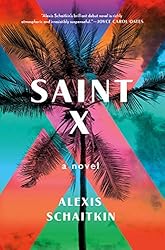
Saint X
Alexis Schaitkin, 2020
Celadon Books
352 pp.
ISBN-13: 9781250219596
Summary
When you lose the person who is most essential to you, who do you become?
Claire is only seven years old when her college-age sister, Alison, disappears on the last night of their family vacation at a resort on the Caribbean island of Saint X. Several days later, Alison’s body is found in a remote spot on a nearby cay, and two local men–employees at the resort–are arrested.
But the evidence is slim, the timeline against it, and the men are soon released. The story turns into national tabloid news, a lurid mystery that will go unsolved. For Claire and her parents, there is only the return home to broken lives.
Years later, Claire is living and working in New York City when a brief but fateful encounter brings her together with Clive Richardson, one of the men originally suspected of murdering her sister.
It is a moment that sets Claire on an obsessive pursuit of the truth–not only to find out what happened the night of Alison’s death but also to answer the elusive question: Who exactly was her sister? At seven, Claire had been barely old enough to know her: a beautiful, changeable, provocative girl of eighteen at a turbulent moment of identity formation.
As Claire doggedly shadows Clive, hoping to gain his trust, waiting for the slip that will reveal the truth, an unlikely attachment develops between them, two people whose lives were forever marked by the same tragedy.
For readers of Emma Cline’s The Girls and Lauren Groff’s Fates and Furies, Saint X is a flawlessly drawn and deeply moving story that culminates in an emotionally powerful ending. (From the publisher.)
Author Bio
Alexis Schaitkin’s short stories and essays have appeared in Ecotone, Southwest Review, Southern Review, New York Times, and elsewhere. Her fiction has been anthologized in The Best American Short Stories and The Best American Nonrequired Reading.
Schaitkin received her MFA in fiction from the University of Virginia, where she was a Henry Hoyns Fellow. She lives in Williamstown, Massachusetts, with her husband and son. Saint X is her debut novel. (From the publisher.)
Book Reviews
Any death of course creates aftershocks among those closest to the deceased, but we rarely spare a thought for those on the fringes. Schaitkin does, demonstrating in no more than a few pages each how Alison's passing affects her various satellites: her teacher, roommate, a random man on holiday, an actor, the girlfriend of the suspect and so on. The connections are faint, the domino effect crystal clear. All these sub-narratives dedicated to minor and major characters, chapters that do little to move the plot along, could easily have resulted in a novel that buckled under the weight of its structural ambitions, but Schaitkin pulls it off without a hitch.… Saint X is hypnotic, delivering acute social commentary on everything from class and race to familial bonds and community…. I devoured Saint X in a day.
Oyinkan Braithwaite - New York Times Book Review -
A smart, socially conscious thriller that will take you away.
People
There’s one moment in every person’s life, posits Saint X, that will define the rest of it. For many in this novel, it’s the death of Alison Thomas, a teenage girl who perishes while vacationing with her family on a Caribbean island. The mystery remains unsolved until years later, when her sister Claire runs into one of the original suspects in New York and befriends him, hoping to piece together what happened to Alison. Claire’s obsessive pursuit of the truth gives Alexis Schaitkin’s debut the urgency of a thriller, but its most compelling chapters take the perspectives of peripheral characters, whose accounts alter our understanding of Alison’s death–and of where it happened: a cruel, fragile paradise.
Entertainment Weekly
Schaitkin’s unsettling debut plays with the conventions of the romantic thriller to comment on the uneasy relationship between working-class residents of a fictional island in the Caribbean and the wealthy American tourists…. This is a smart page-turner, both thought-provoking and effortlessly entertaining.
Publishers Weekly
While point-of-view shifts may be confusing…, the richness of the characters makes the attempt worthwhile. Questions of race and privilege deepen the impact of the characters' struggles…. Readers who enjoy a mystery with emotional depth will find this a compelling and impressive debut. —Julie Ciccarelli, Tacoma P.L., WA
Library Journal
Magnetic…a nuanced examination of class, privilege and the terrible ways that tragedy can echo forward in time. Schaitkin embellishes a strong plot with psychologically complex main characters…. This is a must-read for fans of literary suspense.
BookPage
(Starred review) The death of a teenage vacationer on a fictional Caribbean island reverberates through many lives, particularly those of her 7-year-old sister and one of the workers at the resort.…This writer is fearless, and her…killer debut is a thriller…and insightful study of race, class, and obsession.
Kirkus Reviews
Discussion Questions
1. What does the island setting contribute to the story? What about the juxtaposition of New York City?
2. What do you think Claire’s habit of writing words in the air with her finger demonstrates about her?
3. What’s the symbolism of Faraway Cay and the woman with hooves for feet? What does that mythology add to the story?
4. Why do you think the author chose to intersperse the voices of minor characters, such as the movie actor and other vacationers, throughout the book? What effect does this achieve?
5. What does Claire’s name change to Emily signify to you?
6. Did you ever think Clive might pose a threat to Emily when he found out who she was?
7. What does Clive’s nickname Gogo indicate about his personality? About Edwin’s?
8. Emily’s world in New York becomes very small after she encounters Clive. Do you think that was intentional or unintentional on her part? What might have motivated her to turn inward?
9. What do Alison’s recorded diary entries reveal to Emily? Was Emily right to listen to them, or do you think it was an invasion of privacy? What about their mom?
10. What are the similarities between Emily’s life in New York and Clive’s? What are the differences?
11. What do you think about Edwin’s relationship with Sara?
12. Alison witnessed a pivotal moment in Clive and Edwin’s relationship. How did that shape the rest of the narrative—Clive and Edwin’s relationship, their futures, Alison’s tragedy?
13. When Emily learns the truth, and remembers the night before Alison disappeared, what do you think is her primary emotion? Grief? Relief? Guilt? Something else?
14. Do you think Emily coming into Clive’s life was ultimately a bad thing or a good thing for Clive?
(Questions issued by the publisher.)

Saints of All Occasions
J. Courtney Sullivan, 2017
Knopf Doubleday
352 pp.
ISBN-13: 9780307959577
Summary
A sweeping, unforgettable novel from The New York Times best-selling author of Maine, about the hope, sacrifice, and love between two sisters and the secret that drives them apart.
Nora and Theresa Flynn are 21 and 17 when they leave their small village in Ireland and journey to America. Nora is the responsible sister; she's shy and serious and engaged to a man she isn't sure that she loves. Theresa is gregarious; she is thrilled by their new life in Boston and besotted with the fashionable dresses and dance halls on Dudley Street.
But when Theresa ends up pregnant, Nora is forced to come up with a plan—a decision with repercussions they are both far too young to understand.
Fifty years later, Nora is the matriarch of a big Catholic family with four grown children: John, a successful, if opportunistic, political consultant; Bridget, quietly preparing to have a baby with her girlfriend; Brian, at loose ends after a failed baseball career; and Patrick, Nora's favorite, the beautiful boy who gives her no end of heartache.
Estranged from her sister, Theresa is a cloistered nun, living in an abbey in rural Vermont. Until, after decades of silence, a sudden death forces Nora and Theresa to confront the choices they made so long ago.
A graceful, supremely moving novel from one of our most beloved writers, Saints for All Occasions explores the fascinating, funny, and sometimes achingly sad ways a secret at the heart of one family both breaks them and binds them together. (From the publisher.)
Author Bio
• Birth—1982
• Where—near Boston, Massachusetts, USA
• Education—B.A., Smith College
• Currently—Brooklyn, New York, New York
Julie Courtney Sullivan, better known as J. Courtney Sullivan, is an American novelist and former writer for the New York Times. She comes from an Irish-Catholic family where many of the women go by their middle rather than first names.
Sullivan grew up outside of Boston, Massachusetts. She attended Smith College in Northampton, Massachusetts, where she majored in Victorian literature and received the Ellen M. Hatfield Memorial Prize for best short story, the Norma M. Leas prize for excellence in written English, and the Jeanne MacFarland Prize for excellent work in Women's Studies.
She graduated in 2003, then moved to New York and began working at Allure. Sullivan later moved to the New York Times, where she worked for over three years. Her writing has since appeared in the New York Times Book Review, Chicago Tribune, New York magazine, New York Observer, Men's Vogue, Elle, and Glamour.
In 2007, her first book was published, a dating guide titled Dating Up: Dump the Shlump and Find a Quality Man; she has since stated that she wrote the book for money and that "fiction was always [her] passion."
She self-identifies as a feminist, a stance that has been reflected in both her fiction and nonfiction work. In 2006, she wrote a piece for the New York Times "Modern Love" column about her experiences in the dating world, and in 2010 she co-edited a feminist essay collection titled Click: When We Knew We Were Feminists. Her novels often deal prominently with relationships between female characters.
Currently, Sullivan serves on the advisory board of Girls Write Now, a nonprofit organization that pairs young and professional female writers in mentoring partnerships. She has also been involved with GEMS, a New York organization dedicated to ending child sex trafficking.[6]
Novels
• Commencement
In 2010, Sullivan published her first novel, Commencement, which focuses on the experiences of four friends at Smith College, Sullivan's alma mater. She wrote 15 different drafts of the book before sending it to her editor, after which it underwent two or three more revisions.
Commencement received positive reviews from many major publications and became a New York Times bestseller. After the book's publication, feminist icon Gloria Steinem called Sullivan personally to offer her praise. Steinem described the novel as "generous-hearted, brave...Commencement makes clear that the feminist revolution is just beginning". In 2011, Oprah's Book Club included Commencement in a list of "5 Feminist Classics to (Re)read as a Mom, Wife and Writer."
• Maine
Sullivan's second novel, Maine, deals with four women from three different generations of the same family spending the summer at a beachfront cottage in New England. Though Sullivan did not base the fictional Kellehers directly on her own Irish-Catholic family, she drew on her own childhood experiences while writing the novel. Maine received reviews that were slightly more mixed than those for Commencement, but that were ultimately postitive. It was named one of the top ten fiction books of 2011 by Time magazine.
• The Engagements
Sullivan's third novel, The Engagements, came out in 2013 to solid reviews. The novel traces four different marriages. Ron Charles of the Washington Post called it, "a delightful marriage of cultural research and literary entertainment." (From Wikipedia. Retrieved 6/11/2013.)
Book Reviews
[R]ichly told.… Sullivan writes assuredly and engagingly, layering her story with complexity, if not always depth. Perspective shifts among characters, making us care for them, sometimes in spite of themselves, and even laugh at them a little. For all of its sorrow, the book refuses to be weighed down by sadness. In fact, there is a buoyancy that draws its lightness from family conversation, the closeness of siblings, and the care and devotion of nuns in Theresa’s abbey. Much to talk about for book clubs. A super read. READ MORE …
Molly Lundquist - LitLovers
Sullivan succeeds in creating a believably complicated, clannish Irish-American family, and the novel’s most engrossing scenes occur when the Raffertys gather in Nora’s kitchen to drink beer, laugh at inside jokes, finger old wounds and puzzle over their dour, conscientious mother. Because it’s Nora, rather than Theresa, who emerges as the novel’s most mysterious character. Its real drama involves her gradual transformation from a shy, unhappy young immigrant to an established matriarch, with a matriarch’s long skein of pride and sorrow — and secrets.
Suzanne Berne - New York Times Book Review
Here to fill the Brooklyn-sized hole in your heart is the story of sisters Nora and Theresa Flynn, Irish Catholics who journey to America full of hope (Best Books to Read in 2017).
Elizabeth Logan - Glamour
Sullivan has a gift for capturing complicated sibling dynamics, especially in a family ruled by Catholic repression.… [Her] quiet ending is a satisfying conclusion to this rich, well-crafted story.
Publishers Weekly
Sullivan brings her characters to life, capturing the complexities and nuances of family, tradition, and kept secrets. For all fiction readers. —Joanna Burkhardt, Univ. of Rhode Island Libs., Providence
Library Journal
Sullivan once again expertly delivers a messy and complicated family story with sharp yet sympathetic writing. —Magan Szwarek
Booklist
Of Catholic guilt, silences, and secrets: an expertly spun family drama, a genre Sullivan has staked out as her own.… Sullivan often approaches melodrama, but she steers clear of the sentimentality that might easily have crept into this tale of regret and nostalgia.
Kirkus Reviews
Discussion Questions
1. Describe the differences between Nora and Theresa when they were girls. Did you find it surprising how their paths diverged as they grew older?
2. Discuss Nora’s sense of responsibility and obligation to her family, including as the oldest sibling and following her mother’s death. How does this role, which she adopts from a young age, influence her understanding of motherhood throughout her life?
3. Although Patrick is not alive in the present-day sections of the novel (2009), how does the author give us a full portrait of his character? What do others’ opinions and memories of him help us glean about his personality and behaviors that a more direct interaction with him in the narrative wouldn’t provide?
4. How do all of Nora’s children complement one another, even as we see their vastly disparate feelings toward Patrick? What do their reactions Even though a death is at the center of the novel’s plot, did you find that death was a central concern of the novel’s themes? Either way, what does the cascade of events following a death like Patrick’s suggest about how we might value our time with loved ones and the legacy that we leave them with when we’re gone?
5. Even though a death is at the center of the novel’s plot, did you find that death was a central concern of the novel’s themes? Either way, what does the cascade of events following a death like Patrick’s suggest about how we might value our time with loved ones and the legacy that we leave them with when we’re gone?
6. Discuss the portrayal of romantic love in the novel: between Nora and Charlie, Bridget and Natalie, John and Julia, and other couples. How is it prioritized differently among them, and what are the particular ways that affection and passion manifest themselves between couples?
7. How does Mother Cecilia’s experience in the abbey compare with your expectations of what religious life is like? Were you surprised by any of the stances she took toward the church, other nuns and priests, and changes in culture during the novel’s time period of the late 1950s through 2009?
8. What seem to be the biggest differences between the girls’ lives in Ireland and their lives in the United States? Did you feel that either of them regretted the move at any given point, and why?
9. Describe the shifting gender dynamics over the course of the novel’s time line. In the roughly fifty years that pass, what changes about men’s and women’s roles and what doesn’t, including to the roles influenced by the family’s deep, traditional Irish roots?
10. How do Nora and Theresa respond differently to the task of motherhood that falls upon them, biologically or otherwise? In what ways are they both mothers to Patrick and the other people in their lives? How does the novel upend the traditional definition of motherhood, which Nora describes as “a physical act as much as an emotional one. It took every part of you” (page 229)?
11. How did the structure of the novel influence your understanding of and sympathy toward the characters as the narrative moved back and forth in time? What was the benefit of learning about Patrick, in particular, in this way—seeing him first in a posthumous light and then more closely as he grew up? And how did the perspective on the family that you had as a reader differ from what the characters could know about themselves and one another in real time?
12. What were common threads among the secrets the characters kept from one another? Why do you think some characters, more than others, were more willing to be complicit in keeping those secrets, especially when it came to Patrick?
13. How do you think the circumstances of Patrick’s birth affected his sense of belonging, even if only implicitly? What other characters struggled to feel like they belonged, and how did they deal with those feelings?
14. Early in the novel, Theresa is described as “simply the most. The most brave and beautiful and brash and clever” (page 15). How does this quality help her stay resilient through the many obstacles in her life? How do other characters, including Nora, prove to be resilient in their own ways, and which characters are most successful?
15. What did you make of the end of the novel? Do you think that the sisters will be able to truly forgive each other, or is their past too much to overcome?
16. Consider your own family relationships and customs, including religious beliefs and traditions. Were there parts of the Raffertys’ rituals or conflicts among one another that seemed familiar to you, even if they weren’t specific to being Irish and/or Catholic?
(Questions issued by the publisher.)
top of page (summary)

Salvage the Bones
Jesmyn Ward, 2011
Bloomsbury USA
272 pp.
ISBN-13: 9781608196265
Summary
Winner, 2011 National Book Award
A hurricane is building over the Gulf of Mexico, threatening the coastal town of Bois Sauvage, Mississippi, and Esch's father is growing concerned. A hard drinker, largely absent, he doesn't show concern for much else.
Esch and her three brothers are stocking food, but there isn't much to save. Lately, Esch can't keep down what food she gets; she's fourteen and pregnant. Her brother Skeetah is sneaking scraps for his prized pitbull's new litter, dying one by one in the dirt. Meanwhile, brothers Randall and Junior try to stake their claim in a family long on child's play and short on parenting.
As the twelve days that make up the novel's framework yield to their dramatic conclusion, this unforgettable family-motherless children sacrificing for one another as they can, protecting and nurturing where love is scarce-pulls itself up to face another day.
A big-hearted novel about familial love and community against all odds, and a wrenching look at the lonesome, brutal, and restrictive realities of rural poverty, Salvage the Bones is muscled with poetry, revelatory, and real. (From the publisher.)
Author Bio
• Birth—1977
• Where—DeLisle, Mississippi, USA
• Education—B.A., Stanford University; M.F.A., University of Michigan
• Awards—2 National Book Awards (others below)
• Currently—lives in Mississippi; commutes to Mobile, Alabama
Jesmyn Ward is an American novelist and two-time National Book Award winner for fiction. Salvage the Bones won in 2011 (it also won a 2012 Alex Award), and Sing, the Unburied, Sing, won in 2017. Her other two books include her first novel, Where the Line Bleeds (2008) and a memoir, The Men We Reaped (2013), about the deaths of her brother and other young male friends.
Early years
Jesmyn Ward grew up in DeLisle, a small rural community in Mississippi. She developed a love-hate relationship with her hometown after having been bullied at public school by black classmates and, subsequently, by white students while attending a private school paid for by her mother’s employer.
Ward received her undergraduate degree from Stanford University, choosing to become a writer upon graduation in order to honor the memory of her younger brother killed by a drunk driver earlier that year. Ward went on to earn an M.F.A. from the University of Michigan in 2005. At U of M she won five Hopwood Awards for essays, drama, and fiction.
Shortly afterwards, she and her family became victims of the 2005 Hurricane Katrina. With their house in De Lisle flooding rapidly, the Ward family set out in their car to get to a local church, but ended up stranded in a field full of tractors. When the white owners of the land eventually checked on their possessions, they refused to invite the Wards into their home, claiming they were overcrowded. Tired and traumatized, the refugees were eventually given shelter by another white family down the road.
Ward went on to work at the University of New Orleans, where her daily commute took her through neighborhoods ravaged by the hurricane. Empathizing with the struggle of the survivors and coming to terms with her own experience during the storm, Ward was unable to write creatively for three years—the time it took her to find a publisher for her first novel, Where the Line Bleeds.
In 2008 she returned to Stanford as a Stegner Fellow—one of the most prestigious awards available to emerging American writers.
Literary career
Earlier in 2008, just as Ward was deciding to give up writing and enroll in a nursing program, Where the Line Bleeds was accepted by Doug Seibold at Agate Publishing. Starting on the day twin protagonists Joshua and Christophe DeLisle graduate from high school, Where the Line Bleeds follows the brothers as their choices pull them in opposite directions. Unwilling to leave the small rural town on the Gulf Coast where they were raised by their loving grandmother, the twins struggle to find work, with Joshua eventually becoming a dock hand and Christophe joining his drug-dealing cousin.
In a starred review, Publishers Weekly called Ward "a fresh new voice in American literature" who "unflinchingly describes a world full of despair but not devoid of hope." The novel was picked as a Book Club Selection by Essence and received a Black Caucus of the American Library Association (BCALA) Honor Award in 2009. It was shortlisted for the Virginia Commonwealth University Cabell First Novelist Award and the Hurston-Wright Legacy Award.
Her second novel Salvage the Bones (2011) homes in once more on the visceral bond between poor black siblings growing up on the Gulf Coast. Chronicling the lives of pregnant teenager Esch Batiste, her three brothers, and their father during the 10 days leading up to Hurricane Katrina, the day of the cyclone, and the day after, Ward uses a vibrant language steeped in metaphors to illuminate the fundamental aspects of love, friendship, passion, and tenderness.
Explaining her main character's fascination with the Greek mythological figure of Medea, Ward told Elizabeth Hoover of the Paris Review
It infuriates me that the work of white American writers can be universal and lay claim to classic texts, while black and female authors are ghetto-ized as "other." I wanted to align Esch with that classic text, with the universal figure of Medea, the antihero, to claim that tradition as part of my Western literary heritage. The stories I write are particular to my community and my people, which means the details are particular to our circumstances, but the larger story of the survivor, the savage, is essentially a universal, human one.
In 2011, Ward won the National Book Award in the Fiction category for Salvage the Bones. Interviewed by CNN’s Ed Lavandera, she said that both her nomination and her victory had come as a surprise, given that the novel had been largely ignored by mainstream reviewers. In a television interview with Anna Bressanin of BBC News on (December 22, 2011), Ward said...
When I hear people talking about the fact that they think we live in a post-racial America, … it blows my mind, because I don’t know that place. I’ve never lived there. … If one day, … they’re able to pick up my work and read it and see … the characters in my books as human beings and feel for them, then I think that that is a political act.
Jesmyn Ward received an Alex Award for Salvage the Bones in 2012. The Alex Awards are given out each year by the Young Adult Library Services Association to ten books written for adults that resonate strongly with young people aged 12 through 18. Commenting on the winning books in School Library Journal, former Alex Award committee chair, Angela Carstensen described Salvage the Bones as a novel with "a small but intense following—each reader has passed the book to a friend."
In 2013, Ward published her memoir Men We Reaped. She announced on her blog two years earlier that she had finished the book's first draft, calling it the hardest thing she had ever written. The memoir explores the lives of her brother and four other young black men who lost their lives in her hometown. (Adapted from the publisher and Wikipedia. Retrieved 9/28/2013.)
Book Reviews
On one level, Salvage the Bones is a simple story about a poor black family that's about to be trashed by one of the most deadly hurricanes in U.S. history. What makes the novel so powerful, though, is the way Ward winds private passions with that menace gathering force out in the Gulf of Mexico. Without a hint of pretension, in the simple lives of these poor people living among chickens and abandoned cars, she evokes the tenacious love and desperation of classical tragedy…Salvage the Bones has the aura of a classic about it.
Ron Charles - Washington Post
The novel’s power comes from the dread of the approaching storm and a pair of violent climaxes. The first is a dog fight, an appalling spectacle given emotional depth by Skeetah’s love for the pit bull China (their bond is the strongest and most affecting in the book). When the hurricane strikes, Ms. Ward endows it, too, with attributes maternal and savage: ‘Katrina is the mother we will remember until the next mother with large merciless hands, committed to blood, comes.
Wall Street Journal
Jesmyn Ward has written...the first Katrina-drenched fiction I'd press upon readers now.... Ward's pacing around the hurricane is exquisite—we nearly forget its impending savagery. The Batistes’ shared sacrifice is moving, made more so by their occasional shirking of sacrifice. Ward allows the letdowns integral to family life to play their part.
Cleveland Plain Dealer
Searing.... Despite the brutal world it depicts, Salvage the Bones is a beautiful read. Ward’s redolent prose conjures the magic and menace of the southern landscape.
Dallas Morning News
(Starred review.) Ward's poetic second novel covers the 12 days leading up to Hurricane Katrina via the rich, mournful voice of Esch Batiste, a pregnant 14-year-old black girl living.… [T]hough her voice threatens to overpower the story, it does a far greater service to the book by giving its cast of small lives a huge resonance.
Publishers Weekly
(Starred review.) Ward uses fearless, toughly lyrical language to convey this family's close-knit tenderness, the sheer bloody-minded difficulty of rural African American life.… [A]n eye-opening heartbreaker that ends in hope. —Barbara Hoffert
Library Journal
A pitch-perfect account of struggle and community in the rural South… Though the characters in Salvage the Bones face down Hurricane Katrina, the story isn’t really about the storm. It’s about people facing challenges, and how they band together to overcome adversity.
BookPage
Discussion Questions
Use our LitLovers Book Club Resources; they can help with discussions for any book:
• How to Discuss a Book (helpful discussion tips)
• Generic Discussion Questions—Fiction and Nonfiction
• Read-Think-Talk (a guided reading chart)
Also consider these LitLovers talking points to help get a discussion started for Salvage the Bones:
1. How would you describe the Batiste family—first, as a family unit, then each of the members, Esch (our narrator), Claude (the father), Randall, Skeetah, and Junior? What motivates (or not) each of them? Which family member frustrates you most? Which do you admire most?
2. Talk about Bois Sauvage and its deprivations—the poverty, unemployment and housing. How does the area shape the people, especially young people, who live there? Or the reverse—do its residents shape Bois Sauvage?
3. The love affair Skeetah has with China is very much at the heart of this story. Is Skeetah right to rob neighbors to obtain medicine he needs for her?
4. Are you disturbed by the book's concentration on dog fighting? How does the author portray the fighting? Does the love Skeetah has for China contradict your understanding of that culture?
5. What about Esch's pregnancy? Why might the author have created a narrator, and central character, as a young pregnant teenager? What, overall, does the author of this book suggest about the nature of motherhood?
6. What is the symbolic meaning of Esch's fascination with the myth of Medea? What does the author mean, in an interview with the Paris Review, when she says...
Medea is in Hurricane Katrina because her power to unmake worlds, to manipulate the elements, closely aligns with the storm. And [Medea is] in Esch, too.*
7. Suspense is results from the fact that readers are anxious to learn what happens to characters. However, given that readers know the outcome of Katrina—that it will destroy almost everything in its path—how does Ward create suspense in this story?
8. In what way is Katrina both destructive and cleansing? What does Katrina represent symbolically?
9. In the book's title, the word "salvage" is close to "savage." According to the author, the term savage has honor to it: meaning that, when all has been lost, "you are strong, you are fierce, and you possess hope."* Talk about the interplay between those two words—salvage and savage—in other words, the way the two come together in this book.
10. Were you disappointed in how the book ended? Ward, having experienced firsthand the horrors of Katrina, has said in the Paris Review...
I realized that if I was going to assume the responsibility of writing about my home, I needed narrative ruthlessness. I couldn’t dull the edges and fall in love with my characters and spare them. Life does not spare us.*
Do you agree with her? Or is her view of life too harsh? Isn't there also the possibility that life will spare us? What do you think?
(Questions by LitLovers. Please feel free to use them, online or off, with attribution. Thanks.)
*Paris Review.org, 8/30/2011
top of page (summary)


Salvation
Alyssa Coooper, 2012
Melange Press
236 pp.
ISBN-13: 9781612354866
Summary
Salvation has a bit of everything—young love, Victorian charm, and vampire horror, tied together with unique literary flair.
The story begins with Alec, a young man struggling to accept the brutal loss of his parents and find his place in an unforgiving world.
As his life tumbles in a downward spiral, Alec meets Maya, a girl who seems determined to change his life. With her friendship and support, he finally begins to crawl back towards the light.
But Maya is not what she seems.
She is a vampire, born on a small farm in the nineteenth century and brought into her immortal life by a man who has played the part of guardian angel, father, and lover to her—but who is also her greatest enemy. This foe has chased her for a century and chases her still, putting her and Alec both in mortal danger.
Together, they fight for survival, for life and for love, as they each desperately seek their own salvation. (From the publisher.)
Author Bio
• Birth—May 9, 1990
• Where—Belleville, Ontario, Canada
• Education—Advanced Graphic Design Diploma
• Currently—lives in Belleville, Ontario
Alyssa Cooper is a born wordweaver, swallowing stanzas like sustenance and leaving thumbnails of poetry everywhere she goes. She was born in Ontario, Canada, where she lives with her vintage typewriters and her personal library.
A poet and author with a passion for the literary and experimental, Alyssa writes passionately, viciously, and on any surface she can find. Her poetry has appeared in poetry anthologies and literary magazines since early 2012, including the Revival Literary Journal and Journey to Crone by Chuffed Buff Books. After the release of her novella, Sunshine, her prose began to gain popularity as well, with short stories appearing in Emrys Journal, The Brief Grislys, and Postscripts to Darkness.
Her first novel, a century-long romp through the life of a maladjusted vampire, was released on Halloween of 2012. Salvation was released digitally and in print by Melange Books, LLC. Her second novel, an anthem for the twenty-something lost in an adolescent wasteland, is anticipated for release from Melange Books in late 2013. She is also eagerly awaiting the release of her first poetry collection, Cold Breath of Life, all the while filling her bookshelves to bursting and draining countless pens. (From the author.)
Visit the author's website.
Book Reviews
Salvation is not your typical romance novel. We start knowing that Maya is going to die. She and Alec are together, but she’s dying. He doesn’t know how to let her go or how he will live without her. We see her death. It’s poignant, heartbreaking, and visceral... Alec is a heavily flawed character...[and] I found it hard to sympathize with [him] for a while.... Yet as things progress with Maya, we see a new side to Alec.... Maya is a vampire...[who] is killed by her maker. Merek.... Once Maya appears to die, we’re suddenly seeing her death again, but this time from her perspective. From there, we learn of Maya’s entire story.... The ending was…not happy, but it was perfect... This was a well written, haunting tale that will stick with you.
Patricia Eddy - Mystical Lit Lounge
I was sold instantly. The story follows a vampire girl named Mali. She comes into Alec's life at the perfect moment and helps him piece back together his life. They both fall for each other instantly and enjoy what little time they have together. Mali has a past, that follows her to Alec. Her creator, her past lover, and a dark secret that threatens her immortality. This story was definitely a FOUR STAR read.... I found the end a little depressing, but I honestly can not think of another way to tie this story up. It had to end the way it did.... If you love paranormal romances, this has a romance that crosses the times, filled with conflict and an undying love you can't go wrong with this book.
Kristine Schwartz - Schwartz Reviews
Discussion Questions
1. Identify Alec's character flaws in Book One; discuss which have been resolved by Book Three, and which are still existing.
2. What is the significance of Alec's dream sequence in Book One, Chapter Two?
3. Discuss the importance of Jeanne/Mali/Maya's chosen name to her identity through out the novel.
3. In Book Two, Mali is conflicted about her life as a vampire. By the time she meets Alec, she has come to terms with it. Discuss the evolution of her opinion and chose a side.
4. Consider Jeanne/Mali and Marek's relationship. Do you feel that there was ever a true connection between them, or a continuous co-dependent cycle?
5. Consider Mali's role in the deaths of the family members. Do you feel that her actions were justified?
(Questions provided courtesy of the author.)


The Same Sky
Amanda Eyre Ward, 2015
Random House
288 pp.
ISBN-13: 9780553390506
Summary
A beautiful and heartrending novel about motherhood, resilience, and faith—a ripped-from-the-headlines story of two families on both sides of the American border.
Alice and her husband, Jake, own a barbecue restaurant in Austin, Texas. Hardworking and popular in their community, they have a loving marriage and thriving business, but Alice still feels that something is missing, lying just beyond reach.
Carla is a strong-willed young girl who’s had to grow up fast, acting as caretaker to her six-year-old brother Junior. Years ago, her mother left the family behind in Honduras to make the arduous, illegal journey to Texas. But when Carla’s grandmother dies and violence in the city escalates, Carla takes fate into her own hands—and with Junior, she joins the thousands of children making their way across Mexico to America, facing great peril for the chance at a better life.
In this elegant novel, the lives of Alice and Carla will intersect in a profound and surprising way. Poignant and arresting, The Same Sky is about finding courage through struggle, hope amid heartache, and summoning the strength—no matter what dangers await—to find the place where you belong. (From the publisher.)
Author Bio
• Birth—1972
• Where—New York, New York, USA
• Raised—Rye, New York
• Education—B.A., William College; M.F.A., University of Montana
• Currently—lives in Austin, Texas
Amanda Eyre Ward was born in New York City in 1972. Her family moved to Rye, New York when she was four. Amanda attended Kent School in Kent, CT, where she wrote for the Kent News.
Amanda majored in English and American Studies at Williams College in Williamstown, Massachusetts. She studied fiction writing with Jim Shepard and spent her junior fall in coastal Kenya. She worked part-time at the Williamstown Public Library. After graduation, Amanda taught at Athens College in Greece for a year, and then moved to Missoula, Montana.
Amanda studied fiction writing at the University of Montana with Bill Kittredge, Dierdre McNamer, Debra Earling, and Kevin Canty, receiving her MFA. After traveling to Egypt, she took a job at the University of Montana Mansfield Library, working in Inter Library Loan.
In 1998, Amanda moved to Austin, Texas where she began working on Sleep Toward Heaven. She wrote for the Austin Chronicle and worked for a variety of Internet startups. In 1999, Amanda won third prize in the Austin Chronicle short story contest with her story "Miss Montana’s Wedding Day."
She published Butte as in Beautiful that same year.
In July, 2000, Amanda married the geologist Tip Meckel in Ouray, Colorado.
They spent a summer in New Orleans, Louisiana, where Amanda wrote the short stories "The Beginning of the Wrong Novel" and "Classified."
During that summer, Amanda finished Sleep Toward Heaven, which was published in 2003. That novel won the Violet Crown Book Award and was optioned for film by Sandra Bullock and Fox Searchlight. To promote Sleep Toward Heaven, Amanda, her baby, and her mother Mary-Anne Westley traveled to London and Paris.
Amanda moved to Waterville, Maine, where she wrote in an attic filled with books. Her second novel, How to Be Lost, was published in 2004 and was selected as a Target Bookmarked pick. It has been published in fifteen countries.
After a year in Maine and two years on Cape Cod, Massachusetts, Amanda and her family returned to Austin, Texas.
To research her third novel, Forgive Me, Amanda traveled with her sister, Liza Ward Bennigson, to Cape Town, South Africa. Forgive Me was published in 2007.
In 2009, she published her short story collection, Love Stories in This Town.
Close Your Eyes, Amanda's fourth novel, was published in 2011, receiving a four-star review in People Magazine and winning the Elle Lettres Readers' Prize for September. It inspired the Dallas Morning News to write, "With Close Your Eyes, Austin novelist Amanda Eyre Ward puts another jewel in her crown as the reigning doyenne of 'dark secrets' literary fiction."
Close Your Eyes was named in Kirkus Reviews Best Books of 2011, and won the Elle Magazine Fiction Book of the Year.
Amanda's fifth novel, The Same Sky, was published in 2015. It was considered one of the most anticipated books for 2015 by BookPeople and named a "Book of the Week" by People Magazine. Dallas Morning News wrote, "Ward has written a novel that brilliantly attaches us to broader perspectives. It is a needed respite from the angry politics surrounding border issues that, instead of dividing us, connects us to our humanity."
Amanda currently writes every morning and spends afternoons with her children. (From the author's website.)
Book Reviews
Surprising and deeply satisfying.... Ward has written a novel that brilliantly attaches us to broader perspectives. It is a needed respite from the angry politics surrounding border issues that, instead of dividing us, connects us to our humanity.
Dallas Morning News
A deeply affecting look at the contrast between middle-class U.S. life and the brutal reality of Central American children so desperate they’ll risk everything.
People
It takes a skilled, compassionate writer to craft an authentic, moving page-turner from a complex social issue like immigration, but Ward nails it.
Good Housekeeping
Poignant and bittersweet.... Eyre’s wrenching fifth novel is a study in contrasts.... Carla’s journey is powerfully rendered and will stick with readers long after they close the book.
Publishers Weekly
The Same Sky is a book that works to understand our community; not just our neighborhoods in Austin, but America as a whole. It’s important reading for anyone who has an opinion on immigration.
BookPeople
Ward writes with great empathy.... Earnest and well-told. Heartstrings will be pulled.
Kirkus Reviews
Discussion Questions
Use our LitLovers Book Club Resources; they can help with discussions for any book:
• How to Discuss a Book (helpful discussion tips)
• Generic Discussion Questions—Fiction and Nonfiction
• Read-Think-Talk (a guided reading chart)
(We'll add specific questions if and when they're made available by the publisher.)


The Same Sweet Girls
Cassandra King, 2005
Hyperion
560 pp.
ISBN-13: 9780786891092
Summary
"None of the Same Sweet Girls are really girls anymore, and none of them have actually ever been that sweet. But the story of this spirited group of six southern women, who have been holding biannual reunions ever since they were together in college, is nothing short of compelling.
The story of the Same Sweet Girls is told by three of the women who suddenly face middle age and major life changes. First lady Julia Stovall, the perfect political wife, is torn between loyalty to her husband, the governor of Alabama, and an unwelcome attraction to his bodyguard. The fun-loving former jock Lanier Sanders, who always finds a way to mess up her life, has done it yet again. And Corrine Cooper, a renowned gourd artist, battles her controlling ex-husband for the affection of her estranged son.
On an island every summer and in the mountains every fall, the Same Sweet Girls come together to share their stories. When one of the group faces the most difficult challenge of her life, the novel builds to a powerful conclusion. (From the publisher.)
Author Bio
• Birth—1944
• Where—Lower Alabama, USa
• Education—B.A., M.A., Alabama college
• Currently—lives in the Low Country, South Carolina
Cassandra King is the author of five novels, most recently the critically acclaimed Moonrise (2013), her literary homage to Rebecca by Daphne du Maurier. Moonrise is a Fall 2013 Okra Pick and a Southern Independent Booksellers Alliance (SIBA) bestseller. It has been described as “her finest book to date.”
Fellow Southern writers Sandra Brown, Fannie Flagg, and Dorothea Benton Frank hailed her previous novel, Queen of Broken Hearts (2008), as “wonderful,” “uplifting,” “absolutely fabulous,” and “filled with irresistible characters.” Prior to that, King’s third book, The Same Sweet Girls (2005), was a #1 Booksense Selection and Booksense bestseller, a Southeastern Bookseller Association bestseller, a New York Post Required Reading selection, and a Literary Guild Book-of-the-Month Club selection.
Her first novel, Making Waves in Zion, was published in 1995 by River City Press and reissued in 2004 by Hyperion. Her second novel, The Sunday Wife (2002), was a Booksense Pick, a People Magazine Page-Turner of the Week, a Literary Guild Book-of-the-Month selection, a Books-a-Million President’s Pick, a South Carolina State Readers’ Circle selection, and a Salt Lake Library Readers’ Choice Award nominee. In paperback, the novel was chosen by the Nestle Corporation for its campaign to promote reading groups.
King’s short fiction and essays have appeared in numerous journals and anthologies, including Callaloo, Alabama Bound: The Stories of a State (1995), Belles’ Letters: Contemporary Fiction by Alabama Women (1999), Stories From Where We Live (2002), and Stories From The Blue Moon Cafe (2004). Aside from writing fiction, she has taught writing on the college level, conducted corporate writing seminars, worked as a human-interest reporter for a Pelham, Alabama, weekly paper, and published an article on her second-favorite pastime, cooking, in Cooking Light magazine.
A native of L.A. (Lower Alabama), King currents lives in the Low Country of South Carolina with her husband, novelist Pat Conroy, whom she met when he wrote a blurb for Making Waves. (From the author's website.)
Book Reviews
For 30 years, six Southern college friends—the Same Sweet Girls—have been gathering for a biannual reunion. As King's wry, touching novel begins, the girls are nearing 50 and coming to terms with the life decisions they've made.... [T]he story's gentle Southern humor and warmth shine. It isn't all iced tea and tomato pie—King tackles some troubling issues—but the characters are true to life, and readers will sympathize with their struggles.
Publishers Weekly
Discussion Questions
1. Look at the Walt Whitman quote at the beginning of The Same Sweet Girls. Why does King use this here?
2. Why does Corrine state early on that, "The illusion of sweetness, that's all that counts. We don't have to be sincerely sweet, but by God we have to be good at faking it. Southern girls will stab you in the back, same as anyone else, but we'll give you a sugary smile while doing it"? Why is this important to the story? How do Southern women differ from women in other parts of the country?
3. Looking at each chapter, how is the book structured? Why does King utilize this style here? What is the affect of multiple narrators?
4. Briefly describe each of the Same Sweet Girls. Share your impression of the group. Who do you like the most, and why? What are their backgrounds? How did they become a group, and why are they such good friends?
5. Consider Miles, Jesse Phoenix, Joe Ed, Paul and Cal. What are your impressions of these men? What are their roles in the story?
6. Thinking about the couplings of Julia and Joe Ed, Corrine and Miles, and Lanier and Paul, how did these couples get together? What kind of relationships do these Same Sweet Girls have with the men in their lives? What do these relationships reveal, or possibly reflect, about the Same Sweet Girls views of themselves?
7. Focusing on Astor’s and Roseanelle’s role in the book. Why are these unlikely characters accepted and tolerated, even loved, by the rest of the group? How do they influence other characters in the book? Why do others accept and even ignore such obvious flaws in their friends?
8. Lanier keeps a sort of diary, what she calls her Life Lessons notebook. Think about some of Lanier's notebook entries. For example, "Any landing you walk away from is a good landing;" "When the pupil is ready, the teacher appears;" "Seems to me that all males are obsessed with expanding their bodies and females with shrinking theirs, which must have something to do with their self-images." Discuss what they mean and whether or not they are helpful to you.
9. In Chapter 12, what do you make of Julia's saying she "survived life by slow paddling down the river of denial"? What has she been denying? Recount her relationship with her mother. What was her mother's reaction when Bethany was born? Did Julia somehow agree with her mother? How does Julia evolve, and what enables her to do so?
10. Looking at Corrine, what do the gourds represent, both literally and figuratively? Why does King choose gourds instead of canvas or pottery for Corrine's art? Trace Corrine's personal history. Why is she the one who has a terminal disease? What does Miles mean when he says to her, "Your biography becomes your biology?" Is this true in her case? Do you believe this is true in general? Why?
11. What gives Corrine the motivation to stand up to Miles? Share how you reacted when she finally does.
12. In Chapter 18, Lindy confronts Lanier about Lanier's affect on her and others: "Then change, Mama . . ." How did you react do this speech? What would you say to Lindy? What would you say to Lanier?
13. In Chapter 23, there is a discussion of helping a friend die. What would you do if a friend or family member asked you to assist their death? Would you want that kind of help? Knowing what Corrine does about her disease, what you advise her to do about her treatment? Why is Lanier so surprised when she learns Paul might assist someone's death?
14. Why is Cal so attracted to Corrine? What is significant about the timing of his interest? What is the significance of the large kettle gourd that he returns to her? What enables his aged grandmother to understand the purpose of this kettle gourd? Discuss the paragraph in Chapter 26 where Cal says to Corrine, "Damn right you're not like me . . . You've got to finish that one."
15. What resonates, and affects you the most, about The Same Sweet Girls? What stays with you?
(Questions from the author's website.)
The Samurai's Garden
Gail Tsukiyama, 1994
St. Martin's Press
224 pp.
ISBN-13: 9780312144074
Summary
On the eve of the Second World War, a young Chinese man is sent to his family's summer home in Japan to recover from tuberculosis. He will rest, swim in the salubrious sea, and paint in the brilliant shoreside light. It will be quiet and solitary.
But he meets four local residents — a lovely young Japanese girl and three older people. What then ensues is a tale that readers will find at once classical yet utterly unique. Young Stephen has his own adventure, but it is the unfolding story of Matsu, Sachi, and Kenzo that seizes your attention and will stay with you forever.
Tsukiyama, with lines as clean, simple, telling, and dazzling as the best of Oriental art, has created an exquisite little masterpiece. (From the publisher.)
Author Bio
• Birth—N/A
• Where—San Francisco, California, USA
• Education—B.A., M.A., San Francisco State University
• Awards—Academy of American Poets Award;
PEN Oakland/Josephine Miles Literary Award
• Currently—El Cerito, California
Readers know Gail Tsukiyama through her best-selling novel The Samurai’s Garden (1994). Her other works include Women of the Silk (1991), Night of Many Dreams (1998), The Language of Threads (1999), The Street of a Thousand Blossoms (2007), Dreaming Water (2002), and A Hundred Flowers (2012).
Born to a Chinese mother and a Japanese father, she grew up in San Francisco and now lives in El Cerrito, California. She earned her bachelor's and master's degrees in English with a concentration in Creative Writing at San Francisco State University. With an understanding of her heritage, Tsukiyama explores the sights, sounds and feelings of China and Japan in her novels.
She was one of nine fiction authors to appear during the first Library of Congress National Book Festival in 2001. (From the publisher.)
Book Reviews
As the title suggests in this charming book, gardens are central to the thematic concerns. They require loving devotion and constant nurturing, the very qualities that heal the human body and soul and provide respite from the world's ills.
A LitLovers LitPick (Nov. '06)
Seventeen-year-old Stephen leaves his home in Hong Kong just as the Japanese are poised to invade China. He is sent to Tarumi, a small village in Japan, to recuperate from tuberculosis. His developing friendship with three adults and a young woman his own age brings him to the beginnings of wisdom about love, honor, and loss. Given the potentially interesting subplot (the story of a love triangle doomed by the outbreak of leprosy in the village) and the fascinating period in which the book is set, this second novel by the author of Women of the Silk (1991) has the potential to be a winner. Unfortunately, it is sunk by a flat, dull prose style, one-dimensional characters who fail to engage the reader's interest, and the author's tendency to tell rather than show. Libraries with comprehensive fiction collections might consider, but others can pass. —Nancy Pearl, Washington Ctr. for the Book, Seattle
Library Journal
Discussion Questions
1. The title of the novel obviously alludes to Matsu's garden, but to whom else could the title refer as a "Samurai"? Why?
2. The garden acts as a center or core of the novel. All three central characters (Stephen, Matsu, and Sachi) find some sense of comfort in tending the garden. What are some of the metaphors for the garden and how are they worked out in the novel?
3. Loneliness, solitude, and isolation are all themes that permeate the novel throughout. How do the three central characters' approaches to these feelings vary, resemble each other, and evolve?
4. It appears as though Stephen and Sachi are somehow juxtaposed. How is this connection represented and developed?
5. How is the politically turbulent time at which The Samurai's Garden takes place approached in the novel? Is it a strongly political novel or does the world of Tamuri somehow defy and avoid the political turmoil of the era?
6. How is Stephen and Keiko's relationship represented? Examine it in relation to the courtships of the past—Kenzo and Sachi, as well as Matsu and Sachi.
7. As the novel progresses, Stephen stops longing to return to his home and in fact dreads having to leave Tamuri. What provokes this change of heart? Also, how does this sentiment affect the ending of the novel?
(Questions issued by publisher.)
top of page (summary)


San Miguel
T.C. Boyle, 2012
Penguin Group USA
384 pp.
ISBN-13: 9780670026241
Summary
On a tiny, desolate, windswept island off the coast of Southern California, two families, one in the 1880s and one in the 1930s, come to start new lives and pursue dreams of self-reliance and freedom. Their extraordinary stories, full of struggle and hope, are the subject of T. C. Boyle’s haunting new novel.
Thirty-eight-year-old Marantha Waters arrives on San Miguel on New Year’s Day 1888 to restore her failing health. Joined by her husband, a stubborn, driven Civil War veteran who will take over the operation of the sheep ranch on the island, Marantha strives to persevere in the face of the hardships, some anticipated and some not, of living in such brutal isolation. Two years later their adopted teenage daughter, Edith, an aspiring actress, will exploit every opportunity to escape the captivity her father has imposed on her.
Time closes in on them all and as the new century approaches, the ranch stands untenanted. And then in March 1930, Elise Lester, a librarian from New York City, settles on San Miguel with her husband, Herbie, a World War I veteran full of manic energy. As the years go on they find a measure of fulfillment and serenity; Elise gives birth to two daughters, and the family even achieves a celebrity of sorts. But will the peace and beauty of the island see them through the impending war as it had seen them through the Depression?
Rendered in Boyle’s accomplished, assured voice, with great period detail and utterly memorable characters, this is a moving and dramatic work from one of America’s most talented and inventive storytellers. (From the publisher.)
Author Bio
• Birth—December 2, 1948
• Where—Peekskill, New York, USA
• Education—B.A., State University of New York at Potsdam; Ph.D., Iowa University
• Awards—Pen/Faulkner Award, 1998
• Currently—lives near Santa Barbara, California
T. Coraghessan Boyle (kuh-RAGG-issun) received his doctorate in nineteenth-century English literature from the University of Iowa in 1977. Since 1977, Boyle has taught creative writing at the University of Southern California. While in college, Boyle exchanged his middle name, John, for the unusual Coraghessan (kuh-RAGG-issun), the name of one of his Irish ancestors.
Boyle is the author of Descent of Man (1979), Water Music (1982), Budding Prospects (1984), Greasy Lake (1985), World's End (1987, winner of the PEN/Faulkner Award for fiction), If the River Was Whiskey (1989), East Is East (1990), The Road to Wellville (1993), which was made into a movie starring Anthony Hopkins, and Without a Hero (1994). His work has appeared in major American magazines, including The New Yorker, Esquire, Harper's, Paris Review, and Atlantic Monthly. Boyle lives with his wife, Karen, and their three children near Santa Barbara, California, in a house designed in 1909 by the architect Frank Lloyd Wright.
More
In the interest of time and space, it might be easier to note the writers that T. C. Boyle isn't compared to. But let's give the reverse a try: Donald Barthelme, John Barth, Thomas Pynchon, Evelyn Waugh, Franz Kafka, James Joyce, Kingsley Amis, Thomas Berger, Robert Coover, Lorrie Moore, Stanley Elkin, Tom Robbins, Tom Wolfe, Hunter S. Thompson, Don DeLillo, Flannery O'Connor. Oh, let's not forget F. Lee Bailey. And Dr. Seuss.
Boyle, widely admired for his acrobatic verbal skill, wild narratives and quirky characters (in one short story, he imagines a love affair between Dwight Eisenhower and Nikita Khrushchev's wife), has dazzled critics since his first novel in 1981.
Consider this example, from Larry McCaffery in a 1985 article for the New York Times:
Beneath its surface play, erudition and sheer storytelling power, his fiction also presents a disturbing and convincing critique of an American society so jaded with sensationalized images and plasticized excess that nothing stirs its spirit anymore.... It is into this world that Mr. Boyle projects his heroes, who are typically lusty, exuberant dreamers whose wildly inflated ambitions lead them into a series of hilarious, often disastrous adventures.
But as much as critics will bow at his linguistic gifts, some also knock him for resting on them a bit too heavily, hinting that the impressive showmanship attempts to hide a shortage of depth and substance. Craig Seligman, writing in the New Republic in 1993, pointed out that...
Boyle loves a mess. He loves chaos. He loves marshes and jungles, and he loves the jungle of language: luxuriant sentences overgrown with lianas of lists, sesquipedalian words hanging down like rare fruits. For all its exoticism, though, his prose is lucid to the point of transparency. It doesn't require much deeper concentration than a good newspaper (though it does require a dictionary).
Reviewing The Tortilla Curtain in 1995, New York Times critic Scott Spencer scratched his head over why Boyle had invited readers along for this particular ride:
Mr. Boyle's fictional strategy is puzzling. Why are we being asked to follow the fates of characters for whom he clearly feels such contempt? Not surprisingly, this is ultimately off-putting. Perhaps Mr. Boyle has received too much praise for his zany sense of humor; in this book, that wit often seems merely a maddening volley of cheap shots. It's like living next door to a gun nut who spends all day and half the night shooting at beer bottles.
Growing up, Boyle had no aspirations to be a writer. It wasn't until his studies at State University of New York, where he as a music student, that he bumped into his muse. "I went there to be a music major but found I really couldn't hack that at the age of 17," he told The Writer in 1999. "I just started to read outside my classes—literature and history. I wound up being a history and English major; when I wandered into a creative writing class as a junior, I realized that writing was what I could do."
He then started teaching, in part to avoid getting drafted into the Vietnam War, and later applied to the University of Iowa Writer's Workshop.
After a collection of short stories in 1979, he released his first novel, Water Music, called "pitiless and brilliant" by the New Republic, and has shuttled back and forth between novels and short stories, all known for their explosions of character imagination. Mr. Boyle's literary sensibility...thrives on excess, profusion, pushing past the limits of good taste to comic extremes," McCaffery wrote in his 1985 New York Times piece. "He is a master of rendering the grotesque details of the rot, decay and sleaze of a society up to its ears in K Mart oil cans, Kitty Litter and the rusted skeletons of abandoned cars and refrigerators."
In his review of Drop City, the 2003 novel set in California commune that won Boyle a National Book Award nomination, Dwight Garner joins the chorus of critical acclaim over the years—"Boyle has always been a fiendishly talented writer"—but he also acknowledges some of the criticism that Boyle has faced in these same years:
The rap against Boyle's work has long been that he's a sort of madcap predator drone, raining down hard nuggets of contempt, sarcasm and bitter humor on the poor men and women in his books while rarely giving us characters we're actually persuaded to feel anything about. This is partly a bum rap—and I'd hate to knock contempt, sarcasm and bitter humor—but there's enough truth in it that it's a joy to find, in Drop City that Boyle gives us a lot more than simply a line of bong-addled innocents led to slaughter.
But perhaps the neatest summary of Boyle's work would be from Lorrie Moore, one of the novelists to which he has been compared. In a 1994 New York Times review of Boyle's short story collection Without a Hero, she praised Boyle's "astonishing and characteristic verve, his unaverted gaze, his fascination with everything lunatic and queasy." She continues...
God knows, Mr. Boyle can write like an angel, if at times a caustic, gum-chewing one. And in this strong, varied collection maybe we have what we'd hope to find in heaven itself (by the time we begged our way there): no lessening of brilliance, plus a couple of laughs to mitigate all that high and distant sighing over what goes on below."
Extras
• Boyle changed his middle name from John to Coraghessan ( "kuh-RAGG-issun") when he was 17.
• He is known almost as much for his ego as his writing. "Each book I put out, I think, 'Goodbye, Updike and Mailer, forget it," the New Republic quoted him as saying. "I joke at Viking that I'm going to make them forget the name of Stephen King forever, I'm going to sell so many copies.
• Boyle's philosophy on reading and writing, as told to The Writer: "Good literature is a living, brilliant, great thing that speaks to you on an individual and personal level. You're the reader. I think the essence of it is telling a story. It's entertainment. It's not something to be taught in a classroom, necessarily. To be alive and be good, it has to be a good story that grabs you by the nose and doesn't let you go till The End." (From Barnes and Noble)
Book Reviews
In T. Coraghessan Boyle’s mesmerizing and elegiac 14th novel, “San Miguel,” two utopians from different eras establish their own private idylls on the desolate Channel Islands off the California coast.... The inhabitants find the island pummeled by sandstorms and shrouded by fogs, only infrequently giving way to rare days when it is the paradise they sought.
Small events grow in importance.... For Boyle, a writer known for his maximalist plots, it is a brave stylistic choice that pays off, allowing the reader a visceral experience of what life was like at the time. In “San Miguel,” the main egoist is also the most fully realized character: Herbie Lester.... Herbie’s high-octane, manic energy fuels the ranch. By turns, he is generous, loving and a good father; he is also moody, depressive and selfish.... Thanks to Boyle’s immense talent we come to care deeply about this complicated and difficult man’s fate.... Herbie’s infatuation with Haile Selass...indicate that the idyllic, isolated utopia they sought has become impossible to sustain.... In the pages of this novel, at least, that tantalizing dream is preserved.
New York Times Book Review
Theatrical as he appears in those outrageous shirts and jackets, in his fiction Boyle never steals the spotlight from his characters, from what they're wrestling with. His previous novel, When the Killing's Done (2011), took place on the Channel Islands off the coast of California and managed to make the complex issue of environmental reclamation tremendously exciting. His new novel, San Miguel, is a kind of prequel that again takes place on one of the Channel Islands, but the story's tone and pace are entirely different. Instead of violently dramatizing a contemporary debate, San Miguel is an absorbing work of historical fiction based on the lives of two real families who resided on San Miguel Island in the 19th and 20th centuries.
Ron Charles - Washington Post
Throughout his career, Boyle has shown a fascination with remote, forgotten places as a kind of stage where various shadings of the American character are revealed.... As always, he fills his pages with wonderfully precise character studies and lush descriptions of the physical landscape.
Hector Tobar - Los Angeles Times
The story of two families who lived on the windiest and wildest of the Channel Islands…the layering of these isolated lives, the archeology of human habitation, the different responses to self-sufficiency make this one of the most satisfying novels in Boyle’s canon.
Susan Salter Reynolds - Los Angeles Magazine
A saga of women, three women brought to the island by men.... Boyle has carved out a beautiful, damp, atmospheric novel, sharp and exacting…[his] spirited novels are a reckoning with consequence laced with humor, insight, and pathos.
Terry Tempest Williams - San Francisco Chronicle
In T.C. Boyle’s San Miguel, two strong women generations apart are seduced and mistreated by the same powerful entity – not a man but a starkly beautiful, barely inhabited island off the California coast.... Boyle portrays the heartbreaking toll San Miguel takes on these couples in a novel as beguiling as the island itself.
O, The Oprah Magazine
On New Year’s Day 1888, the ailing Marantha Waters sails across San Francisco Bay to remote San Miguel Island with her second husband and adopted daughter in hopes that the fresh air will restore her health. Marantha and her family, city folk by nature, risk the last of her inheritance on a farm lashed by wind and rain; removed from the pleasant distractions of late Victorian society and thrust into primitive living conditions, the Waters find themselves left with little to do but discover the strengths and weaknesses in themselves and in each other. Decades later during the Depression, Elise and Herbie Lester take over the farm and undergo their own transformations. Ripe with exhaustively researched period detail, Boyle’s epic saga of struggle, loss, and resilience (after When the Killing’s Done) tackles Pacific pioneer history with literary verve. The author subtly interweaves the fates of Native Americans, Irish immigrants, Spanish and Italian migrant workers, and Chinese fishermen into the Waters’ and the Lesters’ lives, but the novel is primarily a history of the land itself, unchanging despite its various visitors and residents, and as beautiful, imperfect, and unrelenting as Boyle’s characters.
Publishers Weekly
This latest novel from Boyle (The Women; When the Killing's Done) portrays two families living and working on barren San Miguel Island off the coast of California. In 1888 Marantha Waters leaves her comfortable life on mainland California and moves out to San Miguel with her adopted daughter and husband, a steely Civil War veteran convinced that he'll have success sheep ranching on the island. Marantha is seriously ill, but instead of breathing the clean, restorative air she expected, she must live in a drafty, moldy shack in a damp environment where the sun rarely shines. Years later, in 1930, Elise Lester, newly wed at 38, moves to San Miguel with her husband, Herbie, a World War I veteran. Though Herbie has his highs and lows, they are happy, and they have two daughters. The outside world learns of their pioneering ways, and they achieve a celebrity Herbie hopes will translate into additional income. Then World War II arrives, and with war in the Pacific, their insular island location may no longer be a refuge. Verdict: In this absorbing work, Boyle does an excellent job of describing the desperation and desolation of life on the island. Readers can almost feel the cold and damp seeping into their bones. —Shaunna Hunter, Hampden-Sydney Coll. Lib., VA
Library Journal
A richly rewarding read.... As ever, Boyle’s prose is vivid and precise, and he imbues his subjects with wonderful complexity. The perils and pleasures of island living, the limits to natural resources, and the echoes of war all provide ample grist for his mill.
Booklist
The prolific author's latest is historical, not only in period and subject matter, but in tone and ponderous theme. The 14th novel from Boyle returns to the Channel Islands off the coast of California, a setting which served him so well in his previous novel (When the Killing's Done, 2011). Some of the conflicts are similar as well- man versus nature, government regulation versus private enterprise- but otherwise this reads more like a novel that is a century or more old.... The novel tenuously connects the stories of two families who move, 50 years apart, to the isolation of the title island, in order to tend to a sheep ranch. For Marantha Waters, the symbolically fraught pilgrimage with her husband and daughter in 1888...is one of disillusionment and determination.... The ravages of the natural world (and their own moral natures) take their toll on the family, who are belatedly succeeded in the 1930s by a similar one, as newlyweds anticipate their move west.... What may seem to some like paradise offers no happy endings in this fine novel.
Kirkus Reviews
Discussion Questions
1. Have you ever dreamed of living off the grid? If so, what about the idea appeals to you? If not, how long do you think you could endure the isolation? Did San Miguel change your mind one way or another?
2. What would you find most challenging about life on San Miguel: the limited human companionship, the rudimentary living conditions, the monotony of the landscape, or something else?
3. Marantha’s forgotten box of china plates represents the distant, civilized world. What would represent it for you?
4. Long before the Waterses or the Lesters, a tribe of Native Americans inhabited the island. How might their experiences on San Miguel have compared with those of the homesteaders?
5. After Marantha’s death, Waters withdraws Edith from school and takes her to San Miguel so he can keep an eye on her. Yet it’s on San Miguel that she explores her sexuality with Jimmie and then barters sexual favors in order to escape. Is Waters really concerned with preserving her chastity?
6. Were you surprised to learn that Edith would marry and divorce three times and put her own daughter up for adoption? How, if at all, are Edith’s later actions shaped by her experiences on San Miguel?
7. Both Marantha and Elise are brought to the island by their husbands. Neither woman has much say in the matter. Whether or not you’re married, would you make such a dramatic move at your spouse’s request?
8. During their time on the island, Marantha and Elise both receive unexpected foreign visitors. Chinese abalone collectors visit Marantha, and Japanese fishermen call upon Elise. The women welcome these visitors politely, but their husbands drive them away. Why did Boyle choose to include these incidents?
9. Marantha’s time on San Miguel is pure hardship, but Elise’s is tempered with happiness. If you were Elise, would you have regretted marrying Herbie and moving to San Miguel? Or are her joys sufficient compensation for the tragedy of his suicide?
10. After Herbie’s death, what do you think Marianne and Betsy will find most challenging about adjusting to life off San Miguel?
11. How might modern technology affect the experience of living somewhere like San Miguel Island? Would greater connectivity to the larger world make the isolation easier or more difficult?
12. Ultimately, the government revokes Bob Brooks’s lease on San Miguel, takes away all the sheep, and makes it so that “anyone who wanted to come here or dream here or walk the hills and breathe the air would need to have a permit in hand” (p. 366). Do you agree with the government’s decision? How does Boyle view it?
(Questions issued by publisher.)


The Sandcastle Girls
Chris Bohjalian, 2012
Knopf Doubleday
320 pp.
ISBN-13: 9780307743916
Summary
In his fifteenth book, The Sandcastle Girls, Chris Bohjalian takes us to a time and place—Syria, 1915—that left haunting legacies for his Armenian heritage, making this his most personal novel to date.
A sweeping historical love story, The Sandcastle Girls introduces us to Elizabeth Endicott, an adventure-seeking graduate of Mount Holyoke College who travels to Syria just as the Great War has begun to spread across Europe. With only a crash course in nursing, Elizabeth has volunteered on behalf of the Boston-based Friends of Armenia to deliver food and medical aid to refugees of the genocide.
She soon befriends a striking Armenian engineer. He is young, but he has already lost his wife and infant daughter to Turkish brutality. When Armen leaves Aleppo to join the British army in Egypt, he and Elizabeth begin a daring correspondence, bridging their very different worlds with words of love and hope.
Interwoven with their tale is the story of Laura Petrosian, a contemporary novelist living in suburban New York. Although her grandparents' ornate Pelham home was affectionately nicknamed “The Ottoman Annex,” Laura has never really given her Armenian heritage much thought.
But when an old friend calls, claiming to have seen a newspaper photo of Laura's grandmother promoting an exhibit at a Boston museum, Laura embarks on a journey back through her family's history that reveals love, loss—and a wrenching secret that has been buried for generations.
An epic story of love and war, The Sandcastle Girls will captivate your reading group. We hope this guide will enrich your discussion. (From the publisher.)
Author Bio
• Birth—1960
• Where—White Plains, New York, USA
• Education—Amherst College
• Awards—Anahid Literary Award, 2000; New England Book Award, 2002
• Currently—lives in Lincoln, Vermont
Christopher Aram Bohjalian, who goes by the pen name Chris Bohjalian, is an American novelist. Bohjalian is the author of 15 novels, including New York Times bestsellers Midwives, Secrets of Eden, The Law of Similars, Before You Know Kindness, The Double Bind, Skeletons at the Feast, and The Night Strangers.
Bohjalian is the son of Aram Bohjalian, who was a senior vice president of the New York advertising agency Romann & Tannenholz. Chris Bohjalian graduated summa cum laude from Amherst College, where he was a member of the Phi Beta Kappa Society. In the mid-1980s, he worked as an account representative for J. Walter Thompson advertising agency in New York.
He and his wife lived in a co-op in Brooklyn until March 1986, when the two were riding in a taxicab in which the driver refused to let them out of the car for 45 minutes, ignoring all traffic lights and stop signs. Around midnight, the driver dropped them off at a near-deserted street in front of a crack house, where the police were conducting a raid and Bohjalian and his wife were forced to drop to the ground for their protection. The incident prompted the couple to move from Brooklyn; Bohjalian said, "After it was all over, we just thought, "Why do we live here?" A few days later, the couple read an ad in The New York Times referencing the "People's Republic of Vermont," and in 1987 the couple moved to Lincoln, Vermont.
Early career
After buying their house, Bohjalian began writing weekly columns for local newspaper and magazine about living in the small town, which had a population of about 975 residents. The Concord Monitor said of Bohjalian during this period, "his immersion in community life and family, Vermont-style, has allowed him to develop into a novelist with an ear and empathy for the common man." Bohjalian continued the column for about 12 years, writing about such topics as his own daily life, fatherhood and the transformation of America. The column has run in the Burlington Free Press since 1992. Bohjalian has also written for such magazines as Cosmopolitan, Reader's Digest and the Boston Globe Sunday Magazine.
Bohjalian's first novel, A Killing in the Real World, was released in 1988. Almost two decades after it was released, Bohjalian said of the book, "It was a train wreck. I hadn't figured things out yet." His third novel, Past the Bleachers, was released in 1992 and adapted as a Hallmark Channel television movie in 1995.
In 1998, Bohjalian wrote his fifth book, Midwives, a novel focusing on rural Vermont midwife Sibyl Danforth, who becomes embroiled in a legal battle after one of her patients died following an emergency Caesarean section. The novel was critically acclaimed and was selected by Oprah Winfrey as the October 1998 selection of her Oprah's Book Club, which helped push the book to great financial success. It became a New York Times and USA Today bestseller. Victoria Blewer has often described her husband as having "a crush" on the Sybil Danforth character. In 2001, the novel was adapted into a Lifetime Movie Network television film starring Sissy Spacek in the lead role. Spacek said the Danforth character appealed to her because "the heart of the story is my character's inner struggle with self-doubt, the solo road you travel when you have a secret."
Later career
Bohjalian followed Midwives with the 1999 novel The Law of Similars, about a widower attorney suffering from nameless anxieties who starts dating a woman who practices alternative medicine. The novel was inspired by Bohjalian's real-life visit to a homeopath in an attempt to cure frequent colds he was catching from his daughter's day care center. Bohjalian said of the visit, "I don't think I imagined there was a novel in homeopathy, however, until I met the homeopath and she explained to me the protocols of healing. There was a poetry to the language that a patient doesn't hear when visiting a conventional doctor." The protagonist, a father, is based in part on Bohjalian himself, and his four-year-old daughter is based largely on Bohjalian's daughter, who was three when he was writing the book., Liz Rosenberg of The New York Times said the novel shared many similarities with Midwives but that it paled in comparison; Rosenberg said, "Unlike its predecessor, it fails to take advantage of Bohjalian's great gift for creating thoughtful fiction featuring characters in whom the reader sustains a lively interest." Megan Harlan of The Boston Phoenix described it as "formulaic fiction" and said Bohjalian focused too much on creating a complex plot and not enough of complex characterizations. The Law of Similars, like Midwives, made the New York Times bestsellers list.
He won the New England Book Award in 2002, and in 2007 released "The Double Bind," a novel based on Fitzgerald's The Great Gatsby.
In 2008, Bohjalian released Skeletons at the Feast, a love story set in the last six months of World War II in Poland and Germany. The novel was inspired by an unpublished diary written by German citizen Eva Henatsch from 1920 to 1945. The diary was given to Bohjalian in 1998 by Henatsch's grandson Gerd Krahn, a friend of Bohjalian, who had a daughter in the same kindergarten class as Bohjalian's daughter. Bohjalian was particularly fascinated by Henatsch's account of her family's trek west ahead of the Soviet Army, but he was not inspired to write a novel from it until 2006, when he read Armageddon: The Battle for Germany, Max Hastings' history of the final years of World War II. Bohjalian was struck not only by how often Henatsch's story mirrored real-life experiences, but also the common "moments of idiosyncratic human connection" found in both. Skeletons of the Feast was considered a departure for Bohjalian because it was not only set outside of Vermont, but set in a particular historical moment.
His 2010 novel, Secrets of Eden, was also a critical success, receiving starred reviews from three of the four trade journals (Booklist, Library Journal, and Publishers Weekly), as well as many newspapers and magazines. It debuted at # 6 on The New York Times bestseller list.
His next novel, The Night Strangers, published in 2011, represents yet another departure for Bohjalian. The is both a gothic ghost story and a taut psychological thriller.
He has written a weekly column for Gannett's Burlington Free Press since February 1992 called "Idyll Banter." His 1,000th column appeared in May 2011.
Personal comments
In a 2003 Barnes & Noble interview, Bohjalian offered up these personal comments:
I was the heaviest child, by far, in my second-grade class. My mother had to buy my pants for me at a store called the "Husky Boys Shop," and still she had to hem the cuffs up around my knees. I hope this experience, traumatizing as it was, made me at least marginally more sensitive to people around me.
I have a friend with Down syndrome, a teenage boy who is capable of remembering the librettos from entire musicals the first or second time he hears them. The two of us belt them out together whenever we're driving anywhere in a car.I am a pretty avid bicyclist. The other day I was biking alone on a thin path in the woods near Franconia Notch, New Hampshire, and suddenly before me I saw three bears. At first I saw only two, and initially I thought they were cats. Then I thought they were dogs. Finally, just as I was approaching them and they started to scurry off the path and into the thick brush, I understood they were bears. Bear cubs, to be precise. Which is exactly when their mother, no more than five or six feet to my left, reared up on her hind legs, her very furry paws and very sharp claws raised above her head in a gesture that an optimist might consider a wave and guy on a bike might consider something a tad more threatening. Because she was standing on a slight incline, I was eye level with her stomach—an eventual destination that seemed frighteningly plausible. I have never biked so fast in my life in the woods. I may never have biked so fast in my life on a paved road.
I do have hobbies—I garden and bike, for example—but there's nothing in the world that gives me even a fraction of the pleasure that I derive from hanging around with my wife and daughter.
He lives with his wife and daughter in Lincoln, Vermont, where he is active in the local church and the Vermont theater community—always off-stage, never on.
Writing style
Bohjalian novels often focus on a specific issue, such as homelessness, animal rights and environmentalism, and tend to be character-driven, revolving around complex and flawed protagonists and secondary characters. Bohjalian uses characteristics from his real life in his writings; in particular, many of his novels take place in fictional Vermont towns, and the names of real New Hampshire towns are often used throughout his stories. Bohjalian said, "Writers can talk with agonizing hubris about finding their voices, but for me, it was in Vermont that I discovered issues, things that matter to me." His novels also tend to center around ordinary people facing extraordinarily difficult situations resulting from unforeseen circumstances, often triggered by other parties. (From Wikipedia.)
Book Reviews
(Starred review.) Bohjalian's powerful novel...depicts the Armenian genocide and one contemporary novelist's quest to uncover her heritage.... His storytelling makes this a beautiful, frightening, and unforgettable read.
Publishers Weekly
Repeatedly (and embarrassingly accurately) referred to here as "The Slaughter You Know Next to Nothing About," the Armenian genocide of 1915-16 takes center stage in Bohjalian's intergenerational novel. Elizabeth Endicott, a recent Mount Holyoke graduate, accompanies her Bostonian banker father on his philanthropic mission to Aleppo, Syria, to aid Armenian refugees fleeing atrocities committed by the Ottoman government. Her friendship with Armenian engineer Armen, who has lost his wife and baby daughter, flourishes when they are apart and can only communicate in letters. Years later, Laura Petrosian, seeking out a photograph of a woman rumored to be her Armenian grandmother, uncovers these letters among a wealth of documents—a treasure trove for an Armenian American novelist searching for pieces of her family history. Verdict: Bohjalian powerfully narrates an intricately nuanced romance with a complicated historical event at the forefront. With the centennial of the Armenian genocide fast approaching, this is not to be missed. Simply astounding. —Julie Kane, Sweet Briar Coll. Lib., VA
Library Journal
(Starred review.) A powerful and moving story based on real events seldom discussed. It will leave you reeling. —Elizabeth Dickie
Booklist
(Starred review.) An unforgettable exposition of the still too-little-known facts of the Armenian genocide and its multigenerational consequences.
Kirkus Reviews
Discussion Questions
1. Though The Sandcastle Girls is a novel, author Chris Bohjalian (and fictional narrator Laura Petrosian) based their storytelling on meticulous research. What can a novel reveal about history that a memoir or history book cannot? Before reading The Sandcastle Girls, what did you know about the Armenian genocide? How does this history broaden your understanding of current events in the regions surrounding Armenia?
2. What lies at the heart of Armen and Elizabeth’s attraction to each other, despite their seemingly different backgrounds? What gives their love the strength to transcend distance and danger?
3. The novel includes characters such as Dr. Akcam, Helmut, and Orhan, who take great risks opposing the atrocities committed by their superiors; Bohjalian does not cast the “enemy” as uniformly evil. What do these characters tell us about the process of resistance? What separates them from the others, who become capable of horrific, dehumanizing acts?
4. Discuss the bond between Nevart and Hatoun. What do they demonstrate about the traits, and the trauma, of a survivor? How do they redefine motherhood and childhood?
5. Bohjalian is known for creating inventive, authentic narrators for his novels, ranging from a midwife to a foster child. Why was it important for The Sandcastle Girls to be told primarily from the point of view of a woman? How was your reading affected by the knowledge that the author is a man?
6. In chapter 9, Elizabeth courageously quotes the Qur’an to appeal to the conscience of the Turkish lieutenant. What diplomacy lessons are captured in that moment? For the novel’s characters—from aid workers to Armenians who tried to convert—what is the role of religion?
7. When Laura describes the music of her 1960s youth, her steamy relationship with Berk, her belly-dancing aunt, and other cultural memories, what is she saying about the American experience of immigration and assimilation? Culturally, what did her grandfather sacrifice in order to gain security and prosperity in America?
8. Discuss the various aid workers depicted in the novel. What motivated them to assist in this particular cause? Do Alicia, Sister Irmingard, and Elizabeth achieve similar outcomes despite their different approaches? What overseas populations would you be willing to support so courageously?
9. Does Ryan Martin use his power effectively? How does Elizabeth gain power in a time period and culture that was marked by the oppression of women?
10. The vivid scenes of Gallipoli bring to life the global nature of war over the past century. As Armen fights alongside Australians, what do we learn about the power and the vulnerabilities of multinational forces? What did it mean for his fellow soldiers to fight for a cause so far removed from their own homelands, and for his own countrymen to rely on the mercy of outsiders?
11. At the end of chapter 19, does Elizabeth make the right decision? How would you have reacted in the wake of a similar tragedy?
12. How do Laura’s discoveries enrich her sense of self? Discuss your own heritage and its impact on your identity. How much do you know about your parents’ and grandparents’ upbringing? What immigration stories are part of your own family’s collective memory?
13. As she tries to explain why so few people are aware of the Armenian genocide, Laura cites the fact that the victims perished in a remote desert. The novel also describes the problem of trying to document the atrocities using the cumbersome photography equipment of the day. Will the Information Age spell the end of such cover-ups? For future generations, will genocide be unimaginable?
14. Which aspects of The Sandcastle Girls remind you of previous Bohjalian novels you have enjoyed?
(Questions issued by publisher.)


Sara's Laughter
Tom Milton, 2011
Nepperhan Press
186 pp.
ISBN-13: 9780982990445
Summary
Despite warnings from her mother that if she waited too long to get married she wouldn't be able to find a husband, Sara waited until she found the right man.
But now Sara is thirty-five and she is having trouble getting pregnant. She has tried everything except technologies that are not approved by her religion. Under pressure from her widowed father to give him a grandson, she is tempted to try anything, but she keeps hoping for a miracle.
Her hope is kept alive by a dream in which God told her husband she would have a baby. When her sister Becky, who doesn’t want to have children, gets pregnant accidentally from an extramarital fling, Sara comes up with a solution that would finally make her dream come true. But when things don’t go according to plan she loses her way, and she discovers a side of her nature she never imagined. (From the publisher.)
Author Bio
• Birth—April 3, 1949
• Where—St. Paul, Minnesota, USA
• Education—B.A. Princeton University; M.A., University
of Iowa (Writers Workshop); Ph.D., Walden University
• Currently—lives in Hastings-on-Hudson, NY
Tom Milton was born and raised in St. Paul, Minnesota. After completing his undergraduate
degree at Princeton he worked for the Wall Street Journal, and then he was invited to the Writers Workshop in Iowa City, where he completed a novel and a master’s degree. He then served in the U.S. Army, and upon his discharge he joined a major international bank in New York. For the next twenty years he worked overseas, initially as an economic/political analyst and finally as a senior executive. He later became involved in economic development projects.
After retiring from his business career he joined the faculty of Mercy College, where he is a professor of international business. Five years ago he found a publisher for his novels, some of which are set in foreign cities where he lived (Buenos Aires, London, Madrid, and Santo Domingo). His novels are popular with reading groups because they deal with major issues, they have engaging characters, and they are good stories.
His first published novel, No Way to Peace, set in Argentina in the mid-1970s, is about the courage of five women during that country’s war of terror. His second novel, The Admiral’s Daughter, is about the conflict between a young woman and her father during the civil rights war in Mississippi in the early 1960s. His third novel, All the Flowers, set in New York in the late 1960s, is about a gifted young singer who gets involved in the antiwar movement because her twin brother joins the army to prove his manhood to his father. His fourth novel, Infamy, set in Madrid in 2007, is about the attempt of security agents to stop a terrorist attack on New York City that would use weapons of mass destruction. His next novel, A Shower of Roses, set in London in the early 1980s, is about a young nurse who is drawn by love into an intrigue of the Cold War. His next novel, Sara’s Laughter, set in Yonkers, NY in 1993, is about a woman in her mid-thirties who wants a child but is unable to get pregnant. And his latest novel, The Golden Door, is about a young Latina woman in Alabama whose future is threatened by a harsh anti-immigrant law that the state passed in 2011. (From the author.)
Book Reviews
On learning that, though elderly and barren, she’d finally have the child promised to her all those years ago, the Biblical matriarch, Sarah, laughs, surreptitiously. Whether read as a bitter or joyous, nervous or skeptical, it’s in Sarah’s laughter that many have searched for guidance when life fails to deliver on cherished dreams. Taking this Old Testament lesson as inspiration, Sara’s Laughter explores the compromises contemporary Catholics make in an attempt to reconcile the restrictions of their faith WITH the technological advances that make reproductive dreams a possibility. Although Sara, a good “Bronx Irish Catholic,” can’t escape the “voices” of her parents in her head, she resists the pressure to marry right after college and produce a grandson. Instead, she holds out for Mr. Right: Marcelo Solis, a Latino doctor who foregoes lucrative private practice to work at a clinic in the Bronx. However, after overcoming doubt and mistrust early in their relationship, and her father’s reservations about their mixed-race marriage, Sara and Marcelo find themselves facing a new challenge when Sara learns she’s all but infertile. Having already stepped outside the bounds of her faith as a single woman living in Manhattan (pre-marital sex, birth control), Sara must decide how far she’s willing to go “over the line” set by the doctrine of Humanae Vitae in order to have the family she so desperately wants. But when Sara’s troubled sister, Becky, calls, devastated, with news of her own unplanned pregnancy, Sara, misled by her own sense of entitlement (“Well, don’t you think we’d make better parents?”), accepts Becky’s promise to give her the child heedless of the repercussions: while Sara is “born with self-esteem,” Becky is not, and Sara knows Becky’s resentment won’t allow her to give her the one thing she wants. While Milton’s tour of Catholic reproduction issues— birth control, surrogacy, in vitro fertilization, abortion—is laudably balanced, the treatment is too cursory and the ending too pat to be of much philosophical interest. Similarly, the doctrine of Humanae Vitae is prodded far too gently to appeal to skeptics or those interested in serious philosophical challenges to the doctrine. Regardless, Milton, author of five novels, including Infamy and The Admiral’s Daughter, is a talented storyteller who has real sympathy for his characters, and the result is an honest tale about relationships—the vicissitudes, the frustrations, the solace—and the enduring power of familial love. .
Devon Shepherd - Foreword Reviews
Discussion Questions
1. To what extent is Sara influenced by the voice of her mother in her head?
2. What’s the difference between the messages Sara gets from her mother and her father about her inability to get pregnant?
3. What issues does Sara confront as she uses the technology available to women who have fertility problems?
4. Evaluate the advice that Sara gets from Dr. Vesely.
5. How would you describe Sara’s relationship with her mother?
6. Does Sara achieve separation from her mother?
7. Sara’s sister accuses her of being daddy’s little girl. Is this a valid accusation?
8. Why is Marcelo the right man for Sara?
9. Marcelo has two complications: he is married, and he isn’t white. Which complication is harder for Sara’s mother to deal with? What does that tell us about her mother?
10. How deep do you think her father’s racism is?
11. Would Becky have been a different person if she had been an only child?
12. Explain Becky’s behavior after she got pregnant.
13. What do you think of Sara’s solution to her sister’s problem?
14. What perspectives do we gain from Sara’s conversations at lunch with her friend Regina?
15. What perspectives do we gain from Sara’s conversations with Father Paul in front of St. Brigid?
16. How does Sara’s view of the local abortion clinic evolve during the story?
17. Would Sara have joined the protesters in front of the clinic solely as a matter of principle?
18. Why is Sara mesmerized by Brother Jeremiah?
19. What did Sara and Becky learn about themselves that changed their relationship?
(Questions issued by the author.)


Sarah Thornhill (Thornhill Trilogy 3)
Kate Grenville, 2012
Cannongate
352 pp.
ISBN-13: 9780802120243
Summary
In the final book of a trilogy that began with her bestselling novel, The Secret River, Commonwealth Prize–winner Kate Grenville returns to the youngest daughter of the Thornhills and her quest to uncover, at her peril, the family’s hidden legacy.
Sarah is the youngest child of William Thornhill, the pioneer at the center of The Secret River. Unknown to her, her father—an uneducated ex-convict from London—has built his fortune on the blood of Aboriginal people. With a fine stone house and plenty of money, Thornhill has re-invented himself. As he tells his daughter, he “never looks back,” and Sarah grows up learning not to ask about the past. Instead her eyes are on handsome Jack Langland, whom she’s loved since she was a child. Their romance seems destined, but the ugly secret in Sarah’s family is poised to ambush them both.
As she did with The Secret River, Grenville once again digs into her own family history to tell a story about the past that still resonates today. Driven by the captivating voice of the illiterate Sarah—at once headstrong, sympathetic, curious, and refreshingly honest—this is an unforgettable portrait of a passionate woman caught up in a historical moment of astonishing turmoil. (From the publisher.)
The first two books in the Thornhill Trilogy are (1) The Secret River ... and (2) The Lieutenant
Author Bio
• Birth—October 14, 1950
• Where—Sydney, Australia
• Education—B.A. University of Sydney; M.A. University of
Colorado
• Awards—Vogel Award (Australia); Orange Prize;
Commonwealth Writers Prize, Short-listed, Booker Prize
• Currently—lives in Sydney, Australia
Kate Grenville was born in Sydney, Australia. After completing an Arts degree at Sydney University she worked in the film industry (mainly as an editor) before living in the UK and Europe for several years and starting to write.
In 1980 she went to the USA and completed an MA in Creative Writing at the University of Colorado, where her teachers included Ron Sukenick, Robert Steiner and Steve Katz.
On her return to Australia in 1983 she worked at the Subtitling Unit for SBS Television. In 1984 her first book, a collection of stories—Bearded Ladies—was published.
Since then she's published six novels and four books about the writing process (one co-written with Sue Woolfe).
The Secret River (2005) has won many prizes, including the Commonwealth Prize for Literature and the Christina Stead Prize, and has been an international best-seller. (It also formed the basis for a Doctorate of Creative Arts from University of Technology, Sydney) The Idea of Perfection (2000) won the Orange Prize.
Her other works of fiction have been published to acclaim in Australia and overseas and have won state and national awards. Much-loved novels such as Lilian's Story (1985), Dark Places (1995), and Joan Makes History (1988) have become classics, admired by critics and general readers alike.
Lilian's Story was filmed starring Ruth Cracknell, Toni Collette and Barry Otto. Dream House was filmed under the title Traps, starring Jacqueline MacKenzie.
Kate Grenville's novels have been widely published in translation, and her books about the writing process are used in many writing courses in schools and universities.
She lives in Sydney with her family. (From the author's website.)
Book Reviews
It is with often marvelous vividness and clarity that Grenville evokes Sarah’s world.... Through the eyes of this young woman, the physical and cultural strangeness of a nation still clambering into existence spring richly to life.
Guardian (UK)
Sarah Thornhill displays [Grenville’s] gift for creating character full blaze.... A great work of truth.... What unfolds is a box of surprises, richly wrapped in language so colorful and lively, you can taste it.... You believe in [Sarah’s] honesty, her perceptiveness, her way of ‘reading’ others.... A wonderful novel.
Scotsman
Grenville’s extraordinary trilogy is a major achievement in Australian literature.
Australian Book Review
A moving piece of fiction.... Powerfully realized.... Sarah Thornhill is the book of a writer of the first rank.... A haunting performance.
Age (Australia)
A powerful saga of colliding histories [that] blends romance and honesty.
Independent (Ireland)
A beguiling love story.... The voice of illiterate Sarah is Grenville’s great triumph.... An imaginatively convincing recreation of history and a celebration of country tenderly and beautifully observed, but above all it is a powerful plea for due acknowledgement and remembrance of the veils of the past.
Adelaide Advertiser
Revisits the fascinating, trouble territory of the history wars.... Grenville’s vivid fiction performs as testimony, memory, and mourning within the collective post-colonial narrative.
Australian
This is a beautiful book, one that pulses with insight and compassion.... Grenville’s descriptions are a delicate fretwork of words.... Not only is Sarah Thornhill gorgeously written, but the love story at its heart is as real and true as it is unexpected. This is a novel that will be treasured by generations to come. It is that rare book that manages to wholly engage both head and heart. Grenville has done a splendid job.
Canberra Times
Grenville's great strength is her sensual fleshing-out of the past.... Her vision of our colonial history is at once compelling and fable-like, as she writes contemporary white self-knowledge back into it.
Monthly (Australia)
A captivating tale of a woman's fight to find an identity of her own in a "new" colony. [Grenville's] wonderful account shows how hard it can be simply to be yourself.... A deeply moving conclusion to a romantic but by no means sentimental story.
Telegraph (UK)
A wrenching conclusion to a tough-hearted trilogy about the colonizing of Australia…With characters whose pasts are as dark and broken as these, it's impossible to trust the local settlers' favorite claim: "Never looked back." In fact, the members of this crew are always looking over their shoulders, sometimes to their detriment. And because of that, Sarah Thornhill is a novel that can't be easily categorized—exuberant, cruel, surprising, a triumphant evocation of a period and a people filled with both courage and ugliness.
Susann Cokal - New York Times Book Review
Sarah Thornhill, the youngest daughter of a wealthy yet provincial British ex-convict, grows up in 19th-century Australia learning not to ask questions about her family's past. When Sarah falls in love with a local man whose mother was Aboriginal, her chance at happiness is shattered by the racial and class prejudice churning within her family and Australia's burgeoning white society.... Verdict: Grenville concludes the Thornhill family saga and her exploration of Australian history begun in The Secret River, winner of the Commonwealth Prize and shortlisted for the Man Booker, and continued in The Lieutenant. This is a more subdued but equally exceptional historical novel, with multilayered characters and a beautifully styled plot. Fans of literary fiction will clamor for this final volume. —Kelsy Peterson, Prairie Village, KS
Library Journal
The saga of the Thornhill clan in early-19th-century Australia concludes in the final volume of Commonwealth Writer's Prize winner Grenville's (The Secret River, 2006, etc.) trilogy. Sarah Thornhill is the youngest daughter of William Thornhill, a man "sent out" from England in 1806 to New South Wales. Years later, with Sarah on the cusp of womanhood, Thornhill has become a prosperous river freighter, landowner and landlord... While the story is fictional, the book instructs on Australia's early history: the land; the wealth to be made from sheep, seals and whales; the conflict between those who had "worn the broad arrow," arriving as convicts, and those who came from proper society; and the oppressive and often bloody relationship between white settlers and the aboriginal people, termed "blacks." .... Beautifully written, with sufficient backstory to be enjoyed without first reading the previous two installments, this novel can be read as a dissection of a cultural clash or an allegory for colonialism, but at heart, the novel uses fiction to search for reason within history.
Kirkus Reviews
Discussion Questions
1. “The Hawkesbury was a lovely river, wide and calm, the water dimply green, the cliffs golden in the sun, and white birds roosting in the trees like so much washing. It was a sweet thing of a still morning, the river-oaks whispering and the land standing upside down in the water” (p. 3). How does this sanctity of the land pervade the novel? For which characters is the land most important? When is it desecrated and why?
2. “Three Irish in a house together, can’t go long without some of the old songs.... Paddy...stood in the corner with his eyes closed and out of the fiddle came a wild keening voice.... After a time Maeve lifted up her voice and sang along with the fiddle, the words caressing the music as it went up and down.... And there was Daunt...the tears stand glittering in his eyes.... I was the only one dry-eyed. That was what it was to belong to a place. To be brought undone by the music of the land where you’d been born. Us currency lads and lasses had no feeling like that about the land we call ours. It had no voice that we could hear, no song we could sing. Nothing but a blank where the past was. Emptiness, like a closed room, at our backs” (pp. 196-197). How does this emptiness propel Sarah’s search for meaning in the book?
3. Have you ever read a novel whose characters are complex and subtle, yet totally illiterate? Is it surprising there is no culture of books or schools in the Thornhill family? How does living with Daunt and his books affect Sarah? “Gone away into reading like another country where I could never follow” (p. 197).
4. When there is no written history, how is knowledge of the past further complicated by secrets and tangled suppositions? What are some of these secrets and suppositions?
5. Will Sarah’s compulsion to tell her story and that of her family force her to learn her letters? “But of all the crimes done, the worst would be to let the story slip away. For what it’s worth, mine had best take its place, in with all the others” (p. 304).
6. William Thornhill was a man who “never looked back” (p. 3). He is who he is, someone who has to create his own story and legacy. “As far as some people went, ‘sent out’ meant tainted for all time” (p. 5). How do success and money have a way of blunting the hard shapes of the past? Consider the transformation of “emancipist” into “old colonist.”
7. What is one part of his past that Thornhill cannot ignore? “So what was that terrible twisting across his face? That thing that was like an animal eating away at him from the inside?” (p. 30).
8. What are the varying attitudes toward native people? Mrs. Thornhill? Mrs. Langland? Maeve? And how about Daunt? He says “These are folk too clever to break their backs heaving dirt. I’ve come round to the view that a man shouldn’t be in too much of a hurry to judge them. I’d say no more than this, that their ways are not the same as our ways” (p. 211). Is his tolerance shared by others? How has Anglo-Irish history shaped his views? (see p. 218).
9. What draws Sarah and Jack together? What do they have in common in their young childhood? What is Will’s role in their growing closeness?
10. Does Sarah ever grow to see a validation of her parents’ separating her from Jack? How did they accomplish this split?
11. When Sarah makes her extraordinary journey to New Zealand, what motivates her to abandon child and husband for the dangerous sea voyage? Is it expiation? For her? For her father? Sarah goes to give. What does she gain?
12. What is Jack’s role in Sarah’s quest to New Zealand? “Would there never be an end to it, the hole in my life where Jack should of been?” (p. 209).
13. How do the native New Zealand traditions incorporate and pass on events of the past? Consider both the songlines and the visible story lines of the tattoos.
14. What are the ways Jack reclaims his own maternal heritage? Has his own quest, one that required his rejecting the Langland family and the only world he can remember, resulted in peace and belonging for him? Do you think his seafaring years provided him fortitude?
15. Grenville speaks in her acknowledgments notes about “the possibility of a story that was not just about the past, but the present and its unfinished business” (p. 307). What is suggested about the larger world, not only Australia and New Zealand? Does Sarah herself grow to take comfort in feeling like part of a bigger world, one that existed before her and would exist long after?
16. Robert Hughes in The Fatal Shore wrote that Britain “had hoped that transportation would do four things: sublimate, deter, reform, and colonize.” From what you know about Australia, was the policy a success?
(Questions issued by publisher.)


Sarah's Key
Tatiana de Rosnay, 2007
St. Martin's Press
320 pp.
ISBN-13: 9780312370848
Summary
Paris, July 1942: Sarah, a ten year-old girl, is brutally arrested with her family by the French police in the Vel’ d’Hiv’ roundup, but not before she locks her younger brother in a cupboard in the family's apartment, thinking that she will be back within a few hours.
Paris, May 2002: On Vel’ d’Hiv’s 60th anniversary, journalist Julia Jarmond is asked to write an article about this black day in France's past. Through her contemporary investigation, she stumbles onto a trail of long-hidden family secrets that connect her to Sarah. Julia finds herself compelled to retrace the girl's ordeal, from that terrible term in the Vel d'Hiv', to the camps, and beyond. As she probes into Sarah's past, she begins to question her own place in France, and to reevaluate her marriage and her life.
Tatiana de Rosnay offers us a brilliantly subtle, compelling portrait of France under occupation and reveals the taboos and silence that surround this painful episode. (From the publisher.)
Author Bio
• Birth—September 28, 1961
• Where—Suburbs of Paris, France
• Education—B.A., University of East Anglia (UK)
• Currently—lives in Paris
Tatiana de Rosnay, born in the suburbs of Paris, is of English, French and Russian descent. Her father is French scientist Joël de Rosnay, her grandfather was painter Gaëtan de Rosnay. Tatiana's paternal great-grandmother was Russian actress Natalia Rachewskïa, director of the Leningrad Pushkin Theatre from 1925 to 1949.
Tatiana's mother is English, Stella Jebb, daughter of diplomat Gladwyn Jebb, and great-great-granddaughter of Isambard Kingdom Brunel, the British engineer. Tatiana is also the niece of historian Hugh Thomas.
Tatiana was raised in Paris and then in Boston, when her father taught at MIT in the 70's. She moved to England in the early 1980s and obtained a Bachelor's degree in English literature at the University of East Anglia, in Norwich. On her return to Paris in 1984, she was a press officer, then became a journalist and literary critic for Psychologies Magazine.
Since 1992, de Rosnay has published twelve novels in French and three in English. She has also worked on the series Family Affairs for which she has written two episodes with the screenwriter Pierre-Yves Lebert. The series was broadcasted on TF1 during the summer of 2000.
In 2006 de Rosnay published her most popular novel, Sarah's Key, selling over three million copies in French and almost two million in English. In 2009 the book was adapted into French cinema, under the same title by Serge Joncour, with Kristin Scott Thomas as Julia; the movie was converted to English in late 2011. She published A Secret Kept in 2009, Rose in 2011, and The House I Loved in 2012.
In January 2010, several French magazines issued a ranking of the top French novelists, placing de Rosnay at number eight. In January 2011, Le Figaro magazine published a ranking of the top ten most read French authors, positioning de Rosnay at fifth. (From Wikipedia.)
Book Reviews
Rich in mystery, intrigue and suspense, Sarah’s Key made me wonder and weep.
Roanoke Times
A powerful novel....Tatiana de Rosnay has captured the insane world of the Holocaust and the efforts of the few good people who stood up against it in this work of fiction more effectively than has been done in many scholarly studies. It is a book that makes us sensitive to how much evil occurred and also to how much willingness to do good also existed in that world..
Rabbi Jack Riemer - South Florida Jewish Journal
(Starred Review.) De Rosnay's U.S. debut fictionalizes the 1942 Paris roundups and deportations, in which thousands of Jewish families were arrested, held at the Vélodrome d'Hiver outside the city, then transported to Auschwitz. Forty-five-year-old Julia Jarmond, American by birth, moved to Paris when she was 20 and is married to the arrogant, unfaithful Bertrand Tézac, with whom she has an 11-year-old daughter. Julia writes for an American magazine and her editor assigns her to cover the 60th anniversary of the Vél' d'Hiv' roundups. Julia soon learns that the apartment she and Bertrand plan to move into was acquired by Bertrand's family when its Jewish occupants were dispossessed and deported 60 years before. She resolves to find out what happened to the former occupants: Wladyslaw and Rywka Starzynski, parents of 10-year-old Sarah and four-year-old Michel. The more Julia discovers—especially about Sarah, the only member of the Starzynski family to survive—the more she uncovers about Bertrand's family, about France and, finally, herself. Already translated into 15 languages, the novel is De Rosnay's 10th (but her first written in English, her first language). It beautifully conveys Julia's conflicting loyalties, and makes Sarah's trials so riveting, her innocence so absorbing, that the book is hard to put down.
Publishers Weekly
Discussion Questions
1. What did you know about France’s role in World War II—and the Vél d’Hiv round-up in particular—before reading Sarah’s Key? How did this book teach you about, or change your impression of, this important chapter in French history?
2. Sarah’s Key is composed of two interweaving story lines: Sarah’s, in the past, and Julia’s quest in the present day. Discuss the structure and prose-style of each narrative. Did you enjoy the alternating stories and time-frames? What are the strengths or drawbacks of this format?
3. Per above: Which “voice” did you prefer: Sarah’s or Julia’s? Why? Is one more or less authentic than the other? If you could meet either of the two characters, which one would you choose?
4. How does the apartment on la rue de Saintonge unite the past and present action—and all the characters—in Sarah’s Key? In what ways is the apartment a character all its own in?
5. What are the major themes of Sarah’s Key?
6. de Rosnay’s novel is built around several “key” secrets which Julia will unearth. Discuss the element of mystery in these pages. What types of narrative devices did the author use to keep the keep the reader guessing?
7. Were you surprised by what you learned about Sarah’s history? Take a moment to discuss your individual expectations in reading Sarah’s Key. You may wish to ask the group for a show of hands. Who was satisfied by the end of the book? Who still wants to know—or read—more?
8. How do you imagine what happens after the end of the novel? What do you think Julia’s life will be like now that she knows the truth about Sarah? What truths do you think she’ll learn about her self?
9. Among modern Jews, there is a familiar mantra about the Holocaust; they are taught, from a very young age, that they must “remember and never forget” (as the inscription on the Rafle du Vél d’Hiv) Discuss the events of Sarah’s Key in this context. Who are the characters doing the remembering? Who are the ones who choose to forget?
10. What does it take for a novelist to bring a “real” historical event to life? To what extent do you think de Rosnay took artistic liberties with this work?
11. Why do modern readers enjoy novels about the past? How and when can a powerful piece of fiction be a history lesson in itself ?
12. We are taught, as young readers, that every story has a “moral”. Is there a moral to Sarah’s Key? What can we learn about our world—and our selves—from Sarah’s story?
(Questions issued by publisher.)
top of page (summary)


Sashenka
Simon Montefiore, 2008
Simon & Schuster
544 pp.
ISBN-13: 9781416595557
Summary
Winter 1916: St. Petersburg, Russia, is on the brink of revolution. Outside the Smolny Institute for Noble Girls, an English governess is waiting for her young charge to be released from school. But so are the Tsar's secret police.
Beautiful and headstrong, Sashenka Zeitlin is just sixteen. As her mother parties with Rasputin and their dissolute friends, Sashenka slips into the frozen night to play her part in a dangerous game of conspiracy and seduction.
Twenty years on, Sashenka is married to a powerful, rising Red leader with whom she has two children. Around her people are disappearing, while in the secret world of the elite her own family is safe. But she's about to embark on a forbidden love affair that will have devastating consequences.
Sashenka's story lies hidden for half a century, until a young historian goes deep into Stalin's private archives and uncovers a heartbreaking tale of betrayal and redemption, savage cruelty and unexpected heroism—and one woman forced to make an unbearable choice. (From the publisher.)
Author Bio
• Birth—June 27, 1965
• Where—London, England, UK
• Education—Cambridge University
• Awards—British Book Award, Costa Book
Award, Bruno Kreisky Award, Prix de la
Biographie Politque (all for Young Stalin).
• Currently—lives in London, England
Simon Jonathan Sebag Montefiore is a British historian and writer.
Biography
Montefiore's father, a doctor, is descended from a famous line of wealthy Sephardic Jews who became diplomats and bankers all over Europe. At the start of the 19th century, by playing the markets based on intelligence about the Battle of Waterloo, Simon's great-great uncle, Sir Moses Montefiore, became a banking partner of N M Rothschild & Sons. By contrast, Simon’s mother, April, a novelist, comes from a Lithuanian Jewish family of poor scholars. Her parents fled the Russian Empire at the turn of the 20th century. They bought tickets for New York City but were cheated and dropped off at Cork, Ireland. During the Limerick boycott of 1904 they left Ireland, despite offers of hospitality in Irish homes, and moved to Newcastle, England.
Simon was educated at Ludgrove School, Harrow, and Gonville and Caius College, Cambridge, where he read history. He went on to work as a banker and foreign affairs journalist.
A Fellow of the Royal Society of Literature, he lives in London with his wife, the novelist Santa Montefiore, and their two children.
Writings
Montefiore’s books are world bestsellers, published in 33 languages. His first history book, Catherine the Great & Potemkin, was shortlisted for the Samuel Johnson, Duff Cooper, and Marsh Biography Prizes. Stalin: The Court of the Red Tsar won History Book of the Year at the 2004 British Book Awards. Young Stalin won the LA Times Book Prize for Best Biography, the Costa Book Award, the Bruno Kreisky Award for Political Literature, the Prix de la Biographie Politique and was shortlisted for the James Tait Black Memorial Prize.
Miramax Films and Ruby Films have bought the rights and are currently developing a movie of Young Stalin.
He also wrote a novel, Sashenka (2008), and his latest history book is Jerusalem: the Biography, a fresh history of the Middle East. (From Wikipedia.)
Book Reviews
Sashenka is an intriguing portrait of the people who brought down the czars and went on to serve the Soviet state during Stalinism…has some pleasures of the great Russian novels.
New York Times
Simon Montefiore's first novel, is a historical whodunit with the epic sweep of a Hollywood movie. The author of the bestselling biography Young Stalin, Montefiore is a natural storyteller who brings his encyclopedic knowledge of Russian history to life in language that glitters like the ice of St. Petersburg.... Here's hoping we get more spellbinding historical fiction from him.
Washington Post
Despite [some] overblown sex scenes and cartoonish dialogue...Sashenka is an intriguing portrait of the people who brought down the czars and went on to serve the Soviet state during Stalinism.... Much of the novel's interest is the result of the years of prodigious research that Montefiore, a British journalist and author of several widely praised books of nonfiction...has done in once-sealed Russian archives.
Denver Post
(Starred review.) Lauded historian Montefiore (Young Stalin) ventures successfully into fiction with the epic story of Sashenka Zeitlin, a privileged Russian Jew caught up in the romance of the Russian revolution and then destroyed by the Stalinist secret police. The novel's first section, set in 1916, describes how, under the tutelage of her Bolshevik uncle, Sashenka becomes a naive, idealistic revolutionary charmed by her role as a courier for the underground and rejecting her own bourgeois background. Skip forward to 1939, when Sashenka and her party apparatchik husband are at the zenith of success until Sashenka's affair with a disgraced writer leads to arrests and accusations; in vivid scenes of psychological and physical torture, Sashenka is forced to choose between her family, her lover and her cause. But as this section ends, many questions remain, and it is up to historian Katinka Vinsky in 1994 to find the answers to what really happened to Sashenka and her family. Montefiore's prose is unexciting, but the tale is thick and complex, and the characters' lives take on a palpable urgency against a wonderfully realized backdrop. Readers with an interest in Russian history will particularly delight in Sashenka's story.
Publishers Weekly
Despite [Sashenka's] unscathed Stalin’s purges of 1937 and 1938, the revolution’s need to devour its children eventually overtakes even true believers made especially vulnerable by indiscreet love affairs. In 1994 the Soviet Union has collapsed, but Sashenka’s legacy cannot so easily be put to rest. Montefiore’s command of Russian history makes the novel’s details especially vibrant. —Mark Knoblauch
Booklist
Discussion Questions
Use our LitLovers Book Club Resources; they can help with discussions for any book:
• How to Discuss a Book (helpful discussion tips)
• Generic Discussion Questions—Fiction and Nonfiction
• Read-Think-Talk (a guided reading chart)
Also consider these LitLovers talking points to help get a discussion started for Sashenka:
1. Why is Sashenka arrested at the age of 16...and why is she released?
2. Why does Sashenka disapprove of her mother, Ariadna?
3. What do you think of Sashenka's uncle Mendel? Is it right that he has the amount of influence over his niece that he has? Is she too young to become involved in such a dangerous undertaking?
4. Talk about the ambiguous position of the Jews during the revolution. What is the Pale of Settlement? In what capacity were some Jews tolerated by the Czar...and in what way were some Jews useful to the Bolsheviks?
5. How does Montefiore portray Stalin in this work? How are other Bolsheviks portrayed? Are they as multilayered or complex in their characterizations as Stalin? Or are they more one-dimensional? Overall, how would you describe the author's attitude toward the Bolsheviks?
5. Why does Sashenka risk all to have an affair?
6. Why does Sashenka's world begin to fall apart after the May Day party at her Dacha?
7. What do you think of Sashenka's husband Vanya's response to the knowledge of her affair?
8. A number of reviewers have singled out the sexual episodes in the book as over-the-top. What do you think? Do you agree with the critics...or do you think the scenes are necessary to further the plot?
9. Were you surprised by the twists and turns of plot? What about the identity of Katinka?
10. Did you come away from this novel having learned something about the history of Russia, especially the Soviet Union and the monstrous cruelty of Stalin's regime? Did you gain an understanding of why the Bolshevik revolution occurred? What inspired it...what driving forces were behind it?
11. Do you feel the novel's three different sections are equal in their ability to engage readers? Do they merge well into a unifying story?

Saturday
Ian McEwan, 2005
Random House
289 pp.
ISBN-13: 9781400076192
Summary
From the pen of a master — the #1 bestselling, Booker Prize–winning author of Atonement — comes an astonishing novel that captures the fine balance of happiness and the unforeseen threats that can destroy it. A brilliant, thrilling page-turner that will keep readers on the edge of their seats.
Saturday is a masterful novel set within a single day in February 2003. Henry Perowne is a contented man — a successful neurosurgeon, happily married to a newspaper lawyer, and enjoying good relations with his children. Henry wakes to the comfort of his large home in central London on this, his day off. He is as at ease here as he is in the operating room. Outside the hospital, the world is not so easy or predictable.
There is an impending war against Iraq, and a general darkening and gathering pessimism since the New York and Washington attacks two years before.
On this particular Saturday morning, Perowne’s day moves through the ordinary to the extraordinary. After an unusual sighting in the early morning sky, he makes his way to his regular squash game with his anaesthetist, trying to avoid the hundreds of thousands of marchers filling the streets of London, protesting against the war. A minor accident in his car brings him into a confrontation with a small-time thug.
To Perowne’s professional eye, something appears to be profoundly wrong with this young man, who in turn believes the surgeon has humiliated him — with savage consequences that will lead Henry Perowne to deploy all his skills to keep his family alive. (From the publisher.)
Author Bio
• Birth—June 21, 1948
• Where—Aldershot, England, UK
• Education—B.A., University of Sussex; M.A. University of East Anglia
• Awards—(see blow)
• Currently—lives in Oxford, England
Ian Russell McEwan is an English novelist. He was born in Aldershot, Hampshire, the son of David McEwan and Rose Lilian Violet (nee Moore). His father was a working class Scotsman who had worked his way up through the army to the rank of major. As a result, McEwan spent much of his childhood in East Asia (including Singapore), Germany and North Africa (including Libya), where his father was posted. His family returned to England when he was twelve.
McEwan was educated at Woolverstone Hall School; the University of Sussex, receiving his degree in English literature in 1970; and the University of East Anglia, where he was one of the first graduates of Malcolm Bradbury and Angus Wilson's pioneering creative writing course.
Career
McEwan's first published work was a collection of short stories, First Love, Last Rites (1975), which won the Somerset Maugham Award in 1976. He achieved notoriety in 1979 when the BBC suspended production of his play Solid Geometry because of its alleged obscenity. His second collection of short stories, In Between the Sheets, was published in 1978.
The Cement Garden (1978) and The Comfort of Strangers (1981) were his two earliest novels, both of which were adapted into films. The nature of these works caused him to be nicknamed "Ian Macabre." These were followed by The Child in Time (1987), winner of the 1987 Whitbread Novel Award; The Innocent (1990); and Black Dogs (1992). McEwan has also written two children's books, Rose Blanche (1985) and The Daydreamer (1994). His 1997 novel, Enduring Love, about the relationship between a science writer and a stalker, was popular with critics and adapted into a film in 2004.
In 1998, he won the Man Booker Prize for Amsterdam. His next novel, Atonement (2001), received considerable acclaim; Time magazine named it the best novel of 2002, and it was shortlisted for the Booker Prize. In 2007, the critically acclaimed movie Atonement, directed by Joe Wright and starring Keira Knightley and James McAvoy, was released in cinemas worldwide. His next work, Saturday (2005), follows an especially eventful day in the life of a successful neurosurgeon. Saturday won the James Tait Black Memorial Prize for 2005, and his novel On Chesil Beach (2007) was shortlisted for the 2007 Booker Prize.
McEwan has also written a number of produced screenplays, a stage play, children's fiction, an oratorio and a libretto titled For You with music composed by Michael Berkeley.
In 2008 at the Hay Festival, McEwan gave a surprise reading of his then novel-in-progress, eventually published as Solar (2010). The novel includes a scientist hoping to save the planet from the threat of climate change and got its inspiration from a 2005 Cape Farewell expedition. McEwan along with fellow artists and scientists spent several weeks aboard a ship near the north pole.
McEwan's twelfth novel, Sweet Tooth (2012), is historical in nature and set in the 1970. In an interview with the Scotsman newspaper, McEwan revealed that the impetus for writing the novel was a way for him to write a "disguised autobiography." McEwan's 13th novel, The Children Act (2014), is about a high court judge.
Controversy
In 2006 McEwan was accused of plagiarism, specifically a passage in Atonement that closely echoed one from a 2012 memoir, No Time for Romance, by Lucilla Andrews. McEwan acknowledged using the book as a source for his work; in fact, he had included a brief note at the end of the book referring to Andrews's autobiography, among several other works. Writing in the Guardian in November 2006, a month after Andrews' death, McEwan professed innocence of plagiarism while acknowledging his debt to the author.
The incident recalled critical controversy over his debut novel The Cement Garden, key plot elements that closely mirrored some of those in Our Mother's House, a 1963 novel by Julian Gloag, which had also been made into a film. McEwan denied charges of plagiarism, claiming he was unaware of the earlier work.
In 2011 McEwan caused controversy when he accepted the Jerusalem Prize for the Freedom of the Individual in Society. In the face of pressure from groups and individuals opposed to the Israeli government, specifically British Writers in Support of Palestine (BWISP), McEwan wrote a letter to the Guardian in which he said...
There are ways in which art can have a longer reach than politics, and for me the emblem in this respect is Daniel Barenboim's West-Eastern Divan Orchestra—surely a beam of hope in a dark landscape, though denigrated by the Israeli religious right and Hamas. If BWISP is against this particular project, then clearly we have nothing more to say to each other.
He announced that he would donate the ten thousand dollar prize money to Combatants for Peace, an organization that brings together Israeli ex-soldiers and Palestinian ex-fighters.
Recognition
McEwan has been nominated for the Man Booker prize six times to date, winning the Prize for Amsterdam in 1998. His other nominations were for The Comfort of Strangers (1981, Shortlisted), Black Dogs (1992, Shortlisted), Atonement (2001, Shortlisted), Saturday (2005, Longlisted), and On Chesil Beach (2007, Shortlisted). McEwan also received nominations for the Man Booker International Prize in 2005 and 2007.
He is a Fellow of the Royal Society of Literature, a Fellow of the Royal Society of Arts, and a Fellow of the American Academy of Arts and Sciences. He was awarded the Shakespeare Prize by the Alfred Toepfer Foundation, Hamburg, in 1999. He is also a Distinguished Supporter of the British Humanist Association. He was awarded a CBE in 2000. In 2005, he was the first recipient of Dickinson College's Harold and Ethel L. Stellfox Visiting Scholar and Writers Program Award, in Carlisle, Pennsylvania, U.S. In 2008, McEwan received an honorary degree of Doctor of Literature by University College, London, where he used to teach English literature. In 2008, The Times (of London) featured him on their list of "The 50 greatest British writers since 1945".
Personal
McEwan has been married twice. His 13-year marriage to spiritual healer and therapist Penny Allen ended in 1995 and was followed by a bitter custody battle over their two sons. His second wife, Annalena McAfee, was formerly the editor of the Guardian's Review section.
In 2002, McEwan discovered that he had a brother who had been given up for adoption during World War II when his mother was married to a different man. After her first husband was killed in combat, McEwan's mother married her lover, and Ian was born a few years later. The brothers are in regular contact, and McEwan has written a foreword to Sharp's memoir. (Excerpted and adapted from Wikipedia. Retrieved 9/4/2014.)
Book Reviews
Though Saturday is too indebted to Mrs. Dalloway to resonate with the fierce originality of the author's last book, Atonement, it's clear that with this volume, Mr. McEwan has not only produced one of the most powerful pieces of post-9/11 fiction yet published, but also fulfilled that very primal mission of the novel: to show how we—a privileged few of us, anyway—live today.
Michiko Kakutani - The New York Times
There's little question that McEwan is supremely gifted and knows all the tricks and sleights of fiction. His latest novel, Saturday, might be a textbook example of how to generate a growing sense of disquiet with the tiniest finger-flicks of detail — a broken mirror, a flash of red, two figures on a park bench. Slowly, readers may start to guess what will happen, but not how or when or to whom. McEwan makes us wait, lulls us into thinking we might be mistaken, and then — just as we're feeling relaxed, bathed in well-being as after a big glass of wine — he springs.
Michael Dirda - The Washington Post
An increasingly mellowed but no less gripping McEwan (Atonement, 2002, etc.) portrays a single day in the life of a well-off upper-middle-class Londoner, blessed in every conceivable way. While crowds mass to protest the coming invasion of Iraq, Henry Perowne, a 48-year-old neurosurgeon at the top of his game, intelligent and self-aware, goes about a Saturday that's by turns mundane and marvelous. We follow his reflections on surgeries, so well detailed as to be med-porn; lazy lovemaking upon awakening, and restorative sex at the end of the day with smart, devoted, lawyer wife Rosalind (he notes his unusual luck in still wanting no one else); a sometimes savage squash game with friend and partner Jay; a sad visit to his senile mother; and shopping for dinner. A chance encounter with Baxter, an intelligent young thug, provides the small plot; Henry escapes a mugging when he recognizes early signs of Huntington's in the lad and takes control. That evening, at Henry's well-appointed townhouse, in the warm glow of gathered family-father-in-law John Grammaticus, towering poet turned to drink; son Theo, a gifted young blues guitarist; daughter Daisy, a poet visiting from Paris, newly published and newly pregnant-Baxter returns and holds Rosalind at knifepoint. Terrorized and terrified, the family, through their various strengths, overcome Baxter, who lands in the hospital requiring emergency surgery from the forgiving Henry. Comprised by an active awareness of his place in the world, of his love for family and work, and of the contingencies that make his life his own, and that make Baxter's life his own, Henry's thoughts—especially since they're informed also by a matter-of-fact understanding of the neurological processes that emerge as behavior and look like choice—envelop us in a total immersion experience. A sort of middle-class humanist manifesto: when you find yourself fortunate beyond all measure in a random universe, gratitude, generosity, and compassion are a decent response.
Kirkus Reviews
Discussion Questions
1. Saturday's epigraph comes from Nobel Prize winner Saul Bellow, whose novel Herzog features an academic facing the shortcomings of his life. The novel was published in 1964; how might the history of the early Sixties have influenced Bellow's perspective? Forty years later, how does Ian McEwan's protagonist embody current events?
2. At the end of the Saturday's first paragraph, as Henry wakes too early, McEwan writes, "And he's entirely himself, he is certain of it, and he knows that sleep is behind him: to know the difference between it and waking, to know the boundaries, is the essence of sanity." To what else does Henry awaken as the novel progresses? In the book and in the world, who remains asleep (and unaware of their slumber)?
3. When Henry hears about the cargo plane's safe landing, McEwan observes, "Schrödinger's cat was alive after all." How does Schrödinger's thought-experiment, allowing two outcomes to co-exist during a period of uncertainty, apply to Henry's daily life? How does it express the nature of human thought during times of anxiety?
4. Was the collision between Henry's car and Baxter's an accident? What visual cues (the type of car Henry associates with criminals, the "scarecrow" clothes that make him look like something other than a doctor) stoke the fire? What class conflicts are projected as the men argue? What determines who has more power in that situation?
5. Discuss the irony of the novel's title. Henry intended to spend the day relaxing; does the modern world allow for any true respite from worry?
6. In your opinion, what accounts for the bliss between Henry and his wife? When he met her, did her vulnerability (through illness) feed their attraction, or was it merely a means for them to find one another? What accounts for Henry's uneasy relationship with his father-in-law?
7. In researching Saturday, Ian McEwan spent months observing brain surgery. What parallels exist between a writer's craft and a surgeon's? What is the effect of McEwan's decision to cast Henry in the specialty of neurosurgery (as opposed to thoracic or orthopedic surgery, for example)? How does Henry's ease with medical terminology, but discomfort with the vocabulary of literature, influence your reading experience?
8. Jay Strauss moved to the U.K. in part because of his enthusiasm for socialized medicine. How would you describe the healthcare system presented in the novel?
9. Do you think Jay personifies most or few Americans? Is he more competitive than Henry?
10. As Henry watches his mother's dementia worsen, he labels the physiological reasons for her decline. Does his familiarity with science ease or aggravate the sadness of losing her?
11. One of Henry's last errands in the novel is to listen to attend a performance by Theo's band. What does blues music, along with its American flavor, mean to Theo? Does Henry experience this art differently from the way he hears Daisy's work?
12. Why was Baxter's invasion of Henry's house essential to this novel? In what way can this scene be explored as a metaphor for politics, war, even global economics? Why was it also necessary for Henry's security system to be proven ineffective that night?
13. Using an anthology or website, read Matthew Arnold's nineteenth-century masterwork "Dover Beach" in its entirety. What caused it to resonate with Baxter's memories? Can you think of any contemporary poems in free verse that would have served Daisy's purpose so well?
14. What saves Henry's family from Baxter and his cohorts: Poetry? Pregnancy? Bravery? Intelligence? Luck? Divine intervention? Baxter's illness? How would you have reacted in a similar situation?
15. As Henry returns to the hospital that night, he realizes this is where he feels most comfortable—even more so than when he's in the world of alleged leisure. Earlier in the novel, McEwan describes how orderly Henry's mother was; Henry wishes he had just once invited her to the operating theater. Is this sense of order and belonging innate to Henry's profession, or is it something Henry has ascribed to it? In what locale do you personally feel you're at the top of your game? Is this the same locale that puts you at ease?
16. Why is Henry willing to perform surgery on Baxter? What keeps Henry from craving the revenge Rosalind anticipated? Would you be able to drop the charges, as Henry hopes to do? How do you respond to McEwan's questions: "Is this forgiveness? Or is [Henry] the one seeking forgiveness?"
17. Can Henry's surgery on Baxter be called revenge? Is his probing of Baxter's brain a violation? Or, is Henry's magnanimous act a victory of enlightened liberalism over Baxter's primal power politics?
18. During Henry's reunion with Daisy, they waver between words of affection and a rapid-fire ideological debate about Iraq. How would such a debate have unfolded in your household?
19. Four generations are presented in Saturday, including Daisy's child. What does each generation bestow, or hope to bestow, upon the next? What spurred such an exceptional level of accomplishment among the members of the Perowne family?
20. Discuss the element of storytelling itself in Saturday. Do the stories disseminated within this novel-by the broadcasters, the protesters, the lawless, the keepers of family legacy-all describe the same reality? Who or what has the power to influence what we believe? What literary devices did Ian McEwan use to evoke realism in this novel?
21. Examining the works of Ian McEwan as a continuum, how does Saturday enrich the portrait of life he has been crafting throughout his career?
(Questions issued by publisher.)
top of page
The Saturday Big Tent Wedding Party (No. 1 Ladies Detective Agency series #12)
Alexander McCall Smith, 2011
Knopf Doubleday
224 pp.
ISBN-13: 9780307378392
Summary
At a remote cattle post south of Gaborone two cows have been killed, and Precious Ramotswe, Botswana’s No. 1 Lady Detective, is asked to investigate by a rather frightened and furtive gentleman. It is an intriguing problem with plenty of suspects—including, surprisingly, her own client.
To complicate matters, Mma Ramotswe is haunted by a vision of her dear old white van, and Grace Makutsi witnesses it as well. Is it the ghost of her old friend, or has it risen from the junkyard? In the meantime, one of Mr. J.L.B. Matekoni’s apprentices may have gotten a girl pregnant and, under pressure to marry her, has run away. Naturally, it is up to Precious to help sort things out.
Add to the mix Violet Sephotho’s newly launched run for the Botswana Parliament and a pair of perfect wedding shoes—will wedding bells finally ring for Phuti Radiphuti and Grace Makutsi?—and we have a charming and delightful tale in the inimitable style of Alexander McCall Smith. (From the publisher.)
Author Bio
• Birth—August 24, 1948
• Where—Bulawayo, Rhodesia (now Zimbabwe)
• Education—Christian Brothers College; Ph.D., University
Edinburgh
• Honors—Commandre of the Order of the British Empire
(CBE); Fellow of the Royal Society of Edinburgh (FRSE)
• Currently—lives in Edinburgh, Scotland, UK
Alexander (R.A.A.) "Sandy" McCall Smith, CBE, FRSE, is a Rhodesian-born Scottish writer and Emeritus Professor of Medical Law at the University of Edinburgh. In the late 20th century, McCall Smith became a respected expert on medical law and bioethics and served on British and international committees concerned with these issues. He has since become internationally known as a writer of fiction. He is most widely known as the creator of the The No. 1 Ladies' Detective Agency series.
Alexander McCall Smith was born in Bulawayo, in what was then Southern Rhodesia and is now Zimbabwe. His father worked as a public prosecutor in what was then a British colony. He was educated at the Christian Brothers College before moving to Scotland to study law at the University of Edinburgh, where he received his Ph.D. in law.
He soon taught at Queen's University Belfast, and while teaching there he entered a literary competition: one a children's book and the other a novel for adults. He won in the children's category, and published thirty books in the 1980s and 1990s.
He returned to southern Africa in 1981 to help co-found and teach law at the University of Botswana. While there, he cowrote what remains the only book on the country's legal system, The Criminal Law of Botswana (1992).
He returned in 1984 to Edinburgh, Scotland, where he lives today with his wife, Elizabeth, a physician, and their two daughters Lucy and Emily. He was Professor of Medical Law at the University of Edinburgh at one time and is now Emeritus Professor at its School of Law. He retains a further involvement with the University in relation to the James Tait Black Memorial Prize.
He is the former chairman of the British Medical Journal Ethics Committee (until 2002), the former vice-chairman of the Human Genetics Commission of the United Kingdom, and a former member of the International Bioethics Commission of UNESCO. After achieving success as a writer, he gave up these commitments.
He was appointed a CBE in the December 2006 New Year's Honours List for services to literature. In June 2007, he was awarded the Honorary Degree of Doctor of Laws at a ceremony celebrating the tercentenary of the University of Edinburgh School of Law.
He is an amateur bassoonist, and co-founder of The Really Terrible Orchestra. He has helped to found Botswana's first centre for opera training, the Number 1 Ladies' Opera House, for whom he wrote the libretto of their first production, a version of Macbeth set among a troop of baboons in the Okavango Delta.
In 2009, he donated the short story "Still Life" to Oxfam's 'Ox-Tales' project—four collections of UK stories written by 38 authors. McCall Smith's story was published in the Air collection. (From Wikipedia.)
Book Reviews
Mma Ramotswe’s observations not only inevitably expose her suspects, but also reveal much about humanity as a whole.... [McCall Smith] is a master.... There’s beauty and revelation of one kind or another woven expertly into every line.
Christian Science Monitor
Charming and hilarious.... In its own way, McCall Smith’s world is as stylized and hermetic as those created by P.G. Wodehouse or Damon Runyon—a sweet and timeless bubble with its own morality, language and customs. Entering it can be a source of great comfort in these uncertain times.
Seattle Times
The best, most charming, honest, hilarious and life-affirming books to appear in years.
Cleveland Plain Dealer
(Starred review.) [McCall Smith] again makes the sublime look easy…. [He] has few peers in capturing the quiet moments of people’s lives, and his empathetic lead has one of the biggest hearts in modern literature. Even newcomers will quickly be drawn into Mma Ramotswe’s unconventional approach to investigations and rapidly feel that they are with old friends.
Publishers Weekly
Precious Ramotswe dreams that she is driving her dear, departed white van—and then she learns that the van is out there, just waiting for her to find it. Meanwhile, an apprentice has gotten a girl pregnant, cattle are being poisoned, and Violet Sephotho is running for Parliament. A no-brainer for mystery fans.
Library Journal
You’ll never get through the wedding with dry eyes.
Kirkus Reviews<
Discussion Questions
1. The New York Times Book Review has noted, "As always in Alexander McCall Smith s gentle celebrations of life in this arid patch of southern Africa, the best moments are the smallest." Discuss how this is true. Does your reading of these novels inspire you to appreciate the small, precious moments and things in your own life?
2. Why is Precious Ramotswe so attached to her little white van, even after it is long gone? What is it about certain physical objects for us? Do you have one particular object, large or small, that you are especially attached to? Why? Is it the object itself that you cling to or is it to the memories that you have associated with it?
3. Mr. J.L.B. Matekoni is always referred to as "that fine man" or "that excellent man," proprietor of Tloweng Road Speedy Motors. What makes him fine and excellent? And why is his job always attached to his name, even by his wife?
4. How much importance do you put on efficiency? Why does Mma Ramotswe think that, if efficiency were the only value in this life, then we would be content to eat bland, but nutritious food everyday. (p. 5) What other values are equally, if not more important in this life in work and in play?
5. It is very clear, over the course of the No. 1 Ladies Detective Agency series, that Charlie (Mr. J.L.B. Matekoni s apprentice) did not follow the old Botswana ways. (p. 19) What does this mean? What are the old Botswana ways ? Who does follow them?
6. In The Saturday Big Tent Wedding Party, Mma Ramotswe says, Each of us had something that made it easier to continue in a world that sometimes, just sometimes, was not as we might wish it to be. (p. 54) What is that you need to get your mind off anxieties or problems in your own life a drive in the country...a quiet cup of tea ? Why do we all need these small pleasures to release us from looming problems and issues?
7. Mma Ramotswe remembers witnessing with her father a group of birds being attacked by a snake, and he encouraged her not to do anything. Why? What lesson was he teaching young Precious?
8. Mma Ramotswe periodically quotes from Clovis Anderson's The Principles of Private Detection. One she particular believes in and repeats is "the more you listen, the more you learn" (p. 110). What is it about this book and the pithy sayings it offers that appeals to Mma Ramotswe in moments of indecision? Do you have a book you turn to when you need reassurance or pleasure?
9. There is much talk of beef stews and pumpkins and cake in these novels, and in one instance in The Saturday Big Tent Wedding Party, Mma Ramotswe thinks about dinner and says, Life was very full. Describe some of the dishes you remember in the novel.
10. Do you think Mma Ramotswe makes the right decision to turn to Mpho s mother when the little boy shares the secret of the crime he committed? What would you have done in this predicament?
11. Discussions about the differences between men and women come up quite a bit in the novels, and in this novel in particular. What are some of the stereotypes that various characters discuss? Do you agree with them?
12. Mma Ramotswe appreciates the people in her life: her husband, her assistant detective/friend, her father. That we have the people we have in this life, rather than others, is miraculous, she thought, a miraculous gift. Discuss the people in your life that you are most thankful for and why.
13. Discuss how Grace Makutsi and Mma Ramotswe react differently to Charlie and his problem. Why is Grace more judgmental that her boss? Why do you think Mma Ramotswe is more successful in dealing with Charlie?
14. Mma Ramotswe tells Charlie she likes him, and she reflects that all humans need to hear that others like them, need to have the pleasure of knowing and hearing that others care about them. Why is she so kind to Charlie after all he has done?
15. The Christian Science Monitor has written that in the No. 1 Ladies Detective Agency novels," Kindness is paramount." Do you agree with this? And what do you think Alexander McCall Smith is trying to promote by writing these kind novels?
16. Discuss the titles of each of the chapters and the title of the book. What do these offer to the experience of reading the novel? Do you think Alexander McCall Smith has fun coming up with these titles?
17. Mma Ramotswe walks around her garden every morning and evening, noticing the flowers, trees, and birds. She also revels in the beauty of the Botswana countryside. Discuss the importance of nature in this novel.
18. Alexander McCall Smith is clearly a master wordsmith. Why do you think he chooses to use relatively simple language and plot lines in his novels? How does the language and rhythm correspond to the message of the novels? Connect this to one of the final sentences of the novel, simple questions and simple answers were what we needed in life. What is Alexander McCall Smith saying about life?
(Questions issued by publisher.)
top of page


Saturday Night Widows: The Adventures of Six Friends Remaking Their Lives
Becky Aikman, 2013
Crown Publishing
352 pp.
ISBN-13: 9780307590435
Summary
In her forties—a widow, too young, too modern to accept the role—Becky Aikman struggled to make sense of her place in an altered world.
In this transcendent and infectiously wise memoir, she explores surprising new discoveries about how people experience grief and transcend loss and, following her own remarriage, forms a group with five other young widows to test these unconventional ideas. Together, these friends summon the humor, resilience, and striving spirit essential for anyone overcoming adversity.
Meet the Saturday Night Widows: ringleader Becky, an unsentimental journalist who lost her husband to cancer; Tara, a polished mother of two, whose husband died in the throes of alcoholism after she filed for divorce; Denise, a widow of just five months, now struggling to get by; Marcia, a hard-driving corporate lawyer; Dawn, an alluring self-made entrepreneur whose husband was killed in a sporting accident, leaving two small children behind; and Lesley, a housewife who returned home one day to find that her husband had committed suicide.
The women meet once a month, and over the course of a year, they strike out on ever more far-flung adventures, learning to live past the worst thing they thought could happen. They share emotional peaks and valleys – dating, parenting, moving, finding meaningful work, and reinventing themselves – while turning traditional thinking about loss and recovery upside down.
Through it all runs the story of Aikman's own journey through grief and her love affair with a man who tempts her to marry again. In a transporting story of what friends can achieve when they hold each other up, Saturday Night Widows is a rare book that will make you laugh, think, and remind yourself that despite the utter unpredictability and occasional tragedy of life, it is also precious, fragile, and often more joyous than we recognize. (From the publisher.)
Author Bio
• Birth—ca. 1954-55
• Raised—Brookville, Pennsylvania, USA
• Education—B.A., Bucknell College;
M.A. Columbia University
• Currently—lives in New York City, New York
A graduate of the School of Journalism at Columbia University, former reporter for Newsday and writer and editor at Buisness Week. She formed the Saturday Night Widows with five other women who lost their husbands at a young age. They set out to reinvent themselves through friendship, laughter and shared adventure. Becky currently lives in New York City. (From the publisher.)
Book Reviews
Their stories of loss are touching, and the wisdom they gain is a testament to the durability of the human spirit.
People
[Aikman] and five other young widows reenter the world of the living, laughing, and – gulp – dating, all the while sharing frank talk, insight, and hope from the trenches.
Good Housekeeping
Often desperate, sometimes feisty, partly hilarious, and warm as a fleecy blanket, Saturday Night Widows is a surprisingly feel-good, girl-bonding, which-role-will-Meryl-Streep-play-in-the-movie kind of a book. And I loved it….It’s sad, it’s happy, and, in fact, once you start Saturday Night Widows, you won’t be able to part with it.
Terri Schlichenmeyer - Independent News
Hoping to shatter the myth of the widow as a black-clad elderly lady of perpetual sorrows, New York Newsday reporter Aikman resolved to organize her own group of “renegade widows” and record their spirited monthly meetings as an unscientific grief study framed within her cautious memoir of having lost her own husband.... All the women had complicated stories of their husbands’ death, feelings of guilt and insecurity, and more or less healthy libidos. Indeed, dating and finding new partners prove the leitmotif, especially for the author, who had remarried a year before she even organized the group. As a result, the work feels stifled and lacking emotional drive, resulting in a kind of detached, academic tome.
Publishers Weekly
Compelling…. Along with the stories of six remarkably resilient and admirable women (ranging from an entrepreneur to a housewife), the book offers an arresting analysis of the literature of grief…. A compassionate, inspirational and deeply personal read, Saturday Night Widows is relevant for a wider audience than the grieving. This book is for anyone who has faced adversity but refuses to let it define them.
BookPage
(Starred review.) Aikman tells this life-affirming tale with compassion and candor.
Booklist
How to cope with tragedy with the help of good friends.... In this debut memoir, Aikman brings together the sad yet optimistic stories of...women, who were widowed at far too early an age...and were ready to take new steps toward a different way of being.... Engaging and entertaining but not maudlin, Aikman shows a side of life that many readers probably don't think about. A compassionate narrative about how one group of friends helped each other thrive after the deaths of their spouses.
Kirkus Reviews
Discussion Questions
1. When Becky first convenes her group of “renegade widows,” she worries that they won’t feel a bond because their personalities are so different. Which is more important in forging friendships, similar personalities or shared experiences?
2. Becky and the other Saturday Night Widows hold preconceptions about how they would live after losing their husbands. How do they reconsider those assumptions over the course of the story?
3. How do you think you would proceed if you lost someone close to you? Did your own views change as the story progressed?
4. Becky’s visit to psychological researchers introduces her to the idea that there can be more to grief than sadness and pain. Grief can be a process of finding comfort, she is told. “The process can even bring new insight and new joy.” Are these ideas illustrated in Becky’s journey, and in the journeys of the others in her group?
5. Saturday Night Widows is a true story. What storytelling techniques does Becky use to integrate the narrative of the women’s lives and the material she learned from outside research?
6. “I had been half of a whole,” Becky says of her marriage, “and now, without that other half, I wasn’t certain what was left.” She and the others question their identities now that they are alone. To what extent are we defined by the people we know and love? How would we be different without them?
7. The people the group encounters during the course of the story hold varying views about how widows think, act, and feel. An official from the museum suggests that the group would want to view art that depicts death and dying, while the guide Becky hires presents beautiful images like lotus blossoms because they bloom in the mud. How do you think the various characters formed their attitudes?
8. The group tries to reach some “highly invalid and unscientific conclusions” about how widows and widowers differ by inviting a group of men for an evening. What can the men and women learn from each other?
9. The women in the group often talk about feeling guilty when they make choices to move ahead in their lives. “Should you feel liberated?” Tara asks the group. “That you got a second chance? Or should you feel guilty for the sense of liberation you feel?” What is the role of guilt in their progress? Does guilt serve a purpose in recovery from loss, or is it merely destructive, inhibiting any impulse toward growth or pleasure?
10. Becky’s dream, in which she is choking on a beautiful bee and then sees her departed husband, makes her aware of the value of memory, both painful and joyful. What is the value of finding this balance after someone has died?
11. Widowhood reminds Becky of adolescence, “a time of uncertainty, of transformation, of trying on new identities.” Is this concept frightening? Does it introduce enticing possibilities?
12. The women soon learn that complications—children, careers, habits—make it harder to reinvent themselves at midlife. How do these complications alter the course of each woman’s transformation?
13. “This has made me totally fearless,” says Lesley. “Because the worst thing that could happen has already happened.” Does an awareness of mortality affect the attitudes and decisions of the women in the group?
14. Dawn would like to remarry. “I want my life to be settled!” she says. “No more uncertainty!” Tara resists marriage, saying, “I’m trying to appreciate the lack of knowing.” This tension between seeking certainty and embracing the unknown is present for all the women, not only in matters of love. Which way would you lean?
15. When Becky meets a new man, she explains that she is afraid of involvement. “Maybe I am a coward,” she tells him. “But cowards are safe.” How does falling in love differ for someone experiencing it for the first time versus someone suffering from a devastating loss, whether through death or a broken relationship?
16. Becky takes two trips to places she has never visited before—one on her own, on the water to the Galapagos Islands, and one with the group, through a desert. What contributions do new experiences, including travel, make to her recovery?
17. Would you treat someone who has lost a spouse differently after reading Saturday Night Widows?
18. The book begins with a sad time in the characters’ lives. By the end, how did it make you feel?
(Questions issued by publisher.)
The Saturday Wife
Naomi Ragen, 2007
St. Martin's Press
320 pp.
ISBN-13: 9780312352394
Summary
With more than half a million copies of her novels sold, Naomi Ragen has connected with the hearts of readers as well as reviewers who have met her work with unanimous praise. In The Saturday Wife, Ragen utilizes her fluid writing style—rich with charm and detail—to break new ground as she harnesses satire to expose a world filled with contradiction.
Beautiful, blonde, materialistc Delilah Levy steps into a life she could have never imagined when in a moment of panic she decides to marry a sincere Rabbinical student. But the reality of becoming a paragon of virtue for a demanding and hypocritical congregation leads sexy Delilah into a vortex of shocking choices which spiral out of comtrol into a catastrophe which is as sadly believeable as it is wildly amusing.
Told with immense warmth, fascinating insight, and wicked humor, The Saturday Wife depicts the pitched and often losing battle of all of us as we struggle to hold on to our faith and our values amid the often delicious temptations of the modern world. (From the publisher.)
Author Bio
• Birth—July 10, 1949
• Where—New York, New York, USA
• Education—B.A., Brooklyn College; M.A., Hebrew University
of Jerusalem
• Currently—lives in Jerusalme, Israel
Naomi Ragen is the author of seven novels, including several international bestsellers, and her weekly email columns on life in the Middle East are read and distributed by thousands of subscribers worldwide. An American, she has lived in Jerusalem for the past thirty-nine years and was recently voted one of the three most popular authors in Israel. (From the publisher.)
More
Ragen’s first three novels, which described the lives of ultra-Orthodox Jewish women in Israel and the United States, dealt with themes that had not previously been addressed in that society's literature: wife-abuse (Jephte’s Daughter: 1989), adultery (Sotah: 1992) and rape (The Sacrifice of Tamar: 1995). Reaction to these novels in the Orthodox and ultra-Orthodox communities was mixed. Some hailed her as a pioneer who for the first time exposed and opened to public discussion problems which the communities had preferred to pretend did not exist, while others criticized her for “hanging out the dirty laundry” for everyone to see, thus embarrassing the rabbis who were believed by many to be effectively dealing with these problems “behind the scenes” and also putting “ammunition in the hands of the anti-Semites.”
Her next novel (The Ghost of Hannah Mendes: 1998) told the story of a Sephardic family brought back from the abyss of assimilation by the spirit of their ancestor Gracia Mendes (a true historical figure), a 16th century Portuguese crypto-Jew who risked her life and her considerable fortune to practice her religion in secret.
Chains Around the Grass (2002) is a semi-autobiographical novel of the author’s childhood which dealt with the failure of the American dream for her parents.
In The Covenant (2004) Ragen dealt with the contemporary theme of an ordinary family sucked into the horror of Islamic terrorism.
The Saturday Wife (2007), the story of a rabbi's wayward wife, is loosely based on Flaubert’s Madame Bovary, and is a satire of modern Jewish Orthodoxy.
Ragen is also known as a playwright. Her 2001 drama, Women’s Minyan, tells the story of an ultra-Orthodox woman who, upon fleeing from her adulterous and abusive husband, finds that he has manipulated the rabbinical courts to deprive her of the right to see or speak to her twelve children. The story is based on a true incident. Women’s Minyan ran for six years in Israel's National Theatre and has been staged in the United States, Canada and Argentina. (From Wikipedia.)
Book Review
Like Emma Bovary, Delilah Goldgrab longs for a better life. A Queens yeshiva girl, Delilah is prayerfully remorseful after fornicating with young, opportunistic Yitzie Polinsky, and quickly marries mediocre rabbinical student Chaim Levi, who is unable to provide her with a house, much less the glossy upper-middle-class life she longs for. When Chaim accepts a position as the rabbi of an affluent Connecticut congregation, Delilah has the opportunity to indulge her ideas about happiness as the congregation's rebbitzin, with deliciously disastrous consequences. It's hard to like selfish, clueless Delilah or anyone else here: the pleasure of this novel is in its mercilessness, with Ragen (The Covenant) raising the stakes until the very end.
Publishers Weekly
The adventures of Delilah and Chaim provide a cautionary tale about the difficulties faced by those attempting to maintain traditional values while struggling with the temptations of the outside world. Ragen tells this story with insight and humor, vividly illustrating the consequences of lashon hara (gossip). This is Jewish chick lit with a message. —Barbara Bibe
Booklist
Conniving rebbitzin topples a wealthy Jewish community. Delilah Goldgrab is as acquisitive as they come. As a young girl, she sets her sights on living in a Woodmere Tudor mansion with a large household staff. When she fails to ensnare a wealthy husband from Bernstein Rabbinical College, Delilah settles for the noble dullard, Chaim Levi. Chaim's grandfather is a prominent Rabbi in the Bronx, and Chaim is heir to a tiny synagogue. When Delilah senses she's getting locked into a lower-class life, she tramples on Chaim's unsuspecting congregants and begins her mad grab at affluence. Doltish Chaim refuses to acknowledge Delilah's sins. Instead, he surrenders to her prodding and applies for a position at the notorious Swallow Lake temple. Swallow Lake's members are fabulously wealthy and famously divided in their faith. Chaim knows he's signing on for an impossible task when he accepts the Rabbi position, but he's helpless. Delilah, now pregnant, calls all the shots in this family. The community quickly sours on Delilah's lackadaisical piety. Delilah tries to distract her critics by luring a fabulously wealthy Russian Jew and his wife into the fold and succeeds in dismantling the congregation. Ragen (The Covenant, 2004, etc.) does an apt job illustrating the numerous demands upon a rabbi and his wife (the rebbitzin). But she fails to make the job appear to be an unbearable burden—these guys are the equivalent to middle management in a large corporation. The book would be far more entertaining if Delilah possessed admirable traits; alas, she is bland in her depravity. Endowed with blonde hair, a voluptuous figure, the first name of a "wicked whore" and a surname that is synonymous with money grubbing, she does not come across as a morally upstanding member of the shul. For the non-Orthodox crowd, the scandals will seem tame, but the culture exotic. For those enmeshed in Ragen's culture, this book may stir up some controversy: Have rabbis become too beholden to their benefactors? Revealing, if long-winded, examination of contemporary Orthodox Judaism.
Kirkus Reviews
Discussion Questions
Use our LitLovers Book Club Resources; they can help with discussions for any book:
• How to Discuss a Book (helpful discussion tips)
• Generic Discussion Questions—Fiction and Nonfiction
• Read-Think-Talk (a guided reading chart)
Also consider these LitLovers talking points to help get a discussion started for The Saturday Wife:
1. What's to like about Delilah...anything? How would you describe her? If you can't identify with the heroine, is it possible to enjoy a book? If so, how? Or...do you actually like Delilah?
2. What about the good rabbi? Some find it difficult to sympathize with his passivity in the face of his wife. What do you think?
3. How do Delilah's high school experiences affect her ethical and spiritual development? Think about those experiences in light of the social pressures many teenage girls face.
4. Talk about how Orthodox Judaism views the role of women? Do those attitudes and practices explain, perhaps even excuse, Delilah's actions?
5. Why was the Swallow Lake synagogue blacklisted from the Orthodox community? What does that banishment say about the congregants...or about the tenets of Orthodox Judaism?
6. What is Ragen getting at in this book? What aspects of the Jewish faith is she satirizing? How, for instance, has the author used names in the novel to further her satire?
7. Talk about the Shammanovs and their over-the-top bar mitzvah. At what point did your sham-o-meter kick in...when did you become suspicious? Or did you?
8. Do you agree with this excerpt from the book's end?
Fences just gave certain people the urge to climb over or crawl under. FORBIDDEN, KEEP OUT! was like waving a red flag in front of a bull. If you thought you might get away with it... then fences simply become a welcome challenge.
9. Does Delilah learn anything by the end of the novel?
10. Did you learn anything—or gain insights into Orthodox Judaism? What did you find most interesting, surprising, or disturbing?
11. Talk about parts of the book you found funny.
(Questions by LitLovers. Please feel free to use them, online or off, with attribution. Thanks.)
top of page


Savage Girl
Jean Zimmerman, 2014
Penguin Group USA
416 pp.
ISBN-13: 9780670014859
Summary
A riveting tale from the author of The Orphanmaster about a wild girl from Nevada who lands in Manhattan’s Gilded Age society.
Jean Zimmerman’s new novel tells of the dramatic events that transpire when an alluring, blazingly smart eighteen-year-old girl named Bronwyn, reputedly raised by wolves in the wilds of Nevada, is adopted in 1875 by the Delegates, an outlandishly wealthy Manhattan couple, and taken back East to be civilized and introduced into high society.
Bronwyn hits the highly mannered world of Edith Whartonera Manhattan like a bomb. A series of suitors, both young and old, find her irresistible, but the willful girl’s illicit lovers begin to turn up murdered.
Zimmerman’s tale is narrated by the Delegate’s son, a Harvard anatomy student. The tormented, self-dramatizing Hugo Delegate speaks from a prison cell where he is prepared to take the fall for his beloved Savage Girl. This narrative—a love story and a mystery with a powerful sense of fable—is his confession. (From the publisher.)
Author Bio
• Birth—1957
• Raised—Hastings-on-Hudson, New York, USA
• Education—B.A., Barnard College; M.F.A., Columbia University
• Currently—lives in Ossining, New York
Jean Zimmerman is an American author, poet and historian. A graduate of Barnard College, Jean Zimmerman earned a Master of Fine Arts degree in poetry from the Columbia University School of the Arts, and was awarded a New York State Fine Arts grant in 1983.
Zimmerman's first book, Breaking With Tradition: Women and Work, the New Facts of Life (1992), was coauthored with Felice N. Schwartz. It was based on the Harvard Business Review article that ignited the "mommy track" debate. Her first solo work was Tailspin: Women at War in the Wake of Tailhook (1995) which focused on the Tailhook Association scandal and the crucial link between sexual harassment and the role of women as warriors.
With husband Gil Reavill as co-author, Zimmerman published Raising Our Athletic Daughters: How Sports Can Build Self-Esteem and Save Girls’ Lives (Doubleday, 1998), which was a Finalist for the 1999 Books for a Better Life Award sponsored by the National Multiple Sclerosis Society. Zimmerman's next book, Made from Scratch: Reclaiming the Pleasures of the American Hearth (2003), was an exploration of homemaking from a feminist perspective.
Another book, The Women of the House: How a Colonial She-Merchant Built a Mansion, a Fortune, and a Dynasty (2006), offers a historical portrait of women in pre-Revolutionary New York, with specific reference to Philipse Manor Hall and Philipsburg Manor House. Love, Fiercely: A Gilded Age Romance is a dual biography of Edith Minturn Stokes and Isaac Newton Phelps Stokes, a nineteenth-century couple known for philanthropy, architecture and documenting New York City history.
In 2012, Zimmerman published her first historical novel The Orphan Master, set in 17th century New Amsterdam. The book has been optioned for a film. Her 2014 novel, Savage Girl, is about a ferral girl, reputedly raised by wolves, who is adopted by a couple living in New York during the Gilded Age. (From Wikipedia. Retrieved 4/24/2014.)
Book Reviews
Sooner or later, a historical crime novel is bound to drag you down some dark alley and into the nastiest, most lawless precincts of the period. Jean Zimmerman followed this tradition in her first novel, The Orphanmaster, a descent into the hellish criminal haunts of 17th-century New Amsterdam. In Savage Girl, this canny author puts all that aside and turns to the Gilded Age for a sweeping narrative, set within the cloistered ranks of high society in 19th-century Manhattan, that raises touchy questions about what it means to be civilized.
New York Times Book Review
Zimmerman’s second novel takes us on an over-the-top romp through 1870s America...consider this the compulsively readable love child of Edith Wharton and Edgar Allen Poe.
Oprah.com
(Starred review.) The prologue of Zimmerman’s superior historical thriller will suck most readers in instantly.... Hugo, a Harvard student...becomes fascinated with...the so-called Savage Girl, allegedly raised by wolves. Hugo’s parents decide to civilize the girl, and introduce her into society on their return to New York. Zimmerman... combin[es] suspense with an unsettling look into a tormented mind.
Publishers Weekly
Wealthy socialite Hugo Delegate and his family rescue the "Savage Girl" from a carnival...[and she] instantly captivates Hugo with her boldness and energy.... Most of the novel is narrated by Hugo recounting events in an extended flashback, which feels jarring and out of place. More successful are the action-packed final chapters. —Laurel Bliss, San Diego State Univ. Lib.
Library Journal
Suffused with a gothic aura of dark suspense, this is a finely wrought psychological work, rich with historical detail. Zimmerman’s settings spring off the page.... Immensely readable, Savage Girl takes the reader by the throat and doesn’t let go.
Booklist
A formal, measured tempo only heightens the tension.... Is Bronwyn, with her animallike instincts, the killer? Or is it Hugo...? Neither Hugo nor the reader is sure right up to the satisfying if melodramatic end. Zimmerman's dark comedy of manners is an obvious homage to Edith Wharton, a rip-roaring murder mystery...and a wonderfully detailed portrait of the political, economic and philosophical issues driving post–Civil War America.
Kirkus Reviews
Discussion Questions
1. From the first moment he hears of her, Hugo is conflicted about the concept of a "savage girl." What draws him to her and what troubles him specifically?
2. How does Bronwyn benefit, if at all, from being adopted by the Delegates?
3. Hugo is an anatomy student at Harvard. What role does this knowledge play throughout the story?
4. Freddy Delegate is said to "collect" people. Who does he collect and for what purpose?
5. How does the Delegates’ wealth protect them? How does it hurt them?
6. There are overt references in Savage Girl to Mary Shelley’s Frankenstein. What other literary parallels could you draw between this story and others?
7. Delegate is not sure whether he committed the murder of Bev Willets because of his memory lapses, diagnosed as neurasthenia. What sort of diagnosis might he be given today?
8. Zmmerman finds contemporary themes in her historic story, such as the concentration of wealth among the select few and a tabloid celebrity culture. What are some other themes that might resonate with today’s readers?
9. One of the great moments of the Gilded Age was the emergence of Darwin’s theory and the question of nature versus nurture. How does the book explore this issue, and what is your own personal belief?
10. Hugo’s mental health issues make him something of an unreliable narrator at times. Where in the story did you most question his version of reality?
11. What does the future hold for Hugo and Bronwyn at the book’s end?
(Questions issued by the publisher.)
|
Save Me |
|
 
* * * * *
|
|


Save Me
Lisa Scottoline, 2011
St. Martin's Press
416 pp.
ISBN-13: 9780312380793
Summary
Rose McKenna volunteers as a lunch mom in her daughter Melly’s school in order to keep an eye on Amanda, a mean girl who’s been bullying her daughter. Her fears come true when the bullying begins, sending Melly to the bathroom in tears.
Just as Rose is about to follow after her daughter, a massive explosion goes off in the kitchen, sending the room into chaos. Rose finds herself faced with the horrifying decision of whether or not to run to the bathroom to rescue her daughter or usher Amanda to safety. She believes she has accomplished both, only to discover that Amanda, for an unknown reason, ran back into the school once out of Rose's sight.
In an instance, Rose goes from hero to villain as the small community blames Amanda’s injuries on her. In the days that follow, Rose's life starts to fall to pieces, Amanda’s mother decides to sue, her marriage is put to the test, and worse, when her daughter returns to school, the bullying only intensifies. Rose must take matters into her own hands and get down to the truth of what really happened that fateful day in order to save herself, her marriage and her family.
In the way that Look Again had readers questioning everything they thought they knew about family, Save Me will have readers wondering just how far they would go to save the ones they love. Lisa Scottoline is writing about real issues that resonate with real women, and the results are emotional, heartbreaking and honest. (From the publisher.)
Read an excerpt
Author Bio
• Birth—July 1, 1955
• Where—Philadelphia, Pennsylvania, USA
• Education—B.A., J.D., University of Pennsylvania
• Awards—Edgar Award
• Currently—lives in Philadelphia, Pennsylvania
Lisa Scottoline is the New York Times bestselling author and Edgar award-winning author of some two dozen novels and several nonfiction books. She also writes a weekly column with her daughter Francesca Serritella for the Philadelphia Inquirer titled "Chick Wit" which is a witty and fun take on life from a woman's perspective.
These stories, along with many other never-before-published stories, have been collected in four books including their most recent, Have a Nice Guilt Trip, and the earlier, Meet Me at Emotional Baggage Claim, Best Friends, Occasional Enemies, Why My Third Husband Will Be a Dog, which has been optioned for TV, and My Nest Isn't Empty, It Just Has More Closet Space.
Lisa reviews popular fiction and non-fiction, and her reviews have appeared in the New York Times, Washington Post and Philadelphia Inquirer. Lisa has served as President of Mystery Writers of America and has taught a course she developed, "Justice and Fiction" at The University of Pennsylvania Law School, her alma mater.
Lisa is a regular and much sought after speaker at library and corporate events. Lisa has over 30 million copies of her books in print and is published in over 35 countries. She lives in the Philadelphia area with an array of disobedient pets, and she wouldn't have it any other way.
Lisa's books have landed on all the major bestseller lists including the New York Times, USA Today, Wall Street Journal, Publisher's Weekly, Washington Post, and Los Angeles Times, and Look Again was named "One of the Best Novels of the Year" by the Washington Post, and one of the best books in the world as part of World Book Night 2013.
Lisa's novels are known for their emotionality and their warm and down-to-earth characters, which resonate with readers and reviewers long after they have finished the books. When writing about Lisa’s Rosato & Associates series, Janet Maslin of the New York Times applauds Lisa's books as "punchy, wisecracking thrillers" whose "characters are earthy, fun and self-deprecating" and distinguishes her as having "one of the best-branded franchise styles in current crime writing."
Recognition
Lisa's contributions through her writing has been recognized by organizations throughout the country. She is the recipient of the Edgar Award, the Mystery Writer's of America most prestigious honor, the Fun, Fearless, Fiction Award by Cosmopolitan Magazine, and named a PW Innovator by Publisher's Weekly.
Lisa was honored with AudioFile's Earphones Award and named Voice of the Year for her recording of her non-fiction book, Why My Third Husband Will Be a Dog. The follow up collection, My Nest Isn't Empty, It Just Has More Closet Space has garnered both Lisa and her daughter, Francesca, an Earphones Award as well. In addition, she has been honored with a Distinguished Author Award from Scranton University, and a "Paving the Way" award from the University of Pennsylvania, Women in Business.
Personal
Lisa's accomplishments all pale in comparison to what she considers her greatest achievement, raising, as a single mom, her beautiful (a completely unbiased opinion) daughter, an honors graduate of Harvard, author, and columnist, who is currently working on her first novel.
Lisa believes in writing what you know, and she puts so much of herself into her books. What you may or may not learn about Lisa from her books is that...
♦ she is an incredibly generous person
♦ an engaging and entertaining speaker
♦ a die-hard Eagles fan
♦ a good cook.
♦ She loves the color pink, her Ipod has everything from U2 to Sinatra to 50 Cent, she is proud to be an American, and nothing makes her happier than spending time with her daughter.
Dogs
Lisa is also a softie when it comes to her furry family. Nothing can turn Lisa from a professional, career-minded author, to a mushy, sweet-talking, ball-throwing woman like her beloved dogs. Although she has owned and loves various dog breeds, including her amazing goldens, she has gone crazy for her collection of King Charles Spaniels.
Lisa first fell in love with the breed when Francesca added her Blehneim Cavalier, Pip, to the mix. This prompted Lisa to get her own, and she started with the adorable, if not anatomically correct (Lisa wrote a "Chick Wit" column about this), Little Tony, her first male dog. Little Tony is a black and tan Cavalier King Charles Spaniel.
But Lisa couldn't stop at just one and soon added her little Peach, a Blehneim King Charles Cavalier. Lisa is now beyond thrilled to be raising Peach’s puppies, Daniel Boone and Kit Carson, and for daily puppy pictures, be sure to follow Lisa on Facebook or Twitter. Herding together the entire pack is Lisa’s spunky spit-fire of a Corgi named Ruby. The solitude of writing isn't very quiet with her furry family, but she wouldn't have it any other way.
Cats
Not to be outshined by their canine counterparts, Lisa's cats, Vivi and Mimi, are the princesses of the house, and have no problem keeping the rest of the brood in line. Vivi is a grey and white beauty and is more aloof than her cuddly, black and white partner, Mimi.
When Lisa’s friend and neighbor passed, Lisa adopted his beloved cat, Spunky, a content and beautiful ball of fur.
Chickens
Lisa loves the coziness of her farmhouse, and no farm is complete without chickens. Lisa has recently added a chicken coop and has populated it with chicks of different types, and is overjoyed with each and every colorful egg they produce. Watching over Lisa's chicks are her horses, which gladly welcomed the chicks and all the new excitement they bring. (Author bio adapted from the author's website.)
Visit the author's website.
Follow Lisa on Facebook.
Book Reviews
Scottoline, so attentive to plot, is indifferent to character.... [C]haracters exist chiefly to present Rose with exactly the information she needs just when she needs it. But, in truth, who cares when there is one thrill after another, particularly when the plot moves into the legal and investigative realms where Scottoline excels?
Caroline Leavitt - New York Times Book Review
The Scottoline we love as a virtuoso of suspense, fast action and intricate plot is back in top form in Save Me, manipulating pulse rates and heartstrings with all the ruthlessness she showed in Look Again…Here, as elsewhere in her work, Scottoline is exceptionally good at depicting the feral, pack mentality of public opinion and the impotence of decency and dignity before it.
Katherine A. Powers - Washington Post
In Save Me Lisa Scottoline walks readers into this charged moral dilemma and then takes them on an intense, breathless ride. You won't be able to put this one down.
Jodi Picoult - Author (Sing You Home and House Rules)
An emotionally riveting novel that explores the depths of one mother's love for her daughter.... Powerful, provocative, and page-turning!
Emily Giffin - Author (Heart of the Matter and Something Borrowed)
Heart-pounding! Scottoline provides the perfect combination of explosive action, twisting turns, and genuine emotion in this exciting novel of an ordinary mom going to extraordinary lengths for her daughter. Open up SAVE ME, and save yourself with a great book.
Lisa Gardner - Author (Love You More)
At the start of this gut-wrenching stand-alone from bestseller Scottoline (Think Twice), an explosion rips through the nearly empty cafeteria of Reesburgh, Pa., Elementary School. Lunch mother Rose McKenna leads two girls to safety before racing to rescue her own daughter, Melly, but Rose soon learns that she may face both civil and criminal charges for her heroics because one of the girls she saved was seriously injured in the resulting fire that killed three school staff members. The tension rises as the united front presented by Rose and her lawyer husband, Leo Ingrassia, begins to disintegrate in the face of media demands, legal maneuverings, and social pressures. Rose must also deal with school bullying (Melly has a noticeable facial blemish), difficult legal problems, and her husband's reaction when a secret from her past is revealed. Scottoline melds it all into a satisfying nail-biting thriller sure to please her growing audience.
Publishers Weekly
What begins as an ordinary day for lunch mom volunteer Rose McKenna quickly morphs into a harrowing event that will spiral her life out of control. When a tragedy occurs at her daughter's elementary school, Rose transforms from heroine to villain in a matter of hours after she is forced to make a life-changing moral decision. As the media seeks to vilify her and her community shuns her, Rose continues on an intense weeklong search for the truth. Suspecting foul play led to the tragic event, she dedicates herself to unraveling the mystery. Rose's dogged determination exposes a high-profile scandal and threatens to endanger her life and her family. In another departure (after Look Again) from her Bernie Rosato courtroom thrillers (Think Twice), Scottoline crafts a heartfelt emotional novel with the intensity of a thriller. Verdict: This stand-alone work will mesmerize readers at the first page and hold them spellbound until the final word. Jodi Picoult fans may crown a new favorite author. —Mary Todd Chesnut, Northern Kentucky Univ. Lib., Highland Heights
Library Journal
At the quick pace of a thriller, Scottoline masterfully fits every detail into a tight plot chock-full of real characters, real issues, and real thrills. A story anchored by the impenetrable power of a mother's love, it begs the question, just how far would you go to save your child? —Annie McCormick
Booklist
The creator of Philadelphia lawyer Bennie Rosato (Think Twice, 2010, etc.) pens another white-hot crossover novel about the perils of mother love. One minute catalog model–turned–lunchroom mom Rose McKenna is keeping third-grade bully Amanda Gigot from leaving the Reesburgh Elementary cafeteria while she tells Amanda that she shouldn't make fun of Rose's daughter, Melinda Cadiz, because of the port wine birthmark on her cheek; the next, she's agonizing over which child to save first from an explosion that's ripped through the school cafeteria. Rose's reflexes make what she ends up deciding were the best decisions at the time: She led Amanda and her friends to the door to safety, then went back to look for Melly, who'd hidden in a rest room. But Eileen Gigot and her many friends in the school don't agree. They accuse Rose of detaining Amanda, now lying in a hospital in a coma, then leaving her in the care of another 8-year-old so that she could rescue her own daughter, who's making a full recovery. Rose is stung by shock, then guilt, and finally outrage when she realizes that Eileen may file both civil and criminal actions against her. Worse, she learns that her one ally in Reesburgh Elementary, gifted teacher Kristen Canton, is leaving. Worse still, the hardball litigator her understanding husband, attorney Leo Ingrassia, has dug up for her, is anticipating possible prosecution by taking an aggressive stand on his client's behalf, positioning Rose as exactly the sort of bully she's been trying to protect her daughter from. So when Kurt Rehgard, a carpenter who'd hinted that the explosion was an extremely suspicious accident, is killed together with the contractor friend he'd confided in, Rose parks Melly with some sympathetic neighbors for a few days and takes it upon herself to discover exactly what happened and why. Scottoline, who shifts gears at every curve with the cool efficiency of a NASCAR driver, expertly fuels her target audience's dearest fantasy: "Every mom is an action hero.
Kirkus Reviews
Discussion Questions
1. Save Me explores the mother and child relationship, at its heart. What do you think defines a mother? How is a mother and child relationship different than any other relationship? Look at other forms of culture, like art, for example. How many depictions are there of mother and child? And how many of father and child? Are we discriminating against fathers, or diminishing them, by all this talk of the mother-child bond? And by doing so, do we create a self-fulfilling prophecy?
2. In Save Me, Melly is the victim of bullying because of a birthmark on her face. Do you think bullying is different today than years ago? Do you think that the bullying is getting worse, or are we just hearing more about it because of the Internet? What do you think parents and schools should do to help curb bullying? What kind of punishment do you think is appropriate for the child who is doing the bullying? What about those who watch and say nothing? Are they, or aren’t they, equally as culpable? Do you think that school programs and curricula that build up self-esteem and a sense of community will really make a difference?
3. Rose experienced her own bullying at the hands of the angry parents, which gave her new perspective on what Melly was going through. Do you have any experience with bullying between adults? In what ways are adults better equipped to deal with bullying than children? What impact can bullying have on adults, and what can an adult do if they are faced with a bully? What impact does being a bully, or being a bully as an adult, have on their children?
4. Rose steps in to defend Melly against her bully. Do you think it was a good idea? Why or why not? How do you think a parent's involvement hurts or helps the situation? At what point do you think a parent needs to involve themselves in the situation? What steps would you take to help your child if they were being bullied, and how far would you be willing to go?
5. What impact do you think a physical blemish has on a child, and how do you think it effects their identity, their relationship with their family, and their relationship with the outside world? Take it a step further – like how about physical differences, like a child in a wheelchair? Or learning challenges, that aren’t so visible? Or how about discriminations based on race, religion or sexual orientation? Melly's father reacted very badly to Melly's birthmark. What did his reaction make you feel about him?
6. Many of Lisa's books center on single mothers or blended families. Do you think the love of one great parent is enough to sustain a child through life? Does it take a husband, too? Or a village?
7. As Rose found out, volunteering comes with risks. The book makes clear that this is a problem in the law of many states, maybe even where you live. What do you think of the laws in terms of protecting those who volunteer their time? What changes, if any, would you make to the laws to protect volunteers? Should we expand the Good Samaritan statues to include volunteers and to encourage even more people to volunteer?
8. How did you feel about Rose keeping her secret past from Leo? Did you understand her reasoning? Did you agree or disagree with it? What impact do you think Rose's past will have on her marriage as she moves forward? Do you think she will ever really be able to escape what happened? Will he forgive her not telling him? How do secrets impact intimacy in our lives?
9. Rose was called a "helicopter" parent, a term often used in today's society with a negative connotation. What separates helicopter parenting from good parenting? What kind of parent do you think Rose was? What mistakes do you think she made? Do you think she was a good mother? Do you think she favors Melly, or the baby? Or treats them equally?
10. How did you feel about Amanda in the beginning of the book? How, if at all, did your opinion of her change by the end of the book? What do you think causes children to be bullies? Under what circumstances would you ever feel bad for the bully? In punishing a bully, do you think their personal circumstances should be taken into account?
11. What did you think of Rose's lawyers' strategy? Did you agree or disagree with it? Why or why not? Do you think they were just passing the blame, or do you think the school had a responsibility in what happened? Do you think that litigation is another form of bullying? Do you know anybody who is sue-happy?
(Questions issued by publisher.)


Saving CeeCee Honeycutt
Beth Hoffman, 2010
Penguin Group USA
320 pp.
ISBN-13: 9780143118572
Summary
Steel Magnolias meets The Help in this Southern debut novel sparkling with humor, heart, and feminine wisdom
Twelve-year-old CeeCee Honeycutt is in trouble. For years, she has been the caretaker of her psychotic mother, Camille-the tiara-toting, lipstick-smeared laughingstock of an entire town-a woman trapped in her long-ago moment of glory as the 1951 Vidalia Onion Queen.
But when Camille is hit by a truck and killed, CeeCee is left to fend for herself. To the rescue comes her previously unknown great-aunt, Tootie Caldwell. In her vintage Packard convertible, Tootie whisks CeeCee away to Savannah's perfumed world of prosperity and Southern eccentricity, a world that seems to be run entirely by women.
From the exotic Miz Thelma Rae Goodpepper, who bathes in her backyard bathtub and uses garden slugs as her secret weapons, to Tootie's all-knowing housekeeper, Oletta Jones, to Violene Hobbs, who entertains a local police officer in her canary-yellow peignoir, the women of Gaston Street keep CeeCee entertained and enthralled for an entire summer.
Laugh-out-loud funny and deeply touching, Beth Hoffman's sparkling debut is, as Kristin Hannah says, "packed full of Southern charm, strong women, wacky humor, and good old-fashioned heart." It is a novel that explores the indomitable strengths of female friendship and gives us the story of a young girl who loses one mother and finds many others. (From the publisher.)
Author Bio
• Birth—N/A
• Where—Ohio, USA
• Currently—lives in Newport, Kentucky
Beth Hoffman was president and co-owner of a major interior design studio in Cincinnati, Ohio, before selling her business to write full time. (From the publisher.)
More
In her own words:
I was born on an elevator during a snowstorm, a story my father often enjoyed telling whenever the opportunity arose. For the first five years of my life, I lived (along with my mom, dad, and older brother) on my grandparents’ farm in northern Ohio. It was a rural area, and other than a few tolerant garden toads, a highly social chicken, and Midnight, our family dog, there wasn’t anyone to play with. So I created imaginary friends. I’d draw pictures of them and build them homes out of shoeboxes—replete with interiors furnished by pictures I’d cut from a Sears & Roebuck catalog. Eventually I wrote stories about my friends, giving them interesting names and complex lives.
From earliest memory, there were two things I loved above all else: writing and painting. I wrote my first short story when I was eleven and sold my first painting at the age of fourteen. I believed the sale of the painting was a sign of what direction I should take in life. So I chose a career in art that eventually segued into interior design, but I still kept writing and dreaming of becoming a novelist. Life sent me on many creative journeys and I ultimately landed in Cincinnati, Ohio, becoming the president and co-owner of an interior design studio.
Years went by, long hours and hard work brought success, and with it came the inevitable stresses of business ownership. During the busiest year of my professional life, I nearly died from the same infection that took puppeteer Jim Henson’s life—group A streptococcal infection that resulted in septic shock. After finally being discharged from the hospital, I returned home to convalesce. I spent weeks reevaluating my life—the good, the bad, and the downright painful. As I struggled to regain my health and find spiritual ballast, my dream of writing a novel resurfaced. But no matter how I looked at it, there simply weren’t enough hours in the day to fulfill the demands of my career and write a novel. So I let the dream go.
Then, on a snowy morning in January of 2004, a complete stranger said something to me. And like an unexpected gust of fresh air, his words blew the door wide open. In an eye-blink I knew if I were to write a novel, it had to be now or never. I chose now. I sold my portion of the design business, and after a month of sleeping and meditating and realigning my energies, I plunked down at my computer. Day after day my fingers blazed over the keyboard, and I didn’t come up for air until I typed “The End” nearly four years later.
If there’s a moral to my story, it’s this: take a chance, embrace your dreams, forgive, let go, move on. And if life gives you a big smackdown, there’s a reason—and it just might lead toward your own little piece of the rainbow.
Oh, and there’s one more thing: be mindful of the words of strangers. (From the author's website.)
Book Reviews
Hoffman's debut, a by-the-numbers Southern charmer, recounts 12-year-old Cecelia Rose Honeycutt's recovery from a childhood with her crazy mother, Camille, and cantankerous father, Carl, in 1960s Willoughby, Ohio. After former Southern beauty queen Camille is struck and killed by an ice cream truck, Carl hands over Cecelia to her great-aunt Tootie. Whisked off to a life of privilege in Savannah, Ga., Cecelia makes fast friends with Tootie's cook, Oletta, and gets to know the cadre of eccentric women who flit in and out of Tootie's house, among them racist town gossip Violene Hobbs and worldly, duplicitous Thelma Rae Goodpepper. Aunt Tootie herself is the epitome of goodness, and Oletta is a sage black woman. Unfortunately, any hint of trouble is nipped in the bud before it can provide narrative tension, and Hoffman toys with, but doesn't develop, the idea that Cecelia could inherit her mother's mental problems. Madness, neglect, racism and snobbery slink in the background, but Hoffman remains locked on the sugary promise of a new day.
Publishers Weekly
In Hoffman's charming debut, Cecelia Rose (CeeCee) Honeycutt tells the story of her tragic life and the strong women who stepped in to save her. At age 12, CeeCee realizes her mother, flouncing around Willoughby, OH, in prom dresses and matching shoes, is crazy and the town's laughingstock. Her father is never home, and nothing is going to change so CeeCee buries herself in books as an escape. But her true liberation comes after her mother's tragic death when great-aunt Tootie sweeps CeeCee off to Savannah. There, a group of powerful, independent women offer the young girl love, laughter and a new chance at life. Readers who enjoy strong female characters will appreciate CeeCee, a survivor despite her heartbreaking childhood, and Aunt Tootie and her friends, all of them steel magnolias. Verdict: Exemplifying Southern storytelling at its best, this coming-of-age novel is sure to be a hit with the book clubs that adopted Sue Monk Kidd's The Secret Life of Bees. Interestingly enough, both novels share the same editor.
Library Journal
Sunshine enters an unhappy child's life in a Southern getting-of-wisdom novel as uncomplicatedly sweet as one of Oletta's famous cinnamon rolls. A fairy tale with streaks of psychology and social conscience, CeeCee Rose Honeycutt's odyssey unfolds mainly in Savannah, Ga. The 12-year-old moves there in the late 1960s to live with her kindly, wealthy Great-Aunt Tootie after the death of CeeCee's increasingly deranged mother and with the encouragement of her neglectful, distant father. Tootie's cook Oletta-big, black and stern, but with a heart of gold-exerts a growing influence on the girl, fattening her up with delicious food while offering life lessons, reassurance and companionship. The novel's society is almost exclusively female and generally quirky, ranging from Tootie's eccentric elderly friends to her feuding neighbors. Male characters are rare and generally flawed: layabouts, crooks and emotional black holes. Race issues supply the strongest story line (a robbery on the beach) in a narrative more episodic than linear. Mainly, CeeCee comes to terms with her feelings of shame, guilt and loss over her mother; hears about slavery, segregation and the KKK; encounters a wide range of human behavior, from generosity to mean-spiritedness; makes a friend; and above all finds a new, all-female family. Humor, wish-fulfillment and buckets of sentiment bulk out an innocent, innovation-free debut that would work well for teenage readers.
Kirkus Reviews
Discussion Questions
1. CeeCee tries to escape from the harsh reality of her life by turning to books. When did your own love of reading develop? Did a particular person or event inspire it? What were some books you loved as a child?
2. Camille’s illness left CeeCee filled with shame and despair. Do you think if she had told Mrs. Odell more of what went on inside the house that the elderly woman could have done something? If so, what? Were there any incidents in your youth that brought you shame or that you were afraid to discuss with an adult?
3. This book highlights comparisons between the North and South. What do you think accounts for the differences—perceived or otherwise—between people who live on either side of the Mason-Dixon Line?
4. As the story unfolds, a remarkable relationship develops between Oletta and CeeCee—Oletta becomes the stable and wise mother CeeCee never had, and CeeCee fills the place in Oletta’s heart left vacant by the untimely death of her daughter. Has anyone ever unexpectedly arrived in your life and filled a void? Have you ever filled a void in someone else?
5. After the attack at the beach, Oletta tells CeeCee she must “reclaim her power” to overcome her fears. What are some times in your life when you had to stand up to reclaim your own power? How did you go about it?
6. Forgiveness is an underlying theme in CeeCee’s story. By eventually forgiving her parents, she frees herself to begin a new life. What people have you forgiven, and how hard was it to do? What were the rewards?
7. Aunt Tootie and all her friends make an art out of making people feel welcome. How do the various women welcome CeeCee into their ranks? What about their welcome for Mrs. Odell? What are some particular times when you’ve received a warm welcome? What about the opposite?
8. The incident at the peach farm followed by the days CeeCee spends in recovery mark a poignant turning point in her life. Has there ever been a time when you faced your own turning point? Was there anyone who helped you? What gifts were waiting for you at the end of your journey?
9. When Aunt Tootie tells CeeCee that she’s “a very popular lady,” it has a profound effect on her. What are some other times in the book when CeeCee takes an adult’s words to heart—good and bad? What are some particularly memorable things that were said to you as a child—positive or negative?
10. At several key moments in the story, CeeCee finds that her Life Book is being revised. Are there any other words or terms for “Life Book” that you’ve heard? What are some moments in your life when you knew an indelible memory was being made? When was the last time you recall thinking, “I’ll remember this forever”?
(Questions issued by publisher.)
top of page (summary)
Saving Fish from Drowning
Amy Tan, 2005
Penguin Group USA
528 pp.
ISBN-13: 9780345464019
Summary
A pious man explained to his followers: "It is evil to take lives and noble to save them. Each day I pledge to save a hundred lives. I drop my net in the lake and scoop out a hundred fishes. I place the fishes on the bank, where they flop and twirl. 'Don't be scared,' I tell those fishes. 'I am saving you from drowning.' Soon enough, the fishes grow calm and lie still. Yet, sad to say, I am always too late. The fishes expire. And because it is evil to waste anything, I take those dead fishes to market and I sell them for a good price. With the money I receive, I buy more nets so I can save more fishes." — Anonymous
Twelve American tourists join an art expedition that begins in the Himalayan foothills of China—dubbed the true Shangri-La—and heads south into the jungles of Burma. But after the mysterious death of their tour leader, the carefully laid plans fall apart, and disharmony breaks out among the pleasure-seekers as they come to discover that the Burma Road is paved with less-than-honorable intentions, questionable food, and tribal curses.
And then, on Christmas morning, eleven of the travelers boat across a misty lake for a sunrise cruise — and disappear.
Drawing from the current political reality in Burma and woven with pure confabulation, Amy Tan's picaresque novel poses the question: How can we discern what is real and what is fiction, in everything we see? How do we know what to believe? Saving Fish from Drowning finds sly truth in the absurd: a reality TV show called "Darwin's Fittest," a repressive regime known as SLORC, two cheroot-smoking twin children hailed as divinities, and a ragtag tribe hiding in the jungle—where the sprites of disaster known as Nats lurk, as do the specters of the fabled Younger White Brother and a British illusionist who was not who he was worshipped to be.
With her signature "idiosyncratic, sympathetic characters, haunting images, historical complexity, significant contemporary themes, and suspenseful mystery" (Los Angeles Times), Amy Tan spins a provocative and mesmerizing tale about the mind and the heart of the individual, the actions we choose, the moral questions we might ask ourselves, and above all, the deeply personal answers we seek when happy endings are seemingly impossible. (From the publisher.)
Author Bio
• Also named—En-Mai Tan
• Birth—February 15, 1952
• Where—Oakland, California, USA
• Education—B.A., M.A., San Jose State University
• Currently—San Francisco, California
Amy Tan is a Chinese-American writer, many of whose works explore mother-daughter relationships. Her first novel, The Joy Luck Club (1989) brought her fame and has remained one of her most popular works. It was adapted to film in 1993.
Early yeaars
Tan is the second of three children born to Chinese immigrants John and Daisy Tan. Her father was an electrical engineer and Baptist minister who traveled to the US to escape the Chinese Revolution. Although she was born in Oakland, California, her family moved a number of times throughout her childhood.
When she was fifteen, her father and older brother Peter both died of brain tumors within six months of each other. Tan subsequently moved with her mother and younger brother, John Jr., to Switzerland, where she finished high school at the Institut Monte Rosa in Montreux.
It was during this period that Tan learned about her mother's previous marriage in China, where she had four children (a son who died in toddlerhood and three daughters). Her mother had left her husband and children behind in Shanghai — an incident that became the basis for Tan's first novel, The Joy Luck Club. In 1987, she and her mother traveled to China to meet her three half-sisters for the first time.
Tan enrolled at Linfield College in Oregon, a Baptist college of her mother's choosing. After she dropped out to follow her boyfriend to San Jose City College in California, she and her mother stopped speaking for six months. Tan ended up marrying the young man in 1974 and subsequently earned both her B.A. and M.A. in English and linguistics from San Jose State University. She began her doctoral studies in linguistics at University of California-Santa Cruz and Berkeley, but abandoned them in 1976.
Career
While in school, Tan worked odd jobs — serving as a switchboard operator, carhop, bartender, and pizza maker. Eventually, she started writing freelance for businesses, working on projects for AT&T, IBM, Bank of America, and Pacific Bell, writing under non-Chinese-sounding pseudonyms.
In 1985, she turned to fiction, publishing her first story in 1986 in a small literary journal. It was later reprinted in Seventeen magazine and Grazia. On her return from the China trip with her mmother, where she had met her half-sisters, Tan learned her agent had signed a contract for a book of short stories, only three of which were written. That book eventually became The Joy Luck Club and launchd Tan's literary career.
Extras
In addition to her novels (see below), Tan has written two children's books: The Moon Lady (1992) and Sagwa, the Chinese Siamese Cat (1994), which was turned into an animated series airing on PBS. She has also appeared on PBS in a short spot encouraging children to write.
Tan is a member of the Rock Bottom Remainders, a rock band consisting of published writers, including Barbara Kingsolver, Matt Groening, Dave Barry and Stephen King, among others. In 1994 she co-wrote, with the other band members, Mid-Life Confidential: The Rock Bottom Remainders Tour America With Three Chords and an Attitude.
In 1998, Tan contracted Lyme disease, which went undiagnosed for a few years. As a result, she suffers from epileptic seizures due to brain lesions. Tan co-founded LymeAid 4 Kids, which helps uninsured children pay for treatment, and wrote about her life with Lyme disease in a 2013 op-ed piece in the New York Times.
Tan is still married to the guy she ran off with from Linfield College and married in 1974. He is Louis DeMattei, a lawyer, and the two live in San Francisco.
Books
1989 - The Joy Luck Club
1991 - The Kitchen God's Wife
1995 - The Hundred Secret Senses
2001 - The Bonesetter's Daughter
2003 - The Opposite of Fate: A Book of Musings (Essays)
2005 - Saving Fish from Drowning
2013 - The Valley of Amazement
2017 - Where the Past Begins: A Writer's Memoir
(Author bio adapted from Wikipedia and the author's website.)
Book Reviews
Amy Tan is among our great storytellers. In each of her previous novels, she has seduced readers with the intimate magic of her tale.... Her newest novel, Saving Fish from Drowning...is well paced, as one would expect from Tan. Her lovely and evocative images add charm to the ordinary observation of landscape, in passages that might be dull in lesser hands. The emphasis of Saving Fish from Drowning seems to be humor [and while] the book has clever moments and some good one-liners,...humor is not [Tan's] forte. She has a clunky way with irony, and the sprawling slapstick set pieces at the core of this effort are draggy and inept....The deliberately absurd plot, not moving enough for the kind of elegiac fiction that has made Tan famous and not meaningful enough to pass for allegory, appears to be satire.
Andrew Solomon - New York Times
A superbly executed, good-hearted farce that is part romance and part mystery....With Tan's many talents on display, it's her idiosyncratic wit and sly observations...that make this book pure pleasure.
San Francisco Chronicle
With humor, ruthlessness, and wild imagination, Tan has reaped [a] fantastic tale of human longings and (of course) their consequences.
Elle
(Starred review.) Tan delivers another highly entertaining novel, this one narrated from beyond the grave. San Francisco socialite and art-world doyenne Bibi Chen has planned the vacation of a lifetime along the notorious Burma Road for 12 of her dearest friends. Violently murdered days before takeoff, she's reduced to watching her friends bumble through their travels from the remove of the spirit world. Making the best of it, the 11 friends who aren't hung over depart their Myanmar resort on Christmas morning to boat across a misty lake—and vanish. The tourists find themselves trapped in jungle-covered mountains, held by a refugee tribe that believes Rupert, the group's surly teenager, is the reincarnation of their god Younger White Brother, come to save them from the unstable, militaristic Myanmar government. Tan's travelers, who range from a neurotic hypochondriac to the debonair, self-involved host of a show called The Fido Files, fight and flirt among themselves. While ensemble casting precludes the intimacy that characterizes Tan's mother-daughter stories, the book branches out with a broad plot and dynamic digressions. It's based on a true story, and Tan seems to be having fun with it, indulging in the wry, witty voice of Bibi while still exploring her signature questions of fate, connection, identity and family.
Publishers Weekly
With each successive novel, Tan gets further away from the autobiographical element of her early work. Unfortunately, the characters with whom she replaces friends and ancestors end up shallow and unbelievable. That's especially true in this exasperating saga, where 12 fictional American tourists missing in Burma spar, bond, and have exhibitionist love affairs with all the delicacy of characters in a soap opera. The first-person narration, by the ghost of a Chinese American socialite who planned to lead this art and culture expedition, adds to the listener's frustration, as does the ghost's constant reference to "my friends." While Tan's seriocomic look at American tourists interacting with primitive culture rings true and has one laughing out loud at times, the same effect could have been achieved in a much tighter novel. Even elements that might have heightened awareness and suspense end up suffocated by the idiosyncrasies of characters we'd just as soon forget. Everything has to be neatly ordered, including nearly an hour of tying things up, telling what every character goes on to do with his or her life.
Library Journal
(Adult/High School) Saving Fish from Drowning is based on the real-life disappearance of 12 American tourists in Myanmar. The narrator is Bibi Chen, dealer in Chinese antiquities, who had arranged an art-oriented tour for her friends. When she dies under mysterious circumstances, the others decide to proceed, saying that Bibi will join them "in spirit" —an invitation she accepts. Mostly well-meaning, but ignorant and naive, the group lands in one hilarious situation after another due to cultural misunderstandings. On a lake outing, they are kidnapped and taken to a hidden village where a rebel tribe waits for the Younger White Brother, who will make them invisible and bullet-proof and enable them to recover their land. They believe that they've found him in 15-year-old Rupert, an amateur magician. The tour group consists of 10 adults and 2 adolescents, some pillars of the community and some decidedly not, but all rich, intelligent, and spoiled. Bibi, feisty and opinionated, uncovers their fears, desires, and motives, and the shades of truth in their words. As the novel progresses, they become more human and less stereotypical, changing as a result of their experiences. Although Tan also satirizes the tourist industry, American Buddhism, and reality TV, her focus is on the American belief that everyone everywhere plays by the same rules. An extremely funny novel with serious undercurrents. —Sandy Freund, Richard Byrd Library, Fairfax County, VA
School Library Journal
Tan's ambitious fifth novel is a ghost's story (though not a ghost story), about an American tourist party's ordeal in the Southeast Asian jungles of Myanmar (formerly Burma). Its narrator is Bibi Chen (whose relation to the story's complex provenance is discussed in a brief prefatory note): a 60-ish California art collector/dealer and sometime travel guide, whose unexplained violent death limits her to joining the members of an American art tour "in spirit" only. She's a major presence, however, among such varied traveling companions as Chinese-American matron Marlena Chu and her preadolescent daughter Esme; biologist Roxanne Scarangello and her younger husband Dwight Massey (a behavioral psychologist); a florist who produces specially bred tropical plants and his teenaged son, an ardently liberal rich girl and her sexy lover, a gay designer pressed into service as de facto tour master, and several others-the most interesting of whom is TV celebrity dog-trainer Harry Bailley (who has eyes for Marlena, and whose name slyly alludes to that earlier portrayal of motley travelers who discover one another's unbuttoned humanity: Chaucer's Canterbury Tales). The strength here is Tan's clever plot, which takes off when 11 of the dozen tourists (sans Harry, who's ill) enter the jungle, cross a rope bridge that subsequently collapses and find themselves stranded among a "renegade ethnic tribe" who mistake 15-year-old Rupert Moffett for a "god" capable of rendering them invisible to Myanmar's brutal military government. Their disappearance becomes an international cause celebre, cultural misunderstandings entangle and multiply, and some fancy narrative footwork brings the tale to a richly ironic conclusion. Alas, Tan (The Bonesetter's Daughter, 2001, etc.) offers much more-ongoing discursive commentary from Bibi's post-mortem perspective, and scads of historical and ethnographic detail about Burma's storied past and Myanmar's savage present. The author's research ultimately smothers her story and characters. A pity, because this vividly imagined tale might very well have been her best yet.
Kirkus Reviews
Discussion Questions
1. Saving Fish from Drowning begins, "It was not my fault."How is the concept of personal responsibility important in the novel?
2. How does Vera's experience in the jungle influence her book on self-reliance?
3. In what sense do the tourists feel culpable for the suffering they see in Burma? Does Amy Tan offer a solution to their feelings of guilt?
4. Bibi is not necessarily always a reliable or likable narrator. Can we always take her observations at face value?
5. Tan prefaces Saving Fish from Drowning with "A Note to the Reader" that is mostly fictitious, and also invents the accompanying newspaper article. Why do you think she made this choice? How did it shape your impression of the story?
6. The novel takes its title from a euphemism for fishing. In what ways are names and "brands" important to the story? How are words used to conceal truth in Burma and among the travelers?
7. What are Bibi's attitudes toward sex and the human body? How do her observations reflect her own psychology and background?
8. The first time in her adult life that Bibi feels "unmindful" passionate love results in her accidental death. Is her demise tragic? Comic? Ironic? Why does Tan leave us to assume for most of the novel that Bibi was murdered?
9. How does the tour group's behavior reinforce or rebut stereotypes of the "ugly American"?
10. If you are familiar with Tan's other novels, what parallels can you draw between the mother-daughter relations in her previous stories and Bibi's impressions of her mother and stepmother?
11. Is this an optimistic story?
12. Have you ever been in a situation in which you came to have mixed feelings about the volunteer or charitable work that you were doing? If so, how did this experience affect your beliefs about charity?
(Questions issued by publishers.)
top of page (summary)


Saving Grace
Jane Green, 2014
St. Martin's Press
352 pp.
ISBN-13: 9781250047335
Summary
Grace and Ted Chapman are widely regarded as the perfect literary power couple. Ted is a successful novelist and Grace, his wife of twenty years, is beautiful, stylish, carefree, and a wonderful homemaker.
But what no one sees, what is churning under the surface, is Ted’s rages. His mood swings. And the precarious house of cards that their lifestyle is built upon. When Ted’s longtime assistant and mainstay leaves, the house of cards begins to crumble and Grace, with dark secrets in her past, is most vulnerable. She finds herself in need of help but with no one to turn to…until the perfect new assistant shows up out of the blue.
To the rescue comes Beth, a competent young woman who can handle Ted and has the calm efficiency to weather the storms that threaten to engulf the Chapman household. Soon, though, it’s clear to Grace that Beth might be too good to be true. This new interloper might be the biggest threat of all, one that could cost Grace her marriage, her reputation, and even her sanity. With everything at stake and no one to confide in, Grace must find a way to save herself before it is too late.
Powerful and riveting, Jane Green's Saving Grace will have you on the edge of your seat as you follow Grace on her harrowing journey to rock bottom and back. (From the publisher.)
Author Bio
• Birth—May 31, 1968
• Where—London, England, UK
• Education—University of Wales
• Currently—lives in Westport, Connecticut, USA
Jane Green is the pen name of Jane Green Warburg, an English author of women's novels. Together with Helen Fielding she is considered a founder of the genre known as chick lit.
Green was born in London, England. She attended the University of Wales, Aberystwyth and worked as a journalist throughout her twenties, writing women's features for the Daily Express, Daily Mail, Cosmopolitan and others. At 27 she published her first book, Straight Talking, which went straight on to the Bestseller lists, and launched her career as "the queen of chick lit".
Frequent themes in her most recent books, include cooking, class wars, children, infidelity, and female friendships. She says she does not write about her life, but is inspired by the themes of her life.
She is the author of more than 15 novels, several (The Beach House, Second Chance, and Dune Road) having been listed on the New York Times bestseller list. Her other novels Another Piece of My Heart (2012), Family Pictures (2013), and Tempting Fate (2014) received wide acclaim.
In addition to novels, she has taught at writers conferences, and writes for various publications including the Sunday Times, Parade magazine, Wowowow.com, and Huffington Post.
Green now lives in Connecticut with her second husband, Ian Warburg, six children, two dogs and three cats. Actively philanthropic, her foremost charities are The Hole in the Wall Gang Camp (Paul Newman's camp for children with life-threatening illnesses), Bethel Recovery Center, and various breast cancer charities. She is also a supporter of the Westport Public Library, and the Westport Country Playhouse. (Adapted from Wikipedia. Retrieved 4/20/2014.)
Book Reviews
(Starred review.) [A] memorable novel probing the flimsy facade of one woman's seemingly perfect life.... Green has imbued her story with realistic, imperfect characters. The lure of the novel lies in Green's ability to create a consistently evolving story that entices from the very first page.
Publishers Weekly
Grace Chapman knows better than most how a perfect-looking life can be anything but.... Fans of Green get everything they have come to expect and love in this psychological domestic drama: it's fast paced and emotionally satisfying if a little rushed and downbeat in the conclusion. —Amy Brozio-Andrews, Albany P.L., NY
Library Journal
The perfect personal assistant can make even the most accomplished wife dispensable.... Grace must devise a plan to save herself and snare the culprit. A rather uncertain resolution suggests a sequel may be in the works. Green spins a dark romance, recalling All About Eve, where intimacy masks betrayal.
Kirkus Reviews
Discussion Questions
1. Grace’s complex relationship with her mother has a profound influence on the relationships she goes on to cultivate throughout her life. How is Grace’s relationship with and reaction to Ted influenced by that which she had with her mother? In what was are her relationships with Ted and her mother similar? In addition, how has Grace’s guilt over the circumstances of her mother’s death influenced her relationships, including those she has with Beth as well as the women at Harmont House?
2. Did you find anything about Beth to be suspicious at first? If you were Grace, at what point would you begin to suspect that something was not quite right about Beth and/or her motives?
3. Grace has lived her life propelled by the belief that, "If she just keeps running and running, keeps being the perfect wife, mother, cook, the past will surely disappear." Why does this ultimately not work? What does Grace come to realize about her goal of perfecting the illusion so that "her secrets will recede"?
4. Where in the story do we see examples of how cooking has served as a sort of sanctuary for Grace throughout her life? Do you have something in your own life that plays a similar role?
5. What manipulative tactics does Beth use to reel in Ted and Grace? How does she take advantage of their weaknesses?
6. Women are known for our intuition, that little voice that tells you when something is wrong, and we like to think that as we grow older, we learn to listen to it. Do you think intuition increases or decreases as we get older? Do you find that you are relying on your intuition more or less? In what circumstances have you let your head overrule those feelings, and then been proven right?
7. Grace repeatedly has a feeling or an instinct that things are off—for example with Beth and later with Dr. Ellery’s diagnosis. Where do we see examples of this? What factors in both Grace’s present and past have caused her to mistrust, question, or ignore her instincts?
8. As it relates to heath, should you trust your intuition or the facts as presented by doctors? Should you research your own health issues and inform yourself as much as possible or is too much information a dangerous thing?
9. Grace notes the differences in the treatment and view of medicine by society in the United States versus in England. How does the position of power and authority associated with a medical degree affect Grace’s experience with Dr. Frank Ellery?
10. When Lydia asks Grace what it is that she wants, Grace tells her that she wants her life back the way it was before, including Ted. What was your reaction to this? If you were in Grace’s shoes would you have said the same thing? If not, how would you have responded?
11. How did you react to the scene at Ted’s reading when Grace first encounters Beth after returning from England? What would you have said to Beth?
12. How did you react to the ending of the novel? What do you imagine the future holds for Beth? What about for Grace and also for Ted?
(Questions issued by the publisher.)


Saving Sophie
Ronald H. Balson, 2015
St. Martin's Press
448 pp.
ISBN-13: 9781250065858
Summary
A powerful story of the lengths a father will go through to protect his daughter and an action-packed thriller that will take you on an unforgettable journey of murder and deception, testing the bonds of family and love.
Jack Sommers was just an ordinary attorney from Chicago. That is, until his wife passed away, his young daughter was kidnapped, and he became the main suspect in an $88 million dollar embezzlement case.
Now, Jack is on the run, hoping to avoid the feds long enough to rescue his daughter, Sophie, from her maternal grandfather, a suspected terrorist in Palestine.
With the help of the investigative team who first appeared in Once We Were Brothers, Liam and Catherine, and a new CIA operative, a secret mission is launched to not only rescue Sophie, but also to thwart a major terrorist attack in Hebron.
But will being caught in the crossfires of the Palestine-Israeli conflict keep their team from accomplishing the task at hand, or can they overcome the odds and save countless lives, including their own?(From the publisher.)
Once we Were Brothers (2009) is the prequel to Saving Sophie.
Author Bio
Ronald H. Balson is an attorney practicing with the firm of Stone, Pogrund and Korey in Chicago. The demands of his trial practice have taken him into courts across the United States and into international venues.
An adjunct professor of business law at the University of Chicago for twenty-five years, he now lectures on trial advocacy in federal trial bar courses.
Travels to Warsaw and southern Poland in connection with a complex telecommunications case inspired his first novel, Once We Were Brothers. His second novel, a sequel, Saving Sophie, was published in 2015. (From the publisher.)
Book Reviews
Chicago PI Liam Taggart and his fiancee, lawyer Catherine Lockhart, investigate an act of embezzlement complicated by links to a child kidnapping and terrorist activity in Hebron, Israel.... Balson succeeds in illuminating the personal side of the Middle Eastern conflict through his deeply human, psychologically credible characters.
Publishers Weekly
A Chicago lawyer resorts to embezzlement and negotiation with terrorists after his daughter is kidnapped.... After wading through lengthy chunks of superfluous background exposition, including trial and deposition transcripts, readers may not care how the puzzle is ultimately resolved. Complex where it should be simple and vice versa.
Kirkus Reviews
Discussion Questions
1. How did Jack confront the conflict between his legal and moral principles and his desperate need to rescue his daughter? Was Jack too quick to trust people? Was that his character flaw?
2. Having washed his hands of Aline, why was al-Zahani so possessive of Sophie, the child of the union he despised?
3. Do you fault Jack for overruling the judge and giving the al-Zahanis liberal visitation? Would you have done the same?
4. What do you think would have become of Sophie had she not been rescued?
5. How did Arif al-Zahani perceive and process Sophie's exclusion from Jamila's playgroup?
6. What do you think drove Liam and Catherine to suspect a lack of commitment? Do you think there was a moment of indecisiveness?
7. Given the history of the region and how many times the land has changed hands, what is your feeling about al-Zahani and his group's claims for exclusive possession of the country as "Sons of Canaan"?
8. When it came time, at the critical moment, do you think al-Zahani was prepared to sacrifice Sophie?
9. Does the prospect of fame and wealth of a professional basketball career create a surreal world of impossible expectations for young athletes? Are you critical of Violet McCord?
10. What would you do with a child who shows gifted talents? Does the lure of success encourage parental exploitation?
(Questions issued by publisher.)
The Sawkill Girls
Claire Legrand, 2018
HarperCollins
464 pp.
ISBN-13: 9780062696601
Summary
A breathtaking and spine-tingling novel about three teenage girls who face off against an insidious monster that preys upon young women.
Who are the Sawkill Girls?
Marion: The newbie. Awkward and plain, steady and dependable. Weighed down by tragedy and hungry for love she’s sure she’ll never find.
Zoey: The pariah. Luckless and lonely, hurting but hiding it. Aching with grief and dreaming of vanished girls. Maybe she’s broken—or maybe everyone else is.
Val: The queen bee. Gorgeous and privileged, ruthless and regal. Words like silk and eyes like knives; a heart made of secrets and a mouth full of lies.
Their stories come together on the island of Sawkill Rock, where gleaming horses graze in rolling pastures and cold waves crash against black cliffs. Where kids whisper the legend of an insidious monster at parties and around campfires. Where girls have been disappearing for decades, stolen away by a ravenous evil no one has dared to fight… until now. (From the publisher.)
Author Bio
• Birth—May 2, 1986
• Where—Irving, Texas, USA
• Education—B.A., M.L.S, North Texas University
• Currently—lives in Princeton, New Jersey
Claire Legrand is a librarian and the author of fantasy novels, as well as short stories, for young readers. She was raised in Texas, received her B.A. in English Literature followed by a Master's in Library Science, both from North Texas University. She now lives in Princeton, N.J., where she both writes and works as a librarian. (Adapted from various sources online.)
Book Reviews
(Starred review) An idyllic island hides a deadly secret in this atmospheric, Gothic-flavored chiller, which mingles elements of dark fairy tales and outright horror.… [I]ncludes an asexual character and a beautifully wrought queer romance, focuses on the power of female friendship (Ages 14-up).
Publishers Weekly
(Starred review) Girls have gone missing on Sawkill Island for so long that the wealthy residents have learned to carry on with a stiff upper lip when it happens.… Rich and earthy horror (Grade 9-up). —Beth McIntyre, Madison Public Library, WI
Library Journal
(Starred review) Through this dank, atmospheric, and genuinely frightening narrative, Legrand weaves powerful threads about the dangerous journey of growing up female.… [A]n intensely character-driven story about girls who support… betray… [and] love each other…. [U]nforgettable.
Booklist
[A] fast-paced… and creepy feel… part spine-chilling horror story and part coming-of-age lesbian romance. There is a feminist message in the way the girls refuse to be manipulated by those with ulterior motives, banding together to fight the monster (Age14-adult).
Kirkus Reviews
Discussion Questions
We'll add publisher questions if and when they're available; in the meantime, use our LitLovers talking points to help start a discussion for THE SAWKILL GIRLS … then take off on your own:
1. How would you describe the island of Sawkill Rock? How well does the author do in terms of creating an immersive atmosphere? Does the island seem to change during the course of the novel?
2. What are your thoughts about giving the Rock, an inanimate object, its own perspective? Why might the author have done so? What does the following passage mean? "It did not relish tying an innocent to the burden of its ancient might. But the Rock required an infantry"
3. Talk about your experience reading The Sawkill Girls. How did you get through it: did you read with bated breath, with relish … or did you just want it to be over? Reviewers use descriptions like creepy, gory, genuinely frightening, spine-tingling, horrifying. Care to add an adjective or two of your own?
4. Each of the three girls, Zoey, Marion, and Val, is dealing with her own set of problems. Discuss those the girls and the way their separate stories intertwine.
5. How would you describe each of the girls. Is there one whose story you find more sympathetic than the others? Or does one of the girls appeal to you more than the others?
6. One of the concerns of the book is competition: the way society pits girls against one another, manipulating them into butting heads. Talk about how that operates in The Sawkill Girls and how Zoe, Marion, and Val manage to overcome this competitiveness.
7. What are your thoughts about the Collector when you finally meet him? Did he meet the expectations of mystery surrounding him at the beginning of the novel?
8. What is your take on the fact that the three girls each represented some aspect of LGBTQIA?
(Questions by LitLovers. Please feel free to use them, online and off, with attribution. Thanks.)

Say Goodbye for Now
Catherine Ryan Hyde, 2016
Lake Union Publishing
358 pp.
ISBN-13: 9781503939448
Summary
On an isolated Texas ranch, Dr. Lucy cares for abandoned animals. The solitude allows her to avoid the people and places that remind her of the past. Not that any of the townsfolk care.
In 1959, no one is interested in a woman doctor. Nor are they welcoming Calvin and Justin Bell, a newly arrived African American father and son.
When Pete Solomon, a neglected twelve-year-old boy, and Justin bring a wounded wolf-dog hybrid to Dr. Lucy, the outcasts soon find refuge in one another.
Lucy never thought she’d make connections again, never mind fall in love. Pete never imagined he’d find friends as loyal as Justin and the dog. But these four people aren’t allowed to be friends, much less a family, when the whole town turns violently against them.
With heavy hearts, Dr. Lucy and Pete say goodbye to Calvin and Justin. But through the years they keep hope alive…waiting for the world to catch up with them. (From the publisher.)
Author Bio
• Birth—1955
• Where—Buffalo, New York, USA
• Education—High School
• Currently—lives in Cambria, California
Catherine was born into a family of writers, and lived during her early life in the Buffalo, New York. (She points to a favorite teacher, Lenny Horowitz, for helping her change from being "the last kid picked" for a team to finally becoming a writer.) After an accelerated graduation from high school at 17, she headed to New York City planning to do something other than writing—anything that might provide a steadier paycheck. Over the years, she worked as a baker, pastry chef, auto mechanic, dog trainer, and tour guide.
Then, in the early 1980s Hyde decided to dedicate herself to becoming a full-time writer. By the mid-'80s, she had moved to a small town on California’s Central Coast, where she decided to come to terms with her alcohol and drug addiction. Twenty-five years on, Hyde is clean and sober—and now the author of nearly 25 novels, as well as numerous short stories.
She has won literary accolades throughout the world. Her bestselling novel Pay it Forward was adapted into a major motion picture starring Kevin Spacey and Helen Hunt, and translated into 23 languages for distribution in over 30 countries.
When not writing, Hyde hikes, kayaks, and visits national parks. The research for Take Me With You was all done from her own little twenty-two-foot motorhome. (Adapted from the publisher and Wikipedia. Retrieved 4/10/2016.)
Book Reviews
Catherine Ryan Hyde delivers once again with this feel-good story guaranteed to be a hit.
Redbook
Catherine Ryan Hyde is a most discerning and gifted writer. She writes quietly yet powerfully, with words chosen and placed carefully, words that enfold and pull the reader deeply into her story.
Bookreporter
A moving story about patience, trust, the families we choose, and the love it takes to let somebody go.
Booklist
[A] moving family story that tackles broad themes of racism, compassion, abuse, and love. Readers will be hoping that the characters find true love and justice. Includes book group questions. —Jan Marry, Williamsburg Regional Lib., VA
Library Journal
Hyde captures the determination of Justin and Pete's friendship as well as the wistfulness of Pete's love for the injured dog. Yet the love between Lucy and Calvin is rushed, underdeveloped, and difficult to believe.... A sentimental yet heartwarming tale of transgression and redemption.
Kirkus Reviews
Discussion Questions
Use our LitLovers Book Club Resources; they can help with discussions for any book:
• How to Discuss a Book (helpful discussion tips)
• Generic Discussion Questions—Fiction and Nonfiction
• Read-Think-Talk (a guided reading chart)
(We'll add specific questions if and when they're made available by the publisher.)

Say You're One of Them
Uwem Akpan, 2008
Little, Brown & Company
384 pp.
ISBN-13: 9780316086370
Summary
Uwem Akpan's first published short story, "An Ex-mas Feast," appeared in The New Yorker's Debut Fiction issue in 2005. The story's portrait of a family living together in a makeshift shanty in urban Kenya, and their attempts to find gifts of any kind for the impending Christmas holiday, gives a matter-of-fact reality to the most extreme circumstances—and signaled the arrival of a breathtakingly talented writer.
"My Parents' Bedroom" is a Rwandan girl's account of her family's struggles to maintain a facade of normalcy amid unspeakable acts. In "Fattening for Gabon," a brother and sister cope with their uncle's attempt to sell them into slavery. "Luxurious Hearses" creates a microcosm of Africa within a busload of refugees and introduces us to a Muslim boy who summons his faith to bear a treacherous ride through Nigeria. "What Language Is That?" reveals the emotional toll of the Christian-Muslim conflict in Ethiopia through the eyes of childhood friends. Every story is a testament to the wisdom and resilience of children, even in the face of the most agonizing situations our planet can offer. (From the publisher.)
Author Bio
• Birth—ca. 1970-71
• Where—Ikot Akpan Eda, Nigeria
• Education—Creighton and Gonzaga Universities; Catholic
University of Eastern Africa; M.F.A., University of Michigan
• Currently—lives in Harare, Zimbabwe
Uwem Akpan was born in southern Nigeria. He was ordained as a Jesuit priest in 2003 and received his MFA in creative writing from the University of Michigan in 2006. In 2007, he began a teaching assignment at a seminary in Harare, Zimbabwe. (From the publisher.)
More
In his own worrds:
I was born under a palm-wine tree in Ikot Akpan Eda in Ikot Ekpene Diocese in Nigeria. I studied philosophy and English at Creighton and Gonzaga universities and theology at the Catholic University of Eastern Africa. I have taught English and Literature in English in Nigerian high schools.
Also, I have lived and worked with lepers, played the banjo, and served as a DJ of classical music. I have worked with street kids in Tanzania and volunteered in Chicago's Cabrini Green.
I was inspired to write by the people who sit around my village church to share palm wine after Sunday Mass, by the Bible, and by the humour and endurance of the poor. My grandfather was one of those who brought the Catholic Church to our village. I was ordained as a Jesuit priest in 2003 and I like to celebrate the sacraments for my fellow villagers. Some of them have no problem stopping me in the road and asking for confession! I received my MFA in creative writing from the University of Michigan in 2006.
I have very fond memories of my childhood in my village, where everybody knows everybody, and all my paternal uncles still live together in one big compound. Growing up, my mother told me folktales and got me and my three brothers to read a lot.
I became a fiction writer during my seminary days. I wrote at night, when the community computers were free. Computer viruses ate much of my work.
Finally, my friend Wes Harris believed in me enough to get me a laptop. This saved me from the despair of losing my stories and made me begin to see God again in the seminary. The stories I saved on that first laptop are the core of Say You're One of Them.
I always look forward to visiting my village. No matter how high the bird flies, its legs still face the earth. When I get back to Ikot Akpan Eda, my people will celebrate this book in our own way—with lots of tall tales, spontaneous prayers, and palm wine! (From the book's website.)
Book Reviews
A startling debut collection…[Akpan] fuses a knowledge of African poverty and strife with a conspicuously literary approach to storytelling, filtering tales of horror through the wide eyes of the young. In each of the tales in Say You're One of Them a protagonist's childlike innocence is ultimately savaged by the facts of African life.
Janet Maslin - New York Times
It is not merely the subject that makes Akpan's...writing so astonishing, translucent, and horrifying all at once; it is his talent with metaphor and imagery, his immersion into character and place....Uwem Akpan has given these children their voices, and for the compassion and art in his stories I am grateful and changed.
Susan Straight - Washington Post Book World
Nigerian-born Jesuit priest Akpan transports the reader into gritty scenes of chaos and fear in his rich debut collection of five long stories set in war-torn Africa. "An Ex-mas Feast" tells the heartbreaking story of eight-year-old Jigana, a Kenyan boy whose 12-year-old sister, Maisha, works as a prostitute to support her family. Jigana's mother quells the children's hunger by having them sniff glue while they wait for Maisha to earn enough to bring home a holiday meal. In "Luxurious Hearses," Jubril, a teenage Muslim, flees the violence in northern Nigeria. Attacked by his own Muslim neighbors, his only way out is on a bus transporting Christians to the south. In "Fattening for Gabon," 10-year-old Kotchikpa and his younger sister are sent by their sick parents to live with their uncle, Fofo Kpee, who in turn explains to the children that they are going to live with their prosperous "godparents," who, as Kotchikpa pieces together, are actually human traffickers. Akpan's prose is beautiful and his stories are insightful and revealing, made even more harrowing because all the horror—and there is much—is seen through the eyes of children.
Publishers Weekly
With the intensity of Chinua Achebe's Things Fall Apart, Say You're One of Them tells of the horrors faced by young people throughout Africa. Akpan uses five short stories (though at well over 100 pages, both "Luxurious Hearses" and "Fattening for Gabon" are nearly stand-alone novels in their own right) to bring to light topics ranging from selling children in Gabon to the Muslim vs. Christian battles in Ethiopia. The characters face choices that most American high school students will never have to-whether or not to prostitute oneself to provide money for one's homeless family, whether to save oneself, even if it means sacrificing a beloved sibling in the process. The selections are peppered with a mix of English, French, and a variety of African tongues, and some teens may find themselves reading at a slower pace than usual, but the impact of the stories is well worth the effort. The collection offers a multitude of learning opportunities and would be well suited for "Authors not born in the United States" reading and writing assignments. Teens looking for a more upbeat, but still powerful, story may prefer Bryce Courtenay's The Power of One (1989). —Sarah Krygier, Solano County Library, Fairfield, CA
School Library Journal
Redemption is in short supply in these five stories by a Nigerian priest about children caught in the crossfire of various African countries' upheavals. The opener of this debut collection, "An Ex-mas Feast," is one of the more upbeat entries-which isn't saying much, since its eight-year-old narrator describes sniffing shoe glue to ward off hunger in a Nairobi shanty town while his 12-year-old sister proudly moves from street prostitution to a brothel. In "Fattening for Gabon," a morbid variation on Hansel and Gretel, an uncle literally fattens up his nephew and niece to sell them into slavery. Although he genuinely loves them, his repentance comes too late and with not-unexpected tragic results. The least arresting story is the slight and familiar "What Language Is That?" Their families profess liberal, inclusive attitudes, but a Christian child and her Muslim best friend are prohibited from communicating when rioting breaks out in Addis Ababa, although the girls do find, perhaps briefly, "a new language." That miniscule glimmer of hope for humanity disappears in "Luxurious Hearses," an emotionally exhausting encapsulation of the devastation caused by religion. Baptized as an infant by his Catholic father, raised in a strict Muslim community by his mother, adolescent Jubril is targeted by extremists who happen to be his former playmates. Fleeing religious riots in northern Nigeria on a luxury bus full of Christians, he keeps his right wrist in his pocket; if they see that his hand has been amputated (for stealing, under Sharia law), they will know he is Muslim. Jubril comes close to finding acceptance among his fellow passengers, which only makes their ultimate violence against him that much more disturbing. The final story, "My Parents' Bedroom," goes beyond disturbing toward unbearable as the children of a Tutsi mother and Hutu father in Rwanda witness the unspeakable acts their decent parents are forced to commit. Haunting prose. Unrelenting horror. An almost unreadable must-read.
Kirkus Reviews
Discussion Questions
1. Each of the stories in Say You’re One of Them is told from the perspective of a child. Do you think this affected your reaction? If the narrators had been adults, might you have felt differently about the stories? Why do you think Akpan chose to depict these events through children’s eyes? How do Akpan’s young characters maintain innocence in the face of corruption and pain?
2. In “An Ex-mas Feast,” Maisha leaves her family to become a full- time prostitute. Do you think she chose to depart, or did her family’s poverty force her to flee? Is it possible to have complete freedom of will in such a situation? Is it reasonable to judge a person for her actions if her choice is not entirely her own?
3. In “Fattening for Gabon” the children’s uncle and caretaker,Fofo Kpee, sells them into slavery. How does Fofo’s poverty and vanity contribute to his unthinkable actions? Do his pangs of conscience redeem him for you? Why or why not?
4. In “What Language is That?” Hadiya and Selam are kept apart by their parents after the escalation of religious conflict. Have you ever experienced a situation in which friends and family have objected to someone in your life for reasons you didn’t understand? What did you do? How did you feel?
5. The bus in “Luxurious Hearses” is a microcosm not only of African hierarchies and religions but also of the continent’s numerous languages and dialects. Discuss how speech is related to class, culture, religion, and heritage. How does dialogue function in the other stories? Do we hold similar attitudes about language in our own culture? What are some examples?
6. This book takes its title from instructions given to a Rwandan girl by her mother in “My Parents’ Bedroom.” Did the familiar domestic detail in this story — Maman’s perfume, little Jean’s flannel pajamas, toys like Mickey Mouse in the children’s room — intensify for you the horror of what ensued? Is there comparable detail in any of the other stories that helped you to identify with Uwem Akpan’s characters?
7. Although the stories in Say You’re One of Them are fictitious, the situations they depict have a basis in reality. How do the emotions you feel when reading these stories compare to your emotions when reading accounts in the news media of similar atrocities? Has reading Say You’re One of Them changed the way you think about these issues?
8. Uwem Akpan addressed his other vocation in an interview, saying, “A key Vatican II document makes it very clear that the joys and anguish of the world are the joys and anguish of the Church.” While reading these stories, were you ever reminded that this writer is also a Jesuit priest? Does Akpan’s subject matter seem to you to be imbued with religious values? In what ways? Do the drama and power of Akpan’s fiction call forth any biblical stories for you? If so, which ones?
9. Some of the children in Say You’re One of Them are not poor. What are the particular obstacles these children face that are not issues in your own country? Are there challenges other than poverty with which you can identify? Do the family dynamics feel familiar to you?
10. The poet and memoirist Mary Karr wrote that Uwem Akpan “has invented a new language — both for horror and for the relentless persistence of light in war-torn countries.” Did you find any beauty or goodness in these tragic tales? If so, offer some examples.
(Questions issued by publisher.)
top of page (summary)
Saying Grace
Beth Gutcheon, 1995
HarperCollins
320 pp.
ISBN-13: 9780060927271
Summary
Rue Shaw has everything—a much loved child, a solid marriage, and a job she loves. Saying Grace takes place in Rue's mid-life, when her daughter is leaving home, her parents are failing, her husband is restless and the school she has built is being buffeted by changes in society that affect us all. Funny, rich in detail and finally stunning, this novel presents a portrait of a tight-knit community in jeopardy, and of a charming woman whose most human failing is that she wants things to stay the same.
Saying Grace is about the fragility of human happiness and the strength of convictions, about keeping faith as a couple whether it keeps one safe or not. Beth Gutcheon has a gift for creating a world in microcosm and capturing the grace in the rhythms of everyday life. (From the publisher.)
Author Bio
• Birth—March 18, 1945
• Where—Sewickley, Pennsylvania, USA
• Education—B.A., Harvard University
• Currently—New York, NY
Beth Gutcheon grew up in western Pennsylvania. She attended the Sewickley Academy, Miss Porter's School in Farmington, Connecticut, and Harvard College, where she took an honors B.A. in English literature. She has spent most of her adult life in New York City, except for sojourns in San Francisco and on the coast of Maine.
In 1978, she wrote the narration for a feature-length documentary on the Kirov ballet school, The Children of Theatre Street, which was nominated for an Academy Award, and she has made her living as a full-time storyteller (novels and occasional screenplays) since then. Gutcheon's novels have been translated into 14 languages (if you count the pirated Chinese edition of Still Missing), plus large-print and audio formats. Still Missing was made into a feature film called Without a Trace and was also published in a Reader's Digest Condensed version, which particularly pleased the author's mother. (From the author's website.)
More
From a 2005 Barnes and Noble interview:
"When my second novel was in manuscript, a subsidiary rights guy at my publisher secretly sent a copy of it to a friend who was working in Hollywood with the producer Stanley Jaffe, who had made Goodbye Columbus, The Bad News Bears, and Kramer v. Kramer, run Paramount Pictures before he was 30, and met the queen of England. My agent had an auction set up for the film rights of Still Missing for the following Friday, with some very heavy-hitter producers and such, which was exciting enough. Two days before the auction, Stanley Jaffe walked into my agent's office in New York and said,
"I want to make a pre-emptive bid for Beth Gutcheon's novel."
"But you haven't read it," says Wendy.
"Nevertheless," says Stanley.
"There's an auction set up. It'll cost a lot to call it off," says Wendy.
"I understand that," says Stanley.
Wendy named a number.
Stanley said, "Done," or words to that effect.
To this day, remembering Wendy's next phone call to me causes me something resembling a heart attack. When, several weeks later, Stanley called and asked me if I had an interest in writing the screenplay of the movie that became Without a Trace, I said, ‘No.' He quite rightly hung up on me.
I then spent twenty minutes in a quiet room wondering what I had done. A man with a shelf full of Oscars, on cozy terms with Lizzie Windsor, had just offered me film school for one, all expenses paid by Twentieth Century Fox. He knew I didn't know how to write screenplays. He wasn't offering to hire me because he wanted to see me fail. Who cares that all I ever wanted to see on my tombstone was ‘She Wrote a Good Book?' The chance to learn something new that was both hard and really interesting was not resistible. I spent the rest of the weekend tracking him from airport to airport until I could get him back on the phone. (This was before we all had cell phones.)
I was sitting in my bleak office on a wet gray day, on which my newly teenaged son had shaved his head and I had just realized I'd lost my American Express card, when the phone rang. "Is this Beth Gutcheon?" asked a voice that made my hair stand on end. I said it was. ‘This is Paul Newman,' said the voice.
It was, too. The fine Italian hand of Stanley Jaffe again, he'd recommended me to work on a script Paul was developing. Paul invited me to dinner to talk about it. My son said, "For heaven's sake, Mother, don't be early and don't be tall." I was both. We did end up writing a script together; it was eventually made for television with Christine Lahti, and fabulous Terry O'Quinn in the Paul Newman part, called The Good Fight."
Extras
• I read all the time. My husband claims I take baths instead of showers because I can't figure out how to read in the shower, and he's right.
• I started buying poetry for the first time since college after 9/11, but wasn't reading it until a friend mentioned that she and her husband read poetry in the morning before they have breakfast. She is right — a pot of tea and a quiet table in morning sunlight is exactly the right time for poetry. I read the New York Times Book Review in the bath and on subways because it is light and foldable. I listen to audiobooks through earphones while I take my constitutionals or do housework. I read physical books for a couple of hours every night after everyone else is in bed—usually two books alternately, one novel and one biography or book of letters.
• I have a dog named Daisy Buchanan. She ran for president last fall; her slogan was ‘No Wavering, No Flip-flopping, No pants.' She doesn't know yet that she didn't win, so if you meet her, please don't tell her.
• When I was in high school I invented, by knitting one, a double-wide sweater with two turtlenecks for my brother and his girlfriend. It was called a Tweter and was even manufactured in college colors for a year or two. There was a double-paged color spread in Life magazine of models wearing Tweters and posing with the Jets football team. My proudest moment was the Charles Addams cartoon that ran in The New Yorker that year. It showed a Tweter in a store window, while outside, gazing at it in wonder, was a man with two heads.
• When asked what book most influenced her life as a writer, here is her answer:
Great Expectations by Charles Dickens. Dickens often manages to be both dramatic and funny, while telling a thundering great story, but in Great Expectations, in spite of the unforgettable gargoyles like Miss Havisham and charming Wemmick with his Aged P, it's a very human story about the difference between how things look and how they really are. When Pip recognizes how he has fooled himself, and what he must accept about reality, you see that while Dickens has been amusing you with any number of major and minor melody lines that all seemed to be tripping along by themselves, he has in fact been in perfect control, building up to a major chord, every note right and every instrument contributing at just the right moment. I understood that to make a novel pay off like that, you have to know from the get-go what story you are telling, how it ends, what it means, and exactly what you want the reader to feel and know when it's over. It was the book that made me start thinking like a writer, not just as a passionate reader, about how stories are made. (From Barnes and Noble.)
Book Reviews
I was more surprised to see the extent of Gutcheon's work (7 novels)...and even more surprised, now that I've read some of her books...that she isn't more widely talked about in book club circles. She's an extremely intelligent, gifted writer. Where's Oprah?
A LitLovers LitPick (May '08)
In her lively and engaging fourth novel, Saying Grace, Beth Gutcheon takes a look at the day-to-day workings of a small private day school in California. Under the direction of Rue Shaw, the school has thrived, but a disruptive new board president lessens Rue's delight in her job, as well as her support from the faculty. Both at home and at school, she experiences a series of disturbing events that test her character and resilience. As it follows Rue's trials, Saying Grace provides a realistic portrait of both a good school and its gifted leader. Ms. Gutcheon knows private schools, and she knows her craft — and that's a winning combination.
Constance Decker Thompson - New York Times
In her mid-40s, Rue Shaw, the head of a country day school in a small California town, has much to be thankful for: satisfying and meaningful work; a warm and loving marriage; a talented 19-year-old daughter who has never caused her a moment's worry. Yet in Gutcheon's elegiac fourth novel (after Domestic Pleasures), even a life as well composed and stable as this is vulnerable to unexpected changes. Rue is depicted as a warm, wise woman able to navigate school politics and to accept bravely the changes for her family when her daughter leaves home to attend Julliard. But when an unthinkable disaster occurs, even Rue cannot cope. After an absorbing if slow-paced setup, Gutcheon errs in focusing the denouement too closely on Rue, abandoning the points of view of crucial minor characters (such as the secretary who plays an important role in Rue's marriage) who added dimension to the first half of the story. By relying too heavily on the perspective of a character who responds to heartbreak primarily with dignified composure, this quiet novel fails to deliver sufficient emotional impact.
Publishers Weekly
Discussion Questions
1. When Bonnie describes to Rue the Zoroastrian system for recognizing personality types, she defines a "helper" as a person so focused on being Good that she doesn't see the big picture. Is this true of Rue? If so, how?
2. One of the most prominent conflicts in this novel involves the clash of values represented by Rue Shaw and Chandler Kip. What are those values and do you believe that they are irreconcilable? Do you think that Rue was politically savvy in dealing with Chandler?
3. In Saying Grace, the purpose of education is a subject of continuous debate. For Chandler, the mission of education is to equip a person to compete and win. How would you define Rue's beliefs? Whose arguments do you feel are more compelling? How does the world of this school resemble current political thinking in the world at large?
4. Catherine Trainer is a perpetually vulnerable character and important catalyst to the major events in this story. Is she a comic figure or a tragic one? If she had behaved differently, would the story have had a different ending?
5. Hints about Henry's relationship with Emily percolate in the course of this story. Do you think Rue's reaction to it shows strength or weakness? Do you feel Henry deserves blame or sympathy?
6. At Chandler Kip's Christmas party Rue talks about the "spiritual gestation" each person undergoes. Why did Chandler's mother find Rue's statement so offensive?
7. Henry and Rue have different views about the meaning and purpose of work in their individual lives. While Henry had chosen a traditional high-stress high-income career path, Rue chose to be an educator, an altruistic occupation compared to one of the more highly paid professions that the Chandler Kips of the world find impressive. Do you feel that Henry is disillusioned, at mid-life, about the beliefs and expectations he had when he was younger? What about Rue? How does it make you feel about the career choices you've made and where they have brought you?
(Questions issued by publisher.)
top of page


Scarlet Letter
Nathaniel Hawthorne, 1850
200-300 pp. (varies by publisher)
Summary
A passionate young woman, her cowardly lover, and her aging, vengeful husband are the central characters in this stark drama of the conflict between passion and convention in the harsh world of seventeenth-century Boston.
Tremendously moving and rich in psychological insight, this tragic novel of sin and redemption addresses our Puritan past. Depicting the struggle between mind and heart, Hawthorne fashioned a masterpiece of American fiction. (From Penguin Signet Classics.)
Author Bio
• Birth—July 4, 1804
• Where—Salem, Massachusetts, USA
• Death—May 19, 1864
• Where—Plymouth. New Hampshire
• Education—Bowdoin College
Nathaniel Hawthorne was a 19th-century American novelist and short story writer.
Short overview
Hawthorne was born in 1804 in the city of Salem, Massachusetts, to Nathaniel Hathorne and the former Elizabeth Clarke Manning. His ancestors include John Hathorne, the only judge involved in the Salem Witch Trials who never repented of his actions. Nathaniel later added a "w" to make his name "Hawthorne."
He graduated from Bowdoin College in 1825 as a member of the Phi Beta Kappa honors society. He published his first work anonymously, the novel Fanshawe, in 1828. He also published several short stories in various periodicals, which in 1837 he collected and published as Twice-Told Tales. For several years, he worked at a Custom House and joined Brook Farm, a transcendentalist community, before marrying Sophia Peabody in 1842.
The couple moved to The Old Manse in Concord, Massachusetts, later moving to Salem, the Berkshires, then to The Wayside in Concord. The Scarlet Letter was published in 1850, followed by a succession of other novels. A political appointment took Hawthorne and family to Europe before their return to The Wayside in 1860. Hawthorne died in 1864, survived by his wife and their three children.
Much of Hawthorne's writing centers on New England, many works featuring moral allegories with a Puritan inspiration. His fiction works are considered part of the Romantic movement and, more specifically, dark romanticism. His themes often center on the inherent evil and sin of humanity, and his works often have moral messages and deep psychological complexity. His published works include novels, short stories, and a biography of his friend Franklin Pierce.
Early years
William Hathorne, the author's great-great-great-grandfather, a Puritan, was the first of the family to emigrate from England, first settling in Dorchester, Massachusetts before moving to Salem. There he became an important member of the Massachusetts Bay Colony and held various political positions, including magistrate and judge, who was infamous for his harsh sentencing. William's son and the author's great-great-grandfather, John Hathorne, was one of the judges who oversaw the Salem Witch Trials. Having learned about this, the author may have added the "w" to his surname in his early twenties, shortly after graduating from college, in an effort to dissociate himself from his notorious forebears.
Hawthorne's father, Nathaniel Hathorne, Sr., was a sea captain who died in 1808 of yellow fever in what is now Suriname in South America. After his death, young Nathaniel, his mother and two sisters moved in with maternal relatives, the Mannings, in Salem, where they lived for 10 years. In the summer of 1816, the family lived as boarders with farmers before moving to a home in Raymond, Maine, near Sebago Lake. It had been recently built specifically for them by Hawthorne's uncles Richard and Robert Manning. Years later, Hawthorne looked back at his time in Maine fondly: "Those were delightful days, for that part of the country was wild then, with only scattered clearings, and nine tenths of it primeval woods." In 1819, he was sent back to Salem for school and soon complained of homesickness and being too far from his mother and sisters. For fun, and in spite of his homesickness, he distributed to his family seven issues of his homemade newspaper, The Spectator. Written by hand in August and September, 1820, his newspaper included essays, poems, and news showcasing the young author's developing adolescent humor.
Despite young Hawthorne's protests, his uncle Robert Manning insisted that he attend college. With financial support from his uncle, he was sent to Bowdoin College in 1821, partly because of family connections in the area and also because of its relatively inexpensive tuition. On the way to Bowdoin, at the stage stop in Portland, Hawthorne met future Franklin Pierce, the future U.S. president, and the two became fast friends. Once at the school, he also met the future poet Henry Wadsworth Longfellow, future congressman Jonathan Cilley, and future naval reformer Horatio Bridge. Years after his graduation with the class of 1825, he would describe his college experience to Richard Henry Stoddard:
I was educated (as the phrase is) at Bowdoin College. I was an idle student, negligent of college rules and the Procrustean details of academic life, rather choosing to nurse my own fancies than to dig into Greek roots and be numbered among the learned Thebans.
Early career
In 1836 Hawthorne served as the editor of the American Magazine of Useful and Entertaining Knowledge. During this time he boarded with the poet Thomas Green Fessenden on Hancock Street in Beacon Hill in Boston. He was offered an appointment as weighter and gauger at the Boston Custom House at a salary of $1,500 a year, which he accepted in January, 1839. As he looked back on this period of his life, he wrote: "I have not lived, but only dreamed about living." He contributed short stories, including "Young Goodman Brown" and "The Minister's Black Veil", to various magazines and annuals, though none drew major attention to the author. Horatio Bridge offered to cover the risk of collecting these stories in the spring of 1837 into one volume, Twice-Told Tales, which made Hawthorne known locally.
While at Bowdoin, Hawthorne bet his friend Jonathan Cilley a bottle of Madeira wine that Cilley would get married before him. By 1836 he had won the wager, but did not remain a bachelor for life. After public flirtations with local women Mary Silsbee and Elizabeth Peabody, he began pursuing the latter's sister, illustrator and transcendentalist Sophia Peabody. Seeking a possible home for himself and Sophia, he joined the transcendentalist Utopian community at Brook Farm in 1841, not because he agreed with the experiment but because it helped him save money to marry Sophia. He paid a $1,000 deposit and was put in charge of shoveling the hill of manure referred to as "the Gold Mine." He left later that year, though his Brook Farm adventure would prove an inspiration for his novel The Blithedale Romance. Hawthorne married Sophia Peabody in July, 1842, at a ceremony in the Peabody parlor on West Street in Boston. The couple moved to The Old Manse in Concord, Massachusetts, where they lived for three years. His neighbor, Ralph Waldo Emerson, invited him into his social circle, but Hawthorne was almost pathologically shy and stayed silent when at gatherings. At the Old Manse, Hawthorne wrote most of the tales collected in Mosses from an Old Manse.
Sophia, like Hawthorne, was also reclusive. Throughout her early life, she had frequent migraines and underwent several experimental medical treatments. She was mostly bedridden until her sister introduced her to Hawthorne, after which her headaches seem to have abated. The Hawthornes enjoyed a long and happy marriage. Of his wife, whom he referred to as his "Dove," Hawthorne wrote that she is,...
in the strictest sense, my sole companion; and I need no other—there is no vacancy in my mind, any more than in my heart... Thank God that I suffice for her boundless heart!
Sophia greatly admired her husband's work. In one of her journals, she wrote:
I am always so dazzled and bewildered with the richness, the depth, the ... jewels of beauty in his productions that I am always looking forward to a second reading where I can ponder and muse and fully take in the miraculous wealth of thoughts.
On the first anniversary of the Hawthornes' marriage, the poet Ellery Channing came to the Old Manse for help. A local teenager named Martha Hunt had drowned herself in the river and Hawthorne's boat, Pond Lily, was needed to find her body. Hawthorne helped recover the corpse, which he described as "a spectacle of such perfect horror... She was the very image of death-agony." The incident later inspired a scene in his novel The Blithedale Romance.
The Hawthornes had three children. Their first, a daughter, was born March 3, 1844. She was named Una, a reference to The Faerie Queene, to the displeasure of family members. Hawthorne wrote to a friend,
I find it a very sober and serious kind of happiness that springs from the birth of a child... There is no escaping it any longer. I have business on earth now, and must look about me for the means of doing it.
In 1846, their son Julian was born. Hawthorne wrote to his sister Louisa on June 22, 1846, with the news: "A small troglodyte made his appearance here at ten minutes to six o'clock this morning, who claimed to be your nephew".[39] Their final child, Rose, was born in May 1851. Hawthorne called her "my autumnal flower."
Middle years
In April 1846, Hawthorne was officially appointed as the "Surveyor for the District of Salem and Beverly and Inspector of the Revenue for the Port of Salem" at an annual salary of $1,200. He had difficulty writing during this period, as he admitted to Longfellow:
I am trying to resume my pen... Whenever I sit alone, or walk alone, I find myself dreaming about stories, as of old; but these forenoons in the Custom House undo all that the afternoons and evenings have done. I should be happier if I could write.
Like his earlier appointment to the custom house in Boston, this employment was vulnerable to the politics of the spoils system. A Democrat, Hawthorne lost this job due to the change of administration in Washington after the presidential election of 1848. Hawthorne wrote a letter of protest to the Boston Daily Advertiser which was attacked by the Whigs and supported by the Democrats, making Hawthorne's dismissal a much-talked about event in New England. Hawthorne was deeply affected by the death of his mother shortly thereafter in late July, calling it, "the darkest hour I ever lived." Hawthorne was appointed the corresponding secretary of the Salem Lyceum in 1848. Guests that came to speak that season included Emerson, Thoreau, Louis Agassiz and Theodore Parker.
Hawthorne returned to writing and in early 1850 published The Scarlet Letter, which included a preface referring to his three-year tenure in the Custom House and makes several allusions to local politicians, who did not appreciate their treatment. One of the first mass-produced books in America, it sold 2,500 volumes within ten days and earned Hawthorne $1,500 over 14 years. The book was immediately pirated by booksellers in London and became an immediate best-seller in the United States; it initiated his most lucrative period as a writer. One of Hawthorne's friends, the critic Edwin Percy Whipple, objected to the novel's "morbid intensity" and its dense psychological details, writing that the book "is therefore apt to become, like Hawthorne, too painfully anatomical in his exhibition of them," though 20th century writer D. H. Lawrence said that there could be no more perfect work of the American imagination than The Scarlet Letter.
Hawthorne and his family moved to a small red farmhouse near Lenox, Massachusetts at the end of March 1850. Hawthorne became friends with Oliver Wendell Holmes, Sr. and Herman Melville beginning on August 5, 1850, when the authors met at a picnic hosted by a mutual friend. Melville had just read Hawthorne's short story collection Mosses from an Old Manse, and his unsigned review of the collection, titled "Hawthorne and His Mosses", was printed in The Literary World on August 17 and August 24. Melville, who was composing Moby-Dick at the time, wrote that these stories revealed a dark side to Hawthorne, "shrouded in blackness, ten times black." A year later, in 1851, Melville dedicated Moby-Dick to Hawthorne.
Hawthorne's time in The Berkshires was quite productive. The House of the Seven Gables (1851), which poet and critic James Russell Lowell said was better than The Scarlet Letter and called "the most valuable contribution to New England history that has been made" and The Blithedale Romance (1852), his only work written in the first person, were written here. He also published in 1851 a collection of short stories retelling myths, A Wonder-Book for Girls and Boys, a book he had been thinking about writing since 1846. Nevertheless, the poet Ellery Channing reported that Hawthorne "has suffered much living in this place". Though the family enjoyed the scenery of The Berkshires, Hawthorne did not enjoy the winters in their small red house. They left on November 21, 1851, with the author noting, "I am sick to death of Berkshire... I have felt languid and dispirited, during almost my whole residence."
The Wayside and Europe
In 1852, the Hawthornes returned to Concord. In February, they bought The Hillside, a home previously inhabited by Amos Bronson Alcott and his family, and renamed it The Wayside. Their neighbors in Concord included Emerson and Henry David Thoreau. That year Hawthorne wrote the campaign biography of his friend Franklin Pierce, depicting him as "a man of peaceful pursuits" in the book, which he titled The Life of Franklin Pierce. Horace Mann said, "If he makes out Pierce to be a great man or a brave man, it will be the greatest work of fiction he ever wrote". In the biography, Hawthorne depicted Pierce as a statesman and soldier who had accomplished no great feats because of his need to make "little noise" and so "withdrew into the background." He also left out Pierce's drinking habits despite rumors of his alcoholism and emphasized Pierce's belief that slavery could not "be remedied by human contrivances" but would, over time, "vanish like a dream." With Pierce's election as President, Hawthorne was rewarded in 1853 with the position of United States consul in Liverpool shortly after the publication of Tanglewood Tales. The role, considered the most lucrative foreign service position at the time, was described by Hawthorne's wife as "second in dignity to the Embassy in London." In 1857, his appointment ended at the close of the Pierce administration and the Hawthorne family toured France and Italy. During his time in Italy, the previously clean-shaven Hawthorne grew a bushy mustache.
The family returned to The Wayside in 1860, and that year saw the publication of The Marble Faun, his first new book in seven years. Hawthorne admitted he had aged considerably, referring to himself as "wrinkled with time and trouble".
Later years and death
At the outset of the American Civil War, Hawthorne traveled with William D. Ticknor to Washington, D.C.. There, he met Abraham Lincoln and other notable figures. He wrote about his experiences in the essay "Chiefly About War Matters" in 1862.
Failing health prevented him from completing several more romances. Suffering from pain in his stomach, Hawthorne insisted on a recuperative trip with his friend Franklin Pierce, though his neighbor Bronson Alcott was concerned Hawthorne was too ill. While on a tour of the White Mountains, Hawthorne died in his sleep on May, 1864, in Plymouth, New Hampshire. Pierce sent a telegram to Elizabeth Peabody to inform Hawthorne's wife in person; she was too saddened by the news to handle the funeral arrangements herself. Hawthorne was buried on what is now known as "Authors' Ridge" in Sleepy Hollow Cemetery, Concord, Massachusetts. Pallbearers included Longfellow, Emerson, Holmes, Alcott, James Thomas Fields, and Edwin Percy Whipple. Emerson wrote of the funeral: "I thought there was a tragic element in the event, that might be more fully rendered,—in the painful solitude of the man, which, I suppose, could no longer be endured, & he died of it."
His wife Sophia and daughter Una, originally buried in England, were re-interred in adjacent plots to Hawthorne in 2006.
Literary style and themes
Hawthorne's works belong to romanticism or, more specifically, dark romanticism, cautionary tales that suggest that guilt, sin, and evil are the most inherent natural qualities of humanity. Many of his works are inspired by Puritan New England, combining historical romance loaded with symbolism and deep psychological themes, bordering on surrealism. His depictions of the past are a version of historical fiction used only as a vehicle to express common themes of ancestral sin, guilt and retribution.
Hawthorne was predominantly a short story writer in his early career. Upon publishing Twice-Told Tales, however, he noted, "I do not think much of them", and he expected little response from the public. His four major romances were written between 1850 and 1860: The Scarlet Letter (1850), The House of the Seven Gables (1851), The Blithedale Romance (1852) and The Marble Faun (1860). Another novel-length romance, Fanshawe was published anonymously in 1828. Hawthorne defined a romance as being radically different from a novel by not being concerned with the possible or probable course of ordinary experience. In the preface to The House of the Seven Gables, Hawthorne describes his romance-writing as using "atmospherical medium as to bring out or mellow the lights and deepen and enrich the shadows of the picture."
Hawthorne also wrote nonfiction. In 2008, The Library of America selected Hawthorne's "A Collection of Wax Figures" for inclusion in its two-century retrospective of American True Crime.
Criticism
Edgar Allan Poe wrote important and somewhat unflattering reviews of both Twice-Told Tales and Mosses from an Old Manse. Poe's negative assessment was partly due to his own contempt of allegory and moral tales, and his chronic accusations of plagiarism, though he admitted, "The style of Hawthorne is purity itself. His tone is singularly effective—wild, plaintive, thoughtful, and in full accordance with his themes... We look upon him as one of the few men of indisputable genius to whom our country has as yet given birth." Ralph Waldo Emerson wrote that "Nathaniel Hawthorne's reputation as a writer is a very pleasing fact, because his writing is not good for anything, and this is a tribute to the man." Henry James praised Hawthorne, saying, "The fine thing in Hawthorne is that he cared for the deeper psychology, and that, in his way, he tried to become familiar with it." Poet John Greenleaf Whittier wrote that he admired the "weird and subtle beauty" in Hawthorne's tales. Evert Augustus Duyckinck said of Hawthorne, "Of the American writers destined to live, he is the most original, the one least indebted to foreign models or literary precedents of any kind."
Contemporary response to Hawthorne's work praised his sentimentality and moral purity while more modern evaluations focus on the dark psychological complexity. Beginning in the 1950s, critics have focused on symbolism and didacticism.
The critic Harold Bloom has opined that only Henry James and William Faulkner challenge Hawthorne's position as the greatest American novelist, although he admits that he favours James as the greatest American novelist. Bloom sees Hawthorne's greatest works to be principally The Scarlet Letter followed by The Marble Faun and certain short stories including "My Kinsman, Major Molineux", "Young Goodman Brown", "Wakefield" and "Feathertop." (Adapted from Wikipedia.)
Book Reviews
(Classic works have few, if any, mainstream press reviews online. See Amazon and Barnes & Noble for helpful customer reviews.)
The Scarlet Letter, a romantic work of fiction in a historical setting is considered Nathaniel Hawthorne's magnum opus. Set in 17th-century Puritan Boston during the years 1642 to 1649, it tells the story of Hester Prynne, who conceives a daughter through an adulterous affair and struggles to create a new life of repentance and dignity. Throughout the book, Hawthorne explores themes of legalism, sin, and guilt.... The book's immediate and lasting success are due to the way it addresses spiritual and moral issues from a uniquely American standpoint. In 1850, adultery was an extremely risque subject, but because Hawthorne had the support of the New England literary establishment, it passed easily into the realm of appropriate reading. It has been said that this work represents the height of Hawthorne's literary genius; dense with terse descriptions. It remains relevant for its philosophical and psychological depth, and continues to be read as a classic tale on a universal theme.
Literary Classics Press
The style of Hawthorne is purity itself. His tone is singularly effective—wild, plaintive, thoughtful, and in full accordance with his themes... We look upon him as one of the few men of indisputable genius to whom our country has as yet given birth.
Edgar Allan Poe (said of Hawthorne generally)
It is beautiful, admirable, extraordinary; it has in the highest degree that merit which I have spoken of as the mark of Hawthorne's best things--an indefinable purity and lightness of conception...One can often return to it; it supports familiarity and has the inexhaustible charm and mystery of great works of art
Henry James
If we have a national heroine of our version of the Protestant will in America, then it must be Hester Prynne, Hawthorne's triumph.
Harold Bloom
Discussion Questions
Below are two sets of discussions questions: the first from Random House US and the second from Vintage Classics (a division of Random House UK):
1. Hawthorne came from a long line of Puritans (one of his forefathers was a judge during the Salem witch trials), and Puritan beliefs about subjects like guilt, repression, original sin, and discipline inform the book on every level. What is your impression of how the Puritan worldview is taken up and treated by Hawthorne in The Scarlet Letter?"
2. Kathryn Harrison, in her Introduction to this volume, asserts that Hester Prynne can be seen in many ways as the first great modern heroine in American literature. Do you agree?
3. Dimmesdale is in many ways as central a character as Hester in the novel; for you as a reader, is he equally important to the story?
4. The highly charged symbolism of The Scarlet Letter is one of its most distinctive features. Discuss the central symbol of the story—the scarlet letter itself. What does it signify? How does it function in the novel? How does its meaning change over time?
5. Critics have sometimes disagreed about whether Hawthorne condones or condemns the adultery of Hester and Dimmesdale in the novel. Can either view be supported? Which do you feel is the case?
6. Describe and discuss the character of Roger Chillingworth in the novel. What does he represent in terms of the larger themes explored by the book?
7. How does Hester change over time in the novel—and how does she change in the eyes of the society around her?
8. The final scaffold scene brings the various themes, characters, and plotlines woven throughout the novel to a powerful conclusion. Describe your response to this scene, and to the disputed event that occurs near its end.
(Questions issued by Random House US.)
1. Critics are divided over Hawthorne’s attitude to Hester’s affair, and whether the novel ultimately condemns or condones her actions. What do you think Hawthorne’s views are? What are your own?
2. Where Hawthorne does seem to uncritically hold Hester up for our admiration is in her steadfast refusal to name Pearl’s father. Why do you think this is? Do you share his admiration for this action?
3. As noted in the biography section, Hawthorne changed his name in his early 20s, adding a W to the original Hathorne. Some critics have suggested this was to distance himself from famous Puritan ancestors, particularly one forebear who presided over the Salem Witch Trials. From your reading of the book, do you think this could be true? How does Hawthorne depict the Puritan community and their leaders?
4. The priest in the story, Dimmesdale, is a figure of hypocrisy who preaches virtue from the pulpit and refuses to take his daughter’s hand in public—but pays a terrible personal price for his actions. What points do you think Hawthorne is trying to make about organised religion? How far is Dimmesdale responsible for his own actions and how much are the townsfolk responsible for forcing him into his position?
5. The critic Kathryn Harrison has written that Hester is "the herald of the modern American heroine, a mother of such strength and stature that she towers over her progeny much as she does the citizens of Salem." Do you agree?
6. Because the novel is set before the time in which he is writing, Hawthorne deliberately uses an old-fashioned style with some archaic language. Do you find this effective or a distraction?
7. The novel contains hints, early on, that Hester is descended from an impoverished but formerly noble family in England: "She saw again her native village, in Old England, and her paternal home: a decayed house of gray stone, with a poverty-stricken aspect, but retaining a half obliterated shield of arms over the portal, in token of antique gentility." There is a suggestion, toward the end, that Pearl may have returned to these roots by marrying into a wealthy European family, possibly nobility. What role, more generally, does class play in the novel?
8. How does Hawthorne describe the scarlet letter itself and in what different forms does it appear in the novel?
9. "Roger Chillingworth was a striking evidence of man’s faculty of transforming himself into a devil." What role does the character of Hester’s estranged husband, Roger Chillingworth play? Do you think he is morally more degenerate than Hester and her lover, or do you have sympathy for his campaign of revenge? Do you think he redeems himself at all with his bequest to Pearl at the end of the story?
(Questions issued by Vintage Classics.)
top of page (summary)
Sister Scarlet Mary
Julia Peterkin, 1928
University of Georgia Press
376 pp.
ISBN-13: 9780820323770
Summary
Winner, 1929 Pulitizer Prize
Julia Peterkin pioneered in demonstrating the literary potential for serious depictions of the African American experience. Rejecting the prevailing sentimental stereotypes of her times, she portrayed her black characters with sympathy and understanding, endowing them with the full dimensions of human consciousness.
In these novels and stories, she tapped the richness of rural southern black culture and oral traditions to capture the conflicting realities in an African American community and to reveal a grace and courage worthy of black pride. (From the publisher.)
Author Bio
• Birth—October 31, 1880
• Where—Laurens County, South Carolina, USA
• Death—August 1961
• Where—near Fort Motte, South Carolina
• Education—Converse College (South Carolina)
• Awards—Pulitizer, 1929
Julia Peterkin was a white American fiction writer, who wrote about the African-American experience in the American South.
Her father was a physician, of whom she was the youngest of four children. Her mother died soon after her birth. In 1896, at age 16, Julia graduated from Converse College in Spartanburg, South Carolina, from which she received a master's degree a year later. She taught at the Forte Motte, South Carolina, school for a few years before she married William George Peterkin in 1903. He was a planter who owned Lang Syne, a 2,000-acre (8.1 km2) cotton plantation near Fort Motte.
Julia began writing short stories, inspired by the everyday life and management of the plantation.
She was audacious as well as gracious, an ambiguity attested to by Elizabeth Robeson in her 1995 scholarly essay about Peterkin in the Journal of Southern History. Peterkin sent highly assertive letters to people she did not know and had never met, such as Carl Sandburg and H.L. Mencken, and included samples of her writing about the Gullah culture of coastal South Carolina.
Essentially sequestered on the plantation, she invited Sandburg, Mencken and other prominent people to the plantation. Sandburg, who lived nearby in Flat Rock, North Carolina, made a visit. While Mencken did not visit, he nevertheless became Peterkin's literary agent in her early career, a possible testament to her persuasive letters. Eventually, Mencken led her to Alfred Knopf, who published her first book, Green Thursday, in 1924.
In addition to a number of subsequent novels, her short stories were published in magazines and newspaper throughout her career. She was one of very few white authors to specialize in the Negro experience and character. But her work was not always praised, and Pulitzer Prize–winning Scarlet Sister Mary was called obscene and banned at the public library in Gaffney, a South Carolina town. The Gaffney Ledger newspaper, however, serially published the complete book.
In addition to the controversy over the obscenity claim, there was another problem with Scarlet Sister Mary. Dr. Richard S. Burton, the chairperson of Pulitzer's fiction-literature jury, recommended that the first prize go to the novel Victim and Victor by Dr. John B. Oliver. His nomination was superseded by the School of Journalism's choice of Peterkin's book. Evidently in protest, Burton resigned from the jury.
As an actress and possible dilettante, she played the main character to some acclaim in Ibsen's Hedda Gabler at the Town Theatre in Columbia, South Carolina, from February 1932.
In 1998, the Department of English and Creative Writing at her alma mater, Converse College, established The Julia Peterkin Award for poetry, open to everyone. (From Wikipedia.)
Book Reviews
(Older works have few, if any, mainstream press reviews online. See Amazon or Barnes & Noble for helpful customer reviews.)
Peterkin is a southern white woman, but she has the eye and the ear to see beauty and know truth.
W. E. B. Du Bois
[N]early everything that Mrs. Peterkin's characters did and said was interesting. She has a great talent for creative observation and description, for realistic folklore.
Time Magazine (6/10/1929)
Pulitzer Prize winner Peterkin was a pioneer in writing candidly, yet unsentimentally, about black women, including their sensuality.
Library Journal
Discussion Questions
Use our LitLovers Book Club Resources; they can help with discussions for any book:
• How to Discuss a Book (helpful discussion tips)
• Generic Discussion Questions—Fiction and Nonfiction
• Read-Think-Talk (a guided reading chart)
Also consider these LitLovers talking points to help get a discussion started for Scarlet Sister Mary:
1. How do you see Mary Pinesett? Do you admire her...do you like her? Or does she irritate and anger you? Is she an early feminist, defining her own sexuality and identity while defying the social order? Is she a "primitivist" who uses sexuality and child-bearing to connect with the natural cycle of life? Is she a victim of spousal abuse, struggling to regain self-esteem? Is she an immoral, immature, self-centered woman? All...some... none of the above...or something else?
2. As a white writer, does Julia Peterkin play into racial stereotypes for African-Americans? Or, as W.E.B. Dubois said of her, does she have "the eye and the ear to see beauty and know truth" whether black or white?
3. Talk about the rat and the wedding cake as symbolizing the future prospects of Sister Mary and July's marriage.
4. What role does magic and superstition play in the Gullah community and in Sister Mary's life?
5. Do you care about this book's characters? Does Peterkin fully develop them—providing them with emotional and psychological complexity? Or do you find them flat and one-dimensional?
6. In what way might Killdee Pinesett be considered, in the words of one critic/reviewer, "one of the most moving, one of the most admirable characters is modern fiction"?
7. What kind of family does Mary create...what affect does her promiscuity have on her children? Is she a good mother?
8. How does the church view Sister Mary? And how do you view the church with its concepts of sin and grace? What about Brer Dee lining out the hymns?
9. At the end, when the church has accepted her back into its fold, does Sister Mary repent? Why does she keep the charm when Daddy Cudjoe asks her to return it? What does she mean when she tells Daddy Cudjoe, "E's all I got now to keep me young"?
10. Is this book a morality tale?
11. Are you at all familiar with the Gullah culture along the Carolina coasts, its unusual patois, the beautiful sweet grass baskets? You might do a little research into the area and its history. There's a Gullah cultural and educational center not far from Beaufort and Hilton Head, South Carolina—take a look at its website.
12. Overall, what do you think of this book? Is it a good read...a disappointing one? Did it hold your interest?
(Questions by LitLovers. Please feel free to use them, online or off, with attribution. Thanks.)
A Scattered Life
Karen McQuestion, 2010
AmazonEncore
300 pp.
ISBN-13: 9781935597063
Summary
In A Scattered Life, Karen McQuestion proves to be an adept chronicler of unforgettable female characters. Poignantly written, she thoughtfully examines how women love, learn, and come to accept themselves and others, as well as life’s often harsh realities of deception and loss.
Skyla Plinka has all she could ask for—at least that’s what her mother-in-law Audrey thinks. On most days, Skyla agrees, yet there’s a part of her that longs for her free-spirited days before husband, child, and the humdrum life of rural Wisconsin.
Close friend Roxanne (and the five sons she can’t seem to keep tabs on), offers a reprieve, but it isn’t until Skyla takes a part time job at her local bookstore that she starts to feel at home in her own skin. Her growing independence causes conflicts with her husband, her in-laws, and even her best friend, but in the end, Skyla learns what it means to love and be loved in this unsure journey called life. (From the publisher.)
Author Bio
Karen McQuestion’s essays have appeared in Newsweek, Chicago Tribune, Denver Post, Christian Science Monitor and several anthologies. Originally self-published as a Kindle e-book, A Scattered Life became the first self-published Kindle book to ever be optioned for film. McQuestion lives with her family in Hartland, Wisconsin (From the publisher.)
Book Reviews
McQuestion’s debut novel focuses on three women in a peaceful Wisconsin suburb.... A late-in-the-game tragedy feels engineered to invoke tears, but readers looking for a quiet tale about women learning to manage their expectations and find joy in unexpected places will enjoy this sweet read. — Kristin Huntley
Booklist
Discussion Questions
Use our LitLovers Book Club Resources; they can help with discussions for any book:
• How to Discuss a Book (helpful discussion tips)
• Generic Discussion Questions—Fiction and Nonfiction
• Read-Think-Talk (a guided reading chart)
Also consider these LitLovers talking points to help get a discussion started for A Scattered Life:
1. What drew Thomas and Skyla together—and keeps them together—as a couple. Is it their differences or similarities that form their attraction to one another? What does each offer the other?
2. What is it about her life with Thomas that makes Skyla content? How has her childhood affected the way in which she thinks about her current life—about the things that bring her happiness, as well as the things she wants for her daughter?
3. From the first, how do Skyla and Thomas view the new neighbors? How do you view them, especially Roxanne? How would you describe Roxanne, and why does Skyla see Roxanne as the friend she had been looking for?
4. How does the job in Mystic Books change Skyla? What about Thomas's and Audrey's reactions—fair...or not?
5. What about Audrey, Skyla's mother-in-law? Is she interfering...or justifiably desirous of a closer relationship with her granddaughter? What kind of a mother has she been...and what kind of a mother-in-law is she?
6. McQuestion's book explores what it means to be a mother. What are the differing styles of motherhood that the three women—Skyla, Audrey, and Roxanne—represent. Which appeals to you...which fits you...or fits the way you were raised?
7. Do you believe, as Skyla says, that "most people have everything they need to be happy"? Does Skyla actually believe it?
8. Were you prepared for the tragedy at the heart of the story? Talk about the ways in which each character copes and learns from what happens.
9. How, by the end of the novel, are the characters changed? What do they learn about themselves and the world around them?
10. What is the significance of the book's title, "a scattered life"?
11. A Scattered Life as achieved some notoriety as the first self-published Kindle book to be optioned as a film. Does knowing that affect your reading of the story in any way? How would you cast the film—what actors would you like to see play which characters?
(Questions by LitLovers. Please feel free to use them, online or off, with attribution. Thanks.)
top of page


Scattered Links
M. Weidenbenner, 2014
Random Publishing, LLC
257 pp.
ISBN-13: 9781494366957
Summary
Scattered Links is a novel that pulls its characters from the gutters and, in the end, celebrates the tenacity of the human spirit.
Thirteen-year-old Oksana lives on the streets of Russia with her pregnant mama and abusive aunt—both prostitutes. When Mama swells into labor, Oksana makes a decision to save herself from abandonment, a decision that torments her forever. But when her plan fails, her aunt dumps her in an orphanage before she has the chance to say goodbye to her mama or tell her the secret that haunts her.
Scattered Links is a story of family and the consequences that come from never learning how to love. It’s a story of a girl’s inability to bond with her adopted family and the frustrations that follow. How can a child understand the mechanics of forming a healthy relationship when she never had a mother who answered her cries, held her when she was frightened, fed her when she was hungry, or loved her unconditionally?
Only when the child meets a rescued abused horse, and recognizes the pain in his eyes, does she begin to trust again.
Watch the book trailer.
Author Bio
• Birth—July 1, 1957
• Where—Detroit, Michigan, USA
• Education—B.S., Taylor University
• Currently—lives in Warsaw, Indiana
Michelle is a fulltime employee of God's kingdom, writing and encouraging writers every day. She's often a sucker for emotional stories, her sensitive side fueling the passion for her character's plights, often giving her the ability to show readers the "other" side of the story. Her sensitive side hears the emotional, pain-filled stories that plague people in the world, their shouts and secrets wake her from sleep, cause her to miss turns in the road, and interrupt unrelated conversations.
She grew up in the burbs of Detroit with five brothers. No sisters. Each time her mom brought the boy bundle home Michelle cried, certain her mom liked boys better than girls. But when her brothers pitched in with the cooking, cleaning, and babysitting--without drama, Michelle discovered having brothers wasn't so bad. They even taught her how to take direct criticism without flinching, which comes in handy with book reviews.
Michelle is living her dream—writing every day and thanking God for the stories He puts in her path. When Michelle isn't writing she's winning ugly on the tennis court. She's known as "Queen of the Rim Shots." No joke. It's ugly. (From author's website.)
Visit the author's website.
Follow Michelle on Facebook.
Book Reviews
Captivating. Scattered Links takes you down the street of nearly any Eastern European town, arm-in-arm with the orphaned. Michelle has captured the beauty and horror millions of children live everyday. The attention to detail is impressive. Having lived in a post-Soviet country for a time, visiting orphaned children, this fictional account rings with truth, from the heart-wrenching pain of abandonment to the realization of self-worth, and the love family and faith brings. Thank you for such an uplifting book, appropriate for the young reader, as well as adult. May your heart be encouraged, as mine was.
Kim de Blecourt, author of Until We All Come Home: A Harrowing Journey, a Mother's Courage, a Race to Freedom
This story rings so true and close that it is sometimes hard to remember that it is fiction. This book is good for all ages and opens your eyes as you follow the journey of the main character, a Russian orphan. The story is written very well, researched and edited with added attention to details. The entire story is constructed to make it an experience for the reader and it is one I enjoyed. From the very first page until the last, I was riveted. This is a read-again story and even with the emotional charge in it, I recommend it. (5 stars.)
Kathryn Bennett - Reader's Favorite
This was one of the best books I've edited, and that's saying a lot. I critique and edit more than 200 books a year for writers. I can easily say Scattered Links is one of the best books I've worked on and read in years. Perfectly written, full of heart and soul, this is a story for teens and adults. I cried many times, so moved, and I rarely experience that kind of power in a novel. I absolutely love these characters, and the relationship Oksana has with Boris the horse is so terrific. Michelle's use of metaphor and symbolism in the book is beautiful, and her story is the kind that will endure for generations and should move hearts all over the world. Don't miss this book. It should win all the big awards.
Susanne Lakin - Amazon Customer Reviews (also, an author, editor, blogger at Live Write Thrive)
Discussion Questions
1. Describe how Oksana’s life was different in Russia than in the US.
2. Therapeutic horses have been proven to help special-needs children. What do you think contributes to the success of this theory?
3. Do you think RAD, reactive attachment disorder, is more prevalent in post-institutionalized children or foster children?
4. What did Oksana leave Ruzina in the orphanage?
5. How many children are being re-homed as a result of RAD? (Re-homed is when parents place their RAD children in other homes because they can’t cope with this disorder.)
6. What does our country do with unwanted children versus other countries? Is there a better way?
7. What were the emotional scenes? Did you cry? Why/why not?
8. If Oksana were a real character alive today how would her past affect who she is as a mother, employee, or wife?
9. What did you learn from reading this novel?
10. What genre would you say this book fits? Is it for young adults or women?
11. What tense was the book written in?
12. Would you have preferred to read it from Katie’s point-of-view too?
13. Do you think children with RAD can become well-functioning adults? Why/why not?
14. Why do you think Oksana was closer to Laura than Katie?
15. Were the characters believable? Why/why not?
(We'll add specific questions if and when they're made available by the publisher.)
The Scent Keeper
Erica Bauermeister, 2019
St. Martin's Press
320 pp.
ISBN-13: 9781250622624
Summary
A moving and evocative novel about childhood stories, families lost and found, and how a fragrance conjures memories capable of shaping the course of our lives.
Emmeline lives on a remote island with her father, who teaches her about the natural world through her senses.
What he won’t explain are the mysterious scents stored in glass bottles that line the walls of their cabin, or the origin of the machine that creates them.
As Emmeline grows, however, so too does her curiosity, until one day the unforeseen happens, and Emmeline is vaulted out into the real world—a place of love, betrayal, ambition, and revenge. To understand her past, Emmeline must unlock the clues to her identity, a quest that challenges the limits of her heart and imagination.
Captivating and emotional, The Scent Keeper explores the provocative beauty of scent, the way it can reveal hidden truths, lead us to the person we seek, and even help us find our way back home. (From the publisher.)
Author Bio
• Birth—1959
• Where—Pasadena, California, USA
• Education—Ph.D., University of Washington
• Currently—lives in Seattle, Washington
In her words:
I was born in Pasadena, California in 1959, a time when that part of the country was both one of the loveliest and smoggiest places you could imagine. I remember the arching branches of the oak tree in our front yard, the center of the patio that formed a private entrance to our lives; I remember leaning over a water faucet to run water across my eyes after a day spent playing outside. It’s never too early to learn that there is always more than one side to life.
I have always wanted to write, but when I read Tillie Olsen’s "I Stand Here Ironing" in college, I finally knew what I wanted to write – books that took what many considered to be unimportant bits of life and gave them beauty, shone light upon their meaning. The only other thing I knew for certain back in college, however, was that I wasn’t grown up enough yet to write them.
So I moved to Seattle, got married, and got a PhD. at the University of Washington. Frustrated by the lack of women authors in the curriculum, I co-authored 500 Great Books by Women: A Reader’s Guide with Holly Smith and Jesse Larsen and Let’s Hear It For the Girls: 375 Great Books for Readers 2-14 with Holly Smith. In the process I read, literally, thousands of books, good and bad, which is probably one of the best educations a writer can have. I still wrote, but thankfully that material wasn’t published. I taught writing and literature. I had children.
Having children probably had the most dramatic effect upon how I write of anything in my life. As the care-taker of children, there was no time for plot lines that couldn’t be interrupted a million times in the course of creation. I learned to multi-task, and when the children’s demands were too many, we created something called the "mental hopper." This is where all the suggestions went — "can we have ice cream tonight?" "can we take care of the school’s pet rat over the summer?" "can I have sex at 13?" The mental hopper was where things got sorted out, when I had time to think about them. What’s interesting about the mental hopper is that when something goes in there, I can usually figure out a way to make it happen (except sex at 13).
And that is how I write now. All those first details and amorphous ideas for a book, the voices of the characters, the fact that one of them loves garlic and another one flips through the pages of used books looking for clues to the past owner’s life, all those ideas go in the mental hopper and slowly but surely they form connections with each other. Stories start to take shape. It’s a very organic process, and it suits me. So when people say being a mother is death for writers, I disagree. Yes, in a logistical sense, children can make writing difficult. In fact, I don’t think it is at all coincidental that my first novel was published after both my children were in college. But I think differently, I create the work I do, because I have had children.
It’s been more than thirty years since I first read Tillie Olsen. My children are now mostly grown. I’ve been married for three decades to the same man; I’ve lived in Italy; I’ve stood by friends as they faced death. I’ve grown up a bit, and I’ve returned, happily and naturally, to fiction.
Novels
The first result was The School of Essential Ingredients, a novel about eight cooking students and their teacher, set in the kitchen of Lillian’s restaurant. It’s about food and people and the relationships between them – about taking those "unimportant" bits of life and making them beautiful. The response to School has been a writer’s dream; the book is currently being published in 23 countries and I have received letters and emails from readers around the world.
My second novel, Joy For Beginners came out two years later (see how much more quickly you can write when the children are in college?). Joy For Beginners follows a year in the life of seven women who make a pact to each do one thing in the next twelve months that is new, or difficult, or scary – the twist is that they don’t get to choose their own challenges. It has been a marvelous experience to watch this book become a catalyst for readers and entire book clubs, and to read the letters of those who have decided to change their lives or who have simply gained insight through the characters.
My third novel was published in early 2013. The Lost Art of Mixing returns to some of the characters from The School of Essential Ingredients whose stories simply weren’t finished (although I have to say, even I was surprised to learn where those stories went). It begins one year later, and throws four completely new characters into the mix, in an exploration of miscommunication, serendipity, ritual, and (well, of course) food. (From the author's website.)
Book Reviews
[A] magical novel…. Blending fantasy with a realist family drama, Bauermeister’s novel will enchant fans of Katherine Paterson.
Publishers Weekly
(Starred review) Woven through [Emmeline's] life's journey is a multi-layered story of fragrance and its evocative power, as strong and tenacious as this sensuous novel's plucky heroine.
Shelf Awarenes
[D]elights the senses, immersing the reader in the sights, sounds, and scents of the wilderness and city life. Fans of… Jennifer Close will fall in love with Bauermeister's plucky heroine, the layers of family secrets, the lush settings, and the painfully tender relationships.
Booklist
[In] lyrical, haunting prose, the story provides fascinating information about the ways… different fragrances can impact human behavior….. An artfully crafted coming-of-age story… [and] exquisite olfactory adventure.
Kirkus Reviews
Discussion Questions
—General questions
1. What is the smell of childhood for you?
2. If you could preserve one scent, what would it be?
3. If technology was not an issue, what invention would you create?
4. In the course of the book, Emmeline lives on the island, in Secret Cove, and in the city. Each location affected her profoundly and differently. How have the places you’ve lived affected you?
—Nightingale/scent questions:
5. What do you think the story of the Nightingale means to John? To Emmeline? Why do you think John cut it from the book?
6. The Nightingale machine is a fictional invention. Discuss its role in the book.
7. Both John and Victoria have a wall of scents. What do you think they mean to each of the characters?
8. Emmeline’s father strives to preserve memories through scent. Emmeline’s mother uses scent to influence others. Rene is trying to re-create scents that are disappearing in the modern world. What are the up and downsides to their actions?
9. What do you think about Emmeline’s relationship with scent? How does it change as she grows older?
—Emotional Arc questions/Parents:
10. Secrets are an important element in The Scent Keeper. Which secrets do you think the characters were right to keep? Which should they have told and when?
11. What do you think about John’s decision to take Emmeline to the island? How do you feel about their relationship?
12. What do you think was the most important lesson that Emmeline learned on the island?
13. At one point, Emmeline comes to understand her father has been revealing his past through stories. What do you think he’d been trying to tell her?
14. Emmeline experiences the deaths of Cleo, her father, and Dodge. How does her reaction to each differ? What does each one tell us about her?
15. How do you see Emmeline’s relationship with her parents change throughout the book?
16. What do you think happens at the end of the book?
—Fisher:
17. What role does Fisher plays in Emmeline’s life? How does that change?
18. What do you think about Emmeline’s decision to take Fisher to the island? How does it compare to her father’s decision to take her there as a baby?
19. Emmeline blames herself for her father’s death, and for the confrontation between Fisher and his father. Do you think she was right to do so?
20. Fisher chose to leave his abusive father (and Emmeline). His mother chose to stay. What do you think about each of their decisions?
21. At one point in the book, Fisher’s mother says: "Martin used to tell me how salmon always return to the same stream to spawn. They say it’s the smell that draws them upstream. Maybe we’re more like fish than we think." How does this apply to the characters in the book? Do you agree with the statement?
—Literary questions:
22. Several chapter titles are repeated in the book. Why do you think that is?
23. The Scent Keeper is told through Emmeline’s perspective. Imagine if it had been told through the varying perspectives of the major characters—Emmeline, Fisher, John, and Victoria. How would that change the book?
24. How does the prologue affect your reading of the rest of the novel? How would the book have been different if it had come at the end?
25. Fairy tales and stories are present throughout the book. What is their role in the book? In our lives?
(Questions issued by the publisher.)


The Scent of Rain and Lightning
Nancy Pickard, 2010
Random House
211 pp.
ISBN-13: 9780345471017
Summary
One beautiful summer afternoon, from her bedroom window on the second floor, Jody Linder is unnerved to see her three uncles parking their pickups in front of her parents’ house—or what she calls her parents’ house, even though Jay and Laurie Jo Linder have been gone almost all of Jody’s life. “What is this fearsome thing I see?” the young high school English teacher whispers, mimicking Shakespeare. Polished boots, pressed jeans, fresh white shirts, Stetsons—her uncles’ suspiciously clean visiting clothes are a disturbing sign.
The three bring shocking news: The man convicted of murdering Jody’s father is being released from prison and returning to the small town of Rose, Kansas. It has been twenty-six years since that stormy night when, as baby Jody lay asleep in her crib, her father was shot and killed and her mother disappeared, presumed dead. Neither the protective embrace of Jody’s uncles nor the safe haven of her grandparents’ ranch could erase the pain caused by Billy Crosby on that catastrophic night.
Now Billy Crosby has been granted a new trial, thanks in large part to the efforts of his son, Collin, a lawyer who has spent most of his life trying to prove his father’s innocence. As Jody lives only a few doors down from the Crosbys, she knows that sooner or later she’ll come face-to-face with the man who she believes destroyed her family.
What she doesn’t expect are the heated exchanges with Collin. Having grown up practically side by side in this very small town, Jody and Collin have had a long history of carefully avoiding each other’s eyes. Now Jody discovers that underneath their antagonism is a shared sense of loss that no one else could possibly understand. As she revisits old wounds, startling revelations compel her to uncover the dangerous truth about her family’s tragic past.
Engrossing, lyrical, and suspenseful, The Scent of Rain and Lightning captures the essence of small-town America—its heartfelt intimacy and its darkest secrets—where through struggle and hardship people still dare to hope for a better future. For Jody Linder, maybe even love. (From the publisher.)
Author Bio
• Birth—1945
• Where—N/A
• Education—University of Missouri-Columbia
• Awards—Anthony Award, Macavity Awards (5), Agatha
Christie Award (4), Shamus Award
• Currently—lives in Prairie Village, Kansas
Nancy Pickard is Nancy Pickard is the author of eighteen popular and critically acclaimed novels, including the Jenny Cain and Marie Lightfoot mystery series. She is also the author of The Virgin of Small Plains (2006). The Scent of Rain and Lightning is her most recent novel.
She has won the Anthony Award, two Macavity Awards, and two Agatha Awards for her novels. She is a three-time Edgar Award nominee, most recently for her first Marie Lightfoot mystery, The Whole Truth, which was a national bestseller. With Lynn Lott, Pickard co-authored Seven Steps on the Writer’s Path.
She has been a national board member of the Mystery Writers of America, as well as the president of Sisters in Crime. She lives in Prairie Village, Kansas (From the publisher.)
Book Reviews
Mississippi had William Faulkner and his Yoknapatawpha County, and Maine's Stephen King has made that state known to readers the world over. Now, with two solid, literary mysteries — and more to come — Pickard bids to become the literary Baedeker to Kansas, and The Scent of Rain and Lightning seems certain to earn her a much-deserved larger audience.
Dorman T. Shindler - Denver Post
A "literary"novel in every sense of that word. Well-plotted, clearly written mystery novels are always welcome. A novel that simultaneously qualifies as a gripping read, a master character study and as literary is more than welcome — it is exceedingly rare. Although anxious to read the final chapter to learn the identity of the murderer, I put the novel aside for three days because I did not want it to end. Now that it has ended, Jody and the other well-crafted characters continue to live in my mind.
Steve Weinberg - Kansas City Star
This stand-alone story—set in rural Kansas--is a dramatic view into the lives of the Linder family.... Highlighting the ripple effect of people's actions, The Scent of Rain and Lightning is an in-depth tale of unraveling lies and deceit in perfect Pickard fashion.
Shannon Raab - Suspense Magazine
(Starred review.) With exquisite sensitivity, Edgar-finalist Pickard (The Virgin of Small Plains) probes a smoldering cold case involving the Linders, a cattle ranching family that's ruled the small, tight-knit community of Rose, Kans., for generations. One stormy night in 1986, someone shoots Hugh-Jay Linder dead, and Laurie, his discontented young wife, disappears. The authorities arrest Billy Crosby, a disgruntled ex-employee of High Rock Ranch with a drunk-driving record, in whose abandoned truck Laurie's bloodied sundress is found. In 2009, Billy's lawyer son, Collin, who's certain of his dad's innocence, secures Billy's release from prison and a new trial. Father and son return to Rose, where 25-year-old Jody Linder, the victims' daughter, works as a teacher. Collin's pursuit of justice will force Jody and other members of her family, including her three uncles and her grandparents, to finally confront what really happened on that long ago fatal night and deal with the consequences.
Publishers Weekly
(Starred review.) A worthy successor to the author’s much-acclaimed The Virgin of Small Plains. Pickard’s superb storytelling transports the reader into the characters’ world, making all too real their dilemmas, their choices, and their willingness to believe the unlikely. Highly recommended.
Library Journal
Pickard shows her storytelling skills, weaving elements of deception, revenge, and romance into a novel with full-bodied characters who deal with tragedy as best they can; Annabelle Linder’s encounter with Crosby’s wife is particularly moving. From an award-winning author, this is engrossing fiction with an eminently satisfying denouement. —Michele Leber
Booklist
Discussion Questions
1. Why do you think Pickard chose to title her novel The Scent of Rain and Lightning? How does she use weather and landscape as symbols in her writing?
2. How does Jody's place in the community change after her father's murder?
3. How is Collin's life affected?
4. What role do the residents of Rose have in Billy Crosby's conviction?
5. The Linders are portrayed as the most influential family in the county. What responsibility comes with such influence? Do any of the Linders abuse their power, despite their good intentions?
6. Though Hugh Linder Sr. is clearly the patriarch of the family, is he really the most powerful figure in the clan?
7. The Scent of Rain and Lightning revolves around the theme of revenge. What does this novel tell us about the nature of revenge?
8. The theme of forgiveness also plays a large role in the novel. How does the story reveal the challenges of forgiveness? Are the characters clearly in one camp or the other (revenge or forgiveness)? If so, how would you divide them? And which characters, if any, bridge these emotions?
(Questions issued by publisher.)
top of page (summary)
The Scent of Rosa's Oil
Lina Simoni, 2008
Kensington Publishing
272 pp.
ISBN-13: 9780758219244
Summary
Set in the beautiful port city of Genoa, Italy, at the turn-of-the-century, The Scent of Rosa's Oil is a magical story that attests to the strength of longing, the consequences of betrayal, and the nostalgic memories only a one-of-a-kind fragrance can evoke .
The only home Rosa has ever known is the Luna brothel, where she's lovingly cared for by Madam C and all the women who work there. Madam C shelters Rosa from what really goes on at the Luna by telling her they play a game with the men who visit. Naturally, Rosa is curious and can't wait until she grows up so she can also play the game.
But when a twist-of-fate forces Rosa to leave the Luna after her sixteenth birthday, she goes to stay with her new friend Isabel, an old woman who distills oils. The strange smells and smoke that emanate from Isabel's shack have deemed her a witch to the locals, but only Rosa sees a lonely, tender woman with a passion for making beautifully-scented oils. Enchanted by the intoxicating fragrances around her, Rosa becomes Isabel's apprentice, learning the art of extracting a flower's essence and selling the oils in the town square.
Soon everyone in Genoa is talking about the pretty, young girl with the lush locks of red hair who sells aromatic oils in the piazza. Some say she has the oil to cure whatever ailment one has, while others say her oils will capture the heart of a special person. Indeed, Rosa has learned Isabel's secret for creating her own "perfect oil"—a unique fragrance that holds a mysterious power.
Now Rosa needs a miracle to make Renato, the man she has fallen in love with, see past the ugly rumors he's heard about her and the Luna brothel. Disguising herselfwith a black wig and dabbing her special fragrance on her wrists, Rosa sets out to win Renato. But how long can Rosa keep her true identity hidden? And when destiny intervenes, challenging their love in unforeseeable ways, they'll need a magic even greater than the scent of Rosa's oil. (From the publisher.)
Author Bio
• Birth—N/A
• Where—Genoa, Italy
• Education—B.S., engineering; Ph.D., computer science;
training in neuroscience—all US schools
• Currently—lives in Palm Spring, California USA
Lina Simoni was born in Genoa, Italy and moved to the US in 1988 to pursue an academic career. With a B.S. in Engineering, a Ph.D. in Computer Science, and training in Neuroscience, she did research and taught for 12 years at major American institutions (MIT, Northwestern University, McGill University) in the field of Computational Neuroscience, studying and modeling the functions of the human brain. She abandoned her scientific endeavors in 2000, when she decided to turn her lifelong hobbies (literature and art) into full-time professional activities. Trained at the Art Insitute of Chicago and the Evanston Art Center, she showed her paintings and photographs in galleries in the Midwest, Northeast, Florida, and the South of France.
On the literary front, she is a graduate of the Bread Loaf Writers' Conference, the Santa Fe Writers' Conference, and other literary/screenwriting events. She is a member of the National League of American Pen Women. Simoni authored two novels, award-winning The Scent of Rosa's Oil and Villa Serenata, published in the US and Europe; one children's book, Sofia's Rainbow; and numerous short stories and screenplays. Her son, Tommaso, is a talented actor/musician as well as a scholar of the cultures (languages, history, philosophy) of the Mediterranean basin. Simoni lives in Palm Springs, CA. (From the author's website.)
Book Reviews
The Scent of Rosa's Oil has an atmosphere as unusual as its title. It reads almost like an allegory where one accepts less than reality for a higher cause, though I'm not positive I've plumbed its lesson. The obvious one, of course, is that one shouldn't judge the worth of a person without walking in his or her shoes. But is there also the lesson that perfectly good people may live happy and comfortable lives outside the normal ethos of one's society? The Luna is a world of its own where its inhabitants are loving towards a child and kindly to each other. It's only with the unknowing hurt Rosa causes at her party that ill will explodes at Luna. All that aside, The Scent of Rosa's Oil is a captivating reading experience with an original plot and an unusual setting. —Jane Bowers
Romance Review Today.com
Simoni's juicy debut is the story of Rosa, a young Genoan woman born to a prostitute and orphaned at birth in the late 19th century. Her guardian is Madam C, the proprietor of a much-loved brothel called the Luna, who shields Rosa from "the game" played on the second floor of her house. But for Rosa's 16th birthday party, she wears a special perfume distilled by her peculiar friend Isabel, and before the evening's over, the mayor, enchanted by the scent, ends up playing "the game" with Rosa. (Rosa, unbelievably, doesn't realize what's going on nor has she ever seen a naked man before.) When their tryst is discovered, Madame C, who has pined for the mayor for years, hurls Rosa onto the street. The orphan seeks refuge with Isabel and hides her born-in-a-brothel past from her new beau, longshoreman Renato (who is also susceptible to Isabel's perfume), but when Renato's life and their love are threatened, Rosa must decide what truths are worth the risk of losing him. Though parts of the story feel pat and the dialogue is often stiff, most of this light, whimsical romance's flaws are forgivable.
Publishers Weekly
Discussion Questions
Use our LitLovers Book Club Resources; they can help with discussions for any book:
• How to Discuss a Book (helpful discussion tips)
• Generic Discussion Questions—Fiction and Nonfiction
• Read-Think-Talk (a guided reading chart)
Also consider these LitLovers talking points to help get a discussion started for The Scent of Rosa's Oil:
1. In what way does Simoni turn the conventional assumption about prostitues and "witches" on its head?
2. Should Madam C have kep Rosa from understanding the real "game" / business of Luna? Is there a difference between naivete and innocence? Can you have one without the other? Today, we try to protect our children from adult "knowledge" of the world. Is it possible to over protect them?
3. Was it smart or right of Rosa to deceive Renato by with-holding her upbringing from him and disguising herself? Or did she do it out of necessity? Are we less judgmental today, or do we continue to judge others according to their back-grounds. In other words, do we still believe that that the sins of the parent are visited upon the child? (Be honest, now.)
4. How is this book similar to those that center on food and its magical properties? Have you read, or know of, other works comparable to The Scent of Rosa's Oil? What might all these works be saying about the power of the senses as opposed to the intellect? Think of it this way: historically, Western culture has considered reason superior to passion—the intellect must control pleasure, i.e., the desire to indulge the senses. How does Simoni's work (and others) challenge that way of thinking?
5. This novel is partly a coming-of-age story, in which the heroine attains maturity and finds her way into the adult world. What does Rosa come to learn by the end of the story? What about Renato?
6. Can you discern the ways in which Simoni portrays the winds of change in this work—a more modern way of viewing the world?
(Questions by LitLovers. Please feel free to use them, online or off, with attribution. Thanks.)
top of page


Schroder
Amity Gaige, 2013
Twelve, Inc.
288 pp.
ISBN-13: 9781455512133
Summary
A lyrical and deeply affecting novel recounting the seven days a father spends on the road with his daughter after kidnapping her during a parental visit.
Attending a New England summer camp, young Eric Schroder—a first-generation East German immigrant—adopts the last name Kennedy to more easily fit in, a fateful white lie that will set him on an improbable and ultimately tragic course.
Schroder relates the story of Eric's urgent escape years later to Lake Champlain, Vermont, with his six-year-old daughter, Meadow, in an attempt to outrun the authorities amid a heated custody battle with his wife, who will soon discover that her husband is not who he says he is. From a correctional facility, Eric surveys the course of his life to understand—and maybe even explain—his behavior: the painful separation from his mother in childhood; a harrowing escape to America with his taciturn father; a romance that withered under a shadow of lies; and his proudest moments and greatest regrets as a flawed but loving father.
Alternately lovesick and ecstatic, Amity Gaige's deftly imagined novel offers a profound meditation on history and fatherhood, and the many identities we take on in our lives—those we are born with and those we construct for ourselves. (From the publisher.)
Author Bio
• Birth—1972
• Where—Charlotte, North Carolina, USA
• Education—B.A., Brown University; M.F.A., Iowa Writers' Workshop
• Currently—lives in West Hartford, Connecticut
Amity Gaige is the author of four novels, O My Darling (2005), The Folded World (2007), and Schroder (2013), and Sea Wife (2020).
Schroder, Gaige's third novel, was short-listed for the Folio Prize in 2014. Published in eighteen countries, it was named one of best books of 2013 by The New York Times Book Review, Huffington Post, Washington Post, Wall Street Journal, Kirkus Reviews, Cosmopolitan, Denver Post, Buffalo News, and Publisher's Weekly, among others.
Gaige is the recipient of many awards for her other novels, including Foreword Book of the Year Award for 2007; and in 2006, she was named one of the "5 Under 35" outstanding emerging writers by the National Book Foundation.
She has a Fulbright and a Guggenheim Fellowship, and residencies at MacDowell and Yaddo. Her work has appeared in The Guardian, New York Times, Literary Review, Yale Review, and One Story. She lives in Connecticut with her family. (From the publisher.)
Book Reviews
[The book's previoius] escapades are so unthreatening that it’s genuinely jolting when Schroder tilts toward a police chase and criminal prosecution. To her credit, Ms. Gaige has delicately mentioned the plot point that could potentially destroy Eric. But she hasn’t harped on it, so it resurfaces as a terrible surprise. And the reader is left to dissect a book that works as both character study and morality play, filled with questions that have no easy answers.
Janet Maslin - New York Times
Fiction is all about experimental selves, so it’s not hard to see what drew Amity Gaige to the title character of her third novel, Schroder.... The essence of the ersatz Rockefeller/Kennedy character is of course an epic, pathological narcissism, and this Gaige gets impressively right.... The novel’s climactic chapter is also its best conceived: the item that brings about Schroder’s downfall is perfect, both dramatic and mundane. The reader will realize that he or she has been given every detail necessary to see what was coming, yet didn’t, which is plot-making of the highest order.
Jonathan Dee - New York Times Book Review
The entire book is a testimony, written in prison, by a divorced dad to his ex-wife. Equal parts plea, apology and defense, this enthralling letter rises up from a fog of narcissism that will cloud your vision and put you under his spell…Gaige displays an unnerving insight into the grandiosity and fragility of the middle-aged male ego…With its psychological acuity, emotional complexity and topical subject matter, [Schroder] deserves all the success it can find.
Ron Charles - Washington Post
On occasion...a novel will provoke a host of tangled and disconcertingly conflicted reactions—revulsion and affection; blame and understanding; a connection that goes beyond surface sympathy to a deeper, and possibly unwanted, emotional recognition. These were among the things I experienced while reading Amity Gaige's astoundingly good novel Schroder.
Wall Street Journal
Brilliantly written....What could be a hackneyed novelistic trope--the confessional letter--is completely transformed in Gaige's sure and insightful hands....Schroder is a haunting look at the extreme desire for love and family, and how the mind can justify that need to possess what it cannot have. Almost, just almost, Schroder has us rooting for him.
Cleveland Plain Dealer
(Four stars.) Like Nabokov's Humbert Humbert, Schroder is charming and deceptive, likable and flawed, a conman who has a clever way with words. Schroder's tale is deeply engaging, and Gaige's writing is surprising and original, but the real pull of this magnetic novel is the moral ambiguity the reader feels.
People
Gaige (The Folded World) revisits the fragility of family life in her newest, based broadly on the Clark Rockefeller child custody kidnapping case. The book—written as an apology (in both the Socratic and emotional sense) to the narrator’s ex-wife as he awaits trial—is quiet and deeply introspective. Erik Schroder was born in East Berlin, but escaped with his father to working-class Boston. Recreating himself as Eric Kennedy, raised in a fictional town by a patrician family, the narrator distances himself from his past to gain entree into American aristocracy. But his marriage—based on lies—goes sour, and in the midst of the resultant unfavorable custody arrangement, Eric takes his six-year-old daughter, Meadow, on an unsanctioned road trip through New England, seizing the opportunity to reconnect with her, even as he realizes that this idyllic time is as illusory as his past. Although Eric is often unreliable, Gaige conjures a groundswell of sympathy for an otherwise repugnant character. Tender moments of observation, regret, and joy—all conveyed in unself-consciously lyrical prose—result in a radiant meditation on identity, memory, and familial love and loss
Publishers Weekly
Gaige creates a fascinating and complex character in Erik, as he moves from the eccentric and slightly irresponsible father to a desperate man at the end of his rope...[an] expert exploration of the immigrant experience, alienation, and the unbreakable bond between parent and child.
Booklist
Discussion Questions
1. Have you ever told a lie that grew beyond your control? What did you decide to do when the lie became more than you could handle?
2. Schroder is written as a confessional letter from Eric to his wife, Laura. Have you ever written a confession? About what and to whom?
3. In the novel, Eric tells his first lie when he is five years old. Do you remember your first lie or a time when you witnessed a young child lie? Why do you think you—or the child you witnessed—told this lie?
4. If you could change something about your family history, what would it be?
5. Which famous family might you pretend to be part of? Why?
6. Eric and Laura’s marriage began with a lie about Eric’s identity. How much of ourselves do we keep from our loved ones? Can omissions ultimately doom a relationship? Or is there room for secrets between spouses and in families?
7. Meadow is often the only voice of reason in the novel. What about a child’s mind allows Meadow to trust her father, but to be honest with him at the same time?
8. Were you ever worried for Meadow’s safety? If not, why not?
9. How does Eric’s immigrant status shape the way he sees the world—and the specific parts of his world, such as Laura, Meadow, and Albany?
10. Do you think Eric is mentally ill or just a confused man who doesn’t want to lose his daughter? How far would you go to hold on to someone you love?
11. Can someone who has made mistakes or done bad things in one part of their life still be a good parent?
12. Are you able to forgive the flaws in your own parents? Do you think Meadow will be able to?
(Questions issued by publisher.)


The Scrapbook of Frankie Pratt
Caroline Preston, 2011
HarperCollins
240 pp.
ISBN-13: 9780061966903
Summary
For her graduation from high school in 1920, Frankie Pratt receives a scrapbook and her father’s old Corona typewriter. Despite Frankie’s dreams of becoming a writer, she must forgo a college scholarship to help her widowed mother. But when a mysterious Captain James sweeps her off her feet, her mother finds a way to protect Frankie from the less-than-noble intentions of her unsuitable beau.
Through a kaleidoscopic array of vintage postcards, letters, magazine ads, ticket stubs, catalog pages, fabric swatches, candy wrappers, fashion spreads, menus, and more, we meet and follow Frankie on her journey in search of success and love. Once at Vassar, Frankie crosses paths with intellectuals and writers, among them “Vincent” (alumna Edna St. Vincent Millay), who encourages Frankie to move to Greenwich Village and pursue her writing.
When heartbreak finds her in New York, she sets off for Paris aboard the S.S. Mauritania, where she keeps company with two exiled Russian princes and a “spinster adventuress” who is paying her way across the Atlantic with her unused trousseau. In Paris, Frankie takes a garret apartment above Shakespeare & Company, the hub of expat life, only to have a certain ne’er-do-well captain from her past reappear. But when a family crisis compels Frankie to return to her small New England hometown, she finds exactly what she had been looking for all along.
Author of the New York Times Notable Book Jackie by Josie, Caroline Preston pulls from her extraordinary collection of vintage ephemera to create the first-ever scrapbook novel, transporting us back to the vibrant, burgeoning bohemian culture of the 1920s and introducing us to an unforgettable heroine, the spirited, ambitious, and lovely Frankie Pratt. (From the publisher.)
Author Bio
• Birth—June 25, 1953
• Where—Chicago, Illinois, USA
• Education—B.A., Dartmouth College; M.A.,
Brown University
• Currently—lives in Charlottesville, Virginia
As a girl growing up in Lake Forest, Illinois, Caroline Preston used to pore through her grandmother’s and mother’s scrapbooks and started collecting antique scrapbooks when she was in high school. She majored in American Studies at Dartmouth College, and received a master’s in American Civilization from Brown University. Inspired by her interest in manuscripts and ephemera, she worked as an archivist at the Rhode Island Historical Society, the Peabody/Essex Museum and Harvard’s Houghton Library.
Preston is the author of three previous novels. Jackie by Josie, a New York Times Notable Book of the Year, was drawn from her (brief) researching stint for a Jackie O. biography. Gatsby’s Girl chronicles F. Scott Fitzgerald’s first girlfriend who was the model for Daisy Buchanan. In The Scrapbook of Frankie Pratt, she has drawn from her own collection of vintage ephemera to create a novel in the unique form of a scrapbook.
Preston has been awarded a Massachusetts Artist Foundation Fellowship and has had residencies at Yaddo, the Virginia Center for the Creative Arts, and Ragdale, where she is a Distinguished Artist. She lives with her husband, the writer Christopher Tilghman, in Charlottesville, Virginia and has three mostly grown-up sons. (From the author's website.)
Book Reviews
The Scrapbook of Frankie Pratt is a retro delight. Meticulously assembled and designed by the author from her own huge collection of memorabilia, it turns scrapbooking into a literary art form. Fans of the Roaring ’20s, Nick Bantock and modernism will all find something of value in Preston’s nostalgic ephemera.
Washington Post
Somehow, Preston manages to make this scene feel fresh—partly because [this] really is a scrapbook, each page composed of artifacts: advertisements, yearbook photos, ticket stubs, menus from the automat, and paper dolls modeling their finest.... [I]ts vintage graphics and sweet, sincere storytelling make it a pure pleasure.
Boston Globe
Literal, literary and lovely....Preston’s book is a visual journey unlike any other novel out there right now....Can be devoured in the course of a pot of tea on a cold day [but] pick [it] up the next day just to look at the images.
Atlanta Journal-Constitution
In her whimsical mash-up of historical fiction and scrapbooking, Caroline Preston uses vintage images and artifacts, paper ephemera and flapper-era souvenirs.... Apparently no junk shop or eBay seller was spared in Preston’s search for ways to bring her fictional heroine to life.
O Magazine
The epistolary novel is ages old, the Twitter novel a la mode, but...The Scrapbook of Frankie Pratt—to my knowledge—is the first scrapbook novel....[A] charming and transporting story, a collage of vintage memorabilia...and other ephemera depicts the adventures of an aspiring flapper-era writer.
Vanity Fair
When she graduates from high school in 1920, Frankie gets a scrapbook and her father's old Corona, which keeps her busy at Vassar and thereafter, as she pursues a writing career and sails for France on the SS Mauritania. Her story is illustrated with various memorabilia appropriate to scrapbooking: vintage postcards, magazine ads, ticket stubs, fabric swatches, candy wrappers, menus, and more.
Library Journal
Selecting from her own collection of period mementos, Preston (Gatsby's Girl, 2006, etc.) creates a literal scrapbook for a young New Hampshire woman coming of age in the 1920s. Frankie receives a blank scrapbook and her deceased father's typewriter as high-school graduation gifts and begins to record her adventures with the keepsakes she collects. Although Vassar offers Frankie a scholarship, Frankie still can't afford to attend college. Instead she takes a job caring for elderly Mrs. Pingree (see old debutante picture). The dowager's visiting nephew Jamie, a dashing, emotionally damaged World War I vet in his 30s, emotionally seduces 17-year-old Frankie (see his scribbled notes). When the not-yet-sexual affair is discovered, Mrs. Pingree gives Frankie a $1,000 check (see society-pages article about Jamie's wife). Soon Frankie heads off to Vassar, a haven of socialites and bluestockings (see bridge score card, pack of bobbed hair pins). Her rich, intellectual but neurotic Jewish roommate Allegra is a supportive friend until Frankie wins the literary prize (read snippet of Frankie's story about Jamie romance). After graduation, Frankie moves to Greenwich Village and finds a job at True Story. Allegra's brother Oliver, working at a new magazine called the New Yorker, becomes her constant companion. Though smart, kind and attentive (see admission tickets to movies, dancehalls, ballgames), he doesn't propose. When Frankie realizes why, she goes to Paris (see Cunard baggage sticker), where the past catches up with her and a whole new chapter of life starts. Lighter than lightweight but undeniably fun, largely because Preston is having so much fun herself.
Kirkus Reviews
Discussion Questions
Use our LitLovers Book Club Resources; they can help with discussions for any book:
• How to Discuss a Book (helpful discussion tips)
• Generic Discussion Questions—Fiction and Nonfiction
• Read-Think-Talk (a guided reading chart)
Also consider these LitLovers talking points to help get a discussion started for The Scrapbook of Frankie Pratt (Caution—spoilers ahead):
1. What can you glean of Frankie Pratt's personality and character from her scrapbook? How would you describe her? Is there depth to Frankie—both as a fictional character and a human being? In other words, does the scrapbook medium lend itself to character development? If so, how has the author achieved it?
2. What takes place—what is said—between Frankie's mother and Mrs. Pingree? Exactly what kind of "deal" is struck? What do you make of the check for $1,000?
3. How does Frankie differ from her Vassar roommate? How would you describe Allegra Wolf? What influence does she have on Frankie—is it a healthy influence or not? Why does Allegra cultivate Frankie's friendship? What does Frankie gain from the relationship?
4. What about the types of literature the two roommates are drawn to? How do their literary preferences differ...and what do those differences suggest about the young women?
5. During Christmas break of her freshman year, Frankie realizes her mother has "taken on extra nursing jobs to make ends meet." Mrs. Pratt says to her daughter, "I'm so glad you escaped." How does Frankie feel about the sacrifice her mother is making? What are your thoughts?
6. Throughout the book, Frankie is exposed to people of wealth and privilege—with Mrs. Pingree, at Vassar, in New York, on the Mauritania, and in Paris. To what extent do these class distinctions shape Frankie's approach to life?
7. Why is Frankie drawn to Edna St. Vincent Millay? Talk about Millay's poem, "Lament," and its expression of loss. Why does the poem appeal to Frankie?
8. Why does Allegra Wolf not want to introduce Frankie to her brother Oliver? What is Oliver's reasoning?
9. What do you make of Captain Pingree? What are his feelings toward Frankie during the summer she works for his mother and during her stay in Paris? Are his intentions "honorable"? Why does he wish her to leave Paris?
10. In what way is Frankie a sort of Forrest Gump figure?
11. Would you say that Frankie exemplifies the typical woman of her time...or does she challenge accepted mores?
12. Talk about your experience reading the scrapbook-as-novel. What do you think of using such as a medium as the basis for a novel? Does it work? Is it as rich an experience as reading a novel of words? Richer? Have you read other graphic novels before? What about other modes of literary "text"—letters, diaries, newspaper clippings, email, PowerPoint (Jennifer Egan's Goon Squad), or Twitter? How successful are these mediums, particularly the newer ones? Why do authors attempt them—what do you think they want to accomplish?
13. The Scrapbook of Frankie Pratt is considered historical fiction as well as a graphic novel. Does Caroline Preston's use of memorabilia—photos, ads, book jackets, ticket stubs, buttons, menus, and more—enhance your understanding of the 1920s and '30s? What have you learned about the era that you didn't know before?
14. What does Frankie Pratt learn by the end of the novel? Has she matured or grown? If so, in what ways?
15. Are you satisfied with the ending? Has Frankie sacrificed her dreams by returning to New Hampshire? Has she given up...or has she gained something more valuable? Will her life as a wife exclude life as a writer?
(Questions by LitLovers. Please feel free to use them, online or off, with attribution. Thanks.)


The Screwtape Letters
C.S. Lewis, 1941
HarperCollins
224 pp.
ISBN-13: 9780060652937
Summary
In this humorous and perceptive exchange between two devils, C. S. Lewis delves into moral questions about good vs. evil, temptation, repentance, and grace.
Through this wonderful tale, the reader emerges with a better understanding of what it means to live a faithful life. (From the publisher.)
Author Bio
• Birth—November 29, 1898
• Where—Belfast, Northern Ireland, UK
• Death—November 22, 1963
• Where—Headington, England
• Education—Oxford University
• Awards—Fellow, British Academy; Carnegie Medal for The
Last Battle
C. S. Lewis was famous both as a fiction writer and as a Christian thinker, and his biographers and critics sometimes divide his personality in two: the storyteller and the moral educator, the "dreamer" and the "mentor." Yet a large part of Lewis's appeal, for both his audiences, lay in his ability to fuse imagination with instruction. "Let the pictures tell you their own moral," he once advised writers of children's stories. "But if they don't show you any moral, don't put one in. ... The only moral that is of any value is that which arises inevitably from the whole cast of the author's mind."
Storytelling came naturally to Lewis, who spent the rainy days of his childhood in Ireland writing about an imaginary world he called Boxen. His first published novel, Out of the Silent Planet, tells the story of a journey to Mars; its hero was loosely modeled on his friend and fellow Cambridge scholar J.R.R. Tolkien. Lewis enjoyed some popularity for his Space Trilogy (which continues in Perelandra and That Hideous Strength), but nothing compared to that which greeted his next imaginative journey, to an invented world of fauns, dwarfs, and talking animals—a world now familiar to millions of readers as Narnia.
The Lion, the Witch and the Wardrobe, the first book of the seven-volume Chronicles of Narnia, began as "a picture of a Faun carrying an umbrella and parcels in a snowy wood," according to Lewis. Years after that image first formed in his mind, others bubbled up to join it, producing what Kate Jackson, writing in Salon, called "a fascinating attempt to compress an almost druidic reverence for wild nature, Arthurian romance, Germanic folklore, the courtly poetry of Renaissance England and the fantastic beasts of Greek and Norse mythology into an entirely reimagined version of what's tritely called 'the greatest story ever told.'"
The Chronicles of Narnia was for decades the world's bestselling fantasy series for children. Although it was eventually superseded by Harry Potter, the series still holds a firm place in children's literature and the culture at large. (Narnia even crops up as a motif in Jonathan Franzen's 2001 novel The Corrections). Its last volume appeared in 1955; in that same year, Lewis published a personal account of his religious conversion in Surprised by Joy. The autobiography joined his other nonfiction books, including Mere Christianity, The Screwtape Letters, and The Great Divorce, as an exploration of faith, joy and the meaning of human existence.
Lewis's final work of fiction, Till We Have Faces, came out in 1956. Its chilly critical reception and poor early sales disappointed Lewis, but the book's reputation has slowly grown; Lionel Adey called it the "wisest and best" of Lewis's stories for adults. Lewis continued to write about Christianity, as well as literature and literary criticism, for several more years. After his death in 1963, The New Yorker opined, "If wit and wisdom, style and scholarship are requisites to passage through the pearly gates, Mr. Lewis will be among the angels."
Extras
• The imposing wardrobe Lewis and his brother played in as children is now in Wheaton, Illinois, at the Wade Center of Wheaton College, which also houses the world's largest collection of Lewis-related documents, according to the Christian Science Monitor.
• The 1994 movie, Shadowlands, based on the play of the same name, cast Anthony Hopkins as Lewis. It tells the story of his friendship with, and then marriage to, an American divorcee named Joy Davidman (played by Debra Winger), who died of cancer four years after their marriage. Lewis's own book about coping with that loss, A Grief Observed, was initially published under the pseudonym N. W. Clerk.
• Several poems, stories, and a novel fragment published after Lewis's death have come under scrutiny as possible forgeries. On one side of the controversy is Walter Hooper, a trustee of Lewis's estate and editor of most of his posthumous works; on the other is Kathryn Lindskoog, a Lewis scholar who began publicizing her suspicions in 1988. Scandal or kooky conspiracy theory? The verdict's still out among readers. (From Barnes & Noble.)
Book Reviews
C.S. Lewis has been hailed as the...true successor of Dean [Jonathan] Swift .... Screwtape is the name of a diabolical being ranking in intellectual ability with Milton's Beelzebub, and ... Wormwood is his agent on earth whose instructions are to prevent people getting converted to Christianity....[the two] make no secret that human misery is their aim in life....
P.W. Wilson - New York Times (3/28/43)
If wit and wisdom, style and scholarship are requisites to passage through the pearly gates, Mr. Lewis will be among the angels.
The New Yorker
Lewis, perhaps more than any other twentieth-century writer, forced those who listened to him and read his works to come to terms with their own philosophical presuppositions.
Los Angeles Times
(Audio version.) Lewis's satire is a Christian classic. Screwtape is a veteran demon in the service of "Our Father Below" whose letters to his nephew and protege , Wormwood, instruct the demon-in-training in the fine points of leading a new Christian astray. Lewis's take on human nature is as on-target as it was when the letters were first published in 1941. John Cleese's narration is perfect as he takes Screwtape from emotional height to valley, from tight control to near apoplexy. This will be a popular in most libraries. —Nann Blaine Hilyard, Lake Villa Dist. Lib., IL
Library Journal
Discussion Questions
1. Much of the appeal The Screwtape Letters derives from Lewis's startlingly original reversal: telling a story about Christian faith not from a Christian point-of-view but from the perspective of a devil trying to secure the damnation of one's man's soul. Why is this strategy so effective? What does it allow Lewis to accomplish that would have been impossible in a more straightforward approach?
2. In the first of Screwtape's letters, he instructs Wormwood not to attempt to win the patient's soul through argument, but rather by fixing his attention on "the stream of immediate sense experiences" (p. 2). Why is immersion in the particulars of "real life" fertile ground for temptation? Why is argument a risky strategy for devils to employ? Where else do you find this opposition between the particular and the universal—between materialism and spiritual faith—in The Screwtape Letters?
3. While Screwtape allows that war is "entertaining" and provides "legitimate and pleasing refreshment for our myriads of toiling workers," (p. 18) he fears that "if we are not careful, we shall see thousands turning in this tribulation to the Enemy, while tens of thousands who do not go so far will nevertheless have their attentions diverted from themselves to causes which they believe to be higher than the self" (p. 19). Why would war have this effect? How does war alter human consciousness in a way unfavorable to temptation? How would you relate Lewis's own experience in WWI, which apparently confirmed his youthful atheism, to his position in The Screwtape Letters?
4. In describing the differences in how God and the Devil view men, Screwtape says: "We want cattle who can finally become food; He wants servants who can finally become sons" (p. 30). What is it about God's relationship to man that Screwtape finds so unfathomable?
5. Why is Screwtape so pleased when the patient becomes friends with a group of people who are "rich, smart, superficially intellectual, and brightly skeptical about everything in the world"? (p. 37). What influence does Screwtape hope they will have on him? Why should their "flippancy" build up an "armor-plating" against God? In what ways does Lewis merge theology and social satire in this and other passages throughout The Screwtape Letters?
6. Screwtape assures Wormwood that although some ancient writers, such as Boethius, might reveal powerful secrets to humans, they have been rendered powerless by "the Historical Point of View," which regards such writers not as sources of truth but merely as objects of scholarly speculation. "To regard the ancient writer as a possible source of knowledge-to anticipate that what he said could possibly modify your thoughts or your behavior-this would be regarded as unutterably simple-minded" (p. 108). Why would Screwtape delight in this situation? How would he turn it to his advantage? How does this view of reading parallel post-modern approaches to literature? Where else does Screwtape encourage Wormwood to persuade humans that truth is irrelevant?
7. Lewis exhibits throughout his writings an uncanny sense of human nature and a style capable of brilliant aphorism: "Men are not angered by mere misfortune but by misfortune conceived as injury" (p. 81); "Gratitude looks toward the past and love to the present; fear, avarice, lust, and ambition look ahead" (p. 58), to cite just two examples. Where else in The Screwtape Letters do you find universal statements about human nature? Do these statements accurately reflect not just a Christian ethos but the workings of human psychology more generally?
8. The sub-plot of The Screwtape Letters turns on Screwtape's relationship with his nephew Wormwood, the apprentice tempter and demonic understudy in charge of carrying out Screwtape's instructions. How do Screwtape and Wormwood regard each other? How does their relationship change over the course of the book? In what ways does their relationship offer an inverted reflection of God's relationship to man? What is Lewis suggesting by having the story end with Screwtape preparing to devour a member of his own family?
9. In discussing time, change, and pleasure, Screwtape asserts that "just as we pick out and exaggerate the pleasure of eating to produce gluttony, so we pick out this natural pleasantness of change and twist it into a demand for absolute novelty" (p. 98). Why is the demand for novelty necessarily destructive? What natural balance does such a demand disrupt? In what areas do you find this insistence on change, or overvaluation of the new, operating today?
10. Love is an important theme in The Screwtape Letters. Describing the human idea of love and marriage, Screwtape tells Wormwood: "They regard the intention of loyalty to a partnership for mutual help, for the preservation of chastity, and for the transmission of life as something lower than a storm of emotion" (p. 72). Screwtape is also confounded by God's love for man, which he grants as real but irrational. What is Lewis saying, in the book as a whole, about human and divine love?
11. Over the course of The Screwtape Letters, the state of the patient's soul fluctuates as he experiences a conversion, doubt, dangerous friendships, war, love, and finally, in death, oneness with God. What major strategies does Screwtape use to tempt the patient into the Devil's camp? Why do these temptations fail? In what ways can the patient be seen as an everyman?
12. In spite the patient's triumph over temptation, his glorious entrance to Heaven-"the degradation of it!-that this thing of earth and slime could stand upright and converse with spirits" (p.122)—Screwtape does not lose faith in his own cause. Why do you think Lewis chose to end the book in this ambiguous light? Why is Screwtape sustained by "the conviction that our Realism, our rejection (in the face of all temptations) of all silly nonsense and claptrap, must win in the end"? (p. 124). What warning is implied in the book's ending? In what ways does The Screwtape Letters speak to contemporary moral and spiritual issues both within and outside of the Christian Church?
(Questions issued by publisher.)
top of page (summary)
Scribe
Alyson Hagy, 2018
Graywolf Press
176 pp.
ISBN-13: 9781555978181
Summary
A haunting, evocative tale about the power of storytelling
A brutal civil war has ravaged the country, and contagious fevers have decimated the population. Abandoned farmhouses litter the isolated mountain valleys and shady hollows. The economy has been reduced to barter and trade.
In this craggy, unwelcoming world, the central character of Scribe ekes out a lonely living on the family farmstead where she was raised and where her sister met an untimely end.
She lets a migrant group known as the Uninvited set up temporary camps on her land, and maintains an uneasy peace with her cagey neighbors and the local enforcer.
She has learned how to make paper and ink, and she has become known for her letter-writing skills, which she exchanges for tobacco, firewood, and other scarce resources.
An unusual request for a letter from a man with hidden motivations unleashes the ghosts of her troubled past and sets off a series of increasingly calamitous events that culminate in a harrowing journey to a crossroads.
Drawing on traditional folktales and the history and culture of Appalachia, Alyson Hagy has crafted a gripping, swiftly plotted novel that touches on pressing issues of our time—migration, pandemic disease, the rise of authoritarianism—and makes a compelling case for the power of stories to both show us the world and transform it. (From the publisher.)
Author Bio
• Birth—ca. 1959-60
• Raised—Franklin County, Virginia, USA
• Education—B.A., Williams College; M.F.A., University of Michigan
• Currently—lives in Laramie, Wyoming
Alyson Hagy is an American author of short fiction and novels. She grew up on a farm in the Blue Ridge Mountains of Virginia and is a graduate of Williams College where she twice won the Benjamin Wainwright Prize for her fiction. She completed her Honors thesis under the direction of Richard Ford.
Hagy went on to earn her MFA in Creative Writing at the University of Michigan working with George Garrett, Alan Cheuse, and Janet Kauffman. While at Michigan, she was awarded a Hopwood Prize in Short Fiction and a Roy Cowden Fellowship. Early stories were published in Sewanee Review, Crescent Review, and Virginia Quarterly Review. In 1986, Stuart Wright published her first collection of fiction, Madonna On Her Back.
Hagy taught at the University of Virginia, the University of Michigan, and the Stonecoast Writers Conference before moving to the Rocky Mountains and joining the faculty at the University of Wyoming in 1996.
She is the author of eight works of fiction, including Hardware River (1991), Keeneland (2000), Graveyard of the Atlantic (2000), Snow, Ashes (2007), Ghosts of Wyoming (2010), Boleto ( 2012), and Scribe (2018).
Awards and recognition
Hagy has been awarded fellowships from the National Endowment for the Arts and the Christopher Isherwood Foundation. Her work has won a Pushcart Prize, the Nelson Algren Prize, the High Plains Book Award, the Devil’s Kitchen Award, the Syndicated Fiction Award, and been included in Best American Short Stories. Recent fiction has appeared in Drunken Boat, The Idaho Review, Kenyon Review, INCH, and Michigan Quarterly Review.
Personal
HGY'S Abiding interests and transgressions include hiking, fishing, tennis, cohabitating with Labrador Retrievers, college athletics, and making artist’s books. She lives in Laramie, Wyoming with her husband Robert Southard. They have one son, Connor (Adapted from the author's website. Retrieved 11/26/2018.)
Book Reviews
Scribe, which begins with the baying of hounds and ends with silence, reminds us on every page that humans remain the storytelling animal, and that therein might lie our salvation.… In this brave new world, a woman with a pen may prove mightier than a man with a sword.
Lydia Peele - New York Times Book Review
setting, identity and motivations are shrouded in Blue Ridge mist, Hagy’s language is intense and crisp.… Hagy does a splendid job of intertwining the strange threads in her novel, and readers with a taste for magical doings will not be disappointed.
Minneapolis Star Tribune
An original addition to the post-apocalyptic genre, Scribe reaffirms the power of the pen and the surviving quality of the human spirit.
Arkansas International
It’s a hungry book—one where every sentence seems to imply a second that it never offers; where every page and every paragraph offers the ghost of a feast, but never lets you eat.
NPR.org
Fans of Fiona Mozley’s Elmet will revel in this genre-busting feminist folktale of a novel, which is as rooted in its own particular, peculiar time as it is relevant to the concerns of 2018.
Vanity Fair
[An] eerie, artfully etched post-apocalyptic tale.
BBC Culture
Hagy probes the weight of responsibility and the desperation of survival in a deteriorated society in this evocative, opaque tale.… The vagueness of setting, supernatural elements, and only partially revealed histories amp up the eeriness of this disquieting novel.
Publishers Weekly
[A] postapocalyptic world.… [I]s this the Civil War unfolding or a future cataclysm that resembles it?… More epic prose poem than sf, this [is a] slender, affecting meditation on grief and death, with a flavoring of Appalachian folklore stirred in. —Reba Leiding, emeritus, James Madison Univ. Lib., Harrisonburg, VA
Library Journal
(Starred review) [S]et in a world ravaged first by civil war and then by fever.… Taut and tense, with both a dreamlike quality and a strong sense of place, Hagy’s brief but powerful tale will indelibly haunt readers long after the final page is turned. — Kristine Huntley
Booklist
(Starred review) A slim and affecting powerhouse.… Hagy is a careful writer; each sentence feels as solid and sturdy as stone.… Timely and timeless; a deft novel about the consequences and resilience of storytelling.
Kirkus Reviews
Discussion Questions
We'll add publisher questions if and when they're available; in the meantime, use our LitLovers Book Club Resources. They can help with discussions for any book:
• How to Discuss a Book (helpful discussion tips)
• Generic Discussion Questions—Fiction and Nonfiction
• Read-Think-Talk (a guided reading chart)
(Resources by LitLovers. Please feel free to use them, online and off, with attribution. Thanks.)


The Scroll
Miriam Feinberg Vamosh, 2016
Menorah Books
290 pp.
ISBN-13: 9781940516462 - print
9789655556186 - e-book
Summary
A sensational but little known archaeological find, the divorce document of a woman named Miriam issued at the desert fortress of Masada is the basis for this new historical page turner.
Beginning with a fateful decision by Miriam, a strong-willed survivor on Masada's final, horrific day, the tale spans three generations of her descendants.
This saga extends from the depths of her despair on a barren desert plateau to the glittering city of Alexandria where Miriam sought love and a future, and back to the Holy Land, where, amid the clashing cultures at Beit Guvrin, the storied city of Zippori and, finally, at the emerald oasis of Ein Gedi, the past continues to stalk her, threatening to devour her children.
The Scroll is an adventure-rich voyage through the ancient customs and beliefs of Judaism and early Christianity and the challenges both faced in a hostile world. Readers are transported to the very roads and markets, palaces and hovels, synagogues and village squares of ancient Judea, where The Scroll's characters choose between nation and family, and finally, between life and death.
Will Miriam's descendants learn the lessons of her life, or will enemies—within and without—rob those lessons from them? (From the publisher.)
Author Bio
• Birth—December 30, 1953
• Raised—Trenton, New Jersey, USA
• Education—B.A., Hebrew College Boston; M.A., Leicester University (UK)
• Currently—lives in Har Adar, Israel
Miriam Feinberg Vamosh grew up in Trenton, New Jersey, and has lived in Israel since 1970.
An author, editor and translator, Miriam started her love affair with the Bible and ancient sources as a tour educator in 1975, when she began specializing in weaving together Jewish literary sources, traditions and beliefs with the origins of Christianity and teaching about them on-site throughout Israel.
Miriam writes, translates and edits articles and books about Jewish and Christian heritage and archaeology. She holds a master's degree in Archaeology and Heritage from Leicester University in the U.K. She wrote her M.A. thesis on the subject of the presence of women in the archaeological record at the ancient site of Megiddo (the traditional site of Armageddon).
Books
Miriam's books include Daily Life at the Time of Jesus (2000, Palphot), an illustrated, lively, wide-ranging exploration of everyday life during Second Temple times, which has been translated into over 30 languages.
She has also authored Food at the Time of the Bible and Women at the Time of the Bible (both in 2007, by Palphot) and Teach it to Your Children: How Kids Lived in Bible Days (2012, Avimedia). Together with Eva Marie Everson, she wrote the award-winning Reflection of God's Holy Land: A personal Journey Through Israel (2008, Thomas Nelson).
Other works include Israel, Land of the Bible (2004, Palphot) and Pathways Through the Land of the Hart (1996, Gefen).
Miriam is on the editorial staff of the English edition of the Israeli daily newspaper Haaretz. She is married to Arik, has two married daughters and three grandchildren, and lives near Jerusalem. (From the author.)
Visit Miriam's website.
Follow Miriam on Facebook.
Book Reviews
A special book that crosses the miles and the years. While Miriam Feinberg Vamosh weaves together an ancient story of community disunity, the book provides us with much to learn and apply to the challenges of contemporary community strife. This intriguing volume includes subtle textual references that provide the reader with insights into the daily lives of this historical Jewish people
Dr. Kerry M. Olitzky - Big Tent Judaism:
How can we possibly understand the present? How can we do better, be better, in the future if we don't know the past? In a story based on one woman's survival of Masada, Miriam Feinberg Vamosh has done what few writers can: bring the past to life, determined to make us all think: What would I do if ?? This story is not only for today's Jewish community, but for Christians as well so that we may all reflect on the meaning of the years that comprised the first century of our Common Era.
Eva Marie Everson - President, Word Weavers International; Best Selling, Award-winning Author
Discussion Questions
A Note from the Author:
The Scroll shows how ancient Jews and the first Christians responded to Rome’s heavy heel on the Holy Land around the time of Jesus. By reading this book, you’ll learn through the eyes of Miriam, a survivor of Masada, and her descendants about the cultures and beliefs of both faiths and how they faced some of their greatest challenges.
While writing the book, I placed myself in that time to discover how I might face those challenges. How would you? I believe there are important lessons for today’s Jews and Christians tucked within this story. As you read The Scroll on your own—or in your book club—I hope you’ll find the questions below thought-provoking and enriching.
Thematic Questions
1. Which group of people presented in The Scroll did you identify with the most and why—Pharisees, Sadducees, Rebels, or Early Christian Believers?
2. When Elazar decided to have his followers take their own lives, he may have thought they were the only Jews left on the face of the earth. Put yourself in Elazar’s sandals to imagine other reasons for him to decide as he did. Are there any circumstances in which you would consider his solution?
3. "The ancient Jewish sages ask, "Why was the first Sanctuary destroyed?" What is your answer?
4. Three [evil] things prevailed there: idolatry, immorality, and bloodshed. So why do you think the second Sanctuary was destroyed, seeing that in its time they were occupying themselves with Torah, [observance of] precepts and the practice of charity? Could it be that groundless hatred is considered even in gravity with the three sins of idolatry, immorality, and bloodshed?
5. The ancient Jewish sources also present a story epitomizing "baseless hatred" called "Kamza and Bar Kamza." You can download and read this story in the articles section of my website. Every year on the anniversary of the Temple’s destruction, the relevance today of "hatred without cause" or "baseless hatred" is discussed widely in Israel, even in opinion pieces in daily newspapers. How can this discussion be applied to your community or country?
Application Questions
1. Here are some junctions where characters in The Scroll acted or made fateful decisions. What were their other options? What would you have done differently?
- Mordechai of Tekoa rejects Miriam.
- Miriam decided to return to Judea.
- Jacobides rejects his son Menachem.
- Gabriel allows his daughter to leave with Samuel.
- The families of Ein Gedi follow Itamar and Rebecca to the caves.
2. Read my article on "baseless hatred" and the story of Kamza and Bar Kamza. The wealthy man in the feast was not the only "bad guy" in the story and it is not always action that leads to disastrous results. Sometimes it is inaction. Who do you think are the "bad guys" in The Scroll? What were their actions or inactions?
3. Find the places in The Scroll where early Christians interact with Jews. What do these encounters say about Christians at the time? What do they say about Jews?
4. What do you imagine happened to Judith and the baby after the book ends?
(We'll add specific questions if and when they're made available by the publisher.)

The Sea
John Banville, 2005
Knopf Doubleday
208 pp.
ISBN-13: 9781400097029
Summary
Winner, 2005 Man Booker Prize
In this luminous new novel about love, loss, and the unpredictable power of memory, John Banville introduces us to Max Morden, a middle-aged Irishman who has gone back to the seaside town where he spent his summer holidays as a child to cope with the recent loss of his wife.
It is also a return to the place where he met the Graces, the well-heeled family with whom he experienced the strange suddenness of both love and death for the first time. What Max comes to understand about the past, and about its indelible effects on him, is at the center of this elegiac, gorgeously written novel—among the finest we have had from this masterful writer. (From the publisher.)
Author Bio
• Aka—Benjamin Black
• Birth—December, 1945
• Where—Wexford, Ireland, UK
• Education—St. Peter's College, Wexford
• Awards—Booker Prize (more below)
• Currently—lives in Dublin, Ireland
John Banville is an Irish novelist and journalist. His novel The Book of Evidence (1989) was shortlisted for the Man Booker Prize, and won the Guinness Peat Aviation award. His eighteenth novel, The Sea, won the Man Booker Prize in 2005. He sometimes writes under the pseudonym Benjamin Black.
Banville is known for his precise and cold prose style, Nabokovian inventiveness, and for the dark humour of his generally arch narrators. His stated ambition is to give his prose "the kind of denseness and thickness that poetry has".
Background
Banville was born in Wexford, Ireland. His father worked in a garage and died when Banville was in his early thirties; his mother was a housewife. He is the youngest of three siblings; his older brother Vincent is also a novelist and has written under the name Vincent Lawrence as well as his own. His sister Vonnie Banville-Evans has written both a children's novel and a reminiscence of growing up in Wexford.
Banville was educated at a Christian Brothers school and at St Peter's College in Wexford. Despite having intended to be a painter and an architect he did not attend university. Banville has described this as "A great mistake. I should have gone. I regret not taking that four years of getting drunk and falling in love. But I wanted to get away from my family. I wanted to be free."
After school he worked as a clerk at Aer Lingus which allowed him to travel at deeply-discounted rates. He took advantage of this to travel in Greece and Italy. He lived in the United States during 1968 and 1969. On his return to Ireland he became a sub-editor at the Irish Press, rising eventually to the position of chief sub-editor. His first book, Long Lankin, was published in 1970.
Early career
After the Irish Press collapsed in 1995, he became a sub-editor at the Irish Times. He was appointed literary editor in 1998. The Irish Times, too, suffered severe financial problems, and Banville was offered the choice of taking a redundancy package or working as a features department sub-editor. He left.
Banville has been a regular contributor to The New York Review of Books since 1990. In 1984, he was elected to the Irish arts association Aosdana, but resigned in 2001 so that some other artist might be allowed to receive the annuity. He described himself in an interview with Argentine paper La Nacíon, as a West Brit. Banville also writes hardboiled crime fiction under the pen name Benjamin Black, beginning with Christine Falls (2006).
Banville has two adult sons with his wife, the American textile artist Janet Dunham. They met during his visit to San Francisco in 1968 where she was a student at the University of California, Berkeley. Dunham described him during the writing process as being like "a murderer who's just come back from a particularly bloody killing". Banville has two daughters from his relationship with Patricia Quinn, former head of the Arts Council of Ireland.
Banville has a strong interest in animal rights, and is often featured in Irish media speaking out against vivisection in Irish university research.
His writing
Banville is considered by critics as a master stylist of the English language, and his writing has been described as perfectly crafted, beautiful, dazzling. David Mehegan of the Boston Globe calls Banville "one of the great stylists writing in English today"; Don DeLillo called his work "dangerous and clear-running prose;" Val Nolan in the Sunday Business Post calls his style "lyrical, fastidious, and occasionally hilarious" [10]; The Observer described his 1989 work, The Book of Evidence, as "flawlessly flowing prose whose lyricism, patrician irony and aching sense of loss are reminiscent of Lolita." Banville himself has admitted that he is "trying to blend poetry and fiction into some new form." He is also known for his dark humour, and sharp wit.
Banville has written two trilogies; "The Revolutions Trilogy", consisting of Doctor Copernicus, Kepler, The Newton Letter and a second unnamed trilogy consisting of The Book of Evidence, Ghosts, Athena.
Banville is highly scathing of all of his work, stating of his books "I hate them all ... I loathe them. They're all a standing embarrassment. Instead of dwelling on the past Banville is continually looking forward; "You have to crank yourself up every morning and think about all the awful stuff you did yesterday, and how how you can compensate for that by doing better today". He writes only about a hundred words a day for his literary novels, versus several thousand words a day for his Benjamin Black crime fiction. He appreciates his work as Black as a craft while as Banville he is an artist, though he does consider crime-writing, in his own words, as being "cheap fiction."
Banville is highly influenced by Heinrich von Kleist, having written adaptations of three of his plays (including Amphitrion) and having again used Amphitrion as a basis for his novel The Infinities. One of Banvilles earlier influences was James Joyce—"After I'd read the Dubliners, and was struck at the way Joyce wrote about real life, I immediately started writing bad imitations of the Dubliners."
Awards
Booker Prize, James Tail Black Memorial Prize, Irish Book Awards, Guiness Peat Aviation Award, Guardian Ficiton Award, Franz Kafka Prize, Lannan Literary Award for Fiction. (Author bio from Wikipedia.)
Book Reviews
Banville's achievement seems remarkable to me. Banville appears to be fining down his writing to the central impulse of all his mature work, which he stated long ago in the extravagant Gothic tale Birchwood : "We imagine that we remember things as they were, while in fact all we carry into the future are fragments which reconstruct a wholly illusory past. The first death we witness will always be a murmur of voices down a corridor and a clock falling silent in the darkened room, the end of love is forever two cigarettes in a saucer and a white door closing."
John Crowley - Washington Post
With his fastidious wit and exquisite style, John Banville is the heir to Nabokov.... The Sea [is] his best novel so far.
Sunday Telegraph (UK)
A gem.... [I]ts ceaseless undulations echoing constantly in the cadences of the prose. This novel shouldn't simply be read. It needs to be heard, for its sound is intoxicating.... A winning work of art.
Philadelphia Inquirer
Banville's novel, which won this year's Man Booker Prize, is narrated by an art historian, whose grief at the death of his wife has stalled his work on a "Big Book on Bonnard." In retreat at an Irish seaside town where he vacationed as a child, he sifts through memories of his entanglement with an upper-class family who stayed nearby. The plot is minimal; instead, the novel's drama takes place in Banville's remarkable imagery—a thunderstorm is "the sky stamping up and down in a fury, breaking its bones," and distant breakers are "like a hem being turned endlessly by a sleepy seamstress." Banville's technique generates a kind of supercharged sparseness, forcefully conveying the narrator's anguish, as he comes to an understanding that "we are defined and have our being through others" and must realign ourselves when those closest to us disappear.
The New Yorker
Banville’s language is captivating. Critics (unless you’re Michiko Kakutani, who found little to like) frequently compare his intricate, powerful imagery to that of Nabokov. It is the intense beauty of his language that allows readers to work through the often discomforting characters and stories he renders.
Bookmarks Magazine
(Starred review.) Irishman Banville's new book does more than simply explore a life. It explores life. This splendidly profound and beautifully written novel offers lessons aplenty about how the shadow of the past does not necessarily cast darkness over the present but certainly leaves its imprint.... In a word, this novel is brilliant. —Brad Hooper
Booklist
Banville's magnificent new novel, which won this year's Man Booker Prize and is being rushed into print by Knopf, presents a man mourning his wife's recent death—and his blighted life. "The past beats inside me like a second heart," observes Max Morden early on, and his return to the seaside resort where he lost his innocence gradually yields the objects of his nostalgia. Max's thoughts glide swiftly between the events of his wife's final illness and the formative summer, 50 years past, when the Grace family—father, mother and twins Chloe and Myles—lived in a villa in the seaside town where Max and his quarreling parents rented a dismal "chalet." Banville seamlessly juxtaposes Max's youth and age, and each scene is rendered with the intense visual acuity of a photograph ("the mud shone blue as a new bruise"). As in all Banville novels, things are not what they seem. Max's cruelly capricious complicity in the sad history that unfolds, and the facts kept hidden from the reader until the shocking denouement, brilliantly dramatize the unpredictability of life and the incomprehensibility of death. Like the strange high tide that figures into Max's visions and remembrances, this novel sweeps the reader into the inexorable waxing and waning of life.
Publishers Weekly
"I have carried the memory of that moment through a whole half century, as if it were the emblem of something final, precious and irretrievable," says the narrator of Banville's Booker Prize-winning novel of a relatively trivial moment. But when he recalls the mother and daughter whom he first loved as a barely pubescent child-whose presence pulled him out of the shadow of his paltry self-he observes, "The two figures in the scene, I mean Chloe and her mother, are all my own work." Memory, then, is the subject of this brief but magisterial work, a condensed teardrop of a novel that captures perfectly the essence of irretrievable longing. After the death of his wife, Max has retreated to the seashore where he spent his childhood summers, staying at an inn that was once the home of a magnificent, careless family called the Graces. It's as if reawakening the pain of his first, terrible loss-that high-strung and volatile Chloe-will ease his more recent loss. The novel is written in a complex, luminous prose that might strike some as occasionally overblown, and Chloe's final act didn't entirely persuade this reviewer. The result? A breathtaking but sometimes frustrating novel. Highly recommended. —Barbara Hoffert
Library Journal
Discussion Questions
1. The Sea is made up of three temporal layers: the distant past of Max’s childhood, the recent past of his wife’s illness and death, and the present of his return to Ballyless. Instead of keeping these layers distinctly separated, Banville segues among them or splices them together, sometimes within a single sentence. Why might he have chosen to do this, and what methods does he use to keep the reader oriented in his novel’s time scheme?
2. Morden frequently refers to the Graces as gods, and of course the original Graces were figures in classical mythology. What about these people makes them godlike? Does each of them possess some attribute that corresponds, for instance, to Zeus’s thunderbolt or Athena’s wisdom? What distinguishes the Graces from Max’s own unhappily human family? Are they still godlike at the novel’s end?
3. When Max first encounters the Graces, he hears from the upstairs of their house the sound of a girl laughing while being chased. What other scenes in the book feature chases, some playful, some not? Is Morden being chased? Or is he a pursuer? If so, who or what might he be pursuing?
4. Morden is disappointed, even “appalled” [p. 4], to find the Cedars physically unchanged from what it was when the Graces stayed there. Yet he is also disappointed that it contains no trace of its former occupants [p. 29]. What might explain his ambivalence? Has he come to Ballyless to relive his past or to be free of it? Given the shame and sadness that suffuses so much of his memory, how is one to interpret his sense of the past as a retreat [pp. 44–45]?
5. “How is it,” Maxwonders, “that in childhood everything new that caught my interest had an aura of the uncanny, since according to all the authorities the uncanny is not some new thing but a thing known returning in a different form, a revenant?” [p. 8]. What might account for this sense of déjà vu? What episodes in this novel seem to echo earlier ones, and are there moments when the past seems to echo the future, as if time were running backward? In this light, consider Max’s realization that his childhood visions of the future had “an oddly antique cast” [p. 70], as if “what I foresaw as the future was in fact . . . a picture of what could only be an imagined past” [p. 71].
6. How does Banville depict the other characters in this novel? To what extent are they, as Max suggests, partial constructs, as Connie Grace was “at once a wraith of my imagination and a woman of unavoidable flesh and blood” [p. 65]? Does Max’s voice, wry, self-reflexive, and resplendently vivid, give these characters an independent life or partially obscure them? Are there moments when they seem to peek out from beneath its blanket and show themselves to the reader?
7. Throughout the novel Max suffers from an overpowering, all-pervasive sense of guilt. Is this guilt justified? What are his crimes, or using another moral language, his sins? Has he managed to atone for any of his failures or redeem any of his spoiled relationships by the novel’s end? Is such redemption possible in this novel’s view of human nature?
8. On learning that she is fatally ill, both Max and Anna are overcome by something he recognizes as embarrassment, an embarrassment that extends even to the inanimate objects in their home. Why should death be embarrassing? Compare the grown Max’s shame about death to his childhood feelings about sex, both his sexual fantasies about Connie Grace and their subsequent fulfillment with her daughter.
9. Significantly, Max’s fantasies about Mrs. Grace reach a crescendo during an act of voyeurism. What role does watching play in Max’s sense of others? Has observing people been his substitute for engaging with them? How does he feel about other people watching him? And what are we to make of the fact that Max is constantly watching himself—sometimes watching himself watching others, in an infinite regress of surveillance and alienation?
10. Max is a poor boy drawn to a succession of wealthy women, culminating in his very wealthy wife. Was his attraction to them really a screen for social climbing? In loving Connie and Chloe and Anna, was he betraying his origins? Are there moments in this novel when those origins reassert themselves?
11. Why might Max have chosen the painter Bonnard as the subject for a book? What episodes from the painter’s life parallel his own or illuminate it metaphorically? Note the way the description of the Graces’ picnic recalls Manet’s Dejeuner sur l’Herbe. What other scenes in the novel allude to works of art or literature, and what is the effect?
12. The Sea has a triple climax that features two deaths and very nearly a third. In what ways are these deaths linked, and to what extent is Max responsible for them? Do you interpret his drunken night walk on the beach as an attempt at suicide? How does your perception of Max change in light of Miss Vavasour’s climactic revelation about the events that precipitated Chloe’s drowning?
13. Just as the critical trauma of Max’s life grew out of a misapprehension, so the entire novel is shrouded in a haze of unreliable narrative. Max’s memories are at once fanatically detailed and riddled with lapses. He freely admits that the people in his past are half real and half made up. “From earliest days I wanted to be someone else,” he tells us [p. 160], and a chance remark of his mother’s suggests that even his name may be false [p. 156]. Can we accept any part of his account as true? Are there moments in this novel in which reality asserts itself absolutely? What effect do these ambiguities have on your experience of The Sea?
(Questions issued by publisher.)
top of page
Sea of Poppies (Ibis Trilogy, 1)
Amitav Ghosh, 2008
Macmillan Picador
528 pp.
ISBN-13: 9780312428594
Summary
Turning his eye to the nineteenth-century opium trade, the acclaimed author Amitav Ghosh has crafted a novel that is by turns witty and provocative, while delivering a magnificent historical adventure. An intricate saga, Sea of Poppies brings together a motley array of sailors and stowaways, coolies and convicts, who have embarked on a tumultuous voyage across the Indian Ocean in the midst of the Opium Wars between Britain and China.
This panorama of characters, including a mulatto freedman from America, a bankrupt raja, a beautiful, free-spirited French orphan, a widowed tribeswoman, and other disparate members of society, brings to life a period of colonial upheaval that caused seismic cultural shifts throughout the globe.
The events transpiring aboard the Ibis (a former slave ship) provide a rich tapestry of a time when the world stood poised to witness some of the most profound destruction—and most sweeping liberation—in the history of humanity. From the lush poppy fields of the Ganges to the crowded backstreets of Canton, across a rolling high sea that beckons throughout the narrative, this is a portrait of fateful events you will not soon forget. (From the publisher.)
Author Bio
• Birth—1956
• Where—Kolkata, India
• Education—St. Stephen's College, Deli; Delhi University;
Ph.D., Oxford University.
• Awards—see below
• Currently—lives in New York City; Kolkata and Goa, India
Amitv Ghosh is the internationally bestselling author of many works of fiction and nonfiction, including The Glass Palace, and is the recipient of numerous awards and prizes. Ghosh divides his time between Kolkata and Goa, India, and Brooklyn, New York. (From the publisher.)
More
Ghosh was born in Kolkata (Calcutta) and was educated at The Doon School; St. Stephen's College, Delhi; Delhi University; and St Edmund Hall, Oxford, where he was awarded a Ph.D. in social anthropology.
Ghosh lives in New York with his wife, Deborah Baker, author of the Laura Riding biography In Extremis: The Life of Laura Riding (1993) and a senior editor at Little, Brown and Company. They have two children, Lila and Nayan.
He has been a Fellow at the Centre for Studies in Social Sciences, Calcutta. In 1999, Ghosh joined the faculty at Queens College, City University of New York as Distinguished Professor in Comparative Literature. He has also been a visiting professor to the English department of Harvard University since 2005. Ghosh has recently purchased a property in Goa and is returning to India.
Sea of Poppies (2008), the first installment of a planned trilogy, is an epic saga, set just before the Opium Wars, which encapsulates the colonial history of the East. The second in the trilogy, River of Smoke, was published in 2011.
His previous novels are The Circle of Reason (1986), The Shadow Lines (1990), In an Antique Land (1992), The Calcutta Chromosome (1995), Dancing in Cambodia, At Large in Burma (1998), Countdown (1999), The Glass Palace (2000) and The Hungry Tide (2004). Ghosh's fiction is characterised by strong themes that may be somewhat identified with postcolonialism but could be labelled as historical novels. His topics are unique and personal; some of his appeal lies in his ability to weave "Indo-nostalgic" elements into more serious themes.
In addition to his novels, Ghosh has written The Imam and the Indian (2002), a large collection of essays on different themes such as fundamentalism, history of the novel, Egyptian culture, and literature).
In 2007, he was awarded the Padma Shri by the Indian government.
Amitav Ghosh's literary awards include:
• Prix Medicis Etranger (French; for Circle of Reason)
• Sahitya Akademic and Ananda Pursaskar Awards (Indian;
for The Shadow Lines)
• Arthur C. Clarke Award (UK; for The Calcutta Chromosome)
• Grand Prize-Fiction, Frankfurt International e-Book Awards
(for The Glass Palace)
• Hutch Crossword Book Prize (Indian; for The Hungry Tide)
• Grinzane Cavour Prize (Italian)
• Shortlisted for Man Booker (UK; for Sea of Poppies)
(Author bio from Wikipedia.)
Book Reviews
During the course of this novel, the first installment in his projected "Ibis Trilogy," Mr. Ghosh turns the ship into something robustly, bawdily and indelibly real…home to Mr. Ghosh's sparkling array of eccentrics, blowhards, runaway lovers and people seeking new leases on life.... Sea of Poppies works well as a free-standing novel. But it also lays the groundwork for Mr. Ghosh's larger project. By the time this book ends, the reader has been caught up in a plot of Dickensian intricacy, the Ibis readied for whatever its mission may be, and the characters firmly enveloped in new, self-created identities.
Janet Maslin - New York Times
One does not need the impressive bibliography of sources at the end to be struck by the wealth of period detail the author commands. His descriptions bring a lost world to life, from the evocatively imagined opium factory, the intricacies of women's costumes and the lovingly enumerated fare on the opulent dining tables of the era, to the richly detailed descriptions of the Ibis and its journey. At times, Sea of Poppies reads like a cross between an Indian Gone with the Wind and a Victorian novel of manners. And yet Ghosh has managed a sharp reversal of perspective. His ship, with the author's fine feel for nautical niceties, sails in Joseph Conrad territory, through waters since romanticized by the likes of James Clavell. But whereas those writers and so many others placed the white man at the center of their narratives, Ghosh relegates his British colonists to the margins of his story, giving pride of place to the neglected subjects of the imperial enterprise: colonialism's impoverished, and usually colored, victims…his novel is also a delight. I can't wait to see what happens to these laborers and seamen, the defrocked raja and the transgendered mystic in the next volume.
Shashi Tharoor - Washington Post
Rich and panoramic, Amitav Ghosh's latest novel—the first of a promised trilogy—sees this Indian author on masterly form.... Sea of Poppies is a sprawling adventure with a cast of hundreds and numerous intricate stories encompassing poverty and riches, despair and hope, and the long-fingered reach of the opium trade.... Lustrous.
The Economist
India in the 1830s is wonderfully evoked—the smells, rituals and squalor.... Coarseness and violence, cruelty and fatalism, are relieved with flashes of emotion and kindness. This is no anti-colonial rant or didactic tableau but the story of men and women of all races and castes, cooped up on a voyage across the 'Black Water' that strips them of dignity and ends in storm, neither in despair nor resolution. It is profoundly moving.
Michael Binyon - Times (London)
Ghosh's best and most ambitious work yet is an adventure story set in nineteenth-century Calcutta against the backdrop of the Opium Wars. On the Ibis, a ship engaged in transporting opium across the Bay of Bengal, varied life stories converge. A fallen raja, a half-Chinese convict, a plucky American sailor, a widowed opium farmer, a transgendered religious visionary are all united by the "smoky paradise" of the opium seed. Ghosh writes with impeccable control, and with a vivid and sometimes surprising imagination: a woman's tooth protrudes "like a tilted gravestone"; an opium addict's writhing spasms are akin to "looking at a pack of rats squirming in a sack"; the body of a young man is "a smoking crater that had just risen from the ocean and was still waiting to be explored."
The New Yorker
(Starred review.) Diaspora, myth and a fascinating language mashup propel the Rubik's cube of plots in Ghosh's picaresque epic of the voyage of the Ibis, a ship transporting Indian girmitiyas (coolies) to Mauritius in 1838. The first two-thirds of the book chronicles how the crew and the human cargo come to the vessel, now owned by rising opium merchant Benjamin Burnham. Mulatto second mate Zachary Reid, a 20-year-old of Lord Jim–like innocence, is passing for white and doesn't realize his secret is known to the gomusta (overseer) of the coolies, Baboo Nob Kissin, an educated Falstaffian figure who believes Zachary is the key to realizing his lifelong mission. Among the human cargo, there are three fugitives in disguise, two on the run from a vengeful family and one hoping to escape from Benjamin. Also on board is a formerly high caste raj who was brought down by Benjamin and is now on his way to a penal colony. The cast is marvelous and the plot majestically serpentine, but the real hero is the English language, which has rarely felt so alive and vibrant.
Publishers Weekly
Deeti has a vision of the former slave ship long before she spies its sails billowing up the Ganges, intuiting that her fate will inexplicably be tied to this vessel. In fact, the Ibis represents a microcosm of the Middle East during the 19th century, carrying a crew of displaced pilgrims to resettlement in Mauritius, where their lives may no longer be circumscribed by caste, religion, or ancestry. Learning how these disparate characters—a Bengali widow, a French orphan, a deposed rajah, and an American freedman among them—come to be on the Ibis will require some fortitude from readers, who may be distracted by the author's fascination with word origins and liberal use of colloquial forms of speech. A prolific author, anthropologist, and past recipient of an ALA Notable Book Award, Ghosh (The Hungry Tide) offers history buffs a devastating and well-researched look at the business of opium manufacturing, along with the politics that led to the Opium Wars between China and Great Britain. Unfortunately, this first entry in a proposed trilogy is uneven, trying to combine historical fiction with a comedy of manners, a maritime adventure, and a treatise on class/gender discrimination and ending abruptly with no resolution for those who may not want to wait for the sequel. For larger public library collections.
Library Journal
A historical novel crammed almost to the bursting point with incidents and characters, but Ghosh (The Hungry Tide, 2005, etc.) deftly keeps everything under control. It's 1838, and Britain is set on maintaining the opium trade between India and China as a buttress of its economic, political and cultural power. Ghosh orchestrates his polyphonic saga with a composer's fine touch. He lays out multiple narrative lines, initially separate, that eventually conjoin on the Ibis, a schooner bound from Calcutta to China across the much-feared "Black Water." Neel, the sophisticated raja of Raskhali, is convicted of a trumped-up forgery charge. Kalua, a prodigiously strong member of the lower caste, rescues the higher-caste Deeti from ritual burning on the death of her egregious husband. Paulette, a feisty French orphan, stows away on the Ibis to escape the restricted life of a white woman in India. It also might have something to do with the attractions of Zachary Reid, the ship's mixed-race second mate from Baltimore. He's commanded by brutal first mate Jack Crowle, who has no sympathy for anyone of any color, and by Captain Chillingworth, who warns passengers and crew, "at sea there is another law, and...on this vessel I am its sole maker." Ghosh could be accused of using coincidence a bit too freely, but a more charitable view will judge the inevitability of these characters' intertwinings as karma—and part of the pleasure of reading the novel. The density of settings, from rural India to teeming Calcutta to the Sudder Opium Factory, is historically convincing, and the author pays close attention to variations in speech, from the clipped formality of the educated class to a patois ("the kubber is that his cuzzanah is running out") that definitely requires the glossary that Ghosh provides. Planned as the first of a trilogy, this astonishing, mesmerizing launch will be hard to top.
Kirkus Reviews
Discussion Questions
1. Discuss how the relationships between the various classes of people aboard the Ibis change throughout the novel. To what extent does the caste system affect these relationships? Which characters undergo the most significant changes?
2. How are women's roles different from men's in Sea of Poppies? What common ground do Deeti, Paulette, and Munia share?
3. What does the Ibis represent to Zachary at various points in the novel? How does his perception of the ship change as his perception of himself changes?
4. Many of the lives Ghosh depicts are shaped by social and political forces beyond their control. What are some of these forces? Describe some of the individual acts of bravery, defiance, or deception that enable his characters to break free from what they see as their fate.
5. How do those involved in the opium trade, from British factory owners to frontline harvesters, justify their work in Sea of Poppies? How does their industry compare to modern-day drug trafficking versus the pharmaceutical industry?
6. When Mr. Burnham gives religious instruction to Paulette, what does he reveal about his mindset in general? How does he balance his shame with his attitudes toward suffering, including his notion that slavery somehow yields freedom?
7. Discuss the power of love as it motivates the characters. Does obsession strengthen or weaken Baboo Nob Kissin? What kind of love is illustrated when Deeti gives up her child? What kinds of love does Neel experience in the presence of his loyal wife and his fickle mistress?
8. What gives Neel the ability to endure Alipore Jail and his subsequent voyage? Does he feel genuine compassion for his cell mate, or is he simply trying to make conditions more livable for himself? Ultimately, who is to blame for Neel's conviction?
9. How did Paulette's free-spirited upbringing serve her later in life? What advantages and disadvantages did she have?
10. What does Zachary teach Jodu about loyalty and survival? How is trust formed among the suspicious Ibis crew?
11. To what degree is Mr. Crowle powerless? What does the future hold for those who defied him?
12. Which historical aspects of the Opium Wars surprised you the most? What did you discover about colonial India by reading Sea of Poppies?
13. Sea of Poppies makes rich use of Asian-influenced English. Some of the words, such as bandanna, loot, and dinghy, are still used frequently, but many others, like bankshall, wanderoo, and chawbuck, are now rare, although they were once common and are included in The Oxford English Dictionary. Discuss the "Ibis Chrestomathy," which appears at the end of the book. What do Neel's observations suggest about language and culture? Why do you think some words disappear from usage, while others endure? Can a culture's vitality be measured by how eagerly its language absorbs outside influences?
14. In an interview with TheBookseller.com, Ghosh stated that "oil is the opium of today." Do you agree or disagree?
15. How does Sea of Poppies reflect themes you have observed in Amitav Ghosh's previous works? What new issues does he explore in this novel?
(Questions issued by publisher.)
top of page (summary)

Sea Wife
Amity Gaige, 2020
Knopf Doubleday
288 pp.
ISBN-13: 9780525656494
Summary
From the highly acclaimed author of Schroder, a smart, sophisticated page literary page-turner about a young family who escape suburbia for a yearlong sailing trip that upends all of their lives.
Juliet is failing to juggle motherhood and her stalled-out dissertation on confessional poetry when her husband, Michael, informs her that he wants to leave his job and buy a sailboat.
With their two kids—Sybil, age seven, and George, age two—Juliet and Michael set off for Panama, where their forty-four foot sailboat awaits them.
The initial result is transformative; the marriage is given a gust of energy, Juliet emerges from her depression, and the children quickly embrace the joys of being feral children at sea.
Despite the stresses of being novice sailors, the family learns to crew the boat together on the ever-changing sea. The vast horizons and isolated islands offer Juliet and Michael reprieve—until they are tested by the unforeseen.
Sea Wife is told in gripping dual perspectives:
Juliet’s first person narration, after the journey, as she struggles to come to terms with the life-changing events that unfolded at sea;
Michael’s captain’s log, which provides a riveting, slow-motion account of these same inexorable events, a dialogue that reveals the fault lines created by personal history and political divisions.
Sea Wife is a transporting novel about marriage, family and love in a time of unprecedented turmoil. It is unforgettable in its power and astonishingly perceptive in its portrayal of optimism, disillusionment, and survival. (From the publisher.)
Author Bio
• Birth—1972
• Where—Charlotte, North Carolina, USA
• Education—B.A., Brown University; M.F.A., Iowa Writers' Workshop
• Currently—lives in West Hartford, Connecticut
Amity Gaige is the author of four novels, O My Darling (2005), The Folded World (2007), and Schroder (2013), and Sea Wife (2020).
Schroder, Gaige's third novel, was short-listed for the Folio Prize in 2014. Published in eighteen countries, it was named one of best books of 2013 by The New York Times Book Review, Huffington Post, Washington Post, Wall Street Journal, Kirkus Reviews, Cosmopolitan, Denver Post, Buffalo News, and Publisher's Weekly, among others.
Gaige is the recipient of many awards for her other novels, including Foreword Book of the Year Award for 2007; and in 2006, she was named one of the "5 Under 35" outstanding emerging writers by the National Book Foundation.
She has a Fulbright and a Guggenheim Fellowship, and residencies at MacDowell and Yaddo. Her work has appeared in The Guardian, New York Times, Literary Review, Yale Review, and One Story. She lives in Connecticut with her family. (From the publisher.)
Book Reviews
Gaige has been towing you to tragedy with the graceful crawl of a poet and the motorboat intensity of a suspense author.… [She] tells the story of a family adrift, spun so thoroughly and vigorously out of their comfort zone that they eventually lose sight of the horizon. Finding out how… makes you appreciate the firm, familiar ground under your feet.
Jennifer Egan - New York Times Book Review
Sea Wife is a moody and compelling literary novel about the hidden depths of a marriage. It nods to, but does not fully embrace, the conventions of suspense…. To Gaige’s credit, the final resolution of the Partlow’s differences is achieved in a fashion that even the most sharp-eyed reader won’t be able to spot.
Maureen Corrigan - Washington Post
Gaige here fractures a single, suspenseful plot into… two first-person narratives…. Cutting between storylines generates narrative suspense…. Gaige is a superb maritime writer. She writes beautifully about water and sky… [and] makes sailing seem both an existential drama (when a storm hits, it’s like Lear on the heath) and a complex technical enterprise.
Boston Globe
Gaige's razor-sharp novel is wise to marital and broader politics. But it's also such gripping escapism that it feels like a lifeboat.
People
Cuts to the heart of mundane marital strife and the legacy of trauma.
Elle
(Starred review) [A] splendid, wrenching novel…. Gaige balances …a profound depiction of the weight of depression and the pains of a complicated relationship. Every element of this impressive novel clicks into a dazzling, heartbreaking whole.
Publishers Weekly
This book's unusual structure is effective once you figure out what Gaige is up to. There are multiple layers to explore for… literary scholars or a… book club, as Gaige has much to say about… marriage, particularly in our current political/cultural climate. —Christine DeZelar-Tiedman, Univ. of Minnesota Libs., Minneapolis
Library Journal
[T]he challenges of two people finding themselves on opposite ends of the political spectrum to Juliet’s depression, which leads her to give up on her dissertation, and the challenges of life at sea, this surprising novel is stunning and deep.
Booklist
Gaige sometimes strains to keep the couple’s parrying going… and a late-breaking murder mystery that feels tacked-on. None of which sinks the story, but it does dampen its power. A powerful if sometimes wayward take on a marriage on the rocks.
Kirkus Reviews
Discussion Questions
We'll add publisher questions if and when they're available; in the meantime, use our LitLovers talking points to help start a discussion for SEA WIFE … then take off on your own:
1. What is wrong with this marriage? What pulls Juliet and Michael together … and what drives them apart?
2. Why does Michael decide to embark on the sailing adventure? What does he hope the sea voyage will accomplish, for himself, for Juliet, and for their marriage?
3. The novel's first sentence is a question posed by Juliet: "Did my mistake begin with the boat? Or my marriage itself?" What do you think—the boat, the marriage … or something else entirely?
4. Juliet is a complex woman: how would you describe her? Talk about the childhood trauma that continues to haunt her? What role does it play in her marriage, in her overall life?
5. Talk about Michael's political grievances. How do they affect the marriage?
6. What insights does Juliet gain by reading through Michael's log?
7. Did you revel, along with the Partlows, in the early part of the journey, once the the family got its sea legs? What might you have found particularly enchanting?
7. Once the weather and the Partlows' lack of experience catches up with them, did you wonder what they were doing on a 44-foot boat—with their little children—to begin with?
(Questions by LitLovers. Please feel free to use them, online and off, with attribution. Thanks.)