


The Other Alcott
Elise Hooper, 2017
HarperCollins
432 pp.
ISBN-13: 9780062645333
Summary
Elise Hooper’s debut novel conjures the fascinating, untold story of May Alcott — Louisa’s youngest sister and an artist in her own right.
We all know the story of the March sisters, heroines of Louisa May Alcott’s Little Women. But while everyone cheers on Jo March, based on Louisa herself, Amy March is often the least favorite sister. Now, it’s time to learn the truth about the real "Amy," Louisa’s sister, May.
Stylish, outgoing, creative, May Alcott grows up longing to experience the wide world beyond Concord, Massachusetts. While her sister Louisa crafts stories, May herself is a talented and dedicated artist, taking lessons in Boston, turning down a marriage proposal from a well-off suitor, and facing scorn for entering what is very much a man’s profession.
Life for the Alcott family has never been easy, so when Louisa’s Little Women is published, its success eases the financial burdens they’d faced for so many years. Everyone agrees the novel is charming, but May is struck to the core by the portrayal of selfish, spoiled "Amy March." Is this what her beloved sister really thinks of her?
So May embarks on a quest to discover her own true identity, as an artist and a woman. From Boston to Rome, London, and Paris, this brave, talented, and determined woman forges an amazing life of her own, making her so much more than merely "The Other Alcott." (From the publisher.)
Author Bio
• Birth—ca. 1974
• Where—Hopkinton, New Hampshire, USA
• Education—B.A., Middlebury College, M.A.T, Seattle University
• Currently—lives in Seattle, Washington
Though a New Englander by birth (and at heart), Elise Hooper lives with her husband and two young daughters in Seattle, where she teaches history and literature. (From the publisher.)
Book Reviews
A fascinating concept, and just the way to kick off your celebration of the 150th anniversary of the publication of Little Women.
Historical Novel Society
A mix of history and imagination, this debut novel focuses on May Alcott, the model for Amy in Little Women …. Some clumsy exposition aside, this is a lively, entertaining read.
Kirkus Reviews
Discussion Questions
1. At the end of Part 1, when Alice tells May that "a thinking woman … sounds dangerous," what does she mean? What made a "thinking woman" dangerous in the late 1800s?
2. How does May change over the course of the story? What moments mark critical turning points in her journey?
3. What is your perception of the relationship between Louisa and May? How did Louisa’s financial support of May affect their feelings toward each other?
4. What were the challenges that women faced while studying art? How were these challenges different in Boston and in Europe?
5. When May marries Ernest suddenly, do you think it’s because as Louisa says, "she’s unmoored?" What do you think contributed to May’s quick decision to marry?
6. Louisa appears to send conflicting messages about May’s marriage to Ernest — she discourages her from doing it, but then sends a substantial check as a wedding present — how do you think she felt about May’s decision to marry?
7. Between their beliefs on education, abolitionism, woman suffrage, among other causes (Bronson was also vegetarian), the Alcotts were viewed as radicals and seen as unconventional. What do you think it was like to grow up as part of this family? As the youngest family member, how difficult do you think it was it for May to grow up in this family? In what ways does she seem to forge her own identity, separate from that of her family?
8. What do you think it would be like to have a family member write a thinly-veiled account of your life? Since May doesn’t think Little Women was a favorable portrayal of her, how would that shape her relationship with her family?
9. Louisa struggles with the tension that exists between the success of Little Women and feeling trapped by being famous for something that she didn’t really want to write. Did you empathize with her feelings? What would it be like to become famous for something you resented?
10. At the end of the novel, the author provides a Postscript with more information about all of the characters. Was there anything in there that surprised you?
11. Of the two sisters, Louisa is infinitely more famous. Were you surprised by anything you learned about her in this novel? Were any of your previous impressions of her challenged by this new information?
12. Louisa remains dutiful to her family to the end and continues to write stories that the market welcomes so that she earn money to support her family while Mary Cassatt breaks from the establishment creates work that satisfies her. Which character can you relate to more? Do you understand the motivations behind both women?
(Questions issued by the publisher.)
top of page (summary)

The Other Boleyn Girl (Tudor Court, 3)
Philippa Gregory, 2002
Simon & Schuster
672 pp.
ISBN-13: 9781416560609
Summary
When Mary Boleyn comes to court as an innocent girl of fourteen, she catches the eye of Henry VIII. Dazzled by the king, Mary falls in love with both her golden prince and her growing role as unofficial queen.
However, she soon realizes just how much she is a pawn in her family's ambitious plots as the king's interest begins to wane and she is forced to step aside for her best friend and rival: her sister, Anne.
Then Mary knows that she must defy her family and her king, and take her fate into her own hands.
A rich and compelling tale of love, sex, ambition, and intrigue, The Other Boleyn Girl introduces a woman of extraordinary determination and desire who lived at the heart of the most exciting and glamorous court in Europe and survived by following her own heart. (From the publisher.)
Author Bio
• Birth—January 9, 1954
• Where—Nairobi, Kenya
• Raised—Bristol, England, UK
• Education—B.A., Sussex University; Ph.D., Edinburgh University
• Currently—lives in the North York Moors, Yorkshire, England
Philippa Gregory is a British historical novelist, writing since 1987. The best known of her works is The Other Boleyn Girl (2001), which in 2002 won the Romantic Novel of the Year Award from the Romantic Novelists' Association.
Early life and academic career
Philippa Gregory was in Nairobi, Kenya, the second daughter of Elaine (Wedd) and Arthur Percy Gregory, a radio operator and navigator for East African Airways. When she was two years old, her family moved to Bristol, England.
She was a "rebel" at Colston's Girls' School where she obtained a B grade in English and two E grades in History and Geography at A-level. She then went to journalism college in Cardiff and spent a year as an apprentice with the Portsmouth News before she managed to gain a place on an English literature degree course at the University of Sussex, where she switched to a history course.
She worked in BBC radio for two years before attending the University of Edinburgh, where she earned her doctorate in 18th-century literature. Gregory has taught at the University of Durham, University of Teesside, and the Open University, and was made a Fellow of Kingston University in 1994.
Private life
Gregory wrote her first novel Wideacre while completing a PhD in 18th-century literature and living in a cottage on the Pennine Way with first husband Peter Chislett, editor of the Hartlepool Mail, and their baby daughter, Victoria. They divorced before the book was published.
Following the success of Wideacre and the publication of The Favoured Child, she moved south to near Midhurst, West Sussex, where the Wideacre trilogy was set. Here she married her second husband Paul Carter, with whom she has a son. She divorced for a second time and married Anthony Mason, whom she had first met during her time in Hartlepool.
Gregory now lives on a 100-acre (0.40 km2) farm in the North York Moors national park, with her husband, children and stepchildren (six in all). Her interests include riding, walking, skiing, and gardening.
Writing
She has written novels set in several different historical periods, though primarily the Tudor period and the 16th century. Reading a number of novels set in the 17th century led her to write the bestselling Lacey trilogy — Wideacre, which is a story about the love of land and incest, The Favoured Child and Meridon. This was followed by The Wise Woman. A Respectable Trade, a novel of the slave trade in England, set in 18th-century Bristol, was adapted by Gregory for a four-part drama series for BBC television. Gregory's script was nominated for a BAFTA, won an award from the Committee for Racial Equality, and the film was shown worldwide.
Two novels about a gardening family are set during the English Civil War: Earthly Joys and Virgin Earth. She has also written contemporary fiction—Perfectly Correct; Mrs Hartley And The Growth Centre; The Little House; and Zelda's Cut. She has also written for children.
Some of her novels have won awards and have been adapted into television dramas. The most successful of her novels has been The Other Boleyn Girl, published in 2002 and adapted for BBC television in 2003 with Natascha McElhone, Jodhi May and Jared Harris. In the year of its publication, The Other Boleyn Girl also won the Romantic Novel of the Year and has subsequently spawned sequels—The Queen's Fool, The Virgin's Lover, The Constant Princess, The Boleyn Inheritance, and The Other Queen. Miramax bought the film rights to The Other Boleyn Girl and produced a film of the same name starring Scarlett Johansson as Mary Boleyn and co-starring Natalie Portman as Anne Boleyn, Eric Bana as Henry Tudor, Juno Temple as Jane Parker, and Kristin Scott Thomas as Elizabeth Boleyn. It was filmed in England and generally released in 2008.
Gregory has also published a series of books about the Plantagenets, the ruling houses that preceded the Tudors, and the Wars of the Roses. Her first book The White Queen (2009), centres on the life of Elizabeth Woodville the wife of Edward IV. The Red Queen (2010) is about Margaret Beaufort the mother of Henry VII and grandmother to Henry VIII. The Lady of the Rivers (2011) is the life of Jacquetta of Luxembourg, mother of Elizabeth Woodville, first married to John of Lancaster, 1st Duke of Bedford, younger brother of Henry the Fifth. The Kingmaker's Daughter (2012) is the story of Anne Neville, the daughter of the Earl of Warwick, the wife of Richard III. The next book, The White Princess (2013), centres on the life of Elizabeth of York, wife of Henry VII and the mother of Henry VIII.
Controversy
In her novel The Other Boleyn Girl, her portrayal of Henry VIII's second wife Anne Boleyn drew criticism. The novel depicts Anne as cold and ruthless, as well as heavily implying that the accusations that she committed adultery and incest with her brother were true, despite it being widely accepted that she was innocent of the charges. Novelist Robin Maxwell refused on principle to write a blurb for this book, describing its characterisation of Anne as "vicious, unsupportable." Historian David Starkey, appearing alongside Gregory in a documentary about Anne Boleyn, described her work as "good Mills and Boon" (a publisher of romance novels), adding that: "We really should stop taking historical novelists seriously as historians. The idea that they have authority is ludicrous." Susan Bordo criticized Gregory's claims to historical accuracy as "self-deceptive and self-promoting chutzpah", and notes that it is not so much the many inaccuracies in her work as "Gregory’s insistence on her meticulous adherence to history that most aggravates the scholars."
Media
Gregory is a frequent contributor to magazines and newspapers, with short stories, features and reviews. She is also a frequent broadcaster and a regular contestant on Round Britain Quiz for BBC Radio 4 and the Tudor expert for Channel 4's Time Team. She won the 29 December 2008 edition of Celebrity Mastermind on BBC1, taking Elizabeth Woodville as her specialist subject.
Charity work
Gregory also runs a small charity building wells in school gardens in The Gambia. Gardens for The Gambia was established in 1993 when Gregory was in The Gambia, researching for her book A Respectable Trade.
Since then the charity has dug almost 200 low technology, low budget and therefore easily maintained wells, which are on-stream and providing water to irrigate school and community gardens to provide meals for the poorest children and harvest a cash crop to buy school equipment, seeds and tools.
In addition to wells, the charity has piloted a successful bee-keeping scheme, funded feeding programmes and educational workshops in batik and pottery and is working with larger donors to install mechanical boreholes in some remote areas of the country where the water table is not accessible by digging alone. (From Wikipedia. Retrieved 9/22/2013.)
Book Reviews
Sisterly rivalry is the basis of this fresh, wonderfully vivid retelling of the story of Anne Boleyn. Anne, her sister Mary and their brother George are all brought to the king's court at a young age, as players in their uncle's plans to advance the family's fortunes. Mary, the sweet, blond sister, wins King Henry VIII's favor when she is barely 14 and already married to one of his courtiers. Their affair lasts several years, and she gives Henry a daughter and a son. But her dark, clever, scheming sister, Anne, insinuates herself into Henry's graces, styling herself as his adviser and confidant. Soon she displaces Mary as his lover and begins her machinations to rid him of his wife, Katherine of Aragon. This is only the beginning of the intrigue that Gregory so handily chronicles, capturing beautifully the mingled hate and nearly incestuous love Anne, Mary and George ("kin and enemies all at once") feel for each other and the toll their family's ambition takes on them. Mary, the story's narrator, is the most sympathetic of the siblings, but even she is twisted by the demands of power and status; charming George, an able plotter, finally brings disaster on his own head by falling in love with a male courtier. Anne, most tormented of all, is ruthless in her drive to become queen, and then to give Henry a male heir. Rather than settling for a picturesque rendering of court life, Gregory conveys its claustrophobic, all-consuming nature with consummate skill. In the end, Anne's famous, tragic end is offset by Mary's happier fate, but the self-defeating folly of the quest for power lingers longest in the reader's mind.
Publishers Weekly
Before Henry VIII ever considered making Anne Boleyn his wife, her older sister, Mary, was his mistress. Historical novelist Gregory (Virgin Earth) uses the perspective of this "other Boleyn girl" to reveal the rivalries and intrigues swirling through England. The sisters and their brother George were raised with one goal: to advance the Howard family's interests, especially against the Seymours. So when Mary catches the king's fancy, her family orders her to abandon the husband they had chosen. She bears Henry two children, including a son, but Anne's desire to be queen drives her with ruthless intensity, alienating family and foes. As Henry grows more desperate for a legitimate son and Anne strives to replace Catherine as queen, the social fabric weakens. Mary abandons court life to live with a new husband and her children in the countryside, but love and duty bring her back to Anne time and again. We share Mary's helplessness as Anne loses favor, and everyone abandons her amid accusations of adultery, incest, and witchcraft. Even the Boleyn parents won't intervene for their children. Gregory captures not only the dalliances of court but the panorama of political and religious clashes throughout Europe. She controls a complicated narrative and dozens of characters without faltering, in a novel sure to please public library fans of historical fiction. —Kathy Piehl, Minnesota State Univ.
Library Journal
Historically based, page-turning story of Mary Boleyn, sister of the infamous Anne, decapitated by Henry VIII: here, as much a tale of love and lust as it is a saga about an ambitious family who used their kin as negotiable assets. Rich with period detail, the story is told by Mary, the younger sister, who is married off at 13 to William Carey, a courtier at Henry's court. Mary serves Queen Katherine, mother of the future Queen Mary, and begins her tale when her sister Anne, stylish and beautiful, returns from France to join Mary at court. The sisters' ambitious parents and their uncle, the future Duke of Norfolk, are determined to acquire power and influence, as well as titles and estates, from the king, even if it means that Mary must become his mistress. Their son George is made to work on his sisters' behalf and to live a life not of his choosing (he's homosexual and loves a fellow courtier). Mary bears the king a son, but Anne soon after uses all her wiles to make Henry divorce the Queen and marry her. The Boleyns, more ruthlessly functional than dysfunctional, continue to plot and push to achieve their ends. Mary recounts the king's wish for a male heir; his break with the Pope; Anne's skillful if criminal plotting that leads to the divorce and her marriage to Henry; the birth of the future Queen Elizabeth; and Anne's desperate attempts to bear a son. Meanwhile, she herself, widowed after her first husband dies from the plague, finds love with Sir William Stafford—the only strand of the story with possibilities for future happiness. Absorbing tale of a Renaissance family determined to climb as high as they can, whatever the cost.
Kirkus Reviews
Discussion Questions
1. Why does Philippa Gregory choose Mary to narrate the story? Keeping in mind the relationship between the observer and those observed, is Mary a good, trustworthy, narrator? As Mary ages, how is her loss of innocence reflected in her telling of the story?
2. Look at the exchange between Mary and her mother at the end of the first chapter. How does the author foreshadow what is to come? How do the events of the first chapter frame the entire story?
3. Discuss the Boleyn family's scheming and jockeying for favor in the court. In light of these politics, discuss the significance of Mary's explanation that she had "a talent for loving [the king]" (page 119). Is this simply a girl's fantasy? Why does Mary call herself and George "a pair of pleasant snakes" (page 131)?
4. On page 29, Mary professes her love and admiration for Queen Katherine and feels she can't betray her. In what ways are her honorable ideals compromised as she embarks on her adulterous affair with the king? Recount the whirlwind of events preceding Anne's becoming queen. Reading page 352, do you agree that "from start to finish" Mary "had no choice" but to betray Queen Katherine by taking the queen's letter to her uncle?
5. Consider pages 38 and 82. How does the author create sexual tension? How do the narrator's thoughts and feelings communicate the attraction between her and the king? Why is this important to the story of The Other Boleyn Girl?
6. On page 85, Anne tells Mary, "I am happy for the family. I hardly ever think about you." Do you think she's telling the truth? Later, Anne says to her sister, "We'll always be nothing to our family" (page 310). Do you think she believes this, especiallygiven her overwhelming desire to advance her own status?
7. Why does Mary say, "I felt like a parcel..." (page 60)? What happens later to make Mary think she's no longer a "pawn" of the family, but "at the very least, a castle, a player in the game" (page 173)?
8. Look at the exchange between Mary and Anne about the king on page 72. Do you agree with Anne when she tells Mary that "you can't desire [the king] like an ordinary man and forget the crown on his head." What does this statement reveal about Anne's nature? And what does it reveal about Mary's?
9. In general, what are your impressions of the sisters? Keep in mind Anne and Mary's discussion on page 104: "So who would come after me?...I could make my own way." Also look at page 123, when Anne says, "Hear this, Mary...I will kill you." Why are these statements significant, particularly given their timing?
10. Share some of the characteristics that you like about historical fiction. For you, what aspect of The Other Boleyn Girl stands out the most? How does the book change your impressions of life in King Henry VIII's court? Looking at the letter on page 275, discuss the level of corruption in the court. Does it surprise you? Were you aware of Anne's dogged and exhausting pursuit of the king? Did the way Anne became queen shock you?
11. How do you feel about the idea that a woman had to be married before she could bed the king? What do you think about the king changing the laws to suit his needs? When Anne states that "Nothing will ever be the same for any woman in this country again," examine why she could believe she would be exempt from the same treatment. In other words, why didn't she realize that "when she overthrew a queen that thereafter all queens would be unsteady" (page 519)? Do you think the family realized this but persevered anyway?
12. Discuss Mary's evolution of thinking from when she realizes that after Queen Katherine's departure, "from this time onward no wife...would be safe" with her later thought (on page 468) that "the triumph of Anne, the mistress who had become a wife, was an inspiration to every loose girl in the country." What does this say about Mary's state of mind? Is she being a reliable narrator here?
13. On page 303, George exclaims to Mary, "You cannot really want to be a nobody." Why is this such a revolutionary idea in Henry's court, and for the Boleyns in particular? What should the response have been to Mary's question to Anne (page 330) about the rewards of Anne's impending marriage to the king: "What is there for me?"
14. In King Henry's court, homosexuality was a crime. Why do you think George essentially flaunted his preference? What do you make of the intimate kiss between George and Anne that Mary witnessed? What is the impetus behind George and Anne's relationship? Discuss whether or not you believe that George slept with Anne so that she might have a son, and why.
15. Why do you think George declares that Anne is "the only Boleyn anyone will ever know or remember" (page 410)? Was that true for you before you read The Other Boleyn Girl? What about now?
16. After Anne is arrested, Mary pleads for her by saying, "We did nothing more than that was ordered. We only ever did as we were commanded. Is she to die for being an obedient daughter?" (page 650). What is your reaction to these arguments? Did Henry have no choice but to sentence her to death?
(Questions issued by the publisher.)
top of page (summary)

The Other Mrs.
Mary Kubica, 2020
Park Row Books
368 pp.
ISBN-13: 9780778369110
Summary
Hypnotic and addictive and perfect for fans of You, The Other Mrs. is the twisty new psychological thriller from Mary Kubica, the blockbuster bestselling author of The Good Girl.
Sadie and Will Foust have only just moved their family from bustling Chicago to small-town Maine when their neighbor, Morgan Baines, is found dead in her home.
The murder rocks their tiny coastal island, but no one is more shaken than Sadie, who is terrified by the thought of a killer in her very own backyard.
But it’s not just Morgan’s death that has Sadie on edge. It’s their eerie old home, with its decrepit decor and creepy attic, which they inherited from Will’s sister after she died unexpectedly.
It’s Will’s disturbed teenage niece Imogen, with her dark and threatening presence. And it’s the troubling past that continues to wear at the seams of their family.
As the eyes of suspicion turn toward the new family in town, Sadie is drawn deeper into the mystery of Morgan’s death. But Sadie must be careful, for the more she discovers about Mrs. Baines, the more she begins to realize just how much she has to lose if the truth ever comes to light. (From the publisher.)
Author Bio
Mary Kubica is the New York Times and USA Today bestselling author of THE GOOD GIRL and PRETTY BABY. She holds a Bachelor of Arts degree from Miami University in Oxford, Ohio, in History and American Literature. She lives outside of Chicago with her husband and two children and enjoys photography, gardening and caring for the animals at a local shelter. (From the publisher.)
Book Reviews
[C]onvoluted psychological thriller…. Red herrings litter the multiple narratives, adding too much weight to an already overloaded plot, and a soapy twist disappoints. Hopefully, this is a temporary slump for the talented Kubica.
Publishers Weekly
[A] mesmerizing tale…, but the story is wrapped up a bit too neatly. What is satisfying is the oppressive sense of unease that permeates this intense psychological suspense drama. —Gloria Drake, Oswego P.L. Dist., IL
Library Journal
A fresh start for a doctor and her family becomes a living nightmare…. Kubica ably molds Sadie into a (very) complicated woman with simmering secrets; as usual, she…can turn almost any location into a swirling cesspool of creepy possibility.… A page-turner.
Kirkus Reviews
Discussion Questions
1. Discuss Sadie’s role as a victim in the novel. Do you think she should be held accountable for her actions in the story? In what ways is she the hero of her own story?
2. Trauma and recovery are important themes in the book. Talk about how each of the characters experience trauma and how it informs their actions and behaviors. Do you think it’s possible to ever fully recover from trauma?
3. What do you think of Sadie’s relationships with Otto and Tate? How do you think her experiences from the past shaped her approach to motherhood?
4. Discuss the characters of Sadie, Camille, and Mouse. How does each perspective enhance the story?
5. Did you think Will was a good husband throughout the novel? Do you think he ever truly loved Sadie?
6. How does the isolated setting play into the novel? In what ways does it compound the circumstances in the story and Sadie’s state of mind?
7. What is the significance of the title, The Other Mrs.? Who did you think it referred to at different parts of the story?
(Questions from the author's website.)
Other People's Children
Joanna Trollope, 1998
Penguin Group USA
368 pp.
ISBN-13: 9780425174371
Summary
With The Best of Friends, American readers have taken Joanna Trollope into their hearts. That critically-acclaimed novel has climbed bestseller lists around the country and garnered raves from reviewers like Good Housekeeping who said that she "captures the poignant rituals of family attachment and detachment with delicious wryness and large doses of empathy."
But with Other People's Children—a number 1 bestseller in England—she brings her work to a bold, new level, with a novel of rare seriousness and depth, about a subject that hits readers right where they live. Here, she delves fearlessly into the emotional dynamics of family life—or rather, life in that ever-expanding unit, the stepfamily.
With her sensitive eye and unerring ear, she explores the hard-won truths and often harder-to-overcome difficulties of coping with present and former husbands and wives, and above all, with other people's children. And sometimes it becomes painfully clear that good intentions—and even love—are not enough.
Joanna Trollope's understanding of the human condition and empathy with the frailties of her characters are unmatched. No one goes more fearlessly into the emotional and practical dynamics of family life, nor offers such bittersweet truths mixed with hopeful solutions. So moving, so provocative, and so unforgettable is the portrait she has created in Other People's Children that American readers and reviewers are sure to fall in love with Joanna Trollope all over again. (From the publisher.)
Author Bio
• Aka—Carolyn Harvey (pen name)
• Birth—December 9 1943
• Where—Gloucestershire, England, UK
• Education—B.A., Oxford University
• Awards—Order of the British Empire (OBE), 1996
• Currently—lives in London, England
Joanna Trollope (born in her grandfather's rectory in Minchinhampton, Gloucestershire), is an English novelist. She was educated at Reigate County School for Girls, followed by St Hugh's College, Oxford. She is distantly related to Victorian novelist Anthony Trollope and is a cousin of the writer and broadcaster James Trollope.
From 1965 to 1967, she worked at the Foreign Office. From 1967 to 1979, she was employed in a number of teaching posts before she became a writer full-time in 1980. Trollope was formerly married to the television dramatist Ian Curteis. Trollope's books are generally upmarket family dramas and romances that somewhat transcend these genres via striking realism in terms of human psychology and relationships. Several of her novels have been adapted for television. The best-known is The Rector's Wife.
Trollope is the author of the novels Girl from the South, Next of Kin, Marrying the Mistress, Other People's Children, The Best of Friends, and A Spanish Lover, as well as The Choir and The Rector's Wife, which were both adapted for Masterpiece Theatre. Writing as Caroline Harvey, she is also the author of the historical novels The Brass Dolphin, Legacy of Love, and A Second Legacy. (From Wikipedia.)
Book Reviews
As set of vulnerable, maddening, often likable characters goes about the work of forging new families amid the disruptions that come when people remarry and are forced to raise — and love — kids who have little reason to love or trust them in return.
Linda Barrett Osborne - New York Times Book Review
Trollope is an observant chronicler of middle-class domestic mess, and she knows how to turn a tale....There are no heroes in this novel and no obvious villains, either. Just believably normal people trying to get it right. The endings are not necessarily happy, but they have the ring of truth.
Linda Mallon - USA Today
Her characters are at once vexing and endearing, which is to say fully human.
Richard Yardley - Washington Post
A skilled artisan of nuance and insight reveals a vigorous new edge as she explores the painful and contentious arena of stepfamilies. Here Trollope focuses on three women and two men who wrestle with new family configurations, along with their six children, ranging from eight to 28. When Josie marries Matthew, she already has experience as both a mother and stepmother, and she feels prepared for the impending battles with Matthew's difficult and bitter ex-wife, Nadine. But her patient determination crumbles as Matthew's three children turn sullen, mutinous and downright nasty to Josie and her eight-year-old son, Rufus. "Has it ever struck you that stepchildren can be quite as cruel as stepmothers are supposed to be?" Josie asks her sister-in-law, who later observes, "Everyone seems to expect so much of women it nearly drove you mad." Things seem at first to be a lot easier for Josie's ex-husband, Tom, an architect who has two other children besides Rufus (Tom's first wife died suddenly when his children were small). In no time Tom has a fianc e, the calm and reasonable Elizabeth, whom Rufus (who visits Tom regularly) seems to like rather well. It is Tom's 25-year-old daughter, Dale, who can't bear to see her father passionately in love. The narrative moves back and forth between Josie and Elizabeth as the latter finds her new life in sudden turmoil; the spare, dramatic revelation of Dale's psychological hold on Tom injects Hitchcockian suspense. Though Trollope's wry intelligence supports the plot, her command of raw emotional content--her portraits of the children, for example--is equally impressive. The urgency of her vision adds clout to this affecting drama.
Publishers Weekly
Best-selling English writer Trollope, who has a following here as well, has the knack of rendering people's lives with infinite clarity and truth. Here she plumbs the effects of divorce and remarriage on children, as Josie and Matthew marry and try to create a family with her son and his three children. This is no Brady bunch, but the emotionally messy world of children (and adults) is so palpably real that the reader will know them as well or better than their own children. Those who have read Trollope (The Best of Friends) know that her endings are never simple, happily ever after, and one outcome here seems similar to that in Trollope's The Men and the Girls (1992). Nevertheless, her writing and characterization place her far above the commonplace. Highly recommended.
Francine Fialkoff - Library Journal
From acclaimed Britisher Trollope (The Best of Friends, 1998), a bittersweet tale of the painfully divided affections created whenever a stepfamily is formed. An adroit choreographer of the baffled dance of the contemporary English family, Trollope now details the confusions caused as old marriages end and new alliances solidify. When Josie Carver marries Matthew Mitchell, a deputy-school principal, its a second marriage for each. Both have children from their first: for Josie, its eight-year-old Rufus, while Matthew has three: Becky, 15, Rory, 12, and 10-year old Claire. The previous marriages were mutually unsatisfactory. Josie, married to widower Tom, with grown children of his own, found him decent but dull. Matthew, hitched to volatile, self-absorbed Nadine, tired of coping with her eccentric behavior. But, though stepmothers are traditionally regarded as malevolent forces, stepchildren can also behave badly. And while the Mitchell trio found mother Nadine difficult to deal with, loyalty demands that they now make Josies life difficult (as well as their fathers). In fact, Toms adult daughter Dale deliberately destroys his new romance with thirtysomething civil servant Elizabeth because Dale never got over the death of her own mother when she was a child. The parents are also tugged by loyalties to their children. Josies new marriage undergoes increasing strain as Nadine blackmails her children emotionally, the children fail at school, and Becky runs away. When Matthews three move back with him, Josie feels not just even more stressed but alienated from Matthew (who takes his children's side instead of supporting her). Still, Nadines emotional breakdown and a professional crisis for Matthew bring the family closer together, and Josies Rufus begins to feel as much a part of the new family as his half-siblings. Family ties affirmed with warmth and wisdom.
Kirkus Reviews
Discussion Questions
1. It's often said that "Blood is thicker than water." How does this truism relate to the step-family? Discuss the ways in which being related by marriage, rather than blood, can be advantageous.
2. All three of the families in Other People's Children have their strengths and weaknesses. Which family, at the beginning of the book, would you rather belong to? Did that change by the end?
3. Do you think Elizabeth was inflexible as a result of a lifetime on her own? Or did you find her well-adjusted and too secure to adapt to a troubled household?
4. All of the men in this book show a certain weakness of character. Discuss the similarity in their shortcomings.
5. How do you think Tom should have dealt with Dale? Did you find it surprising that this seemingly placid and affluent family would fall apart?
6. Nadine obviously loves her children, yet there's no doubt she's ill-suited to motherhood. What should happen in a situation like this one? How much blame does Matthew share for not protecting his children from her volatility?
7. Do you think Tom's inability to stand up to Dale, and Matthew's failure to take a stand on behalf of Josie are similar in any way? Why is Tom's weakness fatal to his new relationship? Why does Matthew's failure not doom his new family?
8. When Lucas's relationship with Amy ends, it's clear that he has been conditioned to put Dale's needs above his own, just as Tom has. Did you feel hopeful that moving away from Dale would help him to change?
9. Discuss the complexity of Becky's loyalty to Nadine, despite her mother's instability. Do you think Josie handled Matthew's children as well as could be expected, given their complicated issues with Nadine?
10. Divorce is an extremely upsetting event for children. How could Matthew and Nadine have made theirs easier on the children? Discuss the issue money plays in this story. In what way does it contribute to strife in Matthew and Nadine's homes? How does it ease things for Rufus? Or does it?
11. Josie's determination and flexibility were not enough to save her marriage to Tom because of a lack of feeling. Elizabeth has finally met, in Tom, the man who makes her feel(yet she can't make the relationship work either. Did Dale doom both of these marriages? Pauline's ghost? Or did Tom? Or is Trollope suggesting a more complex set of issues?
(Questions issued by publisher.)
top of page
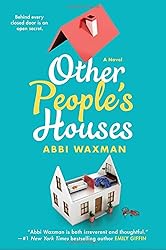
Other People's Houses
Abbi Waxman, 2018
Penguin Publishing
352 pp.
ISBN-13: 9780399587924
Summary
A hilarious and poignant new novel about four families, their neighborhood carpool, and the affair that changes everything.
At any given moment in other people's houses, you can find … repressed hopes and dreams … moments of unexpected joy … someone making love on the floor to a man who is most definitely not her husband…
*record scratch*
As the longtime local carpool mom, Frances Bloom is sometimes an unwilling witness to her neighbors' private lives. She knows her cousin is hiding her desire for another baby from her spouse, Bill Horton's wife is mysteriously missing, and now this...
After the shock of seeing Anne Porter in all her extramarital glory, Frances vows to stay in her own lane.
But that's a notion easier said than done when Anne's husband throws her out a couple of days later. The repercussions of the affair reverberate through the four carpool families—and Frances finds herself navigating a moral minefield that could make or break a marriage. (From the publisher.)
Author Bio
• Birth—1970
• Where—England, UK
• Education—University College London
• Currently—lives in Los Angeles, California
Abbi Waxman is a novelist whose books include The Garden of Small Beginnings (2017), Other People's Houses (2018), and The Bookish Life of Nina Hall (2019). She worked in advertising for many years, which is how she learned to write fiction.
Wasman is a chocolate-loving, dog-loving woman who lives in Los Angeles and lies down as much as possible. She has three daughters, three dogs, three cats, and one very patient husband. (Adapted from the publisher.)
Book Reviews
[A] “gaggle of middle-class white people”—and all of the comedy, drama, and quotidian details that make up their lives.… Hilarious ruminations about child-rearing, shopping, and other parents give this broad appeal.
Publishers Weekly
Waxman is a gifted storyteller with an impressive talent for penning realistic dialog for adults and children: no easy feat. For fans of fast-moving contemporary humorous fiction about women and families. —Samantha Gust, Niagara Univ.Lib., NY
Library Journal
[A] far-reaching topic… sprinkle[d] with spicy dialogue.… Frances is equal parts warmth and snark as she considers her friends and neighbors through the lens of TMI. [For] those who like to turn pages quickly without sacrificing complex characters.
Booklist
[C]harming yet provocative.…Waxman is a master at purveying the wry humor that rides just below the surface of even the tough times. An immensely enjoyable read.
Kirkus Reviews
Discussion Questions
1. In this book the neighborhood plays an important role. What other situations create this kind of community, and how does seeing people every day change your relationship to them?
2. The central character, Frances Bloom, is someone who likes to help, because it makes her feel useful. Do you know someone like this? Do you find it easier to help or be helped?
3. Frances and Michael have a very happy but not very romantic marriage. Do you think that this will eventually drive them apart?
4. Anne Porter has an affair and nearly destroys her marriage. How important is sexual fidelity? Is it the most important element in a marriage? Can trust be rebuilt after a betrayal of this kind?
5. How much do children understand their parents’ marriage? How hard is it to maintain privacy in a relationship once you have children?
6. Sara and Iris are experiencing communication problems in their marriage, although it’s very strong. Have you gone through something similar, where communication breaks down for no apparent reason, and then becomes difficult to reopen?
7. Anne felt she was someone else in her affair, that it was something just for her. Ava also mentions a strong desire to be her own person, driving her own choices. How hard is it to balance a sense of self with responsibilities within a family?
8. Frances and Ava are navigating their changing relationship as Ava becomes more independent. Did you struggle against your parents or one parent in particular as you were becoming an adult? How do you think the experience of adolescence has changed since you were a teenager?
9. The title, Other People’s Houses, alludes to the impression one gets of someone just by looking at them. How much can you really tell about someone based on their home, or the way they dress? Is appearance an expression of character, or armor?
10. Bill and Julie Horton are dealing with a challenging time in a very private way. What do you think are the advantages and disadvantages of approaching it this way?
(Questions issued by the publisher.)

The Other Queen (Tudor Court, 8)
Philippa Gregory, 2008
Simon & Schuster
438 pp.
ISBN-13: 9781416549147
Summary
Philippa Gregory presents a new and unique view of one of history's most intriguing, romantic, and maddening heroines. Biographers often neglect the captive years of Mary Queen of Scots, who trusted Queen Elizabeth's promise of sanctuary when she fled from rebels in Scotland and then found herself imprisoned as the "guest" of George Talbot, Earl of Shrewsbury and his indomitable wife, Bess of Hardwick.
The newly married couple welcome the doomed queen into their home, certain that serving as her hosts and jailors will bring them an advantage in the cutthroat world of the Elizabethan court.
To their horror, they find that the task will bankrupt them, and as their home becomes the epicenter of intrigue and rebellion against Elizabeth, their loyalty to each other and to their sovereign comes into question. If Mary succeeded in seducing the Earl, or if the great spy master William Cecil linked them to the growing conspiracy to free Mary from her illegal imprisonment, they will all face the headsman.
Heralded as "the queen of royal fiction" by USA Today, Philippa Gregory uses new research and her passion for historical accuracy to place a well-known heroine in a completely new story full of suspense, passion, and political intrigue. The Other Queen is the result of her determination to present a story worthy of this extraordinary heroine (From the publisher.)
Author Bio
• Birth—January 9, 1954
• Where—Nairobi, Kenya
• Raised—Bristol, England, UK
• Education—B.A., Sussex University; Ph.D., Edinburgh University
• Currently—lives in the North York Moors, Yorkshire, England
Philippa Gregory is a British historical novelist, writing since 1987. The best known of her works is The Other Boleyn Girl (2001), which in 2002 won the Romantic Novel of the Year Award from the Romantic Novelists' Association.
Early life and academic career
Philippa Gregory was in Nairobi, Kenya, the second daughter of Elaine (Wedd) and Arthur Percy Gregory, a radio operator and navigator for East African Airways. When she was two years old, her family moved to Bristol, England.
She was a "rebel" at Colston's Girls' School where she obtained a B grade in English and two E grades in History and Geography at A-level. She then went to journalism college in Cardiff and spent a year as an apprentice with the Portsmouth News before she managed to gain a place on an English literature degree course at the University of Sussex, where she switched to a history course.
She worked in BBC radio for two years before attending the University of Edinburgh, where she earned her doctorate in 18th-century literature. Gregory has taught at the University of Durham, University of Teesside, and the Open University, and was made a Fellow of Kingston University in 1994.
Private life
Gregory wrote her first novel Wideacre while completing a PhD in 18th-century literature and living in a cottage on the Pennine Way with first husband Peter Chislett, editor of the Hartlepool Mail, and their baby daughter, Victoria. They divorced before the book was published.
Following the success of Wideacre and the publication of The Favoured Child, she moved south to near Midhurst, West Sussex, where the Wideacre trilogy was set. Here she married her second husband Paul Carter, with whom she has a son. She divorced for a second time and married Anthony Mason, whom she had first met during her time in Hartlepool.
Gregory now lives on a 100-acre (0.40 km2) farm in the North York Moors national park, with her husband, children and stepchildren (six in all). Her interests include riding, walking, skiing, and gardening.
Writing
She has written novels set in several different historical periods, though primarily the Tudor period and the 16th century. Reading a number of novels set in the 17th century led her to write the bestselling Lacey trilogy — Wideacre, which is a story about the love of land and incest, The Favoured Child and Meridon. This was followed by The Wise Woman. A Respectable Trade, a novel of the slave trade in England, set in 18th-century Bristol, was adapted by Gregory for a four-part drama series for BBC television. Gregory's script was nominated for a BAFTA, won an award from the Committee for Racial Equality, and the film was shown worldwide.
Two novels about a gardening family are set during the English Civil War: Earthly Joys and Virgin Earth. She has also written contemporary fiction—Perfectly Correct; Mrs Hartley And The Growth Centre; The Little House; and Zelda's Cut. She has also written for children.
Some of her novels have won awards and have been adapted into television dramas. The most successful of her novels has been The Other Boleyn Girl, published in 2002 and adapted for BBC television in 2003 with Natascha McElhone, Jodhi May and Jared Harris. In the year of its publication, The Other Boleyn Girl also won the Romantic Novel of the Year and has subsequently spawned sequels—The Queen's Fool, The Virgin's Lover, The Constant Princess, The Boleyn Inheritance, and The Other Queen. Miramax bought the film rights to The Other Boleyn Girl and produced a film of the same name starring Scarlett Johansson as Mary Boleyn and co-starring Natalie Portman as Anne Boleyn, Eric Bana as Henry Tudor, Juno Temple as Jane Parker, and Kristin Scott Thomas as Elizabeth Boleyn. It was filmed in England and generally released in 2008.
Gregory has also published a series of books about the Plantagenets, the ruling houses that preceded the Tudors, and the Wars of the Roses. Her first book The White Queen (2009), centres on the life of Elizabeth Woodville the wife of Edward IV. The Red Queen (2010) is about Margaret Beaufort the mother of Henry VII and grandmother to Henry VIII. The Lady of the Rivers (2011) is the life of Jacquetta of Luxembourg, mother of Elizabeth Woodville, first married to John of Lancaster, 1st Duke of Bedford, younger brother of Henry the Fifth. The Kingmaker's Daughter (2012) is the story of Anne Neville, the daughter of the Earl of Warwick, the wife of Richard III. The next book, The White Princess (2013), centres on the life of Elizabeth of York, wife of Henry VII and the mother of Henry VIII.
Controversy
In her novel The Other Boleyn Girl, her portrayal of Henry VIII's second wife Anne Boleyn drew criticism. The novel depicts Anne as cold and ruthless, as well as heavily implying that the accusations that she committed adultery and incest with her brother were true, despite it being widely accepted that she was innocent of the charges. Novelist Robin Maxwell refused on principle to write a blurb for this book, describing its characterisation of Anne as "vicious, unsupportable." Historian David Starkey, appearing alongside Gregory in a documentary about Anne Boleyn, described her work as "good Mills and Boon" (a publisher of romance novels), adding that: "We really should stop taking historical novelists seriously as historians. The idea that they have authority is ludicrous." Susan Bordo criticized Gregory's claims to historical accuracy as "self-deceptive and self-promoting chutzpah", and notes that it is not so much the many inaccuracies in her work as "Gregory’s insistence on her meticulous adherence to history that most aggravates the scholars."
Media
Gregory is a frequent contributor to magazines and newspapers, with short stories, features and reviews. She is also a frequent broadcaster and a regular contestant on Round Britain Quiz for BBC Radio 4 and the Tudor expert for Channel 4's Time Team. She won the 29 December 2008 edition of Celebrity Mastermind on BBC1, taking Elizabeth Woodville as her specialist subject.
Charity work
Gregory also runs a small charity building wells in school gardens in The Gambia. Gardens for The Gambia was established in 1993 when Gregory was in The Gambia, researching for her book A Respectable Trade.
Since then the charity has dug almost 200 low technology, low budget and therefore easily maintained wells, which are on-stream and providing water to irrigate school and community gardens to provide meals for the poorest children and harvest a cash crop to buy school equipment, seeds and tools.
In addition to wells, the charity has piloted a successful bee-keeping scheme, funded feeding programmes and educational workshops in batik and pottery and is working with larger donors to install mechanical boreholes in some remote areas of the country where the water table is not accessible by digging alone. (From Wikipedia. Retrieved 9/22/2013.)
Book Critics
A cynical observer might think the world could get along without another book about Mary Queen of Scots. The cynic would be missing a bet. Philippa Gregory's novel looks at Mary Stuart and her times from a fresh and engaging angle, while making an unusual point about history in general.... One of the most admirable things about The Other Queen is the delicate way in which Gregory drops bits of historical allusion into a very personal story. We're never distracted by information, but there's enough of it to make the past both factually comprehensible and emotionally accessible. In the author's view as well as Bess Shrewsbury's, questions of religion and political allegiance always come down in the end to money. That's true, but fiction rarely focuses primarily on the economic basis of history; this novel is a refreshing exception. Above all, the book is an examination of the nature of loyalty, as well: to a spouse, to a monarch, to a family or a family name, to a religion, to political ideals and especially to one's sense of self.
Diana Gabaldon - Washington Post
In her latest foray into the lives and minds of Elizabethan shakers and movers, Gregory (The Other Boleyn Girl) takes on Mary Queen of Scots during her 16-year house arrest. By the secret order of her cousin, Elizabeth I, Mary is held at the estate of George Talbot, earl of Shrewsbury, and his wife, Bess of Hardwick; the latter three share first-person narrative duties. The book centers on Mary's never-ending clandestine efforts to drum up enough support to take her cousin's throne, but the real story is in the clash of two women and the earl who stands between them. Shrewsbury's refusal to recognize superior intelligence and force of will in his wife, who runs the estate, and in Mary, who tries to make him her instrument at every turn, makes for one delicious conflict after another. The voices are strong throughout, but Gregory's ventriloquism is at its best with Bess of Hardwick, a woman who managed to throw off the restrictions of birth, class and sex in order to achieve things that proved beyond her titled husband.
Publishers Weekly
Gregory makes a return trip to Tudor England, focusing on the period when Mary, Queen of Scots, fleeing from rebel Scottish lords, found herself imprisoned in England by her cousin, Queen Elizabeth I. The story is narrated from multiple perspectives: that of Queen Mary as well as her two jailors, George Talbot, Earl of Shrewsbury, and his new wife, Bess of Hardwick, a much-married and canny financial administrator as well as a spy for the ruthless William Cecil, Queen Elizabeth's chief adviser. As the months, then years, pass, George's hopeless, forever unfulfilled love for the Queen of Scots wars with his desire to retain his honor and serve Queen Elizabeth, and also destroys the affectionate business relationship that united him and his wife in amiable marriage. Bess watches the substantial fortune she amassed through well-chosen husbands, good investments and careful accounting dwindle in support of Queen Mary's extravagant lifestyle. And, of course, Mary plots and plots again, to little avail. Reading the novel is a bit like witnessing a fixed tennis match: Queen Mary shuttles back and forth between various castles, her return to Scotland always imminent until each grand scheme fails. Meanwhile, the reader marks time waiting for the queen's inevitable walk to the scaffold. Gregory vividly evokes her three protagonists, but their personalities remain static to the point of tedium; however, it's fair to say that each one's inability to change is the very thing that leads to their joint tragedy. Mary believes that her beauty and royal status allow her to do whatever she likes with impunity; Bess, despite her wealth and title, can never surmount her humble origins; and George, in the face of obvious evidence that his way of life is dying, stubbornly insists that noble blood, not ambition, must determine rank. Not without interest, but this claustrophobic novel should be more intriguing than it is.
Kirkus Reviews
Discussion Questions
1. Bess describes George and herself as newlyweds happy and in love. On page 2, she says, "Only my newly wedded husband is so dotingly fond of me that he is safe under the same roof as such a temptress." What is it that first makes Bess uneasy about her husband's feelings towards Queen Mary?
2. Authors often challenge themselves by writing from the point of view of characters of the opposite sex. Do you think Gregory does a convincing job of creating her main male character, George Talbot? Do you think he is more or less realistic than the women in this novel, such as his wife, Bess, or Queens Mary and Elizabeth?
3. George and Bess marry for choice and admiration. Identify how they describe one another early in the novel, and discuss how their opinions change over the course of the story. Do you think they ever really knew one another, or do you think their affection is just another casualty of Mary and Elizabeth's treacherous conflict?
4. On page 55, George compares Elizabeth and Mary. He says, "My queen Elizabeth is a most solid being, as earthy as a man. But this is a queen who is all air and angels. She is a queen of fire and smoke." How else are the two queens compared throughout the novel by different characters? How do they describe themselves in comparison to each other?
5. George holds tightly to a noble, genteel way of life that has all but slipped away in England under Elizabeth's rule. How do you feel about his devotion to Queen Elizabeth given the circumstances of the times? Do you think Bess ultimately betrays her husband, or does she save him from himself? How might you deal with your own spouse if your fundamental beliefsand loyalties rested on opposite sides?
6. Examine both Mary's reasoning for her belief that her cousin Elizabeth must naturally support her as the heir to the English throne and restore her to the Scottish throne, and Elizabeth's reasoning for the actions she takes to keep Mary subordinated and under a watchful eye. With whom do you sympathize most, and why?
7. At the heart of the conflict between Queens Elizabeth and Mary is a power struggle between the "new ways" of Protestant England and the "old ways" of Catholicism. How has the transition to Protestantism changed England as portrayed in this novel? In what ways do George and Bess serve as representatives of these two Englands?
8. Set in a religious time period, God naturally played an important role in all aspects of these characters' lives. Compare and contrast the various characters' interpretation of religion and their relationship to God with respect to their Papist or Protestant sensibilities. How do the characters differ in their use of God as justification and enlightenment?
9. Bess thinks George is a great fool. Mary finds him entirely honorable, and yet she relates to her rapist and captor, Bothwell, more powerfully. What do you think of these men? How do these two men compare to other significant male characters in the novel such as Cecil, Hastings, the Duke of Norfolk, and Ralph Sadler?
10. Throughout the novel, George and Bess are constantly in opposition. George fears and detests the "new England" that he believes Cecil has created, while Bess sees Cecil's reforms as part of a golden dawn for England and for all Protestants. Who has the stronger character? Which side do you think you'd choose?
11. On page 225, Bothwell tells Mary, "The magic of royalty is an illusion that can be shattered by a man without a conscience." What significance does this observation have for the novel and for this time in history? Using examples from the novel to support your opinion, explain why you either agree or disagree. Similarly, discuss the parallels between the effects of lifting the mystery of royalty and lifting the mystery of religion as described in this novel.
12. What understanding do Bess and Mary finally come to about one another? Do you think either can truly understand the other's perspective, given such wildly different upbringings?
13. In the end, George is utterly heartbroken to learn that Mary has lied to him and to most everyone else. In her defense, Mary explains that she cannot possibly give her "true word" while under duress and imprisoned. Do you think this is just an excuse? Why or why not?
14.. The Shrewsburys and Queen Mary trek back and forth across the English countryside multiple times throughout the novel. Make a map tracing their journeys complete with a timeline of dates to get a visual representation of how unsettling this time period must have been for the entire household.
15. The Other Queen presents a darker Elizabeth than has currently been popularized in movies such as Elizabeth (1998) and Elizabeth: The Golden Age (2007). Watch these films with your book club and compare their portrayal of various historic figures to their counterparts in Gregory's novel.
16. Get a better sense of the time period in which this novel takes place by doing a little research on Tudor England. You can start with local histories.org/tudor.html. You can also read more about some of the estates that served as settings for this novel, including Chatsworth, Tutbury Castle, and Bess's own home of Hardwick Hall.
(Questions issued by publishers.)
top of page
The Other Side of the Bridge
Mary Lawson, 2006
Random House
320 pp.
ISBN-13: 9780385340380
Summary
From the author of the beloved best seller, Crow Lake, comes an exceptional new novel of jealously, rivalry and the dangerous power of obsession.
Two brothers, Arthur and Jake Dunn, are the sons of a farmer in the mid-1930s, when life is tough and another world war is looming. Arthur is reticent, solid, dutiful and set to inherit the farm and his father’s character; Jake is younger, attractive, mercurial and dangerous to know – the family misfit. When a beautiful young woman comes into the community, the fragile balance of sibling rivalry tips over the edge.
Then there is Ian, the family’s next generation, and far too sure he knows the difference between right and wrong. By now it is the fifties, and the world has changed – a little, but not enough.
These two generations in the small town of Struan, Ontario, are tragically interlocked, linked by fate and community but separated by a war which devours its young men – its unimaginable horror reaching right into the heart of this remote corner of an empire. With her astonishing ability to turn the ratchet of tension slowly and delicately, Lawson builds their story to a shocking climax. Taut with apprehension, surprising us with moments of tenderness and humour, The Other Side of the Bridge is a compelling, humane and vividly evoked novel with an irresistible emotional undertow. (From the publisher.)
The Other Side of the Bridge was long-listed for the Man Booker Prize.
Author Bio
• Birth—1946
• Where—Ontario, Canada
• Education—B.A., McGill University
• Awards—Books in Canada First Novel; McKitterick Prize
(both for Crow Lake);
• Currently—lives in Kingston-upon-Thames, England, UK
Mary Lawson was born and brought up in a farming community in central Ontario. She is a distant relative of the author of Anne of Green Gables. She moved to England in 1968, is married with two sons, and lives in Kingston-upon-Thames. Crow Lake is her first novel. Her second is The Other Side of the Bridge. (Adapted from the publisher.)
Book Reviews
There's an almost Sophoclean momentum as events rush to their end. The reader prays that inescapable harm will not come to good people. But the novel's true literary antecedent is in Genesis: the story of Esau and Jacob, brothers in a dysfunctional family where each parent has a favorite child and the younger son can think circles around the older. Lawson honors these archetypes by using them discreetly; biblical undertones simply add to the story's richness.The Other Side of the Bridge is an admirable novel. Its old-fashioned virtues were also apparent in Crow Lake—narrative clarity, emotional directness, moral context and lack of pretension—but Lawson has ripened as a writer, and this second novel is much broader and deeper. The author draws her characters with unobtrusive humor and compassion, and she meets one of the fiction writer's most difficult challenges: to portray goodness believably, without sugar or sentiment.
Frances Taliaferro - Washington Post
Lawson’s gifts are enormous, especially her ability to write a literary work in a popular style. Her dialogue has perfect pitch, yet I’ve never read anyone better at articulating silence. Best of all, Lawson creates the most quotable images in Canadian literature.
Toronto Star
One of the most eagerly awaited books of the autumn season.... The prologue draws you in, as does the novel, which is consistently well-written, involving and enjoyable to read.... Achingly real, known, [Arthur’s] inner life, with all its shifts in understanding, emotion, perception and conflicted impulses, is rendered with compelling force in concise, supple prose.
Ottawa Citizen
I could not put it down, but perhaps better to say that I could not let it go or that it would not let me go . . . Lawson transported me into a place that I know does not exist by taking me deep down into the story of a family whose fate is inexorable and universal. Her reality became mine.
Globe and Mail (Toronto)
“[Lawson] returns to several of the themes that marked her brilliantly successful first novel, Crow Lake .... Lawson’s cornucopia of novelistic gifts, even more bounteously on display in her second book, includes handsome, satisfying sentences, vivid descriptions of physical work and landscape and an almost fiendish efficiency in building the feeling that something very bad is about to happen.
National Post (Canada)
In this follow-up to her acclaimed Crow Lake, Lawson again explores the moral quandaries of life in the Canadian North. At the story's poles are Arthur Dunn, a stolid, salt-of-the-earth farmer, and his brother, Jake, a handsome, smooth-talking snake in the grass, whose lifelong mutual resentments and betrayals culminate in a battle over the beautiful Laura, with Arthur, it seems, the unlikely winner. Observing, and eventually intervening in their saga, is Ian, a teenager who goes to work on Arthur's farm to get close to Laura, seeing in her the antithesis of the mother who abandoned his father and him. It's a standard romantic dilemma who to choose: the goodhearted but dull provider or the seductive but unreliable rogue? but it gains depth by being set in Lawson's epic narrative of the Northern Ontario town of Struan as it weathers Depression, war and the coming of television. It's a world of pristine landscapes and brutal winters, where beauty and harshness are inextricably intertwined, as when Ian brings home a puppy that gambols adorably about and then playfully kills Ian's even cuter pet bunny. Lawson's evocative writing untangles her characters' confused impulses toward city and country, love and hate, good and evil.
Publishers Weekly
At the center of Lawson's follow-up to her lauded debut, Crow Lake, are the antithetical personalities of two brothers the handsome and insidious Jake and Arthur, who's diffident and diligent. This stark contrast bursts into dangerous sibling rivalry when a girl named Laura comes between them. Lawson composes the novel in mutually enlightening chapters that vacillate between two different periods: the brothers' adolescence and early adulthood during World War II and a setting 20 years later, when Arthur and Laura are married, Jake has returned to Arthur's farm after a long absence, and Ian, a local boy who also is attracted to Laura, is working with Arthur. Lawson ingeniously uses this narrative structure to create immense tension by gradually disclosing the past Ian walks into and the unresolved hostility he unwittingly reignites in his adoration for Laura. The suspense of Arthur's impending explosion is a double-edged sword, though, as along the way his reticence depletes many events of their emotional impact. Despite this flaw, Lawson proves herself an adept chronicler of the conflicting dispositions and priorities that divide a family. Recommended for most fiction collections.
Library Journal
Lawson's melancholy saga of misspent youth, misplaced passion, and mistaken assumptions evinces both an enchanting delicacy and provocative vitality, and delivers an unerring sensitivity to place and time, people and passions. —Carol Haggas
Booklist
Another note-perfect take on coming of age in northern Canada, as beautiful as the landscape is stark, from Lawson. Jake and Arthur are as dissimilar as brothers can be. Arthur, stolid and strong, takes after their farmer father, which is a great help as the Depression hits even their self-sufficient village of Struan. Quicksilver younger brother Jake is their mother's favorite. She admires his good looks and wit, but is blind to his selfishness. The brothers are so different that the story's crisis feels inevitable. Assigned to walk cows to a neighbor's farm, Arthur patiently leads a nervous heifer over a rickety bridge, while Jake fools around on the bridge's underside. When Jake calls out that the cow's movements might make him fall, Arthur responds with one rare word, "Good," that will haunt him throughout life. Cut to 20 years later, and Arthur is in charge of the family farm, still silent, still suffering, despite a healthy family and lovely wife. This second story focuses on young Ian, the son of Struan's doctor, who obsesses over Arthur's wife. As he wrestles with his own legacy, he becomes more involved with Arthur's, bringing about an event that will lay bare several secrets. With all the elements of melodrama, Lawson instead crafts a deftly interwoven story of family and loss. Jake's not evil, just bored. He, like Ian's mother, isn't valued in this hardscrabble climate, where his father and brother miss his school play due to errands. "Farming's important. Work's important. Time he knew what matters and what doesn't." The calm and beauty of the setting pervade Lawson's second novel, intensifying the heartfelt pull of its simple human drama.
Kirkus Reviews
Discussion Questions
1. How were you affected by the novel’s prologue? What did you discover about Arthur and Jake in this scene? How did your perceptions of the brothers change throughout the book?
2. How would you answer the questions that conclude the prologue? What accounts for the differences between those who follow the rules, like Arthur, and those who defy them? Which came more easily for you as an adolescent: obedience or defiance?
3. How were Jake and Arthur affected by their family dynamic? Did their mother pamper Jake too much? Did their father favor Arthur because he was easier to manage, or was Jake difficult to manage because of his father’s favoritism?
4. What was the effect of the novel’s timeline? How did it compare to your own experience of the continuum between present moments and memory? What parallels run between Ian’s life and Arthur’s?
5. Discuss the use of the headlines that open each chapter. What do they say about the local and global concerns of humanity? In what way were the headlines timeless, and in what way did they convey the unique attributes of this locale? What headlines would be most significant in marking the chapters of your life?
6. What is the significance of the two time periods in the lives of the characters? How were the Dunn brothers shaped by a youth of economic hardship and the presence of POWs? How was Ian shaped by an era of greater liberation, with television for entertainment and “risqué” music on the radio? What dreams for the future did each of these generations possess?
7. Discuss the nature of love and marriage as described in the novel. What made Jake so irresistible to Laura? What made Dr. Christopherson’s wife choose another man? Was Laura’s appeal strictly physical when she first moved to town? What is the riskiest romantic decision you have made?
8. How are the characters shaped by the novel’s setting? What do the natural surroundings of the town mean to them? What separates those who want to escape from those who bask in the town’s familiarity?
9. Why is Ian so transformed by the “day of the dragonflies” that concludes chapter nine? What did these memories mean to him?
10. Discuss the novel’s title. What does it mean for the characters to reach the other side of the bridge? Could Jake and Arthur ever be free of the wounds they inflicted on each other?
11. Who ultimately was responsible for Jake’s fall from the bridge? Who ultimately paid the price (literally, in terms of his medical bills, and figuratively as well)?
12. How did you react to the knowledge that Ian followed in his father’s footsteps after all? Did he make the right decision?
13. Laura confides in Arthur soon after meeting him, telling him she doesn’t believe that God cares about humanity (Chapter Ten). How would you have responded to her?
14. Discuss the cycles of tragedy conveyed in the Dunn family history, from the death of Arthur’s father to the closing scenes of Carter. How do characters cope with the concepts of fate versus intent? How do they cope with regret?
15. What common threads link the families in this novel to those in Crow Lake? What makes rural landscapes so appropriate for both of these storylines? Do you think people who grow up in cities feel the same passion for them as the characters in these two novels feel for the land?
16. If Matt Morrison, the brilliant and adored older brother in Crow Lake, had wandered into this book, which character do you think he would have had more in common with, Ian or Pete?
(Questions issued by publisher.)
top of page (summary)


The Other Typist
Suzanne Rindell, 2013
Amy Einhorn Books/Putnam
368 pp.
ISBN-13: 9780399161469
Summary
For fans of The Talented Mr. Ripley and The Great Gatsby comes one of the most memorable unreliable narrators in years.
Rose Baker seals men’s fates. With a few strokes of the keys that sit before her, she can send a person away for life in prison. A typist in a New York City Police Department precinct, Rose is like a high priestess. Confessions are her job.
It is 1923, and while she may hear every detail about shootings, knifings, and murders, as soon as she leaves the interrogation room she is once again the weaker sex, best suited for filing and making coffee. This is a new era for women, and New York is a confusing place for Rose. Gone are the Victorian standards of what is acceptable. All around her women bob their hair, they smoke, they go to speakeasies.
Yet prudish Rose is stuck in the fading light of yesteryear, searching for the nurturing companionship that eluded her childhood.
When glamorous Odalie, a new girl, joins the typing pool, despite her best intentions Rose falls under Odalie’s spell. As the two women navigate between the sparkling underworld of speakeasies by night and their work at the station by day, Rose is drawn fully into Odalie’s high-stakes world. And soon her fascination with Odalie turns into an obsession from which she may never recover. (From the publisher.)
Author Bio
Suzanne Rindell is a doctoral student in American modernist literature at Rice University. The Other Typist is her first novel. She lives in New York City and is currently working on a second novel. (From the publisher.)
Book Reviews
With prohibition picking up steam, the New York precinct where Rose Baker works typing confessions is busy enough to need a new girl. Enter the beautiful, disturbing, and enviable Odalie.... Odalie's mysterious past shows up and raises questions even Rose can't ignore, and her curiosity leads her to challenge Odalie, with explosive results. Though the final twist—the one that should make readers gasp and look back for the clues they missed—is hinted at too often to snap smartly when sprung, Rindell's debut is a cinematic page-turner.
Publishers Weekly
"The other typist" is Odalie, the mysterious, magnetic young woman who joins Rose Baker's typing pool at a Lower East Side precinct in 1924 Manhattan. Rose, confused by the rapid changing mores as the Twenties roar along, is enthralled with the newcomer, but her admiration soon turns into threatening obsession. First novelist Rindell has published poetry and short fiction in places like Conjunctions, so she can write.
Library Journal
With hints toward The Great Gatsby, Rindell’s novel aspires to recreate Prohibition-era New York City, both its opulence and its squalid underbelly. She captures it quite well, while at the same time spinning a delicate and suspenseful narrative about false friendship, obsession, and life for single women in New York during Prohibition.
Booklist
(Starred review.) [A] pitch-black comedy about a police stenographer accused of murder in 1920s Manhattan.... Rose [Baker] begins her narration archly with off-putting curlicues she gradually discards. She is tart, judgmental, self-righteous and self-justifying. She is also viciously astute. Whether she's telling the truth is another matter. A deliciously addictive, cinematically influenced page-turner, both comic and provocative, about the nature of guilt and innocence within the context of social class in a rapidly changing culture.
Kirkus Reviews
Discussion Questions
1. Do you think Rose is a reliable or unreliable narrator? Why? If you did question her veracity, at what point in the novel did you begin to do so?
2. Why is Rose so captivated by Odalie, someone she wholly disapproves of initially?
3. Through Odalie, Rose gains entry into a world she's never seen before, one filled with opulence and rich, glamorous people. Clearly Rose is an outsider who doesn't belong. Yet she seems to take to it all rather quickly. Why do you think this is so? Why, despite all the new people she comes into contact with, is Odalie the only one she seems to be charmed by?
4. Some readers may think that Rose is a lesbian. Do you? Why or why not? Might her Victorian sensibility, when viewed by a contemporary reader, be misinterpreted and sexualized even if it might be innocent and pure?
5. Rose is such a stickler for the rules, yet as the novel progresses, she starts breaking them frequently. In retrospect, do you think she ever follows the rules? Or does she follow only the ones she agrees with?
6. Rose is actually quite funny, an astute observer. ("I crawled into [bed]...exhausted...from the efforts of making conversation with a man who if he were any duller might be declared catatonic by those in the medical profession.") Why, then, is she so humorless when it comes to people like Iris, Gib, and the Lieutenant Detective, especially?
7. Rose states in the beginning of the book: "I am there to transcribe what will eventually come to be known as the truth." The novel plays with the notion that the written word is superior to the spoken-Rose's transcripts and her diary that the reader is reading, versus the narration she provides throughout the book. Do you think the written word carries more weight than oral history? Why or why not?
8. Consider the many possible story lines for Odalie's history. Did she really kill her ex-fiancé? Was Gib really the driver of the train? Was she indeed a debutante from a wealthy family in Newport? Did she at a young age leave her mother to live with Czakó, the Hungarian, in Europe? Which of these stories is the most plausible? Do you believe any of them is true?
9. What do you make of Rose's appearance? Throughout the novel she takes pains to point out that she is plain-looking. Yet the Lieutenant Detective obviously finds her attractive, and at the end of the book, she is a doppelgänger for Odalie, who is portrayed as a knockout. What do you think Rose really looks like? Should her appearance even matter?
10. When Rose is in the hospital at the end of the book, the doctors call her "Ginevra." That is the name Teddy used for Odalie. Who do you think is the real Ginevra? Are Odalie and Rose the same person?
11. What do you make of the kiss at the end of the novel? Is Rose doing it just to get the Lieutenant Detective's knife, or is there some true feeling behind it? Were you surprised that she admits she's never kissed a man before?
12. What do you believe really happened at the end of the book? Did Rose kill Teddy? Or did Odalie?
(Questions issued by publisher.)
The Other Woman
Sandie Jones, 2019
Minatour Books
320 pp.
ISBN-13: 9781250192004
Summary
HE LOVES YOU: Adam adores Emily. Emily thinks Adam’s perfect, the man she thought she’d never meet.
BUT SHE LOVES YOU NOT: Lurking in the shadows is a rival, a woman who shares a deep bond with the man she loves.
AND SHE'LL STOP AT NOTHING: Emily chose Adam, but she didn’t choose his mother Pammie. There’s nothing a mother wouldn’t do for her son, and now Emily is about to find out just how far Pammie will go to get what she wants: Emily gone forever.
The Other Woman will have you questioning her on every page, in Sandie Jones' chilling psychological suspense about a man, his new girlfriend, and the mother who will not let him go. (From the publisher.)
Author Bio
Sandie Jones is a British journalist and author of the 2019 debut thriller, The Other Woman. For the past 20 years, she has worked mainly as a freelance writer for national newspapers and magazines, the Sunday Times, Woman’s Weekly and the Daily Mail. Sandie lives in South London with her husband and three children. (Adapted from the agent's website.)
Book Reviews
Whiplash-inducing final pages.
New York Times Book Review
Excellent.… [Jones] delves into the motives of a homegrown monster… deliver[ing] a tightly coiled story in The Other Woman and fills it with believable characters.
Associated Press
Such fun you'll cheer [Emily's] chutzpah.
People Magazine
Monster-in-law! The love triangle in this twisted psychological thriller is between Emily, her new boyfriend Adam and Adam’s mother, Pammie, who refuses to let her son go and wants Emily out of his life!
In Touch Weekly - Book Report
It's a page turner like no other, and the ending will knock your socks off,
Hello Giggles
Begs to be devoured in one sitting… deliciously dramatic and sinister.… If you're in the market for a lighter suspense read with a genuinely jaw-dropping finale, Sandie Jones' debut belongs on your TBR.
Crime by the Book
For anyone who's dealt with an unsavory in-law, this thriller will hit close to home.
Refinery29
This book will have you cheering its spunky heroine one minute and gasping from shock the next.
PopSugar
Discussion Questions
We'll add publisher questions if and when they're available; in the meantime, please use our GENERIC MYSTERY QUESTIONS to start a discussion for THE OTHER WOMAN… then take off on your own:
GENERIC DISCUSSION QUESTIONS
Mystery / Crime / Suspense Thrillers
1. Talk about the characters, both good and bad. Describe their personalities and motivations. Are they fully developed and emotionally complex? Or are they flat, one-dimensional heroes and villains?
2. What do you know...and when do you know it? At what point in the book do you begin to piece together what happened?
3. Good crime writers embed hidden clues in plain sight, slipping them in casually, almost in passing. Did you pick them out, or were you...clueless? Once you've finished the book, go back to locate the clues hidden in plain sight. How skillful was the author in burying them?
4. Good crime writers also tease us with red-herrings—false clues—to purposely lead readers astray? Does your author try to throw you off track? If so, were you tripped up?
5. Talk about the twists & turns—those surprising plot developments that throw everything you think you've figured out into disarray.
- Do they enhance the story, add complexity, and build suspense?
- Are they plausible or implausible?
- Do they feel forced and gratuitous—inserted merely to extend the story?
6. Does the author ratchet up the suspense? Did you find yourself anxious—quickly turning pages to learn what happened? A what point does the suspense start to build? Where does it climax...then perhaps start rising again?
7. A good ending is essential in any mystery or crime thriller: it should ease up on tension, answer questions, and tidy up loose ends. Does the ending accomplish those goals?
- Is the conclusion probable or believable?
- Is it organic, growing out of clues previously laid out by the author (see Question 3)?
- Or does the ending come out of the blue, feeling forced or tacked-on?
- Perhaps it's too predictable.
- Can you envision a different or better ending?
8. Are there certain passages in the book—ideas, descriptions, or dialogue—that you found interesting or revealing...or that somehow struck you? What lines, if any, made you stop and think?
9. Overall, does the book satisfy? Does it live up to the standards of a good crime story or suspense thriller? Why or why not?
(Generic Mystery Questions by LitLovers. Please feel free to use them, online or off, with attribution. Thanks.)
Our Kind of Cruelty
Araminta Hall, 2018
Farrar, Straus & Giroux
288 pp.
ISBN-13: 9780374228194
Summary
A spellbinding, darkly twisted novel about desire and obsession, and the complicated lines between truth and perception, Our Kind of Cruelty introduces Araminta Hall, a chilling new voice in psychological suspense.
This is a love story. Mike’s love story.
Mike Hayes fought his way out of a brutal childhood and into a quiet, if lonely, life before he met Verity Metcalf. V taught him about love, and in return, Mike has dedicated his life to making her happy.
He’s found the perfect home, the perfect job; he’s sculpted himself into the physical ideal V has always wanted. He knows they’ll be blissfully happy together.
It doesn’t matter that she hasn’t been returning his e-mails or phone calls.
It doesn’t matter that she says she’s marrying Angus.
It’s all just part of the secret game they used to play. If Mike watches V closely, he’ll see the signs. If he keeps track of her every move, he’ll know just when to come to her rescue. (From the publisher.)
Author Bio
Araminta Hall has worked as a writer, journalist and teacher. Her first novel, Everything & Nothing, was published in 2011 and became a Richard & Judy read that year. Her second, Dot, came out in 2013. Both were published in the U.K. only. Our Kind of Cruelty, releaed in 2018, is her first novel published in the U.S.
Hall teaches creative writing at New Writing South in Brighton, where she lives with her husband and three children. Her latest book, Our Kind of Cruelty, is a deeply unsettling thriller of a love story, in which a secret game between lovers has deadly consequences. (Adapted from the UK pubisher.)
Book Reviews
[A] searing, chilling sliver of perfection about a toxic relationship that may or may not be finished…To a degree that's astonishing, this genre is still picking itself up from Gillian Flynn's brilliant and monumentally crucial Gone Girl, which retaught readers to doubt everything. That doubt lingers all the way through the stunning final pages of Our Kind of Cruelty, which may well turn out to be the year's best thriller.
Charles Finch - New York Times Book Review
A seriously twisted story of obsessive attachment.… If you like sustained discomfort you'll love this one.
Sarah Murdoch - Toronto Star
[A] fiendishly clever psychological thriller.… Hall forces her readers to consider their attitudes to the sexes.
Alison Flood - Guardian (UK)
In Hall’s impressive novel, sexual role-playing games have dangerous undercurrents.… While the orchestration of suspense is masterly, Hall’s real agenda becomes apparent in a feminist subtext: the way in which female desire is judged more harshly in modern society.
Barry Forshaw - Financial Times (UK)
A story of obsession and self delusion, as well as the pain that intense passion can bring, it is disturbing and thrilling.
Daily Mail (UK)
Thrilling.… The reader will wrangle over what's real and what's imagined. As a courtroom drama unfurls, readers may be left wondering if their interpretation of events is due to their own biases.
Irish News (UK)
One of the most unsettling books I have read in a while but brilliant.… Obsessive love has never been written so frighteningly.
Women's Day
[A] disturbing psychological thriller.…Readers never learn enough about V and arguably a lot more than they might wish about a narrator whose head is an uncomfortably creepy place to be. Still, Hall is a writer to watch.
Publishers Weekly
[A] slow-burn, sinister psychological thriller.… Hall’s depiction of stalker mentality and behavior is chilling. Perhaps most interesting is the examination of gender politics and how women are punished for sexual behavior in ways that men are not.
Library Journal
Hall brings the unreliable narrator to new heights in this disturbing narrative.… For fans of Nabokov’s Lolita [and] Highsmith’s Ripley tales.
Booklist
Here's a change—a psychological thriller in which a man is the crazy one.… Which is worse—an emotionally disturbed murderer or a woman with a fierce libido? Hall's U.S. debut is designed to show just how much trouble society has answering that question.
Kirkus Reviews
Discussion Questions
1. As the book begins, Mike Hayes, the narrator and main character, is in prison. His barrister has told him to write down the story of events leading to the murder for which he will soon go to trial. Why does the barrister say that Mike’s story feels like "something he can’t grab hold of"? What are clues in Part I that Mike’s version of events may not be accurate? Are there things he tells us about himself that reveal more than he intends?
2. When Mike and Verity met, as students at university, they were both promising young people from very different backgrounds. What initially drew them together? What challenges did they each face and how were they suited to help each other? As their relationship progressed over nine years, how did they each change?
3. What is the Crave, the game Mike and Verity play? How did it begin and how was it named? What does Mike read into Verity’s e-mails and meetings with him that make him believe her marriage to Angus is "the ultimate Crave"?
4. Why does Verity invite Mike to the wedding? Why does she get back in touch with him at all?
5. What is Kaitlyn’s motivation for befriending Mike? How does he interpret her kindness? What does she mean when she says they are both outsiders at work? How does she come to suspect that he is not what he seems?
6. "Eagles are magnificent," Verity tells Mike, explaining to him why she wears a necklace with a silver eagle on it. What does the eagle mean to her? What does it mean to Mike?
7. Mike’s childhood was a combination of cruelty and kindness—a boyhood of damaging cruelty, followed by foster care with Elaine and Barry, who loved him and tried to repair the damage done to him by his mother and her boyfriends. What are instances of kindness and cruelty toward Mike or between other characters? How does Mike respond to kindness? What is his idea of love?
8. What is in the box that Elaine gives Mike when he goes away to university? Which objects are meaningful to him? Even though he says he meant to throw it away at the first opportunity, why has he kept it? How is Mike a combination of the cruelties and kindnesses that the objects in the box represent?
9. What is the sequence of events leading to Angus’s death? Are there signs that Mike is an angry man who might be capable of killing? Who else might bear some of the responsibility for Mike’s actions?
10. The testimony given at the trial often challenges Mike’s version of events. For example, he tells us that Verity’s friend Louise made a pass at him at Verity’s wedding. But Louise testifies that she had never liked Mike, that he was agitated at the wedding and had pushed her. Which version of the story is more believable? What are other examples of testimony that contradict Mike?
11. "I am well practiced in ruining things," Mike thinks as he remembers the events leading to Angus’s death. What leads him to make this observation? Is he a confused and grieving man who has been betrayed by circumstance or a man who deliberately chooses to do wrong—the dangerous fantasist invoked by Petra Gardner or the confused "good lad" his foster mother believes him to be? Does he deserve any sympathy?
12. Besides Verity, are there other people who matter to Mike? How would they describe him? How do his impulses, either cruel or kind—toward his foster parents, co-workers, neighbors, and acquaintances—intensify during the months after Verity leaves him?
13. The media covers the trial as a scandal and relishes in reporting every detail of Verity’s background and relationships. Why are the press and public opinion more focused on her than on Mike? Why do they seem eager to assume she is guilty? Is she treated fairly in court?
14. As the book ends, Mike receives the YOU ARE NOT postcard from Verity. Why did Verity send the postcard? How does Mike interpret her message? Why does he believe he has "saved" her?
15. The epigraph that opens the book (from The Sea, the Sea by Iris Murdoch) implies that Our Kind of Cruelty is essentially a love story. Is it? What else does the epigraph foreshadow?
(Questions issued by the publishers.)
Our Man in Havana
Graham Greene, 1959
~200-250 pp. (varies by publisher)
Summary
Our Man in Havana is an espionage thriller, a penetrating character study, and a political satire that still resonates today. Conceived as one of Graham Greene’s “entertainments,” it tells of MI6’s man in Havana, Wormold, a former vacuum-cleaner salesman turned reluctant secret agent out of economic necessity. (From Penguin Group USA edition.)
Wormold is a vacuum cleaner salesman in a city of power outages. His adolescent daughter spends his money with a skill that amazes him, so when a mysterious Englishman offers him an extra income he's tempted. In return all he has to do is file a few reports. But when his fake reports start coming true things suddenly get more complicated and Havana becomes a threatening place. (From Random House UK edition.)
The 1959 film version stars Alec Guiness, Burl Ives, and Maureen O'Hara...and Noel Coward as Hawthorne. Also, Jeremy Northam does a fine turn in the novel's audio version.
* The novel was copyrighted in 1958 and published in 1959, thus the disparity in dates.
Author Bio• Birth—October 2, 1904
• Where—Berkhamstd, England, UK
• Death—April 3, 1991
• Where—Vevey, Switzerland
• Education—Oxford University
• Awards—Hawthornden Prize; Companion
of Honour; Chevalier of the Legion of
Honour; Order of Merit.
Known for his espionage thrillers set in exotic locales, Graham Greene is the writer who launched a thousand travel journalists. But although Greene produced some unabashedly commercial works—he called them "entertainments," to distinguish them from his novels—even his escapist fiction is rooted in the gritty realities he encountered around the globe. "Greeneland" is a place of seedy bars and strained loyalties, of moral dissolution and physical decay.
Greene spent his university years at Oxford "drunk and debt-ridden," and claimed to have played Russian roulette as an antidote to boredom. At age 21 he converted to Roman Catholicism, later saying, "I had to find a religion...to measure my evil against." His first published novel, The Man Within, did well enough to earn him an advance from his publishers, but though Greene quit his job as a London Times subeditor to write full-time, his next two novels were unsuccessful. Finally, pressed for money, he set out to write a work of popular fiction. Stamboul Train (also published as The Orient Express) was the first of many commercial successes.
Throughout the 1930s, Greene wrote novels, reviewed books and movies for the Spectator, and traveled through eastern Europe, Liberia, and Mexico. One of his best-known works, Brighton Rock, was published during this time; The Power and the Glory, generally considered Greene's masterpiece, appeared in 1940. Along with The Heart of the Matter and The End of the Affair, they cemented Greene's reputation as a serious novelist—though George Orwell complained about Greene's idea "that there is something rather distingué in being damned; Hell is a sort of high-class nightclub, entry to which is reserved for Catholics only."
During World War II, Greene was stationed in Sierra Leone, where he worked in an intelligence capacity for the British Foreign Office under Kim Philby, who later defected to the Soviet Union. After the war, Greene continued to write stories, plays, and novels, including The Quiet American, Travels with My Aunt, The Honorary Consul, and The Captain and the Enemy. For a time, he worked as a screenwriter for MGM, producing both original screenplays and scripts adapted from his fiction.
He also continued to travel, reporting from Vietnam, Haiti, and Panama, among other places, and he became a vocal critic of U.S. foreign policy in Central America. Some biographers have suggested that his friendships with Communist leaders were a ploy, and that he was secretly gathering intelligence for the British government. The more common view is that Greene's leftist leanings were part of his lifelong sympathy with the world's underdogs—what John Updike called his "will to compassion, an ideal communism even more Christian than Communist. Its unit is the individual, not any class."
But if Greene's politics were sometimes difficult to decipher, his stature as a novelist has seldom been in doubt, in spite of the light fiction he produced. Kingsley Amis, Evelyn Waugh, and R. K. Narayan paid tribute to his work, and William Golding prophesied: "He will be read and remembered as the ultimate chronicler of twentieth-century man's consciousness and anxiety."
Extras
• Greene's philandering ways were legendary; he frequently visited prostitutes and had several mistresses, including Catherine Walston, who converted to Catholicism after reading The Power and the Glory and wrote to Greene asking him to be her godfather. After a brief period of correspondence, the two met, and their relationship inspired Greene's novel The End of the Affair.
• Greene was a film critic, screenwriter, and avid moviegoer, and critics have sometimes praised the cinematic quality of his style. His most famous screenplay was The Third Man, which he cowrote with director Carol Reed. Recently, new film adaptations have been made of Greene's novels The End of the Affair and The Quiet American. Greene's work has also formed the basis for an opera: Our Man in Havana, composed by Malcolm Williamson. (From Barnes & Noble.)
Book Reviews
Had [Greene] decided to believe his own tale, and told it with simple conviction, it might have been hair-raising.... Instead, he has used tricks, and achieved mostly unreality. His characters lack bone, flesh, and blood, and only occasionally seem lifelike. They are dumb when convenience requires, smart when convenience requires, rarely showing initiative on their own.
James M. Cain - New York Times (10/28/1958)
The ultimate chronicler of twentieth-century man’s consciousness and anxiety
William Golding - Author (Lord of the Flies)
As comical, satirical, atmospherical an ‘entertainment’ as he has given us.
Daily Telegraph - (UK)
Nobody should be anywhere near power who hasn't read (or seen the film of) Our Man in Havana, a powerful satire on the silly world of spying by a man who had experienced it
Mail on Sunday (UK)
No serious writer of this century has more thoroughly invaded and shaped the public imagination than did Graham Greene.
Time
He had a sharp nose for trouble and injustice. In Our Man In Havana—a witty send-up of an agent's life —it was Cuba before Castro.
Financial Times
Discussion Questions
Use our LitLovers Book Club Resources; they can help with discussions for any book:
• How to Discuss a Book (helpful discussion tips)
• Generic Discussion Questions—Fiction and Nonfiction
• Read-Think-Talk (a guided reading chart)
Also consider these LitLovers talking points to help get a discussion started for Our Man in Havana:
1. What kind of man is Wormold? Do you consider him heroic? Or would you describe him as a Walter Mitty type, at heart a decent but vacuous being? Why would Graham have made Wormold the novel's protagonist?
2. Why does Wormold agree to accept Hawthorne's proposal to become an agent for the British government? If he had refused, what might have happened?
3. What is the joke about the vacuum cleaners that Wormold sells...as does Mr. Carter. Don't neglect to talk about the product names.
4. Hasselbacher is perhaps the most interesting character in the novel, certainly his pithy sayings are. How would you describe his world view or philosophy toward life? What does he mean when he says to Wormold? ...
You are interested in a person, not in life,
and people die or leave us....But if you're
interested in life, it never lets you down.
Hasselbacher also compares people to crossword puzzles. Can you explain, or expand on, that comparison? Do you agree with his observation? What are some other observations of his that strike you?
5. Follow-up to Question #4: Who is Dr. Hasselbacher—is he an agent? Or is he an innocent by-stander who gets swept up in Wormwold's intrigue? How does he become involved with Raoul? How does he know to warn Wormold about the European Traders' Association luncheon? Is Hasselbacher a martyr of sorts (consider the quotation in Question #4)?
6. What do you think of Beatrice? Why was she not sad to see her husband leave her? Why is she so delighted when Wormold confesses to her that his spying operation has been a sham?
7. What does the last line of the novel mean—and what precipitates Beatrice's thought? What does the future hold for their relationship?
8. Why isn't Wormold summarily fired? Why does the service keep him on—and even award him the Order of the British Empire (OBE).
9. In what way is this novel a sly comment on the work of an author, writing a novel?
10. This is a work of satire. What is Graham satirizing? Do you consider this a cyncical novel? Is it humorous? Consider the era in which this novel was written...and also the events of the Cuban missle crisis three years after the novel's publication.
11. Does Captain Segura represent pure evil?
12. Consider James Cain's 1958 review in the New York Times (see "Book Reviews" above). Do you agree with his assessment of this novel...or does he miss the mark?
(Questions by LitLovers. Please feel free to use them, online or off, with attribution. Thanks.)
top of page (summary)

Our Souls at Night
Kent Haruf, 2015
Knopf Doubleday
192 pp.
ISBN-13: 9781101911921
Summary
A spare yet eloquent, bittersweet yet inspiring story of a man and a woman who, in advanced age, come together to wrestle with the events of their lives and their hopes for the imminent future.
In the familiar setting of Holt, Colorado, home to all of Kent Haruf’s inimitable fiction, Addie Moore pays an unexpected visit to a neighbor, Louis Waters.
Her husband died years ago, as did his wife, and in such a small town they naturally have known of each other for decades; in fact, Addie was quite fond of Louis’s wife. His daughter lives hours away in Colorado Springs, her son even farther away in Grand Junction, and Addie and Louis have long been living alone in houses now empty of family, the nights so terribly lonely, especially with no one to talk with.
Their brave adventures—their pleasures and their difficulties—are hugely involving and truly resonant, making Our Souls at Night the perfect final installment to this beloved writer’s enduring contribution to American literature. (From the publisher.)
Author Bio
• Birth—February 24, 1943
• Where—Pueblo, Colorado, USA
• Died—November 30, 2014
• Where—Salida, Colorado
• Education—B.A., Nebraska Wesleyan University; M.F.A., Iowa Writers' Workshop
• Awards—(see below)
Alan Kent Haruf was an American novelist and author of six novels, all set in the fictional town of Holt, Colorado.
Life
Haruf was born in Pueblo, Colorado, the son of a Methodist minister. He graduated with a BA from Nebraska Wesleyan University in 1965, where he would later teach, and earned an MFA from the Iowa Writers' Workshop at the University of Iowa in 1973.
Before becoming a writer, Haruf worked in a variety of places, including a chicken farm in Colorado, a construction site in Wyoming, a rehabilitation hospital in Denver, a hospital in Phoenix, a presidential library in Iowa, an alternative high school in Wisconsin, as an English teacher with the Peace Corps in Turkey, and colleges in Nebraska and Illinois.
He lived with his wife, Cathy, in Salida, Colorado until his death in 2014. He had three daughters from his first marriage.
Works
All of Haruf's novels take place in the fictional town of Holt, in eastern Colorado, a town based on Yuma, Colorado, one of Haruf's residences in the early 1980s. His first novel, The Tie That Binds (1984), received a Whiting Award and a special Hemingway Foundation/PEN citation. Where You Once Belonged followed in 1990. A number of his short stories have appeared in literary magazines.
Plainsong was published in 1999 and became a U.S. bestseller. The New York Times' Verlyn Klinkenborg called it "a novel so foursquare, so delicate and lovely, that it has the power to exalt the reader." Plainsong won the Mountains & Plains Booksellers Award and the Maria Thomas Award in Fiction and was a finalist for the National Book Award for Fiction.
Eventide, a sequel to Plainsong, was published in 2004. Library Journal described the writing as "honest storytelling that is compelling and rings true." Jonathan Miles saw it as a "repeat performance" and "too goodhearted."
On November 30, 2014, at the age of 71, Kent Haruf died at his home in Salida, Colorado, of interstitial lung disease.
Our Souls at Night, his final work, was published posthumously in 2015 and received wide praise. Ron Charles of the Washington Post called it "a tender, carefully polished work that it seems like a blessing we had no right to expect."
Recognition
1986 - Whiting Award for fiction
1999 - Finalist for the 1999 National Book Award for Plainsong
2005 - Colorado Book Award for Eventide
2005 - Finalist for the Book Sense Award for Eventide
2009 - Dos Passos Prize for Literature
2012 - Wallace Stegner Award
2014 - Folio Prize shortlist for Benediction
(Author bio adapted from Wikipedia. Retrieved 8/26/2015.)
Book Reviews
His great subject was the struggle of decency against small-mindedness, and his rare gift was to make sheer decency a moving subject.... [This] novel runs on the dogged insistence that simple elements carry depths, and readers will find much to be grateful for.
Joan Silber - New York Times Book Review
Short, spare and moving.... Our Souls at Night is already creating a stir.
Jennifer Maloney - Wall Street Journal
Utterly charming [and] distilled to elemental purity.... such a tender, carefully polished work that it seems like a blessing we had no right to expect.
Ron Charles - Washington Post
Lateness—and second chances—have always been a theme for Haruf. But here, in a book about love and the aftermath of grief, in his final hours, he has produced his most intense expression of that yet... Packed into less than 200 pages are all the issues late life provokes.
John Freeman - Boston Globe
A fitting close to a storied career, a beautiful rumination on aging, accommodation, and our need to connect.... As a meditation on life and forthcoming death, Haruf couldn’t have done any better. He has given us a powerful, pared-down story of two characters who refuse to go gentle into that good night.
Lynn Rosen - Philadelphia Enquirer
Haruf is never sentimental, and the ending—multiple twists packed into the last twenty pages—is gritty, painful and utterly human.... His novels are imbued with an affection and understanding that transform the most mundane details into poetry. Like the friendly light shining from Addie's window, Haruf’s final novel is a beacon of hope; he is sorely missed.
Francesca Wade - Financial Times
A marvelous addition to his oeuvre...spare but eloquent, bittersweet yet hopeful.
Kurt Rabin - Fredericksburg Freelance-Star
More Winesburg than Mayberry, Holt and its residents are shaped by physical solitude and emotional reticence.... Haruf's fiction ratifies ordinary, nonflashy decency, but he also knows that even the most placid lives are more complicated than they appear from the outside.... The novel is a plainspoken, vernacular farewell.
Catherine Holmes - Charleston Post and Courier
A fine and poignant novel that demonstrates that our desire to love and to be loved does not dissolve with age.... The story speeds along, almost as if it's a page-turning mystery.
Joseph Peschel - St. Louis Post-Dispatch
Haruf spent a life making art from our blind collisions, and Our Souls at Night is a fitting finish.
John Reimringer - Minneapolis Star Tribune
Elegiac, mournful and compassionate. . .a triumphant end to an inspiring literary career [and] a reminder of a loss on the American cultural landscape, as well as a parting gift from a master storyteller.
William J. Cobb - Dallas Morning News
By turns amusing and sad, skipping-down-the-sidewalk light and pensive.... I recommend reading it straight through, then sitting in quiet reflection of beautiful literary art.
Fred Ohles - Lincoln Journal Star
Haruf was knows as a great writer and teacher whose work will endure.... The cadence of this book is soft and gentle, filled with shy emotion, as tentative as a young person's first kiss—timeless in its beauty.... Addie and Louis find a type of love that, as our society ages, ever more people in the baby boom generation may find is the only kind of love that matters.
Jim Ewing - Jackson Clarion-Ledger
Blunt, textured, and dryly humorous. . . this quietly elegiac novel caps a fine, late-blooming and tenacious writing career.... Haruf’s gift is to make hay of the unexpected, and it feels like a mercy.... This is a novel for just after sunset on a summer’s eve, when the sky is still light and there is much to see, if you are looking.
Wingate Packard - Seattle Times
There is so much wisdom in this beautifully pared-back and gentle book.... [A] small, quiet gem, written in English so plain that it sparkles.
Anne Susskind - Sydney Morning Herald
A delicate, sneakily devastating evocation of place and character.... Haruf’s story accumulates resonance through carefully chosen details; the novel is quiet but never complacent.
The New Yorker
In a fitting and gorgeous end to a body of work that prizes resilience above all else, Haruf has bequeathed readers a map charting a future that is neither easy nor painless, but it’s also not something we have to bear alone.
Esquire
Haruf once again banishes doubts. Our souls can surprise us. Beneath the surface of reticent lives—and of Haruf’s calm prose—they prove unexpectedly brave.
Ann Hulbert - Atlantic
(Starred review.) [A] gripping and tender novel.... [Haruf] returns to the landscape and daily life of Holt County, Colo.,...this time with a stunning sense of all that’s passed and the precious importance of the days that remain.
Publishers Weekly
(Starred review.) [A]cclaimed novelist Haruf captures small-town life to perfection in his signature spare style.... Poignant and eloquent, this novel resonates beyond the pages. Don't miss this exceptional work from a literary voice now stilled. —Donna Bettencourt, Mesa Cty. P.L., Palisade, CO
Library Journal
A sweet love story about the twilight years.... [Addie] and Louis find an emotional intimacy beyond anything either has previously known, and both come to recognize that they "deserve to be happy," no matter what friends and family think.... Those who have been immersed in Holt since Plainsong (1999) will appreciate one last visit.
Kirkus Reviews
Discussion Questions
1. What does the title mean?
2. The novel begins with the word "and": "And then there was the day when Addie Moore made a call on Louis Waters." What do you imagine came before it?
3. Kent Haruf was known for using simple, spare language to create stories of great depth. How does the modest action in Our Souls at Night open onto larger insights about getting older?
4. It takes a considerable amount of courage for a woman of Addie’s generation to invite a man she hardly knows to sleep in her bed. What do you think propelled her to do it?
5. When Louis comes over for the first time, he knocks on her back door in the name of discretion. Addie says, "I made up my mind I’m not going to pay attention to what people think. I’ve done that too long—all my life. I’m not going to live that way anymore. The alley makes it seem we’re doing something wrong or something disgraceful, to be ashamed of" (8). How does her attitude influence Louis’s?
6. Both Louis and Addie have to contend with gossip about their relationship. Who handles it better?
7. What does Addie’s friendship with Ruth show us about Addie’s character?
8. Addie and Louis both had troubled marriages, but stayed married until their partners died. How does that sense of propriety, of loyalty, influence their relationship with each other?
9. In describing his affair, Louis says, "I think I regret hurting Tamara more than I do hurting my wife. I failed my spirit or something" (42). What does he mean by this?
10. Why did Addie refuse to move after Connie’s death? How did this decision color Gene’s reaction to his mother’s late-in-life love affair?
11. On page 52, Louis describes his relationship with Addie to his daughter, "It’s some kind of decision to be free. Even at our ages." Why does he feel freer with Addie than he does alone? How does his behavior become more uninhibited as the novel progresses?
12. How does Jamie’s arrival deepen the connection between Addie and Louis?
13. When Louis confesses that he wanted to be a poet, what effect does it have on Addie’s opinion of him? And on your opinion?
14. Addie and Louis both have regrets about the way they raised their children. How does that influence their relationship with Jamie?
15. Why did Addie buy new clothes for her trips to Denver that she never wears in Holt? What signal does it send to the reader?
16. On page 145, Addie mentions the Denver Center for the Performing Arts production of Benediction, based on the author’s own novel. Addie and Louis discuss the fact that it’s set in Holt, the fictional town in which they live. Why do you think Haruf slipped this into the story?
17. At the end of that conversation, Addie says, "Who would have thought at this time in our lives that we’d still have something like this. That it turns out we’re not finished with changes and excitements. And not all dried up in body and spirit" (147). What point is Haruf making?
18. Jamie’s arrival ultimately leads to grave consequences. What is Gene afraid of?
19. Several times during the novel, Addie is described as being brave, but she gives in to Gene’s demands. Is this a brave act? What is she protecting?
20. How would you describe the ending—as heartbreaking, hopeful, or something else?
21. In his final interview, conducted a few days before his death from interstitial lung disease, Haruf discussed Our Souls at Night: "The idea for the book has been floating around in my mind for quite a while. Now that I know I have, you know—a limited time—it was important to me to try to make good use of that time. So I went out there every day. Typically, I have always had a story pretty well plotted out before I start writing. This time I knew generally where the story was going, but I didn’t know very many of the details. So as it happened, I went out every day trusting myself to be able to add to the story each day. So I essentially wrote a new short chapter of the book every day. I’ve never had that experience before. I don’t want to get too fancy about it, but it was like something else was working to help me get this done. Call it a muse or spiritual guidance, I don’t know. All I know is that the trust I had in being able to write every day was helpful." How does reading this affect your understanding of the book?
(Questions issued by the publisher.)

Out Stealing Horses
Per Petterson, 2003; English trans., 2005
Macmillan-Picador
250 pp.
ISBN-13: 9780312427085
Summary
Winner, IMPAC Dublin Literary Award
Out Stealing Horses has been embraced across the world as a classic, a novel of universal relevance and power. Panoramic and gripping, it tells the story of Trond Sander, a sixty-seven-year-old man who has moved from the city to a remote, riverside cabin, only to have all the turbulence, grief, and overwhelming beauty of his youth come back to him one night while he's out on a walk.
From the moment Trond sees a strange figure coming out of the dark behind his home, the reader is immersed in a decades-deep story of searching and loss, and in the precise, irresistible prose of a newly crowned master of fiction. (From the publisher.)
Author Bio
• Birth—July18, 1952
• Where—Oslo, Norway
• Education—N/A
• Awards—Norwegian Critics prize for Literature; Booksellers Best Book of the Year
Award; Independent Foreign Fiction Prize; International IMPAC Dublin Literary Award.
• Currently—lives in Oslo, Norwary
Per Petterson is a prize-winning Norwegian novelist. His debut was Aske i munnen, sand i skoa (1987), a collection of short stories.
He has since published five novels to good reviews. Til Sibir (To Siberia, 1996; nominated for The Nordic Council's Literature Prize), a novel set in the Second World War, was published in English in 1998. His novel I kjølvannet, (In the Wake, 2002), is a young man's story of losing his family in the Scandinavian Star ferry disaster in 1990.
Petterson's breakthrough, however, was Ut og stjæle hester (Out Stealing Horses, 2003). The novel received two top literary prizes in Norway—the The Norwegian Critics Prize for Literature and the Booksellers’ Best Book of the Year Award. The 2005 English language translation was awarded the 2006 Independent Foreign Fiction Prize and the 2007 International IMPAC Dublin Literary Award (the world's largest monetary literary prize for a single work of fiction published in English (€100,000). In the December 9. 2007 issue of the New York Times Book Review Out Stealing Horses was named one of the 10 best books of the year.
Out Stealing Horses has double meanings and two sets of twins. When asked “How did the Nazi Occupation of Norway translate into the plot of your novel?” Mr. Petterson responded:
Well, like I said, I do not plan, so that double meaning came up when I needed it. That is disappointing to some readers, I know. But for me it shows the strength of art. It is like carving out a sculpture from some material. You have to go with the quality of the material and not force upon it a form that it will not yield to anyway. That will only look awkward. Early in the book, in the 1948 part, I let the two fathers (of my main characters, Jon and Trond) have a problem with looking at each other. And I wondered, why is that? So I thought, well, it’s 1948, only three years after the Germans left Norway. It has to be something with the war. And then I thought, shit, I have to write about the war. You see, I hate research.
In 2012 Petterson published his ninth work of fiction, I Refuse, in Norway; the novel quickly became a best seller. By the time of its U.S. printing in 2015, rights had been sold to 16 countries.
Petterson is a trained librarian. He has worked as a bookstore clerk, translator and literary critic before becoming a full-time writer. He cites Knut Hamsun and Raymond Carver among his influences. All told, his works have been translated into nearly 50 languages. (Adated from Wikipedia. First retrieved in 2008.)
Book Reviews
This short yet spacious and powerful book—in such contrast to the well-larded garrulity of the bulbous American novel of today—reminds us of the careful and apropos writing of J. M. Coetzee, W. G. Sebald and Uwe Timm. Petterson’s kinship with Knut Hamsun, which he has himself acknowledged, is palpable in Hamsun’s “Pan,” “Victoria” and even the lighthearted “Dreamers.” But nothing should suggest that his superb novel is so embedded in its sources as to be less than a gripping account of such originality as to expand the reader’s own experience of life.
Thomas McGuane - New York Times
Read Out Stealing Horses by Per Petterson. From the first terse sentences of this mesmerizing Norwegian novel about youth, memory, and, yes, horse stealing; you know you're in the hands of a master storyteller.
Newsweek
Petterson's spare and deliberate prose has astonishing force.... Loss is conveyed with all the intensity of a boy's perception but acquires new resonance in the brooding consciousness of the older man.
The New Yorker
Award-winning Norwegian novelist Petterson renders the meditations of Trond Sander, a man nearing 70, dwelling in self-imposed exile at the eastern edge of Norway in a primitive cabin. Trond's peaceful existence is interrupted by a meeting with his only neighbor, who seems familiar. The meeting pries loose a memory from a summer day in 1948 when Trond's friend Jon suggests they go out and steal horses. That distant summer is transformative for Trond as he reflects on the fragility of life while discovering secrets about his father's wartime activities. The past also looms in the present: Trond realizes that his neighbor, Lars, is Jon's younger brother, who "pulls aside the fifty years with a lightness that seems almost indecent." Trond becomes immersed in his memory, recalling that summer that shaped the course of his life while, in the present, Trond and Lars prepare for the winter, allowing Petterson to dabble in parallels both bold and subtle. Petterson coaxes out of Trond's reticent, deliberate narration a story as vast as the Norwegian tundra.
Publishers Weekly
An aging loner remembers a childhood summer that marked a lifetime of loss. Fifteen-year-old Trond, spending the summer of 1948 with his father, away from their Oslo home in a cabin in the easternmost region of Norway, wakes to an invitation from his friend, Jon, to "steal" their neighbor's horses for an early-morning joy ride. But what Trond doesn't yet know is that the ride is Jon's farewell to him. The day before, when Jon was supposed to be minding his young twin brothers, Lars and Odd, Lars found Jon's prized gun and, imitating his older brother, accidentally killed his twin. Nearly 60 years later, Trond has returned to the rustic region after a devastating car accident that killed his wife and left him gravely injured, hoping to live out the rest of his days quietly, with his dog as his only companion. But late one night, he has a chance encounter with his only neighbor, an aging man named Lars. Trond realizes that this neighbor is his childhood friend's younger brother, and their meeting causes him to remember not only the morning of the horse theft, but the rest of the summer as well. After Jon's disappearance, Trond spends the summer working with his father to send lumber down the river to the Swedish border, ostensibly the reason for their retreat. He is stunned to learn that his father is having an affair with Jon's grieving mother, also the object of Trond's own first intimate moment. As Trond begins to talk to the other workers, he also realizes that his father has had complicated reasons for spending much of the war years in the eastern region of the country, close to Sweden's neutral borders. He even learns that the phrase "out stealing horses," which he had tossed around casually with his friend, has a meaning that reaches beyond their childhood pranks. Haunting, minimalist prose and expert pacing give this quiet story from Norway native Petterson an undeniably authoritative presence.
Kirkus Reviews
Discussion Questions
1. “I needed to concentrate,” Trond says at the start of the book (pg. 7), explaining his decision to move to the country. Do you think he is happy in his isolation? Is he making a brave choice by withdrawing to the country, as he has always dreamt of doing; or do you think he’s fleeing the responsibilities of his life?
2. Soon after Odd is killed, Trond says "I felt it somewhere inside me; a small remnant, a bright yellow speck that perhaps would never leave me." What is it he feels? How does that day stealing horses with Jon, and learning what has happened to Odd, change Trond? Do you see the effects of that loss in him as an older man?
3. Petterson has been widely praised for his descriptions of nature, and of small quiet moments in everyday life. How does his writing make these ordinary moments compelling? Which images of landscapes or domestic scenes remained most vivid in your memory after finishing the book?
4. After his dream at the start of Chapter 5, which leaves him weeping, Trond says, "But then it is not death I fear." Do you believe him? If so, what is he afraid of?
5. How do you think Trond’s life would have changed if he had hit the man in Karlstad (pp. 231- 233)? Why does he attach so much significance to that decision?
6. Look at the scene in which Trond’s car goes off the road and he sees the lynx in the woods (pg. 65). At the end of the scene, Trond says “I can’t recall when I last felt so alive as when I got the car onto the road again and drove on.” Why does a near accident, and the sight of the lynx, thrill him?
7. Were you surprised by Ellen’s reaction to her father when she finds him at the end of the book? Would you be angrier in her position, or more forgiving? Has Trond been unfair to her?
8. How has Trond become like his father, and how has he managed to take a different path? What parallels do you see between the lives they lead in the book? How is Trond’s behavior as an adult influenced by the short time he spent with his father as a young man?
9. Look at the book’s final section, after Trond has discovered that his father isn’t coming back. How does his behavior change? Were you surprised by his reaction to the news?
10. How do you think Trond’s life will change after the end of the novel? Will he see more of his daughter? Will he and Lars become friends, or will he return to the isolation he had sought out when he moved to the country?
11. Look at Ellen’s monologue about the opening lines of David Copperfield (pg. 197). How do you understand the phenomenon she’s describing, of not being “the leading characters of our own lives”? Has this happened to anyone you know? Do you think it has happened to Trond? Is it a good or a bad thing?
12. Why do you think Trond’s father doesn’t tell him the story of the Resistance? Why does he leave it to Franz? How do you think Trond’s perception of his father would have changed if his father had told the story himself?
(Questions issued by publisher.)
top of page (summary)
Outlander
Diana Gabaldon, 1991
Random House
850 pp.
ISBN-13: 9780440212560
Summary
Claire Randall is leading a double life. She has a husband in one century, and a lover in another...
In 1945, Claire Randall, a former combat nurse, is back from the war and reunited with her husband on a second honeymoon—when she innocently touches a boulder in one of the ancient stone circles that dot the British Isles. Suddenly she is a Sassenach—an "outlander"—in a Scotland torn by war and raiding border clans in the year of our Lord...1743.
Hurled back in time by forces she cannot understand, Claire's destiny in soon inextricably intertwined with Clan MacKenzie and the forbidden Castle Leoch. She is catapulted without warning into the intrigues of lairds and spies that may threaten her life...and shatter her heart. For here, James Fraser, a gallant young Scots warrior, shows her a passion so fierce and a love so absolute that Claire becomes a woman torn between fidelity and desire...and between two vastly different men in two irreconcilable lives. (From the publisher.)
Author Bio
• Birth—January 11, 1952
• Where—Flagstaff, Arizona, USA
• Education—B.S., Northern Arizona University; M.S., Scripps
Oceanographic Institute; Ph.D., Northern Arizona University
• Awards—Favorite Book of the Year, Romance Writers of
America, 1991 (for Outlander); Romantic Times Career
Achievement Award, 1997; Odom Heritage Award, 2000;
Quill Award for Science Fiction/Fantasy/Horror, 2006
• Currently—lives in Flagstaff, Arizona
To millions of fans, Diana Gabaldon is the creator of a complex, original, and utterly compelling amalgam of 18th-century romantic adventure and 20th-century science fiction. To the publishing industry, she's a grassroots-marketing phenomenon. And to would-be writers everywhere who worry that they don't have the time or expertise to do what they love, Gabaldon is nothing short of an inspiration.
Gabaldon wrote her first novel while juggling the demands of motherhood and career: in between her job as an ecology professor, she also had a part-time gig writing freelance software reviews. Gabaldon had never written fiction before, and didn't intend to publish this first novel, which she decided to call Outlander. This, she decided, would be her "practice novel." Worried that she might not be able to pull a plot and characters out of thin air, she settled on a historical novel because "it's easier to look things up than to make them up entirely."
The impulse to set her novel in 18th-century Scotland didn't stem—as some fans have assumed—from a desire to explore her own familial roots (in fact, Gabaldon isn't even Scottish). Rather, it came from watching an episode of the British sci-fi series Dr. Who and becoming smitten with a handsome time traveler in a kilt. A time-travel element crept into Gabaldon's own book only after she realized her wisecracking female lead couldn't have come from anywhere but the 20th century. The resulting love affair between an intelligent, mature, sexually experienced woman and a charismatic, brave, virginal young man turned the conventions of historical romance upside-down.
Gabaldon has said her books were hard to market at first because they were impossible to categorize neatly. Were they historical romances? Sci-fi adventure stories? Literary fiction? Whatever their genre (Gabaldon eventually proffered the term "historical fantasias"), they eventually found their audience, and it turned out to be a staggeringly huge one.
Even before the publication of Outlander, Gabaldon had an online community of friends who'd read excerpts and were waiting eagerly for more. (In fact, her cohorts at the CompuServe Literary Forum helped hook her up with an agent.) Once the book was released, word kept spreading, both on the Internet and off, and Gabaldon kept writing sequels. (When her fourth book, Drums of Autumn, was released, it debuted at No. 1 on the Wall Street Journal bestseller list, and her publisher, Delacorte, raced to add more copies to their initial print run of 155,000.)
With her books consistently topping the bestseller lists, it's apparent that Gabaldon's appeal lies partly in her ability to bulldoze the formulaic conventions of popular fiction. Salon writer Gavin McNett noted approvingly, "She simply doesn't pay attention to genre or precedent, and doesn't seem to care that identifying with Claire puts women in the role of the mysterious stranger, with Jamie—no wimp in any regard—as the romantic 'heroine.' "
In between "Outlander" novels, Gabaldon also writes historical mysteries featuring Lord John Grey, a popular, if minor, character from the series, and is working on a contemporary mystery series. Meanwhile, the author's formidable fan base keeps growing, as evidenced by the expanding list of Gabaldon chat rooms, mailing lists, fan clubs and web sites—some of them complete with fetching photos of red-haired lads in kilts.
Extras
• Outlander may have been Gabaldon's first novel, but she was already a published writer. Her credits included scholarly articles, political speeches, radio ads, computer manuals and Walt Disney comic books.
• Gabaldon gets 30 to 40 e-mails a day from her fans, who often meet online to discuss her work. "I got one letter from a woman who had been studying my book jacket photos (with a magnifying glass, evidently), who demanded to know why there was a hole in my pants," wrote Gabaldon on her web site. "This strikes me as a highly metaphysical question, which I am not equipped to answer, but which will doubtless entertain some chat-groups for quite a long time. (From Barnes & Noble.)
Book Reviews
Gabaldon is a born storyteller.
Los Angeles Daily News
Marvelously entertaining.... A page-turner of the highest order and a good read from start to finish.
Chattanooga Times
Absorbing and heartwarming, this first novel lavishly evokes the land and lore of Scotland, quickening both with realistic characters and a feisty, likable heroine. English nurse Claire Beauchamp Randall and husband Frank take a second honeymoon in the Scottish Highlands in 1945. When Claire walks through a cleft stone in an ancient henge, she's somehow transported to 1743. She encounters Frank's evil ancestor, British captain Jonathan "Black Jack" Randall, and is adopted by another clan. Claire nurses young soldier James Fraser, a gallant, merry redhead, and the two begin a romance, seeing each other through many perilous, swashbuckling adventures involving Black Jack. Scenes of the Highlanders' daily life blend poignant emotions with Scottish wit and humor. Eventually Sassenach (outlander) Claire finds a chance to return to 1945, and must choose between distant memories of Frank and her happy, uncomplicated existence with Jamie. Claire's resourcefulness and intelligent sensitivity make the love-conquers-all, happily-ever-after ending seem a just reward.
Publishers Weekly
After being separated by seven years of World War II, Claire and Frank Randall return to the Scottish Highlands for a second honeymoon. Left to her own devices while her husband immerses himself in historical pursuits, Claire inadvertently enters a circle of standing stones and is plunged back 200 years to a Scotland on the verge of the second Jacobite uprising. Her pluck and skill as a nurse win the Scots' grudging respect, but only marriage to a Scot will save her from the clutches of Frank's vicious forbear, Black Jack Randall. Though first novelist Gabaldon uses time travel primarily to allow a modern heroine, this is basically a richly textured historical novel with an unusual and compelling love story. —Cynthia Johnson Whealler, Cary Memorial Lib., Lexington, MA
Library Journal
Once-in-a-lifetime romantic passion and graphically depicted torture sessions are only the two extremes of this lively time-travel romance set in 18th-century Scotland—an imaginative and lighthearted debut by a promising newcomer. World War II has finally ended and Claire Beauchamp Randall, a British Red Cross nurse, has gone off to Scotland with her historian husband, Frank, to try to resume their married life where it left off six years before. Their diligent attempts to make a baby come to a halt, however, when Claire discovers an ancient stone circle on a nearby hilltop, slips between two mysterious-looking boulders, and is transported willy-nilly to the year 1743. Stumbling down the hillside, disoriented and confused, Claire is discovered by Jonathan "Black Jack" Randall, an evil English officer who happens to be her husband's direct ancestor and physical look-alike. Randall notes Claire's revealing 1940's summer dress, assumes she is a whore, and attempts to rape her, whereupon she is rescued by the fierce MacKenzie clan, who take her to their castle and confine her there. Claire adjusts to her changed circumstances with amazing ease, using her nursing experience to tend to her hosts' illnesses while she impatiently awaits a chance to return to the circle of stones. Before she can get away, circumstances force her into a marriage with James Frazer, a Scottish renegade from English justice and Jonathan Randall's archenemy. Young Jamie's good looks, passion, and virility soon redirect Claire's energies to defending her stalwart new husband against her former mate's evil clone, and the fierce, courageous but historically doomed Scottish clans against the course of destiny itself. A satisfying treat, with extra scoops of excitement and romance that make up for certain lapses in credibility.
Kirkus Reviews
Discussion Questions
Use our LitLovers Book Club Resources; they can help with discussions for any book:
• How to Discuss a Book (helpful discussion tips)
• Generic Discussion Questions—Fiction and Nonfiction
• Read-Think-Talk (a guided reading chart)
Also consider these LitLovers talking points to help get a discussion started for Outlander:
1. What kind of characters has Gabaldon has created? Given that she has created a historical / fantasy novel, are her characters realistically drawn? Are they emotionally and psychologically complex...or flat, one-dimensional and cartoonish?
2. What assumptions does Jonathan Randall make regarding Claire upon first encountering her...and why?
3. In what ways does Clair adjust to her new circumstances, and how does she put her 20th-century knowledge to work in an 18th-century world?
4. How does Clair end up marrying James Frazier, and to what extent does this marriage compromise her marriage to Frank Randall? Talk about the irony of defending her new husband against a direct ancestor and physical look-alike of her 20th-century husband?
5. How disorienting—or appealing—would it be for you to be transported back in time? How would you cope with the time change? What era would be most appealing to you to travel back to?
6. If you time-traveled, how much of the future from which you have come would you be tempted to reveal? What might you attempt to change using your knowledge of modern times?
7. The Outlander series was difficult to market, at first, not fitting into any neat genre of fiction. But it eventually caught on...and in a very big way. To what do you ascribe the huge popularity of this series? What is the fascination for its millions of readers?
(Questions by LitLovers. Please feel free to use them, online or off, with attribution. Thanks.)
top of page (summary)
Summary | Author | Book Reviews | Discussion Questions
The Outlander
Gil Adamson, 2007
HarperCollins
416 pp.
ISBN-13: 9780061491344
In Brief
In 1903 Mary Boulton flees alone across the West, one heart-pounding step ahead of the law. At nineteen, she has just become a widow—and her husband's killer. As bloodhounds track her frantic race toward the mountains, she is tormented by mad visions and by the knowledge that her two ruthless brothers-in-law are in pursuit, determined to avenge their younger brother's death. Responding to little more than the primitive instinct for survival at any cost, she retreats ever deeper into the wilderness—and into the wilds of her own mind.
With the stunning prose and captivating mood of great works like Charles Frazier's Cold Mountain or early Cormac McCarthy, Gil Adamson's extraordinary debut novel weds a brilliant literary style to the gripping, moving, picaresque tale of one woman's desperate journey. (From the publisher.)
top of page
About the Author
• Birth—1961
• Awards—Drummer General's Award; Books in Canada First
Novel; Hammett Award; ReLit Award; 2009 Canada Reads
• Currently—Toronto, Canada
Gil Adamson (born Gillian Adamson, 1961) is a Canadian writer. She won the Books in Canada First Novel Award in 2008 for her 2007 novel The Outlander.
Adamson's first published work was Primitive, a volume of poetry, in 1991. She followed up with the short story collection Help Me, Jacques Cousteau in 1995 and a second volume of poetry, Ashland, in 2003, as well as multiple chapbooks and a commissioned fan biography of Gillian Anderson, Mulder, It’s Me, which she coauthored with her sister-in-law Dawn Connolly in 1998.
The Outlander, a novel set in the Canadian West at the turn of the 20th century, was published by House of Anansi in the spring of 2007 and won the Hammett Prize that year. The novel was later selected for the 2009 edition of Canada Reads, where it was championed by actor Nicholas Campbell.
Adamson currently lives in Toronto with poet Kevin Connolly. (From Wikipedia.)
top of page
Critics Say . . .
An absorbing adventure from a Canadian poet and short story writer who knows how to keep us enthralled. Of course, the Girl Being Chased is one of the most enduring figures of chivalric and chauvinistic literature, a staple of television dramas and horror films.... But Gil is short for Gillian, and her strange and complicated heroine has nothing in common with Hollywood's worn-out damsels in distress…there are pages here you can't read slowly enough to catch every word. Adamson is as captivating with descriptions of vast mountain ranges as she is with the smaller calamities, like the drowning of a yearling "frightened into madness.
Ron Charles - Washington Post
A hallucinatory road novel—or, more accurately, trail novel—written in a chanting prose that's rich with wilderness description, physical adventure and barbed humor.... Here's a novel that offers both an intense journey (Mary's) and a portrait of a specific time and place: the Canadian frontier.
Seattle Times
Set in 1903, Adamson's compelling debut tells the wintry tale of 19-year-old Mary Boulton ("[w]idowed by her own hand") and her frantic odyssey across Idaho and Montana. The details of Boulton's sad past—an unhappy marriage, a dead child, crippling depression—slowly emerge as she reluctantly ventures into the mountains, struggling to put distance between herself and her two vicious brothers-in-law, who track her like prey in retaliation for her killing of their kin. Boulton's journey and ultimate liberation—made all the more captivating by the delirium that runs in the recesses of her mind-speaks to the resilience of the female spirit in the early part of the last century. Lean prose, full-bodied characterization, memorable settings and scenes of hardship all lift this book above the pack. Already established as a writer of poetry (Ashland) and short stories (Help Me, Jacques Cousteau), Adamson also shines as novelist.
Publishers Weekly
Canadian poet and short fiction writer Adamson (Ashland), a 2007 Hammett Prize nominee, has shaped a picaresque tale in the style of Charles Frazier's Cold Mountain. Set in 1903, it reveals Mary Boulton's life with her cruel husband, John, in jagged flashbacks reflecting her sporadic delirium from hunger and the harsh elements. After their sickly newborn son dies, Mary takes the only way out she knows: she kills John with his hunting rifle and escapes West, with John's two angry brothers in pursuit. Various eccentrics help her along her harrowing journey, including William Moreland, a rough mountain man who eventually leaves her to return to the wilderness. Mary barely survives until a Crow Indian finds and takes her to a nearby mining town, where she recuperates. The brothers eventually track her down there, arriving just after a calamitous landslide. Authentic historical details, a strong female character running for her life, and a murder-driven plot will appeal to fiction readers in all public libraries. Highly recommended.
Library Journal
The slow unfolding of story and character coupled with lyrical descriptions of the terrain, an occasional touch of bizarre humor, and a multitude of well-chosen historical details will appeal to readers of literary writing as well as historical-fiction fans. —Ellen Loughran
Booklist
The perambulations of a young woman across an austere landscape, knowing what she's running from but fuzzy about what she's running toward. At the age of 19, Mary Boulton becomes a fugitive: The self-made widow killed her husband with his own rifle. This murderous act doesn't occur in frustration or in rage but is done calmly, almost dispassionately, owing to a cumulative series of outrages in their brief marriage. The novel traces her journey across an early-20th-century landscape. Pursuing her are her two beefy twin brothers-in-law, who want revenge if not justice for the killing of their younger brother. Along the way Mary has several significant encounters, first with William Moreland, a self-sufficient frontiersman who readily admits he can't put up with civilization. After their relationship heats up considerably, he leaves, Mary being almost more civilization than a body can stand. She continues west and temporarily settles in the forlorn mining town of Frank, where she meets up with the Reverend Bonnycastle, a limited but sincere minister. Their relationship is one of surrogate father-daughter. She also meets the requisite eccentrics, including McEchern, a dwarf who owns a small business but who makes most of his money through the sale of white lightning. Disaster strikes when a) Mary visits a mine closely followed by b) a rockslide that buries most of the town. It turns out that a woman in a mine is considered something other than an omen of good fortune. The narrative picks up steam as the twins finally catch word of Mary's whereabouts and Moreland has a change of heart and decides that Mary is just what he needs to anchor him more firmly to his natural existence. At times the book reads almost like an allegory, for Adamson refers to her characters by abstractions like "the widow," "the Reverend" and "the Ridgerunner." A lovingly crafted novel.
Kirkus Reviews
top of page
Book Club Discussion Questions
1. When we meet the widow, she is emotionally remote, frightened, and unable to form a plan. She has a strong will to survive, but few skills. By the end of the book she seems like a different woman. Is she a different person, or the same person with new skills? Never mind fictional characters, is it possible for people to change?
2. What is the cause of the widow's madness? Is this a manifestation of severe post-partum depression, or has Mary always been a little off? Will she always be, or is there some hope?
3. Regarding religion, the author says of Mary that "she had a child's disinterest in any father other than her own." Does Mary truly understand faith? Does she herself have any faith? Has she has been given any real instruction in faith? Does one need instruction? Of all the characters in this novel, who has the greatest sense of faith, or of the divine?
4. What motivates the bird lady to take in "strays and lame ducks"? She is described as a Good Samaritan—do you think she is one? Why are Zenta and Jeffrey so protective of her? Also, she tells the widow that the maid Zenta "dislikes you more than any other person I've brought to the house." Is there something about Mary that is different than the other "lame ducks"?
5. The names in this novel are out of a fairy tale: the widow, the Ridgerunner, the Reverend, the giant, the dwarf. Why did the author decide to choose such archetypal monikers for her characters? Do the characters come across as archetypes, or as fleshed-out personalities?
6. While sewing an injured miner's wound closed, Mary thinks "This is what the embroidery lessons were for." Did you learn anything new about women's (and men's) lives at the turn of the last century? Is historical detail important to you, or do you pay most attention to the story and character?
7. At one point, the widow realizes she has found "a kind of amnesty" with the Reverend. Is amnesty different from forgiveness? Do you think Mary wants forgiveness, or that she forgives herself?
8. The natural world itself is almost a character in The Outlander. Different characters have different relationships with it. For instance, in the "fine black boots," the twins seem out of place in the mountains, while William Moreland has been content to live alone in the wilderness for over a decade. What was your feeling about this element of the novel? In real life, have most of us lost a sense of the natural world?
9. After the avalanche, the widow lies in McEchern's store "as if dead" and thinks "he is gone, he is gone." It seems clear she is thinking of Bonny—but perhaps her lament for "him" is wider than that. What have men meant to her over the span of this novel?
10. After the landslide, Mary registers a change in herself. She is "like a different woman, one direly accustomed to loss. With nothing to her name, she had simply let go, let go of everything." What has she been holding onto? What does letting go accomplish?
11. "Find me." Why does Mary leave at the end? Does she want to live alone, as Moreland has—or is it a lover's game? Will the Ridgerunner have much trouble finding her? Where will she/they go now? Deeper into the wild, or toward civilization?
(Questions issued by publisher.)
top of page


Outline
Rachel Cusk, 2014
Farrar, Straus and Giroux
256 pp.
ISBN-13: 9780374228347
Summary
A luminous, powerful novel that establishes Rachel Cusk as one of the finest writers in the English language.
A man and a woman are seated next to each other on a plane. They get to talking—about their destination, their careers, their families. Grievances are aired, family tragedies discussed, marriages and divorces analyzed. An intimacy is established as two strangers contrast their own fictions about their lives.
Rachel Cusk’s Outline is a novel in ten conversations. Spare and stark, it follows a novelist teaching a course in creative writing during one oppressively hot summer in Athens. She leads her students in storytelling exercises. She meets other visiting writers for dinner and discourse. She goes swimming in the Ionian Sea with her neighbor from the plane.
The people she encounters speak volubly about themselves: their fantasies, anxieties, pet theories, regrets, and longings. And through these disclosures, a portrait of the narrator is drawn by contrast, a portrait of a woman learning to face a great loss.
Outline takes a hard look at the things that are hardest to speak about. It brilliantly captures conversations, investigates people’s motivations for storytelling, and questions their ability to ever do so honestly or unselfishly. In doing so it bares the deepest impulses behind the craft of fiction writing.
This is Rachel Cusk’s finest work yet, and one of the most startling, brilliant, original novels of recent years. (From the publisher.)
Author Bio
• Birth—1967
• Where—Canada
• Raised—Los Angeles, California, USA
• Education—Oxford University
• Awards—Whitbread Award; Somerset Maughm Award
• Currently—lives in London
Rachel Cusk was born in Canada in 1967 and spent much of her childhood in Los Angeles before finishing her education at St Mary's Convent, Cambridge. She read English at New College, Oxford, and has travelled extensively in Spain and Central America.
She is the author of eight novels, the first of which, Saving Agnes (1993), won the Whitbread First Novel Award. Her 2001 nonfiction exploration of motherhood, A Life's Work: On Becoming a Mother, generated considerable controversy. Some women accused Cusk of loathing her own children while others secretly felt the book mirrored their own troubled attitudes. Inspite of—or because of—the controversy, the book has been reprinted numerous times, with Lynn Barber of the UK's The Guardian regarding it as "probably the most powerful book on motherhood ever written."
Her third novel, The Country Life (1997) won the Somerset Maughm Novel Award, while two other novels (see below) were shortlisted for literary prizes. In 2003, Cusk was nominated by Granta magazine as one of 20 Best of Young British Novelists.
Cusk is divorced from her second husband, photographer Adrian Clarke, with whom she has two daughters, Albertine and Jessye. Cusk wrote in detail about the marriage in Aftermath: On Marriage and Separation (2012); a review of the book by Camilla Long won Long the "Hatchet Job of the Year" award.
Books
1993 - Saving Agnes (Whitbread First Novel Award)
1995 -The Temporary
1997- The Country Life (Somerset Maughm Novel Award)
2001 - A Life's Work: On Becoming a Mother
2003 - The Lucky Ones (shortlisted, Whitbread Award)
2005 - In the Fold
2006 - Arlington Park (shortlisted, Orange Prize)
2009 - The Last Supper: A Summer in Italy
2009 - The Bradshaw Variations
2012 - Aftermath: On Marriage and Separation
2014 - Outline
(Author bio adapted from Wikipedia. Retrieved 1/15/2015.)
Book Reviews
[L]ethally intelligent…. While the narrator is rarely alone, reading Outline mimics the sensation of being underwater, of being separated from other people by a substance denser than air. But there is nothing blurry or muted about Cusk's literary vision or her prose: Spend much time with this novel and you'll become convinced she is one of the smartest writers alive. Her narrator's mental clarity can seem so hazardously penetrating, a reader might fear the same risk of invasion and exposure. Cusk is also—this sounds ridiculous—but she is also noticeably an adult. She writes about adult topics with sagacity and authority. Well-worn subjects—adultery, divorce, ennui—become freshly menacing under her gaze.
Heidi Julavits - New York Times Book Review
[A] poised and cerebral novel that has little in the way of straightforward plot yet is transfixing in its unruffled awareness of the ways we love and leave each other, and of what it means to listen to other people…. While little happens in Outline, everything seems to happen. You find yourself pulling the novel closer to your face, as if it were a thriller and the hero were dangling over a snake pit. This is largely because the small conversations and monologues in Outline are, at their best, as condensed and vivid as theater…. Ms. Cusk marshals a lot of gifts in this novel, and they are unconventional ones. With no straightforward narrative to hang onto, no moving in and out of rooms, she's left with the sound of her own mind, and it's a mind that is subtle, precise, melancholy. This is a novel with no wasted motion…Outline is a palate cleanser, an authoritative bit of clarifying acid, here when needed.
Dwight Garner - New York Times
Described as a "novel in ten conversations"...it turns out to be a clever, fresh device that dispenses with the need for much of a plot and presents instead more of a lush human collage.... [A] rich, thoughtful read.
Carol Midgley - (London) Times
Outline succeeds powerfully. Among other things, it gets a great variety of human beings down on to the page with both immediacy and depth; an elemental pleasure that makes the book as gripping to read as a thriller.... [A] stellar accomplishment.
James Lasdun - Guardian (UK)
Outline. It defies ordinary categorisation. It is about authorial invisibility, it involves writing without showing your face. The narrator is a writer who goes to teach creative writing in Greece and becomes enmeshed in other peoples’ narratives which Cusk stitches, with fastidious brilliance, into a single fabric.
Kate Kellaway - Guardian (UK)
[T]his has to be one of the oddest, most breathtakingly original and unsettling novels I’ve read in a long time ... [E]very single word is earned, precisely tuned, enthralling. Outline is a triumph of attitude and daring, a masterclass in tone.
Julie Myerson - Observer (UK)
[A work] of great beauty and ambition. Narratives are smoothed, as if by translation and retranslation, into their simplest, barest elements: parents, children, divorces, cakes, dresses, dogs. These elements then build, layer on layer, to form the most complex and exquisitely detailed patterns, swirling and whirling, wheels within wheels.
Jenny Turner - London Review of Books
[A] uniquely graceful and innovative piece of artistic self-possession, which achieves the rare feat of seamlessly amalgamating form and substance.
Lucy Scholes - Independent (UK)
Cusk’s uncompromising, often brutal intelligence is at full power. So is her technique... I can’t think of a book that so powerfully resists summary or review.... Inevitably, the only way to get close to the fascinating and elusive core of Outline is to read it.
Sophie Elmhirst - Financial Times
Never less than compelling...material that might have been ponderous in other hands is, here, magnetic, thanks to the mystery at the heart of Cusk’s book, her exquisite lightness of touch and her glinting wit.
Stephanie Cross - Daily Mail (UK)
The writing is brilliant.... Cusk is always cerebral but I've never noticed her drollery before...absorbing, thought-provoking.
Claire Harman - London Evening Standard (UK)
Cusk confounds expectations.... Outline is full of such wonderful surprises: subtle shifts in power and unexpectedly witty interludes.
Elena Seymenliyska - Telegraph (UK)
A tapestry of different voices, its shape emerging as if by happy accident.... [OutlinOutlinee] is a clever thought experiment that’s far too readable ever to feel like one.
Lidija Haas - Independent on Sunday (UK)
(Starred review.) On an airplane to Athens....Faye strikes up a conversation with the passenger... [and eventually] learns about his multiple marriages and troubled children. Thus begins this brilliant novel from Cusk...structure[d] around a series of dialogues between Faye and those she encounters on her travels.
Publishers Weekly
This book about love, loss, memory, and the lies we tell ourselves and others exudes a contemplative, melancholy atmosphere tempered by Britsh author Cusk’s wonderfully astute observations of people and the visual impressions created by her exquisitely strucutred sentences. —Sally Bissell
Library Journal
[T]he most compelling part of Outline is its undercurrent of rage.... [With] polished, analytical language. Cusk’s writing is lovely.... Outline is a smart ascetic exercise. —Hannah Tennant-Moore
Bookforum
(Starred review.) Outline is an expertly crafted portrait that asks readers to look deeply into the text for discovery. Those who accept that challenge will be rewarded for the effort.
Booklist
The individual stories collectively suggest that self-knowledge is a poor substitute for happiness, but perhaps readers can find some hope from the narrator's admission that she can't shake "this desire to be free…despite having proved that everything about it was illusory." Dark, for sure, but rich in human variety and unsentimental empathy..
Kirkus Reviews
Discussion Questions
Use our LitLovers Book Club Resources; they can help with discussions for any book:
• How to Discuss a Book (helpful discussion tips)
• Generic Discussion Questions—Fiction and Nonfiction
• Read-Think-Talk (a guided reading chart)
(We'll add specific questions if and when they're made available by the publisher.)
Outside Wonderland
Lorna Jane Cook
St. Martin's Press
336 pp.
ISBN-13: 9780312625696
Summary
Alice, Griffin, and Dinah Stenen's mother and father died tragically when they were quite young. It is a loss that haunts them into adulthood.
Alice is a stage actress in New York who can't commit to a relationship. When she meets Ian she's smitten, but suspects it's Ian's four-year-old son that really captivates her. Griffin and his longtime partner are settled into a contented domesticity, however Theo's insistence that they adopt a child throws Griffin into a panic. When he refuses to cooperate, the crack in their relationship widens. Dinah, the youngest, has a short, passionate love affair that leaves her pregnant and alone when she discovers the father is engaged to someone else.
The three look to each other for support during this rough period but they falter. What they don't know is that their parents are watching them from a place outside time and space—worrying, reminiscing, and perhaps guiding their children as each makes their tentative way towards happiness.
In luminous prose, Cook tells the story of these tender souls and a love that knows no boundaries. (From the publisher.)
Author Bio
• Birth—n/a
• Where—Redwood City, California, USA
• Raised—Michigan
• Education—B.A., social work
• Currently—lives in Holland, Michigan
Lorna Jane Cook was born in Redwood City, California, and grew up in Michigan. She graduated from college with a B.A. in social work, and embarked on a career path from Michigan to Philadelphia, and Washington, D.C, working at a runaway shelter; a group home for teenage girls,; an emergency services program; and on Capitol Hill as a legislative assistant. Finally, she turned to novel-writing, an obvious trajectory. (From the author's website.)
Book Reviews
It probably has been written into the Constitution that after The Lovely Bones no book shall be narrated by a character in heaven. There must have been an amendment, though, because the lovely Outside Wonderland by Lorna Jane Cook has two long-dead parents observing their three grown children from the afterlife. The oldest, Alice, is an Off-Broadway actress in her 30s, skittish about finally settling down with a man who has a small child. Griffin bolts a deeply loving, longtime relationship for another man when his partner gets serious about adopting a child. Dinah, who has never left the family home where she lives with her grandmother, becomes pregnant after a very untypical fling. Their lives spill over, their dramas mesh, their mother and father deliver bemused, though affectionate commentary from the other side. One of those nice books.
New York Daily News
When the three very young Stenen children lose their mother in a freak household accident and then, eight years later, their father, the tragedy of their being orphaned has far-reaching consequences, leaving them unmoored and coping with adulthood in wildly different ways. The trick is that the parents are watching over them from the great beyond and telling the story. Alice, the eldest, is an actress, detached from feelings until she meets Ian, a single father who seduces her into a world of family and stability. Griffin has a long-term relationship with partner Theo, but Theo's near obsessive desire to have children drives Griffin into the arms of another man. The youngest, perennial optimist Dinah, unexpectedly pregnant and adrift, returns to the bosom of family to sort through her faith and uncertainty. Overly sentimental, Cook's (Departures) latest suffers from a number of flaws. It is easy to feel instantly sorry for the three orphans, but harder to appreciate their loss when their dead parents are so present. That choice makes for a warm and fuzzy aura that telegraphs the message that everything will turn out fine and eliminates any possibility of drama or meaningful grief. The result is tedious and annoying.
Publishers Weekly
In the manner of Alice Sebold's immensely popular The Lovely Bones (2002), this gentle novel follows what happens to those left behind after a tragic death and what happens to those who have died.... Although following three siblings with multiple relationships can get a little confusing, the characters are never less than engaging and appealing. —Marta Segal Block
Booklist
Discussion Questions
1. The scenes and observations of the parents from up Here is a unique way for the writer and reader to share reflections on the unfolding lives of the Stenen siblings. What stood out most for you from the scenes from Here? How does this possibility of an afterlife fit with your beliefs about what lies beyond?
2. How likely is it that the siblings feel some of the love and concern that their parents are showing for them from the great beyond?
3. The siblings are drawn very sympathetically; their shared experience of loss shapes them each in different ways. How does that loss affect each of them?
4. Which of the three main characters—Alice, Dinah and Griffin—do you relate to most?
5. The parents say that although the children have changed they are still the same, “earnestly making their way in a fractured life.” Discuss how resilience and love binds them.
6. Each of the Stenens deals with the fact that bad things can happen at any time in a unique way. Alice braces herself for what might come next and escapes into acting to let herself be free. Dinah discovers a strong religious faith in Greece and her belief in fate and purpose makes her put family first yet she longs for love and romance. Griffin knows that families are fragile and he loves his partner Theo deeply but feels parenthood is for other people—it’s tempting fate. What drives each of them to take the risks that they do to create families of their own as adults?
7. How do each of the siblings define family? How do the living arrangements that evolve over the course of the story reflect their desires and fears about family? How do you define family?
8. Dinah acts out of character by having an impetuous affair on the cruise. Why do you think she threw caution to the wind?
9. As Dinah screams at the falls, filled with disappointment and doubt after finding that Eduardo is to be married, she waits for a sign from God. Her mother comments “Now she’ll have to shake up her life and change things.” How do you think Dinah handles the consequences of her actions? What do you think of how heavily she leans on her family to help her through?
10. Why did Griffin adopt Holly, the dog, when Theo was so clearly against it? Why couldn’t Griffin talk to Theo about his fears about parenthood and family? How unreasonable was it to expect Theo to understand without really being told?
11. Why was Griffin drawn to Ray? What need did Ray fulfill for him? Why do you think Griffin was willing to give up his relationship with Theo for someone he barely knew?
12. Alice becomes entranced by Adam, the three year old son of her neighbor and lover Ian. She thinks perhaps her fantasy of belonging in their lives could be real, perhaps it’s where she’s meant to be. What is Alice looking for in Ian and Adam? How do her doubts sabotage her desires especially after she loses Adam for a few minutes in the park one day?
13. Alice notes “when she was around Neil, she kept reaching for her old self.” What do you make of Alice being drawn to being wanted by Neil at the same time she wishes that Ian would ask to make their relationship permanent? What do you think about her parents’ reflection that: “Alice may love them all (and she does) but still do the wrong thing. And not even intentionally. Just because she’s restless, and, yes, a little blue.”
14. What do you think about Dinah and Theo and Eva pretending to be the happy family? And Griffin sneaking around watching them, stalking the old homestead?
15. After Holly is gone and Griffin moves back in, Dinah feels like she doesn’t fit anymore, and she is surprised that Theo can so easily forgive Griffin. What do you think of the shift back for Theo and Griffin?
16. What do you think the title of the book means? Where do you imagine the three main characters' lives going from here?
(Questions issued by publisher.)
top of page (summary)

Outsider (Kate Burkholder Series-12)
Linda Castillo, 2020
St. Martin's Press
320 pp.
ISBN-13: 9781250142894
Summary
Linda Castillo follows her instant New York Times bestseller, Shamed, with Outsider, an electrifying thriller about a woman on the run hiding among the Amish.
While enjoying a sleigh ride with his children, Amish widower Adam Lengacher discovers a car stuck in a snowdrift and an unconscious woman inside. He calls upon Chief of Police Kate Burkholder for help, and she is surprised to recognize the driver: fellow cop and her former friend, Gina Colorosa.
Years before, Kate and Gina were best friends at the police academy and patrol officers in Columbus, but time and distance have taken them down two very different paths.
Now, Gina reveals a shocking story of betrayal and revenge that has forced her to run for her life. She’s desperate for protection, and the only person she can trust is Kate—but can Kate trust her?
Or will Gina’s dark past put them all in danger?
As a blizzard bears down on Painters Mill, Kate helps Gina go into hiding on Adam’s farm. While the tough-skinned Gina struggles to adjust to the Amish lifestyle, Kate and state agent John Tomasetti delve into the incident that caused Gina to flee.
But as Kate gets closer to the truth, a killer lies in wait. When violence strikes, she must confront a devastating truth that changes everything she thought she knew not only about friendship, but the institution to which she's devoted her life. (From the publisher.)
Author Bio
Linda Castillo is the New York Times bestselling author of the Kate Burkholder novels, including Sworn to Silence, which was adapted into a Lifetime Original Movie starring Neve Campbell as Kate Burkholder.
Castillo has received numerous industry awards including a nomination by the International Thriller Writers for Best Hardcover, the Daphne du Maurier Award of Excellence, and a nomination for the RITA. In addition to writing, Castillo’s other passion is horses. She lives in Texas with her husband. (From the publisher.)
Book Reviews
[S]uspenseful…. In spite of Kate’s desire to believe Gina is innocent, Kate knows her too well to trust she’s telling the truth. Amid all the mayhem, Castillo presents a loving, realistic portrait of Amish life. Readers will hope Kate has a long career.
Publishers Weekly
(Starred review) [A] fast-paced, suspense-building ride, showing the character development and sensitivity to the Amish culture that mark Castillo’s masterful crime fiction.
Booklist
(Starred review) A white-hot case reunites old friends who'd been estranged for years…. A pulse-pounding Amish thriller (really!) that’s all too relevant to our time.
Kirkus Reviews
Discussion Questions
We'll add publisher questions if and when they're available; in the meantime, please use our GENERIC MYSTERY QUESTIONS to start a discussion for OUTSIDER … then take off on your own:
GENERIC DISCUSSION QUESTIONS
Mystery / Crime / Suspense Thrillers
1. Talk about the characters, both good and bad. Describe their personalities and motivations. Are they fully developed and emotionally complex? Or are they flat, one-dimensional heroes and villains?
2. What do you know...and when do you know it? At what point in the book do you begin to piece together what happened?
3. Good crime writers embed hidden clues in plain sight, slipping them in casually, almost in passing. Did you pick them out, or were you...clueless? Once you've finished the book, go back to locate the clues hidden in plain sight. How skillful was the author in burying them?
4. Good crime writers also tease us with red-herrings—false clues—to purposely lead readers astray? Does your author try to throw you off track? If so, were you tripped up?
5. Talk about the twists & turns—those surprising plot developments that throw everything you think you've figured out into disarray.
- Do they enhance the story, add complexity, and build suspense?
- Are they plausible or implausible?
- Do they feel forced and gratuitous—inserted merely to extend the story?
6. Does the author ratchet up the suspense? Did you find yourself anxious—quickly turning pages to learn what happened? A what point does the suspense start to build? Where does it climax...then perhaps start rising again?
7. A good ending is essential in any mystery or crime thriller: it should ease up on tension, answer questions, and tidy up loose ends. Does the ending accomplish those goals?
- Is the conclusion probable or believable?
- Is it organic, growing out of clues previously laid out by the author (see Question 3)?
- Or does the ending come out of the blue, feeling forced or tacked-on?
- Perhaps it's too predictable.
- Can you envision a different or better ending?
8. Are there certain passages in the book—ideas, descriptions, or dialogue—that you found interesting or revealing...or that somehow struck you? What lines, if any, made you stop and think?
9. Overall, does the book satisfy? Does it live up to the standards of a good crime story or suspense thriller? Why or why not?
(Generic Mystery Questions by LitLovers. Please feel free to use them, online or off, with attribution. Thanks.)


Outtakes from a Marriage
Ann Leary, 2008
Crown Publishing
272 pp.
ISBN-13: 9780307405883
Summary
Julia and Joe Ferraro are living the good life in Manhattan now that Joe’s finally made it; he’s the star of a hit TV show and has just been nominated for a Golden Globe award. After many lean years, they’ve got a grand Upper West Side apartment and an Amagansett beach house, and their two kids go to elite private schools.
Even better, Julia and Joe are still madly in love.
Or so Julia thinks until the fateful evening when she accidentally hears a voice mail on Joe’s phone—a message left by a sultry-sounding woman who clearly isn’t just a friend. Suddenly Julia is in a tailspin, compulsively checking Joe’s messages, stalking him in cyberspace, and showing up unannounced on his sets, wondering all along if she should confront him.
Julia’s search forces her to consider the possibility that in the long process of helping Joe become something, she has become a bit of a “nothing,” as her daughter once described her to her class on career day. A big husband-stalking nothing.
When Julia and Joe first met, she was an edgy East Village girl who wrote music reviews for the Village Voice and threw famed parties in a gritty downtown loft with her friends. Joe was a shy, awkward drama student who followed her around like a lovesick spaniel.
After he won her heart, Julia helped Joe evolve into a roguishly handsome charmer who became increasingly obsessed with his looks and his career. Julia, meanwhile, settled into doting motherhood and a new life of comfy clothes and parenting associations.
Now, faced with the looming awards show and the possibility of a destroyed marriage, Julia embarks on an accelerated self-improvement routine of Botox, hair extensions, and erotically charged shrink sessions while dodging the sancti-mommies who lie in wait for her at her son’s preschool each day.
A unique take on the perennially popular issue of women trying not to lose themselves in matrimony and motherhood, Outtakes from a Marriage is expertly and humorously set against the Manhattan preschool mafia, the Hollywood machine, and the ticking clock of a waiting red carpet. (From the publisher.)
Author Bio
• Birth—1962
• Where—Syracuse, New York, USA
• Education—B.A., Emerson College
• Currently—lives in Connecticut
Ann Leary is the author of the memoir An Innocent, A Broad (2004) and three novels, Outtakes From a Marriage (2008) and The Good House (2013), and The Children (2016).
She has written fiction and nonfiction for various publications and media outlets, including New York Times, Ploughshares, National Public Radio, Redbook, and Real Simple, among other publications
Leary was born in Syracuse, N.Y., but moved around with her family, living in various parts of Pennsylvania, Maryland, Michigan, Wisconsin. She finally landed in Marblehead, Massachusetts, where she graduated from high school.
With short-lived friendships in so many places, Anne turned to books early on. She especially loved stories about animals—A Jungle Book, Black Beauty, Lassie come Home, My Friend Flicka, and all the Black Stallion books (her love for all things equestrian continues to this day).
She believes that the first non-animal book she ever read was while babysitting at age thirteen, when she picked up Anais Nin's Delta of Venus. From that point she switched her allegiance from books about four-legged creatures to books about two-legged ones, in particular inspiring stories about beautiful, opium-addicted nymphomaniacs!
Leary attended Bennington College in Vermont for two years then switched to Emerson College in Boston. It was there that she met her to-be husband, actor-comedian Dennis Leary, who was teaching a comedy-writing course. The two married in 1989 and have two now grown children.
Leary competes in equestrian sports and has been a volunteer EMT. She and her husband live with dogs, cats, and horses on their farm in northwestern Connecticut. (Author bio adapted from the publisher and Freshfiction.com.)
Book Reviews
After years as a struggling actor, Joe Ferraro is starring on a hit TV show—and has a Golden Globe nod. But when his stay-at-home mom wife Julia hears a sexy-voice phone-message congratulations from a woman clearly more than a pal, her life is turned upside down. Leary, wife of actor Denis Leary, mines the laughs with her knowing New York-set story. She insists it's all fiction.
New York Post
[S]parkling debut novel…. Keenly observant of celeb culture,...Leary pens a bittersweet tale about love, marriage and the perils of fame.
People
The prose is sprightly...you’ll keep reading.
Entertainment Weekly
Memoirist Leary (An Innocent, a Broad) follows in her fiction debut the unraveling of Julia Ferraro after she accidentally discovers a racy message in her Golden Globe—nominee husband's voice mail. As the doubts about her husband, Joe, mount, Julia begins examining other areas of her life with closer scrutiny, and her behavior becomes increasingly erratic as her paranoia grows: she dabbles in Restylane and Botox, attempts to seduce her shrink and plants rumors about her husband on Gawker. In addition to Julia's marital angst, she is also managing a shaky relationship with her entitled, adolescent daughter, Ruby, and is wracked with anxiety over her own lack of a career. Julia is a sharp and self-aware narrator, though there are moments when she seems too much a romantic, particularly for someone with otherwise worldly and wry sensibilities. Leary, the wife of actor Denis Leary, has an eye for the comedy of manners of the rich and idle. As Julia's daughter observes, "You don't really have to do anything." Julia responds: "I know. You have no idea how stressful that is."
Publishers Weekly
How does a free spirit turned wife and mother cope with her actor husband's infidelity?.... Julia Ferraro's husband Joe has been nominated for a Golden Globe for best actor in a TV series. Weeks before the ceremony, Julia innocently uses Joe's phone to check her messages and punches in his code by mistake. The raunchy, suggestive message she hears sends her near-perfect world into a tailspin.... As the Golden Globes near, Julia plunges into a maelstrom of insecurities about her marriage, her parenting skills and her weight, and she struggles to steer a course between pushover and avenging First Wife. The outcome is satisfying without being sappy. A witty take on marital survival in Manhattan-with heart.
Kirkus Reviews
Discussion Questions
Use our LitLovers Book Club Resources; they can help with discussions for any book:
• How to Discuss a Book (helpful discussion tips)
• Generic Discussion Questions—Fiction and Nonfiction
• Read-Think-Talk (a guided reading chart)
We'll add specfic questions if and when they're made available by the publisher.

The Overdue Life of Amy Byler
Kelly Harms, 2019
Amazon Publishing
332 pp.
ISBN-13: 9781542040570
Summary
Overworked and underappreciated, single mom Amy Byler needs a break.
So when the guilt-ridden husband who abandoned her shows up and offers to take care of their kids for the summer, she accepts his offer and escapes rural Pennsylvania for New York City.
Usually grounded and mild mannered, Amy finally lets her hair down in the city that never sleeps. She discovers a life filled with culture, sophistication, and—with a little encouragement from her friends—a few blind dates.
When one man in particular makes quick work of Amy’s heart, she risks losing herself completely in the unexpected escape, and as the summer comes to an end, Amy realizes too late that she must make an impossible decision: stay in this exciting new chapter of her life, or return to the life she left behind.
But before she can choose, a crisis forces the two worlds together, and Amy must stare down a future where she could lose both sides of herself, and every dream she’s ever nurtured, in the beat of a heart. (From the publisher.)
Author Bio
Kelly Harms is an author, a mother, and a big dreamer. She lives in Madison, Wisconsin, with her sparkling son, Griffin; her fluffy dog, Scout; and her beloved Irishman, Chris.
Before this midwestern life, she lived in New York, New York, and worked with many of her author-heroes as an editor at HarperCollins and then as a literary agent.
When she’s not lost in a book that she’s either writing or reading, you can find her on the water, in the water, or near the water. (From the publisher.)
Book Reviews
Readers will be rooting for Amy as she navigates the dating world and makes friends who will stick with her…. [Readers] will fall for Amy… [and Harms's] great light read full of tears, laughter, and charming, relatable characters. —Jane Blue, Davie Cty. P.L., NC
Library Journal
In [an]easygoing, character-driven style…, Harms’s warm and witty novel will tickle fans of Where’d You Go, Bernadette and Eleanor Oliphant Is Completely Fine.
Booklist
The story is unevenly paced and has some cliched characters and a contrived setup. In the end, convenient compromises make everyone happy…. Worn-out moms might enjoy this escapist story of a runaway mother's fantasy "momspringa."
Kirkus Reviews
Discussion Questions
We'll add publisher questions if and when they're available; in the meantime, use our LitLovers Book Club Resources. They can help with discussions for any book:
• How to Discuss a Book (helpful discussion tips)
• Generic Discussion Questions—Fiction and Nonfiction
• Read-Think-Talk (a guided reading chart)
(Resources by LitLovers. Please feel free to use them, online and off, with attribution. Thanks.)

The Overstory
Richard Powers, 2018
W.W. Norton & Co.
512 pp.
ISBN-13: 9780393635522
Summary
Winner, 2019 Pulitizer Prize
♦ An Air Force loadmaster in the Vietnam War is shot out of the sky, then saved by falling into a banyan.
♦ An artist inherits a hundred years of photographic portraits, all of the same doomed American chestnut.
♦ A hard-partying undergraduate in the late 1980s electrocutes herself, dies, and is sent back into life by creatures of air and light.
♦ A hearing- and speech-impaired scientist discovers that trees are communicating with one another.
These four, and five other strangers—each summoned in different ways by trees—are brought together in a last and violent stand to save the continent’s few remaining acres of virgin forest.
In his twelfth novel, National Book Award winner Richard Powers delivers a sweeping, impassioned novel of activism and resistance that is also a stunning evocation of—and paean to—the natural world.
From the roots to the crown and back to the seeds, The Overstory unfolds in concentric rings of interlocking fables that range from antebellum New York to the late twentieth-century Timber Wars of the Pacific Northwest and beyond, exploring the essential conflict on this planet: the one taking place between humans and nonhumans.
There is a world alongside ours—vast, slow, interconnected, resourceful, magnificently inventive, and almost invisible to us. This is the story of a handful of people who learn how to see that world and who are drawn up into its unfolding catastrophe.
The Overstory is a book for all readers who despair of humanity’s self-imposed separation from the rest of creation and who hope for the transformative, regenerating possibility of a homecoming. If the trees of this earth could speak, what would they tell us? "Listen. There’s something you need to hear." (From the publisher.)
Author Bio
• Birth—June 18, 1957
• Where—Evanston, Illinois, USA
• Education—M.A., University of Illinois
• Awards—Pulitizer Prize, National Book Award-Fiction
• Currently—lives in the Smoky Mountian region of Tennessee
Richard Powers is an American novelist whose works explore the effects of modern science and technology. The Echo Maker, perhaps his best known work, won the 2006 National Book Award for Fiction.
Early years
One of five children, Powers was born in Evanston, Illinois. His family later moved a few miles south to Lincolnwood where his father was a local school principal. When Powers was 11 they moved to Bangkok, Thailand, where his father had accepted a position at International School Bangkok, which Powers attended through his freshman year, ending in 1972.
During that time outside the U.S. he developed skill in vocal music and proficiency in cello, guitar, saxophone, and clarinet. He also became an avid reader, enjoying nonfiction, primarily, and classics such as the Iliad and the Odyssey.
Education
The family returned to the U.S. when Powers was 16. Following graduation in 1975 from DeKalb High School in DeKalb, Illinois, he enrolled at the University of Illinois at Urbana-Champaign (UIUC) with a major in physics, which he switched to English literature during his first semester. There he earned the BA in 1978 and the MA in Literature in 1980.
He decided not to pursue the PhD partly because of his aversion to strict specialization, which had been one reason for his early transfer from physics to English, and partly because he had observed in graduate students and their professors a lack of pleasure in reading and writing (as portrayed in Galatea 2.2).
Career
For some time Powers worked in Boston, as a computer programmer. Viewing the 1914 photograph "Young Farmers" by August Sander, on a visit to the Museum of Fine Arts, he was inspired to quit his job and spend the next two years writing his first book, Three Farmers on Their Way to a Dance, which was published in 1985.
To avoid the publicity and attention generated by that first novel, Powers moved to the Netherlands where he wrote Prisoner's Dilemma, followed up with The Gold Bug Variations. During a year's stay at the University of Cambridge, he wrote most of Operations Wandering Soul; then, in 1992 Powers returned to the U.S. to become writer-in-residence at the University of Illinois.
All told, Powers has published a dozen books, winning him numerous literary awards and other recognitions. These include, among various others, a MacArthur Fellowship; Pushcart Prize, PEN/Faulkner Special Citation, Man Booker long listing; nominations for the Pulitzer and the National Book Critics Circle Award; and the National Book Award itself in 2006.
In 2010 and 2013, Powers was a Stein Visiting Writer at Stanford University, during which time he partly assisted in the lab of biochemist Aaron Straight. In 2013, Stanford named him the Phil and Penny Knight Professor of Creative Writing in the Department of English.
While writing his 2018 novel, The Overstory, Powers left Palo Alto, California, moving to the foothills of the Smoky Mountains in Tennessee. (Adapted from Wikipedia. Retrieved 4/16/2018.)
Book Reviews
Monumental…The Overstory accomplishes what few living writers from either camp, art or science, could attempt. Using the tools of the story, he pulls readers heart-first into a perspective so much longer-lived and more subtly developed than the human purview that we gain glimpses of a vast, primordial sensibility, while watching our own kind get whittled down to size.… A gigantic fable of genuine truths.
Barbara Kingsolver - New York Times Book Review
[Powers is] brilliant on the strange idea of "plant personhood" …opening our eyes to the wondrous things just above our line of sight. Memorable chapters unfold [with] many unforgettable images in a novel devoted to "reviving that dead metaphor at the heart of the word bewilderment."
Sam Sacks - Wall Street Journal
Remarkable.… This ambitious novel soars up through the canopy of American literature and remakes the landscape of environmental fiction.
Ron Charles - Washington Post
A big, ambitious epic…Powers juggles the personal dramas of his far-flung cast with vigor and clarity. The human elements of the book—the arcs his characters follow over the decades from crusading passion to muddled regret and a sense of failure—are thoroughly compelling. So are the extra-human elements, thanks to the extraordinary imaginative flights of Powers’s prose, which persuades you on the very first page that you’re hearing the voices of trees as they chide our species.
Michael Upchurch - Boston Globe
The time is ripe for a big novel that tells us as much about trees as Moby Dick does about whales....The Overstory is that novel and it is very nearly a masterpiece.… On almost every page of The Overstory you will find sentences that combine precision and vision.
Times (UK)
An extraordinary novel.… An astonishing performance.… There is something exhilarating, too, in reading a novel whose context is wider than human life. The Overstory leaves you with a slightly adjusted frame of reference.… What was happening to his characters passed into my conscience, like alcohol into the bloodstream, and left a feeling behind of grief or guilt, even after I put it down.
Guardian (UK)
[I]mpassioned but unsatisfying.…Powers’s best works are thrilling accounts of characters blossoming as they pursue their intellectual passions; here, few of the earnest figures come alive on the page.… [T]he novel feels curiously barren.
Publishers Weekly
Standing as silent witnesses to our interweaving genealogies, cyclical wars, and collapsing empires, trees contain our collective history.… [A] deep meditation on the irreparable psychic damage that manifests in our unmitigated separation from nature. —Joshua Finnell, Colgate Univ., Hamilton, NY
Library Journal
(Starred review.) A magnificent saga.… Powers’s sylvan tour de force is alive with gorgeous descriptions; continually surprising, often heartbreaking characters; complex suspense; unflinching scrutiny of pain.… [P]rofound and symphonic.
Booklist
(Starred review.) [A] masterpiece of operatic proportions, involving nine central characters and more than half a century of American life.… A magnificent achievement: a novel that is, by turns, both optimistic and fatalistic, idealistic without being naive.
Kirkus Reviews
Discussion Questions
We'll add publisher questions if and when they're available; in the meantime, use our LitLovers talking points to help start a discussion for OVERSTORY … then take off on your own:
1. The Overstory is split into four sections: Roots, Trunk, Crown, and Seeds. How do those sections reflect the thematic numerous concerns of the novel—that human development (in the micro and macro) mimics growth in the "natural world," that human beings are deeply, intimately bound to nature?
2. Follow-up to Question 1: The Hoel family keeps a photographic record of the American chestnut tree in their field. In what way does this photographic record of the tree's life mirror the family's own life?
3. Of the novel's nine opening stories, which do you find most engaging? Is that because you find the characters more compelling …or the storyline itself … or can't the two be separated?
4. What do you make of Patricia Westerford's statement:
You and the tree in your backyard come from a common ancestor. A billion and a half years ago, the two of you parted ways. But even now, after an immense journey in separate directions, that tree and you still share a quarter of your genes.
5. Westover also says, "Forests panic people. Too much going on there. Humans need a sky." Do you panic in deep forests? (Forests are different than the lovely shaded groves and glens where we love to picnic.)
6. How does the author treat eco-warriors: are they the novel's heroes? Does he seem sympathetic to their causes … or impatient with their stridency? What is your attitude toward eco-warriors, both the ones in the novel and the ones in real life?
7. Some reviewers claim that characters in The Overstory get short-shrift, that they are subsumed by the book's ideas. Others say the book's characters are convincing and invested with humanity. Which view do you agree with? Do the characters come alive for you, are they multifaceted, possessing emotional depth? Or do you see them as fairly one-dimensional, serving primarily as the embodiment of ideas?
8. Has Powers novel changed the way you look at trees? Have you previously read, for instance, The Hidden Life of Trees by Peter Wohlleben, Lab Girl by Hope Jahren, or Annie Proulx's novel, Barkskins?
9. What might the title, Overstory, signify? What is the pun at its heart?
10. What of this observation on the part of the lawyer who turns to novels for solace but then seems to question their value?
To be human is to confuse a satisfying story with a meaningful one.… The world is failing precisely because no novel can make the contest for the world seem as compelling as the struggles between a few lost people.
(Questions by LitLovers. Please feel free to use them, online and off, with attribution. Thanks.)


The Owl and Moon Cafe
Jo-Ann Mapson, 2006
Simon & Schuster, Inc.
356 pp.
ISBN-13: 9780743266413
Summary
After losing her teaching position at the local university, Mariah Moon will do anything to keep her gifted twelve-year-old daughter, Lindsay, in a prestigious private school—which means moving in with her mother and grandmother in an apartment above The Owl & Moon Cafe.
When her mother, Allegra, is diagnosed with leukemia, Mariah rises to the challenge of running the cafe: mastering her mother's famous fudge and chatting up customers—including a man who might just reawaken her heart. Meanwhile, Lindsay's controversial entry in a major national science contest creates a minor maelstrom in the cosseted Monterey Bay community. And Allegra, with one last great love affair in her, will revisit a man she loved so many years ago, and disclose the biggest secret of the Moon family: the identity of Mariah's father.
Will the Moon women recognize this as the moment to do away with their family history of dubiously fathered children, and learn to forgive others and themselves in order to move forward? In her poignant new novel, bestselling author Jo-Ann Mapson explores the complexities of love and family with the keen eye and stylistic grace that have made her books perennial favoritese. (From the publisher.)
Author Bio
• Birth—N/A
• Where—Fullerton, California, USA
• Education—B.A., California State University,
Long Beach; M.F.A., Vermont College
• Currently—lives in Sante Fe, New Mexico
Jo-Ann Mapson is the author of ten works of fiction, set mainly in the American Southwest. She was born and raised in Southern California, and now lives in Anchorage, Alaska.
Jo-Ann Mapson’s novels include series books—Hank & Chloe; Loving Chloe; Bad Girl Creek; Along Came Mary; Goodbye, Earl, as well as stand-alone novels. Their subject matter concerns women, friendship, love and child rearing and their families. An example of this is the 1996 novel, Shadow Ranch, which focuses on the women of the "Carpenter Clan" and the so-called curse which effects all members of the family over several generations. It shows the women overcoming the problems by love, dedication and a focus on the Carpenter Clan.
Her second novel, Blue Rodeo, was made into a CBS movie for television starring Ann-Margret and Kris Kristofferson. The Owl & Moon Cafe was published in 2006, and Solomon's Oak in 2010.
Mapson attended Johnston College at the University of Redlands, graduated with a B.A. in English/Creative Writing from California State University Long Beach, and received her M.F.A. in both Poetry and Prose from Vermont College in 1992.
She has taught English and Creative Writing at Orange Coast College, University of California Irvine extension, California State University Fullerton extension, Matanuska-Susitna College and now teaches in the M.F.A. Program in Writing at the University of Alaska Anchorage. She is also a graduate advisor for Prescott College’s MAP Program.
Her former writing students (now published) include: Christina Adams, Judy Alexander, Earlene Fowler, Judi Hendricks, Joyce Weatherford.
Her papers are being collected in Boston University’s Twentieth Century Authors Archive in “The Jo-Ann Mapson Collection.” (From Wikipedia.)
Book Reviews
Mapson takes a break from her Bad Girl Creek series with this touching novel that chronicles the lives of four generations of women living under one roof. When sociology professor Mariah Moon loses her job, she and her Carl Sagan–loving genius 12-year-old daughter, Lindsay, move into the apartment shared by Mariah's hippie mom, Allegra, and staunchly Catholic grandmother, Bess. All four pitch in to run the family restaurant downstairs, where Mariah locks eyes with the charming Fergus Applecross, who's set to leave their California town of Pacific Grove and return to Scotland in a few months. Mariah takes a chance on him, to Allegra's delight and Lindsay's consternation. Allegra, meanwhile, is diagnosed with leukemia, but rediscovers the long-lost love of her life at the doctor's office. Lindsay, watching her grandmother struggle with both her illness and trying to cover the cost of medication, concocts a science project that involves growing marijuana (for medicinal applications, of course). Initially, the characters are pulled straight from central casting, but after a slow start, they become as complex and fascinating as the situations they find themselves in.
Publishers Weekly
With her trademark style of combining humor with heartache, Mapson again excels at building a community of strong, empathic women. —Carol Haggas
Booklist
Four generations of strong-minded women battle each other, their individual insecurities and life's many ups and downs in this overstuffed latest from Mapson (Goodbye, Earl, 2004, etc.). The author gives her characters plenty of obstacles to overcome before the mostly happy ending.... What saves the story is the characters: broadly drawn, but utterly human, full of querulous life and irritatingly believable. The author loves the people she creates and draws in readers to share her affection. Profound it ain't, but immensely readable and very charming in its own messy, undisciplined way.
Kirkus Reviews
Discussion Questions
1. Which female character did you most identify with and why?
2. What role does Theodora the dog play in the story?
3. Do you think the Moon women's lives would have turned out differently if Gammy Bess had told them the truth about her pregnancy earlier, or are they bound to repeat family history?
4. Mariah is in a love/hate relationship with her mom, Allegra. How does this affect Mariah's relationship with Lindsay?
5. Suppose your child was gifted and the school wanted her to skip grades. What are some reasons to do that, and what are some reasons not to? How does a mom know when to take risks like that?
6. Pacific Grove is a real place. Have you visited it? Does the story make you want to see it, or move there? Where does someone over the age of forty find the courage to move to a totally new town?
7. What is the one pastry that you cannot turn down? Mine is almond filled croissants.
(Questions courtesy of the author.)
Oxygen
Carol Cassella, 2008
Simon & Schuster
320 pp.
ISBN-13: 9781416556114
Summary
With the compassion of Jodi Picoult and the medical realism of Atul Gawande, Oxygen is a riveting new novel by a real-life anesthesiologist, an intimate story of relationships and family that collides with a high-stakes medical drama.
Dr. Marie Heaton is an anesthesiologist at the height of her profession. She has worked, lived and breathed her career since medical school, and she now practices at a top Seattle hospital. Marie has carefully constructed and constricted her life according to empirical truths, to the science and art of medicine.
But when her tried-and-true formula suddenly deserts her during a routine surgery, she must explain the nightmarish operating room disaster and face the resulting malpractice suit. Marie's best friend, colleague and former lover, Dr. Joe Hillary, becomes her closest confidante as she twists through depositions, accusations and a remorseful preoccupation with the mother of the patient in question. As she struggles to salvage her career and reputation, Marie must face hard truths about the path she's chosen, the bridges she's burned and the colleagues and superiors she's mistaken for friends.
A quieter crisis is simultaneously unfolding within Marie's family. Her aging father is losing his sight and approaching an awkward dependency on Marie and her sister, Lori. But Lori has taken a more traditional path than Marie and is busy raising a family.
Although Marie has been estranged from her Texas roots for decades, the ultimate responsibility for their father's care is falling on her. As her carefully structured life begins to collapse, Marie confronts questions of love and betrayal, family bonds and the price of her own choices.
Set against the natural splendor of Seattle, and inside the closed vaults of hospital operating rooms, Oxygen climaxes in a final twist that is as heartrending as it is redeeming. From the publisher.)
Author Bio
• Birth—ca. 1956-57
• Raised—Dallas, Texas, USA
• Education—B.A., Duke University; M.D.,Baylor College of Medicine
• Currently—lives on Bainbridge Island, Washington
Carol Cassella is a practicing anesthesiologist and novelist. She was a closet writer for years before blending medicine and fiction in her first novel, Oxygen, the story of an anesthesiologist tangled in the aftermath of an operating room catastrophe. Oxygen was an Indie Best Pick for July 2008, and selected as one of the best first novels of 2008 by The Library Journal. The novel has become a national bestseller and was released as a trade paperback in June, 2009.
Carol grew up in Dallas, Texas and graduated from Duke University with a degree in English Literature. After working in publishing for several years, Carol decided to pursue her fascination with all the weird and wonderful ways humans behave and misbehave by studying medicine. She initially intended to become a psychiatrist, but when she couldn’t separate the body and the soul she veered into internal medicine and then, six years later, into anesthesiology. She is board certified in both internal medicine and anesthesiology. Prior to writing fiction, Carol wrote about global public health issues in the developing world for the Bill & Melinda Gates Foundation.
Carol now lives on Bainbridge Island, WA with her husband Steve and their two sets of twins. She enjoys hiking and cross country skiing in the North Cascades. (From the author's website.)
Book Reviews
A subtle, compelling plot that twists and twists again. This quickly becomes a book you cannot put down.
Dallas Morning News
A finely crafted mystery, as well as a sparkling literary work.
Denver Post
A startling plot twist, combined with Cassella's first-hand understanding of our ailing healthcare system, makes this involving debut just what the doctor ordered.
People
Powered by Cassella's 25 years in the medical field, this nicely wrought debut follows the travails of an experienced Seattle anesthesiologist after an eight-year-old patient dies while under the knife. In the aftermath, Dr. Marie Heaton is entangled in both her grief and a malpractice lawsuit. As the many meetings with attorneys blur together and autopsy results are awaited, Marie, who regrets having missed out on the "intended stream of marriage and motherhood," mediates the domestic squabbles in her sister's family; leans on and gets leaned on by colleague and ex-lover-turned-best friend, Joe Hillary; and tries to come to a détente with her widowed father, who is losing his vision and with it his autonomy. As Marie is increasingly scrutinized, a few unexpected twists slyly work themselves into the investigation of the death, and the ice between Marie and her father slowly thaws. The prose is competent and the plot moves at a brisk pace, but the real hook is Cassella's knowing portrayal of the health industrial complex's inner workings; she knows the turf and doesn't spare readers the nasty bits.
Publishers Weekly
Discussion Questions
1. After Jolene's death, Marie thinks almost as much about Bobbie as she does about her own experience. Why is it so important for her to see Bobbie? What does she hope to accomplish?
2. Marie says that no death she has witnessed affects her as Jolene's does, yet one experience was different: the death of her mother. How do you think learning of her mother's condition and attempting to help her parents understand it while she was in medical school affects Marie as a doctor? How was the time of her mother's death a turning point between the life she was raised for and the life she chose?
3. When Marie learns that the Turner Syndrome revealed in Jolene's autopsy could make losing the case and therefore her career more likely, she wonders "if all the money and possessions were stripped away, what, exactly, would be left?" What choices does the case force Marie to reconsider? What doubts does she have about her life and career?
4. Discuss the relationship between Marie and her sister, Lori. Why doesn't Marie tell Lori about what happened to Jolene immediately? What conflicting emotions does Marie have about Lori's life and marriage?
5. When Marie and Joe are in the hotel in Texas, he describes his theory of the "Big O," a theory that could apply to several characters in the book, perhaps Joe most of all. Why is it significant that Joe be the one to hold this hopeful belief? In what ways are each of the characters "cloaked"?
6. Marie's father is literally going blind, and yet each of them is blind in a way, unable to see through their estrangement and past wrongs. What does Marie learn about how her father "sees" her during her visit? What does she "see" in him? What is the significance of the gift of her mother's ring?
7. The balance between vulnerability and control functions on several levels in the novel: Between doctors and patients in the operating room, during the legal battle in the aftermath of Jolene's death, and in Marie's relationships with her father and Joe. What happens when the balance shifts in each situation? What does Marie learn about control within each context, or from each person?
8. Joe is one of the most surprising characters in the book. He buoys Marie up, he gives her strength, but in the end he is revealed as the weak one. Were Joe's feelings for Marie genuine? Does his letter change your opinion of him? Ultimately, how does Marie feel about him?
9. Betrayal is an important theme in the book. Marie is betrayed by Joe and the hospital. Bobbie and Jolene are betrayed by them too. Marie's father believes she betrayed him and his faith when she was a teenager. What other betrayals can you think of? What motivation is at the root of each betrayal?
10. Consider the depictions of hospitals and doctors on television versus in Oxygen. How does the novel's authentic portrayal of medical culture, its routines and its dilemmas, differ from what you see elsewhere?
11. The ending of the novel is particularly bittersweet. Marie's innocence is intact, but Joe's innocence, and her relationship with him, are undone. Were you surprised? Were you satisfied with this resolution?
(Questions issued by publisher.)

Pachinko (Lee)
Min Jin Lee, 2017
Grand Central Publishing
512 pp.
ISBN-13: 9781455563920
Summary
Profoundly moving and gracefully told, Pachinko follows one Korean family through the generations, beginning in early 1900s Korea with Sunja, the prized daughter of a poor yet proud family, whose unplanned pregnancy threatens to shame them.
Betrayed by her wealthy lover, Sunja finds unexpected salvation when a young tubercular minister offers to marry her and bring her to Japan to start a new life.
So begins a sweeping saga of exceptional people in exile from a homeland they never knew and caught in the indifferent arc of history. In Japan, Sunja's family members endure harsh discrimination, catastrophes, and poverty, yet they also encounter great joy as they pursue their passions and rise to meet the challenges this new home presents.
Through desperate struggles and hard-won triumphs, they are bound together by deep roots as their family faces enduring questions of faith, family, and identity. (From the publisher.)
Author Bio
• Birth—1968
• Where—Seoul, South Korea
• Raised—Borough of Queens, New York City, NY, USA
• Education—B.A., Yale University; J.D., Georgetown University
• Awards—Narrative Prize for New and Emerging Writer (more below)
• Currently—lives in New York, New York
Min Jin Lee is a Korean-American writer and author, whose work frequently deals with Korean American topics. Her first novel, Free Food for Millionaires, was published in 2007 and her second, Pachinko, in 2017. Both were highly regarded. Lee also served for three years seasons as a "Morning Forum" English-language columnist of South Korea's newspaper Chosun Ilbo.
Background
Although Lee was born in Seoul, South Korea, her family came to the United States in 1976 when she was seven. She grew up in Elmhurst, Queens, New York, where her parents owned a wholesale jewelry store. She studied history at Yale and law at Georgetown University. She worked as a corporate lawyer in New York for several years before becoming a writer. She lived in Japan for four years (2007-11) and now lives in New York with her husband, Christopher Duffy, and her son, who is half-Japanese.
Lee has lectured about writing, literature, and politics at Columbia, Tufts, Loyola Marymount University, Stanford, Johns Hopkins (SAIS), University of Connecticut, Boston College, Hamilton College, Harvard Law School, Yale University, Ewha University, Waseda University, the American School in Japan. She has also lectured at World Women’s Forum, the Tokyo American Center of the U.S. Embassy, and the Asia Society in New York, San Francisco and Hong Kong.
Writing
Lee's short story "Axis of Happiness" won the 2004 Narrative Prize from Narrative Magazine. Another short story, "Motherland," published in the Missouri Review, won The Peden Prize for Best Short Story. The story is about a Korean family living in Japan, which is also the subject of her second novel, Pachinko (2017). Her short stories have been featured on NPR's Selected Shorts.
Her 2007 novel Free Food for Millionaires was named one of the Top 10 Novels of the Year by The Times (UK), NPR's Fresh Air, and USA Today. It was a listed as a notable novel by the San Francisco Chronicle and as a New York Times Editor's Choice. Lee's second novel, Pachinko, came out out in 2017.
Lee has also published non-fiction in anthologies and such periodicals as the The Times (UK), New York Times Magazine, Traveler, Vogue, Travel + Leisure, Wall Street Journal and Food & Wine. Further, she has published a number of reviews, among them, Toni Morrison's Home, Cynthia Ozick's Foreign Bodies, and Jodi Picoult's Wonder Woman: Love and Murder. All three appeared in The Times (UK).
Accolades
She received the NYFA (New York Foundation for the Arts) Fellowship for Fiction, the Peden Prize for Best Story from the Missouri Review, and the Narrative Magazine Prize for New and Emerging Writer.
While at Yale, she was awarded both the Henry Wright Prize for Nonfiction and the James Ashmun Veech Prize for Fiction. (Adapted from Wikipedia. Retrieved 2/15/2017.)
Book Reviews
[S]tunning…. Like most memorable novels…Pachinko resists summary. In this sprawling book, history itself is a character. Pachinko is about outsiders, minorities and the politically disenfranchised. But it is so much more besides. Each time the novel seems to find its locus—Japan's colonization of Korea, World War II as experienced in East Asia, Christianity, family, love, the changing role of women—it becomes something else. It becomes even more than it was. Despite the compelling sweep of time and history, it is the characters and their tumultuous lives that propel the narrative. Small details subtly reveal the characters' secret selves and build to powerful moments…In this haunting epic tale, no one story seems too minor to be briefly illuminated. Lee suggests that behind the facades of wildly different people lie countless private desires, hopes and miseries, if we have the patience and compassion to look and listen.
Krys Lee - New York Times Book Review
The breadth and depth of challenges come through clearly, without sensationalization. The sporadic victories are oases of sweetness, without being saccharine. Lee makes it impossible not to develop tender feelings towards her characters—all of them, even the most morally compromised. Their multifaceted engagements with identity, family, vocation, racism, and class are guaranteed to provide your most affecting sobfest of the year (Most Anticipated Books of 2017).
BookRiot
[A] sprawling and immersive historical work.… Though the novel is long, the story itself is spare, at times brutally so. Sunja’s isolation and dislocation become palpable in Lee’s hands. Reckoning with one determined, wounded family’s place in history, Lee’s novel is an exquisite meditation on the generational nature of truly forging a home.
Publishers Weekly
(Starred review.) [A] beautifully crafted story of love, loss, determination, luck, and perseverance.… Lee's skillful development of her characters and story lines will draw readers into the work.… [T]he author's latest page-turner. —Shirley Quan, Orange Cty. P.L., Santa Ana, CA
Library Journal
(Starred review.) An exquisite, haunting epic…moments of shimmering beauty and some glory, too, illuminate the narrative.… Lee's profound novel…is shaped by impeccable research, meticulous plotting, and empathic perception.
Booklist
(Starred review.) [A]n absorbing saga.… [L]ove, luck, and talent combine with cruelty and random misfortune in a deeply compelling story.… An old-fashioned epic whose simple, captivating storytelling delivers both wisdom and truth.
Kirkus Reviews
Discussion Questions
We'll add publisher questions if and when they're available; in the meantime, use our LitLovers talking points to start a discussion for Pachinko...then take off on your own:
1. The novel's opening sentence reads, "History has failed us, but no matter." What does the sentence mean, and what expectations might it establish for the reader? Why the tail end of the sentence, "but no matter"?
2. Talk about the thematic significance of the book's title. Pachinko is a sort of slot/pinball game played throughout Japan, and it's arcades are also a way for foreigners to find work and accumulate money.
3. What are the cultural differences between Korea and Japan?
4. As "Zainichi," non-Japanese, how are Koreans treated in Japan? What rules must they adhere to, and what restrictions apply to them?
5. Follow-up to Questions 3 and 4: Discuss the theme of belonging, which is pervades this novel. How does where one "belongs" tie into self-identity? Consider Mozasu and his son, Solomon. In what ways are their experiences similar when it comes to national identity? How do both of them feel toward the Japanese?
6. How is World War II viewed in this novel—especially from the perspective of the various characters living in Japan? Has reading about the war through their eyes altered your own understanding of the war?
7. How would you describe Sunja and Isak. How do their differing innate talents complement one another and enable them to survive in Japan?
8. Are there particular characters you were drawn to more than others, perhaps even those who are morally compromised? If so who...and why?
(Questions by LitLovers. Please feel free to use them, online or off, with attribution. Thanks.)
top of page (summary)


The Painted Girls
Cathy Marie Buchanan, 2013
Penguin Group USA
368 pp.
ISBN-13: 9781594632297
Summary
A heartrending, gripping novel about two sisters in Belle Epoque Paris.
1878 Paris. Following their father’s sudden death, the van Goethem sisters find their lives upended. Without his wages, and with the small amount their laundress mother earns disappearing into the absinthe bottle, eviction from their lodgings seems imminent. With few options for work, Marie is dispatched to the Paris Opera, where for a scant seventeen francs a week, she will be trained to enter the famous ballet. Her older sister, Antoinette, finds work as an extra in a stage adaptation of Emile Zola’s naturalist masterpiece L’Assommoir.
Marie throws herself into dance and is soon modeling in the studio of Edgar Degas, where her image will forever be immortalized as Little Dancer Aged Fourteen. There she meets a wealthy male patron of the ballet, but might the assistance he offers come with strings attached? Meanwhile Antoinette, derailed by her love for the dangerous Emile Abadie, must choose between honest labor and the more profitable avenues open to a young woman of the Parisian demimonde.
Set at a moment of profound artistic, cultural, and societal change, The Painted Girls is a tale of two remarkable sisters rendered uniquely vulnerable to the darker impulses of “civilized society.” In the end, each will come to realize that her salvation, if not survival, lies with the other. (From the publisher.)
Author Bio
• Birth—May 23, 1963
• Where—Niagara Falls, Ontario, Canada
• Education—B.S., and M.B.A., University of Western Ontario
• Currently—lives in Toronto, Ontario
Cathy Marie Buchanan is the author of The Painted Girls and The Day the Falls Stood Still. Published January 2013, The Painted Girls has received enthusiastic reviews (Kirkus, The Globe and Mai, The Washington Post, People, Entertainment Weekly, and USA Today) and has garnered favourable notices in Vanity Fair, Vogue, Good Housekeeping, Chicago Tribune, Costco Connection and Chatelaine. Also an IndieNext pick, The Painted Girls debuted on the New York Times bestsellers list and is a #1 national bestseller in Canada.The Day the Falls Stood Still, her debut novel, was a New York Times bestseller, a Barnes & Noble Recommends selection, and an IndieNext pick.
Born and bred in Niagara Falls, Ontario, the setting of The Day the Falls Stood Still, Buchanan grew up "awash in the lore of William 'Red' Hill, Niagara’s most famous riverman," as she explains in the Author's Note that concludes her book. Like her character Tom Cole and his grandfather Fergus before him, the historical Red Hill could read the river with preternatural apprehension, anticipating shifts in the weather and sensing when people would be trapped by winds and water. In all, Hill saved 29 people and countless animals from drowning. The Day the Falls Stood Still was inspired by two of Hill's heroic rescues, which Buchanan thrillingly recreates.
The author’s fascination with the lore and legends of the falls is complemented by her interest in the economic and industrial forces at work in the region at the dawn of the hydroelectric era. Also prevalent is Buchanan's meticulous research into the apparel, furnishings, and customs of the social milieu Bess Heath is forced—by circumstance and for love—to leave behind.
A recipient of grants from both the Toronto and the Ontario Arts Councils, Cathy Marie Buchanan is a graduate of the Humber School for Writers. She has published fiction in the Antigonish Review, Dalhousie Review, New Quarterly, Quarry, and Descant. She currently lives in Toronto with her husband and three sons.
The Day the Falls Stood Still—is Buchanan's first novel. Her second, The Painted Sisters, was issued in 2013. Another work of historical fiction, it tells the story of the girl behind the famous Edgar Degas sculpture "Little Dancer Aged Fourteen." (From the publisher and Wikipedia.)
Book Reviews
Edgar Degas's wax-and-fabric statuette "Little Dancer Aged Fourteen" has held the curiosity of millions in its 28 bronze reproductions, but far fewer know the heart-rending history of the model, Marie van Goethem, and her sisters. In The Painted Girls, a historically based work of fiction rich with naturalistic details of late-19th-century Paris, Cathy Marie Buchanan paints the girls who spring from the page as vibrantly as a dancer's leap across a stage…The Painted Girls is a captivating story of fate, tarnished ambition and the ultimate triumph of sister-love.
Susan Vreeland - Washington Post
Deeply moving and inventive.... Buchanan's evocative portrait of 19th-century Paris brings to life its sights, sounds, and smells, along with the ballet hall where dancers hunger for a place in the corps.... But nothing is more real or gripping than the emotions of Marie and her older sister Antoinette.... Their tale is ultimately a tribute to the beauty of sisterly love.
People
Like children at the dinner table, muses are usually relegated to being seen and not heard. The Painted Girls, based on real 19th-century Parisian sisters, gives a vivid voice to two of them: Marie van Goethem, famously bronzed in Degas' Little Dancer Aged Fourteen, and her sister Antoinette, a player in the staging of Emile Zola's working-class masterpiece L'Assommoir. For them there's no glamour in dancing, modeling, and acting; it's merely a way to stay (barely) afloat in the slums of Montmartre. If it were Les Miz, they'd break into song. Instead, we get something much richer.
Entertainment Weekly
The struggle of three sisters in 19th-century Paris blossoms into the rich history of Marie van Goethem, model for Edgar Degas's controversial statue, Little Dancer, Aged Fourteen, in Buchanan's new novel (after The Day the Falls Stood Still). When their father dies, teen sisters Antoinette, Marie, and Charlotte are left to fend for themselves, since their mother's meager wages often dissolve into absinthe. Knowing their best chance for advancement lies in the ballet, Antoinette, an extra at the Opéra, get her sisters auditions. Both are accepted as "petit rats," but to everyone's surprise, bookish Marie actually shows talent for dance, and pays for food and private lessons by modeling for the mysterious Edgar Degas. Meanwhile, Antoinette, who has been guardian to her sisters, begins a love affair with Émile Abadie, a young man of questionable character. As Marie's modeling for Degas leads to the interest of a patron of the ballet, Émile is arrested for the murder of a local tavern owner, driving a wedge between the devoted sisters. Though history loses track of Émile Abadie, implicated in three murders, and Marie Van Goethem after Degas's statuette is criticized as "ugly" with the "promise of every vice" on the girl's face, Buchanan captures their story in this engrossing depiction of belle epoque Paris.
Publishers Weekly
Buchanan (The Day the Falls Stood Still, 2009) brings the unglamorous reality of the late-19th-century Parisian demimonde into stark relief while imagining the life of Marie Van Goethem, the actual model for the iconic Degas statue Little Dancer Aged Fourteen.... Buchanan does a masterful job of interweaving historical figures into her plot, but it is the moving yet unsentimental portrait of family love, of two sisters struggling to survive with dignity, that makes this a must-read.
Kirkus Reviews
Discussion Questions
1. If I had a bit of nerve, I would tell him I want to look pretty instead of worn out. I want to be dancing instead of resting my aching bones. I want to be on the stage, like a real ballet girl, instead of in the practice room, even if it is not yet true. Marie thinks this while pondering the paintings in Degas’s workshop. What kind of art is he interested in making? Why are his innovations so important in the history of art? Do you see empathy or hostility toward the dancers in his artworks? In what ways is Degas sympathetic toward Marie? In what ways is he not? Does his interest in Marie ultimately give her feelings of hope and possibility, or feelings of inadequacy?
2. “Tonight, roasted chicken in your belly,” Maman says, loosening her arms, stepping back from me. “And always, an angel in your heart.” Marie’s mother often reminds her that the spirit of Marie the First, her older sister who died in infancy, is with her. How is Marie affected by her namesake? Why, at the end of the book, does she tell the old man at the tavern her name is Marie the First?
3. Is Marie deluding herself in believing her hatred of Emile is justified? Once she sees he cannot be guilty of the second murder, is it fair for her to destroy the alibi provided by the calendar? To what extent is she looking after her own best interests when she burns it?
4. Sometimes I wonder, though, if for the very best ballet girls, the trickery is not a little bit real, if a girl born into squalor cannot find true grace in ballet. Marie thinks this while looking at her fellow ballerinas on the Opera stage. Does Marie experience true grace while dancing? Without the ballet can Marie be fully content?
5. Antoinette was too bold in speaking her mind to end up with her legs spread open for a slumming gentleman. Marie ponders this misconception after a posing naked with her knees parted on Monsieur Lefebrve’s sofa. What leads her to such an idea? Are such misconceptions common among sister?
6. Emile consistently mistreats Antoinette. He forces himself upon her and then tells her it’s her fault; he allows Pierre Gille to slap her, and then abandons her for him. Is Antoinette’s blind love for Émile realistic? Of all his wrongdoings, why is it a lie that finally makes her see the light?
7. In what instances does Antoinette’s bold temperament hinder her? When does it serve her well?
8. “Both are beasts. The physiognomies tell us…Those two murderers are marked.” Degas says this to Marie after Emile is declared guilty of a murder she knows he did not commit. Why does Degas feel it is fair to judge the boys’ characters based on the way they look? What are some other moments in the book when people are judged as “beasts” or based on appearance?
9. “No social being is less protected than the young Parisian girl—by laws, regulations, and social customs.” —Le Figaro, 1880. Why did Buchanan choose this quotation as the book’s epigraph? How does it relate to the story? In what ways are the Van Goethem sisters unprotected?
10. I want to put my face in my hands, to bawl, for me, for Antoinette, for all the women of Paris, for the burden of having what men desire, for the heaviness of knowing it is ours to give, that with our flesh we make our way in the world. Marie thinks this while waiting to see Antoinette at Saint-Lazare. Is she correct in such thinking? To what extent does the sentiment hold true today?
11. What role does honesty play in this book? Do you support Antoinette’s decision to tell “one last lie” to Marie, the lie about Emile’s guilt? Does she go overboard with her refusal to tell even white lies by the end of the book? In what ways are Marie and Antoinette good sisters to each other? In what ways are they not? Would the power of sisterhood have prevailed had Antoinette not found out Emile was unfaithful to her?
12. Have you seen "Little Dancer"? What were your impressions? Have they changed after reading The Painted Girls? How?
13. Will you recommend The Painted Girls to a friend? A sister? Why?
(Questions from author's website.)


Painted Horses
Malcolm Brooks, 2014
Grove/Atlantic
336 pp.
ISBN-13: 9780802121646
Summary
In the mid-1950s, America was flush with prosperity and saw an unbroken line of progress clear to the horizon, while the West was still very much wild.
In this ambitious, incandescent debut, Malcolm Brooks animates that time and untamed landscape, in a tale of the modern and the ancient, of love and fate, and of heritage threatened by progress. Catherine Lemay is a young archaeologist on her way to Montana, with a huge task before her—a canyon “as deep as the devil’s own appetites.” Working ahead of a major dam project, she has one summer to prove nothing of historical value will be lost in the flood. From the moment she arrives, nothing is familiar—the vastness of the canyon itself mocks the contained, artifact-rich digs in post-Blitz London where she cut her teeth.
And then there’s John H, a former mustanger and veteran of the U.S. Army’s last mounted cavalry campaign, living a fugitive life in the canyon. John H inspires Catherine to see beauty in the stark landscape, and her heart opens to more than just the vanished past.
Painted Horses sends a dauntless young woman on a heroic quest, sings a love song to the horseman’s vanishing way of life, and reminds us that love and ambition, tradition and the future, often make strange bedfellows. It establishes Malcolm Brooks as an extraordinary new talent. (From the publisher.)
Author Bio
Malcolm Brooks was raised in the rural foothills of the California Sierras and grew up around Gold Rush and Native American artifacts. A carpenter by trade, he has lived in Montana for most of two decades. His writing has appeared in Gray's Sporting Journal, Outside, Sports Afield, and Montana Quarterly, among others. (From the publisher.)
Book Reviews
(Starred review.) Brooks’s debut captures the grandeur of the American West. Catherine Lemay...goes to Montana in the 1950s as a young archeologist to survey a valley for signs of native habitation.... [Her] findings threaten the balance of money and power in the community, follows a predicable course. But on the whole, this is a debut that captures a spirit of a place.
Publishers Weekly
(Starred review.) Brooks delivers an authentic story, examining in gripping, page-turning prose what it means to live in the West.... An outstanding debut novel that will linger in the reader’s mind. —Donna Bettencourt
Library Journal
Set in an American West of the 1950s but carrying vestiges of the nineteenth century.... The book loses some credibility as it develops more contemporary plot elements, but its vividly drawn atmosphere and strong characters will keep the reader engaged. —Mark Levine
Booklist
A mid-1950s oater that wants to comeover all cowboy and sensitive at the same time....There's some fine writing here, especially when it comes to horses and the material culture that surrounds them, and when it comes to Western landscapes, too, for Brooks knows that in good Western writing, the land is always a character. There's also some overwriting....
Kirkus Reviews
Discussion Questions
Use our LitLovers Book Club Resources; they can help with discussions for any book:
• How to Discuss a Book (helpful discussion tips)
• Generic Discussion Questions—Fiction and Nonfiction
• Read-Think-Talk (a guided reading chart)
(We'll add specific questions if and when they're made available by the publisher.)


The Painter
Peter Heller, 2014
Knopf Doubleday
384 pp.
ISBN-13: 9780385352093
Summary
Peter Heller, the celebrated author of the breakout best seller The Dog Stars, returns with an achingly beautiful, wildly suspenseful second novel about an artist trying to outrun his past.
Jim Stegner has seen his share of violence and loss. Years ago he shot a man in a bar. His marriage disintegrated. He grieved the one thing he loved. In the wake of tragedy, Jim, a well-known expressionist painter, abandoned the art scene of Santa Fe to start fresh in the valleys of rural Colorado.
Now he spends his days painting and fly-fishing, trying to find a way to live with the dark impulses that sometimes overtake him. He works with a lovely model. His paintings fetch excellent prices. But one afternoon, on a dirt road, Jim comes across a man beating a small horse, and a brutal encounter rips his quiet life wide open. Fleeing Colorado, chased by men set on retribution, Jim returns to New Mexico, tormented by his own relentless conscience.
A stunning, savage novel of art and violence, love and grief, The Painter is the story of a man who longs to transcend the shadows in his heart, a man intent on using the losses he has suffered to create a meaningful life. (From the publisher.)
Author Bio
• Birth—February 13, 1959
• Raised—New York, New York, USA
• Education—B.A., Dartmouth College; M.F.A, Iowa Writers' Workshop
• Awards—Iowa Writers' Workshop's Michener Fellowship; National Outdoor's Book Award
• Currently—lives in Denver, Colorado
Peter Heller is a longtime contributor to NPR, and a contributing editor at Outside Magazine, Men’s Journal, and National Geographic Adventure. He is an award winning adventure writer and the author of four books of literary nonfiction. The Dog Stars, his first novel, was published in 2012.
Heller was born and raised in New York. He attended high school in Vermont and Dartmouth College in New Hampshire where he became an outdoorsman and whitewater kayaker. He traveled the world as an expedition kayaker, writing about challenging descents in the Pamirs, the Tien Shan mountains, the Caucuses, Central America and Peru.
At the Iowa Writers’ Workshop, where he received an MFA in fiction and poetry, he won a Michener fellowship for his epic poem “The Psalms of Malvine.” He has worked as a dishwasher, construction worker, logger, offshore fisherman, kayak instructor, river guide, and world class pizza deliverer. Some of these stories can be found in Set Free in China, Sojourns on the Edge. In the winter of 2002 he joined, on the ground team, the most ambitious whitewater expedition in history as it made its way through the treacherous Tsangpo Gorge in Eastern Tibet. He chronicled what has been called "The Last Great Adventure Prize" for Outside, and in his book Hell or High Water: Surviving Tibet’s Tsangpo River.
The gorge—three times deeper than the Grand Canyon—is sacred to Buddhists, and is the inspiration for James Hilton’s Shangri La. It is so deep there are tigers and leopards in the bottom and raging 25,000 foot peaks at the top, and so remote and difficult to traverse that a mythical waterfall, sought by explorers since Victorian times, was documented for the first time in 1998 by a team from National Geographic. The book won a starred review from Publisher’s Weekly, was number three on Entertainment Weekly’s “Must List” of all pop culture, and a Denver Post review ranked it “up there with any adventure writing ever written.”
In December, 2005, on assignment for National Geographic Adventure, he joined the crew of an eco-pirate ship belonging to the radical environmental group the Sea Shepherd Conservation Society as it sailed to Antarctica to hunt down and disrupt the Japanese whaling fleet.
The ship is all black, sails under a jolly Roger, and two days south of Tasmania the engineers came on deck and welded a big blade called the Can Opener to the bow—a weapon designed to gut the hulls of ships. In The Whale Warriors: The Battle at the Bottom of the World to Save the Planet’s Largest Mammals, Heller recounts fierce gales, forty foot seas, rammings, near-sinkings, and a committed crew’s clear-eyed willingness to die to save a whale. The book was published in 2007.
In the fall of 2007 Heller was invited by the team who made the acclaimed film The Cove to accompany them in a clandestine filming mission into the guarded dolphin-killing cove in Taiji, Japan. Heller paddled into the inlet with four other surfers while a pod of pilot whales was being slaughtered. He was outfitted with a helmet cam, and the terrible footage can be seen in the movie. The Cove went on to win an Academy Award. Heller wrote about the experience for Men’s Journal.
Heller’s most recent memoir, about surfing from California down the coast of Mexico, Kook: What Surfing Taught Me about Love, Life, and Catching the Perfect Wave, was published in 2010. Can a man drop everything in the middle of his life, pick up a surfboard and, apprenticing himself to local masters, learn to ride a big, fast wave in six months? Can he learn to finally love and commit to someone else? Can he care for the oceans, which are in crisis? The answers are in. The book won a starred review from Publisher’s Weekly, which called it a “powerful memoir…about love: of a woman, of living, of the sea.” It also won the National Outdoor Book Award for Literature. (From the author's website.)
In 2012, Heller published his first novel, The Dog Stars, to wide acclaim. It received starred reviews from Publishers Weekly, Library Journal and Booklist and was chosen as a "Best Book of the Month" by both Amazon and Barnes & Noble.
Heller currently lives in Denver, Colorado.
Book Reviews
(Starred review.) Jim Stegner, celebrated painter, ardent fisherman and homespun philosopher, narrates this masterful novel, in which love (parental and romantic), artistic vision, guilt, grief, and spine-chilling danger propel a suspenseful plot.... Heller is equally skillful at describing the creation of a painting as he is at describing the thrilling details of a gunfight. Here, he explores the mysteries of the human heart and creates an indelible portrait of a man searching for peace, while seeking to maintain his humanity in the face of violence and injustice.
Publishers Weekly
(Starred review.) Heller’s writing is sure-footed and rip-roaring, star-bright and laced with ‘dark yearning,’ coalescing in an ever-escalating, ravishing, grandly engrossing and satisfying tale of righteousness and revenge, artistic fervor and moral ambiguity.
Booklist
Discussion Questions
1. The Painter opens several years before the rest of the narrative, in the bar where Jim fired the shot that changed the course of his life. Why do you think the author chose to open on this moment? How did it color your reading experience? Your perception of Jim?
2. An Ocean of Women is a painting born out of a comment made by Irmina. What was your interpretation of this painting? How does it relate to Jim’s treatment of women? Discuss Jim’s relationships with the following characters: Irmina, Sofia, Celia, Cristine. What similarities, if any, exist in how he treats each of these women? What does he admire about the women?
3. Discuss Jim’s relationship with Sofia. Why do you think he hesitates before initiating a physical relationship with her? In what ways is she a foil for his character?
4. The first-person narrative of The Painter allows for a slow reveal of information about Jim and his past. How did this piecemeal revelation add tension to the discussion of Alce’s death? How did it help to create a more sympathetic character?
5. Expressionism, as an artistic movement, is characterized by a preference for subjectivity over realism. Why do you think the author chooses to have Jim paint in this style? How do the concepts of realism versus subjectivity factor into the larger narrative concerns of The Painter?
6. In the beginning of the novel, Bob advises Jim to “be good.” These words are echoed throughout the novel, particularly as Jim wrestles with his self-image in the face of his increasingly violent behavior. Discuss the difference between being good and goodness as described by Jim on page 303. Is Jim a “good” person? What characters, if any, are “good” or display innate “goodness”?
7. On page 74, Jim describes how he “disappear[s]” in awe when viewing certain paintings and certain scenes of nature. Discuss the choice of wording. How do both art and nature provide a means of escapism for Jim throughout the novel?
8. Explore Jim’s relationship with Irmina. How does he rely on her for emotional support throughout the novel? How does she provide guidance for him?
9. Jim is a mostly self-taught painter. Discuss the moment when he realized that he wanted to paint. How did his experiences in childhood and adolescence influence his decision?
10. Trace the events that cause Jim’s violent side to emerge throughout the novel. What, if anything, do these events have in common?
11. Discuss the significance of the painting of the horse and crow. Why do you think the painting has “changed” in his absence after he assaults Celia’s ex-boyfriend? (page 216)
12. Jim paints for himself, but also needs to paint as a means of economic stability. By the end of the novel, do you think he is more accepting of the relationship between creator and consumer, or do the events in Santa Fe harden him toward the interaction?
13. Discuss the “flash flood” as described on pages 289 to 292. Explore its symbolism in the narrative and the development of Jim as a character. Why do you think he signaled Jason? Was it an instinctual or merciful act?
14. Jim’s relationship with his art dealer, Steve, is fraught with tension. How did you view their relationship? Is it one of mutual respect? Of economic necessity? Do you think Steve is intimidated by Jim’s violent past?
15. When Jim goes to Santa Fe, he finds himself in the center of a media maelstrom, carefully constructed by Steve. Discuss Jim’s reaction to becoming a public figure. Why do you think he is most chagrined by the “blogger?”(page 320)
16. How does Jim’s guilt over his actions—both over Alce and his violent behavior—manifest throughout the novel? How does he take to the canvas to mitigate his pain?
17. As you were reading, did you think Jason was going to kill Jim in the last scene of the book? Why do you think he spared his life?
18. Jim inhabits many roles throughout the novel: artist, father, spouse, lover, fisherman, criminal, celebrity. Which role makes him happiest? Which brings about the most conflict in his life?
(Questions issued by publisher.)
The Painter from Shanghai
Jennfier Cody Epstein, 2007
W.W. Norton & Co.
416 pp.
ISBN-13: 9780393335316
Summary
Reminiscent of Memoirs of a Geisha, a re-imagining of the life of Pan Yuliang and her transformation from prostitute to post-Impressionist.
Down the muddy waters of the Yangtze River and into the seedy backrooms of "The Hall of Eternal Splendor," through the raucous glamour of prewar Shanghai and the bohemian splendor of 1920s Paris, and back to a China ripped apart by civil war and teetering on the brink of revolution: this novel tells the story of Pan Yuliang, one of the most talented—and provocative—Chinese artists of the twentieth century.
Jennifer Cody Epstein's epic brings to life the woman behind the lush, Cezannesque nude self-portraits, capturing with lavish detail her life in the brothel and then as a concubine to a Republican official who would ultimately help her find her way as an artist. Moving with the tide of historical events, The Painter from Shanghai celebrates a singularly daring painting style—one that led to fame, notoriety, and, ultimately, a devastating choice: between Pan's art and the one great love of her life. (From the publisher.
Author Bio
Based in New York, Jennifer Cody Epstein has written for Self, The Wall Street Journal, and the Chicago Tribune. She has published short fiction in several journals and was a finalist in a Glimmer Train fiction contest. (From the publisher.)
Book Reviews
In this age of memoir and thinly veiled autobiographical fiction, writers who take high dives into deeply imagined waters have become increasingly rare—and valuable. What a pleasure, then, to discover that Jennifer Cody Epstein, whose luminous first novel, The Painter from Shanghai, is based on the actual life of Pan Yuliang, a former child prostitute turned celebrated painter, also happens to be one such writer.... In an epigraph, Epstein quotes the English painter John Sloane, who wrote that "though a living cannot be made at art, art makes life worth living. It makes starving, living." In the end, this is precisely what Epstein illustrates in her moving characterization of Pan Yuliang.
Sarah Towers - New York Times
Epstein's spotless pace, vivid characterizations, and often breathtaking descriptions elevate the novel.... The book's intimacy is spellbinding, not because of the courtesan era when Yuliang "feels like a peach without its skin," but because Epstein's true achievement in resurrecting such a passionate woman who pursued a life of her own despite intrinsic barriers.
Chicago Tribune
A refreshing telling...non-Chinese-speaking Epstein writes about historical China and the Chinese in a surprisingly authentic way. Her descriptions of brothel life and the landscape of Shanghai, and her rendering of traditional weddings, funerals and foot bindings, make the book feel like a cross between Zhang Yimou's movies and Chen Yifei's oil paintings.
South China Morning Post
Epstein's sweeping debut novel, set in early 20th-century China, fictionalizes the life of Chinese painter Pan Yuliang. Born Xiuquing, she is orphaned at a young age and later sold into prostitution by her uncle, who needs the money to support his opium habit. Renamed Yuliang, she becomes the brothel's top girl and soon snags the attention of customs inspector Pan Zanhua, who makes her his concubine. Zanhua sets her up in Shanghai, where she enrolls in the Shanghai Art Academy and early on struggles with life study, unable to separate the nude's monetary value from its value in the "currency of beauty." She eventually succeeds, winning a scholarship to study in Europe. But when she returns to China, itself inching toward revolution, the conservative establishment is critical of Yuliang, balking as she adopts Western-style dress and becomes known for her nudes (one newspaper deems her work pornography). Simmering resentments hit a flashpoint at a disastrous Shanghai retrospective exhibit, and the fallout nearly destroys Yuliang's artistic ambition. Convincing historic detail is woven throughout and nicely captures the plight of women in the era. Epstein's take on Yuliang's life is captivating to the last line.
Publishers Weekly
Journalist Epstein's first novel showcases two turbulent decades in Chinese history (1913-37) as experienced by prostitute-turned-painter Pan Yuliang. This fictionalized account of real-life artist Madame Pan reveals the woman who created some of China's most provocative post-impressionist paintings. Sold into slavery by her opium-addicted uncle, Yuliang survives life in a brothel, rises from maid to top girl, and eventually achieves quasirespectability by becoming a concubine (second wife) to an honorable civil servant, Pan Zanhua. He teaches her to read and write and helps her gain admission to the Shanghai Arts Academy. Throughout her career, Yuliang is criticized for painting nude self-portraits that reflect a Western sensibility. Her modern artistic and political convictions take a toll on her husband's career, and he allows her to follow her own destiny and supports her when she leaves China to study first in Paris and later in Rome. When Yuliang returns to China, she finds her country torn by political factions. Fans of Arthur Golden's Memoirs of a Geisha and Lisa See's Snow Flower and the Secret Fan will enjoy this engrossing story of a woman forced to choose between following her heart and pursuing her art. Recommended for public libraries. —Loralyn Whitney, Edinboro Univ. of Pennsylvania Lib.
Library Journal
Fictional portrait of Pan Yuliang, a real-life 20th-century Chinese prostitute turned successful artist. In the mold of Memoirs of a Geisha, Epstein's debut devotes itself to the exotic life of a woman whose early years were spent in the service of men. Orphaned Yuliang is 14 in 1913 when her opium-addicted uncle sells her into a brothel. Beatings are routine, and escapees are caught and murdered. Having learned to please clients, Yuliang rises to "top girl" and has the good fortune to meet a modern-thinking customs inspector, Pan Zanhua, who buys her freedom, "marries" her (he already has a wife and child) and moves her to Shanghai. There she develops an interest in drawing and becomes one of very few women admitted to the Art Academy. Epstein touches on the shifting political background as Yuliang travels to France and Rome and develops her controversial work, which sometimes uses her own naked body as subject matter. Later she returns to Shanghai and Nanjing where, in 1936, an exhibition of her "Western-style" art is vandalized. In 1937 she abandons Zanhua and leaves once more for France, as war with Japan looms. She dies in 1977, only "modestly successful in the commercial sense," but with awards to her name and a body of some 4,000 works of art. The enlivening spark flickers only intermittently in this professional account of an unusual life.
Kirkus Reviews
Discussion Questions
1. What happened to Yuliang's mother and father? How are Yuliang's experiences of family and intimacy shaped by her Uncle Wu and, later, her life in the brothel?
2. In rendering Yuliang's years working as a prostitute, Epstein depicts the intersection of the sexual economy, the business elite, and political leadership. How do the intrigues of the brothel affect the economy and government in Wuhu?
3. How does poetry play a role in Yuliang and Zanhua's relationship? How does their shared appreciation for poetry stand in contrast to their feelings about visual art?
4. Yuliang's budding talent for sketching is not revealed until chapter sixteen. Do earlier chapters contain any hints of her artistic abilities?
5. How is Shanghai different than Wuhu? How does Yuliang's life change after she moves to Shanghai?
6. What results from Yuliang's confrontation with the women in the bathhouse in chapter twenty-four? What does this scene reveal about Chinese female society—and what does it reveal about Yuliang?
7. Teacher Hong instructs Yuliang to "see the skin as more than simply skin." Jingling, as she mentors Yuliang in the brothel, advises her protégée to remember that "it's just skin." Whose advice does Yuliang follow, and why? Why is painting nude figures important for Yuliang?
8. How does politics play a role in the story? To what extent is Yuliang a political person?
9. Both Xudun and Zanhua have strong feelings about politics and government in China. What two ideologies do these men represent? Are they entirely opposed?
10. In the 1920s and '30s Shanghai was often called "the Paris of the East." As depicted in the novel, how does Shanghai compare with the French capital? Both cities are cosmopolitan, but in different ways. How do you see those differences?
11. Why does Yuliang demand an abortion? Do you think she comes to regret that decision?
12. How does the course of Yuliang's personal and artistic career compare with that of her mentor, Xu Beihong?
13. In chapter thirty-three, when Xudun takes Yuliang to the top of Notre Dame Cathedral—in what seems to be one of the most exciting and romantic moments of Yuliang's life—her thoughts return to her uncle, who sold her into prostitution. Yuliang, however, frequently professes a desire to stay "rooted in the present." To what extent is she able to do that? How do the wounds of her past manifest themselves later in Yuliang's life? How do they affect her art?
14. After she moves to Nanjing—after years in Paris and Rome and a stint as an outspoken teacher at the Shanghai Art Academy—why does Yuliang submit to acting as "the second woman" to Guanyin in Zanhua's household? Why does Yuliang feel sympathy for Zanhua's first wife? Do you think Guanyin deserves sympathy?
15. "It is hard to find heroes in times such as these," says Qihua, referring to Zanhua. After all that is revealed about him later in the book, does Zanhua emerge as a hero in this story? Does Xudun? Had Xudun lived, do you think Yuliang would have chosen him over her husband? Would you want her to?
16. In moving back to Paris, Yuliang chooses a life of free artistic expression over a more traditional life of marriage. The last chronological scene in the novel is the prologue. Based on that opening scene, how do you think Yuliang views her life's choices? How do you view them? Having finished the book, how has your feeling about her life and character changed? Why do you think Epstein chose to begin the novel with this scene?
17. At the end of her life, Pan Yuliang had become known in her Paris circle as the "Woman of Three 'No's" for her steadfast refusal to work with dealers, take French citizenship, or enter into love affairs. Why do you think she was so firmly against each of these things? Are they in keeping with the image of her you've formed from reading The Painter of Shanghai.
(Questions issued by publisher.)
top of page
Palace Council
Stephen L. Carter, 2008
Knopf Doubleday
528 pp.
ISBN-13: 9780307385963
Summary
Bestselling author Stephen L. Carter delivers a gripping political thriller set against the backdrop of Watergate, Vietnam, and the Nixon White House.
Philmont Castle is a man who has it all: wealth, respect, and connections. He's the last person you'd expect to fall prey to a murderer, but then his body is found on the grounds of a Harlem mansion by the young writer Eddie Wesley, who along with the woman he loves, Aurelia Treene, is pulled into a twenty-year search for the truth.
The disappearance of Eddie's sister June makes their investigation even more troubling. As Eddie and Aurelia uncover layer upon layer of intrigue, their odyssey takes them from the wealthy drawing rooms of New York through the shady corners of radical politics all the way to the Oval Office and President Nixon himself. (From the publisher.)
Author Bio
• Birth—October 26, 1954
• Where—Washington, D.C., USA
• Education—B.A. Stanford University; J.D., Yale Law School
• Currently—New Haven, Connecticut
Stephen L. Carter has helped shape the national debate on issues ranging from the role of religion in American political culture to the impact of integrity and civility on our daily lives. The New York Times has called him one of the nation's leading public intellectuals.
Born in Washington, D.C., Stephen L. Carter studied law at Yale University and went on to serve as a law clerk, first on the U.S. Court of Appeals for the District of Columbia, and later for Supreme Court Justice Thurgood Marshall.
In 1982 he joined the faculty at Yale, where he is now William Nelson Cromwell Professor of Law. His critically acclaimed nonfiction books on subjects including affirmative action, the judicial confirmation process, and the place of religion in our legal and political cultures have earned Carter fans among luminaries as diverse as William F. Buckley, Anna Quindlen, and former President Bill Clinton.
Carter's first novel, The Emperor of Ocean Park, draws heavily on the author's familiarity with the law and the world of highly placed judges, but he didn't begin by attempting to write a "judicial" thriller— Carter earlier tried the character of Judge Garland out as a White House aide, and also as a professor like himself. He has said that in the end "only the judicial role really fit."
With Emperor Carter has moved (for the moment) from writing nonfiction to fiction—a shift which he downplays by noting "I have always viewed writing as a craft." But, while he has also indicated that another novel like this one is in the works, he sees himself as "principally a legal scholar and law professor" and plans to continue publishing nonfiction as well.
New England White, Carter's second novel, published in 2008, takes up the story of two secondary characters from The Emperor of Ocean Park, LeMaster and Julia Carlyle.
Extras
From a Barnes & Noble interview:
• An avid chess player, Stephen L. Carter is a life member of the United States Chess Federation. Although he says he plays less now than he once did, he still plays online through the Internet Chess Club. For The Emperor of Ocean Park, Professor Carter says he had to learn about "the world of the chess problemist, where composers work for months or years to set up challenging positions for others to solve."
• Carter lives with his wife, Enola Aird, and their two children, near New Haven, Connecticut.
• When asked what books most influenced his career as a writer or scholar, her is what he said:
I would have to say the Bible, especially as I began to read theology and philosophy in a serious way. The Bible has changed my life.
• Other favorite books include:
Toni Morrison’s Song of Solomon, for the sheer beauty of the prose and the seamless integration of metaphor into the story. Rarely have I encountered such remarkable characterizations and settings. And, oh, how deft her touch with dialogue!
F. Scott Fitzgerald's The Great Gatsby. Simply put, one of the greatest novels ever written in English. Bringing an era to life and offering a withering critique without preaching at us. Marvelous characters, engaging story, and in so small a package.
James Baldwin's Go Tell It on the Mountain. A novel of immense passion and power, taking seriously the Christianity of its characters but presenting them as complex and flawed as he cuts back and forth across their stories. Just stunning. I am not sure I have read a finer inter-generational story.
E. L. Doctorow's Ragtime. Whether you think it is just a good read or, as some think, a novel-length metaphor for the '60s, a wonderfully evocative tale of a hundred years back, set in a time of great social flux, told in a prose so compelling that it is difficult to find a place to stop for breath.
Chinua Achebe's Things Fall Apart. I read this in college, before it became a standard text for high schoolers, and its power nearly wore me out. No finer story, in my experience, of the conflict between traditional society and the modern world, with the possible exceptions of two others I rather like: Death and the King’s Horseman, by Wole Soyinka, and, more recently, The Remains of the Day, by Kazuo Ishiguro.
George Orwell's 1984. I have never read another novel that provides more food for thought, or more text for discussion. And as scary as they come.
Stephen King's Christine. Few people would probably rank this as King’s best, but I think that it creates as fully realized an adolescent world as one is likely to find in popular fiction. One of the few contemporary novels I find worth going back to again and again to learn more.
John le Carré's Smiley’s People and Tinker, Tailor, Soldier, Spy—the two modern masterpieces of the espionage genre. I suppose I could add some mystery writers, such as Sue Grafton and Agatha Christie.
(Author bio and interview from Barnes & Noble.)
Book Reviews
The twists, turns and double-crosses take place in a number of settings, including Harlem, Washington and parts of Africa and Southeast Asia....Palace Council contains tantalizing hints of conspiracies to come.
Los Angles Times
Pitch-perfect.... A mystery that will give a surprising jolt to your conscience.
Washington Post
While Carter offers a finely drawn picture of the complicated black social world, and the high-reaching conspiracy has its allure, he seems to strain to pull his story together—discarded candy wrappers become a clue to the anticlimactic finish.
The New Yorker
(Audio version.) Dominic Hoffman's voice possesses a touch of sandpaper that causes every word to be rubbed raw before emerging from between his lips. The hardboiled sensation is appropriate for law professor and novelist Carters suspenseful story of secret societies, political intrigue, and the social swirl of Harlems 1950s elite. Eddie Wesley, a writer and member of African-American high society, finds himself thrust into a shadowy world of murder and espionage, forced to use his authorial skills to uncover the truth. Hoffmans occasional forays into doing voices, like those of Vietnamese police officers, are unfortunate, but the grain of his voice is alluring enough that listeners will want him to just keep going.
Publishers Weekly
A Wall Street lawyer is recruited into a mysterious conspiracy. Two and a half years later, a young writer stumbles over the lawyer's corpse in Harlem; an unexplained suicide follows. The writer's sister vanishes. The writer sets out to connect these seemingly unconnected events; his quest takes him through the tumultuous 1950s and 1960s. In his previous novels (New England White; The Emperor of Ocean Park), Yale law professor Carter has delighted in bending genres. His latest is no exception, at once a hyperbolic thriller and a subtle and convincing comedy of manners. Lives intersect across 20 years in ways both obvious and hidden: Richard Nixon appears as a strangely sympathetic figure, and poet Langston Hughes, Joe and Jack Kennedy, Congressman Adam Clayton Powell, and J. Edgar Hoover take bows. Few authors are better than Carter at capturing the nuances of human behavior on both sides of the color line. His take on race relations isn't bleak, but Carter is no Pollyanna: there's still a long way to go by the end of this book. Council will grip readers, but it will also make them think. Enthusiastically recommended for all general collections.
David Keymer - Library Journal
In the author’s notes, Carter admits to fudging the timeline in order to incorporated both Harlem’s storied salon society and the turbulent 1960s into the same story. The ploy works, letting Carter explore evolving perspectives on race, violence, and national ideals through a cast of fascinating characters, drawn from both real life (J. Edgar Hoover and Richard Nixon) and from the author’s earlier novels. A winner for fans of both historical and crime fiction. —Vanessa Bush
Booklist
A brilliant black writer's harsh education in reality, a search for a lost sibling and the history of "a radical organization [created] to scare white America" are the primary ingredients of the third bulky thriller from Carter (Law/Yale; New England White, 2007, etc.). The serpentine plot spans two decades of the previous century's history, beginning in 1954 when recent Amherst graduate and semi-willing tool of Harlem crime bosses Eddie Wesley stumbles onto the body of a murdered black attorney, and into a whirlwind of intrigue that's gradually linked to the title organization, a shadowy cabal that exploits and endangers even its most hopeful and idealistic members. Eddie seeks answers from the woman he loved and lost to another man, a parade of mentors and exemplars (including prominent authors Langston Hughes and Ralph Ellison), even the Javert-like FBI agent who keeps him under constant surveillance. Another major plot strand commits Eddie to seek his disappeared younger sister Junie, rumored to have become a kingpin (queenpin?) in the violent leftist organization Jewel Agony. All this and much more (including a pattern of ominously meaningful Milton quotations) occurs as Eddie himself, established as a successful and respected novelist, shifts his focus to politics and becomes an insider in the Kennedy administration, then "a journalist for a radical monthly" and a seasoned observer of events that lead inexorably to the Vietnam War, the Watergate scandal and the looming resignation of (a surprisingly sympathetically portrayed) President Richard Nixon. The latter is only one of several luminaries and villains who make memorable appearances, among them JFK, J. Edgar Hoover and Barbra Streisand. There are arguably too many barely distinguishable scenes in which Eddie is abducted, interrogated, threatened or tortured. But Carter keeps the pot boiling energetically, and surprises leap out until this very long (but never dull) novel's penultimate page. The so-called masters of the genre could learn something from Carter's intoxicating blend of political street smarts and literary skill. This is Grade-A entertainment.
Kirkus Reviews
Discussion Questions
1. Carter writes, “The social distinctions mattered little to the great mass of Negroes, but Eddie had been raised, in spite of himself, to an awareness of who was who” [p. 16]. How does Eddie's father's position in the community, as well as his own experiences at a prestigious college and graduate school, influence Eddie's self-perception and his ambition? Do his experiences working for Scarlett and in various low-paying jobs affect his outlook and his understanding of (and sympathy with) the lives of “the great mass of Negroes”?
2. Despite the claims made by others, “Eddie did not consider his short story revolutionary. He did not consider it anything, except finished” [p. 15]. What does this show about the way Eddie thinks of himself as a writer? Is he naïve? Self-serving? Does his view of the role of a writer change in the course of the novel?
3. What does Aurelia's approach to her career and marriage reveal about the things that matter to her? Do her ambitions justify her rejection of Wesley [p. 16]? Does the information about her that emerges later in the novel help explain the opinions she voices and the decisions she makes? In what ways is she a typical example of many smart, well-educated, upper-middle class women during the period in which the novel is set?
4. Palace Council covers the vast changes in American politics and society between 1954 and 1974 through the lives of individuals. Discuss how the following characters contribute to the broad and complex picture Carter draws: Edward Wesley Senior; Gary Fatek; Perry Mount; Matthew and Kevin Garland; Benjamin Mellor.
5. Eddie is subjected to extreme psychological and physical intimidation throughout the novel. What do the threats from Hoover and his henchman show about the way power operates in Washington [pp. 100–101]? What do Eddie's experiences in Saigon [pp. 319–325] and his horrific kidnapping in Hong Kong [pp. 368–372] demonstrate about the acceptance of extreme measures to achieve a goal? Do the differing perceptions—and mutual suspicions—of opposing political groups or interests inevitably encourage extremism?
6. John Milton's Paradise Lost holds the keys to the nature and scope of “The Project.” How does the great epic poem about the battle between God and Satan illuminate the moral themes of Palace Council? Milton's purpose was to “justify the ways of God to man.” Is there a parallel theme or “purpose” underlying Palace Council? To what extent do the characters embody the ideas of good and evil that are at the heart of Paradise Lost and of traditional Christian belief?
7. Aurelia asks herself, “Why did the group identify so completely with Satan, who is doomed to defeat?” [p. 346]. What answers does the novel provide?
8. In his celebrated essay “The American Angle,” Eddie identified the qualities that define the country in 1967 and concluded, “If America failed to change the angle from which it looked at life.... then the nation was at a moral dead end” [p. 313]. Are these still the salient characteristics of our politics and our culture? In your opinion, has the situation improved or deteriorated over the last forty years?
9. Many of the secrets the characters keep from one another reflect the need (or desire) to protect both their public roles and their private lives. To what extent are they driven by a sense of loyalty—to their families, their causes, their ideals? What does this show about the relationship between individual and social responsibility?
10. In describing his novel and the people in it, Carter said, “Human motive and human weakness interest me, and politics happens to highlight those weaknesses” [Vintage interview]. What does the Council and its convoluted history reveal about the motives that drive people to commit themselves to a radical course of action? Do you think the kind of conspiracy Carter describes is possible?
11. Throughout the book, Carter imagines the conversations of prominent people like J. Edgar Hoover [pp. 93–99], Joseph Kennedy [pp. 132–135], and Richard Nixon [pp. 463–469]. Discuss the “legitimacy” of putting words into the mouths of real people. Do their voices conform to your impressions of them? Does Carter capture both the tone and the content of their thoughts in a realistic way or does he distort or exaggerate them to make them relevant to the fictional narrative?
12. Were you familiar with the larger history that forms the background to the novel? Did you discover things you hadn't known before? Are specific events adequately explained and put into context? In the author's note, Carter writes, “I chose to fiddle a bit with history. My only excuse, other than the needs of the narrative, is that I have tried to reorder the decades in a way that does honor to my subjects.” [p. 514]. Does a novelist have an implicit obligation to present an accurate record of the times he is portraying? Do the modifications Carter describes enrich the depth and impact of the book?
13. If you came to Palace Council with prior knowledge of Empyreals from reading Carter's previous novels, did you find yourself using that knowledge as you read? Were the recurrent characters (the Garlands, Aurelia, and Mona Veazie, for example) consistent with your recollections of them? Did this prequel inspire you to read (or reread) Carter's other books?
(Questions issued by publisher.)
The Palace of Illusions
Chitra Banerjee Divakaruni, 2008
Knopf Doubleday
384 pp.
ISBN-13: 9781400096206
Summary
A reimagining of the world-famous Indian epic, the Mahabharat—told from the point of view of an amazing woman.
Relevant to today’s war-torn world, The Palace of Illusions takes us back to a time that is half history, half myth, and wholly magical. Narrated by Panchaali, the wife of the legendary Pandavas brothers in the Mahabharat, the novel gives us a new interpretation of this ancient tale.
The novel traces the princess Panchaali's life, beginning with her birth in fire and following her spirited balancing act as a woman with five husbands who have been cheated out of their father’s kingdom. Panchaali is swept into their quest to reclaim their birthright, remaining at their side through years of exile and a terrible civil war involving all the important kings of India.
Meanwhile, we never lose sight of her strategic duels with her mother-in-law, her complicated friendship with the enigmatic Krishna, or her secret attraction to the mysterious man who is her husbands' most dangerous enemy. Panchaali is a fiery female redefining for us a world of warriors, gods, and the ever-manipulating hands of fate. (From the publisher.)
Peter Brooks directed a 1989 film adaptation of The Mahabhrata as a TV miniseries. It's gorgeous, surreal, and haunting.
Author Bio
• Birth—July 29, 1956
• Where—Kolkata, India
• Education—B.A., Kolkata University; Ph.D., University of
California, Berkeley
• Currently—lives in Houston, Texas and San Jose, Calif.
Chitra Banerjee Divakaruni is the author of the bestselling novels Queen of Dreams, Mistress of Spices, Sister of My Heart, and The Vine of Desire, and of the prizewinning story collections Arranged Marriage and The Unknown Errors of Our Lives. Her writings have appeared in more than 50 magazines, including Atlantic Monthly and The New Yorker.
Divakaruni was born in India and came to the United States at 19. She put herself through Berkeley doing odd jobs, from working at an Indian boutique to slicing bread in a bakery. She lives in Houston, Texas, and teaches creative writing at the University of Houston. (Adapted from the publisher.)
Extras
Excerpts from a 2004 Barnes & Noble interview:
• During graduate school, I used to work in the kitchen of the International House at the University of California, Berkeley. My favorite task was slicing Jell-O.
• I love Chinese food, but my family hates it. So when I'm on book tour I always eat Chinese!
• I almost died on a pilgrimage trip to the Himalayas some years back—but I got a good story out of it. The story is in The Unknown Errors of Our Lives—let's see if readers can figure out which one it is!
• Writing is so central to my life that it leaves little time/desire/need for other interests. I do a good amount of work with domestic violence organizations—I'm on the advisory board of Asians Against Domestic Violence in Houston. I feel very strongly about trying to eradicate domestic violence from our society.
• My favorite ways to unwind are to do yoga, read, and spend time with my family.
• When asked what book most influenced her career as a writer, here is her answer:
Maxine Hong Kingston's The Woman Warrior. I read this when I was in grad school, and it really made me examine my own role as a woman of color living in the U.S. It made me want to start writing about my own experiences. It made me think that perhaps I, too, had something worthwhile to write about.
("Extras" from Barnes & Noble.)
Book Reviews
Recasting the Indian epic Mahabharata from the perspective of Princess Panchaali, veteran novelist Divakaruni (Queen of Dream) offers a vivid and inventive companion to the renowned poem. Born from fire and marked with the prophecy that she will change the course of history, the strong-willed Panchaali declares early on that she won't spend her life merely supporting the men around her. Soon enough, she bucks tradition by simultaneously wedding all five famous Pandava brothers, who have been denied their rightful kingdom, and finds herself the happy mistress of the much-envied palace of illusions. Panchaali's joy is short-lived, however, when hubris, fate and the desire for vengeance in reclaiming the Pandavas' kingdom (all also prophesied) cause her and her husbands to make mistakes that have cascading political effects, shattering peace in the region. Devastation ensues, but spiritual remarks from the divine Krishna put life and death in a cosmic context. Despite an intrusive retrospective voice ("I didn't know then how sorely...love would be tested") and a sometimes heavy-handed feminism, Divakaruni's rich, action-filled narrative contrasts well with the complex psychological portrait of a mythic princess.
Publishers Weekly
Mahabharat, the Sanskrit epic of ancient India, tells of two noble families, the Pandavas and the Kauravas, who battle each other over rule of the Hastinapura kingdom. Divakaruni (The Mirror of Fire and Dreaming) retells this drama from the perspective of Panchaali, the wife of all five Pandava brothers. Born from fire, Panchaali has led an unusual life from the outset. Unlike other women, she has no interest in typical female endeavors; she would rather be tutored alongside her brother in the art of war and the machinations of ruling a kingdom. Also unlike other women, she is married to five men—all of whom love and respect her. But Panchaali's heart belongs to her husbands' enemy, the famous warrior Karna. Divakaruni has taken a male-centered story and breathed new life into its female characters, giving us a rich tale of passion and love, power and weakness, honor and humiliation. Whether or not readers are familiar with the Mahabharat epic, still fascinating and relevant several millennia on, they will enjoy this entertaining, insightful, and suspenseful story. Recommended for all fiction collections.
Joy Humphrey - Library Journal
Divakaruni (Queen of Dreams, 2005, etc.) offers a quasi-feminist retelling of the great Hindu text known as the Mahabharata. Among the world's longest epic poems and dated to the 5th century BCE, the Mahabharata traces the dynasty of the Pandava brothers, from the circumstances of their birth to the great war fought for the honor of Panchaali to their last days in search of spiritual peace. Gods intervene, divine weapons waylay whole battalions, a fantastical palace inspires a war, yet Divakaruni manages to keep the story human and relevant, also about a woman, her marriage, her mother-in-law. The plot remains essentially true to the original, but here the story is narrated by Panchaali, born out of fire to avenge her father. It is decreed that she will change history, and she certainly begins well when she marries all five of the Pandava brothers (by a strange bit of misunderstanding, the brothers' mother insists that the brothers must share all of their good fortune). Panchaali becomes queen and builds for herself the Palace of Illusions, the most magnificent dwelling on earth, made of marble and magic. But Panchaali's worldly triumphs are paired with her spiritual failings: her pride, her need for vengeance and the secret love she holds for Karna, her husbands' greatest enemy. When her husband Yudhisthir loses their kingdom gambling, Panchaali and her husbands are forced into forest exile for 12 years, and when they re-emerge, they begin the war that will pit all the kings of India against each other, and will fulfill the prophesy of Panchaali's birth. Throughout the story, there is one constant in Panchaali's life—the benevolent presence of Krishna, her greatest friend (she vaguely suspects he is divine) and ally. Occasionally the novel falls flat—decades and events flash by with mere mention, one suspects a result of compressing such a rich work into such a small space—but Divakaruni mostly succeeds in creating an intimate, feminine portrait that is both contemporary and timeless. An ambitious project effectively executed.
Kirkus Reviews
Discussion Questions
1. In the book’s opening pages, Panchaali relates the story of her birth. Dhai Ma says that voices spoke from the fire just before Dhri and Panchaali stepped from it. Given that this narrative is a retelling of the ancient Indian epic, do you read these events as literal or symbolic? How would you describe the reality and the illusions being portrayed in the tale?
2. How does the prediction that Panchaali will change the course of history influence her character as she matures? In what way are her lessons in “the sixty-four arts that ladies must know” a challenge to her destiny? Were there predictions made by family or friends early in your life about your future? If so, how did they affect your choices as you grew up?
3. When Sikhandi tells Panchaali the story of his past, Panchaali asks Krishna to confirm it. Krishna responds, “He believes it to be so. Isn’t that what truth is? The force of a person’s believing seeps into those around him—into the very earth and air and water—until there’s nothing else.” How does this description of truth shed light on the ideas of self-determination and destiny throughout the novel?
4. After the predictions made for Panchaali by Vyasa the sage, Panchaali marries the five sons of the widowed queen Kunti. On her wedding night, as she lies on a mat near the brothers’ feet, Panchaali thinks of Karna. How does the memory of Karna guide her throughout the narrative? How would you characterize their relationship?
5. Panchaali relates, “Palaces have always fascinated me, even a gloom-filled structure like my father’s that was a fitting carapace for hisvengeful obsession. For isn’t that what our homes are ultimately, our fantasies made corporeal, our secret selves exposed?” How does the Palace of Illusions, built by Maya, reveal the fantasies and longings of Panchaali’s husbands and of Panchaali herself? In what ways does your own home reflect your secret self? If Maya were to build you a palace, what would it be like?
6. After Sisupal’s death, Duryodhan builds himself a grand palace and invites Panchaali and the Pandavas to be his guests in Hastinapur. What mental characteristics cause Yudhisthir to lose everything in a last game of dice? How is this catastrophe a personal turning point for Panchaali? When she is taken to court, what does she learn about her power over her husbands? About the purity of her own heart?
7. During their banishment in the forest, Dhri gently chastises Panchaali, asking her where his sweet sister has gone. She thinks to herself...
She’s dead. Half of her died the day when everyone she had loved and counted on to save her sat without protest and watched her being shamed. The other half perished with her beloved home. But never fear. The woman who has taken her place will gouge a deeper mark into history than that naïve girl ever imagined.
What emotion does this passage evoke in you toward the characters and their fates? Have events in your own life caused you to be stronger and more determined in achieving your life’s purposes?
8. When Panchaali discovers a golden lotus floating in the river, she lifts it to her face and forgets her vengeance. When the color fades and the petals droop, her sorrows return. What advice from Krishna does she remember? When she goes to her faithful husband Bheem and indicates her desire for another lotus to him, how is Panchaali revealing her true character?
9. Panchaali relates the stories of Arjun’s encounter with Shiva, his visit to Indra’s palace, his refusal of the celestial dancer Urvasi, and the subsequent year he must spend as a eunuch. She says of her husband, “He had glimpsed the truth of existence that went beyond the world of the senses that lay around us, this oscillating world of pleasure and sorrow.” How does the author use these tales of divine encounters to support and advance the narrative? What effect do Arjun’s experiences have on the restless Panchaali? What do they tell us about the nature of the world.
10. In the city of Virat, Panchaali is pursued by the lustful Keechak. When Bheem kills him, the Pandavas and Kauravas do battle, and soon preparations for war are underway. When Surya, the sun-god, comes to Karna in a dream, he tells Karna how to achieve his heart’s desire. What do you think is Karna’s deepest longing? How does this desire relate to Panchaali’s own destiny, as originally predicted by Vyasa?
11. Before the war at Kurukshetra, Panchaali sees a falling star and is heartened. She then says, “I should have remembered how tricky the gods are, how they give with one hand what you want while taking away, with the other, something much more valuable.” How does the author’s foreshadowing through the eyes of Panchaali enhance your experience of the tale? How would you characterize Panchaali’s attitude toward the gods, and toward her own role in the affairs of the Pandavas?
12. With Vyasa’s gift, Panchaali is able to see all that occurs in the war. On the ninth day, she watches Bheeshma, the grandfather, battle Arjun, who had been loved and cared for by Bheeshma as a child. What do you make of Krishna’s conversation with Bheeshma during this battle? How is Yudhisthir’s phrase “insidious curiosity of womankind” important to understanding Panchaali’s obstacles?
13. When Karna learns he is Kunti’s son, how does he relate this new knowledge to his fate? What has the “shame of illegitimacy” produced in his life? What does Kunti’s having abandoned her son tell you about the relations of mortals to gods in this tale? Have you ever learned a secret about your family history that has had a profound effect on how you viewed yourself?
14. Karna insists he cannot fight against Duryodhan because he has eaten his salt. What did you discover about salt’s symbolism in ancient India? Discuss the idea of loyalty brought forth in this scene.
15. When Dhri kills Drona, thereby fulfilling his own predicted destiny, what is Panchaali’s reaction? As she narrates the events, what does her tone tell you about her beliefs regarding fate, vengeance, and mortality? Do you admire or sympathize with her beliefs or do you disagree with them?
16. After Karna’s death and Duryodhan’s defeat at the hands of the Pandavas, a messenger brings word that Dwarka, Krishna’s city, has been overtaken. Gandhari’s curse, it seems to Panchaali, has been realized. When Arjun relates what happened, why does Yudhisthir acknowledge that it is time for the Pandava warriors to die?
17. As Panchaali goes with her husbands to the base of the Himalayas, to the path of great departure, how do her thoughts and experiences confirm her destiny? What discovery does she make about love? As Krishna guides her through death, how does she remember her life?
18. How does Panchaali’s description of death and the afterlife compare to your own beliefs? Do you share her skepticism? How is Panchaali’s story “a slippery thing” throughout the narrative, and perhaps most slippery at the end? If you told the story of your life to date, how would you describe the roles of destiny, free will, and cultural ideals?
19. What themes regarding war and destiny in The Palace of Illusions could enlighten world leaders about violent conflicts around the globe? In what way do the other Divakaruni novels you have read blend contemporary relevance with ancient insight?
(Questions issued by publisher.)
top of page
The Palace Thief: Stories
Ethan Canin, 1994
Random House
224 pp.
ISBN-13: 9780812976175
Summary
"Character is destiny," wrote Heraclitus—and in this collection of four unforgettable stories, we meet people struggling to understand themselves and the unexpected turns their lives have taken.
In "Accountant," a quintessential company man becomes obsessed with the phenomenal success of a reckless childhood friend. "Batorsag and Szerelem"” tells the story of a boy’s fascination with the mysterious life and invented language of his brother, a math prodigy. In "City of Broken Hearts," a divorced father tries to fathom the patterns of modern relationships. And in "The Palace Thief," a history teacher at an exclusive boarding school reflects on the vicissitudes of a lifetime connection with a student scoundrel.
A remarkable achievement by one of America’s finest writers, this brilliant volume reveals the moments of insight that illuminate everyday lives. (From the publisher.)
The title story, "The Palace Thief" was made into the 2002 film, The Emperor's Club with Kevin Kline.
Author Bio
• Birth—July 19, 1960
• Where—Ann Arbor, Michigan, USA
• Reared—San Francisco, California
• Education—B.A., Stanford University; M.F.A., University of
Iowa; M.D., Harvard University
• Awards—California Book Award
• Currently—Iowa City, Iowa
Born in Michigan and raised in California, Ethan Canin entered Stanford University dead set on an engineering career. Then, in junior year he took an English course that changed the direction of his dreams. Exposed for the first time to the brilliant short stories of John Cheever, he underwent a true epiphany. He changed majors and determined there and then to become a writer.
Canin proved sufficiently gifted to be accepted into the world-famous Iowa Writers' Workshop, but between the daunting competition and a severe case of writer's block, he developed serious doubts about his abilities. Discouraged, he enrolled in Harvard Medical School shortly after receiving his M.F.A. "It was a real failure of the imagination," he confessed in an interview with Stanford Magazine. "I just couldn't think of another job."
Perversely, Canin's muse returned in medical school. A few of his stories appeared in Atlantic Monthly, resulting in a book deal with Houghton Mifflin. In 1988, the short story collection Emperor of the Air was published to glowing reviews. (Writing in the New York Times, critic Christopher Lehmann-Haupt observed "The way these stories transcend the ordinariness of human voices is ... startling.")
Canin spent the next few years conflicted over what he wanted to do with his life. He received his M.D. from Harvard and, for a while at least, successfully combined writing with the practice of medicine. But after the enthusiastic response to 1994's The Palace Thief, he found it increasingly difficult to juggle two careers. Finally, after much soul-searching, he made the decision to give up doctoring to become a full-time writer.
Although he is best known for short stories and novellas, Canin has also written full-length fiction—most notably the deceptively small and spare Carry Me Across the Water, proclaimed by the London Daily Telegraph as "[t]he most wise and beautiful novel of 2001." This story of a scrappy, 78-year-old Jewish-American who sets out to right a tragic mistake from his past is considered by many to be the author's finest work. In 2008, Canin published America America, an ambitious novel John Updike called "a complicated, many-layered epic of class, politics, sex, death, and social history...shuttling between the twenty-first-century present and the crowded events of 1971-72." Begun in early 2001, and stalled after the tragic events of 9/11, the story underwent ten rewrites before Canin finally finished it.
Canin writes slowly and with great deliberation, polishing phrases with grace, elegance, and an accumulation of detail his hero John Cheever would surely approve. Yet, despite his success, he admits that writing for him is hard work. He has repeatedly stated that the process is "exquisitely difficult," a misery rooted in fear and self-doubt. "Fear of failure is what's hard—it's overwhelming," he told the Seattle Post-Intelligencer. "I'll never get beyond sitting down and saying, 'This is a disaster, this will never work.' "
Yet, "work" it most certainly does! Considered one of our finest writers (in 1996, he was named to Granta's list of Best Young American Novelists), Canin crafts wonderful, mature stories that resonate with timeless, universal themes. He is especially skilled at handling the sensitive, emotional terrain of family life—growing up, marriage, aging, and the complex relationships between fathers and sons. Small wonder the New York Times has called him "one of the most satisfying writers on the contemporary scene." It's an assessment Canin's many fans wholeheartedly endorse.
Extras
From a 2008 Barnes & Noble interview:
• Although his parents lived in Iowa City, Canin was born in Ann Arbor, Michigan, while his mother and father were on vacation.
• Canin's father was an accomplished violinist who performed and taught throughout the East and Midwest before accepting the position of concertmaster for the San Francisco Symphony.
• Canin was mentored by his high school English teacher Danielle Steel, who read several of his stories and encouraged him to continue writing.
• In 1998, Canin joined the faculty at the Iowa Writers' Workshop, the scene of his own literary meltdown. He enjoys teaching and finds the environment far kinder and more supportive than it was in his own student days.
• Along with fellow authors Po Bronson and Ethan Watters, Canin cofounded the San Francisco Writers' Grotto, a collective workspace for writers filmmakers, and narrative artists.
• Canin's novella The Palace Thief was filmed as The Emperor's Club, a 2002 movie starring Kevin Kline.
• In his own words:
I started America America in early 2001. After 9/11, I stopped working on it for a full two years, and when I came back I was motivated to make it a more overtly political story. History, politics, the nature of power and its costs-all these subjects were occupying my mind.
This novel was brutally difficult. But they all are. That's not news. I nearly gave up any number of times. I wrote a good ten drafts, but it wasn't till perhaps the seventh or eighth that, while teaching at the Iowa Writers' Workshop, I had a student turn in a story he'd re-written in such a way that I realized exactly what I needed to do on my own novel.
• When asked what book most influenced his career as a writer here is his response:
In college, I began as an engineering major. I was taking physics and math and not much else. I thought that the humanities, and certainly the arts, were for the soft-minded; I certainly would never have strayed near an English class. Then one day I happened upon a big red book called The Stories of John Cheever. I was waiting for someone and just found the book on a shelf; I sat down and read the first story, called "Goodbye, My Brother." From that point on, I wanted to be a writer.
(Author bio and interview from Barnes & Noble.)
Book Reviews
Each plot is dramatic, its characters highly engaging, the suspense sustained and irresistible. Altogether, the collection is a commanding performance that surpasses the author's two previous books.... In The Palace Thief, Mr. Canin, who is doing a medical residency in San Francisco, has fully delivered on the rich promise of these earlier books. While his subject matter is highly contemporary—fantasy baseball camps, divorce, the difficulty parents and children have communicating, the relevance of education to success in business—Mr. Canin's dependence on vivid characters and dramatic plots can be called traditional. The stories are so satisfyingly specific that you don't search them for transcendent meaning.
Christopher Lehmann-Haupt - New York Times
Extraordinary for its craft and emotional effect.... [Ethan Canin is] a writer of enormous talent and charm.
Washington Post
These four long stories are not only splendid reading material; they are stunning art, the kind if art that, blessed with an adamant yet unadorned intelligence, capers at the edge of life's deepest mysteries.
Dallas Morning News
Canin, whose short-story collection Emperor of the Air was justly feted, as his novel Blue River was not, here offers four brilliant longer stories, each seamlessly structured and with prose and characters to linger over. The book's ostensible theme is Heraclitus's observation that character is fate, which is all well and good until we try to understand the meaning of either term. Take Mr. Hundert, the honorable boys' school teacher who in the title story tries to make sense of a student's rise from a cheating dullard to an industrial and political leader. As for the question of character, hardly does a protagonist gain a slippery hold on the essence of another person's character, when a forced self-evaluation occurs: in "City of Broken Hearts" a recently divorced man considers his son as alien but in fact, the youth is the one person who sees through—and redeems—his father's bluff boorish exterior. Canin keeps readers so thoroughly engaged that the anticipation of resolution is almost like dread, as in the beautiful and wrenching "Batorsag and Szerelem,"' in which the narrator recalls the gradual revelation of his family's painful secrets and a quiet secret of his own, the most painful and insidious of all.
Publishers Weekly
In each story, Canin proves himself adept at articulating moments of profound embarrassment followed by flashes of self-knowledge that are either invigorating or demoralizing. Moving and memorable. —Donna Seaman
Booklist
Canin's return to short fiction should be a cause for welcome—yet isn't, disappointingly. In four adipose, rhetorical, quite forced long stories, he continues—as in his unfortunate last book, the novel Blue River (1991)—to strive for "wise" adult tonalities. But these rich, deep voices all but neglect the small flashes of humaneness and helpless knowledge that made Canin's debut collection, Emperor of the Air (1988), remarkable—turning him into a writer who builds high, fussy, false ceilings without walls to support them. Upon an unstartling theme—that we repeat as adults what we do as children—each story here plays out a variation. In the baldest, the title piece, a powerful captain of industry still is moved to impress his elderly prep-school teacher with his temerity and moral sleaze. In "Accountant," an old friend's later-life success throws a careful man to the edge of his rectitude. In "City of Broken Hearts," a middle-aged father learns something about trust and love from his college-aged son. And in "Batorsag and Szerelem," a boy observes in his elder genius brother what seem like signs of schizophrenia but are instead sexual misapprehensions. It's here that the book is most ragged but also most genuine-seeming: the younger boy has available to him an X-raying psychology no grown-up character in Canin ever does (Canin must be the ultimate "kid-brother" writer)—and it's frustrating that this quicksilver perceptiveness is given so little play in the stories, which are bulked-up instead with grown-up characters that are invariably slow, large, and overwide. The stories thus always seem to be wearing their parent's clothes—an effect that reaches into the prose itself, a simulacrum of Cheeverian and Peter Tayloresque modulation that in Canin's hands is just pomp and circumstance.
Kirkus Reviews
Discussion Questions
Use our LitLovers Book Club Resources; they can help with discussions for any book:
• How to Discuss a Book (helpful discussion tips)
• Generic Discussion Questions—Fiction and Nonfiction
• Read-Think-Talk (a guided reading chart)
top of page
Palace Walk: (Cairo Trilogy, Vol. 1)
Naguib Mahfouz (Najib Mafuz), 1956, 1990 English trans.
Knopf Doubleday
498 pp.
ISBN-13: 9780385264662
Summary
Al-Sayyid Ahmad Abd al-Jawad is the tyrannical head of his household, demanding total, unquestioning obedience from his wife, Amina, his sons, Yasin, Fahmy and Kamal, and his daughters, Khadija and Aisha.
A fearsome and occasionally violent presence at home who insists on strict rules of Muslim piety and sobriety in the house—his wife is rarely permitted to leave the house—al-Sayyid Ahmad permits himself officially forbidden pleasures, particularly music, drinking wine and conducting numerous extramarital affairs with women he meets at his grocery store, or with courtesans who entertain parties of men at their houses with music and dancing.
The family provides the novel with its structure, since the plot is concerned with the lives and interrelationships of its members. However, the story is not set in isolation; indeed, the characters themselves are important mediators between issues of local or wider scope.The theme of authority (particularly its establishment and subversion) is woven into both the maturation of the children of the el-Gawad family and the wider political circumstances which provide the novel with its temporal boundaries. (Adapted from Wikipedia.)
Author Bio
• Birth—December 11, 1911
• Where—Cairo, Egypt
• Where—August 30, 2006
• Where—Cairo, Egypt
• Education—University of Cairo
• Awards—Nobel Prize, 1988
Born in the Gamaleyya quarter of Cairo, Mahfouz was named after Professor Naguib Pasha Mahfouz (1882-1974), the renowned Coptic physician who delivered him. The family lived in two popular districts of the town, in el-Gamaleyya, from where they moved in 1924 to el-Abbaseyya, then a new Cairo suburb; both have provided the backdrop for many of the author's writings. His father, whom Mahfouz described as having been "old-fashioned", was a civil servant, and Mahfouz eventually followed in his footsteps. In his childhood Mahfouz read extensively. His mother often took him to museums and Egyptian history later became a major theme in many of his books.
The Egyptian Revolution of 1919 had a strong effect on Mahfouz, although he was at the time only seven years old. From the window he often saw English soldiers firing at the demonstrators, men and women. "You could say," he later noted, "that the one thing which most shook the security of my childhood was the 1919 revolution." After competing his secondary education, Mahfouz entered the University of Cairo, where he studied philosophy, graduating in 1934. By 1936, having spent a year working on an M.A., he decided to become a professional writer. Mahfouz then worked as a journalist at er-Risala, and contributed to el-Hilal and el-Ahram. The major Egyptian influence on Mahfouz's thoughts of science and socialism in the 1930s was Salama Moussa, the Fabian intellectual.
A longtime civil servant, Mahfouz served in the Ministry of Mortmain Endowments, then as Director of Censorship in the Bureau of Art, Director of the Foundation for the Support of the Cinema, and finally as a consultant to the Ministry of Culture. He published 34 novels, over 350 short stories, dozens of movie scripts and five plays over a 70-year career. Many of his works have been made into Arabic-language films.
Mahfouz left his post as the Director of Censorship and was appointed Director of the Foundation for the Support of the Cinema. He was a contributing editor for the leading newspaper Al-Ahram and in 1969 he became a consultant to the Ministry of Culture, retiring in 1972. He has been a board member of Dar al Ma'aref publishing house. Many of his novels were serialized in Al-Ahram, and his writings also appeared in his weekly column, "Point of View." Before the Nobel Prize only a few of his novels had appeared in the West.
Controversy
Mahfouz did not shrink from controversy outside of his work. Due to his outspoken support for Sadat's Camp David peace treaty with Israel, his books were banned in many Arab countries until after he won the Nobel prize.
Like many Egyptian writers and intellectuals, Mahfouz was on a "death list" by Islamic fundamentalists. He defended Salman Rushdie after the Iranian spiritual leader Ayatollah Ruhollah Khomeini condemned him to death, but later he criticized Rushdie's Satanic Verses as "insulting" to Islam. This comment lead many to believe that he spoke against the barbarian-like attitude towards Rushdie, though he personally believed the book didn't give the right image about Islam.
In 1989, after Ayatollah Ruhollah Khomeini's fatwa calling for Salman Rushdie and his publishers to be killed, Mahfouz called Khomeini a terrorist. Shortly after Mahfouz joined 80 other intellectuals in declaring that "no blasphemy harms Islam and Muslims so much as the call for murdering a writer." The Rushdie incident also provoked fundamentalist Muslims to regret not having made an example of Mahfouz, one telling a journalist...
If only we had behaved in the proper Islamic manner with Naguib Mahfouz, we would not have been assailed by the appearance of Salman Rushdie. Had we killed Naguib Mahfouz, Salman Rushdie would not have appeared.
Death threats against Mafouz followed, including one from the "blind sheikh," Egyptian theologian Omar Abdul-Rahman. Like Rushdie, Mahfouz was given police protection, but in 1994 Islamic extremists almost succeeded in assassinating the 82-year-old novelist by stabbing him in the neck outside his Cairo home. He survived, permanently affected by damage to nerves in his right hand. Subsequently, he lived under constant bodyguard protection. Finally, in the beginning of 2006, the "Cairo Trilogy" was published in Egypt with a preface written by Ahmad Kamal Aboul-Magd.
Last years
Prior to his death, Mahfouz was the oldest living Nobel Literature laureate and the third oldest of all time, trailing only Bertrand Russell and Halldor Laxness. At the time of his death, he was the only Arabic-language writer to have won the Nobel Prize for Literature.
In July 2006, Mahfouz sustained an injury to his head as a result of a fall. He remained ill until his death on August 30, 2006 in a Cairo hospital.
In his old age Mahfouz became nearly blind, and though he continued to write, had difficulties in holding a pen or a pencil. He also had to abandon his daily habit of meeting his friends at coffeehouses. Prior to his death, he suffered from a bleeding ulcer, kidney problems, and cardiac failure.
Mahfouz was accorded a state funeral with full military honors on August 31, 2006 in Cairo. His funeral took place in the el-Rashdan Mosque in Nasr City on the outskirts of Cairo.
Mahfouz once dreamed that all the social classes of Egypt, including the very poor, would join his funeral procession. However, attendance was tightly restricted by the Egyptian government amid protest by mourners. (From Wikipedia.)
Book Reviews
For all its family intrigues, the novel is more than a domestic saga. It is the story of the awakening of an entire generation to the social and political realities of the 20th century. What makes this a particularly Arab novel is the characters' continued faith in Islam, which must evolve in new ways to preserve the cultural identity of a people being overwhelmed by foreign, secular ideologies. The universal appeal of Mr. Mahfouz's characters and his insight into the role of religion in their lives will go a long way toward demystifying Western readers' views of the Middle East.
Edward Hower - New York Times Book Review
Critics sometimes call Naguib Mahfouz the Balzac of Egypt because of the way his works express the pulsating energy of city life and because of their psychologically nuanced characters and broad social concern. The "Cairo Trilogy," which he wrote in the late 1950's and which is generally regarded as his most important work.... Each of the three books in the "Cairo Trilogy" is named for a street in the old section of the city and each chronicles three generations of a Cairene family before, during and after the 1952 military coup that overthrew King Farouk and eventually brought Gamal Abdel Nasser to power.
William Honan - New York Times
It is a masterwork...because it is not just a social portrayal but penetrates the psyche, the intellect and the soul of the Egyptian people.... It is also a symbolic work because through the development of its characters you can see the development of modern Egypt.
Sasson Somekh - Tel Aviv and Princeton Universities
This first volume in the 1988 Nobel Prize winner's "Cairo Trilogy" describes the disintegrating family life of a tyrannical, prosperous merchant, his timid wife and their rebellious children in post-WW I Egypt. Mahfouz is a master at building up dramatic scenes and at portraying complex characters in depth.
Publishers Weekly
This extraordinary novel provides a close look into Cairo society at the end of World War I. Mahfouz's vehicle for this examination is the family of al-Sayyid Ahmad, a middle-class merchant who runs his family strictly according to the Qur'an and directs his own behavior according to his desires. Consequently, while his wife and two daughters remain cloistered at home, and his three sons live in fear of his harsh will, al-Sayyid Ahmad nightly explores the pleasures of Cairo. Written by the first Arabic writer to win the Nobel Prize, Palace Walk begins Mahfouz's highly acclaimed "Cairo Trilogy,'' which follows Egypt's development from 1917 to nationalism and Nasser in the 1950s. This novel's enchanting style and sweeping social tapestry ensure a large audience, one that will eagerly await the English translation of the entire trilogy. A significant addition to any collection. —Paul E. Hutchison, Fishermans Paradise, Bellefonte, PA
Library Journal
Discussion Questions
1. How would you identify the novel you are reading in terms of style and genre? What does it have in common with Western literature you have read? What about it appears to be particularly "Middle Eastern"?
2. What did you find familiar in Mahfouz's stories? What parallels can you find in your own culture or experience to the life in Egypt he describes?
3. What elements of this novel are unfamiliar/alien to you? Do these merely reflect cultural differences or do they also address larger, more universal themes?
4. It has been suggested by many writers that there is a great contrast between the men and the women in Mahfouz's novels; that the men are weaker and more flawed than the women, who are strong and dependable. Does this appear to be true in the novel(s) you have read? How would you characterize the women in Mahfouz's fiction?
5. Mahfouz once said "If I had traveled, like Hemingway, I'm sure that my work would have been different. My work was shaped by being so Egyptian." Focusing on the particular works you have read, in what ways do you imagine the tone of the narrative and the perspective might change had the text been written by a more "worldly" author?
6. How does Mahfouz's literary rendering of Egypt affect your political perception of the country? Does it alter any preconceptions you may have brought to the work for better or for worse?
7. In his acceptance speech for the Nobel Prize for Literature in 1988, Mahfouz stated: "Man remembers what hurts more than what pleases." In what ways is this dictum borne out in his writings?
8. Many of Mahfouz's characters are derived from the lower and middle class strata of society. Yet he chooses to imbue all of his characters with a language that is considered to be classical literary Arabic as opposed to the colloquial dialects that would be more natural to their stations in life. Why do you think he does this? What effect does he achieve through the employment of this universal tongue?
9. When Mahfouz was awarded the Nobel Prize, many Arab and Egyptian intellectuals responded with mixed feelings. While on the one hand they were both pleased and proud that one of their own had achieved such recognition, on the other they wanted the world cautioned that his political views were not necessarily representative of the average Egyptian. What examples do you find in his writing that lead you to believe that there is a more "Western" sensibility at work here?
10. From 1949 to 1957, the books that Mahfouz produced were semi-autobiographical works of social realism. From 1961 to 1967, his output changed, with the pieces becoming existential and concerned with souls in a state of spiritual crisis. Since then, his approach has been eclectic. Consulting the publication chronology provided at the back of this guide, locate the period in which the book you have read came out, and discuss what elements there are in the writing style that identify it as belonging to that particular genre.
11. The novels, while possessing a timeless quality, are very much informed by a sense of place. Can you picture the events depicted here or the sensations of the characters occurring in our own society at any given point in our history? If so, when?
12. The Koran instills the belief and deference to one God. Often, the characters will refer to the "work of God" or view their fortunes as being "in God's hands." Discuss the theme of fate vs. personal determination that runs throughout the novels. How do religious beliefs protect and hinder us? How do they affect our ability to act?
13. With our Western ideology, we would view the lives of many of these women depicted as being little better than that of prisoners. But what does Mahfouz—with the advantage of his Egyptian heritage—think of their lives? Do you imagine that he shares our opinion that they are repressed, or do you think that he finds their existence satisfying and as it should be?
14. Discuss the role of women's complicity in their own repression—both in Cairene society and in our own—as typified by classic examples in the text of blaming the victim.
15. Like all societies, this one has superstitions that are specific to it. Identifying them, discuss the negative and positive functions that these superstitions serve for Cairene society.
16. The narratives are almost completely serious in tone, with occasional pinpoints of humor brightening the way. Discuss the techniques employed by the author to inject humor into the tales, and your opinion as to whether or not he is successful.
17. Can we—hampered by our Western vision—appreciate the inherent beauty of a culture so different from our own, or does our perception of the wrongness of human oppression blind us to this?
18. Usually, the author refers to his characters by name. But, now and again—particularly during more dramatic moments—he will refer to them as "the man" or "the woman." What effect do you suppose that Mahfouz is trying to achieve through his fashioning of this style?
19. In 1919, Egypt experienced a brief period of rebellion against the British colonial rule. In 1952, there was a revolution. Situating the piece you have read against this historical backdrop, how does Mahfouz's writing speak to you about a nation experiencing internal unrest before, during, and after these periods of turmoil?
(Questions issued by publisher.)
top of page (summary)
The Pale Blue Eye
Louis Bayard, 2006
HarperCollins
415 pp.
ISBN-13: 9780060733988
Summary
From the critically acclaimed author of Mr. Timothy comes an ingenious tale of murder and revenge, featuring a retired New York City detective and a young cadet named Edgar Allan Poe.
At West Point Academy in 1830, the calm of an October evening is shattered by the discovery of a young cadet's body swinging from a rope just off the parade grounds. An apparent suicide is not unheard of in a harsh regimen like West Point's, but the next morning, an even greater horror comes to light. Someone has stolen into the room where the body lay and removed the heart.
At a loss for answers and desperate to avoid any negative publicity, the Academy calls on the services of a local civilian, Augustus Landor, a former police detective who acquired some renown during his years in New York City before retiring to the Hudson Highlands for his health. Now a widower, and restless in his seclusion, Landor agrees to take on the case. As he questions the dead man's acquaintances, he finds an eager assistant in a moody, intriguing young cadet with a penchant for drink, two volumes of poetry to his name, and a murky past that changes from telling to telling. The cadet's name? Edgar Allan Poe.
Impressed with Poe's astute powers of observation, Landor is convinced that the poet may prove useful—if he can stay sober long enough to put his keen reasoning skills to the task. Working in close contact, the two men—separated by years but alike in intelligence—develop a surprisingly deep rapport as their investigation takes them into a hidden world of secret societies, ritual sacrifices, and more bodies. Soon, however, the macabre murders and Landor's own buried secrets threaten to tear the two men and their newly formed friendship apart.
A rich tapestry of fine prose and intricately detailed characters, The Pale Blue Eye transports readers into a labyrinth of the unknown that will leave them guessing until the very end. (From the publisher.)
Author Bio
• Birth—1963
• Raised—Springfield, Virginia, USA
• Education—B.A., Princeton University; M.A., Northwestern University
• Currently— Washington, D.C.
Louis Bayard is an author of 9 novels, many of which draw their inspiration from history. Born in Albuquerque, New Mexico, Bayard grew up in Northern Virginia. He earned his B.A. from Princeton University and his M.A. in journalism from Northwestern University.
Bayard's most recent work, Courting Mr. Lincoln, was published in 2019. His historical mysteries include Mr. Timothy (2003), The Pale Blue Eye (2006), The Black Tower (2008), The School of Night (2010), and Roosevelt's Beast (2014). The Pale Blue Eye, a fictional mystery set at West Point Academy during the time Edgar Alan Poe was enrolled, was shortlisted for both the Edgar and the Dagger Awards. His works have been translated into 11 languages.
Bayard has also written book reviews and essays for The Washington Post, New York Times, Salon and Nerve. He has appeared at the National Book Festival, and he has written the New York Times recaps for Downton Abbey and Wolf Hall.
Earlier Bayard worked as a staffer at the U.S. House of Representatives for D.C. Delegate Eleanor Holmes Norton. He also served as press secretary for former Representative Phil Sharp of Indiana. He continues to live in Washington where, in addition to his own writing, he teaches fiction writing at George Washington University (Adapted from online sources, including Wikipedia. Retrieved 5/9/2019.)
Book Reivews
Bayard reinvigorates historical fiction, rendering the 19th century as if he'd witnessed it firsthand. He employs words like "caoutchouc," "meerschaums" and "anapestic" as fluently as he uses Gothic tropes. Landor is attacked in the dark woods and in a dark closet. Messengers drive phaetons. There's black magic, phrenology, a profusion of ghosts, even a boat trip through torch-lit mist. But none of it seems musty. Bayard does what all those ads for historical tourist destinations promise: as Landor says at death's door, "the past comes on with all the force of the present."
Ada Calhoun - The New York Times
Bayard follows Mr. Timothy (2003), which brilliantly imagined the adult life of Dickens's Tiny Tim, with another tour-de-force, an intense and gripping novel set during Edgar Allan Poe's brief time as a West Point cadet. In 1830, retired New York City detective Gus Landor is living a quiet life at his Hudson Valley cottage, tormented by an unspecified personal sorrow, when Superintendent Thayer summons him to West Point to investigate the hanging and subsequent mutilation of a cadet. Poe aids Landor by serving as an inside source into the closed world of the academy, though Poe's personal involvement with a suspect's sister complicates their work. But the pair find themselves helpless to prevent further outrages; the removal of the victims' hearts suggests that a satanic cult might be at work. This beautifully crafted thriller stands head and shoulders above other recent efforts to fictionalize Poe.
Publishers Weekly
Nothing is what it seems in the capable hands of novelist and book reviewer Bayard (Mr. Timothy). In the highlands of the Hudson River valley during the fall of 1831, Gus Landor, a retired New York City police detective, is called to the West Point Military Academy to assist in the investigation of a bizarre murder. After examining the first mutilated cadet, Gus realizes that he needs inside help and recruits a shadowy cadet and struggling poet named Edgar A. Poe. As the two sift through the evidence and line up suspects for questioning, more murders are committed. Between the rigors of military life and the natural mysteries of the Hudson valley, this period mystery moves methodically to the suspects, the motives, and the clues that twist and turn like the Hudson itself. The novel is further charmed by a skillful and lyrical writing style and the intrigue of West Point, now and then. A good addition for all public libraries. —Ron Samul, New London, CT
Library Journal
Bayard's second offering is another literary tour de force, this time featuring the young Edgar Allan Poe as a detective's assistant. Bayard has much fun with his prosy, impressionable Poe as he and former New York constable Gus Landor solve two grisly murders at West Point, circa 1830. Landor, having retired upstate for his health, is now informally recalled to service to investigate the death of Cadet Leroy Fry, found hung and with his heart surgically removed. Discretion is the word, and so needing a man inside, Landor enlists Cadet Poe to gather information, for it is certain that Fry was murdered and mutilated by a fellow cadet. Landor and Poe find evidence of Satanic sacrifice at the crime scene, and soon after, another cadet is found hung and heartless, and this time castrated, too. With classic savant-style deduction, Landor narrows the field of suspects to Artemus Marquis, a charismatic upperclassman whose father happens to be West Point's resident surgeon. It is Poe's mission to insinuate himself into the Marquis household, and in the process Poe falls gloomily in love with Artemus' creepy sister Lea. Among his less pertinent observations of the Marquis family is the curiously ardent bond Lea and Artemus enjoy. Oh well, for the only relationship that really matters is the tender one between Landor and Poe, as they cozy up on bleak winter nights to get drunk and ponder the meaning of it all, until Landor discovers the sad lies that knit together Poe's past. One imagines that much of Bayard's enjoyment came from creating a set of events that would later influence all of Poe's writing—working backward, inventing inspiration for his poems and tales. As Poe and Landor come closer to their end, predictability begins to lessen the grand finale of fire and ice, but that end is a red herring, and the revelation in the mystery's denouement is so shocking and smart that the entire tale is turned upside down. At novel's end, the reader may want to start again from the beginning.
Kirkus Reviews
Discussion Questions
Use our LitLovers Book Club Resources; they can help with discussions for any book:
• How to Discuss a Book (helpful discussion tips)
• Generic Discussion Questions—Fiction and Nonfiction
• Read-Think-Talk (a guided reading chart)
top of page


Palisades Park
Alan Brennert, 2013
St. Martin's Press
448 pp.
ISBN-13: 9781250038173
Summary
Bestseller Alan Brennert's spellbinding story about a family of dreamers and their lives within the legendary Palisades Amusement Park
Growing up in the 1930s, there is no more magical place than Palisades Amusement Park in New Jersey—especially for seven-year-old Antoinette, who horrifies her mother by insisting on the unladylike nickname Toni, and her brother, Jack. Toni helps her parents, Eddie and Adele Stopka, at the stand where they sell homemade French fries amid the roar of the Cyclone roller coaster. There is also the lure of the world’s biggest salt-water pool, complete with divers whose astonishing stunts inspire Toni, despite her mother's insistence that girls can't be high divers.
But a family of dreamers doesn't always share the same dreams, and then the world intrudes: There's the Great Depression, and Pearl Harbor, which hits home in ways that will split the family apart; and perils like fire and race riots in the park. Both Eddie and Jack face the dangers of war, while Adele has ambitions of her own—and Toni is determined to take on a very different kind of danger in impossible feats as a high diver. Yet they are all drawn back to each other—and to Palisades Park—until the park closes forever in 1971.
Evocative and moving, with the trademark brilliance at transforming historical events into irresistible fiction that made Alan Brennert’s Moloka'i and Honolulu into reading group favorites, Palisades Park takes us back to a time when life seemed simpler—except, of course, it wasn't. (From the publisher.)
Author Bio
• Birth—1954
• Where—Englewood, New Jersey, USA
• Education—University of California, Los Angeles
• Awards—Nebula Award for Best Short Story; Emmy Award
(for L.A. Law)
• Currently—lives in Southern California
Alan Brennert is a United States television producer and screenwriter who has lived in Southern California since 1973 and completed graduate work in screenwriting at the University of California Los Angeles. His earliest television work was in 1978 when he penned several scripts for Wonder Woman. He was story editor for the NBC series Buck Rogers and wrote seven scripts for that series.
He won an Emmy Award as a producer and writer for L.A. Law in 1991. For science and fantasy readers, he might be best known as a writer for The New Twilight Zone and the revival of The Outer Limits. One of his best regarded episodes was for The New Twilight Zone, an adaptation of his own story Her Pilgrim Soul, which became a play.
Since 2001 he has written episodes of the television series Stargate Atlantis and Star Trek Enterprise (as Michael Bryant).
He also writes books and stories, the majority of which are science fiction or fantasy. His first story was published in 1973 and in 1975 he was nominated for the John W. Campbell Award for Best New Writer in Science Fiction. He also won a Nebula Award for Best Short Story in 1991 and had stories in Gardner Dozois's Year's Best volumes.
His 2003 historical novel, Moloka'i, focuses on life in Honolulu in the early 1900s and the leper colony at Kalaupapa in Hawaii, made famous by Father Damien, Mother Marianne Cope and Lawrence M. Judd, historical people who appear in the novel.
In 2009, Brennert returned to Hawai'i with another historical novel, Honolulu, centering on a Korean picture bride in the early 1900s.
Brennert's 2013 novel, Palisades Park goes stateside, all the way east to the author's home state of New Jersey and its once famous amusement park. The book follows a family from the depression era, through World War II, and up to 1971.
Brennert contributed many acclaimed DC Comics stories for Detective Comics, The Brave and The Bold, Batman: Holy Terror and Secret Origins in the 1980s and 1990s. (From Wikipedia. Retrieved 5/16/2014.)
Book Reviews
Palisades Park is a perfect novel. Alan Brennert does a spectacular job of laying out a family saga from 1922 to 1974... he gracefully conjures up a place and time that is no more.
Newark Star-Ledger
An epic journey through the life of a treasured amusement park, with a cast of characters who experience great wonders and tragedies.
Lancaster Sunday News
Brennert writes his valentine to the New Jersey playground of his youth in Ragtime style, mixing fact and fiction. It’s a memorable trip.
People Magazine
[A] love letter to Palisades—and to a bygone age.... Brennert convincingly incorporates into the narrative authentic figures and anecdotes about the park, and creates a real emotional pull in his evocative descriptions of the eccentric, hardworking people who made up the Palisades family in good times and in bad.
Publishers Weekly
Brennert again writes his specialty—a book that has such a strong sense of place, the location becomes the story's main character.... Verdict: This tightly researched book (the author grew up at the foot of the Palisades) makes for fascinating reading, down to the tiniest authentic detail.... This nostalgic coming-of-age tale of a little girl with big dreams is the perfect read. —Beth Gibbs, Davidson NC
Library Journal
When Eddie Stopka first visits New Jersey’s Palisades amusement park with his family in 1922, he is so charmed he knows he is destined to come back. When he does return, it is to become a french-fry vendor, marking the beginning of nearly half a century of work at the park.... [R]ewarding depictions of the more cheerful, hopeful American of old. —Sarah Grant
Booklist
A literate, thoughtful saga covering half a century in the life of a family whose world centers on a New Jersey amusement park.... A pleasure to read, especially for those who collect giant pineapples, roller coasters and other roadside attractions.
Kirkus Reviews
Discussion Questions
1. Was there a place like Palisades Park where you grew up? What did it mean to you?
2. Was Eddie justified in running away from home? Was he justified in refusing all contact with his mother and stepfather? What would you have done?
3. How was the Palisades “family” of workers and concessionaires like a real family, and how was it different?
4. Have you ever had a dream or ambition in life that you never pursued (or did)?
5. Are you a parent? Would you have encouraged or discouraged your daughter from pursuing the dangerous life of a high diver?
6. Can you imagine being a daredevil like Toni? Could you have defied social conventions of the time to live the life she led?
7. Do you think Eddie was right or wrong in enlisting in the Navy? Can you understand Adele’s angry response to it?
8. What was your reaction to Adele’s abandonment of her family?
9. Why did the author include the (true life) role the Mafia played in the history of the park (especially as regards the later civil rights protests)?
10. How does Toni’s stand against the park’s policy about African-Americans fit in with other incidents in her life?
11. Jack’s postwar illness was once called “shell shock” and would today be diagnosed as post-traumatic stress disorder. How has the treatment of this veteran’s disability changed (or not) since the Korean War?
12. Compare and contrast the dreams and desires of each member of the Stopka family and how they changed over the course of the story.
13. Would the lives of Eddie, Adele, Toni and Jack have been different if not influenced by Palisades Park? How?
(Questions issued by publisher.)


Paradise
Toni Morrison, 1997
Penguin Group USA
318 pp.
ISBN-13: 9780452280397
Summary
They shoot the white girl first. With the others they can take their time.
Toni Morrison's first novel since she was awarded the Nobel Prize for Literature opens with a horrifying scene of mob violence then chronicles its genesis in a small all-black town in rural Oklahoma. Founded by descendants of free slaves as intent on isolating themselves from the outside world as it once was on rejecting them, the patriarchal community of Ruby is built on righteousness, rigidly enforced moral law, and fear.
But seventeen miles away, another group of exiles has gathered in a promised land of their own. And it is upon these women in flight from death and despair that nine male citizens of Ruby will lay their pain, their terror, and their murderous rage.
Paradise is a tour de force of storytelling power, richly imagined and elegantly composed. Morrison challenges our most fiercely held beliefs as she weaves folklore and history, memory and myth, into an unforgettable meditation on race, religion, gender, and the way a society can turn on itself until it is forced to explode. (From the publisher.)
Author Bio
• Aka—Chloe Anthony Wofford
• Birth—February 18, 1931
• Where—Lorain, Ohio, USA
• Education—B.A., Howard University; M.A., Cornell,
• Awards—Nobel Prize, 1993, National Book Critics' Circle
Award, 1977; Pulitzer Prize, 1988.
• Currently—lives in Princeton, NJ and New York, NY
With her incredible string of lyrical, imaginative, and adventurous modern classics Toni Morrison lays claim to being one of America's best novelists. Race issues are at the heart of many of Morrison's most enduring novels, from the ways that white concepts of beauty affect a girl's self image in The Bluest Eye to themes of segregation in Sulu and slavery in her signature work Beloved. Through it all, Morrison relates her tales with lyrical eloquence and spellbinding mystery.
Born Chloe Anthony Wofford, Morrison's unique approach to writing stems from a childhood spent steeped in folklore and mythology. Her family reveled in sharing these often tales, and their commingling of the fantastic and the natural would become a key element in her work when she began penning original tales of her own.
The other majorly influential factor in her writing was the racism she experienced firsthand in, as Jet magazine described it, the "mixed and sometimes hostile neighborhood" of Lorain, Ohio. When Morrison was only a toddler, her home was set afire by racists while her family was still inside of it. During times such as these, she found strength in her father, who instilled in her a great sense of dignity. This pride in her cultural background would heavily influence her debut novel.
In The Bluest Eye, an eleven-year old black girl named Pecola prays every night for blue eyes, seeing them as the epitome of feminine beauty. She believes these eyes, symbolizing commonly held white concepts of attractiveness, would put an end to her familial woes, an end to her father's excessive drinking and her brother's meandering. They would give her self-esteem and purpose. The Bluest Eye is the first of Toni Morrison's cries for racial pride and it is an auspicious debut told with an eerie poeticism.
Morrison next tackled segregation in Sulu, which chronicles the friendship between two women who, much like the author, grew up in a small, segregated village in Ohio. Song of Solomon followed. Arguably her first bona fide classic and certainly her most lyrical work, Song of Solomon breathed with the mythology of Morrison's youth, a veritable modern folktale pivoting on an eccentric whimsically named Milkman Dead who spends his life trying to fly. This is one of Morrison's most breathtaking, most accomplished and fully dimensional novels, a story of powerful convictions told in an unmistakably original manner.
In Song of Solomon, Morrison created a distinct world where the supernatural commingles comfortably with the mundane, a setting that would reappear in her masterpiece, Beloved. Beloved is a ghost story quite unlike any other, a tale of guilt and love and the horrendous legacy of slavery. Taking place not long after the end of the Civil War, Beloved finds Sethe, a former slave, being haunted by the daughter she murdered to save the child from being sold into slavery. It is a gut wrenching story that is buoyed by its fantastical plot device and the sheer beauty of Morrison's prose.
Beloved so moved Morrison's literary peers that forty-eight of them signed an open letter published in the New York Times demanding she be recognizing for this major effort. Subsequently, the book won her a Pulitzer Prize. A year after publishing her next novel Jazz in 1992, she would become the very first African American to win the Nobel Prize for Literature.
Towards the end of the century, Morrison's work became increasingly eclectic. She not only published another finely crafted, incendiary novel in Paradise, which systematically tracks the genesis of an act of mob violence, but she also published her first children's book The Big Box. In 2003, she published Love, her first novel in five years, a complex meditation on family and the way one man fuels the obsessions of several women. The following year she assembled a collection of photographs of school children taken during the era of segregation. What makes Remember: The Journey to School Integration so particularly haunting is that Morrison chose to compose dialogue imagining what the subjects of each photo may have been thinking. In 2008, Morrison published A Mercy.
That imagination, that willingness to take chances, to examine history through a fresh perspective, is such an integral part of Morrison's craft. She is as vital as any contemporary artist, and her stories may focus on the black American experience, but the eloquence, imaginativeness, and meaningfulness of her writing leaps high over any racial boundaries.
Extras
• Chloe Anthony Wofford chose to publish her first novel under the name Toni Morrison because she believed that Toni was easier to pronounce than Chloe. Morrison later regretted assuming the nom de plume.
• In 1986, the first production of Morrison's sole play Dreaming Emmett was staged. The play was based on the story of Emmett Till, a black teen murdered by racists in 1955.
• Morrison's prestigious status is not limited to her revered novels or her multitude of awards. She also holds a chair at Princeton University. (Author bio from Barnes & Noble.)
Book Reviews
[The novel] addresses the same great themes [as Morrison's] 1987 masterpiece, Beloved: the loss of innocence, the paralyzing power of ancient memories and the difficulty of accepting loss and change and pain.... [Paradise is] a heavy-handed, schematic piece of writing, thoroughly lacking in the novelistic magic Ms. Morrison has wielded so effortlessly in the past... [A] clunky, leaden novel.
Michiko Kakutani - New York Times
The strangest and most original book Morrison has written.
The New Yorker
In Paradise [Toni Morrison] has produced, unfortunately, her weakest book.... A theme can be pursued as relentlessly as an idea, and repeating a pattern twelve times doesn't make it twelve times more convincing.... Paradise has about it a belligerent singlemindedness—one that gives the author's plea for tolerance the uninflected purity of a religious tract.
Geoffrey Bent - Southern Review
For me there are two Toni Morrisons. The first Morrison is intimate and republican. Her theme, most brightly handled in The Bluest Eye, is family. The second Morrison is impersonal and imperial. Her theme, majestically handled, is history. The ironically titled Paradise, like Beloved, belongs to the work of the second Toni Morrison. Sentences roll on like breakers. The generations are born, till the earth and lie beneath. Sing, oh muse!
Paradise begins in 1976 in Ruby, an affluent all-black Oklahoma town with a population of 360, and flashes back to the men and women who founded the town's precursor, Haven, after the Civil War. Haven was decimated not by whites (there are hardly any whites in Paradise) but by the Depression, leading the children of its founders to pick up and move 240 miles to the west and try again.
Nearly every townsperson gets a cameo in the course of this narrative of flawed nation-building. What I wouldn't give for a relationship chart. There are the town's macho leaders, the twins Deacon and Steward Morgan. There are their wives, Soane and Dovey. Both know tragedy. One has had two sons die. The other has had multiple miscarriages, each punished according to the sins of the husband. There is an insurgent outside preacher named Reverend Misner, who is keeping court with an independent woman and store owner named Anna Flood. They are the closest thing to common sense in the town. And there is a no-good lothario named K.D., son of Deacon and Steward's deceased sister Ruby, eponym of the town. Imagine a family reunion when you're not quite catching the names.
The action, though, is simple. As the novel opens, a woman lies dead in the front hall of the Convent, a former Catholic retreat just outside Ruby. The town's alpha menfolk have driven over and shot her, and now they are hunting down the house's remaining inhabitants. Connie, Seneca, Grace, Pallas and Mavis are the prey, female refugees who gathered in this safe place. They have done nothing wrong. Their crime is otherness. Their practices are vaguely occult, vaguely Sapphic and vaguely threatening to law and order. The men mistrust them. In short, they are killed because they can be slain without consequence.
And afterward Ruby is a little bit sorry. Morrison writes: "Bewildered, angry, sad, frightened people pile into cars, making their way back.... How hard they had worked for this place; how far away they once were from the terribleness they have just witnessed. How could so clean and blessed a mission devour itself and become the world they had escaped?" It would not, I think, be a leap to say there is a metaphor here.
There's also a helluva trick, a real coup de theatre, in these last pages. Beloved is no longer Morrison's only ghost story. But you'll have to read from the opening scene, when the guns go off, to the final one, when the chickens come home to roost, to figure this out. This is an extraordinary novel from a Nobel Prize winner confident enough to try anything.
D.T. Max - Salon
So intense and evocative in its particulars, so wide-ranging in its arch, this is another, if imperfect, triumph for the Nobel Prize-winning author (Song of Solomon, Beloved, etc.). In 1950, a core group of nine old families leaves the increasingly corrupted African American community of Haven, Okla., to found in that same state a new, purer community they call Ruby. But in the early 1970s, the outside world begins to intrude on Ruby's isolation, forcing a tragic confrontation. It's about this time, too, that the first of five damaged women finds solace in a decrepit former convent near Ruby. Once the pleasure palace of an embezzler, the convent had been covered with lascivious fixtures that were packed away or painted over by the nuns. Time has left only "traces of the sisters' failed industry," however, making the building a crumbling, fertile amalgam of feminine piety and female sexuality. It's a woman's world that attracts the women of Ruby and that repels the men who see its occupants as the locus of all the town's ills. They are "not women locked safely away from men; but worse, women who chose themselves for company, which is to say not a convent but a coven." Only when Morrison treats the convent women as an entity (rather than as individual characters) do they lose nuance, and that's when the book falters. Still, the individual stories of both the women and the townspeople reveal Morrison at her best. Tragic, ugly, beautiful, these lives are the result of personal dreams and misfortune; of a history that encompasses Reconstruction and Vietnam; and of mystical grandeur.
Publishers Weekly
Nobel laureate Morrison creates another richly told tale that grapples with her ongoing, central concerns: women's lives and the African-American experience. Morrison has created a long list of characters for this story that takes place in the all-black town of Ruby, Oklahoma, population 360, which was founded by freed slaves. In what could be seen as an attempt to create some of the same mysticism that was present in many of her previous works, Morrison alludes to Ruby's founding citizens, now ghosts, and only minimally focuses on the present generations that have let the founding principles of Ruby's forebears deteriorate. Paradise is an examination of the title itself and deliberately builds into a plot that is unexpected and explosive. This is Morrison's first novel since her 1993 Jazz, and it is well worth the wait.— Emily J. Jones
Library Journal
Discussion Questions
1. Why has Toni Morrison chosen to use the poem "for many are the pleasant forms..." as an epigraph for this novel?
2. Why is the Oven such an important symbol for the people of Ruby? What is implied in the various phrases which different groups in Ruby want to inscribe upon it? Soane believes that the Oven has become too important a symbol: "A utility became a shrine (cautioned against not only in scary Deuteronomy but in lovely Corinthians II as well) and, like anything that offended Him, destroyed its own self" (103). Is she right? Does this indeed come to pass?
3. How has the history of Ruby (and Haven before it) shaped the nature of the town in the 1970s? What did "freedom" mean to the original settlers? What varying views of freedom do the modern inhabitants of Ruby hold?
4. Each of the young women living at the Convent is in some way lost. Why does each feel so entirely friendless? What caused Gigi's feeling of hopelessness? What about Pallas? Do you believe that Mavis's children were really trying to harm her, or did she imagine this?
5. "Almost always, these nights, when Dovey Morgan thought about her husband it was in terms of what he had lost" (82). She adds up some of Steward's losses: his taste buds, the election for church Secretary, the trees on his land, and his discovery that he and Dovey could not have children. What has Steward lost in a larger, more symbolic sense: which of the convictions of the earlier generation he so admires has he himself lost sight of? What do his feelings about his brother Elder's defense of a Liverpool whore (94-95) tell us about his character? Can you see, early in the novel, intimations of what we discover at the end: that Steward and Deacon are essentially different?
6. Who is Dovey's "Friend" and why is he so important to her?
7. The conservative elements in Ruby ultimately find it impossible to keep the impact of the Sixties from affecting their town. What "Sixties" ideas turn out to be the most powerful, the most resonant, for the people of Ruby? Do these ideas destroy the town's social cohesion or give it new strength?
8. What new ways of thinking does Richard Misner represent, and how is he received by the people of Ruby? When Patricia tells him that "Slavery is our past" (212), he insists that "We live in the world.... The whole world." Which of them is right? What does Misner mean when he says he thinks the people of Ruby love their children "to death" (212)?
9. "Who could have imagined, " think the men who attack the Convent, "that twenty-five years later in a brand-new town a Convent would beat out the snakes, the Depression, the tax man and the railroad for sheer destructive power?" (17). It is clear that the Convent, and the harmless women who have taken refuge there, are not destructive. What is the destructive element in Ruby, and what is it destroying?
10. "Minus the baptisms the Oven had no real value, " Soane reflects. (103). What did these baptisms at the Oven symbolize, and how does their removal to the church change Ruby? At the Convent, the women dance in rain and reconcile themselves, finally, to the tragedies in their lives (283). Why does Morrison use, here, the imagery of baptism? Does she imply that this dance is a true baptism; that the Convent has achieved a more genuine spirit of community than the town?
11. What are the circumstances of the death of Ruby, K. D.'s mother, and what effect does the manner of this death have upon on the character of the town that is named after her? What is the "bargain" or "prayer in the form of a deal" (114) that is struck after her death, and who strikes it?
12. Why does Sweetie make for the Convent when she finds herself at the breaking point? Why does she then try to get away from the Convent, and then tell the people of Ruby that the women there are evil?
13. In what ways does the wedding of Arnette and K. D. symbolize the current state of affairs in Ruby?
14. What does the school nativity play tell us about the way Ruby sees itself and mythologizes itself?
15. Is it fair to say that the people of Ruby have perpetuated racism in the town that was supposed to be a haven from it? If so, in what does the town's racism consist?
16. Why does Patricia burn all her research on the history of the Ruby and Haven families?
17. What does Consolata mean when she says "Dear Lord, I didn't want to eat him. I just wanted to go home" (240)? What sort of home does she long for, and why does she associate it with Deacon? Who is the Piedade to whose company Consolata returns after her death (321)? What is the meaning of Consolata's vision on p. 254?
18. How does the death of Sweetie and Jeff's daughter Save-Marie subtly change Ruby? What sort of a future do you envision for the town? Is it possible to see the murders at the Convent as ultimately helping Ruby to evolve and to survive?
19. What do you think lies behind the door or window that Anna and Misner notice as they leave the Convent? Why do they choose not to open it?
20. What is the meaning of the novel's title? What does "Paradise" mean within the context of the book? "How exquisitely human was the wish for permanent happiness, and how thin human imagination became trying to achieve it, " thinks Misner. Does Morrison imply that it is impossible to create a paradise on earth?
(Questions issued by publisher.)
top of page (summary)
The Paragon Hotel
Lyndsay Faye, 2019
Penguin Publishing
432 pp.
ISBN-13: 9780735210752
Summary
The new and exciting historical thriller by Lyndsay Faye, author of Edgar-nominated Jane Steele and Gods of Gotham, which follows Alice "Nobody" from Prohibition-era Harlem to Portland's Paragon Hotel.
The year is 1921, and "Nobody" Alice James is on a cross-country train, carrying a bullet wound and fleeing for her life following an illicit drug and liquor deal gone horribly wrong.
Desperate to get as far away as possible from New York City and those who want her dead, she has her sights set on Oregon: a distant frontier that seems the end of the line.
She befriends Max, a black Pullman porter who reminds her achingly of Harlem, who leads Alice to the Paragon Hotel upon arrival in Portland. Her unlikely sanctuary turns out to be the only all-black hotel in the city, and its lodgers seem unduly terrified of a white woman on the premises.
But as she meets the churlish Dr. Pendleton, the stately Mavereen, and the unforgettable club chanteuse Blossom Fontaine, she begins to understand the reason for their dread. The Ku Klux Klan has arrived in Portland in fearful numbers—burning crosses, inciting violence, electing officials, and brutalizing blacks.
And only Alice, along with her new "family" of Paragon residents, are willing to search for a missing mulatto child who has mysteriously vanished into the Oregon woods.
Why was "Nobody" Alice James forced to escape Harlem?
Why do the Paragon's denizens live in fear—and what other sins are they hiding?
Where did the orphaned child who went missing from the hotel, Davy Lee, come from in the first place?
And, perhaps most important, why does Blossom Fontaine seem to be at the very center of this tangled web? (From the publisher.)
Author Bio
• Birth—ca. 1980
• Raised—Pacific Northwest, USA
• Education—B.A., Notre Dame de Namur University
• Currently—lives in Ridgewood, Queens, New York City
Lyndsay Faye is the American author of several crime novels with an historical-fiction bent. She was born in Northern California, raised in the Pacific Northwest, and graduated from Notre Dame de Namur University in the San Francisco Bay Area with a dual degree in English and Performance.
Her early career kept her in the Bay Area working as a professional actress, "nearly always," she says, "in a corset, and if not a corset then… heels and lined stockings." In 2005 she made the move to Manhattan to audition for acting jobs, working in a restaurant as her day job...until it was bulldozed to the ground by developers.
Novels
Sans restaurant job, and with more time on her hands, an initial foray into writing payed off. In 2009 Faye published her first novel, Dust and Shadow: An Account of the Ripper Killings by Dr. John H. Watson. The book pays tribute to Sherlock Holmes and his sidekick Watson, the duo whose adventures first captivated Faye as a child.
Faye's innate curiosity next spurred her to delve into the history of the New York Police Department, by which she learned that the department's founding coincided with the Irish Potato Famine in 1845. That research inspired her three Timothy Wilde novels—The Gods of Gotham (2012), Seven for a Secret (2013), and The Fatal Flame (2015). The novels follow ex-bartender Timothy Wilde as he learns the perils of police work in a violent and racially divided city during the pre-Civil War era.
Her next novel Jane Steele, released in 2016, re-imagines Jane Eyre as a gutsy, heroic serial killer who battles for justice with methods inspired by Darkly Dreaming Dexter.
Faye has been nominated for an Edgar Award, a Dilys Winn Award, and is honored to have been selected by the American Library Association's RUSA Reader's List for Best Historical. She is an international bestseller and her Timothy Wilde Trilogy has been translated into 14 languages.
Lyndsay and her husband Gabriel live in Ridgewood, Queens, a borough of New York. They have two cats, Grendel and Prufrock. She is a member of Actor’s Equity Association, the Adventuresses of Sherlock Holmes, the Baker Street Babes, the Baker Street Irregulars, Mystery Writers of America, and Girls Write Now. And always, she is hard at work on her next novel. (Adapted from the author's website.)
Book Reviews
[E]xuberant and weighty…. What starts as a bit of a Prohibition-era crime romp becomes increasingly relevant as issues of mental illness, race, and gender identity take on greater significance.
Publishers Weekly
(Starred review) Faye has meticulously researched the racial tensions and social culture of 1920s Portland, basing the Paragon Hotel on the real Golden West Hotel. Her prose is lush with details, from rich descriptions of the hotel rooms [to] a diva's Paris gown. —Jennifer Funk, McKendree Univ. Lib., Lebanon, IL
Library Journal
(Starred review) Faye once again vividly illuminates history with her fiction.… [R]emarkably fluid fiction, framed as a love letter and based in fact.
Booklist
This historical novel, which carries strong reverberations of present-day social and cultural upheavals, contains a message from a century ago that's useful to our own time: "We need to do better at solving things." A riveting multilevel thriller of race, sex, and mob violence that throbs with menace as it hums with wit.
Kirkus Reviews
Discussion Questions
1. While Americans study the South’s Jim Crow laws as part of U.S. history, fewer people are aware that the Pacific Northwest was envisioned by many of its settlers as a whites-only utopia, a place that would remain free of crime as long as it remained free of people of color. Did this information surprise you? Due to Oregon’s geography, did you expect its founders to hold more open views regarding race?
2. Jazz music is what first brings Alice and Max together, and mixed-race nightclub during the Prohibition era were regarded by many social reformers as being a key positive catalyst in breaking down color lines. What is your favorite musical style? Have you ever connected with someone who had a very different upbringing because you enjoyed the same music? Do you see music (or art or performance) as a way of relating to complete strangers?
3. Immediately following the importation of the Mafia from Italy to New York City, the Five Families unleashed terrible violence against their fellow immigrants and exerted tremendous control over local politics and commerce. Alice remarks wryly at one point that it’s difficult for her to understand whites abusing blacks, since Italians so strongly preferred to abuse one another (as did the Irish and the Yiddish gangs of New York). In your experience, or in your family history, was your culture more in danger of being terrorized from within or from without?
4. Identity and the ability to know oneself are major themes in this novel, especially as the friendship between Blossom and Alice develops. How well does Blossom know herself? How well does Alice? Are they ever wrong about themselves, and how does each woman help the other to see herself in a different light? Do you think everyone keeps profound secrets, or do you find the two women remarkable in this regard?
5. Substance abuse affects many of the characters in The Paragon Hotel. For example, when heroin was first introduced by Bayer, it was marketed as cough syrup, and Prohibition led to many deaths caused by illegally produced alcohol that was tainted with other chemicals. How many addicts can you identify in the book? To what extent could Blossom be considered one? Why or why not? Did the heroin epidemic of that time period remind you of oxycodone or Oxy-Contin abuse in America today?
6. Nicolo Benenati’s last name translates in Italian to "born good." How far do you think a person’s character can be warped by tragic circumstances? Do you think that he really was born good and then corrupted, or do you think that Nicolo must always have been somewhat unstable? Why or why not? Mr. Salvatici also commits atrocities in the novel, though largely off the page. Did you sympathize with him after his own family tragedy was revealed, or did you continue to denounce his choices? Why or why not?
7. The Ku Klux Klan experienced a massive swell in their numbers during the uncertain years following World War I, a time when women’s roles were changing rapidly, immigrants were arriving in unprecedented numbers, and African Americans were migrating into new neighborhoods. The Klan’s terrible influence was strongest not only in the South, where many people of color resided, but also in suburban areas that were already completely dominated by white Protestants. Why do you think that might have been? Blossom argues with Jenny that it doesn’t matter how genteel and sophisticated the black population appears; they will never be fully accepted by whites. To what extent was she right or wrong?
8. While the concept of feminism has existed for as long as females have, Prohibition was the backdrop for massive sea changes in the realm of women’s rights. As a result, for the first time, the playing field was leveled, since alcohol was now illegal for everyone: women drank in private clubs, smoked in public restaurants, cut their hair, married later, worked a wider range of jobs, and were allowed to vote. How do you imagine you would have reacted to all the upheaval? Would you have marched with the suffragettes and teetotalers, caroused with the flappers, or sat at home by the fire with a good book? Would your family have approved of you? Why or why not?
9. There is a wide spectrum of love in this novel—romantic love, sisterly love, twisted love, familial love, and love of community, to name a few. Which relationships affected you the most, and why did they draw you in? Is it more important to you to have a close-knit group to rely on or one special person who understands you better than anyone else? Did you see any of your own relationships reflected in these characters, and if so, which were they?
10. To what extent did the setting affect the characters in The Paragon Hotel? Did the starkly urban, multicultural concrete jungle of New York seem more familiar to you than the lush, rain-soaked woodlands surrounding Portland? To what extent might the Step Right Inn, the Hotel Arcadia, and the Paragon Hotel be thought of as characters in this book? Have you ever stayed in a hotel that left a lasting impression on you, and if so, where was it and what was it like? What happened to make your visit memorable?
11. Most of the people in this novel believe in some form of spirituality or the supernatural. Alice mingles Catholicism with superstitions, Mavereen is a staunch Christian, Blossom has a whimsical attitude toward Fate and "lost pennies," Evelina seems to own slightly mystical qualities, Wednesday Joe puts all his trust in luck, and Jenny Kiona holds deep respect for her own Native American roots. Do you believe in higher powers? If so, what kind, and what form does that belief take?
12. Seeing more of the world changes many people in this book, including Alice, when she takes refuge in Portland. How does leaving New York, where she has spent her entire life, alter her? Dr. Pendleton and Maximilian both served in World War I—what marks did their experiences leave on them? Mavereen and her late husband migrated to Portland from Georgia—how did this affect them? Max and Blossom others enjoyed a wider range of freedom and pleasure in Paris than in America. Evelina went away to college. Is travel important to you? Why or why not?
13. Alice’s powers of disguising herself depend a great deal on her wardrobe. To what extent is clothing important to her? How does it keep her safe? How and when does a character’s garb determine her class or the extent of her power? Can people really change themselves by changing their style? Blossom uses artful makeup and glamorous gowns as both weapons and shields. Do you choose clothing more for expediency, or do you ever manipulate what you’re wearing to give others a different impression of you?
14. While The Paragon Hotel has a definite ending, the fates of many of the characters remain unclear and fraught with danger. What do you imagine happens to Max and Alice afterward? Or to Wednesday Joe, and Jenny? Rooster and Miss Christina? What do you imagine becomes of Blossom and Evelina, and what do you see when you picture Davy Lee as an adult? If it interests you, try sketching out their later lives as a writing exercise.
(Questions issued by the publisher. See the Book Club Kit.)
top of page (summary)

Parakeet
Marie-Helene Bertino, 2020
Farrar, Strauss & Giroux
240 pp.
ISBN-13: 9780374229450
Summary
A darkly funny and warm-hearted novel about a young woman whose dead grandmother (in the form of a parakeet) warns her not to marry and sends her out to find an estranged loved one.
The week of her wedding, The Bride is visited by a bird she recognizes as her dead grandmother because of the cornflower blue line beneath her eyes, her dubious expression, and the way she asks: What is the Internet?
Her grandmother is a parakeet. She says not to get married. She says: Go and find your brother.
In the days that follow, The Bride's march to the altar becomes a wild and increasingly fragmented, unstable journey that bends toward the surreal and forces her to confront matters long buried.
A novel that does justice to the hectic confusion of becoming a woman today, Parakeet asks and begins to answer the essential questions.
How do our memories make, cage, and free us?
How do we honor our experiences and still become our strongest, truest selves?
Who are we responsible for, what do we owe them, and how do we allow them to change?
Urgent, strange, warm-hearted, and sly, Parakeet is ribboned with joy, fear, and an inextricable thread of real love. It is a startling, unforgettable, life-embracing exploration of self and connection. (From the publisher.)
Author Bio
Marie-Helene Bertino is the author of 2 A.M. at the Cat's Pajamas and the story collection Safe as Houses. She was the 2017 Frank O'Connor International Short Story Fellow in Cork, Ireland.
Her work has received The O. Henry Prize, The Pushcart Prize, The Iowa Short Fiction Award, The Mississippi Review Story Prize, fellowships from MacDowell, Sewannee, and NYC's The Center for Fiction, and has twice been featured on NPR's Selected Shorts.
Formerly the associate editor of One Story and Catapult, she now teaches at NYU, The New School, and Institute of American Indian Arts in Santa Fe. (From the publisher.)
Book Reviews
What is Parakeet about? It’s about an ambivalent bride. It’s about PTSD, grief, forgiveness, bad mothers, womanhood, monogamy and the nature of time itself. It’s about being a woman trapped by her subconscious and social conventions. It's a Homeric quest to reclaim control over the heroine's own life and sanity…. Deeply funny… disquieting and darkly comic and vulnerable and true…. Bertino's writing is lyrical and sharp.
Bess Kalb - New York Times Book Review
[A] dreamlike, sardonic novel about a woman questioning her impending marriage…. The bride’s conflicted emotions come to a head as the novel builds to a satisfying end. Fans of Rivka Galchen will delight in Bertino’s subtly fantastical tale.
Publishers Weekly
(Starred review) Bertino skillfully weaves together reality and flights of fancy as she tackles a wide variety of issues women face and the different ways to navigate these issues. An amusing yet instructive work about how personal perspective can change everything; highly recommended.
Library Journal
(Starred review) Brilliant, chaotic, and fantastically untethered from humdrum reality . . . Bertino playfully, precisely builds a big world in these pages, somehow making the case that there's too much love, pain, and magic to ever fit in one story, and fitting it in all the same.
Booklist
(Starred review) Self-assured, strange, and winning…. The book’s linguistic pyrotechnics and the shimmering, miragelike nature of Bertino’s images demand a lot of the reader…. A vivid book about lives visited by violent strangeness but lived with authentic humor and hope.
Kirkus Reviews
Discussion Questions
We'll add publisher questions if and when they're available; in the meantime, use our LitLovers talking points to help start a discussion for PARAKEET … then take off on your own:
1. In an angry exchange with a man she describes as having "frat boy resting face," The Bride thinks to herself, "I am a bird trapped inside another person’s life, sensing its mistake and trying to exit against relentless glass.” In what way does that passage encapsulate the narrator's struggle throughout this novel? How else might you describe The Bride's confusion?
2. Talk about The Bride's post-traumatic stress, the fall-out from the violent terrorist attack she suffered when she was 10 years old. Is PTSD the sum total of her confusion and lack of stability?
3. Why does her grandmother try to persuade The Bride not to go through with the marriage?
4. Talk about the novel's other characters: Tom, the narrator's brother; Rose, her maid of honor; and The Bride's mother.
5. The Bride observes, "I get the sense that the number of people who are married is not equal to the number of people that give the institution much thought." Care to unpack that statement? What does she mean? Do you think she's correct?
6. As you were reading, what did you want The Bride to do: marry or not marry?
7. Is the ending a satisfying one?
(Questions by LitLovers. Please feel free to use them, online and off, with attribution. Thanks.)


The Paris Architect
Charles Belfoure, 2015
Sourcebooks
384 pp.
ISBN-13: 9781402294150
Summary
A beautiful and elegant account of an ordinary man's unexpected and reluctant descent into heroism during the second world war. —Malcolm Gladwell
In 1942 Paris, gifted architect Lucien Bernard accepts a commission that will bring him a great deal of money—and maybe get him killed. But if he's clever enough, he'll avoid any trouble.
All he has to do is design a secret hiding place for a wealthy Jewish man, a space so invisible that even the most determined German officer won't find it. He sorely needs the money, and outwitting the Nazis who have occupied his beloved city is a challenge he can't resist.
But when one of his hiding spaces fails horribly, and the problem of where to hide a Jew becomes terribly personal, Lucien can no longer ignore what's at stake. The Paris Architect asks us to consider what we owe each other, and just how far we'll go to make things right.
Written by an architect whose knowledge imbues every page, this story becomes more gripping with every soul hidden and every life saved. (From the publisher.)
Author Bio
• Birth—1954
• Where—suburbs of Baltimore, Maryland, USA
• Education—Pratt Institute; Columbia Univeristy
• Awards—from the Maryland Historical Trust (see below)
• Currently—lives in Westminster, Maryland
An architect and architectural consultant by profession, Charles Belfoure's area of specialty is historic preservation. He graduated from the Pratt Institute and Columbia University and has taught at Pratt, as well as at Goucher College in Baltimore, Maryland.
Belfoure has published several architectural histories, winning multiple awards from the Maryland Historical Trust, as well as a Graham Foundation Grant for research. Those works include Monuments to Money: The Architecture of American Banks (2011) and Edmund Lind: Anglo-American Architect of Baltimore and the South (2009). He is the co-author of Niernsee & Neilson, Architects of Baltimore (2006) and The Baltimore Rowhouse (2001).
The Paris Architect (2015) is Belfoure's foray into fiction.
In addition to his books, Belfoure has been a freelance writer for the Baltimore Sun and New York Times. He lives in Maryland. (Adapted from the publisher and the author's website.)
Book Reviews
All novelists are architects. But are all architects novelists? Charles Belfoure in his impressive debut seems to have brought us the best of both worlds. Here is a novel to read alongside the latest Alan Furst. I hope there will be more.
Alan Cheuse - NPR
Architect and debut author Belfoure's portrayal of Vichy France is both disturbing and captivating, and his beautiful tale demonstrates that while human beings are capable of great atrocities, they have a capacity for tremendous acts of courage as well.
Library Journal
A thrilling debut novel of World War II Paris, from an author who's been called "an up and coming Ken Follett".... There's plenty of detail to interest architecture buffs, too.
Booklist
During the Nazi occupation of Paris, an architect devises ingenious hiding places for Jews.... [A]rchitectural and historical details are closely rendered, while the characters are mostly sketchy stereotypes.... [S]trictly workmanlike prose. [But ] as the tension increases, the most salient virtue of this effort—the expertly structured plot—emerges.
Kirkus Reviews
Discussion Questions
1. Why did the majority of people in France refuse to help the Jews during World War II?
2. In the beginning of the novel, Lucien didn’t care about what happened to the Jews. Discuss how his character evolved throughout the novel. How did your opinion of him change?
3. The Germans were disgusted that the French always informed on one another during the Occupation. Would you assume that this is a common war practice? Why? In what ways does war bring out the worst in people? In what ways does it bring out the best in people?
4. Many spouses abandoned each other because one was Jewish. What did you think when Juliette Trenet’s husband left her? Is there any defense for what he did?
5. One reason Lucien helped Jews was to get architectural commissions from Manet. Did you agree with the French Resistance? Did Lucien’s love of design and the need to prove his talent cross the line into collaboration with the enemy?
6. Most fiction and films portray Nazis as monsters during World War II. Do you believe that some German military men secretly hated or doubted what they were doing? Does following the crowd make these men just as bad as those who carried out their duties without conscience?
7. Discuss the unusual relationship between Lucien and Herzog. Can two men from warring countries be friends?
8. Lucien was already taking an enormous risk by hiding Jews for Manet; why do you think he agreed to take in Pierre?
9. What was your impression of Father Jacques? What kind of role do you think faith plays throughout the novel?
10. Adele had no qualms about sleeping with the enemy. Why would she take such a risk?
11. Bette could have her pick of men but chose Lucien. Discuss what made him special in her eyes. What are the most important qualities you look for in a friend/significant other? Would you be willing to compromise on any of these qualities? For what?
12. If you were a gentile living under the Nazis in World War II, do you think you would have had the courage to hide Jews? What consequences are you willing to face to help others?
13. It’s easy to say, knowing what we do about the horrors that occurred during WWII, that we would have helped Jews with nowhere to hide. How do you think you’d react if a similar situation occurred today? Do you think it’s even possible for a similar situation to occur in our day and age? Why? Why not?
14. Suppose you had been taken from your apartment by Captain Bruckner and lined up in the street. If you knew your life was about to end, what would you be thinking about?
15. If you were under the stairs in the Geibers’ place during the Gestapo’s search, how would you have reacted?
16. Schlegal was disappointed that the people he tortured always talked. What do you think were the motivations behind someone who talked and someone who didn’t? If you were in a situation where someone was trying to get information from you, what would be the final straw to make you talk?
(Questions issued by the publisher.)
Paris By the Book
Liam Callanan, 2018
Penguin Publishing
368 pp.
ISBN-13: 9781101986271
Summary
A missing person, a grieving family, a curious clue: a half-finished manuscript set in Paris. Heading off in search of its author, a mother and her daughters find themselves in France, rescuing a failing bookstore and drawing closer to unexpected truths.
Once a week, I chase men who are not my husband…
When eccentric novelist Robert Eady abruptly vanishes, he leaves behind his wife, Leah, their daughters, and, hidden in an unexpected spot, plane tickets to Paris.
Hoping to uncover clues—and her husband—Leah sets off for France with her girls. Upon their arrival, she discovers an unfinished manuscript, one Robert had been writing without her knowledge … and that he had set in Paris.
The Eady women follow the path of the manuscript to a small, floundering English-language bookstore whose weary proprietor is eager to sell. The whole store? Today? Yes, but Leah's biggest surprise comes when she hears herself accepting the offer on the spot.
As the family settles into their new Parisian life, they can't help but trace the literary paths of some beloved Parisian classics, including Madeline and The Red Balloon, hoping more clues arise. But a series of startling discoveries forces Leah to consider that she may not be ready for what solving this mystery might do to her family—and the Paris she thought she knew.
At once haunting and charming, Paris by the Book follows one woman's journey as her story is being rewritten, exploring the power of family and the magic that hides within the pages of a book. (From the publisher.)
Author Bio
• Birth—ca. 1968 (?)
• Raised—Milwaukee, Wisconsin, USA
• Education—B.A., Yale; M.A., Georgetown University; M.F.A., George Mason University
• Awards—Edgar Award (nomination)
• Currently—lives in Shorewood, Wisconsin
Liam Callanan is an American author and associate professor of English at the University of Wisconsin–Milwaukee. His novels include The Cloud Atlas (2004) and All Saints (2007), and Paris by the Book (2018).
Callanan earned his BA at Yale, his MA (both in English) at Georgetown University, and an MFA in creative writing at George Mason University.
Currently, Callanan is an associate professor at the University of Wisconsin–Milwaukee, where he teaches creative writing. He has served as the Chair of the English Department and coordinated the Ph.D. in Creative Writing program. He also conducts workshops in creative writing for graduate students at other universities.
In addition to his teaching and writing Callanan is the creator and co-executive producer of the Poetry Everywhere animated film series, which is an offshoot of an effort to spread poetry by means of video displays on Milwaukee County Transit System buses.
Writing, etc.
Callanan's fiction includes The Cloud Atlas (2004, not to be confused with David Mitchell's novel of the same title), All Saints (2007), the short story collection Listen (2015), and the novel Paris by the Book (2018).
In addition to writing, has contributed short stories to a number of small magazines and literary journals (print and online) including The Awl, Blackbird, Caketrain, Crab Orchard Review, failbetter, Phoebe, Southern Indiana Review, and The Writer's Chronicle.
With the worldwide success of the book and the film Cloud Atlas by David Mitchell, some confusion has arisen between that work of science fiction and Callanan's unrelated 2004 novel, which is set in Alaska during World War II and the 21st century. He has written on the confusion of titles in the online essay, "Ways In Which The Movie Cloud Atlas Has Changed My Life."
Personal
He and his wife Susan live with their children in Shorewood, Wisconsin. (From Wikipedia. Retrieved 4/12/2018.)
Book Reviews
(Starred review.) [S]ublime.… Callanan has crafted a beautifully-drawn portrait of a woman interrupted set among the exquisite magic of Paris, where life frequently imitates art and the ghosts of the past linger just out of sight. The mystery of Robert’s fate keeps the pages turning, but the real story lies in Leah’s rediscovery of herself.
Publishers Weekly
Plane tickets left behind by Leah's vanished husband, offbeat novelist Robert Eady, send Leah and her daughters to Paris. There, an unfinished manuscript points them to an English-language bookstore that Leah impulsively buys. From award-winning journalist and Edgar finalist Callanan.
Library Journal
Callanan has woven a tale of grief, resentment, and the everyday madness of equivocating the unfathomable.… Callanan’s sweet and compulsively readable tale invites readers to fall in love with Paris, Leah, and her family.
Booklist
A pointedly literary romance …about a Wisconsin woman who moves to Paris …after her husband's disappearance.… While Callanan writes about the difficulties of family relationships and the creative process with a knowing hand, the magical Paris he creates feels forced and threadbare.
Kirkus Reviews
Discussion Questions
We'll add publisher questions if and when they're available; in the meantime, use our LitLovers talking points to help start a discussion for PARIS BY THE BOOK … then take off on your own:
1. Did you connect with the Eady women—Leah and her daughters? What do you make of them?
2. What about Robert? He is somewhat of an enigma, not just to us the readers, but to his wife. How would you describe him…and his demons?
3. As we learn more and more about the Eady's marriage, what were the problems fraying the edges of the relationsip?
4. Does Leah really want Robert back? Or is she (secretly) relieved to be out from under his unhappiness? What do you think?
5. Why do YOU think Robert left? Why do you think Leah, even though abandoned, remains in love with him? Would you still love someone who abandoned you?
6. Liam Callanan uses a female as his narrative voice. How well does he inhabit a woman's perspective? Does he capture the essence of a lonely, heart-broken woman and exhausted single parent?
7. Paris by the Book is replete with literary references. Talk about how it explores the impact literature has on our lives and how we carry around with us remnants of books we've read. In what way, for instance, does Leah's love of The Red Balloons (movie and book) mirror—symbolically—her experiences in Paris?
8. Does the author do a good job of capturing Paris in all its richness and magic?
9. In discussing the pace of the book, some readers felt it took too long to get moving. Others were swept along from the beginning and turning pages rapidly by the end. What was your experience reading Paris by the Book?
10. Are you satisfied with the ending—or were you hoping for a different outcome?
(Questions by LitLovers. Please feel free to use them, online and off, with attribution. Thanks.)

The Paris Hours
Alex George, 2020
Flatiron Books
272 pp.
ISBN-13: 9781250307187
Summary
One day in the City of Light. One night in search of lost time.
Paris between the wars teems with artists, writers, and musicians, a glittering crucible of genius. But amidst the dazzling creativity of the city’s most famous citizens, four regular people are each searching for something they’ve lost.
Camille, the maid of Marcel Proust, has a secret: when she was asked to burn her employer’s notebooks, she saved one for herself. Now she is desperate to find it before her betrayal is revealed.
Souren, an Armenian refugee, performs puppet shows for children that are nothing like the fairy tales they expect.
Guillaume, a lovesick artist is down on his luck and running from a debt he cannot repay—but when Gertrude Stein walks into his studio, he wonders if this is the day everything could change.
Jean-Paul, a journalist, tells other people’s stories, because his own is too painful to tell.
When the quartet’s paths finally cross in an unforgettable climax, each discovers if they will find what they are looking for.
Told over the course of a single day in 1927, The Paris Hours takes four ordinary people whose stories, told together, are as extraordinary as the glorious city they inhabit. (From the publisher.)
Author Bio
A native of England, Alex George read law at Oxford University and worked for eight years as a corporate lawyer in London and Paris. He has lived in the Midwest of the United States for the last sixteen years.
He is the founder and director of the Unbound Book Festival, and is the owner of Skylark Bookshop, an independent bookstore in downtown Columbia, Missouri. Alex is the author of A Good American (2012), Setting Free the Kites (2017), and The Paris Hours (2020). (From the publisher.)
Book Reviews
[E]ngrossing…. By evoking fictional characters and historical figures with equal vividness and wisely using repeated motifs (a Ravel piece, a prostitute, a club, a painting), George unites his narratives in a surprising yet wholly convincing denouement. Elegant and evocative.
Publishers Weekly
An artist, a writer, a puppeteer, and an author's intimate—the stories of these characters move back and forth in a beautiful dance. How they come together in the final movement is tres belle! George has captured the ethos of 1920s Paris… not to be missed. —Beth Gibbs, Davidson, NC
Library Journal
Enchanting…. Like the film Midnight in Paris… the novel has put us under the spell of the City of Light yet again…. Stunning.
Booklist
[A]tmospheric.… [T]he loose connections he creates among [the characters] seem at times… heavy-handed… [and the story] undermined by the flatness of the character development.…Still, the ambiguous ending will provide discussion fodder for reading groups.
Kirkus Reviews
Discussion Questions
1. Of the four interwoven storylines that comprise the novel—Souren’s, Guillaume’s, Jean Paul’s, and Camille’s—did you have a favorite? If so, why?
2. Discuss the epigraph: "For, while the tale of how we suffer, and how we are delighted, and how we may triumph is never new, it always must be heard. There isn’t any other tale to tell, it’s the only light we’ve got in all this darkness." Do you agree? How does this novel carryout James Baldwin’s directive?
3. Guillaume tells Suzanne that "any street or square in Paris would give the Folies-Bergère arun for its money." How does Paris itself become a character in this book? If you have spent time in Paris, did the portrait ring true? Were you surprised by any aspects of it?
4. Younis tells Souren, "We’ll always be from somewhere else, won’t we?" In what ways does Souren’s Armenian background shape his identity? Do you have to be from a place to belong to it? How does Souren’s experience resonate with current debates around immigration?
5. When Suzanne sits for Guillaume, the painting he creates is not of her body but of a cottage in the forest with a door set high on the facade. What did you make of his painting? What resonance does it have throughout the novel?
6. After Suzanne and Guillaume’s night together, Suzanne has no interest in seeing him again: "I want to remember us exactly like this. No fights, no disappointments. No broken hearts. Just a perfect memory." Do you empathize with her decision? Is a perfect memory sometimes worth sacrificing a potential relationship?
7. Discuss Jean-Paul’s view of the Eiffel Tower: "The combination of first-rate mechanical engineering and such manifest uselessness strikes him as being particularly, deliciously,French." What does he mean? Does that description of French identity ring true with regard to any other characters or events in this novel?
8. Discuss how each of the main characters continues to be pulled back into the past. Proust tells Camille, "The only place where you can regain lost paradises is in yourself." In what ways are the characters’ attempts to regain their lost paradises helpful or hurtful?
9. Every day, Souren puts on puppet shows in the Jardin du Luxembourg: "He tells his stories to communicate, to connect with others…. The gasps from the audience, the cries of alarm, the applause—this is how he knows he is alive." Do you sympathize with his belief that art requires audience reception to be meaningful? How do other characters’ views of art differ in this novel? Discuss the tension between isolation and connection that characterizes the artists’ experiences.
10. Although Souren speaks Armenian when he performs puppet shows, his audience can’t understand what he is saying. When he overhears two men speaking to one another in Armenian, then, he is deeply affected: "What moved him about the conversation… was not hearing his native language spoken, but hearing it understood. That sense of connection is what he misses so badly." What does he mean? Do you agree that there are forms of connection that can only be achieved through one’s native language?
11. Jean-Paul remembers one of his grandfather’s beatings during his childhood, after he catches him throwing pebbles at swans. He reflects on the severity of the punishment: "It was only after Elodie was born that Jean-Paul understood that it was the ferocity of the old man’s love for him that had prompted such severe retribution. Love like that raises the stakes." Does that make sense to you? Are there other instances in this novel where love and cruelty are connected in surprising ways?
12. When Guillaume despairs that he will have to leave Paris without ever learning the truth about his daughter, a priest urges him to find her: "We only get so many chances at happiness. I think we should take every single one of them." What happiness is available to the different characters in this novel? How much agency do they have to pursue it?
13. When Camille learns that Proust wrote down her secret, she is furious: "He was a thief, a pirate. He plundered other people’s lives for his own ends." Do you agree? Are all writers thieves of a sort? If so, do the ends justify the means?
14. Jean-Paul reflects on Josephine Baker: "All he knows about her is exactly what she wanted him to know. She is the most famous person in Paris, but her celebrity is a mask. That dazzling smile was a suit of armor, hiding her from view." This novel is peppered with famous historical figures—Baker, Ernest Hemingway, Gertrude Stein, Marcel Proust—yet they remain on the periphery of the novel, not at its heart. What do you make of that narrative decision? What does the novel seem to be saying about celebrity?
15. Jean-Paul tells Josephine that "everyone is running toward somewhere": "We’re always gazing toward the horizon, searching for the next adventure. And those who are trapped still dream helplessly, obsessively." Do you agree? How do the characters in this novel confirm or contradict his assessment of the human condition?
16. Were you surprised by the twist at the very end of the book? Do you think Camille and Olivier’s secret is understandable? Is it forgivable?
17. What is the effect of setting the entire novel over the course of just one day? What do you think the future holds for these characters?
(Questions issued by the publishers.)

Paris in the Present Tense
Mark Helprin, 2017
The Overlook Press
400 pp.
ISBN-13: 9781468314762
Summary
The magnificent new novel by the gifted, singular #1 New York Times bestselling author of Winter's Tale and A Soldier of the Great War.
Mark Helprin's powerful, rapturous new novel is set in a present-day Paris caught between violent unrest and its well-known, inescapable glories.
Seventy-four-year-old Jules Lacour — a maître at Paris-Sorbonne, cellist, widower, veteran of the war in Algeria, and child of the Holocaust — must find a balance between his strong obligations to the past and the attractions and beauties of life and love in the present.
In the midst of what should be an effulgent time of life — days bright with music, family, rowing on the Seine — Jules is confronted headlong and all at once by a series of challenges to his principles, livelihood, and home, forcing him to grapple with his complex past and find a way forward.
He risks fraud to save his terminally ill infant grandson, matches wits with a renegade insurance investigator, is drawn into an act of savage violence, and falls deeply, excitingly in love with a young cellist a third his age.
Against the backdrop of an exquisite and knowing vision of Paris and the way it can uniquely shape a life, Mark Helprin forges a denouement that is staggering in its humanity, elegance, and truth.
In the intoxicating beauty of its prose and emotional amplitude of its storytelling, Paris in the Present Tense is a soaring achievement, a deep, dizzying look at a life through the purifying lenses of art and memory. (From the publisher.)
Author Bio
• Birth—1947
• Where—New York City, New York, USA
• Education—B.A., M.A., Harvard University
• Awards—National Jewish Book Award
• Currently—lives in Earlysville, Virginia
Mark Helprin is an American novelist, journalist, conservative commentator, Senior Fellow of the Claremont Institute for the Study of Statesmanship and Political Philosophy, Fellow of the American Academy in Rome, and Member of the Council on Foreign Relations. While Helprin's fictional works straddle a number of disparate genres and styles, he has stated that he "belongs to no literary school, movement, tendency, or trend"
Biography
Helprin was born in Manhattan, New York in 1947. His father, Morris Helprin, worked in the film industry, eventually becoming president of London Films. His mother was actress Eleanor Lynn Helprin, who starred in several Broadway productions in the 1930s and 40s. In 1953 the family left New York City for the prosperous Hudson River Valley suburb of Ossining, New York. He was raised on the Hudson River and later in the British West Indies. Helprin holds degrees from Harvard University, and Harvard's Graduate School of Arts and Sciences. Helprin's postgraduate study was at Princeton University and Magdalen College, Oxford, University of Oxford, 1976-77. He is Jewish-American, and he became an Israeli citizen during the late 1970s. He served in the British Merchant Navy, the Israeli infantry, and the Israeli Air Force. Helprin is married to Lisa (Kennedy) Helprin. They have two daughters, Alexandra and Olivia. They live on a 56-acre farm in Earlysville, Virginia, and like his father and grandfather who had farms before him, Helprin does much of the work on his land.
Novels, Short Stories and Periodicals
His first novel, published in 1977, was Refiner's Fire: The Life and Adventures of Marshall Pearl, a Foundling. The 1983 novel Winter's Tale is a sometimes fantastic tale of early 20th century life in New York City. He published A Soldier of the Great War in 1991. Memoir from Antproof Case, published in 1995, includes long comic diatribes against the effects of coffee. Helprin came out with Freddy and Fredericka, a satire, in 2005. His latest, In Sunshine and In Shadow, was released in 2012, and has been described as an extended love song to New York City.
Helprin has published three books of short stories: A Dove of the East & Other Stories (1975), Ellis Island & Other Stories (1981), and The Pacific and Other Stories (2004). He has written three children's books, all of which are illustrated by Chris Van Allsburg: Swan Lake, A City in Winter, and The Veil of Snows. His works have been translated into more than a dozen languages.
Helprin's writing has appeared in The New Yorker for two decades. He writes essays and a column for the Claremont Review of Books. His writings, including political op-eds, have appeared in The Wall Street Journal (for which he was a contributing editor until 2006), The New York Times, The Washington Post, The Los Angeles Times, The Atlantic Monthly, The New Criterion, National Review, American Heritage, and other publications.
Controversy
Helprin published an op-ed for the May 20, 2007 issue of The New York Times, in which he argued that intellectual property rights should be assigned to an author or artist as far as Congress could practically extend it. The overwhelmingly negative response to his position on the blogosphere and elsewhere was reported on The New York Times's blog the next day. Helprin was said to be shocked by the response.
In April 2009, HarperCollins published Helprin's "writer's manifesto", Digital Barbarism. In May, Lawrence Lessig penned a review of the book entitled "The Solipsist and the Internet" in which he described the book as a response to the "digital putdown" heaped upon Helprin's New York Times op-ed. Lessig called Helprin's writing "insanely sloppy" and also criticized HarperCollins for publishing a book "riddled with the most basic errors of fact."
In response to such criticisms Helprin wrote a long defense of his book in the September 21, 2009 edition of National Review, which concluded: "Digital Barbarism is not as much a defense of copyright as it is an attack upon a distortion of culture that has become a false savior in an age of many false saviors. Despite its lack of mechanical perfections, humanity, as stumbling and awkward as it is, is far superior to the machine. It always has been and always will be, and this conviction must never be surrendered. But surrender these days is incremental, seems painless, and comes so quietly that warnings are drowned in silence."
In May 2010, Helprin wrote an article which stated that China's military is "on the cusp" of being able to dominate Taiwan and the rest of the Far East.
Honors and Accomplishments
A Fellow of the American Academy in Rome and a former Guggenheim Fellow, Helprin has been awarded the National Jewish Book Award and the Prix de Rome from the American Academy and Institute of Arts and Letters.
He is also a senior fellow at the Claremont Institute for the Study of Statesmanship and Political Philosophy. In 1996 he served as a foreign policy advisor and speechwriter to presidential candidate Bob Dole.
In May 2006, the New York Times Book Review published a list of American novels, compiled from the responses to "a short letter [from the NYT Book Review] to a couple of hundred prominent writers, critics, editors and other literary sages, asking them to identify 'the single best work of American fiction published in the last 25 years.'" Among the twenty-two books to have received multiple votes was Helprin's Winter's Tale.
In 2006 Helprin received the Peggy V. Helmerich Distinguished Author Award. This award is presented annually by the Tulsa Library Trust.
On November 8, 2010, in New York City, Helprin was awarded the 2010 Salvatori Prize in the American Founding by the Claremont Institute. (Adapted from Wikipedia.)
Book Reviews
[Helprin's] generosity of language and emotion allows room for missteps as well as brilliance. His Paris does exist in the present tense, irresistibly, undeniably real and alive, as though summoned by its creator rather than imagined. In this, the novel performs perfectly the function of literature, which is not to escape the world but to enter more completely into it.
Max Byrd - New York Times Book Review
In most of the novels written in the United States since World War II, we find characters who have little or nothing to believe in.… Mark Helprin is one ofthe rare writers for whom this is not the case.… His books are romances in the chivalric mold, in which beauty, love and bravery possess a greater reality than the characters dedicated to honoring them. This is true again in his enchanting new novel, Paris in the Present Tense.… This passionate and uplifting book produces a kind of music that few living writers know how to create.
Sam Sacks - Washington Post
Paris in the Present Tense is a twilight novel, and its love affair, essential to any Helprin work, is a complex one, haunted by time.… Helprin, author of the indelible Winter's Tale and A Soldier of the Great War, has always been most comfortable in the epic mode, retaining a classicist's eye for beauty while preserving enough of the contemporary world to speak to the present. His prose has an aching beauty.|
Saul Austerlitz - Boston Globe
In his seventies, widower Jules Lacour sits at the top of an accomplished life…. But now the pleasures of the present are vying with obligations to past and principle as Jules risks fraud to save a dangerously ill grandson.
Library Journal
(Starred review.) The fluidity of Helprin's prose…makes this novel of ideas so utterly captivating.
Booklist
(Starred review.) A modern-day story of love, music, and death, with echoes of the Nazi retreat in World War II France.… A masterpiece filled with compassion and humanity. Perfect for the pure pleasure of reading.
Kirkus Reviews
Discussion Questions
1. How does Mark Helprin use flashbacks to tell Jules Lacour's story? How does this technique affect your reading of the novel, and of Jules as a character?
2. What role do the city of Paris and its history play in the novel?
3. What did you make of Jules' ultimately unsuccessful experience composing Acorn's "telephone hold music"?
4. How did the violent acts on the Pont de Bir-Hakeim change your understanding of Jules? Was Jules' reaction to the events he stumbled upon justified?
5. How does Jules' Jewish faith and heritage inform his actions and beliefs? How is today's rising wave of religious intolerance framed and portrayed in the novel?
6. What does the Seine — the dangerous channel where Jules has rowed against the current for six decades, and the depths into which he submerges himself following the events on the Pont de Bir-Hakeim — symbolize in the story?
7. Characters like Detectives Arnaud and Duvalier, young Elodi the cellist, the insurance agent Armand Marteau, and Professor Amina Belkacem emerge, disappear, and re-emerge throughout the novel. Why are their stories told in this manner? Whose narrative did you find the most powerful or effecting?
8. How does Jules weigh his loyalties and obligations — to Jacqueline and years past, to his grandson Luc and the promise of his family's future, and to his own present feelings and desires for Elodi and Amina — throughout the novel? How do his past experiences affect the decisions he makes?
9. Jules begins the novel as a 74-year-old man with deeply rooted habits and beliefs. How does he change throughout the course of the novel? What, if anything, prompts these changes?
10. The theme of an older man's infatuation with a youth appears throughout literature. For example, Sir Thomas Wyatt's "They Flee from Me," Cohen and Melissa in Lawrence Durrell's Alexandria Quartet, Humbert Humbert in Vladimir Nabokov's Lolita, and Gustav von Aschenbach in Thomas Mann's Death in Venice, to name just a few. How is Jules similar to his predecessors in this regard, as a man close to death who grasps at the incarnation of youth and life, and how does he differ?
11. Despite his experiences with the Sei Lob und Preis mit Ehren, Jules calls music "the oxygen that had kept him alive" (392). How can this be true? What does music mean to Jules, and why?
12. The virtues of right-conduct, courage, modesty, self-discipline and self-sacrifice are largely absent from the modern anti-hero, whose job is often to show them as destructive and hypocritical. This book is different. How? Why? And what is your view?
13. In an interview with Open Letters Monthly, Helprin calls Paris in the Present Tense a novel about, among other themes, "dying well." He says, "knowing how to die well makes it possible to live well." What does it mean to you to "die well"? Does Jules "die well"?
14. The author has stated that the more work you put into a book, the more you get out of it. He has also stated that one of his goals is to draw in, entrance, and transport the reader to the point where, like a dream, at times the book seems more real than reality. These statements may seem contradictory, but are they?
15. Would Paris in the Present Tense make a movie you might like to see — visually, emotionally, musically, and in terms of action, suspense, and even humor.
(Questions issued by the publisher, The Overlook Press.)

The Paris Secret
Karen Swan, 2017
HarperCollins
416 pp.
ISBN-13: 9780062672827
Summary
In this glittering tale of forgotten treasures and long-held secrets, international bestseller Karen Swan explores one woman’s journey to discovering the truth behind an abandoned apartment and a family whose mysteries may be better left undiscovered.
When high-powered fine art agent Flora Sykes is called in to assess objets d’art in a Paris apartment that has been abandoned since WWII, she is skeptical at first…
Then she realizes that the treasure trove of paintings is myriad — and priceless. The powerful Vermeil family to whom they belong is eager to learn more and asks Flora to trace the history of each painting.
Despite a shocking announcement that has left her own family reeling, Flora finds herself thrown into the glamorous world of the Vermeils. But she soon realizes there is more to this project than first appears.
As she researches the provenance of their prize Renoir, she uncovers a scandal surrounding the painting — and a secret that goes to the very heart of the family. The fallout will place Flora in the eye of a storm that carries her from London to Vienna to the glittering coast of Provence.
Xavier Vermeil, the brusque scion of the family, is determined to separate Flora from his family's affairs in spite of their powerful attraction to one another. Just what are the secrets he is desperately trying to hide? And what price is Flora willing to pay to uncover the devastating truth? (From the publisher.)
Author Bio
Karen Swan is a British author, married with three children, who lives in East Sussex, England. Writing in a treehouse overlooking the South Downs, she is the author of several novels: The Summer Without You, Christmas at Tiffany’s, The Perfect Present, and Paris Secret. Before turning to fiction, Swan was a fashion journalist. (From the publisher.)
Book Reviews
The central mystery is intriguing, and while the romantic subplot is weak, the rest of the book is compelling and the artwork is described in luscious detail. —Jennifer Mills, Shorewood-Troy Lib., IL
Library Journal
A former fashion editor, Swan brings an eye for detail to her descriptive prose. Offer this to fans of Sophie Kinsella’s Shopaholic series who may be looking for more sophistication.
Booklist
The contrast between the moldy curtains and the colorful artwork gives the house an addictive … feel even before the skeletons emerge from the closet.… Behind the locked door are shocking secrets, an unlikely romance, and nail-biting intrigue—it’s definitely worth a peek.
Kirkus Reviews
Discussion Questions
We'll add publisher questions if and when they're available; in the meantime, please use our LitLovers talking points to help start a discussion for The Paris Secret ... then take off on your own:
1. How would you describe Flora Skyes? She could be considered a "no-nonsense" professional, a type many people find lacking in warmth or kindness. Is this the case with Flora, or is she a sympathetic character? Do you root for her?
2. Paris has often been called "the most beautiful city in the world." Does Karen Swan do a good job of bringing it alive for you? If you have been to Paris, do her descriptions ring true? Are they evocative of what you know or remember of the city? What about the other cities besides Paris that Flora visits?
3. Are you an art aficionado? If so, how well does the author write about the precious artwork in the novel? If you are not versed in art and/or art history, did you find the author's descriptions and in-depth analyses of the paintings interesting and understandable? Could you follow the descriptions ... or were you confused ... even a little bored?
4. At what point did you begin to suspect Nazi involvement in the artwork's history? Does knowing, from the author acknowledgments, that it was based on a news item deepen your appreciation of A Paris Secret?
5. Talk about the Vermeil family and each of its members. What do you think of them?
6. What were your first impressions of Natascha and Xavier? On meeting them, did you suspect that there was more to them than they presented to the world? Why or why not?
7. Do the book's central mystery and the novel in general live up to your expectations? What about the love affair? Is it necessary? Does it strengthen or weaken the storyline?
(Questions by LitLovers. Please feel free to use them, online or off, with attribution. Thanks.)


The Paris Wife
Paula McLain, 2011
Random House
320 pp.
ISBN-13: 9780345521309
Summary
A deeply evocative story of ambition and betrayal, The Paris Wife captures a remarkable period of time and a love affair between two unforgettable people: Ernest Hemingway and his wife Hadley.
Chicago, 1920: Hadley Richardson is a quiet twenty-eight-year-old who has all but given up on love and happiness—until she meets Ernest Hemingway and her life changes forever. Following a whirlwind courtship and wedding, the pair set sail for Paris, where they become the golden couple in a lively and volatile group—the fabled “Lost Generation”—that includes Gertrude Stein, Ezra Pound, and F. Scott and Zelda Fitzgerald.
Though deeply in love, the Hemingways are ill prepared for the hard-drinking and fast-living life of Jazz Age Paris, which hardly values traditional notions of family and monogamy. Surrounded by beautiful women and competing egos, Ernest struggles to find the voice that will earn him a place in history, pouring all the richness and intensity of his life with Hadley and their circle of friends into the novel that will become The Sun Also Rises.
Hadley, meanwhile, strives to hold on to her sense of self as the demands of life with Ernest grow costly and her roles as wife, friend, and muse become more challenging. Despite their extraordinary bond, they eventually find themselves facing the ultimate crisis of their marriage—a deception that will lead to the unraveling of everything they’ve fought so hard for.
A heartbreaking portrayal of love and torn loyalty, The Paris Wife is all the more poignant because we know that, in the end, Hemingway wrote that he would rather have died than fallen in love with anyone but Hadley. (From the publisher.)
Author Bio
• Birth—1965
• Where— Fresno, California, USA
• Education—M.F.A., University of Michigan
• Currently—lives in Cleveland, Ohio
Paula McLain is an American author best known for her novel, The Paris Wife, a fictionalized account of Ernest Hemingway's first marriage. That work became a long-time New York Times bestseller. Her 2015 novel centering on female aviator Beryl Markham was released to excellent reviews in 2015.
McLain has also published two collections of poetry in 1999 and 2005, a memoir about growing up in the foster system in 2003, and the novel A Ticket to Ride in 2008.
McLain was born in Fresno, California. Her mother vanished when she was four, and her father was in and out of jail, leaving McLain and her two sisters (one older, one younger) to move in and out of various foster homes for the next fourteen years. It was an ordeal described in her memoir, Like Family: Growing Up in Other People's Houses.
When she aged out of the system, McLain supported herself by working in various jobs before discovering she could write. Eventually, she received an MFA in poetry from the University of Michigan and has been a resident of Yaddo and the MacDowell Colony as well as the recipient of fellowships from the Ohio Arts Council and the National Endowment for the Arts.
She lives in Cleveland with her family. (Adapted from Wikipedia. Retrieved 8/19/2015.)
Book Reviews
McLain's novel not only gives Hadley a voice, but one that seems authentic and admirable.... A certain amount of bravery is required in writing a novel that channels a giant of American literature. Yet McLain pulls it off convincingly, conveying Hemingway's interior life and his profound struggles. She makes a compelling case that Hadley was a crucial (and long-lasting) influence on Hemingway's writing life: a partner as well as a cheerleader. She also revisits, with remarkable detail, a singular era in history, one that would produce some of the greatest literary works of the 20th century.
Newsday
Novelist and memoirist Paula McLain traces the life of Hadley Hemingway, first wife of Ernest Hemingway, in this evocative novel set largely in Paris in the Jazz Age.
Christian Science Monitor
Written much in the style of Nancy Horan's Loving Frank ... Paula McLain's fictional account of Hemingway's first marriage beautifully captures the sense of despair and faint hope that pervaded the era and their marriage.
Associated Press
Engrossing and heartbreaking.... McLain is masterful at mining Hadley's confusion and pain, her crushing realization that she cannot fight for a love that has already disappeared.
Cleveland Plain Dealer
McLain smartly explores Hadley's ambivalence about her role as supportive wife to a budding genius.... Women and book groups are going to eat up this novel.
USA Today
By making the ordinary come to life, McLain has written a beautiful portrait of being in Paris in the glittering 1920s—as a wife and one's own woman.... McLain's vivid, clear-voiced novel is a conjecture, an act of imaginary autobiography on the part of the author. Yet her biographical and geographical research is so deep, and her empathy for the real Hadley Richardson so forthright (without being intrusively femme partisan), that the account reads as very real indeed.
Entertainment Weely
Told in the voice of Ernest Hemingway’s first wife, The Paris Wife, by Paula McLain, is a richly imagined portrait of bohemian 1920s Paris, and of America literature’s original bad boy.
Town & Country
Written much in the style of Nancy Horan's Loving Frank ... Paula McLain's fictional account of Hemingway's first marriage beautifully captures the sense of despair and faint hope that pervaded the era and their marriage.
Elle
McLain offers a vivid addition to the complex-woman-behind-the-legendary-man genre, bringing Ernest Hemingway and his first wife, Hadley Richardson, to life.... The heart of the story—Ernest and Hadley's relationship—gets an honest reckoning, most notably the waves of elation and despair that pull them apart.
Publishers Weekly
Though eventually a woman scorned, Hadley is able to acknowledge without rancor or bitterness that "Hem" had "helped me to see what I really was and what I could do." Much more than a woman-behind-the-man homage, this beautifully crafted tale is an unsentimental tribute to a woman who acted with grace and strength as her marriage crumbled. —Margaret Flanagan
Booklist
Discussion Questions
1. In many ways, Hadley's girlhood in St. Louis was a difficult and repressive experience. How do her early years prepare her to meet and fall in love with Ernest? What does life with Ernest offer her that she hasn't encountered before? What are the risks?
2. Hadley and Ernest don't get a lot of encouragement from their friends and family when they decided to marry. What seems to draw the two together? What are some of the strengths of their initial attraction and partnership? The challenges?
3. The Ernest Hemingway we meet in The Paris Wife—through Hadley's eyes—is in many ways different from the ways we imagine him when faced with the largeness of his later persona. What do you see as his character strengths? Can you see what Hadley saw in him?
4. The Hemingways spontaneously opt for Paris over Rome when they get key advice from Sherwood Anderson. What was life like for them when they first arrived? How did Hadley's initial feelings about Paris differ from Ernest's and why?
5. Throughout The Paris Wife, Hadley refers to herself as "Victorian" as opposed to "modern." What are some of the
ways she doesn't feel like she fits into life in bohemian Paris? How does this impact her relationship with Ernest? Her self-esteem? What are some of the ways Hadley's "old-fashioned" quality can be seen as a strength and not a weakness?
6. Hadley and Ernest's marriage survived for many years in Jazz-Age Paris, an environment that had very little patience for monogamy and other traditional values. What in their relationship seems to sustain them? How does their marriage differ from those around them? Pound's and Shakespeare's? Scott and Zelda's?
7. Most of The Paris Wife is written in Hadley's voice, but a few select passages come to us from Ernest's point of view. What impact does getting Ernest's perspective have on our understanding of their marriage? How does it affect your ability to understand him and his motivations in general?
8. What was the role of literary spouses in 1920's Paris? How is Hadley challenged and restricted by her gender? Would those restrictions have changed if she had been an artist and not merely a "wife"?
9. At one point, Ezra Pound warns Hadley that it would be a dire mistake to let parenthood change Ernest. Is there a nugget of truth behind his concern? What are some of the ways Ernest is changed by Bumby's birth? What about Hadley? What does motherhood bring to her life, for better or worse?
10. One of the most wrenching scenes in the book is when Hadley loses a valise containing all of Ernest's work to date. What kind of turning point does this mark for the Hemingway's marriage? Do you think Ernest ever forgives her?
11. When the couple moves to Toronto to have Bumby, Ernest tries his best to stick it out with a regular "nine-to-five" reporter's job, and yet he ultimately finds this impossible. Why is life in Toronto so difficult for Ernest? Why does Hadley agree to go back to Paris earlier than they planned, even though she doesn't know how they'll make it financially? How does she benefit from supporting his decision to make a go at writing only fiction?
12. Hadley and Ernest had similar upbringings in many ways. What are the parallels, and how do these affect the choices Hadley makes as a wife and mother?
13. In The Paris Wife, when Ernest receives his contract for In Our Time, Hadley says, "He would never again be unknown. We would never again be this happy." How did fame affect Ernest and his relationship with Hadley?
14. The Sun Also Rises is drawn from the Hemingways' real-life experiences with bullfighting in Spain. Ernest and his friends are clearly present in the book, but Hadley is not. Why? In what ways do you think Hadley is instrumental to the book regardless, and to Ernest's career in general?
15. How does the time and place—Paris in the 20's—affect Ernest and Hadley's marriage? What impact does the war, for instance, have on the choices and behavior of the expatriate artists surrounding the Hemingways? Do you see Ernest changing in response to the world around him? How, and how does Hadley feel about those changes?
16. What was the nature of the relationship between Hadley and Pauline Pfeiffer? Were they legitimately friends? How do you see Pauline taking advantage of her intimate position in the Hemingway's life? Do you think Hadley is naive for not suspecting Pauline of having designs on Ernest earlier? Why or why not?
17. It seems as if Ernest tries to make his marriage work even after Pauline arrives on the scene. What would Hadley it have cost Hadley to stick it out with Ernest no matter what? Is there a way she could have fought harder for her marriage?
18. In many ways, Hadley is a very different person at the end of the novel than the girl who encounters Ernest by chance at a party. How do you understand her trajectory and transformation? Are there any ways she essentially doesn't change?
19.When Hemingway's biographer Carlos Baker interviewed Hadley Richardson near the end of her life, he expected her to b e bitter, and yet she persisted in describing Ernest as a "prince." How can she have continued to love and admire him after the way he hurt her?
20. Ernest Hemingway spent the last months of his life tenderly reliving his first marriage in the pages his memoir, A Moveable Feast. In fact, it was the last thing he wrote before his death. Do you think he realized what he'd truly lost with Hadley?
(Questions issued by publisher.)
top of page (summary)


The Paris Winter
Imogen Robertson, 2014
St. Martin's Press
368 pp.
ISBN-13: 9781250051837
Summary
There is but one Paris. —Vincent Van Gogh
Maud Heighton came to Lafond's famous Academie to paint, and to flee the constraints of her small English town. It took all her courage to escape, but Paris, she quickly realizes, is no place for a light purse.
While her fellow students enjoy the dazzling decadence of the Belle Epoque, Maud slips into poverty. Quietly starving, and dreading another cold Paris winter, she stumbles upon an opportunity when Christian Morel engages her as a live-in companion to his beautiful young sister, Sylvie.
Maud is overjoyed by her good fortune. With a clean room, hot meals, and an umbrella to keep her dry, she is able to hold her head high as she strolls the streets of Montmartre. No longer hostage to poverty and hunger, Maud can at last devote herself to her art.
But all is not as it seems. Christian and Sylvie, Maud soon discovers, are not quite the darlings they pretend to be. Sylvie has a secret addiction to opium and Christian has an ominous air of intrigue. As this dark and powerful tale progresses, Maud is drawn further into the Morels' world of elegant deception.
Their secrets become hers, and soon she is caught in a scheme of betrayal and revenge that will plunge her into the darkness that waits beneath this glittering city of light. (From the publisher.)
Author Bio
• Birth—N/A
• Where—Darlington, England, UK
• Education—Oxford University
• Currently—lives in London, England
Imogen Robertson grew up in Darlington, studied Russian and German at Cambridge and now lives in London. She directed for film, TV and radio before becoming a full-time author and won the Telegraph’s "First thousand words of a novel" competition in 2007 with the opening of Instruments of Darkness, her first novel.
Her other novels also featuring the detective duo of Harriet Westerman and Gabriel Crowther are Anatomy of Murder, Island of Bones and Circle of Shadows. The Paris Winter, a story of betrayal and darkness set during the Belle Epoque is a stand-alone novel published in 2014. She has been short-listed for the CWA Ellis Peters Historical Dagger twice and is married to a freelance cheesemonger. (Adapted from the publisher.)
Book Reviews
Set in Paris in 1909, this standalone from Robertson falls short of the high standard of her Westerman and Crowther historicals .... Robertson fans will miss her customary strong lead and supporting characters with depth. Publishers Weekly
(Starred review.) Once the seeds of intrigue are planted, the scope of the book is expanded to encompass murderous plots, shady Parisian undersides, upper-class dealings, gems of history and gems—as in jewels. The women are heartwarming as friends and delightfully effective as crime fighters. With a twisty, well-crafted plot, this novel is rich in historical detail and robust with personality.
Kirkus Reviews
Discussion Questions
1. How do you think the flooding of Paris in 1910 fits in to the narrative of Paris Winter? Why do you think the author choose this event as a backdrop to the story?
2. The city with its different areas, populations and architectures is almost a character in the story itself. Could the story have been set in any other city? What would have been the affect of setting it in a different period?
3. Maud in the first part of the book is something of an innocent. How is this shown and in what ways does she change in the second part of the book?
4. How does Maud’s work as an artist affect the way she sees the world? How does this affect the writing?
5. In Gertrude Stein’s salon, Tanya and Maud are confronted with the art of Picasso. How do you think you would have reacted in their place?
6. Do you think Maud should have taken the chance to go home quietly at the beginning of the second part of the book? Is her quest for revenge understandable or just destructive?
7. How important is the Countess in the story? Do you feel she is fair or unfair in her treatment of the girls? Are they fair or unfair to her?
8. What do you think Maud’s feelings are for Sylvie at the end of the book?
9. The book tells the stories of a number of women trying to find out how to survive and how to exist in the world. Do you feel women are facing the same problems as Maud, Tanya and Yvette today?
(Questions issued by the publisher.)
Parisian Promises 
Cecilia Velastegui, 2012
Libros Publishing
274 pp.
ISBN-13: 9780985176914
Summary
Paris, 1973: in the midst of a turbulent period of student unrest, political protest and terrorist threats, Monica, a naive and idealistic American college student, arrives in Paris eager to lie out her rose-colored dreams.
Along with her three friends, Monica soon discovers a Paris not pictured in guidebooks or dreamy black-and-white photographs: a place both seductive and dangerous.
The young women, who each dreamed of a coup de foudre-love at first sight-instead find themselves in a complex tangle of temptation, sex, love, and betrayal In a city famed for its beauty—and the dark enticements of Montmatre and the Latin Quarter—the friends soon lose sight of their moral compasses, and discover the seamy side of their Parisian adventure.
Monica's passionate involvement with two men puts her in grave danger. Drawn to Christophe, and idealistic young aristocrat, she’s also completely in the sway of Jean-Michel, a radical South American whose charisma and elan camouflage his despicable modus operandi. Her best friend Lola, who idolizes the life of Parisian courtesan La Belle Otero, seems consumed by sex and frivolity—but may also be Monica's greatest protector.
Monica's Paris education, both sexual and intellectual, leads her on a perilous journey—embroiled with ETA terrorists, implicated in a crime, psychologically tortured, and endangering not only herself but everyone she knows and loves. Monica's decisions impact everyone from her American friends to her elderly landlady, a former French Resistance fighter who sees her own sensuous youth reflected in the current-day struggles.
Velastegui spins a provocative and mesmerizing tale about the loss of innocence, the allure of desire, the power of both betrayal and redemption, and the danger in romanticizing the most loved and iconic of cities: Paris. (From the publisher.)
Author Bio
• Birth—N/A
• Where—Ecuador
• Raised—California, USA, and France
• Education—University of Southern California
• Currently—lives in Monarch Beach, California
Cecilia Velastegui was born in Ecuador and raised in California and France. She received her graduate degree from the University of Southern California and speaks four languages. She has traveled to more than sixty countries, and serves on the board of directors of several educational and cultural institutions.
Work and recognition
Cecilia continues to garner praise for her psychological thrillers with historical intrigue. She was awarded first place by the International Latino Book Awards for her novels Missing in Machu Picchu (2013) and Traces of Bliss (2014) Gathering the Indigo Maidens (2011) was a finalist for the Mariposa Award. The Association of American Publishers and the Las Comadres international organization have selected her novels for the National Latino Book Club.
Velastegui is an accomplished public speaker and has participated as a panelist at the 2013 Literary Orange, has been a moderator at the 2013 Big Orange Book Festival, has lectured at numerous locations, and has performed at the Los Angeles Times Festival of Books, the country’s largest book festival.
Velastegui is known as the Fabulous Fableist for her bilingual children’s fables. Her fable about the newest mammal in the Western Hemisphere, Olinguito Speaks Up (2013) was awarded first place by the International Latino Book Awards and was featured at the Smithsonian Institution in Washington D.C. Lalo Loves to Help and Howl of the Mission Owl debuted at the Los Angeles Zoo and the Orange County Children’s Book Festival.
Velastegui lives with her family in Monarch Beach, California. (From the publisher.)
Book Reviews
The year is 1973; the place is Paris. Four young women get lost in misadventures, danger, and fulfillment in a comedic, romantic mystery.... The deftly constructed story line moves these intellectually and sensually driven females...from seamy arrondissements to lush villas. Velastegui builds her characters with nuanced layers.... [Her] multilingual twists of words, her skillfully textured plot, and her ability to convey the pleasures and perils of love make Parisian Promises a novel to remember.... Velastegui is a writer whose work merits wider recognition (Five Stars).
Foreword Reviews
Award-winning author Cecilia Velastegui turns her attention in her latest novel to the years shortly after the Paris student riots of 1968.... Velastegui spins a disturbing tale of abuse, shattered dreams, and the loss of innocence. The author's greatest strength, however, lies in her ability to create memorable characters.... [Her] cross-cultural background, along with her extensive travels, aid Velastegui in making the worldviews of her principal characters and the atmosphere of life in Paris during the 1970s very realistic. (Recommended Level.)
US Review of Books
Discussion Questions
1. In Parisian Promises the reader is led to ruminate about famous love stories, from Elizabeth and Darcy to Abélard and Eloise to Romeo and Juliette. What are the main characteristics of these stories that have made them moving, intriguing and memorable?
2. Since a memorable love story must have an element of high risk, who faced the highest risk and what was the greatest danger in Parisian Promisess?
3. What was the magnetic pull that Jean-Michel had over Monica? Due to Monica’s naïveté, was predestined to simultaneously fall in love with more than one man?
4. In what ways is Monica’s romantic involvement with Jean-Michel destined for disappointment?
5. American college students flock to France for their study abroad year. Did Monica and her room mates have unrealistic expectations for their year in Paris? How did their expectations lead them into their respective complications during their year abroad? Would these types of rose-colored dreams occur today, or are they representative of a more innocent era?
6. What did you know about the 1968 student unrest in Paris? How did this book teach you about, or change your impression of, this important chapter in French history?
7. Parisian Promises contains three interweaving story lines about three historical characters. Are there any redeeming qualities to the 19th century courtesan, La Belle Otero? What traits did French author, George Sand, display that would be admirable for a contemporary reader? Were the personal sacrifices made by the lovelorn Ecuadorian wife, Isabel Casamayor de Godin, worth her journey down the dangerous Amazon River?
8. In what ways is Madame Caron de Pichet’s apartment a character all its own? What Parisian landmarks served as elements of danger?
9. French author, Patrick Modiano is famous for his portrayal of a grey, grim Paris of the Occupation. How does Velástegui depict Paris in the 1970’s from the perspective of foreigners that flocked to the city?
10. What are the major themes of Parisian Promises?
11. How do you imagine what happens after the end of the novel? What do you think Monica’s life will be like living with a Christophe’s domineering mother? What truths do you think she’ll learn about herself?
12. Why do modern readers enjoy historical novels? How and when can a powerful piece of fiction be a history lesson?
(Questions issued by the publisher.)
Parrot & Olivier in America
Peter Carey, 2010
Knopf Doubleday
400 pp.
ISBN-13: 9780307592620
Summary
From the two-time Booker Prize–winning author comes an irrepressibly funny new novel set in early nineteenth-century America.
Olivier—an improvisation on the life of Alexis de Tocqueville—is the traumatized child of aristocratic survivors of the French Revolution. Parrot is the motherless son of an itinerant English printer. They are born on different sides of history, but their lives will be connected by an enigmatic one-armed marquis.
When Olivier sets sail for the nascent United States— ostensibly to make a study of the penal system, but more precisely to save his neck from one more revolution—Parrot will be there, too: as spy for the marquis, and as protector, foe, and foil for Olivier.
As the narrative shifts between the perspectives of Parrot and Olivier, between their picaresque adventures apart and together—in love and politics, prisons and finance, homelands and brave new lands—a most unlikely friendship begins to take hold. And with their story, Peter Carey explores the experiment of American democracy with dazzling inventiveness and with all the richness and surprise of characterization, imagery, and language that we have come to expect from this superlative writer. (From the publisher.)
Author Bio
• Birth—May 7, 1943
• Where—Bacchus Marsh, Victoria, Australia
• Education—Monash University
• Awards—Booker Prize (twice); National Book Council Award;
Commonealth Writers Prize (twice); Franklin Miles Award
(thrice); Prix duMeilleur Livre Etranger; Colin Roderick Award
• Currently—lives in New York City, New York, USA
"My fictional project has always been the invention or discovery of my own country," the prizewinning Australian author Peter Carey has said. This postcolonial undertaking has sometimes led Carey to wrestle with the great works of English literature: The Unusual Life of Tristan Smith (1994) draws on Laurence Sterne's Tristram Shandy, while Jack Maggs (1997), a version of Dickens's Great Expectations, is told from the perspective of the convict who returns to England from Australia.
But although Carey went to what he calls "a particularly posh" Australian boarding school, he claims he didn't discover literature until he was out of school. He studied chemistry at Monash University for just a year before leaving to work in advertising. There, surrounded by readers and would-be writers, he discovered the great literature of the 20th century, including authors like Joyce, Faulkner and Beckett. "To read Faulkner for the first time was for me like discovering another planet," Carey said in an interview with The Guardian. "The pleasure of that language, the politics of giving voice to the voiceless."
Publishers rejected Carey's first three novels, so he began writing short stories. These, he later said, "felt like the first authentic things I had done." He was still working for an advertising agency when his first collection of short stories appeared in 1973, and he kept the part-time job after moving to an "alternative community" in Queensland. His first published novel, Bliss (1981), won a prestigious Australian literary prize, the Miles Franklin Award. The book is about an advertising executive who has a near-death experience and ends up living in a rural commune.
Carey's later novels ranged farther outside the bounds of his own experience, but he continued to develop his concern with Australian identity. 1988's Oscar and Lucinda, which tells the story of a colonial Australian heiress and her ill-fated love for an English clergyman, won the Booker Prize and helped establish Carey as one of the literary heavyweights of his generation. He won another Booker Prize for True History of the Kelly Gang (2000), the story of a notorious 19th-century outlaw whose legacy still shapes Australia's consciousness.
Though Carey now lives and teaches in New York City, his home country and its past still possess his imagination. ''History,'' he writes, ''is like a bloodstain that keeps on showing on the wall no matter how many new owners take possession, no matter how many times we paint over it.''
Extras
• Peter Carey and J. M. Coetzee are the only two-time Booker Prize winners to date.
• Carey caused a stir in the British press when he declined an invitation to meet Queen Elizabeth II. The royal invitation is extended to all winners of the Commonwealth Writers Prize, which Carey received in 1998 for Jack Maggs. He did meet the Queen after he won the award a second time, for True History of the Kelly Gang in 2001.
• Fans of Carey's work know that in 1997, Oscar and Lucinda was made into a critically acclaimed movie starring Ralph Fiennes and Cate Blanchett. But they may not know that Carey wrote the screenplay for the critically panned Wim Wenders film Until the End of the World (1991) as well as the screenplay adaptation of his own novel, Bliss (1991). (From Barnes & Noble.)
Book Reviews
Tocqueville, recast here in garish tones as Olivier-Jean-Baptiste de Clarel de Garmont, strolls out of his famous Democracy in America and into the pages of this kaleidoscopic story along with the whole grasping, bragging, bargaining cast of our ravenous nation. It's another feat of acrobatic ventriloquism, joining Carey's masterpieces, Jack Maggs, which pulled on a loose thread in Dickens's Great Expectations, and True History of the Kelly Gang, which blasted through the life of a legendary Australian outlaw.
Ron Charles - Washington Post
The eminently talented Carey (Theft) has the gift of engaging ventriloquism, and having already channeled the voices of Dickens’s Jack Maggs and the Australian folk hero/master thief Ned Kelly, he now inhabits Olivier-Jean-Baptist de Clarel de Barfleur, a fictionalized version of Alexis de Tocqueville, whose noble parents are aghast at his involvement in the events surrounding Napoleon’s return and the reigns of Louis XVIII and Charles X. To remove him from danger, they send him to America, where priggish snob Olivier inspires Carey’s humor during his self-centered adventures in New York, New England, and Philadelphia. Olivier can’t shake his aristocratic disdain of raw-mannered, money-obsessed Americans—until he falls for a Connecticut beauty. More lovable is Parrot, aka John Larrit, who survives Australia’s penal colony only to be pressed into traveling with Olivier as servant and secret spy for Olivier’s mother. Though their relationship begins in mutual hatred, it evolves into affectionate comradeship as they experience the alien social and cultural milieus of the New World. Richly atmospheric, this wonderful novel is picaresque and Dickensian, with humor and insight injected into an accurately rendered period of French and American history.
Publishers Weekly
Olivier-Jean-Baptiste de Clarel de Garmont is French nobility, son of survivors of the French Revolution. Olivier has had every privilege and is acutely aware of his relative social position. Imagine his surprise and discomfort when he is banished, for his own safety, to newly emerging democratic America. Son of an itinerant English printer, with a colorful and varied past, Parrot proves an unlikely companion. Parrot is sent to accompany Olivier as his servant and secretary, with the secret mission of reporting Olivier's activities back to his mother in France. The story alternates between Parrot and Olivier, who narrate from their widely different points of view. Featuring well-developed and multifaceted characters (the novel was inspired by the life of Alexis de Tocqueville), this book is rife with humorous details and turns of phrase, and the language is sophisticated (readers might want to have a dictionary handy). Verdict: Written by a two-time Booker Prize winner, this engaging book will be particularly appreciated by readers interested in early 19th-century American history, the French aristocracy, and emerging democracy. —Sarah Conrad Weisman, Corning Community Coll. Lib., NY
Library Journal
A New World historical novel from Carey, the two-time Australian-born winner of the Man Booker prize. We start in the Old World. When the nobleman Olivier de Garmont is born in 1805, post-revolutionary France is still volatile. Olivier lost a grandfather to the guillotine. His parents remain in exile until the Bourbon Restoration. Olivier's liberal sentiments endanger him during the next revolution (July 1830), and his ultra-royalist mother decides he should be sent out of harm's way, to America. She acts through her confidant, the one-armed Marquis de Tilbot, and his middle-aged servant, known as Parrot, a most undeferential Englishman. Parrot's story: As a boy in England, he was rescued by de Tilbot after his father's wrongful arrest for forging banknotes, sent to Australia where he married and had a child, then was plucked away again by the Marquis. (All this dribbles out in flashbacks.) Olivier is drugged and put aboard a vessel to New York, together with Parrot. Now the nobleman has transplantation in common with his thrice-uprooted new servant. His cover story in America will be that he is investigating their prison system, as did another French nobleman, Alexis de Tocqueville, the inspiration for this novel. Carey's nobleman is a playful distortion of de Tocqueville, for Olivier is a nincompoop, myopic both literally and figuratively, with zero interest in prisons and slow to realize the resourcefulness of his savvy Parrot. Carey exploits this comic material only fitfully, though he cooks up some adventures for the odd couple and a romance for Olivier, who falls for the daughter of a Connecticut landowner ("I had arrived, quite unexpectedly, in Paradise.") Their starry-eyedcourtship distracts attention from a more interesting development: the budding friendship between the principals ("in a democracy...both parties know that the servant may at any moment become the master"). Quirky and erudite, but the payoff in human-interest terms is meager.
Kirkus Reviews
Discussion Questions
1. Why does Carey choose to let Parrot and Olivier narrate their own stories? What makes their narrative voices so distinctive and engaging? What would be lost if the novel were told from a single perspective or by an omniscient narrator?
2. In what ways are Parrot and Olivier uniquely positioned to represent the huge social changes that were sweeping across Europe and America during the late-eighteenth and early-nineteenth centuries?
3. As he arrives in America, Olivier remarks that "the coast of Connecticut was the most shocking monument to avarice one could have ever witnessed, its ancient forests gone, smashed down and carted off for profit" (p. 144). What other instances of American greed does he observe? What is the irony of a French aristocrat being appalled by the greed given free rein by American democracy?
4. Carey's prose style in Parrot and Olivier in America is vivid, richly metaphoric, and often extravagantly sensuous. When Parrot and Mathilde make up after a fight, for example, Parrot writes that her "hands were dragging at my clothes and her upturned face was filled with cooey dove and tiger rage. Her mouth was washed with tears. I ate her, drank her, boiled her, stroked her till she was like a lovely flapping fish and her hair was drenched and our eyes held and our skins slid off each other and we smelled like farm animals, seaweed, the tanneries upriver" (p. 148). What are the pleasures of such writing? Where else in the novel does the writing reach this pitch of overflowing metaphor?
5. What does Olivier find to be the most appealing characteristics of America's fledgling democracy? What does he find most baffling?
6. Olivier is loosely based on Alexis de Tocqueville, the French aristocrat and author of the classic Democracy in America. In what ways does Olivier resemble Tocqueville? In what ways does Carey depart from the historical figure to create his own character?
7. How do Parrot and Olivier initially regard each other? What are the major turning points that lead to their unlikely friendship? Why is their friendship possible only in America?
8. At the end of the novel, Olivier argues that America's young democracy "will not ripen well," that it will suffer the "tyranny of the majority" (p. 378), and that the American people prefer their leaders to be just as undereducated as they are. He goes on to tell Parrot: "You will follow fur traders and woodsmen as your presidents, and they will be as barbarians at the head of armies, ignorant of geography and science, the leaders of a mob daily educated by a perfidious press which will make them so confident and ignorant that the only books on their shelves will be instruction manuals…" (p. 380). Parrot attributes Olivier's harsh judgment to being heartbroken and having suffered as - a child of the awful guillotine' (p. 380). But to what extent have Olivier's predictions come true? In what ways can this passage be read as a sly commentary on recent presidents and the sorry state of the press in America?
9. How are Olivier and Parrot differently affected by the leveling of class distinctions in America? Does Parrot benefit from being in America?
10. Why does Amelia break off her engagement to Olivier? Does she make the right decision? Is Olivier better off without her?
11. Of the banker Peek's mortgage loan to Mathilde, Parrot says: "For Peek had played Shylock with her, himself lending her the capital and loading her to breaking point with every type of extra fee, compulsory insurance, brokerage, advance payments on taxes I am still sure that he invented" (p. 272). How surprising is it to see this version of today's housing boondoggles played out in in the 1830s? What is the significance of these schemes having such a long history?
12. After he discovers that Mathilde, Eckerd, and Watkins have burned down their house for insurance money, Parrot exclaims: "You are scoundrels, all of you." To which Mathilde replies: "We are artists. We have a right to live" (p. 314). Is Parrot right to call them scoundrels? Or is Mathilde's point of view the more sympathetic one?
13. What are some of the funniest moments in Parrot and Olivier in America? What makes Carey's writing so humorous?
14. What does the novel add to our knowledge of the early period of American democracy by seeing it through the perspectives of Parrot and Olivier? In what ways does the era described in the novel mirror our own?
(Questions issued by publisher.)


A Partial History of Lost Causes
Jennifer duBois, 2012
Random House
400 pp.
ISBN-13: 9780812982176
Summary
In St. Petersburg, Russia, world chess champion Aleksandr Bezetov begins a quixotic quest: He launches a dissident presidential campaign against Vladimir Putin. He knows he will not win—and that he is risking his life in the process—but a deeper conviction propels him forward.
In Cambridge, Massachusetts, thirty-year-old English lecturer Irina Ellison struggles for a sense of purpose. Irina is certain she has inherited Huntington’s disease—the same cruel illness that ended her father’s life. When Irina finds an old, photocopied letter her father wrote to the young Aleksandr Bezetov, she makes a fateful decision. Her father asked the chess prodigy a profound question—How does one proceed in a lost cause?—but never received an adequate reply. Leaving everything behind, Irina travels to Russia to find Bezetov and get an answer for her father, and for herself. (From the publisher.)
Author Bio
• Birth—1983
• Where—Northampton, Massachusetts, USA
• Education—B.A., Tufts Univeristy;
M.F.A., Iowa Writers' Workshop
• Currently—lives in Texas
Jennifer duBois' writing has appeared in Playboy, The Wall Street Journal, The Missouri Review, The Kenyon Review, The Florida Review, The Northwest Review, ZYZZYVA, FiveChapters and elsewhere. Her short story “Wolf” was listed as a Notable Story in Best American Short Stories 2012, and her short story “A Partial History of Lost Causes,” excerpted from her novel, was one of Narrative’s Top Five Stories of 2011-2012. She completed a Stegner Fellowship at Stanford University. She currently teaches in the MFA program at Texas State University-San Marcos. (From the author's website.)
Dubois' first book, A Partial History of Lost Causes, was published in 2012; in 2013, she published Cartwheel.
Book Reviews
A real page-turner.... A psychological thriller of great nuance and complexity.
Dallas Morning News
DuBois is precise and unsentimental.... She moves with a magician’s control between points of view, continents, histories, and sympathies.
The New Yorker
[An] astonishingly beautiful and brainy debut novel.... Against the backdrop of Russia’s recent political past, duBois conjures the briefly intersecting lives of two intriguingly complex strangers—prickly, introspective, and achingly lonely—who are nevertheless kindred spirits. Her prose is both apt and strikingly original.... So how do we proceed when defeat is inevitable? The stunning novel suggests an answer: We just do. Perseverance, it seems, is its own kind of victory.
O, The Oprah Magazine
Gorgeous.... DuBois writes with haunting richness and fierce intelligence. She has an equal grasp of politics and history, the emotional nuances of her complex characters, and the intricacies of chess. Irina and Aleksandr are difficult people, prickly and formidable, but they’re also sympathetic and flawed, vulnerable and human. DuBois’ evocations of Russia are lush, and her swashbuckling descriptions, whether of chess games, a doomed political campaign, or the anticipation of death, are moving yet startlingly funny—full of bravado, insight, and clarity. A Partial History of Lost Causes is a thrilling debut by a young writer who evidently shares the uncanny brilliance of her protagonists.
Kate Christensen - Elle
In Dubois’s terrific debut, Aleksandr Bezetov arrives in Leningrad to study chess on the day of Stalin’s centenary celebration in 1979 and meets two men who publish a dissident journal called A Partial History of Lost Causes. In Cambridge, Mass. in 2006, 30-year-old university lecturer Irina Ellison lives with a diagnosis of Huntington’s disease, a hereditary degenerative illness that often leads to early death. After her Russophile father dies, Irina finds an unanswered letter he wrote after learning of his illness to Aleksandr asking how the chess champion is ever able to continue a game he knows he won’t win. On impulse, Irena leaves her lover and her Cambridge life and goes to Russia to track down the retired chess champion and have him answer the question in person, only to find out that Aleksandr has taken up the biggest lost cause of all: running against Vladimir Putin for president of Russia. Moving between Aleksandr’s past and Irina’s present journey of self-discovery, the two stories eventually come together as Irina joins Aleksandr’s quixotic political campaign and becomes swept up in his dangerous attempt to expose Putin. In time, these unlikeliest of allies form a touching bond based on Irina’s diagnosis and the constant threats against Aleksandr’s life. In urgent fashion, Dubois deftly evokes Russia’s political and social metamorphosis over the past 30 years through the prism of this particular and moving relationship
Publishers Weekly
Thirty-year-old lecturer Irina Ellison knows that she possesses the genetic markers that point to early-onset Huntington's disease. Having watched her father die of the condition, Irina organizes her life to minimize its impact. She intends to leave no loose ends behind her, and that includes tying up one of her late father's unanswered letters to Soviet-era chess champion-turned-politician Aleksandr Bezetov. We move back and forth from Aleksandr's early chess career and introduction to the political underground in 1980s Leningrad to Irina's contemporary efforts to locate him and ask the question her father had posed to him: How does one proceed against a lost cause? As Bezetov campaigns against an unbeatable Vladimir Putin, the question takes on fresh relevance for all. Verdict: In her promising debut, Stanford Fellow and playwright duBois presents a tender tale, told with humor and honesty. An engrossing read with a historical twist and a dash of politics; point this one out to any contemporary fiction fan. —Jenn B. Stidham, Houston Community Coll.-Northeast, TX
Library Journal
He's a Russian chess champion and would-be President; she's an American facing terminal illness. Losing gracefully is a challenge for them both in this mildly piquant debut. A chess prodigy from a humble home, Aleksandr Bezetov enrolls in Leningrad's chess academy in 1979. The lonely young man falls in with three dissidents who put out a journal documenting arrests of fellow activists, and he distributes it, while racking up ever more chess victories. Then one of his companions is killed in an "accident." The Party tells Aleksandr he can represent his country if he ends his agitprop; he does so with a clear conscience and wins the World Championship while still in his early 20s.... Meanwhile in Cambridge, Mass.,...Irina Ellison is the daughter of a music professor and chess enthusiast with Huntington's. He dies after 20 years of brain and body disintegration. The odds of Irina beating this inherited disease are only 30 percent. While still lucid, her father had written to Akeksandr, seeking advice on how to make a "graceful exit.".... Now 30, she is determined to spare her loved ones...the agony of watching her unravel. The obvious answer, suicide, is referenced but not fully considered. No, she will fly the coop, and maybe extract some ultimate wisdom from Aleksandr. Once in Russia, she admits "my quest was absurd." She's right, of course. Dubois masks the absurdity by deflecting our attention to Aleksandr's story.... By now it's 2006, and he's heading up a coalition of anti-Putin forces, even though it's a lost cause fighting a ruthless regime. He gives Irina a job, but (surprise!) no exit strategy. Dubois' impressive mastery of her Russian material makes one hopeful for a more credible story line next time around.
Kirkus Reviews
Discussion Questions
1. Are Irina’s actions ultimately courageous or cowardly? Do you see her ending as happy?
2. In some ways, Irina’s and Aleksandr’s situations are similar—and in many ways, they are very different. What do you think brings Aleksandr and Irina together as friends? What do you think they learn from each other?
3. The character of Misha challenges Aleksandr’s vision of Russia’s democratic future. Is there any merit to his argument about the pragmatism of slower change? How do recent events in the Arab world speak to this argument?
4. Irina treasures her intellect, and fears that she will not be herself anymore once she begins to lose it. What do you think makes you “you”? Do you feel there’s some essential quality that makes you who you are—and that, if you lost it, you wouldn’t be the same person?
5. Why are Aleksandr’s sections written in third person, while Irina’s sections are written in first? How does this decision inform your reaction to the book? Did you find you connected more with either Irina or Aleksandr?
6. What do you think would have become of Ivan if he’d lived?
7. Irina can often be sardonic and fatalistic. Are there any examples of her behaving in ways that subvert this cynical pose?
8. Beyond Aleksandr’s political career and Irina’s disease, do you see other lost causes in the book? Have you been faced with a lost cause in your own life, and how did you react to it?
9. How does chess work as a metaphor in the book? Is the structure of the game itself mirrored in the structure of the book?
10. Do you think that Aleksandr’s chess brilliance ultimately made him a better or worse person?
11. What role does Irina play in the reunion between Elizabeta and Aleksandr? Do you that they might have reconnected if Irina had never come to Russia?
12. After Misha’s letter to the editor is published, Boris decides to abandon Aleksandr’s campaign, while Viktor decides to go with Irina to Perm. If you were Boris or Viktor, what decision do you think you would have made?
(Questions issued by publisher.)
The Particular Sadness of Lemon Cake
Aimee Bender, 2010
Knopf Doubleday
304 pp.
ISBN-13: 9780385501125
Summary
On the eve of her ninth birthday, unassuming Rose Edelstein, a girl at the periphery of schoolyard games and her distracted parents’ attention, bites into her mother’s homemade lemon-chocolate cake and discovers she has a magical gift: she can taste her mother’s emotions in the cake.
She discovers this gift to her horror, for her mother—her cheerful, good-with-crafts, can-do mother—tastes of despair and desperation. Suddenly, and for the rest of her life, food becomes a peril and a threat to Rose.
The curse her gift has bestowed is the secret knowledge all families keep hidden—her mother’s life outside the home, her father’s detachment, her brother’s clash with the world. Yet as Rose grows up she learns to harness her gift and becomes aware that there are secrets even her taste buds cannot discern.
The Particular Sadness of Lemon Cake is a luminous tale about the enormous difficulty of loving someone fully when you know too much about them. It is heartbreaking and funny, wise and sad. (From the publisher.)
Author Bio
• Birth—June 28, 1969
• Where—N/A
• Education—B.A., University of California, San Diego;
M.F.A., University of California, Irvine.
• Awards—2 Pushcart Prizes
• Currently—lives in Los Angeles
Aimee Bender is an American novelist and short story writer known for her surreal plots and characters.
Bender received her undergraduate degree from the University of California at San Diego, and a Master of Fine Arts from the distinguished creative writing MFA program at University of California at Irvine. While at UCI she studied with Judith Grossman and Geoffrey Wolff. She currently teaches creative writing at the University of Southern California and heads a class in surrealist writing at the UCLA Extension Writers' Program.
She has named Oscar Wilde, Hans Christian Andersen, the Brothers Grimm and Anne Sexton as influences on her writing. A native of Los Angeles, Bender is a close friend of fellow UCI alumni Alice Sebold.
Her first book was The Girl in the Flammable Skirt, a collection of short stories, published in 1998. The book was chosen as a New York Times Notable Book of 1998 and spent seven weeks on the Los Angeles Times bestseller list. Her novel An Invisible Sign of My Own was published in 2000, and was named as an L.A. Times pick of the year.
In 2005 she published another collection of short stories, Willful Creatures, which was nominated by The Believer magazine, owned by McSweeney's, as one of the best books of the year. Her novella "The Third Elevator" was published in 2009 by Madras Press.
Bender has received two Pushcart Prizes, and was nominated for the James Tiptree, Jr. Award in 2005. In 2009 Bender became the sitting judge for the Flatmancrooked Writing Prize, a writing award from Flatmancrooked Publishing for new short fiction. (From Wikipedia.)
Book Reviews
Bender is sparing with the pixie dust...what really interests her is the sympathy Rose feels for her family, shown in a series of small, delicate scenes that convey the loneliness of these lives…the most moving section comes in the latter half as Rose grows more aware of her brother's troubles.... It's here, in a climactic scene that's creepy and delicate, that the real magic of Bender's writing takes place, a tribute to the struggles of people who feel the world too much.
Ron Charles - Washington Post
The fairy-tale elements in her writing, far from seeming outlandish, highlight the everyday nature of her characters' flaws and struggles. In Ms. Bender's stories and novels, relationships and mundane activities take on mythic qualities.
Wall Street Journal
Hemingway on an acid trip; her choices are twisted, both ethereal and surprisingly weighty.... Terrifyingly lovely
Los Angeles Times
Haunting.... Bender's prose delivers electric shocks...rendering the world in fresh, unexpected jolts. Moving, fanciful and gorgeously strange.
People
[T]his novel seems more informed by a kind of magical realism that struggles with transformation and sometimes—fleetingly—succeeds, as in the case of the novel’s vividly realized Los Angeles setting. But the effect soon fades, and the reader is left only with a lingering feeling of emptiness and the realization that sadness tastes a lot like bitterness. —Michael Cart
Booklist
Taking her very personal brand of pessimistic magical realism to new heights (or depths), Bender’s second novel (following An Invisible Sign of My Own) careens splendidly through an obstacle course of pathological, fantastical neuroses. Bender’s narrator is young, needy Rose Edelstein, who can literally taste the emotions of whoever prepares her food, giving her unwanted insight into other people’s secret emotional lives—including her mother’s, whose lemon cake betrays a deep dissatisfaction. Rose’s father and brother also possess odd gifts, the implications of which Bender explores with a loving and detailed eye while following Rose from third grade through adulthood. Bender has been called a fabulist, but emerges as more a spelunker of the human soul; carefully burrowing through her characters’ layered disorders and abilities, Bender plumbs an emotionally crippled family with power and authenticity. Though Rose’s gift can seem superfluous at times, and Bender’s gustative insights don’t have the sensual potency readers might crave, this coming-of-age story makes a bittersweet dish, brimming with a zesty, beguiling talent.
Publishers Weekly
Rose Edelstein is nearly nine when she first tastes her mother's feelings baked into a slice of birthday cake. Her "mouth was filling up with the taste of smallness…of upset." Meals become an agony for Rose, and she subsists on junk food from the school vending machine. When her mother begins an affair, Rose can taste that, too. Her brilliant older brother, Joseph, seems to have some type of autism spectrum disorder, though it is never named. Rose grows up and manages what she now considers her food skill, discerning not only the city of production but also the personality and temperament of the growers and pickers. She also draws closer to her father, finally understanding his prepossessions. This is an unusual family, even by California standards. Verdict: Bender deconstructs one of our most pleasurable activities, eating, and gives it a whole new flavor. She smooths out the lumps and grittiness of life to reveal its zest. Highly recommended for readers with sophisticated palates. —Bette-Lee Fox
Library Journal
Discussion Questions
1. Rose goes through life feeling people’s emotions through their food. Many eat to feel happy and comforted. Does this extreme sensory experience bring any happiness to Rose or only sadness?
2. What does Rose mean when she says her dad always seemed like a guest to her? How does this play out in the rest of the novel?
3. “Mom's smiles were so full of feeling that people leaned back a little when she greeted them. It was hard to know just how much was being offered.” What does Rose mean and how does this trait affect the mother’s relationships?
4. Why do you think the dad like medical dramas but hate hospitals?
5. Rose says, “Mom loved my brother more. Not that she didn’t love me-- I felt the wash of her love everyday, pouring over me, but it was a different kind, siphoned from a different, and tamer, body of water. I was her darling daughter; Joseph was her it.” Do you think Rose is right in her estimation and why do you think the mother might feel this way?
6. What does the grandmother suggest when she tells Rose “you don’t even know me, How can you love me?” How has the grandmother’s relationship with Rose’s own mother affected the family dynamic?
7. What is Joseph trying to accomplish by drawing a ‘perfect’ circle when it, by very definition, is impossible? How does George’s idea to create wallpaper out of the imperfections affect him? How does validation and affection through art recur in the novel and what does it signify?
8. Why does George suddenly conclude Rose’s gift isn’t really a problem and stops investigating it?
9. What is the significance of the mother’s commitment to carpentry (compared to other, short-lived hobbies)? How does this play out in the rest of the novel?
10. What is the impact of Rose's discovery about her father's skills? Did this change the way you see the father?
11. Joseph is described as a desert and geode while Rose is a rainforest and sea glass. Discuss the implications.
12. Why does Rose want to keep the thread-bare footstool of her parents’ courtship instead of having her mother make her a new one?
13. Are the family dinners—with Joseph reading, the dad eating, Rose silently trying to survive the meal and the mom talking non-stop—emblematic of the family dynamic? How has it evolved over the years?
14. How did you experience the scene in Joseph's room, when Rose goes to see him? What did that experience mean to Rose? Is there any significance to Joseph choosing a card table chair?
15. What does the last image about the trees have to do with this family? How do you interpret the last line of the novel?
(Questions issued by publisher.)
top of page (summary)
A Partisan's Daughter
Louis de Bernieres, 2008
Knopf Doubleday
208 pp.
ISBN-13: 9780307389145
Summary
From the acclaimed author of Corelli’s Mandolin and Birds Without Wings comes an intimate new novel, a love story at once raw and sweetly funny, wry and heartbreakingly sad.
He’s Chris: bored, lonely, trapped in a loveless, sexless marriage. In his forties, he’s a stranger inside the youth culture of London in the late 1970s, a stranger to himself on the night he invites a hooker into his car.
She’s Roza: Yugoslavian, recently moved to London, the daughter of one of Tito’s partisans. She’s in her twenties but has already lived a life filled with danger, misadventure, romance, and tragedy. And although she’s not a hooker, when she’s propositioned by Chris, she gets into his car anyway.
Over the next months Roza tells Chris the stories of her past. She’s a fast-talking, wily Scheherazade, saving her own life by telling it to Chris. And he takes in her tales as if they were oxygen in an otherwise airless world. But is Roza telling the truth? Does Chris hear the stories through the filter of his own need? Does it even matter?
This deeply moving novel of their unlikely love—narrated both in the moment and in recollection, each of their voices deftly realized—is also a brilliantly subtle commentary on storytelling: its seductions and powers, and its ultimately unavoidable dangers. (From the publisher.)
Author Bio
• Birth—December 8, 1954
• Where—London, England, UK
• Education—Bradfield College; Victoria University of
Manchester; University of London
• Awards—Commonwealth Writers Prize (1991, '92, '95)
• Currently—Norfolk, East Anglia, England
Louis de Bernieres is a British novelist most famous for his fourth novel, Captain Corelli's Mandolin. In 1993 de Bernières was selected as one of the "20 Best of Young British Novelists", part of a promotion in Granta magazine. Captain Corelli's Mandolin was published in the following year, winning the Commonwealth Writers Prize for Best Book. It was also shortlisted for the 1994 Sunday Express Book of the Year. It has been translated into over 11 languages and is an international bestseller.
In 2008 he was awarded an Honorary Doctorate in the Arts by the De Montfort University in Leicester, which he had previously attended when it was known as Leicester Polytechnic.
De Bernières-Smart was born near Woolwich and grew up in Surrey, the first part of his surname being inherited from a French Huguenot forefather. He was educated at Bradfield College and joined the army when he was 18, but left after four months of service at Sandhurst. He attended the Victoria University of Manchester and the Institute of Education, University of London.
Before he began to write full-time he held a wide variety of jobs, including being a mechanic, a motorcycle messenger and an English teacher in Colombia. He now lives near Bungay in Suffolk with his partner, Cathy and two children, Robin and Sophie. De Bernières is an avid musician. He plays the flute, mandolin, clarinet and guitar, though considers himself an “enthusiastic but badly-educated and erratic” amateur. His literary work often references music and composers he admires, such as the guitar works of Villa-Lobos and Antonio Lauro in the Latin American trilogy, and the mandolin works of Vivaldi and Hummel in Captain Corelli’s Mandolin.
Books
Latin American trilogy
It was his experiences in Colombia (as well as the influence of writer Gabriel García Márquez, describing himself as a "Marquez parasite") that, he says, profoundly influenced his first three novels, The War of Don Emmanuel's Nether Parts (1990), Señor Vivo and the Coca Lord (1991) and The Troublesome Offspring of Cardinal Guzman (1992).
Captain Corelli's Mandolin
De Bernieres' most famous book is his fourth, Captain Corelli's Mandolin, in which the eponymous hero is an Italian soldier who is part of the occupying force on a Greek island during the Second World War. In the US it was originally published as Corelli's Mandolin.
In 2001, the book was turned into a film. De Bernieres strongly disapproved of the film version, commenting, "It would be impossible for a parent to be happy about its baby's ears being put on backwards." He does however state that it has redeeming qualities, and particularly likes the soundtrack.
Since the release of the book and the movie, Cephalonia (the island on which the book is set) has become a major tourist destination; and as a result the tourist industry on the island has begun to capitalise on the book's name. Of this, de Bernieres said: "I was very displeased to see that a bar in Agia Efimia has abandoned its perfectly good Greek name and renamed itself Captain Corelli's, and I dread the idea that sooner or later there might be Captain Corelli Tours, or Pelagia Apartments."
Red Dog
His book Red Dog (2001) was inspired by a statue of a dog he saw during a visit to the Pilbara region of Western Australia and has been filmed in 2011.
Birds Without Wings
Set in Turkey this 2004 novel portrays the people in a small village toward the end of the Ottoman Empire, the rise of Kemal Atatürk, and the outbreak of the First World War.
A Partisan's Daughter
His 7th novel, published in 2008 tells of the relationship between a young Yugoslavian woman and a middle-aged British man in the 1970s, set in London.
Notwithstanding
Published in 2009, Notwithstanding is a collection of short stories revolving around a fictional English village, Notwithstanding, and its eccentric inhabitants. Many of the stories were published separately earlier in de Bernieres's career and are based on the village where he grew up, Wormley, Surrey, and he muses whether this is, or is no longer, the rural idyll. The author reflects in the Afterword:
I realised that I had set so many of my novels and stories abroad, because custom had prevented me from seeing how exotic my own country is. Britain really is an immense lunatic asylum. That is one of the things that distinguishes us among the nations...We are rigid and formal in some ways, but we believe in the right to eccentricity, as long as the eccentricities are large enough...Woe betide you if you hold your knife incorrectly, but good luck to you if you wear a loincloth and live up a tree.
(Author bio adapted from Wikipedia.)
Book Reviews
In A Partisan's Daughter, his urgent, spare new novel of romantic obsession, Louis de Bernieres, proficient at intricate historical narratives (Corelli's Mandolin, Birds Without Wings) shows himself an artist of the simpler story as well. Not that simple means easy. If prostitution, as so often is said, is the oldest profession, then writing about fallen women must be the oldest literary subject. To make that subject hit its mark requires a new spin.
Liesl Schillinger - New York Times
A wise and moving novel, perfectly accomplished. It shines fresh light on the nature of love.... Like Ian McEwan’s On Chesil Beach, A Partisan’s Daughter is a novel about missed opportunities and wrong paths taken, tracing the way in which one false move can alter the history of a life.... A glory.
Guardian (UK)
De Bernieres (Corelli's Mandolin) delivers an oddball love story of two spiritually displaced would-be lovers. During a dreary late 1970s London winter, stolid and discontented Chris is drawn to seedy and mysterious Roza, a Yugoslav emigree he initially believes is a prostitute. She isn't (though she claims to have been), and soon the two embark on an awkward friendship (Chris would like to imagine it as a romance) in which Roza spins her life's stories for her nondescript, erstwhile suitor. Roza, whose father supported Tito, moved to London for opportunity but instead found a school of hard knocks, and she's all too happy to dole out the lessons she learned to the slavering Chris. The questions of whether Roza will fall for Chris and whether Chris will leave his wife (he calls her "the Great White Loaf") carry the reader along, as the reliability of Chris and Roza, who trade off narration duties, is called into question-sometimes to less than ideal effect. The conclusion is crushing, and Chris's scorching regret burns brightly to the last line.
Publishers Weekly
De Bernières, whose sweeping epics took us to Turkey in Birds Without Wings and to Greece in Corelli's Mandolin, turns closer to home with a melancholy tale of midlife crisis set in 1970s London with occasional glimpses of Yugoslavia. Chris is a 40-year-old unhappily married salesman who mistakes Roza for a streetwalker and in his loneliness makes a fumbling attempt to hire her. Instead, he gives her a lift home, and she invites him to return to her ramshackle flat for coffee. He does repeatedly as Roza slowly relates her intricate and allegedly sordid life story as the daughter of a fervent Tito loyalist. A complex and codependent relationship develops as Chris is alternately appalled and thrilled by Roza's blunt, manipulative storytelling and Roza imagines a future as Chris's lover. Overall, this is a sad, quiet novel about missed opportunities owing to lack of honest communication. Although more introspective than de Bernières's other works, this latest novel is no less skillful. For all literary fiction collections.
Christine Perkins - Library Journal
The popular British author who seems to alternate ambitious blockbusters (Birds Without Wings, 2005, etc.) with wispy makeweight fictions (e.g., the wafer-thin Red Dog) tests his devoted readership's patience again. This time we're treated to a dual narrative shared by Chris, a middle-age English widower ostensibly mourning the death of his sexually unresponsive wife ("a Great White Loaf"), and the exotic girl, Roza, whom he impulsively picks up, mistaking her for a prostitute. Chris is Alan Bates, timidly hoping Anthony Quinn's ebullient Zorba the Greek will teach him to shed propriety and learn to dance (so to speak). Roza, who perhaps actually is the Bulgarian Serb that she intermittently claims to be, is a gifted liar, and the sexually stunning life force of Chris's wildest dreams. They continue to meet, usually in the dilapidated apartment building Roza shares with several countercultural types (e.g., their very own BDU: Bob Dylan Upstairs). Roza regales the lovestruck Chris with fiery tales of her (mostly erotic) experiences, including an incestuous romp with her father, a devout follower of strongman Marshall Tito. Many of this painstakingly attenuated book's brief chapters are vehicles for canned information about the sufferings of Eastern European minority populations during times of political interest, and hence of inevitable interest. But everything eventually comes back to Roza's grandiose self-dramatizations, and it becomes impossible to take it, or her, seriously when we're frequently subjected to brain-dead, space-filling chapter titles ("Can You Fall in Love if You've Been Castrated?") and the kind of sonorous sentimentality that belongs in a zero-budget film noir (e.g.,"Even inside every damn fucked-up woman there's some sweet little girl"). A malodorous turkey. Corelli's Mandolin it ain't.
Kirkus Reviews
Discussion Questions
1. What are the major themes of this novel? How does the idea of storytelling play into them?
2. How much did you know about Britain's "Winter of Discontent" (1978-79) before reading A Partisan's Daughter? Why do you think de Bernières chose this period for his setting?
3. We readers see Chris's wife (The Great White Loaf) only through his eyes. How do you imagine she would describe
him?
4. Did you believe all of Roza's stories? Which, if any, strained your willingness to believe? Which one do you think is the centerpiece of the novel?
5. Discuss the notion of trust as it figures into the novel. Which characters are trustworthy? Do you trust either narrator?
6. What is the significance of the library scene? How did it change your understanding of Roza's actions?
7. Chris believes he's in love with Roza but acknowledges that his obsession is mostly sexual. Does Roza love Chris? Whose motives are clearer?
8. How does the narration, with its shifting time frames, contribute to your reading experience? Why do you think the author chose to allow both Chris and Roza to speak in Chapter Sixteen but kept their voices separate everywhere else?
9. In what ways are the novel's two father-daughter relationships similar, and how are they different? Which relationship seems stronger: the one between Roza and her father, or the one between Chris and his daughter?
10. Compare Alex, Francis, and Chris. How are their relationships with Roza similar, and how are they different? What does Roza expect or demand from each?
11. Along the same lines, compare Roza's relationship with Tasha with her relationship with Fatima. How do these two friendships shape Roza's personality?
12. On page 137, Chris finally tells a story of his own, about his uncle. What purpose does it serve? How does Roza's response show us how she feels about Chris?
13. What role does the Bob Dylan Upstairs play in the novel?
14. Why do you think Roza gave Chris and the Bob Dylan Upstairs different endings to the Big Bastard story? Which do you believe?
15. Discuss the last chapter of the novel. What were you expecting? What was most surprising to you? Were you satisfied with the ending?
(Questions issued by publisher.)
top of page

The Party Upstairs
Lee Conell, 2020
Penguin Publishing
320 pp.
ISBN-13: 9781984880277
Summary
An electrifying debut novel that unfolds in the course of a single day inside one genteel New York City apartment building, as tensions between the building's super and his grown-up daughter spark a crisis that will, by day's end, change everything.
Ruby has a strange relationship to privilege. She grew up the super's daughter in the basement of an Upper West Side co-op that gets more gentrified with each passing year.
Though not economically privileged herself, her close childhood friendship with Caroline, the daughter of affluent tenants, and the mere fact of living in such a wealthy neighborhood, close to her beloved Natural History Museum, brought her certain advantages, even expectations.
Naturally Ruby followed her dreams and took out loans to attend a prestigious small liberal arts college and explore her interest in art.
But now, out of school for a while, she is no closer to her dream job, or anything resembling it, and she's been forced by circumstances to do the last thing she wanted to do: move back in with her parents, back into the basement.
And Caroline is throwing one of her parties tonight, in her father's glorious penthouse apartment, a party Ruby looks forward to and dreads in equal measure.
With a thriller's narrative control, The Party Upstairs distills worlds of wisdom about families, great expectations, and the hidden violence of class into the gripping, darkly witty story of a single fateful day inside the Manhattan co-op Ruby calls home.
Told from the alternating points of view of Ruby and her father, the novel builds from the spark of an early morning argument between them to the ultimate conflagration to which it leads by day's end. By the time the ashes have cooled, the façade that masks the building's power structure will have burned away, and no party will be left unscathed. (From the publisher.)
Author Bio
Lee Conell is the author of the story collection Subcortical, which was awarded The Story Prize's Spotlight Award. Her short fiction has received the Chicago Tribune's Nelson Algren Award and appears in the Oxford American, Kenyon Review, Glimmer Train, American Short Fiction, and elsewhere.
She is the recipient of creative writing fellowships from the Japan-United States Friendship Commission and the National Endowment for the Arts, the Tennessee Arts Commission, and the Sewanee Writers' Conference. (From the publisher.)
Book Reviews
Conell, who won the Nelson Algren Literary Award for short fiction in 2016, ignites this suspenseful novel, taking place over a single day, with a passion, psychological insight, and a keen sensibility about class and economic difference
National Book Review
The Party Upstairs brings… Connell’s perceptive observation of how class and politics plays out in the real world, behind the metal chain securing an apartment door.
The Millions
Lee Conell has a keen eye for the grand delusions and small daily hypocrisies of a "classless" America…. [B]risk, canny fun—an upstairs-downstairs for the modern age.
Entertainment Weekly
(Starred review) Conell’s smashing debut creates a vivacious microcosm of life inside a tony Manhattan co-op building…. Conell’s talent for storytelling, wicked sense of humor, and compassion for her characters will leave readers eager for her next book.
Publishers Weekly
The Party Upstairs will make you laugh even as you grapple with how money defines many of its characters’ most significant choices.… [A]n on-the-nose, of-the-moment dark comedy that delves deep into issues of wealth, gender and privilege in the most iconic of American cities.
BookPage
Conell’s debut perfectly captures the… ways class informs every interaction, reaction, and relationship inside it.… [Her] writing remains cleareyed, darkly funny, and deeply empathetic. A slow-burning debut that keenly dissects privilege, power, and the devastation of unfulfilled expectations.
Kirkus Reviews
Discussion Questions
We'll add publisher questions if and when they're available; in the meantime, use our LitLovers Book Club Resources. They can help with discussions for any book:
• How to Discuss a Book (helpful discussion tips)
• Generic Discussion Questions—Fiction and Nonfiction
• Read-Think-Talk (a guided reading chart)
(Resources by LitLovers. Please feel free to use them, online and off, with attribution. Thanks.)