


The Last of the Moon Girls
Barbara Davis, 2020
Amazon Publishing
400 pp.
ISBN-13: 9781542006491
Summary
A novel of secrets, memory, family, and forgiveness by the bestselling author of When Never Comes.
Lizzy Moon never wanted Moon Girl Farm. Eight years ago, she left the land that nine generations of gifted healers had tended, determined to distance herself from the whispers about her family’s strange legacy.
But when her beloved grandmother Althea dies, Lizzy must return and face the tragedy still hanging over the farm’s withered lavender fields: the unsolved murders of two young girls, and the cruel accusations that followed Althea to her grave.
Lizzy wants nothing more than to sell the farm and return to her life in New York, until she discovers a journal Althea left for her—a Book of Remembrances meant to help Lizzy embrace her own special gifts.
When she reconnects with Andrew Greyson, one of the few in town who believed in Althea’s innocence, she resolves to clear her grandmother’s name.
But to do so, she’ll have to decide if she can accept her legacy and whether to follow in the footsteps of all the Moon women who came before her. (From the publisher.)
Author Bio
Barbara Davis spent more than a decade as an executive in the jewelry business before leaving the corporate world to pursue her lifelong passion for writing. She is the author of When Never Comes, Summer at Hideaway Key, The Wishing Tide, The Secrets She Carried, and Love, Alice. Her most recent novel, The Last of the Moon Girls, came out in 2020 and reached #5 on Amazon's bestseller list.
A Jersey girl raised in the south, Barbara now lives in Rochester, New Hampshire, with her husband, Tom, and their beloved ginger cat, Simon. She’s currently working on her next book. (From the publisher.)
Book Reviews
Fans of Tana French, Alena Dillon, and Hannah Mary McKinnon will adore Davis’ multilayered tale of intrigue, romance, and long-held biases set straight.
Booklist
Discussion Questions
We'll add publisher questions if and when they're available; in the meantime, use our LitLovers talking points to help start a discussion for THE LAST OF THE MOON GIRLS … then take off on your own:
1. How would you describe Lizzy and her New York life when we first meet her?
2. Why is Lizzy so determined not to follow in the footsteps of her grandmother as a Moon woman? What in her past has turned her against accepting her role in the legacy?
3. How are the Moon women viewed by the residents of Salem Creek (a nice allusion, btw)? What has the historical relationship been, going all the way back to 1786 when Sabine Moon originally purchased the property for Moon Girl Farm?
4. What insights does Lizzy gain by reading the Books of Remembrance? What was some of the sage advice she found in the books? Do you have some favorites? Did you write any of the adages down—any in particular that resonate with you? What do you make of these three, for example:
- We all of us have a story—one we tell knowingly or not with our hours and our days.
- There are an infinite number of paths in this life. Some are well traveled, others must be forged. But none should be walked with a guilty or bitter heart.
- Bitterness is a subtle poison. It lulls with its righteous indignation and its false sense of power, then turns on you and burns your heart to ash. But forgiveness is balm to the wounded heart. And love. We must never forget love.
5. What do you make of Rhyanna? How does Lizzy feel about her return? Rhyanna tells Lizzy, "I came back to learn how to be your Mother." What does she mean, how does she intend to do so, and is she ultimately successful?
6. Andrew? Some reviewers say they find him adorable; others … not so much. A number of readers feel the romance detracts from the mystery and from the overall narrative of Lizzy's growth. Still others find it enriches the story.
7. What about the mystery of the Gilmore twins? Were you surprised by the ending … or see it coming?
8. What do you see for Lizzy in the future? Are you pleased with the way the novel ended?
(Questions by LitLovers. Please feel free to use them, online and off, with attribution. Thanks.)


Last One Home
Debbie Macomber, 2015
Random House
336 pp.
ISBN-13: 9780553391886
Summary
An inspiring new stand-alone novel about the enduring bond between sisters, the power of forgiveness, and a second chance at love.
Growing up, Cassie Carter and her sisters, Karen and Nichole, were incredibly close—until one fateful event drove them apart. After high school, Cassie ran away from home to marry the wrong man, throwing away a college scholarship and breaking her parents’ hearts.
To make matters worse, Cassie had always been their father’s favorite—a sentiment that weighed heavily on her sisters and made Cassie’s actions even harder to bear.
Now thirty-one, Cassie is back in Washington, living in Seattle with her daughter and hoping to leave her past behind. After ending a difficult marriage, Cassie is back on her own two feet, the pieces of her life slowly but surely coming together.
Despite the strides Cassie’s made, she hasn’t been able to make peace with her sisters. Karen, the oldest, is a busy wife and mother, balancing her career with raising her two children. And Nichole, the youngest, is a stay-at-home mom whose husband indulges her every whim.
Then one day, Cassie receives a letter from Karen, offering what Cassie thinks may be a chance to reconcile. And as Cassie opens herself up to new possibilities—making amends with her sisters, finding love once more—she realizes the power of compassion, and the promise of a fresh start.
A wonderful novel of perseverance and trust, and an exciting journey through life’s challenges and joys, Last One Home is Debbie Macomber at the height of her talents. (From the publisher.)
Author Bio
• Birth—October 22, 1948
• Where—Yakima, Washington, USA
• Education—high school
• Awards—Quill Award; RITA and Distinguished Lifetime Achievement (Romance Writers of America)
• Currently—Port Orchard, Washington
Debbie Macomber is a best-selling American author of over 150 romance novels and contemporary women's fiction. Over 170 million copies of her books are in print throughout the world, and four have become made-for-TV-movies. Macomber was the inaugural winner of the fan-voted Quill Award for romance in 2005 and has been awarded both a Romance Writers of America RITA and a lifetime achievement award by the Romance Writers of America.
Beginning writer
Although Debbie Macomber is dyslexic and has only a high school education, she was determined to be a writer. A stay-at-home mother raising four small children, Macomber nonetheless found the time to sit in her kitchen in front of a rented typewriter and work on developing her first few manuscripts. For five years she continued to write despite many rejections from publishers, finally turning to freelance magazine work to help her family make ends meet.
With money that she saved from her freelance articles, Macomber attended a romance writer's conference, where one of her manuscripts was selected to be publicly critiqued by an editor from Harlequin Enterprises Ltd. The editor tore apart her novel and recommended that she throw it away. Undaunted, Macomber scraped together $10 to mail the same novel, Heartsong, to Harlequin's rival, Silhouette Books. Silhouette bought the book, which became the first romance novel to be reviewed by Publishers Weekly.
Career
Although Heartsong was the first of her manuscripts to sell, Starlight was the first of her novels to be published. It became #128 of the Silhouette Special Edition category romance line (now owned by Harlequin). Macomber continued to write category romances for Silhouette, and later Harlequin. In 1988, Harlequin asked Macomber to write a series of interconnected stories, which became known as the Navy series. Before long, she was selling "huge" numbers of books, usually 150,000 copies of each of her novels, and she was releasing two or three titles per year. By 1994, Harlequin launched the Mira Books imprint to help their category romance authors transition to the single title market, and Macomber began releasing single-title novels. Her first hardcover was released in 2001.
In 2002, Macomber realized that she was having more difficulty identifying with a 25-year-old heroine, and that she wanted to write books focusing more on women and their friendships. Thursdays at Eight was her first departure from the traditional romance novel and into contemporary women's fiction.
Since 1986, in most years Macomber has released a Christmas-themed book or novella. For several years, these novels were part of the Angel series, following the antics of angels Shirley, Goodness, and Mercy. Macomber, who loves Christmas, says that she writes Christmas books as well because "Every woman I know has a picture of the perfect Christmas in her mind, the same way we do romance. Reality rarely lives up to our expectations, so the best we can do is delve into a fantasy."
In general, Macomber's novels focus on delivering the message of the story and do not include detailed descriptive passages. Her heroines tend to be optimists, and the "stories are resolved in a manner that leaves the reader with a feeling of hope and happy expectation." Many of the novels take place in small, rural town, with her Cedar Cove series loosely based on her own hometown. Because of her Christian beliefs, Macomber does not include overly explicit sexual details in her books, although they do contain some sensuality.
Over 170 million copies of her books are in print throughout the world. This Matter of Marriage, became a made-for-tv movie in 1998. In 2009, Hallmark Channel broadcast "Debbie Macomber's Mrs. Miracle," their top-watched movie of the year. The next year Hallmark Channel aired "Call Me Mrs. Miracle," based on Debbie's novel of the same name, and it was the channel's highest rated movie of 2010. In 2011 Hallmark premiered "Trading Christmas," based on Debbie's novel When Christmas Comes (2004).
Debbie also now writes inspirational non-fiction. Her second cookbook, Debbie Macomber's Christmas Cookbook, and her second children's book, The Yippy, Yappy Yorkie in the Green Doggy Sweater (written with Mary Lou Carney), were released in 2012. There is also a Debbie Macomber line of knitting pattern books from Leisure Arts and she owns her own yarn store, A Good Yarn, in Port Orchard, Washington.
Now writing for Random House, Debbie published two Ballantine hardcovers in 2012, The Inn at Rose Harbor and Angels at the Table (November). The same year also saw the publication of two inspirational non-fiction hardcovers, One Perfect Word (Howard Books) and Patterns of Grace (Guideposts April). Starting Now, the ninth in her Blossom Street series, was issued in 2013.
Recognition
Macomber is a three-time winner of the B. Dalton Award, and the inaugural winner of the fan-voted Quill Award for romance (2005, for 44 Cranberry Point). She has been awarded the Romantic Times Magazine Distinguished Lifetime Achievement Award and has won a Romance Writers of America RITA Award, the romance novelist's equivalent of an Academy Award, for The Christmas Basket. Her novels have regularly appeared on the Waldenbooks and USAToday bestseller lists and have also earned spots on the New York Times Bestseller List. On September 6, 2007 she made Harlequin Enterprises history, by pulling off the rarest of triple plays—having her new novel, 74 Seaside Avenue, appear at the #1 position for paperback fiction on the New York Times, USAToday and Publishers Weekly bestseller lists. These three highly respected bestseller lists are considered the bellwethers for a book's performance in the United States.
She threw out the first pitch in Seattle Mariners games at Safeco Field in 2007 and 2012. The Romance Writers of America presented Debbie with their prestigious 2010 Nora Roberts Lifetime Achievement Award.
Personal
Macomber has mentored young people, is the international spokesperson for World Vision’s Knit for Kids and serves on the Guideposts National Advisory Cabinet. She was appointed an ambassador for the Big Brothers Big Sisters of America national office in 1997.
Debbie and her husband, Wayne, raised four children and have numerous grandchildren. They live in Port Orchard, Washington and winter in Florida. When not writing, she enjoys knitting, traveling with Wayne and putting on Grandma Camps for her grandchildren, for whom she has built a four-star tree house behind her home in Port Orchard. (From Wikipedia. Retrieved 3/11/2015.)
Book Reviews
Meet the Palmer sisters: rock-steady eldest Karen, who followed up perfect grades with a perfect spouse and children; wild middle sister Cassie, who got pregnant right out of high school; and free-spirited Nicole, the baby of the family. They're hardly speaking, but their mother's untimely death brings them together.
Library Journal
Discussion Questions
Use our LitLovers Book Club Resources; they can help with discussions for any book:
• How to Discuss a Book (helpful discussion tips)
• Generic Discussion Questions—Fiction and Nonfiction
• Read-Think-Talk (a guided reading chart)
(We'll add specific questions if and when they're made available by the publisher.)


Last Orders
Graham Swift, 1996
Knopf Doubleday
304 pp.
ISBN-13: 9780679766629
Summary
Winner, 1996 Booker Prize and James Tait Black Memorial Prize
Last Orders is the story of four men once close to London butcher Jack Dodds, who meet to carry out his last wish: to have his ashes scattered into the sea. The men, whose lives revolve around work, family, the racetrack and their favourite pub, must make their way down to a seaside town to complete the task.
Through conversation and memory they trace the paths they have followed by choice and by accident; through the Second World War and its aftermath, through the dramas of family life, and their relationships with each other.
In their brilliantly realized, richly nuanced voices, Swift has created a narrative language that perfectly expresses not only the comforts of old habits and friendships, but also the complexity and courage of ordinary lives. (From the publisher.)
Author Bio
• Birth—May 4, 1949
• Where—London, England, UK
• Education—Dulwich College; Cambridge; University of York
• Awards—Booker Prize; James Tait Black Memorial Prize
• Currently—lives in London, England
Graham Colin Swift is a well-known British author and fellow of the Royal Society of Literature (FRSL). He was born in London, England and educated at Dulwich College, London, Queens' College, Cambridge, and later the University of York. He was a friend of poet Ted Hughes.
Some of his works have been made into films, including Last Orders, which starred Michael Caine and Bob Hoskins and Waterland which starred Jeremy Irons.
Last Orders was a joint winner of the 1996 James Tait Black Memorial Prize for fiction and a mildly controversial winner of the Booker Prize in 1996, owing to the superficial similarities in plot to William Faulkner's As I Lay Dying.
Waterland was set in The Fens; it is a novel of landscape, history and family, and is often cited as one of the outstanding post-war British novels and has been a set text on the English Literature syllabus in British schools.
Works
1980 - The Sweet-Shop Owner
1982 - Shuttlecock (Geoffrey Faber Memorial Prize)
1983 - Waterland
1988 - Out of This World
1992 - Ever After
1996 - Last Orders (Booker Prize)
2003 - The Light of Day
2007 - Tomorrow
2009 - Making an Elephant: Writing from Within
2012 - Wish you Were Here
2016 - Mothering Sunday
(Author bio from Wikipedia.)
Book Reviews
On a bleak spring day, four men meet in their favorite pub in a working-class London neighborhood. They are about to begin a pilgrimage to scatter the ashes of a fifth man, Jack Dodds, friend since WWII of three of them, adoptive father to the fourth. By the time they reach the seaside town where Jack's "last orders" have sent them, the tangled relationship among the men, their wives and their children has obliquely been revealed. Swift's lean, suspenseful and ultimately quite moving narrative is propelled by vernacular dialogue and elliptical internal monologues. Through the men's richly differentiated voices, the reader gradually understands the bonds of friendship, loyalty and love, and the undercurrents of greed, adulterous betrayal, parental guilt, anger and resentment that run through their intertwined lives. Each of them, it turns out, has a guilty secret, and the ironies compound as the quiet dramas of their lives are revealed. Amy, Jack's widow, does not accompany the men; she chooses instead to visit her and Jack's profoundly handicapped daughter in an institution, as she has done twice a week for 50 years. Swift plumbs the existentialist questions of identity and the meaning of existence while remaining true to the vocabulary, social circumstances and point of view of his proletarian characters. Written with impeccable honesty and paced with unflagging momentum, the novel ends with a scene of transcendent understanding.
Publishers Weekly
In Swift's latest work, following Ever After, a group of men bound together by their experiences in World War II and their efforts to scrape by afterward join to take the ashes of friend Jack to Margate and toss them in the sea. In flashbacks, the intertwining stories of the men's lives are neatly unfolded, told staccato fashion in the intimate, slangy patois of working-class Britain. We learn that Jack and Amy's daughter was born defective, that they adopted Vince as a baby when his parents were killed by a German bomb, that Vince has twisted and resisted the family tie, and that the family struggled to better itself to no avail. This and more is told at times rather too elliptically, but the story is affecting. Big tragedies can make a grand show, but it is the little tragedies we can all relate to that break our hearts. Recommended for literary collections. —Barbara Hoffert
Library Journal
Britisher Swift's sixth novel (Ever After, 1992) and fourth to appear here is a slow-to-start but then captivating tale of English working-class families in the four decades following WW II. When Jack Dodds dies suddenly of cancer after years of running a butcher shop in London, he leaves a strange request—namely, that his ashes be scattered off Margate pier into the sea. And who could better be suited to fulfill this wish than his three oldest drinking buddies—insurance man Ray, vegetable seller Lenny, and undertaker Vic, all of whom, like Jack himself, fought also as soldiers or sailors in the long-ago world war. Swift's narrative start, with its potential for the melodramatic, is developed instead with an economy, heart, and eye that release (through the characters' own voices, one after another) the story's humanity and depth instead of its schmaltz. The jokes may be weak and self-conscious when the three old friends meet at their local pub in the company of the urn holding Jack's ashes; but once the group gets on the road, in an expensive car driven by Jack's adoptive son, Vince, the story starts gradually to move forward, cohere, and deepen. The reader learns in time why it is that no wife comes along, why three marriages out of three broke apart, and why Vince always hated his stepfather Jack and still does—or so he thinks. There will be stories of innocent youth, suffering wives, early loves, lost daughters, secret affairs, and old antagonisms—including a fistfight over the dead on an English hilltop, and a strewing of Jack's ashes into roiling sea waves that will draw up feelings, perhaps unexpectedly strong. Without affectation, Swift listens closely to the lives that are his subject and creates a songbook of voices part lyric, part epic, part working-class social realism—with, in all, the ring to it of the honest, human, and true.
Kirkus Reviews
Discussion Questions
1. The title of the novel is a play on the "last orders" taken by a bartender in the pub [p. 6], and, of course, the "last orders" given by Jack concerning the disposal of his ashes. Why does Swift choose to make this link between the end of a night in the pub and the end of a life?
2. Last Orders has an unusual narrative structure: in each section characters speak for themselves, recounting past and present actions. There is no omniscient narrator, no stand-in for the author, no one who knows more than any one character. What effect does this narrative structure have upon your experience as a reader? What happens to your expectation of the traditional "exposition"—being filled in, at the outset of a novel, on setting, character, and what has happened before? How do you, as the reader, gather and sort through information given by each of the speakers?
3. In addition to the characters who are engaged in the novel's main action, there are three other narrators: Jack's widow Amy, Vince's wife Mandy, and Jack himself. What does the addition of these three contribute to the building up of the story? Are they necessary, and if so, why?
4. Given that the narrative point of view is shifting and necessarily subjective, how does Graham Swift give Ray a different status from the other narrators? Do you find as a result that you feel closer to, or more sympathetic with, Ray's experience than any of the others?
5. What is the relationship between what the characters do for a living and the alternative careers they wished for, but did not take up? How is "what might have been" an issue in the lives of each of the characters in the novel, including the women?
6. The carrying on of the family business is important to Jack Dodds: he has followed in the path of his father, but his adopted son, Vince, refuses to join him in "Dodds & Son, Family Butchers." Why is it so vital to Jack that Vince join him, and why is it so vital to Vince that he resist? What other causes are there for the difficulties between Jack and Vince?
7. Jack, Lenny, Ray, and Vince each has a single daughter. Jack's daughter, June, has been institutionalized from a very early age and he has never visited her; Ray's daughter lives in Australia and he hasn't heard from her in years; Lenny's daughter, Sally, is now a prostitute married to a jailbird; Vince has pimped his daughter to a rich Arab businessman. Why have these men failed so miserably in their relationships with their daughters? Do you suppose that they might have managed relationships with sons better?
8. The friendship between Jack and Ray was forged in North Africa in World War II. Lenny, too, served in the war and still thinks of himself as "Gunner Tate." Vic served in the navy, and the trip to Margate includes a stop at the Naval Monument at Chatham. How has the memory of the war shaped how these men think of themselves? Is their shared experience of war partly the reason for their friendship? Does having lived through the war create a barrier between them and their children's generation?
9. If Vince and Lenny are the most unhappy characters in the novel, why do you think they've become this way? How is their unhappiness translated into anger and violence? What is the effect of the fight between them-comic? ludicrous? a relief? Does it change anything?
10. How has Vic's profession shaped his personality? How does Vic differ from the other characters?
11. We can think of the place names at the head of certain sections as a dotted line on a map of England: they mark the progress of the friends as they make their way to Margate. The fact that they stop at Canterbury Cathedral reminds us that in his Canterbury Tales Chaucer, too, chose to have his pilgrims tell stories and talk about themselves as they made their way along the road to Canterbury. In what ways is the journey in Last Orders like a pilgrimage? What sort of knowledge or illumination results from this trip?
12. In the opening scene of the novel, Ray compares the Coach pub to a church, with the bottles ranged like organ pipes above the bar. Later, the characters find themselves in Canterbury Cathedral. What, if any, are the connections in this novel between the pub and the cathedral? What moods andor revelations does each place nurture or inspire? How does the novel make us meditate upon the relationship between the mundane and the spiritual?
13. Why does Graham Swift locate Jack's butcher shop directly across the street from Vic's funeral home, so that the two shops mirror each other? How do images of meat, bodies, and ashes create a web of meaning in the novel?
14. Jack is present, corporeally speaking, in the jar of ashes as his friends take him down to the seaside. How does Jack's presence elicit comedy in the novel? Tenderness? How does the handling of the jar tell us about the power of friendship?
15. Why does Vince, against the wishes of the others, scatter some of the ashes over the hill at Wick's Farm? Why does this place have a particular meaning for him, so that this becomes a necessary and fitting action?
16. Consider Graham Swift's handling of time in this novel. In approximately what year is the novel's "present" action taking place? How much time has passed since the affair between Ray and Amy? What are some other instances in which specific remembered events work to build up the reader's sense of time passing in the lives of these characters? By the end of the novel, would you be able to situate roughly all of its events on a time line?
17. Swift's challenging narrative structure illuminates the problem of partial knowledge: as readers, we discover only gradually, and in bits and pieces, information we need in order to understand the characters and their histories. We have no more insight than the characters themselves, and come to the same dawning realizations that they do, at the same time. At times this effect is the result of crucial information being held back. Which characters conceal important information from others, and why? How is this issue of partial knowledge—and the keeping of secrets and the telling of lies--important to the overall plan and meaning of the novel?
18. How successful are the marriages and love relationships in this novel? What are the limits to understanding between men and women? Is love a redemptive force here, or merely a painful misunderstanding, a botched effort? Do we wish to believe that Amy and Ray will take up their love affair again, now that Jack is gone and Amy has decided to stop visiting June?
19. Ray's friends depend upon his luck-or skill-in betting on horses when they need ready cash, usually because of major crises in their lives. How large a role does random fortune play at these moments? What does it mean to be "lucky" in this novel?
20. In a novel in which each character speaks without the intervention of a narrator, the issue of individualized voices becomes crucial. How do you come to distinguish the characters' voices? How successful is Swift in differentiating between voices? How important is the role of British slang in creating the illusion of reality in this novel?
21. Consider the first epigraph (from the seventeenth-century writer Sir Thomas Browne) that Swift has chosen for his novel: "But man is a Noble Animal, splendid in ashes, and pompous in the grave..." Do you read this epigraph ironically or seriously? What does your choice indicate about your response to the overall effect of the range of detail and meaning in this novel, from the tawdry to the profound?
(Questions issued by publisher.)
top of page


The Last Original Wife
Dorothea Benton Frank, 2013
HarperCollins
352 pp.
ISBN-13: 9780062132468
Summary
Experience the sultry Southern atmosphere of Atlanta and the magic of the Carolina Lowcountry in this funny and poignant tale of one audacious woman’s quest to find the love she deserves, from New York Times bestselling author Dorothea Benton Frank.
Leslie Anne Greene Carter is The Last Original Wife among her husband Wesley’s wildly successful Atlanta social set. His cronies have all traded in the mothers of their children they promised to love and cherish—’til death did them part—for tanned and toned young Barbie brides.
If losing the social life and close friends she adored wasn’t painful enough, a series of setbacks shake Les’s world and push her to the edge. She’s had enough of playing the good wife to a husband who thinks he’s doing her a favor by keeping her around. She’s not going to waste another minute on people she doesn’t care to know.
Now, she’s going to take some time for herself—in the familiar comforts and stunning beauty of Charleston, her beloved hometown. In her brother’s stately historic home, she’s going to reclaim the carefree girl who spent lazy summers sharing steamy kisses with her first love on Sullivans Island. Along Charleston’s live oak- and palmetto-lined cobblestone streets, under the Lowcountry’s dazzling blue sky, Les will indulge herself with icy cocktails, warm laughter, divine temptation and bittersweet memories. Daring to listen to her inner voice, she will realize what she wants...and find the life of which she’s always dreamed.
Told in the alternating voices of Les and Wes, The Last Original Wife is classic Dorothea Benton Frank: an intoxicating tale of family, friendship, self-discovery, and love, that is as salty as a Lowcountry breeze and as invigorating as a dip in Carolina waters on a sizzling summer day. (From the publisher.)
Author Bio
• Birth—1951
• Where—Sullivan's Island, North Carolina, USA
• Education—Fashion Institute of America
• Currently—lives in New Jersey and on Sullivan Island
An author who has helped to put the South Carolina Lowcountry on the literary map, Dorothea Benton Frank hasn't always lived near the ocean, but the Sullivan's Island native has a powerful sense of connection to her birthplace. Even after marrying a New Yorker and settling in New Jersey, she returned to South Carolina regularly for visits, until her mother died and she and her siblings had to sell their family home. "It was very upsetting," she told the Raleigh News & Observer. "Suddenly, I couldn't come back and walk into my mother's house. I was grieving."
After her mother's death, writing down her memories of home was a private, therapeutic act for Frank. But as her stack of computer printouts grew, she began to try to shape them into a novel. Eventually a friend introduced her to the novelist Fern Michaels, who helped her polish her manuscript and find an agent for it.
Published in 2000, Frank's first "Lowcountry tale," Sullivan's Island made it to the New York Times bestseller list. Its quirky characters and tangled family relationships drew comparisons to the works of fellow southerners Anne Rivers Siddons and Pat Conroy (both of whom have provided blurbs for Frank's books). But while Conroy's novels are heavily angst-ridden, Frank sweetens her dysfunctional family tea with humor and a gabby, just-between-us-girls tone. To her way of thinking, there's a gap between serious literary fiction and standard beach-blanket fare that needs to be filled.
"I don't always want to read serious fiction," Frank explained to The Sun News of Myrtle Beach, South Carolina. "But when I read fiction that's not serious, I don't want to read brain candy. Entertain me, for God's sake." Since her debut, she has faithfully followed her own advice, entertaining thousands of readers with books Pat Conroy calls "hilarious and wise" and characters Booklist describes as "sassy and smart,."
These days, Frank has a house of her own on Sullivan's Island, where she spends part of each year. "The first thing I do when I get there is take a walk on the beach," she admits. Evidently, this transplanted Lowcountry gal is staying in touch with her soul.
Extras
From a Barnes & Noble interview:
• Before she started writing, Frank worked as a fashion buyer in New York City. She is also a nationally recognized volunteer fundraiser for the arts and education, and an advocate of literacy programs and women's issues.
• Her definition of a great beach read—"a fabulous story that sucks me in like a black hole and when it's over, it jettisons my bones across the galaxy with a hair on fire mission to convince everyone I know that they must read that book or they will die."
• When asked about her favorite books, here is what she said:
After working your way through all of F. Scott Fitzgerald, Jane Austen, Eudora Welty, Tennessee Williams, Flannery O'Connor, of course, you have to read Gone with the Wind a billion times, then [tackle these authors].
The Water is Wide by Pat Conroy; To Kill a Mockingbird by Harper Lee; The Handmaid's Tale by Margaret Atwood; A Thousand Acres by Jane Smiley; The Red Tent by Anita Diamant; Ladder of Years by Anne Tyler; Brunelleschi's Dome by Ross King; Making Waves and The Sunday Wife by Cassandra King; Islands by Anne Rivers Siddons; Rich in Love, Fireman's Fair, Dreams of Sleep, and Nowhere Else on Earth (all three) by Josephine Humphrey. (Author bio and interview from Barnes and Noble.)
Book Reviews
The last original wife of the title is Leslie Anne Greene, the lone remaining first spouse in her husband's circle of friends. It only takes a relatively minor accident to snap her to the realization that what had seemed like a singular mark of distinction had become over the span of years a hollow symbol. To retrieve and replenish her life, she retreats to the pristine sands of South Caroline's shores. There she finds more than she ever imagined. A classic summer vacation read from the inimitable Dorothea Benton Frank
Barnes & Noble Editors
Discussion Questions
1. Describe Leslie and Wesley. Who are they as people? Do they see each other for who they truly are? Do they like each other as people?
2. Why does Leslie call herself "the last original wife?" Is she proud of this designation? Does it propel her to continue her situation? What impact does her friends' divorces have on her own life and outlook?
3. Leslie tells the psychiatrist, Dr. Katz, "Wes's friends were married to girls who are young enough to be their daughters. I didn't want to spend every holiday and weekend for the rest of my life with a bunch of Barbies.... These insipid young women would never be my friends. Moreover, I didn't want them to be my friends." Even though she doesn't have much in common with these younger women, should Leslie have tried to give them a chance? Is being friendly with a new, younger wife a sign of disloyalty?
4. Leslie and Wes have two adult children. Talk about their relationship with their kids. What kind of parents are they? Did they raise their daughter and son well?
5. One of the most important people in Leslie's life is her brother, Harlan. Why did she allow herself to be separated from him for so long? What does Harlan bring to her life that is lacking in Atlanta?
6. What happens to Les emotionally when she heads to Charleston to see Harlan? Why is Charleston important to her?
7. While she's in Charleston, Leslie learns a great deal about Josephine Pinckney. How does Miss Pinckney inspire Leslie?
8. Being in Charleston, Les is reunited with her first love, Jonathan. Compare him with Wes. What does Jonathan provide Les that Wes does not? Do you think she and Jonathan will live happily ever after?
9. Wes and his friends are all in late middle age. Do you think that younger generations of men will be different? How does Wes see himself and his friends? Have their financial achievements given them a false sense of security about their lives? What do you think will happen to Wes?
10. If you've read other books by Dorothea Benton Frank, how does The Last Original Wife compare with them?
(Questions issued by the publisher.)

The Last Painting of Sara de Vos
Dominic Smith, 2016
Farrar, Straus and Giroux
304 pp.
ISBN-13: 9780374106683
Summary
A rare 17th-century painting links three lives, on three continents, over three centuries in the last painting of Sara de Vos, an Exhililarating new novel from Dominic Smith.
Amsterdam, 1631:
Sara de Vos becomes the first woman to be admitted as a master painter to the city’s Guild of St. Luke.
Though women do not paint landscapes (they are generally restricted to indoor subjects), a wintry outdoor scene haunts Sara: She cannot shake the image of a young girl from a nearby village, standing alone beside a silver birch at dusk, staring out at a group of skaters on the frozen river below. Defying the expectations of her time, she decides to paint it.
New York City, 1957:
The only known surviving work of Sara de Vos, At the Edge of a Wood, hangs in the bedroom of a wealthy Manhattan lawyer, Marty de Groot, a descendant of the original owner. It is a beautiful but comfortless landscape.
The lawyer’s marriage is prominent but comfortless, too. When a struggling art history grad student, Ellie Shipley, agrees to forge the painting for a dubious art dealer, she finds herself entangled with its owner in ways no one could predict.
Sydney, 2000:
Now a celebrated art historian and curator, Ellie Shipley is mounting an exhibition in her field of specialization: female painters of the Dutch Golden Age.
When it becomes apparent that both the original At the Edge of a Wood and her forgery are en route to her museum, the life she has carefully constructed threatens to unravel entirely and irrevocably. (From the publisher.)
Author Bio
• Birth—N/A
• Where—Sydney, Australia
• Education—M.F.A., University of Texas-Austin
• Awards—(see below)
• Currently—lives in Austin, Texas, USA
Dominic Smith grew up in Sydney, Australia and now lives in Austin, Texas. He holds an MFA in writing from the Michener Center for Writers at the University of Texas at Austin. His short fiction has been nominated for a Pushcart Prize and appeared in numerous journals and magazines, including Atlantic Monthly.
Recognition
Dominic has been the recipient of the Dobie Paisano Fellowship, the Sherwood Anderson Fiction Prize, the Gulf Coast Fiction Prize, and a new works grant from the Literature Board of the Australia Council for the Arts.
Novels
His 2006 debut novel The Mercury Visions of Louis Daguerre was selected for the Barnes and Noble Discover Great New Writers Program. It also received the Steven Turner Prize for First Fiction from the Texas Institute of Letters.
Dominic's second novel, The Beautiful Miscellaneous, came out in 2007 and was a Booklist Editors' Choice. It has been optioned for a film by Southpaw Entertainment.
His third novel—Bright and Distant Shores—was published in 2011. It was named by Kirkus Reviews as one of the Best Books of 2011 and chosen by the American Library Association for its annual reading list. In Australia, it was shortlisted for The Age Book of the Year and the Vance Palmer Prize, two of Australia's foremost literary awards.
The Last Painting of Sara de Vos, his fourth novel, was published in 2016 to excellent reviews.
Dominic serves on the fiction faculty in the Warren Wilson MFA Program for Writers in Asheville, North Carolina. He has taught recently at the University of Texas at Austin, Southern Methodist University, and Rice University. (Adapted from the author's website.)
Book Reviews
The genius of Smith’s book is not just the caper plot but also the interweaving of three alternating timelines and locations to tell a wider, suspenseful story of one painting’s rippling impact on three people over multiple centuries and locations.
Ian Shapira - Washigton Post
[L]ustrous.... The Last Painting braids Ellie's story together with the life of the titular Sara, a fictionalized amalgam of the few Dutch women painters...[through] skillful plotting and effortless prose.... Though the characters' realizations about their motives are at times belabored, the shifting perspectives of The Last Painting keep epiphanies from feeling too neat. Both melancholy and defiant, Smith's novel leaves us with the sense that the truths we make are no less valuable for being inexact. As Sara points out, "Surely, this is the way of all art.
Anna Clark - Chicago Tribune
The Last Painting of Sara de Vos is a deeply researched, beautifully written, intellectually absorbing novel that also has the qualities of a page-turner...a tremendous story of art, deception, love, ambition and the place of women in the world, and in history. From the opening pages you know you are in the hands of a writer at the top of his game.
Stephen Romei - Australian
Smith’s novel centers on two women who live hundreds of years apart yet are inextricably linked.... [T]he technical process...enrich this nove.... Smith’s paintings, like his settings, come alive through detail:...two women from different times and places both able to capture on canvas simultaneous beauty and sadness.
Publishers Weekly
(Starred review.) Highly evocative of time and place, this stunning novel explores a triumvirate of fate, choice, and consequence and is worthy of comparison to Tracy Chevalier's Girl with a Pearl Earring and Donna Tartt's The Goldfinch . . . Just as a painter may utilize thousands of fine brushstrokes, Smith slowly creates a masterly, multilayered story that will dazzle readers of fine historical fiction.
Library Journal
(Starred review.) [W]onderfully engaging.... Rich in historical detail, the novel explores the immense challenges faced by women in the arts (past and present), provides a glimpse into the seedy underbelly of the art world across the centuries, and illustrates the transformative power and influence of great art. An outstanding achievement, filled with flawed and fascinating characters. —Kerri Price
Booklist
Smith’s latest novel is a rich and detailed story that connects a 17th-century Dutch painting to its 20th-century American owner and the lonely but fervent art student who makes the life-changing decision to forge it. This is a beautiful, patient, and timeless book, one that builds upon centuries and shows how the smallest choices—like the chosen mix for yellow paint—can be the definitive markings of an entire life.
Kirkus Reviews
Discussion Questions
1. What does At the Edge of a Wood mean to Sara, Marty, and Ellie? How did your reactions to the painting shift throughout the novel?
2. How does the memory of Kathrijn influence Sara’s art? What are Sara’s perceptions of mortality and the natural world?
3. What does the novel reveal about the distinctions between artists and art historians, and between collectors and dealers? Is art forgery a form of art?
4. What empowers Ellie and Sara despite the chauvinism they face when they launch their respective careers?
5. Would you want the Rent-a-Beats at your party? In their disdain for capitalism, do they do a good job of exposing the plight of someone like Sara?
6. As you read about the great lengths taken to transport the painting from the museum in Leiden, what came to mind about the value of a fake? What value should Ellie’s painstakingly created painting possess? How does the muddy nature of falsehood and illusion shape her relationship with Marty?
7. As you observed the stark difference between the Guild of St. Luke in the Netherlands and the modern auction scene in Manhattan, what did you discover about the economics of the art world? Has the patronage system that provided Sara with a benefactor (through Barent’s creditor, Cornelis Groen) disappeared?
8. If you had been in Ellie’s situation, would you have accepted Gabriel’s invitation to “restore” At the Edge of a Wood?
9. Discuss the three marriages portrayed in the book: Sara and Barent, Sara and Tomas, Marty and Rachel. When does love flourish in the novel? What causes it to fade?
10. What is Marty seeking on his sojourn to Sydney? What realizations emerge when he and Ellie are reunited? What misconceptions are laid to rest?
11. Beyond additional paintings, what is Ellie seeking when she makes the pilgrimage to Edith Zeller’s bed-and-breakfast?
12. Consider the author’s decision to make the Dutch Golden Age his backdrop. What particular qualities permeate the novel as a result of that choice.
13. Does At the Edge of a Wood convey any messages that endure across the centuries? What would Sara think if she could have known the fate of her work?
14. How does The Last Painting of Sara de Vos enhance the portraits of humanity presented in other novels by Dominic Smith that you have enjoyed?
(Questions issued by the publisher.)
top of page (summary)
The Last Queen
C.W. Gortner, 2006
Random House
400 pp.
ISBN-13: 9780345501851
Summary
One of history's most enigmatic women tells the haunting, passionate story of her tumultuous life. Juana of Castile is just thirteen when she witnesses the fall of Moorish Granada and uniting of the fractured kingdoms of Spain under her warrior parents, Isabel and Fernando.
Intelligent and beautiful, proud of her heritage, Juana rebels against her fate when she is chosen as a bride for the Hapsburg heir—until she arrives in Flanders and comes face-to-face with the prince known as Philip the Fair, a man who will bring her the greatest of passions, and the darkest despair. One by one, tragedy decimates Juana's family in Spain.
Suddenly, she finds herself heiress to Castile—a realm on the verge of chaos, prey to avaracious nobles and scheming lords bent on thwarting her rule. Juana vows to win her throne, until the betrayal of those she loves plunges her into a ruthless battle of wills—a struggle of corruption, perfidy, and heart-shattering deceit that could cost her the crown, her freedom, and her very life.
From the somber majesty of Renaissance Spain to the glittering courts of Flanders, France and Tudor England, Juana of Castile reveals her life and secrets in this captivating historical novel of romance, grandeur, power and treachery by the acclaimed author of The Secret Lion. (From the publisher.
Author Bio
• Birth—N/A
• Raised—southern Spain
• Education—M.F.A., (university unknown)
• Currently—lives in northern California, USA
Half-Spanish by birth, C.W. Gortner was raised in southern Spain, where he developed a lifelong fascination with history. After holding various jobs in the fashion industry, he earned a MFA in Writing with an emphasis in Renaissance Studies. He has taught university seminars on the 16th century and women in history, as well as workshops on writing, historical research, and marketing.
Acclaimed for his insight into his characters, he travels extensively to research his books. He has slept in a medieval Spanish castle, danced in a Tudor great hall, and explored library archives all over Europe.
His debut historical novel The Last Queen gained international praise and has been sold in ten countries to date. His new novel, The Confessions of Catherine de Medici, his second, was published in 2010. He is currently at work on The Princess Isabella, his third historical novel, and The Tudor Secret, the first book in his new Tudor suspense series, The Elizabeth I Spymaster Chronicles.
C.W. lives with his partner in northern California. (From the author's website.)
Book Reviews
The 1492 conquest of Granada makes for high adventure and royal intrigue in this second sparkling historical from Gortner (The Secret Lion). Spanish Princess Juana, 13, watches as her parents, King Fernando and Queen Isabel, unite Spain, vanquish Moors and marry their children off to foreign kingdoms for favorable alliances: Princess Catalina becomes first wife to Henry VIII; Princess Juana, who narrates, is shipped off to marry Philip of Flanders, heir to the Hapsburg Empire. Although Juana balks at leaving Spain for the north and a husband she has never met, their instant chemistry soon turns to love. Years and children later, Juana unexpectedly becomes next in line to the Spanish crown and must carefully navigate every step of the journey from Flanders to Spain, fearful of alienating husband or parents or both. Emotional and political tensions soar as Juana's loyalties are tested to their limits. Disturbing royal secrets and court manipulations wickedly twist this enthralling story, brilliantly told.
Publishers Weekly
Discussion Questions
1. This novel is told from the point of view of a woman. Do you think the male author does a convincing job of immersing the reader in Juana’s thoughts and emotions?
2. The Last Queen is set mainly in sixteenth-century Spain. What did you learn about life in Spain during this time? How does the Spanish court differ from other courts you may have read about?
3. When Juana is told she must marry Philip, she begs to be released of her duty. How did you react to her mother, Queen Isabel, deciding to marry her off against her will? What do you think about Isabel’s notions of duty?
4. Princesses did not often get to choose whom they would marry, nor were they allowed to leave or divorce their spouses. How does this affect Juana in her struggles?
5. When Juana discovers her mother is dying, she realizes she cannot evade her destiny. Why do you think she decides to return to Flanders to fight for Castile? What are your impressions of her conflicts with her inheritance?
6. The differences in societal power between men and women in the sixteenth century are a principal theme in this novel. How do they compare to gender relations today?
7. Juana makes a terrible choice to free herself from Philip. Do you think her act was justified? How do you imagine you might have acted in her place?
8. History has dubbed Juana the Mad Queen. Do you believe she was mad? What are your impressions of her as a person and as a monarch?
9. Fernando of Aragon is an enigmatic personage in this novel. How do you feel about him and his actions?
10. Which of the characters in this novel were your favorites? Which did you dislike the most? Do you think the characters were portrayed as true to their time?
(Questions issued by publisher.)
top of page
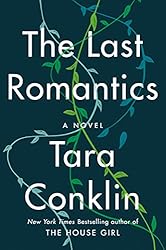
The Last Romantics
Tara Conklin, 2019
HarperCollins
368 pp.
ISBN-13: 9780062358202
Summary
Tara Conklin, the New York Times bestselling author of The House Girl, explores the lives of four siblings in this ambitious and absorbing novel in the vein of Commonwealth and The Interestings.
"The greatest works of poetry, what makes each of us a poet, are the stories we tell about ourselves. We create them out of family and blood and friends and love and hate and what we’ve read and watched and witnessed. Longing and regret, illness, broken bones, broken hearts, achievements, money won and lost, palm readings and visions. We tell these stories until we believe them."
When the renowned poet Fiona Skinner is asked about the inspiration behind her iconic work, "The Love Poem," she tells her audience a story about her family and a betrayal that reverberates through time.
It begins in a big yellow house with a funeral, an iron poker, and a brief variation forever known as the Pause: a free and feral summer in a middle-class Connecticut town.
Caught between the predictable life they once led and an uncertain future that stretches before them, the Skinner siblings—fierce Renee, sensitive Caroline, golden boy Joe and watchful Fiona—emerge from the Pause staunchly loyal and deeply connected.
Two decades later, the siblings find themselves once again confronted with a family crisis that tests the strength of these bonds and forces them to question the life choices they’ve made and ask what, exactly, they will do for love.
A sweeping yet intimate epic about one American family, The Last Romantics is an unforgettable exploration of the ties that bind us together, the responsibilities we embrace and the duties we resent, and how we can lose—and sometimes rescue—the ones we love.
A novel that pierces the heart and lingers in the mind, it is also a beautiful meditation on the power of stories—how they navigate us through difficult times, help us understand the past, and point the way toward our future. (From the publisher.)
Author Bio
• Birth—N/A
• Where—St. Croix, US Virgin Islands
• Raised—Stockbridge, Massachusetts, USA
• Education—B.A., Yale University; M.A.L.D., Tufts Univesity; J.D., New York University
• Currently—lives in Seattle, Oregon
Tara Conklin was born on St. Croix in the US Virgin Islands and raised in Stockbridge, Massachusetts. She is a graduate of Yale University and received her Master of Arts in Law and Diplomacy (MALD) from the Fletcher School of Law and Diplomacy, as well as a law degree from New York University School of Law.
Conklin's first novel, The House Girl, published in 2013, was a New York Times bestseller. The Last Romantics, her second, was released in 2019.
A joint US-UK citizen, Tara now lives with her family in Seattle. (Adapted from the publisher.)
Book Reviews
[A]ccomplished…. Conklin’s plot avoids the predictable and adds a new mystery each time an old one is solved, resulting in a clever novel.
Publishers Weekly
[A] full-bodied drama…. The unusual narrative format… is similar to that of Atonement, Ian McEwan's masterpiece, and is equally successful as deployed here. An intimate, soul-searing examination of a modern family and the ties that bind, for better or worse.
Shelf Awareness
Beautifully written.… Despite spanning almost a century, The Last Romantics never feels rushed. Conklin places readers in the center of the Skinner family,… allowing waves of emotion to slowly uncurl. Perfectly paced, affecting fiction.
Booklist
Conklin’s narrator describes the lingering consequences of the traumatic childhood she shared with her three siblings.…. Basically a lukewarm… family melodrama despite the intermittent, never adequately integrated references to a future wracked by climate change.
Kirkus Reviews
Discussion Questions
1. Why does Conklin choose to frame the story from 2077? Did you think that was effective?
2. Which of the four Skinner siblings do you like the most?
3. How do the effects of The Pause ripple through each of the four siblings' lives? If the Pause had not happened, what do you think might have been different for each of the siblings?
4. Noni came out of her paralyzing depression a staunch second-wave feminist. In what ways does her brand of feminism help her children, and in what ways does it let them down? How does Noni’s feminism compare to Fiona’s feminism, and to the feminism we are seeing today? What strides have we made as feminists and where do we still need to go?
5. Joe and Fiona’s last conversation was an argument about Fiona’s blog, The Last Romantic. Whose side do you take in that argument? Why?
6. Caroline and Fiona try to find Luna in several different ways. Why is it so important for them to find her? Did you think the PI was a good idea? The psychic? What did each sister need from the search for Luna, and did she get it? Why didn’t Renee want to find Luna? Which sister did you sympathize with the most? The least?
7. After Joe’s death, the Skinner sisters break apart for a long time. What brings them back together? How much of family relationships are we able to control? Do you think sometimes it is necessary for families to separate for a time?
8. Do you agree with Fiona’s decision to keep Rory’s existence from her siblings?
9. Caroline ends her long marriage to Nathan, but they remain friends to the end of their lives. Renee leaves Jonathan in order to have a baby, but allows him to return when the baby is born. Fiona has two great loves: Will and Henry. What is Conklin saying about the nature of marriage? Why do you think the Skinner sisters find and forge meaningful partnerships, but Joe does not?
10. At the end of her life, Noni tells Renee that, though her children have forgiven her for the Pause, she has never forgiven herself. Consider the ideas of betrayal and forgiveness. Who in this novel is a betrayer? Who is forgiven? Do you think forgiveness is necessary for rebuilding a relationship after betrayal?
11. At the beginning of the novel, Fiona says, "This is a story about the failures of love." At the end she says, "I was wrong to tell you that this is a story about the failures of love. No, it is about real love, true love." Which do you think is correct? Is there room for both?
(Questions issued by the publisher.)


The Last Runaway
Tracy Chevalier, 2013
Penguin Group USA
320 pp.
ISBN-13: 9780525952992
Summary
In New York Times bestselling author Tracy Chevalier’s newest historical saga, she introduces Honor Bright, a modest English Quaker who moves to Ohio in 1850, only to find herself alienated and alone in a strange land. Sick from the moment she leaves England, and fleeing personal disappointment, she is forced by family tragedy to rely on strangers in a harsh, unfamiliar landscape.
Nineteenth-century America is practical, precarious, and unsentimental, and scarred by the continuing injustice of slavery. In her new home Honor discovers that principles count for little, even within a religious community meant to be committed to human equality.
However, drawn into the clandestine activities of the Underground Railroad, a network helping runaway slaves escape to freedom, Honor befriends two surprising women who embody the remarkable power of defiance. Eventually she must decide if she too can act on what she believes in, whatever the personal costs.
A powerful journey brimming with color and drama, The Last Runaway is Tracy Chevalier’s vivid engagement with an iconic part of American history. (From the publisher.)
About the Author
• Birth—October 19, 1962
• Where—Washington, D.C., USA
• Education—B.A., Oberlin College (USA); M.A., University of
East Anglia (UK)
• Currently—lives in London, UK
Raised in Washington D.C., Tracy Chevalier moved to England in 1984 after graduating from Oberlin College in Ohio. Initially intending to attend one semester abroad, she studied for a semester and never returned. After working as a literary editor for several years, Chevalier chose to pursue her own writing career and in 1994, she graduated with a degree in creative writing at the University of East Anglia.
The Virgin Blue (her first novel), was chosen by W. H. Smith for its Fresh Talent promotion in 1997. She lives in London with her husband and son and hopes to see all of Vermeer's thirty-five known paintings in her lifetime (thus far, she's seen twenty-eight of them). Tracy Chevalier first gained attention by imagining the answer to one of art history's small but intriguing questions: Who is the subject of Johannes Vermeer's painting "Girl with a Pearl Earring"?
It was a bold move on Chevalier's part to build a story around the somewhat mysterious 17th-century Dutch painter and his unassuming but luminous subject; but the author's purist approach helped set the tone. In an interview with her college's alumni magazine, she commented:
I decided early on that I wanted [Girl] to be a simple story, simply told, and to imitate with words what Vermeer was doing with paint. That may sound unbelievably pretentious, but I didn't mean it as "I can do Vermeer in words." I wanted to write it in a way that Vermeer would have painted: very simple lines, simple compositions, not a lot of clutter, and not a lot of superfluous characters.
Chevalier achieved her objective expertly, helped by the fact that she employed the famous Girl as narrator of the story. Sixteen-year-old Griet becomes a maid in Vermeer's tumultuous household, developing an apprentice relationship with the painter while drawing attention from other men and jealousy from women. Praise for the novel poured in: "Chevalier's exploration into the soul of this complex but naïve young woman is moving, and her depiction of 17th-century Delft is marvelously evocative," wrote the New York Times Book Review. The Wall Street Journal called it "vibrant and sumptuous."
Girl with a Pearl Earring was not Chevalier's first exploration of the past. In The Virgin Blue, her U.K.-published first novel (U.S. edition, 2003), her modern-day character Ella Turner goes back to 16th-century France in order to revisit her family history. As a result, she finds parallels between herself and a troubled ancestor — a woman whose fate had been unknown until Ella discovers it.
With 2001's Falling Angels, Chevalier—a former reference book editor who began her fiction career by enrolling in the graduate writing program at University of East Anglia — continued to tell stories of women in the past. But she has been open about the fact that compared to writing Girl with a Pearl Earring, the "nightmare" creating of her third novel was difficult and fraught with complications, even tears. The pressure of her previous success, coupled with a first draft that wasn't working out, made Chevalier want to abandon the effort altogether. Then, reading Barbara Kingsolver's The Poisonwood Bible led Chevalier to change her approach. "[Kingsolver] did such a fantastic job using different voices and I thought, with Falling Angels, I've told it in the wrong way," Chevalier told Bookpage magazine. "I wanted it to have lots of perspective."
With that, Chevalier began a rewrite of her tale about two families in the first decade of 20th-century London. With more than ten narrators (some more prominent than others), Falling Angels has perspective in spades and lots to maintain interest over its relatively brief span: a marriage in trouble, a girlhood friendship born at Highgate Cemetery, a woman's introduction to the suffragette movement. A spirited, fast-paced story, Falling Angels again earned critical praise. "This moving, bittersweet book flaunts Chevalier's gift for creating complex characters and an engaging plot," Book magazine concluded.
Chevalier continues to pursue her fascination with art and history in her fourth novel, on which she is currently at work. According to Oberlin Alumni Magazine, she is basing the book on the "Lady and the Unicorn" medieval tapestries that hang in Paris's Cluny Museum.
Extras
From a 2003 Barnes & Noble interview:
• Chevalier's interest in Vermeer extends beyond a fascination with one painting. "I have always loved Vermeer's paintings," Chevalier writes on her Web site. "One of my life goals is to view all thirty-five of them in the flesh. I've seen all but one — ‘Young Girl Reading a Letter' — which hangs in Dresden. There is so much mystery in each painting, in the women he depicts, so many stories suggested but not told. I wanted to tell one of them."
• Chevalier moved from the States to London in 1984. "I intended to stay six months," she writes. "I'm still here." She lives near Highgate Cemetery with her husband and son.
• The film version of Girl with a Pearl Earring was released 2003 with Scarlett Johansson in the role of Griet and Colin Firth playing Vermeer.
• When asked what book most influenced her life as a writer, here is her response:
It's impossible to list just one! I would say more generally— books that I read when I was a girl, that showed me how different worlds can be brought to life for a reader. My aunt likes to quote that when I was young I once said I was never alone when I had a book to read. (I don't remember saying that, but my aunt isn't prone to lying.) Those companions would be books like the Laura Ingalls Wilder series; Anne of Green Gables by L. M. Montgomery; A Wrinkle in Time by Madeleine L'Engle; The Egypt Game by Zylpha Keatley Snyder; "The Dark Is Rising" series by Susan Cooper; The Wolves of Willoughby Chase by Joan Aiken plus subsequent books in that series; and of course The Lord of the Rings by J.R.R. Tolkien.
• Other favorite books include: Pride and Prejudice (Austen), The Sound and the Fury (Faulkner), Anna Karenina (Tolstoy), The Catcher in the Rye (Salinger), Alias Grace (Atwood), and Song of Solomon (Morrison). (Author bio and interview from Barnes & Noble.)
Book Reviews
Chevalier’s (Girl with a Pearl Earring) haunting seventh novel delves into the difference between a theory of belief and its practice. When young Quaker Honor Bright’s fiance breaks off the relationship to marry outside the faith, Honor goes to America in 1850 with her sister, Grace. Grace is engaged to marry Adam Cox, a young man from their hometown who followed his brother to Faithwell, Ohio. Unfortunately, Grace dies en route, and Honor arrives in Ohio to find Adam sharing a house with Abigail, his sister-in-law, made a widow by the death of Adam’s brother. Honor moves into the house, but feels tense and unwelcome. In Belle Mills, a milliner who appreciates Honor’s sewing skills, Honor finds a friend and ally. Honor also draws the attention of Belle’s brother, Donovan, a slave hunter, and Jack Haymaker, a local farmer, a man “like a pulled muscle that Honor sensed every time she moved.” They marry and Honor, drawn by her sympathies into helping the Underground Railroad, is forced to choose between living her beliefs and merely speaking them. The birth of her own child raises the stakes, and she takes a unique stand in her untenable situation. Honor’s aching loneliness, overwhelming kindness, and stubborn convictions are beautifully rendered, as are the complexities of all the supporting characters and the vastness of the harsh landscape. Honor’s quiet determination provides a stark contrast to the roiling emotions of the slave issue, the abolitionist fight, and the often personal consequences. Chevalier’s thought-provoking, lyrical novel doesn’t allow any of her characters an easy way out.
Publishers Weekly
For the first time ever, the American-born, London-based Chevalier is using America as a backdrop. Leaving home after suffering a disappointment, English Quaker Honor Bright ends up in 1850 Ohio, where she finds folks—even Quakers—pragmatically unprincipled and becomes involved in the Underground Railroad.
Library Journal
Discussion Questions
1. "We're all from somewhere else. That's how Ohio is." —Belle Mills
Through Honor's own journey, the existence of the Underground Railroad and the runaways themselves, there is a constant sense of movement in this novel, suggesting home is not a permanent place and can be made and remade. Is Belle right that this is particular to Ohio or do you think this is a characteristic of America in general?
2. Silence in this novel seems to play different roles: communal religious silence at Meeting, individual reflection to which Honor attributes her own fine sewing, and there is also the Quaker community's more unsettling silence towards slavery.
Discuss the importance of its different roles in the novel. Does the Quaker community believe its own survival is dependent on staying quiet about slavery?
3. What are Honor's true feelings towards Donovan, and how do they change? Do you think her relationship with Donovan reveals aspects of her character that we don't see in her relationships with others?
4. When Belle Mills comes to visit Honor while she is sick at the Haymakers' farm, seeing her is, for Honor, like "discovering a sweet plum among a bowl full of unripe fruit." How important are the relationships Honor has with Belle Mills and Mrs. Reed? Is it significant that her strongest female relationships in Ohio lie outside the Quaker community? Would you say that female relationships would have been even more critical to survival in the 19th century than they are today?
5. Why do you think Honor feels she cannot go back to England? Do you think the horror of the journey plays a greater part than the heartbreak she ran away from?
6. When Honor comes across the applique patterns that are so common to quilting in Ohio, she finds them "cheerful" but "unsophisticated" when set against the accuracy and complexity of the patchwork quilts she is used to back home. Can this comparison have significance when considering the differences between England and the US at that time?
7. "As she peered into the dim woods, a raccoon scurried away, its humped back swaying back and forth...Grace would have loved to see a raccoon, Honor thought."
Honor spends much ofthe book learning how to cope with loss - of her intended husband, her sister, her homeland. Many of the other characters have their own losses to contend with. What does Honor learn from Belle, from Mrs. Reed, from Jack about dealing with loss?
8. How did The Last Runaway make you feel after reading it? Is this a hopeful story, both in the context of Honor's path and the path that America takes?
(Questions from author's website.)
The Last Song
Nicholas Sparks, 2009
Grand Central Publishing
480 pp.
ISBN-13: 9780446570961
Summary
Seventeen year old Veronica "Ronnie" Miller's life was turned upside-down when her parents divorced and her father moved from New York City to Wilmington, North Carolina.
hree years later, she remains angry and alientated from her parents, especially her father...until her mother decides it would be in everyone's best interest if she spent the summer in Wilmington with him. Ronnie's father, a former concert pianist and teacher, is living a quiet life in the beach town, immersed in creating a work of art that will become the centerpiece of a local church.
The tale that unfolds is an unforgettable story of love on many levels—first love, love between parents and children—that demonstrates, as only a Nicholas Sparks novel can, the many ways that love can break our hearts...and heal them. (From the publisher.)
The film 2010 film version starts Miley Cyrus.
Author Bio
• Birth—December 31. 1965
• Where—Omaha, Nebraska, USA
• Education—B.A., University of Notre Dame
• Currently—lives in New Bern, North Carolina
Nicholas Charles Sparks is an American novelist, screenwriter and producer. He has published some 20 novels, plus one non-fiction. Ten have been adapted to films, including Message in a Bottle, A Walk to Remember, The Notebook, Nights in Rodanthe, Dear John, The Last Song, The Lucky One, and most recently The Longest Ride.
Background
Sparks was born to Patrick Michael Sparks, a professor of business, and Jill Emma Marie Sparks (nee Thoene), a homemaker and an optometrist's assistant. He was the middle of three children, with an older brother and a younger sister, "Dana", who died at the age of 33 from a brain tumor. Sparks said that she is the inspiration for the main character in his novel A Walk to Remember.
His father was pursuing graduate studies at University of Minnesota and University of Southern California, and the family moved a great deal, so by the time Sparks was eight, he had lived in Watertown, Minnesota, Inglewood, California, Playa del Rey, California, and Grand Island, Nebraska, which was his mother's hometown during his parents' one year separation.
In 1974 his father became a professor of business at California State University, Sacramento teaching behavioral theory and management. His family settled in Fair Oaks, California, and remained there through Nicholas's high school days. He graduated in 1984 as valedictorian from Bella Vista High School, then enrolled at the University of Notre Dame under a full track and field scholarship. In his freshman year, his team set a record for the 4 x 800 relay.
Sparks majored in business finance and graduated from Notre Dame with honors in 1988. He also met his future wife that year, Cathy Cote from New Hampshire, while they were both on spring break. They married in 1989 and moved to New Bern, North Carolina.
Writing career
While still in school in 1985, Sparks penned his first (never published) novel, The Passing, while home for the summer between freshman and sophomore years at Notre Dame. He wrote another novel in 1989, also unpublished, The Royal Murders.
After college, Sparks sought work with publishers or to attend law school, but was rejected in both attempts. He then spent the next three years trying other careers, including real estate appraisal, waiting tables, selling dental products by phone and starting his own manufacturing business.
In 1990, Sparks co-wrote with Billy Mills Wokini: A Lakota Journey to Happiness and Self-Understanding. The book was published by Random House sold 50,000 copies in its first year.
In 1992, Sparks began selling pharmaceuticals and in 1993 was transferred to Washington, DC. It was there that he wrote another novel in his spare time, The Notebook. Two years later, he was discovered by literary agent Theresa Park, who picked The Notebook out of her agency's slush pile, liked it, and offered to represent him. In October 1995, Park secured a $1 million advance for The Notebook from Time Warner Book Group. The novel was published in 1996 and made the New York Times best-seller list in its first week of release.
With the success of his first novel, he and Cathy moved to New Bern, NC. After his first publishing success, he began writing his string of international bestsellers.
Personal life and philanthropy
Sparks continues to reside in North Carolina with his wife Cathy, their three sons, and twin daughters. A Roman Catholic since birth, he and his wife are raising their children in the Catholic faith.
In 2008, Entertainment Weekly reported that Sparks and his wife had donated "close to $10 million" to start a private Christian college-prep school, The Epiphany School of Global Studies, which emphasizes travel and lifelong learning.
Sparks also donated $900,000 for a new all-weather tartan track to New Bern High School. He also donates his time to help coach the New Bern High School track team and a local club track team as a volunteer head coach.
In addition to track, he funds scholarships, internships and annual fellowship to the Creative Writing Program (MFA) at the University of Notre Dame. (Adapted from Wikipedia.)
Book Reviews
Nicholas Sparks' blockbuster novels are like hot buttered Orville Redenbacher for the soul: highly consumable [and] comforting.... Fans of The Notebook, Message in a Bottle, etc., will gobble [The Last Song] up with glee, right through the tear-duct-milking finale.
Entertainment Weekly
Discussion Questions
1. Ronnie is a difficult teenager who is prone to acting out and is alienated from both her parents at the start of the novel. Were you rebellious as a teenager? How was this manifested? On the other side, have you ever had to deal with a rebellious teenager? Did Ronnie’s behavior touch a nerve?
2. What do you think about the very different approaches to parenting taken by Ronnie’s mother and father? Do you think Ronnie’s mother is too intrusive or can you understand her relationship with Ronnie? Do you think Ronnie’s father is too absent, or can you understand why the relationship is the way it is?
3. Early in the novel we learn that Ronnie was a piano prodigy who performed at Carnegie Hall when she was thirteen. However, when we meet Ronnie she hasn’t played in many years and she’s sworn to never play the piano again. Why does Ronnie feel this way? Who do you think Ronnie hurts more by not playing the piano, herself or her father?
4. Reflecting back on his life, Steve wonders: “Was it still possible for someone like him to experience the presence of God?” Why does Steve ask himself this? What role do religion and belief play in this novel? How would you characterize Steve’s religious faith?
5. Why does Will fall for Ronnie? Can you understand the attraction from both Ronnie’s and Will’s point of view?
6. What do you make of Blaze? How would you characterize her relationship with Marcus? Have you ever been in a relationship that was not particularly healthy? Did you stay in the relationship? If so, why?
7. Ronnie and Will fall in love very quickly over the course of the summer. Have you ever had a summer romance that became something more than a fling?
8. This novel is, in large part, about loyalty and trust. Which characters exhibit the most trustworthiness and which exhibit the least? How does a betrayal of trust affect various relationships within the novel?
9. In the middle of the novel, Will asks Ronnie how far she would go to protect a friend. Why does Will ask Ronnie this? How far would you go to protect a friend?
10. How are Jonah and Ronnie affected by their parents’ divorce? What effect does divorce have on children, in your experience?
11. Both Will and Ronnie come from families that have certain expectations of them. How do these familial expectations shape them and in what ways do they reject these expectations?
12. Why does Ronnie get angry at Will toward the end of the novel? Do you think her anger is justified?
13. What do you think of the choices Steve and Kim make as parents? Do you think they were right in keeping certain things secret from their children?
14. Ronnie makes an important choice at the end of the novel. Would you have made the same choice if you were in her position?
15. In what ways does Ronnie change over the course of the novel? In what ways does she stay the same? (Questions issued by publisher.)

The Last Story of Mina Lee
Nancy Jooyoun Kim, 2020
Park Row Books
384 pp.
ISBN-13: 9780778310174
Summary
A profoundly moving and unconventional mother-daughter saga, The Last Story of Mina Lee illustrates the devastating realities of being an immigrant in America.
Margot Lee’s mother, Mina, isn’t returning her calls. It’s a mystery to twenty-six-year-old Margot, until she visits her childhood apartment in Koreatown, LA, and finds that her mother has suspiciously died.
The discovery sends Margot digging through the past, unraveling the tenuous invisible strings that held together her single mother’s life as a Korean War orphan and an undocumented immigrant, only to realize how little she truly knew about her mother.
Interwoven with Margot’s present-day search is Mina’s story of her first year in Los Angeles as she navigates the promises and perils of the American myth of reinvention. While she’s barely earning a living by stocking shelves at a Korean grocery store, the last thing Mina ever expects is to fall in love.
But that love story sets in motion a series of events that have consequences for years to come, leading up to the truth of what happened the night of her death.
Told through the intimate lens of a mother and daughter who have struggled all their lives to understand each other, The Last Story of Mina Lee is a powerful and exquisitely woven debut novel that explores identity, family, secrets, and what it truly means to belong. (From the publisher.)
Author Bio
• Birth—N/A
• Where—Los Angeles, California
• Education—B.A., University of California, Los Angeles; M.A., University of Washington
• Currently—lives in the San Francisco Bay Area
Born and raised in Los Angeles, Nancy Jooyoun Kim is a graduate of UCLA and the University of Washington, Seattle. Her debut novel, The Last Story of Mina Lee, was released in 2020.
Her essays and short fiction have appeared in the Los Angeles Review of Books, Guernica, NPR/PRI’s Selected Shorts, The Rumpus, Electric Literature, Asian American Writers’ Workshop’s The Margins, The Offing, and elsewhere. (From the publisher .)
Book Reviews
The novel’s interior moments — in which mother and daughter think tragically past each other—work best.… Had the author kept the narrative this close, The Last Story of Mina Lee would have been a stronger book, its tangled subplots (Korean flashbacks, organized-crime figures) more of a counterbalance to the characters’ yearnings. Unfortunately, Kim succumbs to a common failing of first novels, telling too much.
Los Angeles Times
Mina’s immigration story poignantly mingles optimism with the heartbreak of exploitation. The more contemporary portions of the narrative, however, lack both emotional pull and narrative conviction.… As a personal immigration narrative Kim’s novel largely succeeds, but as a mystery novel or a mother-daughter drama it fails to connect.
Publishers Weekly
(Starred review) Haunting and heartbreaking, troubled threads between a mother and daughter blend together in a delicate and rich weave… With both sadness and beauty, [Kim] describes grief, regret, loss, and the feeling of being left behind. Fans of Amy Tan and Kristin Hannah will love Kim's brilliant debut.
Booklist
Discussion Questions
We'll add publisher questions if and when they're available; in the meantime, use our LitLovers Book Club Resources. They can help with discussions for any book:
1. How would you describe Mina and Margot, the two characters at the heart of this novel? What about their relationship—why it is so difficult? Why do mother and daughter find it so hard to understand one another?
2.The police have ruled Mina's death accidental. Why does Margot doubt their conclusion? What, in her mind, makes it suspicious?
3. As Margot begins her investigation into her mother's death, whom does she come to suspect? What about you?
4. The Last Story of Mina Lee is about the perils and hardships of immigration. Why did Mina leave South Korea, and what were her hopes for a life in the United States? In what way did those dreams fall short?
5. Do you believe that Mina's story typical of most, or at least many, newly arrived immigrants? Does the novel offer you insights into the rationale, dreams, and hardships of those who leave their countries and families behind to come to America?
6. Talk about Margot's own journey as she explores her mother's life. How it change her? What does she come to understand about who her mother was—and, just as important, who she herself is?
7. What do you see for Margot in the coming years? Do you believe she will see her grandmother?
(Questions by LitLovers. Please feel free to use them, online and off, with attribution. Thanks.)
The Last Summer (of You and Me)
Ann Brashares, 2007
Penguin Group USA
320 pp.
ISBN-13: 9781594483080
Summary
In The Last Summer (of You & Me), Ann Brashares explores the exhilaration and anguish of leaving adolescence. Telling the story of three lifelong friend—Alice, her sister Riley, and their neighbor Paul—who struggle to maintain their purity against the world's many compromises and betrayals, the novel captures both the innocent yearnings of childhood and the more complex desires of adulthood. As the former inevitably yields to the latter, the relationship between the three friends realigns in a complex dance of passion, guilt, and love, opening up new possibilities while closing off others forever.
As the story opens, it has been three long years since Alice last saw Paul at their summer home on Fire Island. While her sister Riley has always maintained contact with Paul during the off-seasons, Alice's relationship with him has been defined by their silences between summers. As she awaits his arrival on the afternoon ferry, Alice tries to deny that her feelings for Paul have grown beyond friendship. She knows that they are not reciprocated, and even if they were, to change the nature of their relationship would constitute a kind of betrayal of the bond they share with her sister.
Paul has avoided returning to Fire Island these past years because he fears what will happen when he does. Although he fights it with all his will, the truth is that he is in love with Alice and probably always has been. And then there is Riley, the kindred spirit of his childhood who somehow remains frozen in time both physically and emotionally. As much as Paul wishes he could join her in her state of perpetual childhood, the demands and longings of the adult world are pulling him in the opposite direction.
At first, the three of them fall right back into their old patterns — Paul and Riley forging off on adventures, Alice always left a few steps behind. But soon the attraction between Alice and Paul breaks to the surface, and they embark on an intense love affair tinged with guilt over the friend and sister they have left behind. That guilt is seemingly made manifest when Riley is suddenly struck with a life-threatening illness.
Dreading the attention and pity her condition is sure to elicit, Riley begs Alice not to tell Paul what has happened, and in so doing drives a wedge between the burgeoning couple. As Alice and Paul nurse regrets and resentments over the long, cold winter, Riley's health continues to deteriorate. Trying desperately to hang onto the lost bliss of their childhood, Alice, Paul, and Riley instead must face their futures. The road to that future is both heartbreaking and deeply moving, offering the promise of new life even in the face of immense loss. (From the publisher.
Author Bio
• Birth—July 30, 1967
• Where—Alexandria, Virginia, USA
• Reared—in Chevy Chase, Maryland
• Education—Barnard College
• Currently—lives in New York, New York
Ann Brashares is an American writer of young adult fiction, best known as the author of The Sisterhood of the Traveling Pants series.
She was born in Alexandria, Virginia, and grew up in Chevy Chase, Maryland. She attended elementary and high school at the Sidwell Friends School in Washington, D.C. After studying philosophy at Barnard College, she worked as an editor for 17th Street Productions. 17th Street was acquired by Alloy Entertainment, and following the acquisition she worked briefly for Alloy.
After leaving Alloy she wrote The Sisterhood of the Traveling Pants, which became an international best seller. It was followed with three more titles in the "Pants" series, the last of which, Forever in Blue, was released in January 2007. The first book in the series was made into a film in 2005, and a second film based on the other three titles in the series was released in August 2008.
Brashares' first adult novel, The Last Summer (of You and Me) was released in 2007. The first companion book to the Sisterhood series, 3 Willows: The Sisterhood Grows was published in 2009, and the second companion book, Sisterhood Everlasting was published in 2011.
A second novel for adults, My Name is Memory was published in 2010 and has been optioned for film. Her next book, a young-adult time-travel novel, The Here and Now, was published in 2014. She lives in New York with her artist husband, Jacob Collins. They have four children.
Although Brashares writes primarily fiction, she has contributed two 80-page biographies to the nonfiction book series Techies—Linus Torvalds, Software Rebel and Steve Jobs Thinks Different, both issued in 2001. (From Wikipedia. Retrieved 4/27/2014.)
Book Reviews
Despite its serious themes The Last Summer (of You and Me) is full of optimism and too neatly resolved. But it's steeped in the familiar longings for lost time that readers seeking the carefree pleasures of a summer will enjoy.
Kim Edwards - Washington Post
The Last Summer is as much a treatise on loyalty and letting go of childish ways as it is on a summer of love.
USA Today
Vivid elegy for youth...Brashares is wise as well as sentimental. She sagely remembers just how it feels to be young, lost, and in love. The Last Summer (of You and Me) is a weeper: If you don't grow misty there's something a bit shifty about the state of your heart.
Miami Herald
When summertime neighbors Alice and Paul realize their feelings for go deeper than friendshipm they're afraid to share the news of their clandestine affair with Riley, Alice's sister and Paul's best friend. But then a darker, more tragic secret threatens to come between them. The page-turning pace of Ann Brashares's The Last Summer (of You & Me) makes it a perfect beach read.
Redbook
[A] treacly tale about the tribulations a trio of longtime friends encounter.... Brashares's YA roots are on display: the girls and Paul act like high school kids...and anything below the surface is left untouched. It's a beach read, for sure, but a mediocre one.
Publishers Weekly
A novel about sisters, friendship, irrevocable loss, blossoming love, old betrayals and secrets.... Brashares writes with a spare hand about the evolving ties between Paul and the sisters.... But the characters, although likeable, never really come alive, and neither does the novel. Slow-moving, deliberately paced coming-of-age tale oddly lacking in passion, though a built-in readership will undoubtedly want to read it anyway.
Kirkus Reviews
Discussion Questions
1. Early on, we learn of the different beaches associated with each character: a Riley beach "was when little grains of sand whipped like glass against your skin and the surf was ragged and punishing"; a Paul beach has "low-tide crunchy sand, a sharp drop-off to the water, and a close army of rough, green waves"; and an Alice beach "was truly rare, and it involved tide pools." Discuss these three characters in relation to the beaches named after them. Are the names appropriate or ironic?
2. The school psychologist whom Riley is taken to in the fifth grade explains that the mind "has an immune system of its own." When dealing with distress, "it surrounds the offending element like a germ and stops its spread." Discuss the thematic significance of this passage. How does the "immune system" of each character's mind influence their actions throughout the novel?
3. Riley's sexuality is a subject of speculation for many characters in the novel. At one point, Paul guiltily considers the question: "Was Riley gay? Was she sexual at all? Was she lonely?" What answers does the novel offer? Are these questions even relevant to understanding who Riley is? Or are they, as Paul thinks, a subject for "smaller minds"?
4. Consider the author's choice of chapter titles. Some relate directly to subject of the chapter ("Waiting"), others introduce ideas not explicitly explored until later chapters ("You'll Turn Out Ordinary if You're Not Careful"), while still others echo ideas from previous chapters ("Cryogenics"). What, in your opinion, is the purpose of these titles? What do they reveal about the author's overall narrative approach?
5. Riley says that she missed the call for a potential heart transplant because she was swimming. Do you believe this? Is there some part of Riley—conscious or unconscious—that is seeking death?
6. As a child, Riley wonders what would happen if the dolphins in the aquarium at Coney Island could talk to the dolphins swimming in the ocean. "What would a free dolphin say to a captive one? How could one possibly understand the circumstances of the other?" How does this passage relate to the larger themes of the novel? Discuss the symbolic role of the Coney Island dolphins.
7. The phrase "consider yourself forgiven" is employed three times in the story: by Alice, as part of her ultimatum to Paul at the beginning of their romance; by Ethan, after Paul apologizes for brushing him off outside NYU; and by Paul, when Ethan expresses regret for his relationship with Paul's mother. Discuss the subtext of each occurrence of this phrase, and how it relates the development of the main characters.
8. Ultimately, Alice, Paul, and Riley fear growing up because of the example set by the adults in their world—especially their parents. How does each character deal with this fear through the course of the story? How does it influence their actions?
(Questions issued by publisher.)


The Last Summer of the Camperdowns
Elizabeth Kelly, 2013
Liveright Publishing
400 pp.
ISBN-13: 9780871403407
Summary
The Last Summer of the Camperdowns introduces Riddle James Camperdown, the twelve-year-old daughter of the idealistic Camp and his manicured, razor-sharp wife, Greer.
It’s 1972, and Riddle’s father is running for office from the family compound in Wellfleet, Massachusetts. Between Camp’s desire to toughen her up and Greer’s demand for glamour, Riddle has her hands full juggling her eccentric parents.
When Riddle accidentally witnesses a crime close to home, her confusion and fear keep her silent. As the summer unfolds, the consequences of her silence multiply. Another mysterious and powerful family, the Devlins, slowly emerges as the keepers of astonishing secrets that could shatter the Camperdowns.
As an old love triangle, bitter war wounds, and the struggle for status spiral out of control, Riddle can only watch, hoping for the courage to reveal the truth. The Last Summer of the Camperdowns is poised to become the summer’s uproarious and dramatic must-read. (From the publisher.)
Author Bio
Elizabeth Kelly is the best-selling author of the novel Apologize, Apologize! (2009) and The Last Summer of the Camperdowns (2013). She is an award-winning journalist and lives in Merrickville, Ontario, Canada, with her husband, five dogs, and three cats. (From .)
Book Reviews
The plot unfolds like the Cape Cod season itself… beginning lazily, languidly, before heating up and morphing into a fast-paced thriller.
Abbe Wright - O Magazine
These vibrant personalities jump off the page individually, and the collective dynamic is as lifelike and scintillating as beautifully cast actors in an artfully directed play… the scenes and dialogue unravel organically, and razor-sharp witticisms tumble out effortlessly.
Redbook
Kelly’s raucous, deliciously creepy novel about the dysfunction of the über wealthy begins in 1972 as the hoity-toity Camperdown clan prepare for another summer.... The novel threatens to veer too predictably into Great Gatsby territory (long-buried secrets bubbling to the surface...but is saved by precocious Riddle’s dry-witted narration of events, at least until she witnesses a heinous murder and clams up.... [I]n a climax that’s a touch too hurried...no one, not even the creepy killer, escapes unscathed.
Publishers Weekly
The author of Apologize! Apologize! (2009) returns with another witty take on a dysfunctional family… Kelly is a very entertaining writer with a digressive style and a way with metaphor …readers will find much to like in this colorful story peopled with larger-than-life personalities.
Booklist
A 13-year-old girl finds that keeping secrets can have mortal consequences.... Kelly's new novel is just as scathingly witty as her best-selling debut [Apologize! Apologize!] but better plotted and even more emotionally harrowing, as narrator Riddle Camperdown looks back two decades to the disastrous summer of 1972.... Kelly skillfully builds almost unbearable tension, slipping in plenty of dark laughs en route to a wrenching climax that leaves in its wake some painfully unresolved questions—just like life. More fine work from a writer with a rare gift for blending wit and rue.
Kirkus Reviews
Discussion Questions
1. The novel is set in Cape Cod during the summer of 1972. How does the physical setting and time period affect the story? How would the plot differ if the story was set in a different location at a different historical moment?
2. On numerous occasions throughout the novel, Riddle is compared to Greer. Are Riddle and Greer really as different as they appear? What qualities do they share?
3. As Michael reappears in the life of the Camperdowns, the relationship between Camp and Greer alters. Why does Michael change their dynamic, and what else could be at work between Camp and Greer?
4. How does Greer’s experience as an actress influence her daily behavior? Although Greer is the only actress by profession, what other characters are guilty of performing their lives? What initiates their needs to play out specific roles?
5. Describe Riddle’s relationship with Gula. How do you interpret Gula’s fictitious stories that continue to unfold? Can you relate to Riddle’s complicated emotions of perversion and seduction toward Gula?
6. Why do you think nineteen-year-old Harry has such an attachment to twelve-year-old Riddle? What is at the heart of their friendship? Do you think Harry will ever speak to Riddle again?
7. What explains Gula’s fascination with Riddle? Why do you think Gula gave Riddle the present at the end of the book?
8. Riddle’s reaction to finding Charlie’s body is noteworthy: “I felt such shame, such guilt, even as I was ashamed to feel shame, disgusted by my feelings of guilt.” Why do you think Riddle felt this way? What do her emotions reveal about her character?
9. In Charlie’s book of condolences, Camp writes, “I will see you in the morning.” What do you think this means?
Compare Michael and Camp; which man do you find more trustworthy? Whose account of the war do you believe? Who do you think Greer loved more?
10. One theme of the book is the power of secrets, and the end of the book capitalizes on the secret Riddle has kept throughout regarding Charlie’s death. Do you think this is the most consequential secret of the book? What other secrets cause grave consequences?
11. How does the first chapter, set in the present, frame the rest of the novel that is set in the past? When the novel returns to the present in the epilogue, how have your feelings for Riddle changed from the beginning of the book?
The book is narrated from Riddle’s point of view. How does her perspective influence the story? Do you trust her as a narrator? Why or why not?
12. Why do you think Riddle kept what she saw in the yellow barn a secret for so long? How was Gula able to manipulate Riddle to stay silent? What drove Riddle to finally reveal the truth?
(Questions issued by publisher.)
The Last Time I Saw You
Elizabeth Berg, 2010
Random House
256 pp.
ISBN-13: 9781400068647
Summary
To each of the men and women in The Last Time I Saw You, their 40th high school reunion means something different—a last opportunity to say something long left unsaid, an escape from the bleaker realities of everyday life, a means to save a marriage on the rocks, or an opportunity to bond with a slightly estranged daughter, if only over what her mother should wear.
As the onetime classmates meet up over the course of a weekend, they discover things that will irrevocably affect the rest of their lives. For newly divorced Dorothy Shauman, the reunion brings with it the possibility of finally attracting the attention of the class heartthrob, Pete Decker. For the ever self-reliant, ever left-out Mary Alice Mayhew, it’s a chance to reexamine a painful past. For Lester Heseenpfeffer, a veterinarian and widower, it is the hope of talking shop with a fellow vet—or at least that’s what he tells himself. For Candy Armstrong, the class beauty, it’s the hope of finding friendship before it is too late.
As Dorothy, Mary Alice, Lester, Candy, and the other classmates converge for the reunion dinner, four decades melt away, desires and personalities from their youth reemerge, and new discoveries are made. For so much has happened to them all. And so much can still happen.
In this beautiful novel, Elizabeth Berg deftly weaves together stories of roads taken and not taken, choices made and opportunities missed, and the possibilities of second chances. (From the publisher.)
Author Bio
• Birth—December 2, 1948
• Where—St. Paul, Minnesota, USA
• Education—A.A.S, St. Mary’s College
• Awards—(see below)
• Currently—lives in Chicago, Illinois
Before she became a writer, Elizabeth Berg spent 10 years as a nurse. It's a field, as she says on her website, that helped her to become a writer:
Taking care of patients taught me a lot about human nature, about hope and fear and love and loss and regret and triumph and especially about relationships—all things that I tend to focus on in my work.
Her sensitivity to humanity is what Berg's writing is noted for. As Publishers Weekly wrote in reviewing The Dream Lover, her 2015 portrayal of George Sand, "Berg offers vivid, sensual detail and a sensitive portrayal of the yearning and vulnerability" behind her main character.
Background
Berg was born in St. Paul Minneapolis. When her father re-enlisted in the Army, she and her family were moved from base to base—in one single year, she went to three different schools. Her peripatetic childhood makes it hard for Berg to answer the usually simple question, "where did you grow up?"
Berg recalls that she loved to write at a young age. She was only nine when she submitted her first poem to American Girl magazine; sadly, it was rejected. It was another 25 years before she submitted anything again—to Parents Magazine—and that time she won.
In addition to nursing, Berg worked as a waitress, another field she claims is "good training for a writer." She also sang in a rock band.
Writing
Berg ended up writing for magazines for 10 years before she finally turned to novels. Since her 1993 debut with Durable Goods, her books have sold in large numbers and been translated into 27 languages. She writes nearly a book a year, a number of which have received awards and honors.
Recognition
Two of Berg's books, Durable Goods and Joy School, were listed as "Best Books of the Year" by the American Library Association. Open House became an Oprah Book Club Selection.
She won the New England Booksellers Award for her body of work, and Boston Public Library made her a "literary light." She has also been honored by the Chicago Public Library. An article on a cooking school in Italy, for National Geographic Traveler magazine, won an award from the North American Travel Journalists Association.
Personal
Now divorced, Berg was married for over twenty years and has two daughters and three grandchildren. She lives with her dogs and a cat in Chicago. (Author bio adapted from the author's website.)
Book Reviews
A high school reunion and all of its attendant dramas is the backdrop of Berg's rose-tinted latest (after Home Safe). For Dorothy Shauman, her 40th reunion is the chance to finally hook up with her high school crush. She prepares weeks in advance for the big night, strange as that may seem, preening in front of the mirror. As Berg surveys the gamut of emotions felt by Dorothy and some of her classmates, she zeroes in on an array of stereotypes—the hot girls, the jocks, the in crowd, the out crowd—and considers what makes each one tick, offering the vanilla revelation that the person on the inside doesn't always match the person on the outside. It's cleanly plotted, ably written, and sure to appeal to boomers staring down the barrel of their own 40th reunions.
Publishers Weekly
Luckily, the zestfully wise Berg is the perfect teacher for such tender lessons of the heart, and her sublimely authentic and winsome characters are apt students. Book groups are clamoring for upbeat yet significant works that are entertaining as well as enlightening; Berg’s latest novel satisfies and succeeds on both counts. —Carol Haggas
Booklist
A 40th high-school reunion reawakens old insecurities and crushes among former geeks, jocks, wallflowers and beauty queens. In the small Ohio town of Clear Springs, the high-school class of 1960-something is about to relapse into old roles. Three of the alums still live in Clear Springs. Lester, science nerd, is now a veterinarian. Mary Alice, a four-eyed ugly duckling who never married, is caring for her 92-year-old neighbor Einer. Divorcee Dorothy, who hovered on the fringes of popularity, is crash-dieting in hopes of seducing quarterback Pete Decker, who, she hears, is separated from his wife and high-school sweetheart Nora. Blonde lead cheerleader Candy has just been diagnosed with a terminal disease, and she intends to fly to the reunion accompanied by her bulldog in lieu of husband Coop, whose micromanagement she finds exhausting. Pam, the unpopular girl still tasked, thanklessly, with organizing events, has planned the ultimate buzz-kill for the reunion dinner-dance. While trying to dump his mistress and win back Nora, Pete suffers a heart attack. He escapes from the hospital to attend the reunion dressed in ill-fitting golf togs purchased at the airport. Nora flaunts her new boyfriend, while Mary Alice is escorted by Einer, who vows to protect her from classmates who used to haze her. When Dorothy arrives flanked by girlfriends who made up her small clique, she's dismayed to see Pete schmoozing Mary Alice. Einer shares his own high-school memories—then, they called the cool crowd "superlatives." Candy seeks out Lester as her dinner mate, much to Mary Alice's dismay: She had high hopes after lunch with Lester. Candy invites Lester to her hotel room, to examine the suspicious lumps she's just discovered on her bulldog's abdomen. More cynical than her usual Anne Tyler-lite approach, Berg's depiction of her characters' mid-life follies and ongoing struggles with the specter of aging is at times hilarious, at times sad, but this time she steers clear of the maudlin to go for the jugular.
Kirkus Reviews
Discussion Questions
Use our LitLovers Book Club Resources; they can help with discussions for any book:
• How to Discuss a Book (helpful discussion tips)
• Generic Discussion Questions—Fiction and Nonfiction
• Read-Think-Talk (a guided reading chart)
Also consider these LitLovers talking points to help get a discussion started for The Last Time I Saw You:
1. Berg offers portraits of high school "types"—the jock, the cheerleader, the popular kids, the nerds and outsiders. Are her depictions accurate?
2. Which character do you most identify with? Which ones do you find most sympathetic? Which least sympathetic?
3. What do the individual characters want—or hope to achieve —from the reunion? Why are some hesitant to attend?
4. In what ways have the various characters changed over the past 40 years—especially Lester and Mary Alice? Have any other characters truly changed? What have they learned? How have expectations been dashed...or met?
5. One character observes: "Here they are, these people, all these years later just...what? Trying.... Just trying." What does he mean..."just trying" to do what?
6. High school comprises a very short time of our lives; in retrospect, most of us recognize how shallow, cruel, even meaningless, the social heirarchy was. Nonetheless, the memories—the hurts and triumphs—resonate even after 40 years. Why is that? Why are those few short years so potent for so many?
7. If you're "of an age"... or have graduated even just 10 years ago...does Berg's novel ring true to you? Have you attended any of your high school reunions?
8. Does the ending of Berg's novel satisfy you? Are you pleased with how it all turned out?
(Questions by LitLovers. Please feel free to use them, online or off, with attribution. Thanks.)
top of page (summary)


The Last Time I Was Me
Cathy Lamb, 2008
Kensington Publishing
404 pp.
ISBN-13: 9780758214638
Summary
I wrapped up my grandmother's tea cup collection and my mother's china, then grabbed a violin I'd hidden way back in my closet that made me cry, a gold necklace with a dolphin that my father gave me two weeks before he died of a heart attack when I was twelve and, at midnight, with that moon as bright as the blazes, I left Chicago.
When Jeanne Stewart stops at The Opera Man's Cafe in Weltana, Oregon, to eat pancakes for the first time in twelve years, she has no idea she's also about to order up a whole new future. It's been barely a week since she succumbed to a spectacularly public nervous breakdown in front of hundreds of the nation's most important advertising and PR people. Jeanne certainly had her reasons—her mother's recent death, the discovery that her boyfriend had been sleeping with a dozen other women, and the assault charges that resulted when Jeanne retaliated in a creative way against him, involving condoms and peanut oil.
Now, en route to her brother's house in Portland, Jeanne impulsively decides to spend some time in picturesque Weltana. Staying at a B&B run by the eccentric, endearing Rosvita, she meets a circle of quirky new friends at her court-ordered Anger Management classes. Like Jeanne, all of them are trying to become better, braver versions of themselves. Yet the most surprising discoveries are still to come—a good man who steadily makes his way into her heart and a dilapidated house that with love and care might be transformed into something wholly her own, just like the new life she is slowly building, piece by piece.
As heartfelt as it is hilarious, The Last Time I Was Me is a warm, wise novel about breaking down, opening up, and finally letting go of everything we thought we should be, in order to claim the life that has been waiting all along. (From the publisher.)
Author Bio
• Birth—N/A
• Where—Newport Beach, California, USA
• Raised—state of Oregon
• Education—B.A., University of Oregon
• Currently—lives in Portland, Oregon
In her words:
I was born in Newport Beach, California and spent my first ten years playing outside like a wild vagabond.
As a child, I mastered the art of skateboarding, catching butterflies in bottles, and riding my bike with no hands. When I was ten, my parents moved me, my two sisters, a brother, and two poorly behaved dogs to Oregon before I could fulfill my lifelong dream of becoming a surfer bum.
I then embarked on my notable academic career where I earned good grades now and then, spent a great deal of time daydreaming, ran wild with a number of friends, and landed on the newspaper staff in high school. When I saw my byline above an article about people making out in the hallways of the high school, I knew I had found my true calling.
After two years of partying at the University of Oregon, I settled down for the next three years and earned my bachelor’s and master’s degrees in education, and became a fourth grade teacher. I became a teacher because I wanted to become a writer. It was difficult for me to become proper and conservative but I threw out my red cowboy boots and persevered. I had no choice. I had to eat and health insurance is expensive. I loved teaching, but I also loved the nights and summers where I could write and try to build a career filled with creativity and my strange imagination.
I met my husband on a blind date. A mutual friend who was an undercover vice cop busting drug dealers set us up. My husband jokes he was being arrested at the time. That is not true. Do not believe him. His sense of humor is treacherous. It was love at third sight. We’ve now been married a long time.
Teaching children about the Oregon Trail and multiplication facts amused me until I became so gigantically pregnant with twins I looked like a small cow and could barely walk. With a three year old at home, I decided it was time to make a graceful exit and waddle on out. I left school one day and never went back. I later landed in the hospital for over six weeks with pre term labor, but that is another (rather dull) story. I like to think my students missed me.
When I was no longer smothered in diapers and pacifiers, I took a turn onto the hazardous road of freelance writing and wrote over 200 articles on homes, home décor, people and fashion for a local newspaper. As I am not fashionable and can hardly stand to shop, it was an eye opener to find that some women actually do obsess about what to wear. I also learned it would probably be more relaxing to slam a hammer against one’s forehead than engage in a large and costly home remodeling project. I also tried to write romance books, which ended ingloriously for years.
I suffer from, "I Would Rather Play Than Work Disease" which prevents me from getting much work done unless I have a threatening deadline, which is often. I like to hang with family and friends, walk, eat chocolate, travel, go to Starbucks, and I am slightly obsessive, okay very obsessive, about the types of books I read. I also like to be left alone a lot so I can hear all the bizarre and troubled characters in my head talk to each other and then transfer that oddness to paper. The characters usually don’t start to talk until 10:00 at night, however, so I am often up ‘til 2:00 in the morning with them. That is my excuse for being cranky. Really, I was just born a little cranky.
I adore my children and husband, except when he refuses to take his dirty shoes off and walks on the carpet. I will ski because my kids insist, but I secretly don’t like it at all. Too cold and I fall all the time.
I am currently working on my next novel and I’m not sleeping much. (From the author's website.)
Follow Cathy on Facebook.
Book Reviews
Lamb is an awesome storyteller and moves seamlessly from the past to the present.
RT Book Reviews
IF YOU COULD SEE WHAT I SEE: Lamb’s story is earnest, heartwarming and, at times, heartbreaking.
RT Book Reviews
THE FIRST DAY OF THE REST OF MY LIFE: The blending of three or more generations and the secrets they harbor keeps this story moving briskly, culminating in a satisfying ending that makes us believe that despite heartache and angst, there can be such a thing as happily ever after.
New York Journal of Books
SUCH A PRETTY FACE: Stevie’s a winning heroine
Publishers Weekly
HENRY’S SISTERS
An Indie Next List Notable Book.
A story of strength and reconciliation and change.
Sunday Oregonian
If you loved Terms of Endearment, the Ya Ya Sisterhood, and Steel Magnolias, you will love Henry’s Sisters. Cathy Lamb just keeps getting better and better.
Three Tomatoes Book Club
THE LAST TIME I WAS ME: Charming.
Publishers Weekly
JULIA’S CHOCOLATES: Julia's Chocolates is wise, tender, and very funny. In Julia Bennett, Cathy Lamb has created a deeply wonderful character, brave and true. I loved this beguiling novel about love, friendship and the enchantment of really good chocolate.
Luanne Rice, New York Times bestselling author
Discussion Questions
1. Jeanne Stewart says, "To assume that a woman, any woman, is completely innocent is to be completely naïve." Is she right?
2. What was your first impression of Jeanne? Do you like her? Is she a feminist or a traditionalist at heart, or both?
3. Jeanne says that most women have secrets, "Pretty big ones, if I do say so myself." What secrets did people have in this book? Is it true that most women have secrets? Do you have secrets? Do people tell you their secrets?
4. What character did you most relate to in anger management class? What personal growth, if any, did you see in Bradon, Becky, Soman, Jeanne, and Emmaline? Was there a session that you would have liked to take part in? Do you need anger management?
5. Soman says he has, "sluggin’ problems." he also dresses like a woman to relax, gets in bar fights, and falls in love with Becky, an ex addict. Where do you see Soman in five years? Ten? Will he and Becky still be together?
6. Bradon King says...
Every year more black kids drop out of school. Every year no one cares. I think the schools are glad to see 'em go. But then what happens to them? They’re teenagers, Jeanne. Kids. And their future is, at that moment, zero. Why doesn’t anyone care? Because the kids are black? You can damn well bet that if a bunch of rich, white sixteen year old girls all started dropping out of school and selling drugs on the corner that people would be screaming their heads off and demanding change. And change would happen.
Is that true? How would you describe Braden?
7. Is Jeanne a heavy drinker or is she an alcoholic?
8. Jeanne becomes very close to the Lopez family and is, herself, one quarter Hispanic. She clearly sympathizes with their plight and the plight of the migrant workers. What does this tell you about her personally?
9. Did the migrant devil deserve his punishment?
10. Jeanne said, "All women, feminist or not, have a right to take action against condoms that are worn by cheating men." Do you believe this? What does the peanut oil and condom incident tell you about Jeanne? Why do men cheat? Why do women cheat?
11. Jeanne assaulted her ex boyfriend with a condom and peanut oil knowing he had a slight allergy to peanut oil. She helped to bury the body of a man whom she thought her friend had shot. She actively participated in a bar fight. She committed perjury at her trial when she said she only put in two drops of peanut oil per condom. Is she a criminal?
12. If Jeanne came to dinner at your house, what five pieces of advice would she give you about your life?
(Questions courtesy of the author.)
The Last Town on Earth
Thomas Mullen, 2006
Random House
416 pp.
ISBN-13: 9780812975925
Summary
Set against the backdrop of one of the most virulent epidemics that America ever experienced—the 1918 flu epidemic—Thomas Mullen’s powerful, sweeping first novel is a tale of morality in a time of upheaval.
Deep in the mist-shrouded forests of the Pacific Northwest is a small mill town called Commonwealth, conceived as a haven for workers weary of exploitation. For Philip Worthy, the adopted son of the town’s founder, it is a haven in another sense—as the first place in his life he’s had a loving family to call his own.
And yet, the ideals that define this outpost are being threatened from all sides. A world war is raging, and with the fear of spies rampant, the loyalty of all Americans is coming under scrutiny. Meanwhile, another shadow has fallen across the region in the form of a deadly illness striking down vast swaths of surrounding communities.
When Commonwealth votes to quarantine itself against contagion, guards are posted at the single road leading in and out of town, and Philip Worthy is among them. He will be unlucky enough to be on duty when a cold, hungry, tired—and apparently ill—soldier presents himself at the town’s doorstep begging for sanctuary. The encounter that ensues, and the shots that are fired, will have deafening reverberations throughout Commonwealth, escalating until every human value—love, patriotism, community, family, friendship—not to mention the town’s very survival, is imperiled.
Inspired by a little-known historical footnote regarding towns that quarantined themselves during the 1918 epidemic, The Last Town on Earth is a remarkably moving and accomplished debut. (From the publisher.)
Author Bio
• Birth—N/A
• Where—Rhode Island, USA
• Education—B.A., Oberlin College
• Awards—James Fenimore Cooper Prize, Best Historical
Fiction
• Currently—lives in Atlanta, Georgia
Thomas Mullen is the author of The Last Town on Earth, which was named Best Debut Novel of 2006 by USA Today, was a Chicago Tribune Best Book of the Year, and was awarded the James Fenimore Cooper Prize for excellence in historical fiction.
His second novel, The Many Deaths of the Firefly Brothers, will be published in early 2010 by Random House. Since the publication of The Last Town on Earth, he has given lectures/readings to universities and community libraries (some of which have chosen The Last Town on Earth for "One Book/One Community" or "Freshman Reads" projects), literary festivals, and the Chicago Humanities Festival.
Mullen was born and raised in Rhode Island and graduated from Oberlin College. He has lived in Boston; in Chapel Hill, NC; in Washington, DC; and he now makes his home in Atlanta with his wife and son.
When not reading or writing, his greatest interests are music, film, travel, and hiking. The best books he read in 2008 were Lush Life by Richard Price, Citizen Vince by Jess Walter, Then We Came To The End by Joshua Ferris, Half of a Yellow Sun by Chimamanda Ngozi Adiche, The Brief Wondrous Life of Oscar Wao by Junot Diaz, Legacy of Ashes: The History of the CIA by Tim Weiner, and The Looming Tower: Al-Qaeda and the Road to 9/11 by Lawrence Wright. (From the author's website.)
Book Reviews
Quietly, ominously, these details create a larger background we may recognize — a deeply unpopular war, a subservient press, a secretive vigilante-like group called the American Protective League, sponsored by the Department of Justice, which monitors the draft and suppresses dissent. As always, noncombatant politicians wage a comical war against language (substituting, say, "liberty cabbage" for "sauerkraut.").
Max Byrd - New York Time
A novel about the Spanish flu would be hard put to avoid grimness, of course, what with all the dying that will have to go on if it's going to be true to the historical event. But grim can be gripping. As does nearly every would-be serious novel hoping for a breakthrough these days, Mullen's book has most of the requisite elements: psychological suspense, villains, victims, a conflicted hero or two, secrets and a mystery. In short, it's a grabber.
Zofia Smardz - Washington Post
It is the autumn of 1918 and a world war and an influenza epidemic rage outside the isolated utopian logging community of Commonwealth, Wash. In an eerily familiar climate of fear, rumor and patriotic hysteria, the town enacts a strict quarantine, posting guards at the only road into town. A weary soldier approaches the gate on foot and refuses to stop. Shots ring out, setting into motion a sequence of events that will bring the town face-to-face with some of the 20th-century's worst horrors. Mullen's ambitious debut is set against a plausibly sketched background, including events such the Everett Massacre (between vigilantes and the IWW), the political repression that accompanied the U.S. entry into WWI and the rise of the Wobblies. But what Mullen supplies in terms of historical context, he lacks in storytelling; though the novel is set in 1918, it was written in a post 9/11 world where fear of bird flu regularly makes headlines, and the allegory is heavy-handed (the protagonist townie, after all, is named Philip Worthy). The grim fascination of the narrative, however, will keep readers turning the pages.
Publishers Weekly
Set in 1918, with World War I raging in Europe and a deadly flu epidemic spreading to and through America, this is the story of a town that decides to take its fate into its own hands. The committee members of the Washington town of Commonwealth decide to set up an armed outpost to prevent those infected with influenza from getting in. Young guards Graham, a mill worker, and Philip, the 16-year-old adopted son of the mill owner, reluctantly murder a soldier from a local fort who tries to force his way in. A few days later, a second soldier attempts to gain entry. Philip, alone this time, can't shoot the man, and the youth and soldier end up quarantined together. Yet despite the town's precautions, the plague arrives and wreaks graphically depicted havoc. Debut novelist Mullen patiently unfolds the plot, using historical facts as a springboard. His long and absorbing novel is a timely and sobering look back at a nation during a deadly war involving a human enemy far away, a disease at home, fear, and political and cultural forces. Recommended for all collections. —Jim Coan, SUNY Coll. at Oneonta, NY
Library Journal
Set in 1918 against the backdrop of World War I and the influenza epidemic, this ambitious debut novel draws several vivid parallels with current times.... Although the novel is too long and, in places, too detailed, its foreboding atmosphere and grim story line exert considerable pull. —Joanne Wilkinson
Booklist
A progressive community buckles under a double whammy: the 1918 Spanish flu epidemic and the hatreds stirred by American participation in WWI. Deep in the evergreens north of Seattle, a company town revolves around its timber mill. Owner Charles Worthy founded Commonwealth in 1916, and two years later, the town is thriving. The workers own their homes and set the rules, dispensing with police. After nearby Timber Falls is hit by the flu, a majority of Commonwealth's residents decide to quarantine the town. Armed volunteers guard the one access road. Worthy's adopted son, 16-year-old Philip, is on guard duty with Graham, an older man he regards as a big brother, when a disheveled soldier emerges from the woods and ignores orders to stop. Graham shoots him dead. Some days later, Philip is the lone sentry when a second soldier appears. After a skirmish, Philip and the soldier are detained by another guard, also deemed a possible carrier. Meanwhile, Commonwealth has its first flu death: a Canadian who snuck into Timber Falls for some liquor. The sickness travels with astonishing speed; fear and suspicion infect the town along with the epidemic. As supplies dwindle, the store and community gardens are plundered. Mullen has a good premise for a disaster story, but a fatal weakness for melodrama. Graham kills the imprisoned soldier, believing him to be the original carrier. Philip, back home but now stricken himself, rises from his sickbed to confront Graham; then a delegation of lawmen and goons from Timber Falls forces its way into town to arrest draft-dodgers, including the sick and contagious. Mullen's debut gets mileage out of the gruesome epidemic and contains some interesting historical nuggets, but it fails to mesh its grim subject matter with convincing individual narratives.
Kirkus Reviews
Discussion Questions
1. In what ways does Thomas Mullen use foreshadowing throughout the novel?
2. The Commonwealth quarantine is rife with moral ramifications. What are its consequences? Was Charles’ decision reasonable? What would you have done in his place?
3. The gauze mask has a ubiquitous presence throughout the story. What is its symbolic significance?
4. The flu often causes its victims to experience delusions. What other examples of delusion, literal or figurative, can you find throughout the novel?
5. Rebecca, Elsie, Tamara and other women in the novel have important influences on their male loved ones. What do these women have in common? In what ways do they exert their influence?
6. What is Frank’s significance? Why does Philip grow so attached to him?
7. Does the relationship between Frank and the C.O. resonate with Philip and Graham’s relationship? If so, how?
8. Were you surprised by Philip’s recovery? Why do you think Mullen allows him (and the rest of the Worthy family) to survive?
9. How has Philip developed by the end of the novel? Has his character progressed or regressed? Having been “stripped of so many things that he thought had defined who he was” (page 387), how, then, should we view his prior experiences?
10. Philip initially calls Graham a murderer for shooting the first soldier, but ultimately ends up shooting Bartrum to save Graham’s life. Is there a difference between their acts? Where does Philip and Graham’s relationship stand by the end of the novel?
11. A prominent motif throughout the novel is that of starting over after experiencing loss. Bearing this in mind, is your interpretation of the ending optimistic or pessimistic?
12. Would you have responded to the crisis more like Philip or like Graham?
13. Do you think Philip and Graham’s behavior differed in part because of their situations? Does that make their decisions about the soldier more or less sympathetic/understandable?
(Copyright 2007 by the Random House Publishing Group. Permission for use granted by Random House Inc.)

The Last Train to Key West
Chanel Cleeton, 2020
Penguin Publishing
320 pp.
ISBN-13: 9780451490889
Summary
In 1935 three women are forever changed when one of the most powerful hurricanes in history barrels toward the Florida Keys.
For the tourists traveling on Henry Flagler’s legendary Overseas Railroad, Labor Day weekend is an opportunity to forget the economic depression gripping the nation.
But one person’s paradise can be another’s prison, and Key West-native Helen Berner yearns to escape.
After the Cuban Revolution of 1933 leaves Mirta Perez’s family in a precarious position, she agrees to an arranged marriage with a notorious American. Following her wedding in Havana, Mirta arrives in the Keys on her honeymoon.
While she can’t deny the growing attraction to her new husband, his illicit business interests may threaten not only her relationship, but her life.
Elizabeth Preston's trip to Key West is a chance to save her once-wealthy family from their troubles after the Wall Street crash. Her quest takes her to the camps occupied by veterans of the Great War and pairs her with an unlikely ally on a treacherous hunt of his own.
Over the course of the holiday weekend, the women’s paths cross unexpectedly, and the danger swirling around them is matched only by the terrifying force of the deadly storm threatening the Keys. (From the publisher.)
Author Bio
Chanel Cleeton is bestselling author of When We Left Cuba (2019), the Reese Witherspoon Book Club pick Next Year in Havana.(2019), and The Last Train to Key West (2020).
Originally from Florida, she grew up on stories of her family's exodus from Cuba following the events of the Cuban Revolution. Her passion for politics and history continued during her years spent studying in England where she earned a bachelor's degree in international relations from Richmond, the American International University in London, and a master's degree in global politics from the London School of Economics and Political Science.
Chanel also received her Juris Doctor from the University of South Carolina School of Law. She loves to travel and has lived in the Caribbean, Europe, and Asia. (From the publisher.)
Book Reviews
Edge-of-your-seat storytelling is Cleeton's hallmark….The Last Train to Key West blends danger, intimacy, history, and suspense in a taut, romantic story I didn't want to end.
NPR
The author neatly ties up the trio of plotlines, revealing the slender—and very convenient—threads connecting the women. Cleeton finds the right balance of historical detail and suspense, making this a riveting curl-up-on-the-couch affair.
Publishers Weekly
[E]ach of the three story lines is well done on its own, and the historical events are riveting. Cleeton's strength is in exploring the lives of women longing to push back against restrictive social expectations. —Mara Bandy Fass, Champaign P.L., IL
Library Journal
Cleeton’s depiction of the catastrophic hurricane is both gripping and terrifying, and she skillfully balances each woman’s internal growth with the various romantic subplots. Fans of Cleeton’s previous books… will devour this exciting, romantic tale.
Booklist
The story, the characters, the setting and the situation all lead to a thrilling climax.… We see the beauty of the Keys, the worst side of nature, and the fortitude of women who must stand up for themselves.
BookReporter
Discussion Questions
1. At the beginning of the novel, Helen says, "People are what circumstances make them.' Do you agree with her statement? Why or why not? Are there places in the book where this sentiment seems to be true? How do the characters demonstrate this?
2. The hurricane hits Key West in 1935, during the Great Depression. What effect does the Depression have on the characters, on the setting? How do larger world events shape characters’ lives in the book?
3. What parallels do you see between the effects the hurricane has on the characters and that of fighting in the Great War?
4. How is the treatment of the veterans of the Great War similar to the problems faced by society during the Great Depression? Were you surprised to hear about the veterans’ lives after they came home from the war and some of the challenges they faced?
5. Helen and John have both experienced trauma. How does it shape them? What similarities do you see between their experiences and the way they cope with them? What differences?
6. Mirta and Elizabeth both come from wealthy families that have fallen on hard times. What similarities do you see in their personalities? What differences? How do those similarities and differences influence the choices they make throughout the novel?
7. The Last Train to Key West alternates between Helen’s, Mirta’s, and Elizabeth’s perspectives. Which character did you identify with most? How do they grow and change throughout the novel?
8. Elizabeth tells Sam that the Depression has been particularly hard on women. What examples do you see throughout the book where women’s lives are influenced by society’s expectations for them? How do they react to these expectations?
9. During the Depression, marriage rates dropped significantly. At the same time, marriage plays an important role in the characters’ lives. How do the heroines’ views on marriage change throughout the novel? Do the women find power in their relationships?
10. Mirta and Anthony’s marriage changes throughout the novel. What shifts do you see in their relationship? What roles do they take on and how do they evolve in those roles?
11. All of the main characters are searching for something at the start of the novel. Do you they ultimately find what they were looking for? How does the journey change them? What were they really searching for to begin with?
12. The characters’ lives are largely shaped by the hurricane and its aftermath. Have you ever experienced a natural disaster? How did the experience influence you?
(Questions issued by the publisher.)

The Last Tudor
Philippa Gregory, 2017
Touchstone
528 pp.
ISBN-13: 9781476758763
Summary
Philippa Gregory's latest novel features one of the most famous girls in history, Lady Jane Grey, and her two sisters, each of whom dared to defy her queen.
Jane Grey was queen of England for nine days. Her father and his allies crowned her instead of the dead king’s half sister Mary Tudor, who quickly mustered an army, claimed her throne, and locked Jane in the Tower of London.
When Jane refused to betray her Protestant faith, Mary sent her to the executioner’s block, where Jane transformed her father’s greedy power grab into tragic martyrdom.
"Learn you to die," was the advice Jane wrote to her younger sister Katherine, who has no intention of dying. She intends to enjoy her beauty and her youth and fall in love.
But she is heir to the insecure and infertile Queen Mary and then to her half sister, Queen Elizabeth, who will never allow Katherine to marry and produce a Tudor son. When Katherine’s pregnancy betrays her secret marriage, she faces imprisonment in the Tower, only yards from her sister’s scaffold.
"Farewell, my sister," writes Katherine to the youngest Grey sister, Mary. A beautiful dwarf, disregarded by the court, Mary keeps family secrets, especially her own, while avoiding Elizabeth’s suspicious glare.
After seeing her sisters defy their queens, Mary is acutely aware of her own danger but determined to command her own life. What will happen when the last Tudor defies her ruthless and unforgiving Queen Elizabeth? (From the publisher.)
Author Bio
• Birth—January 9, 1954
• Where—Nairobi, Kenya
• Raised—Bristol, England, UK
• Education—B.A., Sussex University; Ph.D., Edinburgh University
• Currently—lives in the North York Moors, Yorkshire, England
Philippa Gregory is a British historical novelist, writing since 1987. The best known of her works is The Other Boleyn Girl (2001), which in 2002 won the Romantic Novel of the Year Award from the Romantic Novelists' Association.
Early life and academic career
Philippa Gregory was in Nairobi, Kenya, the second daughter of Elaine (Wedd) and Arthur Percy Gregory, a radio operator and navigator for East African Airways. When she was two years old, her family moved to Bristol, England.
She was a "rebel" at Colston's Girls' School where she obtained a B grade in English and two E grades in History and Geography at A-level. She then went to journalism college in Cardiff and spent a year as an apprentice with the Portsmouth News before she managed to gain a place on an English literature degree course at the University of Sussex, where she switched to a history course.
She worked in BBC radio for two years before attending the University of Edinburgh, where she earned her doctorate in 18th-century literature. Gregory has taught at the University of Durham, University of Teesside, and the Open University, and was made a Fellow of Kingston University in 1994.
Private life
Gregory wrote her first novel Wideacre while completing a PhD in 18th-century literature and living in a cottage on the Pennine Way with first husband Peter Chislett, editor of the Hartlepool Mail, and their baby daughter, Victoria. They divorced before the book was published.
Following the success of Wideacre and the publication of The Favoured Child, she moved south to near Midhurst, West Sussex, where the Wideacre trilogy was set. Here she married her second husband Paul Carter, with whom she has a son. She divorced for a second time and married Anthony Mason, whom she had first met during her time in Hartlepool.
Gregory now lives on a 100-acre (0.40 km2) farm in the North York Moors national park, with her husband, children and stepchildren (six in all). Her interests include riding, walking, skiing, and gardening.
Writing
She has written novels set in several different historical periods, though primarily the Tudor period and the 16th century. Reading a number of novels set in the 17th century led her to write the bestselling Lacey trilogy — Wideacre, which is a story about the love of land and incest, The Favoured Child and Meridon. This was followed by The Wise Woman. A Respectable Trade, a novel of the slave trade in England, set in 18th-century Bristol, was adapted by Gregory for a four-part drama series for BBC television. Gregory's script was nominated for a BAFTA, won an award from the Committee for Racial Equality, and the film was shown worldwide.
Two novels about a gardening family are set during the English Civil War: Earthly Joys and Virgin Earth. She has also written contemporary fiction—Perfectly Correct; Mrs Hartley And The Growth Centre; The Little House; and Zelda's Cut. She has also written for children.
Some of her novels have won awards and have been adapted into television dramas. The most successful of her novels has been The Other Boleyn Girl, published in 2002 and adapted for BBC television in 2003 with Natascha McElhone, Jodhi May and Jared Harris. In the year of its publication, The Other Boleyn Girl also won the Romantic Novel of the Year and has subsequently spawned sequels—The Queen's Fool, The Virgin's Lover, The Constant Princess, The Boleyn Inheritance, and The Other Queen. Miramax bought the film rights to The Other Boleyn Girl and produced a film of the same name starring Scarlett Johansson as Mary Boleyn and co-starring Natalie Portman as Anne Boleyn, Eric Bana as Henry Tudor, Juno Temple as Jane Parker, and Kristin Scott Thomas as Elizabeth Boleyn. It was filmed in England and generally released in 2008.
Gregory has also published a series of books about the Plantagenets, the ruling houses that preceded the Tudors, and the Wars of the Roses. Her first book The White Queen (2009), centres on the life of Elizabeth Woodville the wife of Edward IV. The Red Queen (2010) is about Margaret Beaufort the mother of Henry VII and grandmother to Henry VIII. The Lady of the Rivers (2011) is the life of Jacquetta of Luxembourg, mother of Elizabeth Woodville, first married to John of Lancaster, 1st Duke of Bedford, younger brother of Henry the Fifth. The Kingmaker's Daughter (2012) is the story of Anne Neville, the daughter of the Earl of Warwick, the wife of Richard III. The next book, The White Princess (2013), centres on the life of Elizabeth of York, wife of Henry VII and the mother of Henry VIII.
Controversy
In her novel The Other Boleyn Girl, her portrayal of Henry VIII's second wife Anne Boleyn drew criticism. The novel depicts Anne as cold and ruthless, as well as heavily implying that the accusations that she committed adultery and incest with her brother were true, despite it being widely accepted that she was innocent of the charges. Novelist Robin Maxwell refused on principle to write a blurb for this book, describing its characterisation of Anne as "vicious, unsupportable." Historian David Starkey, appearing alongside Gregory in a documentary about Anne Boleyn, described her work as "good Mills and Boon" (a publisher of romance novels), adding that: "We really should stop taking historical novelists seriously as historians. The idea that they have authority is ludicrous." Susan Bordo criticized Gregory's claims to historical accuracy as "self-deceptive and self-promoting chutzpah", and notes that it is not so much the many inaccuracies in her work as "Gregory’s insistence on her meticulous adherence to history that most aggravates the scholars."
Media
Gregory is a frequent contributor to magazines and newspapers, with short stories, features and reviews. She is also a frequent broadcaster and a regular contestant on Round Britain Quiz for BBC Radio 4 and the Tudor expert for Channel 4's Time Team. She won the 29 December 2008 edition of Celebrity Mastermind on BBC1, taking Elizabeth Woodville as her specialist subject.
Charity work
Gregory also runs a small charity building wells in school gardens in The Gambia. Gardens for The Gambia was established in 1993 when Gregory was in The Gambia, researching for her book A Respectable Trade.
Since then the charity has dug almost 200 low technology, low budget and therefore easily maintained wells, which are on-stream and providing water to irrigate school and community gardens to provide meals for the poorest children and harvest a cash crop to buy school equipment, seeds and tools.
In addition to wells, the charity has piloted a successful bee-keeping scheme, funded feeding programmes and educational workshops in batik and pottery and is working with larger donors to install mechanical boreholes in some remote areas of the country where the water table is not accessible by digging alone. (From Wikipedia. Retrieved 9/22/2013.)
Book Reviews
Gregory's deep knowledge of the period shows…the story of how proximity to power brought tragedy to the three young women is worth telling again. This is a compelling and convincing interpretation.
Times (UK)
Immaculate research, pacy narratives, and a stubborn insistence that history is not only about men.… [A] powerful reminder of how precarious the lives of Tudor women could be.
Daily Mail (UK)
Master of historical fiction Philippa Gregory returns this summer with another installment in her titillating The Plantagenet and Tudor Novels collection. In The Last Tudor, readers get to know Lady Jane Grey — England's queen for only nine days, but their martyr for all of history — and her two sisters, Katherine and Mary, all of whom buck expectations and defy orders in order to shape their own destinies during the Tudor dynasty rule. Poised to be another outstanding addition to the best-selling saga, this late-summer release is worth waiting for.
Bustle
True to her style, Philippa Gregory weaves a story that draws readers in and tugs at the heart, featuring characters who defy everyone’s expectations.… She delivers every emotion so subtly that you’ll be crying even before the intensity of the scene hits you. Gregory is at her best.
Bookreporter
(Starred review.) Gregory’s first-person perspective on late Tudor England’s turbulent history will delight existing and future fans.
Library Journal
Expect high demand for another outstanding entry in Gregory’s ongoing and best-selling Tudor saga.
Booklist
Gregory’s multivolume chronicle of the Tudor dynasty, with its emphasis on the women, now turns to the ill-fated scholar and Protestant reformer Jane Grey and her two sisters, Katherine and Mary, grandnieces of Henry VIII.
Kirkus Reviews
Discussion Questions
1. What role do faith and religion play during the time period represented in The Last Tudor? What is the relationship between religion and politics, and how does this relationship affect the cultural climate of England? Is the country mostly united in their faith or divided? What impact does this have on the royals of England?
2. What is "the true religion" according to Lady Jane Grey? Why does Jane believe that she and her family do not need to earn their place in heaven as others do? Does her faith ultimately serve her well? Discuss.
3. Consider the title of the book. Who are the members of the Tudor family? Which character or characters does the title of the book refer to?
4. Evaluate the roles and the treatment of women as represented in the novel. How are marriage and childbirth depicted? Is the education of women perceived as positive or negative? Would you say that the women of the novel are depicted as powerful or helpless? Do they garner much loyalty from the men in their lives? Discuss.
5. Katherine believes that "if you are a Tudor you don’t really have parents." What does she mean? What does her statement reveal about family dynamics and the relationship between parent and child during this time?
6. Why does Elizabeth punish Katherine and Mary for their marriages? Why does she refuse to show the same mercy for the Grey sisters that she shows for some others? Do you believe that her actions are justified or were you surprised by her lack of mercy to her relatives?
7. What does Mary Grey believe is Elizabeth’s greatest fear? What does Mary say that she has come to believe is the greatest sin and what does this reveal about Elizabeth? Do you agree that this "sin" is Elizabeth’s greatest flaw? How does this same "sin" or characteristic affect the others in the novel?
8. How does each Grey sister respond to her incarceration? What is the outcome for each? What does Mary wear at the conclusion of the novel and what does she believe this clothing represents? Is her choice to do this surprising? Why or why not?
9. What advice does Jane leave for her sisters after she receives the news of her impending execution? Do Katherine and Mary follow her advice? How does each interpret their sister’s final words?
10. Consider the theme of loyalty. Which of the characters is loyal and to whom? What seems to be at the root of their allegiance? Conversely, who betrays another person and why? Does the novel ultimately suggest to what or whom one should be most loyal? Explain.
(Questions issued by the publisher.)


The Last Tycoon (aka The Love of the Last Tycoon)
F. Scott Fitzgerald, 1941
Scribner
192 pp.
ISBN-13: 9780020199854
Summary
The Last Tycoon (aka The Love of the Last Tycoon), edited by the preeminent Fitzgerald scholar Matthew J. Bruccoli, is a restoration of the author's phrases, words, and images that were excised from the 1940 edition, giving new luster to an unfinished literary masterpiece.
It is the story of the young Hollywood mogul Monroe Stahr, who was inspired by the life of boy-genius Irving Thalberg, and is an exposé of the studio system in its heyday. (From the publisher.)
See the 2016 series with John Bomer and Kelsey Grammer. Listen to our Movies Meet Book Club Podcast as Hollister and O'Toole discuss the movie and book.
Author Bio
• Birth—September 24, 1896
• Where—St. Paul, Minnesota, USA
• Died—December 21, 1940
• Where—Hollywood, California
• Education—Princeton University
F. Scott Fitzgerald was named for his famous relative, Francis Scott Key, though he was always referred to as "Scott." Minnesota born and Princeton educated, Fitzgerald published his first novel, This Side of Paradise, in 1920 to critical and popular acclaim.
That same year, He married Zelda Sayre, the queen of Montgomery, Alabama youth society, and the two lived a boisterous, decadent life in New York City. (See LitCourse 5 with Fitzgerald's story "Babylon Revisited" for an idea of their life.) To better afford their extravagant lifestyle, the couple moved to France, where Fitzgerald befriended Hemingway and Gertrude Stein, becoming part of the legendary group of expatriate writers and artists, which Stein labeled the "Lost Generation." In Paris he wrote his finest novel, The Great Gatsby (1925).
Zelda was eventually hospitalized in 1930 for the first of many breakdowns, and Fitzgerald moved to Hollywood (William Faulkner was there, too), where his heavy drinking ended his screen writing career. In 1934 he published Tender Is the Night. He died there of a heart attack six years later at the age of 44.
More
The 1920s proved the most influential decade of Fitzgerald's development. The Great Gatsby, Scott's masterpiece, was published in 1925. Hemingway greatly admired The Great Gatsby and wrote in his A Moveable Feast "If he could write a book as fine as The Great Gatsby I was sure that he could write an even better one" (153). Hemingway expressed his deep admiration for Fitzgerald, and Fitzgerald's flawed, doomed character, when he prefaced his chapters concerning Fitzgerald in A Moveable Feast with:
His talent was as natural as the pattern that was made by the dust on a butterfly's wings. At one time he understood it no more than the butterfly did and he did not know when it was brushed or marred. Later he became conscious of his damaged wings and their construction and he learned to think and could not fly any more because the love of flight was gone and he could only remember when it had been effortless. (129)
Much of what Hemingway wrote in A Moveable Feast helped to create the myth of Fitzgerald's eventual demise and Zelda's hand in that demise. Though much of Hemingway's text is factually correct, it is always tinged with his disappointment with Fitzgerald.
Fitzgerald began working on his fourth novel during the late 1920s but was sidetracked by financial difficulties that necessitated his writing commercial short stories, and by the schizophrenia that struck Zelda in 1930. Her emotional health remained fragile for the rest of her life. In 1932, she was hospitalized in Baltimore, Maryland.
Scott rented an estate in the Baltimore suburb of Towson and began work on Tender Is the Night, the story of the rise and fall of Dick Diver, a promising young psychiatrist who falls in love with and marries one of his patients. Some critics have seen the book as a thinly-veiled autobiographical novel recounting Fitzgerald's problems with his wife, the corrosive effects of wealth and a decadent lifestyle, his own egoism and self-confidence, and his continuing alcoholism. Indeed, Fitzgerald was extremely protective of his material (their life together). When Zelda published her own version of their lives in Europe, Save Me the Waltz, Fitzgerald was angry and succeeded in getting her doctors to keep her from writing any more.
Tender was finally published in 1934, and critics who had waited nine years for the follow up to The Great Gatsby had mixed opinions about it. The novel did not sell well upon publication, but the book's reputation has since risen significantly.
Although he reportedly found movie work degrading, Fitzgerald was once again in dire financial straits and spent the second half of the 1930s in Hollywood, working on commercial short stories, scripts for Metro-Goldwyn-Mayer (including some unfilmed work on Gone with the Wind), and his fifth and final novel, posthumously published as The Last Tycoon (based on the life of film executive Irving Thalberg). Scott and Zelda became estranged; she continued living in mental institutions on the east coast, while he lived with his lover Sheilah Graham, a well-known gossip columnist, in Hollywood.
Fitzgerald had been an alcoholic since his college days, and became notorious during the 1920s for his extraordinarily heavy drinking, leaving him in poor health by the late 1930s. According to Zelda's biographer, Nancy Milford, Scott claimed that he had contracted tuberculosis. Fitzgerald suffered two heart attacks in late 1940, and on December 21, while awaiting a visit from his doctor, Fitzgerald collapsed in Sheilah Graham's apartment and died. He was 44. (Adapted from Wikipedia.)
Book Reviews
Of all our novelists, Fitzgerald was by reason of his temperament and his gifts the best fitted to explore and reveal the inner world of the movies and of the men who make them. The subject needs a romantic realist, which Fitzgerald was; it requires a lively sense of the fantastic, which he had; it demands the kind of intuitive perceptions which were his in abundance.... Monroe Stahr, the movie big shot about whom the story is centered, is Fitzgerald's most fully conceived character.... Fitzgerald has created a memorable figure in Stahr, Hollywood's "last tycoon"; he had marvelously conveyed the atmosphere in which a mammoth American industry is conducted; he would have ended, we can see, by bringing it clearly into focus as a world of its own within the larger pattern of American life as a whole.
J. Donald Adams - New York Times (11-9-1941)
Literary detective Bruccoli has produced a remarkable feat of scholarship in this welcome critical edition of the novel Fitzgerald began during his final year (1940) while working in Hollywood as a screenwriter. Generally considered a roman a clef, the story charts the power struggle of self-made, overworked producer Monroe Stahr (modeled on MGM producer Irving Thalberg) with rival executive Pat Brady (a stand-in for MGM head Louis B. Mayer). It is also the story of Stahr's love affair with Kathleen Moore and is (partly at least) narrated by Cecelia, Brady's cynical daughter who is hopelessly in love with Stahr. After Fitzgerald's death in December, his conflicting drafts for the novel were reworked by Edmund Wilson, who spliced episodes, moved around scenes and altered words and punctuation. Bruccoli, Fitzgerald biographer and editor of Cambridge's critical edition of The Great Gatsby, has restored Fitzgerald's original version and has also restored the narrative's ostensible working title, one that implies that Hollywood is the last American frontier where immigrants and their progeny remake themselves. Equally significant are other entries in this volume: Bruccoli's informative introduction; letters by Fitzgerald, Wilson and Maxwell Perkins; facsimiles of Fitzgerald's notes and drafts; and textual commentary, including helpful explanations of the novel's numerous topical references.
Publishers Weekly
Discussion Questions
Use our LitLovers Book Club Resources; they can help with discussions for any book:
• How to Discuss a Book (helpful discussion tips)
• Generic Discussion Questions—Fiction and Nonfiction
• Read-Think-Talk (a guided reading chart)
Also consider these LitLovers talking points to help get a discussion started for The Last Tycoon:
1. How would you describe Monroe Stahr as a film producer? Is he someone to admire? Do you consider him ruthless, corrupt, a bully, fair minded, obsessed with power, concerned about those who work for him?
2. At one point we are told that, early on, Stahr had to learn, as if he were learning a lesson, "tolerance, kindness, forbearance, and even affection." Can you learn those qualities...or are they innate? We learn politeness, for instance, but do we "learn" kindness or tolerance?
3. What do you think of Kathleen Moore? Why is she so mysterious? Why does she hide her engagement from Stahr?
4. Why, when Stahr can have his pick of Hollywood beauties, is he irrevocably drawn to Moore? What is the attraction, and why is it so powerful? Is it mutual...or is Stahr more besotted that she? Does he truly love her...or is he infatuated with her as a replica of Minna Davis? What about his illness? If it seems unfair for Moore to hide her impending marriage, is it fair for him to hide his illness?
5. What do you think of Stahr's behavior (his performance?) in Chapter 4, as he watches the daily rushes with his directors and cameramen? Are you impressed by the breadth of technical knowledge or his aesthetic insight? Or are you disturbed by the way he uses (or abuses) his power over those who work for him? Is he a compulsive micro-manager? Does it matter that his judgment is "always—almost always—right"?
6. What do you think of Hollywood...it this book...and in it's present day incarnation? Have you come away after reading Tycoon understanding a little more about movie making, all that goes into the production process—"months of buying, planning, writing and rewriting, casting, constructing, lighting, rehearsing and shooting"? Was there anything that surprised you...or jumped out at you?
7. Fitzgerald finds ways to satirize Hollywood, especially through his well known wit—there's the director, who when fired knew "that he could not have a third wife just now as he had planned." What other humor do you find in the book?
8. Follow-up to Question 7: Besides his use of humor, how else...or at what else... does Fitzgerald take aim in Hollywood? What about the faded star at the table during the charity ball in Chapter 5? Can you discern Fitzgerald's attitude toward Hollywood? Does he portray Hollywood as corrupt, cruel, shallow, funny?
9. Consider Stahr's statement toward the end of Chapter 5 when he talks with Boxley. Stahr tells the frustrated writer that "we have to take people's own favorite folklore and dress it up and give it back to them." Is he saying that the wider public is what cheapens Hollywood's artistic vision—that Hollywood creates what public taste demands? Or his he talking about making peoples' dreams come to life?
10. Talk about Cecilia Brady as a narrator—and as a character. How would you describe her narrative voice? Why would Fitzgerald have used her point of view—what does she bring to the story? What about the sections she does not narrate directly. How does she know about what happened? Did you find this back and forth confusing...or unconvincing? What happens to her by the end, based on Fitzgerald's notes.
11. Reinmund, one of the filming supervisors, is described as once "a man of some character, [but] he was daily forced...into devious ways of acting and thinking. He was a bad man now." Of what other character might the same be said? Is it inevitable that any of us would be corrupted by a corrupt system, in any profession?
12. Find out what you can about Fitzgerald's time in Hollywood as a writer. Could he have been referring to himself in the numerous comments about screenplay writers—those who "can't write," who are blocked...or find themselves double-teamed behind their backs? Is he, perhaps, Boxley?
13. What is Stahr so disturbed by the black fisherman he and Kathleen meet on the shoreline? Why does he care what the man thinks of films?
14. In Fitgerald's notes we learn that Stahr will be betrayed by his colleagues, especially by his former mentor, Brady? Why were the men determined to bring him down?
15. How does Kathleen Moore explain to Stahr that she got married immediately after spending the day with him? Is her explanation convincing? Fitzgerald's notes tell us that Stahr picks up with her again after her marriage. Were you surprised?
16. Where do you think Fitzgerald's sympathies lie—with the kind of Hollywood system that Stahr created...or with its dissolution because of its inherent corruption? The speculation is that Monroe Stahr is based on Irving Thalberg. Do a little research on Thalberg, and see if you can identify the parallels between the real-life producer and Fitzgerald's fictional one.
(Questions by LitLovers. Please feel free to use them, online or off, with attribution. Thanks.)
The Last Year of the War
Susan Meissner, 2019
Penguin Publishing
400 pp.
ISBN-13: 9780451492159
Summary
A novel about a German American teenager whose life changes forever when her immigrant family is sent to an internment camp during World War II.
Elise Sontag is a typical Iowa fourteen-year-old in 1943—aware of the war but distanced from its reach. Then her father, a legal U.S. resident for nearly two decades, is suddenly arrested on suspicion of being a Nazi sympathizer.
The family is sent to an internment camp in Texas, where, behind the armed guards and barbed wire, Elise feels stripped of everything beloved and familiar, including her own identity.
The only thing that makes the camp bearable is meeting fellow internee Mariko Inoue, a Japanese-American teen from Los Angeles, whose friendship empowers Elise to believe the life she knew before the war will again be hers.
Together in the desert wilderness, Elise and Mariko hold tight the dream of being young American women with a future beyond the fences.
But when the Sontag family is exchanged for American prisoners behind enemy lines in Germany, Elise will face head-on the person the war desires to make of her. In that devastating crucible she must discover if she has the will to rise above prejudice and hatred and re-claim her own destiny, or disappear into the image others have cast upon her.
The Last Year of the War tells a little-known story of World War II with great resonance for our own times and challenges the very notion of who we are when who we’ve always been is called into question. (From the publisher.)
Author Bio
• Birth—January 9, 1961
• Where—San Diego, California, USA
• Education—Point Loma Nazarene University
• Currently—lives in San Diego, California
Susan Meissner is an American writer born and raised in San Diego, California. She began her literary career at the age of eight and since then has published more than a dozen novels (though that part came a bit later in her life).
Early years and career
Susan attended Point Loma Nazarene University, married a U.S. Air Force man, raised four children, and spent five years overseas and several more in Minnesota. Those were the years she put her novel-writing itch on hold. In 1995, however, she took a part-time reporting job at her county newspaper, became a columnist three years later, and eventually editor of a local weekly paper. One of the things she is most proud of that her paper was named the Best Weekly Paper in Minnesota in 2002.
That was the same year Susan's latent novel-writing itch resurfaced, and she began working on her first novel, Why the Sky is Blue. In a little more than a year, the book was written, published, and in the bookstores. She's been noveling ever since—with a string of 12 books under her name. Historical Fiction is one of her favorite genres.
Booklist placed A Fall of Marigolds on its "Top Ten" list of women's fiction for 2014. In 2008, Publishers Weekly named The Shape of Mercy as one of the year's 100 Best Novels.
Personal
Susan lives with her husband and four children in San Diego where her husband is a pastor and Air Force Reserves chaplain. She teaches in writing workshops. In addition to writing books, she enjoys spending time with her family, making and listening to music, reading, and traveling. (Based on the author's website.)
Book Reviews
[P]ropulsive…. Vivid historical detail and elegant prose bolster this rewarding story of profound friendship, family, fear, and the pain that arose for American-born children of immigrant parents.
Publishers Weekly
Highlighting a little-known story of World War II with heart-wrenching detail, this beautifully written novel will make you think about what it means to be American, as well as what—and who— determines our identity
BookBub
Readers may wish they could see more of Mariko’s experiences and hardships, but Elise’s story is still compelling and important. Meissner has created a quietly devastating story that shows how fear and hatred during World War II changed (and even ended) the lives of many innocent Americans.
Kirkus Reviews
Discussion Questions
1. The Last Year of the War is a work of historical fiction, but the internment camp at Crystal City was a real place where families just like Elise Sontag’s were detained and then repatriated in prisoner exchanges. How do you feel about what happened during World War II to German Americans like Elise’s family? Was such an action justifiable in a time of war? Why or why not?
2. What do you think it was like for Elise, going from milk shakes at the local diner in Davenport to living off bread crumbs to survive in Stuttgart after the war? What about her character do you think allowed her to cope with those changes?
3. Was Elise’s father right to volunteer for Crystal City, knowing that by doing so he and his family might possibly be repatriated?
4. Elise’s father said the only thing he could do to stand up against the Nazi regime was to make faulty fuses. Was he right? What would you have done?
5. Elise seemed changed by the experience in the alley with the two Frenchmen. How do you think it changed her, and why?
6. Elise, because of her German heritage, struggles in Chapter 22 to understand how the German military could have been so inhumanely cruel to the prisoners in the concentration camps. She says to the reader, “I was beginning to understand that it was a person’s choices that defined his or her identity and not the other way around.” Do you agree that our choices say more about who we are than anything else? How does a person’s nationality figure into his or her identity?
7. What does it mean to you to be a patriot? What do you think it meant to Elise? She tells the reader in Chapter 23, “The land of my childhood mattered to me, maybe because it was where my life began. I felt a part of that land somehow, just as Papa’s heart was tied to the land of his birth. It was the land he loved, not so much the people, because people can change. People can be good and people can be monsters.” Does the land of your childhood matter to you? Why or why not?
8. Has The Last Year of the War prompted you to consider the way in which you see people from other nations?
9. Was Ralph a good friend to Elise? Do you think he had his own reasons for marrying her? Did you like him as a person? Why or why not?
10. If you had been in Elise’s position, would you have married Ralph? Did she make a wise choice or a foolish one?
11. Why do you think Elise wanted to return to America and stay with Hugh’s family, even though they were difficult in some ways? Do you think she felt her own family was broken somehow by their experience? Do you think she needed to be needed?
12. What do you think were the reasons Mariko’s friendship had such an impact on Elise? Can you relate? Did you have a friend like this growing up? How are we shaped by our friendships when we’re young?
13. Do you think Elise would have ended up being a different person if she hadn’t met Mariko? If so, how?
14. Mariko says from her deathbed that because of her, she and Elise were lost to each other. She laments that had she made different choices, she and Elise could have stayed friends. Elise assures Mariko that they did remain friends. Did they? Of Mariko, Elise tells the reader, “She remained in my heart and I in hers, all these years.” What was Elise saying? Do you think it’s possible to retain a friendship when you are parted from that friend?
15. Elise describes her Alzheimer’s as a sticky-fingered houseguest named Agnes who is stealing from her. What is Agnes taking from Elise? How does this predicament tie into the rest of the story?
(Questions issued by the publisher.)
Late in the Day
Tessa Hadley, 2018
HarperCollins
288 pp.
ISBN-13: 9780062476692
Summary
Alexandr and Christine and Zachary and Lydia have been friends since they first met in their twenties.
Thirty years later, Alex and Christine are spending a leisurely summer’s evening at home when they receive a call from a distraught Lydia: she is at the hospital. Zach is dead.
In the wake of this profound loss, the three friends find themselves unmoored; all agree that Zach, with his generous, grounded spirit, was the irreplaceable one they couldn’t afford to lose.
Inconsolable, Lydia moves in with Alex and Christine.
But instead of loss bringing them closer, the three of them find over the following months that it warps their relationships, as old entanglements and grievances rise from the past, and love and sorrow give way to anger and bitterness.
Late in the Day explores the complex webs at the center of our most intimate relationships, to expose how, beneath the seemingly dependable arrangements we make for our lives, lie infinite alternate configurations.
Ingeniously moving between past and present and through the intricacies of her characters’ thoughts and interactions, Tessa Hadley once again "crystallizes the atmosphere of ordinary life in prose somehow miraculous and natural"—Washington Post. (From the publisher.)
Author Bio
• Birth—February 28, 1956
• Where—Bristol, England, UK
• Education—B.A., Cambridge University
• Currently—lives in London, England
Tessa Hadley is a British author born and raised in Bristol, England. Her father was a teacher who loved jazz, and her mother, a homemaker who loved painting. Her family was not devoid of literary chops: Hadley's uncle is the noted London playwright Peter Nichols.
As a girl, Tessa read extensively. She studied literature at Cambridge, which she found a "chilly, funny, odd place. Nursing idealistic dreams of changing lives, she decided to become a teacher.
It was a complete disaster. I was 23. I went to a rough comprehensive. I was political: I wanted to bring light where there was darkness. All that rubbish. I was hopeless. The kids ran rings around me. I cried on my way to school every morning.
Her misfortunes as a teacher sapped Hadley of her confidence to become an author. Additionally, two other major life events took over: marriage and children. Having attempted a book early on, it took another 23 years, plus three children and three stepchildren, before publishing her first novel in 2002. That book, Accidents in the Home, was longlisted for The Guardian First Book Award.
In addition to six novels (see below) she has two volumes of short stories, both of which were New York Times Notable Books. Her stories appear regularly in The New Yorker.
Hadley lives in London.
Books
2002 - Accidents in the Home
2003 - Everything Will Be All Right
2007 - The Master Bedroom
2007 - Sunstroke: and Other Stories
2011 - The London Train
2012 - Married Love: and Other Stories
2013 - Clever Girl
2016 - The Past
2018 - Late in the Day
(Author bio adapted from interview in the Independent, 5/25/2013, and from the publisher.)
Book Reviews
[B]rilliant and upsetting.… In the hands of a lesser novelist, the intricate tangle of lives at the center of Late in the Day might feel like… sly narrative machinations. Because this is Tessa Hadley, it instead feels earned and real and, even in its smallest nuances, important.… Hadley is adept at fluid omniscience, at storytelling that skims through the years as easily as it weaves through various points of view.… I'm not the first to compare [her] to Virginia Woolf… and Late in the Day calls to mind, in particular, Woolf's The Waves in its circling around a magnetic central character…whose absence becomes the book's main character.… It's in part Hadley's unflinching dissection of moments and states of consciousness that makes the Woolf comparisons irresistible, but it's also her commitment to following digressions both mental and philosophical… rather than pushing away at plot.… It's to her great credit that Hadley manages to be old-fashioned and modernist and brilliantly postmodern all at once…unlocking age-old mysteries in ways both revelatory and inevitable. We've seen this before, and we've never seen this before, and it's spectacular.
Rebecca Makkai - New York Times Book Review
Gorgeous, utterly absorbing.… More than many of her contemporaries, the British writer Tessa Hadley understands that life is full of moments when the past presses up against the present, and when the present transforms the past. Her brilliant new novel, Late in the Day, explores both with equal urgency.
Boston Globe
[A] splendid, perceptive book.… Hadley has expertly examined the complications and intimacies of marriage and family in such novels as The Past, The Master Bedroom and Clever Girl. In Late in the Day she continues her persistent exploration of human frailty and resilience, moving easily between the present and the past to reveal the hard edges and silent compromises that shape all relationships.
Minneapolis Star Tribune
Tessa Hadley is well-known for her inimitable portrayal of character and her latest effort, Late in the Day, is no disappointment.… A smart exploration of human nature, desire, and friendship.
Vanity Fair
The British novelist does what she does best: excavate the tensions and traumas that linger in the most seemingly normal families and relationships.
Huffington Post
[P]erceptive, finely wrought…. Hadley is a writer of the first order, and this novel gives her the opportunity to explore, with profound incisiveness and depth, the inevitable changes inherent to long-lasting marriages.
Publishers Weekly
In the fine tradition of women's fiction by authors such as Margaret Drabble, Penelope Lively, and Rachel Cusk exploring relationships among the cultured classes, Hadley's place is secure. —Barbara Love, formerly with Kingston Frontenac P.L., Ont.
Library Journal
A four-person character study—here as always, Hadley is a master of interpersonal dynamics—the novel captures the complexity of loss. Their grief is not only for Zachary; it is for the lives they thought they knew. Restrained and tender.
Kirkus Reviews
Discussion Questions
We'll add publisher questions if and when they're available; in the meantime, use our LitLovers Book Club Resources. They can help with discussions for any book:
• How to Discuss a Book (helpful discussion tips)
• Generic Discussion Questions—Fiction and Nonfiction
• Read-Think-Talk (a guided reading chart)
(Resources by LitLovers. Please feel free to use them, online and off, with attribution. Thanks.)


Late Nights on Air
Elizabeth Hay, 2007
Counterpoint Press
384 pp.
ISBN-13: 9781582434803
Summary
Winner, 2007 Giller Prize
It’s 1975 when beautiful Dido Paris arrives at the radio station in Yellowknife, a frontier town in the Canadian north. She disarms hard-bitten broadcaster Harry Boyd and electrifies the station, setting into motion rivalries both professional and sexual.
As the drama at the station unfolds, a proposed gas pipeline threatens to rip open the land and inspires many people to find their voices for the first time.This is the moment before television conquers the north’s attention, when the fate of the Arctic hangs in the balance.
After the snow melts, members of the radio station take a long canoe trip into the Barrens, a mysterious landscape of lingering ice and infinite light that exposes them to all the dangers of the ever-changing air.
Spare, witty, and dynamically charged, this compelling tale embodies the power of a place and of the human voice to generate love and haunt the memory. (From the publisher.)
Author Bio
• Birth—October 22, 1951
• Where—Owen Sound, Ontario, Canada
• Education—University of Toronto (no degree)
• Awards—Giller Prize; Marian Engle Award
• Currently—Ottawa, Canada
Elizabeth Grace Hay is a Canadian novelist and short story writer. Her novel A Student of Weather (2000) was a finalist for the Giller Prize and won the CAA MOSAID Technologies Award for Fiction and the TORGI Award. She has been a nominee for the Governor General's Award twice, for Small Change in 1997 and for Garbo Laughs in 2003, and won the Giller Prize for her 2007 novel Late Nights on Air.
In 2002, she received the Marian Engel Award, presented by the Writers' Trust of Canada to an established female writer for her body of work—including novels, short fiction, and creative non-fiction.
Born on October 22, 1951 in Owen Sound, Ontario, Hay is the daughter of a high school principal and a painter. She spent a year in England when she was fifteen, then returned to Canada to attend the University of Toronto.
In January, 1972, she quit the university before finishing and travelled out west by train. In 1974 she moved to Yellowknife, Northwest Territory. She worked for ten years as a CBC radio broadcaster in Yellowknife, Winnipeg and Toronto and then moved to Mexico, where she freelanced. In 1986 she moved to New York City, and then returned to Canada in 1992 with her family. She lives in Ottawa with her husband Mark. She has two children: a son, Ben, and a daughter, Sochi.
Writing
In an interview with the CBC in 2007, Hay commented on the relationship between her writing and her career in radio.
When I worked in Yellowknife, I was writing poetry and stories on the side and not getting very far. I felt kind of schizophrenic, like my radio work was one type of thing and my writing was another and there was a gap between. That became even more pronounced when I started working for CBC’s Sunday Morning, doing radio documentaries. I took me a while to realize that there didn’t need to be such a wide gap between those two forms of writing, and that they could cross-fertilize. Good radio writing is similar to any good writing. It’s direct and economical and intimate and full of detail. Also, it sets your visual imagination working. (Author bio from Wikipedia.)
Book Reviews
The plot of this novel is a faint signal, a series of short moments, sometimes funny, sometimes poignant, often flecked with intimations of tragedy. Hay's writing is so alluring and her lost souls so endearing that you'll lean in to catch the story's delicate developments as these characters shuffle along through quiet desperation and yearning…There's real sadness here, but real tenderness, too. Hay listens to these people—their surprising comedy and their fragile needs—with enough sensitivity to catch, as she puts it, "a single word balanced atop a mountain of feeling."
Ron Charles - Washington Post
Elizabeth Hay has created her own niche in Canadian fiction by fastening her intelligence on the real stuff—the bumps and glories in love, kinship, friendship.
Toronto Star
Hay exposes the beauty simmering in the heart of harsh settings with an evocative grace that brings to mind Annie Proulx.
Washington Post
Dazzling....A flawlessly crafted and timeless story, masterfully told.
Jury citation - Scotiabank Giller Prize
Exquisite….Hay creates enormous spaces with few words, and makes the reader party to the journey, listening, marvelling.
Globe and Mail
Invites comparison with work by Alice Munro and Margaret Atwood. Outside Canada, one thinks of A.S. Byatt or Annie Proulx.
Times Literary Supplement
Written by a master storyteller.
Winnipeg Free Press
Psychologically astute, richly rendered and deftly paced. It’s a pleasure from start to finish.
Toronto Star
After being fired from his latest television job, a disgraced Harry Boyd returns to his radio roots in the northern Canadian town of Yellowknife as the manager of a station no one listens to, and finds himself at the center of the station's unlikely social scene. New anchor Dido Paris, both renowned and mocked for her Dutch accent, fled an affair with her husband's father, only to be torn between Harry and another man. Wild child Gwen came to learn radio production, but under Harry's tutelage finds herself the guardian of the late-night shift. And lonely Eleanor wonders if it's time to move south just as she meets an unlikely suitor. While the station members wait for Yellowknife to get its first television station and the crew embarks on a life-changing canoe expedition, the city is divided over a proposal to build a pipeline that would cut across Native lands, bringing modernization and a flood of workers, equipment and money into sacred territory. Hay's crystalline prose, keen details and sharp dialogue sculpt the isolated, hardy residents of Yellowknife, who provide a convincing backdrop as the main cast tromps through the existential woods.
Publishers Weekly
Against the backdrop of a judicial inquiry into a proposed construction of a gas pipeline across the Arctic that would threaten the northern environment and the native way of life, this novel follows an engaging assortment of characters working in the Yellowknife CBC radio station in the mid-1970s Canadian North. Inspired by a radio drama about adventurer John Hornby, who traveled extensively through the Northwest Territory before starving, Gwen Symon arrives as a dewy-eyed newcomer with dreams of working behind the scenes in radio. Mentored by the talented but hard-drinking station manager, Gwen ends up working the late shift on air. She gradually comes into her own, just as radio makes way for television and the station crew begins to disband. Before they do, Gwen and friends set out on a journey to retrace Hornby's route. Equal parts Northern Exposure and Lost in the Barrens, this novel, already the winner of Canada's prestigious Giller Prize, compellingly captures one of the many small moments in which the Canadian North began to lose its essence. A strong choice for all libraries. —Barbara Love
Library Journal
Lost souls converge on a remote radio outpost in the Canadian subarctic, in Hay's meditative latest (Garbo Laughs, 2003, etc.). The town of Yellowknife, on the shores of Great Slave Lake in the Northwest Territories, is the bleak terrain on which Hay tests the mettle of her ensemble cast, denizens of the town's CBC affiliate. Announcer Harry is reeling from a disastrous foray into Toronto television. Receptionist Eleanor and reporter Dido fled ill-advised marriages-in beautiful, enigmatic Dido's case, a marriage aborted by an affair with her father-in-law. Ralph, the station's book reviewer, worships Eleanor from afar. Eddy, the engineer, has a vaguely unsavory background. Gwen has driven 3,000 miles to start her radio apprenticeship in the hinterlands. She finds on-air announcing torturous, whereas dulcet-voiced Dido is a natural. Dido is a guy magnet and smooth-talking Yank Eddy handily outstrips all rivals. When Eddy blackens her eye, Dido cohabits briefly with Harry, exploiting his neediness. Interwoven with the workplace drama is a larger controversy-Judge Berger has landed in Yellowknife, a stop on his nationwide tour to elicit citizen comment on whether to block construction of an Arctic gas pipeline across pristine Native lands and wildlife habitats. Eddy and Dido (future toasts of Los Angeles and New York) leave to pursue their exalted destinies, clearing the stage for the quieter but more absorbing lives of lesser mortals. Harry, Ralph, Eleanor and Gwen decide to retrace the route of doomed Arctic explorer John Hornby. For weeks during the summer, the foursome backpack and canoe across frigid lake country, encountering late-receding ice, unremitting daylight, mosquitoes and flies. Wildlife sightings are awe-inspiring (muskoxen, ptarmigans and a vast herd of caribou) and frightening (Gwen provokes a grizzly near Hornby's shack). Richly observed detail of the stunted yet flourishing plant life of the northern latitudes is representative of the outwardly modest but inwardly lush lives of the characters. The sheer ordinariness of existence in the most atypical of settings is Hay's preferred territory, which she mines with prodigious skill.
Kirkus Reviews
Discussion Questions
1. Harry Boyd, an admitted romantic, tries to make an impression on Dido Paris by setting her news script on fire while she is on the air. Fire is an ancient metaphor for passion, and Late Nights on Air could be described as an anthology of romantic love. Mrs. Dargabble’s first husband had urged her to "jump," and many of the characters do, with differing results — from the sexually charged union of Eddy and Dido to more gradual entanglements. Discuss the varieties of love present in this small, isolated community. Which ones strike you as the most successful?
2. One of Elizabeth Hay's great novelistic strengths is her sense of place and the ways she knits her characters into their settings. In her first novel, A Student of Weather, the places included Saskatchewan, New York City, and Ottawa; her second novel, Garbo Laughs, is set in Ottawa, most memorably during the ice storm of 1998. In Late Nights on Air, set in Yellowknife and the North, the sense of place and her characters' relationship to it is particularly intense. Sometimes readers talk about a novel's setting as if it were a character in itself. Do you think that is the case in Late Nights on Air? What descriptions of place, in Yellowknife or on the canoe trip into the Arctic wilderness, have stayed with you most? How does the sense of place work to underscore and echo the characters and their situations or to contrast with them?
3. In Late Nights on Air, fictional characters interact with a real, contemporary person, Judge Thomas Berger. Although they only interact with him minimally and formally, Berger and his commission are important components in the novel. Discuss Berger’s approach and personality, the ways in which it informs the Inquiry, and the place of the man and the Inquiry in Late Nights on Air.
4. Late Nights on Air begins with Harry falling in love with the sound of Dido's voice. In the novel, Gwen finds her radio voice — both in the sense of finding an attractive physical voice and in the sense of expressing her own personality. Voice and sound in general are natural preoccupations for people who work in radio, and the novel pays consistent attention to them, from Gwen's fascination with sound effects to the voices of the announcers (in English and Dogrib), and the many descriptions of natural sounds and music. Discuss some of the ways Elizabeth Hay uses voice to characterize her men and women, and to highlight her larger themes.
5. Elizabeth Hay says in her acknowledgements that the story of the adventurer John Hornby was always at the back of this book. A fascination with Hornby and Edgar Christian is one of the things Gwen and Harry have in common, and the explorers' cabin is the destination of the canoe trip that takes Harry and Gwen, Eleanor and Ralph into the wilderness, where their lives will change forever. Does Hornby’s story of a quixotic and doomed exploration connect with, and perhaps comment on, the story of the modern characters — and if so, in what ways?
6. One of the most sophisticated elements in an Elizabeth Hay novel is the fact that her flawed characters don’t find any conversion or easy resolution: Dido, for example, cannot bear criticism, and Harry, a veteran radio man, can’t separate his personal failure in television from the medium in general. Problems don’t get neatly wrapped up in Late Nights on Air, and the characters, though changed, in many ways end as imperfect as they began. Discuss some of the things that the characters have learned in the end — about each other and about themselves. Discuss some of the situations or personalities that never get "fixed," and the particular flavour this gives the book.
7. Harry's relationship with Dido is never really fulfilled, but Harry’s yearning remains largely undiminished. What do you think the author is saying about human beings in general?
8. Just before he died, Eleanor's father was reading her the French story of "la fille qui etait laide" — a girl so ugly that she hid herself in the forest where the fresh air, sun, and wind made her beautiful. The narrator tells us that, in the summer of 1975, a version of that story would unfold. The theme of this kind of transformation has been seen before in an Elizabeth Hay novel (A Student of Weather). Who is the transformed woman in Late Nights on Air — or should it be "women"? How does it happen?
9. Discuss Dido and her personality, and how she powerfully affects each of the characters — Harry, Gwen, Eleanor, Eddy. To what extent is she affected by her past? Where does her power really lie? Is she, in fact, as confident and strong as she seems?
10. There are frequent instances of foreshadowing in Late Nights on Air. The narrator writes, for example, about three unfortunate things that would happen to Harry in the coming winter, and in another place that "the events of the following summer would make these pictures of Ralph's almost unbearably moving." The reader is regularly pulled into the characters' futures, but without knowing the details. In what way does foreshadowing function in the novel? How does it affect your reading experience?
11. Eleanor, who is reading William James's Varieties of Religious Experience, has a religious awakening in the course of the book. Most of the other characters don’t share her connection with institutionalized religion, but there is a strong undercurrent of spirituality in the book, felt differently by different characters. Discuss the varieties of religious or spiritual experience you find in the book.
12. There is an elegiac tone in Late Nights on Air, and a sense that an older, more human way of life is disappearing, as radio gives way to television and as the traditional ways of the North are threatened by the pipeline and, more generally, by the South. Where are the shades of grey in the conflict between old ways and "progress"? Does the novel give you a sense of where the novelist stands on this?
13. John Hornby’s biographer, George Whalley, tells Gwen that both he and his subject approach life "'crabwise,' meaning sideways and backwards rather than head-on." Harry likes this idea of "a wandering route notable for its 'digressions and divagations'.... A route of the soul, perhaps." Does "crabwise," in the sense Hay is using the term, suggest something of the structure chosen for Late Nights on Air? In what way does this approach reflect the characters’ yearnings and the way they are able to express themselves? Is this true of human beings in general?
14. "Gwen found herself thinking about the vulnerable rivers and birds and plants and animals and old ways of life." She learns, for example, that an oil spill, in turning the ice black, ruins its reflective power so that it absorbs light and melts, thus changing the environment. At one of its deepest levels, this is a book about ecology, about the fragile interdependence of people, animals and their environment. Discuss the ways this plays out in Late Nights on Air.
15. In addition to its rewards, the canoe trip taken by Harry, Eleanor, Gwen, and Ralph has its share of ordeals, including Harry and Eleanor getting lost, Gwen’s encounter with a bear, and Ralph’s fate. Discuss the various ways in which the characters are de-stabilized and reoriented in the course of the trip, and how the trip impacts upon their lives later.
16. Dido is so different in her relationship with Harry than she is with Eddy. What is it about the two men — and what is it about Dido — that cause such different responses?
17. This is a book where couples are often frustrated and love is not reciprocated or is cut off too soon — Harry and Dido, Dido and Eddy (a relationship that endures but on unknown terms), Eleanor and Ralph. Perhaps unexpectedly, an unconventional couple comes together at the end of the book. Were you surprised? Are there hints throughout the book? Does it work for you?
(Questions issued by publisher.)


The Laughing Monsters
Denis Johnson, 2014
Farrar, Straus and Giroux
240 pp.
ISBN-13: 9780374280598
Summary
A high-suspense tale of kaleidoscoping loyalties in the post-9/11 world that shows one of our great novelists at the top of his game.
Roland Nair calls himself Scandinavian but travels on a U.S. passport. After ten years' absence, he returns to Freetown, Sierra Leone, to reunite with his friend Michael Adriko. They once made a lot of money here during the country’s civil war, and, curious to see whether good luck will strike twice in the same place, Nair has allowed himself to be drawn back to a region he considers hopeless.
Adriko is an African who styles himself a soldier of fortune and who claims to have served, at various times, the Ghanaian army, the Kuwaiti Emiri Guard, and the American Green Berets. He’s probably broke now, but he remains, at thirty-six, as stirred by his own doubtful schemes as he was a decade ago.
Although Nair believes some kind of money-making plan lies at the back of it all, Adriko’s stated reason for inviting his friend to Freetown is for Nair to meet Adriko’s fiancée, a grad student from Colorado named Davidia. Together the three set out to visit Adriko’s clan in the Uganda-Congo borderland—but each of these travelers is keeping secrets from the others.
Their journey through a land abandoned by the future leads Nair, Adriko, and Davidia to meet themselves not in a new light, but rather in a new darkness. (From the publisher.)
Author Bio
• Birth—1949
• Where—Munich, Germany (of American parents)
• Education—M.F.A., University of Iowa, USA
• Awards—National Book Award; Whiting Writer's Award; Paris Review's Aga Khan Prize
• Currently—lives in Arizona and Idaho, US
Denis Hale Johnson is an American author who is known for his short-story collection Jesus' Son (1992), his novel Tree of Smoke (2007), which won the National Book Award, his novella, Train Dreams (2011), and The Laughing Monsters (2014) He also writes plays, poetry and non-fiction.
Johnson was born in 1949 in Munich, West Germany. He holds an MFA degree from the Iowa Writers' Workshop at the University of Iowa, where he has also returned to teach. He received a Whiting Writer’s Award in 1986 and a Lannan Fellowship in Fiction in 1993.
Johnson first came to prominence after the publication of his short story collection Jesus' Son (1992), whose 1999 film adaptation was named one of the top ten films of the year by the New York Times, Los Angeles Times, and Roger Ebert. Johnson has a cameo role in the film as a man who has been stabbed in the eye by his wife.
Johnson's plays have been produced in San Francisco, Chicago, New York, and Seattle. He is the Resident Playwright of Campo Santo, the resident theater company at Intersection for the Arts in San Francisco.
In 2006-2007, Johnson held the Mitte Chair in Creative Writing at Texas State University in San Marcos, Texas.
Johnson lives with his wife, Cindy Lee, in Arizona and Idaho. He has three children, two of whom he homeschooled; in October, 1997 he wrote an article for Salon.com in defense of homeschooling. (Adapted from Wikipedia.)
Book Reviews
[S]ingle catastrophe is what fuels the demands and mysteries of literature. The wreckage is what essential writers particularize, and Denis Johnson's interests have always been in wreckage, both individual and universal. If Train Dreams (a Pulitizer finalist) dealt with the dignified tragedy of a past American antonym, The Laughing Monsters addresses the vanishing present, a giddy trickle-down of global exploitation and hubris—the farcical exploits of cold dudes in a hard land.
Joy Williams - New York Times Book Review
[A] stunner: the story of Roland Nair, a rogue intelligence agent looking to make a big score in Sierra Leone amid the detritus and chaos of the post-war-on-terrorism world. Johnson's sentences are always brilliant, but it is in the interstices, the gray areas of the story, that he really excels.
David Ulin - Los Angeles Times
National Book Award winner Denis Johnson has brilliantly plumbed the mystical and the macabre in such works as Tree of Smoke and his instant classic Jesus’ Son. The Laughing Monsters delivers a more commercial, post-9/11 tale of intrigue, deception, romance, and misadventure set in West Africa without losing Johnson’s essentially poetic drive.... With each twist, Johnson deftly ups the stakes while adding to the cavalcade of entrepreneurs, assassins, seers, and smugglers that populate the book, tuning us in to the roiling political realities and cultural complexities of Africa today.... This visionary novel is always falling together, never apart. That’s Johnson.
Lisa Shea - Elle
Much of the novel follows the shifting military and political loyalties in a post-9/11 world, and there is plenty of subterfuge and secrecy, but Johnson’s at his best when describing the pervasive, threatening strangeness of Roland’s life in Africa.... [S]ome effective nods to Heart of Darkness all help to make the book’s setting its strongest character.
Publishers Weekly
(Starred review.) In a work that's part spy novel and part buddy tale, Johnson aptly locates his portrayal of a shadowy world of complicated relationships and ever-shifting alliances in one of the more broken places on the planet. This is what you might get if you combined Casablanca's cynicism and sense of intrigue with a touch of Heart of Darkness post-9/11. —Lawrence Rungren, Andover, MA
Library Journal
[A] taut, Conrad-by-way-of-Chandler tale about a spy who gets too close to the man he's shadowing in Africa.... As in any good double-agent story, Johnson obscures whose side Roland is really on, and Roland himself hardly knows the answer either.... Johnson expertly maintains the heart-of-darkness mood.... [A]n intriguing metaphor for [post-9/11 lawlessness].
Kirkus Reviews
Discussion Questions
Use our LitLovers Book Club Resources; they can help with discussions for any book:
• How to Discuss a Book (helpful discussion tips)
• Generic Discussion Questions—Fiction and Nonfiction
• Read-Think-Talk (a guided reading chart)
(We'll add specific questions if and when they're made available by the publisher.)
Laura & Emma
Kate Greathead, 2018
Simon & Schuster
352 pp.
ISBN-13: 9781501156601
Summary
A tender, witty debut novel about a single mother raising her daughter among the upper crust of New York City society in the late twentieth century from a nine-time Moth StorySLAM champion.
Laura hails from the Upper East Side of Manhattan, born into old money, drifting aimlessly into her early thirties. One weekend in 1981 she meets Jefferson. The two sleep together. He vanishes. And Laura realizes she’s pregnant.
Enter: Emma.
Despite her progressive values, Laura raises Emma by herself in the same blue-blood world of private schools and summer homes she grew up in, buoyed by a host of indelible characters:
- her eccentric mother, who informs her society friends and Emma herself that she was fathered by a Swedish sperm donor;
- her brother, whose childhood stutter reappears in the presence of their forbidding father;
- an exceptionally kind male pediatrician;
- and her overbearing best friend, whose life has followed the Park Avenue script in every way except for childbearing.
Meanwhile, the apple falls far from the tree with Emma, who begins to question her environment in a way her mother never could.
Told in vignettes that mine the profound from the mundane, with meditations on everything from sex and death to insomnia and the catharsis of crying on the subway, a textured portrait emerges of a woman struggling to understand herself, her daughter, and the changing landscape of New York City in the '80s and '90s.
Laura & Emma is an acutely insightful exploration of class and family warfare from a new author whose offbeat sensibility, understated wit, and stylish prose celebrate the comedy and pathos that make us human. (From the publisher.)
Author Bio
Kate Greathead is a graduate of Wesleyan University and the MFA Program for Writers at Warren Wilson College. Her writing has appeared in The New Yorker, The New York Times, and Vanity Fair, and on NPR’s Moth Radio Hour. She was a subject in the American version of the British Up documentary series. She lives in Brooklyn with her husband, the writer Teddy Wayne. Laura & Emma is her first novel. (From the publisher.)
Book Reviews
[A] sly, charming debut.… Laura and Emma’s struggles are real, and their saga makes for a beguiling, addictive read (Book of the Week).
People
For a privileged Manhattan daughter who finds herself unexpectedly pregnant, raising a child alone is pearl-clutchingly radical in Kate Greathead’s wryly observed, 1980s-set first novel.
Vogue
A deft exploration of conflict, both class and interfamilial, in 1980s blue-blood New York.
Marie Claire
Kate Greathead’s debut novel gamely takes on class conflict, single motherhood, and the discreet pretension of the 1980s Upper East Side through the story of Laura, a daughter of privilege who finds herself unexpectedly pregnant after a one-night stand.
New York Magazine
If the title of Kate Greathead’s debut evokes a Jane Austen novel, well, it’s fitting for an incisive comedy of manners about class divides and the burdens of being born privileged (Best Books So Far of 2018).
Esquire
Kate Greathead classes it up with her debut, Laura & Emma.
Vanity Fair
[W]armhearted.… The supporting characters … sparkle with idiosyncrasies.… Greathead is a talented writer of detail, particularly in her evocations of New York life.… This is a thoughtful novel of trying to find oneself despite an assigned place in the world.
Publishers Weekly
This novel makes a seemingly unlikable character sympathetic and interesting to the point that her story becomes unputdownable. Set against the backdrop of the 1980s to mid-1990s, this debut …will appeal to readers of character-driven women’s fiction.
Library Journal
Most impressive are the ways Greathead restrainedly shows her characters stretching at the seams of their own… restraint, and she paints their immense privilege with knowing nuance. Greathead’s smart and original …novel impresses and charms.
Booklist
Although having a child should by all rights open the windows of Laura's life, it doesn't. Her daughter, on the other hand, turns out to be a totally different sort of person.… This ultimately rather mysterious book …is like a person who speaks so softly that you end up paying very close attention.
Kirkus Reviews
Discussion Questions
1. On pages 112 and 113, we get a glimpse of Laura’s dismissive attitude toward sex. How do you think that influences Emma’s burgeoning sexuality throughout the book?
2. Privilege and the awareness of it are a recurring theme in Laura & Emma. At several points, Laura tries to explain what privilege is to Emma (for example, page 100). Have you ever been in a situation where you’ve wanted to explain privilege to children? How does that situation change when they’re part of your family? Did your parents ever have a conversation like this with you?
3. Laura quietly questions her sexuality throughout the book. On page 111, the metaphor describing the mysterious, lurking fisherman taking off—"the wake of his boat unzipping the water like the back of a dress”"—seems to imply a level of desire on Laura’s part. How did you understand Laura’s need—or lack thereof—for intimacy throughout the novel?
4. On page 124, Laura realizes Dr. Brown is offering Emma something "that she hadn’t been offered as a child, and was hence unequipped to provide herself." What do you think Dr. Brown is offering, and does Laura ever discover how to give it to Emma?
5. In the episode Laura has with her brother Nicholas (pages 160–170), she appears jealous and lonely. However, Laura has led a very solitary life for the most part. Why is she suddenly so eager for her brother’s company at this juncture?
6. On pages 197 and 198, there is a brief flashback to one of Laura’s teachers appearing to sexually harass her. In the scene, Bibs is excited that Laura has been invited over to the older male teacher’s house, and "insisted she wear lipstick and carry a comb in her pocketbook." What does this say about Bibs as a mother? Why do you think she let Laura go into this situation? What effect do you think this encounter has on Laura’s impression of men and her feelings toward them? Finally, do you think views of sexual harassment have changed since the late eighties and early nineties?
7. After her death, Laura discovers that Bibs went to group therapy for her depression. On page 183, Laura is momentarily panicking that she has lost Emma, and thinks, "Without Emma there would be no point to anything." What does this say about Laura’s character? Why do you think the author included this?
8. Analyze the first paragraph on page 242 (beginning with "In first grade" and ending with "a shade lighter than what surrounded it"). This paragraph seems like an interruption in the narrative flow. Why do you think the author chose to put it there? How do you interpret it based on the passages before and after?
9. Laura is a very pensive character—constantly evaluating her surroundings and reflecting on them, even if she doesn’t often explore her own thoughts or emotions. On page 164, Emma has a longer reflective moment, similar to ones her mother has had throughout the book. In what ways do you think Emma is like Laura, and in what ways is she drastically different?
10. Woven among the scenes of Laura & Emma are hints of Laura’s possible homosexuality or bisexuality. However, it is never resolved or identified. Why do you think the author chose to do this?
11. The last significant relationship Laura has in the book is with her neighbor, Martin. Why do you think she connects with him (and he to her)?
12. What do you make of the ending? What do you think will happen to Laura? Why did the author choose to end on this note?
(Questions issued by the publisher.)


Laura Lamont's Life in Pictures
Emma Straub, 2012
Penguin Group USA
320 pp.
ISBN-13: 9781594631825
Summary
The enchanting story of a midwestern girl who escapes a family tragedy and is remade as a movie star during Hollywood’s golden age.
In 1920, Elsa Emerson, the youngest and blondest of three sisters, is born in idyllic Door County, Wisconsin. Her family owns the Cherry County Playhouse, and more than anything, Elsa relishes appearing onstage, where she soaks up the approval of her father and the embrace of the audience.
But when tragedy strikes her family, her acting becomes more than a child¹s game of pretend.
While still in her teens, Elsa marries and flees to Los Angeles. There she is discovered by Irving Green, one of the most powerful executives in Hollywood, who refashions her as a serious, exotic brunette and renames her Laura Lamont. Irving becomes Laura’s great love; she becomes an Academy Award-winning actress—and a genuine movie star.
Laura experiences all the glamour and extravagance of the heady pinnacle of stardom in the studio-system era, but ultimately her story is a timeless one of a woman trying to balance career, family, and personal happiness, all while remaining true to herself.
Ambitious and richly imagined, Laura Lamont’s Life in Pictures is as intimate—and as bigger-than-life—as the great films of the golden age of Hollywood. Written with warmth and verve, it confirms Emma Straub’s reputation as one of the most exciting new talents in fiction. (From the publisher.)
Author Bio
• Birth—ca. 1979-80
• Raised—New York City, New York, USA
• Education—B.A., Oberlin College
• Currently—lives in Brooklyn, New York City
Emma Straub is an American author three novels and a short story collection. Raised on Manhattan's Upper West side, she now lives with her husband and two young sons in Brooklyn.
Emma comes by writing naturally: her father is Peter Straub, an award winning writer of horror fiction, a fact which makes even Emma admit to a belief in a writing gene. Here's what she told Michele Filgate of Book Slut:
I believe the writing gene is located just behind the gene for enjoying red wine and just in front of the gene for watching soap operas, both of which I also inherited from my father. What I do know for sure is that I watched my father write for a living my entire childhood, and I understood that it was a job like any other, that one had to do all day, every day. I think a lot of people have the fantasy that a writer sits around in coffee shops all day, waiting for the muse to appear.
So while genes may play a role, so does hard work and grit: determined to become a writer, she pushed on even after her first four books were turned down. As she told Alexandra Alter of the New York Times,
They all got rejected by every single person in publishing, in the world. It’s still true that I will go to a publishing party or event, and the first thing I will think of is, "I know who you are, you rejected novels 2 and 4."
It's nice to think that today Straub is having the last laugh.
Attending Oberlin College, Straub received her B.A. in 2002. She went on to earn her M.F.A. at the University of Wisconsin where she studied with author Lorrie Moore. Returning to New York, she worked for a number of years at the independent Book Court bookstore in Brooklyn.
Her novels include Modern Lovers (2016), The Vacationers (2014), and Laura Lamont’s Life in Pictures (2012). Her story collection is titled Other People We Married (2011). Straub's fiction and nonfiction have been published in Vogue, New York Magazine, Tin House, New York Times, Good Housekeeping, and Paris Review Daily. She is also a contributing writer to Rookie. (LitLovers.)
Book Reviews
At once a delicious depiction of Hollywood’s golden age and a sweet, fulfilling story about one woman’s journey through fame, love, and loss.
Boston Globe
In her big-hearted first novel…Emma Straub follows…[an] actress's 50-year journey from summer stock extra to screen star to has-been. It's a witty examination of the psychic costs of reinvention in Hollywood's golden age…Straub…is terrific at capturing the gilded cocoon created by the Hollywood studios for its stars that was both seductive and insidious.
Caroline Preston - Washington Post
Straub vividly recaptures the glamour and meticulously contrived mythology of the studio-system era.
USA Today
Straub’s brisk pacing and emotionally complex characters keep the story fresh.... This bewitching novel is ultimately a celebration of those moments when we drop the act and play the hardest role of all: ourselves.
O, The Oprah Magazine
Straub makes masterful use of the golden age of Hollywood to tap contemporary questions about the price of celebrity and a working mother’s struggle to balance all that matters.
People
Dramatic, human and historical: like a classic Hollywood movie…Straub knows when to linger and when to be brief, and her portrayal of Elsa/Laura’s relationships is exquisite.... Peppered with stunningly crafted sentences and heart-twisting storytelling, the richness of this full life is portrayed with perceptive clarity.
BUST Magazine
In her debut novel (after her early-2012 story collection, Other People We Married), Straub weaves together snapshots of the long, large life of Elsa Emerson, the youngest daughter in a family of quintessentially blonde, corn-fed Midwestern sisters living in Door County, Wis. In the late 1920s, the family runs a summer playhouse, and Elsa’s first role, as a flower girl in Come Home, My Angel, coincides with a family tragedy. These two events shape her passion for acting and her desire to slip into a different character than that of the good, homespun girl she is. At 17, a few years before WWII, she moves to Los Angeles and finds Hollywood the perfect stage for her metamorphosis into Laura Lamont, a dark-haired, serious-eyed starlet who carries with her an air of mystery and gravity completely apart from her idyllic Midwestern upbringing. Written in a removed prose, Straub brings Elsa to life with the detached analysis of an actor examining a character, exemplifying Elsa’s own remote relationship to her identity. Through marriages, births, deaths, and career upheavals, Elsa and Laura coexist, sometimes uneasily—until Elsa learns to reconcile her two selves. An engaging epic of a life that captures the bittersweetness of growing up, leaving home, and finding it again.
Publishers Weekly
Discussion Questions
1. “Yes, I’m an actress,” Elsa said, except that the moment the words were out of her mouth, there on that spot on a street that existed only in the movies, she wasn’t Elsa Emerson anymore, at least not all of her. “I’m Laura Lamont” (p. 58). What does it mean for Elsa to become Laura Lamont? How does her new name change the way she feels about herself?
2. How is Elsa’s relationship with Gordon different from Laura’s relationship with Irving, and how does Elsa/Laura’s shifting identity affect her two marriages?
3. Laura Lamont becomes a movie star in the studio system era. How do Hollywood and the lives of its actors, producers, and directors change over the course of the novel?
4. How do Laura’s friendships contribute to her happiness?
5. How do sibling relationships function in the novel?
6. What sacrifices is Laura forced to make for success? Does her ambition affect her personal happiness?
7. How do you think the choices have changed for contemporary actresses in Hollywood? What might Laura’s life have been like if she moved to California now?
(Questions issued by publisher.)
Laura Rider's Masterpiece
Jane Hamilton, 2009
Grand Central Publishing
240 pp.
ISBN-13: 9780446538947
Summary
Laura and Charlie Rider have been married for twelve years. They share their nursery business in rural Wisconsin, their love for their animals, and their zeal for storytelling. Although Charlie's enthusiasm in the bedroom has worn Laura out, although she no longer sleeps with him, they are happy enough going along in their routine.
Jenna Faroli is the host of a popular radio show, and in Laura's mind is "the single most famous person in the Town of Dover." When Jenna happens to cross Charlie's path one day, and they begin an e-mail correspondence, Laura cannot resist using Charlie to try out her new writing skills. Together, Laura and Charlie craft florid, strangely intimate messages that entice Jenna in an unexpected way. The "project" quickly spins out of control.
The lines between Laura's words and Charlie's feelings are blurred and complicated, Jenna is transformed in ways that deeply disturb her, and Laura is transformed in her mind's eye into an artist. The transformations are hilarious and poignant, and for Laura Rider, beyond her wildest expectations. (From the publisher.)
Author Bio
• Birth—July 13, 1957
• Reared—Oak Park, Illinois, USA
• Education—B.A., Carleton College
• Awards—Hemingway/PEN Award, 1988
• Currently—lives in Rochester, Wisconsin
Her first published works were short stories, "My Own Earth" and "Aunt Marj's Happy Ending", both published in Harper's Magazine in 1983. "Aunt Marj's Happy Ending" later appeared in The Best American Short Stories 1984.
Her first novel, The Book of Ruth, was published in 1988 and won the Hemingway Foundation/PEN Award, Great Lakes College Association New Writers Award, and the Wisconsin Library Association Banta Book Award in 1989. The Book of Ruth was an Oprah's Book Club selection in 1996, and it was the basis for a 2004 television film of the same title.
In 1994, she published A Map of the World, which was adapted for a film in 1999 and, the same year, was also an Oprah's Book Club selection. Her third novel, The Short History of a Prince, published in 1998, was a Publishers Weekly Best Book of 1998. This book was also shortlisted for the 1999 Orange Prize. In 2000, Hamilton was named a Notable Wisconsin Author by the Wisconsin Library Association.
All of her books are set, at least in part, in Wisconsin.
In an interview with the Journal Times in Racine, Wisconsin, in November 2006, Hamilton talked about her early inspiration for writing novels. As a student at Carleton College, she overheard a professor say she would write a novel one day. Hamilton had written only two short stories for the professor's class. Overhearing the conversation gave her confidence. "It had a lot more potency, the fact that I overheard it, rather than his telling me directly," she said. (From Wikipedia.)
Book Reviews
Amateur writers, along with the whole universe of advice books, workshops and conventions, also come in for some sustained ribbing, as though Hamilton were venting the frustration of a thousand tedious bookstore readings and summer writing seminars. It's a comedy, yes, but a meta-comedy, a romance novel that's very self-consciously about the nature of romance novels and the romance of writing.... To the extent that this romantic intrigue is funny, it's also surprisingly sophisticated and frequently creepy. Hamilton's sharp eye for the private quirks of married life has always been a little unnerving, and now it seems odd that she didn't drop more wit into her previous novels.
Ron Charles - Washington Post
Oprah-anointed Hamilton once again takes readers to the Midwest, this time lacing her narrative with winning humor. Laura Rider and her husband, Charlie, live in Hartley, Wis., where they own and run Prairie Wind Farm. After 12 years of marriage, Laura decides to stop sleeping with Charlie, and although lovemaking is his "one superb talent," she's convinced she's "used up her quota." Also, Laura has a secret fantasy: to be an author. After she meets local public radio host Jenna Faroli, Laura decides to write a romance and encourages a flirtation between Charlie and Jenna, an experiment that she thinks will help her write her book. Their flirtation quickly slides into an affair, with Laura's sly interference. Laura, at once jealous and pleased, benefits from the inevitable chain of events, while Jenna isn't so lucky. Though the plotting is a bit predictable, the female characters are sharply observed and delineated, and the humorous tone will be an appealing surprise to Hamilton's readers.
Publishers Weekly
Hamilton (When Madeline Was Young, 2006, etc.) reinvents the menage a trois via the Internet in her lively sixth novel. When stoically married Laura tires of her puppy-like husband Charlie's volcanic sexuality and swears off lovemaking, her energies are reawakened to look beyond the successful "farm nursery" they run together in rural Wisconsin. Laura's dream of writing innovative, grownup romance novels is realized in surprising ways after she meets Milwaukee Public Radio talk show host (and neighbor) Jenna Faroli. Laura engineers Jenna's friendship with chronically extroverted Charlie, then manipulates that friendship by first assisting, then appropriating her husband's e-mail correspondence with his new girl friend/girlfriend. The inevitable occurs, skeletons emerge from both women's marital and familial closets, and a plot cleverly linked to that of a favorite novel (Evelyn Waugh's elegiac Brideshead Revisited) gathers up Jenna and Charlie in its jaws. Laura pulls strings; risks wrecking lives she believes she's enriching; and finds bliss at a climactic writers' conference. This very unusual novel's ballsy premise and haywire momentum are juggled expertly by the accomplished Hamilton, who somehow circumvents legitimate objections (e.g., no reader will believe Laura would not have foreseen Jenna's and Charlie's reactions to being thus thrust together) and keeps us eagerly guessing what further craziness lies in pages ahead. The harrowing story of how her father died serves to explain the narrowness of Laura's vision; nonetheless, she's never fully credible as a mixture of unpretentious charm and emotionally stunted duplicity—it's as if Mary Pickford and Joan Crawford took turns playing the same person in the same movie. Charlie, however, is a wonderful character and an irresistible enigma: "Dreamer, yes; underdog, yes; artist, yes; bonkers, yes." Eccentric, intriguing, almost perversely readable and entertaining. Hamilton never disappoints.
Kirkus Reviews
Discussion Questions
1. Laura muses that “she could only be her ultimate self when she was alone.” She isn’t the only one who has a clear “real” self and a constructed self. In what ways do the characters create new personas? Are these personalities convincing? Are they necessary?
2. Does Laura have the talent to be a writer? Are there rules that writers must follow, as she believes? Is Jenna correct when she suggests that it’s impossible to write without a historical knowledge of what has come before you?
3. How does the fi rst interaction between Charlie and Jenna at the side of the road set the tone for their relationship? What changes and what remains the same once Laura is involved?
4. It is made clear during her interview with Jenna and again at the writers’ conference that Laura is not terribly knowledgeable about books and writing. Was she also naïve to involve her husband with another woman? What other characters display inexperience or ignorance?
5. Charlie and Laura are similar to Jenna and Frank in that both couples’ passion for one another has cooled after years of marriage. In what other ways are the couples similar? How are they different?
6. How has e-mail affected correspondence? How has it affected writing in general? What opinions would Charlie, Laura, and Jenna each have on the topic?
7. When Charlie thinks back to his childhood and his life with Laura, he recognizes that Prairie Wind Farm “had never been his goal, in part because he’d never had any particular goals.” If not his job, what else drives Charlie? What other examples are there of the gap between desire and reality?
8. Is a “conscious romance” possible? What kind of relationship would that be like?
9. Is it possible that Laura did, in fact, mean to paste Jenna’s e-mail, whether Laura realizes it consciously or not? Why would she have done it intentionally? Why is her reaction to the e-mail being sent out so different from Charlie’s and Jenna’s reactions?
10. Laura Rider starts a list of what women want. What would be on your list?
11. Who, in the end, has the upper hand in the Jenna Faroli Radio Show interview with Laura Rider? Or do neither or both have the upper hand?
12. Is any character responsible for Jenna and Charlie’s affair?
Who or what would be the cause according to Laura? Jenna? Charlie?
13. What is the attraction, either romantic or not, between Charlie, Laura, and Jenna? What does each of them provide to each of the others?
14. In this satire, are all the characters skewered equally?
15. What does Hamilton seem to be saying about the writing life? Are writers necessarily ruthless?
(Questions issued by publisher.)
top of page
 The Laws of Harmony
Judith Ryan Hendricks, 2009
HarperCollins
480 pp.
ISBN-13: 9780061687365
Summary
In 1989 Sunny Cooper escaped to Albuquerque. Fourteen years later she's still there, struggling to make a living, to shore up her floundering relationship, and to forget her childhood on the New Mexico commune, Armonía, where a freak accident killed her younger sister, Mari.
Just when the "normal" life Sunny craves appears to be within reach, another accident—the sudden death of her fiancé, Michael, and revelations that their relationship was not what it seemed—will turn her world upside down. Once again, Sunny escapes, this time to the Pacific Northwest town of Harmony on San Miguel Island.
When a surprising discovery sparks an emotional encounter for Sunny with her estranged mother, Gwen, she must re-examine the truth of her memories. Only by making peace with the past can Sunny finally step out of its shadow and into a new life. (From the publisher.)
Author Bio
• Birth—N/A
• Where—Santa Clara Valley, California, USA
• Currently—lives in Sante Fe, New Mexico
A former journalist, copywriter, computer instructor, travel agent, waitress, and baker, Judith Ryan Hendricks is the author of several novels, including the bestseller Bread Alone, which first introduced readers to Wynter Morrison. (Adapted from the publisher.)
More
Her own words:
• I was born in Silicon Valley when it was known as the Santa Clara Valley, or, more poetically, the Valley of Heart’s Delight, because it was a lovely, bucolic place known for its orchards and sleepy small towns. Which means if you have any mathematical ability at all, you can figure out that I’m older than I act.
• I had a boringly happy childhood in a middle-class suburban family with my parents, who recently celebrated their 65th wedding anniversary, and my younger brother. My mother instilled in me a love of reading, and I branched out from there into writing, although it took me a while to get serious about it.
• The first thing I remember writing, when I was about 7 years old, was a story about a family whose Christmas tree went missing. That was followed by a few plays coauthored with my best friend, Lynn Davis, and performed in her garage to a captive audience of intimidated younger kids. The plays were mostly outer space/cowboy stories—don’t ask. In junior high it was gothic romance thrillers, and high school was given over to bad poetry about the varsity basketball team. (From the author's website.)
Book Reviews
Satisfying psychological depth and original characters help move along Hendricks's clumsily plotted latest. Sunny Cooper still has problems with Gwen, her mother. Raised on a New Mexico commune, Sunny now lives in Albuquerque with her boyfriend, Michael, doing voice-over work. When Michael is killed in a mysterious accident, Sunny discovers he was not who she thought he was, and creditors and cops inundate her. Looking for solace, Sunny heads back to the commune, where she finds her mother to be the same maddening hippie chick she always was. Again, fed up and out of options, Sunny decides to sell everything and leave, this time for San Miguel Island off the coast of Washington, where, in a little town called Harmony, she tries to rebuild her life. But events from her past follow her to the island, and before long she's heading off-island for some closure. Hendricks's gentle humor and vivid depictions of island and communal life put a little sugar on the unfortunate and overbusy plot.
Publishers Weekly
Hendricks has an engaging narrative voice that will pull readers right into this story of a damaged woman who is more resilient than she realizes.
Booklist
Discussion Questions
1. What does Sunny Cooper's flexible assortment of occupations—voice-over artist, personal errand runner, obsessive baker—suggest about her personality and her professional focus?
2. How do the suspicious circumstances surrounding Michael Graham's death and his behavior prior to his disappearance make him seem like a stranger to Sunny?
3. How do the detailed descriptions of food and cooking in The Laws of Harmony affect your reading experience? Which were most memorable to you and why?
4. Why does Betsy Chambliss conceal her betrayal from Sunny, and could there be any possible justification for her behavior?
5. How does the tragic death of her younger sister, Mari, factor into Sunny's feelings about growing up in the commune in Armonía?
6. Sunny can't wait to get away from Armonía, but after almost fourteen years on her own, the normality and stability she craves still elude her. Why is this? To what extent is the summer idyll with her grandparents in California responsible for her sense of living an unmoored life?
7. Why do you think the author chose to explore the strange coincidence of Sunny's having been raised in Armonía, and her having turned up in a town called Harmony? What does this convergence suggest, and to what extent do you think the names might be intended ironically?
8. How would you characterize Sunny's feelings about her mother, Gwen, returning to her life? To what extent is their relationship irretrievably fractured?
9. What does JT's reaction to the news of Sunny's pregnancy reveal about his character and their romantic potential as a couple?
10. What do you think the ending of the book suggests for Sunny, her future life in San Miguel, and her relationships with JT, Gwen, and the others on whom she has come to depend?
(Questions issued by publisher.)
top of page


The Lay of the Land (Frank Bascombe series, 3)
Richard Ford, 2006
Knopf Doubleday
486 pp.
ISBN-13: 9780679776673
Summary
A sportswriter and a real estate agent, husband and father –Frank Bascombe has been many things to many people.
His uncertain youth behind him, we follow him through three days during the autumn of 2000, when his trade as a realtor on the Jersey Shore is thriving. But as a presidential election hangs in the balance, and a postnuclear-family Thanksgiving looms before him, Frank discovers that what he terms “the Permanent Period” is fraught with unforeseen perils.
An astonishing meditation on America today and filled with brilliant insights, The Lay of the Land is a magnificent achievement from one of the most celebrated chroniclers of our time. National Book Critics Circle Award Finalist and a New York Times Best Book of the Year. (From the publisher.)
Author Bio
• Birth—February 16, 1944
• Where—Jackson, Mississippi, USA
• Education—B.A., Michigan State University; M.F.A., University of California, Irvine
• Awards—PEN/Faulkner Award; Pulitzer Prize (more below)
• Currently—lives in Boothbay, Maine
Richard Ford is an American novelist and short story writer. His best-known works are the novels that form the Bascombe quartet: The Sportswriter (1986), Independence Day (1995), The Lay of the Land (2006), and Let Me Be Frank with You (2014). He has also published several short story collections, the stories of which have been widely anthologized.
Early years
Ford was born in Jackson, Mississippi, the only son of Edna and Parker Carrol Ford. Parker was a traveling salesman for Faultless Starch, a Kansas City company. Of his mother, Ford has said, "Her ambition was to be, first, in love with my father and, second, to be a full-time mother." When Ford was eight years old, his father had a major heart attack, and thereafter Ford spent as much time with his grandfather, a former prizefighter and hotel owner in Little Rock, Arkansas, as he did with his parents in Mississippi. Ford's father died of a second heart attack in 1960.
Ford's grandfather had worked for the railroad. At the age of 19, before deciding to attend college, Ford began work on the Missouri Pacific train line as a locomotive engineer's assistant, learning the work on the job.
Ford received a B.A. from Michigan State University. Having enrolled to study hotel management, he switched to English. After graduating he taught junior high school in Flint, Michigan, and enlisted in the US Marines but was discharged after contracting hepatitis. At university he met Kristina Hensley, his future wife; the two married in 1968.
Despite mild dyslexia, Ford developed a serious interest in literature. He has stated in interviews that his dyslexia may, in fact, have helped him as a reader, as it forced him to approach books at a slow and thoughtful pace.
Ford briefly attended law school but dropped out and entered the creative writing program at the University of California, Irvine, to pursue a Master of Fine Arts degree, which he received in 1970. Ford chose this course simply because "they admitted me, he confessed in a profile in Ploughshares (7/8/2010):
They admitted me. I remember getting the application for Iowa, and thinking they'd never have let me in. I'm sure I was right about that, too. But, typical of me, I didn't know who was teaching at Irvine. I didn't know it was important to know such things. I wasn't the most curious of young men, even though I give myself credit for not letting that deter me.
As it turned out, Oakley Hall and E. L. Doctorow were teaching there, and Ford has been explicit about his debt to them. In 1971, he was selected for a three-year appointment in the University of Michigan Society of Fellows.
Early writing
Ford published his first novel, A Piece of My Heart, the story of two unlikely drifters whose paths cross on an island in the Mississippi River, in 1976; he followed it with The Ultimate Good Luck in 1981. In the interim he briefly taught at Williams College and Princeton. Despite good notices the books sold little, and Ford retired from fiction writing to become a writer for the New York magazine Inside Sports. Speaking for same the Ploughshares profile, he said:
I realized there was probably a wide gulf between what I could do and what would succeed with readers. I felt that I'd had a chance to write two novels, and neither of them had really created much stir, so maybe I should find real employment, and earn my keep.
In 1982, the magazine folded, and when Sports Illustrated did not hire Ford, he returned to fiction writing with The Sportswriter, a novel about a failed novelist turned sportswriter who undergoes an emotional crisis following the death of his son. The novel became Ford's "breakout book", named one of Time magazine's five best books of 1986 and a finalist for the PEN/Faulkner Award for Fiction.
Ford followed the success immediately with Rock Springs (1987), a story collection mostly set in Montana that includes some of his most popular stories, adding to his reputation as one of the finest writers of his generation.
Dirty realism
Reviewers and literary critics associated the stories in Rock Springs with the aesthetic movement known as dirty realism. This term referred to a group of writers in the 1970s and 1980s that included Raymond Carver and Tobias Wolff—two writers with whom Ford was closely acquainted—along with Ann Beattie, Frederick Barthelme, Larry Brown, and Jayne Anne Phillips, among others.
Those applying this label point to Carver's lower-middle-class subjects or the protagonists Ford portrays in Rock Springs. However, many of the characters in the "Frank Bascombe" books (The Sportswriter, Independence Day, The Lay of the Land, and Let Me Be Frank With You), notably the protagonist himself, enjoy degrees of material affluence and cultural capital not normally associated with the "dirty realist" style.
Mid-career and acclaim
Although his 1990 novel Wildlife, a story of a Montana golf pro turned firefighter, met with mixed reviews and middling sales, by the end of the 1980s Ford's reputation was solid. He was increasingly sought after as an editor and contributor to various projects. Ford edited the 1990 Best American Short Stories, the 1992 Granta Book of the American Short Story, and the 1998 Granta Book of the American Long Story, a designation he claimed in the introduction to prefer to the novella.
In 1995, Ford's career reached a high point with the release of Independence Day, a sequel to The Sportswriter, featuring the continued story of its protagonist, Frank Bascombe. Reviews were positive, and the novel became the first to win both the PEN/Faulkner Award and the Pulitzer Prize for Fiction. In the same year, Ford was chosen as winner of the Rea Award for the Short Story, for outstanding achievement in that genre. He ended this prodigiously creative and successful decade of the 1990s with a well-received story collection Women with Men published in 1997.
Later life and writings
Ford lived for many years on lower Bourbon Street in the French Quarter and then in the Garden District of New Orleans, Louisiana, where his wife Kristina was the executive director of the city planning commission. He now lives in East Boothbay, Maine.[12] In between these dwellings, Ford has lived in many other locations, usually in the U.S., though he's pursued an equally peripatetic teaching career.
He took up a teaching appointment at Bowdoin College in 2005, but remained in the post for only one semester. In 2008 Ford served as an Adjunct Professor at the Oscar Wilde Centre with the School of English at Trinity College, Dublin, Ireland, teaching on the Masters programme in creative writing. But at the end of 2010, Ford assumed the post of senior fiction professor at the University of Mississippi in the fall of 2011, replacing Barry Hannah, who died in March 2010.
Ford's intense creative pace (writing, teaching, editing, publishing) did not subside, either, as a new decade (and a new century) commenced. He published another story collection A Multitude of Sins (2002), followed by The Lay of the Land (2006), which continues (and, according to Ford's explicit statements made at this time, was to have ended) the Frank Bascombe series.
However, in April 2013, Ford read from a new Frank Bascombe story without revealing to the audience whether or not it was part of a longer work. But by 2014, it was confirmed that the story would indeed appear as part of a longer work to be published in November of that year. Titled Let Me Be Frank With You, it is a work consisting of four interconnected novellas (or "ong stories"), all narrated by Frank Bascombe.
Also, as he did in the preceding decade, Ford continued to assist with various editing projects. In 2007, he edited the New Granta Book of the American Short Story, followed by the Library of America's two-volume edition of the selected works of fellow Mississippi writer Eudora Welty. Ford's latest novel, Canada, was published in 2012. That same year, he became the Emmanuel Roman and Barrie Sardoff Professor of the Humanities and Professor of Writing at the Columbia University School of the Arts.
Critical opinion
Richard Ford's writings demonstrate "a meticulous concern for the nuances of language ... [and] the rhythms of phrases and sentences." Ford has described his sense of language as "a source of pleasure in itself—all of its corporeal qualities, its syncopations, moods, sounds, the way things look on the page."
This "devotion to language" is closely linked to what he calls "the fabric of affection that holds people close enough together to survive." Comparisons have been drawn between Ford's work and the writings of John Updike, William Faulkner, Ernest Hemingway and Walker Percy.
Ford's works of fiction "dramatize the breakdown of such cultural institutions as marriage, family, and community." His...
marginalized protagonists often typify the rootlessness and nameless longing... pervasive in a highly mobile, present-oriented society in which individuals, having lost a sense of the past, relentlessly pursue their own elusive identities in the here and now.*
Ford "looks to art, rather than religion, to provide consolation and redemption in a chaotic time."
Awards and honors
2013 - Prix Femina Etranger for Canada
2013 - Andrew Carnegie Medal for Excellence in Fiction for Canada
2001 - PEN/Malamud Award for excellence in short fiction
1995 - PEN/Faulkner Award[9] for Independence Day
1995 - Pulitzer Prize for Fiction for Independence Day
1995 - Rea Award for the Short Story for outstanding achievement in that genre. (Author bio adapted from Wikipedia. Retrieved 11/20/2014.)
*Huey Guagliardo, Perspectives on Richard Ford: Redeemed by Affection, University Press of Mississippi, 2000.
Book Reviews
The novel’s lovely last sentence evokes "our human scale upon the land," and that touch of grandiloquence is well earned. By now, we have gotten to know Frank Bascombe well enough to take his measure, and to appreciate that, like almost no one else in our recent literature, he’s life-size.
A. O. Scott - New York Times
[I]t's a testament to Ford's mastery that we never tire of Frank's company. Whether we're battling rush-hour traffic with him, joining him for a few highballs while his car is in the shop, accompanying him on a client visit or just listening in while he returns some phone calls, we always feel lucky to hang out with him and hear what he has to say. Frank Bascombe—a divorced, middle-aged New Jersey real-estate agent with health problems, kid problems, ex-wife problems and a deep, submerged grief that erupts volcanically from time to time—has become our unlikely Virgil, guiding us through the modern American purgatory of big-box stores along frontage roads, slowly decaying town squares and leafy, secret-harboring suburbs. He's there to remind us that glimmering meaning is hiding everywhere, even in the ugliest or most banal of places.
Jeff Turrentine - Washington Post
Ford once again shows why he deserves to be hailed as one of the great American fiction novelists of his generation.
Washington Post Book World
The Lay of the Land...is distinct not only for its singular style but also because of its generosity. Ford shows that life is never easy and never placid.... Yet we keep moving forward for that occasional moment of pure understanding.
Chicago Sun-Times
[A]s in many literary classics, the beauty of this novel is in its presentation—word choice and perfect phrases—and in Bascombe's unwaveringly honest and humorous narration. Ford... transform[s] his novel into a story told to us by an old friend. A fitting way to complete the Frank Bascombe legacy. —Stephen Morrow, Columbus, OH
Library Journal
(Starred review.) Frank Bascombe....[is] trying mightily to deal with present circumstances while dodging past regrets. But it's Thanksgiving week, "the time of year when things go wrong if they're going to." ... Ford crafts a mesmerizing narrative voice—one that gives us, with offhanded eloquence and a kind of grim mirth, "the lay of the land." —Joanne Wilkinson
Booklist
The third and most eventful novel in the Frank Bascombe series takes a whiplash turn from comedy (occasionally slapstick) toward tragedy.... Though not as consistently compelling as Independence Day (too many chickens coming home to roost), this reaffirms that Frank Bascombe is for Ford what Rabbit Angstrom is for Updike.
Kirkus Reviews
Discussion Questions
1. What do you make of the story that opens the novel: that of the community college teacher who, before being gunned down by one of her disgruntled students, was asked if she was ready to meet her maker and replied “Yes. Yes, I think I am” [p. 3]. Why is Frank so riveted by this question? How does he think he might answer in similar circumstances? What does he mean when he says that “It’s not a question . . . that suburban life regularly poses to us. Suburban life, in fact, pretty much does the opposite” [p. 4]? Is he right? How do the themes of death, self-accounting, and the terrifying randomness of the American berserker recur throughout The Lay of the Land?
2. What does Bascombe mean by the “Permanent Period?” When does he seem to have entered it, and what events threaten to evict him from it? How serious is he when he speaks of its pleasures? In the scheme of this novel, is permanence the same thing as happiness? As resignation?
3. The Lay of the Land is set during Thanksgiving, as The Sportswriter takes place at Easter and Independence Day over a July 4th weekend. How does the holiday figure in the novel? How does Frank feel about it, and how do the other characters appear to be celebrating it? Discuss the novel’s exploration of themes like gratitude, family, and abundance—as well as the ambiguous meaning of “pilgrim.”
4. What role does politics play in this novel, which occurs during the long, inconclusive hangover of the 2000
presidential election? How does Frank feel about the nation’s current state of affairs? How do the other characters feel, and to what extent are they characterized by their politics? How does the outcome (or non-outcome) of the vote mirror events in Frank’s personal life?
5. What has prompted Frank to become a Sponsor, a member of a group “whose goal is nothing more than to help people” [p. 12]? What sort of help does he have in mind, and how does that correspond to what is actually asked of him on his one Sponsorial visit? What does he get from his voluntarism, and how do the services he performs as a Sponsor compare to his kindnesses as a friend, business partner, father, or husband? How do they highlight his failings and deficiencies? What does the very existence of an organization like Sponsors suggest about
American—or at least New Jerseyan—society in the year 2000?
6. What is the significance of Frank’s career as a realtor? Which of his character traits does it bring into relief? How does it cause him to see the landscape and houses around him, and how does it cause other characters to see him? What does “home” mean to a realtor, who makes his living selling them? What might “home” mean to Frank’s partner Mike Mahoney (né Lobsang Dhargey), whose original one was in Tibet? Is home, as Frank can’t keep from going back to, though the air there’s grown less breathable, the future’s over, where they really don’t want you back, and where you once left on a breeze without a rearward glance” [p. 14]?
7. Mike Mahoney’s name, career-track, and politics suggest a core sample of the American bedrock, except that, as previously mentioned, he happens to be a Buddhist from Tibet. Has the American archetype become someone who was once somebody (or something) else? In what ways are Mike and Frank similar? Are Ford’s characters constantly becoming new people or simply building additions onto an original structure? And, if Mike represents a paradigm in this novel, what do you make of Ann’s statement, “We just have to be who we are” [p. 377]?
8. Frank is a cancer survivor, a category whose ambiguity may be surpassed only by the “suicide survivors” that so confuse Mike. How does Frank feel about his condition, and particularly about where it has chosen to turn up in his body?
9. What sort of father is Frank? Which of his surviving children does he favor and for what reasons? To what extent is he still haunted by the death of his first son? Why is he so unnerved when Clarissa, who only yesterday was a straightforward lesbian, brings home a male “friend”? What might account for Frank’s embarrassment and irritation toward his son Paul and Paul’s occasional fury at him? Is Paul right when he accuses his father of “hold[ing] everything . . . down” [p. 396]?
10. How does Frank relate to the women in his life? What sort of husband has he been? How does he react to Ann’s admission that she still loves him? How has he dealt with his desertion by Sally, and to what extent may he have been complicit in it? (What might it mean when your wife leaves you for a dead man?) What do you make of his Sponsorial call to Marguerite Purcell and of the fact that it transpires without either person alluding to their long-ago sexual fling?
11. For all his relationships, Bascombe seems to be a fundamentally solitary figure. Is this because Ford embeds us so deeply in his consciousness that we experience the essential aloneness that is the hallmark of all consciousness or because Frank really is solitary? What traits or circumstances might make him so?
12. As its title suggests, The Lay of the Land is very much a novel about place. How does Bascombe view his neck of New Jersey? How do his observations about strip malls, McMansions, road houses, and human tissue banks illuminate Bascombe’s character? How do they comment on the novel’s action? Does Bascombe loathe the uniformity and ugliness of this environment, or are his feelings about them more complex? Are the author’s? What is the significance of the fox that appears in one of the book’s final scenes?
13. E. M. Forster famously summed up the difference between story and plot as follows: “‘The King died, then the Queen died’ is the story. ‘The King died, then the Queen died of grief’ is the plot” [Aspects of the Novel, chapter 5]. What is it that makes the seemingly haphazard events in this novel cohere into a plot? What is the relation between that plot’s hinges (Frank’s cancer, Sally’s departure, Ann’s confession, Clarissa’s disappearance, and Paul’s arrival, not to mention the shattering denouement) and its seemingly incidental moments?
14. Frank is both the novel’s protagonist and its narrator. Every perception and event is filtered through his voice. How would you characterize Frank’s voice? In what ways does it combine the casual and the literary, the comic and the tragic?
15. Because The Lay of the Land deals with ordinary people engaged in ordinary life in an environment that most readers will find familiar, it is tempting to see it as a miniaturist novel. But its length, its eventfulness, and the sheer, exuberant density of its observations suggest that it is also a work of fictional maximalism like Bellow’s Herzog or Joyce’s Ulysses (to which it sometimes alludes). Discuss these approaches to fiction and the ways that Ford reconciles, or navigates, between them.
(Questions issued by the publisher.)
The Lazarus Child
Robert Mawson, 1998
Random House
384 pp.
ISBN-13: 978055358005
Summary
It takes just an instant for a family's life to be changed forever. Now seven-year-old Frankie Heywood lies in a coma. The experts are telling her parents there is no hope. Their son is slipping away emotionally. And the Heywoods—their marriage already strained to the breaking point—are desperate. They have one last chance.
Dr. Elizabeth Chase is a brilliant neurologist who has dedicated her life to coaxing children back from the darkness. Her work is unconventional, controversial—and some say illegal. But the Heywoods have put their trust in her. They are convinced their daughter is waiting just beyond their reach. And they believe Dr. Chase is the miracle worker who can throw Frankie the lifeline that will lead their child back to them. But not even miracles occur without a price. (From the publisher.)
Author Bio
• Aka—Robert Radcliffe
• Born—1956
• London, England, UK
• Education—N/A
• Currently—lives in Suffolk, England
Robert Mawson has worked as a journalist and copywriter, and spent ten years in the aviation industry as a commercial pilot. Widely traveled, he divides much of his time between England and France. The Lazarus Child is his second novel. (From the publisher.)
More
Rob Mawson was born and educated in London. A journalist and advertising copywriter by trade, he also spent ten years in the aviation industry as a commercial pilot. He joined publishers Christopher Little in 1993 with his first novel A Ship Called Hope, published in 1995. Two years later he sold his house and PR business and fled to France to try writing full time.
The result was the international bestseller The Lazarus Child, published in over twenty languages and with a movie version in 2004, starring Angela Bassett and Andy Garcia. In 2002 he again achieved bestseller status with his 1943 drama Under An English Heaven which he wrote under the name Robert Radcliffe. This was followed up in 2003 by a second Radcliffe book, Upon Dark Waters. Rob and his wife Kate live in rural seclusion in Suffolk. (From Christopher Little Literary Agency.)
Book Reviews
It's rare to find a page-turner with this much impact on both the pulse and the heart.
People
A real Sleeping Beauty comes haltingly to life in this slick but topical New Age thriller, the second novel (but the first to be published here) by British writer Mawson. When Alison Heywood evicts her husband, Jack, from their Cambridge, England, home for sleeping with his secretary, 12-year-old Ben has to take over the chore of walking his seven-year-old sister, Frankie, to school. After ducking into a store, he emerges to see her and her playmate Isabelle struck by a van; the accident kills Isabelle and leaves Frankie in a coma. The Heywoods decide to send her to the Perlman Institute in Virginia, run by charismatic Dr. Lizzie Chase, who occasionally has success reviving comatose patients with such controversial methods as sexual stimulation, recreational drugs and heavy metal music. The metaphor of indulging kids rather than censoring them is laid on thick in this emotionally manipulative narrative. So are the digs at the self-righteous types (led by a senator whose son died at Perlman) who try to close down the Institute. Meanwhile, Frankie's family and Lizzie's clique of friends are exceptionally clever and compassionate in their fight to keep the Institute operating. Mawson hits all the bases by weaving in whatever hot issues come to hand: alternative medicine, the "right to die" and the problems of medical bureaucracy. Yet he dilutes the climax by setting it in a dim dreamscape where hypnotized Ben fights to return Frankie from "the other side." The contemporaneous, real-world abduction of Frankie and Ben from the authorities who have occupied the Institute provides a showcase for Mawson's considerable strengths: witty dialogue, savvy characters, surprise developments and rapid pacing. Naturally, by the time the little girl comes back to life, her mum and dad have patched things up, and this three-hanky resolution may well justify the novel's pre-publication interest.
Publishers Weekly
Seven-year-old Frankie Heywood lies comatose in a London hospital after being hit by a car. Her older brother, Ben, who witnessed the accident, blames himself and becomes emotionally distant. His detachment increases as Frankie's lingering condition and his parents' marital difficulties compound the family tension. Finally, the Heywoods turn for help to an American neurologist, Elizabeth Chase, whose pioneering efforts with young coma patients provide renewed hope for Frankie's recovery. Behind Dr. Chase's extreme dedication to her work, and adding to the drama, lies a childhood experience similar to Ben's from which she has never fully recovered. Risk and controversy surround Dr. Chase's experimental methods, and local protesters obtain a court injunction to close her clinic. Frankie's treatment is interrupted, counter-measures are taken, and suspense builds in the competing race for her welfare. However, a couple of gratuitously explicit sex scenes (which transform readers into voyeurs) and a few bizarre chapters depicting epic travels through consciousness do little to advance the story. Recommended for larger fiction collections. —Sheila M. Riley
Library Journal
This second novel (but first US publication) by former London advertising/PR man Mawson combines an endangered-child melodrama with a quirky collective-unconscious tale. Even before the accident, the Heywoods were not a happy family. Jack, president of a failing air-charter business in Cambridge, was recently kicked out of the house for having slept with his secretary. He's been sleeping on the couch at his office for a while now when an accident occurs that overshadows the puny irritations of marital strife: on her way to school, Jack and Alison's seven-year-old daughter, Frankie, is hit by a truck and sent into a deep coma. Her 12-year-old brother, Ben, who witnessed the accident, is so traumatized that his hair turns white and he becomes nearly catatonic. The medical establishment offers the Heywoods no hope of a cure for Frankie and little help for Ben, whose guilt prompts him to attempt suicide, so Alison turns in desperation to Dr. Elizabeth Chase, a genius neurologist who operates a highly experimental clinic for coma victims in Virginia. Chase, whose own brother died in a coma, is intrigued by Ben's apparent knowledge of what Frankie is experiencing while she is unconscious. His reports that she is fully active in a beautiful world we can't see tally with Chases suspicions that her coma patients communicate with each other in some sort of "joint plane of awareness." Welcoming the Heywoods to her clinic despite increasingly threatening attacks by fanatics, the Defense Department, and the local D.A., she urges Ben into her world of the collective unconscious to find and rescue his sister. In the end, Chase must join her young hero in this video-gamelike universe where archetypal characters offer vital provisions and "magic" tokens to help seekers. The risk is that the participant will not return; in fact, only two of three wanderers manage to reach consciousness again. Mawson's evocation of a shared "world beyond" is intriguing, but an ungainly structure and stock British characters may foil the publisher's high hopes for this commercial novel.
Kirkus Reviews
Discussion Questions
Use our LitLovers Book Club Resources; they can help with discussions for any book:
• How to Discuss a Book (helpful discussion tips)
• Generic Discussion Questions—Fiction and Nonfiction
• Read-Think-Talk (a guided reading chart)
Also consider these LitLovers talking points to help get a discussion started for The Lazarus Child
1. Young Ben feels responsible for his sister's accident. How is it possible—is it possible—to offer comfort in light of a tragic event of this magnitude? How well do you feel his parents help Frankie cope with the trauma?
2. This story pits traditional medicine against experimental methods. What are the benefits of one system versus the other? Would you have entrusted a loved one with someone like Dr. Chase? How fairly do you think Mawson presents the controversy and the characters who stand on either side of the issues?
3. Discuss Dr. Chase's motives, or particular interest, in helping the Heywood children. Do her treatment methods raise ethical or moral issues?
4. Do you believe that a world beyond consciousness exists? Might it be possible for coma patients to communicate with others on a "joint plane of awareness"? Or do you see this story as a fable...say, about a universe of unseen possibilities—or about the potential for deeper levels of connection between human beings?
5. Did the sexually explicit scenes make you uncomfortable? Are they included for sensational effect, or did you find them integral to the plot? Why do you think they are part of the story?
(Questions by LitLovers. Please feel free to use them, online or off, with attribution. Thanks.)
top of page

Leave Me
Gayle Forman, 2016
Algonquin Books
352 pp.
ISBN-13: 9781616206178
Summary
Every woman who has ever fantasized about driving past her exit on the highway instead of going home to make dinner, and every woman who has ever dreamed of boarding a train to a place where no one needs constant attention—meet Maribeth Klein.
A harried working mother who’s so busy taking care of her husband and twins, she doesn’t even realize she’s had a heart attack.
Surprised to discover that her recuperation seems to be an imposition on those who rely on her, Maribeth does the unthinkable: she packs a bag and leaves.
But, as is often the case, once we get where we’re going we see our lives from a different perspective. Far from the demands of family and career and with the help of liberating new friendships, Maribeth is able to own up to secrets she has been keeping from herself and those she loves.
With bighearted characters—husbands, wives, friends, and lovers—who stumble and trip, grow and forgive, Leave Me is about facing the fears we’re all running from.
Gayle Forman is a dazzling observer of human nature. She has written an irresistible novel that confronts the ambivalence of modern motherhood head on and asks, what happens when a grown woman runs away from home? (From the publisher.)
Author Bio
• Birth—June 5, 1970
• Where—Los Angeles, California, USA
• Education—N/A
• Awards—British Fantasy Award
• Currently—lives in Brooklyn, New York City, New York
Gayle Forman is a journalist, as well as an award-winning and New York Times bestselling author whose many young adult novels include I Was Here, Just One Day, and If I Stay, which became a motion picture. She made her foray into adult literature with her 2016 novel, Leave Me. Forman lives in Brooklyn with her husband and two daughters.
Forman began her career with Seventeen magazine, writing articles primarily focusing on young people and social concerns. Later she did freelance writing for Details Magazine, Jane Magazine, Glamour, The Nation, Elle and Cosmopolitan.
In 2002, she and her husband Nick traveled around the world, which allowed her to gather ideas and information. She drew on her travel experiences to publish her first book in 2005, a travelogue—You Can't Get There From Here: A Year On The Fringes Of A Shrinking World. Two years later, in 2007, Forman published her first young adult novel Sisters in Sanity, which she based on an article she had written for Seventeen.
All told, Forman has written seven novels for young adult, plus her 2016 novel for adults, Leave Me. (Adapted from Wikipedia. Retrieved 9/14/2016.)
Book Reviews
Gayle Forman is known for her dreamy but hard-hitting young adult novels, including the best-selling If I Stay. With her first foray into grown-up fiction, Leave Me, she doesn’t shy away from the tough questions in this deep-diving and highly entertaining read. It’s hard not to relate to—and root for—Maribeth even as she does the unthinkable: abandons her children.
Family Circle
YA author Forman’s successful foray into adult fiction features...an über-organized mom who is juggling her stressful job, a self-involved husband, and a set of preschool twins.... With humor and pathos, Forman depicts Maribeth’s complicated situation and her thoroughly satisfying arc, leaving readers feeling as though they’ve really accompanied Maribeth on her journey.
Publishers Weekly
Forman is no stranger to complex and emotional stories, having written the best-selling YA novel If I Stay.... While it may leave fans of Forman's previous books wanting more, this novel is sure to be in demand and will especially interest adoptees and their families. —Stephanie Sendaula
Library Journal
(Starred review.) Popular teen author Forman’s adult debut examines just what it means to be a working mother—beholden to everyone, seemingly obligated to forget who you really are. Maribeth’s search for her birth mother and the way she settles into her new—albeit temporary—life away from home will strike a chord with readers, especially those who enjoy Jennifer Weiner and Meg Wolitzer.
Booklist
Award-winning teen author Forman's adult debut nails the frustrations of working motherhood, though the love complications conveniently disappear and the frayed ends of Maribeth's life are retied too easily. An appealing fairy tale for the exhausted and underappreciated.
Kirkus Reviews
Discussion Questions
We'll add publisher questions if and when they're available; in the meantime, use these LitLovers talking points for Leave Me...then take off on your own:
1. How did you feel, initially, about Maribeth's decision to pack up and leave her family, especially the twins. Are her actions credible, or believable, as a character? Did your opinion of her change as you read further into the novel?
2. Describe Maribeth's family constellation: the twins, her husband, and her mother. How do they contribute to Maribeth's decision to leave? If this were your family (ooh, maybe it is!) how would you react?
3. Do Maribeth's actions resonate with you? Are there times you harbor similar desires to escape the stress and demands of daily life—or simply feel that life is overwhelming? In other words, do you ever fantasize about doing what Maribeth does?
4. Discuss the supporting characters who enter Maribeth's new life: Sunita, Todd, Stephen, and Janice. What do you think of each of them and the role each plays in helping Maribeth heal?
5. Talk about Maribeth's journey back to wholeness. What does she come to realize?
6. Are you satisfied with the way the story ends? Would you e prefer a different ending?
(Questions by LitLovers. Please feel free to use them, online or off, with attribution. Thanks.)
Leave No Trace
Mindy Mejia, 2018
Atria/Emily Bestler Books
336 pp.
ISBN-13: 9781501177361
Summary
A riveting and suspenseful thriller about the mysterious disappearance of a boy and his stunning return ten years later.
There is a place in Minnesota with hundreds of miles of glacial lakes and untouched forests called the Boundary Waters. Ten years ago a man and his son trekked into this wilderness and never returned.
Search teams found their campsite ravaged by what looked like a bear. They were presumed dead until a decade later… the son appeared.
Discovered while ransacking an outfitter store, he is violent and uncommunicative and sent to a psychiatric facility.
Maya Stark, the assistant language therapist, is charged with making a connection with their high-profile patient. No matter how she tries, however, he refuses to answer questions about his father or the last ten years of his life.
But Maya, who was abandoned by her own mother, has secrets, too. And as she’s drawn closer to this enigmatic boy who is no longer a boy, she’ll risk everything to reunite him with his father who has disappeared from the known world. (From the publisher.)
Author Bio
• Birth—ca. 1979
• Where—Minneapolis, Minnesota
• Education—B.A., University of Minnesota; M.F.A., Hamline University
• Currently—lives in the Twin Cities, Minnesota
Mindy Mejia is an American author, best known for her suspense novels, Everything You Want Me to Be (2017) and Leave No Trace (2018). She was born and raised in the Twin Cities, Minnesota. She loved to write even as a child: her mother gave her a journal when she was 11, and Mindy continued writing throughout high school for the speech team and school literary magazine. In college she took a few writing courses. As she said in an interview on the blog, The Suspense is Killing Me,
Half-finished novels and story fragments littered my life during the 90’s. I began much more than I ever seemed to finish.
Mejia earned her B.A. from the University of Minnesota and afterward headed to the corporate world, eventually becoming a financial manager in an electronics firm. She continued to write on her lunch breaks, and went back to school to get her MFA. Her award-winning thesis project became her first novel, The Dragon Keeper, which was published by Ashland Creek Press in 2012. Five years later Emily Bestler Books published her second novel, Everything You Wanted Me to Be.
Mejia's short stories have been published in rock, paper, scissors; Things Japanese: An Anthology of Short Stories; and THIS Literary Magazine. Her next novel, Leave No Trace, is due out in 2018 from Emily Bestler Books.
She now writes full time and lives in the Twin Cities with her husband and children. (Author bio courtesy of the author.)
Book Reviews
Ms. Mejia displays the enviable ability and assurance of such contemporaries as Megan Abbott and Laura Lippman in convincingly charting inter-generational passion and angst.
Wall Street Journal
Excellent.… A strong sense of place infuses Leave No Trace, especially the expansive Boundary Waters—a place of wild beauty.
Associated Press
This psychological thriller is a triumph.
Minneapolis Star-Tribune
Mindy Mejia's evocative and provocative mystery… makes for a sophisticated and wicked whodunit.
Milwaukee Journal Sentinel
In the spirit of The Lovely Bones and Everything I Never Told You.… [C]ompelling.
Marie Claire
Mindy Mejia's latest is riveting.
US Weekly
Although overly plotted, especially with what feel like forced symmetries between Maya’s and Lucas’s backstories, the novel is saved by its arresting characters…. Mejia remains a writer to watch.
Publishers Weekly
(Starred review) The author uses Lake Superior's violent storms and the Boundary Waters' forbidding wilderness to intensify the story's emotional impact and heighten its exploration into the unpredictability of half-buried secrets.
Booklist
(Starred review) Bathed in shades of melancholy, Maya's narration, woven in with Lucas and Josiah's heartbreaking story, is a testament to resiliency…. Keep tissues handy.… [T]thrilling… engaging… haunting… and utterly riveting.
Kirkus Reviews
Discussion Questions
1. Leave No Trace is set in present-day Minnesota, both in the wilderness of the Boundary Waters and its more urban landscapes. What details does Mejia use to create atmosphere and build the setting? How does place affect the action of the story?
2. What was your first impression of Maya? Did your feelings toward her change throughout the novel? What did you think of her when she confessed to killing Derek?
3. Family relationships are at the heart of Leave No Trace; compare and contrast the parent-child relationships in the novel. What themes does Mejia explore within these relationships?
4. The geography of the Boundary Waters is integral to Leave No Trace. Note the way Mejia balances the beauty and danger of this remote location in her descriptions. What passages do you find most emphasize the unique place?
5. The other "disappeared" people Mejia mentions in the story, such as Ho Van Thanh, Agafia Lykov, and Christopher Knight, are all real people. Pick one or two and research their stories. Which disappearance most intrigues you? What do you think captures the imagination about people living away from society?
6. What role does the Bannockburn shipwreck play in the novel? How does its story parallel the stories of characters in Leave No Trace?
7. At the end of the novel, Mejia writes, "There are some places, though, we can only go alone." Think about the spaces (physical, mental, emotional) that Mejia’s characters experience by themselves. Are there any common factors?
8. As you read along, what did you think happened to Josiah, Lucas, Heather, and Jane? How did it differ from what is revealed at the end of the novel?
9. Extreme circumstances and intertwined history aside, what do you think attracts Maya and Lucas to each other? What similar personality traits do you see in these two characters?
10. "I was the girl who didn’t need anyone and made sure things stayed that way.… My life was lonely, but there was something vital in the loneliness, an imperative that I keep the space around me empty and weightless," Maya thinks to herself after Lucas comes to her home and begins to break down her emotional barriers. How does Mejia draw the distinction between solitude and loneliness? Who in the novel would you deem lonely and who lives in solitude? How do their situations change during the course of the novel?
(Questions issued by the publisher.)


Leaving Berlin
Joseph Kanon, 2015
Atria Books
384 pp.
ISBN-13: 9781476704647
Summary
From the bestselling author of Istanbul Passage—called a "fast-moving thinking man’s thriller" by The Wall Street Journal—comes a sweeping, atmospheric novel of postwar East Berlin, a city caught between political idealism and the harsh realities of Soviet occupation.
Berlin 1948. Almost four years after the war’s end, the city is still in ruins, a physical wasteland and a political symbol about to rupture. In the West, a defiant, blockaded city is barely surviving on airlifted supplies; in the East, the heady early days of political reconstruction are being undermined by the murky compromises of the Cold War.
Espionage, like the black market, is a fact of life. Even culture has become a battleground, with German intellectuals being lured back from exile to add credibility to the competing sectors.
Alex Meier, a young Jewish writer, fled the Nazis for America before the war. But the politics of his youth have now put him in the crosshairs of the McCarthy witch-hunts. Faced with deportation and the loss of his family, he makes a desperate bargain with the fledgling CIA: he will earn his way back to America by acting as their agent in his native Berlin.
But almost from the start things go fatally wrong. A kidnapping misfires, an East German agent is killed, and Alex finds himself a wanted man. Worse, he discovers his real assignment—to spy on the woman he left behind, the only woman he has ever loved. Changing sides in Berlin is as easy as crossing a sector border. But where do we draw the lines of our moral boundaries? Betrayal? Survival? Murder?
Filled with intrigue, and the moral ambiguity of conflicted loyalties, Joseph Kanon’s new novel is a compelling thriller and a love story that brings a shadowy period of history vividly to life. (From the publisher.)
Author Bio
• Birth—1946
• Where—in the state of Pennsylvania, USA
• Education—Harvard University; Cambridge University
• Awards—Edgar Award; Hammet Award
• Currently—lives in New York City, New York
Joseph Kanon is an American author, best known for thriller and spy novels set in the period immediately after World War II.
Kanon was born in Pennsylvania and studied at Harvard University and at Trinity College in Cambridge. As an undergraduate, he published his first stories in the The Atlantic Monthly. Later he became editor in chief, CEO, and president of the publishing houses Houghton Mifflin and E. P. Dutton in New York, before he began writing in 1995.
Books
1997 - Los Alamos - Edgar Award for best first novel
1998 - The Prodigal Spy
2001 - The Good German - adapted to film starring George Clooney and Cate Blanchett
2005 - Alibi - Hammett Award (International Association of Crime Writers)
2009 - Stardust
2012 - Istanbul Passage
2015 - Leaving Berlin
Kanon is also a recipient of The Anne Frank Human Writers Award for his writings on the aftermath of the Holocaust
Kanon's stories are set in the period between World War II and 1950, and he has often used a real event, such as the Potsdam Conference or the Manhattan Project, as the background for a murder case. His novels are critically acclaimed, and reviewers from the Boston Globe and the New York Times have compared his work with the novels of Graham Greene and John le Carre.
Kanon lives with his wife, the literary agent Robin Straus, in New York City. (Adapted from Wikipedia. Retrieved 4/15/2015.)
Book Reviews
Engaging...deftly captures the ambience of a city that’s still a wasteland almost four years after the Nazis’ defeat.... Kanon keeps the story humming along, enriching the main narrative with vignettes that heighten the atmosphere of duplicity and distrust.
New York Times Book Review
Joseph Kanon’s thought-provoking, pulse-pounding historical espionage thriller [is] stuffed with incident and surprise. . . . Mr. Kanon, author now of seven top-notch novels of period political intrigue, conveys the bleak, oppressive, and creepy atmosphere of occupied Berlin in a detailed, impressive manner. . . . Leaving Berlin is a mix of tense action sequences, sepia-tinged reminiscence, convincing discourse and Berliner wit.
Wall Street Journal
Kanon, who writes his novels at the New York Public Library, conjures from there a Berlin of authentic menace and such hairpin turns that Leaving Berlin evokes comparisons to John LeCarre and Alan Furst. Such good company.
New York Daily News
Not for nothing has Kanon – whose previous books include The Good German, which was made into a film starring George Clooney and Cate Blanchett, has been compared to the suspense masters Graham Greene and John LeCarre. He’s certainly in the ballpark.
Buffalo News
The old-fashioned spy craft, the many plot twists and the moral ambiguities that exist in all of the characters make Leaving Berlin an intriguing, page-turning thriller.There’s also a star-crossed love story—and an airport farewell—that might remind some readers of Bogie and Bergman. But it’s the author’s attention to historical detail—his ability to convey the sights, sounds and feel of a beaten-down Berlin—that makes this book so compelling.
Ft. Worth Star Telegram
Galloping and compulsive…. I can’t imagine anyone putting it down…. Admirably atmospheric, the picture of the ravaged Berlin excellently done…. An enjoyable thriller, high-class entertainment.
Allen Massie - Scotsman
An unforgettable picture of a city wrecked by defeat and riddled withbetrayal. Brilliant.
Kate Saunders - (London) Times
Kanon brings the hardships and moral decay of post-war Berlin to lifein glorious detail, ratcheting up the suspense as Meier tries to escape the netclosing in on all sides. Absorbing.
Sunday Express (UK)
There's too much backstory and the period details sometimes bog down the narrative, but once all the pieces are in place the story hits its stride. Kanon likes to wrestle with the moral dimensions of spying (a la le Carre)—and what's more, he's very good at it.
Publishers Weekly
(Starred review.) A pleasure from start to finish, blending literary finesse with action, this atmospheric historical thriller will appeal not only to Kanon's many fans but to those who enjoy Alan Furst, Philip Kerr, and other masters of wartime and postwar espionage fiction. —Ron Terpening, Univ. of Arizona, Tucson
Library Journal
Kanon, like Alan Furst, has found a landscape and made it his own. In fact, the two writers make outstanding bookends in any collection of WWII fiction, Furst bringing Paris just before and during the war to vivid life, and Kanon doing the same for Berlin in its aftermath.
Booklist
[E]xplores the grave moral complexities of life in Soviet-controlled East Berlin.... [T]he atmosphere is so rich, the characters so well-drawn and the subject so fascinating.... Another compelling, intellectually charged period piece by Kanon, who works in the shadows of fear as well as anyone now writing.
Kirkus Reviews
Discussion Questions
1. When the Allies agreed to a joint occupation of Germany and its capital, the arrangement was expected to be temporary, an interim step toward a demilitarized neutral Germany. But four years later, the time of Leaving Berlin, we see those lines of occupation hardening into permanent borders that would last for forty years. What happened in these first four crucial postwar years?
2. On page 38, Willy tells Alex that the Communists were claiming the "moral high ground." What did they think justified this? Why was the East so successful in attracting exiled cultural figures? Were there ideological as well as practical reasons?
3. Soon after Alex learns that his former lover Irene is the mistress of a Soviet State Security official, she admits that she only sleeps with Markovsky to ensure her own safety. How does Irene’s pragmatism distinguish her from others in the novel? Do you think she was changed by the war, or is she fundamentally the same person now living in different circumstances?
4. The community of exiles returning to Germany in the novel revolves largely around the historical figure Bertolt Brecht and his production, Mother Courage and Her Children. Yet Alex remains slightly critical of the dramatist’s pretentions throughout, mentioning at one point that "what Brecht had really been in exile from all these years was not Berlin, but the twenties, with their tart, almost thrilling nihilism" (79). Is this a fair criticism? How large a role do you think self-interest played in Brecht’s decision to return? How had exile changed him?
5. Each of the American spies Alex encounters is taken aback by his natural talent for espionage. How might Alex’s profession as a novelist inform his ability to manipulate both American and Soviet intelligence?
6. Markovsky notes with pleasure how rubble from Nazi Germany’s ruins are repurposed to build "a new city right on top of the old one" (172). How do Kanon’s descriptions of ruins throughout the novel confirm or refute Markovsky’s ideas of renewal?
7. On page 218, Fritsch’s film pitch brings Alex back to "California, a producer pointing at him with a cigar, rewriting the world." Where else does the novel show the blurring of the lines between journalism, art, and propaganda? Are any of the writers or radio producers in the novel free from having their work used as propaganda?
8. When Alex travels with Roberta Kleinbard to Oranienburg in order to see her imprisoned husband, the Russian guard sneers that her name is Jewish. "Nothing had changed," Alex claims, "new uniforms" (252). In what ways is the Soviet administration in East Berlin similar to the Nazi regime? In what ways is it fundamentally different?
9. When Markus’s mother is released from the Russian camps after her sentence for "counterrevolutionary statements" is commuted, he reacts to her return with confusion and dismay. Why is he unable to embrace her? Is he afraid of his own emotions, or simply hardened to the point where he doesn’t feel? Or is it a more complicated response?
10. When Irene asks Alex if he loves her, as they prepare to say goodbye, he responds, "I do [. . .] But I can see you better now. All of you. Erich. Elsbeth. You. Before I just saw what I wanted to see." (368). What has changed in Alex that allows him now to see reality instead of a more comforting illusion? In what ways does Irene, too, now see Alex more clearly?
11. After all the subterfuge Alex uses to protect himself, Irene, and Erich in East Germany, he passes the Brandenburg Gate and enters West Berlin without ceremony. In a decade’s time the Berlin Wall would have blocked Alex’s unimpeded passage, and Kanon takes care to describe his protagonist’s path down the Luisenstrasse so that his footsteps trace the fated border. How does this retrospective knowledge impact the meaning of the last paragraph of the book?
(Questions issued by the publisher.)

Leaving Lucy Pear
Anna Solomon, 2016
Penguin Publishing
336 pp.
ISBN-13: 9781594632655
Summary
Set in 1920s New England, the story of two women who are both mothers to the same unforgettable girl—a big, heartrending novel from award-winning writer Anna Solomon
One night in 1917 Beatrice Haven sneaks out of her uncle's house on Cape Ann, Massachusetts, leaves her newborn baby at the foot of a pear tree, and watches as another woman claims the infant as her own.
The unwed daughter of wealthy Jewish industrialists and a gifted pianist bound for Radcliffe, Bea plans to leave her shameful secret behind and make a fresh start.
Ten years later, Prohibition is in full swing, post-WWI America is in the grips of rampant xenophobia, and Bea's hopes for her future remain unfulfilled. She returns to her uncle’s house, seeking a refuge from her unhappiness.
But she discovers far more when the rum-running manager of the local quarry inadvertently reunites her with Emma Murphy, the headstrong Irish Catholic woman who has been raising Bea's abandoned child—now a bright, bold, cross-dressing girl named Lucy Pear, with secrets of her own.
In mesmerizing prose, award-winning author Anna Solomon weaves together an unforgettable group of characters as their lives collide on the New England coast. Set against one of America's most turbulent decades, Leaving Lucy Pear delves into questions of class, freedom, and the meaning of family, establishing Anna Solomon as one of our most captivating storytellers. (From the publisher.)
Author Bio
• Birth—ca. 1976
• Raised—Gloucester, Massachusetts, USA
• Education—B.A., Brown University; M.A., Iowa Writers' Workshop
• Awards—Pushcart Prize (twice); Missouri Review Editor Prize
• Currently—lives in Providence, Rhode Island
Anna Solomon is an American journalist and the author of two novels—The Little Bride (2011) and Leaving Lucy Pear (2016).
Raised in Gloucester, Massachusetts, Solomon received her B.A. from Brown University. After college, she moved back home to try her hand at writing, enrolling in workshops at GrubStreet writing center in Boston.
When her year at home was up, Solomon took an internship with National Public Radio's Living On Earth in Cambridge, Massachusetts. The position led to a full-time reporting job and eventually to radio producing, working both in Cambridge and Washington, D.C., on award-winning stories about environmental policy and politics. Although Solomon says she loved working in radio (and may some day return to it), she was still committed to becoming a novelist, so she used her commuting time to write fiction.
An M.F.A. at Iowa Writers' Workshop came next. Needing steady income following her graduate work, Solomon turned to teaching. All the while, she continued writing—short stories and essays—for periodicals.
She also married a classmate from Brown, by then a professor in environmental climate law. The couple has two children.
In 2011 Solomon published her first novel, The Little Bride; five years later she released Leaving Lucy Pear. Both books have been well received.
Solomon’s short fiction has appeared in One Story, Georgia Review, Harvard Review, Missouri Review, Shenandoah, and elsewhere. Her stories have twice been awarded the Pushcart Prize, have won The Missouri Review Editor’s Prize, and have been nominated for a National Magazine Award.
Her essays have been published in the New York Times Magazine, Slate’s Double X, and Kveller. (Adapted from Wikipedia and Glen Urquhart School bio. Retrieved 9/20/2016.)
Book Reviews
Interweaving is the mechanism that propels this novel. Tight-linked chains of action and response, misapprehension and revelation are braided together into a narrative that may, at times, feel a little too tidy and, at others, a little too diffuse but, through Solomon's strong prose and fleet pacing, consistently provides the essential pleasures of a good story well told. Perhaps not all of the novel's myriad points of view are strictly necessary, but this is a book governed less by necessity than by earnest empathy, a desire to give each character opportunities for growth and betterment, bravery and openness.
Maggie Shipstead - New York Times Book Review
Gorgeously moving...a dazzling exploration of the impact of roads untaken on motherhood, class, and gender.... Solomon expertly works on a large, mesmerizing canvas, with an almost dizzying array of characters, each moving the terrific drama of the book.... [She] renders each character so exquisitely complex, they could be the heroes of their own novels.... It's impossible to stop reading, because Solomon has made us care so much for all the characters, because she's fashioned a world so real, you can taste the salt spray and smell the heady fragrance of the ripe pears.
Boston Globe
The worlds of three women collide on the coast of Massachusetts in the 1920s in this beautifully told tale of a young woman's journey to discover herself.
Minneapolis Star Tribune
A thoughtful examination of class in the early twentieth century.... Anna Solomon is wise in the ways of mothers and daughters, the ties that bind, the gulfs that separate. Leaving Lucy Pear offers unforgettable characters and many small, meaningful, emotional moments set against the backdrop of larger history, and Lucy Pear, that strong, smart girl, is a character to remember and to root for.
New Orleans Public Radio
Solomon is a beautiful writer, and her prose brings people and scenes achingly alive.... Her characters' struggles with motherhood and identity would be compelling in any era.
Entertainment Weekly
The well-crafted chapters-some could stand alone as short stories-are handsomely written [and] sometimes poetic.... Leaving Lucy Pear is recommended to readers who enjoy historical fiction, a cast of well developed mainly female characters, and handsome prose.
New York Journal of Books
Leaving Lucy Pear-works extremely well on multiple levels...but the real highlights are its characters and the author's clear empathy for them.... With delicate precision, Solomon illustrates their desires and fears, both voiced and unvoiced.
Historical Novel Society
The lives of a girl’s biological and adoptive mother are juxtaposed in this new work from Solomon, a dreamy blend intertwining the harsh gender and class boundaries.... [Solomon] deftly manages to keep this lushly written look at two women’s haunting choices from slipping into family fantasy.
Publishers Weekly
(Starred review.) Solomon's razor-sharp prose scrapes her characters raw as she plants them deeply in the history and turmoil of 1920s New England. A beautifully rendered tale of discovering one's true nature. Highly recommended.—Bette-Lee Fox
Library Journal
Quietly powerful.... Solomon excels at portraying flawed characters whose passive-aggressiveness overrides their search for love and success. But when the two mothers play tug-of-war for Lucy, readers cannot help but empathize with all involved. [A] moving story.
Booklist
(Starred review.) [F]ocused on the inner lives and challenges of a community, especially the womenfolk.... Solomon reaches resolutions marked with the same reflective maturity as the rest of this solidly absorbing novel. Slow-movement storytelling: fully-fleshed, compassionate, and satisfying.
Kirkus Reviews
Discussion Questions
1. The novel’s title most obviously refers to Beatrice’s leaving Lucy in the orchard. What else do you think it means, and how did your understanding of it change as you read the book?
2. Bea and Albert’s marriage could be called a sham. What do you think? What defines a "real" marriage? What about a good one?
3. Bea has made a career out of doing "good works," but their results—and her motivations—turn out to be morally complex. Have you ever had misgivings about an act of charity (your own or another’s)?
4. Who is Lucy’s mother? How do Bea’s and Emma’s relationships with Lucy speak to different ideas about what it means to be a mother? What experiences have shaped your own definition of motherhood?
5. To that end, what can this novel tell us about what it means to be a biological versus an adoptive parent? In what ways does Emma treat Lucy differently from her other children, and how does this affect Lucy? Do you think it’s possible to be both a member of a family and an outsider?
6. Both Emma and Bea feel torn between their own fulfillment and their obligations to family. What sacrifices do these women make, and do you think these sacrifices would look different if Bea and Emma lived in the present day?
7. The Roaring Twenties are often depicted as carefree years in the United States, but in Leaving Lucy Pear you see how tumultuous the time period really was. Do you see any resonance between the twenties and the times we’re living in now?
(Questions issued by the publisher.)


Leaving Time
Jodi Picoult, 2014
Random House
416 pp.
ISBN-13: 9780345544926
Summary
Throughout her blockbuster career, #1 New York Times bestselling author Jodi Picoult has seamlessly blended nuanced characters, riveting plots, and rich prose, brilliantly creating stories that “not only provoke the mind but touch the flawed souls in all of us” (The Boston Globe). Now, in her highly anticipated new book, she has delivered her most affecting novel yet—and one unlike anything she’s written before.
For more than a decade, Jenna Metcalf has never stopped thinking about her mother, Alice, who mysteriously disappeared in the wake of a tragic accident. Refusing to believe that she would be abandoned as a young child, Jenna searches for her mother regularly online and pores over the pages of Alice’s old journals. A scientist who studied grief among elephants, Alice wrote mostly of her research among the animals she loved, yet Jenna hopes the entries will provide a clue to her mother’s whereabouts.
Desperate to find the truth, Jenna enlists two unlikely allies in her quest. The first is Serenity Jones, a psychic who rose to fame finding missing persons—only to later doubt her gifts. The second is Virgil Stanhope, a jaded private detective who originally investigated Alice’s case along with the strange, possibly linked death of one of her colleagues. As the three work together to uncover what happened to Alice, they realize that in asking hard questions, they’ll have to face even harder answers.
As Jenna’s memories dovetail with the events in her mother’s journals, the story races to a mesmerizing finish. A deeply moving, gripping, and intelligent page-turner, Leaving Time is Jodi Picoult at the height of her powers. (From the publisher.)
Author Bio
• Birth—May 19, 1966
• Where—Nesconset (Long Island), New York, USA
• Education—B.A., Princeton University; M.Ed., Harvard University
• Currently—lives in Hanover, New Hampshire
Jodi Lynn Picoult is an American author. She was awarded the New England Bookseller Award for fiction in 2003. Picoult currently has approximately 14 million copies of her books in print worldwide.
Early life and education
Picoult was born and raised in Nesconset on Long Island in New York State; when she was 13, her family moved to New Hampshire. Even as a child, Picoult had a penchant for writing stories: she wrote her first story— "The Lobster Which Misunderstood"—when she was five.
While still in college—she studied writing at Princeton University—Picoult published two short stories in Seventeen magazine. To pay the bills, after graduation she worked at a variety of jobs, including copy writing and editing textbooks; she even taught eighth-grade English and attained a Masters in Education from Harvard University.
In 1989, Picoult married Timothy Warren Van Leer, whom she met in college, and while pregnant with their first child, wrote her first book. Song of the Humpbacked Whale, her literary debut, came out in 1992. Two more children followed, as did a string of bestseller novels. All told, Picoult has more than 20 books to her name.
Writing
At an earlier time in her life, Picoult believed the tranquility of family life in small-town New England offered little fodder for writing; the truly interesting stuff of fiction happened elsewhere. Ironically, it is small-town life that has ended up providing the settings for Picoult's novels. Within the cozy surroundings of family and friends, Picoult weaves complex webs of relationships that strain, even tear apart, under stress. She excels at portraying ordinary people who find themselves in extraordinary circumstances. Disoriented by some accident of chance, they stumble, whirl, and attempt to regain a footing in what was once their calm, ordered world.
Nor has Picoult ever shied from tackling difficult, controversial issues: school shooting, domestic violence, sexual abuse, teen suicide, and racism. She approaches painful topics with sympathy—and her characters with respect—while shining a light on individual struggles. Her legions of readers have loved and rewarded her for that compassion—and her novels have been consistent bestsellers.
Personal life
Picoult and her husband Timothy live in Hanover, New Hampshire. They have three children and a handful of pets. (Adapted from a 2003 Barnes and Noble interview and from Wikipedia. Retrieved 9/28/2016.)
Book Reviews
Longtime fans of Picoult will recognize some of her stock characters—the precocious, sassy teenager; the distant, philosophical mother; the curmudgeonly surrogate father figure—as well the her trademark twist ending, which may well be her strangest to date. When she diverges from her usual formula her storytelling skills are most evident.
Publishers Weekly
[The] heroine...voice, combined with Picoult’s fascinating research on elephants and their behavior, adds layers to the narrative’s complexity. At the end, readers will be stunned and satisfied, as the surprise is indeed a well-kept secret.
Library Journal
Discussion Questions
1. Despite their different backgrounds, Jenna, Serenity, and Virgil form a sort of unconventional family together. What do you think brings them together? Have you ever had a similar experience of finding support from an unlikely source?
2. Alice says that 98 percent of science is quantifiable, leaving 2 percent “that can’t be measured or explained. And yet that does not mean it doesn’t exist.” (p. 392) Do you agree or disagree? Can you think of examples from the book or from your own experience of something that fits into that 2 percent?
3. Virgil grapples with helping Jenna when he suspects discovering the truth might be more painful to her than never knowing. Have you ever been in a situation where you knew a truth that it might hurt someone to hear? What did you do?
4. Serenity’s fake psychic readings are successful, she says, because people look for sense in the nonsensical. Do you agree or disagree? If a psychic reading brings someone comfort or helps them grieve, do you think it matters if the message is faked?
5. Jenna meets up with another character at the very end of the book. (pp. 394–395) Were you surprised to see who that was? Why or why not?
6. Alice describes some amazing examples of elephants appearing to exhibit grief and empathy, which are drawn from real–life research. Discuss some of the ways elephant grief is depicted. How is it the same as human mourning? How is it different?
7. One of the major themes of Leaving Time is loss and how to cope with it. Discuss some of the ways the characters in this novel deal with their losses. Do you identify with any of these coping mechanisms more than others? How do you approach loss?
8. Do you think Thomas’s erratic and upsetting behavior justifies Alice’s affair with Gideon? What would you have done in Alice’s place?
9. Jenna compares her search for her mother to Captain Ahab’s search for the whale in Moby-Dick, or Javert hunting Jean Valjean in Les Misérables, saying they are all three defined by their search. Do you agree with this assessment? Have you ever felt defined in this way by something you wanted?
10. Why do you think Serenity loses her gift? And why do you think Jenna is able to help bring it back?
11. Do you believe in ghosts? If you could communicate with anyone who has passed away, who would it be?
12. Discuss the significance of the title Leaving Time. What is the literal meaning that Jenna ascribes to the phrase as a baby? What are some other ways the title could be interpreted?
13. “Negative moments get remembered. Traumatic ones get forgotten.” (p. 12) What do you think this means? Do you agree or disagree? Have you ever experienced something and discovered later that someone else remembers it completely differently?
(Questions issued by the publisher.)
Leeway Cottage
Beth Gutcheon, 2005
HarperCollins
416 pp.
ISBN-13: 9780060539061
Summary
In April 1940, as the Nazis march into Denmark, Sydney Brant, a wealthy girl of the Dundee summer colony, marries a gifted Danish pianist, Laurus Moss. They believe they are well matched, as young lovers do, but Laurus's beloved family is in Copenhagen, hostage to what the fortunes of Hitler's war will bring.
By the time the war is over, Laurus's family has played an active role in Denmark's grassroots rescue of virtually all seven thousand of the country's Jews. Meanwhile, in America, Sydney has led a group knitting for the war effort, and had a baby.
Combining the story of one long American twentieth-century marriage with one of the most stirring stories of World War II, Leeway Cottage is a beautifully written tour de force of a novel. (From the publisher.)
Author Bio
• Birth—March 18, 1945
• Where—Sewickley, Pennsylvania, USA
• Education—B.A., Harvard University
• Currently—New York, NY
Beth Gutcheon grew up in western Pennsylvania. She attended the Sewickley Academy, Miss Porter's School in Farmington, Connecticut, and Harvard College, where she took an honors B.A. in English literature. She has spent most of her adult life in New York City, except for sojourns in San Francisco and on the coast of Maine.
In 1978, she wrote the narration for a feature-length documentary on the Kirov ballet school, The Children of Theatre Street, which was nominated for an Academy Award, and she has made her living as a full-time storyteller (novels and occasional screenplays) since then. Gutcheon's novels have been translated into 14 languages (if you count the pirated Chinese edition of Still Missing), plus large-print and audio formats. Still Missing was made into a feature film called Without a Trace and was also published in a Reader's Digest Condensed version, which particularly pleased the author's mother. (From the author's website.)
More
From a 2005 Barnes and Noble interview:
"When my second novel was in manuscript, a subsidiary rights guy at my publisher secretly sent a copy of it to a friend who was working in Hollywood with the producer Stanley Jaffe, who had made Goodbye Columbus, The Bad News Bears, and Kramer v. Kramer, run Paramount Pictures before he was 30, and met the queen of England. My agent had an auction set up for the film rights of Still Missing for the following Friday, with some very heavy-hitter producers and such, which was exciting enough. Two days before the auction, Stanley Jaffe walked into my agent's office in New York and said,
"I want to make a pre-emptive bid for Beth Gutcheon's novel."
"But you haven't read it," says Wendy.
"Nevertheless," says Stanley.
"There's an auction set up. It'll cost a lot to call it off," says Wendy.
"I understand that," says Stanley.
Wendy named a number.
Stanley said, "Done," or words to that effect.
To this day, remembering Wendy's next phone call to me causes me something resembling a heart attack. When, several weeks later, Stanley called and asked me if I had an interest in writing the screenplay of the movie that became Without a Trace, I said, ‘No.' He quite rightly hung up on me.
I then spent twenty minutes in a quiet room wondering what I had done. A man with a shelf full of Oscars, on cozy terms with Lizzie Windsor, had just offered me film school for one, all expenses paid by Twentieth Century Fox. He knew I didn't know how to write screenplays. He wasn't offering to hire me because he wanted to see me fail. Who cares that all I ever wanted to see on my tombstone was ‘She Wrote a Good Book?' The chance to learn something new that was both hard and really interesting was not resistible. I spent the rest of the weekend tracking him from airport to airport until I could get him back on the phone. (This was before we all had cell phones.)
I was sitting in my bleak office on a wet gray day, on which my newly teenaged son had shaved his head and I had just realized I'd lost my American Express card, when the phone rang. "Is this Beth Gutcheon?" asked a voice that made my hair stand on end. I said it was. ‘This is Paul Newman,' said the voice.
It was, too. The fine Italian hand of Stanley Jaffe again, he'd recommended me to work on a script Paul was developing. Paul invited me to dinner to talk about it. My son said, "For heaven's sake, Mother, don't be early and don't be tall." I was both. We did end up writing a script together; it was eventually made for television with Christine Lahti, and fabulous Terry O'Quinn in the Paul Newman part, called The Good Fight."
Extras
• I read all the time. My husband claims I take baths instead of showers because I can't figure out how to read in the shower, and he's right.
• I started buying poetry for the first time since college after 9/11, but wasn't reading it until a friend mentioned that she and her husband read poetry in the morning before they have breakfast. She is right — a pot of tea and a quiet table in morning sunlight is exactly the right time for poetry. I read the New York Times Book Review in the bath and on subways because it is light and foldable. I listen to audiobooks through earphones while I take my constitutionals or do housework. I read physical books for a couple of hours every night after everyone else is in bed—usually two books alternately, one novel and one biography or book of letters.
• I have a dog named Daisy Buchanan. She ran for president last fall; her slogan was ‘No Wavering, No Flip-flopping, No pants.' She doesn't know yet that she didn't win, so if you meet her, please don't tell her.
• When I was in high school I invented, by knitting one, a double-wide sweater with two turtlenecks for my brother and his girlfriend. It was called a Tweter and was even manufactured in college colors for a year or two. There was a double-paged color spread in Life magazine of models wearing Tweters and posing with the Jets football team. My proudest moment was the Charles Addams cartoon that ran in The New Yorker that year. It showed a Tweter in a store window, while outside, gazing at it in wonder, was a man with two heads.
• When asked what book most influenced her life as a writer, here is her answer:
Great Expectations by Charles Dickens. Dickens often manages to be both dramatic and funny, while telling a thundering great story, but in Great Expectations, in spite of the unforgettable gargoyles like Miss Havisham and charming Wemmick with his Aged P, it's a very human story about the difference between how things look and how they really are. When Pip recognizes how he has fooled himself, and what he must accept about reality, you see that while Dickens has been amusing you with any number of major and minor melody lines that all seemed to be tripping along by themselves, he has in fact been in perfect control, building up to a major chord, every note right and every instrument contributing at just the right moment. I understood that to make a novel pay off like that, you have to know from the get-go what story you are telling, how it ends, what it means, and exactly what you want the reader to feel and know when it's over. It was the book that made me start thinking like a writer, not just as a passionate reader, about how stories are made.
(Author bio and interview from Barnes and Noble.)
Book Review
It's daring when a writer undertakes a story with intentionally unlikable main characters; Anthony Trollope was one of the very few to pull it off, in The Eustace Diamonds. Fortunately, Gutcheon has strong narrative skills, so while Leeway Cottage doesn't approach the breathless, involving hurtle of Trollope, it's absorbing, mostly because of the subplot about the Danes' remarkable efforts to save the country's Jews (almost all of whom survived the war, despite the German occupation).
Liesl Schillinger - New York Times
In this sprawling family epic, Gutcheon (More Than You Know) chronicles how an unlikely marriage endures over the course of the 20th century. The novel is anchored in the idyllic, fictional summer colony of Dundee, Maine, which will always feel like home to Annabelle Sydney Brant, but turns on the story of the Danish resistance against the Nazis in WWII, a revolt Annabelle's Danish-born, half-Jewish husband, Laurus Moss, leaves the U.S. to join. Annabelle matures from the young, cosseted Annabee (coming-out parties in Cleveland, sailing in Maine) to the bohemian Sydney (voice lessons and a flat in New York City), clashing with her chilly, socialite mother, Candace, along the way. In New York, she meets Laurus, a pianist, and as they court, Hitler marches on Europe. When the Nazis invade Denmark in 1940, Laurus cannot rest idly with his homeland and family endangered, so joins the London-based Danish Resistance. During their separation, Sydney gives birth to the first of three children and Laurus's family escapes from Denmark to Sweden. The war and time apart change but don't estrange Laurus and Sydney, whose lasting union despite glaring differences puzzles observers: "Sydney and Laurus Moss were like a tiger and a zebra married to each other. What were those two doing together?" Charting a marriage against the backdrop of a tumultuous century, Gutcheon writes evocatively of love and war.
Publishers Weekly
In Gutcheon's latest (after More Than You Know), Annabelle Sydney Brant grows up adored by her father and largely criticized by her mother. The best times of her life are spent in the family summer home, Leeway Cottage, in Dundee, ME. After her father's death, a miserable Sydney moves to New York City to study music in an act of rebellion against her mother's superficial lifestyle. There, she falls in love with Laurus Moss, a Danish pianist whom she eventually marries. When World War II breaks out, Laurus moves to London to help build the Danish Resistance and save Denmark's Jews from Nazi extermination. Meanwhile, Sydney gives birth to a daughter who, sadly, will not meet her father until the war is over. Though Sydney turns into a woman not unlike the mother she despises, her marriage endures. Gutcheon tells brave stories of the Danish people, including grim scenes set in concentration camps. A curious combination of a World War II historical/ summer house novel, this is a good old-fashioned, all-encompassing read, with tears and smiles guaranteed. Recommended for all public libraries. —Keddy Ann Outlaw, Harris Cty. P.L.
Library Journal
The wounds inflicted by bad parenting, the complexities of a flawed but enduring marriage, and Denmark's resistance to the Nazis: three compelling themes awkwardly yoked together in this ambitious latest from Gutcheon (More Than You Know, 2000, etc.). The author's gift for plunging readers directly into her story is evident on the first page, as three siblings sort through the belongings of their parents, who have died together in the family's summer home. Gutcheon then moves back to trace the history of Leeway Cottage in Maine and the miserable childhood of Sydney Brant, anxious daughter of cold, disapproving Candace. In 1938, Sydney falls in love with expatriate Danish pianist Laurus Moss, drawn to his warmth and delighted to shock her snobbish mother by marrying the grandson of a baker. The newlyweds spend a happy summer at Leeway in 1941, but when Laurus leaves a pregnant Sydney that fall to aid the European war effort, the narrative takes a sharp, startling turn. Sydney drops out almost completely for a hundred pages devoted to Laurus's family, particularly his sister Nina, one of the many Danes who risk their lives and save nearly all of the nation's Jews. By the time Nina is liberated from Ravensbruck concentration camp and Laurus returns to America, the grim Danish section has laid the groundwork for an entirely different perspective on Sydney. The unloved girl who seemed so appealing is revealed as a damaged, angry and selfish woman, though Gutcheon deftly drops in a few admirable acts to remind us no one is entirely good or all bad. Laurus remains steadfastly loyal, to the bewilderment of their three children as the narrative moves with increasing speed and selectiveness through the subsequent half-century. A harrowing account of Nina's ordeal at Ravensbruck makes an odd precursor to the final chapter at Leeway. Yet Gutcheon's insights are so keen, her sympathy for all her characters so contagious, that the story's imperfect structure can almost be forgiven. There's more going on here than the narrative can comfortably contain, but Gutcheon gets an A for effort and a solid B for achievement.
Kirkus Reviews
Discussion Questions
1. How would you characterize the narrator's voice, which sometimes echoes the sentiments of the characters? Describe the storyteller you envision as the novel unfolds. How does this narration compare to that of the many contributors to the Leeway Cottage Guest Book?
2. What do you make of the fact that Sydney's musical talent does not evolve into a profession for her, despite her desire for an unconventional role in the world? Do she and Laurus have a similar appreciation for the arts? In what way does she embody a shifting chapter in American cultural history?
3. From joining the Resistance to integrating his local YMCA, Laurus is willing to be an agent for justice at every turn. From where does he derive this courage? How does his understanding of compassion compare to that of the other men in Sydney's life, including her father, her son, and Neville?
4. Leeway Cottage captures the jealousy Candace feels regarding Sydney's relationship with her father, an emotion Sydney comes to understand when she is a mother herself. Do you believe this dynamic is common or rare? What factors contribute to it?
5. What theories do you have about the reason for Berthe Brant's suicide? Did her marriage to James mirror Sydney's marriage to Laurus in any way?
6. Discuss the role of Gladdy and her family in Sydney's life. What is the significance of Sydney and Laurus making their home at Leeway Cottage, rather than the house built by Sydney's ancestors?
7. Were you surprised by Sydney's infidelity with Neville? How do you interpret the scene in which she and Anselma have an awkward run-in with Gladdy? Do you consider Laurus to have been unfaithful to Sydney during the war?
8. What is the effect of Nina's closing chapter and its position in the novel? Why did Sydney so dislike Nina? What is your understanding of the bequest Nina made to Hans Katz?
9. The novel focuses on many little-known aspects of Nazi occupation, such as Niels Bohr's ultimatum and the Rosh Hashanah plot against Danish Jews. What history did you learn from Gutcheon's telling of it? In what way is this history the centerpiece of the novel?
10. What was your reaction to the death of Sydney and Laurus? Do you believe their deaths were due to dementia and accident, or would it have been in character for them to take their own lives? Why do you think Laurus' "movie" was about his sister, rather than about events that came later in his life?
11. In the last paragraph of her notes regarding the novel's historical inspiration, the author writes "their marriage lasts, as did so many in their generation, but whether it actually worked, and if so, how, becomes the mystery at the heart of their family." Gutcheon also reminds us of how little Sydney understands about her husband's inner life. Is the Moss marriage a product of its generation? Do contemporary couples have different expectations of love and relationships?
12. How does Gutcheon's use of Dundee in this novel compare to her use of it in More Than You Know? What makes Maine an appropriate setting for both books?
(Questions issued by publisher.)
top of page


Left Neglected
Lisa Genova, 2011
Simon & Schuster
327 pp.
ISBN-13: 9781439164631
Summary
Sarah Nickerson is like any other career-driven supermom in Welmont, the affluent Boston suburb where she leads a hectic but charmed life with her husband Bob, faithful nanny, and three children—Lucy, Charlie, and nine-month-old Linus.
Between recruiting the best and brightest minds as the vice president of human resources at Berkley Consulting; shuttling the kids to soccer, day care, and piano lessons; convincing her son’s teacher that he may not, in fact, have ADD; and making it home in time for dinner, it’s a wonder this over-scheduled, over-achieving Harvard graduate has time to breathe.
A self-confessed balloon about to burst, Sarah miraculously manages every minute of her life like an air traffic controller. Until one fateful day, while driving to work and trying to make a phone call, she looks away from the road for one second too long. In the blink of an eye, all the rapidly moving parts of her jam-packed life come to a screeching halt.
A traumatic brain injury completely erases the left side of her world, and for once, Sarah relinquishes control to those around her, including her formerly absent mother. Without the ability to even floss her own teeth, she struggles to find answers about her past and her uncertain future.
Now, as she wills herself to regain her independence and heal, Sarah must learn that her real destiny—her new, true life—may in fact lie far from the world of conference calls and spreadsheets. And that a happiness and peace greater than all the success in the world is close within reach, if only she slows down long enough to notice. (From the publisher.)
Author Bio
• Birth—November 22, 1970
• Where—N/A
• Education—B.S. Bates College; Ph.D, Harvard University
• Currently—lives on Cape Cod, Massachusetts
Lisa Genova is an American neuroscientist and author of fiction. She graduated valedictorian, summa cum laude from Bates College with a BS degree in biopsychology and received her Ph.D. in neuroscience from Harvard University in 1998.
Genova did research at Massachusetts General Hospital East, Yale Medical School, McLean Hospital, and the National Institutes of Health. She also taught neuroanatomy at Harvard Medical School fall 1996.
Genova married and gave birth to a daughter in 2000. Four years later she and her husband divorced, and Genova began writing full-time. To hear Genova tell it:
When I was 33, I got divorced. I’d been a stay-at-home mom for four years, and I planned to go back to work as a health-care industry strategy consultant. But then I asked myself a question that changed the course of my life: If I could do anything I wanted, what would I do? My answer, which was both exciting and terrifying—write a novel about a woman with Alzheimer’s (Cape Cod Magazine.).
In 2007 she self-published her first novel, Still Alice, which went on to became a major best seller and award winning film. Since then, Genova has written three other fictional works about characters dealing with neurological disorders.
Still Alice
Genova's debut novel follows a woman suffering from early-onset Alzheimer’s disease. Alice Howland, a 50-year-old woman, is a cognitive psychology professor at Harvard and a world-renowned linguistics expert. She is married to an equally successful husband, and they have three grown children. The disease takes hold swiftly, changing Alice’s relationship with her family and the world.
Self-published, Genova sold copies of the book out of the trunk of her car. The book was later acquired by Simon & Schuster and published in 2009. It appeared on the New York Times best seller list for more than 40 weeks, was sold in 30 countries, and translated into more than 20 languages.
The book was adapted for the stage by Christine Mary Dunford and performed by Chicago's Lookingglass Theatre Company in 2013.
A 2014 film adaptation starred Julianne Moore as the lead and co-starred Alec Baldwin, Kristen Stewart, and Kate Bosworth. Moore won an Oscar for Best Actress.
Other books
♦ Left Neglected (2011)
Genova's second novel tells the story of a woman who suffers from left neglect (also called hemispatial or unilateral neglect), caused by a traumatic brain injury. As she struggles to recover, she learns that she must embrace a simpler life. She begins to heal when she attends to elements left neglected in herself, her family, and the world around her.
♦ Love Anthony (2012)
Offering a unique perspective in fiction, this third novel presents the extraordinary voice of Anthony, a nonverbal boy with autism. Anthony reveals a neurologically plausible peek inside the mind of autism, why he hates pronouns, why he loves swinging and the number three, how he experiences routine, joy, and love. And it is the voice of this voiceless boy that guides two women in this powerfully unforgettable story to discover the universal truths that connect us all.
♦ Inside the O'Briens (2015)
In her fourth novel, Genova follows Joe O'Brien, a middle-aged Boston policeman diagnosed with Huntington's. There is no cure, and the disease is progressive and lethal. The story revolves around the fallout on Joe's family, including his daughter who is at risk for carrying the genes.
TV and film
Since her first novel was published, Genova has become a professional speaker about Alzheimer's disease. She has been a guest on the Today Show, Dr. Oz, CNN, PBS News Hour, and the Diane Rehm Show. She appeared in the documentary film To Not Fade Away. It is a follow-up to the Emmy Award-winning film, Not Fade Away (2009), about Marie Vitale, a woman who was diagnosed with Alzheimer's disease at the age of 45. (Adapated from Wikipedia. Retrieved 4/6/2015.)
Book Reviews
In neuroscientist Genova's second novel (after Still Alice), a car crash gives a successful younger woman an obscure neurological syndrome called Left Neglect. Upwardly mobile Sarah and Bob Nickerson live in suburban Massachusetts with their three small children. Both work 60-hour weeks, though the economic downturn looms. When Sarah wakes up eight days after crashing her car on the way to work, the doctors inform her of her condition, which causes her brain to ignore the left side of everything, and she begins a long and uncertain recovery. Genova vividly describes Sarah's fear and frustration about a recovery that may never come, turning her struggle into a lesson in forgiveness, acceptance, and adaptability; insights reveal themselves with extreme clarity, and small moments between Bob and Sarah illustrate his stalwart love, though readers may want a more thorough investigation of his growing role as caretaker, and as a character. More accessible than her somber first book, which dealt with early-onset Alzheimer's, the central condition causes readers to wonder what brain disease she will think of next.
Publishers Weekly
With a Ph.D. in neuroscience, Genova brings an expertise to this novel about a woman suffering from a little-known neurological syndrome. Sarah Nickerson is a high-powered business executive, juggling 80 hours of work, marriage, and life with three young children. Following a car accident, she wakes up to learn she's suffering from brain damage, a syndrome called left neglect that leaves her unable to feel or see anything on her left side. As she struggles to recover, Sarah also copes with other aspects of her life "left neglected" owing to her busy lifestyle: her relationship with her mother, her son's inability to concentrate, and her own quality of life. Once again, the author of Still Alice, a best-selling debut about a woman dealing with early onset Alzheimer's, has created a character with a compelling voice and perspective in a moving story that shows how brain trauma forces people to change their lives. Verdict: This is a positive novel about hope and strength that should find a market with those who appreciate contemporary women's fiction and readers who either are coping with brain disorders or have family members with these conditions.—Lesa Holstine, Glendale
Library Journal
Neuroscientist Genova (Still Alice, 2009) once again personalizes an actual disabling brain condition to create irresistibly readable and moving fiction. —Michele Leber
Kirkus Reviews
Discussion Questions
1. Is Sarah better off at the end of the novel than at the beginning? If so, in what ways?
2. Sarah has a series of anxious dreams in the nights leading up to the accident. How would you interpret these dreams? What do you think her subconscious is trying to tell her?
3. Is Sarah a better mother before or after the crash? How do you think she would answer that question? Consider the amount of time she spends with her kids, her ability to keep track of them, and the level of participation in their lives.
4. The second time Sarah and Bob meet with Charlie's teacher about his progress in class, they learn that he is the target of some bullying. Ms. Gavin tells them many children experience this whether or not they have disabilities. Do you agree with Charlie's teacher? Do disabilities like ADHD make a child more of a target than other kids?
5. Sarah's Type A personality seems like it should help her through her physical therapy, but her friend and therapist Heidi believes she needs to stop trying to "win" and learn how to "adjust." Do you agree? Do you think by adjusting to her new limitations, Sarah holds herself back from a quicker recovery?
6. If Sarah had recovered completely, do you think she would have gone back to her high pressured job at Berkley Consulting?
7. While Sarah is in the rehabilitation hospital, she and Heidi trade watches, even though Sarah's is clearly the more valuable of the two. Toward the end of the novel, Sarah notes that Heidi is still wearing her expensive watch, but never asks for it back. Why do you think she doesn't reclaim her watch?
8. After Sarah's accident, Bob uses his cell phone at least once while driving in the car with Sarah and their kids. Why do you think he does that? Do we sometimes make exceptions for ourselves and do something unhealthy or risky in the interest of saving time or getting more done (like texting or using a cell phone while driving) even when we know it is dangerous? Why do you think that is?
9. At one point Bob argues that he doesn't think Vermont is a place to live full time when they are young. He sees it as a place to spend their retirement. Do you agree? What are the benefits of living and raising a family in a suburban setting versus a rural one?
10.Which character do you identify with the most? Which the least? Who is your favorite?
11.Is Sarah's mother's response to Nate's death understandable or unreasonable?
12.What did Sarah miss out on by having such a withdrawn mother? If her mother had been more available, do you think Sarah would be as high achieving?
13.Sarah's trauma gives her a chance to reconnect with her estranged mother. Why is it so hard for Sarah to forgive her mother?
14.Can working mothers really have it all—a successful career, well-adjusted children, a great marriage, a sense of well-being, and personal happiness? Or is that a myth? Does something always have to give?
15.Sarah's work/life balance before her disability is weighted toward work, whereas after it is weighted toward her family. How would you categorize your own work-life balance? Does Left Neglected make you reconsider any of your career decisions?
16.The back cover states that the novel is "about what we ignore and neglect in ourselves, in our families, and in the world around us." What do you think you are neglecting in your life? Yourself? Your relationships? Your home? Your job?
(Questions issued by publisher.)
top of page (summary)


The Leftovers
Tom Perrotta, 2011
St. Martin's Press
368 pp.
ISBN-13: 978031235834
Summary
What if—whoosh, right now, with no explanation—a number of us simply vanished? Would some of us collapse? Would others of us go on, one foot in front of the other, as we did before the world turned upside down?
That’s what the bewildered citizens of Mapleton, who lost many of their neighbors, friends and lovers in the event known as the Sudden Departure, have to figure out. Because nothing has been the same since it happened—not marriages, not friendships, not even the relationships between parents and children.
Kevin Garvey, Mapleton’s new mayor, wants to speed up the healing process, to bring a sense of renewed hope and purpose to his traumatized community. Kevin’s own family has fallen apart in the wake of the disaster: his wife, Laurie, has left to join the Guilty Remnant, a homegrown cult whose members take a vow of silence; his son, Tom, is gone, too, dropping out of college to follow a sketchy prophet named Holy Wayne. Only Kevin’s teenaged daughter, Jill, remains, and she’s definitely not the sweet “A” student she used to be. Kevin wants to help her, but he’s distracted by his growing relationship with Nora Durst, a woman who lost her entire family on October 14th and is still reeling from the tragedy, even as she struggles to move beyond it and make a new start.
With heart, intelligence and a rare ability to illuminate the struggles inherent in ordinary lives, Tom Perrotta has written a startling, thought-provoking novel about love, connection and loss. (From the publisher.)
Author Bio
• Birth—August 13, 1961
• Where—Summit, New Jersey, USA
• Education—B.A., Yale University; M.A., Syracuse University
• Awards—Fellowship, Bread Loaf Writer's Conference
• Currently—Belmont, Massachusetts
Tom Perrotta is the author of several works of fiction, including Joe College, Election, Little Children and The Leftovers. Both Election and Little Children were adapted to film: Election, in 1999, starred Reese Witherspoon and Matthew Broderick; Little Children, in 2006, starred Kate Winslet and Jennifer Connelly
Perrotta has taught expository writing at Yale and Harvard University and has been called "one of our true genius satirists" by Mystic River author, Dennis LeHane. Newsweek hailed him as "one of America's best-kept literary secrets...like an American Nick Hornby." Perrotta lives with this wife and two children in Belmont, Massachusetts. (Adapted from the publisher.)
More
That Tom Perrotta struggled into his early 30s to find success should come as no surprise to fans of his work. A Yale grad, Perrotta studied writing under Thomas Berger and Tobias Wolff before moving on to teach creative writing at Yale and Harvard. It was during this period that he began work on the stories that would comprise his first release, Bad Haircut. He had finished two more novels (including Election, which would prove to be his breakthrough book) before Bad Haircut was finally picked up by a publisher in 1994.
It wasn't until a chance introduction with a screenwriter that Perrotta finally moved into the public eye. The result of that encounter was the publication of Election (1998), which was made into the much-beloved film starring Matthew Broderick and Reese Witherspoon. At last, Perrotta was able to call himself a working novelist.
The theme of ordinary people trapped in lives they never imagined runs throughout Perrotta's novels. Success for his characters is always just out of reach, and the world is always just outside of their control. Characters that seem destined for success serve as foils to the true protagonists, constant reminders of the unfairness of life.
Which is not to say that Perrotta's novels are depressing. On the contrary, his razor-sharp observations of the human condition are often side-splittingly funny, and the compassion he exhibits in his writing makes even the most ostensibly unlikable characters sympathetic. Perotta does not create caricatures; his novels work because he has a basic understanding that life is complex, and everyone has a story if you take the time to listen.
Extras
When asked in a 2004 Barnes & Noble interview what book most influenced his career as a writer, here's his response:
I read The Great Gatsby in high school and was hypnotized by the beauty of the sentences and moved by the story about the irrevocability of lost love. I've reread it several times since then and have discovered lots of other layers—Nick's idolization of Gatsby, the perverse Horatio Alger narrative of Gatsby's rise in the world, Fitzgerald's keen eye for the hard realities of social class in America—and I still maintain that even if there's no such thing as a perfect novel, Gatsby's about as close as we're going to get. (Author bio and interview from Barnes & Noble.)
Book Reviews
Mr. Perrotta....has trouble reconciling [his] high concept platform with his talent for smaller-scale portraits of awkward adolescents and angst-ridden suburban families. The result is a poignant but deeply flawed novel.... [Yet] his affectionate but astringent understanding of his characters and their imperfections; his appreciation of the dark undertow of loss that lurks beneath the familiar, glossy surface of suburban life
Michiko Kakutani - New York Times
Perrotta has delivered a troubling disquisition on how ordinary people react to extraordinary and inexplicable events, the power of family to hurt and to heal, and the unobtrusive ease with which faith can slide into fanaticism. The Leftovers is, simply put, the best "Twilight Zone" episode you never saw—not "The Monsters Are Due on Maple Street" but "The Monsters Are Us in Mapleton." That they are quiet monsters only makes them more eerie.
Stephen King - New York Times Book Review
Perrotta's shift away from comedy has been picking up speed since Little Children, and despite some witty touches and a few broad swipes at manipulative preachers and cynical politicians, The Leftovers is not particularly satirical or even humorous. But it is certainly his most mature, absorbing novel, one that confirms his development from a funnyman to a daring chronicler of our most profound anxieties and human desires.
Ron Charles - Washington Post
October 14 looked like any other day in the leafy New England enclave of Mapleton—until it didn't. Eighty-seven townspeople and millions more around the world simply disappeared. Cars careened with no one behind the wheel, school kids were without teachers, food went uneaten on dinner tables, and lovers found themselves abandoned. The Rapture? No one knows. What we do know is that the psychological trauma for those left behind is overwhelming, and who better than Perrotta, known for his ability to zero in on the vicissitudes of middle-class America (Little Children; The Abstinence Teacher) to grapple with the impact? Three years after "The Sudden Departure," Kevin Garvey's wife has joined a cult, son Tom has ditched college to follow guru Holy Wayne, and lovely daughter Jill has shaved her head and taken up with stoners. Nora Durst's life is in a holding pattern as she awaits the return of her husband and child, while Reverend Jamison, enraged at being passed over, publishes a newsletter exposing the failings of the missing. VERDICT Perrotta has taken a subject that could easily slip into slapstick and imbued it with gravitas. Like Richard Russo, he softens the sting of satire with deep compassion for his characters in all their confusion, guilt, grief, and humanity. —Sally Bissell, Lee Cty. Lib. Syst., Ft. Myers, FL
Library Journal
A bestselling novelist returns with his most ambitious book to date.... There's even a happy ending of sorts, as characters adapt and keep going, fortified by the knowledge that they "were more than the sum of what had been taken from" them.
Kirkus Reviews
Discussion Questions
Use our LitLovers Book Club Resources; they can help with discussions for any book:
• How to Discuss a Book (helpful discussion tips)
• Generic Discussion Questions—Fiction and Nonfiction
• Read-Think-Talk (a guided reading chart)
Also consider these LitLovers talking points to help get a discussion started for The Leftovers:
1. What is The Leftovers about? Is this a religious, or anti-religious, book. Is it even about religion? If not...what is it about?
2. In what ways does the world change after the Sudden Departure. What affect does it have on those left behind—both devout Christians and those not so devout? How does the departure differ from the The Rapture? What about a possible parallel with the events of 9/11—do you see any overtones of what the US went through in the aftermath of that national trauma?
3. Talk about the various groups that spring up—the Barefoot People, the Guilty Remnant. In what way are their formations a response to the Sudden Departure?
4. If the Sudden Departure occured in real life, today, how do you think our society would react? How would you, or your family, react if a loved one departed? Would it the disappearances be a good thing, if you're a Christian, or difficult thing to cope with?
5. Is Perrotta's novel humorous or sad—a comedy or tragedy? Is it a satire?
6. Discuss Nora's decision to pull back from her budding relationship with Kevin. Is she justified in doing so, particularly in light of what she discovers about her husband? Is her pain too deeply felt, or might her sadness have abated had she started a new life with Kevin?
7. How well does Perrotta depict ordinary individuals dealing with loss? Are his characters realistic, believable? Or are they cartoonish and one-dimensional?
8. What larger issues, other than the Sudden Departure (or the Rapture), might be at stake in Perrotta's novel—what might he be making a broader statement about?
(Questions by LitLovers. Please feel free to use them, online or off, with attribution. Thanks.)
top of page (summary)

A Legacy of Spies (George Smiley Series)
John le Carre, 2017
Penguin Publishing
272 pp.
ISBN-13: 9780735225114
Summary
The undisputed master returns with a riveting new book—his first Smiley novel in more than twenty-five years
Peter Guillam, staunch colleague and disciple of George Smiley of the British Secret Service, otherwise known as the Circus, is living out his old age on the family farmstead on the south coast of Brittany when a letter from his old Service summons him to London.
The reason? His Cold War past has come back to claim him.
Intelligence operations that were once the toast of secret London, and involved such characters as Alec Leamas, Jim Prideaux, George Smiley and Peter Guillam himself, are to be scrutinized by a generation with no memory of the Cold War and no patience with its justifications.
Interweaving past with present so that each may tell its own intense story, John le Carre has spun a single plot as ingenious and thrilling as the two predecessors on which it looks back: The Spy Who Came in from the Cold and Tinker Tailor Soldier Spy.
In a story resonating with tension, humor and moral ambivalence, le Carre and his narrator Peter Guillam present the reader with a legacy of unforgettable characters old and new. (From the publisher.)
Author Bio
• Birth—October 19, 1931
• Where—Dorset, England, UK
• Education—B.A., Oxford University
• Awards—Somerset Maugham Award
• Currently—lives in St Buryan, Cornwall. England
David John Moore Cornwell was born to Richard Thomas Archibald (Ronnie) Cornwell (1906–75) and Olive (Glassy) Cornwell, in Poole, Dorset, England. He was the second son to the marriage, the first his brother Tony, two years his elder, now a retired advertising executive; his younger half-sister is the actress Charlotte Cornwell; and Rupert Cornwell, a former Independent newspaper Washington bureau chief, is a younger half-brother.
John le Carre said he did not know his mother, who abandoned him when he was five years old, until their re-acquaintance when he was 21 years old. His relationship with his father was difficult, given that the man had been jailed for insurance fraud, was an associate of the Kray twins (among the foremost criminals in London) and was continually in debt. A 2009 UK Guardian-Observer profile recounts:
The family swung between great affluence and bankruptcy. The boys were often called upon to help their father evade creditors during an upbringing that le Carre has referred to as "clandestine survival." He and his brother, he has said, "were conspirators from quite an early age...."
His troubled relationships with each of his parents proved instrumental in shaping his fiction. Duplicitous father figures crop up regularly in his work and, more obviously, the question of trust is at the centre of le Carre's fictional world.
The character Rick Pym, the scheming con-man father of protagonist Magnus Pym in his later novel A Perfect Spy (1986), was based on Ronnie. When Ronnie died in 1975, le Carre paid for a memorial funeral service but did not attend.
Education
Cornwell's formal schooling began at St Andrew's Preparatory School, near Pangbourne, Berkshire, then continued at Sherborne School; he proved unhappy with the typically harsh English public school regime of the time and disliked his disciplinarian housemaster so withdrew.
From 1948 to 1949, he studied foreign languages at the University of Bern in Switzerland. In 1950 he joined the Intelligence Corps of the British Army garrisoned in Austria, working as a German language interrogator of people who crossed the Iron Curtain to the West. In 1952, he returned to England to study at Lincoln College, Oxford, where he worked covertly for the British Security Service, MI5, spying upon far-left groups for information about possible Soviet agents.
When Ronnie declared bankruptcy in 1954, Cornwell quit Oxford to teach at a boys' preparatory school; however, a year later, he returned to Oxford and graduated, in 1956, with a First Class Honours Bachelor of Arts degree.
Intelligence work
He then taught French and German at Eton College for two years, afterwards becoming an MI5 officer in 1958; he ran agents, conducted interrogations, tapped telephone lines, and effected break-ins. Encouraged by Lord Clanmorris (who wrote crime novels as"John Bingham"), and while an active MI5 officer, Cornwell began writing Call for the Dead (1961), his first novel. Lord Clanmorris was the inspiration behind spymaster George Smiley.
In 1960, Cornwell transferred to MI6, the foreign-intelligence service, and worked as a Second Secretary cover in the British Embassy at Bonn; he later was transferred to Hamburg as a political consul. There, he wrote the detective story A Murder of Quality (1962) and The Spy Who Came In from the Cold (1963), as "John le Carre" (i,e., John the Square, in French), a pseudonym required because Foreign Office officers were forbidden to publish in their own names.
Cornwell left the service in 1964 to work full-time as a novelist, as his intelligence officer career was ended by the betrayal to the KGB of numberous British agents and their covers by Kim Philby, a British double agent (of the Cambridge Five). Le Carre depicts and analyses Philby as the upper-class traitor, code-named Gerald by the KGB, the mole George Smiley hunts in Tinker, Tailor, Soldier, Spy (1974). Credited by his pen name, Cornwell appears as an extra in the 2011 film version of Tinker, Tailor, Soldier, Spy, among the guests at the Christmas party seen in several flashback scenes.
In 1964 le Carre won the Somerset Maugham Award, established to enable British writers younger than thirty-five to enrich their writing by spending time abroad.
Personal life and recognition
In 1954, Cornwell married Alison Ann Veronica Sharp; they had three sons—Simon, Stephen and Timothy. The couple was divorced in 1971. The following year, Cornwell married Valerie Jane Eustace, a book editor with Hodder & Stoughton. They have one son, Nicholas, who writes as Nick Harkaway. Le Carre has resided in St Buryan, Cornwall, UK, for more than forty years where he owns a mile of cliff close to Land's End.
In 1998, he was awarded an Honorary Degree (Doctor of Letters) from the University of Bath. In 2012, he was awarded the Degree of Doctor of Letters, honoris causa by the University of Oxford.
Writing style
Stylistically, the first two novels—Call for the Dead (1961) and A Murder of Quality (1962)—are mystery fiction in which the hero George Smiley (of the SIS, the "Circus") resolves the riddles of the deaths investigated; the motives are more personal than political.
The spy novel œuvre of John le Carre stands in contrast to the physical action and moral certainty of the James Bond thriller established by Ian Fleming in the mid- nineteen-fifties; the le Carre Cold War features unheroic political functionaries aware of the moral ambiguity of their work, and engaged in psychological more than physical drama. They experience little of the violence typically encountered in action thrillers, and have very little recourse to gadgets. Much of the conflict they are involved in is internal, rather than external and visible.
Unlike the moral certainty of Fleming's British Secret Service adventures, le Carre's Circus spy stories are morally complex, and inform the reader of the fallibility of Western democracy and of the secret services protecting it, often implying the possibility of East-West moral equivalence.
A Perfect Spy (1986), chronicling the boyhood moral education of Magnus Pym, as it leads to his becoming a spy, is the author's most autobiographic espionage novel—especially the boy's very close relationship with his con man father. Biographer Lynndianne Beene describes the novelist's own father, Richard Cornwell, as "an epic con man of little education, immense charm, extravagant tastes, but no social values"; le Carre reflected that "writing A Perfect Spy is probably what a very wise shrink would have advised."
Most of le Carre's novels are spy stories set amidst the Cold War (1945–91); a notable exception is The Naïve and Sentimental Lover (1971), an autobiographical, stylistically uneven, mainstream novel of a man's post-marital existential crisis. Another exception from the East-West conflict is The Little Drummer Girl that uses the Israel-Palestinian conflict.
With the fall of the Iron Curtain in 1989, le Carre's œuvre shifted to portrayal of the new multilateral world. For example The Night Manager, his first completely post-Cold-War novel, deals with drug and arms smuggling in the murky world of Latin America drug lords, shady Caribbean banking entities, and look-the-other-way western officials.
As a journalist, he wrote The Unbearable Peace (1991), a non-fiction account of Brigadier Jean-Louis Jeanmaire (1911–92), the Swiss Army officer who spied for the USSR from 1962 until 1975. In 2009, he donated the short story "The King Who Never Spoke" to the Oxfam Ox-Tales project.
Political views
In January 2003 The Times (London) published le Carre's article "The United States Has Gone Mad," which condemned the approaching Iraq War. He observed in this essay, "How Bush and his junta succeeded in deflecting America's anger, from Bin Laden to Saddam Hussein, is one of the great public relations conjuring tricks of history." He contributed the same article to a volume of political essays entitled Not One More Death. The book is highly critical of the war in Iraq. Le Carre's contribution was entitled "Art, truth and politics." Other contributors include Harold Pinter, Richard Dawkins, Michel Faber, Brian Eno, and Haifa Zangana. (Adapted from Wikipedia, retrieved 5/8/2012.)
Book Reviews
If not a capstone to John le Carre’s remarkable career (like Philip Roth, le Carre keeps soldiering on), A Legacy of Spies surely puts a finishing touch to his Soviet era spy vs. spy oeuvre. His new book has the feel of an elegy for that earlier time: rather than triumphal — the West, after all, won the Cold War — Legacy is melancholic. It mourns not the glory days but the ugly choices, the betrayals on all fronts, that resulted in the sacrifice of colleagues. And it asks the imponderable: were those sacrifices worth the price? Does patriotism trump personal loyalty and affection? READ MORE…
Molly Lundquist - LitLovers
The good news about A Legacy of Spies is that it delivers a writer in full. Le Carre's prose remains brisk and lapidary. His wit is intact and rolls as if on casters. He is as profitably interested as ever in values, especially the places where loyalty, patriotism and affection rub together and fray. He wears his gravitas lightly…Le Carre is not of my generation but I have read him for long enough to understand how, for many readers, his characters are old friends — part of their mental furniture. There's something moving about seeing him revive them so effortlessly, to see that the old magic still holds. He thinks internationally but feels domestically. In an upside-down time, he appeals to comprehension rather than instinct. I might as well say it: to read this simmering novel is to come in from the cold.
Dwight Garner - New York Times
Le Carre is such a gifted storyteller that he interlaces the cards in his deck so they fit not simply with this book, but with the earlier ones as well.
Atlantic
We wish for more complexity and logic in our politics, so we look to make political art that is logical and complex: a genre defined by John le Carre.
New Republic
(Starred review.) George Smiley returns in this stunning spy novel from MWA Grand Master le Carre.… He can convey a character in a sentence, land an emotional insight in the smallest phrase—and demolish an ideology in a paragraph.
Publishers Weekly
(Starred review.) Le Carre incorporates many layers of meaning and numerous memorable characters into this intense story that pulses with tension, humor, and moral ambivalence. Smiley fans will be lining up for this one. —Jerry P. Miller. Cambridge, MA
Library Journal
Le Carre returns to put yet another spin on the events of The Spy Who Came in from the Cold (1963).… The miracle is that the author can revisit his best-known story and discover layer upon layer of fresh deception beneath it.
Kirkus Reviews
Discussion Questions
We'll add publisher questions if and when they're available; in the meantime, please use our LitLovers talking points to help start a discussion for A Legacy of Spies … then take off on your own:
1. At the novel's end, George Smiley, the spymaster observes that "an old spy in his dotage seeks the truth of ages." Leaving the import (or meaning of that statement) for the time being, let's turn to Peter Guillam. How much "in his dotage" is Guillam? Is his memory dulled by age, or is he still as sharp as a knife? How much does he pretend to be struggling to keep up?
2. Guillam, at one point expresses his "outrage at having my past dug up and thrown in my face." What is the past that is being brought to light? (This might be a tougher question than it seems on the surface.) What was Windfall — what happened and what was supposed to happen? Who was responsible for it?
3. In the letter which summons Guillam back to England, A. Butterfield (who later is humorously known as "Bunny"), refers to "a matter in which you appear to have played a significant role some years back." What was Guillam's role in all that transpired, and how "significant" was his involvement?
4. The book's narrative technique includes Guillam's own memories interspersed with the content of old files — documents, memos, and letters, even audio tapes. Did the back and forth between memory and files make it difficult to follow the story?
5. Alec Leamas is the hero of le Carre's famed 1963 book, The Spy Who Came in from the Cold. How would you describe Alec? Does it help to have read the earlier book to understand his character, or is there enough detail in Legacy to give a full portrait of Alec? What was the relationship between the two men, Alec Leamas and Peter Guillam, both professionally and personally?
6. Smiley says at the end of the novel that his ideal had always been that of "leading Europe out of her darkness toward a new age of reason." Hadn't Europe been led into the age of reason following World War II and the defeat of Nazism? What does Smiley mean and did he succeed?
7. Reverting back to Smiley's statement in Question 1, regarding old spies seeing "the truth of ages," what does Smiley mean? What is the truth of the ages?
8. Follow-up to Question 7: Perhaps the most important question of the book is this one, which Guillam poses to himself after meeting with Smiley: “How much of our human feeling can we dispense with in the name of freedom … before we cease to feel either human or free?” Did the ends justify the means in Windfall?
(Questions by LitLovers. Please feel free to use them, online or off, with attribution. Thanks.)

Leonardo da Vinci
Walter Isaacson, 2017
Simon & Schuster
624 pp.
ISBN-13: 9781501139154
Summary
He was history’s most creative genius. What secrets can he teach us? The author of the acclaimed bestsellers Steve Jobs, Einstein, and Benjamin Franklin brings Leonardo da Vinci to life in this exciting new biography.
Based on thousands of pages from Leonardo’s astonishing notebooks and new discoveries about his life and work, Walter Isaacson weaves a narrative that connects his art to his science.
He shows how Leonardo’s genius was based on skills we can improve in ourselves, such as passionate curiosity, careful observation, and an imagination so playful that it flirted with fantasy.
Da Vinci produced the two most famous paintings in history, The Last Supper and the Mona Lisa. But in his own mind, he was just as much a man of science and technology.
With a passion that sometimes became obsessive, he pursued innovative studies of anatomy, fossils, birds, the heart, flying machines, botany, geology, and weaponry. His ability to stand at the crossroads of the humanities and the sciences, made iconic by his drawing of Vitruvian Man, made him history’s most creative genius.
His creativity, like that of other great innovators, came from having wide-ranging passions. He peeled flesh off the faces of cadavers, drew the muscles that move the lips, and then painted history’s most memorable smile.
He explored the math of optics, showed how light rays strike the cornea, and produced illusions of changing perspectives in The Last Supper. Isaacson also describes how Leonardo’s lifelong enthusiasm for staging theatrical productions informed his paintings and inventions.
Leonardo’s delight at combining diverse passions remains the ultimate recipe for creativity. So, too, does his ease at being a bit of a misfit: illegitimate, gay, vegetarian, left-handed, easily distracted, and at times heretical.
His life should remind us of the importance of instilling, both in ourselves and our children, not just received knowledge but a willingness to question it—to be imaginative and, like talented misfits and rebels in any era, to think different. (From the publisher.)
Author Bio
• Birth—May 20, 1952
• Where—New Orleans, Louisiana, USA
• Education—B.A., Harvard University; M.A., Oxford University
• Awards—(see below)
• Currently—Washington, D.C. area
Walter Isaacson is an American writer and journalist. He was the President and CEO of the Aspen Institute, a nonpartisan educational and policy studies organization based in Washington, D.C. He has been the chairman and CEO of Cable News Network (CNN) and the Managing Editor of Time. He has written biographies of Steve Jobs, Benjamin Franklin, Albert Einstein, Henry Kissinger, and Leonardo da Vinci.
Early life and education
Isaacson was born in New Orleans, Louisiana, the son of Irwin and Betty Lee (Seff) Isaacson. His father was a "kindly Jewish distracted humanist engineer with a reverence for science," and his mother was a real estate broker.
Isaacson graduated from Harvard University in 1974, where he earned an A.B. cum laude in history and literature. He later attended the Oxford University as a Rhodes scholar, where he studied Philosophy, Politics, and Economics (PPE) and graduated with first-class honors.
Journalism
Isaacson began his career in journalism at The Sunday Times of London, followed by a position with the New Orleans Times-Picayune. He joined Time magazine in 1978, serving as the magazine's political correspondent, national editor, and editor of new media before becoming the magazine's 14th editor in 1996.
Isaacson became chairman and CEO of CNN in July 2001, two months later guided CNN through the events of 9/11. Shortly after his appointment at CNN, Isaacson attracted attention for seeking the views of Republican Party leaders on Capitol Hill regarding criticisms that CNN broadcast content that was unfair to Republicans or conservatives.
He was quoted in Roll Call magazine as saying: "I was trying to reach out to a lot of Republicans who feel that CNN has not been as open to covering Republicans, and I wanted to hear their concerns." The CEO's conduct was criticized by the left-leaning Fairness & Accuracy in Reporting (FAIR) organization, which said that Isaacson's "pandering" behavior was endowing conservative politicians with power over CNN.
In 2003, Isaacson stepped down as president at CNN to become president of the Aspen Institute. Isaacson served as the president and CEO of the Aspen Institute from 2003 until 2017, when he announced that he would leave to become a professor of history at Tulane University and an advisory partner at the New York City financial services firm Perella Weinberg Partners.
Writing
Isaacson is the co-author, with Evan Thomas, of The Wise Men: Six Friends and the World They Made (1986). He is the author of Kissinger: A Biography (1992), Benjamin Franklin: An American Life (2003), Einstein: His Life and Universe (2007), and American Sketches (2009).
In 2011, Steve Jobs, Isaacson's authorized biography was published, becoming an international best-seller and breaking all sales records for a biography. The book was based on over forty interviews with Jobs over a two-year period up until shortly before his death, and on conversations with friends, family members, and business rivals of the entrepreneur.
Next came another bestseller, The Innovators: How a Group of Inventors, Hackers, Geniuses, and Geeks Created the Digital Revolution (2014), which explores the history of key technological innovations — notably the parallel developments of the computer and the Internet.
Isaacson's biography, Leonardo da Vinci, came out in 2017 to great fanfare and, even before it's actual publication, became the object of a Hollywood bidding war. Leonardo DiCaprio's production company won the film rights with DiCaprio planning to play the title role of da Vinci.
Government positions
In 2005, Louisiana Governor Kathleen Blanco appointed Isaacson vice chairman of the Louisiana Recovery Authority to oversee spending on the recovery from Hurricane Katrina.
In 2007, President George W. Bush appointed him as chairman of the U.S.-Palestinian Partnership, which seeks to create economic and educational opportunities in the Palestinian territories.
He also served as the co-chair of the U.S.-Vietnamese Dialogue on Agent Orange, which in January 2008 announced completion of a project to contain the dioxin left behind by the U.S. at the Da Nang air base and plans to build health centers and a dioxin laboratory in the affected regions.
During the Obama administration, Secretary of State Hillary Clinton appointed him vice-chair of the Partners for a New Beginning, which encourages private-sector investments and partnerships in the Muslim world.
In 2009, President Obama appointed him as chairman of the Broadcasting Board of Governors, which runs Voice of America, Radio Free Europe, and the other international broadcasts of the U.S. government; he served until January 2012.
In 2014, he was appointed by New Orleans Mayor Mitch Landrieu to be the co-chair of the New Orleans Tricentennial Commission, charged with planning the city's 300th-anniversary commemoration in 2018.
In 2015, he was appointed to the board of My Brother's Keeper Alliance, which seeks to carry out President Obama's anti-poverty and youth opportunity initiatives.
Isaacson is the chairman emeritus of the board of Teach for America.
Honors
Time magazine selected Isaacson in 2012 to be on its list of the 100 most influential people in the world. Isaacson is a fellow of the Royal Society of Arts and was awarded its 2013 Benjamin Franklin Medal. He is also a member of the American Academy of Arts and Sciences, the American Philosophical Society and an Honorary Fellow of Pembroke College, Oxford.
In 2014, the National Endowment for the Humanities selected Isaacson for the Jefferson Lecture, the U.S. federal government's highest honor for achievement in the humanities. The title of Isaacson's lecture was "The Intersection of the Humanities and the Sciences." (Adapted from Wikipedia. Retrieved 10/3/2017.)
Book Reviews
(Starred review.) Isaacson shows how da Vinci’s inquisitiveness set him apart from his contemporaries…. [The author's] scholarship is impressive—he cites not only primary sources but secondary materials by art critics, essayists, and da Vinci’s other biographers. This is a monumental tribute to a titanic figure. Color illus.
Publishers Weekly
What do Steve Jobs, Albert Einstein, and Benjamin Franklin have in common with Leonardo da Vinci? Isaacson … takes on the master artist /inventor /genius-for-all-seasons by drawing on recent revelations about his life and work and studying his voluminous notebooks.
Library Journal
(Starred review.) Encompassing in its coverage, robust in its artistic explanations, yet written in a smart, conversational tone, this is both a solid introduction to the man and a sweeping saga of his genius.
Booklist
(Starred review.) A majestic biography…. Isaacson takes on another complex, giant figure and transforms him into someone we can recognize.… Totally enthralling, masterful, and passionate, this book should garner serious consideration for a variety of book prizes.
Kirkus Reviews
Discussion Questions
We'll add publisher questions if and when they're available; in the meantime use our LitLovers talking points to help start a discussion for Leonardo da Vinci … then take off on your own:
1. How would you describe Leonardo da Vinci as presented by Walter Isaacson in this biography? Does the author do an adequate job of making da Vinci accessible to 21st-century readers? Does he bring him to life as a living, breathing human being?
2. Isaacson believes "genius" is too easily applied to people but that Leonardo was "one of the few people in history who indisputably deserved — or, to be more precise, earned — that appellation." Do you agree with Isaacson about our overuse of the term "genius"? How is genius defined? Can you think of someone, in either today's world or in history, who would qualify for genius?
3. According to Isaacson, da Vinci was self-taught and "willed his way to his genius." What does he mean by that statement? What are some of the factors Isaacson identifies as key to da Vinci's developing path to genius.
4. Having read Isaacson's book, what parts of Leonardo's life, personality, or his abilities surprise you most?
5. Isaacson writes about Leonardo's astonishing curiosity. Consider the vast number and variety of objects and pursuits found in the 72,000 pages of the artist's notebooks — what the author refers to as the "greatest record of curiosity ever created." How does the Isaacson suggest that his inquisitiveness set da Vinci apart from his contemporaries?
6. Talk about another aspect of Leonardo's mental process: his ability to recognize patterns — the curls in water, hair, or wind. Why does the author believe that pattern recognition was important for da Vinci?
7. Isaacson is particularly insightful in writing about da Vinci's great paintings — especially The Last Supper and Mona Lisa. Does the author enable you to better understand the significance of those works and how they furthered the development of art?
8. Isaacson says we can all learn from Leonardo. What is it we could learn?
(Questions by LitLovers. Please feel free to use them, online or off, with attribution. Thanks.)

Less
Andrew Sean Greer, 2017
Little, Brown and Co.
272 pp.
ISBN-13: 9780316316125
Summary
Winner, 2018 Pulitzer Prize
Who says you can't run away from your problems?
You are a failed novelist about to turn fifty. A wedding invitation arrives in the mail: your boyfriend of the past nine years is engaged to someone else.
You can't say yes — it would be too awkward — and you can't say no — it would look like defeat. On your desk are a series of invitations to half-baked literary events around the world.
QUESTION: How do you arrange to skip town?
ANSWER: You accept them all.
What would possibly go wrong?
Arthur Less will almost fall in love in Paris, almost fall to his death in Berlin, barely escape to a Moroccan ski chalet from a Saharan sandstorm, accidentally book himself as the (only) writer-in-residence at a Christian Retreat Center in Southern India, and encounter, on a desert island in the Arabian Sea, the last person on Earth he wants to face.
Somewhere in there: he will turn fifty. Through it all, there is his first love. And there is his last. Because, despite all these mishaps, missteps, misunderstandings and mistakes, Less is, above all, a love story.
A scintillating satire of the American abroad, a rumination on time and the human heart, a bittersweet romance of chances lost, by an author the New York Times has hailed as "inspired, lyrical," "elegiac," "ingenious," as well as "too sappy by half," Less shows a writer at the peak of his talents raising the curtain on our shared human comedy. (From the publisher.)
Author Bio
• Birth—November 21, 1970
• Where—Washington, DC, USA
• Education—B.A., Brown University; M.F.A., University of Montana
• Currently—lives in San Francisco, California
Andrew Sean Greer is an American novelist and short story writer. Born in Washington D.C., he is the son, and identical twin, of two scientists. He attended Brown University, where he was the commencement speaker at his own graduation, with his off-the-cuff remarks criticizing Brown's admissions policies setting off a near riot.
Following graduation Greer lived in New York, working in various jobs — as a chauffeur, theater tech, television extra — to support his habit as an unsuccessful writer. After several years, he headed to graduate school at the University of Montana in Missoula where he received an M.F.A. From Missoula, he moved to Seattle and two years later to San Francisco where he now lives.
Writing
While in San Francisco, Greer began publishing his short fiction in magazines; over the years his stories have appeared in Esquire, Paris Review, New Yorker, among others, and they have been anthologized in The Book of Other People, and The PEN/ O. Henry Prize Stories 2009. His collection of stories, How It Was for Me, was released in 2000.
He published his first novel, The Path of Minor Planets, in 2001 and since then has had a string of generally well-regarded, if not always top-selling books: The Confessions of Max Tivoli (2003), perhaps his best-known; The Story of a Marriage (2008), The Impossible Lives of Greta Wells (2013); and Less (2017). (Adapted from Wikipedia. Retrieved 7/12/2013.)
Book Reviews
Less is the funniest, smartest and most humane novel I've read since Tom Rachman's 2010 debut, The Imperfectionists.… Greer writes sentences of arresting lyricism and beauty. His metaphors come at you like fireflies.… Like Arthur, Andrew Sean Greer's Less is excellent company. It's no less than bedazzling, bewitching and be-wonderful.
Chrstopher Buckley - New York Times Book Review
Greer is an exceptionally lovely writer, capable of mingling humor with sharp poignancy.… Brilliantly funny.… Greer's narration, so elegantly laced with wit, cradles the story of a man who loses everything: his lover, his suitcase, his beard, his dignity.
Ron Charles, Washington Post
Greer's novel is philosophical, poignant, funny and wise, filled with unexpected turns.… Although Greer is gifted and subtle in comic moments, he's just as adept at ruminating on the deeper stuff. His protagonist grapples with aging, loneliness, creativity, grief, self-pity and more.
San Francisco Chronicle
Greer, the author of wonderful, heartfelt novels including The Confessions of Max Tivoli, The Impossible Lives of Greta Wells and The Story of a Marriage, shows he has another powerful weapon in his arsenal: comedy. And who doesn't need a laugh right about now?
Miami Herald
Greer elevates Less' picaresque journey into a wise and witty novel. This is no Eat, Pray Love story of touristic uplift, but rather a grand travelogue of foibles, humiliations and self-deprecation, ending in joy, and a dollop of self-knowledge.
National Book Review
(Starred review.) Greer … writes beautifully, but his occasionally Faulknerian sentences are unnecessary. He is entirely successful, though, in the authorial sleights of hand that… [ results] at the end in a wonderful surprise.
Publishers Weekly
(Starred review.) [A] hilarious and touching novel.… Greer is both clever and compassionate…and while the book focuses on gay men and their relationships, the search for love and meaning is universal. —James Coan, SUNY at Oneonta Lib.
Library Journal
Dressed in his trademark blue suit, Less…discovers something new and fragile about the passing of time, about the coming and going of love, and what it means to be the fool of your own narrative. It's nothing less than wonderful.
BookPage
(Starred review.) Less is perhaps Greer's finest yet.… A comic yet moving picture of an American abroad.… Less is a wondrous achievement, deserving an even larger audience than Greer's bestselling The Confessions of Max Tivoli
Booklist
Facing his erstwhile boyfriend's wedding to another man, his 50th birthday, and his publisher's rejection of his latest manuscript, a miserable midlist novelist heads for the airport.… Nonstop puns on the character's surname aside, this is a very funny and occasionally wise book.
Kirkus Reviews
Discussion Questions
We'll add publisher questions if and when they're available; in the meantime, please use our LitLovers talking points to help start a discussion for Less … then take off on your own:
1. Have you ever had days, weeks, years, like what Arthur Less is feeling — times when nothing, absolutely nothing, seems to be going your way? What's your solution?
2. Everyone points to the books laugh-out-loud humor. What do you find particularly funny — dialogue, Arthur's haplessness and pratfalls, random observations, the entire tone of the book?
3. How would you describe Arthur? Are you sympathetic to him, or is he primarily a self-pitying guy in midlife crisis? Does he exhibit any humanity or is he too self-indulgent to connect with others? Or do you find yourself falling and rooting for him? Does your attitude toward him change during the course of the novel?
4. Talk about the writing seminar Arthur gives in Berlin — his inventiveness in attempting to get students to fall in love with literature.
5. What do you think of the consolation his former lover/mentor offers him during the phone call from Japan? Is turning 50 all that bad (for those who've been there, done that)?
6. So at the end of his peregrinations, what has Arthur Less come to understand about his life and life in general?
7. Finally, were you surprised by the big reveal at the end?
(Questions by LitLovers. Please feel free to use them, online or off, with attribution. Thanks.)


A Lesson Before Dying
Ernest J. Gaines, 1993
Knopf Doubleday
272 pp.
ISBN-13: 9780375702709
Summary
Winner, 1993 National Book Critics Circle Award
Set in a small Cajun community in the late 1940s, A Lesson Before Dying is an "enormously moving" (Los Angeles Times) novel of one man condemned to die for a crime he did not commit and a young man who visits him in his cell.
In the end, the two men forge a bond as they both come to understand the simple heroism of resisting—and defying—the expected. (From the publisher.)
Author Bio
• Birth—January 15, 1933
• Where—Pointe Coupee, Louisiana, USA
• Education—B.A., San Francisco State University; fellowiship
to Stanford University
• Awards—Wallace Stegner Fellow, 1957; National Endowment
for the Arts grant, 1967; Dos Passos Prize, 1993; MacArthur
Foundation fellow, 1993; National Book Critics Award, 1993;
National Humanities Medal, 2000; he American Academy of
Arts and Letters, 2000; Chevalier, Order of Arts and Letters
(France), 2000.
• Currently—lives in San Francisco and Oscar, Louisiana
Ernest Gaines was born on a plantation in Pointe Coupee Parish near New Roads, Louisiana, which is the Bayonne of all his fictional works. He is writer-in-residence emeritus at the University of Louisiana at Lafayette. In 1993 Gaines received the John D. and Catherine T. MacArthur Foundation Fellowship for his lifetime achievements.
In addition to The Autobiography of Miss Jane Pittman, Mr. Gaines is also the author of A Lesson Before Dying, A Gathering of Old Men, Bloodline, and Of Love and Dust.
In 1996 he was named a Chevalier de l’Ordre des Arts et des Lettres, one of France’s highest decorations. He and his wife, Dianne, live in Oscar, Louisiana. (From Wikipedia.)
Book Reviews
Despite the novel's gallows humor and an atmosphere of pervasively harsh racism, the characters, black and white, are humanly complex and have some redeeming quality.... A Lesson Before Dying, though it suffers an occasional stylistic lapse, powerfully evokes in its understated tone the "new wants" in the 1940's that created the revolution of the 1960's. Ernest J. Gaines has written a moving and truthful work of fiction.
Calr Senna - The New York Times Book Reivew
A Lesson Before Dying is a coming-of-age story set in a small Louisiana town in the late 1940s. Jefferson, a young black man involved in a shoot-out during a robbery, is convicted of murder and sentenced to the electric chair. Says the defending attorney to the jury, "What justice would there be to take this life? Justice, gentlemen? Why, I would just as soon put a hog in the electric chair as this."
Grant Wiggins, the hope of the community, has returned to teach school after having left for a university education. He fights internal demons, his aunt, and his guilt-ridden sense of community in deciding whether to escape the small town (and the small-town mentality) or to stay. He receives a visit from his aunt, Jefferson's godmother. With the pain of history on her face, the godmother spoke. "Called him a hog.... I don't want them to kill no hog," she said. "I want a man to go to that chair, on his own two feet." Grant's mandate was to instill in Jefferson a firm sense of self in the short time prior to his execution—a Herculean task, in that Grant had yet to come to terms with his own expectations of himself. In the end, and through their interaction, the two men come to realizations that allow each of them to successfully meet their demons.
In A Lesson Before Dying, Ernest Gaines personifies the angst of expectation that comes with being the first of a generation to succeed, the resolute power of community, and the importance of reciprocity—giving back to that which nurtured us.
Sacred Fire
What do you tell an innocent youth who was at the wrong place at the wrong time and now faces death in the electric chair? What do you say to restore his self-esteem when his lawyer has publicly described him as a dumb animal? What do you tell a youth humiliated by a lifetime of racism so that he can face death with dignity? The task belongs to Grant Wiggins, the teacher of the Negro plantation school who narrates the story. Grant grew up on the Louisiana plantation but broke away to go to the university. He returns to help his people but struggles over "whether I should act like the teacher that I was, or like the nigger that I was supposed to be.'' The powerful message Grant tells the youth transforms him from a "hog'' to a hero, and the reader is not likely to forget it, either. Gaines's earlier works include A Gathering of Old Men and The Autobiography of Miss Jane Pittman. —Joanne Snapp, Randolph-Macon Coll., Ashland, VA
Library Journal
"I would just as soon put a hog in the electric chair as this." Hog. The word lingers like a foul odor and weighs as heavily as the sentence on Jefferson and the woman who raised him, his "nannan" (godmother) Miss Emma. She needs an image of Jefferson going to his death like a man, and she turns to the young teacher at the plantation school for help. Meanwhile, Grant Wiggins (the narrator) has his own problems. He loves his people but hates himself for teaching on the white man's terms; visiting Jefferson in jail will just mean more kowtowing, so he goes along reluctantly, prodded by his strong-willed Tante Lou and his girlfriend Vivian. The first visits are a disaster: Jefferson refuses to speak and will not eat his nannan's cooking, which breaks the old lady's heart. But eventually Grant gets through to him ("a hero does for others"); Jefferson eats Miss Emma's gumbo and astonishes himself by writing whole pages in a diary—a miracle, water from the rock. When he walks to the chair, he is the strongest man in the courthouse. By containing unbearably painful emotions within simple declarative sentences and everyday speech rhythms, Gaines has written a novel that is not only never maudlin, but approaches the spare beauty of a classic.
Kirkus Reviews
Discussion Questions
1. All the characters in A Lesson Before Dying are motivated by a single word: "hog." Jefferson's attorney has compared him to a hog; Miss Emma wants Grant to prove that her godson is not a hog; and Jefferson at first eats the food she has sent him on his knees, because "that's how a old hog eat." How are words used both to humiliate and to redeem the characters in this novel?
2. Grant's task is to affirm that Jefferson is not a hog, but a man. The mission is doubly difficult because Grant isn't sure he knows what a man is. What definition of manhood, or humanity, does A Lesson Before Dying provide? Why is manhood a subversive notion within the book's milieu?
3. At various points in the book Gaines draws analogies between Jefferson and Jesus. One of the first questions Jefferson asks his tutor concerns the significance of Christmas: "That's when He was born, or that's when he died?" Jefferson is executed eight days after Easter. In what other ways is this parallel developed? In particular, discuss the scriptural connotations of the word "lesson."
4. For all the book's religious symbolism, the central character is a man without faith. Grant's refusal to attend church has deeply hurt his aunt and antagonized Reverend Ambrose, whose religion Grant at first dismisses as a sham. Yet at the book's climax he admits that Ambrose "is braver than I, " and he has his pupils pray in the hours before Jefferson's death. What kind of faith does Grant acquire in the course of this book? Why does the Reverend emerge as the stronger of the two men?
5. One of the novel's paradoxes is that Ambrose's faith—which Grant rejects because it is also the white man's—enables him to stand up against the white man's "justice." How do we resolve this paradox? How has faith served African-Americans as a source of personal empowerment and an axis of communal resistance?
6. Grant believes that black men in Louisiana have only three choices: to die violently, to be "brought down to the level of beasts, " or "to run and run." How does the way in which Gaines articulates these grim choices—and suggests an alternative to them—make A Lesson Before Dying applicable not only to Louisiana in 1948 but to the United States in the 1990s?
7. Women play a significant role in the book. Examine the scenes between Grant and Tante Lou, Grant and Vivian, and Jefferson and Miss Emma, and discuss the impetus that Gaines's women provide his male characters. In what ways do these interactions reflect the roles of black women within their families and in African-American society?
8. A Lesson Before Dying is concerned with obligation and commitment. Discuss this theme as it emerges in the exchanges between Emma Glenn and the Pichots, Grant and Vivian, and Grant and the Reverend Ambrose. What are the debts these people owe each other? In what ways do they variously try to honor, evade, or exploit them?
9. Like Faulkner and Joyce, Gaines has been acclaimed for his evocation of place. In A Lesson Before Dying his accomplishment is all the more impressive because of the book's brevity. What details in this book evoke its setting, and what is the relation between its setting and its themes?
10. From the manslaughter that begins this novel to the judicial murder at its close, death is a constant presence in A Lesson Before Dying. We are repeatedly reminded of all the untimely, violent deaths that have preceded Jefferson's and, in all likelihood, will follow it. Why then is Jefferson's death so disturbing to this book's black characters, and even to some of its white ones? What does Jefferson's death accomplish that his life could not?
(Questions issued by publisher.)
top of page (summary)


Let Me Be Frank with You (Frank Bascombe Series, 4)
Richard Ford, 2014
HarperCollins
256 pp.
ISBN-13: 9780061692062
Summary
A brilliant new work that returns Richard Ford to the celebrated fictional landscape that sealed his reputation as an American master: the world of Frank Bascombe
In his trio of critically acclaimed, bestselling novels—The Sportswriter, the Pulitzer Prize and PEN/ Faulkner-winning Independence Day, and The Lay of the Land—Richard Ford, in essence, illuminated the zeitgeist of an entire generation, through the divinings and wit of his now-famous literary chronicler, Frank Bascombe, who is certainly one of the most indelible, provocative, and anticipated characters in modern American literature.
Here, in Let Me Be Frank With You, Ford returns with four deftly linked stories narrated by the iconic Bascombe. Now sixty-eight, and again ensconced in the well-defended New Jersey suburb of Haddam, Bascombe has thrived—seemingly if not utterly—in the aftermath of Hurricane Sandy's devastation.
As in all of the Bascombe books, Ford's guiding spirit is the old comic's maxim that promises if nothing's funny, nothing's truly serious. The desolation of Sandy, which rendered houses, shorelines, and countless lives unmoored and flattened, could scarcely be more serious as the grist for fiction. Yet it is the perfect backdrop and touchstone for Ford—and Bascombe.
With a flawless comedic sensibility and unblinking intelligence, these stories range over the full complement of American subjects: aging, race, loss, faith, marriage, redemption, the real-estate crash—the tumult of the world we live in.
Through Bascombe—wry, profane, touching, wise, and often inappropriate—we engage in the aspirations and sorrows, longings, achievements, and failings of American life in the morning of the new century. With his trademark candor and brimming wit, Richard Ford brings Bascombe fully back, in all his imperfect glory, to say (often hilariously) what all of us are thinking but few will voice aloud.
Whether you've been a Bascombe insider since The Sportswriter or are encountering Ford's unforgettable inventions newly here, Let Me Be Frank With You is a moving, wondrous, extremely funny odyssey, showcasing the maturity and brilliance of a great writer working at the top of his talents. (From the publisher.)
Author Bio
• Birth—February 16, 1944
• Where—Jackson, Mississippi, USA
• Education—B.A., Michigan State University; M.F.A., University of California, Irvine
• Awards—PEN/Faulkner Award; Pulitzer Prize (more below)
• Currently—lives in Boothbay, Maine
Richard Ford is an American novelist and short story writer. His best-known works are the novels that form the Bascombe quartet: The Sportswriter (1986), Independence Day (1995), The Lay of the Land (2006), and Let Me Be Frank with You (2014). He has also published several short story collections, the stories of which have been widely anthologized.
Early years
Ford was born in Jackson, Mississippi, the only son of Edna and Parker Carrol Ford. Parker was a traveling salesman for Faultless Starch, a Kansas City company. Of his mother, Ford has said, "Her ambition was to be, first, in love with my father and, second, to be a full-time mother." When Ford was eight years old, his father had a major heart attack, and thereafter Ford spent as much time with his grandfather, a former prizefighter and hotel owner in Little Rock, Arkansas, as he did with his parents in Mississippi. Ford's father died of a second heart attack in 1960.
Ford's grandfather had worked for the railroad. At the age of 19, before deciding to attend college, Ford began work on the Missouri Pacific train line as a locomotive engineer's assistant, learning the work on the job.
Ford received a B.A. from Michigan State University. Having enrolled to study hotel management, he switched to English. After graduating he taught junior high school in Flint, Michigan, and enlisted in the US Marines but was discharged after contracting hepatitis. At university he met Kristina Hensley, his future wife; the two married in 1968.
Despite mild dyslexia, Ford developed a serious interest in literature. He has stated in interviews that his dyslexia may, in fact, have helped him as a reader, as it forced him to approach books at a slow and thoughtful pace.
Ford briefly attended law school but dropped out and entered the creative writing program at the University of California, Irvine, to pursue a Master of Fine Arts degree, which he received in 1970. Ford chose this course simply because "they admitted me, he confessed in a profile in Ploughshares (7/8/2010):
They admitted me. I remember getting the application for Iowa, and thinking they'd never have let me in. I'm sure I was right about that, too. But, typical of me, I didn't know who was teaching at Irvine. I didn't know it was important to know such things. I wasn't the most curious of young men, even though I give myself credit for not letting that deter me.
As it turned out, Oakley Hall and E. L. Doctorow were teaching there, and Ford has been explicit about his debt to them. In 1971, he was selected for a three-year appointment in the University of Michigan Society of Fellows.
Early writing
Ford published his first novel, A Piece of My Heart, the story of two unlikely drifters whose paths cross on an island in the Mississippi River, in 1976; he followed it with The Ultimate Good Luck in 1981. In the interim he briefly taught at Williams College and Princeton. Despite good notices the books sold little, and Ford retired from fiction writing to become a writer for the New York magazine Inside Sports. Speaking for same the Ploughshares profile, he said:
I realized there was probably a wide gulf between what I could do and what would succeed with readers. I felt that I'd had a chance to write two novels, and neither of them had really created much stir, so maybe I should find real employment, and earn my keep.
In 1982, the magazine folded, and when Sports Illustrated did not hire Ford, he returned to fiction writing with The Sportswriter, a novel about a failed novelist turned sportswriter who undergoes an emotional crisis following the death of his son. The novel became Ford's "breakout book", named one of Time magazine's five best books of 1986 and a finalist for the PEN/Faulkner Award for Fiction.
Ford followed the success immediately with Rock Springs (1987), a story collection mostly set in Montana that includes some of his most popular stories, adding to his reputation as one of the finest writers of his generation.
Dirty realism
Reviewers and literary critics associated the stories in Rock Springs with the aesthetic movement known as dirty realism. This term referred to a group of writers in the 1970s and 1980s that included Raymond Carver and Tobias Wolff—two writers with whom Ford was closely acquainted—along with Ann Beattie, Frederick Barthelme, Larry Brown, and Jayne Anne Phillips, among others.
Those applying this label point to Carver's lower-middle-class subjects or the protagonists Ford portrays in Rock Springs. However, many of the characters in the "Frank Bascombe" books (The Sportswriter, Independence Day, The Lay of the Land, and Let Me Be Frank With You), notably the protagonist himself, enjoy degrees of material affluence and cultural capital not normally associated with the "dirty realist" style.
Mid-career and acclaim
Although his 1990 novel Wildlife, a story of a Montana golf pro turned firefighter, met with mixed reviews and middling sales, by the end of the 1980s Ford's reputation was solid. He was increasingly sought after as an editor and contributor to various projects. Ford edited the 1990 Best American Short Stories, the 1992 Granta Book of the American Short Story, and the 1998 Granta Book of the American Long Story, a designation he claimed in the introduction to prefer to the novella.
In 1995, Ford's career reached a high point with the release of Independence Day, a sequel to The Sportswriter, featuring the continued story of its protagonist, Frank Bascombe. Reviews were positive, and the novel became the first to win both the PEN/Faulkner Award and the Pulitzer Prize for Fiction. In the same year, Ford was chosen as winner of the Rea Award for the Short Story, for outstanding achievement in that genre. He ended this prodigiously creative and successful decade of the 1990s with a well-received story collection Women with Men published in 1997.
Later life and writings
Ford lived for many years on lower Bourbon Street in the French Quarter and then in the Garden District of New Orleans, Louisiana, where his wife Kristina was the executive director of the city planning commission. He now lives in East Boothbay, Maine.[12] In between these dwellings, Ford has lived in many other locations, usually in the U.S., though he's pursued an equally peripatetic teaching career.
He took up a teaching appointment at Bowdoin College in 2005, but remained in the post for only one semester. In 2008 Ford served as an Adjunct Professor at the Oscar Wilde Centre with the School of English at Trinity College, Dublin, Ireland, teaching on the Masters programme in creative writing. But at the end of 2010, Ford assumed the post of senior fiction professor at the University of Mississippi in the fall of 2011, replacing Barry Hannah, who died in March 2010.
Ford's intense creative pace (writing, teaching, editing, publishing) did not subside, either, as a new decade (and a new century) commenced. He published another story collection A Multitude of Sins (2002), followed by The Lay of the Land (2006), which continues (and, according to Ford's explicit statements made at this time, was to have ended) the Frank Bascombe series.
However, in April 2013, Ford read from a new Frank Bascombe story without revealing to the audience whether or not it was part of a longer work. But by 2014, it was confirmed that the story would indeed appear as part of a longer work to be published in November of that year. Titled Let Me Be Frank With You, it is a work consisting of four interconnected novellas (or "ong stories"), all narrated by Frank Bascombe.
Also, as he did in the preceding decade, Ford continued to assist with various editing projects. In 2007, he edited the New Granta Book of the American Short Story, followed by the Library of America's two-volume edition of the selected works of fellow Mississippi writer Eudora Welty. Ford's latest novel, Canada, was published in 2012. That same year, he became the Emmanuel Roman and Barrie Sardoff Professor of the Humanities and Professor of Writing at the Columbia University School of the Arts.
Critical opinion
Richard Ford's writings demonstrate "a meticulous concern for the nuances of language ... [and] the rhythms of phrases and sentences." Ford has described his sense of language as "a source of pleasure in itself—all of its corporeal qualities, its syncopations, moods, sounds, the way things look on the page."
This "devotion to language" is closely linked to what he calls "the fabric of affection that holds people close enough together to survive." Comparisons have been drawn between Ford's work and the writings of John Updike, William Faulkner, Ernest Hemingway and Walker Percy.
Ford's works of fiction "dramatize the breakdown of such cultural institutions as marriage, family, and community." His...
marginalized protagonists often typify the rootlessness and nameless longing... pervasive in a highly mobile, present-oriented society in which individuals, having lost a sense of the past, relentlessly pursue their own elusive identities in the here and now.*
Ford "looks to art, rather than religion, to provide consolation and redemption in a chaotic time."
Awards and honors
2013 - Prix Femina Etranger for Canada
2013 - Andrew Carnegie Medal for Excellence in Fiction for Canada
2001 - PEN/Malamud Award for excellence in short fiction
1995 - PEN/Faulkner Award[9] for Independence Day
1995 - Pulitzer Prize for Fiction for Independence Day
1995 - Rea Award for the Short Story for outstanding achievement in that genre. (Author bio adapted from Wikipedia. Retrieved 11/20/2014.)
*Huey Guagliardo, Perspectives on Richard Ford: Redeemed by Affection, University Press of Mississippi, 2000.
Book Reviews
Frank has become [Ford's] Everyman, as much a representative of middle-class American life and its discontents as John Updike's Harry Angstrom was for another generation in the Rabbit novels…[Let Me Be Frank With You] serves as an apt vitrine for Mr. Ford's talents: his journalistic eye for the revealing detail, his knack for tracing the connections between the public and the personal, his gift for capturing the precariousness of daily life…the fact that Let Me works as well as it does is a testament to Mr. Ford's strengths as a writer and his ability to turn his hero's contradictions and discontinuities into something more like the genuine complexities of a real human being.
Michiko Kakutani - New York Times
Ford's prose retains its controlled tang, and despite its room-temperature tone can chill or warm a reader with startling immediacy…However wounded, the New Jersey we've come to know, from riding shotgun with Bascombe on interstates and back roads all these years, remains profoundly present and vibrantly distinct, no more an Anywhere, as the state's reputation mistakenly suggests, than Bascombe is an Everyman.
Jonathan Miles - New York Times Book Review
Of all the serial heroes bustling through postwar American fiction, Frank Bascombe makes the strongest claim on our affection… It is Mr. Ford’s achievement to have made the musings of this suburban everyman captivating.
Wall Street Journal
Now Frank has returned, ushering us through the four linked novellas in Let Me Be Frank With You—which arrives, like an early Christmas gift, to soothe fans who assumed they’d never again have the pleasure of wading through his stream of consciousness.
Washington Post
Let Me Be Frank With You marks the fourth book that Frank [Bascombe] has taken center-stage, and the four stories offered between its covers find the character now deep into his waning years—the age that Frank refers to as his "Default Period of life."
NPR, The Two-Way
Incredibly, Ford maintains, over 30 years, Frank’s voice-he sounds much as he did when he was 38, except he is a little more prone to pontificating… This is what gripped readers on the first page of The Sportswriter…and what continues in Let Me Be Frank With You.
Chicago Tribune
[Frank Bascombe is] as ruminative as ever, continually brooding over past and present; as ironic as ever, flippantly naming his retirement status "The Next Level"... And this Mississippi-born gentleman also remains as charming and gracious as ever… [A] substantial work of fiction… [a] sharp-eyed collection.
Newsday (Long Island, NY)
Four novellas featuring Frank Bascombe, the main character from three of Ford’s most highly acclaimed novels. Bascombe is older, and though he may not think he’s any wiser, readers will disagree.
San Francisco Chronicle
Ford steers clear of autobiography in his fiction, but his ability to tease out the psychological nuances of his heroes has made him a legend.
New Orleans Times-Picayune
The stories…serve as vehicles for Frank’s witty, sad, poignant and incisive ruminations on life in America in the early 21st century... Readers of the Bascombe trilogy… are sure to be delighted at this unexpected opportunity to renew their acquaintance with Frank and see how he’s coping with life’s changes.
Associated Press
The American master returns with another dispatch from Frank Bascombe.
San Antonio Express-News
Funny, touching and profound… Threading its way through all four tales is Frank’s (Ford’s) sometimes chilling, always wry take on mortality… The ability of slight things to forestall reflection on the weightiest of issues is Ford’s rich theme here, and no one mines it more eloquently.
Financial Times
The beauty of this book lies in its encompassing humanity, its juxtaposition of gravity and wit, and the flawed duality of our protagonist… Ford illuminates parts of us all.
Portland Press Herald
The Pulizer Prize-winner ricochets off his "Frank Bascombe Trilogy" of novels (The Sportswriter, Independence Day, The Lay of the Land) with four themed stories told by Bascombe, his insightful, funny and irreverent main character now living in New Jersey
Sacramento Bee
In four richly luminous narratives, Bascombe (and Ford) attempts to reconcile, interpret and console a world undone by calamity. It is a moving and wondrous and extremely funny odyssey through the America we live in at this moment.
Jackson Free Press
[Subtle] stories told with wit and grace… Ford has established himself as one of contemporary America’s most interesting storytellers. Let Me Be Frank With You does nothing to diminish this well-deserved reputation.
New York Journal of Books
Ford is celebrated for his Frank Bascombe novels—stories swirling around the life of a middle-aged real estate agent. His profession lends itself to Ford’s rich descriptions of natural land. Here, Ford places Bascombe in the wake of Hurricane Sandy (Best Books for Fall 2014).
Huffington Post
A quartet of stories set around Christmas 2012 (each Bascombe volume co-opts a holiday), amid the physical and emotional debris of Hurricane Sandy, it’s an estimable book-wise, funny and superbly attentive to the world. If this is the last of Bascombe, it’s an honorable end.
Time
Bascombe is a little grumpier than before but no less introspective...As in the previous books, his fast-running internal commentary on those neighbors...is the book’s engine, streaming along, carrying us from one scene to the next and binding them all together.
Town & Country
Frank has reached his twilight years with his trademark wit and ruminative self-awareness intact, even if his body is starting to slide into geriatric betrayal...There’s no doubt that this is the same old Frank
Entertainment Weekly
[F]our absorbing, funny, and often profound novellas.... Frank’s cranky comments and free-flowing meditations about current social and political events are slyly juxtaposed with references to Tolstoy, Shakespeare, Trollope, Emerson, Milton, and others. Despite Frank’s dyspeptic outlook, Ford packs in a surprising amount of affirmation and redemption.
Publishers Weekly
(Starred review.) [A]after an eight-year hiatus, Frank is back, once again summing up an important American moment by wrestling with the displacement caused by Hurricane Sandy.
Library Journal
(Starred review.) [C]austically hilarious, warmly philosophical, and emotionally lush… In each neatly linked tale, Frank ruminates misanthropically, wittily, and wisely about love, family, friendship, race, politics, and the mystery of the self…Like Frank, Ford, certainly is incisively frank, forensically observant, and covertly tender.
Booklist
The novelist returns with his favorite protagonist for a coda that is both fitting and timely.... [T]here are a couple of revelations that might disturb a man who felt more, but plot is secondary here to Frank's voice, which remains at a reflective remove from whatever others are experiencing. Another Bascombe novel would be a surprise, but so is this—a welcome one
Kirkus Reviews
Discussion Questions
Use our LitLovers Book Club Resources; they can help with discussions for any book:
• How to Discuss a Book (helpful discussion tips)
• Generic Discussion Questions—Fiction and Nonfiction
• Read-Think-Talk (a guided reading chart)
(We'll add specific questions if and when they're made available by the publisher.)


Let the Great World Spin
Colum McCann, 2009
Random House
400 pp.
ISBN-13: 9780812973990
Summary
In the dawning light of a late-summer morning, the people of lower Manhattan stand hushed, staring up in disbelief at the Twin Towers. It is August 1974, and a mysterious tightrope walker is running, dancing, leaping between the towers, suspended a quarter mile above the ground. In the streets below, a slew of ordinary lives become extraordinary in bestselling novelist Colum McCann’s stunningly intricate portrait of a city and its people.
Let the Great World Spin is the critically acclaimed author’s most ambitious novel yet: a dazzlingly rich vision of the pain, loveliness, mystery, and promise of New York City in the 1970s.
Corrigan, a radical young Irish monk, struggles with his own demons as he lives among the prostitutes in the middle of the burning Bronx. A group of mothers gather in a Park Avenue apartment to mourn their sons who died in Vietnam, only to discover just how much divides them even in grief. A young artist finds herself at the scene of a hit-and-run that sends her own life careening sideways. Tillie, a thirty-eight-year-old grandmother, turns tricks alongside her teenage daughter, determined not only to take care of her family but to prove her own worth.
Elegantly weaving together these and other seemingly disparate lives, McCann’s powerful allegory comes alive in the unforgettable voices of the city’s people, unexpectedly drawn together by hope, beauty, and the “artistic crime of the century.” A sweeping and radical social novel, Let the Great World Spin captures the spirit of America in a time of transition, extraordinary promise, and, in hindsight, heartbreaking innocence. Hailed as a“fiercely original talent” (San Francisco Chronicle), award-winning novelist McCann has delivered a triumphantly American masterpiece that awakens in us a sense of what the novel can achieve, confront, and even heal. (From the publisher.)
Author Bio
• Birth—1965
• Where—Dublin, Ireland
• Awards—Pushcart Prize; Rooney Prize; Hennessy Award for
Irish Literature; Irish Independent Hughes and Hughes/
Sunday Independent Novel of the Year; Ireland Fund
of Monaco Princess Grace Memorial Literary Award;
Deauville Festival of Cinema Literary Prize; named French
Chevalier des arts et lettres; inducted into Ireland's
Aosdana
• Currently—lives in New York City
Colum McCann is an Irish writer of literary fiction—two collections of short stories and several novels, most recently TransAtlantic (2013). He is a Distinguished Professor of Creative Writing in the Master of Fine Arts program at Hunter College, New York and a regular visitor to the European Graduate School.
McCann's fiction has been published in 35 languages. His novels include Songdogs (1995), This Side of Brightness (1998), Dancer (2003), Zoli (2006), Let the Great World Spin (2009), and TransAtlantic (2013). He has written for numerous newspapers and periodicals, including the New York Times, Atlantic Monthly, GQ, Times (of London), Irish Times, Granta, and La Repubblica. His short story "Everything in this Country Must" was made into a short film directed by Gary McKendry. It was nominated for an Academy Award in 2005.
Early and private life
McCann was born in Dublin and studied journalism in the former College of Commerce in Rathmines, now the Dublin Institute of Technology He began his career as a reporter for the Irish Press, and had his own column and byline by the age of 21.
In 1986 he arrived in the United States with the purpose of writing a novel. He soon found that he was lacking the life experience to undertake such a project, so he took a bicycle tour across North America for the next 18 months, collecting many of the experiences that he later said influenced his fiction, especially the wide range of voices and backgrounds of his characters.
He settled in Texas from 1988 until 1991 where he worked as a wilderness guide in a program for juvenile delinquents in Texas, and completed his B.A in the University of Texas. In 1992 he married Allison Hawke and moved to Japan, where the McCanns lived for a year and a half. He and his wife then moved to New York where they currently reside with their three children, Isabella, John Michael, and Christian.
Major works
McCann's 2009 novel Let the Great World Spin uses the true story of Philippe Petit as a "pull-through metaphor" and weaves together a powerful allegory of 9/11. The novel has won numerous honours, notably the U.S. National Book Award for Fiction and the International IMPAC Dublin Literary Award. In 2010, McCann and musician Joe Hurley cowrote a song-cycle—“The House That Horse Built (Let the Great World Spin)”—based on the character of Tillie.
On 16 June 2009, McCann published a Bloomsday remembrance of his long-deceased grandfather, whom he met only once, and of finding him again in the pages of James Joyce's Ulysses.
McCann's 2013 novel Transatlantic tells the intertwined stories of Alcock and Brown (the first non-stop transatlantic fliers in 1919), the visit of Frederick Douglass to Ireland in 1845/46, and the story of the Irish peace process as negotiated by Senator George Mitchell in 1998. The book fuses these stories with fictional narratives of women spanning the course of two centuries. (From Wikipedia. Retrieved 5/22/2013.)
Book Reviews
Let the Great World Spin is an emotional tour de force. It is a heartbreaking book, but not a depressing one. Through their anguish, McCann’s characters manage to find comfort, even a kind of redemption.... Always in the background is a time and a place—the waning days of Nixon and Vietnam, and New York in the 1970s. In recent years, we’ve seen the emergence of a new generation of New York novelists led by Jonathan Lethem and Colson Whitehead, both native New Yorkers. McCann brings an immigrant’s refreshing sense of awe to the same terrain. “Every now and then the city shook its soul out,” he writes. “It assailed you with an image, or a day, or a crime, or a terror, or a beauty so difficult to wrap your mind around that you had to shake your head in disbelief.
Jonathan Mahler - New York Times
McCann can craft penetrating phrases—a smoker resembles "his last cigarette, ashen and ready to fall"—but his theme is stale, and the exhaustive back stories he gives each character never pay off. McCann relies on streams of short sentences that can seem lazy and distracted. "Pureness moving" describes a break-dancer 140 pages before the exact phrase is used again to describe Petit. Perhaps the repetition is deliberate, but, either way, the line doesn't land a punch. By book's end, McCann is writing of 9/11 and Hurricane Katrina, the width of his canvas enhancing neither the plot nor our concern for it.
Mike Peed - Washington Post
McCann's sweeping new novel hinges on Philippe Petit's illicit 1974 high-wire walk between the twin towers. It is the aftermath, in which Petit appears in the courtroom of Judge Solomon Soderberg, that sets events into motion. Solomon, anxious to get to Petit, quickly dispenses with a petty larceny involving mother/daughter hookers Tillie and Jazzlyn Henderson. Jazzlyn is let go, but is killed on the way home in a traffic accident. Also killed is John Corrigan, a priest who was giving her a ride. The other driver, an artist named Blaine, drives away, and the next day his wife, Lara, feeling guilty, tries to check on the victims, leading her to meet John's brother, with whom she'll form an enduring bond. Meanwhile, Solomon's wife, Claire, meets with a group of mothers who have lost sons in Vietnam. One of them, Gloria, lives in the same building where John lived, which is how Claire, taking Gloria home, witnesses a small salvation. McCann's dogged, DeLillo—like ambition to show American magic and dread sometimes comes unfocused—John Corrigan in particular never seems real—but he succeeds in giving us a high-wire performance of style and heart.
Publishers Weekly
[B]est-selling literary novelist McCann allows himself more artistic freedom in his shimmering, shattering fifth novel. It begins on August 7, 1974, when New Yorkers are stopped in their tracks by the sight of a man walking between the towers of the World Trade Center.... In McCann’s wise and elegiac novel of origins and consequences, each of his finely drawn, unexpectedly connected characters balances above an abyss, evincing great courage with every step. —Donna Seaman
Booklist
The famous 1974 tightrope walk between the World Trade Center towers is a central motif in this unwieldy paean to the adopted city of Dublin-born McCann. Told by a succession of narrators representing diverse social strata, the novel recalls Tom Wolfe's The Bonfire of the Vanities (1987), except that where Bonfire was deeply cynical about Reagan-era New York, McCann's take on the grittier, 1970s city is deadly earnest. On the day that "the tightrope walker" (never named, but obviously modeled on Philippe Petit) strolls between the Twin Towers, other New Yorkers are performing quieter acts of courage. Ciaran has come from Dublin to the Bronx to rescue his brother Corrigan, a monk whose ministry involves providing shelter and respite to an impromptu congregation of freeway underpass hookers. Corrigan chastely yearns for Adelita, his co-worker at a nursing home. Claire, heiress wife of Solomon, a judge at the "Shithouse" (Manhattan criminal court), has joined a support group of bereaved mothers whose sons died in the Vietnam War. With much trepidation, she hosts the group-including Gloria, Corrigan's neighbor and the only African-American member-at her Park Avenue penthouse. Two of Corrigan's prostitute flock, Jazzlyn and her mother Tillie, are picked up on an outstanding warrant, and he accompanies them to their arraignment in Solomon's courtroom, where the newly arrested sky-walker is among those waiting to plead. Cocaine-addled painters Blaine and Lara, once again fleeing the Manhattan art scene, also flee the accident scene after their classic car clips Corrigan's van from the rear as he's driving Jazzlyn home. (Tillie, having taken the rap for her daughter, is in jail.) Peripheral characters command occasional chapters as well, and this series of linked stories never really gels as a novel. Unfocused and overlong, though written with verve, empathy and stylistic mastery.
Kirkus Reviews
Discussion Questions
1. Let the Great World Spin is told through the eyes of eleven different characters. What is the effect of this chorus of voices? Why do you think the author chose to tell the story this way? If you had to choose a single character to narrate the whole book, who would it be, and why? What do you think might be lost, or gained, by narrowing the story to a single perspective?
2. As McCann explains in the author’s note, the book’s title comes from “Locksley Hall,” an 1835 poem by Alfred, Lord Tennyson, which was itself inspired by a series of ancient Arabic poems. Why do you think McCann chose to use this title for such a modern American story? What does the title mean to you, and do you think it affects your relationship to the book as a reader? Would this be a different novel, do you think, if it had been called something else, like “Highwire”?
3. The narrative takes place almost exclusively in New York City, but could it have taken place in any other city in the world? How can this be seen as a specifically “New York” novel, and how might it not be? Are there ways in which the characters are emblematic of their time and place, or is there an “everyman” quality to them?
4. The novel opens with an extraordinary tightrope walk between the World Trade Center towers. This is a fictionalization of a famous stunt by Philippe Petit in August 1974—yet the tightrope walker in the novel remains anonymous, unrelated to any of the other characters. What do you think the effect is of weaving this historical fact into the fiction of the other characters’ stories? What do you think McCann intends toachieve with this, and in what ways do you think he succeeds?
5. How important do you think this historic walk is in the novel itself? In what ways would the stories–and story–McCann is telling be different if the novel had been set on a different day, or in a different era?
6. Do you see ways in which the tightrope might function as a metaphor, or symbol, throughout the book?
7. In the chapter titled “This Is the House That Horse Built” we get an intimate glimpse into the life of a New York prostitute in the 1970s. She considers herself a failure. Do you agree with her? Or do you think she achieves grace despite the circumstances of her life?
8. All but one of the chapters in Let the Great World Spin are set over the course of a couple of days in early August 1974. Why do you think McCann chose to jump thirty-two years, to 2006, for the final chapter? In what ways do these pages add to, complicate, or even change the story that came before? Why do you think he chose the character of Jaslyn to tell that final piece of the story?
9. What do you think Jaslyn discovers at the end of the novel?
10. What parallels do you see between the society of the 1970s, as McCann depicts it in the novel, and today? How do you believe these similarities and differences speak to the changes in America and the world over the past several decades? Would it be fair to say that America itself is one of the evolving characters in the novel, a separate figure whose story is also being told?
11. Adelita says: “The thing about love is that we come alive in bodies not our own.” What does she mean by this?
12. It can be argued that Corrigan and Jazzlyn are the book’s two main characters, yet they die in the opening chapters. Why do you think McCann chose to allow their lives to be destroyed so early in the book? Why did he choose not to tell any of the story through their points of view? In what ways do you think that decision makes these two people more–or less–central and powerful in the story as a whole? Could it be said that it is sometimes the stories not told that affect us the most?
(Questions issued by publisher.)


Let's Explore Diabetes with Owls: Essays, etc.
David Sedaris, 2013
Little, Brown & Co.
275 pp.
ISBN-13: 9780316154697
Summary
A guy walks into a bar car and... From here the story could take many turns. When this guy is David Sedaris, the possibilities are endless, but the result is always the same: he will both delight you with twists of humor and intelligence and leave you deeply moved.
Sedaris remembers his father's dinnertime attire (shirtsleeves and underpants), his first colonoscopy (remarkably pleasant), and the time he considered buying the skeleton of a murdered Pygmy. (From the publisher.)
Author Bio
• Birth—December 26, 1956
• Where—Johnson City, New York, USA
• Education—B.F.A., Art Institute of Chicago
• Awards—Thurber Prize; Time Humorist of the Year;
Advocate Lambda Award.
• Currently—lives in London, England, UK
According to Time Out New York, "David Sedaris may be the funniest man alive." He's the sort of writer critics tend to describe not in terms of literary influences and trends, but in terms of what they choked on while reading his latest book. "I spewed a mouthful of pastrami across my desk," admitted Craig Seligman in his New York Times review of Naked.
Sedaris first drew national attention in 1992 with a stint on National Public Radio, on which he recounted his experiences as a Christmas elf at Macy's. He discussed "the code names for various posts, such as 'The Vomit Corner,' a mirrored wall near the Magic Tree" and confided that his response to "I'm going to have you fired" was the desire to lean over and say, "I'm going to have you killed." The radio pieces were such a hit that Sedaris, then working as a house cleaner, started getting offers to write movies, soap operas and Seinfeld episodes.
In subsequent appearances on NPR, Sedaris proved he wasn't just a velvet-clad flash in the pan; he's also wickedly funny on the subjects of smoking, speed, shoplifting and nervous tics. His work began appearing in magazines like Harper's and Mirabella, and his first book Barrel Fever, which included "SantaLand Diaries," was a bestseller. "These hilarious, lively and breathtakingly irreverent stories...made me laugh out loud more than anything I've read in years," wrote Francine Prose in the Washington Post Book World.
Since then, each successive Sedaris volume has zoomed to the top of the bestseller lists. In Naked, he recounts odd jobs like volunteering at a mental hospital, picking apples as a seasonal laborer and stripping woodwork for a Nazi sympathizer. The stocking stuffer-sized Holidays on Ice collects Sedaris' Christmas-themed work, including a fictional holiday newsletter from the homicidal stepmother of a 22-year-old Vietnamese immigrant ("She arrived in this house six weeks ago speaking only the words 'Daddy,' 'Shiny' and 'Five dollar now'. Quite a vocabulary!!!!!").
But Sedaris' best pieces often revolve around his childhood in North Carolina and his family of six siblings, including the brother who talks like a redneck gangsta rapper and the sister who, in a hilarious passage far too dirty to quote here, introduces him to the joys of the Internet. Sedaris' recent book Me Talk Pretty One Day describes, among other things, his efforts to learn French while helping his boyfriend fix up a Normandy farmhouse; he progresses "from speaking like an evil baby to speaking like a hillbilly. 'Is thems the thoughts of cows?' I'd ask the butcher, pointing to the calves' brains displayed in the front window."
Sedaris has been compared to American humorists such as Mark Twain, James Thurber and Dorothy Parker; Publisher's Weekly called him "Garrison Keillor's evil twin." Pretty heady stuff for a man who claims there are cats that weigh more than his IQ score. But as This American Life producer Ira Glass once pointed out, it would be wrong to think of Sedaris as "just a working Joe who happens to put out these perfectly constructed pieces of prose." Measured by his ability to turn his experiences into a sharply satirical, sidesplittingly funny form of art, David Sedaris is no less than a genius.
Extras
• Sedaris got his start in radio after This American Life producer Ira Glass saw him perform at Club Lower Links in Chicago. In addition to his NPR commentaries, Sedaris now writes regularly for Esquire.
• Sedaris's younger sister Amy is also a writer and performer; the two have collaborated on plays under the moniker "The Talent Family." Amy Sedaris has appeared onstage as a member of the Second City improv troupe and on Comedy Central in the series Strangers with Candy.
• If I weren't a writer, I'd be a taxidermist," Sedaris said in a chat on Barnes and Noble.com. According to the Boston Phoenix, his collection of stuffed dead animals includes a squirrel, two fruit bats, four Boston terriers and a baby ostrich.
• When asked what book most influenced his career as a writer, he's what he said:
I guess it would be Cathedral by Raymond Carver. His sentences are very simple and straightforward, and he made writing seem deceptively easy—the kind of thing anyone could do if they put their mind to it. (From Barnes & Noble.)
Book Reviews
Sedaris is a remarkably skilled storyteller and savvy essayist. He weaves together vivid images and sensations into a coherent whole that packs a serious emotional punch.... Yes, David Sedaris is really that good. And, based on this latest collection, he's getting only better.
Heather Havrilesky - Los Angeles Times
Fresh....funny, whimsical, unexpected, and never obvious....Who would anticipate that an encounter with an Australian bird could be so damn touching?
Sherryl Connelly - New York Daily News
David Sedaris is horribly observant. He sees things as they are.... He'll be telling some weird story, and all of a sudden, just at the end, it turns out not only to be about him, but also about you.
Nancy Dalva- New York Observer
Ridiculously funny....A find for the reader who appreciates a sense of humor....Sedaris, like the great humorists before him, hits a nerve with his wit, which brings the reader into intimate contact with the human condition."
John Henry - Fort Worth Star-Telegram
Sedaris is certainly worthy of hero worship-he so breezily translates the landscape through his bent, prismatic view that he makes you forget what a skillful narrator he is.
Mark Washburn - Charlotte Observer
Artfully milked embarrassing personal incidents for literary laughs...There are plenty of well-cut gems, including one about an ill-fated adoption of some sea turtles that's both hilarious and touching.
Thom Geier - Entertainment Weekly
If you are a David Sedaris fan, any new book from the humorist is cause for celebration. His newest offering, Let's Explore Diabetes with Owls, is no exception. It's quintessential Sedaris....There's always a laugh-out-loud moment just around the corner.
Craig Wilson - USA Today
The funniest writer in America.... Sedaris is thoughtful and sweet in addition to being slyly hilarious.
Leigh Haber - Oprah magazine
David Sedaris has become a signifier of taste and intelligence.... Let's Explore Diabetes with Owls was the kind of book that I finished and just immediately wanted to start reading again.
Anna Peele - Esquire
David Sedaris still talks pretty.
Kathryn Schulz - New York Magazine
Sedaris is the preeminent humorist of his generation.
Whitney Pastorek - Entertainment Weekly
Sedaris's latest essay collection possesses all of the wit, charm, and poignancy his readers have come to expect. His usual cast of delightful characters returns..... Many pieces involve travel, animals, or both.... This is a must-read for fans of smart, well-crafted writing with a sense of humor.
Publishers Weekly
An acute observer and master of the quick, excoriating takedown, Sedaris claims new territory in this exceptionally gutsy and unnerving collection. — Donna Seamen
Booklist
A more varied and less consistent essay collection from the noted humorist. In middle age, Sedaris (When You Are Engulfed in Flames, 2008) no longer aims as often for laugh-out-loud funny as he did when he attracted a popular following almost two decades ago. Most of these essays revisit many of the areas he's previously mined for hilarity...but much of what he returns to in memory seems less antic and more melancholy than before.... Those who have followed Sedaris through the years will find plenty to enjoy, though not much in the way of surprise or revelation.
Kirkus Reviews
Discussion Questions
Use our LitLovers Book Club Resources; they can help with discussions for any book:
• How to Discuss a Book (helpful discussion tips)
• Generic Discussion Questions—Fiction and Nonfiction
• Read-Think-Talk (a guided reading chart)
We'll add specific questions if and when they're made available by the publisher.
Lethal White (Cormoran Strike Series, 4)
Robert Galbraith / J.K. Rowling, 2018
Little, Brown and Company
656 pp.
ISBN-13: 9780316422734
Summary
The fourth book in the Cormoran Strike series from the international bestselling author Robert Galbraith.
“I seen a kid killed.… He strangled it, up by the horse.”
When Billy, a troubled young man, comes to private eye Cormoran Strike’s office to ask for his help investigating a crime he thinks he witnessed as a child, Strike is left deeply unsettled.
While Billy is obviously mentally distressed, and cannot remember many concrete details, there is something sincere about him and his story. But before Strike can question him further, Billy bolts from his office in a panic.
Trying to get to the bottom of Billy’s story, Strike and Robin Ellacott—once his assistant, now a partner in the agency—set off on a twisting trail that leads them through the backstreets of London, into a secretive inner sanctum within Parliament, and to a beautiful but sinister manor house deep in the countryside.
And during this labyrinthine investigation, Strike’s own life is far from straightforward: his newfound fame as a private eye means he can no longer operate behind the scenes as he once did.
Plus, his relationship with his former assistant is more fraught than it ever has been—Robin is now invaluable to Strike in the business, but their personal relationship is much, much trickier than that.
The most epic Robert Galbraith novel yet, Lethal White is both a gripping mystery and a page-turning next instalment in the ongoing story of Cormoran Strike and Robin Ellacott. (From the publisher.)
Author Bio
• Aka—Robert Galbraith
• Birth—July 31, 1965
• Where—Chipping Sodbury near Bristol, England, UK
• Education—Exeter University
• Awards—3 Nestle Smarties Awards; British Book Award- Children's Book of the Year; British Book Awards- Author of the Year; British Book Awards- Book of the Year.
• Currently—lives in Perthshire, Scotland and London, England.
Joanne "Jo" Rowling, better known under the pen name J. K. Rowling, as well as the mystery writer Robert Galbraith, is a British author known as the creator of the Harry Potter fantasy series, the idea for which was conceived while on a train trip from Manchester to London in 1990. The Potter books have gained worldwide attention, won multiple awards, sold more than 400 million copies, and been the basis for a popular series of films.
Rowling is perhaps equally famous for her "rags to riches" life story, in which she progressed from living on welfare to multi-millionaire status within five years. As of March 2010, when its latest world billionaires list was published, Forbes estimated Rowling's net worth to be $1 billion. The 2008 Sunday Times Rich List estimated Rowling's fortune at £560 million ($798 million), ranking her as the twelfth richest woman in Great Britain. Forbes ranked Rowling as the forty-eighth most powerful celebrity of 2007, and Time magazine named her as a runner-up for its 2007 Person of the Year, noting the social, moral, and political inspiration she has given her fandom.
She has become a notable philanthropist, supporting such charities as Comic Relief, One Parent Families, Multiple Sclerosis Society of Great Britain, and the Children's High Level Group.
Early years
Rowling was born to Peter James Rowling and Anne Rowling (nee Volant), on 31 July 1965 in Yate, Gloucestershire, England, 10 miles (16.1 km) northeast of Bristol. The family moved to the nearby village Winterbourne when Rowling was four. She attended St Michael's Primary School, a school founded by abolitionist William Wilberforce. (The school's headmaster has been suggested as the inspiration for Harry Potter's Albus Dumbledore).
As a child, Rowling often wrote fantasy stories, which she would read to her sister. "I can still remember me telling her a story in which she fell down a rabbit hole and was fed strawberries by the rabbit family inside it. Certainly the first story I ever wrote down (when I was five or six) was about a rabbit called "Rabbit." He got the measles and was visited by his friends, including a giant bee called Miss Bee." When she was a young teenager, her great aunt gave her a very old copy of Jessica Mitford's autobiography, Hons and Rebels. Mitford became Rowling's heroine, and Rowling subsequently read all of her books.
She attended secondary school at Wyedean School and College, where her mother, Anne, had worked as a technician in the Science Department. Rowling has said of her adolescence, "Hermione [A bookish, know-it-all Harry Potter character] is loosely based on me. She's a caricature of me when I was eleven, which I'm not particularly proud of." Sean Harris, her best friend in the Upper Sixth owned a turquoise Ford Anglia, which she says inspired the one in her books. "Ron Weasley [Harry Potter's best friend] isn't a living portrait of Sean, but he really is very Sean-ish."
Rowling read for a BA in French and Classics at the University of Exeter. After a year of study in Paris, Rowling moved to London to work as a researcher and bilingual secretary for Amnesty International.
In 1990, while she was on a four-hour-delayed train trip from Manchester to London, the idea for a story of a young boy attending a school of wizardry "came fully formed" into her mind. When she had reached her Clapham Junction flat, she began to write immediately. In December of that same year, Rowling’s mother died, after a ten-year battle with multiple sclerosis, a death that heavily affected her writing: she introduced much more detail about Harry's loss in the first book, because she knew about how it felt.
Rowling then moved to Porto, Portugal to teach English as a foreign language. While there she married Portuguese television journalist Jorge Arantes in 1992. Their child, Jessica Isabel Rowling Arantes (named after Jessica Mitford), was born in 1993 in Portugal. The couple separated in November 1993. In December 1993, Rowling and her daughter moved to be near her sister in Edinburgh, Scotland. During this period Rowling was diagnosed with clinical depression, which brought her the idea of Dementors, soul-sucking creatures introduced in the third book.
After Jessica's birth and the separation from her husband, Rowling had left her teaching job in Portugal. In order to teach in Scotland she would need a postgraduate certificate of education (PGCE), requiring a full-time, year-long course of study. She began this course in August 1995, after completing her first novel while having survived on state welfare support.
She wrote in many cafes, especially Nicolson's Cafe, whenever she could get Jessica to fall asleep. As she stated on the American TV program A&E Biography, one of the reasons she wrote in cafes was not because her flat had no heat, but because taking her baby out for a walk was the best way to make her fall asleep.
Harry Potter books
In 1995, Rowling finished her manuscript for Harry Potter and the Philosopher's Stone on an old manual typewriter. The book was submitted to twelve publishing houses, all of which rejected the manuscript. A year later she was finally given the green light (and a £1500 advance) by Bloomsbury, a small British publishing house in London, England. The decision to publish Rowling's book apparently owes much to Alice Newton, the eight-year-old daughter of Bloomsbury’s chairman, who was given the first chapter to review by her father and immediately demanded the next.
Although Bloomsbury agreed to publish the book, her editor Barry Cunningham says that he advised Rowling to get a day job, since she had little chance of making money in children’s books. Soon after, in 1997, Rowling received an £8000 grant from the Scottish Arts Council to enable her to continue writing. The following spring, an auction was held in the United States for the rights to publish the novel, and was won by Scholastic Inc., for $105,000. Rowling has said she “nearly died” when she heard the news.
In June 1997, Bloomsbury published Philosopher’s Stone with an initial print-run of 1000 copies, five hundred of which were distributed to libraries. Today, such copies are valued between £16,000 and £25,000. Five months later, the book won its first award, a Nestle Smarties Book Prize. In February, the novel won the prestigious British Book Award for Children’s Book of the Year, and later, the Children’s Book Award. Its sequel, Harry Potter and the Chamber of Secrets, was published in July, 1998.
In December 1999, the third novel, Harry Potter and the Prisoner of Azkaban, won the Smarties Prize, making Rowling the first person to win the award three times running. She later withdrew the fourth Harry Potter novel from contention to allow other books a fair chance. In January 2000, Prisoner of Azkaban won the inaugural Whitbread Children’s Book of the Year award, though it lost the Book of the Year prize to Seamus Heaney’s translation of Beowulf.
The fourth book, Harry Potter and the Goblet of Fire, was released simultaneously in the UK and the US on 8 July 2000, and broke sales records in both countries. Some 372,775 copies of the book were sold in its first day in the UK, almost equalling the number Prisoner of Azkaban sold during its first year. In the US, the book sold three million copies in its first 48 hours, smashing all literary sales records. Rowling admitted that she had had a moment of crisis while writing the novel; "Halfway through writing Four, I realised there was a serious fault with the plot....I've had some of my blackest moments with this book..... One chapter I rewrote 13 times, though no-one who has read it can spot which one or know the pain it caused me." Rowling was named author of the year in the 2000 British Book Awards.
A wait of three years occurred between the release of Goblet of Fire and the fifth Harry Potter novel, Harry Potter and the Order of the Phoenix. This gap led to press speculation that Rowling had developed writer's block, speculations she fervently denied. Rowling later admitted that writing the book was a chore. "I think Phoenix could have been shorter", she told Lev Grossman, "I knew that, and I ran out of time and energy toward the end."
The sixth book, Harry Potter and the Half-Blood Prince, was released on 16 July 2005. It too broke all sales records, selling nine million copies in its first 24 hours of release. While writing, she told a fan online, "Book six has been planned for years, but before I started writing seriously I spend two months re-visiting the plan and making absolutely sure I knew what I was doing." She noted on her website that the opening chapter of book six, which features a conversation between the Minister of Magic and the British Prime Minister, had been intended as the first chapter first for Philosopher's Stone, then Chamber of Secrets then Prisoner of Azkaban. In 2006, Half-Blood Prince received the Book of the Year prize at the British Book Awards.
Harry Potter and the Deathly Hallows was released in July, 2007, (0:00 BST) and broke its predecessor's record as the fastest-selling book of all time. It sold 11 million copies in the first day of release in the United Kingdom and United States. She has said that the last chapter of the book was written "in something like 1990", as part of her earliest work on the entire series. During a year period when Rowling was completing the last book, she allowed herself to be filmed for a documentary which aired in Britain on ITV on 30 December 2007. It was entitled J K Rowling... A Year In The Life and showed her returning to her old Edinburgh tenement flat where she lived, and completed the first Harry Potter book. Re-visiting the flat for the first time reduced her to tears, saying it was "really where I turned my life around completely."
Harry Potter is now a global brand worth an estimated £7 billion ($15 billion), and the last four Harry Potter books have consecutively set records as the fastest-selling books in history. The series, totalling 4,195 pages, has been translated, in whole or in part, into 65 languages.
The Harry Potter books have also gained recognition for sparking an interest in reading among the young at a time when children were thought to be abandoning books for computers and television, although the series' overall impact on children's reading habits has been questioned.
Life after Harry Potter
Forbes has named Rowling as the first person to become a U.S.-dollar billionaire by writing books, the second-richest female entertainer and the 1,062nd richest person in the world. When first listed as a billionaire by Forbes in 2004, Rowling disputed the calculations and said she had plenty of money, but was not a billionaire. In addition, the 2008 Sunday Times Rich List named Rowling the 144th richest person in Britain. In 2001, Rowling purchased a luxurious nineteenth-century estate house, Killiechassie House, on the banks of the River Tay, near Aberfeldy, in Perth and Kinross, Scotland. Rowling also owns a home in Merchiston, Edinburgh, and a £4.5 million ($9 million) Georgian house in Kensington, West London, (on a street with 24-hour security).
On 26 December 2001, Rowling married Neil Michael Murray (born 30 June 1971), an anaesthetist, in a private ceremony at her Aberfeldy home. Their son was born in 2003 and a daughter in 2005.
In the UK, Rowling has received honorary degrees from St Andrews University, the University of Edinburgh, Napier University, the University of Exeter and the University of Aberdeen; and in the US, from Harvard. She has been awarded the Légion d'honneur by French President Nicolas Sarkozy. (During the Elysée Palace ceremony, she revealed that her maternal French grandfather had also received the Légion d'honneur for his bravery during World War I.) According to Matt Latimer, a former White House administrator for President George W. Bush, Rowling was turned down for the Presidential Medal of Freedom because administration officials believed that the Harry Potter series promoted witchcraft.
Subsequent writing
Rowling has stated that she plans to continue writing, preferably under a pseudonym. In 2012, however, under her own name, she published her first novels for adults, The Casual Vacancy. Although she "thinks it's unlikely" that she will write another Harry Potter, an "encyclopedia" of wizarding along with unpublished notes may be published sometime in the future.
Using the pen name "Robert Galbraith," Rowling published The Cuckoo's Calling in 2013. It reached the top of the New York Times Best Sellers list within weeks. (Adapted from Wikipedia.)
Book Reviews
At times you might feel as you did when reading the Harry Potter books, particularly later in the series, when they got longer and looser. You love the plot, and you love being in the company of the characters, and you admire the author's voice and insights and ingenuity, and you relish the chance to relax into a book without feeling rushed or puzzled or shortchanged.… Long live the fertile imagination and prodigious output of J.K. Rowling.
New York Times
Rowling's wizardry as a writer is on fulsome display in Lethal White ( 3.5/4 stars), a behemoth of a novel that flies by in a flash. This is a crime series deeply rooted in the real world, where brutality and ugliness are leavened by the oh-so-human flaws and virtues of Galbraith's irresistible hero and heroine.
USA Today
Even if the world is the seedy underbelly of contemporary London and not Magical Hogwarts, cracking the cover of a Galbraith novel is like stepping through a portal. You're immersed all at once.
Bustle
Addictive, murderous fun.
Vox
Compulsively readable.
People
(Starred review) Rowling impressively sustains suspense over the course of a lengthy mystery in her fourth outing for London PI Cormoran Strike…. Rowling's emotionally intelligent portrayal of her protagonists never overwhelms the whodunit story line.
Publishers Weekly
[T]he book picks up exactly where the last installment left off…. The mystery itself is complex… verging on convoluted … [and] there’s way too much filler in between. Let’s hope Rowling’s next book is sharper and shorter.
Kirkus Reviews
Discussion Questions
We'll add publisher questions if and when they're available; in the meantime, please use our GENERIC MYSTERY QUESTIONS to start a discussion for LETHAL WHITE… then take off on your own:
GENERIC DISCUSSION QUESTIONS
Mystery / Crime / Suspense Thrillers
1. Talk about the characters, both good and bad. Describe their personalities and motivations. Are they fully developed and emotionally complex? Or are they flat, one-dimensional heroes and villains?
2. What do you know...and when do you know it? At what point in the book do you begin to piece together what happened?
3. Good crime writers embed hidden clues in plain sight, slipping them in casually, almost in passing. Did you pick them out, or were you...clueless? Once you've finished the book, go back to locate the clues hidden in plain sight. How skillful was the author in burying them?
4. Good crime writers also tease us with red-herrings—false clues—to purposely lead readers astray? Does your author try to throw you off track? If so, were you tripped up?
5. Talk about the twists & turns—those surprising plot developments that throw everything you think you've figured out into disarray.
- Do they enhance the story, add complexity, and build suspense?
- Are they plausible or implausible?
- Do they feel forced and gratuitous—inserted merely to extend the story?
6. Does the author ratchet up the suspense? Did you find yourself anxious—quickly turning pages to learn what happened? A what point does the suspense start to build? Where does it climax...then perhaps start rising again?
7. A good ending is essential in any mystery or crime thriller: it should ease up on tension, answer questions, and tidy up loose ends. Does the ending accomplish those goals?
- Is the conclusion probable or believable?
- Is it organic, growing out of clues previously laid out by the author (see Question 3)?
- Or does the ending come out of the blue, feeling forced or tacked-on?
- Perhaps it's too predictable.
- Can you envision a different or better ending?
8. Are there certain passages in the book—ideas, descriptions, or dialogue—that you found interesting or revealing...or that somehow struck you? What lines, if any, made you stop and think?
9. Overall, does the book satisfy? Does it live up to the standards of a good crime story or suspense thriller? Why or why not?
(Generic Mystery Questions by LitLovers. Please feel free to use them, online or off, with attribution. Thanks.)
Summary | Author | Book Reviews | Discussion Questions
Christmas Box Collection: The Christmas Box, Timepiece, The Letter
Richard Paul Evans, 1993, '96, '97
Simon & Schuster
672 pp.
ISBN-13: 9780671027643
In Brief
Richard Paul Evans' #1 New York Times bestseller The Christmas Box has become a holiday classic, a tale so touching that it continues to "tug families' heartstrings" (USA Today). His exquisite prequel, Timepiece, and The Letter completed the glorious trilogy of the Parkin family. Now all three magical stories are compiled in one extraordinary treasury that -reaches into that place where all broken hearts will forever be made whole" (The Star, Chicago).
The Christmas Box
A Christmas story unlike any other, The Christmas Box is the poignant tale of a widow and the young family who moves in with her. Together, they discover the first gift of Christmas — and what the holiday is really all about.
Timepiece
Tracing the lives of a young couple as they discover love, loyalty, and the power of forgiveness, Timepiece is a tale of wisdom and of hope — and a gentle reminder that the connections from one generation to the next are indelible.
The Letter
A mysterious letter is found at the grave of a couple's only child in this unforgettable conclusion to the collection. As they face love's greatest challenge, they find its truest meaning and learn the lessons that are echoed throughout. (From the publisher.)
top of page
About the Author
• Birth—October 11, 1962
• Where—Salt Lake City, Utah, USA
• Education—B.A., University of Utah
• Awards—American Mother Book Award; two Story Telling
World Awards (2000, 2001)
• Currently—lives in Salt Lake City, Utah
The story of Richard Paul Evans's massive success is so miraculous that it could have been the subject of one of his inspirational stories if it hadn't been true. He'd written his very first book The Christmas Box as a holiday gift for his daughters in 1993. As he saw it, this story of a widow and the young family that moves into her home was a tangible, timeless expression of his fatherly love. So, Evans produced twenty copies of the novella, which he then handed out to a select group of friends and family as Christmas gifts.
Incredibly, those mere twenty books began to circulate. And circulate. And circulate. By the following month, copies of The Christmas Box had passed through no less than 160 pairs of hands, some of which belonged to people who were rather influential. Amazingly, book stores began calling Evans at home, asking for copies of his little homemade opus.
The story of The Christmas Box does not end there. This moving tale about the meaning of Christmas was soon picked up by Simon & Schuster and went on to make publishing history when it simultaneously became both the bestselling hardcover and the bestselling paperback book in America. Suddenly, former advertising executive and clay animator Evans was a bestselling writer with a whole new career ahead of him.
Evans followed up The Christmas Box with a prequel titled Timepiece in 1996. Timepiece was another major hit with readers, as was The Letter, the final installment in the Christmas Box trilogy. From there, Evans expanded his repertoire while continuing to focus on the themes dearest to him: faith, family, forgiveness, love, and loyalty. He published The Christmas Candle, his first book for kids.
His work also often became subject to small-screen adaptations. In fact, a 1995 production of The Christmas Box starring Maureen O'Hara and Richard Thomas snared an Emmy for best costuming in a miniseries or special. The following year, a version of Timepiece featured an early appearance by future superstar Naomi Watts, not to mention choice performances by James Earl Jones and Ellen Burstyn, as well as an associate producer credit for the author, himself.
Meanwhile, Evans continued penning and publishing heart-warming mega-sellers like The Locket, The Looking Glass, and The Carousel. In 2001, he took some time to reflect on his stunning success in The Christmas Box Miracle, which recounted his most unusual journey to the top of the bestseller list.
Another string of crowd pleasers followed, including the romantic The Last Promise, A Perfect Day, and The Sunflower, a critically acclaimed account of blossoming love at a humanitarian mission in Peru. Now, Evans is back with Finding Noel, the story of Mark Smart, whose pained life is completely turned around after a chance encounter in a coffee shop. Fans of Evans—and there are legions of them—will no doubt be delighted and deeply touched by his latest work.
Extras
From a 2003 Barnes & Noble interview:
• Evans is one of the few writers in history to place on both the fiction and nonfiction bestseller lists.
• When Evans is not writing bestsellers, he often makes public appearances as a motivational speaker. He has shared the stage with such notable people as director Ron Howard, writer Deepak Chopra, humorist Steven Allen, and both George Bush senior and George W. Bush.
• In 1997, Evans founded The Christmas Box House International, a foundation responsible for building shelters for abused, neglected, and homeless children throughout the world. More than 16,000 kids have found homes in one of Evans's shelters.
• Evans is the father of five children, who take up most of his time.
• Evans loves playing the game Risk. Also Paintball. He says, "When possible, I round up my friends and go down to our ranch in southern Utah, where we play weekend soldiers."
• When asked about what book most influenced his carrer as a writer, here is his response:
Cannery Row by John Steinbeck. I was 20 years old when I read it. I was visiting my brother in Monterey, California, where the book takes place, and I became so enraptured by Steinbeck's writing that I decided then that I wanted to write a book someday.
(Author bio and interview from Barnes & Noble.)
top of page
Critics Say . . .
Timepiece — A small treasury of wisdom.... You will probably read many books this year; you will not read one written with more skill or more heart than
Yulsa World
Timepiece — Like the titular treasure chest of Evans's bestselling The Christmas Box, the eponymous timepiece—"a beautiful rose-gold wristwatch"—of this heart-plucking prequel fairly vibrates with sentimentality. Readers of the former novel will recall how the author met aged widow MaryAnne Parkin and learned of her deceased husband, David, a successful businessman, and how their infant daughter, Andrea, died a tragic death. Here, Evans traces events some 80-odd years back to tell this family's story, but not before recalling the eve of his own daughter's wedding, in 1967, when he presents her with the wristwatch, given to him by MaryAnne. Fragments of David Parkin's diary, dated 1908-1918 and set in Salt Lake City, weave evocatively throughout the author's account of the Parkins' courtship, marriage and family tragedy. At the thematic center of the tale lies the timepiece, bequeathed by a wealthy widow to David's friend Lawrence Flake, a black man who repairs clocks. Events force Lawrence to kill another in self-defense; fearing for his friend, David tells police that he fired the shot, and is exonerated. In revenge, the dead man's friends set a fatal fire at the Parkin house and steal the symbolic timepiece, which will come back to the Parkins only after an extraordinary act of kindness and forgiveness by MaryAnne. Evans has a more ambitious tale to tell here than in The Christmas Box, and he generally carries it off with aplomb, though the dark events of the central story and an unabashedly sappy wedding-eve coda don't quite mesh. The nation's supply of Kleenex is bound to deplete after this hits the bookstore shelves.
Publishers Weekly
Timepiece — The prequel to Evans's mega bestseller, The Christmas Box, is longer than the earlier book, has its same cartoony thinness, is just as creaky at the joints — and reveals, if anything, a considerable rise in the tears-per-page ratio.We go back to Salt Lake City, this time to 1908, when David Parkin — thoughtful and sensitive person, millionaire head of Parkin Machinery Co., and collector of clocks — hires as his secretary one MaryAnne Chandler, the young woman (originally from England) destined to become David's wife, to live in his big mansion, and, in time, to become the benevolent, devout, mysteriously wise widow of The Christmas Box. How MaryAnne achieved such wisdom (quick answer: through suffering a lot) is the real subject of this book, and Evans out-Dickenses Dickens in his facile uses of melodrama in getting to his desired end. In Evans's world of tears and truth, people are by and large either all good or all bad, and if MaryAnne's perfections include being attractive, spunky, quick, principled, courageous, loving, and morally unwavering, the qualities of the base and degenerate villains who reduce her life to ashes are her perfect opposites not in some but all ways ("The men entered clumsily, growling in foul and guttural tones, drunk with whiskey and hatred"). In the beginning, there will be marriage, birth, and immeasurable happiness; and then, with purest villainy as its catalyst, there will be profound and equally immeasurable sorrow. But the healing spirit of human love and hope and goodness will not be destroyed entirely, living on in the muted but unquenchable goodness of MaryAnne's heart; in Evans's perfectly choreographed little flurry of symbols at the close; and even in the transformation of one of those pure villains into purely sensitive penitent. Certain handkerchief heaven for many, while others may experience the stirring of — well, let's just say other feelings.
Kirkus Reviews
The Christmas Box — Self-published in paperback during the Christmas season 1994, Evans's first novel quickly gained national media attention. Now the cleverly told tale, which the author reputedly wrote for his daughters and which revels in sentimentality, is available in hardcover. The story relates how a young couple, Richard (who narrates) and Keri, accept a position to care for a lonely widow, MaryAnne Parkin, in her spacious Victorian mansion. As Christmas draws near, MaryAnne becomes anxious about Richard's obsession with success and his failure to make time for his family. She urges him to reconsider his priorities, but he is always too busy to heed her advice. It is only when Mary is on her deathbed and her secret sorrow is revealed through the letter-laden Christmas box of the title that Richard realizes what she has been trying to tell him. The message concerns love, of course, and the strings Evans pulls to vivify it should squeeze sobs from even the stoniest of hearts. It's notable, however, that unlike many well-known Christmas tales (such as Dickens's), which carry that message in a basically nonsectarian manner, this is steeped in specific Christian imagery and belief as the author draws on the drama of Jesus as God's sacrifice for the world's sins, and of his crucifixion and resurrection.
Publishers Weekly
top of page
Book Club Discussion Questions
1. What is the significance of the ornately carved wooden box that Richard finds in the attic of MaryAnne Parkin's home? Which, if any, of the various explanations Richard Paul Evans offers for the source of the box's magic has particular appeal for you? Do you think it is important that a reader believe in the magic of the box in order to experience the full emotional and spiritual impact of the story? Why or why not?
2. In what sense is the story of The Christmas Box allegorical? What is the central message of the story? In what ways did you find that message meaningful for your own life? Why does it become a matter of such urgency for MaryAnne that Richard understand what the first gift of Christmas was?
3. The #1 bestseller in the nation when it was first published, The Christmas Box has become a modern Christmas classic, selling more than seven million copies in 17 languages worldwide, and inspiring an award-winning CBS television movie starring Maureen O'Hara and Richard Thomas. Why do you think The Christmas Box has become so hugely popular? How do you think it compares with other classic Christmas stories?
4. Asked to tell which of the senses she most identifies with Christmas, Mary points to the sounds of the Yuletide season, while for Richard it is the sense of smell. Which of the senses do you think is most affected by Christmas and why? Are any of your senses more acute than the others? If you were to lose one of your senses, which do you think would be the most difficult to do without? Which one would be the easiest? How do the various senses stir your memories of childhood or other important moments in your past?
5. The author explains to the reader that he believes in angels, "though not the picture-book kind with wings and harps." What kind of angels does Evans believe in and what function do they serve in The Christmas Box? What is the meaning of the recurrent angel dreams that start haunting Richard's slumber once he moves into the Parkin home? Why does the angel that visits Richard in his dreams turn to stone? What role, if any, do angels play in your own life? Why do you think there has been such an explosion of interest in angels in our popular culture—from books and television shows about angels to angel motifs on a wide range of objects from jewelry to clothes?
6. Many of the events of The Christmas Box are shrouded in mystery. Why does Richard hear a lullaby in the middle of the night that seems to be emanating from the Christmas Box? How could the box play music without possessing any mechanism normally found in a music box? Why is Richard, a man who ordinarily wouldn't consider intruding on anyone's privacy, irresistibly drawn to read the letters contained in the Christmas Box? Why are the leaves of MaryAnne's Bible stained from tears — both dried tears from the past and moist ones that seem to have just been spilled? How do you account for these mysterious occurrences? Do you think they are meant to be interpreted literally or symbolically? Do they require a supernatural explanation?
7. As MaryAnne lies in a hospital bed dying, why do the "gentle, sweet tines of the Christmas Box" fill the room? Why does MaryAnne finally seem so at peace? How do you think Richard's life will change now that Mary has helped him to see that "in my quest for success in this world I had been trading diamonds for stones"? Talk about a transforming experience in your own life when you came to a realization that you were pursuing the wrong dreams. Have you ever read a book that inspired you to reorder your priorities? Why do you think so many readers of The Christmas Box have described it as a heartwarming story that not only touched their emotions but actually transformed their lives? Do you think the book will have such a transforming effect on you? Why or why not?
8. Why at the end of the book does Richard throw the letters from the Christmas Box into the fireplace and let the flames devour them one by one? What does Richard mean when he says, "it is the emptiness of the box that I will treasure most"? Is the box really empty?
9. The Christmas Box is the first novel in a trilogy that also includes the prequel, Timepiece, in which we discover the source of the wisdom that MaryAnne bequeaths to Richard; and the sequel, The Letter, in which David and MaryAnne Parkin face love's greatest challenge and discover its truest meaning. When you enjoy a work of fiction do you often wish you could spend more time with the characters? Do you prefer that to be time in the past, or in the future? When reading a prequel, how does it affect your reading pleasure to step back in time to witness earlier events unfolding in characters' lives even though you already know what has happened? Were you inspired by The Christmas Box to read the other books in the trilogy? Why or why not?
10. Fans of Richard Paul Evans's books have often pointed to their multiple-hanky appeal. One captivated reader, sharing her opinion on the web, calls The Christmas Box trilogy "perfect to sit down and cry over." Why do you think so many people relish a book that gives the reader a good cry?
11. Before reading The Christmas Box, if you knew that USA Today expected the book to "tug families' heartstrings," would you have been more or less inclined to read it? Why? The Daily Universe, reviewing the final book in the trilogy, has said: "In a day when popular fiction often fails to inspiregoodness...Evans's story manages to wrap warm hands around its readers, instilling in them a hunger for goodness to prevail." Do you think that the ability to inspire goodness is an appropriate standard by which to evaluate a book? Why or why not? The angel statue described in The Christmas Box has inspired the erection of similar angel monuments in cities across America, from Salt Lake City, Utah, to West Palm Beach, Florida, where parents who have lost a child can come to grieve and heal. Does knowing this change the way you feel about the book? How?
(Questions from author's website.)
top of page


Letters from Skye
Jessica Brockmole, 2013
Ballentine Books
304 pp.
ISBN-13: 9780345542601
Summary
A sweeping story told in letters, spanning two continents and two world wars, Jessica Brockmole’s atmospheric debut novel captures the indelible ways that people fall in love, and celebrates the power of the written word to stir the heart.
March 1912: Twenty-four-year-old Elspeth Dunn, a published poet, has never seen the world beyond her home on Scotland’s remote Isle of Skye. So she is astonished when her first fan letter arrives, from a college student, David Graham, in far-away America. As the two strike up a correspondence—sharing their favorite books, wildest hopes, and deepest secrets—their exchanges blossom into friendship, and eventually into love. But as World War I engulfs Europe and David volunteers as an ambulance driver on the Western front, Elspeth can only wait for him on Skye, hoping he’ll survive.
June 1940: At the start of World War II, Elspeth’s daughter, Margaret, has fallen for a pilot in the Royal Air Force. Her mother warns her against seeking love in wartime, an admonition Margaret doesn’t understand. Then, after a bomb rocks Elspeth’s house, and letters that were hidden in a wall come raining down, Elspeth disappears. Only a single letter remains as a clue to Elspeth’s whereabouts. As Margaret sets out to discover where her mother has gone, she must also face the truth of what happened to her family long ago.
Sparkling with charm and full of captivating period detail, Letters from Skye is a testament to the power of love to overcome great adversity, and marks Jessica Brockmole as a stunning new literary voice. (From the publisher.)
Author Bio
Jessica Brockmole, an American writer, spent several years living in Scotland, where she knew too well the challenges in maintaining relationships from a distance. She plotted her first novel on a long drive from the Isle of Skye to Edinburgh. She now lives in Indiana with her husband and two children. (From the publisher.)
Book Reviews
A love story to the power of the written word.
USA Today
Sensitive and absorbing and unique.
Fredericksburg Free Lance–Star
(Starred review.) Brockmole uses letters to tell a remarkable story of two women...and two world wars.... The beauty of Scotland, the tragedy of war, the longings of the heart, and the struggles of a family torn apart by disloyalty are brilliantly drawn, leaving just enough blanks to be filled by the reader’s imagination.
Publishers Weekly
Already being compared to The Guernsey Literary and Potato Peel Pie Society, this novel lacks the magical charm of its powerful predecessor.... [T]he story begins to feel heavy-handed, and there are few surprises, good or bad. [T]he narrative also includes a second story line set 20 years later that further reflects on the [original] relationship. However, David and Elspeth never truly come to life. —Stacey Hayman, Rocky River P.L., OH
Library Journal
Told exclusively via letters between lovers, mother and daughter, and husband and wife, Brockmole’s novel will make readers feel that they’re illicitly reading someone’s diary. But the letter convention has its drawbacks. It’s difficult to get a full sense of who these characters are beyond what is written in their letters, which leaves them, at times, flat and two-dimensional. —Carolyn Kubisz
Booklist
The correspondence between Elspeth and David, as well as between Margaret and Paul, carefully traces the intertwining of lives. By turns lyrical and flirtatious, Brockmole's debut charms with its wistful evocation of a time when handwritten, eagerly awaited letters could bespell besotted lovers.
Kirkus Reviews
Discussion Questions
These questions were submitted by Linley Bartell, a member of Book Buddies. Thank you Linley!

Library of Souls (Miss Peregrine's Peculiar Children Series, 3)
Ransom Riggs, 2016
Quirk Publishing
464 pp.
ISBN-13: 9781594747588
Summary
The adventure that began with Miss Peregrine’s Home for Peculiar Children and continued in Hollow City comes to a thrilling conclusion with Library of Souls.
As the story opens, sixteen-year-old Jacob discovers a powerful new ability, and soon he’s diving through history to rescue his peculiar companions from a heavily guarded fortress.
Accompanying Jacob on his journey are Emma Bloom, a girl with fire at her fingertips, and Addison MacHenry, a dog with a nose for sniffing out lost children.
They’ll travel from modern-day London to the labyrinthine alleys of Devil’s Acre, the most wretched slum in all of Victorian England. It’s a place where the fate of peculiar children everywhere will be decided once and for all.
Like its predecessors, Library of Souls blends thrilling fantasy with never-before-published vintage photography to create a one-of-a-kind reading experience. (From the publisher.)
Miss Peregrine's Home for Peculiar Children (2011) is the first book in the Peculiar Children Series. Hollow City (2014) is the second, and this book, Library of Souls (2016), is the third.
Tim Burton's film adaption of Miss Peregrine's Home for Peculiar Children was released in 2016. It stars Eva Green and Asa Butterfield.
Author Bio
• Birth—N/A
• Raised—Englewood, Florida, USA
• Education—B.A., Kenyon College; M.A., University of Southern California
• Currently—lives in Santa Monica, California
In his words:
Hi, I'm Ransom, and I like to tell stories. Sometimes I tell them with words, sometimes with pictures, often with both.
I grew up on a farm on the Eastern shore of Maryland and also in a little house by the beach in Englewood, Florida where I got very tan and swam every day until I became half fish. I started writing stories when I was young, on an old typewriter that jammed and longhand on legal pads.
When I was a little older I got a camera for Christmas and became obsessed with photography, and when I was a little older still my friends and I came into possession of a half-broken video camera and began to make our own movies, starring ourselves, using our bedrooms and backyards for sets.
I have loved writing stories and taking photographs and making movies ever since, and have endeavored to do all three.
Education and early career
After high school I went to Kenyon College, a very pretty and quite old by American standards college in rural Ohio, where I studied literature and got a degree in English. Then I fulfilled a long-held dream and went to film school at the University of Southern California in Los Angeles.
I'd been making films since the backyard-masterpiece days of my childhood, but at USC I learned how to make them bigger and better and shiny-looking. I graduated with what I thought was a pretty slick thesis film under my arm and went out into the world to conquer the film festival circuit and then Hollywood—or at least that was the plan, though it didn't quite work out that way. I spent a few years writing scripts and taking meetings and getting not very far, trying any way I could to get noticed.
All the while I was writing: for five years I had a gig as a daily blogger for mentalfloss.com, and I also wrote for their magazine, contributed to a few books they published through Harpercollins, and wrote for a couple of other publications here and there, as well.
Books
All of which turned into an opportunity to do some work for a small publisher who knew my editors at mentalfloss. That was Quirk Books, who asked me if I was interested in writing a book about Sherlock Holmes for them. I jumped at the opportunity. That was The Sherlock Holmes Handbook (2009).
Next came Miss Peregrine's Home for Peculiar Children, born out of my love for vintage photography and bizarro stories, and I never looked back.
I still love movies and I still make short films (here are some recent ones) and one day I will make a feature—when the time and the material are right. These days, though, I'm loving being a novelist, a photo collector, and an occasional short filmmaker.
Personal
I live near Los Angeles, California, with my wife, the lovely and talented Tahereh Mafi—who is also a writer, and if you haven't read her lovely and exciting Shatter Me books you're missing out—and we type and travel and drink tea together and it's really quite wonderful. (Adapted from the author's website.)
Book Reviews
Fans of the trilogy’s first two books will enjoy Library of Souls for its unique world, fast action, satisfying answers and a thorough tying up of loose ends.
Free Lance-Star
I was blown away by the way the haunting photographs were woven so seamlessly into the incredible plot. And Library of Souls has simply the most perfect ending.
Nikki - Justine Magazine
Oh, my birds, I love this book! I’m obsessed with Ransom Riggs’ wildly creative world packed with heroic, heartwarming characters, supper baddies, and incredible settings like Devil’s Acre and the Library of Souls.
Annalyse - Justine Magazine
Library of Souls will not disappoint.
Forces of Geek
The challenge Riggs faces in Library of Souls is to match the remarkably high standard set by the first two books in the series, either the mind-bending bafflements of the first book or the edge-of-your-seat action of the second. Riggs succeeds, delivering a thrilling conclusion to Jacob’s trilogy.
Paste Magazine
[T]hrilling and satisfying.... [C]haracters, their relationships, and their special abilities help to inform the world-building, and the detailed descriptions set the tone...from humorous to suspenseful to downright terrifying (Gr. 8 & Up). —Billy Parrott, New York Public Library
School Library Journal
Discussion Questions
Use our LitLovers Book Club Resources; they can help with discussions for any book:
• How to Discuss a Book (helpful discussion tips)
• Generic Discussion Questions—Fiction and Nonfiction
• Read-Think-Talk (a guided reading chart)
(We'll add specific questions if and when they're made available by the publisher.)


Lies You Wanted to Hear
James Whitfield Thomson, 2013
Sourcebooks
416 pp.
ISBN-13: 9781402284281
Summary
Alone in an empty house, Lucy tries to imagine the lives of her two young children. They have been gone for seven years, and she is tormented by the role she played in that heartbreaking loss. You can hardly see a glimpse of the sexy, edgy woman she used to be. Back then, she was a magnet for men like Matt, who loved her beyond reason, and Griffin, who wouldn't let go but always left her wanting more. Now the lies they told and the choices they made have come to haunt all three of them.
With shattering turns, Lies You Wanted to Hear explores the way good people talk themselves into doing terrible, unthinkable things. What happens when we come to believe our own lies? And what price must we pay for our mistakes?
A searing story that will leave you wondering what choices you would make, Lies You Wanted to Hear is a stunning debut. (From the publisher.)
Author Bio
• Birth—ca. 1946
• Where—Pittsburgh, Pennsylvania, USA
• Education—B.A., Harvard University; Ph.D., University
of Pennsylvania
• Currently—lives in Natick, Massachusetts
Even as a young high school football player who caught the eye of college coaches, James W. Thomson realized that football wasn't truly in his future. Instead, a scholarship enabled him to pursue academics at Harvard, where he discovered his love of literature and art history.
After a two-year tour of duty in Vietnam as a Naval ship navigator, Thomson returned to school and completed his Ph.D. in American Studies at the University of Pennsylvania. Following a discouraging stint in academia, he moved to Atlanta, Georgia, and joined a start-up company. He stayed with the firm for 13 years as it grew to 300 employees with offices from Los Angeles to London.
Eventually, to fulfill a life-time dream of becoming a writer, Thomson joined a workshop led by Andre Dubus, Jr., who taught him to devote time every day to writing. Three novels, a memoir and a dozen short stories later, Thomson can now call himself a writer. His work has earned him a grant from the Massachusetts Cultural Council, and a number of his stories have appeared in literary quarterlies, with one winning a national short story contest.
Thomson lives with his wife Elizabeth in a Victorian fam house west of Boston. They have five adult children. (Adapted from the author's website.)
Book Reviews
Quite an achievement ... confident and eminently readable
New York Journal of Books
A spellbinding stunner of a debut ... Lies You Wanted to Hear is a novel of intensely lifelike characters and chilling choices and consequences that is utterly satisfying from start to finish.
Redbook Magazine
A remarkable, readable novel that's sure to provoke animated debate
Portland Daily Sun
[A] divorced father... kidnaps his two young children from their mother, whom he perceives to be unfit to raise them.... Matt assigns them new identities and lies to his kids about their mother before they take up a fugitive lifestyle. As time passes, the reader’s sympathies align more with Lucy, who is left heartsick over the loss of her kids, in Thomson’s well-told narrative of complex characters and their troubled families.
Publishers Weekly
Matt...falls into paranoia, convincing himself that [his wife] Lucy is a danger to her children and that he must take drastic actions to save them.... Lucy and Matt share with the reader the truths they never told each other. Verdict: This first novel...slowly builds momentum, ending with a satisfying twist on the theme of why good love can go bad and what redemption can cost. —Jan Blodgett, Davidson Coll. Lib., NC
Library Journal
[An] effective debut.... Thomson lays out the moral complexities underlying acrimonious divorces, taking care to make each side credible.
Booklist
First-time novelist Thomson explores the excruciating pain of a marriage gone wrong in this dreary tale stretched out over two decades.... Thomson writes in clear if pedestrian prose, shifting between Lucy and Matt, but unfortunately, the novel never transcends the dour particulars of its own he said, she said storytelling.... Relentlessly grim melodrama, in the vein of Ordinary People and Kramer vs. Kramer.
Kirkus Reviews
Discussion Questions
1. Lying is a key element of this novel. Who lies more, Matt or Lucy? What is the worst lie each of them tells? Do you think there is a difference between lying to someone and betraying them?
2. Was Matt justified in kidnapping his children? What do you think drove him over the edge? Does his essential character change once he has taken the kids?
3. Do you agree with Matt when he says that what he did was his “fate” and he had no other choice?
4. Lucy feels as if she can’t quite figure out how to be a good mother, yet she is unable to broach the subject even with her best friend, Jill. Do you think this a common feeling among women? Why do you think that a mother might find this topic difficult to talk about?
5. Is Lies You Wanted to Hear a tragedy? Why or why not?
6. Do the alternating first-person chapters from Matt and Lucy work in terms of storytelling? Do you think Matt’s voice is different from Lucy’s?
7. Lucy has a lot of failings both as a mother and a wife. What are the differences between how Matt sees her and how she sees herself? Is one character’s view more truthful or more insightful than the other?
8. After the confrontation in the bedroom with Lucy and Griffin, Matt says to Lucy, “I never had a chance, did I?” Did Lucy ever really try to make the marriage work? Does Matt bear responsibility for their breakup?
9. Why does Lucy keep going back to Griffin? Do you think Lucy belongs with Griffin? With Matt?
10. Did your feelings about Matt and Lucy shift during the novel? If yes, was there a particular moment that caused that shift?
11. Is it possible to compare one person’s grief to another’s? Do you think that most people measure and compare their losses to those of others?
12. Lucy’s lawyer suggests that it is inappropriate for Matt to take a shower with Sarah, who is almost five years old. Also, Matt often lets Sarah crawl into bed with him in the middle of the night. Is this cause for alarm? If this behavior is acceptable now, at what point should it change?
13. Why does Sara remain so fiercely loyal to her father when she learns the truth about her mother? What pulls Elliot in the opposite direction? Have you ever encountered a startling revelation in your own life or in that of someone you know that causes you to rethink your entire world?
14. Lucy quotes her mother as saying, “Any fool can be happy. The hard part is feeling like you matter.” What do you think about this statement?
15. How does Lucy’s journal-keeping influence her life?
16. How do Lucy’s relationships with other women define who she is and how we think about her?
17. Is there any validity in Matt’s contention that the court system is biased toward a mother? When adjudicating domestic disputes, does the legal system today give fair consideration to the rights of both parents?
18. Matt and Lucy were brought up in very different family situations. Did their upbringing lead them into making the choices they made?
19. The last thing Lucy says to Matt is, “I feel better now. I don’t have to hate you anymore.” But she doesn’t offer him forgiveness. Are there some acts that are simply unforgivable?
20. Did Lucy give up too quickly in trying to find her children? The children’s disappearance takes place before the age of the Internet. Would Lucy’s search be different today?
21. From the first date on, it is clear that Matt is more taken with Lucy than she is with him. Is itthe norm in most romantic relationships that one person falls more deeply in love than the other?
22. Can you think of times when you would rather have heard a lie than the truth? Are there lies you have told because you believed that was what someone wanted to hear?
23. After he takes the kids, Matt never forms a successful long-term relationship with a woman and doesn’t really seem to have any close male friends. Is this something that is an outgrowth of his need for secrecy, or is it more an outgrowth of his basic character? Would you say he is a man who understands himself and knows what he truly believes?
24. In the end, would you say Matt has been a good father or a bad one?
25. Did Lucy get what she deserved?
26. When talking about the difference between movies and films, Matt says, “Movies were entertainment, stories that made you laugh or cry and kept you on the edge of your seat. Films had meanings and subtitles, slow, tortuous stories with bleak endings or no ending at all.” He likes movies; Lucy likes films. Is this a common distinction between men and women? If Lies You Wanted to Hear were made into a motion picture, would it be a movie or a film?|
27. Years after her children have been gone, Lucy says, “People say, Don’t lose hope, miracles happen, as if hoping might have some bearing on the outcome. But hope can be such a cruel companion. Hope never lets you grieve and be done with it. Hope is the abuser you keep hoping will change.” Have you ever felt this way?
(Questions isssued by publisher.)
The Lieutenant (Thornhill Trilogy 2)
Kate Grenville, 2008
Canongate U.S.
320 pp.
ISBN-13: 9780802145031
Summary
A stunning follow-up to her Commonwealth Writers’ Prize-winning book, The Secret River, Grenville’s The Lieutenant is a gripping story about friendship, self-discovery, and the power of language set along the unspoiled shores of 1788 New South Wales.
As a boy, Daniel Rooke was always an outsider. Ridiculed in school and misunderstood by his parents, Daniel could only hope, against all the evidence, that he would one day find his place in life. When he enters the marines and travels to Australia as a lieutenant on the First Fleet, Daniel finally sees his chance for a new beginning.
As his countrymen struggle to control their cargo of convicts and communicate with those who already inhabit the land, Daniel immediately constructs an observatory to chart the stars and begin the scientific work he prays will make him famous. But the place where they have landed will prove far more revelatory than the night sky.
Out on his isolated point, Daniel comes to intimately know the local Aborigines, and forges a remarkable connection with one young girl, Tagaran, that will forever change the course of his life. As the strained coexistence between the Englishmen and the native tribes collapses into violence, Daniel is forced to decide between dedication to his work, allegiance to his country, and his protective devotion to Tagaran and her people.
Inspired by the notebooks of astronomer William Dawes, The Lieutenant is a remarkable story about the poignancy and emotional power of a friendship that defies linguistic and cultural barriers, and shows one ordinary man that he is capable of exceptional courage. (From the publisher.)
The other two books in the Thornhill Trilogy are (1) The Secret River ... and (3) Sarah Thornhill
Author Bio
• Birth—October 14, 1950
• Where—Sydney, Australia
• Education—B.A. University of Sydney; M.A. University of
Colorado
• Awards—Vogel Award (Australia); Orange Prize;
Commonwealth Writers Prize, Short-listed, Booker Prize
• Currently—lives in Sydney, Australia
Kate Grenville was born in Sydney, Australia. After completing an Arts degree at Sydney University she worked in the film industry (mainly as an editor) before living in the UK and Europe for several years and starting to write.
In 1980 she went to the USA and completed an MA in Creative Writing at the University of Colorado, where her teachers included Ron Sukenick, Robert Steiner and Steve Katz.
On her return to Australia in 1983 she worked at the Subtitling Unit for SBS Television. In 1984 her first book, a collection of stories — Bearded Ladies — was published.
Since then she's published six novels and four books about the writing process (one co-written with Sue Woolfe).
The Secret River (2005) has won many prizes, including the Commonwealth Prize for Literature and the Christina Stead Prize, and has been an international best-seller. (It also formed the basis for a Doctorate of Creative Arts from University of Technology, Sydney). The Idea of Perfection (2000) won the Orange Prize.
Her other works of fiction have been published to acclaim in Australia and overseas and have won state and national awards. Much-loved novels such as Lilian's Story (1985), Dark Places (1995), and Joan Makes History (1988) have become classics, admired by critics and general readers alike.
Lilian's Story was filmed starring Ruth Cracknell, Toni Collette and Barry Otto. Dream House was filmed under the title Traps, starring Jacqueline MacKenzie.
Kate Grenville's novels have been widely published in translation, and her books about the writing process are used in many writing courses in schools and universities.
She lives in Sydney with her family. (From the author's website.)
Book Reviews
Grenville (The Secret River) delivers another vivid novel about the British colonization of Australia, this one a delightful fictionalization of the life of William Dawes, a soldier-scholar who sailed from England in 1788 with the first fleet to transport British prisoners to New South Wales. Dawes's stand-in is Daniel Rooke, a loner with a passion for mathematics and astronomy who makes a living as a marine. He joins the expedition with the hope of tracking a comet that will not be visible from Great Britain, building a makeshift hut and observatory separate from the settlement (largely so he can avoid his prison guard duties). Although food is insufficient and the marines are outnumbered by the convicts, there is little unrest, but while Daniel shifts his ambitions from identifying previously unnamed stars to discovering a language and culture unknown in England, tensions escalate between the newcomers and the Aborigines, forcing Daniel to choose between duty to his king and loyalty to a land and people he has come to love. Grenville's storytelling shines: the backdrop is lush and Daniel is a wonderful creation—a conflicted, curious and endearing eccentric.
Publishers Weekly
Intellectually gifted but socially awkward, Portsmouth schoolboy Daniel Rooke routinely isolates himself from his peers to explore the mechanisms of logic, arithmetic, and Greek. When a mentor recognizes his potential and introduces him to the study of astronomy, Rooke believes that he has found his place and purpose in life. He volunteers for the marines and signs on as an astronomer with the First Fleet sailing to New South Wales in 1788. After his astronomical studies falter in Australia, Rooke becomes friendly with a group of Aboriginals, attempting to learn and transcribe their language. The bond he forms with a girl named Tagaran — who reminds him of his younger sister — takes Rooke by surprise and leads to an unexpected turning point in his life. Verdict: Rooke is a genuine, sensitive protagonist, and this new novel offers a more intimate and optimistic perspective of Australian history than Grenville's award-winning epic, The Secret River. Grenville displays a graceful touch with the characters and the history that so clearly move her, and her writing sparkles with life. Highly recommended for readers of literary fiction. —Kelsy Peterson, Johnson County Community Coll. Lib., Overland Park, KS
Library Journal
Veteran Australian author Grenville (The Secret River, 2006, etc.) poignantly depicts a man of science forced into a world shaped by action. Growing up in Portsmouth, England, Daniel Rooke is scholarly and bookish, a scientific and mathematical prodigy with minimal social skills and little interest in anything nearer to him than the stars he rapturously observes. Reaching adulthood, Daniel joins His Majesty's Marines as a commissioned officer and navigator, sailing first on a warship patrolling the colonies during the American Revolution. In 1788 he signs on in a similar capacity aboard Sirius, flagship of a fleet bound for Australia to build a penal colony. Grenville subsequently records Daniel's enthralled introduction to this new land's untamed beauty, his hopeful creation of a makeshift observatory, where he can study the mysteries of the southern skies, and his disillusioning perception of his comrade's disdainful indifference to the gentle culture of the local aborigines. An officially ordered act of aggression challenges the integrity of this paradise, destroying Daniel's utopian contentment and his chaste relationship with a beautiful native girl, Tagaran, of whom he and we learn frustratingly little. (Her age and the nature of her feelings for the compassionate Englishman would have been helpful, for starters.) Written with exemplary simplicity and festooned with gorgeous images, the narrative focuses on the meditative inner life of its main character; too many other possibilities are unexplored, too many issues unresolved. Nevertheless, readers' hearts will go out to the grieving Daniel. An involving, affecting novel that should have been even better.
Kirkus Reviews
Discussion Questions
Use our LitLovers Book Club Resources; they can help with discussions for any book:
• How to Discuss a Book (helpful discussion tips)
• Generic Discussion Questions—Fiction and Nonfiction
• Read-Think-Talk (a guided reading chart)
Also consider these LitLovers talking points to help get a discussion started for The Lieutenant:
1. Start by reading Kate Grenville's discussion of her research into the historical figure of Richard Dawes, on whom her character Daniel is based. You might then consider how her novel adheres to...or departs from the historical record.
2. Talk about the type of conditions faced by prisoners and military alike in 18th century Australia.
3. What personal traits might have made Daniel sensitive to and appreciative of a people and culture so vastly different from his own? In other words, why would a young man intent on the science of astronomy be drawn to the Aborigines and desirous of learning their language?
4. Describe Tagaran and her relationship with Daniel. What draws the two of them into their friendship...and how does it alter Daniel's life? What insights or revelations are gained by Daniel? Consider the power of friendship and its ability to overcome barriers of language and culture. How does that happen?
5. Discuss the tensions — and their cause — that arise between the Aborigines and the English. Was a clash inevitable?
6. Why does Daniel risk insubordination and punishment when he refuses to follow orders?
(Questions by LitLovers. Please feel free to use them, online or off, with attribution.)

Life After Life (Todd Family, 1)
Kate Atkinson, 2013
Little, Brown & Co.
529 pp.
ISBN-13: 9780316176491
Summary
On a cold and snowy night in 1910, Ursula Todd is born, the third child of a wealthy English banker and his wife. Sadly, she dies before she can draw her first breath.
On that same cold and snowy night, Ursula Todd is born, lets out a lusty wail, and embarks upon a life that will be, to say the least, unusual. For as she grows, she also dies, repeatedly, in any number of ways. Clearly history (and Kate Atkinson) have plans for her: In Ursula rests nothing less than the fate of civilization.
Wildly inventive, darkly comic, startlingly poignant—this is Kate Atkinson at her absolute best, playing with time and history, telling a story that is breathtaking for both its audacity and its endless satisfactions . (From the publisher.)
A God in Ruins, the companion book to Life After Life, was published in 2015.
Author Bio
• Birth—1951
• Where—York, England, UK
• Education—M.A., Dundee University
• Awards—Whitbread Award; Woman's Own Short Story Award; Ian St. James Award;
Saltire Book of the Year Award; Prix Westminster
• Currently—lives in Edinburgh, Scotland, UK
Kate Atkinson was born in York, and studied English Literature at the University of Dundee, gaining her Masters Degree in 1974. She subsequently studied for a doctorate in American Literature which she failed at the viva stage. During her final year of this course, she was married for the first time, although the marriage lasted only two years.
After leaving the university, she took on a variety of miscellaneous jobs from home help to legal secretary and teacher. She lived in Whitby, Yorkshire for a time, before moving to Edinburgh, where she taught at Dundee University and began writing short stories. She now lives in Edinburgh.
Writing
She initially wrote for women's magazines after winning the 1986 Woman's Own Short Story Competition. She was runner-up for the Bridport Short Story Prize in 1990 and won an Ian St James Award in 1993 for her short-story "Karmic Mothers," which she later adapted for BBC2 television as part of its Tartan Shorts series.
Atkinson's breakthrough was with her first novel, Behind the Scenes at the Museum, which won the 1995 Whitbread Book of the Year award, ahead of Salman Rushdie's The Moor's Last Sigh and Roy Jenkins biography of William Ewart Gladstone. The book has been adapted for radio, theatre and television. She has since written several more novels, short stories and a play. Case Histories (2004) was described by Stephen King as "the best mystery of the decade." The book won the Saltire Book of the Year Award and the Prix Westminster.
Her work is often celebrated for its wit, wisdom and subtle characterisation, and the surprising twists and plot turns. Four of her novels have featured the popular former detective Jackson Brodie—Case Histories (2004), One Good Turn (2006), When Will There Be Good News (2008), and Started Early, Took My Dog (2010). She has shown that, stylistically, she is also a comic novelist who often juxtaposes mundane everyday life with fantastic magical events, a technique that contributes to her work's pervasive magic realism.
Life After Life (2013) revolves around Ursula Todd's continual birth and rebirth. Janet Maslin of the New York Times called it "a big book that defies logic, chronology and even history in ways that underscore its author's fully untethered imagination."
A God in Ruins (2015), the companion book to Life After Life, follows Ursula's brother Todd who survived the war, only to succumb to disillusionment and guilt at having survived.
Atkinson was appointed Member of the Order of the British Empire (MBE) in the 2011 Birthday Honours for services to literature. (Adapted from Wikipedia.)
Book Reviews
[Atkinson's] very best…a big book that defies logic, chronology and even history in ways that underscore its author's fully untethered imagination…[it] is full of mind games, but they are purposeful rather than emptily playful…Even without the sleight of hand, Life After Life would be an exceptionally captivating book with an engaging cast of characters.
Janet Maslin - New York Times
Atkinson’s new novel (after Started Early, Took My Dog) opens twice: first in Germany in 1930 with an English woman taking a shot at Hitler, then in England in 1910 when a baby arrives, stillborn. And then it opens again: still in 1910, still in England, but this time the baby lives. That baby is Ursula Todd, and as she grows up, she dies and lives repeatedly. .... [H]alf the book is given over to Ursula’s activities during WWII, and....through Ursula’s many lives and the accretion of what T.S. Eliot called “visions and revisions,” she’s found an inventive way to make both the war’s toll and the pull of alternate history, of darkness avoided or diminished, fresh.
Publishers Weekly
If you could travel back in time and kill Hitler, would you?... [Atkinson's]protagonist's encounter with der Führer is just one of several possible futures. Call it a more learned version of Groundhog Day, but that character can die at birth, or she can flourish and blossom; she can be wealthy, or she can be a fugitive; she can be the victim of rape, or she can choose her sexual destiny. All these possibilities arise, and all take the story in different directions, as if to say: We scarcely know ourselves, so what do we know of the lives of those who came before us.... Provocative, entertaining and beautifully written. It's not quite the tour de force that her Case Histories (2004) was, but this latest affords the happy sight of seeing Atkinson stretch out into speculative territory again.
Kirkus Reviews
Discussion Questions
1. Ursula Todd gets to live out many different realities, something that’s impossible in real life. Though there is an array of possibilities that form Ursula’s alternate histories, do you think any and all futures are possible in Ursula’s world, or are there certain parameters within which each life is lived?
2. As time goes on, Ursula learns more about her ability to restart her life—and she often changes course accordingly, but she doesn’t always correct things. Why not? Do you think Ursula ever becomes completely conscious of her ability to relive and redo her lives? If so, at what point in the story do you think that happens? And what purpose do you think she sets for herself once she figures it out?
3. Do people’s choices have the power to change destiny? How do you think Ursula’s choices are either at odds with or in line with the ideas of fate and destiny throughout the story?
4. Do you think Ursula’s ability to relive her life over and over is a gift or a curse? How do you think Ursula looks at it? Do you think she is able to embrace the philosophy amor fati (“love of fate,” “acceptance”) in the end?
5. Small moments often have huge ramifications in Ursula’s life. Do you think certain moments are more crucial than others in the way Ursula’s life develops? Why, and which moments?|
6. Life After Life encapsulates both the big picture (the sweep of major global historical events) and the small picture (the dynamics of Ursula’s loving, quirky family). How are these pictures tied together? When do Ursula’s decisions affect the big picture more, or the small picture more? When do they affect both?
7. How does Atkinson portray gender throughout the story? How does she comment on the gender roles of this time period, and which characters challenge those roles—and how?
8. How does Atkinson’s humor pepper the story? In what ways is she able to bring a bit of comedy to her characters and their stories as relief from the serious and dark subject matter?
9. How do the various relationships within the Todd family shape the story? What is the significance of maternal bonds and sibling bonds in the story?
10. How does Atkinson capture the terror and tragedy of the Blitz? How does war become its own character in the book? What type of commentary does Atkinson make on the English approach to war? Why do you think Atkinson portrayed one of Ursula’s lives in Germany, experiencing war and the bombing from the opposing side?
11. On page 379, Ursula faces a bleak end in Germany with her daughter, Frieda. She chooses death over life for the first time, saying, “Something had cracked and broken and the order of things had changed.” What do you think she means by that? Is this a significant turning point to Ursula’s story? Do you think the end of this life affects her decisions in other lives that follow?
12. On page 354, Klara says, “Hindsight’s a wonderful thing. If we all had it there would be no history to write about.” Do you think this is true? In what ways does the use of hindsight come to pass in the book?
13. “‘Well, we all get on,’ Sylvie said, ‘one way or another. And in the end we all arrive at the same place. I hardly see that it matters how we get there.’ It seemed to Ursula that how you got there was the whole point…” (page 252). Do you agree with Sylvie or with Ursula? How does this relate to a philosophy raised by Dr. Kellet—that “sometimes a bad thing happens to prevent a worse thing happening” (page 160)?
14. Along similar lines, Ursula says to Teddy on page 446, “You just have to get on with life…. We only have one after all, we should try and do our best. We can never get it right, but we must try.” And Teddy responds, “What if we had a chance to do it again and again until we finally did get it right?” What do you think it means to get things right? Is Ursula attempting to make things “right” in life each time she’s reborn? If so, which things in particular—and how?
15. On page 277, Ralph asks Ursula if she could have killed Hitler as a baby, and Ursula thinks, “If I thought it would save Teddy…. Not just Teddy, of course, the rest of the world, too.” Do you think Ursula ultimately had to choose between saving Teddy and saving “the rest of the world”? If so, why did she choose as she did? And was she able to save either?
16. Life continues to restart over and over for Ursula and the Todd family, and outcomes vary greatly each time. What happens to the characters changes drastically in many of the versions. Do you feel the characters change just as drastically, in terms of who they are and what they are like? Or do you think they fundamentally stay the same? Ursula learns many things about life and its progression, but does she herself change over the course of the book?
17. What are the biggest questions this book raised for you? How did it change the way you think about the course of your own life?
(Questions issued by publisher.)
top of page (summary)