


The German Girl
Armando Lucas Correa, 2016
Atria Books
368 pp.
ISBN-13: 9781501121142
Summary
A stunningly ambitious and beautiful novel, perfect for fans of The Nightingale, Schindler’s List, and All the Light We Cannot See, about twelve-year-old Hannah Rosenthal’s harrowing experience fleeing Nazi-occupied Germany with her family and best friend, only to discover that the overseas asylum they had been promised is an illusion.
Before everything changed, young Hannah Rosenthal lived a charmed life.
But now, in 1939, the streets of Berlin are draped with red, white, and black flags; her family’s fine possessions are hauled away; and they are no longer welcome in the places that once felt like home. Hannah and her best friend, Leo Martin, make a pact: whatever the future has in store for them, they’ll meet it together.
Hope appears in the form of the SS St. Louis, a transatlantic liner offering Jews safe passage out of Germany. After a frantic search to obtain visas, the Rosenthals and the Martins depart on the luxurious ship bound for Havana.
Life on board the St. Louis is like a surreal holiday for the refugees, with masquerade balls, exquisite meals, and polite, respectful service. But soon ominous rumors from Cuba undermine the passengers’ fragile sense of safety. From one day to the next, impossible choices are offered, unthinkable sacrifices are made, and the ship that once was their salvation seems likely to become their doom.
Seven decades later in New York City, on her twelfth birthday, Anna Rosen receives a strange package from an unknown relative in Cuba, her great-aunt Hannah. Its contents will inspire Anna and her mother to travel to Havana to learn the truth about their family’s mysterious and tragic past, a quest that will help Anna understand her place and her purpose in the world.
The German Girl sweeps from Berlin at the brink of the Second World War to Cuba on the cusp of revolution, to New York in the wake of September 11, before reaching its deeply moving conclusion in the tumult of present-day Havana.
Based on a true story, this masterful novel gives voice to the joys and sorrows of generations of exiles, forever seeking a place called home. (From the publisher.)
Author Bio
• Birth—1959
• Where—Guantamo, Cuba
• Education—Instituto Superior de Arte de La Habana
• Awards—for journalism (see below)
• Currently—lives in New York City, New York, USA
Armando Lucas Correra is a Cuban-born journalist, editor, and author now living in New York City.
After graduating with a degree in theater and dramaturgy from Cuba's Superior Institute of Art of Havana, Correa began his career as a theater and dance critic. He became an editor for Tablas, a magazine covering the Cuban art scene, and also worked as a correspondent for the Spanish newspaper, El Publico. Later Correa taught dramatical analysis to students of scriptwriting in the International School of Cinema of San Antonio de los Banos.
In 1991 Correa left Cuba for Miami in the U.S. and began working as a reaporter for El Nuevo Herald. Six years later he moved to New York City, where he was hired as principal writer for the recently created People en Espanol. In 2007, he became the magazine's editorial-in-chief, a position he still holds, in which he oversees all editorial content. Today, People en Espanol is the top selling Hispanic magazine in the U.S. with more than 7 million monthly readers.
Correa is the recipient of various outstanding achievement awards from the National Association of Hispanic Publications and the Society of Professional Journalism. He is the primary spokesperson for People en Espanol and regularly appears on national Spanish-language television programs discussing celebrity news and scoops.
His first novel, The German Girl, came out in 2016. His memoir En busca de Emma (In Search of Emma: Two Fathers, One Daughter and the Dream of a Family) was published in 2007 and recounts his struggle to adopt his first daughter as a gay man.
He currently resides in Manhattan with his partner and their three children. (Adapted from Amazon.)
Book Reviews
In 1939, the German ship St. Louis set sail from Hamburg for Havana carrying more than 900 passengers, most of them German Jewish refugees, escaping from the Nazi regime. Correa’s debut novel follows one of those passengers, a 12-year-old girl.... Though the novel covers an important piece of history, the story of the Rosenthals never quite comes together.
Publishers Weekly
(Starred review.) Correa bases his debut novel on the real-life account of the ill-fated 1939 voyage of the St. Louis, delivering an engrossing and heartbreaking Holocaust story; his listing of the passengers' names at the end of the book adds to its power. —Catherine Coyne, Mansfield P.L., MA
Library Journal
The parts of the book set in Berlin and aboard the St. Louis are powerful and affecting.... By contrast, the Cuban scenes seem a little flat and drawn out, and the ending—with Hannah now an old woman—is unexpectedly maudlin. Still, this is a mostly well-told tale that sheds light on a sorrowful piece of Holocaust history.
Kirkus Reviews
Discussion Questions
Use our LitLovers Book Club Resources; they can help with discussions for any book:
• How to Discuss a Book (helpful discussion tips)
• Generic Discussion Questions—Fiction and Nonfiction
• Read-Think-Talk (a guided reading chart)
(We'll add specific questions if and when they're made available by the publisher.)

The German Heiress
Anika Scott, 2020
HarperCollins
384 pp.
ISBN-13: 9780062937728
Summary
An immersive, heart-pounding debut about a German heiress on the run in post-World War II Germany.
Clara Falkenberg, once Germany’s most eligible and lauded heiress, earned the nickname "the Iron Fräulein" during World War II for her role operating her family’s ironworks empire.
It’s been nearly two years since the war ended and she’s left with nothing but a false identification card and a series of burning questions about her family’s past.
With nowhere else to run to, she decides to return home and take refuge with her dear friend, Elisa.
Narrowly escaping a near-disastrous interrogation by a British officer who’s hell-bent on arresting her for war crimes, she arrives home to discover the city in ruins, and Elisa missing. As Clara begins tracking down Elisa, she encounters Jakob, a charismatic young man working on the black market, who, for his own reasons, is also searching for Elisa.
Clara and Jakob soon discover how they might help each other—if only they can stay ahead of the officer determined to make Clara answer for her actions during the war.
Propulsive, meticulously researched, and action-fueled, The German Heiress is a mesmerizing page-turner that questions the meaning of justice and morality, deftly shining the spotlight on the often-overlooked perspective of Germans who were caught in the crossfire of the Nazi regime and had nowhere to turn. (From the publisher.)
Author Bio
Juliet Grames was born in Hartford, Connecticut, and grew up in a tight-knit Italian-American family. A book editor, she has spent the last decade at Soho Press, where she is associate publisher and curator of the Soho Crime imprint. This is her first novel. (From the publisher.)
Book Reviews
[M]agnetic…. Scott’s narrative is embellished with realistic depictions of rubble-filled German cities, scavenging residents, … moral questions about Clara’s family ties to the Nazi regime… [and] exploration of how war changes the moral compass of its victims.
Publishers Weekly
The novel delivers interesting discussions on guilt, redemption, and the actions of ordinary people in extraordinary times.
Booklist
Discussion Questions
We'll add publisher questions if and when they're available; in the meantime, use our LitLovers Book Club Resources. They can help with discussions for any book:
• How to Discuss a Book (helpful discussion tips)
• Generic Discussion Questions—Fiction and Nonfiction
• Read-Think-Talk (a guided reading chart)
(Resources by LitLovers. Please feel free to use them, online and off, with attribution. Thanks.)

Get a Life, Chloe Brown
Talia Hibbert, 2019
HarperCollins
384 pp.
ISBN-13: 9780062941206
Summary
A witty, hilarious romantic comedy about a woman who’s tired of being “boring” and recruits her mysterious, sexy neighbor to help her experience new things—perfect for fans of Sally Thorne, Jasmine Guillory, and Helen Hoang!
Chloe Brown is a chronically ill computer geek with a goal, a plan, and a list.
After almost—but not quite—dying, she’s come up with seven directives to help her “Get a Life”, and she’s already completed the first: finally moving out of her glamorous family’s mansion. The next items?
Enjoy a drunken night out.
Ride a motorcycle.
Go camping.
Have meaningless but thoroughly enjoyable sex.
Travel the world with nothing but hand luggage.
And… do something bad.
But it’s not easy being bad, even when you’ve written step-by-step guidelines on how to do it correctly. What Chloe needs is a teacher, and she knows just the man for the job.
Redford "Red" Morgan is a handyman with tattoos, a motorcycle, and more sex appeal than ten-thousand Hollywood heartthrobs. He’s also an artist who paints at night and hides his work in the light of day, which Chloe knows because she spies on him occasionally. Just the teeniest, tiniest bit.
But when she enlists Red in her mission to rebel, she learns things about him that no spy session could teach her. Like why he clearly resents Chloe’s wealthy background. And why he never shows his art to anyone. And what really lies beneath his rough exterior. (From the publisher.)
Author Bio
USA Today and Wall Street Journal bestseller Talia Hibbert is a Black British author who lives in a bedroom full of books. Supposedly, there is a world beyond that room, but she has yet to drum up enough interest to investigate.
Hibbert writes sexy, diverse romance because she believes that people of marginalised identities need honest and positive representation. Her interests include beauty, junk food, and unnecessary sarcasm. (From the publisher.)
Book Reviews
Hibbert shows how standard romance tropes—misunderstandings, meddling sisters, a steamy camping trip—can be elevated to sublime pleasure in the hands of a brilliant writer. Everything about Chloe and Red's story feels honest, specific and real. And magical, even when real-life concerns like chronic illness can never fade away. This is an extraordinary book, full of love, generosity, kindness and sharp humor.
New York Times Book Review
Hibbert’s characters are not perfect.… They are realistically flawed —and hilarious and sexy, their bedroom high jinks scorching enough to make readers dissolve "like sugar in hot tea…." Hibbert joins important voices in contemporary romance (Helen Hoang comes to mind) who write steamy page-turners where the characters look nothing like they did a generation ago—and that’s a wonderful thing. Go ahead and push pause on your own life to get to know Chloe Brown.
Washington Post
[A] tour-de-force romance that tackles tough problems like insecurity and chronic pain while still delivering a laugh-out-loud love story full of poignant revelations about human nature…. Hibbert bills herself as an author of sexy, diverse romance—and she comes through in Get a Life, Chloe Brown, giving us passion, humor and some scorching love scenes…. what gives this story its depth is Hibbert's voice—you live each character's pain, joy, laughter, love, longing. And when Red Morgan and Chloe Brown get into your head—good grief—there's nothing like it.
NPR
(Starred review) [A] thrilling, life-altering adventure that will keep readers riveted.… Chloe is a fantastic heroine with a refreshing voice…endearing to Red [and] the reader.… Best of all, the romance is sizzling hot. This contemporary is a page-turning winner.
Publishers Weekly
(Starred review) Will readers giggle at the cuteness of the banter and weep at the emotional truths… as Chloe realizes it’s not her list that matters, and Red realizes Chloe is helping him get a life, too? Absolutely…. Is this book what the word "charming" was invented for? Probably.
Booklist
(Starred review) The plot sounds heavy, and Hibbert certainly writes authentic moments of physical and emotional pain, but this is an incredibly funny, romantic, and uplifting book.… Hilarious, heartfelt, and hot. Hibbert is a major talent.
Kirkus Reviews
Discussion Questions
We'll add publisher questions if and when they're available; in the meantime, use our LitLovers talking points to help start a discussion for GET A LIFE, CHLOE BROWN… then take off on your own:
1. Talk about Chloe's life before she had her near death experience. Then consider her list: what do you think of it? Why does she make it?
2. Have you ever had a list similar to Chloe's, if not so concrete as hers, then at least some vaguely unformed ideas of what your life could be… but isn't? We also call the lists "bucket lists," which many of us have. What's yours?
3. Is Red hot?
4. What are Red's issues in life? Why is he such a hunk, yet so vulnerable?
5. What keeps Chloe and Red apart at first; then, when they finally meet face-to-face while rescuing a cat, what draws them together? How do their opinions of one another change once they get to know one another and pend more time together?
6. How has Chloe's fibromyalgia affected her life? Do you know anyone, or perhaps yourself, who has fibromyalgia? What challenges does the disease impose on those inflicted with it? Consider, especially the lack of knowledge, and sometimes the complete dismissal, on the part of medical professionals.
7. What do you think of all the friends and lovers (e.g., Henry) who deserted Chloe? Given the lack of a specific diagnosis, and the diseases, had you been her friend, would you have stuck by her? Might you have considered her a tiresome hypochondriac or attention seeker? (Be honest, now.)
8. Laugh much? At what parts?
(Questions by LitLovers. Please feel free to use them, online and off, with attribution. Thanks.)


Getting Rooted in New Zealand
Jamie Baywood, 2013
CreateSpace
224 pp.
ISBN-13: 9781482601909
Summary
Craving change and lacking logic, at 26, Jamie, a cute and quirky Californian, impulsively moves to New Zealand to avoid dating after reading that the country’s population has 100,000 fewer men.
In her journal, she captures a hysterically honest look at herself, her past and her new wonderfully weird world filled with curious characters and slapstick situations in unbelievably bizarre jobs.
It takes a zany jaunt to the end of the Earth and a serendipitous meeting with a fellow traveler before Jamie learns what it really means to get rooted. (From the publisher.)
Author Bio
• Birth—June 9, 1983
• Where—Savannah, Georgia, USA
• Raised—Petaluma, California
• Education—B.A., San Diego State University; M.A.,
University of Leeds (UK)
• Currently—lives in the UK
Jamie Baywood grew up in Petaluma, California. In 2010, she made the most impulsive decision of her life by moving to New Zealand. Getting Rooted in New Zealand is her first novel about her experiences living in New Zealand. Jamie is married and currently living in the United Kingdom working on her second novel. (From the author.)
Book Reviews
Giggle Worthy... It is difficult to write so openly about your life as you have and I found myself keenly reading to see what happened next. All your adventures with those crazy people sounded so dreadful, but provided such amusement in the way you have represented them. You make no real judgment on any person and I can tell that while you respect them as humans, you don't put up with bad behaviour, so that's an inspiration in itself. (4 out of 5 stars.)
O. Dale (Amazon Customer Reviews)
As a New Zealander, I really enjoyed this book. It was funny, and a lot of the things about NZ are definitely true.... I live overseas, so I can understand that no one outside of New Zealand really gets our slang and sometimes our accent, so that part really spoke to me! However, at the same time it doesn't paint a true picture of New Zealand, given that the author worked in terrible jobs, had visa restrictions, didn't have a lot of money, and stayed in run-down housing. Auckland, while being the largest city, isn't necessarily representative of NZ. Overall, I'd recommend this book. (4 out of 5 stars.)
Mark (Amazon Customer Reviews)
Honest Humor... A great read! Honestly and effortlessly humorous. I giggled lots and really felt for Jamie at her times of struggle. Thank You for sharing so openly your experiences, obstacles and breakthroughs. (5 out of 5 stars.)
Sparkles (Amazon Customer Reviews)
Really enjoyed this book, I have to say. It was funny, quirky, even weird in places, but always entertaining. Having lived in New Zealand myself, I can definitely relate to some of Jamie's experiences as a foreigner. Love NZ and love this book - highly recommended! (5 out of 5 stars.)
Polak (Amazon Customer Reviews)
Fantastic, hilarious & Inspiring, I absolutely loooovvvveeeedddd it. It is funny & absolutely honest. Very inspiring as it really draws reader's attention to read more and more. I can't wait now for her 2nd novel to come out. A movie should be made on "Getting Rooted in New Zealand". Definitely will be a super hit (5 out of 5 stars.)
A-dreamer (Amazon Customer Reviews)
Must Read Book - Hilarious! A real page turner - like reading a very funny / interesting friend's secret diary.Also a fascinating insight into life in New Zealand as seen through the eyes of a traveller. Jamie Baywood is the thinking man's Bridget Jones—with an edge. Would make a hilarious movie - but until that comes out the book is a must. (5 out of 5 stars.)
J. Hamilton (Amazon Customer Reviews)
Discussion Questions
1. Jamie decided to move to New Zealand to escape her dubious love life in California. Have you ever had dating experiences that made you want to flee the country?
2. What is the meaning of the title Getting Rooted in New Zealand? Would you have called the book something else? If so, what would your title be?
3. While in New Zealand, Jamie had a lot of temporary jobs. Which one did you find the most shocking and why?
4. Are there any books you can compare Getting Rooted in New Zealand to?
5. Who do you think should play Jamie if Getting Rooted in New Zealand was made into a movie?
6. What surprised you most about Getting Rooted in New Zealand or Jamie?
7. Did any of the characters in the book remind you of anyone you know?
8. Were there any quotes or scenes that stood out to you in the book? Why?
9. At the end of the book, Jamie makes another impulsive decision. Where do you think Jamie and various characters in the book will be in five years?
(Questions provided by the author.)
The Ghost at the Table
Suzanne Berne, 2006
Algonquin Books
304 pp.
ISBN-13: 9781565125797
Summary
Strikingly different since childhood and leading very dissimilar lives now, sisters Frances and Cynthia have nevertheless managed to remain "devoted"—so long as they stay on opposite coasts. But with the reappearance of their elderly, long-estranged father they find themselves reunited for a cold, snowy Thanksgiving week—a reunion that awakens sleeping tensions and old sorrows.
Frances envisions a happy family holiday with her husband and daughters in her lovely old New England farmhouse. Cynthia, a writer of historical fiction, doesn't understand how Frances can ignore the past their father's presence revives, a past that includes suspicions about their mother's death twenty-five years earlier. Adding to her uneasiness is her research for a book on Mark Twain's daughters, whose lives she thinks eerily mirror her own and Frances's.
As Thanksgiving day arrives, with a houseful of guests looking forward to dinner, the sisters continue to struggle with different versions of their shared past, until a warning issued by Cynthia's friend Carita, that "families are toxic" and "blood is bloody," proves prophetically true.
The Ghost at the Table reveals what happens when one person tries to rewrite another's history and explores the mystery of why families try to stay together even when it may be in their best interests to stay apart. (From the publisher.)
Author Bio
• Birth—1961
• Where—Washington, D.C., USA
• Education—B.A., Weslyan University; Iowa Writers'
Workshop
• Awards—National Endowment for the Arts Fellowship;
the 1999 Orange Prize
• Currently—lives in Newton, Massachusetts
Suzanne Berne lives in Newton, Massachusetts, with her husband and daughters.
A contributor to the New York Times, she teaches in Harvard University’s English Department. Her first novel, A Crime in the Neighborhood, won Great Britain’s first Orange Prize and was a finalist for the Los Angeles Times and the Edgar Allan Poe first fiction awards. Both novels were New York Times Notable Books. (From the publisher and Wikipedia.)
Book Reviews
There's almost no forward motion to the novel's plot, but somehow this proxy battle between Cynthia and Frances over their childhood—an effort by each sister to enforce her own version of the past and dismiss the other's memories as irrelevant or skewed—enough to make The Ghost at the Table wholly engaging, the perfect spark for launching a rich conversation around your own table once the dishes have been cleared. Cynthia can be a bitter narrator, and Frances's sepia-toned desire for "a regular old-fashioned family holiday" makes her an easy target, but Berne is not a bitter author, and forgiveness finally comes to these people in the most natural and believable ways. Despite some good shots at the hysteria that infects most of us around the fourth Thursday of November, this is a surprisingly tender story that celebrates the infinite frustrations and joys of these crazy people we're yoked to forever. All in all, something to add to your list of things to be grateful for.
Ron Charles - Washington Post
Intellectually and emotionally stimulating...recalling the world of Joyce Carol Oates or of Anne Tyler, if she were ominous.... Fresh and intriguing.
San Francisco Chronicle
Delicious.... Berne turns a witty tale of holiday dysfunction into a transfixing borderline gothic, her appealing heroine into an unreliable narrator seething with decades-old resentment.
Entertainment Weekly
This taut psychological drama by Orange Prize-winner Berne (A Crime in the Neighborhood) unfolds as San Francisco freelance writer Cynthia Fiske acquiesces to her maternal older sister, Frances, and attends the Thanksgiving family reunion Frances is hosting at her perfectly restored Colonial home in Concord, Mass. Cynthia believes her father, now 82, murdered their invalid mother with an overdose of pills when Cynthia was 13, and she has no wish to ever see him again. Within months after their mother died, their father packed Frances and Cynthia off to boarding school and married the much younger Ilse, a graduate student who worked as part-time tutor to Frances. But now he's suffered a stroke. Ilse is divorcing him, and the family is placing him in a home. Tension is high by the time the assorted guests, including Frances's complicated teenage daughters, her mysterious husband and the speech-impaired patriarch, are called to Frances's table, and it doesn't take much to fan the first flares of anger into the inevitable conflagration. Berne takes an inherently dramatic conflict—one sister's intention to obfuscate the hard truths of the past vs. another's determination to drag them under a spotlight—and ratchets up the stakes with astute observation and narrative cunning.
Publishers Weekly
Sisters, living and dead, loom large in Berne's tale of family secrets unraveled. Cynthia Fiske writes a series of historical fiction for girls, depicting the lives of remarkable women through the eyes of their slightly less-remarkable sisters. An invitation to her own sister's house for Thanksgiving in New England coincides with her need to visit Mark Twain's home in Hartford to research a new novel on the writer's daughters, whose story of a charismatic father and three troubled siblings parallels the Fiskes' history. Complicating the usual holiday tensions is the presence of their elderly father, once brash and manipulative, now disabled and facing a divorce from his much-younger wife. As the family struggles with generations of dysfunction and unspoken secrets, including the mysterious death of their mother decades earlier, Cynthia rebels by sharing the most sordid details of the long-gone Clemens family. Although she is nearing middle age, her feelings of isolation and rejection that began in childhood have left her a perpetual adolescent in relation to her family. Much like the child narrator of Donna Tartt's The Little Friend (Knopf, 2002), Berne portrays a confusing, comic, even sinister family dynamic and eschews a pat, happy ending in favor of a very real, if provocative, choice that will appeal to teen fans of family dramas.
Jenny Gasset - School Library Journal
Past family tensions, antagonisms, and lies threaten to ruin Thanksgiving for the Fiske sisters. Cynthia, the book's narrator, begins by saying that she has no intention of leaving California to attend the dinner in Concord, Massachusetts, planned by her older sister, Frances, in an attempt to reconnect them with their estranged father. Frances, a Martha Stewart-esque perfectionist with an odd husband and perplexing teenage daughters, is determined to reunite the family to clarify a muddled past and restore peace. Cynthia believes that her elderly father, now a stroke victim, was responsible for her mother's death which occurred when Cynthia was thirteen; Frances disagrees. Cynthia writes historical fiction for girls, her specialty being the stories of female writers told by a sibling, and famous writers' lives told by their daughters. Cynthia's next project is a study of Mark Twain as told by his daughters, and the similarity of the Twain family history to that of the Fiskes' provides an intriguing background for the present-day family drama taking place. Berne, winner of the 1999 Orange Prize, shapes her complex characters carefully, deftly revealing ulterior motives, misplaced blame, and inner confusion. This finely wrought psychological mystery is acute in its depictions of family dynamics and aptly reveals the harm of rivalries and secrets. Wonderfully written, this novel should appeal to female high school students who are interested in family dynamics, writers, and sisters. Any student who appreciates fine literature or aspires to write should find it a rewarding read.
VOYA
Rivaling sisters search for family truths over a Thanksgiving holiday. Frances Fiske longs for harmony and decides to host a blowout dinner to reunite her estranged family. In her quest for unity, Frances packs the house with high-wattage conflict. When three generations of the Fiske family gather, tempers flair and skeletons begin tumbling out of closets. Out of pity and a sense of obligation, Cynthia Fiske flies east from her sequestered life as a writer to join in her sister's feast. Coming home stirs up bitter memories of a lonely childhood for Cynthia. She narrates the story and at first seems to be a reliable source for learning about the Fiskes' dirty little secrets. Cynthia talks of Frances's rocky marriage, Frances's reckless teenage daughters, Frances's Martha Stewart-like obsession with interior-design perfection. Cynthia relays tales of their mother's mysterious death and their father's romantic indiscretions. A maelstrom develops in the days leading up to the big meal. All the combustible energy makes for a great read as Cynthia and Frances battle it out to preserve a particular view of their childhood. Berne (A Crime in the Neighborhood, 1997, etc.) challenges the reader to pick a side. Cynthia's paranoia creeps through her storytelling and Frances's imperious nature furthers the chaos and miscommunications, making it tough to know whom to trust. Sampling from a few genres—mystery, historical fiction, chick lit and psychological thriller—Berne cooks up a literary feast. Her tactile descriptions and enigmatic characters saturate the story and provide a filling repast. The plot can be frustrating at times—it's a struggle to discern past from present and truth from fiction. But this is intentional. Berne prefers questions to answers. This substantial tale of a dysfunctional family reunion promises a holiday, and a read, to remember.
Kirkus Reviews
Discussion Questions
1. In the first few pages, Cynthia freely admits that she and Frances have a strained relationship, though she also says that “of all the people in the world I probably love Frances best” (page 1). Now, however, after many years of refusing Frances’s invitations to come visit during the holidays, Cynthia decides to fly back east for Thanksgiving. What do you think changes her mind? Why is it so important to Frances to have Cynthia come to her house for the holiday?
2. In addition to Frances’s family, Arlen, Wen-Yi, the Fareeds, and Frances’s assistant, Mary Ellen, come to Frances’s house for Thanksgiving. With such a guest list, Jane goes so far as to call it “Thanksgiving at the UN” (page 30). How have all these outsiders to the family come to the table, and what impact do they have on shaping the events of the evening?
3. At the Thanksgiving table, Frances’s daughter Sarah proposes that they take turns describing what they are most proud of having done for someone else (pages 207 – 11). Compare the answers of each sister. Why does Cynthia find Frances’s answer so difficult to hear?
4. The Ghost at the Table opens with a quotation from The Autobiography of Mark Twain, “a person’s memory has no more sense than his conscience.” How does this statement pertain to each sister? To what degree does it explain Cynthia’s and Frances’s different recollections of the past?
5. Both Cynthia and Frances have very different views of their childhood. More specifically, they have opposing accounts of what happened to their mother. Whose voice is more credible, and why? Discuss the possibility that both sisters’ recollections are accurate.
6. Frances is an interior decorator; Cynthia writes inspiring history books for girls about domestic life. Why do you think they’ve chosen those professions? How do their jobs provide a comment on who they are or aren’t?
7. What role do you think Mrs. Jordan plays in the story?
8. At one point, Cynthia remembers her sister Helen asking their mother what the mother looked like when she was a girl. Instead of listening to her mother’s answer, Cynthia is struck “by an appalling, fascinating thought: What if you looked into the future and didn’t recognize yourself? What if you saw someone else looking back at you instead?” (page 131 – 32). Do you think Cynthia the child would recognize Cynthia the adult? Would your childhood self be able to identify the adult you’ve become?
9. In Cynthia’s mind, Frances’s daughters, Sarah and Jane, roughly correspond with Frances and herself when they were younger. Is Cynthia simply projecting? In what ways does the past continue to influence the characters’ perceptions of the present?
10. Soon after her mother’s death, Cynthia implies that her father played a hand in it. She then goes on to tell Frances that Frances unknowingly helped him (pages 155 – 57). A few days later, though, she retracts the accusation. Do you think she was being honest or dishonest in either case?
11. The day after Thanksgiving, Frances insists that she and Cynthia visit Mark Twain’s house in Hartford, with their father in tow. When they discover that the Mark Twain House is closed, they proceed to visit the house they grew up in. What do they find at these houses? What are they hoping to find?
12. Who, or what, does the ghost of the title refer to, and why?
13. Who are Sarah and Arlen really discussing when Cynthia overhears them on the baby monitor (page 240)? How do your feelings about Cynthia begin to shift at this point?
14. When Cynthia wakes up after falling asleep alone in the living room, she sees a pillar candle overflowing with wax. As the organ catches fire, she sits silently watching (page 242). Why, at first, does she do nothing to stop it?
15. Although Cynthia and Frances’s father is unable to speak, he makes his presence known in the house. Discuss each sister’s behavior toward him and his reaction to both.
16. What motivates Cynthia to check in on her father when everyone is asleep (pages 287 – 91)? Do you think she should have called Frances when she discovered he was having trouble breathing? Why didn’t she? In the end, how would you describe what happens between Cynthia and her father?
17. Cynthia says, "It has been mostly for Jane’s benefit that I have set down this record of what happened over Thanksgiving” so that “my version of those few days in November will stand as an argument for the unreliability of memory” (page 293). How do you think Jane would respond to this record? Although this is Cynthia’s story, did you find yourself identifying with one sister over the other? Who in the story did you have the most empathy for, and why?
(Questions by publisher.)
top of page (summary)


The Ghost Bride
Yangsze Choo, 2013
HarperCollins
362 pp.
ISBN-13: 9780062227324
Summary
Yangsze Choo’s stunning debut, The Ghost Bride, is a startlingly original novel infused with Chinese folklore, romantic intrigue, and unexpected supernatural twists.
Li Lan, the daughter of a respectable Chinese family in colonial Malaysia, hopes for a favorable marriage, but her father has lost his fortune, and she has few suitors. Instead, the wealthy Lim family urges her to become a “ghost bride” for their son, who has recently died under mysterious circumstances. Rarely practiced, a traditional ghost marriage is used to placate a restless spirit. Such a union would guarantee Li Lan a home for the rest of her days, but at what price?
Night after night, Li Lan is drawn into the shadowy parallel world of the Chinese afterlife, where she must uncover the Lim family’s darkest secrets—and the truth about her own family.
Reminiscent of Lisa See’s Peony in Love and Amy Tan’s The Bonesetter’s Daughter, The Ghost Bride is a wondrous coming-of-age story and from a remarkable new voice in fiction. (From the publisher.)
Author Bio
• Birth—ca. 1972-73
• Raised—Malaysia
• Education—B.A., Harvard University
• Currently—lives in the San Francisco Bay Area
Yangsze Choo is a fourth-generation Malaysian of Chinese descent. Choo grew up in Malaysia but, accompanying her diplomat father, spent her childhood in various countries. As a result, she says that she can eavesdrop (badly) in several languages.
After graduating from Harvard University, Choo worked as a management consultant and at a startup before writing her first novel. The Ghost Bride (2013), set in colonial Malaya and the elaborate Chinese world of the afterlife, is about a peculiar historic custom called a spirit marriage. The novel is a soon-to-be-aired Netflix series!
The Night Tiger (2019) is Yangzse's second novel.
Choo lives in the Bay Area of San Francisco, California, with her husband, two children, and a potential rabbit. She loves to eat and read, and often does both at the same time. (From the publisher.)
Book Reviews
Like all good literary heroines, Li Lan is motherless, impoverished, educated beyond the custom of the times, and uninterested in marriage, especially to someone who's dead. Since she lives in 19th-century Malacca, the British colony in what is now Malaysia, this is a situation whose disadvantages Jane Austen herself would appreciate.
Martha T. Moore - USA Today
In her debut novel, Choo tells the unlikely story of a young Chinese woman who marries a dead man...an ancient custom among the Chinese in Malaysia called “spirit marriage.” ... Choo’s clear and charming style creates an alternate reality where the stakes are just as high as in the real world, combining grounded period storytelling with the supernatural.
Publishers Weekly
Li Lan is from an upper-class but financially destitute Chinese family in Malaya (modern-day Malaysia). When the wealthy Lim family proposes that she enter into a spirit marriage with their recently deceased son, she reluctantly accepts.... Choo’s first novel explores in a delicate and thought-provoking way the ancient custom of spirit marriages, which were thought to appease restless spirits. —Caitlin Bronner, MLIS, Pratt Inst., Brooklyn
Library Journal
Choo's remarkably strong and arresting first novel explores the concept of Chinese "spirit marriages" in late-nineteenth-century Malaya through the eyes of the highly relatable Li Lan.... With its gripping tangles of plot and engaging characters, this truly compelling read is sure to garner much well deserved attention.
Booklist
Young Li Lan's family was once rich and respected...[so] she's shocked and disturbed when her father asks her if she'll consent to become a ghost bride to the dead son of Malacca's wealthiest family.... Choo's multifaceted tale is sometimes difficult to follow with its numerous characters and subplots, but the narrative is so rich in Chinese folklore, mores and the supernatural that it's nonetheless intriguing and enlightening. A haunting debut.
Kirkus Reviews
Discussion Questions
1. Perplexed by her father's absences and worried by finances and marriage negotiations, Li Lan wonders, "What was happening out in the world of men?... Despite the fact that my feet were not bound, I was confined to domestic quarters as though a rope tethered my ankle to our front door." How does Li Lan chafe against notions of femininity, and in what ways does she rebel?
2. Malacca is a city settled by various ethnic groups over the centuries, with a long colonial history as well. The Chinese in Malaya, like Li Lan's family, keep their own practices and dress, but don't follow tradition as rigidly as in China. How does Li Lan benefit from this blending of tradition?
3. After Li Lan gives in to Amah's superstition and visits a medium at the temple, she observes a Chinese cemetery that has been neglected due to fear of ghosts: "How different it was from the quiet Malay cemeteries, whose pawn-shaped Islamic tombstones are shaded by the frangipani tree, which the Malays call the graveyard flower. Amah would never let me pluck the fragrant, creamy blossoms when I was a child. It seemed to me that in this confluence of cultures, we had acquired one another's superstitions without necessarily any of their comforts." What do you think the comforts of superstition are? As Li Lan interacts with the spirit world, does her perspective on superstition change?
4. Why is Li Lan drawn to Tian Bai when they meet? How do her feelings for him change over the course of the novel, and why?
5. The ghost world Li Lan enters is a richly imagined place governed by complicated bureaucracy. How does the parallel city reflect the world of the living, and in what ways is it different?
6. When Li Lan thinks that she has found her mother—a second wife in the ancestral Lim household—she is shaken by how horrible she is. How does meeting her real mother, Auntie Three, help Li Lan understand her own family?
7. When Li Lan is a wandering spirit, able to observe from another perspective, what does she realize about herself and her world? Are there positive aspects to her time spent outside her body?
8. Li Lan thinks, "All who have seen ghosts and spirits are marked with a stain, and far more than Old Wong, I have trespassed where no living person ought have." How has Li Lan's time spent in the realm of the ghost world – speaking with the dead, eating spirit offerings, seeing Er Lang's true identity – changed her? Is it possible for her to go back to normal life?
9. When Er Lang proposes to Li Lan, he warns her, "I wouldn't underestimate the importance of family." Were you surprised by Li Lan's decision at the end of the novel? If you were in her shoes, do you think you would have chosen the same route, with its sacrifices?
10. Did you know anything about traditional Chinese folklore before reading The Ghost Bride? What did you find fascinating or strange about the mythology woven throughout the novel, and the Chinese notions of the afterlife?
(Questions issued by publisher.)


Ghost Horse
Thomas H. McNeely, 2014
Gival Press
262 pp.
ISBN-13: 9781928589914
Summary
Set amidst the social tensions of 1970's Houston, Ghost Horse tells the story of eleven-year-old Buddy Turner's shifting alliances within his fragmented family and with two other boys—one Anglo, one Latino—in their quest to make a Super-8 animated movie.
As his father's many secrets begin to unravel, Buddy discovers the real movie: the intersection between life as he sees it and the truth of his own past. In a vivid story of love, friendship, and betrayal, Ghost Horse explores a boy's swiftly changing awareness of himself and the world through the lens of imagination. (From the publisher.)
Author Bio
• Birth—N/A
• Where—Houston, Texas, USA
• Education—B.A., University of Texas, Austin; M.F.A., Emerson College
• Currently—Boston, Massachusetts
Thomas McNeely grew up in Houston, Texas, where he made Super-8 movies as a child. After graduating from The University of Texas at Austin, where he spent too much time reviewing movies for The Daily Texan, he worked for several years as an investigator for The Texas Resource Center, a non-profit law firm that defended death row prisoners. This experience became the basis for his first published story, "Sheep," in The Atlantic Monthly.
After receiving an MFA from Emerson College, he was a Stegner Fellow and Jones Lecturer in fiction at Stanford University. His short stories have appeared in The Atlantic, Ploughshares, Virginia Quarterly Review, and Epoch, and have been anthologized in The Best American Mystery Stories; What If?: Writing Exercises for Fiction Writers; and Algonquin Books' Best of the South: From the Second Decade of New Stories from the South.
He has also received fellowships from the National Endowment for the Arts, the Dobie Paisano Program at the University of Texas at Austin, and the MacDowell Colony. He currently teaches in the Stanford Online Writers' Studio and the Emerson College Honors Program. Ghost Horse, his first novel, winner of the Gival Press Novel Award, was published in October 2014. (From the author.)
Visit the author's website.
Book Reviews
A Texas boy grapples with his parents’ estrangement in McNeely’s debut novel.... McNeely beautifully portrays the confusion of a boy doing his best to deal with matters that are beyond his understanding but fully capable of doing him harm.... A dark, deeply stirring novel about the quiet tragedy of growing up in a broken family.
Kirkus Reviews
[A] haunting debut novel, which never allows its pop culture references or beautifully rendered sentences to soften the violence that life—his parents’ disintegrating marriage, his classmates’ cruelty, his grandmother’s vindictiveness—visits upon its sensitive protagonist.
Jeff Salamon - Texas Monthly
[A] wonderful under-the-radar book....The writing is sensitive, beautiful, and ominous...as if Cormac McCarthy and Denis Johnson teamed up to write a 1970s Texas YA novel that went off the rails somewhere—in a very, very good way.
Lisa Peet - Library Journal
McNeely explores the heartbreak and confusion of adolescence through the eyes of an 11 year old boy .... It's a shattering portrait, not only of the ways that divorce can unhinge a boy's life, but also in the ways that wayward adults can corrupt childhood innocence.
Charles Ealey - Austin-American Statesman
Ghost Horse by Thomas McNeely is a powerful debut novel; it is both a deeply moving coming-of-age story and an intense psychological portrait of a family in crisis. McNeely weaves an intricate web of a plot against the backdrop of the racial and class tensions of Houston of the 1970s, and explores themes of love, lost innocence, loyalty, and broken families. The tale of eleven-year-old Buddy over one unsettling year of his adolescence makes for a compelling and worthwhile read.
Leila Rice - Reader's Oasis
[A] story that will stay with you. A story of racism, and class tension. A story of broken families and lost innocence. McNeely takes you back in time to when you were eleven. As you read, you see everything as Buddy sees it, and understand it (or don’t understand it) as Buddy does. You see the edges of dark, adult truths through the unknowing, innocent eyes of a child. Over time, however, Buddy starts to pick things up. Not everything, but enough to know when something’s wrong.... A dark, beautiful, heartbreaking story, I found myself wanting to both quote everything and turn away in unease. McNeely weaves a tale you won’t soon forget.
Elizabeth O'Brien - Fueled by Fiction
Houston native Thomas H. McNeely explores the heartbreak and confusion of adolescence through the eyes of an 11-year-old boy..... It’s a shattering portrait, not only in the ways that divorce can unhinge a boy’s life, but also in the ways that wayward adults can corrupt childhood innocence.
Charles Ealey - Austin-American Statesman
McNeely writes with eerie precision the feelings of a child .... If you believe that a book should push you off balance and take you somewhere new, then Ghost Horse will deliver.
Ada Fetters - Commonline Journal
Discussion Questions
1. How do the movies that Buddy, Alex, and Simon imagine reflect their views of the adult world? What elements from their lives do you see reflected in their respective imagined "movies"?
2. Buddy views his father as both hero and villain. How does his view of his father change over the course of the novel? How does your view of Jimmy change?
3. How did you understand Jimmy's motivations during the course of the novel? Were you sympathetic toward him? What do you see as the primary struggles that he faces in the course of the novel?
4. How did you understand Margot's motivations, both in distancing herself from Jimmy, and in being unable to break away from him? How did you see her economic situation at play in her decisions?
5. Why does Buddy keep his father's secrets? What is at stake for him, and what is at stake for the adults around him in keeping these secrets? Does he understand this difference?
6. How did you see each of the boys' family lives reflected in their actions in the novel, e.g., in Alex's desire for order and Simon's obsession with other boys' secrets?
7. What roles do you see Buddy's grandmothers playing in shaping his world view? What view of the world do you think that he will develop as an adolescent and an adult?
8. What role do you see that the city of Houston plays in forming the characters of the boys in the novel?
9. All of the boys in Ghost Horse suffer losses in their families—how does each of them deal differently with their losses? Do you think that the book's message is one of despair or hope?
10. How do you think attitudes toward divorce have changed since the seventies? Do you think it is easier or harder for children of divorce now?
11. How do you see children today using media to connect, and sometimes harm each other? Do you think children see themselves and their relationships differently because of their exposure to media today?
12. How do you think attitudes toward race and class have changed in America since the seventies? Do you see a greater or lesser distance between races and classes now or then?
(Questions courtesy of the author.)
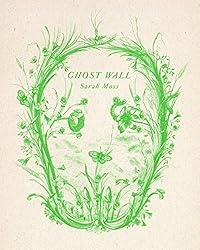
Ghost Wall
Sarah Moss, 2019, U.S. (2018, U.K.)
Farrar, Straus and Giroux
144 pp.
ISBN-13: 9780374161927
Summary
A taut, gripping tale of a young woman and an Iron Age reenactment trip that unearths frightening behavior
"The light blinds you; there’s a lot you miss by gathering at the fireside."
In the north of England, far from the intrusions of cities but not far from civilization, Silvie and her family are living as if they are ancient Britons, surviving by the tools and knowledge of the Iron Age.
For two weeks, the length of her father’s vacation, they join an anthropology course set to reenact life in simpler times. They are surrounded by forests of birch and rowan; they make stew from foraged roots and hunted rabbit.
The students are fulfilling their coursework; Silvie’s father is fulfilling his lifelong obsession. He has raised her on stories of early man, taken her to witness rare artifacts, recounted time and again their rituals and beliefs—particularly their sacrifices to the bog.
Mixing with the students, Silvie begins to see, hear, and imagine another kind of life, one that might include going to university, traveling beyond England, choosing her own clothes and food, speaking her mind.
The ancient Britons built ghost walls to ward off enemy invaders, rude barricades of stakes topped with ancestral skulls. When the group builds one of their own, they find a spiritual connection to the past.
What comes next but human sacrifice?
A story at once mythic and strikingly timely, Sarah Moss’s Ghost Wall urges us to wonder how far we have come from the “primitive minds” of our ancestors. (From the publisher.)
Author Bio
• Birth—1975
• Where—Glasgow, Scotland, UK
• Raised—Manchester, England, UK
• Education—B.A., Ph.D., Oxford University
• Currently—lives in Warwickshire, England
Sara Moss is a British writer who has written several novels, most recently Ghost Wall (2018), and a nonfiction book about living in Iceland, Names for the Sea: Strangers in Iceland (2012).
Born in Glasgow, Scotland, Moss spent her growing-up years in Manchester, England, surrounded by strong family ties and weekends hiking in the mountains of the Lake District.
She attended Oxford, earning B.A., M.A., and Ph.D. degrees. She specialized in two areas of English literature: works of the far north and of the Romantic and early Victorian material culture.
Moss has lectured at the University of Kent, University of Iceland, Exeter University-Cornwall, and is currently Professor in Creative Writing at the University of Warwick. On her website, she claims she has "no intention of ever moving house again."
Books
Cold Earth (2009)
Night Walking (2011)
Names for the Sea: Strangers in Iceland (2012)
Bodies of Light (2014)
Signs for Lost Children (2015)
The Tidal Zone (2016)
Ghost Wall (2018)
(Adapted from Wikipedia and the author's website. Retrieved 1/29/2019.)
Book Reviews
[A] compact, riveting book. Female sacrifice is never far from the center of [Moss's] concerns; she wants us to question our complicity in violence, particularly against women.… [Silvie's] presence in the novel is richly physical, and through her physicality, Moss immerses us in the pleasures of nascent sexuality and adolescent independence.… Ghost Wall is tautly framed by Silvie's point of view. Her conversations and interior monologues are embedded in lean, no-nonsense paragraphs. Moss is not much interested in giving Silvie and her rebellious tendencies room to breathe. This is a novel about being constrained, even trapped.
Ayson Hagy - New York Times Book Review
A master class in compressing an unbearable sense of dread into a book that can be read in a single horrified (and admiring) hour.… Ghost Wall is perhaps the finest novel so far to come out of the British literary response to these uneasy times.
Sarah Perry - Wall Street Journal
The fear produced by this fine-honed, piercing novel springs not from the superstitious customs of prehistory but from the more intimate horrors of human nature.
Sam Sacks - Wall Street Journal
[Ghost Wall] compresses large and urgent themes—the dangers of nostalgic nationalism, the abuse of women and children, what is lost and gained when humans stop living in thrall to the natural world—into a short, sharp tale of suspense. The way Moss conjures up the dark magic and vestigial landscapes of ancient Britain reminded me a little of the horror movie The Wicker Man.… The novel’s feminism, though, felt utterly contemporary.… I read Ghost Wall in one gulp in the middle of the night. It was a worthy match for 3 a.m. disquiet, a book that evoked existential dread, but contained it, beautifully, like a shipwreck in a bottle.
Margaret Talbot - The New Yorker
Sarah Moss possesses the rare light touch when it comes to melding the uncanny with social commentary.… Ghost Wall is such a weird and distinctive story: It could be labeled a supernatural tale, a coming-of-age chronicle, even a timely meditation on the various meanings of walls themselves. All this, packed into a beautifully written story of 130 pages. No wonder I read it twice within one week.
Maureen Corrigan - NPR
A short, sharp shock of a book that closes around you like a vice as you read it.… From the terse, dismaying little prologue, in which an iron age girl is marched out and murdered before an audience of neighbours and family, to the hair-raising, heart-stopping denouement, it hurtles along and carries you with it, before dumping you, breathless, at the end.… Ghost Wall is a burnished gem of a book, brief and brilliant, and with it Moss’s star is firmly in the ascendant.
Sarah Crown - Guardian (UK)
Ghost Wall, a slim but meaty book, is like nothing I have read before; its creepy atmosphere has stayed with me all summer.… Moss combines exquisite nature writing, original characters and a cracking thriller plot to make a wonderful literary curiosity. It deserves to pull her out of the bog of underappreciation and on to the prize podiums.
Alex O'Connell - Times (UK)
The curious allure of re-enactment is cleverly explored in Moss’s short, potent novel.… A Brexity tale to send shivers down your spine.
Rebecca Rose - Financial Times (UK)
Ghost Wall.… is further proof that [Moss is] one of our very best contemporary novelists. How she hasn’t been nominated for the Man Booker Prize continues to mystify me—and this year is no exception.… [A] gripping narrative.… It’s an intoxicating concoction; inventive, intelligent, and like no other author’s work (Five-Star Review).
Lucy Scholes - Independent (UK)
Reading Ghost Wall in the context of contemporary Britain only serves to highlight the folly of wishing for the good old days.… The book can be read as a Brexit fable, where seppuku levels of self-sacrifice are forged with lemming-like gusto.… There is a spring-taut tension embedded in the pages.… Moss’s brevity is admirable, her language pristine.
Sinead Gleeson - Irish Times
[Combines] the components of a thriller with a nuanced understanding of history, its fluctuating interpretations and its often traumatic effect on the present.… Moss’s sensual writing recalls the late Helen Dunmore.… A bold, spare study of internecine conflict.
Catherine Taylor - New Statesman (UK)
(Starred review) [P]owerful and unsettling…. The novel’s highlight is Silvie, a perfectly calibrated consciousness that is energetic and lonely and prone to sharp and memorable observations…. This is a haunting, astonishing novel.
Publishers Weekly
(Starred review) This novella-length story is thought provoking on multiple levels, with insights into primitive and modern societies, and coming of age in the face of family violence —Reba Leiding, emeritus, James Madison Univ. Lib., Harrisonburg, VA
Library Journal
Tackling issues such as misogyny and class divides, Moss packs a lot into her brief but powerful narrative.
Booklist
[Explores] issues of class, sexuality, capitalism, and xenophobia…. [Moss's] decision to use unformatted dialogue…can be frustrating…, but it also shows Silvie's panic, confusion, and longing.…. A thorny, thoroughly original novel about human beings' capacity for violence.
Kirkus Reviews
Discussion Questions
We'll add publisher questions if and when they're available; in the meantime, use our LitLovers talking points to help start a discussion for GHOST WALL … then take off on your own:
1. Talk about Silvie, the narrator of Ghost Wall, and her family, especially her father Bill. Why is Bill so desirous of participating in the Iron Age enactment? Why is it important for him to lay claim to ancient ancestry?
2. Talk about Silvie's flat, almost deadpan, observation that "There was a new bruise on her [mother's] arm." What does her tone tell us about the family dynamics?
3. Why does Bill disdain the modern world? Do you feel any sympathy for his anger, beliefs, or his personal quest for authenticity?
4. Silvie loves the natural world as much as her father, yet how does she differ from his need to claim it as his own?
5. How does Bill and his family compare to the university group of students and their professor? Talk about the class division between the two groups—how does class evidence itself? How seriously do the students take the enactment adventure? What is their attitude toward Bill and his need for original Britishness?
6. What does Sylvie learn from the university students? How does her association with them alter her perception of the world and of her future? Have they corrupted her or enlightened her?
7. Talk about how traditional gender roles begin to develop as the Iron Age enactment continues.
8. What prompts the men's decision to build a ghost wall? Why does it indicate that perhaps they have gone too far in channeling the tribal past? What did the wall mean in ancient times—and what does a wall mean today?
9. Ultimately, this book poses the question about the wild-man archetype? What is the human cost of this type of mythological nostalgia?
10. Why does Moss open with a prologue of human sacrifice? How does it make you feel reading it? Are we, as readers, somehow complicit in the act of sacrifice… or not?
11. As the book progressed, did you believe Bill capable of sacrificing his own daughter to the gods of the bog, as Sylvie comes to believe? Is the author pondering, perhaps, whether society has truly changed after a thousand years or so?
12. What about the book's ending?
13. Overall, what was your experience reading Ghost Wall—did it evoke a sense of dread, curiosity, or something else?
(Questions by LitLovers. Please feel free to use them, online and off, with attribution. Thanks.)

Ghosted
The Man Who Didn't Call (UK)
Rosie Walsh, 2018
Penguin Publising
352 pp.
ISBN-13: 9780525522775
Summary
Seven perfect days. Then he disappeared. A love story with a secret at its heart.
When Sarah meets Eddie, they connect instantly and fall in love. To Sarah, it seems as though her life has finally begun.
And it's mutual: It's as though Eddie has been waiting for her, too. Sarah has never been so certain of anything. So when Eddie leaves for a long-booked vacation and promises to call from the airport, she has no cause to doubt him. But he doesn't call.
Sarah's friends tell her to forget about him, but she can't. She knows something's happened--there must be an explanation.
Minutes, days, weeks go by as Sarah becomes increasingly worried. But then she discovers she's right. There is a reason for Eddie's disappearance, and it's the one thing they didn't share with each other: the truth. (From the publisher.)
Author Bio
• Birth—N/A
• Where—Stroud, Glouscestershire, England, UK
• Education—N/A
• Currently—lives in Bristol, England
Rosie Walsh is a British documentary film maker and the author of several novels, four of which she wrote under the pen name Lucy Robinson. The fifth, Ghosted (UK: The Man Who Didn't Call), was published in 2018 under her real name.
Walsh grew up in the British countryside, in a small cottage in Gloucestershire, with her family and a band of what she refers to as "delinquent" animals. Long before she became a writer, Walsh attempted to become an actor. But when it was suggested in college (kindly we hope) that she wasn't particularly good, she ended up behind the scenes: writing and producing, first in TV broadcasting in London, later filming documentaries around the globe.
In 2009 Walsh turned to writing, but not to fiction—rather for her blog on the Marie Claire website. Her writing, however, caught the eye of a book editor who encouraged her try her hand at a novel. And so off to Buenos Aires, Walsh went ("like you do" she quips) to attempt her first book. A year later she had a published novel under her belt: The Greatest Love Story of All Times. Three more novels followed—A Passionate Love Affair With a Total Stranger (2012), The Unfinished Symphony of You and Me (2014), and The Day We Disappeared (2015)—all four works were under the pseudonym, Lucy Robinson.
In 2018, she published a fifth novel, this one as Rosie Walsh: Ghosted (The Man Who Didn't Call, UK).
Oh, and while working on that first novel in Argentina, the one with the British title, The Man Who Didn't Call? Well, she met the love of her life, and he did call. The two are now living in Bristol, England, with their son. (Adapted from the author's Lucy Robinson website and the publisher.)
Book Reviews
Walsh has a good ear for dialogue, and the mystery behind Eddie's disappearance is a particularly satisfying one.
Tina Jordan - New York Times Book Review
A gripping and surprising romantic suspense story.… You won't want to put it down.
NPR
Walsh’s bittersweet debut tackles the perils of modern dating.… Though the ending comes abruptly, this tale of heartbreak will please readers who enjoy a good twist.
Publishers Weekly
[A]n intricate story of mystery, deception, grief, and forgiveness that begins slowly and builds steam as the plot twists and turns, and steers clear of predictability.… [T]his novel will have readers ready to go back and reread it from the start.
Library Journal
(Starred review) A perfectly paced domestic drama centered on two lovely, lonesome people, Ghosted is a brilliant debut novel that explores the power of fate.… Walsh has a gift for blending complex characters, intricate backstories, and neck-snapping plot twists.
Booklist
[T]ension quickly amps up…. Walsh has created a deeply moving romance with an intriguing mystery and a touching portrait of grief at its heart.A romantic, sad, and ultimately hopeful book that's perfect for fans of Jojo Moyes.
Kirkus Reviews
A cleverly plotted romantic thriller filled with scandalous twists and turns and a juicy central mystery, Ghosted proves impossible to put down.… Deliciously addictive, surprising and sentimental.
BookPage
Discussion Questions
1. Assuming you have been in Sarah’s situation and have been ghosted—and, let’s face it, who hasn’t?—how did it make you feel? How did you react?
2. If you were Sarah’s friend, what advice would you have given her? Is there any point in giving advice to someone who believes she is in love?
3. The practice of disappearing to avoid telling someone you’re not interested is not new, but it has become more prevalent in the digital age. How has modern technology made ghosting worse?
4. In Eddie’s shoes, could you have forgiven Sarah? Could you have just "let it go" because you were deeply in love?
5. Did you feel that Eddie and Sarah were meant to be after their seven days together? Or was it the lost potential of the relationship that left Sarah so devastated? Is love at first sight—or close to first sight—possible?
6. Both Sarah and Eddie had to deal with the loss of someone dear to them; while Eddie stayed put, Sarah left as soon as she could. How did their expressions of grief differ?
7. Why do you think Jo and Tommy kept their relationship secret? Would you have done the same in their position?
8. Could you understand Eddie’s choice at the end of the book, or did you feel that he should have put his mother’s needs first?
9. Sarah is determined not to let her personal life affect her business. Can working with your ex ever lead to success? Would you be able to do it? Did you find Reuben’s professional conduct to be unacceptable, or did you feel that he was just deeply in love and no more able to control his behavior around Kaia than Sarah was with Eddie?
10. The ability—or inability—to forgive defines many of the characters in the book: from Eddie’s mother’s resistance to moving on, to Sarah’s inability to forgive herself, to Eddie’s crucial final decision on which the entire story hangs. Is it important to be able to forgive? Or are there some things that can never be excused?
(Questions issued by the publishers.)

Ghosts of Harvard
Francesca Serritella, 2020
Random House
480 pp.
ISBN-13: 9780525510369
Summary
A Harvard freshman becomes obsessed with her schizophrenic brother’s suicide. Then she starts hearing voices.
Cadence Archer arrives on Harvard’s campus desperate to understand why her brother, Eric, a genius who developed paranoid schizophrenia took his own life there the year before.
Losing Eric has left a black hole in Cady’s life, and while her decision to follow in her brother’s footsteps threatens to break her family apart, she is haunted by questions of what she might have missed. And there’s only one place to find answers.
As Cady struggles under the enormous pressure at Harvard, she investigates her brother’s final year, armed only with a blue notebook of Eric’s cryptic scribblings. She knew he had been struggling with paranoia, delusions, and illusory enemies—but what tipped him over the edge?
Voices fill her head, seemingly belonging to three ghosts who passed through the university in life, or death, and whose voices, dreams, and terrors still echo the halls. Among them is a person whose name has been buried for centuries, and another whose name mankind will never forget.
Does she share Eric’s illness, or is she tapping into something else?
Cady doesn’t know how or why these ghosts are contacting her, but as she is drawn deeper into their worlds, she believes they’re moving her closer to the truth about Eric, even as keeping them secret isolates her further.
Will listening to these voices lead her to the one voice she craves—her brother’s—or will she follow them down a path to her own destruction? (From the publisher.)
Author Bio
• Birth—N/A
• Raised—Phildelphia, Pennsylvania, USA
• Education—B.A., Harvard Univeesity
• Awards—Thomas T. Hoopes Prize
• Currently—lives in New York, New York
Francesca Serritella is the New York Times bestselling author of a nine-book series of essay collections co-written with her mother, bestselling author Lisa Scottoline, and based on "Chick Wit," their Sunday column in The Philadelphia Inquirer.
Serittella graduated cum laude from Harvard University, where she won multiple awards for her fiction, including the Thomas T. Hoopes Prize. Ghosts of Harvard is her first novel. (From the publisher.)
Book Reviews
[S]weeping and beguiling…. [A] rich, intricately plotted thriller that gathers suspense velocity as Cady runs through the mazelike halls of academe and the winding streets of Cambridge, chasing after clues to the more sinister circumstances of Eric’s death. It’s a testament to Serritella’s sure touch that when Cady’s ghostly companions ultimately make their final departures, Harvard seems duller.
Maureen Corrigan - Washington Post
[B]risk, entertaining…. Serritella has a wonderful touch for her secondary characters… and Cady herself has a great voice. Readers of campus mysteries will love this surprising and intricate bildungsroman.
Publishers Weekly
(Starred review) The book begins as a thriller and ends as a story of personal growth and redemption. The writing is vivid and engaging, and it works for adults as well as for mature young adult readers.
Library Journal
[M]any-faceted… busily plotted, emotionally astute, thoughtfully paranormal, witty, and suspenseful drama…. Serritella has also created a sensitive and searching tale about… a smart young woman in mourning and in peril. Cady is a compelling narrator.
Booklist
Serritella is on shaky ground once the story veers into the supernatural. Cady’s conversations with the ghosts are tiresome and ultimately don’t add much to the narrative. In fact, they detract from what could have been a solid psychological thriller.
Kirkus Reviews
Discussion Questions
1. College is often called "the happiest time" in a person’s life, but it can also be a stressful period of transition and pressure. In what ways are the anxieties Cady has going into college unique, and in what ways are they typical? What kinds of pressures are on young people today? Which were unique to you or your generation? Did anything about Serritella’s description of life at Harvard surprise you? Would you want to attend Harvard or send your child there?
2. In the book, Cady is haunted by Harvard’s past inhabitants, literally and figuratively, and burdened by the expectations of the future. Is there any time or place in your life where you felt the weight of history? What about a time in your life where you felt the pressure of high expectations? Did you feel motivated to rise to the occasion, or paralyzed by fear of failure?
3. Potential is a theme in this novel: the potential of genius, the pressure to live up to that potential, the potential of a predisposition to mental illness, the potential thwarted by slavery, discrimination, and war. In our culture, we love prodigies, wunderkind, and rising stars. Why is potential so fascinating and prized in our culture? Is it over-valued? Psychologists say it is generally easier to imagine positive outcomes rather than negative ones. Is that true for you?
4. At the outset of the novel, Cady’s identity has been shaken by the illness and loss of her brother, her hero. Her role in her family has also changed; once in the background, she is now the focus of her parents’ attention and concern. Do you think people get assigned roles in their family? Did that happen to you or your children? How do the stories families tell, and the stories we tell ourselves, shape our identity and expectations? Have you ever had to challenge those personal narratives or family myths?
5. Cady believes the voices she’s hearing are ghosts. On the other hand, she’s a lonely girl under acute emotional distress from a family with a history of mental illness. Do you think the ghosts are real, or is Cady suffering from auditory hallucinations? Why do you think so?
6. Cady likens the nature of the ghosts to visiting her childhood home years later, where "she could hear Eric’s little-boy voice echoing around the stairwell. Her family’s past selves were captured between those walls, preserved in memory, like an insect in amber." Later, Cady co-opts a theoretical physics concept about hidden dimensions in which space-time "folds over" to explain it. Do you believe in ghosts, or have you ever had a paranormal experience? If so, what is your "theory" of ghosts, what they’re like, and how they reach us? Do you agree with Whit that "ghosts don’t haunt the living. We haunt them?"
7. Cady regrets her role in what she believes was the turning point in Eric’s life that set him on a course of self-destruction. Although in reality, his life story wasn’t as simple a narrative as she thought. In what ways are the three ghosts at turning points in their own lives and at turning points in American history? How are they examples of potential thwarted? In retrospect, what was a turning point in your life?
8. Cady is haunted by those what-if scenarios: what if she could have said or done something different with her brother, could his death have been prevented? She carries those alternate realities in her mind and tortures herself with what could have been. She longs to rewrite history, and the ghosts initially seem to offer that chance—but it can never be done. Do you have any what-if parallel universes in your mind? Life with an ex-partner, a different career, a different life choice? Have you ever compared yourself or your choices to a hypothetical alternative? Is that fair to do?
9. As the novel states, "history is never as simple a narrative as we write in books." With controversies over Confederate monuments, Christopher Columbus, and the slave-holding history of lauded figures and institutions, we’re in a cultural moment where we’re challenging long-held histories. Is this upheaval necessary? Why is it painful to let go of idealized versions of historical figures or places? Did learning that Harvard’s leadership once participated in slavery change your perspective on the school? Which is more powerful, fact or fiction? Is a comforting lie ever preferable to a brutal truth?
10. Cady is haunted by why Eric killed himself. She goes to Harvard looking for answers, while suffering under the secret belief that it was her fault. By the end of the book, we learn other characters have traced their own lines of responsibility in Eric’s death. Can one simple narrative be accurate? What do you think were contributing factors to Eric’s suicide? Could his death have been prevented? Have you ever made a decision where you were confident of your assessment, only to later learn you didn’t have all the relevant information?
11. Sadly, suicide is the second-leading cause of death among people aged 10-24. Why do you think young people today might be at greater risk of suicide than in past decades? Are colleges doing enough to provide adequate mental health services to students? Do the privacy laws excluding parents from the medical care of their children, legally adults, help or hurt students’ well being?
12. Is grieving a suicide more difficult than other types of loss? If so, why? How can we better support those who have lost someone to suicide and dispel the unfair stigma?
13. The phrase Cady hears at the Sever entrance whispering wall, "It takes only an error to father a sin," is a genuine quote from the real Robert Oppenheimer. What do you think it means? Can you see how it applies to Oppenheimer’s life, both in the novel and in history? Do you think it applies to Cady’s story? What about your own? Are we responsible for all the unintended consequences of our actions?
14. Robert tells Cady, "I labor under my awful fact of excellence as if I am bound for extraordinary things. But even if, in the end, I’ve got to satisfy myself with testing toothpaste in a lab, I don’t want to know till it has happened." This snippet of dialogue is a quote from a genuine letter Robert Oppenheimer wrote during his Harvard days. Do you agree with him? If you could know your future, would you want to?
15. At the end of the novel, Cady thinks to herself, "Now she understood that we must love people whom we cannot control, in fact we are lucky to love and be loved by people we cannot control. If we could control the person, love wouldn’t be a gift." What do you think of this observation? Do you think you can control or influence your loved ones? Have you ever been frustrated by a loved one making a choice you didn’t agree with? Do you ever put pressure on yourself and your behavior, as if your actions could influence someone else’s? Does love fever mean letting go of control?
(Questions issued by the publisher.)
top of page (summary)
Ghostwritten
David Mitchell, 1999
Knopf Doubleday
426 pp.
ISBN-13: 9780375724503
Summary
In this ambitious and electrifying debut novel, David Mitchell engages us in a literary trek across the world of human experience through a mesmerizing series of linked narratives.
At once as alike and distinct as any two pinpoints on the globe, nine characters — a terrorist cult member in Okinawa, a record-shop clerk in Tokyo, a money-laundering British financier in Hong Kong, an old Buddhist woman running a tea shack in China, a transmigrating "noncorpum" entity seeking a human host in Mongolia, a gallery-attendant-cumart-thief in Petersburg, a drummer in London, a female physicist hiding from the CIA in Ireland, and a late-night radio deejay in New York — hurtle toward a shared destiny of astonishing impact.
Like the book's one nonhuman narrator, Mitchell latches onto his host characters and invades their lives with parasitic precision. And while the voices here remain completely oblivious to the bizarre ways in which their stories intersect, they converge to render Ghostwritten a sprawling and eerily well-crafted relief map of the modern world. (From the publisher.)
Author Bio
• Birth—January 12, 1969
• Where—Southport, Lancashire, UK
• Education—B.A., M.A., University of Kent
• Awards—John Llewellyn Rhys Prize
• Currently—lives in County Cork, Ireland
David Mitchell is an English novelist, the author of several novels, two of which, number9dream (2001) and Cloud Atlas (2004), were shortlisted for the Booker Prize. He has lived in Italy, Japan and Ireland. Mitchell currently lives with his wife Keiko Yoshida and their two children in Ardfield, Clonakilty in County Cork, Ireland.
Early life
Mitchell was born in Southport in Merseyside, England, and raised in Malvern, Worcestershire. He was educated at Hanley Castle High School and at the University of Kent, where he obtained a degree in English and American Literature followed by an M.A. in Comparative Literature. He lived in Sicily for a year, then moved to Hiroshima, Japan, where he taught English to technical students for eight years, before returning to England, where he could live on his earnings as a writer and support his pregnant wife.
Work
Mitchell's first novel, Ghostwritten (1999), moves around the globe, from Okinawa to Mongolia to pre-Millennial New York City, as nine narrators tell stories that interlock and intersect. The novel won the John Llewellyn Rhys Prize (for best work of British literature written by an author under 35) and was shortlisted for the Guardian First Book Award. His two subsequent novels, number9dream (2001) and Cloud Atlas (2004), were both shortlisted for the Man Booker Prize. In 2003, he was selected as one of Granta's Best of Young British Novelists. In 2007, Mitchell was listed among Time magazine's 100 Most Influential People in The World.
In 2012 his novel Cloud Atlas was made into a film. In recent years he has also written opera libretti. Wake, based on the 2000 Enschede fireworks disaster and with music by Klaas de Vries, was performed by the Dutch Nationale Reisopera in 2010. For his other opera, Sunken Garden, he collaborated with the Dutch composer Michel van der Aa. It premiered in 2013 with the English National Opera.
Mitchell's sixth novel, The Bone Clocks, was released on September 2nd, 2014. In an interview in The Spectator, Mitchell said that the novel has "dollops of the fantastic in it", and is about "stuff between life and death." The book was longlisted for the 2014 Man Booker Prize.
Personal
In a Random House essay, Mitchell wrote:
I knew I wanted to be a writer since I was a kid, but until I came to Japan to live in 1994 I was too easily distracted to do much about it. I would probably have become a writer wherever I lived, but would I have become the same writer if I'd spent the last six years in London, or Cape Town, or Moose Jaw, on an oil rig or in the circus? This is my answer to myself.
Mitchell has the speech disorder of stammering and considers the film The King's Speech (2010) to be one of the most accurate portrayals of what it's like to be a stammerer: "I'd probably still be avoiding the subject today had I not outed myself by writing a semi-autobiographical novel, Black Swan Green, narrated by a stammering 13 year old."
One of Mitchell's children is autistic, and in 2013 he and wife Keiko translated into English a book written by a 13-year-old Japanese boy with autism, The Reason I Jump: One Boy's Voice from the Silence of Autism.
List of works
Novels
Ghostwritten (1999)
number9dream (2001)
Cloud Atlas (2004)
Black Swan Green (2006)
The Thousand Autumns of Jacob de Zoet (2010)
The Bone Clocks (2014)
Slade House (2015)
Utopia Avenue (2020)
(Bio adapted from Wikipedia. Retrieved 9/4/2014.)
Book Reviews
An intricately assembled Faberge egg of a novel, full of sly and sometimes beautiful surprises...[Mitchell's] book is worth a dozen of the morally anorexic first novels that regularly come down the pipe.
David Mendelsohn - New York Magazine
Ghostwritten is a brave new book for a brave new world—one encompassing globalism and grunge rock, folk tales, talking trees and terrorism. Far-out Cyberstuff. David Mitchell's breathlessly sprawling debut novel is inhabited by a large cast of spirits and unsettled souls who transmigrate faster than a bond trader reacts to a Greenspan blink. All of this intensely imaginative material is packaged as nine tales told by nine narrators from around the world. A long, strange trip it is!
Ann Prichard - USA Today
David Mitchell served notice that he would be remaking the traditional novel when his first book, Ghostwritten, published in 1999 just after he turned 30, ingeniously braided together nine stories in eight countries and suggested that the same unchanging spirit ran through its central characters, whether in Hong Kong, St. Petersburg or a New York City radio station. Forget multiculturalism: this was novel globalism and an inquiry into what the boundary-dissolving author called transmigration.
Pico Iyer - Time Magazine
This is one of the best first novels I've read for a long time. It's told in a series of gripping, interconnecting tales, in many voices, all of them imaginatively urgent. For all the plot's dazzling complexity, Mitchell's writing—which has many styles—is always simple and elegant. His people always engage the imagination, and the book is never clotted by its ambitions. It easily covers the global village but there's no sense that it's striving for multiculturalism or spectacular effects—just that Mitchell knows what he's doing. I read a proof of this on a transatlantic flight. When I got off in Atlanta, I couldn't put it down. I pulled my luggage in one hand along corridors and escalators, and held David Mitchell's last chapter up to my nose with the other. I finished at the carousel. It seemed appropriate. And it's even better the second time.
A.S Byatt
Nine disparate but interconnected tales (and a short coda) in Mitchell's impressive debut examine 21st-century notions of community, coincidence, causality, catastrophe and fate. Each episode in this mammoth sociocultural tapestry is related in the first person, and set in a different international locale. The gripping first story introduces Keisuke Tanaka, aka Quasar, a fanatical Japanese doomsday cultist who's on the lam in Okinawa after completing a successful gas attack in a Tokyo subway. The links between Quasar and the novel's next narrator, Satoru Sonada, a teenage jazz aficionado, are tenuous at first. Both are denizens of Tokyo; both tend toward nearly monomaniacal obsessiveness; both went to the same school (albeit at different times) and shared a common teacher, the crass Mr. Ikeda. As the plot progresses, however, the connections between narrators become more complex, richly imaginative and thematically suggestive. Key symbols and metaphors repeat, mutating provocatively in new contexts. Innocuous descriptions accrue a subtle but probing irony through repetition; images of wild birds taking flight, luminous night skies and even bloody head wounds implicate and involve Mitchell's characters in an exquisitely choreographed dance of coincidence, connection and fluid, intuitive meanings. Other performers include a corrupt but (literally) haunted Hong Kong lawyer; an unnamed, time-battered Chinese tea-shop proprietress; a nomadic, disembodied intelligence on a voyage of self-discovery through Mongolia; a seductive and wily Russian art thief; a London-based musician, ghostwriter and ne'er-do-well; a brilliant but imperiled Irish physicist; and a loud-mouthed late-night radio-show host who unwittingly brushes with a global cyber-catastrophe. Already a sensation on its publication in England, Mitchell's wildly variegated story can be abstruse and elusive in its larger themes, but the gorgeous prose and vibrant, original construction make this an accomplishment not to be missed.
Publishers Weekly
Gleefully self-referential, slyly philosophical, subtly postmodern, Mitchell's debut novel consists of nine intertwining tales and the people who move within and among them. Spanning the globe—from teeming Tokyo to the isolated Holy Mountain, from the idyllic Clear Island to Old Man London—the characters also run the gamut: criminal, professional, genius, provincial, fanatic. The novel evades the reader's aim to discern a moral, instead exploring the motions of consciousness through various lives in nine distinct and elegant voices. Although the numerous viewpoints can be distancing, the challenges of this intellectual puzzle propel the reader to the rather bizarre but compelling last two chapters. As Mitchell's Mr. Cavendish purports, "We all think we're in control of our own lives, but really they're pre-ghostwritten by forces around us." So how well does the thing read? Very well. Perhaps not revelatory, but this contemplative pleasure of a book is recommended for all public libraries. —Ann Kim
Library Journal
It is a thrill to read a piece of fiction this engrossing, challenging, urgent, and, ultimately, so very new. This book, which would be remarkable even if it weren't a first novel, was published last year in Great Britain to critical acclaim.... Reminiscent at times of DeLillo, Murakami, and science fiction, especially in its continual probing of what is real and what is not, this book remains very much its own thing: a novel of the twenty-first century. —Brian Kenney
Booklist
An inordinately ambitious first novel, the work of a Westerner living in Japan, traces a chain of events that affect lives on several continents, explored in stories "ghostwritten" by other (in some cases, literally alien) intelligences than those of the people who experience them.
Kirkus Reviews
Discussion Questions
Use our LitLovers Book Club Resources; they can help with discussions for any book:
• How to Discuss a Book (helpful discussion tips)
• Generic Discussion Questions—Fiction and Nonfiction
• Read-Think-Talk (a guided reading chart)


The Gift Counselor
Sheila M. Cronin, 2014
336 pp.
ISBN-13: 9780996046008
Summary
Jonquil Bloom is a single mom and UCLA graduate student doing research about gift-giving. Needing to support herself, she is hired at a local department store and becomes the gift counselor. She believes all gifts come with strings attached, but can she prove it?
Claude Chappel is the general contractor on the new construction job opposite the building where Jonquil lives. He is ready to settle down. Meeting Jonquil and befriending her son Billy make up his mind. He doesn’t know that Jonquil’s caution is due to a sudden upsurge of painful memories. Can he win her heart?
Billy Bloom has his heart set on getting a dog that Christmas. Not just any dog, but a black cocker spaniel puppy who lives down the street. His mother, the gift counselor, won’t allow it because she’s allergic to dogs. Or is she?
Author Bio
• Birth—N/A
• Raised—Chicago, Illinois, USA
• Education—B.A., St. Mary's College; M.S., Hahnemann Medical Graduate School
• Currently—lives in Chicago
Sheila M. Cronin received a Master’s degree in mental health sciences from Hahnemann Medical Graduate School of Philadelphia. She practiced art therapy for ten years before relocating to Los Angeles to pursue creative writing. While on the west coast, she worked at Princess Cruises and had the privilege of being onboard escort to James A. Michener and his wife in Alaska.
Cronin's short romance, "Airport Love Story," appeared in the WritersNet Anthology of Prose: Fiction (Writers Club Press, 2002). In 2003, Sun-Maid Raisins hired her to compose "sayings" for the outside flaps of their lunch-size raisin boxes, which are published worldwide. She has also been published in Woman's World Magazine. (From the author.)
Visit the author's website.
Book Reviews
The Gift Counselor is a lovely surprise, like a thoughtful gift from a dear friend.
Windy City Reviews
Wonderful, feel-good story.
Franciscanmom.com
The characters are ones you will come to care for and root for.
Beacher Weekly Newspaper
Discussion Questions
1. In what ways does a gift counselor differ from a personal shopper?
2. How does Rita influence Jonquil? How does Jonquil influence Rita?
3. Identify 3 events in the story that lead to Jonquil’s realization that true gifts are free. Did your ideas about gifts change as you read the story?
4. How is Claude able to get Jonquil to trust him?
5. Margo Bloom is the key figure in Jonquil’s childhood. Did you have a grandparent that influenced your life?
6. Billy Bloom has a generous nature. True or false. Give examples.
7. Mr. Merrill enjoys testing out new toys. The light moments offset the darker themes in the story. What lighter moments stand out for you?
8. What do you imagine happened to Jonquil’s father, John Bloom that caused him to disappear?
9. Would you want to talk to a gift counselor?
10. Which character did you care about most and why?
(Questions courtesy of the author.)

Gifted
John Daniel, 2017
Counterpoint Press
384 pp.
ISBN-13: 9781619029200
Summary
Henry Fielder, solitary and unmoored in his thirties, runs into an old lover and finds himself ready to tell the story he has harbored for two decades.
He is fifteen, in rural western Oregon, enduring a year of sorrows. His mother has died, his father is physically abusive, and his extraordinary spiritual affinity for the wild lives of his native country seems to desert him. An older couple, retiring to the area from California, offer solace and expanded cultural horizons but set him further at odds with his millworker father.
The abuse escalates, and ultimately a natural disaster catalyzes a crisis in which father and son betray each othe. Henry sets out on a trek through the backcountry of the Oregon Coast Range, seeking to understand what has happened and to forge a new sense of self.
A Huck Finn of the modern age, Henry is portrayed with a directness and clarity that pulls readers through the environmental dynamics of the Pacific Northwest.
In stark yet beautiful prose that highlights his long tenure as a nature writer, Daniel creates an odyssey that explores the spiritual dimensions and deeply entangled pains and pleasures of belonging to the human domain and the natural world of which it is part.
Set in the mid-1990s, when environmentalists and timber communities warred over the future of the last Northwestern old-growth forests, Gifted is the story of a young man with a metaphysical imagination—naïve yet wise, gifted yet ordinary—who comes of age under harsh circumstances, negotiating the wildness of his home country, of his human relationships, and of the emerging complexities of his own being. (From the publisher.)
Author Bio
• Birth—1948
• Where—State of South Carolina, USA
• Raised—near Washington, D.C.
• Education—Reed College (no degree); M.A., Stanford University
• Awards—(see below)
• Currently—lives near Eugen, Oregon
John Daniel is an American poet, essayist, memoirist, novelist and teacher. In all, he has written some 10 books, most recently his 2017 debut novel, Gifted.
Daniel was born in South Carolina, raised outside of Washington, D.C., and in 1966 attended Reed College in Portland, Oregon. He dropped out of Reed but stayed in the West. spending the next 24 years as a logger, railroad inspector, and climbing instructor, among other jobs.
During all that time, Daniel was writing poetry, and in 1982 he won the prestigious Wallace Stegner Fellowship in Poetry at Stanford University. He remained at Stanford to earn his M.A. and for the next five years taught Poetry and freshman English.
He now earns a living writing, as well as teaching—in workshops and writer-in-residence programs around the country.
Writing
In addition to his novel, Gifted, Daniel has published a book of essays, The Far Corner: Northwestern Views on Land, Life, and Literature (2009); Rogue River Journal: A Winter Alone (2005), part journal and part memoir; Winter Creek: One Writer’s Natural History (2002); and Looking After: A Son’s Memoir (1996), about caring for his dying mother.
He has also published three volumes of poetry — Of Earth: New and Selected Poems (2012), All Things Touched by Wind (1994), and Common Ground (1988).
His work can be found in Audubon, Outside, Southwest Review, Western American Literature, Portland Magazine, Open Spaces, Oregon Humanities, Orion, and in more than 20 textbooks and anthologies.
Recognition
Daniel's poetry has won him a Pushcart Prize, John Burroughs Nature Essay Award, three Oregon Book Awards, and a Pacific Northwest Booksellers Award.
In addition to the Wallace Stegner Fellowship at Stanford, he has also been selected for the Margery Davis Boyden Wilderness Writing Residency, a Research and Writing Fellowship from Oregon State University’s Center for the Humanities, and a fellowship from the National Endowment for the Arts.
He has served as chair of PEN Northwest, serves as a judge for, or on the boards of, various literary organizations. He lives with his wife in the Coast Range foothills, west of Eugene, Oregon. (Adapted from the author's bio.)
Book Reviews
“Sunrise and sunset are made of the same light, and, like gladness and sadness, you can’t have one without the other.” These words arise in the mind of Henry Fielder at the age of 16. Think he might be an old soul? Yes, oh yes. His beloved mother dies when he is 15. Then later his father kicks the bucket when a tree falls on their house in rural western Oregon. If that plotline sounds like a formulaic YA premise, don’t go there. This novel runs deep. Henry is one of those kids who doesn’t talk much, who walks the woods in wonder. Woodland creatures who usually bolt away from humans instead step closer to Henry and they share spirit. That is his gift and those are the moments Henry lives for. READ MORE …
Keddy Ann Outlaw - LitLovers
Daniel explores an ecology of natives and invasives — plant and animal — while rendering clear-cuts and second-growth forests with the same keen eye for beauty as he does towering old growths.… His protagonist spends much of the book avoiding truths small and large…but the novel is most intriguing when Daniel pits dishonesty between his characters, not between writer and reader. In justifying the writing, Daniel undermines the terrifying and humbling aspects of his remarkable story — reasons enough to write it.
Marc Bojanowski - New York Times Book Review
[E]loquent.… [Daniel's] digressions about the landscape mirror Henry’s own attempts to find solace in an unjust, confusing world. Daniel’s impressive novel quietly builds, ending in a place where Henry can see the way…into a much more beautiful, logical future.
Publishers Weekly
Lyrical evocations of nature clash with shocking revelations of human nature in this coming-of-age story set in and around the deep woods of western Oregon in the 1990s.… An insightful though rambling stroll through the wilderness of adolescence and the Oregon woods.
Kirkus Reviews
Discussion Questions
We'll add publisher questions if and when they're available; in the meantime, use our LitLovers talking points to help start a discussion for Gifted … then take off on your own:
1. Talk about Henry's Fielder's childhood--his mother's death and his father's abusive behavior. How has so much sorrow and hardship in Henry's young life affected him?
2. In what way does the beauty of the natural world offer solace to the boy? Do you ever—or frequently—turn to nature to find comfort, release, or repose?
3. Talk about this passage: "Sunrise and sunset are made of the same light, and, like gladness and sadness, you can’t have one without the other.” Select other passages you find evocative or poignant or insightful in how they capture Henry's isolation and loneliness.
4. Henry also turns to the stories of native Americans that his mother loved. How do those lift him up? What does he find in them?
5.Consider the the way in which Henry seems haunted by the presence of his parents, first his mother, later his father. Are what he experiences dreams…or visions? In what way do they seem to heal? Is Henry a sort of shamanistic figure (someone who accesses an altered state of reality —a trance, perhaps— in order to interact with the spiritual world)?
6. What about Henry as a student—he's not a particularly "good" one. Yet he loves "biologycosmologyphilosophyreli
7. Talk about the role that Carter and Josie Stephens play in Henry's life. Also discuss the Sweet Grass Confederacy and it's role. How would you describe the commune?
8. Henry admits that he sometimes plays fast and lose with the truth in his retelling. Where is his story unreliable, and why does he admit to deception?
9. How did you experience the violence at the heart of the novel? Too much? Sensational? Or done purely in the service of the story?
10. What is the meaning of the novel's title? What does "gifted" mean in the context of the story?
11. Where you caught off guard by the twist and the end of the novel involving Lynn?
12. Is the ending of the novel hopeful?
(Questions by LitLovers. Please feel free to use them, oneline or off, with attribution. Thanks.)


Gilead
Marilynne Robinson, 2004
Macmillan Picador
256 pp.
ISBN-13: 9780312424404
Summary
Winner, 2004 National Book Critics Circle Award
Winner, 2005 Pulitizer Prize
In 1956, toward the end of Reverend John Ames's life, he begins a letter to his young son, an account of himself and his forebears. Ames is the son of an Iowan preacher and the grandson of a minister who, as a young man in Maine, saw a vision of Christ bound in chains and came west to Kansas to fight for abolition: He "preached men into the Civil War," then, at age fifty, became a chaplain in the Union Army, losing his right eye in battle.
Reverend Ames writes to his son about the tension between his father—an ardent pacifist—and his grandfather, whose pistol and bloody shirts, concealed in an army blanket, may be relics from the fight between the abolitionists and those settlers who wanted to vote Kansas into the union as a slave state. And he tells a story of the sacred bonds between fathers and sons, which are tested in his tender and strained relationship with his namesake, John Ames Boughton, his best friend's wayward son.
This is also the tale of another remarkable vision—not a corporeal vision of God but the vision of life as a wondrously strange creation. It tells how wisdom was forged in Ames's soul during his solitary life, and how history lives through generations, pervasively present even when betrayed and forgotten.
Gilead is the long-hoped-for second novel by one of our finest writers, a hymn of praise and lamentation to the God-haunted existence that Reverend Ames loves passionately, and from which he will sooon part. (From the publisher.)
Author Bio
• Birth—November 26, 1943
• Where—Sandpoint, Idaho, USA
• Education—B.A., Brown University
• Awards—PEN/Hemingway Award;National Book Critics Circle Award; Pulitzer Prize; Orange Prize
• Currently—Iowa City, Iowa
Marilynne Robinson was born and raised in Idaho, where her family has lived for several generations. She recieved a B.A. from Brown University in 1966 and a Ph.D. in English literature from the University of Washington in 1977.
Housekeeping, her first novel, was published in 1981 and won the PEN/Hemingway Award for First Fiction and the American Academy and Institute's Richard and Hinda Rosenthal Award. Mother Country, an examination of Great Britain's role in radioactive environmental pollution, was published in 1989. Robinson published Gilead in 2004 and Home in 2008. Home won the 2009 Orange Prize. She lives in Iowa City, Iowa, with her family. (From the publisher.)
More
For someone who has labored long in the literary vineyard, Marilynne Robinson has produced a remarkably slim oeuvre. However, in this case, quality clearly trumps quantity. Her 1980 debut, Housekeeping, snagged the PEN/Hemingway Award for best first novel and was nominated for the Pulitzer Prize for Fiction.
Twenty-four years later, her follow-up novel, Gilead, won the National Book Critics Circle Award, the Ambassador Book Award, and the Pulitzer Prize. And in between, her controversial extended essay Mother Country: Britain, the Welfare State and Nuclear Pollution (1989) was shortlisted for the National Book Award.
Robinson is far from indolent. She teaches at several colleges and has written several articles for Harper's, Paris Review, the New York Times Book Review, and other publications. Still, one wonders—especially in the face of her great critical acclaim—why she hasn't produced more full-length works. When asked about these extended periods of literary dormancy, Robinson told Barnes & Noble.com, "I feel as if I have to locate my own thinking landscape... I have to do that by reading—basically trying to get outside the set of assumptions that sometimes seems so small or inappropriate to me." What that entails is working through various ideas that often don't develop because, as she says, "I couldn't love them."
Still, occasionally Robinson is able to salvage something important from the detritus—for example, Gilead's central character, Reverend John Ames. "I was just working on a piece of fiction that I had been fiddling with," Robinson explains. "There was a character whom I intended as a minor character... he was a minister, and he had written a little poem, and he transformed himself, and he became quite different—he became the narrator. I suddenly knew a great deal about him that was very different from what I assumed when I created him as a character in the first place."
This tendency of Robinson's to regard her characters as living, thinking beings may help to explain why her fictional output is so small. While some authors feel a deep compulsion to write daily, approaching writing as a job, Robinson depends on inspiration which often comes from the characters themselves. She explains, "I have to have a narrator whose voice tells me what to do—whose voice tells me how to write the novel."
As if to prove her point, in 2008, Robinson crafted the luminous novel Home around secondary characters from Gilead: John Ames's closest friend, Reverend Robert Boughton, his daughter Glory, and his reprobate son Jack. Paying Robinson the ultimate compliment, Kirkus Reviews declared that the novel "[c]omes astonishingly close to matching its amazing predecessor in beauty and power."
However, the deeply spiritual Robinson is motivated by a more personal directive than the desire for critical praise or bestsellerdom. Like the writing of Willa Cather—or, more contemporaneously, Annie Dillard—her novels are suffused with themes of faith, atonement, and redemption. She equates writing to prayer because "it's exploratory and you engage in it in the hope of having another perspective or seeing beyond what is initially obvious or apparent to you." To this sentiment, Robinson's many devoted fans can only add: Amen.
Extras
• Robinson doesn't just address religion in her writing. She serves as a deacon at the Congregational Church to which she belongs.
• One might think that winning a Pulitzer Prize could easily go to a writer's head, but Robinson continues to approach her work with surprising humility. In fact, her advice to aspiring writers is to always "assume your readers are smarter than you are."
• Robinson is no stranger to controversy. Mother Country, her indictment of the destruction of the environment and those who feign to protect it, has raised the ire of Greenpeace, which attempted to sue her British publisher for libel. (Author bio from Barnes & Noble.)
Book Reviews
A treasure of a book. While based upon Biblical scripture, it's illuminating for every faith or non-faith. It is about the requirement of living up to the best parts of ourselves—and about the blessing and awe and mystery of all existence. It's a lot packed into a fairly small book. Robinson shows us Christianity writ large, an expansive but difficult faith, which calls upon us to put aside petty anger and accept a divine requirement to love our enemy. Read More...
A LitLovers LitPick (Oct. '08)
Gilead is a beautiful work — demanding, grave and lucid — and is, if anything, more out of time than Robinson's book of essays, suffused as it is with a Protestant bareness that sometimes recalls George Herbert (who is alluded to several times, along with John Donne) and sometimes the American religious spirit that produced Congregationalism and 19th-century Transcendentalism and those bareback religious riders Emerson, Thoreau and Melville.
James Wood - The New York Times
Marilynne Robinson draws on all of these associations in her new novel, which — let's say this right now — is so serenely beautiful, and written in a prose so gravely measured and thoughtful, that one feels touched with grace just to read it. Gilead possesses the quiet ineluctable perfection of Flaubert's A Simple Heart as well as the moral and emotional complexity of Robert Frost's deepest poetry. There's nothing flashy in these pages, and yet one regularly pauses to reread sentences, sometimes for their beauty, sometimes for their truth: "Adulthood is a wonderful thing, and brief. You must be sure to enjoy it while it lasts."
Michael Dirda - The Washington Post
Fans of Robinson's acclaimed debut Housekeeping (1981) will find that the long wait has been worth it. From the first page of her second novel, the voice of Rev. John Ames mesmerizes with his account of his life-and that of his father and grandfather. Ames is 77 years old in 1956, in failing health, with a much younger wife and six-year-old son; as a preacher in the small Iowa town where he spent his entire life, he has produced volumes and volumes of sermons and prayers, "[t]rying to say what was true." But it is in this mesmerizing account-in the form of a letter to his young son, who he imagines reading it when he is grown-that his meditations on creation and existence are fully illumined. Ames details the often harsh conditions of perishing Midwestern prairie towns, the Spanish influenza and two world wars. He relates the death of his first wife and child, and his long years alone attempting to live up to the legacy of his fiery grandfather, a man who saw visions of Christ and became a controversial figure in the Kansas abolitionist movement, and his own father's embittered pacifism. During the course of Ames's writing, he is confronted with one of his most difficult and long-simmering crises of personal resentment when John Ames Boughton (his namesake and son of his best friend) returns to his hometown, trailing with him the actions of a callous past and precarious future. In attempting to find a way to comprehend and forgive, Ames finds that he must face a final comprehension of self-as well as the worth of his life's reflections. Robinson's prose is beautiful, shimmering and precise; the revelations are subtle but never muted when they come, and the careful telling carries the breath of suspense. There is no simple redemption here; despite the meditations on faith, even readers with no religious inclinations will be captivated. Many writers try to capture life's universals of strength, struggle, joy and forgiveness-but Robinson truly succeeds in what is destined to become her second classic.
Publishers Weekly
As his life winds down, Rev. John Ames relates the story of his own father and grandfather, both preachers but one a pacifist and one a gun-toting abolitionist. Amazingly, just Robinson's second novel.
Library Journal
The wait since 1981 and Housekeeping is over. Robinson returns with a second novel that, however quiet in tone and however delicate of step, will do no less than tell the story of America—and break your heart. A reverend in tiny Gilead, Iowa, John Ames is 74, and his life is at its best—and at its end. Half a century ago, Ames's first wife died in childbirth, followed by her new baby daughter, and Ames, seemingly destined to live alone, devoted himself to his town, church, and people—until the Pentecost Sunday when a young stranger named Lila walked into the church out of the rain and, from in back, listened to Ames's sermon, then returned each Sunday after. The two married—Ames was 67—had a son, and life began all over again. But not for long. In the novel's present (mid-1950s), Ames is suffering from the heart trouble that will soon bring his death. And so he embarks upon the writing of a long diary, or daily letter—the pages of Gilead—addressed to his seven-year-old son so he can read it when he's grown and know not only about his absent father but his own history, family, and heritage. And what a letter it is! Not only is John Ames the most kind, observant, sensitive, and companionable of men to spend time with, but his story reaches back to his patriarchal Civil War great-grandfather, fiery preacher and abolitionist; comes up to his grandfather, also a reverend and in the War; to his father; and to his own life, spent in his father's church. This long story of daily life in deep Middle America—addressed to an unknown and doubting future—is never in the slightest way parochial or small, but instead it evokes on the pulse the richest imaginable identifying truths of what America was. Robinson has composed, with its cascading perfections of symbols, a novel as big as a nation, as quiet as thought, and moving as prayer. Matchless and towering.
Kirkus Reviews
Discussion Questions
1. What was your perception of the narrator in the opening paragraphs? In what ways did your understanding of him change throughout the novel? Did John's own perception of his life seem to evolve as well?
2. Biblical references to Gilead (a region near the Jordan River) describe its plants as having healing properties. The African American spiritual, "There Is a Balm in Gilead" equates Jesus with this balm. According to some sources, the Hebrew origin of the word simply means "rocky area." Do these facts make Gilead an ironic or symbolically accurate title for the novel?
3. The vision experienced by John's grandfather is a reminder that the Christ he loves identifies utterly with the oppressed and afflicted, whom he must therefore help to free. He is given his mission, like a biblical prophet. This kind of vision was reported by many abolitionists, and they acted upon it as he did. What guides John in discerning his own mission?
4. How does John seem to feel about his brother's atheism in retrospect? What accounts for Edward's departure from the church? What enabled John to retain his faith?
5. The rituals of communion and baptism provide many significant images throughout the novel. What varied meanings do John and his parishioners ascribe to them? What makes him courageous enough to see the sacred in every aspect of life?
6. One of the most complex questions for John to address is the notion of salvation — how it is defined, and how (or whether) God determines who receives it. How do the novel's characters convey assorted possibilities about this topic? What answers would you have given to the questions John faces regarding the fate of souls and the nature of pain in the world?
7. Marilynne Robinson included several quotations from Scripture and hymns; John expresses particular admiration for Isaac Watts, an eighteenth-century English minister whose hymns were widely adopted by various Protestant denominations. Do you believe that certain texts are divinely inspired? What is the role of metaphor in communicating about spiritual matters?
8. Discuss the literary devices used in this novel, such as its epistolary format, John's finely honed voice, and the absence of conventional chapter breaks (save for a long pause before Jack's marriage is revealed). How would you characterize Gilead's narrative structure?
9. What commentary does John offer about the differences between his two wives? Do you agree with Jack when he calls John's marriage unconventional?
10. John describes numerous denominations in his community, including Lutherans, Presbyterians, Methodists, Quakers, and Congregationalists. What can you infer from the presence of such variety? Or does the prevalence of Protestants mean that there is little religious variety in Gilead?
11. What might John think of current religious controversies in America? In what ways are his worries and joys relevant to twenty-first-century life?
12. John grapples mightily with his distrust of Jack. Do you believe John writes honestly about the nature of that distrust? What issues contribute to these struggles with his namesake?
13. Discuss the author's choice of setting for Gilead. Is there a difference between the way religion manifests itself in small towns versus urban locales? What did you discover about the history of Iowa's rural communities and about the strain of radicalism in Midwestern history? Did it surprise you?
14. Abolition drew John's grandfather to the Midwest, and the novel concludes at the dawn of the civil rights movement. In what ways does this evolution of race relations mirror the changes John has witnessed in society as a whole?
15. Is Gilead a microcosm for American society in general?
16. In his closing lines, John offers a sort of benediction to his son, praying that he will "grow up a brave man in a brave country" and "find a way to be useful." Do you predict a future in which his hope came true? What do you imagine John experiences in his final sleep?
17. Robinson's beloved debut novel, Housekeeping, features a narrator with a voice just as distinctive as John's. Do the longings conveyed in Housekeeping and Gilead bear any resemblance to one another? How might John have counseled Ruth?
(Questions issued by publisher.)
Gilgamesh
Joan London, 2003
Grove/Atlantic
272 pp.
ISBN-13: 9780802141217
Summary
Gilgamesh is a rich, spare, and evocative novel of encounters and escapes, of friendship and love, of loss and acceptance, a debut that marks the emergence of a world-class talent. It is 1937, and the modern world is waiting to erupt.
On a farm in rural Australia, seventeen-year-old Edith lives with her mother and her sister, Frances. One afternoon two men, her English cousin Leopold and his Armenian friend Aram, arrive-taking the long way home from an archaeological dig in Iraq—to captivate Edith with tales of a world far beyond the narrow horizon of her small town of Nunderup. One such story is the epic of Gilgamesh, the ancient Mesopotamian king who traveled the world in search of eternal life. Two years later, in 1939, Edith and her young son, Jim, set off on their own journey, to Soviet Armenia, where they are trapped by the outbreak of war.
Rich, spare, and evocative, Gilgamesh won The Age Book of the Year Award for Fiction and was shortlisted for the Miles Franklin Literary Award alongside Richard Flanagan's. (From the publisher.)
Author Bio
• Birth—July 24, 1948
• Where—Perth, Western Australia
• Education—B.A., University of Western Australia
• Awards—Age Book of The Year (Australian) (twice)
• Currently—lives in Fremantle, Western Australia
Joan London is also the author of two collections of stories, Letter to Constantine and Sister Ships.
She has twice won The Age Book of The Year Award for Fiction, for Gilgamesh and for her story collection, Sister Ships. Gilgamesh was also a finalist for the New South Wales Premier's Christina Stead Prize and the Western Australian Premier's Award for Fiction. It was also short-listed for the Miles Franklin Literary Award with Tim Winton's Dirt Music and Richard Flanagan's Gould's Book of Fish.
The Good Parents, her second novel, was published in 2008. (From Wikipedia and the publisher.)
Book Reviews
An engrossing story that bristles with local detail, whether in rural Australia, England, or the Caucasus. Stoutly eschewing sentimentality, London reveals her contrasting characters as flawed beings that thieve, betray, and hold deep grudges; however, the love that holds together Edith, Leopold, and the Armenian’s son overcomes all.
Canberra Times (Australia)
London’s narrative is continuously articulated by unobtrusive yet carefully plotted references to titanic off-stage events. . . . These background events serve to emphasize the self-centered and individual aspects of her heroine’s quest. . . . Her prose is likewise unforced, adroit and understated, the equivalent of a classical string quartet rather than an Eroica Symphony in the Romantic mode. . . . Given the increasingly democratic nature of Western societies, how to elevate ordinary lives to a heroic or tragic level has been a noticeable preoccupation of literary writers for more than a century. . . . It is part of the overall restraint of London's work that she raises this central question but does not force a dogmatic answer upon the reader.
Tim Gibbons - West Australian
To get a sense of what Gilgamesh is like, imagine one of those Outback bodice-rippers put on a strict diet, pared down to essentials, purged of the excess water weight of set pieces involving eroticized sheep-shearing and adorable kangaroos.
Francine Prose - New York Times Book Reviw
Joan London's glancing, iridescent, intelligent first novel doesn't do anything so crass as suggest a moral. But if it did, it might come close to the truth old Frank glimpsed hazily on his deathbed: Whatever "the point of it" is, it still has to be worked out anew in each generation. Gilgamesh and his story are there to remind us that this is as close to immortality as we may ever get.
Elizabeth Ward - Washington Post
A compelling debut....The epic scope of the novel is complemented by an extraordinary sensitivity to detail. From the intractable Australian outback to a shabby-genteel London rooming house, from the Orient Express to the Armenian city of Yerevan simmering under Soviet occupation, the settings glow with a dream like intensity, evoking both the allure of adventure and the ambivalent embrace of home.
Amanda Heller - Boston Globe
This novel by Australian Joan London was a finalist for several major prizes in her native land, and it's easy to see why. Its story—of a 17-year-old girl living in a remote corner of the country who bears a child by a briefly visiting Armenian and then follows him to his native land, in the Soviet Union on the brink of WWII—is riveting in its strangeness and immediacy, evoking with stark power a world almost inconceivably isolated and remote. Right from the start, when Frank, a veteran of WWI, brings his nurse and inamorata Ada with him to live on his farm in southwestern Australia, we are in a vividly realized and elemental landscape. And when their daughter Edith is seduced by the strange Aram (the driver for her mother's British friend), gives birth to baby Jim and a few months later sets off to seek the boy's elusive father in his remote country, one has entered the realm of the legendary and epic journey conjured by the book's title. The chapters covering Edith's sojourn in Soviet Armenia, threatened by both Germans and Russians, are unforgettable, brought to life in myriad brilliant details. Only when Edith returns to Australia after the war and gradually picks up the threads of her old life does the story begin to lose its grip. London's stark prose and command of a wonderfully maintained brooding atmosphere, however, make this an adventure to remember. London is the author of two story collections, but this novel marks her U.S. debut. It can be confidently handsold to admirers of Tim Winton and Kate Grenville.
Publishers Weekly
Edith Clark is only 17 when two strangers pierce the insular world she has inhabited since birth. Full of stories both real and fabricated-including that of Mesopotamian King Gilgamesh and his partner, Enkidu-British cousin Leopold and his Armenian friend Aram introduce Edith to a life in which adventure is routine and opportunity abundant. Against a backdrop of pre-World War II anxiety, Edith and Aram bond, and Edith becomes pregnant. Although Aram leaves Edith's rural Australian home before she discovers the pregnancy, the book never descends into soap opera. Instead, it follows Edith as she struggles to raise her son while simultaneously satisfying her need for self-fulfillment. The novel, short-listed for Australia's The Age Book of the Year Award, explores numerous themes, including friendship, loyalty, mental illness, and the role of mourning in daily life. It also examines race, class, and gender, but with such subtlety it feels accidental. London (daughter of Jack and author of two story collections, Sister Ships and Letter to Constantine) writes with power, vision, and poignancy. Highly recommended. —Eleanor J. Bader, Brooklyn, NY.
Library Journal
First novel, as well as a first US appearance, for Australian author London: the story of an Australian woman who travels halfway around the world in pursuit of the man she loves. Edith Clark grew up in the outback of southwestern Australia, but her roots-and heart-were elsewhere. Her parents were English immigrants who sought a new start after WWI, but Edith's father Frank knew nothing of farm life and failed badly at it. He died while Edith was still a girl, leaving her, her mother, and sister to fend for themselves. The genteel Ada, descended into chronic depression, while Edith's sister Frances, swallowed up in a religious mania, became a preacher. Edith, more conventionally, fell in love with a bad man: Armenian archaeologist Aram Sinanien, a friend of Edith's cousin Leopold, who visited the Clarks on his return from a dig in 1937. An ardent nationalist, Aram left Edith pregnant in Australia to return to his homeland (under Soviet control) to fight with the underground independence movement. Edith gave birth to his son, then set off, baby in tow, to find him in Armenia. A difficult trip in the best of times, this was almost a suicide mission after the outbreak of WWII. But Edith crossed the Soviet borders with surprising ease and quickly made contact with friends of Aram's, who agreed to help her search for him. She was able, too, against all odds, to travel mostly unmolested with her infant son through the war zones. Perhaps she should have doubted her own luck a bit, or stopped to wonder whether she was being used as bait by the NKVD. But such considerations were lost on Edith, who (like all true lovers) never stopped to weigh the pros and cons of her quest. London's story gradually works up a head of steam and by the end becomes quite engrossing—even if the two-souls-caught-in-the-maelstrom-of-history theme comes across as a poor knockoff of Dr. Zhivago.
Kirkus Reviews
Discussion Questions
1. Today, in a time when suspicions, misperceptions, and acts of aggression among cultures have led us to war, the issues of the novel Gilgamesh are peculiarly relevant, even urgent. Think about and talk about the crossings of cultural boundaries in the story. Russia, England, Australia, Armenia, Iraq, Syria—all are explored by the characters. When is there a real understanding of another culture? When is a character blocked by the entrenched differences?
2. In Gilgamesh there are cycles of quests, with younger generations recapitulating earlier journeys. Cite some of these quests and revisitings by the characters. Leopold? Aram? Edith? Jim? Even Irina and Ada? In what ways does the past continually become present?
3. The Babylonian epic Gilgamesh provides the thematic analogue for the novel (you can find information on-line, and Penguin has a good translation). The epic, acknowledged to be our oldest literary masterpiece, prefiguring incidents and themes in Homer and the Bible, is truly a work in progress as ancient cuneiform tablets continue to be discovered, particularly in Iraq. It is the story of the quest for wisdom, for ways to lead a meaningful life, and for ways to confront mortality. It is a story of friendship, of family, and of learning from the gods. London interweaves the tale among characters whose concerns and behavior often echo the epic. Do you derive enough information from the novel to appreciate the author's double vision? How does the book, the printed epic itself, become almost a character?
4. Prostitutes play an explicit role in the epic, and in the novel adultery and a threat of life in brothels is alluded to more than once. When does illicit sexual behavior become an issue? What is the result?
5. One of the primary themes of the epic, probably the central theme, is a human being's struggle with the fear of death, his search for immortality. How do characters in the novel confront or even conquer this fear? Are there different kinds of “death” in the book? Consider Frank and Ada, their private despair. Think of other characters' struggle with the loss of identity.
6. Aram and Leopold are quite different—in origin, temperament, and destiny. Yet together they form a complementary whole (as do Gilgamesh and Enkidu, the wild man, in the epic). How do they provide Edith with two parts of a whole? “Aram was stronger and more deft, Leopold had more knowledge” (p.31). What does Edith seek and derive from the pair?Not only does Leopold open Edith's eyes, and make her more curious about the world, but he also confers on her the grace of listening. “Before he came it was as if she'd never learnt to speak” (p.31). How does this respect of Leopold, given and received, remain important throughout the book?
7. Edith reveals a slyness that pushes the borders of propriety. Indeed she becomes a petty thief in Australia. Are we to assume that in her push for freedom, as in war, all's fair? Do the ends justify the means? How is this issue carried forward into her journeys to England and Armenia? Can there be moral absolutes for people living under oppression?
8. In the epic, Enkidu dies and “Gilgamesh sets off like an outcast or a holy man” (the story is recounted on pages 174-175). Edith wonders why she had heard the name “Gilgamesh” in a cafe in Yerevan. Leopold responds, “He's a mythical figure. He belongs to everyone, everywhere. Take us, for instance. Aren't we on a heroic quest?” Is this inclusiveness surprising for a story out of the Middle East? Do we need to go back to myths that seem to overarch the rigidity of some organized religions?
9. “Why did you come “
“Because I was needed.”
“Nobody ever engulfed her like this. He was a country she'd come home to.” (p. 171)
How do we ultimately assess or explain the relationship between Edith and Leopold? They do not fit any conventional mold of male-female romance. How do they transcend the conventions?
10. For most of the novel, Jim has no voice of his own; he is interpreted by either Edith or the narrator. Does this distance contribute to his blending in with the epic myth? With his dark foreign looks he is always other, strange, “odar” in Australia. In Armenia at first, his language sets him apart. Is his final journey to the Mideast a search for roots and home? And Leopold as a surrogate father? Who else in the novel is perceived as “other”?
11. Dark hearts, unforgiving spirits, appear in Frances, Irina, and Nevart. Are there others? Do you see redeeming traits in any of these characters? Do they evolve?
12. Edith goes through a number of identities. Are there certain traits or occupations that keep coming back for her? What are they? At one point, approaching Batum on the coast of Georgia, Hagop gives Edith a black headscarf. It is meant as protective coloration, but the disguise appears otherwise to her. “In the salt-smeared window of the saloon she caught sight of herself and Jim. They looked dwarf-like and lost, like a snapshot of somebody's children” (p.123). How does this moment serve as a metaphor for the whole journey?
13. Iraq is viewed as a goal and a refuge both culturally and personally. How is this true for Leopold? For Jim, ultimately? For Edith, the sanctuary is temporary, but significant. Along the Euphrates, the self-styled family of Edith, Leopold, and Jim enters into ancient life in the villages. “They were so tired that time seemed to slow, almost stand still. This was how they lived in villages along the Euphrates five thousand years ago, Leopold said. People raised goats and ate fish while great civilisations came and went” (p.177). Do you feel as if the travelers are entering into prehistory, into the myth?
14. “Comrade Stalin loves little children” (p.125). How does this notion aid Edith and Jim? There is other pervasive evidence of Stalin's repression in Yerevan. Cite some examples.
15. When Frances pulls away from the greedy religious sect, she feels deficient that she has loved the land more than God. Explain. She begins to regard religion as a dangerous dark attraction, one she may have inherited from her father. “An appetite for moral judgment that she was always seeking to appease. She always felt watched. By whom? God or her father?” (p. 201). How does this propensity affect her relationships with others? Here and elsewhere in the novel, what is Joan London asking us to examine about appetites “for moral judgments”?
16. Various characters serve as touchstones for Edith. Who are they, and what assumptions of Edith do they test?
17. At one point Edith deposits her child and strikes out on her own, to move, to breathe unencumbered. She soon reverses and returns to her responsibility, but is the moment later repeated in some form? When does Edith feel deficient in her duty to other characters besides Jim?
Do you find it credible that Edith chooses to put herself and her child into certain danger in her voyage to Armenia? Is her motivation—doing it for love—enough to explain her journey, one that could be described as reckless? What were her options at home?
18. Wartime and covert operations inevitably set the stage for moral ambiguities. Which characters exemplify hazy gray areas of behavior? Which ones belie surface appearances? Who seems to be torn by split loyalties? Who remains cloaked in unanswered questions?
19. How does Leopold's calling as an archaeologist provide insight, even poignancy, as we follow current events in Iraq?
20. Pragmatism and idealism lie in uneasy balance in the novel. Which characters might be described as idealists? Which are pragmatists or even cynics? Does anyone represent a fusion of these traits? What is the result?
21. What does Edith derive from her journeys? Do you see fundamental changes in her as the novel progresses? What are they? Do others see changes in her? Although she would dispute it, she is called “brave” by both Irina and Mr. Five Percent. What are the circumstances for their saying that?
22. Later in the novel Edith worries that Jim is wretched. She “searched and searched the past. What if despair was inherited?. . . His Armenian grandparents had been murdered. Aram had seen his mother die. Did Aram's actions in Armenia amount to suicide? Did he die in despair?” (p. 244). How would you respond to Edith's questions? Think, too, about the Holocaust and its multigenerations of victims. Have you observed examples of what seems to be inherited despair? Do we have hope in the novel that the cycles of despair may be broken?
23. Same-sex relationships including friendships are explored in various ways in the novel. Whose? The pederasty onboard ship is clearly exploitative, but the relationship Frances finally forges with Lee is a rich, mature one. What about Leopold and Aram? Jim and Gareth?
24. How is escape a salvation in the book? “She had only just saved herself and Jim by running away” (p.74). What is at stake at Matron Linley's? When else in the novel is escape a lifeline? Is it the visiting boys who inspire Edith to feel “as detached and free as a traveler herself” (p. 46)?
25. Loss is a recurrent lament in the book. For instance, even though war news (rockets on London, Hitler and the Jews, the Russian front) penetrates Syria, “for Miss Anoosh it was still the Turks murdering Armenians. In this Miss Anoosh was like every Armenian Edith had ever met, starting with Aram. How you became aware of the place in their lives of loss, lost family, lost land. Of buried anger, for monstrous crimes unpunished, for the world's indifference. It was always there, as if the end of grieving would be the final loss” (p.185).
How is this theme of loss important throughout the novel? For Ada? Frank? Irina? Edith? Others?
(Questions issued by publisher.)
top of page (summary)


The Gin Lovers
Jamie Brenner, 2013
St. Martin's Press
439 pp.
ISBN-13: 9781250035936
Summary
What price would you pay for happiness? For Charlotte, freedom from her marriage might be the one thing she can’t afford.
It’s 1925, and the Victorian era with its confining morals is all but dead. Unfortunately, for New York socialite Charlotte Delacorte, the scandalous flapper revolution is little more than a headline in the tabloids. Living with her rigid and controlling husband William, her Fifth Avenue townhouse is a gilded cage.
But when William’s rebellious younger sister, the beautiful and brash Mae, comes to live with them after the death of their mother, Charlotte finds entrée to a world beyond her wildest dreams—and a handsome and mysterious stranger whom she imagines is as confident in the bedroom as he is behind the bar of his forbidden speakeasy.
Soon, Charlotte realizes that nothing is as it seems. Secrets are kept and discovered, loves are lost and found, and Charlotte is finds herself on the brink of losing everything—or having it all. (From the publisher.)
Author Bio
• Aka—Logan Belle
• Birth—March 24, 1971
• Where—Philadelphia, PA, USA
• Education—B.A., George Washington University
• Currently—lives in New York City, New york
Jamie Brenner, also writing as Logan Belle, grew up in Main Line Philadelphia on a steady diet of Judith Krantz, Jackie Collins, and Aaron Spelling. Her novel The Gin Lovers was praised by Fresh Fiction as one of the Top Thirteen Books to read in 2013.
Writing under the pen name Logan Belle, Jamie is the author of the upcoming Miss Chatterley (Pocket Star/Simon & Schuster), a modern day re-telling of D.H. Lawrence’s erotic classic Lady Chatterley’s Lover. Also writing as Logan Belle, she published the erotic romance The Librarian (Pocket Star) which has been translated into a dozen languages, and the burlesque trilogy Blue Angel (Kensington).
Jamie has worked in book publishing as a scout, publicist, and agent. She currently lives in New York City, where she is busy raising two daughters who aren't allowed to read her books. (See the author's website.)
Book Reviews
“13 Books to read in 2013″
FreshFiction.com (seen on Good Morning Texas)
Brimming with passion, romance, flappers, speakeasies, prohibition and love, this story will bring the Manhattan of the 1920’s to life right before your eyes.
Romance Junkies
It almost brought me to tears, and the writing was so well-crafted that for the amount of time it took me to read this, I was living in this world.
Under the Covers
I was hooked on all the drama!
Impressions of a Reader
It truly is a soap opera, it's just on paper and not on the screen.
Heroes and Heartbreakers
Discussion Questions
1. What is your first impression of Charlotte Delacorte? How does your impression of her change over the course of the book? Do you think she is fundamentally the same person at the end of the story? Why or why not?
2. Which characters in the novel represent the old world, and what characters represent the changing times? Is either set of characters all good or all bad? Is there a way to have the best of both worlds?
3. Although Charlotte’s mother-in-law, Geraldine, dies before the book begins, it could be argued that she had as much influence over the course of events as anyone else in the novel. Would William and Charlotte have had a successful marriage if Geraldine had remained in the picture? If so, could Charlotte have been happy in her role as Mrs. William Delacorte?
4. Boom Boom and Amelia are both scheming and ruthless women in their own ways. With whom do you empathize more and why? And do you think they had to scheme to get what they wanted as women at the time? Why?
5. Money plays a big role in this novel – for those who have it, and those who do not. What couples would have worked better with moneyfrom the beginning, and what couples were better off for their struggle?
6. Do you think Fiona really loved Mae? If so, at what point in the story do you start to believe so and why? Do you think they would have still fallen for one another if they were in modern society? Why or why not?
7. Do you think there could have been hope for William and Charlotte if he had brought her in on his schemes from the beginning? Or do you think things would have ultimately come to pass the same way? Why?
8. Do you think Prohibition was a positive thing for our society, or negative? Why? What events or characters in this story, if any, affected your opinion on Prohibition?
9. Charlotte’s father, Black Jack, is only in a few scenes in the book, but his influence looms large over her. What role does Charlotte’s father play in her fate?
10. Who is more of a hero in this story, Jake or Rafferty? And why?
(Questions courtesy of the author.)
Gingerbread
Helen Oyeyemi, 2019
Penguin Publishing
272 pp.
ISBN-13: 9781594634659
Summary
Prize-winning author, Helen Oyeyemi, returns with a bewitching and imaginative novel.
Influenced by the mysterious place gingerbread holds in classic children's stories, beloved novelist Helen Oyeyemi invites readers into a delightful tale of a surprising family legacy, in which the inheritance is a recipe.
Perdita Lee may appear to be your average British schoolgirl; Harriet Lee may seem just a working mother trying to penetrate the school social hierarchy; but there are signs that they might not be as normal as they think they are.
For one thing, they share a gold-painted, seventh-floor walk-up apartment with some surprisingly verbal vegetation. And then there's the gingerbread they make. Londoners may find themselves able to take or leave it, but it's very popular in Druhastrana, the far-away (or, according to many sources, non-existent) land of Harriet Lee's early youth.
The world's truest lover of the Lee family gingerbread, however, is Harriet's charismatic childhood friend Gretel Kercheval—a figure who seems to have had a hand in everything (good or bad) that has happened to Harriet since they met.
Decades later, when teenaged Perdita sets out to find her mother's long-lost friend, it prompts a new telling of Harriet's story.
As the book follows the Lees through encounters with jealousy, ambition, family grudges, work, wealth, and real estate, gingerbread seems to be the one thing that reliably holds a constant value.
Endlessly surprising and satisfying, written with Helen Oyeyemi's inimitable style and imagination, Gingerbread is a true feast for the reader. (From the publisher.)
Author Bio
• Birth—December 10, 1984
• Where—Nigeria
• Raised—London, England, UK
• Education—B.A. Cambridge University
• Awards—Somerset Maughm Award
• Currently—lives in London, England
Helen Olajumoke Oyeyemi is a British author with several novels to her name. She was born in Nigeria and raised in London, England.
Oyeyemi studied Social and Political Sciences at Corpus Christi College, Cambridge, graduating in 2006. While at Cambridge, two of her plays, Juniper's Whitening and Victimese, were performed by fellow students to critical acclaim and subsequently published by Methuen.
Novels
She wrote her first novel, The Icarus Girl, while still at school studying for her A levels at Cardinal Vaughan Memorial School.
In 2007 Bloomsbury published her second novel, The Opposite House which is inspired by Cuban mythology.
Her third novel, White is for Witching, described as having "roots in Henry James and Edgar Allan Poe" was published in 2009. It was a 2009 Shirley Jackson Award finalist and won a 2010 Somerset Maugham Award.
Mr Fox, Oyeyemi's fourth novel was published in 2011. Aimee Bender said in a New York Times review: "Charm is a quality that overflows in this novel." Kirkus Reviews, however thought that while readers might consider Mr. Fox "an intellectual tour de force," they might also find it "emotionally chilly."
Oyeyemi's fith novel, Boy, Snow, Bird, published in 2014, is a retelling of Snow White, set in Massachusetts in the 1950s.
What Is Not Yours Is Not Yours, released in 2016, is a collection of intertwined stories, all involving locks and keys.
Extras
• Oyeyemi is a lifelong Catholic who has done voluntary work for CAFOD in Kenya.
• In 2009 Oyeyemi was recognised as one of the women on Venus Zine’s “25 under 25” list.
(Adapted from Wikipedia. Retrieved 2/18/2014.)
Book Reviews
Exhilarating.… Gingerbread is jarring, funny, surprising, unsettling, disorienting and rewarding.… This is a wildly imagined, head-spinning, deeply intelligent novel that requires some effort and attention from its reader. And that is just one of its many pleasures.
New York Times Book Review
Gingerbread rises to the level of Mr. Fox and Boy, Snow, Bird, revealing Oyeyemi as a master of literary masquerade, forging a singular art.
Minneapolis Star-Tribune
This is a bold book with a great deal of depth and mischief to it that makes you think how astonishing it would be to have our parents sit up with us for a whole night and tell us in fine detail what they have lived.
Financial Times
[T]he novel's real enchantment is its experimentation with storytelling itself.… [T]his book is not only about childhood, but also what it feels like to be a child.
Time
Charm evident on every page.
Slate
Is there an author working today who is comparable to Helen Oyeyemi? She might be the only contemporary author for whom it’s not hyperbole to claim she’s… a genius, as opposed to talented or newsworthy or relevant or accomplished, each of her novels daring more in storytelling than the one before.… A tale that bears multiple rereadings and is more marvelous the deeper you’re willing to dive into its rearranging of reality, its derangement.
Los Angeles Review of Books
A beautifully, wildly inventive beast. Nobody else writes like this: puncturing the timelessly poetic with harshly contemporary asides, animating plants and dolls with a cool nonchalance. And how is it that this dark, nutty novel exudes cozy warmth above all else?
Entertainment Weekly
Gingerbread isn't just one of the best books of March, it's poised to be one of the best books of the year thanks to the magnificent writing of Helen Oyeyemi.
Cosmopolitan.com
The line between real world and fairy tales in Helen Oyeyemi’s novels is never clear, which means they’re way more fun. Following the plot of Oyeyemi’s latest novel can be a challenge, simply because Gingerbread abides by fairy tale logic, not the conventional structure of a novel. But if you sit back and accept the twists, we guarantee you’ll enjoy your romp.
Refinery29
★ [I]diosyncratically brilliant…. Oyeyemi excels at making the truly astounding believable and turning even the most familiar tales into something strange and new. This fantastic and fantastical romp is a wonderful addition to her formidable canon.
Publishers Weekly
It may require some persistence to keep up with the multiple plot threads, the unusual character names, and the Druhistani lore, but patient readers will be rewarded with a rollicking tale from the wildly inventive Oyeyemi. —Barbara Love, formerly with Kingston Frontenac P.L., Ont.
Library Journal
Oyeyemi's latest is a clever subversion of fairy tale tropes to expose the secrets [and] entanglements.… [A] scathing indictment of capitalism and a tribute to the… endurance of family bonds, this enchanting tale will resonate with literary fiction lovers.
Booklist
★ Oyeyemi returns to the land of fairy tales in a novel that riffs on "Hansel and Gretel" without… following its well-worn trail of breadcrumbs.… The effect is heady, surreal, and disarming… [a] strange, shape-shifting novel about the power of making your own family.
Kirkus Reviews
Discussion Questions
We'll add publisher questions if and when they're available; in the meantime, use our LitLovers Book Club Resources. They can help with discussions for any book:
• How to Discuss a Book (helpful discussion tips)
• Generic Discussion Questions—Fiction and Nonfiction
• Read-Think-Talk (a guided reading chart)
(Resources by LitLovers. Please feel free to use them, online and off, with attribution. Thanks.)

Ginny Moon
Benjamin Ludwig, 2017
Park Row Books
368pp.
ISBN-13: 9780778330165
Summary
See the world differently.
Meet Ginny Moon. She’s mostly your average teenager—she plays flute in the high school band, has weekly basketball practice, and reads Robert Frost poems in English class.
But Ginny is autistic. And so what’s important to her might seem a bit…different: starting every day with exactly nine grapes for breakfast, Michael Jackson, her baby doll, and crafting a secret plan of escape.
After being traumatically taken from her abusive birth mother and moved around to different homes, Ginny has finally found her "forever home"—a safe place with parents who will love and nurture her. This is exactly what all foster kids are hoping for, right?
But Ginny has other plans. She’ll steal and lie and exploit the good intentions of those who love her—anything it takes to get back what’s missing in her life. She’ll even try to get herself kidnapped.
Told in an extraordinary and wholly original voice, Ginny Moon is at once quirky, charming, heartbreaking, and poignant. It’s a story about being an outsider trying to find a place to belong and about making sense of a world that just doesn’t seem to add up.
Taking you into the mind of a curious and deeply human character, Benjamin Ludwig’s novel affirms that fiction has the power to change the way we see the world. (From the publisher.)
Author Bio
• Birth—N/A
• Raised—Wallingford, Connecticut, USA
• Education—University of New Hampshire
• Currently—lives in Barrington, New Hampshire
A life-long teacher of English and writing, Benjamin Ludwig lives in New Hampshire with his family. He holds an MAT in English Education and an MFA in Writing. Shortly after he and his wife married they became foster parents and adopted a teenager with autism.
Ginny Moon is his first novel, which was inspired in part by his conversations with other parents at Special Olympics basketball practices. (From the author's website.)
Book Reviews
(Starred review.) Ludwig’s excellent debut is both a unique coming-of-age tale and a powerful affirmation of the fragility and strength of families.… Ludwig brilliantly depicts the literal-minded and inventive Ginny.
Publishers Weekly
(Starred review.) This stunning debut novel grabs readers by the heart and doesn't let go.… Ludwig's triumphant achievement is borne from his own experience as the adoptive parent of a teen with autism, and his gorgeous, wrenching portrayal of Ginny's ability to communicate what she needs is perfection. —Beth E. Andersen, Ann Arbor, MI
Library Journal
(Starred review.) [E]nlightening…compelling…remarkably engaging.… A heartwarming and unforgettable page-turner.
Booklist
Ginny Moon, who has autism, needs to get back to her birth mother by any means necessary. That's a problem, because that mother, Gloria, abused her.… By turns heartwarming and heartbreaking, Ginny's quest for a safe home leads her to discover her own strong voice.
Kirkus Reviews
Discussion Questions
1. Ginny’s lack of emotional attachment to the people in her life makes her seem cold and unfriendly. Do you consider her to be an unfriendly person? How do you think Ginny might define the word “friend”?
2. Ginny appears to be completely uninterested in romance. How do you envision her romantic life as an adult?
3. Do you think the Moons acted reasonably with regard to Ginny before and after Wendy was born? If you had to step into the shoes of Brian and Maura Moon, and perceived your adopted child as a possible threat to your biological child, what would you do?
4. Patrice makes some pointed observations about the Moons, especially Maura. Do you think her observations are accurate? Are her interactions with Ginny appropriate?
5. Do you as a reader become more or less sympathetic toward Maura when she is forced to increase her interaction with Ginny after Brian’s heart attack?
6. What do you think of Gloria’s character? How would you describe Ginny’s feelings toward her? How is Gloria perceived differently through Ginny’s eyes and the other adults’ eyes?
7. Do you think Rick would make a good dad? Why or why not?
8. When the Moons and Patrice finally realized why Ginny was so concerned about her “baby doll,” were you surprised? How did their original dismissal of Ginny’s obsession make you feel?
9. What is Ginny’s greatest personal strength? At what point(s) were you disappointed with her?
10. What stereotypes surround people on the autism spectrum? To what extent does Ginny fulfill or defy such stereotypes?
11. At the end of the book, did you feel that Ginny had evolved? What about Maura? In what ways do you think they both still have progress to make? Were you surprised by the way the story concluded?
(Questions from the author's webpage.)
top of page (summary)


Girl at War
Sara Novic, 2015
Random House
336 pp.
ISBN-13: 9780812996340
Summary
A powerful debut novel about a girl’s coming of age—and how her sense of family, friendship, love, and belonging is profoundly shaped by war.
Zagreb, 1991. Ana Juric is a carefree ten-year-old, living with her family in a small apartment in Croatia’s capital. But that year, civil war breaks out across Yugoslavia, splintering Ana’s idyllic childhood.
Daily life is altered by food rations and air raid drills, and soccer matches are replaced by sniper fire. Neighbors grow suspicious of one another, and Ana’s sense of safety starts to fray. When the war arrives at her doorstep, Ana must find her way in a dangerous world.
New York, 2001. Ana is now a college student in Manhattan. Though she’s tried to move on from her past, she can’t escape her memories of war—secrets she keeps even from those closest to her. Haunted by the events that forever changed her family, Ana returns to Croatia after a decade away, hoping to make peace with the place she once called home.
As she faces her ghosts, she must come to terms with her country’s difficult history and the events that interrupted her childhood years before.
Moving back and forth through time, Girl at War is an honest, generous, brilliantly written novel that illuminates how history shapes the individual. Sara Nović fearlessly shows the impact of war on one young girl—and its legacy on all of us.
It’s a debut by a writer who has stared into recent history to find a story that continues to resonate today. (From the publisher.)
Author Bio
• Birth—1987
• Where—the State of New Jersey, USA
• Education—M.F.A., Columbia University
• Currently—lives in New York City, New York
Sara Novic was born in 1987 and has lived in the United States and Croatia, where she still has family and friends. She earned her MFA from Columbia University, where she studied fiction and translation.
Novic is the fiction editor at Blunderbuss Magazine and teaches writing at the Fashion Institute of Technology and Columbia University. She lives in Queens, New York. (From the publisher.)
Book Reviews
From its first sentence, Sara Novic’s debut novel unfolds on both intimate and immense scales....[and] the first section ends with a brilliantly abrupt, devastating event...a scene that haunts the rest of the book.... [Novic is] a writer whose...gravity and talent anchor this novel.
John Williams - New York Times
Sara Novic's outstanding first novel…Girl at War performs the miracle of making the stories of broken lives in a distant country feel as large and universal as myth. It is a brutal novel, but a beautiful one.
Anthony Marra - New York Times Book Review
Remarkable.
Julia Glass - Boston Globe
A shattering debut.... The book begins with what deserves to become one of contemporary literature’s more memorable opening lines. The sentences that follow are equally as lyrical as a folk lament and as taut as metal wire wrapped through an electrified fence.
USA Today
Powerful and vividly wrought.... Novic writes about horrors with an elegant understatement. In cool, accomplished sentences, we are met with the gravity, brutality and even the mundaneness of war and loss as well as the enduring capacity to live.
San Francisco Chronicle
If we looked for and celebrated a ‘book of the summer’ as we do that one song every year (what will it be this year?!), this novel would surely be this summer’s star. This debut work from a rising author examines in painful, tender detail the cost of war on a young woman, many years after her simple life with her family in Croatia was interrupted by war.
Vanity Fair
[A] gripping debut novel.... [Sara] Nović, in tender and eloquent prose, explores the challenge of how to live even after one has survived.
Oprah Magazine
This is a fine, sensitive novel, though the later scenes in Manhattan never reach the soaring heights of the sections set in wartime Croatia. Novic displays her talent, heightening the anticipation of what she will do next.
Publishers Weekly
Croatian-born Nović’s debut novel delivers a finely honed sense of what the [Balkan war's] bloodshed really meant for those who withstood it.... Nović’s heartbreaking book is all the more effective for its use of personal rather than sensational detail and will be embraced by a wide range of readers.
Library Journal
(Starred review.) Novic’s important debut brings painfully home the jarring fact that what happens in today’s headlines...is neither new nor even particularly the worst that humankind can commit..... Thanks to Nović’s considerable skill, Ana’s return visit to her homeland and her past is nearly as cathartic for the reader as it is for Ana.
Booklist
Understated, self-assured roman à clef of a young girl's coming of age in war-torn Croatia.... Elegiac, and understandably if unrelievedly so, with a matter-of-factness about death and uprootedness. A promising start.
Kirkus Reviews
Discussion Questions
Use these LitLovers talking points to kick off a discussion for Girl at War...then take off on your own:
1. The book begins with the opening line, "The War in Zagreb began over a pack of cigarettes." Why might the author have led with that sentence? What effect does it have on how you came to see the events of the novel?
2. What is the power of telling this story from a child's point of view? What effect does it create for you as a reader rather than telling it from an adult perspective?
3. Talk about the ways in which the war changed the lives of the children. How does the war affect the idea of "normalcy" for them? Consider, for instance, the war games that the children play.
4. The setting of the novel shifts from Croatia to the U.S., and to New York City specifically. How does that change affect the novel—it's writing, plot, and characters? Do you feel this part is as vivid as the earlier Croatian section? Why or why not?
5. When Ana speaks at the UN, she says "there’s no such thing as a child soldier in Croatia.... There is only a child with a gun." What does she mean? Following her testimony, Ana has lunch with Sharon Stanfield. Why does Sharon pique Ana's anger?
6. After 9/11, Ana feels uncomfortable in that she doesn't feel as if she, or Americans, are truly in a "war." How have Americans and Europeans, especially Slavs, experienced being "a nation at war"?
7. In what ways have Ana's and her sister's divergent experiences shaped their lives and how they respond to the world? How does each relate to their American parents?
8. How does the concept of pluralism in the U.S. contrast with Slavic culture's pervasive ethnic identification? How does Ana respond to this difference?
9. Ana is consumed by memories. She and her professor discuss German author W.G. Sebald and his philosophy on memory—that memory is imperfect and rarely the "searing of certain trauma into one's mind." Do you find the quotation ironic in relation to Ana? How does Ana respond?
10. Follow-up to Question 9 on memory: Why does Luca's remark toward the end of the book that "You don’t need to experience something to remember it" What exactly does he mean...and is he right?
11. On her return to Croatia, how does Ana experience Zagreb, her old friends, and Tiska on the Adriatic? What do you think the future holds for Ana and Luka? Will Ana stay in the US or return to Croatia permanently?
12. How much did you know about the Yugoslav war before you read Girl at War? What have you learned after reading the novel? What struck you most, or shocked you most, in the book?
(Questions by LitLovers. Please feel free to use them, online or off, with attribution. Thanks.)

The Girl Before
J.P. Delaney, 2017
Random House
352 pp.
ISBN-13: 9780425285046
Summary
An enthralling psychological thriller that spins one woman’s seemingly good fortune, and another woman’s mysterious fate, through a kaleidoscope of duplicity, death, and deception.
Please make a list of every possession you consider essential to your life.
The request seems odd, even intrusive—and for the two women who answer, the consequences are devastating.
EMMA
Reeling from a traumatic break-in, Emma wants a new place to live. But none of the apartments she sees are affordable or feel safe. Until One Folgate Street.
The house is an architectural masterpiece: a minimalist design of pale stone, plate glass, and soaring ceilings. But there are rules. The enigmatic architect who designed the house retains full control: no books, no throw pillows, no photos or clutter or personal effects of any kind. The space is intended to transform its occupant—and it does.
JANE
After a personal tragedy, Jane needs a fresh start. When she finds One Folgate Street she is instantly drawn to the space—and to its aloof but seductive creator.
Moving in, Jane soon learns about the untimely death of the home’s previous tenant, a woman similar to Jane in age and appearance. As Jane tries to untangle truth from lies, she unwittingly follows the same patterns, makes the same choices, crosses paths with the same people, and experiences the same terror, as the girl before.. (From the publisher.)
Author Bio
The Girl Before is the first psychological thriller from JP Delaney, a pseudonym for a writer who has previously written bestselling fiction under other names. It is being published in thirty-five countries. A film version is being brought to the screen by Academy Award–winning director Ron Howard. (From the publisher.)
Book Reviews
The stars of The Girl Before are an architect, two women and a high-tech house so sadistic that it practically spanks them.... [The novel] generates a fast pace with frequent cuts between chapters labeled “Then: Emma” and “Now: Jane.” And it milks suspense from matching scenes in which Emma and Jane do exactly the same things with Edward, who consciously sets up these parallels. That’s the good news. The downside is the author’s clumsy trickery. No spoilers here, but the novel’s denouement is improbable enough to have flown in from outer space.
Janet Maslin - New York Tims
[A] riveting psychological thriller.... Writing with precision and grace, Delaney strips away the characters’ secrets until the raw truth of each is revealed. That Emma and Jane act in often foolhardy ways hasn’t prevented rights sales in...30 markets and movie rights to...Ron Howard.
Publishers Weekly
(Starred review.) A masterfully crafted spellbinder...guaranteed to astonish.
Booklist
Little...can be said without destroying what little suspense Delaney has managed.... [I]t all seems so obvious. But wait—there's a twist!... [H]opelessly fake characters and...red herrings and reversals, 1 Folgate St. is a house...collapsing under the weight of its own materials.
Kirkus Reviews
Discussion Questions
1. As you were reading, did you engage with the survey questions alongside Jane and Emma? How would your answers differ from theirs? Were there any questions in particular that stood out to you? Did you surprise yourself with any of your responses?
2. Emma and Jane have a lot in common, but there are also striking differences between the two women. Compare and contrast these two characters, and discuss some of the ways in which their differences and similarities influenced their relationships.
3. How does living at One Folgate Street impact each of the women? In what ways do our environments shape our experiences? If you could make one change to your current living environment that would have an impact on your behavior, what would it be?
4. Describe your personal style when it comes to home décor and architecture. How does that style shape or reflect your personality? Would you want to live in a minimalist space like One Folgate Street?
5. On page 235, Jane finds Edward’s discarded sketch—the pentimento image with two overlaid versions of her face. What did you make of that moment? What do you think the image meant to Edward?
6. Discuss Emma’s relationship with Saul. What do you think really happened there?
7. Could you forgive Jane’s deceptiveness, as revealed at the end of the novel? Were you surprised by her confession?
8. What do you think of Edward’s dream to create a community of homes like One Folgate Street? Could such a project ever really work successfully? Why or why not?
9. Which character did you relate to the most in this novel? Why?
10. Describe Simon’s relationship with each of the women.
11. Emma inspires passion and obsession in many of the men who fall into her orbit. What quality or qualities make her so compelling? Have you ever known someone like Emma?
12. Make a list of every possession you consider essential to your life.
(Questions issued by the publisher.)


The Girl from the Garden
Parnaz Foroutan, 2015
HarperCollins
288 pp.
ISBN-13: 9780062388391
Summary
An extraordinary new writer makes her literary debut with this suspenseful novel of desire, obsession, power and vulnerability, in which a crisis of inheritance leads to the downfall of a wealthy family of Persian Jews in early twentieth-century Iran.
For all his wealth and success, Asher Malacouti—the head of a prosperous Jewish family living in the Iranian town of Kermanshah—cannot have the one thing he desires above all: a male son.
His young wife Rakhel, trapped in an oppressive marriage at a time when a woman’s worth is measured by her fertility, is made desperate by her failure to conceive, and grows jealous and vindictive.
Her despair is compounded by her sister-in-law Khorsheed’s pregnancy and her husband’s growing desire for Kokab, his cousin’s wife. Frustrated by his wife’s inability to bear him an heir, Asher makes a fateful choice that will shatter the household and drive Rakhel to dark extremes to save herself and preserve her status within the family.
Witnessed through the memories of the family’s only surviving daughter, Mahboubeh, now an elderly woman living in Los Angeles, The Girl from the Garden unfolds the complex, tragic history of her family in a long-lost Iran of generations past.
Haunting, suspenseful and inspired by events in the author’s own family, it is an evocative and poignant exploration of sacrifice, betrayal, and the indelible legacy of the families that forge us. (From the publisher.)
Author Bio
Parnaz Foroutan was born in Iran and spent her early childhood there. She received PEN USA's Emerging Voices fellowship for this novel, which was inspired by her own family history. She has been named to the Hedgebrook fellowship and residency, and received funding from the Elizabeth George Foundation, among other institutions. She currently lives in Los Angeles with her husband and two daughters. (From the publisher.)
Book Reviews
[Ultimately,] The Girl from the Garden is about how telling stories helps us to hold our past in our hands—and about how a flowering yard "teeming with life"’ in far-off Los Angeles can movingly become, for one wandering storyteller, a home.
Seattle Times
Foroutan’s characters grapple, often vainly, for control against larger forces—a God who doesn’t answer prayers, a state that doesn’t recognize their humanity, and people who cannot be made to bend to their needs, no matter how badly they love them.
St. Louis Post-Dispatch
Parnaz Foroutan’s scorching debut novel, The Girl From the Garden, takes us to Iran, where a couple’s inability to conceive pits a young wife against her tyrannical husband, who will stop at nothing to secure an heir.
W Magazine (online)
A riveting portrait of family strife in a troubled land—and the fallout when a woman’s fertility determines her worth.
People
A lush debut.... Foroutan is a modern-day Scheherazade, weaving her tale through the entire 20th century, from an aging woman in her L.A. garden to the brothers whose determination to spawn heirs tortured the harem she was raised in.
Willamette Week
(Starred review.) Foroutan's richly layered debut explores...a single household in a Jewish enclave in Iran.... The framework of flashbacks within flashbacks...exhilaratingly propels the plot, and Foroutan's sumptuous prose paints a vivid portrait of a rarely explored...setting.
Publishers Weekly
In this debut novel, Mahboubeh Malacouti, an elderly woman living in Los Angeles, recalls the stories surrounding her family in early 1900s Iran.... Though Foroutan is better at writing about the past than the present,...she clearly has a gift for storytelling. —Shirley Quan, Orange Cty. P.L., Santa Ana, CA
Library Journal
(Starred review.) In this stunning first novel, Foroutan draws on her own family history to integrate the lore and traditions of old Iran. Suspenseful and haunting, this riveting story of jealousy, sacrifice, and betrayal and the intimately drawn characters within will not be easily forgotten (One of Booklist’s Top 10 First Novels of 2015).
Booklist
(Starred review.) [A]n elderly woman pieces together the tragedy of her ancestors' Iranian Jewish household, in which the actions of two brothers "who would sacrifice anything for one another" result in sorrow for three wives.... Deftly structured, this novel traces those complications to their core...while lending grace through the delicacy of its observation.... [The] poetic narration overlays the suffering with surprising beauty.
Kirkus Reviews
Discussion Questions
These questions were written—and generously offered to LitLovers—by Dulce Campins and Anna Garcia of Houston, Texas. Many thanks to both of you!
1. Mahboubeh says that Paradise is a Farsi word that means "an enclosed space, a garden set aside from the surrounding wilderness." What is the relevance of this and of the title of the book in this story?
2. Mahboubeh’s garden in Los Angeles has the same plants that her family’s garden had in Kermanshah. How does the author use this similarity to develop the story? Can you make a connection with your own life?
3. What happened to Rakhel over the years? Was she always bitter? Do you think that her life circumstances were responsible for her behavior? Are any of her actions justified?
4. What does Kokab get from her relationship with Asher? At some point she seems to enjoy being with him. Then, why do you think she left him if that brought shame to her and her family?
5. Mahboubeh’s memories have been affected by the pass of time. Do you feel that your recollections of events that happened long ago have changed too? Why or why not?
6. Being the first born son is very important in the Malacouti’s culture, as it defines the distribution of power of the present generation and the lineage of the next generation. How is this fact presented in the story and how does it affect the destiny of the characters?
7. There are many cultures where for centuries the order of birth and the sex of a newborn have defined the life of each individual. How is that changing in present times? Do you think that some people or cultures don’t want it to change? Why or why not?
8. Why is Rakhel sobbing when Korsheed is grieving for Yousseff on the snow and has to be dragged inside by Zolehkah and Fatimeh? How do you think she’s feeling and why?
9. Why do you think that Mahboubeh is led to believe that "sorrow is a complication of womanhood"? What happened then to Ibrahim?
10. Mahboubeh is an immigrant living immerse in a totally different culture. Why do you think she left her country? How does her bi-culturalism affect the way she looks at her family’s history later on?
(Questions by Dulce Campins and Anna García. Please feel free to use them, online or off, with attribution to Dulcce, Anna, and LitLovers. Thanks.)

The Girl from the Savoy
Hazel Gaynor, 2016
HarperCollins
448 pp.
ISBN-13: 9780062403476
Summary
Sometimes life gives you cotton stockings. Sometimes it gives you a Chanel gown...
Dolly Lane is a dreamer; a downtrodden maid who longs to dance on the London stage, but her life has been fractured by the Great War. Memories of the soldier she loved, of secret shame and profound loss, by turns pull her back and spur her on to make a better life.
When she finds employment as a chambermaid at London’s grandest hotel, The Savoy, Dolly takes a step closer to the glittering lives of the Bright Young Things who thrive on champagne, jazz and rebellion. Right now, she must exist on the fringes of power, wealth and glamor—she must remain invisible and unimportant.
But her fortunes take an unexpected turn when she responds to a struggling songwriter’s advertisement for a ‘muse’ and finds herself thrust into London’s exhilarating theatre scene and into the lives of celebrated actress, Loretta May, and her brother, Perry. Loretta and Perry may have the life Dolly aspires to, but they too are searching for something.
Now, at the precipice of the life she has and the one she longs for, the girl from The Savoy must make difficult choices: between two men; between two classes, between everything she knows and everything she dreams of. A brighter future is tantalizingly close—but can a girl like Dolly ever truly leave her past behind? (From the publisher.)
Author Bio
• Birth—May 16, 1971
• Where—Yorkshire, England, UK
• Education—B.A., Manchester Metropolitan University
• Awards—Cecil Day Lewis Award for Emerging Writers
• Currently—lives in County Kildare, Ireland
Hazel Gaynor is an author and freelance writer in Ireland and the UK and was the recipient of the Cecil Day Lewis Award for Emerging Writers. The Girl Who Came Home: A Novel of the Titanic is her first novel. Her second novel, published in 2015, is A Memory of Violets: A Novel of London's Flower Sellers.
Hazel is a regular guest blogger and features writer for national Irish writing website for which she has interviewed authors such as Philippa Gregory, Sebastian Faulks, Cheryl Strayed, and Mary Beth Keane.
Hazel has appeared on TV and radio and her writing has been featured in the Irish Times and the Sunday Times Magazine. Originally from Yorkshire, England, Hazel now lives in Ireland with her husband, two young children and an accident-prone cat. (From the author.)
Visit the author's webpage.
Follow Hazel on Facebook.
Book Reviews
The Girl from the Savoy is a satisfying, thoughtful novel that delves into the lives of people living in Great Britain during the 1920s. For Downton Abbey followers, the stories of the upstairs workers and the downstairs entitled folks are entertaining and informative. This is a perfect book for a summer read—or an anytime read.
Examiner.com
The echoes of the First World War influence every character of Gaynor's latest novel, set in 1923 London.... Dolly dreams of a life on the stage.... [Her] path toward stardom and the secret that's been haunting her help push this historical novel toward a thoroughly satisfying ending.
Publishers Weekly
The wide-ranging effects of the war lend a realistic atmosphere without diminishing the hopeful mood.... and these details make the 1920s come alive. —Emily Byers, Salem P.L., OR
Library Journal
Gaynor once again brings history to life. With intriguing characters and a deeply absorbing story, her latest is a fascinating examination of one city’s rich history and the often forgotten people who lived in it.
Booklist
A spunky young woman dances her way up from a job as a chambermaid at London's grandest hotel to a chorus girl and beyond during the Roaring '20s.... Though the book more than teases with romance-novel tropes...the only real romance here is between Dolly and the stage.
Kirkus Reviews
Discussion Questions
1. The novel is set in the years just after the Great War when social boundaries were changing and women, especially, were fighting for greater independence. What did you enjoy about this period? Was there anything that surprised you?
2. Dolly’s position as a chambermaid gives her access to the less well-known side of iconic hotels like The Savoy. What did you enjoy about the chapters where we go "behind thescenes" at the hotel?
3. The novel has a large cast of principal and supporting characters. Who was your favoritecharacter, and why?
4. The working classes were often taken advantage of by their superiors during this period. What was your reaction to the scene between Dolly and her employer’s nephew, and to the incident between Dolly and Larry Snyder?
5. The shame of an unwanted pregnancy and of being an unmarried mother was a very real issue in the 1920s. Were you surprised to learn about Dolly’s pregnancy and her time at the Mothers’ Hospital? What was your reaction when she discovers that Thomas is her child?
6. Perry and Dolly’s relationship crosses the social divide and is unconventional in its nature. What were your thoughts as their relationship develops?
7. Loretta has everything that Dolly longs for and yet they both have secrets and are fighting their own private battles. Who were you rooting for, and why?
8. Loretta is an iconic star of the stage, adored by legions of fans everywhere she goes. How different do you think her experience of fame was from that experienced by female celebrities today?
9. There are many female friendships in the novel: Dolly and Clover, Dolly and the girls at the hotel, Dolly and Loretta, Loretta and Bea. Which was your favorite friendship to see develop? Why do you think female friendships were so important during this era?
10. Teddy returns from the war suffering from a severe form of shell shock, a very misunderstood condition during and after the Great War. What surprised you the most about Teddy’s condition and treatment? How did the discovery that Dolly was Teddy’s "nurse" affect your connection with them both?
11. The final scene at the train station in many ways mirrors the opening prologue. Did you want Teddy to stay at the end? What was your reaction when Dolly finds the book on the bench and reads his letter?
12. Ultimately, Dolly leaves for America without any romantic attachment in order to chase her dreams, and the epilogue offers an insight into her future. What would you like Dolly to have done in the intervening years?
(Questions issued by the publisher.)

The Girl from Venice
Martin Cruz Smith, 2016
Simon & Schuster
320 pp.
ISBN-13: 9781439140239
Summary
The highly anticipated new standalone novel from Martin Cruz Smith, whom The Washington Post has declared an “uncommon phenomenon: a popular and well-regarded crime novelist who is also a writer of real distinction,” The Girl from Venice is a suspenseful World War II love story set against the beauty, mystery, and danger of occupied Venice.
Venice, 1945. The war may be waning, but the city known as La Serenissima is still occupied, and the people of Italy fear the power of the Third Reich.
One night, under a canopy of stars, a fisherman named Cenzo comes across a young woman’s body floating in the lagoon. He soon discovers she is still alive and in trouble.
Born to a wealthy Jewish family, Giulia is on the run from the Wehrmacht SS. Cenzo chooses to protect Giulia rather than hand her over to the Nazis. This act of kindness leads them into the world of Partisans, random executions, the arts of forgery and high explosives, Mussolini’s broken promises, the black market and gold, and, everywhere, the enigmatic maze of the Venice Lagoon.
The Girl from Venice is a thriller, a mystery, and a retelling of Italian history that will take your breath away. Most of all it is a love story. (From the publisher.)
Author Bio
• Birth—November 3, 1942
• Where—Reading, Pennsylvania, USA
• Education—B.A., University of Pennsylvania
• Awards—Gold Dagger Award; Dashiell Hammet Award (twice)
• Currently—lives in San Rafael, California
Martin Cruz Smith is an American mystery novelist. He is best known for his eight-novel series on Russian investigator Arkady Renko, who was first introduced in 1981 with Gorky Park.
He originally wrote under the name "Martin Smith," only to discover other writers of the same name. He now inserts Cruz into his name, his paternal grandmother's surname.
Early life and education
Martin William Smith was born in Reading, Pennsylvania, to John Calhoun Smith and Louise Lopez, both jazz muscians. His mother is amerindian—from Pueblo descent—making Smith partly of Pueblo, Spanish, Senecu del Sur, and Yaqui ancestry. His mother has also been an activist in the Amerindian rights movement.
Smith was educated at Germantown Academy, in Germantown Philadelphia, Pennsylvania, then at the University of Pennsylvania, also in Philadelphia. He received a Bachelor of Arts degree in creative writing in 1964.
Career
From 1965 to 1969, Smith worked as a journalist and began writing fiction in the early 1970s.
Canto for a Gypsy (1972), his third novel overall and the second to feature Roman Grey, a gypsy art dealer in New York City, was nominated for an Edgar Award.
Nightwing (1977), also an Edgar nominee, was his breakthrough novel, and he adapted it for a feature film of the same name (1979).
Smith is best known for his novels featuring Russian investigator Arkady Renko, whom Smith introduced in Gorky Park (1981). That novel, which was called the "first thriller of the '80s" by Time, became a bestseller and won a Gold Dagger Award from the British Crime Writers' Association. Taken together, Renko has since appeared in eight novels by Smith. Two books of the Arkady series occupied the nos. 1 and 2 spots for several months at a time: Gorky Park and Polar Star (1989).
During the 1990s, Smith twice won the Dashiell Hammett Award from the North American Branch of the International Association of Crime Writers. The first time was for Rose in 1996; the second time was for Havana Bay in 1999. And in 2010, he and Arkady Renko returned to the top of the New York Times bestseller list when Three Stations debuted at No. 7 on the fiction bestsellers list.
Other books/series
Earlier, in the 1970s, Smith wrote under the pen name Jake Logan, publishing two Slocum adult action Western novels. Under his own name, Smith has also written the Inquisitor series, focusing on a James Bond-type agent employed by the Vatican. He also wrote two novels in the Nick Carter series.
Personal life
Smith lives in San Rafael, California, with his family. (Adapted from Wikipedia. Retrieved 11/17/2016.)
Book Reviews
“Evocative.... Smith conjures the time and place with a generous dose of what the novelist Evan Connell called ‘luminous details."... The Girl from Venice’s vivid treatments of a timeless trade and certain little-known aspects of World War II make it well worth your time.
Dennis Drabelle - Washington Post
You think you've read every permutation of a World War II novel possible—then along comes a Venetian fisherman and his unlikely first mate, a beautiful Jewish teenaged girl on the run from the last few Nazis occupying Italy.... Suspense, romance, spying, action—this novel has a little bit of everything, and it works. Cruz Smith is a master of quick scene changes . . . [who] has chosen, in The Girl from Venice, to put aside his usual spy stories for a straightforward wartime chase-cum-romance, a slice of La Serenissima life so perfectly researched that details melt into action like the local goby fish into risotto.
Bethanne Patrick - NPR
[A] clever, well-crafted, and exciting blend of WWII romance, suspense, and intrigue.... Capture, escape, a hoard of stolen gold, a forger, and a Swiss movie producer add action and passion to the novel’s unexpected plot twists, and its most satisfying conclusion.
Publishers Weekly
A strong, atmospheric.... However, Cenzo and Giulia's relationship doesn't feel fully fleshed out, making it hard to be invested in the risks he takes to find her. Cenzo is often catching up to the action, not driving it, keeping readers at an arm's length against. —Emily Byers, Salem P.L., OR
Library Journal
[A]n Italian fisherman and the Jewish girl he finds floating in the sea.... How he meets that challenge both illuminates his humanity and entertains the reader. In fact, all the characters come alive.This is a thoughtful and engrossing novel with more than enough action to keep the pages turning.
Kirkus Reviews
Discussion Questions
Use our LitLovers Book Club Resources; they can help with discussions for any book:
• How to Discuss a Book (helpful discussion tips)
• Generic Discussion Questions—Fiction and Nonfiction
• Read-Think-Talk (a guided reading chart)
(We'll add specific questions if and when they're made available by the publisher.)
The Girl He Used to Know
Tracey Garvis Graves, 2019
St. Martin's Press
304 pp.
ISBN-13: 9781250200358
Summary
A compelling, hopelessly romantic novel of unconditional love.
Annika (rhymes with Monica) Rose is an English major at the University of Illinois. Anxious in social situations where she finds most people's behavior confusing, she'd rather be surrounded by the order and discipline of books or the quiet solitude of playing chess.
Jonathan Hoffman joined the chess club and lost his first game—and his heart—to the shy and awkward, yet brilliant and beautiful Annika. He admires her ability to be true to herself, quirks and all, and accepts the challenges involved in pursuing a relationship with her.
Jonathan and Annika bring out the best in each other, finding the confidence and courage within themselves to plan a future together.
What follows is a tumultuous yet tender love affair that withstands everything except the unforeseen tragedy that forces them apart, shattering their connection and leaving them to navigate their lives alone.
Now, a decade later, fate reunites Annika and Jonathan in Chicago. She's living the life she wanted as a librarian. He's a Wall Street whiz, recovering from a divorce and seeking a fresh start. The attraction and strong feelings they once shared are instantly rekindled, but until they confront the fears and anxieties that drove them apart, their second chance will end before it truly begins. (From the publisher.)
Author Bio
Tracey Garvis Graves is the New York Times, Wall Street Journal, and USA Today bestselling author of contemporary fiction.
Her 2011 debut novel, On the Island, spent 9 weeks on the New York Times bestseller list, has been translated into thirty-one languages, and is in development with MGM and Temple Hill Productions for a feature film. Her second novel, The Girl He Used to Know came out in 2019.
She is also the author of the e-books, Uncharted, Covet, Every Time I Think of You, Cherish, Heart-Shaped Hack, and White-Hot Hack. She is hard at work on her next book. (From the publisher .)
Book Reviews
An accidental meeting rekindles the romance between former college lovers Annika and Jonathan. Endearing characters will reinforce your faith in people's goodness.
Good Housekeeping
There are a lot of romantic books coming out in April, but none quite like The Girl He Used to Know.
Cosmopolitan
Unputdownable
Refinery29
Graves does a good job of putting readers in Annika’s shoes and setting up the foundation for the book’s ending, though the narrative often gets mired in lengthy lovey-dovey scenes. Readers who don’t mind the over-the-top emotional element will find a solid story here.
Publishers Weekly
[S]eparated by tragedy [Annika and Jonathan] meet again years later. She's a librarian (of course), he's a divorced Wall Street genius, and maybe their love has withstood what they've endured. Big promo, much love; from the New York Times best-selling author of On the Island.
Library Journal
Graves's strong, autistic heroine fights for the love she once lost in this sensitive, affecting romance.
Shelf Awareness
Graves creates a believable love affair in which Annika is not infantilized but rather fully realized as simply different. And her differences become her strengths when catastrophe strikes, compelling Annika to take the lead for the first time in her life. A heartwarming, neurodiverse love story.
Kirkus Reviews
Discussion Questions
We'll add publisher questions if and when they're available; in the meantime, use our LitLovers talking points to help start a discussion for THE GIRL HE USED TO KNOW … then take off on your own:
1. As a high-functioning autistic student, Annika struggled in her first year of college. Talk about her initial experiences in this new environment, particularly her difficulties meeting and relating to people. How does her roommate help her? Might Janice's kindness and friendship been something you would have offered a shy, awkward loner?
2. Janice introduced Annika to the chess club. What is it about the game of chess that so appealed to Annika? Why the powerful pull to the game?
3. The story is told through both Annika's and Jonathan's perspectives. Why might the author have chosen both points-of-view rather than, say, only Annika's?
4. Ten years after college and living in Chicago, how has Annika changed from her younger days? Where does she find solace, and what has she come to accept about her life? After bumping into Jonathan, she thinks "I desire
5. Describe pair's grocery store meeting: how does each feel, what emotions run through them? Have you ever been in a similar situation—bumping into a former love interest after years apart?
6. How well does Tracey Gravis Graves present Annika's autism? Do you consider her a well-rounded character, do you feel you know her, understand her confusions in social situations? Do you sympathize with her—without pitying her?
7. How would you describe Jonathan? Why is he so leery of getting involved with Annika when they meet ten years on?
8. Are you satisfied with the way the book ended?
(Questions by LitLovers. Please feel free to use them, online and off, with attribution. Thanks.)
Girl in Hyacinth Blue
Susan Vreeland, 1999
Penguin Group USA
256 pp.
ISBN-13: 9780140296280
Summary
Picture this: "A most extraordinary painting in which a young girl wearing a short blue smock over a rust-colored skirt sat in profile at a table by an open window." Susan Vreeland imagined just such a humble domestic scene, suggested it was created in 17th-century Holland, and attributed it to Jan Vermeer. Then she wrote a beguiling novel about this canvas, which so closely resembles the 35 extant works of the Dutch masterthat it might as well be one of his—long, lost, finally found, and as exquisite as ever. The artistic journey Vreeland recounts begins in present-day Pennsylvania, where a schoolteacher claims he owns an authentic Vermeer, a legacy from his late father, who acquired it under heinous circumstances: a Nazi officer, the father had looted it from the home of Dutch Jews.
Moving back in time and across the Atlantic, Vreeland traces the treasured painting from owner to owner. In doing so, she demonstrates the enduring power of art in the face of natural disaster, political upheaval, and personal turmoil. Ultimately, she ends the odyssey in Delft, where the painting's haunting subject is identified and tells her own poignant story about the picture's origins.
Each of the eight linked chapters has an irresistible painterly quality—finely wrought, artfully illuminated, and subtly executed. Together, they constitute a literary masterpiece, one that the New York Times Book Review praised as "intelligent, searching, and unusual... filled with luminous moments; like the painting it describes so well." (From the publisher.)
Author Bio
• Born—N/A
• Education—San Diego State University
• Awards—Inkwell Grand Prize, Fiction, 1999; San Diego Book
Awards' Theodore Geisel Award; Best Novel of the Year, 2002;
Women's National Book Assn. First Place-Short Fiction; New
Voices First Place-Short Fiction
• Currently—lives in San Diego, California, USA
Susan Vreeland's short fiction has appeared in journals such as the New England Review, the Missouri Review, Confrontation, Calyx, Manoa, and Alaska Quarterly Review. Her first novel, What Love Sees, was broadcast as a CBS Sunday night movie in 1996.
Ms. Vreeland is the recipient of several awards, including a Women's National Book Association First Place Award in Short Fiction (1991) and a First Place in Short Fiction from New Voices (1993). Inkwell magazine for her short story, "Gifts". She teaches English literature, creative writing, and art in San Diego public schools, where she has taught since 1969.
More
"When I was nine, my great-grandfather, a landscape painter, taught me to mix colors," Susan Vreeland recalls in an interview on her publisher's web site. "With his strong hand surrounding my small one, he guided the brush until a calla lily appeared as if by magic on a page of textured watercolor paper. How many girls throughout history would have longed to be taught that, but had to do washing and mending instead?"
As a grown woman, Vreeland found her own magical way of translating her vision of the world into art. While teaching high school English in the 1980s, she began to write, publishing magazine articles, short stories, and her first novel, What Love Sees. In 1996, Vreeland was diagnosed with lymphoma, which forced her to take time off from teaching — time she spent undergoing medical treatment and writing stories about a fictional Vermeer painting.
"Creative endeavor can aid healing because it lifts us out of self-absorption and gives us a goal," she later wrote. In Vreeland's case, her goal "was to live long enough to finish this set of stories that reflected my sensibilities, so that my writing group of twelve dear friends might be given these and know that in my last months I was happy — because I was creating."
Vreeland recovered from her illness and wove her stories into a novel, Girl in Hyacinth Blue. The book was a national bestseller, praised by the New York Times as "intelligent, searching and unusual" and by Kirkus Reviews as "extraordinarily skilled historical fiction: deft, perceptive, full of learning, deeply moving." Its interrelated stories move backward in time, creating what Marion Lignana Rosenberg in Salon called "a kind of Chinese box unfolding from the contemporary hiding-place of a painting attributed to Vermeer all the way back to the moment the work was conceived."
Vreeland's next novel, The Passion of Artemisia, was based on the life of the 17th-century painter Artemisia Gentileschi, often regarded as the first woman to hold a significant place in the history of European art. "Forthright and imaginative, Vreeland's deft recreation ably showcases art and life," noted Publishers Weekly.
Love for the visual arts, especially painting, continues to fire Vreeland's literary imagination. The Forest Lover, published in 2004, is a fictional exploration of the life of the 20th-century Canadian artist Emily Carr. She has also written a series of art-related short stories. For Vreeland, art provides inspiration for living as well as for literature. As she put it in an autobiographical essay, "I hope that by writing art-related fiction, I might bring readers who may not recognize the enriching and uplifting power of art to the realization that it can serve them as it has so richly served me."
Extras
Two other novels relating to Vermeer were published within a year of Girl in Hyacinth Blue: The Music Lesson by Katharine Weber and Girl with a Pearl Earring by Tracy Chevalier.
Vreeland taught high school English and ceramics for 30 years before retiring to become a full-time writer. She lived in San Diego, California, and died in 2017. (From Barnes & Noble.)
Book Reviews
Vreeland's novel possesses the strength of its subject. Each of the eight chapters focuses on a small painting by Johannes Vermeer, the 17th-century Dutch master, who produced quiet paintings with exquisite color and subtlety... "In the end," the narrator notes, "it's only the moments that we have." But what exquisite moments they are in this thoughtful book.
Ron Charles - The Christian Science Monitor
The eight interlinked stories in this impressive debut collection revolve around a single painting by Vermeer; as one might expect, they contain insightful observations about the worth and the truth of art. Vreeland's skill goes deeper still; these poised and atmospheric tales present a rich variety of characters whose voices convey distinctive personalities, and each offers glimpses of Holland during different historical eras. The chronology is reversed: the first story occurs in the present day, and succeeding narratives go back in time to the 17th century. Set in Amsterdam during the Nazi occupation, the moving "A Night Different from All Other Nights" portrays the Jewish family from whom the painting will be stolen after they have been sent to a concentration camp, and re-poses the question (also asked in the opening story) of how killers can revere beauty. Two narratives that treat the same event—the birth of a baby and a turning point in a marriage—take place in neighboring hamlets near Groningen during the St. Nicholas flood of 1717. Each fills in details the other does not have, and each provides indelible images of brutally hard life in a waterlogged land. In the penultimate "Still Life," set in 17th-century Delft, a poverty-hounded Vermeer begins the portrait of his daughter Magalena. "Magdalena Looking," which closes the book, reflects the evanescence of the moments that paintings capture. Unobtrusively, Vreeland builds a picture of the Dutch character, equal parts sober work ethic and faith in a harsh religion. Against these national characteristics she juxtaposes the universal human capacity for love—romantic, familial, parental—and a kind of obsessive love, the quest for beauty that distinguishes otherwise ordinary lives. The historical details that ground each narrative in time and place are obliquely revealed. In the same way, the Vermeer masterpiece achieves fuller dimension in each tale as small details of color, brush stroke, lighting, background, serve to create the picture in the reader's eye. Only the opening story disappoints; it seems staged rather than psychologically compelling. The remaining entries are elegantly executed; the characters have the solidity and the elusive mystery of Vermeer's subjects. There is suspense, as well; one wants to read these tales at one sitting, to discover how the Vermeer influenced everyone who possessed it. Vreeland paints her canvas with the sure strokes of a talented artist.
Publishers Weekly
"Pearls were a favorite item of Vermeer," observes Cornelius Engelbrecht, the secretive and obsessive professor whose conviction that he owns an authentic Vermeer launches Vreeland's lovely first novel. The painting, we soon discover, was taken from its proper (Jewish) owner by Engelbrecht's father, a German soldier during World War II—a fact that Engelbrecht struggles mightily to suppress. The one colleague to whom he shows the painting guesses the truth and derisively recommends that he burn it—"one good burning deserves another"—but we don't learn the fate of the painting. Instead, Vreeland constructs a series of vignettes, not necessarily chronological, that takes us from the rooftops of Amsterdam Jews forced to kill the pigeons they are no longer allowed to keep, to a Dutch merchant whose possession of the painting briefly complicates his marriage, to the boudoir of a French counsel's bored wife and the second story of a farmhouse in flooded Holland, and finally to the home of Vermeer himself, where art does battle with domestic necessity. Though the connections among the vignettes could be made clearer, and the ending feels abrupt—how did that painting get from the artist to the weary professor, and what finally happens to it?—each vignette has the stillness, the polish, and the balanced perfection of a Vermeer. Not quite perfect, but definitely a pearl. —Barbara Hoffert, Library Journal
Library Journal
Vreeland's wonderful second outing (What Love Sees, 1996, not seen) is a novel made of stories, each delving farther into the provenance of a Vermeer painting, and each capturing a moment of life, much as the great painter did himself. The only wobble in this elegant little book is at the start, where a stiffness in character may be intended but jars even so: a high-school math teacher confides to a colleague that he owns (and adores) a painting—of a girl sewing at a window—that he knows is a Vermeer. All the evidence—of technique, color, subject—is there, yet the painting lacks documentation to validate its authenticity: nor will the math teacher, one Cornelius Engelbrecht, tell just how it became his. The reader is more privileged, though, and learns quickly enough that Engelbrecht's Nazi father stole it in 1940 from a doomed Jewish family in Amsterdam. Such reader-privilege becomes an overwhelming emotional test when Vreeland goes back to visit that family, in that year, just before the theft ("A Night Different From All Other Nights"). Farther back still, a happily married Dutch couple owns the painting—and when the husband admits that the girl in it reminds him of an earlier lover, the marriage is briefly shaken ("Adagia"). Set when Beethoven's Eroica symphony is "new," "Hyacinth Blues" offers a biting bit of social satire—and lets the reader discover just how the painting's papers did in fact get lost. Still deeper back goes Vreeland, taking up with masterful insight, feeling, and control the life of a small Dutch farm family caught in the great flood of 1717; of a young engineer who loves, loses (pathetically), and hands on the painting; of Vermeer himself as he paints the picture, struggling against debt, father of 11; and, in a wondrous, bittersweet epiphany, of the daughter herself whom Vermeer chose as his model. Extraordinarily skilled historical fiction: deft, perceptive, full of learning, deeply moving.
Kirkus Reviews
Discussion Questions
1. What does Girl in Hyacinth Blue suggest about the value, both personal and monetary, and the function and purpose of art?
2. Why would the author structure the novel in reverse chronology? What are the advantages or disadvantages of telling the story this way?
3. Discuss the different ways in which the painting—the girl—spoke to her numerous owners. Did the men view her differently than the women? Why do they all adore—need—the girl in the painting so much? Does it provide for them something that is missing from their daily lives? Whose life did the painting affect the most?
4. What does the book have to say about the joys and difficulties of being an artist? On page 204, Vermeer speaks of the "the cost" of his painting to his household. Is it worth it? Why, so often, is an artist's genius recognized only after he or she has died?
5. Is there a piece of art that affects you in a special way? Elaborate.
6. Do you think Magdalena should have introduced herself to the couple who bought the painting? Is it better not to know the subject of a painting too closely?
7. While reading this book, did you imagine your own version of the painting? If so, describe it.
8. What do you think happened to the painting? Is Cornelius capable of destroying the painting or relinquishing it? Is he a failed human being or is he capable of redemption? Is the pictures rightful place in a museum?
9. Discuss the range and significance of the last line of the book.
10. In the end, does it matter whether or not the painting is a Vermeer?
(Questions issued by publisher.)


The Girl in the Blue Beret
Bobbie Ann Mason, 2011
Random House
384 pp.
ISBN-13: 9780812978872
Summary
Inspired by the wartime experiences of her father-in-law, Bobbie Ann Mason has crafted the haunting and profoundly moving story of an American World War II pilot shot down in Occupied Europe, and his wrenching odyssey of discovery, decades later, as he uncovers the truth about those who helped him escape in 1944.
At twenty-three, Marshall Stone was a confident, cocksure U.S. flyboy stationed in England, with several bombing raids in a B-17 under his belt. But when enemy fighters forced his plane to crash-land in a Belgian field during a mission to Germany, Marshall had to rely solely on the kindness of ordinary Belgian and French citizens to help him hide from and evade the Nazis.
Decades later, restless and at the end of his career as an airline pilot, Marshall returns to the crash site and finds himself drawn back in time, unable to stop thinking about the people who risked their lives to save Allied pilots like him. Most of all, he is obsessed by the girl in the blue beret, a courageous young woman who protected and guided him in occupied Paris.
Framed in spellbinding, luminous prose, Marshall’s search for her gradually unfolds, becoming a voyage of discovery that reveals truths about himself and the people he knew during the war. Deeply beautiful and impossible to put down, The Girl in the Blue Beret is an unforgettable story—intimate, affecting, exquisite—of memories, second chances, and one intrepid girl who risked it all for a stranger. (From the publisher.)
Author Bio
• Birth—May 1, 1940
• Where—Mayfield, Kentucy, USA
• Education—B.A., University of Kentucky; M.A.,
State University of New York, Binghamton;
Ph.D., University of Connecticut
• Awards—Ernest Hemingway Foundation Award
• Currently—lives in Kentucky
Bobbie Ann Mason is an American novelist, short story writer, essayist, and literary critic from Kentucky.
With four siblings Mason grew up on her family's dairy farm outside of Mayfield, Kentucky. As a child she loved to read, so her parents, Wilburn and Christina Mason, always made sure she had books. These books were mostly popular fiction about the Bobbsey Twins and the Nancy Drew mysteries. She would later write a book about these books that she loved to read as an adolescent titled The Girl Sleuth: A feminist guide to the Bobbsey Twins, Nancy Drew, and Their Sisters.
After high school, Mason went on to major in English at the University of Kentucky. After graduating in 1962, she took several jobs in New York City with various movie magazines, writing articles about various stars who were in the spotlight. She wrote about Annette Funicello, Troy Donahue, Fabian, and other teen stars.
She earned her master’s degree at the State University of New York at Binghamton in 1966. Next she went to graduate school at the University of Connecticut, where she subsequently received her Ph.D. in literature with a dissertation on Vladimir Nabokov's Ada in 1972. Her dissertation was published in paperback form as Nabokov's Garden two years later.
Stories
By the time she was in her later thirties, Bobbie Ann started to write short stories. In 1980 The New Yorker published her first story.
It took me a long time to discover my material. It wasn't a matter of developing writing skills, it was a matter of knowing how to see things. And it took me a very long time to grow up. I'd been writing for a long time, but was never able to see what there was to write about. I always aspired to things away from home, so it took me a long time to look back at home and realize that that's where the center of my thought was.
Mason went on to write a collection, Shiloh and Other Stories, which appeared in 1982 and won the 1983 Ernest Hemingway Foundation Award for outstanding first works of fiction. Later story collections include Love and Live (1989), Midnight Magic (1998), Zigzagging Down a Wild Trail (2002), and Nancy Culpepper (2006). Over the years, her stories have appeared in Atlantic Monthly, Mother Jones, New Yorker, and Paris Review.
Mason writes about the working-class people of Western Kentucky, and her short stories have contributed to a renaissance of regional fiction in America creating a literary style that critics have labeled "shopping mall realism."
Novels and memoir
Mason wrote her first novel, In Country, in 1985. It is often cited as one of the seminal literary works of the 1980s with a protagonist who attempts to come to terms with important generational issues, ranging from the Vietnam War to consumer culture. A film version was produced in 1989, starring Emily Lloyd as the protagonist and Bruce Willis as her uncle.
She followed In Country with another novel in 1988, Spence and Lila. She has since published others: Feather Crowns (1993), An Atomic Romance (2005), and The Girl in the Blue Beret (2011).
Mason also published her memoir Clear Springs in 1999.
Mason has received a National Endowment for the Arts Fellowship and a Guggenheim Fellowship. She is currently the writer in residence at the University of Kentucky. (Adapted from Wikipedia. Retrieved 5/13/2014.)
Book Reviews
Mason has given us a portrait of a man from a generation whose members were uncertain about the protocols of letting oneself feel. And she has lovingly captured the tone of bluff assertion still shared by veterans of that war. Marshall’s banality has the ring of truth; his awkwardness reveals much….The Girl in the Blue Beret is a work of remarkable empathy.
Daniel Swift - New York Times Book Review
Mason has long been considered one of the finest writers of regional fiction—Kentucky is her home and inspiration—but her affecting new novel takes place in France, and she’s just as comfortable and insightful there…once again, Mason has plumbed the moral dimensions of national conflict in the lives of individual participants and produced a deeply moving, relevant novel.
Washington Post
The new novel from best-selling author Bobbie Ann Mason will send you dashing to the shelves to devour everything else she's ever written—it's that good.… Mason weaves a spellbinding tale of war, love and survival. … The Girl in the Blue Beret is not only a remarkable work of historical fiction, it's also storytelling at its best.
Associated Press
Ushering her readers back and forth across the decades, she perfectly weaves history with fiction. In many ways the book is a tribute to these unsung civilians whose heroism often was never acknowledged by those they helped. [A] near-perfect war story.
USA Today
To Curl Up with: A pilot shot down over France returns years later to search for the jeunne fille who rescued him. Mason’s lovely tale, drawn from her [father-in-law’s] wartime experience, will resonate for many.
Good Housekeeping
The Girl in the Blue Beret is an impressive novel. Mason writes with confidence about integrity, memory, love, the war in Europe—and a likeable man.… Recommended for all historical fiction readers.
Historical Novels Review
"[An] impressive, impassioned new novel. The unforgettable story, based on the author’s father-in-law’s wartime experiences, is a gripping tale of redemption." –Miami Herald
[A] touching novel about love, loss, war, and memory. Shot down over France during WWII, Marshall Stone takes the controls and lands the plane, helping as many of his surviving airmen to safety as he can.... [F]ascinating and intensely intimate.
Publishers Weekly
[A] haunting novel [Mason's ] late father-in-law's wartime experiences, and the rich setting, detail, and intimate character nuances ring true. Verdict: Great crossover appeal for fans of the award-winning author, World War II fiction, and novels with French settings. Highly recommended. —Jenn B. Stidham, Houston Community Coll.-Northeast, TX
Library Journal
Mason may surprise fans of her Appalachian stories with this historical novel about a World War II pilot who returns to France to find the families who helped him survive after his plane was shot down 36 years earlier.... Like Marshall himself, the novel maintains a reserved, laconic, even pedantic tone—off-putting at times yet often moving
Kirkus Reviews
Discussion Questions
1. Discuss the special bond between Allied aviators and their European helpers. Why did it take so long for many of them to reunite after the war?
2. What does flying mean to Marshall? Discuss Marshall’s failed B-17 mission and the effect it had on his life.
3. Re-read and discuss the images of flight throughout the novel. How does the final sentence tie in with these?
4. What is Marshall’s feeling about the young man he remembers as Robert? Does Marshall romanticize him? Why is finding Robert so important to Marshall?
5. Love and war. There are two main love stories in this novel—the younger couple, Annette and Robert, and the mature couple, Annette and Marshall. How are these relationships different from each other? What does war do to love and romance?
6. Why is Marshall so unprepared for what Annette reveals to him? How does he deal with her story? What possibilities lie ahead for him?
7. The name Annette Vallon is inspired by a historical figure, a woman who was William Wordsworth’s lover during the French Revolution and the mother of his illegitimate child. What suggestions are being made by the use of the name here? What else can you learn about Annette Vallon from further research?
8. What do you make of the epigraph by William Wordsworth? Is it appropriate? How does it connect with the use of Annette Vallon’s name?
9. What do mountains mean to Marshall? Trace the importance of mountains at different stages of his life.
10. How does Marshall look back on his war experience? How does his perspective change during the course of the novel?
11. How do the experiences in the book compare with your own experiences of war? Have you ever known anyone captured during wartime?
12. What is meant by second chances in the context of this book?
(Questions issued by the publisher.)
The Girl in the Green Raincoat (Tess Monaghan series #11)
Laura Lippman, 2010
HarperCollins
192 pp.
ISBN-13: 9780061938566
Summary
In the third trimester of her pregnancy, Baltimore private investigator Tess Monaghan is under doctor's orders to remain immobile. Bored and restless, reduced to watching the world go by outside her window, she takes small comfort in the mundane events she observes...like the young woman in a green raincoat who walks her dog at the same time every day.
Then one day the dog is running free and its owner is nowhere to be seen. Certain that something is terribly wrong, and incapable of leaving well enough alone, Tess is determined to get to the bottom of the dog walker's abrupt disappearance, even if she must do so from her own bedroom. But her inquisitiveness is about to fling open a dangerous Pandora's box of past crimes and troubling deaths...and she's not only putting her own life in jeopardy but also her unborn child's.
Previously serialized in the New York Times, and now published in book form for the very first time, The Girl in the Green Raincoat is a masterful Hitchcockian thriller from one of the very best in the business: multiple award-winner Laura Lippman. (From the publisher.)
Author Bio
• Birth—January 31, 1959
• Where—Atlanta, Georgia, USA
• Education—B.S., Northwestern University
• Awards—(see below)
• Currently—lives in Baltimore, Maryland
Lippman was born in Atlanta, Georgia, and raised in Baltimore, Maryland. She is the daughter of Theo Lippman Jr., a well known and respected writer at the Baltimore Sun, and Madeline Lippman, a retired school librarian for the Baltimore City Public School System. She attended high school in Columbia, Maryland, where she was the captain of the Wilde Lake High School It's Academic team.
Lippman is a former reporter for the (now defunct) San Antonio Light and the Baltimore Sun. She is best known for writing a series of novels set in Baltimore and featuring Tess Monaghan, a reporter (like Lippman herself) turned private investigator.
Lippman's works have won the Agatha, Anthony, Edgar, Nero, Gumshoe and Shamus awards. Her 2007 release, What the Dead Know, was the first of her books to make the New York Times bestseller list, and was shortlisted for the Crime Writer's Association Dagger Award. In addition to the Tess Monaghan novels, Lippman wrote 2003's Every Secret Thing, which has been optioned for the movies by Academy Award–winning actor Frances McDormand.
Lippman lives in the South Baltimore neighborhood of Federal Hill and frequently writes in the neighborhood coffee shop Spoons. In addition to writing, she teaches at Goucher College in Towson, Maryland, just outside of Baltimore. In January, 2007, she taught at the 3rd Annual Writers in Paradise at Eckerd College.
Lippman is married to David Simon, another former Baltimore Sun reporter, and creator and an executive producer of the HBO series The Wire. The character Bunk is shown to be reading one of her books in episode eight of the first season of The Wire. She appeared in a scene of the first episode of the last season of The Wire as a reporter working in the Baltimore Sun newsroom.
Awards
2015 Anthony Award-Best Novel (After I'm Gone)
2008 Anthony Award-Best Novel (What the Dead Know)
2008 Anthony Award-Best Short Story ("Hardly Knew Her")
2008 Barry Award-Best Novel (What the Dead Know)
2008 Macavity Award-Best Mystery (What the Dead Know)
2007 Anthony Award-Best Novel (No Good Deeds)
2007 Quill Award-Mystery (What the Dead Know)
2006 Gumshow Award-Best Novel (To the Power of the Three)
2004 Barry Award-Best Novel (Every Secret Thing)
2001 Nero Award (Sugar House)
2000 Anthony Award-Best Paperback Original (In Big Trouble)
2000 Shamus Award-Best Paperback Original (In Big Trouble)
1999 Anthony Award-Best Paperback Original (Butchers Hill)
1998 Agatha Award-Best Novel (Butchers Hill)
1998 Edgar Award-Best Paperback Original (Charm City)
1998 Shamus Award-Best Paperback Original (Charm City)
(Author bio adapted from Wikipedia.)
Book Reviews
Originally serialized in the New York Times Magazine, Lippman's Tess Monaghan novella turns the intrepid Baltimore PI's at-risk late-pregnancy bed rest into a compellingly edgy riff on Hitchcock's Rear Window. Lovingly tucked up on her winterized sun porch, Tess marshals her forces—doting artist boyfriend Crow, best friend Whitney Talbot, middle-aged assistant gumshoe Mrs. Blossom, and researcher Dorie Starnes—to probe the disappearance of a chic blonde green-raincoated dog walker she'd been watching from her comfy prison. Tess also takes in the missing woman's abandoned green-slickered Italian greyhound from hell, a miniature canine terrorist whose anti-housebreaking vendetta offers comic relief from Tess's threatened pre-eclampsia, her obsessive unraveling of a complex scam, and her last-trimester spats with Crow about their future. Though postpartum Tess turns alternately weepy and shrill, that condition won't last, and this entertaining romp leaves plenty of hints of detective-mother exploits to come.
Publishers Weekly
Confined to bed rest for the last 12 weeks of her pregnancy, an immobilized Tess Monaghan (In Big Trouble) watches the world around her through binoculars, à la Hitchcock's classic Rear Window, admiring the girl in the green raincoat who walks her greyhound daily on a color-coordinated leash. But when she sees the dog scampering loose, Tess's investigative genes kick in, and she's intent on finding out what happened to the dog's walker, who turns out to be Carole Epstein, third wife of Don Epstein, a man with two dead wives and a dead girlfriend behind him. Despite Epstein's claims that Carole emptied their joint accounts and took off, Tess is suspicious enough to ask best friend Whitney Talbot to pose as a lure for the man, with unexpected results all around. Verdict: In this novella that first appeared in serial form in the New York Times Magazine, Lippman provides welcome background for many of her cast members as she advances Tess and her boyfriend Crow to a new stage in their lives. Lippman's trademark crisp prose, smart plotting, and appealing protagonist—whose physical limitations here make her no less feisty and resourceful when faced with danger—make this an essential addition to a winning series. —Michele Leber, Arlington VA
Library Journal
It’s always an event when Laura Lippman, who has won every major crime-fiction award going, delivers a new Tess Monaghan storyng.
Booklist
Discussion Questions
1. The Girl in the Green Raincoat was originally serialized in the New York Times Magazine. How might a serialization—a work read in timed installments—affect the structure of the story? If you have read them, use other books in the Tess Monaghan series for comparison.
2. In the P.S., Laura Lippman reveals that to hold readers' interest in a single serial installment, she layered smaller stories within the larger narrative. Choose a few chapters from The Girl in the Green Raincoat to explore this layering effect. How are these contained stories interwoven into the larger story arc? How do they deepen your understanding of the characters and the plot?
3. How did Tess being bedridden affect her judgment and how she investigated the case? Think about how she set up the plot. Diagram each plot development, and discuss how together, they formed the story. Were you surprised at the outcome?
4. One of Laura Lippman's inspirations for The Girl in the Green Raincoat was the classic movie Rear Window. Have you seen the movie? If so, how do the two plots mirror each other? How are they different? Another influence is the Josephine Tey novel Daughter of Time. If you've read this book, compare and contrast the two stories as well.
5. If you have read previous Tess Monaghan stories, what did you learn about Tess that you didn't know? What about Crow and Tess's friend Whitney?
6. Tess is nervous about her relationship with Crow and having a baby, feelings brought to the surface with the investigation. Meeting the detective who looked into the death of the suspect's first wife, she asks him, "Did you know your wife was the one, the moment you met her? Or did it creep up on you?" If you are in a committed relationship, how would you answer? Do you believe in love at first sight?
7. When Crow's protege, Lloyd, proposes to his girlfriend May, the adults in their lives are upset and claim the young people are "too young to get married." What do you think? What are the benefits of waiting? But as Lloyd asks, why wait if you know you are sure?
8. Tess's life changes in many ways by the end of the book. How do you think these changes will affect her career as a private investigator?
(Questions issued by publisher.)


The Girl in the Red Coat
Kate Hamer, 2016
Melville House
336 pp.
ISBN-13: 9781612195001
Summary
Newly single mom Beth has one constant, gnawing worry: that her dreamy eight-year-old daughter, Carmel, who has a tendency to wander off, will one day go missing.
And then one day, it happens: On a Saturday morning thick with fog, Beth takes Carmel to a local outdoor festival, they get separated in the crowd, and Carmel is gone.
Shattered, Beth sets herself on the grim and lonely mission to find her daughter, keeping on relentlessly even as the authorities tell her that Carmel may be gone for good.
Carmel, meanwhile, is on a strange and harrowing journey of her own—to a totally unexpected place that requires her to live by her wits, while trying desperately to keep in her head, at all times, a vision of her mother …
Alternating between Beth’s story and Carmel’s, and written in gripping prose that won’t let go, The Girl in the Red Coat—like Emma Donoghue’s Room and M. L. Stedman’s The Light Between Oceans—is an utterly immersive story that’s impossible to put down . . . and impossible to forget. (From the publisher.)
Author Bio
• Birth—1964-65
• Raised—Pembrokeshire, Wales, UK
• Education—B.A., Manchester University; M.A., Aberystwyth University
• Awards—Rhys Davies Award
• Currently—lives in Cardiff, Wales
Kate Hamer was born in Plymouth, England, but grew up in Pembrokeshire, Wales. Her father was a naval engineer and her mother a public school teacher. When she was 10, the family, including her two older sisters, moved to Wales, where she has spent most of her life and considers home.
Hamer earned her B.A. from Manchester University and pursued a successful 10-year career in television documentaries before turning to fiction. In 2011 she earned her M.A. in Creative Writing at Aberystwyth University. While there, she won a prize for the best beginning of a novel—a piece what would turn into her first book, The Girl in the Red Coat.
Another of her stories won the Rhys Davies Award in 2011 and was read on BBC Radio 4. She was also awarded a Literature Wales bursary.
Hamer lives in Cardiff with her husband Mark, a gardener. The couple has two grown children. (Adapted from the UK publisher, Faber & Faber.)
Book Reviews
[G]ripping…. What kicks The Girl in the Red Coat out of the loop of familiarity is Ms. Hamer's keen understanding of her two central characters: Carmel and her devastated mother, Beth, who narrate alternating chapters…. Both emerge as individuals depicted with sympathy but also with unsparing emotional precision…. By cutting back and forth between Carmel and Beth's perspective, Ms. Hamer not only builds suspense but delineates the complicated bonds of love, dependency and resentment that bind mother and daughter. Their separation underscores their need for each other, while muffling memories of their sometimes tense, even testy relationship.
Michiko Kakutani - New York Times
Hamer’s book is a moving, voice-driven narrative. As much an examination of loss and anxiety as it is a gripping page-turner, it’ll appeal to anyone captivated by child narrators or analyses of the pains and joys of motherhood.
Huffington Post
(Starred review.) Hamer's spectacular debut skillfully chronicles the nightmare of child abduction. Telling the story in two remarkable voices...the author weaves a page-turning narrative....[which is] believable and nuanced, resulting in a morally complex, haunting read.
Publishers Weekly
(Starred review.) Reading this novel is a test of how fast you can turn pages. Hamer...is a natural storyteller who writes with such a sense of drama, compulsion, and sympathy that most readers will devour this work. —Lisa Rohrbaugh, Leetonia Community P.L., OH
Library Journal
(Starred review.) Hamer’s lush use of language easily conjures fairy-tale imagery.... Although a kidnapped child is the central plot point, this is not a mystery but a novel of deep inquiry and intense emotions. Hamer’s dark tale of the lost and found is nearly impossible to put down.
Booklist
[P]oignantly details the loss and loneliness of a mother and daughter separated.... Hamer beautifully renders pain, exactly capturing the evisceration of loss, but she just falls short with the overall cohesion of the story. Exquisite prose..., but the book could have used more attention to less detail.
Kirkus Reviews
Discussion Questions
1. In the beginning of the novel, Beth briefly loses Carmel in a maze. What is the significance of this moment? How did it influence your reaction to the scenes at the festival?
2. Beth tells Carmel that, regardless of what happens, Carmel must stay uniquely "Carmel" inside. Are names an important aspect of this story? Can you think of any examples where names play a significant role in the text?
3. Families, or, more importantly, family difficulties, are central to The Girl in the Red Coat. What are the various family dynamics at work? Where are there parallels and where are there inconsistencies?
4. Discuss Beth and her ex-husband’s shifting relationship. Consider how it is strengthened and changed by Carmel’s disappearance. As Beth says, "we were brother and sister united in this strange bond."
5. Early in the book, Carmel’s teacher, Mrs. Buckfast, refers to Beth as "yet another single mother." Think about the friendships Beth has with her female friends and how they support and teach each other. Are those relationships surprising in any way? How do they evolve?
6. Fairy tales play an important role throughout The Girl in the Red Coat. Discuss the fairy tale imagery (the woods, the significance of Carmel’s red coat) and how it elevates the novel into the realm of the supernatural. Did this affect your reading of the story?
7. How does Beth handle the loss of her daughter over the course of the novel? Did you notice examples of "tiny actions" that helped her cope? How do those actions compare to the more major developments in Carmel’s disappearance?
8. Gramps believes Carmel possesses a divine gift. Do you see evidence of this gift throughout the text? Are you convinced by it? Look closely at pages 225–227.
9. Gramps and Dorothy tell Carmel a number of lies in order to keep her with them. These lies escalate as Carmel becomes more and more suspicious. What are some of these lies and how do they affect Carmel? Is there one that feels like the breaking point, or is it more a matter of accumulation?
10. The word "courage" is a refrain throughout the novel. Discuss the ways in which the book’s protagonists—Carmel and Beth—display courage. How do those demonstrations compare to the "courage" we see in Gramps, Dorothy, and Paul?
11. Beth says she feels "better in an environment that says: "normality is paper thin." How does the world move on as Beth struggles with her grief? Did you notice historical or cultural clues that gave you a sense of when the narrative takes place? Did it matter? Look closely at pg. 247.
(Questions issued by the publisher.)
top of page (summary)


The Girl in the Spider's Web (Millennium Series 4)
David Lagercrantz, 2015
Knopf Doubleday
416 pp.
ISBN-13: 9780385354288
Summary
Lisbeth Salander and Mikael Blomkvist return.
She is the girl with the dragon tattoo—a genius hacker and uncompromising misfit. He is a crusading journalist whose championing of the truth often brings him to the brink of prosecution.
Late one night, Blomkvist receives a phone call from a source claiming to have information vital to the United States. The source has been in contact with a young female superhacker—a hacker resembling someone Blomkvist knows all too well.
The implications are staggering. Blomkvist, in desperate need of a scoop for Millennium, turns to Salander for help. She, as usual, has her own agenda. The secret they are both chasing is at the center of a tangled web of spies, cybercriminals, and governments around the world, and someone is prepared to kill to protect it . . .
The duo who captivated millions of readers in The Girl with the Dragon Tattoo, The Girl Who Played with Fire, and The Girl Who Kicked the Hornet’s Nest join forces again in this adrenaline-charged, uniquely of-the-moment thriller. (From the publisher.)
Author Bio
• Birth—September 4, 1962
• Rasied—near Stockholm, Sweden
• Education—University of Gothenburg
• Currently—lives in Sodermalm, Stockholm, Sweden
David Lagercrantz is a Swedish journalist and best-selling author, well known in his own country as the ghostwriter for I am Zlatan Ibrahimovic, autobiography of the renowned Swedish footballer (soccer player). With the continuation of Stieg Larsson's Millennium Series (The Girl with the Dragon Tattoo, et al.), Lagercrantz has gained an international reputation.
Personal
Lagercrantz grew up in Sweden's foremost journalistic and intellectual circles. He is son of Swedish publisher and literary scholar Olof Lagercrantz; his mother is Martina Ruin, daughter of philosopher Hans Ruin. Lagercrantz was raised in Solna and Drottningholm near Stockholm, Sweden, together with his brothers and sisters, among them actress and diplomat Marika Lagercrantz.
The family is descended from a junior line of the untitled Swedish noble family Lagercrantz and, as such, is a member of the Swedish House of Nobility. He is also a descendant through his paternal grandmother of the 19th century historian and poet Erik Gustaf Geijer.
Even though he himself holds leftist political views (and is first cousin to Left Party politician and economist Johan Lonnroth), Lagercrantz has described his upper-class background as a cause of antagonism in a journalistic environment dominated by radical left writers. As a consequence, Lagercrantz has largely withdrawn from the intellectual debate and "culture pages sphere" during his journalist career.
Lagercrantz is married to the journalist and Dagens Eko radio news manager Anne Lagercrantz. They have three children.
Journalist
Lagercrantz studied philosophy and religion at university and subsequently graduated from the Gothenburg journalism school. His first journalist job was at the in-house magazine of carmaker Volvo.
He later moved to the daily tabloid newspaper Expressen where he worked as a crime reporter until 1993. He covered some of the major criminal cases of the late 80s and early 90s in Sweden, notably the Amsele murders.
Early books
His first book, released in 1997, was a biography of the Swedish adventurer and mountaineer Goran Kropp (1966 - 2002).
In 2000 he published a biography on the inventor Hakan Lans, Ett svenskt geni. His breakthrough as a novelist was Syndafall i Wilmslow, a fictionalised novel about the British mathematician Alan Turing.
I am Zlatan Ibrahimovic
In 2011 the best-selling sports biography I am Zlatan Ibrahimovic was published, with Lagercrantz as ghostwriter. According to Lagercrantz, the book is largely based on approximately 100 hours of interviews conducted with Ibrahimovic in Milan.
Lagercrantz chose to approach the project as a novel rather than a conventional ghostwritten autobiography. Although Ibrahimovic was at first was sceptical, the Swedish language edition sold over 500,000 copies before Christmas 2011, which according to his literary agency Bonnier Group Agency is the fastest selling book of all time in Sweden. The rights have been sold to more than 30 countries.
Simon Kuper of the Financial Times compared the biography to Philip Roth's Portnoy's Complaint and drew parallels between the main character's experience as a minority and outsider struggling for recognition and acceptance in mainstream society. Kupner named the book "the best footballer’s autobiography of recent years."
The Girl in the Spider's Web
In 2013 it was announced that Lagercrantz had been contracted to write the fourth novel in the Millennium series of crime novels, originally by Stieg Larsson (1954–2004). The novel was published at midnight August 26-27, 2015, around the ten-year anniversary of the first Millennium novel.
According to the publisher, the book is a stand-alone sequel based on Larsson's characters, but has not made use of the incomplete book manuscripts and notes he left behind. Lagercrantz, however, stated in an interview with Aftonbladet that he had picked up some of the unfinished plot threads from the published novels.
The book's Swedish title is Det som inte dödar oss, literally translated "That Which Does Not Kill Us"; the English title is The Girl in the Spider's Web. (Adapted from Wikipedia. Retrieved 9/23/2014.)
Book Reviews
Fans of Stieg Larsson's captivating odd couple of modern detective fiction…will not be disappointed by the latest installment of their adventures…Salander and Blomkvist have survived the authorship transition intact and are just as compelling as ever…Mr. Lagercrantz demonstrates an instinctive feel for the world Larsson created and for his two unconventional gumshoes…Mr. Lagercrantz captures the weariness, even vulnerability, that lurks beneath these two characters' toughness, and he understands that each is motivated by a craving for justice…Mr. Lagercrantz seems to have set about—quite nimbly, for the most part—channeling Larsson's narrative style, mixing genre clichés with fresh, reportorial details, and plot twists reminiscent of sequences from Larsson's novels with energetically researched descriptions of the wild, wild West that is the dark side of the Internet.
Michiko Kakutani - New York Times
What of Lisbeth Salander? Given that Lagercrantz knows she’s what readers want, her long and suspenseful introduction is masterful.
Lee Child - New York Times Book Review
Lagercrantz has more than met the challenge. Larsson’s brainchildren are in good hands and may have even come up a bit in the world.
Wall Street Journal
Lagercrantz’s real achievement here is the subtle development of Lisbeth’s character; he allows us access to her complex, alienated world but is careful not to remove her mystery and unknowability. Lisbeth Salander remains, in Lagercrantz’s hands, the most enigmatic and fascinating anti-heroine in fiction.
Financial Times
Lagercrantz deftly blends the spirit of Larsson’s work and characters with his own literary skills and bright imagination. Spider’s Web is an intelligent novel that has Salander entangled in one of the most contentious issues of our times.... Riveting.... Pyrotechnic.
Chicago Tribune
[A] smart, action-packed thriller that is true to the spirit of the characters Larsson created while adding interesting new ones and updating the political backdrop that made the Millennium series so compelling.
Buffalo News
Rest easy, Lisbeth Salander fans—our punk hacker heroine is in good hands.... A twisty, bloody thrill ride...seamlessly woven together by Lagercrantz—in fact, if you hadn’t seen his name on the book jacket, you’d likely assume it was Larsson’s own handiwork.... An instant page-turner.
USA Today
Without ever becoming pastiche, the book is a respectful and affectionate homage to the originals.... Lagercrantz’s continuation, while never formulaic, is a cleaner and tighter read than the originals.
Guardian (UK)
Lagercrantz pulls it off.... One devours Larsson’s books for the plots, the action, the anger, and most of all for Lisbeth Salander, a character who resembles Sherlock Holmes or James Bond . . . Lagercrantz has caught her superbly.
Daily Telegraph (UK)
David Lagercrantz was set an almost impossible task by Stieg Larsson’s estate when they asked him to write a ‘continuation’ novel featuring Lisbeth Salander. He has carried it out with intelligence and vigour. The Girl in the Spider’s Web conveys the essence and atmosphere of Larsson’s Millennium novels. He has captured the spirit of their characters and devised inventive plots.
London Times (UK)
Fans of the original trilogy need not fear.... The novel is well-researched and more intelligent than the average thriller.
Independent (UK)
Lagercrantz makes sensible decisions in this fourth volume.... Blomkvist is given a cleverly and very contemporary storyline.... A worthwhile read for anyone who’s zipped through the trilogy and finished wanting more.
Daily Express (UK)
Lagercrantz does an excellent job.... Anyone craving more Salander bad-assery should get their hands on a copy of Spider’s Web faster than Lisbeth can hack into the NSA.
People
Fans of the original trilogy will be pleased with Lagercrantz’s new installment. The novel is a smart, propulsive thriller and espionage tale with a timely digital age plot (think Snowden and Wikileaks).
Hollywood Reporter
Action-packed and thoroughly enjoyable.... [A] finely-wrought thriller.... I will eagerly devour the next adventure for Salander and Blomkvist, especially now that we know their fate lies in the hands of a writer worthy of their story.
Daily Beast
Lagercrantz stays true to Larsson’s vision.... No doubt about it, Lagercrantz has done a skillful job.
Sydney Morning Herald
(Starred review.) [W]orthy, crowd-pleasing fourth installment in the late Stieg Larsson's Millennium saga.... Lagercrantz, his prose more assured than Larsson's, keeps Salander's fiery rage at the white-hot level her fans will want.
Publishers Weekly
Swedish journalist and best-selling author Lagercrantz hit the jackpot when Stieg Larsson's estate asked him to write this stand-alone sequel to the famed "Millennium" trilogy.
Library Journal
Lisbeth is perhaps getting a little long in the tooth to be called a girl, but no matter: she still has a young person's aching desire to right the wrongs of the world.... Fast-moving, credible, and intelligently told.
Kirkus Reviews
Discussion Questions
Use our LitLovers Book Club Resources; they can help with discussions for any book:
• How to Discuss a Book (helpful discussion tips)
• Generic Discussion Questions—Fiction and Nonfiction
• Read-Think-Talk (a guided reading chart)
((We'll add specific questions if and when they're made available by the publisher. In the meantime, use our generic mystery questions.)
GENERIC DISCUSSION QUESTIONS
Mystery / Crime / Suspense Thrillers
1. Talk about the characters, both good and bad. Describe their personalities and motivations. Are they fully developed and emotionally complex? Or are they more one-dimensional heroes and villains?
2. What do you know...and when do you know it? At what point in the book do you, the reader, begin to piece together what happened?
3. Good crime writers are skillful at hiding clues in plain sight. How well does the author hide the clues in this work?
4. Does the author use red-herrings—false clues—to purposely lead readers astray?
5. Talk about plot's twists & turns—those surprising developments that throw everything you think you've figured out into disarray. Do they enhance the story, add complexity, and build suspense? Are they plausible? Or do the twists & turns feel forced and preposterous—inserted only to extend the story.
6. Does the author ratchet up the story's suspense? Did you find yourself anxious—quickly turning pages to learn what happened? How does the author build suspense?
7. What about the ending—is it satisfying? Is it probable or believable? Does it grow out of clues previously laid out by the author (see Question 2). Or does the ending come out of the blue? Does it feel forced...tacked-on...or a cop-out? Or perhaps it's too predictable. Can you envision a better, or different, ending?
8. Are there certain passages in the book—ideas, descriptions, or dialogue—that you found interesting or revealing...or that somehow struck you? What lines, if any, made you stop and think?
9. Overall, does the book satisfy? Does it live up to the standards of a good crime story or suspense thriller? Why or why not?
(Generic Mystery Questions by LitLovers. Please feel free to use them, online or off, with attribution. Thanks.)
top of page (summary)

The Girl in the Tower (Winternight Trilogy 2)
Katherine Arden, 2017
Del Rey
384 pp.
ISBN-13: 9781101885963
Summary
A remarkable young woman blazes her own trail, from the backwoods of Russia to the court of Moscow, in the exhilarating sequel to Katherine Arden’s bestselling debut novel, The Bear and the Nightingale.
Katherine Arden’s enchanting first novel introduced readers to an irresistible heroine. Vasilisa has grown up at the edge of a Russian wilderness, where snowdrifts reach the eaves of her family’s wooden house and there is truth in the fairy tales told around the fire. Her gift for seeing what others do not won her the attention of Morozko—Frost, the winter demon from the stories—and together they saved her people from destruction.
But Frost’s aid comes at a cost, and her people have condemned her as a witch.
Now Vasilisa faces an impossible choice. Driven from her home by frightened villagers, the only options left for her are marriage or the convent. She cannot bring herself to accept either fate and instead chooses adventure, dressing herself as a boy and setting off astride her magnificent stallion Solovey.
But after Vasilisa prevails in a skirmish with bandits, everything changes.
The Grand Prince of Moscow anoints her a hero for her exploits, and she is reunited with her beloved sister and brother, who are now part of the Grand Prince’s inner circle. She dares not reveal to the court that she is a girl, for if her deception were discovered it would have terrible consequences for herself and her family.
Before she can untangle herself from Moscow’s intrigues — and as Frost provides counsel that may or may not be trustworthy — she will also confront an even graver threat lying in wait for all of Moscow itself. (From the publisher.)
Author Bio
• Birth—ca. 1987 (?)
• Where—Austin, Texas, USA
• Education—B.A., Middlebury, Vermont, USA
• Currently—lives in Brandon, Vermont
Katherine Arden is a Texas-born author known for her Winternight Trilogy of fantasy novels—The Bear and the Nightingale, The Girl in the Tower, both published in 2017, and The Winter of the Witch in 2019.
Born in Austin, Texas, Katherine Arden spent her junior year of high school in Rennes, France. Following her acceptance to Middlebury College in Vermont, she deferred enrolment for a year in order to live and study in Moscow. At Middlebury, she specialized in French and Russian literature.
After receiving her B.A. in French and Russian literature, she moved to Maui, Hawaii, working every kind of odd job imaginable, from grant writing and making crepes to serving as a personal tour guide. After a year on the island, she moved to Briancon, France, and spent nine months teaching. She then returned to Maui, stayed for nearly a year, then left again to wander. Currently she lives in Vermont, but really, you never know. (Adapted from the publisher.)
Book Reviews
(Starred review) [A] sensual, beautifully written, and emotionally stirring fantasy . . . Fairy tales don’t get better than this.
Publishers Weekly
(Starred review) Arden’s lush, lyrical writing cultivates an intoxicating, visceral atmosphere, and her marvelous sense of pacing carries the novel along at a propulsive clip. A masterfully told story of folklore, history, and magic with a spellbinding heroine at the heart of it all.
Booklist
[The characters, if painted in broad strokes, are vivid and personable, and the brutal landscape … shapes their destinies. A compelling, fast-moving story that grounds fantasy elements in a fascinating period of Russian history.
Kirkus Reviews
Discussion Questions
1. Since The Bear and the Nightingale, we have seen Vasya and her siblings grow up and take on new roles as adults in The Girl in the Tower. Many parallels are drawn in this book between Vasya, Sasha, and Olga in their childhood and as they are now. How have they changed? Do you think they have grown closer, or further apart?
2. Again and again, the concept of freedom versus confinement pervades the story: Vasya must choose between freedom alone, life in a convent, or a future tied to marriage; Sasha reflects on his inability to find peace as a secluded monk and his need for adventure; and Olga comments repeatedly on the strict obligations of noblewomen confined to their towers. Discuss this dynamic. What does freedom mean to each of these characters? How much of their freedom should each be expected to sacrifice to their responsibilities?
3. Vasya assumes the role of Sasha’s brother, Vasilii, when she becomes entangled with the Moscow noblemen. Is pretending to be a man a smart move on Vasya’s part? How would the events that unfold have been different if, upon her first encounter with Sasha and the Grand Prince at the walled monastery, she was truthful about her identity?
4. The theme of coming-of-age is prevalent throughout the book, as Vasya reflects on her decision to pursue an adulthood of her own making in contrast to Masha’s very confined choices as a princess. Why do you think it is that with coming-of-age there seems to be a narrowing of choices?
5. Vasya, as she strives to find her place in the world, has to make many difficult decisions, many of which force her to choose between protecting her family and standing up for herself. What obligations does Vasya have to Sasha and Olga? What obligations do they owe to Vasya? How do these family responsibilities interfere with one another, and how do the desires of each sibling interfere with their duties as family?
6. Have you ever felt conflicted about being tied to responsibilities that don’t align with what you want to pursue?
7. Just as Vasya’s revered reputation as Vasilii the Brave has been solidified, all comes crashing down when Kasyan reveals her secret to all of Moscow. Did Vasya make a mistake remaining in Moscow for so long and putting herself and her family at greater risk of her true identity being revealed? Do you think her choice to remain in Moscow for as long as she did was selfish or selfless?
8. Vasya interferes when Morozko arrives to take Olga away, and as a result, he leaves with the life of the newborn child instead. What do you think of Vasya’s decision to intervene?
9. Was Morozko in the right to use Vasya to sustain himself? Do you think his intentions toward Vasya are good, or does he just take advantage of her? Is Vasya right to turn away from him when she learns the truth and rejects his jewel?
10. What do you think will become of Vasya’s tangled relationship with Morozko now that the talisman has been broken?
11. What secrets do you think Morozko still holds?
12. Did you ever begin to distrust Kasyan? At what point did your doubts about him begin? Are there clues that made you suspect that he is not what he appears?
13. What do you think of Konstantin’s role in assisting Kasyan and sacrificing Masha as an act of vengeance against Vasya? What do you think of Vasya’s choice to let him live after he has committed this horrible act?
14. Were you surprised to learn that the ghost of the tower is Vasya’s grandmother, Tamara?
15. By the end of the book, Vasya reveals the truth about herself and her exploits to her siblings. Now that Olga and Sasha know the truth about Vasya’s powers, how do you think this will affect their relationship?
(Questions issued by the publishers.)
Girl in Translation
Jean Kwok, 2010
Penguin Group USA
304 pp.
ISBN-13: 9781594487569
Summary
Introducing a fresh, exciting Chinese-American voice, an inspiring debut about an immigrant girl forced to choose between two worlds and two futures.
When Kimberly Chang and her mother emigrate from Hong Kong to Brooklyn squalor, she quickly begins a secret double life: exceptional schoolgirl during the day, Chinatown sweatshop worker in the evenings. Disguising the more difficult truths of her life-like the staggering degree of her poverty, the weight of her family's future resting on her shoulders, or her secret love for a factory boy who shares none of her talent or ambition—Kimberly learns to constantly translate not just her language but herself back and forth between the worlds she straddles.
Through Kimberly's story, author Jean Kwok, who also emigrated from Hong Kong as a young girl, brings to the page the lives of countless immigrants who are caught between the pressure to succeed in America, their duty to their family, and their own personal desires, exposing a world that we rarely hear about.
Written in an indelible voice that dramatizes the tensions of an immigrant girl growing up between two cultures, surrounded by a language and world only half understood, Girl in Translation is an unforgettable and classic novel of an American immigrant—a moving tale of hardship and triumph, heartbreak and love, and all that gets lost in translation. (From the publisher.)
Author Bio
• Birth—N/A
• Where—Hong Kong, China
• Raised—Brooklyn, New York City, USA
• Education—B.A., Harvard University; M.F.A., Columbia
University
• Currently—lives in the Netherlands
Jean Kwok was born in Hong Kong and immigrated to Brooklyn as a young girl. Jean received her bachelor's degree from Harvard and completed an MFA in fiction at Columbia. She worked as an English teacher and Dutch-English translator at Leiden University in the Netherlands, and now writes full-time. She has been published in Story magazine and Prairie Schooner. (From the publisher.)
More
Her own words:
Although Girl in Translation is a work of fiction and not a memoir, the world in which it takes place is real.
The youngest of seven children and a girl at that, I was a dreamy, impractical child who ran wild through the sunlit streets of Hong Kong. No one was more astonished than my family when I turned out to be quite good at school. We moved to New York City when I was five and my only gift was taken from me. I did not understand a word of English
We lost all our money in the move to the United States. My family started working in a sweatshop in Chinatown. My father took me there every day after school and we all emerged many hours later, soaked in sweat and covered in fabric dust. Our apartment swarmed with insects and rats. In the winter, we kept the oven door open day and night because there was no other heat in the apartment.
As I slowly learned English my talent for school re-emerged. When I was about to graduate from elementary school, I was tested by a number of exclusive private schools and won scholarships to all of them. However, I'd also been accepted by Hunter College High School, a public high school for the intellectually gifted, and that was where I wanted to go.
By then, my family had stopped working at the sweatshop and we'd moved to a run-down brownstone in Brooklyn Heights that had been divided into formerly rent-controlled apartments. It was a vast improvement, but there was still no money to spare. If I didn't get into a top school with a full financial aid package, I wouldn't be able to go to college. Although I loved English, I didn't think it was a practical choice and devoted myself to science instead. In my last year in high school, I worked in three laboratories: the Genetic Engineering and Molecular Biology labs at Sloan-Kettering Cancer Research Center and the Biophysics/Interface Lab at the Veterans Administration Medical Center in Brooklyn.
I was accepted early to Harvard and I'd done enough college work to take Advanced Standing when I entered, thus skipping a year and starting as a sophomore in Physics. It was in college that I realized that I could follow my true calling, writing, and switched into English and American Literature.
I put myself through Harvard, working up to four jobs at a time to do so: washing dishes in the dining hall, cleaning rooms, reading to the blind, teaching English, and acting as the director of a summer program for Chinese immigrant children. I graduated with honors, then took a job as a professional ballroom dancer in New York City: waltzing in high heels by day and writing by night. After a few years, I left ballroom dance and went to Columbia to do my MFA in fiction. Before I graduated from Columbia, two stories of mine had been published in Story. In my last year at Columbia, I worked fulltime for a major investment bank as a member of a five-person computer team that addressed the multimedia needs of the Board of Directors.
I then moved to Holland for love and went through the process of adjusting to another culture and learning another language again. Since then, my work has also been published in Prairie Schooner and the Nuyorasian Anthology, and I am a Featured Writer in the Holt high school textbook Elements Of Literature (eds. 2007, 2009, 2011), in which my story appears alongside those of authors such as Alice Walker, Pearl S. Buck, and Sandra Cisneros. I taught English at Leiden University in the Netherlands and worked as a Dutch-English translator until I finished Girl in Translation. After it was accepted for publication, I quit to write fulltime. I live in the Netherlands with my husband and two sons. (From the author's website.)
Book Reviews
Jean Kwok takes two well-trod literary conceits - coming of age and coming to America - and renders them surprisingly fresh in her fast-moving, clean-prosed immigrants' tale, Girl in Translation. Along with her widowed mother, 11-year-old Kimberly (Ah-Kim) Chang is transported from the balmy familiarity of her native Hong Kong to the icy, inhospitable projects of 1980s Brooklyn—a girl with little grasp of the language and cultural mores of her newly adopted homeland, and even less financial means. How Kimberly fights through almost obscene marginalization to forge her own version of the American dream is consistently compelling, even if Girl's needlessly soapy conclusion seems unworthy of what came before.
Entertainment Weekly
A resolute yet naïve Chinese girl confronts poverty and culture shock with equal zeal when she and her mother immigrate to Brooklyn in Kwok's affecting coming-of-age debut. Ah-Kim Chang, or Kimberly as she is known in the U.S., had been a promising student in Hong Kong when her father died. Now she and her mother are indebted to Kimberly's Aunt Paula, who funded their trip from Hong Kong, so they dutifully work for her in a Chinatown clothing factory where they earn barely enough to keep them alive. Despite this, and living in a condemned apartment that is without heat and full of roaches, Kimberly excels at school, perfects her English, and is eventually admitted to an elite, private high school. An obvious outsider, without money for new clothes or undergarments, she deals with added social pressures, only to be comforted by an understanding best friend, Annette, who lends her makeup and hands out American advice. A love interest at the factory leads to a surprising plot line, but it is the portrayal of Kimberly's relationship with her mother that makes this more than just another immigrant story.
Publishers Weekly
Living in squalor among rats and roaches in a virtually abandoned unheated apartment building in Brooklyn, NY, 11-year-old Kimberly Chang narrates how, after recently immigrating from Hong Kong, she and her mother strive to eke out a life together working in an illegally run sweat shop. Though she was once the top-ranked pupil in her class in Hong Kong, Kimberly's English skills are so limited that she must struggle to keep up in school while still translating for her mother and attempting to hide the truth of her living situation from her well-to-do classmates and only true friend, Annette. Drawing on her own experiences as an immigrant from Hong Kong (though she herself went to Harvard and Columbia, while Kimberly earns a spot at Yale), Kwok adeptly captures the hardships of the immigrant experience and the strength of the human spirit to survive and even excel despite the odds. Verdict: Reminiscent of An Na's award-winning work for younger readers, A Step from Heaven, this work will appeal to both adults and teens and is appropriate for larger public libraries, especially those serving large Asian American populations. —Shirley N. Quan, Orange Cty. Lib., Santa Ana, CA
Library Journal
An iteration of a quintessential American myth—immigrants come to America and experience economic exploitation and the seamy side of urban life, but education and pluck ultimately lead to success. Twelve-year-old Kimberly Chang and her mother emigrate from Hong Kong and feel lucky to get out before the transfer to the Chinese. Because Mrs. Chang's older sister owns a garment factory in Brooklyn, she offers Kimberly's mother—and even Kimberly—a "good job" bagging skirts as well as a place to live in a nearby apartment. Of course, both of these "gifts" turn out to be exploitative, for to make ends meet Mrs. Chang winds up working 12-hour-plus days in the factory. Kimberly joins her after school hours in this hot and exhausting labor, and the apartment is teeming with roaches. In addition, the start to Kimberly's sixth-grade year is far from prepossessing, for she's shy and speaks almost no English, but she turns out to be a whiz at math and science. The following year she earns a scholarship to a prestigious private school. Her academic gifts are so far beyond those of her fellow students that eventually she's given a special oral exam to make sure she's not cheating. (She's not.) Playing out against the background of Kimberly's fairly predictable school success (she winds up going to Yale on full scholarship and then to Harvard medical school) are the stages of her development, which include interactions with Matt, her hunky Chinese-American boyfriend, who works at the factory, drops out of school and wants to provide for her; Curt, her hunky Anglo boyfriend, who's dumb but sweet; and Annette, her loyal friend from the time they're in sixth grade. Throughout the stress of adolescence, Kimberly must also negotiate the tension between her mother's embarrassing old-world ways and the allurement of American culture. A straightforward and pleasant, if somewhat predictable narrative, marred in part by an ending that too blatantly tugs at the heartstrings.
Kirkus Reviews
Discussion Questions
1. Throughout Girl in Translation, the author uses creative spelling to show Kimberly’s mis-hearing and misunderstanding of English words. How does the language of the novel evolve as Kimberly grows and matures? Do you see a change in the respective roles that English and Chinese play in the narrative as it progresses?
2. The word "translation" figures prominently in the title of the novel, and learning to translate between her two languages is key to Kimberly’s ability to thrive in her new life. Does she find herself translating back and forth in anything other than language? Clothing? Priorities? Expectations? Personality or behavior? Can you cite instances where this occurs, and why they are significant to the story as a whole?
3. Kimberly has two love interests in the book. How are the relationships that Matt and Curt offer different? Why do you think she ultimately chooses one boy over the other? What does that choice say about her? Can you see a future for her with the other boy? What would change?
4. In many ways Kimberly takes over the position of head of household after her family moves to New York. Was this change in roles inevitable? How do you imagine Ma feels about it? Embarrassed? Grateful? In which ways does Ma still fulfill the role of mother?
5. Kimberly often refers to her father, and imagines how her life might have been different, easier, if he had lived. Do you think she is right?
6. Kimberly’s friend Annette never seems to grasp the depths of Kimberly’s poverty. What does this say about her? What lesson does this experience teach Kimberly? Is Kimberly right to keep the details of her home life a secret?
7. Kimberly believes that devoting herself to school will allow her to free her family from poverty. Does school always live up to her expectations? Where do you think it fails her? How does it help her succeed? Can you imagine the same character without the academic talent? How would her life be different? What would remain the same? Is Kimberly right to believe that all of her potential lies in her talent for school? Must qualities like ambition, drive, hope, and optimism go hand in hand with book smarts?
8. Think about other immigrant stories. How is Kimberly’s story universal? How is it unique? How does Kimberly’s Chinese-American story compare to other immigrant stories? Would it change if she were from a different country or culture?
9. Kimberly lives in extreme poverty. Was anything about her circumstances surprising to you? How has reading Girl in Translation affected your views of immigration? How can you apply these lessons in your community?
10. The story is set in the 1980s. Do you think immigrant experiences are much different today? What has changed? What has remained the same?
(Questions issued by publisher.)

The Girl on the Train
Paula Hawkins, 2015
Penguin Group (USA)
336 pp.
ISBN-13: 9781594633669
Summary
A debut psychological thriller that will forever change the way you look at other people's lives.
Rachel takes the same commuter train every morning. Every day she rattles down the track, flashes past a stretch of cozy suburban homes, and stops at the signal that allows her to daily watch the same couple breakfasting on their deck.
She’s even started to feel like she knows them. "Jess and Jason," she calls them. Their life—as she sees it—is perfect. Not unlike the life she recently lost.
And then she sees something shocking. It’s only a minute until the train moves on, but it’s enough. Now everything’s changed. Unable to keep it to herself, Rachel offers what she knows to the police, and becomes inextricably entwined in what happens next, as well as in the lives of everyone involved. Has she done more harm than good?
Compulsively readable, The Girl on the Train is an emotionally immersive, Hitchcockian thriller and an electrifying debut. (From the publisher.)
See the 2016 film version with Emily Blunt.
Listen to our Movies Meet Book Club Podcast as Hollister and O'Toole discuss the movie and book.
Author Bio
• Birth—August 26, 1972
• Where—Harare, Zimbabwe
• Education—Oxford University
• Currently—lives in London, England, UK
Paul Hawkins was born and raised in Salisbury, Rhodesia (now Harare, Zimbabwe). Her father was an economics professor and financial journalist. In 1989, when she was 17, she moved to London to study for her A-Levels at Collingham College, an independent college in Kensington, West London. She later read philosophy, politics and economics at Oxford Unviersity. After graduation, she spent 15 years as a journalist — as a business reporter for The Times and later as a freelancer for a number of publications. She also wrote a financial advice book for women, The Money Goddess.
Sometime in 2009, Hawkins began to write romantic comedy under the pen name Amy Silver. She wrote four novels, including Confessions of a Reluctant Recessionista, but none ever achieved commercial success. Eventually, she decided to challenge herself by writing in a darker mode. Giving up her freelance work to write full-time on fiction, Hawkins ended up borrowing money from her family to make ends meet.
But after only six months, Hawkins finished her novel, and in 2015 The Girl on the Train was published. A complex thriller, with themes of domestic violence, alcohol, and drug abuse, the book became an instant bestseller. It has sold close to 20 million copies in 15 countries and 40 languages and in 2016 was adapted to film starring Emily Blunt. Hawkin's second novel, Into the Water, was released in 2017. (Adapted from Wikipedia. Retrieved 4/28/2017.)
Book Reviews
The Girl on the Train has more fun with unreliable narration than any chiller since Gone Girl…. Paula Hawkins [is] no slouch when it comes to trickery or malice…. Ms. Hawkins scrambles the timing of scenes, with Megan gone in one chapter and then present in the next. She also shifts well among her narrators' points of view to keep the reader on edge, and only as the book progresses do these different perspectives begin to dovetail. Scrambling a story is easy, but it's done here to tight, suspenseful effect.
Janet Maslin - New York Times
Paula Hawkins has come up with an ingenious slant on the currently fashionable amnesia thriller.... Hawkins juggles perspectives and timescales with great skill, and considerable suspense builds up along with empathy for an unusual central character.
Guardian (UK)
Like its train, the story blasts through the stagnation of these lives in suburban London and the reader cannot help but turn pages.... The welcome echoes of Rear Window throughout the story and its propulsive narrative make The Girl on the Train an absorbing read.
Boston Globe
Given the number of titles that are declared to be "the next" of a bestseller...book fans have every right to be wary. But Paula Hawkins’ novel The Girl on the Train just might have earned the title of "the next Gone Girl."
Christian Science Monitor
[A] twisty thriller.... It’s being called the next Gone Girl.
USA Today
[The Girl on the Train] pulls off a thriller's toughest trick: carefully assembling everything we think we know, until it reveals the one thing we didn't see coming.
Entertainment Weekly
Gone Girl fans will devour this psychological thriller.... Hawkins’s debut ends with a twist that no one—least of all its victims—could have seen coming.
People
Hawkins’s taut story roars along at the pace of, well, a high-speed train.... Hawkins delivers a smart, searing thriller that offers readers a 360-degree view of lust, love, marriage and divorce.
Good Housekeeping
There’s nothing like a possible murder to take the humdrum out of your daily commute.
Cosmopolitan
Rachel takes the same train into London every day, daydreaming about the lives of the occupants in the homes she passes. But when she sees something unsettling from her window one morning, it sets in motion a chilling series of events that make her question whom she can really trust.
Woman’s Day
(Starred review.) [A] psychologically astute debut.... [Hawkins] deftly shifts between the accounts of the addled Rachel, as she desperately tries to remember what happened, Megan, and, eventually, Anna, for maximum suspense. The surprise-packed narratives hurtle toward a stunning climax, horrifying as a train wreck and just as riveting.
Publishers Weekly
[U]nfortunately, by using [different narrators for each chapter], debut author Hawkins confuses the reader. With only a brief look into backstory, undeveloped characters offer no reason or motivation for their actions, and none of them is likable. [A] disappointing psychological thriller. —Marianne Fitzgerald, Severna Park H.S., MD
Library Journal
(Starred review.) Desperate to find lives more fulfilling than her own, a lonely London commuter imagines the story of a couple she's only glimpsed through the train window in Hawkins' chilling, assured debut.... Even the most astute readers will be in for a shock as Hawkins slowly unspools the facts, exposing the harsh realities of love and obsession's inescapable links to violence.
Kirkus Reviews
Discussion Questions
We have 2 sets of questions: one from the publisher and a second set graciously offered to LitLovers by Jennifer Johnson, ML, MLIS, Reference Librarian, Springdale (Arkansas) Public Library. Thank you, Jennifer.
1. We all do it—actively watch life around us. In this way, with her own voyeuristic curiosity, Rachel Watson is not so unusual. What do you think accounts for this nosy, all-too-human impulse? Is it more extreme in Rachel than in the average person? What is so different about her?
2. How would you have reacted if you’d seen what Rachel did from her train window—a pile of clothes—just before the rumored disappearance of Megan Hipwell? What might you or she have done differently?
3. In both Rachel Watson’s and Megan Hipwell’s marriages, deep secrets are kept from the husbands. Are these marriages unusual or even extreme in this way? Consider how many relationships rely on half-truths? Is it ever necessary or justifiable to lie to someone you love? How much is too much to hide from a partner?
4. What about the lies the characters tell to themselves? In what ways is Rachel lying to herself? Do all people tell themselves lies to some degree in order to move on with their lives? Is what Rachel (or any of the other characters) is doing any different from that? How do her lies ultimately affect her and the people around her?
5. A crucial question in The Girl on the Train is how much Rachel Watson can trust her own memory. How reliable are her observations? Yet since the relationship between truth and memory is often a slippery one, how objective or "true" can a memory, by definition, really be? Can memory lie? If so, what factors might influence it? Consider examples from the book.
6. One of Rachel’s deepest disappointments, it turns out, is that she can’t have children. Her ex-husband Tom’s second wife Anna is the mother to a young child, Evie. How does Rachel’s inability to conceive precipitate her breakdown? How does the topic of motherhood drive the plot of the story? What do you think Paula Hawkins was trying to say about the ways motherhood can define women’s lives or what we expect from women’s domestic lives, whether as wives, mothers, or unmarried women in general?
7. Think about trust in The Girl on the Train. Who trusts whom? Who is deserving of trust? Is Rachel Watson a very trustworthy person? Why or why not? Who appears trustworthy and is actually not? What are the skills we use to make the decision about whether to trust someone we don’t know well?
8. Other characters in the novel make different assumptions about Rachel Watson depending on how or even where they see her. To a certain extent, she understands this and often tries to manipulate their assumptions—by appearing to be a commuter, for instance, going to work every day. Is she successful? To what degree did you make assumptions about Rachel early on based on the facts and appearances you were presented? How did those change over time and why? How did your assumptions about her affect your reading of the central mystery in the book? Did your assumptions about her change over its course? What other characters did you make assumptions about? How did your assumptions affect your interpretation of the plot? Having now finished The Girl on the Train, what surprised you the most?
(Questions issued by the publisher.)
Jennifer's Questions
1. Discuss the voyeuristic curiosity of Rachel. Through these internal and dialog interactions with three different women throughout the book, the author has forced the reader to become guilty of similar curiosity. What does this reflect about reality and society? How reflective is this book on the current societal situation?
2. What similarities can we identify about Anna, Rachel, and Megan? What differences can we identify and how, as the book progress, do those differences fade away as they become more similar?
3. Paula Hawkins’ book has been identified as a “Hitchcockian thriller.” What characteristics make this statement due? How different is the book from Hitchcock’s Rear Window and Psycho?
4. Paula Hawkins has 15 years’ experience as a journalist. Does Girl on the Train reflect a journalistic style?
5. Born and raised in Zimbabwe and living in London since 1989, what can we identify from the book that shows her diverse cultural background?
6. Which of the below photos represent how you viewed Rachel?
(Questions by Jennifer Johnson. Please feel free to use them, online of off, with attribution to both Jennifer and LitLovers. Thanks.)
top of page (summary)
The Girl She Used to Be
David Cristofano, 2009
Grand Central Publishing
256 pp.
ISBN-13: 9780446582216
Summary
When Melody Grace McCartney was six years old, she and her parents witnessed an act of violence so brutal that it changed their lives forever. The federal government lured them into the Witness Protection Program with the promise of safety, and they went gratefully. But the program took Melody's name, her home, her innocence, and, ultimately, her family. She's been May Adams, Karen Smith, Anne Johnson, and countless others—everyone but the one person she longs to be: herself. So when the feds spirit her off to begin yet another new life in another town, she's stunned when a man confronts her and calls her by her real name.
Jonathan Bovaro, the mafioso sent to hunt her down, knows her, the real her, and it's a dangerous thrill that Melody can't resist. He's insistent that she's just a pawn in the govern-ment's war against the Bovaro family. But can she trust her life and her identity to this vicious stranger whose acts of violence are legendary? (From the publisher.)
Author Bio
• Birth—N/A
• Education—University of Maryland
• Currently—lives in Washington, DC
David Cristofano has earned degrees in Government & Politics and Computer Science from the University of Maryland at College Park and has worked for different branches of the Federal Government for over a decade.
His short works have been published by Like Water Burning and McSweeneys. He currently works in the Washington, D.C. area where he lives with his wife, son and daughter. The Girl She Used to Be is his first novel. (From Amazon.)
Summary
[R]eaders who like vampire stories should go for this romantic fairy tale. But before he went all goofy on us, Cristofano seemed to be headed somewhere more interesting than the Lifetime network.
Marilyn Stasio - New York Times
Intense...the emotions of a woman caught in Melody's unlikely scenario ring deliciously, scarily true.
People
Cristofano's intense, romantic debut revolves around the Federal Witness Protection Program. When Melody Grace McCartney is six, she and her family witness mobster Tony Bovaro gut Jimmy "the Rat" Fratello at a restaurant in New York's Little Italy. They go into WITSEC in exchange for testifying against Bovaro. Eight years later, due to a foolish slip on Melody's part, a Bovaro goon finds her parents and kills them, but WITSEC whisks Melody to safety. By the time she's an adult, Melody has gone through a numbing parade of eight identities, the latest as a math teacher. She's about to enter yet another new life when she meets John Bovaro (aka Jonathan), who at age 10 also saw his father slicing up Jimmy. Jonathan, who's been tracking Melody's movements ever since and is obsessed with making things right, persuades her to run off with him. Despite Melody's questionable attraction to Jonathan, Cristofano's mad love scenario sizzles like garlic in hot olive oil.
Publishers Weekly
This is a compulsively readable, skillfully constructed first novel with well-drawn characters and a plot that twists and turns to what seems the best possible conclusion, marking Cristofano as a writer to watch. —Michele Leber
Booklist
Discussion Questions
1. From the first sentence of the story, the narrator asks you to take part in the action. Why do you suppose David Cristofano decided to tell this story in the first person from the point of view of a woman? Who would have more at stake in witness protection, a man, woman, or child?
2. Early in the novel, Melody appears conflicted in having feelings for both Sean and Jonathan. What is driving her need for affection? When does she realize she has made a decision? What solidifies this decision?
3. At various points in the novel, the reader is given a glimpse into the previous six identities Melody has had. Which identity acts as a turning point? What event occurred that changed the trajectory of her life?
4. The roles of good and evil are repeatedly swapped in Melody’s life. Do both sides—the Feds and the Mafia—possess both good and evil, or are they really polar opposites of one another? How does Melody influence your view of each side?
5. Though romantically inexperienced, Melody longs to be noticed by both Sean and Jonathan, trying different ways to capture their eyes. In what ways has she felt invisible to men her whole life? How has she overcompensated?
6. Due to her constant relocation, lack of parental guidance and inability to form lasting relationships, Melody has the body of a woman but the emotional and experiential psyche of a girl. How is this dangerous? What additional problems does this pose for her, given the life she must lead? How does it influence her interaction with all of the men in her life?
7. Melody’s initial interplay with every authority figure—Farquar, Sean, Donovan, Sanchez—is semi-hostile. What makes Melody react this way? How does Jonathan’s influence have her responding differently by the time she meets his family?
8. Melody and Sean share a few conversations that expose the failings of WITSEC for both the protectors and the protected. From each of their points of view, how is the system not working? How does it work as intended? How is WITSEC more or less vital to the Justice Department today?
9. Jonathan tries to distinguish himself from his Mafia ties in several ways. How has he successfully achieved this? In what ways is he a typical Mafioso?
10. Melody is scarred by the explicit violence she witnesses at age six. Repeatedly, she attempts to rid Jonathan of his reactionary viciousness to seemingly topical problems. Though later in the story, she finds security in his violent behavior. What changes her mind? Would you react the same way? Why or why not?
11. Throughout the entire novel, the importance of identity is explored. How is the life Melody has led different from that of a foster child? Of a prisoner? Of an individual living under communist rule? How are they the same?
12.How do the tangible things in Melody’s story—the food, clothes, cars, hotels—reflect her happiness, security and satisfaction? Are these things metaphorical or incidental? Would her story be different if things were reversed? Why or why not?
13. Being in WITSEC for twenty years has had a negative impact on Melody. In what ways has it made her stronger?
14. What is the significance of the chapter titles? How do they differ? What is the special significance of the final chapter’s title?
(Questions issued by publisher.)
top of page (summary)


Girl Through Glass
Sari Wilson, 2016
HarperCollins
304 pp.
ISBN-13: 9780062326270
Summary
An enthralling literary debut that tells the story of a young girl’s coming-of-age in the cutthroat world of New York City ballet—a story of obsession and perfection, trust and betrayal, beauty and lost innocence.
In the roiling summer of 1977, eleven-year-old Mira is an aspiring ballerina in the romantic, highly competitive world of New York City ballet.
Enduring the mess of her parents’ divorce, she finds escape in dance—the rigorous hours of practice, the exquisite beauty, the precision of movement, the obsessive perfectionism. Ballet offers her control, power, and the promise of glory. It also introduces her to forty-seven-year-old Maurice DuPont, a reclusive, charismatic balletomane who becomes her friend and mentor.
Over the course of three years, Mira is accepted into the prestigious School of American Ballet, run by the legendary George Balanchine, and eventually becomes one of “Mr. B’s girls”—a dancer of rare talent chosen for greatness. As she ascends in the ballet world, her relationship with Maurice intensifies, touching dark places within herself and sparking unexpected desires that will upend both their lives.
In the present day, Kate, a professor of dance at a midwestern college, embarks on a risky affair with a student that threatens to obliterate her career and capsize the new life she has painstakingly created for her reinvented self.
When she receives a letter from a man she’s long thought dead, Kate is hurled back into the dramas of a past she thought she had left behind.
Moving between the past and the present, Girl Through Glass illuminates the costs of ambition, perfection, secrets, and the desire for beauty, and reveals how the sacrifices we make for an ideal can destroy—or save—us. (From the publisher.)
Author Bio
• Birth—N/A
• Where—Brooklyn, New York City, New York, USA
• Education—B.A., Oberlin College; Stanford University (Fellowship)
• Currently—lives in Brooklyn, New York City
Sari Wilson grew up in a Victorian brownstone in Brooklyn Heights in New York City and has also lived in San Francisco, Chicago, and Prague. She now lives in Brooklyn, again, with her husband, the cartoonist Josh Neufeld, and their daughter.
Wilson's debut novel Girl Through Glass (2016) is, in many ways, a deeply personal book based on her early experiences in the classical dance world. As a child, she studied ballet at Neubert Ballet Theater, a once-storied Carnegie Hall studio.
Later, she studied at Harkness Ballet and as a scholarship student at Eliot Feld’s New Ballet School. She went on to study and perform modern dance with Stephan Koplowitz and at Oberlin College, where she majored in history and minored in dance.
In an NPR interview, Wilson talked about having to leave the world of dance:
It was my life, and I hit puberty and then sort of the dark side of things revealed themselves, and I struggled through for a long time, and then finally left that world after a second career-ending surgery. And then I spent a lot of time trying to figure out what had happened, and [Girl Through Glass] is really my investigation into that.
After college—and after dance—Wilson attended Stanford University (1997-1999) as a Wallace Stegner Fellow, where she was a teaching assistance for Tobias Wolff.
She went on to work for some 10 years as a writer, editor, and curriculum developer. She has had a particular interest in interactive narrative and story design, championing graphic literature as an educational tool. Along with her husband, she started Dojo Graphics, a studio creating comics and motion comics for television, film, and the Internet. Their clients have included Lion Television/PBS, ABC, and Lifetime.
Wilson has also been a Fine Arts Work Center Fellow in Provincetown, Massachusetts, and has received a residency from The Corporation of Yaddo.Her fiction has been nominated for a Pushcart Prize and has appeared in literary journals such as Agni, Oxford American, and Slice. (Adapted from the author's website. Retrieved 2/22/2016.)
Book Reviews
A tragic depiction of a girl adored far too soon by a grown-up world…. Artfully rendered through the viewpoint of an adolescent dancer who performs with great maturity while remaining fatefully naive.... So visceral, so real.
Washington Post
[T]he story is a uniformly engrossing look into the fabled world of hypercompetitive 1970s ballet. Mira and Maurice’s relationship has the fairy tale feel of Beauty and the Beast, but the pages brim with the realism of the gritty.... Wilson writes lovingly of ballet and elevates the coming-of-age story with a dark undercurrent about the cost of obsession.
Publishers Weekly
[A]n absorbing novel, rich with detail both about ballet and New York. Alongside the unusual setting of Mira's realm of dance are the more familiar emotional struggles of a young woman dealing with adolescence, complicated by precocious talent. —Melanie Kindrachuk, Stratford P.L., Ont.
Library Journal
(Starred review.) A nimble, nuanced psychological drama that leaps through time and place with an appropriate and assured agility.... Wilson speaks with vibrant authority and acute vulnerability as she exposes the conflicted and competitive behind-the-scenes world of professional ballet.
Booklist
Discussion Questions
We'll add publisher questions if and when they're available. In the meantine, use these LitLovers talking points to kick-start a discussion for Girl Through Glass...then take off on your own:
1. Girl Through Glass alternates between two time frames, an adult Kate and young Mira. Describe "both characters—how does the older Kate differ from her younger self?
2. Follow-up to Question 1: How does Kate's past life, as Mira, shape her present life—including her bitterness, her lackluster career, and her current relationship with a student?
3. Talk about the world behind the scenes at the American Ballet Theater and/or the American Ballet School. How does Girl Through Glass portray the life of the dancers, including the competition among them and their physical ordeals?
4. Other stories, both books and film, have explored the obsessive, competitive, and sometimes seamy side of the ballet world—Hans Christian Andersen's The Red Shoes (and film, 1948 ), Turning Point (film, 1977), Center Stage (film, 2000), Black Swan (film, 2010), Breaking Pointe (TV, 2012), Flesh and Bone (TV 2015), and Maggie Shipstead's Astonish Me (novel, 2014). If you have read or watched any of those, how does Girl Through Glass compare?
5. What does the world of dance offer Mira as she navigates her way through her parents' unraveling marriage? Talk about the ways in which the dance world saves and/or fails her.
6. What drives balletomanes and the character of Maurice? Does he make you feel uneasy, even queasy...or not? What does Mira gain from Maurice...and vice versa? What does Maurice's infatuation with Mira suggest about the power of a young body? Describe the nuances of the relationship between Maurice and Mira? Who is in control? Does the power equation change?
7. Maurice instills in Mira the "understanding of what you have to give up to be beautiful." What does Mira (and any other dancer) have to give up, and is the sacrifice worth it?
8. Where you surprised by what Kate uncovers when she returns to New York? Does the revelation address unanswered questions or tie up loose ends? Does the conclusion feel overly coincidental...or does it work?
(Questions by LitLovers. Please feel free to use them, online or off, with attribution. Thanks.)
top of page(summary)


Girl Waits with Gun (Kopp Sisters Series, 1)
Amy Stewart, 2015
Houghton Mifflin Harcourt
416 pp.
ISBN-13: 9780544409910
Summary
An enthralling novel based on the forgotten true story of one of the nation’s first female deputy sheriffs.
Constance Kopp doesn’t quite fit the mold.
She towers over most men, has no interest in marriage or domestic affairs, and has been isolated from the world since a family secret sent her and her sisters into hiding fifteen years ago.
One day a belligerent and powerful silk factory owner runs down their buggy, and a dispute over damages turns into a war of bricks, bullets, and threats as he unleashes his gang on their family farm. When the sheriff enlists her help in convicting the men, Constance is forced to confront her past and defend her family—and she does it in a way that few women of 1914 would have dared. (From the publisher.)
This is the first novel in the series. Lady Cop Makes Trouble (2016) is the second.
Author Bio
• Born—ca. 1968-69
• Where—N/A
• Education—B.S., M.S., University of Texas-Austin
• Awards—(See below)
• Currently—lives in Eureka, California
Amy Stewart is the author of eight books. Her debut novel Girl Waits With Gun, based on a true story, was published to wide acclaim in 2015. Lady Cop Makes Trouble, the second in the Kopp Sisters series, came out in 2016, also to favorable reviews.
She has also written six nonfiction books on the perils and pleasures of the natural world, including four New York Times bestsellers: The Drunken Botanist (2013), Wicked Bugs (2011), Wicked Plants (2009), and Flower Confidential (2009).
She lives in Eureka, California, with her husband Scott Brown, who is a rare book dealer. They own a bookstore called Eureka Books. The store is housed in a classic nineteenth-century Victorian building that Amy very much hopes is haunted.
Media
Since her first book was published in 2001, Stewart has appeared on NPR’s Morning Edition and Fresh Air, she’s been profiled in the New York Times and San Francisco Chronicle, and she’s been featured on CBS Sunday Morning, Good Morning America, the PBS documentary The Botany of Desire, and—believe it or not—TLC’s Cake Boss.
Amy has written for the New York Times, Washington Post, and many other newspapers and magazines. She is the co-founder of the popular blog GardenRant.
Honors & Awards
Amy’s books have been translated into twelve languages, and two of them—Wicked Plants and Wicked Bugs—have been adapted into national traveling exhibits that appear at botanical gardens and museums nationwide.
She is the recipient of a National Endowment for the Arts fellowship, the American Horticulture Society’s Book Award, and an International Association of Culinary Professionals Food Writing Award. In 2012, she was invited to be the first Tin House Writer-in-Residence, a partnership with Portland State University, where she taught in the MFA program.
Lectures & Events
Amy travels the country as a highly sought-after public speaker whose spirited lectures have inspired and entertained audiences at college campuses such as Cornell and the University of Minnesota, corporate offices, including Google (where she served tequila and nearly broke the Internet), conferences and trade shows, botanical gardens, bookstores, and garden clubs nationwide. Go here to find out where she’s heading next. (Author bio from the author's website.)
Book Reviews
A fine, historically astute novel…. The sisters' personalities flower under Stewart's pen, contributing happy notes of comedy to a terrifying situation…. Stewart integrates the beliefs and conditions of a vanished way of life into the story, enriching it without playing the intrusive docent. Transportation, domestic arrangements, dress, food, the place of women and the lot of the worker are neatly stitched in, as are the isolation of the country and the public glare of the city, and, most entertainingly, sensational, inaccurate newspaper accounts of events. And then there is Constance: sequestered for years in the country and cowed by life, she develops believably into a woman who comes into herself, discovering powers long smothered under shame and resignation. I, for one, would like to see her return to wield them again in further installments.
New York Times
Constance Kopp, the feisty heroine of Amy Stewart’s charming novel Girl Waits With Gun, sounds like the creation of a master crime writer. At nearly 6 feet tall, Constance is a formidable character who can pack heat, deliver a zinger and catch a criminal without missing a beat. Based on the little-known story of the real Constance Kopp, one of America’s first female deputy sheriffs, the novel is an entertaining and enlightening story of how far one woman will go to protect her family.
Washington Post
The Kopps are the stars of Stewart's new zippy, winsome novel, Girl Waits With Gun. Filled with historical detail without being weighed down by it, the novel is a cinematic story of the women, the siege instigated by their powerful enemy, and their brave efforts in the face of real violence.
Los Angeles Times
Well-written with sharply drawn characters and the occasional plot twist, Girl Waits With Gun is an absorbing throwback to a bygone era.
Associated Press
[A] confident, charming, sure-footed debut—a fresh, winning and delightful mystery with a warm heart, impish humor and a heroine who quietly shatters convention.
Dallas Morning News
Stewart gives us three sisters whose bond—scratchy and well-worn but stronger for it, as can happen with family ties—is unspoken but effortless. Girl Waits With Gun might sometimes be a story in which truth is stranger than fiction, but it also makes for pretty charming fiction.
NPR
This rollicking western about a woman who'll do anything to save her family is based on the true tale of one of the country's first female deputy sheriffs.
People
[A]n unforgettable, not-to-be-messed-with heroine—one of the nation’s first female deputy sheriffs. It all begins circa 1910 when an earnest request entangles a family with the town thug. The rest is kickass history.
Marie Claire
Fans of strong female characters will find their new favorite heroine in Constance Kopp, who takes a bold stand against a gang that is threatening her family. Debut novelist Amy Stewart's Girl Waits With Gun is a historical thrill ride, racing through funny, tragic, and terrifying scenes. Even better, it's based on the true story of one of the United States' first female deputy sheriffs and her brave, amazing sisters.
Cosmopolitan
If fictional accounts of real women are your thing, then settle in with Girl Waits With Gun and you won't be let down. Amy Stewart recreates one of the world's first female deputy sheriffs, set in the early 1900s, and you will be cheering Constance Kopp on through every page. The race to catch a murderer is thrilling in itself, but the powerful woman driving the book is what will really keep readers turning pages!
Bustle
(Starred review.) Hardened criminals are no match for pistol-packing spinster Constance Kopp and her redoubtable sisters in this hilarious and exciting period drama by bestseller Stewart (The Drunken Botanist).... A surprising Kopp family secret, a kidnapped baby, and other twists consistently ratchet up the stakes throughout, resulting in an exhilarating yarn.
Publishers Weekly
(Starred review.) [E]ngaging.... Stewart...creates a welcome addition to the genre of the unconventional female sleuth. Colorful, well-drawn characters come to life on the page, and historical details are woven tightly into the narrative. —Sarah Cohn, Manhattan Coll. Lib., Bronx, NY
Library Journal
(Starred review.) A sheer delight...[Girl Waits with Gun] packs the unexpected, the unconventional, and a serendipitous humor into every chapter. Details from the historical record are accurately portrayed by villains and good guys alike, and readers will cross their fingers for the further adventures of Constance and Sheriff Heath.
Booklist
(Starred review.) Stewart crafts a solid, absorbing novel based on real-life events—though they're unusual enough to seem invented.... Stewart deftly tangles and then unwinds a complicated plot with nice period detail.... More adventures involving gutsy Constance...and a lively cast of supporting characters would be most welcome.
Kirkus Reviews
Discussion Questions
1. From horse-drawn wagons to carrier pigeons, the norms of 1914 obviously no longer exist today. Talk about the world Constance and her sisters live in, in New Jersey and on their farm. Are there any aspects of life in 1914 you wish had survived?
2. After Henry Kaufman’s first visit to their farm, Constance views her sisters from afar and thinks, "They looked like those fuzzy figures in a picture postcard, frozen in place, staring out from some world that no longer existed" (p. 52). What does Constance mean? What is the world that no longer exists? Why is it gone, and what has replaced it?
3. What is it about Lucy Blake's story that haunts Constance so? Why do you think she helps her when interfering with Henry Kaufman has already brought a threat to her family?
4. It’s clear that Constance is a unique woman for her time. But Sheriff Heath is also unusual in that he takes the Kopp sisters seriously when no one else would. Why do you think he helps them? Discuss their unlikely friendship. Were you surprised at the conditions under which both the Kopp sisters and Sheriff Heath are forced to pursue justice? What would you have done in their shoes? Did you spot the chemistry between Constance and Sheriff Heath?
5. At their Wyckoff farm, both Norma and Constance were encouraged to continue their mother’s "family tradition" of fear and distrust. Constance remembers how she used to struggle with this as a girl in Brooklyn. Identify some of the ways that the Kopp sisters were taught to protect themselves, and from what. How do you feel about Mother Kopp’s instruction? In what ways did the sisters fall in line, and in what ways did they fail to heed her warnings? Do you think they felt justified in ignoring her warnings?
6. Francis reminds Constance of a day in New York when their mother nearly yanked his arm out of its socket to keep him from picking up an errant onion, spilled on the street by another boy. How is this story emblematic of the way the Kopps--and, perhaps, many women of the era—were taught to view the world? Thinking of this story, what does Constance wish differently for Fleurette, and why?
7. On page 384, Fleurette suggests that their year of harassment at the hands of Henry Kaufman was also the most interesting year of their lives, and therefore might not have been such a bad thing in the end. She asks her sisters, "Can you honestly say that you wish Henry Kaufman had never run us down on Market Street?" What do you think Constance's answer is? What if it were you—would you agree with Fleurette?
8. The Kopps’ sister-in-law Bessie brings over a picnic near the end of the book that includes, among other delicacies, aspic. Have you ever tried aspic? Would you? What other foods from the past are you happy to see gone?
9. The author created a signature cocktail for the book called the New Jersey Automobile based on an actual 1910s-era cocktail called the Automobile. What would Norma think about an alcoholic beverage being named after their run-in with Henry Kaufman?
10. There’s a lot of talk these days about characters’ likability. Would you call the Kopp sisters likable? Do you think they even liked each other? Does it matter?
11. Did you suspect the family secret? When did you figure it out?
(Questions issued from the author's website.)


The Girl Who Came Home: A Novel of the Titanic
Hazel Gaynor, 2014
William Morrow
384 pp.
ISBN-13: 9780062316868
Summary
A novel inspired by true events surrounding the Addergoole 14.
Members of a church parish in County Mayo, Ireland, set sail together on RMS Titanic, all hoping to find a brighter future in America. It is believed that the losses suffered by the parish in the Titanic disaster were the largest proportionate loss of life from any locality.
Seventeen year old Maggie Murphy feels bittersweet about her journey across the Atlantic Ocean. While her future lies in an unknown new place, her heart remains in the country with Seamus, the sweetheart she is leaving behind. Maggie is one of the fortunate few passengers in steerage who survives on April 15th, 1912. Waking up alone in a New York hospital, she vows never to speak of the terror and panic of that night again.
Weaving in and out of Maggie’s voyage and Chicago, 1982, Gaynor introduces the reader to twenty-one year old Grace Butler. When her Great Nana Maggie shares the painful secret she harbored for almost a lifetime about Titanic, the revelation gives Grace new direction—and leads her and Maggie to unexpected reunions with those thought to be lost long ago.
Gaynor’s poignant tale seamlessly blends fact and fiction, exploring the tragedy’s impact and its lasting repercussions on survivors and their descendants. With snippets of actual Marconigrams—telegrams sent through the Marconi Company between Titanic and Carpathia and between Carpathia and the White Star Line office—The Girl Who Came Home is a story of enduring love and forgiveness, spanning seventy years, and a real source of fascination for history buffs and Titanic enthusiasts. (From the publisher.)
Author Bio
• Birth—May 16, 1971
• Where—Yorkshire, England, UK
• Education—B.A., Manchester Metropolitan University
• Award—Cecil Day Lewis Award for Emerging Writers
• Currently—lives in County Kildare, Ireland
Hazel Gaynor is an author and freelance writer in Ireland and the UK and was the recipient of the Cecil Day Lewis Award for Emerging Writers. The Girl Who Came Home: A Novel of the Titanic is her first novel. Her second novel, published in 2015, is A Memory of Violets: A Novel of London's Flower Sellers.
Hazel is a regular guest blogger and features writer for national Irish writing website for which she has interviewed authors such as Philippa Gregory, Sebastian Faulks, Cheryl Strayed, and Mary Beth Keane.
Hazel has appeared on TV and radio and her writing has been featured in the Irish Times and the Sunday Times Magazine. Originally from Yorkshire, England, Hazel now lives in Ireland with her husband, two young children and an accident-prone cat. (From the author.)
Visit the author's webpage.
Follow Hazel on Facebook.
Book Reviews
A beautifully imagined novel rich in historic detail and with authentic, engaging characters—I loved this book. Hazel Gaynor is an exciting new voice in historical fiction.
Kate Kerrigan, author of Ellis Island and City of Hope
Discussion Questions
1. We all know the fate of Titanic. What impact does this knowledge have on you as you read the book? How do you feel about the Ballysheen group as they leave their homes and as they board Titanic at Queenstown?
2. Kathleen Dolan is single-minded in her decision to take her niece back to America with her. Discuss Kathleen’s role in Maggie’s life and also her role in influencing the others in the Ballysheen group to travel to America.
3. Grace makes a brave decision to drop out of her college course to stay at home with her mom. Does Grace have a choice in this? How does her decision and the sacrifices she makes for her family contrast with the decisions forced upon Maggie in 1912.
4. Who are you rooting for as the drama of the events of April 14th unfold?
5. Many of the warnings and predictions of disaster which the Ballysheen group experience i.e. the reading of the tea leaves, the warning from the stranger at Queenstown, the dropped "lucky" sovereign, the "belly up" fish in the Holy Well are all based in recorded facts. The "near miss" with the moored boat in Southampton docks at the very start of Titanic’s journey is also an event which really happened. Discuss the many aspects of superstition and myth which surround Titanic.
6. Maggie and the other survivors were in their lifeboat for eight hours before they were picked up by The Carpathia and they were then on board The Carpathia for several days. Had you considered the experience of the survivors before reading the book? Are you surprised at the extent of their ordeal, after getting safely off Titanic?
7. There are several key relationships in the novel. Discuss your thoughts on the relationship between any of these: Grace and Maggie; Maggie and Seamus; Maggie and her Aunt Kathleen; Catherine Kenny and her sister Katie; Maggie, Peggy and Katie; Harry and Peggy.
8. Emigration was very common in Ireland in 1912 with many families separated by the belief and hope that there was a better standard of living to be found in America. The "American wakes" were a common occurrence across the country, marking the departure of loved ones. Have you experienced emigration in your own family? How would you feel if you had to make a similar decision to that made by the Irish emigrants who set sail on Titanic?
9. There have been many other shipping tragedies since Titanic. Cunard’s passenger liner, RMS Lusitania (travelling from New York to Liverpool), sank off the coast of Ireland in 1915 when the liner was struck by a torpedo fired from a German submarine. 1,198 civilians lost their lives in the event. In the light of many tragedies with great loss of life, why do you think people continue to be so fascinated by Titanic, a hundred years on?
10. Australian businessman, Clive Palmer, is currently starting construction on a replica of Titanic—Titanic II—which is scheduled to re-create Titanic’s maiden voyage in 2016? There have been very mixed reactions to this among relatives and descendants of Titanic’s passengers and Titanic enthusiasts. What are your thoughts on the project?
(Questions provided by publisher.)


The Girl Who Chased the Moon
Sarah Addison Allen, 2010
Random House
304 pp.
ISBN-13: 9780553385595
Summary
In her latest enchanting novel, New York Times bestselling author Sarah Addison Allen invites you to a quirky little Southern town with more magic than a full Carolina moon. Here two very different women discover how to find their place in the world—no matter how out of place they feel.
Emily Benedict came to Mullaby, North Carolina, hoping to solve at least some of the riddles surrounding her mother’s life. Such as, why did Dulcie Shelby leave her hometown so suddenly? And why did she vow never to return? But the moment Emily enters the house where her mother grew up and meets the grandfather she never knew—a reclusive, real-life gentle giant—she realizes that mysteries aren’t solved in Mullaby, they’re a way of life: Here are rooms where the wallpaper changes to suit your mood. Unexplained lights skip across the yard at midnight. And a neighbor bakes hope in the form of cakes.
Everyone in Mullaby adores Julia Winterson’s cakes—which is a good thing, because Julia can’t seem to stop baking them. She offers them to satisfy the town’s sweet tooth but also in the hope of rekindling the love she fears might be lost forever. Flour, eggs, milk, and sugar.... Baking is the only language the proud but vulnerable Julia has to communicate what is truly in her heart. But is it enough to call back to her those she’s hurt in the past?
Can a hummingbird cake really bring back a lost love? Is there really a ghost dancing in Emily’s backyard? The answers are never what you expect. But in this town of lovable misfits, the unexpected fits right in. (From the publisher.)
Author Bio
• Aka—Katie Gallagher
• Birth—ca. 1972
• Where—Ashville, North Carolina, USA
• Education—B.A., University of North Carolina, Asheville
• Currently—lives in Asheville, North Carolina
Garden Spells didn't start out as a magical novel," writes Sarah Addison Allen. "It was supposed to be a simple story about two sisters reconnecting after many years. But then the apple tree started throwing apples and the story took on a life of its own... and my life hasn't been the same since."
North Carolina novelist Sarah Addison Allen brings the full flavor of her southern upbringing to bear on her fiction—a captivating blend of fairy tale magic, heartwarming romance, and small-town sensibility.
Born and raised in Asheville, in the heart of the Blue Ridge Mountains, Allen grew up with a love of books and an appreciation of good food (she credits her journalist father for the former and her mother, a fabulous cook, for the latter). In college, she majored in literature—because, as she puts it, "I thought it was amazing that I could get a diploma just for reading fiction. It was like being able to major in eating chocolate."
After graduation in 1994, Allen began writing seriously. She sold a few stories and penned romances for Harlequin under the pen name Katie Gallagher; but her big break occurred in 2007 with the publication of her first mainstream novel, Garden Spells, a modern-day fairy tale about an enchanted apple tree and the family of North Carolina women who tend it. Booklist called Allen's accomplished debut "spellbindingly charming," and the novel became a BookSense pick and a Barnes & Noble Recommends selection.
The Sugar Queen followed in 2008, The Girl Who Chased the Moon in 2009, The Peach Keeper in 2011; and Lost Lake in 2014. Allen's 2015 novel First Frost returned to some of her charaters in Garden Spells.
Since then, Allen has continued to serve heaping helpings of the fantastic and the familiar in fiction she describes as "Southern-fried magic realism." Clearly, it's a recipe readers are happy to eat up as fast as she can dish it out.
Extras
From a 2007 Barnes and Noble interview:
• I love food. The comforting and sensual nature of food always seems to find its way into what I write. Garden Spells involves edible flowers. My book out in 2008 involves southern and rural candies. Book three, barbeque. But, you know what? I'm a horrible cook.
• In college I worked for a catalog company, taking orders over the phone. Occasionally celebrities would call in their own orders. My brush with celebrity? I took Bob Barker's order.
• I was a Star Wars fanatic when I was a kid. I have the closet full of memorabilia to prove it — action figures, trading cards, comic books, notebooks with ‘Mrs. Mark Hamill' written all over the pages. I can't believe I just admitted that.
• While I was writing this, a hummingbird came to check out the trumpet vine outside my open window. I stopped typing and sat very still, mesmerized, my hands frozen on the keys, until it flew away. I looked back to my computer and ten minutes had passed in a flash.
• I love being a writer.
• When asked what book most influenced her career as a writer, here is her response:
Every book I've ever read has influenced me in some way. Paddington Bear books and Beverly Cleary in elementary school. Nancy Drew and Judy Blume in middle school. The sci-fi fantasy of my teens. The endless stream of paperback romances I devoured as I got older. Studying world literature and major movements in college. Who I am, what I am, is the culmination of a lifetime of reading, a lifetime of stories. And there are still so many more books to read. I'm a work in progress. (Author bio from Barnes & Noble.)
Book Reviews
Allen's latest (after The Sugar Queen) takes the familiar setup of a young protagonist returning to the small town where her elusive mother was raised, and subverts it by sprinkling just enough magic into the narrative to keep things lively but short of saccharine. Seventeen-year-old Emily Benedict, intent on learning more about her mother, Dulcie, moves in with her grandfather, but is disappointed to find that her grandfather doesn't want to talk much about Dulcie. She soon discovers, though, that many still hold a grudge against Dulcie for the way she treated an old sweetheart before dumping him and disappearing. Luckily, Dulcie's high school adversary, Julia Winterson, back in town to pay down her deceased father's debt, takes a shine to Emily. She's working another quest as well: baking cakes every day with the hope that they'll somehow attract the daughter she gave up for adoption years ago. There are love interests, big family secrets, and magical happenings (color-changing wallpaper, mysterious lights) aplenty as Allen charts the spiraling inter-generational stories, bringing everything together in an unexpected way.
Publishers Weekly
After the death of her mother, Dulcie, Emily moves in with her grandfather in Mullaby, NC, and learns of her mother's part in the Coffey family tragedy. Fortunately, not everyone holds Dulcie's past against Emily—Julia welcomes Emily with a cake and offers a shoulder to lean on, but Julia has troubles, too. She's working off the debt on her father's restaurant so she can sell it and open a bakery far from the town that dismissed her so easily as a teen. Things may change if the romantic Sawyer can persuade Julia to trust him with her heart or if Win Coffey can help Emily expose the truth of her mother's deepest secret. Wallpaper that changes with mood, a sweet scent to call one home, and boys who glow in the moonlight will make readers jealous they can't live in a magical world like Allen's. Verdict: That it is never too late to change the future and that high school sins can be forgiven—these are wonderful messages, but Allen's warm characters and quirky setting are what will completely open readers' hearts to this story. Nothing in it disappoints. Fans of Allen's Garden Spells will snap this up. —Stacey Hayman, Rocky River P.L., OH
Library Journal
In Allen's newest sugar-and-spice Southern fantasy (The Sugar Queen, 2008, etc.), a teenage girl comes to live with her grandfather in a small town where oddity is a way of life. Raised by her selfless, politically active mother Dulcie in Boston, Emily has never met or heard about her grandfather until she comes to live with him in Mullaby, N.C., after Dulcie's sudden death. Emily immediately confronts unexplainable peculiarities: Grandfather Vance turns out to be a shy giant over eight feet tall; the wallpaper in Emily's room changes at will; strange white lights materialize at night in the woods outside her window; objects appear and disappear without reason. And then there are the locals' less-than-warm memories of Dulcie. Emily makes friends with Win, a teenage boy whose family secret requires him to stay inside at night. Win tells Emily that his uncle committed suicide because Dulcie cruelly exposed his secret to the town. Grandfather Vance's neighbor Julia, who has also befriended Emily, was Dulcie's classmate and acknowledges that in high school Dulcie-spoiled, rich and popular-mercilessly teased Julia, then a troubled teen who dyed her hair pink and cut herself. Julia left Mullaby when she was 16 and has come back for a temporary stay only because her father died. Until she pays off his debts, she is running his barbecue restaurant, where she has added cakes and pastries to the menu. What Julia doesn't tell Emily is that the night before she left Mullaby to attend a school for troubled girls in Baltimore, she made love with handsome preppy Sawyer and ended up pregnant. Sawyer, who assumed she had an abortion, is now pursuing Julia again, but there is a secret she has not told him. As the parallel romances of Emily and Win and Julia and Sawyer evolve, the secrets of Mullaby become sources of happiness rather than pain. Fans of Allen's brand of romantic whimsy won't mind the inconsistencies and lapses of logic, but others may cringe at the implausibility.
Kirkus Reviews
Discussion Questions
1. The legend of the Mullaby lights is front and center in this story. How do legends come to pass? What do they say about a culture or community? Can you imagine something like this happening in your town? Have you ever had a haunting or whimsical experience that led you to a valuable discovery?
2. In Mullaby, barbecue is a celebratory food, meant to be shared. It brings people together. On the other hand, for Julia, cake-baking is a solitary activity, a ceremony she performs alone to feel connected to someone she has lost. Why do you think food is so central to this story? What kind of meaning can cooking, baking, and food take on? What do they mean to you? What kind of food is your city/state known for?
3. Julia finds that baking cakes is the only way she can comfortably express what is truly going on in her heart. What hobby or talent allows you to reveal yourself more clearly to others? Is there something specific about you or something you are good at that you feel draws others to you?
4. From the moment they meet, Win and Emily seem unavoidably drawn to one another. What do you think is the cause of this connection and why does the bond between them grow so quickly? Do you think that this kind or romance would be possible if they were older?
5. Julia takes an immediate liking to Emily, assuming a motherly role. What do you think drews Julia to Emily? Could it be that Julia needed Emily just as much as Emily needed Julia? Have you ever taken a nurturing stance in someone else's life only to find that they were truly the ones rehabilitating you? Furthermore, do you think the relationship between Emily and Julia helped open Julia up to Sawyer? If so, how?
6. Despite the fact that Sawyer mistreated Julia in a painful way, she ultimately forgives him. Do you think that Sawyer deserved Julia’s forgiveness? Do you think that you would forgive someone who had abandoned you in the same way? Do you think that there are limits on what a person can forgive?
7. In the story, we see different characters mourning the loss of loved ones (Emily with her mother, Vance with his wife and daughter, and Julia with her daughter and father). What are the different ways these characters cope with their losses? What do you think their coping mechanisms say about who they are?
8. Julia only moves back to Mullaby under the self-enforced condition that she will leave in two years. Why do you think she returned to Mullaby to save her father’s restaurant when their relationship had been so tenuous? Other than Sawyer, what persuades her to stay in her hometown?
9. Emily has one view of her mother, while the town has a very different view. And Grandpa Vance has yet another understanding. Who is/was the real Dulcie? Do you believe a person can truly change? How might Emily's life have been different if she had known the truth of her mother's past before coming to Mullaby?
10. Many people in Mullaby could be considered misfits. From the most prominent family in town to Julia and Vance, there are a multitude of characters who have the experience of not fitting in. How does this affect their lives? How do some manage to use this to their advantage while others seem to suffer for it? What does this say about the power of belonging? Why do many people, particularly young people, feel the need to belong while others are determined to stand out? Which kind of person are you?
11. Emily's grandfather is a loveable giant. She is completely taken aback when she first sees him. Have you ever met someone who did not meet your expectations at all? How so? Much the same, Julia and Stella's friendship seems like an unlikely pairing. What do you think they gain from their differences? What do you gain from the opposites in your life?
12. At the end of the story, when Vance reveals the truth behind Dulcie’s motivations for the midnight show in the park, Emily is at first incredulous that he has kept this secret for so long. Why do you think he took so long to reveal this? Do you think it was right of him to allow the town to think of her negatively? What would you have done if Dulcie were your daughter?
13. At the beginning of the novel, Emily discovers the grandfather she didn’t know she had, and at the very end, Maddie embarks on a relationship with Julia. What does this story tell us about our blood connections? Do you think that being related to someone binds you to them whether you know them personally or not? What do you think Julia and Maddie’s relationship will look like five or ten years down the road?
(Questions issued by publisher.)
top of page (summary)


The Girl Who Fell From the Sky
Heidi W. Durrow, 2010
Algonquin Books of Chapel Hill
272 pp.
ISBN-13: 9781616200152
Summary
Rachel, the daughter of a danish mother and a black G.I., becomes the sole survivor of a family tragedy after a fateful morning on their Chicago rooftop.
Forced to move to a new city, with her strict African American grandmother as her guardian, Rachel is thrust for the first time into a mostly black community, where her light brown skin, blue eyes, and beauty bring a constant stream of attention her way. It’s there, as she grows up and tries to swallow her grief, that she comes to understand how the mystery and tragedy of her mother might be connected to her own uncertain identity.
This searing and heartwrenching portrait of a young biracial girl dealing with society’s ideas of race and class is the winner of the Bellwether Prize for best fiction manuscript addressing issues of social justice. (From the publisher.)
Author Bio
• Birth—June 21, 1969
• Where—N/A
• Raised—Turkey; Germany; Denmark; and
Portland, Oregon, USA
• Education—B.A., Stanford University; M.S.,
Columbia University; J.D., Yale Law School
• Awards—Bellwether Prize
• Currently—N/A
Heidi W. Durrow is an American writer, author of The Girl Who Fell From the Sky, and the winner of the 2008 Bellwether Prize for Fiction.
Early Life and Education
Durrow, the daughter of a white Danish immigrant and an African-American Air Force man, grew up in part overseas in Turkey, Germany, and Denmark. In 1980 her family settled in Portland, Oregon, where she attended Jefferson High School. She majored in English at Stanford University and wrote a weekly column for the Stanford Daily graduating in 1991 with Honors. Durrow continued her education at Columbia University Graduate School of Journalism and received a M.S. in 1992. She then attended Yale Law School and received her J.D. in 1995.
Career
Durrow’s career began at Cravath, Swaine & Moore in New York City where she worked as a corporate litigator on antitrust, commercial contracts, and employment discrimination cases. She left Cravath in 1997 to pursue a literary career.
Durrow worked as a consultant to the National Basketball Association and National Football League as a Life Skills trainer from 2000-2006.
Durrow’s first literary publication, “Light-skinned-ed Girl,” appeared in Alaska Quarterly Review Spring/Summer 2005. The story was shortlisted as one of the Top 100 Stories in Best American Short Stories 2006 ed. Ann Patchett. Her writing has also appeared in The Literary Review, Smokelong Quarterly, and Poem/Memoir/Story.
Durrow is a host of the award-winning weekly podcast Mixed Chicks Chat focused on issues of being racially and culturally mixed.
In 2008 Durrow became a founder of the Mixed Roots Film & Literary Festival. An annual free public event, the Festival celebrates stories of the Mixed experience including stories about biracial identity, transracially adopted families, and interracial and intercultural relationships and friendships. The Festival, a fiscally sponsored project of the New York Foundation for the Arts, presents films, readings, workshops, a family event, and the largest West Coast "Loving Day celebration". The Festival also presents the annual Loving Prize for storytellers and community leaders who have shown exceptional dedication to sharing and illuminating the Mixed experience. Past Loving Prize recipients include: writer James McBride, Hapa artist Kip Fulbeck, TV producer and writer Angela Nissel, and scholar Maria P. P. Root. (From Wikipedia.)
Book Reviews
Although there's a plot twist at the end, the novel isn't driven by suspense. Instead, its energy comes from its vividly realized characters, from how they perceive one another. Durrow has a terrific ear for dialogue, an ability to summon a wealth of hopes and fears in a single line.
Louisa Thomas - New York Times
The Girl Who Fell from the Sky can actually fly.... Its energy comes from its vividly realized characters, from how they perceive one another. Durrow has a terrific ear for dialogue, an ability to summon a wealth of hopes and fears in a single line.
New York Times Book Review
A heartbreaking debut.... Keeps the reader in thrall.
Boston Globe
Death, disappointment and loss are constants. The characters all struggle to make sense of a world they can't seem to belong in, racially or economically. And the structure of the novel, with each chapter told from a different character's viewpoint, has a sort of "Rashomon" quality that builds tension around the rooftop mystery. Durrow's novel is an auspicious debut, winner of the Bellwether Prize for socially conscious fiction. She has crafted a modern story about identity and survival, although some of the elements come together a little too neatly. Still, this is a fresh approach to an old idea. The Girl Who Fell From the Sky is not just a tale of racial ambiguity but a human tragedy.
Lisa Page - Washington Post
[An] affecting, exquisite debut novel.... Durrow's powerful novel is poised to find a place among classic stories of the American experience.
Miami Herald
Like Catcher in the Rye or To Kill a Mocking Bird.... A captivating tale that shouldn't be missed.
Denver Post
Hauntingly beautiful prose.... Exquisitely told.... Rachel's tale has the potential of becoming seared in your memory.
Dallas Morning News
Durrow fashions a classic fish-out-of-water tale in her brilliant debut, which some compare to Toni Morison's The Bluest Eye in its exploration of race and identity. It comes as no surprise that The Girl Who Fell from the Sky was awarded the 2008 Bellwether Prize, the award founded by author Barbara Kingsolver to support literature of social responsibility. This is certainly not an easy read, with each chapter told from a different character's viewpoint with a "Rashomon quality that builds tension around the ... mystery," and readers may have to schedule some time for emotional recovery (Washington Post). However, Durrow's novel is ultimately a powerful and ultimately uplifting work of fiction.
Bookmarks Magazine
Stunning.... What makes Durrow’s novel soar is her masterful sense of voice, her assured, nuanced handling of complex racial issues—and her heart.
Christian Science Monitor
Durrow has written a story that is quite literally breathtaking. There were times when I found myself gasping out loud.... I was pulled along each step of the way, wanting to know more.
Elle
The Girl Who Fell from the Sky is that rare thing: a post-postmodern novel with heart that weaves a circle of stories about race and self-discovery into a tense and sometimes terrifying whole.
Ms. Magazine
Rachel’s voice resonated in my reading mind in much the same way as did that of the young protagonist of The House on Mango Street. there’s an achingly honest quality to it; both wise and naive, it makes you want to step between the pages to lend comfort.
NPR's Morning Addition
Rachel survived. At age eleven, she lived through a family tragedy and started life over with her paternal grandmother in Portland, Oregon. Set in the 1980s, this debut novel tells of community, family, and self, as blue-eyed, brown-skinned Rachel is forced to examine who she is, and "what" she is, as defined by the people around her and by herself. Told through frequent shifts of time and perspective, the interwoven stories of Rachel, Brick, Laronne, Roger, and Nella offer readers different pieces of the whole, each perspective showing another piece of Rachel's story, as well as the other characters'. This is a tale of self-discovery and coming of age, of honoring the good of the past and letting go. Rachel's story is moving and unsettling—it is also hopeful and healing. The themes addressed are not new, but they raise questions and issues that are relevant and timely. There is no lack of conflict in this novel, but Durrow is not heavy handed with the messages. The characters and their stories are compelling and flawed, but full of strength, intelligence, grace, and beauty. Feelings of love, desperation, and the need to belong are almost palpable. Readers will appreciate the complexity of relationships and perhaps take a closer look at their own beliefs and prejudices. Thoughtful and thought provoking, the book may be challenging for some, both in its nonlinear storytelling and its topic, but it is written with simple eloquence.
VOYA
Durrow's debut draws from her own upbringing as the brown-skinned, blue-eyed daughter of a Danish woman and a black G.I. to create Rachel Morse, a young girl with an identical heritage growing up in the early 1980s. After a devastating family tragedy in Chicago with Rachel the only survivor, she goes to live with the paternal grandmother she's never met, in a decidedly black neighborhood in Portland, Ore. Suddenly, at 11, Rachel is in a world that demands her to be either white or black. As she struggles with her grief and the haunting, yet-to-be-revealed truth of the tragedy, her appearance and intelligence place her under constant scrutiny. Laronne, Rachel's deceased mother's employer, and Brick, a young boy who witnessed the tragedy and because of his personal misfortunes is drawn into Rachel's world, help piece together the puzzle of Rachel's family. Taut prose, a controversial conclusion and the thoughtful reflection on racism and racial identity resonate without treading into political or even overtly specific agenda waters, as the story succeeds as both a modern coming-of-age and relevant social commentary.
Publishers Weekly
Durrow's first novel, inspired by a real event, won the 2008 Bellwether Prize for best fiction manuscript addressing issues of social justice. The young protagonist, Rachel, is the only survivor after her mother apparently threw her and her two siblings from a roof and then jumped to her own death. Like a good mystery, this book builds to the startling revelation of what really happened and why a loving mother would kill her children. But there's much more, and if the novel has a weakness, it's that it oozes conflict. Rachel, who is biracial, is abandoned by her father; a boy who witnesses the rooftop incident has his own difficulties, including a neglectful mother who's also a prostitute. But one can't help but be drawn in by these characters and by the novel's exploration of race and identity. Verdict: With similar themes to Zadie Smith's White Teeth and a tone of desolation and dislocation like Graham Swift's Waterland and Jean Rhys's Wide Sargasso Sea, this is also recommended for readers intrigued by the psychology behind shocking headlines.—Evelyn Beck, Piedmont Technical Coll., Greenwood, SC
Library Journal
(Starred review.) [An] insightful family saga of the toxicity of racism and the forging of the self.... Durrow brings piercing authenticity to this provocative tale, winner of the Bellwether Prize for Fiction.
Booklist
The grim, penetratingly observed story of a half-black teen and her struggles with racial identity in 1980s America.... Nothing especially groundbreaking here, but the author examines familiar issues of racial identity and racism with a subtle and unflinching eye.
Kirkus Reviews
Discussion Questions
1. What is Rachel's central dilemma?
2. What prevented Nella from returning to her family in Denmark?
3. Why does Brick become fascinated with Rachel? What does he ultimately hope for his relationship with her?
4. How do you make sense of Roger's absence from his daughter's life?
5. Why does Rachel develop such a strong bond with Aunt Loretta?
6. Grandma is a church-going woman. But what is most important to her about her religion? What does she want Rachel to value about religion?
7. What does Rachel make of being told she's beautiful?
8. "Grandma's dreams come from hearing about Up North when she was growing up in Texas on a farm, on a road that had no name. Grandma's dream is bigger than her life. I guess at Mor's dreams; having a husband, a family, love. That's the way I would list them. But then I think about it again—her dream maybe was feeling the way she felt with Doug—the way she would smile easy; she would laugh easy; she would play. At least at first. Then the sky in her dream got low too." How would you describe Grandma's dreams? Nella's? Rachel's?
9. If Rachel had a theme song, what would it be?
10. What difference, if any, does it make knowing that the book is inspired by a real event?
11. Do you think that in the age of Obama, biracial/bicultural people will continue to experience the same kinds of stereotypes and stigma that Rachel did?
(Questions from the author's website.)


The Girl Who Kicked the Hornet's Nest (Millenium Trilogy , 3)
Stieg Larsson, 2007 (Eng. trans., 2009)
Random House
576 pp.
ISBN-13: 9780307454560
Summary
The third and final novel in Stieg Larsson’s internationally best-selling Millennium trilogy.
Lisbeth Salander—the heart of Larsson’s two previous novels—lies in critical condition, a bullet wound to her head, in the intensive care unit of a Swedish city hospital. She’s fighting for her life in more ways than one: if and when she recovers, she’ll be taken back to Stockholm to stand trial for three murders.
With the help of her friend, journalist Mikael Blomkvist, she will not only have to prove her innocence, but also identify and denounce those in authority who have allowed the vulnerable, like herself, to suffer abuse and violence. And, on her own, she will plot revenge—against the man who tried to kill her, and the corrupt government institutions that very nearly destroyed her life. (From the publisher.)
Larsson's Millennium trilogy includes The Girl With the Dragon Tattoo, The Girl Who Played with Fire, and The Girl Who Kicked the Hornet's Nest.
Author Bio
• Birth—August 15, 1954
• Where—Vasterbotton, Sweden
• Death—November 9, 2004
• Where—Stockholm Sweden
Born in Västerbotten in northern Sweden in 1954, Stieg Larsson had a professional career that bears a striking resemblance to that of the protagonist of his Millennium thrillers, Mikael Blomkvist. Beginning as a graphic designer for the news agency Tidningarnas Telegrambyra (TT), Larsson went on to become the chief editor of Expo, the magazine published by the Expo Foundation, an organization he helped establish in 1995 to combat racism and the Swedish right-wing extremist movement.
Inspired by an old joke shared with a colleague at TT, Larsson admitted he started writing the Millennium novels—The Girl With The Dragon Tattoo, The Girl Who Played With Fire, and The Girl Who Kicked the Hornet's Nest—just for fun. Describing them as "pension insurance," Larsson said he enjoyed the process of fiction writing so much that he didn't make contact with a publisher until he had completed the first two and had a third under way.
Though Larsson died of a heart attack in 2004 and never saw any of his books in print, all three were subsequently published in Scandinavia and continental Europe to great acclaim. He left behind the unfinished manuscript for a fourth book in the series. (From Barnes & Noble.)
Book Reviews
A thoroughly gripping read that shows off the maturation of the author's storytelling talents…Larsson effortlessly constructs an immensely complicated story line that owes less to the Silence of the Lambs horror genre than to something by John le Carre.... Cutting nimbly from one story line to another, Larsson does an expert job of pumping up suspense while credibly evoking the disparate worlds his characters inhabit.
Michiko Kakutani - New York Times
Salander is a magnificent creation: a feminist avenging angel.... I cannot think of another modern writer who so successfully turns his politics away from a preachy manifesto and into a dynamic narrative device. Larsson's hatred of injustice will drive readers across the world through a three-volume novel and leave them regretting the final page; and regretting, even more, the early death of a mastery storyteller just as he was entering his prime.
Observer (UK)
[These are] extraordinary novels [with] astonishing impact... breakneck plotting, sympathetic characterization and the kind of startling denouements that occur more frequently than is conventionally considered possible. There is a comparison with that other great work of contemporary entertainment, The Wire, in the rage and clarity with which injustice becomes the driver of a novel way of looking at a society. Be warned: the trilogy...is seriously addictive.
Guardian (UK)
Fans will not be disappointed: this is another roller-coaster ride that keeps you reading far too late into the night. Intricate but flawlessly plotted, it has complex characters as well as a satisfying, clear moral thrust.
Evening Standard (UK)
The exhilarating conclusion to bestseller Larsson's Millennium trilogy (after The Girl Who Played with Fire) finds Lisbeth Salander, the brilliant computer hacker who was shot in the head in the final pages of Fire, alive, though still the prime suspect in three murders in Stockholm. While she convalesces under armed guard, journalist Mikael Blomkvist works to unravel the decades-old coverup surrounding the man who shot Salander: her father, Alexander Zalachenko, a Soviet intelligence defector and longtime secret asset to Säpo, Sweden's security police. Estranged throughout The Girl Who Played with Fire, Blomkvist and Salander communicate primarily online, but their lack of physical interaction in no way diminishes the intensity of their unconventional relationship. Though Larsson (1954–2004) tends toward narrative excess, his was an undeniably powerful voice in crime fiction that will be sorely missed.
Publishers Weekly
[Larsson] is remarkably agile at keeping multiple balls in the air. But it wouldn’t really matter if he weren’t a skilled craftsman because Salander is such a bravura heroine—steel will and piercing intelligence veiling a heartbreaking vulnerability—that we’d willingly follow her through any bramble bush of a plot.... There are few characters as formidable as Lisbeth Salander in contemporary fiction of any kind. She will be sorely missed. —Bill Ot
Booklist
Lisbeth Salander is in big trouble. Again. In the third installment of the late journalist Larsson's unpretty expose of all that is rotten in Sweden, Lisbeth meets her father, who, we learned a couple of books back, is not just her sire but also her mortal enemy. Pater shares her sentiments, so much so that, at the beginning of this trilogy-closer—though there's talk that a fourth Salander novel has been found on Larsson's laptop and is being squabbled over in lawyers' offices—he's apparently tried to exterminate the fruit of his loins. Being the resourceful lass that she is, Lisbeth rises from the grave to take her vengeance. Or, as longtime Larsson hero/alter ego Mikael Blomkvist tells us, she somehow managed to "get back to the farm and swung an axe into Zalachenko's skull." Adds Blomkvist, helpfully, "She can be a moody bitch." So she can, but that's the manner of avenging angels, and Lisbeth has lots of avenging to do. She also has lots of help. Blomkvist, a little mystified as always, runs on the sidelines along with girlfriend and publisher Erika Berger, while some favorite figures from the first installment, The Girl with the Dragon Tattoo, return to do their bit, among them fellow uberhacker Plague, who still hasn't taken a shower nearly 1,000 pages later. There are some new or hitherto minor players along for the ride, including another Zalachenko creation, a German very-bad-guy named Niedermann, who covers his tracks pretty well. Writes Larsson, "The problem with Niedermann was that he had no friends, no girlfriend and no listed cell phone, and he had never been in prison," which makes life difficult even for a master tracker-downer such as Lisbeth—whom, unhappily, Niedermann is trying to do in as well. It's a delicious mayhem, where no man is quite good and no rich person has the slightest chance of entering the kingdom of heaven. Oh, there are lots of very bad bikers, too. Patented Larsson, meaning fast-paced enough to make those Jason Bourne films seem like Regency dramas.
Kirkus Reviews
Discussion Questions
1. Have you read the two previous novels in the trilogy, The Girl with the Dragon Tattoo and The Girl Who Played with Fire? Which of the three did you find the most compelling, and why?
2. What is the “hornet’s nest” of the title?
3. Each part of Hornet’s Nest begins with a brief history lesson about women warriors. What was Larsson trying to say? Is Salander a modern-day equivalent of these women? Is Berger?
4. What are some of the major themes of this novel? Of the trilogy?
5. How does Larsson’s background as an expert in right-wing extremist organizations inform this novel, and the trilogy as a whole?
6. Many characters in Larsson’s trilogy have some good and some bad in them. Can you name a few? What makes them different from the clear heroes or villains in the books?
7. After everything that happened in the first two novels, why does Salander still distrust Blomkvist? How would you describe their relationship?
8. On page 134, Clinton describes the Section: “What you have to understand is that the Section functions as the spearhead for the total defence of the nation. We’re Sweden’s last line of defence. Our job is to watch over the security of our country. Everything else is unimportant.” Aside from Clinton, who else believes this? Why are they so convinced?
9. Can you imagine a group like the Section operating in this country? Why, or why not?
10. On Berger’s first day at her new job, the departing editor in chief offers his theory about why she was hired (page 152). Do you agree with his assessment? How does this notion play out?
11. Armansky tells Blomkvist, “For once you’re not an objective reporter, but a participant in unfolding events. And as such, you need help. You’re not going to win on your own” (page 159). Why is this situation different from those in the previous two novels? How does becoming a participant change Blomkvist’s behavior? Does Blomkvist cross any ethical lines?
12. On page 168, Larsson writes about Salander, “She wondered what she thought of herself, and came to the realization that she felt mostly indifference towards her entire life.” What has made her feel this way? Do her feelings change by the end of the novel?
13. Again and again, men underestimate Salander because of her size. Why do they make these assumptions? How does she turn this into an advantage?
14. What is the significance of Borgsjö’s involvement with a company that uses child labor? How does this tie in to Larsson’s overall themes?
15. On page 295, Salander discovers a gruesome fact about Teleborian. “She should have dealt with Teleborian years ago. But she had repressed the memory of him. She had chosen to ignore his existence.” How does this jibe with Salander’s behavior in the present day? When did she decide to stop letting people get away with things?
16. Discuss the notion of revenge in this novel, and throughout the trilogy. Who, besides Salander, exacts revenge? What motivates them?
17. What role does Annika play in the novel? And Ekström?
18. On page 359, Salander reaches out to Berger and offers to help. Why?
19. What is the significance of the subplot about Berger’s stalker?
20. During his interview with She, Blomkvist agrees with the host’s suggestion that the Section’s behavior is akin to mental illness. Do you agree with that idea? How are accusations of mental illness wielded elsewhere in the trilogy?
21. “When it comes down to it, this story is not primarily about spies and secret government agencies; it’s about violence against women, and the men who enable it.” So says Blomkvist on page 514. What else is it about?
22. If she’s not in love with Miriam, why does Salander go to Paris?
23. When deciding what to do about Niedermann, Salander thinks of Harriet Vanger. Where do their stories diverge?
24. The very last sentence of the trilogy is, “She opened the door wide and let him into her life again.” How do you imagine things proceed from here for Salander? For Blomvkist?
(Questions issued by publisher.)
top of page (summary)


The Girl Who Played with Fire (Millenium Trilogy, 2)
Stieg Larsson, 2006 (Eng. trans., 2009)
Knopf Doubleday
512 pp.
ISBN-13: 9780307476159
Summary
The second novel in Stieg Larsson’s internationally best-selling Millennium trilogy.
Mikael Blomkvist, crusading journalist and publisher of the magazine Millennium, has decided to run a story that will expose an extensive sex trafficking operation between eastern Europe and Sweden, implicating well-known and highly placed members of Swedish society, business, and government.
But he has no idea just how explosive the story will be until, on the eve of publication, the two investigating reporters are murdered. And even more shocking for Blomkvist: the fingerprints found on the murder weapon belong to Lisbeth Salander—the troubled, wise-beyond-her-years genius hacker who came to his aid in The Girl with the Dragon Tattoo, and who now becomes the focus and fierce heart of The Girl Who Played with Fire.
As Blomkvist, alone in his belief in Salander's innocence, plunges into an investigation of the slayings, Salander herself is drawn into a murderous hunt in which she is the prey, and which compels her to revisit her dark past in an effort to settle with it once and for all. (From the publisher.)
Larsson's Millennium trilogy includes The Girl With the Dragon Tattoo, The Girl Who Played with Fire, and The Girl Who Kicked the Hornet's Nest.
Author Bio
• Birth—August 15, 1954
• Where—Vasterbotton, Sweden
• Death—November 9, 2004
• Where—Stockholm Sweden
Born in Västerbotten in northern Sweden in 1954, Stieg Larsson had a professional career that bears a striking resemblance to that of the protagonist of his Millennium thrillers, Mikael Blomkvist. Beginning as a graphic designer for the news agency Tidningarnas Telegrambyra (TT), Larsson went on to become the chief editor of Expo, the magazine published by the Expo Foundation, an organization he helped establish in 1995 to combat racism and the Swedish right-wing extremist movement.
Inspired by an old joke shared with a colleague at TT, Larsson admitted he started writing the Millennium novels—The Girl With The Dragon Tattoo, The Girl Who Played With Fire, and The Girl Who Kicked the Hornet's Nest—just for fun. Describing them as "pension insurance," Larsson said he enjoyed the process of fiction writing so much that he didn't make contact with a publisher until he had completed the first two and had a third under way.
Though Larsson died of a heart attack in 2004 and never saw any of his books in print, all three were subsequently published in Scandinavia and continental Europe to great acclaim. He left behind the unfinished manuscript for a fourth book in the series. (From Barnes & Noble.)
Book Reviews
Lisbeth Salander was one of the most original and memorable heroines to surface in a recent thriller: picture Angelina Jolie’s Lara Croft endowed with Mr. Spock’s intense braininess and Scarlett O’Hara’s spunky instinct for survival.... Now Salander is back in an even more central role.... The reason it works is the same reason that The Girl with the Dragon Tattoo worked: Salander and Blomkvist transcend their genre and insinuate themselves in the reader’s mind through their oddball individuality, their professional competence and, surprisingly, their emotional vulnerability.”
Michiko Kakutani - The New York Times
The Girl Who Played with Fire confirms the impression left by The Girl with the Dragon Tattoo. Here is a writer with two skills useful in entertaining readers royally: creating characters who are complex, believable, and appealing even when they act against their own best interest; and parceling out information in a consistently enthralling way.”
Washington Post
These books grabbed me and kept me reading with eyes wide open with the same force as the best of the series on the TV monitor.... Move over, Tony Soprano.... Blomkvist is a wonderfully appealing character. And the girl of the title is one of the most fascinating characters in modern genre fiction.
Alan Cheuse - San Francisco Chronicle
Lisbeth Salander [is] one of the most startling, engaging heroines in recent memory . . . Some of the books’ appeal comes from the Swedish setting, but most of it is a result of the author writing from the heart, not from a formula. Larsson clearly loved his brave misfit Lisbeth. And so will you
USA Today
Fans of intelligent page-turners will be more than satisfied by Larsson's second thriller, even though it falls short of the high standard set by its predecessor, The Girl with the Dragon Tattoo, which introduced crusading journalist Mikael Blomkvist and punk hacker savant Lisbeth Salander. A few weeks before Dag Svensson, a freelance journalist, plans to publish a story that exposes important people involved in Sweden's sex trafficking business based on research conducted by his girlfriend, Mia Johansson, a criminologist and gender studies scholar, the couple are shot to death in their Stockholm apartment. Salander, who has a history of violent tendencies, becomes the prime suspect after the police find her fingerprints on the murder weapon. While Blomkvist strives to clear Salander of the crime, some far-fetched twists help ensure her survival. Powerful prose and intriguing lead characters will carry most readers along.
Publishers Weekly
Lisbeth Salander, the antisocial but brilliant computer hacker who helped journalist Mikael Blomkvist uncover a serial killer on a remote Swedish island in Larsson's acclaimed The Girl with the Dragon Tattoo, takes center stage in this second volume of his "Millenium" trilogy. Opening 18 months after the events of the first book, the novel finds our heroine lounging by the pool at a Caribbean hotel, reading a math textbook, and watching a woman who may be a victim of domestic abuse, while in Sweden, Blomkvist, bewildered by Salander's abrupt disappearance from his life, is set to publish a magazine exposé on the sex trade. Impatient readers may chafe at this seemingly irrelevant prolog, but like the mathematical puzzles Salander enjoys solving, there is a logic to the clues that Larsson carefully drops—integral to understanding his protagonist as we gradually learn her back story. The main plot takes off with the murders of Salander's legal guardian and the two writers of the article, and her fingerprints are found on the gun used in the killings. Verdict: Although the pace slows when the police investigation takes precedence and Salander briefly disappears from the action, we are well-rewarded in the exciting final section when she finally confronts her dark past. This is complex and compelling storytelling at its best, propelled by one of the most fascinating characters in recent crime fiction.
Wilda Williams - Library Journal
A suspenseful, remarkably moving novel.... This is the best Scandinavian novel to be published in the U.S. since Smilla’s Sense of Snow.... Salander is one of those characters who come along only rarely in fiction: a complete original, larger than life yet firmly grounded in realistic detail, utterly independent yet at her core a wounded and frightened child.... One of the most compelling characters to strut the crime-fiction stage in years.
Booklist
Tangled but worthy follow-up to The Girl with the Dragon Tattoo (2008), also starring journo extraordinaire Mikael Blomkvist and Lisbeth Salander, the Lara Crofts of the land of the midnight sun. That's not quite right: Lisbeth is really a Baltic MacGyver with a highly developed sense of outrage, a sociopathic bent and brand-new breast implants, to say nothing of a well-stuffed bankbook. The late Larsson's sequel does not absolutely require knowledge of its predecessor, but it helps, given the convoluted back story and the allusive, sometimes loopy structure of the present book. In all events, Lisbeth bears her trademark dragon tattoo still, but her wasp is gone, for a curious reason: "The wasp was too conspicuous and it made her too easy remember and identify. Salander did not want to be remembered or identified." She cuts a fine figure all the same on the beach at Grenada, where she falls into a sticky skein of intrigue involving the usual suspects: self-righteous crusaders, bored Club Med types and some very nasty characters on both sides of what used to be called the Iron Curtain. So sticky is the plot, in fact, that Lisbeth finds herself accused of committing murder. It's a predicament that the utterly self-reliant but unworldly hacker (when we catch up with her, she's reading a mathematics treatise picked up during one of her frequent visits to university bookshops) needs Blomkvist's help to get out of. Some of the traditional elements of the espionage thriller turn up in Larsson's pages, while others are turned on their head-sometimes literally, at least where the romantic bits come in. Still, while endlessly complex, the plot has the requisite chases, cliffhangers and bloodshed. Not to mention Fermat's theorem. Fans of postmodern mystery will revel in Larsson's latest.
Kirkus Reviews
Discussion Questions
1. Have you read The Girl with the Dragon Tattoo? How did your knowledge-or lack of knowledge-about that novel affect your reading of this one?
2. Discuss the prologue. What did you think was going on? At what point did you fully understand it?
3. On page 22, Larsson writes, “Within mathematics, asser-tions must always be proven mathematically and expressed in a valid and scientifically correct formula.” What does this have to do with the plot of the novel? Why is Salander so intrigued by mathematics?
4. Outwardly, Salander is supremely self-assured. Why does she have breast augmentation surgery?
5. Ultimately, does Salander's agreement with Nils Erik Bjurman pay off? In what ways?
6. Revenge is a major theme of the novel. Who seeks it, and what are the results?
7. Discuss gender politics as they affect the plot: the treatment of Salander, Erika Berger, Miriam Wu, and Sonja Modig and the trafficking of Eastern European women. What do you think Larsson was trying to say about the role of women in society?
8. On page 105, Berger thinks about Blomkvist: “He was a man with such shifting traits that he sometimes appeared to have multiple personalities.” Given that the reader is allowed inside Blomkvist's head, does this seem like an accurate description to you? How is Berger right in her assessment, and how is she wrong?
9. Twice in the novel, Salander and Blomkvist refer to his assertion that “friendship is built on two things-respect and trust.” Who is a true friend to Salander? Is she a true friend to anyone? What about Blomkvist? Is he a good friend to Salander, to Berger, and to others?
10. Discuss the arrangement agreed to by Berger, Blomkvist, and Gregor Beckman. How does this benefit each of them? Does it hurt them?
11. When Dag Svensson and Mia Johansson were murdered, what was your first response? Who did you think was the killer? Who did you think was Bjurman's killer?
12. Why does Blomkvist give Salander the benefit of the doubt, when so many others don't?
13. When newspaper articles begin to appear featuring interviews with long-ago acquaintances of Salander, did it change your perception of her character? Discuss the nature of truth in these instances: Is it possible both sides were remembering accurately?
14. Discuss Dr. Peter Teleborian. What role does he play, and why?
15. Why does Berger put off telling Blomkvist about her new job? What will the ramifications of the new job be?
16. On page 323, Salander thinks, “There are no innocents. There are, however, different degrees of responsibility.” What is the significance of this statement? How does Salander use this notion to guide her actions?
17. On page 463, Blomkvist calls Salander “the woman who hated men who hate women.” Is this an accurate assessment? How did she end up this way? How does it affect her behavior?
18. In what ways is Salander like her father and half brother? In what ways is she different?
19. Toward the end of the novel, does Blomkvist do the right thing by having Berger deliver only part of the story to Jan Bublanski and Modig? What do you think he should have done
20. Holger Palmgren tells Dragan Armansky on page 490, “What happens tonight will happen, no matter what you or I think. It has been written in the stars since [Salander] was born.” Why does he feel this way? Is he right? How does his inaction affect the outcome of the story?
21. Discuss the ending. Were you satisfied? What more, if anything, would you like to have had happen?
22. If Stieg Larsson were still alive, what one question would you most like to ask him?
(Questions issued by publisher.)
top of page (summary)


The Girl Who Stopped Swimming
Joshilyn Jackson, 2008
Grand Central Publishing
336 pp.
ISBN-13: 9780446697828
Summary
Laurel Gray Hawthorne needs to make things pretty.
Coming from a family with a literal skeleton in their closet, she's developed this talent all her life, whether helping her willful mother to smooth over the reality of her family's ugly past, or elevating humble scraps of unwanted fabric into nationally acclaimed art quilts.
Her sister Thalia, an impoverished "Actress" with a capital A, is her opposite, and prides herself in exposing the lurid truth lurking behind life's everyday niceties. And while Laurel's life was neatly on track, a passionate marriage, a treasured daughter, and a lovely home in lovely suburban Victorianna, everything she holds dear is thrown into question the night she is visited by an apparition in her bedroom.
The ghost appears to be her 14-year-old neighbor Molly Dufresne, and when Laurel follows this ghost, she finds the real Molly floating lifeless in her swimming pool.
While the community writes the tragedy off as a suicide, Laurel can't. Reluctantly enlisting Thalia's aid, Laurel sets out on a life-altering investigation that triggers startling revelations about her own guarded past, the truth about her marriage, and the girl who stopped swimming.
Richer and more rewarding than any story from Joshilyn Jackson, The Girl Who Stopped Swimming is destined both to delight Jackson's loyal fans and capture a whole new audience. (From the publisher.)
Author Bio
• Birth—February 27, 1968
• Where—Fort Walton Beach, Florida, USA
• Education—B.A., Georgia State University; M.A., University of Illinois
• Awards—(see below)
• Currently—lives in Decatur, Georgia
Joshilyn Jackson is the author of several novels, all national best sellers. She was born into a military family, moving often in and out of seven states before the age of nine. She graduated from high school in Pensacola, Florida, and after attending a number of different colleges, earned her B.A. from Georgia State University. She went on to earn an M.A. in creative writing from University of Illinois in Chicago.
Having enjoyed stage acting as a student in Chicago, Jackson now does her own voice work for the audio versions of her books. Her dynamic readings have won plaudits from AudioFile Magazine, which selected her for its "Best of the Year" list. She also made the 2012 Audible "All-Star" list for the highest listener ranks/reviews; in addition, she won three "Listen-Up Awards" from Publisher's Weekly. Jackson has also read books by other authors, including Lydia Netzer's Shine Shine Shine.
Novels
All of Jackson's novels take place in the American South, the place she knows best. Her characters are generally women struggling to find their way through troubled lives and relationships. Kirkus Reviews has described her writing as...
Quirky, Southern-based, character-driven...that combines exquisite writing, vivid personalities, and imaginative storylines while subtly contemplating race, romance, family, and self.
2005 - Gods in Alabama
2006 - Between, Georgia
2008 - The Girl Who Stopped Swimming
2010 - Backseat Saints
2012 - A Grown-Up Kind of Pretty
2013 - Someone Else's Love Story
2005 - Gods in Alabama
2006 - Between, Georgia
2008 - The Girl Who Stopped Swimming
2010 - Backseat Saints
2012 - A Grown-Up Kind of Pretty
2013 - Someone Else's Love Story
2016 - The Opposite of Everyone
2017 - The Almost Sisters
2019 - Never Have I Ever
Awards
Jackson's books have been translated into a dozen languages, won the Southern Indie Booksellers Alliance's SIBA Novel of the Year, have three times been a #1 Book Sense Pick, twice won Georgia Author of the Year, and three times been shortlisted for the Townsend Prize. (Author's bio adapted from the author's website.)
Book Reviews
Buoyant and moving...beautifully balanced between magical and realist fiction...closer in tone and voice to Alice Sebold's The Lovely Bones or Richard Ford's "Frank Bascombe trilogy."
Atlanta Journal Constitution
A great tale [that] builds to an exciting and violent ending, one that surprises and yet seems to fit.
USA Today
A ghost story, family psychodrama, and murder mystery all in one. Jackson's latest is a wild, smartly calibrated achievement.
Entertainment Weekly
(Audio version.) [E]motionally taut.... Jackson's honey-sweet tones heat up into panic and confusion as everything Laurel depends on falls away. While set in the languid deep South, the pace is rapid. Jackson's reading keeps things brisk without going too swiftly.
Publishers Weekly
With the appearance of a ghost on the first page, you'll feel compelled to race to the end, but slow down for Jackson's great descriptions—you'll be rewarded for the effort. Jackson illuminates not just the complexities of family love as a source of safety and support but also the complexities of danger and death.
Library Journal
Ghosts, more figurative that literal, haunt Jackson's third novel. Laurel is meant to be the heroine but she's such a dolt, readers may not feel she deserves her happy ending. The tragic figure, Bet, gets short shrift, as if Jackson doesn't quite know what to do with her. An entertaining but shallow spin on a Southern Gothic.
Kirkus Reviews
Discussion Questions
1. Art, and what constitutes true art, is one of the earliest questions raised in The Girl Who Stopped Swimming. Thalia clearly dismisses Laurel's quilts as handicraft, not art. What, in your opinion, is "true art?" Is there such a thing?
2. Laurel's mother brings canned goods and toys to DeLop, but she has severed all emotional connections. Does this disconnect compromise her good works? Do you think a person's motives and feelings make a difference to how valuable a "charitable act" is? Why or Why not?
3. On p. 65, Thalia explains "Mother is Cowslip." Do you know anyone who is prone to "cowslipping?" Can you think of situations where you yourself have cowslipped?
4. The tension between what is on the surface and what lies beneath is dominant in this book. Can you think of some examples of this dichotomy in the text? What statement do you think the author is trying to make by highlighting these dichotomies?
5. The title clearly refers to the discovery of Molly Dufresne in the first chapter of the book. But is there another interpretation you could offer?
6. Thalia consistently needles, pushes, or blasts Laurel out of her comfort zone, usually for what she considers to be Laurel's own good. Do you have a "Thalia" in your life?
7. One particular bone of contention for Laurel and Thalia is Shelby—Thalia clearly believes Laurel is doing her great harm by overprotecting her and keeping her "safe" at home. How do you feel about Laurel's relationship with her daughter—is it as close as Laurel believes, or as false as Thalia insists? Did your view change throughout the book as events unfolded?
8. Laurel and Thalia do not understand each other' marriages; both would say their marriage is better. Thalia's marriage is certainly untraditional, but it seems to work for her. Do you think Thalia's relationship can be considered a good marriage? Does Laurel have a good marriage at the beginning of the book? In what ways? Has there been significant change in that relationship by the end of the book?
9. Laurel makes decisions using intuition and emotion, David through logic and reason. What does Thalia use to make decisions? Is she closer to David or Laurel, or does she have a system of her own?
10. Laurel is her mother's quietly acknowledged favorite, and Thalia seems to belong to Daddy. Is this a "normal" or healthy family dynamic? How does this divided favoritism shape the sisters? Do you think this causes "sibling rivalry?" Have you seen this dynamic at work in your own family, and do you think it affected the way you interact with your parents or siblings? With your own children?
11. Jackson has said in interviews, "At its heart, this is a book about poverty." Do you agree? If not, what did you think the book was about? Do you think she means only literal poverty? What other kinds of poverty did you notice in the book?
12, Thalia provides a logical explanation for all of Laurel's ghosts, assuming her visions have more to do with psychology and the subconscious than the supernatural.. Do you think there are real ghosts in this book? Do you believe in ghosts, or have there been times in your life when you have been convinced of their presence?
(Questions issued by publisher.)
Girl With a Pearl Earring
Tracy Chevalier, 2000
Penguin Group USA
240 pp.
ISBN-13: 9780452282155
Summary
In mid-career, the renowned 17th century Baroque artist Johannes Vermeer painted "Girl with a Pearl Earring," which has been called the Dutch Mona Lisa. Girl with a Pearl Earring tells the story behind the advent of this famous painting, all the while depicting life in 17th century Delft, a small Dutch city with a burgeoning art community.
The novel centers on Griet, the Protestant daughter of a Delft tile painter who lost his sight in a kiln accident. In order to bring income to her struggling family, Griet must work as a maid for a more financially sound family. When Jan Vermeer and his wife approve of Griet as a maid for their growing Catholic household, she leaves home and quickly enters adult life. The Vermeer household, with its five children, grandmother and long-time servant, is ready to make Griet's working life difficult. Though her help is sorely needed, her beauty and innocence are both coveted and resented. Vermeer's wife Catharina, long banished from her husband's studio for her clumsiness and lack of genuine interest in art, is immediately wary of Griet, a visually talented girl who exhibits signs of artistic promise. Taneke, the faithful servant to the grandmother, proves her protective loyalty by keeping a close eye on Griet's every move.
The artist himself, however, holds another view entirely of the young maid. Recognizing Griet's talents, Vermeer takes her on as his studio assistant and surreptitiously teaches her to grind paints and develop color palettes in the remote attic. Though reluctant to overstep her boundaries in the cagey Vermeer household, Griet is overjoyed both to work with her intriguing master and to lend some breath to her natural inclinations—colors and composition—neither of which she had ever been able to develop. Together, Vermeer and Griet conceal the apprenticeship from the family until Vermeer's most prominent patron demands that the lovely maid be the subject of his next commissioned work. Vermeer must paint Griet—an awkward, charged situation for them both.
Chevalier's account of the artistic process—from the grinding of paints to the inclusion and removal of background objects—lay at the core of the novel. Her inventive portrayal of this tumultuous time, when Protestantism began to dominate Catholicism and the growing bourgeoisie took the place of the Church as patrons of the arts, draws the reader into a lively, if little known, time and place in history. (From the publisher.)
Author Bio
• Birth—October 19, 1962
• Where—Washington, D.C., USA
• Education—B.A., Oberlin College (USA); M.A., University of
East Anglia (UK)
• Currently—lives in London, UK
Raised in Washington D.C., Tracy Chevalier moved to England in 1984 after graduating from Oberlin College in Ohio. Initially intending to attend one semester abroad, she studied for a semester and never returned. After working as a literary editor for several years, Chevalier chose to pursue her own writing career and in 1994, she graduated with a degree in creative writing at the University of East Anglia.
The Virgin Blue (her first novel), was chosen by W. H. Smith for its Fresh Talent promotion in 1997. She lives in London with her husband and son and hopes to see all of Vermeer's thirty-five known paintings in her lifetime (thus far, she's seen twenty-eight of them). Tracy Chevalier first gained attention by imagining the answer to one of art history's small but intriguing questions: Who is the subject of Johannes Vermeer's painting "Girl with a Pearl Earring"?
It was a bold move on Chevalier's part to build a story around the somewhat mysterious 17th-century Dutch painter and his unassuming but luminous subject; but the author's purist approach helped set the tone. In an interview with her college's alumni magazine, she commented:
I decided early on that I wanted [Girl] to be a simple story, simply told, and to imitate with words what Vermeer was doing with paint. That may sound unbelievably pretentious, but I didn't mean it as "I can do Vermeer in words." I wanted to write it in a way that Vermeer would have painted: very simple lines, simple compositions, not a lot of clutter, and not a lot of superfluous characters.
Chevalier achieved her objective expertly, helped by the fact that she employed the famous Girl as narrator of the story. Sixteen-year-old Griet becomes a maid in Vermeer's tumultuous household, developing an apprentice relationship with the painter while drawing attention from other men and jealousy from women. Praise for the novel poured in: "Chevalier's exploration into the soul of this complex but naïve young woman is moving, and her depiction of 17th-century Delft is marvelously evocative," wrote the New York Times Book Review. The Wall Street Journal called it "vibrant and sumptuous."
Girl with a Pearl Earring was not Chevalier's first exploration of the past. In The Virgin Blue, her U.K.-published first novel (U.S. edition, 2003), her modern-day character Ella Turner goes back to 16th-century France in order to revisit her family history. As a result, she finds parallels between herself and a troubled ancestor — a woman whose fate had been unknown until Ella discovers it.
With 2001's Falling Angels, Chevalier — a former reference book editor who began her fiction career by enrolling in the graduate writing program at University of East Anglia — continued to tell stories of women in the past. But she has been open about the fact that compared to writing Girl with a Pearl Earring, the "nightmare" creating of her third novel was difficult and fraught with complications, even tears. The pressure of her previous success, coupled with a first draft that wasn't working out, made Chevalier want to abandon the effort altogether. Then, reading Barbara Kingsolver's The Poisonwood Bible led Chevalier to change her approach. "[Kingsolver] did such a fantastic job using different voices and I thought, with Falling Angels, I've told it in the wrong way," Chevalier told Bookpage magazine. "I wanted it to have lots of perspective."
With that, Chevalier began a rewrite of her tale about two families in the first decade of 20th-century London. With more than ten narrators (some more prominent than others), Falling Angels has perspective in spades and lots to maintain interest over its relatively brief span: a marriage in trouble, a girlhood friendship born at Highgate Cemetery, a woman's introduction to the suffragette movement. A spirited, fast-paced story, Falling Angels again earned critical praise. "This moving, bittersweet book flaunts Chevalier's gift for creating complex characters and an engaging plot," Book magazine concluded.
Chevalier continues to pursue her fascination with art and history in her fourth novel, on which she is currently at work. According to Oberlin Alumni Magazine, she is basing the book on the "Lady and the Unicorn" medieval tapestries that hang in Paris's Cluny Museum.
Extras
From a 2003 Barnes & Noble interview:
• Chevalier's interest in Vermeer extends beyond a fascination with one painting. "I have always loved Vermeer's paintings," Chevalier writes on her Web site. "One of my life goals is to view all thirty-five of them in the flesh. I've seen all but one — ‘Young Girl Reading a Letter' — which hangs in Dresden. There is so much mystery in each painting, in the women he depicts, so many stories suggested but not told. I wanted to tell one of them."
• Chevalier moved from the States to London in 1984. "I intended to stay six months," she writes. "I'm still here." She lives near Highgate Cemetery with her husband and son.
• The film version of Girl with a Pearl Earring was released 2003 with Scarlett Johansson in the role of Griet and Colin Firth playing Vermeer.
• When asked what book most influenced her life as a writer, here is her response:
It's impossible to list just one! I would say more generally— books that I read when I was a girl, that showed me how different worlds can be brought to life for a reader. My aunt likes to quote that when I was young I once said I was never alone when I had a book to read. (I don't remember saying that, but my aunt isn't prone to lying.) Those companions would be books like the Laura Ingalls Wilder series; Anne of Green Gables by L. M. Montgomery; A Wrinkle in Time by Madeleine L'Engle; The Egypt Game by Zylpha Keatley Snyder; "The Dark Is Rising" series by Susan Cooper; The Wolves of Willoughby Chase by Joan Aiken plus subsequent books in that series; and of course The Lord of the Rings by J.R.R. Tolkien.
• Other favorite books include: Pride and Prejudice (Austen), The Sound and the Fury (Faulkner), Anna Karenina (Tolstoy), The Catcher in the Rye (Salinger), Alias Grace (Atwood), and Song of Solomon (Morrison). (Author bio and interview from Barnes & Noble.)
Book Reviews
Thank goodness a picture can be worth more than a thousand words. Tracey Chevalier has written a vibrant, sumptuous novel about the enigmatic subject of a painting. Ms. Chevalier doesn't put a foot wrong in this triumphant work, the latest of several recent novels based on Vermeer paintings. It is a beautifully written tale that mirrors the elegance of the painting that inspired it.
Katie Flatley - Wall Street Journal
Absorbing novel ... as Chevalier's writing skill and her knowledge of seventeenth-century Delft are such that she creates a world reminiscent of a Vermeer interior: suspended in a particular moment, it transcends its time and place.
The New Yorker
Girl With a Pearl Earring is an engaging fictionalization. Fittingly, Chevalier's writing style adopts a painterly approach: The elegant prose evokes contemplation, the pace is slow and cumulative the drama emotional rather than visceral. Looking at the painting after having read the novel. The reader thinks, Yes, Chevalier got it right - that was the story hidden behind those eyes, silent for centuries.
San Francisco Chronicle
It's great strength is its projection of a complex, emotional universe onto an intimate canvas. The details, like the world of colors that Vermeer found in a single fold of white cloth, add up to more than the sum of their parts.
Milwaukee Journal Sentinel
Set in 17th-century Delft, this historical novel intertwines the art of Johannes Vermeer with his life and that of a maiden servant in his household. From the few facts known about the artist, Chevalier creates the reality of the Netherlands. The parallel themes of tradesman/artist, Protestant/Catholic, and master/servant are intricately woven into the fabric of the tale. The painters of the day spent long hours in the studio, devising and painting re-creations of everyday life. The thrust of the story is seen through the eyes of Griet, the daughter of a Delft tile maker who lost his sight and, with it, the ability to support his family. Griet's fate is to be hired out as a servant to the Vermeer household. She has a wonderful sense of color, composition, and orderliness that the painter Vermeer recognizes. And, slowly, Vermeer entrusts much of the labor of creating the colored paints to Griet. Throughout, narrator Ruth Ann Phimister gives a strong performance as the enchanting voice of Griet. Highly recommended. —Kristin M. Jacobi, Eastern Connecticut State Univ., Willimantic
Library Journal
After her father is hurt in an accident, sixteen-year-old Griet helps support her family by working as a maid for the Johannes Vermeer family. Griet's life there is difficult because she is Protestant and the Vermeer family is Catholic, and also because both Vermeer's wife, Catharina, and one of his daughters seem to resent the young maid. As Griet gradually learns more about Vermeer's methods of painting, the artist begins to take an interest in the girl. He even allows her to help grind the colors used in his paints and asks for her thoughts on his work. When Vermeer offers Griet the chance to pose as the model for one of his paintings, the girl makes a decision that changes her life forever as she becomes the girl with a pearl earring. Author Chevalier has woven a lyrical story of art and one girl's coming of age in seventeenth-century Holland. Chevalier's writing glows with the same luminosity that infuses Vermeer's paintings, and she skillfully evokes the book's historical setting and gives readers a fascinating protagonist. Teens, especially those who enjoy historical fiction, are certain to be drawn to Griet's story as she struggles with her responsibilities to her family, deals with the romantic attentions of a local merchant's son, and tries to find her own place in the world.
John Charles - VOYA
Discussion Questions
1. Do you think Griet was typical of other girls her age? In what ways? How did she differ? Did you find her compassionate or selfish? Giving or judgmental?
2. In many ways, the primary relationship in this novel appears to be between Griet and Vermeer. Do you think this is true? How do you feel about Vermeer's relationship with his wife? How does that come into play?
3. Peering into 17th century Delft shows a small, self-sufficient city. Where do you think the many-pointed star at the city's center pointed toward? What was happening elsewhere at that time?
4. Discuss the ways religion affected Griet's relationship with Vermeer. His wife? Maria Thins?
5. Maria Thins obviously understood Vermeer's art more than his wife did. Why do you think this was the case? Do you think she shared Griet's talents?
6. Do you think Griet made the right choice when she married the butcher's son? Did she have other options?
7. How is Delft different to or similar to your town or city? Are the social structures comparable?
7. Though Girl with a Pearl Earring appears to be about one man and woman, there are several relationships at work. Which is the most difficult relationship? Which is the most promising?
(Questions issued by publisher.)
top of page (summary)


The Girl with the Dragon Tattoo (Millenium trilogy, 1)
Stieg Larsson, 2005 (Eng. Trans., 2008)
Knopf Doubleday
480 pp.
ISBN-13: 9780307473479
Summary
The first novel in Stieg Larsson’s internationally best-selling Millennium trilogy.
It’s about the disappearance forty years ago of Harriet Vanger, a young scion of one of the wealthiest families in Sweden...and about her octogenarian uncle, determined to know the truth about what he believes was her murder.
It’s about Mikael Blomkvist, a crusading journalist recently at the wrong end of a libel case, hired to get to the bottom of Harriet’s disappearance...and about Lisbeth Salander, a twenty-four-year-old pierced and tattooed genius hacker possessed of the hard-earned wisdom of someone twice her age—and a terrifying capacity for ruthlessness to go with it—who assists Blomkvist with the investigation.
This unlikely team discovers a vein of nearly unfathomable iniquity running through the Vanger family, astonishing corruption in the highest echelons of Swedish industrialism—and an unexpected connection between themselves.
It’s a contagiously exciting, stunningly intelligent novel about society at its most hidden, and about the intimate lives of a brilliantly realized cast of characters, all of them forced to face the darker aspects of their world and of their own lives. (From the publisher.)
Larsson's Millennium trilogy includes The Girl With the Dragon Tattoo, The Girl Who Played with Fire, and The Girl Who Kicked the Hornet's Nest.
Author Bio
• Birth—August 15, 1954
• Where—Vasterbotton, Sweden
• Death—November 9, 2004
• Where—Stockholm Sweden
Born in Västerbotten in northern Sweden in 1954, Stieg Larsson had a professional career that bears a striking resemblance to that of the protagonist of his Millennium thrillers, Mikael Blomkvist. Beginning as a graphic designer for the news agency Tidningarnas Telegrambyra (TT), Larsson went on to become the chief editor of Expo, the magazine published by the Expo Foundation, an organization he helped establish in 1995 to combat racism and the Swedish right-wing extremist movement.
Inspired by an old joke shared with a colleague at TT, Larsson admitted he started writing the Millennium novels—The Girl With The Dragon Tattoo, The Girl Who Played With Fire, and The Girl Who Kicked the Hornet's Nest—just for fun. Describing them as "pension insurance," Larsson said he enjoyed the process of fiction writing so much that he didn't make contact with a publisher until he had completed the first two and had a third under way.
Though Larsson died of a heart attack in 2004 and never saw any of his books in print, all three were subsequently published in Scandinavia and continental Europe to great acclaim. He left behind the unfinished manuscript for a fourth book in the series. (From Barnes & Noble.)
Book Review
The ballyhoo is fully justified.... At over 500 pages this hardly sagged.... The novel scores on every front—character, story, atmosphere.
The Times (London)
Combine the chilly Swedish backdrop and moody psycho-drama of a Bergman movie with the grisly pyrotechnics of a serial-killer thriller, then add an angry punk heroine and a down-on-his-luck investigative journalist, and you have the ingredients of Stieg Larsson's first novel.... It's Mr. Larsson's two protagonists—Carl Mikael Blomkvist, a reporter filling the role of detective, and his sidekick, Lisbeth Salander, a k a the girl with the dragon tattoo—who make this novel more than your run-of-the-mill mystery: they're both compelling, conflicted, complicated people, idiosyncratic in the extreme.
Michiko Kakutani - New York Times
This remarkable first novel by the Swedish journalist Stieg Larsson…has been a huge bestseller in Europe and will be one here if readers are looking for an intelligent, ingeniously plotted, utterly engrossing thriller that is variously a serial-killer saga, a search for a missing person and an informed glimpse into the worlds of journalism and business…It's hard to find fault with The Girl with the Dragon Tattoo. One must struggle with bewildering Swedish names, but that's a small price to pay. The story starts off at a leisurely pace, but the reader soon surrenders to Larsson's skillful narrative. We care about his characters because we come to know them so well. The central question—what happened to Harriet?—is answered in due course, and other matters involving romance and revenge are wrapped up as well. It's a book that lingers in the mind.
Patrick Anderson - Washington Post
It’s like a blast of cold, fresh air to read The Girl With the Dragon Tattoo.... What separates Stieg Larsson’s work from [other Swedish crime fiction] is that it features at its center two unique and fascinating characters: a disgraced financial journalist and the absolutely marvelous 24-year-old Lisbeth Salander–a computer-hacking Pippi Longstocking with pierced eyebrows and a survival instinct that should scare anyone who gets in her way.
Chicago Tribune
(Starred review.) Cases rarely come much colder than the decades-old disappearance of teen heiress Harriet Vanger from her family's remote island retreat north of Stockholm, nor do fiction debuts hotter than this European bestseller by muckraking Swedish journalist Larsson. At once a strikingly original thriller and a vivisection of Sweden's dirty not-so-little secrets (as suggested by its original title, Men Who Hate Women), this first of a trilogy introduces a provocatively odd couple: disgraced financial journalist Mikael Blomkvist, freshly sentenced to jail for libeling a shady businessman, and the multipierced and tattooed Lisbeth Salander, a feral but vulnerable superhacker. Hired by octogenarian industrialist Henrik Vanger, who wants to find out what happened to his beloved great-niece before he dies, the duo gradually uncover a festering morass of familial corruption—at the same time, Larsson skillfully bares some of the similar horrors that have left Salander such a marked woman. Larsson died in 2004, shortly after handing in the manuscripts for what will be his legacy.
Publishers Weekly
Ever since Knopf editor Sonny Mehta bought the U.S. rights last November, the prepublication buzz on this dark, moody crime thriller by a Swedish journalist has grown steadily. A best seller in Europe (it outsold the Bible in Denmark), this first entry in the "Millennium" trilogy finally lands in America. Is the hype justified? Yes. Despite a sometimes plodding translation and a few implausible details, this complex, multilayered tale, which combines an intricate financial thriller with an Agatha Christie-like locked-room mystery set on an island, grabs the reader from the first page. Convicted of libeling a prominent businessman and awaiting imprisonment, financial journalist Mikael Blomkvist agrees to industrialist Henrik Vanger's request to investigate the 40-year-old disappearance of Vanger's 16-year-old niece, Harriet. In return, Vanger will help Blomkvist dig up dirt on the corrupt businessman. Assisting in Blomkvist's investigation is 24-year-old Lisbeth Salander, a brilliant but enigmatic computer hacker. Punkish, tattooed, sullen, antisocial, and emotionally damaged, she is a compelling character, much like Carol O'Connell's Kathy Mallory, and this reviewer looks forward to learning more of her backstory in the next two books (The Girl Who Played with Fire and The Girl Who Kicked the Hornet's Nest). Sweden may be the land of blondes, Ikea, and the Midnight Sun, but Larsson, who died in 2004, brilliantly exposes its dark heart: sexual violence against women, a Nazi past, and corporate corruption.
Library Journal
Discussion Questions
1. Careful observation is the foundation of any successful journalist's or private investigator's career. Discuss how the various characters' outward appearance aligned with their true personality in this novel.
2. Lisbeth Salander's character is enigmatic and antisocial throughout much of the book. What do you see as the catalyst for the slow emergence of her personality?
3. Lisbeth judges everyone harshly, including herself. What do you think of her assessment of Blomkvist?
4. While poverty, social injustice, parental abuse, and difficult childhoods are often cited as explanations for criminal behavior, Lisbeth believes in free will and choice. Do you agree?
5. What propels Blomkvist to lay aside his professional ethics and take on the investigation proposed by Vanger?
6. The relationship between Blomkvist and Cecilia is fraught from the beginning. How does Cecilia come to terms with it? What do you think about her decision?
7. How successfully does Larsson develop Lisbeth's connection to her mother? Is there anything about their relationship that helps shed light on Lisbeth's behavior?
8. Were you surprised by the book's portrayal of right-wing fanaticism and violence against women in a country known for its liberal views?
9. Which character's duplicity -- or innocence -- did you find the most unexpected? Which one emerged as your favorite?
10. Discuss Mikael Blomkvist's role in the investigation. Do you feel that he made as important a contribution as Lisbeth? Why or why not?
11. The narrative contained a number of plot twists. Who did you imagine sent the framed flowers to Vanger each year?
(Questions issued by publisher.)

The Girl with the Louding Voice
Abi Daré, 2020
Penguin Publishing
384 pp.
ISBN-13: 9781524746025
Summary
A powerful, emotional debut novel told in the unforgettable voice of a young Nigerian woman who is trapped in a life of servitude but determined to fight for her dreams and choose her own future.
Adunni is a fourteen-year-old Nigerian girl who knows what she wants: an education. This, her mother has told her, is the only way to get a "louding voice"—the ability to speak for herself and decide her own future.
But instead, Adunni's father sells her to be the third wife of a local man who is eager for her to bear him a son and heir.
When Adunni runs away to the city, hoping to make a better life, she finds that the only other option before her is servitude to a wealthy family. As a yielding daughter, a subservient wife, and a powerless slave, Adunni is told, by words and deeds, that she is nothing.
But while misfortunes might muffle her voice for a time, they cannot mute it.
And when she realizes that she must stand up not only for herself, but for other girls, for the ones who came before her and were lost, and for the next girls, who will inevitably follow; she finds the resolve to speak, however she can—in a whisper, in song, in broken English—until she is heard. (From the publisher.)
Author Bio
• Birth—N/A
• Where—Lagos, Nigeria
• Education—J.D., University of Wolverhampton; M.Sc, Glasgow Caledonian University; M.A., University of London
• Currently—lives in Essex, England
Abi Daré grew up in Lagos, Nigeria, and has lived in the UK for nearly 20 years.
She studied law at the University of Wolverhampton and has an MSc in International Project Management from Glasgow Caledonian University, as well as an MA in Creative Writing at Birkbeck, University of London.
The Girl with the Louding Voice won the Bath Novel Award for unpublished manuscripts in 2018 and was also selected as a finalist in the 2018 Literary Consultancy Pen Factor competition.
Abi lives in Essex with her husband and two daughters, who inspired her to write her debut novel. (From the publisher.)
Book Reviews
Desperate for an education, which is the only way to get the "louding" voice that will let her speak for herself, 14-year-old Nigerian Adunni is instead sold by her father to a local man looking for a male heir. Running away to the city, she… never gives up her dream.
Library Journal
Captivating… Daré's arresting prose provides a window into the lives of Nigerians of all socioeconomic levels and shows readers the beauty and humor that may be found even in the midst of harrowing experiences.
Booklist
Adunni's dialect will be unfamiliar to some readers, but the rhythm of her language grows easier to follow the more you read, and her courage and determination to make her own way in life despite terrible setbacks are heartbreaking and inspiring.
Kirkus Reviews
[H]eartwarming, enlightening.… [A] skillful examination of the causes and effects of corruption, child labor and child marriage…. The story is told in a distinctive, grammatically imperfect style by an innocent but perceptive main character… [who] brings deep, significant issues into focus.
BookPage
The narrator's attempts to make the unknown familiar often come across like metaphors in poetry. Readers leave Adunni knowing that she has the intellectual resources and the guts to face whatever challenges she must in order to attain her goals.
Shelf Awareness
Discussion Questions
1. What do you think Adunni’s comparison of her mother to a rose flower ("a yellow and red and purple rose with shining leafs") symbolizes? She also remembers her mother having a sweet smell like a rosebush. Why do you think she compares her mother to this particular type of flower? And how do you think our five senses play into our memories?
2. Adunni dreads her upcoming marriage to Morufu, but her friend Enitan is genuinely excited for Adunni, believing that her life will be improved after the wedding. Why do you think there is a disconnect between Adunni’s and Enitan’s points of view? Can you draw any comparisons between cultural attitudes toward marriage in America and Nigeria?
3. Compare and contrast Khadija with the glimpses we get of Adunni’s mother. How were their lives similar or different from one another?
4. Why do you think Bamidele doesn’t return for Khadija? What do you think he whispers in her ear before leaving her for the last time?
5. Why do you think Adunni is closer with Kayus than Born-boy? What is it that makes their sibling bond so deep?
6. Why do you think bathing is such an important symbol in Nigerian folklore and in the novel? Discuss the similarities and differences between the bath that Kadija believes will save her and her baby’s life, and the bath that Ms. Tia’s mother-in-law believes will help her get pregnant.
7. Adunni has dreamed of leaving Ikati and seeing "the big, shining city" of Lagos since she was young, though when she actually arrives it’s not under the circumstances she envisioned. How do you think her perception of the city changes once she is there? And how does her experience of Lagos relate to Big Madam’s or Ms. Tia’s? Compare and contrast the ways all three women view the city and experience the opportunities it offers.
8. Though they have dissimilar personalities, are not close in age, and have lived very different lives by the time they meet, Adunni and Ms. Tia have an instant connection that deepens over time. What do you think it is that drew each of them to the other? How do you think their friendship will evolve after the book is over? Will they continue to be friends even though their worlds seem incompatible?
9. What is the significance of the moment when Ms. Tia turns to look at Adunni right after the bath ceremony is over? Why do you think it affects Adunni so strongly?
10. After Ms. Tia’s bath, Adunni wants "to ask, to scream, why are the women in Nigeria seem to be suffering for everything more than the men?" What specific moments have brought her to this question? What do the events of the book reveal about cultural attitudes toward women?
11. Adunni remembers her mother saying, "Adunni, you must do good for other peoples, even if you are not well, even if the whole world around you is not well." How do you think this factors into the choices she makes and her dreams for the future?
12. The first time Big Madam hears Adunni singing she slaps her and says, "This is not your village. Here we behave like sane people." Later, when Adunni is comforting Big Madam after she has forced Big Daddy out of her house, Big Madam wants Adunni to sing to her. Discuss the significance of that moment. Why do you think Big Madam’s attitude toward Adunni’s singing has changed?
13. At first, knowing and reading English is a source of pride for Adunni. But later, she says, "English is only a language, like Yoruba and Igbo and Hausa. Nothing about it is so special, nothing about it makes anybody have sense." What do you think she means by this?
14. How do you feel about the ending? Do you think it is a happy ending for Adunni? Despite the fact that she gets to follow her dream of returning to school, there are bittersweet moments, too—she must contend with the fact that she’s left her family behind, her husband might have stopped supporting her family, and the mystery of what happened to Rebecca remains partially unsolved. How do you think these loose ends will affect Adunni as she grows into adulthood?
15. After embarking on this journey with Adunni, what does a "louding voice" mean to you and how does one achieve it? What sort of future do you imagine for Adunni
(Questions issued by the publisher.)


The Girl You Left Behind
Jojo Moyes, 2013
Pamela Dorman Books
384 pp.
ISBN-13: 9780670026616
Summary
A spellbinding love story of two women separated by a century but united in their determination to fight for what they love most
Jojo Moyes’s bestseller, Me Before You, catapulted her to wide critical acclaim and has struck a chord with readers everywhere. Moyes returns with another irresistible heartbreaker that asks, “Whatever happened to the girl you left behind?”
France, 1916: Artist Edouard Lefevre leaves his young wife, Sophie, to fight at the front. When their small town falls to the Germans in the midst of World War I, Edouard’s portrait of Sophie draws the eye of the new Kommandant. As the officer’s dangerous obsession deepens, Sophie will risk everything—her family, her reputation, and her life—to see her husband again.
Almost a century later, Sophie’s portrait is given to Liv Halston by her young husband shortly before his sudden death. A chance encounter reveals the painting’s true worth, and a battle begins for who its legitimate owner is—putting Liv’s belief in what is right to the ultimate test.
Like Sarah Blake’s The Postmistress and Tatiana de Rosnay’s Sarah’s Key, The Girl You Left Behind is a breathtaking story of love, loss, and sacrifice told with Moyes’s signature ability to capture our hearts with every turn of the page. (From the publisher.)
Author Bio
• Birth—1969
• Where—London, England, UK
• Education—B.A., London University
• Awards—Romantic Novel of the year (twice)
• Currently—lives in Essex, England
Jojo Moyes is a British journalist and the author of 10 novels published from 2002 to the present. She studied at Royal Holloway, University of London and Bedford New College, London University.
In 1992 she won a bursary financed by The Independent newspaper to attend the postgraduate newspaper journalism course at City University, London. She subsequently worked for The Independent for the next 10 years (except for one year, when she worked in Hong Kong for the Sunday Morning Post) in various roles, becoming Assistant News Editor in 1988. In 2002 she became the newspaper's Arts and Media Correspondent.
Moyes became a full-time novelist in 2002, when her first book Sheltering Rain was published. She is most well known for her later novels, The Last Letter From Your Lover (2010), Me Before You (2012), and The Girl You Left Behind ( 2013), all of which were received with wide critical accalim.
She is one of only a few authors to have won the Romantic Novelists' Association's Romantic Novel of the Year Award twice—in 2004 for Foreign Fruit and in 2011 for The Last Letter From Your Lover. She continues to write articles for The Daily Telegraph.
Moyes lives on a farm in Saffron Walden, Essex with her husband, journalist Charles Arthur, and their three children. (Adapted from Wikipedia.)
Book Reviews
(Starred review.) [E]nchanting...entwines two love stories set 90 years apart, connected by a painting called The Girl You Left Behind. In 1916, 22-year-old Sophie Lefevre struggles against a new German commandant...in her occupied village in northern France.... Jumping ahead to London in 2006, the story turns to 32-year-old Liv Halston, whose architect husband David bought Sophie’s painting.... An unfortunate coincidence twists the knife deeper, and Liv is forced to fight tooth and nail for what she has come to love most in the world. Lovely and wry, Moyes’s newest is captivating and bittersweet.
Publishers Weekly
(Starred review.) Moyes has created a riveting depiction of a wartime occupation that has mostly faded from memory. Liv and Sophie are so real in their faults, passion, and bravery that the reader is swept along right to the end. This one is hard to put down
Library Journal
Moyes’ latest is made heartwarming, thanks to the vibrancy of its main characters, both of whom will keep readers on their toes with their chemistry and witty repartee....humorous and romantic through and through.
Booklist
Moyes’ twisting, turning, heartbreaking novel raises provocative moral questions while developing a truly unique relationship between two people brought together by chance. With shades of David Nicholls’ beloved One Day, Me Before You is the kind of book you simply can’t put down—even when you realize you don’t want to see it end.... A big-hearted, beautifully written story that teaches us it is never too late to truly start living.
BookPage
The newest novel by Moyes (Me Before You, 2012, etc.) shares its title with a fictional painting that serves as catalyst in linking two loves stories, one set in occupied France during World War I, the other in 21st-century London. In a French village in 1916, Sophie is helping the family while her husband, Edouard, an artist who studied with Matisse, is off fighting.... Cut to 2006 and....Edouard's descendants recently hired [Paul] to find the painting.... Moyes is a born storyteller who makes it impossible not to care about her heroines.
Kirkus Reviews
Discussion Questions
1. At one point, the Kommandant asks Sophie if they can just “be two people” (p. 72). What did you make of this—did you ever find yourself sympathizing with the Kommandant or any of the German soldiers? Is there room for sympathy on both sides?
2. Does Edouard’s portrait of Sophie capture who she already was or who she had the potential to become?
3. Before you knew the truth about Liliane Bethune, how did you feel about the treatment she received at the hands of the other villagers?
4. Sophie strikes a deal with the Kommandant in hopes that he, in turn, will reunite her with Edouard. Would you be willing to make a similar trade? Would most men appreciate Sophie’s sacrifice?
5. Unlike Helene, Aurelien angrily condemns Sophie’s relationship with the Kommandant. Why do you think Aurelien reacted as he did?
6. Have you ever experienced real hunger? If you were a French villager in St. Peronne, how far might you go in order to feed yourself and your loved ones?
7. How did you think Sophie’s story would end? Were you surprised by what Liv uncovered?
8. When Liv takes a group of underprivileged students on a tour of Conaghy Securities, most of them had never considered architecture as an art form. Why is this type of cultural exposure important for young people of all backgrounds?
9. Liv feels that she cannot go on without the portrait of Sophie—it is that important to her. Do you think a material object should hold such significance? Have you ever loved a piece of art or another object so much that you couldn’t bear to part with it?
10. Do you think the present–day Lefevre family’s interest in the financial worth of The Girl You Left Behind—and their apparent lack of interest in its beauty—made their claim any less worthy?
11. Why does Liv ultimately choose to try to save the painting rather than her home? What would you have done in her position?
12. Is Paul right to fear that Liv would eventually resent him for the loss of the painting?
13. In general, if a stolen artwork is legally acquired by its current owner, whose claim is more legitimate: the new owner or the original owner and his or her descendants? Should there be a statute of limitations? What if the current owner is a museum?
(Questions issued by publisher.)


Girlchild
Tupelo Hassman, 2012
Farrar, Straus and Giroux
288 pp.
ISBN-13: 9781250024060
Summary
Rory Hendrix, the least likely of Girl Scouts, hasn’t got a troop or a badge to call her own. But she still borrows the Handbook from the elementary school library to pore over its advice, looking for tips to get off the Calle—the Reno trailer park where she lives with her mother, Jo, the sweet-faced, hard-luck bartender at the Truck Stop.
Rory’s been told she is one of the “third-generation bastards surely on the road to whoredom,” and she’s determined to break the cycle. As Rory struggles with her mother’s habit of trusting the wrong men, and the mixed blessing of being too smart for her own good, she finds refuge in books and language.
From diary entries, social workers' reports, story problems, arrest records, family lore, and her grandmother’s letters, Tupelo Hassman's Girlchild crafts a devastating collage that shows us Rory's world while she searches for the way out of it. (From the publisher.)
Author Bio
Tupelo Hassman's first novel, girlchild, was published in 2012 by Farrar, Straus and Giroux and released in paperback by Picador in 2013.
Her work has appeared in The Boston Globe, Harper's Bazaar, The Independent, The Portland Review Literary Journal, sPARKLE & bLINK, We Still Like, ZYZZYVA, and by 100WordStory.org, FiveChapters.com, and Invisible City Audio Tours, among others. More is forthcoming from The Arroyo Review Literary Journal, Girls on Fire: Stories of and for Teen Girls, and This Land.
Tupelo was the first American ever to win London's Literary Death Match. She lives in San Francisco's East Bay where she can be found, most days, having a root beer on tap at The Hog's Apothecary. (From the author's website.)
Book Reviews
A voice as fresh as hers is so rare that at times I caught myself cheering.... I’d go anywhere with this writer.
Susannah Meadows - New York Times
Moments of strange beauty enhance our sense of the Calle community….[Hassman] makes Rory’s milieu feel universal.
Megan Mayhew Bergman - New York Times Book Review
So fresh, original, and funny you’ll be in awe…. Tupelo Hassman has created a character you’ll never forget. Rory Dawn Hendrix of the Calle has as precocious and endearing a voice as Holden Caulfield of Central Park.
Boston Globe
Powerful.... Rory transcends her bleak situation through dark humor and unaccountable smarts.
San Francisco Chronicle
A lyrical and fiercely accomplished first novel...In Hassman’s skilled hands, what could have been an unrelenting chronicle of desolation becomes a lovely tribute to the soaring, defiant spirit of a survivor.
People
Blighted opportunity and bad choices revisit three generations of women in a Reno, Nev., trailer park in these affecting dispatches by debut novelist Hassman. Narrator Rory Dawn Hendrix, “R.D.,” is growing up in the late ’60s on the dusty calle, where families scrape.... Poring over a secondhand copy of The Girl Scout Handbook, with its how-to emphasis on honor and duty, comforts R.D.... Hassman’s characters are hounded by a relentless, recurring poverty and ignorance, and by shame, so that the sins of the mothers keep repeating, and suicide is often the only way out. Despite a few jarring moments of moralizing, this debut possesses powerful writing and unflinching clarity.
Publishers Weekly
Bright young girl must endure family dysfunction and sexual abuse while coming of age in a Reno trailer park during the late 1980s.... Taking inspiration from a battered library copy of The Girl Scout Handbook, Rory does a remarkable job raising herself, while trying to let go of the people (and hurts) that no longer serve her. With a compelling (if harrowing) story and a wise-child narrator, Hassman's debut gives voice—and soul—to a world so often reduced to cliche. A darkly funny and frequently heartbreaking portrait of life as one of America's have-nots.
Kirkus Reviews
Discussion Questions
1. Girlchild is set in a “town just north of Reno and just south of nowhere.” If the story were set elsewhere, how would the challenges Rory Dawn faces change? Or would they? What direct impact does geography have on Rory’s life? What about where the story is located in time? Could Girlchild be set in the 1970s? In the 2010s?
2. Girlchild is told in short, and sometimes extremely short, chapters. How does this method serve to impact the story? How would it feel to stay with any of these ssenes longer than we do? How would that change the overall impact of the novel?
3. There are many stories about Rory Dawn and the Hendrix family that combine in girlchild, including the social service report on the Hendrix family, Shirley Rose’s hopes for Rory’s future, Jo’s fears for Rory, the government’s position on Rory’s culture, and Roscoe Elementary and Junior High schools’ opinions of Rory’s academic gifts and adventures. Rory Dawn takes each of these for a spin. Why might she do this? What does she gain? Lose?
4. Vivian Buck is, perhaps, Rory Dawn’s only friend. Is Vivian real? Historical? Imaginary? All of the above? Do we have any reason to think that Vivian exists for other Calle residents? What does it say about Rory Dawn if Vivian doesn’t exist for others? Does it matter whether Vivian actually exists in real time on the Calle?
5. Dennis is a regular at the Truck Stop and he is one of the few nonvillainous Calle men whose life we see in detail, in the chapter “The Great Strain of Being.” What is the importance of Dennis for Rory Dawn? How does he reflect the trajectory of many of the Calle men; for example, Timmy, or Rory’s neighbor Marc?
6. Rory Dawn and Timmy have history together on the Calle brought by riding the shifting tide of babysitters. When it is announced that Rory Dawn is advancing to the next level in the spelling bee, she loses her temper with Timmy, throwing his toy truck over the school fence. What other circumstances surround this act of Rory’s, and what part of it leads her to turn against Timmy?
7. Jo, Rory Dawn’s mother, is a bartender, but this career wasn’t always her goal. What do we learn about Jo’s early aspirations and why they changed? Does she deserve a second chance? If she were given one, would she take it?
8. Rory Dawn is academically gifted, but instead of this being a boon, it increases her isolation, both from her peers and her mother. Does she find any refuge in this gift? What is the significance of Rory Dawn’s throwing the final round of the spelling bee? What does her choice in the misspelling of the word “outlier” (she spells it “outliar”) reveal about her feelings with regard to the stratification of her culture? What does it reveal about her place in it?
(Questions issued by Picador, the publisher.)
The Girls at 17 Swann Street
Yara Zgheib, 2019
St. Martin's Press
384 pp.
ISBN-13: 9781250202444
Summary
Yara Zgheib’s poetic and poignant debut novel is a haunting portrait of a young woman’s struggle with anorexia on an intimate journey to reclaim her life.
The chocolate went first, then the cheese, the fries, the ice cream. The bread was more difficult, but if she could just lose a little more weight, perhaps she would make the soloists’ list.
Perhaps if she were lighter, danced better, tried harder, she would be good enough. Perhaps if she just ran for one more mile, lost just one more pound.
Anna Roux was a professional dancer who followed the man of her dreams from Paris to Missouri. There, alone with her biggest fears—imperfection, failure, loneliness—she spirals down anorexia and depression till she weighs a mere eighty-eight pounds.
Forced to seek treatment, she is admitted as a patient at 17 Swann Street, a peach pink house where pale, fragile women with life-threatening eating disorders live. Women like Emm, the veteran; quiet Valerie; Julia, always hungry. Together, they must fight their diseases and face six meals a day.
Every bite causes anxiety. Every flavor induces guilt. And every step Anna takes toward recovery will require strength, endurance, and the support of the girls at 17 Swann Street. (From the publisher.)
Author Bio
Yara Zgheib is a Fulbright scholar with a Masters degree in Security Studies from Georgetown University and a PhD in International Affairs in Diplomacy from Centre D'etudes Diplomatiques et Strategiques in Paris. She is the author of The Girls at 17 Swann Street (2019) and writes on culture, art, travel, and philosophy on her blog, "Aristotle at Afternoon Tea."
Zgheib is fluent in English, Arabic, French, and Spanish. She is a writer for several US and European magazines, including The Huffington Post, The Four Seasons Magazine, A Woman’s Paris, The Idea List, and Holiday Magazine. (From the publisher.)
Book Reviews
★ In her powerful debut, Zgheib masterfully chronicles the pain of an anorexic’s distorted thinking and intense fear of food in a riveting diarylike structure.… This is an impressive, deeply moving debut.
Publishers Weekly
Zgheib's lyrical, dream-like style will resonate with fans of Wally Lamb's and Anne Tyler's novels and Augusten Burroughs' memoirs.
Booklist
[T]he novel's greatest strength is its simplicity. There is no unusually dramatic backstory.… Anna is, in all but her Frenchness, unexceptional. It's a story we've read before; it's moving nonetheless. A nuanced portrait of a woman struggling against herself.
Kirkus Reviews
Discussion Questions
We'll add publisher questions if and when they're available; in the meantime, use our LitLovers talking points help start a discussion for THE GIRLS AT 17 SWANN STREET … and then take off on your own:
1. Talk about Anorexia Nervosa (AN) as an illness. What preconceptions of AN did you have prior to reading The Girls of 17 Swann Street? What have you learned that surprises you—symptoms, perhaps, which you were unaware of?
2. Anna says, "I am twenty-six years old. My body feels sixty-two." What does she mean? Ever feel that way?
3. What do readers learn about Anna's background that might have led her to become anorexic? What, for instance, does AN have to with the need for control in ones life … or a lack of self-acceptance?
4. What has the medical/scientific community learned about the causes of AN?
5. What is the difference between Bulimia and Anorexia?
6. How does Anna's disease affect her relationship with her husband?
7. Readers have talked about the authenticity contained in Yara Zgheib's handling of the story. Do you agree? If so, in what makes the novel feel "authentic"?
8. Anna says, “I have books to read, places to see, babies to make, birthday cakes to taste. I even have unused birthday wishes to spare.”
So what am I doing here?”
If you were a friend, or a counselor, to Anna, what would you say to her?
9. Have you, or people you know, suffered from eating disorders? Can you talk about those experiences? How do Anna's experiences compare?
10. Does the book's structure—told through a series of vignettes from Anna's past, as well as her experiences at the treatment center—enhance or disrupt your reading experience? Would you have preferred a more continuous narrative flow? Why or why not?
11. Talk about the other characters' struggles with their illness? Do you find one character more sympathetic than others?
12. How do the other patients at 17 Swann Street help one each other overcome their illnesses? How do they support and learn from one another?
(Questions by LitLovers. Please feel free to use them, online and off, with attribution. Thanks.)

Girls Burn Brighter
Shobha Roa, 2018
Flatiron Books
320 pp.
ISBN-13: 9781250074256
Summary
An electrifying debut novel about the extraordinary bond between two girls driven apart by circumstance but relentless in their search for one another.
Poornima and Savitha have three strikes against them: they are poor, they are ambitious, and they are girls.
After her mother's death, Poornima has very little kindness in her life. She is left to care for her siblings until her father can find her a suitable match.
So when Savitha enters their household, Poornima is intrigued by the joyful, independent-minded girl. Suddenly their Indian village doesn't feel quite so claustrophobic, and Poornima begins to imagine a life beyond arranged marriage.
But when a devastating act of cruelty drives Savitha away, Poornima leaves behind everything she has ever known to find her friend.
Her journey takes her into the darkest corners of India's underworld, on a harrowing cross-continental journey, and eventually to an apartment complex in Seattle.
Alternating between the girls' perspectives as they face ruthless obstacles, Girls Burn Brighter introduces two heroines who never lose the hope that burns within.a (From the publisher.)
Author Bio
Shobha Rao moved to the U.S. from India at the age of seven. She is the winner of the 2014 Katherine Anne Porter Prize in Fiction, awarded by Nimrod International Journal. She has been a resident at Hedgebrook and is the recipient of the Elizabeth George Foundation fellowship. Her story "Kavitha and Mustafa" was chosen by T.C. Boyle for inclusion in the Best American Short Stories 2015. She lives in San Francisco. Girls Burn Brighter (2018) is her debut novel. (From the publihser.)
Book Reviews
Shobha Rao writes cleanly and eloquently about women who, without their brightness, might have been left to die in their beds. She writes them into life, into existence, into the light of day.
Los Angeles Times
A confident debut novel set in India and America about the unbreakable bond between two girls. From the menacing nooks of India's underworld to the streets of Seattle, this searing novel traces the nuances of adulthood and the enduring power of childhood bonds.
Chicago Review
Incandescent.… A searing portrait of what feminism looks like in much of the world.
Vogue
A definite must-read for readers who love authors like Nadia Hashimi and Khaled Hosseini.
Bustle
A treat for Ferrante fans, exploring the bonds of friendship and how female ambition beats against the strictures of poverty and patriarchal societies.
Huffington Post
[S]tirring.… [E]motional urgency will pull readers along. Vivid depictions of contemporary Indian culture and harrowing accounts of human trafficking…will leave readers, and book clubs, with much to ponder and discuss.
Publishers Weekly
(Starred review.) Incredible storytelling immerses readers in the world of Poornima and Savitha, two poor girls from India.… Without descending into sentimentality, Rao relates this story with real power and humanity.… [N]ot to be missed. —Lisa Rohrbaugh, Leetonia Community P.L., OH
Library Journal
(Starred review.) This powerful, heart-wrenching novel and its two unforgettable heroines offer an extraordinary example of the strength that can be summoned in even the most terrible situations.
Booklist
(Starred review.) Enchanting… The resplendent prose captures the nuances and intensity of two best friends on the brink of an uncertain and precarious adulthood… An incisive study of a friendship's unbreakable bond.
Kirkus Reviews
Discussion Questions
1. Discuss the novel's title. What does it mean to you? How is the experience of being a girl portrayed here? Did you find it eye-opening?
2. Why do you think the author chose to begin with the story about the old woman and the temple doors? What tone does that set for the rest of the novel?
3. How is friendship depicted in these pages? Why do you think Poornima and Savitha are so drawn to each other? What qualities do they share, and what qualities distinguish each of them? Do they change over the course of the novel?
4. Savitha tells Poornima about encountering an owl on the road in Indravalli. The owl tells Savitha,
If two people want to be together, they'll find a way. They'll forge a way. It may seem ludicrous, even stupid, to work so hard at something that is, truly, a matter of chance, completely arbitrary, such as staying with someone—as if "with" and "apart" have meaning in and of themselves … but that's the thing with you humans. You think too much, don't you?
Discuss the owl's words. What does this novel have to say about willpower versus fate or coincidence?
5. Poornima and Savitha have very different relationships with their fathers. How do those relationships shape their childhoods and their worldviews? Do you feel any sympathy or understanding toward Poornima's father?
6. Savitha's last words to Poornima are "I'm the one with wings." What do you think she means by that? How are bird and flight imagery used throughout the novel?
7. On her wedding night, Poornima remembers a story from childhood, when she stole a candy and her mother told her to never take what isn't hers. She reflects, "Don't you see, Amma, if only I had taken the things I wasn't meant to take. If only I'd had the courage." Are there examples after this moment in her story when she does take what she isn't supposed to? How does she exercise control over her own life?
8. In her husband's house, after she has been terribly burned, Poornima imagines the banks of the Krishna river:
When she closed her eyes, there were the saris drying on the opposite shore. Every color, fluttering in the river breeze, fields of wildflowers.
Saris and weaving play an important role throughout the novel. What do they represent for Poornima and Savitha? Why does Savitha guard the fragment of cloth from Poornima's sari so closely?
9. Discuss Savitha's thoughts on bananas:
Yogurt rice with a banana was like life, simple, straightforward, with a beginning and an end, while the other—the banana split—was like death, complex, infused with a kind of mystery that was beyond Savitha's comprehension, and every bite, like every death, dumbfounding.
Do you think her views on life and death make her more resilient and able to face adversity?
10. Savitha tells Poornima a story about a crow and an elephant, which Poornima thinks about often as she is searching for her friend. Savitha says,
Here's what matters. Understand this, Poornima: that it's better to be swallowed whole than in pieces. Only then can you win. No elephant can be too big. Only then no elephant can do you harm.
What do you think she means? Do you think Poornima and Savitha are swallowed whole by their experiences? Why or why not?
11. Savitha and Poornima both have complicated relationships with Mohan. Why do you think they are both drawn to him? Do you find him sympathetic?
12. Poornima finds a collection of poetry in Mohan's coat, and reads the most dog-eared page, "The Love Song of J. Alfred Prufrock." When she discusses the poem with Mohan, he claims "it's about the struggle to find courage" and that his favorite lines are:
And indeed there will be time
To wonder, "Do I dare," and, "Do I dare?"
Time to turn back and descend the stair.
Mohan tells Poornima they are both like Prufrock, but Poornima disagrees: "No, she thought, you're wrong. You're wrong. He's nothing like me." Why do you think they have such different reactions to the poem? How is courage portrayed in this novel?
13. Discuss the two stories Savitha hears from the men with whom she hitchhikes: the multi-generational story that ends in the propane gas explosion, and the story about the daughter who is half black and half white. Why do you think the men decided to share those particular stories with Savitha, especially knowing that she can't understand English? What do they add to the novel as a whole?
14. Girls Burn Brighter addresses some of the most difficult issues facing women and girls today: rape, domestic violence, prostitution, sex trafficking, and abuse. Did Poornima's and Savitha's stories change the way you think about these issues? Did you find the novel's ultimate message to be at all optimistic or hopeful? Why or why not?
15. The novel's final scene is left ambiguous: we don't actually see if Poornima and Savitha reunite. How did you feel about the ending? What do you imagine happening to Poornima and Savitha next? Do you think there is the possibility of a new life for them in America?
(Questions issued by the publisher.)
top of page (summary)

The Girls in the Garden
Lisa Jewell, 2015 (2016, U.S.)
Atria Books
320 pp.
ISBN-13: 9781476792217
Summary
Imagine that you live on a picturesque communal garden square, an oasis in urban London where your children run free, in and out of other people’s houses. You’ve known your neighbors for years and you trust them. Implicitly.
You think your children are safe. But are they really?
On a midsummer night, as a festive neighborhood party is taking place, preteen Pip discovers her thirteen-year-old sister Grace lying unconscious and bloody in a hidden corner of a lush rose garden.
What really happened to her? And who is responsible?
Dark secrets, a devastating mystery, and the games both children and adults play all swirl together in this gripping novel, packed with utterly believable characters and page-turning suspense. Fans of Liane Moriarty and Jojo Moyes will be captivated by The Girls in the Garden. (From the publisher.)
Author Bio
• Birth—July 19, 1968
• Where—London, England, UK
• Education—Epsom School of Art & Design
• Awards—Melissa Nathan Award For Comedy Romance
• Currently—lives in London, England
Lisa Jewell is a British author of popular fiction. Her books number some 15, including most recently The House We Grew Up In (2013), The Third Wife (2014), The Girls in the Garden (U.S. title of 2016), I found You (2016), and Watching You (2018).
She was educated at St. Michael's Catholic Grammar School in Finchley, north London, leaving school after one day in the sixth form to do an art foundation course at Barnet College followed by a diploma in fashion illustration at Epsom School of Art & Design.
She worked in fashion retail for several years, namely Warehouse and Thomas Pink.
After being made redundant, Jewell accepted a challenge from her friend to write three chapters of a novel in exchange for dinner at her favourite restaurant. Those three chapters were eventually developed into Jewell's debut novel Ralph's Party, which then became the UK's bestselling debut novel in 1999.
Jewell is one of the most popular authors writing in the UK today, and in 2008 was awarded the Melissa Nathan Award For Comedy Romance for her novel 31 Dream Street.
She currently lives in Swiss Cottage, London with her husband Jascha and two daughters. (From Wikipedia. Retrieved 6/22/2016.)
Visit the author's website.
Book Reviews
Jewell expertly mines the relationships of her compelling, multilayered characters for a perfect pack-for-vacation read.
Fort-Worth Star Telegram
Another winner. Beautiful writing, believable characters, a pacy narrative and dark secrets combine to make this a gripping read.
London Daily Mail
Jewell expertly builds suspense by piling up domestic misunderstandings and more plot twists than an SVU episode. It’s a page-turner for readers who like beach reads on the dark side.
People
An intoxicating, spellbinding read that will make readers entranced with Lisa Jewell’s wicked and gorgeous prose…raw, intense, gritty, dark and suspenseful. If you are looking for a looking for a psychological thriller that will unfold secrets and truths in a shocking manner, this book is for you.
Manhattan Book Review
Jewell pens a psychological thriller that leaves readers wondering if they really know all the answers. Children can be more frightening than adults, as she demonstrates in her brilliant portrayal of youthful deceit and jealousy. Each individual is vividly described and counterbalanced by their strengths and weaknesses.
Romance Times Magazine
A suspenseful mystery.
Womans Day
(Starred review.) Rich characterization and intricate plot development are combined with mid-chapter cliffhangers...resulting in a riveting pace. Vivid descriptions of the bucolic park contrast with [lurking] evil...a pervasive atmosphere of unease in this well-spun narrative.
Publishers Weekly
[A] page-turner that keeps the suspense flowing.... Jewell sharply evades the truth while bouncing the story among multiple character.... The book's conclusion will leave readers saying, "Of course that's whodunit" after ricocheting about with uncertainty. —Jennifer M. Schlau, Elgin Community Coll., IL
Library Journal
(Starred review.) Full of suspense yet emotionally grounded…Fans of Liane Moriarty, Paula Hawkins, and Carla Buckley will adore this peek inside a gated community that truly takes care of its own, no matter the consequences.
Booklist
Jewell...ultimately fails to develop a climax that would bring together the several dramatic tropes at work.... [The author] offers an intriguing premise and characters but has difficulty maintaining plot momentum and creating depth of character.
Kirkus Reviews
Discussion Questions
1. Who did you first suspect of attacking Grace? Did your suspicions change over the course of the book? Were there clues that pointed you toward the perpetrator? What were some of the red herrings that misdirected your attention?
2. Adele has a very lenient, alternative parenting style, homeschooling and preferring to let her children make their own choices, whatever they are. She repeatedly suggests that she feels judged by others for her lifestyle. How did you feel about how she is raising her children? Were there points in the book you felt supportive or critical of her maternal choices?
3. The police suggest that Grace is "mature for her age" (page 206). Do you agree that Grace is (or is acting) more mature than her age? If so, how? How do Grace’s or Pip’s experiences compare with your own experience of being twelve and thirteen?
4. A major issue in this book is that of growing up. What growth do you see in Pip from the beginning to the end of The Girls in the Garden? Compare and contrast Pip’s development with the ways in which Grace matures.
5. Do you think Clare made the right decision in keeping Pip and Grace’s father’s release from the hospital a secret? Why or why not?
6. Adele asserts that "with parenting there’s a long game and a short game. The aim of the short game is to make your children bearable to live with. Easy to transport. Well behaved in public place . . . But the aim of the long game is to produce a good human being" (page 150). Do you agree with her belief that you can "skip" the short game? Is there a middle ground between her viewpoint and Gordon’s discipline-focused approach?
7. What draws Clare to Leo? Is her attraction to him based more on her own circumstances or something about him?
8. Why do you think Lisa Jewell wrote primarily from Pip, Clare, and Adele’s perspectives? What do these narrators have in common? What is unique about their different standpoints, and how does this affect the story?
9. Did you relate to any of the girls or parents more than the others? In what ways?
10. Do you think you would enjoy living in a home with a communal garden like the one described? What are some of the benefits and drawbacks?
11. What drives Catkin and Fern to follow Tyler’s lead? What do you think were their motivations for taking the actions they took?
12. Why does Adele ultimately look after Tyler? Are her motives purely selfless?
13. Do you think Adele does the right thing by keeping quiet after she discovers what happened to Grace? What would you have done in her position?
14. All of the girls go through both traumatic and formative experiences during the course of the book. What do you think the various girls will be like when they are grown up?
(Questions issued by the publisher.)

The Girls in the Picture
Melanie Benjamin, 2018
Random House
448 pp.
ISBN-13: 9781101886809
Summary
A fascinating novel of the friendship and creative partnership between two of Hollywood’s earliest female legends—screenwriter Frances Marion and superstar Mary Pickford
It is 1914, and twenty-five-year-old Frances Marion has left her (second) husband and her Northern California home for the lure of Los Angeles, where she is determined to live independently as an artist.
But the word on everyone’s lips these days is "flickers"—the silent moving pictures enthralling theatergoers. Turn any corner in this burgeoning town and you’ll find made-up actors running around, as a movie camera captures it all.
In this fledgling industry, Frances finds her true calling: writing stories for this wondrous new medium. She also makes the acquaintance of actress Mary Pickford, whose signature golden curls and lively spirit have given her the title of America’s Sweetheart. The two ambitious young women hit it off instantly, their kinship fomented by their mutual fever to create, to move audiences to a frenzy, to start a revolution.
But their ambitions are challenged both by the men around them and the limitations imposed on their gender—and their astronomical success could come at a price.
As Mary, the world’s highest paid and most beloved actress, struggles to live her life under the spotlight, she also wonders if it is possible to find love, even with the dashing actor Douglas Fairbanks. Frances, too, longs to share her life with someone. As in any good Hollywood story, dramas will play out, personalities will clash, and even the deepest friendships might be shattered.
With cameos from such notables as Charlie Chaplin, Louis B. Mayer, Rudolph Valentino, and Lillian Gish, The Girls in the Picture is, at its heart, a story of friendship and forgiveness. Melanie Benjamin perfectly captures the dawn of a glittering new era—its myths and icons, its possibilities and potential, and its seduction and heartbreak. (From the publisher.)
Author Bio
• Aka—Melanie Hauser
• Birth—November 24. 1962
• Where—Indianapolis, Indiana, USA
• Education—Indiana University (Purdue University at Indianapolis)
• Currently—lives near Chicago, Illinois
Melanie Benjamin is the pen name of American writer, Melanie Hauser (nee Miller). Born in Indianapolis, Indiana, Melanie is one of three children. Her brother Michael Miller is a published non-fiction author and musician. Melanie attended Indiana University—Purdue University at Indianapolis then married Dennis Hauser in 1988; they presently reside in the Chicago, Illinois area with their two sons.
Early writing
As Melanie Hauser, she published short stories in the In Posse Review and The Adirondack Review. Her short story "Prodigy on Ice" won the 2001 "Now Hear This" short story competition that was part of a WBEZ (Chicago Public Radio) program called Stories on Stage, where short stories were performed and broadcast.
When Melanie sold her first of two contemporary novels, she had to add Lynne to her name (Melanie Lynne Hauser) to distinguish her from the published sports journalist Melanie Hauser.
The first of Melanie's contemporary novels, Confessions of Super Mom was published in 2005; the sequel Super Mom Saves the World came out in 2007. In addition to her two contemporary novels, Melanie also contributed an essay to the anthology IT'S A BOY and maintained a popular mom blog called The Refrigerator Door.
Fictional biographies
Under the pen name Melanie Benjamin (a combination of her first name and her son's first name), she shifted genres to historical fiction. Her third novel, Alice I Have Been, was inspired by Alice Liddell Hargreaves's life (the real-life Alice of Alice in Wonderland). Published in 2010, Alice I Have Been was a national bestseller and reached the extended list of The New York Times Best Seller list.
In 2011, Benjamin fictionalized another historical female. Her novel The Autobiography of Mrs. Tom Thumb focuses on the life of Lavinia Warren Bump, a proportionate dwarf featured in P.T. Barnum's shows.
Her third fictionalized biography, The Aviator's Wife, was released in 2013 and centers on Anne Morrow Lindbergh, wife of famed aviator, Charles Lindberg.
The Swans of Manhattan, published in 2016, revolves around the Truman Capot-Babe Paley friendship and the glitterati of Manhattan during the 1950s and '60s. (Adapted from Wikipedia. Retrieved 2/14/2016.)
Book Reviews
It is not a spoiler to share that the first scene of THE GIRLS IN THE PICTURE is the beginning of the final chapter—a genius move by author Melanie Benjamin. I flipped through the pages enthralled, needing to understand how the great Mary Pickford, a glamorous 1920s actress, had happened upon such a sad ending personally.… This timely, well-crafted piece of historical fiction is absolutely worth the read. MORE…
Abby Fabiaschi, author - LitLovers
In the era of #MeToo, Girls could not be more timely—or troubling—about the treatment of women in the workplace.… [Melanie] Benjamin portrays the affection and friction between Pickford and Marion with compassion and insight.… As Hollywood preps for an Oscar season riven with the sexual mistreatment scandal, the rest of us can settle in with this rich exploration of two Hollywood friends who shaped the movies.
USA Today
A boffo production.… One of the pleasures of The Girls in the Picture its no-males-necessary alliance of two determined females—#TimesUp before its time.… Inspiration is a rare and unexpected gift in a book filled with the fluff of Hollywood, but Benjamin provides it with The Girls in the Picture.
NPR
Full of Old Hollywood glamour and true details about the pair’s historic careers, The Girls in the Picture is a captivating ode to a legendary bond.
Real Simple
The heady, infectious energy of the fledgling film industry in Los Angeles is convincingly conveyed—and the loving but competitive friendship between these two women on the rise in a man’s world is a powerful source of both tension and relatability.
Publishers Weekly
Benjamin immerses readers in the whirlwind excitement of Mary’s and Frances’ lives while portraying a rarely seen character, an early woman screenwriter, and deftly exploring the complexities of female friendship.
Booklist
A smart, fond backward glance at two trailblazers from an era when being the only woman in the room was not only the norm, but revolutionary.
Kirkus Reviews
Discussion Questions
1. Frances and Mary, especially in their younger years, feel they have to choose between pursuing careers and fulfilling traditional expectations of marriage. Did these conversations surprise you? Do you think these pressures still exist for women today?
2. How did you react to the sexism Frances and Mary face in the movie industry? How do the women confront their male superiors, and do they ever prove the men who doubted them wrong?
3. Mary’s role as an actress places her in the spotlight while Frances works behind the scenes as her "scenarist." Does Mary’s fame work for or against her? What about Frances’s relative anonymity?
4. Did you identify more with Frances or Mary? Why? Whose chapters were more intriguing to you?
5. Benjamin references many movies produced in the early days of Hollywood, such as The Birth of a Nation, The Poor Little Rich Girl, and The Big House. Have you seen or heard of any of these movies? If not, did the novel make you want to seek them out?
6. Have you ever had a friendship as supportive, productive, and collaborative as Frances and Mary’s? Do you think that kind of friendship can only thrive between the young and ambitious, or can you find it at any age?
7. Are Frances and Mary truly equal creative partners or does one woman hold more power over the other? How do the power dynamics of their partnership change over the course of their lives?
8. Consider the opening line of Mary’s first chapter: "Mama, I made a friend!" How does Mary’s relationship with her mother affect her throughout her career? Does Mary feel as though she needs to prove something to her—and if so, what?
9. Seeing the frontlines of the war—and the war’s brutal ramifications for women—is a turning point for Frances. Why do you think Frances makes the decision to leave her flourishing career and go to war? How did Mary’s decision to stay in Hollywood and work on her movies affect her relationship with Frances?
10. Mary Pickford and Douglas Fairbanks were the most celebrated couple of their age. Can you think of a similarly iconic couple alive today?
11. Despite their remarkable success, Frances and Mary experience anxiety in their personal and professional lives. What is Frances most insecure about? What makes Mary feel imprisoned?
12. What do you think causes Frances and Mary’s friendship to fracture? Do you think it was one incident or many over time? Was it inevitable?
13. Throughout the novel, Benjamin sprinkles appearances from well-known celebrities and illuminating details about the time and place of the story. What did you learn about early Hollywood and the naissance of the movie industry?
14. What female screenwriters or directors do you know of? How do sexism, gender bias, and inequality manifest in the film industry today?
(Questions issued by the publisher.)