


Clonmac's Bridge
Jeffrey Perren, 2014
ClioStory Publishing
428 pp.
ISBN-13: 9781496179913
Summary
Inspired by a real discovery, Clonmac’s Bridge revolves around the effort to raise Ireland’s earliest major span. But, far from a naturalistic depiction of a maritime archaeology project, it is a dramatic exploration: the story of two men who struggle against envy and mediocrity—a millennium apart.
One is Griffin Clonmac, archaeologist and professor at the University of Virginia. For 14 years he has researched a medieval bridge near Clonmacnoise Monastery in Ireland, supposed to lie beneath the River Shannon. Yet, he soon discovers the bridge is perfectly intact—after 12 centuries underwater.
What could account for this astounding longevity? And why are his colleagues, the Church, and the Irish government so desperate to prevent him finding out? Drawing the reader back to the early 9th century—and the life of the original builder—provides important clues. Moving between these two periods, the reader is immersed in the conflicts—then and now—between creators and the envious mediocrities who want to stop them at all costs. Fortunately, each man had his allies.
In the 9th century, architect Riordan finds a few willing to help him realize his vision. At the monastery, a wise friend; in the nearby town, a dashing giant as eager to build as the medieval monk himself. When the Abbot is called away on Church business to the court of Carolus Magnus—Charlemagne—Riordan and his friends will have their chance. In the 21st century, Griffin Clonmac is first saddled with an assistant—Peruvian archaeologist Mari Quispe—intended to hinder him at every turn. Being impossible to work with is, after all, her reputation on a dig. But the scheming academics who foist her on him at the price of supporting the project have a surprise in store. Not only has she admired Dr. Clonmac for years, she very quickly finds herself willing to help him raise more than a 9th century platform.
What happens next enmeshes the reader in everything from down-and-dirty academic politics to Machiavellian corporate machinations to the headlines of contemporary Irish social controversy. Flashing back to Dark Ages Ireland shows that, in many ways, very little has changed in the past 1,200 years. (From the publisher.)
Author Bio
• Birth—N/A
• Where—Independence, Missouri, USA
• Education—B.A., Univerisity of California, Los Angeles
• Currently—Sandpoint, Idaho
Jeffrey Perren is an American novelist, educated in philosophy at UCLA and in physics at UC Irvine. He wrote his first short story at age 12 and went on to win the Bank of America Fine Arts award at age 17. Since then he has published at award-winning sites and magazines from the U.S. to New Zealand. He has had short stories published at the award-winning sites Apollo's Lyre and Mystericale.
His debut novel was Cossacks In Paris, an historical adventure set in Napoleonic Europe, inspired by a real soldier of the Battle of Paris in 1814. His second, Death is Overrated, a romantic mystery, had its genesis in an old film called DOA. The protagonist is poisoned and has 48 hours before dying to discover who gave him the fatal dose. His third is Clonmac's Bridge, an archaeological thriller and historical mystery set in contemporary and 9th century Ireland.
He was born in Independence, Missouri, right around the corner from Harry Truman's house. But then, at the time, everything there was right around the corner from Harry Truman's house. He now lives in Sandpoint, Idaho with his wife, an economist. (From the author.)
Visit the author's blog.
Check out the book on Facebook.
Book Reviews
An excellent and engrossing historical tale. Seamlessly told through the eyes of those in the 9th century and modern day, it was a real pleasure to read. The style of writing really grabbed me from the first few pages to the end. This is a long novel but my personal view is that not a word is wasted. Really, really good.
Bodicia, A Woman's Wisdom Blog
A wonderful archaeological fiction that grabs your attention and keeps it. Shows a lot about archaeological digs as well as being a great piece of fiction.
Jamie, Goodreads
Jeffrey Perren has created some fine, odious villains for his protagonists to contend with. The result is a tale of suspense and romance that will appeal to a range of readers as a good page turner.
James Ellsworth, Vine Voice, Amazon
Discussion Questions
1. What was life like in a 9th century Irish monastery and how did it differ from, say, the 14th century?
2. Why, with so many monasteries in Ireland, was it intellectually behind compared with much of Europe?
3. How did Riordan and Griffin Clonmac face similar situations?
4. Did you find the main characters clearly holding values you consider important? Or, did you find someone with no clear definition of his/her inner self?
5. What do you think of Franken Twissle and Prof. Daley Garvey? Is there any supporting character you found charming, enigmatic, boring, dreadful? Who and why?
6. Mari Quispe is a female archaeologist from Peru. What special challenges did she face there? Do you think females in Latin-america have to strive the way she did to get a career? The patriarchal model is stronger there than, say, in Europe or America. Can be that considered as a mark of a different culture?
7. Did she differ from the Latin type presented in movies, TV shows or popular culture trends? If yes, in what way? Did you enjoy her personality?
8. How do you characterize Leslie Armandson? What would be your reaction if you met a woman like her?
9. With the election of Pope Francis, the Catholic Church seems to have a boost in popularity. What do you think of Father Yadiel, from Puerto Rico?
10. Did the novel spark some interest in archaeology? Is there any one aspect you found particularly interesting?
(Questions courtesy of the author.)
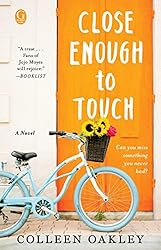

Close Enough to Touch
Colleen Oakley, 2017
Gallery Books
336 pp.
ISBN-13: 9781501139291
Summary
From the author of Before I Go comes an evocative, poignant, and heartrending exploration of the power and possibilities of the human hear.
Love has no boundaries...
Jubilee Jenkins has a rare condition: she’s allergic to human touch. After a nearly fatal accident, she became reclusive, living in the confines of her home for nine years.
But after her mother dies, Jubilee is forced to face the world—and the people in it—that she’s been hiding from.
Jubilee finds safe haven at her local library where she gets a job. It’s there she meets Eric Keegan, a divorced man who recently moved to town with his brilliant, troubled, adopted son. Eric is struggling to figure out how to be the dad—and man—he wants so desperately to be.
Jubilee is unlike anyone he has ever met, yet he can't understand why she keeps him at arm's length. So Eric sets out to convince Jubilee to open herself and her heart to everything life can offer, setting into motion the most unlikely love story of the year. (From the publisher.)
Author Bio
Colleen Oakley is the author of three novels, You Were There Too (2020), Close Enough to Touch (2017), and Before I Go (2015).
Oakley is also the former senior editor of Marie Claire and editor in chief of Women's Health & Fitness. Her articles, essays and interviews have been featured in the New York Times, Ladies' Home Journal, Marie Claire, Women's Health, Redbook, Parade and Martha Stewart Weddings. She lives in Georgia with her husband, four kids and the world's biggest lapdog. (From the publisher.)
Book Reviews
If you overlay The Rosie Project onto one of Jodie Picoult’s medical crisis novels, you might end up with something like Close Enough to Touch, Colleen Oakley’s new rom-com. Her novel combines a dash of screwball for laughs, a tad of woe for pathos, and a certain predictability for comfort. You know the broad outlines of where it’s headed — but you’ll have a delightful time getting there.
Molly Lundquist - LitLovers
This novel is the ideal pick for book clubs or just for curling up with a rainy day read… [a] sweet story of love and life.
Romance Times Book Reviews
Heart wrenching and humorous, Oakley delivers an out-of-the-ordinary love story with steady quips and endearing characters.… [Jubilee's] journey from recluse to recovery is fascinating, aided by supportive and supporting characters.
Publishers Weekly
Long a recluse in her New Jersey home, deathly allergic Jubilee Jenkins must finally venture forth and meets troubled, new-in-town Eric. You can't go wrong—a People Best New Book Pick, a US Weekly "Must" Pick, and a Publishers Lunch Buzz Book
Library Journal
Oakley has produced an affecting work that, while avoiding maudlin sentimentality, makes the reader care about Daisy and her determination to live while dying.
Booklist
Oakley masterfully creates a high-stakes story that still feels solidly real. All of her characters are well-rounded and charming.… A romantic, sweet story about taking chances and living life fully.
Kirkus Reviews
Discussion Questions
1. What effect does the alternating narrative between Jubilee’s and Eric’s perspectives have on your understanding of the events and characters in the book? How would the story have been different if it was just from Jubilee’s point of view?
2. Do you think Eric is a good dad to Aja? To Ellie? Why or why not? Compare and contrast his parenting style with that of Jubilee’s mother, Victoria. Consider the challenges each parent faces.
3. Why do you think Eric agreed to adopt Aja? How did that change his relationship with Stephanie? With Ellie?
4. How does Jubilee’s relationship with her mother affect her outlook on life? What would you do in her mother's shoes, having a child with a unique condition like Jubilee’s?
5. How is Jubilee affected by each of the people she interacts with as she reenters the world? How do they affect her perspective about her condition? Consider her interactions with Madison, Eric, Aja, Michael the pillow-golfer, and Louise.
6. Is Eric’s long-distance father-daughter book club experiment a success? What is so powerful about the shared reading experience? How has a book brought you closer to another family member or friend?
7. Why do you think Jubilee resists pursuing treatments or management for her condition? Why wouldn’t she want to see a doctor for an Epipen prescription?
8. Consider this quote: “People did stare at me in high school—like I was a curiosity—but I didn't think anyone ever noticed me. It’s a strange feeling, to be seen but invisible at the same time.” (p. 94) What is the difference between being seen and being noticed? Why is the difference important to Jubilee?
9. How has Jubilee’s nine-year seclusion affected her emotional maturity?
10. Discuss the importance of female friendship. How does Madison and Jubilee’s relationship affect each of the women?
11. Why is Jubilee the only adult who is able to get through to Aja? How do their shared experiences link them?
12. How does the truth about Jubilee’s condition change her relationship with Eric? With Madison?
13. Throughout the book, Jubilee starts to understand that her biggest fear isn’t actually physical touch but having emotional connections, only to be let down or disappointed by them. How does each character experience and deal with their own fears of vulnerability throughout the book?
14. Did the letter Jubilee found from her mother change your view of her? How so?
15. In the end, Jubilee asks Madison “if love is worth the risk.” How would you have answered that?
16. What was your reaction to the epilogue? Do you think Jubilee and Eric end up together for good? Why or why not?
(Questions issued by the publisher.)
top of page (summary)


Close Range: Wyoming Stories (incl. Brokeback Mountain)
Annie Proulx, 1999
Simon & Schuster
288 pp.
ISBN-13: 9780684852225
Summary
Pulitzer Prize winning author Annie Proulx is one of the literary greats of her generation. Bestselling novels like The Shipping News and Postcards have been unmatched successes with critics and readers alike.
Her latest is Close Range , a collection of award-winning tales of the Western frontier, of desolate expanses of land and the vast spaces between people, of love and loss set against the endless sky.
Like The Shipping News, it's sure to make an indelible impression on each of millions of readers. Includes the award-winning stories "The Half-Skinned Steer" and "Brokeback Mountain." (From the publisher.)
"Brokeback Mountain" from this story collection, was adapted to film in 2005, starring jake Gyllenhaal and Heath Ledger. The film won 3 Academy Awards (director, adapted screenplay, and musical score).
Author Bio
• Birth—August 22, 1935
• Where—Norwich, Connecticut, USA
• Education—B.A., University of Vermont; M.A., Sir George Williams University
• Awards—Pulitzer Prize and National Book Award, 1994; PEN/Faulkner, 1993
• Currently—lives in Seattle, Washington
Pulitzer Prize winner Annie Proulx did not set out to be a writer. She studied history in school, acquiring both her bachelor's and her master's degrees and abandoning her doctorate only in the face of a pessimistic job market. Something of a free spirit, she married and divorced three times and ended up raising three sons and a daughter single-handedly. She settled in rural Vermont, living in a succession of small towns where she worked as a freelance journalist and spent her free time in the great outdoors, hunting, fishing, and canoeing.
Although she wrote prolifically, most of Proulx's early work was nonfiction. She penned articles on weather, farming, and construction, and contracted for a series of rural "how tos" for magazines like Yankee and Organic Gardening. She also founded the Vershire Behind the Times, a monthly newspaper filled with colorful features and vignettes of small-town Vermont life. All this left little time for fiction, but she averaged a couple of stories a year, nearly all of which were accepted for publication.
Prominent credits in two editions of Best American Short Stories led to the publication in 1988 of Heart Songs and Other Stories, a first collection of Proulx's short fiction. Set in blue-collar New England, these "perfectly pitched stories of mysterious revenges and satisfactions" (the Guardian) received rapturous reviews.
With the encouragement of her publisher, Proulx released her first novel in 1992. The story of a fractured New England farm family, Postcards went on to win the PEN/Faulkner Award for fiction. She scored an even greater success the following year when her darkly comic Newfoundland set piece, The Shipping News, scooped both the National Book Award and the Pulitzer Prize. One year before her 60th birthday, Proulx had become an authentic literary celebrity.
Since then, the author has alternated between short and long fiction, garnering numerous accolades and honors along the way. Giving the lie to the literary adage "write what you know," her curiosity has led her into interesting, unfamiliar territory: Before writing The Shipping News, she made more than seven extended trips to Newfoundland, immersing herself in the culture and speech of its inhabitants; similarly, she weaved staggering amounts of musical arcana into her 1996 novel Accordion Crimes. She is known for her keen powers of observation—passed on, she says, from her mother, an artist and avid naturalist—and for her painstaking research, a holdover from her student days.
In 1994, Proulx left Vermont for the wide open spaces of Wyoming—a move that inspired several memorable short stories, including the O. Henry Award winner "Brokeback Mountain." First published in The New Yorker and included in the 1999 collection Close Range: Wyoming Stories, this tale of a doomed love affair between two Wyoming cowboys captured the public imagination when it was turned into an Oscar-winning 2005 film by director Ang Lee.
Lionized by most critics, Proulx is, nevertheless, not without her detractors. Indeed, her terse prose, eccentric characters, startling descriptions, and stylistic idiosyncrasies (run-on sentences followed by sentence fragments) are not the literary purist's cup of tea. But few writers can match her brilliance at manipulating language, evoking place and landscape, or weaving together an utterly mesmerizing story with style and grace.
Extras
• Proulx was the first woman to win the prestigious Pen/Faulkner Award. (From Barnes & Noble.)
Book Reviews
Powerful....[W]hat drives Mr. Proulx's people mainly is lust and lechery, itch and obsession....[R]ead [these stories] for their absolute authenticity, the sense they convey that you are beyond fact or fiction in a world that could not be any other way....Besides, you have little choice about reading [them] once you've begun them....bleak but expressive.
Christopher Lehmann-Haupt - The New York Times
Ms. Proulx writes with all the brutal beauty of one of her Wyoming snowstorms. Her people not only "stand" the bad luck and heartbreak that comes their way; they stare it down with astonishing strength.
Michael Knight - Wall Street Journal
Give yourself about 10 days to read this new collection of short stories by Annie Proulx. She has the mantle of American realism about her in style and vision, yet in this book she has broken new ground. It's a book with the best qualities of long-lasting, salty beef jerky. Some things shouldn't be rushed, but savored.
Steven C. Ballinger - The Bloomsbury Review
Annie Proulx's Close Range is the strongest attempt since Richars Ford's Rock Springs to capture a place that started as a fairy tale sold to gullible adventurers, flourished as a national matinee, and lives on as an existential broken promise that its people cant quite stop believing in...[Her] folksy stoicism isn't a pose. Her stories are solid oak...Her style is all substance, with very little air in it, as though she's learned to use fewer vowels, somehow, and banish articles and prepositions...At its best, Proulx's drawl is better than perfect....If God talked cowboy, he'd sound like Proulx. She's brilliant.
Walter Kirn - New York Magazine
Proulx hits and maintains a stunning narrative pitch whenever she details the Wyoming wilderness....[P]eople try their best against often insurmountable odds, but she imbues their efforts with a genuine sense of tragedy.
Book Magazine
A vigorous second collection from Proulx: eleven nicely varied stories set in the roughhewn wasteland that one narrator calls a "97,000-square-miles dog's breakfast of outside exploiters, Republican ranchers and scenery.
Kirkus Reviews
Discussion Questions
The Half Skinned Steer
1. In the story told by Mero's old man's girlfriend, the half-skinned steer becomes a terrible fate Tin Head knows he can't escape. What is Mero's half-skinned steer? How was he marked by it and by his Wyoming origins? What is the nature of Mero's journey?
The Mud Below
2. What drives Diamond, raised in town and meant for better things, to make himself into a rodeo bull rider? Are rodeo performers real cowboys? Does not knowing who his father is force him to invent a persona for himself? What are his feelings toward his mother, his young brother?
3. Do you agree with Pake when he says that Diamond sees the bulls he rides as role models rather than opponents? What did Pake mean when he told Diamond, "you can't have a fence with only one post"?
4. A fleeting clue to the identity of Diamond's father is in the story "Pair a Spurs." Does knowing that identity change your perception of the impasse relationship between Diamond and his mother?
Job History
5. Does the title, "Job History" hold any irony? What do the jobs the members of this rural family hold tell us about their lives and opportunities? Do we learn more about them than the story's brevity and matter-of-fact style would suggest?
6. What does this story say about the power of the home place over us?
The Blood Bay
7. This story is a twist on an old folk tale, but here given a Wyoming setting and characters. What does Proulx's adaptation of this tale tell you about the collection as a whole? Are you supposed to read these stories as a literal reflection of life in the west?
People in Hell Just Want A Drink ofWater
8. Compare the Dunmires and the Tinsleys—each family's character and sensibilities, what each values, how they see the world, etc. What do their differences say about the error of stamping all rural people as similar in nature?
9. Ras Tinsley falls victim to brutal vigilante action at the hands of the Dunmires. The Dunmires are stockmen. Is what the Dunmires do to Ras justifiable from their point of view as stockmen in this time and place? How is castrating Ras similar to culling an inferior animal from a herd? What is the flaw in that logic? 10. Discuss the final line of this story.
The Bunchgrass Edge of the World
11. Ottaline feels trapped in a world that seems to have nothing to offer her, and finds escapes by listening in on other people's conversations on a scanner. Discuss the options women have in isolated rural areas. Low population density and lack of public transportation are two background factors in this story. What are others?
12. After the tractor begins to talk to her, Ottaline learns that an accident that killed a ranch hand was intentional—an effort, the tractor claims, committed to "save" Ottaline from the young man. Ottaline replies, "I could a saved myself, if I wanted to." Do you agree? Is that what she accomplishes later by marrying Flyby Amendinger? What places, or whose place, does Ottaline claim for herself?
13. As the story develops Old Red seems pushed to the sidelines, yet he is never silenced by advanced age or the marginalization of his role in the family. Were you surprised that Old Red, along with Ottaline, is a survivor in this story?
Pair a Spurs
14. This story concerns complex relationships between men and women in a small community and prompts questions on the nature of love. The magic spurs infect Scrope with a strange and inescapable obsession. How does his changed behavior affect the other characters? What do the spurs represent?
A Lonely Coast
15. The world does not lack for women like Josanna Skiles who accept bad treatment from the men in their lives. Why cannot Josanna break out of the pattern? She sometimes thinks that she lives in "a miserable place." Why doesn't she leave and make a new life for herself somewhere else? How does the place she lives in define her sense of self?
16. Josanna has close female friends, yet Palma throws herself at Josanna's boyfriend, Elk. Why don't these women have more respect for each other?
17. Did this story's depiction of contemporary small-town Wyoming surprise you? Do you think of drugs as a rural problem? What are the hungers, behaviors, and social factors that drive this story?
The Governors of Wyoming
18. Why did Shy, a lifelong rancher, get involved with Wade Walls when it meant betraying his own community? What is the significance of the man stumbling through the waist-high grass who grants Shy his evil wish?
19. In what ways do Shy and Wade represent fringe positions on the complex issue of cattlemen versus environmentalists? Which characters in the story do you think represent current contemporary Wyoming ranching practice? Why does Roany make a success of her business while Shy fails?
55 Miles to the Gas Pump
20. What does this story say about the role imagination can play in lives defined by a remote setting and repetitive work? How does this brief story illuminate the collection as a whole?
Brokeback Mountain
21. Both Ennis and Jack convince themselves that they aren't gay, and tell one another lies about the women in their lives. Is either man threatened by the other's relationships with women? Why is it so hard for Ennis to ask Jack if he was with other men in Mexico? How does Jack's disclosure affect their relationship?
22. How can Jack and Ennis—both gay men—be homophobic? Does it seem possible to you that the two men might ever have lived together in rural Wyoming the way Jack wanted? How important is Ennis's tie to place and a rural life in this story?
23. Discuss the symbolism of Jack placing Ennis' shirt inside his own on a hanger—and Ennis's reaction to finding them after Jack's death. Why did Jack and Ennis never go back to Brokeback Mountain after the first summer?
(Questions issued by publisher.)
top of page (summary)


Close Your Eyes
Iris Johansen & Roy Johansen, 2012
St. Martin's Press
368 pp.
ISBN-13: 9780312611613
Summary
Blind for the first twenty years of her life, Kendra Michaels honed her other senses to almost superhuman perfection—and unintentionally became a secret weapon for the FBI. Her uncanny ability to pick up the most subtle audio, olfactory, and tactile cues in the world around her made her a law-enforcement legend. Today, her expertise is called for once again.
When Kendra is approached by a dubious source about a serial murder investigation, her instincts tell her to steer clear. This time, however, the case is personal: The next name to turn up on the killer’s hit list is Kendra’s own ex-lover, an FBI agent who disappeared without a trace. Now it’s up to Kendra to pick up the trail—or close her eyes again…forever. (From the publisher.)
See the video.
Author Bio
Iris Johansen is the New York Times bestselling author of Eight Days to Live, Shadow Zone, Blood Game, Deadlock, Dark Summer, Silent Thunder (with Roy Johansen), Pandora’s Daughter, Quicksand, Killer Dreams, On the Run, Countdown, Firestorm, Fatal Tide, Dead Aim, No One to Trust, and more.
Johansen began writing after her children left home for college. She first achieved success in the early 1980s writing category romances. In 1991, Johansen began writing suspense historical romance novels, starting with the publication of The Wind Dancer. In 1996 Johansen switched genres, turning to crime fiction, with which she has had great success. She had seventeen consecutive New York Times bestsellers as of November 2006.
Johansen and her husband live near Atlanta, Georgia. Her son, Roy Johansen, is an Edgar Award-winning screenwriter and novelist. Her daughter, Tamara, serves as her research assistant. (From the author's website.)
Book Reviews
Bestseller Johansen and son’s gripping fourth collaborative effort (after 2010’s Shadow Zone) stars Dr. Kendra Michaels, a music therapist with some amazing talents. Born blind, Kendra developed her other senses to an extraordinary degree until her sight was restored at age 20. As a modern-day Sherlock Homes, Kendra is invaluable to the FBI, who pull her into the case of six fatal stabbings in the San Diego area in 45 days that was earlier investigated by her former lover, Jeff Stedler, who’s gone missing. All six victims had the same as yet unidentified substance in their bodies. Despite not being a team player and friction with her co-worker, Adam Lynch, Kendra picks up some almost invisible clues that put them on the right track. Now someone is determined to kill her. The authors combine idiosyncratic yet fully realized characters with dry wit and well-controlled suspense that builds to a satisfying conclusion.
Publishers Weekly
Mind-blowing…The scenes with Adam and Kendra ooze sexual tension, making this thriller a titillating delight.
Booklist
Johansen and her son, Roy, team up for their fourth collaborative effort (Shadow Zone, 2010, etc.). Dr. Kendra Michaels, a music therapist, doesn't seem like your average crime fighter, but Kendra's track record is impressive.... [W]hen someone starts killing random people, former FBI agent Adam Lynch, who is now investigative freelancing, ropes her into helping the feds find the killer.... The law enforcement agents are all either corrupt or inept, and the supposed heat that builds between Kendra and Adam is tepid and uninteresting. While the foray into music therapy is compelling, the writers strain credulity with the premise that any federal agency would put up with someone as unpleasant and rude as Kendra, much less let her call the shots. A not-so-thrilling thriller that leaves readers wishing that the bad guys were better shots.
Kirkus Reviews
Discussion Questions
Use our LitLovers Book Club Resources; they can help with discussions for any book:
• How to Discuss a Book (helpful discussion tips)
• Generic Discussion Questions—Fiction and Nonfiction
• Read-Think-Talk (a guided reading chart)
We will add specific Discussion Questions when they are made available by the publisher.


Close Your Eyes, Hold Hands
Chris Bohjalian, 2014
Knopf Doubleday
288 pp.
ISBN-13: 9780307743930
Summary
A heartbreaking, wildly inventive, and moving novel narrated by a teenage runaway.
Close Your Eyes, Hold Hands is the story of Emily Shepard, a homeless teen living in an igloo made of ice and trash bags filled with frozen leaves. Half a year earlier, a nuclear plant in Vermont's Northeast Kingdom had experienced a cataclysmic meltdown, and both of Emily's parents were killed.
Devastatingly, her father was in charge of the plant, and the meltdown may have been his fault. Was he drunk when it happened? Thousands of people are forced to flee their homes in the Kingdom; rivers and forests are destroyed; and Emily feels certain that as the daughter of the most hated man in America, she is in danger.
So instead of following the social workers and her classmates after the meltdown, Emily takes off on her own for Burlington, where she survives by stealing, sleeping on the floor of a drug dealer's apartment, and inventing a new identity for herself—an identity inspired by her favorite poet, Emily Dickinson.
When Emily befriends a young homeless boy named Cameron, she protects him with a ferocity she didn't know she had. But she still can't outrun her past, can't escape her grief, can't hide forever—and so she comes up with the only plan that she can.
A story of loss, adventure, and the search for friendship in the wake of catastrophe, Close Your Eyes, Hold Hands is one of Chris Bohjalian’s finest novels to date—breathtaking, wise, and utterly transporting. (From the publisher.)
Author Bio
• Birth—1960
• Where—White Plains, New York, USA
• Education—Amherst College
• Awards—Anahid Literary Award, 2000; New England Book Award, 2002
• Currently—lives in Lincoln, Vermont
Christopher Aram Bohjalian, who goes by the pen name Chris Bohjalian, is an American novelist. Bohjalian is the author of 15 novels, including New York Times bestsellers Midwives, Secrets of Eden, The Law of Similars, Before You Know Kindness, The Double Bind, Skeletons at the Feast, and The Night Strangers.
Bohjalian is the son of Aram Bohjalian, who was a senior vice president of the New York advertising agency Romann & Tannenholz. Chris Bohjalian graduated summa cum laude from Amherst College, where he was a member of the Phi Beta Kappa Society. In the mid-1980s, he worked as an account representative for J. Walter Thompson advertising agency in New York.
He and his wife lived in a co-op in Brooklyn until March 1986, when the two were riding in a taxicab in which the driver refused to let them out of the car for 45 minutes, ignoring all traffic lights and stop signs. Around midnight, the driver dropped them off at a near-deserted street in front of a crack house, where the police were conducting a raid and Bohjalian and his wife were forced to drop to the ground for their protection. The incident prompted the couple to move from Brooklyn; Bohjalian said, "After it was all over, we just thought, "Why do we live here?" A few days later, the couple read an ad in The New York Times referencing the "People's Republic of Vermont," and in 1987 the couple moved to Lincoln, Vermont.
Early career
After buying their house, Bohjalian began writing weekly columns for local newspaper and magazine about living in the small town, which had a population of about 975 residents. The Concord Monitor said of Bohjalian during this period, "his immersion in community life and family, Vermont-style, has allowed him to develop into a novelist with an ear and empathy for the common man." Bohjalian continued the column for about 12 years, writing about such topics as his own daily life, fatherhood and the transformation of America. The column has run in the Burlington Free Press since 1992. Bohjalian has also written for such magazines as Cosmopolitan, Reader's Digest and the Boston Globe Sunday Magazine.
Bohjalian's first novel, A Killing in the Real World, was released in 1988. Almost two decades after it was released, Bohjalian said of the book, "It was a train wreck. I hadn't figured things out yet." His third novel, Past the Bleachers, was released in 1992 and adapted as a Hallmark Channel television movie in 1995.
In 1998, Bohjalian wrote his fifth book, Midwives, a novel focusing on rural Vermont midwife Sibyl Danforth, who becomes embroiled in a legal battle after one of her patients died following an emergency Caesarean section. The novel was critically acclaimed and was selected by Oprah Winfrey as the October 1998 selection of her Oprah's Book Club, which helped push the book to great financial success. It became a New York Times and USA Today bestseller. Victoria Blewer has often described her husband as having "a crush" on the Sybil Danforth character. In 2001, the novel was adapted into a Lifetime Movie Network television film starring Sissy Spacek in the lead role. Spacek said the Danforth character appealed to her because "the heart of the story is my character's inner struggle with self-doubt, the solo road you travel when you have a secret."
Later career
Bohjalian followed Midwives with the 1999 novel The Law of Similars, about a widower attorney suffering from nameless anxieties who starts dating a woman who practices alternative medicine. The novel was inspired by Bohjalian's real-life visit to a homeopath in an attempt to cure frequent colds he was catching from his daughter's day care center. Bohjalian said of the visit, "I don't think I imagined there was a novel in homeopathy, however, until I met the homeopath and she explained to me the protocols of healing. There was a poetry to the language that a patient doesn't hear when visiting a conventional doctor." The protagonist, a father, is based in part on Bohjalian himself, and his four-year-old daughter is based largely on Bohjalian's daughter, who was three when he was writing the book., Liz Rosenberg of The New York Times said the novel shared many similarities with Midwives but that it paled in comparison; Rosenberg said, "Unlike its predecessor, it fails to take advantage of Bohjalian's great gift for creating thoughtful fiction featuring characters in whom the reader sustains a lively interest." Megan Harlan of The Boston Phoenix described it as "formulaic fiction" and said Bohjalian focused too much on creating a complex plot and not enough of complex characterizations. The Law of Similars, like Midwives, made the New York Times bestsellers list.
He won the New England Book Award in 2002, and in 2007 released "The Double Bind," a novel based on Fitzgerald's The Great Gatsby.
In 2008, Bohjalian released Skeletons at the Feast, a love story set in the last six months of World War II in Poland and Germany. The novel was inspired by an unpublished diary written by German citizen Eva Henatsch from 1920 to 1945. The diary was given to Bohjalian in 1998 by Henatsch's grandson Gerd Krahn, a friend of Bohjalian, who had a daughter in the same kindergarten class as Bohjalian's daughter. Bohjalian was particularly fascinated by Henatsch's account of her family's trek west ahead of the Soviet Army, but he was not inspired to write a novel from it until 2006, when he read Armageddon: The Battle for Germany, Max Hastings' history of the final years of World War II. Bohjalian was struck not only by how often Henatsch's story mirrored real-life experiences, but also the common "moments of idiosyncratic human connection" found in both. Skeletons of the Feast was considered a departure for Bohjalian because it was not only set outside of Vermont, but set in a particular historical moment.
His 2010 novel, Secrets of Eden, was also a critical success, receiving starred reviews from three of the four trade journals (Booklist, Library Journal, and Publishers Weekly), as well as many newspapers and magazines. It debuted at # 6 on The New York Times bestseller list.
His next novel, The Night Strangers, published in 2011, represents yet another departure for Bohjalian. The is both a gothic ghost story and a taut psychological thriller.
He has written a weekly column for Gannett's Burlington Free Press since February 1992 called "Idyll Banter." His 1,000th column appeared in May 2011.
Personal comments
In a 2003 Barnes & Noble interview, Bohjalian offered up these personal comments:
I was the heaviest child, by far, in my second-grade class. My mother had to buy my pants for me at a store called the "Husky Boys Shop," and still she had to hem the cuffs up around my knees. I hope this experience, traumatizing as it was, made me at least marginally more sensitive to people around me.
I have a friend with Down syndrome, a teenage boy who is capable of remembering the librettos from entire musicals the first or second time he hears them. The two of us belt them out together whenever we're driving anywhere in a car.I am a pretty avid bicyclist. The other day I was biking alone on a thin path in the woods near Franconia Notch, New Hampshire, and suddenly before me I saw three bears. At first I saw only two, and initially I thought they were cats. Then I thought they were dogs. Finally, just as I was approaching them and they started to scurry off the path and into the thick brush, I understood they were bears. Bear cubs, to be precise. Which is exactly when their mother, no more than five or six feet to my left, reared up on her hind legs, her very furry paws and very sharp claws raised above her head in a gesture that an optimist might consider a wave and guy on a bike might consider something a tad more threatening. Because she was standing on a slight incline, I was eye level with her stomach—an eventual destination that seemed frighteningly plausible. I have never biked so fast in my life in the woods. I may never have biked so fast in my life on a paved road.
I do have hobbies—I garden and bike, for example—but there's nothing in the world that gives me even a fraction of the pleasure that I derive from hanging around with my wife and daughter.
He lives with his wife and daughter in Lincoln, Vermont, where he is active in the local church and the Vermont theater community—always off-stage, never on.
Writing style
Bohjalian novels often focus on a specific issue, such as homelessness, animal rights and environmentalism, and tend to be character-driven, revolving around complex and flawed protagonists and secondary characters. Bohjalian uses characteristics from his real life in his writings; in particular, many of his novels take place in fictional Vermont towns, and the names of real New Hampshire towns are often used throughout his stories. Bohjalian said, "Writers can talk with agonizing hubris about finding their voices, but for me, it was in Vermont that I discovered issues, things that matter to me." His novels also tend to center around ordinary people facing extraordinarily difficult situations resulting from unforeseen circumstances, often triggered by other parties. (From Wikipedia.)
Book Reviews
A chilling and heartbreaking suspense novel for readers who like the poetry of Emily Dickinson.... Close Your Eyes, Hold Hands is ambitious and poignant thanks to the voice of its teen narrator.... It’s a novel about survival and the power of literature and poetry.
Bob Minzesheimer - USA Today
Bohjalian delivers a thoroughly engrossing and poignant coming-of-age story set against a nightmarish backdrop as real as yesterday's headlines from Fukushima and Chernobyl. And in Emily he's created a remarkable and complicated teenager, a passionate, intelligent girl equally capable of cutting herself with a razor blade and quoting Emily Dickinson, then explaining it all to us in a wry, honest voice as distinctive as Holden Caulfield's.
Ann Levin - Associated Press
Heartbreaking....scrupulously realistic....Close Your Eyes, Hold Hands is a novel for adults...but readers of any age who love John Green’s novels might also find Shepard’s story, sobering as it is, an awesome one.
Jim Higgins - Milwaukee Journal Sentinel
A "must read’ book.... [A] brilliant story of a young woman living an unexpected life, making difficult decisions and dealing with an ugly aftermath.
Amanda St. Amand - St. Louis Post Dispatch
A masterful storyteller...Bohjalian hits every note. His characters have depth, his story sings. It’s a book that works well for either teens or adults.
Beth Colvin - New Orleans Advocate
Bohjalian’s inventive latest imagines a nuclear meltdown in Vermont. Sixteen-year-old Emily loses her father—the plant’s chief engineer—in the accident, and she flees the town to escape its vitriol. Though she ends up homeless, she never gives up on home. Emily’s voice is droll, her journey enthralling and indelible (Best New Books).
People Magazine
Bohjalian’s impressive 16th novel charts the life of a teenage girl after a nuclear disaste.... Through her first-person narration, readers become intimately familiar with Emily.... Her admiration for kindred spirit Emily Dickinson serves to humanize her plight, as does an epiphany in the books’ bittersweet conclusion.
Publishers Weekly
Emily Shepard is hiding out in a shelter made of ice and trash bags after a nightmarish meltdown at a nuclear plant in Vermont's Northeast Kingdom.... More heartfelt, engaged work from relentlessly best-selling, best-book author Bohjalian, and how can you not love a heroine who identifies with Emily Dickinson?
Library Journal
Bohjalian once again reveals an uncanny talent for crafting a young female protagonist who is fatally flawed, but nevertheless immensely likable...resonates with a message of hope, truth and the fragility of life. —Karen Ann Cullotta
Bookpage
The versatile Bohjalian has Emily tell her harrowing, tragic story retrospectively, under medical care. If only this well-meant and compelling tale offered more scenes depicting the shocking aftermath of a nuclear disaster to provide an even more arresting and significant context for traumatized yet tough and resilient young Emily’s sad, brave saga. —Donna Seaman
Booklist
After a nuclear meltdown, a Vermont teen flees to the mean streets of Burlington.... Readers hoping for a futuristic novel imagining the aftermath of a Fukushima-type disaster in the United States may be disappointed—Bohjalian’s primary focus is on examining, in wrenching detail, the dystopia wrought by today’s economy. Emily’s voice is a compelling one, however, and hers is a journey readers will avidly follow
Kirkus Reviews
Discussion Questions
Use our LitLovers Book Club Resources; they can help with discussions for any book:
• How to Discuss a Book (helpful discussion tips)
• Generic Discussion Questions—Fiction and Nonfiction
• Read-Think-Talk (a guided reading chart)
(We'll add specific questions if and when they're made available by the publisher.)
top of page (summary)


Closed Doors
Lisa O'Donnell, 2014
HarperCollins
256 pp.
ISBN-13: 9780062271891
Summary
In this tense and brilliant tale, a young boy on a small Scottish island, where everyone knows everything about everyone else, discovers that a secret can be a dangerous thing.
Eleven-year-old Michael Murray is the best at two things: hacky sack and keeping secrets. His family thinks he's too young to hear grown-up stuff, but he listens at doors—it's the only way to find out anything. And Michael's heard a secret, one that may explain the bruises on his mother's face.
When the whispers at home and on the street become too loud to ignore, Michael begins to wonder if there is an even bigger secret he doesn't know about. Scared of what might happen if anyone finds out, and desperate for life to return to normal, Michael sets out to piece together the truth. But he also has to prepare for the upcoming talent show, keep an eye out for Dirty Alice—his archnemesis from down the street—and avoid eating Granny's watery stew.
Closed Doors is the startling new novel from Lisa O'Donnell, the acclaimed author of The Death of Bees. It is a vivid evocation of the fears and freedoms of childhood and a powerful tale of love, of the loss of innocence, and of the importance of family in difficult times. (From the publisher.)
Author Bio
• Birth—1972
• Where—Bute, Island of the Firth of Clyde, Scotland
• Education—B.A.,Glasgow Caledonian University
• Awards—Orange Prize (screenwriting); Commonwealth Book Prize
• Currently—lives Scotland
Lisa O’Donnell winner of The Orange Prize for New Screenwriters with her screenplay The Wedding Gift in 2000. Lisa was also nominated for the Dennis Potter New Writers Award in the same year.
Her first novel, The Death of Bees, published in 2012, won the 2013 Commonwealth Book Prize. Her second novel, Closed Doors, was released in 2014. Lisa had moved to Los Angeles, California, as a screenwriter but has since returned to live in Scotland. (Adapted from the author's website.)
Book Reviews
[D]azzling.... O’Donnell won the prestigious Commonwealth Book Prize last year with The Death of Bees, a first novel that deftly balanced the morbid with the mundane, a talent that remains on full display here.... O’Donnell’s great talent is most apparent in her depiction of the gap between Michael’s thoughts and his actions.... It’s not revealing too much to say that O’Donnell wraps up Closed Doors in a way that feels both unpredictable and inevitable. It’s a fitting end to a moving story that stakes a lasting, and disturbing, emotional claim on her readers.
Andrew Ervin - New York Times Book Review
There’s loss of innocence here, but the overwhelming tone is warm and sparky; O’Donnell shows how a shattered family can remake itself, and Michael’s narrative voice is delightful—observant, thoughtful, comical, and thoroughly believable.
Sunday Times (London)
O'Donnell has created a resourceful, scabby-kneed character who is both believably childish and knowingly perceptive. Yet the novel never feels as blisteringly original as its predecessor.... [Closed Doors] relies on the first-person testimony of Michael—which, while admirably direct, sometimes seems a little bald on the page: "'My da is sad, my granny is sad. We are all afraid and I pray for my ma to get better."
Alfred Hickling - Guardian - (UK)
[O’Donnell] has fashioned yet another humane and compulsive read, grounded in a realism which, depicted through a child’s eyes—with that hint of a child’s surreal perception—gathers together violence, humor, and love in a most believable way.
Scotland on Sunday
Though O’Donnell creates a powerful voice for her young protagonist, she is less than fair to Rosemary, whose fear that telling the truth would open her up to victim blaming is presented as simply a source of pain to others, rather than as a legitimate concern.
Publishers Weekly
As in The Death of Bees, a 2013 Commonwealth Book Prize winner, O'Donnell looks at adult misbehavior through the eyes of a child. Eleven-year-old Michael Murray has peered behind enough doors to know why his mother's face is often bruised, but he suspects that more secrets await him
Library Journal
(Starred review.) The novel asks (and possibly answers) two important questions—to what extent should children be protected from the truth, and does silence do more harm than good? While it deals with disturbing subject matter, this is an engaging page-turner that effectively explores the trials and tribulations of childhood with warmth and humor. —Kerri Price
Booklist
Discussion Questions
Use our LitLovers Book Club Resources; they can help with discussions for any book:
• How to Discuss a Book (helpful discussion tips)
• Generic Discussion Questions—Fiction and Nonfiction
• Read-Think-Talk (a guided reading chart)
(We'll add specific questions if and when they're made available by the publisher.)


Cloud Atlas
David Mitchell, 2004
Random House
509 pp.
ISBN-13: 9780375507250
Summary
In this audacious and dazzling novel, Mitchell weaves history, science, humor, and suspense through six separate but related narratives, each set in a different time and place, each written in a different prose style, and each broken mid-action only to be concluded in the second half of the book.
A reluctant voyager crossing the Pacific in 1850; a disinherited composer blagging a precarious livelihood in between-the-wars Belgium; a high-minded journalist in Governor Reagan’s California; a vanity publisher fleeing his gangland creditors; a genetically modified “dinery server” on death-row; and Zachry, a young Pacific Islander witnessing the nightfall of science and civilisation—the narrators of Cloud Atlas hear each other’s echoes down the corridor of history, and their destinies are changed in ways great and small.
In his captivating third novel, David Mitchell erases the boundaries of language, genre and time to offer a meditation on humanity’s dangerous will to power, and where it may lead us. (From the publisher.)
Author Bio
• Birth—January 12, 1969
• Where—Southport, Lancashire, UK
• Education—B.A., M.A., University of Kent
• Awards—John Llewellyn Rhys Prize
• Currently—lives in County Cork, Ireland
David Mitchell is an English novelist, the author of several novels, two of which, number9dream (2001) and Cloud Atlas (2004), were shortlisted for the Booker Prize. He has lived in Italy, Japan and Ireland. Mitchell currently lives with his wife Keiko Yoshida and their two children in Ardfield, Clonakilty in County Cork, Ireland.
Early life
Mitchell was born in Southport in Merseyside, England, and raised in Malvern, Worcestershire. He was educated at Hanley Castle High School and at the University of Kent, where he obtained a degree in English and American Literature followed by an M.A. in Comparative Literature. He lived in Sicily for a year, then moved to Hiroshima, Japan, where he taught English to technical students for eight years, before returning to England, where he could live on his earnings as a writer and support his pregnant wife.
Work
Mitchell's first novel, Ghostwritten (1999), moves around the globe, from Okinawa to Mongolia to pre-Millennial New York City, as nine narrators tell stories that interlock and intersect. The novel won the John Llewellyn Rhys Prize (for best work of British literature written by an author under 35) and was shortlisted for the Guardian First Book Award. His two subsequent novels, number9dream (2001) and Cloud Atlas (2004), were both shortlisted for the Man Booker Prize. In 2003, he was selected as one of Granta's Best of Young British Novelists. In 2007, Mitchell was listed among Time magazine's 100 Most Influential People in The World.
In 2012 his novel Cloud Atlas was made into a film. In recent years he has also written opera libretti. Wake, based on the 2000 Enschede fireworks disaster and with music by Klaas de Vries, was performed by the Dutch Nationale Reisopera in 2010. For his other opera, Sunken Garden, he collaborated with the Dutch composer Michel van der Aa. It premiered in 2013 with the English National Opera.
Mitchell's sixth novel, The Bone Clocks, was released on September 2nd, 2014. In an interview in The Spectator, Mitchell said that the novel has "dollops of the fantastic in it", and is about "stuff between life and death." The book was longlisted for the 2014 Man Booker Prize.
Personal
In a Random House essay, Mitchell wrote:
I knew I wanted to be a writer since I was a kid, but until I came to Japan to live in 1994 I was too easily distracted to do much about it. I would probably have become a writer wherever I lived, but would I have become the same writer if I'd spent the last six years in London, or Cape Town, or Moose Jaw, on an oil rig or in the circus? This is my answer to myself.
Mitchell has the speech disorder of stammering and considers the film The King's Speech (2010) to be one of the most accurate portrayals of what it's like to be a stammerer: "I'd probably still be avoiding the subject today had I not outed myself by writing a semi-autobiographical novel, Black Swan Green, narrated by a stammering 13 year old."
One of Mitchell's children is autistic, and in 2013 he and wife Keiko translated into English a book written by a 13-year-old Japanese boy with autism, The Reason I Jump: One Boy's Voice from the Silence of Autism.
List of works
Novels
Ghostwritten (1999)
number9dream (2001)
Cloud Atlas (2004)
Black Swan Green (2006)
The Thousand Autumns of Jacob de Zoet (2010)
The Bone Clocks (2014)
Slade House (2015)
Utopia Avenue (2020)
(Bio adapted from Wikipedia. Retrieved 9/4/2014.)
Book Reviews
To write a novel that resembles no other is a task that few writers ever feel prepared to essay. David Mitchell has written such a novel—or almost has. In its need to render every kind of human experience, Cloud Atlas finds itself staring into the reflective waters of Joyce's Ulysses. Just as Joyce, in the scene that takes place in the cabman's shelter, found the hidden beauty of cliche-filled prose, so Mitchell does with his Luisa Rey story.
Tom Bissell - New York Times
Hopscotching over centuries, Cloud Atlas likewise jumps in and out of half a dozen different styles, all of which display the author's astonishing talent for ventriloquism, and end up fitting together to make this a highly satisfying, and unusually thoughtful, addition to the expanding "puzzle book" genre.
Jeff Turrentine - Washington Post
Mitchell’s virtuosic novel presents six narratives that evoke an array of genres, from Melvillean high-seas drama to California noir and dystopian fantasy. There is a naïve clerk on a nineteenth-century Polynesian voyage; an aspiring composer who insinuates himself into the home of a syphilitic genius; a journalist investigating a nuclear plant; a publisher with a dangerous best-seller on his hands; and a cloned human being created for slave labor. These five stories are bisected and arranged around a sixth, the oral history of a post-apocalyptic island, which forms the heart of the novel. Only after this do the second halves of the stories fall into place, pulling the novel’s themes into focus: the ease with which one group enslaves another, and the constant rewriting of the past by those who control the present. Against such forces, Mitchell’s characters reveal a quiet tenacity. When the clerk is told that his life amounts to “no more than one drop in a limitless ocean,” he asks, “Yet what is any ocean but a multitude of drops?”
The New Yorker
At once audacious, dazzling, pretentious and infuriating, Mitchell's third novel weaves history, science, suspense, humor and pathos through six separate but loosely related narratives. Like Mitchell's previous works, Ghostwritten and number9dream (which was shortlisted for the Booker Prize), this latest foray relies on a kaleidoscopic plot structure that showcases the author's stylistic virtuosity. Each of the narratives is set in a different time and place, each is written in a different prose style, each is broken off mid-action and brought to conclusion in the second half of the book. Among the volume's most engaging story lines is a witty 1930s-era chronicle, via letters, of a young musician's effort to become an amanuensis for a renowned, blind composer and a hilarious account of a modern-day vanity publisher who is institutionalized by a stroke and plans a madcap escape in order to return to his literary empire (such as it is). Mitchell's ability to throw his voice may remind some readers of David Foster Wallace, though the intermittent hollowness of his ventriloquism frustrates. Still, readers who enjoy the "novel as puzzle" will find much to savor in this original and occasionally very entertaining work. Lots of buzz and a friendly paperback price will ensure strong sales, but like other fashionable tomes (think Pynchon's Mason & Dixon) Mitchell's novel may be more admired than read.
Publishers Weekly
In what must rank among the year's more ambitious novels, Mitchell (Ghostwritten) presents six quasicliffhanger stories in six different time periods. Beginning with a mid-19th-century Pacific voyage, the book then vaults to an early 20th-century composer who cuckolds his mentor, a 1970s reporter pursued by hitmen when she joins forces with a company whistleblower, a put-upon editor trapped inside a home for the aged, a servant clone interrogated about her travels to the outside world, and, finally, a return to the Pacific, only centuries later in a post-civilization world. Got it? Now tie up the cliffhangers in reverse order, going backward in time. The stories have a loose connecting theme of pursuing freedom and justice, and Mitchell has a gift for creating fully realized worlds with a varied cast of characters. However, there are patches of rough sledding; while the clever construction serves to highlight the novel's big ideas, the continual interruptions may distance the average reader. After slogging through five half-stories, the author has the bravery (or foolishness?) to relate the sixth in an invented dialect for a long stretch. The book has received good press in the United Kingdom, but perhaps sensing a smaller audience, the U.S. publisher offers a trade paperback original at a "try me" price. Libraries may wish to do so for their more adventurous readers of literary fiction. —Marc Kloszewski, Indiana Free Lib., PA
Library Journal
Critics on both sides of the Atlantic rave over Cloud Atlas.... Many of the accolades focus on his flair for setting and character.... [T]he technical expertise that allows Mitchell to adopt a different genre for each of his six storylines—gets him into a little trouble. The New York Times Book Review complains that Mitchell’s writing...[can] render his work coldly impressive rather than “fallibly human.” However, most reviewers found Mitchell’s unorthodox structure captivating.
Bookmarks Magazine
Great Britain's answer to Thomas Pynchon outdoes himself with this maddeningly intricate, improbably entertaining successor to Ghostwritten (2000) and Number9Dream (2002). Mitchell's latest consists of six narratives set in the historical and recent pasts and imagined futures, all interconnected whenever a later narrator encounters and absorbs the story that preceded his own. In the first, it's 1850 and American lawyer-adventurer Adam Ewing is exploring endangered primitive Pacific cultures (specifically, the Chatham Islands' native Moriori besieged by numerically superior Maori). In the second, "The Pacific Diary of Adam Ewing" falls (in 1931) into the hands of bisexual musician Robert Frobisher, who describes in letters to his collegiate lover Rufus Sixsmith his work as amanuensis to retired and blind Belgian composer Vivian Ayrs. Next, in 1975, sixtysomething Rufus is a nuclear scientist who opposes a powerful corporation's cover-up of the existence of an unsafe nuclear reactor: a story investigated by crusading reporter Luisa Rey. The fourth story (set in the 1980s) is Luisa's, told in a pulp potboiler submitted to vanity publisher Timothy Cavendish, who soon finds himself effectively imprisoned in a sinister old age home. Mitchell then moves to an indefinite future Korea, in which cloned "fabricants" serve as slaves to privileged "purebloods"-and fabricant Sonmi-451 enlists in a rebellion against her masters. The sixth story, told in its entirety before the novel doubles back and completes the preceding five (in reverse order), occurs in a farther future time, when Sonmi is a deity worshipped by peaceful "Valleymen"-one of whom, goatherd Zachry Bailey, relates the epic tale of his people's war with their oppressors, the murderous Kona tribe. Each of the six stories invents a world, and virtually invents a language to describe it, none more stunningly than does Zachry's narrative ("Sloosha's Crossin' and Ev'rythin' After"). Thus, in one of the most imaginative and rewarding novels in recent memory, the author unforgettably explores issues of exploitation, tyranny, slavery, and genocide. Sheer storytelling brilliance. Mitchell really is his generation's Pynchon.
Kirkus Reviews
Discussion Questions
Use our LitLovers Book Club Resources; they can help with discussions for any book:
• How to Discuss a Book (helpful discussion tips)
• Generic Discussion Questions—Fiction and Nonfiction
• Read-Think-Talk (a guided reading chart)
Also consider these LitLovers talking points to help get a discussion started for Cloud Atlas:
1. What is Cloud Atlas about? What are the questions the book explores—its primary thematic concerns?
2. Is this a cautionary tale...a prognosis...a diagnosis? In Mitchell's tales, what do humans seem bent on doing to one another...and why? With little left at the end, what, if anything, remains?
3. Why does Mitchell use the structure he does? What might he be hoping to achieve through the six (or twelve) interrelated stories, each based on a specific genre: epistolary, mystery, farce, sci-fi, post-apocolyptic? What is the effect, then, of reversing the tales and going backward?
4. How do each of the tales fit together...forward and backward. Put the pieces of the puzzle together—showing how one story links to another. How, for instance, is Luisa Rey in t connected to Frobisher?
5. What is the significance of the title, "Cloud Atlas"?
6. What are some of the neologisms used in the sci-fic chapters on Sonmi~451—and how do they reflect our use of language today?
7. Which was your favorite tale...and least favorite?
8. What was your experience reading the work: did you find the structure disruptive and confusing...and did you enjoy picking up the linkage between the stories and seeing how it played out by the end?
8. Have you read other dystopian...or post-apocolytpic works? If so, how do they compare with Cloud Atlas?
(Questions by LitLovers. Please feel free to use them, online or off, with attribution. Thanks.)
top of page (summary)


Coal River
Ellen Marie Wiseman, 2016
Kensington Books
304 pp.
ISBN-13: 9781617734472
Summary
This vibrant historical novel explores one young woman's determination to put an end to child labor in a Pennsylvania mining town.
As a child, Emma Malloy left isolated Coal River, Pennsylvania, vowing never to return. Now, orphaned and penniless at nineteen, she accepts a train ticket from her aunt and uncle and travels back to the rough-hewn community
Treated like a servant by her relatives, Emma works for free in the company store. There, miners and their impoverished families must pay inflated prices for food, clothing, and tools, while those who owe money are turned away to starve.
Most heartrending of all are the breaker boys Emma sees around the village—young children who toil all day sorting coal amid treacherous machinery. Their soot-stained faces remind Emma of the little brother she lost long ago, and she begins leaving stolen food on families' doorsteps, and marking the miners' bills as paid.
Though Emma's actions draw ire from the mine owner and police captain, they lead to an alliance with a charismatic miner who offers to help her expose the truth. And as the lines blur between what is legal and what is just, Emma must risk everything to follow her conscience.
An emotional, compelling novel that rings with authenticity—Coal River is a deft and honest portrait of resilience in the face of hardship, and of the simple acts of courage that can change everything. (From the publisher.)
Author Bio
• Birth—ca. 1961-62
• Where—Three Mile Bay, New York, USA
• Education—Lyme Central School
• Currently—lives on Lake Ontario in upstate New York
Ellen Marie Wiseman discovered her love of reading and writing while attending first grade in one of the last one-room schoolhouses in upper New York State.
Her debut novel The Plum Tree—a WWII story about a young German woman trying to save the love of her life, a Jewish man—was inspired by her mother's childhood in Germany during the Second World War. The book was published in 2013.
Wiseman's second novel, What She Left Behind, published in 2014, centers on the now-shuttered Willard Asylum for the Insane in Ovid, near Seneca Lake, New York, and involves a woman wrongly committed.
Coal River, Wiseman's 2016 novel, revolves around the efforts of a young woman to help at-risk workers in the Pennsylvania col mines.
The Life She Was Given, released in 2017, tells the story of two sisters: Lilly who is sold to the circus in 1931, and the other, years later, who inherits the family farm.
Originally from Three Mile Bay, New York, Wiseman lives on Lake Ontario with her husband. (Adapted from the publisher.)
Visit the author's website.
Book Reviews
Wiseman (What She Left Behind) offers heartbreaking and historically accurate depictions of the dangerous mines, the hopeless workers, and their improbable fight for justice. The richly developed coal town acts as a separate, complex character; readers will want to look away even as they're drawn into a powerful quest for purpose and redemption.
Publishers Weekly
[A] picture of the struggles mining families faced in the early 1900s. Emma is a strong, likable character...supported by a cast of equally unlikable characters who are easy to hate. Although the dialogue and narrative can be simplistic and overly explanatory, the plot of Coal River sweeps the reader along (Ages 15 to Adult). —Deanne Boyer; .
VOYA
Discussion Questions
Use our LitLovers Book Club Resources; they can help with discussions for any book:
• How to Discuss a Book (helpful discussion tips)
• Generic Discussion Questions—Fiction and Nonfiction
• Read-Think-Talk (a guided reading chart)
(We'll add specific questions if and when they're made available by the publisher.)
Coal Run
Tawni O'Dell, 2004
Penguin Group USA
384 pp.
ISBN-13: 9780451215123
Summary
With her eagerly awaited second novel, after Back Roads, Tawni O'Dell takes readers back to the coal-mining country of western Pennsylvania.
Set in a town ravaged and haunted by a mine explosion that took the lives of 96 men, Coal Run explores the life of local deputy and erstwhile football legend, "The Great Ivan Z.," as he prepares for a former teammate's imminent release from prison.
As the week unfolds and Ivan struggles to confront his demons, he reveals himself to be a man whose conscience is burdened by a long-held and shocking secret. (From the publisher.)
Author Bio
• Birth—1964
• Where—Indiana, Pennsylvania, USA
• Education—B.A. Northwest University
• Currently—lives in Pennsylvania
Tawni O'Dell is the New York Times bestselling author of the novels Fragile Beasts, Sister Mine, Coal Run, and Back Roads, which was an Oprah's Book Club pick and a Book-of-the-Month Club Main Selection. She is also a contributor to several anthologies including Becoming Myself: Reflections on Growing Up Female. Her work has been translated into 8 languages and been published in 20 countries.
Born and raised in Indiana, Pennsylvania, O'Dell graduated from Northwestern University with a degree in journalism. She lived for many years in the Chicago area before moving back to Pennsylvania, where she now lives with her two children and her husband, literary translator Bernard Cohen. (From Wikipedia.)
Book Reviews
A work of stark grandeur with powerful emotional links to the under-appreciated masterpieces of John Steinbeck and Clifford Odets, yet with a tender empathy all her own...It's a pleasure to see such a gifted, ambitious writer reinvigorating the tradition of social conscience combined with personal passion that has illuminated some of the finest, most moving works in American literature.
Los Angeles Times
Ivan is the proverbial angry young man, only he's not so young anymore…Ivan's sister, Jolene, who works as a waitress and is raising three children who have three different fathers is that fictional rarity, the believable working-class character…O'Dell has an ear for the telling detail.
Chicago Times
O'Dell is an accomplished writer; assured and perceptive, she is especially good with quick dialogue that captures the anger and disappointment these characters carry.
Pittsburgh Post-Gazette
Utterly compelling…O'Dell illuminates timeless issues with keen insight…this is a smart book filled with sympathetic, opinionated characters who may be victims of circumstance but are never victims of ignorance or self-pity.
Denver Post
O'Dell explores the dynamics of a tiny Pennsylvania coal-mining town in her probing, heartbreaking second novel, which centers on the fortunes of former college football hero Ivan Zoschenko. The novel literally opens with a bang in a flashback that recalls the tragic underground explosion that took the life of Zoschenko's father and killed 96 other men from Coal Run. Some 15 years later, just after Zoschenko is drafted by the Chicago Bears, his knee is crushed in an accident in the same mines. His subsequent fall from grace is long and hard; he moves to Florida, hits the bars and works as an exterminator. He returns home only when he hears that Reese Raynor, a former schoolmate who beat his wife, Crystal, into a coma, is being released from prison. Despite his drinking problem, Zoschenko is hired as a deputy by the local sheriff, getting back in touch with his gorgeous sister, a single mom and career waitress; his boyhood hero, now a reclusive Vietnam vet; Reese's troubled twin brother, Jesse; and Crystal, who is still comatose and reminds Zoschenko of a shameful incident in his past. That past is linked to Reese Raynor's, and the novel builds to the inevitable brutal collision of the two men. O'Dell's portrait of Zoschenko is deep and penetrating, but even more moving is her portrayal of the coal-town community. Ravaged by disaster and callous corporate treatment, the citizens of Coal Run still can't imagine any other life. As Zoschenko puts it, "Long before [the mine] became the site of so much death, it had been a source of life for all of us. For me it was the closest thing I had to God." Though it occasionally flirts with sentimentality, this is a fierce, sharply drawn and richly sympathetic tribute to working-class America.
Publishers Weekly
As she did in her acclaimed debut, Back Roads, O'Dell displays a marvelous gift for serving up eccentric, believable characters and vividly captures the bleakness and harshness of coal-mining country…Captivating.
Library Journal
Triumphantly fulfilling the promise of her bestselling debut (Back Roads), O'Dell examines the tangled, enduring bonds of family and community in a Pennsylvania mining town…Once again, O'Dell inhabits a male mind with sensitivity and acuity…[a] searing, tragic vision of working-class people…Powerful and uncompromising, yet radiant with love, this one's pretty close to a masterpiece.
Kirkus Reviews
Discussion Questions
1. Lost identity is a recurring theme in this book, both locally, in the Pennsylvania boys’ forgetting their hometowns, and in a larger sense, in Americans’ forgetting their ethnic identities. From tales of Magadan to the portrait of Volodymyr that sits above the Zoschenko dinner table, allusions to Ivan’s father’s former life in Ukraine and Russia are made throughout the novel. Discuss what Ivan’s heritage means to him.
2. The land of Coal Run is inexplicably, irrevocably part of each character, drawing back those who leave it. Discuss each of the very different homecomings of the book—those of Val, Reese Raynor, Ivan, and John Harris. What is it that ties each character to the town?
3. Compare Ivan as a little boy to Ivan as the narrator of the novel. How does his voice change? How are his relationships to Val and Eb similar?
4. Ivan loses his father, uncle, and grandfather in the Gertie mine explosion and Val to the Vietnam War, then denies the existence of his own son. None of Jolene’s three sons have any kind of relationship with their fathers. Discuss the lack of male role models and father figures throughout the book. How does this affect the men of each generation?
5. The loss of Ivan’s knee, his heroic self, and his chance to forever leave Coal Run all occur at Gertie. Discuss the significance of his choice to self-destruct at that location.
6. The burning land of Coal Run, with its simmering unstoppable fires beneath the surface, literally sucks down people, homes, and objects to its fiery depths. The festering rage of each character similarly manifests itself with violence. Discuss how the violence and anger of Bobbie, Reese, and Ivan differ.
7. Discuss the role of women in this town that is defined by mining, a very male profession. Ivan’s mother, his sister Jolene, Zo—are they better at coping with tragedy? Are they stronger?
8. In many ways Zo and Dr. Ed mastermind the fates of several of the characters, guiding their fates, yet without reprimand or condemnation. Dr. Ed anonymously sends the clipping to Ivan. Zo leaves her home to Jolene and her grandson, forever tying Randy to Coal Run. Discuss the silent but strong (and effective) techniques of this generation.
9. Ivan’s father is able to separate the profession of coal mining from the fact that he learned it while in Siberia at a work camp. Reese, though an abusive husband and a murderer, at one time behaved honorably by marrying Crystal when Ivan would not. But Ivan cannot separate his identity as a football hero and town figure from who he is inside as a person. Discuss how profession and the ability to provide shape male identity. How is male identity tied to duty?
10. The demons of the past haunt several characters, most notably Ivan. How does the past literally and figuratively cripple him and prevent him from embarking on a future of any kind?
(Questions issued by publisher.)
top of page (summary)
Cockroach
Rawi Hage, 2009
W.W. Norton & Co.
320 pp.
ISBN-13: 9780393337877
Summary
One of the most highly anticipated novels of the year, Cockroach is as urgent, unsettling, and brilliant as Rawi Hage’s critically acclaimed first book, De Niro’s Game.
The novel takes place during one month of a bitterly cold winter in Montreal’s restless immigrant community, where a self-described “thief” has just tried but failed to commit suicide by hanging himself from a tree in a local park. Rescued against his will, the narrator is obliged to attend sessions with a well-intentioned but naïve therapist.
This sets the story in motion, leading us back to the narrator’s violent childhood in a war-torn country, forward into his current life in the smoky emigre cafes where everyone has a tale, and out into the frozen nighttime streets of Montreal, where the thief survives on the edge, imagining himself to be a cockroach invading the lives of the privileged, but willfully blind, citizens who surround him.
Cockroach combines an uncompromising vision of humanity with razor-sharp portraits of society's outsiders, and a startling, poetic sensibility with bracing jolts of dark humor. (From the publisher.)
Author Bio
• Birth—1964
• Where—Beirut, Lebanon
• Raised—Lebanon and Cyprus
• Education—Dawson College; Concordia University (Montreal)
• Awards—Paraqgraphe Huge MacLennan Prize; McAuslan First
Book Prize; Prix des Libraires du Quebec; IMPAC Dublin
Literary Award
• Currently—lives in Montreal, Canada
Rawi Hage was born in Beirut, Lebanon, and lived through nine years of the Lebanese civil war. He immigrated to Canada in 1992.
He is a writer, a visual artist, and a curator. His writings have appeared in Fuse Magazine, Mizna, Jouvert, the Toronto Review, Montreal Serai, and Al-Jadid. His visual works have been shown in galleries and museums around the world including the Canadian Museum of Civilization and the Musée de la civilisation de Québec.
Rawi's debut novel, De Niro's Game (2006), was a finalist for numerous prestigious national and international awards, and rights to the book have been sold around the world. (From the publisher and Wikipedia.)
Book Reviews
Hage's look at the underbelly of organized religion and immigrant life in Canada is unflinching and grim; what's even more remarkable is that he has transformed that material into a page-turner. Cockroach's finely wrought scenes build in tension toward a conclusion that's fitting and yet unpredictable... Readers are bound to be seduced.
Kevin Chong - CBC
Hage has done it again. He has produced an amazingly original and brilliant novel that shows he is no one-hit wonder, but a major force in Canadian literature.
Ottawa Citizen
The things that make Rawi Hage a major literary talent—and Cockroach as essential reading as its predecessor [De Niro's Game]—include freshness, gut-wrenching lyricism, boldness, emotional restraint, intellectual depth, historical sense, political subversiveness and uncompromising compassion.
Globe and Mail (Canada)
Cockroach echoes Hage's trademark concern for life's losers, for the dispossessed, the troubled and the despairing.... In a novel laced with dark humour and scorn for the complacency toward suffering in contemporary society, Hage dissects the immigrant experience with incisiveness and a good degree of aplomb.
London Free Press (Ontario)
[A] tour de force novel of fearsome wit, skilled prose, and impressive imagination... A beautiful, compelling, original work, one of the finest novels this year.
Edmonton Journal
Cockroach is a literary achievement of the best kind: it's imaginative and musical, psychologically layered and page-by-page suspenseful, about a character whose position we can all appreciate, though we'd rather not be there ourselves, on the edge of oblivion. Along with the best of the lowlife masterpieces—Hunger, The Outsider, Nadja, Notes from Underground, we now have Cockroach.
Quebec Writers' Federation - Hugh MacLennan Prize Jury
With a surprising degree of humor, Hage's second novel explores the peculiar politics of Montreal's immigrant communities through the bleak obsessions of a misanthropic thief. After trying and failing to kill himself, an unnamed narrator who believes himself to be part cockroach is compelled to attend counseling sessions with an earnest and alluring therapist. As he unspools his personal history—from his apprenticeship with the thief Abou-Roro to the tragic miscalculation that led him to flee his home country—the narrator, reluctant to tell his story (we never learn where the narrator is from, and inconsistencies in his tale cast doubt upon his honesty), scuttles through the stories of others, recounting secrets both confidentially shared and invasively discovered. Unable to support himself on burglary alone, the narrator takes a job as a busboy, but runs into complications after discovering his lover's connection to the restaurant's most prominent customer. The novel's gritty back-alley world gives rise to a host of glorious rogues, each swindling the others at every opportunity, and yet each is capable of great empathy under just the right circumstances.
Publishers Weekly
A disturbed Arab immigrant in Montreal tries to insinuate himself into a strange new world. Hope and survival are not the same thing, indeed can often be mutually exclusive, Hage (De Niro's Game, 2007) demonstrates. The nameless narrator has landed in Quebec with little more than memories of his sister's murder to keep him company. In the wake of a failed suicide attempt (a jogger spotted him hanging from a tree and called the park police), he's thieving his way through an outlandish netherworld of immigrants like himself trying to make it by hook or by crook. The struggle has stripped away much of his humanity. "The underground, my friend, is a world of its own," he declares. "Other humans gaze at the sky, but I say unto you, the only way through the world is to pass through the underground." Wrath against his fellow man is largely undiminished by his tenuous subterranean connections, but he holds his temper for the two women in his life: Genevieve, his psychologist, and Shoreh, an Iranian waitress who shares his bed. Hage's certainly unreliable, possible deranged narrator is only the most noticeably unsettling ingredient in a stew of stylistic experimentation that emulates not only the tangled threads of immigrant fiction but also the dystopian visions of Kafka and Burroughs. (The protagonist imagines himself an insect and occasionally converses with a six-foot albino cockroach.) If the novel has a drawback, it's that Hage can't quite commit to the strangeness of his story, hastily tying up loose ends with a more conventional plotline involving Shoreh's torturers reemerging from the past. Messy but sophisticated, odd and decidedly interesting.
Kirkus Reviews
Discussion Questions
1. The main character says, "I am drawn to dark places like a suicidal moth to artificial lights." What does he mean by this statement?
2. Besides the obvious one of the main character turning into an insect, do you see any parallels between Kafka's The Metamorphosis and Cockroach?
3. Genevieve, the therapist, tries to chide the main character into co-operating with her saying she has a responsibility to the taxpayers. How does she approach her responsibility to her patient?
4. The main character says: "As a kid, I was fascinated by drains. I'm not sure if it was the smell, or the noises and echoes that were unexpectedly released after the water was gobbled, or if it was simply the possibility of escape to a place where the refuse of stained faces, infamous hands, dirty feet, and deep purple gums gathered in a large pool for slum kids to swim, splash, and play in." What childhood preoccupations are still with you as an adult?
5. The main character is without many of the ordinary items that we take for granted—soap, toilet paper, socks, shoes, food, warm clothing. Which descriptions or aspects of the main character's life shocked you the most?
6. Which aspects of Hage's writing engage you the most? Why?
7. "Primitive and uneducated as I was, I instinctively felt trapped in the cruel and insane world saturated with humans. I loathed grown-ups who were always hovering above me and looking down on me. They, of course, ruled the heights.... But I was the master of the underground." What aspects of the main character's upbringing do you think made him identify most with a cockroach? What advantages does this identification bring him?
8. Only cockroaches shall inherit the earth, according to the main character. What relationship does he have with God or religion?
9. What parts do the minor characters play in the novel? Lebanon: Souad (sister), Rima (sister's friend); Montreal: Genevieve (therapist), Sylvie and friends (rich), Shohreh Sherazy (lover), the Professor, Sehar (boss's daughter), the Pakistani family downstairs, the landlord, his Russian wife, and the old lady she steals from, Reza the musician, Farhoud, Majeed (Shohreh's uncle's friend), and Mr. Shaheed (the torturer).
10. How does the main character express his contempt for middle class Canadians, poor immigrants, formerly rich immigrants, the Professor, his therapist, and a good many of the people with whom he interacts? Is there anyone or anything that escapes his righteous indignation? If so, why?
11. What does the main character mean when he says: "Impotent, infertile filth!... Your days are over and your kind is numbered. No one can escape the sun on their faces and no one can barricade against the powerful, fleeting semen of the hungry and the oppressed."
12. The main character says, "It is my greed that I regret. Humans are creatures of greed." In what ways is he greedy?
13. "I am just doing it for history's sake," says the main character as he helps the landlord's wife steal from the old lady. How do his actions benefit history?
14.) What does the main character gain from his relationships with Shohreh and Genevieve? Do either of them offer him healing or redemption? If so, how?
(Questions issued by publisher.)
top of page (summary)

Code Name Helene
Ariel Lawhon, 2020
Knopf Doubleday
464 pp.
ISBN-13: 9780385544689
Summary
Based on the thrilling real-life story of Socialite spy Nancy Wake, comes the newest feat of historical fiction from the author of I Was Anastasia, featuring the astonishing woman who killed a Nazi with her bare hands and went on to become one of the most decorated women in WWII.
Told in interweaving timelines organized around the four code names Nancy used during the war, Code Name Helene is a spellbinding and moving story of enduring love, remarkable sacrifice and unfaltering resolve that chronicles the true exploits of a woman who deserves to be a household name.
It is 1936 when Nancy Wake, an intrepid Australian expat living in Paris who has bluffed her way into a reporting job for Hearst newspaper, meets the wealthy French industrialist Henri Fiocca.
No sooner does Henri sweep Nancy off her feet and convince her to become Mrs. Fiocca than the Germans invade France and she takes yet another name: a code name.
As LUCIENNE CARLIER Nancy smuggles people and documents across the border and earns a new nickname from the Gestapo for her remarkable ability to evade capture: THE WHITE MOUSE.
With a five million franc bounty on her head, Nancy is forced to escape France and leave Henri behind. When she enters training with the Special Operations Executives in Britain, she is told to use the name HELENE with her comrades.
Finally, with mission in hand, Nancy is air-dropped back into France as the deadly MADAM ANDREE, where she claims her place as one of the most powerful leaders in the French Resistance. She becomes known for her ferocious wit, her signature red lipstick, and her ability to summon weapons straight from the Allied Forces.
But no one can protect Nancy if the enemy finds out these four women are one and the same, and the closer to liberation France gets, the more exposed she—and the people she loves—will become. (From the publisher.)
Author Bio
Ariel Lawhon is co-founder of the popular online book club, She Reads, a novelist, blogger, and life-long reader. She lives in the rolling hills outside Nashville, Tennessee with her husband and four young sons (aka The Wild Rumpus).
Lawhon's first novel, The Wife, the Maid, and the Mistress (2014) is centered around the still-unsolved disappearance of New York State Supreme Court Judge, Joseph Crater. Ariel believes that Story is the shortest distance to the human heart.
Her second novel, Flight of Dreams (2016) is a fictional exploration of the mystery behind the the 1937 Hindenberg blimp explosion. I Was Anastasia (2018), Lawhon's third novel, follows Anna Anderson, who claimed to be Anastasia Romonov, the lone survivor of the execution of the Czar of Russia and his family. (From the author's website.)
Book Reviews
Lawhon’s vivid, fast-paced narrative will keep readers turning the pages, and a detailed afterword makes plain how much of the account is factual. This entertaining tale does justice to Lawhon’s larger-than-life subject.
Publishers Weekly
(Starred review) Wake's heroism, alongside the bravery and sacrifice of all who fought, [give] hope that even in the darkest times there are real-life heroes. Readers will be transfixed by this story of a woman who should be a household name. —Susan Santa, Shelter Rock P. L., Albertson, NY
Library Journal
(Starred review) Magnificent…. Lawhon carries us into the heart of the French resistance [and] into the mind of a badass heroine with uncanny instincts…. Even long after the last page is turned, this astonishing story of Wake’s accomplishments will hold readers in its grip.
Booklist
(Starred review) [P]lenty of fireworks and heroism as they converge to explain all. The author begs forgiveness in an informative afterword for all the drinking and swearing. Hey! No apologies necessary! [C]ompulsively readable… Lawhon's best book to date.
Kirkus Reviews
(Starred review) A spellbinding work of historical fiction… [and] one of the most sensual romance novels you’ve ever read.… She is real, this really did happen is the mantra you may find yourself repeating, in awe of every page.
BookPage
Discussion Questions
1. Nancy’s argument with her Hearst editor takes place in 1936, but is probably not all that different from challenges that face women in the workforce today. We later learn that Nancy agreed was told that her work for Hearst would be published without not carry a byline … unless she took a male pen name, which she refused to do. What would you have done?
2. "Men don’t know what to do with a woman who can clip her own cigar." What are the implications of Stephanie’s statement? And does it still hold true today?
3. Nancy is accused of using "profanity as a weapon" to gain her male colleagues’ respect. Do you think this is true?
4. What are your thoughts regarding the shift of perspective from first person to third person? Did it result in a more multi-dimensional portrait of Nancy?
5. Discuss the shift back and forth in time between Nancy’s life before and during the war. Did it give you a different view at the ways in which war alters lives, both great and small?
6. "The thing about lipstick, the reason it’s so powerful, is that it is distracting." Nancy’s beloved red lipstick also gives her confidence. Is there a product or accessory that does something similar for you?
7. Had you heard of Nancy Wake prior to reading Code Name Helene? Did the novel inspire you to learn more about her?
8. Did the dynamic of Nancy and Henri’s relationship surprise you? In what ways does it differ from other stories of love in wartime that you have read before?
9. The consequences of Marceline’s betrayal are staggering. Do you think her obsession with Henri is the only reason for her choices? Or is her decision deeper and more complex?
10. Nancy’s trek across the Pyrenees and her 72-hour bike ride are harrowing. Her grit and stamina are awe-inspiring. Do you think you could endure the physical and mental stress of such a journey?
11. What is the one thing about Nancy that you found the most surprising
12. If Code Name Helene were made into a movie, who would you like to see cast in the roles of Nancy and Henri?
13. Did you read the Author’s Note before or after finishing the novel? How did it change your feelings about the novel?
(Questions issued by the publisher.)


The Coincidence of Coconut Cake
Amy E. Reichert, 2015
Gallery Books
336 pp.
ISBN-13: 9781501100710
Summary
You’ve Got Mail meets How to Eat a Cupcake in this delightful novel about a talented chef and the food critic who brings down her restaurant—whose chance meeting turns into a delectable romance of mistaken identities.
In downtown Milwaukee, Wisconsin, Lou works tirelessly to build her beloved yet struggling French restaurant, Luella’s, into a success. She cheerfully balances her demanding business and even more demanding fiance…until the morning she discovers him in the buff—with an intern.
Witty yet gruff British transplant Al is keeping himself employed and entertained by writing scathing reviews of local restaurants in the Milwaukee newspaper under a pseudonym. When an anonymous tip sends him to Luella’s, little does he know he’s arrived on the worst day of the chef’s life.
The review practically writes itself: underdone fish, scorched sauce, distracted service—he unleashes his worst.
The day that Al’s mean-spirited review of Luella’s runs, the two cross paths in a pub: Lou drowning her sorrows, and Al celebrating his latest publication. As they chat, Al playfully challenges Lou to show him the best of Milwaukee and she’s game—but only if they never discuss work, which Al readily agrees to.
As they explore the city’s local delicacies and their mutual attraction, Lou’s restaurant faces closure, while Al’s column gains popularity. It’s only a matter of time before the two fall in love…but when the truth comes out, can Lou overlook the past to chase her future?
Set in the lovely, quirky heart of Wisconsin, The Coincidence of Coconut Cake is a charming love story of misunderstandings, mistaken identity, and the power of food to bring two people together. (From the publisher.)
Author Bio
Amy Reichert earned her MA in English Literature while teaching two freshman writing classes. A wife, mom, amateur chef, Fix-It Mistress, and cider enthusiast, she currently spreads her passion for books as a member of the local library’s board. The Coincidence of Coconut Cake is her first novel. (From the publisher.)
Book Reviews
Well-developed secondary characters and detailed descriptions of the Milwaukee food scene will leave readers hungry for more. Fans of Stacey Ballis and Erica Bauermeister will find lots to love
Booklist
Highly recommended that you eat before reading this book…a light, fun read that feels a bit like eating dessert for dinner.
RT Book Reviews
Discussion Questions
1. It’s clear from the opening chapter of the book that Devlin and Lou have divergent plans for the future. What do you think drew them together in the first place? Did you find Devlin, with his good looks and promise of financial stability, alluring or stifling?
2. Lou considers the following quote: “Delight is indeed born in the heart. It sometimes also depends on its surroundings.” Do you think this holds true throughout the book? How do Al and Lou’s surroundings impact their happiness? Do you think that your surroundings dictate your own happiness? Or is your perception and attitude more important?
3. Both Al and Lou have fond memories of their grandmothers’ cooking, from Luella’s famous coconut cake to the rusty cast iron skillet that Al still holds dear. What are some of your favorite culinary memories or traditions? How have they evolved—or not—over the years?
4. As Lou plays tour guide to Al and opens him up to a wealth of new experiences, she gradually smooths over his gruff exterior. How does your perception of Al change throughout the book? Was there a specific moment where you started to find him more likeable?
5. The Coincidence of Coconut Cake is as much a love letter to Milwaukee as it is the love story of Lou and Al. What is your favorite stop on Lou’s tour of the city? Which of their meals are you most eager to try?
6. Devlin says to Lou, “I may shape and bend the facts in my favor or make tactful omissions, but I don’t lie.” Were you surprised to hear Devlin’s explanation for the scantily clad intern in his apartment? Do you think he was telling the whole truth?
7. What do you think about Al’s decision to keep his identity a secret from Lou, particularly after he learns that Luella’s is her restaurant? Are his lies more forgivable than Devlin’s behavior? How would you have handled the situation if you were in Al’s shoes?
8. Lou reflects on the fate of Luella’s: “The fault was hers and hers alone. Taking responsibility gave her the control. Taking responsibility gave her hope she would find happiness again.” What do you make of this sentiment? Do you think that Lou is being too hard on herself—that she’s just the victim of circumstance—or is she to blame for the restaurant’s closure?
9. The Coincidence of Coconut Cake features a vibrant cast of secondary characters, from John, the fashionista in disguise, to Harley, the loveable, tattooed pastry chef. Who is your favorite secondary character? How does he or she influence events or help to move the story along?
10. Gertrude emphasizes the importance of second chances to Lou. “Don’t let your heart get too hard,” she says. “[Al] made you happy. That was not an act. Try to forgive him, promise me.” Do you agree with Gertrude’s belief that a person deserves forgiveness as long as his or her intentions are good? What personal experiences have shaped your own attitude toward second chances?
11. What do you think the future holds for Lou’s new restaurant? What important lessons has she learned from Luella’s?
12. While the story of Luella’s is fictional, it’s not uncommon for a new restaurant to fail because of negative press—particularly in the age of crowd-sourced online reviews. Did the book make you more sympathetic to the plight of struggling business owners and the impact of online reviews?
(Questions issued by the publisher.)


Cold Cold Heart
Tami Hoag, 2015
Penguin Publishing Group
400 pp.
ISBN-13: 9780525954545
Summary
Dana Nolan was a promising young TV reporter until a notorious serial killer tried to add her to his list of victims. Nearly a year has passed since she survived her ordeal, but the physical, emotional, and psychological scars run deep.
Struggling with the torment of post-traumatic stress syndrome, plagued by flashbacks and nightmares, Dana returns to her hometown in an attempt to begin to put her life back together. But home doesn’t provide the comfort she expects.
Dana’s harrowing story and her return to small-town life have rekindled police and media interest in the unsolved case of her childhood best friend, Casey Grant, who disappeared without a trace the summer after their graduation from high school.
Terrified of truths long buried, Dana reluctantly begins to look back at her past. Viewed through the dark filter of PTSD, old friends and loved ones become suspects and enemies. Questioning everything she knows, refusing to be defined by the traumas of her past, Dana seeks out a truth that may prove too terrible to be believed. (From the publisher.)
Author Bio
• Birth—January 20, 1959
• Where—Cresco, Iowa, USA
• Raised—Harmony, Minnesota
• Education—N/A
• Currently—lives in Malibu, California, and Wellington, Florida
Tami Hoag is an American novelist, best known for her work in the romance and thriller genres. More than 22 million copies of her books are in print.
Early years
Hoag was born in Cresco, Iowa and raised in the small town of Harmony, Minnesota. Because her siblings were more than ten years older than she, and there were not a lot of other children nearby, Hoag developed an active imagination, making up stories to entertain herself.
In 1977 she married her high school sweetheart, Daniel Hoag, shortly before he finished college. However, she never had the opportunity to go to college herself, as they moved to a town without easy access to higher education. The couple were later divorced.
Before publishing her first novel, Hoag held varying jobs, including a stint as a photographer's assistant, training show horses, working at the circulation desk at a newspaper, and even selling designer bathroom accessories.
Writing career
She began her career as an author in 1988, writing category romances for the Bantam Books Loveswept Line. After several years of success in that field, Hoag switched her focus to single-title suspense novels. She has had fifteen consecutive New York Times bestsellers, including five in a 20-month span. Her novel Night Sins became a TV miniseries starring Valerie Bertinelli and Harry Hamlin. Hoag has been invited to do a reading at one of Barbara Bush's literacy functions, and then had lunch with former President George H.W. Bush and Mrs. Bush at their home.
Hoag and three other authors who made the leap from romance to thrillers at roughly the same time (Eileen Dreyer, Elizabeth Grayson and Kimberly Cates) have formed a group they call the Divas. The group provides support and encouragement for each other, and Hoag often thanks them in the acknowledgement section of her books.
Personal
Hoag currently lives in Malibu, California, and Wellington, Florida. She owns horses and often goes for a ride to combat writer's block. She has competed in dressage at a national level, but stopped competing after breaking five vertebrae in her back during a fall while trying out a horse for a friend. Hoag is fully recovered from her accident, and has returned to the competition arena. (Adapted from Wikipedia. Retrieved 3/24/2015.)
Book Reviews
Ms. Hoag weaves the intensifying plot in Cold Cold Heart with the expertise of a master seamstress blind stitching the facts, moving through multiple characters' voices, taking readers on a journey into the inner depths of her characters' minds, and in Hoag style, deliveri
Pittsburgh Post-Gazette
Chilling and satisfying.
People
An unforgettable read.
RT Book Reviews
Dana Nolan, the heroine of this chilling psychological thriller from bestseller Hoag...was captured by the serial killer known as Doc Holiday, who tortured and raped her. Dana managed to escape her tormentor, but she suffers from PTSD as well as a traumatic brain injury.... Hoag fans will appreciate the cameo appearances of detectives Nikki Liska and Sam Kovac from earlier books.
Publishers Weekly
TV news reporter Dana Nolan, who escaped from a serial killer, still suffers from post-traumatic stress disorder. Is that why everyone looks suspect when she reopens the investigation of her best friend's disappearance after high school graduation?
Library Journal
[T]alented young newscaster Dana Nolan is left to navigate a psychological maze after escaping a serial killer.... Tense, tightly woven, with every minor character...ratcheting up the tension, Hoag's narrative explodes with an unexpected but believable conclusion. A top-notch psychological thriller.
Kirkus Reviews
Discussion Questions
1. The prologue of Cold Cold Heart opens with a chilling scene as Dana is poised to try and fight her captor for her life. Imagine yourself in that situation. Do you think you could summon the courage to do what she did? Do some people have more of a survivor’s instinct than others?
2. As the only surviving victim of a serial killer, Dana’s scars are both physical and emotional. Consider the differences between the two types of pain. Which would be the worst for you to live with? How would you cope with each?
3. In chapter 1 Dr. Rutten explains Dana’s brain injury to her mother, saying every brain is different but there’s one thing he does know to be true in every case: "the person you love will be changed from this, and that will be the hardest thing of all to accept." This indeed plays out throughout the novel. Discuss old Dana and new Dana.
4. Dana’s mom and stepdad deal with Dana’s ordeal and recovery in very different ways. Discuss their coping mechanisms, both healthy and unhealthy. Does one deal better than the other?
5. Tami Hoag never goes into too much detail about what happened to Dana during her captivity. Why do you think that is?
6. When Dana’s brain injury results in memory loss she must learn about her best friend’s disappearance all over again, essentially reliving it. Can you imagine having to relive a traumatic event all over again and experience it anew?
7. How does Dana’s perception of her teenage self differ from how others viewed her at that time? Are you the same person you were in high school? How would someone perceive you differently today from your teenage self?
8. If you were the victim of a horrific crime would you want to remember what happened?
9. Discuss John Villante. Do you find him to be a sympathetic character?
10. What about Tim Carver? Did your opinion of him evolve as the story went on?
11. Discuss post-traumatic stress disorder and the different ways Dana and John both experience it. Do any of the other characters exhibit signs of PTSD?
12. How is the stray dog an important figure in the story? What effect does the dog have on John and his life?
13. What were your thoughts about Dan Hardy when he was first introduced into the story? Did those thoughts evolve?
14. John Villante has a complex relationship and history with his father. Dana has difficulty in her present-day relationship with her stepfather. Discuss the father/child dynamics and how the parents’ lives impact their children’s lives in this story.
15. Through the tragedy of Dana’s experience, she gets an opportunity to reinvent her life. If you could reimagine your life, would you do things differently?
(Questions issued by the publisher.)
Cold Mountain
Charles Frazier, 1997
Grove/Atlantic
449 pp.
ISBN-13: 9780802142849
Summary
Winner, 1997 National Book Award
Based on local history and family stories passed down by the author's great-great-grandfather, Cold Mountain is the tale of a wounded soldier Inman, who walks away from the ravages of the war and back home to his prewar sweetheart, Ada.
Inman's odyssey through the devastated landscape of the soon-to-be-defeated South interweaves with Ada's struggle to revive her father's farm, with the help of an intrepid young drifter named Ruby. As their long-separated lives begin to converge at the close of the war, Inman and Ada confront the vastly transformed world they've been delivered.
Charles Frazier reveals marked insight into man's relationship to the land and the dangers of solitude. He also shares with the great nineteenth-century novelists a keen observation of a society undergoing change. Cold Mountain recreates a world gone by that speaks eloquently to our time. (From the publisher.)
Author Bio
• Birth—1950
• Where—Asheville, North Carolina, USA
• Education—B.A., University of North Carolina, Chapel Hill;
M.A., Ph.D., Appalachian State University
• Awards—National Book Award for Fiction, 1997
• Currently—lives in Raleigh, North Carolina
Charles Frazier grew up in the mountains of North Carolina. Cold Mountain, his highly acclaimed first novel, was an international bestseller, and won the National Book Award in 1997. In 2006 Mr. Frazier published Thirteen Moons.
Frazier had been teaching University-level literature part-time when he first became spellbound by the story of his great-great uncle W. P. Inman. Inman was a confederate soldier during the Civil War who took a harrowing foot-journey from the ravaged battle fields back to his home in the mountains of North Carolina. The specifics of Inman's history were sketchy, indeed, but Frazier's father spun his tale with such enticing drama that Frazier began filling in the gaps, himself. Bits of the life of Frazier's grandfather, who also fought in the Civil War, helped flesh out the journey of William Pinkney Inman.
He also looked toward the legendary epic poem The Odyssey for inspiration. Slowly, a gripping tale of devotion, faith, redemption, and love coalesced in Frazier's mind. For six or seven years, he toiled away on the story that would ultimately become Cold Mountain, and with the novel's publication in 1997, the first-time author had a modern classic of American literature on his hands.
In Cold Mountain, Inman is a wounded confederate soldier who abandons the war to venture home to his beloved Ada. Along the way, he is confronted by various obstacles, but he journeys on valiantly, regardless. Frazier cleverly divides the narrative between Inman's trek and Ada's story as she struggles to make due in the wake of her father's death and the absence of her love.
When Frazier was only half finished with the book, he passed it along to friend and novelist Kaye Gibbons (Ellen Foster; A Virtuous Woman), who then got it into the hands of her agent. Much to his disbelief, Frazier's novel went on to become the smash sensation of the late-‘90s. Winning countless laudatory reviews from publications throughout the nation, Cold Mountain also became a must-read commercial smash. The novel ultimately won the coveted National Book Award for fiction and was adapted into an Oscar-winning motion picture starring Jude Law, Nicole Kidman and best supporting actress Renee Zellweger.
Nearly ten years after the publication of Cold Mountain, Frazier published Thirteen Moons. While Thirteen Moons returns to a 19th century setting, 12-year old Will is quite a different protagonist from Inman. With only a horse, a key, and a map, the boy is prodded into Indian country with the mission of running a trading post. In this dangerous environment, Will learns to empathize with the Cherokees, who open his mind to a much broader world than he had ever seen before.
In 2011 Frazier published Nightwoods, the story of a young woman living alone in the Appalachians who takes on the care of her murdered sisters young children, traumatized, violent and mute.
Extras
• Frazier grew up not far from the mountain he immortalized in Cold Mountain in the Blue Ridge of North Carolina. Although the actual Cold Mountain exists, the town after which it is named in the novel is entirely fictional.
• Reportedly, Frazier was offered a whopping $8 million advance for Thirteen Moons. Sadly, the book never reached the sales potential Random House had expected. (From Widkipedia.)
Book Reviews
The story involves two related strands of plot: Inman, wounded during a Civil War battle, makes his way home to Cold Mountain and to his love, Ada Monroe; Ada, in the meantime, struggles to cultivate her failing farmland. Cold Mountain is usually tied to Odysseus and his journey home. But it's also a failed return to Eden; after all, Odysseus makes it back to Penelope and Ithaca while Inman, poor boy, is out. His loss of innocence and experience of evil mean he can never gain re-entrance to paradise. (Ada specifically tells us her name is pronounced with a short, not long, vowel sound. Add the first initial of her last name, and you get AdaM. A little schematic, but there it is.
LitLovers - Great Adaptations
Rich in evocative physical detail and timeless human insight, this debut novel set in the Civil War era rural South considers themes both grand (humanity's place in nature) and intimate (a love affair transformed by the war) as a wounded soldier makes his way home to the highlands of North Carolina and to his pre-war sweetheart. Shot in the neck during fighting at Petersburg, Inman was not expected to survive. After regaining the strength to walk, he begins his dangerous odyssey. Just as the traumas of life on the battlefront have changed Inman, the war's new social and economic conditions have left their mark on Ada. With the death of her father and loss of income from his investments, Ada can no longer remain a pampered Charleston lady, but must eke out a living from her father's farm in the Cold Mountain community, where she is an outsider.Frazier vividly depicts the rough and varied terrain of Inman's travels and the colorful characters he meets, all the while avoiding Federal raiders and the equally brutal Home Guard. The sweeping cycle of Inman's homeward journey is deftly balanced by Ada's growing sense of herself and her connection to the natural world around the farm. In a leisurely, literate narrative, Frazier shows how lives of soldiers and of civilians alike deepen and are transformed as a direct consequence of the war's tragedy. There is quiet drama in the tensions that unfold as Inman and Ada come ever closer to reunion, yet farther from their former selves.
Publishers Weekly
This monumental novel is set at the end of the Civil War and follows the journey of a wounded Confederate soldier named Inman as he returns home. Interwoven is the story of Ada, the woman he loves. Ada, who was raised in genteel society, cannot cope with the rigors of war until a woman called Ruby arrives to help her. Inman comes across memorable characters like the goatwoman, who lives off the secret herbs in the woods and Sara, a woman stranded with an infant who is assaulted by Yankee soldiers whom Inman later kills. After a long, threatening journey, Inman finally arrives home to Ada, 'ravaged, worn ragged and wary and thin.' A remarkable effort that opens up a historical past that will enrich readers not only with its story but with its strong characters. —David A. Beron, University of New England, Biddeford, ME.
Library Journal
A grim story about a tough, resourceful Southern family in the Civil War is somewhat submerged by the weight of lyrical detail piled on the tale, and by the slow pace of the telling. There's no doubt that Frazier can write; the problem is that he stops so often to savor the sheer pleasure of the act of writing in this debut effort. Inman, seeing that the end of the war is near, decides to leave his regiment and go back home to Ada, the bright, stubborn woman he loves. His adventures traversing a chaotic, impoverished land, Ada's struggles to preserve her father's farm, and the harsh, often powerful tales of the rough-hewn individuals they encounter take up most of the narrative. The tragic climax is convincing but somewhat rushed, given the many dilatory scenes that have preceded it. Frazier has Cormac McCarthy's gift for rendering the pitch and tang of regional speech, and for catching some of the true oddity of human nature, but he doesn't yet possess McCarthy's ferocious focus. A promising but overlong, uneven debut.
Kirkus Reviews
Discussion Questions
1. How would you describe the style, or the voice, in which Charles Frazier tells his story? Do you find it realistic or stylized? What does it add to the overall effect of the story?
2. Charles Frazier seems to imply that, because of the moral barrenness of the Civil War and the crimes committed on the battlefield in the name of honor, there is no moral onus attached to the act of desertion? Do you agree with him? Why has Frazier chosen to portray the deserters as good, the Home Guard as evil?
3. How have Inman's views on secession, slavery, and war changed by the time he finds himself in the military hospital? What has he come to believe of both sides, the Federals and the Confederates, their leaders, and their motivations for fighting? Is he being overly cynical? How does the fighting and the level of blind violence in the Civil War compare with other, more recent wars?
4. Inman remembers a conversation he had with a boy he met after the battle of Fredericksburg, when he pointed out Orion's principal star. The boy replied, "That's just a name we give it.... It ain't God's name." We can never know God's name for things, the boy continues; "It's a lesson that sometimes we're meant to settle for ignorance" [p. 117]. How does this statement correspond with the lessons learned by Ada and Ruby? What point does Cold Mountain make about the nature and limitations of human knowledge?
5. Inman has little use for conventional religion, but he liked one sermon of Monroe's: "That which shows God in me, fortifies me. That which shows God out of me, makes me a wart and a wen. There is no longer a necessary reason for my being. Already the long shadows of untimely oblivion creep over me, and I shall decrease forever" [p. 77]. What notion of "God" does this quotation endorse? What about the voice that spoke to Ruby when, as a child, she was in despair: Was this God's voice, and if so, in what does God consist? What do you conclude Frazier's ideas to be, and how do they differ from conventional Christianity?
6. How, finally, does Frazier portray the natural world: as benign, treacherous, cruel, or indifferent? Famous contemporaries of Inman and Ada--thinkers like Darwin, Wordsworth, and Emerson—were expressing new ideas, in poetry and prose, about nature. How do these ideas influence Monroe's thinking? "Monroe had commented that, like all elements of nature, the features of this magnificent topography were simply tokens of some other world, some deeper life with a whole other existence toward which we ought aim all our yearning" [p. 144]. What very different conclusions does Ada come to? How do Inman and Ruby view the natural world?
7. Remembering his friend Swimmer, Inman reflects that Swimmer's spells "portrayed the spirit as a frail thing, constantly under attack and in need of strength, always threatening to die inside you. Inman found this notion dismal indeed, since he had been taught by sermon and hymn to hold as truth that the soul of man never dies" [p. 20]. Which version of the soul seems to be borne out during the course of the book? Does Inman come to change his ideas during his journey?
8. Throughout Cold Mountain, the author works with the idea of the search for the soul. Inman, Ada, Ruby, Stobrod, Veasey, and the slaveholder's runaway son Odell are all in some way engaged upon this search. Which of them is, in the end, successful, and why?
9. Both Ada and Inman reflect, at different times, that they are living in a "new world" [p. 33].... What changes is nineteenth-century America undergoing, and how do Ada and Inman's experiences, and the people they meet, reflect those changes? How, and why, is the ideal of womanhood changing?
10. Both Ada and Ruby were motherless children from the time they were born. How has that state affected their characters and formed their ideas? How has it molded their relationships with their fathers? Do both women reconcile themselves to their fathers in the end, and if so, why?
11. Was Monroe, overall, a good father to Ada? In what ways did he fail her, and in what ways did he contribute to her strength of character? In what ways did he deceive himself?
12. Several of Cold Mountain's characters meet their death during the course of the novel. How do these characters' deaths reflect, or redeem, their lives? What points are made by the particular deaths of Veasey, Ada's suitor Blount, Pangle, Monroe, and others?
13. Stobrod claims not to be Ruby's true father; his wife, he says, was impregnated by a heron. What other mythical or animistic images does the book offer, and what is their purpose? How does Frazier view, and treat, the supernatural?
14. What is the significance of the Cherokee woman's story about the Shining Rocks? What does it mean to Inman, and why is Ada skeptical? What does her reaction tell us about her character?
15. Charles Frazier has based his novel loosely on Homer's Odyssey. If you are familiar with The Odyssey, which incidents from it do you find reproduced in Cold Mountain, and how has Frazier reimagined them? Why do you think he might have chosen this structure for a Civil War novel? What similarities do the two works have in the way they deal with war? With love and marriage? With fidelity? With home? With spiritual growth? How is Inman like Odysseus?
(Questions issued by publisher.)
top of page (summary)
Cold Sassy Tree
Olive Ann Burns, 1984
Houghton Mifflin Harcourt
400 pp.
ISBN-13: 9780618919710
Summary
The one thing you can depend on in Cold Sassy, Georgia, is that word gets around—fast.
When Grandpa E. Rucker Blakeslee announces one July morning in 1906 that he's aiming to marry the young and freckledy milliner, Miss Love Simpson—a bare three weeks after Granny Blakeslee has gone to her reward—the news is served up all over town with that afternoon's dinner. And young Will Tweedy suddenly finds himself eyewitness to a major scandal.
Boggled by the sheer audacity of it all, and not a little jealous of his grandpa's new wife, Will nevertheless approves of this May-December match and follows its progress with just a smidgen of youthful prurience. As the newlyweds' chaperon, conspirator, and confidant, Will is privy to his one-armed, renegade grandfather's second adolescence; meanwhile, he does some growing up of his own. He gets run over by a train and lives to tell about it; he kisses his first girl, and survives that too.
Olive Ann Burns has given us a timeless, funny, resplendent novel—about a romance that rocks an entire town, about a boy's passage through the momentous but elusive year when childhood melts into adolescence, and about just how people lived and died in a small Southern town at the turn of the century. Inhabited by characters who are wise and loony, pious and deliciously irreverent, Cold Sassy, Georgia, is the perfect setting for the debut of a storyteller of rare brio, exuberance, and style.
Cold Sassy Tree is the undeniably entertaining and extraordinarily moving account of small-town Southern life in a bygone era. Olive Ann Burns’s classic bestseller is a timeless, funny, and resplendent treasure. (From the publisher.)
Author Bio
• Aka—Amy Larkin
• Birth—July 17, 1924
• Where—Banks County, Georgia, US
• Death—July 4, 1990
• Where—Atlanta, Georgia
• Education—University of North Carolina
Olive Ann Burns was an American writer from Georgia best known for her single completed novel, Cold Sassy Tree, published in 1984.
She was born in Banks County, Georgia. Her father was a farmer but was forced to sell his farm in 1931 during the Great Depression. The Burns family then moved to Commerce, Georgia. Burns attended Mercer University, where she wrote for the college magazine. Her sophomore year she transferred to the University of North Carolina at Chapel Hill, where she majored in journalism.
Burns worked for the Atlanta Journal and wrote under the pseudonym "Amy Larkin". She married Andy Sparks, a fellow journalist. In 1971 Burns began writing down family stories as dictated by her parents. In 1975 she was diagnosed with lymphoma and began to change the family stories into a novel that would later become Cold Sassy Tree.
The novel was finally published eight years after it was begun, in 1984. Burns received so many letters pleading for a follow-up novel that she began writing Leaving Cold Sassy. Burns died of heart failure in 1990, at age 65, in a hospital in Atlanta, Georgia, before finishing the manuscript, and the uncompleted novel was published in 1992 along with her notes. (From Wikipedia.)
Book Reviews
(Pre-internet books have few, if any, mainstream press reviews online. See Amazon and Barnes & Noble for helpful customer reviews.)
Ann Burns has cast her narrative in a dialect voice, which is always a gamble....The result is a narrative riddled with cliches.
New York Times
Rich with emotion, humor and tenderness.
Washington Post
One of the best portraits of small-town Southern life ever written.
Pat Conroy
Discussion Questions
Use our LitLovers Book Club Resources; they can help with discussions for any book:
• How to Discuss a Book (helpful discussion tips)
• Generic Discussion Questions—Fiction and Nonfiction
• Read-Think-Talk (a guided reading chart)
Also consider these LitLovers talking points to help get a discussion started for Cold Sassy Tree:
1. How would you describe Rucker? Do you consider him a shallow human being? What possess him to marry Miss Love so soon after burying Mattie Lou?
2. Do the reactions of family and friends toward Rucker's new marriage seem genuine to you...or do they ring hollow? What was your initial reaction...did it change over the course of the novel?
3. What is your attitude toward Miss Love? Do you find her, a Yankee living in the South, sympathetic?
4. How would you describe the relationship between Rucker and Miss Love? Do they love one another...at first...eventually...never?
5. The story is seen through the eyes of Will Tweedy. Why would the author have chosen a bare adolescent as narrator? Is Will's voice believable?
6. How would you describe life in Cold Sassy...especially the relationships among its citizens? Do you find small-town living, as described in the novel, appealing, even enviable...or judgmental and claustrophobic?
7. Do small towns, like Cold Sassy, exist today...is it possible given the speed, ubiquity, and distractions of modern telecommunications and travel?
8. Which episodes do you find most humorous...the Christmas play? What else?
9. What do you think of Burns's use of dialect? Does it enhance the novel's sense of place for you? Or do you find it distracting and irritating?
10. How does Burns present Christianity as practiced in a small town in Georgia at the beginning of the 20th century? What do you think of Grandpa Rucker's sermon from his sick-bed?
11. Cold Sassy Tree is generally viewed as a coming-of-age story? What does Will come to learn, about the adult world and his place in it, by the end of the novel? In what way does he change? Do any other characters change?
12. What is the relationship between blacks and whites in Cold Sassy? Does Burns present African-Americans as fully developed characters...or stereotypes? Talk specifically about Queenie.
(Questions by LitLovers. Please feel free to use them, online or off, with attribution. Thanks.)


The Cold Song
Linn Ullmann, 2011 (Eng. trans., 2013)
Other Press
352 pp.
ISBN-13: 9781590516676
Summary
Ullmann’s characters are complex and paradoxical: neither fully guilty nor fully innocent
Siri Brodal, a chef and restaurant owner, is married to Jon Dreyer, a famous novelist plagued by writer’s block. Siri and Jon have two daughters, and together they spend their summers on the coast of Norway, in a mansion belonging to Jenny Brodal, Siri’s stylish and unforgiving mother.
Siri and Jon’s marriage is loving but difficult, and troubled by painful secrets. They have a strained relationship with their elder daughter, Alma, who struggles to find her place in the family constellation. When Milla is hired as a nanny to allow Siri to work her long hours at the restaurant and Jon to supposedly meet the deadline on his book, life in the idyllic summer community takes a dire turn. One rainy July night, Milla disappears without a trace. After her remains are discovered and a suspect is identified, everyone who had any connection with her feels implicated in her tragedy and haunted by what they could have done to prevent it.
The Cold Song is a story about telling stories and about how life is continually invented and reinvented. (From the publisher.)
Author Bio
• Birth—August 9, 1966
• Where—Oslo, Norway
• Education—B.A., New York University
• Awards—Readers' Prize; Amalie Skram Award; Golden Pen (all Norwegian)
• Currently—lives in Oslo, Norway
Linn Ullmann (originally Karin Beate Ullmann) is a Norwegian author and journalist. She is the daughter of actress, author and director Liv Ullmann and director and screenwriter Ingmar Bergman. She graduated from New York University, where she studied English literature and began work on her Ph.D. A prominent literary critic, she also writes a column for Norway's leading morning newspaper and has published four novels.
Writing
When her first and critically acclaimed novel Before You Sleep was published in 1998, she was already known as an influential literary critic. Her second novel, Stella Descending was published in 2001 and her third novel Grace was published in 2002. For Grace, Ullmann received the literary award The Readers' Prize in Norway, and the book was named one of the top ten novels that year by the prestigious newspaper Weekendavisen in Denmark. In 2007, Grace was longlisted for the Independent Foreign Fiction Prize in the United Kingdom, and in March the same year, the Norwegian theater Riksteatret played a successful run of the theatrical play Grace, based on the novel.
Ullmann's fourth novel A Blessed Child was published in Norway in 2005 and shortlisted for the prestigious Norwegian literature prize—the Brage Prize. In 2007, she was awarded the Amalie Skram Award for her literary work, and she received Gullpennen (the Golden Pen) for her journalism in Norway's leading morning newspaper Aftenposten. In 2008, A Blessed Child was named Best Translated novel in the British newspaper The Independent, and in 2009 the novel was longlisted for the Independent Foreign Fiction Prize and the International IMPAC Dublin Literary Award in the UK. Her fifth novel, The Cold Song, was published in Norway in late 2011. It was translated into English in 2013 by Barbara J. Haveland and published in the U.S. in 2014.
Ullmann's novels are published throughout Europe and the United States and are translated into 30 languages.
Literary awards
Gold Pen (Norwegian) (2007)
Amalie Skram Prize (Norwegian) (2007)
Norwegian Readers' Prize (Norwegian) (2002)
Other
Ullmann is co-founder (2009) and former Artistic Director of the international artist residency foundation The Bergman Estate on Faro. She served on the jury for the main competition at the 2011 Cannes Film Festival.
Ullmann is married to Niels Fredrik Dahl, a novelist, playwright and poet. They live in Oslo. (Adapted from Wikipedia. Retrieved 2/16/2014.)
Book Reviews
Although a vicious crime serves as the grain of sand around which this pearl of a novel is formed, Linn Ullmann's The Cold Song is not a crime story…Yet the novel…is steeped in dread the way a fruitcake is steeped in rum: Every page, every line, seems to glisten with vapors of sumptuous, intoxicating unease.
Leah Hager Cohen - New York Times Book Review
Ullmann’s rural Norway is an unfussy place, eloquent for its starkness, much like the spare language she paints it with. Her stage is less about physical place than mood and one’s place in the familial symmetry. While much happens in this novel, the events feel secondary. The prose is taut, yet the pace is languid as summer in that before-the-storm tension…The real achievement of this novel is Ullmann’s gift to imbue the tension of a thriller via the unease of the mundane…Yes, a murder occurs, but The Cold Song is more a mystery in the way most families tend to be mysteries unto themselves.
Minneapolis Star Tribune
The discovery of a corpse...serves mostly as a basis for the author’s subtle and menacing look at family dynamics.... Ullmann teeters between dark comedy of manners and genuine psychological thriller, but she consistently captures the telling moments in everyday encounters, and writes seductively complex characters.
Publishers Weekly
In her fifth novel, Ullman demonstrates her expertise in inhabiting the minds of complex characters, including Milla’s grieving parents; a neighbor who may have been the last to see Milla alive; Siri’s aging mother; Siri’s elder daughter, who has a violent temper; and, of course, the beleaguered couple, Siri and Jon. Readers who appreciate an unconventional narrative flow will find this a deeply moving story of troubled relationships and unsettled memories.
Booklist
(Starred review.) The fifth novel by an award-winning Norwegian author and critic deserves to win her a much larger stateside readership. The latest and best from Ullmann (A Blessed Child, 2008, etc.) resists categorization, except as a literary page-turner.It's a murder mystery. It's a multigenerational psychodrama of a dysfunctional family. And it's a very dark comedy of manners. Yet the authors command is such that it never reads like a pastiche or suffers from jarring shifts of tone.
Kirkus Reviews
Discussion Questions
1. The Cold Song takes its name from the eponymous aria in Henry Purcell’s opera King Arthur. Jon Dreyer, plagued by writer’s block, listens repeatedly to the late Klaus Nomi’s rendition of “The Cold Song.” What role does wasted talent play in The Cold Song?
2. Why does Milla’s mother send Jon text messages about Milla’s death instead of confronting him directly? What other instances of indirect confrontation do you find in The Cold Song, and why do you think they occur?
3. Examine K.B.’s role in the novel. Why does he remain a minor character, even though his actions spark the central conflict of the story? What other important characters/conflicts arise and then fade into the periphery of the narrative?
4. Jon Dreyer writes to-do lists, e-mails, and text messages in his study, but rarely chapters of his novel. What role do different forms of storytelling play in The Cold Song? How do the stories Siri, Jon, and Jenny tell themselves and each other differ from reality?
5. Alma and Milla share a special relationship. Why doesn’t Alma mention that she’d seen Milla in the woods on the night of her murder?
6. Siri tries to maintain an appearance of calm, despite the chaos she experiences all around her. Why are appearances so important to her? Why does Siri insist on throwing the party for her mother when Jenny doesn’t want one at all? Consider their relationship and her mother’s anger. In what other ways does Jenny “divide” herself (p. 70)? How does this habit influence her other relationships?
7. From the outset of the novel, Siri feels uncomfortable around Milla. Jon feels uncomfortable around his daughter, Alma, and at one point even expresses the worry that his daughter does not understand him. How does Siri’s unease differ from Jon’s?
8. Many characters in the novel are denied a sense of resolution or closure—Jon never completes his novel, Jenny never successfully defeats her alcoholism, and Siri never resolves her uncertain relationship with Milla. At the end of the novel, Amanda tells Siri and Jon, “We can’t move on.” Does the final scene promise resolution for Milla’s parents, or do you think that closure is impossible?
9. The mother-daughter bonds in The Cold Song are tense and riven with secret wounds and grievances. Jenny and Siri, Siri and Alma, even Milla and Amanda have troubled relationships. What significance do these relationships hold for you?
10. Throughout the novel, Milla is depicted from the perspective of many different characters—Simen, Siri, Jon, her parents, etc.—and yet readers rarely gain access into her own mind. She is remembered through photographs, newspaper articles, and other frozen images created by others. In what ways is Milla objectified, viewed as a spectacle more than an autonomous human being? Why is this important?
(Questions issued by publisher.)


Cold Storage Alaska
John Straley, 2014
Soho Press
304 pp.
ISBN-13: 9781616953065
Summary
An offbeat, often hilarious crime novel set in the sleepy Alaskan town of Cold Storage from the Shamus Award winning author of the Cecil Younger series.
Cold Storage, Alaska, is a remote fishing outpost where salmonberries sparkle in the morning frost and where you just might catch a King Salmon if you’re zen enough to wait for it. Settled in 1935 by Norse fishermen who liked to skinny dip in its natural hot springs, the town enjoyed prosperity at the height of the frozen fish boom. But now the cold storage plant is all but abandoned and the town is withering.
Clive “The Milkman” McCahon returns to his tiny Alaska hometown after a seven-year jail stint for dealing coke. He has a lot to make up to his younger brother, Miles, who has dutifully been taking care of their ailing mother. But Clive doesn’t realize the trouble he’s bringing home. His vengeful old business partner is hot on his heels, a stick-in-the-mud State Trooper is dying to bust Clive for narcotics, and, to complicate everything, Clive might be going insane—lately, he’s been hearing animals talking to him.
Will his arrival in Cold Storage be a breath of fresh air for the sleepy, depopulated town? Or will Clive’s arrival turn the whole place upside down? (From the publisher.)
Author Bio
• Birth—N/A
• Where—Redwood, California, USA
• Rasied—Seattle, Washington
• Education—B.A., University of Washington
• Awards—Shamus Award; Spotted Owl Award
• Currently—lives in Sitka, Alsaka
John Straley is a poet and author of detective fiction. He currently resides in Sitka, Alaska.
Born in Redwood City, California, Starley grew up in the Seattle, Washingon, area and attended high school in New York City. Straley trained, with encouragement from his parents, to be a horseshoer He attended Grinnell College before transferring to the University of Washington for a degree in writing.
After college and a stint in Eastern Washington, he followed his wife to Sitka, Alaska in 1977. After moving through a number of jobs he became a private investigator and, in 1985, a staff investigator for the Alaska Public Defender. As an investigator, he continued to write.
After being turned down by publishers numerous times, in 1991 he received a tip from friend and anthropologist Richard Nelson that New York City-based Soho Press was interested in detective fiction novels. Upon submitting his manuscript for The Woman Who Married a Bear, Soho Press expressed interest in his work. After a successful run of mysteries that has garnered critical acclaim, he is now looking outside of his trademark Cecil Younger series for future books.
In 2006, he was named writer laureate for the State of Alaska; he served in that position until 2008.
In 2008, Alaska Northwest Books published Straley's The Big Both Ways, a historical fiction work based in the Pacific Northwest. Since then his work has been primarily in creating poetry, except for his 2014 crime story, Cold Storage, Alaska.
Writing
Cecil Younger series
• 1992 - The Woman Who Married a Bear, Shamus Award
• 1993 - The Curious Eat Themselves
• 1996 - The Music of What Happens, Spotted Owl Award
• 1997 - Death and the Language of Happiness
• 1998 - The Angels Will not Care
• 2001 - Cold Water Burning
Later books
• 2008 - The Big Both Ways
• 2008 - The Rising and the Rain
• 2014 - Storage, Alaska
Short stories
• "Life Before the War" - published in Men from Boys
• "Finding Lou" - published in The Mysterious North
Essays
• Numerous essays, published in The Nation and Alaska magazine
• "Love, Crime and Joyriding on a Dead-End Road"—published in The Book of the Tongass (1999) (Author bio rom Wikipedia. Retrieved 3/26/2014.)
Book Reviews
Straley strikes the perfect balance of humor and pathos in this story about the McCahon brothers.
New York Times Book Review
[Straley] writes crime novels populated by perpetrators whose hearts are filled with more poetry than evil.
Wall Street Journal
An in-depth look at small-town life… If you think winter in St. Louis is uncomfortable, try winter in Cold Storage, Alaska.
St. Louis Post-Dispatch
Straley isn’t prolific, but when he does publish a book it’s a gem... The crime aspect of Cold Storage, Alaska is pretty casual. Straley’s mostly interested in his characters and how they interact on a personal level.... It’s always a pleasure to read Straley’s vivid studies of these folks—the slightly cracked, rugged and very funny characters of the Far North.
Seattle Times
[Cold Storage, Alaska] is part crime story, part screwball comedy, peopled with characters you long to spend more time with.
Daily Mail (UK)
Surprisingly moving.... Straley’s lean prose and snappy dialogue—not to mention the book’s few scenes of swift, hard-boiled violence—will likely remind many readers of Elmore Leonard’s classic crime novels.
Richmond Times-Dispatch
Kind, smart and deeply moving… Cold Storage, Alaska is certainly a wild mystery in the vein of Elmore Leonard's Get Shorty years or all of Carl Hiaasen, it is just as much an homage to small towns and the people who fill them. What elevates Straley above so much of the competition is how very much he cares about the people and places he writes about.
Alaska Dispatch
Straley reveals his characters with unflinching pride and doesn’t mock or belittle their unique take on life… His description of the human condition as played out by his band of characters ranges from pathetic to amazingly humorous… A joy to read.
Durango Herald
[A]fter serving seven years of a 10-year sentence for drug dealing... [Clive McCahon's] problems are far from over. Aspiring Hollywood screenwriter Jake Shoemaker, his violent partner in crime, wants the large sum that Clive has squirreled away, and Jake won’t take no for an answer.... While there’s little actual mystery, most readers will enjoy spending time with the eccentric residents of Cold Storage.
Publishers Weekly
The nature of small-town life is perfectly rendered here, as are the wonders of coastal Alaska. Not quite as madcap as Carl Hiassen..., Straley's latest adventure in America's last frontier should appeal to those authors' fans as well as those who appreciate an unusual location and set of characters in their mysteries. —Dan Forrest, Western Kentucky Univ. Libs., Bowling Green
Library Journal
A story of a town with nothing much to offer but rain, salmon fishing, drink and gossip--but that's plenty for Straley to work with. Cold Storage may be "a town that gloried in [its] bad habits... clinging to the side of the mountains with no roads, no cars, and virtually no sense of the outer world," but in Straley's hands, it is rich in character, music, humor and compassion.
Shelf Awareness
Straley, author of The Big Both Ways, has created a wonderfully evocative place in Cold Storage. His evocation of nature and human nature approaches the lyrical, and he seems guided by Faulkner’s dictum that the only thing truly worth writing about is the human heart in conflict with itself.
Booklist
The cast of eccentric characters, the sharp, witty dialogue, and the chaotic, frenzied pace of the narrative would do Preston Sturges proud. Readers looking for edge-of-your-seat suspense should look elsewhere, but those who like their crime with a healthy side of humor could hardly do better. Quirky, funny and compulsively readable.
Kirkus Reviews
Discussion Questions
1. Straley is often identified as a crime novelist, but he is quick to self-identify as an “oddball” of the genre. Is Cold Storage, Alaska crime fiction? Why or why not?
2. While in prison, Clive finds religion, but also picks up the unusual ability to hear animals speak. Do you think Clive is actually able to communicate with animals or is it an expression of something else? How does your response and its counterpoint affect your reading of the book?
3. Straley is often praised for his ability to infuse a sense of place into his novels, especially when he writes about Alaska. Did his descriptions of Cold Storage and rural Alaska feel true? Was it the Alaska you expected?
4. The popular joke in the town about the doctor who offers to boil an egg for his soon-to-be-dead patient displays a certain fatalism, a key part of Cold Storage’s identity and a central theme in the novel. Where else is this acquiescence to fate or destiny on display in the book?
5. If Cold Storage, Alaska were made into a movie, who would you cast as Miles and Clive?
6. Miles and Clive both left town and returned for different reasons: Clive for his fresh start and Miles for a life of quiet, but of course, neither gets what they are looking for. Even so, do you think the brothers ever seem to settle on a notion of “home?”
7. Of small Alaskan villages and the alcoholism and isolation they often engender, Straley’s writes, “In any northern village there is a darkness lurking.” Is Cold Storage ultimately a place of darkness or light?
(Questions issued by the publisher.)
Collected Stories
Carol Shields, 2004
HarperCollins
693 pp.
ISBN-13: 9780060762049
Summary
With the profound maturity and exquisite eye for detail that never failed to capture readers of her prize-winning novels, Carol Shields dazzles with these remarkable stories. Generous, delightful, and acutely observed, this essential collection illuminates the miracles that grace our lives; it will continue to enchant for years to come. (From the publisher.)
Author Bio
• Birth—June 2, 1935
• Where—Oak Park, Illinois, USA
• Death—July 16, 2003
• Where—Toronto, Canada
• Education—B.A., Hanover College; M.A., Ottawa University
• Awards—Orange Prize for Women’s Fiction for Larry’s Party,
1998; Pulitzer Prize for The Stone Diaries, 1995; National
Book Critics Circle Award for The Stone Diaries, 1994
Carol Shields's characters are often on the road less traveled, and the trip is never boring. She has written about a folklorist, a poet, a maze designer, a translator, even other writers—appropriate professions in novels in which characters struggle to find their own paths in life.
Shields often focused on female characters, most notably in The Stone Diaries, her Pulitzer Prize-winning novel documenting the birth, death, and everything in between of Daisy Goodwill. Goodwill's story is told over a century, in various voices, featuring Shields's wry humor and her ability to convey what she has called "the arc of human life."
But don't pigeonhole Shields as a "women's writer." "I have directed a fair amount of energy and rather a lot of rage into that particular corner [of the] problem of men and women, particularly men and women who write and how women's novels are perceived differently from men's," Shields said in a 2001 interview. In 1997's Larry's Party, she swapped genders, writing from the perspective of a male floral designer who discovers a passion for mazes.
Unafraid to experiment with genres, Shields wrote an epistolary novel (A Celibate Season, coauthored with Blanche Howard), a sort of "literary mystery" about the posthumous discovery of a murdered poet's genius (Swann), and short stories (collected in Dressing for the Carnival and other titles). Though she often covered serious topics, she rarely did so without humor. Her novel of mid-life romance, Republic of Love, was called by the New York Times a "touching, elegantly funny, luscious work of fiction," an assessment that could be applied to the bulk of her work.
Shields changed her viewpoint yet again for Unless, but the circumstance was a tragic one. The book, which resurrects the main character from Dressing Up for the Carnival's "A Scarf," was written during the author's battle with breast cancer. "I never want to sound at all mystical about writing,'' she said in a 2002 interview, ''but this book—it just came out." Though not touching on her own illness, Shields did what she had always done—took her own questions and lessons, then used them to produce a story that speaks its own truth.
Shields passed away on July 16, 2003; she was 68.
Extras
From a 2003 Barnes & Noble interview:
When asked what book most influenced her life as a writer, here is how she responded:
• When I was home sick as a child I used to take several volumes of the Encyclopedia to bed with me. We had a World Book Encyclopedia, which had quite a few pictures in color. I read the volumes randomly, browsing my way through them. I loved the hugeness of the world they confirmed for me, and the notion that that vastness could be organized and identified. You might think I would be humbled by the fact that people—individual intelligences—could become familiar with arcane material, but, in fact, I was deeply encouraged.
Here is Shields on were her favorite books (a fascinating list):
• Emma by Jane Austen. This book was written at the height of Austen's powers, when she felt secure in her footing.
• The Enigma of Arrival by V. S. Naipaul. The subject is so complex and the approach so original, that I didn't think he'd make it to the end, but he did.
• The Rabbit novels by John Updike. You might think of this as the four books it is, or you might see it as one long novel of the life of an American male in the middle of the 20th century. It is a great accomplishment, this emotional documentation of a human life and the other lives that accompany him.
• Independent People by Halldor Laxness, the Icelandic Nobel Prize winner. This novel has an epic range, looking at the world sometimes through a giant telescope, then concentrating with a magnifying lens on the rambling thoughts of one particular child.
• I love all the books by Alice Munro, who has given the world new ways of looking at the lives of women. She has, in fact, reinvented the shape of the short story.
• Possession by A. S. Byatt captures what many novels leave out: the life of the mind and the excitement of intellectual reflection.
• Family Matters by Rohinton Mistry. This book, published in the last year, is about family, about the delicacy and strength that weaves the family into a web.
• Guns, Germs and Steel by Jared Diamond made me believe (for about ten minutes) that I understood how the world was made. (Author bio from Barnes & Noble.)
Book Reviews
Taken together, Shields's stories risk seeming like curiously weightless exercises—lightly parodic postmodern turns. Yet this eclectic bundle of fragments also serves to highlight her novelistic gift and heft. When Shields stitches together such vivid patchworks of lives in her longer fiction, she manages to convey the inadequacy, and also the urgent necessity, of words to give us a grip on our discontinuous selves—and a glimpse into the ultimately unknowable worlds of others. Shields's novels do tend to end happily. But they are also haunting because she has made us aware that ''the arabesque of the unfolded self'' (a very Shieldsian phrase from ''Absence'') is always a dance over an abyss.g
Ann Hulbert - New York Times Book Review
Shields, who died in 2003, was best known for her novels (The Stone Diaries; Unless), though she published three collections of stories over as many decades, here elegantly gathered and introduced by fellow Canadian and friend Margaret Atwood. Appearing first is her last unpublished tale, "Segue," about an aging couple in failing health-he a famous novelist, she a writer of sonnets-who grow apart as they take "responsibility for [their] own dying bodies." The story serves as a poignant tribute. Overall, Shields's touch is gorgeously light, her tales capturing brief, evanescent moments in the busy lives of couples, mothers and lonely wives. If a few entries seem too brief or lack development, "Hazel" demonstrates all the elements of Shields's mastery: an ordinary widow, perhaps too polite for her own good, finds a satisfying job as an itinerant kitchen demonstrator and discovers that her timidity and self-effacement can actually be turned to her advantage. From the same collection, the story "Collision" draws on Shields's extended travels and is set in a "small ellipsoid state in eastern Europe," where two lonely people of exotically different background and language collide on a rainy night; the story pursues a separate "biography" of each of the lovers with "every narrative scrap... equally honored." In "Edith-Esther," a story from Shields's last collection, the author prophetically portrays the eponymous protagonist, an 80-year-old novelist, as a "rare bird," pestered by her biographer for "some spiritual breeze" he can put into his book about her. She resists, but the biographer reworks her life the way he wants and in the end, to her dismay, refashions her work as uplifting—the last thing she intended it to be. Uplifting or not, this is a volume full of grace and wisdom.
Publishers Weekly
This author received wide notice during her lifetime, through both healthy sales and critical recognition, the latter including the Pulitzer Prize (for The Stone Diaries). This posthumous publication of her complete short fiction will be welcomed by her many readers and will provide a good introduction for those not familiar with her work. The collection opens with "Segue," the only story not published previously, in which a thoughtful woman maintains balance in the post-9/11 world by composing a sonnet every two weeks, one line per day. Writing's solaces and frustrations appear often: in the amusing "Absence," a sticky keyboard forces a writer to produce a complete piece without the letter i; in "A Scarf," a successful author learns an ironic lesson about being true to one's inner self. Many stories examine the quirks of everyday life, where mystery may lie just behind the ordinary ("Mrs. Turner Cutting the Grass," "Dolls, Dolls, Dolls, Dolls"). Others explore the seemingly minor domestic crises that can discombobulate relationships ("Accident," "Dressing Down," "Hinterland"). All depict distinctive moments in a variety of settings, with moods ranging from nostalgic to farcical. A moving introduction by Margaret Atwood honors Shields's life and writing. Recommended for most collections.—Starr E. Smith, Fairfax Cty. P.L., VA
Library Journal
The collected contents of the late (1935-2003) Canadian author's three published story volumes. Various Miracles (1985) showcases Shields's affectionate scrutiny of marital and familial experience, in deft portrayals of a woman's life understood by assembling random "Scenes," a violinist who escapes through music her family's claustrophobic embrace ("A Wood"), a lengthy friendship traced through exchanged Christmas card messages ("Others") and a house-hunting couple's willed flight from the memory of a child's death ("Fragility"). The Orange Fish (1989) focuses mostly on women's imaginative responses to quotidian dilemmas, notably in the tale of a middle-aged couple's Parisian second honeymoon ("Hinterland"), which brings them separate visions of their individual and shared vulnerability and mortality. Shields's fondness for fabulism ("The Harp") and explorations of writers' lives dominates Dressing Up for the Carnival (2000), distinguished chiefly by revelations of how significant meanings inhere in mundane things (the title piece, "Soup du Jour"), and by the comic tale of a resolute nudist ("Dressing Down"): a rich story displaying the rangy inventiveness more prominent in her popular novels (the 1995 Pulitzer Prize-winning Stone Diaries, etc.). Shields the storyteller is a somewhat lesser writer, but she's always worth reading.
Kirkus Reviews
Discussion Questions
1. Carol Shields spoke of becoming a writer because there weren’t enough books that examined women’s friendships and women’s inner lives — or, as she put it, “the kind of book I wanted to read but couldn’t find.” In what ways does Shields’s fiction bring the lives of women to the surface, or into our understanding? What sorts of female experiences does she illuminate?
2. In her novels and stories, Shields often experiments with using different voices. The Stone Diaries shifts between first-, second-, and third-person narrative; one section of Larry’s Party is recorded almost entirely in dialogue; Happenstance is a novel in two parts, one narrated by the husband, one by the wife; the stories in Various Miracles come from a wide variety of narrative standpoints. Discuss point-of-view in Shields’s works, and the importance of telling one’s own stories — as characters or in real life. Also, what is the role of the writer in telling other people’s stories for them?
3. Though she’s lauded as a writer who brought the lives of ordinary people to the page and made them extraordinary, Carol Shields took some exception to the idea in one interview: “I have never known what ‘ordinary’ people means! I don’t think I quite believe in the concept.... There’s no one who isn’t complicated, who doesn’t have areas of cowardice or courage, who isn’t incapable of some things and capable of great acts. I think everyone has that capability. Either we’re all ordinary or else none of us is ordinary.” Discuss the role of ordinary life in Shields’s fiction. How do her above views come across in her writing? Is there a respect for the everyday that you don’t see in works by other writers?
4. Shields once commented that she’d often set up the structure of a novel, determining such elements as how many chapters there would be, and how long they’d be, before she even set out to write. “I need that kind of structure,” she explained. “[S]ometimes I change it. But mostly I don’t.... I love structures, and I love making new structures for novels.” Discuss the overall structures of different novels and how they relate to the content. For example, does Larry Weller’s love of garden mazes say anything about the twenty years of his life covered by Larry’s Party? What meaning can be found in the one-word chapter titles of Unless? How does Shields use, or even undermine, the biography format in The Stone Diaries?
5. “I'm concerned about the unknowability of other people,” Shields once said. “That's why I love biography and the idea of the human life told or shown. Of course, this is why I love novels, too. In novels, you get to hear how people are thinking. That’s why I read fiction.” How does Shields expose and often celebrate the inner lives of her characters? Can you find examples of characters who aren’t really known to those around them? How do their relationships suffer, or thrive, or even just survive, in the face of such distance?
6. How does what you know about Carol Shields as a person affect your reading of her books? Are you able to separate the author from her work? Do you feel the need to? What parallels can you draw between her approach to life and those of her characters? For instance, most of her main characters are women at mid-life, and many of her characters are writers or work in other areas of book publishing (translators, editors, etc.).
7. In interviews about Larry’s Party, Carol Shields commented more than once that men were “the ultimate mystery” to her. Discuss the male characters in Shields’s fiction — both those in prominent roles, like Larry Weller in Larry’s Party or Tom Avery in The Republic of Love, and the many husbands and lovers that seem to populate the sidelines of other stories and novels. How successfully does Shields portray the world of men in her work? Are there common characteristics you can trace between books? Are some of her male characters defined by the women they love? Or is it more often the other way around?
8. Many of Carol Shields’s works explore the ways individuals interact with their communities. Some characters are defined by their loneliness, while others struggle with their responsibilities to the people around them, whether it’s their family or a larger group. Discuss the roles of family and community in Shields’s fiction.
9. Carol Shields has always been well-known for her love of language, and its slipperiness. In what ways does her writing call attention to itself as writing? Are there particular stories or novels that you find playful? Or linguistically complex?
10. Author and literary journalist James Atlas, who edited the series for which Shields wrote her Austen biography, once said about Carol Shields, “she is our Jane Austen.” Compare Shields’s fiction to that of Austen — are there common themes or techniques? What other major authors would you compare Shields to, and why? Where does her work fit into our literary canon?
(Questions found on Barnes & Noble site.)
top of page (summary)

The Collection (The DeWitt Agency Files, 1)
Lance Charnes, 2016
Wombat Media Group
ISBN-13: B01LXEL3PW (Kindle); 2940156957736 (Nook)
Summary
Four years ago, what Matt Friedrich learned at work put him in prison. Yesterday, it earned him a job. Tomorrow, it may kill him.
Matt learned all the angles at his old Los Angeles gallery: how to sell stolen art, how to "enhance" a painting’s history, how to help buyers hide their purchases from their spouses or the IRS. He made a load of money doing it—money he poured into the lawyer who worked a plea deal with the U.S. Attorney.
Matt’s out on parole and hopelessly in debt with no way out... until a shadowy woman from his past recruits him to find a cache of stolen art that could be worth millions.
Now Matt’s in Milan, impersonating a rich collector looking for deals. He has twenty days to track down something that may not exist for a boss who knows a lot more than she’s telling. He’s saddled with a tough-talking partner who may be out to screw him and up against a shady gallerist whom Matt tried to send to prison.
His parole officer doesn’t know he’s left the U.S. Worse yet, what Matt’s looking for may belong to the local branch of the Calabrian mafia.
Matt’s always been good at being bad. If he’s good enough now, he gets a big payday with the promise of more to come. But one slip in his cover, one wrong word from any of the sketchy characters surrounding him, could hand Matt a return trip to jail...or a long sleep in a shallow grave. (From the publisher.)
Author Bio
• Birth—1960
• Where—Oakland, California, USA
• Education—B.A. University of California, Berkeley; M.S.,California State University, Long Beach
• Currently—lives in Orange County, California
Lance Charnes has been an Air Force intelligence officer, information technology manager, computer-game artist, set designer and Jeopardy! contestant, and is now an emergency management specialist. He’s had training in architectural rendering, terrorist incident response and maritime archaeology, but not all at the same time. His Facebook author page features spies, archaeology and art crime.
Lance is the author of the international thriller DOHA 12, the near-future thriller SOUTH, and the DEWITT AGENCY FILES series of international art-crime novels. All are available in trade paperback and digital editions. He's also a frequent contributor to Macmillan's Criminal Element website. (From the author.)
Visit the author's website.
Follow Lance on Facebook.
Discussion Questions
1. Matt is a cheat and liar. On the other hand, so were many of his gallery clients, except what they did was (usually) legal. Matt only conned people he thought could easily afford it. Discuss Matt’s past and present actions in relation to the hierarchy of criminal behavior. How bad do you think he is?
2. Matt stayed with and tried to care for his severely bipolar wife even as it caused him to slowly destroy his own life. Have you ever had to care for an incurably ill loved one? What sacrifices did you have to make? How far would you go morally or legally in order to keep a sick loved one safe and his/her condition stable? At what point do you say "enough"?
3. How does the depiction of art-related crime in The Collection square with what you’ve seen on television and in films? The use of stolen art as collateral for drug deals is a real phenomenon. What other uses do you think criminals have for stolen or looted artworks?
4. Who was your favorite character, and why? Who was your least-favorite character, and why? Who was the strongest character, and what made him/her seem that way to you?
5. Is Carson’s brusque, profane manner a defensive front or a moral defect? Why do you think she’s this way? Use examples from the text to support your conclusion.
6. In their first dinner in Milan, Matt says to Carson, "I’ve never been around a woman like you. You don’t know how to talk to me? I don’t know how to talk to you either" (p. 83 of the print edition). How much do cultural norms and expectations color your interactions with other people? Think back to the last time you met or worked with someone who, like Matt and Carson, didn’t fit his/her gender stereotypes. How did it affect your interaction with him/her?
7. What do you think really happened to Belknap? Why?
8. Matt accepts Allyson’s job offer because the high pay can help him get rid of his massive debts. However, the work’s potentially dangerous, and he’ll be helping people he finds distasteful or holds in contempt. Have you ever had to make that kind of personal or professional tradeoff—payoff vs. risk or conscience? Was it worth it? What would you have done in Matt’s place?
9. Is Gianna a victim or opportunist (or both)? Why? Whose side do you think she’s really on? Do you agree with Matt that "Gianna’s the nearest thing we’ve got to an innocent in this story" (p. 265 in the print edition)?
10. With which character do you identify with most closely? Why?
11. Would you have a relationship with someone like Matt or Carson? Why or why not?
(Questions issued by the publisher.)
The Collector
John Fowles, 1963
Little, Brown & Co.
320 pp.
ISBN-13: 9780316290234
Summary
Hailed as the first modern psychological thriller, The Collector is disturbing, engrossing, unforgettable—the story of a lonely young man, who collects butterflies, and the girl he kidnaps and holds prisoner in his cellar.
This brilliant tale of obsessive love is John Fowles' debut novel and immediately established him as a major contemporary novelist. Critics on both sides of the Atlantic were dazzled by its simplicity and power, calling it a "remarkable tour de force" (The New Yorker) and "a haunting and memorable book" (Times Literary Supplement). (Adapted from the publisher.)
The novel was adapted to film in 1965 and starred Terence Stamp and Samanatha Eggar.
Author Bio
• Birth—March 31, 1926
• Where—Leigh-on-Sea, Essex, UK
• Death—November 5, 2005
• Where—Lyme Regis, Dorset, UK
• Education—University of Edinburg; B.A. Oxford University
• Awards—Silver Pen Award
John Robert Fowles was an English novelist and essayist. In 2008, The Times (of London) named Fowles among their list of "The 50 greatest British writers since 1945."
Fowles was born in Leigh-on-Sea in Essex, England, the son of Gladys May Richards and Robert John Fowles. Gladys Richards belonged to an Essex family originally from London as well. The Richards family moved to Westcliff-on-Sea during 1918, as Spanish Flu swept through Europe, for Essex was said to have a healthy climate. Robert met Gladys Richards at a tennis club in Westcliff-on-Sea during 1924. Though she was ten years younger, and he in bad health from the World War I, they were married a year later on 18 June 1925. Nine months and two weeks later Gladys gave birth to John Robert Fowles.
Fowles spent his childhood attended by his mother and by his cousin Peggy Fowles, 18 years old at the time of his birth, who was his nursemaid and close companion for ten years. Fowles attended Alleyn Court Preparatory School. The work of Richard Jefferies and his character Bevis were Fowles's favorite books as a child. He was an only child until he was 16 years old.
Education
During 1939, Fowles won a position at Bedford School, a two-hour train journey north of his home. His time at Bedford coincided with the Second World War. Fowles was a student at Bedford until 1944. He became Head Boy and was also an athletic standout: a member of the rugby-football third team, the Fives first team and captain of the cricket team, for which he was bowler.
After leaving Bedford School during 1944, Fowles enrolled in a Naval Short Course at Edinburgh University. Fowles was prepared to receive a commission in the Royal Marines. He completed his training on 8 May 1945 — VE Day. Fowles was assigned instead to Okehampton Camp in the countryside near Devon for two years.
During 1947, after completing his military service, Fowles entered New College, Oxford, where he studied both French and German, although he stopped studying German and concentrated on French for his BA. Fowles was undergoing a political transformation. Upon leaving the marines he wrote, "I ... began to hate what I was becoming in life—a British Establishment young hopeful. I decided instead to become a sort of anarchist."
It was also at Oxford that Fowles first considered life as a writer, particularly after reading existentialists like Jean-Paul Sartre and Albert Camus. Though Fowles did not identify as an existentialist, their writing, like Fowles', was motivated from a feeling that the world was wrong.
Teaching Career
Fowles spent his early adult life as a teacher. His first year after Oxford was spent at the University of Poitiers. At the end of the year, he received two offers: one from the French department at Winchester, the other "from a ratty school in Greece," Fowles said, "Of course, I went against all the dictates of common sense and took the Greek job."
During 1951, Fowles became an English master at the Anargyrios and Korgialenios School of Spetses on the Peloponnesian island of Spetsai, a critical part of Fowles's life, as the island which would later serve as the setting of his novel The Magus. Fowles was happy in Greece, especially outside of the school. He wrote poems that he later published, and became close to his fellow exiles. But during 1953 Fowles and the other masters at the school were all dismissed for trying to institute reforms, and Fowles returned to England.
On the island of Spetsai, Fowles had grown fond of Elizabeth Christy, who was married to one of the other teachers. Christy's marriage was already ending because of the relationship with Fowles, and though they returned to England at the same time, they were no longer in each other's company.
It was during this period that Fowles began drafting The Magus. His separation from Elizabeth did not last long. On 2 April 1954 they were married and Fowles became stepfather to Elizabeth's daughter from her first marriage, Anna. After his marriage, Fowles taught English as a foreign language to students from other countries for nearly ten years at St. Godric's College, an all-girls in Hampstead, London.
Writing Career
During late 1960, though he had already drafted The Magus, Fowles began working on The Collector. He finished his first draft in a month, but spent more than a year making revisions before showing it to his agent. Michael S. Howard, the publisher at Jonathan Cape was enthusiastic about the manuscript. The book was published during 1963 and when the paperback rights were sold in the spring of that year it was "probably the highest price that had hitherto been paid for a first novel," according to Howard. The success of his novel meant that Fowles was able to stop teaching and devote himself full-time to a literary career. The Collector became a film in 1965.
Against the counsel of his publisher, Fowles insisted that his second book published be The Aristos, a non-fiction collection of philosophy. Afterward, he set about collating all the drafts he had written of what would become his most studied work, The Magus (1965), based in part on his experiences in Greece.
During 1965 Fowles left London, moving to a farm, Underhill, in Dorset, where the isolated farm house became the model for "The Dairy" in the book Fowles was then writing, The French Lieutenant's Woman (1969). The farm was too remote, "total solitude gets a bit monotonous," Fowles remarked, and during 1968 he and his wife moved to Lyme Regis in Dorset, where he lived in Belmont House, also used as a setting for parts of The French Lieutenant's Woman. In the same year, he adapted The Magus for cinema.
The film version of The Magus (1968) was generally considered awful; when Woody Allen was asked whether he'd make changes in his life if he had the opportunity to do it all over again, he jokingly replied he'd do "everything exactly the same, with the exception of watching The Magus."
The French Lieutenant's Woman was made into a film during 1981 with a screenplay by the British playwright Harold Pinter (who would later receive a Nobel laureate in Literature) and was nominated for an Oscar.
Later Years
Fowles lived the rest of his life in Lyme Regis. His works The Ebony Tower (1974), Daniel Martin (1977), Mantissa (1981), and A Maggot (1985) were all written from Belmont House. His wife Elizabeth died in 1990.
Fowles became a member of the Lyme Regis community, serving as the curator of the Lyme Regis Museum from 1979–1988, retiring from the museum after having a mild stroke. Fowles was involved occasionally in politics in Lyme Regis, and occasionally wrote letters to the editor advocating preservation. Despite this involvement, Fowles was generally considered reclusive. In 1998, he was quoted in the New York Times Book Review as saying, "Being an atheist is a matter not of moral choice, but of human obligation."
Fowles, with his second wife Sarah by his side, died in Axminster Hospital, 5 miles from Lyme Regis on 5 November 2005. (From Wikipedia.)
Book Reviews
There is not a page in this first novel which does not prove that its author is a master storyteller.
Alan Bryce-Jones - New York Times Book Review
The Collector is a work of art .It both stirs the mind and satisfies.
Honor Tracy - New Republic
What happens is both symbolic and all too real, beautiful and sickening at once as resonant as a myth.
Guy Davenport - National Review
A bravura first novel. As a horror story, the book is a remarkable tour de force.
Whitney Balliett - New Yorker
Discussion Questions
1. Miranda considers herself an aesthete and often discusses her fondness for beauty in her journals. Why do you think art and beauty are so important to her? What did you make of Miranda’s frequent references to literature, art, and pop culture throughout the novel? Did these cultural touchstones help establish the novel’s timeframe and setting? Were any of them unfamiliar to you? What were some of your favorites?
2. Why do you think John Fowles decided to alternate between two narrators in The Collector? How might the novel have been different if told from just one point of view? Who do you think is a more reliable narrator, Frederick or Miranda?
3. In reference to the kidnapping, Frederick says that a lot of people would do the same thing, given the money and the opportunity (page 20). Do you think this is true? Do you think that money can change the way a person behaves within society? Or is Frederick delusional?
4. What do you think happened to Frederick to makehim the way he is? Do you think he was born a sociopath? Is Frederick evil, or just misguided?
5. Clegg finds it easier to fantasize about Miranda when she is asleep or not in front of him, and finds it especially difficult when she is talking to him. Why do you think this is?
6. How do you think Clegg’s experiences with women before he kidnaps Miranda affect the way he treats her while she is his captive? Why do you think Clegg is so confused about his sexuality?
7. Feminism was a burgeoning social issue at the time that John Fowles wrote The Collector. How do you think it infl uenced him?
8. Miranda relates in her journals a somewhat stormy relationship with an older artist whom she refers to as G.P. He never becomes a larger part of the plot, though. Why do you think Fowles chose to include him in the narrative?
9. Clegg and Miranda are often struggling to gain power over each other, even though she is his prisoner. What do you think this says about their respective personalities?
10. Miranda is convinced that, should she escape, she should like to “be somebody” and make something of herself in the world. Do you feel that this makes her death ultimately more poignant?
11. There are a few points in the novel where a reader might reasonably think Miranda would be rescued. Did you imagine that she eventually would be?
12. Do you think Frederick will kidnap the girl he alludes to near the end of the book? Were you upset that Miranda did not see her family again before she died? If you could write a postscript to The Collector, what would it be?
(Questions issued by publisher.)
top of page (summary)

The Collector's Apprentice
B.A. Shapiro, 2017
Algonquin Books
352 pp.
ISBN-13: 9781616203580
Summary
A page-turning historical thriller of art and revenge, of history and love, that will transport readers to 1920s Paris and America.
It’s the summer of 1922, and nineteen-year-old Paulien Mertens finds herself in Paris—broke, disowned, and completely alone.
Everyone in Belgium, including her own family, believes she stole millions in a sophisticated con game perpetrated by her then-fiance, George Everard.
To protect herself from the law and the wrath of those who lost everything, she creates a new identity, a Frenchwoman named Vivienne Gregsby, and sets out to recover her father’s art collection, prove her innocence—and exact revenge on George.
When the eccentric and wealthy American art collector Edwin Bradley offers Vivienne the perfect job, she is soon caught up in the Parisian world of post-Impressionists and expatriates—including Gertrude Stein and Henri Matisse, with whom Vivienne becomes romantically entwined.
As she travels between Paris and Philadelphia, where Bradley is building an art museum, her life becomes even more complicated: George returns with unclear motives …and then Vivienne is arrested for Bradley’s murder.
B. A. Shapiro has made the historical art thriller her own. In The Collector’s Apprentice, she gives us an unforgettable tale about the lengths to which people will go for their obsession, whether it be art, money, love, or vengeance. (From the publisher.)
Author Bio
• Birth—August 28, 1951
• Where—Connecticut, USA
• Education—M.A., Ph.D., Tufts University
• Currently—lives in Boston, Massachusetts
Her own words:
I am the author of seven novels (The Murialist, The Art Forger, The Safe Room, Blind Spot, See No Evil, Blameless and Shattered Echoes), four screenplays (Blind Spot, The Lost Coven, Borderline and Shattered Echoes) and the non-fiction book, The Big Squeeze.
In my previous career incarnations, I have directed research projects for a residential substance abuse facility, worked as a systems analyst/statistician, headed the Boston office of a software development firm, and served as an adjunct professor teaching sociology at Tufts University and creative writing at Northeastern University. I like being a novelist the best.
I began my writing career when I quit my high-pressure job after the birth of my second child. Nervous about what to do next, I said to my mother, "If I'm not playing at being superwoman anymore, I don't know who I am." My mother answered with the question: "If you had one year to live, how would you want to spend it?" The answer: write a novel and spend more time with my children. And that's exactly what I did. Smart mother.
After writing my novels and raising my children, I now live in Boston with my husband Dan and my dog Sagan. And yes, I'm working on yet another novel but have no plans to raise any more children. (From the author's website.
Book Reviews
[A] clever and complex tale of art fraud, theft, scandal, murder, and revenge.… Shapiro’s portrayal of the 1920s art scene in Paris and Philadelphia is vibrant…; readers will be swept away by this thoroughly rewarding novel.
Publishers Weekly
Shapiro once again successfully combines the work of real artists and the analysis of art movements with a cast of dramatic characters, both fictional and not. Her latest is an absorbing read where what is right and wrong constantly shift. —Catherine Lantz, Univ. of Illinois at Chicago Lib.
Library Journal
Lush, atmospheric.… Shapiro’s romantic and suspenseful art thriller will delight historical- and crime-fiction fans
Booklist
A woman with a shameful past… finds herself… [helping to build] one of the world's great private art collections.… Less might have been more in this increasingly convoluted fusion of history and fantasy centered on an ambiguous central figure.
Kirkus Reviews
Discussion Questions
1. One of the themes of the book is that we see only what we want to see, and that we’re easily swayed by outward appearances. Do you think this is true? How does Shapiro develop this theme throughout the novel? Have you had any experiences in which you were fooled by someone pretending to be someone or something they weren’t?
2. The majority of The Collector’s Apprentice takes place in the 1920s and is told from Vivienne’s point of view. However, there are also portions narrated by Paulien that take place before the main storyline, and portions narrated by an older Vivienne that take place after the main storyline. How did this structure affect your reading experience?
3. There are also intermittent chapters from George’s point of view. How different would the story have been without the antagonist’s take? What do we learn about Vivienne/Paulien from seeing her through George’s eyes?
4. The post-Impressionists pushed beyond the work of the Impressionists by shifting focus from what a subject actually looks like to how the artist perceives it. Why do you think Shapiro chose this particular artistic backdrop for her novel? Why was the public so shocked by the post-Impressionists at first, and how do you think their work came to be appreciated over time?
5. As in many of her books, in The Collector’s Apprentice, Shapiro explores the question of what her characters are willing to do to get what they want. Does Paulien cross an ethical line to get what she wants? Does Vivienne? George? Edwin? Do you think any of their morally ambiguous decisions are justified?
6. Another question that arises from the story is: Who owns art? If you purchase a piece of art, does it belong to you forever, and are you free to destroy it or keep other people from enjoying it? Can anyone "own" great art, or is there a cultural obligation to share it with the world? Was Bradley right to control who could see his artwork? Was his real-life counterpart, Albert Barnes?
7. Do you think that either Paulien or George would be able to successfully accomplish their disguises and changes of identity today? Would the internet and social media make it more or less difficult?
8. Do you believe Paulien was in any way responsible for what George did to her family? Why or why not?
9. There are a number of love stories in The Collector’s Apprentice. Do you believe that any of these relationships were "true love"? Did Paulien love George? Did Vivienne? Did Bradley love Vivienne? Did Vivienne love Matisse and did he love her? Did George love either Paulien or Vivienne? Is a man like George capable of love?
10. Shapiro based George on her study of sociopaths, imbuing him with many of the characteristics of this kind of personality disorder, particularly his lack of empathy. Does his inability to put himself in someone else’s shoes hurt him or help; him? Have you ever encountered anyone with these traits in your own life?
11. In The Collector’s Apprentice, Shapiro imagines interactions between persons who actually existed and characters she has created. Does this enhance or detract from the believability of the story?
12. Shapiro included an author’s note that explains some of the discrepancies between the story and historical events. Was this helpful? What are some of the questions you would ask her if you could?
(Questions issued by the publisher.)
top of page (summary)
The Collectors
David Baldacci, 2006
Grand Central Publishing
525 pp.
ISBN-13: 9780446615631
Summary
Oliver Stone and his Camel Club are in a race to stop a man who is determined to auction off America to the highest bidder: Roger Seagraves is selling America to her enemies, one devastating secret at a time.
On a local level, Annabelle Conroy, the most gifted con artist of her generation, is becoming a bit of a Robin Hood as she plots a monumental scam against one of the most ruthless businessmen on earth. As the killings on both fronts mount, the Camel Club fights the most deadly foes they've ever faced. (From the publisher.)
The two plots intertwine in this Camel Club thriller. One thread follows Annabelle, a who is skillfully planning the casino heist of the century. Meanwhile, Seagraves has set his sights on high-echelon federal officials. Fortunately, the informal Camel Club of crime sleuths reconvenes to stop these dangerous shenanigans. The allure of the story resides in how they do it. A crisp action thriller. (From Barnes & Noble.)
Author Bio
• Birth—1960
• Where—Richmond, Virginia, USA
• Education——B.A., Virginia Commonwealth University; J.D.,
University of Virginia
• Currently—Northern Virginia
David Baldacci's authoritative legal thrillers operate on the irresistible notion that a sinister undercurrent threads through the country's most powerful institutions.
While his stories hinge on the complex machinations behind the presidency, the FBI, the Supreme Court and other spheres of influence, Baldacci (a former Washington, D.C.-based attorney) finds his way into a mystery through the eyes of the innocents. Semi-innocents, at least: small players who often don't realize they're players at all end up hunting down answers, and their hunt becomes the reader's.
According to Baldacci, reading John Irving's The World According to Garp convinced him that he wanted to be a novelist. Absolute Power—in which a thief finds himself accidentally connected to a murder involving the president and the ensuing coverup—was hardly Irvingesque; but it did begin Baldacci's friendly relationship with the bestseller lists, which has continued over his writing career.
Baldacci's style is brief and plot-driven, but he's not afraid to linger on macabre and vivid details, such as a rosary clenched in a plane crash victim's hand, or hard-learned lessons from a sniper's life (pack your food so you can find it at night, by touch). These small but memorable—indeed, almost cinematic—details give his books another layer that distinguishes them from the average potboiler.
Although the author has occasionally departed from his usual fare (examples include the tenderhearted coming-of-age tale Wish You Well and the holiday-themed adventure The Christmas Train), it is high-octane thrillers that are his true stock in trade. Whether it's a taut stand-alone or a new installment in his "Camel Club" series, readers know when they crack the spine of a new Baldacci book, they're in for an action-packed page-turner.
Extras
• Baldacci was a trial lawyer and a corporate lawyer for nine years in Washington, D.C.
• He worked his way through college as a Pinkerton security guard and by washing and detailing 18-wheel trucks.
• Baldacci writes under his own name except when published in Italy, where he uses a pseudonym because it is the homeland of his ancestors.
• Bill Clinton selected The Simple Truth as his favorite novel of 1998, according to Baldacci's web site. (From Barnes and Noble.)
Book Reviews
In bestseller Baldacci's entertaining if overly long sequel to The Camel Club (2005), renegade CIA agent Roger Seagraves has set himself up in the business of freelance assassination and selling our country's secrets to the highest bidder. The Camel Club, a group of four dysfunctional crime solvers headed by ex-CIA assassin Caleb Shaw, becomes involved with Seagraves through a killing at the Library of Congress, where one of the club members works. Meanwhile, an enigmatic young woman, Annabelle Conroy, is assembling a team to engineer a "long con," a $33 million scam targeting Jerry Bagger, the sleazy owner of an Atlantic City casino. This time around, Baldacci wisely tones down the wackiness of the club members, focusing instead on bringing Seagraves to justice while Annabelle works her ingenious scam. The splicing of the two plots is problematic, but Baldacci sacrifices a bit of believability to cobble together a new cast of characters destined to continue fighting the forces of evil in the next installment.
Publishers Weekly
Helped by a beautiful grifter, the "Camel Club"—the four-man band of conspiracy theorists—returns to battle a threat to national security. Annabelle Conroy is con-artist extraordinaire; Jerry Bagger, mobster and mark; and Roger Seagraves, master assassin. All come straight from central casting. Seagraves is killing high-level government officials, and Conroy is putting together the con of the century, with Bagger as the target. The mysterious death of a rare-books expert at the Library of Congress launches the story, which splits off at first into two different plotlines. In one, Conroy and her team work their way up to their major score. In the other, the Camel Club investigates the mysterious death of a close friend. Things are slightly more exciting in Conroy's world. She's assembling her team, eager to settle an old score by taking down Atlantic City's most notorious and ruthless casino owner. After a series of capers out west to build their bankroll, the team heads back east. There's little drama Players act out their part; marks fall. The big score comes off without a hitch. The two plots intersect halfway through. Annabelle arrives in D.C., thanks to an awkward development, along with a new piece of unfinished business. Seagraves and the Camel Club are engaged in a cat-and-mouse game, and Annabelle Conroy is the special guest star. The merged stories reach a predictable conclusion. An obvious conflict remains unresolved for much of the way, setting up the next chapter in the saga. A tepid follow-up to The Camel Club (2005), with few surprises.
Kirkus Reviews
Discussion Questions
Use our LitLovers Book Club Resources; they can help with discussions for any book:
• How to Discuss a Book (helpful discussion tips)
• Generic Discussion Questions—Fiction and Nonfiction
• Read-Think-Talk (a guided reading chart)


The Colony of Unrequited Dreams
Wayne Johnston, 1998
Knopf Canada / Knopf Doubleday
592 pp.
ISBN-13: 9780385495431
Summary
A mystery and a love story spanning five decades, The Colony of Unrequited Dreams is an epic portrait of passion and ambition, set against the beautiful, brutal landscape of Newfoundland.
In this widely acclaimed novel, Johnston has created two of the most memorable characters in recent fiction: Joey Smallwood, who claws his way up from poverty to become New Foundland's first premier; and Sheilagh Fielding, who renounces her father's wealth to become a popular columnist and writer, a gifted satirist who casts a haunting shadow on Smallwood's life and career.
The two meet as children at school and grow to realize that their lives are irreversibly intertwined, bound together by a secret they don't know they share. Smallwood, always on the make, torn between love of country and fear of failure, is as reluctant to trust the private truths of his heart as his rival and savior, Fielding—brilliant, hard-drinking, and unconventionally sexy. Their story ranges from small-town Newfoundland to New York City, from the harrowing ice floes of the seal hunt to the lavish drawing rooms of colonial governors, and combines erudition, comedy, and unflagging narrative brio in a manner reminiscent of John Irving and Charles Dickens.
A tragicomic elegy for the "colony of unrequited dreams" that is Newfoundland, Wayne Johnston's masterful tribute to a people and a place establishes him as a novelist who is as profound as he is funny, with an impeccable sense of the intersection where private lives and history collide. (From the publisher.)
Author Bio
• Birth—May 22, 1958
• Where—Goulds, Newfoundland, Canada
• Education—B.A., Memorial University of
Newfoundland; M.A. University of New
Brunswick
• Awards—Charles Taylor Prize for Nonfiction
• Currently—lives in Toronto, Ontario
Wayne Johnston was born and raised in Goulds, Newfoundland. After a brief stint in pre-Med, Wayne obtained a BA in English from Memorial University. He worked as a reporter for the St. John's Daily News before deciding to devote himself full-time to writing.
En route to being published, Wayne earned an MA (Creative Writing) from the University of New Brunswick. Then he got off to a quick start. His first book, The Story of Bobby O'Malley, published when he was just 27 years old, won the WH Smith/Books in Canada First Novel award for the best first novel published in the English language in Canada in that year.
Subsequent books consistently received critical praise and increasing public attention. The Divine Ryans was adapted to the silver screen in a production starring Academy Award winner Pete Postlethwaite—Wayne wrote the screenplay. Baltimore's Mansion, a memoir dealing with his grandfather, his father and Wayne himself was tremendously well received and won the most prestigious prize for creative non-fiction awarded in Canada—the Charles Taylor Prize.
Both The Colony of Unrequited Dreams and The Navigator of New York spent extended periods of time on bestseller lists in Canada and have also been published in the US, Britain, Germany, Holland, China and Spain. Colony was identified by the Globe and Mail newspaper as one of the 100 most important Canadian books ever produced (for both fiction and non-fiction).
Wayne has always been something of a natural athlete—for example, he was once part of a championship ball-hockey team. Luckily (in retrospect) when he was still in the formative stages of considering future career paths, his ice hockey equipment, which was carefully stowed in a garbage bag in the basement was accidentally put out with the trash. The world of literature benefited; is is possible that the National Hockey League lost a star in the process? (From the author's website & Wikipedia.)
Book Reviews
[T]his prodigious, eventful, character-rich book is a noteworthy achievement: a biting, entertaining and inventive saga.... [Its] themes include love and betrayal but also the remorseless contest for power that takes place in both the psychic and the political spheres..... It all adds up to a brilliant and bravura literary performance by Johnston.
Richard Bernstein - New York Times
Johnston...has set out to write the definitive Newfoundland novel, and yes, he is well aware of how that phrase will ring in the ears of outsiders.... [T]he book has about it an aura of something akin to magic realism, or its northern equivalent—nothing remotely supernatural occurs, and yet...causes and effects often seem to have been paired off by a particularly whimsical deity.... A novel of cavernous complexity that nevertheless doesn't overwhelm the reader, who can repose in pure narrative without second thoughts—[an] eloquent anti-epic.
Luc Sante - New York Times Book Review
Throughout Joe's narrative of his unlikely rise, the author interrupts with selections from Fielding's hysterically sarcastic Condensed History of Newfoundland, her brutal newspaper columns, and her emotional diary. The friction between all these voices generates a tremendous degree of light and heat in this icebound story.... Joe says, "Newfoundland stirred in me, as all great things did, a longing to accomplish or create something commensurate with it." Clearly, Johnston has done just that.
Ron Charles - Chistian Science Monitor
Treating the history of Newfoundland as a bad joke—whose punch line is finally delivered on April 1, 1949, when the in-limbo British territory joins in confederation with Canada—Johnston's most compelling character (in a book that teems with eccentrics, drunks, swindlers and snobs), Sheilagh Fielding, writes a condensed version of the classic History of Newfoundland. The terse and mordant chapters of this masterwork, to which she devotes all her energies...are interleaved in the narrative to great effect. The bulk of the book comprises the autobiographical musings of historical figure Joe Smallwood, whose rise through local socialist activism to international political eminence culminates in his orchestration of the treaty with Canada. It is dwarf-sized Smallwood's tireless ambition, as well as his crippling romantic insecurity, that keep him forever at arm's length from his childhood love and best friend Fielding....each harboring the shame and fury of a secret from their school days that has gone unresolved. In a book of this magnitude and inventiveness—some of Fielding's quips are hilarious, and Johnston proves himself cunning at manipulating and animating historical fact—it is perhaps the device of this lifelong secret that most tests the reader's faith: that full disclosure resolves all the complicated mysteries of this book is slightly disappointing. Nonetheless, the variety provided by Fielding's writings is delightful, and this brilliantly clever evocation of a slice of Canadian history establishes Johnston as a writer of vast abilities and appeal.
Publishers Weekly
Angela's Ashes meets Moby Dick meets All the King's Men! Famed and feted in Canada, this fictional biography of Joe Smallwood, Liberal first premier of Britain's former colony of Newfoundland, and his longtime (fictional) love, Shelagh Fielding, is sure to set off sparks here. Smallwood governed for 23 years; the story of how he achieved his elevated position after a childhood of poverty and want, and what he surrendered along the way, is mesmerizing. The central scenes of class warfare are preceded and followed by a beautiful and horrifying set piece about a sealing voyage. Joe's story is interspersed with hilarious excerpts from the Condensed History of Newfoundland by Shelagh Fielding, easily one of the more original characters in fiction. Carrying a "purely ornamental" cane since girlhood, almost constantly sipping from a flask of Scotch, she is a TB victim, a political writer with no visible principles, and a railroad worker who won't join a union to keep her job—and ends up being fascinating whatever she does. Johnston's first novel to be published here, this is recommended for all fiction collections.
—Judith Kicinski, Sarah Lawrence Coll. Lib., Bronxville, NY
Library Journal
The subject of this immensely satisfying neo-Victorian is ...the generously imagined fictional biography of a real historical figure, Joseph Smallwood, the self-styled Father of Confederation who shepherded the former British dominion into full union with Canada in 1949. Johnston's rich narrative is presented in three forms: Joe Smallwood's own detailed recall of his life is punctuated by excerpts from the Journal of Shelagh Fielding, his lifelong friend and enemy...and also by snippets from her hilarious Condensed History of Newfoundland, a mock-heroic and episodic chronicle.... Smallwood is a wonderfully convincing tragicomic figure, and Fielding an even better one: an embittered alcoholic enslaved to a secret she withholds throughout the pair's 40-year love-hate relationship. Only in the parallel secret harbored by Smallwood...does Johnston's superb plot deviate from its overall power and originality. As absorbing as fiction can be and a marvelous introduction to the work of one of our continent's best writers.
Kirkus Reviews
Discussion Questions
1. Both Joe and his father suffer from the fact that their last name adorns a large iron boot hanging at the entrance to the harbor, advertising the family shoe store. Why is the boot so oppressive that both Joe and his father sometimes dream about it? Why does Joe finally take it down?
2. Joe is haunted by the sense of his own insignificance: "It seemed to me that unless I did something that historians thought was worth recording, it would be as if I had never lived, that all the histories in the world together formed one book, not to warrant inclusion in which was to have wasted one's life" [p. 454]. Why does he feel this way? What is the relationship between the ambitions of Joe Smallwood and his paternal heritage of small-time shopkeeping, alcoholism, and failure? How do his experiences at Bishop Feild school affect his ideas about himself?
3. Johnston has created the structure of the book by interspersing Joe Smallwood's first-person narrative with excerpts from Fielding's journal, her History of Newfoundland, and her "Field Day" newspaper columns. What is the effect, as you read, of the interplay of these parts?
4. Smallwood's conversion to socialism takes place after his haunting vision of the frozen bodies of the sealers who died on the ice. Would you say that his walk across the island to unionize the men is Smallwood's most heroic act in the novel? How does the rest of his career compare with the scale of this exploit?
5. Returning to Newfoundland after five years in New York, Joe says, "It was as if I saw, for a fleeting second, the place as it had been while I was away, and as it would be after I was gone, separate from me, not coloured by my past or my perceptions.... A kind of hurt surged up in my throat, a sorrow that seemed to have no object and no cause, which I tried to swallow down but couldn't" [pp. 211-12]. Why is this such a painful moment for him?
6. Johnston has given Joe Smallwood the role of protagonist and the main first-person narrative, but some reviewers have expressed the opinion that Sheilagh Fielding is a more compelling character. Is Fielding ultimately more admirable than Smallwood? Whose life story is more interesting?
7. Joe Smallwood is not mentioned in Fielding's History, which ends in 1923 when Sir Richard Squires is prime minister. Why does Fielding end her history there?
8. Why does Smallwood's marriage proposal to Fielding go awry? When he next sees her, she tells him with her customary irony that she has been "reduced to hermiting because you broke my heart" [p. 228]. How true is this statement? Why does Smallwood marry Clara Oates and not Fielding?
9. Freezing to death on the Bonavista branch line, Smallwood imagines his own obituary [p. 225]. What makes this scene so touching and so comical? Joe is saved by Fielding, who here as at other crucial moments makes herself indispensable. Does Smallwood perform the same function in her life? Is their relationship, on the whole, reciprocal in terms of giving and receiving?
10. Sir Richard Squires tells Joe, "Power is what you want, though I'll never get you to admit it. You picked socialism because you thought it was your best way of getting ahead.... You're not an artist, you're not a scientist, you're not an intellectual. All that's left to you is politics" [p. 270]. How accurate is Sir Richard's assessment of Joe's character? Joe responds that "the distinguishing characteristic of the true socialist...was selflessness" [p. 271]. Do selflessness and self-interest necessarily conflict?
11. Some Canadian readers have been troubled by the liberties that Wayne Johnston has taken with the life of Newfoundland's first premier. Is the book more purely fictional, and therefore more purely enjoyable, for American readers, for whom Smallwood is not a known entity? It appears, for instance, that Johnston created the character of Fielding wholly from his own imagination. Why do you suppose he decided that Fielding was needed as a counterpart to Joe Smallwood? What would the novel have been like without the presence of Fielding? What are the particular complications and pleasures of fiction that is based on, but not entirely true to, historical reality?
12. The mystery of the anonymous letter to The Morning Post is not solved until the end of the novel, and it keeps Smallwood in the dark about some of the motivations of Fielding's character as well as her true feelings for him. How satisfying is the resolution of this issue? Does the revelation about Fielding's father highlight aspects of her character, or explain in part why she has conducted her life as she has?
13. Why does Joe bring Judge Prowse's A History of Newfoundland with him to New York City? What is the symbolic significance of this book for various characters in the novel?
14. Why does Johnston wait until late into the novel to reveal Fielding's secret about what happened when she was sixteen? How does this revelation affect your understanding of Fielding's character and her motivations up to this point? Would you say that Fielding is a selfless character?
15. Is confederation a defeat for Newfoundland? Would it have been possible for such a bleak and economically unpromising land to survive as an independent nation? Was Smallwood right to think that, since socialism had failed, confederation was the only way to improve the lives of the outlanders?
16. How would you compare the political ideals of the young Smallwood to those of the man who becomes premier of the island after confederation? Has his character changed? What about his core ethical beliefs? Why is he so susceptible to people like Valdmanis?
17. Several reviews have commented on the skill with which Johnston has succeed in creating a novel that is reminiscent of the work of Charles Dickens. If you have read David Copperfield or Great Expectations, how does The Colony of Unrequited Dreams compare with them? What aspects of this book make it so compelling and so memorable?
(Questions issued by publisher.)
The Color of the Sea
John Hamamura, 2006
Knopf Doubleday
336 pp.
ISBN-13: 9780307386076
Summary
Growing up in a time between wars, Sam Hamada finds that the culture of his native Japan is never far from his heart. Sam is rapidly learning the code of the samurai in the late 1930s on the lush Hawaiian Islands, where he is slowly coming into his own as a son and a man.
But after Sam strikes out for California where he meets Keiko, the beautiful young woman destined to be the love of his life, he faces crushing disappointment—Keiko's parents take her back to Japan, forcing Keiko to endure their attempts to arrange her marriage. It is a trial complicated by how the Japanese perceive her—as too Americanized to be a proper Japanese wife and mother—and its pain is compounded by the Japanese attack on Pearl Harbor, which ignites the war that instantly taints Sam, Keiko, and their friends and family as enemies of the state."
Sam himself is most caught between cultures when, impressed by his knowledge of Japanese, the U.S. Army drafts and then promotes him, sending him on a secret mission into a wartime world of madness where he faces the very real risk of encountering his own brother in combat.
From the tragedies of the camps through to the bombing of Hiroshima, where Sam's mother and siblings live, Sam's very identity both puts his life at risk and provides the only reserve from which he can pull to survive. In this beautifully written historical epic about a boy in search of manhood, a girl in search of truth, and two peoples divided by war, Sam must draw upon his training, his past, and everything he has learned if he's ever to span his two cultures and see Keiko, or his family, again. (From the publisher.)
Author Bio
• Birth—1945
• Where—U.S. Army hospital, Minnesota, USA
• Education—N/A
• Awards—Alex Award, American Library Assn.; Honor Book,
Asian/Pacific American Librarians Assn.;
• Currently—lives in Oakland, California, USA
I was born in the final year of World War II. Mom's parents and sister were interned at Rohwer in southern Arkansas. Dad was a GI training Japanese-American translators. Hiroshima was Dad's hometown. His mother and sister survived the atomic bomb.
My childhood was a puzzle—starting with kindergarten in Grant Heights, just north of Tokyo. An all-American town, complete with miniature white picket fences, where the supermarket was called PX and the surrounding landscape of green and golden rice fields was dotted with low small bowl-perfect hills, each hiding a domed cave in which farmers stored tools and rice. Mom scolded me for playing there, said the hills were old bomb shelters, but never explained what that meant. I spent summer vacations at Grandma’s house in Hiroshima, 2.5 miles from ground zero. Sometimes in dreams I am still that boy standing at the wire fence that separated Grant Heights from Grandma and Aunt Chizuko and all the others who looked like me, but were called Japanese Nationals, while I was a Japanese-American.
I waited years until I was old enough to ask the right questions and to hear the stories the adults would never share with children. I did not choose these stories, I was born into them. And they shaped me, just as my novel, The Color of the Sea, developed out of the puzzle pieces of my family history. (From the author's website.)
Book Reviews
True and truly felt. Hamamura has produced a valuable corrective to an often one-sided view of Japan and Japanese Americans during the war years.
San Francisco Chronicle
Through beautifully written prose, artful imagery and achingly real characters, John Hamamura sweeps his reader away to a time in history that shook the world and a love story that will resonate long after the final page.
Asian American Press
Hamamura's broad debut follows a Japanese language teacher raised in Hawaii as he finds love and as the U.S. and Japan drift into war. Isamu "Sam" Hamada, born in Hawaii to Japanese parents and raised in Japan until age nine, leaves Japan in 1930 to be reared by a Japanese-American family in Hawaii, before moving to California. A constant for the intense but likable Sam is his dedication to the martial arts, a passion shared by Yanagi Keiko, the American-born young woman he meets in California. Their love is haunted by an earlier liaison of Sam's, but Keiko and Sam press on until she leaves for Japan in the spring of 1940 to finish high school and, it is planned, marry a man chosen by her grandparents. As the war begins, Keiko's family is deported from Japan to the U.S., while Sam is recruited by the U.S. military intelligence, and a slim second chance comes into view. The romantic material is solid if idealized; various martial arts chapters have a clumsily formal quality; Sam's final military adventure at Okinawa strains credibility; an extended passage on the bombing of Hiroshima is motivated only by placing Sam's parents and siblings there. But Hamamura has a real command of the relevant history and packs a great deal of it into several dense but lucid and accessible story lines.
Publishers Weekly
Presented through a series of short chapters and divided into five major sections, this multilayered first novel spans 1930-47 and recounts the Japanese American experience through the life of Isamu "Sam" Hamada, the Hawaiian-born eldest son and descendant of a samurai family. As a nine-year-old, he leaves his mother and siblings in Japan to work on a Hawaiian plantation with his alcoholic father. Upon the older man's return to Japan, he suddenly dies, leaving Sam to fulfill his destiny as the family's "winning lottery ticket." He moves to California to attend college, and a blooming romance is interrupted by the bombing of Pearl Harbor. After proudly serving his country, Sam contemplates suicide through the ancient samurai ritual of seppuku (disembowelment) when he learns the fate of his family back in Hiroshima. Overall, these plot highlights hardly delineate Hamamura's fine characterization. His writing honestly portrays the individual struggles of the immigrant experience as well as defines the equally difficult struggles of their American-born offspring. Hamamura shines as a storyteller and is definitely a name to watch. Highly recommended for Asian American fiction collections and for most public and academic libraries. —Shirley N. Quan, Orange Cty. P.L., Santa Ana, CA
Library Journal
To be a Japanese American in mid-twentieth-century America was to be perceived as neither Japanese nor American, and it is this conflict that informs Hamamura's ambitious coming-of-age novel, in which the fate of two people amid the devastation of war reveals how the promises of honor and the security of love can rescue souls and restore faith. —Carol Haggas
Booklist
This is truly a multicultural story of a young man born in Japan, raised in Hawaii and Japan and forced to confront his nationality as he moves between the Japanese and American culture as he comes of age right before Pearl Harbor. At the age of 13, Isamu, or Sam in America, begins his training as a samurai by learning to see the many colors in everything. His intelligence and calm spirit help him when he moves to Hawaii to be with his father and has to deal with the lower status of the Japanese there. Sam is tricked into a relationship with a young woman who is the mistress of her employer, but his true love is Keiko, a girl he has grown up with. When he receives a letter saying the first girl has had his son, his sense of honor forces him to give up his love for Keiko, and he is torn by his conflicting loves. He is also torn between his loyalty to the US, in spite of the maltreatment of the Japanese Americans, including his family and friends, and his love for Japan. The book is beautifully written, drawing the readers into the character of Sam and creating an unusual picture of that difficult time in Japan's and America's history. —Nola Theiss
KLIATT
Before and during WWII, Japanese-Americans find both countries inhospitable in this heartfelt debut. The protagonists are Isamu-later Americanized to Sam-and Keiko, both beautiful, bright and brave, and both tormented by racism. Sam, whose formative years are spent in Hawaii and California, experiences the unvarnished, in-your-face U.S. brand of hate. Keiko, a California girl, suffers the somewhat subtler Japanese variation when she's taken there by her parents in June 1940. In this tale of two countries, it's up for grabs as to which form of the disease Hamamura considers more virulent. On the day Pearl Harbor is bombed, Sam, 20, is arrested as an enemy alien, and, together with stunned friends and neighbors, unceremoniously hauled off to prison. In response to their cry of, "Why are you treating us like this, we're Americans," the FBI retorts, "No, you're not, you're Japs." Transplanted Keiko encounters the kind of arrogance that is the concomitant of nationalistic fervor. Which are you, a teacher demands-American or Japanese? Both, replies a confused, torn 18-year-old, enraging her teacher. For Keiko, challenges to defend boorish America are frequent, and intensifying, of course, when war breaks out. The Japanese attack Pearl Harbor; the U.S. employs the atom bomb; and Sam and Keiko, star-crossed lovers, lead complicated and troubled lives against a turbulent background, searching for identity and ways they can be together. A poignant, fresh story told with feeling and sincerity.
Kirkus Reviews
Discussion Questions
1. How do the characters and plot express the archetypal symbol of the yin-yang? Which scenes play on the opposition or merging of cultures, East and West? Consider the yin and yang of Keiko, raised to be demur and yielding, traveling with her parents to Japan in search of an arranged marriage... how was her femininity and womanhood redefined by practicing with a warrior’s weapon, the naginata? Consider the yin and yang of Sam, raised to be a samurai, trained in the martial arts...and yet what did his final “tests” demand?
2. Discuss the theme of the collision between fantasy and reality, for example in the samurai jitterbug or the wedding night chapters. How do fantasy and reality color the different kinds of love experienced by the characters? How do the characters react when their dreams and expectations regarding romance bump into the limitations and awkwardness of real life? What do they learn, and how does it change them?
3. Discuss some of the deeper conflicts between philosophical ideals, like those expressed in the characters’ easily uttered words, and their subsequent hard-to-live reality. How are the characters shaped and driven by the theme of promises, kept and broken? By the adherence to the samurai code of honor vs. the demands of true love or the horrors of actual warfare? What aspects of Sam’s martial arts training prove most useful at the ravine and the cave or his visit to the temple? What is the cost of Al and Dewey’s loyalty and patriotism in their quest to rescue the Lost Battalion? What is the quality and nature of Sam’s loyalty, patriotism, and sense of honor and duty, juxtaposed against the atomic bombing of his mother and sister?
4. Consider the yin and yang of East and West. Explore the cultural differences and similarities in their definitions of love, home, enemy, loyalty and sacrifice. In what ways does being a good Japanese clash or harmonize with a character’s need to be a good American and vice versa?
5. Use ideas and scenes from the novel to illuminate how differing cultural demands have shaped your own life. Name your own ancestral origins. Then comparing yourself to the characters in the novel, identify some points where your ancestral cultural values conflict or mesh with the definitions and demands of where you now reside. If your ancestors’ nation, religious beliefs or cultural values were so at odds with (the USA or the country where you live) that you and your family were deemed undesirable aliens or a threat to national security, how would you feel? If the two countries you loved most were at war, and you were ordered to pack no more than two suitcases for yourself and each family member, to leave everything else behind, your car, your pets, your homes and businesses, to be sent to an undisclosed location to live for an unspecified length of time, how would you feel, and more importantly, what would you do?
6. If your friends or neighbors were the ones being targeted and sent away, how would feel, what would you do? Would your feelings and reactions depend on the nature and degree of the threat to the nation? At what point would you close your door and turn your back on your friends or neighbors? If you were drafted into the military during a war against the country where your mother and siblings lived, how would you feel? After the war, how might you feel about journeying home to face the surviving members of your family?
7. How do perseverance, acceptance and forgiveness shape the characters? Discuss the scenes in which compassion and forgiveness toward others or self open the gates to spiritual enlightenment.
(Questions from author's website.)
top of page (summary)


The Color Purple
Alice Walker, 1982
Houghton Mifflin Harcourt
300 pp.
ISBN-13: 9780156028356
Summary
Winner, 1983 Pulitizer Prize
Celie is a poor black woman whose letters tell the story of 20 years of her life, beginning at age 14 when she is being abused and raped by her father and attempting to protect her sister from the same fate, and continuing over the course of her marriage to "Mister," a brutal man who terrorizes her.
Celie eventually learns that her abusive husband has been keeping her sister's letters from her and the rage she feels, combined with an example of love and independence provided by her close friend Shug, pushes her finally toward an awakening of her creative and loving self. (From the publisher.)
Author Bio
• Birth—February 9, 1944
• Where—Eatonton, Georgia, USA
• Education—B.A., Sarah Lawrence College
• Awards—National Book Award, Pulitzer Prize, 1983;The
Lillian Smith Award from the National Endowment for the
Arts; The Rosenthal Award from the National Institute of
Arts & Letters; The Radcliffe Institute Fellowship, the
Merrill Fellowship, and a Guggenheim Fellowship
• Currently—San Francisco, California
Alice Malsenior Walker is an American author and feminist. She received the Pulitzer Prize for Fiction in 1983 for her critically acclaimed novel The Color Purple.
Walker was born in Eatonton, Georgia, the eighth child of sharecroppers. As well as being African American, her family has Cherokee, Scottish and Irish lineage. Although she grew up in Georgia, she has stated that she often felt displaced there.
In her book Alice Walker: A Life, author Evelyn C. White talks about an incident when Walker, who was eight year old at the time, was injured when her brother accidentally shot her in the eye with a BB gun. She became blinded in one eye as a result. In the book, White suggests this event had a large impact on Walker, especially when a white doctor in town swindled her parents out of $250 they paid to repair her injury. Walker refers to this incident in her book Warrior Marks, a chronicle of female genital mutilation in Africa, and uses it to illustrate the sacrificial marks women bear that allow them to be "warriors" against female suppression.
After high school, Walker went to Spelman College in Atlanta on full scholarship in 1961 and later transferred up north to Sarah Lawrence College in Bronxville, New York, graduating in 1965. Walker became interested in the U.S. civil rights movement in part due to the influence of activist Howard Zinn, who was one of her professors at Spelman College. Continuing the activism that she participated in during her college years, Walker returned to the South where she became involved with voter registration drives, campaigns for welfare rights, and children's programs in Mississippi.
In 1965, Walker met and later married Mel Leventhal, a Jewish civil rights lawyer. They became the first legally married inter-racial couple in Mississippi . This brought them a steady stream of harassment and even murderous threats from the Ku Klux Klan. The couple had a daughter, Rebecca in 1969, divorcing 9 years later.
Walker's first book of poetry was written while she was still a senior at Sarah Lawrence, and she took a brief sabbatical from writing when she was in Mississippi working in the civil rights movement. Walker resumed her writing career when she joined Ms. Magazine as an editor before moving to northern California in the late 1970s. An article she published in 1975 was largely responsible for the renewal of interest in the work of Zora Neale Hurston, who was a large source of inspiration for Walker's writing and subject matter. In 1973, Walker and fellow Hurston scholar Charlotte D. Hunt discovered Hurston's unmarked grave in Ft. Pierce, Florida. Both women paid for a modest headstone for the gravesite.
In addition to her collected short stories and poetry, Walker's first work of fiction, The Third Life of Grange Copeland, was published in 1970. In 1976, Walker's second novel, Meridian, was published. The novel dealt with activist workers in the South during the civil rights movement, and closely paralleled some of Walker's own experiences.
In 1982, Walker would publish what has become her best-known work, the novel The Color Purple. The story of a young black woman fighting her way through not only racist white culture but patriarchal black culture was a resounding commercial success. The book became a bestseller and was subsequently adapted into a critically acclaimed 1985 movie as well as a 2005 Broadway musical.
Walker wrote several other novels, including The Temple of My Familiar and Possessing The Secret of Joy (which featured several characters and descendants of characters from The Color Purple) and has published a number of collections of short stories, poetry, and other published work.
Her works typically focus on the struggles of African Americans, particularly women, and their struggle against a racist, sexist, and violent society. Her writings also focus on the role of women of color in culture and history. Walker is a respected figure in the liberal political community for her support of unconventional and unpopular views as a matter of principle.
Additionally, Walker has published several short stories, including the 1973 "Everyday Use: for your grandmama." This story contains Walker's traditional subjects of feminism and racism against African Americans.She has one child, Rebecca Walker, from her marriage to Mel Leventhal. Rebecca is also an author and in 2000 published a memoir entitled Black White and Jewish, chronicling her parents' relationship and how it affected her childhood. Musician/Comedian Reggie Watts is Walker's second cousin;
Walker discussed her love affair with singer-songwriter Tracy Chapman in a December 2006 interview with The Guardian, explaining why they did not go public with their relationship, saying "[the relationship] was delicious and lovely and wonderful and I totally enjoyed it and I was completely in love with her but it was not anybody's business but ours."
In 1983, The Color Purple won the prestigious Pulitzer Prize for Fiction, making Walker the first African-American woman to win, as well as the National Book Award. Walker also won the 1986 O. Henry Award for her short story "Kindred Spirits", published in Esquire magazine in August of 1985. She has also received a number of other awards for her body of work (see above).
Most recently, on December 6, 2006, California Governor Arnold Schwarzenegger and First Lady Maria Shriver inducted Alice Walker into the California Hall of Fame located at The California Museum for History, Women, and the Arts.
Existing criticism of Walker's work has centered largely on the depiction of African American men, in particular relating to the novel The Color Purple. When The Color Purple was published, there was some criticism of the portrayal of male characters in the book. The main concern of much of the criticism was that the book appeared to depict the male characters as either mean and abusive (Albert/"Mister") or as buffoons (Harpo). This criticism intensified when the film was released, as the narrative of the film cut a significant portion of the eventual resolution and reconciliation between Albert and Celie.
Walker addressed some of these criticisms in The Same River Twice: Honoring the Difficult 1996. The book was a semi-autobiography, discussing specific events in Walker's life, as well as the perspective of experiencing reaction to The Color Purple twice, once as a book and then as the movie was made. The book also chronicled her struggle with Lyme disease. (From Wikipedia.)
Book Reviews
The cumulative effect is a novel that is convincing because of the authenticity of its folk voice...a striking and consummately well-written novel. Alice Walker's choice and effective handling of the epistolary style has enabled her to tell a poignant tale of women's struggle for equality and independence.
Mel Watkins - The New York Times
Alice Walker once told an interviewer, "The black woman is one of America's greatest heroes. . . . She has been oppressed beyond recognition."
The Color Purple is the story of how one of those American heroes came to recognize herself recovering her identity and rescuing her life in spite of the disfiguring effects of a particularly dreadful and personal sort of oppression. The novel focuses on Celie, a woman lashed by waves of deep trouble—abandonment, incest, physical and emotional abuse—and tracks her triumphant journey to self-discovery, womanhood, and independence. Celie's story is a pointed indictment of the men in her life—men who betrayed and abused her, worked her like a mule and suppressed her independence—but it is also a moving portralt of the psychic bonds that exist between women and the indestructible nature of the human spirit.
The story of Celie is told through letters: Celie's letters to God and her sister Nettle, who is in Africa, and Nettle's letters to Celie. Celie's letters are a poignant attempt to understand her own out-of-control life. Her difficulties begin when, at the age of fourteen, she is raped by her stepfather, who then apparently sells away the two children born of that rape. Her sister Nettle runs away to escape the abuse, but Celie is married off to Albert, an older man that she refers to simply as "Mr." for most of the novel. He subjects her to tough work on his farm and beats her at his whim. But Celie finds the path to redemption in two key female role models: Sophia, an independent woman who refuses to be taken advantage of by her husband or any man, and Shug, a sassy, independent singer whom Albert loves. It is Shug who first offers Celie love, friendship, and a radically new way of looking at life.
Well, us talk and talk bout God, but I’m still adrift. Trying to chase that old white man out of my head. I been so busy thinking about him I never truly notice nothing God make. Not a blade of corn (how it do that?) not the color purple (where it come from?) Not the little wildflowers. Nothing."
"Now that my eyes opening, I feels like a fool. Next to any little scrub of a bush in my yard, Mr. ______'s evil sort of shrink. But not altogether. Still, it is like Shug say, You have to git man off your eyeball, before you can see anything a’tall.
Man corrupt everything, say Shug. He on your box of grits, in your head, and all over the radio. He try to make you think he everywhere. Soon as you think he everywhere, you think he God. But he ain’t. Whenever you trying to pray, and man plop himself on the other end of it, tell him to git lost, say Shug. Conjure up flowers, wind, water, a big rock.
But this hard work, let me tell you. He been there so long, he don’t want to budge. He threaten lightning, floods, and earthquakes. Us fight. I hardly pray at all. Every time I conjure up a rock, I throw it.
Finally, Celie leaves Albert to follow her own desires and discover her own talents and abilities. The novel ends in celebration: Celie is reunited with her sister and even the demonic Albert gets a shot at redemption.
The Color Purple is one of the most successful and controversial books ever written by a black woman. It was an international bestseller, won both the American Book Award and the Pulitzer Prize, and in 1985 was made into a much-discussed movie directed by Steven Spielberg. The movie and novel provoked controversy about Walker's portrayal of black men, which many found offensive and one-dimensional. Of course, Walker’s book has outlived both the movie and its critics; its no-holds-barred portrayal of black male-female relations broadened the trail blazed by her hero, Zora Neale Hurston. The novel is a wonderful fulfillment of its author's mission: to tell the untold stories of those black American heroes who withstood the gaudiest abuse a racist, sexist society could offer and emerged triumphant.
Sacred Fire
Discussion Questions
1. In Celie’s first letter to God, she asks for a sign to let her know what is happening to her. Discuss the way confusion and deception become powerful tools for those characters who want to take advantage of Celie. Unravel the layers of lies that are told to her throughout the novel, perhaps making lists that compare the fiction she is expected to believe with the truth about her world. These canbe concrete (Celie’s impression that Pa is too poor to provide properly for her, and the later realization that he had more resources than he ever lets on) or abstract (the assertion that Celie is unintelligent, though she demonstrates constant intelligence in planning for her safety and that of her sister). Ask the students to recall their own experience with a revelation: when in their lives has the truth set them free?
2. What is the effect of not knowing Albert’s last name? In early novels, it was not uncommon for authors to use a blank in place of a character’s name, to create the illusion that the character was someone the reader might know—someone whose identity had to be kept secret. What does it mean that Celie must call her husband Mr. ____? When does she at last begin calling him by his first name?
3. Why does Albert tell Harpo to begin beating his wife, Sofia? Why is it so important to Harpo that his wife have no will of her own? Is his relationship with Squeak (Mary Agnes) fulfilling? What do these scenes tell us about the nature of abusive cycles? Is cruelty something that is taught—something that is unnatural? In your opinion, what does it take for someone (male or female) to deserve true respect?
4. Just as Celie grew up being told she was inferior, Shug Avery was always told she was evil. What are your impressions of Shug, from the photo Celie sees early on, to the end of the novel, when Celie and Albert have united in their devotion to Shug? What does Shug teach Celie about being loved, and about finding one’s true self? What price does Sofia pay for being her true self?
5. What does it take for Celie to finally reach her boiling point and reject oppression?
6. What is Celie’s opinion of Grady and his haze of addiction?
7. Why is it difficult for Shug to commit to the people who love her? In what ways does Shug bring both pleasure and heartache to them?
8. Nettie’s life with Corrine and Samuel gives her the first semblance of a healthy family life she has ever known, but Corrine’s jealousy taints this. Only the memory of that crucial early scene, when Celie lays eyes on her daughter at the store, absolves Nettie just before Corrine dies. The Color Purple brims with these intricate turns of plot. List the seemingly minor scenes that turn out to be pivotal in the lives of the characters.
(Questions issued by publisher.)


Colorless Tsukuru Tazaki and His Years of Pilgrimage
Haruki Murakami, 2014
Knopf Doubleday
400 pp.
ISBN-13: 9780385352109
Summary
Colorless Tsukuru Tazaki and His Years of Pilgrimage is the long-awaited new novel—a book that sold more than a million copies the first week it went on sale in Japan—from the award-winning, internationally best-selling author Haruki Murakami.
Here he gives us the remarkable story of Tsukuru Tazaki, a young man haunted by a great loss; of dreams and nightmares that have unintended consequences for the world around us; and of a journey into the past that is necessary to mend the present. It is a story of love, friendship, and heartbreak for the ages. (From the publisher.)
Author Bio
• Birth—January 12, 1949
• Where—Kyoto, Japan
• Education—Waseda University
• Awards—(see below)
• Currently—lives near Tokyo
Haruki Murakami is a contemporary Japanese writer. Murakami has been translated into 50 languages and his best-selling books have sold millions of copies.
His works of fiction and non-fiction have garnered critical acclaim and numerous awards, both in Japan and internationally, including the World Fantasy Award (2006) and the Frank O'Connor International Short Story Award (2006), while his oeuvre garnered among others the Franz Kafka Prize (2006) and the Jerusalem Prize (2009). Murakami's most notable works include A Wild Sheep Chase (1982), Norwegian Wood (1987), The Wind-Up Bird Chronicle (1994-1995), Kafka on the Shore (2002), and 1Q84 (2009–2010). He has also translated a number of English works into Japanese, from Raymond Carver to J. D. Salinger.
Murakami's fiction, often criticized by Japan's literary establishment as un-Japanese, was influenced by Western writers from Chandler to Vonnegut by way of Brautigan. It is frequently surrealistic and melancholic or fatalistic, marked by a Kafkaesque rendition of the recurrent themes of alienation and loneliness he weaves into his narratives. He is also considered an important figure in postmodern literature. Steven Poole of The Guardian praised Murakami as "among the world's greatest living novelists" for his works and achievement.
In recent years, Haruki Murakami has often been mentioned as a possible recipient of the Nobel Prize in Literature. Nonetheless, since all nomination records are sealed for 50 years from the awarding of the prize, it is pure speculation. When asked about the possibility of being awarded the Nobel Prize, Murakami responded with a laugh saying "No, I don't want prizes. That means you're finished.
Recognition / Awards
1982 - Noma Literary Prize for A Wild Sheep Chase.
1985 - Tanizaki Prize for Hard-Boiled Wonderland and the End of the World.
1995 - Yomiuri Prize for The Wind-Up Bird Chronicle.
2006 - World Fantasy Award for Kafka on the Shore.
2006 - Franz Kafka Prize
2007 - Kiriyama Prize for Fiction
2007 - honorary doctorate, University of Liege
2008 - honorary doctorate, Princeton University
2009 - Jerusalem Prize
2011 - International Catalunya Prize
2014 - honorary doctorate, Tufts University
Controversy
The Jerusalam Award is presented a biennially to writers whose work deals with themes of human freedom, society, politics, and government. When Murakami won the award in 2009, protests erupted in Japan and elsewhere against his attending the award ceremony in Israel, including threats to boycott his work as a response against Israel's recent bombing of Gaza. Murakami chose to attend the ceremony, but gave a speech to the gathered Israeli dignitaries harshly criticizing Israeli policies. Murakami said, "Each of us possesses a tangible living soul. The system has no such thing. We must not allow the system to exploit us."
Murakami donated his €80,000 winnings from the Generalitat of Catalunya (won in 2011) to the victims of the earthquake and tsunami, and to those affected by the Fukushima nuclear disaster. Accepting the award, he said in his speech that the situation at the Fukushima plant was "the second major nuclear disaster that the Japanese people have experienced... however, this time it was not a bomb being dropped upon us, but a mistake committed by our very own hands." According to Murakami, the Japanese people should have rejected nuclear power after having "learned through the sacrifice of the hibakusha just how badly radiation leaves scars on the world and human wellbeing." (Adapted from Wikipedia. Retrieved 8/19/2014.)
Book Reviews
This is the kind of blah surrealism for which Mr. Murakami is so beloved by his fans, who will go to any lengths to justify why a minor book like Colorless Tsukuru still has the author’s special je ne sais quoi. The dreaminess of the passage is its stylistic trademark, but there are other, less woozy ways to say that bitter experience toughens Tsukuru into a new man
Janet Maslin - New York Times
This is a book for both the new and experienced reader. It has a strange casualness, as if it unfolded as Murakami wrote it; at times, it seems like a prequel to a whole other narrative. The feel is uneven, the dialogue somewhat stilted…Yet there are moments of epiphany gracefully expressed, especially in regard to how people affect one another…The book reveals another side of Murakami, one not so easy to pin down. Incurably restive, ambiguous and valiantly struggling toward a new level of maturation. A shedding of Murakami skin.
Patti Smith - New York Times Book Review
[A] remarkable novel [that] takes us on a spellbinding descent through the rings of hell in Tsukuru Tazaki’s young life.... A virtual symphony of literary and musical referents. Murakami’s wizardry lies in his ability to pack all that cultural and spiritual resonance into a book that is as tightly wound as a Dashiell Hammett mystery. . . . Murakami can herd the troubles of a very large world and still mind a few precious details. He may be taking us deeper and deeper into a fractured modernity and its uneasy inhabitants, but he is ever alert to minds and hearts, to what it is, precisely, that they feel and see, and to humanity’s abiding and indomitable spirit.... A deeply affecting novel, not only for the dark nooks and crannies it explores, but for the magic that seeps into its characters’ subconsciouses, for the lengths to which they will go to protect or damage one another, for the brilliant characterizations it delivers along the way.... A page-turner with intervals of lapidary prose and dazzling human comprehension.
Marie Arana - Washington Post
[A] feeling...lingered with me for days after I read Colorless Tsukuru Tazaki, a feeling of having experienced some extreme vividness, some extreme force of emotion. I'm still not sure exactly what it was. "An encounter with genius" may be the answer.... Murakami is like Edward Hopper or Arvo Part, his simplicities earned, his exactingly artful techniques permitting him a higher kind of artlessness.... [Colorless Tsukuru is a] sincere, soft-spoken story.... There is an intoxicating mood of nostalgia.... Tsukuru's pilgrimage will never end, because he is moving constantly away from his destination, which is his old self. This is a narrow poignancy, but a powerful one, and Murakami is its master. Perhaps that's why he has come to speak not just for his thwarted nation, but for so many of us who love art—since it's only there, alas, in novels such as this one, that we're allowed to live twice.
Charles Finch - Chicago Tribune
[Murakamai] has opened his vision, his sensibility, to reflect the distances implicit in being alive. . . . More than just a story but rather a meditation on everything the narrative provokes. How do we connect, or reconnect, to those around us but also to the very essence of ourselves? Where, in the flatness of contemporary society—which in this novel, as in so much of his work, Murakami evokes with a masterful understatement—do we find some point of intersection, some lasting depth? . . . There is a rawness, a vulnerability, to these characters, a sense that the surface of the world is thin, and the border between inner and outer life, between existence as we know it and something far more elusive, is easily effaced.
David L. Ulin - Los Angeles Times
Bold and colorful threads of fiction blur smoothly together to form the muted white of an almost ordinary realism. Like J.M. Coetzee, Murakami smoothly interlaces allegorical meanings with everyday particulars of contemporary social reality. The shadows cast may be larger than life, but the figures themselves feel stirringly human.... This new novel chronicles a spiritual quest that might also be a love story. But here the author strips away the magical quavers of reality and the mind-bending plot structures that have become hallmarks of his work.... Readers find themselves propelled along by the ebb and flow of an internal logic that feels as much like a musical progression as it does an unfolding of events. The steady calm of the prose, the ambient rhythms of recurring motifs like Fraz Liszt's "Le Mal du Pays," and the close attention to repetitive patterns in characters' lives bring readers into a carefully measured cadence like that of Tsukuru's pared-down lifestyle.... Thanks to Philip Gabriel's discerning translation into subtle yet artful language, the novel[‘s]...ease and obviousness convey an internal complexity that you ‘get’ without realizing it.... Tsukuru's situation will resonate with anyone who feels adrift in this age of Google and Facebook.
Christopher Weinberger - San Francisco Chronicle
(Starred review.) This is a book for both the new and experienced reader.... The feel is uneven, the dialogue somewhat stilted… Yet there are moments of epiphany gracefully expressed, especially in regard to how people affect one another…. Incurably restive, ambiguous and valiantly struggling toward a new level of maturation.
Publishers Weekly
(Starred review.) Hypnotically fascinating.... A journey of immense magnitude, both physically...and, of course, metaphysically, as Tazaki attempts to make sense of his own inner world and the dreams that shape his other dimension.... In the end, Murakami writes love stories, all the more tender and often tragic for their exploration of the multiple realities in which is lovers live.
Booklist
(Starred review.) Murakami turns in a trademark story that blends the commonplace with the nightmarish in a Japan full of hollow men.... Murakami writes with the same murky sense of time that characterized 1Q84, but this book [is] short and haunting.... The reader will enjoy watching Murakami play with color symbolism down to the very last line of the story.... Another tour de force from Japan’s greatest living novelist.
Kirkus Reviews
Discussion Questions
1. What is the significance of the name of the novel, Colorless Tsukuru Tazaki and His Years of Pilgrimage? Why is Tsukuru branded "colorless"? Would you say that this an accurate description of him? Is this how Tsukuru sees himself or is it how he is seen by others? What kind of pilgrimage does Tsukuru embark upon and how does he change as a result of this pilgrimage? What causes these changes?
2. Why does Tsukuru wait so many years before attempting to find out why he was banished from the group? How does he handle the deep depression he feels as a result of this rejection and how is he changed by this period of suffering? Is Tsukuru the only character who suffers in this way? If not, who else suffers at what is the cause? Do you believe that their distress could have been avoided? If so, how?
3. Do you consider Colorless Tsukuru Tazaki a realistic work of fiction? Why or why not? What fantastical or surreal elements does Murakami employ in the novel and what purpose do they serve? What do these elements reveal that strictly realistic elements might not? Kuro says, "I do think that sometimes a certain kind of dream can be even stronger than reality" (310). In considering genre, do you believe that this is true?
4.Tsukuru reveals that his father chose his name, which means "to make things." Is this an apt name for Tsukuru? Why or why not? How does Tsukuru’s understanding of his own name affect the way that he sees himself? Where else in the story does the author address making things? Are they portrayed as positive or useful activities?
5. Why is Tsukuru’s friendship with Haida so important? What is the outcome of this relationship? How does the relationship ultimately affect Tsukuru’s perception of himself? Does it alter Tsukuru’s response to the rejection he was subjected to years earlier in any way?
6. Why does Haida share with Tsukuru the story about his father and the strange piano player who speaks of death? What might this teach us about the purpose of storytelling? How does Tsukuru react to this story? Is he persuaded by Haida’s tale? What does the story teach us about belief and the power of persuasion?
7. Sara says that we live in an age where "we’re surrounded by an enormous amount of information about other people. If you feel like it, you can easily gather than information about them. Having said that, we still hardly know anything about people" (148). Do the characters in the story know each other very well? Do you believe that technology in today’s world has helped or hindered us in knowing each other better?
8. When Tsukuru finally sees three of his friends again, how have each of them changed? How do they react to seeing one another after all this time? Are their reactions strange and unexpected or predictable? What unexpected changes have taken place over the years, and why are they surprising to Tsukuru? Has anything remained consistent?
9. When Tsukuru visits the pizzeria in Finland, how does he react after realizing he is the only one there who is alone? How is this different from his usual response to isolation throughout the story? Discuss what this might indicate about the role that setting plays in determining Tsukuru’s emotional state.
10. Does Tsukuru’s self-image and understanding of his role within the group align with how they saw Tsukuru and perceived his role in their group? If not, what causes differences in their perceptions? Do Tsukuru’s thoughts about his rejection from the group align with his friends’ understanding of why he was banished? How did Tsukuru’s banishment affect the other members of the group?
11. Why do Tsukuru and Kuro say that they may be partly responsible for Shiro’s murder? Do you believe that the group did the right thing by protecting Shiro? Why or why not?
12. The Franz Liszt song "Le mal du pays" is a recurring motif in the novel. Shiro plays the song on the piano; Haida leaves a recording of it behind; Tsukuru listens to it again and again; Kuro also has a recording. Why might the author have chosen to include this song in particular in the story? What effect does its repetition have on the reader—and the characters in the novel?
13. Sara tells Tsukuru: "You can hide memories, but you can’t erase the history that produced them" (44). What does she mean by this? Do you agree with her statement?
14. Kuro says that she believes an evil spirit had inhabited Shiro, and as Tsukuru is leaving her home, Kuro tells him not to let the bad elves get him. Elsewhere in the story, the piano player asks Haida’s father whether he believes in a devil. Does the novel seem to indicate whether there is such a thing as evil—existing apart from mankind, or is darkness characterized as an innate part of man’s psyche?
15. While visiting Kuro, Tsukuru comes to the realization "One heart is not connected to another through harmony alone. They are, instead, linked deeply through their wounds" (322). This, he says, "is what lies at the root of true harmony." What does he mean by this? Do you agree with his statement?
16. Why does Tsukuru seem to be so interested in railroad stations? How does his interest in these stations affect his relationship with his high school friends? Later in his life, how does this interest affect his understanding of friendship and relationships? The author revisits Tsukuru’s interest in railroad stations at the end of the book and refers to the sarin gas attack on the Tokyo subways in 1995 great disaster of 3/11 in Japan. Why do you think that Murakami makes mention of this incident? Does this reference change your interpretation of the story?
17. Is Tsukuru’s decision with respect to Sara at the end of the story indicative of some kind of personal progress? What is significant about his gesture? How has Tsukuru changed by the story’s end? Do you believe that the final scene provides sufficient resolution of the issues raised at the start of the story? Does it matter that readers are not ultimately privy to Sara’s response to Tsukuru’s gesture?
18. Tsukuru wishes that he had told Kuro, "Not everything was lost in the flow of time" (385). What does he believe was preserved although time has gone by? What did the members of the group ultimately gain through their friendship despite their split?
19. How does Colorless Tsukuru Tazaki compare to Haruki Murakami’s earlier novels? What themes do the works share? What elements of Murakami’s latest novel are different or unexpected?
(Questions issued by the publisher.)

A Column of Fire (Kingsbridge Series, 3)
Ken Follett, 2017
Penguin Publishing
928 pp.
ISBN-13: 9781509858200
Summary
International bestselling author Ken Follett has enthralled millions of readers with The Pillars of the Earth and World Without End, two stories of the Middle Ages set in the fictional city of Kingsbridge. The saga now continues with Follett’s magnificent new epic, A Column of Fire.
In 1558, the ancient stones of Kingsbridge Cathedral look down on a city torn apart by religious conflict. As power in England shifts precariously between Catholics and Protestants, royalty and commoners clash, testing friendship, loyalty, and love.
Ned Willard wants nothing more than to marry Margery Fitzgerald. But when the lovers find themselves on opposing sides of the religious conflict dividing the country, Ned goes to work for Princess Elizabeth.
When she becomes queen, all Europe turns against England. The shrewd, determined young monarch sets up the country’s first secret service to give her early warning of assassination plots, rebellions, and invasion plans. Over a turbulent half century, the love between Ned and Margery seems doomed as extremism sparks violence from Edinburgh to Geneva.
Elizabeth clings to her throne and her principles, protected by a small, dedicated group of resourceful spies and courageous secret agents.
The real enemies, then as now, are not the rival religions. The true battle pitches those who believe in tolerance and compromise against the tyrants who would impose their ideas on everyone else—no matter what the cost.
Set during one of the most turbulent and revolutionary times in history, A Column of Fire is one of Follett’s most exciting and ambitious works yet. It will delight longtime fans of the Kingsbridge series and is the perfect introduction for readers new to Ken Follett. (From the publisher.)
Author Bio
• Birth—June 5, 1949
• Where—Cardiff, Wales, UK
• Education—B.A., University College, London
• Awards—(see below)
• Currently—lives in Hertfordshire, England
Kenneth Martin Follett is a Welsh author of thrillers and historical novels who has sold more than 150 million copies of his works. Many of his books have reached number 1 on the New York Times Best Seller list, including Edge of Eternity, Fall of Giants, A Dangerous Fortune, The Key to Rebecca, Lie Down with Lions, Triple, Winter of the World, and World Without End.
Early years
Follett was born in Cardiff, Wales, the first child of four children, to Martin Follett, a tax inspector, and Lavinia (Veenie) Follett. Barred from watching films and television by his Plymouth Brethren parents, he developed an early interest in reading but remained an indifferent student until he entered his teens. His family moved to London when he was ten years old, and he began applying himself to his studies at Harrow Weald Grammar School and Poole Technical College.
He won admission in 1967 to University College London, where he studied philosophy and became involved in center-left politics. He married his wife Mary in 1968, and their son was born in the same year. After graduating in the autumn of 1970, Follett took a three-month post-graduate course in journalism, working as a trainee reporter in Cardiff on the South Wales Echo. A daughter was born in 1973.
Career
After three years in Cardiff, Follett returned to London as a general-assignment reporter for the Evening News. He eventually left journalism for publishing, having found it unchallenging, and by the late 1970s became deputy managing director of the small London publisher Everest Books.
During that time, Follett began writing fiction as a hobby during evenings and weekends. Later, he said he began writing books when he needed extra money to fix his car, and the publisher's advance a fellow journalist had been paid for a thriller was the sum required for the repairs. Success came gradually at first, but the 1978 publication of Eye of the Needle, became an international bestseller and sold over 10 million copies, earning Follett wealth and international fame.
Each of Follett's subsequent novels, some 30, has become a best-seller, ranking high on the New York Times Best Seller list. The first five best sellers were fictional spy thrillers. Another bestseller, On Wings of Eagles (1983), is a true story based on the rescue of two of Ross Perot's employees from Iran during the 1979 revolution.
Kingsbridge series
For the most part, Follett continued writing spy thrillers, interspersed with historical novels. But he usually returned to espionage. Then in 1989, Follett surprised his readers with his first non-spy thriller, The Pillars of the Earth (1989), a novel about building a cathedral in a small English village during the Anarchy in the 12th century.
Pillars was wildly successful, received positive reviews, and stayed on the New York Times Best Seller list for 18 weeks. All told, (internationally and domestically), it has sold 26 million copies and even inspired a 2017 computer game by Daedalic Entertainment of Germany.
Two sequels followed a number of years later — in 2007 and 2017. World Without End (2007) returns to Kingsbridge 200 years after Pillars and focuses on lives devastated by the Black Death. A Column of Fire (2017), a romance and novel of political intrigue, is set in the mid-16th century — a time when Queen Elizabeth finds herself beset by plots to dethrone her.
Century trilogy
Follett initiated his Century trilogy in 2010. The series traces five interrelated families — American, German, Russian, English and Welsh — as they move through world-shaking events, beginning with World War I and the Russian Revolution, up through the rise of the Third Reich and World War II, and into the Cold War era and civil-rights movements.
Adaptations
A number of Follett's novels have been made into movies and TV mini series. Eye of the Needle was made into an acclaimed film, starring Donald Sutherland. Seven novels have been adapted as mini-series: The Key to Rebecca, Lie Down with Lions, On Wings of Eagles, The Third Twin (rights were sold for a then-record price of $1,400,000), The Pillars of the Earth, World Without End, and A Dangerous Fortune.
Follett also had a cameo role as the valet in The Third Twin and later as a merchant in The Pillars of the Earth.
Awards
2013 - Grand Master at the Edgar Awards (New York)
2012 - Que Leer Prize-Best Translation (Spain) - Winter of the World
2010 - Libri Golden Book Award-Best Fiction (Hungary) - Fall of Giants
2010 - Grand Master, Thrillerfest (New York)
2008 - Honorary Doctor of Literature - University of Exeter
2007 - Honorary Doctor of Literature - University of Glamorgan
2007 - Honorary Doctor of Literature - Saginaw Valley State University
2003 - Corine Literature Prize (Bavaria) - Jackdaws
1999 - Premio Bancarella Literary Prize (Italy) - Hammer of Eden
1979 - Edgar Award-Best Novel - Eye of the Needle
Personal life
During the late 1970s, Follett became involved in the activities of Britain's Labour Party when he met the former Barbara Broer, a Labour Party official. Broer became his second wife in 1984.
Follett, an amateur musician, plays bass guitar for Damn Right I Got the Blues. He occasionally plays a bass balalaika with the folk group Clog Iron. (Adapted from Wikipedia. Retrieved 10/4/2017.)
Book Reviews
Deeply researched… compelling.… A Column of Fire is absorbing, painlessly educational, and a great deal of fun.
Washington Post
Follett’s historical epics, including this one, evoke the Romantic adventures of Alexandre Dumas. Derring-do and double-crosses.… A Column of Fire burns bright throughout.
Christian Science Monitor
English-history mavens will find much to savor in Follett’s third Kingsbridge novel.
AARP
[A]n immersive journey through the tumultuous world of 16th-century Europe and some of the bloodiest religious wars in history. Follett’s sprawling novel is a fine mix of heart-pounding drama and erudite historicism.
Publishers Weekly
(Starred review.) Several climactic scenes — including a truly horrific execution and massacres in the streets of Paris — dramatize the vast social and religious divide of the era. Verdict: …Follett has written another masterly historical novel. —Jane Henriksen Baird, Anchorage P.L., AK
Library Journal
A fiery tale set in the latter half of the sixteenth century.… As always, Follett excels in historical detailing, transporting readers back in time with another meaty historical blockbuster.
Booklist
lIt's all a bit overwrought for what is, after all, a boy-loves-girl, boy-swashbuckles-to-win-girl yarn, but it's competently done. Follett's fans will know what to expect — and they won't be disappointed.
Kirkus Reviews
Discussion Questions
Use our LitLovers Book Club Resources; they can help with discussions for any book:
• How to Discuss a Book (helpful discussion tips)
• Generic Discussion Questions—Fiction and Nonfiction
• Read-Think-Talk (a guided reading chart)
(We'll add publisher questions if and when they're available.)


Come Back to Me
Melissa Foster, 2011
Greenforge Books
316 pp.
ISBN-13: 9780984716517
Summary
Tess Johnson has it all: her handsome photographer husband Beau, a thriving business, and a newly discovered pregnancy. When Beau accepts an overseas photography assignment, Tess decides to wait to reveal her secret—only she's never given the chance. Beau's helicopter crashes in the desert.
Tess struggles with the news of Beau's death and tries to put her life back together. Alone and dealing with a pregnancy that only reminds her of what she has lost, Tess is adrift in a world of failed plans and fallen expectations. When a new client appears offering more than just a new project, Tess must confront the circumstances of her life head on.
Meanwhile, two Iraqi women who are fleeing honor killings find Beau barely alive in the middle of the desert, his body ravaged by the crash. Suha, a doctor, and Samira, a widow and mother of three young children, nurse him back to health in a makeshift tent. Beau bonds with the women and children, and together, with the help of an underground organization, they continue their dangerous escape.
What happens next is a test of loyalties, strength, and love. (From the publisher.)
Author Bio
Melissa Foster is the award-winning author of three International bestselling novels, Megan's Way, Chasing Amanda, and Come Back to Me. She has also been published in Indie Chicks, an anthology.
She is the founder of the Women's Nest, a social and support community for women, and the World Literary Cafe (previously WoMen's Literary Cafe), a cross-promotional site for authors, reviewers, bloggers, and readers. Melissa is currently collaborating in the film production of Megan's Way.
Melissa hosts an annual Aspiring Authors contest for children, she's written for Calgary's Child magazine and Women Business Owners magazine, and has painted and donated several murals to The Hospital for Sick Children in Washington, DC. Melissa lives in Maryland with her family. Melissa's interests include her family, reading, writing, painting, friends, helping women see the positive side of life, and visiting Cape Cod. (From the author's website.)
Book Reviews
Come Back To Me is passionate, romantic, and moving. A vivid story of loss and hope—a fine read for a wide audience.
Diane Donovan -Midwest Book Review
Foster's writing captures the complexity of life, and keeps you flipping the pages till the end—surprising you all the way through.
Kathleen Shoop - Author (The Last Letter)
A story of dark realities and faith in the future—validation of love and friendship—a love story with twists and turns that will keep you reading to the end.
Kaira Rouda - Author (Here, Home, Hope)
Discussion Questions
1. What was unique about the setting of the book and how did it enhance or take away from the story?
2. What specific themes did the author emphasize throughout the novel? What do you think he or she is trying to get across to the reader?
3. How do characters change or evolve throughout the course of the story? What events trigger such changes?
4. When Beau is unable to reach Tess to alert her to his safety, he makes the decision to surprise Tess, and requests that Kevin not tell her. Do you think that was a romantic or an unfair gesture?
5. Kevin is in a difficult position between knowing Tess is seeing Louie and wanting to be a supportive friend to Beau. Do you think he should have told Beau right away about Tess and Louie, or did he do the right thing by not being the barer of bad news?
6. Tess and Alice connect as friends outside of their work dealings, yet their personalities differ in many ways. List the differences and how you think it increased or decreased your likeability in them as separate characters, and their friendship together.
7. How does Come Back To Me change or enrich your view on death? Does the novel make you believe that there can be something positive following death?
8. Does Tess' attitude in dealing with grief reflect how people in life would deal with similar tragic events? If so, what aspects of her personality reflect this.
9. How does the change between Tess' story at home in the U.S. and Beau's story in Afghanistan increase tension? What features of the transition worked best for you?
(Questions kindly provided by author.)


Come Home
Lisa Scottoline, 2012
St. Martin's Press
400 pp.
ISBN-13: 9781250023292
Summary
With her new novel, Come Home, Lisa Scottoline ratchets up the suspense with the riveting story of a mother who sacrifices her future for a child from her past.
Jill Farrow is a typical suburban mom who has finally gotten her and her daughter's lives back on track after a divorce. She is about to remarry, her job as a pediatrician fulfills her—though it is stressful—and her daughter, Megan, is a happily over-scheduled thirteen-year-old juggling homework and the swim team.
But Jill’s life is turned upside down when her ex-stepdaughter, Abby, shows up on her doorstep late one night and delivers shocking news: Jill’s ex-husband is dead. Abby insists that he was murdered and pleads with Jill to help find his killer. Jill reluctantly agrees to make a few inquiries and discovers that things don’t add up. As she digs deeper, her actions threaten to rip apart her new family, destroy their hard-earned happiness, and even endanger her own life. Yet Jill can’t turn her back on a child she loves and once called her own.
Come Home reads with the breakneck pacing of a thriller while also exploring the definition of motherhood, asking the questions: Do you ever stop being a mother? Can you ever have an ex-child? What are the limits to love of family? (From the publisher.)
Author Bio
• Birth—July 1, 1955
• Where—Philadelphia, Pennsylvania, USA
• Education—B.A., J.D., University of Pennsylvania
• Awards—Edgar Award
• Currently—lives in Philadelphia, Pennsylvania
Lisa Scottoline is the New York Times bestselling author and Edgar award-winning author of some two dozen novels and several nonfiction books. She also writes a weekly column with her daughter Francesca Serritella for the Philadelphia Inquirer titled "Chick Wit" which is a witty and fun take on life from a woman's perspective.
These stories, along with many other never-before-published stories, have been collected in four books including their most recent, Have a Nice Guilt Trip, and the earlier, Meet Me at Emotional Baggage Claim, Best Friends, Occasional Enemies, Why My Third Husband Will Be a Dog, which has been optioned for TV, and My Nest Isn't Empty, It Just Has More Closet Space.
Lisa reviews popular fiction and non-fiction, and her reviews have appeared in the New York Times, Washington Post and Philadelphia Inquirer. Lisa has served as President of Mystery Writers of America and has taught a course she developed, "Justice and Fiction" at The University of Pennsylvania Law School, her alma mater.
Lisa is a regular and much sought after speaker at library and corporate events. Lisa has over 30 million copies of her books in print and is published in over 35 countries. She lives in the Philadelphia area with an array of disobedient pets, and she wouldn't have it any other way.
Lisa's books have landed on all the major bestseller lists including the New York Times, USA Today, Wall Street Journal, Publisher's Weekly, Washington Post, and Los Angeles Times, and Look Again was named "One of the Best Novels of the Year" by the Washington Post, and one of the best books in the world as part of World Book Night 2013.
Lisa's novels are known for their emotionality and their warm and down-to-earth characters, which resonate with readers and reviewers long after they have finished the books. When writing about Lisa’s Rosato & Associates series, Janet Maslin of the New York Times applauds Lisa's books as "punchy, wisecracking thrillers" whose "characters are earthy, fun and self-deprecating" and distinguishes her as having "one of the best-branded franchise styles in current crime writing."
Recognition
Lisa's contributions through her writing has been recognized by organizations throughout the country. She is the recipient of the Edgar Award, the Mystery Writer's of America most prestigious honor, the Fun, Fearless, Fiction Award by Cosmopolitan Magazine, and named a PW Innovator by Publisher's Weekly.
Lisa was honored with AudioFile's Earphones Award and named Voice of the Year for her recording of her non-fiction book, Why My Third Husband Will Be a Dog. The follow up collection, My Nest Isn't Empty, It Just Has More Closet Space has garnered both Lisa and her daughter, Francesca, an Earphones Award as well. In addition, she has been honored with a Distinguished Author Award from Scranton University, and a "Paving the Way" award from the University of Pennsylvania, Women in Business.
Personal
Lisa's accomplishments all pale in comparison to what she considers her greatest achievement, raising, as a single mom, her beautiful (a completely unbiased opinion) daughter, an honors graduate of Harvard, author, and columnist, who is currently working on her first novel.
Lisa believes in writing what you know, and she puts so much of herself into her books. What you may or may not learn about Lisa from her books is that...
♦ she is an incredibly generous person
♦ an engaging and entertaining speaker
♦ a die-hard Eagles fan
♦ a good cook.
♦ She loves the color pink, her Ipod has everything from U2 to Sinatra to 50 Cent, she is proud to be an American, and nothing makes her happier than spending time with her daughter.
Dogs
Lisa is also a softie when it comes to her furry family. Nothing can turn Lisa from a professional, career-minded author, to a mushy, sweet-talking, ball-throwing woman like her beloved dogs. Although she has owned and loves various dog breeds, including her amazing goldens, she has gone crazy for her collection of King Charles Spaniels.
Lisa first fell in love with the breed when Francesca added her Blehneim Cavalier, Pip, to the mix. This prompted Lisa to get her own, and she started with the adorable, if not anatomically correct (Lisa wrote a "Chick Wit" column about this), Little Tony, her first male dog. Little Tony is a black and tan Cavalier King Charles Spaniel.
But Lisa couldn't stop at just one and soon added her little Peach, a Blehneim King Charles Cavalier. Lisa is now beyond thrilled to be raising Peach’s puppies, Daniel Boone and Kit Carson, and for daily puppy pictures, be sure to follow Lisa on Facebook or Twitter. Herding together the entire pack is Lisa’s spunky spit-fire of a Corgi named Ruby. The solitude of writing isn't very quiet with her furry family, but she wouldn't have it any other way.
Cats
Not to be outshined by their canine counterparts, Lisa's cats, Vivi and Mimi, are the princesses of the house, and have no problem keeping the rest of the brood in line. Vivi is a grey and white beauty and is more aloof than her cuddly, black and white partner, Mimi.
When Lisa’s friend and neighbor passed, Lisa adopted his beloved cat, Spunky, a content and beautiful ball of fur.
Chickens
Lisa loves the coziness of her farmhouse, and no farm is complete without chickens. Lisa has recently added a chicken coop and has populated it with chicks of different types, and is overjoyed with each and every colorful egg they produce. Watching over Lisa's chicks are her horses, which gladly welcomed the chicks and all the new excitement they bring. (Author bio adapted from the author's website.)
Visit the author's website.
Follow Lisa on Facebook.
Book Reviews
Jill Ruspoli's divorce nearly destroyed her, but now, this hard-working pediatrician is back on her feet, happier than ever, and newly engaged to a kind and thoughtful medical researcher. All that is put implicitly in jeopardy when her ex-stepdaughter Abby arrives at her front door frantic with the news of her former husband's demise. Abby is convinced that her father has been murdered, but even seriously entertaining that question threatens to destabilize everything that Jill has built since her disastrous breakup. Lisa Scottoline's new mystery knots together heart-wrenching personal issues and whodunit suspense. Finely plotted and well-written; a worthy crossover read.
Jules Herbert - Barnes & Noble Reviews
Mary is a serious lawyer, married with two kids, whose husband is a perennial mama's boy incapable of grocery shopping on his own. Mixed in with the trials and tribulations of the protagonists are humorous vignettes from the lives of some of their other friends and acquaintances—many of whom
Library Journal
With a light touch and utterly believable characters, Close’s...appealing debut manages to capture the humor, heartache and cautious optimism of her protagonists.
Kirkus Reviews
Discussion Questions
1. Come Home, at its heart, is the story of family, and more specifically, the blending of families. What are the dynamics in your own family like? What do you think the greatest challenge is in blending two families?
2. One of the main themes in this book is leaving home and “coming home.” In which ways have each of the main characters Jill, Abby, Megan, Victoria) left home or come home?
3. Do you understand Jill’s emotional response to Abby when she first sees her after several years? Why or why not?
4. Describe Sam’s response to the dynamics between Abby and Jill. Do you agree with him? Do you relate to his response? Do you feel he acted appropriately?
5. Have you ever had a situation where you were forced to be estranged from someone you cared about?
6. How do you think Abby’s and Victoria’s separation from Jill affected them? What do you think Jill could have done differently, given the circumstances?
7. How would you describe William? Why do you think Jill was so easily fooled by him?
8. What rights do you think a person should have if he or she was instrumental in helping raise a child? What do you think is better for the child? How do you think the legal system will deal with this issue in the future given the growing number of blended families?
9. Oftentimes a parent must give the majority of their attention to the child that needs it the most. Do you feel like Jill was neglecting Megan in favor of helping Abby? What would you have done if you were Jill?
10. Now, for fun: Would you help solve the murder of your ex-husband? Go easy—at least until the second glass of wine has been served.
(Questions issued by publisher.)

Come Sundown
Nora Roberts, 2017
St. Martin's Press
480 pp.
ISBN-13: 9781250123077
Summary
A novel of suspense, family ties, and twisted passions from the #1 New York Times bestselling author of The Obsession...
The Bodine ranch and resort in western Montana is a family business, an idyllic spot for vacationers. A little over thirty thousand acres and home to four generations, it’s kept running by Bodine Longbow with the help of a large staff, including new hire Callen Skinner.
There was another member of the family once: Bodine’s aunt, Alice, who ran off before Bodine was born. She never returned, and the Longbows don’t talk about her much. The younger ones, who never met her, quietly presume she’s dead. But she isn’t. She is not far away, part of a new family, one she never chose—and her mind has been shattered…
When a bartender leaves the resort late one night, and Bo and Cal discover her battered body in the snow, it’s the first sign that danger lurks in the mountains that surround them. The police suspect Cal, but Bo finds herself trusting him—and turning to him as another woman is murdered and the Longbows are stunned by Alice’s sudden reappearance.
The twisted story she has to tell about the past—and the threat that follows in her wake—will test the bonds of this strong family, and thrust Bodine into a darkness she could never have imagined. (From the publisher.)
Author Bio
• Also known as—J.D. Robb; Sarah Hardesty; Jill March
• Birth—October 10, 1950
• Where—Silver Spring, Maryland, USA
• Awards—Romance Writers of America Hall of Fame (more below)
• Currently—lives in Keedysville, Maryland
Nora Roberts (born Eleanor Marie Robertson) is an American bestselling author of some 215 romance novels. She writes as J. D. Robb for the In Death series, and has also written under the pseudonyms Jill March and for publications in the U.K. as Sarah Hardesty.
Nora Roberts was the first author to be inducted into the Romance Writers of America Hall of Fame. As of 2011, her novels had spent a combined 861 weeks on the New York Times Best Seller list, including 176 weeks in the number-one spot.
Early years
Robertson was the youngest of five children in a family of avid readers. From the time she was little, reading books and making up her own stories were a favorite outlet. Her years at a Catholic school, she says, instilled a sense of discipline, through she transferred during her sophomore year to a public school. It was there, at Montgomery Blair High School, that she met her first husband, Ronald Aufdem-Brinke, and the two married — against her parents wishes — after graduation.
They settled in Blumpkin, Maryland, where Roberts gave birth to two sons, Dan and Jason. She later referred to this period as her "Earth Mother" years, spending much of her time doing crafts, including ceramics, and sewing her children's clothes. She also began writing. In 1983, after 15 years, the marriage ended in divorce.
Two years later, Roberts hired a carpenter to build a set of bookshelves. His name was Bruce Wilder, and Roberts fell in love. The two got married. Wilder owns and operates a bookstore in Boonsboro, Maryland, called Turn the Page Books. He also works as a photographer and videographer.
The Wilders own the nearby historic Inn BoonsBoro. Once known as the Boone Hotel, it was renovated following a 2008 fire, reopening in 2009. During the makeover, Roberts decided to name the inn's suites for literary romantic couples (but only those with happy endings).
Beginning to write
Roberts' career as an author began inauspiciously enough when a blizzard hit Maryland in early 1979. Roberts had been immersed in Harlequin romances, and that day, housebound with her small boys, she decided to try her hand at writing her own stories. She picked up a pen and began jotting down ideas for a romance. She was hooked on writing and kept at it. Despite rejections, one of her manuscripts was eventually accepted by Silhouette, a new imprint created specifically to scoop up Harlequin rejections.
In 1981 Roberts' first book, Irish Thoroughbred, was released. Twenty-two more romance novels followed under the Silhouette imprint, all using the pseudonym Nora Roberts. After switching to Putnam in 1992, the publishers told her they couldn't keep up with her output and suggested she write under another pseudonym. And so she began writing suspense romances under the name J.D. Robb (J and D are her sons' first initials).
Success and Awards
Since 1999, every one of Roberts's novels has been a New York Times bestseller, and 124 of her novels have ranked on the Times bestseller list, including 29 that debuted in the number-one spot. As of January 24, 2013, her novels spent a combined 948 weeks on the Times list, including 148 weeks in the number-one spot. Over 400 million copies of her books are in print, published in 35 countries.
Roberts is a founding member of the Romance Writers of America (RWA) and was the first inductee in the organization's Hall of Fame. In 1997 she was awarded the RWA Lifetime Achievement Award, which in 2008 was renamed the RWA Nora Roberts Lifetime Achievement Award. As of 2012, she has won an unprecedented 21 of the RWA's RITA Awards, the highest honor given in the romance genre.
Two of Roberts' novels, Sanctuary and Magic Moments, have been made into TV movies. In 2007, Lifetime Television adapted four Roberts novels into TV movies: Angels Fall starring Heather Locklear, Montana Sky starring Ashley Williams, Blue Smoke starring Alicia Witt, and Carolina Moon starring Claire Forlani. This was the first time that Lifetime had adapted multiple works by the same author. Four more films were released on four consecutive Saturdays in March and April, 2009. The 2009 collection included Northern Lights starring LeAnn Rimes and Eddie Cibrian, Midnight Bayou starring Jerry O'Connell, High Noon starring Emilie de Ravin, and Tribute starring Brittany Murphy.
Time magazine named Roberts one of their 100 Most Influential People in 2007, noting that she "has inspected, dissected, deconstructed, explored, explained and extolled the passions of the human heart." Roberts was one of only two authors on the list, the other was David Mitchell. (Adapted from Wikipedia. Retrieved 6/19/2017.)
Book Reviews
The resort sections — complete with family banter and cozy meals — showcase the kind of writing in which Roberts shines.… Admittedly, some of the writing can be inane: descriptions of someone's red lipstick, which matches her boots, which match her dress…. But the punch to the gut are those scenes with Alice in captivity and, later, surrounded by her family. They impart a depth not normally found in standard romance. The question we're left with is this: Is Alice … still Alice? Can she ever be? READ MORE ……
Molly Lundquist - LitLovers
Roberts takes the reader on a journey to western Montana to a family ranch and the story of how one of their own disappeared.… [W]hat makes this novel most engaging is Roberts’s ability to suffuse her story with rich details of one family’s life, as well as sizzling doses of romance and mystery.
Publishers Weekly
Years before Bodine Longbow was born, her rebellious Aunt Alice left home to seek her fortune and…has not been heard from since.… Drawing on current events, Roberts has penned a horrifying tale of abduction, abuse, and resilience intertwined with a sweet romance that will keep the night-lights burning.
Library Journal
(Rave review.) With its take-no-guff heroine, who understands the importance of family and friends, and a compelling plot peppered with domestic details and composed of equal measures of spine-tingling suspense and sexy romance, this is quintessential Roberts
Booklist
(Starred review.) Roberts always tells a good story that balances romance and suspense, but in this title, the narrative is deeper, the mystery is more layered, and with Alice, Roberts moves into another level of exploring physical and emotional trauma…into more complex and darker storytelling, to terrific effect.
Kirkus Reviews
Discussion Questions
We'll add publisher questions if and when they're available; in the meantime, use our LitLovers talking points to start a discussion for Come Sundown…then take off on your own:
SPOILER ALERT: If you've not read the book, proceed at your own risk.
1.. Come Sundown has two plotlines: Alice's ordeal and that of the present day Bodine Ranch. Did you find one story more engaging than the other?
2. Is Bo typical of a romantic heroine? Why or why not? What do you think of her response to Cal when he proposes?
3. How would you describe the Bodine Family, all four generations? Do you have a favorite? What makes them click and work together so successfully? Want to hazard any comparisons to your own family!
4. Some readers find the detailed descriptions of the ranch operations tiresome. Others appreciated the inside view of a family business fascinating. Where do you stand?
5. When the first dead woman turns up, the police turn their suspicions on Cal. Why? Were you suspicious?
6. Alice's ordeal is horrific. Talk about her abduction and imprisonment, and especially the man who captured and raped her. What was your experience reading Alice's chapters?
7. How does the book's title relate to the story?
8. Did you see the end coming? Had you figured out the identity of the villain? Or were you taken by surprise?
(Questions by LitLovers. Please feel free to use them, online or off, with attribution. Thanks.)
The Comfort of Lies
Randy Susan Meyers, 2012
Atria Books
336 pp.
ISBN-13: 9781451673012
Summary
Happiness at someone else’s expense came at a price. Tia had imagined judgment from the first kiss that she and Nathan shared. All year, she’d waited to be punished for being in love, and in truth, she believed that whatever consequences came her way would be deserved.
Five years ago, Tia fell into obsessive love with a man she could never have. Married, and the father of two boys, Nathan was unavailable in every way. When she became pregnant, he disappeared, and she gave up her baby for adoption.
Five years ago, Caroline, a dedicated pathologist, reluctantly adopted a baby to please her husband. She prayed her misgivings would disappear; instead, she’s questioning whether she’s cut out for the role of wife and mother.
Five years ago, Juliette considered her life ideal: she had a solid marriage, two beautiful young sons, and a thriving business. Then she discovered Nathan’s affair. He promised he’d never stray again, and she trusted him.
But when Juliette intercepts a letter to her husband from Tia that contains pictures of a child with a deep resemblance to her husband, her world crumbles once more. How could Nathan deny his daughter? And if he’s kept this a secret from her, what else is he hiding? Desperate for the truth, Juliette goes in search of the little girl. And before long, the three women and Nathan are on a collision course with consequences that none of them could have predicted.
Riveting and arresting, The Comfort of Lies explores the collateral damage of infidelity and the dark, private struggles many of us experience but rarely reveal. (From the publisher.)
Author Bio
• Birth—ca. 1952-53
• Where—Brooklyn, New York City, New York, USA
• Education—City College of New York (no degree)
• Currently—lives in Boston, Massachusetts
The dark drama of Randy Susan Meyers' debut novel, The Murderer's Daughters is informed by her years of work with batterers, domestic violence victims, and at-risk youth impacted by family violence.
The Murderer's Daugher was published in 2010; 2013 saw the publishing of her second, The Comfort of Lies. Meyers’ short stories have been published in the Fog City Review, Perigee: Publication for the Arts, and the Grub Street Free Press.
In her words
I was born in Brooklyn, New York, where I quickly moved from playing with dolls to incessantly reading, spending most of my time at the Kensington Branch Library. Early on I developed a penchant for books rooted in social issues, my early favorites being Karen and The Family Nobody Wanted. Shortly I moved onto Jubilee and The Diary of Anne Frank.
My dreams of justice simmered at the fantastically broadminded Camp Mikan, where I went from camper to counselor, culminating in a high point when (with the help of my strongly Brooklyn-accented singing voice), I landed the role of Adelaide in the staff production of Guys and Dolls.
Soon I was ready to change the world, starting with my protests at Tilden High and City College of New York...until I left to pursue the dream in Berkeley, California, where I supported myself by selling candy, nuts, and ice cream in Bartons of San Francisco. Then, world weary at too tender an age, I returned to New York, married, and traded demonstrations for diapers.
While raising two daughters, I tended bar, co-authored a nonfiction book on parenting (Couples with Children), ran a summer camp, and (in my all-time favorite job, other than writing) helped resurrect and run a community center. (Adapted from the author's website.)
Book Reviews
An absorbing tale about lies and their emotional fallout in the lives of three women. Meyers creates psychologically complex protagonists by imbuing them with contradictions. This combination of positive and negative traits renders the characters all the more intriguing, for we are never quite sure what they will do until the end.
Winnipeg Free Press
An affair between bright young student Tia and Nathan, a charismatic married sociology professor, ends when Tia becomes pregnant. After urging her to get rid of the baby, Nathan tells his wife, Juliette, about the affair and never sees Tia again. Tia has a daughter and then gives her up for adoption to workaholic pathologist Caroline and her husband, Peter, who dotes on the child. Five years later, Juliette intercepts a letter from Tia that starts, “Dear Nathan, This is our daughter.” Inside is a photo of the girl, Savannah, and a promise to “help her get in touch” with Nathan in the future. Her trust in Nathan strained once more, Juliette goes in search of Caroline, who regrets neglecting Savannah. There’s a lot of regret here: Nathan regrets the affair; Tia regrets giving up her baby. And in the middle of all the regret, there’s a convoluted power struggle over little Savannah. Meyers (The Murderer’s Daughter) alternates between the perspectives of the three sympathetic women, giving access to their thoughts but short shrift to Nathan, the focal point of at least two of them. There’s much quiet family turmoil on display but not enough drama.
Publishers Weekly
One child given up for adoption ultimately brings together not only the birth mother, Tia, and the adoptive mother, Caroline, but also Juliette, the wife of the man who walked away from his affair upon learning of the pregnancy.... Verdict: In her successful outing after The Murderer's Daughters, Meyers enriches her character development with class and career differences, as well as by settings involving far differing neighborhoods of Boston. Readers who enjoyed Kim Edwards's The Memory Keeper's Daughter or Jeanette Halen's Matters of Chance will feel right at home in the anxious pages of Meyers' captivating novel. —Keddy Ann Outlaw, formerly with Harris Co. P.L., Houston
Library Journal
An affair changes the lives of three women in the second novel by the author of The Murderer's Daughters. Meyers has crafted an absorbing and layered drama that explores the complexities of infidelity, forgiveness, and family.
Booklist
Although the reader may find some of the choices made by the characters hard to understand, this is still a believable tale, and the characters crackle with both intelligence and wit. Meyers' women resonate as strong, complicated and conflicted, and the writing flows effortlessly in this sweet yet sassy novel about love, women and motherhood.
Kirkus Reviews
Discussion Questions
1. Discuss the epigraph of the novel, and whether you agree with this statement. Over the course of the novel, are lies shown to be a comfort to the person telling them or to the person hearing them? In general, do you think that there are situations in which telling the truth provides more comfort to the person delivering it, rather than the person hearing it?
2. Of the three female protagonists, which did you most identify with, and why?
3. As you were reading, did you feel compelled to take sides between Juliette or Tia? Did you empathize more with one or the other?
4. On page 82, Caroline describes her experience of her father’s love, saying, “No one in the family resented that his deepest energies were saved for his work. They didn’t confuse his love and his energy.” Do you think the same kind of parenting style can be as effortlessly achieved by a mother? Must one parent be “stay-at-home” for this to work?
5. As a group, read aloud Juliette and Nathan’s argument on p. 129-130. Who did you identify with more in this scene? How is the way that each character handles confrontation illustrative of their personality?
6. Discuss the role of religion in the novel. How does it affect Tia and Nathan, in particular?
7. Compare and contrast Juliette’s relationship with her mother and her parents’ marriage with what we know about Tia’s mother and father. How does each woman’s model of a romantic partnership affect what they seek in men?
8. Why, in his own words, does Nathan cheat? (You might turn to p. 219 and 252-253.) Do you believe that women cheat for the same reasons as men? Consider Caroline’s relationship with Jonah. Why do you think she stops herself when she does–and did she still cross a boundary she should not have?
9. Do you think that “emotional cheating" is ultimately different from physical cheating? What about lying versus “lying by omission”?
10. How does each woman respond to stress? Look at specific examples in the text. Who did you most relate to in this way?
11. Forgiveness is an undercurrent throughout the novel. Who is seeking forgiveness from whom?
12. Consider Nathan’s assessment on p. 252 that, “Juliette never let go of the why, which seemed to bother her more than the actuality. She searched for a reason that would put his infidelity into a paradigm she could understand and thus prevent from happening ever again. As though if he revealed the truth, she’d then understand how to prevent him from straying.” Do you think that understanding why something happened is necessary to fully forgive what actually happened?
13. Turn to Caroline and Peter’s conversation on p. 262. Does the fact that Savannah is adopted affect how Caroline thinks about being a mother–does it make it seem more like a daily choice she must make, rather than a state of being?
14. Legality aside, do you believe that Tia should have had any right to claim custody of Honor/Savannah? Does Juliette have a right to know Savannah?
15. Consider where Tia, Juliette, and Caroline are at the novel’s close. Do they seem some how better off than they were at the novel’s beginning? Does the old saying, “The truth will set you free” apply to these three women?
(Questions issued by publisher.)
Commencement
J. Courtney Sullivan, 2009
HarperCollins
336 pp.
ISBN-13: 9780307454966
Summary
A sparkling debut novel: a tender story of friendship, a witty take on liberal arts colleges, and a fascinating portrait of the first generation of women who have all the opportunities in the world, but no clear idea about what to choose.
Assigned to the same dorm their first year at Smith College, Celia, Bree, Sally, and April couldn’t have less in common. Celia, a lapsed Catholic, arrives with her grandmother’s rosary beads in hand and a bottle of vodka in her suitcase; beautiful Bree pines for the fiancé she left behind in Savannah; Sally, pristinely dressed in Lilly Pulitzer, is reeling from the loss of her mother; and April, a radical, redheaded feminist wearing a “Riot: Don’t Diet” T-shirt, wants a room transfer immediately.
Together they experience the ecstatic highs and painful lows of early adulthood: Celia’s trust in men is demolished in one terrible evening, Bree falls in love with someone she could never bring home to her traditional family, Sally seeks solace in her English professor, and April realizes that, for the first time in her life, she has friends she can actually confide in.
When they reunite for Sally’s wedding four years after graduation, their friendships have changed, but they remain fiercely devoted to one another. Schooled in the ideals of feminism, they have to figure out how it applies to their real lives in matters of love, work, family, and sex. For Celia, Bree, and Sally, this means grappling with one-night stands, maiden names, and parental disapproval—along with occasional loneliness and heartbreak. But for April, whose activism has become her life’s work,it means something far more dangerous.
Written with radiant style and a wicked sense of humor, Commencement not only captures the intensity of college friendships and first loves, but also explores with great candor the complicated and contradictory landscape facing young women today. (From the publisher.)
Author Bio
• Birth—1982
• Where—near Boston, Massachusetts, USA
• Education—B.A., Smith College
• Currently—Brooklyn, New York, New York
Julie Courtney Sullivan, better known as J. Courtney Sullivan, is an American novelist and former writer for the New York Times. She comes from an Irish-Catholic family where many of the women go by their middle rather than first names.
Sullivan grew up outside of Boston, Massachusetts. She attended Smith College in Northampton, Massachusetts, where she majored in Victorian literature and received the Ellen M. Hatfield Memorial Prize for best short story, the Norma M. Leas prize for excellence in written English, and the Jeanne MacFarland Prize for excellent work in Women's Studies.
She graduated in 2003, then moved to New York and began working at Allure. Sullivan later moved to the New York Times, where she worked for over three years. Her writing has since appeared in the New York Times Book Review, Chicago Tribune, New York magazine, New York Observer, Men's Vogue, Elle, and Glamour.
In 2007, her first book was published, a dating guide titled Dating Up: Dump the Shlump and Find a Quality Man; she has since stated that she wrote the book for money and that "fiction was always [her] passion."
She self-identifies as a feminist, a stance that has been reflected in both her fiction and nonfiction work. In 2006, she wrote a piece for the New York Times "Modern Love" column about her experiences in the dating world, and in 2010 she co-edited a feminist essay collection titled Click: When We Knew We Were Feminists. Her novels often deal prominently with relationships between female characters.
Currently, Sullivan serves on the advisory board of Girls Write Now, a nonprofit organization that pairs young and professional female writers in mentoring partnerships. She has also been involved with GEMS, a New York organization dedicated to ending child sex trafficking.[6]
Novels
• Commencement
In 2010, Sullivan published her first novel, Commencement, which focuses on the experiences of four friends at Smith College, Sullivan's alma mater. She wrote 15 different drafts of the book before sending it to her editor, after which it underwent two or three more revisions.
Commencement received positive reviews from many major publications and became a New York Times bestseller. After the book's publication, feminist icon Gloria Steinem called Sullivan personally to offer her praise. Steinem described the novel as "generous-hearted, brave...Commencement makes clear that the feminist revolution is just beginning". In 2011, Oprah's Book Club included Commencement in a list of "5 Feminist Classics to (Re)read as a Mom, Wife and Writer."
• Maine
Sullivan's second novel, Maine, deals with four women from three different generations of the same family spending the summer at a beachfront cottage in New England. Though Sullivan did not base the fictional Kellehers directly on her own Irish-Catholic family, she drew on her own childhood experiences while writing the novel. Maine received reviews that were slightly more mixed than those for Commencement, but that were ultimately postitive. It was named one of the top ten fiction books of 2011 by Time magazine.
• The Engagements
Sullivan's third novel, The Engagements, came out in 2013 to solid reviews. The novel traces four different marriages. Ron Charles of the Washington Post called it, "a delightful marriage of cultural research and literary entertainment." (From Wikipedia. Retrieved 6/11/2013.)
Book Reviews
One of this year's most inviting summer novels. It tells of four Smith College dorm mates who reunite for a wedding four years after graduation, and it manages to be so entertaining that this setup never feels schematic.... Ms. Sullivan introduces strong, warmly believable three-dimensional characters who have fun, have fights and fall into intense love affairs.
Janet Maslin - New York Times
Sullivan…excels at close-up portraits. She alternates among the four friends' points of view chapter by chapter, giving each a believable particular personality and background…Sullivan's gifts are substantial.
Maria Russo - New York Times Book Review
Sullivan writes fiction you might expect from a journalist: Her clean, precise prose stays carefully neutral and balanced, even as she shifts points of view from chapter to chapter… skillfully blending their stories…. Their struggles, reactions and decisions feel real. How they pull through–and pull together–proves inspiring.
Philadelphia City Paper
It isn't quite love at first sight when Celia, Sally, Bree and April meet as first-year hall mates at Smith College in the late 1990s. Sally, whose mother has just died, is too steeped in grief to think about making new friends, and April's radical politics rub against Celia and Bree's more conventional leanings. But as the girls try out their first days of independence together, the group forms an intense bond that grows stronger throughout their college years and is put to the test after graduation. Even as the young women try to support each other through the trials of their early twenties, various milestones-Sally's engagement, Bree's anomalous girlfriend, April's activist career-only seem to breed disagreement. Things come to a head the night before Sally's wedding, when an argument leaves the friends seething and silent; but before long, the women begin to suspect that life without one another might be harder than they thought. Sullivan's novel quickly endears the reader to her cast, though the book never achieves the heft Sullivan seems to be striving for.
Publishers Weekly
Graduating from college and moving into the "real world" is a rite of passage for many people. For Celia, Bree, April, and Sally, it's bittersweet to leave the confines of Smith College, where they all met. As first years, they bonded not only because they were new but because they lived together in the worst rooms in King House, third-floor maids' quarters. Celia's a Catholic schoolgirl, April an angry young feminist, and Bree the Southern belle who is already engaged, while Sally has just lost her mother to cancer. Despite these differences, they become best friends, and what they share at Smith carries them into their later lives-even as they go on to very different realities. Sullivan's first novel is a coming-of-age tale of young women in contemporary society where some of the battles of the women's movement have been won-but not all. The characters still face issues about sexuality, equality, and cultural expectations, and Sullivan's intriguing treatment partly refreshes the novel's familiar concept. For fans of contemporary women's fiction.
Robin Nesbitt - Library Journal
Introducing feminist chick lit in the form of first-time novelist Sullivan’s diverting parody of life at Smith College.... Sullivan’s debut crackles with intelligent observations about the inner sanctum of the all-women’s elite (yet scholarship-laden) college life. —Emily Cook
Booklist
Four women meet at an all-female college and predictably remain constant allies as their lives unfold. Sullivan's unswervingly formulaic debut introduces Celia, April, Bree and Sally, united by their rooms on a shared hallway in King House at Smith. They instantly strike up enduring relationships despite their disparities. April, daughter of a radical single mother and the most overtly political, will later fall under the spell of a manipulative filmmaker. Bree, the Southern belle who arrives wearing an engagement ring, ends up an ambivalent lesbian with a lover named Lara. Celia, the most colorless, has a Catholic upbringing, aspires to write and gets a job at a minor Manhattan publisher. Neat-freak Sally, still grieving her mother's death, becomes the lover of a promiscuous professor of poetry but later marries happily, the ceremony reuniting the women four years after graduation. In among the boyfriends, confessions and aspirations, Sullivan tosses descriptions of Smith culture (lesbianism, food disorders), meditations on mothers and a strong dose of feminism. But the narrative is a monotone, rising to a few late peaks with Sally's pregnancy, Bree and Lara's break-up and an implausible development surrounding April, who disappears and is feared murdered during an investigation of child prostitution. Readable, but dated and lackluster.
Kirkus Reviews
Discussion Questions
1. What are your thoughts on single-sex education?
2. Do you think Commencement presents an accurate description of a women's college?
3. In the novel the character Sally becomes involved with a professor. Do you think student/teacher relationships are more common at women's colleges? Or is that a myth of the old days?
4. This book has a strong feminist message. What do you take away from this?
5. Commencement's protagonists graduate from Smith in 2002. Gloria Steinem compares Commencement to Mary McCarthy's The Group, which depicts a group of eight young women who graduate from Vassar in 1933. And Gloria Steinem, herself, graduated from Smith College in 1956. How do you think the experience of women's colleges would have been different in these three generations and how do they remain the same?
6. Each character thought they had a very clear notion of who they were entering college. How did each grow and change during college and what impact did their unique friendships have on each other?
7. Do you think all of the protagonists in Commencement are feminists?
8. On page 119, Sally feels her friends have not celebrated her engagement enough and she remarks “The real sting in it came from the fact that the same women who had counseled her through her grief for four years at college wanted nothing to do with her joy. Perhaps it took more to feel truly happy for a friend than it did to feel sympathy for her.” Do you think Sally is right, or do you think other emotions are at play for her friends?
9. When Bree and Lara visit Lara's boss's house, they meet Nora and Roseanna and their son, Dylan. Bree seems to find them ridiculous while Lara embraces their lifestyle. How does this incident speak to their roles in their relationship and how does Bree's family situation color her perceptions of this afternoon?
10. Each of the four women in Commencement has a different kind of mother and a different kind of relationship with hers. How is each girl a reflection of her mother and how do their bonds (or severed bonds) influence their decisions?
11. Poet John Malcolm Brinnin once said, “Proximity is nine-tenths of friendship.” How true is that for these women?
12. What is your favorite college memory?
(Questions issued by publisher.)
top of page (summary)
The Commoner
John Burnham Schwartz, 2007
Knopf Doubleday
368 pp.
ISBN-13: 9781400096053
Summary
It is 1959 when Haruko, a young woman of good family, marries the Crown Prince of Japan, the heir to the Chrysanthemum Throne. She is the first non-aristocratic woman to enter the longest-running, almost hermetically sealed, and mysterious monarchy in the world. Met with cruelty and suspicion by the Empress and her minions, Haruko is controlled at every turn. The only interest the court has in her is her ability to produce an heir.
After finally giving birth to a son, Haruko suffers a nervous breakdown and loses her voice. However, determined not to be crushed by the imperial bureaucrats, she perseveres. Thirty years later, now Empress herself, she plays a crucial role in persuading another young woman—a rising star in the foreign ministry—to accept the marriage proposal of her son, the Crown Prince. The consequences are tragic and dramatic.
Told in the voice of Haruko, meticulously researched and superbly imagined, The Commoner is the mesmerizing, moving, and surprising story of a brutally rarified and controlled existence at once hidden and exposed, and of a complex relationship between two isolated women who, despite being visible to all, are truly understood only by each other. With the unerring skill of a master storyteller, John Burnham Schwartz has written his finest novel yet. (From the publisher.)
Author Bio
• Birth—1965
• Where—N/A
• Education—B.A., Harvard
• Currently—lives in Brooklyn, New York, USA
John Burnham Schwartzis the author of the novels The Commoner, Claire Marvel, Bicycle Days, and Reservation Road, which was made into a motion picture based on his screenplay, starring Joaquin Phoenix, Mark Ruffalo, and Jennifer Connelly.
His books have been translated into more than fifteen languages, and his writing has appeared in many publications, including the New York Times and The New Yorker. He lives with his wife and their son in Brooklyn, New York. (From the publisher.)
See author's website for interviews.
Book Reviews
Out of this heart-wrenching history, Schwartz has woven a delicate, elegiac tale, intensely moving and utterly convincing. He has imaginatively reconstructed the private story while remaining largely true to the scant details that have been reported to the public…Schwartz has clearly done extensive research into the lives of the empress and the crown princess and seems, as well, to have had extraordinary access to the Imperial Household Agency, whose members are the strictly traditional guardians of Japan's royal family and its elaborate court life. He vividly evokes the secrets and ceremonies of the imperial palace, including the wedding of Haruko and the crown prince and the ritual called the Daijosai, which takes place on the occasion of the new emperor's coronation and is performed by him alone and unseen. It's magical to have the curtain imaginatively lifted on these mysteries.
Lesley Downer - New York Times Book Review
[R]eaders should be delighted. Schwartz has written a mesmerizing novel full of tenderness and compassion, one that convincingly invests the Japanese empress's voice with all the nuance it demands.
Kunio Francis Tanabe - Washington Post
(Audio version.) Schwartz's novel of the young woman, not of royal heritage, chosen to marry Japan's crown prince after WWII, is a delicate portrait of a simultaneously blessed and circumscribed existence. The book is written in the first person, making a female reader the obvious choice, and Janet Song rises to the occasion. Song's voice-hushed, placid, deeply gentle-lends a minimalist beauty to Schwartz's novel. Song thankfully skips the accents and stylized voices, choosing to emphasize a careful, vigorous reading that conveys a (perhaps stereotypically Western) sense of Japanese calm. The result is a deeply soothing reading.
Publishers Weekly
Inspired by real stories of the Japanese imperial family, Schwartz's intimate and striking novel fictionalizes the life of Haruko, empress of Japan, who narrates a touching and complicated tale of breaking traditions and facing the reality of living as royalty. Raised in an upper-class family, Haruko attends private school and plays tennis at the nearby country club. In 1959, she is selected as the first nonaristocratic woman to marry into the Japanese monarchy, which she discovers to be an oppressive world of mysterious rules and regulations. The strains caused by constant breaches in protocol and betrayals by the royal family and the staff cause Haruko to suffer a nervous breakdown and lose her voice. But she soon recovers with a new view of her duties and responsibilities. Thirty years later, Haruko is now the empress, and she faces the duty of marrying her son to a young woman who is a rising star in the foreign ministry. While she persuades the modern commoner to accept her son's proposal, Haruko also tries to right the wrongs of her past, with tragic results. With a strong narrative voice and well-researched historical background, this is strongly recommended for all fiction collections.
Library Journal
Schwartz bases his finely wrought fourth novel on the life of Empress Michiko of Japan, the first commoner to marry into the Japanese imperial family. Haruko Tsuneyasu grows up in postwar rural Japan and studies at Sacred Heart University, where she excels-particularly and fatefully-at tennis, which provides her entree to the crown prince, whom she handily beats in an exhibition match. After more meetings on and off the court, the prince asks Haruko to marry him. Persuaded by their mutual attraction and by assurances that the break with tradition will usher in a modern era, Haruko ultimately agrees, against her father's wishes, to become the first commoner turned royal. But, as her father had feared, her freedom and ambition suffer under the stifling rituals of court life. Eventually, Haruko succumbs to the inescapable judgment of the empress and her entourage, falling mute after the birth of her son, Yasuhito. Though the narrative loses some of its life after Haruko marries-perhaps mirroring Haruko's experience within the palace walls-urgency returns after Haruko chooses a wife for Yasuhito; the marriage tests Haruko's dedication to the crown. Schwartz pulls off a grand feat in giving readers a moving dramatization of a cloistered world.
School Library Journal
Schwartz taps into the increasingly popular trend of blurring the boundary between fiction and nonfiction with this imagining of the lives of the current Empress and Crown Princess of Japan, both alive but seldom seen or heard from in public. Although the names of the Empress and Crown Princess have been changed, Schwartz holds close to the basic facts of their lives for most of his novel. Haruko is the beloved only child of a wealthy sake manufacturer, a serious student of art. She meets the Crown Prince while playing tennis, winning the doubles match against him and his heart almost simultaneously. Soon the Crown Prince, through his primary advisor/aide Dr. Watanabe, approaches the family with a marriage proposal. At first Haruko's parents resist, sending her away to Europe, but they soften under Watanabe's pressure while the Crown Prince woos Haruko in telephone conversations. Haruko, the first commoner to marry into the royal family, must relinquish her past, including her family, upon her marriage. The empress turns out to be the royal mother-in-law from hell and Haruko finds herself a prisoner of the royal protocol. Shortly after her son's birth, she has a nervous breakdown. Although she eventually recovers, she never truly enjoys her life as Crown Princess and then Empress. Years later, Haruko's son falls in love with another commoner, Harvard-educated Keiko, who has already begun a promising diplomatic career. Haruko empathizes with the young woman even as she manipulates her into marrying the prince. But when the strains of the Imperial Court endanger Keiko's mental health, Haruko helps her escape. The details of life for upper-class Japanese during and after World War II are fascinating, as are the rituals of the Imperial court, but readers may be put off by the way Schwartz creates thoughts and feelings for his thinly veiled characterizations of living people. Not likely to go over well with the Japanese royals.
Kirkus Reviews
Discussion Questions
1. Because Haruko is a commoner, not a peeress, the Crown Prince chooses to break with tradition in selecting her to be his bride. Why does Haruko’s father tell Dr. Watanabe that Haruko would be a “humiliation to Japan”? What is Dr. Watanabe’s response? How is this break with tradition later echoed in the marriage of Haruko’s own son?
2. Before her wedding, Haruko stares at her own face in a mirror that once belonged to her grandmother. When she light–heartedly asks her father if he will be happy when she is gone, he replies with great seriousness. Later, when Haruko returns to her parents’ home for a visit, Haruko’s father excuses himself from the table. Haruko finds him staring at the mirror she has left behind. Why does Haruko state, “We both understood that an evening like this was impossible and would never happen again”? What is the significance of the mirror Haruko chose not to include in her trousseau?
3. As Haruko prepares for her wedding, she observes, “At every turn, sometimes subtly and sometimes crudely, the same lesson was driven home: the world would greet me with abject deference not because I deserved it or wished it but because of my station, which in all things would stand above me, and indeed would outlast me.” What is Haruko’s attitude toward assuming her position in the royal family? Why do her parents ultimately urge her to accept her new life with courage?
4. How does Haruko experience the wedding ceremony inside the Kashikodokoro? How does she feel as she joins the Crown Prince in the shrine? Why does Haruko believe the crows on the roof of the shrine mock “the foolishness of men”?
5. What causes Haruko’s “breakdown”? Why is Yasu kept from her during this time? How does Haruko’s visit at her parents’ home affect her?
6. When Yasu first proposes marriage to the accomplished Keiko Mori, she refuses him. Haruko meets with Keiko and tells her that if Keiko marries Yasu, Haruko will do everything she can to protect her within the royal family. Haruko relates, “Riding home alone from our secret meeting late that afternoon, some gathering sense of responsibility for this young woman’s future happiness clung to me; and it felt not like triumph, but already, somehow, like remorse.” Describe Haruko’s inner conflict over Keiko’s decision. Feeling as she does about her own life, why do you suppose Haruko is willing to persuade Keiko to accept Yasu’s proposal?
7. How does Miko’s visit affect Haruko? Why does Miko confess that after seeing Haruko’s photograph in a magazine years ago, Miko had been a coward? Why does Haruko say, “Talking with you now is like remembering how to eat”?
8. As they watch their son’s wedding ceremony on television from their residence, how do Shige’s and Haruko’s reactions differ? How does Haruko feel about her husband’s indifference? Do you believe she truly loves him?
9. After the birth of her daughter, Keiko takes refuge in Karauizawa. When Yasu undertakes a trip to Europe without her, the royal family claims Keiko is suffering from an “adjustment disorder.” How does Keiko respond when Haruko visits her at Karauizawa and tells her, “You must take Reiko away from here and never come back.” Do you believe this is good advice? After convincing Keiko to marry Yasu in the first place, why is Haruko now suggesting Keiko flee? What does this tell you about Haruko’s state of mind?
10. In the closing pages, Haruko’s driver Okubo hands her an envelope marked with two cranes in flight. What does Haruko learn about where her daughter–in–law and granddaughter have gone? How does she feel about their disappearance? Describe the significance of this event for Haruko. To what degree does the book’s ending resolve Haruko’s own internal conflict?
(Questions issued by the publisher.)
top of page (summary)

Commonwealth
Ann Patchett, 2016
HarperCollins
336 pp.
ISBN-13: 9780062491831
Summary
The enthralling story of how an unexpected romantic encounter irrevocably changes two families’ lives.
One Sunday afternoon in Southern California, Bert Cousins shows up at Franny Keating’s christening party uninvited. Before evening falls, he has kissed Franny’s mother, Beverly—thus setting in motion the dissolution of their marriages and the joining of two families.
Spanning five decades, Commonwealth explores how this chance encounter reverberates through the lives of the four parents and six children involved.
Spending summers together in Virginia, the Keating and Cousins children forge a lasting bond that is based on a shared disillusionment with their parents and the strange and genuine affection that grows up between them.
When, in her twenties, Franny begins an affair with the legendary author Leon Posen and tells him about her family, the story of her siblings is no longer hers to control. Their childhood becomes the basis for his wildly successful book, ultimately forcing them to come to terms with their losses, their guilt, and the deeply loyal connection they feel for one another.
Told with equal measures of humor and heartbreak, Commonwealth is a meditation on inspiration, interpretation, and the ownership of stories. It is a brilliant and tender tale of the far-reaching ties of love and responsibility that bind us together. (From the publisher.)
Author Bio
• Birth—December 2, 1963
• Where—Los Angeles, California, USA
• Raised—Nashville, Tennessee
• Education—B.A., Sarah Lawrence College; M.F.A., University of Iowa
• Awards—Guggenheim Fellowship; PEN/Faulkner Award; Orange Prize
• Currently—lives in Nashville, Tennessee
Ann Patchett is an American author of both fiction and nonfiction. She is perhaps best known for her 2001 novel, Bel Canto, which won her the Orange Prize and PEN/Faulkner Award and brought her nationwide fame.
Patchett was born in Los Angeles, California, and raised in Nashville, Tennessee. Her mother is the novelist Jeanne Ray. Her father, Frank Patchett, who died in 2012 and had been long divorced from her mother, served as a Los Angeles police officer for 33 years, and participated in the arrests of both Charles Manson and Sirhan Sirhan. The story of Patchett's own family is the basis for her 2016 novel, Commonwealth, about the individual lives of a blended family spanning five decades.
Education and career
Patchett attended St. Bernard Academy, a private Catholic school for girls run by the Sisters of Mercy. Following graduation, she attended Sarah Lawrence College and took fiction writing classes with Allan Gurganus, Russell Banks, and Grace Paley. She managed to publish her first story in The Paris Review before she graduated. After college, she went on to the Iowa Writers' Workshop at the University of Iowa
For nine years, Patchett worked at Seventeen magazine, writing primarily non-fiction; the magazine published one of every five articles she wrote. She said that the magazine's editors could be cruel, but she eventually stopped taking criticism personally. She ended her relationship with the magazine following a dispute with one editor, exclaiming, "I’ll never darken your door again!"
In 1990-91, Patchett attended the Fine Arts Work Center in Provincetown, Massachusetts. It was there she wrote The Patron Saint of Liars, which was published in 1992 (becoming a 1998 TV movie). It was where she also met longtime friend Elizabeth McCracken—whom Patchett refers to as her editor and the only person to read her manuscripts as she is writing.
Although Patchett's second novel Taft won the Janet Heidinger Kafka Prize in fiction in 1994, her fourth book, Bel Canto, was her breakthrough novel. Published in 2001, it was a National Book Critics Circle Award Finalist and won the PEN/Faulkner Award and Britain's Orange Prize.
In addition to her other novels and memoirs, Patchett has written for publications such as The New York Times Magazine, Washington Post, Oprah Magazine, ELLE, GQ, Gourmet, and Vogue. She is the editor of the 2006 volume of the anthology series The Best American Short Stories.
Personal
Patchett was only six when she moved to Nashville, Tennessee, and she lives there still. She is particularly enamored of her beautiful pink brick home on Whitland Avenue where she has lived since 2004 with her husband and dog. When asked by the New York Times where would she go if she could travel anywhere, Patchett responded...
I've done a lot of travel writing, and people like to ask me where I would go if I could go anyplace. My answer is always the same: I would go home. I am away more than I would like, giving talks, selling books, and I never walk through my own front door without thinking: thank-you-thank-you-thank-you.... [Home is] the stable window that opens out into the imagination.
In 2010, when she found that her hometown of Nashville no longer had a good book store, she co-founded Parnassus Books with Karen Hayes; the store opened in November 2011. In 2012, Patchett was on Time magazine's list of the 100 most influential people in the world. She is a vegan for "both moral and health reasons."
In an interview, she once told Barnes and Noble that the book that influenced her writing more than any other was Humboldt's Gift by Saul Bellow.
I think I read it in the tenth grade. My mother was reading it. It was the first truly adult literary novel I had read outside of school, and I read it probably half a dozen times. I found Bellow's directness very moving. The book seemed so intelligent and unpretentious. I wanted to write like that book.
Books
1992 - The Patron Saint of Liars
1994 - Taft
1997 - The Magician's Assistant
2004 - Truth and Beauty: A Friendship
2001 - Bel Canto
2007 - Run
2008 - What Now?
2011 - State of Wonder; The Getaway Car: A Practical Memoir About Writing and Life
2013 - This Is the Story of a Happy Marriage
2016 - Commonwealth
2019 - The Dutch House
(Author bio adapted from Wikipedia. Retrieved 9/5/2016.)
Book Reviews
In her gorgeous, masterly new novel, Ann Patchett examines how the heavy weight of the past hangs on the present—the effect of a single action barreling down the decades, shaping lives for better or worse. The event might be as innocent as dancing with a priest at a party, simply because no other man is available. Or it might be far less innocent but no less surprising—a stolen kiss between two otherwise married people. It's that stolen kiss we're concerned with…
Molly Lundquist - LitLovers
Patchett’s language is generally plain but occasionally soars satisfyingly; her observations about people and life are insightful; and her underlying tone is one of compassion and amusement. If Commonwealth lacks the foreign intrigue of Bel Canto or State of Wonder, both of which took place in South America and contained more suspense, this novel, much of which unfolds in American suburbs, recognizes that the passage of time is actually the ultimate plot.... Patchett also skillfully illustrates the way that seemingly minor, even arbitrary decisions can have long-lasting consequences and the way that we often fear the wrong things.
Curtis Sittenfeld - New York Times Book Review
Commonwealth bursts with keen insights into faithfulness, memory and mortality.… [An] ambitious American epic.
Atlanta Journal-Constitution
(Starred review.) [A] funny, sad, and ultimately heart-wrenching family portrait: a collage of parents, children, stepchildren, siblings, and stepsiblings.... Patchett elegantly manages a varied cast of characters....[showing] her at her peak in humor, humanity, and understanding.
Publishers Weekly
In this new novel by the beloved New York Times best-selling Patchett, Bert Cousins arrives uninvited at Franny Keating's christening party, recalling Sleeping Beauty's bad fairy and wreaking just as much havoc.
Library Journal
Indeed, this is Patchett’s most autobiographical novel, a sharply funny, chilling, entrancing, and profoundly affecting look into one family’s "commonwealth," its shared affinities, conflicts, loss, and love.
Booklist
(Starred review.) The prose is lean and inviting, but the constant shifts in point of view, the peripatetic chronology, and the ever growing cast of characters will keep you on your toes. A satisfying meat-and-potatoes domestic novel from one of our finest writers.
Kirkus Reviews
Discussion Questions
1. How is each child—Cal, Caroline, Holly, Jeanette, Franny, and Albie—affected by the divorce and neglect that results?
2. What does it mean to become a family again in the wake of divorce? How does each child grow to respond to the family difficulties?
3. In what ways are the siblings good for and to each other?
4. Bert believes that his divorce, all the difficulties for the children, and his marriage to Beverly were inevitable.
"We’re magic," he says to her. In what ways might this be true? To what extent does romantic love justify their decision?
5. What influence did the time periods, especially the '60s and '70s, have on the behavior and decisions of the characters?
6. What’s added to the novel by the presence of Lomer, Fix’s first partner on the police force?
7. How does the ageing of the four parents—Beverly, Fix, Teresa, and Bert—affect their feelings and behavior regarding each other and the children?
8. Franny falls for Leon Posen because of "the brightness in him." What might this mean? Why do you think Franny and Leo were willing to overlook their age difference?
9. As adults, Jeanette suggests to Albie, perhaps in jest, that they create a family therapy plan for Holly and their mother. What does it take to repair and rebuild family relationships after so much division and tragedy?
10. What do the various literary allusions (David Copperfield, The Return of the Native, The English Patient, T. S. Eliot’s The Love Song of J. Alfred Prufrock) bring to the novel?
11. After writing his novel based on the life stories of the siblings, Leon Posen says "it’s my book," while Albie asks, "how did he end up with my life?" What are the ethical and legal issues of the situation? Should there be regulations for writing about others without their consent?
12. Fix believes, "There’s no protecting anyone…keeping people safe…is a story." To what extent is this true? Why does he believe this?
13. Holly chooses meditation over medication as a way of dealing with her suffering and stress. In what ways is this a healthy response to her life? What of her mother’s question of whether it’s "a real life"?
14. Among other things, Holly is attempting to find inner peace. To what extent does childhood experience determine who we become? How can an unsatisfying or unhealthy self be transformed?
15. Beverly admits late in her life that "other people’s children are too hard." What does she mean? In what ways is this true or not?
16. Discussing their difficult past, Holly says to Teresa, "you got through it." What’s the value of this? In what ways does each character go beyond this to remake his or her life?
17. Bert and Beverly’s kiss sets everything in motion for a lot of people who had no choice in the matter. How does that single decision shape everyone else’s life?
(Questions issued by the publisher.)
Compass Rose
John Casey, 2010
Knopf Doubleday
378 pp.
ISBN-13: 9780375410253
Summary
It’s been more than two decades since Spartina won the National Book Award and was acclaimed by critics as being “possibly the best American novel... since The Old Man and the Sea” (The New York Times Book Review), but in this extraordinary follow-up novel barely any time has passed in the magical landscape of salt ponds and marshes in John Casey’s fictional Rhode Island estuary.
Elsie Buttrick, prodigal daughter of the smart set who are gradually taking over the coastline of Sawtooth Point, has just given birth to Rose, a child conceived during a passionate affair with Dick Pierce—a fisherman and the love of Elsie’s life, who also happens to live practically next door with his wife, May, and their children. A beautiful but guarded woman who feels more at ease wading through the marshes than lounging on the porches of the fashionable resort her sister and brother-in-law own, Elsie was never one to do as she was told.
She is wary of the discomfort her presence poses among some members of her gossipy, insular community, yet it is Rose, the unofficially adopted daughter and little sister of half the town, who magnetically steers everyone in her orbit toward unexpected—and unbreakable—relationships. As we see Rose grow from a child to a plucky adolescent with a flair for theatrics both onstage and at home during verbal boxing matches with her mother, to a poised and prepossessing teenager, she becomes the unwitting emotional tether between Elsie and everyone else. “Face it, Mom,” Rose says, “we live in a tiny ecosystem.”
And indeed, like the rugged, untouched marshes that surround these characters, theirs is an ecosystem that has come by its beauty honestly, through rhythms and moods that have shaped and reshaped their lives.
With an uncanny ability to plunge confidently and unwaveringly into the thoughts and desires of women— mothers, daughters, wives, lovers—John Casey astonishes us again with the power of a family saga. (From the publisher.)
Author Bio
• Birth—1939
• Where—Worcester, Massachusetts, USA
• Education—B.A., L.L.B., Harvard University; M.F.A.,
University of Iowa
• Awards—National Book Award
• Currently—lives in Charlottesville, Virginia
John D. Casey is an American novelist and translator. He graduated from Harvard College with a B.A. cum laude in 1962, Harvard Law School with a LLB in 1965, and the Iowa Writers' Workshop at the University of Iowa with a M.F.A. in 1968.
Casey's work has appeared in the Los Angeles Times, The New Yorker, Sports Illustrated, Harpers, Esquire, Ploughshares, and Shenandoah.
He and his current wife, artist Rosamond Casey, live with their two daughters in Charlottesville, Virginia, where he is Professor of English Literature at the University of Virginia. His papers are held at University of Virginia library.
His has two adult daughters from his first marriage to novelist Jane Barnes: Nell Casey and Maud Casey. Maud Casey is a published author in her own right, with two well-reviewed novels and a collection of short stories to her credit. Nell Casey is the editor of the best-selling essay collection "Unholy Ghost" on depression and creativity, including essays by herself and her sister, and editor of a second essay collection "An Uncertain Inheritance" by contributors caring for family through illness and death. (Adpated from Wikipedia.)
Book Reviews
[B]eautiful, elegiac…Like the love affair that is the novel's magnetic pole, Compass Rose gathers its quiet strength from a slow accretion of instants of intimacy "both ferocious and serene," moments that bubble up, collapse and decompose in the natural order of things, on their way to becoming the history of a place…Casey's portrayal of that patch of South County is carefully observed, lovingly rendered and delicately parsed—a full-throated celebration of the natural world.
Dominique Browning - New York Times Book Review
Much of the enjoyment of this novel is derived from the unobtrusive skill with which Casey charts the entanglements, convergences, repulsions, and compromises of life in a close-knit community…Perhaps the greatest achievement of Casey’s unadorned, clear, and flexible writing is its setting [of] rare moments of individual displacement and transcendence within a narrative that dramatically relates the complex procedures of human relations both public and intimate.
Boston Globe
Casey tepidly returns to characters orbiting Rhode Island fisherman Dick Pierce, the lynchpin of his 1989 National Book Award-winning novel, Spartina, in this uneven outing. Game warden Elsie Buttrick has just given birth to Dick's illegitimate daughter, Rose, and over the next 16 years the fiercely independent Elsie grapples with motherhood, aging, and love, and throws herself into a crusade to stop her land-grabbing brother-in-law from expanding his seaside resort. Meanwhile, Dick's wife, May, reconciles a public humiliation with an intense love for Rose. As Elsie's lust flares, May sinks deeper into her devotion to her children and Rose. Though the lyrical narrative has strong roots in the women's interiors, it's the connectedness of their "tiny ecosystem" that the book best evokes. Yet plodding moments—clearing a field of stones, for example—slow the pace, and the omission of many potentially dramatic scenes—a father admitting his infidelities to his sons, a woman capitulating to a landowner's demands—limit the story's emotional range. While fans of Casey's previous books will enjoy this encore, many readers will be left lukewarm by the lack of narrative consequence.
Publishers Weekly
With its emotionally intricate interior monologues and many complicated relationships among multiple characters, this is a novel best suited to those who have read Spartina. They will most readily appreciate Casey’s rich paean to the prideful seaside residents of a Rhode Island community and their long and tangled history with the land and each other. —Joanne Wilkinson
Booklist
Casey writes old-fashioned novels in the best sense—character driven, thick with dialogue, nuanced and multilayered as they reveal relationships.
Kirkus Reviews
Discussion Questions
1. Have you read Spartina? How did your knowledge (or lack of knowledge) of the characters affect your reading experience?
2. A compass rose is the circular design on a nautical chart, with directional points resembling the petals of a flower. What is the metaphor of the title? In what ways is Rose like a compass?
3. Miss Perry compares the end of her life to the last days of Rome (page 62). Where else might that metaphor apply?
4. Which characters care the most about class distinctions? How does that enhance or detract from their lives?
5. Elsie seems to relish being an observer. What does that say about her as a character? Where does it lead her?
6. On page 96, Johnny says, “Shame is a group thing. When a group mistrusts the outside, they have to trust the inside.” Where else does this play out in the story? Are there characters who should feel shame but don’t?
7. Reread Dick’s monologue on pages 100–101. What message is he sending to his sons? How do they use the insights he’s sharing?
8. On page 124, Miss Perry says, “It is disconcerting that someone I don’t much care for, I mean Phoebe Fitzgerald, has taken a wider interest in everyday life than Jack has.” What is she talking about? Compare and contrast the ways in which Phoebe and Jack interact with the other characters.
9. Discuss the triangles in the novel: Rose, Elsie, Mary; Rose, Elsie, May; Elsie, May, Dick. How do the characters benefit from these relationships?
10. On page 161, Phoebe quotes Deirdre: “It was a metaphor for how to deal with anything—you just start taking care of little things and pretty soon you’re feeling better about everything.” Which characters in the novel behave this way? How does it affect the others?
11. What is the significance, both metaphorical and to the characters, of the loss of Spartina?
12. On page 264, Mary talks about heroism and what men and women perceive as heroic. Which characters do you consider to be heroic, and why?
13. Discuss the passage on pages 286–89 in which Elsie watches a snake raid a bluebirds’ nest. What is its significance?
14. “It wasn’t fair that men got the verbs and she ended up with adjectives” thinks Elsie (page 305). What does she mean by this? Are there women in the novel who “get the verbs”?
15. Rose is a natural-born singer, while Elsie has a tin ear. What does this signify about their relationship?
16. Which of her three mother-figures is most influential for Rose: Elsie, Mary, or May?
17. Discuss Rose’s relationship with Dick. Do you think he regrets that she was born?
18. Why does Elsie seek out Dick for a sexual encounter after so many years?
19. Miss Perry once said to Elsie, “Do we stand outside of nature, or do we stand inside it? Is nature everything but us? Or is it simply everything?” (page 352). What is the role of nature in the novel? How does Casey use nature as a metaphor?
20. The last line of the novel is “Here we are. We live in South County.” Why is this such an important notion? What does it mean to live there?
(Questions issued by publisher.)
The Condition
Jennifer Haigh, 2008
HarperCollins
400 pp.
ISBN-13: 9780060755799
Summary
The Condition tells the story of the McKotches, a proper New England family that comes apart during one fateful summer. The year is 1976, and the family has embarked on their annual vacation to Cape Cod. One day, Frank is struck by his thirteen-year-old daughter, Gwen, standing a full head shorter than her younger cousin. At that moment he knows something is terribly wrong with his only daughter.
Twenty years after Gwen's diagnosis with Turner's Syndrome—a genetic condition that traps her forever in the body of a child—all five family members are still dealing with the fallout. Frank and Paulette are acrimoniously divorced. Billy is dutiful but distant. His brother, Scott, awakens from a pot-addled adolescence to a soul-killing job and a regrettable marriage. And Gwen is silent and emotionally aloof, until she falls in love for the first time. And suddenly, once again, the family's world is tilted on its axis.
Compassionate yet unflinchingly honest, witty and almost painfully astute, The Condition explores the power of family mythologies. (From the publisher.)
Author Bio
• Birth—October 16, 1968
• Where—Barnesboro, Pennsylvania, USA
• Education—B.A., Dickenson College; M.F.A., Iowa Writers'
Workshop
• Awards—2002 James A. Michener Fellowship; 2003;
PEN/Hemingway Award for Outstanding First Fiction, Mrs.
Kimble; 2006 PEN/L.L. Winship Award for outstanding book
by a New England author, Baker Towers
• Currently—lives in Boston, Massachusetts
The daughter of a librarian and a high school English teacher, Jennifer Haigh was raised with her older brother in the coal-mining town of Barnesboro, Pennsylvania. Although she began writing as a student at Dickinson College, her undergraduate degree was in French. After college, she moved to France on a Fulbright Scholarship, returning to the U.S. in 1991.
Haigh spent most of the decade working in publishing, first for Rodale Press in Pennsylvania, then for Self magazine in New York City. It was not until her 30th birthday that she was bitten by the writing bug. She moved to Baltimore (where it was cheaper to live), supported herself as a yoga instructor, and began to publish short stories in various literary magazines. She was accepted into the prestigious Iowa Writers' Workshop and enrolled in their two-year M.F.A. program. While she was at Iowa, she completed the manuscript for her first novel, Mrs. Kimble. She also caught the attention of a literary agent scouting the grad school for new talent and was signed to a two-book contract. Haigh was astonished at how quickly everything came together.
Mrs. Kimble became a surprise bestseller when it was published in 2003. Readers and critics alike were bowled over by this accomplished portrait of a "serial marrier" and the three wives whose lives he ruins. The Washington Post raved, "It's a clever premise, backed up by three remarkably well-limned Mrs. Kimbles, each of whom comes tantalizingly alive thanks to the author's considerable gift for conjuring up a character with the tiniest of details." The novel went on to win the PEN/Hemingway Award for Outstanding First Fiction.
Skeptics who wondered if Haigh's success had been mere beginner's luck were set straight when Baker Towers appeared in 2005. A multigenerational saga set in a Pennsylvania coal-mining community in the years following WWII, the novel netted Haigh the PEN/L.L. Winship Award for outstanding book by a New England author. (Haigh lives in Massachusetts.) The New York Times called it "captivating," and Kirkus Reviews described it as "[a]lmost mythic in its ambition, somewhere between Oates and Updike country, and thoroughly satisfying." High praise indeed for a sophomore effort.
In fact, Haigh continues to produce dazzling literary fiction in both its short and long forms, much of it centered on the interwoven lives of families. When asked why she returns so often to this theme, she answers, " In fact, every story is a family story: we all come from somewhere, and it's impossible to write well-developed characters without giving a great deal of thought to their childhood environments, their early experiences, and whose genetic material they're carrying around."
Extras
From a 2003 Barnes & Noble interview:
• All my life I've fantasized about being invisible. I love the idea of watching people when they don't know they're being observed. Novelists get to do that all the time!
• When I was a child, I told my mother I wanted to grow up to be a genie, a gas station attendant, or a writer. I hope I made the right choice.
• When asked what book most influenced her life as a writer, here is her response:
Light Years by James Salter. Probably the most honest book ever written about men and women—sad, gorgeous, unflinching.
• Favorite authors: James Salter and Vladimir Nabokov. For a writer, reading them is like taking vitamins. (Author bio and interview from Barnes & Noble.)
Book Reviews
Haigh has demonstrated in her previous two novels, Mrs. Kimble and Baker Towers, an unerring ability to chronicle the ways people delude themselves—those lies we tell ourselves daily to survive. And in The Condition her touch with characterization is usually sure. Occasionally, Paulette's monumental repression and Billy's gay domesticity feel a tad cliched, but generally Haigh's characters are layered and authentic. Moreover, one would have to have a heart of stone not to care for them and follow their small sagas…I cared so much for each member of the McKotch clan that I was…happy to have spent time with them, and to have witnessed them growing up and old and, finally, learning to accept who they are.
Chris Bohjalian - Washington Post
Haigh's third novel relates the heartbreaking story of Gwen McKotche, a young woman inflicted with Turner's syndrome, which will forever trap her in the body of a child, and her family's trials and tribulations. With flawed yet honest and caring characters, Jennifer Van Dyck relates the story in a believable voice drenched in sadness without editorializing. Van Dyck delivers a solid reading that displays her knack for emotional storytelling while still allowing her audience the privilege of commanding their own emotions for the majority of the tale. Van Dyck never tries to force sympathy and tears from her audience, but will have no problem bringing them to the surface of each listener.
Publishers Weekly
PEN/Hemingway Award winner Haigh's third novel focuses on the now disconnected members of a once close-knit New England family. The summer of 1976 is the last Paulette and Frank McKotch and their three children will spend together as a family at her parents' Cape Cod cottage before the house is sold and Frank and Paulette are divorced. Cold but needy Paulette, who dropped out of Wellesley to marry, and warm but self-centered Frank, a scientist and professor at MIT, are sexually incompatible-he wants more and she wants less. Their already shaky marriage falls apart when their 13-year-old daughter Gwen is diagnosed with a chromosome deficiency that keeps her from developing physically in puberty; Frank wants to pursue medical solutions while Paulette wants to protect Gwen from pain. Cut ahead 20 years to the mid-'90s. Frank and Paulette have never remarried. Both are painfully lonely. Bill, their oldest son, has become a cardiologist in Manhattan. He is in a genuinely loving relationship with another man, but he keeps his sexuality a secret from his parents, and completely avoids Frank, who always favored him. Youngest son Scott, the family black sheep, has fallen into marriage with a woman whose coarseness is portrayed almost as a moral deficiency. At 30, teaching at a mediocre private school, he barely supports her and their two children. Although he lives in nearby Connecticut, he too rarely sees his parents or siblings. At 34, Gwen still has a child's body. She lives a lonely life working in a museum. On a vacation in the Caribbean, Gwen falls in love with her guide. Paulette, a conventional snob and overly protective mother, sends Scott to find Gwen, settingin motion a chain of reactions that ultimately force each of the McKotches to reexamine their relationships with each other and with themselves. After the lovely opening, filled with genuine insight and touching lyricism, Haigh overly orchestrates her characters' lives.
Kirkus Reviews
Discussion Questions
1. Discuss the significance of the book's title. What else might it refer to other than Gwen's Turner's syndrome?
2. In what ways does Gwen's condition reverberate throughout the McKotch family? What do Frank and Paulette's differing opinions about how to treat Gwen's condition reveal about their personalities and also about their relationship?
3. Paulette and Frank's marriage was rife with misunderstandings on both sides. Was one person more to blame than the other for their break-up? Of the two, who did you find to be more sympathetic? Why does Billy blame his father for the divorce?
4. What was your impression of Paulette? Do you suppose the author meant for her to be a likeable character?
5. Discuss Paulette's relationship with Donald and her infatuation with Gil Pyle. What did Paulette find in her relationship with Donald that she did not with Frank?
6. Frank often compares his working-class background in a Pennsylvania mining town with Paulette's pedigreed family, musing that everything comes down to upbringing. How does his children's upbringing affect the paths they take in life? Was Frank a bad father, as Paulette seemed to believe?
7. On the surface the three McKotch children are extremely different. In what ways, if any, are they alike?
8. Why does Gwen distance herself from her family both physically and emotionally? Why does she ultimately decide to forgive Rico and Scott but not her mother?
9. Do you agree with Paulette's decision to send Scott to St. Raphael to bring Gwen home? Why is it so difficult for Paulette to believe that a man might be attracted to Gwen? Is she merely being a protective mother?
10. Gwen ends up living on St. Raphael, worlds away from her isolated life in Pittsburgh and Concord before that. What does she find on the Caribbean island that she hasn't anywhere else? Why does she reconcile with Rico?
11. What prompts Billy to finally reveal to his family that he's gay? How do Paulette and Frank each react to the news?
12. By the time the family reconvenes at the Captain's House, what realizations has Scott come to about his life—professionally and romantically, as well as his role as a father? In what ways have the others changed by the time of the reunion?
13. Sense of place is an important theme in The Condition. How do the opening scenes at the Captain's House set the tone for the rest of the novel? What do the main characters' living spaces, from Paulette's 200-year-old Concord house to Billy's meticulously decorated New York City apartment, reveal about them?
14. What do you suppose the future holds for the five members of the McKotch family?
15. Jennifer Haigh unfolds the narrative from the alternating perspectives of Frank, Paulette, and their three children. In what ways did this enhance your reading of the story?
16. Overall, what are your thoughts about the way the author presents the McKotches? Did you find their story to be a realistic and believable one?
17. If you have read Jennifer Haigh's previous novels, Baker Towers and Mrs. Kimble, discuss the similarities and differences between those two books and The Condition.
(Questions issued by publishers.)
top of page (summary)


A Confederacy of Dunces
John Kennedy Toole, 1980
Grove/Atlantic
416 pp.
ISBN-13: 9780802130204
Summary
Winner, 1981 Pulitzer Prize
“When a true genius appears in the world,
You may know him by this sign, that the dunces
Are all in confederacy against him.”
—Jonathan Swift, “Thoughts on Various Subjects, Moral and Diverting”
“A green hunting cap squeezed the top of the fleshy balloon of a head. The green earflaps, full of large ears and uncut hair and the fine bristles that grew in the ears themselves, stuck out on either side like turn signals indicating two directions at once.”
So enters one of the most memorable characters in American fiction, Ignatius J. Reilly. John Kennedy Toole’s hero is one, “huge, obese, fractious, fastidious, a latter-day Gargantua, a Don Quixote of the French Quarter. His story bursts with wholly original characters, denizens of New Orleans’ lower depths, incredibly true-to-life dialogue, and the zaniest series of high and low comic adventures” (Henry Kisor, Chicago Sun-Times).
Ignatius J. Reilly is a flatulent frustrated scholar deeply learned in Medieval philosophy and American junk food, a brainy mammoth misfit imprisoned in a trashy world of Greyhound Buses and Doris Day movies. He is in violent revolt against the entire modern age. Ignatius’ peripatetic employment takes him from Levy Pants, where he leads a workers’ revolt, to the French Quarter, where he waddles behind a hot dog wagon that serves as his fortress.
A Confederacy of Dunces is an American comic masterpiece that outswifts Swift, whose poem gives the book its title. Set in New Orleans, the novel bursts into life on Canal Street under the clock at D. H. Holmes department store.
The characters leave the city and literature forever marked by their presences—Ignatius and his mother; Mrs. Reilly’s matchmaking friend, Santa Battaglia; Miss Trixie, the octogenarian assistant accountant at Levy Pants; inept, bemused Patrolman Mancuso; Jones, the jivecat in spaceage dark glasses. Juvenal, Rabelais, Cervantes, Fielding, Swift, Dickens—their spirits are all here. Filled with unforgettable characters and unbelievable plot twists, shimmering with intelligence, and dazzling in its originality, Toole’s comic classic just keeps getting better year after year.
Released by Louisiana State University Press in April 1980 and published in paperback in 1981 by Grove Press, A Confederacy of Dunces is nothing short of a publishing phenomenon. Turned down by countless publishers and submitted by the author’s mother years after his suicide, the book won the 1981 Pulitzer Prize for Fiction. Today, there are over 1,500,000 copies in print worldwide in eighteen languages. (From the publisher.)
Author Bio
• Birth—December 17, 1937
• Where—New Orleans, Louisiana, USA
• Death—March 26, 1969
• Where—Biloxi, Mississippi
• Education—B.A., Tulane University; M.A., Columbia
University
• Awards—Pulitzer Prize
Toole, known throughout his life to friends and family as "Ken", lived a sheltered childhood in Uptown New Orleans. His mother, Thelma Ducoing Toole, was a charmingly flamboyant but narcissistic woman, who doted on her only child. Toole's father worked as a car salesman and mechanic before succumbing to deafness and failing health, while his mother supplemented the family income with music lessons.
After earning an undergraduate degree from Tulane University, Toole received a master's degree at Columbia University, and spent a year as assistant professor of English at the University of Southwestern Louisiana (now University of Louisiana Lafayette) in Lafayette, Louisiana. Toole's next academic post was in New York City, where he taught at Hunter College. Although he pursued a doctorate at Columbia, his studies were interrupted by his being drafted into the U.S. Army in 1961. Toole served two years in Puerto Rico teaching English to Spanish-speaking recruits.
Following his military service, Ken Toole returned to New Orleans to live with his parents and teach at Dominican College. He spent much of his time hanging around the French Quarter with musicians and, on at least one occasion, helped a musician friend with his second job selling tamales from a cart. While at Tulane University, Toole had worked briefly in a men's clothing factory. Both of these experiences inspired memorable scenarios in his comic novel A Confederacy of Dunces.
Toole sent the manuscript of his novel, written during the early 60's, to Simon and Schuster and, despite initial excitement about the work, the publisher eventually rejected it, commenting that it "isn't really about anything." Toole's health began to deteriorate as he lost hope of seeing his work – which he considered a masterpiece – in print. He stopped teaching at Dominican, quit his doctoral classes and began to drink heavily while being medicated for severe headaches.
Toole's biographers, Rene Pol Nevils and Deborah George Handy, have suggested that a factor in Toole's depression was confusion about his sexuality and identity. In their biography, Ignatius Rising: The Life of John Kennedy Toole, they tracked down and interviewed many of Ken Toole's acquaintances. While one friend suggested that his domineering mother left no emotional room for any other woman in Toole's life (although he did date some women exclusively in his lifetime), others have disputed the suggestion that he was a homosexual, including David Kubach, a longtime friend who also served with Toole in the army. The authors of his biography, Ignatius Rising, were not personally acquainted with him, and "not knowing him makes a big difference", Kubach said.
Toole disappeared on January 20, 1969, after a dispute with his mother. Receipts found in his car show that Toole drove to the west coast and then to Milledgeville, Georgia. Here he visited the home of then deceased writer Flannery O'Connor. It was during what is assumed to be a trip back to New Orleans that Ken Toole stopped outside Biloxi, Mississippi, and committed suicide by putting one end of a garden hose into the exhaust pipe of his car and the other into the window of the car in which he was sitting. He died due to self-induced asphyxiation on March 26, 1969. An envelope was left on the dashboard of the car and was marked "to my parents". However, the suicide note inside the envelope was destroyed by his mother, who made conflicting statements as to its general contents. He was buried at Greenwood Cemetery in New Orleans.
After his death, Thelma Toole in 1976 insisted that author Walker Percy, by then a faculty member at Loyola University New Orleans, read the manuscript for Dunces. Percy was hesitant at first, but eventually gave in and fell in love with the book. A Confederacy of Dunces was published in 1980, and Percy provided the foreword.
The first printing was only 2500 copies by LSU Press. A number of these were sent to Scott Kramer, an executive and producer at 20th Century Fox, to pitch around Hollywood, but the book generated little initial interest there. However, the novel attracted much attention in the literary world. A year later, in 1981, Toole was posthumously awarded the Pulitzer Prize for Fiction. The book has sold more than 1.5 million copies in 18 languages.
Toole's only other novel is The Neon Bible, which he wrote at age 16 and considered too juvenile a writing attempt to submit for publication while he was alive. However, due to the great interest in Toole, The Neon Bible was published in 1989. The novel was made into a feature film of the same name in 1995. (From Wikipedia.)
Book Reviews
A masterwork of comedy.... The novel astonishes with its inventiveness, it lives in the play of its voices. A Confederacy of Dunces is nothing less than a grand comic fugue
New York Times Book Review
The hero of John Kennedy Toole's incomparable comic classic is one Ignatius J. Reilly, huge, obese, fractious, fastidious, a latter-day Gargantua, a Don Quixote of the French Quarter. His story bursts with wholly original characters, denizens of New Orleans' lower depths, incredible true-to-life dialogue, and the zaniest series of high and low comic adventures
Henry Kisor - Chicago Sun-Times
The episodes explode one after the other like fireworks on a story night. No doubt about it, this book is destined to become a classic.
Baltimore Sun
Discussion Questions
1. Walker Percy (in the Introduction) uses the words gargantuan and Falstaffian to describe Ignatius. Is it only his size that makes Ignatius seem larger than life? Percy likens him to the late screen comic Oliver Hardy. To which more recent personalities could Ignatius be compared?
2. The first chapter of A Confederacy of Dunces is generally thought to be among the funniest in American literature. Do you agree? What other comic novels remind you of A Confederacy of Dunces and why?
3. Ignatius constantly criticizes and deprecates his mother while relying on her to keep his life together. Does she feel the same way about her son? What does she need from him and what does she get for her pains?
4. The city of New Orleans plays a central role in the novel, seeming to be a character in and of itself. ould this novel have been set in another American city? Elaborate.
5. Project Ignatius and Myrna into the future. They are supposed to be in love, but find themselves fighting before ever leaving the city. Will they make it to New York? Can New York survive Ignatius? What possibilities do you see for them?
6. Ignatius is a virgin, but Myrna declares herself to be sexually uninhibited. Is each telling the truth? Can you see them becoming intimate? Discuss this in light of your own experience or that of a friend’s.
7. Ignatius thinks of himself as a knight errant seeking to set the modern world in line with his theories of good taste and solid geometry. Are his efforts doomed to failure? Has he chosen his quests unwisely or does the fault lie in his personality? Is the way he views the world askew?
8. Is Ignatius purely lazy or does his attitude toward work reflect his disdain for the modern world of commerce? Ignatius feels he is an anachronism. Where would he fit in?
9. Although the book is longer than the average novel, Walker Percy fought against it being severely edited. What do you think of his decision? If you were to expand or cut something, what would it be?
10. The book is elaborately plotted, but does it work? What do you find unbelievable or improbable?
11. In the forty years since A Confederacy of Dunces was written our attitudes toward what constitutes pornography have changed. Given the same circumstances, would Lana Lee be arrested today for her bird show? Develop a scenario suitable for today’s more permissive times.
12. It is unusual for a current novel to use written dialect. Would A Confederacy of Dunces be the same if characters like Burma and Santa spoke in standard English?
13. In the twenty-plus years since its publication A Confederacy of Dunces has become a cult novel. What does that mean to you? Give examples of other cult novels you may have read. Have you joined in slavish devotion to any of these works?
14. In a letter dated March 5, 1965, Toole critiques his own novel writing that he “was certain that the Levys were the book’s worst flaw” and “that couple kept slipping from my grasp as I tried to manipulate them throughout the book” (Nevils and Hardy, page 139). What did he mean? And do you agree? Are they the only characters who don’t come to life? Toole lauds other characters as being representative of New Orleans. Who do you think they might be?
(Questions issued by publisher.)
top of page (summary)
The Confession
John Grisham, 2010
Knopf Doubleday
418 pp.
ISBN-13: 9780739377895
Summary
An innocent man is about to be executed. Only a guilty man can save him.
For every innocent man sent to prison, there is a guilty one left on the outside. He doesn’t understand how the police and prosecutors got the wrong man, and he certainly doesn’t care. He just can’t believe his good luck. Time passes and he realizes that the mistake will not be corrected: the authorities believe in their case and are determined to get a conviction. He may even watch the trial of the person wrongly accused of his crime. He is relieved when the verdict is guilty. He laughs when the police and prosecutors congratulate themselves. He is content to allow an innocent person to go to prison, to serve hard time, even to be executed.
Travis Boyette is such a man. In 1998, in the small East Texas city of Sloan, he abducted, raped, and strangled a popular high school cheerleader. He buried her body so that it would never be found, then watched in amazement as police and prosecutors arrested and convicted Donte Drumm, a local football star, and marched him off to death row.
Now nine years have passed. Travis has just been paroled in Kansas for a different crime; Donte is four days away from his execution. Travis suffers from an inoperable brain tumor. For the first time in his miserable life, he decides to do what’s right and confess.
But how can a guilty man convince lawyers, judges, and politicians that they’re about to execute an innocent man? (From the publisher.)
Author Bio
• Birth—February 8, 1955
• Where—Jonesboro, Arkansas, USA
• Education—B.S., Mississippi State; J.D., University of Mississippi
• Currently—lives in Oxford, Mississippi and Albermarle, Virginia
John Ray Grisham, Jr. is an American lawyer, politician, and author, best known for his popular legal thrillers. He has written more than 25 novels, a short story collection (Ford County), two works of nonfiction, and a children's series.
Grisham's first bestseller was The Firm. Released in 1991, it sold more than seven million copies. The book was later adapted into a feature film, of the same name starring Tom Cruise in 1993, and a TV series in 2012 which "continues the story of attorney Mitchell McDeere and his family 10 years after the events of the film and novel." Eight of his other novels have also been adapted into films: The Chamber, The Client, A Painted House, The Pelican Brief, Skipping Christmas, The Rainmaker, The Runaway Jury, and his first novel, A Time to Kill. His books have been translated into 29 languages and published worldwide.
As of 2008, his books had sold over 250 million copies worldwide. Grisham is one of only three authors to sell two million copies on a first printing; the others are Tom Clancy and J.K. Rowling.
Early life and education
Grisham, the second oldest of five siblings, was born in Jonesboro, Arkansas, to Wanda Skidmore Grisham and John Grisham. His father was a construction worker and cotton farmer; his mother a homemaker. When Grisham was four years old, his family started traveling around the South, until they finally settled in Southaven in DeSoto County, Mississippi. As a child, Grisham wanted to be a baseball player. neither of his parents had advanced education, he was encouraged to read and prepare for college.
As a teenager, Grisham worked for a nursery watering bushes for $1.00 an hour. He was soon promoted to a fence crew for $1.50 an hour. At 16, Grisham took a job with a plumbing contractor. Through a contact of his father, he managed to find work on a highway asphalt crew in Mississippi at the age of 17.
It was during this time that an unfortunate incident made him think more seriously about college. A fight broke out among the crew with gunfire, and Grisham ran to the restroom for safety. He did not come out until after the police had "hauled away rednecks." He hitchhiked home and started thinking about college.
His next work was in retail, as a salesclerk in a department store men's underwear section, which he described as "humiliating." He decided to quit but stayed when he was offered a raise. He was given another raise after asking to be transferred to toys and then to appliances. A confrontation with a company spy posing as a customer convinced him to leave the store. By this time, Grisham was halfway through college.
He went to the Northwest Mississippi Community College in Senatobia, Mississippi and later attended Delta State University in Cleveland. Grisham drifted so much during his time at the college that he changed colleges three times before completing a degree. He graduated from Mississippi State University in 1977, receiving a BS degree in accounting.
He later enrolled in the University of Mississippi School of Law planning to become a tax lawyer. But he was soon overcome by "the complexity and lunacy" of it. He decided to return to his hometown as a trial lawyer, but his interest shifted to general civil litigation. He graduated in 1983 with a JD degree.
Law and politics
Grisham practiced law for about a decade and also won election as a Democrat in the Mississippi House of Representatives from 1983 to 1990 at an annual salary of $8,000. By his second term at the Mississippi state legislature, he was the vice-chairman of the Apportionment and Elections Committee and a member of several other committees.
With the success of his second book The Firm, published in 1991, Grisham gave up practicing law. He returned briefly in 1996 to fight for the family of a railroad worker who had been killed on the job. It was a commitment made to the family before leaving law to become a full-time writer. Grisham successfully argued his clients' case, earning them a jury award of $683,500—the biggest verdict of his career.
Writing
Grisham said that, sometime in the mid-1980s, he had been hanging around the court one day when he overheard a 12-year-old girl telling the jury how she been beaten and raped. Her story intrigued Grisham, so he began to watch the trial, noting how members of the jury wept during her testimony. It was then, Grisham later wrote in the New York Times, that a story was born. Musing over "what would have happened if the girl's father had murdered her assailants," Grisham took three years to complete his first book, A Time to Kill.
Finding a publisher was not easy. The book was rejected by 28 publishers before Wynwood Press, an unknown publisher, agreed to give it a modest 5,000-copy printing. It was published in June 1989. The day after Grisham completed A Time to Kill, he began work on his second novel, the story of an ambitious young attorney "lured to an apparently perfect law firm that was not what it appeared." The Firm remained on the the New York Times' bestseller list for 47 weeks and became the bestselling novel of 1991.
Beginning with A Painted House in 2001, the author broadened his focus from law to the more general rural South, but continued to write legal thrillers. He has also written sports fiction and comedy fiction.
In 2005, Grisham received the Peggy V. Helmerich Distinguished Author Award. The award is presented annually by the Tulsa Library Trust.
In 2010, Grisham started writing legal thrillers for children 9-12 years old. The books featured Theodore Boone, a 13-year-old boy, who gives his classmates legal advice—everything from rescuing impounded dogs to helping their parents prevent their house from being repossessed. His daughter, Shea, inspired him to write the Boone series.
Marriage and family
Grisham married Renee Jones in 1981, and the couple have two grown children together, Shea and Ty. The family spends their time in their Victorian home on a farm outside Oxford, Mississippi, and their other home near Charlottesville, Virginia.
The Innocence Project
Grisham is a member of the Board of Directors of The Innocence Project, which campaigns to free unjustly convicted people on the basis of DNA evidence. The Innocence Project argues that wrongful convictions are not isolated or rare events but instead arise from systemic defects. Grisham has testified before Congress on behalf of the Project and appeared on Dateline on NBC, Bill Moyers Journal on PBS, and other programs. He also wrote for the New York Times in 2013 about an unjustly held prisoner at Guantanamo.
Libel suit
In 2007, former legal officials from Oklahoma filed a civil suit for libel against Grisham and two other authors. They claimed that Grisham and the others critical of Peterson and his prosecution of murder cases conspired to commit libel and generate publicity for themselves by portraying the plaintiffs in a false light and intentionally inflicting emotional distress. Grisham was named due to his publication of the non-fiction book, The Innocent Man. He examined the faults in the investigation and trial of defendants in the murder of a cocktail waitress in Ada, Oklahoma, and the exoneration by DNA evidence more than 12 years later of wrongfully convicted defendants Ron Williamson and Dennis Fritz. The judge dismissed the libel case after a year, saying, "The wrongful convictions of Ron Williamson and Dennis Fritz must be discussed openly and with great vigor."
Misc.
The Mississippi State University Libraries maintains the John Grisham Room, an archive containing materials related to his writings and to his tenure as Mississippi State Representative.
Grisham has a lifelong passion for baseball demonstrated partly by his support of Little League activities in both Oxford, Mississippi, and Charlottesville, Virginia. He wrote the original screenplay for and produced the 2004 baseball movie Mickey, starring Harry Connick, Jr. He remains a fan of Mississippi State University's baseball team and wrote about his ties to the university and the Left Field Lounge in the introduction for the book Dudy Noble Field: A Celebration of MSU Baseball.
In an October 2006 interview on the Charlie Rose Show, Grisham stated that he usually takes only six months to write a book and that his favorite author is John le Carre. (Adapted from Wikipedia. Retrieved 10/6/2013.)
Book Reviews
[T]he kind of grab-a-reader-by-the-shoulders suspense story that demands to be inhaled as quickly as possible. But it's also a superb work of social criticism in the literary troublemaker tradition of Upton Sinclair's The Jungle.... For more than a decade, in his novels...and on editorial pages, Grisham has ruminated over the efficacy and morality of the death penalty. The Confession bangs the gavel and issues a clear verdict. As an advocacy thriller, it will rile some readers, shake up conventional pieties and, no doubt, change some minds. Whatever your politics, don't read this book if you just want to kick back in your recliner and relax.
Maureen Corrigan - Washiangton Post
Grisham's recent slump continues with another subpar effort whose plot and characters, none of whom are painted in shades of gray, aren't able to support an earnest protest against the death penalty. In 2007, almost on the eve of the execution of Donte Drumm, an African-American college football star, for the 1998 murder of a white cheerleader whose body was never found, Travis Boyette, a creepy multiple sex offender, confesses that he's guilty of the crime to Kansas minister Keith Schroeder. With Drumm's legal options dwindling fast and with the threat of civil unrest in his Texas hometown if the execution proceeds, Schroeder battles to convince Boyette to go public with the truth—and to persuade the condemned man's attorney that Boyette's story needs to be taken seriously. While the action progresses with a certain grim realism, Schroeder's superficial responses to the issues raised undercut the impact. As with The Appeal, the author's passionate views on serious flaws in the justice system don't translate well into fiction.
Publishers Weekly
Discussion Questions
Use our LitLovers Book Club Resources; they can help with discussions for any book:
• How to Discuss a Book (helpful discussion tips)
• Generic Discussion Questions—Fiction and Nonfiction
• Read-Think-Talk (a guided reading chart)
Also consider these LitLovers talking points to help get a discussion started for The Confession:
1. How is your reading of this novel affected by the knowledge that much in the book is based on actual events, not just in Texas but in other states as well?
2. What evidence is used to charge and convict Donte Drumm of Nicole Yarber's murder?
3. Enumerate the flaws in the justice system that Grisham's book illuminates, starting with the police officers and their technique of attaining Drumm's confession.
4. What other parts of the system come under Grisham's criticism?
5. What are the pressures that come to bear on the legal system when a murder takes place—pressures that might force an indictment and conviction unfairly?
6. Do you find the sections dealing with Drumm's years on death row believable? Talk about this revealing passage:
You count the days and watch the years go by. You tell yourself, and you believe it, that you'd rather just die. You'd rather stare death boldly in the face and say you're ready because whatever is waiting on the other side has to be better than growing old in a six-by-ten cage with no one to talk to. You consider yourself half-dead at best. Please take the other half....
But Drumm's thoughts end with "no one really wants to die," even if his life is so miserably confined. Talk about the will to live despite life's circumstances.
7. What role does race play in this story?
8. Was this book suspenseful? Was the ending—with all the twists & turns along the way—surprising or predictable? Did you have an idea of how it would end? (Okay, be honest: did you skip ahead to read the ending?)
9. At one point, Schroeder wonders whether he would believe in the death penalty if Boyette rather than Drumm were scheduled for execution. What do you think?
10. Grisham has received criticism that his characters are one-dimensional—either all good or all bad, depending on which side of the death penalty issue they fall on. Do you agree? Or do you feel his characters are fully drawn? What about Keith Schroeder?
11. Grisham has also been criticized for straying from his signature suspense fiction to push his views on the death penalty. Do you agree with those critics? Should Grisham, as a writer of fiction, stay away from hot button political issues? Or should he to use his popularity as a fiction writer to speak out? Does your answer to that question align with your attitude toward the death penalty?
12. Have you learned anything new about the working of the legal system in this country? Do you see it in a different light because of Grisham's book?
13. What are your views regarding the death penalty? Has your perspective been changed by reading this book? Do you see Grisham's book as a fair—or unfair—portrayal of the legal system and death penalty issue?
(Questions by LitLovers. Please feel free to use them, online or off, with attribution. Thanks.
Confessions of a Jane Austen Addict
Laurie Viera Rigler, 2007
Penguin Group USA
304 pp.
ISBN-13: 9780452289727
Summary
After nursing a broken engagement with Jane Austen novels and Absolut, Courtney Stone wakes up and finds herself not in her Los Angeles bedroom or even in her own body but inside the bedchamber of a woman in Regency England. Who but an Austen addict like herself could concoct such a fantasy?
Not only is Courtney stuck in another woman’s life, she is forced to pretend she actually is that woman; and despite knowing nothing about her, she manages to fool even the most astute observer. But not even her love of Jane Austen has prepared Courtney for the chamber pots and filthy coaching inns of nineteenth-century England, let alone the realities of being a single woman who must fend off suffocating chaperones, condomless seducers, and marriages of convenience. Enter the enigmatic Mr. Edgeworth, who fills Courtney’s borrowed brain with confusing memories that are clearly not her own.
Try as she might to control her mind and find a way home, Courtney cannot deny that she is becoming this other woman—and being this other woman is not without its advantages: especially in a looking-glass Austen world. And especially with a suitor who may not turn out to be a familiar species of philanderer after all. (From the publisher.)
Author Bio
• Birth—ca. 1957
• Where—N/A
• Education—State University of New York at Buffalo, USA
• Currently—lives in Los Angeles, California
When not indulging herself in re-readings of Jane Austen’s six novels, Laurie Viera Rigler is a freelance book editor who teaches writing workshops, including classes in storytelling technique at Vroman’s, Southern California's oldest and largest independent bookstore.
After many years of keeping her Austen addiction largely to herself, Laurie decided to come out of the Janeite closet when the Jane Austen Society of North America (JASNA) decided to hold their annual general meeting in Los Angeles. Who knew there were other obsessed souls out there, a whole community of them, as a matter of fact? Now she has people she can talk to about what’s most important in life, Jane Austen, Jane Austen, and Jane Austen. When she’s not talking about Austen, reading about Austen, or writing books inspired by Austen, she’s tinkering with the website of JASNA’s Southwest Region, where she serves as webmaster.
Prior to writing Confessions of a Jane Austen Addict, Laurie teamed with Richard Roeper of Ebert & Roeper to write a humorous, gender-specific guide to movie rentals entitled He Rents, She Rents: The Ultimate Film Guide to the Best Women’s Films and Guy Movies. She also coauthored Popping the Question: Real-Life Stories of Marriage Proposals, From the Romantic to the Bizarre with Sheree Bykofsky.
Before she began writing and editing books, Laurie spent several years on and around film sets in various capacities, from production coordinating features to producing short films; and from reading screenplays to rewriting and cowriting scripts. Then one day, she saw in her mind a twenty-first-century L.A. Janeite waking up in the body and life of a woman in Austen’s time. She knew this one had to be a book, and she started writing Confessions of a Jane Austen Addict. She still loves film, but finds watching it much more fun than making it. Especially if it stars Colin Firth or Matthew MacFadyen.
“All this she must possess,” added Darcy, “and to all this she must yet add something more substantial, in the improvement of her mind by extensive reading.” Oh, yeah. Education. Laurie graduated summa cum laude, Phi Beta Kappa, from the State University of New York at Buffalo with a B.A. in Classics. That good enough for you, Mr. Darcy? (From the author's website.)
Book Reviews
A devotee of all things Austen… discovers the reality of life in Regency England: rampant body odor, sexual and class repression and a style of medical care involving bloodletting.... Despite the smells, little in [her] current lifestyle—including most of the men—can compete with the erotic charge of dancing in a candlelit ballroom.
USA Today
A delightful comic romp… Jane Austen makes a cameo appearance that is pure pleasure.
Times Picayune
(Audio version.) Orlagh Cassidy is delightfully fun as Courtney Stone, a modern Los Angeles girl nursing a heartbreak who wakes up to find herself inhabiting the body and life of a Jane Austenesque Regency girl. Cassidy is spot-on with Courtney's California accent, modern-day moaning about men, self-analysis and doubt, and sarcasm—and then, without missing a beat, flips easily into the proper, upper-class English tones of Jane (the Regency girl Courtney has replaced, whose accent came with the body), her pompous, controlling mother, her desperate suitor and her sympathetic best friend. Orlagh's lively narration makes Courtney even more endearing and brings the colorful story to life. Fans of Austen, chick lit, and romantic comedies should definitely put this one on their listening list.
Publishers Weekly
Waking up in early 19th-century Britain is not a common occurrence for a 21st-century gal from L.A. Yet Courtney Stone, just having dumped her womanizing fiancé, does wake up during the Regency era in the home and body of Jane Mansfield (yes, she acknowledges the irony), a woman of 30 who has just fallen from a horse. As Courtney realizes that she is not dreaming, she becomes attuned to the thoughts, feelings, and memories of her host. First novelist Rigler has taken her own love of author Austen and superimposed it onto Courtney, a repeat reader and viewer of all things Jane. Aside from the obvious, there are other complications afoot, including a possible dalliance with a footman and the confused emotions regarding Charles Edgeworth, a prospective suitor and the brother of Jane's dearest friend, Mary. Throw in Jane's stern mother, her back-stabbing cousin, and a fortune-teller, and it's one wild time-traveling ride. Or is it? At book's end, it isn't quite clear where (or who) Courtney/Jane is. The voice of our heroine isn't well established either. She quotes from her favorite author's novels at will, but her tone and behavior are more that of a recalcitrant Valley Girl. What began as a charming premise becomes downright irritating. Perhaps exhaustive Austen collections would be interested.
Library Journal
Talk about an out-of-body experience. One moment Courtney Stone is a modern-day L.A. career woman lamenting a lost love; the next she is Jane Mansfield, a well-to-do, willowy (though not particularly buxom, unlike her twentieth-century namesake) lady in nineteenth-century England....This frothy take on literary time travel will appeal most to readers well versed in the celebrated author's memorable characters and themes.—Allison Block.
Booklist
An Austen addict who's been having romantic trouble in contemporary Los Angeles finds herself transported to early-19th-century England living a life that seems lifted from a compilation of the Austen novels. One morning shortly after Courtney has broken with her fiance Frank-he's been carrying on with the wedding-cake decorator-she mysteriously wakes up inside the body of Miss Jane Mansfield in 1813. Thirty-year-old Jane is recovering from an equine accident and resisting her unpleasant mother's attempts to push her into marriage. At first Courtney thinks her time travel is a dream, but when she begins talking defiantly, Mrs. Mansfield threatens to put Jane into an asylum. Courtney/Jane slides into the life of an Austen heroine, resisting the charms of handsome Mr. Edgeworth, who reminds her too much of not only Frank but his best friend Wes, to whom Courtney has been feeling drawn despite herself. She confides her confusing identity to Edgeworth's sister Mary, Jane's true friend who has dissuaded her from marrying Edgeworth because she thinks he fathered a housemaid's illegitimate child. Mary also resents that he broke off her romance with a man he found unsuitable. Mary and Jane/Courtney travel the Austen map, first to Bath, then to London, along the way encountering men and women who will be familiar to the most casual Austen reader. First-time novelist Rigler jumbles names and pieces of plot line from the novels into an Austenian dream (or nightmare). Mary and Jane/Courtney learn that Mary's former beloved was a cad and that Edgeworth acted nobly with the maid, not sexually. How Courtney entered Jane's body, through the ministrations of a magical fortuneteller, is almost an afterthought. Jane/Courtney's 21st-century urges offer provocative possibilities, but Courtney's world is a pale sketch, and Jane's so laden with Austen references that it has no life. Even the most diehard Austen fans may find this work to be too much.
Kirkus Reviews
Discussion Questions
1. Would you have handled things differently if you found yourself in Courtney’s/Jane’s situation? Which things would you have done differently? Which things would you have done the same?
Had you witnessed my behaviour there, I can hardly suppose you would ever have thought well of me again.— Frank Churchill, in Jane Austen’s Emma
2. How does Courtney/Jane use Jane Austen’s novels as a means of making sense of her world? Have you ever turned to your favorite books or films for inner strength, guidance, or comfort?
Oh! it is only a novel!” replies the young lady; while she lays down her book with affected indifference, or momentary shame. It is . . . in short, only some work in which the greatest powers of the mind are displayed, in which the most thorough knowledge of human nature, the happiest delineation of its varieties, the liveliest effusions of wit and humour, are conveyed to the world in the best-chosen language.— Henry Tilney, in Jane Austen’s Northanger Abbey
3. How do you interpret the ending of the book?
Let other pens dwell on guilt and misery. I quit such odious subjects as soon as I can, impatient to restore everybody, not greatly in fault themselves, to tolerable comfort, and to have done with all the rest.— From Mansfield Park
4. Aside from the societal restrictions on a woman’s mobility, career choices, and living arrangements that Courtney/Jane faced in 1813, have parental, peer, and personal attitudes toward unmarried women fundamentally changed since Jane Austen’s day?
Ah! Jane, I take your place now, and you must go lower, because I am a married woman.— Lydia Bennet, in Jane Austen’s Pride and Prejudice
5. One of the ways in which Courtney/Jane defines herself is by what she reads. To what extent do we define ourselves by what we read? To what extent do we form our opinions of others based on what they read?
The person, be it gentleman or lady, who has not pleasure in a good novel, must be intolerably stupid. — Henry Tilney, in Jane Austen’s Northanger Abbey
6. Like Courtney/Jane, have you ever found yourself in a situation where your very concept of who you are was fundamentally challenged?
Till this moment, I never knew myself.— Elizabeth Bennet, in Jane Austen’s Pride and Prejudice.
7. What are the things you think you would enjoy the most about being in Jane Austen’s world? What are the things you might find particularly challenging? Is there anything in the contemporary world that you absolutely could not do without?
One half of the world cannot understand the pleasures of the other.— Emma Woodhouse, in Jane Austen’s Emma
8. If it were possible for you to be someone in Jane Austen’s world, who would you wish to be? Would you prefer a round-trip ticket to that world, or one-way only?
The distance is nothing, when one has a motive...— Elizabeth Bennet, in Jane Austen’s Pride and Prejudice
(Questions issued by publisher.)
top of page (summary)
Confessions of a Shopaholic
Sophie Kinsella, 2001
Random House
384 pp.
ISBN-13: 9780440241416
Summary
Millions of readers have come to adore New York Times best-selling author Sophie Kinsella’s irrepressible heroine. Meet Becky Bloomwood, America’s favorite shopaholic—a young woman with a big heart, big dreams…and just one little weakness.
Becky has a fabulous flat in London's trendiest neighborhood, a troupe of glamorous socialite friends, and a closet brimming with the season's must-haves. The only trouble is that she can't actually afford it—not any of it.
Her job writing at Successful Savings not only bores her to tears, it doesn't pay much at all. And lately Becky's been chased by dismal letters from the bank—letters with large red sums she can't bear to read—and they're getting ever harder to ignore.
She tries cutting back. But none of her efforts succeeds. Becky's only consolation is to buy herself something ... just a little something....
Finally a story arises that Becky actually cares about, and her front-page article catalyzes a chain of events that will transform her life—and the lives of those around her—forever.
Sophie Kinsella has brilliantly tapped into our collective consumer conscience to deliver a novel of our times—and a heroine who grows stronger every time she weakens. Becky's hilarious schemes to pay back her debts are as endearing as they are desperate. Her "confessions" are the perfect pick-me-up when life is hanging in the (bank) balance. (From the publisher.)
Author Bio
• Aka—Madeleine Wickham
• Birth—December 12, 1969
• Where—London, England, UK
• Education—B.A., Oxford University, M.Mus., King's College,
London
• Currently—lives in London, England
Madeleine Sophie Wickham (born Madeleine Sophie Townley) is an English author of chick lit who is most known for her work under the pen name Sophie Kinsella.
Madeleine Wickham was born in London. She did her schooling in Putney High School and Sherborne School for Girls. She studied music at New College, Oxford, but after a year switched to Politics, Philosophy and Economics. She then worked as a financial journalist (including for Pensions World) before turning to fiction.
While working as a financial journalist, at the age of 24, she wrote her first novel. The Tennis Party (1995) was immediately hailed as a success by critics and the public alike and became a top ten bestseller. She went on to publish six more novels as Madeleine Wickham: A Desirable Residence (1996), Swimming Pool Sunday (1997), The Gatecrasher (1998), The Wedding Girl (1999), Cocktails for Three (2000), and Sleeping Arrangements (2001).
Her first novel under the pseudonym Sophie Kinsella (taken from her middle name and her mother's maiden name) was submitted to her existing publishers anonymously and was enthusiastically received. She revealed her real identity for the first time when Can You Keep a Secret? was published in 2005.
Sophie Kinsella is best known for writing the Shopaholic novels series, which focus on the misadventures of Becky Bloomwood, a financial journalist who cannot manage her own finances. The series focuses on her obsession with shopping and its resulting complications for her life. The first two Shopaholic books—Confessions of a Shopaholic (2000) and Shopaholic Takes Manhattan (2001) were adapted into a film in February 2009, with Isla Fisher playing an American Becky and Hugh Dancy as Luke Brandon. The latest addition to the Shopaholic series, Mini shopaholic came out in 2010.
Can you Keep a Secret (2004), was also published under the name Sophie Kinsella, as were The Undomestic Goddess (2006), Remember Me (2008), Twenties Girl (2009), I've Got Your Number (2012), and Wedding Night (2013). All are stand-alone novels (not part of the Shopaholic series).
A new musical adaptation by Chris Burgess of her 2001 novel Sleeping Arrangements premiered in 2013 in London at The Landor Theatre.
Personal life
Wickham lives in London with her husband, Henry Wickham (whom she met in Oxford), the headmaster of a boys' preparatory school. They have been married for 17 years and have five children. She is the sister of fellow writer, Gemma Townley. (From Wikipedia.)
Extras
Excerpts from a 2004 Barnes & Noble interview:
• "I am a serial house mover: I have moved house five times in the last eight years! But I'm hoping I might stay put in this latest one for a while.
• "I've never written a children's book, but when people meet me for the first time and I say I write books, they invariably reply, 'Children's books?' Maybe it's something about my face. Or maybe they think I'm J. K. Rowling!
• "If my writing comes to a halt, I head to the shops: I find them very inspirational. And if I get into real trouble with my plot, I go out for a pizza with my husband. We order a pitcher of Long Island Iced Tea and start talking—and basically keep drinking and talking till we've figured the glitch out. Never fails!"
• Favorite leisure pursuits: a nice hot bath, watching The Simpsons, playing table tennis after dinner, shopping, playing the piano, sitting on the floor with my two small boys, and playing building blocks and Legos.
• Least favorite leisure pursuit: tidying away the building blocks and Legos.
• When asked what book most influenced her career as a writer, here is her answer:
My earliest, most impactful encounter with a book was when I was seven and awoke early on Christmas morning to find Roald Dahl's Charlie and the Chocolate Factory in my stocking. I had never been so excited by the sight of a book—and have possibly never been since! I switched on the light and read the whole thing before the rest of my family even woke up. I think that's when my love affair with books began. (Interview from Barnes & Noble.)
Book Reviews
Add this aptly titled piffle to the ranks of pink-covered girl-centric fiction that has come sailing out of England over the last two years. At age 25, Rebecca Bloomwood has everything she wants. Or does she? Can her career as a financial journalist, a fab flat and a closet full of designer clothes lessen the blow of the dunning letters from credit card companies and banks that have been arriving too quickly to be contained by the drawer in which Rebecca hides them? Although her romantic entanglements tend toward the superficial, there is that wonderful Luke Brandon of Brandon Communications: handsome, intelligent, the 31st-richest bachelor according to Harper's and actually possessed of a personality that is more substance than style. Too bad that Rebecca blows it whenever their paths cross. Will Rebecca learn to stop shopping before she loses everything worthwhile? When faced with the opportunity to do good for others and impress Luke, will she finally measure up? Rebecca is so unremittingly shallow and Luke is so wonderful that readers may find themselves rooting for the heroine not to get the man—although, since Shakespeare's time, there's rarely been any doubt concerning how romantic comedies will end. There's a certain degree of madcap fun with some of Rebecca's creative untruths; when she persuades her parents that a bank manager is a stalker, some very amusing situations ensue. Still, this is familiar stuff, and Rebecca is the kind of unrepentant spender who will make readers, save those who share her disorder in the worst way, pity the poor bill collector.
Publishers Weekly
We had quite the debate over this fun, frothy debut from the U.K. It was abundantly clear that Sophie Kinsella has chops— she's quite the writer, and has crafted an amusing page-turner in the voice of a woman with whom many of our readers can identify. But was the writing new and original enough—or was it yet another Bridget Jones wannabe? This review is proof positive that Sophie Kinsella has written a work and created a character wholly her own, and one that will leave readers howling with mirth in her wake. For 25-year-old Rebecca Bloomwood, the protagonist in Confessions of a Shopaholic, is every responsible woman's worst nightmare. A smart woman with a quick wit, she lets her insecurities run amok, only feeling in charge with her credit card in hand and a date lined up. Her career as a financial journalist feels like a sham, so she glams herself up with the latest find from the fashionistas and is momentarily diverted from taking action. As she dreams of the perfect scarf in the middle of meetings and steals away to buy trinkets in pricey boutiques, Rebecca's high-living lifestyle eventually catches up with her, when the dreaded letters arrive from creditors demanding payment on her delinquent accounts. We won't spoil the surprise ending (think romance, not drudgery!), but Sophie Kinsella is sure to delight Americans with her savvy debut novel, a main line into the heartbeat of consumerism today.
Barnes & Noble Editors
Kinsella's novel, though antic, would be more compelling if Becky were even slightly more self-aware. Does Kinsella sustain an entire novel with a 25-year-old writer addicted to clothes and makeup? Perhaps, if readers love clothes and makeup just as much. —Suzanne Young
Booklist
Discussion Questions
1. Becky has a serious shopping addiction! Clothes, makeup, shoes—you name it, she loves it! Do you have a shopping addiction? Where is your favorite place to go shopping? What store can’t you walk by without “just taking a peek” at the fabulous merchandise!
2. At the beginning of Confessions of a Shopaholic, Becky just had to have the Denny & George scarf. Have you ever made a crazy impulsive purchase like that? What’s the most fun purchase you’ve ever made? Have you ever had to borrow money for a shopping spree?
3. Becky is obviously addicted to shopping, but she’s got other things going for her as well. What are some of your favorite characteristics about Becky? Do you have friends that remind you of any of the characters in Confessions of a Shopaholic?
4. Becky decided to follow David E. Barton’s Controlling Your Cash in order to reduce her spending. Do you think the tactics listed in the story were reasonable? How could Becky have better managed her financial situation? What ways do you budget yourself and save up for special things you want to splurge on?
5. When Becky was a store assistant at Ally Smith, she hid a pair of zebra print jeans from a customer—then got fired! Do you have a funny or embarrassing dressing room story? Have you ever done something extreme like Becky to “stake your claim” on a piece of clothing?
6. Becky’s relationship with Luke constantly changes throughout Confessions of a Shopaholic. Hot and cold, on and off, you never know what you’re going to get with the two of them. How do you think the development of their relationship enhances the story?
7. Zebra print jeans, pink boots, and a shimmering gray-blue scarf—it seems that Becky has a style all of her own! How does Becky’s shopping obsession add to the story? What’s your style like? Do you have a favorite outfit?
8. Tarquin and Becky’s date was quite interesting to say the least. Pizza and champagne, a $5,000 check to a made-up organization, and some sneaking around on Becky’s part! Do you think Becky handled herself appropriately? What’s the most memorable date you’ve ever been on?
9. Becky seems to tell a lot of “little white lies,” from lying about a broken leg, to making up a dead aunt, and even telling her parents she has a stalker! How does her lying affect her relationships to her friends, family and colleagues in the story? What’s the most exaggerated “little white lie” you’ve ever made up to get yourself out of trouble?
10. Do you think that Becky can serve as a role-model for young women? What lessons did you learn about relationships, responsibility, friendship and honesty?
11. Becky lands a front page news article, a spot on a morning television show, and a date with her dream guy all in the course of a couple days. Is this too good to be true? Can you believe Becky’s luck? Do you think Becky has changed by the end of the story? Have you ever had a perfect day like Becky’s?
(Questions issued by publishers.)
top of page (summary)
The Confessions of Catherine de Medici
C.W. Gortner, 2010
Random House
416 pp.
ISBN-13: 9780345501868
Summary
The truth is, none of us are innocent. We all have sins to confess.
So reveals Catherine de Medici in this brilliantly imagined novel about one of history’s most powerful and controversial women. To some she was the ruthless queen who led France into an era of savage violence. To others she was the passionate savior of the French monarchy. Acclaimed author C. W. Gortner brings Catherine to life in her own voice, allowing us to enter into the intimate world of a woman whose determination to protect her family’s throne and realm plunged her into a lethal struggle for power.
The last legitimate descendant of the illustrious Medici line, Catherine suffers the expulsion of her family from her native Florence and narrowly escapes death at the hands of an enraged mob. While still a teenager, she is betrothed to Henri, son of François I of France, and sent from Italy to an unfamiliar realm where she is overshadowed and humiliated by her husband’s lifelong mistress. Ever resilient, Catherine strives to create a role for herself through her patronage of the famous clairvoyant Nostradamus and her own innate gift as a seer. But in her fortieth year, Catherine is widowed, left alone with six young children as regent of a kingdom torn apart by religious discord and the ambitions of a treacherous nobility.
Relying on her tenacity, wit, and uncanny gift for compromise, Catherine seizes power, intent on securing the throne for her sons. She allies herself with the enigmatic Protestant leader Coligny, with whom she shares an intimate secret, and implacably carves a path toward peace, unaware that her own dark fate looms before her—a fate that, if she is to save France, will demand the sacrifice of her ideals, her reputation, and the passion of her embattled heart.
From the fairy-tale châteaux of the Loire Valley to the battlefields of the wars of religion to the mob-filled streets of Paris, The Confessions of Catherine de Medici is the extraordinary untold journey of one of the most maligned and misunderstood women ever to be queen. (From the publisher.)
Author Bio
• Birth—N/A
• Raised—southern Spain
• Education—M.F.A., (university unknown)
• Currently—lives in northern California, USA
Half-Spanish by birth, C.W. Gortner was raised in southern Spain, where he developed a lifelong fascination with history. After holding various jobs in the fashion industry, he earned a MFA in Writing with an emphasis in Renaissance Studies. He has taught university seminars on the 16th century and women in history, as well as workshops on writing, historical research, and marketing.
Acclaimed for his insight into his characters, he travels extensively to research his books. He has slept in a medieval Spanish castle, danced in a Tudor great hall, and explored library archives all over Europe.
His debut historical novel The Last Queen gained international praise and has been sold in ten countries to date. His new novel, The Confessions of Catherine de Medici, his second, was published in 2010. He is currently at work on The Princess Isabella, his third historical novel, and The Tudor Secret, the first book in his new Tudor suspense series, The Elizabeth I Spymaster Chronicles.
C.W. lives with his partner in northern California. (From the author's website.)
Book Reviews
Catherine de Medici uses her natural and supernatural gifts to protect the French throne in Gortner's (The Last Queen) portrait of a queen willing to sacrifice happiness and reputation to fulfill her family's royal destiny. Orphan Catherine has her first vision at age 10, and three years later is betrothed to Henri d'Orleans, brother of the sickly heir to the French throne. She heads to France with a vial of poison hidden among her possessions, and after negotiating an uneasy truce with her husband's mistress, she matures into a powerful court presence, though power, she learns, comes at a price. Three of her sons become king in succession as the widow Catherine wields ever-increasing influence to keep the ambitious de Guise clan at bay and religious adversaries from murdering each other. Gortner's is not the first fictional reinterpretation of a historical villainess—Catherine's role in the St. Bartholomew's Day Massacre, for instance, is recounted in a way sympathetic to her—but hers is remarkably thoughtful in its insight into an unapologetically ruthless queen.
Publishers Weekly
History has depicted Catherine de Medici (1519–89), wife of one king and mother of three, as a grotesque monster, poisoning and murdering to gain and maintain control over the French throne. After the death of Henri II, she began the struggle of her life—keeping one son after the other on the throne through the religious wars that threatened to tear France apart. In this meticulously researched novel, Gortner (The Last Queen) gives us a Catherine who is passionate yet sometimes naive. Most of her decisions following her husband's death are made to keep peace in France or safeguard her children. Yet she is still held responsible for the 1572 St. Bartholomew's Day massacre, in which thousands of French Protestants were slaughtered. Verdict: While the Catherine depicted here is in some ways similar to Jeanne Kalodigris's protagonist in The Devil's Queen, Gortner breathes more life into his queen. Historical fiction fans will appreciate the vivid details of Renaissance France.—Pamela O'Sullivan, Coll. of Brockport Lib., SUNY
Library Journal
Gortner...fleshes out the notorious Catherine de Medici centuries after her death. Was she a victim of historical, political, and social circumstances or merely a ruthlessly ambitious power seeker? ... Alison Weir and Philippa Gregory fans will devour this smashing fictonal biography of a complex woman whose legend has withstood the test of time. —Margaret Flanagan
Booklist
Discussion Questions
Use our LitLovers Book Club Resources; they can help with discussions for any book:
• How to Discuss a Book (helpful discussion tips)
• Generic Discussion Questions—Fiction and Nonfiction
• Read-Think-Talk (a guided reading chart)
Also consider these LitLovers talking points to help get a discussion started for The Confessions of Catherine de Medici:
1. In Confessions, C.W. Gortner is determined to present a sympathetic picture of Catherine de Medici, a figure much maligned in history. His goal is to flesh her out as a complex and multi-faceted human being—one who will gain readers' sympathy. Does he succeed?
2. Some historians believe that France would have toppled into revolution 200 years earlier than it did—had Catherine not been at the helm. In what ways was she instrumental in preserving the Valois line and the stability of her country?
3. How do you see Catherine: as a murderess, victim, opportunist, or savior? Would you consider her means of survival ruthless...or pragmatic?
4. Talk about Catherine's early life in Florence, her imprisonment, and rescue. What must it have felt like to be a prisoner, then find yourself bride of a prince of France, Europe's most powerful state?
5. What about Catherine's arrival in France? What kind of reception does she receive? What are her expectations...and what does she find? What kind of prejudice does she face as an Italian in France?
6. Say, what about that mistress? How would you describe Diane de Poitiers, her hold over Henri, her status at court, and her position vis-a-vis Catherine? In what way does that change?
7. Discuss the religious strife that infected most of Europe. What would it have been like to live through such violent turmoil? (Any parallels we can draw today?) Talk about the ways in which Catherine seeks to keep peace between the Catholics and Huguenots?
8. How does Gortner present the St. Bartholomew's Day Massacre—events leading up to it, misjudgments and missteps, provocations, the spark that set it off...and Catherine's role?
9. Discuss Catherine's relationship with Coligny. What brought them together...and what led them to the final tragic moment between them? Was that moment inevitable?
10. How does Gortner treat Catherine's belief in the occult? How strong an influence is it on her? What do you feel about her visions?
11. Talk about Catherine's children. Are any of them worthy of her devotion? Are any admirable...likeable?
12. Is there regret in Catherine's account for the actions she's taken....the sacrifices she's made?
13. How do you account for Catherine's bad reputation in history?
14. Catherine's life was not her own. Talk about the role throughout history of young high-born women—who were used as pawns in male games of power. Catherine is only one in a long line of pubescent girls married off to seal the deal, either geopolitical or financial...can you think of others?
15. Having finished, what part of this book most surprised you? Which part most engaged you...or did you find most interesting? What have you learned from reading The Confessions...about the 16th century, the religious wars, French monarchy, about Catherine herself? Do you feel smarter?
(Questions by LitLovers. Please feel free to use them, online or off, with attribution. Thanks.)
top of page (summary)

The Confessions of Young Nero
Margaret George, 2017
Penguin Publishing
528 pp.
ISBN-13: 9780451473387
Summary
New York Times bestselling author, Margaret George, turns her gaze on Emperor Nero, one of the most notorious and misunderstood figures in history.
Built on the backs of those who fell before it, Julius Caesar's imperial dynasty is only as strong as the next person who seeks to control it. No one is safe from the sting of betrayal: man, woman, or child.
While Nero idealizes the artistic and athletic principles of Greece, his very survival rests on his ability to navigate the sea of vipers that is Rome, including his own mother, a cold-blooded woman whose singular goal is to control the empire.
But as Agrippina's machinations earn her son a title he is both tempted and terrified to assume, Nero's determination to escape her thrall will shape him into the Emperor he was fated to become.
Filled with impeccable research and captivating prose, The Confessions of Young Nero is the story of a boy's ruthless ascension to the throne and the lengths to which man will go in the ultimate quest for power and survival. (From the publisher.)
Author Bio
• Birth—1943
• Where—Nashville, Tennessee, USA
• Education—B.A., Tufts University; M.A., Stanford University
• Currently—lives in Madison, Wisconsin
Margaret George is an American historian and historical novelist, specializing in epic fictional biographies. She is known for her meticulous research and the large scale of her books.
She is the author of the bestselling novels Elizabeth I (2011), The Autobiography of Henry VIII (1986), Mary, Queen of Scotland and the Isles (1992), and The Memoirs of Cleopatra (1997). The latter novel was adapted into an Emmy-nominated TV miniseries. Other bestselling novels include Mary Called Magdalene (2002) and Helen of Troy (2006). She co-authored a children's book about tortoises called Lucille Lost. George plans to write a novel about Boudicca, highlighting her conflict with Rome and Nero.
George, whose father joined the U.S. Foreign Service when she was four, lived all over the world—Taiwan, Israel, and Germany—before she was thirteen. Exposed early to historical sites, she learned that legends might have historical bases: she attended school in Jaffa, Israel, where Jonah set sail (en route to meeting the whale), and she lived on the Rhine in Germany across from the Drachenfels, where Siegfried of the Nibelungenlied killed the dragon.
She graduated from Tufts University with a B.A. and Stanford University with an M.A., co-majoring in biological science and English literature. She worked as a science writer for several years at the National Institutes of Health in Bethesda, Maryland. Since then she has lived in El Salvador and Sweden, and now calls Madison, Wisconsin, home.
Writing
She began writing at a very early age, composing on yellow lined tablets and illustrating them herself. By middle school, she had begun writing novels, but did not show them to anyone except a few close friends. Only when a book was completely finished did she try for publication. Although she is now known exclusively for historical tomes, she wrote in many genres—science fiction, teen, humor, chick lit (although it wasn’t called that then), action-adventure, before finding what suited her best.
Her first published novel, The Autobiography of Henry VIII, 1986, set the pattern. It successfully defended the notorious king’s honor and argued his case. Twenty-five years after its publication, it is still influential and was at the top of the fans’ recommended Henry VIII fiction list for “The Tudors” TV miniseries.
Her other books show the same key characteristics: careful research almost qualifying for non-fiction standards, enough length to give perspective to the subject’s life, and colorful imagery.
She has been interviewed on A & E’s Biography Series on Henry VIII (Henry VIII: Scandals of a King, 1996) and Elizabeth I (Elizabeth : The Virgin Queen, 1996), as well as a special about Cleopatra (Cleopatra’s World: Alexandria Revealed, 1999). She was also a consultant for the CNN special “The Two Marys” in 2004.
Her knowledge of ancient medicine, acquired through her research on Cleopatra, Mary Magdalene, and Helen of Troy, led to being an invited lecturer at The American Glaucoma Society (San Diego, 2009), The Glaucoma Foundation (New York City,1997) and the International Congress of Glaucoma Surgery (Luxor, Egypt, 2003). (Adapted from Wikipedia.)
Book Reviews
George’s reconstruction of the man, in terms both of his public life and private character, is more than a revisiting of fact: It’s a subtle exploration of identity and the insidious effects of power…Confessions is all about identity: How is it made, lost, reinvented?… Margaret George occupies that blurry space between history and fiction. And between Tacitus and Margaret George, I rather think it’s George’s account that is not only most sympathetic but most truthful.
Diana Gabaldon - Washington Post
Highly acclaimed for the detail and personality she gives to epic subjects, George's heavily researched novel flows dynamically among multiple points of view. Verdict: Historical fiction devotees…will quickly devour this first volume of a duology. —Catherine Lantz, Univ. of Illinois at Chicago Lib.
Library Journal
George's revisionist novel makes hefty use of its research, yet the emperor himself, shorn of his bad-boy reputation, emerges as oddly pallid.… [T]his workmanlike saga redeems Nero while simultaneously rendering him rather less fascinating.
Kirkus Reviews
Discussion Questions
1. What if Nero had refused to compete for the crown? Could he have had a quiet life and pursued his art in peace? Later in life, he expressed the idea that he could support himself by his art if he were deposed. Was that at all realistic? Or just another of his romantic dreams?
2. Two living emperors (Caligula and Claudius) are in the book, and the earlier ones are a constant psychological presence. What effect does Nero’s awareness of his lineage and of the expectation that he live up to it have on him from an early age?
3. Nero’s descent from Augustus meant that he was always in a spotlight but at the same time obscure, as there were many other descendants of Augustus. In the book he says, "I was, as always, solitary and singled out." He was both watched and ignored. What did he do in response to this?
4. There were rumors that Nero and his mother had an incestuous relationship, instigated by her as a means of controlling him. Of all the forms of incest, mother-son is the rarest. But it is the easiest to conceal, because mothers normally lavish affection on their children, including physical affection. In what ways do you see Agrippina’s seductive behavior affecting him in the novel?
5. How would you sum up Nero’s feelings toward his mother? Was the matricide at all justified? At what level? Political or psychological?
6. Did Nero really have no choice but to go along with Agrippina’s plans to murder Claudius so he could become emperor? What if he had refused?
7. Murder abounded in Nero’s family, but in the novel he wants to think he is different. At the same time, he fears he isn’t. Is there such a thing as "the blood of murderers" that is inherited?
8. There were four important women in Nero’s life: his mother; his first love, Acte; his first wife, Octavia; and his second wife, Poppaea. With the exception of Octavia, who was his arranged-marriage wife, the others were all older than he was and very strong characters. Acte and Poppaea he was madly in love with. Was he seeking a mother figure/surrogate in the older, beautiful, and strong-willed women he loved?
9. Nero was a romantic about marriage and exotic adventure. In what ways was this his undoing?
10. Nero was only sixteen when he became emperor and held supreme power in many spheres. At an age when people now just become eligible to drive and are too young to serve in the military, he commanded the entire Roman army and empire. Considering this, how well did he perform?
(Questions issued by the publisher.)
top of page (summary)

Conjure Women
Afia Atakora, 2020
Random House
416 pp.
ISBN-13: 9780593230336
Summary
A mother and daughter with a shared talent for healing—and for the conjuring of curses—are at the heart of this dazzling first novel.
Conjure Women is a sweeping story that brings the world of the South before and after the Civil War vividly to life.
Spanning eras and generations, it tells of the lives of three unforgettable women: Miss May Belle, a wise healing woman; her precocious and observant daughter Rue, who is reluctant to follow in her mother’s footsteps as a midwife; and their master’s daughter Varina.
The secrets and bonds among these women and their community come to a head at the beginning of a war and at the birth of an accursed child, who sets the townspeople alight with fear and a spreading superstition that threatens their newly won, tenuous freedom.
Magnificently written, brilliantly researched, richly imagined, Conjure Women moves back and forth in time to tell the haunting story of Rue, Varina, and May Belle, their passions and friendships, and the lengths they will go to save themselves and those they love. (From the publisher.)
Author Bio
Afia Atakora was born in the United Kingdom and raised in New Jersey, where she now lives. She graduated from New York University and has an MFA from Columbia University, where she was the recipient of the De Alba Fellowship. Her fiction has been nominated for a Pushcart Prize and she was a finalist for the Hurston/Wright Award for College Writers. (From the publisher.)
Book Reviews
(Starred review) [H]aunting, promising debut explores the legacy of a Southern plantation in the years leading up to and following the Civil War.… Through complex characters and bewitching prose, Atakora offers a stirring portrait of the power conferred between the enslaved women.
Publishers Weekly
(Starred review) Deftly interwoven and emotionally involving…. Atakora effectively handles the before-during-and-after structure, enriching her story. If its center is the vibrant Rue, the entire community finally feels like the main character. Highly recommended.
Library Journal
(Starred review) Atakora paces her novel beautifully, slowly unwinding the plot in unexpected ways as she examines a relatively unexplored aspect of American history.
Booklist
(Starred review) [E]ngrossing…. Using frequent flashbacks to "slaverytime" and "wartime" and occasional jumps to the future, Atakora structures a plot with plenty of satisfying twists. Life in the immediate aftermath of slavery is powerfully rendered in this impressive first novel.
Kirkus Reviews
Discussion Questions
We'll add publisher questions if and when they're available; in the meantime, use our talking points to help start a discussion for CONJURE WOMEN … then take off on your own.
1. Afia Atakora has said in an interview with her publisher (Random House) that one of the central takeaways from her novel is that "our past isn't as far back or as well buried as we want to believe." What are the ways that the past haunts the present (and the future) in Conjure Women?
2. (Follow-up to Question 2) Consider how racial issues have continually resurfaced in this country: the shooting unarmed black men, the Black Lives Matter movement, football players kneeling before the flag, or the divisiveness over Confederate statues and flags. To what extent are our own present issues tied to the very theme of a past that never dies in Conjure Women?
3. Atakora refers to Rue as "one lone person in a vast history who does not think of herself as part of history at all, who has no knowledge of the ramifications of the world changing around her." In other words, Rue lives her life, day by day. Do you, in our own life, have a sense of history all around you, of being present in a moment of time in which actions will echo down into the future?
4. Have you read other works in the genre referred to as "slave novels," which creates, as Atakora puts it, "art from a legacy of horror." Atakora wanted her story to move beyond the "legacy of whippings" to consider what the years were like after the war and before the dawn of Jim Crow. Do you think she succeeded? How does her novel differ—or does it?—from others set during the Civil War era, and after?
5. Rue is one of the figures at the center of this story. How does she learn to navigate the post-slavery world? In what way has her mother prepared her for the way the world has changed?
6. Talk about Bean? What does he represent to the community? Why does he so unnerve the townspeople?
7. Describe the relationship, post war, between Rue and Varina? How has their power relation changed? Or has it?
8. Religion figures prominently in Conjure Woman, for both slaves and their masters. How is it that they both adhere to the same religious beliefs? In other woerds, how does Christianity serve the purposes of blacks and whites?
9. What are the "haints," and how do they rule the lives of the townspeople?
(Questions by LitLovers. Please feel free to use them, online and off, with attribution. Thanks.)
The Conjurer (A Martha Beale Mystery)
Cordelia Frances Biddle, 2007
St. Martin's Press
320 pp.
ISBN-13: 9780312383381
Summary
Intrigue, passion and murder surround the suspicious disappearance of Philadelphia financier, Lemuel Beale, in the winter of 1842.
A victim of accidental drowning, according to the local constabulary, Beale's legacy is a sinister web of political and financial machinations, and a troubling relationship with his daughter, his only child. Unmarried at twenty-six in an era when women were expected to become brides before turning twenty, Martha Beale's conflicted search for her father eventually emboldens and frees her, bringing her love in the person of Thomas Kelman, an assistant to Philadelphia's mayor—and a man whose business is homicide investigation.
The inquiry into Beale's disappearance uncovers connections between the city's most affluent and its most destitute: an escaped inmate from the infamous Eastern State Penitentiary; the freed African-American prisoner, Ruth; the ritual slayings of several young girl prostitutes; and Eusapio Paladino, a conjurer and necromancer who claims to communicate with the dead. (From the publisher.)
Author Bio
• Other name—Nero Blanc (with her husband Steve Zettler)
—pseudonym for the Crossword Mystery series
• Birth—outside Philadelphia, Pennsylvania, USA
• Education—Miss Porters; Vassar College
• Currently—lives in Philadelphia
Her own words:
I grew up in the nearby suburbs, a member of the branch of the Biddle family that historians refer to as “The Romantics”. The term denotes a predilection for spectacular, if chancy, careers. The other side is known as “The Solids”. Enough said.
The earliest “Romantic” of note was Nicholas, a captain in the fledgling American navy; he was killed when his frigate exploded during an engagement with a British warship. Nicholas was twenty-eight; the battle made him the country’s first naval hero. Until fairly recently, the United States Navy maintained a guided missile destroyer named in his honor. Nicholas’s brother, Charles, served as Vice President of the State of Pennsylvania when his friend, Benjamin Franklin, was President; a nephew, James, became a hero of the War of 1812, and later negotiated the first commercial treaty with the Chinese Empire.
The next “Romantic” Biddle to gain nationwide attention was another Nicholas, a brother of James. He edited The Journals of Lewis and Clark, and later became president of the Second Bank of the United States. The church Nicholas attended and where he’s buried is St. Peter’s Episcopal Church where I serve on the vestry. The apple hasn’t fallen far from the tree.
The other half of my Philadelphia ancestry are Drexels. My great-great grandfather, Anthony Drexel, established Drexel University; his niece, Katharine Drexel, was made a saint in the Roman Catholic Church for her humanitarian efforts in establishing schools for the poorest of the poor. Inspiring models, but difficult to follow
My career path first took me first to New York where I acted on stage and tv, playing a small recurring role in the daytime drama, One Life to Live, and being fortunate to be cast in Gemini, a play directed by award-winning Jerry Zaks.
Drama remains with me in my writing. I inhabit my characters when working; I see the settings I describe in cinematic terms. I hear the sounds of the street, touch the fabrics, smell and taste the food prepared in either spacious or cramped kitchens. Yes, I love existing in the past. My first novel, Beneath the Wind (Simon & Schuster) was inspired by a Drexel “grand tour” aboard a family yacht in 1903. I added an illicit romance and murder to spice things up, and named the heroine after my Biddle grandmother because she hadn’t led the exotic life she wished.
The Conjurer grew out of my love of Philadelphia. Some of the novel was inspired by family lore; the rest was assiduously researched. When I write about poverty during the 1840’s, I’m often envisioning current volunteer work I do with Episcopal Community Services (ECS).
I feel I’m straddling two worlds: one in the twenty-first century section of the city known as Society Hill where I live with my husband and sometime co-author, Steve Zettler, and our curly gray bundle of canine energy named Gabby; the other an era of carriages and gas lamps when Philadelphia was at once intensely crowded with humanity and rimmed with bucolic fields and virgin woods. My title character isn’t the only conjurer of spirits." (From the author's website.)
Book Review
The inquiry into Beale's disappearance uncovers connections between the city's most affluent and its most destitute: an escaped inmate from the infamous Eastern State Penitentiary; the freed African-American prisoner, Ruth; the ritual slayings of several young girl prostitutes; and Eusapio Paladino, a conjurer and necromancer who claims to communicate with the dead. Biddle knows her manners and her city, and shows both to great advantage. The reader, as in all good historical mysteries, learns as much about a time and place as about the crime, and Biddle's characters are fresh and believable. I hope she continues the series.
Cleveland Plain Dealer
Biddle successfully uses 19th-century Philadelphia, mining the landscape for the kinds of jewels that illuminate a good mystery, and shaping characters that ring true to the elements of their creation. The Conjurer is a worthy inclusion in the genre, and I hope there are many more Martha Beale mysteries to come.
Philadelphia Inquirer
Sordid secrets of the rich and powerful drive the plot of Biddle's unconvincing Philadelphia historical, the first of a new series. One morning in 1842, Main Line financier Lemuel Beale fails to return from a routine hunting trip; his capable but coddled daughter, Martha, and Thomas Kelman, assistant to the mayor of Philadelphia, set out to track him down. At the same time, a brutal serial killer of young prostitutes is stalking the inner-city slums, and traveling mesmerist Eusapio Paladino is chilling aristocratic audiences with performances in which the dead appear to be calling out through his trances. These disparate yet interrelated story threads combine in an intricately orchestrated narrative that implicates the Brahmin class and the corruption that comes with their absolute power. Biddle wonderfully evokes the color and culture of the time, but her overstocked tale ends hastily and unbelievably. Biddle is the coauthor with her husband, Steve Zettel, of Death on the Diagonal and other Nero Blanc crossword puzzle mysteries.
Publishers Weekly
When wealthy financier Lemuel Beale vanishes from his country estate while hunting, his daughter Martha, now exceedingly rich but alone in the world, joins with Thomas Kelman, a special investigator for the mayor of Philadelphia, in probing his disappearance. At the same time, a killer of young girls is prowling the City of Brotherly Love. One possible suspect is Eusapio Paladino, a famous clairvoyant and conjurer. Set in 1842 Philadelphia and juggling multiple plot lines and narrators, this debut entry in a new historical crime series by the coauthor of 11 Nero Blanc crossword puzzle mysteries is a feast for those fans who enjoy engaging characters and historical periods that have not been done to death. This may also attract readers who loved Caleb Carr's attention to detail in The Alienist and Jacqueline Winspeare's appealing sleuth, Maisie Dobbs.
Library Journal
As a serial killer stalks child prostitutes, a wealthy financier vanishes in 1842 Philadelphia. Martha Beale is a cosseted spinster, subservient first to her financier father, and then, when he's presumed drowned, to Owen Simms, his secretary. Beneath her quiet exterior, however, are ripples of defiance ready to break through. Soon enough, she's drawn to Thomas Kelman, an assistant to the mayor of Philadelphia, who's unwilling to write off her father's death as an accident. In his investigations of the Beale disappearance and the child murders, he discovers some disturbing connections to a woman in an insane asylum who was repeatedly raped by the brother who visits her under a false name. Meanwhile, Eusapio Paladino, a conjurer and clairvoyant, has been appearing at private parties delivering scandalous utterances about the crimes. Society beauty Emily Durand, who falls under his spell, is ruined when her husband is shot and Paladino is arrested. Learning that the late Durand was bankrupt, Emily rescues Martha from a drugged stupor brought on by Simms, who wants to marry her but can control her only with opium. Not till the end will defiant Martha and patient Kelman solve the sordid crimes hidden by the wealth and patina of high society. Biddle's debut offers some appealing characters, but a wealth of intriguing period detail ultimately overwhelms the mystery.
Kirkus Reviews
Discussion Questions
Use our LitLovers Book Club Resources; they can help with discussions for any book:
• How to Discuss a Book (helpful discussion tips)
• Generic Discussion Questions—Fiction and Nonfiction
• Read-Think-Talk (a guided reading chart)
Also consider these LitLovers talking points to help get a discussion started for The Conjurer:
1. Consider the difference between societal codes today vs. the mid-1800's—women, economic class, prostitution.
2. What do you know...and when do you know it? Mystery/ thriller stories create suspense by withholding information (see LitCourse 6) then letting it out at the right time. Along the way, the author usually drops subtle clues so the ending doesn't pop out of nowhere. A skillful writer does this deftly—without a heavy, controlling hand. How does Biddle deal with revelation and suspense?
3. What type of mystery is The Conjurer? Classic mysteries depend on a world in which reason and logic uncover truth. (See LitCourse 2). In this story, when Martha is informed that her father is missing, she utters, "there must be a logical explanation." To what extent does this story stay within the bounds of the rational world? Are there other ways, less rational, of uncovering truth?
(Questions by LitLovers. Please feel free to use them, online or off, with attribution. Thanks.)
top of page (summary)


Connections
Jacqueline Wein, 2016
Two Harbors Press
406 pp.
ISBN-13: 9781635050172
Summary
When their beloved pets are threatened, a group of ordinary New Yorkers find surprising new connections.
Contrary to the dazzling wealth, glitz and glamour portrayed in the media, the Upper East Side of Manhattan is not only glass penthouses, hedge fund managers, and $500 dinners. There are also ordinary side streets where hard-working singles rent, where roommates split expenses, where elderly women live orderly lives.
For many of them, home means a loving animal, the steadfast presence that shares a life, hears a secret, heals a hurt, claims the heart.
Manhattanite senior citizen Rosa Bassetti is determined to find out who is behind an anonymous note threatening Princess, the arthritic poodle who has claimed her heart. And her neighbors are ready to help. Manhattan’s Upper East Side isn’t all glitz and glamour.
Wein shows us the unique Connections that are made in Manhattan’s aging brownstones, tree-lined streets and pre-war buildings, where an intriguing cast of New Yorkers—a same-sex couple, a tough social worker finding love, a troubled boy, a lonely office manager—come together through their love for animals. By joining forces, can they stop a terrifying menace? (From the publisher.)
Author Bio
• Birth—April 29, 1938
• Born—The Bronx, New York City; raised in Queens, New York City
• Education—Queens College
• Currently—lives in New York City and Florida
Jacqueline Wein spent a long and hectic career in a New York City advertising agency. Outside the office, she penned her first book, Roommate, a suspense novel published by Crown. Since retiring, she has written Connections, about a different kind of roommate—the animals we love.
Jacqueline enjoys splitting her time between New York City and Florida. So does her beautiful cat, Asia. (From the publisher.)
Visit the author's website.
Book Reviews
Wein creates a varied and well-developed casts of characters in this Manhattan-set novel with a mystery element.… [T]he book’s strength lies in Wein’s portrayal of her characters’ deep connections with the animals in their lives.
Publishers Weekly
Connections crisscrosses New York City as it takes us into the lives of its half dozen or so beautifully developed characters...and her skill at suspense and pacing is on full display here, as well. This is a special treat for anyone who loves animals (5-Stars).
Amazon Customer Review
Discussion Questions
1. How strong are the bonds between people and their pets?
2. How do pets fill lonely lives, especially in the elderly?
3. How can seniors remain active and interested in their community and still have FUN?
4. What provision(s) can single people make for their pets for when they’re no longer here to take care of them?
5. What can be done to re-home and save local shelter animals?
6. How can people get involved in changing all shelters to no-kill facilities?
7. What are some ways that people can and do use animals for emotional support and therapy?
8. What can individuals do to protect the world’s wildlife?
(Questions courtesy of the author.)


The Consequences
Colette Freedman, 2014
Kensington Publishing
320 pp.
ISBN-13: 9780758281029
Summary
The end of an affair may be only the beginning. . .
Over the course of one tumultuous Christmas Eve, Kathy Walker confirmed her suspicions about her husband's affair, confronted his mistress, Stephanie, and saved her marriage. She and Robert have eighteen years, two teenagers, and a film production business between them—plus a bond that Kathy has no intention of giving up on. Yet though Robert is contrite, Kathy can't quite silence her doubts.
While Robert reels from his wife's ultimatum and his mistress's rejection, Stephanie makes a discovery: she's pregnant. Her resolve to stay away from Robert wavers now that they could make a real family together.
In the days that follow, Stephanie, Robert, and Kathy must each reckon with the intricate realities of desire, the repercussions of betrayal, and the secrets that, once revealed, ripple through lives and relationships in thoroughly unexpected ways. (From the publisher.)
Author Bio
Colette Freedman is the author of The Affair (2013) and The Consequences (2014). She is also an internationally produced playwright with over 15 produced plays, including Sister Cities, which was the hit of the 2008 Edinburgh Fringe. She has co written, with international bestselling novelist Jackie Collins, the play Jackie Collins Hollywood Lies. In collaboration with the author Michael Scott, she has co-written the thriller The Thirteen Hallows. (Adapted from the publisher.)
Book Reviews
Freedman's new novel picks up where her previous [The Affair, 2013] left off: Now that the wife has confronted the mistress, can a marriage survive?... Although dissecting an affair in a split narrative can be illuminating..., Freedman too often repeats scenes, offers clunky comparisons...and lacks new insights into the world of extramarital affairs to make the narrative experiment worthwhile. Familiar ground that's been done better before.
Kirkus Reviews
Discussion Questions
1. Stephanie asks herself, “What attracted a thirty-three-year-old, single, unattached, attractive woman, with her own mortgage and car, to a man with the ultimate baggage: a wife, two teens, and a struggling business?” Why do you think she’s attracted to a man with so many complications? Have you ever been in her position? What does she see in Robert that makes him so attractive to her?
2. Stephanie says, “All men lie. But let’s be honest, we wouldn’t want them to tell us the truth about everything, would we?” She similarly believes that all women lie as well. When is it okay to lie to a spouse or partner? Have you ever lied to your spouse? Can a lie be justified?
3. As technology changes, so too does the nature of an affair and, indeed, all relationships. Stephanie checks her e-mail and finds an urgent message from Robert. She also gets an instant message from him. How do you think technology has played a role in affairs? Are relationships stronger or weaker now because we are almost always connected?
4. Stephanie’s father advises her that “love is the only thing worth fighting for.” Is love always worth fighting for—even if it’s with the wrong person?
5. Are you surprised by Stephanie’s coldness when she learns about Jimmy’s death? Does it make her a bad friend that she did not immediately console Robert? How would you react if your lover’s best friend had just died?
6. Should Stephanie tell Robert she is pregnant with his child or should she keep that information to herself? Why?
7. Maureen tells Robert that it is time for him to choose between Stephanie and Kathy. Yet, do you think the choice is still his to make? Is it really now the women who are making the decisions in this situation?
8. When Kathy confronts Robert, she accepts some responsibility for what happened. How culpable do you feel Kathy was? Can you fault her for his affair?
9. Robert worries that Kathy will spy on him for the rest of their relationship. When trust is broken, how long do you feel it takes for that trust to be rebuilt? Indeed, is it ever possible for trust to be rebuilt? Could you trust your partner if he or she had betrayed you by having an affair?
10. Kathy wonders if a man and a woman can have a purely platonic relationship. Do you think it’s possible? Do you know any male-female friendships that are completely devoid of sexual tension?
11. Kathy’s sister Julia immediately rushes to judgment over their sister Sheila’s affair. Have you ever jumped to a conclusion about a relationship before hearing both sides of the story?
12. When the truth about an affair comes out, women usually side with women and men with men. Have you ever stuck with a friend even though you knew he or she was behaving in an inappropriate manner?
13. Sheila says, “In an affair, there are no blacks and whites, only shades of gray.” But is that true? Or is an affair always black and white and simply wrong? Where are the shades of gray in Robert’s affair?
14. Robert and Kathy’s children are present throughout the book and are a major factor in both Kathy’s and Robert’s thoughts. We never get to see their side of the story. How perceptive would teenage children be to a situation like this unfolding around them? Whose side do you think they would take?
15. Until Kathy discovers Robert’s ultimate betrayal of lies, she still has hope that they can rebuild their relationship. Can you understand her actions and is she right to fight for Robert even after the betrayal of the affair? Do you agree with her?
16. At the end of the book, the two women discuss going into business together. Given that they are very alike in many ways (Stephanie has acknowledged that she is a younger version of Kathy), do you think the women would be good business partners?
17. Statistically, men often have affairs with women who look like a younger version of their present partners. Women never have affairs with men who look like their partners. Why is this, and what does this tell us about the sexes?
18. Where do you think Robert will be in a year’s time? He is about to lose his wife and family, his home, and probably his business. Can he start again or will he end up like Jimmy Moran?
19. All affairs begin in the mind. But at what point does an affair begin? Is it with flirtation, a kiss that is more than a peck on the cheek, sexual texting or salacious e-mails? Or does the affair really begin the moment the couple end up in bed together?
(Questions issued by the publisher.)


Consequences
Aleatha Romig, 2011
Romig Works
572 pp.
ISBN-13: 9780988489134
Summary
Anthony Rawlings had a plan-to teach Claire Nichols to behave.
Claire Nichols had a plan-to survive!
In an unfamiliar bedroom within a luxurious mansion, Claire Nichols wakes to memories of a brutal abduction. All of her recollections have one common denominator, the man she just met-Anthony Rawlings. Unbeknownst to Claire, Anthony has had her in his sights for a long time. Every action has consequences-and his actions resulted in their chance meeting.
Facing incomprehensible circumstances, Claire must learn to survive as she comes to terms with her new reality-every aspect of her livelihood is now dependent upon the tall, dark-haired, dark-eyed tycoon. Anthony may appear to the world as a prosperous, benevolent, kind businessman, but in reality Claire learns he is also a menacing, controlling captor with very strict rules: do as your told, public failure is not an option, and don't divulge private information. Failure to follow these rules and more, are met with serious consequences.
In an effort to earn her freedom, Claire learns her lessons well and before long, she unknowingly captivates her captor. Anthony/ Tony reluctantly becomes enthralled with Claire's beauty, resilience and determination. Their interaction instigates strong emotions, including-fear, anger, love, and lust-as their journey flows into uncharted waters of intrigue and passion.
From the opening criminal abduction, through the twists and turns, to the unlikely romantic thrills, the suspense climaxes as Aleatha Romig utilizes vivid detail, allowing this novel to unfold like a movie.
Can you put the pieces of the puzzle together? Claire Nichols abduction wasn't a random act-did she learn her lessons well enough? Will these unlikely lovers remain true-or will she learn the truth before it's too late?
Author Bio
• Birth—N/A
• Raised—Mishawaka, Indiana, USA
• Education—Indiana University
• Currently—lives in Indianapolis, Indiana
Aleatha Romig is a bestselling author, who has been voted #1 "New Author to Read" on Goodreads, July 2012! She was also #9 most followed author on Goodreads, July / August 2013.
Aleatha has lived most of her life in Indiana growing up in Mishawaka, graduating from Indiana University, and currently living south of Indianapolis. Together with her high-school sweetheart and husband of twenty six years, they've raised three children.
Before she became a full-time author, she worked days as a dental hygienist and spent her nights writing. Now, when she's not imagining mind-blowing twists and turns, she likes to spend her time with her family and friends. Her pastimes include exercising, reading and creating heros/ anti-heros who haunt your dreams!
Aleatha enjoys traveling, especially when there is a beach involved. In 2011 she had the opportunity to visit Sydney, Australia to visit her daughter studying at the University of Wollongong. Her dream is to travel to places in her novels and around the world.
Consequences, her first novel, was first released August 2011 by Xlibris Publishing. Truth, the sequel, was released in 201,2 and Convictd, the final installment of the Consequences Series released in 2013. (From the author's website.)
Book Reviews
This was a good book, a book that makes you think how strong the persuasive powers of control and dependency are to a person's well-being. There is a lot that goes on and I can probably write an essay about all the psychological implications they produce but I'll just say it's worth reading and hopefully there will be sequel.
Didi Hassan - Choice Book Reviews
Consequences isn’t what I would call a romance novel. There are sex scenes but they aren’t done in a typical romance way. For me, the book would be more of a psychological thriller or straight up suspense. The book is about one relationship, Tony and Claire, but it does not follow the typical relationship pattern. Bravo to Ms. Romig for shocking the heck out of me.
Jen- Fiction Vixen Book Reviews
Discussion Questions
1. Consider Claire and Tony as characters. What were your initial thoughts and feelings about them? When (if ever) did those feeling change?
2. What do you believe Claire should have done differently when she was first kidnapped? How does Anthony use “Operant Conditioning” to alter Claire’s way of thinking? When do you believe Claire changed from “victim of abuse” to “victim of Stockholm Syndrome”?
3. How does Claire’s “compartmentalization” save/ hurt her?
4. What do you believe was Anthony’s motivation at the beginning of our story? Why would a man of his wealth, looks and status jeopardize everything to kidnap a woman like Claire? What theories did you have in the beginning? When did you change your mind? Did the backstories help you see the truth?
5. Although Claire was completely isolated within Anthony’s estate for many months, his employees were present and saw her predicament. What were your feelings regarding their acceptance of Claire’s forced imprisonment and obvious duties?
6. Claire’s unconsciousness showed the readers much about Claire’s past. What did her “visions” tell you?
7. Was Claire’s acceptance of Tony’s marriage proposal due to love or victimization? Why? What clues did the author give you to support your answer?
8. Do you believe Tony would have released Claire from her “debt”, if she’d accepted that option at his proposal?
9. Why did the author provide the Vanity Fair article in its entirety? What was Ms. Romig showing the readers?
10. While Claire and Tony’s life was “positive” and they’re in Europe, did you find yourself telling Claire to “follow the rules”? What were your emotions as she rushed back to the hotel in Italy, knowing she’s late? How did it make you feel, wanting her to “tow the line”?
11. A skillful romantic thriller writer knows which details to reveal and when to reveal them. How much do you know...and when do you know it? In other words, how good was Ms. Romig at burying her clues in plain sight? Now that you know the end of this book, go back and find the clues she left for you.
12. Each chapter is preceded by quotations. Did you read the quotations, and what did they tell you about the chapter?
13. When Claire notices the open key cabinet and decides to drive away...what did you anticipate would happen? Were you correct?
14. Anthony offers Claire an “out” to jail. Did you agree with her decision to refuse his offer? Why?
15. As Marcus Evergreen displays his evidence of Claire’s privileged life with Anthony Rawlings, how do you think she felt? What emotions did you feel?
16. The “box” explains so much. Why do you think the box was sent to Claire?
17. Critics have said this book contains too much description. Do you agree? Could you visualize the scenes in Consequences? At the end, did those vivid scenes come back, with a new understanding of why they were all there?
18. In chapter one Claire made a vow to herself. It began: I am not sure how or when. But I will... Did Claire accomplish her goal?
19. Movie time: Who would you like to see play what part?
(Questions from the author's website.)


Constance
Patrick McGrath, 2013
Bloomsbury USA
240 pp.
ISBN-13: 9781608199433
Summary
The cool, beautiful Constance Schuyler lives alone in Manhattan in the early 1960s. At a literary party, she meets Sidney Klein, a professor of poetry twenty years her senior.
Sidney is a single father with a poor marital record, and he pursues Constance with relentless determination. Eventually she surrenders, accepts his marriage proposal, and moves, with some dread, into his dark, book-filled apartment.
She can't settle in. She's tortured by memories of the bitterly unhappy childhood she spent with her father in a dilapidated house upstate. When she learns devastating new information about that past, Constance's fragile psyche suffers a profound shock. Her marriage, already tottering, threatens to collapse completely.
Frightened, desperate, and alone, Constance makes a disastrous decision and then looks on as her world rapidly falls apart. Her only consolation, as the city swelters in an interminable heat wave, is the friendship of Sidney's son, Howard, a strange, delicate child, not unlike Constance herself.
The story of a marriage in crisis and a family haunted by trauma, Constance is also a tale of resilience and loyalty, and of the moral inspiration that can lead even the most lost of souls back to the light. (From the publisher.)
Author Bio
• Birth—February 7, 1950
• Where—London, England, UK
• Education—Stonyhurst College
• Awards—Premio Flaiano Prize (Italy)
• Currently—lives in New York, New York, USA
Patrick McGrath is a British novelist whose work has been categorized as gothic fiction. He was born in London, grew up near Broadmoor Hospital where his father was Medical Superintendent, and was educated at Stonyhurst College.
He is the author of several critically acclaimed novels, including Asylum (1996), Martha Peake (2000), Port Mungo (2004), Trauma (2008), and Spider (1990), which was adapted into a 2002 David Cronenberg film. His fiction is principally characterised by the first person unreliable narrator, and recurring subject matter in his work includes mental illness, repressed homosexuality and adulterous relationships. His novel Martha Peake won the Premio Flaiano Prize in Italy.
He is married to actress Maria Aitken and lives in New York City. (Adapted from Wikipedia. Retrieved 6//4/2013.)
Book Reviews
[T]he novel's effects are oddly, cumulatively hypnotic. As a piece of monomaniacal writing, McGrath's strange narrative never fails to grip and startle. But as a study of emotional and sexual anesthesia, of marital numbness, of the ways in which family obsession and love—or the lack of it—can wreak havoc on a person's psychological and sexual development, it's a tour de force…[an] unforgettable book.
Julie Meyerson - New York Times Book Review
McGrath demonstrates the power of his craft with a thoroughly unlikable protagonist, hell bent on not only her own destruction but also that of everyone around her, escalating a pattern of familial dysfunction that she has the power to stop, yet chooses not to. ... [I]t’s difficult to understand [her stepson] Sidney’s motivations for wanting to save her; she doesn’t seem worth saving. Despite McGrath’s demonstrable skill, the reader will be left with mild irritation rather than catharsis.
Publishers Weekly
Unhappy families being unhappy in their own way...again. McGrath's hyperanalytical approach to traumatic family relationships runs deep. Constance Schuyler, a cool, iconic blonde in a Hitchcock-ian mold, lives in New York.... Although Constance seems to hate her father...her marriage to Sidney suggests she's looking for a father replacement.... Throughout the novel, McGrath moves us from Constance's to [her stepson] Sidney's point of view, sometimes lurching the novel forward by having them use the same words to characterize what's happening in their lives. A novel of fierce rages and great tenderness, exhausting in its emotional intensity.
Kirkus Reviews
Discussion Questions
Use our LitLovers Book Club Resources; they can help with discussions for any book:
• How to Discuss a Book (helpful discussion tips)
• Generic Discussion Questions—Fiction and Nonfiction
• Read-Think-Talk (a guided reading chart)
We'll add specific questions if and when they're made available by the publisher.


A Constellation of Vital Phenomena
Anthony Marra, 2013
Crown Publishing
400 pp.
ISBN-13: 9780770436421
Summary
A resilient doctor risks everything to save the life of a hunted child, in this majestic debut about love, loss, and the unexpected ties that bind us together.
In his brilliant, haunting novel, Stegner Fellow and Whiting Award winner Anthony Marra transports us to a snow-covered village in Chechnya, where eight-year-old Havaa watches from the woods as Russian soldiers abduct her father in the middle of the night, accusing him of aiding Chechen rebels.
Across the road their lifelong neighbor and family friend Akhmed has also been watching, fearing the worst when the soldiers set fire to Havaa’s house. But when he finds her hiding in the forest with a strange blue suitcase, he makes a decision that will forever change their lives. He will seek refuge at the abandoned hospital where the sole remaining doctor, Sonja Rabina, treats the wounded.
For the talented, tough-minded Sonja, the arrival of Akhmed and Havaa is an unwelcome surprise. Weary and overburdened, she has no desire to take on additional risk and responsibility. And she has a deeply personal reason for caution: harboring these refugees could easily jeopardize the return of her missing sister.
But over the course of five extraordinary days, Sonja’s world will shift on its axis and reveal the intricate pattern of connections that weave together the pasts of these three unlikely companions and unexpectedly decides their fate. A story of the transcendent power of love in wartime, A Constellation of Vital Phenomena is a work of sweeping breadth, profound compassion, and lasting significance. (From the publisher.)
Author Bio
• Birth—N/A
• Where—Washington, D.C., USA
• Education—B.A., University of Southern California; M.F.A.,
Iowa Writers Workshop
• Awards—Pushcart Prize; Narrative Prize; Whiting Writers' Award
• Currently—lives in Oakland, California
Anthony Marra is an American writer, whose debut novel A Constellation of Vital Phenomena was published in 2013.
Marra attended the Landon School in high school, and he would go on to graduate from the University of Southern California with a BA and the Iowa Writers Workshop with an MFA. He is 2011-2013 Stegner Fellow at Stanford University.
He has contributed pieces to The Atlantic, Narrative Magazine, and MAKE Magazine.
His short story "Chechnya" won a 2010 Pushcart Prize and the 2010 Narrative Prize. He won a 2012 Whiting Writers' Award. (From Wikipedia. Retrieved 5/31/2013.)
Book Reviews
The strange and invigorating thing about Mr. Marra's novel...is how much human warmth and comedy he smuggles, like samizdat, into his busy story. At heart he's a satirist, a lover not a fighter, a prose writer who resembles the Joseph Heller of Catch-22 and the Jonathan Safran Foer of Everything Is Illuminated.... A Constellation of Vital Phenomena is ambitious and intellectually restless. It's humane and absurd, and rarely out of touch with the Joseph-Heller-like notion that, as Mr. Marra puts it, "stupidity was the single abiding law of the universe.
Dwight Garner - New York Times
This novel is, among other things, a meditation on the use and abuse of history, and an inquiry into the extent to which acts of memory may also constitute acts of survival.... While reminding us of the worst of the war-torn world we live in, Marra finds sustainable hope in the survival of a very few, and in the regenerative possibility of life.... [T]that image is the textbook definition: “a constellation of vital phenomena—organization, irritability, movement, growth, reproduction, adaptation.
Madison Smartt Bell - New York Times Book Review
Marra is trying to capture some essence of the lives of men and women caught in the pincers of a brutal, decade-long war, and at this he succeeds beautifully....his storytelling impulses are fed by wellsprings of generosity....[the] ending is almost certain to leave you choked up and, briefly at least, transformed by tenderness.
Sam Sacks - Wall Street Journal
Anthony Marra's first novel...is a flash in the heavens that makes you look up and believe in miracles…a testament to the vibrancy of contemporary fiction. Here, in fresh, graceful prose, is a profound story that dares to be as tender as it is ghastly, a story about desperate lives in a remote land that will quickly seem impossibly close and important.... I haven't been so overwhelmed by a novel in years…you simply must read this book.
Ron Charles - Washington Post
A powerful tale.... The moment Akhmed walks into the hospital with Havaa…rivals anything Michael Ondaatje has written in its emotional force.... There are many reasons to read A Constellation of Vital Phenomena. To enter the tragedy of Caucasus history that has been dishonored by the Boston Marathon bombings, allegedly committed by two ethnic Chechen immigrants; to marvel at the lack of fear in a writer so young. To read a book that can bring tears to your eyes and force laughter from your lungs.... But the one I kept returning to, the best reason to read this novel, is that this story reminds us how senseless killing often wrenches kindness through extreme circumstances.
John Freeman - Boston Globe
This beautiful work will matter long after Chechnya has disappeared from our headlines.... The sense of connectedness is as meaningful as the particulars of it.... Over and over again, this is an examination of the ways in which many broken pieces come together to make a new whole. In exquisite imagery, Marra tends carefully to the twisted strands of grace and tragedy.... Everything in A Constellation of Vital Phenomena...is dignified with a hoping, aching heartbeat.
Ramona Ausubel - San Francisco Chronicle
Remarkable.... [A] novel about love as much as war.... In the aftermath of Boston, in a world where all our lives are linked more closely than ever before, these are words to hold close.
Tricia Springstubb - Cleveland Plain Dealer
Amazing...brilliant...one of the most accomplished and affecting books I've read in a very long time.... Though the lives lived in this novel can seem unbearable, what Anthony Marra has done is to diligently describe them in passionate, extraordinary prose.
Meg Wolitzer - NPR
With remarkable pathos and a surprising amount of humor, Marra keeps the focus on the relationships, struggles, and tiny triumphs of an unforgettable group of characters.... Marra creates a specific and riveting world around his characters, expertly revealing the unexpected connections among them. While Marra doesn’t shy away from the very real conflict of the region....this novel, full of humanity and hope, ultimately leaves you uplifted. Constellation deserves to be on the short list for every major award. It’s an absolute masterpiece.
Sarah Jessica Parker - Entertainment Weekly
(Starred review.) A complex debut…[Marra writes] with elegant details about the physical and emotional destruction of occupation and war.
Publishers Weekly
(Starred review.) An authentic, heartbreaking tale of intertwining relationships during wartime.... As he shifts in time through the years of the two Chechen wars, Marra confidently weaves those plots together, and several more besides, giving each character a rich backstory that intersects, often years down the line, with the others.... [T]he novel’s tone remains optimistic, and its characters retain vast depths of humanity (and even humor) in spite of their bleak circumstances.
Library Journal
(Starred review.) Extraordinary...Marra collapses time, sliding between 1996 and 2004 while also detailing events in a future yet to arrive, giving his searing novel an eerie, prophetic aura. All of the characters are closely tied together in ways that Marra takes his time revealing, even as he beautifully renders the way we long to connect and the lengths we will go to endure.
Booklist
A decade of war in Chechnya informs this multivalent, heartfelt debut, filled with broken families, lost limbs and valiant efforts to find scraps of hope and dignity. Marra's vision of Chechnya in the years following the fall of the Soviet Union is inevitably mordant.... But he's a careful, intelligent stylist who makes the most of his omniscient perspective; one of his favorite tricks is to project minor characters' fates into the future; by revealing their deaths, he exposes how shabbily war treats everybody and gives the living an additional dose of pathos. The grimness is persistent, but Marra relays it with unusual care and empathy for a first-timer. A somber, sensitive portrait of how lives fray and bind again in chaotic circumstances.
Kirkus Reviews
Discussion Questions
Use our LitLovers Book Club Resources; they can help with discussions for any book:
• How to Discuss a Book (helpful discussion tips)
• Generic Discussion Questions—Fiction and Nonfiction
• Read-Think-Talk (a guided reading chart)
Also, consider using these LitLovers talking poinst in discussing A Vital Constellation of Phenomena:
1. Talk about each of the characters—Akhmed, Haava, Sonja, Natasha, Khassan, and Ramzan. Do you care about any of them? Whom do you find particularly sympathetic? Do your opinions of any of the characters change over the course of the novel?
2. One of the book's themes is our inability to know the depths of another being. In a beautiful paragraph (end of Chapter 3) Sonja ponders Haava who is lying next to her—Haava possesses 206 bones, 606 muscles, 2.5 million sweat glands, and 100 billion cerebral neurons; all this Sonja can know. She cannot fathom, however, "the dreams crowding [Havva's] skull" or "the mystery the girl would spend her life solving." Do you find that to be true in real life—how deeply can we know another being? Does fiction, perhaps, allow us insights into other beings that we cannot attain in our own lives? Do you feel you know the loved ones closest to you?
3. Follow-up to Question 2: The narrator frequently jumps ahead by years, even decades, to inform readers of what happens to various characters—whether they live...or die...or grow senile.... What effect does this create on you, the reader?
4. A emphasis on art runs throughout the novel. Akhmed draws portraits and posts them throughout the village; Haava "rebuilds" the body of her childhood nemesis, Akim, using Akhmed's portrait of him; Natasha recreates the view of a cityscape blown away by shelling, and Maali is nearly as invested in Natasha's project as Natasha herself. Why is art so significant in this book? What role does art play in Akhmed's and Natasha's lives—and in the lives of others.
5. Talk about the characters' religious beliefs or lack of beliefs? How does the war affect the faithful...and nonfaithful alike? How would your faith be affected?
6. In interviews author Anthony Marra has said he chose to write about Chechnya after spending his junior year in St. Petersburg during the time of the Chechnyan war. While there, he was fascinated by accounts of how ordinary people behaved in extraordinary situations—the kinds of moral choices they had to make. Talk about the characters in A Constellation of vital Phenomena who dramatize the tough moral choices Marra refers to...especially Ramzan and Khassan. Are there others? What choices do they make and why? How might you have responded in such horrific circumstances? Does morality change depending on the context?
7. SPOILER ALERTS! Follow-up to Question 6: Should Khassan have killed his son—is such an action just or moral? Does learning Ramzan's backstory, change your opinion of him...perhaps justify his later actions?
8. Trace the six-degrees-of-separation between the characters, their actions, and final consequences. In other words, how are the characters interconnected? What might the author be suggesting by such connectedness—both within the confines of the novel and, perhaps, in the real world outside the scope of the novel? What kind of worldview does Marra seem to project? Do the coincidences feel contrived? Or do you see them as organic, part of the gradual unfolding of the novel?
9. A great deal is made in the novel of the desire for characters to be buried at home. Notes with names and addresses are sewn into clothing so families can be notified and thereby claim the body of the loved one. Why is burial at home so important? Is it a tradition peculiar to that culture...or a universal desire?
10. The book contains a fair amount of humor—the banter between Akhmed and the nurse Deshi, the reference to Barbie Doll's emaciated waistline, Akhmed's confusion over Ronald Reagan and Ronald MacDonald, and his astonishment at how the U.S. elections transfer power from one president to the next—"It makes me wonder how [Russia] lost the Cold War." Where else do you find humor...and why do you suppose the author included such moments in an otherwise dark story?
11. Think about the structure of the novel, as it moves back and forth through time, and the inclusion of timelines at the head of each chapter. Why might Marra have devised a disjointed structure for his story? What might it suggest about the fractured lives of his characters? What do you, as a reader, think is gained—or lost—using such a structure?
12. Why are the Feds so intent on finding Haava? What do they want with her?
13. What drove the two Chechnyan wars? What were the conflicts involved? What have you learned about the war that you were unaware of before reading A Constellation of Vital Phenomena? While the Chechnyan war was ongoing, how much attention did you pay to it?
14. What do you find most shocking in the account of the war? What is most horrifying or disturbing? Where do you find displays of human kindness to counteract the brutality? Is there anything hopeful in the book?
15. What is the meaning and/or significance of the book's title?
(Questions by LitLovers. Please feel free to use them, online or off, with attribution. Thanks.)
Convenience Store Woman
Sayaka Murata, 2016 (2018, U.S.)
Grove Atlantic
176 pp.
ISBN-13: 9780802128256
Summary
Keiko Furukura had always been considered a strange child, and her parents always worried how she would get on in the real world.
So when she takes on a job in a convenience store while at university, they are delighted for her.
For her part, in the convenience store she finds a predictable world mandated by the store manual, which dictates how the workers should act and what they should say, and she copies her coworkers’ style of dress and speech patterns so that she can play the part of a normal person.
However, eighteen years later, at age 36, she is still in the same job, has never had a boyfriend, and has only few friends. She feels comfortable in her life, but is aware that she is not living up to society’s expectations and causing her family to worry about her.
When a similarly alienated but cynical and bitter young man comes to work in the store, he will upset Keiko’s contented stasis—but will it be for the better?
Sayaka Murata brilliantly captures the atmosphere of the familiar convenience store that is so much part of life in Japan. With some laugh-out-loud moments prompted by the disconnect between Keiko’s thoughts and those of the people around her, she provides a sharp look at Japanese society and the pressure to conform, as well as penetrating insights into the female mind.
Convenience Store Woman is a fresh, charming portrait of an unforgettable heroine that recalls Banana Yoshimoto, Han Kang, and Amélie. (From the publisher.)
Author Bio
• Birth—August 14, 1979
• Where—Inzai, Chiba Prefecture, Japan
• Education—Tamawaga University
• Awards—Akutagawa Prize (more below)
• Currently—lives in Tokyo, Japan
Sayaka Murata is one of Japan’s most exciting contemporary writers. She has worked for 18 years in a convenience store, which was the inspiration to write Convenience Store Woman, her English-language debut and winner of one of Japan’s most prestigious literary prizes, the Akutagawa Prize.
She was named a Freeman’s "Future of New Writing" author, and her work has appeared in Granta and elsewhere. In 2016, Vogue Japan selected her as a Woman of the Year. (From the publisher.)
Awards
2016 - Akutagawa Prize
2013 - Mishima Yukio Prize
2009 - Noma Literary Prize
2003 - Gunzo Prize for New Writers
Book Reviews
(Starred review) Murata’s smart and sly novel …is a critique of the expectations and restrictions placed on single women in their 30s. This is a moving, funny, and unsettling story about how to be a “functioning adult” in today’s world.
Publishers Weekly
[Murata…uses the characters of Keiko and Shiraha to deliver a thought-provoking commentary on the meaning of conforming to the expectations of society. While Murata’s novel focuses on life in Japanese culture, her storytelling will resonate with all people and experiences.
Library Journal
(Starred review) Murata, herself a part-time "convenience store woman," makes a dazzling English-language debut… rich in scathingly entertaining observations on identity, perspective, and the suffocating hypocrisy of "normal" society.
Booklist
A sly take on modern work culture and social conformism.… Murata provides deceptively sharp commentary on the narrow social slots people—particularly women—are expected to occupy…. A unique and unexpectedly revealing English language debut.
Kirkus Reviews
Discussion Questions
We'll add publisher questions if and when they're available; in the meantime, use our LitLovers talking points to help start a discussion for CONVENIENCE STORE WOMAN … then take off on your own:
1. Describe Keiko Furukura. Talk about the various aspects of her behavior that make her an oddball.
2. In what way does Keiko view Small Mart as an almost-utopia. How does her job there lend purpose to her life? Consider, for example, the manual that prescribes how she is to conduct herself with customers. How does she think of her fellow employees?
3. (Follow-up to Question 3) What does it suggest about Keiko's internal life (her soul, her personality) that she can "hear the store's voice telling what it wanted, how it wanted to be." She goes on to say, " I understood it perfectly." What does she mean that she understands the store "perfectly."
4. What is Keiko's relationship with Shiraha? What do you think of him, especially his lectures on the Stone Age—about the men who hunt and those who don't.
5. When Shiraha complains about the convenience store job, Keiko tells him, "Shiraha, we’re in the twenty-first century! Here in the convenience store we’re not men and women. We’re all store workers." What do you think of that statement? What do you think she means by it?
6. What in Japanese society is Convenience Store Woman taking aim at? Does the satire have relevance to our own culture? How would you describe the author's attitude toward Keiko? Is it one of condescension, disapproval, acceptance, admiration? Or does Murato view her heroine in a neutral fashion?
(Questions by LitLovers. Please feel free to use them, online and off, with attribution. Thanks.)