
Abundance
Sena Jeter Naslund, 2006
HarperCollins
560 pp.
ISBN-13 9780061208300
Summary
Marie Antoinette was a child of fourteen when her mother, the Empress of Austria, arranged for her to leave her family and her country to become the wife of the fifteen-year-old Dauphin, the future King of France.
Coming of age in the most public of arenas—eager to be a good wife and strong queen—she warmly embraces her adopted nation and its citizens. She shows her new husband nothing but love and encouragement, though he repeatedly fails to consummate their marriage and in so doing is unable to give what she and the people of France desire most: a child and an heir to the throne.
Deeply disappointed and isolated in her own intimate circle, and apart from the social life of the court, she allows herself to remain ignorant of the country's growing economic and political crises, even as poor harvests, bitter winters, war debts, and poverty precipitate rebellion and revenge. The young queen, once beloved by the common folk, becomes a target of scorn, cruelty, and hatred as she, the court's nobles, and the rest of the royal family are caught up in the nightmarish violence of a murderous time called "the Terror."
With penetrating insight and with wondrous narrative skill, Sena Jeter Naslund offers an intimate, fresh, heartbreaking, and dramatic reimagining of this truly compelling woman that goes far beyond popular myth—and she makes a bygone time of tumultuous change as real to us as the one we are living in now. (From the publisher.)
Author Bio
• Birth—Birmingham, Alabama, USA
• Education—B.A., Birmingham-Souther College; Ph.D.
University of Iowa Writers' Workshop
• Awards—Harper Lee Award; Alabama Writer of the Year
• Currently—Louisville, Kentucky, USA
Sena Jeter Naslund grew up in Birmingham, Alabama, where she attended public schools and received a B.A. from Birmingham-Southern College. She has also lived in Louisiana, West Virginia, and California. She received her M.A. and Ph.D. degrees from the University of Iowa Writers' Workshop. In addition to two other novels and two collections of short stories, her short fiction has appeared in the Paris Review, Georgia Review, Iowa Review, Michigan Quarterly Review and many others.
For 12 years she directed the Creative Writing Program at the University of Louisville, where she teaches and holds the title Distinguished Teaching Professor. Concurrently, she is a member of the M.F.A. in Writing faculty of Vermont College. She is cofounder and editor of the literary magazine the Louisville Review and the Fleur-de-lis Press, housed at Spaulding University, and has taught at the University of Montana and Indiana University. She is the recipient of grants from the National Endowment for the Arts, the Kentucky Foundation.
In 1999, Naslund published Ahab's Wife, which rose quickly on the best seller lists. Abundance followed in 2006.
Extras
• Naslund is the recipient of grants from the National Endowment for the Arts, the Kentucky Foundation for Women, and the Kentucky Arts Council.
• She has taught literature since 1972, directing the creative writing program at University of Louisville, where she was awarded its first-ever Distinguished Teaching Professor honor. (From Barnes & Noble.)
Book Reviews
Fictionalizing a life that is already so surreal is usually a vain endeavor (Shakespeare is one of the few who regularly pulled it off); so it's best in reading Naslund's romance to think of it as a kind of Forever Amber punted across the channel from Restoration England to Versailles.
Liesl Schillinger - The New York Times
Naslund broke on to the bestseller list in 1999 with Ahab's Wife, a spectacular novel spun from a single reference in Moby-Dick . Marie Antoinette would seem to offer Naslund the same rich material for historical reenactment and feminist revision, but it turns out there's a limit to how much you can defend a sweet, spoiled, sheltered woman—even an exquisitely dressed one. Naslund adds to this difficulty by using Marie to narrate this very long novel in the first person—a choice that leaves us trapped, literally and figuratively, in the Hall of Mirrors.
Ron Charles - The Washington Post
Appropriately, Burney begins her performance in the adorable upper registers of the 14-year-old Marie Antoinette, shipped to France by her mother, the Empress of Austria, to marry the 15-year-old Dauphin and peacefully conjoin France and Austria. Unfortunately, Burney continues in this insipid tone throughout her reading, which is understandable as Naslund (Ahab's Wife) portrays Marie as Little Mary Sunshine until the moment of her death by guillotine at age 38. Her love affair with a Swedish diplomat is strictly platonic and her inability to empathize with the French people is laid to her paternalistic advisers. All this may or may not be historically true, but it leaves listeners with Marie's diary-style descriptions of her personal and court life: the Dauphin's sexual limitations, the birth of her children, her clothes and hairstyles, girlish friendships and expensive banquets. The abridgment reinforces this focus by cutting little early on, then skipping quickly from one incident to another as the revolution evolves. Naslund's writing is clear and vivid, but offers little for those seeking a deeper understanding of the reign of Louis XVI and Marie Antoinette.
Publishers Weekly
Lush with description and deep with historical detail, Naslund's (Ahab's Wife) latest novel weaves the epic of Marie Antoinette in all her misunderstood glory. Beginning with the ceremony that transforms the Hapsburg archduchess into the dauphine, the story captures a young girl's becoming the product of her circumstances. From her struggles to be diplomatic with her new family and subjects, to her marriage left unconsummated for years, Marie recalls her life in intelligent and mature observations. And when the first tremors of the French Revolution are felt, we see her struggle with her wishes to keep her children and husband safe. Immersing us in the life of the French court at its most vulnerable and decadent time, Naslund's marvelous work is more detailed and has more depth than Carolly Erickson's The Hidden Diary of Marie Antoinette. Highly recommended for all public libraries. —Anna M. Nelson, Collier Cty. P.L., Naples, FL.
Library Journal
The French queen traditionally portrayed as a vain, heartless epicurean tells her own story in the industrious and versatile Kentucky author's fourth novel. Scrupulously researched and vividly presented, it's the highborn beauty's account of her journey from Austria in 1770 (regretfully leaving her indulgent mother, Archduchess Maria Teresa), at age 14, to wed Louis Auguste, the 15-year-old Dauphin who, a few years hence, will ascend to the throne of France as Louis XVI. Determined to avoid "mistakes" in her unfamiliar surroundings and new role, Marie maintains correspondence with her mother, seeks friends and mentors among various ladies of the court and men of the world-and patiently endures prolonged virginity, as her husband, more interested in hunting than in his beautiful consort, waits years to consummate their marriage. Marie's ingenuous sweetness is charming, but Naslund perhaps tips the scales unduly in portraying her as a woman of pure benevolence who never foresees the march of world-changing events, as revolutions break out in America and elsewhere, and "bread riots" trouble the peace of Paris while she and Louis enjoy their coronation. Still, it's an irresistible story, and Naslund handles its big moments-indulgent spectacles at the palace of Versailles, the notorious Affair of the Diamond Necklace (in which Marie is falsely accused of adultery with a dissolute cardinal) and the beginning of the end as the royal family's flight to Varennes ends in their capture by Revolutionary forces-with impressive assurance. The last 125 pages pass with blinding speed—exactly as events must have been experienced by victims of "the Terror"—and the numerous foreshadowings sprinkled throughout the text are cruelly fulfilled. Naslund has done her homework, and imagined her complex, bewitching protagonist in persuasive depth and detail. The result is an exemplary historical novel.
Kirkus Reviews
Discussion Questions
1. Sena Jeter Naslund has divided her novel into five "acts," like a Shakespearean play. Does Marie Antoinette achieve the stature of a tragic protagonist at the end of the novel? If she is ennobled through suffering by the end of the novel, what has been her tragic flaw? What are her admirable qualities?
2. Recount the dramatic evolution of Marie Antoinette's character, from her arrival in France at the age of fourteen to her death just shy of thirty-eight. What prompts Marie Antoinette's transformation from callow moralist and pliant dauphine in early chapters to empathic mother and brave stoic in the novel's culmination at the Conciergerie?
3. The specter of imprisonment haunts the entirety of Abundance. From her arrival at Versailles as a girl, when she first perceives the vast chateau "hold[ing] out her arms" as if to embrace and/or seize her, Marie Antoinette exists in a perpetual state of enclosure. Discuss Naslund's extended treatment of this idea, which one could argue is among the novel's overriding themes. Is Marie Antoinette's life in France tantamount to that of the proverbial bird in a gilded cage? Consider, for example, Louis XVI's casual observation that "the whole estate of Versailles is enclosed. The walls are just too far away for you to take much notice of them."
4. Is Marie Antoinette, in fact, a victim—a virtual prisoner from the moment she surrenders her clothing and jewels (not to mention her dog) in the middle of the Rhine in the first chapter? Why or why not? What is it about the author's writing technique that discourages us from providing simple, pat answers to this kind of question? Explore, for instance, Marie Antoinette's nuanced and gradually maturing narrative voice, as well as Naslund's employment of such literary devices as foreshadowing, irony, symbolic imagery, and paradox.
5. Revisit the pivotal last chapter of "Act Four," which renders the eruption of revolution in stark counterpoint to the queen's blissful, penultimate encounter with Fersen. In particular, consider Marie Antoinette's poignant musings on the revolutionaries' freshly coined slogan, "liberté, equalité, fraternité." What do these words mean to Marie Antoinette? What is Naslund up to here? And what does Marie Antoinette's tidy, almost petulant dismissal of the Third Estate's grandly ideological, tri-colored rhetoric reveal about her own ideology?
6. Discuss the interconnectedness of female identity and performance in Abundance. What does it mean, for instance, that Marie Antoinette feels most engaged and alive when she is playing a role on the stage—Rosine in The Barber of Seville? Consider also the idea that Marie Antoinette's entire life is tantamount to a single, elaborately sustained performance, one sparked by her mother's exhortation to play the role of "an angel," blessing the people of France with peace.
7. How does the texture of this identity/performance theme shift once Marie Antoinette is faced with the prospect of fleeing? To flee, in Marie Antoinette's estimation, is to abandon her "role." Explore also the implications of Marie Antoinette's reaction to the disguises her friends wear in order to hide their wealth: "How can I play my role—that is to say—how can one maintain her identity, without the proper costume?"
8. Throughout Abundance, Naslund saturates Marie Antoinette's first-person narrative with a rich palette of bold colors, from the brilliant "blue silk of Austria" and the bountiful "red velvet" of France to the ominous black of the raven's wings and the ever-shifting, silver-and-gold gleamings of refracted light, both natural and artificial. Discuss the ways in which Naslund employs color to signify mood, underscore theme, and intimate character at different points in the novel.
9. In what specific ways has Naslund's rendering of late-eighteenth-century France come to inform, challenge, or even contradict altogether your previous understandings of the particular causes of the French Reign of Terror?
10. What did you know about Marie Antoinette before reading Naslund's novel? About the Reign of Terror? What surprised you most as you read?
11. How do Naslund's references to and subtle demonstrations of the prevailing philosophies of the day—including the outmoded optimism of Gottfried Leibniz ("This is the best of all possible worlds"); the measured, conservative skepticism of David Hume; the proto-civil libertarianism of the secular Voltaire; and the radical and prescient revolutionary ideas of Jean-Jacques Rousseau—color and shape the novel's inexorable march toward the Reign of Terror? To which philosopher would you align Marie Antoinette's world-view? What about her husband?
12. What kind of a man does Louis Auguste become? And what kind of king? Describe his politics and character, as far as they can be gleaned through Marie Antoinette's narration. Compare this portrait of Louis XVI's reign to other histories and accounts you've read about the period.
13. Imagine a companion volume to Abundance: this one recounts essentially the same events as the original, but it is told in Louis XVI's voice instead of Marie Antoinette's. How would this alternate novel be different in terms of perspective, language, and overall tone? How does he feel about himself? How does he experience the pleasures of hunting, working at his smithy or with locks, reading, eating? What situations are difficult for him? How does he understand his relationships to his parents, his grandfather, his brothers, his wife?
14. Discuss the nature of Marie Antoinette's relationship with her mother. Revisit their correspondence through the first three acts of the novel. To what degree is the dauphine a mere pawn to her mother's political machinations (by way of the hemorrhoidal Count Mercy d'Argenteau)? At what point does Marie Antoinette begin to recognize her own agency and seize her own autonomy?
15. The Empress of Austria has been called one of the shrewdest, most influential politicians in the history of Europe. How does this political acumen manifest itself in Abundance?
16. What does it mean to have power in the world of this novel? How is power variously seized, employed, abused, and/or deflected at different points in Abundance—whether by Louis XV, his three sisters, Louis XVI, the Empress of Austria, the Third Estate, or Marie Antoinette herself? Who ultimately wields his or her power most successfully?
17. What is your interpretation of the precise nature of the love that blooms between Marie Antoinette and Axel von Fersen? "We are the perfect friends," Marie Antoinette tells us, though her rapturous description of Fersen as "the most handsome, the most kind and good and loving—ah, yes, above all, loving—man in the world" all but demands us to wonder whether there is more to their bond than an ideal, platonic bond sealed by a bittersweet "transcendence of separation"—or, conversely, whether it is the very chasteness of their relationship that allows it to maintain such perfection. What is the effect here of Naslund's enigmatic prose?
18. What role do pamphleteers play in the years of Louis XVI's reign? Consider the potency of rumor and hearsay in the world of Naslund's narrative, from the notorious "sunrise orgy" to the legendary affair of the necklace.
19. What role does religion play in the life of Marie Antoinette? How do the Roman Catholic Church and the idea of the "divine right" of kings to rule interface with the French Revolution?
20. How has the press—or the Fourth Estate, as dubbed by Thomas Carlyle in his 1837 account of the French Revolution—evolved over the last two centuries, from anonymous pamphleteers to 24-hour news channels and tabloid journalism? What parallels might be drawn? Is it useful and valuable to underscore such connections and portents—or simply reductive? If possible, fashion arguments for both sides of this question.
21. Consider other historical novels you've read recently (e.g.: E. L. Doctorow's The March). How does Naslund's work—as simultaneously sweeping and intimate as it is—complement, complicate, and/or depart from the standard trappings and concerns of the historical fiction genre? In recommending this book to a friend, how would you describe it? How would you compare this novel and its protagonist to the main characters in Naslund's Ahab's Wife and Four Spirits?
22. Abundance features an epigraph from Germaine de Staël's Reflections on the Trial of the Queen that exhorts "women of all countries, of all classes of society" to recognize the fundamental universality of "the Fate of Marie Antoinette." How does Naslund's choice of epigraph presage and/or belie the tone and texture of her portrait of the queen? And how does it speak to the social conditions endured by women of the age?
23. What is the significance of the title of this novel? Why do you suppose Naslund chose it? Discuss the various meanings of abundance—moral, material, biological, political, and otherwise.
(Questions issued by publisher.)
top of page (summary)


Academy Street
Mary Costello, 2014 (U.S., 2015)
Farrar, Straus and Giroux
150 pp.
ISBN-13: 9781250081674
Summary
Tess Lohan is the kind of woman we meet and fail to notice every day. A single mother. A nurse. A quiet woman, who nonetheless feels things acutely―a woman with tumultuous emotions and few people to share them with.
Academy Street is Mary Costello’s luminous portrait of a whole life. It follows Tess from her girlhood in western Ireland through her relocation to America and her life there, concluding with a moving reencounter with her Irish family after forty years of exile.
The novel has a hypnotic pull and a steadily mounting emotional force: It speaks of disappointments but also of great joy, capturing, in sentence after sentence, the rhythm and intensity of inner life. (From the publisher.)
Author Bio
• Birth—N/A
• Where—Galway, Ireland
• Education—B.A., St. Patrick's College, Dublin
• Awards—Bord Gais Irish Book of the Year Award
• Currently—lives in Dublin
Mary Costello is originally from Galway but lives in Dublin. Her stories have been published in New Irish Writing, The Stinging Fly and in several anthologies including Town and Country – New Irish Short Stories.
She taught for many years and is now writing fulltime. Her first book, a collection of short stories entitled The China Factory, was published in 2012 and was nominated for the Guardian First Book Award and the Irish Books Award. Stories from the collection were broadcast on RTE and BBC radio.
Academy Street, Costello's first novel, came out in 2014 (U.S., 2015). It won the Bord Gais Irish Book of the Year Award and was a finalist for the Costa First Novel Award, the International Dublin Literary Ward, and the EU Prize for Literature. In 2011 and 2013, she received an Arts Council bursary. (From the publisher.)
Book Reviews
To have spent a couple of days luxuriating in the shimmering prose of Academy Street was like heaven for me. Though at times Tess Lohan is quiet as a mouse, motherless from an early age, living in fear of her moody, sorrowful father’s wrath, her inner life, even as a child, is rich. READ MORE.
Keddy Ann Outlaw - LitLovers
Costello's concern, in this slim novel traversing seven decades, is to bear witness to the intensity of experience that Tess knows from the inside out…the writing becomes charged with all the strangeness and vitality of her character.
Belinda McKeon - New York Times Book Review
[Costello] has a gift for relating even life's most calamitous events in matter-of-fact prose, and in doing so laying bare their true devastation.… Costello is also a master of storytelling shorthand. She understands that what makes a milestone memorable is not its central ceremony but what happens on the margins.
Maria Crawford - Financial Times
Mary Costello is a very gifted writer and this is a beautifully written novel.
Neil Donnelly - Irish Independent
A remarkable debut with a transcendent, quiet power.
Judges - 2014 Costa First Novel Award
Costello works wonders on the page, employing precise prose to craft a resonant narrative out of a rather ordinary lifetime. Though a fateful incident near the novel’s end feels somewhat exploitative…Tess’s overall story—full of struggles and meekness—proves there is often beauty to be found in the mundane.
Publishers Weekly
(Starred review.) Darkly beautiful…. [Recalls] Joyce's Portrait of the Artist as a Young Man.… Costello renders her homely, knowing heroine with craft and compassion in this sad, slim, rich novel.
Kirkus Reviews
Discussion Questions
1. Memory plays an important role in Academy Street, and near the beginning of the novel, Tess takes a walk through the grounds of her family’s estate and picks up a rotting apple. The smell takes her back to "the apple room and the apples laid out on newspapers on the floor, turning yellow." Why is memory such an important theme in the novel, and what is it about scent that can bring one back to precise memories?
2. Shortly after the death of her mother, Tess has several interactions with a "tinker girl." What is the significance of this girl and her exchanges with Tess? Why do you think the author included this character?
3. While Tess is mourning her mother, she seeks comfort from Captain, the family dog. Tess feels that "he understands something about her, maybe everything, and her heart begins to open." Why do you think Tess seems to experience more comfort from a dog than one of her family members? And what does it say about Tess’s character that she feels this way? Have you ever had a similar experience with an animal?
4. Shortly before Tess leaves for New York, she finds herself in the kitchen with her father. She offers to cut his hair, and she says that it is in this moment that "she sees for the first time all he has endured." What does this dramatic scene represent for each character?
5. On the day Tess meets David for the first time, she reads a book about Vincent Van Gogh and is moved by the kindness of his brother, Theo. When she is walking down the street to meet her friends she begins to cry for no apparent reason. After, she feels as if she sees things clearly and sees "beauty everywhere." What do you make of this transformation and its significance to the novel?
6. Soon after Tess begins to fall in love with David, she runs into a bag lady on the street "with crazed eyes" and "wild hair" who shouts obscenities at Tess. This incident "shook her to her core." What is it about this particular incident that unsettles Tess so deeply?
7. Was Tess’s decision to sleep with David out of character? Why or why not?
8. When Tess becomes pregnant with Theo, it is the early 1960s and it is not socially acceptable for a woman to be pregnant out of wedlock. Tess describes how she takes to wearing a wedding ring and seats herself near "earnest-looking" men. What would you have done in Tess’s position? And while times have certainly changed, do you think it is truly socially acceptable for single women to have children in our times?
9. Why does Tess have such a hard time writing a reply to the letter Claire sends her after Claire finds out Tess is pregnant?
10. Do you think Tess should have made more of an effort to involve David in Theo’s life after he was born?
11. Tess meets Boris, the older Russian man from the park, for a second time when he is hospitalized. He tells her "There is, in some of us, an essential loneliness.… It is in you." Do you agree with his assessment of Tess? Why or why not?
12. When Theo is about nine or ten, Tess takes him to a friend’s birthday party, and he does not want to leave. Tess is struck by the feeling that he now feels that he’s been denied certain things, and we learn that she never baked Theo a birthday cake and did not take him to the fun places that other children are often taken. Why does Tess deny her son these experiences? Does this make her selfish?
13. Tess and Wilma have a very close relationship, and once, when they are discussing Greek mythology, Tess finds herself sexually attracted to Wilma. Why would the author include this scene, and what does it reflect about the two’s relationship?
14. When Tess learns that the twin towers were hit by planes and Theo was inside, she describes the moment as "the calamity she had always been waiting for. It was almost a relief when it arrived…" Why does Tess feel this way? Do you think it’s an unusual response?
15. Shortly after Theo’s death, Tess presses her fingers into the throat of her cat’s neck until the cat becomes frightened and runs away. What does this scene tells us about the nature of grief?
(Questions written by Kianoosh Hashemzadeh and issued by the publisher.)
top of page (summary)


The Accident
Chris Pavone, 2014
Crown Publishing
400 pp.
ISBN-13: 9780385348454
Summary
As dawn approaches in New York, literary agent Isabel Reed is turning the final pages of a mysterious, anonymous manuscript, racing through the explosive revelations about powerful people, as well as long-hidden secrets about her own past.
In Copenhagen, veteran CIA operative Hayden Gray, determined that this sweeping story be buried, is suddenly staring down the barrel of an unexpected gun. And in Zurich, the author himself is hiding in a shadowy expat life, trying to atone for a lifetime’s worth of lies and betrayals with publication of The Accident, while always looking over his shoulder.
Over the course of one long, desperate, increasingly perilous day, these lives collide as the book begins its dangerous march toward publication, toward saving or ruining careers and companies, placing everything at risk—and everyone in mortal peril. The rich cast of characters—in publishing and film, politics and espionage—are all forced to confront the consequences of their ambitions, the schisms between their ideal selves and the people they actually became.
The action rockets around Europe and across America, with an intricate web of duplicities stretching back a quarter-century to a dark winding road in upstate New York, where the shocking truth about the accident itself is buried.
Gripping, sophisticated, layered, and impossible to put down, The Accident proves once again that Chris Pavone is a true master of suspense. (From the publisher.)
Author Bio
• Birth—1969
• Where—New York, New York, USA
• Education—B.A., Cornell University
• Awards—Edgar Award; Anthony Award
• Currently—lives in New York City and on the North Fork of Long Island, New York
Chris Pavone’s (Pah-VOH-nee) first novel, The Expats, was a New York Times and international bestseller, with nearly 20 foreign editions and a major film deal. It received both the 2013 Edgar Award and Anthony Award for Best First Novel. Pavone's second novel, The Accident, was published in 2014 and was also an instant New York Times bestseller.
Chris grew up in New York City and attended Midwood High School in Brooklyn and then Cornell University. He worked at a number of publishing houses over nearly two decades, mostly as an editor. He is married and the father of twin schoolboys, and they all live in New York City and on the North Fork of Long Island. (From the author's website.)
Book Reviews
With The Accident, [Pavone] matches The Expats's nail-biting level of excitement…The Accident is a thriller about publishing, and if that sounds like an oxymoron, Mr. Pavone is very good at rendering it wildly dramatic…Call Mr. Pavone a reliable new must-read in the world of thrillers
Janet Maslin - New York Times
Marvelous.... The deft plot globetrots and en route provides glamorous locales as well as twisty turns in suspense.
New York Daily News
Smart and stylish.... Thrill-a-minute.... The Accident never stumbles as it confidently and most entertainingly barrels forward toward shocking revelations and a bombshell of a finish.
Chicago Tribune
A propulsive A-train of a thrill ride and worthy successor to Pavone’s debut.
Los Angeles Times
The thriller-of-the-year.... Pavone’s characters seem genuine, with some flaws in the good guys and some virtues in the bad guys.
St. Louis Post-Dispatch
A fast-paced, dangerous ride.... That intricate plot [propels you] forward, twisting and turning right up to its final, ultimately satisfying conclusion.
Fort Worth Star-Telegram
Tantalizing.... With terrific surprises and high-quality writing in this engaging thriller.
Associated Press
A sly globetrotting spy thriller that gives new meaning to publish or perish.
Family Circle
A high-wire thriller featuring a Wolfe-ian cast of characters.
Vogue.com
A fast-paced, airport-ready thriller.... Pavone writes well about the politics of modern publishing.
Entertainment Weekly
(Starred review.) The contents of "The Accident," a manuscript submission by an anonymous author, shock New York literary agent Isabel Reed, the heroine of Pavone's high-wire thriller.... [A] cast of distinctive characters.... Despite the far-fetched conceit, Pavone makes the story credible, and the suspense is palpable.
Publishers Weekly
Pavone's second novel (after his Edgar Award-winning thriller The Expats) follows several people in the publishing industry as they handle a manuscript that promises tremendous personal gain but, as some soon learn, at risk of death.... [An] enengaging thriller, driven by compelling portraits of desperate characters, each of whom will come to wonder if the manuscript in hand is worth the cost. —Ron Terpening, Univ. of Arizona, Tucson
Library Journal
(Starred review.) New York literary agent Isabel Reed plows through an anonymous manuscript in one night and immediately knows two things: The manuscript, a biography of a media mogul, will be a blockbuster, and people will die if word of its existence leaks. [M]any readers will read this one through the night. —Thomas Gaughan
Booklist
The action here involves a manuscript entitled "The Accident," which threatens to bring down a media empire owned by Charlie Wolfe, who now aspires to a political career..... Almost everyone physically connected with the manuscript starts getting killed in Charlie's desperate attempt to quash this expose of his past. Pavone knows the formula for a best-seller and keeps the reader turning the pages.
Kirkus Reviews
Discussion Questions
Use our LitLovers Book Club Resources; they can help with discussions for any book:
• How to Discuss a Book (helpful discussion tips)
• Generic Discussion Questions—Fiction and Nonfiction
• Read-Think-Talk (a guided reading chart)
(We'll add specific questions if and when they're made available by the publisher.)
The Accidental
Ali Smith, 2005
Knopf Doubleday
306 pp.
ISBN-13: 9781400032181
Summary
Whitebred Award, 2005
Amber—thirtysomething and barefoot—shows up at the door of the Norfolk cottage that the Smarts are renting for the summer. She talks her way in. She tells nothing but lies. She stays for dinner." "Eve Smart, the author of a best-selling series of biographical reconstructions, thinks Amber is a student with whom her husband, Michael, is sleeping. Michael, an English professor, knows only that her car broke down.
Daughter Astrid, age twelve, thinks she's her mother's friend. Son Magnus, age seventeen, thinks she's an angel." As Amber insinuates herself into the family, the questions of who she is and how she's come to be there drop away.
Instead, dazzled by her seeming exoticism, the Smarts begin to examine the accidents of their lives through the searing lens of Amber's perceptions. When Eve finally banishes her from the cottage, Amber disappears from their sight, but not—they discover when they return home to London—from their profoundly altered lives. (From the publisher.)
Author Bio
• Birth—1962
• Where—Inverness, Scotland, UK
• Education—University of Abderdeen; Cambridge University
• Awards—Whitbread Award
• Currently—lives in Cambridge, England
Ali Smith is a Scottish writer who won the Whitbread Award in 2005 for her novel, The Accidental. To date, she has been shortlisted for the Man Booker Prize three times and the Orange Prize twice.
She was born to working-class parents, raised in a council house in Inverness and now lives in Cambridge. She studied at the University of Aberdeen and then at Newnham College, Cambridge, for a PhD that she never finished.
She worked as a lecturer at University of Strathclyde until she fell ill with Chronic Fatigue Syndrome. She then became a full-time writer and now writes for The Guardian, Scotsman, and Times Literary Supplement. She lives in Cambridge, England, with her partner filmmaker Sarah Wood.
Works
Smith is the author of several works of fiction, including the novel Hotel World (2001), which was short-listed for both the Orange Prize and the Man Booker Prize in 2001. She won the Encore Award and the Scottish Arts Council Book of the Year Award in 2002. ♦ The Accidental (2007) won the Whitbread Award and was also short-listed for both the Man Booker and Orange Prize. ♦ Her 2011 novel, There But For The, was shortlisted for the James Tait Black Prize and named as a Best Book of the Year by both the Washington Post and Boston Globe. ♦ How to Be Both (2014) was also shortlisted for the Man Booker Prize.
Her story collections include Free Love, which won the Saltire Society Scottish First Book Award and a Scottish Arts Council Award, and The Whole Story and Other Stories.
In 2007 she was elected a Fellow of the Royal Society of Literature.
In 2009, she donated the short story "Last" (previously published in the Manchester Review Online) to Oxfam's Ox-Tales project, four collections of UK stories written by 38 authors. Her story was published in the "Fire" collection. (From Wikipedia. Retrieved 11/20/2014.)
Book Reviews
Astrid's trippy, half-hostile, half-vulnerable take on the world; the terror, guilt and self-hatred Magnus feels after a practical joke on one of his schoolmates goes horribly awry; Michael's preening professorial detachment and air of entitlement; and Eve's paralyzing worries about her family and her newly successful writing career — all are rendered with knowing authority and poise, and served up in wonderfully supple, jazzy prose. Ms. Smith can do suicidal teenage angst and middle-aged ennui, a 12-year-old's sardonic innocence and an aging Lothario's randy daydreams with equal aplomb. And in riffing on the stream of consciousness form, pioneered by such high-brow litterateurs as Joyce and Woolf, she manages to make it as accessible and up to the minute (if vastly more entertaining) as talk radio or an Internet chat room.
Michiko Kakutani - New York Times
In winning the prestigious Whitbread, the Scottish-born, 43-year-old Smith beat out the likes of Salman Rushdie and Nick Hornby. Good for the judges. Smith is a dazzling talent, fearlessly lassoing different styles and ideas and playfully manipulating them. Though The Accidental is not a conventionally funny novel, readers may find themselves laughing—in surprise and delight—at the way Smith takes a literary trope and riffs on it until she's turned it inside out, the way a great jazz musician might. (When Amber obliquely tells the story of her childhood through the recitation of scenes from classic movies, the tour-de-force passage gets at the unique symbology of cinema in a way that eludes even our most erudite film critics.)
Jeff Turrentine - Washington Post
The awkwardness of the novel's moralizing is all the more disconcerting given its fine, lustrous texture on the page. Smith is a wizard at observing and memorializing the ebb and flow of the everyday mind—Astrid musing that "hurtling sounds like a little hurt being, like earthling, like something aliens from another planet would land on earth and call human beings who have been a little bit hurt." The close-up is Smith's forte. Her long shots need a little work.
Laura Miller - New York Times Book Review
Smith’s book, which has just won Britain’s Whitbread Novel Award, concerns an attractive stranger who shows up on the doorstep of an unhappy family and is unquestioningly taken in. The visitor, armed with a perfect combination of candor, free-spiritedness, and rough love, proceeds to manipulate each of her hosts. Just as abruptly, and, perhaps, predictably, she disappears. We never learn much about her—her only purpose, it seems, was to jolt the family members out of their respective messes—and her righteous self-assurance can get tiresome. But the novel is saved by its skillful and touching rendering of the mental state of each family member. Smith’s well-honed, even obsessive prose gives a feeling of eavesdropping on her characters’ innermost thoughts.
The New Yorker
While the Smarts are a happy, prosperous British family on the surface, underneath they are as friable as a Balkan republic. Eve suffers from a block about writing yet another of her popular Genuine Article books (a series of imaginary reconstructions of obscure, actual figures from the past). Michael, her English professor husband, is a philanderer whose sexual predation on his students has reached critical mass. Teenaged Magnus, Eve's son by first husband Adam, is consumed by guilt around a particularly heinous school prank. And Astrid, Eve and Adam's daughter, is a 12-year- old channeling the angst of a girl three years older. Into this family drops one Amber MacDonald, a mysterious stranger who embeds herself in the family's summer rental in Norfolk and puts them all under her bullying spell. By some collective hallucination—one into which Smith (Hotel World) utterly and completely draws the reader—each Smart sees Amber as a savior, even as she violates their codes and instincts. So sure-handed are Smith's overlapping descriptions of the same events from different viewpoints that her simple, disquieting story lifts into brilliance. When Eve finally breaks the spell and kicks Amber out, it precipitates a series of long overdue jolts that destroys the family's fraught equilibrium, but the shock of Smith's facility remains.
Publishers Weekly
Discussion Questions
1. Why has Ali Smith chosen The Accidental as her title? What accidents occur in the novel? Are these events really accidents? What are their consequences?
2. What effects does Smith create by telling the story through each family member’s point of view? How would the novel have been different if told through a single omniscient narrator?
3. In describing her Genuine Articles, Eve Smart claims that “fiction has the unique power of revealing something true” [p. 82]. How is it that fiction can often deliver deeper truths than nonfiction? What truths does The Accidental reveal?
4. Having dinner with his family, Magnus thinks that “Everybody at this table is in broken pieces which won’t go together, pieces which are nothing to do with each other, like they all come from different jigsaws, all muddled together into the one box by some assistant who couldn’t care less in a charity shop or wherever the place is that old jigsaws go to die” [p. 138]. In what ways are Astrid, Eve, Michael, and Magnus broken? What has broken each of them? Why don’t they fit together?
5. How does Smith capture the angst of early adolescence so vividly in the character of Astrid? What kind of girl is she? What are her most engaging eccentricities? Why does she feel so casually hostile toward the rest of her family? Why is she so captivated by Amber?
6. How is Amber so easily able to ingratiate herself with the Smarts? What makes her such a compelling person for all of them?
7. Amber often tells the truth so directly that she is thought to be joking, as when she comes down to dinner with Magnus announcing that she found him in the bathroom trying to hang himself. Everyone laughs but in fact she is telling exactly what happened. What is the significance of this irony—that the truth, plainly stated, is impossible for the Smarts to believe?
8. Who is Amber? Is she a con artist, a pathological liar, a psychic, a soothsayer, a malevolent force of nature, a witch, an angel? What profound effects, good and bad, does she have on each member of the Smart family?
9. Remembering Bergman’s films, Eve asks: “Did dark times naturally result in dark art?” [p. 178]. Do they? Is The Accidental itself a dark novel about a dark time? If so, how so?
10. Why has Smith chosen Smart as the name of the family in the novel? In what ways are they smart and not so smart?
11. Amber appears to bring catastrophe to the Smart family. In what ways could it be argued that she has been good for them? What do they discover about themselves because of her? Have the Smarts unconsciously drawn Amber to them?
12. Magnus tries hard to suppress his feelings about contributing to a fellow student’s suicide. He “understands that if he ever let it be known that he feels anything at all, things will fly apart, the whole room will disintegrate, as if detonated” [p. 151]. In what ways is this refusal to feel, to know and acknowledge painful truths, a central theme in The Accidental? Do things fly apart when Magnus begins to feel the consequences of his actions?
13. What does The Accidental say about family life? In what ways are the Smarts both a typical and an atypical family?
14. Why does Smith choose to end the novel with Eve’s journey to America? What is likely to happen in the future to the Smart family?
(Questions issued by publisher.)

The Accidental Empress
Allison Pataki, 2015
Howard Books
512 pp.
ISBN-13: 9781476790220
Summary
The little-known and tumultuous love story of "Sisi" the Austro-Hungarian Empress and captivating wife of Emperor Franz Joseph.
The year is 1853, and the Habsburgs are Europe’s most powerful ruling family. With his empire stretching from Austria to Russia, from Germany to Italy, Emperor Franz Joseph is young, rich, and ready to marry.
Fifteen-year-old Elisabeth, "Sisi," Duchess of Bavaria, travels to the Habsburg Court with her older sister, who is betrothed to the young emperor. But shortly after her arrival at court, Sisi finds herself in an unexpected dilemma: she has inadvertently fallen for and won the heart of her sister’s groom. Franz Joseph reneges on his earlier proposal and declares his intention to marry Sisi instead.
Thrust onto the throne of Europe’s most treacherous imperial court, Sisi upsets political and familial loyalties in her quest to win, and keep, the love of her emperor, her people, and of the world.
With Pataki’s rich period detail and cast of complex, bewitching characters, The Accidental Empress offers a captivating glimpse into one of history’s most intriguing royal families, shedding new light on the glittering Hapsburg Empire and its most mesmerizing, most beloved "Fairy Queen." (From the publisher.)
Author Bio
• Birth—1984
• Raised—Garrison, New York, USA
• Education—B.A., Yale University
• Currently—lives in Chicago, Illinois
Allison Pataki is an American author and journalist and the daughter of former governor of New York, George Pataki (served 1995-2006). She was raised in Garrison, New York, across the Hudson River from West Point Military Academy, and later majored in English at Yale University. She met her husband David Levy during her sophomore, and the two married in June 2012.
Pataki has written several historical novels: The Traitor's Wife: The Woman Behind Benedict Arnold and the Plan to Betray America (2014), The Accidental Empress (2015), Sisi: Empress on Her Own (2016), and Where the Light Falls: A Novel of the French Revolution (2017), which she co-authored with her brother Owen.
In 2015, Pataki co-founded reConnect Hungary, an educational and social immersion program for young adults of Hungarian heritage, who are born in the U.S. or Canada, to gain a better understanding of their Hungarian heritage.
In addition to historical fiction, Allison has written for ABCNews.com, The Huffington Post, FoxNews.com, Travel Girl, and other media outlets. In 2016 she wrote an article for the New York Times detailing her family's experience with traumatic brain injury and the road to recovery. (Adapted from Wikipedia. Retrieved 7/15/2017.)
Book Reviews
Intricately plotted, Pataki's latest is engrossing and incredibly real (four stars.}
Romantic Times
Sisi's story is still popular in Austria but is less well known outside of it, and this novel offers an engrossing introduction to this colorful 19th-century personality. Even historical fiction readers who have grown weary of "royal marriage" plots will find much to savor here in the striking depictions of the Viennese court and intriguing descriptions of the political maneuvers between Austria and Hungary. Highly recommended for fans of both Michelle Moran and Philippa Gregory. —Mara Bandy, Champaign P.L., IL
Library Journal
A love match alters the course of the Habsburg dynasty in Pataki's second novel.... The plot doesn't stray far from the conventions of novels about royalty, exposing all the unsurprising human disappointments lurking behind the gilded façade. Still, Pataki deserves kudos for choosing her subject matter well—Sisi's life is ideal fictional fodder.
Kirkus Reviews
Discussion Questions
1. Though Sisi was often referred to as "The Fairy Queen," this is not your typical fairy tale, in which a girl falls in love with a prince and the two of them live happily ever after. Could Sisi and Franz Joseph have had a happy marriage? Why or why not? How does Pataki’s novel take up the notion of "happily ever after" as it relates to the lives and marriages of the novel’s characters?
2. When Sophie learns of her son’s intention to marry Sisi, the archduchess has this to say: "She is not fit. It is as simple as that. She is too young—a child really, too giddy. Unable to fulfill the role and all of its obligations." What was it about Sisi that made her, in Sophie’s eyes, "not fit" for the role of empress and wife? Was Sophie at all correct? Why did Sophie prefer that her son marry Helene?
3. As eager as she is to marry Franz Joseph, Sisi quickly becomes overwhelmed and intimidated by the amount of work that goes into preparing for her new role as empress. How would you feel in Sisi’s situation? Would you be excited to undergo such an extreme transformation?
4. On their wedding day, Franz Joseph turns to Sisi and says: "Reprasentazions-pflicht. Keeping up the front. That’s what this is. We play our roles today." In what ways does Sisi resist this requirement of life at the Habsburg Court? Why does this job requirement bother Franz Joseph less? Would Sisi’s life have been easier if she had just accepted "how things are done," as Sophie and Franz Joseph so often urge her to?
5. While Sisi bristles at many of the customs and rules of her new life at the Habsburg Court, perhaps nothing upsets her more in her first few days than when she discovers that Sophie has had her red slippers thrown away. Discuss this moment. Why do these "tattered red slippers" matter so much to Sisi? What other moments were difficult for Sisi in her adjustment to life at court?
6. Consider the character of Ludovika. What does the duchess’s presence at court mean to Sisi? Discuss the various mother figures in the novel. How does Sisi’s relationship with her mother compare to her relationships with her own daughters?
7. What is the most difficult aspect of Sisi’s life as empress?
8. Franz Joseph often finds himself in the middle of the conflicts between Sisi and Sophie. How does he do at navigating the tense dynamic? What might he have done differently? Were you in any way sympathetic to Franz Joseph, with the various pressures he shouldered in his roles as emperor, husband, son, and father?
9. Sisi feels dislike for Andrassy before she even knows him. How and why does her impression of Andrassy change over the course of the novel? Did your impression of Andrassy change throughout the book?
10. Throughout the novel, Pataki has chosen to intersperse the chapters with scenes from the Budapest coronation of 1867. Why did the author choose this final scene, in particular, to intersect the rest of the novel? What did this one moment mean for Sisi as empress? As a wife? As a mother? As an individual?
11. Compare Sisi’s relationship to Andrassy with her relationship to Franz Joseph. How are the two men different? In what ways are they similar? How does Sisi behave differently with each of them?
12. Sisi grows more and more consumed by her physical appearance as the novel progresses. Discuss this aspect of her personality. Does her beauty regimen become a true obsession, or is it more of a diversion? Does it make Sisi less sympathetic of a character to see her becoming so vain?
13. Sisi was an avid horseback rider, considered by many to be the best horsewoman in the world during her lifetime. At one point in the novel Sisi tells Andrassy: "I’ve never found a horse that could run fast enough." Discuss what riding means to the character of Sisi throughout the novel. Through what other diversions does Sisi escape?
14. If you could pick one character from The Accidental Empress with whom to spend a day, which character would it be and why?
15. Consider the two epigraphs at the opening of the novel. Why did the author choose those two quotes? What other quotes are significant throughout the novel?
(Questions issued by the publisher.)
top of page (summary)


The Accidental Tourist
Anne Tyler, 1985
Random House
352pp.
ISBN-13: 9780345452009
Summary
Macon Leary is a travel writer who hates both travel and anything out of the ordinary.
He is grounded by loneliness and an unwillingness to compromise his creature comforts when he meets Muriel, a deliciously peculiar dog-obedience trainer who up-ends Macon’s insular world–and thrusts him headlong into a remarkable engagement with life.
(From the publisher.)
Author Bio
• Birth—October 25, 1941
• Where—Minneapolis, Minnesota, USA
• Education—B.A., Duke University
• Awards—Pulitzer Prize (see below)
• Currently—lives in Baltimore, Maryland
Anne Tyler is a Pulitzer Prize-winning American novelist, short story writer, and literary critic. She has published 20 novels, the best known of which are Dinner at the Homesick Restaurant (1983), The Accidental Tourist (1985), and Breathing Lessons (1988). All three were nominated for the Pulitzer Prize for Fiction and the third won it.
She has also won the Janet Heidinger Kafka Prize, the Ambassador Book Award, and the National Book Critics Circle Award. In 2012 she was awarded The Sunday Times Award for Literary Excellence. She is recognized for her fully developed characters, her "brilliantly imagined and absolutely accurate detail" (New York Times), and her "rigorous and artful style" and "astute and open language" (also, New York Times). While many of her characters have been described as quirky or eccentric, she has managed to make them seem real through skillfully fleshing out their inner lives in great depth.
Her subject in all her novels has been the American family and marriage: the boredom and exasperating irritants endured by partners, children, siblings, parents; the desire for freedom pulling against the tethers of attachments and conflicted love; the evolution over time of familial love and sense of duty. Tyler celebrates unremarkable Americans and the ordinary details of their everyday lives. Because of her style and subject matter, she has been compared to John Updike, Jane Austen, and Eudora Welty, among others.
Childhood
The eldest of four children, she was born in Minneapolis, Minnesota. Her father, Lloyd Parry Tyler, was an industrial chemist and her mother, Phyllis Mahon Tyler, a social worker. Both her parents were Quakers who were very active with social causes in the Midwest and the South. Her family lived in a succession of Quaker communities in the South until they settled in 1948 in a Quaker commune in Celo, in the mountains of North Carolina near Burnsville.
The Celo Community settlement was founded by conscientious objectors and members of the liberal Hicksite branch of the Society of Friends, with community labor needs shared by the residents. Tyler lived there from age 7 through 11 and helped her parents and others with caring for livestock and organic farming. While she did not attend formal public school in Celo, lessons were taught in art, carpentry, and cooking in homes and in other subjects in a tiny school house. Her early informal training was supplemented by correspondence school.
Her first memory of her own creative story-telling was of crawling under the bed covers at age 3 and "telling myself stories in order to get to sleep at night." Her first book at age 7 was a collection of drawings and stories about "lucky girls...who got to go west in covered wagons." Her favorite book as a child was The Little House by Virginia Lee Burton. Tyler acknowledges that this book, which she read many times during this period of limited access to books, had a profound influence on her, showing how the years flowed by, people altered, and nothing could ever stay the same."
This early perception of changes over time is a theme that reappears in many of her novels decades later, just as The Little House itself appears in her novel Dinner at the Homesick Restaurant. Tyler also describes reading Little Women 22 times as a child. When the Tyler family left Celo after four years to move to Raleigh, NC, 11-year-old Anne had never attended public school and never used a telephone. This unorthodox upbringing enabled her to view "the normal world with a certain amount of distance and surprise."
Raleigh, North Carolina
It also meant that Tyler felt herself to be an outsider in the public schools she attended in Raleigh, a feeling that has followed her most of her life. She believes that this sense of being an outsider has contributed to her becoming a writer:
I believe that any kind of setting-apart situation will do [to become a writer]. In my case, it was emerging from the commune…and trying to fit into the outside world.
Despite her lack of public schooling prior to age 11, Anne entered school academically well ahead of most of her classmates in Raleigh. With access now to libraries, she discovered Eudora Welty, Gabriel García Márquez, F. Scott Fitzgerald, and many others. Welty remains one of her favorite writers, and she credits Welty with showing her that books could be about the everyday details of life, not just about major events.
During her years at N. B. Broughton High School in Raleigh, she was inspired and encouraged by a remarkable English teacher, Phyllis Peacock. Peacock had previously taught the writer Reynolds Price, under whom Tyler would later study at Duke University. She would also later teach the writer Armistead Maupin. Seven years after high school, Tyler would dedicate her first published novel to "Mrs. Peacock, for everything you’ve done."
Education
Tyler won a full scholarship to Duke University, which her parents urged her to go accept it because they also needed money for the education of her three younger brothers. At Duke, Tyler enrolled in Reynolds Price's first creative writing class, which also included a future poet, Fred Chappell. Price was most impressed with the sixteen-year-old Tyler, describing her as "frighteningly mature for 16," "wide-eyed," and "an outsider." Years later Price would describe Tyler as "one of the best novelists alive in the world,… who was almost as good a writer at 16 as she is now."
While an undergraduate, Tyler published her short story "Laura" in the Duke literary journal Archive, for which she won the newly created Anne Flexner award for creative writing. She wrote many short stories, one of which impressed Reynolds Price so that he later stated that it was the "most finished, most accomplished short story I have ever received from an undergraduate in my thirty years of teaching." "The Saints in Caesar’s Household" was published in Archive also and won her a second Anne Flexner award. This short story led to her meeting Diarmuid Russell, to whom Price had sent it with kudos. Russell, who was an agent for both Reynolds Price and for Tyler’s "crowning influence" Eudora Welty, later became Tyler’s agent.
Tyler majored in Russian Literature at Duke—not English—and graduated in 1961, at age 19, having been inducted into Phi Beta Kappa. With her Russian Literature background she received a fellowship to graduate school in Slavic Studies at Columbia University although she left after a year without her master's degree. She returned to Duke where she got a job in the library as a Russian bibliographer. It was there that she met Taghi Modarressi, a resident in child psychiatry in Duke Medical School and a writer himself, and they were married a year later (1963).
Early writing
While working at the Duke library—before and after marrying Modarressi—Tyler continued to write short stories, which appeared in The New Yoker, Saturday Evening Post, and Harpers. She also started work on her first novel, If Morning Ever Comes, eventually published 1964, followed by The Tin Can Tree in 1965. Years later she disowned both of these novels, as well as many of the short stories she wrote during this period, going so far as to say she "would like to burn them." She feels that most of this early work suffers from the lack of thorough character development and her failure to rework material repeatedly.
After the birth of two children (1965 and 1967), followed by a move from Montreal, Canada, to Baltimore in the U.S., Tyler had little time or energy for writing. She published nothing from 1965 to 1970. By 1970, however, she began writing again and published three more novels by 1974—A Slipping-Down Life, The Clock Winder, and Celestial Navigation. In her own opinion, her writing improved considerably during this period; with her children entering school, she was able to devote more time—and focus more intensely—than at any time since her undergraduate days.
National recognition
With Celestial Navigation, Tyler began to get wider recognition. Morgan's Passing (1980) won her the Janet Heidinger Kafka Prize for Fiction and was nominated for both the American Book Awards and the National Book Critics Circle Award.
With her next novel (her ninth), Dinner at the Homesick Restaurant, Tyler truly arrived as a recognized artist in the literary world. (She considers Homesick her best work.) Her tenth novel, The Accidental Tourist, was awarded the National Book Critics Circle Award for Fiction in 1985. It was also made into a 1988 movie starring William Hurt and Geena Davis. The popularity of this well-received film further increased the growing public awareness of her work. Her 11th novel, Breathing Lessons, received the Pulitzer Prize for Fiction in 1989 and was Time magazine’s "Book of the Year." It was adapted into a 1994 TV movie, as eventually were four other of her novels.
Since her Pulitzer Prize with Breathing Lessons, Tyler has written 9 more novels, all of favorably reviewed, many Book of the Month Club Main Selections and New York Times Bestsellers.
Analysis
In Tyler’s own words, the characters are the driving forces behind the stories and the starting point for her writing:
I do make a point of writing down every imaginable facet of my characters before I begin a book, trying to get to know them so I can figure out how they’ll react in any situation…..My reason for writing now is to live lives other than my own, and I do that by burrowing deeper and deeper….till I reach the center of those lives.
The magic of her novels starts with her ability to create those characters in the reader’s mind through the use of remarkably realistic details. The late Canadian author Carol Shields, writing about Tyler's characters, observes:
Tyler has always put her characters to work. Their often humble or eccentric occupations, carefully observed and threaded with humor, are tightly sewn to the other parts of their lives, offering them the mixed benefit of tedium and consolation, as well as a lighted stage for the unfolding of their dramatic selves. She also allows her men and women an opportunity for redemption.
Tyler has clearly spelled out the importance of her characters to her stories: "As far as I’m concerned, character is everything. I never did see why I have to throw in a plot, too."
Stylistically, Tyler's writing is difficult to categorize or label. Novelist Cathleen Schine describes how her "style without a style" manages to pull the reader into the story:
So rigorous and artful is the style without a style, so measured and delicate is each observation, so complex is the structure and so astute and open the language, that the reader can relax, feel secure in the narrative and experience the work as something real and natural.
The San Francisco Chronicle made a similar point: "One does not so much read a Tyler novel as visit it.
While Tyler herself does not like to think of her novels in terms of themes, numerous reviewers and scholars have noted the importance of family and marriage relationships to her characters and stories. Reviewing Noah's Compass, New York Times' Mitchiko Kakutani noted that
The central concern of most of this author’s characters has always been their need to define themselves in terms of family—the degree to which they see themselves as creatures shaped by genetics, childhood memories and parental and spousal expectations, and the degree to which they are driven to embrace independent identities of their own.
Tyler is not without her critics. The most common criticism is that her works are "sentimental," "sweet," and "charming and cosy." Even Kakutani has also occasionally bemoaned a "cloying cuteness," noting that "her novels—with their eccentric heroes, their homespun details, their improbable, often heartwarming plots—have often flirted with cuteness." In her own defense, Tyler has said,
For one thing I think it is sort of true. I would say piss and vinegar for [Philip] Roth and for me milk and cookies. I can’t deny it…. [However] there’s more edge under some of my soft language than people realize.
Also, because almost all of Tyler’s work covers the same territory—family and marriage relationships—and are located in the same setting, she has come under criticism for being repetitive and formulaic.
Tyler’s advice to beginning writers:
They should run out and buy the works of Erving Goffman, the sociologist who studied the meaning of gesture in personal interactions. I have cause to think about Erving Goffman nearly every day of my life, every time I see people do something unconscious that reveals more than they’ll ever know about their interiors. Aren’t human beings intriguing? I could go on writing about them forever."
(Author bio adapted from Wikipedia. Retrieved 2/10/2015.)
Book Reviews
(Pre-internet works have few, if any, mainstream press reviews online. See Amazon or Barnes & Noble for helpful customer reviews.)
Bittersweet...evocative.... It’s easy to forget this is the warm lull of fiction; you half-expect to run into her characters at the dry cleaners.... Tyler [is] a writer of great compassion.”
The Boston Globe
Tyler has given us an endlessly diverting book whose strength gathers gradually to become a genuinely thrilling one.
Los Angeles Times
A delight . . . a graceful comic novel about getting through life,
Wall Street Journal
Discussion Questions
1. Would you characterize yourself as an accidental tourist in your own life? Do you know anyone you might consider an accidental tourist?
2. What kind of traveler are you? Would you find Macon's guides helpful?
3. Macon has come up with a technique to avoid contact with others on airplanes. Public transportation can lead to an awkward intimacy with strangers. How do you handle such situations? Does Macon's approach work for you?
4. There was no memorial service for Ethan in Baltimore. Whose idea do you think that was? Do you agree with Garner, Macon's neighbor, who chastises him for not having one?
5. Macon's style of mourning offends many people, including his wife. Do their complaints have any merit?
6. According to Macon, "it was their immunity to time that made the dead so heartbreaking." Discuss the meaning of this statement.
7. What is the significance of Macon and Susan's conversation about Ethan? What do they each gain from it?
8. Why doesn't Macon repair his house after it is seriously damaged by water?
9. The loss of a child can be devastating to a marriage. How do you think a relationship survives such a cataclysmic event?
10. Macon believes he became a different person for Sarah. How much do we change in the name of love? How much should we change?
11. Do you think Sarah ever really understood Macon?
12. Macon realizes that while he and Sarah tried too hard to have a child, once they had Ethan, it made their differences that much more glaring. Do you think they would have remained together if Ethan had lived?
13. Maconremarks that "he just didn't want to get involved" with Muriel and her messy life, but somehow he has. Does this ring true? Did Muriel simply overwhelm him?
14. Initially, Macon and Alexander are very wary of each other. Discuss the nature of Macon and Alexander's relationship and what they have to offer each other.
15. Rose decides to love Julian despite her brothers' obvious disapproval. What do you think drives her to make such a difficult decision?
16. Julian describes Rose's retreat back to the Leary house as though she'd worn herself a groove or something in that house of hers, and she couldn't help swerving back into it. Do you think Rose has made a mistake?
17. Do you find yourself as fascinated by the Learys as Julian is? Why or why not?
18. When Rose declares that she and her siblings are the most conventional people she knows, Macon cannot explain why he disagrees with her. Can you?
19. Do you think the Learys' will ever purchase an answering machine? Do you think Julian might slip one in the house?
20. Do you or does anyone you know suffer from geographic dyslexia?
21. Why does Sarah return to Macon? Do you think they could have worked it out or had they used each other up?
22. Macon does not think he has ever taken steps in his life and acted. Do you think this insight is accurate, or is it a product of the helplessness he feels in the wake of his son's death?
23. Do you think Macon has made the right decision in the end? Will the relationship work out?
24. Do you think any of the couples in this novel stand a chance?
25. In the end, Macon comforts himself with the thought that perhaps the dead age, and are part of the flow of time. Does this idea comfort you?
26. If you could learn more about a particular character in this novel, which would it be and why?
27. Would your group recommend this novel to other reading groups? How does this novel compare to other works the group has read?
(Questions issued by publisher.)
top of page (summary)


Accidents of Providence
Stacia Brown, 2012
Houghton Mifflin Harcourt
272 pp.
ISBN-13: 9780547840116
Summary
London, 1649: King Charles has been beheaded for treason, Cromwell is in power, the Levelers are demanding rights for the people, and a new law targeting unwed mothers presumes anyone who conceals the death of her illegitimate child is guilty of murder.
Glovemaker Rachel Lockyer is locked in a secret affair. But while her lover is imprisoned in the Tower, a child is found buried in the woods. Rachel is arrested. So comes an investigation, a trial, and an extraordinary cast of characters all brought to reckon for this one life. Spinning within is a remarkable love story and evidence that miracles come to even the commonest lives.
Accidents of Providence, by Stacia M. Brown, depicts the life of an ordinary woman living in early modern London during the Interregnum, the kind of person often overlooked by the history books and films centered in the period.
More
Even in her own time, Rachel Lockyer is hardly noticed by others: she is an unmarried woman who struggles to support herself, living on the margins of society, and she cannot easily be slotted into one of the few roles available to women. But the novel opens up her life to us allowing us to glimpse her inner self, her passions and her humanity. When she falls in love with William Walwyn (a real historical figure), she finds herself swept up in the tide of history and a victim of Puritanical laws. These laws dismiss her worth and her humanity as much as the politicians who would use her as a symbol or the historians who would forget her story altogether.
At the center of this story is the mystery of what happened to her infant daughter, a child whose illegitimate birth is a crime in itself, and whose death puts Rachel in the middle of a debate over morality, law, love, and betrayal. (From the publisher.)
Author Bio
Stacia Brown grew up in Asheville, North Carolina. She earned graduate degrees in religion and historical theology from Emory University in Atlanta. A historian by training, she was a Woodruff Fellow at the Candler School of Theology, a W.M. Keck Foundation Fellow at the Huntington Library, and a Fellow of the Hambidge Center. Before moving to Atlanta, Stacia worked as a swing-shift monitor for a 250-bed homeless shelter in San Francisco. She lives and works in Decatur, Georgia. (From the author's website.)
Book Reviews
Dangerous Liaisons: A 17th century heroine for our times...[A] delightfully seditious heroine...Brown introduces a wonderful cast of supporting characters.... For all its period detail, this debut seems remarkably modern in its depiction of love and politics—proof that a historical novel can be educational and entertaining, and nothing like homework.
Oprah Magazine
(Starred review.) Debut novelist Brown has woven an absorbing tale...her story reveals a rich knowledge of the era with memorable characters, sharp, period-worthy dialog, and a poignant love story...This is the best kind of historical fiction—a combination of love story and murder mystery, wtih a sprinkling of intriguing historical snippets and wonderful writing.
Library Journal
(Starred review.) Brown's first novel is a heart-poundingly vivid, intellectually provocative account of the legal case against a fictional woman condemned to death for secretly burying her dead, illegitimate newborn in Cromwell's England. In 1649....aging and ailing criminal investigator Thomas Bartwain reluctantly builds his case against Rachel Lockyer, an unmarried glovemaker's apprentice, for breaking the 1624 "Act to Prevent the Destroying and Murdering of Bastard Children." ... Events in the plot are based on historical incidents, and one of the book's many joys is the way fictional...and historical figures...weave seamlessly together; everyone's motives and reactions are richly complex. A romping good read that is character-driven yet intellectually provocative on issues of law, religion and morality—historical fiction at its best.
Kirkus Reviews
Discussion Questions
1. What do we know about Rachel Lockyer? “They knew her less for who she was than for who and what she was not. She was not a matron. She was not a mother. She was not well educated. She was not much of a Christian” (p. 39). Was she any of the things others thought she wasn’t? What did Rachel believe in? By what standards did she define herself? By what sort of standards do you define yourself and others?
2. Why was the 1624 Act to Prevent the Destroying and Murdering of Bastard Children created? What are the details of it? What are its flaws and its loopholes? Was it right for Rachel to be prosecuted according to its writ?
3. Criminal Investigator Thomas Bartwain firmly believes that “The law is itself the end. The law is beautiful; the law is order. If we have not law, we have nothing” (p. 94). Yet by the end of the novel he admits that “the law is wrong” (p. 179). In the course of reaching this conclusion Bartwain is influenced by a variety of experiences. Beyond his assessment of Rachel’s case, he had some meaningful conversations with his wife, a distracting and distressing battle with the mice in his house, and increasingly severe physical ailments. What do you think most influenced his change of opinion? What do you think was his role in the novel?
4. Compare the infant-murder trials of early modern England to the witch hunts of colonial North America. What were their religious roots? Did they emphasize punishment for sin, or for the concealment of sin? What does that distinction mean?
5. “You are a mother when you have lost something. When you have felt the change and cannot hold it,” Mary tells Rachel (p. 183). When do you believe someone becomes a mother? Was Rachel a mother? How does her experience of motherhood differ from the other women in the book?
6. On page 72, Rachel and Walwyn have an argument about the punishment of a boy convicted of stealing food. Rachel doesn’t seem to think it’s as “barbaric” as Walwyn claims. Did her attitude on this issue—and other political issues the Levelers take up—surprise you? What did you think of Rachel’s political views in general and how they, and her place in this tumultuous political period, were presented?
7. Rachel’s friendship with Elizabeth Lilburne, her place in Mary du Gard’s home and work, and her relationship with her mother all place her within reach of support from other women. Does she get this support? In what ways? Does this story make you think further about the level of responsibility we should feel for each other’s lives and welfare? For the lives of the children in our communities?
8. On page 176, in a final desperate attempt to save her, Walwyn offers his life in exchange for Rachel’s. Why does Bartwain believe Walwyn’s life is “worth more”? When do you think one person’s life is worth more than another’s? Would your opinions be different if you lived during the period in which this book is set?
9. Rachel Lockyer has few connections to the world around her: her only strong family tie was to her brother Robert. How do you think Robert’s death (described in chapter eight) affected her later decisions? What about her estranged relationship from her mother? How does Rachel’s position in the community—her work as a tradeswoman, her unmarried status—affect how she is perceived by the other characters in the book? By her accusers and the public?
10. How would you characterize the romantic and married relationships in the book? What is the status of wife and woman in this period? What is the author telling us about the period through these relationships, and how do they differ from such relationships in contemporary America? Is this a feminist book?
11. Were you frustrated by Rachel’s refusal to explain what had happened or to defend herself to Bartwain or in court? Why do you think she kept silent?
12. “You saved me,” Walwyn tells Rachel. “You are wholly good” (p. 152). How did Walwyn and Rachel save each other? Do you believe Rachel is good? Can anyone be “wholly” good?
13. Mary du Gard plays a small but vital role in Rachel’s saga. The novel begins and ends with her perspective. Why do you think the author chose to have Mary bookend the story?
14. Are there parallels between the birth and death of Rachel’s child (p. 209) and her own “death”? If so, do you draw any significance from those parallels? What do you make of the role of miracles in this story, religiously, politically, and mythically?
15. “…for whatever green shoots might by some accident of providence have thrust their spindly arms up from the barren soil overnight” (p. 73). Did you notice “accidents of providence” in the book? Is this an apt title? What does it mean for providence to admit to accidents, here and in your own life?
(Questions issued by publisher.)
According to Queeney
Beryl Bainbridge, 2001
De Capo Press
224 pp.
ISBN-13: 9780349114477
Summary
Bainbridge’s brilliantly imagined, universally acclaimed, Booker Prize-longlisted novel portrays the inordinate appetites and unrequited love touched off when the most celebrated man of eighteenth-century English letters, Samuel Johnson, enters the domain of a wealthy Southwark brewer and his wife, Hester Thrale.
The melancholic, middle-aged lexicographer plunges into an increasingly ambiguous relationship with the vivacious Mrs. Thrale for the next twenty years. In that time Hester’s eldest daughter, the neglected but prodigiously clever Queeney, will grow into young womanhood.
Along the way, little of the emotional tangle and sexual tension stirring beneath the decorous surfaces of the Thrale household will escape Queeney’s cold, observant eye. (From the publisher.)
Author Bio
• Birth—November 21, 1932
• Where—Liverpool, England, UK
• Death—July 2, 2010
• Where—London, England
• Awards—Whitbread Prize (twice); James Tait Black Memorial
Prize; David Cohen Prize for Literature
Dame Beryl Margaret Bainbridge, DBE was an English novelist. Bainbridge won the Whitbread Awards prize for best novel in 1977 and 1996; she was nominated five times for the Booker Prize. She was described in 2007 as "a national treasure". In 2008, The Times newspaper named Bainbridge among their list of "The 50 greatest British writers since 1945".
Beryl Bainbridge was born in Liverpool and raised in nearby Formby. Her parents were Richard Bainbridge and Winifred Baines. Although she gave her date of birth in Who's Who and elsewhere as 21 November 1934, she was actually born in 1932 and her birth was registered in the first quarter of 1933. When German former prisoner of war Harry Arno Franz wrote to her in November 1947, he mentioned her 15th birthday.
She enjoyed writing, and by the age of 10 she was keeping a diary. She had elocution lessons and, when she was 11, appeared on the Northern Children's Hour radio show, alongside Billie Whitelaw and Judith Chalmers. Bainbridge was expelled from Merchant Taylors' Girls' School because she was caught with a "dirty rhyme" (as she later described it), written by someone else, in her gymslip pocket. That summer, she fell in love with a former German POW who was waiting to be repatriated. For the next six years, the couple corresponded and tried to get permission for the German man to return to Britain so that they could be married. But permission was denied and the relationship ended in 1953.
In the following year (1954), Beryl married artist Austin Davies. The two divorced soon after, leaving Bainbridge a single mother of two children. She later had a third child by Alan Sharp, a daughter who is the actress Rudi Davies. In 1958, she attempted suicide by putting her head in a gas oven. Bainbridge spent her early years working as an actress, and she appeared in one 1961 episode of the soap opera Coronation Street playing an anti-nuclear proteste.
Writing
To help fill her time, Bainbridge began to write, primarily based on incidents from her childhood. Her first novel, Harriet Said..., was rejected by several publishers, one of whom found the central characters "repulsive almost beyond belief". It was eventually published in 1972, four years after her third novel (Another Part of the Wood). Her second and third novels were published (1967/68) and were received well by critics although they failed to earn much money. Seven more novels were written and published during the 1970s, of which the fifth, Injury Time, was awarded the Whitbread prize for best novel in 1977.
In the late 1970s, she wrote a screenplay based on her novel Sweet William. The movie Sweet William, starring Sam Waterston, was released in 1979.
From 1980 onwards, eight more novels appeared. The 1989 novel, An Awfully Big Adventure was adapted into a film in 1995 starring Alan Rickman and Hugh Grant.
In the 1990s, Bainbridge turned to historical fiction. These novels continued to be popular with critics, but this time, were also commercially successful. Among her historical fiction novels are Every Man for Himself, about the 1912 Titanic disaster, for which Bainbridge won the 1996 Whitbread Awards prize for best novel, and Master Georgie, set during the Crimean War, for which she won the 1998 James Tait Black Memorial Prize for fiction. Her final novel, According to Queeney, is a fictionalized account of the last years of the life of Samuel Johnson as seen through the eyes of Queeney Thrale, eldest daughter of Henry and Hester Thrale; it received wide acclaim.
From the 1990s, Bainbridge also served as a theatre critic for the monthly magazine The Oldie. Her reviews rarely contained negative content, and were usually published after the play had closed.
Honours/Awards
In 2000, she was appointed Dame Commander of the Order of the British Empire (DBE). In June 2001, Bainbridge was awarded an honorary degree by the Open University as Doctor of the University. In 2003, she was awarded the David Cohen Prize for Literature together with Thom Gunn. In 2005, the British Library acquired many of Bainbridge's private letters and diaries.
Last years
Following what Bainbridge claimed was her 71st birthday (it was in reality her 73rd), her grandson Charlie Russell produced a documentary, Beryl's Last Year, about her life. The documentary detailed her upbringing and her attempts to write a final novel (Dear Brutus, which she decided to leave unfinished); it was broadcast in the United Kingdom on 2 June 2007 on BBC Four.
In 2009, Beryl Bainbridge donated the short story Goodnight Children, Everywhere to Oxfam's Ox-Tales project, four collections of UK stories written by 38 authors. Her story was published in the "Air" collection. Bainbridge was the patron of the People's Book Prize.
Bainbridge died on 2 July 2010, aged 77, in a London hospital after her cancer recurred. (From Wikipedia.)
Book Reviews
Ms. Bainbridge has wrought a Johnson so intellectually scintillating and emotionally unpredictable that her novel becomes a study not so much of character as of the mysteriousness of character....[Johnson] is a brilliant creation, and when, at the end of this luminous little novel, Ms. Bainbridge brings us to his end, we feel two losses simultaneously, the personal one and the loss to civilization.
Richard Bernstein - New York Times
Dialogue and descriptions subtly and skillfully convey a sense not only of the period but also the personalities.
Merle Rubin - Los Angeles Times
A dark, often hilarious and deeply human vision ... a major literary accomplishment.
Margaret Atwood - Globe and Mail (Canada)
As she has proved time and again, most recently in Every Man for Himself and Master Georgie, few novelists now alive can match Bainbridge for the uncanny precision with which she enters into the ethos of a previous era. This time it is the period of Dr. Samuel Johnson, and the strange relationship he built in his later years with wealthy Southwark brewer Henry Thrale and his vivacious but moody wife, Hester. Some of it is seen through the eyes of Mrs. Thrale's eldest daughter, the Queeney of the title, but such is Bainbridge's virtuosity with points of view that she can move into Dr. Johnson's or Mrs. Thrale's heads at will. This brief novel for each scene is pared down to its essentials is more a sketch of a way of life and feeling than a full-blown narrative. The great lexicographer is brought to life more vividly than by any chronicler since James Boswell. We see him enjoying the Thrales' hospitality, indulging in mostly imaginary dalliances with his hostess and sparring with the likes of Garrick and Goldsmith. He accompanies the Thrales and their hangers-on on a European journey that is freighted with woe, and also proudly escorts them on a pilgrimage to his hometown of Lichfield. The tension between the bizarre manners of the day and the unexpressed passions burning within is beautifully caught, and Queeney's skeptical commentary lends just the right distance. If in the end the impression is more of a study in the difficulties of friendship and the ravages of time, the extraordinary craft more than compensates for a lack of narrative drive.
Publishers Weekly
In recent years, Bainbridge's novels have shifted from pure fiction to the ironic treatment of historical figures or events: The Birthday Boys (1991) considered Scott's Antarctic expedition; Every Man for Himself (1996), the sinking of the Titanic; and Master Georgie (1998), the Crimean War. Beginning and ending in 1784 with the death (and autopsy report) of Dr. Samuel Johnson, her latest work ranges over his last 20 years, when Hester Thrale, the wife of a wealthy brewer, was pivotal in his life a relationship that continues to interest Johnson scholars. The viewpoint is not exclusively "according to Queeney," Mrs. Thrale's precocious oldest daughter, but her caustic assessment matters. Latin tutor and family friend Johnson was gentle and kind to Queeney, but here the eminent man of letters is portrayed as slovenly, eccentric, unstable, and ill. Bainbridge's novel is interesting as an experiment in writing about a figure from the past, but the fiction is often submerged beneath the history. For comprehensive collections of British literature. —Ruth H. Miller, Univ. of Southern Indiana Lib., Evansville
Library Journal
(Starred review.) The Grand Cham of 18th-century English letters is the primary subject of Bainbridge's majestically deft new novel: the best yet in her series of dazzling historical reconstructions of British history (Master Georgie, 1998, etc.). James Boswell's great "Life "gave us the partial lowdown on scholar-lexicographer Samuel Johnson's tenure as permanent honored guest of the family of prosperous Southwark brewmaster Henry Thrale—and the Great Man's courtly friendship with his host's charming wife Hester, a self-made bluestocking and the mistress of an ineffably fashionable salon that also embraced eminences like author Oliver Goldsmith and actor David Garrick. Bainbridge's conceit is that Johnson—a middle-aged widower (bereft of his much older wife) whose teeming brain waged continual warfare with his "lower' faculties—was both sustained and tormented by the sophisticated mixed signals emitted by the intellectually flirtatious matron, a fascination mirrored in his avuncular friendship with the Thrales' precociously gifted eldest daughter, the eponymous "Queeney." The latter's perspective on her mercurial parent's outwardly platonic relationships is conveyed in letters in which Queeney replies to a female acquaintance's importunate queries, some 20 years following Johnson's domination of her mother's circle. Testimony from several other characters (many servants) is skillfully integrated into the swiftly moving narrative, and Bainbridge also offers brief glimpses of Johnson's own tempestuous demeanor, dictated by his vulnerability to gout, depression, sudden and impulsive emotional outbursts, and the occasional "loathsome descent into sensuality." The tale is told with its author's customary masterly economy, graced by Bainbridge's tone-perfect imitations of period speech (even illiterate nursemaids speak—quite believably—like Jane Austen characters) and genius for suggestive imagery ("a glimpse of gray river beneath a rind of weeping sky"). Absolutely wonderful. Grateful thanks, too, to Carroll & Graf, which has stepped in where many "major" publishers have faltered, bringing us the otherwise neglected recent work of British masters like the late Anthony Burgess and the irresistible, indispensable Beryl Bainbridge.
Kirkus Reviews
Discussion Questions
Use our LitLovers Book Club Resources; they can help with discussions for any book:
• How to Discuss a Book (helpful discussion tips)
• Generic Discussion Questions—Fiction and Nonfiction
• Read-Think-Talk (a guided reading chart)
Also consider these LitLovers talking points to help get a discussion started for According to Queeney:
1. Why might Bainbridge have opened her novel with the autopsy of Johnson? Why not set that scene at the end? What was she hoping to achieve, do you suppose?
2. Elsewhere than in this novel, Johnson admitted that Hester Thrale "soothed 20 years of a life radically wretched." It is their relationship that is at the center of the book. What is the nature of that relationship? Would you say their attraction is based more on need than love (then again, are the two mutually exclusive)? What do the two need from each other...is one more needy than the other? In what way do they satisfy one each other...or do they?
3. How would you describe Hester? How is she revealed through Queeney's remarks?
4. What torments Samuel Johnson—physically and spiritually? Bainbridge hints at his sadomasochism. Where is it in evidence?
5. In Mrs. Thrale's Anecdotes, Johnson said that "Melancholy & otherwise insane People are always sensual; the misery of their Minds naturally enough forces them to recur for Comfort to their Bodies." What exactly does he mean...and do you agree with that observation? Can Johnson find comfort within his own body?
6. How do you account for the cruel letter Johnson wrote to Hester upon her soon to be marriage to Gabriel Piozzi?
7. How are the entries from Johnson's Dictionary related to the chapters they head.
8. Bainbridge strives to hold close to her source material without being obvious. Does she achieve that goal—is she able to meld the historical with the fictional? Or is there some awkwardness in writing?
9. What do you make of Queeney—one of the most intriguing characters in the book. (She has also intrigued Patrick O' Brian includes her in parts of his Master and Commander series.) What makes Queeney so interesting...and why is she such a difficult child, especially toward her mother?
10. The book's title is "According to Queeney," which suggests that we're getting a truthful picture of the great Samuel Johnson. That truth is based on a first-hand witness—who happens to be a young girl. Is Queeney's account objective? Is she to be believed, especially when some of her accounts contradict what comes before? What might Bainbridge be getting at regarding the fallibility of memory?
11. There are mysteries within this story. Point out some of the unexplainable events that take place...things for which there are no answers...and how Johnson struggles to maintain rationality throughout. What might Bainbridge be saying about the attempt to pin life down to some sort of scientific, rational exactitude.
(Questions by LitLovers. Please feel free to use them, online or off, with attribution. Thanks.)
top of page (summary)


The Accursed
Joyce Carol Oates, 2013
HarperCollins
669 pp.
ISBN-13: 9780062231703
Summary
A major historical novel from "one of the great artistic forces of our time" (The Nation)—an eerie, unforgettable story of possession, power, and loss in early-twentieth-century Princeton, a cultural crossroads of the powerful and the damned.
Princeton, New Jersey, at the turn of the twentieth century: a tranquil place to raise a family, a genteel town for genteel souls. But something dark and dangerous lurks at the edges of the town, corrupting and infecting its residents. Vampires and ghosts haunt the dreams of the innocent. A powerful curse besets the elite families of Princeton; their daughters begin disappearing. A young bride on the verge of the altar is seduced and abducted by a dangerously compelling man–a shape-shifting, vaguely European prince who might just be the devil, and who spreads his curse upon a richly deserving community of white Anglo-Saxon privilege. And in the Pine Barrens that border the town, a lush and terrifying underworld opens up.
When the bride's brother sets out against all odds to find her, his path will cross those of Princeton's most formidable people, from Grover Cleveland, fresh out of his second term in the White House and retired to town for a quieter life, to soon-to-be commander in chief Woodrow Wilson, president of the university and a complex individual obsessed to the point of madness with his need to retain power; from the young Socialist idealist Upton Sinclair to his charismatic comrade Jack London, and the most famous writer of the era, Samuel Clemens/Mark Twain–all plagued by "accursed" visions.
An utterly fresh work from Oates, The Accursed marks new territory for the masterful writer. Narrated with her unmistakable psychological insight, it combines beautifully transporting historical detail with chilling supernatural elements to stunning effect. (From the publisher.)
Author Bio
• Birth—June 16, 1938
• Where—Lockport, New York, USA
• Education—B.A., Syracuse Univ.; M.A., Univ. of Wisconsin
• Awards—National Book Award for Them, 1970; 14 O. Henry
Awards; six Pushcart Prizes
• Currently—lives in Princeton, New Jersey
Joyce Carol Oates is one of the most influential and important storytellers in the literary world. She has often used her supreme narrative skills to examine the dark side of middle-class Americana, and her oeuvre includes some of the finest examples of modern essays, plays, criticism, and fiction from a vast array of genres. She is still publishing with a speed and consistency of quality nearly unheard of in contemporary literature.
A born storyteller, Oates has been spinning yarns since she was a little girl too young to even write. Instead, she would communicate her stories through drawings and paintings. When she received her very first typewriter at the age of 14, her creative floodgates opened with a torrent. She says she wrote "novel after novel" throughout high school and college— a prolificacy that has continued unabated throughout a professional career that began in 1963 with her first short story collection, By the North Gate.
Oates's breakthrough occurred in 1969 with the publication of Them, a National Book Award winner that established her as a force to be reckoned with. Since that auspicious beginning, she has been nominated for nearly every major literary honor—from the PEN/Faulkner Award to the Pulitzer Prize—and her fiction turns up with regularity on the New York Times annual list of Notable Books.
On average Oates publishes at least one novel, essay anthology, or story collection a year (during the 1970s, she produced at the astonishing rate of two or three books a year!). And although her fiction often exposes the darker side of America's brightest facades—familial unrest, sexual violence, the death of innocence—she has also made successful forays into Gothic novels, suspense, fantasy, and children's literature. As novelist John Barth once remarked, "Joyce Carol Oates writes all over the aesthetical map."
Where she finds the time for it no one knows, but Oates manages to combine her ambitious, prolific writing career with teaching: first at the University of Windsor in Canada, then (from 1978 on), at Princeton University in New Jersey. For all her success and fame, her daily routine of teaching and writing has changed very little, and her commitment to literature as a transcendent human activity remains steadfast.
Extras
• When not writing, Oates likes to take in a fight. "Boxing is a celebration of the lost religion of masculinity all the more trenchant for its being lost," she says in highbrow fashion of the lowbrow sport.
• Oates's Black Water, which is a thinly veiled account of Ted Kennedy's car crash in Chappaquiddick, was produced as an opera in the 1990s. (Author bio from Barnes & Noble.)
Praise for Oates from the UK
• One of the female frontrunners for the title of Great American Novelist.— Maggie Gee, Sunday Times
• A writer of extraordinary strengths...she has dealt consistently with what is probably the great American theme— the quest for the creation of self...Her great subject, naturally, is love.—Ian Sansom, Guardian
• Her prose is peerless and her ability to make you think as she re-invents genres is unique. Few writers move so effortlessly from the gothic tale to the psychological thriller to the epic family saga to the lyrical novella. Even fewer authors can so compellingly and entertainingly tell a story.—Jackie McGlone, Scotland on Sunday
• Novelists such as John Updike, Philip Roth, Tom Wolfe and Norman Mailer slug it out for the title of the Great American Novelist. But maybe they're wrong. Maybe, just maybe, the Great American Novelist is a woman. —The Herald
Book Reviews
Some novels are almost impossible to review, either because they're deeply ambiguous or because they contain big surprises the reviewer doesn't wish to give away. In the case of The Accursed, both strictures apply. What I wish I could say is simply this: "Joyce Carol Oates has written what may be the world's first postmodern Gothic novel: E. L. Doctorow's Ragtime set in Dracula's castle. It's dense, challenging, problematic, horrifying, funny, prolix and full of crazy people. You should read it. I wish I could tell you more.... The book is too long, but what classic Gothic isn’t? It sprawls, there’s no identifiable protagonist or unity of scene, and yet these many loosely wrapped Tales of Princeton are feverishly entertaining. Oates’s hypnotic prose has never been better displayed than it is in the book’s final fabulism.... I could tell you who wins...but it’s a secret.
Stephen King - New York Times Book Review
The Accursed is…spectacular—a coalescence of history, horror and social satire that whirls around for almost 700 mesmerizing pages…The delights of this macabre novel gather thick as ghouls at midnight in the cemetery. I've never been so aware of Oates's weird comedy…With its vast scope, its mingling of comic and tragic tones, its omnivorous gorging on American literature, and especially its complex reflection on the major themes of our history, The Accursed is the kind of outrageous masterpiece only Joyce Carol Oates could create.
Ron Charles - Washington Post
The Accursed is a unique, vast multilayered narrative; a genre bending beast of a book, utterly startling from start to finish, compulsive and engaging, the writing crackling with energy and wit. This is an elaborately conceived work.
New York Review of Books
Oates’ atmospheric prose beautifully captures the flavor of gothic fiction.... In Oates’ hands, this supernatural tale becomes a meditation on the perils of parochial thinking. It demands we think—with monsters—about our failure to face the darkest truths about ourselves and the choices we’ve made.
NPR
(A 4-star review.) A brilliant Gothic mystery that has the punch of historical fiction. Currents of race, class and academic intrigue swirl under the surface, but it’s the demonic curse that propels the action... Oates casts a powerful spell. You’ll close The Accursed and want to start it all over again.
People
(Starred review. ) [A] thrilling tale in the best gothic tradition, a lesson in master craftsmanship. Distilled, the plot is about a 14-month curse manifesting in Princeton, N.J., from 1905 to 1906, affecting the town's elite, including the prominent Slades of Crosswicks and Woodrow Wilson, the president of Princeton University. After Annabel Slade is strangely drawn out of the church during her wedding, an escalating series of violence and madness based in secrets and hypocrisy is unleashed in the community. This story has vampires, demons, angels, murder, lynching, beatings, rape, sex, parallel worlds.... The story sprawls, reaches, demands, tears, and shrieks in homage to the traditional gothic, yet with fresh, surprising twists and turns.
Publishers Weekly
Historical fiction with a spooky Oatesian twist: at the turn of the 20th century, strange things start happening in peaceful, polished Princeton, NJ. Folks dream about vampires, the daughters of the town's classiest families start vanishing, and a bride-to-be runs away with a vaguely menacing European, presumably a prince and possibly the Devil. As her brother gives chase, he encounters characters from former President Grover Cleveland and future President Woodrow Wilson to authors like Upton Sinclair, all cursed with dark visions. Do these visions hint at personal or collective anguish?
Library Journal
A lush, arch, and blistering fusion of historical fact, supernatural mystery, and devilish social commentary... A diabolically enthralling and subversive literary mash-up.
Booklist
(Starred review.) Oates finishes up a big novel begun years before—and it's a keeper. If the devil were to come for a visit...where would he turn up first?.... Princeton, N.J., long Oates' domicile, ...on "the disastrous morning of Annabel Slade's wedding." No slashing ensues, no pea-green vomiting; instead, the good citizens of Princeton steadily turn inward and against each other, the veneer of civilization swiftly flaking off on the edge of the wilderness within us.... It just could be that the devil's civilization is superior to that of America.... The Curse is the one of past crimes meeting the future, perhaps; it is as much psychological as real, though Oates takes pains to invest plenty of reality in it. Carefully and densely plotted...it requires some work and has a wintry feel to it, it's oddly entertaining, as a good supernatural yarn should be.
Kirkus Reviews
Discussion Questions
Use our LitLovers Book Club Resources; they can help with discussions for any book:
• How to Discuss a Book (helpful discussion tips)
• Generic Discussion Questions—Fiction and Nonfiction
• Read-Think-Talk (a guided reading chart)
Also, consider these LitLovers talking points to get a discussion started for The Accursed:
1. How would you define The Accursed? Is it a vampire story, social commentary, satire, fictional history, gothic tale? What elements of those different genres can you identify in this book?
2. M.W. van Dyck, II is The Accursed's intrusive narrator—interjecting frequently, inserting digressive footnotes, and passing judgment. Is he a reliable narrator—are we to take his word for events in the book? Or are we meant to be skeptical? How would you describe him?
3. How are we to view the events that take place in this novel? Are we to suppose that they "happen" to the fictional characters in the course of the story? Or are we to gather they are the result of the characters' subconscious? Are they dreams? In other words, is this realistic fiction...or fantasy?
4. What is the Curse? What is its foundation? What, metaphorically, is Oates suggesting by the Curse? Who is cursed...and why?
5. The Accursed asks us to ponder the nature of evil? What is "evil" in the scope of the novel? Which of the book's characters are evil? What do you consider evil? Who or what are our real life demons? Are they personal demons or collective (societal)?
6. Follow-up to Questions 5 & 6: Talk about Winslow Slade. What did you think of him initially...and what did you come to understand about him by the novel's end, particularly in light of his final sermon?
7. Discuss the era's attitudes toward—and treatment of—women, African Americans, Jews, workers, and immigrants? Were you shocked at those private and public utterances—views held at the turn of the 20th-century (not so terribly distant from our own time), even by prominent people, whom we admire to this day?
8. Socialism, much "accursed" in American history, even in this day, is a prominent subject in The Accursed. What does it have to do with events of the novel? In other words, why does Oates spend so much ink writing about the socialist movement? Is she sympathetic or opposed to it? What is your understanding of socialism and its vilification?
9. Is there a hero in The Accursed? Are there more than one? Whom do you find admirable? What characters, male or female, if any, do you come to care about in this book?
10. Talk about the women—in particular Adelaide Burr, Annabel Slade, Wilhelmina Burr, Mrs. Peck. What do you think of them?
11. Speaking of Mrs. Peck—what do you think of her offer to Woodrow Wilson—and his refusal? Why does he refuse her help? Who is Mrs. Peck?
12. How are the various historical figures presented in this book—Woodrow Wilson, Grover Cleveland, Upton Sinclair, Mark Twain, Jack London, and Teddy Roosevelt? Is Oates's treatment of them at variance with what you might have expected?
13. Reviewers cite the book's frequent humor. What parts of this book do you find funny?
14. This is a very "literary" book, with references and parallels to literature: Emily Dickinson, Sherlock Holmes, Grimms Brothers fairly tales, Edgar Allan Poe, and Bram Stoker, to name a few. Can you identify some of them? Why might the author incorporate so many allusions into her work?
15. In the chapter "Ratiocination Our Salvation," Josiah Slade and Pearce van Dyck debate the use of Sherlock Holmes's method of observation and logic to solve the mystery of the Crosswick Curse. For van Dyck, Holmes's ratiocination is "the solution to our human folly; for young Slade, Holmes is merely fiction...and the so-called "puzzles [come] with ready-made solutions" from Conan Doyle. "They're not true mysteries," Slade argues. Van Dyck counters, "But I think they are. They are the distillations of the sprawling, messy, impenetrable mysteries that surround us." Later in the novel, however, Slade begins to think more seriously about van Dyck's approach.
Here's the discussion question: Do life's mysteries have logical solutions—does Joyce Carol Oates believe they do? What does her novel suggest? What do you think? Is all of life open to reason and logic? Or are there life events too mysterious to be explained by human understanding? (See our LitCourse 2 on the history of the novel and realistic fiction. It includes a Holmes short story for it's course reading.)
16. Could this book have used a tougher editor?
(Questions by LitLovers. Please feel free to use them, online or off, with attribution. Thanks.)


Accused (Rosato & Associates, 12)
Lisa Scottoline, 2013
St. Martin's Press
384 pp.
ISBN-13: 9781250054531
Summary
New York Times bestselling and Edgar Award–winning author Lisa Scottoline revolutionized crime fiction when she introduced her all-female law firm of Rosato & Associates, thrilling readers with her twisty, fast-paced plots and capturing their hearts with her cast of strong and relatable female characters.
Now Bennie Rosato, Mary DiNunzio, Judy Carrier, and Anne Murphy are back with all cylinders firing in Accused.
Mary Dinuzio has just been promoted to partner and is about to take on her most unusual case yet, brought to the firm by a thirteen-year-old genius with a penchant for beekeeping. Allegra Gardner’s sister Fiona was murdered six years ago, and it seemed like an open-and-shut case: the accused, Lonnie Stall, was seen fleeing the scene; his blood was on Fiona and her blood was on him; most damningly, Lonnie Stall pleaded guilty.
But Allegra believes Lonnie is innocent and has been wrongly imprisoned. The Gardner family is one of the most powerful in the country and Allegra’s parents don’t believe in reopening the case, so taking it on is risky. But the Rosato & Associates firm can never resist an underdog. Was justice really served all those years ago? It will take a team of unstoppable female lawyers, plus one thirteen-year-old genius, to find out. (From the publisher.)
Author Bio
• Birth—July 1, 1955
• Where—Philadelphia, Pennsylvania, USA
• Education—B.A., J.D., University of Pennsylvania
• Awards—Edgar Award
• Currently—lives in Philadelphia, Pennsylvania
Lisa Scottoline is the New York Times bestselling author and Edgar award-winning author of some two dozen novels and several nonfiction books. She also writes a weekly column with her daughter Francesca Serritella for the Philadelphia Inquirer titled "Chick Wit" which is a witty and fun take on life from a woman's perspective.
These stories, along with many other never-before-published stories, have been collected in four books including their most recent, Have a Nice Guilt Trip, and the earlier, Meet Me at Emotional Baggage Claim, Best Friends, Occasional Enemies, Why My Third Husband Will Be a Dog, which has been optioned for TV, and My Nest Isn't Empty, It Just Has More Closet Space.
Lisa reviews popular fiction and non-fiction, and her reviews have appeared in the New York Times, Washington Post and Philadelphia Inquirer. Lisa has served as President of Mystery Writers of America and has taught a course she developed, "Justice and Fiction" at The University of Pennsylvania Law School, her alma mater.
Lisa is a regular and much sought after speaker at library and corporate events. Lisa has over 30 million copies of her books in print and is published in over 35 countries. She lives in the Philadelphia area with an array of disobedient pets, and she wouldn't have it any other way.
Lisa's books have landed on all the major bestseller lists including the New York Times, USA Today, Wall Street Journal, Publisher's Weekly, Washington Post, and Los Angeles Times, and Look Again was named "One of the Best Novels of the Year" by the Washington Post, and one of the best books in the world as part of World Book Night 2013.
Lisa's novels are known for their emotionality and their warm and down-to-earth characters, which resonate with readers and reviewers long after they have finished the books. When writing about Lisa’s Rosato & Associates series, Janet Maslin of the New York Times applauds Lisa's books as "punchy, wisecracking thrillers" whose "characters are earthy, fun and self-deprecating" and distinguishes her as having "one of the best-branded franchise styles in current crime writing."
Recognition
Lisa's contributions through her writing has been recognized by organizations throughout the country. She is the recipient of the Edgar Award, the Mystery Writer's of America most prestigious honor, the Fun, Fearless, Fiction Award by Cosmopolitan Magazine, and named a PW Innovator by Publisher's Weekly.
Lisa was honored with AudioFile's Earphones Award and named Voice of the Year for her recording of her non-fiction book, Why My Third Husband Will Be a Dog. The follow up collection, My Nest Isn't Empty, It Just Has More Closet Space has garnered both Lisa and her daughter, Francesca, an Earphones Award as well. In addition, she has been honored with a Distinguished Author Award from Scranton University, and a "Paving the Way" award from the University of Pennsylvania, Women in Business.
Personal
Lisa's accomplishments all pale in comparison to what she considers her greatest achievement, raising, as a single mom, her beautiful (a completely unbiased opinion) daughter, an honors graduate of Harvard, author, and columnist, who is currently working on her first novel.
Lisa believes in writing what you know, and she puts so much of herself into her books. What you may or may not learn about Lisa from her books is that...
♦ she is an incredibly generous person
♦ an engaging and entertaining speaker
♦ a die-hard Eagles fan
♦ a good cook.
♦ She loves the color pink, her Ipod has everything from U2 to Sinatra to 50 Cent, she is proud to be an American, and nothing makes her happier than spending time with her daughter.
Dogs
Lisa is also a softie when it comes to her furry family. Nothing can turn Lisa from a professional, career-minded author, to a mushy, sweet-talking, ball-throwing woman like her beloved dogs. Although she has owned and loves various dog breeds, including her amazing goldens, she has gone crazy for her collection of King Charles Spaniels.
Lisa first fell in love with the breed when Francesca added her Blehneim Cavalier, Pip, to the mix. This prompted Lisa to get her own, and she started with the adorable, if not anatomically correct (Lisa wrote a "Chick Wit" column about this), Little Tony, her first male dog. Little Tony is a black and tan Cavalier King Charles Spaniel.
But Lisa couldn't stop at just one and soon added her little Peach, a Blehneim King Charles Cavalier. Lisa is now beyond thrilled to be raising Peach’s puppies, Daniel Boone and Kit Carson, and for daily puppy pictures, be sure to follow Lisa on Facebook or Twitter. Herding together the entire pack is Lisa’s spunky spit-fire of a Corgi named Ruby. The solitude of writing isn't very quiet with her furry family, but she wouldn't have it any other way.
Cats
Not to be outshined by their canine counterparts, Lisa's cats, Vivi and Mimi, are the princesses of the house, and have no problem keeping the rest of the brood in line. Vivi is a grey and white beauty and is more aloof than her cuddly, black and white partner, Mimi.
When Lisa’s friend and neighbor passed, Lisa adopted his beloved cat, Spunky, a content and beautiful ball of fur.
Chickens
Lisa loves the coziness of her farmhouse, and no farm is complete without chickens. Lisa has recently added a chicken coop and has populated it with chicks of different types, and is overjoyed with each and every colorful egg they produce. Watching over Lisa's chicks are her horses, which gladly welcomed the chicks and all the new excitement they bring. (Author bio adapted from the author's website.)
Visit the author's website.
Follow Lisa on Facebook.
Book Reviews
Her new novel, Accused, which just came out, is Scottoline in top form. The book continues her series of mystery-thrillers about Rosato and Associates, an all-female law firm. (Scottoline knows from whence she speaks: she practiced law herself, having graduated cum laude from the University of Pennsylvania law school.)
Time
Mary DiNunzio faces two daunting changes in bestseller Scottoline’s intriguing 12th novel featuring the all-woman Philadelphia law firm of Rosato & Associates (after 2010’s Think Twice).... Myriad legal and ethical problems complicate the case [at hand].... Mary follows her heart and gut into danger in this welcome series return after three stand-alones.
Publishers Weekly
Scottoline returns to the Philadelphia law firm of Rosato & Associates, with Mary DiNunzio now a partner. Thirteen-year-old Allegra Gardner wants to hire the firm, and she has the trust fund to do it. The murder of her sister, Fiona, six years ago still haunts Allegra.... Mary’s naivete and belief in justice are heartwarming and believable, and all the characters are recognizable without being cliched. This is a long-awaited (since Think Twice, 2010), solid entry into a terrific series. —Stacy Alesi
Booklist
After a three-year break to write barn-burning crossover thrillers, Scottoline returns to...Rosato & Associates, with an utterly characteristic spin on that old chestnut, the jailed innocent wrongfully convicted of murder.... Mary's sleuthing...is surprisingly sober, methodical and uninteresting.... [L]ess thrills and more detection than most of the firm's cases: a showcase for a heroine who aptly describes herself as "Nancy Drew with a J.D."
Kirkus Reviews
Discussion Questions
1. In Accused, 13-year-old Allegra comes to Rosato & Associates looking for help. How do you feel about Mary taking on the case despite the parents’ objections? Of the four lawyers, why was Mary the right one for Allegra? As a society, do we take teens seriously enough and listen closely enough to what they have to say?
2. Mary and Bennie each have a different business style. For Mary, business is personal. How is that both beneficial and detrimental to Mary in her career? Do you relate more to Bennie or Mary’s business philosphy? Who would you rather have as your lawyer?
3. Mary is showing signs that she is reluctant to get married. What do you think is holding her back? How much of it can you contribute to pre-wedding jitters, or do you think there is more to it? Do you think it’s a problem when the wife makes more than her husband, or are we past that as a society? is Mary making too much of their power and financial imbalance—or is she making too little of it? Do you think their marriage will happen—and will it succeed? Why or why not?
4. Judy and Mary’s friendship gets tested when Mary becomes Judy’s boss. How do you think this changes their relationship? What advice would you give to Mary on how to handle the situation? Have you ever worked for a friend? Is it a good idea, or a bad idea? Why?
5. Do you think Lonnie was treated fairly by the justice system? How do you feel about Lonnie pleading guilty on the advice of his lawyer? Do you think it was the right thing for him to do given the facts of the case and the situation he was in? How big a part do you think race and social class played in the case?
6. How do you think Fiona’s death affected each family member? Who do you think handled it the best? Who handled it the worst? Do you think Allegra’s parents are still in denial, and in what ways do you think the death of a child changes a family, specifically the dynamics of the family?
7. The wedding dress! What do you think Mary should have done about the battle over her wedding dress? How much of a say do you think parents should have in their children’s weddings? Does it make a difference if the parent’s are paying for the wedding? In what ways do you think a bride shoud cater to her requests of her family, and which things should she do according to her plans, no matter what anyone else wants or thinks?
8. Allegra is a 13-year-old genius. Doesn’t everyone want a genius for a child? Why or why not? Children are bullied and ostracized for so many reasons, both good and bad. What message should parents send their children about trying to fit in? How do children balance the fine line between embracing who they are, yet, fitting in with their peers?
9. Allegra’s parents took a very strong stand, even though it went against their own daughter. What do you think of them as parents? Did you agree or disagree with them? Why? What do you think motivated them to try and stop Mary from investigating the murder? Did you like them, or dislike them? Why?
10. This is Lisa’s first Rosato & Associates book in several years, and she was thrilled that so many readers were anxiously awaiting their return. What do you think it is about the characters that readers relate to? Which of the characters would you like to hear more from?
(Questions from author's website. )

The Address
Fiona Davis, 2017
Penguin Publishing
368 pp.
ISBN-13: 9781524741990
Summary
Fiona Davis, author of The Dollhouse, returns with a compelling novel about the thin lines between love and loss, success and ruin, passion and madness, all hidden behind the walls of The Dakota—New York City’s most famous residence.
After a failed apprenticeship, working her way up to head housekeeper of a posh London hotel is more than Sara Smythe ever thought she’d make of herself.
But when a chance encounter with Theodore Camden, one of the architects of the grand New York apartment house The Dakota, leads to a job offer, her world is suddenly awash in possibility—no mean feat for a servant in 1884.
The opportunity to move to America, where a person can rise above one’s station. The opportunity to be the female manager of The Dakota, which promises to be the greatest apartment house in the world. And the opportunity to see more of Theo, who understands Sara like no one else …and is living in The Dakota with his wife and three young children.
In 1985, Bailey Camden is desperate for new opportunities. Fresh out of rehab, the former party girl and interior designer is homeless, jobless, and penniless.
Two generations ago, Bailey’s grandfather was the ward of famed architect Theodore Camden. But the absence of a genetic connection means Bailey won’t see a dime of the Camden family’s substantial estate. Instead, her "cousin" Melinda—Camden’s biological great-granddaughter—will inherit almost everything.
So when Melinda offers to let Bailey oversee the renovation of her lavish Dakota apartment, Bailey jumps at the chance, despite her dislike of Melinda’s vision. The renovation will take away all the character and history of the apartment Theodore Camden himself lived in… and died in, after suffering multiple stab wounds by a madwoman named Sara Smythe, a former Dakota employee who had previously spent seven months in an insane asylum on Blackwell’s Island.
One hundred years apart, Sara and Bailey are both tempted by and struggle against the golden excess of their respective ages — for Sara, the opulence of a world ruled by the Astors and Vanderbilts; for Bailey, the free-flowing drinks and cocaine in the nightclubs of New York City — and take refuge and solace in the Upper West Side’s gilded fortress.
But a building with a history as rich — and often tragic — as The Dakota’s can’t hold its secrets forever, and what Bailey discovers in its basement could turn everything she thought she knew about Theodore Camden—and the woman who killed him—on its head.
With rich historical detail, nuanced characters, and gorgeous prose, Fiona Davis once again delivers a compulsively readable novel that peels back the layers of not only a famed institution, but the lives—and lies—of the beating hearts within. (From the publisher.)
Author Bio
• Birth—ca. 1966-67
• Where—Canada
• Raised—New Jersey, Utah, and Texas, USA
• Education—B.A., College of William and Mary; M.A., Columbia University
• Currently—lives in New York, New York
Fiona Davis was born in Canada and raised in New Jersey, Utah, and Texas. She began her career in New York City as an actress, where she worked on Broadway, off-Broadway and in regional theater. After 10 years, she changed careers, working as an editor and writer and specializing in health, fitness, nutrition, dance and theater.
She’s a graduate of the College of William and Mary and the Columbia University Graduate School of Journalism, and is based in in New York City. She loves nothing better than hitting farmer’s markets on weekends in search of the perfect tomato, and traveling to foreign cities steeped in history, like London and Cartagena. The Dollhouse (2016) is her first novel; her second is The Address (2017) (From the publisher.)
Book Reviews
A delicious tale of love, lies and madness.
People Magazine
[C]ompelling, historically minded fiction with unexpected — and entertaining — twists and turns…the novel delights.
Ms. Magazine
Lively and detail rich…with a thread of mystery that makes it easy to enjoy, hard to put down.
Family Circle
Spanning over 100 years, Fiona Davis’ mystery is packed with deceit.
Us Weekly
Davis overlays the two histories beautifully.… But while the setting is captivating, the facts…tend toward the melodramatic. Readers interested in Gilded Age New York will appreciate this light historical drama, but predictable moments and a convenient resolution will leave others wanting.
Publishers Weekly
With her nimble writing style, Davis makes pithy commentary on gender, social and economic inequality in both eras.… This thought-provoking book makes you wonder what Edith Wharton would have made of these Camdens and pseudo-Camdens. Thankfully, Davis is here to tell us.
BookPage
Though her characters lack depth…the historical asides…are fun to read. The writing is only serviceable, but this jam-packed narrative unfolds at a brisk clip — even if, in the end, the convoluted plot turns have a dizzying effect.
Kirkus Reviews
Discussion Questions
We'll add publisher questions if and when they're available; in the meantime, please use our LitLovers talking points to help start a discussion for The Address … then take off on your own:
1. Whose story and/or character engaged you more, Sara Smythe's or Baily Camden's … and why? What similarities do you find between the two young women? Overall, are the characters well developed?
2. What does the novel reveal about the position women occupied at the end of the 19th century?
3. How well do you think Fiona Davis deals with the sections regarding Sara's mental illness and its treatment in the 19th century? How well does she handle Bailey's in the 20th?
4. Talk about the changes within the Dakota from in 1884 to 1985. Is the author's inclusion of historical and architectural detail of interest to you …or does it bog down the pace?
5. Do you find that the shifting back and forth between timeframes enhances … or detracts from your reading experience? Discuss the differences and/or similarities between the Gilded Age and the "greed is good" age.
6. Bailey disapproves of Melinda's desire to update her apartment within the Dakota. What in particular does Bailey dislike? Should residents living in an older building honor its historical integrity, or do they have a right to update, even remake, their living spaces? What do you think?
7. How surprised were you by the various plot twists in the novel. What about the twist at the end, caught off guard … or saw it coming?
(Questions by LitLovers. Please feel free to use them, online or off, with attribution. Thanks.)
Adele
Leila Slimani, 2019
Penguin Publishing
240 pp.
ISBN-13: 9780143132189
Summary
From the bestselling author of The Perfect Nanny—one of the 10 Best Books of the Year of The New York Times Book Review—her prizewinning novel about a sex-addicted woman in Paris
She wants only one thing: to be wanted.
Adele appears to have the perfect life: She is a successful journalist in Paris who lives in a beautiful apartment with her surgeon husband and their young son.
But underneath the surface, she is bored—and consumed by an insatiable need for sex.
Driven less by pleasure than compulsion, Adele organizes her day around her extramarital affairs, arriving late to work and lying to her husband about where she's been, until she becomes ensnared in a trap of her own making.
Suspenseful, erotic, and electrically charged, Adele is a captivating exploration of addiction, sexuality, and one woman's quest to feel alive. (From the publisher.)
Author Bio
• Birth—1981
• Where—Rabat, Morocco
• Education—Ecole superieure de commerce de Paris-Europe
• Awards—Prix Goncourt (France); La Mamounia (Moroccan)
• Currently—lives in Paris, France
Leïla Slimani is a Franco-Moroccan writer and journalist, who was awarded the 2016 Prix Goncourt for her novel Chanson douce. The novel was published in 2018 in the U.S. as The Perfect Nanny.
Life and work
Slimani was born in Rabat, Morocco, and left at the age of 17 for Paris to study political science and media studies at the Sciences Po and Ecole superieure de commerce de Paris-Europe (ESCP). After her graduation she began to work as a journalist for the magazine Jeune Afrique.
Slimani's first novel, Dans le jardin de l’ogre ("In the Garden of the Ogre"), published in 2014, won the Moroccan La Mamounia literary award. Two years later, Chanson douce was released, becoming a bestseller even before it was awarded the Prix Goncourt. That novel made Slimina the most-read author in France in 2016.
Slimani holds French and Moroccan citizenships. (Adapted from Wikipedia. Retrieved 1/31/2018.)
Book Reviews
Although the misery is universal, this story is uniquely, and often amusingly, French.… Possibly because of the book's Frenchness, nothing about Adele's behavior is pathologized until the very last pages. She submits only belatedly to therapy. Nobody tells her that she has a disease or ought to spend some time leafing through the D.S.M. Instead, Slimani approaches Adele's habits as a study in the art of tending a secret.… Adele has glanced at the covenant of modern womanhood—the idea that you can have it all or should at least die trying—and detonated it.
Molly Young - New York Times Book Review
Bold, stylish and deeply felt.
Wall Street Journal
Written in prose of elegant but never bloodless neutrality.… [Adele] leads readers through the labyrinth of desire into an understanding of solitude, isolation and the search for authenticity as our common fate.
Independent (UK)
Displays an undeniable literary power.
L’Express (France)
A slim, compelling read, Adele examines topics ranging from marriage and motherhood to adultery, but the overarching theme is the notion of freedom.… The plot of Adele recalls Kundera’s masterwork [The Unbearable Lightness of Being].
Vanity Fair
The feverish spark of obsession licks at the corner of nearly every page.
Entertainment Weekly
Sensational.… In her novels, home and hearth are a furnace, not a haven. Families are groups in which power struggles are conducted in close quarters, and with gloves off.
Time
Exposes the dark desires of a seemingly normal woman.… Adele—and the reader—must come to terms with what it is we demand of women in modern times, and how those punishing requirements lead so many of us to crack and try and get autonomy through unorthodox means.
Nylon
[F]ascinating…. Though some readers might feel the novel waits too long to explore why its protagonist feels compelled to behave the way she does, this is nevertheless a skillful character study. Slimani’s ending is the perfect conclusion to this memorable snapshot of sex addiction.
Publishers Weekly
[A]rtful, edgy…Although some of the secondary characters lack depth, Adele has it in spades…. The book's denouement may frustrate readers—but then, that rather seems the point.… [A]n unflinching exploration of female self-sacrifice and the elusive nature of satisfaction.
Kirkus Reviews
Discussion Questions
1. On page 121, Slimani writes of Adele, "She understood that desire was unimportant." What do you think this means? Why does Adele feel so compelled to have sex with different men?
2. Did your opinion of Adele change when you learned more about her relationship with her mother?
3. Every so often, it seems that Adele is going to turn over a new leaf. For example, on page 48, Slimani writes, "She is going to clean up her life. One by one, she is going to jettison her anxieties. She is going to do her duty." Do you think she really wants to get better? Do you think she ever will?
4. Was Richard right to try to create a sense of routine and security for Adele toward the end of the novel? What would you have done in his place?
5. How did you interpret the novel’s ending? Do you think Adele will come back?
6. Did you feel sympathy for Adele? What about for Richard?
7. Slimani has said that this novel was loosely based on the case of Dominique Strauss-Kahn, a French politician and former managing director of the International Monetary Fund who said that he was suffering from sex addiction after being charged with sexual assault in 2011. What do you think of Slimani’s decision to make the main character a woman?
8. Slimani’s first novel, The Perfect Nanny, was about a seemingly flawless nanny who ended up killing her two young charges. If you read The Perfect Nanny, did you notice any similarities between the two novels?
(Questions issued by the publisher.)


The Admissions
Meg Mitchell Moore, 2015
Knopf Doubleday
320 pp.
ISBN-13: 9780385540049
Summary
The frazzled pressure cooker of modern life as a seemingly perfect family comes undone by a few desperate measures, long-buried secrets—and college applications!
The Hawthorne family has it all. Great jobs, a beautiful house in one of the most affluent areas of northern California, and three charming kids with perfectly straight teeth. And then comes their eldest daughter's senior year of high school . . .
Firstborn Angela Hawthorne is a straight-A student and star athlete, with extracurricular activities coming out of her ears and a college application that's not going to write itself. She's set her sights on Harvard, her father's alma mater, and like a dog with a chew toy, Angela won't let up until she's basking in crimson-colored glory.
Except her class rank as valedictorian is under attack, she's suddenly losing her edge at cross-country, and she can't help but daydream about the cute baseball player in English class. Of course Angela knows the time put into her schoolgirl crush would be better spent coming up with a subject for her term paper—which, along with her college essay and community service hours has a rapidly approaching deadline.
Angela's mother, Nora, is similarly stretched to the limit, juggling parent-teacher meetings, carpool, and a real-estate career where she caters to the mega rich and super-picky buyers and sellers of the Bay Area.
The youngest daughter, Maya, still can't read at the age of eight; the middle-child, Cecily, is no longer the happy-go-lucky kid she once was; and the dad, Gabe, seems oblivious to the mounting pressures at home because a devastating secret of his own might be exposed.
A few ill-advised moves put the Hawthorne family on a heedless collision course that's equal parts achingly real and delightfully screwball.
Sharp and topical, The Admissions shows that if you pull at a loose thread, even the sturdiest of lives start to unravel at the seams of high achievement. (From the publisher.)
Author Bio
• Birth—ca. 1971-72
• Raised—on military bases around the US
• Education—B.A., Providence College; M.A., New York University
• Currently—Newburyport, Massachusetts
Meg Mitchell Moore is an American author of several novels, including her most widely known, Admissions (2015). With a father in the U.S. Navy, she grew up on military bases around the country, eventually spending her senior year in Winter Harbor, Maine, where she graduated from high school.
From there Mitchell went to Providence College to earn her B.A. and spend a junior year abroad at Oxford University. Then it was on to New York University for her M.A. in English literature.
Following her school years, Mitchell moved to Boston, becoming a writer for technology magazines and, later, for a number of business and consumer magazines.
When her husband took a new job, the family—with an infant daughter and another on the way—moved to Vermont. It was a turning point for Mitchell, who eventually applied and was accepted into the storied Bread Loaf Writers' Conference at Middlebury College.
As she says on her website, she took up writing at a very young age: the moment she "figured out how the cursive T and F were different. So while Mitchell always wanted to write, Bread Loaf convinced her that she needed to.
Her debut The Arrivals came out in 2011, followed the next year by So Far Away. Her third book, Admissions, was published in 2015. Regarding the length parents will go to get their children into top colleges, the novel was inspired by living in California for a single year. There Mitchell witnessed parents who would do what it took, no matter the toll on the family, to ensure their children got the best (and most expensive) shot in life. Admissions was well received: Publishers Weekly called it "a page turner as well as an insightful character study."
A fourth novel, The Captain's Daughter (2017), takes place in Maine, a setting loosely based on Winter Harbor where Mitchell spent her last year in high school. (Adapted from various online sources and the author's webpage.)
Book Reviews
[S]tellar.... Moore successfully conveys how the quest for excellence spares no one in this industrious clan: even cheerful middle child, Cecily, loses her sense of self after a mistake costs her dance team. This is a page-turner as well as an insightful character study.
Publishers Weekly
[Meg Mitchell Moore's] unique voice and unflinching yet sympathetic perspective combine to create a story that is fresh and unexpectedly entertaining. Moore presents her characters in all their flawed glory and lovable short-sighted determination, spinning out the story of one family’s collapse and rebirth with energy and wit. Part thought-provoking commentary, part zany satire on the definition of success and the choices some are willing to make to achieve it, this is a book that is sure to earn a good deal of attention.
RT Book Reviews
The members of a high-achieving Marin County family face their fears: applying to college, blowing a deal, revealing their secrets.... Moore has an excellent eye for the minutiae of upper-middle-class life, but it gets exhausting immersing yourself in another family's worries on top of your own. Moore's readers may find this book cuts a little too close to home.
Kirkus Reviews
Discussion Questions
Use our LitLovers Book Club Resources; they can help with discussions for any book:
• How to Discuss a Book (helpful discussion tips)
• Generic Discussion Questions—Fiction and Nonfiction
• Read-Think-Talk (a guided reading chart)
(We'll add specific questions if and when they're made available by the publisher.)


Adultery
Paulo Coelho, 2014
Knopf Doubleday
272 pp.
ISBN-13: 9781101874080
Summary
In the latest novel from Paulo Coelho, a woman attempts to overcome midlife ennui by rediscovering herself in a passionate relationship with a man who had been a friend in her youth.
A woman in her thirties begins to question the routine and predictability of her days. In everybody's eyes, she has a perfect life: happy marriage, children, and a career. Yet what she feels is an enormous apathy.
All that changes when she encounters a successful politician who had, years earlier, been her high school boyfriend. As she rediscovers the passion missing from her life, she will face a life-altering choice. (From the publisher.)
Author Bio
• Birth—August 24, 1947
• Where—Rio de Janeiro, Brazil
• Education—Left law school in second year
• Awards—Crystal Award (Switzerland), 1999; Rio Branco
Order (Brazil), 2000; Legion d’Honneur (France), 2001;
Brazilian Academy of Letters (Brazil), 2002
• Currently—lives in Rio de Janeiro, Brazil
Paulo Coelho's books have been translated into 56 languages, topped bestseller lists throughout the world, and scored him such celebrity fans as Julia Roberts, Bill Clinton, and Madonna; yet for Brazilian publishing phenom Paulo Colho, the road to success has been strewn with a number of obstacles, many of them rooted in his troubled past.
Personal life
As a youth, Coelho was expected to follow in the footsteps of his father, a professional engineer. When he rebelled, expressing his intentions to become a writer, his parents had him committed to a psychiatric hospital where he was subjected to electro-shock therapy. He left home to join the 1970s countercultural revolution, experimenting with drugs, dabbling in black magic, and getting involved in Brazil's bohemian art and music scene. He teamed with rock musician Raul Seixas for an extremely successful songwriting partnership that changed the face of Brazilian pop—and put a lot of money in Coelho's pockets. He also joined an anti-capitalist organization called the Alternative Society which attracted the attention of Brazil's military dictatorship. Marked down as a subversive, he was imprisoned and tortured.
Amazingly, Coelho survived these horrific experiences. He left the hippie lifestyle behind, went to work in the record industry, and began to write, but without much success. Then, in the mid-1980s, during a trip to Europe, he met a man, an unnamed mentor he refers to only as "J," who inducted him into Regnum Agnus Mundi, a secret society that blends Catholicism with a sort of New Age mysticism. At J's urging, Coelho journeyed across el Camino de Santiago, the legendary Spanish road traversed by pilgrims since the Middle Ages. He chronicled this life-changing, 500-mile journey—the culmination of decades of soul-searching—in The Pilgrimage, published in 1987.
Writings
The following year, Coelho wrote The Alchemist, the inspirational fable for which he is best known. The first edition sold so poorly the publisher decided not to reprint it. Undaunted, Coelho moved to a larger publishing house that seemed more interested in his work. When his third novel, 1990's Brida, proved successful, the resulting media buzz carried The Alchemist all the way to the top of the charts. Released in the U.S. by HarperCollins in 1993, The Alchemist became a word-of-mouth sensation, turning Coelho into a cult hero.
Since then, he has gone on to create his own distinct literary brand—an amalgam of allegory and self-help filled with spiritual themes and symbols. In his novels, memoirs, and aphoristic nonfiction, he returns time and again to the concepts of quest and transformation and has often said that writing has helped connect him to his soul.
While his books have not always been reviewed favorably and have often become the subject of strong cultural and philosophical debate, there is no doubt that this self-described "pilgrim writer" has struck a chord in readers everywhere. In the 2009 edition of the Guiness Book of World Records, Coelho was named the most translated living author—with William Shakespeare the most translated of all time!
Extras
From a 2003 Barnes & Noble interview:
• Few writers are able to accomplish what Coelho can in just two to four weeks—which is how long it takes for him to write an entire novel.
• Before become a bestselling novelist, Coelho was a writer of a different sort. He co-wrote more than 60 songs with Brazilian musician Raul Seixas.
• Coelho is the founder of the Paulo Coelho Institute, a non-profit organization funded by his royalties that raises money for underprivileged children and the elderly in his homeland of Brazil.
• Coelho has practiced archery for a long time; a bow and arrow helps him to unwind.
• In writing, Coelho says "I apply my feminine side and respect the mystery involved in creation."
• Coelho loves almost everything about his work, except conferences. "I am too shy in front of an audience. But I love signings and having eye contact with a reader who already knows my soul."
• When asked what book most influenced his life, he answered:
The Bible, which contains all the stories and all the guidance humankind needs. (Bio and interview from Barnes & Noble.)
Book Reviews
Coelho milks each opportunity to preach—by way of endless interior monologues, quotes from Scriptureand talky scenes—sermons about love, marriage, sexual attraction, evolutionarytheory and every other imponderable he can muster. Occasional interestingtidbits about the novel's setting, the French-speaking Swiss canton of Vaud,are not enough to redeem the pervasive mawkishness.More trite truthiness from Coelho.
Publishers Weekly
[A]n interview with a writer...sets Linda on an increasingly out-of-control cure for her restless boredom.... Coelho...is perhaps too successful. Linda's adultery, more tedious than convincing, will fail to convince the reader to accept her guilt-free rationale for her behavior. —Beth Andersen, formerly with Ann Arbor Dist. Lib., MI
Library Journal
Coelho milksceach opportunity to preach...sermons about love, marriage, sexual attraction, evolutionary theory and every other imponderable he can muster. Occasional interesting tidbits about the novel's setting, the French-speaking Swiss canton of Vaud,are not enough to redeem the pervasive mawkishness. More trite truthiness from Coelho.
Kirkus Reviews
Discussion Questions
1. In the beginning of the novel, Linda describes herself as risk-averse. How does the concept of risk taking factor into the protagonist’s actions throughout the novel? By the end of the novel, do you think that she associates risk with reward?
2. How is love defined throughout Adultery? On page 90, Linda contemplates requited versus unrequited love. Which type of love do you believe is more transformative in the novel?
3. Throughout the novel, the protagonist attempts to articulate what her unhappiness feels like: “an animal who can’t quite understand how it got caught in the trap,” a “spongy black hole.” How did these analogies help to shape your understanding of her mental state? Did you feel sympathy for the character throughout your reading experience?
4. On page 131, Linda claims she feels “comfortable in my madness.” Are there points where you feel that she is losing touch with reality or giving in to delusional thinking?
5. Why is Jacob so attractive to Linda? Is it the illicitness of their affair that excites her, or does she have a genuine appreciation for his personality? What aspects of his personality are most appealing to her?
6. On page 125, the protagonist emphasizes the importance of “keeping up appearances. ” How does that need to exhibit a normal, happy life arise throughout Adultery? Where in the novel do the boundaries between public and private personas become blurred?
7. Discuss the significance of the novel Frankenstein throughout Adultery. How is the scientist/monster dichotomy reflected in the Linda’s own personality and actions?
8. On page 158, the protagonist laments that all she feels is “insomnia, emptiness, and apathy, and, if you just ask yourselves, you’re feeling the same thing.” Why do you think the author chose to direct that sentiment toward the reader? Are there other places in the novel wherein the protagonist assumes the reader feels the same way she does?
9. Examine the scene in which Marianne and Jacob dine with Linda and her husband. Based on what was said, do you think that Marianne had any suspicion about her husband’s affair? Or did Linda’s anxiety about the situation color her perception of Marianne’s words?
10. Discussions regarding drug usage in Switzerland occur several times in the book. Before going to meet the drug dealer, Linda notes that the Swiss “both prohibit and tolerate” drugs at the same time (page 116). What does this contradiction say about Swiss culture?
11. Adultery is set in Switzerland, and mentions of Swiss culture pepper the narrative. Discuss what you learned about Geneva and Swiss culture. Did anything surprise you? Are there any connections to be made between the discussion of cultural norms in Swiss culture and the protagonist’s actions?
12. As her affair progresses, Linda’s actions and thoughts take a darker, more obsessive tone. Did your perception of her change throughout the novel? How did you react to her decision to “destroy” Marianne?
13.Adultery is a novel that explores the line between morality and immorality. How does Linda define morality? How does her husband? What actions—if any—would you deem immoral?
14. It could be argued that Adulteryy is about examining selfhood. How does Linda’s understanding of herself and her desires change by the end of the novel? What does her affair teach her about herself? About her relationship with her husband? Do you think she regrets her affair?
15. Discuss the scene in which the protagonist and her husband go paragliding (page 241). How does that experience transform her? Why do you think she cries after she lands?
(Questions issued by the publisher.)
Connect your BOOKS with our readers
Reach some of the most devoted book lovers on the web. They love to read—in book clubs or solo—and they're on the hunt for great books.
Traffic (monthly)
• 1,000,000+ page views
• 300,000+ sessions
• 250,000+ unique visitors *
Audience
• Female
• 35+ years
• Educated
• Middle- and higher-income *
Behavior
• 2.5 minutes on site (avg.)
• 3.35 pages visited (avg.)
Our Ads
All ad units appear on the Home Page with full
Run-of-Site (ROS)—so your ad gets seen no
matter what pages visitors land on ... or go to.
Top Right Rectangle (300 x 250 px)
• 100,000 - 199,000 impressions = $5.50 CPM
• 200,000 - 299,000 impressions = $5.30 CPM
• 300,000 - 399,000 impressions = $5.00 CPM
• 400,000 - Please contact us for more information.
Lower Right Rectangle (300 x 250 px)
• 100,000 - 199,000 impressions = $3.70 CPM
• 200,000 - 299,000 impressions = $3.50 CPM
• 300,000 - 399,000 impressions = $3.30 CPM
• 400,000 - Please contact us for more information.
Specs
• Images: jpg, gif, or png
• Flash: 10.1 or lower
• Animated GIFS
• Maximum file size: 1MB.
General
• Please supply us with Web ready art.
• You can run multiple ads in purchased spaces.
• You can start/end individual ads at different times.
• We can create reports for each separate ad.
To Authors—head over to our "Advertising for Authors" page to see our special offers for individual authors.
*Traffic statistics according to Google Analytics. Demographics from Quantcast.
top of page


Advise and Consent
Allen Drury, 1959
Doubleday
616 pp.
ISBN-13: 9780385054195
Summary
Winner, 1960 Pulitizer Prize
Advise and Consent is a study of political animals in their natural habitat and is universally recognized as THE Washington novel. It begins with Senate confirmation hearings for a liberal Secretary of State and concludes two weeks later, after debate and controversy have exploded this issue into a major crisis. (From the publisher.)
Over the course of the novel, we follow four of the primary players in the U.S. Senate: Bob Munson, the affable and skilled Senate Majority Leader; Seab Cooley, the hornery Senator from South Carolina who carries a personal grudge against the nominee; Brigham Anderson, the talented and idealistic young Senate from Utah who heads up the subcommittee hearings; and Orrin Knox, Senator from Michigan who burns with an intense rivalry toward the man who sits in the White House.
Each man, and others, must make a decision to follow their party dictate or their own moral compass. Fifty years after it was written Advise and Consent still speaks to us about the difficult trade-offs and compromise at the heart of governing.
Author Bio
• Birth—September 2, 1918
• Raised—Porterville, California
• Death—September 2, 1998
• Where—Tiburon, California
• Education—B.A., Stanford University
• Awards—Pulitzer Prize
Allen Stuart Drury was a U.S. novelist. He wrote the 1959 novel Advise and Consent, for which he won the Pulitzer Prize for Fiction in 1960.
He was born to Alden Monteith Drury (1895-1975), a real estate broker and insurance agent, and Flora Allen (1894-1973), a legislative representative for the California Parent-Teacher Association. Drury's early American descendants were early immigrants to Massachusetts Bay Colony.
Allen Stuart Drury grew up in Porterville, California, and earned his B.A. at Stanford University in 1939. In the 1990s, he wrote three novels inspired by his experiences at Stanford: Toward What Bright Glory?, Into What Far Harbor?, and Public Men. After graduating from Stanford, Drury went to work for the Tulare Bee in Porterville, where he won a Sigma Delta Chi Award for editorial writing from the Society of Professional Journalists. Drury enlisted in the U.S. Army on July 25, 1942 in Los Angeles and trained as an infantry soldier.
A Senate Journal
In late 1943, he was a 25-year old army veteran looking for work. A position as the United States Senate correspondent for United Press soon provided Drury not only with gainful employment, but also with the opportunity "to be of some slight assistance in making my fellow countrymen better acquainted with their Congress and particularly their Senate."
In addition to fulfilling his duties as a reporter, Drury also kept a journal of his views of the Senate and individual senators. Drury freely offered his first impressions of many senators: "Alben Barkley, the Majority Leader, acts like a man who is working awfully hard and awfully earnestly at a job he doesn't particularly like."
He considered Minority Leader Robert Taft "one of the strongest and ablest men here," and felt that "Guy Gillette of Iowa and Hugh Butler of Nebraska vie for the title of Most Senatorial. Both are model solons, white-haired, dignified, every inch the glamorous statesmen."
Harry Truman was featured as his position changed from junior senator from Missouri to vice president to president in the course of Drury's narrative. Given the period it covered, it is natural that Drury's diary devoted considerable attention to President Franklin D. Roosevelt and his contentious relations with the Senate. Drury wrote: "If he appears in a critical light, that is because this is how we saw him from the Hill."
In addition to the chamber's personalities, Drury's journal captured the events, large and small, of the 78th and 79th Congresses. He characterized this period as "the days of the War Senate on its way to becoming the Peace Senate."
At times the events Drury described had a national impact, such as FDR's death or the Senate's consideration of the United Nations Charter. In other cases, the effects were felt more clearly within the Senate community, such as the resignation of Majority Leader Barkley, the Senate's rejection of a congressional expense allowance, or the death of Secretary of the Senate Edwin Halsey.
Although written in the mid-1940s, Drury's diary was not published until 1963. A Senate Journal found an audience in part because of the great success of Advise and Consent, Drury's 1959 novel about the Senate's consideration of a controversial nominee for Secretary of State.
Later works
Drury's greatest success was Advise and Consent, which was made into a film in 1962. The book was partly inspired by the suicide of Wyoming Senator Lester C. Hunt. It spent 102 weeks on the New York Times best-seller list.
Drury followed Advise and Consent with several sequels. A Shade of Difference is set a year after Advise and Consent. Drury then turned his attention to the next presidential election after those events with Capable of Honor and Preserve and Protect. He then wrote two alternative sequels based on two different outcomes of an assassination attack in an earlier work: Come Nineveh, Come Tyre and The Promise of Joy.
In 1971, Drury published The Throne of Saturn, a science fiction novel about the first attempt at sending a manned mission to Mars. He dedicated the work "To the US Astronauts and those who help them fly." Political characters in the book are archetypal rather than comfortably human. The book carries a strong anti-leftist/anti-communist flavor. The book has a lot to say about interference in the space program by leftist Americans.
Having wrapped up his political series by 1975, Drury began a new one with the 1977 novel Anna Hastings, more a novel about journalism than politics. He returned to the timeline in 1979, with the political novel Mark Coffin U.S.S. (though the main relationship between the two books was that Hastings was a minor character in Mark Coffin U.S.S.'s sequels). It was succeeded, by the two-part The Hill of Summer and The Roads of Earth, which are true sequels to Mark Coffin U.S.S. He also wrote stand-alone novels, Decision (about the Supreme Court) and Pentagon, as well as several other fiction and non-fiction works.
Drury's political novels have been described as page-turners, set against the Cold War, with an aggressive and determined Soviet Union seeking to undermine the U.S.
Death
Drury lived in Tiburon, California, from 1964 until his 1998 death of cardiac arrest. Drury had completed his 20th novel, Public Men set at Stanford, just two weeks before his death. He died on 2 September 1998 at St. Mary's Medical Center in San Francisco, California on his eightieth birthday. Drury was never married.[ (From .)
Book Reviews
(Older books have few, if any, mainstream press reviews online. See Amazon and Barnes & Noble for helpful customer reviews.)
I can recall no other novel in which there is so well presented a president's dilemma when his awful responsibility for the nation's interest conflicts with a personal code of good morals.
New York Times
Discussion Questions
Use our LitLovers Book Club Resources; they can help with discussions for any book:
• How to Discuss a Book (helpful discussion tips)
• Generic Discussion Questions—Fiction and Nonfiction
• Read-Think-Talk (a guided reading chart)
Also, consider these LitLovers talking points to get a discussion started for Advise and Consent:
1. The book is divided into 4 sections, each devoted to one the main characters. Which character do you find most sympathetic? Do you have a favorite?
2. How does the press come off in Drury's book. He himself was a press corp member. Does he look favorably or not so favorably on his fictional cohorts?
3. For Bob Munson, "it took time, and much study of men's hearts and minds to be a good leader." Munson himself has been at it for decades, first in the House, now as the Senate Majority Leader. Is Munson correct, that good leadership takes years to develop? Or is the call for term limits a good idea, to refresh a sclerotic government with new blood?
4. Why is the president so firm in his desire to have Bob Leffingwell as his secretary of state? What do you think of Leffingwell? Why does he lie in the subcommittee?
5. What were the stakes during the cold war when it came to charting a course for foreign policy—either appeasement or toughness? Does the nation face a similar problem today?
6. How would you describe the relations among all members of the Senate and between both sides of the aisle in this novel? Did the Senate (at least as portrayed in this novel) behave differently in the mid- to late-fifties than it does today? Why or why not?
7. When politicians compromise their positions are they weak? How do you feel when it comes to the bargaining and bartering that go on behind the scenes in this novel?
8. What do you think motivates the politicians in this book? Is it a higher concern for the welfare of the country or personal ambition?
9. Referring to constituents, Munson complains to a colleague that Senators are expected to
Decide high policy, legislate for the good of the country, run the government, and play nursemaid...too. How do they expect us to do any of it?
Is Munson right? Do we expect too much of our elected officials? Or should the men and women we send to Washington be responsive to our individual needs? Who gains access to Senators anyway?
10. Talk in particular about Brigham Anderson's decision. Could he have taken another path? What would you have advised him, given the era in which the events of the book take place.
11. Does evil occur in this book? If so, who is responsible for setting it in motion? If not, why not?
12. SPOILER ALERT: What kind of president do you think Harley Hudson will make? Will he live up to the job and be capable of making sound decisions?
13. After reading Advise and Consent, how do you view politicians—at least those portrayed in this book? Do you see them as attempting to walk a fine line between their ideals and their ambitions? Do you feel their personal ambition frequently overtakes their ideals? Do you feel that most try to legislate for the good of the nation? Or does staying in office, "careerism" take precedence over devising fair and workable national policy?
14. Are today's politicians different than the way Drury wrote about them in 1957-58?
(Questions by LitLovers. Please feel free to use them, online or off, with attribution. Thanks.)


The Affair (Jack Reacher series, 16)
Lee Child, 2011
Random House
608 pp.
ISBN-13: 9780440246305
Summary
Everything starts somewhere.... For elite military cop Jack Reacher, that somewhere was Carter Crossing, Mississippi, way back in 1997. A lonely railroad track. A crime scene. A coverup.
A young woman is dead, and solid evidence points to a soldier at a nearby military base. But that soldier has powerful friends in Washington.
Reacher is ordered undercover—to find out everything he can, to control the local police, and then to vanish. Reacher is a good soldier. But when he gets to Carter Crossing, he finds layers no one saw coming, and the investigation spins out of control.
Local sheriff Elizabeth Deveraux has a thirst for justice—and an appetite for secrets. Uncertain they can trust one another, Reacher and Deveraux reluctantly join forces. Reacher works to uncover the truth, while others try to bury it forever. The conspiracy threatens to shatter his faith in his mission, and turn him into a man to be feared.
A novel of unrelenting suspense that could only come from the pen of #1 New York Times bestselling author Lee Child, The Affair is the start of the Reacher saga, a thriller that takes Reacher—and his readers—right to the edge...and beyond. (From the publisher.)
Author Bio
• Birth—November 30, 1953
• Raised—Coventry, England, UK
• Education—Sheffield University
• Awards—Anthony and the Barry Awards for Best First
Mystery; Barry and Nero Awards for Best Novel
• Currently—lives in New York City, New York, USA
Lee Child, whose real name is Jim Grant, is a British thriller writer. He is the author of 16 Jack Reacher thrillers, including the #1 New York Times bestsellers Worth Dying For, 61 Hours, Gone Tomorrow, Nothing to Lose, and Bad Luck and Trouble. His debut, Killing Floor, won both the Anthony and the Barry awards for Best First Mystery, and The Enemy won both the Barry and the Nero awards for Best Novel. Foreign rights in the Jack Reacher series have sold in more than fifty territories.
Each of Child's novels follows the adventures of a former American Military Policeman, Jack Reacher, who wanders the United States.
Though Grant was born in Coventry, England, his parents moved him and his three brothers to Handsworth Wood in Birmingham when he was four years old, so the boys could get a better education. Grant attended Cherry Orchard Primary School in Handsworth Wood until the age of 11 and was one of the cleverest boys in his year. He attended King Edward's School, Birmingham, also the alma mater of J. R. R. Tolkien and Enoch Powell. His father was a civil servant and his younger brother, Andrew Grant, is also a thriller novelist.
Some of Grant's early influences include Enid Blyton, W.E. Johns, and Alistair MacLean.
In 1974, at age 20, Grant attended law school in Sheffield at Sheffield University, though he had no intention of entering the legal profession and, during his student days, worked backstage in a theatre. Instead, he took a job in commercial television after graduating.
In January 2012, Grant donated £10,000 towards a new vehicle for Brecon Mountain Rescue Team. He offered the donation because his brother is a senior member of the team. The team's former control vehicle was written off after a collision in 2011.
His wife Jane is from New York.
Grant joined Granada Television, part of the UK's ITV Network, in Manchester as a presentation director. There he was involved with shows including Brideshead Revisited, The Jewel in the Crown, Prime Suspect, and Cracker. Grant was involved in the transmission of more than 40,000 hours of programming for Granada, writing thousands of commercials, news stories, and trailers. He stayed with Granada 1977-1995 and ended his career there with two years as a trade union shop steward.
After being let go from his job because of corporate restructuring, he decided he wanted to start writing novels, stating they are "the purest form of entertainment." In 1997, his first novel, Killing Floor, was published and he moved to the United States in the summer of 1998.
He has said that he chose the name Reacher for the central character in his novels because he is himself tall and, in a supermarket (Asda in Kendal, Cumbria, when he was living in Kirkby Lonsdale), his wife Jane told him: "Hey, if this writing thing doesn't pan out, you could always be a reacher in a supermarket.... I thought, 'Reacher — good name.'" Some books in the Reacher series are written in first person, while others are written in the third person.
In 2007, Grant collaborated with 14 other writers to create the 17-part serial thriller The Chopin Manuscript narrated by Alfred Molina that was broadcast weekly on Audible.com from 25 September 2007 to 13 November 2007.
On 30 June 2008, it was announced that Lee Child would be taking up a Visiting Professorship at the University of Sheffield in the UK from November 2008. In 2009, Child funded 52 Jack Reacher scholarships for students at the university.
Child was elected president of the Mystery Writers of America in 2009. (From Wikipedia and Barnes & Noble.)
Book Reviews
Mr. Child's 16th book, The Affair, shakes up the status quo by delivering the Reacher creation myth…it presents his most colorful appearance in a long time. It establishes Reacher's idealistic but vengeful personality and lays out the rules by which he lives.
Janet Maslin - New York Times
With Reacher, #1 New York Times bestselling author Lee Child has created “a series that stands in the front rank of modern thrillers.
Washington Post
Child’s compelling 16th thriller featuring incorruptible vigilante Jack Reacher (after Worth Dying For) rewinds the clock to 1997 when Reacher was still a military cop and working on the case that led to his eventual break with the Army. Reacher must figure out whether the shocking murder of 27-year-old Janice May Chapman in Carter Crossing, Miss., has any connection with nearby Fort Kelham, where Army Rangers are trained. Reacher soon learns that two other women had their throats slit in the same way as Chapman, and the leading suspect is a Fort Kelham captain, whose father is a U.S. senator and die-hard Army supporter. Reacher knows all too well the case has political trouble written all over it—and he and his Army bosses quickly butt heads over how it should be handled. Readers expecting new insight or details into Reacher’s background will be disappointed, but they’ll find all the elements—solid action, wry humor, smart dialogue—that have made this series so popular.
Publishers Weekly
What turned career army cop Jack Reacher into the wandering and deadly version of a knight in rusted armor? In this 16th novel in the highly successful Reacher franchise, Child goes back to small-town Mississippi in 1997. Women have been murdered near a secret Ranger base. The Rangers are suspected, and the official investigation is a mess. Reacher is sent to town disguised as a bum to keep one eye on what might be a flawed army investigation, the other on a series of similar killings in the town, and if he had a third eye, he would use it to cover his back. Verdict: Exciting and suspenseful, with deceit and cover-ups, violence, and sex, this is another great entry in Child's compelling series. Reacher's many fans can only hope there will be many more. Highly recommended for anyone who likes intelligent, well-written, tense thrillers. To the dismay of series fans, the diminutive Tom Cruise is slated to play the six-foot-tall Reacher in a film adaptation of Child's One Shot.—Ed.] —Robert Conroy, Warren, MI
Library Journal
Discussion Questions
Use our LitLovers Book Club Resources; they can help with discussions for any book:
• How to Discuss a Book (helpful discussion tips)
• Generic Discussion Questions—Fiction and Nonfiction
• Read-Think-Talk (a guided reading chart)
Also consider these LitLovers talking points to help get a discussion started for The Affair:
1. How would you describe Jack Reacher? What are the rules he lives by? One of his most famous—"All you need, and nothing you don't"—could almost be called his "credo." What other codes define his life, and what do they say about his character?
2. Why has Reacher left the military?
3. A number of reviewers felt that this book gives the entire Reacher series a much needed boost, that the past several installments in the 16 book series have "jumped the shark," meaning that they had lost their freshness and were rehashing overly familiar ground. Presuming you've read previous Jack Reacher books, in what way does this book differ from the others in the series?
4. Reacher has always been somewhat mysterious. What background information do you learn about him in The Affair—particularly about his family, as well as some of his idiosyncrasies (obsessions?) that appear in the 15 other Reacher books. In his various recollections and re-interpretations of his life, does Reacher learn anything about himself?
5. Lee Child writes with a degree of humor, which seems odd given that the series is in the suspense/thriller genre, not usually known for humor. What passages did you found funny?
6. What do you think of Sheriff Deveraux? How would you describe her—is she simply a female version of Reacher? Or is she a distinct personality in her own right?
7. What does Reacher mean when he says, "if I ever buy a house, it's going to be next to a railroad train." What's the fascination with trains—and what does it reveal about Reacher's personality?
8. The novel takes place four-and-a-half years before the 9/11 attacks. How does Child portray the US Army? Do you think his portrayal has validity?
9. What role does political connection or privilege play in this novel?
10. Does Child do a good job here of ratcheting up the suspense? Does the novel live up to it's name as a "thriller"?
(Questions by LitLovers. Please feel free to use them, online or off, with attribution. Thanks.)
top of page (summary)


The Affairs of Others
Amy Grace Loyd, 2013
Picador : Macmillan
304 pp.
ISBN-13: 9781250041296
Summary
A young woman haunted by loss, who resdiscovers passion and possibility when she's drawn into the tangled lives of her neighbors.
Five years after her young husband’s death, Celia Cassill has moved from one Brooklyn neighborhood to another, but she has not moved on. The owner of a small apartment building, she has chosen her tenants for their ability to respect one another’s privacy. Celia believes in boundaries, solitude, that she has a right to her ghosts. She is determined to live a life at a remove from the chaos and competition of modern life.
Everything changes with the arrival of a new tenant, Hope, a dazzling woman of a certain age on the run from her husband’s recent betrayal. When Hope begins a torrid and noisy affair, and another tenant mysteriously disappears, the carefully constructed walls of Celia’s world are tested and the sanctity of her building is shattered—through violence and sex, in turns tender and dark. Ultimately, Celia and her tenants are forced to abandon their separate spaces for a far more intimate one, leading to a surprising conclusion and the promise of genuine joy.
Amy Grace Loyd investigates interior spaces of the body and the New York warrens in which her characters live, offering a startling emotional honesty about the traffic between men and women. The Affairs of Others is a story about the irrepressibility of life and desire, no matter the sorrows or obstacles. (From the publisher.)
Author Bio
• Birth—N/A
• Where—N/A
• Education—B.A., Bowdin College; M.A.,
Hollins University
• Currently—lives in Brooklyn, New York Ctiy
Amy Grace Loyd is an executive editor at Byliner Inc. and was the fiction and literary editor at Playboy Magazine. She worked in The New Yorker's fiction department and was associate editor on the New York Review Books Classics series. She has been a MacDowell and Yaddo fellow and lives in Brooklyn, NY. (From the publisher.)
Book Reviews
It is hard to read through Loyd’s novel without stopping to digest her lovely prose. Nearly every sentence has layers of meaning…. Loyd’s words read like the best kind of poetry. There are lines that leave you thinking about larger truths.
New York Daily News
Loyd is acute and unsparing in her portrayal of Celia’s grief over the loss of her husband. Though the chapters are short and the radius of action is small, Affairs still feels substantial. Celia moves almost ghostlike through her own apartment, her building, the streets of Brooklyn and the reaches of her mind, with the reader being just as absorbed in her thoughts as she is.
Minneapolis Star Tribune
This is a book filled with larger-than-life feelings, raw nerves, and sexual intrigue. Small details of everyday life become fraught with as much passion as stolen moments in presumed privacy… Remarkably, Loyd creates a dramatic tension that gives the most domestic of concerns a lusty weight because of what they mask—betrayal, love, and violence.
Daily Beast
From start to finish, Loyd’s prose flows exquisitely through the story, as she limns the depths of the protagonist’s mind, the complexity of human intimacy, and the idiosyncrasies of each new character with the grace of a seasoned novelist.
Vanity Fair
[A] mesmerizing debut….beautifully, even feverishly described. As Celia discovers, the magnetic pull of other people's everyday experiences proves impossible to resist.
Entertainment Weekly
For first-time novelist Amy Grace Loyd, an apartment building is not simply housing. It is also a metaphor for the paradoxical isolation and proximity we feel among others...With forceful, sensual prose (the author is captivated by the scents of people and places), Loyd allows Celia to discover that ‘life had as many gains as losses as long as we were willing to tally them.
Oprah Magazine
A riveting, raw debut…. Loyd brilliantly keeps us holding our breath as Celia's barriers disintegrate, her rules fall away, and the shield she holds so tightly over her heart slowly lowers….Stunningly rendered, acutely emotional.
Redbook
Lloyd’s burnished, spare sentences conceal hidden volumes of emotion, and in its different moods, the book may put readers in mind of Joseph O’Neill’s Netherland or of a more hopeful version of Claire Messud’s recent The Woman Upstairs.
Millions
Widowed five years earlier, Celia Cassil....chose the tenants in her Brooklyn brownstone for their discretion and respect for “separateness.” When one of them moves to France, she reluctantly allows him to sublet his apartment to Hope.... Not long after Hope moves in, another of Celia’s tenants...disappears, and his daughter holds Celia responsible. [A] character study...narrow in scope but long on intensity and emotion
Publishers Weekly
Celia Cassill...still in mourning for her young husband...is isolated and withdrawn. Now she finds herself pulled into the problems of her tenants.... [A]a sophisticated, sympathetic, and beautifully written portrayal of contemporary individuals who come to share more than just an apartment building. —Leslie Patterson, Rehoboth, MA
Library Journal
Loyd’s writing is rich and elegant, with elements of allusion and allegory and beguiling characters to draw readers in. Dark and sensual, with just a touch of suspense, this first novel offers a heartwrenchingly honest story about grief while still allowing for a glimmer of hope.
Booklist
[C]uriously flat: Celia is matter-of-fact and, it seems, scarcely involved in the heart of her own story; only the supporting players seem to feel much of anything.... As a result, the feel of the book overall is more memoir than novel.... More emotional investment would have given this story, competent though it is, more life.
Kirkus Reviews
Discussion Questions
1. When we first meet Celia she tells us that her husband died five years ago, and “I went with him, or a lot of me did” (2). What does Celia mean here? What kind of life is she living at the beginning of the novel?
2. Hope brings about an immediate change in the building when she arrives. What do we learn about Hope from Celia’s first impression of her? Why is Celia so hesitant to let Hope live in the building?
3. Discuss the different ways that Celia and Hope deal with their respective grief. Do their actions make sense in light of what’s happened to them, or are they simply impulsive and reckless?
4. Hope’s old boyfriend Les is a polarizing presence in the novel. Celia initially describes him as a “terrifying and bitterly handsome giant” (31). Why is Hope so drawn to him? What does Celia understand about Les and how does that influence the confrontations she has with him?
5. For most of the book Celia’s tenant on the fourth floor, the retired ferry captain Mr. Coughlan, is missing. What role does his character play in the novel? What do Celia and the other tenants learn from Coughlan when he does return?
6. Celia and Hope’s relationship takes on a new dimension late in the novel. What do the women gain from each other? How do you see their relationship evolving?
7. At one point Celia asks, “Why shouldn’t the past…be as real as anything else?” (139). What does Celia do to make this true for her own life? Does Celia’s attitude about the past change by the end of the book?
8. One of the many themes in the novel is the varying degrees of privacy and intimacy in our lives, especially for people living in close proximity to one another. Discuss the different ways that privacy is either protected or violated in the novel. How is intimacy achieved in this story? Is it always connected to physical space?
9. The novel begins and ends with a party scene. Compare Celia in the first party and the last. How has she changed? What do you think will happen to her after the final scene?
10. How does the style of Amy Grace Loyd’s writing fit the nature of the story? Discuss your favorite lines and why they were meaningful to you.
(Questions issued by publisher.)


After Alice
Gregory Maguire, 2015
HarperCollins
288 pp.
ISBN-13: 9780060548957
Summary
A magical new twist on Alice’s Adventures in Wonderland, published to coincide with the 150th anniversary of Lewis’s Carroll’s beloved classic.
When Alice toppled down the rabbit-hole 150 years ago, she found a Wonderland as rife with inconsistent rules and abrasive egos as the world she left behind. But what of that world? How did 1860s Oxford react to Alice’s disappearance?
In this brilliant work of fiction, Gregory Maguire turns his dazzling imagination to the question of underworlds, undergrounds, underpinnings—and understandings old and new, offering an inventive spin on Carroll’s enduring tale. Ada, a friend of Alice’s mentioned briefly in Alice’s Adventures in Wonderland, is off to visit her friend, but arrives a moment too late—and tumbles down the rabbit-hole herself.
Ada brings to Wonderland her own imperfect apprehension of cause and effect as she embarks on an odyssey to find Alice and see her safely home from this surreal world below the world. If Eurydice can ever be returned to the arms of Orpheus, or Lazarus can be raised from the tomb, perhaps Alice can be returned to life. Either way, everything that happens next is “After Alice.” (From the publisher.)
Author Bio
• Birth—June 9, 1954
• Where—Albany, New York, USA
• Education—B.A., State University of New York, Albany; M.A., Simmons College; Ph.D., Tufts
University
• Currently—lives near Boston, Massachusetts
Gregory Maguire is an American novelist. Most famously, he is the author of Wicked: The Life and Times of the Wicked Witch of the West; Confessions of an Ugly Stepsister; After Alice; and more than 30 other novels for adults and children.
Education
Maguire, born and raised in Albany, New York, is the middle child of seven. Schooled in Catholic institutions through high school, he received a B.A. in English and Art from the State University of New York at Albany, an M.A. in Children's Literature from Simmons College, and a Ph.D. in English and American Literature from Tufts University. His doctoral thesis was about English-language fantasy written for children between 1938 and 1988.
Early career
Maguire was 24 when, in 1978, he published his first novel for children. He has since published more than 20 books for young people and, alongside his creative work, has devoted much of his professional life to literacy and literature education.
In 1979, Maguire began teaching at Simmons College, where he became co-director at the Simmons College Center for the Study of Children's Literature. He remained at Simmons until 1986.
In 1987, he co-founded a nonprofit educational charity, Children's Literature New England, Inc., and served as co-director for twenty-five years.
Children's novels
Starting with that first book in 1978, The Lightning Time, Maguire has published over 20 books for young readers, including his well-known "The Hamlet Chronicles." That seven book series includes Seven Spiders Spinning (1994), Six Haunted Hairdos (1997), Five Alien Elves (1998), Four Stupid Cupids (2000), Three Rotten Eggs (2002), A Couple of April Fools (2004), and One Final Firecracker (2005). Though he is best known as a fantasy writer, Maguire has also written picture books, science fiction, realistic and historic fiction.
Adult novels
In 1995, Maguire turned to adult novels with the first book of his "Wicked Years" series: Wicked: The Life and Times of the Wicked Witch of the West (1995). That book transforms the Wicked Witch of the West from L. Frank Baum's The Wonderful Wizard of Oz and its 1939 film adaption into the misunderstood green-skinned Elphaba Thropp. The novel became the blockbuster Broadway musical Wicked and, at its height, had nine companies running simultaneously around the world.
Next in "The Wicked Years" line-up came Son of a Witch (2005), A Lion Among Men (2008), and Out of Oz (2011).
Maguire's other adult novels, most of which were also inspired by classic children's tales, include Confessions of an Ugly Stepsister (1999), Lost (2001), Mirror, Mirror (2003), and After Alice (2015), which was published on the 150th anniversary of Lewis Carroll's Alice's Adventures in Wonderland.
Other
Maguire is an occasional reviewer for the New York Times Book Review. He has contributed and performed original material for NPR's All Things Considered and has lectured widely around the world on literature and culture.
In addition to his writing, Maguire has been a board member of the National Children's Book and Literacy Alliance. He has also served on boards at the Isabella Stewart Gardner Museum, the Board of Associates of the Boston Public Library, and the Concord Free Press, among others.
Personal
Maguire met the American painter Andy Newman in 1997, and in 1999 they adopted the first of their three children. Two others followed in 2001 and 2002. Maguire and Newman were married in June 2004, shortly after gay marriage became legal in Massachusetts. Maguire and his family were featured on Oprah, and he was the subject of a New York Times Magazine profile by Alex Witchel. (Adapted from Wikipedia. Retrieved 10/29/2015.)
Book Reviews
(Starred review.) [T]houghtful and disconcertingly memorable.... Maguire frequently pulls back from the action to offer a larger perspective as characters struggle to discover who and what they are—and, most importantly, why they are.... [A]a feast for the mind.
Publishers Weekly
What happened above after Alice fell down the rabbit hole into Wonderland?... [C]lever and philosophical, on the Lewis Carroll classic. [Some] readers may find the slow build up of action and wrenching jumps between the two disconnected settings, one in stilted 19th-century language and the other in the nonsense of Wonderland, a bit too high a barrier to keep them reading. —Nancy H. Fontaine, Norwich P.L., VT
Library Journal
(Starred review.) Continuing his tradition of rewriting fairy tales with an arch eye and offbeat point of view, Maguire turns his attention to Lewis Carroll and Alice's Adventures in Wonderland.... A brilliant and nicely off-kilter reading of the children's classic, retrofitted for grown-ups—and a lot of fun.
Kirkus Reviews
Discussion Questions
1. Had you read Alice's Adventures in Wonderland by Lewis Carroll before reading Gregory Maguire’s After Alice? If not, are you curious to go back and read (or reread) it?
2. Had you read any of the author’s earlier revisionist fairy tales, such as Mirror Mirror or Confessions of an Ugly Stepsister? Why do you think readers find these revamped classic stories so appealing?
3. Ada is said to have “lived with a sense of disappointment and failure, thanks to her misshapen form, suffered from a flat dream-life, one that seemed poorly differentiated from waking hours.” How much do you think Ada’s brace affected her personality? Once she fell down the rabbit hole, why do you think this was one of the first things she shed? How is she different without it?
4. In Chapter 14, we learn that “a story in a book has its own intentions, even if unknowable to the virgin reader, who just lollops along at her own pace regardless of the author’s strategies, and gets where she will.” What are the intentions of After Alice? Did it differ from your own?
5. After falling down the rabbit hole, one obstacle after another presents itself as Ada searches for her friend, Alice. A bird tells Ada, “All who descend meet reproach.” How so?
6. Ada’s story alternates with that of Lydia, Alice’s sister, who is charged with finding the two young girls. Did you favor reading one section over another?
7. How is Ada different from her friend, Alice? How is Lydia similar to her sister?
8. What do you think is the significance of Mr. Clowd having such a prominent visitor as Charles Darwin?
9. What was the purpose of Josiah Winter and his young charge, Siam, in the story? Were you surprised that Lydia felt jealous that Mr. Winter might pay more attention to the hapless governess, Miss Armstrong? Do you think there was something else behind her cruel treatment of the harried governess? What do you think of Miss Armstrong’s opinion of Ada’s disability?
10. Gregory Maguire’s earlier book WICKED, a fresh take on The Wonderful Wizard of Oz, was adapted into one of the most successful Broadway musicals of all time. How do you think After Alice would fare as a musical?
|
11. In Wonderland, Ada is aghast at the Queen’s careless uprooting of the roses: “My,” said Ada, laying the dead rose upon the peaty moss. “Life is a very cheap thing here.” And the aforementioned blossom replies, “Cheap and dear all at once,” said the Rose from her grave. “That’s the thing. You’ll figure it out sooner than later.” How does this sentiment apply to Ada’s and Alice’s life back in Oxford?
12. Miss Armstrong and Mr. Clowd have a discussion of mortality over tea, and the governess highlights a quote from Emerson on the nature of faith and grief, and how the strength of one’s beliefs should shore them against any loss they should encounter. Mr. Clowd counters with “Perhaps Emerson’s comment is wrong. Perhaps we are meant and made to shift our beliefs. If it is a choice between being consistent or being willfully blind.” Do you agree?
13. After finally finding Alice, Ada decides to follow the White Queen’s advice and “go through the ceiling” to make her ascent back home: “She felt a sudden rage. The ascent of the human creature ---one has to fight to be born, after all. She bashed against the glass with every ounce of her might. She would break through, she would. So she did, being a child with more force of intention that she’d previously allowed herself to acknowledge.” What do you think the author is saying here with this mode of returning to the real world?
14. Were you surprised that Ada did not encounter Alice until almost the very end?
15. At the end of the novel, Darwin tells Mr. Winter, “If separate species develop skills that help them survive, and if those attributes are favored which best benefit the individual and its native population, to what possible end might we suppose has arisen, Mr. Winter, that particular capacity of the human being known as the imagination?” What did you think Darwin meant with this statement?
(Questions issued by the publisher.)
After Anna
Lisa Scottoline, 2018
St. Martin Press
352 pp.
ISBN-13: 9781250185235
Summary
A fast-paced, thrilling new novel full of suspense and emotional justice.
Noah Alderman, widower and single father, has remarried a wonderful woman, Maggie, and for the first time in a long time he and his son are happy.
But their lives are turned upside down when Maggie’s daughter moves in with them. Anna is a drop-dead gorgeous sixteen-year-old with a secret dark side. Unbeknownst to everyone, Anna is not simply a selfish beauty, but a dangerously disturbed sociopath.
Anna sets out to systematically destroy the new life Noah has built, and when she turns up dead, Noah is at the top of the suspect list. Noah begins his own investigation in order to clear his name and save his family, and what he discovers is darker than he could have ever imagined. (From the publisher.)
Author Bio
• Birth—July 1, 1955
• Where—Philadelphia, Pennsylvania, USA
• Education—B.A., J.D., University of Pennsylvania
• Awards—Edgar Award
• Currently—lives in Philadelphia, Pennsylvania
Lisa Scottoline is the New York Times bestselling author and Edgar award-winning author of some two dozen novels and several nonfiction books. She also writes a weekly column with her daughter Francesca Serritella for the Philadelphia Inquirer titled "Chick Wit" which is a witty and fun take on life from a woman's perspective.
These stories, along with many other never-before-published stories, have been collected in four books including their most recent, Have a Nice Guilt Trip, and the earlier, Meet Me at Emotional Baggage Claim, Best Friends, Occasional Enemies, Why My Third Husband Will Be a Dog, which has been optioned for TV, and My Nest Isn't Empty, It Just Has More Closet Space.
Lisa reviews popular fiction and non-fiction, and her reviews have appeared in the New York Times, Washington Post and Philadelphia Inquirer. Lisa has served as President of Mystery Writers of America and has taught a course she developed, "Justice and Fiction" at The University of Pennsylvania Law School, her alma mater.
Lisa is a regular and much sought after speaker at library and corporate events. Lisa has over 30 million copies of her books in print and is published in over 35 countries. She lives in the Philadelphia area with an array of disobedient pets, and she wouldn't have it any other way.
Lisa's books have landed on all the major bestseller lists including the New York Times, USA Today, Wall Street Journal, Publisher's Weekly, Washington Post, and Los Angeles Times, and Look Again was named "One of the Best Novels of the Year" by the Washington Post, and one of the best books in the world as part of World Book Night 2013.
Lisa's novels are known for their emotionality and their warm and down-to-earth characters, which resonate with readers and reviewers long after they have finished the books. When writing about Lisa’s Rosato & Associates series, Janet Maslin of the New York Times applauds Lisa's books as "punchy, wisecracking thrillers" whose "characters are earthy, fun and self-deprecating" and distinguishes her as having "one of the best-branded franchise styles in current crime writing."
Recognition
Lisa's contributions through her writing has been recognized by organizations throughout the country. She is the recipient of the Edgar Award, the Mystery Writer's of America most prestigious honor, the Fun, Fearless, Fiction Award by Cosmopolitan Magazine, and named a PW Innovator by Publisher's Weekly.
Lisa was honored with AudioFile's Earphones Award and named Voice of the Year for her recording of her non-fiction book, Why My Third Husband Will Be a Dog. The follow up collection, My Nest Isn't Empty, It Just Has More Closet Space has garnered both Lisa and her daughter, Francesca, an Earphones Award as well. In addition, she has been honored with a Distinguished Author Award from Scranton University, and a "Paving the Way" award from the University of Pennsylvania, Women in Business.
Personal
Lisa's accomplishments all pale in comparison to what she considers her greatest achievement, raising, as a single mom, her beautiful (a completely unbiased opinion) daughter, an honors graduate of Harvard, author, and columnist, who is currently working on her first novel.
Lisa believes in writing what you know, and she puts so much of herself into her books. What you may or may not learn about Lisa from her books is that...
♦ she is an incredibly generous person
♦ an engaging and entertaining speaker
♦ a die-hard Eagles fan
♦ a good cook.
♦ She loves the color pink, her Ipod has everything from U2 to Sinatra to 50 Cent, she is proud to be an American, and nothing makes her happier than spending time with her daughter.
Dogs
Lisa is also a softie when it comes to her furry family. Nothing can turn Lisa from a professional, career-minded author, to a mushy, sweet-talking, ball-throwing woman like her beloved dogs. Although she has owned and loves various dog breeds, including her amazing goldens, she has gone crazy for her collection of King Charles Spaniels.
Lisa first fell in love with the breed when Francesca added her Blehneim Cavalier, Pip, to the mix. This prompted Lisa to get her own, and she started with the adorable, if not anatomically correct (Lisa wrote a "Chick Wit" column about this), Little Tony, her first male dog. Little Tony is a black and tan Cavalier King Charles Spaniel.
But Lisa couldn't stop at just one and soon added her little Peach, a Blehneim King Charles Cavalier. Lisa is now beyond thrilled to be raising Peach’s puppies, Daniel Boone and Kit Carson, and for daily puppy pictures, be sure to follow Lisa on Facebook or Twitter. Herding together the entire pack is Lisa’s spunky spit-fire of a Corgi named Ruby. The solitude of writing isn't very quiet with her furry family, but she wouldn't have it any other way.
Cats
Not to be outshined by their canine counterparts, Lisa's cats, Vivi and Mimi, are the princesses of the house, and have no problem keeping the rest of the brood in line. Vivi is a grey and white beauty and is more aloof than her cuddly, black and white partner, Mimi.
When Lisa’s friend and neighbor passed, Lisa adopted his beloved cat, Spunky, a content and beautiful ball of fur.
Chickens
Lisa loves the coziness of her farmhouse, and no farm is complete without chickens. Lisa has recently added a chicken coop and has populated it with chicks of different types, and is overjoyed with each and every colorful egg they produce. Watching over Lisa's chicks are her horses, which gladly welcomed the chicks and all the new excitement they bring. (Author bio adapted from the author's website.)
Visit the author's website.
Follow Lisa on Facebook.
Book Reviews
[A] nail-biting domestic thriller…. Filled with plenty of twists and complex characters, this entertaining story builds to a satisfying conclusion.
Publishers Weekly
Scottoline, a master at crafting intense family dramas, expertly twists Maggie’s reality with a page-turning mix of guilt, self-delusion, and manipulation.
Booklist
The result is a nail-biting thriller but a terrible mystery, … running amok as [it spins] out a series of improbable complications, a barrage of shameless cliffhangers, and a culprit ex machina before the absurdly happy ending.
Kirkus Reviews
Discussion Questions
We'll add publisher questions if and when they're available; in the meantime, please use our GENERIC MYSTERY QUESTIONS to start a discussion for AFTER ANNA … then take off on your own:
GENERIC DISCUSSION QUESTIONS
Mystery / Crime / Suspense Thrillers
1. Talk about the characters, both good and bad. Describe their personalities and motivations. Are they fully developed and emotionally complex? Or are they flat, one-dimensional heroes and villains?
2. What do you know...and when do you know it? At what point in the book do you begin to piece together what happened?
3. Good crime writers embed hidden clues in plain sight, slipping them in casually, almost in passing. Did you pick them out, or were you...clueless? Once you've finished the book, go back to locate the clues hidden in plain sight. How skillful was the author in burying them?
4. Good crime writers also tease us with red-herrings—false clues—to purposely lead readers astray? Does your author try to throw you off track? If so, were you tripped up?
5. Talk about the twists & turns—those surprising plot developments that throw everything you think you've figured out into disarray.
- Do they enhance the story, add complexity, and build suspense?
- Are they plausible or implausible?
- Do they feel forced and gratuitous—inserted merely to extend the story?
6. Does the author ratchet up the suspense? Did you find yourself anxious—quickly turning pages to learn what happened? A what point does the suspense start to build? Where does it climax...then perhaps start rising again?
7. A good ending is essential in any mystery or crime thriller: it should ease up on tension, answer questions, and tidy up loose ends. Does the ending accomplish those goals?
- Is the conclusion probable or believable?
- Is it organic, growing out of clues previously laid out by the author (see Question 3)?
- Or does the ending come out of the blue, feeling forced or tacked-on?
- Perhaps it's too predictable.
- Can you envision a different or better ending?
8. Are there certain passages in the book—ideas, descriptions, or dialogue—that you found interesting or revealing...or that somehow struck you? What lines, if any, made you stop and think?
9. Overall, does the book satisfy? Does it live up to the standards of a good crime story or suspense thriller? Why or why not?
(Generic Mystery Questions by LitLovers. Please feel free to use them, online or off, with attribution. Thanks.)


After Her
Joyce Maynard, 2013
HarperCollins
320 pp.
ISBN-13: 9780062257390
Summary
I was always looking for excitement, until I found some . . .
Summer, 1979. A dry, hot Northern California school vacation stretches before Rachel and her younger sister, Patty—the daughters of a larger-than-life, irresistibly handsome (and chronically unfaithful) detective father and the mother whose heart he broke.
When we first meet her, Patty is eleven—a gangly kid who loves basketball and dogs and would do anything for her older sister, Rachel. Rachel is obsessed with making up stories and believes she possesses the gift of knowing what's in the minds of people around her. She has visions, whether she wants to or not. Left to their own devices, the sisters spend their days studying record jackets, concocting elaborate fantasies about the mysterious neighbor who moved in down the street, and playing dangerous games on the mountain that looms behind their house.
When young women start turning up dead on the mountain, the girls' father is put in charge of finding the murderer known as the "Sunset Strangler." Watching her father's life slowly unravel as months pass and more women are killed, Rachel embarks on her most dangerous game yet . . . using herself as bait to catch the killer. But rather than cracking the case, the consequences of Rachel's actions will destroy her father's career and alter forever the lives of everyone she loves.
Thirty years later, still haunted by the belief that the killer remains at large, Rachel constructs a new strategy to smoke out the Sunset Strangler and vindicate her father—a plan that unexpectedly unearths a long-buried family secret.
Loosely inspired by the Trailside Killer case that terrorized Marin County, California, in the late 1970s, After Her is part thriller, part love story. Maynard has created a poignant, suspenseful, and painfully real family saga that traces a young girl's first explorations of sexuality, the loss of innocence, the bond shared by sisters, and the tender but damaged relationship between a girl and her father that endures even beyond the grave. (From the publisher.)
Kate Winslet and Josh Brolin star in the film adaptation to be released in January, 2014.
Author Bio
• Birth—November 5, 1953
• Raised—Durham, New Hampshire, USA
• Education—Yale University (no degree)
• Currently—lives in Mill Valley, California
Daphne Joyce Maynard is an American author known for writing with candor about her life, as well as for her works of fiction and hundreds of essays and newspaper columns, often about parenting and family. The 1998 publication of her memoir, At Home in the World, made her the object of intense criticism among some members of the literary world for having revealed the story of the relationship she had with author J. D. Salinger when he was 53 and she was 18.
Early life
Maynard grew up in Durham, New Hampshire, daughter of the Canadian painter Max Maynard and writer Fredelle Maynard. Her mother was Jewish (daughter of Russian-born immigrants) and her father was Christian. She attended the Oyster River School District and Phillips Exeter Academy. She won early recognition for her writing from The Scholastic Art and Writing Awards, winning student writing prizes in 1966, 1967, 1968, 1970, and 1971.
While in her teens, she wrote regularly for Seventeen magazine. She entered Yale University in 1971 and sent a collection of her writings to the editors of the New York Times Magazine. They asked her to write an article for them, which was published as "An Eighteen Year Old Looks Back on Life" in the magazine's April 23, 1972 issue.
J.D. Salinger
The Times Magazine article prompted a letter from J. D. Salinger, then 53 years old, who complimented her writing and warned her of the dangers of publicity.They exchanged 25 letters, and Maynard dropped out of Yale the summer after her freshman year to live with Salinger in Cornish, New Hampshire.
Maynard spent ten months living in Salinger's Cornish home, during which time she completed work on her first book, Looking Back, a memoir that was published in 1973, in which she adhered to Salinger's request that she not mention his role in her life. Her relationship with Salinger ended abruptly just prior to the book's publication. According to Maynard's memoir, he cut off the relationship suddenly while on a family vacation with her and with his two children; she was devastated and begged him to take her back.
For many years, Maynard chose not to discuss her affair with Salinger in any of her writings, but she broke her silence in At Home In the World, a 1999 memoir. The same year, Maynard put up for auction the letters Salinger had written to her. In the ensuing controversy over her decision, Maynard claimed that she was forced to auction the letters for financial reasons, including the need to pay her children's college fees; she would have preferred to donate them to Beinecke Library. Software developer Peter Norton bought the letters for $156,500 and announced his intention to return them to Salinger.
In September, 2013, Maynard wrote a New York Times opinion piece following the release of a documentary film on Salinger. She criticizes the film's hands-off attitude toward Salinger's numerous relationships with teenage girls.
Now comes the word...[that] Salinger was also carrying on relationships with young women 15, and in my case, 35 years younger than he. "Salinger" touches—though politely—on the story of just five of these young women (most under 20 when he sought them out), but the pattern was wider: letters I’ve received...revealed to me that there were more than a dozen.
Mid-career
Maynard never returned to college. In 1973, she used the proceeds from her first book to purchase a house on a large piece of land in Hillsborough, New Hampshire, where she lived alone for over two years. From 1973 until 1975, she contributed commentaries to a series called “Spectrum,” broadcast on CBS radio and television, frequently debating the conservative voices of Phyllis Schlafly and James J. Kilpatrick.
In 1975, Maynard joined the staff of the New York Times, where she worked as a general assignment reporter also contributing feature stories. She left the Times in 1977 when she married Steve Bethel and returned to New Hampshire, where the couple had three children.
From 1984 to 1990, Maynard wrote the weekly syndicated column “Domestic Affairs,” in which she wrote candidly about marriage, parenthood and family life. She also served as a book reviewer and a columnist for Mademoiselle and Harrowsmith magazines. She published her first novel, Baby Love, and two children’s books illustrated by her son Bethel. In 1986 she co-led the opposition to the construction of the nation’s first high-level nuclear waste dump in her home state of New Hampshire, a campaign she described in a New York Times cover story in April ,1986.
When Maynard’s own marriage ended in 1989—an event she explored in print—many newspapers dropped the “Domestic Affairs” column, though it was reinstated in a number of markets in response to reader protest. After her divorce, Maynard and her children moved to the city of Keene, New Hampshire.
Mature works
Maynard gained widespread commercial acceptance in 1992 with the publication of her novel To Die For which drew several elements from the real-life Pamela Smart murder case. It was adapted into a 1995 film of the same name starring Nicole Kidman, Matt Dillon, Joaquin Phoenix and Casey Affleck and directed by Gus Van Sant. In the late 1990s, Maynard became one of the first authors to communicate daily with her readership by making use of the Internet and an online discussion forum, The Domestic Affairs Message Board (DAMB).
Maynard has subsequently published in several genres. Both The Usual Rules (2003) and The Cloud Chamber (2005) are young adult titles. Internal Combustion (2006), was her first in the true crime genre. Although nonfiction, it had thematic similarities to the fictionalized crime in To Die For, dealing with the case of Michigan resident Nancy Seaman, convicted of killing her husband in 2004. Labor Day, an adult literary novel, was published in 2009 and is presently being adapted for a film to be directed by Jason Reitman. Maynard's most recent novels are The Good Daughters, published in 2010, and After Her, in 2013.
Maynard and her sister Rona (also a writer and the retired editor of Chatelaine) collaborated in 2007 on an examination of their sisterhood. Rona Maynard's memoir My Mother's Daughter was published in the fall of 2007.
Recent years
Maynard has lived in Mill Valley, California, since 1996. She was an adjunct professor at the University of Southern Maine and now runs writing workshops at Lake Atitlan, Guatemala.
In February 2010, Maynard adopted two Ethiopian girls, Almaz (10) and Birtukan, but in the spring of 2011, she announced to friends and family that she no longer felt she could care for the girls. She sent the girls to live with a family in Wyoming and, citing their privacy, removed all references to them from her website. On July 6, 2013, she married a lawyer, Jim Barringer. (Adapted fom Wikipedia. Retrieved 9/15/13.)
Book Reviews
Veteran novelist Joyce Maynard has returned with a coming of age story woven into a serial killer investigation that is both evocative and captivating.
Seattle Post-Intelligencer
[F]ar from a simple whodunit... [Maynard] deftly conveys that we are never truly safe, but that we can’t let fear stand in the way of our becoming who we want to be.
Real Simple
Maynard writes great characters and craft a story that will not let you go.
Bookreporter.com
[T]he story of a broken family rocked by a real-life Bay Area serial killer. Rachel Torricelli and her younger sister, Patty, idolized their father, a homicide detective.... [I]n the summer of 1979, when murders begin occurring....[t]he girls’ father is on the case...putting [Rachel] and her sister in harm’s way. Maynard captures the way that memory works in fragments....a testament to Maynard’s narrative dexterity. This cinematic coming-of-age murder mystery satisfyingly blends suspense with nostalgia.
Publishers Weekly
This title is loosely based on the Trailside Killer case that terrified Marin in the 1970s. Here the case is seen through the eyes of a 12-year-old, giving Maynard's thriller an interesting twist on what would otherwise be a simple reworking of a cold case of serial murder. Rachel is so focused on saving her father and her parents' failed marriage that everything else in the world around her is merely a blur. —Susan Clifford Braun, Bainbridge Island, WA
Library Journal
The plot of Maynard’s eighth novel, although based on the story of the real-life Trailside Killer, strains credulity at times; it is less a thriller than an affecting portrait of the relationship between a father and his daughters. —Joanne Wilkinson
Booklist
Cycling through big themes—love for a flawed father and a loyal sister; the pursuit of a serial killer; coming-of-age/receiving of family wisdom—Maynard's latest starts strong but fades....in a speedy, decades-later wrap-up that offers more tidiness than conviction. There's fluency and insight here but also a shortage of subtlety, with the book's underpinnings too visible through its skin.
Kirkus Reviews
Discussion Questions
1. The book begins with Rachel and Patty pretending to be dead. What significance does this have for the rest of the story? What are some of the other instances of foreshadowing in the Prologue? Discuss the significance of the title "After Her."
2. One of the central elements of the novel is the bond between sisters Rachel and Patty. How have they come to rely so thoroughly upon each other? What significance lies in the fact that Patty must speak through Rachel? How does the relationship change as they get older?
3. Rachel loves making up stories and has an active imagination. On page 3 of the Prologue, she tells us,
This is how I remember it. I could be wrong. I had a big imagination when I was young. I was good at making up stories, and my stories were so good I even believed them myself sometimes.
Were there stories Rachel made up that she believed wholeheartedly even though they weren't true? Identify some of the ways that Rachel's imagination gets her into trouble and some of the ways in which it benefits her.
4. Rachel's parents divorce when she and Patty are young. Describe how that divorce affects their childhood and how it influences their respective relationships with their father and mother.
5. On page 95, Rachel and Patty are discussing Mr. Armitage and their "investigation" of him. Rachel says, "Some people have a secret dark side. They wouldn't call it a dark side if there wasn't a bright side too." Do you think this is an accurate observation of people in general? Was Rachel ultimately right about Mr. Armitage and his dark side?
6. Because her father is the head detective on the Sunset Strangler case, Rachel finds herself on the fast track to popularity. How does she handle this change in social status? How does it affect her relationship with Patty? Why do you think Rachel continues these relationships even though she concedes that Alison is likely just using her for information about the Sunset Strangler case and that Teddy is probably not a nice person?
7. Rachel's mother is depressed and spends very little time parenting her girls, often leaving them to their own devices. Discuss how this freedom influences their characters as they grow for better or worse.
8. Mount Tamalpais plays an important role in the story as Rachel's and Patty's playground and the site of several of the Sunset Strangler's murders. Discuss some of the symbolic and figurative roles that the mountain played.
9. "My Sharona" becomes the soundtrack of the summer of 1979, the Sunset Strangler case, and the novel as a whole. How does the author utilize the song and its lyrics, and what meaning do they take on for Rachel?
10. After receiving her father's notes on the Sunset Strangler, Rachel takes up the cause of catching the real Sunset Strangler. Why do you think she does this? Was it a good idea? Would you have done the same thing? Why or why not?
11. Patty's sudden death in Somalia comes as a tragic shock to both Rachel and the reader. How does Rachel cope with the loss of her best friend and sister? Is it similar to the manner in which she grieved for her father?
12. Rachel and Patty adored their father, Detective Anthony Torricelli. In what ways do you think Rachel's opinions of and experiences with her father affected her adult relationships with men?
13. What is Rachel's reaction when she discovers the existence of her half-sister, Gina? In your opinion, what spurs her resistance to Gina's friendly advances, and what changes after her final confrontation with the Sunset Strangler?
14. In the end, Rachel believes that children outgrow their imaginations. Do you think this is true? Do you believe we lose our ability to feel things as deeply as we do when we are young teenagers? Support your opinion using examples from the novel.
(Questions issued by the publisher.)
top of page (summary)


After I'm Gone
Laura Lippman, 2014
HarperCollins
352 pp.
ISBN-13: 9780062083395
Summary
When Felix Brewer meets Bernadette "Bambi" Gottschalk in 1959, he charms her with wild promises, some of which he actually keeps. Thanks to his lucrative—if not all legal—businesses, she and their three little girls live in luxury. But in July 1976, Bambi's world implodes when Felix, facing prison, vanishes.
Though Bambi has no idea where her husband—or his money—might be, she suspects one woman does: his mistress, Julie. When Julie disappears ten years to the day after Felix went on the lam, everyone assumes she's left to join her lover—until her remains are discovered in a secluded park.
Now, twenty-six years later, Roberto Sanchez, a retired Baltimore detective working cold cases for cash, is investigating her murder. What he discovers is a tangled web of bitterness, jealousy, resentment, greed, and longing stretching over five decades. At its center is the man who, though long gone, has never been forgotten: the enigmatic Felix Brewer. (From the publisher.)
Author Bio
• Birth—January 31, 1959
• Where—Atlanta, Georgia, USA
• Education—B.S., Northwestern University
• Awards—(see below)
• Currently—lives in Baltimore, Maryland
Lippman was born in Atlanta, Georgia, and raised in Baltimore, Maryland. She is the daughter of Theo Lippman Jr., a well known and respected writer at the Baltimore Sun, and Madeline Lippman, a retired school librarian for the Baltimore City Public School System. She attended high school in Columbia, Maryland, where she was the captain of the Wilde Lake High School It's Academic team. Lippman is a former reporter for the (now defunct) San Antonio Light and the Baltimore Sun. She is best known for writing a series of novels set in Baltimore and featuring Tess Monaghan, a reporter (like Lippman herself) turned private investigator. Lippman's works have won the Agatha, Anthony, Edgar, Nero, Gumshoe and Shamus awards. Her 2007 release, What the Dead Know, was the first of her books to make the New York Times bestseller list, and was shortlisted for the Crime Writer's Association Dagger Award. In addition to the Tess Monaghan novels, Lippman wrote 2003's Every Secret Thing, which has been optioned for the movies by Academy Award–winning actor Frances McDormand.
Lippman lives in the South Baltimore neighborhood of Federal Hill and frequently writes in the neighborhood coffee shop Spoons. In addition to writing, she teaches at Goucher College in Towson, Maryland, just outside of Baltimore. In January, 2007, she taught at the 3rd Annual Writers in Paradise at Eckerd College.
Lippman is married to David Simon, another former Baltimore Sun reporter, and creator and an executive producer of the HBO series The Wire. The character Bunk is shown to be reading one of her books in episode eight of the first season of The Wire. She appeared in a scene of the first episode of the last season of The Wire as a reporter working in the Baltimore Sun newsroom.
Awards
2015 Anthony Award-Best Novel (After I'm Gone)
2008 Anthony Award-Best Novel (What the Dead Know)
2008 Anthony Award-Best Short Story ("Hardly Knew Her")
2008 Barry Award-Best Novel (What the Dead Know)
2008 Macavity Award-Best Mystery (What the Dead Know)
2007 Anthony Award-Best Novel (No Good Deeds)
2007 Quill Award-Mystery (What the Dead Know)
2006 Gumshow Award-Best Novel (To the Power of the Three)
2004 Barry Award-Best Novel (Every Secret Thing)
2001 Nero Award (Sugar House)
2000 Anthony Award-Best Paperback Original (In Big Trouble)
2000 Shamus Award-Best Paperback Original (In Big Trouble)
1999 Anthony Award-Best Paperback Original (Butchers Hill)
1998 Agatha Award-Best Novel (Butchers Hill)
1998 Edgar Award-Best Paperback Original (Charm City)
1998 Shamus Award-Best Paperback Original (Charm City)
(Author bio adapted from Wikipedia.)
Book Reviews
Although Ms. Lippman derived her story from the real-life disappearance of a Baltimore crook and also bases Sandy on a real homicide detective, this novel's murder case springs strictly from her own fecund imagination…Ms. Lippman is able to sustain a remarkable degree of detail about all these characters and still keep them sharply distinct and interesting.
Janet Maslin - New York Times
Lippman is as skillful at plot as she is at characters and setting, and the twists in the novel’s final pages are both surprising and satisfying. [...] Like everything else Lippman has written, After I’m Gone transcends the limits of genre.
Washington Post
Equal parts love story, tragedy and murder mystery, Lippman’s latest thriller delivers twist and emotional depth with its tale of a philandering scheemer whose long-time mistress turns up dead years after he skipped town.
Entertainment Weekly
(Starred review.) On July 4, 1976, shady businessman Felix Brewer escapes the law by fleeing suburban Maryland, leaving behind his wife, Bambi; three daughters; and a mistress, Julie Saxony. So begins bestseller Lippman's finely wrought study of what it means to move forward without answers.
Publishers Weekly
[S]mart and mesmerizing...an involving and elegant novel of the psychological ravages of crime.
Booklist
(Starred review.) Coaxing the inevitable out of the improbable, Lippman is a bet you just can't lose.
Kirkus Reviews
Discussion Questions
1. We begin the novel with Felix Brewer's point of view as he goes on the lam. Yet we don't return to Felix until the very last chapter, in which we see Felix through the eyes of his housekeeper, Consuelo. Why do you think the author chose to begin and end the story this way? Is this novel about Felix? Why or why not?
2. Young Bambi describes herself as a prize, and she certainly knows how to manage the game. What is it about Felix that draws her in so quickly and completely? Do you think his absence for much of their adult life influenced her feelings for him positively or negatively?
3. When Sandy reminisces about his first date with his departed wife, Mary, he recalls, "He was poised, as if on a tightrope, and things were either going to go very wrong or very right, no in-between." (p. 34) Do you think this kind of perspective is borne out by the events of the novel? Use examples to support your opinion.
4. On page 39, as he investigates the location where a dog-walking couple happened upon Julie Saxony's body, Sandy notes that everything seems too coincidental. He finds it odd that the location is so near Bambi's childhood home; that her disappearance occurred on the tenth anniversary of Felix's disappearance; and, finally, that her body "wasn't supposed to be found." He deduces that the killer wanted "people (not cops)" to think Julie had run off with Felix. In the end, for what "people" did the killer set up that assumption and why? What were the consequences of this choice?
5. One of the benefits of a novel with multiple point-of-view characters is that we get to see how each person's views of each other and of certain circumstances vary. Compare Felix's perspective of his relationships to Bambi and Julie in the first chapter to the reality these women express through their own perspectives. How else does the author use this technique to explore the complexity of the characters' relationships and of Julie's mysterious murder?
6. This novel revolves around two "father figure," older male characters: Felix, whose absence anchors the story, and Sandy, around whose investigation the story unfolds. Though he did it through criminal activity, Felix provided well for his family and valued his role as a father…until he left town. Sandy is a policeman, but looking back over his life he sees little more than a string of failures, especially regarding his son, Bobby, and his wife, Mary. Discuss these two characters and your opinions of them. What do you think the novel has to say about the total of our successes and shortcomings at the end of life?
7. Like any good mystery, the investigation of Julie Saxony's case is anything but straightforward. What clues did you pick up along the way, and which red herrings distracted you the most? On page 118, Sandy says, "Ruling stuff out was a kind of an answer." What does he rule out as he pursues Julie's killer?
8. Crow tells Sandy that his wife, a private investigator, "says money is the thing that drives people. Money and pride." (p. 142) Money—who has it, who doesn't—indeed plays a major role in this story. Identify some of the ways money influences the decisions made by characters in this novel. Was Julie's murder really about money in the end, as Sandy believes, or something else? How does pride factor into the events surrounding Julie's murder?
9. On page 145, Sandy admits with some surprise that "the things [he] thought he remembered best were the things he was getting wrong." But he also wonders if, as long as they were loving (particularly regarding Mary), it really mattered whether his memories were inaccurate. What do you think? How else do memories play a role in the mystery of After I'm Gone?
10. Sandy Sanchez, our detective, frequently expresses irritation that so many norteamericanos assume his nickname comes from his appearance. They are unaware, he explains with frustration, that fair hair and blue eyes—such as his own—are quite common in Cuba. Identify other characters in the novel who struggle with stereotypes. Who defies the stereotypes that others put on them? In what ways do some characters seem to support their stereotypes?
11. When Bambi almost offhandedly remarks that she's going to confess to Julie's murder, what did you think? Was it immediately apparent to you—as it was to the police—that she was lying? Why would she do this? What secrets did you unravel or fail to catch along the way to the big reveal?
12. After the truth is revealed, Bambi muses aloud to Bert, "It would be nice if at least one of us got what we wanted in this world. At least our kids seem to have. There's some comfort in that." (p. 312). What do you think—do any of the characters in After I'm Gone get what they want? At what cost?
13. In addition to the suspense of unraveling a murder mystery, this novel explores what happens to the Brewer women and Julie in the aftermath of Felix's disappearance. As we ride along on their journey, with glimpses into their most private thoughts and sometimes those of their closest friends, what did you come to think of these five women? Did your opinion of them, and their actions, change throughout the novel? If so, how? If not, why not?
14. Discuss the significance of the title, "After I'm Gone." In what ways does it refer to Felix? To what other characters and situations might it also apply?
(Questions issued by the publisher.)


After the Crash
Michel Bussi, 2015
Hachette Books
384 pp.
ISBN-13: 9780316309677
Summary
Psychological suspense at its finest—a consuming tale of one child, two families, and the dark secrets that define us all.
Just after midnight on December 23, 1980, a night flight bound for Paris plummets toward the Swiss Alps, crashing into a snowy mountainside. Within seconds flames engulf the plane, which is filled with holiday travelers. Of the 169 passengers, all but one perish.
The sole survivor is a three-month-old girl—thrown from the airliner before fire consumes the cabin.
But two infants were on board. Is "the Miracle Child of Mont Terri" Lyse-Rose or Emilie?
The families of both girls step forward to claim the child. Dogged by bad luck, the Vitrals live a simple life, selling snacks from a van on the beaches of northern France. In contrast, the de Carvilles, who amassed a fortune in the oil business, are powerful-and dangerous.
Eighteen years later, a private detective tasked with solving the mystery of the girl known as "Lylie" is on the verge of giving up. As he contemplates taking his own life, Crédule Grand-Duc suddenly discovers a secret hidden in plain view. Will he live to tell it?
Meanwhile, Lylie, now a beautiful university student, entrusts a secret notebook into the hands of Marc, the brooding young man who loves her, and then vanishes. After Marc reads the notebook's contents, he embarks on a frantic search for Lylie.
But he is not the only one looking for her. (From the publisher.)
Author Bio
• Birth—April 29, 1965
• Where—Louviers, Eure, France
• Education—N/A
• Awards—more than 15 French national, regional and local prizes
• Currently—lives in Normandy, France
Michel Bussi is the celebrated French aiuthor of nearly 10 detective novels, a political commentator, and Professor of Geography at the University of Rouen. After the Crash (2015) is his first book to appear in English.
Career
Bussi began writing in the 1990s. He wrote his first novel, set around the Normandy landings, when he was a young geography lecturer at the University of Rouen, but it was rejected by several publishing houses. He then wrote short stories, but they too were rejected.
Ten years later, inspired by a trip to Rome at the peak of popularity of Dan Brown's The Da Vinci Code, and by a centenary edition of Arsene Lupin by Maurice Leblanc, Bussi resumed work on his manuscript. In 2006 he finished his book, Code Lupin, and found an academic publisher. The first manuscript, however, was reworked nine times before publishing. It sold more than 7,000 copies, and in 2010 was serialized over thirty days by the Paris Normandie daily newspaper.
Bussi now publishes a book a year although they can take several years to become popular. Both Mourir sur Seine (2008) and Nympheas Noirs (2011), for example, achieved only modest success at first. But a combination of the paperback editions, serializations, and finally his major bestseller, Un avion Sans Elle, propelled him into the limelight.
Most of his novels are set in Normandy. His local topicality, together with his teaching and research in Normandy, won him the title of Parrain Officiel (official sponsor) during the 2014 Normandy Festival, a regional festival celebrated throughout Normandy and beyond.
According to the Le Figaro/GfK list of bestsellers, Bussi was one of the 10 bestselling French writers of 2013, selling close to half a million books. (Adapted from Wikipedia. Retrieved 1/10/2015.)
Book Reviews
A novel so extraordinary that it reminded me of reading Stieg Larsson for the very first time...I doubt I'll read a more brilliant crime novel this year.
Sunday Times (UK)
You find yourself quite frantic to know the truth, before this cleverly constructed, smart mystery concludes by delivering a delicious sting in the tail.
Sunday Express (UK)
A richly satisfying story...a hugely enjoyable ride.
Irish Independent
[A]n insightful thriller. A three-month-old girl...is the sole survivor of a 1980 airline crash..., and the primitive DNA testing of the time can’t provide an [identity].... This fascinating tale of intrigue and murder delves into complicated family bonds as it builds to a surprising and shocking conclusion.
Publishers Weekly
When he's not working as a geography professor at the University of Rouen, Bussi is one of France's best-known crime writers. But he really hit the jackpot with this book, which was on the best sellers list in France for two years.
Library Journal
[A]n intriguing premise, but many things about his narrative will frustrate readers, including DNA test results that no one bothers to read, and when people do, they keep the results secret.... Lots of initial promise, but the plot proves improbable and the execution melodramatic.
Kirkus Reviews
Discussion Questions
Use our LitLovers Book Club Resources; they can help with discussions for any book:
• How to Discuss a Book (helpful discussion tips)
• Generic Discussion Questions—Fiction and Nonfiction
• Read-Think-Talk (a guided reading chart)
(We'll add specific questions if and when they're made available by the publisher. In the meantime, use our generic mystery questions.)
GENERIC DISCUSSION QUESTIONS
Mystery / Crime / Suspense Thrillers
1. Talk about the characters, both good and bad. Describe their personalities and motivations. Are they fully developed and emotionally complex? Or are they more one-dimensional heroes and villains?
2. What do you know...and when do you know it? At what point in the book do you, the reader, begin to piece together what happened?
3. Good crime writers are skillful at hiding clues in plain sight. How well does the author hide the clues in this work?
4. Does the author use red-herrings—false clues—to purposely lead readers astray?
5. Talk about plot's twists & turns—those surprising developments that throw everything you think you've figured out into disarray. Do they enhance the story, add complexity, and build suspense? Are they plausible? Or do the twists & turns feel forced and preposterous—inserted only to extend the story.
6. Does the author ratchet up the story's suspense? Did you find yourself anxious—quickly turning pages to learn what happened? How does the author build suspense?
7. What about the ending—is it satisfying? Is it probable or believable? Does it grow out of clues previously laid out by the author (see Question 2). Or does the ending come out of the blue? Does it feel forced...tacked-on...or a cop-out? Or perhaps it's too predictable. Can you envision a better, or different, ending?
8. Are there certain passages in the book—ideas, descriptions, or dialogue—that you found interesting or revealing...or that somehow struck you? What lines, if any, made you stop and think?
9. Overall, does the book satisfy? Does it live up to the standards of a good crime story or suspense thriller? Why or why not?
(Generic Mystery Questions by LitLovers. Please feel free to use them, online or off, with attribution. Thanks.)
top of page (summary)


After the War Is Over
Jennifer Robson, 2015
HarperCollins
384 pp.
ISBN-13: 9780062334633
Summary
A tale of class, love, and freedom—in which a young woman must fnd her place in a world forever changed.
After four years as a military nurse, Charlotte Brown is ready to leave behind the devastation of the Great War. The daughter of a vicar, she has always been determined to dedicate her life to helping others.
Moving to busy Liverpool, she throws herself into her work with those most in need, only tearing herself away for the lively dinners she enjoys with the women at her boardinghouse.
Just as Charlotte begins to settle into her new circumstances, two messages arrive that will change her life. One is from a radical young newspaper editor who offers her a chance to speak out for those who cannot. The other pulls her back to her past, and to a man she has tried, and failed, to forget.
Edward Neville-Ashford, her former employer and the brother of Charlotte's dearest friend, is now the new Earl of Cumberland—and a shadow of the man he once was. Yet under his battle wounds and haunted eyes Charlotte sees glimpses of the charming boy who long ago claimed her foolish heart. She wants to help him, but dare she risk her future for a man who can never be hers?
As Britain seethes with unrest and postwar euphoria fattens into bitter disappointment, Charlotte must confront long-held insecurities to fnd her true voice...and the courage to decide if the life she has created is the one she truly wants. (From the publisher.)
Author Bio
• Birth—January 5, 1970
• Where—Peterborough, Ontario, Canada
• Education—B.A., University of Western Ontario; Ph.D., Oxford University
• Currently—lives in Toronto, Canada
Jennifer Robson is a Canadian writer and former journalist living in Toronto, Canada. She has written three books—Moonlight Over Paris (2016), After the War is Over (2015), and Somewhere in France (2013)—all novels that use as their starting point, or background setting, Europe's Great War.
Perhaps it was her father, noted historian Stuart Robson, who passed on his love of history to Jennifer, a "lifelong history geek," as she refers to herself. In fact, it was her father from whom she first learned of the Great War, (1914-1918, which Americans refer to as World War I). Later she served as an official guide at the Canadian National Memorial at Vimy Ridge, France, one of the war's major battle sites.
Jennifer studied French literature and modern history as an undergraduate at King’s College at the University of Western Ontario, then attended Saint Antony’s College at the University of Oxford, where she earned her doctorate in British economic and social history. While at Oxford, she was both a Commonwealth Scholar and a Doctoral Fellow of the Social Sciences and Humanities Research Council.
Before turning to full-time writing, Jennifer spent time as an editor. She and her husband have three children, a sheepdog and cat, and live in Toronto. (Adapted from the author's website.)
Book Reviews
[Robson] weaves historical detail into a tale of a former military nurse and the man she loves.... Charlotte is an admirable protagonist: a strong woman with compassion and a forthright nature, which is evenly matched with her desire to find love and happiness. [An] emotionally charged novel from the first page.
Publishers Weekly
Robson captures the atmosphere of post-WWI England beautifully, portraying the changing social and political climate, as well as the rebuilding of the country in the aftermath of the Great War. Calmly and compassionately rendered, realistic and romantic, After the War is Over is a wonderful testament to its survivors.
Romance Times Reviews
Discussion Questions
Although Charlotte is the Oxford-educated daughter of an upper-middle-class clergyman, she seems certain that there is a huge gulf in status between her and Edward. Do you feel that was truly the case? Or is this more a reflection of her own feelings of inadequacy?
Why do you think Charlotte is so devoted to her work? Do you admire her for her tenacity, or do you pity her for so obviously neglecting her personal happiness?
Do you agree with Charlotte’s decision to regard her friendship with John Ellis in a purely platonic fashion?
How do you think you would have coped with the difficulties of the post-war period? Would you have been able to set them aside, as does Norma, and concentrate on simply having fun? Or would you be more like Meg and Rosie, and find it impossible to forget?
What did you think of the inclusion of Eleanor Rathbone, a real-life historical figure, in the novel? Do you like it when writers blend history with fiction in this manner? Or do you prefer the characters in a novel to be entirely fictitious?
Were you surprised that it takes so long for Edward’s friends and family to realize that he needs help? Do you think this is typical of veterans who suffered from psychological trauma at that time?
Do you feel that the gains made by women during the war were entirely lost in the post-war period? Do you think the war helped to accelerate change in any measurable way?
If you could choose to be poor and happy in the Britain of 1919, or wealthy and unhappy, which would you choose? And why?
Do you feel that Edward will be able to maintain his sobriety? Or will his experiences during the war forever haunt him?
If you compare Charlotte’s actions during the war to Lilly’s, whose are most admirable? Which of the two women is most changed by her experiences?
(Questions from the author's website.)


The After Wife
Gigi Levangie Grazer, 2012
Random House
320 pp.
ISBN-13: 9780345524003
Summary
Gigi Levangie Grazer, the New York Times bestselling author of The Starter Wife, returns with a hilarious and spirited tale of love—both lost and found.
L.A. is no place for widows. This is what forty-four-year-old Hannah Bernal quickly discovers after the tragic death of her handsome and loving husband, John. Misery and red-rimmed eyes are little tolerated in the land of the beautiful. But life stumbles on: Hannah’s sweet three-year-old daughter, Ellie, needs to be dropped off at her overpriced preschool, while Hannah herself must get back to work in order to pay the bills on “Casa Sugar,” the charming Spanish-styled bungalow they call home.
Fortunately, Hannah has her “Grief Team” for emotional support: earth mother and fanatical animal lover Chloe, who finds a potential blog post in every moment; aspiring actress Aimee, who has her cosmetic surgeon on speed dial; and Jay, Hannah’s TV producing partner, who has a penchant for Mr. Wrong. But after a series of mishaps and bizarre occurrences, one of which finds Hannah in a posh Santa Monica jail cell, her friends start to fear for her sanity. To make matters worse, John left their financial affairs in a disastrous state. And when Hannah is dramatically fired from her latest producing gig, she finds herself in danger of losing her house, her daughter, and her mind.
One night, standing in her backyard under a majestic avocado tree, in the throes of grief, Hannah breaks down and asks, “Why?” The answer that comes back—Why not?—begins an astounding journey of discovery and transformation that leads Hannah to her own truly extraordinary life after death. (From the publisher.)
Author Bio
• Birth—January 2, 1963
• Where—Los Angeles, California, USA
• Education—B.A., University of California, Los
Angeles (UCLA)
• Currently—lives in Los Angeles, Californnia
Georgianne "Gigi" Levangie Grazer is an American novelist and screenwriter. She attended UCLA, where she majored in political science. Her Hollywood career began as an intern on a late-night talk show, for which she wrote sketches; she later became an assistant to producer Fred Silverman, who dissuaded her from attending law school by offering her a substantial raise and writing assignments for the television series In the Heat of the Night.
Grazer is the author of five novels: Rescue Me (2000), Maneater (2003), which was turned into a Lifetime miniseries, The Starter Wife (2006), which was adapted for a 2007 miniseries on the USA Network. Its success led to a regular series that lasted one season. Her fourth novel, Queen Takes King, was released in 2009, and is being developed by Lifetime for a television movie. Her fifth novel, The After Wife, was published in 2012. She has written numerous magazine articles, featured in Vogue, Harper's Bazaar and Glamour. She recently published "Wasbands and Wives, Seven Reasons to Stay Married", in Huffington Post.
Grazer's screenplay for the Susan Sarandon-Julia Roberts film Stepmom was based on her experience dealing with husband Brian Grazer's children Riley and Sage from his first marriage. Grazer is a host and judge for the Logo original series The Arrangement, a floral arranging competition reality television series. She has also appeared as a guest judge in Seasons 2 and 3 of RuPaul's Drag Race on Logo.
Personal life
In her 20s she was married to an "alluring Indian, Italian, African-American blues musician." They separated after three years and later divorced. She met Brian Grazer by accident at Orlando-Orsini on Pico at a lunch with a Playboy executive. They dated for six years and married on September 20, 1997. Gigi and Brian Grazer have two sons. Two weeks after her novel, The Starter Wife, was published (in 2006), Brian filed for legal separation. The two later reconciled; however, Brian filed for divorce on June 8, 2007, citing irreconcilable differences after nearly ten years of marriage. (From Wikipedia.)
Book Reviews
[Grazer is] a quick-witted beach book queen.
New York Times
Jackie Collins with a sense of humor.
Wall Street Journal
Grazer’s entertaining satire is sure to spice up any occasion.
Publishers Weekly
After being widowed, a woman begins to see ghosts everywhere in Grazer's breezy postscript to The Starter Wife (2005). When her husband, John, a personal chef and cookbook author, is the victim of a hit-and-run while biking to the market, 40ish Hannah Bernal's life is upended. A stay-at-home dad to the Bernals' toddler daughter Ellie, John also ran their household (in Santa Monica's fashionable NoMo district) and made meals that went beyond mere nourishment. Hannah's colleague and best friend Jay, a trash-talking gay man, forms a "Grief Team" with two of Hannah's eccentric girlfriends, to help her get back on her feet. But John's death has imbued Hannah with a sixth sense. Under her backyard avocado tree, Hannah sees her first ghost, Trish, the former owner of Hannah's historic house. Hannah's side-chatter with ghostly interlopers at a business meeting gets her and Jay fired from their jobs in reality TV. The first time John appears, the parted spouses argue about topics serious (he let his life insurance policy lapse) and absurd (are Crocs shoes or sandals?). When John reveals that his hit-and-run killer was a Range Rover driven by a texting Momzilla, not a truck driven by the illegal immigrant who was arrested for the crime, Hannah goes to the aid of the immigrant, convincing the police to refocus their investigation. Unable to refinance her home and threatened with foreclosure (a Realtor frenemy is hounding her to sell to a tear-down entrepreneur), Hannah is a bit slow (especially for an ex-reality TV producer) to see the monetary potential in ghost whispering. A New Year's trip to Palm Desert for high colonics, Team in tow, occasions arch commentary on what L.A. sybarites consider entertainment. Her friends have their own troubles, involving coyotes, Pomeranians, feckless married men and failed auditions. Hannah's banter with interlocutors, corporeal or not, is the chief pleasure here, more so than the leggy and disjointed plot. Darkly humorous look at grief, L.A.-style.
Kirkus Reviews
Discussion Questions
Use our LitLovers Book Club Resources; they can help with discussions for any book:
• How to Discuss a Book (helpful discussion tips)
• Generic Discussion Questions—Fiction and Nonfiction
• Read-Think-Talk (a guided reading chart)
Also consider these LitLovers talking points to help get a discussion started for The After Wife:
1. Is this book funny? If so what makes it funny...and should a book on grief even attempt to be family? If you don't find the book funny, why not?
2. Off all the characters in the book, do you have a favorite (or favorites)? How, especially, would you describe Hannah?
3. At one point, Hannah tells us that "When John died Ellie's innocence died. He crawled down a rabbit hole and dragged us with him." Does death strip one of innocence, especially for children but even for adults? Should young children be "protected" from death somehow? How honest, or frank, should one be with youngsters?
4. Rhoda at Ellie's nursery school, Bunny Hill, behaves with shocking insensitivity, even cruelty toward Hannah and her daughter. Compare that to the kindness Stephanie extends with Hannah at the Methodist nursery school. Although those are extreme, people react differently to someone's loss. What does one say to a grieving acquaintance (other than a close friend)? Is it possible, as an acquaintance, to offer comfort? Are you personally uncomfortable around someone who has lost an important person in his/her life?
5. Hannah is urged to begin dating. How soon does one wait to start a romantic relationship after losing a spouse or loved one? Have you ever been surprised by someone who began dating after losing a spouse?
6. Hannah crosses over into the spirit world. Is she hallucinating? Or is this a novel of magical realism (along the lines of Alice Hoffman, or Sarah Allen Addison)? Or is there a spiritual world that living humans can connect with?
7. What do you think of Hannah's first contact with John? What about John's worr—after Hannah has had sex with Tom? Funny? Not funny?
8. Did you guess who Brandon's romantic interest was?
9. What are your favorite passages or sections of the book...and why?
10. What about the end...do you find it satisfying?
11. Have you read anything else by Grazer—The Starter Wife or Queen Takes King? If so, how does The After Wife compare? Does this book make you want to read Grazer's other works?
(Questions by LitLovers. Please feel free to use them, online or off, with attribution. Thanks.)


After You
Jojo Moyes, 2015
Penguin Publishing
368 pp.
ISBN-13: 9780525426592
Summary
How do you move on after losing the person you loved? How do you build a life worth living?
Louisa Clark is no longer just an ordinary girl living an ordinary life. After the transformative six months spent with Will Traynor, she is struggling without him. When an extraordinary accident forces Lou to return home to her family, she can’t help but feel she’s right back where she started.
Her body heals, but Lou herself knows that she needs to be kick-started back to life. Which is how she ends up in a church basement with the members of the Moving On support group, who share insights, laughter, frustrations, and terrible cookies. They will also lead her to the strong, capable Sam Fielding—the paramedic, whose business is life and death, and the one man who might be able to understand her. Then a figure from Will’s past appears and hijacks all her plans, propelling her into a very different future. . . .
For Lou Clark, life after Will Traynor means learning to fall in love again, with all the risks that brings. But here Jojo Moyes gives us two families, as real as our own, whose joys and sorrows will touch you deeply, and where both changes and surprises await.
After You is quintessential Jojo Moyes—a novel that will make you laugh, cry, and rejoice at being back in the world she creates. Here she does what few novelists can do—revisits beloved characters and takes them to places neither they nor we ever expected. (From the publisher.)
Author Bio
• Birth—1969
• Where—London, England, UK
• Education—B.A., London University
• Awards—Romantic Novel of the year (twice)
• Currently—lives in Essex, England
Jojo Moyes is a British journalist and the author of 10 novels published from 2002 to the present. She studied at Royal Holloway, University of London and Bedford New College, London University.
In 1992 she won a bursary financed by The Independent newspaper to attend the postgraduate newspaper journalism course at City University, London. She subsequently worked for The Independent for the next 10 years (except for one year, when she worked in Hong Kong for the Sunday Morning Post) in various roles, becoming Assistant News Editor in 1988. In 2002 she became the newspaper's Arts and Media Correspondent.
Moyes became a full-time novelist in 2002, when her first book Sheltering Rain was published. She is most well known for her later novels, The Last Letter From Your Lover (2010), Me Before You (2012), and The Girl You Left Behind ( 2013), all of which were received with wide critical accalim.
She is one of only a few authors to have won the Romantic Novelists' Association's Romantic Novel of the Year Award twice—in 2004 for Foreign Fruit and in 2011 for The Last Letter From Your Lover. She continues to write articles for The Daily Telegraph.
Moyes lives on a farm in Saffron Walden, Essex with her husband, journalist Charles Arthur, and their three children. (Adapted from Wikipedia.)
Book Reviews
Think Elizabeth Bennet after Darcy's eventual death; Alice after Gertrude; Wilbur after Charlotte. The "aftermath" is a subject most writers understandably avoid, but Moyes has tackled it and given readers an affecting, even entertaining female adventure tale about a broken heroine who ultimately rouses herself and falls in love again, this time with the possibilities in her own future.
Maureen Corrigan - NPR
Like its predecessor, After You is a comic and breezy novel that also tackles bigger, more difficult subjects, in this case grief and moving on.... We all lose what we love at some point, but in her poignant, funny way, Moyes reminds us that even if it’s not always happy, there is an ever after.
Miami Herald
This unexpected sequel to Moyes's Me Before You reveals what happened to Louisa Clark after that book's heart-wrenching finale.... This book doesn't reach the emotional level of its predecessor; it lacks the intense focus on two characters that elevated Me Before You.... [Still, the] many surprises and misunderstandings are all neatly tied up by the end. —Melanie Kindrachuk, Stratford P.L., Ont.
Library Journal
Narrator Louisa is not quite as much fun this time around, but the optimistic final pages hint that her adventures may continue into another book. Moyes is a Maeve Binchy for the 21st century....[with] an understanding of family dynamics, a nod to social issues, plenty of moral uplift, and a sentimental streak, all buoyed by a rollicking sense of humor.
Kirkus Reviews
Discussion Questions
1. What is Louisa’s emotional state at the start of this book? What has transpired for her between Will’s death and now?
2. Lou’s gig at the Shamrock and Clover is a great source of humor in the book. What other function does this particular job play in the book and how does it serve the story?
3. Lou worries that after her accident everyone thinks she’s suicidal. How would you describe her mental state and her role in the fall? Is she responsible, and why or why not?
4. Throughout the book Lou and her loved ones question her life decisions, and if she is in fact “living” at all after Will’s death. What is holding her back and what ultimately allows her to make changes?
5. Lou finds herself attracted to Sam, but she isn’t always straightforward with him about her feelings. What keeps her from being intimate with him?
6. How are the Traynors dealing with their complex grief in different ways?
7. How does the Moving On Circle help Lou? What insights does she take away from her experience?
8. In Chapter 19, the point of view changes to Lily’s perspective. Why does the author make this shift and how does it serve the overall plot of the book?
9. A running theme in the novel is about personal freedom and how Lou, Treena, and their mother all feel trapped by their respective situations. How do they learn from one another? How might they each benefit from having more freedom?
10. What does Lou learn from her relationship with Sam and how might these lessons serve her in her new life?
(Questions issued by the publisher.)

Afterlife
Julia Alvarez, 2020
Algonquin Books of Chapel Hill
272 pp.
ISBN-13: 9781643750255
Summary
The first adult novel in almost fifteen years by the internationally bestselling author of In the Time of the Butterflies and How the García Girls Lost Their Accents.
Antonia Vega, the immigrant writer at the center of Afterlife, has had the rug pulled out from under her. She has just retired from the college where she taught English when her beloved husband, Sam, suddenly dies.
And then more jolts: her bighearted but unstable sister disappears, and Antonia returns home one evening to find a pregnant, undocumented teenager on her doorstep.
Antonia has always sought direction in the literature she loves—lines from her favorite authors play in her head like a soundtrack—but now she finds that the world demands more of her than words.
Afterlife is a compact, nimble, and sharply droll novel. Set in this political moment of tribalism and distrust, it asks: What do we owe those in crisis in our families, including—maybe especially—members of our human family? How do we live in a broken world without losing faith in one another or ourselves? And how do we stay true to those glorious souls we have lost? (From the publisher.)
Author Bio
• Birth—March 27, 1949
• Where—New York, New York
• Raised—Dominican Repubic
• Education—B.A., Middlebury College; M.F.A., University of Syracuse
• Awards—(below)
• Currently—lives in Middlebury, Vermont
Julia Alvarez was born in New York City during her Dominican parents' "first and failed" stay in the United States. While she was still an infant, the family returned to the Dominican Republic—where her father, a vehement opponent of the Trujillo dictatorship, resumed his activities with the resistance. In 1960, in fear for their safety, the Alvarezes fled the country, settling once more in New York.
Education
Alvarez has often said that the immigrant experience was the crucible that turned her into a writer. Her struggle with the nuances of the English language made her deeply conscious of the power of words, and exposure to books and reading sharpened both her imagination and her storytelling skills. She graduated summa cum laude from Middlebury College in 1971, received her M.F.A. from Syracuse University, and spent the next two decades in the education field, traveling around the country with the poetry-in-the-schools program and teaching English and Creative Writing to elementary, high school, and college students.
Writing
Alvarez is regarded as one of the most critically and commercially successful Latina writers of her time. Her published works include five novels, a book of essays, four collections of poetry, four children's books, and two works of adolescent fiction.
Among her first published works were collections of poetry; The Homecoming, published in 1984, was expanded and republished in 1996. Poetry was Alvarez's first form of creative writing and she explains that her love for poetry has to do with the fact that "a poem is very intimate, heart-to-heart." Her poetry celebrates nature and the detailed rituals of daily life, including domestic chores. Her poems portray stories of family life and are often told from the perspective of women. She questions patriarchal privilege and examines issues of exile, assimilation, identity, and the struggle of the lower class in an introspective manner. She found inspiration for her work from a small painting from 1894 by Pierre Bonnard called The Circus Rider. Her poems, critic Elizabeth Coonrod Martínez suggests, give voice to the immigrant struggle.
How the Garcia Girls Lost Their Accents, Alvarez's first novel, was published in 1991, and was soon widely acclaimed. It is the first major novel written in English by a Dominican author. A largely personal novel, the book details themes of cultural hybridization and the struggles of a post-colonial Dominican Republic. Alvarez illuminates the integration of the Latina immigrant into the U.S. mainstream and shows that identity can be deeply affected by gender, ethnic, and class differences. She uses her own experiences to illustrate deep cultural contrasts between the Caribbean and the United States. So personal was the material in the novel, that for months after it was published, her mother refused to speak with her; her sisters were also not pleased with the book. The book has sold over 250,000 copies, and was cited as an American Library Association Notable Book.
Released in 1994, her second novel, In the Time of the Butterflies, has a historical premise and elaborates on the death of the Mirabal sisters during the time of the Trujillo dictatorship in the Dominican Republic. In 1960 their bodies were found at the bottom of a cliff on the north coast of the island, and it is said they were a part of a revolutionary movement to overthrow the oppressive regime of the country at the time. These legendary figures are referred to as Las Mariposas, or The Butterflies. This story portrays women as strong characters who have the power to alter the course of history, demonstrating Alvarez's affinity for strong female protagonists and anti-colonial movements. As Alvarez explains, "I hope that through this fictionalized story I will bring acquaintance of these famous sisters to English speaking readers. November 25, the day of their murders is observed in many Latin American countries as the International Day Against Violence Toward Women. Obviously, these sisters, who fought one tyrant, have served as models for women fighting against injustices of all kinds."
In 1997, Alvarez published Yo!, a sequel to How the Garcia Girls Lost Their Accents, which focuses solely on the character of Yolanda. Drawing from her own experiences, Alvarez portrays the success of a writer who uses her family as the inspiration for her work. Yo! could be considered Alvarez's musings on and criticism of her own literary success. Alvarez's opinions on the hybridization of culture are often conveyed through the use of Spanish-English malapropisms, or Spanglish; such expressions are especially prominent in How the Garcia Girls Lost Their Accents. Alvarez describes the language of the character of Laura as "a mishmash of mixed-up idioms and sayings."
In the Name of Salome (2000) is a novel that weaves together the lives of two distinct women, illustrating how they devoted their lives to political causes. It takes place in several locations, including the Dominican Republic before a backdrop of political turbulence, Communist Cuba in the 1960s, and several university campuses across the United States, containing themes of empowerment and activism. As the protagonists of this novel are both women, Alvarez illustrates how these women, "came together in their mutual love of [their homeland] and in their faith in the ability of women to forge a conscience for Out Americas." This book has been widely acclaimed for its careful historical research and captivating story, and was described by Publishers Weekly as "one of the most politically moving novels of the past half century.
Honors and awards
Alvarez has received grants from the National Endowment for the Arts and the Ingram Merrill Foundation. Some of her poetry manuscripts now have a permanent home in the New York Public Library, where her work was featured in an exhibit, "The Hand of the Poet: Original Manuscripts by 100 Masters, From John Donne to Julia Alvarez." She received the Lamont Prize from the Academy of American Poets in 1974, first prize in narrative from the Third Woman Press Award in 1986, and an award from the General Electric Foundation in 1986.
How the Garcia Girls Lost Their Accents was the winner of the 1991 PEN Oakland/Josephine Miles Literary Award for works that present a multicultural viewpoint. Yo! was selected as a notable book by the American Library Association in 1998. Before We Were Free won the Belpre Medal in 2004, and Return to Sender won the Belpre Medal in 2010. She also received the 2002 Hispanic Heritage Award in Literature. (From Wikipedia and Barnes & Noble.)
Book Reviews
A new short, lyric novel from the author of How the Garcia Girls Lost Their Accents and In the Time of the Butterflies? Yes, please, and thank you.
Washington Post
Alvarez crafts a moving portrait of the lengths people will go to help one another in moments of uncertainty.
Time
[A] remarkable and nuanced novel exploring immigration, humanity and compassion in a bitter and fractured world.
Ms. Magazine
A gorgeously intimate portrait of an immigrant writer and recent widow carving out hope in the face of personal and political grief.
Oprah Magazine
A sweeping tour de force…. [O]ne of the most significant Latina writers of her time.
Entertainment Weekly
Alvarez blends light humor with deep empathy toward her characters, offering a convincing portrait of an older woman’s self discovery. This will satisfy her fans and earn new ones.
Publishers Weekly
(Starred review) Alvarez’s prose is magnetic as she delves into the intricacies of sisterhood, immigration, and grief,… proving her mastery as a storyteller. This stirring novel reminds readers that actions… have a lasting impact—so they should always act with love.
Library Journal
(Starred review) The sisters’ dynamic relationships brim with a funny but genuine Latina exuberance flowing from deep-rooted love.… Antonia’s inner voice is engaging, troubled, and ultimately, hopeful. A charming novel of immigration, loss, and love.
Booklist
(Starred review) A funny, moving novel of loss and love…. Alvarez writes with knowing warmth about how well sisters know how to push on each other's bruises and how powerfully they can lift each other up. In this bighearted novel, family bonds heal a woman's grief.
Kirkus Reviews
(Starred review) In one moving scene after another, Alvarez dramatizes the sustaining power of stories…. True to its title, Afterlife cannily explores what it means to go on after a loss…. This is a beautiful book.
BookPage
Discussion Questions
We'll add publisher questions if and when they're available; in the meantime, use our LitLovers talking points for AFTERLIFE by JULIA ALVARAZ ... then take off on our own:
1. How is Antonia affected by both the death of her husband, grief of course, but also her retirement?
2. Antonia thinks that should she return to writing; she wants it "to come from that deeper, hurting place." What does she mean? Why must the creative endeavor come from a painful place? And where is "that" place located? In memory, in the psyche, in the soul? In other words, where does creativity come from?
3. Describe Antonia's relationship with her sisters. Their lives have been to some extent ensconced in privilege: they have never had to face the dehumanizing fear and oppression confronting Maria and Estela. Why have they been protected?
4. How does Antonia begin to realize the current life of young migrants and the daily anxieties they must cope with? Consider the sheriff and even Antonia's neighbors.
5. Does Antonia rise to the level of a savior, or does she hesitate, hemming and hawing, hoping to keep a distance between her new friends' problems. She reminds us that "just because she's Latina, doesn't automatically confer on her the… inclinations of a Mother Teresa." What do you think Antonia's moral obligations are? What would yours be in her shoes?
6. Trace the ways in which Antonia begins to define what it means to care for others—starting from the platitudes of self-care to eventually realizing her responsibility to those around her.
7. Afterlife asks us to consider what our obligations as humans are to one another? Does the leave you with a sense of hope for our fractured world… or not?
8. What role does Antonia's love for literature play in this novel? How does it offer her consolation and help her find her place in the larger world? What about you? Does literature provide you solace, does it reveal a vision of your better self and offer a path forward for living it?
(Questions by LitLovers. Please feel free to use them, online and off, with attribution. Thanks.)

Afterlife
Marcus Sakey, 2017
Amazon Publishing
318 pp.
ISBN-13: 9781477848401
Summary
Between life and death lies an epic war, a relentless manhunt through two worlds…and an unforgettable love story.
The last thing FBI agent Will Brody remembers is the explosion—a thousand shards of glass surfing a lethal shock wave.
He wakes without a scratch.
The building is in ruins. His team is gone. Outside, Chicago is dark. Cars lie abandoned. No planes cross the sky. He’s relieved to spot other people—until he sees they’re carrying machetes.
Welcome to the afterlife.
Claire McCoy stands over the body of Will Brody. As head of an FBI task force, she hasn’t had a decent night’s sleep in weeks. A terrorist has claimed eighteen lives and thrown the nation into panic.
Against this horror, something reckless and beautiful happened. She fell in love…with Will Brody.
But the line between life and death is narrower than any of us suspect—and all that matters to Will and Claire is getting back to each other.
From the author of the million-copy bestselling Brilliance Trilogy comes a mind-bending thriller that explores our most haunting and fundamental question: What if death is just the beginning?
Author Bio
• Birth—ca. 1974
• Where—Flint, Michigan, USA
• Education—B.A., University of Michigan
• Currently—lives in Chicago, Illinois
Marcus Sakey is an American award-winning novelist, originally of crime thrillers and later speculative fiction. Most notably, he wrote The Brilliance Trilogy (2013-2016), a mixture of futurism, technology, genetics, and more.
Sakey was born in Flint, Michigan, where he attended the University of Michigan (1992–1996) with a double major in communication and political science. Following graduation, he worked in advertising, marketing, tv, and graphic design, once owning his own design studio in Atlanta. That 10-year-long interlude, as he says on his website, was the perfect background for a crime writer—it allowed him "plenty of exposure to liars and thieves."
Eventually let go from his last advertising job—a job he disliked and had already decided to leave—Sakey collected a severance package and spent the next year reading. After a year, he began writing, and although he hadn't set out to become a crime writer, he took a look around and realized that crime sold.
A year later, in 2007, his debut crime novel, The Blade Itself, was published. It was featured as a New York Times Editor's Pick and named one of Esquire Magazine's 5 Best Reads of that year. Best of all, it sold…enabling Sakey to devote himself full time to writing.
To research his crime novels, which are are set on the south side of Chicago, Sakey shadowed homicide detectives, gang cops, and interviewed soldiers. He rappelled with SWAT teams, hung out with bank robbers, and even dissected a brain.
The switch from the world of crime fiction to sci-fi came several years later and involved a hiking trip with writer pal Blake Crouch where the two bounced around new approaches to their novels. More ideas came as a result of his wife's professional interest in autism. From autism it was a short leap to savants (think Dustin Hoffman in The Rain Man) and eventually to the idea of "brilliants" or "abnorms," the fictional characters in The Brilliance Trilogy. Sakey describes the basis of the series in a Huffington Post interview:
Starting in the 1980s, one percent of the world's population was born with savant gifts—ways of thinking, categorizing, and dealing with the world—far exceeding those of ordinary people. They didn't possess superpowers, but the most powerful could do things like sense patterns in the stock market, or be the strategic equivalent of Einstein. Some had the ability to recognize facial features or bodily movements, allowing them to discern motives and hidden intentions of other people.
In addition to his novels, Marcus was the host and writer of the Hidden City on Travel Channel, for which he endured pepper spray and dog attacks. Sakey lives with his wife and daughter in Chicago. (Adapted from various online sources, including the author's website.)
Book Reviews
So what do you get if you cross The Lovely Bones with Netflix’s The Walking Dead? (Wait, you haven’t watched TWD? Too busy waiting for the next Game of Thrones?) What you get is Afterlife — Marcus Sakey’s smart, provocative, though sometimes silly novel. But one thing is certain: it’s unputdownable.… The premise — the idea of two worlds, the living and the dead, co-existing on separate planes, right alongside one another — is nicely done. And there’s good fun to be had. READ MORE ……
Philip J. Adler - LitLovers
(Starred review.) [A] remarkably conceived and passionately realized supernatural thriller.… Balancing lyric romance and altruistic self-sacrifice with horrifying scenes of cannibalism and wrenching violence, Sakey comes up with a fascinating answer to the eternal question of why humans exist.
Publishers Weekly
(Starred review.) Afterlife is simultaneously a beautiful love story, a grim tale of apocalyptic conflict, and an opportunity for an insightful writer to ruminate on the eternal verities. Great appeal across genres.
Booklist
(Starred review.) [A] disturbing book born in dark times but one in which Sakey employs all his storytelling gifts to craft a noodle-bender of the first order. A love story enmeshed in a twisty thriller that peels back the universe to see what lies beneath.
Kirkus Reviews
Discussion Questions
Use our LitLovers Book Club Resources; they can help with discussions for any book:
• How to Discuss a Book (helpful discussion tips)
• Generic Discussion Questions—Fiction and Nonfiction
• Read-Think-Talk (a guided reading chart)
(We'll add publisher questions if and when they're available.)

The Afterlives
Thomas Pierce, 2018
Penguin Publishing
448 pp.
ISBN-13: 9781594632532
Summary
Jim Byrd died.
Technically.
For a few minutes.
The diagnosis: heart attack at age thirty. Revived with no memory of any tunnels, lights, or angels, Jim wonders what—if anything—awaits us on the other side.
Then a ghost shows up. Maybe. Jim and his new wife, Annie, find themselves tangling with holograms, psychics, messages from the beyond, and a machine that connects the living and the dead.
As Jim and Annie journey through history and fumble through faith, they confront the specter of loss that looms for anyone who dares to fall in love. Funny, fiercely original, and gracefully moving, The Afterlives will haunt you. In a good way. (From the publisher.)
Author Bio
• Birth—N/A
• Where—Spartanburg, South Carolina, USA
• Education—M.F.A., University of Virginia
• Awards—National Book Foundation 5 under 35 Award
• Currently—lives in near Charlottesville, Virginia
Thomas Pierce was born and raised in Spartanburg, South Carolina. He received a Master's in creative writing from the University of Virginia, in Charlottesville, where he still lives with his wife and daughters.
Pierce spent five years with National Public Radio as a blogger, writer, and producer, work that he says has informed his fiction, particularly his appreciation for "clarity," as well as and the need to be "interesting and engaging."
When you write a radio script, there’s software you can use with a little clock in the upper right-hand corner that tells you the piece’s length in terms of time.… One of my short stories might steal forty-two minutes from your life. I want to use your time wisely.
Pierce's acclaimed short story collection, Hall of Small Mammals, was published in 2015, eventually winning him the National Book Foundation's 5 Under 35 Award. His stories have appeared in The New Yorker, Atlantic, Oxford American, and elsewhere.
Afterlives, Pierce's debut novel, was released in 2018. (Adapted from online sources, including the publisher and The Paris Review. Retrieved 2/4/2018.)
Book Reviews
In Thomas Pierce’s warm and inventive debut novel, The Afterlives, reality is slippery, time is out of joint and profound disorientation is a feature of daily existence.… Pierce is brilliant at painting an entire life—encompassing passion, missed opportunities, tragedy—in a few pages. He also isn’t afraid to pose the biggest questions: How do we deal with loss? What are the limits and possibilities of love? What is the nature of time?.… Pierce has worked … magic, connecting us to fictional characters who seem, somehow, 100 percent real.
Daryl Gregory - New York Times Book Review
[T]ouching, thought-provoking.… Part love story and part speculative sci-fi, it’s a meandering, albeit meaningful, look at marriage, technology and ghosts—those of the otherworldly type that may exist but also specters of our past that influence our present.
USA Today
Excellent… The Afterlives is sprinkled with "Black Mirror"-style futuristic touches.… The [novel] is as much a dialogue and an attempt at reconciliation between faith and science as it is a contemplation of the opportunities of second chances.
Salon
[A] free-spirited lark that questions how people live with the presence of death.… Pierce’s breezy style only partially saves the overlong novel from a lack of urgency affecting almost all of its numerous story lines. When it gels, the novel manages a rare and significant clarity about the effects of death on the living….
Publishers Weekly
(Starred review) Pierce has a gift for probing the limits of the psychic realm to uncover the benevolence that manifests from metaphysical insight. Truly remarkable.
Library Journal
[Pierce] considers life, death, and what comes after.… Timeless questions. Tedious answers.
Kirkus Reviews
Discussion Questions
We'll add publisher questions if and when they're available; in the meantime, use our LitLovers talking points to help start a discussion for The Afterlives … then take off on your own:
1. After his near brush with death (or his brush with near death?) Jim Byrd confesses to Annie that "I feel like maybe I've had a brain injury and didn't realize it." What does he mean? What's out whack? Do you begin to question Jim's perception of reality?
2. Jim is concerned that, even though technically dead, he has no memory of the other side: "No lights, no tunnels, no angels." Let's get down to the personal: What do you expect or hope to see on the "other side"? Have you had, or do you know of anyone who has had, a near death experience? How have they described it? Have you read Heaven Is for Real?
3. How do you describe Jim? Various readers say they found him irritating or not terribly engaging. Others found him funny and delightfully inquisitive. Where do you stand? Does the author bring him to life for you? What about Annie?
4. How would you describe Jim's religious beliefs at the beginning of the novel? After his heart attack, he sets off on a quest to find out what happens after death. With the HeartNet—literally the *power* of life and death—in his pocket, would a stronger traditional belief in the Judeo-Christian God have eased his heart (yep, pun intended)? This is a personal and highly subjective question, friends.
5. Describe Jim's hometown of Shula, N.C. Do you find it funny, with its hologram chickens …or slightly appalling, with its "boutique virus" …or both …or neither?
6. What is Sally Zinker's "daisy theory"? Can you explain it? Does it explain the strange occurrences Byrd experiences? It challenges Jim's concept of reality; does it challenge yours?
7. What role do the stories of Shula's previous residents play in the novel? Why does the author set them in the present tense? Which were your favorites?
8. (Follow-up to Question 7) What about Clara Lennox? In what way is her life a counterpoint to Jim's? A number of readers feel her story was actually more interesting than Jim and Annie's. What do you think?
9. Some reviewers (more than some) have found the book overlong, even tedious. Others say it took time but that eventually they were pulled in—all the way in. How did you experience reading Afterlives?
10. In a Vanity Fair interview, author Thomas Pierce said that most of us stay sane by trying "to avoid any thought of our own impermanence." Why don't Jim and Annie do likewise? What drives them in their quest?
11. Pierce is also interested in exploring the boundaries of technology. One of the questions posed in The Afterlives is the degree to which technology can hurt us as well as help us—holograms and AI, for example. How will we recognize the dangers, and at what point will we be able to turn back?
12. Ultimately, what do Jim and Annie come to understand about life and death? Do those two states have clear-cut boundaries? Or is everything truly more complicated than most of us believe?
13. In a book about matters of life and death, much has been made about the humor. What in particular did you find funny?
(Questions by LitLovers. Please feel free to use them, online and off, with attribution. Thanks.)


Afterwards
Rosamund Lupton, 2012
Crown Publishing
415 pp.
ISBN-13: 9780307716552
Summary
The school is on fire. Her children are inside. Grace runs toward the burning building, desperate to reach them.
In the aftermath of the devastating fire which tears her family apart, Grace embarks on a mission to find the person responsible and protect her children from further harm. This fire was not an accident, and her daughter Jenny may still be in grave danger.
Grace is the only one who can discover the culprit, and she will do whatever it takes to save her family and find out who committed the crime that rocked their lives. While unearthing truths about her life that may help her find answers, Grace learns more about everyone around her—and finds she has courage she never knew she possessed.
Powerful and beautiful, with a riveting story and Lupton’s trademark elegant style that made Sister such a sweeping success, Afterwards explores the depths of a mother’s unswerving love. (From the publisher.)
Author Bio
• Birth—1964
• Rasied—Little Chesterford in Essex, England, UK
• Education—B.A., Cambridge University
• Awards—New Writers' Award (Carton Television)
• Currently—lives in London, England
Rosamund Lupton is a British author of three novels—Sister (2010), Afterwards (2012), and The Quality of Silence (2016). She studied literature at Cambridge University and lives in London with her husband and two children.
In her first novel, Sister, she tells the story of Beatrice, living in New York, in search for Tess, her missing sister, who lives in London. Sister was a great commercial success, selling well over a million copies worldwide. It has been translated in 30 languages, and it was a best-seller on the New York Times and London's Sunday Times lists.
Her second novel Afterwards was awarded "best mystery books of 2012" by the Seattle Times, and "best book of 2012" by Amazon USA.
Her third novel, The Quality of Silence, follows an astrophysicist and her deaf daughter through the Alaskan wilderness in search of their husband/father. It was optioned by FilmNation in March 2016.
Before turning to novels, Lupton was a script-writer for television and film, writing original screenplays. She won Carlton Television's new writers' competition. (Adapted from Wikipedia. Retrieved 3/24/2016.)
Book Reviews
Readers...will be equally smitten with Afterwards, as much an homage to the mother-daughter relationship as it is a crime novel.... There are so many twists, turns and heartbreaks in this tragic, tense novel.
USA Today
Lupton takes her readers on a totally harrowing ride as she melds a suspenseful procedure with an emotionally fraught drama. Within a taut and sinuous narrative, heartbreak over a broken family vies with fear that the arsonist will return.... Masterful pacing and a highly charged atmosphere combine to make this an exceptionally gripping read.
Seattle Times
A blaze at a suburban London school takes on sinister overtones in Lupton’s superb follow-up to Sister (2010).... The uncommon but convincing narrative technique, adroit twists, and memorable characters combine to provide a wise and poignant portrait of a family confronted with malice and heartbreaking decisions.
Publishers Weekly
Like Lupton's acclaimed debut, Sister, her sophomore effort is a wonderful mix of smart thriller with tear-provoking literature.... Lupton has written a riveting story that will resonate with readers long after they have turned the last page. —Marianne Fitzgerald, Anne Arundel Cty. Sch., Annapolis, MD
Library Journal
Lupton takes her readers on a totally harrowing ride as she melds a suspenseful procedure with an emotionally fraught drama. Within a taut and sinuous narrative, heartbreak over a broken family vies with fear that the arsonist will return.... Masterful pacing and a highly charged atmosphere combine to make this an exceptionally gripping read.
Booklist
No one is above suspicion when a cozy scenario of suburban family accord morphs into a full-throttle psychological thriller, ring-fenced by a mother's love. Happy middle-class facades crumble and suspects multiply like flu germs.... The sinuous chain of plot twists reaches right to the story's literally heart-rending conclusion.... [T]his compulsive read confirms Lupton's instinctive commercial flair.
Kirkus Reviews
Discussion Questions
1. The fact that Grace and Jenny exist as spirits for much of the story is fairly unusual. Did you manage to suspend your disbelief enough for their state to feel convincing?
2. There are certain themes that seem to interest the author. Can you comment on these?
3. Can you comment on Jenny and Grace’s relationship and explain how it evolves throughout the story?
4. Can you also comment on the relationship between Michael and Adam and look at how their relationship evolves?
5. Did you guess who the arsonist was? How convincing are the red herrings?
6. Discuss the main themes of the book and look at how integral they are to the plot.
7. The dynamic between Grace and Sarah is an interesting one and changes quite significantly over the course of the story. Can you talk about this?
8. What are your thoughts on the ways in which family abuse is illustrated in the story.
9. What do you think of the two mother/daughter relationships in the book?
10. What do you think of Grace and Michael’s marriage? Perhaps talk about the connection between Grace and Michael even though they cannot communicate with each other.
11. Could the story have ended in any other way?
12. What do you think of Rosamund Lupton’s use of water imagery—for example, Adam needing armbands, Jenny being alone in the ocean as she dies, and the ending?

Age of Anger: A History of the Present
Pankaj Mishra, 2017
Farrar, Straus and Giroux
416 pp.
ISBN-13: 9780374274788
Summary
One of our most important public intellectuals reveals the hidden history of our current global crisis.
How can we explain the origins of the great wave of paranoid hatreds that seem inescapable in our close-knit world—from American shooters and ISIS to Donald Trump, from a rise in vengeful nationalism across the world to racism and misogyny on social media?
In Age of Anger, Pankaj Mishra answers our bewilderment by casting his gaze back to the eighteenth century before leading us to the present.
He shows that as the world became modern, those who were unable to enjoy its promises—of freedom, stability, and prosperity—were increasingly susceptible to demagogues.
The many who came late to this new world—or were left, or pushed, behind—reacted in horrifyingly similar ways: with intense hatred of invented enemies, attempts to re-create an imaginary golden age, and self-empowerment through spectacular violence.
It was from among the ranks of the disaffected that the militants of the nineteenth century arose—angry young men who became cultural nationalists in Germany, messianic revolutionaries in Russia, bellicose chauvinists in Italy, and anarchist terrorists internationally.
Today, just as then, the wide embrace of mass politics and technology and the pursuit of wealth and individualism have cast many more billions adrift in a demoralized world, uprooted from tradition but still far from modernity—with the same terrible results.
Making startling connections and comparisons, Age of Anger is a book of immense urgency and profound argument. It is a history of our present predicament unlike any other. (From the publisher.)
Author Bio
• Birth—1969
• Where—Jhansi, Uttar Pradesh, India
• Education—B.S., Allahabad University; M.A., Jawaharlal Nehru University
• Awards—(see below)
• Currently—lives in London, England, UK
Pankaj Mishra is an Indian novelist and nonfiction writer. He is the author of some 10 books, most well-know of which are Age of Anger: A History of the Present (2017) and From the Ruins of Empire: The Revolt Against the West and the Remaking of Asia (2012).
Background
Mishra graduated with a bachelor's degree in commerce from Allahabad University before earning his Master of Arts degree in English literature at the Jawaharlal Nehru University in New Delhi.
In 1992, he moved to Mashobra, a Himalayan village, where he began to contribute literary essays and reviews to The Indian Review of Books, India Magazine, and the newspaper The Pioneer.
Books
His first book, Butter Chicken in Ludhiana: Travels in Small Town India (1995), is a travelogue describing the social and cultural changes in India in the context of globalization. His novel The Romantics (2000), an ironic tale of people longing for fulfilment in cultures other than their own, was published in 11 European languages and won the Los Angeles Times Art Seidenbaum award for first fiction.
His book, An End to Suffering: The Buddha in the World (2004), mixes memoir, history, and philosophy while attempting to explore the Buddha's relevance to contemporary times. Temptations of the West: How to be Modern in India, Pakistan and Beyond (2006), describes the author's travels through Kashmir, Bollywood, Afghanistan, Tibet, Nepal, and other parts of South and Central Asia.
From the Ruins of Empire (2012) examines the question of "how to find a place of dignity for oneself in this world created by the West, in which the West and its allies in the non-West had reserved the best positions for themselves." Age of Anger (2016) traces the history of the current era's political and social divisiveness.
Other writing
In addition to his books, Mishra has written literary and political essays for the New York Times, New York Review of Books, Guardian, London Review of Books, and New Yorker, among other American, British, and Indian publications. He is a columnist for Bloomberg View and the New York Times Book Review.
His work has also appeared in Foreign Affairs, Foreign Policy, Boston Globe, Common Knowledge, Financial Times, Granta, Independent, New Republic, New Statesman, Wall Street Journal, n+1, Nation, Outlook, Poetry, Time, Times Literary Supplement, Travel + Leisure, and Washington Post.
From 2007-2008, Mishra was the Visiting Fellow in the Department of English at University College, London. Today, he divides his time between London and India.
Recognition and awards
Mishara was elected a Fellow of the Royal Society of Literature in 2008. In 2012, Foreign Policy magazine named him one of the top 100 global thinkers. In 2015, Prospect nominated him to its list of 50 World Thinkers.
2000 - Art Seidenbaum Award for Best First Fiction: Romantics
2013 - Crossword Book Award: From the Ruins of Empire.
2014 - Leipzig Book Prize for European Understanding: From the Ruins of Empire
2014 - Windham–Campbell Literature Prize-Nonfiction: From the Ruins of Empire
2014 - Premi Internacional D'assaig Josep Palau i Fabre)
(Author bio adaptd from Wikipedia. Retrieved 2/27/2017)
Book Reviews
[I]mportant, erudite.… [Mishra] has a highly developed understanding of the psychic and emotional forces propelling illiberalism's spread across the globe, a movement united by a sense of disappointment, bewilderment and envy—the spiritual condition that Nietzsche diagnosed as ressentiment.… Liberalism has no choice but to sincerely wrestle with its discontents, to become reacquainted with its moral blind spots and political weaknesses. Technocracy—which defines so much of the modern liberal spirit—doesn't have a natural grasp of psychology and emotion. But if it hopes to stave off the dark forces, it needs to grow adept at understanding the less tangible roots of anger, the human experience uncaptured by data, the resentments that understandably fester. A decent liberalism would read sharp critics like Mishra and learn.
Franklin Foer - New York Times Book Review
Columnist and historian Pankaj Mishra has named a moment and an era: His brilliant new book Age of Anger looks at the rising tide of radical nationalism, racism, intolerance, misogyny, xenophobia, and fascism that's sweeping away calmer and more measured opposition all over the world, and he attempts to understand the phenomena before it engulfs everybody on the planet.… Fiercely literate and eloquent.
Steve Donoghue - Christian Science Monitor
In its literacy and literariness, [Age of Anger] has the feel of Edmund Wilson’s extraordinary dramas of modern ideas—books like To the Finland Station—but with a different endpoint and a more global canvas. Mishra reads like a brilliant autodidact, putting to shame the many students who dutifully did the reading for their classes but missed the incandescent fire and penetrating insight in canonical texts.
Samuel Moyn - New Republic
In probing for the wellspring of today’s anger [Pankaj Mishra] hits on something real. He traces our current mood back to the French Enlightenment of the 18th century. We revere its thinkers today for their devotion to reason, science, and the rights of man, but they were disdainful of their fellow citoyens, who clung to their muskets and their religion.… Along with quotations from Voltaire, Rousseau, and other familiar figures of Western Civ, Age of Anger includes observations from Iranian, Chinese, Indian, Japanese, and other nations’ scholars; their perspectives complement Mishra’s deep understanding of global tensions.
Peter Coy - Bloomberg Businessweek
Erudite …[In] Age of Anger, which was conceived before Brexit and Trump, the Indian nonfiction writer and novelist Pankaj Mishra argues that our current rage has deep historical roots.
Bryan Walsh - Time
(Starred review.) [A]n impressively probing and timely work.… This exploration of global unrest is dense, but it’s so well-written and informative that it manages to be highly engaging.
Publishers Weekly
How did the world get so fractious?… This complicated analysis of a complicated issue will appeal to readers with a background in political, economic, and philosophical history. —Laurie Unger Skinner, Coll. of Lake Cty., Waukegan, IL
Library Journal
A disturbing but imperatively urgent analysis. — Bryce Christensen
Booklist
(Starred review.) How the failures of capitalism have led to "fear, confusion, loneliness and loss"—and global anger.… A probing, well-informed investigation of global unrest calling for "truly transformative thinking" about humanity's future.
Kirkus Reviews
Discussion Questions
We'll add publisher questions if and when they're available; in the meantime, please use our LitLovers talking points to start a discussion for Age of Anger...then take off on your own:
m. Discuss the overall premise of Pankaj Mishra's book, Age of Anger. To what does he attribute the current divisiveness in our political and social arenas—what does he see as the psychic and emotional forces propelling nationalism?
m. Talk about the history Mishra traces—to where and in what historical figure he finds the roots of our current age of anger. Where else in history does he point to as similarly divisive?
m. What refers to ISIS "a broader and more apocalyptic mood that we have witnessed before." What else does Mishra have to say about ISIS?
m. The book was written before Brexit and before the election of Donald Trump. In what way, if at all, might that timing lend credibility to this work?
m. Mishra argues that the West is self-righteous in that it obscures its "own bloody extraordinarily brutal initiation into political and economic modernity" while, at the same time, it urges the rest of the world to undertake the same progression. What does he mean?
m. Consider Jean Jacques Rousseau and the ideas he championed? What does Mishra think of him? What do you think of him? How does Rousseau—and Mishra—view Voltaire? According to our author, what was Voltaire's influence on the development of Western thought?
m. The author finds few, if any, redeeming qualities in liberal democracy? Overall, do you agree with his anger about the economics and politics of the "Western model"? Does he offer a replacement?
(Questions by LitLovers. Please feel free to use them, online or off, with attribution. Thanks.)
top of page (summary)


The Age of Desire
Jennie Fields, 2012
Penguin Group USA
368 pp.
ISBN-13: 9780143123286
Summary
They say behind every great man is a woman. Behind Edith Wharton, there was Anna Bahlmann—her governess turned literary secretary, and her mothering, nurturing friend.
When at the age of forty-five, Edith falls passionately in love with a dashing younger journalist, Morton Fullerton, and is at last opened to the world of the sensual, it threatens everything certain in her life but especially her abiding friendship with Anna. As Edith’s marriage crumbles and Anna’s disapproval threatens to shatter their lifelong bond, the women must face the fragility at the heart of all friendships.
Told through the points of view of both women, The Age of Desire takes us on a vivid journey through Wharton’s early Gilded Age world: Paris with its glamorous literary salons and dark secret cafés, the Whartons’ elegant house in Lenox, Massachusetts, and Henry James’s manse in Rye, England.
Edith’s real letters and intimate diary entries are woven throughout the book. The Age of Desire brings to life one of literature’s most beloved writers, whose own story was as complex and nuanced as that of any of the heroines she created. (From the publisher.)
Author Bio
• Birth—July 25, 1953
• Where—Chicago, Illinois, USA
• Education—B.A., University of Illinois; M.F.A,
Iowa Writers' Workshop
• Currently—lives in Nashville, TN
Jennie Fields is an American novelist. Her fourth novel is The Age of Desire, based on the life of American writer Edith Wharton.
Fields had a successful career in advertising, starting as a copywriter in Chicago, and going on to become a creative director at several international advertising agencies in Chicago and New York. Her advertising credits include McDonald's jingles (while at DDB Needham), including "Menu Chant", which was sung by, among others, Carl Giammarese of The Buckinghams, the "We're All Connected" campaign for New York Telephone (while at Young & Rubicam), and the Lunesta Moth campaign (while at McCann Erickson) for which she won an Effie award.
Fields has published four novels: Lily Beach; Crossing Brooklyn Ferry; The Middle Ages; and The Age of Desire. Her first novel Lily Beach (1997), is the story of a young artist in the 1960s, struggling to find her place in a rapidly changing world. Crossing Brooklyn Ferry, (1997) is the story of six people who live on the same street in Brooklyn, and what happens to them over the course of a year. Her third novel, The Middle Ages (2002,) tells the story of an architect who only finds the life she's really seeking when she loses her job.
In 2012, Fields published The Age of Desire ( 2012) based on the life of American author Edith Wharton. The novel centers on Wharton's illicit affair with journalist William Morton Fullerton and that affair's effect on both her unstable husband, Edward R. "Teddy" Wharton, and her close friendship with her lifelong friend and confidant, her literary secretary Anna Bahlmann. Until recently, little had been known about Bahlmann but Fields was one of the first to have access to over 100 previously unknown letters from Wharton to Bahlmann that were auctioned in 2009. The letters are now in the collection of the Beinecke Rare Book and Manuscript Library at Yale University and form the basis of another 2012 publication, My Dear Governess: The Letters of Edith Wharton to Anna Bahlmann by Irene Goldman-Price.
Fields' books have been published in Germany, Italy, Great Britain, Australia and New Zealand. (Adapted from Wikipedia.)
Book Reviews
Somewhere between the repressiveness of Edith Wharton’s early-20th-century Age of Innocence and our own libertine "Shades of Grey" era lies the absorbingly sensuous world of Jennie Fields’s The Age of Desire.... Along with the overheated romance and the middle-age passion it so accurately describes, The Age of Desire also offers something simpler and quieter: a tribute to the enduring power of female friendship.
Boston Globe
Delicate and imaginative.... Fields’s love and respect for all her characters and her care in telling their stories shines through.
Publishers Weekly
Fields supplements the story with fascinating excerpts from Wharton’s actual letters and includes appearances by other authors of the period...to re-create the exciting literary landscape of Paris and New York in the first decade of the 20th century.... The novel should...appeal to those who enjoyed Paula McLain’s The Paris Wife.
Library Journal
Fields bases her perceptive novel on Wharton’s own diaries and letters.... The Age of Desire sheds welcome light on the little-known private life of a famous woman and her closest relationships in early-twentieth-century Europe and America.
Booklist
One doesn’t have to be an Edith Wharton fan to luxuriate in the Wharton-esque plotting and prose Fields so elegantly conjures..
Kirkus Reviews
Discussion Questions
1. Have you read any of Edith Wharton’s books? How has reading this book altered your perception of her or her work? If you’ve not read any of her novels, has this book made you want to? Why or why not?
2. Lucretia Jones, Edith’s mother, is stern with her husband and her daughter. What aspects of Edith’s life and personality in this book might possibly be a result of Lucretia’s parenting? Does Edith put any effort into overcoming her mother’s influence?
3. How might it have been possible for Edith and Teddy to reach some sort of equilibrium in their marriage? Was it poisoned from the beginning? Why do you think so?
4. Edith ignores her friends’ warnings about Morton. Even as evidence mounts that he has a lot of skeletons in his closet, Edith continues to ignore the facts. What is the root of her denial? What are other aspects of her life that elicit denial? How else does denial wreak havoc in her life?
5. If you had been Edith’s friend, would you have warned her against getting involved with Morton? Would knowing her reaction toward Anna influence your decision? Would you try to intervene if one of your close friends today were to fall for someone he or she shouldn’t?
6. Why doesn’t Anna like Morton? What are some selfish reasons behind her dislike? What are the more justifiable reasons? What do you think of him?
7. What is Edith hoping to gain from the affair with Morton? Does she succeed? What about Morton? What do you think he’s after? In what ways did Edith benefit from the affair? In what ways did it have a negative impact?
8. At what point in the novel is the affair between Edith and Morton over? When does Edith finally realize it?
9. Fame is a recurring theme in the book. When Anna sails on the Amerika, she’s surprised that no one recognizes the name of her famous employer. When Edith hears any news of her books’ success, she is buoyed. But fame always comes at a price. What are the consequences of fame in this book?
10. Anna says that Edith mustn’t have had any choice, that the affair with Morton was inevitable. When looking back at unpleasant truths or impetuous behavior, it’s sometimes a comfort to believe we had no choice in the matter. What do you think of Anna’s assessment of Edith’s actions? What are some situations in the book where someone truly didn’t have a choice in his or her fate?
11. If Anna and Edith’s friendship were to dissolve, who has more to lose? Why? Which of the two would be more likely to thrive?
12. How do you think the story would have played out if communication were more instant, similar to the way it is today? What if, instead of waiting for a letter, Edith was anticipating a text message? How has modern communication affected romance?
13. There are several moments in the novel where characters could take charge of their own lives and pursue happiness. Edith could have left Teddy. Anna could have confessed her love to Teddy. What stopped them?
15. The quote at the beginning of the introduction suggests that the closest friendships are the ones most likely to be compromised. Do you agree? What are some experiences you’ve had with close friendships that were neglected?
(Questions issued by publisher.)
The Age of Innocence
Edith Wharton, 1920
~300 pp. (varies by publisher)
Summary
Winner of the 1921 Pulitzer Prize, The Age of Innocence is Edith Wharton’s masterful portrait of desire and betrayal during the sumptuous Golden Age of Old New York, a time when society people “dreaded scandal more than disease.”
This is Newland Archer’s world as he prepares to marry the beautiful but conventional May Welland. But when the mysterious Countess Ellen Olenska returns to New York after a disastrous marriage, Archer falls deeply in love with her. Torn between duty and passion, Archer struggles to make a decision that will either courageously define his life—or mercilessly destroy it. (From Barnes and Noble.)
Author Bio
• Birth—January 24, 1862
• Where—New York, NY
• Death—August 11, 1937
• Where—Paris, France
• Education: Educated privately in New York and Europe
• Awards—Pulitzer Prize for The Age of Innocence, 1921,
French Legion of Honor, 1916
One of America's most important novelists, Edith Wharton was a refined, relentless chronicler of the Gilded Age and its social mores. Along with close friend Henry James, she helped define literature at the turn of the 20th century, even as she wrote classic nonfiction on travel, decorating and her own life.
More
Edith Newbold Jones was born January 24, 1862, into such wealth and privilege that her family inspired the phrase "keeping up with the Joneses." The youngest of three children, Edith spent her early years touring Europe with her parents and, upon the family's return to the United States, enjoyed a privileged childhood in New York and Newport, Rhode Island. Edith's creativity and talent soon became obvious: By the age of eighteen she had written a novella, and (as well as witty reviews of it) and published poetry in the Atlantic Monthly.
After a failed engagement, Edith married a wealthy sportsman, Edward Wharton. Despite similar backgrounds and a shared taste for travel, the marriage was not a success. Many of Wharton's novels chronicle unhappy marriages, in which the demands of love and vocation often conflict with the expectations of society. Wharton's first major novel, The House of Mirth, published in 1905, enjoyed considerable Literary Success. Ethan Frome appeared six years later, solidifying Wharton's reputation as an important novelist. Often in the company of her close friend, Henry James, Wharton mingled with some of the most famous writers and artists of the day, including F. Scott Fitzgerald, André Gide, Sinclair Lewis, Jean Cocteau, and Jack London.
In 1913 Edith divorced Edward. She lived mostly in France for the remainder of her life. When World War I broke out, she organized hostels for refugees, worked as a fund-raiser, and wrote for American publications from battlefield frontlines. She was awarded the French Legion of Honor for her courage and distinguished work.
The Age of Innocence, a novel about New York in the 1870s, earned Wharton the Pulitzer Prize for fiction in 1921 — the first time the award had been bestowed upon a woman. Wharton traveled throughout Europe to encourage young authors. She also continued to write, lying in her bed every morning, as she had always done, dropping each newly penned page on the floor to be collected and arranged when she was finished. Wharton suffered a stroke and died on August 11, 1937. She is buried in the American Cemetery in Versailles, France.
Extras
• Surprisingly, in addition to her career as a fiction writer, Wharton was also a well-known interior designer. Her book, The Decoration of Houses was widely read and is today considered the first modern manual of interior design.
• Upon the publication of The House of Mirth in 1905, Wharton became an instant celebrity, and the the book was an instant bestseller, with 80,000 copies ordered from Scribner's six weeks after its release.
• Wharton had a great fondness for dogs, and owned several throughout her life. (From Barnes and Noble.)
Book Reviews
(Older works have few, if any mainstream press reviews online. See Amazon or Barnes & Noble for helpful customer reviews.)
The Age of Innocence is a title both ironic and poignant: ironic because the "age" or period of the novel, the late nineteenth century, teems with intolerance, collusion, and cynicism; poignant because the only innocence lost is that of Newland Archer, the resolute gentleman whose insight into the machinations of aristocratic life comes late. The novel proceeds from a working assumption that is best summed up by Ralph Waldo Emerson in his essay "Self-Reliance": "Society everywhere is in conspiracy against the manhood of every one of its members." Edith Wharton advances this belief with a vengeance, and it gives tragic depth to the life of Newland Archer, a life that might otherwise seem pedestrian and unworthy of close examination....
Few things in a Wharton novel can be understood as strictly black or white, this or that. The demands and consequences of duty are laid out before Archer clearly enough, but how he should respond to them, and how we respond to him, is complicated by the possibilities of social conspiracy and romantic fulfillment. The decisions that Archer makes concerning his life with May Welland and a life with Countess Olenska speak to his sense of obdurate responsibility. Archer's son, recounting his mother's words, says to Archer, "she knew we were safe with you, and always would be, because once, when she asked you to, you'd given up the thing you most wanted" (p. 293). Must security be purchased with sacrifice? Is it moral and honorable to protect others at the expense of one's happiness? Or is Archer a puppet, incapable of claiming morality or honor because his actions are forced upon him by the designs of others? Is duty to one's community more important than duty to oneself? Can and should any society determine the right course of action for an individual? In the end, if we as readers feel safe with Newland Archer, it is because he upholds his obligations, his duty to wife, children, and society. He manages, through strength or resignation, to keep things in order. We pity him as well.
Penguin Group Publishers (cover image, top-right
Discussion Questions
1. Why does Archer neglect to tell Countess Olenska of his engagement to May Welland, despite the fact that May has instructed him to do so?
2. Why does Archer suddenly realize that marriage is "not the safe anchorage he had been taught to think, but a voyage on uncharted seas"? (p. 35)
3. Why does Archer feel "oppressed" when contemplating the "factitious purity" of his betrothed? (p. 37)
4. Why is Countess Olenska a threat to the social order that claims Archer as one of its kind?
5. Why is the neighborhood where Countess Olenska resides a "queer quarter for such a beauty to settle in"? (p. 99)
6. To what is Archer referring when he thinks about his peers that "over many of them the green mould of the perfunctory was already perceptibly spreading"? (p. 103)
7. What does Archer mean when he thinks that "it was wonderful that...such depths of feeling could coexist with such absence of imagination"? (p. 154)
8. How does Archer feel about May's talent with her bow and arrow? Why does he so often feel "cheated...into momentary well-being"? (p. 173)
9. When Archer, at the request of Mrs. Mingott, follows the path to the shore to fetch Countess Olenska, why does he say to himself, "If she doesn't turn before that sail crosses the Lime Rock light I'll go back"? (p. 177)
10. What kind of "code" exists between Archer and May? How does it work? What is its origin? (p. 219)
11. Why does May decide to host the farewell dinner for the Countess Olenska? Why does Archer think of the dinner guests as "a band of dumb conspirators"? (p. 276)
12. Why does Archer walk away from a potential reunion with Countess Olenska?
13. Must social and emotional security be purchased with the sacrifice of another individual or group?
14. Is it moral and honorable to protect others at the expense of one's happiness? Is duty to one's community more important than duty to oneself?
(Questions issued by Penguin Classics; cover image, top right.)
Also, check out LitLovers free online courses, especially LitCourse 8 on Irony: the course reading is Wharton's short story "Roman Fever."
The Age of Light
Whitney Scharer, 2019
Little, Brown and Co.
384 pp.
ISBN-13: 9780316524087
Summary
She went to Paris to start over, to make art instead of being made into it.
A captivating debut novel by Whitney Scharer, The Age of Light tells the story of Vogue model turned renowned photographer Lee Miller, and her search to forge a new identity as an artist after a life spent as a muse.
"I'd rather take a photograph than be one," she declares after she arrives in Paris in 1929, where she soon catches the eye of the famous Surrealist Man Ray.
Though he wants to use her only as a model, Lee convinces him to take her on as his assistant and teach her everything he knows. But Man Ray turns out to be an egotistical, charismatic force, and as they work together in the darkroom, their personal and professional lives become intimately entwined, changing the course of Lee's life forever.
Lee's journey takes us from the cabarets of bohemian Paris to the battlefields of war-torn Europe during WWII, from discovering radical new photography techniques to documenting the liberation of the concentration camps as one of the first female war correspondents.
Through it all, Lee must grapple with the question of whether it's possible to reconcile romantic desire with artistic ambition-and what she will have to sacrifice to do so. (From the publisher.)
Author Bio
Whitney Scharer earned her MFA in Creative Writing from the University of Washington, and her short fiction has appeared in the Bellevue Literary Review, Cimarron Review, and other journals.
Scharer received an Emerging Artist Award in Literature from the St. Botolph Club Foundation, a Somerville Arts Council Artists grant, and been awarded a residency at the Virginia Center for the Creative Arts. The Age of Light is her first novel. (From the publisher.)
Book Reviews
(Starred review) [S]tellar debut chronicles the tumultuous working and romantic relationships of photographer Man Ray and model-turned-photographer Lee Miller in early 1930s Paris. This brilliant portrayal… [and] page-turning story… thrillingly depicts the artistic process.
Publishers Weekly
Scharer's debut is both engrossing and cinematic, a must for readers who enjoy a fictional peek into the lives of real-life artists.
Library Journal
(Starred review) Scharer's intoxicating first novel… bring[s] a stunning chiaroscuro effect to the saga of a woman transforming herself into an artist.
Booklist
(Starred review) A portrait of Lee Miller, the American cover girl and war photographer whose wild spirit captivated Picasso, Cocteau, and other eminences in 1930s Paris.… [W]hat a story!… [I]rresistible reading. Sexy and moving.
Kirkus Reviews
Discussion Questions
1. In many ways, Lee Miller is a strikingly modern heroine and she makes choices, particularly regarding her sexual and romantic relationships, that deviate from the social norms of the time. Were you surprised by her actions, and did Lee’s behavior change your understanding of women from this period in history
2. The settings in this story contrast romantic, bohemian Paris in the 1930s with scenes of war-torn Europe in WWII. In what ways did the contrast between these two places—as well as the different settings of the prologue and epilogue—affect your experience of the novel?
3. The expatriate, inter-War community in Paris is well known for producing numerous creative innovators—F. Scott Fitzgerald, Ernest Hemingway, and Cole Porter to name a few recognizable personalities outside this novel. Why do you think Paris at this time was so inspiring to so many individuals?
4. The Age of Light opens with Lee Miller as a middle-aged woman in England. We know she’s married to Roland Penrose and is no longer working as a photographer. How did this foreshadowing impact your experience of the novel? How did this impact your feelings about Lee and Man’s relationship and Lee’s artistic journey as they developed over the course of the book?
5. Feelings of jealousy and paranoia play a huge role in this novel—especially with regard to romantic relationships. Given Surrealist artists’ rejection of hetero-normative culture, do you feel this envy was rightly earned? In Lee Miller and Man Ray’s relationship, did one person seem to have more traditional views of monogamy than the other?
6. The novel hints at Lee’s tumultuous past with her father, and his visit to Paris is exceptionally tense. How do you feel Lee’s childhood history of modelling for her father influenced the way she made her art, and her relationships with men?
7. The 1930s were a period of intense political, economic, and social change for Europe and the United States. The artists depicted in this novel created works inspired by pervasive feelings of anxiety and unease in the world around them. Do you feel these themes are relevant to today’s cultural climate? Which contemporary artists are challenging and interrogating our current events in the same way?
8. Lee Miller experienced trauma at many points in her life: during her childhood, in her relationship with Man Ray, and during WWII. How does the structure of this novel help us understand this trauma? How are we to feel about Lee by the end of the novel? Do you see her as a survivor or as someone ultimately undone by what she has experienced?
9. Ilse Bing and Claude Cahun are two other women artists depicted in this novel. They do not readily accept Lee into their social circle and are vocal about their distrust of her and her relationship with Man Ray. Did you empathize with Ilse and Claude? Do you think these women would have been more effective in overcoming patriarchal attitudes if they had worked together? In current professional environments, what forces or attitudes do you think work in favor of women overcoming patriarchal attitudes? What forces work against?
10. Lee ultimately decides to invite Man Ray to Bal Blanc under the guise of needing his help. What does it say about Lee that she chose to confront him in such a public way? Do you think Man Ray felt sincerely sorry for his actions regarding Lee’s career and their relationship? What would you have done in Lee Miller’s position?
(Questions issued by the publisher.)
The Age of Miracles
Karen Thompson Walker, 2012
Random House
288 pp.
ISBN-13: 9780812982947
Summary
With a voice as distinctive and original as that of The Lovely Bones, and for the fans of the speculative fiction of Margaret Atwood, Karen Thompson Walker’s The Age of Miracles is a luminous, haunting, and unforgettable debut novel about coming of age set against the backdrop of an utterly altered world.
It still amazes me how little we really knew.... Maybe everything that happened to me and my family had nothing at all to do with the slowing. It’s possible, I guess. But I doubt it. I doubt it very much.
On a seemingly ordinary Saturday in a California suburb, Julia and her family awake to discover, along with the rest of the world, that the rotation of the earth has suddenly begun to slow. The days and nights grow longer and longer, gravity is affected, the environment is thrown into disarray.
Yet as she struggles to navigate an ever-shifting landscape, Julia is also coping with the normal disasters of everyday life—the fissures in her parents’ marriage, the loss of old friends, the hopeful anguish of first love, the bizarre behavior of her grandfather who, convinced of a government conspiracy, spends his days obsessively cataloging his possessions. As Julia adjusts to the new normal, the slowing inexorably continues. (From the publisher.)
Author Bio
• Birth—N/A
• Raised—San Diego, California, USA
• Education—B.A., University of California, Los Angeles; M.F.A., Columbia University
• Currently—lives in Portland, Oregon
Karen Thompson Walker was born and raised in San Diego, California. She is a graduate of UCLA and the Columbia MFA program. In 2011 she received Sirenland Fellowship, as well as a Bomb magazine fiction prize.
A former editor at Simon & Schuster, she wrote The Age of Miracles in the mornings before work. Her debut was published in 2012. Her second novel, The Dreamers came out in 2019.
Walker lives with her husband, the novelist Casey Walker, and their two daughters in Portland, Oregon. She is an assistant professor of creative writing at the University of Oregon. (Adapated from the publisher.)
Book Reviews
[A] moving tale that mixes the real and surreal, the ordinary and the extraordinary with impressive fluency and flair.… Ms. Walker has an instinctive feel for narrative architecture, creating a story, in lapidary prose, that moves ahead with a sense of both the inevitable and the unexpected.… Ms. Walker maps [her characters’] inner lives with such sure-footedness that they become as recognizable to us as people we’ve grown up with or watched for years on television.… [A] precocious debut…one of this summer’s hot literary reads.
Michiko Kakutani - New York Times
If you begin this book, you'll be loath to set it down until you've reached its end.… The Age of Miracles reminds us that we never know when everything will change, when a single event will split our understanding of personal history and all history into a Before and an After.
San Francisco Chronicle
The perfect combination of the intimate and the pandemic.… Flawlessly written; it could be the most assured debut by an American writer since Jennifer Egan's Emerald City.
Denver Post
Simply told, skillfully crafted and filled with metaphorical unities, this resonant first novel [rings] with difficult truths both large and small.
Kansas City Star
Both utterly realistic and fantastically dystopian.… The big miracles, Walker seems to be saying, may doom the world at large, but the little ones keep life worth living.
Minnesota Herald Tribune
Walker’s tone can be properly [Harper] Lee-esque; both Julia and Scout grapple with the standard childhood difficulties as their societies crumble around them. But life prevails, and the stunning Miracles subtly conveys that adapting.
Time Out New York
Part speculative fiction, part coming-of-age story.… The Age of Miracles could turn Walker into American literature's next big thing.
NPR
Walker creates lovely, low-key scenes to dramatize her premise.… The spirit of Ray Bradbury hovers in the mixture of the portentous and quotidian.
The New Yorker
(Starred review) [Walker] matches the fierce creativity of her imagination with a lyrical and portentous understanding of the present.
People
Quietly explosive.… Walker describes global shifts with a sense of utter realism, but she treats Julia’s personal adolescent upheaval with equal care, delicacy, and poignancy.
O, The Oprah Magazine
This haunting and soul-stirring novel about the apocalypse is transformative and unforgettable.
Marie Claire
(Starred review.) [G]ripping…. [F]iercely grounded in the surreal and horrifying day-to-day and the personal decisions that persist even though no one knows wha. t to do. A triumph of vision, language, and terrifying momentum.
Publishers Weekly
(Starred review.) [S]tunning…. Walker captures each moment, intimate and universal, with magical precision. Riveting, heartbreaking, profoundly moving.
Kirkus Reviews
Discussion Questions
1. As readers, why do you think we’re drawn to stories about the end of the world? What special pleasures do these kinds of narratives offer? And how do you think this element works in The Age of Miracles?
2. Julia is an only child. How does this fact affect who she is and how she sees the world? How would her experience of the slowing be different if she had a sibling? How would her experience of middle school be different?
3. How much do you think the slowing alters Julia’s experience of adolescence? If the slowing had never happened, in what ways would her childhood have been different? In what ways would it have been the same?
4. Julia’s parents’ marriage becomes increasingly strained over the course of the book. Why do you think they stay together? Do you think it’s the right choice? How much do you think Julia’s mother does or does not know about Sylvia?
5. Julia’s father tells several crucial lies. Discuss these lies and consider which ones, if any, are justified and which ones are not. Is lying ever the right thing to do? If so, when?
6. How would the book change if it were narrated by Julia’s mother? What if it were narrated by Julia’s father? Or her grandfather?
7. Why do you think Julia is so drawn to Seth? Why do you think he is drawn to her?
8. Did you identify more with the clock-timers or with the real-timers? Which would you be and why?
9. The slowing affects the whole planet, but the book is set in southern California. How does the setting affect the book? How important is it that the story takes place in California?
10. How do you feel about the way the book ends? What do you think lies ahead for Julia, for her parents and for the world?
11. The slowing throws the natural world into disarray. Plants and animals die and there are changes in the weather. Did this book make you think about the threats that face our own natural world? Do you think the book has something to say about climate change?
12. If you woke up tomorrow to the news that the rotation of the earth had significantly slowed, how do you think you would respond? What is the first thing you would do?
(Questions from the author's website.)
The Age of Orphans
Laleh Khadivi, 2008
Bloomsbury USA
304 pp.
ISBN-13: 9781608190423
Summary
Winner, 2008 Whiting Writers' Award
A Kurdish boy is forced to betray his people, in service of the new Iranian nation, with tragic consequences.
Reza had been like any other Kurdish boy; but after he is orphaned in a massacre by the armies of Iran’s new shah, everything changes. Later, as husband to a Tehrani woman, and as a military officer, his duties bring him face to face with his past.
Told with an evocative richness of language that recalls the work of Michael Ondaatje and Anita Desai, the story of Reza Khourdi is that of the twentieth-century Everyman who cannot help but yearn for the impossible dreams of love, land, and home. This is a universal story of the casualties of war by a stunning new voice. (From the publisher.)
Author Bio
• Birth—1977
• Where—Esfahan, Iran
• Where—San Francisco area, California, USA
• Education—B.A., Reed College; M.F.A., Mills College
• Awards—Whiting Award
• Currently—teaches at Emory University, Georgia
Laleh Khadivi was born in Esfahan, Iran, in 1977 but fled with her family to the United States in the aftermath of the Islamic Revolution. She was raised in the San Francisco Bay Area. She graduated from Reed College and from Mills College with an MFA. She has worked extensively as a documentary filmmaker. She teaches at Emory University.
In 2002 she began to research the Kurds, particularly their fate in the southwestern region of Iran under the first Shah.
The Age of Orphans is the first novel in a projected trilogy that will trace three generations of a Kurdish family—based loosely on her own—as they make their way to the United States and undergo the profound transformations of the immigrant experience. (Adapted from Wikipedia and the publisher.)
Book Reviews
Unflinchingly, Khadivi limns the emotional and physical brutality of the tribal-suppression campaign and Reza’s splintering psyche in language both fierce and poetic.
Atlanta Journal-Constitution
Khadivi... has a lyrical style reminiscent of The English Patient author Michael Ondaatje as she strings images of a bustling Tehran or the stillness of the Zagros Mountains... The Age of Orphans evocatively captures the desperate longing for home, family and a life erased. It's an affecting tale.
Cleveland Plain Dealer
Ironic, beautifully written, brutal and ugly, Khadivi's ambitious debut novel follows a Kurdish boy who is tragically and violently conscripted into the shah's army after his own people are slaughtered in battle. Assigned the name Reza Pejman Khourdi-Reza after the first shah of Iran, Pejman meaning heartbroken and Khourdi to denote he's an ethnic Kurd-the boy suppresses all things Kurdish within him, fueled by a sense of self-preservation and self-loathing. Channeling fear and hate into brutal acts against the Kurds, Reza makes a quick climb up the military career ladder, eventually gaining an appointment to Kermanshah, a Kurdish region in the north of Iran. There, as overseer of his own people, Reza promotes Kurdish assimilation and the budding nation of Iran while mercilessly silencing voices of Kurdish independence. As he grows old with his Iranian wife, Meena, Reza's internal conflicts simmer, then boil over, with unexpected and terrible results. This difficult but powerful novel, the first of a trilogy, introduces a writer with a strong, unflinching voice and a penetrating vision.
Publishers Weekly
The 2008 recipient of a Whiting Writers' Award, Khadivi offers a remarkable first novel that does not shy away from harsh subject matter. This first installment in a trilogy about three generations of Kurdish men is set in Persia in the 1920s as Reza Shah Pahlari comes to power. The story tracks the life of a Kurdish boy who loses his family in a massacre and then is taken in by the very soldiers responsible for making him an orphan. Reborn as Reza Khourdi in honor of the shah, the youth is so well indoctrinated by the shah's military that his superior officers decide to reward his performance as a soldier by giving him a command post in his homeland. Reza returns to the region with his new wife to fight his own people, Kurdish rebels, and continue their brutal subjugation in pursuit of the shah's vision of a modernized Iran. Khadivi excels at capturing Reza's spiritual torture as he subdues his personal tribal history, often at the violent expense of others. With her eloquent portrayal of Reza, Khadivi has created an epitomic character representing so many 20th-century and current cultural, ethnic, and national identity clashes. Highly recommended.
Library Journal
In 1921 Persia, after a battlefield massacre, a Kurdish orphan is conscripted into the shah's army and given a new identity. Khadivi's debut spans almost six decades, during which the boy, renamed Reza Khourdi by the authorities, first proves his loyalty and his brutality and then-on the ground that his knowledge of Kurdish deviousness will be invaluable-is promoted to captain and sent to his hometown, Kermanshah. Reza's task is to be ruthless in stamping out revolts. The homecoming reignites old emotions, reminds Reza of the innocent falcon-loving mama's boy he once was but can never be again—and threatens to crack his facade and cost him the authority that is his dearest, almost his only, possession. Before his return, Reza marries a Tehrani woman, Meena. Their tragic, loveless marriage yields six children, until Reza-his wife is eight months pregnant with their seventh child-one day poisons her tea. When her brothers come up from the capital and confront him with the overwhelming evidence of his crime—Meena's blood contains cyanide, arsenic and bleach—Reza, in the book's most chilling scene, makes a ceremony of surrendering and has himself locked up by his adjutant, the jailer in the town's one cell, which has never before been used. The magistrate, another underling, takes down the brothers' evidence, laughing all the while. The next morning, Reza has himself released. The historical material has unmistakable power, but the book is somewhat marred by a false and overlush lyricism.
Kirkus Reviews
Discussion Questions
Use our LitLovers Book Club Resources; they can help with discussions for any book:
• How to Discuss a Book (helpful discussion tips)
• Generic Discussion Questions—Fiction and Nonfiction
• Read-Think-Talk (a guided reading chart)
Also, consider these LitLovers talking points to help get a discussion started for The Age of Orphans:
1. Most readers point to the graphic nature of sex and violence in Khadivi's book. How difficult a read was this for you? Do you feel the brutality adds or detracts to the story? Is it too graphic and sensational? Or is the book's violence necessary to carry the story—and to depict conditions under the Shah's reign?
2. When captured, Reza becomes part of a group of boy soldiers in the Shah's army. What creates the initial bond among the boys? What happens when the Shah pays a visit to their ranks—how does his visit affect the group cohesiveness?
3. How does Reza's capture and mistreatment as a 7-year-old boy explain his later violence toward the Kurds? What are psychological underpinnings that lead to his actions in Kermanshah.
4. The story is told through shifting points of view. Why might the author have chosen to use this narrative technique rather than a single, straightforward narrator? Does the technique work for you?
5. Talk about Reza's marriage to Meena and the couple's relationship to one another.
6. Describe Reza's inner conflict, the increasing difficulty he experiences in denying his heritage.
7. An overarching theme of this book is the destruction of identity and its consequences. What happens when individuals or groups are denied the right to express their ethnic, cultural, or religious backgrounds? Can identities ever be completely wiped out? Can a person recreate a valid identity absent any historical ties to group/family/culture? What constitutes one's identity?
8. Tangential to Questions #7: how important is it for ethnic populations to be assimilated into a larger national culture? Why do national leaders of many (most?) countries prize "ethnic purity"? What is gained....or lost....through assimilation —by the group that assimilates and by the dominant culture?
9. Point to some passages in this work that you find especially lyrical. How are such passages are juxtaposed with the violent sections in the book? Why might Khadivi have used such stylized, poetic writing?
10. This book has particular relevance today, given the use of children as soldiers in conflicts around the world. Have you read other books on the same subject, such as Dave Eggers' What is the What ... or Ismael Beah's A Long Way Gone? If so, how do the books compare with one another? Consider doing some research on the issue of boy soldiers—the prevalence of their conscription and what, if any, efforts exist to prevent their exploitation.
11. The Age of Orphans is part of a planned trilogy. Does this book make you want to read the other books when they're published?
(Questions by LitLovers. Please feel free to use them, online or off, with attribution. Thanks.)
top of page (summary)
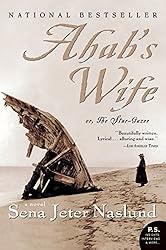
Ahab's Wife or The Star Gazer
Sena Jeter Naslund, 1999
HarperCollins
668 pp.
ISBN-13: 9780060838744
Summary
Captain Ahab was neither my first husband nor my last.
This is destined to be remembered as one of the most-recognized first sentences in literature—along with "Call me Ishmael." Sena Jeter Naslund has created an entirely new universe with a transcendent heroine at its center who will be every bit as memorable as Captain Ahab.
Ahab's Wife is a novel on a grand scale that can legitimately be called a masterpiece: beautifully written, filled with humanity and wisdom, rich in historical detail, authentic and evocative. Melville's spirit informs every page of her tour de force. Una Spenser's marriage to Captain Ahab is certainly a crucial element in the narrative of Ahab's Wife, but the story covers vastly more territory.
After a spellbinding opening scene, the tale flashes back to Una's childhood in Kentucky; her idyllic adolescence with her aunt and uncle's family at a lighthouse near New Bedford; her adventures disguised as a cabin boy on a whaling ship; her first marriage to a fellow survivor who descends into violent madness; courtship and marriage to Ahab; life as mother and a rich captain's wife in Nantucket; involvement with Frederick Douglass; and a man who is in Nantucket researching his novel about his adventures on her ex-husband's ship.
Ahab's Wife is a breathtaking, magnificent, and uplifting story of one woman's spiritual journey, informed by the spirit of the greatest American novel, but taking it beyond tragedy to redemptive triumph. (From the publisher.)
Author Bio
• Birth—N/A
• Birth—Birmingham, Alabama, USA
• Education—B.A., Birmingham-Souther College; Ph.D.
University of Iowa Writers' Workshop
• Awards—Harper Lee Award; Alabama Writer of the Year
• Currently—Louisville, Kentucky, USA
Sena Jeter Naslund grew up in Birmingham, Alabama, where she attended public schools and received a B.A. from Birmingham-Southern College. She has also lived in Louisiana, West Virginia, and California. She received her M.A. and Ph.D. degrees from the University of Iowa Writers' Workshop. In addition to two other novels and two collections of short stories, her short fiction has appeared in The Paris Review, The Georgia Review, The Iowa Review, the Michigan Quarterly Review and many others.
For 12 years she directed the Creative Writing Program at the University of Louisville, where she teaches and holds the title Distinguished Teaching Professor. Concurrently, she is a member of the M.F.A. in Writing faculty of Vermont College. She is cofounder and editor of the literary magazine The Louisville Review and the Fleur-de-lis Press, housed at Spaulding University, and has taught at the University of Montana and Indiana University. She is the recipient of grants from the National Endowment for the Arts, the Kentucky Foundation for Women, and the Kentucky Arts Council. She lives in Louisville, Kentucky.
Extras
• Naslund is the recipient of grants from the National Endowment for the Arts, the Kentucky Foundation for Women, and the Kentucky Arts Council.
• She has taught literature since 1972, directing the creative writing program at University of Louisville, where she was awarded its first-ever Distinguished Teaching Professor honor. (From Barnes & Noble.)
Book Reviews
Much of the book, though not all, I love. Mostly, I admire the creativity and courage of a writer to attempt such a work, especially a writer with a such a powerful sense of myth and elegant prose style. Overall, Naslund gives us a wide slice of 19th-century life, the great political, religious and philosophical conflicts of the time: abolition, women's suffrage, and religion versus reason. Una (a name symbolic of oneness with Ahab; Una is Ahab) has a 21st-century feminist sensibility, refusing to be tied down to the standard mores of her era...or this era, for that matter. Fulfillment is her pursuit, and she hunts it down with the single-mindedness of Ahab. The problem is that Una careens from one high adventure to another, which feels contrived, at times silly...
A LitLovers LitPick (Dec. '06)
"Captain Ahab was neither my first husband nor my last," says Una Spenser, the eponymous narrator, in the first sentence of this deliciously old-fashioned bildungsroman, adventure story and romance. Naslund's inspiration, based on one reference in Moby-Dick, may not satisfy aficonados of Melville's dense, richly symbolic masterpiece, but it should please most other readers with its suspenseful, affecting, historically accurate and seductive narrative. At age 12, Una escapes her religiously obsessed father in rural Kentucky to live with relatives in a lighthouse off New Bedford, Mass. When she is 16Adisguised as a boyAshe runs off to sea aboard a whaler, which sinks after being rammed by its quarry. Una and two young men who love her are the only survivors of a group set adrift in an open boat, but the dark secret of their cannibalism will leave its mark. Rescued, Una is wed to one of the young men by the captain of the Pequod, handsome, commanding Ahab, who has not as yet met the white whale that will be his destiny. These eventsArecounted in stately prose nicely dotted with literary allusionsAtake the reader only through the first quarter of the book. Una's later marriage to AhabAa passionate and intellectually satisfying relationshipAthe loss of her mother and her newborn son in one night, and her life as a rich woman in Nantucket are further developments in a plot teeming with arresting events and provocative ideas. Una is an enchanting protagonist: intellectually curious, sensitive, imaginative and kind. But Naslund also endows her with restlessness, rash impetuosity and a refreshing skepticism about traditional religion, qualities that humanize what verges on an idealized personality, and that motivate Una's search for spiritual sustenance. Unitarianism and Universalism are two of the religions she investigates; other "dark issues of our time" include slavery, and the position of women. Social and cultural details texture the lengthy, episodic, discursive narrative. Una's search for identity brings her friendship with such real life figures as writer Margaret Fuller and astronomer Maria Mitchell, and with such colorful fictional characters as an escaped slave and a dwarf bounty hunter. Even Halley's Comet makes an appearance. Provocatively, Naslund (The Disobedience of Water) suggests a new source of Ahab's demented rage to kill the whale who has "unmasted" him. Some elements of the novel jar, especially Naslund's tendency to pay rhapsodic tributes to Una's questing spirit; a surfeit of noble, large-souled and amazingly generous characters; and the symmetrical neatness of the plot. In the last third of the book, readers may become weary of Una's spiritual reflections and the minutiae of her daily routine. But these are small faults in a splendid novel that amply fulfills its ambitious purpose offering a sweeping, yet intimate picture of a remarkable woman who both typifies and transcends her times.
Publishers Weekly
At age 12, Una a nonconformist, is sent from Kentucky to Nantucket because she refuses to believe in Christianity. At age 16 she runs away to sea, posing as a cabin boy aboard a whaler. She enjoys her adventure until the first whale is killed and processed, and then one day her ship is rammed by one of them. After weeks in a lifeboat, she is rescued and taken back to Nantucket aboard the Pequod with Captain Ahab. Una and Ahab find they have much in common, from their passionate tempers to their stubborn tenacity, so they marry and have a son. When Ahab returns to sea, he becomes obsessed with the white whale, Moby Dick. News comes back that the Pequod sank, leaving a single survivor called Ishmael. When Una meets him, her life begins again. Masterfully read by Maryann Plunkett and beautifully written, this tale gives another possible perspective on the dour Captain Ahab and his family. Recommended. —Joanna M. Burkhardt, Univ. of Rhode Island, Coll. of Continuing Education Lib., Providence
Library Journal
Una...has the ability to rise and rise again after illness, destruction, and loss. And through it all she possesses a sense of wonder, the experience of divinity in all things. A complex and sophisticated book, brilliantly written, beautifully illustrated. —Grace Fill
Booklist
Nothing in Naslund's previous fiction prepares us for this extraordinary tale: a ravishingly detailed re-creation of the worlds of 19th-century antebellum America and of Melvilles seminal Moby Dick. The protagonist, and primary narrator, is Una Spenser (whose bookish mother named her after the heroine of The Faerie Queene), whom we first meet in her native Kentucky, where shes returned to give birth to her first childsired by her second husband: middle-aged Ahab, captain of the whaling ship Pequod. Naslund's flexible and fascinating narrative then leaps from Una's ordeal (both her baby and her beloved mother die) and an inspiring new friendshipbackward, to the story of her upbringing among relatives who tend a New England lighthouse, apprenticeship at sea disguised as a cabin boy, conflicted first marriage to an increasingly deranged husband, and eventual union with the brooding Ahab, whom even his young wife's resourceful love cannot deflect him from his vengeful pursuit of the white whale he imagines Evil Incarnate. Then Una returns to Kentucky, thence back east (Nantucket), where her restless intellect involves her with New England's ruling intellectual elite (including Transcendentalist icon Margaret Fuller) and the burgeoning abolitionist movement. The climactic pages, concentrated on Ahab's increasing monomania and Una's realization that hes lost to her, vibrate with tragic intensity. And the long meditative denouement, alive with echoes of Melville's cadences, memorably depicts Una's gradual fulfillment in a society poised on the cusp of civil war, her being saved by living testimony of (her surviving son, Justice) and by her gratifying, if belated, relationship with the Pequod's sole survivor) to the power of love and service to others, both neutralizing the fury that had consumed the doomed Ahab. Excepting a few inconsequential false steps, a genuine epic of America: an inspired homage to one of our greatest writers that brilliantly reinterprets, and in many ways rivals, his masterpiece.
Kirkus Reviews
Discussion Questions
1. Ahab's Wife takes place in the early nineteenth century. In what ways is Una's story a product of the times in which she lives? In what ways are her experiences timeless?
2. Early on in Una's life, her mother instructs her, "Accept the world, Una. It is what it is" (p. 29). Does she?
3. In many ways, Ahab's Wife is a spiritual journey. What are the forces that guide Una? What is her notion of her placein the universe and how does it evolve over the course of her lifetime?
4. Una writes, "Let me assure you and tell you that I know you, even something of your pain and joy, for you are much like me. The contract of writing and reading requires that we know each other. Did you know that I try on your mask from time to time? I become a reader, too" (p. 148). Several times throughout this book, Una addresses the reader directly. What is the effect of this interchange? How do you participate and become a character in this novel?
5. Discuss Una's relationship to the sea.
6. At the most painful time in her life, when she has lost her child and her mother, Una befriends Susan. Why is this relationship so important to Una? What is it that Susan teaches her? Compare and contrast their friendship to Una's friendship with Margaret Fuller.
7. How do you react to Una's cannibalism? Was she justified in doing what she does to survive? Is Giles more culpable because he himself makes the decision and executes the other shipmates? Or is he the most courageous of all because he takes it on himself to make a terrible decision and save those he loved?
8. Throughout Ahab's Wife, Una makes reference to the works of great writers such as William Shakespeare, John Keats, and Homer. What is the effect of drawing on all these other books? How does it enhance, deepen, and expand Ahab's Wife?
9. How does Una reconcile "the inevitable animal within" (p. 256) with her spiritual aspirations?
10. Why do you think that three out of Una's four loves (Giles, Kit, and Ahab (go mad? Is this merely coincidence?
11. Throughout her life, Una explores the art of sewing. Although Maria Mitchell considers sewing to be an act and a skill that confines rather than liberates women, at one point Una supports herself with a needle and thread. Discuss the numerous ways in which images of mending, binding, and sewing inform the telling of this novel.
12. When Una is looking for icebergs on Ahab's ship, she returns his trust "with silence on the subject of a white whale and all his massive innocence" (p. 280). Has she betrayed Ahab? Why does she see the whale as innocent? After Ahab loses his leg and then his life, do you think she continues to see Moby-Dick as innocent?
13. "Beware the treachery of words, Mrs. Sparrow. They mean one thing to one person and the opposite to another" (p. 297), Ahab tells Una. Why do you think Una finally finds her vocation to be working with words?
14. "Wondering what Margaret Fuller would say to such a distinction between spiritual and moral matters, I asked the judge if he thought there was a difference" (p. 383). Do you think there is a difference?
15. Una's narrative plunges back in time, leaps ahead, and loops over itself again. Different sections are told through other characters' perspectives and through their letters. How does the narrative structure itself enact some of Una's beliefs about the world?
16. The alternate title of this book is The Star-Gazer. Why do you think Ms. Naslund chose to have an alternate title at all? What meanings does it hold?
(Questions issued by publisher.)
top of page (summary)
The Air You Breathe
Frances de Pontes Peebles, 2018
Penguin Publishing
464 pp.
ISBN-13: 9780735210998
Summary
The story of an intense female friendship fueled by affection, envy and pride—and each woman's fear that she would be nothing without the other.
Some friendships, like romance, have the feeling of fate.
Skinny, nine-year-old orphaned Dores is working in the kitchen of a sugar plantation in 1930s Brazil when in walks a girl who changes everything. Graca, the spoiled daughter of a wealthy sugar baron, is clever, well fed, pretty, and thrillingly ill behaved.
Born to wildly different worlds, Dores and Graca quickly bond over shared mischief, and then, on a deeper level, over music.
One has a voice like a songbird; the other feels melodies in her soul and composes lyrics to match. Music will become their shared passion, the source of their partnership and their rivalry, and for each, the only way out of the life to which each was born.
But only one of the two is destined to be a star. Their intimate, volatile bond will determine each of their fortunes—and haunt their memories.
Traveling from Brazil's inland sugar plantations to the rowdy streets of Rio de Janeiro's famous Lapa neighborhood, from Los Angeles during the Golden Age of Hollywood back to the irresistible drumbeat of home, The Air You Breathe unfurls a moving portrait of a lifelong friendship—its unparalleled rewards and lasting losses—and considers what we owe to the relationships that shape our lives. (From the publisher.)
Author Bio
• Birth—N/A
• Where—Pernambuco, Brazil
• Education—Iowa's Workshop
• Awards—Elle Grand Prix (see below)
• Currently—lives in Chicago, Illinois, USA
Frances de Pontes Peebles is the author of the novel The Seamstress (2008), which was translated into nine languages and won the Elle Grand Prix for fiction, the Friends of American Writers Award, and the James Michener-Copernicus Society of America Fellowship. She followed her debut ten years later with The Air You Breathe (2018).
The decade between those two books was the result of Peebles' move back to Brazil with her husband to manage her family's coffee farm.
We helped them build a business of selling gourmet coffee to Brazilians. Farming was 24/7, so I didn't write during that time. Then we had a daughter. Motherhood changed my brain and how I worked. I had to sneak writing in when my daughter napped. I had to fight for this book in a way I didn't with the first.
Born in Pernambuco, Brazil, Peebles is a graduate of the Iowa Writers' Workshop. (From Amazon and Maimi New Times. Retrieved 9/11/2018.)
Book Reviews
Echoes of Elena Ferrante resound in this sumptuous saga.
Oprah Magazine
A glorious, glittery saga of friendship and loss… [offering] murder, extortion, Hollywood glamor, the entire story of samba, and, of course, sexual longing and an exceptional cast of characters.… I read The Air You Breathe in two nights. (One might say I inhaled it.)… [G]enuinely exciting.
NPR
Enveloping…Peebles understands the shifting currents of female friendship, and she writes so vividly about samba that you close the book certain its heroine’s voices must exist beyond the page.
People
A poor orphan and a wealthy heiress whose roller-coaster friendship is a welcome reminder that time can make any relationship stronger.
Glamour
Frances de Pontes Peebles’ tender novel follows this unlikely friendship and the jealousy and rivalry that come with their pursuit of fame.
Real Simple
A soaring fusion of emotion, intense drama,… The Air You Breathe belongs to the special category of historical novels that chronicle entire lives—and it does so in enthralling fashion.… [I]ntoxicating … not to be missed by anyone wanting to be wrapped up in a well-told story.
Historical Novel Society
[A] captivating if occasionally overstuffed portrait of friendship.… [Yet] Dores’s reflections on love, music, envy, and loyalty ache with feeling, and a hint of mystery surrounding the central relationship …will keepreaders intrigued.
Publishers Weekly
In the 1930s, two girls—have-it-all Graca, the daughter of a wealthy sugar baron, and orphaned kitchen maid Dores—bond over a love of music and end up traveling together to Rio de Janeiro and finally Golden Age Hollywood in a quest for stardom.
Library Journal
Peebles does a marvelous job of evoking the world of samba, which forms the backdrop to the complicated relationship the two women share. Readers …will be rewarded with complex characters and a well-realized setting.
Booklist
(Starred review) Dores' recounting of the duo's experiences is steeped in melancholy but also alludes to the unreliability of memory…. Peebles' detailed and atmospheric story is cinematic in scope, panoramic in view, and lyrical in tone.
Kirkus Reviews
Discussion Questions
1. In The Air You Breathe, Dores grows up under the watchful eye of Nena, the head of the kitchen on the Riacho Doce plantation, while enduring gossip about her birth mother. Graaa’s mother does everything she can to expose her absent-minded daughter to the arts and education. In what ways do Dores’s and Graca’s relationships with their mothers or mother figures affect the way they lead their lives in Rio and beyond?
2. Throughout the novel, Graca comes across as spoiled and selfish; however, Dores is forced to reevaluate her intentions when Graca accuses her of only ever looking out for herself. To what extent is this true and what might have prompted Graca to make such a comment?
3. Music is a pivotal part of each of the characters’ lives. In what ways does music act as an escape and a burden for Dores, Graca, Vinicius, and the Blue Moon boys?
4. Dores’s love for Graca can become dangerously unconditional and we see that any attention from Graca is enough to make Dores want to abandon the work they’ve put into the Sofia Salvador act to run away with her. Are there instances when Dores seems to have had enough? What pulls her back into Graca’s influence? Was Dores, in a sense, liberated by Graca’s death?
5. Why, when Senhor Pimentel reappears in the girls’ lives, is Graca so willing to let him back in? Is Graca’s love for her father similar to Dores’s love for Graca in that both are willing to settle for minor displays of affection?
6. Madame Lucifer and the Lion fought to get to their positions of power, and both show their respect for Dores’s perseverance. How is Graca treated in comparison to the way Dores is? Are there instances when Graca, rather than Dores, is invisible or in the shadows?
7. Vinicius is a grounded character who cares about the integrity of his music first. How does Vinicius, and his relationship with music, change when Sofia Salvador and the Blue Moon boys gain fame, first in Rio then in Los Angeles? When Graca wants to abandon ship, Vinicius wants to convince her to stay and finish filming for their movies. Is this a practical decision or one that reflects how he feels about fame?
8. Graca and Dores want what the other has. Dores wants Graca’s voice and her command on stage while Graca wants Dores’s ability to write music and her relationship with Vinicius. In what ways would our opinion of Dores change if the story had been written from Graca’s point of view?
(Questions issued by the publisher.)


Airframe
Michael Crichton, 1996
Ballantine Books
448 pp.
ISBN-13: 9780345526779
Summary
Three passengers are dead. Fifty-six are injured. The interior cabin virtually destroyed. But the pilot manages to land the plane. . . .
At a moment when the issue of safety and death in the skies is paramount in the public mind, a lethal midair disaster aboard a commercial twin-jet airliner bound from Hong Kong to Denver triggers a pressured and frantic investigation.
Airframe is nonstop listening: the extraordinary mixture of super suspense and authentic information on a subject of compelling interest that has been a Crichton landmark since The Andromeda Strain. (From the publisher.)
Author Bio
• Birth—October 23, 1942
• Raised—Roslyn (Long Island), New York, USA
• Death—November 4, 2008
• Where—Los Angeles, California
• Education—A.B., M.D., Harvard University
• Awards—Edgar Award for Best Novel (1969)
John Michael Crichton—the American best-selling author, producer, director, and screenwriter—is best known for his work in the science fiction, medical fiction, and thriller genres. His books have sold over 200 million copies worldwide, and many have been adapted into films. In 1994, Crichton became the only creative artist ever to have works simultaneously charting at #1 in television, film, and book sales (with ER, Jurassic Park, and Disclosure, respectively).
Crichton's literary works are usually based on the action genre and heavily feature technology. His novels epitomize the techno-thriller genre of literature, often exploring technology and failures of human interaction with it, especially resulting in catastrophes with biotechnology. Many of his future history novels have medical or scientific underpinnings, reflecting his medical training and science background. He was the author of, among others, Jurassic Park, The Andromeda Strain, Congo, Travels, Sphere, Rising Sun, Disclosure, The Lost World, Airframe, Timeline, Prey, State of Fear, Next (the final book published before his death), Pirate Latitudes (published November 24, 2009), and a final unfinished techno-thriller, Micro, which was published in November 2011
Background
John Michael Crichton was born in Chicago, Illinois, but raised on Long Island, in Roslyn, New York. He showed a keen interest in writing from a young age and at the age of 14 had a column related to travel published in The New York Times. Crichton had always planned on becoming a writer and began his studies at Harvard College in 1960. During his undergraduate study in literature, he conducted an experiment to expose a professor whom he believed to be giving him abnormally low marks and criticizing his literary style. Informing another professor of his suspicions, Crichton plagiarized a work by George Orwell and submitted it as his own. The paper was returned by his unwitting professor with a mark of B-minus.
His issues with the English department led Crichton to switch his concentration to biological anthropology as an undergraduate, obtaining his A.B. summa cum laude in 1964. He was also initiated into the Phi Beta Kappa Society. He went on to become the Henry Russell Shaw Traveling Fellow from 1964 to 1965 and Visiting Lecturer in Anthropology at the University of Cambridge in the UK in 1965.
Crichton later enrolled at Harvard Medical School, when he began publishing work. By this time he had become exceptionally tall. By his own account, he was approximately 6 feet 9 inches (2.06 m) tall in 1997. In reference to his height, while in medical school, he began writing novels under the pen names "John Lange" and "Jeffrey Hudson" ("Lange" is a surname in Germany, meaning "long", and Sir Jeffrey Hudson was a famous 17th-century dwarf in the court of Queen Consort Henrietta Maria of England). In Travels, he recalls overhearing doctors who were unaware that he was the author of The Andromeda Strain, discussing the flaws in his book. A Case of Need, written under the Hudson pseudonym, won him his first Edgar Award for Best Novel in 1969. He also co-authored Dealing with his younger brother Douglas under the shared pen name "Michael Douglas." The back cover of that book carried a picture, taken by their mother, of Michael and Douglas when very young.
During his clinical rotations at the Boston City Hospital, Crichton grew disenchanted with the culture there, which appeared to emphasize the interests and reputations of doctors over the interests of patients. Crichton graduated from Harvard, obtaining an M.D. in 1969, and undertook a post-doctoral fellowship study at the Salk Institute for Biological Studies in La Jolla, California, from 1969 to 1970. He never obtained a license to practice medicine, devoting himself to his writing career instead.
Reflecting on his career in medicine years later, Crichton concluded that patients too often shunned responsibility for their own health, relying on doctors as miracle workers rather than advisors. He experimented with astral projection, aura viewing, and clairvoyance, coming to believe that these included real phenomena that scientists had too eagerly dismissed as paranormal.
In 1988, Crichton was a visiting writer at the Massachusetts Institute of Technology.
Personal life
Crichton was a diest.
As an adolescent Crichton felt isolated because of his height (at 6'9"). As an adult he was acutely aware of his intellect, which often left him feeling alienated from the people around him. During the 1970s and 1980s he consulted psychics and enlightenment gurus to make him feel more socially acceptable and to improve his karma. As a result of these experiences, Crichton practiced meditation throughout much of his life.
Crichton was a workaholic. When drafting a novel, which would typically take him six or seven weeks, he withdrew completely to follow what he called "a structured approach" of ritualistic self-denial. As he neared writing the end of each book, he would rise increasingly early each day, meaning that he would sleep for less than four hours by going to bed at 10 pm and waking at 2 am. In 1992, Crichton was ranked among People magazine's 50 most beautiful people.
He married five times; four of the marriages ended in divorce. He was married to Suzanna Childs, Joan Radam (1965–1970), Kathleen St. Johns (1978–1980), and actress Anne-Marie Martin (1987–2003), the mother of his daughter Taylor Anne (born 1989). At the time of his death, Crichton was married to Sherri Alexander, who was six months pregnant with their son. John Michael Todd Crichton was born on February 12, 2009.
Death
In accordance with the private way in which Crichton lived his life, his throat cancer was not made public until his death. According to Crichton's brother Douglas, Crichton was diagnosed with lymphoma in early 2008. He was undergoing chemotherapy treatment at the time of his death, and Crichton's physicians and family members had been expecting him to make a recovery. He unexpectedly died of the disease on November 4, 2008 at the age of 66.
Michael's talent outscaled even his own dinosaurs of Jurassic Park. He was the greatest at blending science with big theatrical concepts, which is what gave credibility to dinosaurs again walking the earth. In the early days, Michael had just sold The Andromeda Strain to Robert Wise at Universal and I had recently signed on as a contract TV director there. My first assignment was to show Michael Crichton around the Universal lot. We became friends and professionally. Jurassic Park, ER, and Twister followed. Michael was a gentle soul who reserved his flamboyant side for his novels. There is no one in the wings that will ever take his place. —Steven Spielberg at Michael Crichton's death.
Crichton had an impressive collection of 20th century American art, which was auctioned by Christie's in May 2010. (From Wikipedia.)
Book Reviews
Dramatically vivid.
New York Times
A one-sitting read that will cause a lifetime of white-nuckled nightmares.
Philadelphia Inquirer
The pacing is fast, the suspense nonstop.
People
[S]light, enjoyable thriller.... [The] suspense rises, peaking high above the earth in an exciting re-creation of the flight. It's possible that Crichton has invented a new subgenre here—the industrial thriller.... [B]estselling, cinema-ready entertainment.
Publishers Weekly
Crichton's talent lies in making arcane sciences fascinating to even the most spirited Luddite, and fans won't be disappointed by his descriptions of the technology employed in the making of passenger planes and, in particular, the precision with which the aircraft's wings are designed. —Mark Annichiarico
Library Journal
[b]illed as a "technical thriller" but the technology seems to outweigh the thrills.... Crichton incorporates enough suspense to keep readers going but a degree in engineering would be helpful in understanding this novel. —Katherine Fitch, Lake Braddock Middle School, Burke, VA
School Library Journal
Loading it with interesting detail on airliner construction, aerodynamics, the international trade in commercial aircraft, and air safety, Crichton produces a taut, absorbing suspenser. —Ray Olson
Booklist
Discussion Questions
Our thanks to Rena DeBerry of Salem, Virginia, for submitting these terrific discussion questions to LitLovers.
1. Did the book description meet your expectations?
2. Pages 286-291 - The book reveals that television media is not liablefor sharing only parts of truth or responsible for providing fairnessdoctrine when covering new story. In addition, there is no recourse for erroneous view and can only proceed reckless disregard which is very difficult to approve. What is your opinion of the practice?
3. Why is a personal video with a child in it from the airplane to be made a public not a privacy issue? What about the passenger’s rights? Was it violated with the video?
4. Some version of the excuse "you don’t understand" is used by Casey throughout the book. Do you agree or think it is an opt out for responsibility?
5. Let’s discuss Union. Throughout the book there is Union unrest and "accidents". Are they believable? Are they justified? How does this translate to modern times? In real life, do you think the Union Representative would have really warned Casey? Why do you think Don warned Casey?
6. Knowing you were on the Union’s "hitlist" would you have been as reckless as Casey in her search for the truth?
7. Throughout the book "company gossip" was the main form of communication. How have you been affected by company gossip, both true and untrue?
8. Would you have gone on the test flight?
9. Pages 412-417 -Were the "finding of 545" believable? Do you really believe that a major airline (foreign or domestic) would be so irresponsible in letting a noncertified pilot (familial or not) fly the plane?
10. Page 416-417 - Let’s discuss naivety as Casey described. Does it apply to just the pilot and Jennifer or also other characters?
Casey shrugged, "He loves his son. We believe he’s allowed him to fly on other occasions. But there’s a reason why commercial pilots are required to train extensively on specific equipment, to be certified. He didn’t know what he was doing, and he got caught."
Casey closed the door, and thought: And so did you.
11. Did you know Richman and Marder were the saboteurs of Casey’s investigation? If so, what tipped you off?
12.Greed is an underlying them throughout the book. Hal for the China sale. Marder for the Korea sale. How did greed influence the aircraft report? The Union? Media appearance? Was it justified? Was it believable?
13.With all the issues Norton faced, would the deal with China actually have gone through?
14.Because of Marder’s deception, what do you think the downfall of the Korea sale would have been for Norton? Marder?
15.Were you satisfied with the neat tied up endings for everyone? Casey? Norton? Marder? Richman? Malone?
16.On a scale of 1 to 5, how would you rate Airframe? Would you recommend Airframe? Why or why not?
(Questions courtesy of Rena DeBerry. Please feel free to use them, online of off, with attribution to both LitLovers and Rena. Thanks.)


The Alchemist
Paulo Coelho, 1996
HarperCollin
208 pp.
ISBN-13: 9780062315007
Summary
25th Anniversary Edition
Paulo Coelho's enchanting novel has inspired a devoted following around the world. This story, dazzling in its simplicity and wisdom, is about an Andalusian shepherd boy named Santiago who travels from his homeland in Spain to the Egyptian desert in search of treasure buried in the Pyramids.
Santiago has a dream about finding a treasure in the pyramids of Egypt. A gypsy woman and an old man claiming to be a mysterious king advise him to pursue it. "To realize one's destiny is a person's only obligation," the old man tells him. "And, when you want something, all the universe conspires in helping you to achieve it."
With the courage of an adventurer, Santiago sells his sheep and travels to Tangiers in Africa. After a thief steals his money, Santiago takes a job with a crystal merchant who unwittingly teaches Santiago important lessons for his long journey ahead. After working at the crystal shop for a year, Santiago earns enough money to cover his losses and return home. But then something unexpected happens.
On a desert caravan, Santiago meets an intriguing Englishman. The Englishman's passion for knowledge and his relentless quest to uncover the secrets of alchemy inspire Santiago to pursue his own dream of finding the treasure. As the Englishman searches for the two hundred year old alchemist who resides in the desert oasis, Santiago falls in love with a young woman, Fatima. Exposed to the greatest and eternal alchemy of all—love—Santiago thinks he has found the treasure.
But the greatest test of all is yet to come. With the help of the alchemist, Santiago completes the last leg of his journey—dangerous and infused with discoveries of the most profound kind - to find that the treasure he was looking for was waiting for him in the place where he least expected.
This story, timeless and entertaining, exotic yet simple, breaks down the journey we all take to find the most meaningful treasures in our lives into steps that are at once natural and magical. It is about the faith, power, and courage we all have within us to pursue the intricate path of a Personal Legend, a path charted by the mysterious magnet of destiny but obscured by distractions.
Santiago shows how along the way we learn to trust our hearts, read the seemingly inconspicuous signs, and understand that as we look to fulfill a dream, it looks to find us just the same, if we let it. (From the publisher.)
Author Bio
• Birth—August 24, 1947
• Where—Rio de Janeiro, Brazil
• Education—Left law school in second year
• Awards—Crystal Award (Switzerland), 1999; Rio Branco
Order (Brazil), 2000; Legion d’Honneur (France), 2001;
Brazilian Academy of Letters (Brazil), 2002
• Currently—lives in Rio de Janeiro, Brazil
Paulo Coelho's books have been translated into 56 languages, topped bestseller lists throughout the world, and scored him such celebrity fans as Julia Roberts, Bill Clinton, and Madonna; yet for Brazilian publishing phenom Paulo Colho, the road to success has been strewn with a number of obstacles, many of them rooted in his troubled past.
Personal life
As a youth, Coelho was expected to follow in the footsteps of his father, a professional engineer. When he rebelled, expressing his intentions to become a writer, his parents had him committed to a psychiatric hospital where he was subjected to electro-shock therapy. He left home to join the 1970s countercultural revolution, experimenting with drugs, dabbling in black magic, and getting involved in Brazil's bohemian art and music scene. He teamed with rock musician Raul Seixas for an extremely successful songwriting partnership that changed the face of Brazilian pop—and put a lot of money in Coelho's pockets. He also joined an anti-capitalist organization called the Alternative Society which attracted the attention of Brazil's military dictatorship. Marked down as a subversive, he was imprisoned and tortured.
Amazingly, Coelho survived these horrific experiences. He left the hippie lifestyle behind, went to work in the record industry, and began to write, but without much success. Then, in the mid-1980s, during a trip to Europe, he met a man, an unnamed mentor he refers to only as "J," who inducted him into Regnum Agnus Mundi, a secret society that blends Catholicism with a sort of New Age mysticism. At J's urging, Coelho journeyed across el Camino de Santiago, the legendary Spanish road traversed by pilgrims since the Middle Ages. He chronicled this life-changing, 500-mile journey—the culmination of decades of soul-searching—in The Pilgrimage, published in 1987.
Writings
The following year, Coelho wrote The Alchemist, the inspirational fable for which he is best known. The first edition sold so poorly the publisher decided not to reprint it. Undaunted, Coelho moved to a larger publishing house that seemed more interested in his work. When his third novel, 1990's Brida, proved successful, the resulting media buzz carried The Alchemist all the way to the top of the charts. Released in the U.S. by HarperCollins in 1993, The Alchemist became a word-of-mouth sensation, turning Coelho into a cult hero.
Since then, he has gone on to create his own distinct literary brand—an amalgam of allegory and self-help filled with spiritual themes and symbols. In his novels, memoirs, and aphoristic nonfiction, he returns time and again to the concepts of quest and transformation and has often said that writing has helped connect him to his soul.
While his books have not always been reviewed favorably and have often become the subject of strong cultural and philosophical debate, there is no doubt that this self-described "pilgrim writer" has struck a chord in readers everywhere. In the 2009 edition of the Guiness Book of World Records, Coelho was named the most translated living author—with William Shakespeare the most translated of all time!
Extras
From a 2003 Barnes & Noble interview:
• Few writers are able to accomplish what Coelho can in just two to four weeks—which is how long it takes for him to write an entire novel.
• Before become a bestselling novelist, Coelho was a writer of a different sort. He co-wrote more than 60 songs with Brazilian musician Raul Seixas.
• Coelho is the founder of the Paulo Coelho Institute, a non-profit organization funded by his royalties that raises money for underprivileged children and the elderly in his homeland of Brazil.
• Coelho has practiced archery for a long time; a bow and arrow helps him to unwind.
• In writing, Coelho says "I apply my feminine side and respect the mystery involved in creation."
• Coelho loves almost everything about his work, except conferences. "I am too shy in front of an audience. But I love signings and having eye contact with a reader who already knows my soul."
• When asked what book most influenced his life, he answered:
The Bible, which contains all the stories and all the guidance humankind needs.
(Bio and interview from Barnes & Noble.)
Book Reviews
Spiritual inspiration doesn't guarantee luminous prose. One of the few authors whose writing draws praise in reviews is the Brazilian writer Paulo Coelho, the international best-selling author of The Alchemist and The Valkyries: An Encounter With Angels.
Doreen Carvajal - The New York Times
This inspirational fable by Brazilian author and translator Coelho has been a runaway bestseller throughout Latin America and seems poised to achieve the same prominence here. The charming tale of Santiago, a shepherd boy, who dreams of seeing the world, is compelling in its own right, but gains resonance through the many lessons Santiago learns during his adventures. He journeys from Spain to Morocco in search of worldly success, and eventually to Egypt, where a fateful encounter with an alchemist brings him at last to self-understanding and spiritual enlightenment. The story has the comic charm, dramatic tension and psychological intensity of a fairy tale, but it's full of specific wisdom as well, about becoming self-empowered, overcoming depression, and believing in dreams. The cumulative effect is like hearing a wonderful bedtime story from an inspirational psychiatrist. Comparisons to The Little Prince are appropriate; this is a sweetly exotic tale for young and old alike.
Publishers Weekly
This simple, yet eloquent parable celebrates the richness of the human spirit. A young Spanish shepherd seeking his destiny travels to Egypt where he learns many lessons, particularly from a wise old alchemist. The real alchemy here, however, is the transmuting of youthful idealism into mature wisdom. The blending of conventional ideas with an exotic setting makes old truths seem new again. This shepherd takes the advice Hamlet did not heed, learning to trust his heart and commune with it as a treasured friend. Enjoyable and easy to read, this timeless fantasy validates the aspirations and dreams of youth.
—Sabrina Fraunfelter, Fairfax County Public Library, VA
Library Journal
Coelho is a Brazilian writer with four books to his credit. Following Diary of a Magus came this book, published in Brazil in 1988: it's an interdenominational, transcendental, inspirational fable—in other words, a bag of wind. The story is about a youth empowered to follow his dream. Santiago is an Andalusian shepherd boy who learns through a dream of a treasure in the Egyptian pyramids. An old man, the king of Salem, the first of various spiritual guides, tells the boy that he has discovered his destiny: "to realize one's destiny is a person's only real obligation." So Santiago sells his sheep, sails to Tangier, is tricked out of his money, regains it through hard work, crosses the desert with a caravan, stops at an oasis long enough to fall in love, escapes from warring tribesmen by performing a miracle, reaches the pyramids, and eventually gets both the gold and the girl. Along the way he meets an Englishman who describes the Soul of the World; the desert woman Fatima, who teaches him the Language of the World; and an alchemist who says, "Listen to your heart." A message clings like ivy to every encounter; everyone, but everyone, has to put in their two cents' worth, from the crystal merchant to the camel driver ("concentrate always on the present, you'll be a happy man"). The absence of characterization and overall blandness suggest authorship by a committee of self-improvement pundits—a far cry from Saint-Exupry's The Little Prince: that flagship of the genre was a genuine charmer because it clearly derived from a quirky, individual sensibility. Coelho's placebo has racked up impressive sales in Brazil and Europe. Americans should flock to it like gulls.
Kirkus Reviews
Discussion Questions
1. At the start of his journey, when Santiago asks a gypsy woman to interpret his dream about a treasure in the Egyptian pyramids, she asks for one tenth of the treasure in return. When Santiago asks the old man to show him the path to the treasure, the old man requests one tenth of his flock as "payment." Both payments represent a different price we have to pay to fulfill a dream; however, only one will yield a true result. Which payment represents false hope? Can you think of examples from your own life when you had to give up something to meet a goal and found the price too high?
2. Paulo Coelho once said that alchemy is all about pursuing our spiritual quest in the physical world as it was given to us. It is the art of transmuting the reality into something sacred, of mixing the sacred and the profane. With this in mind, can you define your Personal Legend? At what time in your life were you first able to act on it? What was your "beginner's luck"? Did anything prevent you from following it to conclusion? Having read The Alchemist, do you know what inner resources you need to continue the journey?
3. One of the first major diversions from Santiago's journey was the theft of his money in Tangiers, which forced him into taking a menial job with the crystal merchant. There, Santiago learned many lessons on everything from the art of business to the art of patience. Of all these, which lessons were the most crucial to the pursuit of his Personal Legend?
4. When he talked about the pilgrimage to Mecca, the crystal merchant argued that having a dream is more important than fulfilling it, which is what Santiago was trying to do. Do you agree with Santiago's rationale or crystal merchant's?
5. The Englishman, whom Santiago meets when he joins the caravan to the Egyptian pyramids, is searching for "a universal language, understood by everybody." What is that language? According to the Englishman, what are the parallels between reading and alchemy? How does the Englishman's search for the alchemist compares to Santiago's search for a treasure? How did the Englishman and Santiago feel about each other?
6. The alchemist tells Santiago "you don't have to understand the desert: all you have to do is contemplate a simple grain of sand, and you will see in it all the marvels of creation." With this in mind, why do you think the alchemist chose to befriend Santiago, though he knew that the Englishman was the one looking for him? What is the meaning of two dead hawks and the falcon in the oasis? At one point the alchemist explains to Santiago the secret of successfully turning metal into gold. How does this process compare to finding a Personal Legend?
7. Why did Santiago have to go through the dangers of tribal wars on the outskirts of the oasis in order to reach the pyramids? At the very end of the journey, why did the alchemist leave Santiago alone to complete it?
8.Earlier in the story, the alchemist told Santiago "when you possess great treasures within you, and try to tell others of them, seldom are you believed." At the end of the story, how did this simple lesson save Santiago's life? How did it lead him back to the treasure he was looking for?
(Questions issued by publisher.)
top of page (summary)


Aleph
Paulo Coehlo, 2011
Knopf Doubleday
288 pp.
ISBN-13: 9780307700186
Summary
In his most personal novel to date, internationally best-selling author Paulo Coelho returns with a remarkable journey of self-discovery. Like the main character in his much-beloved The Alchemist, Paulo is facing a grave crisis of faith. As he seeks a path of spiritual renewal and growth, he decides to begin again: to travel, to experiment, to reconnect with people and the landscapes around him.
Setting off to Africa, and then to Europe and Asia via the Trans-Siberian Railway, he initiates a journey to revitalize his energy and passion. Even so, he never expects to meet Hilal. A gifted young violinist, she is the woman Paulo loved five hundred years before—and the woman he betrayed in an act of cowardice so far-reaching that it prevents him from finding real happiness in this life. Together they will initiate a mystical voyage through time and space, traveling a path that teaches love, forgiveness, and the courage to overcome life’s inevitable challenges.
Beautiful and inspiring, Aleph invites us to consider the meaning of our own personal journeys: Are we where we want to be, doing what we want to do? (From the publisher.)
Author Bio
• Birth—August 24, 1947
• Where—Rio de Janeiro, Brazil
• Education—Left law school in second year
• Awards—Crystal Award (Switzerland), 1999; Rio Branco
Order (Brazil), 2000; Legion d’Honneur (France), 2001;
Brazilian Academy of Letters (Brazil), 2002
• Currently—lives in Rio de Janeiro, Brazil
Paulo Coelho's books have been translated into 56 languages, topped bestseller lists throughout the world, and scored him such celebrity fans as Julia Roberts, Bill Clinton, and Madonna; yet for Brazilian publishing phenom Paulo Colho, the road to success has been strewn with a number of obstacles, many of them rooted in his troubled past.
Personal life
As a youth, Coelho was expected to follow in the footsteps of his father, a professional engineer. When he rebelled, expressing his intentions to become a writer, his parents had him committed to a psychiatric hospital where he was subjected to electro-shock therapy. He left home to join the 1970s countercultural revolution, experimenting with drugs, dabbling in black magic, and getting involved in Brazil's bohemian art and music scene. He teamed with rock musician Raul Seixas for an extremely successful songwriting partnership that changed the face of Brazilian pop—and put a lot of money in Coelho's pockets. He also joined an anti-capitalist organization called the Alternative Society which attracted the attention of Brazil's military dictatorship. Marked down as a subversive, he was imprisoned and tortured.
Amazingly, Coelho survived these horrific experiences. He left the hippie lifestyle behind, went to work in the record industry, and began to write, but without much success. Then, in the mid-1980s, during a trip to Europe, he met a man, an unnamed mentor he refers to only as "J," who inducted him into Regnum Agnus Mundi, a secret society that blends Catholicism with a sort of New Age mysticism. At J's urging, Coelho journeyed across el Camino de Santiago, the legendary Spanish road traversed by pilgrims since the Middle Ages. He chronicled this life-changing, 500-mile journey—the culmination of decades of soul-searching—in The Pilgrimage, published in 1987.
Writings
The following year, Coelho wrote The Alchemist, the inspirational fable for which he is best known. The first edition sold so poorly the publisher decided not to reprint it. Undaunted, Coelho moved to a larger publishing house that seemed more interested in his work. When his third novel, 1990's Brida, proved successful, the resulting media buzz carried The Alchemist all the way to the top of the charts. Released in the U.S. by HarperCollins in 1993, The Alchemist became a word-of-mouth sensation, turning Coelho into a cult hero.
Since then, he has gone on to create his own distinct literary brand—an amalgam of allegory and self-help filled with spiritual themes and symbols. In his novels, memoirs, and aphoristic nonfiction, he returns time and again to the concepts of quest and transformation and has often said that writing has helped connect him to his soul.
While his books have not always been reviewed favorably and have often become the subject of strong cultural and philosophical debate, there is no doubt that this self-described "pilgrim writer" has struck a chord in readers everywhere. In the 2009 edition of the Guiness Book of World Records, Coelho was named the most translated living author—with William Shakespeare the most translated of all time!
Extras
From a 2003 Barnes & Noble interview:
• Few writers are able to accomplish what Coelho can in just two to four weeks—which is how long it takes for him to write an entire novel.
• Before become a bestselling novelist, Coelho was a writer of a different sort. He co-wrote more than 60 songs with Brazilian musician Raul Seixas.
• Coelho is the founder of the Paulo Coelho Institute, a non-profit organization funded by his royalties that raises money for underprivileged children and the elderly in his homeland of Brazil.
• Coelho has practiced archery for a long time; a bow and arrow helps him to unwind.
• In writing, Coelho says "I apply my feminine side and respect the mystery involved in creation."
• Coelho loves almost everything about his work, except conferences. "I am too shy in front of an audience. But I love signings and having eye contact with a reader who already knows my soul."
• When asked what book most influenced his life, he answered:
The Bible, which contains all the stories and all the guidance humankind needs. (Bio and interview from Barnes & Noble.)
Book Reviews
In this chimerical tale, protagonist Paolo embarks on a journey to remedy his dissatisfaction with life, a frustration he feels despite enjoying the accoutrements of success. Given that his world includes clairvoyance, Divine Energy, and time-travel, Paolo's is not the usual existential crisis. His present-day troubles, in fact, can be traced to betrayals during a previous incarnation that took place during the Inquisition. When he encounters Hilal, a woman he wronged, complications arise from their shared experience in The Aleph: "the point at which everything is in the same place at the same time." Given the couple's history, Paolo's response is curiously practical and distant: "reopening old wounds is neither easy nor particularly important. The only justification is that the knowledge acquired might help me to gain a better understanding of the present." Although the novel requires ample suspension of disbelief, there's no better author to serve such a work than Coelho (The Alchemist)—his main character bears the weight of the sometimes ambiguous and wandering narrative with pithy reflections.
Publishers Weekly
Best-selling inspirational author Coelho was having a crisis of faith, so he did what we all do in that situation: he traveled through Europe, Africa, and Asia and met again with a woman he loved 500 years ago.
Library Journal
The latest spirituality-lite novel from Coelho.... For readers who admire books filled with goofy yet endearing spiritual clichés such as, "Death is just a door into another dimension."
Kirkus Reviews
Discussion Questions
1. Aleph is a novel full of rituals, starting with Paulo and J.’s opening invocation around the sacred oak. However, Paulo’s reaction to them varies wildly; sometimes they frustrate him (the oak), sometimes he embraces them (the shaman’s midnight chant on the edges of Lake Baikal), and other times he criticizes them for being empty (Hilal’s offering at the church in Novosibirsk). Why do you think this is? Do you think this has to do with the rituals themselves or is Coelho trying to express something deeper about the nature and purpose of ritual? What value can ritual have in your own life?
2. During his initial argument with J., Paulo says: “We human beings have enormous difficulty in focusing on the present; we’re always thinking about what we did, about how we could have done it better, about the consequences of our actions, and about why we didn’t act as we should have. Or else we think about the future, about what we’re going to do tomorrow, what precautions we should take, what dangers await us around the next corner, how to avoid what we don’t want and how to get what we have always dreamed of” [p. 9]. Do you agree? Why do you think J. prescribes travel as a way for Paulo to better focus on the present instead of his past or future?
3. While he’s waiting for a sign that he should embark on the journey J. suggests, Paulo thinks about the nature of tragedy. “Tragedy always brings about radical change in our lives, a change that is associated with the same principle: loss. When faced by any loss, there’s no point in trying to recover what has been; it’s best to take advantage of the large space that opens up before us and fill it with something new. In theory, every loss is for our own good; in practice, though, that is when we question the existence of God and ask ourselves: What did I do to deserve this?” [p. 15]. Many of Aleph’s characters are dealing with extreme personal tragedy, from Hilal and her history of sexual abuse to Yao and the death of his wife. Do their experiences and struggles to move forward support or contradict Paulo’s statements?
4. Paulo frequently refers to Chinese bamboo after reading an article about its growth process: “Once the seed has been sown, you see nothing for about five years, apart from a tiny shoot. All the growth takes place underground, where a complex root system reaching upward and outward is being established. Then, at the end of the fifth year, the bamboo suddenly shoots up to a height of twenty-five meters” [p. 22]. How does this function as an important metaphor for spiritual growth? What do you think are the best ways to build a “complex root system” of your own?
5. Coelho writes, “To live is to experience things, not sit around pondering the meaning of life” and offers examples of people who have experienced revelations in various ways [p. 62]. Do you agree? What people or writings are you familiar with that support (or disprove) his point of view?
6. In “The Aleph,” Borges’s narrator asks, “How, then, can I translate into words the limitless Aleph, which my floundering mind can scarcely encompass? Mystics, faced with the same problem, fall back on symbols:.... one Persian speaks of a bird that somehow is all birds; Alanus de Insulis, of a sphere whose center is everywhere and circumference is nowhere; Ezekiel, of a four-faced angel who at one and the same time moves east and west, north and south.” How does Coelho attempt to explain the Aleph? Why do you think Coelho has Paulo and Hilal discover it on a train car? Do you think its location has a larger significance for the story?
7. What images, memories, and emotions most powerfully capture the mystery and the magic of the Aleph that Paulo and Hilal experience on the train [pp. 73–75]? How do they affect them each as individuals? In what ways does it change and deepen their relationship?
8. What role does Yao serve in Paulo’s quest? Are there similarities between Yao, Paulo, and the answers they seek? What does each learn from the other?
9. When Yao suggests that Paulo beg for money with him, he explains, “Some Zen Buddhist monks in Japan told me about takuhatsu, the begging pilgrimage.... This is because, according to Zen philosophy, the giver, the beggar, and the alms money itself all form part of an important chain of equilibrium. The person doing the begging does so because he’s needy, but the person doing the giving also does so out of need. The alms money serves as a link between those two needs” [pp. 89–90]. How does this relationship apply to the balance of power between Paulo and Hilal? Between Paulo and his readers?
10. The origin of Paulo’s deep-seated sense of guilt comes stunningly to life in his description of the Inquisition and his participation as a priest [pp. 153–167]. What insight does this vignette offer into horrors and injustices committed in the name of religious beliefs? Compare and contrast the religious attitudes here with those portrayed in the present-day sections of Aleph. What do Paulo’s references to the Koran [p. 39], the Bible [pp. 40, 107], Ueshiba, the founder of the Japanese martial art of aikido [pp. 132, 137, and 193], and shamanism [pp. 220–29] demonstrate about human beliefs and aspirations across cultures and time?
11. Discuss the erotic and romantic elements of the encounters between Paulo and Hilal—both real and imagined—leading up to his final gift of roses at the airport. Would you classify theirs as a love story? Why or why not? What different types of love does Coelho explore?
12. Were you familiar with the concept of past lives before reading Aleph? Is it necessary to believe in past lives to grasp the book’s message and meaning?
13. What do you think Coelho means when he writes, “Life is the train, not the station” [p. 112]? What about when he says, “What we call ‘life’ is a train with many carriages. Sometimes we’re in one, sometimes we’re in another, and sometimes we cross between them, when we dream or allow ourselves to be swept away by the extraordinary” [p. 117–118].
(Questions issued by publisher.)

Alexander Hamilton
Ron Chernow, 2004
Penguin Publishing
832 pp.
ISBN-13: 9780143034759
Summary
Pulitzer Prize-winning author Ron Chernow presents a landmark biography of Alexander Hamilton, the Founding Father who galvanized, inspired, scandalized, and shaped the newborn nation.
In the first full-length biography of Alexander Hamilton in decades, Ron Chernow tells the riveting story of a man who overcame all odds to shape, inspire, and scandalize the newborn America.
According to historian Joseph Ellis, Alexander Hamilton is “a robust full-length portrait, in my view the best ever written, of the most brilliant, charismatic and dangerous founder of them all.”
Chernow’s biography is not just a portrait of Hamilton, but the story of America’s birth seen through its most central figure. At a critical time to look back to our roots, Alexander Hamilton will remind readers of the purpose of our institutions and our heritage as Americans. (From the publisher.)
Author Bio
• Birth—March 3, 1949
• Where—Brooklyn, New York City, New York, USA
• Education—B.A., Yalae University; Cambridge University
• Awards—Pulitzer Prize, Biography; American History Book Prize; National Book
Award, Nonfiction
• Currently—lives in Brooklyn, New York City
Ron Chernow was born in 1949 in Brooklyn, New York. After graduating with honors from Yale College and Cambridge University with degrees in English Literature, he began a prolific career as a freelance journalist.
Between 1973 and 1982, Chernow published over sixty articles in national publications, including numerous cover stories. In the mid-80s Chernow went to work at the Twentieth Century Fund, a prestigious New York think tank, where he served as director of financial policy studies and received what he described as “a crash course in economics and financial history.”
Chernow’s journalistic talents combined with his experience studying financial policy culminated in the writing of his extraordinary first book, The House of Morgan: An American Banking Dynasty and the Rise of Modern Finance (1990). Winner of the 1990 National Book Award for Nonfiction, The House of Morgan traces the amazing history of four generations of the J.P. Morgan empire. The New York Times Book Review wrote, “As a portrait of finance, politics and the world of avarice and ambition on Wall Street, the book has the movement and tension of an epic novel. It is, quite simply, a tour de force.”
Chernow continued his exploration of famous financial dynasties with his second book, The Warburgs (1994), the story of a remarkable Jewish family. The book traces Hamburg’s most influential banking family of the 18th century from their successful beginnings to when Hitler’s Third Reich forced them to give up their business, and ultimately to their regained prosperity in America on Wall Street.
Described by Time as “one of the great American biographies,” Chernow’s Titan: The Life of John D. Rockefeller, Sr. (1998) brilliantly reveals the complexities of America’s first billionaire. Rockefeller was known as a Robber Baron, whose Standard Oil Company monopolized an entire industry before it was broken up by the famous Supreme Court anti-trust decision in 1911. At the same time, Rockefeller was one of the century’s greatest philanthropists donating enormous sums to universities and medical institutions.
His 2005 book, a biography of Alexander Hamilton, was widely praised and inspired Hamilton, the highly successful 2016 Broadway musical by Lin-Manuel Miranda.
In addition to writing biographies, Chernow is a book reviewer, essayist, and radio commentator. His book reviews and op-ed articles appear frequently in the New York Times and Wall Street Journal. He comments regularly on business and finance for National Public Radio and for many shows on CNBC, CNN, and the Fox News Channel. In addition, he served as the principal expert on the A&E biography of J.P. Morgan and has been featured as the key Rockefeller expert on a CNBC documentary.
Chernow is the Secretary of PEN American Center, the country’s most prominent writers’ organization. He lives in Brooklyn Heights, New York.
Book Reviews
Mr. Chernow sets himself a compelling task: to add a third dimension to conventional views of Hamilton while reaching beyond the limits of a personal portrait. If Alexander Hamilton reflects its subject's far from charismatic nature, it also provides a serious, far-reaching measure of his place in history. And Mr. Chernow has done a splendid job of capturing the backbiting political climate of Hamilton's times, to the point that no cow is sacred here. The "golden age of literary assassination in American politics," featuring Thomas Jefferson as a particularly self-serving schemer, sounds astonishingly familiar today.
Janet Maslin - New York Times
In Alexander Hamilton, Ron Chernow, the author of The House of Morgan, The Warburgs and Titan, a biography of John D. Rockefeller, has brought to life the Founding Father who did more than any other to create the modern United States.… In this magisterial biography, Chernow tells the story not only of Hamilton but also of his wife, Eliza, a remarkable woman who died at the age of 97 in 1854.
Washington Post
Chernow's achievement is to give us a biography commensurate with Hamilton's character.… This is a fine work that captures Hamilton's life with judiciousness and verve.… [This biography] could make Alexander Hamilton as popular with readers as Benjamin Franklin and John Adams.
Publishers Weekly
Although quite sympathetic to Hamilton, Chernow attempts to present both sides of his many controversies, including Hamilton's momentous philosophical battles with Jefferson.… A first-rate life and excellent addition to the ongoing debate about Hamilton's importance in the shaping of America. —Robert Flatley, Kutztown Univ. Lib., PA
Library Journal
A splendid life of an enlightened reactionary and forgotten Founding Father.… Literate and full of engaging historical asides. By far the best of the many lives of Hamilton now in print, and a model of the biographer's art.
Kirkus Reviews
Discussion Questions
These excellent questions have been graciously proviced by our "Associate," Jennifer Johnsnon, MA, MLIS, the Reference Librarian at the Springdale (Arkansas) Public Library. Thank you—again—Jennifer!
1. Consider what you knew before reading Alexander Hamilton. Did the author do justice to the historical figure of Alexander Hamilton and his legacy? How did this tome change what you knew and thought of the man, Alexander Hamilton?
2. According to Hamilton, when discussing his mother and her marriages:
'Tis a very good thing when their stars unite two people who are fit for each other, who have souls capable of relishing the sweets of friendship and sensibilities… but it’s a dog of [a] life when two dissonant tempers meet.
Looking back at his lineage, what lessons did Hamilton learn from his family? Despite his intellect, did he follow a similar star-crossed path as his parents?
3. Chernow identifies that Hamilton was the blockade in Aaron Burr’s professional career. Describe the relationship between Aaron Burr and Alexander Hamilton? What actions or events ultimately fated them to their ends?
4. Sometimes, children from single parent homes or homes with difficult parentage can result in the child consciously or subconsciously seeking a “father” figure throughout their lives. Do you think that this is true in the case of Hamilton’s life? Can we identify any possible “father” or guardianship figures in his life?
4. Consider the relationship between Hamilton and the Schuyler sisters. In his popular Broadway play, Hamilton, Lin-Manuel Miranda describes a complicated and often blurred relationship between Hamilton, Eliza, and Angelica. Consider the below lyrics –
[Hamilton sings]
Eliza, I don’t have a dollar to my name
An acre of land, a troop to command, a dollop of fame
All I have’s my honor, a tolerance for pain
A couple of college credits and my top-notch brain
Insane, your family brings out a different side of me
Peggy confides in my, Angelica tried to take a bite of me
No stress, my love for you is never in doubt.
[Angelica sings]
In a letter I received from you two weeks ago
I noticed a comma in the middle of a phrase
It changed the meaning. Did you intend this?
One stroke and you’ve consumed my waking days
It says:
My dearest Angelica
With a comma after “dearest.” You’ve written
My dearest, Angelica.
Do you think the portrayal of Hamilton as a lover, cheater, and scoundrel are an accurate portrayal?
5. Time and time again, we read how Hamilton was starved for knowledge, education, and self-improvement while also writing like he was literally running out of time. What could have caused this inability to be satisfied with one’s class, rank, etc.?
6. Chernow explains that…
In all probability, Alexander Hamilton is the foremost political figure in American history who never attained the presidency, yet he probably had a much deeper and more lasting impact than many who did.
Do you agree with Chernow’s conclusion? Please explain.
7. What did you think of the relationship between Alexander Hamilton and James Madison? How did they, after being party affiliated and co-authoring The Federalists Papers, become enemies?
8. Historians are often reviewing the relationship between Alexander Hamilton and Thomas Jefferson. Why do you think this relationship was so difficult, combative, and rebellious? How did the relationship, do you think, change after Hamilton gave his nomination of Jefferson in the 1801 election?
9. According to Chernow, Eliza tasked her decedents – “justice shall be done to the memory of my Hamilton.” Why did she want justice for him and how did she prove that she was, according to Hamilton, the “best of wives and best of women”?
10. Do you consider Ron Chernow to be a good biographer? Why or why not?
11. What are the successes of Alexander Hamilton as a man, politician / government official, and “man of letters”?
12. What are the failures of Alexander Hamilton? How have those failures marked him in the historical record?
14. What parallels can we identify between the political environment of the 1790s and early 1800s to our current political environment?
15. What was Hamilton’s view of slavery and how is it depicted in the book?
16. While Eliza preserved every possible item that Alexander wrote and document associated with him, how well did Eliza preserve her story? What do you think are the causes that gap the written record?
17. In the 1790s, Alexander faced political decline and withdrew from society. What do you think are the causes for that quietness and withdrawal?
18. Throughout the book, Hamilton is constantly fighting and taking every possible opportunity he could to rise higher in station. While he obviously faced many hardships throughout his life, who do you think were his champions – those who saw the potential in who he would / could become?
19. Do you think the duel between Aaron Burr and Alexander Hamilton could have been avoided? What factors / events led to the duel?
20. What similarities can you identify between Aaron Burr and Alexander Hamilton? What differences can you identify between the two men?
(Questions submitted to LitLovers by Jennifer Johnson, MA, MLIS, Reference Librarian, Springdale Public Library. Please feel free to use them, online or off, with attribution. Thanks.)
top of page (summary)
Alias Grace
Margaret Atwood, 1996
Knopf Doubleday
460 pp.
ISBN-13: 9780385490443
Summary
In this astonishing tour de force, Margaret Atwood takes the reader back in time and into the life and mind of one of the most enigmatic and notorious women of the nineteenth century. In 1843, at the age of sixteen, servant girl Grace Marks was convicted for her part in the vicious murders of her employer and his mistress. Some believe Grace is innocent; others think her evil or insane. Grace herself claims to have no memory of the murders.
As Dr. Simon Jordan—an expert in the burgeoning field of mental illness—tries to unlock her memory, what will he find? Was Grace a femme fatale—or a weak and unwilling victim of circumstances?
Taut and compelling, penetrating and wise, Alias Grace is a beautifully crafted work of the imagination that vividly evokes time and place. The novel and its characters will continue to haunt the reader long after the final page. (From the publisher.)
Author Bio
• Birth—November 18, 1939
• Where—Ottawa, Ontario, Canada
• Education—B.A., University of Toronto; M.A. Radcliffe; Ph.D., Harvard University
• Awards—Governor General's Award; Booker Prize; Giller Award
• Currently—lives in Toronto, Canada
Early life
Born in Ottawa, Ontario, Canada, Atwood is the second of three children of Margaret Dorothy (nee Killam), a former dietitian and nutritionist, and Carl Edmund Atwood, an entomologist. Due to her father’s ongoing research in forest entomology, Atwood spent much of her childhood in the backwoods of Northern Quebec and traveling back and forth between Ottawa, Sault Ste. Marie, and Toronto. She did not attend school full-time until she was in grade 8. She became a voracious reader of literature, Dell pocketbook mysteries, Grimm's Fairy Tales, Canadian animal stories, and comic books. She attended Leaside High School in Leaside, Toronto, and graduated in 1957.
Atwood began writing at the age of six and realized she wanted to write professionally when she was 16. In 1957, she began studying at Victoria College in the University of Toronto, where she published poems and articles in Acta Victoriana, the college literary journal. Her professors included Jay Macpherson and Northrop Frye. She graduated in 1961 with a Bachelor of Arts in English (honours) and a minor in philosophy and French.
In late 1961, after winning the E.J. Pratt Medal for her privately printed book of poems, Double Persephone, she began graduate studies at Harvard's Radcliffe College with a Woodrow Wilson fellowship. She obtained a master's degree (MA) from Radcliffe in 1962 and pursued further graduate studies at Harvard University for two years but did not finish her dissertation, “The English Metaphysical Romance." She has taught at the University of British Columbia (1965), Sir George Williams University in Montreal (1967–68), the University of Alberta (1969–70), York University in Toronto (1971–72), the University of Alabama in Tuscaloosa (1985), where she was visiting M.F.A. Chair, and New York University, where she was Berg Professor of English.
Personal life
In 1968, Atwood married Jim Polk; they were divorced in 1973. She formed a relationship with fellow novelist Graeme Gibson soon after and moved to a farm near Alliston, Ontario, north of Toronto, where their daughter was born in 1976. The family returned to Toronto in 1980.
Other genres
While she is best known for her work as a novelist, she has also published fifteen books of poetry. Many of her poems have been inspired by myths and fairy tales, which have been interests of hers from an early age. Atwood has published short stories in Tamarack Review, Alphabet, Harper's, CBC Anthology, Ms., Saturday Night, and many other magazines. She has also published four collections of stories and three collections of unclassifiable short prose works.
Atwood has also produced several children's books, including Princess Prunella and the Purple Peanut (1995) and Rude Ramsay and the Roaring Radishes (2003)—delicious alliterative delights that introduce a wealth of new vocabulary to young readers
Speculative fiction vs. sci-fic
The Handmaid's Tale received the first Arthur C. Clarke Award in 1987. The award is given for the best science fiction novel that was first published in the United Kingdom during the previous year. It was also nominated for the 1986 Nebula Award, and the 1987 Prometheus Award, both science fiction awards.
Atwood was at one time offended at the suggestion that The Handmaid's Tale or Oryx and Crake were science fiction, insisting to the UK's Guardian that they were speculative fiction instead: "Science fiction has monsters and spaceships; speculative fiction could really happen." She told the Book of the Month Club: "Oryx and Crake is a speculative fiction, not a science fiction proper. It contains no intergalactic space travel, no teleportation, no Martians."
She clarified her meaning on the difference between speculative and science fiction, admitting that others use the terms interchangeably: "For me, the science fiction label belongs on books with things in them that we can't yet do.... [S]peculative fiction means a work that employs the means already to hand and that takes place on Planet Earth." She said that science fiction narratives give a writer the ability to explore themes in ways that realistic fiction cannot.
Environmentalism
Although Atwood's politics are commonly described as being left-wing, she has indicated in interviews that she considers herself a Red Tory in the historical sense of the term. Atwood, along with her partner Graeme Gibson, is a member of the Green Party of Canada (GPC) and has strong views on environmental issues. She and Gibson are the joint honorary presidents of the Rare Bird Club within BirdLife International. She has been chair of the Writers' Union of Canada and president of PEN Canada, and is currently a vice president of PEN International. In a Globe and Mail editorial, she urged Canadians to vote for any other party to stop a Conservative majority.
During the debate in 1987 over a free trade agreement between Canada and the United States, Atwood spoke out against the deal, and wrote an essay opposing the agreement.
Atwood celebrated her 70th birthday at a gala dinner at Laurentian University in Sudbury, Ontario, marking the final stop of her international tour to promote The Year of the Flood. She stated that she had chosen to attend the event because the city has been home to one of Canada's most ambitious environmental reclamation programs: "When people ask if there's hope (for the environment), I say, if Sudbury can do it, so can you. Having been a symbol of desolation, it's become a symbol of hope." (Adapted from Wikipedia. Retrieved 9/17/2013.)
Book Reviews
If Grace manages to keep several people in her life simultaneously at bay and attracted to her, the reader, too, is part of her fascinated audience. For her narrative powers are what draw one through the intricate maze of Ms. Atwood's story and lead to the heart of its complex vision of human motive and self-awareness.
Christopher Lehmann-Haupt - New York Times
The murders were shocking, and the accused parties became the subjects of obsession in 19th-century Canada. Could an "uncommonly pretty" servant girl named Grace Marks really have participated in the murders of her wealthy employer and his paramour housekeeper in 1843? Or did the stable hand act alone? The true story of Grace Marks has been told and retold over the years, but never as powerfully as in Margaret Atwood's new novel, Alias Grace, recently shortlisted for Britain's Booker Prize. The prolific Canadian writer weaves poems, newspaper accounts, book excerpts and letters into a narrative so vivid and engrossing you can smell the English shaving soap, see clean sheets flapping in the breeze.
Convicted of murder at 16, Grace is imprisoned for life. The story begins as Dr. Simon Jordan of Massachusetts comes to interview her in an attempt to understand the criminally insane. "Gone mad is what they say," Grace says, "and sometimes run mad, as if mad is a direction, like west." The earnest doctor is dominated by a mother who urges him to give up on helping lunatics, invest in sewing machines and marry a well-born woman. Grace — working class girl, murderess — comes to fascinate him.
Simon visits her regularly at the governor's house, where she works as a trustee. The story revolves around these meetings: Grace tells her story in her coy, perfunctory manner, and he scribbles notes, occasionally pulling out objects — a fresh apple, a candlestick — that might trigger a memory and reveal the truth. "What he wants is certainty." But Grace claims partial memory loss. Her story runs in and out of shadows, but never smack into what satisfies the doctor as truth. "It's as if I never existed, because no trace of me remains, I have left no marks," Grace says. "And that way I cannot be followed. It is almost the same as being innocent."
Both Grace and Simon are looking for their own truth, which, we ultimately discover, is ghostly, elusive — nothing the doctor can write neatly in his little ledger for himself or for her, or for posterity. Atwood makes their search a story for the ages.
Paige Willimas - Salon
Basing her new work on a sensational double murder that occurred in Canada in 1843, poet/novelist Atwood has crafted a forceful tale that probes deep into the psychology of accused murderess Grace Marks even as it exposes the social conditions that made such a murder possible. Less caustically feminist than in some previous works but still concerned with the forces that have subjugated women throughout history, Atwood follows Grace from Ireland, which her feckless father is finally forced to depart; through the family's ocean voyage, on which her mother dies; to Canada, where she starts working as a servant at age 12 and befriends Mary Whitney, whose subsequent death from a botched abortion comes, perhaps quite literally, to haunt her. Grace ends up at the Kinnear household, where the master and his housekeeper-mistress are murdered by the stableman McDermott—supposedly with Grace's help. Grace herself has no recollection of the events, and young American doctor Simon Jordan works ceaselessly to uncover her memories and solve the puzzle of her guilt or innocence. That solution, when it finally arrives, is not wholly satisfying, and attentive readers will have surmised it well beforehand, but Atwood's compelling prose, fine attention to historical detail, and firm guidance of her story make the long trip to the book's end entirely worth the trouble.
Library Journal
In 1843, at the age of 16, Grace Marks, a recent Irish immigrant to Canada, was sentenced to life in prison as an accomplice in the murder of her employer, Thomas Kinnear, and his housekeeper, Nancy Montgomery. The teen confessed to the crime early and later claimed no memory of the events. She was arrested in upstate New York, having run from her employer's house with the handyman, who was hanged for the crimes. Atwood became interested in the case, a true story, and added the involvement of Dr. Simon Jordan. This novel is set 16 years after the crime took place when Jordan, who is interested in the fledgling science of psychology, is recruited by a local Methodist minister intent on proving Grace's innocence to examine her and determine the "truth." Readers are made privy to innumerable details of daily life in that time and place. The concept is intriguing, and while YAs never actually learn the truth, they certainly become involved in Grace's history as well as Simon's bumbling attempts at independence from a domineering mother. Atwood may be playing a game with her readers, but it is one in which many will willingly participate for the fun and mystery while learning about life in colonial Canada. While long, this story reads quickly and all of the characters are compelling, different, and well developed.
School Library Journal
A fascinating elaboration—and somewhat of a departure for Atwood of the life of Grace Marks, one of Canada's more infamous killers.
As notorious as our own Lizzy Borden, Grace Marks was barely 16 when she and James McDermott were arrested in 1843 for the brutal murder of their employer Thomas Kinnear and his pregnant mistress/housekeeper Nancy Montgomery. The trial was a titillating sensation; McDermott was hanged, and Grace was given the dubious mercy of life imprisonment. Some felt her an innocent dupe, others thought her a cold-blooded murderer; the truth remains elusive. Atwood reimagines Grace's story, and with delicate skill all but replaces history with her chronicle of events.
Anchoring the narrative is the arrival of Dr. Simon Jordan, who has come to investigate the sanity of Grace after some 16 years of incarceration. A convert to the new field of psychiatry, Jordan is hoping to help Grace recover her memory of the murders, which she claims no recollection of. He begins by asking for her life story. Grace tells him of her first commission as a laundry maid in a grand house, and of her dear friend Mary, dead at 16 from a botched abortion. On she goes until she calmly relates the events that led up to the murders, and her attempted escape with McDermott afterward. Hypnotism finally "restores" her memory (or is Grace misleading Jordan?), with results that are both shocking and ambiguous.
Employing a variety of narratives—Grace's own, Dr. Jordan's, letters, newspaper accounts from the time, poems from the period, and the published confessions of the accused—a complex story is pieced together. The image of the patchwork quilt, used repeatedly in the novel, is a fitting metaphor for the multiplicity of truths that Grace exemplifies.
Through characteristically elegant prose and a mix of narrative techniques, Atwood not only crafts an eerie, unsettling tale of murder and obsession, but also a stunning portrait of the lives of women in another time.
Kirkus Reviews
Discussion Questions
1. This novel is rooted in physical reality, on one hand, and floats free of it on the other, as Atwood describes physical things in either organic, raw terms (the "tongue-colored settee") or with otherworldly, more ephemeral images (the laundry like "angels rejoicing, although without any heads"). How do such descriptions deepen and reinforce the themes in the novel?
2. The daily and seasonal rhythm of household work is described in detail. What role does this play in the novel in regard to its pace?
3. Atwood employs two main points of view and voices in the novel. Do you trust one more than the other? As the story progresses, does Grace's voice (in dialogue) in Simon's part of the story change? If so, how and why?
4. Grace's and Simon's stories are linked and they have a kinship on surface and deeper levels. For instance, they both eavesdrop or spy as children, and later, each stays in a house that would have been better left sooner or not entered at all. Discuss other similarities or differences in the twinning of their stories and their psyches.
5. Atwood offers a vision of the dual nature of people, houses, appearances, and more. How does she make use of darkness and light, and to what purpose?
6. In a letter to his friend Dr. Edward Murchie, Simon Jordan writes, "Not to know—to snatch at hints and portents, at intimations, at tantalizing whispers—it is as bad as being haunted." How are the characters in this story affected by the things they don't know?
7. How and why does Atwood conceal Grace's innocence or guilt throughout the novel? At what points does one become clearer than the other and at what points does it become unclear?
(Questions issued by publisher.)
top of page (summary)

Alice & Oliver
Charles Bock, 2016
Random House
416 pp.
ISBN-13: 9781400068388
Summary
An unflinching yet deeply humane portrait of a young family’s journey through a medical crisis, laying bare a couple’s love and fears as they fight for everything that’s important to them.
New York, 1993. Alice Culvert is a caring wife, a doting new mother, a loyal friend, and a soulful artist—a fashion designer who wears a baby carrier and haute couture with equal aplomb.
In their loft in Manhattan’s gritty Meatpacking District, Alice and her husband, Oliver, are raising their infant daughter, Doe, delighting in the wonders of early parenthood.
Their life together feels so vital and full of promise, which makes Alice’s sudden cancer diagnosis especially staggering. In the span of a single day, the couple’s focus narrows to the basic question of her survival.
Though they do their best to remain brave, each faces enormous pressure: Oliver tries to navigate a labyrinthine healthcare system and handle their mounting medical bills; Alice tries to be hopeful as her body turns against her. Bracing themselves for the unthinkable, they must confront the new realities of their marriage, their strengths as partners and flaws as people, how to nourish love against all odds, and what it means to truly care for another person.
Inspired by the author’s life, Alice & Oliver is a deeply affecting novel written with stunning reserves of compassion, humor, and wisdom. Alice Culvert is an extraordinary character—a woman of incredible heart and spirit—who will remain in memory long after the final page. (From the publisher.)
Author Bio
• Birth—1969
• Where—Las Vegas, Nevada, USA
• Education—M.F.A., Bennington College
• Awards—Sue Kaufman Award; Silver Pen Award
• Currently—lives in New York City, New York
Charles Bock is an American writer whose debut 2008 novel Beautiful Children was selected by the New York Times as a Notable Book of the Year for 2008. The book also won the 2009 Sue Kaufman Prize for First Fiction from the American Academy of Arts and Letters. His second novel, Alice & Oliver was published in 2016. He lives with his wife, Leslie Jamison, and daughter in New York City.
Bock was born and raised in Las Vegas, Nevada, which served as the setting for Beautiful Children. He comes from a family of pawnbrokers who've operated pawn shops in Downtown Las Vegas for more than thirty years. On his website, he reflects upon his upbringing as a source of inspiration for the novel:
Sometimes, when my siblings and I were little, my parents, for various reasons, used to have us stay in the back of the shop..... I’d sometimes stare out of the back of the store and watch the people in line and take in their faces. Lots of times my parents would be put in the position of having to tell these people that their wedding ring was only worth a fraction of what they’d paid for it, or that, say, the diamonds in that ring were brown and flawed. From the back of the store, I’d watch as the customers exploded and called my parents dirty Jews and cursed at them and threatened them at the top of their lungs. It’s impossible in situations like that not to feel for everybody involved—to be horrified, sure, but more than that, to be saddened by the spectacle, to want so much more than that out of life for everyone.
Bock earned a Master's of Fine Arts in fiction and literature from Bennington College and has taught fiction at the Gotham Writers Workshop in New York City.
Novels
Bock's first novel Beautiful Children, published in 2008, is about the interwoven lives of homeless teenage runaways, whose lives intersect in Las Vegas, Nevada. It is an unflinching tale of lost innocence.
Bock's second novel Alice & Oliver, published in 2016, was inspired by the death of his first wife, Diana Colbert, who was diagnosed with leukemia in 2009. Following a pair of bone marrow transplants, Diana died in December 2011, three days before their daughter's third birthday. (Adapted from Wikipedia. Retrieved 5/5/2016.)
See the author's interview with Tom Perrotta.
Book Reviews
Alice & Oliver conveys the experience of cancer treatment with such grim immediacy that some readers may wonder whether they want to subject themselves to it.... Alice and Oliver are also skillfully portrayed, but we are held at emotional arm’s length from them and discouraged from wallowing in voyeuristic grief. [Bock's]...restraint is commendable, even if, at times, it gives the novel a slightly abstract air.... Alice & Oliver has flaws considerably less important than its tough-minded commitment to truth-telling and to honoring the complexities, contradictions and even the cruelties of people under extreme duress.
Wendy Smith - Washington Post
Even more than the meticulous details of drugs, treatments and side effects, Bock’s tender portrayal of [his characters] in all their desolation gives [Alice & Oliver] its ring of truth.... I loved this novel.
Marion Winik - Newsday
Alice & Oliver shows that, even in a situation that’s about as terrible as it can be, there can still exist happiness, surprise, and life, that strange strong spirit that’s with us until the end.
Boston Globe
Alice & Oliver is the most honest, unsentimentally powerful novel about cancer that I’ve ever read.
Michael Christie - Toronto Globe & Mail
The novel’s power is in its two characters’ messy negotiation of their fears, errors and shifting affections.... [Charles] Bock offers a forceful reminder that there are plenty of roiling emotions underneath that till-death-do-us-part.
Los Angeles Times
A rewarding reading experience...a testament to the resilience of humans and our willingness to forgive.
San Francisco Chronicle
This hauntingly powerful novel follows a family’s fight for survival in the face of illness. A stirring elegy to a marriage.
Oprah Magazine
[A] heart-wrenching story of a young couple whose lives change when Alice gets diagnosed with cancer...a refreshingly unsentimental look at the vicious disease.
Entertainment Weekly
[An] articulate excavation of the emotional, physical, and intellectual effects of terminal illness.... Though it could have been worthwhile, [the case history] device peters out before it can add much depth. But overall, this book overcomes the standard clichés to provide a beautiful, complex portrait of a family in crisis.
Publishers Weekly
(Starred review.) Informed by his own wife's illness and death, Bock's novel is a searingly honest, wryly funny, deeply loving tribute to those facing mortality and struggling through the maze of health insurance and treatment options while trying to hold on to their humanity. —Sally Bissell, formerly with Lee Cty. Lib. Syst., Fort Myers, FL
Library Journal
(Starred review.) The illness doesn't interrupt humanity; humanity grows from the illness, which is a narrative strategy that makes the book one of the most moving in recent memory. A stunning book about Alice and Oliver, yes, but also about the way illness shatters us all.
Kirkus Reviews
Discussion Questions
We'll add publisher questions if and when they're available; in the meantime, use our LitLovers talking points to help start a discussion for Alice and Oliver … then take off on your own:
1. Alice and Oliver is based on events in Charles Bock's own life. Does that knowledge affect how you experienced the novel? (See Bock's interview with Tom Perrotta.)
2. Talk about Alice and Oliver's life in the Meatpacking District of Manhattan before cancer disrupted everything. How would you describe it — charmed, perhaps? What else …?
3. Follow-up to Question 2: How does the couple's life change after Alice's diagnosis. Talk about their battles with chemotherapy, the frustrations with the healthcare bureaucracy, even the strange reactions of friends.
4. How does cancer affect the couple's relationship? How do the two adjust to the falling away of the very things that attracted them to one another? How might you adjust (or how have you had to adjust) to the tragedy of a loved one with a life-threatening disease?
5. Follow-up to Question 4: Once the cancer takes over, who suffers more — Alice or Oliver?
6. Of the various case studies included in the novel—the man whose jaw is surgically removed, for instance, or the 2nd-grader who falls out of remission—which one most affects you?
7. Does the wealth of specific details regarding chemotherapy and the logistics of bone-marrow transplants feel overdone in the novel … or appropriate?
8. No one in Alice's orbit is left unchanged once her disease strikes. Talk about how her battle with cancer reshapes those closest to her.
(Questions by LitLovers. Please feel free to use them, online or off, with attribution. Thanks)
Alice I Have Been
Melanie Benjamin, 2010
Random House
400 pp.
ISBN-13: 9780385344142
Summary
Part love story, part literary mystery, Melanie Benjamin’s spellbinding historical novel leads readers on an unforgettable journey down the rabbit hole, to tell the story of a woman whose own life became the stuff of legend.
Her name is Alice Liddell Hargreaves, but to the world she’ll always be known simply as “Alice,” the girl who followed the White Rabbit into a wonderland of Mad Hatters, Queens of Hearts, and Cheshire Cats. Now, nearing her eighty-first birthday, she looks back on a life of intense passion, great privilege, and greater tragedy. First as a young woman, then as a wife, mother, and widow, she’ll experience adventures the likes of which not even her fictional counterpart could have imagined.
Yet from glittering balls and royal romances to a world plunged into war, she’ll always be the same determined, undaunted Alice who, at ten years old, urged a shy, stuttering Oxford professor to write down one of his fanciful stories, thus changing her life forever. (From the publisher.)
Author Bio
• Aka—Melanie Hauser
• Birth—November 24. 1962
• Where—Indianapolis, Indiana, USA
• Education—Indiana University (Purdue University at
Indianapolis)
• Currently—lives near Chicago, Illinois
Melanie Benjamin is the pen name of American writer, Melanie Hauser (nee Miller). Born in Indianapolis, Indiana, Melanie is one of three children. Her brother Michael Miller is a published non-fiction author and musician. Melanie attended Indiana University—Purdue University at Indianapolis then married Dennis Hauser in 1988; they presently reside in the Chicago, Illinois area with their two sons.
Early writing
As Melanie Hauser, she published short stories in the In Posse Review and The Adirondack Review. Her short story "Prodigy on Ice" won the 2001 "Now Hear This" short story competition that was part of a WBEZ (Chicago Public Radio) program called Stories on Stage, where short stories were performed and broadcast.
When Melanie sold her first of two contemporary novels, she had to add Lynne to her name (Melanie Lynne Hauser) to distinguish her from the published sports journalist Melanie Hauser.
The first of Melanie's contemporary novels, Confessions of Super Mom was published in 2005; the sequel Super Mom Saves the World came out in 2007. In addition to her two contemporary novels, Melanie also contributed an essay to the anthology IT'S A BOY and maintained a popular mom blog called The Refrigerator Door.
Fictional biographies
Under the pen name Melanie Benjamin (a combination of her first name and her son's first name), she shifted genres to historical fiction. Her third novel, Alice I Have Been, was inspired by Alice Liddell Hargreaves's life (the real-life Alice of Alice in Wonderland). Published in 2010, Alice I Have Been was a national bestseller and reached the extended list of The New York Times Best Seller list.
In 2011, Benjamin fictionalized another historical female. Her novel The Autobiography of Mrs. Tom Thumb focuses on the life of Lavinia Warren Bump, a proportionate dwarf featured in P.T. Barnum's shows.
Her third fictionalized biography, The Aviator's Wife, was released in 2013 and centers on Anne Morrow Lindbergh, wife of famed aviator, Charles Lindberg. (From Wikipedia.)
Book Reviews
(Starred review.) Benjamin draws on one of the most enduring relationships in children's literature in her excellent debut, spinning out the heartbreaking story of Alice from Alice's Adventures in Wonderland. Her research into the lives of Charles Dodgson (aka Lewis Carroll) and the family of Alice Liddell is apparent as she takes circumstances shrouded in mystery and colors in the spaces to reveal a vibrant and passionate Alice. Born into a Victorian family of privilege, free-spirited Alice catches the attention of family friend Dodgson and serves as the muse for both his photography and writing. Their bond, however, is misunderstood by Alice's family, and though she is forced to sever their friendship, she is forever haunted by their connection as her life becomes something of a chain of heartbreaks. As an adult, Alice tries to escape her past, but it is only when she finally embraces it that she truly finds the happiness that eluded her. Focusing on three eras in Alice's life, Benjamin offers a finely wrought portrait of Alice that seamlessly blends fact with fiction. This is book club gold.
Publishers Weekly
In this historical novel about the real-life Alice in Alice in Wonderland, 80-year-old Alice Hargreaves looks back on three periods of her life: her Victorian childhood as the daughter of an Oxford don and the special friend of mathematics tutor Charles Dodgson, later known as Lewis Carroll; her young adult romance with Prince Leopold and its painful conclusion; and her marriage to country gentleman Reginald Hargreaves and the raising of their three sons, who eventually face the horrors of World War I. Throughout it all, Alice is burdened by her fictional identity and by having captivated the odd, stuttering Mr. Dodgson as a child. The jealousy and rumors caused by his intense fondness for Alice besmirch both their reputations for years to come. Verdict: Benjamin's novel imagines the truth behind the mystery of Lewis Carroll's relationship with his child muse, Alice Liddell. Although the shadow of inappropriateness always lingers, this is truly a love story, albeit one that could happily exist only in a fairy tale. This novel will have wide appeal as it includes history, romance, literature, and a great deal of suspense. —Joy Humphrey, Pepperdine Univ. Law Lib., Malibu, CA
Library Journal
Benjamin's debut imagines Alice Liddell's experiences before and particularly after Lewis Carroll immortalized her. She was born in 1852, daughter of the dean of Christ Church College, Oxford; she died in 1934, at the height of the Great Depression. But Alice's life reached its literary apex in 1862, when on a summer afternoon Oxford mathematics don Charles Dodgson entertained the Liddell sisters with a tale of Alice falling down the rabbit's hole, later to be the inaugural event in his hugely successful book, Alice's Adventures in Wonderland. This well-documented afternoon and the girl's charged relationship with Dodgson are described by the author as defining experiences for Alice, both magical and traumatic, overshadowing the subsequent 70 years. Benjamin's adult Alice grapples with a repressed memory; her one-dimensional Dodgson is a daydreaming, stuttering loser. The relationship offered here, that of a pedophile and his victim, is too predictable and simplistic; the sexual mores of Victorian England and of Dodgson himself were more complicated. The novel becomes richer and increasingly assured after the "break," when Dodgson is forbidden to see Alice again. She grows to maturity in Oxford's culturally privileged enclave, is wooed by Queen Victoria's son, Prince Leopold (barred from marrying her in part because of the unspoken, lingering scandal concerning Dodgson), then finally marries and bears three boys, two of them killed in World War I. In the end, this rigid Victorian lady, at a loss in the 20th century, recovers her memory and finally finds what her life has lacked—acceptance and self-love. Historical fiction hampered by a 21st-century perspective on Victorian values.
Kirkus Reviews
Discussion Questions
1. What social forces motivate each of the characters to deny Dodgson's inappropriate attention to Alice?
2. Alice became famous through no fault of her own. Can you come up with a modern day version of Alice? How do their lives compare?
3. Alice refuses to read Alice in Wonderland until she is well into her eighties. Why do you think she avoids reading the story she inspired?
4. The relationships between Alice and her sisters Ina and Edith range from rivalry to a life-long bond. What effects do these have on Alice, and what are the consequences?
5. What part of the book speaks to you and your experiences in life?
6. How does Benjamin take both the reader and Alice from ignorance and denial to the self-realization of her complicity in the ruptured friendship with Rev. Dodgson? Is this believable?
7. While Alice's sister lies dying, Mama asks Alice "Why couldn't it be you? You've never brought me anything but pain, while she has brought me nothing but joy." What kind of effect do you think this has on Alice for the rest of her life? Did it affect the way Alice thought of her own children?
8. The photos Lewis Carroll (or the Rev. Charles Lutwidge Dodgson) took of Alice Liddell capture a look that can be described as wise beyond her years—what do you think is behind that look?
9. How much did the Victorian setting play a role in this book?
10. Before reading Benjamin's novel, had you already read Alice's Adventures in Wonderland? If so, does it make you want to read it again? Why or why not?
11. What do you think of an author writing a biographical novel using only notes and references and filling in the gaps with intelligent supposition?
top of page

The Alice Network
Kate Quinn, 2017
HarperCollins
528 pp.
ISBN-13: 9780062654199
Summary
In an enthralling new historical novel, two women—a female spy recruited to the real-life Alice Network in France during World War I and an unconventional American socialite searching for her cousin in 1947—are brought together in a mesmerizing story of courage and redemption.
1947
In the chaotic aftermath of World War II, American college girl Charlie St. Clair is pregnant, unmarried, and on the verge of being thrown out of her very proper family. She's also nursing a desperate hope that her beloved cousin Rose, who disappeared in Nazi-occupied France during the war, might still be alive.
So when Charlie's parents banish her to Europe to have her "little problem" taken care of, she breaks free and heads to London. She is determined to find out what happened to the cousin she loves like a sister.
1915
A year into the Great War, Eve Gardiner burns to join the fight against the Germans and unexpectedly gets her chance when she's recruited to work as a spy. Sent into enemy-occupied France, she's trained by the mesmerizing Lili, the "Queen of Spies", who manages a vast network of secret agents right under the enemy's nose.
Thirty years later, haunted by the betrayal that ultimately tore apart the Alice Network, Eve spends her days drunk and secluded in her crumbling London house. Until a young American barges in uttering a name Eve hasn't heard in decades, and launches them both on a mission to find the truth…no matter where it leads. (From the publisher.)
Author Bio
• Birth—May 9, 1975
• Where—southern California, USA
• Education—B.A., M.Mus., Boston University
• Currently—lives in the state of Maryland
Kate Quinn is the author of historical novels. Several, set in ancient Rome, are known as the Empress of Rome Saga. Another series, The Borgia Chronicles, is set during the Italian Renaissance. With her novels, The Alice Network (2017) and The Huntress (2019), Quinn switched centuries, setting her stories during the eras of World War I and World War II, respectively.
Quinn has also joined 10 or so other authors in a collaborative series called Songs of Blood and Gold. The three books, now collected in a single volume, span the era of ancient Greece into the Roman empire.
As she writes on her website, Quinn has always loved history. She tells us why she enjoys writing about her favorite subject:
Too often we grow up thinking history is boring, dull, nothing but flat lists of dates and places. In my books I hope to show the life, the laughter, and the humanity that runs through our common past.
The author is a native of Southern California. She attended Boston University, where she earned a Bachelor's and Master's degree in classical voice. Today she lives in Maryland with her husband and two dogs. She still loves opera, as well as action movies, cooking, and baseball. (Adapted from the author's website.)
Book Reviews
In The Alice Network, the lives of two indomitable women intertwine in a plot crackling with suspense. We root for Charlie and Eve, and cheer when they triumph.
NPR.org
Amazing historical fiction.… [A] must read!
Historical Novel Society
Lovingly crafted and brimming with details, readers are sure to be held in Quinn’s grip watching as the characters evolve. Powerful reading you can’t put down!
Romantic Times
(Starred review.) Allowing Charlie to describe present events, while Eve shares her experience as an English spy for the real-life Alice Network during World War I, creates a fascinating tension that intensifies as the finale approaches.… A compelling blend of historical fiction, mystery, and women's fiction. —Stacey Hayman, Rocky River P.L., OH
Library Journal
Kate Quinn announces herself as one of the best artists of the genre. The plotting is seamless, the pace breathtaking, and the prose is both vivid and laced with just the right amount of details. Fans of historical fiction, spy fiction and thrilling drama will love every moment.
BookPage
Discussion Questions
1. Female friendship is a constant theme throughout The Alice Network. Charlie St. Clair and Eve Gardiner begin as antagonists, whereas Eve and Louise de Bettignies (Lili) are friends from the start. How does each friendship grow and change over the course of events?
2. The young Eve introduced in 1915 is very different from the older Eve seen through Charlie’s eyes in 1947. How and when did you see the young Eve begin to change into her older self? What was the catalyst of those changes?
3. Lili tells Eve "To tell the truth, much of this special work we do is quite boring." Did the realities of spywork surprise you, compared to the more glamorous version presented by Hollywood? How do you think you would have fared, working for the historical Alice Network?
4. Rene Bordelon is denigrated by his peers as a war profiteer and an informer. He sees himself as a practical businessman, pointing out that he is not to blame making money off the invaders, or for tragedies like Oradours-sur-Glane which happened on German orders. Did you see him as a villain or an opportunist? Do you think he earned his final fate?
5. Eve loves Captain Cameron and hates Rene Bordelon—but her relationship with Rene is longer, darker, and more emotional. How is her hatred for him complicated by intimacy? How does his realization of Eve’s true identity change him? How do you think they continued to think and feel about each other during their thirty years separation, and how did that effect their eventual climax?
6. Finn Kilgore and Captain Cameron are parallels for each other: both Scotsmen and soldiers with war wounds and prison terms in their pasts, acting as support systems for the women they love who go into danger. How are the two men different as well as alike? How does Finn succeed where Cameron fails?
7. Rose’s disappearance provides the story’s driving search. Did her eventual fate surprise you? Had you ever heard of Oradours-sur-Glane? How did Rose’s fate change the goal of the search?
8. Everyone in The Alice Network suffers some form of emotional damage from war: Charlie’s depression after losing her Marine brother to suicide, Eve’s torture-induced nightmares, Finn’s concentration-camp memories and resulting anger issues, Cameron’s guilt over losing his recruits. How do they each cope with their war wounds? How do they help each other heal? How is PTSD handled in Eve’s day as compared to Charlie’s day—and as compared to now?
9. Charlie dreads the stigma of being a "bad girl" pregnant out of wedlock, and Eve fears shame and dismissal as a horizontale if it is learned she slept with a source for information. Discuss the sexual double-standards each woman faced. How have our sexual standards for women changed since 1915 and 1947?
10. Charlie decides to keep her baby, and Eve decides to have an abortion. Why did each woman make the choice she did?
11. Charlie argues that Rene should be brought to legal justice, and Eve argues for vigilante justice. Who do you think is right? How did it affect the ending? How do you think the outcome will bind Eve and Charlie and Finn in future, since they cannot share their adventure with anyone else?
12. "There are two kinds of flowers when it comes to women. The kind that sit safe in a beautiful vase, or the kind that survive in any conditions … even in evil." The theme of the fleurs du mal carries from Lili to Eve — how does Eve pass it on to Charlie? When do you see Charlie becoming a fleur du mal in her own right? How has knowing Eve changed Charlie’s life, and vice versa?
(Questions from the author's website.)

Alif the Unseen
G. Willow Wilson, 2012
Grove Press
448 pp.
ISBN-13: 9780802121226
Summary
In an unnamed Middle Eastern security state, a young Arab-Indian hacker shields his clients—dissidents, outlaws, Islamists, and other watched groups—from surveillance and tries to stay out of trouble.
He goes by Alif—the first letter of the Arabic alphabet, and a convenient handle to hide behind.
The aristocratic woman Alif loves has jilted him for a prince chosen by her parents, and his computer has just been breached by the state’s electronic security force, putting his clients and his own neck on the line. Then it turns out his lover’s new fiance is the "Hand of God," as they call the head of state security, and his henchmen come after Alif, driving him underground.
When Alif discovers The Thousand and One Days, the secret book of the jinn, which both he and the Hand suspect may unleash a new level of information technology, the stakes are raised and Alif must struggle for life or death, aided by forces seen and unseen.
With shades of Neal Stephenson, Philip Pullman, and The Thousand and One Nights, Alif the Unseen is a tour de force debut—a sophisticated melting pot of ideas, philosophy, technology, and spirituality smuggled inside an irresistible page-turner. (From the publisher.)
Author Bio
• Birth—August 31, 1982
• Where—Morris County, New Jersey
• Raised—Boulder, Colorado, USA
• Education—B.A., Boston University
• Awards—World Fantasy Award for Best Novel (see below)
• Currently—lives in Seattle, Washington, and Cairo, Egypt
Gwendolyn Willow Wilson, known professionally as G. Willow Wilson, is an American comics writer, memoirist, novelist, essayist, and journalist. She is best known for relaunching the Ms. Marvel title for Marvel Comics (which stars a 16-year-old Muslim superhero named Kamala Khan). But she has also received praise for her memoir and novels.
Early life
Wilson was born in Morris County, New Jersey, where she spent the first ten years of her life. She was introduced to comics in the fifth grade while reading an anti-smoking pamphlet featuring the X-Men. Hooked by the characters and their magical stories, she began watching the X-Men cartoons every Saturday.
Two years later she and her family moved to Boulder, Colorado where Wilson continued to pursue her interest in comics and other forms of popular culture such as tabletop role-playing games.
When she turned 27, Wilson decided to leave Colorado and to pursue a degree in history at Boston University. During her sophomore year, while experiencing adrenal problems, she took up the study of world religions, including Buddhism, Judaism, Christianity, and Islam.
Having grown up in an unreligious household, Wilson felt drawn to Judaism's belief in an "indivisible God who is one and whole." Yet, although Judaism "was a near perfect fit," she explained in a 2017 interview, "it was created for a single tribe of people."
Wislon then turned her focus to Islam, which she saw as "a sort of a deal between you and God." The 9/11 terrorist attack set back her religious studies—fearing she had misjudged the religion—but she later resumed her studies. After graduation, on the way to Cairo where she had taken a job to teach English, Wilson experienced a converstion to Islam: "I made peace with God. I called him Allah."
Living in Egypt, and struggling to negotiate a new culture, Wilson met Omar, a young physics teacher, who offered to serve as a cultural guide, and within a matter of months, the two became engaged. Later, the couple moved to the United States where Wilson returned to her writing career, and Omar worked as a legal advocate for refugees.
Jouralism
During her time in Cairo, Wilson began contributing articles to the Atlantic Monthly, New York Times Magazine and National Post. She was also a regular contributor to the now-defunct Egyptian opposition weekly Cairo Magazine. Wilson was the first Western journalist to be granted a private interview with Ali Gomaa after his promotion to the position of Grand Mufti of Egypt.
In 2007, Wilson wrote her first graphic novel, Cairo, with art by M.K. Perker; it was named one of the best graphic novels of 2007 by Publishers Weekly, The Edmonton Journal/CanWest News, and Comics Worth Reading. In 2008 the paperback edition was named one of Best Graphic Novels for High School Students in 2008 by School Library Journal, and one of 2009's Top Ten Graphic Novels for Teens by the American Library Association.
Comics
A year later, in 2008, Wilson launched her first ongoing comic series, "Air." Reunited with her Cairo graphic artist M.K. Perker, "Air" received the Eisner Award for Best New Series of 2009, while NPR named it one of the top comics of 2009.
Wilson also wrote "Superman" fill-in issues #704 and 706 of Superman, the five-issue mini-series "Vixen: Return of the Lion." and "The Outsiders." She then revived "Mystic,"a four-issue miniseries for Marvel Comics (with art by David Lopez)—although a CrossGen revival, Willow's version of "Mystic" bears little resemblance to its previous incarnation.
In 2014, Marvel debuted a new "Ms. Marvel" series written by Wilson. The book stars Kamala Khan, a Muslim teenager living in Jersey City, New Jersey, who takes up the mantle—now that the previous Ms. Marvel, Carol Danvers, has taken the name Captain Marvel.
Although worried about criticism, Wilson did not believe Kamala should wear a hijab because the majority of teenage Muslim Americans do not cover their heads. Despite their initial concern, Kamala was received positively—some seeing her as a symbol for equality and religious diversity.
In 2018, Wilson began writing "Wonder Woman" from DC Comics. The character will battle Ares in an arc entitled "The Just War."
Books
Wilson's experiences in Egypt became the subject of her 2010 memoir, The Butterfly Mosque: A Young American Woman's Journey to Love and Islam. The book was named a Seattle Times Best Book the same year.
Three years later, Wilson turned to novels: 2013 saw the release of her debut, Alif the Unseen. The book won the 2013 World Fantasy Award for best novel.
Wilson's next fantasy novel came out in 2019 —The Bird King, the story of a concubine in the royal court of Granada, the last emirate of Muslim Spain before the new Christian monarchy began its rule. (Adapted from Wikipedia. Retrieved 3/18/2019 .)
Book Reviews
[Ms. Wilson] has her own fertile imagination and fanciful narrative style… as an American convert to Islam who divides her time between the United States and Egypt, she has an unusual ability to see the best of both worlds. In Alif the Unseen she spins her insights into an exuberant fable that has thrills, chills and—even more remarkably—universal appeal.
Janet Maslin - New York Times
Wilson's fast-paced, imaginative first novel… defies easy categorization. Is it literary fiction? A fantasy novel? A dystopian techno-thriller? An exemplar of Islamic mysticism, with ties to the work of the Sufi poets? Wilson seems to delight in establishing, then confounding, any expectations readers may have…For those who view American fiction as provincial, or dominated by competent but safe work, Wilson's novel offers a resounding, heterodox alternative.
Pauls Toutonghi - New York Times Book Review
G. Willow Wilson's marvelous first novel… takes events similar to those of the Arab Spring, adds a runaway computer virus, an unconventional love story and the odd genie to create an intoxicating, politicized amalgam of science fiction and fantasy… Alif the Unseen confronts some of the most pressing concerns of our young century, but it's also hugely entertaining. Wilson has a Dickensian gift for summoning a city and peopling it with memorable characters.
Elizabeth Hand - Washington Post
Written just before the Arab Spring, this wild adventure mixes the digital derring-do of Neal Stephenson with the magic of The Thousand and One Nights.… Alif the Unseen is a rich blend of storytelling magic.
San Francisco Chronicle
Outstanding.… Wilson’s novel delights in bending genres and confounding expectations: It’s both a literary techno-thriller and a fantasy that takes religion very seriously.… Alif the Unseen… is one of the most inventive, invigorating novels of the year.
Christian Science Monitor
A fantasy thriller that takes modern Islamic computer hackers fighting against State-based repression and entangles that with the fantastical Djinn-riddled world of One Thousand and One Nights.… Like a novelization of one of Joss Whedon’s best Buffy episodes crossed with a Pathe newsreel of the Arab Spring uprisings. It’s a page-turner.
Austin Chronicle
A magical book. The supernatural and sociopolitical thriller Alif the Unseen is timely literary alchemy, a smart, spirited swirl of current events and history; religion and mysticism; reality and myth; computer science and metaphysics.… Alif the Unseen richly rewards believers in the power of the written word.
Seattle Times
Outrageously enjoyable.… The energetic plotting of Philip Pullman, the nimble imagery of Neil Gaiman and the intellectual ambition of Neal Stephenson are three comparisons that come to mind.
Salon.com
[An] excellent modern fairytale.… [Wilson] surpasses the early work of Stephenson and Gaiman, with whom comparisons have already been made.… Alif the Unseen will find many fans in both West and East. They will appreciate it for being just the fine story it is and as a seed for potent ideas yet to come.
io9.com
[I]intriguing, colorful…. Wilson provocatively juxtaposes ancient Arab lore and equally esoteric computer theory, highlighting the many facets of the East-West conflict while offering few insights, to some readers’ regret, into possible resolutions of that conflict.
Publishers Weekly
[I]maginative…. Wilson skillfully weaves … modern-day technologies and computer languages to the folklore and religion of the Middle East. [O]riginal storytelling, this excellent novel supersedes genres as easily as its characters jump from one reality to another. —Catherine Lantz, Morton College Lib., Cicero, Il
Library Journal
The novel is timely…. But though Wilson… displays a savvy knowledge of Muslim arcana, the story is overstuffed with left turns… and bogs down in jargon.… [Still] Wilson displays an admirable Neil Gaiman-esque ambition that isn't quite matched by this oft-plodding tale.
Kirkus Reviews
Discussion Questions
We'll add publisher questions if and when they're available; in the meantime, use our LitLovers talking points to help start a discussion for ALIF THE UNSEEN … then take off on your own:
1. Talk about the world created by G. Willow Wilson. Do you find it absorbing, realistic yet touched with magic? Or is it silly and overdone? Which characters do you find most interesting, humorous, endearing … or less than endearing?
2. What are the ways in which the author juxtaposes the modern world of computing with the traditional Arab world of Islam?
3. Follow-up to Question 2: Consider the issue of sin: if a sin is committed in virtual reality, is it still a sin? What are your thoughts?
4. What do you make of Alif's character? What of his observation that "the few Americans he had encountered in his lifetime had all seemed flat to him, as if freedom weakened one's capacity for intense emotion by demanding too little of it"?
5. When Alif looks into the eyes of Vikram the Vampire, he sees a "predatory, unnerving humor, like the musing of a leopard in a pen of goats." Care to unpack that description of Vikram … what it might reveal (or not reveal) about his character? How do you come to see Vikram as the novel unfolds?
6. When Vikram lectures Alif about cyberspace invisibility, he says, "Now you are more interested in the veil between man and photon than the one between man and jinn." What is he getting at?
7. How do the genies Alif and Dina encounter in the Empty Quarter upend your expectations of the typical genies of myth?
(Questions by LitLovers. Please feel free to use them, online and off, with attribution. Thanks.)


Alive at 5
Linda Bond, 2014
CreateSpace
298 pp.
ISBN-13: 9781500408190
Summary
TV news reporter Samantha Steele is one panic attack away from losing her job. Future on the line, she sets up an easy feature story—following her mentor on an exhilarating adventure vacation. When her mentor dies while skydiving, Samantha suspects he was murdered, and her investigative instincts lead her to gorgeous thrill-seeker Zack Hunter.
Zack is an undercover police officer investigating his uncle’s death through the same adventure vacation. Zack doesn't want Samantha investigating alongside him. The emotionally wounded loner is afraid of being responsible for a partner again, especially a journalist whose goal is to splash evidence all over the evening news. But the striking reporter’s persistence is quite a turn-on, and Zack’s overpowering desire makes it harder for him to push her away.
When the killer turns his attention to Zack, Samantha could be the only one who can save him, forcing the anxiety-riddled correspondent to finally face her greatest fear. (From the publisher.)
Watch the video.
Author Bio
• Birth—December 29. 1966
• Where—San Francisco, California, USA
• Raised—Greenville, South Carolina
• Education—B.A., University of Georgia
• Currently—lives in Lutz, Florida
Author Linda Bond was born in San Francisco, California but spent most of her life in the south, attending middle and high school in Greenville, South Carolina and college at the University of Georgia in Athens, Georgia.
She’s worked as a television news reporter and anchor in Fort Myers, Orlando and Tampa Florida. For the past fifteen years, she’s been a health reporter in Tampa, sharing important information with viewers on the latest medical breakthroughs and writing emotional, human-interest stories on those who have the courage and spirit to fight for their lives.
She writes every day, under deadline, but has always loved losing herself in a good fiction story. Her love for writing fiction actually started in high school, but a thriving, busy professional life, along with five kids kept her busy for many years.
Entangled Publishing has released her debut romantic adventure, Alive at 5, on July 2014.
She has received numerous writing awards in Romance Writer’s of America chapter contests for Alive at 5 and her other manuscripts Cuba Undercover and Glory, Glory the Majorettes are 40.
She has also won 12 Emmy awards, numerous Society of Professional Journalist, and Associated Press awards, as well as a Florida Bar award and Edward R. Murrow award.
This former baton-twirling beauty queen from the Deep South, now lives in Tampa Florida with her husband, adopted son from Cuba, two daughters and one stubborn Bulldog named Sanford. (From the author.)
Visit the author's website.
Follow Linda on Facebook.
Book Reviews
Alive at 5 is a thrilling, can't-get-enough story that kept me glued to my Kindle screen on holiday. (Five stars.)
Bookalot
Fast Paced and Kept Me Guessing!” (Five stars.)
Rochelle Weber – Editor, Romance Writer’s Newsletter
Alive at 5 grabbed me on the first page and held my attention all the way through. I truly did not know who did it or why until Sam and Zack figured it out, and regular readers know how rarely that happens.
Em & M Books
I highly recommend this one to any romantic suspense fans. The writing was a bit edgy and enhanced the feel of the story—you could actually feel yourself in the news story that was being investigated. All in all a great read!
Ramblings from This Chick
Samantha and Zach have an incredible chemistry. The mystery part of the story was fantastic. Truth was I had absolutely no idea who it was until the big reveal. None.
She Hearts Books
A must read. Perfect for the beach. Was hooked after the first chapter. Looking forward to more great reads by Linda Bond! (Five stars.)
Susan H. - Amazon customer review
There are actually points in the book where it’s so realistic that you can picture yourself doing or feeling what the characters are doing or feeling. (Five stars.)
Becky S. Andrade - Amazon customer review:
Discussion Questions
1. Samantha Steele is a TV reporter suffering panic attacks and freezing up whenever she has to go live on TV. When a friend, whose adventure vacation she is covering as an easy assignment, dies, she has to put her emotions aside and try to report his death live on the news. How do you feel about that emotional and professional conflict? What would you have done?
2. At first, Samantha sees Zack Hunter as a cocky, thrill-seeking playboy, exactly the kind of man she promised herself she’d stay away from. What changes her mind about Zack?
3. Both main characters are running from themselves and their own personal issues. Samantha is trying to survive by holding on tight and controlling everything around her. Zack is trying to expel his guilt by chasing death and doing high-risk, life endangering adventures. Which are you more like? The control freak or the reckless adventurer? And why?
4. The theme of this book is “you have to face your fears to move on and grow both in life and in love.” Share one example of how you had to do that in your life.
5. Do you read for the happy ending of a romance novel, whether it’s romantic suspense like Alive at 5 or a young adult novel or a novel with paranormal elements like Twilight? Why or why not?
(Questions courtesy of the author.)

All Adults Here
Emma Straub, 2020
Penguin Publishing
368 pp.
ISBN-13: 9781594634697
Summary
A warm, funny, and keenly perceptive novel about the life cycle of one family—as the kids become parents, grandchildren become teenagers, and a matriarch confronts the legacy of her mistakes.
When Astrid Strick witnesses a school bus accident in the center of town, it jostles loose a repressed memory from her young parenting days decades earlier.
Suddenly, Astrid realizes she was not quite the parent she thought she'd been to her three, now-grown children. But to what consequence?
Astrid's youngest son is drifting and unfocused, making parenting mistakes of his own. Her daughter is pregnant yet struggling to give up her own adolescence. And her eldest seems to measure his adult life according to standards no one else shares.
But who gets to decide, so many years later, which long-ago lapses were the ones that mattered? Who decides which apologies really count?
It might be that only Astrid's thirteen-year-old granddaughter and her new friend really understand the courage it takes to tell the truth to the people you love the most.
In All Adults Here, Emma Straub's unique alchemy of wisdom, humor, and insight come together in a deeply satisfying story about adult siblings, aging parents, high school boyfriends, middle school mean girls, the lifelong effects of birth order, and all the other things that follow us into adulthood, whether we like them to or not. (From the publisher.)
Author Bio
• Birth—ca. 1979-80
• Raised—New York City, New York, USA
• Education—B.A., Oberlin College
• Currently—lives in Brooklyn, New York City
Emma Straub is an American author three novels and a short story collection. Raised on Manhattan's Upper West side, she now lives with her husband and two young sons in Brooklyn.
Emma comes by writing naturally: her father is Peter Straub, an award winning writer of horror fiction, a fact which makes even Emma admit to a belief in a writing gene. Here's what she told Michele Filgate of Book Slut:
I believe the writing gene is located just behind the gene for enjoying red wine and just in front of the gene for watching soap operas, both of which I also inherited from my father. What I do know for sure is that I watched my father write for a living my entire childhood, and I understood that it was a job like any other, that one had to do all day, every day. I think a lot of people have the fantasy that a writer sits around in coffee shops all day, waiting for the muse to appear.
So while genes may play a role, so does hard work and grit: determined to become a writer, she pushed on even after her first four books were turned down. As she told Alexandra Alter of the New York Times,
They all got rejected by every single person in publishing, in the world. It’s still true that I will go to a publishing party or event, and the first thing I will think of is, "I know who you are, you rejected novels 2 and 4."
It's nice to think that today Straub is having the last laugh.
Attending Oberlin College, Straub received her B.A. in 2002. She went on to earn her M.F.A. at the University of Wisconsin where she studied with author Lorrie Moore. Returning to New York, she worked for a number of years at the independent Book Court bookstore in Brooklyn.
Her novels include Modern Lovers (2016), The Vacationers (2014), and Laura Lamont’s Life in Pictures (2012). Her story collection is titled Other People We Married (2011). Straub's fiction and nonfiction have been published in Vogue, New York Magazine, Tin House, New York Times, Good Housekeeping, and Paris Review Daily. She is also a contributing writer to Rookie. (LitLovers.)
Book Reviews
There’s refuge to be found in stories of everyday people going about their lives.… Emma Straub has become adept at finding amusement in the mundane, and her newest, All Adults Here, might just be her best yet.
Oprah Magazine
The queen of the summer novel…. [W]e have turned to [Emma Straub] to bring us highly enjoyable, yet still thought-provoking, tales about witty protagonists in the throes of life changes.
Entertainment Weekly
All Adults Here is a master class on the small-scale American drama…. [T]his warm, optimistic novel argues that one should keep trying, regardless. All Adults Here affirms the value of community and family, no matter the strife that may rise up within them.
Vogue
In her witty new novel, All Adults Here, Emma Straub examine adolescence, aging, gender, and sexuality through the nuanced experiences of three generations of a New York family.
Harper’s Bazaar
[At] its core about family in all its loving, messy glory…. It’s a page-turner that will make you think about what binds families together and drives them apart.
Good Morning America
This book has it all: conflicted characters, teenagers learning who they are, a single mom having a steamy affair, and goats. Yep, goats.
Good Housekeeping
The perfect book to read during quarantine if your family is driving you crazy…. [A] layered love story that examines, and ultimately celebrates, the modern, multigenerational family dynamic.
Parade
(Starred review) As per usual, Straub’s writing is heartfelt and earnest, without tipping over the edge. There are a lot of issues at play here (abortion, bullying,…) that Straub easily juggles, and her strong and flawed characters carry the day. This affecting family saga packs plenty of punch.
Publishers Weekly
The title is ironic in that 13-year-old Cecelia often seems to be more adult than her parents or her aunt and uncle.… In this engaging novel, Straub explores the ups and downs of a somewhat disaffected 21st-century family with warmth, sympathy, and humor. —Leslie Patterson, Rehoboth, MA
Library Journal
(Starred review) [C]omforting, often funny truths readers love [Straub] for. Like us, her characters are always getting older but never feeling quite old enough to do the right thing, to be the people they want to be…. [T]his might be her best yet.
Booklist
As always, Straub… draws her characters warmly, making them appealing in their self-centeredness and generosity, their insecurity and hope… Straub has a sharp eye for her characters' foibles…. With humor and insight, Straub creates a family worth rooting for.
Kirkus Reviews
Discussion Questions
1. Discuss the examples you see in this particular multi-generational family, or in your own life, of the ways that children can repeat or mutate the strengths and the mistakes that their parents handed down to them.
2. Astrid thinks about the role that birth order has played in the personalities of her three children, and how their own individual childhood experiences have helped to shape the adults they have become. To what degree do you think she is correct in her conclusions about the forces that shaped her children? In what ways are the choices they have made as adults reflective of their younger selves? How much do you think birth order plays a role?
3. Why does Astrid choose to tell her children about her relationship with Birdie when she does? What results from that conversation? Why does she keep this relationship from her kids for as long as she does? Do you think Birdie becomes part of the Strick family over the course of the novel?
4. Compare and contrast Nicky and Juliette’s marriage with Elliot and Wendy’s. How are these two couples portrayed?
5. In what ways does Rachel provide Porter with certain aspects of partnership? How does Porter value her relationship with Rachel and how do her feeling change over the course of the book?
6. What do Cecelia and August understand about forgiveness that the older characters do not? How do they provide the adults with a model for how to be true to yourself and what you believe?
(Questions issued by the publishers.)


All Fall Down
Jennifer Weiner, 2014
Atria Books
416 pp.
ISBN-13: 9781451617788
Summary
Has your drinking or drug use become a problem?
Allison Weiss got her happy ending—a handsome husband, an adorable little girl, a job she loves, and a big house in the suburbs. But when she’s in the pediatrician’s office with her daughter and a magazine flips open to a quiz about addiction, she starts to wonder whether her use of prescription pills is becoming a problem.
On the one hand, it’s just prescription medication, the stuff her doctors give her. Is a Percocet at the end of a hard day really different than a glass of wine? Is it such a bad thing to pop a Vicodin after a brutal Jump & Pump class…or after your husband ignores you?
Back in the car, with her daughter safely buckled behind her, Allison opens the Altoid tin in her purse and slips a chalky white oval underneath her tongue. The pill unties her knotted muscles, erases the grime and ugliness of the city, soothes her as she frets about the truth of her looking-good life: that her husband’s becoming distant, that her daughter is acting out, that her father’s early Alzheimer’s is worsening and her mother’s barely managing to cope. She tells herself that the pills let her make it through her days…but what if her ever-increasing drug use, a habit that’s becoming expensive and hard to hide, is turning into her biggest problem of all?
All Fall Down is the story of a woman’s slide into addiction and struggle to find her way back up again. With a sparkling comedic touch and tender, true-to-life characterizations, this tale of empowerment and redemption is Jennifer Weiner’s most poignant, timely, and triumphant story yet. (From the publisher.)
Author Bio
• Birth—March 28, 1970
• Where—De Ridder, Louisiana, USA
• Raised—Simsbury, Connecticut
• Education—B.A., Princeton University
• Currently—lives in Philadelphia, Pennsylvania
Jennifer Weiner is an American writer, television producer, and former journalist. She is based in Philadelphia, Pennsylvania.
Background
Weiner was born in DeRidder, Louisiana, where her father was stationed as an army physician. The next year, her family (including a younger sister and two brothers) moved to Simsbury, Connecticut, where Weiner spent her childhood.
Weiner's parents divorced when she was 16, and her mother came out as a lesbian at age 55. Weiner has said that she was "one of only nine Jewish kids in her high school class of 400" at Simsbury High School. She entered Princeton University at the age of 17 and received her bachelor of arts summa cum laude in English in 1991, having studied with J. D. McClatchy, Ann Lauterbach, John McPhee, Toni Morrison, and Joyce Carol Oates. Her first published story, "Tour of Duty," appeared in Seventeen magazine in 1992.
After graduating from college, Weiner joined the Centre Daily Times in State College, Pennsylvania, where she managed the education beat and wrote a regular column called "Generation XIII" (referring to the 13th generation following the American Revolution), aka "Generation X." From there, she moved on to Kentucky's Lexington Herald-Leader, still penning her "Generation XIII" column, before finding a job with the Philadelphia Inquirer as a features reporter.
Novels and TV
Weiner continued to write for the Inquirer, freelancing on the side for Mademoiselle, Seventeen, and other publications, until after her first novel, Good in Bed, was published in 2001.
In 2005, her second novel, In Her Shoes (2002), was made into a feature film starring Cameron Diaz, Toni Collette and Shirley MacLaine by 20th Century Fox. Her sixth novel, Best Friends Forever, was a No. 1 New York Times bestseller and made Publishers Weekly's list of the longest-running bestsellers of the year. To date, she is the author of 10 bestselling books, including nine novels and a collection of short stories, with a reported 11 million copies in print in 36 countries.
In addition to writing fiction, Weiner is a co-creator and executive producer of the (now-cancelled) ABC Family sitcom State of Georgia, and she is known for "live-tweeting" episodes of the reality dating shows The Bachelor and The Bachelorette. In 2011, Time magazine named her to its list of the Top 140 Twitter Feeds "shaping the conversation." She is a self-described feminist.
Personal
Weiner married attorney Adam Bonin in October of 2001. They have two children and separated amicably in 2010. As of 2014 she lives in Philadelphia, Pennsylvania, with her partner Bill Syken.
Gender bias in the media
Weiner has been a vocal critic of what she sees as the male bias in the publishing industry and the media, alleging that books by male authors are better received than those written by women, that is, reviewed more often and more highly praised by critics. In 2010, she told Huffington Post,
I think it's a very old and deep-seated double standard that holds that when a man writes about family and feelings, it's literature with a capital L, but when a woman considers the same topics, it's romance, or a beach book—in short, it's something unworthy of a serious critic's attention.... I think it's irrefutable that when it comes to picking favorites—those lucky few writers who get the double reviews AND the fawning magazine profile AND the back-page essay space AND the op-ed...the Times tends to pick white guys.
In a 2011 interview with the Wall Street Journal blog Speakeasy, she said, "There are gatekeepers who say chick lit doesn’t deserve attention but then they review Stephen King." When Jonathan Franzen's novel Freedom was published in 2010 to critical acclaim and extensive media coverage (including a cover story in Time), Weiner criticized what she saw as the ensuing "overcoverage," igniting a debate over whether the media's adulation of Franzen was an example of entrenched sexism within the literary establishment.
Though Weiner received some backlash from other female writers for her criticisms, a 2011 study by the organization VIDA bore out many of her claims, and Franzen himself, in an interview with the Daily Telegraph, agreed with her:
To a considerable extent, I agree. When a male writer simply writes adequately about family, his book gets reviewed seriously, because: "Wow, a man has actually taken some interest in the emotional texture of daily life," whereas with a woman it’s liable to be labelled chick-lit. There is a long-standing gender imbalance in what goes into the canon, however you want to define the canon.
As for the label "chick lit", Weiner has expressed ambivalence towards it, embracing the genre it stands for while criticizing its use as a pejorative term for commercial women's fiction.
I’m not crazy about the label because I think it comes with a built-in assumption that you’ve written nothing more meaningful or substantial than a mouthful of cotton candy. As a result, critics react a certain way without ever reading the books.
In 2008, Weiner published a critique on her blog of a review by Curtis Sittenfeld of a Melissa Bank novel. Weiner deconstructs Sittenfeld's review, writing,
The more I think about the review, the more I think about the increasingly angry divide between ladies who write literature and chicks who write chick lit, the more it seems like a grown-up version of the smart versus pretty games of years ago; like so much jockeying for position in the cafeteria and mocking the girls who are nerdier/sluttier/stupider than you to make yourself feel more secure about your own place in the pecking order.
(Author bio adapted from Wikipedia. Retrieved 5/21/2014.)
Book Reviews
The everymom heroine in this novel becomes a hard-core pill addict–and it’s impossible to look away.
Glamour
Weiner’s sly portrayal of family, entitlement and recovery culture is a romp—with an edge.
Good Housekeeping
[A] page-turning saga about a working mom, Allison Weiss, who uses pills to deal with recurrent pain, not to mention life’s increasing challenges.... Although the ultimate explanation for Allison’s problems is cliched, Weiner...convincingly shows that addiction can, indeed, be overcome, but only with genuine commitment and hard, hard work.
Publishers Weekly
(Starred review.) An absolutely heartbreaking read that will leave readers haunted. Great for book clubs or for anyone trying to understand a loved one's addiction.
Library Journal
(Starred review.) Weiner, who is a master at creating realistic characters, is at her best here, handling a delicate situation with witty dialogue and true-to-life scenes. Readers will be nodding their heads in sympathy as Allison struggles to balance being a mother, a daughter, and a wife while desperately just wanting to be herself.
Booklist
Discussion Questions
1. Why does Allison initially turn to painkillers as a way to solve her problems, or at least to make her feel better for a few hours? How do her answers to the magazine quiz she takes at Ellie’s doctor’s office make her feel, and how does she justify taking a pill in the car just moments after she completes the quiz? How would Allison’s story have been different if she had sought help immediately after taking the quiz?
2. From her work and her marriage to her role as primary caretaker for her daughter and parents, how do the pressures on Allison contribute to her addiction? Do you think that the pressures that Allison faces justify her addiction, or does she use the challenges in her life as an excuse to take more pills? How are the pressures facing Allison unique to her role as a mother and a wife, and what is the author saying about the pressures on women in society in general?
3. After Dave’s book deal falls through and Allison’s blogging becomes their primary source of income, how does their relationship change? Why do you think the author chose to have Allison write for a website specifically geared toward women and women’s issues?
4. As Allison sinks deeper into her addiction, her relationships with her parents, husband, daughter, friends, and boss change as everyone adapts to an Allison who is less reliable, stable, and emotionally present. How do Allison’s addiction and her subsequent efforts at recovery impact the people around her for better and for worse? How does Allison handle the changes she observes in the people she loves? What surprises her about her family’s and friends’ reactions and responses to her addiction, and what surprised you as a reader?
5. How does Allison’s definition of self change when she and Dave move to the suburbs, and why? How do Allison’s hopes for life in the suburbs compare to the reality of her new situation, and what does she give up to fit into the new life that Dave chose for them? Does living in the suburbs contribute to Allison’s addiction, or do you think she would have faced the same issues had she stayed in the city?
6. How does Allison’s ability to anonymously order pills through Penny Lane facilitate her addiction? Do you think her addiction would have reached such an extreme place if she didn’t have the knowledge and resources to order pills over the Internet? What does Allison’s reliance on ordering drugs online say about technology and the future of addiction?
7. When he finally confronts Allison about her addiction, Dave is extremely angry that she has put their daughter’s life in jeopardy. Could Dave have interfered with his wife’s addiction sooner? If you think Dave suspected that Allison was abusing drugs, why did he choose to wait so long to act? Do you think that Dave feels any responsibility for Allison’s addiction?
8. At Meadowcrest, Allison meets a range of women who are addicts, including a heroin-addicted teenage mother and a devout Christian alcoholic grandmother. Did the depiction of Allison’s friends at the rehab center change your perception of what an addict looks like? Which of the characters introduced at Meadowcrest did you sympathize or identify with most, and why?
9. From lying to Mrs. Dale about how impaired she was behind the wheel to her reluctance to share her full story with the women at Meadowcrest, Allison continually fabricates stories that hide the depth of her addiction. Why do you think Allison seems to be addicted to lying, and why is it so impossible for her to face the truth about her addiction? When do you think she finally realizes that she will never fully recover unless she is honest about her addiction with herself and others?
10. Compared to the women who wind up at Meadowcrest after committing felonies or losing custody of their children, Allison feels her story is “boring, bare-bones, drama-free,” but Mary points out that Allison just has a “high bottom” as opposed to a “rock bottom.” Discuss the concept of “high bottom” versus “rock bottom.” How does Allison’s view of her addiction and her “high bottom” make her feel different from the other women in rehab whose situations appear more dire?
11. Despite the intense subject matter of the book, the author manages to infuse humor into Allison’s journey, such as when she coaxes details about The Bachelor from Wanda the aide, or when she hatches her plan to escape by staging a musical about addiction and life in rehab. As a reader, how did you feel when you read these humorous scenes? Were you surprised that the author was able to bring some light to such a dark situation?
12. Even in the depths of her addiction, Allison strives to be a better mother than her own mother was to her, even sneaking out of Meadowcrest to attend Ellie’s sixth birthday party. What does Allison do differently from her own mother, and in what ways are they the same? Were you surprised when Allison’s mother revealed her secret toward the end of the book? How, if at all, would Allison’s life have changed if she had known the truth about her mother sooner?
13. Aubrey’s phone call at the end of the book reminds Allison how quickly addiction can consume a person. Why is it so important to Allison that she refuse Aubrey’s request to come stay with her? What do you think the future holds for both of them? In a year, where do you think Allison will be in terms of her relationships with her family and her work? In five years?
(Questions issued by the publisher.)